🌪️ 1. आंध्र प्रदेश में चक्रवात मुरासु से परिवहन प्रभावित
📍 स्थान: आंध्र प्रदेश का तटीय क्षेत्र
📅 घटना: 3 नवंबर | प्रकाशन: 3 नवंबर 2026
चक्रवात मुरासु के आंध्र प्रदेश तट से गुजरने के बाद तेज हवाओं और भारी बारिश की खबरें सामने आईं। सड़क, रेल, बंदरगाह और हवाई परिवहन के लिए मौसम संबंधी खतरा बना रहा।
🚛 प्रभाव: तटीय मार्गों पर ट्रेलर, कंटेनर और भारी परियोजना कार्गो की आवाजाही में देरी हो सकती है।
🚛 क्या करें? रवाना होने से पहले मौसम विभाग, स्थानीय पुलिस और बंदरगाह प्राधिकरण की ताजा सूचना लें। The Times of India — https://timesofindia.indiatimes.com/city/vijayawada/cyclone-murasu-crosses-andhra-coast-with-120-kmph-gusts-triggers-heavy-rain-damages-in-coastal-districts/amp_articleshow/135478566.cms
🔗 मूल समाचार स्रोत — https://timesofindia.indiatimes.com/city/vijayawada/cyclone-murasu-crosses-andhra-coast-with-120-kmph-gusts-triggers-heavy-rain-damages-in-coastal-districts/amp_articleshow/135478566.cms
🔗 भारतीय मौसम विभाग — https://mausam.imd.gov.in/
🚩 2. पुणे–बेंगलुरु राष्ट्रीय राजमार्ग पर किसानों का चक्काजाम
📍 स्थान: किणी टोल प्लाजा, कोल्हापुर, महाराष्ट्र
📅 घटना एवं प्रकाशन: 3 नवंबर 2026
स्वाभिमानी शेतकरी संगठन ने गन्ने की पहली किस्त ₹4,500 प्रति टन करने की माँग को लेकर राष्ट्रीय राजमार्ग-48 पर चक्काजाम शुरू किया।
🚛 प्रभाव: पुणे, कोल्हापुर, बेलगावी और बेंगलुरु के बीच मालवाहक वाहनों को लंबी देरी का सामना करना पड़ सकता है।
🚩 स्थिति: चक्काजाम शुरू होने की पुष्टि है। शाम 4 बजे तक उसके पूर्णतः समाप्त होने की स्वतंत्र पुष्टि नहीं मिली।
🚛 क्या करें? हाईवे पुलिस से मार्ग की वर्तमान स्थिति पूछें। भारी ट्रेलर के लिए बिना अनुमति छोटे ग्रामीण रास्ते न अपनाएँ। ChiniMandi — https://www.chinimandi.com/maharashtra-farmers-block-pune-bengaluru-highway-at-kini-toll-plaza-for-higher-cane-price/
🔗 मूल समाचार स्रोत — https://www.chinimandi.com/maharashtra-farmers-block-pune-bengaluru-highway-at-kini-toll-plaza-for-higher-cane-price/
⚖️ 3. दिल्ली में गैर-बीएस-6 वाहनों के प्रवेश प्रतिबंध पर रोक नहीं
दिल्ली उच्च न्यायालय ने दिल्ली के बाहर पंजीकृत ऐसे वाहनों के प्रवेश प्रतिबंध पर तत्काल रोक लगाने से इनकार किया जो बीएस-6 उत्सर्जन मानक पूरे नहीं करते।
प्रतिबंध 1 नवंबर 2026 से 31 जनवरी 2027 तक लागू बताया गया है। अगली सुनवाई 27 नवंबर को निर्धारित है।
🚛 प्रभाव: दिल्ली जाने वाले मालवाहक वाहनों के लिए उत्सर्जन मानक और पंजीकरण संबंधी अनुपालन महत्वपूर्ण है।
🚛 क्या करें? वाहन की पात्रता, प्रदूषण प्रमाणपत्र और दिल्ली में वास्तविक डिलीवरी गंतव्य की पुष्टि करें। The Indian Express — https://indianexpress.com/article/cities/delhi/delhi-hc-non-bs-vi-vehicle-entry-ban-stay-plea-10947775/
🔗 मूल समाचार स्रोत — https://indianexpress.com/article/cities/delhi/delhi-hc-non-bs-vi-vehicle-entry-ban-stay-plea-10947775/
🚨 4. राजस्थान में सड़क निर्माण मशीन से करंट फैलने पर आठ श्रमिकों की मृत्यु
📍 स्थान: छापोली, झुंझुनूं, राजस्थान
📅 दुर्घटना: 2 नवंबर | रिपोर्ट: 2–3 नवंबर 2026
सड़क निर्माण के दौरान सीमेंट मिक्सर मशीन का ऊपरी हिस्सा 11,000 वोल्ट की बिजली लाइन से टकरा गया। आठ श्रमिकों की मृत्यु और पाँच लोगों के घायल होने की रिपोर्ट है।
राज्य सरकार ने उच्चस्तरीय जाँच के आदेश दिए हैं।
🚛 प्रभाव: क्रेन, हाइड्रा, मिक्सर और अन्य ऊँची निर्माण मशीनों के लिए यह गंभीर सुरक्षा चेतावनी है।
🚛 क्या करें? बिजली लाइन के पास मशीन चलाने से पहले सुरक्षित दूरी, लाइन की स्थिति और आवश्यक विद्युत अनुमति सुनिश्चित करें। The Indian Express — https://indianexpress.com/article/india/8-labourers-electrocuted-while-working-on-road-construction-project-in-rajasthans-jhunjhunu-10947676/
🔗 मूल समाचार स्रोत — https://indianexpress.com/article/india/8-labourers-electrocuted-while-working-on-road-construction-project-in-rajasthans-jhunjhunu-10947676/
🚛 5. नासिक में दिवाली बाजारों के कारण मालवाहक वाहनों पर यातायात प्रतिबंध
📍 स्थान: नासिक, महाराष्ट्र
📅 रिपोर्ट: 3 नवंबर 2026
दिवाली की खरीदारी के दौरान भीड़ नियंत्रित करने के लिए नासिक पुलिस ने प्रमुख बाजार क्षेत्रों में यातायात प्रतिबंध लागू किए हैं।
🚛 प्रभाव: शहर के बाजारों में डिलीवरी करने वाले ट्रक, टेंपो और अन्य मालवाहक वाहनों को निर्धारित समय एवं मार्ग का पालन करना होगा।
🚛 क्या करें? लोडिंग–अनलोडिंग का समय स्थानीय यातायात पुलिस से पुष्टि करके तय करें। The Times of India — https://timesofindia.indiatimes.com/city/nashik/police-impose-traffic-restrictions-in-view-of-diwali-market-rush/articleshow/135472242.cms
🔗 मूल समाचार स्रोत — https://timesofindia.indiatimes.com/city/nashik/police-impose-traffic-restrictions-in-view-of-diwali-market-rush/articleshow/135472242.cms
डेली इंडस्ट्री की अपडेटेड जानकारी के लिए व्हाट्सअप चैनल फॉलो कीजिये
🚨 सक्रिय हाईवे खतरे, बंदी, पुल और भारी वाहन प्रतिबंध
शीर्ष पाँच में शामिल किणी चक्काजाम और नासिक प्रतिबंध इस खंड के प्रमुख अलर्ट हैं। नीचे अन्य अलग-अलग परिवहन अपडेट दिए गए हैं।
6. 🌉 अहमदाबाद में चिमनभाई पटेल पुल पर रात्रिकालीन बंदी
📍 गुजरात | 📅 प्रकाशन: 3 नवंबर
बुलेट ट्रेन निर्माण कार्य के लिए 3 और 4 नवंबर की रात निर्धारित समय में पुल पर यातायात बंद रखने तथा डायवर्जन की सूचना है।
🚛 प्रभाव: साबरमती, वाडज और आसपास के क्षेत्रों में भारी वाहन प्रभावित हो सकते हैं।
🔗 मूल स्रोत — https://english.gujaratsamachar.com/news/ahmedabad/ahmedabads-chimanbhai-patel-bridge-to-remain-closed-for-2-nights-due-to-bullet-train-work-89540299164
7. 🚛 बक्सर में भारी वाहन प्रतिबंध और डायवर्जन की योजना
📍 बिहार | 📅 प्रकाशन: 3 नवंबर
त्योहारी भीड़ नियंत्रित करने के लिए प्रशासन ने भारी वाहनों के प्रवेश और यातायात मार्गों में बदलाव की योजना बनाई है।
🚛 प्रभाव: स्थानीय माल वितरण में समय परिवर्तन की आवश्यकता पड़ सकती है।
⚠️ अंतिम लागू आदेश और समय की स्थानीय प्रशासन से पुष्टि करें।
🔗 मूल स्रोत — https://timesofindia.indiatimes.com/city/patna/buxar-admin-plans-heavy-vehicle-curbs-diversions-for-festive-rush/articleshow/135462613.cms
8. 🏗️ गुरुग्राम में 5–20 नवंबर तक निर्माण गतिविधियों पर प्रतिबंध
📍 हरियाणा | 📅 आदेश संबंधी रिपोर्ट: 3 नवंबर
धूल उत्पन्न करने वाली निर्माण एवं तोड़फोड़ गतिविधियों पर रोक और कार्यालयों में सीमित उपस्थिति के निर्देश जारी हुए।
🚛 प्रभाव: निर्माण सामग्री, मलबा, टिपर और कुछ परियोजना कार्गो की माँग तथा डिलीवरी प्रभावित हो सकती है।
⚠️ अधिसूचित छूट वाली परियोजनाओं पर अलग नियम लागू हो सकते हैं।
🔗 मूल स्रोत — https://www.hindustantimes.com/cities/gurugram-news/gurugram-bans-dust-generating-construction-orders-50-work-from-home-from-nov-5-101793645416009-amp.html
9. 🌉 अंधेरी का मोगरा नाला पुल लंबे समय के लिए बंद
📍 मुंबई | 📅 प्रकाशन: 3 नवंबर
अंधेरी पश्चिम में साब टीवी रोड और लिंक रोड को जोड़ने वाला पुराना पुल पुनर्निर्माण के लिए बंद करने की घोषणा हुई। कार्य मई 2027 तक पूरा करने का लक्ष्य है।
🚛 प्रभाव: स्थानीय डिलीवरी और छोटे व्यावसायिक वाहनों को वैकल्पिक मार्ग अपनाना होगा।
🔗 मूल स्रोत — https://timesofindia.indiatimes.com/city/mumbai/bridge-over-andheris-mogra-nullah-to-be-demolished-traffic-movement-to-be-stopped-for-7-months/articleshow/135472919.cms
10. 🚛 रांची–पटना राजमार्ग पर 15 घंटे का जाम
📍 कोडरमा घाटी, झारखंड | 📅 रिपोर्ट: 3 नवंबर
भारी वाहनों के खराब होने और सड़क की स्थिति के कारण लंबे समय तक यातायात बाधित होने की खबर है।
🚛 प्रभाव: अंतरराज्यीय ट्रकों और यात्री वाहनों को देरी हुई।
⚠️ यह बीती जाम की घटना है; वर्तमान बंदी की पुष्टि नहीं है।
🔗 मूल स्रोत — https://timesofindia.indiatimes.com/city/ranchi/15-hour-gridlock-on-ranchi-patna-highway-leaves-thousands-stranded/articleshow/135464751.cms
11. 🌧️ पुणे में बारिश से प्रमुख सड़कों पर जाम
📍 पुणे, चाकण और आसपास | 📅 घटना: 2 नवंबर | रिपोर्ट: 3 नवंबर
तेज बारिश से सिंहगढ़ रोड, पुराने मुंबई मार्ग और कई निचले इलाकों में जलभराव तथा यातायात बाधित हुआ।
🚛 प्रभाव: औद्योगिक क्षेत्रों में समय पर डिलीवरी प्रभावित हो सकती है।
🔗 मूल स्रोत — https://www.mid-day.com/news/india-news/article/pune-rains-unseasonal-showers-disrupt-traffic-imd-issues-yellow-alert-till-november-4-23658176
प्रदूषण नियंत्रण अभियान के पहले दिन 14,930 वाहनों की जाँच हुई। इनमें 1,539 वाहनों को वापस भेजा गया।
रिपोर्ट के अनुसार इनमें 95 भारी मालवाहक वाहन भी शामिल थे।
🚛 प्रभाव: दिल्ली प्रवेश से पहले वाहन की पात्रता जाँचना आवश्यक है।
🔗 मूल स्रोत — https://infra.economictimes.indiatimes.com/amp/news/urban-transportation/delhi-vehicle-checks-at-borders-turn-back-1-in-10-vehicles/135479242
13. 💰 दिल्ली में बिना रुके टोल वसूली व्यवस्था शुरू होने में देरी
📍 दिल्ली | 📅 रिपोर्ट: 3 नवंबर
दिल्ली नगर निगम की 20 प्रमुख टोल प्लाजा पर बहु-लेन मुक्त प्रवाह टोल प्रणाली शुरू करने की 31 अक्टूबर की समयसीमा पूरी नहीं हो सकी।
🚛 प्रभाव: व्यावसायिक वाहनों को टोल नाकों पर रुकना पड़ रहा है।
🔗 मूल स्रोत — https://timesofindia.indiatimes.com/city/delhi/free-flow-toll-gate-deadline-comes-and-goes-traffic-halts/articleshow/135470804.cms
14. 🛣️ भविष्य की राष्ट्रीय राजमार्ग परियोजनाओं में मुक्त प्रवाह टोल व्यवस्था
📍 राष्ट्रीय | 📅 रिपोर्ट: 2–3 नवंबर
एनएचएआई ने भविष्य की राष्ट्रीय राजमार्ग परियोजनाओं में बहु-लेन मुक्त प्रवाह टोल तकनीक को अनिवार्य बनाने का निर्णय लिया है।
🚛 प्रभाव: भविष्य में टोल पर रुकने का समय कम करने की संभावना है।
⚠️ इसे सभी मौजूदा टोल प्लाजा पर तुरंत लागू नियम न समझें।
🔗 मूल स्रोत — https://m.economictimes.com/industry/transportation/roadways/no-more-land-acquisition-for-toll-plazas-future-highway-tolls-to-collect-tolls-from-moving-vehicles-through-overhead-cameras-eliminating-the-need-to-build-physical-toll-booths/articleshow/135454155.cms
15. 🅿️ नई दिल्ली नगर परिषद क्षेत्र में पार्किंग शुल्क बढ़ा
प्रदूषण नियंत्रण उपायों के तहत नई दिल्ली नगर परिषद की पार्किंग सुविधाओं में शुल्क बढ़ाया गया। दिल्ली नगर निगम की पार्किंग पर वही वृद्धि अभी लागू नहीं हुई थी।
🚛 प्रभाव: शहर में वाहन पार्किंग और यात्रा लागत प्रभावित हो सकती है।
🔗 मूल स्रोत — https://urbanacres.in/delhi-parking-rates-double-in-ndmc-areas-as-mcd-holds-line/
16. 🌫️ गुरुग्राम में प्रदूषण बढ़ने पर अतिरिक्त प्रतिबंध
📍 गुरुग्राम | 📅 रिपोर्ट: 3 नवंबर
वायु गुणवत्ता खराब होने के बाद दिल्ली–एनसीआर में दूसरे चरण के प्रदूषण नियंत्रण उपाय लागू हुए।
🚛 प्रभाव: निर्माण स्थलों, डीजल उपकरणों और परिवहन गतिविधियों पर निगरानी बढ़ी।
🔗 मूल स्रोत — https://timesofindia.indiatimes.com/city/gurgaon/gurgaons-air-quality-turns-poor-from-moderate-in-a-day-caqm-invokes-stage-ii-grap/articleshow/135473019.cms
17. 🧹 दिल्ली–जयपुर राजमार्ग की सफाई के निर्देश
📍 गुरुग्राम | 📅 रिपोर्ट: 3 नवंबर
जिला शिकायत समिति की बैठक में एनएचएआई को राजमार्ग की सफाई और हरित पट्टी के रखरखाव पर ध्यान देने को कहा गया।
🚛 प्रभाव: धूल और सड़क किनारे रखरखाव से जुड़े मुद्दों पर कार्रवाई की अपेक्षा है।
🔗 मूल स्रोत — https://timesofindia.indiatimes.com/city/gurgaon/clean-delhi-jaipur-highway-maintain-green-cover-gurgaon-cic-tells-nhai/articleshow/135472986.cms
18. 🛣️ गोंडा में राष्ट्रीय राजमार्ग-330 और राज्य राजमार्ग-30 सुधार प्रस्ताव
📍 उत्तर प्रदेश | 📅 रिपोर्ट: 3 नवंबर
अयोध्या–गोंडा–बलरामपुर मार्ग के सुधार तथा राज्य राजमार्ग-30 के 19.2 किलोमीटर हिस्से को चौड़ा करने के लिए प्रशासनिक प्रयास शुरू हुए।
🚛 प्रभाव: भविष्य में निर्माण सामग्री और सड़क निर्माण मशीनरी की आवश्यकता हो सकती है।
⚠️ प्रस्ताव को पूर्ण स्वीकृत ठेका न समझें।
🔗 मूल स्रोत — https://timesofindia.indiatimes.com/city/lucknow/nagpal-pushes-road-upgrade-to-boost-regional-connectivity/articleshow/135473171.cms
19. 🏗️ हिंजवडी–मान–मारुंजी में छह सड़कों के लिए भूमि अधिग्रहण तेज होगा
📍 पुणे | 📅 निर्णय: 2 नवंबर | रिपोर्ट: 3 नवंबर
जिला प्रशासन ने छह प्रस्तावित सड़कों के लिए भूमि अधिग्रहण और विकास अधिकार हस्तांतरण की प्रक्रिया तेज करने के निर्देश दिए।
🚛 प्रभाव: औद्योगिक यातायात सुधार की संभावना है। निर्माण कार्य दिसंबर में शुरू करने का लक्ष्य बताया गया है।
🔗 मूल स्रोत — https://timesofindia.indiatimes.com/city/pune/hinjewadi-maan-marunji-road-land-acquisition-to-be-fast-tracked-tdr-process-in-a-month/articleshow/135473475.cms
20. 🌉 श्रीकार्यम फ्लाईओवर की बाधा हटाने के निर्देश
📍 तिरुवनंतपुरम, केरल | 📅 रिपोर्ट: 3 नवंबर
जिला प्रशासन ने फ्लाईओवर निर्माण में बाधा बन रहे स्थानांतरण संबंधी मुद्दों को एक सप्ताह में सुलझाने के निर्देश दिए।
🚛 प्रभाव: परियोजना आगे बढ़ने पर निर्माण सामग्री और मशीनरी परिवहन की आवश्यकता हो सकती है।
🔗 मूल स्रोत — https://timesofindia.indiatimes.com/city/thiruvananthapuram/sreekaryam-flyover-collector-gives-one-week-to-finalise-alternative-sites-for-statues/articleshow/135471993.cms
21. 🛣️ कोडिनाडा–बलरामपुरम सड़क चौड़ीकरण
📍 केरल | 📅 रिपोर्ट: 2 नवंबर की शाम
लगभग 1.6 किलोमीटर सड़क चौड़ीकरण के लिए ठेकेदार चयन एक सप्ताह में पूरा करने और दिसंबर तक काम शुरू करने का लक्ष्य है।
🚛 प्रभाव: निर्माण उपकरण और सामग्री परिवहन की भविष्य की संभावना है।
🔗 मूल स्रोत — https://timesofindia.indiatimes.com/city/thiruvananthapuram/kodinada-balaramapuram-road-widening-contractor-to-be-selected-within-a-week-work-by-dec/articleshow/135466222.cms
22. 🐄 राष्ट्रीय राजमार्ग पर आवारा पशु दिखने पर 1033 पर सूचना दें
📍 रांची क्षेत्र | 📅 सूचना: 2 नवंबर
एनएचएआई ने सड़क उपयोगकर्ताओं से राष्ट्रीय राजमार्गों पर आवारा पशुओं की जानकारी 1033 हेल्पलाइन पर देने की अपील की।
🚛 प्रभाव: रात्रि दुर्घटनाओं का जोखिम कम करने में मदद मिल सकती है।
🔗 मूल स्रोत — https://timesofindia.indiatimes.com/city/ranchi/nhai-urges-public-to-report-stray-animals-on-highways-via-1033-helpline/articleshow/135461427.cms
23. 🚌 जयपुर में निजी और स्लीपर बसों के संचालन स्थल बदले
📍 जयपुर | 📅 प्रभावी: 3–9 नवंबर
दिवाली के दौरान भीड़ नियंत्रित करने के लिए निजी और स्लीपर बसों के संचालन को शहर के बाहरी निर्धारित स्थानों पर स्थानांतरित करने की योजना लागू की गई।
🚛 प्रभाव: यात्रियों को बस पकड़ने का स्थान पहले जाँचना होगा।
🔗 मूल स्रोत — https://timesofindia.indiatimes.com/city/jaipur/diwali-traffic-plan-shifts-sleeper-private-buses-out-of-city/articleshow/135469372.cms
🚩 स्थानीय, क्षेत्रीय, राज्यव्यापी और राष्ट्रीय परिवहन हड़ताल एवं चक्काजाम अलर्ट
किणी टोल प्लाजा का चक्काजाम समाचार क्रमांक 2 में शामिल है। उसे दोबारा नहीं गिना गया है।
24. 🚌 हरियाणा रोडवेज कर्मचारियों की प्रस्तावित हड़ताल
लंबित भत्तों और कर्मचारी माँगों को लेकर चक्काजाम की चेतावनी दी गई।
🚩 स्थिति: प्रस्तावित। आज राज्यव्यापी हड़ताल शुरू होने की पुष्टि नहीं है।
🚛 क्या करें? संबंधित बस डिपो की आधिकारिक सूचना जाँचें।
🔗 मूल स्रोत — https://www.zeenews.com/delhi-ncr/article-haryana-roadways-strike-public-transport-disruption-chakka-jam-warning-5-to-6-november-3414688
25. 🚌 केरल में निजी बस ऑपरेटरों की हड़ताल वापस
📍 केरल | 📅 निर्णय: 2 नवंबर की रात | प्रस्तावित हड़ताल: 3 नवंबर
तीन बस ऑपरेटर संगठनों ने परिवहन मंत्री के साथ बातचीत के बाद प्रस्तावित हड़ताल वापस ले ली।
🚩 स्थिति: रद्द।
🚛 प्रभाव: प्रस्तावित बस सेवा व्यवधान टल गया।
🔗 मूल स्रोत — https://timesofindia.indiatimes.com/city/thiruvananthapuram/private-bus-operators-call-off-strike-scheduled-in-keralam-from-tuesday/articleshow/135471170.cms
26. 🚧 मिजोरम में कालादान परियोजना की सड़क बंदी वापस
भूमि मुआवजे से संबंधित माँगों पर प्रशासन से बातचीत के बाद भूमि मालिकों ने 3 नवंबर के लिए प्रस्तावित सड़क बंदी वापस ली।
🚩 स्थिति: रद्द। माँगें पूरी न होने पर 15 नवंबर के बाद दोबारा आंदोलन की चेतावनी है।
🚛 प्रभाव: भारत–म्यांमार संपर्क से जुड़ी परियोजना सड़क पर तत्काल प्रस्तावित अवरोध टला।
🔗 मूल स्रोत — https://timesofindia.indiatimes.com/city/guwahati/mizoram-landowners-call-off-road-blockade-over-kaladan-project/articleshow/135472028.cms
27. 🚩 अरुणाचल प्रदेश में परियोजना विरोधी बंद
📍 अपर सियांग | 📅 घटना: 2 नवंबर | रिपोर्ट: 3 नवंबर
जलविद्युत परियोजना और संबंधित माँगों को लेकर बंद आयोजित हुआ।
🚛 प्रभाव: स्थानीय यातायात तथा परियोजना सामग्री की आवाजाही प्रभावित हुई।
⚠️ आज भी बंद जारी रहने की स्वतंत्र पुष्टि नहीं है।
🔗 मूल स्रोत — https://www.hindustantimes.com/cities/others/normal-life-hit-in-arunachal-s-upper-siang-as-bandh-observed-to-protest-against-hydropower-project-101793604423336-amp.html
28. 🚕 पुणे में बाइक टैक्सी संबंधी विरोध
📍 पुणे | 📅 रिपोर्ट: 3 नवंबर
ऑटो रिक्शा संगठनों ने बाइक टैक्सी परिचालन और नियमन से जुड़े मुद्दों पर विरोध जताया।
🚩 स्थिति: विरोध प्रदर्शन की रिपोर्ट। शहरव्यापी ऑटो हड़ताल की पुष्टि नहीं है।
🔗 मूल स्रोत — https://timesofindia.indiatimes.com/city/pune/auto-rickshaw-drivers-protest-against-illegal-bike-taxis-in-pune/articleshow/135473358.cms
⚖️🚨 आरटीओ, प्रशासनिक उत्पीड़न, भ्रष्टाचार और ट्रांसपोर्टर सुरक्षा
आज आरटीओ अधिकारियों द्वारा ट्रक चालकों से अवैध वसूली का कोई नया मामला पर्याप्त प्रमाण सहित नहीं मिला। हालाँकि, परिवहन और सार्वजनिक परियोजनाओं से संबंधित निम्न पुष्ट पुलिस एवं भ्रष्टाचार कार्रवाई सामने आई हैं।
29. 🚨 धुले में कुरियर वाहन से ₹3.06 करोड़ की लूट
📍 मुंबई–आगरा राजमार्ग, पलासनेर, धुले
📅 घटना: 31 अक्टूबर | रिपोर्ट: 2 नवंबर की रात
पुलिस के अनुसार पाँच से छह लोगों ने एक कुरियर वाहन रोककर चालक और उसके साथी के साथ मारपीट की तथा नकदी लूट ली।
🚔 कार्रवाई: शिरपुर तालुका पुलिस ने प्राथमिकी दर्ज की और जाँच दल बनाए।
🚛 चालक/ट्रांसपोर्टर क्या करें? नकदी या मूल्यवान माल की ढुलाई में वाहन सुरक्षा, जीपीएस, चालक संपर्क और निर्धारित विश्राम स्थल सुनिश्चित करें।
🔗 मूल स्रोत — https://timesofindia.indiatimes.com/city/nashik/robbers-loot-rs-3-crore-from-courier-vehicle-on-mumbai-agra-highway-in-dhule/articleshow/135471274.cms
30. ⚖️ केरल में मोटर चालक से कथित मारपीट पर पुलिसकर्मी निलंबित
📍 विझिंजम, केरल | 📅 रिपोर्ट: 3 नवंबर
मोटर चालक के साथ कथित मारपीट से संबंधित मामले में एक पुलिसकर्मी के निलंबन की खबर है।
🚔 स्थिति: विभागीय कार्रवाई हुई है। अंतिम आपराधिक दोषसिद्धि की पुष्टि नहीं है।
🚛 क्या करें? घटना का समय, स्थान और उपलब्ध साक्ष्य सुरक्षित रखें। शिकायत वैधानिक माध्यम से करें।
🔗 मूल स्रोत — https://timesofindia.indiatimes.com/city/thiruvananthapuram/policeman-suspended-over-alleged-assault-on-motorist-in-vizhinjam/articleshow/135471136.cms
31. ⚖️ ओडिशा में रेलवे भूमि मुआवजे के लिए कथित रिश्वत लेते अधिकारी गिरफ्तार
📍 अंगुल–संबलपुर, ओडिशा
📅 कार्रवाई: 2 नवंबर | रिपोर्ट: 3 नवंबर
संबलपुर–तालचेर रेलवे परियोजना से जुड़े भूमि अधिग्रहण अधिकारी को कथित रूप से ₹3.10 लाख की रिश्वत लेते हुए सतर्कता विभाग ने पकड़ा।
कुल ₹5.10 लाख की कथित रिश्वत माँग और लगभग ₹84.62 लाख के भूमि मुआवजे का मामला बताया गया है।
🚔 स्थिति: गिरफ्तारी और जाँच। दोषसिद्धि नहीं।
🚛 क्या करें? सरकारी भुगतान के बदले अनधिकृत नकद माँग पर आधिकारिक सतर्कता विभाग में शिकायत करें।
🔗 मूल स्रोत — https://www.rediff.com/news/report/odisha-vigilance-arrests-land-acquisition-officer-for-bribe/20261102.htm
32. 💰 महाराष्ट्र में मुख्यमंत्री का अधिकारी बनकर ठेकेदार से कथित ठगी
📍 मुंबई | 📅 गिरफ्तारी संबंधी रिपोर्ट: 3 नवंबर
पुलिस ने एक व्यक्ति को गिरफ्तार किया, जिस पर मुख्यमंत्री कार्यालय का अधिकारी बनकर सार्वजनिक निर्माण विभाग के लंबित बिल पास कराने के नाम पर करोड़ों रुपये लेने का आरोप है।
🚔 स्थिति: आरोपी गिरफ्तार; जाँच जारी।
🚛 क्या करें? सरकारी अधिकारी की पहचान आधिकारिक विभागीय संपर्क से सत्यापित करें। भुगतान मंजूरी के नाम पर निजी खाते में रकम न भेजें।
🔗 मूल स्रोत — https://timesofindia.indiatimes.com/city/mumbai/aurangabad-native-who-impersonated-as-osd-to-cm-devendra-fadnavis-and-cheated-a-contractor-of-rs-3-50-crores-arrested/articleshow/135472246.cms
33. ⛽ फरीदाबाद में एंबुलेंस डीजल खर्च की जाँच
📍 फरीदाबाद, हरियाणा | 📅 रिपोर्ट: 1–3 नवंबर
कई एंबुलेंस के लंबे समय से सेवा से बाहर रहने के बावजूद डीजल खर्च दर्ज होने की शिकायत पर जाँच की खबर है।
🚔 स्थिति: जाँच; अंतिम दोष निर्धारण नहीं।
🚛 प्रभाव: सरकारी वाहन संचालन में ईंधन लेखांकन और जवाबदेही का मुद्दा।
🔗 मूल स्रोत — https://timesofindia.indiatimes.com/city/gurgaon/4-faridabad-ambulances-off-road-for-months-rs-50l-diesel-drawn-probe-on/articleshow/135410829.cms
महिला बाइक चालक को कार से कथित रूप से जानबूझकर टक्कर मारने के मामले में पुलिस ने दो आरोपियों के विरुद्ध आरोपपत्र दाखिल किया।
🚔 स्थिति: मामला न्यायालय में विचाराधीन है।
🚛 क्या करें? सड़क विवाद में पीछा या टकराव न करें। सुरक्षित स्थान पर रुककर पुलिस सहायता लें।
🔗 मूल स्रोत — https://timesofindia.indiatimes.com/city/gurgaon/gurgaon-biker-road-rage-case-chargesheet-filed-2-accused-to-face-attempt-to-murder-trial/articleshow/135472715.cms
35. 🚔 गुरुग्राम में वायरल सड़क दुर्घटना पर प्राथमिकी
📍 गोल्फ कोर्स रोड, गुरुग्राम
📅 दुर्घटना: 31 अक्टूबर | रिपोर्ट: 3 नवंबर
तेज रफ्तार कार से कई वाहनों की टक्कर का वीडियो सामने आने के बाद पुलिस ने अज्ञात चालक के विरुद्ध मामला दर्ज किया।
🚔 स्थिति: चालक की पहचान और जाँच जारी।
🔗 मूल स्रोत — https://timesofindia.indiatimes.com/city/gurgaon/video-of-golf-course-road-crash-prompts-fir-against-unidentified-driver/articleshow/135473043.cms
🏗️ नई औद्योगिक परियोजनाएँ, बंदरगाह और लॉजिस्टिक्स अवसर
36. 📦 रेलवे कंटेनर परिवहन कंपनी का रिकॉर्ड परिचालन
📍 राष्ट्रीय | 📅 रिपोर्ट: 3 नवंबर
भारतीय रेल से जुड़ी कंटेनर परिवहन कंपनी ने वित्त वर्ष 2026–27 की दूसरी तिमाही में लगभग 14.5 लाख कंटेनर समतुल्य इकाइयों के संचालन की जानकारी दी।
🚛 अवसर: रेल–सड़क कंटेनर परिवहन और अंतर्देशीय कंटेनर डिपो सेवाओं की संभावित माँग।
🔗 मूल स्रोत — https://indiashippingnews.com/logistics/concor-records-highest-ever-q2-performance-with-1-45-million-teus-in-container-handling/
37. ⚓ भारतीय बंदरगाहों की क्षमता में 22 प्रतिशत वृद्धि
📍 राष्ट्रीय | 📅 रिपोर्ट: 3 नवंबर
उद्योग संगठन और परामर्श संस्था की संयुक्त रिपोर्ट के अनुसार बंदरगाहों की वार्षिक माल सँभालने की क्षमता बढ़ी है, लेकिन बंदरगाह से अंदरूनी बाजारों तक माल पहुँचाने में बाधाएँ बनी हुई हैं।
🔗 मूल स्रोत — https://www.tribuneindia.com/news/business/indias-port-cargo-handling-capacity-rises-22-but-logistics-gaps-persist-report/
38. 🏗️ नागपुर के लिए बड़े औद्योगिक और परिवहन निवेश की घोषणा
📍 नागपुर | 📅 रिपोर्ट: 3 नवंबर
केंद्रीय मंत्री नितिन गडकरी ने नागपुर क्षेत्र में लगभग ₹1 लाख करोड़ की विकास योजनाओं का उल्लेख किया। इनमें सड़क, बाजार, बस पोर्ट और औद्योगिक परियोजनाएँ शामिल हैं।
🚛 अवसर: भविष्य में निर्माण सामग्री, मशीनरी और परियोजना कार्गो परिवहन।
⚠️ यह योजनाओं और प्रस्तावों की जानकारी है; किसी ट्रांसपोर्टर को ठेका मिलने की पुष्टि नहीं।
🔗 मूल स्रोत — https://m.economictimes.com/news/new-updates/nitin-gadkari-says-rs-100000-crore-coming-to-nagpur-rs-50000-crore-for-one-locality-a-mega-textile-market-a-new-bus-port/articleshow/135462565.cms
39. 🌉 केरल में 350 पुल और 15,000 किलोमीटर सड़क सुधार का लक्ष्य
📍 केरल | 📅 रिपोर्ट: 3 नवंबर
लोक निर्माण विभाग ने राज्य में 350 पुलों के निर्माण और 15,000 किलोमीटर सड़क सुधार का लक्ष्य बताया।
🚛 अवसर: निर्माण मशीनरी, सीमेंट, स्टील, गिट्टी और भारी परिवहन की भविष्य की आवश्यकता।
⚠️ सभी परियोजनाओं के ठेके जारी होने की पुष्टि नहीं है।
🔗 मूल स्रोत — https://timesofindia.indiatimes.com/city/thiruvananthapuram/pwd-targets-350-bridges-15000km-road-upgrade/articleshow/135472951.cms
40. 🚛 इंदौर नगर निगम इलेक्ट्रिक और सीएनजी टैंकर खरीदेगा
📍 इंदौर | 📅 निर्णय: 2 नवंबर | रिपोर्ट: 3 नवंबर
नगर निगम परिषद ने पानी आपूर्ति के लिए इलेक्ट्रिक और सीएनजी टैंकर खरीदने की योजना मंजूर की।
🚛 अवसर: नगर निगम वाहन आपूर्ति और संबंधित परिचालन सेवाएँ।
🔗 मूल स्रोत — https://timesofindia.indiatimes.com/city/indore/waste-water-pay-rs-2k-for-first-offence-as-mic-approves-policy-for-swachh-city/articleshow/135473072.cms
41. 🚌 मुंबई में 48 नई इलेक्ट्रिक बसें शामिल करने की घोषणा
📍 मुंबई | 📅 निर्धारित शुरुआत: 3 नवंबर
बेस्ट उपक्रम ने 48 नई वातानुकूलित इलेक्ट्रिक बसों को सेवा में शामिल करने की घोषणा की।
🚛 प्रभाव: सार्वजनिक परिवहन क्षमता बढ़ने की संभावना।
🔗 मूल स्रोत — https://timesofindia.indiatimes.com/city/mumbai/best-to-induct-48-new-electric-buses-on-nov-3-in-mumbai/articleshow/135471781.cms
42. 🚇 पुणे मेट्रो लाइन-3 के किराए पर यात्रियों की प्रतिक्रिया
📍 पुणे | 📅 रिपोर्ट: 3 नवंबर
नई मेट्रो लाइन के किराए और यात्रा लागत को लेकर यात्रियों की चिंताएँ सामने आईं।
🚛 प्रभाव: दैनिक यात्रियों के लिए मेट्रो बनाम सड़क परिवहन लागत महत्वपूर्ण रहेगी।
🔗 मूल स्रोत — https://timesofindia.indiatimes.com/city/pune/pune-metro-line-3-fares-spark-concern-among-commuters/articleshow/135472676.cms
43. 🚧 पुणे मेट्रो के मान स्टेशन पर बारिश का पानी
📍 पुणे | 📅 घटना: 2 नवंबर | रिपोर्ट: 3 नवंबर
मेट्रो उद्घाटन से पहले मान स्टेशन परिसर में बारिश का पानी जमा होने की खबर प्रकाशित हुई।
🚛 प्रभाव: यात्री पहुँच और जलनिकासी व्यवस्था पर ध्यान देने की आवश्यकता।
🔗 मूल स्रोत — https://timesofindia.indiatimes.com/city/pune/rainwater-accumulates-in-maan-station-of-soon-to-be-inaugurated-hinjewadi-stretch-of-pune-metro/articleshow/135436523.cms
44. ✈️ मुंबई हवाई अड्डे की प्रस्तावित क्षमता कटौती पर एयरलाइनों की आपत्ति
📍 मुंबई | 📅 रिपोर्ट: 3 नवंबर
एयरलाइन संगठनों ने अगले ग्रीष्मकालीन उड़ान कार्यक्रम में प्रस्तावित क्षमता कटौती पर नागरिक उड्डयन मंत्रालय से हस्तक्षेप माँगा।
⚠️ क्षमता कटौती अभी प्रस्तावित विवाद का विषय है; इसे लागू निर्णय न मानें।
🔗 मूल स्रोत — https://timesofindia.indiatimes.com/city/mumbai/airlines-seek-ministry-of-civil-aviations-intervention-against-mumbai-airports-proposed-capacity-cut-in-summer-schedule/articleshow/135467093.cms
45. ⚓ महाराष्ट्र नई समुद्री विकास नीति लाने की तैयारी में
📍 मुंबई | 📅 घोषणा संबंधी रिपोर्ट: 3 नवंबर
राज्य सरकार ने बंदरगाह और समुद्री निवेश बढ़ाने के लिए नई नीति लाने की बात कही।
🚛 अवसर: बंदरगाह संपर्क सड़कें, कंटेनर परिवहन, भारी मशीनरी और औद्योगिक परियोजनाएँ।
⚠️ नीति के अंतिम प्रावधान अभी प्रकाशित होने की पुष्टि नहीं है।
🔗 मूल स्रोत — https://indiashippingnews.com/organisation/maharashtra-maritime-development-policy-will-be-the-most-investor-friendly-policy-in-the-country-nitesh-narayan-rane/
सात खाली वैगन अलग होकर आगे बढ़े और पटरी से उतर गए। रेलवे ने जाँच के आदेश दिए।
⚠️ वैगनों द्वारा तय दूरी को लेकर रिपोर्टों में अंतर है; अंतिम जाँच परिणाम उपलब्ध नहीं है।
🚛 प्रभाव: रेल यार्ड में वैगन सुरक्षा और ब्रेकिंग व्यवस्था की समीक्षा आवश्यक।
🔗 मूल स्रोत — https://www.newindianexpress.com/amp/story/states/tamil-nadu/2026/Nov/03/seven-goods-wagons-roll-6-km-without-engine-before-derailing-at-jolarpettai
49. 🚢 मलकानगिरी में मोटरबोट सेवाएँ अस्थायी रूप से निलंबित
📍 स्वाभिमान अंचल, ओडिशा | 📅 प्रभावी: 2–5 नवंबर
चक्रवात की आशंका के कारण चित्रकोंडा क्षेत्र से चलने वाली मोटरबोट सेवाएँ एहतियातन रोकी गईं।
🚛 प्रभाव: जलमार्ग पर निर्भर स्थानीय आबादी और सामान की आवाजाही प्रभावित।
🔗 मूल स्रोत — https://timesofindia.indiatimes.com/city/bhubaneswar/boat-services-to-swabhiman-anchal-suspended-ahead-of-cyclone-murasu/articleshow/135462512.cms
50. ⚖️ रेल दुर्घटना मुआवजे पर उच्च न्यायालय का निर्णय
📍 पंजाब एवं हरियाणा उच्च न्यायालय | 📅 रिपोर्ट: 2–3 नवंबर
चलती ट्रेन से गिरकर मृत्यु के पुराने मामले में न्यायालय ने परिवार को ₹8 लाख मुआवजा और ब्याज देने का आदेश दिया।
🚛 प्रभाव: रेल यात्रियों के कानूनी मुआवजा अधिकारों के लिए महत्वपूर्ण निर्णय।
🔗 मूल स्रोत — https://www.livelaw.in/high-court/punjab-and-haryana-high-court/punjab-haryana-high-court-awards-rs-8-lakh-with-9-interest-to-family-of-man-who-died-felling-from-train-556832
51. 🛡️ केरल में सड़क दुर्घटना मृत्यु कम करने के लिए नई पहल
📍 केरल | 📅 रिपोर्ट: 3 नवंबर
स्वास्थ्य विभाग ने सड़क दुर्घटनाओं में मृत्यु कम करने के उद्देश्य से एक नई पहल शुरू करने की जानकारी दी।
🚛 प्रभाव: आपातकालीन चिकित्सा सहायता और सड़क सुरक्षा के प्रति जागरूकता बढ़ने की संभावना।
🔗 मूल स्रोत — https://timesofindia.indiatimes.com/city/thiruvananthapuram/health-dept-to-launch-golden-goal-project-to-reduce-road-accident-fatalities/articleshow/135471105.cms
निर्माण स्थल पर पिकअप वाहन पीछे करते समय एक श्रमिक उसकी चपेट में आ गया।
🚔 कार्रवाई: चालक के विरुद्ध प्राथमिकी दर्ज।
🚛 सुरक्षा: निर्माण स्थल पर वाहन पीछे करते समय प्रशिक्षित संकेतक और स्पष्ट दृश्यता सुनिश्चित करें।
🔗 मूल स्रोत — https://timesofindia.indiatimes.com/city/gurgaon/worker-carrying-steel-rods-crushed-to-death-as-pickup-reverses-at-malibu-town-construction-site/articleshow/135472824.cms
55. 🚌 नागपुर में बस का खुला हिस्सा साइकिल चालक से टकराया
📍 नागपुर | 📅 रिपोर्ट: 3 नवंबर
निजी बस का खुला हिस्सा साइकिल चालक की गर्दन से टकराने के बाद घायल व्यक्ति की मृत्यु होने की खबर है।
🚛 सुरक्षा: बस और मालवाहक वाहनों के सभी बाहरी दरवाजे तथा उपकरण सुरक्षित बंद रखें।
🔗 मूल स्रोत — https://timesofindia.indiatimes.com/city/nagpur/cyclist-dies-days-after-pvt-buss-open-hatch-strikes-his-neck/articleshow/135472787.cms
56. 🚜 मुंबई में बस की टक्कर से जेसीबी चालक गंभीर घायल
ईस्टर्न एक्सप्रेस हाईवे के निकट सड़क पार कर रहे जेसीबी चालक को बस ने टक्कर मार दी।
🚔 कार्रवाई: बस चालक के विरुद्ध मामला दर्ज होने की रिपोर्ट।
🔗 मूल स्रोत — https://timesofindia.indiatimes.com/city/mumbai/jcb-driver-left-seriously-injured-after-being-knocked-down-by-best-bus-near-jvlr-junction-on-eastern-express-highway/articleshow/135472267.cms
57. 🚨 अहमदाबाद में तेज रफ्तार एसयूवी फुटपाथ पर चढ़ी
📍 निकोल, अहमदाबाद | 📅 घटना: 2 नवंबर की रात | रिपोर्ट: 3 नवंबर
नई रिपोर्टों के अनुसार एक महिला और उसके बेटे की मृत्यु हुई तथा दो अन्य लोग घायल हुए। पुलिस ने चालक को गिरफ्तार किया।
🚔 चालक के शराब सेवन की जाँच संबंधी जानकारी भी प्रकाशित हुई।
🚛 सुरक्षा: शहर में रात्रि गति नियंत्रण और पैदल यात्रियों की सुरक्षा अत्यंत महत्वपूर्ण है।
🔗 मूल स्रोत — https://www.indiatoday.in/cities/ahmedabad/story/ahmedabad-suv-crash-fortuner-driver-runs-over-mother-and-son-cops-find-6-beer-cans-in-car-3031222-2026-11-03
जेएनपीटी रोड पर स्कूटर सवार दंपती को अज्ञात वाहन ने टक्कर मारी। महिला की मृत्यु और पति के घायल होने की खबर है।
🚛 सुरक्षा: बंदरगाह संपर्क मार्गों पर भारी और हल्के वाहनों के बीच सुरक्षित दूरी रखें।
🔗 मूल स्रोत — https://timesofindia.indiatimes.com/city/mumbai/hit-run-on-jnpt-road-woman-riding-pillion-on-scooty-killed-husband-hurt/articleshow/135471757.cms
59. 🚨 जयपुर में पेट्रोल पंपों से बिना भुगतान ईंधन लेकर भागने के मामले में गिरफ्तारी
📍 जयपुर | 📅 कार्रवाई: 2 नवंबर | रिपोर्ट: 3 नवंबर
पुलिस ने कथित रूप से नकली नंबर प्लेट लगाकर पेट्रोल पंपों से ईंधन भरवाने और भुगतान किए बिना भागने वाले दो आरोपियों को गिरफ्तार किया।
🚔 स्थिति: गिरफ्तारी और जाँच।
⛽ सुरक्षा: पेट्रोल पंप संचालक संदिग्ध वाहनों के सीसीटीवी रिकॉर्ड सुरक्षित रखें।
🔗 मूल स्रोत — https://timesofindia.indiatimes.com/city/jaipur/jaipur-duo-arrested-for-fleeing-petrol-pumps-without-paying-used-fake-number-plates/articleshow/135471210.cms
60. 🚇 जयपुर मेट्रो की सेवा अवधि बढ़ाई गई
📍 जयपुर | 📅 प्रभावी: 3–11 नवंबर
दिवाली खरीदारी के लिए जयपुर मेट्रो की अंतिम सेवाएँ रात 12:30 बजे तक चलाने का निर्णय हुआ। दैनिक फेरों की संख्या 202 से बढ़ाकर 214 की गई।
🚛 प्रभाव: शहर के बाजारों में निजी वाहन दबाव कम करने में मदद मिल सकती है।
🔗 मूल स्रोत — https://timesofindia.indiatimes.com/city/jaipur/jaipur-metro-to-run-till-12-30am-from-nov-3-to-11-for-diwali-rush/articleshow/135470593.cms
💰 फ्रेट भुगतान विवाद, फर्जी लोड बुकिंग और ब्रोकर धोखाधड़ी
आज फ्रेट भुगतान रोकने या फर्जी ट्रक लोड बुकिंग से संबंधित किसी नए मामले की पर्याप्त पुष्ट रिपोर्ट नहीं मिली।
हालाँकि, समाचार क्रमांक 29 में कुरियर वाहन लूट और क्रमांक 32 में ठेकेदार से कथित सरकारी बिल धोखाधड़ी की कार्रवाई महत्वपूर्ण है।
🚛 ट्रांसपोर्टर क्या करें?
माल बुकिंग से पहले ग्राहक की पहचान, जीएसटी विवरण और भुगतान शर्तें जाँचें। नए ग्राहक के लिए लिखित परिवहन अनुबंध रखें। भुगतान के लिए संदिग्ध लिंक या व्यक्तिगत खाते का उपयोग करने से बचें।
वित्तीय साइबर धोखाधड़ी होने पर तुरंत 1930 पर शिकायत की जा सकती है। Cybercrime.gov.in — https://cybercrime.gov.in/Hindi/Helplinehn.aspx
🔗 आधिकारिक साइबर अपराध शिकायत पोर्टल — https://cybercrime.gov.in/
🚛 सुरक्षित ट्रक पार्किंग, चालक विश्राम और कल्याण
आज किसी नए ट्रक विश्राम केंद्र, सुरक्षित पार्किंग परिसर या चालक सुविधा केंद्र के उद्घाटन की पुष्ट खबर नहीं मिली।
लंबी दूरी के ट्रक चालकों के लिए पर्याप्त नींद, सुरक्षित पार्किंग, स्वच्छ पानी और शौचालय की उपलब्धता आवश्यक है।
विशेषकर लोबेड और ओडीसी ट्रेलर के लिए रात में खड़े होने का स्थान पहले तय करें। पुल, मोड़, बिजली लाइन और सड़क की चौड़ाई की जाँच किए बिना भारी वाहन किसी अपरिचित मार्ग पर न ले जाएँ।
📋 नए सरकारी परिवहन नियम और अनुपालन
आज की प्रमुख अनुपालन जानकारी दिल्ली के वाहन प्रवेश प्रतिबंध और एनएचएआई की भविष्य की मुक्त प्रवाह टोल व्यवस्था से संबंधित है।
जीएसटी, ई-वे बिल, राष्ट्रीय परमिट या फिटनेस के किसी नए देशव्यापी नियम की आज स्वतंत्र आधिकारिक पुष्टि नहीं मिली।
नया नियम लागू होने की तारीख, वाहन श्रेणी और छूट की जानकारी संबंधित सरकारी अधिसूचना से ही तय करें।
⛽ डीजल, टोल, फ्रेट और ट्रिप लागत
आज किसी नई देशव्यापी डीजल दर, टोल वृद्धि या ट्रेलर मालभाड़ा दर की पर्याप्त पुष्ट सूचना नहीं मिली।
दिल्ली की पार्किंग शुल्क वृद्धि और मुक्त प्रवाह टोल व्यवस्था से जुड़ी खबरें क्रमांक 13–15 में दी गई हैं।
ट्रिप लागत बनाते समय डीजल, टोल, चालक खर्च, प्रतीक्षा समय, खाली वापसी दूरी और वाहन की वास्तविक भार क्षमता को अलग-अलग जोड़ें।
🌏 भारत–नेपाल, भूटान, बांग्लादेश और म्यांमार माल परिवहन
आज इन चारों अंतरराष्ट्रीय सीमाओं पर किसी नई पुष्ट मालवाहक बंदी या व्यापक ट्रक हड़ताल की जानकारी नहीं मिली।
मिजोरम की कालादान परियोजना सड़क से संबंधित प्रस्तावित बंदी वापस लेने की पुष्टि समाचार क्रमांक 26 में दी गई है।
अंतरराष्ट्रीय वाहन भेजने से पहले सीमा शुल्क कार्यालय, सीमा चौकी और संबंधित परिवहन प्राधिकरण से वर्तमान स्थिति जाँचें।
🛡️ ट्रांसपोर्टर सहायता एवं सुरक्षा डेस्क
🚨 आज का प्रमुख सत्यापित खतरा: पुणे–बेंगलुरु राजमार्ग पर किणी चक्काजाम, आंध्र प्रदेश तट पर चक्रवात के बाद परिवहन जोखिम और दिल्ली में वाहन प्रवेश जाँच।
⚖️ आज का महत्वपूर्ण अधिकार: अवैध भुगतान माँगने वाले व्यक्ति की पहचान सत्यापित करें। सरकारी चालान की आधिकारिक रसीद माँगें। उत्पीड़न की शिकायत साक्ष्य सहित वैधानिक माध्यम से करें।
🏗️ आज का संभावित कारोबारी अवसर: नागपुर की प्रस्तावित औद्योगिक परियोजनाएँ, केरल की सड़क एवं पुल योजनाएँ तथा बंदरगाहों के अंतर्देशीय संपर्क में सुधार।
⚠️ इन संभावनाओं को वास्तविक परिवहन ठेका या सुनिश्चित माल उपलब्धता न समझें।
📦 रिटर्न लोड डेस्क: आज सत्यापित लाइव ट्रेलर उपलब्धता या पुष्ट रिटर्न लोड की जानकारी नहीं मिली। इसलिए नमूना वाहन सूची प्रकाशित नहीं की गई है।
आज से ठीक 115 वर्ष पहले, 3 नवंबर 1911 को विलियम सी. ड्यूरेंट और रेसिंग चालक तथा इंजीनियर लुई शेवरले ने शेवरले मोटर कंपनी की स्थापना की थी। कंपनी का नाम लुई शेवरले के नाम पर रखा गया। वर्ष 1912 में इसका पहला वाहन क्लासिक सिक्स सामने आया।
समय के साथ शेवरले ने यात्री कारों के अलावा पिकअप ट्रक और अन्य व्यावसायिक वाहन भी बनाए। इसलिए इस घटना का महत्व मुख्यतः वैश्विक ऑटोमोबाइल उद्योग के इतिहास में है; इसे केवल भारी ट्रक उद्योग की स्थापना नहीं कहा जाना चाहिए।
🚛 भारतीय परिवहन उद्योग के लिए सीख: आधुनिक सड़क परिवहन की प्रगति में वाहन इंजीनियरिंग, उत्पादन तकनीक, सुरक्षा, विश्वसनीयता और औद्योगिक नवाचार की महत्वपूर्ण भूमिका है।
🔗 शेवरले का आधिकारिक इतिहास — https://www.chevroletjapan.com/about-us/history
🔗 जनरल मोटर्स — विलियम ड्यूरेंट का इतिहास — https://www.gm.com/heritage/durant
क्रमांक 75–76 के गंतव्य: महाराष्ट्र, गुजरात, छत्तीसगढ़, ओडिशा, झारखंड और पश्चिम बंगाल।
77. पालक्काड — 32 टन हाईबेड महाराष्ट्र, गुजरात, छत्तीसगढ़, ओडिशा, झारखंड, पश्चिम बंगाल और पंजाब।
78. ओरवकल — 50 फुट सेमी ट्रेलर महाराष्ट्र।
79. कोप्पार्थी — 45 फुट सेमी ट्रेलर महाराष्ट्र।
रिटर्नलोडसूचीकासारांश
पूर्वोत्तर भारत: 5 वाहन समुद्रतटीय क्षेत्र: 16 वाहन पूर्वी एवं मध्य-पूर्वी भारत: 17 वाहन पश्चिमी एवं मध्य भारत: 14 वाहन उत्तरी भारत: 18 वाहन दक्षिण भारत: 9 वाहन
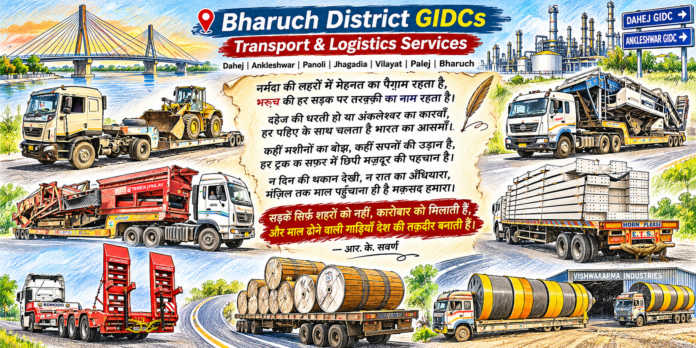
📦 Where Are Bharuch District GIDC Industrial Estates Located, and What Is the Goods Transportation and Logistics Industry Like?
Bharuch district, situated in southern Gujarat along the Narmada River and the Gulf of Khambhat, is an important manufacturing and industrial logistics region in western India. Its strategic location between Vadodara and Surat, access to the Mumbai–Delhi industrial transport corridor, and proximity to Dahej’s port infrastructure make it commercially significant for road freight, industrial cargo movement, container transportation and specialised heavy haulage.
The district’s industrial economy is supported by chemicals, petrochemicals, pharmaceuticals, engineering, textiles, fertilisers and associated manufacturing activities. These industries require continuous movement of raw materials, finished products, machinery, industrial equipment and packaging materials.
Unlike industrial districts concentrated around a single manufacturing centre, Bharuch has several geographically distributed industrial estates. Ankleshwar, Panoli, Jhagadia, Bharuch, Dahej, Vilayat, Palej and Saykha are among the important locations shaping its goods transportation network.
According to the Gujarat Industrial Development Corporation’s FY 2026–27 directory, Bharuch district has 18 listed industrial estate and development entries, including separate phases and tentative projects. This figure should not be interpreted as 18 fully operational industrial estates.
🗺️ Geographical Location and Industrial Connectivity
Bharuch district lies between Gujarat’s major manufacturing regions and coastal industrial infrastructure.
Its geographical advantages include:
Northern road connectivity towards Vadodara, Ahmedabad and Rajasthan.
Southern connectivity towards Surat, Vapi, Mumbai and Maharashtra.
Eastern industrial connections through Jhagadia, Valia and adjoining manufacturing areas.
Western coastal industrial connections through Dahej, Vagra and the Gulf of Khambhat.
Railway connectivity through the Bharuch–Ankleshwar region.
Port-linked cargo movement through Dahej’s industrial and maritime facilities.
The district’s transport economy is therefore influenced by both inland manufacturing and coastal industrial trade.
For manufacturers, this location supports regional distribution and interstate freight movement. For transporters, it creates opportunities for full truckload services, part-load consolidation, industrial machinery transportation and specialised project cargo logistics.
🏭 Major GIDC Industrial Locations in Bharuch District
The following table identifies important industrial locations and their relevance to goods transportation.
Industrial estate
Location within Bharuch district
Industrial and logistics characteristics
Typical transport requirements
Ankleshwar GIDC
Ankleshwar industrial belt
Established chemical, pharmaceutical and manufacturing activity
Industrial classification: These descriptions indicate relevant industrial characteristics and typical logistics requirements. They are not verified records of current freight volumes, factory occupancy or transport bookings.
The official GIDC directory also contains RIDC-labelled and tentative development entries, which should be distinguished from established GIDC estates.
🚚 What Is the Goods Transportation Industry Like in Bharuch?
Bharuch’s goods transportation industry is closely connected with its manufacturing supply chains.
Factories require raw materials to arrive according to production schedules. Finished goods must be transported to customers, warehouses, distributors, ports and industrial facilities across India.
This creates several distinct transportation markets.
These may include packaged manufacturing materials, fabricated components, suitable machinery, construction supplies and finished industrial products.
Vehicle selection depends on cargo dimensions, legal payload, packaging and unloading arrangements.
📦 Container and Enclosed Cargo Transportation
Container-bodied trucks are suitable for many packaged and weather-sensitive industrial products.
They may be used for pharmaceutical packaging, manufactured goods, industrial components and other compatible cargo.
Port-linked container transportation requires different equipment and operating arrangements from ordinary enclosed-body road freight.
🛢️ Chemical and Liquid Cargo Transportation
Chemical and petrochemical industries create demand for specialised bulk-liquid transportation.
However, not every chemical product can be transported in the same tanker.
Vehicle compatibility, product classification, applicable hazardous-goods regulations, tank-cleaning requirements and emergency procedures must be considered before dispatch.
🏗️ Heavy Machinery and Project Cargo
Industrial construction, plant maintenance, equipment replacement and manufacturing expansion can create requirements for specialised trailers.
Relevant equipment may include flatbed, semi-lowbed, low-bed and modular hydraulic multi-axle trailers.
These vehicles serve different cargo dimensions and weight requirements.
Heavy or oversized consignments may also require road route surveys, lifting arrangements, permissions and specialised load-securing procedures.
📦 Part Load and Full Truckload Transportation
Full truckload transportation is suitable when a manufacturer requires a dedicated vehicle.
Part-load services consolidate smaller consignments where cargo compatibility, handling arrangements and delivery schedules permit.
The most economical option depends on shipment volume, destination, urgency and the risk of additional handling.
⛓️ How Bharuch’s Industrial Supply Chain Operates
Industrial goods transportation generally involves several connected stages.
Supply-chain stage
Industrial activity
Logistics requirement
Raw-material procurement
Materials purchased from suppliers
Inbound road, rail or port-linked transportation
Factory receiving
Materials arrive at manufacturing facilities
Gate coordination, unloading and documentation
Production support
Materials move between production and storage areas
Internal handling and short-distance transport
Packaging
Finished products are prepared for dispatch
Palletisation, crating and cargo protection
Warehousing
Inventory is stored before distribution
Suitable storage and inventory management
Finished-goods dispatch
Products leave manufacturing facilities
FTL, LTL, tankers or specialised trucks
Interstate distribution
Cargo moves to other Indian markets
Route planning and freight coordination
Port-linked logistics
Import or export cargo is handled
Terminal coordination and container or bulk transport
Return-load management
Vehicles seek suitable onward cargo
Freight matching and repositioning planning
The efficiency of this chain depends on communication between manufacturers, transport coordinators, fleet operators, warehouse managers and material-handling contractors.
🛣️ Why Bharuch’s Road Connectivity Matters
Bharuch benefits from its position on the important north–south industrial road corridor through Gujarat.
The NH 48 corridor connects the wider Bharuch–Ankleshwar region with Vadodara and Ahmedabad towards the north and Surat and Mumbai towards the south.
Industrial access roads connect factories and estates to the wider highway network.
However, a highway connection does not guarantee that every industrial cargo can move without restrictions.
Oversized equipment may encounter narrow industrial gates, limited turning space, overhead utilities, bridge restrictions or unsuitable road geometry.
Transport planning must therefore consider both the long-distance highway and the final approach to the factory.
💰 Economic Importance of Goods Transportation
The transport industry contributes to Bharuch’s manufacturing economy by supporting the movement of industrial inputs and finished products.
Its commercial importance extends beyond truck operators.
Reliable transportation can reduce production interruptions and improve delivery planning.
Conversely, delays caused by unsuitable vehicles, loading congestion, incomplete documentation or poor coordination can increase manufacturing and distribution costs.
🔄 Return Loads and Freight Market Challenges
Despite the presence of substantial industrial activity, return-load availability is not uniform across Bharuch district.
A vehicle delivering packaged industrial goods to Ankleshwar may have different return-load opportunities from a low-bed trailer carrying heavy machinery to Dahej.
Similarly, chemical tankers must consider product compatibility before accepting another load.
Transporters therefore need to evaluate:
Vehicle suitability for available return cargo.
Distance to the next loading point.
Expected loading and waiting time.
Cargo-handling and cleaning requirements.
Fuel, toll and repositioning costs.
Payment terms and commercial reliability.
Industrial concentration improves the potential for freight matching, but it does not eliminate empty running.
🏭 What Makes Bharuch Different From Other Industrial Districts?
Bharuch’s industrial transport profile is shaped by the combination of established chemical manufacturing, diversified industrial estates and coastal infrastructure.
Ankleshwar and Panoli are especially relevant to chemical and pharmaceutical supply chains.
Jhagadia supports diversified manufacturing and industrial equipment movement.
Dahej adds petrochemical, bulk-material and port-linked logistics requirements.
Bharuch and Palej contribute to regional manufacturing and goods distribution.
Together, these industrial areas create a transport market in which conventional trucking, specialised cargo handling, warehousing and heavy-haul planning serve different but interconnected commercial needs.
🎯 Practical Takeaway for Manufacturers and Transport Businesses
Bharuch District GIDC Transport & Logistics Services should be understood as a network of industrial freight requirements rather than a single type of trucking service.
Manufacturers benefit from choosing vehicles according to cargo specifications, delivery schedules and handling requirements.
Transporters benefit from understanding the industrial characteristics of each estate, identifying suitable freight opportunities and planning return movements carefully.
For heavy machinery and oversized cargo, advance route assessment and coordinated loading arrangements are particularly important.
The district’s long-term logistics importance rests on its manufacturing diversity, industrial connectivity and access to regional and coastal freight networks.
🏭 How Many GIDC Industrial Estates Are in Bharuch District?
Bharuch district is one of Gujarat’s major manufacturing and industrial logistics centres. Its industrial economy includes chemicals, petrochemicals, pharmaceuticals, fertilisers, engineering, textiles, polymers, industrial gases and port-related businesses.
According to the Gujarat Industrial Development Corporation’s official FY 2026–27 allotment directory, Bharuch district has 18 listed industrial estate and development entries. However, these are not necessarily 18 independent, fully operational GIDC estates.
The directory includes established industrial estates, separate development phases, two RIDC-labelled entries, sites listed on an as-is-where-is basis and two tentative industrial park projects.
📊 Bharuch District GIDC Industrial Estate Directory and Industry Types
Chemicals, fibres, polymers and large manufacturing facilities
Tankers, heavy trucks, trailers and industrial machinery
Important: The industry descriptions are a combination of documented district-level industrial activity and relevant sector-based logistics applications. They should not be interpreted as verified lists of currently operating factories within every estate.
🏭 What Types of Industries Operate in Bharuch District?
Bharuch’s industrial base is particularly strong in chemicals, petrochemicals, pharmaceuticals, engineering, fertilisers and textiles. The district’s official export-promotion documentation identifies several large Indian and multinational manufacturers associated with these sectors.
Specialised equipment and compliant transportation
Construction materials
Steel, cement and fabricated materials
Across industrial development areas
Open trucks, bulkers, tippers and trailers
Port-linked industries
Import/export materials and industrial equipment
Dahej coastal industrial belt
Containers, trailers and project cargo
Warehousing and distribution
Storage and dispatch of industrial goods
Major manufacturing corridors
FTL, LTL and regional distribution vehicles
These sectors create different freight requirements. A pharmaceutical manufacturer may prioritise cargo integrity and documentation, while an engineering company transporting a large industrial machine may require route engineering, crane arrangements and specialised trailers.
🏢 Major Companies in Bharuch District Industrial Areas
The following companies are documented in the Bharuch district industrial ecosystem. Their inclusion does not imply that all operate within a particular GIDC estate or currently offer transport contracts.
The Bharuch District Management Association’s corporate membership directory supports these company-location associations. However, membership records alone do not establish that every facility remains operational under the same ownership or name in November 2026.
More recent primary-source evidence confirms important facilities, including GNFC’s Bharuch operations, Petronet LNG’s Dahej terminal, OPaL’s Dahej petrochemical complex and Grasim’s Vilayat chemical manufacturing facilities.
🚛 Which Bharuch Industrial Areas Are Most Relevant for Transporters?
Industrial location
Important cargo opportunities
Suitable vehicle categories
Logistics planning priority
Ankleshwar
Chemicals, pharmaceuticals, industrial supplies
Tankers, covered trucks, HCVs
Product compatibility and dispatch coordination
Panoli
Chemicals, agrochemicals, pharmaceuticals
Tankers, enclosed trucks, trailers
Safe handling and documentation
Jhagadia
Engineering, chemicals, machinery
HCVs, flatbeds, low-beds
Loading equipment and route suitability
Dahej
Petrochemicals, polymers, port cargo, project equipment
Containers, tankers, heavy trailers
Port schedules and industrial access
Vilayat
Chemicals, fibres, industrial equipment
Tankers, trucks, specialised trailers
Cargo handling and vehicle selection
Saykha
Industrial manufacturing
Trucks, containers, trailers
Factory-specific freight requirements
Bharuch
Fertilisers, chemicals, regional industrial cargo
Bulk vehicles, open trucks, HCVs
Regional distribution and loading arrangements
Palej
General manufacturing and industrial goods
LCVs, MCVs, HCVs
Regional freight consolidation
📈 What Does the GIDC Count Mean for Bharuch’s Logistics Industry?
The 18 official directory entries demonstrate the geographical spread of industrial development in Bharuch, but they should not be used as a measure of the number of operational factories.
For transport planning, the more useful questions are how many factories are active, which commodities they handle, what vehicles they require, and where their suppliers and customers are located.
A chemical manufacturing cluster can generate demand for specialised transport and safety documentation. An engineering cluster may need heavy trailers, cranes and route assessments. A port-linked industrial cluster may depend on container logistics, bulk handling and delivery appointments.
These differences make Bharuch an important district for industrial transport coordination, particularly across Ankleshwar, Panoli, Jhagadia, Dahej and Vilayat.
The official GIDC directory and the company-location records provide a useful starting point, but individual factory locations and current operations should be verified before publishing a commercial vendor directory.
🏗️ How Industrialization Changed Bharuch District’s Economy, Employment and Logistics Industry
Industrialization has fundamentally changed the economic structure of Bharuch district in Gujarat. Once strongly associated with agriculture, river-based commerce, traditional trading activities and regional markets, Bharuch has developed into a major manufacturing and industrial logistics centre.
The establishment and expansion of Gujarat Industrial Development Corporation (GIDC) estates in Ankleshwar, Panoli, Jhagadia, Dahej, Vilayat, Saykha and other locations have supported this transformation.
Chemical manufacturing, pharmaceuticals, petrochemicals, engineering, fertilisers, polymers and related industries have created economic activity extending far beyond factory boundaries.
Industrial growth has increased demand for commercial vehicles, warehousing, industrial equipment, construction services, material handling, transport brokerage, maintenance and specialised heavy haulage.
It has also influenced employment opportunities, workforce migration, urban development, housing demand and the growth of supporting businesses.
However, industrial development has brought challenges, including environmental management, infrastructure pressure, traffic congestion and the need for better worker and driver facilities.
Understanding these relationships helps explain why Bharuch’s industrial economy and transportation industry are closely connected.
🏭 From Agriculture and Traditional Trade to Industrial Manufacturing
Before the development of large industrial estates, agriculture, local commerce, traditional businesses and regional trading networks were important components of Bharuch’s economy.
The district’s location along the Narmada River and its historical commercial connections supported trade and movement of goods.
Industrial development introduced a different economic structure.
Manufacturing facilities began requiring regular supplies of raw materials, machinery, chemicals, packaging materials and industrial equipment.
Finished products needed transportation to customers, distributors, ports and manufacturing centres across India.
This created recurring freight demand linked to production schedules rather than only agricultural seasons or traditional market activity.
Industrialization did not eliminate agriculture. Instead, it diversified the district’s economy and expanded the range of commercial activities.
📊 Major Economic Changes Associated With Industrialization
Economic sector
Earlier economic characteristics
Changes associated with industrialization
Impact on transportation and logistics
Agriculture
Farming and agricultural trading
Greater economic diversification
Continued agricultural freight alongside industrial cargo
Manufacturing
Smaller traditional manufacturing base
Expansion of chemical, pharmaceutical and engineering industries
Increased raw-material and finished-goods movement
Employment
Agriculture, trade and traditional occupations
More factory, technical and service-sector opportunities
Demand for drivers, warehouse workers and logistics staff
Migration
Movement associated with traditional economic opportunities
Attraction of workers and professionals to industrial centres
Increased demand for housing, commuting and supporting services
Road transportation
Regional goods and market transport
More diversified industrial freight requirements
Growth opportunities for commercial trucks and specialised trailers
Warehousing
Traditional storage and trading facilities
Greater need for industrial inventory management
Demand for organised storage and distribution
Construction
Residential and local infrastructure activity
Industrial plants, utilities, roads and worker housing
Demand for construction-material vehicles and equipment transport
Engineering services
Local machinery repair and trading
More industrial maintenance and equipment requirements
Machinery transportation and lifting services
Financial services
Traditional trading and commercial finance
Greater demand for industrial credit and working capital
Vehicle finance, insurance and freight-payment services
Small businesses
Local retail and trading
More opportunities to supply industrial customers
Local delivery and distribution services
These changes describe the economic mechanisms associated with industrial development. They are not a statistical comparison of district employment or output before and after industrialization.
🧪 How Chemical and Pharmaceutical Industries Changed Bharuch’s Economy
Ankleshwar and Panoli became important centres for chemical and pharmaceutical manufacturing.
These industries contributed to the development of a specialised industrial supply chain involving chemical raw materials, intermediates, finished products, industrial packaging and safety-related services.
Chemical manufacturing differs from conventional goods production because transportation requirements depend on the physical and chemical characteristics of the product.
Some materials can be transported as properly packaged goods, while others require compatible bulk-liquid tankers or specialised handling arrangements.
This industrial specialization creates opportunities for transport operators with suitable equipment, trained personnel and appropriate compliance systems.
It also supports related businesses involved in industrial drums, intermediate bulk containers, protective packaging, testing, equipment maintenance and documentation.
The economic contribution therefore extends beyond direct factory employment.
🛢️ Dahej’s Industrial Development and the Expansion of Coastal Logistics
Dahej has become an important part of Bharuch’s industrial economy through petrochemical manufacturing, energy infrastructure and port-related industrial activity.
The presence of major industrial facilities and maritime infrastructure creates requirements that differ from those of inland manufacturing estates.
These can include imported industrial materials, bulk cargo, containerised products, heavy machinery and equipment required for industrial construction and maintenance.
Dahej’s development has strengthened the relationship between industrial manufacturing and coastal freight networks.
For road transporters, port-related cargo movement can create opportunities for container trailers, specialised industrial vehicles, heavy-haul equipment and supporting transport services.
However, actual demand depends on terminal capabilities, factory requirements, shipping schedules and commercial arrangements.
🚛 How Industrialization Increased Goods Transportation Demand
Industrialization creates transportation demand at several stages of production.
A factory requires materials before manufacturing begins. During production, components and supplies may move between facilities. After manufacturing, finished goods must reach customers or distribution centres.
Industrial maintenance and expansion also generate transportation requirements.
Industrial activity
Cargo movement
Common vehicle requirements
Economic significance
Raw-material procurement
Suppliers to factories
Open trucks, containers, compatible tankers
Supports continuous production
Manufacturing dispatch
Factories to customers
HCVs, containers, specialised vehicles
Connects local production with markets
Inter-factory movement
One industrial unit to another
LCVs, MCVs and heavy trucks
Supports industrial supply chains
Machinery installation
Equipment suppliers to project sites
Flatbed, semi-lowbed and low-bed trailers
Supports industrial investment
Industrial maintenance
Spare parts and replacement equipment
Pickups, trucks and trailers
Reduces production interruptions
Construction activity
Materials to industrial projects
Tippers, bulkers, open trucks
Supports infrastructure development
Export-related dispatch
Factories to ports or freight terminals
Container trailers and suitable bulk vehicles
Supports international trade
Warehouse distribution
Storage facilities to customers
LCVs, MCVs, HCVs and containers
Improves distribution flexibility
Industrial relocation
Equipment between facilities
Specialised trucks and lifting equipment
Supports restructuring and expansion
A significant feature of industrial freight is its diversity.
The same district may generate small parcel shipments, conventional full truckloads, chemical tanker movements and exceptionally heavy machinery consignments.
Transport operators therefore need to understand the industrial requirements of individual locations rather than treating all factory freight as interchangeable.
👷 Industrialization, Employment Generation and Workforce Migration
Industrial development creates direct and indirect employment opportunities.
Direct employment includes production workers, engineers, technicians, maintenance personnel, supervisors and administrative employees.
Indirect employment arises through transport, warehousing, construction, packaging, security, maintenance, catering, accommodation and other supporting services.
Industrial centres may attract workers from other parts of Gujarat and different Indian states.
This can influence housing demand, local retail activity, commuting patterns and the development of services around industrial areas.
The scale of migration and employment growth varies by industry, investment cycle and location. Reliable district-level statistics are required before assigning numerical growth rates.
📊 Employment Opportunities Created by Industrial Growth
Employment category
Typical occupation
Relationship with industrialization
Manufacturing
Production operator, technician
Direct factory employment
Engineering
Mechanical and electrical technician
Machinery installation and maintenance
Road transportation
Commercial truck driver
Raw-material and finished-goods movement
Fleet operations
Fleet manager, dispatcher
Vehicle scheduling and coordination
Transport brokerage
Freight broker, commission agent
Matching industrial cargo with suitable vehicles
Warehousing
Storekeeper, inventory coordinator
Industrial storage and distribution
Material handling
Crane operator, forklift operator
Loading and unloading operations
Industrial packaging
Packing technician, supervisor
Cargo protection and dispatch preparation
Logistics documentation
Dispatch and compliance executive
Shipment documentation and coordination
Vehicle maintenance
Mechanic, electrician, tyre technician
Commercial fleet support
Construction
Equipment operator, skilled worker
Industrial expansion and infrastructure
Safety and compliance
Safety officer, compliance coordinator
Industrial risk management
Commercial services
Accountant, procurement coordinator
Business administration and supplier management
Employment availability depends on current vacancies, qualifications and employer requirements.
🏘️ How Industrialization Influenced Urban Development and Local Businesses
Industrial development can increase demand for residential accommodation, commercial establishments, healthcare, education, transport and everyday services.
Ankleshwar and Bharuch illustrate the relationship between established industrial activity and the growth of surrounding urban economies.
Industrial workers, managers, contractors and transport personnel require accommodation, food, commuting facilities and other services.
Local businesses may benefit from supplying factories and supporting their employees.
Industrial growth can also increase demand for commercial land, warehouses, vehicle repair workshops and logistics facilities.
These effects are not uniformly positive.
Rapid development can place pressure on roads, housing affordability, water resources, waste-management systems and public infrastructure.
The quality of industrial development therefore depends partly on how effectively supporting infrastructure keeps pace with economic activity.
🏗️ Industrialization and Heavy Machinery Transportation
Industrial expansion creates occasional but commercially important requirements for heavy equipment transportation.
A new manufacturing facility may require industrial reactors, transformers, fabrication assemblies, generators, process equipment or large machinery.
Existing factories may also need specialised transportation during maintenance, equipment replacement or plant modernization.
Depending on cargo specifications, these movements may require flatbed, semi-lowbed, low-bed or modular hydraulic multi-axle trailers.
Heavy cargo transportation also creates demand for engineering services, cranes, rigging, route surveys and specialised loading arrangements.
The economic importance of such movements is not measured only by freight volume.
A single critical equipment delivery can affect the commissioning schedule of an industrial project.
📦 Growth of Warehousing, Packaging and Supply-Chain Services
Manufacturing growth increases the importance of inventory management and organised goods handling.
Factories may need to maintain raw-material stocks, protect finished products, consolidate shipments or coordinate deliveries with customers.
Warehousing requirements depend on the characteristics of the goods.
Chemical products may require segregation and specialised storage conditions. Pharmaceutical materials may need controlled handling, while engineering components may require suitable floor-loading capacity and lifting access.
Industrial packaging also becomes important when products travel long distances or undergo multiple handling operations.
These requirements support specialised service providers in addition to conventional transport businesses.
🔄 Industrial Growth and the Return-Load Economy
A large industrial base can improve the potential for freight matching, but it does not guarantee that vehicles will find suitable return cargo.
A truck delivering conventional industrial products to Ankleshwar may be able to consider other packaged goods for its next movement.
A chemical tanker may face product-compatibility restrictions.
A low-bed trailer delivering heavy equipment to Dahej may need to travel to another industrial location before securing a suitable assignment.
The commercial viability of return freight depends on equipment configuration, loading schedules, route direction, operating costs and customer requirements.
Transport brokers and fleet coordinators can improve efficiency by identifying compatible freight opportunities and reducing unnecessary repositioning.
🌱 Environmental and Infrastructure Challenges of Industrialization
Industrial development creates economic opportunities but also requires responsible environmental and infrastructure management.
Chemical and petrochemical manufacturing involves potential environmental risks that must be addressed through applicable pollution-control requirements, industrial safety systems and waste-management practices.
Heavy commercial traffic can contribute to road wear, congestion, emissions and pressure on roadside facilities.
Important planning priorities include:
Effective industrial wastewater and waste management.
Compliance with applicable environmental regulations.
Safe transportation of hazardous materials.
Proper industrial access roads and traffic management.
Adequate truck parking and driver rest facilities.
Improved loading and unloading coordination.
Vehicle maintenance and emissions compliance.
Emergency-response arrangements for industrial incidents.
Sustainable industrial development requires coordination between manufacturers, infrastructure authorities, transport operators and local communities.
📈 Industrialization and Bharuch’s Long-Term Economic Outlook
Bharuch’s industrial future will depend on the performance of established manufacturing sectors, infrastructure development, new investment, environmental compliance and access to domestic and international markets.
Existing industrial concentrations can support additional business opportunities because manufacturers benefit from nearby suppliers, skilled workers and logistics services.
However, future investment or employment growth should not be assumed without supporting project information.
For transport businesses, the most practical opportunities arise from understanding changes in factory operations, identifying genuine cargo demand and investing in suitable operational capabilities.
Digital freight coordination, better warehouse systems, safer material handling and more efficient return-load planning can improve productivity without requiring unsupported assumptions about future industrial expansion.
📊 How Industrialization Transformed Bharuch District
Area of economic transformation
Main effect
Logistics industry connection
Manufacturing diversification
Wider range of industrial products
More specialised freight requirements
Chemical industry development
Growth of chemical supply chains
Tankers and compliant cargo handling
Petrochemical infrastructure
Large-scale industrial production
Bulk freight and specialised equipment
Pharmaceutical manufacturing
Product-sensitive industrial supply chains
Enclosed and specialised transportation
Engineering development
Machinery and fabricated equipment movement
Heavy trucks and trailers
Port-linked industrial activity
Greater connection with maritime trade
Container and bulk logistics
Workforce migration
Demand for accommodation and services
Employee commuting and supporting deliveries
Direct employment
Factory and technical jobs
Regular industrial supply-chain activity
Indirect employment
Transport, packaging, warehousing and maintenance
Expansion of supporting logistics services
Industrial construction
New facilities and equipment installation
Construction freight and project cargo
Warehousing
Inventory storage and distribution
Freight consolidation and dispatch
Small-business development
More industrial suppliers and contractors
Local and regional commercial vehicle demand
Infrastructure pressure
Greater road and service requirements
Need for better freight planning
Environmental responsibility
Stronger need for safe industrial operations
Hazardous cargo compliance and responsible transport
🎯 What Industrialization Means for Bharuch’s Transport and Logistics Economy
Industrialization has transformed Bharuch from an economy strongly associated with agriculture and traditional trade into a diversified manufacturing district with substantial industrial supply-chain requirements.
The development of Ankleshwar, Panoli, Jhagadia, Dahej, Vilayat and other industrial areas has strengthened the relationship between manufacturing, employment, commercial services and goods transportation.
For manufacturers, efficient logistics supports production continuity and market access.
For transport operators, industrialization creates opportunities across conventional trucking, chemical transportation, warehousing, equipment handling and specialised heavy haulage.
For workers and local businesses, industrial activity provides opportunities extending beyond factory employment.
The central economic lesson is that industrial growth and logistics development are interdependent. Factories require reliable transportation to operate efficiently, while transport businesses depend on productive industries and sustainable freight demand.
📈 Bharuch District GIDC Industrial Evolution Chart (1960s–2026):
Bharuch district’s industrial development reflects Gujarat’s transformation from a regional trading and agricultural economy into one of India’s major manufacturing centres.
The development of Gujarat Industrial Development Corporation (GIDC) estates, chemical manufacturing, pharmaceutical production, petrochemical infrastructure and port-linked industrial facilities has gradually changed Bharuch’s economic landscape.
Industrialization did not occur simultaneously across the district. Ankleshwar emerged as an important chemical manufacturing centre, while Panoli, Jhagadia, Dahej, Vilayat and other locations developed distinct industrial roles over subsequent decades.
The following timeline distinguishes documented industrial milestones from broader economic trends. It does not assign invented investment figures, employment totals or factory counts to individual decades.
📊 Bharuch District Industrial Evolution: Decade-Wise Growth Chart
Decade
Major industrial developments
Important locations
Industrial growth characteristics
Impact on goods transportation and logistics
1960–1969
GIDC established in Gujarat in 1962, creating an institutional framework for planned industrial estates.
Gujarat statewide; Bharuch region
Foundation for organised industrial development
Industrial infrastructure planning created the basis for future freight demand.
1970–1979
Ankleshwar Industrial Estate established in 1971. GNFC established at Bharuch in 1976. Ankleshwar Industries Association established in 1978.
Ankleshwar, Bharuch
Development of organised manufacturing and chemical-industry institutions
Growing need for raw-material deliveries, industrial equipment and factory dispatch.
1980–1989
GNFC commenced manufacturing in 1982 with its ammonia-urea fertiliser complex.
Bharuch, Ankleshwar
Expansion of fertiliser and chemical manufacturing
Greater importance of bulk-material transport, industrial handling and factory logistics.
1990–1999
Economic liberalisation and industrial diversification influenced Gujarat’s manufacturing environment. Petronet LNG was incorporated in 1998.
Bharuch industrial belt; future Dahej energy infrastructure
Broader investment and industrial diversification
Increasing importance of interstate supply chains and specialised freight planning.
2000–2009
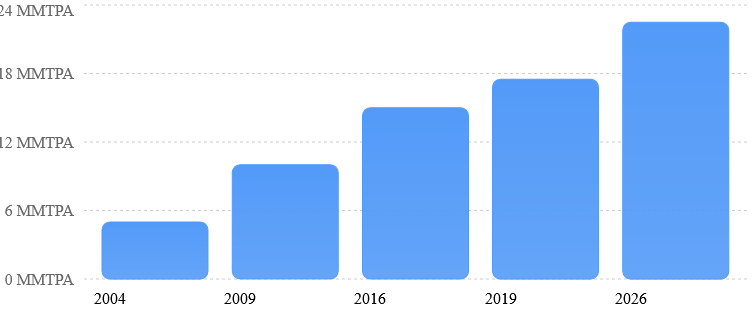
Dahej LNG terminal construction began in 2000. Commercial operations started in 2004. Capacity expanded from 5 to 10 MMTPA in 2009.
Dahej
Major development of energy-import and coastal industrial infrastructure
Increased relevance of port-linked industrial logistics, construction equipment and specialised transportation.
2010–2019
Dahej LNG capacity increased to 15 MMTPA in 2016 and 17.5 MMTPA in 2019.
Dahej and associated industrial corridors
Expansion of established energy infrastructure
Continued requirements for industrial maintenance, equipment movement and associated supply chains.
2020–2026
Further industrial infrastructure development. Dahej LNG regasification capacity increased from 17.5 to 22.5 MMTPA, with additional facilities commissioned on 31 March 2026.
Dahej; established Bharuch industrial regions
Modernisation and expansion of existing industrial assets
Opportunities for specialised industrial services, equipment transportation and integrated logistics coordination.
Verification: Ankleshwar’s 1971 establishment is documented in research by the Gujarat Institute of Development Research. GNFC confirms its 1976 establishment and 1982 manufacturing commencement. Petronet LNG’s official milestones and April 2026 regulatory filing confirm the Dahej capacity expansions.
The timeline is selective. It does not claim that every Bharuch GIDC estate began operations in the decade shown.
🗺️ Industrial Growth in Bharuch District GIDC Areas: Area-Wise Evolution
Industrial development has produced different economic specialisations across Bharuch district.
Industrial area
Historical development pattern
Principal industrial identity
Logistics significance in 2026
Ankleshwar GIDC
Established in 1971; developed into a diversified industrial estate
Chemicals, pharmaceuticals, pesticides, engineering and packaging
Chemical freight, industrial distribution and manufacturing supplies
Bharuch industrial region
Expansion of organised fertiliser and chemical manufacturing, including GNFC
Fertilisers, chemicals and related industries
Bulk materials, factory dispatch and industrial equipment
Panoli GIDC
Development of chemical and pharmaceutical manufacturing
Chemicals, agrochemicals and pharmaceuticals
Specialised chemical handling and packaged industrial freight
Jhagadia GIDC
Development of diversified manufacturing activities
Chemicals, pharmaceuticals and engineering
Industrial machinery, manufacturing supplies and heavy freight
Dahej GIDC
Major coastal industrial and energy-infrastructure development during the 2000s and later
Petrochemicals, energy and port-linked industries
Bulk cargo, containers, heavy machinery and project logistics
Vilayat GIDC
Development of large manufacturing and chemical facilities
Chemicals, fibres and industrial products
Specialised industrial freight and equipment transport
Saykha GIDC
Industrial development associated with the broader Bharuch manufacturing region
Industrial manufacturing and developing supply chains
Factory supplies, equipment movement and regional freight
Palej GIDC
Regional industrial development
Manufacturing and industrial services
General industrial transportation and distribution
Kharchi / Jhagadia Phase II
Additional industrial development phase
Manufacturing and industrial expansion
Construction materials, equipment and factory logistics
Dahej II and III
Additional development phases
Industrial expansion
Project-dependent freight and equipment movement
💰 How Industrial Growth Changed Bharuch’s Freight Economy
The evolution of Bharuch’s manufacturing sector changed not only the volume of potential freight but also the technical requirements of transportation.
During the development of conventional manufacturing, trucks were needed for raw materials, finished products and industrial supplies.
The expansion of chemical and pharmaceutical industries increased the importance of product compatibility, safe handling, packaging and documentation.
Large industrial facilities introduced more complex machinery movements, including requirements for flatbed trailers, low-bed trailers, lifting equipment and route assessments.
Dahej’s coastal infrastructure created an additional relationship between manufacturing, maritime logistics and industrial energy supply.
The result is a district where conventional trucking and specialised industrial transportation serve different parts of the same manufacturing economy.
Source: Petronet LNG official milestones and 1 April 2026 regulatory filing. MMTPA = million metric tonnes per annum.
The terminal’s nominal regasification capacity increased from 5 MMTPA in 2004 to 22.5 MMTPA in March 2026, a 4.5-fold increase.
This is a measure of one facility’s capacity expansion, not the overall industrial growth rate of Bharuch district or its GIDC estates. It also does not represent actual annual LNG throughput.
🚛 How Industrial Evolution Changed Commercial Vehicle Requirements
Industrial development stage
Typical cargo requirements
Relevant transportation equipment
Early organised manufacturing
Raw materials and finished goods
Conventional goods trucks
Chemical industry expansion
Liquid and packaged chemicals
Compatible tankers and goods vehicles
Pharmaceutical diversification
Sensitive and packaged products
Enclosed and specialised vehicles
Large-scale industrial construction
Machinery and fabricated equipment
Flatbed, semi-lowbed and low-bed trailers
Petrochemical development
Bulk materials and industrial components
Bulk transport vehicles and heavy trailers
Port-linked industrial growth
Containerised and bulk cargo
Container trailers and specialised vehicles
Industrial modernisation
Replacement machinery and project equipment
Suitable heavy-haul equipment and lifting systems
Integrated supply-chain operations
Mixed industrial freight
FTL, LTL, warehousing and freight coordination
These categories describe how vehicle requirements differ by industrial activity. They are not historical vehicle-registration statistics.
🏭 Industrial Development and the Growth of Supporting Businesses
Industrial expansion has also created opportunities for businesses that do not manufacture goods themselves.
Manufacturers depend on transport commission agents, fleet operators, equipment suppliers, warehouse providers, industrial packaging contractors, crane operators and maintenance services.
Industrial estates also require services such as weighbridges, fuel stations, commercial vehicle repair facilities and suitable truck parking.
The development of these supporting businesses is economically significant because manufacturing productivity depends on the availability of reliable services outside the factory.
However, industrial growth does not guarantee equal benefits for every local business. Opportunities depend on investment cycles, customer demand, competition and infrastructure quality.
🌱 Industrial Growth, Environmental Responsibility and Infrastructure
Bharuch’s industrial evolution has also increased the importance of environmental compliance and infrastructure management.
Chemical and petrochemical industries require appropriate systems for waste management, emissions control, hazardous-material handling and emergency response.
Future industrial development will require continued attention to these issues alongside investment in manufacturing capacity.
🎯 What the Industrial Growth of Bharuch District Means for Logistics Businesses
Bharuch’s industrial history demonstrates a progression from planned industrial estate development to diversified manufacturing, large-scale chemical production and coastal energy infrastructure.
The district’s established manufacturing areas create demand for different types of transportation, including conventional trucks, container vehicles, chemical tankers and specialised heavy-haul trailers.
For logistics companies, understanding the development and industrial character of individual estates is more useful than assuming that every GIDC area generates identical freight requirements.
For manufacturers, suitable transportation equipment, accurate documentation, safe cargo handling and dependable delivery planning remain central to efficient industrial operations.
The most important conclusion is that Bharuch’s industrial evolution has increased the complexity and diversity of its logistics requirements, making specialised knowledge increasingly valuable.
👷 Career Opportunities in Bharuch District GIDC Industrial Areas
Bharuch district is an important employment centre in Gujarat, offering career opportunities across chemical manufacturing, petrochemicals, pharmaceuticals, engineering, textiles, fertilisers, energy, warehousing, transportation and industrial services.
Industrial areas such as Ankleshwar, Panoli, Jhagadia, Dahej, Vilayat, Saykha, Palej and Bharuch support a diverse employment ecosystem. Opportunities range from entry-level factory work and skilled trades to engineering, industrial safety, management, logistics and specialised heavy transportation.
Bharuch’s official district profile identifies chemicals, petrochemicals, pharmaceuticals, engineering, textiles and port-related activities as important parts of its economy. The district’s industrial development also supports indirect employment in construction, vehicle maintenance, packaging, transport brokerage and supply-chain services.
The following charts explain the main career paths available across Bharuch’s industrial sectors. They describe relevant occupations, not confirmed vacancies or guaranteed employment.
🏭 Industry-Wise Career Opportunities in Bharuch District GIDC Areas
No.
Industry / Sector
Important industrial locations
Career opportunities
Typical qualifications / skills
1
Chemical Manufacturing
Ankleshwar, Panoli, Jhagadia, Dahej
Chemical Plant Operator, Production Chemist, Process Engineer, Shift Supervisor
ITI, Diploma Chemical, B.Sc. Chemistry, B.Tech Chemical
2
Petrochemical Industry
Dahej, Vilayat
Process Technician, Petrochemical Engineer, Plant Operator, Maintenance Engineer
ITI, Diploma, Chemical/Mechanical Engineering
3
Pharmaceutical Manufacturing
Ankleshwar, Panoli, Jhagadia
Production Executive, Quality Control Analyst, QA Officer, Packaging Supervisor
B.Pharm, M.Pharm, B.Sc., M.Sc.
4
Fertiliser Industry
Bharuch, Dahej region
Production Operator, Chemical Engineer, Maintenance Technician
These are potential occupational categories associated with the district’s industries. Individual roles depend on the actual employer, facility and recruitment requirements.
📍 Area-Wise Career Opportunities in Bharuch GIDC Industrial Estates
Different industrial locations offer different career specialisations.
Industrial area
Important employment sectors
Suitable career paths
Ankleshwar GIDC
Chemicals, pharmaceuticals, engineering
Chemist, Production Operator, QC Analyst, Safety Officer, Truck Driver
Panoli GIDC
Chemicals, pharmaceuticals, agrochemicals
Chemical Technician, Lab Analyst, Production Supervisor, Transport Coordinator
Jhagadia GIDC
Chemicals, pharmaceuticals, engineering
Mechanical Engineer, Process Technician, Forklift Operator, Warehouse Executive
Dahej GIDC
Petrochemicals, energy, port-linked manufacturing
Process Engineer, Terminal Coordinator, Heavy Trailer Driver, Safety Officer
Vilayat GIDC
Chemicals, fibres, industrial manufacturing
Chemical Engineer, Maintenance Technician, Logistics Executive
Saykha GIDC
Industrial manufacturing and development
Production Operator, Electrician, Industrial Fitter, Construction Supervisor
Bharuch GIDC
General manufacturing and industrial services
Factory Supervisor, Accountant, Transport Executive, Storekeeper
Local transport and industrial support occupations
The inclusion of a location does not establish current vacancies or confirm that every occupation is available within that estate.
🎓 Career Options According to Educational Qualifications
Industrial employment in Bharuch is not limited to engineering graduates. Entry-level workers, ITI certificate holders, diploma holders, graduates and experienced professionals may find relevant opportunities according to their skills.
Education / qualification
Suitable career options
Relevant industries
8th–10th Pass
General Helper, Packing Assistant, Warehouse Helper
Packaging, Warehousing, Industrial Services
12th Pass
Dispatch Assistant, Store Assistant, Data Entry Operator
Employers may require additional experience, safety training, statutory licences or competency certification.
🚛 Transport, Logistics and Heavy Haulage Career Opportunities
Bharuch’s industrial geography creates specialised career paths for workers interested in road transportation, freight brokerage, supply-chain operations and project logistics.
Career
Main responsibilities
Important skills
LCV Driver
Local industrial deliveries
Route knowledge, safe driving
HCV Driver
Regional and interstate goods transport
Vehicle handling, documentation
Container Truck Driver
Enclosed or containerised cargo movement
Load safety, delivery coordination
Tanker Driver
Compatible bulk-liquid cargo
Product safety, legal compliance
Trailer Driver
Machinery and industrial equipment
Heavy vehicle handling, load awareness
Low-Bed Trailer Driver
Heavy machinery transportation
Turning, clearance and stability awareness
Hydraulic Multi-Axle Operator
Exceptional heavy transport
Specialist training and engineering coordination
Transport Broker
Match freight with suitable vehicles
Negotiation, freight-market knowledge
Trailer Commission Agent
Coordinate specialised trailer requirements
Vehicle specifications and cargo assessment
Fleet Manager
Manage vehicles, drivers and maintenance
Scheduling, cost control
Transport Supervisor
Coordinate loading and dispatch
Documentation, communication
ODC Route Survey Assistant
Support route feasibility assessments
Measurement, road geometry, technical reporting
ODC Project Coordinator
Plan oversized-cargo transportation
Route, equipment and permit coordination
Freight Pricing Executive
Prepare transportation quotations
Cost calculation and market analysis
Return-Load Coordinator
Identify compatible onward freight
Freight matching and route planning
Warehouse Manager
Manage industrial inventory and dispatch
Inventory systems and team management
Logistics Documentation Executive
Prepare shipment documentation
E-way bill, invoicing and compliance knowledge
Crane Operator
Lift industrial equipment
Certified operating skills
Forklift Operator
Handle pallets and industrial cargo
Load-centre awareness and equipment safety
Industrial Rigger
Prepare and secure lifting arrangements
Rigging competency and safety
Cargo Lashing Supervisor
Supervise cargo restraint
Load-securing principles
Transport Insurance Coordinator
Assist with cargo insurance documentation
Policy and claims knowledge
Heavy-haul and ODC positions generally require greater technical competence than ordinary goods transportation.
For example, a low-bed trailer driver must understand ground clearance, turning geometry, load stability and the operating limitations of the equipment.
A road route survey specialist must consider bridges, overhead structures, road width, gradients, turning radii and the actual dimensions of the loaded vehicle.
🏗️ Self-Employment and Small Business Opportunities
Industrial development also creates opportunities for entrepreneurs and independent service providers.
Business opportunity
Potential industrial customers
Main investment or capability requirement
Transport Commission Agency
Factories, contractors, fleet operators
Freight network, communication and working capital
Truck Fleet Business
Manufacturing companies
Suitable vehicles, finance, maintenance
Trailer Brokerage
Engineering and project cargo customers
Specialised equipment network
ODC Consulting
Industrial projects
Technical knowledge and survey capability
Crane Rental
Factories and construction contractors
Equipment, qualified operators and compliance
Forklift Rental
Warehouses and factories
Equipment and maintenance
Industrial Packaging
Manufacturers
Packing materials and technical skills
Warehouse Services
Industrial distributors
Suitable premises and inventory systems
Commercial Vehicle Repair
Fleet operators
Workshop and technical expertise
Tyre Services
Commercial vehicles
Equipment, stock and service facilities
Industrial Spare Parts
Manufacturing facilities
Supplier relationships and inventory
Safety Equipment Supply
Chemical and industrial units
Product knowledge and compliance
Industrial Labour Contracting
Factories and logistics operators
Workforce management and legal compliance
Freight Documentation
Transporters and exporters
Documentation expertise
Courier Franchise
Industrial and commercial customers
Distribution network and franchise terms
Industrial Cleaning
Manufacturing facilities
Trained personnel and appropriate equipment
Employee Transport Services
Industrial employers
Passenger vehicles and permits
Commercial Vehicle Parking
Transport operators
Suitable land, permissions and facilities
Business viability depends on customer demand, competition, investment, legal compliance and commercial arrangements.
👩🏭 Career Opportunities for Women in Bharuch’s Industrial Economy
Women can pursue technical, administrative, managerial and operational careers across Bharuch’s manufacturing and logistics sectors.
Relevant opportunities include laboratory analysis, pharmaceutical quality assurance, production planning, industrial engineering, procurement, finance, HR, IT, warehouse management and supply-chain coordination.
Technical positions should be considered according to qualifications, competency and applicable workplace safety requirements rather than gender assumptions.
Industrial employers can improve workforce participation through safe commuting arrangements, suitable facilities, fair recruitment practices and professional development opportunities.
🧑🎓 Apprenticeships, Skill Development and Industrial Training
Students and first-time job seekers can use apprenticeships and vocational training to enter industrial careers.
ITI training is particularly relevant to electrical maintenance, fitting, welding, mechanical repair and other skilled trades.
Diploma and engineering graduates may benefit from practical training in plant operations, equipment maintenance, quality control and industrial safety.
The Government of India’s MSME system maintains industrial and skill-mapping resources for Bharuch. These can help students understand the district’s industrial profile.
For official information, useful starting points include the National Apprenticeship Promotion Scheme portal and National Career Service.
Applicants should verify the employer, recruitment process, qualification requirements and job location before accepting an offer. They should avoid paying unofficial recruitment fees.
📊 Career Selection Guide: Match Your Skills With the Right Industry
Career interest
Recommended industry
Suggested starting pathway
Chemistry and laboratory work
Chemicals, pharmaceuticals
B.Sc. Chemistry, relevant laboratory training
Mechanical work
Engineering, petrochemicals
ITI Fitter, Diploma Mechanical
Electrical systems
Manufacturing and utilities
ITI Electrician, Diploma Electrical
Computer and office work
Industrial administration
Computer training, BCA, B.Com.
Driving
Road transport
Appropriate commercial driving licence
Business and negotiation
Transport brokerage
Freight coordination and market training
Heavy machinery
Project cargo and material handling
Technical and equipment-specific training
Safety
Chemicals and heavy industry
Recognised industrial safety qualifications
Warehouse operations
Logistics and distribution
Inventory and warehouse training
Management
Manufacturing and logistics
Graduate degree, relevant experience, MBA
Entrepreneurship
Industrial support services
Business planning and sector-specific skills
🎯 Career Outlook for Bharuch District GIDC Industrial Areas
Bharuch offers a broad range of industrial career pathways because its economy includes both conventional manufacturing and technically specialised industries.
Chemical and petrochemical facilities require process knowledge and safety awareness. Pharmaceutical companies need quality-focused professionals. Engineering businesses depend on skilled technicians, while logistics companies require drivers, coordinators, warehouse staff and freight specialists.
Dahej’s industrial infrastructure creates additional opportunities in energy, project logistics and specialised equipment handling. Ankleshwar, Panoli and Jhagadia support a different combination of manufacturing, technical and supply-chain roles.
For job seekers, the most useful strategy is to match qualifications with a specific industry, develop practical skills and verify current vacancies through legitimate recruitment channels.
For entrepreneurs, transport brokerage, industrial maintenance, warehousing, packaging and equipment services represent potential business opportunities, subject to market research and financial feasibility.
Bharuch’s industrial employment ecosystem extends well beyond factory production. Its manufacturers depend on a network of skilled workers, technical professionals, transport operators and supporting businesses.
The morning sun rises over the Narmada River, illuminating a city that has witnessed centuries of trade, migration and economic change.
Bharuch was a commercial centre long before modern factories appeared on its landscape.
Its merchants understood the value of connecting distant markets. Farmers understood the uncertainty of seasons. Traders understood that prosperity depended on moving goods from places where they were produced to places where they were needed.
But the arrival of organised industrial development introduced a different rhythm.
The sound of machinery began joining the familiar sounds of markets and agricultural activity.
Factory gates opened before sunrise. Workers travelled towards industrial estates. Trucks carried raw materials into manufacturing facilities and finished products towards distant customers.
Gradually, industrialisation began changing not only the district’s economy but also the ambitions of the people who lived and worked there.
This is a story about that transformation.
Not simply the growth of factories, but the people whose livelihoods became connected to them.
🏭 The 1970s: A Young Man Outside the Factory Gate
Imagine Ankleshwar in the early years of its organised industrial development.
A young man named Ramesh stands outside an industrial estate, holding a small cloth bag.
He comes from a farming family in a village near Bharuch.
His father has spent much of his life working in agriculture, where income depends on rainfall, harvests and market prices.
Ramesh hopes to find a different opportunity.
He has heard that factories are beginning to offer employment to workers willing to learn new skills.
The industrial environment is unfamiliar.
There are machines he has never seen, materials he cannot identify and workers wearing protective equipment.
At first, he finds employment assisting with ordinary factory tasks.
His wages are modest, and the work is demanding.
But something important changes.
For the first time, he begins imagining a future in which his children might become technicians, engineers or teachers.
One evening, he tells his father:
“Perhaps I will never become a factory owner. But I want my children to have opportunities that I never had.”
His father does not answer immediately.
Then he says:
“A person does not always need to own the place where change begins. Sometimes it is enough to help build it.”
Ramesh’s story is fictional, but the aspiration it represents is relevant to the employment opportunities created by industrial development.
The establishment of Ankleshwar Industrial Estate in 1971 marked an important stage in the region’s organised manufacturing history.
🚛 The Truck Driver Who Connected Factories With the Rest of India
As manufacturing expanded, another group of workers became increasingly important.
Truck drivers.
Imagine a driver named Yusuf, operating a goods vehicle between Ankleshwar and industrial markets in Maharashtra.
His vehicle carries properly packed industrial materials.
Every journey requires attention to loading, documentation, road conditions and delivery schedules.
His work is not easy.
Some nights are spent away from home. Loading delays can disrupt his schedule. A mechanical problem can consume money intended for household expenses.
Yet the factory depends on transportation.
A product manufactured in Bharuch has little commercial value to a distant customer until it can be delivered safely and reliably.
One evening, Yusuf stops at a roadside eating place.
A younger driver asks him:
“Why do you continue driving when the work is so difficult?”
Yusuf smiles.
“Because the factory makes the goods, but somebody must carry them to the world.”
The younger driver remembers those words.
For him, trucking is no longer simply a way to earn money.
It becomes a profession connecting manufacturing, trade and families across India.
Behind every industrial dispatch are people responsible for loading, documentation, vehicle maintenance, driving and delivery.
Their contribution is essential even when it receives little public attention.
🧪 The Growth of Chemical Industries: Opportunity With Responsibility
Ankleshwar and Panoli developed important chemical and pharmaceutical manufacturing activities.
These industries required specialised technical knowledge.
A worker could no longer depend entirely on physical strength or general factory experience.
Chemical processes demanded training, measurement, operating discipline and safety awareness.
Imagine Meena, a student from a modest household near Bharuch.
She studies chemistry and hopes to work in an industrial laboratory.
Her relatives initially question whether a technical career is practical for her.
But she continues studying.
Eventually, she obtains an entry-level laboratory position.
Her first responsibilities involve sample preparation, documentation and assisting qualified laboratory personnel.
She gradually learns that industrial quality control requires patience and accuracy.
A small error in measurement can affect an entire manufacturing process.
Years later, she helps a younger student understand laboratory procedures.
The student asks:
“Was it difficult to enter this industry?”
Meena replies:
“Yes. But learning something difficult gave me the confidence to learn something even harder.”
Her fictional journey reflects a broader economic possibility: industrial development can create career pathways for people who acquire relevant technical skills.
It also demonstrates why training and workplace safety matter as much as employment numbers.
🏗️ The 1990s and 2000s: When Industrial Ambitions Grew Larger
As India’s economy changed, manufacturing industries increasingly became connected to wider domestic and international supply chains.
Industrial development around Bharuch also began involving larger facilities, more complex equipment and specialised infrastructure.
The expansion of the Dahej industrial region introduced a new dimension.
Here, industrial logistics was not limited to conventional factory deliveries.
Large equipment, petrochemical infrastructure, energy facilities and port-related operations created more complex planning requirements.
Imagine an experienced mechanical technician named Mahesh travelling to Dahej for an industrial installation project.
He sees large structures, specialised lifting equipment and heavy transport vehicles.
The machinery arriving at the project site has required careful preparation.
Transport coordinators have reviewed the cargo dimensions. Lifting teams have prepared equipment. Engineers have considered access and unloading arrangements.
Mahesh watches a large industrial component being positioned.
He remembers the small workshop where he first learned to repair machinery.
At that time, he could not have imagined working on equipment of this scale.
He thinks about the distance between those two experiences.
Not merely the kilometres travelled, but the knowledge acquired.
Industrial growth has changed the scale of the work available to him.
⚙️ The Engineer and the Low-Bed Trailer
A large industrial machine is ready for transportation.
The fictional shipment begins at a manufacturing facility in Jhagadia and is intended for an industrial project in the Dahej region.
The equipment is heavy and dimensionally unsuitable for an ordinary goods truck.
A transport engineer named Arjun studies its technical drawings.
He examines the weight, dimensions, centre of gravity and lifting points.
A suitable low-bed trailer is considered, subject to the actual cargo specifications and route conditions.
The route requires assessment of industrial access roads, turning space, overhead restrictions and unloading arrangements.
Arjun understands that choosing a trailer is only one part of the assignment.
A successful movement requires coordination between the manufacturer, transporter, lifting contractor and receiving facility.
A junior colleague asks:
“Why do we spend so much time planning a journey that appears short on the map?”
Arjun answers:
“Distance tells us how far the cargo must travel. Engineering tells us whether it can travel safely.”
The planning continues.
Measurements are checked. Responsibilities are assigned. Loading arrangements are reviewed.
The lesson is simple.
Heavy transportation is not measured only by the size of the machine.
It is measured by the quality of the decisions made before movement begins.
👷 The Families Behind Industrial Employment
Industrial development affects households in ways that are not always visible in economic reports.
A factory worker’s income may support children’s education.
A driver’s earnings may help a family build a home.
A technician’s salary may support elderly parents.
A small transport broker may use business income to educate the next generation.
These experiences are not universal. Industrial employment can also involve uncertainty, demanding schedules and financial pressure.
Imagine three neighbouring families in Bharuch.
One household depends on factory employment.
Another operates a small commercial vehicle.
The third runs a workshop repairing industrial equipment.
Their occupations differ, but their economic activities are connected.
The factory requires transport.
The transporter requires maintenance.
The workshop depends on customers who operate machinery and vehicles.
When industrial activity is healthy, these relationships can create opportunities.
When production slows, the effects may spread through the same network.
This is why industrial development must be understood as an interconnected local economy rather than a collection of factory buildings.
🚚 The Transport Broker Who Started With a Telephone
Not everyone participating in industrial development owns a factory or a fleet of trucks.
Some people build careers by connecting those who need transportation with those who can provide it.
Imagine a young transport commission agent named Prakash.
He begins with a telephone, a notebook and a small network of vehicle operators.
At first, finding suitable trucks is difficult.
Customers want reliable service and competitive rates.
Vehicle owners need profitable freight and timely payments.
Prakash gradually learns that transport brokerage involves more than negotiating prices.
He must understand vehicle dimensions, cargo requirements, loading conditions, delivery commitments and commercial risks.
One day, a manufacturer requests transportation for a large industrial component.
Prakash initially considers arranging an ordinary trailer.
But after reviewing the cargo dimensions, he realises that a different vehicle configuration may be required.
He consults an experienced heavy-haul operator before making a commitment.
The customer receives a more appropriate transport proposal.
That evening, Prakash writes a sentence in his notebook:
“Good business is not always about saying yes quickly. Sometimes it begins with asking the right questions.”
His fictional experience represents an important opportunity in Bharuch’s industrial ecosystem.
Knowledge, reliability and coordination can create commercial value even without ownership of large industrial assets.
🌧️ The Difficult Side of Industrial Growth
Industrialisation has brought opportunities, but it has also created responsibilities and challenges.
Workers may face demanding schedules.
Transport operators may experience payment delays, vehicle detention and rising operating costs.
Industrial traffic can place pressure on roads.
Chemical manufacturing requires careful environmental management and compliance with safety regulations.
Families may struggle with housing costs or long commuting distances.
For some workers, industrial employment provides stability. For others, contract arrangements and changing business conditions create uncertainty.
The inspirational story of industrial development should not ignore these realities.
Progress becomes more meaningful when economic opportunity is accompanied by safe working conditions, responsible environmental practices and fair commercial relationships.
A district’s industrial success cannot be judged only by the number of factories or the size of its machinery.
The wellbeing of the people who support those factories matters too.
🌉 Three Generations and One Changing District
Return to the fictional family of Ramesh, the young worker who entered Ankleshwar’s industrial economy decades earlier.
His son grows up watching him leave home for factory shifts.
The son chooses technical education and becomes a maintenance professional.
Years later, Ramesh’s granddaughter studies supply-chain management.
Her work involves coordinating industrial shipments, reviewing transport documentation and improving delivery schedules.
Three generations have participated in different stages of the same economic transformation.
The grandfather helped operate manufacturing facilities.
The father maintained industrial machinery.
The granddaughter manages information and transportation connecting factories with markets.
Their story is fictional, but it illustrates how industrial development can create new occupational pathways across generations.
The skills required by the economy change.
The importance of learning remains.
🌍 From Bharuch’s Industrial Gates to Distant Markets
Today, Bharuch’s manufacturing economy is connected with industrial markets across India and international supply chains through appropriate freight and maritime infrastructure.
Ankleshwar and Panoli contribute chemical and pharmaceutical manufacturing activity.
Dahej connects manufacturing with energy infrastructure and port-related logistics.
Vilayat and other industrial locations contribute additional manufacturing capacity.
Goods produced in these industrial areas may move through several stages before reaching their final customers.
A finished product might travel by road to a distribution centre.
A containerised shipment may move towards a port.
A large machine may require a specialised trailer and detailed route planning.
Each movement depends on people performing different responsibilities.
Production workers manufacture.
Engineers design.
Warehouse teams prepare.
Transport coordinators organise.
Drivers deliver.
Together, they connect Bharuch’s industrial economy with wider markets.
❤️ The People Who Built the Industrial Economy
When people discuss industrial development, they often remember factories, investment announcements, industrial estates and infrastructure projects.
Those are important.
But industrial transformation also depends on workers whose contributions are less visible.
The technician who repairs a machine before the next production shift.
The laboratory employee who checks product quality.
The warehouse worker who identifies a damaged package.
The driver who refuses to operate an unsafe vehicle.
The crane operator who insists on a proper lifting arrangement.
The transport coordinator who corrects an unsuitable vehicle booking.
The small entrepreneur who pays employees on time despite difficult business conditions.
These everyday decisions support industrial reliability.
They may never appear in a headline, but they influence whether manufacturing and logistics operations succeed.
🌅 The Next Chapter of Bharuch’s Industrial Journey
Bharuch’s industrial future will depend on more than the expansion of manufacturing facilities.
It will also depend on technical education, infrastructure quality, environmental responsibility, industrial safety and efficient logistics.
Digital freight coordination may improve shipment planning.
Better material-handling systems can reduce damage and delays.
Appropriate truck parking and rest facilities can improve working conditions for drivers.
Training can help workers adapt to changing industrial technologies.
For younger generations, opportunities may emerge in industrial automation, engineering, supply-chain management, environmental services and specialised transportation.
For established transport businesses, long-term success will depend on reliability, commercial discipline and technical competence.
No industrial region can guarantee prosperity to every worker or entrepreneur.
But access to skills, infrastructure and fair opportunities can help more people participate in economic development.
🏁 Bharuch’s Industrial Revolution Is Also a Human Story
The industrial transformation of Bharuch district cannot be understood only through factory construction, production capacity or industrial estate expansion.
It is also a story about changing livelihoods.
About agricultural families discovering new employment possibilities.
About technicians learning to operate complex machinery.
About women entering scientific and technical professions.
About truck drivers connecting factories with distant markets.
About transport brokers building businesses through knowledge and relationships.
And about younger generations preparing for careers that previous generations could scarcely imagine.
The Narmada continues to flow through Bharuch, just as it did before the emergence of modern industrial estates.
The landscape around it has changed.
Factories, warehouses, industrial roads and commercial vehicles have become part of the district’s economic identity.
Yet the most meaningful part of this transformation is not found in machinery alone.
It is found in the opportunities people create, the responsibilities they accept and the knowledge they pass to the next generation.
Factories may shape an industrial landscape, but people give an industrial economy its purpose.
That is the enduring human story behind Bharuch district’s industrial development.
🚛 Why Bharuch District GIDC Transportation and Logistics Industry Is Growing in Gujarat
Bharuch district has become one of Gujarat’s important industrial transportation and logistics centres because of its diversified manufacturing economy, strategic road connections, chemical and petrochemical industries, and access to coastal industrial infrastructure.
Industrial areas such as Ankleshwar, Panoli, Jhagadia, Dahej, Vilayat, Saykha, Palej and Bharuch generate different types of cargo movement throughout the manufacturing supply chain.
Chemical manufacturers require compatible tankers and carefully managed packaged-cargo transportation. Pharmaceutical companies need reliable handling and documentation. Engineering companies require open trucks, flatbed trailers and occasionally specialised heavy-haul equipment.
Petrochemical and polymer manufacturers create demand for bulk and packaged freight, while industrial construction projects require machinery transportation, cranes, rigging and project logistics.
These activities support a broader service ecosystem involving transport brokers, warehouse operators, packaging contractors, cargo-lashing specialists, weighbridges, vehicle workshops and industrial equipment providers.
Bharuch’s logistics economy is therefore not limited to moving goods between factories. It includes the services required to prepare, handle, store, measure, secure, document and deliver industrial cargo.
Although the district has several structural advantages for logistics development, a precise claim about the speed of industry-wide growth would require comparable freight-volume, fleet, employment or investment statistics.
Manufacturing is the principal source of Bharuch’s industrial freight demand.
Factories require inbound raw materials, packaging supplies, spare parts and equipment. They also generate outbound shipments of finished products, intermediates and industrial by-products.
The transport requirements vary significantly by industry.
Covered vehicles, controlled handling where required
Fertilisers
Bharuch industrial region
Fertilisers and industrial inputs
Bulk and bagged cargo transport
Engineering
Jhagadia, Bharuch, Dahej
Machinery, fabricated structures, components
Open trucks, flatbeds, low-bed trailers
Polymers and plastics
Dahej, Jhagadia
Polymer materials and plastic products
Containers, bulk and packaged-goods vehicles
Textiles and fibres
Jhagadia, Vilayat and associated industrial areas
Yarn, fibres and finished textile products
Covered trucks and containers
Industrial gases and energy
Dahej industrial region
Specialised energy-related products and equipment
Regulated specialised transport and equipment logistics
Construction materials
Industrial development areas
Steel, cement, aggregates, structural components
Open trucks, tippers, bulkers and trailers
Industrial maintenance
All major manufacturing estates
Motors, pumps, spare parts, replacement machinery
LCVs, HCVs and machinery trailers
A diversified manufacturing base creates opportunities for different vehicle categories, but it also requires transport operators to understand the specific needs of each commodity.
Bharuch benefits from its position in southern Gujarat, between the major economic centres of Vadodara and Surat.
National Highway 48 is an important north–south road corridor connecting industrial and commercial markets across western India.
Industrial freight also moves through roads linking Ankleshwar, Jhagadia, Dahej, Jambusar, Vagra and other parts of the district.
These connections support goods movement towards Gujarat’s industrial markets and interstate destinations.
Transport corridor
Industrial significance
Common logistics activities
Bharuch–Ankleshwar
Connects major manufacturing and commercial areas
General cargo, chemicals, local distribution
Ankleshwar–Panoli
Connects chemical and pharmaceutical manufacturing locations
Factory supplies and finished-goods dispatch
Ankleshwar–Jhagadia
Connects diversified industrial facilities
Engineering cargo, chemicals, machinery
Bharuch–Dahej
Links inland manufacturing with coastal industrial infrastructure
Containers, bulk cargo, project equipment
Dahej–Vilayat industrial belt
Supports large industrial manufacturing facilities
Chemicals, machinery and industrial supplies
Bharuch–Vadodara
Connects regional industrial and commercial markets
Interstate freight and distribution
Bharuch–Surat
Supports movement between major southern Gujarat markets
General cargo and industrial supplies
Bharuch–Jambusar
Supports regional industrial and commercial movement
Construction materials and general freight
Road access does not mean that every vehicle or oversized load can use every route.
Heavy or over-dimensional cargo movements require route-specific assessment of bridges, road geometry, clearances, restrictions and applicable permissions.
Dahej’s industrial development is an important reason Bharuch supports a wide range of logistics activities.
Coastal industrial facilities and port-related infrastructure connect manufacturing with maritime supply chains.
This can create requirements for container movement, bulk handling, industrial equipment transportation and specialised cargo coordination.
Port-linked logistics may involve several stages:
Cargo arrival or preparation at an industrial facility.
Documentation and shipment coordination.
Cargo packaging, inspection or handling.
Transportation between factory, warehouse and terminal.
Terminal handling and onward movement.
Not every industrial shipment travels through Dahej, and not every cargo type can be handled at every terminal.
Actual arrangements depend on terminal capabilities, shipping services, cargo specifications and commercial requirements.
🚚 All Types of Road Transportation Services Required by Bharuch Industries
Bharuch’s industrial economy supports multiple categories of commercial vehicles.
Vehicle or service category
Typical applications
Important operating considerations
Tata Ace and small goods vehicles
Small industrial supplies and local deliveries
Payload limits and access
Pickup trucks
Spare parts, packaging materials and urgent deliveries
Load restraint and permitted capacity
LCV trucks
Local and regional industrial goods
Cargo dimensions and scheduling
MCV trucks
Medium-volume factory freight
Payload and loading arrangements
HCV trucks
Heavy general cargo and industrial dispatch
Weight compliance and route planning
Open-body trucks
Steel, machinery, fabricated components
Weather protection and lashing
Container-bodied trucks
Packaged chemicals, pharmaceuticals and general goods
Internal securing and cargo compatibility
Refrigerated trucks
Temperature-sensitive goods where required
Temperature control and monitoring
Chemical tankers
Compatible liquid chemical cargo
Tank specification, segregation and compliance
Bulkers
Suitable dry bulk commodities
Commodity compatibility and discharge arrangements
Tippers
Construction materials and suitable bulk cargo
Site access and safe unloading
Flatbed trailers
Machinery and industrial structures
Load distribution and restraint
Semi-lowbed trailers
Equipment requiring lower loading height
Clearance and axle-load assessment
Low-bed trailers
Heavy machinery and project equipment
Ground clearance and route feasibility
Telescopic trailers
Long industrial components
Turning geometry and load support
Modular hydraulic multi-axle trailers
Exceptional heavy cargo
Engineering design, axle loading and permits
Container trailers
Containerised industrial cargo
Container securing and terminal coordination
Car and equipment carriers
Suitable vehicles and equipment
Loading compatibility
Full Truck Load (FTL)
Dedicated factory shipments
Vehicle utilisation and delivery scheduling
Less Than Truck Load (LTL)
Smaller consolidated shipments
Cargo segregation and handling
Parcel and courier
Documents, samples and small components
Tracking and delivery reliability
The availability of a vehicle category does not establish that it is suitable for a particular shipment. Vehicle selection must follow cargo dimensions, weight, characteristics and applicable regulations.
📦 Why Industrial Packaging Services Are Important in Bharuch
Industrial packaging is a major supporting activity in manufacturing logistics.
Products must be protected during loading, road transportation, storage and unloading.
The correct packaging method depends on the product’s physical characteristics, value, sensitivity and applicable transport requirements.
For example, an industrial pump may need a fabricated wooden case or a suitable transport frame.
A fragile engineering component may require cushioning and vibration protection.
Chemical products may require approved packaging compatible with the substance being transported.
Packaging method
Suitable cargo applications
Main purpose
Wooden boxes and crates
Machinery, instruments and engineering components
Physical protection
Palletisation
Packaged industrial products
Efficient handling and stacking
Stretch wrapping
Suitable palletised cargo
Unitisation and surface protection
Shrink wrapping
Suitable packaged products
Packaging stability and protection
Corrugated cartons
Small components and finished products
Handling and product protection
Industrial drums
Compatible liquid or solid products
Safe containment
Intermediate bulk containers (IBCs)
Compatible industrial liquids
Bulk packaging and handling
Moisture-barrier packaging
Moisture-sensitive machinery and components
Corrosion and moisture protection
Vacuum packaging
Suitable sensitive industrial equipment
Environmental protection
Custom steel frames
Heavy or irregular machinery
Structural support during handling
Export-oriented packaging
International shipments
Protection and destination-specific compliance
Packaging requirements should be determined by qualified personnel, especially for dangerous goods and sensitive industrial equipment.
🏷️ Industrial Labelling, Marking and Shipment Identification
Labelling helps identify cargo and communicate handling requirements.
It is particularly important when products move between manufacturers, transport operators, warehouses and customers.
Industrial labels may include product identification, batch information, shipment references and handling instructions.
For regulated dangerous goods, labels and markings must comply with the applicable legal framework.
Labelling category
Information commonly communicated
Logistics importance
Product identification
Product name or code
Prevents shipment confusion
Consignee identification
Delivery destination and recipient
Supports accurate delivery
Batch or lot identification
Manufacturing batch details
Traceability
Gross and net weight
Package weight information
Handling and loading planning
Handling instructions
Orientation or special handling requirements
Reduces cargo damage
Fragile markings
Sensitivity to impact
Encourages appropriate handling
Moisture protection markings
Keep-dry instructions where applicable
Protects sensitive goods
Dangerous-goods labels
Applicable hazard identification
Safety and regulatory compliance
Barcode labels
Machine-readable shipment identification
Inventory and dispatch control
QR-code labels
Digital shipment or product information
Tracking and verification
Export shipping marks
Package and shipment identification
International cargo handling
Labels must be accurate and appropriate to the actual product. Generic labels cannot replace legally required dangerous-goods documentation or markings.
⛓️ Cargo Lashing and Load Securing for Industrial Transportation
Cargo lashing is essential for many industrial shipments.
Heavy machinery, fabricated structures, steel components and other irregular loads may shift during braking, turning or movement over uneven roads if they are not properly secured.
Load restraint must account for cargo weight, centre of gravity, friction, support points and expected transport forces.
Cargo type
Common securing considerations
Suitable methods, subject to engineering assessment
Industrial machinery
Weight distribution and movement prevention
Rated chains, binders, supports and blocking
Fabricated steel structures
Longitudinal and lateral movement
Rated restraints and engineered supports
Heavy transformers
Centre of gravity and equipment protection
Engineered restraint arrangements
Pipes and cylindrical cargo
Rolling prevention
Chocks, cradles and rated restraints
Palletised products
Package stability
Appropriate unitisation and restraint
Large industrial vessels
Support geometry and restraint capacity
Engineered saddles and securing systems
Fragile equipment
Vibration and impact protection
Suitable packaging and restraint
Oversized project cargo
Route forces and equipment limitations
Shipment-specific securing plan
Lashing should be designed or checked by competent personnel.
A transport operator should not select chains, straps or restraint points merely by visual judgement.
🏬 Industrial Warehousing and Storage Requirements
Warehousing supports production continuity by providing space for raw materials, intermediate products and finished goods.
Storage requirements vary significantly across Bharuch’s industrial sectors.
A conventional warehouse suitable for packaged engineering components may not be appropriate for chemicals requiring specialised segregation or environmental controls.
Warehouse category
Potential industrial users
Important facilities or controls
General industrial warehouse
Engineering and packaged-goods manufacturers
Loading access, inventory control
Raw-material warehouse
Manufacturing plants
Receiving and stock management
Finished-goods warehouse
Industrial distributors
Dispatch coordination
Chemical-compatible storage
Eligible chemical manufacturers
Appropriate segregation and safety systems
Pharmaceutical warehouse
Pharmaceutical manufacturers
Product-specific handling and environmental controls
Machinery storage yard
Engineering and project cargo businesses
Suitable ground capacity and security
Container storage yard
Container logistics operators
Equipment access and container handling
Open industrial yard
Suitable steel and fabricated cargo
Ground condition and weather considerations
Temperature-controlled storage
Products requiring temperature control
Monitoring and suitable equipment
Transit warehouse
Freight consolidators
Cross-docking and short-term storage
Bonded warehouse
Eligible import/export businesses
Applicable customs authorisation and compliance
Storage facilities must be evaluated according to cargo characteristics, permitted use, fire safety, environmental requirements and available handling equipment.
⚖️ Weighbridge Services and Their Importance in Bharuch Industrial Logistics
Weighbridges are an important part of industrial freight operations.
They help establish vehicle and cargo weights for commercial records, loading control and transport planning.
For heavy industrial cargo, accurate weighing is particularly important because total vehicle weight and individual axle loads can affect legal compliance and road safety.
A weighbridge measurement of gross vehicle weight alone does not establish that every axle is within its permitted limit.
Weighbridge application
Purpose
Important consideration
Gross vehicle weight
Measures loaded vehicle weight
Appropriate weighbridge capacity
Tare weight
Measures empty vehicle weight
Correct vehicle configuration
Net cargo weight
Calculates cargo weight from relevant readings
Accurate measurement records
Dispatch verification
Supports shipment records
Consistent procedures
Bulk-material movement
Helps verify commercial quantities
Calibration and recordkeeping
Heavy machinery movement
Supports weight verification
Additional engineering assessment may be required
Fleet compliance
Helps identify potential overloading
Axle-load limits must also be considered
Receiving inspection
Supports delivery reconciliation
Correct identification of shipment and vehicle
Weighbridge availability in Bharuch district: Industrial weighbridge services are relevant around major freight-generating areas such as Ankleshwar, Panoli, Jhagadia, Bharuch and Dahej. However, individual public weighbridge names, exact locations, operating hours, capacities and calibration status require current local verification.
Transporters should confirm these details before sending a vehicle, particularly when arranging heavy machinery or time-sensitive industrial deliveries.
🏗️ Crane, Hydra, Forklift and Material-Handling Services
Industrial freight often requires equipment beyond the transport vehicle.
Machinery, containers, fabricated structures and palletised goods may need cranes, forklifts or other handling systems.
Equipment or service
Typical industrial application
Key planning consideration
Mobile crane
Machinery loading and unloading
Lift radius, capacity and ground conditions
Hydra-type pick-and-carry crane
Suitable site handling operations
Equipment limitations and safe operating conditions
Forklift
Palletised and compatible industrial cargo
Rated capacity and load centre
Reach truck
Warehouse storage operations
Racking and floor suitability
EOT crane
Factory machinery handling
Facility capacity and lifting arrangements
Chain pulley block
Suitable controlled lifting tasks
Rated capacity and anchorage
Hydraulic jacks
Equipment positioning
Support and stability
Skidding systems
Heavy equipment positioning
Engineered movement arrangements
Rigging services
Lifting preparation and execution
Qualified rigging personnel
Loading and unloading labour
Suitable manual cargo handling
Worker safety and task suitability
A crane’s rated capacity cannot be assessed without considering its working radius, configuration and actual site conditions.
Industrial lifting operations should be planned by competent personnel using suitable equipment.
🔧 Supporting Services That Strengthen Bharuch’s Logistics Economy
Transportation depends on an extensive network of supporting businesses.
Supporting service
Why industrial transporters need it
Transport commission agents
Freight sourcing and vehicle coordination
Freight forwarding
Multimodal and international shipment coordination
Customs documentation services
Applicable import/export processes
Truck parking facilities
Vehicle staging and driver rest
Fuel stations
Vehicle refuelling
Tyre repair and replacement
Fleet maintenance
Commercial vehicle workshops
Mechanical repairs
Auto electrical services
Vehicle electrical maintenance
Spare-parts suppliers
Replacement components
Weighbridges
Weight verification
Industrial packaging contractors
Cargo protection
Lashing and rigging contractors
Load restraint and handling
Crane rental agencies
Heavy lifting
Forklift rental agencies
Warehouse and site handling
Warehousing operators
Storage and distribution
Transport insurance services
Cargo and vehicle risk management
Compliance consultants
Applicable transport and industrial documentation
Road route survey specialists
ODC feasibility assessment
Escort and traffic-management services
Permitted exceptional cargo movements
Driver accommodation and rest facilities
Driver welfare and journey management
The existence and suitability of individual service providers should be checked before they are recommended commercially.
🔄 Return Loads and Freight Consolidation
Bharuch’s manufacturing diversity can create opportunities for return-load planning.
A general goods truck delivering cargo to Ankleshwar may seek another compatible shipment from a nearby industrial area.
A container vehicle may be repositioned for another customer or terminal movement.
However, the situation is more difficult for specialised equipment.
Chemical tankers may be restricted by product compatibility and cleaning requirements.
Low-bed and modular hydraulic trailers may have fewer suitable cargo opportunities because their dimensions, operating costs and route requirements are specialised.
Return-load coordination can reduce empty kilometres, but it should never compromise cargo safety, legal compliance or vehicle suitability.
📊 How Bharuch’s Logistics Sectors Connect With Industrial Growth
Logistics segment
Main source of demand
Growth-supporting factor
Important limitation
FTL transportation
Regular factory dispatch
Manufacturing production
Freight rates and vehicle utilisation
LTL transportation
Smaller industrial consignments
Supplier and distributor networks
Consolidation and handling
Chemical tanker transport
Chemical manufacturing
Specialised commodity movement
Safety and product compatibility
Container logistics
Packaged freight and port-linked trade
Industrial and maritime connectivity
Terminal access and equipment availability
Heavy-haul transportation
Machinery and project equipment
Industrial construction and maintenance
Route and engineering requirements
Warehousing
Industrial inventory
Production and distribution planning
Property suitability and compliance
Packaging
Cargo preparation
Product protection requirements
Commodity-specific standards
Labelling
Shipment identification
Traceability and compliance
Accuracy and regulatory requirements
Cargo lashing
Heavy and irregular loads
Safe transportation requirements
Competent restraint design
Weighbridge services
Commercial vehicle movements
Weight verification
Calibration and axle-load assessment
Crane and forklift services
Loading and unloading
Industrial handling requirements
Equipment capacity and safety
Freight brokerage
Vehicle and cargo matching
Diverse industrial freight demand
Payment and service reliability
Courier and parcel
Documents, samples and small goods
Business-to-business distribution
Delivery reliability
Rail-linked logistics
Suitable bulk and long-distance freight
Access to rail infrastructure
Terminal and service availability
Coastal and port logistics
Eligible maritime cargo
Dahej industrial infrastructure
Terminal-specific capabilities
Air cargo coordination
Urgent or high-value shipments
Access to external air cargo facilities
Cost and airport connectivity
🌱 Challenges That Could Limit Future Logistics Growth
Bharuch has important industrial advantages, but the logistics sector also faces operational challenges.
Vehicle detention can reduce fleet productivity.
Inconsistent loading schedules can increase waiting time and transport costs.
Industrial traffic can place pressure on road infrastructure.
A shortage of suitable parking or driver facilities may affect journey planning.
Chemical and project cargo transportation requires specialised competence and careful compliance.
Small transport businesses may also face payment delays, competition and rising maintenance costs.
Addressing these issues is important for making industrial logistics more efficient and sustainable.
🎯 Why Bharuch Is an Important Industrial Logistics Market
Bharuch district’s transportation industry benefits from the concentration of manufacturing activities across Ankleshwar, Panoli, Jhagadia, Dahej, Vilayat and other industrial locations.
Its industrial base generates demand for conventional trucks, chemical tankers, container vehicles, bulk carriers, machinery trailers and specialised heavy-haul equipment.
The district’s logistics economy also depends on services that receive less public attention but are essential to safe and efficient freight movement.
These include industrial packaging, accurate labelling, engineered cargo lashing, appropriate storage, reliable weighbridge services, material handling and transport documentation.
For manufacturers, these services help protect cargo and maintain production schedules.
For transport operators, they create opportunities to develop specialised capabilities and improve operational reliability.
For the wider district economy, they connect industrial manufacturing with employment, supporting businesses and domestic and international markets.
Bharuch’s logistics strength lies not only in the movement of goods, but in the complete network of people, vehicles, equipment and services that makes industrial transportation possible.
🚚 Truck Transportation Services for Bharuch District GIDC Industries – ABCC India Project Cargo Corporation
Bharuch district is one of Gujarat’s important industrial freight markets. Its manufacturing clusters produce chemicals, pharmaceuticals, fertilisers, polymers, engineering components, textiles and other industrial products. These industries need different transportation arrangements for incoming raw materials, outgoing finished goods, machinery, warehouse transfers and project cargo.
For a factory in Ankleshwar, transportation may involve packaged chemicals or pharmaceutical intermediates. A manufacturing plant in Jhagadia may require machinery, fabricated structures or regular dispatches of finished products. A petrochemical facility in Dahej may need containerised freight, bulk transportation or specialised equipment movement.
ABCC India Project Cargo Corporation provides transport brokerage and logistics coordination for suitable trucks, containers, trailers and heavy-haul equipment, subject to vehicle availability, cargo specifications, route feasibility and commercial agreement.
The following guide explains the industrial cargo flows and vehicle requirements across Bharuch district without presenting hypothetical freight movements as completed company assignments.
🏭 Bharuch District GIDC Industrial Clusters and Their Transportation Requirements
The Gujarat Industrial Development Corporation’s FY 2026–27 directory lists 18 Bharuch district entries, including industrial estates, development phases, RIDC-labelled locations and tentative projects.
For freight planning, it is important to distinguish active manufacturing clusters from proposed or developing industrial areas. The following chart identifies established industrial activities and the transportation services relevant to them.
Industrial area
Major industry types
Typical incoming raw materials and supplies
Typical outgoing goods
Suitable transport vehicles
Ankleshwar GIDC
Chemicals, pharmaceuticals, dyes, engineering
Chemical intermediates, solvents, packaging, machinery parts
Construction materials, machinery and factory-specific inputs
Depends on operational units
Open trucks, HCVs, flatbeds and project trailers
Vilayat GIDC
Chemicals, fibres and large manufacturing facilities
Chemical inputs, equipment, packaging materials
Chemical and fibre-related products
Tankers, containers, high-bed and low-bed trailers
Saykha GIDC
Industrial manufacturing
Factory-specific raw materials, equipment and supplies
Manufactured industrial products
LCVs, HCVs, containers and trailers
Bharuch GIDC
Engineering, general manufacturing and industrial services
Metals, components, consumables and packaging
Fabricated goods and general industrial products
Pickup trucks, 14–32 ft trucks, flatbeds
Palej GIDC
Regional manufacturing
Components, packaging and industrial supplies
General manufactured products
LCVs, MCVs, HCVs and containers
Kharchi / Jhagadia Phase II
Industrial development and manufacturing
Construction materials, machinery and raw materials
Unit-specific manufactured products
Open trucks, containers and machinery trailers
Jambusar region
Regional industrial and commercial activity
Industrial supplies, construction materials
General industrial and regional cargo
Pickup trucks, open trucks, HCVs
Vagra industrial region
Industrial and coastal-belt activity
Machinery, industrial materials and construction supplies
Facility-specific industrial cargo
HCVs, containers and trailers
Valia industrial region
Manufacturing and regional industrial activity
Metals, components, industrial inputs
Engineering and manufactured products
Open trucks, containers and flatbeds
Tilakwada area
Location-specific industrial activity
Depends on individual operational units
Depends on individual operational units
Vehicle selection requires shipment verification
Industrial-estate classification: GIDC Official FY 2026–27 Directory.
The Saykha (Juned) MSME Park and Saykha Women Park are marked tentative in the official directory. They should not be presented as established freight-generating estates without verifying their current operational status.
🏢 Major Bharuch Industrial Companies and Their Typical Cargo Requirements
Bharuch’s industrial economy includes large manufacturing facilities and numerous smaller industrial units.
The chart below connects identifiable industrial businesses with their product categories and the transportation arrangements that may be relevant to their operations.
These are industry-based logistics assessments, not records of confirmed ABCC contracts, factory dispatch volumes or company-specific transport tenders.
Specialised equipment logistics; LNG movements subject to facility arrangements
Grasim Industries
Vilayat
Chemicals and industrial manufacturing
Chemical inputs, equipment and packaging
Chemical and manufactured products
Compatible tankers, containers and trailers
Lupin
Ankleshwar
Pharmaceuticals
Pharmaceutical raw materials and packaging
Pharmaceutical products
Covered trucks and specialised vehicles where required
Aarti Industries
Jhagadia industrial region
Specialty chemicals
Chemical inputs and process equipment
Specialty chemical products
Compatible tankers, packaged-cargo vehicles
LANXESS
Jhagadia
Specialty chemicals
Chemical inputs, plant equipment
Specialty chemicals
Compatible tankers, containers and industrial trucks
Kohler
Jhagadia
Sanitaryware manufacturing
Minerals, packaging and equipment
Sanitaryware products
Container-bodied trucks and suitable HCVs
PI Industries
Panoli
Agrochemical manufacturing
Chemical inputs and packaging
Agrochemical products and intermediates
Compliant packaged-cargo transport and compatible tankers
NOCIL
Dahej
Rubber chemicals
Industrial chemical inputs
Rubber chemicals
Compatible tankers and covered goods vehicles
Meghmani Finechem
Dahej
Chemical manufacturing
Industrial raw materials and equipment
Chemical products
Suitable bulk and packaged chemical transportation
Filatex India
Dahej
Polyester yarn
Polymer-related inputs and packaging
Polyester yarn
Covered trucks and containers
DCM Shriram
Jhagadia industrial region
Chemicals
Industrial inputs and machinery
Chemical products
Compatible tankers, containers and HCVs
Company names and locations are included as industrial-market context. Current legal entity names, facility activity and procurement arrangements should be checked directly before approaching a plant.
📥 Incoming Raw Materials: Inbound Truck Transportation to Bharuch GIDC Factories
Inbound transportation connects suppliers, ports, warehouses and other industrial centres with manufacturing plants in Bharuch.
The correct vehicle depends on whether the shipment contains chemicals, machinery, metals, packaging materials or conventional industrial goods.
Incoming cargo
Potential supply markets
Destination industrial clusters
Indicative consignment scale
Suitable vehicle
Packaged industrial chemicals
Gujarat, Maharashtra and other manufacturing states
Ankleshwar, Panoli, Jhagadia
Small parcels to full truckloads
Covered trucks, containers
Compatible bulk liquid chemicals
Approved chemical suppliers across India
Ankleshwar, Panoli, Dahej
Tanker-load consignments
Product-compatible tankers
Pharmaceutical packaging
Packaging manufacturers in Gujarat and other states
Ankleshwar, Panoli
Small lots to full truckloads
LCV, MCV, covered HCV
Steel plates and sections
Steel distribution and manufacturing centres
Jhagadia, Dahej, Bharuch
Several tonnes to full vehicle capacity
Open trucks, flatbeds
Industrial pumps and motors
Engineering markets across India
All major estates
Individual units to multiple tonnes
Pickup, LCV, HCV, flatbed
Fabricated machinery
Engineering and fabrication centres
Dahej, Jhagadia, Vilayat
Shipment-specific; may be ODC
Flatbed, low-bed, hydraulic trailers
Polymer-related inputs
Petrochemical supply networks
Dahej, Jhagadia
Bulk or packaged loads
Compatible bulk vehicles, containers
Electrical panels and transformers
Electrical equipment manufacturers
Industrial plants across Bharuch
From small units to exceptional heavy cargo
Covered trucks, flatbeds, low-beds
Industrial packaging
Packaging suppliers
All major estates
Parcel to full truckload
Pickup, 14–32 ft trucks
Construction steel and cement
Regional construction-material suppliers
Industrial expansion sites
Full truckloads
Open trucks, bulkers
Factory maintenance spares
Industrial suppliers across India
All major estates
Small parcels to medium loads
Pickup, LCV, MCV
Industrial gases
Authorised gas suppliers
Eligible industrial facilities
Product- and container-specific
Legally compliant specialised vehicles
Load-size note: These are cargo-planning categories, not actual factory procurement quantities. A vehicle’s legal payload depends on its registered gross vehicle weight, tare weight, axle configuration and applicable restrictions.
📤 Outgoing Finished Goods: Bharuch GIDC to All India Transportation
Outbound transportation connects Bharuch’s factories with distributors, customers, industrial users, ports and warehouses.
Outgoing product
Likely origin cluster
Potential destination markets
Cargo characteristics
Suitable transport
Packaged chemicals
Ankleshwar, Panoli, Jhagadia
Gujarat, Maharashtra, NCR, Rajasthan and other industrial markets
Commodity-specific handling
Compliant covered trucks and containers
Liquid industrial chemicals
Ankleshwar, Dahej, Panoli
Eligible industrial customers across India
Bulk liquid, possibly hazardous
Compatible tankers
Pharmaceutical products
Ankleshwar, Panoli
Distribution and manufacturing markets nationwide
Product-sensitive packaged cargo
Covered or specialised trucks
Polymers
Dahej
Plastic-processing markets across India
Bulk or bagged products
Bulk vehicles and containers
Polyester yarn
Dahej
Textile manufacturing markets
Packaged textile products
Container-bodied trucks
Engineering components
Bharuch, Jhagadia
Industrial customers across India
Heavy or irregular goods
Open trucks, flatbeds
Machinery
Jhagadia, Dahej
Manufacturing and project sites
May be heavy or oversized
Flatbed, semi-lowbed, low-bed
Sanitaryware
Jhagadia
Building-material distribution markets
Fragile packaged products
Suitable enclosed trucks
Fertilisers
Bharuch industrial region
Agricultural distribution networks
Bagged or bulk cargo
Suitable goods vehicles
Industrial fabricated structures
Bharuch industrial belt
Construction and manufacturing sites
Long, heavy or irregular cargo
High-bed, flatbed or specialised trailer
Project equipment
Dahej, Jhagadia, Vilayat
Industrial project destinations
Dimensions and weight vary
ODC and heavy-haul equipment
Potential destination markets indicate where these product categories may be consumed or processed. They do not establish actual shipping relationships for any named manufacturer.
🚚 Complete Truck and Trailer Selection Chart for Bharuch Industries
ABCC India Project Cargo Corporation can coordinate different commercial vehicle categories according to the shipment.
Vehicle category
Typical body or configuration
Indicative cargo application
Bharuch industrial use
Mini Truck
Small goods vehicle
Light parcels and supplies
Local factory deliveries
Pickup Truck
Open or enclosed pickup
Small industrial consignments
Spare parts and urgent materials
LCV
Light commercial vehicle
Small to medium goods
Local and regional distribution
MCV
Medium commercial vehicle
Medium industrial consignments
Supplier-to-factory transport
HCV
Heavy commercial vehicle
Heavy conventional freight
Interstate industrial dispatch
14 ft Truck
Open or enclosed body
Compact industrial goods
Local and regional freight
17 ft Truck
Open or enclosed body
Packaged goods and components
Industrial distribution
19 ft Truck
Open or enclosed body
Medium-sized cargo
Factory and warehouse deliveries
20 ft Truck
Open or enclosed body
Industrial goods and pallets
FTL and suitable LTL
22 ft Truck
Open or enclosed body
General manufacturing cargo
Regional and interstate dispatch
24 ft Truck
Open or enclosed body
Higher-volume packaged goods
Factory-to-distributor freight
32 ft Truck
Open or container-bodied
Suitable volumetric cargo
Interstate industrial transportation
Multi-Axle Goods Truck
Multi-axle rigid vehicle
Heavy legal-payload freight
Steel, machinery and industrial goods
Taurus / Tipper Truck
Multi-axle tipper configuration
Suitable bulk construction materials
Industrial construction sites
Container Truck
Enclosed cargo body or container configuration
Protected industrial freight
Chemicals in approved packages, engineering goods
Reefer Truck
Refrigerated or temperature-controlled body
Products requiring temperature control
Eligible pharmaceutical and specialty shipments
Chemical Tanker
Product-compatible tank
Liquid industrial cargo
Chemical manufacturing supply chains
Bulk Carrier
Suitable bulk transport configuration
Compatible dry bulk products
Industrial raw materials
Car Carrier
Vehicle transport configuration
Cars and compatible vehicles
Vehicle and fleet relocation
Flatbed Trailer
Open platform
Machinery and fabricated structures
Engineering and project cargo
High-Bed Trailer
Higher platform configuration
Suitable industrial equipment
Machinery and steel structures
Semi-Lowbed Trailer
Lower deck configuration
Tall machinery
Equipment transportation
Low-Bed Trailer
Low loading deck
Heavy or tall machinery
Industrial plant equipment
Telescopic Trailer
Extendable platform
Long industrial structures
Long fabricated components
Double-Drop / Specialised Trailer
Shipment-specific configuration
Cargo requiring special deck geometry
ODC movements
Hydraulic Multi-Axle Trailer
Modular axle arrangements
Exceptional heavy loads
Heavy industrial project cargo
Girder Bridge Trailer
Engineered heavy-haul configuration
Exceptional concentrated loads
Specialised project transport
SPMT
Self-propelled modular transporter
On-site movement of exceptional loads
Industrial plant and project-site handling
Vehicle selection warning: Body length is not payload capacity. A 32 ft truck is not automatically suitable for a heavier load than a shorter multi-axle vehicle. Actual selection must consider weight, dimensions, legal axle limits, load distribution, route restrictions and cargo characteristics.
⚖️ Indicative Load Requirements and Vehicle Planning
Cargo requirement
Practical vehicle-planning approach
Typical example
Small parcel or spare part
Select a suitable small goods vehicle
Factory maintenance supplies
Light local consignment
Pickup or LCV, subject to payload
Industrial packaging
Medium conventional load
MCV or suitable rigid truck
Palletised products
Heavy legal-payload load
HCV or multi-axle truck
Industrial raw materials
High-volume packaged cargo
Suitable container-bodied truck
Finished products
Bulk liquid
Compatible and compliant tanker
Industrial chemicals
Dry bulk
Appropriate bulk carrier
Eligible granular materials
Long machinery
Flatbed or telescopic trailer
Fabricated industrial equipment
Tall machinery
Semi-lowbed or low-bed trailer
Industrial equipment
Heavy indivisible equipment
Engineered heavy-haul configuration
Large machinery or transformers
Exceptional project cargo
Hydraulic multi-axle or other specialist equipment
Heavy industrial components
There is no universal weight threshold that makes a shipment ODC. A cargo may be over-dimensional because of width, height or length even when its weight is relatively modest.
📍 Bharuch District GIDC to Major Indian Freight Markets
Bharuch’s industrial transport network connects with manufacturing, warehousing, distribution and project markets across India.
These are commercially relevant market corridors, not verified scheduled services or confirmed regular loads on every route.
📦 FTL, LTL, Part Load and Industrial Parcel Transportation
Different shipment sizes require different freight arrangements.
Transport service
Suitable requirement
Advantages
Important limitations
Full Truck Load (FTL)
Dedicated shipment using a suitable vehicle
Direct coordination and fewer handling stages
Customer pays for dedicated vehicle capacity
Less Than Truck Load (LTL)
Smaller compatible consignments
Shared transport costs
More handling and consolidation
Part Load
Cargo not requiring an entire vehicle
Flexible freight arrangements
Compatibility and delivery schedules
Express Industrial Delivery
Urgent spares and supplies
Faster dedicated coordination
Higher cost may apply
Local Factory Delivery
Short-distance industrial movement
Suitable for recurring local requirements
Loading delays and access restrictions
Factory-to-Warehouse
Inventory transfer
Supports storage and distribution
Warehouse receiving requirements
Factory-to-Port
Export or port-related movement
Connects production with maritime logistics
Terminal appointments and documentation
Port-to-Factory
Imported materials and equipment
Supports inbound industrial supply chains
Customs release and terminal procedures
Project Cargo
Large machinery and industrial equipment
Shipment-specific engineering and coordination
Equipment, route and permit constraints
ODC Transportation
Over-dimensional industrial cargo
Specialised trailer and route planning
Clearances, permits and escort requirements
A chemical shipment must not be combined with other goods simply because space is available in an LTL vehicle. Product compatibility, packaging, segregation and legal requirements take priority.
⚓ Factory-to-Port and Import–Export Cargo Transportation
Bharuch’s industrial manufacturers may use different ports depending on the cargo, shipping service, terminal capability and commercial requirements.
Dahej is especially relevant because of its coastal industrial infrastructure.
Other ports in Gujarat and western India may also serve Bharuch-origin cargo when commercially and operationally suitable.
Cargo movement
Potential origin
Potential destination
Transportation requirements
Export-ready packaged products
Ankleshwar, Panoli
Suitable Gujarat or Maharashtra port
Container or appropriate goods vehicle
Polymer products
Dahej industrial units
Suitable port or domestic customer
Container, bulk or packaged freight
Imported machinery
Port or terminal
Jhagadia, Dahej, Vilayat
Flatbed, low-bed or project trailer
Industrial raw materials
Port storage facility
Bharuch factories
Compatible bulk, tanker or container transport
Heavy project equipment
Suitable port
Industrial construction site
Route survey, specialist trailer and lifting plan
General import cargo
Port or inland container facility
Factory warehouse
Container or appropriate truck
The Dahej terminal operated by Adani Ports and SEZ identifies road, rail and warehousing facilities, including weighbridges and cargo-handling infrastructure.
This confirms the importance of multimodal cargo handling at the terminal. It does not mean every Bharuch shipment uses that facility.
🏗️ Bharuch ODC Transport and Heavy-Haul Logistics
Over-dimensional cargo transportation is particularly relevant to industrial equipment, plant construction, machinery replacement and large engineering projects.
Potential cargo includes industrial reactors, pressure vessels, large transformers, generators, fabrication assemblies, tanks and heavy process equipment.
The actual vehicle configuration must be selected after examining the cargo drawings and movement conditions.
ODC cargo type
Main transport challenge
Potential equipment
Required planning
Industrial reactor
Height, diameter and weight
Low-bed or hydraulic multi-axle trailer
Route survey, supports, lifting
Pressure vessel
Length, diameter and centre of gravity
Suitable flatbed or specialised trailer
Load engineering and clearance checks
Power transformer
High concentrated weight
Engineered heavy-haul trailer
Axle-load assessment and lifting plan
Industrial generator
Weight and dimensions
Flatbed or low-bed trailer
Loading and securing arrangements
Large storage tank
Diameter and height
Specialised trailer
Clearance and route feasibility
Fabricated steel structure
Length and overhang
Flatbed or telescopic trailer
Support and turning assessment
Heavy machinery
Weight and ground clearance
Semi-lowbed or low-bed
Equipment compatibility
Exceptional indivisible load
Very high weight or unusual dimensions
Hydraulic modular or specialist trailer
Detailed engineering and permissions
For ODC transportation, route feasibility cannot be determined from road distance alone.
Bridge capacity, overhead restrictions, road width, turning radius, gradients, ground conditions and applicable permissions may determine whether a movement is possible.
⛓️ Packaging, Labelling, Lashing, Cranes and Weighbridge Coordination
Industrial transport frequently requires additional services before a truck can depart.
Supporting service
Industrial application
Coordination requirement
Wooden packing and crating
Machinery and sensitive components
Cargo-specific packing design
Palletisation
Packaged industrial goods
Safe unitisation
Chemical-compatible packaging
Eligible industrial chemicals
Regulatory and product compatibility
Cargo labelling
Shipment identification
Correct product and consignee information
Hazard markings
Regulated dangerous goods
Applicable legal requirements
Chain and belt lashing
Machinery and fabricated goods
Rated equipment and competent assessment
Machinery blocking and support
Heavy equipment
Load-distribution engineering
Forklift loading
Suitable palletised goods
Capacity and load-centre checks
Mobile crane loading
Heavy machinery
Lift plan and site assessment
Industrial rigging
Complex lifting operations
Qualified rigging personnel
Weighbridge services
Loaded vehicle weight verification
Capacity, calibration and availability
Warehouse storage
Raw materials and finished products
Cargo-specific storage conditions
Open-yard storage
Suitable industrial equipment
Ground capacity and security
Route survey
ODC and heavy-haul shipments
Physical feasibility assessment
Escort coordination
Permitted exceptional movements
Applicable authority requirements
These services can be coordinated with suitable independent providers where available. No particular warehouse, crane operator, weighbridge or packaging contractor should be represented as an ABCC-owned facility without verification.
👨💼 How ABCC India Project Cargo Corporation Can Coordinate Bharuch Industrial Transportation
ABCC’s role in industrial transportation is to help match cargo requirements with suitable commercial vehicles and coordinate relevant freight arrangements.
Customer requirement
Proposed ABCC coordination approach
Raw-material delivery to a factory
Review cargo details and identify a suitable truck or tanker
Finished-goods dispatch
Arrange vehicle options based on weight, volume and destination
Local industrial delivery
Coordinate pickup, LCV or appropriate goods vehicle
Interstate FTL
Source suitable dedicated vehicle capacity
Industrial LTL / part load
Assess compatibility and consolidation possibilities
Factory-to-warehouse movement
Coordinate loading and receiving requirements
Factory-to-port transport
Review cargo, terminal and documentation requirements
Machinery relocation
Assess equipment dimensions and suitable trailer options
Low-bed trailer requirement
Match cargo specifications with available trailer configurations
ODC / heavy-haul movement
Coordinate technical review, equipment and route-survey requirements
Crane-assisted loading
Coordinate with qualified material-handling providers
Return-load requirement
Identify compatible freight opportunities where available
ABCC’s coordination model should be distinguished from ownership or direct operation of every vehicle and supporting facility. Availability, pricing, transit schedules and operational responsibilities must be confirmed for each shipment.
📋 Information Required Before Booking an Industrial Truck or Trailer
Accurate cargo information helps reduce unsuitable vehicle bookings, loading delays and avoidable freight disputes.
Required information
Why it matters
Loading address and industrial estate
Determines pickup access and route
Delivery address
Establishes destination and unloading conditions
Commodity description
Identifies cargo-handling requirements
Gross cargo weight
Supports vehicle and equipment selection
Length, width and height
Determines dimensional suitability
Number of packages
Supports loading and space planning
Packaging type
Affects protection and restraint
Hazardous-goods classification, if applicable
Determines compliance and equipment requirements
Loading equipment availability
Identifies crane or forklift requirements
Unloading equipment availability
Prevents destination delays
Required loading date
Supports vehicle scheduling
Delivery requirements
Helps plan transit and appointments
Invoice and transport documentation
Supports lawful goods movement
Cargo drawings for machinery
Essential for specialised heavy-haul planning
Site access restrictions
Identifies turning and clearance limitations
For heavy machinery, technical drawings, centre-of-gravity information and lifting-point details may be necessary before equipment can be selected responsibly.
❓ Frequently Asked Questions About Bharuch GIDC Truck Transportation
Which are the major industrial transportation locations in Bharuch district?
Ankleshwar, Panoli, Jhagadia, Dahej, Vilayat, Saykha, Bharuch and Palej are important locations for industrial freight planning. Actual demand depends on operating factories and their supply chains.
Can ABCC arrange trucks from Bharuch GIDC to other Indian states?
ABCC can coordinate suitable interstate truck and trailer options subject to availability, route feasibility and commercial confirmation.
Which truck is suitable for pharmaceutical cargo from Ankleshwar?
A covered or container-bodied truck may be suitable for many packaged pharmaceutical consignments. Products requiring controlled temperatures or specialised handling need appropriately equipped vehicles.
Can chemical cargo be transported in an ordinary truck?
That depends on the substance, packaging, classification and applicable rules. Some properly packaged chemical products may be eligible for suitable goods vehicles, while others require specialised compliant equipment.
What is the difference between an open truck and a flatbed trailer?
An open truck is commonly used for conventional goods and industrial materials. A flatbed trailer provides a platform for cargo that may be longer, heavier or less suitable for a conventional truck body. Actual capacities vary.
Can a low-bed trailer transport any heavy machine?
No. Suitability depends on cargo dimensions, weight distribution, trailer specifications, loading method and route conditions.
Is a route survey necessary for Bharuch ODC transportation?
A route survey is often essential for large or unusually heavy loads. The need and scope depend on cargo dimensions, route conditions and applicable requirements.
Can a transporter arrange both truck transportation and crane loading?
Transportation and lifting can be coordinated together, but the lifting operation must use suitable equipment and qualified personnel.
Are return loads available from Bharuch industrial areas?
Return-load opportunities may exist, but availability depends on the vehicle, destination, cargo compatibility and market conditions. Specialised trailers and tankers may face additional restrictions.
How is industrial freight pricing calculated?
Pricing depends on vehicle type, route, distance, cargo weight and dimensions, loading conditions, expected detention, permits, handling requirements, equipment availability and market demand.
🏁 Bharuch Industrial Transportation Requires the Right Vehicle, Not Simply Any Available Truck
Bharuch’s industrial freight market is diverse.
Chemical and pharmaceutical manufacturers require careful cargo handling. Engineering companies may need conventional trucks or specialised trailers. Petrochemical facilities generate different bulk and packaged freight requirements. Industrial construction projects may involve heavy equipment, cranes and ODC transportation.
Efficient logistics begins with understanding the cargo.
A suitable vehicle, realistic loading plan, correct documentation and dependable coordination are more important than selecting transport solely on the lowest quoted freight rate.
ABCC India Project Cargo Corporation can support manufacturers, contractors and industrial customers by coordinating truck and trailer requirements across Bharuch district and interstate freight markets.
The objective is straightforward: match the right cargo with the right vehicle, plan the movement properly and reduce avoidable transportation risks.
🚚 Bharuch District GIDC Truck Rental, Container Transportation, Car Carriers, Small Vans and Sensitive Cargo Logistics
Bharuch district requires more than conventional industrial truck transportation. Its chemical factories, pharmaceutical manufacturers, engineering companies, warehouses, automobile dealers, financial institutions, government offices and commercial establishments have different cargo-handling requirements.
A factory in Ankleshwar may require a 17-foot truck for packaged industrial supplies. A manufacturing unit in Jhagadia may need a 32–34-foot vehicle for machinery components. A company in Dahej may require a 40-foot container trailer or a 50-foot semi-trailer for specialised equipment.
Meanwhile, a bank relocating office equipment, a government department transporting valuable assets or a family shifting a vehicle requires a different approach to transport planning.
ABCC India Project Cargo Corporation offers truck and vehicle-rental coordination across Bharuch district, Gujarat and interstate destinations throughout India, covering small goods vehicles, conventional trucks, container vehicles, car and bike carriers, trailers and specialised transport arrangements.
The service categories below describe the company’s stated transportation offering. Individual vehicle availability, cargo suitability, pricing and operating arrangements are subject to confirmation before booking.
ABCC’s vehicle coordination network covers different truck-body lengths and specialised transport configurations.
The vehicle length describes the approximate body or platform size. It does not establish payload capacity, permissible gross vehicle weight or cargo suitability.
Important: Vehicle dimensions and configurations vary between operators. The actual usable loading length, width, height and legal payload must be checked against the vehicle’s registration and technical specifications.
🚐 Small Tempo, Tata Ace, Pickup and Mini Truck Transportation in Bharuch
Small commercial vehicles are particularly useful for local industrial transportation.
Factories regularly need small consignments of spare parts, packaging materials, tools, samples and urgent maintenance supplies.
A full-sized truck may be unnecessary for these movements.
Small vehicle
Suitable cargo
Common industrial application
Typical service area
Tata Ace
Small packaged goods and spare parts
Factory maintenance supplies
Bharuch city and nearby industrial areas
Small pickup
Cartons, tools, industrial consumables
Local supplier deliveries
Bharuch, Ankleshwar, Panoli
Mini truck
Light industrial consignments
Factory-to-warehouse transport
District and regional
Small tempo
Commercial goods and packaged products
Shop-to-factory and warehouse deliveries
Local and regional
Closed delivery van
Sensitive packaged goods
Office equipment and protected consignments
City and interstate, where suitable
Small goods van
Documents, equipment and commercial parcels
Business deliveries
Local and regional
LCV container
Protected small industrial freight
Packaged industrial products
Regional and interstate
Medium pickup truck
Suitable heavier small consignments
Engineering components
District and interstate
Vehicle selection must account for actual payload, cargo dimensions, loading arrangements and road access.
🏭 Local Industrial Transportation Within Bharuch District
Bharuch’s industrial areas are connected through a network of factory roads, regional highways and commercial routes.
Local freight transportation supports the movement of goods between manufacturers, suppliers, warehouses and service providers.
Local transport corridor
Typical cargo
Suitable vehicle categories
Bharuch city to Ankleshwar GIDC
Packaging, machinery parts, commercial supplies
Tata Ace, pickup, 10–17 ft truck
Ankleshwar to Panoli GIDC
Industrial supplies and compatible packaged products
LCV, MCV, covered truck
Ankleshwar to Jhagadia GIDC
Engineering components and factory supplies
Pickup, HCV, flatbed
Bharuch to Dahej GIDC
Industrial materials and machinery
HCV, container, trailer
Dahej to Vilayat GIDC
Factory supplies and industrial equipment
HCV, flatbed, suitable trailer
Bharuch to Palej GIDC
General industrial freight
Mini truck, LCV, MCV
Bharuch to Saykha GIDC
Factory supplies and machinery
LCV, HCV, flatbed
Jhagadia to Panoli
Industrial goods and maintenance equipment
LCV, HCV
Dahej to Ankleshwar
Industrial materials and compatible cargo
HCV, container, trailer
Bharuch to Jambusar
Commercial and industrial goods
Pickup, LCV, HCV
Bharuch to Vagra
Industrial and construction materials
LCV, HCV, suitable tipper
Ankleshwar to Valia
Industrial supplies and engineering goods
Pickup, LCV, HCV
These corridors are potential service routes, not claims of fixed daily departures.
📦 Container Truck Rental for Bharuch GIDC Industries
Container-bodied trucks and container trailers are useful when goods require protection from weather, dust and unauthorised handling.
However, a closed vehicle does not automatically provide temperature control, theft resistance or suitability for hazardous materials.
Container transport category
Suitable applications
Main considerations
Small container-bodied truck
Packaged industrial goods
Internal dimensions and payload
20 ft container configuration
Suitable containerised freight
Container weight and vehicle compatibility
24 ft container-bodied truck
Protected industrial dispatch
Loading dimensions and cargo restraint
32 ft container-bodied truck
Higher-volume packaged goods
Payload and loading height
34 ft container-bodied truck
Suitable volumetric freight
Vehicle configuration
40 ft container trailer
Standard compatible shipping containers
Terminal access and container weight
Refrigerated container
Temperature-sensitive cargo
Temperature range and equipment condition
Insulated cargo vehicle
Products requiring insulation
Insulation is not active refrigeration
Lockable enclosed vehicle
Suitable sensitive commercial cargo
Lock integrity and security controls
Dedicated container vehicle
Single-customer shipment
Cargo compatibility and route planning
For export-import cargo, container size, seal requirements, shipping-line instructions and terminal arrangements must be confirmed.
🚗 Car Carrier and Vehicle Transportation Services
Car and two-wheeler transportation requires suitable loading equipment and vehicle-securing arrangements.
ABCC can coordinate appropriate vehicle carriers for individual or multiple vehicles, subject to route and equipment availability.
Vehicle being transported
Suitable carrier type
Common requirement
Motorcycle
Suitable enclosed or open vehicle carrier
Individual relocation
Scooter
Suitable two-wheeler transport vehicle
City or interstate shifting
Passenger car
Dedicated or shared car carrier
Household or business relocation
SUV
Suitable car carrier
Interstate vehicle transportation
Luxury car
Appropriate enclosed or protected carrier
Higher-value vehicle movement
Commercial van
Suitable flatbed or vehicle carrier
Business relocation
Pickup vehicle
Suitable vehicle carrier
Fleet transfer
Multiple passenger cars
Multi-car carrier
Dealer or fleet movement
Non-running vehicle
Suitable recovery or flatbed vehicle
Workshop transfer
Industrial utility vehicle
Suitable flatbed or specialised carrier
Factory or project-site relocation
The transport method must account for vehicle dimensions, ground clearance, condition and securement points.
A luxury vehicle may need an enclosed carrier or additional protection, but such equipment should be confirmed before booking.
🏦 Sensitive and High-Value Goods Transportation for Banks and Financial Institutions
Financial institutions may require transportation for office equipment, IT infrastructure, furniture, records and other authorised business assets.
These movements differ from conventional industrial freight because confidentiality, custody, access control and security procedures may be important.
Banking or financial-sector cargo
Suitable vehicle category
Important safeguards
Office furniture
Enclosed truck or suitable goods vehicle
Packing and inventory
Computer systems
Enclosed vehicle
Anti-static protection and cushioning
Servers and networking equipment
Suitable protected vehicle
Specialist packing and handling
ATM equipment
Suitable truck with engineered handling
Weight assessment, lifting and custody controls
Bank branch fixtures
Enclosed truck or flatbed
Packing and damage prevention
Document archives
Secure enclosed vehicle
Inventory, seals and access control
Security equipment
Suitable protected vehicle
Authorised handling and chain of custody
Office relocation materials
LCV, MCV or HCV
Inventory and delivery verification
Cash, currency, bullion, securities and other regulated valuables are not ordinary goods-transport assignments. Such movements require authorised specialist providers, appropriate security arrangements, insurance and compliance with applicable banking and regulatory requirements.
ABCC should not advertise cash-in-transit or bullion transportation as an established service without verifying the necessary authorisations, specialist arrangements and insurance coverage.
🏛️ Government Department and Public-Sector Goods Transportation
Government offices, educational institutions, public hospitals and other public-sector organisations may require goods transportation for equipment, furniture and authorised materials.
Government-sector cargo
Suitable vehicle
Typical requirement
Office furniture
14–24 ft enclosed truck
Departmental relocation
Computers and IT equipment
Enclosed LCV or MCV
Protected handling
Government records
Secure enclosed vehicle
Authorised custody and inventory
Educational equipment
LCV, HCV or flatbed
Institution-to-institution transfer
Hospital furniture
Enclosed truck
Facility relocation
Non-medical hospital equipment
Suitable goods vehicle
Equipment-specific packing
Public works machinery
Flatbed or low-bed trailer
Equipment transfer
Electrical equipment
Open truck or flatbed
Project-site delivery
Municipal machinery
HCV, flatbed or low-bed
Equipment relocation
Construction materials
Open truck or tipper
Public infrastructure projects
Government consignments may require tender compliance, authorised documentation, security clearances and specific contractual conditions.
💎 High-Value Commercial Goods and Sensitive Industrial Equipment
Some industrial shipments require additional protection because of their value, fragility or technical importance.
Cargo category
Suitable vehicle
Additional protection
Industrial control panels
Enclosed truck
Shock-resistant packing
Precision instruments
Suitable protected vehicle
Vibration and moisture protection
Laboratory equipment
Enclosed truck
Specialist packing
Computer servers
Enclosed vehicle
Anti-static packing and controlled handling
Medical equipment
Suitable enclosed or specialised vehicle
Manufacturer-approved handling
High-value machinery
Flatbed or low-bed
Engineered lashing and insurance review
Electrical transformers
Suitable heavy-haul trailer
Weight, route and lifting assessment
Industrial robots
Enclosed truck or flatbed
Technical packing and restraint
Sensitive electronic components
Protected enclosed vehicle
Moisture and electrostatic protection
Temperature-sensitive products
Qualified temperature-controlled vehicle
Temperature monitoring
Security and protection requirements should be agreed before dispatch.
🔐 Safety and Security Arrangements for Valuable Cargo
High-value freight requires more than a closed truck body.
Depending on the shipment, appropriate arrangements may include:
Safety measure
Purpose
Cargo inventory
Records items and quantities
Tamper-evident seals
Helps identify unauthorised opening
Vehicle tracking
Supports journey visibility
Driver verification
Helps establish authorised personnel
Loading photographs
Documents cargo condition
Delivery acknowledgement
Confirms receipt
Cargo insurance
Addresses specified insured risks
Suitable packaging
Reduces physical damage
Approved loading equipment
Supports safe handling
Route planning
Reduces avoidable operational risks
Controlled access
Limits unauthorised handling
Emergency contact arrangements
Supports incident response
Tracking systems, escorts, insurance limits and security arrangements must be confirmed individually. They should not be described as automatically included in every booking.
⚕️ Mortuary Van and Deceased-Person Transportation Services
Transportation of deceased persons requires dignity, sensitivity and appropriate arrangements.
This service must be distinguished from ordinary goods transportation.
ABCC’s stated service offering includes coordination of mortuary vans, subject to the availability of appropriate specialist providers.
Service requirement
Appropriate vehicle or arrangement
Important considerations
Within-city deceased-person transportation
Suitable mortuary vehicle
Dignified handling and local requirements
Intercity transportation within Gujarat
Appropriate mortuary van
Documentation and journey planning
Interstate transportation
Suitable specialist vehicle
Applicable state and destination requirements
Long-distance transportation
Appropriate mortuary vehicle with required facilities
Journey duration and preservation requirements
Hospital-to-residence transfer
Suitable mortuary vehicle
Authorised release and coordination
Hospital-to-crematorium transfer
Suitable mortuary vehicle
Local arrangements
Mortuary facility transfer
Appropriate specialist vehicle
Custody and documentation
Coffin transportation
Suitable authorised arrangement
Handling and documentation
For long journeys, preservation arrangements, medical documentation and applicable legal requirements must be confirmed with the hospital, mortuary or relevant authorities.
A conventional Tata Ace, pickup or goods truck should not be presented as a substitute for an appropriate mortuary vehicle.
🗺️ Intracity, Intradistrict, Intrastate and Interstate Transportation
ABCC’s transportation coordination can be organised according to the distance and nature of the movement.
Service coverage
Example movement
Suitable vehicles
Within Bharuch city
Commercial goods delivery
Tata Ace, pickup, mini truck
Within Ankleshwar
Factory-to-warehouse
Pickup, LCV, MCV
Within Dahej industrial region
Industrial equipment movement
HCV, flatbed, trailer
Bharuch district to Bharuch district
Ankleshwar to Jhagadia
LCV, HCV, container
Bharuch to Surat
Industrial freight
LCV, HCV, container
Bharuch to Vadodara
Factory supplies
Pickup, HCV, trailer
Bharuch to Ahmedabad
Commercial and industrial goods
HCV, container
Bharuch to Vapi
Manufacturing cargo
HCV, container, tanker
Bharuch to Mumbai
Interstate industrial freight
HCV, container, trailer
Bharuch to Pune
Machinery and industrial goods
HCV, flatbed, low-bed
Bharuch to Delhi NCR
Long-distance goods transportation
Container, HCV, trailer
Bharuch to Bengaluru
Interstate industrial cargo
Container, HCV
Bharuch to Chennai
Long-distance industrial freight
HCV, container, trailer
Bharuch to Kolkata
Interstate industrial goods
HCV, container
Bharuch to Hyderabad
Chemical and industrial goods
Suitable HCV, container, tanker
Bharuch to Northeast India
Long-distance industrial cargo
Route-appropriate HCV or trailer
These are potential service corridors. Vehicle availability, transit times and freight charges depend on individual booking conditions.
📊 Selecting a Vehicle According to Cargo Size, Sensitivity and Value
Customer requirement
Recommended starting category
What must be checked
Small local parcel
Tata Ace or small goods van
Weight and dimensions
Small industrial consignment
Pickup or LCV
Payload and access
Medium factory shipment
14–22 ft truck
Loading length and legal capacity
Large packaged consignment
24–34 ft truck
Volume, payload and handling
Containerised cargo
Compatible container vehicle
Container dimensions and weight
Car relocation
Suitable car carrier
Vehicle dimensions and condition
Motorcycle relocation
Suitable two-wheeler carrier
Packing and restraint
Sensitive office equipment
Enclosed vehicle
Protection and security
High-value industrial equipment
Suitable protected vehicle or trailer
Insurance, packing and security
Heavy machinery
Flatbed or low-bed
Weight and centre of gravity
Long industrial structure
40–65 ft or specialised trailer
Route and overhang restrictions
Exceptional heavy cargo
Engineered heavy-haul equipment
Route survey and technical plan
Deceased-person transfer
Appropriate mortuary vehicle
Documentation and specialist arrangements
👨💼 How ABCC Coordinates Vehicle Requirements for Bharuch Customers
ABCC India Project Cargo Corporation’s stated service model covers vehicle sourcing and freight coordination for industrial, commercial and specialised transportation requirements.
Customers can request vehicle options for local deliveries, interstate full truckloads, container transport, machinery movement, vehicle relocation and eligible specialist services.
The coordination process begins with the cargo details.
For ordinary goods, the important information includes pickup location, delivery address, weight, dimensions, packaging and preferred loading date.
For sensitive goods, additional details may include inventory, insurance requirements, access controls and handling instructions.
For heavy machinery, technical drawings, weight distribution, lifting arrangements and route restrictions may be necessary.
For mortuary transportation, the appropriate specialist vehicle, documentation and journey requirements must be confirmed.
ABCC may coordinate with independent vehicle owners and specialist service providers. The existence of a coordination service does not imply ownership of every listed vehicle or facility.
❓ Frequently Asked Questions
Does ABCC arrange 10-foot to 65-foot trucks and trailers in Bharuch?
ABCC’s stated offering covers vehicle coordination across this range. Actual equipment availability and specifications must be confirmed for the requested date and route.
Can I hire a Tata Ace or pickup for local goods transportation in Bharuch?
Small goods vehicles can be coordinated for suitable local consignments, subject to availability and legal payload limits.
Can a 34-foot truck carry heavy machinery?
Possibly, but vehicle length alone does not establish suitability. Cargo weight, dimensions, axle limits and loading arrangements must be checked.
Can ABCC arrange container trucks from Ankleshwar to other Indian states?
ABCC can coordinate suitable container-bodied trucks or container trailers for eligible shipments, subject to availability and booking confirmation.
Are car and bike carriers available for interstate relocation?
Suitable carriers can be sourced depending on vehicle dimensions, route and carrier availability.
Can bank computers, servers and office equipment be transported?
Yes, suitable commercial goods transportation may be arranged with appropriate packing, handling and agreed security measures.
Does ABCC provide cash-in-transit services?
Cash and bullion transportation require authorised specialist arrangements. They should not be treated as ordinary truck-rental services.
Can a mortuary van be arranged for interstate transportation?
Specialist mortuary transportation may be coordinated, subject to suitable vehicle availability, documentation and applicable requirements.
Are small vans suitable for every sensitive shipment?
No. Vehicle suitability depends on cargo weight, size, fragility, value, environmental requirements and security needs.
🏁 From Small Local Deliveries to Specialised Industrial Transportation
Bharuch’s industrial and commercial economy requires a wide range of transportation services.
A small manufacturer may need a Tata Ace for urgent spare parts. A pharmaceutical company may require a protected container-bodied truck. An engineering business may need a long trailer for machinery. A family may require a suitable car carrier, while an institution may need carefully managed transportation for sensitive equipment.
These movements differ in scale, but they share one essential requirement: selecting a suitable vehicle and planning the journey responsibly.
ABCC India Project Cargo Corporation aims to support these requirements through truck, trailer and specialist-vehicle coordination across Bharuch district, Gujarat and interstate destinations.
The objective is to provide a suitable transportation arrangement for the actual cargo requirement—not simply the nearest available vehicle.
🐘 Bharuch District GIDC ODC Transportation – Heavy-Haul Trailers, Hydraulic Multi-Axle Equipment, SPMT and Project Cargo Logistics
Bharuch’s industrial belt creates demand for several categories of specialised trailers. Chemical and petrochemical plants in Dahej, engineering facilities around Jhagadia, and manufacturing units in Ankleshwar, Panoli and Vilayat may require machinery relocation, equipment installation or transportation of oversized industrial components.
ABCC India Project Cargo Corporation can coordinate suitable heavy-haul trailers and project transportation equipment, including mechanical low-beds, semi-lowbeds, flatbeds, high-beds, telescopic trailers, hydraulic modular multi-axle trailers and specialist heavy-moving systems, subject to equipment availability and engineering feasibility.
An important distinction for customers is that not every oversized load requires a hydraulic trailer, and not every heavy load can travel on an ordinary mechanical trailer. The right configuration depends on weight, dimensions, centre of gravity, axle loading, route restrictions and loading arrangements.
The following charts cover equipment types, Bharuch industrial applications, likely mobilisation hubs and indicative rental-planning considerations. Rental figures are budgeting illustrations, not verified live quotations or confirmed ABCC tariffs.
🏭 Why Bharuch Industries Need Different Types of Heavy-Haul Trailers
Bharuch district has several industrial clusters where machinery transportation, plant expansion, maintenance shutdowns and equipment replacement can create demand for specialised heavy-haul vehicles.
These locations have different equipment-handling requirements.
A chemical plant may need to transport a reactor or pressure vessel. An engineering workshop may dispatch a fabricated steel structure. A petrochemical facility may require heavy machinery installation. An industrial construction contractor may need to shift cranes, excavators or large structural components.
For these movements, trailer selection must consider:
Cargo weight and dimensions.
Centre of gravity and lifting points.
Loaded vehicle height and ground clearance.
Axle-load distribution.
Loading and unloading equipment.
Road geometry, bridges and overhead restrictions.
Statutory permissions and escort requirements.
A trailer that is suitable for transporting a 40-tonne machine is not automatically suitable for every machine of the same weight.
🚛 Complete Mechanical Trailer Chart: 20 Feet to 80 Feet
Mechanical trailers remain important for machinery, fabrication, steel structures and industrial project cargo.
The following chart identifies common commercial descriptions and suitable applications.
No.
Trailer type
Typical industrial cargo
Relevant Bharuch industrial demand
Potential sourcing hub
1
20 ft Mechanical Flatbed
Compact industrial machinery
Bharuch, Ankleshwar
Bharuch, Ankleshwar, Vadodara
2
30 ft Mechanical Flatbed
Pumps, motors, machinery assemblies
Ankleshwar, Jhagadia
Ankleshwar, Vadodara
3
40 ft Mechanical Flatbed
Fabricated structures, equipment
Jhagadia, Dahej
Bharuch, Vadodara, Surat
4
50 ft Mechanical Flatbed
Long engineering components
Dahej, Vilayat
Vadodara, Surat–Hazira
5
60 ft Mechanical Trailer
Long industrial fabrication
Dahej, Jhagadia
Surat–Hazira, Vadodara
6
70 ft Mechanical Trailer
Exceptional-length equipment
Dahej industrial projects
Specialist Gujarat fleets
7
80 ft Mechanical Trailer
Long indivisible structures
Large project cargo
Specialist regional or interstate fleets
8
20 ft High-Bed
Compact machinery
Engineering units
Bharuch, Vadodara
9
30 ft High-Bed
Machinery and fabricated components
Jhagadia, Ankleshwar
Vadodara, Surat
10
40 ft High-Bed
General industrial machinery
Dahej, Vilayat
Vadodara, Surat
11
50 ft High-Bed
Long industrial components
Project fabrication
Surat–Hazira, Vadodara
12
60 ft High-Bed
Long structures
Industrial construction
Specialist fleets
13
40 ft Semi-Lowbed
Tall machinery
Jhagadia, Dahej
Vadodara, Surat
14
50 ft Semi-Lowbed
Industrial equipment
Dahej, Vilayat
Surat–Hazira, Vadodara
15
60 ft Semi-Lowbed
Long machinery
Large industrial projects
Specialist fleets
16
20–30 ft Low-Bed
Compact heavy equipment
Factory machinery shifting
Vadodara, Surat
17
40 ft Low-Bed
Heavy machinery
Dahej, Jhagadia
Vadodara, Surat
18
50 ft Low-Bed
Heavy and tall industrial equipment
Dahej project cargo
Surat–Hazira, specialist fleets
19
60 ft Low-Bed
Long and heavy equipment
Industrial project installations
Specialist fleets
20
Multi-Axle Mechanical Trailer
Heavy indivisible equipment
Dahej, Vilayat, Jhagadia
Vadodara, Surat, Ahmedabad
21
Double-Drop Trailer
Tall machinery requiring reduced deck height
Chemical and engineering plants
Specialist fleets
22
Double-Crown Semi-Trailer
Configuration-specific industrial cargo
Engineering and project transport
Subject to operator specification
23
Two-Axle-Line / 2XL Low-Bed
Suitable heavy machinery
Factory equipment shifting
Specialist trailer operators
24
Extendable Flatbed
Long fabricated components
Engineering and infrastructure
Surat–Hazira, Vadodara
25
Telescopic Trailer
Exceptional-length industrial components
Dahej and regional project cargo
Specialist Gujarat fleets
Equipment terminology: Commercial descriptions such as 2XL low-bed, double-crown semi and high-bed may vary between fleet owners. Actual engineering drawings, deck height, axle configuration and load charts should determine suitability.
🐘 Hydraulic Multi-Axle, Girder, Telescopic and Special Trolley Equipment
Exceptionally heavy or oversized equipment may require more sophisticated transport systems.
No.
Specialist equipment
Main application
Suitable Bharuch industrial requirement
Important engineering consideration
1
Hydraulic Modular Multi-Axle Trailer
Heavy indivisible cargo
Large industrial equipment
Axle-line configuration
2
4-Axle-Line Hydraulic Module
Suitable concentrated loads
Machinery relocation
Actual module rating
3
6-Axle-Line Hydraulic Module
Heavy equipment
Project machinery
Load distribution
4
8-Axle-Line Hydraulic Module
Exceptional heavy cargo
Industrial plant equipment
Route and axle-load feasibility
5
10-Axle-Line Hydraulic Configuration
Very heavy machinery
Large project equipment
Engineering design
6
12-Axle-Line Hydraulic Configuration
Exceptional loads
Heavy industrial components
Bridge and route assessment
7
16-Axle-Line Modular Combination
Large indivisible cargo
Major industrial projects
Configuration-specific capacity
8
20+ Axle-Line Modular Combination
Exceptional project cargo
Major heavy-lift projects
Detailed engineering
9
Hydraulic Low-Bed Configuration
Heavy and tall equipment
Reactors, machinery
Loaded height
10
Hydraulic Drop-Deck Arrangement
Height-sensitive cargo
Industrial vessels
Ground clearance
11
Hydraulic Extendable Trailer
Long and heavy cargo
Fabricated equipment
Extension and support design
12
Girder Bridge Trailer
Exceptional concentrated loads
Large transformers or comparable cargo
Girder and load-support engineering
13
Transformer Transporter
Large electrical transformers
Electrical and energy projects
Weight and support points
14
Vessel Carrying Arrangement
Industrial pressure vessels
Chemical and petrochemical projects
Diameter and centre of gravity
15
Kalandia-Type Special Trolley
Configuration-specific heavy cargo
Special industrial movement
Exact equipment design must be confirmed
16
Tower Transport Trolley
Tall or long tower sections
Infrastructure and fabrication projects
Height and turning geometry
17
Self-Propelled Modular Transporter (SPMT)
Controlled movement of exceptional loads
Industrial sites and terminals
Ground bearing and operating area
18
SPMT With Power Pack
Heavy site movement
Plant installation
Hydraulic and control systems
19
Coupled Modular Transporter
Large project equipment
Exceptional site transport
Load sharing and coordination
20
Push-Pull Heavy-Haul Combination
Challenging gradients and heavy road transport
Route-dependent project cargo
Traction and braking engineering
SPMT distinction: An SPMT is primarily specialised self-propelled equipment for controlled heavy-load movement in suitable sites, yards and terminals. It should not be advertised as an ordinary long-distance highway trailer.
🏗️ Bharuch Industrial Cargo and Recommended Heavy-Haul Equipment
Industrial cargo
Relevant industry
Potential loading location
Possible trailer configuration
Chemical reactor
Chemical manufacturing
Ankleshwar, Panoli, Dahej
Low-bed or hydraulic modular
Pressure vessel
Chemical and petrochemical plants
Dahej, Jhagadia
Flatbed, telescopic or modular
Heat exchanger
Process industries
Dahej, Vilayat
Flatbed or low-bed
Distillation column
Chemical plants
Dahej, Ankleshwar
Telescopic or engineered modular
Industrial boiler
Manufacturing and utilities
Jhagadia, Dahej
Low-bed or modular
Large transformer
Electrical infrastructure
Industrial project sites
Heavy low-bed or girder system
Generator
Power and industrial facilities
Dahej, Jhagadia
Flatbed or low-bed
Compressor package
Petrochemicals
Dahej
Flatbed or low-bed
Industrial pump assembly
Manufacturing
Ankleshwar, Bharuch
Mechanical flatbed
Fabricated steel structure
Engineering
Jhagadia, Bharuch
Flatbed or telescopic
Storage tank
Process industry
Dahej, Vilayat
Specialised trailer
Industrial silo
Manufacturing
Dahej, Jhagadia
Telescopic or low-bed
Excavator
Industrial construction
Dahej, Saykha
Low-bed
Crawler crane components
Construction projects
Dahej industrial belt
Flatbed and low-bed combinations
Electrical control cabin
Industrial projects
Bharuch, Dahej
Flatbed or suitable enclosed vehicle
Prefabricated industrial module
Project construction
Dahej
Hydraulic modular or engineered transport
Heavy press machinery
Manufacturing
Jhagadia
Low-bed or modular
Large industrial skid
Chemical and engineering
Ankleshwar, Dahej
Flatbed, low-bed or modular
These are technically plausible equipment matches, not records of current cargo availability or completed transportation assignments.
📍 Nearest Practical Trailer Mobilisation Hubs for Bharuch GIDC
Trailer mobilisation means positioning suitable equipment from its current location to the loading site.
Bharuch benefits from its proximity to several industrial transport markets.
Potential mobilisation hub
Relevance to Bharuch
Equipment commonly worth enquiring about
Verification status
Ankleshwar
Within Bharuch district
Flatbeds, industrial trucks, machinery trailers
Sourcing market; live inventory unverified
Bharuch
District commercial centre
Mechanical trailers and general industrial transport
Live inventory unverified
Dahej
Coastal industrial project region
Project cargo trailers and site-handling equipment
Live inventory unverified
Jhagadia
Industrial manufacturing area
Machinery transport and flatbeds
Live inventory unverified
Surat
Nearby industrial transport market
Flatbeds, low-beds, extendable trailers
Live inventory unverified
Hazira
Major heavy-industrial and project-logistics area
Heavy-haul and specialised trailers
Live inventory unverified
Vadodara
Important engineering and transport centre
Mechanical and specialised trailers
Live inventory unverified
Ahmedabad
Large regional logistics market
Mechanical and specialist trailers
Live inventory unverified
Vapi
South Gujarat industrial transport market
Machinery trailers and heavy vehicles
Live inventory unverified
Mumbai / Navi Mumbai
Major regional project-logistics market
Specialised heavy-haul equipment
Live inventory unverified
Pune / Chakan
Engineering and machinery transport market
Low-beds and specialist trailers
Live inventory unverified
The nearest hub is not necessarily the lowest-cost source.
A suitable trailer already returning from a nearby industrial project may be more economical than a vehicle mobilised from a closer depot.
These locations are potential sourcing hubs, not confirmed ABCC-owned trailer depots or verified live vehicle positions.
💰 Indicative Mobilisation and Monthly Trailer Rental Cost Chart
Trailer rental is not governed by a single standard rate across India.
Costs vary with equipment configuration, tractor requirements, axle lines, mobilisation distance, hire duration, fuel, crew, route restrictions and operating conditions.
The following figures are illustrative budgeting assumptions for conventional equipment, informed partly by published commercial trailer-rental examples. They are not verified November 2026 Bharuch quotations.
Trailer category
Illustrative mobilisation allowance
Illustrative monthly rental budget
Commercial qualification
20 ft Mechanical Flatbed
₹15,000–₹40,000
₹1.5–2.5 lakh
Budget assumption
30 ft Mechanical Flatbed
₹20,000–₹50,000
₹1.8–3 lakh
Budget assumption
40 ft Mechanical Flatbed
₹25,000–₹70,000
₹2–3.5 lakh
Budget assumption
50 ft Mechanical Trailer
₹35,000–₹1 lakh
₹2.5–4.5 lakh
Budget assumption
60 ft Mechanical Trailer
₹45,000–₹1.25 lakh
₹3–5.5 lakh
Budget assumption
70 ft Mechanical Trailer
₹60,000–₹1.5 lakh
₹3.5–6.5 lakh
Budget assumption
80 ft Mechanical Trailer
₹75,000–₹2 lakh
₹5–10 lakh
Specialist quotation preferred
40 ft High-Bed
₹30,000–₹80,000
₹2–4 lakh
Budget assumption
40 ft Semi-Lowbed
₹40,000–₹1 lakh
₹2.5–5 lakh
Budget assumption
40 ft Low-Bed
₹50,000–₹1.25 lakh
₹3–6 lakh
Budget assumption
50 ft Low-Bed
₹60,000–₹1.5 lakh
₹3.5–7 lakh
Budget assumption
60 ft Low-Bed
₹75,000–₹2 lakh
₹4–8 lakh
Specialist quotation preferred
Multi-Axle Mechanical Trailer
₹75,000–₹2 lakh
₹4–8 lakh
Configuration-dependent
Telescopic Trailer
₹75,000–₹2 lakh
₹4–9 lakh
Configuration-dependent
Double-Drop Trailer
Project-specific
Project-specific
Written quotation required
Hydraulic Modular Multi-Axle Trailer
Project-specific
₹8–25 lakh or more
Broad planning allowance only
Girder Bridge Trailer
Project-specific
Project-specific
Engineering quotation required
Transformer Carrying Arrangement
Project-specific
Project-specific
Engineering quotation required
Kalandia-Type Special Trolley
Project-specific
Project-specific
Exact configuration required
SPMT
Specialist mobilisation
Project-specific
Equipment and crew quotation required
Pricing assumptions and limitations
The conventional trailer ranges are broad planning allowances, not verified local market averages. The hydraulic range is especially uncertain and should not be used to approve a project budget.
Monthly hire may exclude fuel, tolls, permits, escorts, loading, unloading, detention, demobilisation, GST and route modifications. Some operators quote equipment-only hire, while others quote a tractor–trailer–crew package.
A published Indian rental example for conventional trucks and trailers is available from SNS Industrial Works. Historical commercial vehicle rental references also appear on Roads Transporter. Neither establishes a current Bharuch market tariff.
For an actual project, obtain a dated written quotation specifying the equipment, commercial inclusions, exclusions and mobilisation location.
🧮 How Trailer Mobilisation Costs Are Calculated
Mobilisation charges may include:
Cost component
Why it arises
Empty positioning
Moving equipment from its current location
Tractor or prime mover
Hauling the trailer to the project
Driver and operating crew
Personnel required for mobilisation
Fuel
Empty and loaded positioning movements
Toll charges
Applicable road tolls
Special permissions
Where legally required
Escort arrangements
Where required by route or permit
Trailer assembly
Modular or specialist configurations
Support vehicles
Equipment and crew support
Demobilisation
Returning or repositioning equipment after the assignment
For example, a modular trailer mobilised from an interstate project may require transport of separate modules, assembly at the loading location and specialised operating personnel.
Its mobilisation cost cannot be estimated reliably using only the distance between two cities.
🛣️ Bharuch GIDC to All-India Heavy-Haul Corridors
Origin
Potential destination region
Typical project cargo
Relevant trailer categories
Dahej
Vadodara, Ahmedabad
Industrial machinery
Flatbed, low-bed
Jhagadia
Surat, Hazira
Fabricated equipment
Flatbed, telescopic
Ankleshwar
Vapi, Mumbai
Industrial machinery
Mechanical, semi-lowbed
Dahej
Pune, Chakan
Process equipment
Low-bed, hydraulic modular
Bharuch
Indore, Pithampur
Engineering equipment
Flatbed, low-bed
Dahej
Delhi NCR
Heavy industrial components
Low-bed, modular
Jhagadia
Rajasthan industrial markets
Machinery and structures
Flatbed, telescopic
Dahej
Raipur, Bhilai
Project equipment
Heavy-haul trailers
Dahej
Angul, Jharsuguda
Industrial project cargo
Low-bed, modular
Bharuch
Jamshedpur, Bokaro
Engineering machinery
Flatbed, low-bed
Dahej
Hyderabad
Chemical-plant equipment
Low-bed, modular
Jhagadia
Bengaluru, Hosur
Industrial machinery
Flatbed, low-bed
Dahej
Chennai
Heavy project equipment
Modular or suitable mechanical trailer
Bharuch
Kolkata, Haldia
Industrial components
Flatbed, telescopic, low-bed
Dahej
Assam and Northeast
Exceptional project cargo
Route-dependent specialist equipment
These are potential commercial corridors, not surveyed or approved ODC routes.
⚙️ Mechanical Trailer vs Hydraulic Modular Trailer vs SPMT
Feature
Mechanical Trailer
Hydraulic Modular Multi-Axle Trailer
SPMT
Main purpose
Conventional machinery and suitable ODC
Exceptional heavy road transportation
Controlled heavy movement on suitable sites
Axle arrangement
Fixed or configuration-specific
Modular axle-line combinations
Self-propelled modular axle systems
Prime mover
Generally required
Generally required for highway hauling
Self-propelled
Steering
Depends on design
Hydraulic steering systems may be available
Multi-directional steering
Load capacity
Vehicle-specific
Engineered configuration-specific
Engineered configuration-specific
Typical deployment
Industrial roads and highways
Heavy-haul road corridors
Plants, terminals, yards and suitable sites
Route assessment
Required where appropriate
Essential for exceptional loads
Site and ground assessment essential
Cost
Generally lower
Generally higher
Highly specialised
A hydraulic modular trailer is not automatically preferable to a mechanical low-bed. The correct choice is the equipment that safely and legally accommodates the cargo and route.
📋 Documents and Technical Details Required for ODC Booking
Before confirming a heavy-haul trailer, the transport planner should obtain the following information.
Required detail
Purpose
Cargo description
Establishes handling requirements
Gross cargo weight
Supports equipment selection
Length, width and height
Determines dimensional restrictions
Technical drawings
Identifies support and lifting arrangements
Centre of gravity
Supports stability and load distribution
Lifting points
Supports crane and rigging planning
Loading address
Establishes pickup access
Unloading address
Establishes destination constraints
Loading equipment
Determines crane or jacking requirements
Unloading equipment
Supports safe delivery
Proposed route
Enables feasibility assessment
Required movement date
Supports equipment scheduling
Cargo value
Supports insurance assessment
Packaging and protection requirements
Helps prevent damage
Site photographs
Supports preliminary access review
Permits and permissions
Supports lawful movement
For exceptional cargo, engineering approval and route feasibility should be established before a final transport commitment.
👨💼 ABCC India Project Cargo Corporation – Heavy-Haul Coordination in Bharuch
ABCC India Project Cargo Corporation’s stated heavy-transport service offering includes sourcing and coordinating suitable mechanical trailers, low-beds, semi-lowbeds, telescopic trailers and hydraulic modular equipment.
For Bharuch industrial customers, the coordination process can include reviewing cargo specifications, identifying suitable equipment, comparing mobilisation options and organising discussions with specialist fleet owners.
Depending on the assignment, related requirements may include route surveys, cranes, rigging, loading supervision, escorts and project logistics planning.
ABCC should be presented as a transport brokerage and logistics coordination provider unless ownership or direct operation of specific equipment is independently established.
Specialist vehicles such as girder bridge trailers, Kalandia-type trolleys and SPMTs must be confirmed individually. Their inclusion in a service enquiry does not guarantee immediate availability.
❓ Frequently Asked Questions
Can ABCC arrange 20-foot to 80-foot trailers for Bharuch GIDC industries?
ABCC can coordinate enquiries for suitable mechanical and specialised trailer configurations, subject to availability and technical feasibility.
Which trailer is suitable for chemical-plant reactors?
Depending on the reactor’s weight, dimensions and support requirements, a low-bed, telescopic or hydraulic modular configuration may be appropriate.
Where can heavy-haul trailers be mobilised from for Dahej?
Potential sourcing markets include Bharuch, Ankleshwar, Vadodara, Surat–Hazira and other regional or interstate equipment hubs. Actual vehicle locations must be confirmed.
What is the monthly rental cost of a low-bed trailer?
The chart provides broad budgeting assumptions. Actual monthly hire depends on equipment configuration, duration, operating conditions and commercial inclusions.
Can a hydraulic modular trailer transport a heavy transformer?
Potentially, but the load-support arrangement, axle configuration and route must be engineered for the specific transformer.
Is a girder bridge trailer necessary for every heavy transformer?
No. The choice depends on concentrated load, dimensions, road constraints and engineering requirements.
Can an SPMT transport machinery from Dahej to another state?
SPMTs are primarily used for controlled movement at suitable industrial sites. Long-distance road transportation normally requires a separately engineered highway transport solution.
Does an 80-foot trailer require special permission?
Permission requirements depend on the actual loaded dimensions, weight, route and applicable rules. Trailer length alone is insufficient to determine every legal requirement.
🏁Bharuch’s Heavy-Haul Industry Depends on Engineering and Equipment Selection
Bharuch’s chemical, petrochemical, engineering and industrial construction sectors create varied requirements for heavy machinery transportation.
Mechanical flatbeds, high-beds, semi-lowbeds and low-beds can serve many conventional machinery movements.
Long industrial structures may require telescopic or other specialised trailers.
Exceptional heavy cargo may require hydraulic modular multi-axle systems, girder arrangements or engineered site-moving equipment.
The commercial success of a heavy-haul movement depends on accurate cargo information, appropriate equipment, reliable mobilisation planning and safe execution.
ABCC India Project Cargo Corporation can support Bharuch industrial customers by coordinating suitable trailer options and related project-logistics requirements.
In heavy transportation, the most important decision is not choosing the largest trailer. It is choosing the correct transport system for the cargo and the route.
🚛Bharuch District GIDC Taurus Lorry Transport Services – 12, 16, 19, 21, 25 and 30 Ton Trucks, APMC Mandi Routes, Dairy Logistics and Warehouse Freight
Bharuch district has two important freight economies operating alongside its chemical, pharmaceutical and petrochemical industries: agricultural commodity transportation and dairy supply-chain logistics.
Agricultural markets around Bharuch, Ankleshwar, Amod, Jambusar, Jhagadia, Valia and Vagra generate requirements for grain transportation, agricultural inputs, fertilisers, animal feed, packaging materials and warehouse deliveries.
Dairy transportation creates a different set of requirements, including milk collection, bulk liquid movement, packaging supplies, cattle feed and finished dairy products.
A district-level NABARD planning document identifies nine APMCs, with market yards in Bharuch, Ankleshwar, Valia, Vagra, Jhagadia, Amod and Jambusar blocks. The number of committees and yards should not be confused, and current operating arrangements require confirmation.
For these markets, ABCC India Project Cargo Corporation can coordinate suitable Taurus-type multi-axle lorries, open-body trucks, covered goods vehicles and specialised dairy vehicles, depending on cargo characteristics and actual availability.
Important distinction: A 12-tonne or 30-tonne load requirement does not automatically correspond to a particular Taurus truck model. Legal payload must be established from the vehicle’s registration, gross vehicle weight, tare weight and axle limits.
🚛 Taurus Lorry Transportation Services: 12 to 30 Tonnes
Taurus is a commonly used commercial description for certain multi-axle rigid trucks, particularly vehicles employed for heavy general goods or bulk-material transportation.
However, the term is not a universal technical classification. A 12-tonne goods vehicle may be a conventional rigid truck rather than a Taurus configuration.
Cargo load requirement
Suitable vehicle to enquire about
Typical commodities
Relevant Bharuch markets
Up to 12 tonnes
Suitable medium/heavy goods truck
Bagged grain, fertiliser, animal feed
Bharuch, Ankleshwar, Amod
Up to 16 tonnes
Suitable heavy goods truck
Agricultural produce, industrial supplies
Jambusar, Bharuch, Jhagadia
Up to 19 tonnes
Multi-axle or other legally suitable goods truck
Grain, packaged commodities
Bharuch, Valia, Ankleshwar
Up to 21 tonnes
Suitable multi-axle rigid truck
Agricultural and industrial freight
Bharuch, Dahej, Jhagadia
Up to 25 tonnes
Suitable heavy multi-axle truck
Bulk or bagged commodities
Bharuch, Jambusar, Dahej
Up to 30 tonnes
Vehicle with verified legal payload capacity
Suitable heavy commodity consignments
Industrial and agricultural freight corridors
For every category, the stated tonnage is the customer’s required cargo weight, not a claim about the payload capacity of a particular vehicle.
🌾 Bharuch District APMC Mandi and Agricultural Freight Network
Agricultural market yards provide commercial connections between farmers, traders, commission agents, processors and wholesale buyers.
Historical district records identify several established agricultural marketing locations. Their precise current status, notified commodities and operating arrangements should be confirmed before dispatch.
APMC or agricultural market area
Regional coverage
Relevant cargo categories
Suitable vehicle options
Potential onward markets
Bharuch
Bharuch and surrounding agricultural areas
Grain, pulses, agricultural supplies
12–25 tonne suitable trucks
Surat, Vadodara, Ahmedabad
Ankleshwar
Ankleshwar agricultural hinterland
Grain, agricultural inputs, packaged goods
12–21 tonne trucks
Bharuch, Surat, Vapi
Amod
Amod agricultural belt
Grain, suitable bulk commodities
12–25 tonne trucks
Bharuch, Vadodara
Jambusar
Jambusar and surrounding villages
Agricultural produce, fertilisers, feed
16–30 tonne suitable trucks
Bharuch, Vadodara, Ahmedabad
Jhagadia
Jhagadia agricultural region
Agricultural commodities and supplies
12–25 tonne trucks
Bharuch, Ankleshwar
Valia
Valia agricultural region
Farm produce, fertilisers, animal feed
12–21 tonne trucks
Ankleshwar, Bharuch, Surat
Vagra
Vagra agricultural region
Agricultural and utility commodities
12–25 tonne trucks
Bharuch, Dahej
Hansot area
Hansot agricultural hinterland
Agricultural produce and supplies
Suitable MCV/HCV
Ankleshwar, Surat
Netrang area
Netrang agricultural hinterland
Farm produce, animal feed, agricultural inputs
Suitable MCV/HCV
Valia, Jhagadia, Bharuch
Source distinction: NABARD identifies market yards in seven blocks, while historical government records and commodity directories also refer to Hansot and Netrang market locations. These should not automatically be counted as separate currently operating APMC committees.
Freight rates for Taurus and other heavy goods vehicles change according to commodity, loading point, distance, season, vehicle capacity and market availability.
The chart below uses a transparent hypothetical budgeting model, not actual transporter quotations.
For illustration only:
12-tonne consignment: ₹50 per road kilometre.
21-tonne consignment: ₹70 per road kilometre.
30-tonne consignment: ₹90 per road kilometre.
These assumed rates are not verified Bharuch market rates. The distances below are rounded planning examples, not measured routes. All prices exclude GST, tolls, loading, unloading, detention and other charges.
Agricultural freight route
Illustrative distance
12-tonne model
21-tonne model
30-tonne model
Bharuch → Ankleshwar
15 km
₹750
₹1,050
₹1,350
Bharuch → Jhagadia
30 km
₹1,500
₹2,100
₹2,700
Bharuch → Amod
35 km
₹1,750
₹2,450
₹3,150
Bharuch → Jambusar
55 km
₹2,750
₹3,850
₹4,950
Bharuch → Valia
55 km
₹2,750
₹3,850
₹4,950
Bharuch → Vagra
45 km
₹2,250
₹3,150
₹4,050
Bharuch → Hansot
45 km
₹2,250
₹3,150
₹4,050
Bharuch → Netrang
75 km
₹3,750
₹5,250
₹6,750
Bharuch → Vadodara
80 km
₹4,000
₹5,600
₹7,200
Bharuch → Surat
75 km
₹3,750
₹5,250
₹6,750
Bharuch → Ahmedabad
190 km
₹9,500
₹13,300
₹17,100
Bharuch → Vapi
190 km
₹9,500
₹13,300
₹17,100
Do not use these amounts as customer-facing freight quotations. Short-distance heavy-truck hire often involves minimum-trip charges, so actual prices may differ substantially from a simple per-kilometre calculation.
A reliable commercial quotation must be obtained from a transporter for the actual loading location, destination, commodity, truck configuration and loading date.
🥛 Bharuch Dairy and Milk Transportation Network
Dairy logistics is an established part of Bharuch’s rural economy.
The Bharuch District Co-operative Milk Producers’ Union, known as Dudhdhara Dairy, operates from Bholav, Bharuch.
Its official material identifies milk procurement, processing, packaging, marketing and cattle-feed activities.
The dairy supply chain involves different vehicle categories:
Dairy logistics activity
Cargo
Suitable vehicle
Key requirement
Village milk collection
Raw milk
Approved milk collection vehicle
Hygiene and timely collection
Bulk milk transfer
Raw or chilled milk
Food-grade insulated milk tanker
Temperature and sanitation controls
Dairy plant supplies
Packaging materials
Covered truck
Clean and dry handling
Cattle-feed distribution
Bagged feed
Suitable open or covered goods truck
Moisture protection
Dairy equipment transportation
Pumps, processing machinery
Flatbed or enclosed truck
Equipment protection
Finished milk distribution
Packaged milk
Suitable temperature-controlled distribution vehicle
Product-specific temperature requirements
Dairy products distribution
Packaged dairy products
Reefer or suitable controlled vehicle
Cold-chain compliance
Warehouse replenishment
Packaging and non-perishable supplies
12–25 tonne suitable truck
Loading and stock coordination
A conventional Taurus lorry should not be used for direct bulk milk transportation unless it incorporates an approved, suitable food-grade milk tank system.
🗺️ Milk Collection and Dairy Distribution Route Chart
The following routes represent practical geographic corridors for dairy-logistics planning. They are not verified daily Dudhdhara Dairy collection schedules.
Dairy corridor
Potential transport requirement
Appropriate vehicle
Taurus suitability
Bharuch rural belt → Bholav
Milk collection and supplies
Approved milk collection vehicle
Only for suitable non-milk goods
Ankleshwar rural belt → Bharuch
Milk and dairy-related supplies
Food-grade tanker or suitable goods vehicle
For cattle feed and packaging
Amod → Bharuch
Dairy inputs and milk-related logistics
Milk vehicle or covered truck
For suitable packaged loads
Jambusar → Bharuch
Milk collection and cattle feed
Milk tanker, MCV/HCV
Suitable for feed, not ordinary raw milk carriage
Hansot → Bharuch
Dairy-related freight
Milk vehicle or goods truck
For non-perishable supplies
Jhagadia → Bharuch
Milk and dairy supplies
Milk vehicle or covered truck
For feed and packaging
Valia → Bharuch
Dairy-related logistics
Milk vehicle or goods truck
For eligible dry cargo
Netrang → Bharuch
Dairy-related supplies
Milk vehicle or goods truck
For cattle feed and packaging
Bharuch → Surat
Finished dairy products and supplies
Reefer or suitable covered vehicle
Product-dependent
Bharuch → Vadodara
Dairy distribution and supplies
Reefer or suitable goods vehicle
Product-dependent
Bharuch → Ahmedabad
Dairy products and packaging
Temperature-controlled or covered truck
Product-dependent
Bharuch → Navi Mumbai
Eligible dairy products and commercial supplies
Reefer or suitable goods vehicle
Product-dependent
For actual milk collection, confirm the cooperative society, collection centre, timing, route and vehicle requirements directly with the dairy operator.
The official Dudhdhara Dairy website provides information about the union and its activities:
Dudhdhara Dairy – Official Website
🏬 APMC Warehouses, Godowns and Storage Transportation
Warehousing is an important part of agricultural and industrial logistics.
Agricultural produce may need temporary storage before auction, processing, distribution or onward transportation.
Industrial goods require different storage arrangements depending on their characteristics.
Storage or godown category
Potential Bharuch location
Suitable cargo
Truck requirements
APMC-associated storage
Bharuch agricultural market area
Suitable agricultural commodities
Covered goods trucks
Agricultural trader godowns
Ankleshwar and Bharuch markets
Bagged grain and agricultural goods
12–25 tonne suitable trucks
Agricultural storage
Jambusar and Amod regions
Grain and farm commodities
Covered HCV
Rural commodity godowns
Jhagadia, Valia, Netrang
Farm produce and inputs
MCV/HCV
Fertiliser distribution godowns
Agricultural market areas
Bagged fertilisers
Suitable covered/open truck
Cattle-feed storage
Dairy supply network
Bagged feed
Covered goods truck
Industrial warehouses
Ankleshwar and Panoli
Industrial goods
HCV and container-bodied trucks
Engineering storage yards
Jhagadia
Machinery and steel components
Open truck and flatbed
Project cargo yards
Dahej industrial belt
Suitable heavy equipment
Flatbed and low-bed trailers
Port-related storage
Dahej
Terminal-compatible cargo
Appropriate container or bulk vehicle
A warehouse’s existence, current capacity, operating status and availability must be verified before recommending it to a customer.
🌾 Agricultural and Utility Goods Suitable for Taurus Transportation
Taurus-type and other multi-axle trucks can serve both agricultural and industrial markets when their configuration matches the cargo.
Commodity
Transport suitability
Packaging or handling requirement
Wheat
Suitable covered goods vehicle
Moisture protection
Rice
Suitable covered goods vehicle
Bagged or approved bulk handling
Pulses
Suitable covered goods vehicle
Clean and dry loading
Maize
Suitable goods vehicle
Commodity protection
Cotton
Suitable vehicle configuration
Volume and fire-safety considerations
Groundnut
Suitable covered goods vehicle
Moisture protection
Animal feed
Covered goods truck
Protection from contamination
Fertiliser bags
Suitable goods truck
Product-specific segregation
Agricultural equipment
Open truck or flatbed
Proper lashing
Irrigation pipes
Suitable long-body truck
Length and restraint
Farm machinery
Flatbed or low-bed
Dimensions and loading
Cement bags
Suitable goods truck
Moisture protection
Steel bars
Open truck or flatbed
Load restraint
Bricks
Suitable goods truck
Safe stacking
Sand and aggregates
Suitable tipper
Weight and covering requirements
Industrial packaging
Covered truck
Damage protection
Plastic drums
Suitable truck
Product and contents compatibility
Empty pallets
Suitable goods vehicle
Secure stacking
Warehouse equipment
Flatbed or covered truck
Machinery handling
Commercial furniture
Covered truck
Packing and protection
The cargo list identifies transport applications, not confirmed production or trading volumes in every Bharuch market.
🚛 Taurus Lorry Providers and Vehicle-Sourcing Markets
For Bharuch District GIDC transportation, customers may source vehicles through local fleet owners, commission agents, transport brokers and regional logistics operators.
Sourcing market
Relevant freight demand
Vehicle enquiry
Bharuch
APMC, warehouses, industrial goods
12–30 tonne suitable trucks
Ankleshwar
Industrial goods and agricultural freight
HCV and multi-axle trucks
Panoli
Industrial raw materials and finished goods
Covered HCV and compatible bulk vehicles
Jhagadia
Agricultural and industrial goods
HCV, open trucks
Dahej
Industrial and project-related freight
Multi-axle trucks, bulkers and trailers
Jambusar
Agricultural goods and supplies
Suitable heavy goods trucks
Amod
Agricultural freight
MCV and HCV
Valia
Agricultural and regional freight
MCV and HCV
Vagra
Agricultural and industrial supplies
Suitable heavy goods trucks
Surat
Regional freight market
HCV and multi-axle sourcing
Vadodara
Regional logistics market
HCV and specialised vehicle sourcing
Provider verification: This chart identifies sourcing locations rather than claiming that specific truck owners currently have vehicles available there. Named providers should be listed only after checking their identity, operating area, vehicle specifications and current contact information.
📦 APMC-to-Warehouse and Warehouse-to-Industry Transport Planning
Movement
Suitable service
Operational consideration
Farm collection point → APMC
Pickup, MCV or suitable HCV
Commodity volume and market timing
APMC → trader godown
Suitable goods truck
Weighment and unloading
APMC → processing unit
HCV or suitable bulk vehicle
Commodity handling
Godown → wholesale distributor
12–30 tonne suitable truck
Dispatch scheduling
Fertiliser warehouse → agricultural dealer
Covered goods truck
Product protection
Cattle-feed plant → dealer warehouse
Suitable goods truck
Bagged cargo handling
Industrial factory → agricultural warehouse
Suitable goods vehicle
Commodity compatibility
Dairy feed supplier → cooperative network
Covered HCV
Moisture protection
Grain warehouse → interstate market
Suitable multi-axle truck
Loading weight and documentation
Industrial warehouse → customer
FTL or LTL
Delivery requirements
⚖️ Weighbridges, Loading and Agricultural Freight Compliance
Agricultural and industrial freight transportation requires accurate cargo weight information.
Overloading can increase safety risks, damage vehicles and create legal exposure.
For a 25-tonne consignment, the transporter must confirm that the proposed vehicle can legally carry the cargo after accounting for its own weight and applicable limits.
Important checks include:
Check
Purpose
Vehicle registration details
Confirms vehicle classification
Registered gross vehicle weight
Establishes maximum authorised vehicle weight
Vehicle tare weight
Supports payload assessment
Axle configuration
Supports legal axle-load compliance
Weighbridge measurement
Verifies loaded weight
Cargo packaging
Prevents contamination and damage
Tarpaulin or enclosed body
Protects suitable commodities
Loading supervision
Helps avoid unsafe distribution
E-way bill and other documents
Supports applicable tax and transport compliance
Delivery acknowledgement
Supports commercial reconciliation
A weighbridge reading alone does not guarantee that every axle is within its permitted limit.
👨💼 ABCC India Project Cargo Corporation – Taurus and Agricultural Freight Coordination
ABCC India Project Cargo Corporation can coordinate enquiries for suitable heavy goods trucks serving Bharuch’s industrial estates, agricultural markets, warehouses and regional distribution networks.
Relevant requirements include:
Suitable 12-, 16-, 19-, 21-, 25- and 30-tonne cargo transportation.
Agricultural market-to-warehouse deliveries.
Fertiliser and cattle-feed transportation.
Industrial goods movement between Bharuch GIDC areas.
Local and interstate full truckload transportation.
Suitable part-load freight coordination.
Return-load enquiries.
Transport coordination involving warehouses and weighing facilities.
Actual availability, cargo compatibility and rates must be confirmed for each assignment.
Dairy milk collection and temperature-controlled distribution require appropriate specialist vehicles and should not be treated as ordinary Taurus lorry bookings.
❓ Frequently Asked Questions
Are 12-tonne and 30-tonne Taurus lorries available in Bharuch?
Transport operators may offer vehicles suitable for these load requirements. The actual vehicle type and legal payload must be confirmed before booking.
Which APMC markets are important for Bharuch agricultural transportation?
Bharuch, Ankleshwar, Amod, Jambusar, Jhagadia, Valia and Vagra are among the agricultural marketing locations identified in district planning records.
Can a Taurus truck transport milk?
A conventional open or covered Taurus truck is not suitable for direct bulk milk carriage. Raw milk requires an appropriate food-grade transport system.
Can Taurus trucks transport cattle feed?
Yes, suitably configured and legally loaded goods vehicles can transport properly packaged cattle feed.
Are warehouses available near Bharuch agricultural markets?
Agricultural storage and commercial godowns form part of the district’s supply chain. Specific facilities and current availability should be verified before dispatch.
Can agricultural goods be transported from Bharuch to other Indian states?
Suitable goods vehicles can be coordinated for interstate transportation, subject to commodity requirements, vehicle availability and applicable documentation.
Are mandi freight rates fixed?
No. Freight depends on route, cargo, vehicle, market conditions and operational requirements. APMC commodity prices and truck freight rates are different commercial measures.
🏁 Agricultural Freight and Industrial Logistics Work Together in Bharuch
Bharuch’s transport economy extends beyond chemical plants and industrial factories.
Agricultural markets, rural suppliers, dairy cooperatives, grain traders, fertiliser distributors, cattle-feed businesses and warehouses also require reliable goods transportation.
Suitable Taurus-type multi-axle trucks and other heavy commercial vehicles can support these activities when their payload capacity and configuration match the shipment.
For milk and temperature-sensitive dairy products, specialist vehicles remain essential.
ABCC India Project Cargo Corporation can help coordinate suitable vehicles for agricultural, industrial and warehouse freight movements within Bharuch district and across India.
Efficient freight planning begins by matching the commodity, route and legal payload with the correct vehicle—not by relying on a truck’s commercial nickname or nominal tonnage.
🛢️ Tanker, Dumper, Tipper, Cement Bulker, Hazardous-Waste Truck, Tow Truck, Recovery Van, Generator Truck and Self-Loading Transportation Services in Bharuch District GIDCs
Bharuch district’s industrial transport requirements extend far beyond open-body trucks, containers and conventional trailers.
The manufacturing centres of Ankleshwar, Panoli, Jhagadia, Dahej, Vilayat, Saykha and Bharuch require specialised vehicles for industrial liquids, construction materials, dry bulk products, industrial waste, machinery handling and emergency vehicle recovery.
These vehicles perform different functions.
A chemical tanker transports compatible liquid cargo. A cement bulker handles suitable dry powder materials. A tipper carries construction aggregates or other permitted bulk commodities. A self-loading truck can reduce dependence on separate lifting equipment for suitable loads.
Meanwhile, hazardous-waste transport requires specific regulatory compliance, and vehicle recovery demands equipment designed for the weight and condition of the disabled vehicle.
ABCC India Project Cargo Corporation can coordinate enquiries for these specialised transport categories through suitable vehicle owners and service providers, subject to equipment availability, cargo compatibility and applicable authorisations.
These are industry-based service requirements. They do not establish that every listed vehicle is stationed permanently in each industrial area.
🚛 Complete Specialised Truck and Vehicle Selection Chart
Vehicle type
Main application
Typical cargo or service
Important suitability requirement
Chemical Tanker
Liquid chemical transportation
Compatible industrial chemicals
Tank material and product compatibility
Stainless-Steel Tanker
Suitable liquid products
Specified chemicals and other compatible liquids
Tank specification and cleaning history
Rubber-Lined Tanker
Selected corrosive products
Compatible industrial chemicals
Lining condition and chemical compatibility
Petroleum Tanker
Petroleum-product transport
Authorised petroleum products
Applicable petroleum safety requirements
Fuel Bowser
Fuel supply at eligible sites
Diesel or other permitted fuel
Applicable licences and safety controls
Water Tanker
Industrial or construction water supply
Water
Tank cleanliness and intended use
Food-Grade Tanker
Food-compatible liquid cargo
Milk and other eligible food liquids
Food-grade hygiene and sanitation
Vacuum Tanker
Suitable liquid waste or sludge handling
Approved liquid waste streams
Waste classification and authorisation
Sewage Suction Tanker
Sanitation services
Sewage and septic waste
Approved disposal arrangements
Tipper Truck
Bulk material movement
Sand, aggregates and suitable soil
Legal payload and load covering
Dumper Truck
Site material handling
Earth, rock and construction material
Site conditions and vehicle design
Multi-Axle Tipper
Heavy bulk-material transport
Suitable construction materials
Axle-load compliance
Cement Bulker
Dry powder transportation
Bulk cement
Pneumatic discharge compatibility
Fly-Ash Bulker
Suitable dry bulk material
Fly ash
Dust-control and discharge arrangements
Dry Bulk Tanker
Compatible powder or granular cargo
Suitable industrial dry bulk
Product-specific tank configuration
Garbage Compactor
Municipal solid-waste collection
Approved municipal waste
Municipal authorisation
Hook-Loader Truck
Containerised waste handling
Suitable detachable waste containers
Container compatibility
Skip-Loader Truck
Skip-bin movement
Suitable industrial or commercial waste
Approved waste classification
Hazardous-Waste Carrier
Regulated industrial waste
Authorised hazardous waste
Permissions, manifest and containment
Tow Truck
Vehicle towing
Disabled light or suitable commercial vehicles
Rated towing capacity
Flatbed Recovery Truck
Vehicle recovery
Cars, vans and suitable equipment
Rated loading and securing
Heavy Recovery Truck
Commercial vehicle recovery
Disabled trucks and heavy vehicles
Engineered recovery capacity
Generator Truck
Mobile power support
Mounted generator set
Electrical safety and operating conditions
Truck-Mounted Crane
Self-loading and unloading
Suitable machinery and equipment
Crane load chart and stability
Knuckle-Boom Crane Truck
Compact lifting and transport
Pallets and suitable equipment
Rated lifting radius
Tail-Lift Truck
Delivery and handling
Suitable packaged goods
Tail-lift capacity
Hydraulic Platform Truck
Equipment movement
Compatible machinery
Platform and load rating
Industrial Service Van
Site support
Tools, equipment and maintenance supplies
Cargo restraint and vehicle suitability
🛢️ Chemical and Industrial Tanker Transportation in Bharuch
Chemical tanker transportation is particularly relevant to Ankleshwar, Panoli, Jhagadia, Dahej and Vilayat.
However, chemical products cannot be grouped into a single transport category.
Different substances may require different tank materials, linings, valves, seals, cleaning procedures and regulatory arrangements.
Tanker category
Potential industrial application
Suitable industrial region
Essential checks
Stainless-steel tanker
Compatible industrial liquids
Ankleshwar, Panoli, Dahej
Tank grade and product compatibility
Rubber-lined tanker
Selected corrosive liquids
Chemical manufacturing areas
Lining condition
Chemical road tanker
Compatible bulk chemicals
Ankleshwar, Jhagadia, Dahej
Product classification and tank design
Petroleum-product tanker
Eligible petroleum products
Dahej and regional fuel distribution
Applicable petroleum regulations
Fuel bowser
Approved industrial fuel supply
Construction and industrial sites
Licensing and site permission
Industrial water tanker
Non-potable industrial water
Dahej, Saykha, Bharuch
Water quality and intended use
Potable-water tanker
Drinking-water supply
Approved commercial or institutional users
Hygiene and water-quality compliance
Food-grade liquid tanker
Eligible food liquids
Dairy and food-related supply chains
Cleaning and food-safety requirements
Vacuum tanker
Suitable liquid waste
Authorised industrial waste operations
Waste classification and disposal route
Tank capacity is not the same as legal payload. A 20-kilolitre tanker carrying a dense liquid may have a substantially different loaded weight from the same tanker carrying water.
☠️ Hazardous Chemical and Hazardous-Waste Transportation
Bharuch’s chemical manufacturing sector creates a genuine need for specialised hazardous-materials logistics.
Hazardous products and hazardous waste are different regulatory categories.
A chemical tanker transporting a saleable industrial product is not automatically authorised to transport hazardous waste.
Hazardous-waste movements must follow applicable waste-management rules, authorisation conditions, documentation and approved disposal arrangements.
Hazardous cargo category
Potential source
Appropriate transportation approach
Hazardous chemical product
Chemical manufacturing facility
Product-compatible and legally compliant vehicle
Hazardous solid waste
Authorised industrial generator
Approved waste carrier and containment
Hazardous liquid waste
Authorised industrial generator
Suitable authorised tanker or container
Contaminated industrial packaging
Eligible industrial facility
Approved waste packaging and carrier
Chemical-process sludge
Industrial treatment process
Authorised waste transport arrangement
Incinerable hazardous waste
Eligible industrial generator
Approved carrier to authorised facility
Contaminated equipment
Industrial maintenance activity
Classification-specific handling and transport
Waste requiring specialised treatment
Authorised waste generator
Transport to appropriately authorised treatment facility
Bharuch Enviro Infrastructure Limited operates hazardous-waste management facilities in the district, including Ankleshwar and Dahej.
These facilities demonstrate the importance of properly regulated waste movement within the local industrial economy.
Hazardous-waste transportation should never be offered merely because a truck, tanker or tipper is physically available.
🏗️ Tipper and Dumper Truck Transportation
Tipper and dumper trucks support industrial construction, infrastructure development and approved bulk-material movement.
Their use is particularly relevant when factories are being constructed, roads are being developed or industrial sites require suitable material deliveries.
Material
Typical application
Suitable vehicle
Important condition
Construction sand
Civil construction
Suitable tipper
Lawful material sourcing
Crushed stone
Road and industrial construction
Tipper or dumper
Weight compliance
Gravel
Site development
Tipper
Load restraint
Excavated soil
Approved earthmoving
Tipper or site dumper
Disposal permissions
Construction aggregates
Concrete and civil works
Multi-axle tipper
Legal payload
Suitable demolition material
Approved construction-waste movement
Suitable tipper
Waste classification
Suitable dry industrial bulk
Eligible manufacturing processes
Appropriate bulk vehicle
Commodity compatibility
Industrial site fill
Approved site development
Tipper
Environmental and site approvals
Industrial hazardous waste must not be treated as ordinary construction material.
🏭 Cement Bulker and Dry Bulk Transportation
Cement bulkers are designed to carry compatible dry powder materials using suitable enclosed systems.
They differ from ordinary open-body trucks and tippers.
Bulker category
Suitable cargo
Potential Bharuch application
Key requirement
Cement bulker
Bulk cement
Industrial construction
Compatible receiving silo
Fly-ash bulker
Suitable fly ash
Concrete and construction supply chains
Dust-controlled transfer
Dry powder bulker
Compatible industrial powders
Manufacturing
Product compatibility
Granular bulk carrier
Suitable granular products
Industrial raw-material movement
Correct vehicle design
Specialised pneumatic bulker
Compatible powder products
Eligible industrial facilities
Pneumatic unloading equipment
A cement bulker is not automatically suitable for every industrial powder.
Contamination, moisture sensitivity and discharge-system compatibility must be assessed.
♻️ Garbage Trucks and Industrial Waste-Collection Vehicles
Municipal waste and industrial waste require different handling arrangements.
Waste vehicle
Suitable service
Potential customer category
Compliance consideration
Garbage compactor
Approved municipal solid-waste collection
Municipal or authorised service operator
Local waste-management requirements
Hook-loader truck
Detachable waste-container movement
Industrial or municipal facilities
Waste classification
Skip-loader
Suitable waste-bin movement
Commercial and industrial premises
Container and waste compatibility
Covered waste truck
Approved non-hazardous waste
Eligible waste generators
Prevention of spillage
Hazardous-waste vehicle
Regulated industrial waste
Authorised industrial generators
Specific waste authorisation
Sewage suction tanker
Sanitation waste
Approved commercial and municipal operations
Lawful treatment/disposal
Vacuum tanker
Suitable industrial liquids
Authorised industrial facilities
Containment and waste classification
An ordinary garbage truck should not be used for hazardous chemical waste without the required equipment and legal authorisation.
🚨 Tow Trucks, Recovery Vans and Highway Breakdown Services
Bharuch’s industrial roads and NH48 corridor create demand for vehicle breakdown assistance and recovery.
Recovery requirement
Suitable equipment
Typical situation
Motorcycle breakdown
Suitable recovery vehicle
Local roadside assistance
Passenger-car breakdown
Flatbed recovery truck
Workshop transfer
SUV recovery
Suitable flatbed or towing equipment
Mechanical failure
Light commercial vehicle recovery
Rated recovery truck
Delivery vehicle breakdown
Medium goods vehicle recovery
Suitable commercial recovery equipment
Industrial route breakdown
Heavy truck breakdown
Heavy recovery truck
HCV immobilisation
Trailer breakdown
Specialist recovery equipment
Trailer or prime-mover failure
Accident-damaged vehicle
Appropriate recovery system
Accident-site clearance
Vehicle stuck at industrial site
Suitable recovery and lifting equipment
Controlled site recovery
Vehicle recovery must be planned around the disabled vehicle’s weight, condition and location.
A roadside crane is not automatically suitable for recovering a loaded heavy truck.
⚡ Generator Trucks and Mobile Power-Support Vehicles
Industrial maintenance, construction and temporary facilities may require mobile generator support.
Generator service
Potential application
Transport arrangement
Small mobile generator
Temporary site power
Suitable van or pickup
Medium generator set
Maintenance and construction
Suitable goods truck
Large generator set
Industrial power support
Flatbed or suitable truck
Generator-mounted truck
Mobile power service
Purpose-built vehicle
Generator relocation
Factory-to-factory movement
Appropriate truck or trailer
Generator installation support
Industrial facility
Transport and lifting coordination
Electrical installation, generator operation, fuel handling and emissions compliance should be managed by competent service providers.
🦾 Self-Loading Trucks and Truck-Mounted Cranes
Self-loading vehicles combine transportation with suitable lifting or loading equipment.
They can be useful for machinery, industrial components and maintenance equipment when site conditions permit.
Equipment
Suitable cargo
Industrial application
Main limitation
Truck-mounted hydraulic crane
Machinery and components
Factory loading
Lift-radius-dependent capacity
Knuckle-boom crane truck
Compact equipment
Industrial maintenance
Stability and outreach
Tail-lift goods truck
Packaged goods
Warehouse delivery
Tail-lift weight limit
Hook-loader truck
Compatible detachable containers
Waste and utility operations
Container compatibility
Vehicle-mounted lifting platform
Suitable equipment
Site handling
Platform rating
Crane-assisted flatbed
Suitable machinery
Engineering transport
Combined vehicle and crane limitations
A truck-mounted crane’s lifting capacity decreases or changes according to its operating configuration and working radius.
The lifting plan must be assessed separately from the vehicle’s road payload.
📍 Specialised Truck Requirements by Bharuch Industrial Area
Location
Tanker demand
Tipper / dumper demand
Bulker demand
Recovery / self-loading demand
Ankleshwar
Strong chemical-industry relevance
Industrial construction
Project-dependent
Factory and highway support
Panoli
Strong chemical-industry relevance
Industrial maintenance and construction
Project-dependent
Machinery handling
Jhagadia
Chemical and industrial liquids
Construction and site development
Industrial construction
Engineering equipment
Dahej
Chemical and petrochemical logistics
Major industrial construction relevance
Construction and suitable industrial bulk
Project and industrial support
Vilayat
Industrial liquid transport
Industrial site work
Project-dependent
Machinery and equipment
Saykha
Unit-specific requirements
Industrial development
Construction-related
Project handling
Bharuch
Commercial and industrial liquids
Civil construction
Construction supply
Vehicle recovery and lifting
Palej
Unit-specific requirements
Regional construction
Project-dependent
Local recovery
Vagra
Industrial and construction requirements
Construction and site development
Project-dependent
Site support
Jambusar
Regional utility requirements
Construction and commercial work
Project-dependent
Vehicle and equipment recovery
The terms “strong relevance” and “project-dependent” describe likely industrial demand, not verified fleet counts or booking volumes.
🏢 Locally Identified Specialised Transport and Support Companies
The following businesses have identifiable public listings or company websites associated with Bharuch district.
Company
Location
Publicly identified service
Verification assessment
Satyam Transport Service
Ankleshwar GIDC
Petroleum-product tankers and water-tanker services
Company website identifies services and local address
Alpine Express
Bharuch
Petroleum transportation, tanker and fuel-bowser rental
Company website identifies services and local address
Sani Logistic
Ankleshwar GIDC
Acid and chemical transport contracting
Local business listing; technical authorisations require verification
Bharuch Enviro Infrastructure Limited
Ankleshwar and Dahej
Hazardous-waste treatment and disposal facilities
Facility operator’s official website
Brothers Breakdown
Zadeshwar, Bharuch
Vehicle towing and breakdown assistance
Local business listing
S P Towing & Breakdown Service
Hansot Road, Ankleshwar
Vehicle towing and recovery
Local business listing
Thakur Crane Service
Zadeshwar, Bharuch
Crane and towing support
Local business listing
JP Crane Service
Ankleshwar
Crane and lifting support
Local business listing
Amrit Crane Service
Bharuch GIDC
Industrial crane rental and lifting support
Local business listing
PHOTECH India Private Limited
Bholav, Bharuch
Industrial equipment hiring and engineering support
Local business listing
🔧 ABCC India Project Cargo Corporation – Specialised Vehicle Coordination
ABCC India Project Cargo Corporation can receive enquiries for specialised industrial transport requirements and assess whether suitable independent equipment providers are available.
The coordination scope may include:
Customer requirement
ABCC coordination approach
Industrial chemical tanker
Identify suitable tanker operators and verify cargo compatibility
Petroleum-product transport
Refer to appropriately authorised operators
Industrial water tanker
Source suitable water-transport equipment
Cement bulker
Check compatible bulk-carrier availability
Tipper or dumper
Identify suitable legal-payload equipment
Construction-material transport
Coordinate appropriate bulk vehicle
Hazardous-waste movement
Coordinate only with properly authorised specialist providers
Match generator dimensions and weight with suitable vehicle
Self-loading truck
Check lifting capacity and transport suitability
Industrial machinery handling
Coordinate truck-mounted crane or independent lifting support
ABCC’s role should be described as transport sourcing and coordination unless direct ownership or operation of a particular vehicle is established.
❓ Frequently Asked Questions
Are chemical tankers available for Ankleshwar and Dahej industries?
Identifiable tanker operators serve the Bharuch industrial belt. Availability for a specific chemical depends on the tank specification, product compatibility, authorisations and booking conditions.
Can a tanker carry any industrial liquid?
No. The tank, seals, valves and operating procedures must be compatible with the product.
Can a tipper transport hazardous industrial waste?
Only where the vehicle, containment, operator authorisation and transport arrangement comply with the applicable waste classification and regulations. Ordinary tipper availability is not sufficient.
What is the difference between a dumper and a cement bulker?
A dumper generally carries suitable bulk materials and unloads by tipping. A cement bulker is designed for compatible dry powder materials and commonly uses a controlled discharge system.
Are tow trucks available in Bharuch?
Local towing and recovery providers have identifiable business listings in Bharuch and Ankleshwar. Their equipment capacity and response availability should be confirmed.
Can a truck-mounted crane transport and unload industrial machinery?
Yes, for suitable loads within both the truck’s legal carrying capacity and the crane’s rated lifting capacity.
Can ABCC arrange hazardous-waste transportation?
ABCC can coordinate an enquiry with appropriately authorised specialist operators. Hazardous-waste movements require verification of the waste classification, transporter permissions and approved destination.
Are generator trucks suitable for industrial shutdown work?
Mobile generator systems may support suitable temporary power requirements, subject to electrical, fuel, safety and site arrangements.
Bharuch’s industrial economy creates genuine demand for tankers, tippers, dumpers, bulk carriers, waste-management vehicles, recovery trucks and self-loading equipment.
The strongest opportunities arise when transport services are matched to the needs of individual industries.
Chemical plants require product-compatible transport. Construction projects require legally loaded bulk vehicles. Industrial waste requires authorised handling. Heavy recovery operations require properly rated equipment.
ABCC India Project Cargo Corporation can support customers by coordinating suitable specialist-vehicle enquiries and related industrial logistics arrangements.
The objective is to select equipment that is technically suitable, legally compliant and appropriate for the actual industrial assignment.
🚜Bharuch District GIDC Hydra, Forklift, Crane, Construction Machinery and Manual Loading–Unloading Services
Bharuch district’s industrial estates require two distinct types of material-handling services: mechanised lifting for machinery and heavy cargo, and manual or equipment-assisted handling for packaged industrial goods.
Chemical factories in Ankleshwar and Panoli, engineering units in Jhagadia, petrochemical facilities in Dahej, and industrial projects around Vilayat and Saykha have different requirements for forklifts, mobile cranes, Hydra-type pick-and-carry cranes, hydraulic lifting equipment and trained loading–unloading workers.
Agricultural markets and warehouses also need material-handling services for bagged commodities, packaging materials, farm equipment and suitable bulk goods.
This chapter covers the equipment, industry-specific applications, potential rental markets, labour requirements and practical safety considerations. Named providers should be treated as verified only when their identity, local presence and advertised services can be supported by reliable evidence.
🏗️ Industrial Material Handling in Bharuch District
Industrial material handling involves much more than lifting a machine onto a truck.
Factories require equipment and workers for unloading raw materials, transferring machinery between departments, stacking finished goods, positioning equipment during maintenance shutdowns, handling construction materials and loading trailers for interstate transportation.
Bharuch’s major manufacturing sectors include chemicals, petrochemicals, pharmaceuticals, engineering, textiles and port-related industries, as identified by the district administration. These activities create different material-handling requirements.
The most suitable equipment depends on the cargo’s weight, dimensions, centre of gravity, lifting points, site conditions and operational risks.
🚜 Complete Hydra, Forklift and Crane Rental Equipment Chart
Equipment
Common capacity or specification categories
Suitable industrial applications
Relevant Bharuch locations
Hydra / Pick-and-Carry Crane
12, 14, 15, 16, 20, 25 tonnes and other rated models
Machinery loading, suitable equipment positioning
Ankleshwar, Panoli, Jhagadia
Farana Pick-and-Carry Crane
Model-specific rated capacities
Machinery handling and plant maintenance
Bharuch, Dahej, Ankleshwar
Mobile Hydraulic Crane
25–100 tonnes and larger classes
Machinery erection and industrial lifting
Dahej, Vilayat, Jhagadia
All-Terrain Crane
50–300 tonnes and larger configurations
Industrial plant installation
Dahej, major project sites
Rough-Terrain Crane
Model-specific capacities
Construction and uneven industrial sites
Saykha, Dahej
Crawler Crane
50–500 tonnes and specialised configurations
Heavy industrial construction
Dahej, Vilayat
Truck-Mounted Crane
Vehicle-specific rated capacity
Loading and unloading machinery
Bharuch, Ankleshwar
Knuckle-Boom Crane
Model-specific capacity
Compact industrial equipment handling
Warehouses and factory yards
Diesel Forklift
2–10 tonnes and larger configurations
Palletised goods and suitable machinery
Ankleshwar, Panoli, Jhagadia
Electric Forklift
1.5–5 tonnes and other configurations
Indoor warehouse operations
Pharmaceutical and packaging warehouses
Heavy-Duty Forklift
10–25 tonnes and larger configurations
Heavy industrial components
Dahej, engineering yards
Reach Truck
Warehouse-specific capacity
High-rack pallet handling
Warehouses and distribution centres
Pallet Stacker
Light and medium pallet loads
Warehouse stacking
Industrial storage facilities
Hand Pallet Truck
Model-specific capacity
Ground-level pallet movement
Factories and godowns
Telehandler
Rated load and outreach configuration
Construction-material placement
Industrial construction sites
Boom Lift
Platform height and outreach categories
Elevated maintenance access
Chemical and engineering plants
Scissor Lift
Platform height and load categories
Elevated maintenance work
Factories and warehouses
Gantry Crane
Engineered lifting capacity
Machinery erection and positioning
Engineering facilities
Chain Pulley Block
Rated lifting capacity
Controlled equipment lifting
Workshops and plant maintenance
Hydraulic Jacking System
Engineered load capacity
Heavy machinery positioning
Project cargo and plant installation
Capacity warning: A crane advertised as a 50-tonne crane cannot necessarily lift 50 tonnes at the required working radius. The manufacturer’s load chart, boom configuration, ground conditions and lifting plan determine safe capacity.
🏭 Industry-Wise Material Handling Requirements in Bharuch GIDCs
Industrial sector
Typical cargo or equipment
Recommended handling method
Important precaution
Chemical manufacturing
Reactors, pumps, packaged raw materials
Suitable crane, forklift or engineered rigging
Chemical and site hazards
Pharmaceuticals
Packaged products, machinery, pallets
Electric forklift, pallet truck, suitable crane
Clean handling and product protection
Petrochemicals
Process equipment and large assemblies
Mobile crane or heavy-lift system
Engineered lift plan
Engineering
Fabricated structures, machinery
Hydra, forklift, mobile crane
Weight and centre-of-gravity assessment
Glass and sanitaryware
Palletised fragile products
Suitable forklift
Breakage prevention
Textile and fibre manufacturing
Packed finished goods
Forklift and pallet equipment
Packaging protection
Warehousing
Pallets, cartons, equipment
Forklift, reach truck, pallet jack
Rack and floor capacity
Industrial construction
Steel, formwork, machinery
Crane, telehandler, loader
Site traffic management
Agricultural warehouses
Bagged grain, feed, fertiliser
Suitable forklift and manual labour
Stack stability and dust exposure
Project cargo
Heavy machinery and plant modules
Engineered lifting and jacking systems
Lift engineering and ground bearing
📍 Nearest Material Handling Equipment Sourcing Markets
The following locations are relevant when searching for Hydra rental, forklift hire, mobile crane rental and industrial labour in Bharuch district.
Sourcing area
Equipment worth enquiring about
Industrial service coverage
Availability status
Ankleshwar GIDC
Hydra, forklifts, mobile cranes
Ankleshwar, Panoli, Valia
Provider-specific confirmation required
Bharuch city
Mobile cranes, forklifts, construction equipment
Bharuch, Dahej Road, Palej
Provider-specific confirmation required
Dahej
Mobile cranes, generator sets, lifting equipment
Dahej, Vilayat, Vagra
Provider-specific confirmation required
Jhagadia
Forklifts, Hydra, material-handling equipment
Jhagadia industrial region
Provider-specific confirmation required
Panoli
Forklifts, Hydra and loading equipment
Panoli, Ankleshwar
Provider-specific confirmation required
Surat–Hazira
Heavy cranes and specialised equipment
Major industrial projects
Mobilisation quotation required
Vadodara
Mobile cranes and industrial equipment
Bharuch district projects
Mobilisation quotation required
A supplier’s office address does not prove that its equipment is physically parked there. Actual machine location, availability and mobilisation time must be checked before booking.
🏢 Identifiable Crane, Forklift and Equipment Rental Companies in Bharuch
The following companies have identifiable websites describing their local presence and relevant equipment or rental services.
Mobile cranes, Farana/Hydra cranes, boom lifts, trailers
Company website
Real Hiring Company
Bharuch and Dahej Road locations
Crane rental and diesel-generator support
Company website
These are independently identified businesses, not confirmed ABCC franchise members or subcontractors. Current equipment inventory, operator credentials, rates and availability have not been independently verified.
🏗️ Crane and Forklift Rental Providers – Official Contact Directory
Company
Publicly listed contact
Advertised service area
Website
Pearl Hiring Pvt. Ltd.
+91 97243 20019
Bharuch and industrial project markets
Pearl Hiring
Bhadoria Engineering Services Pvt. Ltd.
07971189972
Bharuch, Ankleshwar, Dahej and other areas
Bhadoria Engineering Services
Xcel Lift & Hire Pvt. Ltd.
+91 94089 18465
Ankleshwar, Bharuch, Dahej and Gujarat
Xcel Lift & Hire
Shreya Construction
+91 97260 97222
Bharuch and project locations
Shreya Construction
Real Hiring Company
+91 97249 03482
Bharuch and Dahej
Real Hiring Company
Directory note: Contact information is taken from publicly available company pages. It may change. Verify the company identity, quotation and equipment specification before making payments or booking.
🚧 Construction and Earthmoving Machinery Rental
Industrial construction projects require excavation, earthmoving, material loading, grading and site preparation.
Machinery
Suitable work
Potential Bharuch applications
Backhoe Loader / JCB-Type Machine
Excavation and loading
Industrial civil works
Excavator
Earthmoving and trenching
Factory foundations and infrastructure
Mini Excavator
Restricted-space excavation
Utility installation
Wheel Loader
Suitable bulk-material handling
Construction and aggregate yards
Skid-Steer Loader
Compact loading work
Warehouses and construction sites
Motor Grader
Road grading
Industrial road development
Soil Compactor
Ground compaction
Industrial site preparation
Road Roller
Road and surface compaction
Access roads and yards
Bulldozer
Suitable earthmoving
Large construction sites
Dump Truck
Site material movement
Industrial construction
Concrete Transit Mixer
Ready-mix concrete delivery
Factory construction
Concrete Pump
Concrete placement
Industrial structures
Piling Rig
Foundation work
Large industrial projects
Drilling Rig
Suitable drilling operations
Engineering and construction
Rock Breaker
Approved demolition or rock breaking
Construction and site preparation
Water Tanker
Dust suppression and construction supply
Industrial construction
Mining-related equipment should be considered only for legally permitted quarrying, mineral handling or associated operations. The presence of mineral-processing industries does not establish that every mining machine is available locally.
⛏️ Mining and Quarry Equipment Relevant to Bharuch
Historical government industrial profiles identify mineral-based activity and crushing units in parts of Jhagadia and Valia. These records provide context for equipment demand but are not a current list of active mining leases.
Equipment
Suitable application
Rental consideration
Excavator
Approved excavation
Machine class and ground conditions
Wheel Loader
Aggregate handling
Bucket capacity and material density
Rock Breaker
Approved rock-breaking work
Attachment compatibility
Tipper / Dumper
Material movement
Legal payload
Screening Equipment
Material grading
Plant configuration
Mobile Crusher
Approved mineral processing
Environmental permissions
Water Tanker
Dust suppression
Site requirements
Generator Set
Temporary equipment power
Electrical load
🚜 Agricultural Machinery Rental and Handling Services
Agricultural machinery requirements differ from industrial lifting.
The agricultural economy around Bharuch, Jambusar, Amod, Hansot, Valia and Jhagadia creates potential demand for farm equipment, crop handling and agricultural transport.
Machinery
Agricultural application
Suitable rental or transport requirement
Tractor
Agricultural field work
Farm equipment rental
Tractor Trolley
Suitable agricultural material movement
Local agricultural transport
Rotavator
Soil preparation
Tractor attachment
Cultivator
Field preparation
Farm equipment rental
Seed Drill
Sowing
Agricultural equipment
Power Tiller
Small-scale cultivation
Farm equipment rental
Harvesting Machine
Crop harvesting
Seasonal equipment hire
Combine Harvester
Suitable crop harvesting
Seasonal specialised rental
Agricultural Sprayer
Crop spraying
Qualified operation and chemical safety
Baler
Suitable crop-residue handling
Agricultural equipment rental
Farm Loader
Material loading
Agricultural handling
Irrigation Pump
Water movement
Pump rental
Mini Truck
Agricultural supply deliveries
Goods transport
Forklift
Warehouse handling
Agricultural godowns
Tractor Transportation Trailer
Farm machinery relocation
Suitable vehicle and loading plan
Agricultural rental availability is seasonal. This chart identifies suitable equipment categories, not verified individual Bharuch farm-machinery rental providers.
👷 Manual Loading and Unloading Labour Services
Manual handling remains relevant for goods that are safe to move by hand or with suitable handling aids.
Examples include packaged products, cartons, small components, suitable agricultural bags and warehouse stock.
However, manual labour should not replace mechanical lifting where loads are too heavy, unstable, hazardous or awkward to handle safely.
Labour service
Typical work
Relevant location
Truck Loading Labour
Loading suitable packaged goods
Industrial warehouses
Truck Unloading Labour
Unloading cartons and bags
Factories and godowns
Warehouse Helpers
Stock movement and organisation
Bharuch, Ankleshwar
Packaging Labour
Carton packing and preparation
Manufacturing units
Palletisation Labour
Preparing palletised loads
Warehouses
Material Sorting Workers
Sorting compatible products
Distribution centres
Inventory Handling Workers
Stock counting and movement
Industrial storage facilities
Agricultural Loading Workers
Suitable bagged commodities
APMC and agricultural godowns
Industrial Housekeeping Workers
Approved housekeeping tasks
Industrial premises
Skilled Riggers
Machinery lifting preparation
Engineering and project sites
Banksmen / Signalers
Directing lifting and vehicle movements
Crane and forklift operations
Forklift Operators
Powered industrial truck operation
Factories and warehouses
Crane Operators
Crane operation
Industrial and construction sites
Equipment Mechanics
Maintenance support
Industrial equipment yards
⚖️ Manual Labour vs Forklift vs Hydra vs Mobile Crane
Cargo condition
Suitable handling approach
Main decision factor
Small carton
Manual handling or trolley
Safe individual handling
Multiple cartons
Pallet truck or forklift
Load unitisation
Palletised industrial goods
Forklift
Pallet weight and dimensions
Heavy machinery
Crane or engineered handling system
Weight and lifting points
Long fabricated structure
Suitable crane
Balance and rigging
Industrial reactor
Engineered crane lift
Weight, centre of gravity and radius
Fragile machinery
Specialist handling
Protection and restraint
Hazardous chemical drums
Approved drum-handling equipment
Chemical safety
Agricultural bags
Suitable manual/mechanical combination
Worker safety and stacking
Heavy project cargo
Engineered lifting and jacking
Ground conditions and lift plan
🧑🏭 Industrial Labour Contractors and Workforce Requirements
Bharuch factories may require temporary, contract or project-specific workers for suitable material-handling tasks.
The required workforce depends on the activity.
Workforce category
Suitable assignments
Required verification
General loading workers
Safe packaged-goods handling
Identity and site induction
Warehouse workers
Stock movement
Training and supervision
Forklift operators
Forklift operation
Competence and authorisation
Crane operators
Crane operation
Competence and equipment-specific training
Riggers
Lifting preparation
Rigging competence
Signalers
Lifting communication
Site-approved communication methods
Mechanical helpers
Equipment support
Task-specific competence
Industrial supervisors
Loading and unloading supervision
Experience and accountability
Safety personnel
Worksite safety oversight
Appropriate qualifications
Maintenance workers
Equipment maintenance
Technical competence
Labour compliance: Employers and contractors must assess applicable labour laws, contractor obligations, wages, working hours, welfare provisions, insurance and occupational safety requirements. Contract workers should not be deployed to hazardous industrial tasks without the necessary training and protections.
📦 Factory-to-Truck Loading and Unloading Services
Material-handling arrangements should be planned before a transport vehicle reaches the factory.
Transport requirement
Loading equipment
Unloading equipment
Main risk
Packaged industrial goods
Forklift or safe manual handling
Forklift or warehouse team
Product damage
Machinery components
Forklift or crane
Forklift or crane
Unstable lifting
Industrial reactor
Engineered crane arrangement
Engineered crane arrangement
Heavy-lift failure
Steel structures
Crane
Crane
Swinging loads
Agricultural bags
Suitable handling equipment
Suitable handling equipment
Manual-handling injury
Palletised chemicals
Compatible forklift and controls
Compatible handling equipment
Spillage or incompatibility
Construction equipment
Ramps or suitable lifting
Suitable unloading arrangements
Equipment rollover
Heavy transformer
Engineered lifting/jacking
Engineered lifting/jacking
Load concentration
Containerised goods
Suitable forklift
Suitable forklift
Access and floor loading
🦺 Essential Safety Requirements for Material Handling
Material-handling work in industrial areas can expose workers to falling loads, moving vehicles, chemical hazards, unstable equipment and restricted working spaces.
Important precautions include:
Verified equipment capacity and inspection records.
Competent operators and riggers.
Suitable personal protective equipment.
Ground-bearing and outrigger assessments.
Clearly marked lifting and exclusion zones.
Safe pedestrian and vehicle separation.
Approved lifting accessories and inspection records.
Appropriate hazardous-area equipment where required.
Site induction and permit-to-work arrangements.
Emergency response procedures.
Never allow workers to stand beneath suspended loads.
Hydra-type pick-and-carry cranes should be operated strictly within manufacturer limits and site safety requirements. They should not be used as substitutes for properly engineered stationary lifts where the task requires a different crane configuration.
💰 How Equipment Rental and Labour Charges Are Determined
Rental and labour charges depend on the equipment, working conditions and contract scope.
Service
Common pricing basis
Additional cost considerations
Hydra Rental
Shift, day or month
Operator, fuel, mobilisation
Forklift Rental
Shift, day or month
Capacity, fuel/charging, operator
Mobile Crane Rental
Shift, day or project
Crane class, rigging, mobilisation
Crawler Crane Rental
Project or monthly
Assembly, transport and ground preparation
Boom Lift Rental
Day, week or month
Platform specification and transport
Excavator Rental
Hour, shift or month
Fuel, attachment, operator
Backhoe Loader Rental
Hour or shift
Travel and operator
Agricultural Equipment Rental
Hour, day or season
Attachment and operator
Loading Labour
Shift, worker or agreed task
Supervision and welfare requirements
Skilled Rigging Team
Project or shift
Competence and lifting plan
Warehouse Handling
Per shift, pallet or contract
Storage conditions and equipment
Machinery Loading/Unloading
Project quotation
Weight, crane, rigging and site conditions
No fixed Bharuch rental or labour rate is asserted here. A published price without a dated local quotation could mislead customers because mobilisation, operator charges, working hours and site restrictions vary substantially.
👨💼 ABCC India Project Cargo Corporation – Material Handling and Heavy Transport Coordination
ABCC India Project Cargo Corporation can coordinate industrial transport enquiries that also require loading, unloading or machinery handling.
The company’s potential coordination role includes identifying suitable equipment providers, reviewing cargo dimensions, aligning truck arrival with lifting arrangements and facilitating communication between customers and independent contractors.
Customer requirement
Potential ABCC coordination
Truck loading
Arrange suitable handling-equipment enquiry
Machinery unloading
Coordinate crane or forklift requirement
Factory machinery shifting
Align transport and lifting plans
Heavy equipment relocation
Coordinate trailer and crane requirements
Warehouse loading
Identify suitable forklift or handling support
Industrial construction equipment
Source appropriate equipment-rental options
Agricultural machinery transportation
Coordinate suitable transport vehicle
Project cargo handling
Support specialist lifting and transport coordination
Manual loading labour
Refer to suitable labour-service contractors
Long-term equipment rental
Obtain quotations from relevant providers
ABCC should be described as a transport brokerage and logistics coordination provider unless direct ownership or operation of specific machinery or labour services is established.
❓ Frequently Asked Questions
Where can I hire a Hydra crane in Bharuch district?
Bharuch and Ankleshwar have identifiable equipment-rental companies advertising Hydra or pick-and-carry crane services. Actual machine availability and working capacity must be confirmed directly.
Are forklifts available for Ankleshwar GIDC factories?
Yes, local equipment-rental businesses advertise forklift services. The correct forklift depends on the load, lifting height, working surface and operating environment.
Can a Hydra crane unload heavy machinery from a trailer?
Only when the specific lift is within its rated capacity and approved operating conditions. Some machinery requires a mobile crane or engineered lifting system.
Are large mobile cranes available for Dahej industrial projects?
Bharuch-based rental providers advertise mobile and telescopic cranes. Large projects may require mobilisation from other industrial equipment hubs.
Can loading and unloading labour be arranged for Bharuch warehouses?
Warehouse labour and material-handling services can be sourced through suitable contractors, subject to workforce availability, competence and labour-law compliance.
Are excavators and JCB-type machines relevant to Bharuch industrial construction?
Yes. Industrial construction and infrastructure work can require excavation, loading and site-preparation equipment.
Can forklifts be used inside chemical factories?
Only where the equipment is suitable for the environment and site hazards. Hazardous-area restrictions and equipment specifications must be assessed.
Does ABCC provide both trailer transportation and crane coordination?
ABCC can coordinate enquiries involving both transportation and lifting requirements. Equipment ownership, availability and contractual responsibilities must be confirmed for each assignment.
🏁 Safe Loading and Unloading Are Essential Parts of Industrial Logistics
Industrial transportation does not begin when a truck leaves the factory. It begins when cargo is prepared, lifted, loaded and secured.
In Bharuch district, different industries require different handling solutions.
Forklifts support warehouse operations. Hydra cranes can serve suitable machinery-handling tasks. Mobile cranes and engineered lifting systems are needed for more demanding equipment. Construction machinery supports industrial development, while trained loading and unloading workers remain important for appropriate packaged-goods handling.
ABCC India Project Cargo Corporation can help coordinate suitable equipment and transport requirements for industrial customers across Bharuch district and interstate project locations.
The most reliable material-handling plan combines appropriate equipment, trained personnel, safe lifting methods and properly coordinated transportation.
📦 Best Packers and Movers in Bharuch District GIDCs
Bharuch district is an important relocation market in South Gujarat because of its industrial employment, manufacturing activity, engineering services and commercial development.
Industrial areas such as Ankleshwar, Panoli, Jhagadia, Dahej, Vilayat and Saykha attract employees, contractors, engineers, technical professionals and business owners from different parts of India.
When families relocate to Bharuch or Ankleshwar, they may need household shifting, furniture transportation, car and bike carriers, luggage transportation, professional packing, temporary storage and transit insurance.
Companies require additional services, including office shifting, commercial equipment relocation, computer packing, document transportation, industrial wooden crates and warehouse-to-warehouse movement.
The best packers and movers are not necessarily the cheapest or highest-rated. The appropriate provider is one that can demonstrate suitable packing methods, reliable transportation, transparent commercial terms and adequate protection for the customer’s goods.
🏢 Best Packers and Movers in Bharuch and Ankleshwar – Local Company Directory
The following businesses were identified through local business records, customer-review listings and, where available, company websites.
Ratings are displayed with the number of reviews found during research. They can change over time.
Home shifting, car/bike transportation, packing and storage
11
Salasar Packers And Movers Ankleshwar
Shop No. 2, Divyajot Society, Ankleshwar GIDC
9727222396
4.7/5 — 63 reviews
Household, office, vehicle transportation and warehousing
12
Maruti Express Packers and Movers Bharuch
E-9, Dahej Bypass Road, Shravan Chokdi, Bharuch
9558447097
4.8/5 — 19 reviews
Household, office, car/bike and storage-related services
Directory methodology: These ratings come from available local-business listings. They are not independent service audits, and their review counts should not be presented as permanent figures.
📞 Additional Relocation Companies With Published Email or GST Details
The following providers have identifiable company pages containing useful contact or registration information.
Listed for household shifting and goods transportation
Verification limitations: GST numbers above are published identifiers, not independently validated certificates of current GST registration. Before booking, verify the legal business name and GSTIN through the official GST portal.
⭐ How to Choose a Packers and Movers Company
The following comparison focuses on suitability rather than declaring a universal winner.
Customer requirement
Providers worth comparing
Why they may be suitable
Household shifting within Bharuch
D group, HomeCare Logistic, Ansh Cargo
Identifiable local presence and substantial customer-review histories
Office relocation
Om Sai, BLR, Sanwariya
Office and commercial relocation services are advertised
Car and bike transportation
Om Sai, PMI, Salasar Ankleshwar
Vehicle transportation is among their advertised services
Ankleshwar GIDC relocation
PMI, Salasar Ankleshwar, Agarwal Ankleshwar
Identifiable Ankleshwar presence
Packing and storage
HomeCare Logistic, Om Sai, Salasar
Storage-related services are advertised
Interstate relocation
Om Sai, Shree Khatu Shyam, PMI
Advertised intercity or interstate services
Commercial goods transportation
Kumar Logistics, Om Sai
Published logistics and goods-transport service information
Before selecting a provider, confirm that it can actually perform the required service on the intended date. A company advertising warehousing or car transportation may use independent subcontractors.
📦 Professional Packing Materials for Household and Commercial Relocation
Packing quality has a major influence on damage prevention.
Different materials require different levels of protection.
Packing material
Suitable goods
Main purpose
Corrugated cartons
Clothes, books, kitchenware
General protection
Heavy-duty cartons
Suitable heavier packaged goods
Stronger containment
Bubble wrap
Fragile household items
Cushioning
Foam sheets
Electronics and delicate surfaces
Surface protection
Stretch film
Furniture and palletised goods
Wrapping and containment
Furniture blankets
Tables, cupboards, sofas
Scratch protection
Corner protectors
Furniture and appliances
Edge protection
Wooden crates
Suitable machinery and fragile equipment
Rigid protection
Plywood boxes
Commercial equipment
Enclosed protective packing
Wooden pallets
Industrial goods
Forklift handling
Moisture-barrier packing
Suitable sensitive goods
Moisture protection
Desiccants
Appropriate packaged equipment
Moisture control
Anti-static packing
Electronic components
Electrostatic protection
Tamper-evident seals
Suitable valuable consignments
Indication of unauthorised opening
Wooden packing must be engineered for the cargo rather than selected solely by box dimensions.
🪵 Heavy-Duty Wooden Box and Industrial Crate Packing
Engineering companies, maintenance contractors and manufacturers may require strong packing for machinery and equipment.
Cargo
Recommended packing approach
Suitable transportation
Industrial control panel
Protective wooden crate
Covered truck
Electric motor
Secured wooden box or pallet
LCV/HCV
Laboratory instrument
Cushioned engineered crate
Protected vehicle
Computer server
Anti-static packing and protective crate
Enclosed vehicle
Pump assembly
Suitable wooden skid or crate
Flatbed or covered truck
Machinery spare parts
Heavy-duty wooden box
Suitable goods truck
Precision equipment
Shock-controlled packing
Protected transport
Office equipment
Cartons and suitable protective wrapping
Enclosed truck
Heavy machinery
Engineered base and restraint
Flatbed or low-bed
For international shipping, wood packaging may need to comply with applicable ISPM 15 requirements.
🚗 Car and Bike Transportation From Bharuch and Ankleshwar
Vehicle transportation is an important service for families relocating between industrial cities.
Vehicle
Suitable transport arrangement
Main protection requirement
Motorcycle
Suitable two-wheeler carrier
Proper restraint
Scooter
Appropriate carrier
Protection from movement
Passenger car
Car carrier
Secure loading
SUV
Compatible vehicle carrier
Dimensions and ground clearance
Luxury car
Suitable protected or enclosed carrier
Additional damage prevention
Non-running vehicle
Flatbed recovery vehicle
Safe loading
Commercial pickup
Suitable carrier
Vehicle dimensions and weight
Vehicle transport documentation: Customers should confirm registration details, authorised handover, inventory of accessories, existing damage photographs, insurance conditions and delivery acknowledgement.
🚚 FTL and Part-Load Household Goods Transportation
Customers relocating from Bharuch may choose between a dedicated vehicle and a shared transport arrangement.
Service
Suitable requirement
Advantage
Main limitation
Dedicated FTL truck
Full household relocation
Greater control over loading and delivery
Higher cost for small consignments
Shared part-load transport
Limited household goods
Can reduce transport cost
More handling and variable delivery schedules
Small pickup
Local shifting
Suitable for limited goods
Restricted capacity
Closed-body truck
Household furniture and appliances
Weather protection
Requires proper internal restraint
Car carrier
Vehicle relocation
Purpose-built vehicle movement
Carrier availability
Bike transport
Individual two-wheeler
Suitable for small vehicle consignments
Packing and handling requirements
Container-bodied truck
Protected commercial goods
Enclosed transport
Does not eliminate all damage risks
For part-load transportation, customers should confirm whether goods will be transferred between vehicles or handled at intermediate warehouses.
🏬 Warehousing and Temporary Household Goods Storage
Temporary storage can help when a customer must vacate a residence before the new property becomes available.
Companies may also require storage during office renovation, plant expansion or inventory reorganisation.
Storage requirement
Suitable facility
Important safeguards
Household furniture
Clean, dry storage
Inventory and moisture protection
Household cartons
Organised warehouse
Labelling and stack limits
Office records
Controlled-access storage
Confidentiality and inventory
Computer equipment
Suitable protected storage
Moisture and handling controls
Commercial inventory
Warehouse with appropriate handling
Stock management
Industrial spare parts
Suitable industrial warehouse
Weight and storage compatibility
Wooden-crated equipment
Suitable warehouse or storage yard
Ground support and weather protection
Short-term relocation storage
Flexible storage facility
Clear minimum charges
Long-term household storage
Secure storage arrangement
Inspection and insurance conditions
A company’s advertisement of warehousing does not confirm that it owns the storage facility.
Before booking, request the warehouse address, photographs, access conditions, storage agreement and insurance details.
🛡️ Travel Insurance and Transit Insurance for Relocation
Customers often use the expression travel insurance when discussing household relocation.
However, travel insurance and goods-in-transit insurance are different products.
Travel insurance generally addresses specified risks associated with a person’s journey.
Transit insurance addresses covered risks affecting goods during transportation, according to the policy wording.
Insurance type
Main purpose
Relevant relocation use
Travel insurance
Covered risks affecting travellers
Family travel during relocation
Goods-in-transit insurance
Covered damage or loss during transportation
Household goods
Marine cargo insurance
Covered cargo risks under the policy
Eligible domestic or international cargo
Storage insurance
Covered risks while goods are stored
Temporary warehousing
Vehicle insurance
Covered risks affecting the vehicle
Car or motorcycle
Commercial equipment insurance
Covered risks affecting business equipment
Office or machinery relocation
Customers should request the insurer’s name, policy number, insured value, coverage dates, exclusions, deductible and claims procedure.
Do not assume that every packing company automatically includes transit insurance.
🗺️ Bharuch District Relocation Geography
Origin
Typical relocation demand
Suitable service
Bharuch city
Household and office shifting
Packers and movers
Bholav
Residential relocation
Local and interstate shifting
Zadeshwar
Apartments and household relocation
Household packing
Ankleshwar
Industrial employee relocation
Home, car and bike shifting
Panoli
Employee and commercial relocation
Household and office transport
Jhagadia
Industrial workforce relocation
Household goods transport
Dahej
Industrial project workforce movement
Interstate household shifting
Vilayat
Industrial employee relocation
Household and commercial transport
Saykha
Project and industrial workforce relocation
Household goods and office shifting
Jambusar
Residential and commercial movement
Local and interstate transport
Amod
Residential relocation
Household transport
Valia
Residential and business relocation
Suitable local/interstate services
Vagra
Industrial and residential movement
Household and commercial transport
Palej
Residential and industrial movement
Packers and movers
These are relevant service markets, not measured relocation volumes.
🚛 Bharuch to All-India Household Shifting Routes
Relocation route
Common service requirement
Suitable transport option
Bharuch → Surat
Local/regional household shifting
Pickup or dedicated truck
Bharuch → Vadodara
Household and office relocation
Dedicated or shared truck
Bharuch → Ahmedabad
Household, car and bike transport
FTL or part-load
Bharuch → Vapi
Industrial employee relocation
Enclosed goods vehicle
Bharuch → Mumbai
Interstate household shifting
Dedicated or shared truck
Bharuch → Pune
Household and vehicle transportation
FTL or part-load
Bharuch → Nashik
Household relocation
Enclosed truck
Bharuch → Indore
Interstate shifting
FTL or part-load
Bharuch → Jaipur
Household goods and vehicle transport
Interstate truck
Bharuch → Delhi NCR
Long-distance relocation
Dedicated or shared vehicle
Bharuch → Hyderabad
Industrial employee relocation
Interstate truck
Bharuch → Bengaluru
Household and office relocation
FTL or part-load
Bharuch → Chennai
Household goods transportation
Interstate truck
Bharuch → Kolkata
Long-distance relocation
FTL or part-load
Bharuch → Bhubaneswar
Interstate relocation
Enclosed goods truck
Bharuch → Jamshedpur
Industrial employee relocation
Interstate truck
Bharuch → Guwahati
Long-distance household shifting
Route-appropriate transport
Vehicle availability and delivery schedules must be confirmed for each route.
👷 Packing, Loading, Unloading and Material Handling
A complete relocation service may involve several separate activities.
Service stage
Main activity
Required consideration
Pre-move survey
Assessing goods
Accurate inventory
Packing
Protecting goods
Appropriate materials
Dismantling
Disassembling suitable furniture
Component labelling
Loading
Moving goods into vehicle
Safe handling
Transportation
Moving goods to destination
Vehicle suitability
Transit storage
Temporary holding
Storage conditions
Unloading
Removing goods from vehicle
Safe handling
Unpacking
Opening cartons
Inventory reconciliation
Furniture assembly
Reassembling suitable furniture
Skilled workers
Final inspection
Checking goods
Damage and shortage reporting
Large office equipment, heavy safes and industrial machinery may require specialist lifting arrangements rather than ordinary household shifting labour.
🧾 Documents and Commercial Conditions to Check
Before confirming a relocation company, customers should obtain a written quotation covering the following:
Document or condition
Why it matters
Legal business name
Identifies the contracting party
GSTIN, where applicable
Supports invoice verification
Written inventory
Records the goods being moved
Packing specification
Defines material quality
Vehicle category
Confirms transport suitability
FTL or shared-load agreement
Clarifies transport method
Pickup and delivery addresses
Prevents destination disputes
Loading and unloading charges
Avoids unexpected additions
Transit insurance details
Establishes actual coverage
Storage charges
Clarifies warehousing costs
Detention charges
Defines waiting-time costs
Delivery schedule
Sets expectations
Damage claims procedure
Supports dispute resolution
Payment terms
Prevents payment confusion
Cancellation conditions
Defines obligations
Final delivery acknowledgement
Records completion
👨💼 ABCC India Project Cargo Corporation – Relocation and Goods Transportation Coordination
ABCC India Project Cargo Corporation can coordinate suitable goods vehicles for household, commercial and industrial relocation requirements.
Its stated transport service range includes small goods vehicles, pickups, container-bodied trucks, car carriers, flatbeds, low-beds and other specialist equipment.
Depending on the assignment, ABCC may help customers identify appropriate independent packers, loading contractors, vehicle operators or warehousing providers.
Customer requirement
Potential ABCC coordination
Household shifting
Suitable goods vehicle and packing-provider enquiry
Office relocation
Truck and handling coordination
Car transportation
Appropriate vehicle carrier
Bike transportation
Suitable two-wheeler transport arrangement
Luggage transportation
Small truck or part-load enquiry
Furniture shifting
Suitable covered vehicle
Industrial wooden packing
Specialist packaging-provider enquiry
Machinery relocation
Suitable truck or trailer
Warehouse transfer
Goods vehicle and handling coordination
Commercial inventory
FTL or part-load transport
Transit insurance
Coordination of insurance enquiry, where available
ABCC’s transport coordination role does not imply that it directly owns every vehicle, warehouse or packing facility.
❓ Frequently Asked Questions
Which packers and movers are available in Bharuch?
Several identifiable businesses operate in Bharuch, Bholav, Zadeshwar and Ankleshwar. The company directory above provides names, addresses, contact numbers and available customer ratings.
Can I transport household goods from Bharuch to Mumbai or Pune?
Suitable interstate relocation services can be arranged through packing companies and goods-transport operators.
Are car and bike carriers available in Ankleshwar?
Local relocation providers advertise vehicle transportation services. Confirm the actual carrier type, vehicle protection and delivery terms.
What is the difference between FTL and part-load shifting?
FTL uses a dedicated vehicle for the shipment. Part-load transportation combines compatible consignments and may involve additional handling.
Can household goods be stored temporarily?
Some providers advertise storage services. Confirm the actual warehouse location, conditions, charges and insurance coverage.
Is wooden packing necessary for every household item?
No. Wooden crates are more appropriate for selected fragile, heavy or high-value equipment. Ordinary household goods often require cartons, wrapping and suitable cushioning.
Is transit insurance automatically included?
No. Coverage must be confirmed through a valid policy or certificate.
Can office equipment and industrial machinery be shifted together?
Only when the vehicle, packing, load restraint and handling arrangements are suitable for both categories. Heavy machinery may require separate specialist transportation.
🏁 Reliable Relocation Requires More Than a Moving Truck
Bharuch district’s industrial economy creates demand for household shifting, office relocation, car and bike transportation, wooden packing, warehouse storage and commercial goods movement.
Families need protection for furniture, appliances and personal belongings. Businesses require organised handling of equipment, documents and commercial assets.
A suitable relocation company should provide clear documentation, appropriate packing, reliable transportation and transparent insurance arrangements.
ABCC India Project Cargo Corporation can support customers through goods-transport and related logistics coordination, while independent relocation specialists may provide the packing, loading, storage and household-moving services required for individual assignments.
The best relocation decision combines verified service capability, transparent pricing, appropriate insurance and safe handling—not advertising claims alone.
🤵 Domestic, Regional and International Courier & Logistics Companies in Bharuch District GIDCs
Bharuch is not only a manufacturing district; it is also a gateway for moving industrial goods between factories, warehouses, ports, railway terminals and international markets.
The district’s industrial clusters—including Ankleshwar, Panoli, Jhagadia, Dahej, Vilayat and Saykha—need different logistics services for small parcels, pharmaceutical consignments, palletised goods, full truckloads, containers, machinery and export cargo.
An important advantage is Dahej’s port and rail infrastructure. The official Dahej port operator identifies covered warehousing, road and rail connections, cargo yards and project-cargo handling facilities. The Bharuch–Dahej Railway Company also advertises domestic and export–import rail services, container handling and storage.
For industrial customers, choosing the correct logistics company depends on shipment size, cargo classification, destination, delivery urgency, storage requirements and transport mode—not simply the company’s brand recognition.
🏭 Bharuch District GIDC Courier, Cargo and Supply-Chain Logistics Industry
Industrial logistics in Bharuch operates at several levels.
Small manufacturers may need daily courier pickups for samples, spare parts and documents. Medium-sized businesses often require part-truckload services for cartons, drums and palletised goods. Larger factories may require dedicated trucks, container transportation, railway freight, export forwarding or contract warehousing.
The district’s logistics market can be divided into five main service groups:
Domestic courier and express parcel delivery.
Industrial part-load and full-truckload transportation.
Warehousing, inventory management and third-party logistics.
Domestic multimodal transportation by road, rail, air and coastal shipping.
International freight forwarding and cross-border transportation.
Each group serves different shipment requirements.
📦 Domestic, National and International Courier Companies Serving Bharuch
The following directory combines identifiable local service points with national and international logistics networks.
A local courier office does not necessarily provide every service advertised by its parent company. Industrial freight, dangerous goods, warehousing and international exports require separate confirmation.
No.
Company or network
Bharuch-area presence or service relevance
Main services
Suitable customers
1
DTDC Express
Identified service point, Dahej Bypass Road, Bharuch
Domestic parcels, express courier, selected international services
Traders, offices, small manufacturers
2
Blue Dart Express
Identified service point near GNFC Township, Bharuch
Domestic express, business parcels, international network access
These are publicly identified service locations. Contact details, customer-counter access and available services should be confirmed before visiting.
🚛 Regional FTL, LTL and Industrial Freight Companies in Bharuch
Bharuch’s industrial freight market includes local transport companies, regional operators and nationwide logistics networks.
The following businesses have identifiable local locations.
Company
Identified local address
Relevant services
Suitable industrial requirement
Skylight Logistics LLP
Sainath Arcade, Rajpipla Chokdi, Ankleshwar
Road freight, project cargo, advertised 3PL support
Industrial FTL and warehousing enquiries
Kirtani Freight Carrier Pvt. Ltd.
Manraj Avenue, Jolva, Dahej
Road transportation and industrial logistics
Dahej factory dispatches
Vidhi Transports
Godown 2006/18, near Annapurna Chowkdi, Ankleshwar GIDC
FTL, PTL and container-related transport
Industrial cargo
Balaji Carrying Corporation
Rushiraj Complex, Dahej Road, Dahej
Regional and interstate transportation
Factory goods and industrial consignments
Adarsh Road Carrier
Valia Chokdi, Ankleshwar GIDC
Industrial road freight and logistics
FTL and suitable project freight
Express Roadways Pvt. Ltd.
Omkar Complex, Valia Chokdi, Ankleshwar GIDC
Road transport and distribution
Industrial freight
CJ Darcl Logistics Ltd.
Timber Market area, Ankleshwar GIDC
Road, rail, project logistics and warehousing
Multimodal industrial freight
Indus Group of Companies
Omkar Complex, Valia Road, Ankleshwar GIDC
Freight forwarding and shipping services
Export–import coordination
Verification distinction: These are identifiable local businesses and advertised service categories, not a confirmed inventory of available trucks, warehouses or shipping capacity.
⚖️ FTL vs LTL vs Courier vs Container Freight
Service
Suitable shipment
Advantages
Important limitations
Domestic courier
Documents and small parcels
Convenient pickup and tracking
Weight, dimension and commodity restrictions
Express cargo
Urgent commercial packages
Faster network movement
Higher costs
LTL / PTL
Cartons and palletised industrial goods
Shared transportation cost
Additional handling
FTL
Full truckload consignments
Dedicated vehicle
Higher cost for small loads
Container truck
Suitable protected industrial cargo
Enclosed movement
Loading and dimension restrictions
Refrigerated transport
Temperature-sensitive products
Controlled conditions
Temperature validation required
Tanker transport
Compatible liquid products
Bulk-liquid movement
Tank compatibility and regulatory controls
Project cargo
Heavy or oversized equipment
Specialist equipment
Engineering and permits
Rail freight
Suitable bulk or containerised goods
Economies of scale
Terminal handling
Air cargo
Urgent eligible shipments
Faster long-distance movement
Restrictions and cost
Sea freight
International commercial cargo
Suitable for large consignments
Port handling and transit time
A chemical consignment must not be booked as an ordinary courier parcel unless the carrier specifically accepts that product and all applicable requirements are satisfied.
🏬 Goods Storage, Warehousing and 3PL Services
Storage is an important component of industrial supply chains in Bharuch.
Manufacturers may require space for incoming raw materials, packaging supplies, finished goods, spare parts and distribution inventory.
Warehousing requirements differ according to the cargo.
Warehouse category
Suitable goods
Relevant location
Important requirements
General industrial warehouse
Compatible finished goods
Ankleshwar, Bharuch
Security and inventory control
Chemical-compatible warehouse
Eligible industrial chemicals
Ankleshwar, Panoli, Dahej
Chemical segregation and authorisations
Pharmaceutical warehouse
Eligible pharmaceutical products
Ankleshwar, Panoli
Temperature and quality requirements
Packaging-material warehouse
Cartons, pallets and packing supplies
Bharuch, Jhagadia
Dry storage
Engineering warehouse
Machinery and components
Jhagadia, Ankleshwar
Floor-loading capacity
Container storage yard
Suitable containers
Port and logistics corridors
Yard access and handling equipment
Open industrial storage yard
Weather-tolerant equipment
Dahej
Security and ground conditions
Bonded warehouse
Eligible customs-controlled goods
Authorised customs locations
Customs approvals
Cold-storage facility
Suitable temperature-sensitive goods
Regional supply-chain locations
Temperature monitoring
E-commerce fulfilment centre
Consumer goods
Suitable distribution locations
Order processing and returns
3PL distribution warehouse
Industrial and commercial inventory
Bharuch–Ankleshwar corridor
Inventory management and dispatch
Rail-connected storage
Suitable bulk and containerised cargo
Dahej railway logistics area
Rail terminal arrangements
A parcel sorting hub is not necessarily a public warehouse available for rent. Customers should confirm storage rights, commercial terms, facility specifications and insurance before booking.
🚂 Rail Freight Transportation From Bharuch and Dahej
Rail freight can be relevant for suitable industrial commodities, containers and bulk cargo.
The Bharuch–Dahej Railway Company identifies rail services for domestic and export–import traffic, along with container handling, open storage and cargo operations.
Rail logistics requirement
Potential solution
Important consideration
Industrial bulk cargo
Suitable railway wagon movement
Commodity and terminal compatibility
Containerised goods
Rail container service
Container and terminal availability
Port-linked cargo
Road–rail transfer
Handling and scheduling
Domestic long-distance freight
Rail movement with road delivery
First-mile and last-mile costs
Import–export cargo
Rail-connected port logistics
Customs and terminal requirements
Heavy industrial equipment
Specialised rail feasibility assessment
Dimensions, weight and clearance
Factory-to-rail terminal
Road feeder transportation
Suitable truck selection
Rail terminal-to-warehouse
Road distribution
Unloading and delivery coordination
Railway freight cannot be assumed available for every commodity or destination. Confirm terminal acceptance, train service, equipment and current commercial conditions.
✈️ Air Cargo and International Express Transportation
Bharuch does not need to have its own major international cargo airport for local businesses to access air freight.
Suitable consignments can move by road to an airport cargo terminal and continue by air.
Origin
Potential air-freight gateway
Suitable shipment
Bharuch
Ahmedabad air cargo facilities
International commercial cargo
Ankleshwar
Ahmedabad
Industrial samples and eligible express freight
Dahej
Ahmedabad or other suitable gateway
Urgent industrial spare parts
Jhagadia
Ahmedabad or Mumbai
Eligible high-value equipment
Panoli
Suitable approved air cargo gateway
Eligible pharmaceutical and commercial cargo
Bharuch
Mumbai air cargo facilities
International air freight
Bharuch
Surat or Vadodara, where relevant cargo services are available
Service-specific domestic or connecting cargo
The actual gateway depends on airline schedules, cargo acceptance, commodity restrictions and forwarding arrangements.
🛩️ Air Freight Service Selection
Shipment
Suitable air logistics option
Important requirement
Commercial documents
International express courier
Destination acceptance
Machinery spare parts
Air cargo or express freight
Weight and packaging
Laboratory instruments
Protected air cargo
Fragility controls
Pharmaceutical products
Qualified air-cargo service
Temperature and regulatory requirements
Electronics
Express or general air cargo
Battery and dangerous-goods restrictions
Industrial samples
Eligible courier or air freight
Product classification
Urgent export orders
Air freight forwarding
Export documentation
🚢 Sea Freight and Port Logistics From Bharuch District
Dahej provides direct access to maritime logistics infrastructure, but not every port handles every cargo type.
Industrial exporters should distinguish bulk terminals, container terminals, liquid terminals and project-cargo facilities.
Port or gateway
Relevant freight opportunity
Main consideration
Dahej
Suitable bulk, industrial and project cargo
Terminal-specific capabilities
Hazira
Container and other eligible maritime cargo
Shipping-line and terminal availability
Mundra
International container shipping
Road or rail positioning
Deendayal Port / Kandla
Suitable bulk and general cargo
Terminal and vessel suitability
Nhava Sheva / JNPA
International container cargo
Inland transportation
Mumbai region
Specialised maritime and air logistics
Service-specific acceptance
For exporters in Dahej, the nearest port is not automatically the best port.
The correct gateway depends on shipping services, cargo handling, total logistics cost, transit time and customs requirements.
📦 FCL, LCL, Breakbulk and Project Cargo
Shipping service
Meaning
Suitable goods
FCL
Full Container Load
Container-compatible export cargo
LCL
Less than Container Load
Smaller compatible export consignments
Breakbulk
Non-containerised general cargo
Large industrial components
Dry bulk
Unpackaged suitable bulk commodities
Compatible industrial bulk
Liquid bulk
Compatible bulk liquids
Suitable liquid cargo
Ro-Ro
Roll-on/roll-off transport
Eligible vehicles and wheeled equipment
Project cargo
Specialised industrial shipments
Large machinery and equipment
Multimodal transport
More than one transport mode
Integrated industrial supply chains
🌏 Bharuch to Nepal, Bhutan, Bangladesh and Myanmar by Road
Cross-border freight from Bharuch requires substantially more planning than domestic truck transportation.
The journey may involve Indian road freight, customs clearance, border-terminal operations, transshipment, foreign vehicle permissions and delivery by an authorised destination-country transporter.
A truck available in Bharuch is not automatically permitted to enter another country.
🚛 Cross-Border Road Freight Route Chart
Destination country
Potential Indian route
Important border gateway
Suitable freight
Operational qualification
Nepal
Bharuch → central/northern India → Bihar
Raxaul–Birgunj
Eligible industrial and commercial goods
Customs and vehicle arrangements
Nepal
Bharuch → Uttar Pradesh
Rupaidiha–Nepalgunj
Eligible commercial goods
Border-service verification
Nepal
Bharuch → Bihar
Jogbani–Biratnagar
Industrial supplies
Customs and destination delivery
Nepal
Bharuch → Uttar Pradesh
Sonauli–Bhairahawa
Eligible cargo
Confirm current cargo processing
Nepal
Bharuch → West Bengal
Panitanki–Kakarbhitta
Eligible freight
Confirm operating arrangements
Bhutan
Bharuch → West Bengal
Jaigaon–Phuentsholing
Eligible commercial and industrial goods
Bhutan-specific import and transport requirements
Bhutan
Bharuch → Assam
Assam–Bhutan trade gateways
Eligible goods
Gateway-specific verification
Bangladesh
Bharuch → West Bengal
Petrapole–Benapole
Industrial and commercial cargo
Customs and bilateral transport arrangements
Bangladesh
Bharuch → Tripura
Agartala–Akhaura
Eligible regional freight
Confirm cargo services
Bangladesh
Bharuch → Assam
Sutarkandi–Sheola
Eligible cargo
Current operating status
Bangladesh
Bharuch → Meghalaya
Dawki–Tamabil
Eligible cargo
Commodity and border restrictions
Myanmar
Bharuch → Northeast India → Manipur
Moreh–Tamu
Potential eligible trade cargo
Current trade access and security must be confirmed
🇳🇵 Nepal Road Cargo Transportation
Nepal is a potential international destination for Bharuch’s industrial exporters.
Suitable cargo may include machinery, electrical equipment, engineering goods, packaging materials and other permitted commercial products.
A shipment can involve an Indian road transporter delivering to an approved border location, followed by customs processing and onward movement under the applicable bilateral arrangements.
🇧🇹 Bhutan Road Cargo Transportation
Bhutan-related freight may involve the West Bengal and Assam border corridors.
Industrial exporters should verify the destination, importer documentation, vehicle permissions and customs procedures before confirming a through-truck quotation.
🇧🇩 Bangladesh Road Cargo Transportation
Bangladesh has several established land-border trade gateways with India.
Petrapole–Benapole is an important option for eligible freight moving through West Bengal.
A Bharuch exporter should compare road movement with sea-based alternatives where appropriate.
🇲🇲 Myanmar Road Cargo Transportation
The Moreh–Tamu corridor is an established India–Myanmar land-border gateway.
However, the existence of the land port does not establish that routine commercial trucking is currently available or safe.
For some shipments, sea freight may be a more practical alternative.
📑 Export–Import Documents for International Goods Transportation
Document or requirement
Main purpose
Commercial invoice
Establishes transaction details
Packing list
Identifies cargo and packaging
Importer Exporter Code, where required
Supports Indian import–export compliance
Shipping bill or applicable export declaration
Export customs processing
Bill of lading
Sea freight documentation
Air waybill
Air freight documentation
Road consignment note
Road transport record
Certificate of origin, where applicable
Supports origin-related requirements
Product-specific permits
Regulated goods
Insurance certificate
Evidence of covered risks
Customs classification
Determines product classification
Destination import documents
Supports foreign customs clearance
Transit and vehicle permits
Supports eligible cross-border movements
Documentation requirements depend on the destination, product and transport arrangement.
🧑💻 Logistics Startups and Technology-Enabled Supply Chains
Technology-enabled logistics businesses can be useful to Bharuch manufacturers seeking digital booking, shipment visibility and inventory coordination.
However, the existence of a national logistics platform does not establish a Bharuch office.
Company or platform
Relevant service category
Potential Bharuch application
Delhivery
Parcel, B2B logistics and supply-chain services
Industrial parcels and distribution
Shiprocket
E-commerce shipping technology
Online sellers and commercial shipments
BlackBuck
Digital trucking ecosystem
Trucking-related services
Porter
On-demand goods transportation in supported markets
Eligible local and regional deliveries
LetsTransport
Enterprise logistics technology
Business transportation where supported
Xpressbees
E-commerce and logistics
Parcel distribution
Shadowfax
Technology-enabled last-mile logistics
Eligible last-mile services
Freight Tiger
Freight visibility and logistics technology
Enterprise shipment management
Service coverage must be checked individually. These companies are included as relevant logistics-technology examples, not as a verified list of Bharuch-based startups.
🏢 Regional and Multimodal Logistics Providers Worth Comparing
Provider
Identified Bharuch-area relevance
Suitable service enquiry
Skylight Logistics LLP
Ankleshwar
FTL, industrial road freight and 3PL
Kirtani Freight Carrier Pvt. Ltd.
Dahej
Industrial FTL and distribution
Vidhi Transports
Ankleshwar GIDC
FTL, PTL and container freight
CJ Darcl Logistics Ltd.
Ankleshwar GIDC
Multimodal and project logistics
Indus Group of Companies
Ankleshwar GIDC
Air and sea freight forwarding
Express Roadways Pvt. Ltd.
Ankleshwar GIDC
Road distribution
DTDC Express
Bharuch
Courier and parcels
Blue Dart Express
Bharuch
Domestic express and international network access
Delhivery
Ankleshwar
Parcel and B2B logistics
Patel Parcel Service
Bharuch
Courier and parcel services
The appropriate provider depends on the actual shipment. A freight forwarder may arrange transport through partner carriers rather than operate every vehicle or vessel directly.
🏭 Bharuch GIDC Industry-Wise Logistics Service Selection
👨💼 ABCC India Project Cargo Corporation – Domestic and International Freight Coordination
ABCC India Project Cargo Corporation can support customers seeking suitable road transportation for Bharuch industrial cargo.
Its transport coordination services are particularly relevant for:
Full truckload and suitable part-load enquiries.
Open-body and container-bodied trucks.
Industrial machinery transportation.
Flatbed, low-bed and semi-lowbed trailers.
ODC and project cargo transportation.
Road route surveys for exceptional cargo.
First-mile and last-mile transportation.
Return-load coordination.
Industrial loading and unloading arrangements.
For international movements, customers may also require independent customs brokers, shipping agents, freight forwarders, railway operators, airlines or maritime carriers.
ABCC’s role should be represented as transport sourcing and logistics coordination unless a specific international forwarding capability or licence has been independently established.
❓ Frequently Asked Questions
Which courier companies serve Bharuch district?
Identifiable local service points include DTDC, Blue Dart and Patel Parcel Service. Other national logistics networks also advertise coverage in the region.
Can factories in Ankleshwar send small industrial parcels across India?
Yes, subject to the courier company’s commodity restrictions, packaging requirements and service coverage.
What is the difference between courier and LTL transportation?
Courier services generally handle smaller packages through parcel networks. LTL services consolidate larger commercial consignments.
Are goods-storage and warehousing services available around Bharuch?
Industrial logistics providers advertise warehousing and 3PL services in the region. Specific storage capacity and suitability must be confirmed.
Can goods move from Dahej by rail?
Yes, Dahej has identified rail-connected cargo infrastructure. Actual shipment acceptance depends on the railway operator and terminal.
Can Bharuch exporters ship goods internationally by sea?
Yes, through suitable ports and freight-forwarding arrangements.
Can Bharuch goods reach Nepal by road?
Potentially, through established India–Nepal land-border gateways and applicable customs procedures.
Can goods reach Bhutan and Bangladesh by road?
Eligible shipments may move through approved border gateways, subject to current bilateral and customs arrangements.
Is direct truck transportation from Bharuch to Myanmar guaranteed?
No. The Moreh–Tamu route requires current verification of border operations, security and regulatory permissions.
Can hazardous chemicals be sent through ordinary courier networks?
Not unless the specific product is accepted under the carrier’s applicable dangerous-goods rules and all legal requirements are satisfied.
🏁 Bharuch’s Logistics Network Connects Factories to India and International Markets
Bharuch district benefits from a combination of industrial manufacturing, highway connectivity, railway freight infrastructure and access to maritime gateways.
Small businesses may depend on courier networks, while larger factories require full-truckload transportation, industrial warehousing, rail cargo, container shipping and international freight forwarding.
Cross-border transportation to Nepal, Bhutan, Bangladesh and Myanmar introduces additional customs, security and operating requirements.
For industrial customers, the most effective supply-chain arrangement is the one that matches the commodity, transport mode, storage requirements and destination.
ABCC India Project Cargo Corporation can contribute through road-transport coordination, heavy equipment movement and project logistics support, while specialist carriers and freight forwarders manage services requiring their own operating capabilities.
Efficient logistics is not about choosing one transport mode for every shipment. It is about connecting the right vehicles, warehouses, terminals and transport networks into a reliable supply chain.
🚛 Bharuch District GIDC Goods Transport Industry – Myths vs Facts
Understanding the Reality of Truck Transportation, Industrial Logistics, ODC Cargo, Freight Rates, Warehousing and Supply Chain Management
Bharuch district is one of Gujarat’s important industrial and logistics regions. Manufacturing clusters around Ankleshwar, Panoli, Jhagadia, Dahej, Vilayat, Saykha and Bharuch generate demand for road transportation, specialised cargo handling, industrial warehousing and multimodal freight services.
However, many misconceptions about the transport industry continue to influence freight bookings, vehicle selection, transportation costs and delivery expectations.
Some customers believe that the cheapest truck is always the best option. Others assume that every trailer can carry heavy machinery, every tanker can transport chemicals, or that cargo insurance is automatically included in freight charges.
These assumptions can create financial losses, operational delays and safety risks.
The following Myths vs Facts charts explain how industrial goods transportation actually works in Bharuch District GIDCs and across India.
🚚 Truck Transportation and Freight Booking – Myths vs Facts
No.
❌ Common Myth
✅ Actual Fact
1
The cheapest truck always provides the best transportation service.
The lowest quotation may exclude tolls, loading, unloading, detention, permits or other charges.
2
Every transport company owns its trucks.
Many logistics businesses operate through owned fleets, attached vehicles, independent fleet owners or brokerage networks.
3
All trucks of the same length have identical loading capacity.
Legal payload depends on vehicle configuration, registered weight, tare weight and applicable axle limits.
4
A 32-foot truck can carry any industrial cargo.
Cargo weight, dimensions, vehicle design and load distribution determine suitability.
5
A transport broker is unnecessary.
A competent broker can help identify suitable vehicles, coordinate dispatches and resolve operational issues.
6
Booking a truck guarantees immediate loading.
Factory readiness, documentation, loading equipment and vehicle arrival must be coordinated.
7
A truck quotation includes every expense.
Quotations may exclude GST, tolls, labour, detention, permits and other agreed charges.
8
Trucks are always available in every Bharuch GIDC estate.
Availability depends on equipment type, local fleet positioning, demand and return-load opportunities.
9
A transporter can guarantee an exact delivery time in every situation.
Traffic, weather, vehicle restrictions, breakdowns and operational delays may affect delivery.
10
A larger truck is always more economical.
An oversized vehicle may increase costs without providing additional value for a smaller consignment.
🏭 Bharuch GIDC Industrial Logistics – Myths vs Facts
No.
❌ Common Myth
✅ Actual Fact
11
Bharuch’s transport industry serves only chemical factories.
The district also requires transport for engineering, pharmaceuticals, construction, agriculture, packaging and commercial goods.
12
Ankleshwar and Dahej have identical logistics requirements.
Industrial composition, cargo characteristics, loading facilities and port connectivity create different requirements.
13
Every GIDC estate has the same transportation infrastructure.
Road access, storage facilities, loading equipment and freight services vary by location.
14
Industrial transportation begins when the truck leaves the factory.
Cargo preparation, packaging, documentation, loading and securing are essential earlier stages.
15
Factory location does not influence freight rates.
Greater manufacturing activity can increase pressure on roads, vehicle supply, loading infrastructure and storage capacity.
🚛 ODC and Heavy-Haulage Transportation – Myths vs Facts
No.
❌ Common Myth
✅ Actual Fact
21
Every heavy cargo shipment is automatically ODC.
ODC classification depends on the loaded vehicle’s dimensions and applicable regulations, not weight alone.
22
A 40-foot trailer can transport any 40-foot machine.
Weight distribution, cargo height, width, centre of gravity and securing arrangements also matter.
23
Low-bed trailers can carry unlimited weight.
Every trailer has design, axle-load and operating limitations.
24
Hydraulic modular trailers are necessary for every heavy machine.
Conventional trailers may be suitable when cargo characteristics and legal limits permit.
25
Route surveys are unnecessary if a road appears wide enough.
Bridges, overhead utilities, turning geometry, gradients and other obstacles may affect movement.
26
ODC transportation only requires a powerful prime mover.
Trailer engineering, route feasibility, permits, escort arrangements and loading plans may be necessary.
27
SPMTs are ordinary highway transport vehicles.
Self-propelled modular transporters are primarily used for controlled heavy-load movements, often within project sites.
28
A longer trailer always provides greater carrying capacity.
Length and payload capacity are separate technical characteristics.
29
Any crane can load an oversized machine.
Lifting capacity depends on the crane’s configuration, working radius, ground conditions and lifting plan.
30
ODC freight rates can be calculated accurately using kilometres alone.
Mobilisation, route restrictions, equipment configuration, permits and project complexity can significantly influence cost.
🛢️ Chemical Tankers and Hazardous Cargo – Myths vs Facts
No.
❌ Common Myth
✅ Actual Fact
31
Every tanker can transport every chemical.
Tank material, lining, seals and other specifications must be compatible with the product.
32
Chemical transportation and hazardous-waste transportation are identical.
Hazardous-waste movement has separate classification, authorisation and documentation requirements.
33
A tanker can be reused immediately for any other liquid.
Cleaning, compatibility and contamination controls may be necessary.
34
Hazardous cargo can be transported without specialised documentation.
Applicable laws may require specific documents, labels, emergency information and permissions.
35
An empty chemical tanker is always safe.
Residues and vapours can create hazards even when the tank is nominally empty.
36
Any industrial warehouse can accept hazardous goods.
Storage suitability depends on the substance and facility’s legal and technical capabilities.
37
Tanker capacity in litres equals its legal carrying capacity.
Liquid density and vehicle weight determine the loaded mass.
38
An ordinary tipper can carry any industrial waste.
Waste classification, containment and regulatory requirements determine the suitable vehicle.
📦 Packaging, Loading and Unloading – Myths vs Facts
No.
❌ Common Myth
✅ Actual Fact
39
Packaging is unnecessary for short-distance transportation.
Damage can occur during loading, unloading and short road movements.
40
Wooden boxes provide complete protection against all damage.
Crate design, internal cushioning, restraint and handling conditions determine protection.
41
A forklift can lift any pallet.
Forklift capacity depends on load weight, load centre, lifting height and operating conditions.
42
Hydra cranes can replace all other lifting equipment.
Different lifting tasks require different equipment and operating arrangements.
43
Manual labour is always cheaper than mechanical handling.
Equipment can reduce handling time and risk for suitable cargo, although total costs vary.
44
Loading and unloading are automatically included in freight rates.
Handling responsibilities and charges depend on the contract.
45
Cargo securing is unnecessary inside a closed-body truck.
Cargo can shift during braking, turning and uneven road movement.
46
Industrial machinery can be lifted from any convenient point.
Approved lifting points and engineered rigging may be essential.
💰 Freight Rates, GST, E-Way Bills and Documentation – Myths vs Facts
No.
❌ Common Myth
✅ Actual Fact
47
Freight rates remain constant throughout the year.
Fuel prices, demand, vehicle availability and route conditions can influence rates.
48
Every truck carrying goods requires an identical set of documents.
Documentation depends on the commodity, transaction, route and applicable regulations.
49
An e-way bill replaces every other transport document.
Invoices, consignment notes, permits and product-specific documents may still be required.
50
GST treatment is identical for all transportation arrangements.
Tax treatment depends on the service, supplier status, contractual arrangement and applicable GST provisions.
51
A truck can legally carry extra weight if the customer pays an overloading charge.
Payment does not make an overloaded movement legally compliant.
52
Toll charges are always included in the quoted freight.
Toll treatment depends on the agreed quotation.
53
Detention charges are always unreasonable.
Waiting time can create genuine operational costs, but charges should be agreed transparently.
54
Freight invoices are unnecessary when payment is made in cash.
Appropriate commercial and tax records remain important.
🏬 Warehousing, Storage and Supply Chain – Myths vs Facts
No.
❌ Common Myth
✅ Actual Fact
55
Warehousing only means keeping goods inside a building.
Warehousing may involve inventory control, handling, security, stock rotation and dispatch planning.
56
Every warehouse is suitable for pharmaceutical goods.
Some products require qualified storage conditions and temperature controls.
57
Outdoor storage is always cheaper and safe.
Weather exposure, security, ground conditions and cargo suitability must be considered.
58
Warehouse insurance automatically covers goods during transportation.
Storage and transit coverage may be separate.
59
A transport company’s warehouse advertisement guarantees available storage space.
Current capacity and commercial availability require confirmation.
60
Part-load goods always remain on the same truck.
Consolidated shipments may involve intermediate handling or vehicle transfers.
61
Return-load transportation is always cheaper.
Pricing depends on the actual route, cargo, vehicle availability and operating economics.
62
A warehouse near a highway is automatically suitable for every industrial customer.
Access, floor capacity, handling equipment, safety and regulatory requirements matter.
🚂 Road, Rail, Air and Sea Freight – Myths vs Facts
No.
❌ Common Myth
✅ Actual Fact
63
Road transportation is always the fastest mode.
Air freight may be faster for suitable urgent cargo, while total door-to-door time depends on handling and connections.
64
Rail freight is suitable for every industrial shipment.
Commodity acceptance, terminal availability and shipment characteristics determine feasibility.
65
Dahej’s port infrastructure means every type of cargo can be shipped directly from Dahej.
Port terminals have specific cargo-handling capabilities and shipping services.
66
Sea freight is always cheaper than road transportation.
Total cost depends on cargo, route, port handling, inland movement and shipment size.
67
International courier services accept all industrial samples.
Dangerous-goods restrictions and destination regulations may prohibit certain shipments.
68
Every Indian truck can enter Nepal, Bhutan or Bangladesh without additional procedures.
Cross-border operations depend on customs, bilateral arrangements and vehicle permissions.
69
Road freight from Bharuch to Myanmar is always available.
Border operations, security and regulatory conditions must be checked before planning a shipment.
70
Multimodal transportation means using several modes without coordination.
Effective multimodal logistics requires integrated planning of transfers, documentation and delivery.
🛡️ Transport Insurance, Safety and Risk Management – Myths vs Facts
No.
❌ Common Myth
✅ Actual Fact
71
Freight charges automatically include cargo insurance.
Transit insurance must be confirmed through the applicable contract or policy.
72
Vehicle insurance always covers the customer’s goods.
Vehicle and cargo insurance are different types of coverage.
73
A transporter is automatically responsible for every type of cargo damage.
Liability depends on the facts, law and contractual arrangements.
74
Cargo photographs are unnecessary.
Loading and delivery photographs can support condition records and claims.
75
Driver experience eliminates all accident risks.
Vehicle condition, fatigue, road conditions, loading and other factors remain important.
76
GPS tracking guarantees cargo security.
Tracking improves visibility but does not prevent every theft, delay or accident.
77
Night driving is always faster for heavy transport.
Visibility, fatigue, restrictions and route conditions may make night movement less suitable.
78
Transport safety is only the driver’s responsibility.
Customers, loaders, fleet owners, operators and logistics coordinators all have relevant responsibilities.
👷 Drivers, Labour, Employment and Transport Brokerage – Myths vs Facts
No.
❌ Common Myth
✅ Actual Fact
79
Transport brokers simply add unnecessary commission.
Competent brokers can help source equipment, compare options and coordinate complex shipments.
80
All truck drivers have the same technical skills.
Different vehicles and cargo categories require different competencies.
81
Loading workers do not require safety training.
Workers need training appropriate to the handling task and site risks.
82
A forklift operator can automatically operate a crane.
Equipment categories require different training and competence.
83
Industrial logistics provides employment only to drivers.
The sector also supports mechanics, warehouse staff, riggers, dispatchers, supervisors and other roles.
84
A large transport company always offers better service than a small operator.
Service quality depends on equipment, management, reliability and suitability for the assignment.
85
Every logistics startup owns a fleet of trucks.
Many technology-enabled businesses coordinate transportation through independent operators.
86
Transport companies cannot reduce costs without reducing service quality.
Better route planning, consolidation, vehicle matching and reduced waiting time can improve efficiency.
📍 Bharuch GIDC Location-Specific Myths vs Facts
Industrial area
❌ Common Myth
✅ Local Logistics Reality
Ankleshwar
Every shipment requires a chemical tanker.
Pharmaceutical products, engineering goods and packaged industrial cargo may need other vehicle categories.
Panoli
Chemical-industry cargo can always travel in ordinary trucks.
Product classification and compatibility determine the vehicle.
Jhagadia
Every heavy machine needs a modular hydraulic trailer.
Conventional trailers may be suitable depending on dimensions, weight and route.
Dahej
Port proximity eliminates road transportation costs.
Factories still require suitable first-mile, last-mile and inland transportation.
Vilayat
All industrial cargo can be transported using the same truck.
Chemicals, equipment and packaged goods may require different vehicles.
Saykha
Industrial development automatically guarantees nearby vehicle availability.
Equipment may need to be sourced from other industrial transport markets.
Bharuch
Every local delivery is cheaper than an interstate movement on a per-kilometre basis.
Minimum-trip charges and waiting time can make short movements relatively expensive.
Palej
A nearby highway guarantees immediate dispatch.
Truck positioning, loading readiness and availability still matter.
Jambusar
Agricultural transportation only needs small vehicles.
Suitable agricultural consignments may require medium or heavy goods vehicles.
Vagra
Construction transport and chemical transport have the same safety requirements.
Cargo-specific risks and regulatory requirements differ.
📊 Quick Comparison: What Customers Should Verify Before Booking
Transport service
Common misunderstanding
What customers should verify
FTL
Every truck has the same payload
Registered capacity and cargo suitability
LTL
Shared transport always means direct delivery
Consolidation and handling arrangements
Container truck
Enclosed cargo cannot be damaged
Packing and internal restraint
Chemical tanker
All tanks are interchangeable
Product compatibility
Low-bed trailer
Low deck means unlimited capacity
Axle loads and technical limits
Hydraulic modular trailer
Required for every heavy machine
Engineering feasibility
Crane rental
Advertised capacity applies at every radius
Load chart and lift plan
Forklift rental
Any forklift can unload a heavy pallet
Load centre and rated capacity
Warehouse
All goods can be stored together
Product compatibility and facility approval
Courier
All parcels are accepted
Commodity restrictions
Rail freight
Every destination has direct rail cargo service
Terminal and service availability
Sea freight
Nearest port is always the cheapest
Total landed logistics cost
International road freight
Indian documents alone are sufficient
Customs and cross-border requirements
Cargo insurance
Freight includes full protection
Actual policy and exclusions
Transport brokerage
Broker owns every arranged vehicle
Fleet ownership and contractual responsibility
❓ Frequently Asked Questions About Bharuch Goods Transportation
🚚 Is FTL or LTL transportation better for Bharuch GIDC industries?
FTL is generally suitable when a customer needs a dedicated vehicle for a larger shipment. LTL can be appropriate for smaller compatible consignments that do not require a full truck.
The better option depends on cargo size, urgency, handling requirements and total cost.
🏭 Are all Bharuch GIDC industrial estates equally connected?
No. Road access, nearby freight operators, storage facilities and industrial infrastructure differ between locations.
A factory in Ankleshwar may have different transportation requirements from a project site in Dahej or Saykha.
🛢️ Can ordinary goods trucks transport chemical products?
Some properly classified and packaged chemical products may be eligible for transportation in suitable goods vehicles.
Others require specialised tankers, hazardous-goods controls or additional regulatory compliance.
The product’s classification and applicable rules determine the correct arrangement.
🏗️ Is a road route survey necessary for every ODC shipment?
Not every shipment requires the same survey scope.
However, unusual dimensions, weight, axle loading or route restrictions may make a detailed feasibility assessment essential.
📦 Is cargo insurance mandatory for every goods shipment?
Insurance requirements depend on the cargo, contractual terms and applicable law.
Customers should assess the risk and confirm whether appropriate transit coverage has been arranged.
💰 Why do two transporters quote different rates for the same route?
Differences may arise from vehicle positioning, equipment specifications, operating costs, availability, return-load opportunities and the services included in the quotation.
Customers should compare the complete commercial terms rather than the headline freight amount alone.
🚛 Can return-load transportation reduce freight costs?
It can sometimes reduce empty-running costs and improve vehicle utilisation.
However, return-load availability and pricing depend on the route, vehicle type, cargo and market conditions.
🏬 Does every logistics company provide warehousing?
No. Some companies specialise in transportation, while others offer storage, distribution and inventory services.
Customers should verify the actual warehouse facility and contractual arrangements.
🌏 Can Bharuch manufacturers export goods by road, rail, air and sea?
Yes, suitable goods can access different domestic and international logistics networks.
The appropriate mode depends on cargo classification, destination, infrastructure, documentation and commercial feasibility.
🏁Better Transport Decisions Begin With Accurate Information
The goods transportation industry in Bharuch district is more complex than simply booking a truck and paying freight charges.
Different industrial products require different vehicles, handling arrangements, documents, safety precautions and storage conditions.
Misunderstandings about truck capacity, ODC transportation, chemical tankers, freight rates, cargo insurance and international logistics can lead to unnecessary costs and operational problems.
Manufacturers, transporters, truck owners, drivers, warehouse operators and logistics consultants benefit when transportation decisions are based on verified cargo details and practical operating requirements.
For industrial customers in Ankleshwar, Panoli, Jhagadia, Dahej, Vilayat, Saykha and other Bharuch GIDC locations, understanding these myths and facts can help improve freight planning, reduce avoidable delays and support safer supply-chain operations.
The most effective transportation solution is not always the cheapest truck or the largest logistics company. It is the arrangement that matches the cargo, route, equipment, safety requirements and commercial responsibilities.
💸 Bharuch District GIDCs to 100 Indian Cities – Freight Rate Chart
Bharuch district is one of Gujarat’s important industrial freight-generation regions. Industrial locations such as Dahej, Ankleshwar, Panoli, Jhagadia, Vilayat, Palej and Bharuch generate demand for road transportation of chemicals, pharmaceuticals, engineering equipment, machinery, industrial raw materials, packaging materials and project cargo.
🌴 South India
Bharuch GIDCs → Telangana, Andhra Pradesh, Karnataka, Tamil Nadu and Kerala
No.
Destination
Approx. KM
🚚 Open ₹/km
📦 Container ₹/km
🚜 Trailer ₹/km
📦 LTL ₹/kg
🚛 Est. FTL Trip
1
Hyderabad
1,050
38–48
45–58
65–85
5–8
₹40k–50k
2
Secunderabad
1,060
38–48
45–58
65–85
5–8
₹40k–51k
3
Warangal
1,190
38–48
45–58
65–85
6–9
₹45k–57k
4
Karimnagar
1,130
38–48
45–58
65–85
6–9
₹43k–54k
5
Nizamabad
960
39–49
46–59
65–85
5–8
₹37k–47k
6
Vijayawada
1,340
38–48
45–58
65–85
7–10
₹51k–64k
7
Visakhapatnam
1,680
38–48
45–58
65–85
8–12
₹64k–81k
8
Guntur
1,370
38–48
45–58
65–85
7–10
₹52k–66k
9
Nellore
1,550
38–48
45–58
65–85
8–12
₹59k–74k
10
Tirupati
1,490
38–48
45–58
65–85
8–12
₹57k–72k
11
Bengaluru
1,240
38–48
45–58
65–85
7–10
₹47k–60k
12
Mysuru
1,380
38–48
45–58
65–85
7–11
₹52k–66k
13
Mangaluru
1,290
38–48
45–58
65–85
7–11
₹49k–62k
14
Hubballi
930
39–49
46–59
65–85
5–8
₹36k–46k
15
Belagavi
850
39–49
46–59
65–85
5–8
₹33k–42k
16
Ballari
1,120
38–48
45–58
65–85
6–9
₹43k–54k
17
Chennai
1,530
38–48
45–58
65–85
8–12
₹58k–73k
18
Coimbatore
1,540
38–48
45–58
65–85
8–12
₹59k–74k
19
Salem
1,440
38–48
45–58
65–85
8–11
₹55k–69k
20
Tiruchirappalli
1,650
38–48
45–58
65–85
9–13
₹63k–79k
21
Madurai
1,770
38–48
45–58
65–85
9–13
₹67k–85k
22
Thoothukudi
1,930
38–48
45–58
65–85
10–15
₹73k–93k
23
Kochi
1,720
38–48
45–58
65–85
9–13
₹65k–83k
24
Kozhikode
1,480
38–48
45–58
65–85
8–12
₹56k–71k
25
Thiruvananthapuram
1,920
38–48
45–58
65–85
10–15
₹73k–92k
🏭 South India Industrial Freight Opportunities
Bharuch’s industrial exporters and manufacturers may require regular freight movement towards:
Hyderabad: Pharmaceuticals, industrial chemicals, machinery and packaging materials.
Bengaluru: Engineering equipment, electronics-related industrial supplies, automotive components and machinery.
Chennai: Automotive manufacturing, machinery, industrial equipment and port-linked cargo.
Visakhapatnam: Steel-related materials, industrial equipment, chemicals and port-connected logistics.
Kochi: Industrial chemicals, engineering equipment, packaged goods and distribution cargo.
For long-distance movement, the availability of return loads can significantly influence negotiated transport prices.
🏭 West & Central India
Bharuch GIDCs → Gujarat, Maharashtra, Madhya Pradesh and Goa
No.
Destination
Approx. KM
🚚 Open ₹/km
📦 Container ₹/km
🚜 Trailer ₹/km
📦 LTL ₹/kg
🚛 Est. FTL Trip
26
Surat
75
45–55
50–65
70–95
3–5
₹3.4k–4.1k*
27
Vadodara
80
45–55
50–65
70–95
3–5
₹3.6k–4.4k*
28
Ahmedabad
190
43–53
48–62
68–90
3–6
₹8.2k–10.1k*
29
Gandhinagar
215
43–53
48–62
68–90
3–6
₹9.2k–11.4k*
30
Rajkot
390
40–50
46–60
65–85
4–7
₹15.6k–19.5k
31
Jamnagar
480
40–50
46–60
65–85
4–7
₹19.2k–24k
32
Morbi
420
40–50
46–60
65–85
4–7
₹16.8k–21k
33
Bhavnagar
250
42–52
48–62
68–90
4–6
₹10.5k–13k
34
Junagadh
500
40–50
46–60
65–85
4–8
₹20k–25k
35
Bhuj
560
40–50
46–60
65–85
5–8
₹22.4k–28k
36
Mumbai
350
42–52
48–62
68–90
4–7
₹14.7k–18.2k
37
Navi Mumbai
360
42–52
48–62
68–90
4–7
₹15.1k–18.7k
38
Thane
340
42–52
48–62
68–90
4–7
₹14.3k–17.7k
39
Pune
460
40–50
46–60
65–85
4–7
₹18.4k–23k
40
Nashik
360
42–52
48–62
68–90
4–7
₹15.1k–18.7k
41
Chhatrapati Sambhajinagar
510
40–50
46–60
65–85
5–8
₹20.4k–25.5k
42
Nagpur
880
39–49
45–59
65–85
6–9
₹34.3k–43.1k
43
Kolhapur
680
40–50
46–60
65–85
5–8
₹27.2k–34k
44
Solapur
800
39–49
45–59
65–85
5–9
₹31.2k–39.2k
45
Jalgaon
420
40–50
46–60
65–85
4–7
₹16.8k–21k
46
Indore
430
40–50
46–60
65–85
4–7
₹17.2k–21.5k
47
Ujjain
490
40–50
46–60
65–85
4–8
₹19.6k–24.5k
48
Bhopal
640
40–50
46–60
65–85
5–8
₹25.6k–32k
49
Jabalpur
950
39–49
45–59
65–85
6–10
₹37.1k–46.6k
50
Panaji (Goa)
920
39–49
45–59
65–85
6–10
₹35.9k–45.1k
Short-distance FTL figures are distance-only calculations. Actual bookings may attract minimum vehicle-placement charges, making the payable freight substantially higher.
🚛 West India Industrial Freight Opportunities
Surat and Hazira: Textiles, chemical products, fabricated steel, industrial machinery and port-related cargo.
Vadodara: Engineering machinery, transformers, electrical equipment, chemicals and heavy industrial components.
Ahmedabad and Sanand: Automotive components, machinery, pharmaceuticals, packaging and manufacturing supplies.
Rajkot and Morbi: Engineering goods, castings, machinery, ceramics and industrial raw materials.
Mumbai and Navi Mumbai: Containerized goods, warehousing distribution, project cargo and port-linked logistics.
Pune and Chakan: Automotive components, manufacturing equipment, fabricated structures and industrial machinery.
Indore and Pithampur: Automotive parts, engineering products, pharmaceuticals and general industrial cargo.
These calculations are indicative only. The actual payable amount may differ substantially due to cargo dimensions, loading requirements, market availability and route conditions.
🚧 Special Considerations for Bharuch Industrial Cargo
Bharuch district’s chemical, pharmaceutical, engineering and project-cargo industries require different transport arrangements.
Chemical cargo: Dangerous goods must be transported using appropriately compliant vehicles, packaging, documentation and trained personnel. General container rates should not be applied automatically to hazardous chemicals.
ODC cargo: Over-dimensional machinery may require route surveys, bridge and overhead-clearance assessments, permissions, escorts and special trailers. The standard trailer rates in this chart are not ODC quotations.
Heavy project cargo: Transformers, reactors, vessels and other heavy machinery may require low-bed, hydraulic multi-axle or modular transportation. Pricing is normally project-specific.
Port-related cargo: Dahej and other port-connected movements may involve terminal charges, waiting time, container handling and additional documentation.
🚛 Bharuch GIDC Freight Connectivity Across India
Bharuch district’s industrial estates connect Gujarat’s manufacturing economy with major production centres, consumption markets and logistics hubs across India.
From short-distance industrial deliveries to Surat and Vadodara to long-distance machinery movement towards Chennai, Delhi, Kolkata and Guwahati, transportation planning depends on vehicle selection, payload, route conditions, freight availability and operational requirements.
For businesses operating in Dahej, Ankleshwar, Panoli, Jhagadia, Vilayat, Palej and other Bharuch industrial areas, comparing open trucks, containers, trailers, LTL and FTL services can support more informed logistics budgeting.
The most economical transport option is not necessarily the vehicle with the lowest per-kilometre rate. It is the option that safely accommodates the cargo while minimizing total delivered cost, transit risk and operational delays.
🚛 Truck Terminals, Transport Nagars and Logistics Parks in Bharuch District GIDCs
Bharuch district has several important freight-handling locations, but not every industrial transport cluster is an officially designated Transport Nagar or truck terminal. The distinction matters for truck drivers, fleet owners and industrial customers searching for safe parking, loading facilities and overnight accommodation.
Two particularly important developments are:
Ankleshwar GIDC Transport and Parking Zone: A dedicated facility covering approximately five hectares was reported under development in August 2025, with planned capacity for 510 vehicles and associated warehouse infrastructure. The report also described fuel, garage and rest-house facilities as planned additions. Its current operational status requires confirmation.
Dahej Chemical Port: Gujarat Chemical Port Limited identifies a dedicated empty-truck parking area accommodating approximately 400 tankers. This is a specialised terminal facility, not general public truck parking.
The directory below distinguishes confirmed freight facilities, established transport-business clusters and locations where truck amenities should be verified before arrival.
Bharuch district has a growing network of industrial freight centres, truck-parking areas, transport-company offices, railway cargo terminals, port facilities, warehouses and vehicle-support businesses.
Ankleshwar, Bharuch, Panoli, Jhagadia and Dahej are especially important for industrial road transportation.
However, truck drivers should distinguish between:
Officially developed Transport Nagars and truck-parking facilities.
Private logistics parks and industrial warehouses.
Railway and container freight terminals.
Port-linked commercial vehicle holding areas.
Transport-company clusters and roadside service markets.
Not every location has public truck parking, toilets, showers, restrooms or repair workshops.
🏗️ Major Truck Terminals, Transport Nagars and Logistics Parks in Bharuch District
No.
Terminal, park or freight location
Location
Facility type
Main freight activity
Status and access
1
Ankleshwar GIDC Transport Nagar
Ankleshwar GIDC
Dedicated transport and parking zone
Industrial trucks, parking and warehousing
Developed facility reported in August 2026; entry arrangements require confirmation
Proposal reported in 2018; completion not established
7
Bharuch–Dahej Rail Freight Corridor
Bharuch–Dahej
Industrial rail logistics infrastructure
Rail-linked industrial cargo
Corridor infrastructure; terminal access varies
8
Ankleshwar GIDC Transport Cluster
Valia Road and industrial crossroads
Transport-office concentration
FTL, LTL and industrial freight
Established commercial cluster, not one designated terminal
9
Bharuch GIDC Freight Cluster
Bharuch GIDC Phase I and II
Transport offices and warehouses
Industrial cargo distribution
Multiple private facilities
10
Panoli GIDC Freight Cluster
Panoli industrial estate
Industrial transport market
Chemical and manufacturing freight
Individual facilities must be verified
11
Jhagadia GIDC Freight Cluster
Jhagadia industrial estate
Factory-linked freight market
Machinery and industrial cargo
No single public Transport Nagar verified
12
Dahej–Vilayat–Saykha Industrial Corridor
Western Bharuch district
Industrial freight corridor
Tankers, containers, trailers and project cargo
Multiple industrial facilities; parking must be checked
The Ankleshwar Transport Nagar is a significant recent addition. Reports from August 2026 describe parking capacity exceeding 510 trucks and associated warehouse infrastructure.
The proposed Dahej multimodal logistics park should not be described as an operational facility without confirmation.
🅿️ Truck Parking and Driver Amenities – Location-Wise Comparison
Legend: Confirmed = supported by facility information; Enquire = potentially available nearby but not verified at a specific location; Restricted = industrial access only.
Location
Truck parking
Toilets / washrooms
Driver rest area
Food / refreshments
Repair support
Weighbridge
Ankleshwar Transport Nagar
Reported capacity: 510+ trucks
Enquire
Rest-house facilities were planned
Enquire
Garages were planned
Nearby options
Ankleshwar container terminal
Restricted terminal vehicle access
Enquire
Enquire
Enquire
Container-related services identified
Terminal weighbridge identified
Sanjali Dry Port
Restricted terminal access
Enquire
Enquire
Enquire
Enquire
Confirm terminal arrangements
GCPL Dahej
Dedicated empty-tanker parking
Restricted
Enquire
Enquire
Enquire
Terminal weighing facilities
Adani Petronet Dahej Port
Restricted port vehicle access
Restricted
Enquire
Enquire
Enquire
Confirm with terminal
Ankleshwar NH-48 corridor
Private options require checking
Enquire
Nearby commercial facilities
Roadside businesses
Identifiable service businesses
Identifiable weighbridge
Bharuch–Dahej Bypass corridor
Private options require checking
Enquire
Nearby commercial facilities
Roadside businesses
Tyre and vehicle-service businesses
Nearby options
Panoli GIDC
Confirm individually
Enquire
Enquire
Enquire
Local sourcing required
Identifiable weighbridge
Jhagadia GIDC
Confirm individually
Enquire
Enquire
Enquire
Local sourcing required
Identifiable weighbridge
Palej GIDC
Confirm individually
Enquire
Enquire
Enquire
Local sourcing required
Identifiable weighbridge
Important: A nearby hotel, petrol pump or repair shop does not automatically permit heavy-truck parking or overnight stays.
⚖️ Verified Truck Weighbridges in Bharuch District
Weighbridge
Address or landmark
Phone
Relevant industrial area
Kadva Weighbridge
Sherpura, Bharuch 392015
9904535632
Bharuch industrial corridor
Laxmi Weigh Bridge
Near Navjivan Hotel, NH-48 corridor, Ankleshwar
7007504837
Ankleshwar
Mayur WeighBridge
Panoli area, near Ankleshwar
Not confirmed
Panoli GIDC
Gayatri Weighbridge (Jagadia)
Plot 830/5, Jhagadia GIDC
Not confirmed
Jhagadia
Shree Khodiyar Weighbridge
Plots 602–604, Palej GIDC
9712533047
Palej
Before using a weighbridge for a loaded trailer or ODC consignment, verify platform dimensions, certified capacity and approach clearance.
🔧 Truck Tyre Shops, Repairs and OEM Support
Business
Location
Identified service
Phone
Apollo Tyres – Narmada Tyre Sales
Rajpipla Chokdi, Ankleshwar
Tyres and wheel services
07942728749
Apollo Tyres CV Zone – Narmada Tyre Sales
Rajpipla Chokdi, Ankleshwar
Commercial-vehicle tyre services
9925039918
Umiya Tyre
MIPCO Chokdi, Narmadanagar, Bharuch
Tyre sales and repairs
9825361548
KP Trucking Pvt. Ltd.
NH-48, Motali, Ankleshwar
Mahindra Truck & Bus authorised service centre
9898137014
Dharma Truck Wheel Alignment
Hotel Decent Compound, NH-48, Motali
Truck wheel alignment
Not confirmed
JK Tyre Xpress Wheels – Annapurna Enterprise
Dahej Bypass Road, Bharuch
Tyre sales and wheel services
8879898510
For heavy trailers, confirm that a workshop can accommodate the vehicle’s axle configuration, tyre size, loaded height and turning radius.
📦 Identifiable Transport Companies and Warehouse Locations
Company
Location
Published services
Contact
Trade Transport Co
C1B 1038, near Somani Chowkdi, Ankleshwar GIDC
Distribution hub
9375155165
Trade Transport Co – Bharuch
Plot 51, Phase I, Bharuch GIDC
Branch and warehouse
9375975051
Vidhi Transport – Ankleshwar
Plot 2006/18, near Asian Paints Chokdi
FTL, part-load, container and warehousing enquiries
6359893342
Vidhi Transport – Dahej
IPCL Main Road, near Krishna Service Station
FTL, LTL, trailer and container coordination
9978977263
Bhavna Roadways – Ankleshwar
Plot 4401, GIDC, near Crystal Chokdi
Road freight
9898507542
Bhavna Roadways – Bharuch
K-159/6, Phase II, Bharuch GIDC
Road freight
9974007544
These are transport-company locations, not automatically public truck terminals or rentable logistics parks.
⛽ Fuel Stations, Washing Centres and Driver Rest Facilities
Drivers should search for services along the following corridors:
Corridor
Useful service categories
Booking or safety consideration
NH-48 near Ankleshwar
Fuel, tyre services, workshops, food and rest options
Confirm heavy-vehicle access
Rajpipla Chokdi
Transport offices, tyre services, roadside support
Avoid unauthorised roadside parking
Valia Road, Ankleshwar
Industrial transport offices and repair sourcing
Confirm operating hours
Bharuch–Dahej Road
Fuel, food, tyre and vehicle support
Confirm safe entry and exit
Dahej industrial corridor
Tanker services and industrial logistics
Restricted zones and hazardous-cargo rules
Panoli GIDC
Industrial handling and vehicle services
Confirm truck access
Jhagadia GIDC
Industrial weighment and equipment sourcing
Verify large-vehicle suitability
Palej industrial corridor
Weighment and highway access
Confirm parking and amenities
Fuel brand or company-operated status must be verified for each outlet. Do not assume a roadside fuel station is directly operated by an oil-marketing company rather than a dealer.
Likewise, no dedicated truck-washing centre, shower block or public paid-parking tariff should be published without facility-specific evidence.
🏢 RTO, Legal Assistance and Transport Association Support
Fleet operators may need assistance with registration, fitness certificates, permits, vehicle taxation, insurance disputes and transport contracts.
Support requirement
Appropriate contact or organisation
Important note
Vehicle registration and fitness
Relevant Regional Transport Office
Use official government channels
Commercial vehicle permits
Gujarat transport authorities
Check permit category
GST and e-way bill matters
GST portal or qualified tax professional
Avoid unverified intermediaries
Traffic penalties
Official traffic enforcement or legal channels
Request proper documentation
Accident claims
Insurer and qualified legal professional
Preserve incident records
Transport contract disputes
Qualified commercial lawyer
Review written agreements
Industrial-estate infrastructure
GIDC estate administration
Relevant for estate roads and facilities
Transport association representation
Verified local or regional association
Membership and office location require confirmation
Driver welfare concerns
Employer, contractor or appropriate labour authority
Keep employment and incident records
The Gujarat Industrial Development Corporation publishes administrative contacts for Bharuch, Ankleshwar, Panoli and Jhagadia.
🚛 Best Logistics Support Locations by Vehicle Type
Vehicle or cargo
Preferred area to investigate
Why
General goods truck
Ankleshwar, Bharuch
Transport businesses and road connectivity
Container truck
Ankleshwar container terminal, Dahej
Container and industrial freight infrastructure
Chemical tanker
Dahej, Ankleshwar, Panoli
Relevant industrial demand
Semi-lowbed trailer
Ankleshwar, Dahej
Industrial equipment movements
Hydraulic modular trailer
Project-specific sourcing
Requires specialist equipment and planning
Courier or LTL truck
Bharuch and Ankleshwar transport clusters
Distribution networks
Bulk industrial cargo
Dahej port-linked terminals
Specialised cargo infrastructure
Rail-linked freight
Ankleshwar and Dahej rail facilities
Intermodal transport
Construction equipment
Dahej and Jhagadia industrial project areas
Industrial construction requirements
Warehouse distribution truck
Bharuch GIDC, Ankleshwar
Identifiable private warehouse facilities
🦺 Essential Amenities for a Well-Designed Transport Nagar
A modern transport hub should serve drivers as well as freight operators.
Facility
Importance
Recommended provision
Paid truck parking
Reduces roadside congestion
Marked spaces and transparent tariffs
Drinking water
Driver welfare
Safe drinking-water points
Toilets
Hygiene
Regularly maintained facilities
Bathing facilities
Long-distance driver welfare
Clean showers
Driver restrooms
Fatigue reduction
Safe, ventilated rest areas
Food facilities
Daily necessities
Affordable meals
Truck washing
Vehicle maintenance
Suitable drainage and wastewater handling
Weighbridge
Weight verification
Certified equipment
Tyre repair
Breakdown prevention
Commercial-vehicle capability
Spare parts
Maintenance
Suitable truck and trailer parts
OEM workshop
Technical servicing
Authorised or competent technicians
Fuel station
Refuelling
Safe heavy-vehicle access
Emergency medical support
Driver safety
First-aid and emergency access
Fire protection
Industrial safety
Suitable fire systems
CCTV and security
Cargo protection
Monitored access
Loading equipment
Freight handling
Suitable forklifts and cranes
Warehouse
Temporary goods storage
Cargo-specific suitability
Transport offices
Freight coordination
Accessible commercial services
Legal and documentation help
Compliance support
Qualified, transparent services
Waste collection
Environmental protection
Safe disposal
Vehicle breakdown support
Roadside recovery
Suitable recovery equipment
Digital booking
Operational efficiency
Transparent records
Electric-truck charging
Future fleet support
Suitable charging infrastructure where feasible
This is a recommended amenities checklist, not a claim that all facilities are already available at Ankleshwar Transport Nagar.
Ankleshwar now has a reported dedicated Transport Nagar with substantial parking capacity. The district also contains rail-linked container facilities, private transport-company hubs, industrial warehouses and specialised port terminals at Dahej.
For drivers and fleet owners, the practical challenge is identifying which facilities provide public parking, which require commercial authorisation and where essential amenities are actually available.
Industrial customers should similarly distinguish a transport office from a freight terminal, and a storage yard from a properly equipped warehouse.
Better coordination between truck parking, weighbridges, workshops, driver facilities, warehouses and transport businesses can reduce unnecessary waiting and support safer industrial transportation throughout Bharuch district.
👷 Job Opportunities in Bharuch District GIDCs – Transport, Logistics, Shipping, Cargo, Warehousing and Shifting Careers
Bharuch district is one of Gujarat’s important industrial employment regions, with opportunities extending beyond factory production into road transportation, logistics, warehousing, cargo handling, shipping coordination, freight forwarding and supply-chain management.
Industrial estates in Ankleshwar, Panoli, Jhagadia, Dahej, Vilayat, Saykha, Bharuch and nearby areas generate demand for skilled, semi-skilled and entry-level workers.
Chemical manufacturers require tanker drivers, logistics supervisors and dispatch personnel. Engineering factories need crane operators, riggers and heavy-equipment transport specialists. Warehouses require forklift operators, inventory controllers and loading teams.
Port-linked industries around Dahej also create opportunities in shipping documentation, freight forwarding, cargo operations and multimodal transportation.
Important: The following tables describe relevant career opportunities and potential employment markets. They are not advertisements for confirmed current vacancies.
🏭 Bharuch District GIDC Employment Opportunities by Industrial Area
Heavy vehicle drivers, equipment operators, project logistics staff
ITI, diploma, experience
Valia Industrial Area
Manufacturing and engineering
Industrial transport drivers, loading workers, warehouse staff
10th, 12th, ITI
Bharuch–Ankleshwar Corridor
Transport companies, courier networks, commercial businesses
Transport brokers, booking agents, parcel handlers, office staff
12th, graduate, experience
🚛 Truck Transportation and Road Logistics Jobs
Job position
Main responsibilities
Required skills
Indicative monthly earnings
Light Commercial Vehicle Driver
Local goods deliveries
Valid licence, route knowledge
₹14,000–22,000
Medium Goods Vehicle Driver
Regional cargo transportation
Vehicle operation, documentation
₹18,000–28,000
Heavy Truck Driver
Interstate goods transportation
Appropriate licence, driving experience
₹22,000–40,000
Container Truck Driver
Container transportation
Container handling awareness
₹25,000–45,000
Trailer Driver
Heavy industrial cargo transportation
Articulated vehicle experience
₹30,000–55,000
Low-Bed Trailer Driver
Heavy machinery transportation
Load distribution and route awareness
₹35,000–60,000
Hydraulic Modular Trailer Operator
Specialist heavy cargo movement
Equipment-specific training
₹40,000–80,000
Chemical Tanker Driver
Compatible liquid cargo transportation
Applicable dangerous-goods training
₹25,000–50,000
Transport Booking Executive
Freight booking and customer coordination
Communication and computer skills
₹15,000–30,000
Transport Supervisor
Fleet and dispatch supervision
Operations management
₹22,000–45,000
Fleet Manager
Vehicle operations and maintenance planning
Fleet management
₹35,000–75,000
Freight Broker / Commission Agent
Connecting cargo owners and vehicle operators
Market knowledge and negotiation
Commission-based
Return-Load Coordinator
Identifying backhaul cargo
Route and market knowledge
₹18,000–40,000
Transport Operations Manager
Managing freight operations
Logistics experience
₹40,000–90,000
Salary note: These are broad illustrative monthly planning ranges, not verified Bharuch-specific salary statistics or live job offers. Actual earnings depend on employer, qualifications, working hours, experience, incentives and contractual arrangements.
📦 Warehousing, Storage and Material Handling Jobs
Job position
Main work
Relevant Bharuch locations
Indicative monthly earnings
Warehouse Helper
Material movement and housekeeping
Bharuch, Ankleshwar
₹12,000–18,000
Loading and Unloading Worker
Safe handling of suitable cargo
Industrial estates
₹12,000–22,000
Forklift Operator
Pallet and material movement
Ankleshwar, Panoli, Jhagadia
₹18,000–32,000
Reach Truck Operator
Warehouse rack operations
Suitable warehouses
₹18,000–32,000
Warehouse Supervisor
Storage and dispatch supervision
Bharuch, Dahej
₹22,000–40,000
Inventory Executive
Stock records and inventory control
Warehouses
₹18,000–35,000
Warehouse Manager
Facility operations
Industrial logistics facilities
₹35,000–75,000
Packaging Supervisor
Packing operations and quality
Industrial manufacturing units
₹20,000–40,000
Industrial Packer
Machinery and goods packaging
Engineering and export businesses
₹15,000–28,000
Wooden Crate Fabricator
Industrial wooden packing
Engineering logistics
₹18,000–35,000
Cargo Handling Supervisor
Loading and unloading coordination
Industrial and terminal facilities
₹25,000–50,000
Logistics Documentation Assistant
Dispatch and inventory documentation
Industrial offices
₹16,000–30,000
🏗️ Crane, Hydra, Heavy Equipment and Project Cargo Jobs
Job position
Main responsibilities
Suitable industry
Indicative monthly earnings
Hydra Crane Operator
Suitable machinery handling
Engineering and manufacturing
₹20,000–38,000
Mobile Crane Operator
Industrial lifting
Construction and project cargo
₹28,000–55,000
Crawler Crane Operator
Heavy lifting
Major industrial projects
₹35,000–70,000
Rigger
Preparing and securing lifting arrangements
Engineering and heavy logistics
₹18,000–35,000
Rigging Supervisor
Supervising lifting operations
Industrial projects
₹30,000–60,000
Heavy Lift Supervisor
Managing specialist lifting operations
Project cargo
₹40,000–85,000
ODC Route Survey Assistant
Route measurements and documentation
Heavy transportation
₹18,000–35,000
ODC Route Survey Engineer
Assessing route feasibility
Heavy haulage
₹35,000–80,000
Project Cargo Coordinator
Coordinating heavy equipment movements
Industrial logistics
₹25,000–55,000
Excavator Operator
Earthmoving
Industrial construction
₹20,000–40,000
Backhoe Loader Operator
Excavation and loading
Construction
₹18,000–35,000
Heavy Equipment Mechanic
Equipment maintenance
Rental and industrial fleets
₹20,000–45,000
Specialist lifting positions require documented competence, suitable training and experience. A general driving licence does not establish crane-operating competence.
🚢 Shipping, Port and Freight Forwarding Jobs
Dahej’s port-related infrastructure makes shipping and freight-forwarding skills relevant to Bharuch district.
Job position
Main responsibilities
Employment sector
Indicative monthly earnings
Shipping Documentation Executive
Preparing shipping documents
Freight forwarding
₹20,000–40,000
Export–Import Executive
Managing trade documentation
Exporting companies
₹22,000–45,000
Freight Forwarding Executive
Coordinating international cargo
Logistics companies
₹22,000–45,000
Customs Documentation Assistant
Preparing customs-related records
Customs brokerage support
₹18,000–35,000
Port Operations Assistant
Supporting cargo operations
Port and terminal businesses
₹18,000–35,000
Cargo Operations Supervisor
Supervising cargo movement
Terminal and industrial logistics
₹30,000–60,000
Container Logistics Coordinator
Managing container movements
Container logistics
₹22,000–45,000
Shipping Operations Manager
Managing freight operations
Shipping and forwarding
₹45,000–90,000
Import–Export Manager
Managing international trade logistics
Manufacturing exporters
₹45,000–1,00,000
Supply Chain Manager
Managing procurement and distribution
Industrial companies
₹50,000–1,20,000
Career distinction: Port-related logistics employment does not necessarily mean employment aboard a ship. Marine crew positions require separate maritime qualifications and certifications.
🚂 Railway Freight and Multimodal Logistics Careers
Job position
Main responsibilities
Relevant sector
Rail Freight Coordinator
Coordinating suitable railway consignments
Rail logistics
Container Yard Assistant
Supporting container movements
Freight terminals
Railway Cargo Documentation Executive
Preparing cargo records
Rail freight
Multimodal Logistics Executive
Coordinating road, rail and maritime movements
Logistics companies
Container Terminal Supervisor
Supervising container-handling activities
Container terminals
Rail Logistics Operations Manager
Managing rail-related freight operations
Multimodal logistics
Railway employment and private rail-logistics employment are different. Government railway recruitment must follow the relevant official recruitment process.
✈️ Air Cargo, Courier and Express Logistics Jobs
Job position
Main responsibilities
Suitable employment sector
Courier Delivery Executive
Parcel delivery
Courier companies
Parcel Sorting Assistant
Sorting shipments
Courier hubs
Courier Branch Executive
Booking and customer service
Courier offices
Express Cargo Coordinator
Managing urgent shipments
Express logistics
International Courier Executive
Coordinating international parcels
Courier networks
Air Freight Documentation Executive
Preparing air-cargo documents
Freight forwarders
E-Commerce Logistics Executive
Managing online-order logistics
E-commerce businesses
Last-Mile Delivery Supervisor
Supervising delivery operations
Courier networks
Logistics Customer Support Executive
Tracking shipments and resolving issues
Logistics companies
Bharuch-based air-cargo careers may involve freight-forwarding offices and road connections to airport cargo gateways rather than employment at a local international airport.
🏠 Packers and Movers, Household Shifting and Office Relocation Jobs
Job position
Main responsibilities
Suitable employment
Household Packing Worker
Packing household goods
Packers and movers
Furniture Handling Worker
Moving suitable furniture
Relocation companies
Office Relocation Supervisor
Coordinating office shifting
Commercial movers
Packing Material Supplier
Supplying cartons and wrapping
Packaging businesses
Car Carrier Driver
Transporting vehicles
Vehicle logistics
Bike Transport Coordinator
Arranging two-wheeler movement
Relocation companies
Relocation Sales Executive
Customer enquiries and quotations
Packers and movers
Warehouse Storage Assistant
Handling stored household goods
Storage providers
Relocation Operations Manager
Managing shifting projects
Relocation companies
Industrial Packing Specialist
Packing machinery and equipment
Industrial logistics
👩💻 Office, Digital and Professional Logistics Jobs
Job position
Skills required
Suitable candidates
Logistics Data Entry Operator
Computer skills, accurate records
12th pass, graduates
Transport Billing Executive
Invoicing and accounting software
Commerce graduates
GST and E-Way Bill Executive
Tax-documentation knowledge
Commerce and logistics candidates
Dispatch Coordinator
Communication and scheduling
12th pass, graduates
GPS Tracking Executive
Monitoring and reporting
Computer-skilled candidates
Logistics Sales Executive
Customer development
Graduates and experienced staff
Freight Pricing Analyst
Costing and data analysis
Commerce and management graduates
Transport Accountant
Accounting and reconciliation
Commerce graduates
Supply Chain Analyst
Data analysis and planning
Graduates
Logistics Software Support Executive
Software and operations knowledge
IT and logistics candidates
Fleet Maintenance Coordinator
Maintenance records and scheduling
Technical candidates
Logistics HR Executive
Recruitment and workforce administration
HR graduates
Safety Officer
Relevant safety qualifications
Qualified safety professionals
Transport Compliance Executive
Regulatory and documentation knowledge
Experienced compliance candidates
🎓 Qualifications and Skills for Logistics Careers
Qualification
Potential entry-level opportunities
Additional skills that help
10th Pass
Suitable warehouse and handling support roles
Safety awareness
12th Pass
Courier office, dispatch assistant, documentation support
Computer skills
ITI
Equipment maintenance and technical support
Trade-specific practical skills
Diploma in Mechanical Engineering
Fleet maintenance and equipment operations
Technical knowledge
Diploma in Logistics
Warehouse and freight coordination
Inventory systems
B.Com
Billing, GST support and transport accounting
Accounting software
BBA
Logistics operations and sales
Communication and management
B.Tech / BE
Industrial logistics and engineering roles
Technical planning
MBA in Logistics / Supply Chain
Management and planning roles
Data and operational analysis
Valid Commercial Driving Licence
Eligible commercial vehicle driving roles
Vehicle-specific competence
Forklift Training
Forklift operations
Practical competence and site authorisation
Crane Operator Training
Appropriate crane operations
Equipment-specific training
Dangerous-Goods Training
Relevant hazardous-goods transport roles
Applicable legal compliance
A qualification alone does not guarantee employment. Some roles require practical experience, medical fitness, licences or site-specific authorisation.
📍 Where to Search for Transport and Logistics Jobs in Bharuch District
Location
Relevant job categories
Recommended search keywords
Ankleshwar GIDC
Transport, dispatch, warehousing
Ankleshwar transport jobs
Panoli GIDC
Chemical logistics, tanker operations
Panoli logistics jobs
Jhagadia GIDC
Heavy equipment, forklift, warehouse
Jhagadia forklift operator jobs
Dahej
Shipping, port logistics, industrial transport
Dahej shipping and logistics jobs
Vilayat
Industrial dispatch and inventory
Vilayat warehouse jobs
Saykha
Industrial transport and equipment
Saykha GIDC logistics jobs
Bharuch City
Courier, logistics offices, accounting
Bharuch logistics executive jobs
Palej
Warehouse and industrial transport
Palej transport jobs
Jambusar
Agricultural and commercial transport
Jambusar goods transport jobs
Vagra
Construction and industrial logistics
Vagra equipment operator jobs
Valia
Manufacturing logistics
Valia warehouse jobs
These are suggested job-search terms, not confirmed open positions.
🔎 Official and Established Job Search Resources
Candidates can explore employment opportunities through:
Platform or organisation
Useful purpose
National Career Service
Government employment services
Anubandham Gujarat Employment Portal
Gujarat employment opportunities
National Apprenticeship Promotion Scheme
Apprenticeship opportunities
National Apprenticeship Training Scheme
Apprenticeships for eligible diploma and degree holders
Gujarat Industrial Development Corporation
Industrial estate information
Bharuch District Administration
District administration and official notices
Candidates should also check the careers pages of individual employers and verify recruitment advertisements directly.
Recruitment fraud warning: Do not pay unofficial recruitment fees or share banking passwords, one-time passwords or sensitive documents with unverified job agents.
🚀 Self-Employment and Small Business Opportunities in Bharuch Logistics
Not every logistics career requires a salaried job.
Bharuch’s industrial economy also creates opportunities for independent service providers.
Business opportunity
Potential customers
Main requirements
Transport Commission Agent
Manufacturers and fleet owners
Industry knowledge and customer relationships
Small Goods Vehicle Operator
Traders and warehouses
Suitable commercial vehicle
Truck Fleet Operator
Industrial manufacturers
Fleet investment and operations
Return-Load Brokerage
Truck owners
Freight-market knowledge
Loading and Unloading Contractor
Warehouses and factories
Trained workers and legal compliance
Forklift Rental Service
Industrial warehouses
Suitable equipment and operators
Hydra Rental Service
Engineering factories
Equipment and competent operators
Industrial Packing Service
Machinery manufacturers
Packing expertise
Wooden Crate Manufacturing
Engineering exporters
Suitable production capability
Warehouse Service Provider
Manufacturers and traders
Suitable premises and compliance
Courier Franchise
Local businesses
Franchise approval and investment
Packers and Movers Business
Households and offices
Packing resources and transportation
Fleet Maintenance Workshop
Commercial vehicle operators
Technical skills and equipment
Truck Tyre Service
Truck owners
Tyre-handling capability
Transport Documentation Service
Freight operators
Regulatory knowledge
GPS and Fleet Tracking Service
Fleet owners
Technology and support
ODC Route Survey Consultancy
Heavy-haul operators
Engineering and route assessment expertise
These opportunities require market research, financial planning and applicable registrations before investment.
🏢 ABCC India Project Cargo Corporation – Careers and Transport Brokerage Opportunities
ABCC India Project Cargo Corporation operates in the road-transport brokerage and logistics coordination sector.
Its business model can provide a useful example for people interested in freight brokerage, truck sourcing, return-load coordination and specialist heavy-transport consulting.
Potential areas of professional collaboration include:
Opportunity
Suitable candidate
Possible responsibility
Transport Booking Agent
Experienced freight broker
Coordinating vehicle enquiries
Trailer Commission Agent
Heavy-transport market professional
Sourcing suitable trailers
Return-Load Coordinator
Transport-market professional
Identifying return cargo
ODC Logistics Consultant
Experienced heavy-haul specialist
Supporting project planning
Truck Fleet Associate
Vehicle owner
Providing eligible vehicles
Regional Logistics Representative
Experienced local transport professional
Customer and operator coordination
Loading Equipment Coordinator
Equipment-rental professional
Coordinating lifting equipment
Transport Documentation Support
Logistics administrator
Supporting shipment documentation
These are potential business and collaboration categories, not confirmed ABCC job vacancies or an active franchise recruitment announcement.
❓ Frequently Asked Questions About Logistics Jobs in Bharuch
🚛 Are transport and logistics jobs available in Ankleshwar GIDC?
Ankleshwar has industrial and logistics businesses that may employ drivers, warehouse staff, dispatch executives and other transport professionals.
Actual vacancies depend on current recruitment.
🏭 Which Bharuch industrial area is suitable for shipping-related careers?
Dahej is particularly relevant because of its port-linked industrial infrastructure.
👷 Can a 10th-pass candidate work in the logistics industry?
Some entry-level warehouse, packaging and handling-support positions may accept candidates with this educational background, subject to employer requirements.
🎓 Which qualification is useful for becoming a logistics manager?
Degrees or diplomas in logistics, supply chain management, business administration or related disciplines can be useful, together with practical industry experience.
🚚 How can someone become a truck driver in Bharuch?
The person must meet the applicable licensing, age, training and fitness requirements for the vehicle category.
🏗️ Are crane and forklift operator jobs available in Bharuch?
These skills are relevant to industrial and construction operations. Current vacancies and employer requirements must be checked.
🚢 Are there international shipping jobs in Bharuch district?
Port-linked logistics, export–import documentation and freight-forwarding roles may be relevant, particularly around Dahej.
💼 Can someone start a transport brokerage business without owning trucks?
A brokerage model can connect cargo customers with independent vehicle operators, subject to applicable business, contractual and regulatory requirements.
📦 Are courier and warehouse jobs suitable for freshers?
Some entry-level positions may be suitable for freshers, while supervisory and specialist roles generally require additional skills or experience.
💰 Which logistics jobs offer higher earning potential?
Experienced heavy-equipment operators, specialised drivers, supply-chain managers and senior logistics professionals may earn more than entry-level workers.
However, actual earnings depend on the employer, market conditions, qualifications and responsibilities.
🏁 Bharuch’s Industrial Economy Creates Diverse Logistics Career Paths
The transport and logistics industry in Bharuch district offers a wide range of potential career paths, from entry-level warehouse work and courier operations to specialised heavy-haulage engineering, freight forwarding and supply-chain management.
Ankleshwar and Panoli are relevant for industrial transport and warehouse operations. Jhagadia offers opportunities associated with manufacturing and heavy-equipment handling. Dahej is especially important for port-linked freight and shipping-related services.
Bharuch city also supports courier businesses, transport offices, commercial logistics and household relocation services.
For job seekers, the strongest approach is to combine suitable qualifications, practical training, verified job applications and a clear understanding of the chosen logistics sector.
As industrial supply chains become more complex, trained drivers, skilled operators, reliable logistics professionals and competent transport coordinators remain essential to efficient goods movement.
📜 Top Transport Commission Agents & Brokers in Bharuch District GIDCs🧑🚒👬🏾
Bharuch district’s industrial areas—including Ankleshwar, Panoli, Jhagadia, Dahej, Vilayat and Saykha—depend on transport commission agents and freight brokers to connect manufacturers with suitable trucks, trailers and specialised cargo-handling equipment.
A transport commission agent generally coordinates freight enquiries between cargo owners and vehicle operators. Some brokers specialise in ordinary goods transportation, while others focus on heavy machinery, oversized cargo, low-bed trailers or project logistics.
The directory below separates the three businesses and contact details you supplied from other locally identifiable transport businesses. Inclusion does not establish that a company owns its vehicles, operates a physical office in Bharuch or currently has trucks available there.
The Bharuch–Ankleshwar–Dahej industrial belt requires transport commission agents, freight brokers, truck booking contractors and logistics coordinators who understand industrial cargo requirements.
Factories in Ankleshwar, Panoli, Jhagadia, Dahej, Vilayat, Saykha and surrounding industrial areas may need everything from small commercial vehicles to heavy-duty trailers and specialised project cargo transportation.
A reliable transport broker helps customers identify suitable vehicles, compare freight quotations, coordinate dispatch schedules and clarify commercial responsibilities.
The following directory includes three publisher-supplied transport contacts and additional identifiable businesses operating in or around Bharuch district.
🚛📊 Bharuch District GIDC Transport Commission Agents and Freight Brokers Chart
No.
Transport company / commission agent
Location or service relevance
Main transport services
Contact number
Email / website
Verification
1
ABCC India Project Cargo Corporation
Gujarat and all-India industrial freight enquiries
ODC, heavy haulage, trailer booking, project cargo, road route surveys
9408275245
heavyhaulage@roadstransporter.com
Publisher-supplied contact
2
Prime Movers
Goods transportation and relocation enquiries
FTL, truck sourcing, shifting and cargo coordination
9405410002
shifting@cargoo.in
Publisher-supplied contact
3
Bhartiya Marg Parivahan
Gujarat and interstate freight enquiries
Truck brokerage, trailer booking, heavy cargo and ODC enquiries
9403117961
overdimensionalcargo@gmail.com
Publisher-supplied contact
4
Saimaa Logistics Transport Contractor & Commission Agent
Ankleshwar, opposite Navjivan Hotel
Transport contracting and freight coordination
9033040301
Not independently confirmed
Local business listing
5
N. B. Roadways
GIDC Ankleshwar
Transport contracting and commission agency
Confirm directly
nbroadways@gmail.com
Published company advertisement
6
H.R. Trailor Service
Dahej Bypass, Bharuch
Trailer sourcing and ODC transport enquiries
9925696207
Not listed
Transport directory listing
7
Jayshree Logistics
Near container yard, Ankleshwar
ODC, trailers, full and part loads
9725885674
info.jayshreelogistics@gmail.com
Transport directory listing
8
Raman Roadways Pvt. Ltd.
Dahej
Truck booking, containers and trailer enquiries
9879204358
bharuch@ramanroadways.com
Transport directory listing
9
Hetsvi Roadlines
Bharuch
Truck booking and commercial freight
7802007986
hetsviroadlines@gmail.com
Transport directory listing
10
Supreme Transport Solution Pvt. Ltd.
Ankleshwar GIDC
Transport contracting
9374891437
ankleshwar@stsgroup.in
Transport directory listing
11
S K Transport Corporation
NH-48, Ankleshwar
Transport contracting and truck booking
9824193918
sk_chandora@yahoo.com
Transport directory listing
12
Mahadev Road Carrier
Ankleshwar GIDC
Road freight and transport contracting
9429035871
mahadevroadcarrier@gmail.com
Transport directory listing
13
Neelam Roadways
NH-48, Ankleshwar
Freight booking and road transportation
9104853965
neelamroadways2@gmail.com
Transport directory listing
14
Kirtani Freight Carrier Pvt. Ltd.
Jolva, Dahej
Industrial road freight and logistics
9413550897
Confirm directly
Identifiable local business
15
Choudhary Transport Co. KFC, Dahej
Jolva, Dahej
Industrial road transportation
Confirm directly
Confirm directly
Identifiable local business
16
Balaji Carrying Corporation
Dahej Road
Industrial freight and logistics
Confirm directly
Confirm directly
Identifiable local business
17
Mateshwari Logistic
Shravan Chowkdi, Bharuch
Transport booking and logistics coordination
Confirm directly
Confirm directly
Identifiable local business
18
Vidhi Transports
Annapurna Chowkdi, Ankleshwar GIDC
FTL, PTL, container transport
9377555777
Confirm through company
Identifiable local business
19
Adarsh Road Carrier
Valia Chokdi, Ankleshwar
Industrial road transportation
Confirm directly
Confirm directly
Identifiable local business
20
Trade Transport Co.
Somani Chowkdi, Ankleshwar; Bharuch GIDC
Freight distribution and warehousing
9375155165
Official company website
Company-published branch details
Source and verification note: The first three contacts Verified . Other businesses were identified through public company information, commercial directories or local business listings. Contact details, service capabilities and office locations should be reconfirmed before booking.
Coordination with relevant freight and customs service providers
🤝 How to Select a Reliable Freight Broker in Bharuch
Before placing an industrial consignment, customers should confirm the broker’s business identity, quotation terms and ability to arrange the required vehicle.
The following checks are particularly important:
Verification point
Why it matters
Business identity and GST details, where applicable
Establishes the contracting party
Vehicle registration and fitness
Supports legal and operational suitability
Legal payload and dimensions
Helps prevent overloading
Driver licence and competence
Supports safe vehicle operation
Insurance arrangements
Clarifies available protection
Written freight quotation
Reduces payment disputes
Toll and detention terms
Prevents unexpected charges
Loading and unloading responsibilities
Clarifies handling costs
Delivery documentation
Supports shipment tracking and proof of delivery
Commission disclosure
Improves commercial transparency
ODC permits and route feasibility
Essential where applicable
Emergency contact arrangements
Supports incident response
A broker may arrange vehicles through independent fleet owners. Customers should therefore distinguish between the freight broker, contractual transporter and actual vehicle operator.
❓ Frequently Asked Questions
Who are transport commission agents in Bharuch GIDC?
They are intermediaries or logistics coordinators who help connect cargo owners with suitable vehicle operators. Some also operate as transport contractors.
Are transport brokers available in Ankleshwar and Dahej?
Yes. Identifiable transport businesses and booking offices operate in both industrial areas.
Can a broker arrange a low-bed trailer or ODC vehicle?
Specialist brokers may coordinate such equipment, subject to cargo details, availability and engineering requirements.
Does a transport broker always own trucks?
No. Brokers may arrange vehicles through third-party fleet owners.
Can transport brokers help with return loads?
Yes. Freight brokers may help match trucks returning from delivery destinations with suitable cargo.
How is transport commission calculated?
Commission arrangements vary. The amount or calculation method should be agreed before booking.
🏁 Conclusion
Bharuch district’s industrial transportation network depends on cooperation between manufacturers, transport contractors, commission agents, fleet owners, warehouse operators and specialist heavy-haulage professionals.
For ordinary factory dispatches, a reliable road-freight booking agent may be sufficient. For oversized machinery, specialised trailers or complex industrial movements, customers should work with professionals who understand vehicle specifications, route feasibility and cargo-handling requirements.
ABCC India Project Cargo Corporation, Prime Movers and Bhartiya Marg Parivahan are included as publisher-supplied freight coordination contacts, alongside locally identifiable transport businesses in Ankleshwar, Bharuch and Dahej.
Choosing a transport broker should depend on verified capabilities, transparent commercial terms and suitability for the shipment—not an unverified ranking or promotional claim.
🚌 Public vs 🚛 Goods Transportation Services in Bharuch District GIDCs
Passenger Mobility, Industrial Freight, Road and Rail Connectivity, Transport Infrastructure and the People Behind Bharuch’s Transport Development
Bharuch’s transportation system serves two closely connected purposes: moving people to workplaces, schools, hospitals and markets, and moving industrial goods between factories, warehouses, ports and customers.
The Narmada River makes this relationship especially important. Bridges connecting Bharuch and Ankleshwar support daily commuting as well as industrial freight movements along the Surat–Vadodara corridor.
Bharuch’s transport transformation is also a story of infrastructure development. The historic Golden Bridge, modern Narmada crossings, industrial rail connections and Dahej port facilities have changed how the district connects with Gujarat and the rest of India. The district administration documents the Golden Bridge’s construction during 1877–1881, while the Ministry of Road Transport and Highways identifies the newer NH-48 Narmada bridge as an important improvement to the Delhi–Mumbai freight corridor.
🚌 Public Transportation vs Goods Transportation – Comparison Chart
No.
Comparison
🚌 Public Transportation
🚛 Goods Transportation
1
Primary purpose
Moving passengers
Moving commercial and industrial goods
2
Main customers
Workers, students, tourists and residents
Manufacturers, traders, exporters and contractors
3
Common vehicles
Buses, cars, autorickshaws and passenger trains
Trucks, containers, tankers and trailers
4
Main operators
State transport services, private operators and railways
Fleet owners, transport contractors and freight brokers
5
Major local demand
Daily commuting and intercity travel
Industrial production and distribution
6
Important hubs
Bus stations, railway stations and passenger pickup points
Industrial estates, warehouses, ports and freight terminals
7
Main Bharuch corridors
Bharuch–Ankleshwar, Bharuch–Jambusar and other regional routes
NH-48, Dahej industrial corridor and factory access roads
8
Pricing
Passenger fares
Freight rates based on cargo and service
9
Booking
Tickets, reservations and local passenger arrangements
Freight contracts, consignment bookings and vehicle hiring
10
Safety priorities
Passenger safety, vehicle fitness and driver competence
Cargo securing, legal loading, vehicle fitness and industrial safety
11
Documentation
Tickets and applicable passenger-vehicle documents
Invoices, transport documents, e-way bills where applicable and permits
12
Railway role
Passenger movement
Bulk, container and industrial freight
13
Port role
Limited to available passenger services
Commercial cargo handling and shipping
14
Employment
Bus drivers, conductors, station personnel and taxi operators
Truck drivers, mechanics, freight brokers, warehouse staff and cargo handlers
15
Economic contribution
Workforce mobility and access to services
Industrial supply chains, trade and exports
Key difference: Public transport connects people with economic opportunities, while goods transportation connects industrial production with markets.
Both are essential to Bharuch’s development.
📍 Public Transportation Facilities in Bharuch District
Transport facility
Location
Main importance
Primary users
Bharuch Bus Depot
Bholav, Bharuch
State-operated bus connectivity
Residents and commuters
Ankleshwar Bus Depot
Station Road, Ankleshwar
Regional and intercity passenger transport
Industrial workers and residents
Bharuch Junction Railway Station
Bharuch
Passenger rail connectivity
Commuters and long-distance travellers
Ankleshwar Junction Railway Station
Ankleshwar
Passenger rail access to the industrial belt
Workers and travellers
GNFC Bus Stand
Zadeshwar highway corridor
Highway-side passenger pickup and drop-off
Intercity passengers
Zadeshwar Chokdi Bus Stand
Bharuch bypass
Intercity bus boarding point
Highway-route passengers
Hansot Bus Station
Hansot
Local and regional passenger connections
Rural residents and traders
Ankleshwar Udyognagar Railway Station
Ankleshwar industrial area
Local railway infrastructure
Eligible local rail passengers
Bharuch–Dahej Railway Corridor
Bharuch to Dahej
Historically supported passenger movement; freight infrastructure remains important
Industrial corridor users
Bharuch High-Speed Rail Station Project
Near Dahej Bypass Road
Planned future passenger connectivity
Future intercity passengers
Operational note: Historical passenger-train inaugurations do not establish current train availability. Timetables and services must be checked before travel.
Public buses support access to education, healthcare, employment and commercial centres.
Private buses, taxis, autorickshaws and employee-transport vehicles complement these services.
🚛 Goods Transportation Facilities in Bharuch District
Freight location
Main cargo activity
Transport modes
Industrial importance
Ankleshwar GIDC
Chemicals, pharmaceuticals, engineering goods
Road and suitable rail connections
Major industrial dispatch market
Panoli GIDC
Chemical and pharmaceutical freight
Road
Industrial cargo movement
Jhagadia GIDC
Engineering and manufacturing cargo
Road
Machinery and project freight
Dahej GIDC
Petrochemicals, industrial bulk and equipment
Road, rail and maritime
Port-linked logistics
Vilayat Industrial Area
Industrial raw materials and finished goods
Road and suitable multimodal connections
Manufacturing supply chains
Saykha GIDC
Industrial cargo and project equipment
Road
Industrial freight development
Bharuch GIDC
Commercial and manufacturing goods
Road
Regional distribution
Palej GIDC
General industrial freight
Road
Industrial distribution
Bharuch–Dahej Railway Corridor
Suitable bulk and industrial cargo
Rail
Inland freight and port connectivity
Dahej Port Facilities
Eligible maritime cargo
Sea, road and rail
International and coastal logistics
The Bharuch–Dahej Railway Company identifies the conversion of the historic narrow-gauge corridor into a broad-gauge railway as an important port-connectivity project.
The project supports high-capacity freight movement between the industrial hinterland and Dahej.
🏭 Industrial Area-Wise Passenger and Freight Requirements
Industrial area
Public transportation requirements
Goods transportation requirements
Ankleshwar
Worker commuting, buses and railway access
Chemicals, pharmaceutical goods and machinery
Panoli
Employee buses and regional road transport
Tankers, containers and industrial trucks
Jhagadia
Workforce mobility from surrounding towns
Machinery, raw materials and finished goods
Dahej
Industrial employee transport and regional commuting
Bulk cargo, containers, tankers and project equipment
Vilayat
Factory workforce transportation
Manufacturing freight
Saykha
Employee mobility and industrial access
Construction and manufacturing cargo
Bharuch
Urban buses, autorickshaws and passenger rail
Commercial freight and distribution
Palej
Local commuting and regional connections
Industrial cargo
Jambusar
Rural and town passenger transport
Agricultural and commercial goods
Vagra
Local commuting and industrial workforce movement
Industrial construction and manufacturing freight
Valia
Regional passenger connectivity
Industrial goods and machinery
Hansot
Rural and regional passenger services
Agricultural and commercial cargo
🌉 Bridges That Transformed Bharuch’s Transportation System
Bharuch’s location beside the Narmada River makes bridge infrastructure fundamental to both passenger and freight transportation.
Bridge or infrastructure
Historical significance
Public transport impact
Goods transport impact
Golden Bridge
Historic bridge completed in 1881
Connected Bharuch and Ankleshwar
Important historical trade connection
Sardar Bridge
Major highway crossing dating to 1977
Improved road connectivity
Supported national highway freight
New Narmada Bridge on NH-48
Modern highway capacity expansion
Reduced a major highway bottleneck
Improved Delhi–Mumbai freight movement
Narmada Maiya Bridge
Four-lane bridge inaugurated in July 2021
Improved Bharuch–Ankleshwar commuting
Contributed to regional road connectivity
Bharuch–Dahej Broad-Gauge Railway
Industrial rail-connectivity development
Historically supported passenger services
Strengthened port-linked freight capacity
The Golden Bridge remains an important historical landmark, but it should not be treated as an unrestricted route for modern heavy trucks or oversized cargo.
The Ministry of Road Transport and Highways reports that the newer NH-48 bridge reduced congestion along the important Delhi–Mumbai corridor.
👥 Individuals Associated With Bharuch’s Transport Transformation
Transport development is rarely the achievement of one person.
Major infrastructure projects involve government departments, engineers, contractors, elected representatives, railway officials, transport workers and local communities.
The following individuals have documented connections to specific transport initiatives.
📜 Named Contributors and Their Documented Roles
No.
Individual
Documented role
Transport-related contribution
Evidence distinction
1
Ahmed Patel
Former parliamentarian associated with Bharuch
Advocated for an additional Narmada road bridge and participated in the inauguration of passenger rail services
Parliamentary advocacy and inauguration are reported; sole project credit is not established
2
Nitin Patel
Former Gujarat Deputy Chief Minister
Inaugurated the Narmada Maiya Bridge in July 2021
Confirmed inauguration role
3
Mallikarjun Kharge
Then Union Railway Minister
Inaugurated broad-gauge passenger services on the Bharuch–Dahej and Ankleshwar–Rajpipla sections in February 2014
Confirmed ministerial role
4
C. P. Joshi
Former Union minister responsible for road transport
Associated with the groundbreaking of the additional Narmada highway bridge project
Reported ministerial involvement
5
A. N. Padhya
Executive engineer, Bharuch Roads and Buildings Department
Publicly explained the survey process for the new bridge near the Golden Bridge in 2013
Documented engineering-administration involvement
6
M. N. Singh
Chief Research Officer, Central Water and Power Research Station
Participated in technical survey work for the proposed Narmada bridge crossing
Documented technical assessment role
7
Arun Kumar
Research officer, Central Water and Power Research Station
Participated in bridge-location survey activities
Documented technical assessment role
Attribution note: These individuals were involved in different projects and periods. Their inclusion does not imply that any one person independently designed, financed or constructed Bharuch’s transport network.
🏛️ Ahmed Patel and the Additional Narmada Bridge
Ahmed Patel is among the publicly documented political figures associated with efforts to improve highway connectivity across the Narmada River.
Contemporary reporting records his representations concerning an additional bridge intended to relieve congestion near Bharuch.
A 2011 report connected the central government’s bridge decision with a letter from Patel requesting action on the highway bottleneck.
Political accounts differ in how they allocate credit for infrastructure projects. The verifiable point is that Patel publicly advocated for improved bridge connectivity; the project’s delivery also depended on government agencies, engineers and contractors.
🌉 Nitin Patel and the Narmada Maiya Bridge
In July 2021, then Deputy Chief Minister Nitin Patel inaugurated the Narmada Maiya Bridge.
The bridge was intended to improve movement between Bharuch and Ankleshwar, including travel by workers associated with industrial estates such as Dahej, Vilayat and Saykha.
The project was implemented through Gujarat’s public infrastructure system rather than through an individual effort.
🚂 Mallikarjun Kharge and Passenger Railway Connectivity
In February 2014, then Union Railway Minister Mallikarjun Kharge inaugurated broad-gauge passenger railway services on the Bharuch–Dahej and Ankleshwar–Rajpipla sections.
The development was significant for communities and workers connected with the industrial region.
Ahmed Patel also participated in the inauguration by flagging off passenger trains.
These are documented historical roles; current passenger services must be checked separately.
🏗️ Engineers and Technical Professionals
A bridge cannot be developed through political approval alone.
Hydrological studies, foundation assessments, alignment surveys, structural design and construction supervision are critical.
Public reporting identifies M. N. Singh and Arun Kumar of the Central Water and Power Research Station as participants in technical survey activities for a proposed Narmada crossing.
A. N. Padhya, an executive engineer associated with Bharuch’s Roads and Buildings Department, also provided public information concerning a bridge survey.
Their documented roles illustrate the contribution of technical professionals to transport development.
🚚 The Often-Unrecognised Contributors to Bharuch’s Transport Economy
While infrastructure projects attract public attention, thousands of transport workers help keep industrial production moving.
Their collective contribution deserves recognition.
Contributor group
Role in transport development
Economic importance
Truck drivers
Move industrial goods across regions
Connect factories with customers
Bus drivers
Carry passengers and workers
Support workforce mobility
Bus conductors and depot staff
Manage passenger operations
Improve public transport access
Transport commission agents
Match cargo with suitable vehicles
Support freight-market coordination
Independent truck owners
Provide transport capacity
Serve manufacturers and traders
Trailer operators
Move heavy and oversized equipment
Support industrial projects
Crane and forklift operators
Handle machinery and industrial cargo
Enable safe loading and unloading
Warehouse workers
Manage storage and dispatch
Maintain supply-chain continuity
Railway personnel
Support passenger and freight operations
Connect industrial corridors
Port workers
Handle maritime cargo
Support international trade
Mechanics and tyre technicians
Maintain vehicles
Reduce breakdowns and delays
Road engineers
Develop and maintain infrastructure
Improve network capacity and safety
Emergency and recovery teams
Respond to breakdowns and incidents
Help restore transport movement
Historical research gap: Publicly accessible sources do not provide enough reliable evidence to name individual Bharuch truck drivers, transport brokers, union founders or fleet operators as the principal pioneers of the district’s transport industry. Such claims should not be invented.
A future oral-history project involving long-established transport families, drivers, mechanics and industrial associations could help document their contributions accurately.
📈 How Public and Goods Transportation Support Each Other
Development
Public transport benefit
Goods transport benefit
Wider economic effect
Improved Narmada crossings
More convenient commuting
Better freight connectivity
Supports regional trade
Highway improvements
Better intercity access
More reliable truck movement
Supports industrial supply chains
Industrial access roads
Improved employee transport
Better factory-gate access
Supports manufacturing
Railway connectivity
Passenger access where services operate
Suitable industrial freight movement
Expands transport choices
Port development
Creates employment opportunities
Supports cargo handling and shipping
Strengthens export–import activity
Truck parking facilities
Can reduce roadside obstruction
Supports freight operations
Improves road management
Bus terminals
Organised passenger boarding
Reduces some roadside conflicts
Improves mobility
Road maintenance
Safer passenger journeys
Lower vehicle damage risk
Supports transport efficiency
🛣️ Challenges Facing Bharuch’s Transportation System
Public Transportation Challenges
Passenger transport planning must consider affordable commuting, dependable timetables, safe boarding points, last-mile connectivity and access for people with disabilities.
Industrial shift workers may also need services outside conventional office hours.
Goods Transportation Challenges
Freight operators face different pressures, including truck availability, loading delays, highway congestion, suitable parking, vehicle maintenance, cargo documentation and return-load shortages.
Chemical and oversized cargo movements introduce additional safety and regulatory considerations.
Shared Challenges
Both sectors depend on:
Safe roads and reliable bridges.
Qualified drivers and properly maintained vehicles.
Suitable parking and terminal facilities.
Effective traffic management.
Clear road signs and safe junctions.
Emergency medical and breakdown assistance.
Infrastructure that accommodates pedestrians as well as commercial vehicles.
🌱 Future Opportunities for Integrated Transportation
Bharuch’s transport system could benefit from stronger coordination between public mobility and industrial logistics.
Improvement opportunity
Public transport benefit
Goods transport benefit
Better industrial bus connectivity
Improved access for workers
Reduced conflict between commuter and freight traffic
Dedicated truck-parking facilities
Less roadside obstruction
Safer driver rest and vehicle staging
Improved factory access roads
Better employee access
More reliable dispatches
Digital traffic information
Better journey planning
Improved freight scheduling
Safe pedestrian crossings
Reduced exposure to traffic hazards
Fewer conflicts near industrial gates
Roadside rest and emergency facilities
Better passenger support
Better driver welfare
Multimodal logistics planning
More efficient use of transport corridors
Better coordination of road, rail and maritime cargo
Regular bridge and road inspections
Improved public safety
More reliable industrial connectivity
These are planning opportunities, not claims that every proposed improvement has already been approved or funded.
❓ Frequently Asked Questions
What is the difference between public and goods transportation in Bharuch?
Public transportation carries passengers, while goods transportation moves commercial and industrial cargo. Both rely on the district’s road and railway infrastructure.
Which public transport services are important in Bharuch?
State-operated buses, passenger trains, private buses, taxis and autorickshaws are relevant to regional mobility.
Why is the Bharuch–Ankleshwar connection important?
The Narmada crossing links two important urban and industrial areas and forms part of wider regional transport corridors.
Who contributed to the development of the Narmada bridges?
Different bridges were developed through government agencies, engineers and contractors. Public records also identify political and technical figures associated with particular projects, including Ahmed Patel, Nitin Patel and several engineering officials.
Who inaugurated the Narmada Maiya Bridge?
Then Gujarat Deputy Chief Minister Nitin Patel inaugurated the bridge in July 2021.
Who inaugurated broad-gauge passenger services between Bharuch and Dahej?
Then Union Railway Minister Mallikarjun Kharge inaugurated the services in February 2014.
Is the Bharuch–Dahej railway important for goods transportation?
Yes. The broad-gauge corridor was developed to strengthen industrial and port-linked freight movement.
Does the Golden Bridge carry modern heavy industrial trucks?
It should not be assumed suitable or legally available for heavy commercial vehicles. Current restrictions and approved routes must be verified.
How does public transportation support GIDC industries?
It helps employees travel between residential areas, industrial estates and nearby towns.
How does goods transportation support Bharuch’s economy?
It enables the movement of raw materials, finished products, machinery and other industrial consignments between factories and markets.
🏁 Bharuch’s Transport Transformation Is a Collective Achievement
Bharuch’s transportation history stretches from ancient maritime trade to modern industrial freight corridors.
The Golden Bridge established a lasting connection between Bharuch and Ankleshwar. Later highway bridges helped address growing road traffic, while broad-gauge railway development strengthened industrial connectivity toward Dahej.
Public transportation supports the daily movement of workers, students, residents and visitors. Goods transportation supports manufacturing, distribution, construction and international trade.
Political representatives, government departments, engineers and infrastructure contractors have played documented roles in individual projects. Equally important are the bus drivers, truck owners, transport brokers, railway workers, mechanics, warehouse personnel and cargo handlers who keep the district moving.
Bharuch’s transport transformation belongs not to one individual or organisation, but to generations of people who built, operated and improved its connections.
🏗️ ODC Cargo Transportation Problems and Solutions in Bharuch District GIDCs
Bharuch district is an important industrial manufacturing and project logistics region in Gujarat. Its industrial areas—including Ankleshwar, Panoli, Jhagadia, Dahej, Vilayat, Saykha and Bharuch GIDC—generate demand for the transportation of heavy machinery, industrial equipment, oversized structures and specialised project cargo.
Moving a standard industrial consignment is relatively straightforward when the cargo fits within the legal dimensions and permissible weight of a suitable commercial vehicle. However, transporting an oversized reactor, industrial transformer, pressure vessel or long fabricated structure requires significantly more planning.
Over-Dimensional Cargo (ODC) transportation is not simply a matter of arranging a larger truck. It requires understanding the cargo’s dimensions, weight, centre of gravity, lifting arrangements, vehicle configuration, route limitations, statutory permissions and insurance requirements.
ABCC India Project Cargo Corporation supports industrial customers through heavy-transport consultation, specialist trailer sourcing, route-survey coordination and project cargo planning.
The following guide explains the practical problems associated with ODC transportation in Bharuch district and the solutions available through suitable mechanical and hydraulic trailer arrangements.
🏭 Industry-Wise ODC Cargo Transportation Demand in Bharuch District
Different industries require different heavy-transport solutions. A trailer suitable for a fabricated steel structure may not be suitable for a transformer or a concentrated heavy load.
Industrial area
Relevant industry
Typical ODC cargo
Common transport challenge
Potential trailer solution
Ankleshwar GIDC
Chemicals and pharmaceuticals
Reactors, vessels, industrial machinery
Height restrictions, loading and securing
Semi-low bed or low-bed trailer
Panoli GIDC
Chemicals and industrial manufacturing
Process equipment, storage tanks
Large dimensions and handling requirements
Low-bed or suitable mechanical trailer
Jhagadia GIDC
Engineering and manufacturing
Heavy machinery, fabricated structures
Concentrated loads and industrial access
Low-bed or hydraulic modular trailer
Dahej GIDC
Petrochemicals and heavy industry
Reactors, columns, pressure vessels
Exceptional dimensions, port access and route restrictions
Telescopic, low-bed or hydraulic modular trailer
Vilayat Industrial Area
Manufacturing and chemicals
Process machinery, large equipment
Loading height and site access
Semi-low bed or low-bed
Saykha GIDC
Industrial manufacturing and projects
Plant machinery, structural equipment
Vehicle availability and site access
Mechanical trailer or hydraulic modular combination
Bharuch GIDC
Engineering and manufacturing
Machinery, generators and fabricated equipment
Urban road restrictions and turning clearance
Suitable low-bed or semi-low bed
Palej Industrial Area
Manufacturing
Industrial machinery and fabricated structures
Highway access and loading arrangements
Flatbed, semi-low bed or low-bed
Vagra Industrial Corridor
Industrial construction and petrochemicals
Heavy modules and project equipment
Road suitability and specialised handling
Hydraulic modular or project-specific trailer
Jambusar Industrial Area
Engineering and industrial development
Fabricated equipment and machinery
Route assessment and vehicle positioning
Mechanical trailer or low-bed
Technical note: The trailer suggestions are preliminary. Final selection must be based on the actual loaded dimensions, gross combination weight, axle loads, route survey and applicable approvals.
🚛 Major ODC Transportation Problems in Bharuch District – Solutions Chart
No.
ODC transportation problem
Potential operational impact
Recommended solution
Relevant equipment or service
1
Excessive cargo height
Collision with bridges, overhead utilities or structures
Measure loaded height and conduct a route survey
Low-bed or semi-low bed
2
Excessive cargo width
Restricted passage through narrow roads
Survey available width and obtain applicable permissions
Suitable mechanical or modular trailer
3
Excessive cargo length
Difficulty negotiating turns
Check turning radius and swept path
Telescopic trailer or engineered arrangement
4
High cargo weight
Axle overloading or pavement stress
Engineer axle-load distribution
Hydraulic modular multi-axle trailer
5
Concentrated machinery weight
Trailer deck overstress
Check load distribution and support points
Suitable heavy-duty low-bed or modular trailer
6
Weak or restricted bridge
Structural safety risk
Assess bridge capacity and identify an approved route
Route survey and engineering assessment
7
Narrow industrial gate
Vehicle cannot enter the factory
Measure gate width and turning clearance
Appropriate trailer configuration
8
Sharp industrial-road bends
Trailer manoeuvring difficulty
Conduct swept-path assessment
Steerable modular or suitable trailer
9
Overhead power lines
Electrical safety hazard
Coordinate with the responsible utility
Height assessment and authorised clearance work
10
Railway crossing restrictions
Movement delays or unsafe clearance
Verify crossing suitability and permissions
Route planning
11
Restricted movement hours
Delivery delays
Plan approved travel windows
Transport scheduling
12
Inadequate loading crane
Unsafe lifting or loading delay
Prepare an engineered lifting plan
Suitable crane and rigging equipment
13
Incorrect cargo centre of gravity
Instability or rollover risk
Verify centre of gravity and secure load accordingly
Engineered loading and lashing
14
Improper cargo securing
Cargo movement or damage
Use suitable certified securing arrangements
Chains, binders, supports and restraints
15
Poor road surface
Grounding or vehicle damage
Inspect road geometry and condition
Suitable ground clearance and route preparation
16
Insufficient turning space
Vehicle immobilisation
Check entry, exit and reversing arrangements
Steering-capable equipment where appropriate
17
Unexpected route diversion
Delay or unsuitable alternative road
Verify diversion before movement
Route monitoring
18
Rain and waterlogging
Reduced traction and ground stability
Review weather and route conditions
Revised movement schedule
19
Unclear cargo weight
Incorrect trailer selection
Obtain certified weight data
Engineering review
20
Incomplete cargo drawings
Incorrect planning assumptions
Obtain general arrangement drawings
Technical documentation
21
Delayed permissions
Vehicle detention
Prepare a permit matrix in advance
Regulatory coordination
22
Unsuitable transit insurance
Uninsured or disputed loss
Review cargo-specific policy wording
Appropriate cargo transit insurance
23
Inadequate damage evidence
Claim disputes
Maintain inspection and photographic records
Surveyor and documentation
24
Trailer breakdown
Project delays
Verify maintenance and recovery arrangements
Preventive maintenance
25
Limited return-load opportunities
Increased freight costs
Plan vehicle mobilisation and return logistics
Transport brokerage
26
Unclear contract responsibilities
Commercial disputes
Agree scope, liabilities and exclusions in writing
Transport contract
27
Unsafe roadside stopping
Accident and congestion risk
Identify approved stopping locations
Journey management
28
Untrained operating personnel
Safety and equipment risks
Use competent operators and supervisors
Specialist heavy-haul team
29
Unsuitable unloading site
Delivery failure or equipment damage
Inspect unloading and foundation conditions
Site survey and lifting plan
30
Poor communication between parties
Delay and conflicting instructions
Establish a single movement-control plan
Project logistics coordination
Essential principle: Every exceptional load requires an individual technical assessment. There is no universal trailer or route that can safely accommodate all ODC consignments.
🏗️ Heavy Trailer Selection According to Industrial Cargo Demand
Lower loading platform than many standard flatbeds
Loaded height, deck capacity and axle limits
Low-Bed Trailer
Tall machinery, heavy equipment, plant components
Reduced cargo travel height
Ground clearance, approach angle and load distribution
2XL Low-Bed Trailer
Suitable heavy industrial machinery
Additional axle configuration options
Actual manufacturer rating and legal axle loads
Mechanical Multi-Axle Trailer
Heavy machinery and fabricated equipment
Multiple axles for appropriate load distribution
Axle ratings, deck design and route geometry
Hydraulic Modular Multi-Axle Trailer
Exceptional heavy cargo, transformers, large reactors
Configurable axle lines and hydraulic suspension
Engineering, route capacity and specialist operation
Bolster Trailer Arrangement
Suitable long, self-supporting structural cargo
Supports long cargo at engineered points
Structural suitability, turning geometry and securing
Telescopic Trailer
Long fabricated structures, beams and selected project components
Adjustable trailer length
Cargo support, turning radius and extension limits
Flatbed / High-Bed Trailer
Lower-height machinery and fabricated cargo
Straightforward loading for suitable cargo
Overall loaded height and legal capacity
Double-Drop / Specialised Low-Deck Trailer
Tall equipment requiring a lower loading position
Helps reduce loaded height
Deck length, ground clearance and loading feasibility
Girder Bridge Trailer
Exceptional concentrated heavy cargo
Specialist heavy-load support arrangement
Extensive engineering and route assessment
Hydraulic Modular Trailer with Suitable Attachments
Very heavy industrial modules
Adaptable configuration for exceptional loads
Equipment compatibility and specialist supervision
🚛 Semi-Low Bed Trailers
Semi-low bed trailers can be useful when industrial equipment requires a lower platform than a conventional flatbed but does not require an exceptional hydraulic modular configuration.
Typical applications include suitable manufacturing machinery, generators, industrial skids and fabricated equipment.
The advantage is not simply lower height; it is the ability to match deck geometry, load distribution and road clearance to the cargo.
🏗️ Low-Bed Trailers
Low-bed trailers are often considered for tall or heavy machinery because the deck sits relatively low.
However, low deck height can introduce ground-clearance problems at speed breakers, ramps, uneven factory roads and railway crossings.
Therefore, both overhead clearance and underbody clearance must be assessed.
⚙️ Mechanical Multi-Axle Trailers
Mechanical trailers are available in different axle arrangements and deck configurations.
Their suitability depends on:
Trailer construction and manufacturer ratings.
Number and configuration of axles.
Permissible axle loading.
Cargo weight distribution.
Tractor suitability.
Braking and coupling arrangements.
Route restrictions.
A trailer described commercially as a particular tonnage class must not be assumed capable of legally transporting that payload on every road.
🐘 Hydraulic Modular Multi-Axle Trailers
Hydraulic modular trailers are used for exceptional loads where conventional mechanical trailers may not provide suitable axle distribution, steering geometry or structural capacity.
They can be configured with multiple axle lines and specialised attachments.
Typical applications may include heavy transformers, industrial modules, reactors and large project equipment.
Hydraulic suspension and multiple axle lines do not remove legal or engineering restrictions. Bridges, pavements, gradients, turning space and permits must still be assessed.
📏 Telescopic Trailers
Telescopic trailers are designed for suitable long cargo that requires additional trailer length.
They may be considered for fabricated structures, long beams and selected industrial components.
The transport plan must address cargo support points, overhang, turning radius and the structural behaviour of the load.
🔩 Bolster Trailer Arrangements
Bolster configurations may be used for certain long, self-supporting structures.
They require careful engineering because the cargo itself may form part of the structural connection between supporting units.
Not every long item is suitable for bolster transportation. The cargo designer or competent engineer should verify support and transport loads.
🛣️ Bharuch District ODC Route Planning – Important Industrial Corridors
Transport corridor
Common industrial relevance
Main route-survey priorities
Ankleshwar GIDC → NH-48
Interstate machinery dispatch
Industrial gates, junctions and highway entry
Panoli GIDC → NH-48
Chemical and manufacturing equipment
Factory access and overhead clearance
Jhagadia GIDC → Bharuch / Ankleshwar
Heavy machinery transportation
Bridges, road geometry and turning clearance
Dahej GIDC → Bharuch
Port-linked industrial cargo
Industrial traffic, bridges and utility crossings
Dahej → Vadodara industrial corridor
Project cargo and manufacturing equipment
Road capacity and route restrictions
Vilayat → Dahej / Bharuch
Process equipment transportation
Local industrial access and junction geometry
Saykha → Dahej corridor
Industrial machinery and construction equipment
Site roads and suitable turning areas
Bharuch → Surat / Hazira
Industrial and port-related movements
Highway restrictions and terminal access
Bharuch → Ahmedabad / Sanand
Machinery and manufacturing cargo
Highway structures and delivery-site access
Bharuch → Mumbai / JNPA region
Interstate industrial and port cargo
Highway restrictions, congestion and terminal requirements
Route warning: These corridors indicate possible geographical connections, not approved ODC routes. Final movement must follow the applicable road authority’s requirements and engineering assessment.
📐 ODC Road Route Survey Checklist
A professional route survey helps determine whether the selected trailer and loaded cargo can travel safely between the pickup and delivery locations.
Survey parameter
Required verification
Why it matters
Cargo length
Overall loaded length
Turning and junction clearance
Cargo width
Maximum loaded width
Side clearance
Cargo height
Maximum loaded height
Bridges and overhead obstacles
Gross combination weight
Vehicle plus cargo
Structural and regulatory suitability
Axle configuration
Axle count and spacing
Load distribution
Bridge restrictions
Applicable structural limits
Bridge safety
Road width
Available usable width
Manoeuvring
Road gradient
Slopes and approaches
Traction and ground clearance
Speed breakers
Height and geometry
Low-deck grounding risk
Railway crossings
Surface and overhead clearance
Safe crossing
Electrical lines
Height and location
Electrical safety
Toll plazas
Available passage dimensions
Clearance and access
Industrial gates
Width, height and turning space
Factory entry
Loading area
Ground bearing and lifting arrangements
Safe loading
Unloading area
Ground condition and lifting arrangements
Safe delivery
Emergency stopping
Suitable stopping locations
Journey safety
Permissions
Applicable authorities and approvals
Regulatory compliance
Escort requirements
Movement-specific arrangements
Traffic management
A desktop route review is useful for preliminary planning, but exceptional loads may require physical verification and engineering studies.
🏭 Cargo-Specific ODC Problems and Recommended Solutions
Industrial cargo
Typical transport risk
Potential solution
Preferred assessment
Chemical reactor
Excessive height or diameter
Low-bed or suitable modular trailer
Height, width and centre of gravity
Pressure vessel
Long dimensions and support requirements
Telescopic or engineered mechanical trailer
Support points and structural integrity
Industrial transformer
High weight and concentrated load
Hydraulic modular or engineered heavy trailer
Weight distribution and route capacity
Fabricated steel structure
Length and turning difficulty
Telescopic or suitable bolster arrangement
Swept path and support design
Large generator
Concentrated weight
Suitable low-bed or mechanical trailer
Deck rating and securing
Industrial boiler
Height and centre-of-gravity concerns
Low-bed or modular trailer
Stability and clearance
Manufacturing machine
Sensitive components
Suitable semi-low bed with engineered securing
Vibration, restraints and protection
Heavy storage tank
Large diameter
Low-bed or engineered trailer
Width, height and support
Construction machinery
Ground clearance and loading
Suitable low-bed with approved loading method
Ramp, axle and deck limits
Industrial module
Exceptional dimensions and weight
Hydraulic modular configuration
Full transport engineering
Trailer selection must consider whether the cargo can safely be lifted, supported, transported and unloaded—not merely whether it physically fits on the deck.
🛡️ Genuine Transit Insurance for ODC Cargo – Coverage and Claims Chart
Industrial customers should distinguish between having an insurance policy and having insurance that actually responds to the proposed movement.
High-value machinery may require a cargo-specific transit insurance arrangement with appropriate declared value, route, mode of transport and special conditions.
Insurance should be obtained or confirmed through an appropriately authorised insurer or insurance intermediary.
📊 Transit Insurance – Risks, Protection and Claim Requirements
No.
Insurance issue
Potential risk
Recommended protection or action
Claim evidence
1
Incorrect cargo description
Coverage dispute
Declare the actual machinery and cargo details
Invoice and cargo specification
2
Underdeclared cargo value
Inadequate claim settlement
Establish an appropriate insured value
Commercial invoice and valuation
3
Incorrect transport mode
Policy mismatch
Disclose road and other relevant transport modes
Transport contract
4
ODC dimensions not disclosed
Coverage uncertainty
Inform insurer of exceptional dimensions
Cargo drawings
5
Heavy cargo weight not disclosed
Coverage uncertainty
Declare verified cargo weight
Weight certificate
6
Loading damage
Possible exclusion or dispute
Check loading and unloading coverage
Loading records and photographs
7
Unloading damage
Possible uninsured loss
Confirm unloading coverage
Delivery and unloading records
8
Overturning
Cargo damage
Confirm relevant insured perils and conditions
Incident report and survey
9
Collision
Cargo damage
Review transit coverage
Police or incident records where applicable
10
Theft
Cargo loss
Check theft-related terms and safeguards
Police complaint and shipment records
11
Fire
Cargo damage
Review policy wording
Fire and incident records
12
Flood or heavy rain
Water damage
Check applicable natural-peril coverage
Weather and survey evidence
13
Improper lashing
Claim dispute
Use competent securing procedures
Lashing plan and inspection records
14
Inadequate packaging
Possible exclusion
Use suitable industrial packaging
Packing specification and photographs
15
Route deviation
Coverage dispute
Obtain approval where required
Route records and communication
16
Unauthorised transshipment
Additional handling risk
Disclose planned transshipment
Handling records
17
Mechanical breakdown
Delay or associated loss
Clarify what is and is not insured
Maintenance and incident records
18
Delay in delivery
Financial loss
Do not assume delay losses are covered
Contract and policy review
19
Consequential business loss
Production interruption
Consider specialist coverage where appropriate
Separate policy documentation
20
Claim notification delay
Settlement complications
Notify insurer promptly under policy terms
Claim notification acknowledgement
21
Missing survey report
Insufficient damage evidence
Follow insurer’s survey procedure
Surveyor report
22
Incomplete transport documents
Claim complications
Maintain complete shipment records
LR/consignment note and invoice
23
Undocumented pre-existing damage
Dispute over cause
Conduct pre-dispatch inspection
Condition report and photographs
24
Incorrect policy period
Uninsured movement
Verify attachment and termination of cover
Policy schedule
25
Unclear deductible
Unexpected customer expense
Review deductible and excess
Policy wording
Critical insurance principle: No transporter, broker or consultant can guarantee claim approval merely by arranging a policy. Claim admissibility depends on the actual contract, insured event, exclusions, compliance with policy conditions and insurer assessment.
📑 Documents Required Before Insuring ODC Cargo
Document
Main purpose
Commercial invoice or valuation
Establishes cargo value
Packing list
Identifies shipment components
General arrangement drawing
Shows cargo dimensions and configuration
Verified cargo weight
Supports vehicle and insurance assessment
Loading and securing plan
Explains transport preparation
Proposed route
Identifies intended movement
Trailer specifications
Establishes transport equipment
Transport quotation or contract
Clarifies commercial responsibilities
Cargo condition report
Records pre-dispatch condition
Insurance proposal and declarations
Establishes disclosed risk
Policy schedule and wording
Confirms actual coverage
Applicable movement permits
Supports regulatory compliance
Additional documentation may be necessary for unusually heavy, high-value or sensitive equipment.
⚖️ Transit Insurance, Carrier Liability and Freight Brokerage – Important Differences
Protection or responsibility
What it generally addresses
Important limitation
Cargo transit insurance
Insured physical loss or damage to cargo
Subject to policy terms
Carrier’s legal liability
Liability of the contracting carrier under applicable law and contract
Not equivalent to full cargo-value insurance
Vehicle motor insurance
Insured vehicle-related risks
Does not automatically cover the transported cargo
Equipment insurance
Insured crane, trailer or other equipment
Does not automatically insure cargo
Broker’s contractual responsibility
Duties accepted by the broker
Depends on the agreement and applicable law
Delay or business interruption cover
Certain financial consequences where specifically insured
Not automatically included in ordinary transit policies
A customer should not assume that the truck owner’s vehicle insurance provides comprehensive protection for a high-value industrial transformer or reactor.
ABCC’s role in arranging or coordinating transportation should be clearly distinguished from the insurer’s role in issuing cover and deciding claims.
💰 Factors Affecting ODC Transportation Cost in Bharuch
Cost factor
Why it affects freight
Cargo weight
Determines equipment and axle requirements
Cargo dimensions
Influences trailer selection and clearances
Trailer type
Specialist equipment may have higher mobilisation costs
Route distance
Affects travel and operating expenses
Route restrictions
May require alternative routes
Bridge assessment
Adds engineering work where necessary
Movement permissions
May require regulatory coordination
Escort arrangements
Adds personnel and vehicle costs
Loading and unloading
Requires suitable equipment and labour
Trailer mobilisation
Depends on equipment location
Waiting and detention
Adds time-related charges
Return-load availability
Influences equipment economics
Insurance premium
Depends on cargo value and insured risks
Weather and road conditions
May affect scheduling and preparation
Project supervision
May require specialist personnel
A low initial freight quote is not necessarily the lowest overall project cost.
An unsuitable trailer, unplanned route obstruction or unclear insurance arrangement can create expenses far greater than the original transportation budget.
🏢 ABCC India Project Cargo Corporation – ODC Transportation Solutions for Bharuch Industries
ABCC India Project Cargo Corporation provides a transport brokerage and heavy-logistics coordination option for industrial customers requiring suitable vehicles and specialist project cargo planning.
🚛 Potential ABCC Heavy Transport Coordination Services
Industrial requirement
ABCC coordination approach
Semi-low bed trailer requirement
Source a suitable trailer configuration
Low-bed trailer requirement
Match cargo specifications with available equipment
Mechanical multi-axle requirement
Coordinate suitable axle and deck arrangements
Hydraulic modular trailer requirement
Source specialist operators and support technical assessment
Bolster trailer requirement
Coordinate suitable equipment subject to engineering feasibility
Telescopic trailer requirement
Arrange enquiries for long-cargo transport
Heavy transformer transportation
Support equipment selection and route-survey planning
Industrial reactor transportation
Coordinate specialised transport requirements
ODC route survey
Arrange or support a detailed feasibility assessment
Loading and unloading
Coordinate competent equipment and service providers
Transit insurance
Help customers identify insurance documentation requirements and coordinate with authorised insurance providers
Important: Vehicle availability, technical suitability, pricing, permissions and insurance coverage must be confirmed for each individual shipment. ABCC’s coordination role does not imply ownership of every listed trailer type or authority to issue insurance policies.
For an accurate ODC transportation enquiry, customers should provide the pickup location, delivery location, cargo dimensions, verified weight, loading method, unloading method and proposed movement date.
❓ Frequently Asked Questions About ODC Transportation in Bharuch
What is ODC transportation?
ODC transportation involves cargo whose loaded dimensions exceed applicable standard dimensional limits and therefore requires special planning and potentially additional permissions.
Which trailer is suitable for a heavy industrial transformer?
A suitable low-bed, mechanical heavy trailer or hydraulic modular multi-axle arrangement may be considered, depending on weight, dimensions and engineering requirements.
Is a semi-low bed trailer suitable for all machinery?
No. Its suitability depends on the machinery’s dimensions, weight distribution and the trailer’s actual specifications.
When is a telescopic trailer useful?
It can be useful for certain long industrial structures requiring additional trailer length.
Can a bolster trailer transport any long cargo?
No. The cargo must be structurally suitable for the proposed support arrangement.
Why are hydraulic modular trailers used?
They can provide configurable axle-line arrangements, hydraulic suspension and specialised steering for exceptional heavy cargo.
Is an ODC road route survey necessary?
The required assessment depends on the load and route. Exceptional cargo may require detailed surveys, engineering studies and statutory approvals.
Does ordinary truck insurance cover high-value ODC machinery?
Not automatically. Cargo transit insurance and vehicle insurance serve different purposes.
Can transit insurance guarantee a full claim?
No. Settlement depends on policy coverage, insured value, exclusions, compliance and the circumstances of the loss.
Can ABCC coordinate ODC transport from Dahej, Ankleshwar and Jhagadia?
ABCC can receive enquiries and coordinate suitable transport solutions, subject to vehicle availability, route feasibility and commercial agreement.
🏁Safe ODC Transportation Requires Engineering, Not Guesswork
Bharuch district’s industrial growth creates demand for reliable transportation of heavy machinery, chemical-processing equipment, industrial transformers, fabricated structures and other exceptional cargo.
The central challenge is matching each consignment with the correct vehicle and a feasible route.
Semi-low bed trailers, low-bed trailers, mechanical multi-axle combinations, hydraulic modular trailers, bolster arrangements and telescopic trailers each serve different transport requirements.
A successful movement depends on verified cargo information, competent engineering, suitable equipment, effective securing, lawful permissions, safe loading and unloading, and appropriate insurance.
For Bharuch’s industrial customers, the most reliable ODC transport solution is not necessarily the largest trailer or the cheapest quotation—it is the correctly engineered movement with clearly defined responsibilities and suitable financial protection.
🚛 The Dahej Night Shift: An Oversized Industrial Vessel’s Journey from Bharuch to Maharashtra
🌙 4:40 AM — The Loading Bay at Dahej
The floodlights were still burning above a fabrication yard in Dahej’s industrial belt. Beyond the factory boundary, the road toward Bharuch carried the early movement of tankers, employee buses and goods vehicles serving one of Gujarat’s major industrial regions.
On the loading apron stood a large cylindrical process vessel.
Its transport supports were visible beneath the steel shell. Protective coverings had been fitted over vulnerable openings. A crane crew was preparing for the lift, while the transport supervisor studied the dimensions on the equipment drawing.
The destination was an industrial facility in the Taloja region of Maharashtra.
Between Dahej and Taloja lay a journey through western Gujarat, across the Bharuch–Ankleshwar transport corridor and southward along National Highway 48.
For an ordinary truck, the assignment might have been described as a long-distance delivery.
For an over-dimensional cargo movement, the first question was different:
Could the complete loaded vehicle pass safely through every part of the proposed route?
🏭 The Cargo: Why a Process Vessel Changes the Transport Plan
Dahej’s industrial development is closely associated with chemicals, petrochemicals, bulk materials and large manufacturing investments.
These industries use equipment such as pressure vessels, reactors, storage tanks, heat exchangers and other process machinery.
A cylindrical process vessel presents several transport challenges.
Its length may exceed the practical deck length of an ordinary trailer. Its diameter may create height or width restrictions. Its support saddles must carry the weight without damaging the vessel, and the centre of gravity must be understood before loading.
The transport team therefore began with the engineering information rather than the availability of a particular vehicle.
Cargo information
Required assessment
Equipment
Cylindrical industrial process vessel
Origin
Illustrative fabrication yard in Dahej industrial area
Destination
Illustrative industrial receiving site in Taloja, Maharashtra
Cargo length
To be established from approved drawings
Cargo diameter
To be established from approved drawings
Verified weight
Required before vehicle selection
Centre of gravity
Required for stability assessment
Support locations
To be confirmed by the equipment designer
Lifting points
To be confirmed by approved lifting documentation
Transport orientation
To be determined through engineering review
Weather protection
Based on the vessel’s materials and exposed components
No fictional weight or dimension is assigned to the vessel. Without those figures, declaring a particular trailer capacity or road route safe would be misleading.
🚛 The Trailer Decision
The first proposal was to investigate a mechanical semi-low-bed trailer.
A semi-low-bed arrangement can provide a useful balance between deck height, structural capacity and road clearance for suitable machinery.
However, a long cylindrical vessel may need more support length than the available trailer deck provides.
A telescopic trailer was therefore included in the equipment assessment.
The final decision would depend on the vessel’s actual support-point spacing, weight distribution, loaded height and the selected trailer’s rated configuration.
The team also considered whether a low-bed arrangement could reduce overall travel height.
A hydraulic modular multi-axle trailer was kept as a possible alternative if the verified weight or axle-load distribution made conventional equipment unsuitable.
The decision was not based on which trailer looked most impressive. It was based on what the cargo and route could safely accommodate.
🗺️ The Road Route Survey Begins at the Factory Gate
A road route survey for ODC cargo must begin before the vehicle reaches the national highway.
At Dahej, the transport planner first examined the route between the fabrication yard and the industrial access road.
The initial checklist included the gate opening, internal turning area, road width, overhead services, pavement condition and available space for loading.
A long trailer may clear a factory gate while still being unable to negotiate the first junction outside it.
The survey team therefore had to consider the swept path of the complete tractor–trailer combination.
The proposed interstate corridor was:
Dahej Industrial Area → Bharuch Region → Suitable Approved Narmada Crossing → Ankleshwar Region → NH-48 Southbound → Surat Region → Valsad–Vapi Corridor → Maharashtra Border → Palghar–Thane Region → Taloja Industrial Area.
This is a geographically logical planning corridor, not a certified or approved ODC route.
The actual movement would require current verification of bridge restrictions, highway works, junction geometry, overhead clearances and delivery-site access.
🌉 The Narmada Crossing
The Narmada River is one of the defining geographical features of Bharuch district.
Its bridges connect major industrial and commercial areas and form part of the wider Gujarat–Maharashtra transport network.
For heavy cargo, the crossing cannot be selected merely because ordinary trucks use it.
The survey must establish whether the chosen bridge and approaches are suitable for the proposed vehicle’s total weight, axle arrangement, dimensions and movement conditions.
The historic Golden Bridge is an important part of Bharuch’s transport heritage, but it must not be assumed suitable for modern heavy-haulage movements.
The route engineer’s task was to identify a permissible crossing based on current engineering and regulatory information.
🔧 9:15 AM — A Problem Beneath the Trailer
The vessel’s lifting arrangement had been reviewed, and the transport crew was preparing the loading platform.
Then a practical problem emerged.
The proposed low-deck trailer would reduce the vessel’s loaded height, but its underbody clearance could create difficulties at a change in road level near the factory exit.
The transport supervisor asked for the exit geometry to be checked before committing to that configuration.
A lower trailer is not always the safer trailer.
At one location, reduced deck height can help clear an overhead obstruction. At another, the same design can increase the risk of grounding on a ramp or uneven road.
The engineering team compared the available trailer configurations against both requirements.
Trailer consideration
Semi-low bed
Low-bed
Telescopic trailer
Hydraulic modular trailer
Reduced loaded height
Often useful
Often particularly useful
Depends on design
Depends on configuration
Long cargo support
Depends on deck
Depends on deck
Potential advantage
Configurable
Concentrated heavy load
Rating-dependent
Rating-dependent
Rating-dependent
Specialist option
Tight turning areas
Requires assessment
Requires assessment
Extended length may be challenging
Steering options may help
Ground clearance
Configuration-dependent
Often a critical concern
Configuration-dependent
Configuration-dependent
Mobilisation complexity
Moderate
Moderate
Higher for specialised configurations
Often substantial
The lesson was clear: trailer selection and road route survey must be treated as one engineering decision.
🏗️ The Loading Operation
Once a suitable trailer arrangement had been selected in principle, attention shifted to the lift.
The process vessel could not simply be placed on the trailer wherever space appeared available.
Its approved support points had to align with the transport arrangement.
The lifting supervisor reviewed the proposed crane configuration, rigging equipment and lifting area.
The loading team considered:
Certified lifting points and lifting attachments.
Crane capacity at the actual working radius.
Ground-bearing conditions beneath the crane.
Rigging geometry and sling angles.
Approved support saddles.
Load distribution across the trailer.
Personnel exclusion zones.
Communication between lifting and transport teams.
The lift could proceed only after the responsible competent personnel approved the arrangements.
🔩 Packing and Lashing
The cylindrical vessel required a securing plan suited to its shape, weight and transport supports.
Appropriate engineered restraints were necessary to prevent longitudinal movement, lateral movement and rotation.
Protective material was required where contact with restraints could damage the cargo.
The team also had to avoid attaching restraints to nozzles or other components not designed to carry securing forces.
The packing and lashing inspection included the condition of the restraints, support saddles, contact surfaces and vulnerable fittings.
Photographs and condition records would form part of the dispatch documentation.
🚦 The Permission File: One Shipment, Several Authorities
The transport coordinator prepared a permission and responsibility matrix.
The requirement for a particular authority’s approval depends on the actual dimensions, weight, road ownership, route and proposed activity.
Authority or organisation
When involvement may be required
Example of the relevant issue
Road transport authorities
When applicable movement permissions are required
Exceptional vehicle or cargo movement
Ministry of Road Transport and Highways (MoRTH)
For relevant national-highway policy or approval matters
National-highway ODC requirements
National Highways Authority of India (NHAI) or relevant highway authority
Where the proposed movement affects an applicable highway asset
Route and structure-related requirements
Gujarat Roads and Buildings Department / relevant PWD
For roads or structures under its jurisdiction
Bridge or road suitability
Maharashtra road authorities / relevant PWD
For applicable state-controlled roads
Local road and bridge conditions
Traffic police
Where traffic control or movement coordination is required
Junction management and approved travel arrangements
Electricity distribution or transmission utility
Where electrical infrastructure creates an obstruction
Authorised overhead-line assessment
Railway authorities
Where railway infrastructure or a crossing is affected
Railway crossing and clearance requirements
Municipal or local road authority
Where urban roads or structures are affected
Local access and temporary traffic arrangements
Gram Panchayat or other competent local authority
Where a village road or local asset falls within its jurisdiction
Local-road access or authorised temporary work
Port or industrial-estate administration
Where movement uses controlled industrial or port infrastructure
Entry approval and site access
Police and emergency services
Where required by the approved movement plan
Safety and incident response
Important: Not every ODC shipment requires separate permission from every organisation in this table. Permissions must be determined from the actual route, cargo and applicable law.
A transporter must not independently lift power lines, remove public infrastructure or alter road structures without the responsible authority’s approval.
🌧️ The Weather Changes the Schedule
The fictional movement was planned during a period of unsettled weather.
By late afternoon, clouds had gathered over the industrial corridor.
The loading supervisor had a straightforward concern: the vessel might be securely positioned on the trailer, but the journey would still depend on road conditions, visibility and safe operating arrangements.
Rain can affect traction, stopping distances, unpaved shoulders and temporary work areas.
It can also make an industrial yard unsuitable for heavy lifting if the ground-bearing conditions have changed.
The movement controller therefore treated the weather forecast as an operational input, not merely an inconvenience.
A delay could increase detention and mobilisation costs.
But proceeding under unsuitable conditions could create far greater consequences.
The team reviewed the weather, route condition and approved movement window before authorising departure.
🚛 From Dahej to the Maharashtra Border
Once the required checks and permissions were complete, the illustrative convoy began its movement.
The journey away from Dahej crossed an industrial landscape shaped by manufacturing plants, pipelines, freight vehicles and port-linked traffic.
Near Bharuch, the route approached one of western India’s most important river-crossing areas.
The transport team monitored the loaded dimensions and followed the approved route.
After the Narmada crossing, the movement continued toward the Ankleshwar region and the southbound highway corridor.
Beyond the Bharuch district boundary, the industrial geography changed.
The journey passed toward the Surat region and then farther south through the Valsad–Vapi industrial belt.
These are established manufacturing and freight corridors, but that does not make every exit, service road or bridge suitable for exceptional cargo.
🛑 The Commercial Pressure
The receiving factory wanted the equipment delivered within its planned installation window.
The trailer operator also had to consider equipment mobilisation costs and the possibility of limited return-load opportunities.
A prolonged delay could affect several businesses at once:
The equipment manufacturer might have completed production but not delivery.
The customer might have arranged cranes and installation personnel.
The trailer operator might have another booking waiting.
The transport coordinator had to balance those commercial pressures against the approved movement plan.
An installation deadline cannot override bridge limits, road restrictions or safe operating requirements.
☕ A Roadside Stop and the People Behind the Shipment
At an authorised stopping location along the journey, the crew reviewed the next section of the route.
The driver checked the tractor and trailer.
The escort personnel examined the planned junction movements.
The transport supervisor checked the cargo restraints and communicated with the receiving team.
Nearby, ordinary highway life continued: goods vehicles arrived for fuel, drivers looked for meals and workshop staff attended to commercial vehicles.
For the people using the highway, the unusual trailer was only one part of a much larger transport economy.
For the project team, every stop had a purpose.
The vehicle’s condition, cargo position, restraints and onward route needed to remain consistent with the approved plan.
The story of heavy transportation is often told through the size of the cargo.
In practice, its success depends on people performing ordinary checks with exceptional care.
🏭 The Final Challenge: Entering Taloja
Reaching Maharashtra did not complete the assignment.
The receiving industrial site in the Taloja region had its own access requirements.
The last kilometres could involve local traffic, industrial junctions, factory gates and limited manoeuvring space.
The delivery team needed to verify the final approach before the vehicle entered the site.
A long trailer may travel successfully along a national highway but still encounter difficulty at a narrow industrial entrance.
The receiving factory therefore had to confirm:
Delivery requirement
Necessary check
Factory gate
Clear opening and approach geometry
Internal road
Width, surface and turning area
Unloading location
Adequate space and suitable ground
Crane arrangement
Approved lifting plan and equipment
Cargo support
Suitable receiving supports
Personnel
Competent lifting and handling team
Safety arrangements
Exclusion zones and emergency procedures
Documentation
Delivery records and condition inspection
The trailer could not be unloaded merely because it had arrived.
The receiving site had to be ready.
🛡️ Transit Insurance and Delivery Condition
The cargo owner had arranged for the proposed movement to be reviewed against the relevant transit insurance requirements.
The policy documentation needed to reflect the cargo, insured value, movement and applicable conditions.
Before dispatch, the equipment’s condition was documented.
After delivery, the receiving team would inspect the vessel and record any visible damage or discrepancies.
If a loss occurred, the parties would need to follow the insurer’s notification and claim procedures.
Transit insurance is financial protection subject to policy terms—not a substitute for safe transport engineering.
📊 The Complete ODC Journey – Operational Case Study Chart
Journey stage
Main challenge
Practical solution
Responsible participants
Cargo enquiry
Incomplete technical information
Obtain approved drawings and weight data
Cargo owner and engineering team
Trailer selection
Length, height and weight compatibility
Compare suitable trailer configurations
Heavy-haul planner and operator
Factory exit survey
Ground clearance and turning space
Verify geometry before mobilisation
Route survey team
Loading preparation
Heavy lifting and support arrangement
Prepare approved lifting plan
Lifting supervisor
Cargo securing
Preventing cargo movement
Engineer and inspect restraints
Transport and rigging teams
Route survey
Bridges, junctions and overhead clearance
Verify complete loaded-vehicle route
Survey engineer
Permission planning
Multiple road jurisdictions
Identify applicable authorities and approvals
Transport coordinator
Weather assessment
Rain and changing road conditions
Adjust movement schedule when necessary
Movement controller
Narmada crossing
Bridge suitability
Use an authorised, technically suitable crossing
Route engineer and road authority
NH-48 movement
Traffic and highway restrictions
Follow approved operating arrangements
Driver and escort personnel
Maharashtra entry
Interstate movement requirements
Verify applicable documentation and permissions
Transport coordinator
Taloja approach
Industrial access and turning clearance
Complete final-mile survey
Delivery-site team
Unloading
Crane and ground-bearing requirements
Approved unloading procedure
Receiving team
Final handover
Cargo condition and documentation
Inspect and record delivery
Cargo owner and transporter
🏁 The Lesson Left at the Factory Gate
In this illustrative case, the transport plan succeeds not because the team finds a way around every restriction, but because it identifies the restrictions before committing to the movement.
The decisive work happens long before the cargo reaches the highway.
It happens when someone checks a factory ramp, questions a trailer configuration, verifies a bridge restriction, reviews a lifting point or refuses to treat an unapproved route as safe.
Dahej’s industrial equipment can travel toward Maharashtra only when the cargo, vehicle, route, permissions and receiving site are planned as one connected operation.
The memorable lesson of Bharuch’s heavy-haulage corridor is simple: a successful ODC journey begins with the obstacle discovered before departure—not the obstacle overcome on the road.
👩🏻💻📊 How This Guide Was Prepared – Bharuch District GIDCs Transport & Logistics Industry🚚📦🗺️
Bharuch’s logistics economy is shaped by three connected advantages: industrial manufacturing, National Highway 48 connectivity and access to Dahej’s maritime terminals. The district’s industrial estates generate demand for raw-material transportation, finished-goods distribution, chemical logistics, heavy machinery movement, warehousing and multimodal freight services.
The official GIDC FY 2026–27 list includes Ankleshwar, Bharuch, Dahej, Jhagadia, Panoli, Palej, Saykha and Vilayat, alongside additional phases, special classifications and tentative developments. The Bharuch–Dahej railway corridor also provides an important connection between the industrial hinterland and port-related freight infrastructure.
👩🏻💻 How This Bharuch District GIDC Transport & Logistics Guide Was Prepared
Research, Industry Knowledge, Local Geography, Freight Operations and Author Expertise
This Bharuch District GIDC Transport and Logistics Guide brings together industrial geography, road freight operations, heavy-haulage requirements, supply-chain practices and publicly available infrastructure information to explain how goods transportation supports one of Gujarat’s important manufacturing regions.
The guide focuses on the industrial and logistics requirements of Ankleshwar, Bharuch, Panoli, Jhagadia, Dahej, Vilayat, Saykha, Palej and surrounding commercial areas.
Its purpose is to help manufacturers, transporters, truck owners, freight brokers, industrial suppliers, logistics professionals and job seekers understand the district’s transport ecosystem.
Rather than treating every industrial estate as an identical freight market, the guide examines how local industries create different requirements for trucks, containers, tankers, trailers, warehouses, cargo handling and multimodal transportation.
🏭 Bharuch District GIDCs – Transport and Logistics Industry Overview
Bharuch occupies an important position between the industrial centres of Surat and Vadodara.
National Highway 48 provides road connectivity toward Ahmedabad and Mumbai, while Dahej’s maritime infrastructure supports port-related cargo movements.
Ankleshwar and Panoli are particularly relevant to chemical and pharmaceutical supply chains. Jhagadia supports manufacturing and industrial equipment movements. Dahej and its surrounding industrial region create demand for chemical logistics, bulk transportation, project cargo and port connectivity.
Industrial transportation in Bharuch therefore involves considerably more than moving finished products from factories.
It includes inbound raw materials, packaging supplies, industrial machinery, spare parts, warehouse transfers, export-related movements, maintenance equipment and specialised over-dimensional cargo.
The district’s transport economy also supports employment for truck drivers, freight coordinators, warehouse workers, mechanics, forklift operators, crane operators, transport brokers and logistics managers.
📊 Bharuch District Transport and Logistics Sectors – Complete Summary Chart
No.
Transport or logistics sector
Primary services
Relevant Bharuch industrial areas
Transport mode
Industrial importance
1
🚛 Full Truck Load (FTL)
Dedicated vehicle transportation
Ankleshwar, Panoli, Jhagadia, Bharuch
Road
Factory-to-factory and interstate freight
2
📦 Less Than Truck Load (LTL)
Consolidated part-load transportation
Bharuch, Ankleshwar, Palej
Road
Smaller industrial consignments
3
🏗️ ODC Cargo Transportation
Oversized machinery and equipment
Dahej, Jhagadia, Ankleshwar, Vilayat
Road
Industrial project execution
4
🐘 Heavy Haulage
Exceptional heavy machinery transportation
Dahej, Jhagadia, industrial project sites
Road
Movement of major plant equipment
5
🚚 Open Truck Transportation
Suitable general industrial goods
All major industrial estates
Road
Flexible industrial dispatch
6
🚛 Container Truck Transportation
Containerised and protected cargo
Dahej, Ankleshwar, Bharuch
Road
Industrial and export-related distribution
7
🛢️ Tanker Transportation
Compatible liquid and chemical cargo
Dahej, Ankleshwar, Panoli
Road
Chemical and petrochemical supply chains
8
🏭 Bulk Cargo Transportation
Suitable dry and liquid bulk commodities
Dahej and relevant industrial areas
Road, rail, sea
Industrial raw-material supply
9
🚜 Crane and Hydra Services
Industrial lifting and machinery handling
Jhagadia, Dahej, Ankleshwar
Material handling
Loading, unloading and installation support
10
📦 Warehousing
Industrial goods storage
Bharuch, Ankleshwar, Dahej
Storage and distribution
Inventory management
11
🏷️ Industrial Packaging
Machinery packing, wooden crates and protection
Manufacturing estates
Logistics support
Cargo protection
12
🔩 Lashing and Cargo Securing
Restraints, supports and load stability
All industrial dispatch locations
Logistics support
Safer transportation
13
🚢 Maritime Shipping
Eligible import, export and coastal cargo
Dahej port-linked corridor
Sea
International and domestic maritime trade
14
🚂 Railway Freight
Suitable bulk and industrial consignments
Bharuch–Dahej corridor
Rail
Multimodal freight connectivity
15
✈️ Air Cargo Coordination
Time-sensitive cargo through suitable airports
Bharuch and Ankleshwar businesses
Road + air
Urgent and specialised shipments
16
📬 Parcel Transportation
Small commercial packages
Bharuch, Ankleshwar and nearby towns
Road
Business distribution
17
🚀 Courier and Express Delivery
Documents and time-sensitive parcels
Bharuch and industrial business centres
Road + air networks
Commercial communication and small shipments
18
🏠 Packers and Movers
Household and office relocation
Bharuch, Ankleshwar and surrounding towns
Road
Residential and business mobility
19
🚗 Vehicle Transportation
Cars, motorcycles and suitable equipment
Bharuch and industrial communities
Road
Vehicle relocation
20
🌾 Agricultural Goods Transportation
Agricultural commodities and related supplies
Jambusar, Amod and rural areas
Road
Rural-commercial connectivity
21
🏗️ Construction Material Transportation
Suitable construction materials and equipment
Industrial development corridors
Road
Infrastructure and industrial construction
22
⚖️ Weighbridge Services
Vehicle and cargo weight verification
Industrial estates and highway corridors
Logistics support
Load verification
23
🛣️ ODC Road Route Surveys
Route feasibility and obstruction assessment
Dahej, Jhagadia, Ankleshwar and interstate routes
Engineering service
Exceptional-load planning
24
🧑💼 Transport Commission Agents
Freight booking and vehicle sourcing
Bharuch, Ankleshwar, Dahej
Commercial coordination
Connecting cargo owners and vehicle operators
25
🔄 Return-Load Coordination
Matching available trucks with suitable cargo
NH-48 and industrial freight corridors
Road
Improved vehicle utilisation
26
🌍 Freight Forwarding
Coordination of domestic and international shipments
Dahej and industrial exporters
Multimodal
Trade and supply-chain coordination
27
🛡️ Cargo Transit Insurance
Financial protection for eligible insured risks
All cargo-generating areas
Risk management
Supports cargo-risk planning
28
👷 Logistics Employment
Driving, operations, handling and administration
All major industrial areas
Employment
Supports the district’s workforce
Important distinction: The table identifies relevant logistics sectors and potential service requirements. It does not establish that every service provider or transport mode is available at every individual industrial estate.
🗺️ Local Geography Considered in This Guide
The guide considers several geographical factors that influence transportation in Bharuch district.
The Narmada River: River crossings are important for movement between Bharuch, Ankleshwar and wider highway corridors.
National Highway 48: This major corridor connects Bharuch with important commercial and industrial destinations in Gujarat and Maharashtra.
The Dahej industrial corridor: Industrial roads connect manufacturing facilities with inland markets and port-related infrastructure.
The Bharuch–Dahej railway corridor: Rail infrastructure supports suitable industrial freight movement and connections with the broader railway network.
The Gulf of Khambhat: Dahej’s maritime location creates opportunities for port-linked industrial logistics.
Industrial access roads: Factory gates, junctions, local bridges, utility crossings and road geometry influence vehicle selection and movement planning.
These factors become especially important when transporting tall machinery, long fabricated structures or exceptionally heavy cargo.
🔍 Research and Information Verification Method
This guide was prepared using a combination of industry-focused analysis and published reference information.
Research component
Method used
Purpose
Industrial estate identification
GIDC estate information
Identify relevant industrial locations
District geography
Government and geographical references
Understand local connectivity
Industrial-sector analysis
Public industrial information
Relate cargo requirements to local manufacturing
Road transportation
Freight operations knowledge
Explain FTL, LTL and vehicle selection
ODC transportation
Heavy-haulage engineering principles
Explain exceptional cargo requirements
Road route surveys
Route-planning and clearance principles
Identify relevant movement constraints
Rail connectivity
Railway infrastructure information
Explain industrial rail freight
Maritime connectivity
Port and industrial infrastructure information
Explain Dahej’s logistics importance
Freight estimates
Illustrative transport-cost assumptions
Support preliminary budgeting
Local service directories
Available business information
Identify potential transport-service contacts
Safety and insurance
General operational and risk-management principles
Explain responsible cargo movement
The guide distinguishes documented infrastructure information from illustrative examples, estimated freight charges and general industry recommendations.
⚠️ Accuracy, Limitations and Editorial Transparency
Transport and logistics information changes over time.
A truck operator may relocate, a freight rate may change, a bridge may acquire a new restriction or a warehouse may modify its services.
Accordingly:
Freight rates should be treated as estimates unless supported by a current written quotation.
Vehicle availability must be confirmed before booking.
Transport company contact details should be independently checked.
Trailer capacity must be assessed using the actual vehicle configuration and applicable legal limits.
ODC route feasibility must be established for each shipment.
Required permissions depend on the load, route and applicable regulations.
Transit insurance coverage depends on the actual policy wording.
Documentary-style case studies should not be confused with verified completed projects.
Industrial estates identified as tentative or proposed should not be described as fully operational without supporting evidence.
This approach is intended to make the guide useful without overstating the certainty of information that requires shipment-specific or current verification.
👨💻 About the Author – R. K. Savarn
R. K. Savarn is presented on the Road Transporter website as a transport and logistics industry writer with a professional focus on Indian road transportation, freight operations, heavy haulage, industrial logistics and transport-market analysis.
His published author profile describes expertise in transport operations, highway networks, project cargo, fleet management and logistics coordination.
These subjects are directly relevant to Bharuch district because its industrial economy requires a combination of conventional road freight, chemical transportation, heavy machinery logistics, warehouse operations and port-related supply-chain coordination.
📊 Author Expertise and Relevance
Area of expertise
Relevance to Bharuch District GIDCs
Indian road transportation
Understanding industrial freight corridors
Transport brokerage
Coordinating cargo and suitable vehicle operators
Heavy haulage
Planning transportation of large industrial machinery
ODC cargo logistics
Evaluating exceptional dimensions and weights
Road route surveys
Identifying road, bridge and clearance constraints
Trailer selection
Comparing low-bed, semi-low-bed and specialist equipment
Freight-market analysis
Understanding commercial transport considerations
Fleet operations
Explaining vehicle utilisation and dispatch requirements
Industrial logistics
Connecting manufacturing activity with transport demand
Supply-chain coordination
Understanding road, rail and maritime freight relationships
Transport documentation
Explaining the importance of shipment records and compliance
Logistics industry writing
Presenting practical transport information for businesses
The author profile establishes the subject areas represented in the writer’s published biography. It does not independently certify particular qualifications, completed shipments or personal inspections of every location discussed.
Author profile: R. K. Savarn – Road Transporter Author Page
📚 Why This Guide Is Useful
The guide is intended to support several types of readers.
Manufacturers can understand which transportation services may be suitable for their cargo.
Transporters and fleet owners can identify the district’s major industrial freight requirements.
Freight brokers can better understand the differences between general cargo, containers, tankers and specialist project equipment.
Industrial project managers can review the planning considerations associated with oversized machinery.
Warehouse and supply-chain professionals can understand the relationships between storage, road transport, rail freight and port access.
Job seekers can explore the skills and occupations relevant to industrial logistics.
Students and researchers can use the guide as an introductory overview of Bharuch’s transport economy, while consulting official sources for current technical and statistical information.
🌐 Reference Organisations
The following resources provide useful background information:
Organisation
Information relevance
Gujarat Industrial Development Corporation
Industrial estates and development
Bharuch District Administration
District geography and economy
Bharuch–Dahej Railway Company
Industrial railway infrastructure
Gujarat PCPIR
Dahej petrochemical industrial region
Ministry of Road Transport and Highways
National road transport policy and infrastructure
Gujarat Maritime Board
Gujarat maritime infrastructure
🏁 Final Recap – Bharuch’s Transport Industry Connects Manufacturing With Markets
Bharuch district’s importance in the Indian logistics industry comes from the relationship between its industrial estates, road corridors, railway connections and maritime infrastructure.
Ankleshwar, Panoli and Jhagadia contribute to the demand for industrial goods transportation. Dahej adds significant port-linked and petrochemical logistics requirements. Bharuch and its surrounding commercial centres support regional distribution, warehousing, courier services and transport coordination.
Conventional FTL and LTL services move everyday industrial consignments. Tankers and bulk vehicles serve specialised commodities. Low-bed trailers, mechanical multi-axle trailers and hydraulic modular equipment address suitable heavy and oversized cargo requirements. Rail and maritime transport provide additional freight options where infrastructure and service arrangements permit.
Behind these activities are drivers, warehouse workers, equipment operators, transport brokers, engineers, freight forwarders and supply-chain professionals.
The central message of this guide is that Bharuch’s industrial growth depends not only on factories and infrastructure, but also on the people, vehicles, planning systems and logistics services that connect production with customers across India and beyond.
The factual background on industrial estates, highway connectivity and rail freight is consistent with the official GIDC listing and Bharuch–Dahej Railway Company’s project information. The author-expertise description is also consistent with R. K. Savarn’s published biography on Roads Transporter.
👨💼 Why Choose ABCC India Project Cargo Corporation for Bharuch District GIDC Transport & Logistics Services?🏢
🚛 Connecting Bharuch’s Industries with Reliable Transport Solutions Across India
Every industrial consignment has a destination. Every truck has an operating cost. Every factory has a delivery commitment.
Between these three realities stands the transport and logistics industry.
In Bharuch district, where chemical plants, pharmaceutical manufacturers, engineering companies, industrial contractors and port-related businesses operate across multiple industrial estates, transportation is more than booking a truck.
It involves selecting the right vehicle, understanding cargo requirements, coordinating loading and unloading, evaluating road conditions, controlling freight expenses and delivering goods within an agreed schedule.
ABCC India Project Cargo Corporation aims to support this process through industrial freight coordination, transport brokerage, trailer sourcing, ODC heavy-haulage consultation and project logistics planning.
From Ankleshwar and Panoli to Jhagadia, Dahej, Vilayat and Saykha, ABCC provides a contact point for businesses seeking suitable road transportation arrangements.
The objective is straightforward:
Connect the right cargo with the right vehicle, through the right route, at a commercially reasonable cost—without compromising safety or legal compliance.
🏭 Why Bharuch Industries Need Specialised Transport Coordination
Bharuch district contains several industrial clusters with different freight requirements.
A pharmaceutical manufacturer may need a suitable enclosed vehicle for protected goods.
A chemical manufacturer may require a compatible tanker or appropriately equipped commercial vehicle.
An engineering company may need a semi-low-bed trailer for machinery.
A large industrial project may require hydraulic modular trailers, route surveys, cranes and specialist handling arrangements.
These requirements cannot be fulfilled effectively through a single vehicle category.
📊 Bharuch Industrial Areas and ABCC Transport Solutions
Industrial area
Common industrial requirements
Potential ABCC transport coordination
Ankleshwar GIDC
Chemicals, pharmaceuticals, machinery and packaging
FTL, LTL, containers and suitable trailers
Panoli GIDC
Chemical products, manufacturing equipment and raw materials
Industrial trucks, compatible specialised vehicles and trailers
Jhagadia GIDC
Engineering machinery and industrial equipment
Low-bed, semi-low-bed and heavy-haulage coordination
Dahej GIDC
Petrochemical equipment, project cargo and port-related freight
ODC trailers, containers and project logistics
Vilayat Industrial Area
Manufacturing materials and process equipment
Industrial freight and machinery transportation
Saykha GIDC
Industrial machinery and construction-related cargo
Mechanical trailers and suitable heavy vehicles
Bharuch GIDC
General manufacturing and commercial distribution
FTL, LTL, open trucks and containers
Palej Industrial Area
Industrial goods and engineering materials
Regional and interstate freight
Jambusar Industrial Area
Manufacturing and commercial cargo
Suitable truck booking and freight coordination
Vagra Industrial Corridor
Industrial construction and project equipment
Trailer sourcing and specialist transport planning
Service availability depends on the shipment, equipment availability, operator capability and applicable legal requirements.
🚛 ABCC Industrial Transport and Heavy Haulage Services
ABCC’s transport coordination approach is intended to accommodate different cargo sizes, industrial requirements and delivery destinations.
📦 Industrial Freight and Trailer Services Chart
No.
Transport service
Suitable cargo
Potential customer benefit
1
Full Truck Load (FTL)
Factory dispatches and industrial goods
Dedicated vehicle arrangement
2
Less Than Truck Load (LTL)
Smaller commercial consignments
Consolidated freight options
3
Open Truck Transportation
Suitable general industrial goods
Flexible vehicle sourcing
4
Container Truck Transportation
Cargo requiring an enclosed body
Improved protection from ordinary exposure
5
Flatbed Trailer Transportation
Machinery and fabricated equipment
Suitable open-deck loading
6
Semi-Low-Bed Trailer Transportation
Industrial machinery
Reduced deck-height options
7
Low-Bed Trailer Transportation
Tall or heavy equipment
Lower loading-platform arrangements
8
Mechanical Multi-Axle Trailer Transportation
Heavy industrial machinery
Equipment matched to load requirements
9
Hydraulic Modular Multi-Axle Transportation
Exceptional heavy cargo
Specialist axle and steering configurations
10
Telescopic Trailer Transportation
Suitable long fabricated structures
Adjustable trailer length
11
Bolster Trailer Arrangements
Certain long, self-supporting structures
Engineered support arrangements
12
Double-Crown / Specialised Semi-Trailer
Suitable industrial machinery
Additional equipment configuration options
13
Industrial Machinery Transportation
Generators, process equipment and plant components
Cargo-specific planning
14
ODC Cargo Transportation
Over-dimensional industrial cargo
Specialist route and vehicle assessment
15
Road Route Survey Coordination
Exceptional cargo movements
Early identification of transport obstacles
16
Crane and Loading Coordination
Heavy machinery loading and unloading
Access to suitable handling arrangements
17
Return-Load Coordination
Compatible freight on available return routes
Potential reduction in empty running
18
Project Logistics Consultation
Complex industrial consignments
Coordinated transport planning
ABCC may coordinate these services through suitable independent vehicle owners, specialist operators and service providers.
Vehicle sourcing does not imply that ABCC owns every vehicle or item of equipment listed above.
💰 How ABCC Can Help Reduce Industrial Transportation Costs
Reducing freight costs does not always mean selecting the lowest quotation.
A cheaper vehicle may become expensive if it is unsuitable for the cargo, delayed during loading or unable to reach the destination.
Effective transport planning considers the complete cost of the movement.
📊 Industrial Freight Cost-Reduction Opportunities
Cost problem
Common cause
ABCC coordination approach
Potential benefit
High vehicle mobilisation cost
Suitable truck located far from pickup
Explore closer available operators
Lower mobilisation expense
Empty return movement
Limited return cargo
Explore compatible return-load opportunities
Better vehicle utilisation
Incorrect trailer selection
Incomplete cargo specifications
Match equipment to verified cargo requirements
Fewer avoidable changes
Excessive detention charges
Loading or unloading delays
Clarify schedules and detention terms
Better cost control
Unplanned route diversion
Inadequate route assessment
Arrange route feasibility checks
Reduced avoidable disruption
Multiple small shipments
Fragmented dispatch planning
Explore suitable consolidation
Potential freight efficiency
Unexpected loading charges
Unclear responsibility
Define loading and unloading scope
Improved quotation transparency
Excessive cargo-handling costs
Unnecessary transshipment
Consider suitable direct transport
Reduced handling where feasible
Trailer idle time
Poor project scheduling
Coordinate dispatch and site readiness
Better equipment utilisation
Insurance-related disputes
Incomplete cargo declarations
Encourage appropriate policy review
Better risk awareness
Unclear freight quotations
Missing cost components
Compare written commercial terms
More informed decisions
Last-minute vehicle changes
Inadequate planning
Confirm cargo and vehicle details early
Greater operational predictability
🔄 Return-Load Coordination – A Practical Cost Opportunity
India’s freight market experiences an imbalance between outbound and inbound cargo movements.
A trailer delivering industrial machinery to one location may not immediately find suitable freight for its return journey.
The cost of empty running can influence the quotation offered for the original trip.
ABCC can explore opportunities to connect available vehicles with compatible cargo requirements.
For example, an industrial customer in Ankleshwar may require a suitable truck for Maharashtra while another operator is looking for a return movement toward Gujarat.
If vehicle specifications, timing, cargo requirements and commercial terms match, both parties may benefit.
However, return-load matching is not guaranteed.
A return load must never be accepted merely to reduce costs if the vehicle is unsuitable, the cargo cannot be secured safely or the movement would violate legal loading requirements.
🏗️ ABCC Heavy Haulage and ODC Transport Planning
Industrial projects in Bharuch may require transportation of machinery that exceeds standard dimensional limits.
Such movements can involve multiple technical and regulatory considerations.
🛣️ ODC Planning and Risk-Reduction Chart
Planning requirement
Why it matters
ABCC’s potential coordination role
Verified cargo weight
Determines equipment requirements
Review available cargo information
Cargo dimensions
Identifies clearance restrictions
Coordinate trailer suitability assessment
Centre of gravity
Affects stability
Encourage engineering review
Trailer configuration
Determines loading geometry
Source suitable specialist operators
Road route survey
Identifies possible obstacles
Coordinate route assessment
Bridge restrictions
Protects infrastructure and road users
Support specialist verification
Overhead clearances
Prevents contact with structures or utilities
Include in route planning
Loading plan
Supports safe cargo placement
Coordinate competent handling providers
Cargo lashing
Reduces movement and damage risk
Encourage engineered securing
Movement permissions
Supports lawful transportation
Coordinate with relevant specialists and authorities
Transit insurance
Addresses eligible financial risks
Assist with documentation coordination
Delivery-site survey
Confirms unloading feasibility
Support receiving-site planning
The actual engineering, operating and approval responsibilities must remain with appropriately competent and authorised parties.
🛡️ Cargo Safety, Documentation and Suitable Transit Insurance
A transport quotation should explain more than the freight amount.
For industrial cargo, the customer should understand who is responsible for loading, securing, transportation, unloading and any additional services.
📋 Recommended Industrial Cargo Booking Checklist
Booking requirement
Customer should confirm
Pickup location
Complete factory and loading-point details
Delivery location
Complete destination and unloading-point details
Cargo description
Accurate equipment or commodity information
Weight
Verified gross cargo weight
Dimensions
Length, width and height
Vehicle selection
Suitable legal vehicle configuration
Freight amount
Written quotation and payment terms
Toll charges
Inclusion or separate billing
Loading charges
Responsible party
Unloading charges
Responsible party
Detention
Free time and applicable charges
Transit insurance
Policyholder, insured value and coverage
Transport documentation
Applicable invoice, e-way bill and consignment records
ODC permissions
Required approvals where applicable
Delivery conditions
Agreed unloading and handover arrangements
🛡️ Genuine Transit Insurance – What Customers Should Know
For high-value industrial cargo, customers should obtain appropriate insurance through an authorised insurer or insurance intermediary.
The policy should be reviewed for the actual cargo, declared value, movement, loading and unloading arrangements, and relevant exclusions.
ABCC can assist with transport-related information and coordination, but it should not be represented as an insurer or as guaranteeing claim settlement.
An insurance claim is assessed according to the policy terms and the circumstances of the loss.
🤝 ABCC Transport Franchise and Business Membership Opportunities
Bharuch’s transport market includes manufacturers, transport brokers, independent fleet owners, trailer operators, warehouse providers and industrial service contractors.
A coordinated business network may help these participants discover suitable enquiries and improve communication.
ABCC can invite expressions of interest from transport professionals who want to explore commercial cooperation, referral arrangements or a possible franchise-style relationship.
📊 Potential ABCC Transport Business Network
Business participant
Potential partnership role
Possible commercial benefit
Independent truck owners
Offer available vehicle capacity
Access to relevant freight enquiries
Trailer owners
Provide specialist trailer availability
Exposure to suitable project cargo enquiries
Transport commission agents
Refer industrial transport requirements
Mutually agreed referral opportunities
Freight brokers
Coordinate regional and interstate cargo
Wider commercial relationships
Crane and Hydra operators
Support industrial loading and unloading
Access to handling enquiries
Warehouse operators
Offer suitable storage facilities
Potential customer referrals
Packaging contractors
Provide industrial packing services
Opportunities for relevant service work
Lashing specialists
Support cargo securing
Access to suitable industrial projects
Road route survey professionals
Conduct technical route assessments
Specialist project enquiries
Logistics consultants
Support complex freight planning
Professional collaboration
Fleet maintenance providers
Support vehicle maintenance
Potential commercial referrals
Local industrial service providers
Provide verified complementary services
Business-network participation
🌐 Franchise and Membership – Important Commercial Conditions
A franchise or membership arrangement should not be confused with an informal business referral.
Before joining any proposed ABCC programme, participants should receive written information about the business model.
The agreement should clarify:
Whether the arrangement is a franchise, referral partnership, agency or service-provider registration.
Eligibility and verification requirements.
Any applicable registration or membership fees.
Commission or revenue-sharing terms.
Branding and trademark permissions.
Customer ownership and payment responsibilities.
Service-quality and safety obligations.
Geographic rights, if any.
Contract duration and termination conditions.
Dispute-resolution arrangements.
Membership approval, exclusive territory rights, guaranteed freight, fixed monthly earnings and assured returns should not be promised unless expressly supported by an applicable written agreement.
Truck owners, trailer operators, transport agents, warehouse providers and industrial logistics professionals serving Bharuch district may contact ABCC to discuss possible business cooperation.
The objective is to explore a commercially transparent network where industrial cargo requirements can be matched with suitable and verified service providers.
🏢 Why Consider ABCC for Bharuch GIDC Transport Enquiries?
Customer priority
ABCC’s intended approach
Multiple vehicle requirements
Explore suitable truck and trailer sourcing
Industrial cargo knowledge
Focus on machinery and commercial freight requirements
ODC project planning
Coordinate specialist transport assessments
Freight cost awareness
Consider vehicle suitability, mobilisation and return-load opportunities
Interstate transportation
Support enquiries across relevant Indian freight corridors
Local industrial understanding
Consider the distinct needs of Bharuch’s industrial clusters
Commercial clarity
Encourage written quotations and defined responsibilities
Cargo safety
Prioritise suitable equipment and lawful loading
Business networking
Explore cooperation with independent transport professionals
Long-term customer relationships
Emphasise communication and dependable coordination
These are the company’s service objectives and coordination priorities, not independently verified performance rankings or guarantees.
🌐 Website: Road Transporter – Transport and Logistics Information Network
📦 Information to Share When Requesting a Freight Quotation
Customers can help reduce quotation delays by providing:
Pickup and delivery locations.
Cargo description.
Verified weight.
Length, width and height.
Required loading date.
Loading and unloading arrangements.
Packaging and cargo-securing requirements.
Insurance requirements.
Special route or site restrictions.
Relevant drawings for heavy or oversized equipment.
For exceptional cargo, technical drawings and route information are especially important.
❤️🚛 Final Conclusion – Bharuch’s Industries Deserve Smarter Transportation
Bharuch’s industrial strength is visible in its chemical manufacturing clusters, engineering activities, petrochemical developments and connections with major freight corridors.
But a factory’s productivity does not end at the production line.
A completed machine must reach its customer.
A chemical consignment must move in a suitable vehicle.
A heavy industrial component must cross roads and bridges safely.
A truck owner must recover operating costs.
A driver must return home safely.
And a manufacturer must be able to plan deliveries without unnecessary uncertainty.
These requirements connect thousands of businesses and transport professionals across Gujarat and India.
ABCC India Project Cargo Corporation seeks to become part of that connection—not simply by arranging transport enquiries, but by encouraging better vehicle selection, clearer freight planning, safer cargo movement and stronger commercial cooperation.
For Bharuch’s manufacturers, the opportunity is to make transport planning more efficient.
For truck and trailer owners, the opportunity is to explore suitable freight connections.
For brokers and logistics professionals, the opportunity is to build transparent business relationships.
And for industrial customers, the priority remains the same: dependable movement of goods at a commercially sensible cost.
🚛 ABCC – Every Cargo Has a Destination. Every Journey Deserves the Right Transport Solution.
From Ankleshwar’s industrial dispatches to Dahej’s project cargo requirements, from Jhagadia’s heavy machinery to interstate manufacturing supply chains—ABCC India Project Cargo Corporation welcomes enquiries from businesses that value suitable vehicles, responsible planning and professional freight coordination.
🤝 Connecting Industries. Supporting Transporters. Moving India Forward.
ABCC India Project Cargo Corporation — Industrial Freight, Heavy Haulage and Project Logistics Coordination.
Make the ABCC promotion more balancedAdd a sharper commercial CTA
Follow Our Bharuch Transport and Logistics Local Whatsap Group For More Updates
दिल्ली में प्रदूषण नियंत्रण के तहत पहले दिन 14,930 वाहनों की जाँच हुई। इनमें 1,539 वाहनों को वापस भेजा गया और प्रदूषण प्रमाणपत्र संबंधी 566 चालान जारी हुए।
जुर्माने और पर्यावरण क्षतिपूर्ति की कुल राशि लगभग ₹68.4 लाख बताई गई।
🚛 परिवहन प्रभाव: दिल्ली जाने वाले ट्रकों और व्यावसायिक वाहनों को प्रवेश नियमों का पालन करना आवश्यक है।
🛡️ क्या करें? वाहन का उत्सर्जन मानक, प्रदूषण प्रमाणपत्र और प्रवेश पात्रता जाँचें।
☀️ पूर्वोत्तर भारत: 5 वाहन ⚓ समुद्रतटीय क्षेत्र: 16 वाहन 🌄 पूर्वी एवं मध्य-पूर्वी भारत: 17 वाहन 🌅 पश्चिमी एवं मध्य भारत: 14 वाहन 🏔️ उत्तरी भारत: 18 वाहन 🌊 दक्षिण भारत: 9 वाहन
🚛 कुल नमूना स्थान: 79 📦 कुल नमूना वाहन: 79
⚠️ वास्तविक उपलब्धता: सत्यापन लंबित।
💰 फ्रेट भुगतान विवाद और ब्रोकर धोखाधड़ी
आज किसी नए फ्रेट भुगतान विवाद या फर्जी लोड बुकिंग मामले की पर्याप्त पुष्ट सूचना उपलब्ध नहीं है।
🚛 ट्रांसपोर्टर क्या करें?
नए ग्राहक की पहचान जाँचें।
माल और वाहन की जानकारी लिखित में लें।
भुगतान शर्तें पहले तय करें।
फर्जी लोड बुकिंग और संदिग्ध अग्रिम भुगतान से सावधान रहें।
🚛 सुरक्षित ट्रक पार्किंग और चालक कल्याण
आज किसी नए सुरक्षित ट्रक पार्किंग केंद्र या चालक विश्राम केंद्र के उद्घाटन की पर्याप्त पुष्ट खबर उपलब्ध नहीं है।
🚛 लंबी यात्रा में पर्याप्त विश्राम करें।
🚛 सुरक्षित पार्किंग का चुनाव करें।
🚛 पीने का पानी और आवश्यक दवाइयाँ साथ रखें।
🚛 भारी ट्रेलर और ओडीसी परिवहन में रात की पार्किंग पहले तय करें।
📋 सरकारी परिवहन नियम
दिल्ली में वाहन प्रवेश संबंधी नियम आज का प्रमुख अनुपालन विषय है।
अन्य किसी नए राष्ट्रीय परमिट, फिटनेस, जीएसटी या ई-वे बिल नियम की स्वतंत्र आधिकारिक पुष्टि उपलब्ध नहीं है।
⛽ डीजल, टोल और मालभाड़ा
आज देशभर के लिए किसी समान नई डीजल दर, टोल वृद्धि या मालभाड़ा दर की पुष्टि नहीं मिली।
ट्रिप लागत निकालते समय ईंधन, टोल, चालक खर्च, लोडिंग–अनलोडिंग, प्रतीक्षा समय और संभावित रिटर्न लोड को ध्यान में रखें।
🌏 अंतरराष्ट्रीय माल परिवहन
भारत–नेपाल, भारत–भूटान, भारत–बांग्लादेश और भारत–म्यांमार सीमा पर आज किसी नई पुष्ट मालवाहक बंदी की पर्याप्त सूचना उपलब्ध नहीं है।
अंतरराष्ट्रीय मालवाहक वाहन भेजने से पहले संबंधित सीमा चौकी और सीमा शुल्क कार्यालय से वर्तमान स्थिति जाँचें।
🛡️ ट्रांसपोर्टर सहायता एवं सुरक्षा डेस्क
🚨 आज का प्रमुख खतरा: दिल्ली में वाहन प्रवेश प्रतिबंध और आंध्र प्रदेश के तटीय क्षेत्रों में खराब मौसम की चेतावनी।
⚖️ आज का अधिकार: सरकारी चालान और वाहन रोकने की कार्रवाई के वैधानिक दस्तावेज माँगें।
संदिग्ध भुगतान लिंक से बचें।
अनुचित कार्रवाई के उपलब्ध साक्ष्य सुरक्षित रखें।
तत्काल खतरे में 112 पर संपर्क करें।
🏗️ संभावित कारोबारी अवसर: विझिंजम कंटेनर परिवहन, सिंदी रेलवे लॉजिस्टिक्स पार्क और प्रयागराज कृषि माल ढुलाई।
🚩 हड़ताल स्थिति: अरुणाचल प्रदेश में बंद की रिपोर्ट।
हरियाणा में 5–6 नवंबर का प्रस्तावित चक्काजाम।
पंजाब में 16 नवंबर से प्रस्तावित बस हड़ताल।
📦 रिटर्न लोड: 79 नमूना वाहन प्रविष्टियाँ दी गई हैं। वास्तविक उपलब्धता की पुष्टि लंबित है।
🚛 आज के पाँच जरूरी सुझाव
1️⃣ दिल्ली जाने वाले वाहन का उत्सर्जन मानक और दस्तावेज जाँचें।
2️⃣ आंध्र प्रदेश के तटीय क्षेत्रों में मौसम की नवीनतम चेतावनी देखें।
3️⃣ सरकारी चालान की आधिकारिक पुष्टि करें और संदिग्ध भुगतान लिंक से बचें।
4️⃣ माल बुकिंग से पहले ग्राहक और ब्रोकर की पहचान सत्यापित करें।
5️⃣ चालक को पर्याप्त विश्राम दें और भारी वाहनों की यात्रा योजना पहले बनाएँ।
📊 आज की संयुक्त रिपोर्ट का सारांश
📰 पूर्व-संकलित परिवहन समाचार एवं परिचालन अपडेट: 40
🚨 शीर्ष पाँच महत्वपूर्ण समाचार: 5 — कुल 40 में शामिल।
🌍 ऐतिहासिक विशेष लेख: 1
🚛 नमूना रिटर्न लोड स्थान: 79
📦 नमूना वाहन प्रविष्टियाँ: 79
📌 समाचार, इतिहास और नमूना वाहन सूची अलग-अलग श्रेणियाँ हैं।
⚠️ समाचारों की संख्या बढ़ाने के लिए नमूना वाहनों को समाचार नहीं गिना गया है।
🇮🇳 भारतीय मार्ग परिवहन
🚛 सुरक्षित चालक • जागरूक ट्रांसपोर्टर • मजबूत भारतीय परिवहन उद्योग
भारत का परिवहन उद्योग केवल ट्रक और ट्रेलर तक सीमित नहीं है।
यह सड़क, रेल, बंदरगाह, हवाई परिवहन, औद्योगिक विकास और लाखों लोगों की आजीविका से जुड़ा हुआ है।
आज की परिवहन खबरें हमें सड़क सुरक्षा, कानून, मौसम, परिवहन लागत और औद्योगिक अवसरों के प्रति जागरूक करती हैं।
वहीं 2 नवंबर 1947 को स्प्रूस गूज़ की ऐतिहासिक उड़ान हमें याद दिलाती है कि विशाल परिवहन साधनों के पीछे असाधारण इंजीनियरिंग और तकनीकी योजना होती है।
🚛 सही जानकारी, सुरक्षित परिवहन और बेहतर योजना ही मजबूत भारतीय लॉजिस्टिक्स की पहचान है।
📢 इस रिपोर्ट को ट्रक मालिकों, ट्रेलर संचालकों, ड्राइवरों, ब्रोकरों और लॉजिस्टिक्स कंपनियों के साथ साझा करें।
🗺️ Aravalli District: An Emerging Industrial and Regional Freight Market in Gujarat
Aravalli district, located in northeastern Gujarat along the Rajasthan border, is a regional centre for agricultural trade, small-scale manufacturing, construction materials, industrial supplies and goods transportation. Its headquarters, Modasa, serves as an important commercial and logistics coordination point connecting local businesses with Gujarat’s larger industrial markets and neighbouring Rajasthan.
Unlike the large manufacturing concentrations of Ahmedabad, Surat, Bharuch and Vadodara, Aravalli’s economy is shaped by a combination of industrial estates, agricultural production, quarrying, animal husbandry and regional wholesale trade.
This economic structure creates demand for light commercial vehicles, medium and heavy goods trucks, open-body trucks, enclosed cargo vehicles, part-load transportation and specialised trailers when industrial machinery or project cargo requires them.
The district comprises six talukas: Modasa, Bayad, Dhansura, Bhiloda, Malpur and Meghraj. Agriculture and animal husbandry remain major economic activities, while quarrying is particularly relevant in parts of Dhansura and Bayad.
For manufacturers, transporters, fleet operators, truck brokers and logistics managers, Aravalli represents a market where understanding local cargo demand is more important than simply maintaining a large fleet.
🏭 Where Are the GIDC Industrial Estates Located in Aravalli District?
Aravalli does not have one single district-wide GIDC industrial estate. Instead, industrial development is distributed across several locations.
The Gujarat Industrial Development Corporation’s FY 2026–27 listing identifies five estate entries associated with the present geographical boundaries of Aravalli district.
GIDC industrial estate
Location
Industrial development profile
Transportation relevance
Modasa GIDC
Modasa
Established industrial estate listing
Manufacturing supplies, machinery and finished goods
Modasa-II GIDC
Modasa
Separately listed industrial estate
Industrial production and distribution potential
Bhiloda GIDC
Bhiloda
Industrial estate with documented plot-allotment activity
Regional manufacturing and Rajasthan-linked freight
Malpur RIDC
Malpur
Regional industrial development estate
Small-industry and regional goods movement
Shinawada MSME Industrial Estate
Shinawada
Listed as tentative; industrial plot allotment advertised
An important administrative detail is that GIDC continues to group these estate names under its Sabarkantha heading in the published price directory. However, their locations fall within the present Aravalli district.
The listing confirms the estates’ identities but does not establish the number of operational factories or their current production volumes.
🏗️ Industrial Development at Shinawada
Shinawada is particularly relevant when examining future industrial transportation opportunities.
GIDC advertised industrial plots at Shinawada under general and MSME non-chemical industrial categories during January 2026.
Such industrial development can create requirements for construction materials, machinery installation, electrical equipment, factory infrastructure and eventual finished-goods transportation.
However, plot allotment should not be interpreted as confirmation that factories have begun commercial production. gidc.gujarat.gov.in
🚚 What Is the Goods Transportation and Logistics Industry Like in Aravalli?
Aravalli’s goods transportation industry operates through several interconnected markets rather than depending exclusively on large manufacturing factories.
The district’s freight requirements can be understood through five important economic activities.
Economic sector
Typical goods transportation requirements
Relevant vehicles
GIDC manufacturing and MSMEs
Raw materials, industrial components, machinery and finished products
LCV, MCV, HCV, open truck, container-bodied truck
Agriculture and animal husbandry
Grain, maize, wheat, cotton, feed and agricultural supplies
Pickup, open truck, Taurus-type rigid truck
Quarrying and construction
Aggregates, stone, construction materials and equipment
Tipper, dump truck, suitable heavy truck
Wholesale and retail distribution
Packaged products, consumer goods and commercial supplies
Pickup, LCV, enclosed truck
Industrial construction and machinery
Fabricated structures, machinery and equipment
Flatbed, high-bed, semi-lowbed and low-bed trailer
These are representative transportation applications. Actual shipment volumes and vehicle requirements vary by business, season and individual consignment.
📦 Agricultural Freight and Regional Distribution
Agriculture contributes substantially to Aravalli’s transport requirements.
The district administration identifies maize, wheat, chickpea, mustard, millet and cotton among important agricultural products.
Their movement creates opportunities for local goods collection, regional distribution, agricultural input transportation and connections with larger trading markets.
Agricultural freight is often seasonal. Transporters must consider harvesting periods, commodity handling, packaging, loading conditions and destination requirements.
🏗️ Quarrying and Construction Material Transportation
Quarrying is another distinctive feature of Aravalli’s freight economy.
The district administration identifies quarry-related activity around Vadagam, Jaswantpura, Simili, Rajpur and Akrund in Dhansura taluka.
It also identifies quarrying areas around Sathamba, Pagiya na Muvada, Bordi and Vatrak in Bayad taluka. District Arvalli
These activities can generate demand for suitable tippers, dump trucks and heavy commercial vehicles.
Transportation planning must account for legal payload limits, loading-site access, material characteristics, road conditions and applicable mineral transport documentation.
⛓️ Why Aravalli Matters to Gujarat’s Regional Supply Chain
Aravalli’s industrial significance is closely connected to its location between Gujarat’s manufacturing markets and Rajasthan.
Modasa acts as a commercial centre from which goods can be distributed to surrounding towns and rural markets.
Industrial buyers in the district may source machinery, packaging materials, steel, electrical components and other manufacturing inputs from larger production centres.
Similarly, locally produced agricultural commodities, processed goods and industrial products may require transportation to markets outside the district.
This creates opportunities for both Full Truck Load (FTL) and Less Than Truck Load (LTL) transportation.
The district’s road connectivity supports these regional movements. However, the availability of direct rail freight terminals, container facilities or specialised logistics parks must be established separately rather than assumed from general transport connectivity.
🚛 Opportunities for Truck Owners, Transport Brokers and Logistics Companies
Aravalli’s industrial and commercial structure presents several practical opportunities for goods transportation businesses.
Small commercial vehicles can support local deliveries, factory supplies and wholesale distribution.
Medium and heavy commercial vehicles can serve agricultural consignments, construction materials and suitable industrial cargo.
Open-body and enclosed trucks can be selected according to cargo dimensions, packaging and weather-protection requirements.
Specialised trailer operators may find project-based opportunities involving machinery installation, industrial equipment or infrastructure construction.
For transport brokers, an important commercial opportunity is coordinating vehicles between Aravalli and neighbouring industrial markets.
Return-load planning is particularly relevant because the district does not have the same concentration of large manufacturing dispatches as Gujarat’s major industrial centres.
A truck delivering goods to Modasa, Bhiloda or Malpur may need to search surrounding markets for its next consignment.
Advance freight coordination, reliable shipper relationships and realistic vehicle placement can help reduce unnecessary empty movement.
📊 Aravalli’s Industrial and Logistics Identity at a Glance
Industrial and logistics factor
Aravalli district profile
District headquarters
Modasa
State
Gujarat
Industrial development authority
Gujarat Industrial Development Corporation
Identified GIDC/RIDC estate entries
Modasa, Modasa-II, Bhiloda, Malpur and Shinawada
Major economic foundation
Agriculture, animal husbandry, trade and small industries
Distinctive industrial activity
Quarrying and construction-material supply
Principal transport demand
Agricultural freight, industrial supplies and regional distribution
Commercial vehicle requirements
LCV, MCV, HCV, open trucks and enclosed trucks
Specialised freight
Machinery and project cargo when required
Interstate commercial relevance
Gujarat–Rajasthan goods movement
Important logistics challenge
Matching inbound deliveries with suitable outbound or return cargo
Industrial development opportunity
MSME activity and associated supply chains
🌐 Aravalli’s Role in Gujarat’s Industrial Transportation Network
Aravalli is best understood as a regional industrial, agricultural and commercial freight market with connections to Gujarat’s wider supply chain.
Its GIDC estates provide locations for industrial activity, while agricultural trade, quarrying, construction and wholesale distribution contribute additional goods transportation requirements.
The district’s long-term logistics opportunities will depend on actual industrial investment, factory commissioning, reliable road infrastructure, local freight demand and the ability of transport operators to coordinate efficient vehicle movements.
For manufacturers and logistics businesses, the practical advantage lies in understanding the specific requirements of Modasa, Bhiloda, Malpur, Shinawada and surrounding commercial areas rather than treating the entire district as one uniform industrial market.
This local understanding provides the foundation for selecting suitable vehicles, planning industrial freight movements and building more efficient transportation networks across northeastern Gujarat and neighbouring Rajasthan.
🏭 How Many GIDC Industrial Estates Are There in Aravalli District, Gujarat?
According to the Gujarat Industrial Development Corporation (GIDC) FY 2026–27 estate directory, Aravalli district has five identified GIDC/RIDC industrial estate entries, including the proposed Shinawada MSME estate.
These industrial areas are concentrated around Modasa, Bhiloda, Malpur and Shinawada. They support or are intended to support small and medium manufacturing, agricultural processing, engineering, fabrication and other industrial activities.
An important distinction is that the five entries do not represent five fully operational industrial estates. Shinawada remains marked as tentative in the official directory.
The GIDC directory continues to place these locations under its Sabarkantha administrative heading, although they fall within present-day Aravalli district. gidc.gujarat.gov.in
📊 Aravalli District GIDC Industrial Estates — Complete Directory 2026–27
No.
GIDC Industrial Estate
Location
Estate classification
Relevant industry types
Typical industrial cargo
FY 2026–27 GIDC allotment price
1
Modasa GIDC
Modasa
Listed industrial estate
Agro-processing, engineering, fabrication, small manufacturing
Machinery, raw materials, packaged goods, fabricated components
₹1,270/m²
2
Modasa-II GIDC
Modasa
Separately listed industrial estate
Potential MSME manufacturing, engineering and ancillary industries
Industrial equipment, packaging, machinery and finished goods
₹1,270/m²
3
Bhiloda GIDC
Bhiloda
Listed industrial estate
Small manufacturing, engineering and regional industrial activities
Small-scale manufacturing and regional processing activities
Raw materials, agricultural products and manufactured goods
₹230/m²
5
Shinawada MSME
Shinawada
Tentative MSME industrial estate
Fabrication, detergent powder and other eligible MSME activities
Steel, chemicals subject to permitted uses, packaging and finished products
₹3,290/m²
Verification note: The estate names and allotment prices are from GIDC. The industry and cargo columns describe locally relevant sectors or potential industrial applications; they are not a verified tenant-by-tenant inventory. GIDC allotment prices are industrial land rates, not freight rates.
🏗️ Industrial Estate Count at a Glance
Classification
Number
Modasa estate entries
2
Bhiloda estate entries
1
Malpur RIDC entries
1
Shinawada tentative MSME entries
1
Total identified GIDC/RIDC entries
5
Entries not marked tentative
4
Entries marked tentative
1
These figures count estate entries in the published directory, not verified operating factories or individual industrial plots.
🏭 Major Industries and Manufacturing Clusters in Aravalli District
The Gujarat MSME Strategic Investment Plan identifies seven industrial clusters in Aravalli district. These include both GIDC and non-GIDC manufacturing locations.
This distinction matters because industrial activity outside official GIDC estates also generates substantial transportation requirements. ramp.msme.gov.in
📊 Industry-Wise Manufacturing Cluster Directory
No.
Industrial cluster
Location
GIDC / Non-GIDC
Principal industry types
Relevant logistics requirements
1
Fabrication and detergent manufacturing
Shinavad
GIDC
Metal fabrication, detergent powder
Steel, raw materials, packaging
2
Agro-processing
Modasa
GIDC
Agricultural processing
Agricultural commodities, packaged products
3
Engineering and crusher machinery
Dhansura
Non-GIDC
Engineering, crusher equipment
Machinery, steel, fabricated components
4
Quarrying
Dhansura and Bayad
Non-GIDC
Stone extraction and processing
Tippers, heavy trucks, construction materials
5
Cold storage
Dhansura and Vadagam
Non-GIDC
Agricultural storage
Produce transport and temperature-sensitive distribution
6
Agro-processing
Modasa, Dhansura and Bayad
Non-GIDC
Agricultural processing
Raw produce and processed goods
7
Agro-processing
Modasa
Non-GIDC
Agricultural processing
Packaging, raw materials and distribution
Source: Gujarat MSME Strategic Investment Plan — District Industrial Clusters
🏢 Major Companies and Industrial Businesses in Aravalli
Aravalli’s manufacturing economy is predominantly associated with smaller industrial units, agricultural processing, engineering workshops and regional businesses.
The following are identifiable businesses appearing in industrial directories or government-supported industrial mapping. They should not automatically be interpreted as the district’s largest employers or highest-revenue manufacturers.
📋 Identifiable Industrial Companies and Businesses
No.
Company / Business
Identified location
Industry or business activity
Verification limitation
1
Gurukrupa Kraft Pvt. Ltd.
Listed among industries near Modasa
Kraft-related industrial business
Exact estate tenancy not confirmed
2
Umiya Oil Mill
Vadagam, Dhansura
Oil milling
Production capacity not verified
3
Sabar Sit Kendra
Listed near Modasa
Industrial/business establishment
Specific manufacturing activity not verified
4
Azure Power Thirty Three Private Limited
Listed near Modasa
Power-sector company
Local operating role not independently confirmed
5
Omega Electricals
Modasa GIDC
Electrical-sector business
Current operating status not independently verified
6
Mehta Pulses Limited
Modasa area
Pulses-related business
Current production scale not verified
7
Cryspy Foodtech
Bayad area
Food-sector business
Factory output not independently verified
8
Aditya Megha Cement Products
Tenpur, Bayad
Cement products
Production capacity not verified
9
Vrundavan Eco-Lite AAC Block
Bayad area
Building materials
Current production status not independently verified
10
Shiv Stone Industries
Aravalli district
Stone-related industrial business
Exact GIDC affiliation not established
The national Industrial Corridor Land Platform identifies several businesses near Modasa. Additional business identities appear in company and legal-entity directories. These sources support identifying possible industrial establishments, but not ranking them by turnover, employment or market share. Industrial Corridor Land Platform
🏗️ Modasa GIDC Industrial Infrastructure
The government-supported Industrial Corridor Land Platform provides the following information for Modasa industrial park:
Infrastructure indicator
Published information
Industrial park
Modasa
Total park area
49.4 acres
Total industrial plots
153
Available industrial plots
0
Land allocation description
Fully allocated
Primary sector classification
Other manufacturing
Nearest listed railway station
Modasa
Distance to listed railway station
6.73 km
Listed truck parking slots
0
A fully allocated industrial park does not necessarily mean every plot contains a functioning manufacturing unit. Likewise, zero listed truck-parking slots should not be interpreted as proof that no private parking facilities exist nearby. Industrial Corridor Land Platform
🚚 What Do These Industries Mean for Goods Transportation?
Aravalli’s industrial composition creates different transportation requirements.
Agro-processing units may need regular movements of raw agricultural commodities and packaged finished products.
Engineering workshops and crusher machinery manufacturers may require open-body trucks, flatbeds and appropriate lifting equipment.
Stone-processing and quarrying businesses require vehicles compatible with heavy bulk materials and applicable mineral transportation rules.
Construction-material manufacturers may need rigid trucks or other vehicles suited to the product’s weight and dimensions.
For logistics operators, the key opportunity is coordinating these different freight requirements rather than assuming that every industrial estate generates the same type or volume of cargo.
📈 Industrial Development and Future Logistics Potential
The distinction between established industrial areas and developing MSME locations is especially important for Aravalli.
Modasa provides an existing industrial base, while Shinawada represents a location where industrial development initiatives may generate additional freight requirements as businesses establish operations.
Industrial expansion can increase demand for construction materials, machinery installation, raw-material procurement, packaging, finished-goods distribution and commercial vehicle services.
However, future freight growth will depend on actual factory commissioning, production levels, market demand and infrastructure availability.
For transporters and industrial buyers, Aravalli is therefore best viewed as a diversified regional freight market with established agricultural and small-industry demand, supported by selected GIDC industrial estates and potential future MSME development.
The key finding is that Aravalli has five identified GIDC/RIDC estate entries, while its broader industrial economy includes seven officially mapped MSME clusters. The two counts describe different things and should not be added together as a total number of industrial estates.
🏗️ How Industrialization Changed Aravalli District’s Economy, Employment and Logistics Industry
Industrialization has gradually changed the economic structure of Aravalli district in northeastern Gujarat. Traditionally dependent on agriculture, animal husbandry, rural trading and quarrying, the district has developed a broader economic base through small-scale manufacturing, agro-processing, engineering activities and industrial estate development.
The establishment of GIDC industrial areas around Modasa, Bhiloda and Malpur has provided organised locations for industrial investment. Meanwhile, manufacturing and commercial activities outside these estates have also contributed to the district’s supply chains.
Unlike Gujarat’s major industrial centres, Aravalli has not experienced industrialization on the same scale as Ahmedabad, Surat, Vadodara or Bharuch. Its economic transformation is better understood as the gradual diversification of a predominantly agricultural district.
This distinction matters because industrialization influences more than factory production. It can change employment patterns, create demand for commercial transportation, encourage technical skills, support local businesses and influence migration between rural and urban areas.
🏭 From Agriculture to a Diversified Industrial Economy
Aravalli’s economic development can be divided into three interconnected activities.
Agriculture continues to provide income and employment through crop cultivation, livestock-related activities and agricultural trading.
Manufacturing adds opportunities for processing agricultural products, fabricating industrial components, repairing machinery and producing goods for regional markets.
Transportation and logistics connect these activities by moving raw materials, equipment, agricultural commodities and finished products between suppliers, factories, warehouses and customers.
These sectors do not operate independently. A food-processing business, for example, may purchase crops from farmers, packaging materials from manufacturers and transportation services from local truck operators.
This creates additional economic activity beyond the factory itself.
📊 How Industrialization Has Influenced Aravalli’s Economy
The following chart explains the economic relationships between industrial activity and supporting businesses. It is a qualitative assessment, not a measurement of district GDP growth.
Economic activity
Traditional economic structure
Changes associated with industrial development
Logistics impact
Agriculture
Sale of crops through local traders
Greater opportunities for processing, packaging and organised distribution
Demand for pickups, LCVs and bulk goods trucks
Manufacturing
Limited industrial concentration
Development of engineering, fabrication and MSME activities
Raw-material and finished-goods transportation
Quarrying
Local mineral extraction
Stone processing and construction-material supply chains
Tippers, heavy trucks and equipment transport
Employment
Agriculture, livestock and rural commerce
Additional factory, technical and service occupations
Driver, dispatcher and warehouse-related work
Wholesale trade
Local and regional distribution
More opportunities for business-to-business supply
FTL and LTL freight requirements
Warehousing
Storage linked to agriculture and trading
Potential demand for organised industrial inventory management
Material handling and distribution services
Vehicle maintenance
General commercial vehicle repairs
Opportunities for industrial fleet support
Tyres, spare parts, servicing and repairs
Entrepreneurship
Agriculture and traditional trading businesses
Opportunities in manufacturing, transport brokerage and industrial services
Wider local supply-chain participation
The Gujarat MSME Strategic Investment Plan identifies seven industrial clusters in Aravalli, covering agro-processing, engineering, crusher machinery, cold storage, fabrication, detergent powder and quarrying. This provides evidence of a diversified industrial base, although it does not quantify the economic contribution of each cluster.
👷 Industrialization and Employment Generation
Industrial development creates two broad categories of employment: direct jobs within industrial establishments and indirect jobs in businesses supplying or serving those establishments.
Direct industrial employment may include machine operators, production workers, technicians, supervisors, quality-control personnel and administrative employees.
Indirect opportunities may arise in transportation, packaging, vehicle repairs, equipment handling, food services, security and industrial maintenance.
📈 Evidence of Industrial Employment and Investment
Aravalli’s industrial development has attracted investment commitments, but proposed employment must be distinguished from jobs already created.
11 micro-enterprise registrations in the cited reporting table
Historical registration snapshot, not a current factory count
Employment associated with those registrations
148 employees
Employment reported for that limited registration period
September 2025 investment announcements
10 memoranda of understanding
Proposed industrial and mineral-sector investments
Announced investment commitments
Approximately ₹460 crore
Commitments, not confirmed completed expenditure
Employment associated with 2025 proposals
Approximately 1,300 potential jobs
Forecast employment, not verified appointments
The historical registration information comes from the MSME Development Institute’s district industrial profile. The September 2025 figures were reported following the Vibrant Gujarat Regional Conference programme in Modasa.
These figures demonstrate industrial development efforts, but they do not establish Aravalli’s total industrial employment or the number of jobs added during 2026.
🧑🏭 Industrialization, Rural Migration and Workforce Mobility
Industrial development can influence migration in two directions.
When suitable employment becomes available near villages, residents may find alternatives to travelling to larger industrial centres. Local factory work, transport operations and supporting businesses can help workers remain closer to their families.
Conversely, industrial investment may attract technicians, equipment operators, contractors and specialised workers from other districts or states.
Aravalli’s relatively rural economic structure makes these relationships particularly important.
Its 2020 District Export Promotion Plan described the district as one of Gujarat’s less-industrialised areas, with approximately 12.17% of the population living in urban settlements according to the historical demographic figures used in that report.
🏘️ How Industrial Growth Can Affect Local Communities
Social or economic factor
Possible positive impact
Potential challenge
Rural employment
More non-agricultural job opportunities
Skills may not match employer requirements
Migration
Potential reduction in employment-related outward migration
Inward migration may increase housing demand
Household income
Additional wage and business income
Employment may be temporary or irregular
Women’s employment
Opportunities in processing, packaging and administration
Transport, safety and workplace-access barriers
Youth employment
Technical and industrial career options
Need for practical training
Local housing
Demand for rental accommodation
Affordability and infrastructure pressure
Small businesses
More customers for shops and services
Competition and changing operating costs
Public infrastructure
Greater demand for roads and utilities
Maintenance and capacity pressures
No reliable district-specific migration series was established for this section. Therefore, these are potential mechanisms of industrial change rather than claims that migration has already increased or decreased by a particular amount.
🚚 How Industrialization Creates Demand for Goods Transportation
Industrial production creates freight demand at several stages.
A manufacturing unit must first obtain raw materials, components, machinery and packaging supplies.
During production, it may require internal material handling, maintenance equipment and movement between storage and processing facilities.
After production, finished goods must reach distributors, wholesalers, other factories or final customers.
The resulting transport demand extends beyond the boundaries of an industrial estate.
⛓️ Industrial Supply Chain and Freight Demand
Supply-chain stage
Transportation requirement
Suitable logistics solution
Factory construction
Cement, steel, aggregates and equipment
Open trucks, tippers and suitable trailers
Machinery installation
Industrial machinery and equipment
Flatbed, low-bed or other appropriate vehicles
Raw-material procurement
Agricultural inputs, steel and industrial components
LCV, MCV, HCV or FTL
Production support
Spare parts and maintenance supplies
Pickup and light commercial vehicles
Finished-goods dispatch
Packaged products and fabricated components
Enclosed trucks, open trucks and FTL
Wholesale distribution
Mixed commercial consignments
LTL and regional distribution
Industrial maintenance
Replacement machinery and components
Pickup, rigid truck or specialised trailer
Warehouse replenishment
Inventory movements
Suitable rigid trucks and material-handling equipment
Industrialization can also increase demand for transport brokerage.
Small manufacturers may not dispatch enough cargo to maintain dedicated fleets. They may instead depend on commission agents, regional fleet operators and freight coordinators to arrange vehicles when needed.
This creates a commercial role for transport businesses capable of matching shipment requirements with appropriate vehicle availability.
🏗️ Industrial Development and Heavy Equipment Transportation
Industrial expansion may require machinery, structural steel, transformers, electrical equipment and construction materials.
Such consignments can create opportunities for specialised road freight operators.
However, Aravalli’s existing industrial profile does not justify assuming continuous demand for exceptional heavy-haul equipment.
Low-bed and modular hydraulic multi-axle trailer requirements are generally project-specific. Their suitability depends on cargo characteristics, road geometry, loading arrangements and applicable permissions.
For transport planners, distinguishing routine factory freight from occasional project cargo is essential for realistic equipment sourcing and pricing.
🌱 Industrial Growth and Environmental Responsibilities
Industrialization also creates environmental and infrastructure challenges.
Quarrying and construction-material transportation can increase dust, road wear and heavy-vehicle activity when operations are not properly controlled.
Manufacturing may increase demand for electricity, water, waste management and industrial access roads.
These concerns are relevant in Aravalli because quarrying is an established economic activity in parts of Dhansura and Bayad.
The district administration specifically identifies quarrying locations in these talukas, making mineral transportation an important local planning consideration.
Responsible industrial logistics should therefore include legal load compliance, covered transportation of suitable bulk materials, vehicle maintenance, safe driving practices and compliance with applicable environmental requirements.
📍 What Industrialization Means for Different Parts of Aravalli
Location
Economic characteristics
Industrial development implications
Logistics opportunities
Modasa
Commercial centre, agro-processing and manufacturing
Industrial services and business diversification
Factory supplies, distribution and equipment transport
Bayad
Agriculture, quarrying and commercial activity
Construction-material and processing opportunities
Tippers, bulk freight and regional goods movement
Dhansura
Engineering, quarrying and cold-storage-related activities
Machinery and agricultural supply-chain development
Heavy trucks, machinery transport and produce distribution
Bhiloda
Agriculture, trade and industrial estate activity
Potential MSME and regional commercial development
Industrial supplies and interstate freight coordination
Malpur
Agriculture and smaller-scale commercial activity
Scope for regional industrial and processing activities
LCV, regional FTL and agricultural freight
Meghraj
Predominantly rural economic activities
Potential for value addition and supporting services
Agricultural goods and regional distribution
The table describes the commercial implications of known local activities. It should not be read as a ranking of industrial output or investment by taluka.
📈 Can Industrialization Reduce Aravalli’s Dependence on Agriculture?
Industrial development can reduce an economy’s exclusive dependence on agriculture by creating additional sources of income.
However, economic diversification does not require agriculture to become less important.
Agro-processing, cold storage, packaging and food distribution can increase the value generated from agricultural production itself.
For Aravalli, this connection is particularly relevant because the district has an established agricultural base and recognised agro-processing clusters.
Industrial development that strengthens agricultural supply chains may therefore provide benefits to farmers, manufacturers, transporters and regional traders simultaneously.
🏁 Industrialization and Aravalli’s Future Economic Direction
Aravalli’s industrial transformation is best described as gradual economic diversification rather than large-scale industrial expansion.
Its existing manufacturing clusters, mineral-based activities and agricultural processing businesses provide a foundation for further development.
Industrial investment can create additional employment, encourage local entrepreneurship and increase demand for transportation, warehousing and technical services.
Nevertheless, announced investments and industrial plot allotments should not be confused with completed factories, actual employment or confirmed freight volumes.
For the goods transportation industry, the most sustainable opportunities will come from serving real manufacturing and agricultural supply chains, improving vehicle utilisation, coordinating return loads and providing reliable connections between Aravalli and surrounding commercial markets.
The district’s long-term economic progress will depend not only on establishing industrial estates but also on converting industrial investment into productive businesses, skilled employment and efficient regional logistics networks.
📈 Aravalli District GIDC Industrial Evolution Chart (1960–2027):
Aravalli district’s industrial evolution reflects a gradual transition from an agriculture-oriented rural economy towards a more diversified system of agro-processing, engineering, mineral-based industries, manufacturing and regional logistics.
Unlike Gujarat’s major industrial centres, Aravalli has experienced relatively modest industrial development. Its economic history is closely connected with the former Sabarkantha district, from which Aravalli was officially created on 15 August 2013.
Modasa emerged as the district’s principal administrative and commercial centre, while industrial activities developed around Modasa, Bhiloda, Dhansura, Bayad and other locations.
Government industrial profiles, district development documents and GIDC estate records provide useful historical milestones. However, a complete decade-wise series of factory counts, industrial investment and employment is not publicly established in the sources reviewed. Therefore, the following timeline distinguishes documented developments from broader economic trends.
🏭 Decade-Wise Industrial Evolution of Aravalli District
Period
Industrial development and economic changes
Important locations
Logistics and transportation evolution
Evidence classification
1960–1969
Agriculture, livestock and traditional rural trade formed the economic foundation of the region.
Modasa, Bayad, Bhiloda
Agricultural produce and local trading transport
Historical economic context; no verified decade-specific industrial growth rate
1970–1979
Traditional trading and small manufacturing activities formed part of the regional economy.
Modasa and surrounding markets
Regional goods collection and distribution
Broad historical interpretation
1980–1989
Small manufacturing, agricultural processing and mineral-related economic activities contributed to industrial diversification.
Modasa, Dhansura, Bayad
Transport requirements for agricultural and construction materials
Sectoral development interpretation; no verified decade-specific figures
1990–1999
Economic diversification provided opportunities for engineering workshops, processing businesses and industrial services.
Modasa, Bhiloda, Dhansura
Greater potential demand for industrial raw-material transportation
Industry-based interpretation
2000–2009
Agriculture, mineral-based activities and smaller manufacturing businesses remained important to the region.
Modasa, Dhansura, Bayad
Regional trucking, machinery and bulk-material movements
Supported sectoral context; annual growth not established
2010–2019
Aravalli became a separate district in 2013. A dedicated district industrial profile was prepared in 2016–17.
Modasa and other industrial locations
District-level industrial planning and freight coordination
Documented administrative milestones
2020–2024
The 2020 District Export Promotion Plan identified agro-processing, textiles and mineral-based industries as development opportunities. Entrepreneurship programmes continued in 2024.
Modasa and district-wide industrial clusters
Opportunities for MSME supply chains and regional distribution
Documented policy and programme activity
2025–2026
GIDC’s published listings continued to identify Modasa, Modasa-II, Bhiloda, Malpur RIDC and tentative Shinawada MSME.
Modasa, Bhiloda, Malpur, Shinawada
Existing industrial freight and potential new MSME-related transport demand
Official estate-directory evidence
2027 and beyond
Industrial expansion will depend on investment execution, infrastructure and factory commissioning.
Established and developing industrial areas
Potential demand for FTL, LTL, warehousing and specialised machinery transportation
Future outlook, not confirmed growth
Historical accuracy: Aravalli did not exist as a separate administrative district before 2013. Earlier periods describe the territory that now forms Aravalli, not a separate historical Aravalli district economy.
The official GIDC FY 2026–27 directory confirms the five relevant estate entries but does not establish their original founding years or decade-wise production growth. gidc.gujarat.gov.in
🗺️ Area-Wise Industrial Growth in Aravalli District GIDC Locations
Industrial development is not evenly distributed across Aravalli. Modasa has an established industrial estate and commercial functions, while Dhansura and Bayad have identifiable quarrying and engineering-related activities.
The following chart compares industrial specialisation, historical evidence and logistics requirements rather than assigning unsupported growth percentages.
Industrial area
Main industrial identity
Historical development evidence
Current industrial position
Freight and logistics significance
Future development potential
Modasa GIDC
Manufacturing, engineering and agro-processing
Established industrial estate documented in government records
Existing industrial base
Raw materials, finished products, machinery and regional distribution
MSME modernisation and supply-chain services
Modasa-II GIDC
Industrial manufacturing
Separately identified in GIDC records
Listed industrial estate
Manufacturing supplies and industrial freight
Additional industrial utilisation
Bhiloda GIDC
Small manufacturing and industrial activities
Existing GIDC listing
Listed industrial estate
Regional industrial cargo and Rajasthan-linked transportation
MSME and regional trade development
Malpur RIDC
Small-scale industrial development
Recognised regional industrial estate
Listed RIDC location
Local industrial and agricultural freight
Small manufacturing and processing
Shinawada MSME
Planned MSME manufacturing
Listed as tentative in GIDC records
Development and allotment-related activity
Potential construction, machinery and raw-material freight
Dependent on factory establishment
Dhansura
Engineering, crusher machinery and quarrying
Industrial activities documented in district profiles
Non-GIDC industrial clusters
Heavy trucks, machinery and bulk materials
Engineering and mineral-processing value addition
Bayad
Quarrying, agriculture and processing
Quarrying locations identified by district administration
Non-GIDC industrial activity
Tippers, agricultural trucks and construction-material transport
Processing and construction supply chains
Meghraj
Agriculture and rural commercial activity
District economic profile
No major GIDC estate identified in the reviewed listing
Agricultural and regional distribution
Agricultural value addition
Dhansura and Bayad are especially relevant to mineral-related transportation. The district administration identifies several quarrying locations in both talukas.
💰 Industrial Land Price Evolution: A Verifiable Comparison
One measurable indicator available from GIDC records is the published industrial land allotment price.
The following comparison uses official FY 2023–24 and FY 2026–27 listings. These prices do not measure industrial production, factory occupancy, investment returns or land resale values.
📈 GIDC Industrial Land Allotment Prices: 2023–24 vs 2026–27
Aravalli GIDC industrial land allotment prices
Official published rates in ₹ per square metre, comparing FY 2023–24 with FY 2026–27.
■ FY 2023–24
■ FY 2026–27
Estate
Price2023
Price2026
Modasa
955
1270
Modasa-II
955
1270
Bhiloda
795
970
Malpur RIDC
170
230
Shinawada MSME
3290
3290
Shinawada MSME is listed as tentative. Price changes do not establish industrial output growth.
The comparison reveals that published allotment prices increased at Modasa, Modasa-II, Bhiloda and Malpur between the two financial years.
Malpur recorded the largest percentage increase among these locations, while Modasa and Modasa-II recorded the largest absolute increases.
However, rising allotment prices should not be interpreted as equivalent to industrial growth. GIDC pricing decisions may reflect administrative reviews and other considerations. Factory output, employment, industrial investment and actual plot utilisation require separate evidence.
🚚 How Industrial Evolution Changed Aravalli’s Freight Requirements
As industrial activities diversify, transportation requirements become more specialised.
Agricultural businesses may require seasonal bulk transportation, while manufacturing units need raw-material procurement and finished-goods dispatch.
Engineering businesses can require machinery transportation and industrial handling services. Quarrying creates different requirements involving tippers, heavy commercial vehicles and bulk-material movement.
Stage of industrial development
Principal cargo requirements
Suitable transport categories
Business implications
Agricultural trading
Grain, produce and farm supplies
Pickup, LCV, open truck
Seasonal collection and distribution
Agro-processing
Agricultural inputs, packaging and finished food products
MCV, HCV, enclosed trucks
More structured dispatch planning
Engineering manufacturing
Steel, fabricated parts and machinery
Open truck, flatbed
Cargo securing and equipment selection
Mineral and quarrying activity
Stone, aggregates and related materials
Tipper, suitable heavy truck
Payload compliance and route management
Industrial construction
Steel structures, cement and equipment
HCV, flatbed and suitable trailers
Project-based freight coordination
Machinery installation
Industrial equipment and components
Flatbed, semi-lowbed or low-bed
Technical loading and route assessment
Industrial distribution
Finished goods and mixed consignments
FTL, LTL and enclosed trucks
Warehousing and freight consolidation
This evolution creates opportunities for transport companies to offer services beyond ordinary point-to-point trucking.
Vehicle sourcing, freight consolidation, cargo handling, documentation, route assessment and return-load coordination can all become more important as industrial supply chains develop.
👷 Industrial Growth, Employment and Entrepreneurship
Industrial development can generate direct employment within manufacturing units and indirect opportunities in supporting services.
For Aravalli, potential employment categories include production workers, machinery operators, technicians, warehouse staff, commercial drivers, transport coordinators and maintenance personnel.
Industrial entrepreneurship may also support packaging businesses, transport brokerage, vehicle repair workshops and material-handling services.
The Gujarat Centre for Entrepreneurship Development documented entrepreneurship-development activities in the Aravalli region during November 2024. Such programmes demonstrate institutional support for entrepreneurship, although participation does not establish that new factories or jobs were subsequently created.
🏁 Aravalli District Industrial Growth: Historical Assessment and Future Direction
Aravalli’s industrial history demonstrates gradual diversification rather than a verified decade-by-decade industrial boom.
Its economic foundation remains closely connected to agriculture, animal husbandry, small manufacturing, mineral resources and regional commerce.
Modasa provides an established industrial and commercial centre. Bhiloda and Malpur contribute additional GIDC/RIDC locations, while Shinawada represents a developing MSME opportunity.
Dhansura and Bayad demonstrate why industrial growth cannot be assessed using GIDC estate boundaries alone: important engineering, quarrying and processing activities also exist outside formal industrial estates.
For the transportation industry, future opportunities will depend on productive factory activity, efficient infrastructure, reliable freight demand and the ability to reduce unnecessary empty truck movements.
The most meaningful indicators of future industrial growth will be operational factory counts, employment, manufacturing output, actual investment and freight volumes—not merely the number of industrial estates or changes in published land prices.
👷 Career Opportunities in Aravalli District GIDC Industrial Areas
Aravalli district in northeastern Gujarat offers career opportunities across manufacturing, agro-processing, engineering, quarrying, construction, transportation, warehousing, wholesale trade and industrial support services.
The district’s industrial employment landscape differs from major manufacturing centres such as Ahmedabad, Vadodara, Surat and Bharuch. Aravalli has a relatively smaller industrial base, with employment opportunities distributed among GIDC industrial estates, independent manufacturing clusters, agricultural businesses and regional service providers.
Modasa, Bhiloda, Malpur, Dhansura, Bayad and Meghraj are important locations for understanding the district’s employment and business ecosystem.
GIDC industrial estates at Modasa, Modasa-II, Bhiloda and Malpur, together with the developing Shinawada MSME location, provide a framework for industrial activity. However, many career opportunities also exist outside GIDC boundaries.
For students, ITI trainees, diploma holders, engineers, experienced industrial workers, commercial drivers and entrepreneurs, career selection should depend on actual employer requirements, technical qualifications and the availability of suitable positions.
The following charts cover occupations relevant to Aravalli’s identified industries. They represent potential career pathways, not confirmed current job vacancies.
📊 Industry-Wise Career Opportunities in Aravalli District GIDC and Non-GIDC Industrial Clusters
The Gujarat MSME Strategic Investment Plan identifies seven industrial clusters in Aravalli, including fabrication, detergent manufacturing, agro-processing, engineering, crusher machinery, quarrying and cold storage. These documented activities form the basis of the following career chart.
No.
Industry / Sector
Important locations
Career opportunities
Recommended qualification or skills
Employment category
1
Agro-processing
Modasa, Dhansura, Bayad
Production operator, food-processing technician, packing supervisor
Fabrication contractor, transport broker, equipment-service provider
Technical or commercial experience
Self-employment
The industry locations are based on documented economic activities. Individual employers may not offer every occupation listed.
🚛 Transport and Logistics Career Opportunities in Aravalli
Industrial employment extends beyond factory gates. Every manufacturing or processing business may require transportation, dispatch, documentation, equipment maintenance and cargo handling.
Career
Main responsibilities
Suitable background
Work environment
LCV driver
Local industrial and commercial deliveries
Appropriate driving licence
Regional transportation
Heavy truck driver
Industrial and agricultural freight
Appropriate heavy-vehicle authorisation
Regional / Interstate
Trailer driver
Machinery and specialised cargo transportation
Heavy-vehicle experience and specialist training
Project logistics
Transport commission agent
Match available vehicles with cargo
Freight-market knowledge
Brokerage
Fleet manager
Vehicle scheduling, maintenance and utilisation
Logistics experience
Fleet operations
Transport dispatcher
Vehicle placement and delivery coordination
Communication and computer skills
Transport office
Freight quotation executive
Prepare transport estimates
Freight-cost knowledge
Logistics administration
Logistics documentation executive
Manage invoices, e-way bills and dispatch documents
Production workers, commercial drivers, warehouse assistants
Malpur
Agriculture and smaller industrial activities
Agricultural technicians, machine operators, transport workers
Meghraj
Agriculture, animal husbandry and rural commerce
Dairy workers, agricultural service providers, regional delivery operators
Aravalli’s district administration confirms the six talukas and identifies agriculture, animal husbandry and quarrying as important economic activities.
Historical district planning material records ITI and polytechnic training provision in Aravalli, including trades such as motor rewinding, computer operation and wiring. Prospective students should verify currently offered courses and admission eligibility directly with the institutions.
👩🏭 Opportunities for Women, Rural Youth and First-Time Job Seekers
Manufacturing and industrial support services can offer employment pathways for people entering the workforce without extensive professional experience.
Packaging, quality checking, office administration, inventory management, accounting, food processing and digital logistics coordination are among the occupations worth exploring.
Technical careers should also be considered according to qualifications and individual interests rather than gender.
For rural youth, short-term training in electrical maintenance, welding, commercial driving, computer operations or industrial equipment servicing can improve access to suitable occupations.
The Centre for Entrepreneurship Development documented entrepreneurship training activity in the Aravalli region during November 2024. Such programmes can help prospective entrepreneurs develop business knowledge, although they do not guarantee employment or financing.
🏢 Where Can Job Seekers Find Industrial Employment Information?
The most useful starting points are official employment and skill-development channels, industrial establishments and verified employer recruitment notices.
Institution or platform
Main purpose
Recommended action
District Industries Centre, Aravalli
Industrial development and MSME assistance
Enquire about industrial programmes and enterprise support
Gujarat Employment Services
Employment registration and recruitment information
Check eligibility and current opportunities
National Career Service
Job search and career information
Create a profile and verify employer details
Directorate of Employment and Training, Gujarat
ITI and vocational training
Check approved trades and admission requirements
Gujarat Centre for Entrepreneurship Development
Entrepreneurship training
Review available programmes
GIDC industrial estate offices
Industrial estate administration
Identify relevant estate information and operating businesses
Individual manufacturers
Direct industrial recruitment
Apply through verified company channels
Applicants should verify employer identities and avoid paying unverified intermediaries for guaranteed job placement.
📈 Future Career Potential in Aravalli’s Industrial Economy
Aravalli’s industrial employment opportunities are likely to remain closely connected to agricultural value addition, engineering services, quarrying, manufacturing, commercial transportation and supporting MSME activities.
Future factory commissioning and investment could create additional demand for technicians, production workers, warehouse personnel, commercial drivers and logistics coordinators.
However, the existence of an industrial plot or announced investment does not establish an active vacancy.
For students and job seekers, the most practical approach is to develop transferable skills that are useful across multiple industries. Mechanical maintenance, electrical work, digital inventory management, commercial driving, safety and supply-chain coordination are examples.
For employers, investment in local skills development can improve workforce availability and reduce dependence on recruitment from distant industrial markets.
Aravalli’s industrial career landscape is therefore broader than factory employment alone. Agriculture, manufacturing, quarrying, transport, warehousing and technical services together provide multiple pathways into the district’s developing commercial economy.
🌅 A Father’s Fields, a Son’s Dreams and a Changing District
Every industrial region has a story that cannot be measured entirely through factories, investments, production figures or employment statistics.
Sometimes, the most meaningful transformation begins with a young person who wants to build a better future without leaving home.
In the villages surrounding Modasa, where agricultural fields stretch towards the foothills of the Aravalli region, generations of families have depended on farming, animal husbandry and local trade.
For many households, prosperity has traditionally depended on rainfall, crop prices, livestock and the availability of seasonal work.
But industrial development introduces another possibility: earning a livelihood through manufacturing, engineering, transportation or entrepreneurship while remaining connected to one’s community.
This is the story of that possibility.
The characters and events below are fictional. The setting draws on Aravalli district’s actual agricultural economy, industrial estates, engineering activities and transportation requirements.
👨🌾 The Farmer Who Wanted a Different Future for His Son
Rameshbhai was a small farmer living in a village outside Modasa.
His family cultivated agricultural land, and much of their income depended on the success of each harvest.
His son, Mihir, grew up watching tractors move through the fields and goods trucks carry agricultural produce towards larger markets.
Whenever a truck passed their village, Mihir wondered where it was going.
Ahmedabad?
Rajasthan?
Perhaps somewhere much farther away.
One evening, after helping his father complete the day’s work, Mihir asked a question.
“Papa, why do so many young people leave our villages to find work in bigger cities?”
His father thought for a moment.
“Because everyone wants an opportunity, beta. Sometimes opportunities are not available close to home.”
Mihir looked towards the road.
“Then why can’t we create those opportunities here?”
His father smiled.
“That is a question your generation must answer.”
🏭 A New Beginning Near Modasa GIDC
Years passed.
Mihir completed technical training and began searching for employment.
He considered moving to Ahmedabad, where larger industrial estates offered a wider range of opportunities.
But before leaving, he visited the industrial area near Modasa.
There, he saw a different side of the district.
Industrial buildings stood alongside roads used by commercial vehicles. Workers handled materials, technicians repaired machinery, and transport coordinators arranged goods deliveries.
The industrial estate was not a vast manufacturing city.
Yet it represented something important.
It showed that manufacturing and technical work could exist close to the villages where families had lived for generations.
Mihir eventually found an opportunity with a small engineering workshop.
His first responsibility was simple: helping experienced technicians maintain equipment.
The work was demanding.
He learned to read mechanical drawings, identify components, maintain tools and follow workplace safety procedures.
For the first time, his income depended on a technical skill rather than the outcome of a farming season.
When he received his first salary, he returned home and handed part of it to his father.
Rameshbhai looked at the money and remained silent.
Then he said:
“Your grandfather taught me how to cultivate land. I taught you the same. But today, you have brought another skill into our family.”
Mihir replied:
“Papa, farming will always be part of our lives. I just want our future to have more possibilities.”
🚚 The Truck Driver Who Connected Two Economies
Every morning, a truck driver named Yusufbhai arrived at the workshop with industrial materials.
Sometimes he brought steel components.
On other days, he transported machinery parts or packaged industrial supplies.
Yusufbhai had spent years driving commercial vehicles across Gujarat and Rajasthan.
He understood something that many people overlooked.
A factory could produce excellent goods, but those goods had little commercial value until they reached customers.
One afternoon, Mihir asked him:
“How important is transportation to a small factory?”
Yusufbhai pointed towards the loaded truck.
“Imagine this workshop receives an order from a customer in another city. The workers complete the job, but no vehicle arrives to collect the material.”
He paused.
“The factory has produced the goods, but the business is not complete.”
Then he added:
“A farmer needs a market. A factory needs a customer. And both need transportation.”
That conversation changed Mihir’s understanding of industrial development.
He realised that manufacturing was only one part of the economic system.
Truck drivers, transport brokers, mechanics, warehouse workers, crane operators and logistics coordinators were also essential participants.
🏗️ A Lesson from Dhansura’s Engineering and Quarrying Economy
Several months later, Mihir accompanied a senior technician on a business visit to the Dhansura area.
The region was known for engineering-related businesses, crusher machinery and quarrying activities.
The journey introduced him to industrial operations very different from the workshop in Modasa.
He saw how machinery maintenance, material handling and transportation planning affected production.
A heavy component could not simply be placed on whichever truck was available.
Its weight, dimensions, loading points and securing arrangements had to be considered.
The technician explained:
“Choosing the wrong vehicle can turn a profitable delivery into an expensive problem.”
Mihir began to appreciate the importance of engineering knowledge in transportation.
A suitable truck was not merely a means of carrying cargo.
It was part of a carefully planned operation involving safety, equipment selection, documentation and coordination.
He also noticed that industrial activity supported businesses beyond the production site.
Drivers purchased meals.
Mechanics repaired equipment.
Small shops supplied tools and spare parts.
Transport coordinators arranged deliveries.
The benefits of industrial activity could extend through many layers of the local economy.
👷 The Village Where Young People Began Learning New Skills
Back in Mihir’s village, several young people were considering their career options.
Some wanted to become electricians.
Others were interested in welding, mechanical maintenance, commercial driving or computer-based office work.
Mihir began sharing what he had learned.
He explained that technical education did not always require an engineering degree.
Relevant ITI training, apprenticeships and practical experience could provide entry points into many industrial occupations.
One friend wanted to operate heavy construction equipment.
Another hoped to establish a vehicle repair workshop.
A young woman from the village was interested in accounting and industrial inventory management.
Their ambitions were different, but they shared one goal: finding meaningful work and improving their families’ economic security.
Mihir understood that industrial development would become valuable to the community only when local people could access its opportunities.
Factories alone could not achieve that.
Skills, education, safe working conditions and reliable employment were equally important.
📦 The Small Business That Created More Than One Job
After several years of working in engineering, Mihir began considering a small business of his own.
He did not have enough capital to establish a large manufacturing unit.
Instead, he started with a modest industrial maintenance and fabrication service.
His first customers were small businesses requiring equipment repairs and fabricated components.
Initially, he worked alone.
As orders increased, he engaged another technician.
Later, he needed assistance with purchasing, billing and transportation coordination.
A local goods vehicle operator began handling some of his deliveries.
A nearby supplier provided steel and consumables.
His small enterprise had gradually become connected to several other businesses.
Mihir realised that the economic contribution of an industrial unit could extend beyond its direct employees.
A single enterprise might create demand for raw materials, maintenance, packaging, transport and professional services.
The scale might be modest, but the connections were meaningful.
🚛 The Return-Load Problem Nobody Could Ignore
One evening, Yusufbhai arrived after delivering industrial materials.
He was worried.
His truck had completed its delivery, but he had not found another suitable load for the return journey.
“Diesel costs money whether the truck is loaded or empty,” he explained.
“Insurance, maintenance and vehicle payments do not stop when there is no cargo.”
Mihir understood the problem.
Aravalli had agricultural markets, manufacturing businesses and regional trading activities, but freight demand was not evenly distributed across every location or vehicle category.
A truck carrying machinery into the district might not find suitable return cargo immediately.
A vehicle delivering agricultural products to another market could face a similar problem.
Mihir began coordinating dispatch information with local suppliers and transport operators.
He could not guarantee a return load.
However, sharing accurate cargo information earlier sometimes helped operators identify suitable movements before completing their deliveries.
The experience taught him another lesson.
Industrial growth required more than additional factories.
It also required efficient supply chains, reliable business communication and commercially sustainable transportation.
🌱 When Industrial Progress Meets Agricultural Roots
One Sunday, Mihir returned to his father’s fields.
The harvest season was approaching.
His father was inspecting the crops when Mihir arrived.
For a while, they walked together without speaking.
Then Rameshbhai asked:
“Do you still remember what you said about creating opportunities here?”
Mihir smiled.
“Yes, Papa.”
“And have you found your answer?”
Mihir looked towards the village road.
He thought about the workshop where he had learned his first technical skills.
He remembered the truck drivers who connected factories with markets.
He thought about the young people studying electrical work, welding and logistics.
He remembered the suppliers and technicians whose livelihoods were connected to his small business.
Then he replied:
“I think the answer is not to replace farming with factories.”
His father looked at him.
“The answer is to create enough opportunities that our children can choose their future.”
Rameshbhai nodded.
For him, that was the real meaning of progress.
🌄 What Aravalli’s Industrial Transformation Represents
The fictional journey of Mihir reflects economic relationships relevant to Aravalli district.
Agriculture remains important, while manufacturing, agro-processing, engineering, quarrying and regional commerce create additional livelihood opportunities.
GIDC industrial estates at Modasa, Bhiloda and Malpur provide locations for industrial activity. Developing MSME initiatives may support further diversification, subject to actual investment and factory commissioning.
The district’s transport sector connects these activities with larger markets across Gujarat and Rajasthan.
However, industrial transformation should not be measured only through industrial plots, factory buildings or investment announcements.
Its broader significance lies in whether businesses become productive, workers gain useful skills, employment becomes more reliable and local communities benefit from economic opportunities.
💫 The Real Industrial Revolution Begins with Opportunity
Not every industrial revolution begins with a giant factory.
Sometimes it begins with a small engineering workshop.
A farmer’s son learning a technical skill.
A young woman managing industrial accounts.
A mechanic opening a repair business.
A truck driver delivering machinery safely.
Or a transport coordinator helping a small manufacturer reach a distant customer.
Aravalli’s industrial future will depend on how effectively these individual efforts connect with manufacturing investment, infrastructure, education and regional trade.
The district may never resemble Gujarat’s largest industrial centres, and it does not need to follow precisely the same development path.
Its strength can come from combining agricultural knowledge, local entrepreneurship, practical technical skills and efficient transportation.
A district becomes stronger not merely when more factories are built, but when more people gain the opportunity to build a better future.
That is the human story behind Aravalli’s industrial transformation.
Reduce Repetitive Inspirational FramingClarify Fiction Versus Local Facts
🚛 Why Aravalli District GIDC‘s Transportation and Logistics Industry Is Growing in Gujarat
Aravalli district’s transportation and logistics industry is supported by a combination of industrial manufacturing, agricultural production, engineering activities, quarrying, construction-material movement and regional trade. Its geographical position in northeastern Gujarat, close to Rajasthan, creates opportunities for both local goods distribution and interstate freight transportation.
Industrial estates at Modasa, Modasa-II, Bhiloda and Malpur, together with the developing Shinawada MSME industrial area, contribute to the district’s industrial development landscape. Manufacturing and processing activities outside these estates also generate freight requirements.
Unlike Gujarat’s major industrial centres, Aravalli has a relatively smaller manufacturing base. Consequently, its logistics development is driven by multiple economic activities rather than large-scale factory production alone.
Demand exists for Full Truck Load (FTL), Less Than Truck Load (LTL), open-body trucks, container-bodied vehicles, agricultural freight transportation, machinery movement, industrial packaging, warehousing and specialised material-handling services.
However, district-wide statistics confirming rapid annual growth in logistics revenue, fleet size or freight tonnage are not established. The sector’s growth potential is therefore best explained through identifiable economic drivers rather than unsupported percentage estimates.
🏭 Industrial Estates Generate Manufacturing and Distribution Requirements
GIDC industrial estates provide organised locations where manufacturing and industrial businesses can establish operations.
Modasa is an important industrial and commercial centre, while Bhiloda and Malpur provide additional locations for smaller industrial activities.
Shinawada’s MSME development initiative may generate further transportation demand as industrial plots are developed and businesses commence production.
Industrial activity creates freight requirements at several stages.
Factories need raw materials, machinery, tools, packaging materials and maintenance supplies. Finished products must subsequently reach distributors, other manufacturers or customers.
A single manufacturing establishment may therefore generate multiple inbound and outbound transportation movements.
📊 Industrial Areas and Their Logistics Requirements
Industrial location
Industrial and commercial relevance
Potential freight requirements
Suitable logistics services
Modasa GIDC
Manufacturing, engineering and processing activities
Raw materials, machinery and finished goods
FTL, LTL, open trucks, enclosed trucks
Modasa-II GIDC
Additional industrial estate location
Industrial inputs and manufactured products
Truck transportation and cargo handling
Bhiloda GIDC
Industrial activity and regional trade connectivity
Industrial supplies and commercial goods
Regional trucking and freight coordination
Malpur RIDC
Small-industry development
Raw materials and regional distribution
LCV, MCV and suitable heavy trucks
Shinawada MSME
Developing industrial location
Construction materials, machinery and potential future production cargo
Project freight and industrial transportation
Dhansura industrial clusters
Engineering, crusher machinery and quarrying
Machinery, fabricated parts and mineral materials
Open trucks, tippers and suitable trailers
Bayad industrial clusters
Quarrying, agriculture and processing
Stone, construction materials and agricultural cargo
Tippers, rigid trucks and regional distribution
These are representative freight requirements. The existence of an estate or industrial cluster does not establish current shipment volumes or guaranteed vehicle demand.
🌾 Agricultural Production Creates Year-Round and Seasonal Freight Demand
Agriculture remains an important part of Aravalli’s economy.
The district produces commodities such as maize, wheat, chickpea, mustard, millet and cotton. Agricultural businesses require transportation for seeds, fertilisers, farm equipment, harvested crops, packaging materials and processed products.
The agricultural supply chain connects farmers, traders, processing businesses, storage facilities and wholesale markets.
Harvesting periods may increase demand for trucks, while agricultural input distribution creates different seasonal transportation requirements.
Agricultural freight is particularly relevant to local transport operators because it connects rural production areas with regional commercial markets.
🏗️ Quarrying and Construction Materials Support Heavy Truck Transportation
Dhansura and Bayad have documented quarrying and mineral-related economic activities.
These industries create transportation requirements that differ from ordinary factory dispatches.
Stone, aggregates and other bulk construction materials generally require vehicles suitable for dense cargo and demanding loading environments.
Engineering businesses associated with crushing and processing equipment may also require machinery transportation.
Industrial activity
Cargo characteristics
Suitable vehicles
Important considerations
Stone quarrying
Heavy bulk material
Tipper, dump truck
Legal payload and mineral documents
Aggregate transportation
Dense construction material
Tipper, suitable rigid truck
Loading weight and dust control
Crusher machinery
Heavy industrial equipment
Flatbed, low-bed where required
Dimensions and lifting arrangements
Fabricated structures
Irregular industrial cargo
Open truck, flatbed
Lashing and load stability
Construction supplies
Cement, steel and related materials
Open truck, suitable HCV
Weather protection and unloading
Equipment maintenance
Machinery components and spare parts
Pickup, LCV, open truck
Packaging and cargo securing
Transporters must follow applicable loading, road safety, environmental and mineral transportation requirements.
🚚 Full Truck Load and Part Load Transportation Support Different Businesses
Aravalli’s industrial and commercial businesses do not all require the same transportation arrangement.
Large consignments may justify dedicated Full Truck Load services.
Smaller manufacturers, traders and retailers may prefer Less Than Truck Load services, where compatible consignments are consolidated.
FTL provides dedicated vehicle capacity and can reduce unnecessary cargo handling.
LTL offers a practical alternative for smaller shipments, although consolidation and transshipment may affect delivery schedules.
The most suitable service depends on shipment dimensions, weight, delivery urgency, handling requirements and total transportation cost.
📦 Industrial Packaging, Labelling and Cargo Protection Create Supporting Business Opportunities
Industrial logistics begins before cargo is loaded onto a truck.
Goods must be prepared for handling, storage and transportation according to their physical characteristics and destination requirements.
Poor packaging can result in cargo damage, moisture exposure, product contamination, delivery disputes and additional costs.
Packaging services are particularly relevant to engineering components, food-processing products, electrical equipment and fragile manufactured goods.
📊 Packaging and Labelling Services for Aravalli Industries
Packaging service
Suitable cargo
Purpose
Typical requirements
Wooden crating
Machinery and engineering components
Physical protection
Suitable timber, cushioning and fastening
Palletisation
Packaged industrial products
Easier forklift handling
Pallets, straps and stretch film
Corrugated cartons
Consumer and manufactured goods
Protection and product organisation
Carton strength and cushioning
HDPE or PP bags
Suitable agricultural and industrial products
Bulk handling and storage
Correct bag specification and sealing
Stretch wrapping
Palletised consignments
Unit-load stability
Appropriate wrapping tension
Shrink wrapping
Suitable packaged products
Product grouping and protection
Compatible materials and equipment
Waterproof packaging
Moisture-sensitive goods
Protection from water exposure
Barrier materials and sealing
Anti-corrosion packaging
Metal components and machinery
Reduce corrosion risk
Suitable protective materials
Export packaging
International shipments
Protection during multimodal handling
Destination and applicable treatment requirements
Industrial labelling
Packaged goods and components
Identification and traceability
Product details, handling instructions and codes
🏷️ Why Proper Cargo Labelling Matters
Industrial labels help warehouse workers, transporters and customers identify consignments.
Depending on the product and applicable regulations, labels may contain product identification, batch numbers, gross weight, handling instructions, destination information and relevant safety markings.
Labels indicating fragile cargo, lifting points, centre of gravity or moisture sensitivity can improve handling when used correctly.
Hazardous goods require applicable statutory classification, packaging, marking and documentation. Ordinary commercial labels are not a substitute for regulatory compliance.
For manufacturers, correct labelling can reduce dispatch errors and improve inventory control.
⛓️ Lashing, Rigging and Load Securing Are Essential to Industrial Transportation
Cargo securing is a critical part of road freight safety.
Industrial machinery, steel structures, equipment and irregularly shaped goods can move during braking, cornering or uneven road travel if they are not properly restrained.
Lashing arrangements must account for cargo mass, dimensions, centre of gravity, friction, vehicle configuration and applicable securing requirements.
📊 Industrial Lashing and Cargo-Securing Services
Securing method or equipment
Typical application
Main safety consideration
Ratchet straps
Suitable packaged and palletised cargo
Rated restraint capacity
Chain lashing
Heavy machinery and steel structures
Correct chain grade and attachment points
Wire rope
Suitable engineered securing arrangements
Condition, capacity and terminations
Webbing slings
Lifting and handling suitable cargo
Working load limit and protection
Timber blocking
Preventing cargo movement
Correct placement and strength
Rubber anti-slip mats
Increasing friction beneath suitable loads
Material compatibility and condition
Edge protectors
Protecting cargo and restraints
Correct positioning
Turnbuckles
Tensioning suitable restraint systems
Rated capacity and secure installation
Load spreaders
Distributing concentrated loads
Structural suitability
Engineered lifting frames
Specialised machinery handling
Approved lifting arrangement
Lifting equipment and transport-restraint equipment serve different purposes. A lifting sling should not automatically be treated as an approved road-transport restraint.
Heavy and oversized cargo may require an engineered securing plan.
🏢 Warehousing and Industrial Storage Support Supply-Chain Efficiency
Storage facilities allow businesses to manage differences between production schedules, raw-material arrivals and customer demand.
For Aravalli’s agro-processing, manufacturing and trading businesses, storage can reduce the need for immediate dispatch after every production cycle.
However, a distinction must be made between the demand for warehousing and the verified availability of dedicated logistics parks.
No comprehensive, current inventory of operational warehouses across all Aravalli GIDC estates has been established here.
📊 Industrial Storage Requirements and Availability
Storage requirements depend on cargo characteristics.
Food products may require hygiene controls, pest management and appropriate temperature conditions.
Metal components may require protection against corrosion.
Heavy machinery requires adequate floor-loading capacity, access dimensions and safe handling arrangements.
A warehouse suitable for packaged consumer goods may not be appropriate for heavy engineering equipment.
⚖️ Weighbridge Availability and Vehicle Weight Compliance
Weighbridges are important for verifying loaded vehicle weight and reducing the risk of overloading.
Industrial businesses handling agricultural commodities, quarry materials, construction products and heavy machinery may require reliable weighing arrangements.
A public weighbridge, factory weighbridge and portable axle-weighing system perform different operational functions.
📊 Weighbridge Requirements in Aravalli Industrial Areas
Industrial location
Main weighing requirements
Likely users
Verified public weighbridge availability
Modasa GIDC
Industrial goods and loaded trucks
Manufacturers, transporters
Specific public facility not confirmed
Modasa-II GIDC
Industrial dispatch
Factory operators
Not independently confirmed
Bhiloda GIDC
Regional industrial freight
Truck operators, traders
Not independently confirmed
Malpur RIDC
Small-industry cargo
Manufacturers and transporters
Not independently confirmed
Shinawada MSME
Construction and future industrial freight
Contractors and manufacturers
Not independently confirmed
Dhansura
Quarrying and engineering cargo
Tipper operators, machinery transporters
Individual facilities require verification
Bayad
Quarrying and construction materials
Mineral and construction transporters
Individual facilities require verification
This table identifies weighing requirements, not a directory of operational weighbridge businesses.
🚛 Why Weighbridge Verification Matters
Before dispatch, transporters should confirm the vehicle’s permissible gross weight, axle-loading requirements and actual cargo weight.
Where commercial or regulatory weighing is required, operators should use an appropriately certified and calibrated weighing facility.
For machinery transport, total gross weight alone may be insufficient. Axle-load distribution and concentrated loading can also require assessment.
Overloading can increase braking distances, tyre stress, mechanical failures and road infrastructure damage.
🏗️ Cranes, Hydra, Forklifts and Industrial Loading Services
Industrial cargo frequently requires equipment-assisted loading and unloading.
Engineering components, machinery, pallets and fabricated structures cannot always be handled safely through manual labour.
Equipment or service
Industrial application
Availability considerations
Forklift
Pallet loading and warehouse handling
Confirm capacity, fork configuration and operator competence
Hydra-type crane
Suitable lifting and positioning operations
Confirm load chart and site conditions
Mobile crane
Machinery installation and heavy lifting
Confirm lifting radius and ground-bearing requirements
Industrial rigging
Machinery positioning and installation
Qualified personnel and appropriate equipment
Loading labour
Suitable manual handling tasks
Training, supervision and safe working limits
Hydraulic jacks
Machinery positioning
Rated capacity and stable support
Skidding equipment
Controlled movement of heavy equipment
Engineered movement plan
Pallet trucks
Warehouse pallet movement
Floor suitability and load capacity
The presence of industrial demand does not guarantee that specialised lifting equipment is stationed locally.
For larger machinery movements, equipment may need to be mobilised from neighbouring industrial markets.
🚛 Heavy Trucks, Containers and Specialised Trailers Support Industrial Development
As manufacturing and infrastructure projects become more complex, transport requirements can extend beyond ordinary goods vehicles.
Open trucks and container-bodied trucks handle many routine industrial shipments.
Flatbed, high-bed, semi-lowbed and low-bed trailers are relevant when cargo dimensions, weight or loading requirements justify their use.
Modular hydraulic multi-axle trailers are specialised solutions for exceptional heavy cargo, not routine transportation equipment for every industrial estate.
📊 Commercial Vehicle Requirements by Cargo Category
Vehicle type
Typical cargo
Main operational consideration
Mini truck
Spare parts and local deliveries
Payload and access
Pickup
Agricultural and commercial supplies
Legal carrying capacity
LCV
Small industrial consignments
Weight and volume
MCV
Regional manufactured goods
Loading access
HCV
Suitable larger industrial shipments
Gross weight and axle limits
Open-body truck
Steel, machinery and construction materials
Weather protection and securing
Container-bodied truck
Packaged industrial goods
Internal dimensions
Taurus-type rigid truck
Suitable heavier regional freight
Permissible axle loading
Flatbed trailer
Machinery and fabricated structures
Deck dimensions and lashing
High-bed trailer
Suitable industrial equipment
Loaded height
Semi-lowbed trailer
Machinery requiring lower deck height
Ground clearance
Low-bed trailer
Tall or heavy machinery
Route geometry and axle loading
Modular hydraulic trailer
Exceptional project cargo
Engineering and statutory permissions
🛣️ Gujarat–Rajasthan Connectivity Supports Regional Freight Movement
Aravalli’s geographical position provides commercial links with Rajasthan and northern Gujarat.
Modasa serves as an important regional commercial centre, while road connections support goods movement towards Ahmedabad, Himmatnagar, Gandhinagar and Rajasthan.
These routes are relevant to manufacturers purchasing industrial materials from larger markets and traders distributing products beyond the district.
📊 Important Commercial Freight Corridors
Freight corridor
Commercial importance
Common cargo categories
Modasa–Ahmedabad
Industrial procurement and distribution
Machinery, manufactured goods, packaging
Modasa–Himmatnagar
Regional industrial connectivity
Engineering materials and commercial cargo
Modasa–Gandhinagar
Commercial and institutional supply
Packaged goods and industrial supplies
Modasa–Bhiloda
Regional trade and industrial connections
Agricultural and manufactured goods
Modasa–Bayad
Agricultural and construction supply chains
Produce, equipment and construction materials
Modasa–Rajasthan
Interstate trade connectivity
Agricultural and industrial freight
Actual road suitability must be checked before dispatch, particularly for oversized vehicles.
💸 Return Loads and Freight Consolidation Create Logistics Opportunities
One of the major commercial challenges in smaller industrial markets is balancing inbound and outbound cargo.
A truck may deliver machinery, raw materials or construction products into Aravalli without immediately finding another consignment for its next destination.
This can increase empty running and reduce vehicle utilisation.
The problem is particularly relevant to specialised trailers because suitable return cargo may be difficult to identify.
Freight brokers and logistics coordinators can help by collecting accurate shipment information, matching cargo with available vehicles and planning dispatches in advance.
LTL consolidation can also improve transport efficiency when shipments are compatible and service schedules permit.
These services do not eliminate the return-load problem, but they can reduce avoidable empty movements.
📊 Complete Aravalli District Industrial Logistics Ecosystem
Logistics sector
Main service
Relevant industries
Commercial importance
Road FTL
Dedicated truck transportation
Manufacturing, agriculture, construction
Industrial distribution
Road LTL
Consolidated part-load freight
MSMEs, traders, wholesalers
Smaller shipment movement
Open truck transportation
General industrial cargo
Engineering, steel, construction
Flexible goods movement
Enclosed transportation
Protected goods movement
Food processing, consumer goods
Cargo protection
Heavy trailer transportation
Machinery and project cargo
Engineering and industrial construction
Specialised movement
Agricultural logistics
Produce and input transportation
Agriculture, agro-processing
Rural market connectivity
Mineral transportation
Bulk construction materials
Quarrying and construction
Heavy freight operations
Packaging
Cargo preparation and protection
Manufacturing, food processing
Reduced handling damage
Labelling
Cargo identification and traceability
Manufacturing and distribution
Dispatch accuracy
Lashing and rigging
Cargo securing and positioning
Engineering, machinery
Transport safety
Warehousing
Inventory storage
Manufacturing and wholesale trade
Supply-chain continuity
Cold-chain logistics
Temperature-controlled movement
Suitable agricultural and food products
Product quality protection
Weighbridge services
Vehicle and cargo weighing
Quarrying, agriculture, manufacturing
Weight verification
Crane services
Industrial lifting
Engineering and construction
Equipment handling
Forklift services
Pallet handling
Warehousing and manufacturing
Loading efficiency
Courier and parcel
Smaller commercial shipments
Traders, offices, MSMEs
Regional distribution
Freight brokerage
Vehicle and cargo coordination
All goods-producing sectors
Fleet utilisation
Vehicle maintenance
Commercial fleet servicing
Transport and industrial operations
Operational reliability
Rail-linked logistics
Freight movement through suitable external terminals
Bulk and industrial cargo
Potential multimodal connectivity
Air cargo forwarding
Time-sensitive shipments through external airports
Suitable high-value commercial goods
Expedited distribution
Port-linked logistics
Cargo movement to and from seaports
Manufacturers and traders
Wider domestic and international trade
Rail, air and seaport logistics in this chart refer to possible connectivity through appropriate facilities outside Aravalli. They do not imply that the district has its own operational airport cargo terminal, seaport or container freight station.
🌱 What Could Strengthen Aravalli’s Logistics Industry Further?
Aravalli’s logistics development depends on more than industrial estate expansion.
Manufacturers also benefit from accurate dispatch information, predictable loading schedules and suitable packaging arrangements.
For smaller industrial businesses, shared logistics services may reduce the need to invest individually in expensive infrastructure.
Digital freight coordination, better return-load matching and stronger connections with neighbouring industrial markets could improve commercial vehicle utilisation.
Industrial growth would also benefit from technical training for drivers, mechanics, warehouse workers, equipment operators and logistics coordinators.
🏁 The Future of Aravalli District’s Transportation and Logistics Economy
Aravalli’s logistics industry is supported by a diversified regional economy rather than one dominant manufacturing sector.
Agriculture generates seasonal and recurring freight demand. Engineering and manufacturing require industrial supplies and finished-goods distribution. Quarrying and construction create heavy-material transportation requirements.
Packaging, labelling, lashing, warehousing, weighing, loading equipment and vehicle maintenance form the supporting services that make these freight movements possible.
The developing MSME industrial landscape may create additional opportunities, but future growth must be evaluated through actual factory operations, freight volumes, infrastructure investment and employment.
For manufacturers, fleet operators and transport brokers, the most practical strategy is to understand local cargo characteristics, select appropriate equipment, verify supporting facilities and coordinate movements efficiently.
Aravalli’s long-term transportation potential lies in connecting its agricultural and industrial businesses with reliable, safe and commercially sustainable supply chains across Gujarat, Rajasthan and other Indian markets.
🚚 Truck Transportation Services for Aravalli District GIDC Industries by ABCC India Project Cargo Corporation
Aravalli district in northeastern Gujarat is an emerging market for industrial goods transportation, agricultural freight, engineering cargo, machinery shifting and regional logistics services. Its industrial economy connects GIDC estates, independent manufacturing clusters, agricultural markets and construction-material suppliers with commercial destinations across Gujarat, Rajasthan and the rest of India.
ABCC India Project Cargo Corporation provides a transport-arrangement and freight-coordination service model for businesses requiring suitable commercial vehicles, including mini trucks, pickups, LCVs, MCVs, HCVs, open trucks, container-bodied vehicles, Taurus-type trucks, flatbed trailers, low-bed trailers and specialised heavy-haul equipment.
The company’s transport solutions can be applied to inbound raw materials, outbound manufactured products, factory-to-warehouse distribution, interstate FTL and LTL consignments, machinery relocation and project cargo.
Aravalli’s industrial freight requirements differ from those of Gujarat’s largest manufacturing centres. Local demand is associated with agriculture, agro-processing, fabrication, engineering, crusher machinery, quarrying, cold storage and smaller manufacturing businesses.
This guide explains the transportation requirements of these industries, identifies practical origin–destination markets and matches different cargo categories with suitable trucks and trailers.
Important scope: Vehicle recommendations, shipment sizes and freight corridors below are planning guidance, not verified dispatch records or guarantees of vehicle availability. Individual factory names, cargo volumes and operational status must be verified before commercial use.
🏭 Major GIDC Estates and Industrial Clusters Requiring Transportation
Industrial area or cluster
Principal economic activities
Typical incoming cargo
Typical outgoing cargo
Suitable vehicles
Modasa GIDC
Manufacturing, engineering, agro-processing
Steel, machinery, packaging, components
Fabricated products, processed goods, machinery parts
LCV, MCV, HCV, open trucks, enclosed trucks
Modasa-II GIDC
General industrial manufacturing
Industrial raw materials, equipment
Manufactured goods
17–32-ft trucks, containers, flatbeds as required
Bhiloda GIDC
MSMEs and regional manufacturing
Industrial supplies, packaging, components
Finished industrial goods
Pickup, LCV, MCV, HCV
Malpur RIDC
Small-scale industrial activity
Raw materials, machinery and supplies
Finished goods and regional commercial cargo
Mini trucks, pickups, LCV, MCV
Shinawada MSME cluster
Fabrication and detergent-related cluster activities
Steel, chemicals or other approved manufacturing inputs, packaging
Fabricated products and packaged manufactured goods
Open trucks, enclosed trucks, suitable specialised vehicles
Dhansura engineering cluster
Engineering and crusher machinery
Steel, castings, bearings, motors
Machinery, fabricated assemblies and spare parts
Open trucks, flatbeds, low-beds where justified
Dhansura–Bayad quarrying areas
Stone and construction materials
Machinery, fuel and maintenance supplies
Stone, aggregates and other permitted mineral cargo
Tippers, suitable heavy trucks
Dhansura–Vadagam cold-storage cluster
Agricultural storage
Agricultural commodities, packaging and equipment
Stored agricultural products
Enclosed trucks, suitable refrigerated vehicles
Modasa–Dhansura–Bayad agro-processing clusters
Agricultural processing
Grain, oilseeds, packaging, equipment
Processed agricultural products
LCV, HCV, open trucks, enclosed trucks
District agricultural markets
Farming and commodity trading
Fertilisers, farm equipment, agricultural inputs
Grain, oilseeds and agricultural produce
Pickups, LCVs, MCVs, HCVs
Shinawada’s industrial-estate development status should be distinguished from established factory operations. Similarly, Dhansura and Bayad’s industrial clusters are not necessarily located inside GIDC estates.
📦 Industry-Wise IN–OUT Cargo and Suitable Truck Selection
The table below provides typical cargo patterns for the identified industrial sectors. Approximate load bands are illustrative shipment sizes, not measured factory output. Vehicle selection must be based on legal payload, dimensions, axle limits and cargo characteristics.
Industry / company type
Raw materials and goods coming IN
Finished goods going OUT
Indicative shipment size
Suitable trucks
Agro-processing unit
Grain, oilseeds, packaging, machine spares
Processed grain, pulses, packaged food
1–25 tonnes
Pickup, 14–24-ft truck, HCV
Flour or grain-processing business
Wheat, maize, bags
Flour, processed grain, by-products
2–25 tonnes
LCV, open truck, enclosed truck
Oilseed-processing unit
Oilseeds, packaging, equipment
Oil products and by-products
2–25 tonnes
Enclosed truck; suitable food-grade tanker where applicable
Food packaging business
Cartons, film, labels, packaging materials
Packaged products
0.5–15 tonnes
Mini truck, LCV, container-bodied truck
Fabrication workshop
Steel plates, sections, welding consumables
Frames, fabricated structures
1–25 tonnes
Open truck, flatbed
Engineering workshop
Castings, bearings, motors, steel
Components and machinery assemblies
0.5–25 tonnes
Pickup, open truck, flatbed
Crusher machinery manufacturer
Steel, motors, castings, hydraulic parts
Crushers, screens and machinery components
2–40 tonnes or more per assembly
Flatbed, semi-lowbed, low-bed
Quarry operator
Equipment, tyres, maintenance supplies
Permitted stone and aggregates
Vehicle-specific legal payload
Tipper, multi-axle rigid truck
Cold-storage operator
Agricultural products, packaging
Stored produce
1–20 tonnes
Enclosed truck, reefer if required
Detergent manufacturer
Approved chemical inputs, packaging
Packaged detergent products
1–25 tonnes
Suitable enclosed or open truck
Construction-material manufacturer
Cement, aggregates, steel and additives
Blocks, precast products, construction materials
2–30 tonnes
Open truck, HCV, flatbed
Electrical equipment workshop
Conductors, metal parts, electrical components
Panels, equipment and assemblies
0.5–20 tonnes
Enclosed truck, flatbed
Agricultural trader
Seeds, fertilisers, farm supplies
Agricultural commodities
0.5–25 tonnes
Pickup, LCV, HCV
Industrial machinery contractor
Machines, fabricated components
Assembled equipment or relocated machinery
Project-specific
Flatbed, low-bed, hydraulic trailer if justified
These are business categories, not a verified directory of individual factories. The Gujarat MSME Strategic Investment Plan identifies seven clusters covering fabrication, detergent powder, agro-processing, engineering, crusher machinery, quarrying and cold storage.
🏢 Major Companies and Factory Transportation Requirements
For a commercially reliable industrial logistics guide, company names should be included only after confirming the business’s current legal identity, operating location and manufacturing activity.
A company appearing in an old industrial directory is not necessarily an active manufacturer or tenant of a particular GIDC estate.
The most useful company-level freight database should contain the following fields:
Company information
Why it matters for transportation
Registered company name
Correct customer identification
Factory address and industrial estate
Vehicle reporting location
Actual manufactured products
Outbound cargo classification
Raw-material categories
Inbound freight opportunities
Monthly or seasonal dispatch frequency
Fleet planning
Typical consignment weight
Vehicle selection
Cargo dimensions
Deck length, height and width requirements
Loading and unloading facilities
Crane, forklift and labour planning
Principal supplier markets
Inbound origin identification
Principal customer markets
Outbound destination planning
Packaging and securing requirements
Cargo damage prevention
Payment and documentation requirements
Commercial risk management
A verified company directory can be added separately without misrepresenting unconfirmed firms as established GIDC manufacturers.
🚛 Complete Commercial Vehicle and Trailer Selection Chart
Vehicle length does not determine legal payload. The capacity figures below are broad planning references only; the actual registered permissible weight and vehicle configuration control the shipment.
Vehicle category
Typical use
Approximate cargo planning band
Important selection factors
Mini truck
Local deliveries and small parcels
Up to about 1 tonne, model-dependent
Payload, access
Pickup
Agricultural and industrial supplies
About 0.5–2 tonnes
Registered capacity
LCV
Local and regional commercial cargo
About 1–7 tonnes
Body dimensions and payload
MCV
Medium industrial consignments
About 5–12 tonnes
Axle configuration
HCV
Larger industrial freight
About 10–25 tonnes or more
Legal payload and axle limits
14-ft truck
Smaller factory dispatches
Vehicle-dependent
Volume and weight
17-ft truck
Regional manufactured goods
Vehicle-dependent
Loading dimensions
19-ft truck
Packaged industrial goods
Vehicle-dependent
Payload and body type
20-ft truck
Industrial distribution
Vehicle-dependent
Body dimensions
22-ft truck
Larger commercial shipments
Vehicle-dependent
Payload and route
24-ft truck
Bulkier packaged goods
Vehicle-dependent
Load distribution
32-ft truck
High-volume industrial consignments
Vehicle-dependent
Length and legal payload
Taurus-type rigid truck
Dense industrial and construction cargo
Configuration-dependent
Axle loading
Open-body truck
Steel, machinery, general industrial goods
Vehicle-dependent
Lashing and covering
Container-bodied truck
Packaged and weather-sensitive goods
Vehicle-dependent
Internal clearance
Reefer truck
Temperature-controlled products
Vehicle-dependent
Temperature specification
Tanker
Suitable liquid bulk cargo
Tank and product-specific
Compatibility and certification
Bulker
Suitable dry bulk materials
Vehicle-dependent
Pneumatic or gravity discharge
Tipper
Stone, aggregates and suitable bulk cargo
Vehicle-dependent
Payload and tipping conditions
Car carrier
Vehicle transportation
Carrier configuration-dependent
Vehicle dimensions and securing
Flatbed trailer
Machinery and fabricated structures
Trailer-specific
Deck dimensions and axle limits
High-bed trailer
Suitable industrial cargo
Trailer-specific
Overall loaded height
Semi-trailer
Large industrial consignments
Configuration-dependent
Tractor-trailer combination
Semi-lowbed trailer
Machinery and tall equipment
Configuration-dependent
Ground clearance
Low-bed trailer
Heavy or tall machinery
Configuration-dependent
Route and axle assessment
Hydraulic multi-axle trailer
Exceptional heavy equipment
Engineering-specific
Axle loads, permits and route survey
ODC heavy-haul vehicle
Over-dimensional or over-weight cargo
Cargo-specific
Statutory permissions and engineering
Specialised vehicles are selected according to the cargo, not simply because a factory is located in a GIDC estate.
🗺️ Typical Inbound Raw-Material Markets for Aravalli Industries
The following locations represent commercially relevant sourcing markets. They are not claims that every Aravalli manufacturer currently purchases from them.
Suitable industrial chemicals and manufacturing inputs
Relevant industrial users
Compatible vehicle, tanker if required
Rajasthan industrial markets
Stone, machinery, components and commercial supplies
Bhiloda, Modasa and other locations
LCV, HCV, flatbed
Chemical transportation must be planned according to the actual substance, applicable dangerous-goods classification and vehicle requirements.
📦 Typical Outbound Freight Destinations from Aravalli District
Destination market
Potential outgoing cargo
Suitable service
Ahmedabad
Processed agricultural goods, fabricated products
FTL, LTL
Gandhinagar
Commercial and manufactured goods
Local / regional distribution
Himmatnagar
Agricultural and industrial products
LCV, MCV, HCV
Mehsana
Engineering components and commercial cargo
FTL, LTL
Vadodara
Industrial products and machinery components
Open truck, enclosed truck
Rajkot
Engineering-related consignments
FTL, flatbed
Surat
Packaged goods and industrial materials
FTL, LTL
Mumbai region
Suitable manufactured and commercial goods
Interstate FTL, LTL
Pune region
Industrial components and machinery
FTL, flatbed
Jaipur
Agricultural and industrial products
Interstate trucking
Udaipur
Commercial goods and machinery
Regional interstate freight
Delhi NCR
Industrial components and packaged products
FTL, LTL
Indore
Manufactured goods and agricultural commodities
FTL
Nagpur
Commercial and industrial cargo
FTL, LTL
Hyderabad
Suitable industrial consignments
Long-distance FTL
Bengaluru
Manufactured goods and machinery components
FTL, LTL
Chennai
Industrial equipment and commercial goods
FTL, trailer where required
Kolkata
Manufactured and industrial products
Long-distance FTL
Bhubaneswar
Suitable industrial goods
Interstate trucking
Guwahati
Packaged goods and industrial consignments
Long-distance FTL, LTL
These are potential service corridors, not verified regular dispatch lanes. Freight cost and transit time depend on the specific route, vehicle, cargo and market conditions.
🏭 Factory-to-Warehouse and Distribution Logistics
Manufacturers may require transportation between production units, rented warehouses, distributor depots and customer facilities.
Movement
Typical requirements
Recommended service
Factory to local warehouse
Packaged products and raw materials
Pickup, LCV, MCV
Factory to Ahmedabad warehouse
Commercial consignments
FTL, LTL
Factory to regional distributor
Finished goods
Enclosed truck, HCV
Warehouse to retail market
Mixed smaller shipments
LCV, consolidated distribution
Factory to another industrial estate
Machinery and components
Open truck, flatbed
Agricultural market to processing unit
Grain and oilseeds
Suitable open truck
Cold storage to customer
Temperature-sensitive or ordinary produce
Reefer where product conditions require
Factory relocation
Machinery, equipment and inventory
Mixed fleet and project coordination
Warehouse handling plans should consider loading docks, forklifts, labour, access restrictions and storage capacity.
⚓ Factory-to-Port and Export–Import Cargo Transportation
Aravalli is an inland district. Export and import movements generally require road transportation to or from appropriate seaports, inland container depots or other authorised logistics facilities.
Logistics gateway
Potential role
Typical transport requirement
Mundra Port
Export and import container movements
Container trailers and suitable cargo vehicles
Deendayal Port, Kandla
Port-linked commercial and industrial freight
Suitable trailers and heavy trucks
Pipavav Port
Container and other permitted cargo
Container trailer, flatbed
Hazira Port
Container and industrial cargo movements
Container trailer, specialised vehicle
Nhava Sheva / JNPA
International container shipping
Container trailer
Authorised inland container depot
Customs-related inland cargo movement
Container transport
Air cargo facility outside Aravalli
Time-sensitive suitable cargo
Road feeder transport
The appropriate gateway depends on shipping-line services, customs arrangements, cargo type, transit cost and destination.
Export cargo may require invoice and packing-list coordination, customs documentation, container planning, cargo securing and compliance with applicable packaging requirements.
An inland road transporter should not be described as a customs broker or shipping-line operator unless those services and authorisations are independently established.
🏗️ Machinery Shifting, ODC and Heavy-Haul Transportation
Engineering workshops, quarry operations and industrial contractors may require machinery relocation.
Such movements can include crushers, screens, generators, industrial tanks, fabricated assemblies and construction equipment.
Cargo
Important technical checks
Potential vehicle
Industrial generator
Weight, dimensions, lifting points
Flatbed or low-bed
Crusher assembly
Centre of gravity, height and width
Flatbed, semi-lowbed, low-bed
Industrial tank
Diameter, length and securing points
Suitable trailer
Fabricated steel structure
Overall dimensions and stability
Open truck, flatbed
Excavator
Operating weight and loaded height
Low-bed
Industrial transformer
Weight, lifting points and route restrictions
Low-bed or engineered heavy-haul arrangement
Heavy machinery module
Axle distribution and route feasibility
Hydraulic multi-axle trailer where required
Factory equipment relocation
Dismantling, packing, lifting and unloading
Mixed fleet based on cargo
For ODC transportation, a route survey may be necessary to examine bridge restrictions, overhead clearances, road width, turning radii, gradients and access to the receiving site.
Crane capacity, loading methods, cargo restraint and applicable permissions must be established before movement.
⛓️ Industrial Packaging, Loading and Cargo-Securing Support
A transport quotation should specify which supporting services are included.
Supporting service
Typical application
Commercial consideration
Wooden crating
Machinery and fragile equipment
Packaging specification
Palletisation
Cartons and industrial components
Pallet dimensions and forklift access
Waterproof covering
Suitable weather-sensitive goods
Material and securing method
Chain lashing
Heavy machinery
Rated restraint system
Ratchet lashing
Suitable packaged cargo
Working load limits
Crane loading
Heavy machinery
Lift plan and site conditions
Forklift loading
Palletised cargo
Forklift capacity
Weighbridge
Cargo and vehicle weight verification
Certified facility availability
Transit insurance
Cargo risk management
Policy scope and exclusions
Escort arrangements
Certain oversized movements
Route and permission requirements
Loading, unloading, packing, insurance and permits should not be assumed to be included in a basic vehicle-hire price.
👨💼 How ABCC India Project Cargo Corporation Can Coordinate Industrial Truck Transportation
ABCC India Project Cargo Corporation’s proposed service approach is to identify the shipment requirements, source a suitable vehicle through transport networks and coordinate the movement with the consignor and consignee.
Customer requirement
ABCC transport-arrangement approach
Important customer information
Local factory delivery
Arrange suitable mini truck, pickup or LCV
Weight, volume and delivery address
Regional industrial freight
Source MCV or HCV
Cargo details and delivery schedule
Interstate FTL
Coordinate dedicated vehicle placement
Origin, destination and cargo weight
Part-load shipment
Explore suitable consolidation options
Carton count, dimensions and handling needs
Container-bodied transportation
Identify suitable enclosed vehicle
Internal dimensions and cargo volume
Open truck transportation
Match cargo with suitable open-body vehicle
Weather protection and lashing needs
Machinery shifting
Coordinate flatbed or low-bed requirements
Equipment drawings and weight
ODC transportation
Assess need for survey, permits and specialist equipment
Exact dimensions, weight and route
Factory-to-port movement
Coordinate suitable road vehicle
Gateway, shipping schedule and documentation
Return-load coordination
Explore compatible available vehicles
Loading flexibility and delivery requirements
Industrial relocation
Plan vehicle mix and loading sequence
Machinery inventory and site access
Vehicle placement, service availability and commercial terms require confirmation for each enquiry. The company should not be represented as owning every listed vehicle category unless fleet ownership is independently established.
📋 Information Required for an Accurate Freight Quotation
For a useful Aravalli District GIDC truck transport quotation, the customer should provide:
Exact loading location and destination.
Cargo description and whether it is hazardous.
Total weight, number of packages and dimensions.
Preferred loading and delivery dates.
Loading and unloading equipment availability.
Packaging and lashing requirements.
Whether the movement is FTL, LTL or project cargo.
Insurance and documentation requirements.
Road access limitations and delivery restrictions.
Special requirements such as temperature control, ODC permissions or route survey.
For machinery and oversized cargo, drawings and photographs can assist initial planning, but they do not replace verified measurements and technical assessment.
📊 Quick Comparison: Industrial Truck Services in Aravalli
Service
Main customer benefit
Best suited to
Mini truck / pickup
Flexible small deliveries
Local traders and small manufacturers
LCV / MCV
Regional distribution
MSMEs and commercial suppliers
HCV / open truck
Larger general cargo movements
Manufacturing and agricultural businesses
Container-bodied truck
Weather-protected transport
Packaged products
FTL
Dedicated vehicle capacity
Larger consignments
LTL
Consolidated smaller shipments
Small businesses
Reefer
Temperature control
Suitable perishable products
Tipper
Bulk material movement
Quarrying and construction
Flatbed trailer
Machinery and structural cargo
Engineering and fabrication
Low-bed trailer
Tall or heavy equipment
Machinery contractors
Hydraulic multi-axle trailer
Exceptional heavy cargo
Specialised project movements
ODC route planning
Reduce movement-related risks
Oversized machinery and structures
Factory-to-port
Connect inland production with shipping gateways
Exporters and importers
Return-load coordination
Improve vehicle utilisation where possible
Fleet operators and freight brokers
🏁 Connecting Aravalli’s Industries with All-India Freight Markets
Aravalli’s industrial transportation requirements are shaped by its combination of agricultural production, agro-processing, engineering, fabrication, quarrying and regional manufacturing.
Different industries require different transport solutions. A grain trader may need a conventional goods truck, an engineering workshop may require a flatbed, and a machinery contractor may need a low-bed trailer with specialised loading arrangements.
ABCC India Project Cargo Corporation can position its transport-arrangement services around this practical requirement: matching the right cargo with the right vehicle, route and handling plan.
For industrial customers in Modasa, Bhiloda, Malpur, Dhansura, Bayad and surrounding areas, effective logistics planning should prioritise legal loading, appropriate equipment, cargo protection, transparent commercial terms and reliable coordination.
Aravalli District GIDC transportation is therefore not simply about arranging trucks. It is about connecting local production with regional suppliers, national customers, warehouses, ports and wider industrial supply chains.
🚚 10 to 65 Feet Truck, Container, Vehicle Carrier and Specialised Transportation Services in Aravalli District GIDC
Aravalli district in northeastern Gujarat requires a diverse range of commercial vehicles to support manufacturing, agricultural trading, engineering workshops, quarrying, construction projects, government institutions, financial establishments, automobile dealerships and local businesses.
ABCC India Project Cargo Corporation offers transport-arrangement and logistics coordination services for customers requiring small commercial vehicles, medium and heavy trucks, container-bodied trucks, car carriers, machinery trailers and specialised transportation equipment.
Services can be arranged for movements within Modasa and other towns, between Aravalli’s six talukas, throughout Gujarat and to destinations across India, subject to vehicle availability, route suitability and applicable regulations.
The vehicle range covers 10, 12, 14, 17, 19, 22, 24, 28, 34, 40, 50 and 65-foot configurations, alongside mini trucks, Tata Ace-type vehicles, pickups, tempos, small vans, container trucks, car carriers and specialist trailers.
Vehicle length is not equivalent to payload capacity. Actual load limits depend on the registered vehicle, axle configuration, body dimensions and applicable transport regulations.
🏭 Industrial Areas and Commercial Locations Covered
Industrial development and potential manufacturing cargo
Open trucks, suitable trailers
Dhansura
Engineering, crusher machinery, quarrying
Open trucks, tippers, flatbed and low-bed trailers
Bayad
Agriculture, quarrying, construction materials
Pickup, tippers, HCV
Meghraj
Agricultural and rural commercial distribution
Mini trucks, pickups, tempos
Modasa commercial markets
Retail, wholesale and institutional deliveries
Small vans, Tata Ace-type vehicles, LCV
Agricultural collection centres
Produce and agricultural supplies
Pickup, LCV, MCV, HCV
The vehicle recommendations are based on industry characteristics. They do not indicate that every listed vehicle is permanently stationed in the district.
📊 Complete ABCC India Commercial Vehicle Rental and Industrial Application Chart
Vehicle type / length
Typical cargo
Suitable Aravalli customers
Transportation application
Small cargo van
Parcels, office supplies, small packages
Shops, offices, institutions
Within-city deliveries
Tata Ace-type mini truck
Retail goods, cartons, small machinery parts
Traders, MSMEs
Local distribution
Small pickup
Agricultural supplies, packaged products
Farmers, workshops
Village-to-market transportation
Tempo
Commercial goods, household items
Retailers, small businesses
Local and intercity movement
10-ft truck
Small industrial consignments
Engineering workshops
Local / regional freight
12-ft truck
Packaged goods, spare parts
MSMEs and wholesalers
Regional distribution
14-ft truck
Agricultural products, manufactured goods
Processing units, traders
FTL / suitable LTL
17-ft truck
Industrial components, packaged products
Manufacturers
Regional / interstate freight
19-ft truck
Commercial and industrial goods
Factories, distributors
FTL
22-ft truck
Larger industrial consignments
Manufacturing businesses
Interstate goods transportation
24-ft truck
Packaged industrial cargo
Factories, warehouses
Long-distance freight
28-ft truck
Higher-volume industrial goods
Manufacturers, distributors
FTL
34-ft truck
Bulky manufactured goods
Industrial customers
Long-distance transportation
40-ft vehicle / trailer
Suitable machinery and large consignments
Engineering and project contractors
Industrial and project cargo
50-ft trailer
Long fabricated structures and suitable machinery
Engineering contractors
Specialised cargo
65-ft specialised trailer
Long industrial structures
Project cargo customers
Route-assessed specialised transportation
Container-bodied truck
Packaged and weather-sensitive goods
Manufacturers, institutions
Protected freight
Container trailer
Suitable shipping containers
Exporters and importers
Port-linked transportation
Car carrier
Passenger cars and SUVs
Dealerships, fleet operators
Vehicle transportation
Two-wheeler carrier
Motorcycles and scooters
Dealerships, fleet customers
Vehicle distribution
Flatbed trailer
Machinery and steel structures
Engineering businesses
Machinery transportation
High-bed trailer
Suitable industrial equipment
Industrial contractors
Project freight
Semi-lowbed trailer
Equipment requiring lower deck height
Machinery contractors
Equipment relocation
Low-bed trailer
Tall or heavy machinery
Engineering and construction
Heavy equipment transport
Hydraulic multi-axle trailer
Exceptional heavy cargo
Project and industrial customers
Engineered heavy-haul movement
For long trailers, especially 50-foot and 65-foot configurations, access roads, turning radii, loading arrangements and legal movement conditions must be checked before accepting a booking.
🚐 Small Van, Tata Ace, Tempo and Pickup Transportation Within Aravalli
Small commercial vehicles are particularly useful for local industrial and commercial transportation.
Not every shipment requires a large truck. Smaller businesses often need economical vehicles for short-distance movements between shops, factories, warehouses, markets and customer premises.
📦 Local Small-Vehicle Transportation Chart
Vehicle
Typical goods
Suitable local customers
Service coverage
Small cargo van
Parcels, documents, small cartons
Offices, shops, institutions
Within Modasa and nearby areas
Tata Ace-type vehicle
Retail products, packaged goods
Traders, small factories
Local and taluka-level
Mini pickup
Agricultural supplies, spare parts
Farmers, workshops
Village-to-market
10-ft goods vehicle
Machinery parts, cartons
Engineering businesses
Local / intercity
12-ft goods vehicle
Industrial supplies
MSMEs
Local / regional
Small enclosed tempo
Protected commercial cargo
Retailers, offices
City / district
Open pickup
Suitable construction and agricultural goods
Contractors, traders
District-wide
Small refrigerated vehicle
Temperature-sensitive products
Food and healthcare businesses
Subject to equipment availability
Dedicated delivery van
Suitable institutional consignments
Schools, offices, commercial establishments
Scheduled deliveries
Small vehicles should be selected according to actual cargo weight, volume, access restrictions and delivery conditions.
🚗 Car Carrier, Bike Carrier and Automobile Transportation Services
Automobile transportation requires vehicles designed to carry and secure other vehicles safely.
Car carriers and two-wheeler transporters may be used for dealership stock transfers, fleet relocation, auction purchases and suitable private vehicle movements.
🚘 Vehicle Transportation Services
Vehicle transportation category
Typical customers
Recommended transport arrangement
Important precautions
Single passenger car
Private owners, businesses
Suitable dedicated vehicle carrier
Vehicle condition record and securing
Multiple passenger cars
Automobile dealerships
Multi-car carrier
Carrier capacity and loading plan
SUV transportation
Dealerships, fleet owners
Suitable car carrier
Height and width clearance
Motorcycle transportation
Dealers, individuals
Suitable enclosed or dedicated bike carrier
Wheel restraint and damage protection
Scooter transportation
Dealers, distributors
Two-wheeler carrier
Proper positioning and securing
Electric car transportation
Dealers, fleet operators
Suitable vehicle carrier
Battery-related safety procedures
Electric two-wheeler transportation
Dealers, fleet operators
Suitable two-wheeler carrier
Battery condition and applicable requirements
Commercial vehicle relocation
Fleet operators
Appropriate transporter or lawful road movement
Vehicle dimensions and documentation
Non-running vehicle
Workshops, owners
Suitable recovery or carrier equipment
Safe loading and restraint
Accident-damaged vehicle
Owners, insurers, workshops
Suitable recovery vehicle
Damage assessment and safe handling
A vehicle carrier should not be confused with an ordinary open truck. Loading ramps, restraint points and carrier configuration must suit the transported vehicle.
🔐 Secure Transportation for Banks, Government Offices and High-Value Goods
Banks, government departments, financial institutions and commercial organisations may require transportation of sensitive, valuable or confidential materials.
These consignments require different handling standards from ordinary industrial freight.
A conventional container-bodied truck may provide protection from weather and casual access, but it does not automatically provide certified high-security transportation.
🏦 Banking, Government and Sensitive Cargo Transportation Chart
Cargo category
Typical customer
Suitable transport approach
Essential safeguards
Bank office furniture
Banks and financial institutions
Enclosed truck
Inventory and damage protection
Banking IT equipment
Banks, financial institutions
Suitable enclosed vehicle
Anti-static packing and custody records
ATMs and banking machines
Banks, authorised service contractors
Suitable enclosed truck or engineered equipment carrier
Specialist lifting, securing and authorised handover
Servers and networking equipment
Government offices, data centres
Suitable enclosed vehicle
Shock protection, controlled handling
Government office records
Government departments
Lockable enclosed vehicle
Sealed inventory and documented custody
Examination materials
Authorised educational bodies
Approved secure transport arrangement
Seals, access controls and custody procedures
Election-related equipment
Authorised election agencies
Officially approved transport arrangements
Applicable election-security procedures
Medical equipment
Hospitals, government health facilities
Suitable enclosed truck
Manufacturer handling requirements
Laboratory instruments
Research and testing institutions
Protected vehicle
Shock and vibration protection
High-value industrial machinery
Manufacturers and contractors
Enclosed truck or suitable trailer
Insurance, lashing and controlled handling
Precious commercial goods
Authorised businesses
Specialist security logistics provider
Security assessment and appropriate insurance
Confidential archives
Government or private institutions
Secure enclosed transport
Documented chain of custody
Cash, bullion and other exceptionally high-risk consignments require specialist authorised security arrangements. They should not be accepted as ordinary truck freight.
For sensitive government consignments, the contracting authority’s prescribed procedures take priority over general commercial transport practices.
🛡️ High-Value Cargo Safety and Documentation
Depending on cargo risk, the transportation plan may require tamper-evident seals, authorised personnel, controlled access, shipment identification, appropriate insurance and documented handover.
For electronic equipment, protective packaging and safe handling are particularly important.
Cargo insurance must be checked for declared value, exclusions, excesses and applicable security conditions.
🏥 Mortuary Van and Human Remains Transportation Services
Mortuary transportation is a specialised service and must be treated separately from ordinary commercial goods transportation.
ABCC India Project Cargo Corporation may coordinate enquiries for dedicated mortuary vans or appropriate funeral transportation providers, subject to local availability, applicable authorisations and the requirements of the family or institution.
🕊️ Mortuary and Funeral Transportation
Service
Suitable vehicle or provider
Geographic coverage
Important requirements
Local mortuary transportation
Dedicated mortuary van
Within Modasa or other local areas
Appropriate documents and dignified handling
Intercity transportation
Dedicated mortuary vehicle
Between Gujarat cities
Documentation and vehicle suitability
Interstate transportation
Authorised mortuary transport provider
Gujarat to other states
Applicable state and institutional requirements
Hospital-to-mortuary transfer
Appropriate authorised vehicle
Local / regional
Hospital release procedures
Mortuary-to-cremation-ground transfer
Dedicated funeral vehicle
Local
Family coordination
Long-distance human remains transportation
Appropriate specialist provider
Interstate
Preservation and documentation requirements
Air repatriation coordination
Specialist funeral or repatriation provider
Through suitable airports
Airline and legal requirements
A standard cargo van or goods truck should not be represented as a mortuary vehicle.
Preservation, embalming, sealed-container requirements and necessary certificates depend on the circumstances and applicable rules. A dedicated service provider should verify these before movement.
🏗️ Industrial Machinery, Project Cargo and Specialised Trailer Services
Engineering businesses, quarry operators and industrial contractors may require transportation equipment beyond conventional rigid trucks.
Cargo
Potential vehicle
Additional services
Small industrial machinery
Pickup, LCV, open truck
Packing and securing
Medium machinery
Open HCV, flatbed
Crane or forklift loading
Crusher machinery
Flatbed, semi-lowbed, low-bed
Dimensions and route assessment
Excavator
Suitable low-bed
Loading ramps and securing
Generator
Flatbed or low-bed
Lifting and load distribution
Industrial tank
Suitable flatbed or specialised trailer
Cradles and engineered restraint
Fabricated steel structure
Flatbed, high-bed or suitable long trailer
Lashing and clearance checks
Industrial transformer
Low-bed or engineered heavy-haul trailer
Route survey and lifting plan
Exceptional heavy equipment
Hydraulic multi-axle trailer
Engineering, permissions and route survey
ODC and heavy-haul requirements must be assessed individually. Vehicle selection should follow verified dimensions, weight, axle distribution and route feasibility.
🗺️ Within-City, Intradistrict, Intrastate and Interstate Transportation
ABCC’s transport-arrangement model can support different geographical service requirements.
Service level
Example movement
Typical vehicle requirements
Within-city
Modasa market to local business
Small van, Tata Ace-type vehicle
Village-to-town
Agricultural collection point to Modasa
Pickup, LCV
Intradistrict
Modasa to Dhansura
LCV, MCV, HCV
Intradistrict
Bayad to Bhiloda
Pickup, open truck
Intradistrict
Malpur to Modasa
Mini truck, LCV
Intrastate
Modasa to Ahmedabad
LCV, HCV, container-bodied truck
Intrastate
Modasa to Vadodara
HCV, open truck, flatbed
Intrastate
Dhansura to Rajkot
Open truck, machinery trailer
Interstate
Bhiloda to Udaipur
LCV, HCV
Interstate
Modasa to Jaipur
FTL, LTL
Interstate
Modasa to Delhi NCR
HCV, enclosed truck
Interstate
Modasa to Mumbai
HCV, container-bodied truck
Interstate
Modasa to Pune
HCV, flatbed
Long-distance interstate
Modasa to Bengaluru
FTL, LTL
Long-distance interstate
Modasa to Chennai
HCV, suitable trailer
Long-distance interstate
Modasa to Kolkata
FTL
Long-distance interstate
Modasa to Guwahati
FTL, LTL
Vehicle availability, route restrictions and commercial feasibility must be checked for every movement.
📦 FTL, LTL and Dedicated Vehicle Rental Options
Transportation service
Suitable customers
Main benefit
Dedicated mini truck
Retailers, small manufacturers
Flexible local delivery
Dedicated pickup
Agricultural and commercial customers
Smaller freight movements
LCV FTL
MSMEs
Dedicated capacity
MCV FTL
Regional manufacturers
Suitable medium freight
HCV FTL
Industrial customers
Larger cargo capacity
Container-bodied FTL
Businesses needing enclosed transport
Weather protection
LTL consolidation
Smaller consignments
Shared transportation arrangement
Dedicated car carrier
Vehicle dealers and fleet operators
Vehicle-specific transport
Specialised trailer hire
Machinery and project contractors
Cargo-specific equipment
Contract transportation
Regular industrial customers
Planned dispatch coordination
Return-load vehicle arrangement
Freight customers and fleet operators
Potential improvement in vehicle utilisation
⚖️ Safety, Insurance and Legal Compliance
Commercial transportation should be planned according to vehicle registration, permit conditions, loading limits and cargo characteristics.
Important considerations include:
Correct vehicle category and permissible payload.
Appropriate commercial permits and statutory documents.
Cargo packaging, securing and weather protection.
Safe loading and unloading arrangements.
Suitable transit insurance.
Accurate invoices and applicable e-way bills.
Special requirements for hazardous or temperature-sensitive goods.
Route restrictions and permissions for oversized cargo.
Authorised handling arrangements for sensitive institutional shipments.
Specialist vehicles and procedures for mortuary transportation.
Vehicle hire charges should clearly distinguish freight, loading, unloading, waiting time, tolls, permits, packaging, insurance and specialist equipment costs.
👨💼 How ABCC India Project Cargo Corporation Can Assist Aravalli Customers
ABCC India Project Cargo Corporation can serve as a transport coordination point for customers seeking suitable commercial vehicles across different cargo categories.
Customer requirement
Transport coordination service
Small local goods delivery
Mini truck, pickup or cargo van arrangement
Industrial raw-material transportation
Suitable open or enclosed truck sourcing
Factory finished-goods dispatch
FTL or appropriate LTL coordination
Heavy industrial machinery
Flatbed, semi-lowbed or low-bed planning
ODC project cargo
Specialist equipment and route-survey coordination
Car and bike transportation
Suitable dedicated carrier arrangement
Factory-to-port transportation
Container and road freight coordination
Banking and government equipment
Suitable protected transport with required security arrangements
Sensitive high-value cargo
Specialist handling and appropriate provider coordination
Mortuary transportation
Referral or coordination with suitable dedicated providers
Return-load requirements
Matching suitable available vehicles where possible
Regular factory transportation
Planned dispatch and vehicle coordination
ABCC’s involvement should be described as arranging or coordinating appropriate services unless ownership, direct operation or specific specialist authorisations have been independently confirmed.
🏁 One Transport Coordination Network for Different Cargo Requirements
Aravalli district’s transportation needs extend from small retail deliveries and agricultural freight to industrial machinery, interstate commercial consignments and specialised cargo.
Mini trucks, Tata Ace-type vehicles, pickups and tempos support local businesses. Medium and heavy commercial trucks serve manufacturers and traders. Container-bodied vehicles provide enclosed transportation, while car carriers and trailers serve specialised requirements.
ABCC India Project Cargo Corporation can position its services around a practical objective: helping customers identify suitable vehicles and coordinate transportation according to cargo type, route, legal requirements and commercial conditions.
For businesses operating in Modasa, Bhiloda, Malpur, Dhansura, Bayad, Meghraj and surrounding industrial locations, the right transportation arrangement begins with accurate cargo information and ends with safe, documented delivery.
🐘 All Types of Trailer Trucks, ODC Cargo Transportation, Heavy Haulage and Equipment Rental in Aravalli District GIDC
Aravalli district, Gujarat, has specialised transportation requirements associated with engineering workshops, crusher machinery, stone quarrying, industrial construction, agricultural processing and manufacturing.
ABCC India Project Cargo Corporation can coordinate suitable trailer trucks and heavy-haul transportation for industrial customers in Modasa, Modasa-II, Bhiloda, Malpur, Dhansura, Bayad, Meghraj and surrounding locations, subject to vehicle availability and technical feasibility.
The service range includes flatbed, high-bed, semi-lowbed, low-bed, telescopic and mechanical trailers, along with modular hydraulic multi-axle trailers, girder bridge arrangements, specialised Kalandia-type trolleys and self-propelled modular transporters (SPMTs).
Mechanical trailer configurations from approximately 20 to 80 feet may be considered for different industrial loads. However, not every trailer type is commercially appropriate for Aravalli’s existing industries.
For example, conventional flatbed and low-bed trailers may be suitable for crusher machinery and construction equipment, while hydraulic modular trailers and SPMTs are more relevant to exceptional heavy-lift projects.
The following guide distinguishes routine industrial trailer requirements from occasional project cargo and highly specialised heavy-haul movements.
Commercial pricing note: All rental and mobilisation figures in this guide are indicative budgeting assumptions in Indian rupees, not verified ABCC quotations or live market offers. Actual rates require confirmation from available equipment providers.
🏭 Aravalli District Industries and Suitable Heavy-Haul Trailer Requirements
The lengths below are nominal commercial descriptions. Actual deck length, usable loading area, legal payload, axle arrangement and road clearance vary by vehicle.
Trailer type
Nominal length
Suitable cargo
Aravalli industrial application
Main limitation
Short flatbed
20 ft
Compact machinery, fabricated parts
Small engineering units
Limited deck space
Flatbed
30 ft
Industrial equipment, steel structures
Modasa and Dhansura
Weight and dimensions
Flatbed
40 ft
Machinery, fabricated structures
Engineering and construction
Overall loaded height
High-bed
40 ft
Suitable industrial machinery
General manufacturing
Height restrictions
Semi-lowbed
40 ft
Equipment requiring lower deck height
Crusher machinery
Ground clearance
Low-bed
40 ft
Excavators and tall equipment
Quarrying and construction
Route geometry
Mechanical trailer
50 ft
Long fabricated structures
Engineering contractors
Turning radius
Telescopic trailer
50–60 ft
Long beams and structures
Infrastructure projects
Extended-length route survey
Extended flatbed
60 ft
Long industrial assemblies
Project cargo
Road and access restrictions
Telescopic trailer
70 ft
Exceptional long structures
Project-specific
Swept-path assessment
Specialised mechanical trailer
80 ft
Long project cargo
Exceptional industrial projects
Permissions and route feasibility
An 80-foot trailer is not necessarily suitable for carrying a heavy load. Length and load capacity are separate engineering considerations.
📍 Nearest Trailer Mobilisation Hubs for Aravalli District
A major commercial question is whether the required trailer is already available near the loading point or must be mobilised from another city.
The table distinguishes geographically convenient sourcing markets from specialist heavy-haul hubs. It does not claim that particular trailers are currently parked at these locations.
Potential sourcing hub
Relevant Aravalli destinations
Trailer categories to enquire about
Mobilisation suitability
Modasa
Modasa GIDC, Modasa-II, nearby industries
Local flatbed or machinery transport
First local availability check
Himmatnagar
Modasa, Bhiloda, Dhansura
Flatbed, semi-lowbed, low-bed
Nearby regional sourcing market
Ahmedabad
All Aravalli industrial areas
Flatbed, high-bed, low-bed, mechanical trailers
Important wider fleet market
Gandhinagar
Modasa, Bhiloda, Malpur
General industrial trailers
Alternative regional sourcing
Mehsana
Modasa, Dhansura, Bayad
Flatbed and heavy machinery trailers
Alternative sourcing market
Udaipur
Bhiloda, Modasa and Rajasthan-facing routes
Machinery trailers, low-beds
Interstate sourcing option
Vadodara
All Aravalli industrial areas
Heavy low-beds, specialised project trailers
Larger industrial equipment market
Bharuch–Dahej
Project-specific Aravalli requirements
Hydraulic modular, heavy-haul equipment
Specialist mobilisation
Surat–Hazira
Exceptional industrial cargo
Telescopic, hydraulic modular, project trailers
Specialist mobilisation
Gandhidham–Kandla
Port-related heavy cargo
Container, mechanical and specialised trailers
Longer-distance mobilisation
Mumbai–Pune industrial region
Exceptional project requirements
Modular, girder and specialised equipment
Interstate specialist sourcing
For an ordinary flatbed requirement, Modasa, Himmatnagar or Ahmedabad should generally be checked before arranging distant mobilisation.
For a hydraulic modular trailer, girder bridge or SPMT, equipment suitability is more important than geographical proximity.
The government industrial park platform lists Modasa alongside nearby industrial locations including Shinawada, Malpur, Bhiloda and Himmatnagar, supporting this regional sourcing approach.
💰 Trailer Mobilisation and Monthly Rental Cost in Aravalli District
Trailer hire is not governed by a standard nationwide price list.
Commercial charges depend on equipment configuration, distance, loading requirements, hire duration, prime mover, crew, fuel, tolls, permits and site conditions.
The following bands are illustrative planning allowances for a complete conventional trailer arrangement where available. They are not verified current quotations from Aravalli operators.
Trailer category
Illustrative monthly rental budget
Indicative mobilisation planning allowance
Pricing confidence
20-ft mechanical flatbed
₹1.5–2.5 lakh
₹15,000–₹40,000
Budget assumption
30-ft mechanical flatbed
₹1.8–3 lakh
₹20,000–₹50,000
Budget assumption
40-ft flatbed
₹2–3.5 lakh
₹25,000–₹70,000
Budget assumption
40-ft high-bed
₹2–4 lakh
₹30,000–₹80,000
Budget assumption
40-ft semi-lowbed
₹2.5–5 lakh
₹40,000–₹1 lakh
Budget assumption
40-ft low-bed
₹3–6 lakh
₹50,000–₹1.25 lakh
Budget assumption
50-ft mechanical trailer
₹3–5 lakh
₹40,000–₹1 lakh
Budget assumption
60-ft mechanical trailer
₹3.5–6 lakh
₹50,000–₹1.25 lakh
Budget assumption
70-ft specialised mechanical trailer
₹4–7 lakh
₹60,000–₹1.5 lakh
Budget assumption
80-ft specialised mechanical trailer
₹5–10 lakh
₹75,000–₹2 lakh
Budget assumption
Telescopic trailer
₹4–9 lakh
₹75,000–₹2 lakh
Budget assumption
Multi-axle mechanical low-bed
₹4–8 lakh
₹75,000–₹2 lakh
Budget assumption
Modular hydraulic multi-axle trailer
₹8–25 lakh or more
Project-specific
Engineering quotation required
Girder bridge trailer
Project quotation
Project-specific
No reliable standard tariff
Transformer-carrying arrangement
Project quotation
Project-specific
No reliable standard tariff
Kalandia-type special trolley
Configuration-specific quotation
Project-specific
No reliable standard tariff
SPMT
Project quotation
Specialist mobilisation
No reliable standard tariff
These ranges are not confirmed market prices. A customer should obtain dated written offers from multiple suitable operators before treating any amount as a realistic procurement budget.
The figures may exclude fuel, tolls, driver allowances, loading, unloading, escorts, detention, permits, taxes and demobilisation. A monthly rental may also be subject to kilometre or operating-hour limits.
For comparison, ABCC’s publicly accessible commercial vehicle information contains historical rental references, but these should not be treated as verified 2026–27 Aravalli market prices.
Hydraulic modular trailers are designed for exceptional heavy loads that cannot be transported safely or legally using ordinary mechanical trailers.
They use configurable axle lines and hydraulic suspension systems to distribute loads and assist with levelling. Their suitability depends on engineering calculations, approved operating conditions and route restrictions.
Hydraulic trailer configuration
Potential application
Suitable Aravalli industry or project
Technical requirements
4-axle-line modular platform
Suitable heavy machinery
Engineering and industrial construction
Payload and axle-load assessment
6-axle-line modular platform
Heavy equipment modules
Industrial machinery relocation
Load distribution
8-axle-line modular platform
Larger industrial equipment
Exceptional project cargo
Route and bridge assessment
10-axle-line configuration
Very heavy machinery
Project-specific
Engineered transport plan
12-axle-line configuration
Heavy industrial modules
Exceptional project cargo
Hydraulic and structural calculations
16-axle-line configuration
Very heavy components
Major infrastructure projects
Route feasibility and escort planning
20 or more axle lines
Exceptional heavy equipment
Specialised national projects
Custom engineering
Side-by-side modular arrangement
Wide and heavy equipment
Exceptional industrial cargo
Stability and load-sharing calculations
End-to-end modular arrangement
Long heavy components
Project cargo
Coupling and steering design
The number of axle lines does not independently determine the permissible payload. Axle-line ratings, platform weight, load distribution and route limitations must all be considered.
🏗️ Girder Bridge, Transformer and Specialised Heavy-Haul Trailers
Certain exceptional loads require purpose-designed transportation arrangements.
Specialised equipment
Primary application
Potential industry
Availability approach
Girder bridge trailer
Exceptional concentrated heavy loads
Power and major industrial projects
Specialist national sourcing
Transformer trailer
Large electrical transformers
Electrical infrastructure
Project-specific arrangement
Vessel-carrying trailer
Large industrial vessels
Process industry and project cargo
Specialist mobilisation
Telescopic trailer
Long beams and structures
Fabrication and infrastructure
Regional or national sourcing
Wind-blade trailer
Long wind turbine blades
Renewable energy projects
Specialist sourcing
Tower-section trailer
Large tower sections
Renewable energy and infrastructure
Project-specific
Schnabel-type trailer
Certain exceptionally heavy or long loads
Power and heavy industry
Custom engineered arrangement
Detachable-gooseneck low-bed
Suitable heavy construction equipment
Quarrying and construction
Regional fleet enquiry
Double-drop trailer
Tall machinery requiring a low deck
Engineering and machinery relocation
Specialist availability check
Kalandia-type special trolley
Locally described specialised heavy-cargo arrangement
Project-specific
Exact design and specifications required
The term Kalandia-type trolley is not a universally standardised engineering classification. Before selecting equipment under this name, the operator must confirm the actual design, axle configuration, steering system, dimensions and certified capacity.
🚧 SPMT Services – Specialised On-Site Heavy Cargo Movement
A self-propelled modular transporter (SPMT) is used for exceptional heavy-load movement, commonly within industrial plants, fabrication yards, ports and controlled project sites.
Unlike conventional road trailers, an SPMT has its own propulsion and steering system.
It is not normally selected for routine long-distance highway transportation between Aravalli and other Indian cities.
SPMT application
Suitable project situation
Important requirement
Heavy machinery relocation
Movement within an industrial facility
Ground-bearing assessment
Factory equipment installation
Positioning exceptional heavy equipment
Engineered lifting and movement plan
Large fabricated module movement
Controlled industrial yard
Surface and turning assessment
Heavy transformer positioning
Suitable power infrastructure site
Structural and stability calculations
Industrial plant relocation
Exceptional equipment movement
Site engineering and specialist crew
Bridge or infrastructure module positioning
Major construction project
Approved project-specific method
For a movement between two distant industrial locations, the practical solution may involve a hydraulic modular trailer for road transportation and an SPMT for final positioning.
The combination must be determined through engineering assessment.
🛣️ Aravalli District to All-India ODC Transportation Corridors
Region
Important destination markets
Relevant trailer categories
Main planning concern
North Gujarat
Himmatnagar, Mehsana, Gandhinagar
Flatbed, low-bed
Local access
Central Gujarat
Ahmedabad, Vadodara, Halol
Flatbed, semi-lowbed, hydraulic
Urban and industrial access
South Gujarat
Surat, Hazira, Bharuch, Dahej, Vapi
Low-bed, telescopic, modular
Bridges and industrial corridors
Saurashtra–Kutch
Rajkot, Jamnagar, Mundra, Kandla
Flatbed, low-bed, modular
Long-distance route planning
Rajasthan
Udaipur, Jaipur, Jodhpur
Mechanical and low-bed
Terrain and road geometry
Maharashtra
Mumbai, Pune, Nashik, Nagpur
Flatbed, low-bed, hydraulic
Urban access and route restrictions
Madhya Pradesh
Indore, Bhopal, Pithampur
Flatbed, low-bed
Highway and bridge restrictions
North India
Delhi NCR, Faridabad, Gurugram, Ludhiana
Mechanical and specialised trailers
Congestion and permitted movement
East India
Jamshedpur, Rourkela, Kolkata
Low-bed, telescopic, modular
Long-distance route feasibility
South India
Hyderabad, Bengaluru, Chennai, Coimbatore
Flatbed, low-bed, modular
Multi-state compliance
Northeast India
Guwahati and suitable project locations
Project-specific equipment
Bridge capacity, gradients and access
These corridors indicate potential commercial destinations, not pre-approved ODC routes.
⚖️ Road Route Survey, Loading and Heavy-Haul Safety
For exceptional cargo, the route survey is often as important as the trailer itself.
Survey component
Why it matters
Cargo dimensions
Determines total loaded height, width and length
Cargo weight
Establishes trailer and axle requirements
Centre of gravity
Affects stability and securing
Bridge assessment
Identifies structural loading restrictions
Road width
Determines passage feasibility
Turning radius
Identifies difficult junctions
Overhead clearance
Checks bridges, utilities and other obstructions
Road gradients
Assesses traction and braking requirements
Ground clearance
Prevents contact with road surfaces
Factory gate dimensions
Confirms entry and exit feasibility
Loading equipment
Establishes crane and rigging requirements
Permissions
Confirms applicable statutory approvals
Escort arrangements
Supports safe movement where required
Emergency planning
Addresses breakdowns and operational disruptions
A trailer should not be dispatched merely because its advertised capacity exceeds the cargo weight.
The complete transport arrangement must be suitable for the load and the route.
💼 How ABCC India Project Cargo Corporation Can Coordinate Trailer Transportation
ABCC India Project Cargo Corporation can act as a coordination point between industrial cargo owners, transport operators, specialist equipment providers and project contractors.
Customer requirement
ABCC coordination approach
Commercial objective
General machinery transportation
Source suitable mechanical trailer
Appropriate vehicle selection
Crusher machinery relocation
Coordinate flatbed or low-bed
Safe equipment movement
Excavator transportation
Arrange suitable low-bed
Equipment-specific loading
Long fabricated structure
Explore telescopic trailer
Suitable deck length
Heavy transformer movement
Coordinate specialist heavy-haul provider
Engineered transportation
Exceptional project cargo
Source modular hydraulic equipment
Technical suitability
On-site heavy module movement
Coordinate SPMT specialist
Controlled site movement
Factory-to-factory relocation
Plan trailer and loading requirements
Reduced handling complexity
Interstate ODC movement
Coordinate survey and transport planning
Route feasibility
Monthly trailer requirement
Seek equipment hire quotations
Planned vehicle utilisation
Return-load opportunity
Explore suitable equipment positioning
Potential mobilisation savings
Availability, rental charges, technical responsibility and commercial terms must be confirmed before accepting a shipment.
💸 How Trailer Mobilisation and Rental Costs Are Calculated
A trailer quotation should distinguish the different components of the service.
Cost component
Explanation
Equipment hire
Rental of the trailer or modular system
Prime mover
Tractor unit or towing equipment
Mobilisation
Positioning equipment at the loading site
Demobilisation
Returning or repositioning equipment after the assignment
Fuel
Consumption during the agreed operation
Crew
Drivers, operators and technical personnel
Loading and unloading
Cranes, rigging and associated labour
Route survey
Assessment of the proposed movement
Permissions
Applicable statutory approvals
Escorts
Required support vehicles and personnel
Route preparation
Approved temporary modifications where necessary
Detention
Waiting beyond agreed allowances
Insurance
Applicable cargo and equipment coverage
Taxes
Relevant statutory taxes
For example, a low-bed available near Himmatnagar may have a lower mobilisation requirement than a similar trailer stationed in Surat. However, equipment already returning towards Aravalli could sometimes offer a more economical arrangement.
The cheapest advertised trailer is not necessarily the lowest-cost transport solution.
📋 Information Required for an Accurate ODC Trailer Quotation
Before requesting a heavy-haul quotation, the customer should provide:
Exact loading and unloading locations.
Cargo description and photographs.
Certified gross cargo weight.
Overall length, width and height.
Centre-of-gravity information, where available.
Engineering drawings and lifting-point details.
Required loading and unloading dates.
Crane or rigging availability.
Factory gate and internal-road conditions.
Preferred route, if any.
Expected rental period for monthly hire.
Applicable insurance and contractual requirements.
For unusual or exceptional cargo, the transporter may require a physical inspection and engineering assessment before issuing a firm quotation.
🏁 Choosing the Right Trailer for Aravalli’s Industrial Cargo
Aravalli’s engineering, quarrying, manufacturing and construction activities create opportunities for mechanical trailer transportation, machinery relocation and selected heavy-haul services.
Conventional flatbeds, high-beds, semi-lowbeds and low-beds are generally more relevant to the district’s established industrial activities than the largest hydraulic modular systems.
Telescopic trailers, girder bridge arrangements, specialised trolleys and SPMTs remain important options for exceptional projects, but their use should be justified by actual cargo requirements.
ABCC India Project Cargo Corporation can support industrial customers by coordinating suitable equipment, sourcing transport operators, evaluating mobilisation options and assisting with the planning of specialised movements.
For manufacturers and project contractors, the most reliable approach is to match the trailer to the cargo, confirm its actual availability and obtain a written quotation covering the complete transportation operation.
The objective is not to hire the biggest trailer available. It is to select the safest, technically suitable and commercially practical transport arrangement for the job.
🚛 12, 16, 19, 21, 25 & 30 Ton Taurus Lorry Transport Services in Aravalli District GIDC – APMC Mandi, Dairy Milk Routes, Warehouses & All-India Freight Guide
Aravalli district in northeastern Gujarat has transportation requirements arising from agricultural markets, dairy collection networks, agro-processing businesses, engineering workshops, quarrying, construction activities and industrial estates.
Multi-axle rigid trucks, commonly called Taurus or Tauras lorries in the Indian transport market, are used for suitable heavy commercial consignments, including bagged agricultural commodities, industrial materials, construction products and packaged manufactured goods.
ABCC India Project Cargo Corporation can coordinate Taurus lorry transport enquiries for customers in Modasa, Bhiloda, Bayad, Dhansura, Malpur, Meghraj and surrounding industrial areas, subject to actual vehicle availability, cargo suitability and commercial confirmation.
The service categories considered here include 12, 16, 19, 21, 25 and 30-tonne load requirements, along with open-body trucks, suitable enclosed trucks, agricultural freight vehicles and specialist dairy transportation.
Important: The tonnage categories below refer to requested cargo payload, not a guarantee that every Taurus truck can legally carry that weight. Registered gross vehicle weight, unladen weight, axle limits and applicable regulations determine the permitted load.
Similarly, the freight rates below are illustrative budgeting estimates—not live transporter quotations or verified mandi tariffs.
🏭 Taurus Lorry Transportation for Aravalli GIDC Industries
Suitable high-capacity rigid truck or alternative vehicle
Heavy bulk consignments
Legal payload must be independently verified
For cargo requiring 30 tonnes of actual payload, the transporter may need a different vehicle configuration or multiple vehicles rather than a conventional Taurus lorry.
🌾 Aravalli District APMC Mandi and Agricultural Freight Routes
Agricultural produce moves between village collection points, traders, processing businesses, storage facilities and regulated market yards.
Modasa is an important commercial centre, while Bayad, Dhansura, Bhiloda, Malpur and Meghraj provide additional agricultural catchment areas.
Not every town-level trading location is necessarily an independently licensed APMC market yard. The legal status, operating address and facilities of each market should be checked against the current Gujarat agricultural marketing directory.
Agricultural market / catchment
Typical agricultural cargo
Potential destination market
Suitable vehicle
Modasa
Maize, wheat, pulses, oilseeds
Ahmedabad
12–25-tonne suitable truck
Modasa
Grain and agricultural commodities
Himmatnagar
12–21-tonne suitable truck
Bayad
Agricultural produce and oilseeds
Modasa
Pickup, MCV, HCV
Bayad
Grain and commercial produce
Ahmedabad
12–25-tonne suitable truck
Dhansura
Grain, oilseeds and agricultural products
Modasa
MCV, HCV
Dhansura
Agricultural commodities
Himmatnagar
12–21-tonne suitable truck
Bhiloda
Agricultural produce
Modasa
Pickup, MCV, HCV
Bhiloda
Agricultural commodities
Rajasthan markets
Suitable HCV
Malpur
Grain and seasonal produce
Modasa
Pickup, MCV, HCV
Meghraj
Agricultural commodities
Modasa
Pickup, MCV, HCV
Modasa trading market
Bagged agricultural commodities
Mehsana
16–25-tonne suitable truck
Modasa trading market
Agricultural products
Jaipur
16–25-tonne suitable truck
Aravalli agricultural businesses
Grain and oilseeds
Indore
Suitable heavy truck
Aravalli agricultural businesses
Suitable packaged commodities
Delhi NCR
Suitable HCV
These are potential freight corridors rather than verified daily mandi dispatch routes.
🥛 Dairy Milk Collection Routes and Milk Transportation in Aravalli
Dairy transportation is an important component of Aravalli’s rural logistics economy. Milk collection involves village dairy cooperative societies, collection points, chilling infrastructure and processing facilities.
Sabar Dairy, headquartered at Himmatnagar, is an established cooperative dairy institution serving the wider Sabarkantha–Aravalli dairy economy. A historical NABARD district planning report describes approximately 150 milk collection routes and 974 registered milk cooperative societies in its dairy coverage context. These figures should not be interpreted as a current list of 150 routes exclusively within Aravalli district.
Raw milk must be carried in suitable hygienic dairy collection vehicles or approved insulated milk tankers, with temperature control and cleaning procedures appropriate to the operation. Ordinary open Taurus trucks are suitable for dairy-related dry goods, not unpackaged liquid milk.
Village cooperatives → designated collection network
Dairy collection vehicle
Bagged feed
Himmatnagar dairy network
Processing facility → distributors
Reefer or suitable dairy distribution vehicle
Suitable dry dairy products
These are regional collection patterns, not confirmed society-by-society milk tanker routes. Exact pickup sequences, collection times and transporter contracts must be obtained from the dairy union or authorised collection operator.
💰 Illustrative Taurus Lorry Freight Rates for Aravalli APMC Routes
Freight quotations depend on the legal vehicle payload, exact loading location, unloading location, road distance, cargo type, market demand, loading time and availability of return freight.
To make the chart commercially useful without presenting fabricated live prices, the following table uses a transparent calculation model.
For illustration only, assume a hypothetical base freight of ₹55 per running kilometre for a suitable 12–16-tonne vehicle, ₹70/km for a suitable 19–21-tonne vehicle and ₹90/km for a legally suitable 25–30-tonne vehicle. These are calculation inputs, not researched market quotations.
Illustrative route
Distance used for calculation*
12–16-tonne vehicle at ₹55/km
19–21-tonne vehicle at ₹70/km
25–30-tonne vehicle at ₹90/km
Modasa → Himmatnagar
45 km
₹2,475
₹3,150
₹4,050
Modasa → Ahmedabad
105 km
₹5,775
₹7,350
₹9,450
Modasa → Gandhinagar
90 km
₹4,950
₹6,300
₹8,100
Modasa → Mehsana
115 km
₹6,325
₹8,050
₹10,350
Modasa → Udaipur
130 km
₹7,150
₹9,100
₹11,700
Modasa → Jaipur
360 km
₹19,800
₹25,200
₹32,400
Modasa → Vadodara
180 km
₹9,900
₹12,600
₹16,200
Modasa → Indore
330 km
₹18,150
₹23,100
₹29,700
Modasa → Mumbai
600 km
₹33,000
₹42,000
₹54,000
Modasa → Delhi NCR
620 km
₹34,100
₹43,400
₹55,800
Distances are rounded calculation assumptions, not verified road distances. Figures are simple distance × hypothetical rate outputs. They exclude minimum-trip charges, empty positioning, tolls, waiting, loading, unloading, taxes and other commercial adjustments. Short routes in particular may be priced using minimum-trip charges rather than a straight per-kilometre formula.
🏬 APMC Mandi, Warehouse and Godown Transportation Routes
Aravalli’s agricultural economy requires storage and transportation for grain, pulses, oilseeds, cattle feed, fertilisers, packaging materials and other commercial goods.
The district administration identifies maize, wheat, chickpea, mustard, millet and cotton among its important crops. Quarrying is also significant in parts of Dhansura and Bayad.
Market yards have historically been listed at Modasa, Bayad, Dhansura, Bhiloda, Malpur and Meghraj. However, current licensing, auction activity and operational facilities should be verified before dispatch.
APMC / trading location
Warehouse or godown requirement
Typical goods
Suitable vehicle
Main service
Modasa
Grain storage, wholesale godowns
Wheat, maize, pulses
12–25-tonne truck
Mandi-to-godown
Bayad
Agricultural commodity storage
Grain, oilseeds
12–21-tonne truck
Market-to-warehouse
Dhansura
Agricultural and industrial storage
Grain, machinery supplies
12–25-tonne truck
Warehouse distribution
Bhiloda
Regional trading godowns
Agricultural commodities
12–21-tonne truck
Mandi transportation
Malpur
Agricultural collection storage
Grain, farm supplies
12–19-tonne truck
Collection-to-godown
Meghraj
Agricultural commodity storage
Maize, grain, packaged goods
12–19-tonne truck
Regional distribution
Modasa GIDC
Industrial raw-material warehouse
Steel, packaging, manufactured goods
16–25-tonne truck
Factory-to-warehouse
Dhansura industrial cluster
Machinery and construction-material storage
Steel, fabricated components
Suitable HCV
Industrial dispatch
Ahmedabad
Regional distribution warehouses
Agricultural and manufactured goods
16–30-tonne suitable vehicle
Interstate/intrastate distribution
Himmatnagar
Agricultural and commercial warehouses
Grain, feed, commercial goods
12–25-tonne truck
Regional freight
Mehsana
Commodity and industrial storage
Agricultural and industrial goods
16–25-tonne truck
Warehouse distribution
This chart identifies relevant storage requirements, not verified vacant warehouse capacity. Confirm storage availability, handling equipment, weighbridge access and warehouse charges directly with the facility.
📍 Taurus Lorry Availability and Potential Sourcing Regions
Transport sourcing location
Relevant Aravalli destinations
Vehicles to enquire about
Availability status
Modasa
Modasa GIDC, Modasa-II, Malpur
12–25-tonne suitable trucks
Live position not verified
Himmatnagar
Modasa, Bhiloda, Dhansura
Heavy rigid trucks, Taurus-type lorries
Live position not verified
Bayad
Bayad, Dhansura
Agricultural trucks, tippers
Live position not verified
Ahmedabad
All Aravalli industrial areas
12–30-tonne suitable commercial vehicles
Live position not verified
Gandhinagar
Modasa, Bayad
Medium and heavy trucks
Live position not verified
Mehsana
Modasa, Dhansura
Heavy rigid trucks
Live position not verified
Udaipur
Bhiloda, Modasa
Interstate commercial trucks
Live position not verified
Vadodara
All Aravalli industrial areas
Industrial HCVs and multi-axle trucks
Live position not verified
These are potential sourcing markets, not a confirmed list of transport providers or available vehicles.
📦 Utility Goods Transportation for Factories, APMC Markets and Warehouses
Taurus lorries can serve industrial and commercial requirements beyond agricultural commodities.
Goods category
Suitable customers
Vehicle requirement
Important handling precautions
Bagged grain
APMC traders, warehouses
Open or suitable enclosed truck
Moisture protection
Cattle feed
Dairy cooperatives, distributors
Suitable rigid truck
Dry storage and clean vehicle
Fertilisers
Agricultural input distributors
Suitable commercial truck
Product-specific handling
Packaged food
Food-processing businesses
Enclosed truck
Hygiene and contamination prevention
Steel sections
Engineering workshops
Open Taurus-type truck
Proper lashing
Cement bags
Construction suppliers
Suitable rigid truck
Moisture protection
Industrial packaging
Manufacturers
Enclosed or open truck
Volume planning
Machinery components
Engineering businesses
Open or enclosed truck
Blocking and securing
Warehouse inventory
Distributors
Suitable HCV
Inventory documentation
Government utility supplies
Authorised contractors
Appropriate commercial vehicle
Contract and delivery compliance
Electrical equipment
Industrial and institutional customers
Enclosed truck
Shock and moisture protection
Packaged dairy products
Dairy distributors
Reefer where required
Product-specific temperature control
👨💼 Taurus Lorry Transport Providers and ABCC Coordination
Aravalli’s truck transportation market includes local vehicle owners, commission agents, fleet operators and regional transport companies.
No verified, current district-wide directory of named Taurus lorry providers and their fleet capacities has been established for this guide. Naming operators without confirming their identities, locations and vehicles would be misleading.
ABCC India Project Cargo Corporation can act as a freight-coordination contact for customers seeking suitable lorries for industrial, agricultural and warehouse transportation.
Customer requirement
ABCC coordination approach
12-tonne agricultural freight
Source a legally suitable rigid truck
16-tonne industrial consignment
Identify suitable HCV capacity
19–21-tonne mandi freight
Coordinate multi-axle vehicle enquiries
25-tonne commodity transportation
Confirm appropriate registered payload
30-tonne heavy consignment
Assess suitable high-capacity vehicle or split-load option
APMC-to-warehouse movement
Coordinate loading, vehicle and delivery
Cattle-feed transportation
Arrange suitable dry-goods vehicle
Dairy equipment movement
Identify suitable commercial truck
Interstate FTL
Coordinate dedicated vehicle placement
Part-load cargo
Explore suitable LTL consolidation
Return-load arrangement
Match compatible cargo with available vehicles where possible
Before confirming a vehicle, the customer should obtain the registration details, legal payload, cargo-body dimensions, loading conditions, transport quotation and required documentation.
⚖️ Freight Safety, Weighbridge and Documentation Requirements
Agricultural and industrial consignments should be weighed accurately before dispatch.
A truck described commercially as a 25-tonne or 30-tonne Taurus must not be loaded beyond its legally permissible carrying capacity.
For APMC and warehouse transportation, important checks include cargo weight, bag count, moisture protection, loading arrangements, destination weighbridge requirements and applicable market documentation.
Transporters should also verify the invoice, e-way bill where required, vehicle documents, permits and appropriate insurance.
For dairy-related freight, vehicle cleanliness and separation from incompatible cargo are essential. Liquid milk requires a suitable dedicated system rather than an ordinary goods body.
🏁 Connecting Aravalli’s APMC Markets, Dairy Economy and Industrial Warehouses
Aravalli’s Taurus lorry transportation requirements are supported by agricultural trading, dairy-related dry-goods distribution, manufacturing, engineering and construction-material movements.
Modasa, Bayad, Dhansura, Bhiloda, Malpur and Meghraj provide important local markets for agricultural and commercial freight, while Himmatnagar, Ahmedabad, Mehsana and neighbouring Rajasthan markets offer wider transportation connections.
For agricultural traders, the priority is dependable mandi-to-godown transportation. For dairy-related businesses, appropriate vehicle hygiene and cargo compatibility are essential. For manufacturers, correct payload selection and reliable delivery coordination are critical.
ABCC India Project Cargo Corporation can support these requirements by coordinating suitable trucks, verifying vehicle capacity and exploring practical freight arrangements across Gujarat and India.
The most economical lorry is not necessarily the one offering the lowest quoted rate. It is the vehicle that can transport the cargo legally, safely and reliably at a sustainable total cost.
🚛 Tanker, Dumper, Tipper, Cement Bulker, Hazardous Goods, Garbage, Recovery and Specialised Truck Transportation Services in Aravalli District GIDC
Aravalli district’s industrial transportation requirements extend beyond conventional open-body trucks, container trucks and trailers. Agriculture, dairy-related businesses, engineering workshops, stone quarrying, construction projects, municipal services and industrial maintenance create demand for several categories of specialised commercial vehicles.
These include water tankers, suitable liquid-cargo tankers, tippers, dump trucks, cement bulkers, waste-collection vehicles, authorised hazardous-goods vehicles, tow trucks, recovery vans, generator-mounted vehicles and self-loading trucks.
However, not every specialised truck is required by every GIDC estate. For example, tipper and dumper services are directly relevant to quarrying and construction around Dhansura and Bayad, while chemical tankers and hazardous-waste vehicles are more specialised requirements that depend on the actual materials handled by individual businesses.
ABCC India Project Cargo Corporation can coordinate enquiries for appropriate vehicles through suitable transport operators and specialist service providers, subject to equipment availability, cargo compatibility, regulatory requirements and commercial confirmation.
This guide identifies the practical applications of each vehicle category, relevant industrial locations, potential sourcing markets and important safety requirements.
🏭 Industrial Demand for Specialised Trucks in Aravalli District
GIDC’s FY 2026–27 estate directory identifies Modasa, Modasa-II, Bhiloda, Malpur RIDC and tentative Shinawada MSME within its legacy Sabarkantha administrative grouping. These industrial locations are geographically relevant to Aravalli district.
The distinction matters because industrial estates, independent factories, quarrying locations and construction sites have different transportation requirements.
📊 Specialised Vehicle Requirements by Industrial Location
Industrial area
Relevant economic activity
Suitable specialised vehicles
Principal application
Modasa GIDC
Manufacturing, engineering and processing
Water tanker, recovery truck, self-loading truck
Factory utilities, equipment movement and breakdown recovery
Modasa-II GIDC
Industrial manufacturing
Water tanker, generator truck, crane-mounted truck
Industrial maintenance and equipment handling
Bhiloda GIDC
MSMEs and regional manufacturing
Water tanker, recovery van, suitable liquid tanker
Utility services and industrial transportation
Malpur RIDC
Small-scale manufacturing
Small water tanker, recovery van, self-loading truck
Local industrial support
Shinawada industrial area
Fabrication and industrial development
Tipper, dumper, self-loading truck
Construction materials and equipment movement
Dhansura engineering cluster
Engineering and crusher machinery
Self-loading truck, recovery truck, low-bed with support equipment
Machinery handling and transportation
Dhansura quarrying areas
Quarrying and aggregates
Tipper, dumper, water tanker
Mineral movement and dust-control support
Bayad quarrying areas
Stone and construction materials
Tipper, dumper, water tanker
Bulk-material transportation
Modasa commercial area
Retail, institutions and services
Tow truck, recovery van, garbage vehicle
Vehicle recovery and municipal services
District construction sites
Building and infrastructure work
Tipper, dumper, cement bulker, water tanker
Construction-material supply
These are technically suitable service categories, not confirmed fleet inventories or evidence that every vehicle type is stationed locally.
🛢️ Tanker Truck Transportation Services
Tanker trucks are designed to transport liquids or other suitable bulk products.
Their construction varies according to the cargo. A potable-water tanker, diesel tanker, chemical tanker and milk tanker cannot be treated as interchangeable vehicles.
📊 Tanker Truck Types and Industrial Applications
Tanker category
Typical cargo
Relevant Aravalli customer
Suitable application
Special requirements
Potable-water tanker
Drinking water
Institutions, construction camps
Approved drinking-water supply
Food-safe tank and water-quality compliance
Non-potable water tanker
Industrial or construction water
Factories, contractors
Dust suppression and construction use
Clearly identified non-potable service
Industrial liquid tanker
Compatible non-hazardous liquids
Manufacturing businesses
Bulk liquid supply
Tank compatibility and cleaning
Diesel tanker
Diesel fuel
Authorised industrial fuel customers
Fuel delivery
Applicable petroleum and dangerous-goods requirements
Milk tanker
Raw or processed milk
Dairy operators
Milk collection and transfer
Hygienic, suitable insulated equipment
Edible-oil tanker
Suitable food-grade oils
Food-processing businesses
Bulk edible-oil transportation
Dedicated food-grade handling
Chemical tanker
Compatible industrial chemicals
Verified chemical-consuming businesses
Chemical transportation
Product-specific approvals and safeguards
Effluent tanker
Industrial wastewater
Authorised industrial operators
Approved effluent transfer
Waste classification and disposal permissions
Septic vacuum tanker
Septage and suitable wastewater
Municipal or authorised sanitation operators
Sanitation services
Approved collection and disposal
Firefighting water tanker
Emergency water supply
Approved emergency-service arrangements
Fire response support
Suitable equipment and trained personnel
Important distinction: A water tanker used for road construction must not be advertised as suitable for drinking-water delivery unless it meets the required standards.
Similarly, a tanker previously used for chemicals should not be assigned to food products merely because it has been washed.
🏗️ Dumper and Tipper Truck Services for Quarrying and Construction
Among specialised commercial vehicles, tippers and dumpers have some of the clearest applications in Aravalli’s documented industrial economy.
Dhansura and Bayad are associated with quarrying and construction-material activities.
These operations require suitable vehicles for moving stone, aggregates and other permitted bulk materials.
📊 Dumper and Tipper Transportation Chart
Vehicle category
Typical cargo
Suitable industry
Operating environment
Small tipper
Sand, soil and suitable construction material
Local construction
Short-distance delivery
Medium tipper
Aggregates and stone
Construction suppliers
Regional movement
Heavy multi-axle tipper
Dense bulk construction material
Quarrying and construction
Suitable public-road movement
Site dumper
Soil and construction material
Construction sites
Controlled site operation
Articulated dump truck
Heavy bulk material
Large earthmoving projects
Off-highway operation
Rigid off-highway dumper
Quarry and excavation material
Suitable quarry operations
Approved quarry or project site
Tipper trailer
Suitable bulk material
Larger construction-material movements
Route and payload assessment
Covered bulk-material truck
Suitable dusty or moisture-sensitive products
Construction and manufacturing
Cargo containment
Off-highway dump trucks are not automatically authorised for ordinary public-road transportation.
For quarry-related freight, the transporter must verify legal mineral documentation, loading weight, route conditions and applicable environmental requirements.
🗺️ Potential Tipper Transportation Corridors
Loading region
Potential destination
Cargo
Vehicle
Dhansura quarrying area
Local construction sites
Permitted stone and aggregates
Tipper
Bayad quarrying area
Regional construction markets
Construction materials
Multi-axle tipper
Dhansura
Modasa construction projects
Suitable bulk materials
Tipper
Bayad
Ahmedabad-region construction sites
Permitted aggregates
Suitable heavy tipper
Aravalli construction sites
Approved disposal or reuse locations
Excavated soil
Tipper or site dumper
Regional construction-material supplier
Aravalli industrial construction
Sand, stone and aggregates
Suitable tipper
These are possible service routes, not confirmed mineral dispatch records.
🏭 Cement Bulker Truck Transportation Services
Cement bulkers are specialised vehicles designed for suitable dry powdered materials.
Unlike ordinary cement-bag trucks, pneumatic cement bulkers transport compatible bulk products and discharge them using an appropriate unloading system.
📊 Cement Bulker and Dry Bulk Transportation
Vehicle type
Suitable cargo
Potential customer
Main requirement
Pneumatic cement bulker
Bulk cement
Ready-mix concrete and construction businesses
Compatible receiving silo
Fly-ash bulker
Suitable fly ash
Approved construction-material users
Dust-controlled handling
Dry powder bulker
Compatible dry industrial powder
Manufacturing businesses
Product-specific suitability
Bagged cement truck
Cement bags
Building-material dealers
Moisture protection
Construction-material trailer
Suitable precast components
Infrastructure contractors
Load securing
Cement bulker transportation is relevant when the receiving business has suitable bulk unloading and storage infrastructure.
A small construction site without a compatible silo may require bagged cement instead.
The presence of construction activity does not establish that a bulk cement terminal or ready-mix plant operates at every Aravalli industrial location.
☠️ Hazardous Goods Transportation and Chemical Tanker Services
Hazardous goods transportation requires stricter controls than ordinary industrial freight.
Potential cargo categories include flammable liquids, corrosive chemicals, gases, oxidising substances and other regulated dangerous goods.
The appropriate vehicle depends on the actual product classification and applicable legal requirements.
📊 Hazardous Cargo Transportation Requirements
Cargo category
Potential industrial use
Suitable transport approach
Essential compliance
Flammable liquid
Approved industrial fuel or solvent supply
Compatible authorised tanker or packaged-goods vehicle
Applicable dangerous-goods requirements
Corrosive chemical
Verified industrial processing requirement
Compatible tanker or approved packaged transport
Chemical compatibility and safety controls
Industrial gas cylinders
Welding and industrial maintenance
Suitable authorised cylinder transport
Cylinder securing and applicable gas regulations
Lubricants
Machinery maintenance
Suitable tanker or packaged-goods truck
Product classification and spill prevention
Paints and coatings
Fabrication and maintenance
Appropriate vehicle based on product classification
Packaging and fire precautions
Chemical drums
Approved industrial supply
Compatible goods vehicle
Drum securing and documentation
Industrial batteries
Equipment supply and recycling
Suitable vehicle based on battery type and condition
Applicable battery and waste rules
Hazardous industrial waste
Authorised waste generator
Appropriately authorised waste transporter
Waste documentation and approved destination
Hazardous cargo must not be accepted merely because a tanker or container truck is available.
The transporter must establish the product classification, safety data, packaging, vehicle compatibility, driver qualifications, emergency arrangements and statutory authorisations.
♻️ Garbage Trucks and Waste Transportation Services
Waste transportation is relevant to municipalities, commercial markets, residential areas and industrial establishments.
However, municipal solid waste, recyclable materials, industrial scrap and hazardous waste require different handling systems.
📊 Garbage and Waste Collection Vehicle Chart
Vehicle type
Waste category
Suitable customer
Application
Small garbage collection vehicle
Segregated municipal waste
Municipal service operators
Local collection
Compactor truck
Suitable municipal solid waste
Authorised urban waste operator
Collection and transfer
Hook-loader truck
Compatible detachable waste containers
Commercial or municipal operator
Container movement
Skip-loader truck
Suitable construction or commercial waste
Contractors and waste operators
Skip collection
Covered scrap truck
Suitable non-hazardous industrial scrap
Fabrication workshops
Scrap transportation
Recycling collection truck
Segregated recyclable materials
Authorised recycling businesses
Material recovery
Construction debris tipper
Permitted construction and demolition waste
Construction contractors
Approved disposal or processing
Hazardous-waste vehicle
Classified hazardous industrial waste
Authorised waste-management operator
Regulated waste transportation
Septic vacuum truck
Septage and suitable liquid waste
Approved sanitation providers
Collection and authorised disposal
Industrial hazardous waste must not be mixed with ordinary municipal garbage.
Waste transportation also requires confirmation of the authorised receiving facility. Transporting waste to an unapproved dumping location is not an acceptable service.
🚨 Tow Truck and Vehicle Recovery Services
Commercial vehicle breakdowns can interrupt industrial deliveries and create road safety risks.
Tow trucks and recovery vehicles support damaged, disabled or mechanically defective vehicles.
📊 Tow Truck and Recovery Vehicle Requirements
Recovery vehicle
Suitable application
Potential customer
Important consideration
Light tow truck
Suitable passenger cars
Vehicle owners, workshops
Towing compatibility
Flatbed recovery truck
Cars and light commercial vehicles
Workshops, insurers
Secure loading
Wheel-lift recovery truck
Compatible vehicles
Recovery operators
Drivetrain and manufacturer restrictions
Heavy-duty tow truck
Suitable disabled commercial vehicles
Truck fleet operators
Recovery capacity
Heavy recovery vehicle
Disabled heavy trucks
Industrial transport operators
Recovery engineering
Crane-assisted recovery truck
Suitable damaged vehicles
Recovery contractors
Lifting and stability
Breakdown service van
Minor mechanical repairs
Fleet operators
Safe roadside working
Tyre-service van
Commercial vehicle tyre problems
Truck operators
Suitable tools and roadside precautions
A heavily loaded commercial vehicle may require unloading, specialist recovery equipment or a separate recovery plan.
Not every tow truck can recover a loaded Taurus lorry, tanker or trailer.
🛣️ Potential Vehicle Recovery Service Areas
Service area
Typical requirement
Modasa industrial areas
Factory and commercial vehicle breakdowns
Modasa–Himmatnagar corridor
Regional goods-vehicle recovery
Modasa–Bayad corridor
Commercial and agricultural vehicle recovery
Dhansura industrial and quarrying areas
Heavy truck and machinery-related recovery
Bhiloda regional roads
Commercial vehicle recovery
Malpur and Meghraj
Local and regional recovery enquiries
Ahmedabad-connected freight routes
Interstate truck breakdown assistance
Roadside recovery must prioritise traffic safety, appropriate warning arrangements and competent recovery personnel.
⚡ Generator Van and Mobile Power Truck Services
Generator-mounted vehicles and mobile power units can support temporary electricity requirements at construction sites, industrial maintenance projects and approved events.
These vehicles may also be useful where equipment testing or temporary site operations require independent power.
📊 Generator Vehicle Applications
Vehicle or equipment
Suitable application
Potential customer
Planning requirements
Small generator van
Temporary low-capacity power
Commercial users
Electrical load assessment
Generator-mounted truck
Industrial temporary power
Factories and contractors
Generator capacity and fuel
Trailer-mounted generator
Construction and industrial sites
Project contractors
Site access and electrical safety
Mobile lighting tower
Approved night construction
Infrastructure contractors
Lighting plan and safe placement
Mobile welding generator
Field fabrication and repair
Engineering contractors
Electrical and fire safety
Emergency power unit
Temporary backup supply
Institutions and industrial facilities
Safe connection and qualified electricians
Generator capacity must be selected using the actual electrical load, starting current, operating duration and site conditions.
A generator truck should not be connected to a factory electrical system without appropriate engineering controls.
🦾 Self-Loading Truck and Crane-Mounted Truck Services
Self-loading trucks combine transportation with suitable onboard lifting or loading equipment.
They are useful where forklifts or mobile cranes are unavailable, provided the truck-mounted equipment is rated for the intended load.
The lifting capacity of a truck-mounted crane varies with boom extension and working radius.
Its maximum advertised lifting capacity should never be assumed to apply at every lifting position.
📍 Potential Specialised Vehicle Sourcing Hubs
Aravalli does not necessarily have locally stationed fleets for every specialised service.
For ordinary water tankers, tippers and recovery vehicles, local enquiries may be practical. Highly specialised hazardous tankers, heavy recovery vehicles and large crane-mounted trucks may require mobilisation from larger markets.
Potential sourcing market
Vehicle categories worth checking
Relevant Aravalli destinations
Availability status
Modasa
Water tankers, small tippers, recovery vehicles
Modasa and nearby areas
Live availability unverified
Dhansura
Tippers, dumpers, suitable machinery trucks
Quarrying and engineering areas
Live availability unverified
Bayad
Tippers, water tankers, construction vehicles
Bayad and nearby projects
Live availability unverified
Himmatnagar
Commercial tankers, recovery trucks, heavy vehicles
Modasa, Bhiloda, Dhansura
Live availability unverified
Ahmedabad
Tankers, bulkers, specialised recovery and loader trucks
District-wide
Live availability unverified
Gandhinagar
Utility vehicles and industrial support equipment
Modasa and nearby locations
Live availability unverified
Mehsana
Industrial tankers and heavy trucks
District-wide
Live availability unverified
Vadodara
Specialised industrial tankers and handling equipment
Project-specific
Live availability unverified
Bharuch–Ankleshwar
Compatible chemical and industrial tanker services
Verified industrial requirements
Specialist sourcing
Surat–Hazira
Industrial bulk and specialised transport
Project-specific
Specialist sourcing
This is a sourcing guide rather than a verified directory of service companies.
Before hiring, customers should confirm the operator’s identity, vehicle registration, technical specifications, insurance and applicable authorisations.
📊 Specialised Truck Services: Local, Gujarat and All-India Coverage
Vehicle category
Local Aravalli
Gujarat-wide
Interstate
Main restriction
Water tanker
Suitable
Suitable
Possible
Water type and vehicle suitability
Industrial liquid tanker
Suitable where required
Suitable
Suitable
Product compatibility
Diesel tanker
Authorised operations
Authorised operations
Authorised operations
Petroleum regulations
Chemical tanker
Specialist arrangement
Specialist arrangement
Specialist arrangement
Dangerous-goods compliance
Milk tanker
Dairy-network dependent
Suitable
Possible
Hygiene and temperature requirements
Tipper
Suitable
Suitable
Possible
Payload and mineral documentation
Site dumper
Site-specific
Site-specific
Not ordinarily as self-driven road freight
Off-highway operation
Cement bulker
Facility-dependent
Suitable
Suitable
Silo compatibility
Garbage compactor
Municipal-service dependent
Contract-dependent
Special circumstances
Waste-service authorisation
Hazardous-waste truck
Authorised arrangement
Authorised arrangement
Authorised arrangement
Waste regulations
Light tow truck
Suitable
Suitable
Possible
Vehicle compatibility
Heavy recovery truck
Specialist arrangement
Suitable
Possible
Recovery capacity
Generator truck
Suitable
Suitable
Possible
Electrical safety
Self-loading truck
Suitable
Suitable
Suitable
Crane capacity and stability
🧑🏻💻 How ABCC India Project Cargo Corporation Can Coordinate These Services
ABCC India Project Cargo Corporation can support industrial customers by coordinating enquiries with appropriate commercial vehicle operators and specialist service providers.
Customer requirement
Transport coordination approach
Factory water supply
Identify suitable water tanker operator
Construction aggregate movement
Source appropriate tipper or dumper service
Bulk cement transportation
Check compatible cement bulker availability
Industrial liquid cargo
Identify tanker suitability and required approvals
Hazardous chemical transportation
Refer to appropriately authorised specialist transporter
Industrial waste movement
Coordinate with authorised waste-management operators
Commercial vehicle breakdown
Identify suitable recovery service
Heavy truck recovery
Coordinate specialist heavy recovery equipment
Temporary industrial power
Explore generator truck or trailer-mounted generator hire
Machinery loading and transport
Source suitable crane-mounted or self-loading truck
Interstate specialised freight
Coordinate equipment availability, route and documentation
Specialist transport services should only be undertaken by operators with the required equipment, competence and authorisations.
ABCC’s coordination role should not be interpreted as a claim that it owns every vehicle listed or directly operates licensed hazardous-waste, petroleum or emergency recovery services.
⚖️ Essential Safety and Regulatory Checks
Specialised transportation requires additional checks beyond those used for ordinary commercial freight.
For tanker operations, the cargo’s chemical and physical properties must be compatible with the tank, valves, seals and unloading equipment.
For tipper operations, legal loading and safe tipping conditions are critical.
For hazardous cargo, the applicable product classification, vehicle requirements, driver training, emergency information and statutory permissions must be established.
For waste transportation, the waste category and authorised receiving facility must be verified.
For recovery operations, the recovery vehicle must be capable of handling the disabled vehicle without creating additional hazards.
For crane-mounted trucks, lifting capacity, working radius, ground conditions and operator competence must be assessed.
For generator vehicles, electrical installation and fire precautions must be appropriate to the equipment and site.
🏁 Specialised Truck Transportation for Aravalli’s Industrial Economy
Aravalli’s industrial economy creates practical demand for several categories of specialised commercial vehicles.
Tippers and dumpers support quarrying and construction. Water tankers serve appropriate industrial and construction requirements. Cement bulkers can support facilities equipped for bulk cement receiving. Recovery vehicles assist commercial fleet operations, while self-loading trucks simplify suitable machinery and material-handling movements.
Chemical tankers, hazardous-waste vehicles and specialist bulk carriers are more restricted services that must be matched to verified industrial requirements and properly authorised operators.
For manufacturers, contractors and fleet owners, the priority is not simply locating a truck. It is identifying equipment that is technically suitable, legally compliant and available for the required route and operating conditions.
ABCC India Project Cargo Corporation can assist through transport coordination, suitable vehicle sourcing and specialist operator enquiries for Aravalli district, Gujarat and interstate industrial movements.
The most dependable logistics arrangement combines the correct vehicle, competent operator, appropriate documentation and a clear understanding of the cargo.
🏗️ Hydra Crane, Forklift, Mining, Construction and Agricultural Machinery Rental & Loading–Unloading Services in Aravalli District GIDC
Aravalli district’s industrial, agricultural and construction economy creates demand for material-handling equipment, machinery rental, loading–unloading labour and specialised lifting services.
Factories in Modasa, Modasa-II, Bhiloda and Malpur, engineering workshops around Dhansura, quarrying activities in Dhansura and Bayad, and agricultural businesses across the district require different types of equipment for moving materials safely and efficiently.
These services include Hydra-type pick-and-carry cranes, mobile cranes, forklifts, telehandlers, excavators, backhoe loaders, wheel loaders, agricultural machinery, warehouse equipment and trained manual loading–unloading teams.
ABCC India Project Cargo Corporation can coordinate enquiries for suitable material-handling equipment, machinery transportation and loading–unloading services through independent equipment owners, contractors and local service providers, subject to availability.
Equipment suitability depends on the actual industrial requirement. A small agro-processing warehouse may need a forklift and a few trained workers, while a crusher machinery installation may require a mobile crane, rigging team and engineered lifting plan.
This guide identifies relevant equipment, likely demand locations, rental planning considerations and safe material-handling practices.
🏭 Industrial Demand for Material-Handling Equipment in Aravalli District
Industrial area / location
Relevant industry
Typical handling requirement
Suitable equipment or service
Modasa GIDC
Manufacturing and engineering
Machinery loading, raw-material unloading
Forklift, suitable crane, rigging team
Modasa-II GIDC
Manufacturing
Equipment installation and finished-goods handling
Forklift, mobile crane
Bhiloda GIDC
MSMEs
Loading cartons, pallets and machinery parts
Forklift, pallet truck, manual labour
Malpur RIDC
Small industrial units
Local loading and unloading
Hand pallet truck, suitable forklift, labour
Shinawada industrial cluster
Fabrication and manufacturing
Steel handling and machinery movement
Crane, forklift, rigging equipment
Dhansura engineering cluster
Crusher machinery and fabrication
Heavy equipment loading
Mobile crane, Hydra-type crane where suitable
Dhansura quarrying areas
Quarrying and construction
Stone handling, equipment movement
Excavator, wheel loader, suitable crane
Bayad quarrying areas
Stone and construction materials
Aggregate loading and site operations
Excavator, loader, dumper
Modasa agricultural markets
Agricultural trading
Grain bags and commodity handling
Manual labour, pallet truck, forklift where suitable
District warehouses
Storage and distribution
Pallet movement and truck loading
Forklift, pallet jack, loading team
Construction sites
Building and infrastructure
Material lifting and earthmoving
Crane, backhoe loader, excavator
Agricultural areas
Farming and crop handling
Land preparation, harvesting and produce loading
Tractor, farm machinery, suitable loaders
These are industry-based equipment recommendations. They do not confirm that each machine is permanently available at the stated location.
🚜 Hydra-Type Crane Rental Services
Hydra is commonly used in Indian transport markets to describe pick-and-carry crane services.
These machines can be useful for suitable industrial loading, unloading and short-distance material movement.
However, their use is subject to manufacturer specifications, load charts, ground conditions and applicable safety requirements.
📊 Hydra-Type Crane Rental Chart
Commercial crane category
Typical application
Suitable Aravalli industry
Important limitation
8-tonne class
Suitable compact industrial components
Small engineering workshops
Capacity varies with working radius
10-tonne class
Machinery parts and suitable fabricated items
Modasa manufacturing
Confirm load chart
12-tonne class
Industrial equipment handling
Engineering and construction
Ground and stability assessment
14-tonne class
Suitable machinery assemblies
Fabrication workshops
Rated capacity depends on configuration
16-tonne class
Industrial loading and unloading
Dhansura engineering
Site access and safe operating conditions
20-tonne class
Suitable heavy industrial components
Machinery contractors
Load chart and lifting plan
25-tonne class
Larger machinery handling
Industrial projects
Operator and equipment verification
Higher-capacity pick-and-carry crane
Specialist industrial lifting
Project-specific
Engineering assessment required
The nominal crane rating is not a guarantee that the machine can lift that weight at any boom extension or radius.
For suspended loads, travel with a load, uneven ground and other complex conditions, the manufacturer’s operating restrictions must be followed.
🏗️ Mobile Crane Rental Services
Mobile cranes may be required for equipment installation, industrial construction and heavy machinery handling.
Crane category
Typical use
Relevant project
Main technical consideration
Truck-mounted crane
Suitable industrial lifting
Factory maintenance
Outrigger and ground support
Rough-terrain crane
Suitable construction-site lifting
Infrastructure projects
Ground conditions
All-terrain crane
Industrial and construction lifting
Machinery installation
Access and setup area
Crawler crane
Heavy lifting at suitable sites
Major construction projects
Assembly and ground-bearing capacity
Hydraulic mobile crane
Machinery handling
Engineering and industrial sites
Load chart
Lattice-boom crane
Large project lifts
Exceptional infrastructure projects
Detailed lift planning
Truck-loader crane
Loading and transportation
Industrial materials
Rated lifting capacity
Large cranes should not be mobilised solely on the basis of an approximate cargo weight. A proper lift plan must consider radius, boom length, lifting accessories, ground conditions and load characteristics.
📦 Forklift Rental and Warehouse Material-Handling Services
Forklifts are relevant to factories, warehouses, agricultural storage facilities and distribution businesses.
They help move palletised goods, industrial components and suitable packaged materials.
📊 Forklift Rental Chart
Forklift category
Typical application
Suitable industry
Important requirement
1.5-tonne forklift
Light pallet handling
Warehouses and small factories
Rated capacity
2-tonne forklift
Packaged industrial goods
MSMEs
Floor condition
2.5-tonne forklift
General warehouse handling
Manufacturing and distribution
Load-centre assessment
3-tonne forklift
Industrial pallets and components
Engineering workshops
Operator competence
3.5-tonne forklift
Heavier palletised materials
Industrial warehouses
Stability and turning space
5-tonne forklift
Suitable heavy components
Engineering businesses
Ground-bearing capacity
7-tonne forklift
Heavy industrial handling
Machinery contractors
Specialist availability
10-tonne forklift
Suitable heavy machinery components
Project cargo
Technical assessment
Electric forklift
Indoor material handling
Suitable warehouses
Charging and ventilation requirements
Diesel forklift
Outdoor or suitable industrial use
Construction and manufacturing
Ventilation and emissions
Reach truck
High-rack pallet storage
Warehousing
Aisle and rack compatibility
Hand pallet truck
Small warehouse movements
Traders and distributors
Floor suitability
Electric pallet truck
Repetitive pallet movement
Distribution facilities
Battery and floor conditions
Stacker
Light pallet stacking
Small warehouses
Stacking height and rated capacity
Forklift selection must account for load centre, mast height, attachments and operating surface.
A forklift’s nominal rating may decrease when handling long, irregular or elevated loads.
⛏️ Mining and Quarrying Machinery Rental in Dhansura and Bayad
Quarrying and construction-material operations create demand for earthmoving and material-handling machinery.
The exact equipment required depends on the quarry’s permissions, production method, site conditions and material characteristics.
Machinery
Typical application
Relevant location
Transportation support
Hydraulic excavator
Excavation and material handling
Dhansura, Bayad
Low-bed transport where required
Backhoe loader
Excavation and loading
Construction and quarry support
Suitable equipment carrier
Wheel loader
Loading stone and aggregates
Quarrying areas
Low-bed or appropriate equipment transport
Skid-steer loader
Compact site handling
Industrial and construction sites
Suitable equipment carrier
Rock breaker attachment
Approved rock-breaking operations
Quarrying and construction
Attachment-specific handling
Crawler dozer
Earthmoving
Large construction sites
Low-bed
Motor grader
Road preparation
Infrastructure projects
Suitable equipment transport
Vibratory roller
Road compaction
Road construction
Low-bed
Site dumper
Internal material movement
Approved project sites
Equipment carrier where necessary
Mobile screening equipment
Material processing
Suitable quarrying projects
Machinery transport
Mobile crusher
Stone processing
Quarrying and engineering projects
Low-bed or engineered trailer
Mining machinery hire must be consistent with the site’s legal permissions, environmental requirements and operator safety procedures.
🚧 Construction Machinery Rental Services
Construction contractors may require machinery on hourly, daily, weekly or monthly hire.
Equipment
Typical use
Suitable customer
Backhoe loader
Excavation and loading
Building contractors
Excavator
Earthmoving and trenching
Infrastructure contractors
Wheel loader
Bulk-material loading
Construction-material suppliers
Soil compactor
Ground preparation
Road and civil contractors
Vibratory roller
Road construction
Infrastructure contractors
Motor grader
Road grading
Road contractors
Concrete mixer
Concrete preparation
Construction sites
Concrete pump
Concrete placement
Suitable building projects
Mobile batching plant
Larger concrete requirements
Project contractors
Boom lift
Elevated work
Industrial maintenance
Scissor lift
Elevated platform work
Warehouses and factories
Telehandler
Material lifting and placement
Construction and industrial sites
Generator
Temporary power
Contractors and factories
Mobile lighting tower
Approved night operations
Infrastructure projects
Equipment rental agreements should identify whether fuel, operator, maintenance, mobilisation and demobilisation are included.
🌾 Agricultural Machinery Rental and Farm Material Handling
Agriculture is an important part of Aravalli’s economy.
Farmers and agricultural contractors may require machinery for cultivation, harvesting, crop handling and produce transportation.
Agricultural machinery
Typical application
Suitable customer
Agricultural tractor
Farming and approved agricultural work
Farmers
Rotavator
Soil preparation
Farm operators
Cultivator
Land preparation
Farmers
Seed drill
Sowing
Agricultural contractors
Suitable harvester
Crop harvesting
Farmers and harvesting contractors
Thresher
Grain separation
Agricultural businesses
Baler
Suitable crop-residue handling
Agricultural contractors
Agricultural trailer
Farm produce movement
Farmers
Tractor-mounted loader
Suitable farm material handling
Agricultural businesses
Small pickup
Produce transportation
Farmers and traders
Forklift
Palletised agricultural products
Warehouses
Grain-handling equipment
Suitable bulk or bagged grain
Traders and processors
Machinery selection depends on the crop, soil conditions, field size, season and equipment availability.
👳🏾♀️ Manual Loading and Unloading Labour Services
Manual labour remains important for many industrial and agricultural operations.
Workers may be required for handling cartons, bags, packaged goods and other loads that can be moved safely without mechanical equipment.
Heavy or awkward industrial equipment should not be assigned to manual lifting when mechanical assistance is necessary.
📊 Loading–Unloading Labour Services
Labour service
Typical cargo
Suitable customer
Important safety consideration
Truck loading
Cartons and packaged goods
Factories, traders
Safe lifting methods
Truck unloading
Commercial goods
Warehouses and shops
Clear unloading area
Grain-bag handling
Bagged agricultural commodities
APMC traders
Manual handling limits
Warehouse stacking
Suitable packaged goods
Godown operators
Stable stacking
Pallet preparation
Cartons and packaged products
Manufacturers
Correct pallet arrangement
Container stuffing
Suitable export cargo
Exporters
Weight distribution
Container destuffing
Imported packaged goods
Importers
Safe unloading sequence
Industrial packing assistance
Machinery components
Engineering workshops
Appropriate tools and supervision
Machinery rigging support
Industrial equipment
Machinery contractors
Qualified rigging personnel
Housekeeping support
Industrial work areas
Factories and warehouses
Appropriate training and PPE
Construction material handling
Suitable building materials
Contractors
Safe lifting and access
Inventory movement
Warehouse goods
Distributors
Accurate item records
Labour deployment should comply with applicable employment, wage, occupational safety and contractor requirements.
👷 Skilled and Unskilled Material-Handling Workforce
Different tasks require different levels of training.
Worker category
Main responsibility
Typical workplace
General loading worker
Suitable manual cargo handling
Warehouses and markets
Warehouse assistant
Goods movement and stacking
Godowns
Forklift operator
Forklift operation
Factories and warehouses
Crane operator
Crane operation
Industrial and construction sites
Rigger
Load attachment and rigging
Machinery installation
Signal person
Lifting communication
Crane operations
Equipment operator
Excavator, loader or similar machinery
Construction and quarrying
Storekeeper
Inventory management
Warehouses
Loading supervisor
Work coordination
Factories and logistics sites
Safety supervisor
Safety monitoring
Industrial projects
Transport coordinator
Vehicle and loading coordination
Logistics businesses
Women and men may participate in suitable logistics, warehouse, supervision and equipment-operation roles according to their qualifications and applicable workplace requirements.
📍 Potential Equipment and Labour Sourcing Hubs
Sourcing location
Equipment or services worth enquiring about
Relevant Aravalli destinations
Modasa
Small cranes, forklifts, loading labour
Modasa GIDC and local warehouses
Himmatnagar
Forklifts, Hydra-type cranes, equipment operators
Modasa, Bhiloda, Dhansura
Dhansura
Quarrying equipment, loaders, construction machinery
Dhansura industrial and quarrying areas
Bayad
Construction equipment and local loading services
Bayad and nearby projects
Ahmedabad
Mobile cranes, forklifts, specialised lifting equipment
District-wide
Gandhinagar
Construction and industrial equipment
Modasa and nearby areas
Mehsana
Cranes, forklifts and construction machinery
District-wide
Udaipur
Construction machinery and suitable lifting equipment
Bhiloda and Rajasthan-facing areas
Vadodara
Heavy cranes and industrial handling equipment
Major industrial projects
Bharuch–Dahej
Specialist lifting and project-handling equipment
Exceptional industrial requirements
These locations are potential sourcing markets, not verified equipment depots or confirmed provider addresses.
💰 Indicative Machinery Rental and Labour Cost Planning
Equipment rental rates vary considerably according to machine capacity, age, location, hire duration, fuel consumption, operator inclusion and market conditions.
Rather than presenting unverified local prices as established market rates, the following chart identifies the quotation basis customers should request.
Equipment or service
Common quotation basis
Additional charges to verify
Hydra-type crane
Hourly, shift or monthly
Mobilisation, operator, fuel
Mobile crane
Shift, day or project
Setup, rigging, permits
Forklift
Shift, day or month
Operator, fuel or charging
Excavator
Hourly or monthly
Fuel, operator, mobilisation
Backhoe loader
Hourly or shift
Fuel and operator
Wheel loader
Hourly or monthly
Fuel, tyres, operator
Road roller
Day or month
Fuel and mobilisation
Telehandler
Shift or month
Operator and attachments
Agricultural tractor
Hourly or task-based
Implement, fuel and operator
Harvester
Acre, hour or task-based
Crop and field conditions
Manual loading labour
Worker-shift or agreed task
Minimum shift, overtime
Container stuffing team
Container or task-based
Labour count and equipment
Rigging team
Shift or project
Tools, supervision, specialist personnel
For a meaningful quotation, the customer should request the equipment model, rated capacity, working hours, minimum hire period, mobilisation distance and full list of exclusions.
⚖️ Material-Handling Safety and Legal Requirements
Material handling is a safety-critical activity.
A lifting operation must be planned around the actual load, not merely the advertised capacity of a crane or forklift.
Important considerations include equipment inspection, operator competence, lifting accessories, ground conditions, load stability, pedestrian separation and appropriate personal protective equipment.
For manual handling, employers and contractors should provide suitable training, safe work methods and mechanical assistance where necessary.
For quarrying and construction machinery, the operator must also follow applicable site permissions and safety procedures.
👨💼 ABCC India Project Cargo Corporation – Equipment and Labour Coordination
ABCC India Project Cargo Corporation can assist customers by coordinating enquiries for suitable equipment, machinery transport and material-handling support.
Customer requirement
Coordination approach
Factory machinery unloading
Identify suitable forklift or crane service
Industrial equipment installation
Coordinate specialist lifting and rigging enquiries
Warehouse pallet handling
Source appropriate forklift or pallet equipment
Crusher machinery handling
Coordinate suitable crane and machinery transport
Quarry equipment rental
Explore appropriate machinery providers
Construction equipment hire
Coordinate rental enquiries
Agricultural machinery movement
Arrange suitable transport vehicle
APMC loading and unloading
Explore suitable local labour services
Container stuffing and destuffing
Coordinate trained handling teams
Factory relocation
Plan transport, loading and unloading requirements
Heavy machinery transport
Coordinate low-bed or specialised trailer requirements
Equipment ownership, provider availability, worker deployment and commercial terms must be verified for each assignment.
🏁 Material-Handling Support for Aravalli’s Industries
Aravalli district’s material-handling needs are shaped by its manufacturing, engineering, agricultural, quarrying and construction activities.
Forklifts and manual loading teams support warehouses and smaller factories. Hydra-type cranes and mobile cranes serve suitable machinery-handling requirements. Excavators, loaders and dumpers support quarrying and construction, while agricultural machinery serves farming operations.
ABCC India Project Cargo Corporation can support these activities through equipment-rental coordination, suitable transport arrangements and specialist handling-service enquiries.
For industrial customers, effective material handling depends on selecting the correct equipment, confirming operator competence, planning safe loading and unloading, and establishing clear commercial responsibilities.
A properly planned material-handling operation helps protect workers, cargo, equipment and delivery schedules.
📦 Best Packers and Movers in Aravalli District GIDC – Household Shifting, Car & Bike Transport, Office Relocation, Industrial Packing and Safe Warehousing
Aravalli district’s relocation market serves households, students, government employees, traders, small businesses and industrial establishments. Modasa is an important commercial centre, while Bayad, Dhansura, Bhiloda, Malpur and Meghraj generate additional demand for local and interstate shifting.
Customers require more than a truck. Reliable relocation involves professional packing, safe loading, suitable vehicles, transit protection, unloading, storage and clear responsibility for damage or loss.
For industrial customers in Modasa GIDC, Modasa-II, Bhiloda GIDC and Malpur RIDC, packing and moving services may also include machinery components, office equipment, commercial inventory, warehouse stock and other suitable business assets.
This guide covers household packers and movers, car and bike transportation, luggage shifting, full-truckload (FTL), part-load (LTL), wooden-crate packing, material handling, temporary storage, warehousing and transit insurance.
Provider verification note: A useful directory should distinguish confirmed business information from unverified advertising claims. Company addresses, phone numbers, GST registrations, customer ratings and insurance arrangements should only be published after verification.
🏢 Packers and Movers Companies Serving Modasa and Aravalli District
The following businesses were identified through public business listings and company websites. They are presented as providers to compare, not as a verified ranking of the district’s best companies.
Household, commercial, vehicle relocation and storage
83474 71712
Not confirmed
Verify GSTIN
4.9/5, 554 reviews
Advertised moving and warehousing services
🚚 Local Transport Companies for Commercial Goods and Relocation Enquiries
Some Aravalli customers need only a vehicle and loading assistance rather than a complete household relocation package.
Transport provider
Address
Phone
Public rating
Suitable enquiry
New Modasa Cargo Moveres
Market Yard, College Road, Modasa
93284 02171
4.8/5
Local and regional goods transportation
Modasa Golden Transport
Transport Nagar Society, Modasa
98982 29786
5.0/5
Interstate commercial freight
Sara Roadways
Near Market Yard, Indira Nagar, Modasa
73830 20266
5.0/5
Commercial goods transport
S.K Roadways
Near Apsara Cinema, Indira Nagar, Modasa
98988 96113
5.0/5
Local transport enquiries
Sabaliya Transport
A/16, GIDC, Ganeshpur, Modasa
Not published
4.4/5
Industrial goods transportation
Gafur Karim Transport
Dugharwada Road, Market Yard, Modasa
98986 51003
4.1/5
Market-linked goods transportation
These are goods transport listings. Full packing, unpacking, transit insurance and residential relocation services must be confirmed separately.
📦 Household and Commercial Packing Material Chart
Packing material
Suitable goods
Main purpose
Corrugated cardboard boxes
Clothes, books, utensils
Organised packing
Heavy-duty cartons
Commercial inventory
Stronger outer protection
Bubble wrap
Glassware and fragile items
Impact cushioning
Foam sheets
Electronics and polished furniture
Surface protection
Stretch film
Furniture and cartons
Dust and movement protection
Waterproof wrapping
Suitable household goods
Moisture protection
Edge protectors
Tables, cabinets, panels
Corner protection
Wooden crates
Suitable heavy or fragile equipment
Structural protection
Plywood boxes
Industrial instruments
Custom packing
Pallets
Commercial cartons
Forklift handling
Ratchet straps
Suitable secured cargo
Movement restraint
Protective blankets
Furniture
Scratch protection
Wooden packing should be designed for the item’s weight, dimensions and handling method. For international shipments, applicable wood-packaging treatment requirements must also be checked.
🚗 Car, Bike, Luggage and Household Transportation Services
Relocation requirement
Suitable transport arrangement
Essential precautions
Single motorcycle
Suitable bike carrier or secured vehicle
Condition report and restraint
Multiple motorcycles
Dedicated two-wheeler carrier
Proper separation and securing
Passenger car
Suitable car carrier
Vehicle inspection
SUV
Compatible vehicle carrier
Height and weight assessment
Student luggage
Parcel or part-load service
Inventory and tracking
Single-room shifting
Mini truck or LCV
Packing and access planning
1 BHK household
Suitable enclosed goods vehicle
Inventory and loading plan
2 BHK household
Appropriate dedicated truck
Furniture protection
3 BHK household
Suitable larger truck
Volume survey
Office relocation
Enclosed truck
IT equipment protection
Commercial inventory
FTL or LTL
Carton count and documentation
Heavy furniture
Suitable truck with trained handling team
Lifting and securing
Industrial instruments
Custom packing and suitable vehicle
Shock and vibration control
A car should not be transported inside an ordinary household-goods container unless the arrangement is specifically designed and authorised for vehicle transportation.
🏬 Warehousing, Godown and Temporary Storage Services
Storage requirement
Suitable facility
Customer
Household goods for a few days
Secure short-term storage
Families awaiting possession
Household goods for several months
Suitable managed warehouse
Transferred employees
Office furniture
Dry, secure warehouse
Businesses
Documents and archives
Access-controlled storage
Offices and institutions
Commercial cartons
Pallet-compatible warehouse
Traders
Industrial equipment
Suitable industrial storage
Manufacturers
Fragile electronic equipment
Protected storage environment
Offices and service providers
Agricultural equipment
Appropriate covered storage
Agricultural businesses
Customers should verify the actual warehouse address, access controls, fire precautions, inventory records, storage charges and insurance arrangements.
An advertised storage service does not prove that a company operates its own warehouse in Modasa.
🗺️ Aravalli Relocation Requirements by Location
Location
Typical relocation demand
Recommended arrangement
Modasa
Household, office and student shifting
Mini truck, enclosed truck, part load
Modasa GIDC
Office and industrial equipment
Suitable commercial vehicle
Modasa-II GIDC
Factory offices and commercial stock
FTL, professional packing
Bayad
Household and agricultural business relocation
Pickup, LCV, HCV
Dhansura
Workshop, office and machinery relocation
Suitable truck and material-handling equipment
Bhiloda
Household and small business shifting
Mini truck, enclosed vehicle
Malpur
Residential and commercial goods
LCV, part load
Meghraj
Household, shop and agricultural goods
Pickup, LCV
Ahmedabad
Interstate relocation connections
Dedicated truck or LTL
Gandhinagar
Household and office transfers
Dedicated vehicle
Himmatnagar
Regional relocation
Mini truck or LCV
💰 Relocation Cost and Quotation Planning
Rather than publishing unverified fixed rates, customers should obtain quotations based on the following service components.
Cost component
Pricing basis
Packing
Number and type of items
Packing material
Cartons, foam, crates and protective materials
Labour
Number of workers and working hours
Vehicle
Size, route and hire period
Loading
Floor access, lift and handling requirements
Unloading
Destination access and labour
Car transportation
Vehicle dimensions and carrier arrangement
Bike transportation
Vehicle type, packing and route
Storage
Space occupied and duration
Transit insurance
Insured value, coverage and exclusions
Wooden crating
Dimensions, materials and fabrication
Unpacking
Number of items and labour
Furniture assembly
Work complexity
Additional handling
Stairs, long carries or special equipment
A low initial quotation can become expensive if loading, unloading, packing materials, insurance and delivery charges are excluded.
🛡️ Transit Insurance and Storage Insurance
Insurance should be discussed before packing begins.
Transit insurance and warehouse storage insurance are not automatically the same product.
Insurance consideration
What customers should verify
Insurer
Name of the licensed insurance company
Policyholder
Who is insured
Declared value
Value of the goods being moved
Coverage
Covered risks and events
Exclusions
Items or circumstances not covered
Deductible
Amount payable by the customer
Packing conditions
Whether professional packing is required
Loading and unloading
Whether damage during handling is covered
Storage
Whether temporary warehousing is included
Vehicle transportation
Whether car or bike damage is covered
Claim process
Documents, reporting deadline and settlement procedure
A moving company’s statement that goods are “100% insured” is insufficient without the actual policy terms.
👷 Loading, Unloading and Material-Handling Services
Service
Suitable goods
Required support
Manual loading
Cartons and manageable household goods
Trained workers
Furniture loading
Beds, sofas and cabinets
Protective materials
Appliance handling
Refrigerators and washing machines
Suitable handling equipment
Office shifting
Desks, chairs and files
Inventory and packing team
Computer relocation
Computers and networking equipment
Protective packing
Industrial equipment
Machinery and heavy components
Suitable lifting equipment
Container stuffing
Packaged commercial goods
Trained handling team
Warehouse movement
Palletised goods
Forklift or pallet truck
Manual handling should not replace mechanical lifting when an item is too heavy, awkward or hazardous for safe manual movement.
🚛 FTL and Part-Load Transportation for Relocation
FTL means Full Truck Load, where a customer books a dedicated vehicle or agreed vehicle capacity.
LTL means Less Than Truckload, where compatible smaller consignments may be consolidated with other freight.
Service
Suitable customer
Main advantage
Main consideration
Dedicated mini truck
Local household
Direct movement
Limited capacity
Dedicated LCV
Small family or office
Flexible delivery
Vehicle dimensions
Dedicated HCV
Larger household or commercial relocation
Higher capacity
Access and cost
LTL / part load
Student luggage and small consignments
Shared freight cost
Additional handling
Dedicated car carrier
Vehicle owner
Vehicle-specific transport
Carrier availability
Bike transportation
Individual or dealership
Suitable vehicle handling
Packing and restraint
Commercial FTL
Factory or warehouse
Dedicated cargo movement
Accurate load details
Part-load shipments may pass through consolidation facilities. Fragile and valuable goods require particular attention to packaging, handling and insurance.
🏢 Office, Factory and Commercial Relocation in Aravalli GIDC
Industry or customer
Relocation requirement
Recommended services
Engineering workshop
Machinery components and tools
Wooden packing, forklift, suitable truck
Agro-processing business
Equipment and commercial inventory
FTL and protected packing
Retail business
Shelves, counters and stock
Packing and local transport
Government office
Furniture, files and equipment
Inventory-controlled relocation
Banking office
Furniture and IT equipment
Secure handling and authorised access
Educational institution
Furniture and equipment
Scheduled relocation
Warehouse operator
Palletised goods
Forklift and suitable HCV
Small manufacturer
Industrial machinery and office equipment
Technical survey and appropriate transport
Industrial machinery relocation should be treated separately from ordinary household shifting when dismantling, rigging, electrical isolation or specialist lifting is required.
👨💼 ABCC India Project Cargo Corporation – Relocation Coordination
ABCC India Project Cargo Corporation can assist customers seeking suitable transportation and relocation arrangements in Aravalli district.
Customer requirement
Potential coordination support
Household shifting
Suitable truck and packing-service enquiry
Office relocation
Vehicle and handling coordination
Car transportation
Suitable car carrier arrangement
Bike transportation
Appropriate two-wheeler carrier
Student luggage
Part-load or parcel transport enquiry
Furniture transportation
Enclosed vehicle and protective packing
Industrial machinery
Appropriate trailer and lifting coordination
Warehouse relocation
Commercial vehicle and material-handling planning
Wooden packing
Specialist packing-provider enquiry
Transit insurance
Coordination of appropriate insurance enquiry
Temporary storage
Suitable warehouse-provider enquiry
Insurance coverage, specialist packing, storage capacity and service-provider availability must be confirmed before booking.
🏁 Choosing Packers and Movers in Aravalli District
For households in Modasa, Bayad, Dhansura, Bhiloda, Malpur and Meghraj, the main priorities are safe packing, transparent quotations and dependable delivery.
For industrial and commercial customers, the requirements may additionally include wooden crates, forklift handling, full-truckload transportation, warehouse storage and specialist machinery relocation.
Customers should compare at least two or three written quotations, verify the mover’s business credentials and review the insurance terms before making payment.
The best packers and movers are not necessarily those advertising the lowest price or highest rating. They are the providers that can demonstrate suitable equipment, clear contractual terms and reliable handling for the actual shipment.
🚚 Domestic, Regional, National and International Courier & Logistics Companies in Aravalli District GIDC – Road, Rail, Air, Sea, FTL, LTL and Warehousing Guide
Aravalli district in northeastern Gujarat connects agricultural producers, industrial manufacturers, engineering workshops, traders and online sellers with regional, national and international markets.
Businesses in Modasa GIDC, Modasa-II GIDC, Bhiloda GIDC, Malpur RIDC and the wider Dhansura–Bayad industrial belt require different logistics solutions according to shipment size, product value, delivery urgency and destination.
A small engineering workshop may need courier delivery for machine components. An agricultural trader may require part-truckload transportation for packaged commodities. A manufacturer dispatching several tonnes of finished products may prefer a dedicated full-truckload vehicle, while an exporter may require road transportation combined with sea freight, air cargo or customs clearance.
International road freight to Nepal, Bhutan, Bangladesh and Myanmar also requires consideration of border infrastructure, customs procedures, commercial vehicle permissions and the current operating status of individual crossings.
The listed companies represent service options worth evaluating. Inclusion does not mean every provider operates a warehouse, cargo terminal or international freight office inside Aravalli district.
🏭 Logistics Requirements of Aravalli District Industries
Industrial location
Relevant business activity
Typical logistics requirement
Suitable transport mode
Modasa GIDC
Manufacturing and engineering
Raw materials, machinery parts, finished products
Road FTL, LTL, courier
Modasa-II GIDC
Industrial manufacturing
Industrial inputs and finished goods
Road FTL, LTL
Bhiloda GIDC
MSMEs and regional manufacturing
Small industrial consignments
Courier, LTL, FTL
Malpur RIDC
Small-scale industry
Packaging materials and commercial goods
LCV, LTL, courier
Shinawada industrial cluster
Fabrication and manufacturing
Steel, components and suitable finished goods
FTL, industrial freight
Dhansura engineering cluster
Engineering and crusher machinery
Machinery components and equipment
FTL, project cargo
Dhansura–Bayad quarrying areas
Quarrying and construction
Machinery, spare parts, approved bulk materials
Road freight
Modasa commercial markets
Wholesale and retail trading
Parcels, cartons and merchandise
Courier, LTL
Agricultural collection centres
Grain and oilseed trading
Bagged agricultural commodities
Road FTL, LTL
Dairy-related businesses
Milk, feed and dairy products
Feed transportation and appropriate cold chain
Road freight, refrigerated logistics
E-commerce sellers
Online retail
Small parcels and returns
Courier, fulfilment logistics
The correct logistics solution depends on the actual shipment. A courier company handling parcels should not automatically be assumed capable of moving heavy industrial machinery.
📦 Courier and Parcel Service Providers in Modasa
Public business listings identify several courier booking points in Modasa.
These outlets may serve customers in surrounding parts of Aravalli, although pickup coverage must be confirmed by postal code.
Courier provider
Published Modasa location
Listed contact
Main service relevance
Verification status
Shree Maruti Courier Service
Rabarivas, ITI Area, near Bus Stand
74338 55976
Domestic parcels and documents
Local outlet listed
Shree Nandan Courier Service
Laxmi Shopping Centre, opposite S.T. Bus Stand
98984 00973
Domestic courier and parcel booking
Local outlet listed
Shree Nandan Courier Service
Station Road, opposite Khadayta Building
97259 22749
Courier dispatch and collection
Separate local listing
Shree Tirupati Courier Service
Yogi Krupa Shopping Centre, Bus Stand Road
02774 242647
Domestic courier and parcel services
Local outlet listed
The Professional Couriers
Market Yard, opposite Apsara Cinema
Not independently verified
Documents and commercial parcels
Local outlet listed
Velex Courier Modasa
Jaldeep Society Road, Alankar Society
70690 55230
Parcel and document enquiries
Local outlet listed
DTDC Courier
Old Market Yard, Shamlaji Road
95377 32444
Domestic parcel services
Third-party branch listing
Delhivery
Ratnadip Society, Modasa
78744 33143
E-commerce and parcel enquiries
Third-party branch listing
The listed contact details are sourced from public business directories rather than direct confirmation by each company’s headquarters. Customers should verify that the branch is operational before visiting or handing over goods.
🚛 Local and Regional Goods Transportation Companies
Courier operators are generally most suitable for parcels and documents. Industrial customers moving larger consignments may require a road transporter.
Transport provider
Published location
Contact
Relevant service
Modasa Golden Transport
Transport Nagar Society, Modasa
98982 29786
Domestic road freight and FTL enquiries
New Modasa Cargo Moveres
Market Yard, College Road, Modasa
93284 02171
Local and regional goods transport
Sara Roadways
Near Market Yard, Indira Nagar, Modasa
73830 20266
Commercial goods transportation
Sabaliya Transport
A/16, GIDC, Ganeshpur, Modasa
Not independently verified
Industrial freight enquiries
Shrinath Cargo Pvt. Ltd.
Umiya Township / Mazum Nagar, Modasa
Not independently verified
Cargo and parcel booking
New Takatuka Transport
Meghraj Road, Umiya Township area
Not independently verified
Regional road freight
Customers should confirm whether a provider offers FTL, LTL, loading, unloading, cargo insurance or warehousing rather than assuming all these services are included.
🌐 National, Multinational and Technology-Based Logistics Companies
Several established logistics networks and technology platforms may be relevant to businesses shipping from Aravalli.
Their inclusion is based on broader service capabilities, not verified ownership of facilities inside Aravalli district.
Logistics company
Business category
Relevant service
Suitable customer
Aravalli availability
India Post
National postal network
Domestic and international postal services
Individuals, MSMEs
Check local post office and product coverage
DTDC
Courier and express logistics
Domestic and selected international parcels
Traders, online sellers
Modasa outlet listed
Delhivery
Technology-enabled logistics
Express parcels, part truckload, truckload services
E-commerce and businesses
Local listing; service-specific coverage requires confirmation
Blue Dart
Express logistics
Time-sensitive domestic and international express services
Commercial customers
Verify pickup by postal code
Xpressbees
E-commerce logistics
Parcel delivery and reverse logistics
Online sellers
Verify pickup coverage
Ekart Logistics
E-commerce logistics
Parcel and fulfilment services
Online merchants
Verify service eligibility
Shadowfax
Technology-enabled delivery
E-commerce and last-mile logistics
Online sellers
Verify service coverage
Shree Maruti Courier
Domestic courier
Parcels and commercial shipments
Traders, MSMEs
Modasa outlet listed
Shree Nandan Courier
Regional and national courier
Parcel and document transportation
Traders, offices
Modasa outlets listed
Shree Tirupati Courier
Domestic courier
Parcel distribution
Businesses and individuals
Modasa outlet listed
DHL Express
International express logistics
International documents and parcels
Exporters and businesses
Verify pickup and customs requirements
FedEx
International express logistics
International parcel and cargo services
Exporters and commercial customers
Verify current India service offerings
UPS
International parcel logistics
International express transportation
Exporters
Verify origin service coverage
DB Schenker
Global freight forwarding
Air, sea and contract logistics
Industrial exporters
Regional freight-forwarding enquiry
Kuehne+Nagel
Global logistics
Sea, air and contract logistics
Exporters and importers
Regional freight-forwarding enquiry
DSV
Global transport and logistics
Road, air, sea and contract logistics
Industrial businesses
Regional freight-forwarding enquiry
Allcargo Logistics
Integrated logistics
Multimodal freight and logistics services
Commercial exporters
Service-specific enquiry
Shiprocket
Shipping technology platform
Courier aggregation and e-commerce logistics
Online sellers
Check pickup postal code
Porter
Technology-enabled goods transport
Suitable local and intercity vehicle booking
Retailers, MSMEs
City and vehicle availability must be checked
BlackBuck
Digital trucking ecosystem
Trucking-related technology and services
Transporters and shippers
Product-specific availability
LetsTransport
Enterprise logistics technology
Distribution and transport coordination
Businesses
Contract and service-area enquiry
🚚 FTL, LTL, Parcel and Express Cargo Selection Chart
Shipment category
Typical shipment
Suitable logistics service
Main advantage
Documents
Small envelopes
Courier or postal service
Convenient dispatch
Small parcel
Packaged retail goods
Courier
Tracking and parcel network
Multiple cartons
Commercial goods
Courier cargo or LTL
Consolidated transportation
Palletised goods
Industrial products
LTL / PTL
Shared vehicle capacity
1–3-tonne consignment
Suitable commercial cargo
Dedicated LCV or appropriate shared freight
Flexible dispatch
Medium industrial load
Manufactured products
Suitable MCV or HCV
Cargo-specific vehicle
Full truckload
Large commercial shipment
FTL
Dedicated vehicle
Machinery
Industrial equipment
Suitable flatbed or trailer
Equipment-specific handling
Heavy machinery
Exceptional industrial cargo
Specialist heavy haulage
Engineered transportation
Export container
Suitable international cargo
Road plus sea freight
Containerised export
Urgent international shipment
Suitable high-value cargo
Air freight
Faster long-distance movement
FTL and LTL should not be confused with courier services. Each operates under different handling, transit and pricing arrangements.
🏬 Warehousing, Goods Storage and Fulfilment Services
Warehousing supports manufacturers, agricultural traders, e-commerce sellers and distributors.
However, not every storage facility provides public rental space, inventory management or third-party fulfilment.
Storage category
Suitable goods
Potential Aravalli customers
Important requirement
General commercial warehouse
Packaged manufactured goods
Traders, MSMEs
Dry and secure storage
Industrial godown
Raw materials and machinery parts
Factories
Vehicle access and handling
Agricultural warehouse
Suitable grain and commodities
Agricultural traders
Pest and moisture control
Cold storage
Temperature-sensitive produce
Agricultural businesses
Appropriate temperature range
Palletised warehouse
Cartons and industrial goods
Distributors
Forklift and rack suitability
E-commerce fulfilment centre
Online inventory
E-commerce sellers
Inventory and order management
Bonded warehouse
Eligible customs-controlled goods
Importers and exporters
Customs authorisation
Container freight station
Export/import cargo
International traders
Customs and port connectivity
Temporary storage
Suitable commercial goods
Traders and businesses
Storage duration and insurance
Project cargo storage
Industrial equipment
Engineering contractors
Ground capacity and access
Public listings identify a cold-storage facility in the Chandtekri area of Modasa. Its current available capacity, accepted commodities and rental terms require direct confirmation.
📍 Goods Storage and Logistics Sourcing Locations
Location
Relevant logistics function
Suitable customers
Modasa
Local warehouses, courier booking and goods transport
Traders and manufacturers
Modasa GIDC
Industrial storage and dispatch coordination
Factories
Dhansura
Machinery-related storage and transport
Engineering businesses
Bayad
Agricultural and construction-material logistics
Traders and contractors
Bhiloda
Regional parcel and goods distribution
MSMEs
Himmatnagar
Regional transport and logistics services
Aravalli businesses
Ahmedabad
Larger warehousing, freight forwarding and distribution
Exporters and manufacturers
Gandhinagar
Commercial logistics and regional distribution
Businesses
Vadodara
Industrial warehousing and freight forwarding
Industrial customers
Bharuch–Dahej
Port-linked industrial logistics
Project and export cargo
Mundra–Kandla
Port and container logistics
Exporters and importers
Mumbai–JNPA
International container shipping
Importers and exporters
The availability of an industrial area or logistics market does not prove that a specific warehouse has vacant space.
🚂 Road, Rail, Air and Sea Cargo Transportation from Aravalli District
Aravalli is an inland district. International freight generally requires a road movement to a railway freight facility, airport, seaport or international land border.
The best mode depends on cargo characteristics, shipment size, delivery time and total logistics cost.
Freight mode
Typical origin arrangement
Suitable cargo
Main advantages
Important limitations
Road transport
Factory or warehouse pickup in Aravalli
FTL, LTL, machinery, parcels
Door-to-door flexibility
Road capacity and transit conditions
Rail freight
Road transfer to an appropriate rail freight terminal
Suitable bulk or containerised cargo
Efficient long-distance movement
Terminal and service availability
Air cargo
Road transfer to a suitable cargo airport
Urgent, valuable or time-sensitive goods
Faster international transit
Higher cost and cargo restrictions
Sea freight
Road transfer to a suitable seaport
Containers, bulk cargo, project freight
Suitable for larger international shipments
Longer transit and port procedures
Road–rail multimodal
Factory → rail terminal → destination terminal
Containers and eligible bulk cargo
Potential line-haul efficiency
Additional terminal handling
Road–sea multimodal
Factory → seaport → overseas destination
Export/import cargo
Global market access
Customs and shipping schedules
Road–air multimodal
Factory → airport → international destination
Express industrial consignments
Time-sensitive delivery
Cargo screening and restrictions
Road–rail–sea
Factory → rail terminal → seaport
Suitable containerised exports
Integrated long-distance transport
Coordination across operators
🚢 Export and Import Cargo Routes from Aravalli to Indian Seaports
Potential seaport
General export/import relevance
Suitable freight
Transportation arrangement
Mundra Port, Gujarat
Containerised international trade
Suitable manufactured and commercial goods
Factory-to-port road or multimodal
Deendayal Port, Kandla
Bulk and general cargo
Eligible industrial and commercial commodities
Road or suitable multimodal
Pipavav Port, Gujarat
Container and other commercial cargo
Suitable export/import consignments
Road-to-port
Hazira Port, Gujarat
Container and industrial cargo
Suitable commercial freight
Road-to-port
JNPA, Maharashtra
Major container shipping gateway
Containerised exports and imports
Road or rail-linked multimodal
Mumbai Port
Suitable general and project cargo
Cargo accepted by the relevant terminal
Project-specific transport
Chennai Port
East-coast international shipping
Suitable cargo
Long-distance road/rail connection
Visakhapatnam Port
Bulk and international cargo
Eligible industrial goods
Multimodal planning
Kolkata–Haldia port system
Eastern international trade
Suitable commercial goods
Road, rail or multimodal
Port selection should be based on shipping-line availability, destination, cargo type, sailing schedules, customs arrangements and total landed cost—not geographical distance alone.
✈️ Air Cargo and International Courier Transportation
Aravalli businesses may use international courier or freight-forwarding services for urgent samples, replacement components, documents and suitable commercial products.
Air cargo requirement
Potential service arrangement
Suitable goods
Main consideration
Domestic express parcel
Courier network
Documents, small commercial products
Pickup and delivery coverage
Domestic air cargo
Road pickup plus airport cargo handling
Urgent industrial goods
Airline acceptance
International express
Express integrator
Samples, documents, eligible products
Customs and product restrictions
Consolidated international air freight
Freight forwarder
Suitable commercial cargo
Chargeable weight
Dedicated air cargo arrangement
Specialist forwarder
Exceptional urgent cargo
Aircraft and handling availability
Temperature-controlled air freight
Specialist cold-chain operator
Eligible temperature-sensitive products
Validated temperature control
Ahmedabad is a relevant airport gateway to investigate for Aravalli-origin air cargo. The selected carrier must confirm actual cargo acceptance and operating services.
🌍 International Road Freight from Aravalli to Nepal, Bhutan, Bangladesh and Myanmar
International road transport is possible only through permitted border routes and applicable customs procedures.
The existence of a land border or highway does not mean Indian commercial trucks can automatically enter the neighbouring country and deliver goods without additional formalities.
Verify current border facilities and vehicle rules
Bhutan
Darranga–Samdrup Jongkhar
Modasa → Assam → Darranga
Suitable commercial cargo
Route-specific customs and vehicle permissions
Bangladesh
Petrapole–Benapole
Modasa → West Bengal → Petrapole
Manufactured goods and eligible commercial products
Customs and transshipment arrangements
Bangladesh
Agartala–Akhaura
Modasa → northeast India → Agartala
Suitable commercial cargo
Border and corridor operating conditions
Bangladesh
Dawki–Tamabil
Modasa → Meghalaya → Dawki
Eligible goods
Commodity and border-specific restrictions
Myanmar
Moreh–Tamu
Modasa → northeast India → Moreh
Eligible commercial cargo
Current security, customs and border operating status
These are potential corridors, not guaranteed through-truck services.
Official Indian land-port information identifies Raxaul, Jogbani and Rupaidiha as Nepal gateways, Petrapole and other crossings for Bangladesh, and Moreh for Myanmar. Darranga is an established land-port location on the Bhutan border.
🇳🇵 Nepal Road Freight
Nepal is a relevant neighbouring export market for eligible Indian industrial products, machinery, agricultural commodities and consumer goods.
The Raxaul–Birgunj and Jogbani corridors are important for commercial trade. The India–Nepal framework also supports specified rail freight and transit arrangements.
Customers should distinguish between transport to the Indian border, customs clearance, transshipment and delivery within Nepal.
🇧🇹 Bhutan Road Freight
Bhutan-bound freight may be routed through approved gateways in West Bengal or Assam.
Jaigaon–Phuentsholing is a recognised commercial border corridor, while Darranga–Samdrup Jongkhar provides another land-port connection.
Vehicle access, customs formalities and destination delivery arrangements must be confirmed before dispatch.
🇧🇩 Bangladesh Road Freight
Petrapole–Benapole is an important India–Bangladesh commercial land crossing.
Exporters must confirm whether the shipment will move under an approved cross-border vehicle arrangement or require transfer to another vehicle at the border.
The destination’s customs rules and permitted inland movement arrangements are essential to planning.
🇲🇲 Myanmar Road Freight
Moreh–Tamu is an established India–Myanmar border trade corridor.
However, international freight movement through Myanmar is particularly sensitive to current security conditions, border restrictions and operational permissions.
The existence of the Moreh land port should not be interpreted as confirmation that unrestricted commercial road freight is currently available.
A freight forwarder must verify the border’s operating status and the complete delivery route immediately before accepting cargo.
📋 Documents Required for International Cargo Transportation
Document or requirement
Typical relevance
Commercial invoice
Export/import transaction
Packing list
Cargo description and quantity
Importer Exporter Code (IEC)
Eligible Indian import/export businesses
GST and tax documentation
Applicable commercial transactions
Shipping bill
Indian export customs clearance where required
Bill of entry
Indian import customs clearance where required
Transport document
Road, rail, air or sea shipment
Certificate of origin
Where required or applicable
Insurance certificate
Insured international cargo
Product-specific approvals
Regulated goods
Customs broker coordination
Clearance requirements
Vehicle and driver permissions
International road transportation
Transit or transshipment documents
Where applicable
Destination-country import permissions
Import acceptance and clearance
Requirements vary by product, country, trade agreement and transport mode.
🏬 Export Warehousing, Bonded Storage and Container Handling
Facility or service
Main purpose
Suitable customer
Factory warehouse
Storage before dispatch
Manufacturers
General commercial warehouse
Domestic inventory holding
Traders
Export packing facility
Packing for international shipment
Exporters
Container stuffing facility
Loading export containers
Exporters
Container freight station
Customs-related cargo handling
Importers and exporters
Inland container depot
Container and customs logistics
Eligible commercial shippers
Bonded warehouse
Authorised customs-controlled storage
Importers
Cold-chain warehouse
Temperature-controlled storage
Eligible food and other temperature-sensitive businesses
Distribution centre
Regional inventory management
Wholesalers and e-commerce sellers
Fulfilment centre
Storage, picking, packing and dispatch
Online sellers
An inland container depot or bonded warehouse should not be claimed to exist in Aravalli merely because the district has industrial estates. Businesses should identify a verified facility with the necessary approvals and cargo-handling capacity.
💻 Logistics Startups and Digital Freight Platforms
Digital logistics platforms can help manufacturers and traders compare services, manage dispatches and improve shipment visibility.
Platform
Relevant logistics function
Potential Aravalli application
Shiprocket
E-commerce shipping technology
Courier aggregation for online sellers
Delhivery
Parcel, part-truckload and truckload logistics
Commercial distribution
Porter
Goods-vehicle booking
Eligible local and intercity movements
BlackBuck
Digital trucking ecosystem
Trucking-related services
LetsTransport
Enterprise transport solutions
Contract distribution enquiries
Xpressbees
E-commerce and express logistics
Parcel distribution
Service coverage, booking eligibility and actual pickup availability must be checked for the customer’s postal code.
📍 Local Logistics Businesses and Storage Facilities Worth Evaluating
The following locally listed establishments offer useful starting points for Aravalli businesses.
Business
Location
Primary relevance
Modasa Golden Transport
Transport Nagar Society, Modasa
FTL and road freight enquiries
New Modasa Cargo Moveres
Market Yard, Modasa
Local and regional goods transportation
Sara Roadways
Indira Nagar, Modasa
Commercial road transport
Sabaliya Transport
Ganeshpur GIDC, Modasa
Industrial freight enquiries
Shree Maruti Courier Service
ITI Area, Modasa
Domestic parcels
Shree Nandan Courier Service Pvt Ltd
Bus Stand area, Modasa
Courier bookings
Shree Tirupati Courier Service P Ltd
Bus Stand Road, Modasa
Parcel transportation
M S COLD STORAGE
Chandtekri, Modasa
Cold-storage enquiries
These listings do not establish that the businesses offer all-India FTL, international freight forwarding or publicly rentable storage. Each capability must be confirmed separately.
👨💼 ABCC India Project Cargo Corporation – Domestic and International Logistics Coordination
ABCC India Project Cargo Corporation can assist industrial customers with road freight planning, suitable vehicle sourcing and coordination with independent logistics specialists.
Customer requirement
Potential coordination approach
Domestic FTL
Suitable dedicated truck arrangement
Domestic LTL
Appropriate part-load network enquiry
Industrial machinery
Flatbed or specialised trailer sourcing
Courier parcels
Referral to suitable courier provider
Factory-to-port cargo
Road freight and forwarding coordination
Rail-linked freight
Coordination with appropriate rail logistics provider
Air cargo
Specialist freight-forwarding enquiry
Sea freight
International freight-forwarding coordination
Nepal road freight
Approved border and customs logistics planning
Bhutan road freight
Appropriate cross-border forwarding arrangement
Bangladesh road freight
Border transport and customs coordination
Myanmar freight
Specialist feasibility and current border-status assessment
Commercial warehousing
Suitable storage-provider enquiry
Export packing
Specialist packing and handling coordination
ABCC’s role should be described as transportation and logistics coordination unless specific direct operations or authorisations have been verified.
🏁 Connecting Aravalli’s Industries with Indian and International Markets
Aravalli district’s logistics requirements range from small domestic parcels to full-truckload industrial freight, agricultural commodity transportation, warehousing and international shipments.
Local courier outlets and regional transporters support day-to-day commercial activity. National logistics companies provide wider distribution networks, while international freight forwarders connect eligible shipments to air cargo terminals, seaports and authorised land borders.
Nepal, Bhutan and Bangladesh offer potential road-freight connections through established border corridors. Myanmar requires particularly careful verification of current operating conditions before any commercial commitment.
For Aravalli manufacturers and traders, the most effective logistics strategy is to choose the transport mode according to cargo characteristics, destination, delivery requirements, customs obligations and total cost.
A reliable logistics arrangement should also include suitable packaging, accurate documentation, appropriate insurance and secure storage where necessary.
🚛 Myths vs Facts: What Transporters, Manufacturers and Traders Should Know
The goods transportation industry in Aravalli district is often misunderstood. Some businesses assume that industrial logistics is relevant only to large factories, while others believe that every shipment requires a dedicated truck or that the lowest freight quotation always offers the best value.
The reality is more complex.
Aravalli’s economy includes agricultural trading, dairy-related activities, engineering workshops, small manufacturing, quarrying, construction and regional commerce. These sectors generate different transportation requirements across Modasa, Bayad, Dhansura, Bhiloda, Malpur and Meghraj.
Understanding the difference between common transport myths and practical logistics facts can help manufacturers, traders, truck owners, drivers and freight brokers make better decisions.
📊 Aravalli District GIDC Transportation – 35 Common Myths vs Facts
No.
Common transport myth
Practical fact
Why it matters
1
Every industrial estate has a large transport hub.
An industrial estate may depend on transport operators based in nearby towns or larger regional markets.
Businesses must confirm actual vehicle availability.
2
Modasa is the only important freight location in Aravalli.
Bayad, Dhansura, Bhiloda, Malpur and Meghraj also generate agricultural, commercial and industrial transportation requirements.
District-wide logistics planning matters.
3
Every GIDC estate has the same industries.
Industrial activities differ by location, business composition and development stage.
Vehicle selection must reflect actual cargo.
4
All factories require heavy trailers.
Many MSMEs primarily require pickups, LCVs, rigid trucks or part-load services.
Avoid unnecessary transport expenditure.
5
Every transporter owns the trucks it offers.
Transport services may be arranged through fleet owners, commission agents or brokerage networks.
Confirm the actual vehicle operator.
6
The cheapest freight quotation is always the best.
Low rates may exclude loading, unloading, tolls, detention or other charges.
Compare total delivered cost.
7
Freight rates remain fixed throughout the year.
Rates may change with vehicle supply, fuel costs, seasonality and return-load availability.
Obtain shipment-specific quotations.
8
A truck advertised as 25 tonnes can always carry 25 tonnes.
Legal payload depends on the registered vehicle and applicable axle and weight limits.
Prevent overloading and penalties.
9
Every 40-foot trailer can transport the same machinery.
Trailer deck height, payload, axle configuration and load distribution differ.
Equipment must match the cargo.
10
An ODC shipment only requires a larger truck.
Over-dimensional cargo may require route surveys, engineering checks, permissions and specialist handling.
Reduce movement and infrastructure risks.
11
SPMTs are ordinary interstate road trailers.
Self-propelled modular transporters are generally used for controlled heavy-load movements at suitable sites.
Avoid inappropriate equipment selection.
12
Part-load transport is always slower than FTL.
Transit depends on consolidation, route frequency, handling and delivery arrangements.
Compare actual service commitments.
13
Every small shipment needs a dedicated truck.
Suitable goods can sometimes move through courier, parcel or LTL networks.
Improve freight efficiency.
14
Every courier company handles heavy machinery.
Courier networks generally specialise in parcels; machinery may need industrial freight equipment.
Avoid cargo rejection or damage.
15
A transport broker and truck owner perform identical roles.
A broker may arrange vehicles, while the operating carrier provides the truck and performs transportation.
Clarify contractual responsibilities.
16
Return loads are guaranteed from every destination.
Freight demand is uneven across regions, commodities and vehicle categories.
Account for empty-running risk.
17
Agricultural freight is needed only during harvest.
Storage, processing, trading and distribution can create movements throughout the year, although volumes are seasonal.
Plan capacity around actual demand.
18
All APMC markets operate in the same way.
Market infrastructure, commodity trading and operating arrangements vary.
Verify market-specific procedures.
19
Every village milk route can use a Taurus lorry.
Raw milk requires suitable hygienic collection vehicles or dairy tankers.
Protect food safety.
20
Any tanker can carry any liquid.
Tank design, material compatibility, cleaning and legal requirements depend on the product.
Prevent contamination and accidents.
21
Every tipper can legally transport unlimited stone.
Mineral documentation, vehicle weight limits and route restrictions still apply.
Support lawful quarry-related transport.
22
Cement bulkers are suitable for every construction site.
Bulk cement delivery generally requires compatible receiving and storage infrastructure.
Avoid unloading problems.
23
All industrial waste can travel in ordinary trucks.
Hazardous and other regulated waste may require authorised transporters and designated facilities.
Maintain environmental compliance.
24
Forklift capacity is identical at every lifting height.
Actual lifting capacity depends on load centre, mast configuration and attachments.
Prevent tipping and dropped loads.
25
A crane rated for 20 tonnes can lift 20 tonnes at any radius.
Crane lifting capacity changes with operating radius and configuration.
Require load-chart verification.
26
Manual labour can safely handle every type of cargo.
Heavy, awkward or hazardous loads may require mechanical handling and specialist personnel.
Protect workers and goods.
27
Every warehouse offers public storage space.
Some facilities are privately operated or dedicated to particular businesses.
Confirm available capacity.
28
Goods stored in a warehouse are automatically insured.
Storage insurance depends on the actual policy and its coverage.
Avoid uninsured losses.
29
Transit insurance covers every possible damage claim.
Policies contain conditions, limits, exclusions and claim procedures.
Review coverage before dispatch.
30
Railway freight provides door-to-door service automatically.
Rail shipments generally require appropriate terminal access and first-mile or last-mile arrangements.
Plan multimodal handling.
31
Aravalli has direct access to international seaports.
Aravalli is an inland district; sea freight requires transport to a suitable port.
Include inland freight in export costs.
32
Air cargo is always the fastest complete delivery option.
Airport transfer, screening, customs and final delivery affect total transit time.
Compare end-to-end schedules.
33
Indian trucks can freely enter every neighbouring country.
Cross-border road freight depends on customs, vehicle permissions and operational border arrangements.
Prevent border delays.
34
Digital freight platforms guarantee truck availability.
Availability depends on service coverage, equipment supply and booking acceptance.
Verify actual vehicle placement.
35
Transport documentation is unnecessary for short distances.
Applicable invoices, e-way bills, vehicle documents and cargo-specific permits depend on legal requirements, not merely distance.
Reduce compliance risks.
🏭 The Real Difference Between Industrial Growth and Freight Demand
Industrial development can increase transportation opportunities, but the relationship is not automatic.
A factory may receive raw materials from several states while selling finished products primarily within Gujarat. Another business may dispatch goods across India but receive relatively little inbound freight.
A quarrying operation may require frequent short-distance tipper movements, while an engineering workshop may occasionally need a low-bed trailer for a heavy machine.
These differences affect vehicle demand, freight pricing, driver requirements and return-load opportunities.
For transporters, the important question is not simply how many industrial estates exist in a district. It is what those businesses manufacture, purchase, store and dispatch.
💰 Freight Price Myths That Can Increase Business Costs
One of the most common mistakes is comparing freight quotations without checking their inclusions.
Consider two hypothetical quotations for the same shipment.
Quotation component
Transporter A
Transporter B
Basic freight
₹18,000
₹20,000
Loading
₹1,500
Included
Unloading
₹1,500
Included
Other agreed charges
₹1,000
Included
Total illustrative cost
₹22,000
₹20,000
In this example, the apparently cheaper basic freight quotation results in a higher total cost.
These figures are illustrative, not current Aravalli freight rates.
Manufacturers should therefore compare written quotations using the same scope of work, vehicle specifications, delivery conditions and liability terms.
🚚 Return Load: Why Empty Running Remains a Transport Challenge
A truck travelling from Modasa to a major industrial city may find suitable return cargo. However, a vehicle travelling to a market with limited compatible freight demand may return partially loaded or empty.
The challenge is particularly significant for specialised vehicles.
A conventional open truck can potentially carry several categories of suitable commercial goods. A cement bulker, chemical tanker or low-bed trailer has more restricted cargo compatibility.
Consequently, a transporter’s return-load opportunity depends on the vehicle type, destination, timing and available cargo—not simply the distance travelled.
This is why return-load planning should form part of the original freight quotation.
⚖️ Safety and Compliance: The Facts That Matter Most
Transport efficiency should never come at the expense of legal compliance.
A properly planned movement considers the registered vehicle capacity, cargo dimensions, loading method, route restrictions, required documentation and appropriate insurance.
For industrial machinery, the load must be secured according to its weight and centre of gravity.
For agricultural goods, suitable packing and moisture protection may be essential.
For hazardous products, the operator must comply with applicable dangerous-goods requirements.
For loading and unloading, competent personnel and appropriate equipment reduce the risk of injury and cargo damage.
👨💼 What Aravalli Manufacturers and Transporters Should Do Differently
Business challenge
Practical improvement
Difficulty finding suitable trucks
Build relationships with verified local and regional operators
High freight costs
Compare complete quotations and plan return loads
Cargo damage
Improve packing, loading and securing
Vehicle overloading
Verify registered payload and actual cargo weight
Delayed loading
Arrange labour and equipment before vehicle arrival
Warehouse congestion
Use scheduled loading and unloading windows
Limited specialist equipment
Plan mobilisation from suitable regional hubs
Uncertain delivery times
Agree realistic transit and reporting arrangements
Poor shipment visibility
Use appropriate tracking and communication
Insurance disputes
Confirm policy coverage and documentation
Export delays
Plan customs, port and multimodal requirements
Payment disagreements
Use clear written commercial terms
🏁 Better Transport Decisions Begin with Better Information
Aravalli’s goods transportation industry cannot be understood through a single freight rate, vehicle category or industrial-estate list.
Agricultural traders, dairy-related businesses, engineering workshops, quarrying operators, manufacturers and commercial distributors have different logistics requirements.
Recognising these differences helps businesses select suitable vehicles, compare freight quotations fairly, improve material handling and reduce avoidable operational risks.
For transporters and truck owners, understanding local cargo patterns can also improve route planning and identify realistic return-load opportunities.
ABCC India Project Cargo Corporation supports the principle of matching the right cargo with the right vehicle and appropriate transport arrangements.
The central lesson is simple: efficient logistics depends on verified information, suitable equipment, clear responsibilities and realistic planning—not assumptions about how the transport industry works.
💸 Aravalli District GIDC to Indian Metro Cities – All-India Freight Rate Chart
🌴 South India
No
Destination
Approx. km
Open ₹/km
Container ₹/km
Trailer ₹/km
LTL ₹/kg
FTL trip ₹
1
Bengaluru
~1,600
38
48
85
10–13
60,800
2
Chennai
~1,850
38
48
85
13–16
70,300
3
Hyderabad
~1,250
38
48
85
10–13
47,500
4
Coimbatore
~1,900
38
48
85
13–16
72,200
5
Kochi
~2,200
38
48
85
13–16
83,600
6
Thiruvananthapuram
~2,450
38
48
85
13–16
93,100
7
Madurai
~2,150
38
48
85
13–16
81,700
8
Tiruchirappalli
~2,050
38
48
85
13–16
77,900
9
Salem
~1,800
38
48
85
10–13
68,400
10
Tiruppur
~1,870
38
48
85
13–16
71,060
11
Erode
~1,850
38
48
85
13–16
70,300
12
Hosur
~1,630
38
48
85
10–13
61,940
13
Mysuru
~1,750
38
48
85
10–13
66,500
14
Mangaluru
~1,900
38
48
85
13–16
72,200
15
Hubballi
~1,250
38
48
85
10–13
47,500
16
Belagavi
~1,050
38
48
85
7–10
39,900
17
Vijayapura
~1,050
38
48
85
7–10
39,900
18
Ballari
~1,400
38
48
85
10–13
53,200
19
Vijayawada
~1,650
38
48
85
10–13
62,700
20
Visakhapatnam
~1,950
38
48
85
13–16
74,100
21
Guntur
~1,650
38
48
85
10–13
62,700
22
Nellore
~1,850
38
48
85
13–16
70,300
23
Warangal
~1,400
38
48
85
10–13
53,200
24
Karimnagar
~1,350
38
48
85
10–13
51,300
25
Tirupati
~1,800
38
48
85
10–13
68,400
🏭 West India
No
Destination
Approx. km
Open ₹/km
Container ₹/km
Trailer ₹/km
LTL ₹/kg
FTL trip ₹
1
Ahmedabad
~110
38
48
85
3–5
4,180
2
Gandhinagar
~90
38
48
85
3–5
3,420
3
Mehsana
~115
38
48
85
3–5
4,370
4
Patan
~155
38
48
85
3–5
5,890
5
Himatnagar
~55
38
48
85
3–5
2,090
6
Vadodara
~220
38
48
85
3–5
8,360
7
Anand
~190
38
48
85
3–5
7,220
8
Nadiad
~170
38
48
85
3–5
6,460
9
Bharuch
~300
38
48
85
3–5
11,400
10
Ankleshwar
~310
38
48
85
5–7
11,780
11
Surat
~370
38
48
85
5–7
14,060
12
Vapi
~490
38
48
85
5–7
18,620
13
Valsad
~455
38
48
85
5–7
17,290
14
Rajkot
~330
38
48
85
5–7
12,540
15
Jamnagar
~420
38
48
85
5–7
15,960
16
Bhavnagar
~350
38
48
85
5–7
13,300
17
Morbi
~350
38
48
85
5–7
13,300
18
Gandhidham
~420
38
48
85
5–7
15,960
19
Bhuj
~475
38
48
85
5–7
18,050
20
Mumbai
~640
38
48
85
5–7
24,320
21
Thane
~620
38
48
85
5–7
23,560
22
Pune
~780
38
48
85
7–10
29,640
23
Nashik
~650
38
48
85
5–7
24,700
24
Nagpur
~1,000
38
48
85
7–10
38,000
25
Chhatrapati Sambhajinagar
~760
38
48
85
7–10
28,880
🏗️ North India
No
Destination
Approx. km
Open ₹/km
Container ₹/km
Trailer ₹/km
LTL ₹/kg
FTL trip ₹
1
Jaipur
~470
38
48
85
5–7
17,860
2
Udaipur
~220
38
48
85
3–5
8,360
3
Jodhpur
~410
38
48
85
5–7
15,580
4
Ajmer
~400
38
48
85
5–7
15,200
5
Kota
~550
38
48
85
5–7
20,900
6
Bikaner
~650
38
48
85
5–7
24,700
7
Alwar
~600
38
48
85
5–7
22,800
8
Bhilwara
~340
38
48
85
5–7
12,920
9
Chittorgarh
~360
38
48
85
5–7
13,680
10
Pali
~360
38
48
85
5–7
13,680
11
Sikar
~540
38
48
85
5–7
20,520
12
Sri Ganganagar
~850
38
48
85
7–10
32,300
13
Delhi
~770
38
48
85
7–10
29,260
14
Gurugram
~740
38
48
85
7–10
28,120
15
Faridabad
~770
38
48
85
7–10
29,260
16
Noida
~800
38
48
85
7–10
30,400
17
Ghaziabad
~810
38
48
85
7–10
30,780
18
Chandigarh
~1,020
38
48
85
7–10
38,760
19
Ludhiana
~1,090
38
48
85
7–10
41,420
20
Amritsar
~1,240
38
48
85
10–13
47,120
21
Jalandhar
~1,150
38
48
85
7–10
43,700
22
Panipat
~860
38
48
85
7–10
32,680
23
Karnal
~900
38
48
85
7–10
34,200
24
Dehradun
~1,050
38
48
85
7–10
39,900
25
Haridwar
~1,010
38
48
85
7–10
38,380
⚓East India
For this freight-planning chart, East India also includes selected Central and Northeast Indian logistics destinations.
No
Destination
Approx. km
Open ₹/km
Container ₹/km
Trailer ₹/km
LTL ₹/kg
FTL trip ₹
1
Kolkata
~1,950
38
48
85
13–16
74,100
2
Howrah
~1,950
38
48
85
13–16
74,100
3
Durgapur
~1,750
38
48
85
10–13
66,500
4
Asansol
~1,700
38
48
85
10–13
64,600
5
Haldia
~2,080
38
48
85
13–16
79,040
6
Kharagpur
~1,990
38
48
85
13–16
75,620
7
Siliguri
~2,200
38
48
85
13–16
83,600
8
Patna
~1,500
38
48
85
10–13
57,000
9
Gaya
~1,580
38
48
85
10–13
60,040
10
Muzaffarpur
~1,600
38
48
85
10–13
60,800
11
Bhagalpur
~1,750
38
48
85
10–13
66,500
12
Darbhanga
~1,700
38
48
85
10–13
64,600
13
Ranchi
~1,700
38
48
85
10–13
64,600
14
Jamshedpur
~1,850
38
48
85
13–16
70,300
15
Dhanbad
~1,750
38
48
85
10–13
66,500
16
Bokaro
~1,750
38
48
85
10–13
66,500
17
Hazaribagh
~1,670
38
48
85
10–13
63,460
18
Bhubaneswar
~2,050
38
48
85
13–16
77,900
19
Cuttack
~2,030
38
48
85
13–16
77,140
20
Rourkela
~1,850
38
48
85
13–16
70,300
21
Sambalpur
~1,850
38
48
85
13–16
70,300
22
Angul
~1,950
38
48
85
13–16
74,100
23
Raipur
~1,350
38
48
85
10–13
51,300
24
Bilaspur
~1,450
38
48
85
10–13
55,100
25
Guwahati
~2,550
38
48
85
13–16
96,900
🚛 Aravalli District GIDC Freight Connectivity
Aravalli district benefits from its position between Gujarat and Rajasthan, making road freight connections particularly important for industrial suppliers, manufacturers, traders and transport operators.
The 100-city freight chart provides a comparative planning reference for open trucks, container vehicles, trailers, part loads and full truckloads. It can help businesses prepare preliminary transport budgets and compare the relative cost of different destinations.
🚛 Truck Terminals, Transport Nagars, Logistics Parks and Driver Facilities in Aravalli District GIDC, Gujarat
🏭 Industrial Transport Infrastructure, Truck Parking, Warehousing, Weighbridges and Roadside Support Services
Aravalli district’s goods transportation network supports manufacturing, agricultural trading, dairy-related businesses, engineering workshops, quarrying and construction activities. Modasa is the district’s principal commercial centre, while Bayad, Dhansura, Bhiloda, Malpur and Meghraj contribute to regional freight demand.
For truck owners, drivers, transport brokers and logistics companies, finding a suitable parking location is only one part of the journey. Reliable freight operations also depend on weighbridges, fuel stations, tyre-repair shops, vehicle workshops, loading labour, restrooms, drinking water and safe overnight accommodation.
A distinction is necessary between a formally designated truck terminal, an industrial estate, a roadside parking area and a commercial transport cluster.
An industrial estate or market yard should not automatically be described as an authorised truck terminal or logistics park. Similarly, the presence of transport companies in a locality does not establish that public overnight truck parking is available there.
The following directory separates practical freight locations from facilities that require independent verification.
📍 Truck Terminals, Transport Nagars and Logistics Locations in Aravalli District
No.
Location
Type of transport activity
Truck parking status
Relevant services
Best suited for
1
Modasa Transport Nagar Society
Established commercial transport-office locality
Dedicated public parking not verified
Transport booking, freight enquiries
FTL and regional goods transport
2
Modasa Market Yard–College Road
Agricultural market and transport-business cluster
Market-specific permission required
Goods booking, agricultural cargo, loading
Grain traders and commercial trucks
3
Ganeshpur–Modasa GIDC
Industrial estate and freight origin/destination
Factory-specific arrangements
Manufacturing dispatch, fuel nearby
Industrial cargo
4
Modasa-II industrial area
Industrial freight location
Public terminal not verified
Factory loading and unloading
Industrial suppliers
5
Shamlaji Road, Modasa
Regional road-freight corridor
Authorised stopping location must be checked
Fuel, CNG, weighing nearby
Regional and interstate trucks
6
Modasa–Bayad–Dhansura corridor
Industrial and construction-material route
No verified dedicated terminal
Fuel, repair enquiries, bulk freight
Tippers and construction trucks
7
Bayad
Agricultural and construction-linked freight area
No verified public truck terminal
Local transport and loading services
Agricultural and construction cargo
8
Dhansura
Engineering and quarrying-related freight area
No verified public truck terminal
Machinery movement, bulk-material handling
Tippers, trailers and equipment carriers
9
Bhiloda GIDC
Industrial estate
Public truck parking not verified
Industrial dispatch
MSME freight
10
Malpur RIDC
Small industrial estate
Public truck parking not verified
Local industrial loading
LCV and medium trucks
11
Meghraj
Agricultural and commercial service centre
No verified public truck terminal
Local goods transport
Agricultural and regional freight
12
Shamlaji approach
Gujarat–Rajasthan-facing road corridor
Designated overnight parking not verified
Fuel and highway support enquiries
Interstate freight
13
Himmatnagar, Sabarkantha
Nearby industrial and transport-service centre
Facility-specific verification required
Transport offices and vehicle services
Aravalli-bound freight
14
Ahmedabad–Aslali
Major transport and warehousing cluster
Operator-specific parking
Transport offices, godowns, freight services
Long-distance FTL and LTL
15
Ahmedabad–Narol
Established transport-business locality
Facility-specific verification required
Transport offices, cargo consolidation
Commercial distribution
16
Ahmedabad–Odhav
Industrial and transport-service cluster
Facility-specific verification required
Industrial freight, repairs and weighing
Machinery and general cargo
17
Sanand, Ahmedabad district
Industrial and logistics-park region
Park-specific access
Warehousing and industrial logistics
Larger supply-chain operations
18
Jalisana, Gujarat
Documented industrial and logistics-park location
Tenant and operator rules apply
Industrial warehousing
Contract logistics
Important verified finding: The national Industrial Corridor Land Platform lists the Modasa industrial park with zero truck parking slots in its published park profile. This does not mean no truck can enter the estate; it means the profile does not identify dedicated truck-parking capacity there.
The presence of transport businesses in Modasa Transport Nagar Society is supported by local business listings, but I could not establish that it operates as a formally designated public truck terminal.
🏢 Verified Transport Businesses and Facilities Around Modasa
These identifiable businesses provide useful starting points for truck drivers and transport coordinators.
Business or facility
Published location
Main utility
Contact or operating information
Modasa Golden Transport
Transport Nagar Society, Modasa
Freight booking and transport coordination
98982 29786
New Modasa Cargo Moveres
Market Yard, College Road, Modasa
Commercial goods transportation
93284 02171
Modasa Roadways
Alap Complex, Lakshmi Society, Modasa
Local transport enquiries
Phone not verified
Anar Weighbridge
Shamlaji–Naryadi Road, Modasa
Commercial vehicle weighing
Listed as operating 24 hours
Sabarmati Gas CNG Station
SH-57, Ganeshpur–Modasa GIDC
CNG refuelling
88491 49236
Jio-bp
Bayad–Dhansura State Highway, Modasa area
Diesel and commercial-vehicle refuelling
94273 67705
IndianOil
Shamlaji Road, opposite Chandan Marble, Modasa
Fuel and CNG
93132 22422
Sahyog petroleum
Modasa–Malpur Road, Khalikpur
Fuel and basic roadside support
99137 78170
Hindustan Petroleum Corporation Limited
SH-145, Modasa–Shamlaji Highway, Tintoi
Fuel and highway stopping enquiries
94291 33018
Hotel Savera modasa malpur godhara road
Modasa–Malpur Road, Jhalodar
Meals and accommodation enquiries
85119 90014
Hotel Suryoday .
Highway area near Modasa
Roadside meals and rest break
Phone not verified
A fuel station or restaurant should not be treated as an authorised truck-parking facility merely because trucks visit it. Drivers should obtain permission before leaving a vehicle overnight.
⚖️ Weighbridges and Truck Weighing Facilities
Accurate weighing is particularly important for Aravalli’s agricultural commodities, quarrying materials, construction products and industrial machinery.
Weighbridge
Location
Suitable enquiry
Verification
Anar Weighbridge
Shamlaji–Naryadi Road, Modasa
Local commercial vehicle weighing
Listed weigh station
SHRIJI WEIGHBRIDGE
Khanpur Patiya, Ahmedabad–Modasa Highway
Freight weighing along the Ahmedabad approach
Listed weigh station
Shree Varahi Warehouse & Weight Bridge
Gunjala, Mehsana–Himmatnagar corridor
Weighing and warehouse enquiries
Listed combined facility
DHARMIK WEIGHBRIDGE
Kubadthal industrial area, Ahmedabad
Industrial vehicle weighing
Listed 24-hour facility
Madhav Weighbridge (માધવ વેઇટબ્રિજ)
Dhamatwan, Ahmedabad district
Industrial freight weighing
Listed 24-hour facility
Before sending a heavy vehicle, confirm the weighbridge platform length, maximum capacity, operating hours, accessibility and applicable charges.
For low-bed trailers or over-dimensional cargo, the physical approach to the weighbridge may be as important as the rated weighing capacity.
🛠️ Essential Truck Terminal Amenities and Driver Support Facilities
A well-planned transport terminal should provide more than a place to park trucks. Drivers need safe facilities for rest, hygiene, food and vehicle maintenance.
Gujarat’s Integrated Logistics and Logistics Park Policy recognises truck terminals as facilities that may include parking, repair services, spare-parts shops, fuel stations, sanitation, weighbridges, transport offices and driver accommodation. These are potential facility components, not a guarantee that every terminal provides them.
No.
Required amenity
Practical purpose
Where to enquire in or near Aravalli
Availability assessment
1
Paid truck parking
Secure parking during loading delays
Modasa transport localities and highway properties
Dedicated facility not verified
2
Free truck parking
Short authorised vehicle halt
Suitable highway establishments
Permission required
3
Driver restroom
Rest between driving shifts
Hotels, authorised truck stops
Facility-specific
4
Public toilet
Driver hygiene
Fuel stations and public facilities
Check before stopping
5
Bathing facility
Hygiene during long journeys
Truck-friendly accommodation
Not universally available
6
Drinking water
Safe water supply
Fuel stations, restaurants
Verify potable supply
7
Dhaba or restaurant
Driver meals
Modasa and highway corridors
Local options identified
8
Driver dormitory
Overnight accommodation
Modasa and larger transport centres
Dedicated dormitory unverified
9
Truck washing centre
Vehicle cleaning
Modasa and nearby service markets
Specific centre requires verification
10
Commercial weighbridge
Gross and net weight checks
Modasa–Shamlaji corridor
Listed facility identified
11
Transport broker office
Vehicle and return-load enquiries
Modasa Transport Nagar Society
Transport offices identified
12
Loading–unloading labour
Cargo handling
Market yards and industrial areas
Contractor confirmation required
13
Forklift and Hydra rental
Machinery handling
Modasa, Himmatnagar and larger markets
Equipment-specific enquiry
14
Truck tyre repair
Punctures and tyre maintenance
Modasa and highway service areas
Individual shop verification needed
15
New commercial tyres
Tyre purchasing
Modasa, Himmatnagar, Ahmedabad
Dealer and stock confirmation
16
Truck spare parts
Replacement vehicle components
Commercial vehicle service markets
Part availability varies
17
OEM-authorised workshop
Manufacturer-specific servicing
Himmatnagar and Ahmedabad region
Confirm authorised dealer
18
Local mechanic
Routine vehicle repairs
Modasa and nearby towns
Mechanic capability varies
19
Heavy recovery service
Breakdown recovery
Regional specialist operators
Recovery capacity must be checked
20
Diesel fuel station
Commercial vehicle refuelling
Modasa highway corridors
Identified outlets
21
CNG filling station
Compatible vehicle refuelling
Ganeshpur and Modasa
Identified outlets
22
LNG filling station
Suitable LNG truck refuelling
Larger freight corridors
No local facility verified
23
EV charging
Compatible electric commercial vehicles
Selected regional locations
Heavy-truck compatibility unverified
24
AdBlue/DEF supply
Emission-system fluid
Fuel and vehicle service outlets
Product availability must be checked
25
RTO documentation support
Vehicle and permit procedures
Relevant transport authority
Use authorised channels
26
Legal assistance
Transport disputes and claims
Qualified legal professionals
Professional verification required
27
Insurance support
Motor and cargo insurance
Licensed insurers and intermediaries
Policy-specific
28
Police assistance
Security and emergencies
Local police authorities
Official assistance
29
Medical support
Driver illness or injury
Nearby healthcare facilities
Emergency access planning
30
CCTV and security
Vehicle and cargo protection
Managed parking or warehouse
Not confirmed at every site
31
Bank or ATM
Driver payments
Modasa and larger towns
Local banking access
32
Digital payments
Fuel, repairs and services
Participating businesses
Merchant-specific
33
Mobile network
Dispatch communication
District freight corridors
Network coverage varies
34
Cargo warehouse
Temporary goods storage
Modasa and regional logistics markets
Capacity must be confirmed
35
Cold storage
Suitable temperature-sensitive goods
Relevant agricultural storage operators
Product-specific
36
Container handling
Container loading and transfer
Larger regional logistics facilities
No local public CFS verified
🛞 Truck Tyre Dealers, OEM Workshops and Spare-Parts Support
Truck operators should distinguish between a roadside repair shop and a manufacturer-authorised service centre.
Manufacturer-authorised service locations should be confirmed through the relevant official dealer network before sending a disabled truck.
⛽ Fuel Stations and Alternative-Fuel Support
Aravalli’s freight operators use different vehicle technologies, including diesel and CNG vehicles.
Fuel or energy source
Relevant vehicles
Aravalli-area position
Planning advice
Diesel
Most conventional heavy trucks
Identified retail outlets around Modasa
Confirm heavy-vehicle access
CNG
Compatible LCVs and commercial vehicles
Identified outlets near Ganeshpur and Modasa
Confirm filling capacity and hours
LNG
Compatible long-haul trucks
Local facility not verified
Plan the entire refuelling corridor
Electric charging
Electric LCVs and suitable commercial vehicles
Vehicle-specific charging availability unverified
Confirm connector and charging power
DEF/AdBlue
Compatible diesel vehicles
Retail availability requires checking
Use approved product specification
Biodiesel blends
Compatible diesel vehicles
Retail supply not verified
Follow manufacturer fuel requirements
Hydrogen
Specialised hydrogen vehicles
No local commercial supply verified
Do not assume availability
Relevant identified outlets include Sabarmati Gas CNG Station near Ganeshpur and Jio-bp on the Bayad–Dhansura corridor.
Drivers should confirm that a station can accommodate their vehicle’s length, turning radius and fuel requirements.
🏢 Nearby Logistics Parks, Transport Nagars and Warehousing Hubs
Larger logistics infrastructure serving Aravalli businesses is concentrated outside the district, particularly toward Ahmedabad and its industrial corridors.
Location or facility
District
Type
Relevant services
Verification
Aslali Transport Nagar
Ahmedabad
Established transport and warehousing locality
Freight offices, godowns, regional distribution
Transport company addresses verified
Narol Transport Nagar
Ahmedabad
Transport-business locality
Freight booking, warehouses, distribution
Transport company addresses verified
Odhav industrial belt
Ahmedabad
Industrial and transport cluster
Machinery freight, transport offices, workshops
Industrial and transport activity documented
Changodar–Moraiya
Ahmedabad
Industrial and distribution cluster
Warehousing and industrial freight
Transport operations documented
Sanand industrial region
Ahmedabad
Industrial and logistics region
Manufacturing supply chains and warehousing
Industrial/logistics park operators identified
ESR Sanand Industrial & Logistics Park
Ahmedabad region
Private industrial and logistics park
Industrial and warehousing space
Operator website confirms park
Karma Sanand Logistics Park
Ahmedabad region
Private logistics park
Industrial and logistics property
Operator website confirms park
ESR Jalisana Logistics Park
Gujarat
Private logistics park
Warehousing and industrial space
Operator website confirms park
Himmatnagar industrial area
Sabarkantha
Regional industrial and transport centre
Freight sourcing and vehicle services
Industrial location established
Mehsana–Himmatnagar corridor
North Gujarat
Regional freight corridor
Warehousing and weighing
Specific facilities identified
Aslali and Narol have documented transport-company addresses. For example, road transport operators publish addresses in Aslali Transport Nagar and Narol Transport Nagar.
Private logistics parks generally serve tenants and contracted customers. They should not be treated as public truck parking facilities without permission.
⚖️ RTO, Transport Unions, Legal Support and Driver Assistance
Truck drivers and fleet owners sometimes require assistance with vehicle documents, insurance claims, accidents, traffic disputes and freight-payment disagreements.
Support requirement
Appropriate authority or professional
Important guidance
Vehicle registration
Relevant registering authority
Use official procedures
Fitness certificate
Authorised inspection system
Check applicable validity
National permit
Relevant transport authority
Verify permit conditions
Road tax
Relevant state transport authority
Confirm applicable payment
Driving licence
Licensing authority
Use authorised channels
E-way bill
GST system
Follow current statutory requirements
Over-dimensional cargo permissions
Relevant road and regulatory authorities
Assess route and cargo
Accident assistance
Police and emergency responders
Prioritise safety
Motor insurance claim
Licensed insurer
Follow policy reporting requirements
Cargo insurance claim
Relevant insurer
Preserve shipment records
Freight-payment dispute
Contractual and legal channels
Retain written evidence
Transport association support
Verified local or regional association
Confirm membership and contact
Labour dispute
Appropriate labour authority or legal professional
Follow applicable law
Consumer complaint
Relevant consumer grievance channel
Retain transaction records
Roadside breakdown
Qualified recovery operator
Match recovery capacity to vehicle
🗺️ Best Truck Support Locations by Freight Route
Freight movement
Practical support area
Services to arrange before dispatch
Modasa GIDC → Ahmedabad
Modasa and Ahmedabad freight markets
Weighing, fuel, freight booking
Modasa → Himmatnagar
Modasa and Himmatnagar
Fuel, vehicle repair, freight coordination
Dhansura → Ahmedabad
Dhansura–Bayad corridor
Tipper loading, weighing, mineral documents
Bayad → Modasa
Bayad and Modasa
Agricultural cargo handling
Bhiloda → Rajasthan
Bhiloda and suitable Rajasthan-facing highway facilities
Fuel, rest, permits where applicable
Modasa → Shamlaji
Modasa–Shamlaji corridor
Fuel, safe stopping and vehicle inspection
Malpur → Modasa
Malpur and Modasa
LCV support and loading labour
Meghraj → Modasa
Meghraj and Modasa
Local transport and repair enquiries
Modasa → Sanand
Modasa and Ahmedabad industrial belt
Industrial freight and warehousing
Modasa → Mundra Port
Suitable Gujarat freight hubs along the selected route
Driver rest, fuel, tolls and port scheduling
Aravalli → Delhi NCR
Appropriate interstate freight corridors
Long-haul rest planning and recovery support
Aravalli → Maharashtra
Suitable Gujarat–Maharashtra freight corridors
Fuel, parking and route compliance
The exact route should be selected according to the vehicle, cargo dimensions, road restrictions and destination—not merely the shortest map distance.
👷 Driver Welfare: What a Modern Aravalli Transport Terminal Should Provide
A future integrated truck terminal serving Aravalli’s industries could combine commercial transport functions with essential driver welfare facilities.
Priority
Recommended facility
Expected benefit
Essential
Designated heavy-truck parking
Reduced roadside obstruction
Essential
Clean toilets and bathing facilities
Better driver hygiene
Essential
Drinking water
Basic welfare
Essential
Affordable food
Practical rest support
Essential
Adequate lighting and security
Safer overnight parking
Essential
Commercial weighbridge
Improved loading compliance
Essential
Truck repair area
Faster breakdown assistance
High
Tyre repair and spare-parts market
Reduced downtime
High
Driver dormitory
Better rest opportunities
High
Loading–unloading bays
Reduced congestion
High
Transport brokerage offices
Easier freight coordination
High
First-aid facility
Faster initial medical response
High
Fire-safety equipment
Improved emergency readiness
High
Wastewater and waste-management systems
Cleaner operating environment
Desirable
Truck washing centre
Vehicle maintenance
Desirable
Digital freight information centre
Return-load coordination
Desirable
EV charging and alternative-fuel infrastructure
Future fleet readiness
Desirable
Driver training centre
Skills and safety improvement
Desirable
Insurance and legal-support desk
Easier documentation
Desirable
Secure cargo storage
Reduced handling risk
This is a recommended facility model, not an announcement of a sanctioned government project.
🚛 Why Aravalli Could Benefit from Better Truck Parking Infrastructure
Industrial freight and agricultural goods movements create a need for organised truck stopping and loading arrangements.
Where designated parking is limited, trucks may face difficulties finding suitable places to wait before factory loading or unloading.
A well-located terminal could help separate heavy commercial vehicle activity from congested commercial streets.
Potential benefits include improved traffic management, safer driver rest, organised loading, better access to vehicle services and more efficient coordination between manufacturers and transporters.
However, a new terminal would require proper demand assessment, land-use approval, financing, environmental consideration and coordination with relevant authorities.
Its feasibility cannot be established solely from the number of industrial estates in the district.
👨💼 ABCC India Project Cargo Corporation – Truck and Logistics Support Coordination
ABCC India Project Cargo Corporation can assist customers with suitable truck sourcing, freight coordination and enquiries for supporting services.
Requirement
Potential coordination
Open truck or container
Suitable vehicle sourcing
Flatbed and low-bed trailer
Equipment-specific freight coordination
Heavy machinery transport
Route and handling planning
Return-load enquiry
Available vehicle and cargo matching
Weighbridge requirement
Suitable facility enquiry
Warehouse requirement
Storage-provider coordination
Crane or forklift
Specialist equipment-provider enquiry
Breakdown recovery
Suitable recovery-provider referral
Industrial cargo dispatch
Transport scheduling
Interstate transportation
Vehicle and route coordination
Specific facilities, prices and availability must be confirmed with the operating service provider.
🏁 Aravalli’s Transport Infrastructure Is a Network, Not a Single Terminal
Aravalli district’s truck-support ecosystem is distributed across Modasa’s transport offices and market areas, industrial locations such as Modasa GIDC, and the regional highway network.
Nearby Himmatnagar provides additional transport-service connections, while Ahmedabad’s Aslali, Narol, Odhav, Changodar and Sanand industrial belts offer access to larger freight and warehousing networks.
The available evidence does not establish a fully equipped, publicly accessible logistics park or integrated truck terminal inside Aravalli district offering every amenity listed in this guide.
For truck drivers and fleet owners, the practical approach is to identify suitable fuel stations, weighbridges, repair services, authorised parking and rest facilities before dispatch.
For industrial customers, organised vehicle scheduling, safe loading and access to regional logistics services can improve freight efficiency without relying on unverified infrastructure claims.
The most valuable transport infrastructure is not simply a parking yard. It is a dependable support network that helps vehicles, drivers and cargo move safely and efficiently.
👷 Job Opportunities in Aravalli District GIDC – Transport, Logistics, Shipping, Cargo, Warehousing and Shifting Careers
Aravalli district in northeastern Gujarat offers employment and self-employment opportunities connected with manufacturing, agriculture, engineering, dairy-related businesses, quarrying, construction, trading and goods transportation.
Modasa is the district’s principal commercial centre, while Bayad, Dhansura, Bhiloda, Malpur and Meghraj support agricultural and industrial activities.
Industrial locations such as Modasa GIDC, Modasa-II GIDC, Bhiloda GIDC and Malpur RIDC create demand for workers involved in production, packaging, loading, unloading, inventory management, truck transportation and industrial maintenance.
Additional opportunities arise through regional transport companies, courier networks, warehouse operators, machinery-rental contractors and logistics service providers.
For job seekers, the transport and logistics industry offers career paths ranging from entry-level warehouse work to commercial driving, freight brokerage, fleet management, supply-chain planning and international shipping documentation.
The following charts describe relevant career categories and potential employment markets. They are not advertisements for confirmed vacancies.
🏭 Industrial and Logistics Jobs in Aravalli District GIDC
No.
Job designation
Relevant industry
Potential work location
Main responsibilities
Qualification or skills
1
Transport Manager
Manufacturing and logistics
Modasa GIDC
Fleet planning and freight coordination
Logistics experience
2
Logistics Coordinator
Industrial transportation
Modasa, Bhiloda
Vehicle booking and shipment tracking
Computer and communication skills
3
Dispatch Executive
Manufacturing
Modasa GIDC
Dispatch documents and delivery planning
Basic computer skills
4
Warehouse Supervisor
Warehousing
Modasa and nearby markets
Inventory and warehouse operations
Warehouse experience
5
Storekeeper
Manufacturing
GIDC estates
Stock records and material issue
Inventory knowledge
6
Inventory Controller
Warehousing
Industrial units
Stock accuracy and reporting
Spreadsheet and inventory skills
7
Packing Supervisor
Manufacturing and cargo
Modasa
Packing quality and team coordination
Packing experience
8
Loading Supervisor
Freight handling
Markets and factories
Loading safety and labour coordination
Material-handling knowledge
9
Forklift Operator
Warehousing and manufacturing
Modasa, Dhansura
Forklift operation
Equipment training
10
Crane Operator
Engineering and construction
Dhansura, Bayad
Safe lifting operations
Equipment competence
11
Hydra-Type Crane Operator
Industrial material handling
Modasa, Dhansura
Suitable lifting and handling
Operator training
12
Truck Driver
Road transportation
District-wide
Commercial vehicle operation
Appropriate driving licence
13
Trailer Driver
Heavy transport
Regional industrial routes
Heavy trailer transportation
Relevant licence and experience
14
LCV Driver
Local distribution
Modasa, Bayad
Local goods delivery
Appropriate licence
15
Delivery Executive
Courier and e-commerce
Modasa
Parcel delivery
Route knowledge
16
Courier Booking Executive
Courier services
Modasa
Parcel booking and customer service
Basic computer skills
17
Freight Broker
Road logistics
Modasa and regional markets
Matching cargo with suitable trucks
Market knowledge
18
Transport Commission Agent
Freight brokerage
District-wide
Freight negotiation and coordination
Industry contacts
19
Fleet Supervisor
Transport operations
Regional transport businesses
Vehicle maintenance and scheduling
Fleet experience
20
Vehicle Maintenance Mechanic
Truck servicing
Modasa and nearby towns
Vehicle inspection and repairs
Mechanical training
21
Tyre Technician
Commercial vehicle maintenance
Highway service markets
Tyre fitting and repairs
Technical skills
22
Diesel Mechanic
Commercial vehicles
Regional workshops
Engine maintenance
ITI or relevant experience
23
Auto Electrician
Vehicle maintenance
Service centres
Electrical repairs
Technical training
24
Weighbridge Operator
Freight and industrial handling
Suitable weighing facilities
Vehicle weighing and records
Equipment and computer skills
25
Security Guard
Warehouse and industrial sites
GIDC estates
Site and cargo security
Employer-required training
These occupations may be relevant to the district’s economy, but individual vacancies depend on actual employers and business activity.
🚚 Road Transport, Trucking and Freight Brokerage Careers
Road transportation connects Aravalli’s factories, agricultural markets and commercial establishments with destinations across Gujarat and India.
Career
Main work
Potential employer
Career development
Truck Driver
Goods transportation
Fleet owner or transporter
Senior driver or fleet supervisor
Trailer Driver
Heavy industrial freight
Specialist transport operator
Heavy-haul specialist
LCV Driver
Local distribution
Courier or goods operator
Commercial fleet driver
Transport Booking Clerk
Freight booking
Transport office
Transport coordinator
Freight Broker
Vehicle and cargo matching
Brokerage business
Independent commission agency
Load Planner
Vehicle selection and scheduling
Logistics company
Transport manager
Route Planner
Route and transit planning
Transport or project cargo company
Logistics planning specialist
Fleet Coordinator
Vehicle positioning
Fleet operator
Fleet manager
Freight Billing Executive
Invoices and freight records
Transport company
Accounts or commercial executive
GPS Tracking Executive
Vehicle monitoring
Logistics company
Control-tower coordinator
Driver Welfare Coordinator
Driver support and communication
Larger fleet operator
Fleet operations supervisor
Return-Load Coordinator
Matching return freight
Transport company or brokerage
Freight operations manager
Freight brokerage is a potential self-employment opportunity, but success depends on verified customer relationships, commercial discipline, payment collection and reliable transport operators.
📦 Warehouse, Cargo Storage and Material-Handling Jobs
Job
Main responsibility
Suitable workplace
Skills
Warehouse Assistant
Receiving and dispatching goods
Godowns
Basic handling
Warehouse Supervisor
Warehouse operations
Industrial warehouse
Team management
Storekeeper
Stock records
Factory stores
Inventory management
Picker and Packer
Order preparation
Distribution centre
Accuracy
Inventory Executive
Stock monitoring
Warehouse
Computer skills
Forklift Operator
Pallet handling
Industrial warehouse
Equipment training
Pallet Truck Operator
Material movement
Warehouse
Safe equipment handling
Loading Worker
Suitable manual cargo loading
Factory or market
Safe manual handling
Unloading Worker
Goods unloading
Warehouse or market
Handling skills
Packaging Worker
Carton packing
Manufacturing unit
Packing knowledge
Wooden Packing Carpenter
Crate fabrication
Industrial packing contractor
Carpentry skills
Rigger
Heavy equipment handling
Machinery projects
Specialist training
Warehouse Security Guard
Site protection
Warehouse
Security procedures
Quality Checker
Goods inspection
Factory or warehouse
Inspection skills
Warehouse Data Entry Operator
Stock and dispatch records
Warehouse office
Computer skills
🚢 Shipping, Export–Import and Multimodal Logistics Careers
Aravalli is an inland district. Shipping and international freight careers may therefore require employment with regional freight forwarders, customs brokers, port-linked logistics companies or export businesses outside the district.
Career
Main responsibility
Likely employment market
Skills
Export Documentation Executive
Export paperwork
Exporters and freight forwarders
Export documentation
Import Documentation Executive
Import paperwork
Importers and customs-related businesses
Customs documentation
Freight Forwarding Executive
International shipment coordination
Ahmedabad and larger logistics markets
Freight forwarding
Shipping Coordinator
Sea freight bookings
Freight forwarders
Shipping documentation
Air Cargo Executive
Air freight coordination
Airport-linked logistics businesses
Air cargo procedures
Customs Documentation Assistant
Customs-related records
Customs brokers
Documentation accuracy
Container Operations Executive
Container movement coordination
ICD, CFS and port-linked operators
Container logistics
Multimodal Logistics Coordinator
Road, rail, air and sea coordination
Integrated logistics companies
Multimodal planning
Export Packing Supervisor
International cargo packing
Exporters and packing contractors
Packing standards
International Logistics Sales Executive
Freight service development
Freight forwarders
Sales and logistics knowledge
Supply Chain Analyst
Logistics performance analysis
Manufacturing and logistics companies
Data analysis
Trade Compliance Assistant
Regulatory documentation
Export/import businesses
Trade compliance knowledge
International shipping roles should not be described as locally available in Aravalli unless a specific employer or vacancy has been verified.
🏗️ Construction, Quarrying and Heavy Equipment Jobs
Dhansura and Bayad’s quarrying and construction-related activities create potential demand for equipment operators, technicians and material-handling workers.
Job
Relevant equipment or activity
Suitable industry
Important qualification
Excavator Operator
Excavator
Construction and quarrying
Equipment training
Backhoe Loader Operator
Backhoe loader
Construction
Operator competence
Wheel Loader Operator
Wheel loader
Quarrying
Equipment training
Tipper Driver
Tipper truck
Construction materials
Appropriate licence
Dumper Operator
Site dumper
Approved quarry or project site
Equipment competence
Mobile Crane Operator
Mobile crane
Industrial construction
Crane training
Rigger
Lifting accessories
Engineering projects
Rigging competence
Signal Person
Lifting communication
Crane operations
Safety training
Hydraulic Mechanic
Heavy equipment
Machinery maintenance
Technical skills
Welding Technician
Fabrication
Engineering workshops
Welding skills
Fabricator
Industrial structures
Engineering
Fabrication skills
Site Supervisor
Construction operations
Contractors
Site management
Equipment Maintenance Supervisor
Construction machinery
Equipment rental businesses
Mechanical experience
Safety Supervisor
Site safety
Construction and industrial projects
Relevant safety training
🌾 Agriculture, Dairy and Rural Logistics Employment
Agricultural production and dairy-related activity create logistics work beyond industrial estates.
Job
Relevant activity
Potential work area
Agricultural Produce Transport Driver
Farm-to-market goods movement
District-wide
APMC Loading Worker
Commodity loading
Agricultural markets
Grain Warehouse Assistant
Bagged grain storage
Agricultural godowns
Agricultural Inventory Clerk
Commodity stock records
Trading businesses
Dairy Collection Logistics Assistant
Collection and transport coordination
Dairy networks
Milk Tanker Driver
Approved dairy tanker operation
Dairy transport networks
Cattle Feed Transport Driver
Feed distribution
Rural supply networks
Cold Storage Operator
Temperature-controlled storage
Suitable storage facilities
Agricultural Machinery Operator
Farm equipment operation
Agricultural areas
Tractor Driver
Farm and approved transport work
Rural areas
Farm Equipment Mechanic
Agricultural machinery servicing
Rural service markets
Agricultural Logistics Coordinator
Produce collection and dispatch
Traders and processors
🏠 Packers, Movers, Shifting and Relocation Jobs
Job designation
Main responsibility
Potential employer
Packers and Movers Supervisor
Relocation coordination
Moving company
Packing Worker
Household goods packing
Moving contractor
Furniture Handling Worker
Furniture loading and unloading
Relocation service
Wooden Crate Carpenter
Heavy-duty packing
Industrial packing contractor
Car Carrier Driver
Vehicle transportation
Car carrier operator
Bike Transport Coordinator
Two-wheeler shipment planning
Vehicle logistics provider
Office Relocation Coordinator
Office shifting
Moving company
Furniture Assembly Technician
Furniture dismantling and assembly
Relocation service
Storage Facility Assistant
Temporary goods storage
Warehouse operator
Customer Service Executive
Relocation booking and updates
Moving company
Relocation Surveyor
Inventory and vehicle assessment
Packers and movers
Claims Documentation Assistant
Damage and insurance records
Logistics service provider
📍 Job Opportunities by Location in Aravalli District
🎓 Qualifications and Skills for Transport and Logistics Careers
Education or skill level
Potential jobs
Useful additional skills
Basic literacy
Suitable entry-level loading and packing work
Workplace safety
Class 10
Warehouse assistant, delivery support
Basic computer use
Class 12
Dispatch assistant, booking clerk
Excel and communication
ITI
Diesel mechanic, electrician, fitter
Commercial vehicle technology
Diploma
Maintenance supervisor, technical coordinator
Equipment and safety knowledge
Graduate
Logistics executive, transport coordinator
Inventory and operations management
BBA / B.Com
Freight billing, commercial operations
Accounting and GST documentation
Engineering graduate
Project logistics, equipment planning
Technical assessment
MBA / supply chain qualification
Logistics management
Planning and analytics
Appropriate driving licence
Commercial vehicle driver
Defensive driving
Equipment training
Forklift or crane operator
Safe operation and inspections
Relevant industry experience
Freight broker or transport supervisor
Market knowledge and negotiation
Qualifications vary by employer, equipment type and legal requirements.
💰 Illustrative Monthly Salary Planning for Logistics Jobs
The following figures are broad budgeting examples, not verified Aravalli-specific salary survey results or guaranteed employer offers.
Job category
Illustrative monthly compensation range
Entry-level warehouse worker
₹10,000–₹16,000
Packing and loading worker
₹10,000–₹18,000
Delivery executive
₹12,000–₹22,000
Dispatch assistant
₹12,000–₹20,000
Warehouse assistant
₹12,000–₹20,000
Forklift operator
₹15,000–₹25,000
LCV driver
₹14,000–₹24,000
Heavy truck driver
₹18,000–₹35,000
Trailer driver
₹22,000–₹45,000
Crane operator
₹20,000–₹40,000
Logistics coordinator
₹18,000–₹35,000
Warehouse supervisor
₹20,000–₹40,000
Transport manager
₹30,000–₹60,000
Freight forwarding executive
₹20,000–₹40,000
Supply chain manager
₹40,000–₹80,000+
Actual compensation depends on qualifications, experience, employer, location, working hours and applicable labour laws.
Freight brokers and commission agents may earn variable business income rather than a fixed salary.
💼 Self-Employment and Small Business Opportunities
Business opportunity
Potential customers
Main requirement
Transport commission agency
Manufacturers and traders
Verified vehicle and customer network
LCV goods transport
Retailers and local businesses
Suitable commercial vehicle
Truck brokerage office
Factories and fleet owners
Freight coordination
Loading–unloading contractor
Warehouses and markets
Trained workforce
Industrial packing service
Engineering businesses
Packing tools and materials
Wooden crate manufacturing
Machinery exporters
Carpentry and industrial packing skills
Warehouse service
Traders and manufacturers
Suitable premises
Commercial vehicle repair shop
Truck owners
Technical expertise
Tyre repair service
Commercial vehicles
Equipment and skilled labour
Equipment rental coordination
Contractors and factories
Reliable equipment-owner network
Agricultural transport service
Farmers and traders
Suitable vehicle
Courier franchise
Individuals and businesses
Authorised franchise agreement
Fleet documentation service
Truck owners
Knowledge of official procedures
Freight technology service
Transporters
Digital and operational expertise
Self-employment opportunities require market research, appropriate registrations, working capital and risk management.
👨💼 ABCC India Project Cargo Corporation – Career and Business Opportunities
ABCC India Project Cargo Corporation operates in the transport and project cargo coordination sector.
Its business model is relevant to people interested in freight brokerage, transport coordination, industrial customer development and specialist vehicle sourcing.
Potential areas of professional collaboration include transport commission agency services, freight enquiries, project cargo coordination and regional business development.
These are possible areas of collaboration, not announcements of current employment vacancies or guaranteed franchise income.
🏁 Transport and Logistics Careers in Aravalli District
Aravalli district’s transport and logistics economy offers career possibilities for workers with different educational backgrounds and technical skills.
Entry-level opportunities may arise in loading, unloading, packing, warehouse assistance and local distribution.
Skilled workers can pursue commercial driving, forklift operation, crane handling, mechanical maintenance and industrial equipment services.
Graduates and experienced professionals may explore dispatch management, fleet operations, freight forwarding, supply-chain coordination and logistics administration.
For international shipping and specialised logistics careers, nearby larger employment markets such as Ahmedabad may provide additional opportunities.
The strongest long-term prospects will depend on practical skills, workplace safety, digital literacy and the ability to support reliable movement of goods.
🚛 Top Transport Commission Agents & Brokers in Aravalli District GIDC, Gujarat – Freight Booking and Industrial Logistics Directory
Transport commission agents and freight brokers play an important role in connecting manufacturers, traders, industrial contractors and cargo owners with suitable commercial vehicles.
In Aravalli district, freight brokerage services are relevant to businesses operating in Modasa GIDC, Modasa-II GIDC, Bhiloda GIDC, Malpur RIDC and the industrial and agricultural markets of Dhansura, Bayad, Meghraj and surrounding areas.
Businesses frequently require open trucks, container trucks, trailers, low-bed vehicles, part-load services and specialist transportation arrangements.
A transport commission agent may help customers identify suitable vehicle operators, compare freight quotations, coordinate loading schedules and arrange transportation to destinations across Gujarat and India.
📋 Transport Commission Agents and Freight Brokers Serving Aravalli District GIDC
The following directory includes the three transport businesses supplied for this guide.
No.
Transport company / commission agent
Contact number
Email address
Relevant services
Service coverage
1
ABCC India Project Cargo Corporation
9408275245
heavyhaulage@roadstransporter.com
Heavy haulage, ODC transportation, flatbed trailers, low-bed trailers, industrial machinery transport, project cargo and freight coordination
Aravalli, Gujarat and interstate transport enquiries
2
Prime Movers
9405410002
shifting@cargoo.in
Goods transportation, shifting, relocation and suitable commercial vehicle coordination
Aravalli and interstate service enquiries
3
Bhartiya Marg Parivahan
9403117961
overdimensionalcargo@gmail.com
Transport brokerage, truckload coordination, trailer freight enquiries and ODC transportation
Gujarat and all-India transport enquiries
🏭 Industrial Areas Where Transport Brokers Can Support Freight Movement
Industrial or commercial location
Main freight requirements
Suitable transport services
Modasa GIDC
Industrial raw materials and finished products
Open truck, container, FTL
Modasa-II GIDC
Manufacturing and machinery movement
Open truck, trailer, industrial cargo
Bhiloda GIDC
Small industrial consignments
LCV, LTL, FTL
Malpur RIDC
Small-scale manufacturing
Pickup, LCV, medium truck
Dhansura
Engineering equipment and construction-related cargo
Flatbed, trailer, tipper
Bayad
Agricultural and construction-material transportation
Open truck, tipper, LTL
Meghraj
Agricultural and commercial goods
Open truck, LCV
Modasa Market Yard
Agricultural commodities and trading goods
Open truck, FTL, suitable part-load services
Shinawada industrial cluster
Fabrication and manufactured products
Open truck, flatbed, trailer
Vehicle selection must reflect actual cargo dimensions, weight, packaging and applicable transport regulations.
🚚 Which Transport Broker Should You Contact?
Cargo requirement
Suitable brokerage or transport arrangement
General commercial goods
Open-truck or container-truck broker
Full Truck Load (FTL)
Dedicated truck arrangement
Less Than Truck Load (LTL)
Part-load transport network
Industrial machinery
Specialist industrial freight broker
Over-Dimensional Cargo (ODC)
Heavy-haulage and route-planning specialist
Low-bed trailer requirement
Specialist trailer operator or broker
Factory relocation
Industrial shifting coordinator
Household or office shifting
Packers and movers
Construction equipment
Suitable machinery transport specialist
Agricultural commodities
Commercial truck operator or freight agent
Export container transportation
Container transport operator and freight forwarder
Return-load requirement
Transport broker with suitable cargo and vehicle contacts
💰 Transport Commission, Freight Charges and Payment Transparency
Transport commission arrangements vary according to the commercial relationship between the cargo owner, transport agent and vehicle operator.
There is no universal commission percentage applicable to every Aravalli freight transaction.
Before confirming a booking, customers and transport operators should agree on the following terms:
Commercial requirement
Recommended practice
Freight quotation
Obtain a written quotation
Commission or brokerage fee
Agree on the amount and who pays it
Vehicle specification
Confirm body type, capacity and dimensions
Loading point
Share the correct factory or warehouse address
Delivery point
Confirm destination and unloading arrangements
Advance payment
Record payment terms
Balance freight
Agree on the payment milestone
Detention charges
Specify free time and additional charges
Toll and other charges
Clarify inclusions and exclusions
Transit insurance
Confirm whether coverage is required and arranged
Goods documentation
Verify applicable invoice and e-way bill requirements
Proof of delivery
Agree on delivery acknowledgement
Damage or shortage claims
Define responsibilities and reporting procedures
Transparent freight arrangements reduce misunderstandings between manufacturers, commission agents and truck owners.
🤝 How Transport Commission Agents Help Aravalli Industries
A reliable transport commission agent can support industrial customers by coordinating suitable vehicle sourcing, freight negotiations, dispatch schedules and communication between the loading and delivery locations.
For example, an engineering business in Dhansura transporting machinery may need a trailer with appropriate loading dimensions. A trader in Modasa may require a conventional open truck for bagged agricultural commodities, while a small manufacturer in Bhiloda may benefit from part-load transportation.
The broker’s value comes from matching the shipment with an appropriate transport arrangement rather than simply quoting the lowest freight rate.
Customers should verify the actual carrier, vehicle documents, insurance arrangements and responsibilities before dispatch.
🏁 Finding Transport Commission Agents in Aravalli District
Transport commission agents and freight brokers can help connect Aravalli’s industrial estates, agricultural markets and commercial businesses with regional and interstate trucking networks.
ABCC India Project Cargo Corporation, Prime Movers and Bhartiya Marg Parivahan are included in this directory using the supplied contact details.
For industrial machinery, ODC cargo, general freight, shifting or return-load enquiries, customers should communicate the exact loading location, destination, cargo weight, dimensions and preferred dispatch date.
A dependable transport arrangement begins with suitable vehicle selection, transparent commercial terms and verified operating responsibilities.
❓ Frequently Asked Questions
Q1. Where can I find transport commission agents in Aravalli district?
Transport-related businesses operate in commercial locations such as Modasa. The directory above provides three additional contacts for freight and brokerage enquiries. Their current Aravalli office locations should be verified.
Q2. Can a transport broker arrange trucks from Modasa GIDC to other Indian states?
A broker with an appropriate carrier network may coordinate interstate freight. Actual availability depends on vehicle type, route, cargo and booking conditions.
Q3. What is the difference between a transport broker and a truck owner?
A transport broker generally coordinates freight arrangements between customers and carriers. A truck owner owns or operates the commercial vehicle. One business may perform both roles.
Q4. Can transport commission agents arrange low-bed trailers and ODC cargo?
Specialist brokers may coordinate such equipment, but the actual vehicle operator must have suitable equipment and comply with applicable route, load and safety requirements.
Q5. How much commission do transport brokers charge?
Commission varies by transaction and agreement. Customers and carriers should confirm the fee and payment responsibility in writing.
Q6. Can transport brokers help find return loads in Gujarat?
Yes, brokers may help match suitable available vehicles with cargo demand. However, return loads cannot be guaranteed.
Q7. Is transit insurance included in the freight quotation?
Not necessarily. Customers should confirm whether insurance is included, who arranges it and what the policy covers.
Q8. Which details should I share when requesting a truck quotation?
Provide the loading location, destination, cargo description, weight, dimensions, packaging, loading method and expected dispatch date.
🚍 Public vs Goods Transportation Services in Aravalli District, Gujarat – Passenger Mobility, Industrial Logistics and Local Transport Development
Aravalli district’s transportation system serves two essential purposes: moving people and moving goods.
Public transportation connects residents with schools, colleges, hospitals, employment centres, markets and tourist destinations. Goods transportation supports agriculture, manufacturing, construction, dairy-related businesses, industrial supply chains and commercial distribution.
Both systems depend on roads, drivers, fuel stations, vehicle maintenance and safe infrastructure. However, their vehicles, operating models, regulatory requirements and economic roles are different.
Aravalli district was formed on 15 August 2013, with Modasa as its headquarters. Its six talukas are Modasa, Bayad, Dhansura, Bhiloda, Malpur and Meghraj.
📊 Public Transportation vs Goods Transportation in Aravalli District
Comparison
Public Transportation
Goods Transportation
Primary purpose
Movement of passengers
Movement of commercial goods
Main customers
Students, workers, families, tourists and residents
Manufacturers, traders, farmers and contractors
Common vehicles
Buses, taxis, autorickshaws and passenger vehicles
Trucks, pickups, containers, trailers and tippers
Principal operator types
State transport corporation and private passenger operators
Fleet owners, transport companies and freight brokers
Major district centre
Modasa
Modasa and surrounding industrial areas
Rural importance
Village-to-town passenger connectivity
Agricultural produce and rural supply distribution
Industrial importance
Employee commuting
Raw materials and finished-goods movement
Educational importance
Student travel
Books, equipment and institutional supplies
Healthcare importance
Patient and visitor travel
Medical equipment and authorised medical supplies
Tourism importance
Travel to Shamlaji and other destinations
Hotel, restaurant and retail supply
Typical pricing
Passenger fare
Freight quotation based on cargo and vehicle
Booking
Bus ticket or passenger booking
Freight booking or transport contract
Route planning
Passenger demand and scheduled services
Cargo origin, destination and delivery requirements
Safety priorities
Passenger protection and safe boarding
Load security, weight compliance and vehicle safety
Supporting infrastructure
Bus stations, shelters and passenger facilities
Truck parking, warehouses, weighbridges and loading areas
Employment
Drivers, conductors, booking staff and mechanics
Drivers, loaders, warehouse staff and logistics coordinators
Economic contribution
Access to jobs, education, healthcare and tourism
Industrial production, trade and distribution
🚌 Public Transportation Services by Location
Location
Passenger transport importance
Typical travel demand
Modasa
District headquarters and principal bus-service centre
Employment, education, administration and healthcare
Bayad
Taluka-level passenger connectivity
Local markets and district travel
Dhansura
Regional passenger movement
Industrial employment and commercial travel
Bhiloda
Rural and regional connectivity
Education, healthcare and markets
Malpur
Taluka and village connectivity
Local commuting and essential services
Meghraj
Rural passenger transport
Education, employment and healthcare
Shamlaji
Religious tourism and regional road travel
Pilgrims and visitors
Himmatnagar
Nearby regional transport connection
Interdistrict passenger travel
Ahmedabad
Major regional transport gateway
Employment, education and onward connections
The district administration identifies road, rail and air access for Aravalli. Its travel information describes Modasa’s road connections and passenger rail link toward Nadiad, while Ahmedabad serves as the relevant airport gateway. District Arvalli
🚚 Goods Transportation Services by Industrial Location
Location
Main freight-generating activities
Suitable goods transportation
Modasa GIDC
Industrial manufacturing
Open trucks, containers and FTL
Modasa-II GIDC
Industrial production and distribution
LCV, MCV, HCV and suitable trailers
Bhiloda GIDC
Small-scale manufacturing
LTL and FTL
Malpur RIDC
Small industrial activity
Pickups and medium trucks
Dhansura
Engineering, quarrying and construction
Tippers, flatbeds and machinery carriers
Bayad
Agriculture and construction-related trade
Open trucks, tippers and LCVs
Meghraj
Agricultural and commercial activity
LCV, open truck and part-load
Modasa commercial markets
Wholesale and retail distribution
Courier, LTL and FTL
Shamlaji corridor
Regional and interstate freight movement
Suitable commercial trucks
Vehicle requirements depend on the cargo’s actual dimensions, weight, packaging and legal transport conditions.
🏛️ People Who Contributed to Transport Development in Aravalli District
Transport development rarely results from the efforts of one person. It involves public authorities, engineers, transport employees, private operators, contractors and local communities.
A documented milestone was the inauguration of Modasa’s modern bus port on 20 April 2025 by Gujarat Chief Minister Bhupendra Patel. The project introduced improved passenger amenities and represented a significant investment in public transport infrastructure.
The following chart distinguishes documented involvement from broader claims about transforming the district’s transport system.
Name
Public role or professional contribution
Documented connection to Aravalli transport
Evidence limitation
Bhupendra Patel
Chief Minister of Gujarat
Inaugurated the modern Modasa bus port on 20 April 2025
Verified inauguration; not sole credit for planning or construction
Bhikhusinhji Parmar
Gujarat minister
Participated in the April 2025 district development programme and raised local infrastructure demands
Participation documented; no independently established individual transport-project ownership
Shobhanaben Baraiya
Member of Parliament
Participated in the Modasa development programme
Attendance documented; specific contribution to bus-port construction not established
P. C. Baranda
Legislative representative
Participated in the district development programme
Individual transport contribution not independently established
Dhavalsinh Jhala
Legislative representative
Participated in the district development programme
Individual transport contribution not independently established
M. Nagarajan
Senior official associated with the development programme
Reported among officials attending the Modasa inauguration
Specific individual project responsibilities not established from available reporting
Nisarg D. Chauhan
Transport researcher, Government Engineering College, Modasa
Co-authored research on goods movement through Aravalli district
Research contribution verified; no claim of implementing road projects
V. R. Gor
Transport researcher, Government Engineering College, Modasa
Co-authored the Aravalli goods-movement study
Research contribution verified
H. K. Dave
Transport researcher, Government Engineering College, Modasa
Co-authored the Aravalli goods-movement study
Research contribution verified
The April 2025 inauguration report identifies the public representatives and officials present. Attendance should not be confused with evidence that a particular person designed, financed or built the project.
🚌 Modasa’s Modern Bus Port: A Verified Public Transport Milestone
Modasa Bus Port, also described as the Vande Mataram or iconic bus port, is located in Modasa’s ITI Area.
The facility was inaugurated on 20 April 2025. Published reporting describes passenger seating, digital information facilities, drinking water and security improvements. The inauguration report put the project cost at approximately ₹15 crore.
Development aspect
Earlier transport challenge
Improvement associated with the new bus port
Passenger waiting
Conventional bus-stand facilities
Modern waiting arrangements
Service information
Greater dependence on counter enquiries
Digital passenger information
Drinking water
Availability dependent on older facilities
Improved drinking-water provision
Passenger security
Conventional station arrangements
Enhanced security features
Bus operations
Traditional station infrastructure
Purpose-built modern bus-port environment
Regional connectivity
Dependence on district bus services
Improved passenger interchange infrastructure
The new bus port is a documented infrastructure improvement. Claims that it reduced accidents, increased ridership by a particular percentage or shortened average journey times would require separate performance data.
📚 Local Researchers Who Studied Aravalli’s Goods Transportation Problems
One particularly relevant contribution came from three researchers associated with Government Engineering College, Modasa.
Nisarg D. Chauhan, V. R. Gor and H. K. Dave authored Study of Goods Movement through Aravali District Region of Gujarat, published in June 2015.
Their work examined relationships between economic activity, freight demand and road-network performance.
The study identified the influence of heavy highway traffic on Dhansura, Bhiloda and Bayad. It discussed the need for bypass infrastructure and the possibility of shifting some goods movement toward rail transport, including a proposed Modasa–Shamlaji rail connection.
These were research findings and recommendations, not proof that the proposed projects were subsequently completed.
Research contributor
Documented work
Relevance to Aravalli’s transport development
Nisarg D. Chauhan
Goods-movement forecasting research
Understanding freight demand and congestion
V. R. Gor
Co-authorship of district freight study
Regional transport planning
H. K. Dave
Co-authorship of district freight study
Road-network and freight-flow analysis
This research provides a stronger evidence-based account of local technical contributions than assigning unverified historical achievements to transport business owners.
🚛 Private Transport Businesses and Their Economic Contribution
Private transport operators support the movement of goods between Aravalli’s markets, industrial areas and destinations elsewhere in India.
Examples of identifiable local businesses include Modasa Golden Transport in Transport Nagar Society and New Modasa Cargo Moveres near Market Yard, College Road.
Local transport business
Published location
Documented service relevance
Contribution that can reasonably be described
Modasa Golden Transport
Transport Nagar Society, Modasa
Commercial goods transportation
Provides a local freight-booking and transport-service option
New Modasa Cargo Moveres
Market Yard, College Road, Modasa
Local and regional goods transport
Supports goods transportation enquiries in the market area
These businesses contribute to commercial freight services, but their founders’ names and claims of transforming Aravalli’s transport system were not established by the sources reviewed.
It would be inappropriate to invent individual biographies, company founding dates or historical achievements.
🏭 How Public and Goods Transportation Together Support the District Economy
Economic sector
Public transportation contribution
Goods transportation contribution
Manufacturing
Worker commuting
Raw-material and finished-product transport
Agriculture
Farmer and trader travel
Farm-to-market freight
Dairy
Employee and service-provider mobility
Milk, feed and dairy-product logistics
Education
Student and teacher commuting
Educational supplies and equipment
Healthcare
Patient and staff mobility
Medical supplies and equipment
Tourism
Visitor and pilgrim travel
Hospitality and retail supplies
Construction
Workforce movement
Cement, steel, machinery and aggregates
Retail
Customer and employee access
Inventory replenishment
Engineering
Skilled-worker commuting
Machinery and components
E-commerce
Delivery-worker mobility
Parcel distribution and returns
🛣️ Future Priorities for Passenger and Freight Transportation
Development priority
Passenger transport benefit
Goods transport benefit
Safer district roads
Reduced passenger risk
Safer freight movement
Better junction design
Improved bus and local traffic flow
Reduced heavy-vehicle conflict
Organised bus stops
Safer boarding
Less roadside obstruction
Dedicated truck parking
Reduced conflict with passenger traffic
Better driver rest
Improved road maintenance
More reliable journeys
Reduced vehicle wear
Better village connectivity
Access to essential services
Easier agricultural collection
Roadside emergency support
Faster passenger assistance
Improved driver and cargo safety
Traffic management near markets
Safer pedestrian movement
More organised loading
Suitable bypass infrastructure
Less through-traffic congestion
Potentially smoother freight movement
Better multimodal planning
Improved passenger interchange
More freight-mode choices
These are planning priorities rather than announcements of approved projects.
🏁 Transport Development Is a Shared Achievement
Aravalli district’s transportation system supports both social mobility and economic production.
Public buses and other passenger services connect people with opportunities, while commercial trucks, freight brokers and logistics companies connect farms, factories and markets.
The inauguration of Modasa’s modern bus port in April 2025 is a verified milestone in the district’s passenger transport infrastructure. Local researchers have also contributed technical knowledge about freight movement, congestion and potential network improvements.
Recognising these documented contributions gives a more accurate picture of transport development than attributing the district’s progress to individuals without reliable evidence.
Future improvements should consider passenger safety, rural connectivity, truck parking, industrial freight efficiency and the needs of drivers and transport workers.
🚛 ODC Cargo Transportation Problems and Solutions in Aravalli District GIDC
Over-Dimensional Cargo (ODC) transportation is one of the most technically demanding segments of industrial road logistics. Unlike conventional truck transportation, ODC movements require detailed cargo measurements, suitable trailer selection, route feasibility assessments, lifting arrangements, regulatory compliance and appropriate transit insurance.
For manufacturers, engineering contractors, machinery suppliers and industrial project developers operating in Aravalli district, heavy cargo transportation can become complicated when a shipment exceeds standard vehicle dimensions or requires specialised weight distribution.
Industrial areas such as Modasa GIDC, Modasa-II GIDC, Bhiloda GIDC and Malpur RIDC may generate requirements for transporting industrial machinery, fabricated structures, processing equipment and construction machinery.
Dhansura and Bayad also have engineering, quarrying and construction-related activities where machinery transportation may be relevant.
ABCC India Project Cargo Corporation provides a coordination framework for identifying suitable mechanical trailers, low-bed equipment, hydraulic modular transport systems and specialist heavy-haulage arrangements according to actual project requirements.
The following guide explains the major transportation challenges, suitable equipment and practical solutions.
🏭 Industry-Wise ODC Cargo Demand in Aravalli District
Industry or activity
Typical heavy or oversized cargo
Transportation challenge
Suitable vehicle or equipment
Recommended solution
Engineering workshops
Industrial machines and fabricated assemblies
Loading height and concentrated weight
Semi-lowbed or lowbed trailer
Measure cargo and verify deck capacity
Quarrying
Crushers, screens and processing machinery
Heavy components and difficult site access
Lowbed or hydraulic modular trailer
Route and loading-area assessment
Construction
Excavators, piling equipment and heavy machinery
Ground clearance and machine weight
Lowbed trailer
Check loading ramp and axle loading
Agricultural processing
Grain-processing and packaging machinery
Machine dimensions and delicate components
Flatbed or semi-lowbed
Suitable supports and lashing
Dairy-related industry
Processing equipment and industrial tanks
Height and equipment protection
Semi-lowbed or lowbed
Transport-frame and clearance planning
Fabrication
Long structural components
Length and turning radius
Extendable or telescopic trailer
Route geometry assessment
Infrastructure projects
Bridge components and heavy structures
High gross combination weight
Modular hydraulic multi-axle trailer
Engineering-led load distribution
Industrial plant installation
Large vessels and machinery
Width, height and lifting requirements
Lowbed or modular hydraulic trailer
Lifting and route survey
Electrical infrastructure
Large transformers
High weight and concentrated load
Hydraulic modular or suitable heavy-duty trailer
Specialist transport engineering
Steel fabrication
Long beams and structures
Overhang and load stability
Telescopic or bolster arrangement
Engineered support positions
Mining equipment
Heavy machinery components
Uneven access roads and heavy loading
Lowbed or modular trailer
Access-road and ground-bearing checks
Industrial relocation
Multiple machines
Different dimensions and handling methods
Mixed trailer fleet
Equipment-wise transport planning
These are potential cargo applications, not verified records of specific current shipments from Aravalli industrial estates.
⚠️ Major ODC Cargo Transportation Problems and Practical Solutions
No.
Transportation problem
Potential consequence
Recommended solution
Relevant ABCC coordination
1
Incorrect cargo dimensions
Wrong trailer selection
Verify length, width and height
Cargo assessment
2
Incorrect cargo weight
Overloading and equipment risk
Obtain reliable weight information
Trailer-capacity evaluation
3
Excessive loaded height
Bridge or overhead obstruction
Use suitable low-deck equipment
Lowbed selection
4
Excessive cargo width
Restricted road passage
Conduct route survey
ODC route planning
5
Excessive cargo length
Difficult junction turns
Check turning geometry
Telescopic trailer planning
6
Concentrated machinery weight
Deck or structural stress
Check load distribution
Specialist trailer selection
7
Insufficient axle capacity
Unsafe or noncompliant movement
Calculate axle loads
Modular equipment assessment
8
Weak industrial approach road
Road or vehicle damage
Assess pavement and ground conditions
Site-access planning
9
Narrow factory gate
Entry and exit difficulties
Measure gate clearance
Loading-point survey
10
Sharp road curves
Trailer manoeuvring problems
Review swept path
Route feasibility study
11
Low electrical lines
Overhead clearance risk
Obtain authorised utility coordination
Clearance planning
12
Bridge capacity uncertainty
Structural safety risk
Obtain competent engineering assessment
Heavy-haul route review
13
Inadequate loading crane
Unsafe lifting operation
Prepare lifting plan
Crane coordination
14
Improper cargo lashing
Cargo movement or damage
Engineer suitable restraints
Packing and securing coordination
15
Unsuitable trailer deck
Cargo instability
Match deck and support design
Equipment sourcing
16
Poor weather
Reduced traction and visibility
Adjust movement schedule
Dispatch coordination
17
Missing movement approvals
Delay or enforcement action
Obtain applicable permissions
Documentation coordination
18
Insufficient escort planning
Road-user safety concerns
Arrange escorts where required
Escort coordination
19
Poor communication
Delays and operational confusion
Establish control contacts
Project coordination
20
No contingency plan
Extended breakdown delays
Prepare recovery arrangements
Emergency planning
21
Inadequate transit insurance
Financial exposure after loss
Arrange appropriate coverage
Insurance coordination
22
Incorrect declared cargo value
Claim disputes or underinsurance
Use supported replacement or invoice value
Documentation review
23
Return-load uncertainty
Higher commercial freight cost
Assess realistic equipment repositioning
Freight planning
24
Inadequate unloading site
Delivery delays and damage risk
Survey unloading arrangements
Destination assessment
25
Unclear contractual responsibility
Payment and claims disputes
Define responsibilities in writing
Commercial coordination
🚚 ODC Trailer Selection Chart – Mechanical and Hydraulic Equipment
Different cargo configurations require different transport solutions.
Trailer or transport equipment
Main characteristics
Suitable cargo
Main advantage
Important limitation
Standard flatbed trailer
Conventional flat loading deck
Machinery, fabricated materials
Flexible industrial transport
Limited height reduction
Semi-lowbed trailer
Lower deck than a standard flatbed
Industrial machinery and equipment
Improved loaded-height management
Capacity varies by model
Lowbed trailer
Low loading platform
Excavators and tall machinery
Reduced overall transport height
Ground-clearance limitations
Heavy-duty lowbed
Reinforced low-deck equipment
Heavy industrial machines
Higher-duty equipment options
Requires load-specific engineering
Mechanical multi-axle trailer
Multiple axle arrangement
Heavy machinery and industrial components
Additional axle distribution
Turning and axle limits must be checked
Hydraulic modular multi-axle trailer
Modular hydraulic axle lines
Very heavy or complex industrial cargo
Configurable load distribution
Specialist engineering and mobilisation
Bolster trailer arrangement
Cargo supported at designated points
Long beams, girders and structural members
Supports long cargo
Requires engineered restraint and geometry
Telescopic trailer
Extendable trailer platform
Long steel structures and equipment
Adjustable transport length
Turning-radius restrictions
Extendable flatbed trailer
Adjustable deck length
Long fabricated assemblies
Flexible length management
Load and extension limits
Girder bridge trailer
Specialist suspended-load configuration
Extremely heavy industrial components
Can distribute exceptional loads
Highly specialised planning
Suitable hydraulic platform system
Controlled heavy-load movement
Heavy industrial modules
Precision positioning options
Not appropriate for every public-road movement
Equipment names alone do not establish safe carrying capacity. The actual manufacturer specification, axle configuration, tyre loading, fifth-wheel load and structural rating must be checked.
🛞 Semi-Lowbed vs Lowbed vs Hydraulic Modular Trailer
Comparison
Semi-Lowbed
Lowbed
Hydraulic Modular Multi-Axle
Typical application
Medium and heavy industrial machinery
Tall or heavy construction equipment
Exceptional heavy cargo
Deck arrangement
Reduced-height loading deck
Very low loading platform
Configurable modular platform
Height management
Good
Often better for tall cargo
Depends on platform configuration
Axle configuration
Equipment-specific
Equipment-specific
Multiple configurable axle lines
Load distribution
Conventional trailer engineering
Heavy-duty trailer engineering
Hydraulic suspension and axle engineering
Route survey
When dimensions or route require it
Often important
Generally essential for exceptional loads
Mobilisation complexity
Moderate
Moderate to high
High
Specialist crew
Depends on cargo
Depends on cargo
Usually required
Best selection factor
Cargo dimensions and mass
Loaded height and access
Gross weight, geometry and load distribution
The lowest deck is not always the best solution. A lowbed can face ground-clearance problems at speed breakers, steep ramps and uneven factory entrances.
📏 Cargo Dimensions and Trailer Planning
Cargo condition
Primary engineering concern
Recommended action
Tall machinery
Overall loaded height
Calculate cargo height plus deck height
Wide machinery
Lateral clearance
Survey narrow roads and roadside obstacles
Long structural component
Turning radius
Assess swept path and overhang
Heavy transformer
Concentrated load and axle distribution
Engineer supports and axle loading
Irregular machinery
Centre of gravity
Verify stability and securing
Long girder
Support spacing
Engineer bolster positions
Fragile equipment
Shock and vibration
Use appropriate packing and supports
High-value cargo
Loss exposure
Arrange suitable insurance and security
Multiple heavy components
Sequencing and handling
Prepare equipment-wise movement plan
A transport plan should record cargo dimensions, verified mass, centre of gravity where relevant, lifting points, support positions and securing requirements.
🗺️ Aravalli District ODC Route Planning Challenges
Location or corridor
Potential challenge
Recommended assessment
Modasa GIDC
Factory gates and industrial approach roads
Entry and loading-area survey
Modasa-II GIDC
Internal access and turning space
Vehicle manoeuvring assessment
Dhansura
Machinery loading and construction-related roads
Surface and access evaluation
Bayad
Rural and industrial connecting roads
Width, curves and pavement condition
Bhiloda
Regional road connections
Bridge and overhead clearance review
Malpur
Local industrial access
Turning and loading feasibility
Meghraj
Rural commercial access
Road geometry and seasonal condition
Modasa–Himmatnagar
Regional freight movement
Route-specific clearance assessment
Modasa–Ahmedabad
Industrial destination access
Urban restrictions and approach planning
Aravalli–Rajasthan
Interstate movement
State-specific compliance and route review
Aravalli–Gujarat ports
Long-distance project cargo
End-to-end route and port-access planning
This chart identifies issues to investigate. It does not assert that a particular bridge is weak, a road is prohibited or a specific obstruction currently exists.
🏗️ Loading, Unloading and Heavy-Lifting Solutions
Cargo
Potential handling equipment
Key safety requirement
Industrial machine
Suitable mobile crane
Verified lifting capacity
Heavy transformer
Specialist crane or jacking system
Engineered lifting plan
Excavator
Suitable ramp or lifting equipment
Safe loading procedure
Fabricated steel structure
Crane and approved lifting accessories
Correct lifting points
Industrial tank
Crane and suitable support cradle
Stable support and restraint
Heavy generator
Crane or engineered handling arrangement
Centre-of-gravity assessment
Long girder
Coordinated lifting arrangement
Controlled lifting and support
Modular industrial equipment
Specialist jacking and lifting system
Qualified engineering supervision
Crane capacity must be evaluated at the actual working radius and configuration. Nominal crane tonnage alone is insufficient.
🛡️ Genuine Transit Insurance for ODC Cargo – Coverage and Claim Protection Chart
Transit insurance is particularly important for high-value machinery, transformers, industrial equipment and project cargo.
However, insurance should not be described as automatically covering every accident or damage scenario.
Insurance requirement
Why it matters
Recommended action
Genuine insurance policy
Confirms the existence of contractual coverage
Verify policy with the insurer
Licensed insurer
Reduces the risk of invalid or fraudulent insurance arrangements
Check insurer authorisation
Correct insured entity
Establishes who is protected
Match policyholder and insured interest
Correct cargo description
Avoids ambiguity
Identify machinery accurately
Correct cargo value
Reduces underinsurance disputes
Use supported valuation
Appropriate transit route
Defines the insured movement
Declare origin and destination
Suitable conveyance details
Identifies the transport arrangement
Disclose relevant vehicle and cargo details
ODC disclosure
Exceptional dimensions may affect underwriting
Declare oversized or overweight characteristics
Loading and unloading cover
Handling can create major risks
Check whether handling is covered
Accidental damage cover
Addresses insured accidental losses
Review covered perils and exclusions
Theft cover
Relevant for valuable equipment
Verify terms and security requirements
Natural catastrophe cover
Relevant to weather-related risks
Check policy wording
Mechanical or electrical breakdown
May be excluded or limited
Review exclusions carefully
Inherent vice or wear and tear
Commonly restricted
Understand exclusions
Improper packing
Can affect claims
Use suitable professional packing
Deductible or excess
Determines retained loss
Confirm deductible
Surveyor appointment
Supports loss assessment
Follow insurer’s claims process
Claims notification
Delays can create disputes
Notify promptly under policy terms
Supporting documents
Establishes shipment and loss details
Preserve invoice, LR, photographs and reports
Insurer claim decision
Depends on policy and evidence
Obtain written claim determination
A genuine insurance policy does not guarantee that every claim will be paid. Claim settlement depends on the insured event, applicable policy terms, exclusions, disclosure, documentation and the insurer’s assessment.
📑 How to Improve the Chances of a Valid Transit Insurance Claim
Stage
Required action
Practical benefit
Before booking
Confirm cargo value and dimensions
Accurate insurance proposal
Before dispatch
Disclose ODC characteristics
Reduced nondisclosure risk
Before loading
Photograph cargo condition
Evidence of pre-transit condition
During loading
Follow engineered handling procedures
Reduced damage risk
Before departure
Verify packing and lashing
Safer transit
During transit
Maintain movement and incident records
Better documentation
After an incident
Prioritise safety and prevent further damage
Loss mitigation
Immediately after an incident
Notify insurer as required
Timely claim reporting
During assessment
Cooperate with appointed surveyor
Clear loss evaluation
During claim submission
Provide genuine supporting documents
More complete claim file
After decision
Review written settlement or rejection reasons
Transparent resolution
For large or unusual ODC consignments, the customer should consider involving a qualified insurance adviser before movement.
🧾 Important Documents for ODC Cargo Transportation
Document
Main purpose
Commercial invoice
Cargo description and value
Packing list
Package details
E-way bill, where applicable
GST-related goods movement compliance
Lorry receipt or consignment note
Transport record
Vehicle registration certificate
Vehicle identification
Vehicle fitness documentation
Applicable roadworthiness compliance
Driver’s licence
Appropriate driving authorisation
Applicable permits
Legal transport authorisation
Route survey report
Feasibility assessment
Cargo drawings
Dimension and lifting information
Weight certificate
Cargo mass verification
Load distribution calculation
Axle and structural planning
Lifting plan
Safe handling procedure
Lashing plan
Cargo restraint
Insurance policy or certificate
Evidence of insured coverage
Delivery acknowledgement
Receipt at destination
The exact document set depends on the cargo, vehicle, route and applicable law.
💰 ODC Freight Cost Components
Unlike ordinary truckload freight, ODC transportation costs cannot be reliably estimated using a single per-kilometre rate.
Cost component
Reason for charge
Trailer mobilisation
Bringing specialist equipment to the loading point
Basic transportation freight
Movement between origin and destination
Route survey
Assessing feasibility and restrictions
Engineering assessment
Load distribution and structural requirements
Loading crane
Lifting cargo onto the trailer
Unloading crane
Lifting cargo at destination
Special support structures
Cradles, stools or transport frames
Lashing materials
Cargo restraint
Escorts
Traffic and safety coordination where required
Regulatory permissions
Applicable movement authorisations
Toll and road charges
Route-specific expenses
Utility coordination
Authorised handling of overhead obstructions
Detention
Waiting beyond agreed time
Insurance premium
Agreed transit risk coverage
Emergency contingency
Recovery and disruption planning
Return mobilisation
Repositioning specialist equipment
The final quotation should identify inclusions, exclusions, responsibilities and payment milestones.
🤝 ABCC India Project Cargo Corporation – Heavy Haulage Coordination Solutions
ABCC India Project Cargo Corporation can coordinate specialist transportation enquiries for manufacturers, engineering contractors and project developers requiring suitable equipment.
Customer requirement
ABCC coordination approach
Semi-lowbed trailer
Identify suitable available equipment
Lowbed trailer
Match deck and carrying requirements
Mechanical multi-axle trailer
Source appropriate configuration
Hydraulic modular multi-axle trailer
Coordinate specialist equipment providers
Bolster arrangement
Assess suitable long-cargo transport options
Telescopic trailer
Source equipment for long cargo
Heavy machinery transportation
Plan vehicle and handling requirements
ODC route survey
Coordinate technical feasibility assessment
Heavy-lifting requirement
Identify qualified crane and lifting contractors
Transit insurance
Coordinate insurance enquiries through authorised channels
Loading and lashing
Coordinate competent service providers
Interstate project cargo
Support transport planning and communication
ABCC’s role should be defined in the relevant commercial agreement. Equipment ownership, insurance underwriting, engineering certification and statutory approvals remain the responsibility of the appropriate contracted or authorised parties.
📞 ABCC Heavy Haulage Enquiry
ABCC India Project Cargo Corporation
Heavy Haulage and ODC Transport Coordination
Phone: 9408275245
Email: heavyhaulage@roadstransporter.com
For an accurate quotation, provide the loading location, destination, cargo drawings, dimensions, weight, proposed dispatch date and handling requirements.
❓ Frequently Asked Questions
Q1. Which trailer is suitable for heavy machinery transportation from Modasa GIDC?
A semi-lowbed, lowbed or suitable mechanical trailer may be appropriate depending on the machinery’s dimensions, mass and loading requirements.
Q2. When is a hydraulic modular multi-axle trailer required?
It may be necessary for exceptionally heavy cargo requiring engineered axle distribution or specialised transport configurations.
Q3. Can a telescopic trailer carry long industrial structures?
Yes, subject to the trailer’s approved specifications, cargo-support arrangement and route feasibility.
Q4. What is a bolster trailer used for?
A suitable bolster arrangement can support long structural cargo at engineered support points. The configuration must be assessed for stability and road manoeuvring.
Q5. Is a route survey compulsory for every ODC shipment?
Requirements depend on the dimensions, weight, route and applicable permissions. A technical survey is strongly advisable for movements involving uncertain clearances or structural constraints.
Q6. Does transit insurance cover loading and unloading damage?
Only if the applicable policy provides that coverage and the loss meets its terms.
Q7. Can ABCC guarantee an insurance claim?
No transport coordinator can guarantee settlement of an insurance claim. The insurer determines coverage and settlement under the policy.
Q8. Can ABCC arrange trailers for interstate heavy cargo transportation?
ABCC can coordinate enquiries for suitable specialist transport equipment, subject to actual availability, route feasibility and commercial agreement.
🏁 Safe ODC Transportation Begins Before the Trailer Arrives
ODC cargo transportation in Aravalli district requires more than selecting a large vehicle.
Successful movement depends on accurate cargo information, suitable equipment, engineered load distribution, route feasibility, safe handling, regulatory compliance and appropriate insurance protection.
For industrial customers, the most important decision is not always choosing the lowest freight quotation. It is selecting a technically suitable transport arrangement with clear responsibilities and documented risk controls.
Semi-lowbed, lowbed, mechanical multi-axle, hydraulic modular, bolster and telescopic trailers each serve different transportation requirements.
ABCC India Project Cargo Corporation can support the coordination of suitable heavy-haulage solutions according to project-specific requirements.
The objective is to move valuable industrial cargo safely, legally and efficiently—not merely to move it at the lowest quoted freight rate.
🚛 The Midnight Milk Plant Move: An ODC Cargo Journey from Modasa, Gujarat, to Jaipur, Rajasthan
🥛 The Tank That Could Not Leave the Factory
At 11:15 on a cold January night, a stainless-steel processing vessel stood under the floodlights of an industrial loading yard near Modasa.
Its polished surface reflected the yellow light of a mobile crane. A group of workers waited beside a semi-lowbed trailer. Beyond the factory boundary, a narrow approach road led toward the wider road network of Aravalli district.
The vessel was intended for a dairy-processing installation near Jaipur, Rajasthan.
The installation team was waiting for it. The transport operator had arranged a vehicle. The factory’s dispatch department had completed most of the commercial paperwork.
But the loading supervisor had discovered a problem.
The vessel’s transport height was greater than the height mentioned in the original freight enquiry.
The trailer had arrived.
The cargo was ready.
The road was not.
🏭 Modasa’s Industrial Economy and the Dairy Connection
Aravalli district has an agricultural economy supported by trading, small-scale manufacturing and dairy-related activity.
Modasa is the district’s principal commercial centre. The Gujarat Industrial Development Corporation’s industrial-estate network includes Modasa, while the district’s wider economy includes agriculture, livestock and engineering activities.
Dairy processing creates demand for equipment such as stainless-steel vessels, storage tanks, heat exchangers, piping assemblies, pumps and packaging machinery.
Such equipment may be relatively light compared with heavy transformers or quarry machinery, yet difficult to transport because of its height, shape and vulnerability to damage.
The fictional shipment in this story is a stainless-steel processing vessel prepared for dispatch from a Modasa-area industrial workshop.
Its destination is a dairy-processing installation near Jaipur.
The journey requires a Gujarat-to-Rajasthan road corridor, specialist cargo protection and careful last-mile delivery planning.
📦 The Cargo Assessment That Changed Everything
The first freight enquiry described the consignment as a stainless-steel industrial vessel.
The detailed transport drawing told a different story.
Cargo specification
Illustrative project details
Cargo
Stainless-steel dairy-processing vessel
Origin
Industrial workshop near Modasa
Destination
Industrial installation near Jaipur
Cargo length
5.8 metres
Cargo width
3.1 metres
Cargo height
4.15 metres
Cargo weight
12.5 tonnes
Cargo construction
Stainless-steel vessel with external fittings
Main transport challenge
Excessive loaded height
Secondary concern
Surface protection and equipment stability
Initial vehicle proposal
Standard flatbed trailer
Revised vehicle assessment
Suitable lowbed or semi-lowbed
Insurance requirement
Appropriate machinery transit coverage
These are fictional planning figures, not measurements of a verified industrial shipment.
The cargo was not exceptionally heavy.
Its difficulty was its geometry.
The vessel’s tall cylindrical body, protruding connections and vulnerable polished surfaces required more than a conventional freight arrangement.
🛞 Why a Standard Flatbed Was Rejected
The original transporter had proposed a standard flatbed.
That option appeared commercially attractive because it was easier to source.
But the transport coordinator, Meera, requested the actual deck-height specification before approving the vehicle.
The team compared the alternatives.
Vehicle
Advantage
Main concern
Assessment
Standard flatbed trailer
General cargo flexibility
Excessive overall height
Rejected for this illustrative plan
Semi-lowbed trailer
Reduced loading height
May still exceed surveyed clearances
Conditional option
Lowbed trailer
Lower cargo position
Ground clearance and loading access
Preferred for detailed assessment
Mechanical multi-axle trailer
Additional configuration options
Unnecessary complexity for this cargo unless justified
Not preferred
Hydraulic modular multi-axle trailer
Specialist heavy-load capability
Disproportionate for the illustrated shipment
Not required
The team selected a suitable lowbed configuration for further engineering checks.
That did not automatically make the journey safe.
The actual loaded height, centre of gravity, support arrangement and axle loads still needed verification.
The workshop’s dispatch manager asked whether the cargo could simply be laid horizontally.
The equipment engineer examined the manufacturer’s handling instructions.
The vessel had lifting and support restrictions. Horizontal transport could not be approved without a suitable engineered cradle and manufacturer confirmation.
The cheaper idea was abandoned.
🧰 The Packing Problem: Protecting Stainless Steel
Industrial stainless-steel equipment requires careful handling.
A vessel may reach its destination without visible structural deformation and still suffer damage to its surface finish, nozzles, instrumentation or sealing faces.
The packing contractor prepared protective covers for vulnerable connections.
Suitable transport supports were designed around approved load-bearing locations.
The team avoided direct contact between abrasive restraint materials and finished stainless-steel surfaces.
Component
Potential damage
Protection method
Stainless-steel shell
Scratches and dents
Suitable non-abrasive protection
External nozzles
Impact or bending
Protective covers and clearance
Flanges
Surface damage
Flange protection
Instrument fittings
Breakage
Removal or protection where approved
Internal components
Movement or vibration
Manufacturer-approved securing
Support legs
Concentrated transport loads
Engineered supports
Polished surfaces
Abrasion
Suitable protective barriers
Open connections
Dust and moisture entry
Appropriate temporary sealing
The lifting supervisor also checked whether the vessel’s original lifting lugs were suitable for the proposed lifting configuration.
No one assumed that a lifting lug was automatically a suitable transport-restraint point.
🗺️ The Interstate Road Route Survey: Modasa to Jaipur
The route-planning team considered a corridor from Modasa toward Shamlaji, then into Rajasthan through the NH-48 connection near Ratanpur, onward through the Udaipur region and toward Jaipur.
The NH-48 Shamlaji–Udaipur corridor is geographically established. Beyond Udaipur, the final Jaipur approach would need to be selected according to the approved heavy-vehicle route rather than an ordinary passenger-car navigation recommendation.
Route section
Road route survey requirement
Possible concern
Modasa industrial workshop
Factory gate and loading-yard survey
Trailer turning space
Modasa–Shamlaji approach
Road width and overhead-clearance checks
Tall cargo
Shamlaji–Ratanpur
Junction and border-corridor assessment
Vehicle manoeuvring
Ratanpur–Udaipur, NH-48
Structures, gradients and clearance
Loaded height and ground clearance
Udaipur onward toward Jaipur
Selection of suitable approved corridor
Bridges, restrictions and traffic
Jaipur industrial approach
Last-mile survey
Overhead utilities and narrow access
Receiving factory
Unloading and crane-position assessment
Ground bearing and turning space
The team treated the entire route as provisional until the appropriate surveys and approvals were complete.
🌉 The Bridge That Was Never Declared Safe by a Map
At the planning table, the driver, Harish, pointed toward the highway.
“On the map, it looks easy.”
Meera opened the cargo drawing.
“The map shows where the road goes. It doesn’t tell us whether this loaded combination can pass every structure.”
A bridge can be adequate for ordinary commercial vehicles without automatically being suitable for every oversized or overweight consignment.
India’s Ministry of Road Transport and Highways recognises a permission framework for over-dimensional and overweight consignments using national highways, including structural considerations.
The fictional team therefore refused to certify any bridge merely from photographs or navigation data.
The road route survey had to establish the relevant clearances, loading restrictions and movement conditions.
⚡ The Overhead Electrical Line Problem
The destination contractor called during the afternoon.
There was an overhead electrical line near the factory’s proposed entrance.
The site engineer did not know whether the loaded vessel could pass beneath it.
One worker suggested temporarily lifting the line with a bamboo pole.
Meera rejected the suggestion immediately.
Electrical lines must never be lifted, touched or moved by unauthorised transport workers.
The team requested information from the relevant electricity distribution utility.
A competent authority would need to assess the line, establish safe clearance and determine whether an approved shutdown or other intervention was necessary.
The transport operator could not independently authorise the work.
📜 The Permission Register
Before departure, the team prepared a responsibility chart covering the authorities that might become relevant.
Authority or organisation
When involvement may be necessary
Required coordination
MoRTH
Applicable national-highway ODC/OWC permissions
Follow the relevant approval framework
NHAI
Movement affecting an NHAI-managed highway or structure
Obtain applicable movement clearance
State PWD / road authority
State roads, bridges and local road restrictions
Confirm applicable conditions
State transport authority / RTO
Vehicle and movement compliance
Verify required documents and approvals
Traffic police
Traffic control or movement restrictions
Obtain coordination where directed
District police
Exceptional movement or safety requirements
Follow applicable directions
Electricity distribution company
Overhead electrical infrastructure
Authorised clearance or shutdown arrangements
Railway authorities
Railway crossings or railway-owned structures affected by movement
Obtain permission where required
Municipality
Urban roads and municipal infrastructure
Confirm local permissions where applicable
Gram Panchayat
Village roads or local assets under relevant jurisdiction
Coordinate with the competent authority
Highway concessionaire
Applicable managed highway sections
Follow road-authority instructions
Receiving factory
Entry, unloading and internal traffic management
Written site readiness confirmation
This is a conditional permissions matrix. It does not mean every ODC shipment requires a separate approval from every listed authority.
Official examples of ODC movement approvals show that road-authority restrictions, bridge conditions, utility coordination and prior permissions can form part of a particular movement’s requirements.
🌙 The Night Before Dispatch
The workshop owner was worried about the installation deadline.
A crane had been booked near Jaipur.
The receiving contractor wanted the cargo to arrive before the next installation shift.
The transport operator wanted to avoid additional detention.
Meera had a different priority.
The loaded-height assessment and destination electrical-clearance arrangements were not complete.
The original dispatch date could not be maintained safely.
She informed the customer that the movement would be rescheduled.
The customer was unhappy.
But the decision prevented a much larger risk.
The fictional project was not delayed because the transport team lacked a vehicle.
It was delayed because the shipment’s actual geometry had not been fully assessed before booking.
☕ A Morning at Shamlaji
When the revised movement arrangements were complete, the convoy departed under its approved conditions.
The journey brought the crew toward Shamlaji, one of Aravalli district’s best-known pilgrimage destinations.
The area is associated with the Meshwo River and the surrounding Aravalli landscape.
For the driver, however, the journey was not a sightseeing trip.
Harish watched the road geometry, the trailer’s movement and the instructions from the transport team.
At an authorised stopping location, the crew checked the securing arrangements and inspected the vehicle.
A roadside tea seller asked what the enormous steel structure was.
“A machine for a milk plant,” the assistant replied.
The tea seller looked at the trailer.
“And all this trouble for one machine?”
Harish smiled.
“Sometimes the lighter machine is the harder load.”
🚦 The Last-Mile Decision
Near the fictional receiving factory outside Jaipur, the team encountered the challenge anticipated during planning.
The original entrance arrangement did not provide the required clearance for the loaded vessel.
The site contractor wanted the trailer brought closer to the gate.
The transport supervisor refused.
The approved plan required the electrical-clearance issue to be resolved through the competent utility authority and the receiving site’s access arrangement to be confirmed.
The trailer remained at an authorised safe holding location while the destination team completed the necessary arrangements.
Nobody improvised an electrical intervention.
Nobody directed the driver beneath an unverified overhead obstruction.
Once the competent parties confirmed the approved access conditions, the convoy completed its final approach.
🏗️ The Unloading Operation
The receiving contractor had prepared the crane, lifting accessories and unloading area.
The cargo’s lifting points were checked against the engineering information.
The team inspected the transport restraints before releasing them.
A controlled lifting sequence followed.
The vessel rose from the lowbed.
The crane operator slowly positioned it above the prepared supports.
The rigging team guided the operation from designated safe positions.
Finally, the stainless-steel vessel settled into place.
The transport coordinator photographed its condition.
The receiving engineer checked the visible components.
The driver signed the relevant delivery records.
The installation work could now begin.
📊 The Commercial Cost of Poor Planning
The fictional project’s most expensive mistake had occurred before the trailer left Modasa.
The initial freight enquiry omitted the final cargo height.
That led to an unsuitable preliminary vehicle proposal and unrealistic dispatch expectations.
Planning mistake
Potential commercial consequence
Better approach
Incomplete cargo dimensions
Wrong vehicle quotation
Obtain approved transport drawings
No preliminary route assessment
Late discovery of restrictions
Survey before final booking
No utility-clearance assessment
Last-mile delay
Verify overhead infrastructure
Premature crane booking
Equipment standby charges
Coordinate delivery and lifting dates
Unclear detention terms
Payment disputes
Agree on written commercial conditions
Inadequate cargo protection
Surface or component damage
Prepare suitable packing
Unverified insurance coverage
Financial exposure
Confirm policy terms before movement
Poor site communication
Unloading delays
Establish one project communication plan
🛡️ The Insurance Lesson
The cargo was valuable, but value alone did not determine insurance protection.
The fictional customer arranged transit coverage through an authorised insurance channel, disclosing the cargo description and relevant transportation details.
The policy’s actual coverage, exclusions, deductibles and claims procedures remained controlling.
The team preserved loading photographs, cargo documents, transport records and delivery-condition evidence.
A transport coordinator could help organise documentation.
Only the insurer could determine claim settlement under the policy.
🤝 What ABCC Can Coordinate for Similar ODC Projects
For industrial customers in Aravalli district, ABCC India Project Cargo Corporation can assist with enquiries involving suitable semi-lowbed and lowbed trailers, mechanical trailers, specialist hydraulic modular equipment, road route surveys, loading contractors and freight coordination.
The appropriate solution depends on actual cargo dimensions, mass, loading geometry, route feasibility and applicable regulatory requirements.
Specialist equipment should be selected because the shipment requires it—not because it sounds more impressive.
🌅 The Lesson Written on the Delivery Receipt
By evening, the trailer was empty.
The installation contractor had received the vessel.
The driver was preparing for his next assignment.
Meera reviewed the original freight enquiry one final time.
It contained only a few words:
“Stainless-steel vessel. Modasa to Jaipur. Urgent.”
Those words had never described the real transport job.
The actual assignment involved cargo engineering, trailer selection, interstate road route surveying, highway structures, electrical infrastructure, conditional permissions, industrial lifting and commercial coordination.
The distance between Modasa and Jaipur was only one part of the challenge.
In ODC transportation, the most dangerous missing measurement is often the one nobody thought to ask for.
📊 Aravalli District GIDC Transport & Logistics Industry – Complete Guide
Aravalli district’s transport and logistics economy connects industrial manufacturing, agricultural production, dairy farming, quarrying, construction, wholesale trading and consumer markets with Gujarat’s wider supply chains. Modasa serves as the district’s principal commercial and administrative centre, while Bayad, Dhansura, Bhiloda, Malpur and Meghraj contribute different freight requirements. From local pickup vehicles and part-load services to full truckloads, container transportation and specialist ODC trailers, road freight forms the practical foundation of goods movement. Rail, air and maritime logistics extend the district’s commercial reach through appropriate terminals and gateways outside the district.
🏭 Aravalli District Industrial and Logistics Profile
District characteristic
Details
Transport and logistics importance
State
Gujarat
Access to major industrial and commercial markets
District headquarters
Modasa
Principal commercial and transport coordination centre
Administrative formation
15 August 2013
Separate district administration
Talukas
Modasa, Bayad, Dhansura, Bhiloda, Malpur and Meghraj
Six distinct local markets and transport catchments
Principal economic activities
Agriculture, animal husbandry, manufacturing and mineral-related activities
Diverse goods movement
Important agricultural commodities
Maize, wheat, chickpea, mustard, millet and cotton
Seasonal agricultural freight
Quarrying areas
Parts of Dhansura and Bayad
Construction materials and machinery logistics
Industrial estates
Modasa, Modasa-II, Bhiloda and Malpur RIDC
Industrial freight demand
Additional industrial development
Shinawada MSME estate listed as tentative in GIDC pricing records
Potential future industrial logistics demand
Principal freight mode
Road transportation
Factory-to-market and door-to-door movement
Interstate connectivity
Road connections toward Rajasthan and other states
Regional and long-distance freight
The district profile is supported by official district information and GIDC records. The 2026–27 GIDC allotment-price list includes Modasa, Modasa-II, Bhiloda, Malpur RIDC and a tentative Shinawada MSME entry. A tentative estate listing should not be interpreted as evidence of an operational industrial park.
🚚 Complete Chart of Transport and Logistics Sectors in Aravalli District
The following chart distinguishes services directly relevant to local businesses from freight modes accessed through external transport gateways.
No.
Transport or logistics sector
Primary service
Relevant cargo or customers
Aravalli district application
Connectivity
1
Full Truck Load (FTL)
Dedicated truck transportation
Factory goods, agricultural commodities
Industrial and wholesale dispatch
Local and all-India
2
Less Than Truck Load (LTL)
Consolidated part-load transportation
Small commercial consignments
MSMEs and traders
Regional and interstate
3
Open-truck transportation
General commercial freight
Bagged goods, fabricated materials
Agriculture and industry
Road
4
Container-truck transportation
Enclosed road freight
Packaged industrial goods
Manufacturing and distribution
Road
5
ODC cargo transportation
Over-dimensional cargo movement
Oversized machinery and structures
Engineering and project requirements
Specialist road freight
6
Heavy-haulage transportation
Exceptional heavy cargo
Large machinery and industrial equipment
Project-specific industrial requirements
Specialist road freight
7
Semi-lowbed trailer
Reduced-height machinery transportation
Processing equipment and machinery
Industrial equipment dispatch
Road
8
Lowbed trailer
Low-deck transportation
Construction and quarry equipment
Machinery relocation
Road
9
Mechanical multi-axle trailer
Heavy industrial cargo movement
Heavy machinery and fabricated assemblies
Load-specific industrial projects
Road
10
Hydraulic modular multi-axle trailer
Exceptional-load transportation
Heavy industrial modules
Special projects when technically justified
Specialist road freight
11
Telescopic trailer
Long cargo transportation
Beams and fabricated structures
Engineering and infrastructure cargo
Road
12
Bolster transportation
Supported long-load movement
Girders and long structural components
Project cargo
Road
13
Light Commercial Vehicle (LCV)
Small-load distribution
Retail goods and agricultural supplies
Village and town deliveries
Local and regional
14
Medium Commercial Vehicle (MCV)
Medium-capacity freight
Industrial supplies and market goods
District distribution
Road
15
Heavy Commercial Vehicle (HCV)
Larger truckload movement
Bulk commercial cargo
Interstate freight
Road
16
Tipper and dumper
Loose-material transportation
Aggregates and construction materials
Quarrying and construction
Road
17
Bulk tanker
Suitable liquid cargo transportation
Permitted industrial liquids
Industry-specific requirements
Road
18
Cement bulker
Bulk cement movement
Cement
Construction supply chains
Road
19
Agricultural transportation
Farm-to-market movement
Grains, oilseeds and produce
Rural agricultural markets
Road
20
Dairy logistics
Milk and dairy supply-chain movement
Milk and dairy products
Animal husbandry and dairy sector
Road
21
Cold-chain logistics
Temperature-controlled transport
Perishables and temperature-sensitive goods
Agricultural and food businesses
Road
22
Parcel transportation
Small packaged goods
Retail and e-commerce consignments
Traders and households
Road networks
23
Courier services
Document and parcel delivery
Documents, small packages
Businesses and consumers
Multimodal networks
24
E-commerce logistics
Order fulfilment and delivery
Consumer products
Urban and rural customers
Road and sorting hubs
25
Packers and movers
Household and office relocation
Furniture and personal goods
Residential and business shifting
Road
26
Industrial shifting
Factory and equipment relocation
Machinery and industrial assets
Manufacturing businesses
Road and specialist handling
27
Warehousing
Goods storage
Raw materials and finished products
Inventory management
Local and regional
28
Third-party logistics (3PL)
Outsourced logistics coordination
Commercial goods
Supply-chain management
Multimodal
29
Freight brokerage
Matching cargo with carriers
General and specialist freight
Truck sourcing and return-load coordination
All-India networks
30
Return-load logistics
Backhaul cargo matching
Suitable commercial freight
Reducing empty vehicle movements
Interstate road freight
31
Crane and lifting services
Loading and unloading
Machinery and heavy equipment
Construction and industrial projects
Site operations
32
Forklift services
Material handling
Pallets and industrial cargo
Warehouses and factories
Site operations
33
Road route surveys
Transport feasibility assessment
ODC and heavy cargo
Exceptional-load planning
Road engineering
34
Transit insurance
Financial risk protection
Insurable commercial cargo
Domestic and project shipments
Insurance service
35
Rail freight
Railway goods transportation
Suitable bulk and containerised freight
Through available external freight terminals
Rail
36
Air cargo
Time-sensitive freight
Urgent and high-value consignments
Through suitable airport cargo facilities
Air
37
Sea freight
International shipping
Export and import cargo
Through Gujarat and other seaports
Maritime
38
Inland waterway transport
Waterborne cargo
Suitable bulk or project freight
Not an established direct local service
External waterway networks
39
Multimodal logistics
Combined road, rail, sea or air transport
Domestic and international cargo
Through connecting logistics gateways
Multimodal
40
International freight forwarding
Import-export coordination
Export and import consignments
Via authorised ports, airports and terminals
International
Important distinction: Aravalli is an inland district. Listing sea freight, air cargo, inland waterways or rail freight does not mean that a seaport, commercial air-cargo terminal, inland waterway cargo terminal or full-service rail-freight facility operates within its boundaries. These services require appropriate external gateways and verified operator arrangements.
The official district travel information identifies Ahmedabad as the relevant airport gateway and describes Modasa’s passenger rail connection. The Modasa industrial-park profile also identifies external airport, highway and logistics connections. Neither source establishes an operational seaport or air-cargo terminal within Aravalli district.
📦 Which Logistics Services Matter Most to Aravalli Industries?
Not every freight service has the same importance for every district.
Aravalli’s agricultural economy, small manufacturing base, quarrying activity and regional trading connections make certain transportation services particularly relevant.
Industry or business
Primary freight requirement
Additional logistics requirement
Important operational consideration
Agricultural traders
Open trucks, FTL and LTL
Storage and loading
Seasonal demand
Dairy businesses
Collection and distribution vehicles
Temperature control where required
Product quality
Agro-processing units
FTL, LTL and container trucks
Packaging and warehousing
Inventory management
Engineering workshops
Open trucks and flatbed trailers
Cranes and lashing
Machinery protection
Quarrying businesses
Tippers and machinery carriers
Loading equipment
Weight and road compliance
Construction contractors
Tippers, flatbeds and lowbeds
Crane and equipment coordination
Site accessibility
Fabrication units
Open trucks and extendable trailers
Cargo supports
Length and stability
Wholesale traders
LTL, FTL and parcel services
Distribution
Freight consolidation
Retail businesses
LCVs and courier services
Last-mile delivery
Delivery reliability
Industrial project contractors
ODC and heavy-haulage equipment
Road route surveys and permissions
Technical feasibility
Export-oriented businesses
Road freight and freight forwarding
Customs and terminal coordination
External gateway connectivity
Households and offices
Packers and movers
Packing and handling
Damage prevention
🗺️ Aravalli’s Logistics Connectivity and Economic Importance
Aravalli’s geographical position allows businesses to connect with markets in northern Gujarat, Ahmedabad and Rajasthan.
For conventional cargo, the central challenge is usually selecting an economical vehicle, consolidating suitable loads and achieving reliable delivery.
For heavy or oversized industrial equipment, the challenge is different. Trailer dimensions, axle loading, road geometry, bridge restrictions, factory access and applicable permissions may determine whether transportation is feasible.
The Modasa industrial-park profile on the National Industrial Corridor Land Platform identifies the park’s connectivity to NH-48 and external freight infrastructure. This provides useful geographical context, although actual cargo routes must be planned for each shipment.
🧭 How This Aravalli District Transport and Logistics Guide Was Prepared
This guide was structured as a district-specific industrial and transportation reference rather than a generic advertisement for trucking services.
Its research framework combines official geographical information, industrial-estate records, district economic studies and practical freight-planning principles.
Research component
Information examined
Primary purpose
District geography
Talukas, settlements, rivers and terrain
Establish geographical accuracy
Industrial estates
Modasa, Modasa-II, Bhiloda and Malpur
Identify industrial locations
Industrial development
GIDC records and estate information
Distinguish established and proposed development
Economic activities
Agriculture, animal husbandry, quarrying and manufacturing
Identify relevant freight demand
Road connectivity
Regional highways and external connections
Explain transportation corridors
Vehicle categories
LCV, MCV, HCV, containers and trailers
Match equipment to cargo
Freight operations
FTL, LTL, parcel and return-load arrangements
Explain service selection
Heavy haulage
Lowbed, semi-lowbed and modular equipment
Explain specialist transportation
ODC route surveys
Dimensions, clearances, axle loads and access
Identify engineering considerations
Cargo handling
Packing, lifting and lashing
Explain damage-prevention measures
Regulatory requirements
Applicable road, vehicle and cargo documentation
Promote compliance awareness
Multimodal transportation
Rail, air and maritime gateway connections
Explain wider supply-chain options
Commercial planning
Freight estimates and cost components
Support preliminary budgeting
Insurance
Transit coverage and claims documentation
Explain financial risk management
Employment
Transport and logistics occupations
Explain career opportunities
Local service directories
Freight brokers and transport businesses
Support business enquiries
The research draws on published material, not an asserted personal inspection of every industrial estate, road, warehouse or truck terminal.
📚 Principal Research Sources and Verification Standards
The following references are particularly relevant to the geographical and industrial sections.
Source
Information supported
Aravalli District Administration
District formation, talukas, agriculture, quarrying and geography
Gujarat Industrial Development Corporation
Industrial-estate names and development information
District Industrial Profile, Ministry of MSME
Historical industrial-estate and economic information
Aravalli District Export Promotion Plan
Economic sectors and export-related opportunities
National Industrial Corridor Land Platform
Modasa industrial-park profile and connectivity
The Ministry of MSME’s district industrial profile contains historical estate data for Modasa, Malpur and Bhiloda. Those figures should not be treated as current operating-unit counts without updated confirmation. DCMSME
The district export plan identifies agriculture, dairy farming, minerals and emerging manufacturing activities as important parts of Aravalli’s economy. Export Hubs
Professional focus: Indian Road Transportation, Industrial Logistics, Heavy Haulage, ODC Cargo and Road Route Survey Planning
R.K. Savarn writes about India’s road transportation and industrial logistics sectors, with particular emphasis on commercial freight movement, trailer transportation, heavy machinery logistics and operational challenges faced by cargo owners and transport operators.
His published professional profile on Roadstransporter.com describes work and interests related to heavy-haulage consulting, fleet operations, freight-market analysis, road networks and industrial supply-chain coordination. travel.roadstransporter.com
For this Aravalli district guide, the relevant subject areas include:
Area of expertise
Relevance to this guide
Road transportation
Understanding commercial vehicle requirements
Freight brokerage
Matching cargo with suitable carriers
Industrial logistics
Factory dispatch and supply-chain planning
ODC cargo transportation
Handling oversized industrial equipment
Heavy haulage
Evaluating specialist transport arrangements
Road route surveys
Understanding clearance and access requirements
Trailer selection
Comparing flatbed, lowbed and modular equipment
Freight cost analysis
Identifying transportation cost components
Material handling
Understanding loading and unloading risks
Transport compliance
Recognising documentation and permission requirements
Return-load logistics
Examining empty-running and backhaul challenges
Transit insurance
Explaining cargo risk and claims considerations
The author’s transport-sector perspective is used to interpret how different logistics services relate to Aravalli’s documented industrial and commercial activities.
This guide does not claim that the author personally surveyed every road or executed every illustrative transportation project described in the article.
🛡️ Editorial Accuracy, Transparency and Information Limitations
The guide distinguishes between established facts, operational guidance and illustrative planning information.
Information type
Editorial treatment
District geography
Based on official records
Industrial-estate names
Cross-checked against published industrial records
Existing industrial sectors
Supported by district economic information
Vehicle specifications
Must be verified for the actual equipment
Freight quotations
Indicative until confirmed by an operator
Route distances
Planning estimates unless route-verified
ODC permissions
Depend on actual cargo, vehicle and route
Transport businesses
Contact and service claims require independent verification
Job opportunities
Occupational guidance, not confirmed vacancies
Transit insurance
Subject to actual insurer policy terms
Logistics stories
Fictional case studies unless supported by genuine project records
Future industrial development
Clearly distinguished from existing facilities
Transportation rates, vehicle availability, industrial activity and government requirements can change.
Readers should verify time-sensitive information with the relevant transport operator, authority or service provider before making commercial decisions.
🏁 Final Recap: Why Aravalli District’s Transport and Logistics Industry Matters
Aravalli district’s logistics industry performs a practical economic function: connecting local production with regional consumption, industrial markets and national supply chains.
Agricultural traders need reliable freight to move seasonal commodities. Manufacturing businesses require appropriate trucks for raw materials and finished goods. Quarrying and construction activities depend on suitable commercial vehicles and machinery carriers. Small businesses need affordable part-load, parcel and courier networks.
Specialist ODC transportation becomes important when industrial equipment exceeds conventional vehicle dimensions or requires engineered handling.
The district’s future logistics efficiency will depend on better freight coordination, safer road access, reliable vehicle availability, appropriate cargo handling and stronger connections with external rail, air and maritime gateways.
For businesses, the central lesson is straightforward: selecting a transportation service should begin with the cargo’s actual requirements—not simply the lowest freight quotation.
For transport operators, the opportunities lie in improving reliability, reducing avoidable empty kilometres, maintaining safe equipment and developing stronger relationships with local industries.
For policymakers, industrial freight and passenger mobility should be considered together when planning road infrastructure and supporting facilities.
Aravalli’s transport economy may be smaller than Gujarat’s major port and metropolitan logistics centres, but it remains essential to the everyday functioning of its factories, farms, markets and communities.
A well-connected district is not defined only by the number of highways passing through it. Its real strength lies in how safely, affordably and reliably those roads connect local businesses with opportunities across India.
🏢 Why Choose ABCC India Project Cargo Corporation for Aravalli District GIDC Transport & Logistics Services?
Industrial transportation is not simply about finding an available truck. It involves selecting the right vehicle, controlling freight expenses, coordinating loading and delivery, managing transportation risks and maintaining communication between cargo owners and transport operators.
For businesses operating in Modasa GIDC, Modasa-II GIDC, Bhiloda GIDC, Malpur RIDC and the commercial areas of Dhansura, Bayad and Meghraj, dependable freight coordination can help reduce avoidable delays and transportation-related expenses.
ABCC India Project Cargo Corporation focuses on connecting industrial cargo requirements with suitable road transportation and specialist logistics arrangements.
From conventional commercial freight to heavy machinery and over-dimensional cargo, ABCC aims to simplify transport planning through vehicle sourcing, freight coordination and project-specific logistical support.
🚛 ABCC Transport and Logistics Solutions for Aravalli District Industries
Transport requirement
ABCC service coordination
Potential customer benefit
Full Truck Load (FTL)
Dedicated commercial truck sourcing
Direct cargo movement
Less Than Truck Load (LTL)
Suitable part-load network coordination
Lower costs for smaller consignments where consolidation is economical
Open-truck transportation
10–65 ft vehicle enquiries, subject to equipment availability
Flexible general cargo movement
Container transportation
Suitable enclosed commercial vehicles
Better protection for compatible packaged goods
Industrial machinery transport
Flatbed, semi-lowbed and lowbed coordination
Appropriate equipment selection
ODC cargo transportation
Specialist trailer sourcing and movement planning
Improved handling of oversized cargo
Heavy haulage
Mechanical and hydraulic multi-axle equipment coordination
Solutions for exceptional loads
Telescopic trailer
Extendable equipment sourcing
Long fabricated cargo transportation
Bolster transportation
Specialist long-load arrangements
Suitable support for long structural components
Road route survey
Technical survey coordination
Identification of route restrictions
Crane and lifting services
Suitable lifting contractor coordination
Safer loading and unloading planning
Industrial relocation
Machinery movement coordination
Better sequencing of factory shifting
Return-load transportation
Matching available vehicles with suitable cargo
Potential reduction in empty-running costs
Project cargo
Multi-stage transport planning
Improved coordination between contractors
Transit insurance
Assistance with insurance enquiries through authorised providers
Better understanding of cargo risk protection
Actual vehicle availability, operating capacity, engineering suitability and commercial terms must be confirmed for each shipment.
🏭 Industry-Wise ABCC Transportation Support in Aravalli District
Industrial location
Relevant industries or activities
Potential ABCC transport solutions
Modasa GIDC
Manufacturing and industrial trading
FTL, LTL, container and machinery transport
Modasa-II GIDC
Industrial production
Open trucks, trailers and project cargo
Bhiloda GIDC
Small-scale manufacturing
Commercial trucks and part-load coordination
Malpur RIDC
Small industrial businesses
LCV, MCV and FTL
Dhansura
Engineering, quarrying and construction-related activities
Lowbed, flatbed, tipper and machinery transport
Bayad
Agriculture and construction-related commerce
Open trucks and commercial freight
Meghraj
Agricultural and commercial distribution
LCV, LTL and FTL
Modasa commercial market
Wholesale and retail trading
Parcel, part-load and truckload coordination
Aravalli–Rajasthan corridor
Interstate commercial movement
Truck and trailer coordination
ABCC’s service relevance depends on the actual customer’s cargo requirements. The table does not imply that ABCC operates a permanent branch, owns vehicles or maintains dedicated equipment in every listed location.
💰 How ABCC Can Help Businesses Reduce Transportation Costs
Freight cost reduction is not always achieved by choosing the lowest quotation.
A cheaper truck may become more expensive if its capacity is unsuitable, loading is delayed or additional handling becomes necessary.
ABCC’s freight coordination approach can focus on identifying avoidable cost components before dispatch.
Cost-related problem
Possible solution
Potential financial benefit
Wrong vehicle selection
Match truck type to cargo
Avoid unnecessary equipment expense
Small shipment booked as FTL
Evaluate suitable LTL options
Reduce freight expense where consolidation is viable
Empty truck repositioning
Explore available return-load vehicles
Potentially improve freight pricing
Unplanned loading delays
Confirm loading readiness
Reduce detention exposure
Incomplete cargo dimensions
Verify measurements before booking
Avoid unsuitable trailer mobilisation
Incorrect ODC route
Conduct route feasibility assessment
Reduce preventable route disruption
Poor loading coordination
Plan crane and trailer schedules
Reduce waiting time
Unclear freight inclusions
Obtain itemised quotation
Avoid unexpected charges
Multiple uncoordinated shipments
Assess consolidation opportunities
Improve vehicle utilisation
Inadequate packaging
Select suitable cargo protection
Reduce damage exposure
Poor delivery planning
Confirm unloading readiness
Reduce destination delays
Unclear payment terms
Agree on written conditions
Reduce commercial disputes
Important: These are potential cost-saving measures, not guaranteed reductions. Actual savings depend on freight demand, vehicle availability, route conditions, cargo characteristics and the agreed commercial terms.
🤝 ABCC Franchise, Business Association and Membership Opportunities
The Indian transportation industry includes truck owners, trailer operators, freight brokers, crane contractors, warehouse operators and specialist logistics professionals.
ABCC may explore structured business associations with suitable independent service providers to strengthen freight coordination across industrial markets.
Participation category
Potential business role
Possible benefit
Truck owner
Offer suitable commercial vehicles
Access to relevant freight enquiries
Trailer operator
Provide specialist transport equipment
Exposure to industrial cargo requirements
Transport commission agent
Coordinate local freight opportunities
Broader business networking
Freight broker
Source cargo or transport capacity
Potential collaboration
Crane contractor
Provide suitable lifting equipment
Industrial handling enquiries
Warehouse operator
Offer storage facilities
Potential logistics partnerships
Packing contractor
Provide industrial cargo packing
Access to relevant service enquiries
Road route survey professional
Provide technical survey services
Project-specific assignments
Industrial logistics consultant
Support transport planning
Professional collaboration
Local business associate
Coordinate enquiries within an agreed territory
Potential business-development opportunities
A franchise, membership or business-association arrangement should be established only through a documented agreement.
Before joining, applicants should verify eligibility, fees, territorial rights, service obligations, branding permissions, payment terms and termination conditions.
Membership or association must not be represented as a guarantee of cargo bookings, business leads, revenue or profit.
📈 ABCC Business Network: A Practical Model for Industrial Freight Coordination
An effective freight network can connect three groups:
Network participant
Main responsibility
Expected operational value
Cargo owners
Provide accurate shipment requirements
Better transport planning
Truck and trailer operators
Provide suitable transport capacity
Reliable vehicle availability
Transport coordinators
Match requirements and manage communication
More organised freight execution
For example, a machinery manufacturer in Modasa may require a semi-lowbed trailer for an interstate delivery.
A suitable operator may have equipment available elsewhere in Gujarat.
A freight coordinator can help establish whether the trailer’s specifications match the cargo, whether mobilisation is commercially reasonable and whether the route requires specialist assessment.
This approach can support better decisions without requiring every industrial customer to maintain direct relationships with every type of specialist equipment operator.
🛡️ Safety, Compliance and Commercial Transparency
ABCC’s transport coordination should be supported by clear operating responsibilities.
Requirement
Recommended practice
Vehicle selection
Verify actual equipment suitability
Cargo information
Obtain accurate dimensions and weight
Freight quotation
Confirm inclusions and exclusions
Vehicle documents
Verify applicable compliance
Driver authorisation
Confirm appropriate licensing
ODC movement
Check relevant permits and restrictions
Road route survey
Arrange competent technical assessment when needed
Loading and unloading
Use suitable contractors and procedures
Cargo securing
Follow appropriate restraint requirements
Transit insurance
Verify genuine coverage and policy conditions
Payment terms
Agree in writing
Delivery confirmation
Maintain proof of delivery
Claims and disputes
Follow documented contractual procedures
No transport coordinator can guarantee accident-free movement or automatic settlement of an insurance claim.
Businesses requesting freight quotations should provide the loading point, delivery destination, cargo description, weight, dimensions, loading requirements and preferred dispatch date.
Transport operators interested in business associations should provide their vehicle or equipment details, operating locations and relevant business credentials.
🏁 Final Conclusion: Aravalli’s Industrial Growth Needs Smarter Logistics
Aravalli district’s economic development depends on the efficient movement of agricultural commodities, industrial materials, machinery, construction equipment and consumer goods.
Modasa, Dhansura, Bayad, Bhiloda, Malpur and Meghraj have different commercial requirements, but they share one important need: dependable transportation connections.
For industrial customers, logistics efficiency begins with accurate cargo information, suitable vehicles, transparent quotations and proper dispatch planning.
For transport operators, long-term business opportunities depend on reliability, professional conduct, equipment suitability and productive freight relationships.
For emerging freight brokers and logistics entrepreneurs, organised business collaboration can create opportunities to serve industrial markets without making unrealistic promises about guaranteed loads or earnings.
ABCC India Project Cargo Corporation seeks to contribute to this ecosystem by supporting commercial freight coordination, specialist transport enquiries and industry relationships.
The ABCC Fever – A Commitment to Better Freight Coordination
ABCC Fever is not about transporting cargo at any cost. It represents the ambition to build a more connected, professional and dependable Indian transportation network.
One Industry. One Cargo Requirement. The Right Transport Solution.
From Aravalli’s Industrial Roads to India’s Major Markets – Keep Business Moving with ABCC India Project Cargo Corporation.
This closing section is designed to build ABCC brand recall while keeping the overall Aravalli district guide primarily informational.
📅 रविवार, 1 नवंबर 2026 🕓 रिपोर्ट अवधि: शाम 4 बजे तक 📰 प्रस्तुतकर्ता: भारतीय मार्ग परिवहन
आज की रिपोर्ट में दिल्ली के भारी वाहन प्रतिबंध, मुंबई–पुणे एक्सप्रेसवे, आंध्र प्रदेश के चक्रवात अलर्ट, परिवहन नियम, ईंधन कीमतें, ट्रक और क्रेन दुर्घटनाएँ, प्रशासनिक सुरक्षा, औद्योगिक परियोजनाएँ तथा स्थानीय हड़तालों की जानकारी शामिल है।
इसके अंत में भारत के ऐतिहासिक पर्वतीय रेल परिवहन से जुड़ा विशेष खंड भी दिया गया है।
आज दिल्ली में वाहन प्रवेश प्रतिबंध, मुंबई–पुणे एक्सप्रेसवे के नए संपर्क मार्ग पर मालवाहक प्रतिबंध और आंध्र प्रदेश के चक्रवात अलर्ट जैसे विषय ट्रांसपोर्टरों के लिए महत्वपूर्ण हैं।
जीएसटी अनुपालन, ईंधन लागत, सड़क सुरक्षा और स्थानीय हड़तालों की जानकारी वाहन मालिकों तथा ब्रोकरों को बेहतर निर्णय लेने में सहायता कर सकती है।
दार्जिलिंग हिमालयन रेलवे का इतिहास हमें याद दिलाता है कि भारत में परिवहन केवल माल को एक स्थान से दूसरे स्थान तक पहुँचाने का साधन नहीं, बल्कि व्यापार, उद्योग और क्षेत्रीय विकास की बुनियाद भी है।
🚂 कभी पहाड़ों में रेल ने व्यापार का रास्ता खोला था।
🚛 आज ट्रक, ट्रेलर, कंटेनर और आधुनिक लॉजिस्टिक्स सेवाएँ देश के औद्योगिक क्षेत्रों को जोड़ रही हैं।
भारतीय मार्ग परिवहन
🚛 सुरक्षित चालक • जागरूक ट्रांसपोर्टर • मजबूत भारतीय परिवहन उद्योग
📢 इस रिपोर्ट को ट्रक मालिकों, ट्रेलर संचालकों, ब्रोकरों, ड्राइवरों और लॉजिस्टिक्स कंपनियों के साथ साझा करें।
⚠️ सूचना: सड़क बंदी, मौसम चेतावनी, हड़ताल और सरकारी प्रतिबंध बदल सकते हैं। वाहन रवाना करने से पहले संबंधित सरकारी प्राधिकरण से वर्तमान स्थिति की पुष्टि करें।
📅 शनिवार, 31 अक्टूबर 2026 🕓 शाम 4 बजे तक की परिवहन समाचार रिपोर्ट 📰 भारतीय मार्ग परिवहन — दैनिक परिवहन इंटेलिजेंस
आज की रिपोर्ट में राष्ट्रीय राजमार्ग, ट्रक दुर्घटनाएँ, दिल्ली में भारी वाहन प्रतिबंध, जीएसटी विभाग के निर्देश, परिवहन हड़ताल, प्रशासनिक उत्पीड़न, बंदरगाह, औद्योगिक परियोजनाएँ और माल भाड़े से संबंधित जानकारी शामिल है।
इसके अतिरिक्त अप्रैल 2027 की संभावित टोल वृद्धि, ई-वे बिल की छोटी त्रुटियों से संबंधित सरकारी निर्देश और 31 अक्टूबर के परिवहन इतिहास का विशेष विश्लेषण प्रस्तुत है।
🚨 1. जीएसटी अधिकारियों के लिए मालवाहक वाहन रोकने और गिरफ्तारी संबंधी नए निर्देश
📍 नई दिल्ली — देशव्यापी केंद्रीय जीएसटी प्रशासन 📅 निर्देश: 30 अक्टूबर 2026 📅 प्रकाशन: 31 अक्टूबर 2026
केंद्रीय अप्रत्यक्ष कर एवं सीमा शुल्क बोर्ड ने केंद्रीय जीएसटी अधिकारियों को मालवाहक वाहनों की जाँच, रोकने की कार्रवाई और गिरफ्तारी से संबंधित अंतरिम निर्देश जारी किए हैं।
निर्देशों में विशिष्ट खुफिया जानकारी, सक्षम अधिकारी की अनुमति और क्षेत्रीय अधिकार जैसे विषय शामिल हैं।
🚛 प्रभाव: ट्रक मालिकों और माल भेजने वाली कंपनियों के लिए सड़क जाँच से संबंधित प्रशासनिक प्रक्रिया महत्वपूर्ण हो गई है।
⚠️ यह सभी प्रकार की जीएसटी जाँच समाप्त करने की घोषणा नहीं है।
🚛 ट्रांसपोर्टर क्या करें?
ई-वे बिल, टैक्स इनवॉइस और बिल्टी साथ रखें। वाहन रोके जाने पर अधिकारी की पहचान तथा कार्रवाई का लिखित आधार पूछें।
31 अक्टूबर 2026 की परिवहन रिपोर्ट में सड़क सुरक्षा, दिल्ली के भारी वाहन प्रतिबंध, जीएसटी प्रशासनिक निर्देश, परिवहन हड़ताल और अंतरराष्ट्रीय समुद्री व्यापार प्रमुख विषय रहे।
ई-वे बिल की छोटी त्रुटियों से संबंधित पुराने सरकारी निर्देश ट्रांसपोर्टरों को अपने कानूनी अधिकार समझने में सहायता करते हैं।
अप्रैल 2027 में संभावित टोल वृद्धि का अनुमान बताता है कि लंबी अवधि के माल भाड़ा अनुबंधों में भविष्य की लागत को ध्यान में रखना आवश्यक है।
स्वेज नहर संकट का इतिहास यह सिखाता है कि किसी एक परिवहन मार्ग पर पूरी निर्भरता आपूर्ति शृंखला को जोखिम में डाल सकती है।
भारतीय परिवहन उद्योग के लिए सुरक्षित सड़कें, सही दस्तावेज, वैधानिक अधिकारों की जानकारी और विश्वसनीय परिवहन योजना अत्यंत महत्वपूर्ण हैं।
🇮🇳 भारतीय मार्ग परिवहन
🚛 सुरक्षित चालक • सुरक्षित कर्मचारी • जागरूक ट्रांसपोर्टर • मजबूत परिवहन उद्योग
📢 इस रिपोर्ट को ट्रक मालिकों, ट्रेलर संचालकों, मालवाहक ब्रोकरों, चालक-खलासियों और लॉजिस्टिक्स कंपनियों के साथ साझा करें।
Amreli district is located in the Saurashtra region of Gujarat, western India. Its industrial and commercial geography connects agricultural production centres, manufacturing businesses, coastal industries and port-related transportation activities.
Amreli city serves as the district headquarters, while Babra, Damnagar, Liliya, Rajula, Jafrabad and Savarkundla contribute to the district’s wider industrial and commercial economy.
Amreli is bordered by Rajkot and Botad districts to the north, Bhavnagar district to the east, Junagadh and Gir Somnath districts to the west, and the Arabian Sea to the south.
According to the Amreli district administration, the district covers approximately 6,760 square kilometres. Agriculture and animal husbandry remain major economic activities, while manufacturing, coastal trade and goods transportation contribute to its wider commercial ecosystem.
Unlike a single industrial complex, Amreli District GIDC refers to multiple industrial estates situated at different locations across the district.
These estates form part of Gujarat’s industrial infrastructure network developed by the Gujarat Industrial Development Corporation.
🏭 Where Are the GIDC Industrial Estates Located in Amreli District?
According to the official GIDC industrial estate allotment schedule for financial year 2026–27, Amreli district has six listed GIDC/RIDC industrial estate locations.
🗺️ Amreli District GIDC Industrial Estate Location Chart
Industrial Estate
Location
District
Industrial and Logistics Relevance
Amreli GIDC
Amreli
Amreli
Industrial supplies, manufacturing and local goods distribution
Babra GIDC
Babra
Amreli
Regional manufacturing and commercial freight opportunities
Damnagar GIDC
Damnagar
Amreli
Small-industry transportation and local distribution
Jafrabad RIDC
Jafrabad
Amreli
Proximity to coastal commercial and industrial activities
Liliya RIDC
Liliya
Amreli
Local industrial and agricultural supply-chain connections
Rajula GIDC
Rajula
Amreli
Access to the wider Rajula–Pipavav industrial and port logistics region
The table identifies official estate locations. The logistics descriptions explain their geographical relevance rather than confirming the industries currently operating within individual estates.
The official listing does not independently establish current factory occupancy, industrial production volumes or the operational status of every plot.
🚚 What Is the Goods Transportation and Logistics Industry Like in Amreli District?
Amreli’s goods transportation industry is shaped by its combination of agriculture, small-scale manufacturing, engineering businesses, coastal commercial activity and port connectivity.
Unlike industrial centres dominated by a single manufacturing sector, Amreli generates different types of freight requirements across several economic activities.
For transporters, freight brokers, fleet owners and logistics coordinators, this creates opportunities for local distribution, regional road freight, interstate transportation and specialised industrial cargo movement.
However, transportation demand varies considerably between industrial locations and throughout the agricultural production cycle.
🌾 Agricultural Goods Transportation and Agro-Industrial Logistics
Agriculture is one of Amreli’s principal economic activities.
Groundnut, cotton, sesame, bajra, wheat and pulses are among the district’s important crops.
Agricultural transportation involves the movement of harvested produce from farms and collection centres to traders, processing facilities, storage locations and commercial markets.
Groundnut and oilseed-related businesses may require transportation for raw agricultural commodities, processing materials, packaging and finished products.
Cotton-related freight can involve movement between agricultural markets, ginning facilities, traders and textile supply chains.
Depending on cargo quantity, packaging and destination, suitable vehicles may include pickups, light commercial vehicles, medium-duty trucks and heavy commercial trucks.
Agricultural freight demand can be seasonal. Transport operators must therefore evaluate both outbound loads and potential return-load opportunities before committing vehicles to long-distance movements.
⚙️ Manufacturing, Engineering and Industrial Cargo Transportation
Amreli district also supports manufacturing activities beyond its agricultural economy.
Savarkundla is particularly recognised for its weighing-scale manufacturing industry. The district administration identifies the manufacture of different types of weighing machines as an established local cottage-industry activity.
Such manufacturing can create requirements for the transportation of metal components, mechanical assemblies, electronic parts, packaging materials and finished equipment.
Industrial transport arrangements may involve small commercial vehicles for components, enclosed trucks for sensitive equipment and larger vehicles for suitable manufacturing consignments.
⚓ Port-Linked Goods Transportation Around Rajula and Pipavav
The Rajula–Pipavav region gives Amreli an important connection to maritime logistics.
Pipavav Port is situated in Rajula taluka, approximately 100 kilometres from Amreli city according to the district administration.
The port has road and railway connectivity, supporting its role in cargo movement beyond the district.
For logistics businesses, the wider port region creates opportunities associated with container transportation, industrial cargo, warehousing coordination and multimodal freight planning.
However, container movement must be distinguished from ordinary enclosed-truck transportation.
Containerised cargo requires appropriate container-handling arrangements, suitable trailers and compliance with terminal procedures.
Actual port access, cargo acceptance and equipment availability must be confirmed before arranging a shipment.
📦 Major Industries and Their Goods Transportation Requirements
The following table connects documented economic sectors in Amreli with their typical logistics requirements.
Industry or Commercial Sector
Typical Goods Transportation Requirements
Suitable Vehicle Categories
Agriculture
Groundnut, cotton, cereals and other agricultural produce
LCV, MCV, HCV
Agro-processing
Raw materials, packaging and processed products
Open-body and enclosed trucks
Oilseed processing
Oilseeds, edible oil and processing by-products
Goods trucks and suitable tankers
Weighing-scale manufacturing
Components, machinery and finished weighing equipment
LCV, MCV and enclosed trucks
Engineering and fabrication
Steel, components and fabricated equipment
Open trucks and flatbed trailers
Cement-related industries
Industrial materials, machinery and cement products
Bulkers, HCVs and suitable trailers
Fisheries
Fish, ice, packaging and processed seafood
Insulated or refrigerated vehicles
Port-related logistics
Containerised and general commercial cargo
Container trailers and suitable goods vehicles
Construction and infrastructure
Building materials, equipment and fabricated structures
Tippers, rigid trucks and trailers
Heavy industrial projects
Machinery and oversized industrial equipment
Low-bed and modular hydraulic multi-axle trailers
Vehicle recommendations are indicative. Individual consignments require assessment of weight, dimensions, packaging, legal carrying capacity and loading conditions.
🏗️ Heavy Machinery, Trailer and Project Cargo Transportation in Amreli
Industrial transportation is not limited to conventional goods trucks.
Manufacturing plants, infrastructure contractors, engineering businesses and industrial project operators may occasionally require specialised equipment transportation.
Depending on the cargo, relevant vehicle configurations include flatbed trailers, high-bed trailers, semi-lowbed trailers, low-bed trailers and modular hydraulic multi-axle trailers.
A flatbed trailer may be suitable for fabricated structures or machinery that can be transported within applicable dimensional and weight limits.
Low-bed trailers are useful when machinery height and loading geometry require a lower loading platform.
Modular hydraulic multi-axle trailers are considered for exceptional loads that require specialised axle arrangements and engineering assessments.
For oversized or overweight cargo, transportation planning must examine the complete route rather than merely identifying the shortest road distance.
Important considerations include bridge restrictions, road width, turning radius, overhead obstructions, axle-load distribution, loading facilities and statutory permissions.
Not every industrial estate generates regular demand for specialised trailers. Such transportation should be planned against actual project requirements.
🛣️ How Does Amreli Connect With Gujarat’s Industrial Freight Network?
Amreli’s location within Saurashtra makes road transportation important for connecting its manufacturing and agricultural businesses with other commercial centres.
Freight movements may connect Amreli district with Rajkot, Bhavnagar, Junagadh, Ahmedabad, Surat and other destinations, depending on customer requirements.
For transport operators, the most commercially suitable route is not always the shortest route.
Road quality, loading restrictions, toll costs, industrial access, vehicle dimensions and delivery schedules can influence route selection.
Port-related cargo around Pipavav also requires coordination between road transport operators, terminal procedures and railway or maritime services where applicable.
For conventional truck movements, route planning generally focuses on cost, transit reliability and loading arrangements.
For heavy machinery and oversized cargo, engineering feasibility and regulatory compliance become additional priorities.
🚛 What Makes Amreli’s Transport and Logistics Market Different?
Amreli has several characteristics that distinguish its transportation requirements from those of larger industrial districts.
Its agricultural economy creates seasonal freight demand, while manufacturing businesses generate requirements for raw materials, components and finished-product transportation.
The district’s coastal industrial belt introduces a different category of cargo movement associated with maritime infrastructure, fisheries and industrial operations.
These activities do not necessarily generate equal freight volumes throughout the year.
Transporters serving Amreli must therefore pay particular attention to vehicle positioning, shipment consolidation, customer diversification and return-load planning.
For a truck arriving with industrial materials, finding a suitable return load can be commercially important.
The challenge is more complex for low-bed and modular hydraulic multi-axle trailers because their specialised configurations limit the range of cargo they can carry.
Efficient logistics coordination depends on matching the right vehicle with the right cargo while reducing avoidable empty kilometres and waiting time.
📊 Amreli District Industrial Logistics: Quick Reference
Logistics Factor
Amreli District Overview
Industrial authority
Gujarat Industrial Development Corporation
Officially listed GIDC/RIDC locations
Six
Principal economic foundation
Agriculture and agro-based industries
Recognised manufacturing specialisation
Weighing scales in Savarkundla
Coastal commercial centres
Rajula, Jafrabad and Pipavav region
Major freight categories
Agricultural, manufactured, industrial and port-related goods
Road freight services
Local, regional and interstate transportation
Common vehicle requirements
LCV, MCV, HCV and suitable commercial trucks
Specialised transportation
Flatbed, low-bed and hydraulic multi-axle trailers where required
Important commercial challenges
Seasonal demand, vehicle positioning, detention and return-load availability
Key logistics planning priority
Cargo-specific vehicle selection and reliable route coordination
🎯 Amreli GIDC Transport and Logistics Industry: Business Outlook
Amreli’s industrial transportation economy is supported by several distinct activities rather than one dominant manufacturing cluster.
Agricultural processing, local manufacturing, engineering businesses, coastal industries and port-related operations create different logistics requirements.
For manufacturers, efficient transportation depends on suitable vehicle selection, predictable dispatch planning and reliable cargo handling.
For transporters and freight brokers, commercial opportunities depend on understanding the district’s industrial geography, developing customer relationships and coordinating vehicle availability with actual freight demand.
The long-term usefulness of Amreli’s industrial logistics network will depend on manufacturing activity, infrastructure development, market connectivity and the ability of transport businesses to operate efficiently.
The district’s combination of inland agricultural production and coastal commercial infrastructure makes it relevant to both conventional road freight and selected specialised industrial transportation requirements.
The industrial estate locations were checked against the official GIDC FY 2026–27 schedule. District geography, agriculture and manufacturing characteristics were cross-checked against Gujarat government district information and institutional district profiles. The transport applications are professional logistics analysis, not verified shipment statistics.
This introduction deliberately focuses on Amreli’s location, industrial identity and goods transportation economy. Detailed estate-wise industries, freight pricing, truck terminals, employment and other subjects should be covered in their respective sections to avoid repetition.
🏭 How Many GIDC Industrial Estates Are in Amreli District, Gujarat?
📊 Total Number of GIDC Industrial Estates in Amreli District
Amreli district has six officially listed GIDC/RIDC industrial estates, according to the Gujarat Industrial Development Corporation’s FY 2026–27 industrial plot allotment schedule.
These estates are located at Amreli, Babra, Damnagar, Jafrabad, Liliya and Rajula.
The district’s industrial economy also extends beyond these estates. Major cement manufacturers, port operators, engineering businesses, agricultural processing units and other industries operate in different parts of Amreli district.
The distinction between an official GIDC estate and a privately developed industrial facility is important. A major factory operating in Rajula taluka, for example, should not automatically be described as a tenant of Rajula GIDC.
Engineering, fabrication, agro-processing and general manufacturing
LCV, HCV, open trucks, enclosed trucks
2
Babra GIDC
Babra
₹1,060
Agricultural processing, trading and small manufacturing
Goods trucks, pickups, regional freight
3
Damnagar GIDC
Damnagar
₹460
Small manufacturing, engineering and commercial processing
LCV, MCV, industrial material transportation
4
Jafrabad RIDC
Jafrabad
₹200
Potential links to fisheries, cement and coastal businesses
Heavy trucks, bulk cargo and refrigerated vehicles
5
Liliya RIDC
Liliya
₹200
Agricultural processing and small industrial activities
LCV, MCV, agricultural goods trucks
6
Rajula GIDC
Rajula
₹210
Potential links to engineering, construction and coastal industries
HCV, container trailers, flatbeds and low-bed trailers
Industry types describe relevant local economic activities and potential industrial applications. They are not a verified company-by-company inventory of occupied plots within each estate.
Important: These are GIDC’s published industrial plot allotment rates, not prevailing resale prices, rental rates or freight charges. The number of operational companies in each estate has not been independently established.
🏢 Major Industrial Companies in Amreli District
Amreli’s major industrial companies are concentrated particularly around the Rajula–Jafrabad–Pipavav coastal belt.
The following companies have documented facilities or operations in the district. They should be distinguished from companies physically located inside the six GIDC/RIDC estates.
🏭 Major Company and Industrial Facility Directory
No.
Company / Industrial Facility
Location in Amreli District
Industry
Main Products or Operations
Logistics Relevance
1
UltraTech Cement – Gujarat Cement Works
Kovaya, Rajula
Cement manufacturing
Cement and clinker
Bulk transport, industrial machinery and raw-material logistics
2
UltraTech Cement – Narmada Cement Jafrabad Works
Babarkot, Jafrabad
Cement manufacturing
Cement-related production
Heavy goods transport, cement dispatch and equipment movement
3
Gujarat Pipavav Port Limited / APM Terminals Pipavav
Pipavav, Rajula
Port and logistics
Containers, bulk, liquid and RoRo cargo handling
Container trailers, port freight and multimodal logistics
4
Swan Defence and Heavy Industries Limited
Pipavav
Shipbuilding and heavy engineering
Ship construction, repairs and heavy engineering
Steel structures, industrial machinery and project cargo
UltraTech’s published plant directory confirms its Kovaya and Jafrabad facilities. APM Terminals confirms Pipavav’s port operations, while Swan’s January 2026 announcement confirms renewed shipbuilding activity at Pipavav.
These are verified examples of major industrial facilities, not a complete district-wide company census.
🛢️ Port-Associated Liquid Cargo Businesses
APM Terminals also identifies the following companies as commercial partners associated with liquid and gas cargo handling at Pipavav:
Company
Business Category
Logistics Application
Aegis Logistics
Liquid and gas logistics
Tank storage and specialised cargo handling
Gulf Petrochem
Petroleum-related logistics
Liquid bulk cargo
IMC Limited
Liquid bulk terminal services
Storage and terminal-related logistics
These relationships are documented by the port operator. They do not establish that each company operates inside Rajula GIDC or that every listed cargo service is currently available for a particular consignment.
⚙️ Other Important Industry Types Across Amreli District
Not all industrial activity is concentrated in the six GIDC/RIDC estates. Smaller manufacturing units and traditional industries contribute to the district’s commercial economy.
Industrial Area
Established Industry Type
Typical Products or Activities
Transportation Requirements
Savarkundla
Weighing-scale manufacturing
Mechanical and electronic weighing equipment
Components, machinery and packaged goods
Bagsara
Jewellery and metal-related cottage industries
Jewellery and ornaments
Secure small-consignment logistics
Amreli
Agricultural and agro-processing businesses
Oilseeds, agricultural products and processed goods
Agricultural trucks and commercial goods vehicles
Babra
Agricultural trading and regional commercial activities
Farm produce and general commercial goods
Pickups, LCVs and heavy goods trucks
Rajula
Cement and coastal industrial activity
Cement, clinker and industrial materials
Bulkers, heavy trucks and trailers
Jafrabad
Cement and fisheries
Cement-related products and seafood
Bulk freight and temperature-controlled transport
Pipavav
Port operations and shipbuilding
Maritime cargo and heavy engineering
Container trailers, flatbeds and project cargo vehicles
The district disaster management plan identifies oil mills, diamond-related activity, Savarkundla’s weighing-machine industry and coastal fisheries among Amreli’s economic activities.
🚛 Industrial Freight Opportunities by GIDC Location
The following table is intended for manufacturers, freight brokers and fleet operators assessing potential transport demand. It is not a record of confirmed available loads.
GIDC/RIDC Location
Potential Cargo Categories
Suitable Transport Equipment
Freight Planning Priority
Amreli
Packaged industrial goods, engineering materials
LCV, MCV, HCV
Local collection and regional distribution
Babra
Agricultural goods and general industrial supplies
Open trucks, LCV, HCV
Seasonal demand and return-load planning
Damnagar
Small industrial consignments and machinery components
LCV, MCV, open trucks
Shipment consolidation
Jafrabad
Coastal commercial cargo and cement-related industrial requirements
HCV, bulkers, trailers
Heavy-vehicle access and loading arrangements
Liliya
Agricultural and general commercial cargo
LCV, MCV, HCV
Regional freight coordination
Rajula
Industrial machinery, engineering materials and port-linked cargo
Container trailers, flatbeds, low-bed trailers
Vehicle positioning and specialised route planning
📈 What Do the Six GIDC Estates Mean for Amreli’s Industrial Development?
The six listed industrial estates provide a geographical framework for industrial investment and business activity across Amreli district.
However, the number of industrial estates alone does not indicate the district’s manufacturing output or freight volume.
A district with relatively few industrial estates may still generate significant heavy-cargo requirements when large cement plants, ports or engineering facilities operate outside those estates.
This distinction is particularly relevant to Amreli.
Its coastal industrial belt includes major facilities whose transportation requirements can differ substantially from those of smaller inland manufacturers.
For example, a small engineering workshop may dispatch components using an LCV, while a cement plant may require bulk handling equipment and a shipbuilding project may involve oversized fabricated structures.
Consequently, logistics businesses should evaluate Amreli through both its official GIDC estate network and its wider industrial geography.
Amreli district has six officially listed GIDC/RIDC industrial estates: Amreli, Babra, Damnagar, Jafrabad, Liliya and Rajula.
Its industrial economy extends beyond these estates into agricultural processing, weighing-scale manufacturing, cement production, fisheries, port operations and shipbuilding.
For industrial transporters and logistics companies, the Rajula–Jafrabad–Pipavav belt is particularly relevant to bulk freight, heavy machinery, container transportation and project cargo. Inland commercial centres offer different opportunities associated with agricultural goods, manufacturing supplies and regional distribution.
Understanding the difference between official industrial estates, surrounding industrial clusters and individual major factories is essential for preparing an accurate Amreli industrial directory and planning reliable goods transportation services.
🏭 Industrialization and Economic Transformation of Amreli District GIDC
Industrialization has gradually diversified the economy of Amreli district in Gujarat’s Saurashtra region. Traditionally dependent on agriculture, livestock farming, agricultural trading and small businesses, the district has developed additional opportunities through manufacturing, industrial processing, engineering activities and industrial support services.
The Gujarat Industrial Development Corporation (GIDC) provides designated industrial estates intended to support manufacturing investment and organised industrial development.
For this guide, the focus is exclusively on the following four GIDC estate entries:
Amreli GIDC
Babra GIDC
Damnagar GIDC
Rajula GIDC
Industrialization can influence the surrounding economy through factory employment, raw-material procurement, machinery installation, goods transportation, maintenance services and commercial activity.
However, the presence of a GIDC estate does not automatically establish the number of operational factories, employment levels or industrial output. These indicators require separate verification.
📊 Amreli District GIDC Industrialization and Economic Impact Chart
GIDC Industrial Estate
Industrial Development Role
Potential Economic Contribution
Employment Opportunities
Goods Transportation Requirements
Amreli GIDC
Designated industrial location near the district headquarters
Manufacturing, industrial services and local business activity
Production, administration, maintenance and dispatch
Raw materials, machinery and finished products
Babra GIDC
Industrial development within a regional commercial centre
Manufacturing and industrial supply-chain opportunities
Machine operators, packaging workers and technicians
Industrial goods, components and regional freight
Damnagar GIDC
Industrial land supporting potential small-business investment
Small manufacturing and related services
Workshop workers, equipment operators and support staff
LCV, MCV and general industrial transportation
Rajula GIDC
Industrial estate within the wider Rajula commercial region
Manufacturing investment and industrial service opportunities
Technical workers, production staff and logistics personnel
Heavy goods vehicles, machinery transport and industrial supplies
The table describes the economic functions that industrial estates can support. It does not claim that every listed industry or occupation has been verified within each estate.
🌾 How GIDC Industrialization Supports Agricultural Value Addition
Agriculture remains an important economic foundation in Amreli district. Industrial development can help connect agricultural production with manufacturing, packaging and distribution.
When agricultural commodities undergo processing near their production areas, additional economic activities become possible.
For example, groundnut processing requires raw-material collection, cleaning, grading, processing equipment, packaging and finished-product distribution.
These activities can support employment and transportation demand beyond the initial farm-to-market journey.
📦 Agricultural Processing and Economic Benefits
Industrial Activity
Economic Contribution
Potential Employment
Logistics Demand
Groundnut processing
Value addition to agricultural produce
Processing workers and machine operators
Raw groundnuts, oil and packaged products
Cotton processing
Preparation of agricultural materials for industrial markets
Machine operators and maintenance workers
Cotton bales and packaging materials
Oilseed processing
Production of edible oil and by-products
Production and packaging workers
Raw oilseeds, packaged oil and oilseed cake
Food packaging
Preparation of goods for commercial distribution
Packaging and quality-control workers
Packaging materials and finished products
Agricultural equipment servicing
Maintenance of production equipment
Mechanics and technicians
Machinery components and spare parts
These industries are relevant to Amreli’s agricultural economy, but the table does not establish that each activity currently operates within all four GIDC estates.
👷 How GIDC Industrialization Influences Employment and Job Creation
Industrial estates can generate employment through manufacturing establishments and the businesses that support them.
Employment opportunities may arise during industrial construction, machinery installation, factory operations and subsequent commercial expansion.
Industrial activity can create two broad categories of employment.
Direct employment includes workers engaged by manufacturing and industrial establishments.
Indirect employment includes workers and businesses providing transportation, machinery maintenance, packaging, material handling and other supporting services.
📊 Employment Opportunities Associated With GIDC Industrial Development
Employment Category
Typical Job Roles
Skills or Qualifications
Economic Contribution
Manufacturing
Production workers and machine operators
Equipment operation and industrial safety
Industrial production
Engineering
Welders, fabricators and technicians
Technical training and practical experience
Machinery and component manufacturing
Maintenance
Electricians and mechanics
Relevant technical qualifications
Equipment reliability
Warehousing
Storekeepers and inventory assistants
Inventory handling and documentation
Storage and dispatch
Goods transportation
Commercial vehicle drivers
Appropriate driving licence and vehicle skills
Raw-material and finished-goods movement
Freight coordination
Transport brokers and dispatch coordinators
Freight planning and commercial knowledge
Vehicle allocation
Material handling
Forklift and crane operators
Equipment-specific training and authorisation
Loading and unloading
Industrial administration
Accounts and documentation staff
Accounting and computer skills
Commercial operations
These are potential employment categories, not verified vacancies or measured job creation within Amreli’s four GIDC estates.
🏘️ Industrial Growth, Rural Employment and Migration
Industrial development can influence where people live and work.
In agricultural districts, employment opportunities often vary according to cropping seasons, agricultural income and the availability of non-farm occupations.
Manufacturing employment can provide an alternative source of income for workers seeking jobs outside agriculture.
Where industrial establishments are accessible from surrounding villages, some workers may commute daily rather than relocate.
Other workers may move closer to industrial workplaces when commuting is expensive or impractical.
Industrialization may also attract skilled technicians, equipment operators and supervisors from other locations.
📊 Possible Effects of GIDC Industrialization on Migration
Industrial Change
Possible Migration or Commuting Effect
Economic Implication
New manufacturing employment
Increased local commuting
Additional non-farm income opportunities
Demand for specialised skills
Recruitment from other locations
Knowledge and skills transfer
Expansion of industrial services
Opportunities for local entrepreneurs
Growth of supporting businesses
Limited local skilled labour
Recruitment from neighbouring districts
Demand for accommodation and transport
Development of local supplier businesses
More employment opportunities near home
Potential reduction in employment-related outward migration
These are possible effects, not established migration trends for Amreli. Estate-specific workforce and migration data would be required to measure them.
🚛 How GIDC Industrialization Creates Goods Transportation Demand
Manufacturing generates transportation requirements at multiple stages of production.
Factories require incoming raw materials, machinery, spare parts and packaging supplies. Finished products must then be delivered to distributors, customers or other industrial facilities.
Industrial freight requirements differ according to cargo weight, dimensions, handling characteristics and delivery schedules.
📊 Industrial Activities and Suitable Commercial Vehicles
Industrial Requirement
Typical Cargo
Suitable Vehicle Category
Transport Planning Consideration
Small factory supplies
Spare parts and packaging
Pickup or LCV
Payload and delivery frequency
Manufacturing raw materials
Metals and industrial components
MCV or HCV
Cargo weight and loading facilities
Finished-product distribution
Packaged manufactured goods
Enclosed or open-body trucks
Packaging and weather protection
Industrial machinery
Machines and production equipment
Flatbed or suitable trailer
Dimensions and loading method
Heavy equipment
Large machinery
Low-bed trailer
Loaded height and axle distribution
Exceptional industrial equipment
Heavy or oversized machinery
Modular hydraulic multi-axle trailer
Engineering assessment and route permissions
Factory construction
Building materials and fabricated structures
Tippers, rigid trucks or trailers
Legal capacity and site access
Vehicle selection must always be based on the actual consignment. The presence of a GIDC estate does not establish regular demand for every specialised vehicle category.
📦 Industrialization and the Growth of Warehousing and Supply-Chain Services
Industrial production requires coordination between suppliers, factories and customers.
Depending on production volume and distribution requirements, manufacturers may need raw-material storage, finished-goods warehousing, packaging facilities and dispatch coordination.
Warehousing can help manufacturers maintain production continuity when raw-material deliveries are irregular.
It can also support shipment consolidation, allowing smaller consignments to be combined where commercially and operationally suitable.
However, dedicated warehouse development is not inevitable. Smaller manufacturers may operate their own storage facilities or rely on external logistics providers.
💰 How Industrialization Influences Freight Costs and Local Business Opportunities
Industrial development can increase the number and variety of freight movements within a region.
For transport businesses, greater shipment diversity may create opportunities to improve vehicle utilisation.
However, the financial benefits depend on shipment frequency, freight rates, operating costs and the availability of return loads.
A truck delivering machinery to an industrial customer may have to travel empty to another location before securing its next consignment.
This increases the effective cost of the transport operation.
Freight brokers and fleet coordinators can help by identifying suitable vehicles, coordinating dispatch schedules and connecting manufacturers with transport operators.
Industrial customers can also reduce avoidable transport expenses through accurate cargo information, advance loading arrangements and realistic delivery schedules.
🌱 Sustainable Industrialization and Long-Term Economic Development
The long-term economic contribution of GIDC industrialization depends on more than the availability of industrial land.
Manufacturing businesses require dependable infrastructure, trained workers, commercially viable supply chains and access to markets.
Environmental compliance, responsible waste management and safe industrial operations are also important for sustainable development.
For smaller industrial businesses, technical training, improved productivity and stronger supplier relationships can support competitiveness.
For logistics operators, efficient vehicle selection, road safety, timely documentation and transparent commercial practices can improve service reliability.
Opportunities for industrial investment and production
Estate-wise output not established
Employment
Direct and indirect job opportunities
Verified job totals unavailable
Migration
Changes in commuting and worker relocation
Estate-specific migration data unavailable
Agricultural value addition
Opportunities for local processing
Actual estate-level processing capacity not verified
Transportation
Demand for inbound and outbound industrial freight
Freight volumes not established
Warehousing
Potential demand for storage and distribution
Facility inventory not verified
Small businesses
Opportunities for suppliers and service providers
Business growth rates not established
Local income
Potential diversification of household earnings
Income impact not quantified
Industrial infrastructure
Designated industrial locations and supporting development
Current infrastructure status requires verification
🏁 The Economic Importance of GIDC Industrialization in Amreli
GIDC industrialization provides a framework for diversifying Amreli district’s economy beyond traditional agricultural activities.
The four GIDC estate entries—Amreli, Babra, Damnagar and Rajula—represent designated industrial locations that can support manufacturing investment, employment and related commercial services.
Industrial development can create opportunities for local workers, machinery suppliers, transport operators, freight brokers and other businesses.
Its wider economic effects may include agricultural value addition, increased demand for technical skills, changing commuting patterns and more diversified goods transportation requirements.
However, the actual scale of these benefits must be assessed through verified industrial occupancy, production, employment and investment data.
For Amreli, sustainable industrial growth will depend on productive industrial investment, reliable infrastructure, workforce development and efficient transportation connections.
🏭 Industrial Growth of Amreli District GIDC: Historical Overview
Amreli district’s industrial evolution reflects the gradual diversification of Gujarat’s Saurashtra economy from agriculture-dependent commercial activity towards organised manufacturing, engineering, industrial services and modern supply-chain operations.
The Gujarat Industrial Development Corporation (GIDC) was established in 1962 to promote industrial development by creating industrial estates and supporting infrastructure across Gujarat.
In Amreli district, four GIDC estate entries are the focus of this industrial study:
Amreli GIDC
Babra GIDC
Damnagar GIDC
Rajula GIDC
The district’s industrial development should not be confused with the growth of Gujarat as a whole. Statewide industrial investment and production statistics cannot be presented as Amreli-specific achievements.
Similarly, the development of large industrial facilities outside GIDC estates does not automatically demonstrate growth within those estates.
Historical data limitation: A continuous, independently verified decade-wise series showing factory counts, employment, industrial output and investment for these four GIDC estates is not available in the material established for this guide. The following timeline therefore distinguishes historical context from verified estate-level growth.
📊 Decade-Wise Industrial Evolution Chart: Amreli District GIDC (1960–2026/2027)
Period
Verified Historical Development
GIDC Industrial Position
Economic and Logistics Significance
1960–1969
GIDC was established in 1962 under Gujarat’s industrial development legislation.
District-specific estate establishment dates not verified for this decade.
Statewide institutional foundation for planned industrial development.
1970–1979
Amreli’s District Industries Centre was established on 1 May 1978.
Amreli and Rajula estates were documented by 1980; their exact establishment years require confirmation.
Institutional support for entrepreneurs, industrial infrastructure and raw-material procurement.
1980–1989
The 1981 Census Handbook recorded 86 small-scale industrial units at the end of 1980.
Amreli and Rajula were the two GIDC-managed industrial estates documented at that time.
Evidence of early organised manufacturing and associated goods movement.
1990–1999
Gujarat’s industrial development programme continued expanding statewide.
A verified Amreli-specific estate expansion series is unavailable.
Potential development of manufacturing supply chains; no quantified district growth claim.
2000–2009
Industrial investment and manufacturing activity were documented in historical district profiles.
Estate-wise investment and employment figures require separate verification.
Greater relevance of industrial freight planning and commercial transport services.
2010–2019
Gujarat continued developing industrial infrastructure and estate services.
Historical operating-unit counts for the four selected estates have not been established.
Opportunities for manufacturing, warehousing and transport coordination.
2020–2026
GIDC published successive estate allotment schedules, including the 2026–27 schedule.
Amreli, Babra, Damnagar and Rajula appear as four GIDC estate entries in the current schedule.
Continued industrial land administration and potential manufacturing investment.
The 1980 figures come from the official Census of India district handbook. They are historical observations, not estimates.
The GIDC establishment date and current estate entries are supported by the corporation’s official publications.
📈 Historical GIDC Estate Development: 1980 Versus 2026–27
Two useful historical reference points are available.
The 1981 district handbook documented two GIDC-managed estates in Amreli district at the end of 1980: Amreli and Rajula.
The FY 2026–27 allotment schedule identifies four estate entries when the scope is restricted to GIDC locations: Amreli, Babra, Damnagar and Rajula.
Amreli district: documented GIDC estate entries
Historical reference points, not a continuous annual growth series.
Period
Count
1980
2
2026–27
4
1980: Census of India district handbook. 2026–27: official GIDC allotment schedule.
This comparison shows an increase in the number of documented estate entries between the two reference periods.
It does not establish when Babra and Damnagar were developed, nor does it prove that factory production, investment or employment doubled.
💸 Amreli District GIDC Industrial Land Allotment Price Growth: 2025–2027
A more recent and directly comparable dataset is available through GIDC’s published industrial land allotment prices.
Official allotment prices in rupees per square metre. These are not industrial output or investment figures.
■ FY 2025–26
■ FY 2026–27
Estate
Price2025
Price2026
Amreli
1860
2140
Babra
920
1060
Damnagar
400
460
Rajula
210
210
💰 What Do These Price Changes Indicate?
Amreli GIDC recorded the highest absolute increase in the published allotment price, rising by ₹280 per square metre.
Babra recorded the largest percentage increase among the four listed estates, at approximately 15.22%.
Damnagar’s allotment price increased by 15%, while Rajula’s remained unchanged.
These changes indicate revisions in GIDC’s official allotment pricing. They should not be interpreted as equivalent increases in private industrial property values, factory production, industrial investment or transportation demand.
🗺️ Industrial Growth Amreli District GIDC Area Wise: Comparative Development Profile
Each of the four GIDC locations has a different geographical and commercial context.
GIDC Area
Industrial Development Context
Potential Industrial Activities
Freight and Logistics Implications
Research Priority
Amreli GIDC
District headquarters region
General manufacturing, engineering and industrial services
Local distribution, industrial inputs and finished-goods transportation
Verify operating units and manufacturing categories
Babra GIDC
Regional commercial and agricultural economy
Agro-processing and small manufacturing
Agricultural and industrial freight coordination
Verify factories and cargo-generating industries
Damnagar GIDC
Smaller commercial centre
Workshops, processing and light manufacturing
Small and medium commercial vehicle requirements
Verify estate occupancy and industrial infrastructure
Rajula GIDC
Wider Rajula industrial region
Manufacturing and industrial support activities
Heavy goods transportation and industrial supply-chain connections
Distinguish GIDC tenants from nearby large industrial facilities
The activities listed are potential applications based on local economic geography, not a verified tenant directory.
🚛 How Industrial Development Influences Truck and Trailer Demand
Industrial development can change the type and frequency of freight movements.
Small manufacturing businesses may require pickups, light commercial vehicles and medium commercial trucks for machinery components and packaged products.
Larger industrial consignments may require heavy commercial vehicles or flatbed trailers.
Low-bed and modular hydraulic multi-axle trailers become relevant only when actual machinery weight, dimensions and route conditions justify specialised equipment.
Industrial freight demand also depends on production schedules, purchasing patterns, customer locations and return-load availability.
Consequently, increasing industrial land prices cannot be used as a direct measure of trucking demand.
🔍 What Data Is Still Needed to Measure Actual GIDC Industrial Growth?
A complete historical growth assessment would require comparable records for each of the four estates.
Industrial Growth Indicator
Why It Matters
Current Verification Position
Estate establishment year
Establishes development chronology
Not fully verified
Total industrial land area
Measures estate scale
Not established for all four estates
Industrial plots allotted
Indicates land allocation
Historical series unavailable
Operational factories
Measures active manufacturing presence
Current estate-wise counts unavailable
Industrial investment
Measures capital formation
Comparable estate-wise series unavailable
Direct employment
Measures job creation
Estate-wise figures unavailable
Manufacturing output
Measures productive activity
Not established
Industrial cargo volumes
Measures actual logistics demand
Not established
New factory registrations
Indicates business formation
Historical estate-wise series unavailable
Vacant industrial plots
Helps assess unused industrial capacity
Current figures require verification
Without these records, assigning decade-wise industrial growth percentages would create misleading statistics.
🏁 Amreli District GIDC Industrial Evolution
Amreli district’s documented GIDC history extends back to at least 1980, when the official district handbook identified Amreli and Rajula as two GIDC-managed industrial estates.
The FY 2026–27 official schedule identifies four GIDC estate entries: Amreli, Babra, Damnagar and Rajula.
Recent allotment-price records provide an additional measurable indicator. Between FY 2025–26 and FY 2026–27, published prices increased in Amreli, Babra and Damnagar, while Rajula remained unchanged.
These records demonstrate changes in documented estate coverage and industrial land pricing, but they do not independently establish growth in manufacturing output, employment or freight volumes.
For manufacturers, investors and logistics businesses, the most useful next step is to assess actual industrial occupancy, operating companies, cargo requirements and infrastructure conditions within each GIDC estate.
🏭 Career Opportunities in Amreli District GIDC Industrial Areas👷♂️
Amreli district, situated in Gujarat’s Saurashtra region, offers career possibilities associated with manufacturing, agricultural processing, engineering, machinery maintenance, industrial transportation, warehousing and supporting commercial services.
The Gujarat Industrial Development Corporation (GIDC) provides designated industrial estates where manufacturing enterprises and related businesses can establish operations.
For this career guide, the focus is exclusively on four GIDC estate entries in Amreli district:
Amreli GIDC
Babra GIDC
Damnagar GIDC
Rajula GIDC
These four locations appear in GIDC’s official FY 2026–27 industrial estate allotment schedule.
Amreli’s wider economy includes agriculture, agro-based manufacturing and small industries. Government industrial research also identifies cotton ginning, processing industries, engineering-related activities and mineral-based business opportunities in the district.
For students, ITI graduates, diploma holders, engineers, experienced industrial workers and entrepreneurs, these economic activities provide useful directions for career planning.
Employment verification: The occupations discussed below represent relevant career pathways, not confirmed current vacancies. An updated company-by-company employment directory for the four GIDC estates was not established from the available official sources.
📊 Complete Amreli District GIDC Career Opportunities Chart
The following table covers major industrial career categories relevant to manufacturing establishments and their supporting businesses.
No.
Industry / Department
Career Options
Typical Qualification
Career Level
1
General manufacturing
Production Helper, Machine Operator
10th, 12th, ITI
Entry-level
2
Mechanical engineering
Mechanical Technician, Maintenance Engineer
ITI, Diploma, B.E.
Skilled
3
Electrical engineering
Electrician, Electrical Technician
ITI, Diploma
Skilled
4
Fabrication
Welder, Fabricator, Fitter
ITI, Trade Training
Entry to skilled
5
Machine shops
Lathe Operator, CNC Operator
ITI, Diploma
Skilled
6
Agro-processing
Processing Operator, Plant Assistant
10th, 12th, ITI
Entry to skilled
7
Cotton processing
Ginning Machine Operator, Press Operator
10th, ITI
Entry to skilled
8
Oilseed processing
Oil Mill Operator, Production Assistant
10th, ITI
Entry to skilled
9
Food packaging
Packing Operator, Quality Assistant
10th, 12th, Diploma
Entry to skilled
10
Industrial machinery
Assembly Technician, Service Mechanic
ITI, Diploma
Skilled
11
Metalworking
Grinder Operator, Cutting Machine Operator
ITI, Trade Training
Skilled
12
Quality control
Quality Inspector, Testing Assistant
Diploma, B.Sc., B.E.
Skilled
13
Industrial safety
Safety Supervisor, EHS Officer
Relevant Safety Qualification
Skilled
14
Factory maintenance
Maintenance Fitter, Utility Technician
ITI, Diploma
Skilled
15
Industrial construction
Site Supervisor, Construction Technician
ITI, Diploma, B.E.
Entry to professional
16
Warehouse operations
Storekeeper, Warehouse Assistant
12th, Graduate
Entry-level
17
Inventory management
Inventory Controller, Stock Assistant
12th, Graduate
Entry to skilled
18
Industrial logistics
Logistics Coordinator, Dispatch Executive
12th, Graduate, Diploma
Entry to skilled
19
Road transportation
Truck Driver, Commercial Vehicle Operator
Appropriate Driving Licence
Skilled
20
Heavy vehicle operations
Trailer Driver, Heavy Vehicle Driver
Appropriate Licence and Experience
Experienced
21
Freight brokerage
Transport Broker, Freight Coordinator
Practical Industry Knowledge
Self-employment
22
Material handling
Forklift Operator, Crane Operator
Equipment Training
Skilled
23
Industrial accounts
Accounts Assistant, Billing Executive
B.Com., Tally Skills
Entry to skilled
24
Procurement
Purchase Assistant, Procurement Executive
Graduate, Diploma
Skilled
25
Sales and marketing
Industrial Sales Executive
12th, Graduate, Technical Knowledge
Entry to skilled
26
Human resources
HR Assistant, Recruitment Executive
Graduate, HR Qualification
Entry to professional
27
Information technology
Computer Operator, IT Support Technician
Diploma, Degree, IT Skills
Entry to skilled
28
Industrial administration
Office Assistant, Documentation Executive
12th, Graduate
Entry-level
29
Industrial security
Security Guard, Security Supervisor
Employer-Specified Training
Entry to skilled
30
Entrepreneurship
Manufacturing Unit Owner, Industrial Service Provider
Business and Technical Knowledge
Self-employment
Qualifications are indicative. Employers may require additional experience, certifications, medical fitness or statutory authorisations.
🗺️ GIDC Estate-Wise Career Opportunities in Amreli District
The following comparison helps job seekers identify suitable career directions according to the industrial and commercial context of each estate.
GIDC Estate
Relevant Industry Categories to Investigate
Potential Job Profiles
Suitable Candidates
Important Verification
Amreli GIDC
General manufacturing, engineering, processing and industrial services
Distinguish GIDC employers from businesses elsewhere in Rajula
The industry categories are based on district-level economic relevance. They are not confirmed inventories of companies operating within individual GIDC estates.
🎓 Career Opportunities by Educational Qualification
Different educational backgrounds can lead to different industrial career pathways.
Qualification
Suitable Career Options
Recommended Additional Skills
8th–10th Pass
Production Helper, Packing Assistant, Workshop Helper
A degree alone does not guarantee eligibility. Employers may specify relevant experience, trade certification or professional registration.
🚛 Career Opportunities in Industrial Transportation and Logistics
Goods transportation is an important supporting activity for manufacturing businesses.
Industrial logistics offers employment and self-employment opportunities for people with different educational backgrounds.
📦 Transportation and Logistics Career Chart
Career
Main Responsibilities
Skills Required
Career Development
LCV Driver
Local industrial deliveries
Commercial driving and documentation
Senior Driver, Fleet Operator
Heavy Truck Driver
Regional and interstate freight
Appropriate licence and heavy-vehicle experience
Senior Driver, Fleet Supervisor
Trailer Driver
Transport suitable industrial equipment
Trailer handling and route awareness
Specialised Heavy-Haul Driver
Transport Broker
Match cargo requirements with vehicle operators
Freight negotiation and market knowledge
Transport Agency Owner
Freight Coordinator
Arrange dispatch and delivery
Planning and communication
Logistics Manager
Fleet Supervisor
Monitor vehicle operations
Vehicle maintenance and dispatch knowledge
Fleet Manager
Dispatch Executive
Prepare dispatch records and coordinate loading
Computer skills and documentation
Dispatch Manager
Warehouse Supervisor
Manage storage and goods movement
Inventory management
Warehouse Manager
Forklift Operator
Move materials within authorised facilities
Equipment-specific training
Material Handling Supervisor
Crane Operator
Operate appropriate lifting equipment
Technical training and safety procedures
Senior Equipment Operator
Logistics Documentation Executive
Maintain freight and delivery documents
GST and transport documentation
Logistics Compliance Executive
Industrial Packaging Technician
Prepare machinery and products for transport
Packaging and cargo-protection techniques
Packaging Supervisor
Specialised heavy-haul work may require additional experience, safety training and route-planning knowledge.
🏗️ Self-Employment and Small Business Opportunities
Industrial estates can also support entrepreneurship.
Not every person working within an industrial ecosystem needs to be employed directly by a factory.
Independent businesses may provide services to several industrial customers.
💼 Industrial Entrepreneurship Opportunities
Business Opportunity
Typical Customers
Main Requirements
Transport Brokerage Office
Manufacturers and traders
Customer network and vehicle coordination
Industrial Packing Service
Manufacturing businesses
Packaging materials and trained workers
Machinery Repair Workshop
Factories and equipment owners
Technical expertise and workshop facilities
Welding and Fabrication Workshop
Engineering businesses
Fabrication equipment and skilled workers
Industrial Spare Parts Supply
Maintenance departments
Supplier relationships and inventory
Commercial Vehicle Repair
Fleet operators
Workshop and technical staff
Industrial Cleaning Service
Manufacturing premises
Trained workers and suitable equipment
Warehouse Service
Manufacturers and distributors
Suitable premises and inventory systems
Forklift Rental
Warehouses and factories
Equipment, maintenance and trained operators
Industrial Safety Equipment Supply
Manufacturing establishments
Compliant products and supplier network
Business viability depends on actual customer demand, competition, capital requirements and applicable licences.
🏫 Industrial Training Institutes and Skill Development Near Amreli GIDC
Technical education can help students prepare for industrial employment.
The Gujarat Directorate of Employment and Training’s Rajkot regional directory identifies government ITIs serving several locations in Amreli district.
📚 Relevant Government ITI Directory
ITI
Location
Relevance to Industrial Careers
Government ITI Amreli
Amreli
Technical training for industrial employment
Government ITI Babra
Babra
Vocational training for manufacturing-related careers
Government ITI Rajula
Rajula
Technical skills for industrial and engineering occupations
Government ITI Savarkundla
Savarkundla
Vocational skills relevant to manufacturing
Government ITI Lathi
Lathi
Industrial and technical training
Government ITI Dhari
Dhari
Vocational education
Government ITI Kukavav
Kukavav
Technical and trade training
Government ITI Vadiya
Vadiya
Vocational training
These are training institutions, not employers within GIDC estates. Individual courses, admission eligibility and seat availability should be checked directly.
🔎 Where to Find Industrial Jobs and Apprenticeships in Amreli
Students and job seekers should distinguish between career possibilities and verified vacancies.
The following government-supported platforms can help identify genuine employment and training opportunities.
The National Career Service provides job-search and career-support services, while the apprenticeship system helps eligible candidates access practical industrial training.
Applicants should select Gujarat, Amreli district and their relevant occupation when searching.
For estate-specific employment, candidates should verify the factory’s registered name, physical location and recruitment contact before applying.
The National Career Service does not charge applicants for registration or job applications. Candidates should avoid paying unverified recruitment agents who promise guaranteed industrial employment.
📈 Career Development and Future Industrial Skills
Industrial careers can develop through experience, technical education and additional responsibilities.
A production helper may progress to machine operator after receiving appropriate training.
An ITI-qualified technician may move into maintenance supervision or specialised equipment servicing.
A dispatch assistant may develop into a logistics coordinator by learning freight documentation, vehicle planning and supply-chain operations.
For workers interested in long-term career development, useful skills include industrial safety, computer literacy, equipment maintenance, quality management and commercial communication.
Automation and digital inventory systems may also change the skills required in manufacturing and warehousing.
However, demand for any particular occupation should be evaluated against actual employers and vacancies rather than assumed from general industry trends.
🏁 Career Prospects in Amreli District GIDC
Amreli, Babra, Damnagar and Rajula GIDC provide a geographical focus for examining industrial employment and entrepreneurship opportunities within Amreli district.
Relevant career pathways include manufacturing, mechanical and electrical maintenance, fabrication, agro-processing, quality control, warehousing, industrial administration and goods transportation.
ITI students, diploma holders, graduates, experienced technicians and aspiring entrepreneurs can explore different opportunities according to their qualifications and practical skills.
The most reliable approach is to identify operating employers, verify current vacancies and develop skills that match actual industrial requirements.
Amreli’s industrial career prospects should therefore be understood as a combination of established district-level economic activities and potential employment opportunities—not as a claim that every occupation listed is currently available inside its four GIDC estates.
💫 The Dreams Behind Amreli District GIDC Industrial Revolution: A Story of Farmers, Workers, Entrepreneurs and Transporters
One is written in industrial land records, factory registrations, investment proposals and transportation documents.
The other is written in the lives of ordinary people.
It belongs to the farmer who wants a better price for his produce, the young graduate searching for employment, the mechanic hoping to open his own workshop and the truck driver who spends nights away from his family to keep goods moving.
Amreli district, in Gujarat’s Saurashtra region, has long been associated with agriculture, rural enterprise and hardworking communities.
Its industrial development represents something more than the establishment of manufacturing facilities.
It represents the possibility of creating new opportunities closer to home.
Across Amreli, Babra, Damnagar and Rajula GIDC, the promise of industrialization can be understood through the people whose ambitions depend on productive businesses, reliable infrastructure and access to markets.
This is a fictional, representative story inspired by the economic realities of industrial development in Amreli. Its characters and events are illustrative, not documented accounts of particular workers, factories or GIDC establishments.
🌾 A Farmer’s Son Who Dreamed Beyond the Fields
In a small village near Amreli, a young man named Harsh grew up watching his father work in the fields.
Their family depended heavily on agricultural income.
Some seasons brought reasonable earnings. Others brought uncertainty.
Harsh understood that farming required extraordinary effort, but effort alone could not guarantee a stable income.
His father wanted him to continue his education.
Harsh wanted something slightly different.
He wanted to become a mechanical technician.
Whenever a tractor broke down near the village, he watched the mechanic work. The arrangement of gears, shafts, bearings and engines fascinated him.
He began to understand that machines were not merely pieces of equipment.
They were tools that could transform human effort into productivity.
After completing school, Harsh enrolled in technical training.
He learned about mechanical maintenance, workplace safety and industrial equipment.
His ambition was simple: find meaningful work without moving unnecessarily far from his family.
Industrial employment in his home district became one possible path towards that dream.
🏭 The First Step Towards an Industrial Career
Harsh began exploring employment opportunities in the Amreli GIDC area.
He discovered that industrial employment required more than enthusiasm.
Factories needed workers who understood machinery, followed safety procedures, maintained accurate records and respected production schedules.
He also learned that possessing a qualification did not guarantee immediate employment.
He would need practical experience, patience and the ability to learn from experienced technicians.
In this imagined journey, Harsh eventually secured a trainee position with a small manufacturing business.
His first responsibilities were modest.
He assisted senior technicians, cleaned equipment, organised tools and observed maintenance procedures.
Some days were exhausting.
But every new skill increased his confidence.
His first earnings were not remarkable.
Their meaning was.
For the first time, he could contribute regularly to household expenses.
He bought his father a new pair of work shoes and helped pay for his younger sister’s education.
The money mattered.
The dignity of earning it mattered even more.
👷♂️ How One Industrial Job Can Support an Entire Family
A manufacturing job does not affect only the person receiving a salary.
It can influence the financial decisions of an entire household.
Regular income may help families plan education expenses, manage agricultural uncertainty and invest in small improvements to their homes.
Employment can also encourage workers to develop new skills.
A helper may become an operator.
An operator may become a technician.
A technician may eventually supervise a production team or establish an independent repair business.
This progression is not automatic.
It depends on training, workplace opportunities, experience and the financial health of employers.
Yet it illustrates why industrial development can be meaningful in districts where many households depend on seasonal or variable sources of income.
🔧 A Small Workshop and a Bigger Ambition in Babra
Several years later, Harsh’s childhood friend Mehul followed a different path.
Mehul had never wanted a conventional office job.
He enjoyed repairing agricultural equipment, welding metal components and solving mechanical problems.
He imagined opening a workshop that could serve both agricultural customers and industrial businesses.
The Babra GIDC area interested him because designated industrial locations can create demand for technical services.
But Mehul understood that a business could not survive on expectations alone.
Before investing, he studied customer requirements, workshop expenses, machinery costs and local competition.
He learned that industrial customers expected dependable workmanship, accurate delivery commitments and transparent billing.
His first customers were small.
One needed a damaged component repaired.
Another required a fabricated bracket.
A third wanted assistance with machinery maintenance.
Every completed assignment helped him build practical experience.
Gradually, his business became more organised.
He employed an assistant and invested in better equipment.
For Mehul, industrial development did not mean becoming the owner of a large factory.
It meant building a modest enterprise capable of supporting his family and creating useful work for others.
🚚 The Truck Driver Who Connected Industrial Dreams
Factories cannot operate through machinery and labour alone.
They also need materials to arrive and finished products to reach customers.
This is where transportation becomes part of the industrial story.
Consider Ramesh, an experienced commercial vehicle driver from the Saurashtra region.
He understands that every consignment carries responsibilities beyond its commercial value.
A delayed delivery can interrupt production.
Incorrect loading can damage cargo.
Missing documentation can create avoidable problems during transportation.
Ramesh’s working day begins before the truck moves.
He checks the vehicle, reviews the consignment details and confirms the loading arrangements.
His responsibilities may involve transporting industrial components, packaging materials or manufactured goods, depending on the vehicle and the customer’s requirements.
He also understands a problem familiar to many Indian transport operators: finding a suitable return load.
A truck may complete a profitable outward journey but spend considerable time waiting for another consignment.
Meanwhile, operating expenses continue.
Vehicle finance payments, insurance, maintenance and other ownership costs do not disappear simply because the truck is stationary.
For Ramesh, successful industrial development means more than seeing new factories.
It means dependable freight demand, safe roads, reasonable loading arrangements and fair commercial practices.
His ambition is to operate his own truck one day.
But he knows that buying a vehicle is only the beginning.
Running a transport business requires financial discipline, customer relationships and an understanding of the freight market.
🏗️ Industrial Development Is Also a Story of Entrepreneurship
The economic importance of industrial estates extends beyond factory boundaries.
Manufacturers may require electrical repairs, welding, packaging, transportation, accounting and equipment maintenance.
These requirements can create opportunities for small enterprises.
In the Damnagar GIDC area, an aspiring entrepreneur might investigate opportunities in machinery servicing or fabrication.
In Rajula GIDC, another business owner might explore industrial supply services or freight coordination.
However, no entrepreneur should assume that demand exists merely because an industrial estate has been designated.
Actual opportunities depend on operational factories, customer requirements and commercial feasibility.
This distinction is essential.
Industrial land creates the possibility of investment.
Productive businesses create economic activity.
Reliable customers create sustainable employment.
👩💼 The Young Woman Who Wanted a Career in Industrial Management
Industrial progress is not limited to machinery operators and factory owners.
Modern manufacturing businesses also require people who can manage accounts, procurement, inventory, quality records and logistics documentation.
Imagine a young commerce graduate named Nisha.
She wants to build a professional career while remaining connected to her home district.
Her interests include accounting, computer applications and business administration.
She begins learning spreadsheet management, inventory documentation and basic commercial procedures.
Eventually, she hopes to work in an industrial office.
Her ambition represents an important aspect of economic diversification.
Industrial establishments can offer different occupational pathways to people with technical and non-technical qualifications.
Not every industrial career involves operating heavy machinery.
A well-managed factory also depends on accurate records, timely procurement, customer communication and responsible administration.
For young people like Nisha, industrial development can make professional careers more accessible—provided suitable employers and vacancies are available.
🌍 Migration, Family Life and the Hope of Working Closer to Home
Migration is an important part of India’s employment landscape.
People move for education, wages, specialised opportunities and better living conditions.
For some workers, leaving their home district is a positive career choice.
For others, it is a financial necessity.
Local industrial development can provide additional options.
A worker who finds suitable employment near home may be able to reduce relocation expenses and remain closer to family.
A young entrepreneur may find opportunities to serve local industrial customers.
A technically trained person may gain experience without immediately moving to a larger industrial city.
However, local industrialization cannot eliminate migration.
Workers will continue to move according to wages, qualifications, career ambitions and personal circumstances.
The meaningful goal is not to prevent movement.
It is to expand the range of choices available to people.
📊 Four GIDC Areas, Four Different Industrial Aspirations
GIDC Industrial Estate
Representative Human Aspiration
Possible Economic Opportunity
Important Reality
Amreli GIDC
A student seeking a technical career
Manufacturing and industrial employment
Actual vacancies must be verified
Babra GIDC
A mechanic planning a workshop
Fabrication and industrial maintenance
Customer demand must be established
Damnagar GIDC
A small entrepreneur seeking industrial customers
Industrial services and supply businesses
Operating-unit activity must be checked
Rajula GIDC
A transport professional seeking industrial freight
Manufacturing-related logistics services
Freight volumes and customers must be verified
These examples illustrate potential career and business pathways. They do not describe confirmed individual enterprises or employment outcomes.
⚙️ What Makes an Industrial Revolution Meaningful?
Industrial progress should not be measured only by the number of industrial plots or the value of investment proposals.
Its broader significance depends on what happens after businesses begin operating.
Do workers gain useful skills?
Can local suppliers compete for industrial contracts?
Are transport operators able to serve manufacturers efficiently?
Do industrial establishments maintain safe working conditions?
Can businesses operate responsibly without creating avoidable environmental harm?
These questions help distinguish industrial expansion from sustainable economic development.
A successful industrial estate is not simply a collection of factory buildings.
It is a productive economic environment where businesses, workers, service providers and surrounding communities can benefit from responsible industrial activity.
🌱 The Future of Amreli District GIDC Belongs to Skilled People
The future of Amreli’s industrial economy will depend on several interconnected factors.
Industrial infrastructure must support viable businesses.
Entrepreneurs need access to customers and finance.
Students require practical skills that employers value.
Manufacturers need dependable suppliers and transportation services.
Workers need safe workplaces and opportunities for professional development.
Industrial growth also needs to respect the district’s agricultural foundations and environmental responsibilities.
Amreli does not need to imitate every aspect of Gujarat’s largest industrial centres.
Its development can build on local strengths, suitable manufacturing activities and practical economic opportunities.
❤️ Behind Every Factory Is a Human Dream
Years later, Harsh may become a senior technician.
Mehul may expand his workshop.
Nisha may become an experienced industrial administrator.
Ramesh may eventually purchase his own commercial vehicle.
Or their lives may take entirely different directions.
There are no guaranteed endings in industrial development.
Businesses face competition. Workers face uncertainty. Transport operators manage financial risks. Entrepreneurs sometimes struggle before finding stable customers.
But industrialization can create something valuable: additional possibilities.
For Amreli district, the significance of GIDC development lies not only in industrial land and manufacturing facilities, but also in the opportunities that productive businesses may create.
Every successful industrial enterprise depends on people who contribute different skills.
The technician keeps machinery running.
The entrepreneur solves practical problems.
The administrator keeps business operations organised.
The driver connects production with markets.
Together, they illustrate the human dimension of industrial development.
Amreli’s industrial future will ultimately be shaped not only by the factories that are established, but by the skills developed, businesses sustained and opportunities created for the people who call the district home.
🏭 Industrial Development and the Rising Importance of Goods Transportation in Amreli District
The transportation and logistics sector serving Amreli District GIDC industrial areas is becoming increasingly important as manufacturers, agricultural processors, engineering businesses and commercial enterprises seek dependable connections with suppliers and customers across Gujarat and India.
Amreli district, located in Gujarat’s Saurashtra region, has an economy shaped by agriculture, small manufacturing, engineering activities and regional trade. These activities generate different transportation requirements, from small consignments of spare parts to full-truckload deliveries of industrial materials and machinery.
The district’s four GIDC industrial estate entries covered in this guide are:
Amreli GIDC
Babra GIDC
Damnagar GIDC
Rajula GIDC
Industrial transportation is not limited to moving goods between factories. A complete logistics operation may include packaging, labelling, cargo weighing, loading, lashing, storage, documentation, dispatch planning, road transportation and final delivery.
As industrial supply chains become more organised, these supporting services can become commercially important.
However, a distinction is necessary: the economic reasons for growing logistics demand are identifiable, but a verified annual growth rate for freight volumes, warehouse capacity or logistics employment across these four GIDC estates has not been established. Therefore, this section examines the drivers of demand rather than claiming an unsupported percentage increase.
📈 Why Transportation and Logistics Demand Can Increase Around Amreli GIDC
Industrial logistics demand develops when businesses need regular movement of raw materials, components, packaging supplies, equipment and finished products.
A manufacturing establishment may receive materials from several suppliers and dispatch products to multiple customers. Each movement creates requirements for vehicle selection, loading arrangements, documentation and delivery coordination.
Even smaller industrial units may depend on transport operators to maintain production schedules.
📊 Major Drivers of Industrial Transportation and Logistics Demand
Growth Driver
Industrial Requirement
Logistics Services Involved
Potential Economic Benefit
Manufacturing activity
Incoming raw materials and outgoing products
Truck transportation, loading and dispatch
Better market connectivity
Agricultural processing
Seasonal collection and distribution
LCV, MCV, HCV and warehousing
Improved agricultural supply chains
Engineering activities
Machinery and fabricated components
Flatbed transportation and cargo securing
Support for industrial production
Industrial construction
Building materials and machinery
Heavy trucks, trailers and equipment handling
Project execution support
Supplier diversification
Materials sourced from different locations
Freight coordination and consolidation
More purchasing flexibility
Distribution networks
Deliveries to regional and national markets
Full-truckload and part-load services
Wider customer reach
Industrial maintenance
Replacement machinery and spare parts
Express industrial deliveries
Reduced production disruption
Inventory management
Temporary storage of materials
Warehousing and stock handling
Better material availability
Packaging requirements
Protection of manufactured products
Industrial packing and labelling
Reduced cargo damage
Regulatory compliance
Correct weight and transport documentation
Weighbridge services and dispatch checks
Lower compliance risk
These drivers explain why industrial logistics services are commercially relevant. Their actual scale varies according to the number and activity of operating industrial units.
🗺️ Amreli District GIDC Area-Wise Transportation and Logistics Requirements
The four GIDC locations have different geographical and commercial surroundings.
Their logistics requirements should therefore be evaluated separately rather than assuming identical industrial activity across the district.
Industrial raw materials, machinery, finished products and commercial supplies
LCV, MCV, HCV, open-body trucks and suitable trailers
Packing, labelling, storage and cargo weighing
Babra GIDC
Agricultural commodities, processing materials and manufacturing supplies
Pickup, LCV, MCV, HCV and flatbed trucks
Commodity handling, packaging and dispatch
Damnagar GIDC
Small industrial consignments, workshop materials and machinery components
Pickup, LCV, MCV and open-body trucks
Small-consignment packing, consolidation and storage
Rajula GIDC
Manufacturing supplies, engineering materials and industrial machinery
HCV, flatbed trailers and specialised equipment where required
Heavy-cargo lashing, lifting, route planning and weighing
The table describes relevant service requirements, not confirmed facilities or operating transport fleets inside each estate.
Actual industry categories, factory activity and service availability should be checked before making commercial arrangements.
🚚 All Types of Goods Transportation Services Relevant to Amreli GIDC
Industrial customers do not require the same vehicle for every consignment.
Vehicle selection depends on cargo weight, dimensions, packaging, loading method, delivery distance and legal operating requirements.
📦 Commercial Vehicle and Industrial Cargo Transportation Chart
Vehicle Category
Typical Industrial Cargo
Suitable Transportation Application
Important Consideration
Pickup and mini truck
Spare parts, tools and small packages
Local industrial deliveries
Legal payload capacity
Light Commercial Vehicle (LCV)
Packaged goods and small machinery
Local and regional distribution
Loading dimensions
Medium Commercial Vehicle (MCV)
Industrial components and processed goods
Medium-volume freight
Cargo securing
Heavy Commercial Vehicle (HCV)
Bulk packaged goods and manufacturing materials
Regional and interstate freight
Axle load compliance
Open-body truck
Steel, machinery and suitable industrial materials
General industrial transportation
Weather protection and lashing
Container truck
Containerised or enclosed commercial cargo
Protected freight transportation
Container compatibility
Flatbed trailer
Machinery and fabricated structures
Industrial equipment transportation
Weight distribution
High-bed trailer
Suitable industrial equipment and structures
Long-distance industrial freight
Overall loaded height
Semi-low-bed trailer
Machinery requiring a lower loading platform
Heavy industrial cargo
Ground clearance
Low-bed trailer
Tall or heavy machinery
Equipment transportation
Route clearance
Modular hydraulic multi-axle trailer
Exceptional heavy or oversized equipment
Specialised project cargo
Engineering and statutory approvals
Tipper
Suitable loose construction materials
Construction-related deliveries
Cargo suitability and covering
Bulk carrier
Compatible bulk commodities
Bulk industrial transportation
Commodity-specific vehicle design
Refrigerated truck
Temperature-sensitive goods
Food and cold-chain distribution
Temperature monitoring
Tanker
Compatible liquid cargo
Liquid commodity transportation
Tank compatibility and applicable regulations
Not every vehicle category is regularly required in every GIDC estate. Specialised equipment should be arranged only after confirming actual cargo specifications.
📦 Industrial Packaging Services: Protecting Cargo Before Transportation
Industrial packaging is a critical part of goods transportation.
A manufacturing business may produce a high-quality product, but inadequate packaging can result in damage before the consignment reaches its destination.
Packaging requirements depend on the nature of the cargo, transportation distance, handling equipment and exposure to moisture, vibration or impact.
📊 Industrial Packaging Types and Applications
Packaging Method
Suitable Cargo
Main Purpose
Handling Consideration
Corrugated boxes
Small industrial components
Protection and organisation
Avoid crushing and moisture
Wooden crates
Machinery components and fragile equipment
Structural protection
Suitable timber and construction
Wooden pallets
Cartons and industrial materials
Forklift handling and stacking
Pallet load rating
Stretch wrapping
Palletised packaged goods
Load containment
Correct wrapping tension
Shrink wrapping
Suitable packaged products
Unitisation and protection
Product compatibility
Bubble wrapping
Fragile components
Cushioning
Additional external protection
Foam packaging
Precision equipment
Shock absorption
Appropriate density
VCI packaging
Corrosion-sensitive metal components
Corrosion protection
Correct material selection
Moisture-barrier packaging
Sensitive machinery and equipment
Moisture protection
Sealing and desiccant requirements
Steel strapping
Suitable heavy industrial packages
Load bundling
Edge protection and tension
Plastic strapping
Cartons and lighter packages
Package containment
Strap strength
Export packing
Export-bound industrial cargo
Handling and transit protection
Destination-specific standards
Wooden packaging used in international trade may need to comply with ISPM 15 requirements, depending on the packaging type and destination.
🏭 Packaging Service Availability in Amreli GIDC
Industrial packing may be performed by manufacturers themselves or by external contractors.
A factory may have an internal packing department, while smaller businesses may outsource wooden crating, palletisation or specialised machinery packing.
The availability of professional packing contractors inside Amreli, Babra, Damnagar and Rajula GIDC has not been independently verified.
Manufacturers should confirm whether a service provider has suitable materials, equipment, trained workers and experience with the relevant cargo.
🏷️ Industrial Labelling, Marking and Cargo Identification Services
Labelling helps manufacturers, warehouse workers, transport operators and customers identify consignments correctly.
A label may contain information about the product, package quantity, consignee, handling requirements and shipment identification.
Correct labelling reduces confusion during loading, storage and delivery.
📊 Industrial Labelling and Marking Requirements
Labelling Type
Information Displayed
Main Application
Product identification label
Product name and identification number
Manufacturing and distribution
Consignment label
Consignor, consignee and shipment reference
Freight transportation
Barcode label
Machine-readable product or package information
Inventory management
QR code label
Digital identification or tracking reference
Warehouse and dispatch systems
Fragile label
Special handling warning
Fragile goods
This Side Up marking
Required package orientation
Orientation-sensitive cargo
Centre of Gravity marking
Identified lifting or balance point
Suitable heavy equipment
Gross weight marking
Total package weight
Lifting and transport planning
Package numbering
Package sequence and identification
Multi-package consignments
Hazard identification
Applicable hazard classification and warnings
Regulated dangerous goods
Export shipping mark
Export shipment identification
International cargo handling
For dangerous goods, labels and markings must follow the applicable regulatory requirements. General warning stickers are not substitutes for legally required hazard identification.
📋 Labelling Checklist Before Dispatch
Before releasing an industrial consignment, the dispatch team should verify:
Correct consignee and delivery address.
Package count and identification numbers.
Gross weight and dimensions.
Handling instructions.
Applicable safety markings.
Invoice and transport-document consistency.
Special lifting or unloading instructions.
Accurate labelling is particularly important when multiple consignments are transported together.
⛓️ Industrial Cargo Lashing and Securing Services
Cargo lashing is one of the most important safety requirements in industrial transportation.
Heavy machinery, steel structures, fabricated components and other industrial cargo can shift during braking, turning or movement over uneven roads.
Improperly secured cargo can damage vehicles, cause accidents and endanger road users.
The securing method must be selected according to cargo weight, dimensions, centre of gravity, friction, vehicle structure and expected transport forces.
📊 Cargo Lashing and Securing Methods
Lashing Equipment or Method
Typical Application
Safety Consideration
Ratchet straps
Suitable packaged or equipment loads
Rated capacity and condition
Transport chains
Heavy machinery and steel structures
Working load limit
Chain tensioners
Tensioning compatible securing chains
Correct tension and inspection
Wire rope assemblies
Specialised securing applications
Engineering suitability
Edge protectors
Protection at cargo contact points
Prevent strap or chain damage
Timber blocking
Preventing suitable cargo movement
Correct positioning and strength
Wheel chocks
Wheeled machinery
Proper restraint and compatibility
Anti-slip mats
Improving friction where appropriate
Tested friction properties
Direct lashing
Restraining equipment through suitable anchor points
Anchor strength and geometry
Custom transport frames
Irregular or sensitive equipment
Engineered design
The number of straps or chains must not be selected using a universal rule.
A competent person should determine the securing arrangement based on the specific consignment and applicable safety requirements.
🚧 Special Requirements for Low-Bed and Heavy Machinery Transportation
Heavy machinery transportation requires additional attention to:
Equipment weight and centre of gravity.
Vehicle and axle load distribution.
Loading-ramp capacity.
Ground clearance.
Suitable lifting and securing points.
Bridge and road restrictions.
Overall loaded dimensions.
Required permits and escorts.
For oversized or exceptionally heavy cargo, route assessment and engineering review may be necessary before dispatch.
🏬 Industrial Storage and Warehousing Services
Manufacturing businesses need storage facilities to manage incoming materials, work-in-progress and finished goods.
Warehouse requirements depend on product characteristics, stock volume and dispatch frequency.
A warehouse handling packaged machinery components has different requirements from a facility storing food products or regulated chemicals.
📊 Industrial Storage and Warehouse Categories
Storage Category
Suitable Goods
Main Facility Requirements
General warehouse
Packaged industrial goods
Dry, secure storage
Raw-material storage
Manufacturing inputs
Inventory organisation
Finished-goods warehouse
Completed products
Dispatch access
Covered industrial shed
Suitable machinery and materials
Weather protection
Open storage yard
Weather-resistant industrial materials
Ground condition and security
Palletised storage
Cartons and packaged components
Suitable racking and handling equipment
Machinery storage
Industrial equipment
Load-bearing capacity and protection
Temperature-controlled storage
Temperature-sensitive products
Controlled environment
Cold storage
Suitable perishable commodities
Refrigeration and monitoring
Bonded warehouse
Eligible customs-controlled cargo
Applicable customs authorisation
Hazardous-material storage
Regulated hazardous substances
Required approvals and safety controls
📍 Warehouse Availability Around Amreli GIDC
Warehouse space may be available through industrial businesses, independent property owners or logistics operators.
However, the presence of industrial sheds does not confirm that public warehousing services are available.
Before renting a facility near any Amreli district GIDC estate, customers should verify its actual location, permitted use, floor capacity, fire-safety arrangements, loading access and commercial terms.
⚖️ Weighbridge Services and Industrial Cargo Weight Verification
Weighbridges play an important role in road freight operations.
They help determine the weight of loaded commercial vehicles and support compliance with applicable vehicle weight limits.
Industrial customers may require weighing before dispatch, after loading or at delivery.
📊 Types of Weighing Facilities Used in Industrial Logistics
Weighing Facility
Typical Application
Important Requirement
Electronic truck weighbridge
Loaded commercial vehicles
Suitable capacity and valid verification
Pit-type weighbridge
Road vehicle weighing
Proper installation and maintenance
Pitless weighbridge
Commercial vehicle weighing
Suitable approach ramps
Portable axle weighing equipment
Axle-load assessment
Approved equipment and correct procedure
Platform weighing scale
Packages and smaller industrial goods
Appropriate weighing capacity
Pallet scale
Palletised consignments
Load compatibility
Crane scale
Suitable suspended loads
Rated lifting and weighing capacity
Industrial bench scale
Small components
Required accuracy
🚛 Why Weighbridge Availability Matters
A reliable weighing facility can help manufacturers and transport operators:
Check loaded vehicle weight.
Identify possible overloading.
Verify consignment quantities.
Support dispatch documentation.
Reduce disputes concerning declared weight.
Improve vehicle loading practices.
The legal maximum vehicle weight depends on the vehicle’s approved specifications and applicable regulations.
A weighbridge ticket alone does not establish compliance with every axle-load or road restriction.
📍 Are Weighbridges Available in All Four Amreli GIDC Estates?
The presence, operating status, capacity and public accessibility of weighbridges inside Amreli, Babra, Damnagar and Rajula GIDC have not been independently confirmed.
Transport operators should therefore avoid assuming that a weighbridge is available within a particular estate.
Before dispatch, confirm the nearest suitable operating weighbridge, its capacity, working hours and calibration or legal verification status.
🏗️ Industrial Loading, Unloading, Crane and Material-Handling Services
Industrial cargo movement frequently requires mechanical handling equipment.
The correct equipment depends on cargo weight, lifting points, site conditions and available working space.
📊 Industrial Material-Handling Equipment
Equipment
Suitable Application
Main Safety Requirement
Forklift
Palletised goods and suitable industrial materials
Rated capacity and trained operator
Hydra-type pick-and-carry crane
Suitable lifting and movement operations
Equipment limitations and site assessment
Mobile crane
Machinery and structural lifting
Approved lifting plan where required
Truck-mounted crane
Suitable loading and unloading
Stabilisation and lifting capacity
Gantry crane
Workshop and industrial lifting
Rated structure and lifting equipment
Electric hoist
Suitable indoor lifting
Safe mounting and rated capacity
Chain pulley block
Controlled lifting applications
Certified equipment and anchor suitability
Pallet truck
Pallet movement
Floor and load suitability
Reach truck
Warehouse racking operations
Suitable aisles and operator training
Loading dock equipment
Vehicle-to-warehouse transfers
Dock safety and vehicle restraint
Heavy lifts should be planned and supervised by competent personnel.
Equipment availability at a particular GIDC estate must be confirmed directly with the relevant operator.
🧠 Digital Logistics, GPS Tracking and Industrial Dispatch Management
Industrial transportation increasingly relies on digital communication and shipment documentation.
GPS-enabled fleet monitoring can help operators track vehicle movement and coordinate estimated arrival times.
Digital inventory systems can improve warehouse records.
Electronic documentation can reduce manual errors when implemented correctly.
📊 Digital Logistics Services
Digital Service
Main Function
Business Benefit
GPS fleet tracking
Vehicle location monitoring
Improved dispatch visibility
Transport Management System
Freight planning and shipment records
Better operational coordination
Warehouse Management System
Inventory and storage records
Improved stock accuracy
Electronic Proof of Delivery
Delivery confirmation
Faster documentation
Barcode scanning
Package identification
Reduced handling errors
Digital weighbridge records
Weight documentation
Easier record management
E-way bill management
Applicable GST transport documentation
Compliance support
Fleet maintenance software
Vehicle servicing records
Better maintenance planning
Route planning software
Journey planning
More informed dispatch decisions
Digital tools support logistics operations but do not replace vehicle inspections, physical cargo checks or legal compliance.
🛣️ Road Connectivity and Industrial Freight Movement
Road connectivity is fundamental to industrial logistics.
Factories depend on reliable access to suppliers, customers, workshops and transportation services.
For Amreli district GIDC businesses, freight movements may connect with other industrial and commercial centres across Saurashtra, Gujarat and the wider Indian market.
The most suitable route depends on the origin, destination, cargo and vehicle category.
📊 Major Freight Movement Categories
Freight Movement
Typical Cargo
Logistics Requirement
Within Amreli district
Industrial supplies and local deliveries
Local vehicle coordination
Amreli to Rajkot region
Manufacturing inputs and commercial goods
Regional freight planning
Amreli to Ahmedabad region
Industrial components and finished products
Interstate-capable freight services
Amreli to Surat region
Commercial and manufacturing cargo
Suitable vehicle selection
Amreli to Vadodara region
Industrial machinery and components
Loading and delivery coordination
Amreli to Maharashtra
Manufactured goods and machinery
Long-distance transportation
Amreli to Rajasthan
Industrial and commercial freight
Route and return-load planning
Amreli to North India
Full-truckload and specialised consignments
Long-distance dispatch management
Amreli to Eastern India
Suitable industrial consignments
Transit and delivery planning
Amreli to Southern India
Machinery, components and commercial goods
Interstate freight coordination
These are possible transport corridors, not verified regular freight routes originating from every GIDC estate.
💰 Why Freight Cost Management Is Important for Amreli GIDC Industries
Transportation costs affect manufacturers, traders and industrial customers.
Freight charges depend on vehicle type, cargo weight, dimensions, distance, loading conditions, delivery requirements and market availability.
For specialised equipment, route restrictions and additional handling arrangements can significantly influence the total cost.
📊 Main Factors Affecting Industrial Transportation Costs
Cost Factor
Effect on Freight Charges
Possible Management Approach
Distance
Influences fuel and operating expenses
Efficient route planning
Vehicle category
Different operating costs
Correct vehicle selection
Cargo weight
Affects vehicle capacity requirements
Accurate weight declaration
Cargo dimensions
May require specialised equipment
Pre-dispatch measurement
Loading delays
Increase vehicle waiting time
Scheduled loading
Return-load availability
Influences vehicle utilisation
Advance freight coordination
Toll charges
Add route-related expenses
Route cost assessment
Special permissions
May add cost and lead time
Early compliance planning
Packaging
Protects cargo but adds handling cost
Cargo-specific packaging
Crane requirements
Adds equipment and labour expenses
Advance lifting arrangements
Storage
Adds warehousing expenses
Inventory planning
Insurance
Depends on coverage and cargo risk
Appropriate policy selection
The lowest freight quotation is not necessarily the lowest-risk transportation option.
Customers should compare service suitability, cargo protection, documentation, vehicle condition and contractual responsibilities.
📊 Complete Industrial Logistics Services Overview for Amreli District GIDC
Logistics Service
Main Purpose
Relevant Customers
Availability Status
Local goods transportation
Short-distance industrial delivery
Manufacturers and traders
Provider verification required
Full Truckload (FTL)
Dedicated vehicle transportation
Industrial shippers
Provider verification required
Less Than Truckload (LTL)
Consolidated smaller consignments
Small manufacturers
Provider verification required
Container transportation
Container-compatible freight
Suitable industrial customers
Provider verification required
Flatbed trailer transportation
Machinery and fabricated goods
Engineering businesses
Provider verification required
Low-bed trailer transportation
Heavy or tall equipment
Machinery owners
Provider verification required
Modular hydraulic trailer services
Exceptional heavy cargo
Project and heavy-equipment customers
Specialist verification required
Industrial packaging
Cargo protection
Manufacturers
Provider verification required
Cargo labelling
Shipment identification
Dispatch departments
May be performed internally or externally
Cargo lashing
Load restraint
Machinery and heavy-cargo shippers
Specialist verification required
Industrial warehousing
Storage and inventory handling
Manufacturers and distributors
Facility verification required
Weighbridge services
Cargo and vehicle weighing
Transporters and factories
Operating facility verification required
Forklift services
Material handling
Factories and warehouses
Equipment verification required
Crane rental
Heavy loading and unloading
Industrial customers
Operator verification required
Freight brokerage
Vehicle sourcing
Manufacturers and traders
Provider verification required
Cargo insurance assistance
Shipment risk management
Industrial shippers
Licensed-provider verification required
GPS fleet monitoring
Vehicle movement visibility
Fleet operators
Provider verification required
Industrial route surveys
Route suitability assessment
Heavy-cargo shippers
Specialist verification required
Dispatch documentation
Shipment record preparation
Manufacturers
Internal or external service
Reverse logistics
Returns and reusable packaging
Manufacturers and distributors
Provider verification required
This chart identifies the full range of services relevant to industrial logistics planning. It does not claim that every service is physically available inside each GIDC estate.
🌱 Future Opportunities for Amreli GIDC Transportation and Logistics Businesses
Industrial logistics businesses can strengthen their competitiveness by improving service quality rather than relying exclusively on freight-rate competition.
Important opportunities include better cargo packaging, safer loading, accurate weighing, reliable dispatch documentation and transparent communication.
Small transport businesses may benefit from specialising in particular cargo categories or industrial customer requirements.
Warehouse operators can focus on inventory accuracy and safe material handling.
Industrial packing businesses can develop expertise in machinery protection and suitable export packaging.
Freight brokers can improve their value through dependable vehicle sourcing, clear commercial terms and better shipment coordination.
However, future investment decisions should be based on verified demand from operating industrial customers.
🏁 Why Logistics Matters to Amreli District GIDC Industrial Development
Transportation and logistics are essential supporting functions for industrial activity in Amreli district.
The four GIDC estate entries—Amreli, Babra, Damnagar and Rajula—provide a useful geographical framework for understanding manufacturing-related freight requirements.
Industrial logistics extends far beyond truck transportation. Packaging, labelling, lashing, warehousing, weighing, loading, unloading, documentation and delivery coordination all contribute to efficient supply-chain operations.
As manufacturing and commercial activity develop, demand for these services may expand.
The actual pace of growth will depend on operating industrial units, production volumes, investment, market access and transport infrastructure.
For manufacturers, the priority is dependable and cost-effective movement of goods.
For transport operators and logistics service providers, the opportunity lies in delivering safe, compliant and reliable services that meet real industrial requirements.
A strong industrial economy needs more than factories. It needs a dependable logistics network that connects materials, machinery, workers, businesses and markets.
🏭 Industrial Goods Transportation and Truck Logistics in Amreli District, Gujarat🚚
Amreli District GIDC transport and logistics services support the movement of raw materials, manufacturing equipment, agricultural commodities, industrial components and finished products between factories, suppliers, warehouses and markets across India.
Located in Gujarat’s Saurashtra region, Amreli district has an economy influenced by agriculture, agro-processing, engineering, manufacturing and commercial trade. These activities require different transportation arrangements, ranging from small pickup vehicles to heavy commercial trucks and specialised trailers.
For industrial freight planning, this guide focuses exclusively on four GIDC estate entries:
Amreli GIDC
Babra GIDC
Damnagar GIDC
Rajula GIDC
ABCC India Project Cargo Corporation provides a transport brokerage and logistics coordination option for businesses seeking suitable trucks, trailers and specialised freight arrangements.
Its services can be relevant to manufacturers requiring raw-material transportation, finished-goods dispatch, machinery shifting, factory relocation, full-truckload transportation and oversized industrial cargo movement.
The appropriate transport solution depends on actual cargo specifications, vehicle availability, loading arrangements and delivery requirements.
Important distinction: This guide covers the logistics needs of Amreli’s GIDC industrial areas. It does not assume that every industry or large company mentioned operates inside a GIDC estate.
📊 Amreli District GIDC Industrial Transportation Requirements: Area-Wise Overview
GIDC Industrial Estate
Relevant Industrial Cargo Categories
Typical Incoming Materials
Typical Outgoing Cargo
Suitable Transportation Options
Amreli GIDC
General manufacturing, engineering and industrial supplies
LCV, MCV, HCV, open trucks, suitable bulk carriers
Damnagar GIDC
Small manufacturing and industrial services
Components, workshop materials, machinery
Fabricated products, repaired equipment
Pickup, LCV, MCV, open trucks
Rajula GIDC
Manufacturing and engineering-related freight
Machinery, metals, industrial inputs
Manufactured products and industrial equipment
HCV, open trucks, flatbed trailers, low-bed trailers where required
These are planning categories based on the district’s economic characteristics. They are not verified inventories of operating factories or confirmed cargo flows from each estate.
🏭 Industry-Wise Inbound and Outbound Cargo Transportation in Amreli District
Industrial transportation planning begins with understanding what a factory purchases, manufactures and dispatches.
The table below covers industry categories relevant to Amreli’s wider economic landscape. It includes established regional industrial activities and other manufacturing categories that may require transportation services.
It should not be interpreted as a verified list of factories operating inside the four GIDC estates.
📊 Industrial Raw Materials IN and Finished Goods OUT Transportation Chart
Industry / Factory Type
Raw Materials and Goods Coming IN
Finished Products or Cargo Going OUT
Typical Load Requirement*
Suitable Vehicles
Groundnut processing
Groundnuts, packaging, machinery
Cleaned groundnuts, processed products
1–25 tonnes
LCV, MCV, HCV
Edible oil processing
Oilseeds, containers, packaging
Edible oil, oilseed cake
5–30 tonnes
HCV, suitable tankers
Cotton ginning
Raw cotton, spare parts
Cotton bales, cottonseed
5–25 tonnes
Open trucks, HCV
Agricultural trading
Groundnuts, cotton, grains
Sorted and packed commodities
1–30 tonnes
Pickup, LCV, HCV
Food processing
Ingredients, packaging materials
Packaged food products
1–20 tonnes
LCV, container trucks
Engineering workshops
Steel, tools, mechanical components
Fabricated parts and machinery
1–25 tonnes
Open trucks, flatbeds
Metal fabrication
Plates, beams, pipes
Structural components
3–30 tonnes
HCV, flatbed trailers
Machinery assembly
Motors, gearboxes, components
Assembled machinery
1–40 tonnes
Open trucks, flatbeds, low-beds
Electrical equipment
Copper, cables, components
Panels and electrical assemblies
1–20 tonnes
LCV, MCV, container trucks
Industrial packaging
Timber, cartons, strapping
Crates, pallets and packaging products
1–20 tonnes
LCV, MCV, HCV
Construction materials
Cement, steel, aggregates
Fabricated or packaged materials
5–35 tonnes
HCV, tippers, trailers
Plastic products
Polymer granules, additives
Moulded products
2–25 tonnes
HCV, container trucks
Chemical products
Compatible industrial chemicals
Packaged or bulk chemicals
Cargo-specific
Approved tankers or suitable trucks
Industrial maintenance
Spare parts, replacement machinery
Repaired equipment
0.5–30 tonnes
Pickup, HCV, flatbeds
Heavy engineering
Steel sections, equipment
Large industrial assemblies
Project-specific
Low-bed, semi-low-bed, hydraulic trailers
🏢 Major Industrial Companies and Clusters: What Is Relevant to Amreli GIDC Freight?
Amreli’s wider industrial economy includes significant cement, port and engineering activities, particularly around the Rajula coastal region.
These businesses are relevant to the district’s industrial freight environment, but their locations must not be confused with the Rajula GIDC estate.
📊 Major Companies and Industrial Activities Relevant to Amreli District
Company / Industrial Activity
Location or Area
Principal Activity
Typical Logistics Requirements
Relationship to GIDC
UltraTech Cement – Gujarat Cement Works
Kovaya, Rajula region
Cement manufacturing
Bulk materials, cement dispatch, machinery
Separate industrial facility; not verified as a GIDC tenant
UltraTech Cement – Narmada Cement Jafrabad Works
Babarkot/Jafrabad region
Cement manufacturing
Industrial bulk freight and equipment
Separate industrial facility
Gujarat Pipavav Port / APM Terminals Pipavav
Pipavav, Rajula region
Container, bulk and other maritime cargo handling
Container trucks, bulk freight, port logistics
Port facility outside the four GIDC estates
Swan Defence and Heavy Industries
Pipavav region
Shipbuilding and heavy engineering
Fabricated structures, machinery and project cargo
Separate industrial facility; current operating scope should be confirmed
Groundnut and oilseed businesses
Various Amreli district locations
Agricultural trading and processing
Commodity transport and packaged-product distribution
Individual GIDC tenant locations unverified
Cotton processing businesses
Various district locations
Cotton handling and processing
Raw cotton and bale transportation
Individual GIDC tenant locations unverified
Engineering and fabrication workshops
Amreli district
Equipment repair and fabrication
Steel, components and machinery
Individual GIDC tenant locations unverified
APM Terminals confirms that Pipavav Port handles containers, dry bulk, liquid cargo, automobiles and specialised project cargo. It also documents road and rail connections with major inland markets. www2.apmterminals.com
For a strictly GIDC-specific company directory, factory names should be included only after their individual addresses have been verified against the relevant estate. The wider companies above are provided as district-level industrial context, not as a claimed GIDC tenant list.
🚛 Complete Truck and Trailer Selection Chart for Amreli GIDC Industries
ABCC India Project Cargo Corporation can coordinate vehicle sourcing according to the customer’s consignment requirements and confirmed operator availability.
Vehicle dimensions alone do not determine legal payload capacity.
📊 Industrial Truck Types, Cargo Applications and Vehicle Selection
Vehicle Type
Common Body Length / Configuration
Suitable Industrial Cargo
Transportation Application
Mini Truck
Model-dependent
Small packages and spare parts
Local delivery
Pickup Truck
Model-dependent
Tools, packaged goods
Factory-to-market
LCV
Various configurations
Small machinery and packaged products
Local and regional
MCV
Various configurations
Medium industrial consignments
Intercity
14-ft Truck
Approximately 14-ft body
Small commercial cargo
Regional distribution
17-ft Truck
Approximately 17-ft body
Packaged manufactured goods
Regional freight
19-ft Truck
Approximately 19-ft body
Industrial supplies
Intercity
20-ft Truck
Approximately 20-ft body
Suitable palletised goods
FTL transportation
22-ft Truck
Approximately 22-ft body
General industrial goods
Interstate freight
24-ft Truck
Approximately 24-ft body
Packaged and fabricated products
FTL transportation
32-ft Truck
Approximately 32-ft body
Suitable volume-based cargo
Long-distance freight
Taurus / Multi-Axle Truck
Model-dependent
Heavy general cargo
Bulk and industrial freight
Open Truck
Various lengths
Steel and suitable machinery
General industrial transport
Container Truck
Container-compatible configuration
Containerised goods
Domestic and port freight
Reefer Truck
Refrigerated body
Temperature-sensitive products
Cold-chain logistics
Tanker Truck
Cargo-specific tank
Compatible liquid cargo
Bulk liquid transportation
Bulk Carrier
Commodity-specific body
Suitable dry bulk commodities
Bulk transportation
Tipper Truck
Tipping body
Suitable loose materials
Construction logistics
Car Carrier
Vehicle-carrier configuration
Passenger and commercial vehicles
Vehicle distribution
Flatbed Trailer
Various deck lengths
Machinery and fabricated components
Industrial equipment
High-Bed Trailer
High-deck configuration
Suitable large cargo
Project freight
Semi-Low-Bed Trailer
Reduced deck height
Industrial machinery
Heavy equipment
Low-Bed Trailer
Low-deck configuration
Tall or heavy machinery
Machinery shifting
Extendable Trailer
Telescopic configuration
Long structures
Length-sensitive cargo
Hydraulic Multi-Axle Trailer
Modular configuration
Exceptional heavy loads
Heavy-haul projects
ODC Transport Combination
Engineered for the load
Oversized equipment
Specialised road transport
Vehicle availability: ABCC’s ability to arrange a particular vehicle is subject to transporter participation, location, suitability, operating conditions and commercial confirmation. The table is a service-capability guide, not a live fleet inventory.
📦 Amreli GIDC Full Truckload and Part-Load Transportation
Full Truckload (FTL) transportation is suitable when a customer requires a dedicated vehicle or when the cargo occupies an economically significant portion of the available capacity.
Less Than Truckload (LTL) transportation allows suitable smaller consignments to be consolidated with other compatible freight.
📊 FTL vs LTL Industrial Transportation
Requirement
FTL Service
LTL / Part-Load Service
Vehicle usage
Dedicated vehicle
Shared vehicle capacity
Suitable cargo
Large consignments, machinery, bulk packaged goods
Small industrial consignments
Pickup planning
Customer-specific
May follow consolidation schedules
Delivery
Usually more direct
May involve intermediate handling
Cargo handling
Generally fewer transfers
Additional handling may occur
Cost structure
Vehicle-based quotation
Consignment-based quotation
Best for
Large industrial shipments
Small shipments and spare parts
For fragile, unusually shaped, hazardous or high-value cargo, consolidation should be considered only when compatible with the shipment’s handling and regulatory requirements.
🗺️ Amreli District GIDC to All India Goods Transportation Markets
Industrial goods from Amreli may be transported to manufacturing, wholesale, warehousing and distribution centres across India.
The following markets are potential commercial destinations, not verified regular shipment lanes from each GIDC estate.
📊 Major Origin–Destination Freight Markets
Destination Region
Important Markets
Potential Cargo Categories
Suitable Transport
Saurashtra
Rajkot, Bhavnagar, Jamnagar, Junagadh
Industrial components, agricultural products
LCV, MCV, HCV
Central Gujarat
Ahmedabad, Vadodara, Anand
Machinery, raw materials, manufactured goods
HCV, container trucks, trailers
South Gujarat
Surat, Bharuch, Vapi
Industrial supplies and equipment
HCV, flatbed trailers
North Gujarat
Mehsana, Gandhinagar, Palanpur
General industrial freight
HCV, container trucks
Maharashtra
Mumbai, Pune, Nashik, Nagpur
Machinery and manufactured goods
HCV, flatbed, low-bed
Rajasthan
Jaipur, Jodhpur, Udaipur, Bhiwadi
Industrial components and commercial cargo
HCV, trailers
Delhi NCR
Delhi, Faridabad, Gurugram, Noida
Manufacturing materials and equipment
HCV, container trucks
Punjab
Ludhiana, Jalandhar, Mandi Gobindgarh
Steel, components and industrial supplies
HCV, flatbed
Haryana
Sonipat, Panipat, Manesar
Machinery and manufactured goods
HCV, trailers
Madhya Pradesh
Indore, Bhopal, Pithampur
Industrial materials and machinery
HCV, flatbed
Chhattisgarh
Raipur, Bhilai, Korba
Engineering and project cargo
HCV, specialised trailers
Odisha
Bhubaneswar, Cuttack, Angul
Machinery and industrial components
HCV, flatbed, low-bed
West Bengal
Kolkata, Howrah, Durgapur
Commercial and engineering goods
HCV, container trucks
Telangana
Hyderabad, Sangareddy
Machinery and manufacturing inputs
HCV, trailers
Karnataka
Bengaluru, Hubballi, Belagavi
Industrial components and equipment
HCV, container trucks
Tamil Nadu
Chennai, Coimbatore, Hosur
Engineering products and machinery
HCV, flatbed, low-bed
Andhra Pradesh
Visakhapatnam, Vijayawada
Industrial materials and equipment
HCV, trailers
Kerala
Kochi, Palakkad
Packaged goods and machinery
HCV, suitable enclosed trucks
Assam
Guwahati and other commercial centres
Suitable general industrial freight
HCV, container trucks
Freight rates, journey duration and vehicle suitability must be assessed for each shipment.
⚓ Factory-to-Port and Export–Import Transportation
Pipavav Port is a relevant maritime gateway for businesses in Amreli district.
Its operator describes road and rail connections with markets across Gujarat and northern India. The port handles containerised, dry bulk, liquid bulk and specialised project cargo. www2.apmterminals.com
📊 Factory-to-Port Logistics Planning
Cargo
Factory-to-Port Requirement
Vehicle
Additional Coordination
Containerised manufactured goods
Container movement
Container trailer
Terminal appointment and documents
Agricultural exports
Packed cargo
Suitable truck or container
Packaging and export compliance
Industrial machinery
Machinery delivery
Flatbed or low-bed
Lifting and securing
Fabricated structures
Oversized cargo
Specialised trailer
Route assessment
Temperature-sensitive products
Temperature-controlled delivery
Reefer vehicle
Cold-chain monitoring
Compatible liquid cargo
Bulk liquid movement
Approved tanker
Cargo-specific compliance
ABCC can assist with road transport coordination for suitable port-bound consignments.
Customs clearance, shipping-line bookings, port handling and regulatory approvals remain subject to the respective authorised service providers and contractual arrangements.
🏗️ Machinery Shifting, Factory Relocation and Project Cargo Transportation
Industrial machinery transportation requires more planning than ordinary packaged-goods delivery.
The transport operator must understand the machine’s actual dimensions, gross weight, centre of gravity, lifting points and loading requirements.
📊 Machinery and Project Cargo Transportation
Machinery / Equipment
Typical Transport Solution
Important Requirements
Small industrial machine
LCV or MCV
Packaging and securing
Workshop machinery
HCV or flatbed
Loading and unloading
CNC machine
Suitable enclosed truck or flatbed
Precision-equipment protection
Industrial generator
Flatbed or low-bed
Weight distribution
Transformer
Engineered trailer
Dimensions, lifting and route assessment
Fabricated steel structure
Flatbed or extendable trailer
Length and overhang
Industrial vessel
Low-bed or hydraulic trailer
Clearance and securing
Heavy manufacturing equipment
Modular hydraulic multi-axle trailer
Engineering assessment
Complete factory relocation
Multiple suitable vehicles
Inventory, dismantling and scheduling
No specific machinery should be assigned to a trailer solely on the basis of its name. Final selection requires accurate cargo information.
⛓️ ODC and Heavy-Haul Transportation from Amreli GIDC
Over Dimensional Cargo (ODC) transportation involves loads exceeding applicable standard dimensional limits.
Heavy-haul transportation may involve exceptionally heavy equipment that requires specialised axle arrangements.
These operations demand detailed preparation.
📊 ODC Transportation Planning Checklist
Planning Stage
Main Requirement
Cargo assessment
Weight, dimensions and centre of gravity
Vehicle selection
Suitable trailer and axle configuration
Route survey
Road width, turning radius and obstacles
Bridge assessment
Structural suitability and load restrictions
Height clearance
Bridges, overhead utilities and other obstructions
Loading plan
Crane capacity and lifting arrangements
Cargo securing
Engineered lashing and restraint
Permissions
Applicable statutory approvals
Escort planning
Escort vehicles where required
Delivery planning
Unloading arrangements and site access
ABCC India Project Cargo Corporation can coordinate specialist transport requirements, subject to engineering assessment, regulatory permissions and confirmed equipment availability.
⚖️ Packaging, Weighbridge, Warehousing and Cargo Safety Services
Transportation planning is incomplete without considering the services required before and after the road journey.
📊 Supporting Industrial Logistics Services
Service
Purpose
When Required
Industrial packaging
Protect machinery and products
Before dispatch
Wooden crating
Protect suitable equipment
Fragile or export cargo
Palletisation
Improve handling efficiency
Packaged industrial goods
Labelling
Identify consignments
Dispatch and warehousing
Cargo lashing
Prevent movement during transit
Machinery and general freight
Weighbridge
Verify vehicle or consignment weight
Loading and compliance checks
Warehouse storage
Hold raw materials or finished products
Inventory management
Crane rental
Lift heavy cargo
Loading and unloading
Forklift services
Move suitable palletised goods
Factory and warehouse handling
GPS tracking
Monitor vehicle movement
Fleet operations
Cargo insurance
Transfer specified financial risks
Subject to policy terms
Route survey
Assess heavy-cargo route suitability
ODC and heavy haul
Availability of these services inside individual GIDC estates has not been independently established. Customers should verify suitable local providers before arranging dispatch.
👨💼 How ABCC India Project Cargo Corporation Can Coordinate Industrial Freight
ABCC India Project Cargo Corporation operates as a transport brokerage and logistics coordination business.
For industrial customers, the value of such a service lies in identifying appropriate vehicle options and coordinating transportation requirements.
📊 ABCC Industrial Freight Coordination Services
Customer Requirement
ABCC Coordination Scope
Important Condition
Raw-material transportation
Source suitable goods vehicles
Vehicle availability
Finished-goods dispatch
Coordinate FTL or suitable LTL options
Cargo compatibility
Local industrial deliveries
Arrange suitable local commercial vehicles
Location and schedule
Interstate transportation
Coordinate long-distance freight
Commercial confirmation
Machinery transportation
Identify suitable flatbed or low-bed equipment
Cargo assessment
Heavy equipment transportation
Coordinate specialist trailers
Technical feasibility
ODC transportation
Assist with specialised transport planning
Survey and permissions
Factory relocation
Coordinate multiple vehicle requirements
Project scope
Factory-to-port movement
Arrange appropriate road transport
Terminal requirements
Industrial project cargo
Coordinate equipment and freight planning
Engineering and commercial approval
ABCC should be described as a coordination option rather than the owner of every listed truck category or the operator of facilities that have not been verified.
📋 Information Required for an Accurate Industrial Freight Quotation
Manufacturers can improve quotation accuracy by providing complete shipment details.
Information
Details Required
Loading location
Factory name, GIDC estate and full address
Unloading location
Delivery address and site access
Cargo description
Product or machinery type
Gross weight
Total consignment weight
Dimensions
Length, width and height
Number of packages
Packages, pallets or equipment pieces
Packaging
Crates, pallets, loose cargo or other
Loading equipment
Forklift, crane or manual handling
Unloading equipment
Available arrangements at destination
Dispatch date
Preferred loading schedule
Delivery requirement
Required delivery window
Special conditions
Fragile, hazardous, temperature-sensitive or ODC
Insurance
Customer’s required coverage
Documents
Applicable invoice, e-way bill and permits
Accurate information reduces the risk of unsuitable vehicle selection, delays and additional charges.
❓ Frequently Asked Questions About Amreli GIDC Truck Transportation
🚚 Which GIDC industrial estates are covered in Amreli district?
This guide covers Amreli, Babra, Damnagar and Rajula GIDC, as identified in the official FY 2026–27 GIDC allotment schedule.
📦 Can industrial goods be transported from Amreli GIDC to other Indian states?
Yes. Interstate road transportation can be arranged subject to vehicle availability, cargo suitability, applicable documentation and commercial agreement.
🚛 Which truck is suitable for small industrial consignments?
A pickup, LCV or MCV may be suitable depending on weight, dimensions, packaging and delivery requirements.
🏗️ Can heavy machinery be transported from Rajula GIDC?
Heavy machinery transportation can be planned using suitable trailers after confirming the machinery’s specifications, loading conditions and route feasibility.
⚓ Is Pipavav Port relevant to Amreli industrial logistics?
Yes. Pipavav Port provides maritime cargo-handling facilities and road–rail connectivity. It is a separate port facility, not one of the four GIDC estates covered in this guide.
⛓️ Are cargo lashing and industrial packaging necessary?
The appropriate securing and packaging arrangements depend on the cargo. Machinery, fragile equipment and irregularly shaped loads often require specialised protection and restraint.
⚖️ Are weighbridges available in every Amreli GIDC estate?
That has not been verified. Transport operators should confirm the nearest suitable operational weighbridge before dispatch.
💰 How are Amreli GIDC truck freight charges calculated?
Charges depend on the vehicle, distance, cargo, loading arrangements, route, waiting time, market conditions and any special handling or permission requirements.
🏁 Industrial Truck Transportation from Amreli GIDC to All India
Amreli district’s GIDC industrial areas require logistics solutions suited to their actual manufacturing and commercial activities.
The transportation needs of a small engineering workshop differ from those of an agricultural processor or a business moving heavy industrial equipment.
Efficient logistics therefore begins with understanding the cargo, selecting a suitable vehicle, arranging safe loading and securing, and coordinating reliable delivery.
ABCC India Project Cargo Corporation can serve as a transport brokerage and coordination option for industrial customers seeking trucks, trailers, machinery transportation and specialised heavy-haul arrangements.
For Amreli GIDC businesses, dependable transportation is not simply a matter of moving goods from one location to another. It is an essential connection between procurement, manufacturing, warehousing, distribution and customer delivery.
The right truck, correct cargo information, safe handling and realistic transport planning are the foundations of reliable industrial freight movement.
🚚10 to 65 Feet Truck Rental, Container Transport, Vehicle Carriers & Special Cargo Logistics in Amreli District GIDC🚛
🏭 Complete Truck Transportation Services for Amreli, Babra, Damnagar and Rajula GIDC
Industrial transportation requires different types of vehicles for different cargo categories. A small manufacturer may need a Tata Ace for urgent spare parts, while a machinery supplier may require a 40-foot flatbed trailer. A car dealership needs a suitable vehicle carrier, whereas a bank or government institution may require an enclosed vehicle with additional security arrangements.
ABCC India Project Cargo Corporation provides truck brokerage and transportation coordination services for businesses seeking suitable commercial vehicles in Amreli district, Gujarat.
The service scope includes local goods movement, intradistrict transportation, intrastate freight, interstate transportation, full-truckload (FTL), part-load (LTL), container transportation, vehicle carriers and specialised industrial cargo movement.
This guide focuses on four GIDC industrial estate entries:
Amreli GIDC
Babra GIDC
Damnagar GIDC
Rajula GIDC
Vehicle arrangements depend on actual fleet availability, cargo specifications, operator acceptance, route suitability and applicable permissions.
Different vehicle lengths serve different industrial transportation requirements. Body length is only one selection factor; legal payload, internal dimensions, axle configuration and loading arrangements must also be checked.
No.
Vehicle / Truck Type
Approximate Length
Suitable Cargo
Typical Transportation Requirement
1
Mini Truck
Model-dependent
Small packages, tools, spare parts
Local delivery
2
Tata Ace / Chhota Hathi
Model-dependent
Light commercial goods
City and nearby-area transportation
3
Pickup Truck
Model-dependent
Industrial supplies, cartons
Local and regional delivery
4
Small Goods Van
Model-dependent
Sensitive packages, documents, small goods
Protected local transportation
5
10-Foot Truck
10 ft
Packaged goods, small equipment
Local and regional
6
12-Foot Truck
12 ft
Commercial products, small machinery
Local and intercity
7
14-Foot Truck
14 ft
Industrial components, cartons
Regional distribution
8
17-Foot Truck
17 ft
Manufactured goods, packaged materials
Intercity transportation
9
19-Foot Truck
19 ft
Industrial supplies, machinery parts
Regional and interstate
10
22-Foot Truck
22 ft
General industrial cargo
FTL transportation
11
24-Foot Truck
24 ft
Palletised goods, packaged products
Interstate freight
12
28-Foot Truck
28 ft
Suitable medium-to-large consignments
Long-distance freight
13
34-Foot Truck
34 ft
Voluminous industrial cargo
Interstate transportation
14
40-Foot Truck / Trailer
40 ft
Machinery, fabricated goods
Industrial and project cargo
15
50-Foot Trailer
50 ft
Long industrial structures
Specialised freight
16
65-Foot Trailer
65 ft
Exceptional-length cargo
Engineered project transportation
17
Container Truck
Configuration-dependent
Containerised industrial goods
Domestic and port logistics
18
Car Carrier
Vehicle-carrier configuration
Cars and suitable passenger vehicles
Vehicle distribution
19
Two-Wheeler Carrier
Vehicle-carrier configuration
Motorcycles and scooters
Vehicle transportation
20
Multi-Axle Truck
Model-dependent
Heavy general cargo
Industrial freight
21
Low-Bed Trailer
Cargo-specific
Tall or heavy machinery
Heavy equipment
22
Hydraulic Multi-Axle Trailer
Modular configuration
Exceptional heavy cargo
ODC and heavy-haul transportation
Important: The lengths above describe vehicle categories, not guaranteed internal loading dimensions or payload capacities. Some listed lengths may be available only in particular body or trailer configurations. The duplicate 34-foot entry in the service range is consolidated into one category.
🚐 Local Transportation: Tata Ace, Pickup, Tempo and Small Goods Vans
Not every industrial consignment requires a large truck.
Small commercial vehicles can be suitable for urgent deliveries, spare parts, packaging materials, maintenance supplies and small finished-goods consignments.
📦 Small Commercial Vehicle Transportation Chart
Vehicle
Suitable Cargo
Typical Customer
Service Area
Tata Ace
Small packaged goods
Workshops and small manufacturers
Within city and nearby industrial areas
Mini Pickup
Tools, cartons, spare parts
Industrial maintenance businesses
Local and district
Small Goods Van
Protected packages
Offices and commercial establishments
Local and intercity
Tempo
Medium-volume commercial goods
Traders and manufacturers
Local and regional
LCV
Packaged industrial products
Factories and warehouses
District and intrastate
Covered Mini Truck
Weather-sensitive packaged cargo
Distributors and offices
Local and regional
Refrigerated Small Vehicle
Suitable temperature-sensitive products
Food and pharmaceutical distributors
Subject to cold-chain availability
These vehicles can be useful for deliveries between industrial estates, local markets, warehouses, repair workshops and customer premises.
🗺️ Transportation Coverage: Within City, District, Gujarat and All India
ABCC can coordinate transport requirements across different geographical service areas.
Service Category
Example Movement
Suitable Vehicles
Within Amreli city
Factory to local warehouse
Tata Ace, pickup, mini truck
Within Amreli district
Amreli to Babra
Pickup, LCV, MCV
GIDC-to-GIDC
Amreli GIDC to Rajula GIDC
LCV, HCV, suitable trailers
Intrastate Gujarat
Amreli to Ahmedabad
MCV, HCV, container truck
Intrastate Gujarat
Babra to Rajkot
Pickup, LCV, HCV
Interstate
Amreli to Mumbai
HCV, container truck, trailer
Interstate
Rajula to Pune
HCV, flatbed, low-bed
Interstate
Amreli to Delhi NCR
HCV, container truck
Interstate
Amreli to Bengaluru
HCV, suitable trailer
All India Project Cargo
Amreli to approved project destination
Specialised vehicle based on cargo
The routes are examples of possible transportation requirements, not confirmed daily departures or guaranteed service availability.
🚗 Car Carrier and Two-Wheeler Transportation Services
Car and motorcycle transportation requires equipment and handling methods appropriate to the vehicle.
📊 Vehicle Transportation Services
Vehicle Category
Suitable Transportation Arrangement
Customer Type
Safety Requirements
Passenger car
Suitable car carrier
Individuals and dealerships
Vehicle restraint and condition recording
SUV
Compatible car carrier
Individuals and dealerships
Height and loading compatibility
Electric car
Suitable vehicle carrier
Owners and dealerships
Manufacturer-specific handling precautions
Motorcycle
Suitable two-wheeler carrier
Individuals and dealerships
Wheel restraint and protection
Scooter
Suitable two-wheeler carrier
Individuals and dealerships
Stable positioning
Commercial van
Compatible carrier or specialised arrangement
Fleet operators
Weight and dimensional assessment
Non-running vehicle
Recovery vehicle or compatible carrier
Owners and workshops
Safe loading equipment
Vintage or high-value vehicle
Specialist enclosed carrier where available
Collectors and owners
Enhanced protection and insurance
Vehicle condition should be documented before loading and after delivery.
High-value vehicles may require enclosed transportation, specialist insurance and additional handling arrangements.
📦 Container Truck Rental and Enclosed Goods Transportation
Container trucks and enclosed commercial vehicles can protect suitable goods from weather exposure and reduce unauthorised access during transit.
However, an enclosed body alone does not make a shipment secure.
Security depends on the vehicle, locks, seals, operating procedures, driver verification and monitoring arrangements.
📊 Container and Covered Vehicle Applications
Vehicle / Container Type
Suitable Cargo
Important Consideration
Small Covered Goods Van
Documents and protected packages
Cargo compatibility
Covered LCV
Packaged goods and electronics
Internal securing
20-Foot Container
Compatible containerised goods
Weight and loading limits
40-Foot Container
Suitable containerised cargo
Gross weight and dimensions
High-Cube Container
Suitable high-volume cargo
Height clearance
Reefer Container
Temperature-sensitive cargo
Temperature monitoring
Sealed Container Truck
Suitable controlled-access freight
Seal and custody procedures
Specialist Secure Vehicle
Approved high-value consignments
Security arrangements and insurance
Container selection must consider internal dimensions, payload limits, cargo compatibility and loading equipment.
🏦 Sensitive Banking and Financial Institution Cargo Transportation
Banks and financial institutions may require transportation for furniture, office equipment, IT hardware, records and other authorised non-cash consignments.
Sensitive banking cargo should be distinguished from cash, bullion and other valuables requiring specialised secure-cash logistics.
ABCC’s general truck brokerage services should not be represented as a certified cash-in-transit or armoured security service without verified authorisation and capability.
📊 Banking and Financial Institution Transportation
Cargo Category
Suitable Vehicle
Security Requirements
Service Consideration
Bank office furniture
Covered truck
Inventory and protection
Office relocation
Computers and peripherals
Enclosed goods vehicle
Protective packaging
IT equipment movement
Servers and network equipment
Suitable protected vehicle
Shock protection and controlled handling
Specialist IT logistics
Archived documents
Covered, sealable vehicle
Chain-of-custody records
Confidential records
ATM equipment
Suitable truck or trailer
Specialist loading and authorised handling
Equipment transportation
Office fixtures
LCV or covered truck
Packaging and inventory
Branch relocation
Cash and bullion
Specialised authorised secure vehicle
Regulated security arrangements
Outside ordinary freight service unless separately verified
For confidential records, contractual controls and secure handling procedures should be established before collection.
🏛️ Government Department and Public Institution Transportation
Government departments may require transportation for office furniture, educational materials, machinery, public equipment and other authorised goods.
Such assignments may involve tender conditions, vendor eligibility requirements and formal documentation.
📊 Government Cargo Transportation Requirements
Government Cargo
Suitable Vehicle
Important Requirements
Office furniture
LCV, MCV, covered truck
Packing and inventory
Educational supplies
Covered truck
Package verification
Government IT equipment
Enclosed vehicle
Secure handling
Hospital equipment
Suitable truck
Equipment protection
Public works machinery
Flatbed or low-bed
Weight and route assessment
Electrical equipment
HCV or flatbed
Loading and securing
Water supply equipment
Open truck or trailer
Dimensional suitability
Emergency relief materials
Suitable goods vehicles
Delivery coordination
Official records
Secure enclosed vehicle
Confidentiality and custody controls
Transportation for government institutions must comply with the relevant procurement, safety and documentation requirements.
💎 High-Value and Sensitive Industrial Goods Transportation
The appropriate service may involve specialist packaging, controlled loading, suitable insurance and verified delivery procedures.
📊 High-Value Cargo Transportation Chart
Cargo
Suitable Vehicle
Main Risks
Recommended Controls
Industrial electronics
Enclosed truck
Impact, moisture and theft
Protective packing and controlled access
Precision machinery
Suitable covered truck or flatbed
Vibration and handling damage
Engineered packing and securing
Medical equipment
Enclosed vehicle
Shock and environmental exposure
Manufacturer handling instructions
Laboratory equipment
Suitable protected vehicle
Fragility and calibration damage
Specialist packing
Computer servers
Enclosed vehicle
Impact and unauthorised access
Custody records and protection
High-value vehicle
Specialist carrier
Damage and theft
Condition inspection and suitable insurance
Industrial control panels
Covered truck
Moisture and impact
Crating and restraint
Sensitive government equipment
Approved vehicle
Security and handling
Contract-specific safeguards
Security planning: High-value consignments may require vetted operators, documented handovers, restricted access and appropriate insurance. Such arrangements must be agreed and verified before dispatch.
⚰️ Mortuary Van and Human Remains Transportation Services
Mortuary transportation is a specialised service that must be treated separately from commercial goods transportation.
A mortuary van is intended for the dignified transportation of deceased persons and should not be treated as an ordinary cargo vehicle.
ABCC may assist customers in identifying an appropriate licensed or otherwise legally compliant service provider, subject to local availability.
🕊️ Mortuary Transportation Service Categories
Service
Transportation Requirement
Important Consideration
Within-city mortuary transportation
Suitable mortuary vehicle
Dignified handling
Within-district transportation
Appropriate mortuary van
Required documentation
Intrastate transportation
Suitable vehicle and documents
Applicable state procedures
Interstate transportation
Appropriate mortuary vehicle
Origin and destination requirements
Long-distance transportation
Suitable mortuary vehicle
Preservation and journey planning
Hospital-to-residence transfer
Appropriate mortuary vehicle
Hospital release procedures
Hospital-to-crematorium transfer
Appropriate mortuary vehicle
Family coordination
Mortuary-to-airport transfer
Suitable vehicle
Airline and authority requirements
Documents and preservation requirements vary according to the circumstances, jurisdiction and mode of transportation.
A standard goods carrier must not be substituted for an appropriate mortuary vehicle.
⚖️ Vehicle Safety, Cargo Protection and Compliance
Safety is essential for every transportation category, whether the shipment consists of industrial machinery, office equipment or a passenger vehicle.
📋 Transportation Safety Checklist
Safety Requirement
Why It Matters
Valid vehicle documents
Legal road operation
Appropriate driving licence
Driver eligibility
Correct vehicle capacity
Avoiding overloading
Cargo packaging
Preventing damage
Cargo lashing
Preventing load movement
Weight verification
Supporting compliance
Vehicle inspection
Identifying mechanical problems
Insurance review
Understanding financial protection
Loading and unloading plan
Reducing handling risks
Delivery documentation
Confirming receipt
Security arrangements
Protecting sensitive goods
Route assessment
Identifying restrictions
The vehicle must be suitable for the cargo and legally authorised for the intended transportation.
👨💼 How ABCC India Project Cargo Corporation Coordinates Vehicle Requirements
ABCC India Project Cargo Corporation can help customers identify transport options according to cargo type, dimensions, destination and commercial requirements.
📊 ABCC Transportation Coordination Overview
Customer Requirement
Possible ABCC Coordination Service
Small local goods movement
Tata Ace, pickup or mini-truck sourcing
General industrial transportation
Suitable 10–34 ft truck sourcing
Long industrial cargo
Flatbed or specialised trailer coordination
Heavy machinery
Low-bed or hydraulic trailer coordination
Containerised cargo
Container truck arrangement
Passenger vehicle transportation
Suitable car carrier sourcing
Motorcycle transportation
Suitable two-wheeler carrier sourcing
Sensitive office equipment
Protected goods vehicle coordination
Government cargo
Vehicle arrangement subject to procurement conditions
Factory relocation
Multiple-vehicle transport planning
Interstate freight
Route and vehicle coordination
Mortuary transportation
Referral or coordination with an appropriate specialist provider, where available
These are coordination categories. Actual services require operator verification and booking confirmation.
📞 Information Required to Arrange a Truck or Specialised Vehicle
Customers requesting transportation from Amreli district should provide:
Information
Required Details
Pickup location
Complete address and GIDC estate
Delivery location
Complete destination address
Cargo description
Nature of goods
Weight
Gross cargo weight
Dimensions
Length, width and height
Packaging
Loose, boxed, palletised or crated
Vehicle preference
Truck length or category, if known
Loading equipment
Forklift, crane or manual handling
Delivery schedule
Preferred date and time
Special requirements
Fragile, sensitive, refrigerated, vehicle carrier or ODC
Documentation
Applicable transport documents
Insurance
Required coverage and declared value
For sensitive cargo, detailed security requirements should be discussed privately with the authorised service provider rather than published openly.
❓ Frequently Asked Questions
🚚 Does ABCC arrange 10 to 65-foot trucks for Amreli GIDC?
ABCC can coordinate requests across these vehicle categories, subject to suitable operator availability, vehicle specifications and commercial confirmation.
🚐 Are Tata Ace, pickup and small van services suitable for local industrial deliveries?
Yes. These vehicles may be suitable for small consignments when their legal payload and cargo dimensions are compatible.
🚗 Can cars and motorcycles be transported from Amreli to other states?
Suitable vehicle-carrier arrangements may be coordinated after confirming vehicle details, pickup and delivery requirements, and carrier availability.
📦 Can container trucks transport sensitive industrial goods?
Container trucks may be appropriate for compatible cargo, but additional security and packaging arrangements may be necessary.
🏦 Can ordinary trucks transport cash or bullion?
Ordinary freight trucks should not be presented as suitable for specialised cash or bullion transportation. Such consignments require appropriately authorised secure-logistics arrangements.
⚰️ Can ABCC arrange mortuary transportation?
ABCC may help coordinate with an appropriate specialist provider where available. Mortuary transportation requires suitable vehicles and applicable documentation.
🗺️ Is transportation available within Amreli district and across India?
Local, district, intrastate and interstate transport requirements can be considered, subject to vehicle availability and operational feasibility.
🏁 One Transportation Coordination Point for Different Cargo Requirements
Amreli district’s industrial and commercial customers have diverse transportation requirements.
A small workshop may need a pickup for spare parts. A manufacturing business may require a 22-foot truck. An engineering company may need a flatbed trailer, while a vehicle dealership may require a car carrier.
Banking institutions, government departments and businesses handling sensitive goods may require additional protection and documentation.
ABCC India Project Cargo Corporation offers a transportation coordination option for customers seeking suitable vehicles across these categories.
The objective is to match each consignment with a legally compliant vehicle and an appropriate transport arrangement.
From small local deliveries to interstate industrial freight and specialised project cargo, successful transportation depends on selecting the right vehicle, protecting the cargo and coordinating every stage of the journey.
🐘🚛 Heavy-Duty Trailer Truck, ODC & Project Cargo Transportation Services in Amreli District GIDC
🏭 Heavy Trailer Transportation for Amreli, Babra, Damnagar and Rajula GIDC Industries
Industrial machinery, heavy engineering equipment, steel structures, industrial vessels and oversized project components require specialised transportation arrangements that ordinary goods trucks cannot always provide.
ABCC India Project Cargo Corporation offers trailer brokerage, heavy-haul logistics coordination and project cargo transportation planning for suitable industrial consignments originating from or destined for Amreli district, Gujarat.
The service area covers four GIDC industrial estate entries:
Amreli GIDC
Babra GIDC
Damnagar GIDC
Rajula GIDC
Transportation requirements may include local machinery shifting, factory-to-factory movement, interstate equipment relocation, project cargo transportation and exceptional-load movement across India.
Amreli’s wider industrial economy includes agricultural processing, engineering activities and major industrial facilities around the Rajula coastal region. However, large facilities outside the four GIDC estates should not be described as GIDC tenants without address-level verification.
🚛 Complete Trailer Truck Types for Amreli District GIDC Industries
Different industrial loads require different deck heights, lengths, axle configurations and loading arrangements.
📊 Mechanical Trailer Truck Transportation Chart
Trailer Type
Common Configuration
Suitable Industrial Cargo
Main Application
20-Foot Mechanical Trailer
Short flatbed configuration
Compact machinery and fabricated components
Industrial equipment
30-Foot Mechanical Trailer
Flatbed or suitable platform
Machinery and steel components
Factory transportation
40-Foot Flatbed Trailer
Standard flat platform
Machinery, fabricated structures, steel sections
General industrial freight
40-Foot High-Bed Trailer
High-deck platform
Suitable heavy industrial goods
Interstate transportation
40-Foot Semi-Low-Bed Trailer
Reduced deck height
Machinery requiring lower loading height
Heavy machinery
40-Foot Low-Bed Trailer
Low-deck configuration
Tall industrial equipment
Equipment transportation
50-Foot Mechanical Trailer
Extended platform
Long machinery and structures
Project cargo
60-Foot Mechanical Trailer
Long platform
Long fabricated assemblies
Specialised freight
70-Foot Mechanical Trailer
Extended configuration
Exceptional-length structures
ODC transportation
80-Foot Mechanical Trailer
Specialist long platform
Very long industrial components
Engineered transportation
Telescopic Trailer
Extendable platform
Long steel structures, beams and compatible components
Length-sensitive cargo
Step-Deck Trailer
Multiple deck levels
Suitable machinery
Industrial transportation
Double-Drop Trailer
Lower central deck
Tall equipment
Height-sensitive cargo
Multi-Axle Mechanical Trailer
Multiple axle configuration
Heavy machinery
Heavy industrial freight
Technical clarification: These lengths are commercial equipment descriptions. Actual deck dimensions, axle capacities and vehicle approvals vary by manufacturer and configuration. An 80-foot trailer cannot automatically be used on every public road.
🐘 Hydraulic Multi-Axle, Girder Bridge and Special Heavy-Haul Equipment
Exceptional cargo may require hydraulic suspension, modular axle arrangements or specialised load-support systems.
📊 Specialised Heavy-Haul Trailer Chart
Equipment Type
Suitable Cargo
Main Technical Advantage
Planning Requirement
Modular Hydraulic Multi-Axle Trailer
Heavy industrial machinery
Configurable axle lines
Engineering assessment
Hydraulic Low-Bed Trailer
Heavy and tall equipment
Lower loading platform
Clearance assessment
Hydraulic Platform Trailer
Heavy machinery and industrial assemblies
Load distribution
Axle-load analysis
Girder Bridge Trailer
Exceptional heavy equipment
Specialised load support
Detailed engineering
Telescopic Trailer
Long industrial components
Adjustable platform length
Turning-radius survey
Extendable Low-Bed Trailer
Long and tall machinery
Combined length and height flexibility
Route survey
SPMT
Exceptional heavy modules
Self-propelled precision movement
Controlled-site engineering
Kalandia-Type Special Trolley
Certain specialised industrial loads
Customised support arrangement
Exact design verification
Tower Transportation Trolley
Suitable tower or long structural sections
Purpose-built load support
Stability and route assessment
Multi-Axle Steerable Trailer
Long or heavy equipment
Improved manoeuvrability
Turning-path assessment
Vessel Transportation Trailer
Industrial vessels
Suitable load support
Centre-of-gravity assessment
Transformer Transportation System
Heavy transformers
Specialised load distribution
Bridge and route engineering
SPMT distinction: Self-Propelled Modular Transporters are primarily used for controlled-site movements and specialised heavy-load operations. They should not be presented as ordinary interstate highway trailers.
Kalandia-type trolley distinction: This is a trade or regional equipment description rather than a universally standardised trailer classification. Its dimensions, capacity and legal road suitability must be confirmed for the actual equipment offered.
🏗️ Industry-Wise Trailer Requirements in Amreli District
Trailer demand depends on actual industrial activities and project requirements.
The following chart covers relevant cargo categories without assuming that every industry operates inside every GIDC estate.
Industry / Customer Type
Incoming Heavy Cargo
Outgoing Cargo
Suitable Trailer
Engineering workshops
Machinery, steel sections
Fabricated equipment
Flatbed, semi-low-bed
Agricultural processing
Processing machinery
Large processing equipment
Flatbed, low-bed
Cotton processing
Ginning and pressing machinery
Relocated industrial equipment
Flatbed, low-bed
Edible oil processing
Processing plants and tanks
Machinery and industrial vessels
Low-bed, flatbed
Industrial fabrication
Steel plates and beams
Fabricated structures
Flatbed, telescopic
Machinery assembly
Heavy machine components
Assembled machinery
Semi-low-bed, low-bed
Industrial construction
Cranes and construction machinery
Relocated equipment
Low-bed, multi-axle
Electrical engineering
Transformers and equipment
Electrical machinery
Low-bed, hydraulic trailer
Industrial plant relocation
Existing factory machinery
Dismantled equipment
Multiple suitable trailers
Heavy engineering
Large equipment and assemblies
Project cargo
Hydraulic multi-axle
Port-related industrial projects
Large machinery and structures
Project components
Flatbed, low-bed, specialised trailers
Renewable energy projects
Suitable project equipment
Towers and machinery components
Telescopic, low-bed, specialised trailers
The last three categories may relate to projects elsewhere in the district or Gujarat. Their inclusion does not establish current demand within the four GIDC estates.
🗺️ Amreli District GIDC Trailer Transportation: Nearest Practical Mobilisation Hubs
Heavy trailers are not necessarily stationed permanently in every industrial district.
Specialist transporters often mobilise equipment from larger industrial centres or locations where a suitable trailer has completed a previous assignment.
For Amreli district, practical sourcing searches may begin with Rajkot, Bhavnagar and other Gujarat industrial transport markets.
📊 Trailer Mobilisation Hub Planning Chart
Potential Sourcing Hub
Relevant Equipment to Search For
Amreli GIDC Coverage
Mobilisation Consideration
Amreli local market
General trucks and available trailers
Amreli and nearby areas
Confirm actual equipment presence
Rajkot
Flatbeds, low-beds, machinery trailers
Amreli, Babra, Damnagar
Regional industrial transport market
Bhavnagar
Flatbeds and specialised trailers
Rajula, Amreli
Regional equipment sourcing
Junagadh
General industrial trailers
Amreli district
Availability-dependent
Ahmedabad
Flatbeds, low-beds, hydraulic trailers
All four estates
Larger sourcing market
Vadodara
Heavy-haul and project cargo equipment
All four estates
Specialist mobilisation
Bharuch–Dahej
Industrial project cargo trailers
All four estates
Equipment availability
Surat–Hazira
Heavy industrial and project cargo equipment
All four estates
Specialist sourcing
Gandhidham–Kandla
Container and industrial trailers
All four estates
Longer mobilisation
Mumbai–Pune industrial region
Specialist heavy-haul equipment
All four estates
Interstate mobilisation
Availability note: These are potential sourcing markets, not confirmed parking locations, depots or live equipment inventories.
The nearest hub geographically may not provide the lowest mobilisation cost. A suitable trailer already returning from a nearby assignment may offer a better commercial option.
💰 Trailer Mobilisation Charges and Monthly Rental Cost in Amreli District
Trailer rental quotations depend on equipment type, distance, duration, load specifications, route restrictions, permits, escorts and operator availability.
Specialised heavy-haul equipment is often quoted individually rather than through a standard public tariff.
The figures below are illustrative budgeting scenarios, not verified Amreli market quotations. They should not be used as published current rental rates without obtaining written offers from transport operators.
📊 Illustrative Trailer Rental Budget Ranges
Trailer Category
Illustrative Monthly Hire Budget
Mobilisation Cost Basis
Important Exclusions
20–30 ft Mechanical Trailer
₹1.5–3 lakh
Quoted by equipment location and distance
Fuel, tolls, waiting
40 ft Flatbed Trailer
₹1.8–3.5 lakh
Quoted separately
Route-specific expenses
40 ft High-Bed Trailer
₹2–4 lakh
Equipment location-dependent
Special loading
40 ft Semi-Low-Bed
₹2.5–5 lakh
Quoted separately
Permits and escorts
40 ft Low-Bed Trailer
₹3–6 lakh
Quoted separately
Special route requirements
50–60 ft Mechanical Trailer
₹3–7 lakh
Quoted separately
ODC expenses
70–80 ft Mechanical Trailer
₹5–10 lakh
Project-specific
Route modifications
Telescopic Trailer
₹4–9 lakh
Project-specific
Escort and permits
Hydraulic Multi-Axle Trailer
₹8–25 lakh or more
Engineering-based quotation
Axle configuration and support equipment
Girder Bridge Trailer
Individual project quotation
Engineering-based quotation
Major project costs
SPMT
Individual project quotation
Specialist mobilisation
Site engineering and operations
Kalandia-Type Special Trolley
Individual equipment quotation
Configuration-specific
Custom engineering
These broad figures are hypothetical planning allowances, not observed prices or reliable market estimates. Actual quotations may fall substantially outside them. Monthly hire terms also differ: some contracts include the prime mover and crew, while others charge separately for equipment, operation, mobilisation and demobilisation.
For publication as a factual pricing guide, replacing these illustrative allowances with dated quotations from multiple verified operators is strongly recommended.
🚚 What Is Trailer Mobilisation?
Mobilisation is the process of moving a suitable trailer or specialist equipment from its existing location to the loading site.
The total cost may include:
Empty trailer movement.
Prime mover and crew expenses.
Fuel and toll charges.
Permits and escorts where applicable.
Equipment assembly or preparation.
Loading-site access arrangements.
Return or demobilisation requirements.
For example, a hydraulic trailer mobilised from Vadodara to Rajula may have different costs from an equivalent trailer already operating near Bhavnagar.
Therefore, the customer’s actual loading date and equipment requirements are essential for an accurate quotation.
⚖️ Heavy Trailer Selection According to Cargo Weight and Dimensions
Choosing a trailer based only on cargo weight can be dangerous.
Cargo dimensions, centre of gravity, axle distribution and route conditions are equally important.
📊 Heavy-Haul Trailer Selection Guide
Cargo Characteristic
Possible Equipment
Key Engineering Check
Compact industrial machinery
Flatbed
Weight and securing points
Tall machinery
Low-bed
Overall loaded height
Long steel structures
Telescopic trailer
Turning radius and overhang
Heavy transformer
Hydraulic multi-axle or specialist system
Axle loading and bridge capacity
Long industrial vessel
Extendable low-bed
Centre of gravity and clearance
Heavy fabricated module
Hydraulic modular trailer
Load distribution
Exceptional concentrated load
Girder bridge system where appropriate
Structural engineering
Controlled-site heavy movement
SPMT
Ground-bearing capacity
Irregular industrial equipment
Custom support arrangement
Stability and restraint
No fixed cargo weight automatically determines the correct trailer category. The final configuration must be engineered for the actual load.
🚧 ODC Route Survey and Road Safety Planning
Oversized and heavy cargo transportation requires route planning before dispatch.
A route suitable for a standard 40-foot trailer may be unsuitable for a telescopic trailer carrying a long industrial structure.
📊 ODC Route Survey Checklist
Survey Parameter
Why It Matters
Road width
Determines usable passage
Turning radius
Identifies difficult junctions
Bridge capacity
Determines structural suitability
Overhead clearance
Identifies height restrictions
Railway crossings
Requires suitable crossing assessment
Road gradients
Affects traction and stability
Ground clearance
Prevents trailer grounding
Toll plazas
May restrict passage
Urban traffic
Influences movement planning
Loading-site access
Determines entry feasibility
Unloading-site access
Determines final delivery feasibility
Statutory permissions
Ensures authorised movement
Specialist surveys may require civil, structural, transport and lifting expertise.
ABCC can coordinate road-route survey requirements through suitable specialists, subject to agreed scope and technical verification
🏭 Amreli GIDC to All India Heavy Trailer Transportation Corridors
Industrial equipment may need to move between Amreli district and major manufacturing or project destinations across India.
📊 Major Heavy-Haul Destination Markets
Destination Region
Important Industrial Markets
Relevant Trailer Categories
Saurashtra
Rajkot, Bhavnagar, Jamnagar
Flatbed, low-bed
Central Gujarat
Ahmedabad, Vadodara
Flatbed, hydraulic trailers
South Gujarat
Surat, Hazira, Dahej
Low-bed, telescopic, hydraulic
Kutch
Gandhidham, Kandla, Mundra
Flatbed, low-bed, modular
Maharashtra
Mumbai, Pune, Nashik
Flatbed, low-bed, hydraulic
Rajasthan
Jaipur, Jodhpur, Barmer
Flatbed, telescopic, low-bed
Delhi NCR
Faridabad, Gurugram, Noida
Flatbed, low-bed
Madhya Pradesh
Indore, Pithampur, Bhopal
Flatbed, low-bed
Chhattisgarh
Raipur, Bhilai, Korba
Low-bed, hydraulic
Odisha
Angul, Jharsuguda, Paradip
Low-bed, modular
West Bengal
Kolkata, Durgapur, Haldia
Flatbed, low-bed
Telangana
Hyderabad, Sangareddy
Flatbed, hydraulic
Karnataka
Bengaluru, Ballari, Hubballi
Flatbed, low-bed
Tamil Nadu
Chennai, Hosur, Coimbatore
Flatbed, telescopic
Andhra Pradesh
Visakhapatnam, Vijayawada
Low-bed, hydraulic
Assam
Guwahati and industrial destinations
Route-specific heavy-haul equipment
These are potential destination markets, not confirmed regular heavy-haul routes or guaranteed ODC corridors.
Actual feasibility depends on route surveys, statutory permissions and engineering assessments.
👨💼 ABCC India Project Cargo Corporation – Heavy-Haul and Trailer Coordination
ABCC India Project Cargo Corporation can assist manufacturers, machinery suppliers, industrial contractors and project developers in identifying appropriate transportation solutions.
📊 ABCC Heavy Trailer Service Coordination
Customer Requirement
ABCC Coordination Scope
Factory machinery transportation
Suitable flatbed or low-bed sourcing
Heavy machinery shifting
Trailer selection and dispatch coordination
Long fabricated structures
Telescopic trailer sourcing
Industrial plant relocation
Multi-vehicle movement planning
Heavy transformer transportation
Specialist equipment coordination
Exceptional heavy cargo
Hydraulic multi-axle sourcing
Controlled-site heavy movement
SPMT specialist referral
Long-distance ODC movement
Route survey and transport coordination
Factory-to-port cargo
Suitable trailer and terminal planning
Project cargo transportation
Equipment and logistics coordination
Monthly trailer requirement
Operator quotation comparison
Trailer mobilisation
Equipment location and movement planning
ABCC’s role should be understood as brokerage and coordination unless ownership or direct operation of particular equipment has been independently established.
📋 Information Required for Trailer Rental and ODC Transportation Quotation
Required Information
Details
Loading location
Full factory or project address
Delivery location
Complete destination address
Cargo description
Machinery or equipment type
Cargo weight
Verified gross weight
Dimensions
Length, width and height
Centre of gravity
Available engineering information
Lifting points
Manufacturer-approved lifting details
Loading equipment
Crane or other equipment
Unloading equipment
Available at destination
Loading date
Required mobilisation schedule
Rental duration
Single trip, weekly or monthly
Route constraints
Known restrictions
Special requirements
Permits, escorts and surveys
Insurance
Required coverage
Site photographs
Loading and unloading access
For exceptional cargo, technical drawings and manufacturer documentation may be necessary.
❓ Frequently Asked Questions About Amreli GIDC Trailer Transportation
🚛 Can ABCC arrange 20 to 80-foot mechanical trailers?
ABCC can coordinate requests for these categories through suitable operators, subject to availability, technical suitability and legal operating requirements.
🐘 Are hydraulic multi-axle trailers available in Amreli district?
Permanent local availability has not been verified. Specialist equipment may need to be mobilised from another industrial transport market.
🏗️ Can SPMT equipment be arranged for industrial projects?
Specialist SPMT requirements may be referred to appropriate operators. The equipment is primarily used for controlled-site heavy-load movement.
💰 What is the monthly rental cost of a low-bed trailer?
The cost depends on equipment configuration, operating conditions, duration and mobilisation. A current written operator quotation is required.
🗺️ Is a route survey necessary for every heavy trailer?
Not necessarily. The requirement depends on the cargo, vehicle dimensions, weight, route and applicable regulations. Exceptional loads often require detailed assessment.
⚖️ Can a heavy trailer carry any machinery within its advertised capacity?
No. Cargo dimensions, axle distribution, centre of gravity, securing arrangements and route restrictions must also be assessed.
🏁 Specialised Trailer Transportation for Amreli District GIDC Industries
Amreli district’s industrial transportation requirements range from conventional machinery movement to specialised project cargo.
Flatbed, high-bed, semi-low-bed and low-bed trailers support different industrial applications.
Telescopic trailers are relevant to long structures, while hydraulic multi-axle systems and girder bridge arrangements may be necessary for exceptional heavy loads.
SPMT equipment serves a separate category of controlled-site heavy movement.
For businesses operating in Amreli, Babra, Damnagar and Rajula GIDC, successful heavy-haul transportation depends on accurate cargo information, suitable equipment, realistic mobilisation planning and safe route selection.
ABCC India Project Cargo Corporation can act as a transportation coordination point for manufacturers and project contractors seeking suitable trailers and specialist heavy-haul arrangements across India.
The priority should always be engineering suitability, regulatory compliance and safe delivery—not merely the availability of a particular trailer length.
🚛 12, 16, 19, 21, 25 & 30 Ton Taurus Lorry Transportation Services in Amreli District GIDC, Gujarat👳
🏭 Taurus Lorry Transport Services for Amreli District GIDC Industries
Amreli district’s agricultural markets, manufacturing activities, industrial estates and commercial distribution networks depend on reliable heavy commercial vehicle transportation.
From agricultural commodities arriving at APMC markets to industrial raw materials entering factories, road transportation connects producers, processors, traders, warehouses and customers.
ABCC India Project Cargo Corporation provides transport brokerage and freight coordination services for businesses requiring suitable 12, 16, 19, 21, 25 and 30-tonne load-carrying arrangements.
The four GIDC industrial estates covered are:
Amreli GIDC
Babra GIDC
Damnagar GIDC
Rajula GIDC
The transportation network extends to surrounding agricultural markets, industrial clusters, warehouses, storage godowns and distribution centres.
Services may include local transportation, intradistrict freight, Gujarat-wide goods movement and interstate full-truckload transportation.
The actual vehicle must be selected according to cargo specifications, legal payload, axle configuration and operator availability.
🚛 Taurus Lorry Types and Load Requirements
In the Indian road freight industry, Taurus commonly refers to certain heavy multi-axle rigid trucks used for transporting substantial commercial and industrial loads.
However, the term does not represent a single standardised payload category.
📊 12–30 Ton Taurus Lorry Transportation Chart
Requested Cargo Weight
Suitable Vehicle Category
Common Cargo
Transportation Application
12 tonnes
Appropriately rated HCV
Agricultural commodities, industrial materials
Regional transportation
16 tonnes
Heavy commercial truck
Bagged commodities, industrial supplies
Intercity freight
19 tonnes
Suitable multi-axle truck
Packaged products, raw materials
FTL transportation
21 tonnes
Suitable heavy multi-axle truck
Industrial goods and agricultural commodities
Interstate transportation
25 tonnes
Appropriately rated multi-axle HCV
Heavy commercial consignments
Long-distance freight
30 tonnes
Legally rated heavy multi-axle vehicle
Suitable heavy industrial cargo
High-capacity transportation
These are customer load requirements, not guaranteed payload capacities of every Taurus vehicle.
🌾 APMC Mandi Transportation and Agricultural Supply Chain Logistics
Amreli district is associated with the production and trade of groundnut, cotton, pulses, oilseeds and other agricultural commodities.
APMC markets play an important role in connecting agricultural producers with traders, processors and buyers.
Road freight requirements arise at several stages:
Agricultural production → Collection and aggregation → APMC market → Processing unit → Warehouse → Wholesale market → Final customer
Each stage may require a different vehicle depending on consignment weight, packaging and delivery distance.
Market to nearby storage and distribution facilities
Pickup, MCV, HCV
Commodity availability varies by season. The table identifies relevant cargo categories, not confirmed daily arrivals at each market.
🗺️ Nearest APMC Mandi and Warehouse Areas for Amreli GIDC Industries
Industrial customers may need to coordinate goods movement between factories, market yards and storage facilities.
📊 GIDC-Wise Agricultural and Industrial Freight Connections
GIDC Industrial Estate
Relevant Nearby Market Area
Warehouse / Godown Requirement
Transportation Application
Amreli GIDC
Amreli APMC
Agricultural and industrial storage
Factory-to-warehouse
Babra GIDC
Babra APMC
Commodity and commercial godowns
Market-to-factory
Damnagar GIDC
Damnagar market area
Small industrial and commodity storage
Local distribution
Rajula GIDC
Rajula APMC
Industrial and commercial warehouses
Factory-to-market
Amreli GIDC
Savarkundla market corridor
Commodity consolidation
Regional transportation
Babra GIDC
Rajkot-side trading corridor
Industrial and commercial storage
Intercity freight
These are practical logistics planning connections. Exact nearest facilities and driving distances should be checked from the individual factory address.
📦 Warehouse and Godown Transportation Services
Warehouses support inventory management, seasonal agricultural storage and industrial distribution.
A suitable Taurus lorry may transport goods between storage facilities, manufacturing units and wholesale markets.
📊 Warehouse and Godown Freight Applications
Storage Facility
Incoming Goods
Outgoing Goods
Suitable Vehicle
Groundnut godown
Bagged groundnut
Commodity consignments
HCV, Taurus
Cotton warehouse
Cotton bales
Cotton for processing
Suitable HCV
Oilseed warehouse
Oilseeds
Processing inputs
HCV, Taurus
Grain warehouse
Bagged grain
Wholesale consignments
HCV, Taurus
Pulse storage godown
Pulses
Packaged agricultural products
HCV
Fertiliser warehouse
Bagged fertilisers
Agricultural distribution cargo
Suitable covered HCV
Seed warehouse
Packaged seeds
Dealer consignments
LCV, HCV
Industrial raw-material godown
Steel, components and supplies
Factory inputs
HCV, flatbed
FMCG distribution centre
Packaged consumer goods
Retail distribution consignments
LCV, MCV, HCV
Construction-material godown
Cement and building materials
Construction-site supplies
HCV, Taurus
Government supply warehouse
Authorised institutional goods
Approved distribution cargo
Suitable covered vehicle
Packaging-material warehouse
Cartons, pallets and packing materials
Industrial packaging supplies
MCV, HCV
Actual warehouse capacity, ownership and rental availability must be verified before booking.
🚚 Route-Wise APMC Mandi and Industrial Goods Freight Chart
Freight demand can arise between Amreli district’s markets and major industrial or wholesale destinations across Gujarat and India.
The following routes are examples of potential commercial transportation movements.
📊 Amreli District APMC and GIDC Freight Routes
Loading Location
Destination Market
Typical Cargo
Requested Load
Suitable Vehicle
Amreli APMC
Rajkot
Groundnut, pulses, packaged commodities
12–21 tonnes
HCV
Amreli APMC
Ahmedabad
Agricultural and commercial goods
19–30 tonnes
Suitable multi-axle HCV
Babra APMC
Rajkot
Agricultural commodities
16–25 tonnes
HCV, Taurus
Babra APMC
Surat
Packaged agricultural goods
19–30 tonnes
Suitable HCV
Savarkundla APMC
Bhavnagar
Bagged agricultural commodities
12–25 tonnes
HCV
Savarkundla APMC
Ahmedabad
Agricultural and commercial goods
19–30 tonnes
Suitable multi-axle HCV
Bagasara APMC
Junagadh
Groundnut and pulses
12–21 tonnes
HCV
Dhari APMC
Rajkot
Agricultural commodities
12–21 tonnes
HCV
Rajula APMC
Bhavnagar
Agricultural and commercial cargo
12–25 tonnes
HCV
Damnagar market area
Amreli
General commercial goods
Load-dependent
Pickup, MCV, HCV
Amreli GIDC
Vadodara
Industrial raw materials
16–30 tonnes
Suitable HCV
Babra GIDC
Ahmedabad
Manufactured products
16–30 tonnes
Suitable HCV
Rajula GIDC
Surat
Industrial goods
19–30 tonnes
Suitable HCV
Amreli warehouse
Mumbai
Packaged agricultural goods
19–30 tonnes
Suitable HCV
Babra warehouse
Pune
Industrial and utility goods
16–30 tonnes
Suitable HCV
Amreli GIDC
Delhi NCR
Manufactured goods
19–30 tonnes
Suitable HCV
Rajula GIDC
Indore
Industrial materials
16–25 tonnes
Suitable HCV
Amreli GIDC
Hyderabad
Packaged industrial products
19–30 tonnes
Suitable HCV
Amreli GIDC
Bengaluru
Suitable industrial cargo
19–30 tonnes
Suitable HCV
These are potential origin–destination corridors, not verified scheduled freight services.
💰 Route-Wise Taurus Lorry Freight Rate Planning
Freight charges depend on the exact pickup location, delivery destination, cargo weight, vehicle configuration and market conditions.
A universal rate per tonne cannot accurately represent every route.
📊 Freight Quotation Chart
Route Category
Freight Pricing Method
Main Cost Factors
APMC to nearby warehouse
Local trip quotation
Distance, loading and waiting
APMC to processing factory
Vehicle-based quotation
Weight, vehicle type and access
Factory to warehouse
FTL or suitable part-load quotation
Cargo volume and handling
Warehouse to wholesale market
Vehicle-based quotation
Distance and delivery schedule
Amreli to Rajkot
Regional freight quotation
Truck availability and tolls
Amreli to Ahmedabad
Intercity FTL quotation
Vehicle, weight and distance
Amreli to Surat
Intrastate freight quotation
Route and vehicle availability
Amreli to Mumbai
Interstate freight quotation
Toll, distance and delivery terms
Amreli to Pune
Interstate freight quotation
Vehicle and loading requirements
Amreli to Delhi NCR
Long-distance FTL quotation
Transit distance and return load
Amreli to Southern India
Long-distance freight quotation
Route, cargo and delivery requirements
Amreli to Eastern India
Long-distance freight quotation
Vehicle availability and operating costs
📊 Illustrative Freight Calculation
For a hypothetical 20-tonne consignment:
Item
Example
Cargo weight
20 tonnes
Agreed total freight
₹30,000
Effective freight per tonne
₹1,500
This is a mathematical example only, not a verified freight quotation for any Amreli route.
🏭 Industrial Utility Goods Transportation
Apart from agricultural commodities, Taurus lorries may transport industrial and commercial utility goods.
📊 Industrial Utility Cargo Chart
Goods Category
Typical Transportation Requirement
Suitable Vehicle
Industrial raw materials
Factory supply
HCV, Taurus
Steel and metal products
Manufacturing inputs
Suitable HCV or flatbed
Cement bags
Construction supply
HCV, Taurus
Packaged building materials
Warehouse distribution
HCV
Electrical components
Industrial supply
Covered HCV
Industrial packaging materials
Factory-to-factory
MCV, HCV
Agricultural equipment
Dealer or factory delivery
HCV, flatbed
Machinery spare parts
Industrial maintenance
LCV, HCV
Industrial tools
Workshop supply
LCV, MCV
Plastic products
Factory distribution
Covered HCV
Packaged consumer goods
Wholesale distribution
HCV
Cattle feed
Agricultural supply distribution
HCV, Taurus
Fertilisers
Agricultural dealer distribution
Covered HCV
Seeds
Agricultural supply
Suitable covered truck
Cargo must be compatible with the vehicle’s design, approved weight capacity and applicable handling requirements.
🗺️ Taurus Lorry Availability and Regional Transport Sourcing Hubs
Vehicle availability depends on the location of active transport operators and trucks completing previous assignments.
📊 Regional Truck Sourcing Chart
Transport Region
Relevant Freight Activity
Suitable Vehicle Requirement
Amreli
Agricultural and industrial freight
HCV, Taurus
Babra
Agricultural and commercial transportation
HCV, Taurus
Damnagar
Local and regional goods movement
MCV, HCV
Rajula
Industrial and commercial freight
HCV, Taurus
Savarkundla
Agricultural and commercial goods
HCV, Taurus
Bagasara
Agricultural commodities
HCV
Dhari
Agricultural products
MCV, HCV
Rajkot
Industrial and commercial freight
HCV, multi-axle trucks
Bhavnagar
Industrial and agricultural freight
HCV, Taurus
Ahmedabad
Interstate transportation
HCV, Taurus
Surat
Industrial goods transportation
HCV, Taurus
This is a sourcing guide, not a live truck-position report.
⚖️ Safe Loading, Weighbridge and Freight Documentation
Heavy commercial vehicle transportation requires correct loading and compliance with applicable road regulations.
📋 Industrial Freight Safety Checklist
Requirement
Purpose
Cargo weight verification
Prevent overloading
Suitable vehicle selection
Match cargo with legal capacity
Weighbridge verification
Support accurate weight records
Packaging inspection
Reduce cargo damage
Tarpaulin protection
Protect suitable goods from weather
Load distribution
Avoid excessive axle loading
Cargo securing
Prevent movement
Driver and vehicle documents
Support lawful transportation
Applicable e-way bill
GST transport compliance
Delivery documentation
Record receipt of goods
Insurance review
Understand cargo-risk coverage
The availability of a suitable public weighbridge within each GIDC estate must be verified.
Services remain subject to operator availability, legal vehicle capacity and agreed commercial terms.
❓ Frequently Asked Questions
🚛 What are Taurus lorry transportation services in Amreli district?
They involve the use of suitable heavy commercial trucks for transporting agricultural commodities, industrial raw materials, packaged goods and other compatible freight.
🌾 Which APMC markets are relevant to Amreli district freight?
Amreli, Babra, Bagasara, Dhari, Rajula and Savarkundla are important established APMC market centres. Other market areas and submarkets may also be relevant.
🏬 Can Taurus trucks transport goods between warehouses and factories?
Yes, when the cargo is suitable and the selected vehicle complies with legal weight and operating requirements.
💰 What is the Taurus lorry freight rate from Amreli to Ahmedabad?
A reliable quotation requires the loading address, delivery address, cargo weight, vehicle type, dispatch date and handling requirements.
🚚 Can ABCC arrange 30-tonne goods transportation?
ABCC can coordinate suitable vehicle enquiries. The actual truck must have sufficient legally permitted payload for the consignment.
🗺️ Are interstate transportation services available from Amreli GIDC?
Interstate transportation can be coordinated subject to vehicle availability, cargo suitability, documentation and commercial agreement.
🏁 Taurus Lorry and Industrial Supply Chain Logistics in Amreli District
Amreli district’s industrial estates, agricultural markets and storage facilities depend on efficient road freight transportation.
Heavy commercial vehicles are important for connecting APMC mandis with warehouses, processing facilities, wholesale markets and manufacturing businesses.
For Amreli, Babra, Damnagar and Rajula GIDC, suitable 12–30-tonne cargo transportation arrangements can support raw-material movement, industrial goods dispatch, agricultural distribution and interstate freight.
ABCC India Project Cargo Corporation can serve as a transport brokerage and coordination option for businesses seeking suitable Taurus lorries and heavy commercial vehicles across India.
The most reliable transportation arrangements begin with accurate cargo information, appropriate vehicle selection, safe loading and clearly agreed freight terms.
🏭 Specialised Commercial Vehicle Transportation in Amreli District🚍🛢️🚚⛓️
Industrial transportation involves much more than conventional open trucks and trailers. Different cargo categories require purpose-built vehicles, specialised handling equipment and appropriate operating permissions.
A cement distributor may require a pneumatic bulk cement tanker, a construction contractor may need a tipper, a factory may require a truck-mounted crane, and a fleet operator may need a recovery vehicle after a breakdown.
ABCC India Project Cargo Corporation can coordinate enquiries for suitable specialist transport operators serving Amreli district and destinations across India.
This guide focuses on the four GIDC industrial estates:
Amreli GIDC, Babra GIDC, Damnagar GIDC and Rajula GIDC.
These four estates appear in the official FY 2026–27 GIDC schedule. Nearby industrial operations outside their boundaries are discussed separately as part of the wider district supply chain.
🚛 Complete Specialised Truck and Industrial Vehicle Chart
Vehicle Type
Suitable Cargo or Activity
Potential Industrial Customer
Main Application
Water Tanker
Non-potable industrial or construction water
Construction contractors
Site water supply
Potable Water Tanker
Drinking water
Authorised institutional customers
Hygienic water delivery
Stainless-Steel Tanker
Compatible food-grade or industrial liquids
Processing industries
Liquid transportation
Chemical Tanker
Approved compatible chemicals
Authorised chemical handlers
Regulated bulk liquid transport
Petroleum Tanker
Approved petroleum products
Licensed petroleum businesses
Regulated fuel distribution
Bitumen Tanker
Bitumen
Road contractors
Road construction
Vacuum Tanker
Suitable liquid waste or sludge
Industrial maintenance contractors
Waste collection
Sewage Suction Tanker
Sewage and septic waste
Authorised sanitation contractors
Wastewater services
Dumper Truck
Soil, aggregate, rubble
Civil contractors
Bulk material movement
Tipper Truck
Sand, gravel, crushed stone
Construction contractors
Construction logistics
Multi-Axle Tipper
Heavy bulk material
Large civil projects
High-volume movement
Garbage Compactor Truck
Municipal solid waste
Local authorities and contractors
Waste collection
Hook-Loader Truck
Compatible detachable waste containers
Waste-management contractors
Container collection
Skip-Loader Truck
Construction and commercial waste skips
Waste contractors
Skip transportation
Cement Bulker Truck
Bulk cement
Cement producers and bulk users
Pneumatic cement delivery
Fly-Ash Bulker
Dry fly ash
Authorised bulk-material customers
Powder transportation
Powder Tanker
Compatible dry bulk powders
Industrial processors
Pneumatic unloading
Tow Truck
Disabled vehicles
Fleet owners and workshops
Vehicle towing
Flatbed Recovery Truck
Cars and compatible commercial vehicles
Garages and fleet operators
Breakdown recovery
Heavy Recovery Truck
Disabled heavy vehicles
Truck operators
Heavy-vehicle recovery
Generator Truck
Mounted generator equipment
Industrial sites and events
Temporary power support
Self-Loading Crane Truck
Machinery and industrial materials
Engineering workshops
Loading and transportation
Knuckle-Boom Crane Truck
Suitable palletised or fabricated cargo
Industrial contractors
Loading and placement
Hook-Lift Industrial Truck
Compatible detachable containers
Industrial waste operators
Container movement
Hazardous-Waste Vehicle
Properly packaged authorised hazardous waste
Authorised waste generators
Regulated waste movement
Vehicle availability is not confirmed for every category in Amreli district. Equipment must be matched to the actual cargo, operator capability and legal requirements.
🏗️ Industry-Wise Demand Across the Four GIDC Estates
The table below identifies possible applications rather than claiming that every listed industry operates inside each estate.
GIDC Area
Relevant Customer Requirements
Suitable Specialist Vehicles
Amreli GIDC
Factory construction, industrial maintenance, equipment movement
Tipper, water tanker, self-loading truck
Babra GIDC
Engineering support, industrial material handling, construction
Tipper, crane truck, generator truck
Damnagar GIDC
Small industrial projects, commercial construction, maintenance
The wider Rajula–Kovaya region includes major cement-related industrial activity. Amreli’s district disaster-management documentation also identifies certain hazardous-chemical handling facilities in the wider district, making regulatory compliance particularly important. That historical document should not be treated as a current hazardous-cargo dispatch register. GSDMA
🛢️ Industrial Tanker Transportation Services
Tankers are engineered for specific liquids or powders. One tanker should not be assumed suitable for every cargo.
📊 Tanker Selection by Cargo Type
Tanker Category
Potential Cargo
Critical Selection Requirement
Industrial Water Tanker
Construction or process water
Tank cleanliness and permitted use
Potable Water Tanker
Drinking water
Food-safe materials and hygiene
Stainless-Steel Tanker
Compatible liquid products
Material compatibility
Chemical Tanker
Approved industrial chemicals
Chemical compatibility and legal compliance
Petroleum Tanker
Regulated petroleum products
Applicable licensing and safety requirements
Bitumen Tanker
Road-grade bitumen
Suitable temperature-control equipment
Vacuum Tanker
Compatible industrial sludge
Waste classification and approved disposal
Sewage Suction Tanker
Sewage and septic waste
Authorised disposal arrangements
Bulk Cement Tanker
Dry cement powder
Pneumatic discharge compatibility
Fly-Ash Bulker
Dry fly ash
Dust control and approved handling
⚠️ Hazardous and Non-Hazardous Cargo Must Be Separated
An ordinary water tanker, cement bulker or general-purpose liquid tanker must not be substituted for a vehicle designed and authorised to transport regulated hazardous materials.
For hazardous-waste transportation, the applicable rules address packaging, labelling, emergency information, authorisation and manifest documentation.
🚧 Dumper and Tipper Truck Transportation Services
Dumper and tipper trucks are relevant to construction, road development, site preparation and bulk-material handling.
📊 Dumper and Tipper Applications
Vehicle
Suitable Materials
Typical Work
Main Requirement
Mini Tipper
Small quantities of sand, soil and debris
Local construction
Site access
Standard Tipper
Aggregate, soil and suitable loose materials
Construction projects
Legal payload
Multi-Axle Tipper
Heavy bulk construction materials
Large civil projects
Axle-load compliance
Site Dumper
Materials within controlled construction sites
Internal material movement
Ground conditions
Rock-Body Tipper
Suitable rock and quarry materials
Approved quarry and construction work
Body suitability
Construction Debris Tipper
Non-hazardous construction debris
Site clearance
Approved disposal destination
Important: Minerals and construction materials must be transported with the required lawful sourcing and transit documentation. A tipper is not automatically suitable for hazardous industrial waste.
🏗️ Cement Bulker and Fly-Ash Transportation
Cement bulkers are specialised vehicles designed to transport compatible dry powdered materials.
They can support cement plants, ready-mix concrete facilities and major construction projects where suitable bulk receiving systems are available.
📊 Bulk Cement Logistics Chart
Cargo
Suitable Vehicle
Potential Customer
Unloading Method
Bulk cement
Pneumatic cement bulker
RMC plant or bulk user
Pneumatic discharge
Fly ash
Compatible pneumatic bulker
Approved industrial customer
Pneumatic discharge
Dry industrial powder
Product-compatible bulker
Processing unit
Product-specific system
Bagged cement
Covered HCV
Building-material distributor
Conventional unloading
Cement plant machinery
Flatbed or low-bed
Industrial contractor
Crane or lifting equipment
The wider Rajula–Kovaya cement industry provides regional context for bulk cement logistics. However, individual bulk cement contracts, dispatch routes and fleet requirements must be confirmed with the relevant operators.
♻️ Garbage Trucks and Industrial Waste Transportation
Waste transportation is a separate logistics category with different requirements for ordinary solid waste, recyclable materials, construction debris and hazardous waste.
📊 Waste Collection and Transportation Vehicles
Waste Category
Suitable Vehicle
Potential Customer
Compliance Consideration
Municipal solid waste
Garbage compactor
Local authority or contractor
Authorised collection
Dry recyclable waste
Suitable covered vehicle
Approved recycler
Waste segregation
Construction debris
Tipper or skip-loader
Civil contractor
Lawful disposal
Industrial non-hazardous waste
Suitable covered truck
Industrial establishment
Waste classification
Industrial sludge
Compatible vacuum tanker
Authorised industrial operator
Waste classification and disposal
Hazardous industrial waste
Approved specialist vehicle
Authorised waste generator
Applicable hazardous-waste rules
Scrap metal
Suitable HCV or hook-loader
Scrap dealer or industrial unit
Secure loading
Waste containers
Hook-loader or skip-loader
Waste-management contractor
Container compatibility
Hazardous waste must move to an appropriately authorised receiving facility under the applicable rules. General garbage collection and hazardous-waste transport should never be treated as interchangeable services.
🚒 Tow Truck, Recovery Van and Breakdown Assistance
Industrial transportation also depends on recovery support when vehicles break down or become immobilised.
📊 Recovery Vehicle Selection
Breakdown Situation
Suitable Equipment
Main Consideration
Passenger car breakdown
Flatbed recovery vehicle
Safe vehicle loading
Light commercial vehicle breakdown
Compatible tow or recovery truck
Vehicle weight
Medium truck breakdown
Appropriately rated recovery vehicle
Recovery capacity
Heavy truck breakdown
Heavy recovery truck
Engineering assessment
Trailer breakdown
Specialist heavy recovery equipment
Trailer and cargo stability
Industrial vehicle immobilisation
Crane or recovery system
Site and ground conditions
Accident-damaged vehicle
Specialist recovery operator
Scene safety and authority clearance
Recovery work involving loaded heavy trucks or unstable vehicles requires appropriately trained personnel and suitable equipment.
⚙️ Generator Trucks and Mobile Power Support
Generator-mounted trucks and mobile generator systems can support temporary power requirements during maintenance, construction or planned shutdowns.
Application
Potential Customer
Suitable Equipment
Planned factory maintenance
Manufacturing unit
Mobile generator
Construction-site power
Civil contractor
Generator-mounted truck
Temporary industrial operations
Project contractor
Suitable generator system
Equipment commissioning
Engineering contractor
Mobile power equipment
Emergency backup requirement
Industrial facility
Appropriately sized generator
Generator capacity, electrical connections, fuel arrangements, emissions compliance and safe operation must be assessed by qualified providers.
🦾 Self-Loading Trucks and Truck-Mounted Cranes
Self-loading trucks combine cargo transportation with suitable lifting equipment.
They may reduce the need for separate loading machinery when the cargo and lifting conditions are compatible.
📊 Self-Loading Truck Applications
Equipment
Suitable Cargo
Typical Industrial Use
Truck-Mounted Crane
Machinery and fabricated components
Factory loading
Knuckle-Boom Crane Truck
Suitable packaged or fabricated cargo
Industrial deliveries
Self-Loading Flatbed
Compatible equipment
Machinery transportation
Hydraulic Loading Truck
Suitable heavy components
Workshop deliveries
Hook-Lift Truck
Compatible detachable containers
Industrial container movement
Crane lifting capacity changes with working radius and configuration. The advertised maximum capacity cannot be assumed available at every lifting position.
🏢 Transport Service Companies and Equipment Providers Near Amreli District
The following are publicly listed businesses relevant to specialised industrial transportation, crane support, towing or general freight.
Only the services supported by their listings are identified. Tanker, cement bulker, hazardous-waste and generator-truck fleets have not been verified for these companies.
Service Provider
Location
Publicly Listed Service
Potential Enquiry
YADAV ROADWAYS
Kovaya, Rajula
Industrial road transportation
Bulk and industrial truck enquiries
Yadav Transport
Pipavav Port area
Road freight and logistics
Port-related freight
Sadi Crane Service and Roadlines
Hindorana Chowkdi, Rajula
Crane rental, road transport
Industrial lifting and transport
Bharat Crane Service & Faishal Enterprise
Hindorna, Rajula
Crane services
Industrial loading and lifting
A R Ramani Crane Service
Amreli city
Crane and transport-related services
Loading and machinery handling
Milan Transport
Chandni Chowk Road, Amreli
General goods transportation
Commercial freight
Somnath Transport
Pipavav Port area
Road transportation
Industrial and port freight
Poonam Crane Services
Junagadh region
Crane and recovery services
Regional lifting and recovery
TRIMURTI CAR TOWING & BREAKDOWN SERVICE
Chitra, Bhavnagar
Vehicle towing
Regional recovery
Shri Yadunandan Roadways
Gandhidham, Kutch
Chemical and solvent tanker transportation
Specialist tanker sourcing
These are enquiry options, not confirmed suppliers for every vehicle category. The Gandhidham tanker provider is outside Amreli district and would require separate mobilisation and route confirmation.
🗺️ Regional Vehicle Sourcing Priorities
GIDC Estate
First Sourcing Area
Secondary Regional Search
Equipment to Enquire About
Amreli GIDC
Amreli city
Rajkot, Bhavnagar
Tippers, tankers, crane trucks
Babra GIDC
Babra
Rajkot, Botad
Tippers, recovery trucks
Damnagar GIDC
Damnagar
Amreli, Bhavnagar
Water tankers, small tippers
Rajula GIDC
Rajula
Pipavav, Bhavnagar
Bulk-material trucks, cranes
Specialist hazardous cargo
Authorised operator network
Relevant Gujarat industrial hubs
Approved specialist vehicles
Specialist cement bulker
Bulk cement transport network
Cement-producing industrial regions
Pneumatic bulkers
These are suggested search areas, not confirmed vehicle depots.
💰 Specialised Truck Rental and Freight Cost Factors
A universal rate chart would be misleading because each vehicle category has different operating costs.
Vehicle Category
Common Pricing Basis
Additional Cost Factors
Water Tanker
Trip or contract
Distance, water source, waiting
Chemical Tanker
Cargo-specific contract
Compatibility, compliance, cleaning
Dumper
Trip, shift or monthly hire
Fuel, working hours, material
Tipper
Trip, shift or monthly hire
Loading, unloading, distance
Cement Bulker
Trip or contract
Loading terminal, unloading system
Garbage Compactor
Shift or service contract
Collection schedule, disposal
Tow Truck
Recovery assignment
Distance, vehicle condition
Heavy Recovery Truck
Engineered recovery quotation
Equipment and personnel
Generator Truck
Daily or monthly hire
Generator capacity, fuel
Self-Loading Crane Truck
Trip, shift or contract
Lifting radius, cargo weight
Hazardous-Waste Vehicle
Authorised service quotation
Waste classification, documentation
No verified current Amreli-specific rental tariffs were established for these categories. Actual rates should be obtained through dated written quotations.
Hazardous materials and hazardous waste are not identical categories. Their transportation requirements depend on the material’s legal classification.
For hazardous waste, the applicable Indian rules require suitable packaging and labelling, transport information, relevant authorisation and manifest procedures. Interstate movements can involve additional requirements depending on the purpose and destination. IndiaCode
📋 Specialist Transport Compliance Checklist
Requirement
Importance
Correct cargo classification
Determines applicable regulations
Vehicle suitability
Prevents incompatible loading
Valid operating documents
Supports lawful movement
Driver qualifications
Ensures appropriate competence
Cargo compatibility
Reduces chemical and physical risks
Required labels and markings
Communicates cargo hazards
Emergency information
Supports incident response
Applicable permits and authorisations
Supports regulatory compliance
Manifest documentation where required
Tracks regulated waste movement
Authorised destination
Prevents unlawful disposal
Appropriate insurance
Clarifies risk coverage
Safe loading and unloading
Protects workers and equipment
For regulatory verification, consult the applicable rules and the Gujarat Pollution Control Board
👨💼 ABCC India Project Cargo Corporation – Specialised Vehicle Coordination
ABCC India Project Cargo Corporation can help industrial customers identify appropriate transport providers for conventional and specialised vehicle requirements.
Customer Requirement
Potential ABCC Coordination
Construction material transport
Dumper and tipper sourcing
Industrial water supply
Suitable water tanker enquiry
Bulk cement transportation
Cement bulker operator enquiry
Industrial equipment loading
Truck-mounted crane coordination
Machinery movement
Self-loading truck sourcing
Vehicle breakdown
Recovery operator referral
Temporary power equipment
Generator vehicle provider enquiry
Industrial waste transport
Appropriate authorised operator referral
Hazardous cargo
Specialist compliance and operator verification
Interstate specialised transport
Route and equipment coordination
ABCC does not claim ownership of every vehicle type or automatic authorisation to transport hazardous materials. Regulated services require qualified operators and applicable approvals.
❓ Frequently Asked Questions
🚛 Are tanker, tipper and dumper trucks available for Amreli GIDC?
These vehicle categories can be sourced through relevant operators, subject to current availability, technical suitability and commercial confirmation.
🛢️ Can one tanker carry water, chemicals and petroleum products?
No. Tanker design, construction materials, cleaning history, cargo compatibility and regulatory approvals must be appropriate for the specific product.
🏗️ Can cement bulkers transport bagged cement?
Cement bulkers are designed for compatible dry bulk powder. Bagged cement is normally transported using suitable conventional goods vehicles.
🚒 Can a recovery van tow a loaded heavy truck?
Only if the recovery equipment is appropriately rated and the operation has been professionally assessed. Heavy recovery may require specialist equipment.
♻️ Can an ordinary tipper transport hazardous waste?
Not simply because it can carry the weight. The vehicle, packaging, authorisations and entire movement must satisfy applicable hazardous-waste requirements.
🦾 What is the benefit of a self-loading crane truck?
It can combine transportation with suitable loading or unloading capability, potentially reducing separate handling arrangements for compatible cargo.
💰 What is the monthly rental price of a tipper or tanker in Amreli?
Pricing depends on vehicle specifications, work scope, operating hours, mobilisation and contractual terms. A current written quotation is necessary.
🏁 Specialised Industrial Transportation in Amreli District
Amreli district’s industrial supply chains may require tankers, tippers, dumpers, cement bulkers, recovery vehicles, generator trucks and self-loading commercial vehicles.
Each category serves a distinct operational purpose.
Construction projects need suitable bulk-material vehicles. Industrial facilities may require specialist lifting and maintenance equipment. Bulk cement movements require compatible pneumatic systems, while hazardous-waste transportation demands regulatory compliance and authorised service providers.
For customers in Amreli, Babra, Damnagar and Rajula GIDC, ABCC India Project Cargo Corporation can serve as a coordination point for sourcing appropriate transport equipment and specialist operators.
The most effective logistics solution is not simply the nearest available truck. It is the vehicle that is technically suitable, legally compliant and economically appropriate for the actual industrial requirement.
📦 Best Packers and Movers in Amreli District GIDC, Gujarat 🚚
Amreli district has two distinct relocation markets: household and vehicle shifting for families, employees and businesses, and commercial packing and industrial relocation for factories, warehouses and offices.
The guide below covers both markets across Amreli, Babra, Damnagar, Rajula, Savarkundla and the wider Pipavav industrial region.
Provider verification note: A published branch address is not proof of an operational office, an owned vehicle fleet or an insured warehouse. Company ratings, GST details and insurance claims should be checked independently before booking.
🏢 Best Packers and Movers in Amreli District – Company Directory
Company
Published Address / Service Area
Main Services
Contact Number
Email
GST Details
Rating
Why Consider
Mahisagar Packers and Movers
Shop No. 4, Indira Shopping Center, Batar Wadi, Amreli 365601
Household and commercial relocation
9725306886
info@mahisagarpackersandmovers.com
Not independently verified
Not verified for Amreli branch
Published Amreli branch contact
Mahisagar Packers and Movers – Rajula
Shop No. 06, Visvas Complex, Rajula 365560
Residential and commercial shifting
9725306886
info@mahisagarpackersandmovers.com
Not independently verified
5.0/5, 2 reviews for a Rajula business listing; confirm exact branch identity
Published Rajula branch
Balaji Packers & Movers
12, Keriya Road, Manekpara, Amreli; head office Ahmedabad
Household, office, car and bike relocation, storage
6359841301
Not verified
Not independently verified
4.9/5, 504 reviews
Regional relocation and storage enquiries
🏭 Packers and Movers Near Amreli, Babra, Damnagar and Rajula GIDC
The four GIDC industrial estates serve different local commercial catchments. Relocation demand may arise from employee transfers, business expansion, office moves, workshop shifting and industrial equipment replacement.
These are suggested sourcing areas, not a claim that every listed provider has a physical office inside a GIDC estate
🏠 Household Shifting Services in Amreli District
Household relocation includes much more than transporting furniture from one address to another.
A complete move may involve a pre-move survey, dismantling, packing, loading, transportation, unloading, unpacking and placement.
📦 Household Goods Packing and Transportation Chart
Household Item
Recommended Packing
Suitable Transport
Special Handling
Clothes and personal luggage
Cartons, garment boxes
Covered truck
Moisture protection
Beds and wardrobes
Furniture blankets, edge protection
Covered truck
Dismantling where suitable
Sofas
Protective wrap and moving blankets
Covered truck
Avoid crushing
Dining tables
Corner protection and padding
Covered truck
Glass-top separation
Refrigerator
Appliance protection
Covered truck
Manufacturer handling instructions
Washing machine
Protective wrapping
Covered truck
Secure drum and connections as required
Television
Original carton or suitable custom packaging
Covered truck
Screen protection
Computer equipment
Antistatic and cushioned packing
Covered truck
Fragile electronics handling
Kitchen utensils
Corrugated cartons
Covered truck
Weight-controlled cartons
Crockery and glassware
Divided boxes and cushioning
Covered truck
Fragile identification
Books and documents
Strong small cartons
Covered truck
Avoid excessive carton weight
Religious and decorative items
Custom cushioning
Covered truck
Item-specific handling
A professional quotation should identify whether dismantling, reassembly and unpacking are included
🚗 Car Transportation Services from Amreli District
Car relocation may be required when an employee transfers to another city, a family moves interstate or a business relocates its vehicles.
🚘 Car Transportation Options
Vehicle Category
Suitable Transportation Method
Important Checks
Hatchback
Appropriate car carrier
Vehicle dimensions and securement
Sedan
Car carrier or suitable flatbed
Loading clearance
SUV
Suitable rated carrier
Height and weight
Luxury car
Suitable protected vehicle carrier
Handling and insurance
Electric car
Compatible vehicle carrier
Manufacturer transport guidance
Non-running car
Recovery flatbed
Loading and securing arrangement
Commercial passenger vehicle
Appropriate carrier or flatbed
Dimensions and legal limits
Before handover, the customer should document the vehicle’s existing condition, registration details, accessories and agreed delivery arrangements.
Car transport insurance must be confirmed separately. A household goods policy may not automatically cover a motor vehicle.
🏍️ Bike and Two-Wheeler Transportation
Motorcycles and scooters can be moved through dedicated transportation arrangements or compatible shared-load services.
📊 Bike Transportation Requirements
Two-Wheeler
Packing Requirement
Transport Option
Scooter
Protective wrapping and securement
Suitable goods vehicle
Motorcycle
Frame and body protection
Compatible bike transport arrangement
Premium motorcycle
Enhanced protection and securement
Suitable dedicated or specialised transport
Electric scooter
Manufacturer-compliant handling
Compatible vehicle
Non-running two-wheeler
Assisted loading
Suitable transport vehicle
Vehicle preparation must follow the carrier’s requirements and applicable battery and fuel safety rules
📦 FTL and Part-Load Relocation Services
One of the most important decisions is whether to book a dedicated truck or use a shared-load service.
📊 FTL vs Part Load for Household and Commercial Goods
Feature
Full Truck Load (FTL)
Part Load / Shared Load
Vehicle use
Dedicated to one consignment
Shared with other consignments
Suitable for
Complete households and offices
Small households, cartons, luggage
Route flexibility
Generally greater
Depends on consolidation network
Handling stages
May be fewer
May involve sorting and transshipment
Cost structure
Dedicated vehicle quotation
Volume, weight and route based
Delivery schedule
Agreed with operator
Depends on consolidation
Damage considerations
Depends on packing and handling
Additional handling may increase exposure
Best customer
Larger or time-sensitive relocation
Smaller, flexible consignments
FTL is not automatically safer, and part load is not automatically cheaper. The outcome depends on the carrier, packaging, route, handling and quotation terms
🪵 Heavy-Duty Wooden Box Packing and Industrial Packaging
Industrial relocation requires different packaging methods from ordinary household shifting.
Machinery, instruments, electrical equipment and precision components may need engineered wooden crates or specialised protective packaging.
📊 Industrial and Commercial Packing Materials
Packing Material
Suitable Goods
Main Benefit
Corrugated carton
Household goods and office accessories
Organised packing
Double-wall carton
Heavier packaged items
Improved carton strength
Bubble wrap
Suitable fragile articles
Surface cushioning
Foam sheet
Electronics and finished goods
Impact and abrasion protection
Edge protector
Furniture and packaged equipment
Corner protection
Stretch film
Palletised cargo
Load unitisation
Shrink wrap
Suitable industrial products
Protective covering
Wooden crate
Machinery and delicate equipment
Structural protection
Heavy-duty wooden box
Industrial components
Custom enclosure
Plywood box
Precision instruments
Protective packaging
Wooden pallet
Suitable packaged goods
Forklift handling
Steel skid
Heavy machinery
Load support
Moisture-barrier packaging
Moisture-sensitive equipment
Humidity protection
Desiccant packing
Suitable sealed industrial cargo
Moisture management
Antistatic packing
Sensitive electronics
Electrostatic protection
🏭 Industry-Wise Packaging Requirements
Industrial Activity
Typical Items
Recommended Packing Approach
Engineering workshops
Motors, pumps, machine parts
Wooden crates or skids
Electrical equipment supply
Control panels and instruments
Cushioned protective boxes
Agricultural processing
Processing machinery and spare parts
Suitable crates and pallets
Fabrication businesses
Fabricated components
Secured skids and protective wrapping
Office relocation
Computers, printers, workstations
Protective cartons and cushioning
Warehouse relocation
Packaged inventory
Palletisation and inventory labels
Project cargo
Heavy industrial equipment
Engineered packing and lashing
Export-oriented shipments
Compatible manufactured goods
Destination-compliant export packaging
Wooden packaging used in applicable international shipments may require compliance with ISPM 15 phytosanitary requirements. Domestic wooden packing should not automatically be described as export compliant
🏬 Safe Warehousing and Household Goods Storage
Temporary storage may be useful when a new home, office or industrial facility is not ready for immediate delivery.
📊 Storage and Warehousing Options
Storage Type
Suitable Goods
Important Facility Checks
Short-Term Household Storage
Furniture, cartons
Access and inventory records
Long-Term Household Storage
Personal possessions
Moisture, pests and security
Commercial Storage
Office equipment
Access controls
Industrial Warehouse
Packaged machinery and inventory
Floor capacity and handling equipment
Pallet Storage
Palletised commercial goods
Racking suitability
Document Storage
Business records
Access restrictions
Vehicle Storage
Cars and two-wheelers
Security and insurance
Climate-Controlled Storage
Compatible sensitive goods
Temperature and humidity monitoring
No specific Amreli warehouse is confirmed here as having vacant, insured rental space. Customers should inspect the actual facility or obtain credible documentation before paying.
🔐 Warehouse Safety Checklist
Requirement
Why It Matters
Inventory list
Tracks stored belongings
Condition photographs
Documents existing condition
Fire-safety measures
Reduces fire-related risk
Pest management
Protects furniture and cartons
Water-ingress protection
Reduces moisture damage
Security controls
Restricts unauthorised access
Handling equipment
Supports safe movement
Storage agreement
Defines duration and charges
Insurance details
Clarifies covered risks
Release procedure
Prevents delivery disputes
🛡️ Transit Insurance, Travel Insurance and Relocation Protection
Customers frequently search for insured packers and movers or safe household transportation with travel insurance.
These terms should be distinguished carefully.
Transit insurance may cover specified goods against insured risks during transportation, subject to policy wording.
Travel insurance generally concerns a person’s journey and may cover selected travel-related risks. It should not be assumed to cover household furniture, industrial machinery or vehicles transported by a mover.
📊 Insurance Comparison Chart
Insurance / Protection
Typical Purpose
What to Verify
Goods-in-Transit Insurance
Eligible goods during transportation
Insured risks and exclusions
Household Goods Transit Cover
Household belongings
Declared value and item exclusions
All-Risk Transit Policy
Broader specified transit risks
Actual policy wording
Named-Perils Policy
Listed insured events
Which events are covered
Storage Insurance
Eligible goods while stored
Storage location and period
Motor Vehicle Transit Cover
Vehicle during carrier transport
Vehicle-specific coverage
Marine Cargo Insurance
Eligible cargo under applicable transport arrangements
Mode and transit scope
Travel Insurance
Traveller-related risks
Personal travel coverage
📋 Documents to Request Before Buying Insurance
Insurer’s name.
Policy or certificate number.
Insured person’s or business’s details.
Declared goods value.
Covered transportation route.
Policy period.
Covered risks and exclusions.
Deductible or excess.
Claims notification procedure.
Claims contact information.
A mover’s verbal promise of “100% insurance” is not a substitute for an issued insurance policy
🚚 Route-Wise Household and Commercial Relocation from Amreli
Relocation demand may involve movement within the district, across Gujarat or to other Indian states.
📊 Popular Relocation Route Planning
Origin
Destination
Potential Shipment
Suitable Service
Amreli
Babra
Household goods
Local or regional shifting
Amreli
Rajula
Furniture and luggage
Dedicated small truck
Amreli
Savarkundla
Household and office goods
Local shifting
Babra
Rajkot
Household goods and office furniture
FTL or part load
Rajula
Bhavnagar
Household goods and vehicles
Dedicated relocation
Amreli
Ahmedabad
Household, luggage, bike
FTL or shared load
Amreli
Surat
Furniture and office goods
FTL or part load
Amreli
Vadodara
Household and commercial goods
FTL or part load
Amreli
Mumbai
Household goods and car
Interstate relocation
Amreli
Pune
Furniture, luggage and bike
Interstate relocation
Amreli
Indore
Household goods
Interstate relocation
Amreli
Delhi NCR
Household and office equipment
Long-distance relocation
Amreli
Hyderabad
Household and commercial goods
Long-distance relocation
Amreli
Bengaluru
Household goods and vehicle
Long-distance relocation
Rajula
Chennai
Employee relocation and office accessories
Interstate relocation
Babra
Kolkata
Household and commercial goods
Long-distance relocation
These are possible service corridors, not confirmed scheduled routes
💰 Packers and Movers Charges in Amreli District
A reliable moving quotation depends on the actual volume of goods, packing materials, labour, route and service level.
📊 Relocation Cost Components
Charge
What It Covers
Pre-Move Survey
Assessment of goods and handling
Packing Materials
Cartons, wrap, foam and crates
Packing Labour
Preparation of belongings
Loading Labour
Moving goods into vehicle
Vehicle Freight
Transportation
Unloading Labour
Delivery handling
Unpacking
Removal of packing materials
Furniture Assembly
Reassembly where agreed
Wooden Crating
Custom protective packaging
Transit Insurance
Separately agreed insurance
Storage
Temporary warehousing
Additional Handling
Difficult access or specialised equipment
Applicable Taxes
Tax treatment according to service and invoice
🧮 Example of a Transparent Quotation
Component
Hypothetical Amount
Packing materials and labour
₹5,000
Transportation
₹14,000
Loading and unloading
₹4,000
Unpacking and assembly
₹2,000
Subtotal
₹25,000
Insurance, taxes, storage and additional services would be handled according to the agreed quotation.
These figures are an illustration of quotation structure, not current Amreli market prices.
⚠️ How to Verify GST Registration, Ratings and Insurance
A business website may display a GST number, certification claim or customer rating. These details should be checked rather than copied uncritically.
📋 Packers and Movers Verification Checklist
Verification Item
Recommended Action
Business name
Match quotation and invoice
Physical address
Confirm operational location
GSTIN
Check official GST records
Contact number
Confirm through official business channels
Customer reviews
Read recent, detailed reviews
Vehicle details
Confirm suitable transport arrangement
Packing materials
Request written specifications
Insurance
Obtain actual policy documentation
Warehouse
Verify storage address and conditions
Payment details
Match legitimate business identity
Consignment note
Obtain shipment documentation
Delivery terms
Confirm dates and responsibility
Damage claims
Review claim procedure
A GST registration alone does not establish service quality, insurance coverage or safe handling
👨💼 ABCC India Project Cargo Corporation – Packing and Relocation Coordination
ABCC India Project Cargo Corporation can coordinate suitable transport enquiries for household, commercial and industrial relocation requirements.
📊 ABCC Relocation and Transportation Services
Customer Requirement
Potential ABCC Coordination
Household goods transportation
Suitable covered truck sourcing
Furniture relocation
Transport and handling arrangements
Office shifting
Vehicle and handling coordination
Car transportation
Suitable car-carrier enquiry
Bike transportation
Compatible two-wheeler transport
Luggage transportation
Suitable small goods vehicle or part-load enquiry
Full Truck Load
Dedicated truck coordination
Part Load
Shared-freight enquiry
Machinery packing
Specialist packing contractor referral
Heavy-duty wooden crating
Suitable industrial packaging provider enquiry
Factory relocation
Machinery transport and handling coordination
Loading and unloading
Appropriate labour contractor referral
Warehousing
Suitable storage provider enquiry
Transit insurance
Coordination of insurer or authorised intermediary enquiry
ABCC’s involvement should be described accurately according to the services actually contracted. Insurance must be issued by an authorised insurer through appropriate channels
❓ Frequently Asked Questions
📦 Which are the best packers and movers in Amreli district?
Several companies publish relocation services for Amreli and Rajula, including Mahisagar Packers and Movers, Balaji Packers & Movers, Goal Cargo Movers and Hind Movers. The best choice depends on verified service availability, packing quality, insurance terms, quotation transparency and customer requirements.
🚗 Can I transport my car from Amreli to Mumbai or Pune?
Car transportation can be arranged through a suitable carrier, subject to operator availability, vehicle compatibility and agreed insurance.
🏍️ Is bike transportation available from Rajula to Ahmedabad?
Two-wheeler transport can be requested through compatible relocation providers. Confirm packaging, handling and delivery terms.
🏠 Are household shifting services available near Babra GIDC?
Customers can enquire with district and regional relocation operators. Actual pickup coverage and mobilisation charges require confirmation.
🪵 Is wooden box packing necessary for household goods?
Not usually for ordinary household goods. Custom wooden boxes are more relevant to particularly fragile, heavy or valuable equipment where appropriate.
🏭 Can industrial machinery be packed and transported?
Yes, through suitable specialist packaging, lifting and transport arrangements. Heavy machinery may require engineered crates, skids and appropriate lifting plans.
🚚 Is part-load transportation suitable for a small household?
It may be suitable for smaller consignments when delivery timing is flexible and the carrier provides adequate packing, tracking and handling controls.
🏬 Can household goods be stored temporarily?
Some relocation providers offer storage services. Confirm the actual facility, inventory process, charges and insurance before booking.
🛡️ Does travel insurance cover household goods in transit?
Not automatically. Goods-in-transit coverage and personal travel insurance serve different purposes.
💰 How can I compare packers and movers quotations?
Compare the same inventory, route, packing materials, vehicle type, labour, insurance, storage and delivery terms. The cheapest headline quote may exclude essential services.
👨💼 Can ABCC coordinate car, bike and household goods transportation?
ABCC can coordinate suitable transport enquiries and refer customers to appropriate specialist operators, subject to availability and agreed arrangements
🏁 Safe Household and Industrial Relocation in Amreli District
Relocation requirements in Amreli district extend from household furniture and personal luggage to office equipment, commercial inventory and industrial machinery.
A dependable moving arrangement begins with a proper inventory, suitable packaging, an appropriate vehicle, trained handling personnel and transparent commercial terms.
For customers near Amreli, Babra, Damnagar and Rajula GIDC, the most suitable provider is the one that can demonstrate relevant experience, confirm actual service coverage and provide clear documentation.
ABCC India Project Cargo Corporation can serve as a transport coordination option for customers seeking vehicle transportation, commercial freight, packing contractors, material handling and relocation-related logistics.
Safe relocation is not simply moving goods from one address to another. It is protecting their condition, documenting their movement and delivering them according to agreed terms.
🤵Courier and ✈️🚢🚂Logistics Services for Amreli District 🏭GIDC Industries
Amreli district’s logistics requirements extend from small documents and spare parts to full truckloads of industrial goods, containerised exports and international cargo.
A small manufacturer may need an urgent machine component delivered by air. An agricultural trader may require a part-load shipment to Ahmedabad. A factory may need a dedicated truck to Pune, while an exporter may need customs clearance, container transportation and ocean freight.
These movements involve different service providers and transportation systems.
The four GIDC industrial estates covered in this guide are Amreli GIDC, Babra GIDC, Damnagar GIDC and Rajula GIDC.
Businesses in these industrial areas may require:
Local parcel collection and delivery.
Domestic courier and express cargo.
Regional and interstate part-load transportation.
Full Truck Load (FTL) services.
Less Than Truck Load (LTL) transportation.
Industrial spare-parts distribution.
Container transportation and freight forwarding.
Temporary goods storage and warehousing.
Rail-linked cargo transportation.
International air and ocean freight.
Cross-border road transportation to neighbouring countries.
The most suitable logistics arrangement depends on shipment size, urgency, commodity type, destination and customs requirements.
📦 Courier, Express Cargo, FTL and LTL: Understanding the Difference
Logistics Service
Typical Shipment
Suitable Customer
Transportation Method
Local Courier
Documents and small parcels
Offices and retailers
Local delivery network
Domestic Express Courier
Small packages and urgent items
Businesses and individuals
Road and air networks
Surface Parcel
Non-urgent packaged goods
Traders and online sellers
Road
Express Cargo
Larger parcels and business shipments
Manufacturers
Road or air
LTL Transportation
Goods sharing truck capacity
Small and medium businesses
Road
Part-Load Transportation
Smaller consignments consolidated with other freight
Traders and distributors
Road
FTL Transportation
Dedicated truck consignment
Factories and wholesalers
Road
Rail Freight
Suitable large-volume cargo
Industrial customers
Rail with road connections
Air Cargo
Urgent or high-value eligible cargo
Manufacturers and exporters
Air with road connections
Sea Freight
Containerised and suitable bulk cargo
Importers and exporters
Sea with road connections
Multimodal Logistics
Cargo using more than one transport mode
Industrial and international customers
Road, rail, sea or air
Warehousing
Goods awaiting dispatch or distribution
Manufacturers and traders
Storage and handling
Important distinction: A courier booking counter should not automatically be described as an FTL trucking company, freight forwarder or warehouse operator
🏢 Local Courier and Goods Transport Companies in Amreli District
The following businesses have identifiable local listings in Amreli district.
Their addresses and telephone numbers provide practical starting points for enquiries. The exact service offered at each counter, including international courier acceptance or heavy cargo booking, must be confirmed directly.
📊 Amreli District Courier and Transport Company Directory
Company
Location and Address
Published Phone
Relevant Service
Best Enquiry
Shree Maruti Courier Service – Amreli
G-3, Life Line Corner, Manekpar Street, Batar Wadi, Amreli 365601
Directory limitations: These are published local listings, not confirmed current operating contracts. A local office does not establish an owned fleet, guaranteed collection coverage or international freight capability.
For example, Shree Maruti Courier Service – Manekpara, Shree Anjani Courier Services Pvt. Ltd. and Shree Maruti Courier Service have identifiable Amreli or Rajula courier locations. For freight enquiries, Patel roadways and Somnath Transport are relevant local transport listings
🌐 National and Multinational Courier and Logistics Networks
Larger courier and logistics networks can be useful when Amreli businesses require nationwide distribution, international shipments or specialised supply-chain services.
Network coverage does not guarantee a staffed branch in every GIDC estate.
📊 National and International Logistics Company Comparison
Company / Network
Main Service Category
FTL / LTL Relevance
International Relevance
Warehousing Relevance
India Post
Postal parcels and international mail
Not a conventional FTL provider
International postal services
Postal network, not general industrial storage
DTDC
Domestic and international courier
Cargo options subject to product
International courier
Verify applicable fulfilment products
Blue Dart
Express logistics
Freight products vary
International network connections
Verify contract logistics availability
Delhivery
Parcel, express and supply-chain logistics
FTL and part-truckload products
Cross-border products subject to service
Supply-chain and fulfilment services
Xpressbees
E-commerce and logistics
Business cargo products
Verify destination coverage
Fulfilment and warehousing services
Ecom Express
E-commerce logistics
Not automatically general FTL
Verify applicable services
E-commerce logistics infrastructure
Ekart
E-commerce logistics
Business shipping products vary
Verify applicable services
Fulfilment-related services
TCI Express
Express distribution
Express cargo; distinguish from dedicated FTL
Verify international products
Verify contract availability
TCI
Surface transport and integrated logistics
Road freight solutions
Freight-forwarding products
Contract logistics
Safexpress
Express distribution and supply chain
LTL-style distribution; FTL by quotation
Verify applicable services
Warehousing and logistics parks
Gati
Express distribution
Surface cargo and logistics
Verify applicable services
Supply-chain solutions
VRL Logistics
Road freight and parcel transportation
Cargo services; dedicated FTL by enquiry
Not assumed
Verify storage arrangements
Om Logistics
Industrial logistics
FTL and part-load relevance
Freight-forwarding enquiry
Warehousing and contract logistics
DHL Express
International express courier
Not a substitute for ordinary truck brokerage
International express
Verify specialised products
DHL Global Forwarding
International freight forwarding
Through multimodal freight arrangements
Air and ocean freight
Contract-dependent
FedEx
International and domestic express products
Freight products depend on market
International express
Not assumed
UPS
International shipping
Freight products depend on contract
International parcels
Contract-dependent
DB Schenker
Integrated logistics and freight forwarding
Contract-based freight
Air, ocean and land logistics
Contract logistics
Kuehne+Nagel
International freight forwarding
Multimodal supply chain
Sea and air freight
Contract logistics
DSV
Freight forwarding and logistics
Contract-based road freight
International multimodal logistics
Warehousing and contract logistics
Maersk
Ocean and integrated logistics
Inland freight coordination
Container shipping
Logistics and storage solutions
MSC
Ocean shipping and logistics
Inland arrangements vary
Container shipping
Verify applicable logistics services
Editorial caution: Some corporate networks, brands and service portfolios change over time. Customers should verify the current contracting entity and available product rather than relying on historical brand names.
For international courier compliance, India’s Central Board of Indirect Taxes and Customs publishes information on authorised courier operations through its courier clearance systems
🏭 GIDC-Wise Courier, Freight and Warehousing Requirements
Industrial Estate
Likely Courier Demand
Suitable Freight Service
Storage Requirement
Amreli GIDC
Documents, samples, machine parts
LTL and FTL
Raw materials and finished goods
Babra GIDC
Business documents, spare parts
Regional LTL and FTL
Industrial inventory
Damnagar GIDC
Small business parcels, commercial goods
Courier, part load and suitable FTL
Small commercial storage
Rajula GIDC
Industrial documents, components and equipment
FTL, container and freight-forwarding enquiries
Industrial and transit storage
These are potential requirements, not measured shipment volumes or verified warehouse vacancies.
🚚 FTL and LTL Goods Transportation from Amreli District
Full Truck Load transportation is appropriate when a customer requires a dedicated vehicle.
Less Than Truck Load transportation is suitable when smaller consignments can be consolidated with freight from other customers.
📊 FTL and LTL Vehicle Selection
Shipment Type
Possible Vehicle
Suitable Goods
Small commercial consignment
Pickup or LCV
Cartons, small machinery parts
Medium industrial shipment
MCV
Packaged industrial goods
Larger part load
Shared HCV capacity
Palletised or bagged goods
Dedicated regional FTL
Suitable HCV
Industrial raw materials
Dedicated interstate FTL
Heavy commercial truck
Finished goods and bulk packaged cargo
Containerised shipment
Container truck
Compatible container cargo
Heavy industrial equipment
Flatbed or low-bed trailer
Suitable machinery
Exceptional cargo
Specialist ODC vehicle
Oversized industrial equipment
🗺️ Domestic Freight Route Planning
Origin
Potential Destination
Service Type
Typical Logistics Requirement
Amreli
Rajkot
Courier, LTL, FTL
Regional industrial distribution
Babra
Ahmedabad
Courier, LTL, FTL
Commercial and industrial goods
Damnagar
Bhavnagar
Courier, regional freight
Business supplies
Rajula
Surat
LTL, FTL
Industrial freight
Amreli
Vadodara
LTL, FTL
Factory supplies
Rajula
Pipavav Port
FTL, container transport
Export/import logistics
Amreli
Mumbai
Courier, LTL, FTL
Interstate distribution
Amreli
Pune
Courier, LTL, FTL
Industrial and commercial freight
Amreli
Delhi NCR
Courier, LTL, FTL
Northern India distribution
Amreli
Indore
LTL, FTL
Central India distribution
Amreli
Hyderabad
Courier, LTL, FTL
Southern India distribution
Amreli
Bengaluru
Courier, LTL, FTL
Industrial distribution
Amreli
Kolkata
Courier, LTL, FTL
Eastern India distribution
Amreli
Guwahati
Courier, LTL, FTL
Northeastern distribution
These are possible origin–destination corridors, not verified daily scheduled departures.
🏬 Goods Storage, Warehousing and Distribution Centres
Warehousing is an essential component of industrial supply chains. It allows businesses to store raw materials, finished goods, spare parts and commercial inventory before onward transportation.
Not every courier company provides public warehouse rental, and not every transport godown offers long-term storage.
📊 Industrial Goods Storage and Warehousing Chart
Storage Service
Suitable Goods
Potential Customer
Important Facility Requirements
General Goods Godown
Packaged commercial goods
Traders and distributors
Security and dry storage
Industrial Warehouse
Raw materials and finished goods
Manufacturers
Suitable floor loading capacity
Agricultural Commodity Warehouse
Bagged agricultural produce
Traders and processors
Moisture and pest control
Pallet Storage
Palletised products
Industrial distributors
Forklift access
Spare Parts Warehouse
Industrial components
Engineering businesses
Inventory control
E-commerce Fulfilment Centre
Online retail inventory
Online sellers
Picking, packing and dispatch
Container Freight Station
Eligible import/export container cargo
Importers and exporters
Customs-related approvals where applicable
Bonded Warehouse
Eligible imported goods
Importers
Customs authorisation
Transit Warehouse
Goods awaiting onward dispatch
Freight operators
Short-term storage
Distribution Centre
Wholesale and retail products
Distributors
Loading docks and stock control
Project Cargo Storage
Heavy machinery and equipment
Industrial contractors
Ground-bearing and lifting capacity
Temperature-Controlled Storage
Eligible temperature-sensitive products
Specialised industries
Temperature monitoring
📦 Warehouse Services That Customers Should Verify
Service
Why It Matters
Loading and unloading
Safe movement of goods
Inventory management
Accurate stock records
Barcode scanning
Shipment identification
Palletisation
Efficient cargo handling
Packaging and repacking
Goods protection
Order fulfilment
Customer dispatch
Cross-docking
Faster onward movement
Container stuffing
Export cargo preparation
Container destuffing
Import cargo handling
Cargo consolidation
Combining smaller consignments
Insurance
Protection against specified risks
CCTV and access control
Security
Fire-safety arrangements
Risk reduction
Pest and moisture control
Storage quality
Transport connectivity
Efficient dispatch
Local availability note: Specific vacant warehouse capacity within Amreli, Babra, Damnagar or Rajula GIDC has not been independently verified. Customers should confirm the facility address, storage conditions, charges and contractual terms
🚂 Rail Freight Transportation and Road–Rail Logistics
Rail freight may be suitable for eligible large-volume cargo, containerised shipments and longer-distance industrial transportation.
Amreli district customers may use road transportation to connect factories with an appropriate railway goods terminal or container rail facility.
📊 Road–Rail Freight Planning
Cargo Category
Rail Freight Suitability
Road Transport Requirement
Containerised Industrial Goods
Potentially suitable
Factory to container terminal
Bagged Agricultural Commodities
Subject to railway acceptance and volume
Market or warehouse to goods shed
Cement
Suitable under relevant railway freight arrangements
Terminal to distributor
Steel Products
Suitable for eligible consignments
Factory and terminal connections
Industrial Machinery
Depends on dimensions and loading feasibility
Specialist first/last-mile transport
Packaged Consumer Goods
Depends on service availability
Warehouse distribution
Export Containers
Suitable where container rail services operate
Factory to rail terminal and port
Important: Rail freight cannot be booked merely because a town has a passenger railway station. The selected terminal must accept the cargo and provide the required freight service
✈️ Air Cargo and International Express Logistics
Air freight is relevant when delivery speed, product value or production urgency justifies higher transportation costs.
Amreli businesses may need road pickup followed by consolidation at an appropriate cargo-capable airport.
📊 Air Cargo Applications
Cargo
Potential Customer
Air Freight Relevance
Industrial Spare Parts
Manufacturing units
Urgent equipment repairs
Electronics
Technology and engineering businesses
Time-sensitive consignments
Product Samples
Exporters
Buyer evaluation
Documents
Commercial offices
International express delivery
Precision Instruments
Engineering businesses
Specialised handling
High-Value Components
Manufacturers
Secure, time-sensitive transport
E-commerce Parcels
Online sellers
Express delivery
Emergency Replacement Parts
Industrial maintenance teams
Reduced production downtime
The availability of air cargo acceptance, security screening and international connections must be confirmed for the chosen airport and airline
🚢 Sea Freight and Port Logistics: Amreli District to International Markets
Amreli district has an important geographical advantage: access to the wider Pipavav port region near Rajula.
Containerised and other suitable export/import cargo may move through this coastal logistics network, subject to port services, shipping schedules and cargo acceptance.
📊 Export and Import Logistics Through the Pipavav Region
Logistics Stage
Main Activity
Service Provider Category
Factory Packing
Export packaging and labelling
Packing contractor
Factory Pickup
Cargo collection
Road transporter
Container Placement
Empty container positioning
Container logistics operator
Container Stuffing
Loading cargo into container
Approved handling contractor
Customs Documentation
Export/import declarations
Customs broker or authorised party
Port Transportation
Container delivery
Container truck operator
Terminal Handling
Container processing
Port terminal operator
Ocean Freight
International shipping
Shipping line or freight forwarder
Destination Customs
Import clearance
Destination customs agent
Final Delivery
Inland transportation
Destination logistics provider
📦 FCL and LCL Sea Freight
Service
Meaning
Suitable Shipment
FCL
Full Container Load
Shipment using a dedicated container
LCL
Less Than Container Load
Smaller cargo consolidated with other shipments
Breakbulk
Cargo handled as individual pieces
Suitable non-containerised industrial goods
Project Cargo
Heavy or oversized equipment
Specialised industrial consignments
Ro-Ro
Roll-on/Roll-off shipping
Eligible vehicles and rolling cargo
Bulk Shipping
Unpackaged bulk commodities
Suitable large-volume cargo
Actual service availability depends on the port, shipping line, cargo specifications and destination
🌏 International Road Cargo: Nepal, Bhutan, Bangladesh and Myanmar
Road-based international freight requires additional planning because cargo crosses customs and immigration-controlled international borders.
The Land Ports Authority of India identifies established international land ports serving Nepal, Bhutan, Bangladesh and Myanmar.
Confirm authorised crossing and vehicle arrangements
Bhutan
Amreli → Gujarat → Assam → Bhutan border
Darranga
Samdrup Jongkhar region
Confirm cargo and border procedures
Bangladesh
Amreli → Gujarat → West Bengal → Bangladesh border
Petrapole
Benapole
Customs and cross-border trucking
Bangladesh
Amreli → Gujarat → Assam → Bangladesh border
Sutarkandi
Sheola region
Confirm cargo acceptance
Bangladesh
Amreli → Gujarat → Tripura → Bangladesh border
Agartala
Akhaura
Border and customs arrangements
Bangladesh
Amreli → Gujarat → Meghalaya → Bangladesh border
Dawki
Tamabil
Confirm eligible cargo and procedures
Myanmar
Amreli → Gujarat → Northeast India → Manipur
Moreh
Tamu
Confirm whether commercial cargo movement is currently permitted and operational
These are indicative geographical corridors, not guaranteed end-to-end services. Border crossing arrangements, vehicle permissions, transshipment and customs requirements can change.
🇳🇵 Nepal Road Freight
The Raxaul–Birgunj corridor is an established route for India–Nepal trade. The Land Ports Authority identifies it as an important bilateral and third-country trade connection.
Possible freight categories include eligible manufactured goods, industrial supplies, packaged agricultural commodities and machinery.
🇧🇹 Bhutan Road Freight
Jaigaon–Phuentsholing is a recognised trade corridor. Darranga is also listed among India’s operational land ports serving the Bhutan border.
Cargo movement requires confirmation of the authorised crossing, applicable trade procedures and vehicle arrangements.
🇧🇩 Bangladesh Road Freight
Petrapole–Benapole is a major India–Bangladesh land trade crossing. Other crossings serve different regional trade corridors.
Shipment planning should account for customs processing, border queues, vehicle transfers where required and destination delivery.
🇲🇲 Myanmar Road Freight
Moreh–Tamu is an established geographical trade gateway between India and Myanmar.
However, the existence of border infrastructure does not guarantee that commercial road cargo services are operating normally. The Land Ports Authority’s historical data show periods with no recorded cargo movement at Moreh.
For Myanmar-bound shipments, exporters should verify current border operations, security conditions, permitted commodities, customs procedures and alternative freight routes before accepting a delivery commitment
🧾 International Freight Documentation Checklist
Document / Requirement
When Relevant
Commercial Invoice
Commercial export/import shipment
Packing List
Cargo identification
Shipping Bill
Applicable Indian exports
Bill of Entry
Applicable Indian imports
IEC
Importer/exporter requirements, subject to exemptions
GST Documentation
Applicable domestic and export transactions
E-way Bill
Where legally required
Certificate of Origin
Where applicable
Transport Document
Road, rail, air or sea shipment
Bill of Lading
Ocean freight
Air Waybill
Air cargo
Insurance Certificate
Where insurance is arranged
Customs Authorisation
Where required
Product-Specific Certificates
Regulated goods
Border Transit Documents
Applicable cross-border road movements
Documentation varies by commodity, destination, mode of transport and the applicable trade arrangement.
💰 Courier, FTL, LTL, Air and Sea Freight Cost Comparison
Freight Service
Common Pricing Basis
Additional Charges
Domestic Courier
Chargeable weight and service
Remote-area or special handling
Express Parcel
Weight, dimensions and speed
Fuel and service surcharges
LTL Freight
Weight, volume, route
Handling and delivery
FTL Freight
Dedicated vehicle quotation
Toll, detention, loading
Rail Freight
Railway tariff and cargo category
Terminal and road handling
Air Cargo
Chargeable weight and route
Screening and terminal charges
FCL Sea Freight
Container, route and contract
Terminal and documentation
LCL Sea Freight
Volume/weight and route
Consolidation and handling
International Road Freight
Route, vehicle and border arrangements
Customs and transshipment
Warehouse Storage
Space, pallet, volume or contract
Handling and inventory services
No fixed Amreli-specific freight tariff has been verified for these services. Customers should obtain dated quotations identifying all included and excluded charges
🚀 Logistics Startups and Digital Freight Platforms
Digital logistics platforms may help businesses compare transport options, manage shipping labels, coordinate freight and track consignments.
📊 Startup and Technology-Based Logistics Models
Business Model
Typical Service
Relevant Customer
Courier Aggregator
Multiple courier options
E-commerce seller
Shipping Software Platform
Labels, tracking and dispatch
Online retailer
Digital Truck Marketplace
Truck sourcing
Manufacturers
Freight Brokerage Platform
Transport coordination
Industrial customers
Warehouse Marketplace
Storage discovery
Traders
Fulfilment Platform
Inventory, packing and dispatch
E-commerce businesses
Freight Forwarding Platform
International shipment coordination
Exporters
Supply Chain Visibility Platform
Tracking and shipment updates
Larger businesses
Cross-Border Logistics Platform
Customs and transport coordination
Importers and exporters
Businesses should confirm whether a platform serves the exact Amreli pickup PIN code and shipment category. A nationwide digital presence does not necessarily establish local pickup capacity
👨💼 ABCC India Project Cargo Corporation – Integrated Logistics Coordination
ABCC India Project Cargo Corporation can support customers seeking road transportation and coordination with specialist logistics providers.
📊 ABCC Service Scope
Customer Requirement
Potential Coordination
Local Goods Transportation
Suitable vehicle sourcing
Regional FTL
Dedicated truck coordination
Interstate FTL
Heavy commercial vehicle sourcing
Part Load / LTL
Suitable consolidation partner enquiry
Industrial Machinery Transportation
Flatbed and trailer sourcing
Container Transportation
Container truck coordination
Export Cargo Pickup
Factory-to-port road transportation
Import Cargo Delivery
Port-to-factory road transportation
Warehouse Transportation
First-mile and last-mile freight
Industrial Goods Storage
Warehouse provider referral
Rail-Linked Cargo
Road movement to suitable freight terminal
Air Cargo
Road pickup and forwarding partner coordination
Sea Freight
Freight forwarder and port transport coordination
Nepal Cargo
Cross-border specialist referral
Bhutan Cargo
Cross-border specialist referral
Bangladesh Cargo
Cross-border specialist referral
Myanmar Cargo
Specialist feasibility and compliance enquiry
ABCC’s established role is road transport brokerage and logistics coordination. International freight forwarding, customs brokerage, air cargo, ocean shipping and cross-border transport should be undertaken by appropriately qualified providers under separate confirmed arrangements
❓ Frequently Asked Questions
📦 Which courier companies have offices in Amreli district?
Public listings identify local outlets of Shree Maruti Courier Service, Shree Anjani Courier Services and Shree Tirupati Courier Services, among others. Customers should verify branch status and supported destinations before booking.
🚚 What is the difference between FTL and LTL transportation?
FTL generally uses a dedicated vehicle for one consignment. LTL consolidates smaller shipments with other freight.
🏭 Can factories in Amreli GIDC arrange interstate goods transportation?
Yes. Suitable road freight arrangements can be sourced for eligible industrial cargo, subject to vehicle availability and commercial terms.
🏬 Are warehouses available near Amreli GIDC?
Storage facilities may be available through local or regional operators, but current capacity, access and contractual terms must be verified individually.
🚂 Can goods move from Amreli district by rail?
Potentially, through an appropriate railway freight terminal and road–rail arrangement. The chosen terminal must accept the cargo.
✈️ Can industrial spare parts be shipped internationally by air?
Eligible parts may be shipped through suitable international air cargo or courier services, subject to airline acceptance, documentation and customs rules.
🚢 Can exporters use Pipavav for container shipments?
The Pipavav port region is relevant to international container logistics. Actual port services, shipping connections and cargo acceptance must be checked.
🇳🇵 Can goods be transported from Amreli to Nepal by road?
Road freight can be planned through established India–Nepal border crossings, subject to customs and vehicle requirements.
🇧🇹 Is road cargo transportation possible to Bhutan?
Road trade corridors exist, but the exact crossing and vehicle arrangements must be confirmed for the shipment.
🇧🇩 Can industrial goods be transported to Bangladesh by road?
Eligible cargo can move through authorised land-border trade arrangements, subject to applicable documentation and current operations.
🇲🇲 Is direct road freight to Myanmar guaranteed?
No. The Moreh–Tamu corridor exists, but current commercial operations, permissions and security conditions must be verified before booking.
👨💼 Does ABCC provide international freight forwarding directly?
ABCC can coordinate road transport and relevant specialist enquiries. International freight-forwarding and customs services should be contracted with appropriately qualified providers
🏁 Connecting Amreli District GIDC with Indian and International Supply Chains
Amreli district’s businesses need different logistics solutions at different stages of the supply chain.
Courier networks support documents, samples and smaller parcels. LTL services help consolidate suitable commercial shipments, while FTL transportation serves factories requiring dedicated trucks.
Warehousing supports inventory management and distribution. Rail and air freight can provide alternatives for eligible cargo, while the wider Pipavav region connects district businesses with maritime trade.
International road freight corridors through Nepal, Bhutan, Bangladesh and Myanmar create additional opportunities, although every cross-border movement depends on current permissions, customs arrangements and operating conditions.
For businesses in Amreli, Babra, Damnagar and Rajula GIDC, the practical objective is to connect the right cargo with the right transportation mode, logistics partner and storage arrangement.
ABCC India Project Cargo Corporation can support this process through road freight brokerage, industrial transportation and coordination with suitable specialist logistics providers.
🏭 Introduction: Understanding the Reality of Goods Transportation in Amreli District 🚛
The goods transportation industry is an essential link between industrial production, agricultural trade, construction activities, warehousing and consumer markets.
In Amreli district, transport requirements arise from manufacturing businesses, agricultural commodity traders, construction contractors, commercial establishments and the wider industrial economy.
However, several misconceptions influence how businesses select transport companies, negotiate freight rates, hire trucks and manage their supply chains.
Some customers believe that the cheapest transporter is always the best option. Others assume that every truck can transport every type of cargo, that return loads are easily available, or that a transport broker and a fleet owner perform exactly the same function.
These assumptions can result in unexpected expenses, delivery delays, damaged goods and commercial disputes.
This Amreli District GIDC Goods Transport Industry – Myths vs Facts Guide explains important realities of road freight and industrial logistics.
The discussion covers the district’s four GIDC industrial estates:
Amreli GIDC, Babra GIDC, Damnagar GIDC and Rajula GIDC.
The examples are practical industry explanations, not claims about the operations of specific factories or transport companies
🚚 Truck Availability and Transportation Services: Myths vs Facts
No.
❌ Common Myth
✅ Industry Fact
1
Every industrial estate has every type of truck available locally.
Vehicle availability depends on the local fleet network, industrial demand, previous delivery locations and the availability of specialist equipment.
2
A truck available in Amreli can carry any industrial cargo.
Vehicle selection depends on legal payload, body dimensions, cargo characteristics and applicable transport rules.
3
A 40-foot trailer is suitable for every heavy machine.
Machinery weight, dimensions, centre of gravity, loading requirements and axle-load limits determine trailer suitability.
4
Every transport company owns its trucks.
Transport businesses may operate owned fleets, attached vehicles, contracted fleets or brokerage networks.
5
Truck brokers are unnecessary because customers can contact drivers directly.
A capable broker can help with vehicle sourcing, carrier coordination, freight negotiation and resolving operational issues. The value depends on service quality.
6
Larger trucks are always more economical.
A larger truck may cost more if the cargo does not use its capacity efficiently or the destination has access restrictions.
7
Every truck advertised as 25-tonne or 30-tonne capacity can legally carry that payload.
Legal payload depends on the specific vehicle’s permitted gross weight, unladen weight, axle configuration and applicable restrictions.
8
A nearby truck will always offer the lowest freight rate.
The final price also depends on return-load prospects, waiting time, tolls, route conditions and vehicle suitability.
💡 Practical Example
A manufacturer in Amreli GIDC requires transportation for a heavy industrial machine.
One transporter offers an ordinary flatbed truck, while another proposes a suitable low-bed trailer.
Although the flatbed quotation may appear cheaper, it could be unsuitable because of the machinery’s height, weight distribution or loading requirements.
The correct vehicle is the one that can transport the cargo safely and legally—not necessarily the cheapest available truck
💰 Freight Rates and Transportation Costs: Myths vs Facts
No.
❌ Common Myth
✅ Industry Fact
9
Freight charges depend only on kilometres.
Rates also reflect vehicle type, cargo, tolls, fuel, loading conditions, route restrictions and market demand.
10
The lowest quotation always saves money.
A low quotation may exclude loading, unloading, detention, permits, specialised handling or other agreed charges.
11
Two trucks travelling the same route must charge the same freight.
Their operating costs, cargo suitability, return-load opportunities and commercial arrangements may differ.
12
Freight rates remain constant throughout the year.
Rates can change with seasonal demand, fuel costs, vehicle availability and market conditions.
13
Part-load transportation is always cheaper than FTL.
Part load may be economical for smaller consignments, but consolidation, handling and delivery requirements affect the final price.
14
Transport companies earn substantial profit on every trip.
Revenue must cover fuel, tolls, maintenance, driver costs, financing, insurance, depreciation and other expenses.
15
Loading and unloading charges are always included in freight.
They may be included or excluded depending on the agreed quotation.
16
Waiting time at factories does not affect freight cost.
Long loading or unloading delays can reduce vehicle utilisation and lead to agreed detention charges.
📊 Example: Understanding the Real Cost of a Truck Trip
The following figures are hypothetical and demonstrate cost calculation only.
Expense
Illustrative Amount
Agreed freight revenue
₹60,000
Fuel
₹24,000
Toll charges
₹6,000
Driver and trip expenses
₹5,000
Maintenance allocation
₹4,000
Insurance, finance and depreciation allocation
₹7,000
Other operating expenses
₹3,000
Illustrative balance before other business costs and taxes
₹11,000
The balance is not necessarily net profit. Office overheads, taxes, unplanned expenses and return-trip costs may still apply.
Key takeaway: Freight revenue and actual transportation profit are different financial measures
🔄 Return Load and Empty Truck Movement: Myths vs Facts
Return-load availability is one of the most misunderstood aspects of India’s road transportation industry.
📊 Return Freight Myths vs Facts
No.
❌ Common Myth
✅ Industry Fact
17
Every truck gets a return load immediately after unloading.
Return-load availability depends on local freight demand, vehicle compatibility, destination and timing.
18
Every district generates enough industrial freight for every truck category.
Industrial activity and cargo demand are unevenly distributed across districts.
19
A truck returning empty has no operating expenses.
Fuel, tolls, driver expenses, maintenance and vehicle financing obligations continue.
20
A return load is always profitable.
A poorly priced return load may fail to cover its additional operating and handling costs.
21
Digital load boards guarantee a suitable return shipment.
They improve freight discovery but cannot guarantee cargo availability or payment reliability.
22
A low-bed trailer can accept any return cargo.
Specialist trailers have design, dimensional, loading and operational limitations.
🚛 Why Return Loads Can Be Difficult in Amreli District
The availability of return freight depends on the origin and destination of each trip.
A conventional truck delivering packaged goods to a commercial market may have more opportunities to find compatible return cargo than a specialised trailer transporting a large industrial machine.
A truck carrying industrial materials from Rajkot to Amreli may not find a suitable consignment for its return journey on the same day.
Similarly, a low-bed trailer completing a machinery delivery near Rajula may need to travel to another industrial region before securing its next assignment.
This creates a freight imbalance, where transportation demand differs between directions.
The practical solution involves better route planning, advance load matching, realistic freight calculations and cooperation between transport operators
🏗️ Heavy Cargo, ODC and Project Logistics: Myths vs Facts
No.
❌ Common Myth
✅ Industry Fact
23
Any heavy machine can be transported on a standard trailer.
Oversized and overweight machinery may require specialist trailers and route engineering.
24
ODC transportation requires only a bigger truck.
It may require route surveys, permits, escort arrangements, engineering checks and specialised loading equipment.
25
A crane’s advertised maximum capacity applies at every lifting radius.
Safe lifting capacity depends on the crane configuration, working radius and operating conditions.
26
A modular hydraulic trailer is suitable for every road without preparation.
Route geometry, pavement strength, bridges, overhead obstructions and ground conditions must be assessed.
27
Cargo lashing is optional for short-distance transportation.
Cargo must be adequately secured regardless of journey length.
28
All transport companies can manage complex project cargo.
Heavy project logistics requires appropriate technical expertise, equipment and operational coordination.
⚙️ Example: Machinery Transportation Near Rajula
Consider a hypothetical engineering contractor transporting a large machine to an industrial site near Rajula.
Before dispatch, the contractor should verify:
Machinery dimensions and weight.
Centre of gravity and lifting points.
Suitable trailer configuration.
Loading and unloading arrangements.
Road and bridge suitability.
Overhead clearances.
Applicable permissions.
Cargo securing and insurance.
ODC transportation is an engineering and logistics planning activity, not merely a truck-booking exercise
📦 Warehousing, Packaging and Cargo Safety: Myths vs Facts
No.
❌ Common Myth
✅ Industry Fact
29
Every transport godown is suitable for long-term storage.
Storage suitability depends on security, building conditions, inventory controls and cargo requirements.
30
Packaging is unnecessary when the goods are insured.
Insurance does not replace appropriate packing and may contain exclusions or conditions relating to packaging.
31
A container truck guarantees protection from all cargo damage.
Cargo can still be damaged by poor loading, movement, moisture or inadequate securing.
32
Every warehouse automatically provides insurance.
Insurance arrangements must be confirmed through the relevant policy and contract.
33
Wooden crates are suitable for every product.
Packaging should reflect the product’s weight, fragility, handling method and environmental sensitivity.
34
Manual labour is always cheaper and better than mechanical handling.
Forklifts, conveyors and cranes may improve safety and efficiency when appropriate to the cargo.
🏬 Industrial Warehousing Considerations
Businesses in Amreli district may require temporary storage for agricultural commodities, manufactured goods, spare parts or project materials.
A suitable warehouse should be evaluated for cargo compatibility, security, fire safety, handling equipment and inventory management.
A low storage rental rate is not a sufficient reason to select an unsuitable facility
🌍 Domestic, International and Multimodal Logistics: Myths vs Facts
No.
❌ Common Myth
✅ Industry Fact
35
Every courier company can transport heavy industrial machinery.
Courier networks and heavy project cargo operators serve different shipment categories.
36
International road freight is identical to domestic transportation.
Cross-border shipments require applicable customs, trade and vehicle documentation.
37
Every railway station accepts industrial freight.
Freight booking depends on designated facilities, cargo acceptance and available railway services.
38
Sea freight is always the cheapest international transportation option.
Total cost depends on cargo volume, route, handling, port charges and delivery requirements.
39
Air freight is suitable only for documents.
Eligible industrial components, samples and other goods may also move by air.
40
Every freight forwarder owns ships, aircraft and trucks.
Freight forwarders commonly coordinate transportation using services provided by carriers and other logistics partners.
🚢 Why Multimodal Planning Matters
Amreli district’s wider industrial economy has access to the Pipavav port region.
This creates potential opportunities for combining road transportation with maritime shipping.
However, a shipment’s actual route depends on the cargo, available port services, customs requirements, shipping schedules and final destination.
The existence of nearby port infrastructure does not mean that every factory in Amreli district exports goods or that every logistics company offers ocean freight
📊 Amreli District GIDC: Myth vs Fact Summary for Industrial Customers
Logistics Decision
Common Mistake
Better Business Practice
Truck Booking
Choosing only by price
Check legal capacity and suitability
Freight Negotiation
Comparing incomplete quotations
Compare total agreed charges
Return Load
Assuming immediate availability
Plan compatible freight in advance
ODC Transport
Booking without technical assessment
Conduct appropriate route and lifting checks
Warehousing
Selecting only by rental price
Verify storage conditions and security
Cargo Insurance
Assuming all risks are covered
Review actual policy terms
Courier Selection
Using parcel services for unsuitable cargo
Match the shipment to the service
International Freight
Ignoring customs requirements
Confirm documentation and permissions
Labour Handling
Using untrained workers
Use suitable equipment and trained personnel
Transport Brokerage
Assuming every broker owns vehicles
Verify the contracting operator and responsibilities
👨💼 What Manufacturers and Transporters in Amreli District Should Learn
Industrial transportation becomes more reliable when customers and service providers understand their responsibilities.
Manufacturers should communicate accurate cargo dimensions, weights, loading arrangements and delivery requirements.
Transporters should confirm vehicle suitability, operating costs, documentation and realistic delivery commitments.
Truck owners should evaluate return-load opportunities and calculate their complete trip costs rather than focusing only on the outward freight amount.
Warehouse operators should maintain appropriate storage conditions and clear inventory procedures.
Transport brokers should accurately represent the services they can coordinate and avoid making unsupported claims about vehicle ownership or availability.
These practices can improve commercial transparency and reduce preventable disputes
🚛 ABCC India Project Cargo Corporation: Practical Logistics Coordination
ABCC India Project Cargo Corporation works in road transportation brokerage and logistics coordination.
For industrial customers in Amreli, Babra, Damnagar and Rajula GIDC, the company can assist with enquiries involving:
Customer Requirement
Potential Coordination
General Goods Transportation
Suitable truck sourcing
FTL and Part Load
Freight coordination
Industrial Machinery
Appropriate vehicle sourcing
Trailer Transportation
Flatbed, high-bed or low-bed enquiries
Heavy Project Cargo
Specialist trailer and handling coordination
ODC Transportation
Route and equipment planning enquiries
Return Load
Freight matching
Warehouse Transportation
First-mile and last-mile coordination
Interstate Transportation
Suitable vehicle sourcing
Actual services depend on vehicle availability, operator qualifications and agreed commercial terms
🏁 Better Transport Decisions Begin with Correct Information
The goods transportation industry in Amreli district connects industrial businesses, agricultural markets, construction projects, warehouses and customers across India.
However, reliable logistics requires more than finding an available truck.
It requires accurate cargo information, appropriate vehicle selection, transparent freight pricing, safe handling, realistic delivery planning and clear commercial responsibilities.
For businesses operating in Amreli GIDC, Babra GIDC, Damnagar GIDC and Rajula GIDC, understanding these common myths can help prevent unnecessary transportation expenses and operational problems.
The most important fact is simple: successful goods transportation depends on matching the right cargo with the right vehicle, the right route and the right logistics partner.
💸 Amreli District GIDC to All Important Cities – All India Freight Rate Chart🚛
🌴 South India
No.
Destination
Approx. km
Open ₹/km
Container ₹/km
Trailer ₹/km
LTL ₹/kg
FTL ₹/km
Estimated FTL Trip
1
Hyderabad
1,450
35–45
42–55
60–85
6–10
40–50
₹58,000–72,500
2
Secunderabad
1,455
35–45
42–55
60–85
6–10
40–50
₹58,200–72,750
3
Bengaluru
1,800
35–45
42–55
60–85
8–13
40–50
₹72,000–90,000
4
Chennai
2,050
35–45
42–55
60–85
8–13
40–50
₹82,000–1,02,500
5
Coimbatore
2,150
35–45
42–55
60–85
8–13
40–50
₹86,000–1,07,500
6
Kochi
2,400
35–45
42–55
60–85
8–13
40–50
₹96,000–1,20,000
7
Thiruvananthapuram
2,600
35–45
42–55
60–85
10–15
40–50
₹1,04,000–1,30,000
8
Madurai
2,350
35–45
42–55
60–85
8–13
40–50
₹94,000–1,17,500
9
Salem
2,150
35–45
42–55
60–85
8–13
40–50
₹86,000–1,07,500
10
Tiruchirappalli
2,250
35–45
42–55
60–85
8–13
40–50
₹90,000–1,12,500
11
Tiruppur
2,150
35–45
42–55
60–85
8–13
40–50
₹86,000–1,07,500
12
Erode
2,100
35–45
42–55
60–85
8–13
40–50
₹84,000–1,05,000
13
Mysuru
1,950
35–45
42–55
60–85
8–13
40–50
₹78,000–97,500
14
Mangaluru
1,950
35–45
42–55
60–85
8–13
40–50
₹78,000–97,500
15
Hubballi
1,500
35–45
42–55
60–85
8–13
40–50
₹60,000–75,000
16
Belagavi
1,400
35–45
42–55
60–85
6–10
40–50
₹56,000–70,000
17
Vijayawada
1,800
35–45
42–55
60–85
8–13
40–50
₹72,000–90,000
18
Visakhapatnam
2,200
35–45
42–55
60–85
8–13
40–50
₹88,000–1,10,000
19
Guntur
1,850
35–45
42–55
60–85
8–13
40–50
₹74,000–92,500
20
Nellore
1,950
35–45
42–55
60–85
8–13
40–50
₹78,000–97,500
21
Tirupati
2,000
35–45
42–55
60–85
8–13
40–50
₹80,000–1,00,000
22
Warangal
1,600
35–45
42–55
60–85
8–13
40–50
₹64,000–80,000
23
Nizamabad
1,400
35–45
42–55
60–85
6–10
40–50
₹56,000–70,000
24
Kurnool
1,700
35–45
42–55
60–85
8–13
40–50
₹68,000–85,000
25
Thoothukudi
2,500
35–45
42–55
60–85
10–15
40–50
₹1,00,000–1,25,000
🌅 West India
No.
Destination
Approx. km
Open ₹/km
Container ₹/km
Trailer ₹/km
LTL ₹/kg
FTL ₹/km
Estimated FTL Trip
26
Rajkot
115
35–45
42–55
60–85
3–6
40–50
₹4,600–5,750
27
Bhavnagar
115
35–45
42–55
60–85
3–6
40–50
₹4,600–5,750
28
Junagadh
105
35–45
42–55
60–85
3–6
40–50
₹4,200–5,250
29
Jamnagar
210
35–45
42–55
60–85
3–6
40–50
₹8,400–10,500
30
Ahmedabad
265
35–45
42–55
60–85
3–6
40–50
₹10,600–13,250
31
Gandhinagar
290
35–45
42–55
60–85
3–6
40–50
₹11,600–14,500
32
Surendranagar
185
35–45
42–55
60–85
3–6
40–50
₹7,400–9,250
33
Morbi
175
35–45
42–55
60–85
3–6
40–50
₹7,000–8,750
34
Porbandar
235
35–45
42–55
60–85
3–6
40–50
₹9,400–11,750
35
Veraval
175
35–45
42–55
60–85
3–6
40–50
₹7,000–8,750
36
Dwarka
350
35–45
42–55
60–85
4–8
40–50
₹14,000–17,500
37
Bhuj
390
35–45
42–55
60–85
4–8
40–50
₹15,600–19,500
38
Gandhidham
355
35–45
42–55
60–85
4–8
40–50
₹14,200–17,750
39
Mundra
410
35–45
42–55
60–85
4–8
40–50
₹16,400–20,500
40
Vadodara
360
35–45
42–55
60–85
4–8
40–50
₹14,400–18,000
41
Anand
330
35–45
42–55
60–85
4–8
40–50
₹13,200–16,500
42
Bharuch
430
35–45
42–55
60–85
4–8
40–50
₹17,200–21,500
43
Ankleshwar
440
35–45
42–55
60–85
4–8
40–50
₹17,600–22,000
44
Surat
510
35–45
42–55
60–85
4–8
40–50
₹20,400–25,500
45
Vapi
630
35–45
42–55
60–85
4–8
40–50
₹25,200–31,500
46
Mumbai
800
35–45
42–55
60–85
6–10
40–50
₹32,000–40,000
47
Thane
780
35–45
42–55
60–85
4–8
40–50
₹31,200–39,000
48
Navi Mumbai
800
35–45
42–55
60–85
6–10
40–50
₹32,000–40,000
49
Pune
930
35–45
42–55
60–85
6–10
40–50
₹37,200–46,500
50
Nashik
800
35–45
42–55
60–85
6–10
40–50
₹32,000–40,000
🏔️ North India
No.
Destination
Approx. km
Open ₹/km
Container ₹/km
Trailer ₹/km
LTL ₹/kg
FTL ₹/km
Estimated FTL Trip
51
New Delhi
1,250
35–45
42–55
60–85
6–10
40–50
₹50,000–62,500
52
Gurugram
1,220
35–45
42–55
60–85
6–10
40–50
₹48,800–61,000
53
Faridabad
1,280
35–45
42–55
60–85
6–10
40–50
₹51,200–64,000
54
Noida
1,280
35–45
42–55
60–85
6–10
40–50
₹51,200–64,000
55
Ghaziabad
1,300
35–45
42–55
60–85
6–10
40–50
₹52,000–65,000
56
Jaipur
950
35–45
42–55
60–85
6–10
40–50
₹38,000–47,500
57
Ajmer
850
35–45
42–55
60–85
6–10
40–50
₹34,000–42,500
58
Jodhpur
750
35–45
42–55
60–85
4–8
40–50
₹30,000–37,500
59
Udaipur
630
35–45
42–55
60–85
4–8
40–50
₹25,200–31,500
60
Kota
850
35–45
42–55
60–85
6–10
40–50
₹34,000–42,500
61
Bikaner
950
35–45
42–55
60–85
6–10
40–50
₹38,000–47,500
62
Alwar
1,100
35–45
42–55
60–85
6–10
40–50
₹44,000–55,000
63
Chandigarh
1,500
35–45
42–55
60–85
8–13
40–50
₹60,000–75,000
64
Mohali
1,510
35–45
42–55
60–85
8–13
40–50
₹60,400–75,500
65
Ludhiana
1,580
35–45
42–55
60–85
8–13
40–50
₹63,200–79,000
66
Jalandhar
1,640
35–45
42–55
60–85
8–13
40–50
₹65,600–82,000
67
Amritsar
1,720
35–45
42–55
60–85
8–13
40–50
₹68,800–86,000
68
Patiala
1,530
35–45
42–55
60–85
8–13
40–50
₹61,200–76,500
69
Bathinda
1,470
35–45
42–55
60–85
6–10
40–50
₹58,800–73,500
70
Panipat
1,380
35–45
42–55
60–85
6–10
40–50
₹55,200–69,000
71
Karnal
1,430
35–45
42–55
60–85
6–10
40–50
₹57,200–71,500
72
Ambala
1,490
35–45
42–55
60–85
6–10
40–50
₹59,600–74,500
73
Rohtak
1,330
35–45
42–55
60–85
6–10
40–50
₹53,200–66,500
74
Dehradun
1,570
35–45
42–55
60–85
8–13
40–50
₹62,800–78,500
75
Jammu
1,900
35–45
42–55
60–85
8–13
40–50
₹76,000–95,000
🌄 East, Central & Northeast India
No.
Destination
Approx. km
Open ₹/km
Container ₹/km
Trailer ₹/km
LTL ₹/kg
FTL ₹/km
Estimated FTL Trip
76
Indore
650
35–45
42–55
60–85
4–8
40–50
₹26,000–32,500
77
Bhopal
850
35–45
42–55
60–85
6–10
40–50
₹34,000–42,500
78
Ujjain
690
35–45
42–55
60–85
4–8
40–50
₹27,600–34,500
79
Gwalior
1,100
35–45
42–55
60–85
6–10
40–50
₹44,000–55,000
80
Jabalpur
1,200
35–45
42–55
60–85
6–10
40–50
₹48,000–60,000
81
Raipur
1,500
35–45
42–55
60–85
8–13
40–50
₹60,000–75,000
82
Bhilai
1,470
35–45
42–55
60–85
6–10
40–50
₹58,800–73,500
83
Bilaspur
1,600
35–45
42–55
60–85
8–13
40–50
₹64,000–80,000
84
Nagpur
1,100
35–45
42–55
60–85
6–10
40–50
₹44,000–55,000
85
Amravati
1,050
35–45
42–55
60–85
6–10
40–50
₹42,000–52,500
86
Kolkata
2,300
35–45
42–55
60–85
8–13
40–50
₹92,000–1,15,000
87
Howrah
2,300
35–45
42–55
60–85
8–13
40–50
₹92,000–1,15,000
88
Durgapur
2,150
35–45
42–55
60–85
8–13
40–50
₹86,000–1,07,500
89
Asansol
2,100
35–45
42–55
60–85
8–13
40–50
₹84,000–1,05,000
90
Siliguri
2,650
35–45
42–55
60–85
10–15
40–50
₹1,06,000–1,32,500
91
Bhubaneswar
2,050
35–45
42–55
60–85
8–13
40–50
₹82,000–1,02,500
92
Cuttack
2,020
35–45
42–55
60–85
8–13
40–50
₹80,800–1,01,000
93
Rourkela
1,900
35–45
42–55
60–85
8–13
40–50
₹76,000–95,000
94
Ranchi
1,950
35–45
42–55
60–85
8–13
40–50
₹78,000–97,500
95
Jamshedpur
2,050
35–45
42–55
60–85
8–13
40–50
₹82,000–1,02,500
96
Dhanbad
2,100
35–45
42–55
60–85
8–13
40–50
₹84,000–1,05,000
97
Patna
2,050
35–45
42–55
60–85
8–13
40–50
₹82,000–1,02,500
98
Gaya
2,000
35–45
42–55
60–85
8–13
40–50
₹80,000–1,00,000
99
Guwahati
3,250
35–45
42–55
60–85
10–15
40–50
₹1,30,000–1,62,500
100
Shillong
3,350
35–45
42–55
60–85
10–15
40–50
₹1,34,000–1,67,500
Amreli district’s industrial and agricultural economy depends on reliable road transportation connecting local producers, manufacturers, traders and port-related businesses with markets across India.
This 100-city freight comparison provides a starting point for estimating transportation expenditure across South, West, North, East, Central and Northeast India.
For practical freight planning, businesses should compare vehicle specifications, payload capacity, loading arrangements, route restrictions and return-load opportunities rather than selecting a transporter solely on the lowest quoted kilometre rate.
A well-planned shipment balances freight cost, cargo safety, delivery reliability and vehicle suitability.
📍 Where Are the 🚛Truck Terminals, Transport Nagars and 🏭Logistics Parks Located in Amreli District?
Amreli district’s commercial vehicle infrastructure is distributed across industrial estates, highway corridors, market areas and the Rajula–Pipavav port region.
An important distinction: A transport market, roadside truck parking area, container freight station and formally designated Transport Nagar are not the same facility.
The strongest documented concentration of specialised logistics infrastructure in the district is the Pipavav Port region near Rajula. The port operator identifies three nearby container freight stations—Logix Park, Contrans Logistics and CWC—approximately 2–8 km from the container berths. www2.apmterminals.com
The local areas below should therefore be treated as practical transport-service locations rather than automatically classified as government-approved truck terminals.
🗺️ Amreli District GIDC Truck Terminal and Logistics Location Chart
No.
Location / Transport Hub
District Area
Facility Classification
Main Logistics Relevance
Verification Status
1
Amreli GIDC
Amreli
Industrial estate
Factory loading, unloading and truck dispatch
Industrial location; dedicated public terminal not confirmed
2
Amreli city transport market
Amreli city
Commercial transport-service area
Truck brokers, goods transport and repairs
Transport-service presence; formal Transport Nagar not confirmed
3
Amreli–Lathi Road
Amreli
Roadside commercial corridor
Weighbridges, tyres and vehicle services
Specific supporting businesses identified
4
Amreli Bypass Road
Amreli
Roadside service corridor
Truck repair and vehicle support
Specific garages identified
5
Babra GIDC
Babra
Industrial estate
Industrial truck loading and dispatch
Dedicated truck terminal not confirmed
6
Babra commercial area
Babra
Local transport-service catchment
Freight enquiries and vehicle coordination
Formal Transport Nagar not confirmed
7
Damnagar GIDC
Damnagar
Industrial estate
Local industrial goods movement
Dedicated truck terminal not confirmed
8
Damnagar town
Damnagar
Commercial-service catchment
Small commercial vehicle support
Formal truck terminal not confirmed
9
Rajula GIDC
Rajula
Industrial estate
Industrial transportation and dispatch
Dedicated truck terminal not confirmed
10
Rajula–Hindorna Chowkdi
Rajula
Highway service area
Truck maintenance and spare parts
Specific support business identified
11
Rajula–Pipavav Port Road
Rajula
Port-access corridor
Container trucks, fuel and industrial freight
Established logistics corridor
12
Pipavav Port
Rajula taluka
Operational seaport and freight terminal
Containers, bulk cargo, rail and maritime logistics
Confirmed
13
Logix Park Pipavav
Bherai, Rajula taluka
Container freight station
Import/export container handling
Confirmed
14
Contrans Logistics CFS
Pipavav port region
Container freight station
Customs-related container logistics
Identified by port operator
15
CWC CFS
Pipavav port region
Container freight station
Container freight and storage
Identified by port operator
16
Pipavav railway freight connection
Pipavav
Port-linked rail infrastructure
Container and industrial rail freight
Confirmed
Geographical reference: The Amreli district administration places Pipavav Port in Rajula taluka, approximately 100 km from Amreli city. The port operator publishes an approximate road distance of 90 km, reflecting different reference points and routes.
🚢 Major Logistics Parks and Container Freight Stations Near Rajula GIDC
The Pipavav industrial and port region is particularly important for container transportation, customs-related cargo handling, export-import storage and road–rail freight connections.
📊 Identified Logistics Facilities
Facility
Location
Main Services
Truck Driver Access
APM Terminals Pipavav
Post Ucchaiya / Rampara No. 2, via Rajula, Amreli 365560
Port operations, containers, bulk cargo, rail freight, project cargo
Four-Way Lane to Pipavav Port, Bherai, Rajula 365560
Container freight station, cargo handling
Verify gate procedures and waiting arrangements
Contrans Logistics CFS
Pipavav port vicinity
Container freight station services
Verify operational access
CWC CFS
Pipavav port vicinity
Container freight station and cargo storage
Verify operational access
The port operator identifies these three CFS facilities and reports container-handling infrastructure, covered warehousing, reefer facilities and rail connectivity. These are commercial logistics facilities—not unrestricted public truck-parking grounds.
🚚 Truck Parking, Paid Parking and Driver Amenities
A driver may need safe parking for several hours or overnight while waiting for factory loading, port clearance, a return load or vehicle repairs.
However, public parking permission must never be assumed simply because a truck can physically stop near a road or fuel station.
📊 Truck Parking and Driver Support Locations
Area / Facility
Location
Potential Use
Amenities / Limitations
Pipavav Port approach
Rajula–Pipavav corridor
Port-related truck staging
Use authorised holding areas; confirm entry rules
Bherai / Four-Way Road
Pipavav approach
Logistics-service access
Parking permission and charges unverified
Amreli Bypass Road
Amreli city
Repair-related stopping
Not confirmed as a public overnight truck terminal
Lathi Road commercial corridor
Amreli city
Weighing and vehicle services
Paid parking availability unverified
Jio-bp
Kadiyali, Rajula area, PIN 365560
Refuelling and short rest stops
Listed with restroom access; truck parking must be confirmed
BPCL COCO PUMP
Dungar 365555, Rajula–Mahuva corridor
Fuel and driver break
Listed with basic refreshments; overnight parking unverified
ShreejiKrupa petroleum
Pipavav Port Road, Lina 365560
Fuel and short truck stop
Reviews mention heavy-vehicle space and washrooms; verify directly
Paid parking rates: No reliable, current tariff was established for these locations. Drivers should ask the operator about hourly charges, overnight parking, CCTV, toilets, security and liability before leaving a vehicle.
⚖️ Weighbridges and Truck Weight Verification
Weighbridges help transporters check loaded vehicle weight, avoid overloading and document commercial consignments.
📊 Weighbridge Directory
Weighbridge
Address
Contact
Main Use
Operating Information
GOLDEN WEIGH BRIDGE
Lathi Road, opposite Ganesh Party Plot, Amreli 365601
9909980495
Commercial vehicle weighing
Listed as operating 24 hours; confirm before arrival
Before weighing: Confirm the weighbridge’s rated capacity, platform dimensions, calibration status, fees and whether a valid printed weighment slip will be issued.
For heavy trailers and modular hydraulic multi-axle vehicles, platform dimensions and allowable loading arrangements require special attention.
🔧 Truck Repair, Spare Parts and Mechanical Support
A suitable repair workshop can reduce vehicle downtime, particularly when trucks are operating away from their home city.
Customers should confirm whether a workshop handles their specific commercial vehicle model, engine, gearbox, axle configuration or braking system.
🛞 Truck Tyre Purchase, Puncture Repair and Replacement
Tyre services are especially important for vehicles transporting heavy industrial goods, containers and agricultural commodities.
📊 Tyre Dealers and Repair Enquiries
Dealer
Address
Contact
Service Relevance
JK Tyre Steel Wheels, The Shyam Enterprise
Shops 9–10, Old Market Yard, Amreli 365601
8291259791
Tyre purchase and wheel-service enquiries
Raghuvir Tyre
Amreli Bypass Road, Bhojal Para, Amreli 365601
9426243346
Tyre purchase and repair enquiries
Amreli Tyre Zone
Somnath Complex, Lathi Road, Amreli 365601
9510966333
Tyre purchase and fitment enquiries
Yokohama Club Network – Sanjay Tyres, DLB Society
Station Road, Amreli 365601
9714491655
Tyre repair, replacement and alignment enquiries
Heavy-vehicle warning: Some tyre shops primarily serve cars and SUVs. Confirm truck tyre sizes, load ratings, tube/tubeless compatibility and heavy-vehicle repair equipment before visiting.
⛽ Company-Branded Fuel Stations for Trucks
Fuel Outlet
Location
Contact
Practical Use
IndianOil
Pipavav Port Road, near SH-105 gate, Rajula area
7096667038
Port-route refuelling
Avadh Petroleum – Bharat Petroleum
Kadiyali–Pipavav highway region
9904146227
Highway refuelling
Jio-bp
Kadiyali, Rajula region
9328077178
Diesel and short driver break
BPCL COCO PUMP
Dungar, Rajula–Mahuva corridor
7698823938
Fuel and driver break
Fuel brand, payment acceptance, diesel availability, fleet-card support, truck access and washroom condition should be reconfirmed before dispatch.
👨💼 Transport Brokers, Commission Agents and Freight Support
Transport brokers connect cargo owners with suitable vehicle operators. Their services can be particularly useful when factories need specialised trucks or when drivers are searching for return loads.
📊 Freight Brokerage and Truck Coordination
Location
Potential Service
Suitable Customer
Verification Requirement
Amreli city
Local truck booking and freight brokerage
Manufacturers and traders
Broker identity and payment terms
Babra
Regional truck sourcing
Industrial and agricultural businesses
Vehicle availability
Damnagar
Commercial freight coordination
Small manufacturers and traders
Operator credentials
Rajula
Industrial and port-linked truck booking
Industrial customers
Cargo and port-access requirements
Pipavav Port Road
Container and port freight coordination
Importers and exporters
Terminal procedures and authorised access
Rajkot
Wider regional fleet sourcing
Amreli district businesses
Mobilisation charges
Bhavnagar
Truck and industrial service sourcing
Rajula and Damnagar customers
Vehicle suitability
🏛️ RTO Agents, Legal Support and Transport Unions
Truck owners and drivers sometimes require assistance with vehicle documentation, permits, insurance claims, accident-related legal issues and transport disputes.
📊 Transport Administration and Legal Assistance
Support Service
Where to Enquire
Typical Requirement
Important Precaution
Regional Transport Office
Amreli district transport administration
Registration, permits and vehicle matters
Use official government channels
RTO Documentation Assistance
Licensed or legitimate local service provider
Application preparation
Avoid unofficial payments
Fitness Certificate Assistance
Authorised inspection process
Commercial vehicle fitness
Verify applicable procedure
National Permit Assistance
Relevant transport authority
Interstate commercial operations
Confirm eligibility
Transport Tax Assistance
Official transport portal
Tax payments
Obtain official receipt
Motor Insurance Support
Insurer or authorised intermediary
Policy and claim enquiries
Verify policy documents
Accident Legal Assistance
Qualified advocate
Accident and liability matters
Confirm professional credentials
Freight Payment Dispute
Qualified legal professional
Unpaid freight or contractual disputes
Preserve invoices and consignment records
Transport Association / Union
Relevant local or regional association
Industry representation
Verify current registration and contact
Driver Welfare Assistance
Relevant government or recognised organisation
Welfare and grievance support
Use legitimate channels
Nearest transport union: A specific currently operating transport union office serving all four Amreli GIDC estates could not be reliably verified. Publishing an invented union name, address or telephone number would mislead drivers.
Transporters can use the Parivahan portal for official vehicle-related services.
🚿 Essential Amenities for a Good Truck Terminal
A proper truck terminal should support the vehicle, the driver and the cargo.
📊 Recommended Truck Terminal Facilities
No.
Amenity
Why It Is Important
Priority
1
Secure paid truck parking
Safe vehicle holding
Essential
2
Separate trailer parking
Space for long vehicles
Essential
3
Clean washrooms
Driver hygiene
Essential
4
Bathing facilities
Long-distance driver welfare
High
5
Driver restrooms
Rest and fatigue management
Essential
6
Drinking water
Health and comfort
Essential
7
Affordable food and canteen
Driver welfare
High
8
Truck washing centre
Vehicle cleaning
Useful
9
Weighbridge
Cargo weight verification
Essential
10
Truck tyre repair
Emergency maintenance
Essential
11
Tyre purchase outlet
Replacement tyres
High
12
General spare-parts shops
Repair support
High
13
Commercial vehicle OEM workshop
Manufacturer-specific servicing
High
14
Diesel fuel station
Vehicle refuelling
Essential
15
Lubricants and AdBlue/DEF
Vehicle maintenance
High
16
Mobile mechanic
Breakdown assistance
High
17
Battery and electrical repair
Starting and charging issues
High
18
Welding and fabrication
Suitable vehicle-body repairs
Useful
19
Hydraulic hose and equipment repair
Specialist vehicle maintenance
Useful
20
Transport broker offices
Freight sourcing
High
21
Return-load information centre
Reducing empty movement
High
22
RTO documentation assistance
Compliance support
Useful
23
Legal assistance contacts
Accident and freight disputes
Useful
24
Insurance assistance
Policy and claims support
Useful
25
CCTV and security personnel
Security
Essential
26
Adequate lighting
Night-time safety
Essential
27
Fire extinguishers and emergency response
Fire protection
Essential
28
First-aid facility
Medical emergencies
Essential
29
EV charging
Compatible electric commercial vehicles
Future-ready
30
Internet and mobile connectivity
Tracking and communication
High
31
Waste collection and sanitation
Environmental hygiene
Essential
32
Emergency towing contacts
Vehicle recovery
High
33
Cargo-handling equipment
Loading and unloading
High
34
Container parking and handling
Port logistics
Location-dependent
35
Safe pedestrian walkways
Driver and worker safety
Essential
This is a recommended amenities checklist, not a claim that these facilities currently exist at every Amreli district location.
🏗️ What Would Make an Efficient Transport Nagar in Amreli District?
An integrated Transport Nagar could reduce the need for truck operators to visit multiple locations for repairs, fuel, documentation and freight enquiries.
📊 Potential Infrastructure Development Priorities
Proposed Development Area
Potential Location to Evaluate
Primary Benefit
General Truck Terminal
Amreli bypass or suitable industrial-access road
Centralised truck parking
Regional Freight Brokerage Centre
Amreli commercial transport area
Freight coordination
Industrial Truck Parking
Near Babra GIDC, subject to land suitability
Reduced roadside parking
Small Commercial Vehicle Hub
Near Damnagar industrial access
Local freight support
Port Truck Holding Area
Rajula–Pipavav corridor
Better container-truck staging
Heavy Trailer Parking
Suitable land near port-linked roads
Safer specialist vehicle holding
Truck Repair Cluster
Suitable bypass or industrial service zone
Reduced maintenance downtime
Driver Welfare Centre
Major truck movement corridor
Rest, sanitation and safety
Weighbridge and Documentation Hub
Suitable industrial-access corridor
Faster dispatch procedures
These are planning recommendations, not announced government projects or approved development sites.
The Gujarat Integrated Logistics and Logistics Park Policy, 2021 provides a useful framework for understanding logistics parks, container freight stations, truck terminals and supporting infrastructure.
🚛 ABCC India Project Cargo Corporation – Transport Support Coordination
ABCC India Project Cargo Corporation can coordinate suitable transport enquiries for manufacturers, traders and industrial customers operating in Amreli district.
Requirement
Potential ABCC Coordination
Open Truck Booking
Suitable truck sourcing
Container Transportation
Container truck operator enquiry
Trailer Transportation
Flatbed, high-bed and low-bed sourcing
Heavy Project Cargo
Specialist vehicle coordination
Return Load
Freight-matching enquiries
Factory Loading and Unloading
Suitable handling contractor referral
Crane and Hydra Services
Equipment provider coordination
Weighbridge
Local weighment-service referral
Vehicle Breakdown
Relevant repair or recovery contact referral
Warehouse Transportation
First-mile and last-mile coordination
ABCC’s role is freight brokerage and logistics coordination. Specific parking facilities, repair workshops and other third-party services remain subject to their operators’ terms and availability.
❓ Frequently Asked Questions
🚚 Is there a Transport Nagar in Amreli GIDC?
A formally designated and operational Transport Nagar inside Amreli GIDC was not independently confirmed. Truck operators can identify relevant transport services in Amreli city and nearby commercial corridors.
🏭 Where is the main logistics park near Rajula GIDC?
The Pipavav Port region contains established logistics infrastructure, including Logix Park and other container freight stations identified by the port operator.
⚖️ Where can trucks be weighed in Amreli?
Golden Weigh Bridge on Lathi Road is a publicly listed commercial weighbridge. Confirm its current operating status and vehicle capacity before visiting.
🛞 Are truck tyre repair services available in Amreli?
Tyre dealers and repair businesses are listed in Amreli. Operators should confirm heavy-commercial-vehicle compatibility.
⛽ Are fuel stations available near Pipavav Port?
Yes. Public listings identify branded fuel outlets along the Rajula–Pipavav corridor.
🅿️ Is overnight paid truck parking available near Pipavav?
Some roadside facilities have space used by heavy vehicles, but a verified public overnight parking tariff and guaranteed availability were not established.
👷 Are driver restrooms and washing facilities available at every truck stop?
No. Facilities vary. Drivers should confirm washrooms, bathing facilities, drinking water and safe resting arrangements before arrival.
🏛️ Where is the nearest transport union?
A currently verified union office address was not established for the four GIDC estates. Operators should confirm local association details before relying on a contact.
🚢 Can container trucks use Pipavav Port logistics facilities?
Eligible operators can access applicable port and CFS services subject to authorisation, booking procedures and terminal rules.
🏁 Building Better Truck Support Infrastructure in Amreli District
Amreli district has a distributed transport-service network rather than one clearly documented, comprehensive Transport Nagar serving every industrial estate.
Amreli city offers identifiable vehicle-repair, tyre and weighbridge services. The Rajula–Pipavav corridor provides stronger specialised port and container-logistics infrastructure.
For drivers and fleet owners, the immediate priorities are safe parking, reliable repairs, clean sanitation, fuel availability, cargo weighing and transparent freight coordination.
For industrial customers, better access to these services can reduce vehicle downtime and improve goods transportation efficiency.
The long-term opportunity is to develop integrated truck-support facilities that combine parking, driver welfare, maintenance, freight brokerage and logistics services in suitable industrial locations.
👨💼 Employment Opportunities in Amreli District’s Transport and Logistics Industry🚛
The transport and logistics industry connects factories, agricultural markets, commercial businesses, warehouses, construction sites, ports and customers across India.
In Gujarat’s Amreli district, logistics-related career opportunities may arise in road goods transportation, industrial cargo handling, warehousing, courier services, shipping support, freight forwarding and household relocation.
The district’s four GIDC industrial estates—Amreli GIDC, Babra GIDC, Damnagar GIDC and Rajula GIDC—form part of this broader economic network.
The Rajula–Pipavav region is particularly relevant to port-linked logistics, container transportation and shipping-related careers. However, port operations, container freight stations and nearby industrial establishments should not automatically be described as businesses located inside Rajula GIDC.
Employment opportunities vary according to industrial activity, contractor requirements, business expansion and recruitment cycles.
Important: This guide describes career paths and potential employers. It is not a list of confirmed current vacancies.
📊 Transport, Logistics, Shipping, Cargo and Shifting Jobs in Amreli District – 45 Career Opportunities
The following chart covers entry-level, skilled, technical, supervisory and management positions.
No.
Job Position
Industry
Suitable Location
Typical Qualification / Skill
1
Truck Driver
Road Transport
All four GIDC areas
Appropriate driving licence and experience
2
Heavy Commercial Vehicle Driver
Heavy Transport
Amreli, Babra, Rajula
Relevant HMV driving authorisation and experience
3
Trailer Driver
Project Cargo
Rajula, Pipavav and industrial routes
Trailer-driving experience and applicable licence
4
Container Truck Driver
Container Logistics
Rajula–Pipavav corridor
Heavy-vehicle driving experience
5
LCV Driver
Local Distribution
Amreli, Babra, Damnagar
Appropriate driving licence
6
Delivery Driver
Courier and Distribution
Amreli district
Driving skills and route knowledge
7
Transport Supervisor
Road Logistics
Industrial estates
Dispatch and fleet coordination
8
Transport Manager
Logistics Management
Amreli and Rajula
Transport operations experience
9
Fleet Manager
Fleet Operations
Regional transport offices
Maintenance and vehicle management
10
Fleet Coordinator
Transport Operations
Amreli, Rajula
Vehicle scheduling
11
Transport Booking Executive
Freight Brokerage
Amreli, Babra, Rajula
Communication and freight knowledge
12
Freight Broker
Transport Brokerage
District-wide
Truck sourcing and negotiation
13
Return Load Coordinator
Road Freight
Amreli and regional markets
Load matching and route planning
14
Logistics Coordinator
Supply Chain
Industrial establishments
Dispatch and documentation
15
Supply Chain Executive
Industrial Logistics
Manufacturing businesses
Inventory and supply-chain knowledge
16
Dispatch Executive
Factory Logistics
All GIDC areas
Dispatch records and coordination
17
Warehouse Supervisor
Goods Storage
Industrial and port-linked facilities
Warehouse operations
18
Warehouse Manager
Warehousing
Suitable logistics facilities
Inventory and team management
19
Storekeeper
Industrial Stores
All GIDC areas
Stock records
20
Inventory Controller
Warehousing
Manufacturing and distribution
Inventory software and stock control
21
Forklift Operator
Material Handling
Factories and warehouses
Equipment training
22
Hydra Crane Operator
Industrial Handling
Construction and industrial sites
Relevant training and experience
23
Mobile Crane Operator
Heavy Lifting
Project sites
Competency and safety training
24
Loading Supervisor
Cargo Handling
Factories, warehouses, terminals
Cargo-handling experience
25
Loading and Unloading Worker
Material Handling
District-wide
Safe manual handling
26
Packing Supervisor
Industrial Packaging
Manufacturing and relocation businesses
Packing and team coordination
27
Packers and Movers Executive
Relocation
Amreli and nearby towns
Customer coordination
28
Furniture Packing Worker
Household Shifting
Urban and regional markets
Packing skills
29
Car and Bike Transport Coordinator
Vehicle Relocation
Transport offices
Vehicle-handling knowledge
30
Courier Booking Executive
Courier Services
Amreli, Babra, Rajula
Computer and customer-service skills
31
Parcel Sorting Assistant
Courier Logistics
Courier facilities
Sorting and scanning
32
Delivery Operations Supervisor
Last-Mile Logistics
Urban service centres
Delivery management
33
Shipping Documentation Executive
Shipping
Rajula–Pipavav region
Export-import documentation
34
Freight Forwarding Executive
International Logistics
Port-linked logistics businesses
Freight-forwarding knowledge
35
Customs Documentation Assistant
Import–Export
Authorised customs-related businesses
Customs documentation skills
36
Container Yard Supervisor
Container Logistics
Pipavav region
Yard operations
37
Container Survey Assistant
Container Handling
Container logistics facilities
Container inspection knowledge
38
Port Operations Assistant
Maritime Logistics
Pipavav region
Terminal operations knowledge
39
Cargo Operations Executive
Shipping and Logistics
Pipavav region
Cargo documentation and handling
40
Rail Freight Coordinator
Multimodal Logistics
Relevant rail-linked facilities
Rail cargo procedures
41
Truck Mechanic
Vehicle Maintenance
Amreli, Rajula and service corridors
Mechanical training
42
Commercial Vehicle Electrician
Vehicle Repair
Truck workshops
Electrical troubleshooting
43
Truck Tyre Technician
Vehicle Maintenance
Tyre service centres
Tyre repair and fitment
44
Transport Accountant
Logistics Administration
Transport companies
Accounting and GST knowledge
45
Logistics Sales Executive
Transport Business Development
District-wide
Customer acquisition and communication
Career insight: Not all 45 job categories are available in every GIDC estate. Some positions, especially port, shipping and container-related roles, are more relevant to the wider Rajula–Pipavav logistics region
🗺️ GIDC-Wise Employment Opportunities in Amreli District
These are employment categories to investigate, not verified vacancy announcements
🚛 Truck Driver, Trailer Driver and Fleet Management Jobs
Road transportation provides career paths for professional drivers, vehicle operators, transport supervisors and fleet-management personnel.
📊 Road Transport Employment Chart
Job
Main Responsibilities
Important Skills
Career Development
Truck Driver
Transport goods safely
Driving, route planning
Senior driver
Trailer Driver
Move suitable heavy cargo
Vehicle handling and load awareness
Specialist heavy-haul driver
Container Driver
Transport containers
Container safety and documentation
Senior container operator
LCV Driver
Local goods delivery
City driving and delivery records
Delivery supervisor
Fleet Coordinator
Assign vehicles and monitor trips
Scheduling and communication
Fleet manager
Transport Supervisor
Monitor dispatch operations
Documentation and problem-solving
Operations manager
Fleet Manager
Manage vehicles and maintenance
Cost control and maintenance planning
Regional fleet manager
Return Load Coordinator
Find suitable onward freight
Market knowledge and negotiation
Freight operations manager
⚠️ Driver Safety and Compliance
Professional drivers should understand vehicle weight limits, driving and rest requirements, cargo securing, road conditions and emergency procedures.
Employers should avoid delivery schedules that encourage unsafe driving or inadequate rest
🚢 Shipping, Port and Container Logistics Careers Near Pipavav
The Pipavav port region creates a distinct logistics employment ecosystem near Rajula.
Shipping-related work may involve terminal operations, container handling, customs documentation, freight forwarding, road transportation and multimodal coordination.
📊 Shipping and Port Logistics Job Chart
Job Position
Main Work
Useful Qualification
Potential Workplace
Shipping Documentation Executive
Shipping documents
Graduate with logistics knowledge
Shipping or forwarding office
Export Documentation Assistant
Export paperwork
Commerce or logistics education
Exporter or forwarding company
Import Documentation Assistant
Import records
Customs documentation knowledge
Importer or customs-related office
Freight Forwarding Executive
Coordinate international shipments
Logistics or international trade knowledge
Freight forwarder
Container Yard Supervisor
Manage container movement
Yard operations experience
Container logistics facility
Container Survey Assistant
Inspect container condition
Technical training
Container yard
Port Operations Assistant
Support terminal operations
Relevant technical or operational skills
Port-related operator
Cargo Operations Executive
Coordinate cargo handling
Logistics experience
Port or cargo-handling business
Transport Planner
Arrange port-related road movement
Route and fleet knowledge
Container transport operator
Safety Officer
Monitor workplace safety
Relevant safety qualification
Industrial or logistics facility
Important distinction: A shipping job does not necessarily involve working aboard a ship. Many maritime logistics careers are shore-based.
📦 Warehousing, Cargo Handling and Supply Chain Jobs
Warehouses require employees who can receive, store, identify, protect and dispatch goods.
📊 Warehouse Employment Opportunities
Job
Main Responsibilities
Entry Requirements
Warehouse Assistant
Receive and arrange goods
Basic literacy and training
Storekeeper
Maintain inventory
Stock-control knowledge
Inventory Executive
Monitor stock movements
Computer and inventory skills
Forklift Operator
Move palletised cargo
Equipment training
Loading Worker
Load and unload suitable goods
Safe handling training
Packing Assistant
Pack products
Packaging knowledge
Dispatch Executive
Prepare outbound shipments
Documentation and coordination
Warehouse Supervisor
Manage daily operations
Warehouse experience
Quality Checking Assistant
Inspect incoming and outgoing goods
Product inspection skills
Warehouse Manager
Manage facility operations
Inventory, safety and leadership experience
🏭 Industrial Goods Handling Skills
Workers handling industrial cargo may need training in pallet movement, lifting equipment, packaging, cargo identification, personal protective equipment and emergency procedures.
Specialist equipment must be operated only by competent personnel.
🏠 Packers and Movers, Household Shifting and Vehicle Relocation Jobs
Relocation services create work in customer coordination, packaging, loading, transport planning and delivery.
📊 Shifting and Relocation Career Chart
Job Position
Work Profile
Suitable Skills
Packers and Movers Coordinator
Manage relocation bookings
Customer service
Household Packing Worker
Pack furniture and household goods
Safe packing
Wooden Crate Packing Worker
Pack suitable heavy or fragile items
Carpentry and packaging
Loading Supervisor
Coordinate relocation loading
Handling and team management
Furniture Handling Assistant
Move household furniture
Manual handling
Car Transportation Coordinator
Arrange vehicle relocation
Carrier coordination
Bike Packing Technician
Prepare motorcycles for transport
Protective packing
Office Relocation Executive
Plan commercial shifting
Inventory and scheduling
Customer Support Executive
Handle relocation enquiries
Communication
Relocation Operations Manager
Manage shifting operations
Planning and team leadership
These opportunities may arise through local relocation businesses or regional operators serving Amreli district.
Recruitment requirements vary by employer. Educational qualifications alone do not guarantee eligibility for regulated or safety-critical work.
👩💻 Logistics Jobs for Women and Fresh Graduates
Transport and logistics careers are not limited to vehicle driving or physical cargo handling.
Women and fresh graduates can pursue suitable roles in documentation, customer support, accounts, supply-chain coordination, inventory control, sales and management.
Job Category
Possible Position
Useful Skills
Office Administration
Transport Office Executive
Communication and records
Finance
Logistics Accountant
Accounting and GST
Customer Service
Courier Support Executive
Customer handling
Supply Chain
Inventory Coordinator
Inventory software
Documentation
Shipping Documentation Assistant
Export-import paperwork
Operations
Dispatch Coordinator
Scheduling
Technology
Logistics Data Analyst
Excel and reporting
Sales
Freight Sales Executive
Business development
Human Resources
Recruitment Assistant
HR administration
Management
Logistics Operations Executive
Planning and coordination
Employers should provide safe workplaces, appropriate facilities and fair recruitment practices for all eligible candidates.
💻 Digital Skills Increasingly Useful in Logistics Careers
Digital Skill
Practical Application
Microsoft Excel
Freight calculations and reporting
Accounting Software
Transport billing
GST and E-way Bill Knowledge
Applicable shipment documentation
GPS Tracking Systems
Vehicle monitoring
Transport Management Systems
Trip planning and freight records
Warehouse Management Systems
Inventory control
Barcode Scanning
Parcel and stock identification
Email Communication
Customer and supplier coordination
Digital Proof of Delivery
Delivery confirmation
Data Analysis
Freight performance and cost review
Customer Relationship Management
Freight sales and customer follow-up
Candidates who combine operational knowledge with digital skills may qualify for a wider range of office and coordination roles.
🚀 Self-Employment and Entrepreneurship Opportunities
Employment in logistics is not limited to salaried jobs.
Some individuals may establish small service businesses, subject to capital requirements, permits, commercial risks and applicable regulations.
📊 Logistics Business Opportunities
Business Idea
Potential Customer
Main Requirements
Transport Brokerage Office
Manufacturers and traders
Carrier network and business registration
LCV Delivery Service
Local businesses
Suitable vehicle and compliance
Truck Fleet Business
Industrial customers
Capital, vehicles and operating expertise
Return Load Coordination
Truck owners
Freight network and communication
Courier Booking Franchise
Retail and business customers
Franchise approval and investment
Packing and Moving Service
Households and offices
Skilled workers and packaging materials
Warehouse Service
Traders and manufacturers
Suitable premises and safety systems
Truck Repair Workshop
Fleet owners
Technical skills and equipment
Tyre Service Centre
Commercial vehicle operators
Tools and tyre inventory
Freight Documentation Service
Transport businesses
Documentation expertise
Industrial Loading Service
Factories and warehouses
Trained workers and safety procedures
Digital Freight Coordination
Transporters and shippers
Technology and customer network
Business viability should be assessed through local demand, competition, operating costs and legal requirements.
🔎 Where to Find Transport, Logistics and Shipping Jobs in Amreli District
Job seekers should distinguish between official recruitment announcements and general career information.
No specific active vacancy, salary offer or recruitment deadline is claimed in this guide.
🛡️ How to Avoid Fake Transport and Logistics Job Offers
Job seekers should be cautious of recruitment scams.
Warning Sign
Safer Action
Guaranteed job in exchange for an upfront payment
Verify recruitment through the employer
Unofficial email or messaging account
Confirm the employer’s official contact
Request for original documents without clear procedure
Verify the recruitment process
Unrealistic salary promises
Compare duties and employment terms
Pressure to pay immediately
Do not make rushed payments
No written job description
Request clear employment details
Unverified overseas placement offer
Check applicable recruitment authorisation
Demand for bank passwords or OTPs
Never share confidential credentials
A legitimate recruitment process should provide clear information about the employer, work location, duties, compensation and employment conditions.
👨💼 ABCC India Project Cargo Corporation – Career and Business Opportunities
ABCC India Project Cargo Corporation operates in transport brokerage and industrial logistics coordination.
Its business model illustrates the kinds of skills useful in the freight industry.
Professional Skill
Potential Application
Freight Negotiation
Transport booking
Truck Sourcing
Vehicle coordination
Customer Relationship Management
Industrial freight sales
Route Planning
Interstate transportation
Return Load Coordination
Freight matching
Cargo Assessment
Suitable vehicle selection
Transport Documentation
Shipment administration
Heavy Cargo Knowledge
Trailer and project logistics coordination
This table describes relevant industry skills, not confirmed ABCC vacancies or recruitment offers.
❓ Frequently Asked Questions About Logistics Jobs in Amreli District
🚛 What transport jobs are available in Amreli district?
Potential career categories include truck driving, transport coordination, dispatch operations, freight brokerage, fleet management and vehicle maintenance. Actual vacancies depend on employer recruitment.
🏭 Are logistics jobs available in Amreli GIDC?
Industrial establishments may require dispatch, warehouse, inventory and transportation personnel. Candidates should check current recruitment directly.
🚢 Where can I look for shipping jobs near Amreli?
The Rajula–Pipavav region is relevant to port-linked logistics. Candidates can check official port, terminal, shipping and freight-forwarding recruitment channels.
📦 Can Class 12 candidates apply for logistics jobs?
Some entry-level courier, office support, inventory and dispatch roles may accept Class 12 qualifications, depending on employer requirements.
🎓 Which course is useful for a logistics career?
Logistics and supply-chain courses, accounting, warehouse operations, freight forwarding and relevant technical training can support different career paths.
🏠 Are jobs available in packers and movers companies?
Relocation businesses may require packing workers, loading supervisors, customer support staff and transport coordinators.
🚚 Can a truck driver become a fleet manager?
Experienced drivers may progress into supervision and fleet coordination after developing administrative, maintenance and operational skills.
👩💻 Are there office-based logistics jobs?
Yes. Documentation, accounts, customer support, inventory control, sales and transport planning are examples.
💰 Can I start a transport brokerage business in Amreli?
Transport brokerage is a possible business model, subject to applicable registration, compliance, market demand and commercial arrangements.
🔎 How can I find genuine logistics vacancies?
Use official employer career pages, government employment services and verified recruitment channels. Confirm the employer’s identity before sharing documents or making payments.
🏁 Building a Career in Amreli District’s Logistics Economy
Transport and logistics careers connect industrial production with domestic markets and international trade.
In Amreli district, potential opportunities span road freight, courier operations, warehousing, industrial cargo handling, vehicle maintenance and relocation services.
The Rajula–Pipavav region adds another dimension through port-linked transportation, container logistics and shipping support.
For students, skilled workers, professional drivers and graduates, the most useful approach is to identify a suitable career path, develop practical skills and monitor verified recruitment opportunities.
Amreli district’s logistics economy offers multiple career pathways, but job seekers should rely on current employer announcements rather than assume that every listed occupation represents an active vacancy.
📜 🧑🚒 👬🏾 Top Transport Commission Agents & Brokers in Amreli District GIDCs, Gujarat
Amreli district in Gujarat requires reliable transport commission agents, freight brokers, truck booking consultants, and logistics coordinators to support industrial cargo movement, agricultural commodities, construction materials, machinery transportation, and inter-state freight operations.
Transport commission agents help manufacturers, traders, contractors, fleet owners, and logistics companies connect with suitable commercial vehicles, negotiate freight rates, coordinate loading and unloading, and arrange transportation across India.
Agricultural products, building materials, general freight
Open trucks, medium-duty trucks
Bagasara
Commercial goods, agricultural commodities
LCV, open trucks, container trucks
Important: These are indicative transport markets, not a verified list of officially notified GIDC estates. Vehicle suitability depends on actual cargo specifications and road conditions.
🤝 How Transport Commission Agents Support Amreli Industries
Transport commission agents and freight brokers can assist businesses with:
🚛 Full Truck Load (FTL) and Part Truck Load (PTL/LTL) coordination.
🚚 LCV, MCV, HCV, container truck and trailer arrangements.
🏗️ Heavy machinery, ODC and project cargo transportation.
⚙️ Low-bed, semi-low-bed and hydraulic multi-axle trailer sourcing.
📦 Industrial goods, construction materials and agricultural cargo movement.
🛣️ Interstate freight coordination and return-load opportunities.
📋 Freight quotation assistance and vehicle documentation checks.
🤝 Coordination between manufacturers, transporters, fleet owners and drivers.
📋 Important Guidelines Before Hiring a Transport Broker
Before confirming any transport booking, customers should verify the broker’s business identity, GST details where applicable, vehicle registration, insurance, freight quotation, payment terms, loading responsibilities and delivery conditions.
For ODC and heavy project cargo, confirm vehicle capacity, axle-load compliance, route feasibility, statutory permissions and cargo-securing arrangements.
Transport commission agents play an important role in connecting Amreli district’s manufacturers, traders, agricultural businesses and industrial contractors with India’s road freight network.
Businesses seeking truck brokerage, industrial cargo transportation, container movement, low-bed trailers or heavy-haulage coordination can contact the listed service providers to discuss vehicle availability and transportation requirements.
🚌Public vs 🚛Goods Transportation Services in Amreli District, Gujarat – Comparative Guide
🏭 How Passenger and Goods Transportation Support Amreli’s Economy
Amreli district, located in the Saurashtra region of Gujarat, depends on two interconnected transportation systems: public passenger transportation and commercial goods transportation.
Public transportation connects residents, students, workers, farmers, traders and visitors with educational institutions, healthcare facilities, markets, employment centres and neighbouring districts.
Goods transportation supports agricultural trade, engineering industries, construction, manufacturing, warehousing, port-related cargo movement and industrial supply chains.
The transport requirements of Amreli city, Savarkundla, Rajula, Jafrabad, Babra, Lathi, Bagasara and Dhari differ according to their economic activities, road connectivity and proximity to industrial or commercial centres.
The Pipavav port region is particularly important for freight transportation because it connects maritime cargo operations with road and railway logistics networks.
📊 Public vs Goods Transportation Services in Amreli District
Comparison Factor
🚌 Public Passenger Transportation
🚛 Goods Transportation
Primary purpose
Movement of passengers
Movement of goods and industrial cargo
Main users
Students, workers, families, tourists and commuters
Manufacturers, farmers, traders, contractors and logistics companies
Common vehicles
State transport buses, private buses, taxis, autorickshaws
LCVs, MCVs, HCVs, containers, tippers and trailers
Amreli, Savarkundla, Rajula, Jafrabad, Pipavav region
Government involvement
Public bus services, road infrastructure and transport regulation
Highway development, freight regulation, permits and road infrastructure
Private-sector participation
Private bus operators, taxi owners and local passenger transport providers
Truck owners, freight brokers, transport companies and trailer operators
Booking methods
Bus counters, online booking where available, local taxi booking
Transport brokers, logistics companies and direct fleet booking
Agricultural contribution
Transports farmers and agricultural workers to markets
Moves agricultural produce, seeds, fertilizers and equipment
Industrial contribution
Connects workers with industrial employment locations
Transports raw materials, machinery and finished products
Port connectivity
Passenger movement to port-region workplaces and nearby towns
Container transport, import-export cargo and project equipment
Heavy equipment
Not applicable
Flatbed, low-bed, high-bed and hydraulic multi-axle trailers
Employment opportunities
Bus drivers, conductors, taxi drivers and passenger transport staff
Truck drivers, fleet managers, mechanics, freight brokers and warehouse workers
Environmental challenges
Traffic congestion, emissions and limited service frequency
Diesel emissions, empty return trips, road wear and cargo-related congestion
Safety priorities
Passenger safety, vehicle maintenance and driver fitness
Load securing, axle-weight compliance, vehicle fitness and driver safety
Economic contribution
Improves mobility and access to employment and services
Supports production, trade, agriculture, construction and supply chains
Key distinction: Passenger transportation improves people’s access to opportunities, while goods transportation helps businesses move products and sustain economic activity.
🏛️ Major Developments That Transformed Amreli’s Transportation System
Amreli’s transportation history is not the achievement of a single individual. It reflects the combined contributions of public transport institutions, railway organisations, port developers, infrastructure companies and local transport workers.
Transport Development
Organisation / Key Contributor
Contribution
Impact on Amreli District
State-run passenger transport
Gujarat State Road Transport Corporation (GSRTC)
Developed and operates organised public bus services
Improved passenger connectivity between towns and other parts of Gujarat
Local bus depot network
GSRTC Amreli Division
Maintains passenger transport operations through depots and bus stations
Supports students, workers, traders and rural passengers
Pipavav Port development
Gujarat Pipavav Port Limited and its investors
Developed commercial port infrastructure
Strengthened maritime trade and freight-related economic activity
Pipavav railway connectivity
Pipavav Rail Corporation Limited and Indian Railways
Developed broad-gauge freight connectivity between Pipavav and the railway network
Improved long-distance movement of containers and bulk commodities
Port-linked logistics expansion
APM Terminals Pipavav
Expanded container-handling and rail-linked logistics services
Improved access to inland freight markets
Amreli bus terminal infrastructure
GSRTC and Nila Infrastructures Limited
Public-private development of passenger terminal infrastructure
Contributed to modernisation of urban passenger facilities
Local goods transportation
Independent truck operators, fleet owners and freight brokers
Provide road freight capacity and cargo coordination
Connect agricultural, commercial and industrial customers with markets
GSRTC’s official records identify Amreli Division and its depots, while railway and port documentation confirms the development of Pipavav’s freight connectivity.
👨💼 Individuals Associated With Major Transport Developments
Identifying individuals who transformed a district’s transport system requires documented evidence. The following people have publicly recorded connections with important developments affecting Amreli’s freight infrastructure.
Individual
Associated Organisation / Role
Documented Contribution
Relevance to Amreli Transportation
Nikhil Gandhi
Founder associated with Gujarat Pipavav Port’s early development
Played a leading entrepreneurial role in establishing the Pipavav Port project
Helped establish infrastructure that became important for maritime freight and port-linked logistics
Ravi Gaitonde
Former Chief Operating Officer, Pipavav Port
Associated with improving port operations and operational efficiency
Contributed to the development of cargo-handling capabilities
Hariharan Iyer
Former Chief Financial Officer, Pipavav Port
Part of the management team associated with the port’s business turnaround
Supported the financial and commercial development of port operations
Tulsiani
Former senior management figure associated with Pipavav Port
Identified in contemporary reporting as part of the management team responsible for improving port performance
Associated with commercial development and port operations
These historical contributions are documented in reporting on Pipavav Port’s development and management. They do not establish that these individuals were residents of Amreli district.
Local contribution verification: Reliable published evidence was insufficient to identify individual Amreli-based bus operators, truck owners, transport union leaders or commission agents who can conclusively be credited with transforming the district’s transportation system. Their names should not be invented or attributed achievements without supporting records.
🚌 Amreli’s Public Transport Transformation: 2024 Milestone
On 20 September 2024, Gujarat Chief Minister Bhupendra Patel inaugurated Amreli’s modern bus port.
The project was reported to cost approximately ₹42–43 crore and was developed through a public-private partnership. During the same visit, the Chief Minister also initiated a railway overbridge project on Mahuva Road in Savarkundla.
This development illustrates how passenger transportation infrastructure can be improved through cooperation between government agencies and private infrastructure developers.
📍 Local Passenger and Goods Transport Service Points
Transport Category
Local Service Provider / Facility
Location
Main Function
🚌 Public transport
GSRTC Amreli New Bus Station
Amreli
State bus services and passenger connections
🚌 Public transport
State Transport Depot Babra (GSRTC)
Babra
Regional passenger transportation
🚌 Public transport
Damnagar – New Bus Stand
Damnagar
Local and regional bus connections
🚍 Passenger booking
Ekta Travels
Amreli
Private bus ticketing
🚛 Goods transport
Milan Transport
Amreli
Road freight services
📦 Goods transport
Me. Jalaram Transport Co.
Amreli
Goods and parcel transportation
🚚 Goods transport
Patel Roadways
Lathi Road, Amreli
Freight booking and cargo handling
⚓ Port logistics
Yadav Transport
Pipavav Port
Port-related road transportation
🚛 Port logistics
Somnath Transport
Pipavav Port region
Commercial freight transportation
Service availability and operating arrangements should be confirmed directly.
📈 Future Opportunities for Public and Goods Transportation in Amreli
Development Priority
Passenger Transportation Benefits
Goods Transportation Benefits
Improved rural roads
Better village connectivity
Easier farm-to-market transportation
Modern bus terminals
Safer and more comfortable journeys
Better access to industrial employment centres
Railway infrastructure
Improved regional passenger access where services operate
Greater potential for multimodal freight
Port connectivity
Better commuting opportunities
More efficient container and industrial cargo movement
Truck parking facilities
Reduced roadside congestion
Safer driver rest and vehicle parking
Digital transport systems
Easier passenger information and booking
Better freight coordination and vehicle tracking
Road safety improvements
Reduced passenger accident risks
Safer heavy-vehicle operations
Driver training
Improved passenger service standards
Better cargo safety and regulatory compliance
🏁 Two Transport Systems, One District Economy
Public passenger transportation and goods transportation perform different but complementary roles in Amreli district.
The development of GSRTC’s passenger network, the modern Amreli bus port, Pipavav Port and its railway connections demonstrates how infrastructure investment can improve regional mobility and strengthen industrial logistics.
However, the contributions of local drivers, small fleet owners, transport brokers, mechanics and passenger vehicle operators also deserve recognition. Their individual achievements should be documented through verified interviews, transport association records and historical evidence.
For Amreli’s future industrial growth, reliable passenger mobility, efficient goods transportation, safer highways, organised truck facilities and stronger multimodal connectivity will remain important priorities.
🏗️ ODC Cargo Transportation Problems and Solutions in Amreli District GIDCs 🚛
🏭 Industrial Demand for ODC and Heavy Cargo Transportation in Amreli District
Amreli district in Gujarat’s Saurashtra region has specialised transportation requirements associated with port logistics, construction, engineering, agriculture, energy infrastructure and industrial machinery movement.
Industrial locations around Rajula, Pipavav Port, Jafrabad, Savarkundla, Amreli and Babra may require Over Dimensional Cargo (ODC) transportation for machinery, transformers, industrial structures, oversized equipment and heavy project components.
Unlike conventional freight transportation, ODC movement requires careful consideration of cargo dimensions, gross combination weight, axle-load distribution, road geometry, bridge capacity, overhead clearances, permits and cargo insurance.
ABCC India Project Cargo Corporation provides a point of contact for arranging specialised transportation equipment, including semi-low-bed trailers, low-bed trailers, modular hydraulic multi-axle trailers, bolster trailers, telescopic trailers and mechanical trailers according to cargo requirements and operational feasibility.
The following guide explains common industry-specific ODC challenges, suitable trailer configurations, practical solutions and insurance considerations.
📊 Industry-Wise ODC Cargo Transportation Problems and Solutions in Amreli District
Excess height, machinery weight and site-entry restrictions
Low-bed, semi-low-bed
Use suitable loading ramps, securement systems and route verification
🌾 Agricultural Processing
Large processing machinery, industrial dryers, storage equipment
Narrow rural roads, limited unloading facilities
Semi-low-bed, mechanical trailers
Confirm approach-road dimensions and crane availability
🛢️ Industrial Storage and Processing
Pressure vessels, large tanks, fabricated assemblies
Oversized diameter, fragile components and high centre of gravity
Low-bed, modular hydraulic trailers
Engineered saddles, securement design and route-clearance checks
🏢 Industrial Expansion Projects
Heavy plant equipment, structural modules
Unprepared roads, limited manoeuvring space
Low-bed, modular hydraulic multi-axle
Conduct site-access assessment and prepare temporary civil works where permitted
These are representative industry requirements, not confirmed current ODC consignments or active projects.
🚛 ABCC Specialised Trailer Selection – Cargo Requirements and Solutions
Trailer Type
Suitable Cargo
Main Transportation Advantage
Important Limitations
🚛 Semi-Low-Bed Trailer
Excavators, industrial machinery, construction equipment
Lower loading platform than many conventional trailers
Loaded height, axle loads and ramp geometry must be checked
🚛 Low-Bed Trailer
Tall machinery, heavy construction equipment, transformers
Reduced deck height improves overhead clearance
Ground clearance and breakover angles require attention
🏗️ Modular Hydraulic Multi-Axle Trailer
Heavy transformers, industrial modules, large machinery
Configurable axle arrangements and hydraulic load equalisation
Requires engineering design, route checks and suitable towing arrangements
🌬️ Telescopic Trailer
Wind turbine blades, long beams, pipes and structural members
Extendable chassis accommodates long cargo
Turning radius, rear overhang and support positions are critical
🏭 Bolster Trailer
Long structural components, beams, pipes and specialised loads
Supports suitable elongated cargo at engineered points
Load stability and articulation require specialist assessment
⚙️ Mechanical Multi-Axle Trailer
Heavy machinery, fabricated structures and industrial equipment
Multiple axles can distribute load across a suitable configuration
Axle-group loads and route capacity remain limiting factors
🚚 Flatbed / High-Bed Mechanical Trailer
Industrial components, fabricated structures, general machinery
Practical for cargo within permissible operating limits
May not be suitable for tall or exceptionally heavy cargo
Important: Trailer selection cannot be based on cargo weight alone. Cargo dimensions, centre of gravity, lifting points, axle-group configuration, permitted gross combination weight and route conditions must all be assessed.
⚠️ Major ODC Transportation Problems in Amreli District and Practical Solutions
No.
ODC Transportation Challenge
Potential Consequence
Recommended Preventive Solution
1
Narrow approach roads
Trailer cannot enter the industrial premises
Physical route survey and swept-path assessment
2
Low electrical lines
Risk of collision and electrical hazards
Obtain clearance information and coordinate with authorised utility agencies
3
Restricted bridge capacity
Structural risk and route rejection
Obtain verified bridge load-capacity information and engineering approval where necessary
4
Sharp road curves
Trailer articulation or turning difficulties
Assess turning radius and select appropriate trailer geometry
5
Weak road shoulders
Wheel settlement or vehicle instability
Verify shoulder bearing capacity and avoid unsupported edges
6
Excessive cargo height
Collision with overhead structures
Calculate total loaded height and confirm vertical clearance
7
Excessive cargo width
Conflict with traffic and roadside structures
Plan permitted movement, escorts and traffic-management measures
8
Incorrect axle-load distribution
Tyre, suspension, pavement or bridge overloading
Prepare axle-load calculations and select suitable axle configurations
9
Inadequate cargo securing
Cargo shifting, damage or overturning
Use engineered lashing, blocking and support arrangements
10
Monsoon-related road deterioration
Delays, loss of traction and instability
Review weather, road conditions and alternative routes
11
Inadequate loading equipment
Equipment damage or unsafe lifting
Prepare a lifting plan with certified cranes and rigging
12
Missing transportation permissions
Detention, penalties or interrupted movement
Verify applicable permissions before dispatch
13
Inadequate transit insurance
Uninsured financial losses
Arrange suitable declared-value cargo coverage
14
Poor communication between stakeholders
Delays and unsafe handling
Establish a documented communication and responsibility matrix
15
Limited heavy-vehicle parking
Driver fatigue and unsafe roadside stopping
Identify approved stopping and parking locations
16
Unplanned return movement
Increased equipment mobilisation costs
Assess return-load opportunities and equipment repositioning requirements
🛣️ ODC Route Planning: Pipavav, Rajula, Jafrabad and Amreli
The Amreli district road network connects industrial and commercial centres with wider Gujarat freight corridors.
For ODC movements, route selection should be based on engineering feasibility rather than simply choosing the shortest distance.
Origin / Industrial Area
Potential Destination
Typical Cargo Requirement
Essential Route Checks
Pipavav Port
Rajula industrial area
Imported machinery and industrial equipment
Port exit, road width, bridges, turning radius
Pipavav Port
Amreli
Heavy industrial machinery
Loaded height, bridge capacity and urban access
Rajula
Jafrabad
Industrial structures and construction machinery
Local road geometry, overhead obstructions
Savarkundla
Pipavav Port
Fabricated equipment and machinery
Cargo width, junction geometry, port entry
Amreli
Ahmedabad / Sanand
Industrial equipment and project cargo
Full-route feasibility, permits and axle loads
Amreli
Dahej / Bharuch
Process equipment and fabricated structures
Bridge capacities, industrial entry and unloading
Pipavav Port
Rajasthan
Project machinery and oversized equipment
Interstate permissions and complete route survey
Rajula
Maharashtra
Heavy machinery and industrial components
Interstate movement restrictions and destination access
Route advisory: These are potential freight movements, not approved ODC routes. No road, bridge or corridor should be considered suitable for a particular heavy load without the required checks.
🛡️ Genuine Transit Insurance for ODC Cargo Transportation
📋 Why Specialised Cargo Insurance Matters
ODC transportation involves financial risks beyond those associated with ordinary commercial freight.
A single consignment may involve expensive industrial machinery, custom-built structures, sensitive electrical equipment or components that are difficult to replace.
Transit insurance can provide financial protection against specified insured events, subject to policy terms, exclusions, declared cargo value and claims procedures.
However, no transit insurance policy guarantees that every cargo-damage claim will be approved or paid.
A genuine claim requires an actual insured loss, accurate declarations, supporting evidence and compliance with applicable policy conditions.
Insurance clarification: Coverage varies by insurer and policy. Loading/unloading damage, inherent vice, delay, mechanical breakdown, poor packing and other risks may be excluded unless specifically covered. A policy described as “all risks” does not mean every possible loss is insured.
💰 Declared Cargo Value and Insurance Planning
Consider an industrial machine with the following illustrative values:
Insurance Planning Component
Example Amount
Machinery invoice value
₹1,50,00,000
Freight charges
₹5,00,000
Loading and unloading expenses
₹2,00,000
Other agreed insurable expenses
₹1,00,000
Illustrative total
₹1,58,00,000
The final insured value must be calculated according to the insurance contract and the applicable valuation basis.
The above example is not an insurance quotation, premium estimate or promise of claim settlement.
🧾 Genuine Insurance Claim Procedure
Immediately report the incident to the insurer and other responsible parties within the required notification period.
Protect the cargo from further damage without compromising safety.
Preserve evidence, including photographs, transport records, incident details and damaged components.
Notify the appropriate authorities where legally required.
Arrange an insurer-approved survey when instructed.
Submit accurate documentation, including invoices, consignment records and technical damage assessments.
Cooperate with the claim investigation and retain damaged material where required.
Review the insurer’s settlement decision against policy coverage, deductibles, exclusions and documented losses.
🤝 ABCC India Project Cargo Corporation – ODC Transportation Coordination in Amreli District
ABCC India Project Cargo Corporation offers a contact point for businesses seeking heavy-haulage coordination, specialised trailer arrangements and ODC transportation planning.
🚛 ABCC Heavy Cargo Transportation Services
Service Category
Transportation Support
Semi-Low-Bed Trailers
Industrial machinery and construction equipment
Low-Bed Trailers
Tall and heavy machinery transportation
Modular Hydraulic Multi-Axle Trailers
Heavy industrial equipment requiring engineered axle configurations
Telescopic Trailers
Long industrial structures and suitable wind-energy components
Bolster Trailers
Long beams, pipes and specialised structural cargo
Mechanical Multi-Axle Trailers
Heavy industrial cargo suited to mechanical axle configurations
ODC Route Surveys
Road width, turning radius, height restrictions and route feasibility
Heavy-Lift Coordination
Loading, unloading and crane coordination
Transit Insurance Coordination
Assistance with obtaining appropriate cargo insurance quotations and documentation
Interstate Project Logistics
Coordination of suitable heavy-haulage movements across India
Services, trailer availability, insurance arrangements and operating permissions should be confirmed for each consignment.
❓ Frequently Asked Questions About ODC Transportation in Amreli
1. What is ODC cargo transportation?
Over Dimensional Cargo transportation involves moving loads that exceed applicable dimensional limits for ordinary road transport. Such movements may require specialised vehicles, route assessments and statutory permissions.
2. Which trailer is suitable for heavy transformers?
Low-bed or modular hydraulic multi-axle trailers may be appropriate depending on transformer weight, dimensions, centre of gravity and route conditions.
3. Can telescopic trailers transport wind turbine blades?
Yes. Properly configured telescopic trailers can transport suitable wind turbine blades, subject to engineering checks and route feasibility.
4. Is a modular hydraulic trailer always better than a mechanical trailer?
No. The appropriate configuration depends on cargo characteristics, axle-load requirements, route constraints, operational conditions and cost.
5. Is transit insurance mandatory for every ODC consignment?
Cargo transit insurance requirements depend on contractual obligations, financing arrangements and applicable law. It is strongly advisable to arrange suitable protection for high-value cargo.
6. Does transit insurance cover loading and unloading damage?
Only where the policy wording provides the relevant coverage. Customers should confirm the start and end of insured transit and any loading/unloading extensions.
7. Can ABCC guarantee an insurance claim?
No. Insurance claims are assessed and settled by the insurer according to the policy and applicable regulations.
8. What information is needed for an ODC freight quotation?
Cargo weight, length, width, height, loading and unloading addresses, cargo photographs or drawings, lifting requirements and preferred transportation dates.
9. Why is an ODC road route survey important?
A route survey identifies physical and operational restrictions that could make transportation unsafe, unlawful or impractical.
10. Can an ODC shipment be transported directly from Pipavav Port?
Potentially, yes, after cargo release, equipment arrangements, relevant permissions and route feasibility have been confirmed.
🏁 Safer ODC Transportation Through Engineering, Planning and Appropriate Insurance
Amreli district’s port-linked and industrial economy creates opportunities for specialised machinery and project cargo transportation.
Successful ODC movements depend on choosing suitable equipment, completing engineering assessments, confirming road and bridge suitability, obtaining required permissions, securing cargo correctly and arranging appropriate transit insurance.
The objective should be safe, compliant and commercially efficient transportation—not merely the lowest freight quotation.
ABCC India Project Cargo Corporation can be contacted for specialised trailer and heavy-haulage coordination based on individual cargo requirements.
🚛 The Road Beyond Pipavav: A Heavy Machinery Journey from Amreli District, Gujarat, to Rajasthan
⚓ Before Sunrise at Pipavav Port
The first light of morning spreads across the coastal industrial landscape near Pipavav Port in Gujarat’s Amreli district.
Inside a hypothetical project logistics control room, a transport coordinator studies the technical drawings of a large imported industrial processing vessel.
The equipment has arrived through the port and must be delivered to an industrial installation site near Barmer, Rajasthan.
The consignment is not ordinary freight.
Its cylindrical structure, projecting nozzles and elevated support points make it unsuitable for transportation on a conventional flatbed without further engineering assessment.
The project requires over dimensional cargo transportation, a suitable heavy-haulage trailer, a detailed road route survey and coordination between multiple authorities.
Outside, drivers prepare their vehicles, mechanics inspect tyres and suspension systems, and the loading team discusses how the equipment will be supported.
The transport coordinator faces an important question:
Can the cargo reach Rajasthan without encountering an obstruction that the selected trailer cannot safely negotiate?
Documentary accuracy note: This is an illustrative operational case study, not a claim that a particular shipment occurred. The Pipavav–Barmer movement is a plausible industrial logistics scenario; the cargo specifications, shipment, crew and events are hypothetical.
🏭 Why Pipavav and Amreli Matter to Heavy Cargo Transportation
Pipavav Port, near Rajula in Amreli district, is an established maritime gateway handling commercial cargo.
The surrounding region is connected with the broader industrial economy of Saurashtra and Gujarat.
Rajula and Jafrabad are important geographical reference points for industrial and coastal transportation, while Amreli, Savarkundla and other district centres support regional commercial activity.
Heavy industrial cargo arriving through Pipavav may require onward transportation to factories, construction projects, power infrastructure and industrial installations in other states.
For the illustrative Rajasthan-bound shipment, the logistics team must consider:
Port exit restrictions and cargo-release procedures.
Suitable loading and lifting equipment.
Trailer axle configuration and total loaded dimensions.
Road geometry between Pipavav and the inland highway network.
Bridges, culverts and overhead obstructions.
Interstate transportation permissions.
Driver rest, fuel availability and emergency response.
Transit insurance and contractual delivery requirements.
The team cannot assume that a route suitable for normal container trucks is automatically suitable for a tall, wide or exceptionally heavy ODC consignment.
📐 The Cargo Drawing Changes the Transport Plan
The first planning meeting begins with an engineering drawing rather than a freight quotation.
For this hypothetical shipment, the following dimensions are used only to demonstrate the assessment process.
Cargo Parameter
Illustrative Project Specification
Cargo
Industrial processing vessel
Origin
Pipavav Port, Amreli District, Gujarat
Destination
Industrial installation site near Barmer, Rajasthan
Cargo length
15 metres
Cargo width
4.2 metres
Cargo height
4.4 metres
Cargo weight
48 tonnes
Cargo construction
Fabricated steel vessel
Special requirements
Engineered supports, lifting plan, securement and route survey
Proposed trailer
Semi-low-bed or suitable mechanical multi-axle trailer, subject to engineering verification
Alternative equipment
Low-bed or modular hydraulic multi-axle trailer if required by loading geometry or axle-load calculations
These dimensions are fictional planning inputs, not measurements from an actual shipment.
🚛 Choosing Between Semi-Low-Bed, Low-Bed and Modular Hydraulic Trailers
A semi-low-bed trailer may offer a practical arrangement if the cargo can be supported securely and the resulting loaded height is acceptable.
A low-bed trailer may be preferable where reducing overall height is critical.
A modular hydraulic multi-axle trailer could become necessary if the final cargo configuration, axle-load distribution or site conditions require a more specialised arrangement.
However, a hydraulic trailer is not automatically the safest or most economical option.
The engineering team must calculate the complete loaded configuration, including support saddles, trailer deck height, axle loads and centre of gravity.
The correct trailer is the one that satisfies cargo-support, road-safety, legal and route-feasibility requirements—not simply the trailer with the largest advertised capacity.
🏗️ Loading the Vessel at the Port
The proposed loading operation requires coordination between the cargo owner, port or terminal operator, lifting contractor and transporter.
Before lifting begins, the team reviews the equipment’s approved lifting points.
A cylindrical vessel cannot simply be placed on a trailer and secured with chains.
Its support arrangement must account for the vessel’s structural design, transportation forces and centre of gravity.
The hypothetical loading procedure includes:
Reviewing the manufacturer’s lifting and transport instructions.
Checking crane capacity and lifting geometry.
Inspecting certified lifting accessories.
Positioning engineered transport saddles.
Confirming trailer stability and support conditions.
Lowering the vessel under controlled supervision.
Installing appropriate restraints and protective materials.
Recording cargo condition before dispatch.
The vessel’s projecting nozzles require special attention.
Incorrectly positioned restraints could damage components even if the main structure remains secure.
The lifting supervisor therefore requires an approved securing arrangement rather than relying on improvised lashing.
🛡️ Transit Insurance Before Dispatch
The cargo owner must also establish whether suitable insurance is in force.
The insurance review considers declared cargo value, the insured transit period, loading and unloading arrangements, applicable exclusions and any project-specific conditions.
For a high-value ODC movement, the parties may also need to confirm whether the insurer requires a pre-dispatch inspection or specialist survey.
No transport coordinator should promise guaranteed insurance settlement.
A genuine claim depends on an insured event, accurate declarations, policy conditions and supporting evidence.
🛣️ The Amreli Road Route Survey Begins
The route survey team begins its assessment at the port exit.
The first challenge is not necessarily a mountain, river or highway bridge.
It may be the geometry of an ordinary junction.
A long tractor-trailer combination needs considerably more turning space than a passenger vehicle.
The team must establish whether the trailer can negotiate the junction without encroaching dangerously on structures, roadside installations or unsupported shoulders.
This is a planning corridor, not a surveyed or approved ODC route. The actual road numbers, junctions and bridge crossings must be established through current mapping, field measurements and authority consultations.
Survey Stage
Geographical Area
Potential Operational Concern
Required Verification
1
Pipavav Port exit
Terminal restrictions and turning geometry
Port access conditions and vehicle movement approval
2
Rajula region
Urban junctions and roadside obstructions
Road width, turning radius and overhead clearance
3
Saurashtra highway network
Bridges, culverts and variable road geometry
Structural capacity and loaded-vehicle dimensions
4
Ahmedabad-region bypass connections
Interchanges and heavy traffic
Swept-path analysis and applicable traffic restrictions
5
North Gujarat
Highway structures and service-road limitations
Bridge loads, overhead clearance and approved route
6
Gujarat–Rajasthan border
Interstate regulatory requirements
Permit validity and vehicle documentation
7
Rajasthan approach toward Barmer
Long-distance operating conditions and junction geometry
Road condition, fuel planning and driver rest
8
Destination industrial premises
Entry gate, unloading area and ground bearing
Site-access survey and lifting plan
The exact route cannot be finalised without the loaded vehicle’s engineering details.
🚧 The Bridge That Changes the Plan
During the hypothetical route assessment, the engineering team identifies a bridge for which sufficient structural information has not yet been obtained.
The bridge looks substantial from the roadside.
Normal commercial trucks use the road regularly.
But appearance and ordinary traffic do not establish that a bridge can safely carry a particular heavy-haulage combination.
The transport engineer requests information about the bridge’s structural capacity, condition and applicable load restrictions.
The preliminary route is placed on hold.
The commercial team is concerned because additional survey work could affect the delivery schedule.
The driver, however, understands the difference between a delay and an accident.
A heavy-haulage journey cannot proceed safely merely because the customer has an urgent delivery deadline.
The team investigates whether the proposed configuration can be approved for the crossing or whether another suitable route is available.
No unsupported bridge crossing or unauthorised diversion is permitted.
🌉 Why Rivers and Bridges Matter
A Gujarat–Rajasthan ODC road route survey may encounter bridges and drainage crossings associated with regional river systems.
The survey must identify the actual structures on the selected corridor. It would be misleading to claim that the vehicle crossed a particular river without a verified route.
For every critical structure, the assessment should consider:
Engineering Factor
Required Assessment
Bridge capacity
Verified structural load suitability
Axle configuration
Individual axle and axle-group loads
Vehicle spacing
Load distribution across the structure
Bridge condition
Available inspection and structural information
Road alignment
Entry and exit geometry
Width restrictions
Parapets, barriers and usable carriageway
Permission
Written approval where required
Alternative route
Independently verified engineering feasibility
⚖️ Permissions Are More Important Than Promises
The proposed movement crosses Gujarat and Rajasthan.
The transport coordinator prepares a permissions matrix.
Different authorities may have jurisdiction over different parts of the journey.
The exact approvals depend on the cargo dimensions, vehicle configuration, road ownership and proposed operations.
Authority
When Coordination May Be Required
Purpose
🏛️ MoRTH
Applicable national-highway ODC/OWC movements
Regulatory requirements and relevant movement permissions
🛣️ NHAI
National highways under its jurisdiction
Route restrictions, structures and movement conditions
🏗️ State PWD / Road Authority
State highways and other roads under its control
Road and bridge suitability, permissions where applicable
🚦 Traffic Police
Where traffic management or escort coordination is required
Public safety and traffic regulation
🚛 State Transport / RTO Authorities
Applicable vehicle and transport requirements
Vehicle documents and regulatory compliance
⚡ Electricity Distribution Company
Where electrical infrastructure affects the route
Authorised assessment or adjustment of electrical obstructions
🚆 Indian Railways
Where railway infrastructure or crossings are affected
Clearance and permission for railway-controlled assets
🏘️ Gram Panchayat / Local Body
Where local roads or assets fall within its jurisdiction
Local access and authorised works
⚓ Port / Terminal Operator
Port cargo release and exit
Terminal procedures and movement coordination
📡 Telecom / Utility Owners
Where their infrastructure obstructs movement
Authorised protection or relocation
Not every authority listed is involved in every shipment.
MoRTH has published specific online procedures for certain over-dimensional and overweight movements using modular hydraulic trailers on national highways. The applicable rules must be checked against the actual equipment and route.
🌙 The Driver’s Night on the Gujarat–Rajasthan Corridor
The hypothetical journey is planned around the movement windows permitted by the relevant authorities.
At an authorised stopping location, the driver completes another vehicle inspection.
The support team checks the cargo restraints, tyres, hydraulic or mechanical components, warning equipment and communication systems.
A roadside tea stall is still serving customers.
Other commercial drivers discuss traffic, roadworks and freight availability.
For ordinary truck operators, the conversation may focus on delivery time and return loads.
For the ODC team, the immediate priority is different.
The next movement cannot begin until the planned route, operating conditions and safety arrangements are confirmed.
The driver also needs adequate rest.
An expensive consignment does not justify fatigue-related risk.
💰 The Commercial Pressure Behind Heavy Haulage
Every additional day can affect equipment utilisation, driver expenses, escort arrangements and project scheduling.
But reducing costs by skipping essential engineering checks may create much larger financial and safety risks.
The logistics coordinator therefore maintains a written record of:
Route approval status.
Cargo and trailer inspection results.
Movement restrictions.
Driver duty and rest planning.
Customer communication.
Insurance conditions.
Additional engineering requirements.
Revised delivery estimates.
🏜️ Approaching the Industrial Landscape of Rajasthan
The destination region presents a different environment from coastal Amreli.
Western Rajasthan’s dry climate, exposed road sections and industrial development require their own transport planning.
Pachpadra in Balotra district is home to the HPCL Rajasthan Refinery project, an established refinery and petrochemical development. This provides genuine regional industrial context, but the fictional vessel in this story is not claimed to be an actual consignment for that project.
Before reaching the hypothetical destination, the crew verifies the industrial site’s entry geometry and unloading conditions.
The destination’s ground-bearing capacity matters as much as the highway route.
A trailer that travels safely for hundreds of kilometres can still encounter serious problems if its final unloading location is unsuitable.
The unloading supervisor confirms the lifting plan, crane positioning, cargo supports and exclusion zones.
Only after these checks is the vessel transferred from the trailer to its designated supports.
🤝 The Delivery That Depends on Teamwork
In this illustrative case, the equipment reaches its destination after the transport team resolves the outstanding route and approval requirements.
The project manager receives the delivery documentation.
The driver completes the handover.
The trailer crew begins planning the equipment’s next assignment.
For the customer, the most visible achievement is the arrival of the machinery.
For the logistics team, success represents many smaller decisions:
A junction assessed before departure.
A bridge not crossed without adequate information.
A trailer selected through engineering calculations.
A driver given sufficient rest.
A cargo restraint checked again.
An authority consulted before a movement.
And a delivery deadline managed without treating safety as optional.
📊 Operational Lessons from the Illustrative Amreli–Rajasthan ODC Journey
Challenge
Practical Lesson
Port cargo handling
Coordinate release, lifting and terminal exit requirements
Trailer selection
Use engineering calculations rather than nominal capacity alone
Over-dimensional cargo
Verify complete loaded dimensions
Road route survey
Inspect critical geometry, clearances and structures
Bridges
Confirm load suitability before movement
Interstate permissions
Identify applicable approvals before dispatch
Electrical obstructions
Coordinate only with authorised utility personnel
Commercial pressure
Include realistic contingency allowances
Driver safety
Plan rest and lawful movement windows
Transit insurance
Obtain appropriate cover and maintain genuine documentation
Unloading
Verify lifting arrangements and ground-bearing conditions
Return movement
Plan equipment repositioning after delivery
🚛 ABCC India Project Cargo Corporation – Heavy Haulage and Route Survey Coordination
Industrial customers in Amreli district can contact ABCC India Project Cargo Corporation to discuss the availability and suitability of specialised transportation arrangements.
Relevant requirements may include semi-low-bed trailers, low-bed trailers, mechanical multi-axle trailers, modular hydraulic multi-axle trailers, telescopic trailers, bolster trailers, ODC road route surveys and project cargo coordination.
All equipment arrangements, engineering assessments, permissions, quotations and insurance requirements must be confirmed for the individual consignment.
🌅 The Most Important Distance Is Not Measured in Kilometres
Back in Amreli, the next industrial consignment may be waiting near Pipavav, Rajula or another commercial centre.
It may require an ordinary truck.
It may need a low-bed trailer.
Or it may demand a carefully engineered hydraulic multi-axle configuration.
Every shipment presents different challenges.
The geography changes. The cargo changes. The equipment changes. The authorities involved may change.
But one principle remains constant.
In over dimensional cargo transportation, the most important distance is the gap between assuming a route is safe and proving that it is.
That distance is crossed through engineering, verification, patience and teamwork.
🚛 Amreli District Transport & Logistics Industry – Overview and Importance
Amreli district, situated in Gujarat’s Saurashtra region, has a diverse transportation economy connecting agriculture, manufacturing, construction, coastal trade, engineering businesses and industrial supply chains.
Unlike industrial districts dominated by a single manufacturing sector, Amreli’s freight requirements vary considerably between its inland commercial centres and coastal industrial locations.
Amreli, Savarkundla, Rajula, Jafrabad, Babra, Lathi, Bagasara and Dhari serve different commercial and transportation needs.
The Pipavav Port region is especially significant because it provides maritime connectivity for containerised cargo, bulk commodities, project equipment and international trade.
According to APM Terminals, Pipavav Port offers road and rail connectivity to inland markets, including access to the Western Dedicated Freight Corridor. This strengthens Amreli’s role in Gujarat’s wider logistics network.
For manufacturers, farmers, importers, exporters, fleet owners and logistics companies, the district’s transportation system performs three essential functions:
Connecting production centres with markets, supporting industrial development and enabling domestic and international cargo movement.
📊 Complete Transport & Logistics Services Chart – Amreli District GIDCs
No.
Transportation Sector
Main Services
Typical Cargo / Customers
Importance in Amreli District
1
🚛 Full Truck Load (FTL)
Dedicated truck transportation
Machinery, agricultural produce, industrial goods
Connects commercial and industrial customers with domestic markets
2
📦 Less Than Truck Load (LTL)
Consolidated part-load transportation
Small industrial consignments, spare parts, commercial goods
Supports cargo consolidation and delivery planning
19
🚚 Packers & Movers
Household and commercial relocation
Furniture, household goods, office equipment
Supports residential and business relocation
20
🛢️ Tanker Transportation
Suitable bulk liquid and specialised tanker services
Industrial liquids and other compatible commodities
Supports liquid-cargo supply chains where demand exists
21
🏗️ Crane & Material Handling
Lifting and loading-unloading services
Heavy machinery, fabricated equipment
Supports industrial cargo handling
22
🗺️ ODC Road Route Surveys
Road, bridge, turning-radius and clearance assessments
Oversized industrial cargo
Improves feasibility planning and transportation safety
23
🤝 Transport Commission Agents
Freight brokerage and vehicle coordination
FTL, LTL, trailer and specialised freight
Connects cargo owners with suitable transport providers
24
🔄 Return-Load Logistics
Backhaul coordination
General cargo and suitable industrial freight
Helps reduce empty vehicle movements
25
🚌 Public Passenger Transportation
Bus, taxi and local passenger services
Workers, students, traders and residents
Supports access to jobs, markets and public services
Service availability note: This chart describes relevant transport categories and potential applications. It does not imply that every service operates from every Amreli GIDC estate or that all specialised equipment is permanently stationed within the district.
🏭 Industrial and Commercial Locations – Logistics Importance
Industrial / Commercial Region
Economic Characteristics
Transportation Requirements
Amreli
District-level commerce, agriculture and local industry
FTL, LTL, parcel, LCV and commercial freight
Savarkundla
Engineering-related commercial activity and agricultural trade
Industrial freight, machinery movement and distribution
Rajula
Coastal industrial activity and access to Pipavav
Container trucks, industrial cargo and project logistics
Pipavav Port
Maritime trade, container handling and bulk cargo
Shipping, rail freight, container transportation and heavy haulage
Jafrabad
Coastal commercial and industrial activity
Bulk cargo, industrial equipment and commercial transport
Babra
Agriculture and regional trade
Agricultural freight, LCV and FTL
Lathi
Agriculture and local commerce
Farm-to-market transport and general freight
Bagasara
Agricultural and commercial activity
Local distribution, LTL and FTL
Dhari
Agriculture, rural commerce and tourism-related activity
Agricultural transportation and passenger mobility
The presence of an industrial or commercial activity does not automatically establish the existence of a notified GIDC estate at that location.
⚓ Why Pipavav Port Makes Amreli Important to Multimodal Logistics
Pipavav Port distinguishes Amreli from many inland districts.
Its facilities support containerised cargo, dry bulk, liquid bulk, refrigerated cargo and specialised project freight.
The port’s rail infrastructure connects it with inland container depots and freight corridors serving northwestern India.
This creates opportunities to combine different transportation modes rather than depending exclusively on road freight.
📊 Road, Rail, Air and Water Cargo Comparison
Transport Mode
Main Strength
Principal Limitation
Practical Application
🚛 Road
Flexible pickup and delivery
Traffic, fuel costs, axle-load and dimensional restrictions
Factory-to-factory and door-to-door freight
🚆 Rail
Suitable for high-volume and long-distance freight
Requires terminal access and suitable rail services
Container and bulk freight
✈️ Air
Fast transportation for suitable urgent consignments
Higher cost and cargo restrictions
Urgent samples and high-value components via external airports
🚢 Maritime
Efficient for large international and coastal shipments
Port handling and sailing schedules
Imports, exports, containers and bulk cargo
🚛🚆 Road + Rail
Combines local road access with long-distance rail movement
Additional terminal handling
Inland container transportation
🚛🚢 Road + Sea
Connects inland industries with maritime trade
Port clearance and vessel scheduling
International and coastal cargo movement
Pipavav’s maritime facilities and freight-rail connectivity are documented by the port operator.
👩🏻💻 How This Amreli District Transport & Logistics Guide Was Prepared
🔎 Research Methodology, Information Sources and Editorial Approach
This guide has been structured to help manufacturers, transporters, truck owners, freight brokers, logistics professionals, industrial contractors, exporters, importers and other readers understand the transportation requirements of Amreli district.
Its editorial approach combines publicly available geographical and infrastructure information with practical transport-industry knowledge.
📚 Research and Information Framework
Research Component
Information Considered
Purpose
District geography
Amreli’s towns, coastal locations and commercial centres
Establish geographical relevance
Industrial development
Government industrial profiles and available infrastructure information
Understand industrial context
Port logistics
Pipavav Port facilities and cargo-handling capabilities
Explain maritime freight requirements
Railway connectivity
Pipavav rail connections and inland freight corridors
Explain multimodal logistics
Road transportation
Vehicle categories, freight requirements and operational constraints
Help readers understand road freight options
ODC heavy haulage
Trailer selection, cargo dimensions and route-survey considerations
Explain specialised transportation
Regulatory information
Relevant transport and infrastructure authority requirements
Highlight compliance considerations
Transit insurance
General cargo-risk and insurance documentation principles
Explain financial protection and claims
Local transport markets
Agricultural, commercial and industrial cargo requirements
Identify practical freight applications
Freight brokerage
Truck sourcing, commission agents and coordination
Explain the role of transport intermediaries
Public transportation
Passenger mobility and its relationship with employment
Present a broader transportation overview
Editorial review
Separation of documented facts from examples and recommendations
Reduce unsupported claims
🗂️ Reference Sources
The guide’s principal reference points include:
1. District Administration, Amreli
Official geographical and administrative information, including the location of Pipavav Port in Rajula Taluka.
🚛 Transport & Logistics Consultant | Heavy Haulage Researcher | Road Route Survey Specialist
Author: R.K. Savarn Professional Focus: Indian Road Transportation, Freight Logistics, Industrial Supply Chains, ODC Heavy Haulage and Road Route Survey Planning
Associated Organisation: ABCC India Project Cargo Corporation
Author Profile: R.K. Savarn – Author Profile
📜 Professional Background and Subject Expertise
R.K. Savarn writes about India’s transportation and logistics industry, with particular attention to industrial freight movement, heavy-haulage requirements, commercial vehicle operations and road connectivity.
Published ABCC transport guides identify R.K. Savarn as a logistics strategist and heavy-haulage consultant whose subject areas include freight operations, fleet management, highway networks and project logistics.
The author’s transport-related writing addresses practical questions faced by manufacturers, cargo owners, transport intermediaries and commercial vehicle operators.
📊 Author Expertise and Relevance to the Amreli Logistics Guide
Expertise Area
Relevance to This Guide
Reader Benefit
🚛 Road Transportation
FTL, LTL and commercial vehicle requirements
Understanding suitable freight services
🏗️ ODC Heavy Haulage
Low-bed, semi-low-bed and hydraulic trailer applications
Better equipment-selection awareness
🗺️ Road Route Surveys
Road geometry, bridges, clearances and route restrictions
Understanding ODC feasibility requirements
📦 Industrial Logistics
Raw materials, machinery and finished goods
Practical supply-chain planning
⚓ Port Logistics
Pipavav-related cargo movement
Understanding port-linked freight
🚆 Multimodal Transportation
Road, rail and maritime freight
Comparing transport options
🤝 Freight Brokerage
Transport commission agents and vehicle sourcing
Understanding freight coordination
🛡️ Cargo Safety
Loading, lashing, insurance and risk management
Better transportation risk awareness
🔄 Return-Load Planning
Empty-running and backhaul challenges
Understanding operating-cost pressures
🏭 Industrial Geography
Regional industrial and commercial locations
Better location-specific transport planning
🎯 Why This Author’s Perspective Is Relevant
Transportation decisions cannot be made solely from geographical maps or lists of vehicle types.
A machinery consignment may require an assessment of its loaded height, axle configuration, lifting arrangements and delivery-site access.
A container shipment may depend on port handling, customs release, road or rail connectivity and terminal availability.
An agricultural consignment may require a different approach to packaging, vehicle selection, delivery scheduling and freight consolidation.
By connecting these operational considerations with Amreli’s industrial geography, this guide aims to provide information that is more useful than a generic directory of transport services.
🛡️ Editorial Accuracy, Independence and Commercial Disclosure
This article is intended as an educational and commercial transportation reference.
It does not replace a professional engineering survey, statutory permission, binding freight quotation, insurance policy or specialist legal advice.
Editorial principles:
Geographical and infrastructure claims should be supported by reliable sources.
Freight rates should be identified as estimates unless supported by current quotations.
Transport companies should not be described as officially approved or highly rated without evidence.
Trailer availability must be confirmed before booking.
ODC road suitability must be assessed for the specific loaded vehicle.
Insurance coverage and claim settlement depend on actual policy conditions.
Illustrative logistics stories must not be represented as completed transportation projects.
Industrial projects should not be described as operational without appropriate verification.
🤝 Commercial Relationship Disclosure
R.K. Savarn is associated with ABCC India Project Cargo Corporation, a business referenced in this guide.
ABCC’s inclusion provides readers with a potential contact for transportation enquiries. It should not be interpreted as independent evidence that ABCC is the district’s highest-rated or most suitable transport provider.
Readers are encouraged to compare equipment suitability, documentation, freight quotations, service conditions and insurance arrangements before selecting any transportation company.
📈 Key Takeaways – Amreli District Transport & Logistics Industry
Key Finding
Importance
🚛 Road freight supports district commerce
Connects farms, businesses and industrial customers with markets
⚓ Pipavav strengthens international connectivity
Provides access to maritime cargo-handling infrastructure
🚆 Rail improves multimodal options
Supports container and bulk freight movement
🏗️ ODC transportation requires engineering
Heavy and oversized cargo needs specialised planning
📦 LTL and parcel services support smaller businesses
Enable shipment of smaller consignments
🌾 Agricultural logistics remains important
Connects rural producers with traders and distribution networks
🤝 Freight brokers support vehicle coordination
Help match cargo requirements with transport capacity
🛡️ Cargo insurance reduces certain financial risks
Provides protection against covered losses
🔄 Return-load planning can improve efficiency
Helps reduce unnecessary empty running
👷 Transport creates varied employment
Supports drivers, mechanics, handlers and logistics professionals
🌱 Better logistics can support industrial growth
Improves access to suppliers and markets
🏁 Amreli’s Logistics Future Depends on Connectivity, Safety and Industrial Coordination
Amreli district’s transportation economy combines rural agricultural movement, local commercial distribution, industrial road freight, port operations and long-distance multimodal logistics.
The Pipavav Port region gives the district an important connection to international maritime trade, while its road and railway networks support movement between coastal facilities and inland markets.
For industrial customers, efficient transportation requires more than finding an available truck. Vehicle suitability, loading arrangements, documentation, insurance, route feasibility, delivery planning and reliable communication all influence successful freight movement.
Amreli’s long-term logistics opportunities lie in connecting its agricultural and industrial businesses with dependable road, rail and maritime transportation systems.
This guide, prepared under the authorship of R.K. Savarn, brings together geographical information, industry context and practical logistics considerations to help readers make better-informed transportation decisions.
👨💼 Why Choose ABCC India Project Cargo Corporation for Transport & Logistics Services in Amreli District GIDCs?🏢
🚛 Connecting Amreli’s Industries with India’s Transportation Network
Industrial growth depends not only on manufacturing capacity but also on reliable transportation, competitive freight costs, safe cargo handling and access to suitable commercial vehicles.
In Amreli district, businesses operating around Amreli, Rajula, Savarkundla, Jafrabad, Babra, Lathi and the Pipavav Port region have different transportation requirements.
Agricultural traders may require light and medium commercial vehicles, while engineering companies, infrastructure contractors and project cargo customers may need heavy-duty trucks, low-bed trailers or specialised hydraulic multi-axle equipment.
ABCC India Project Cargo Corporation aims to connect cargo owners, manufacturers, fleet operators, transport commission agents and logistics professionals through a coordinated transportation network.
The objective is straightforward:
The right vehicle for the right cargo, with appropriate route planning, transparent commercial coordination and a strong focus on transportation safety.
Rather than treating every shipment as a standard truck booking, ABCC’s service approach focuses on matching transportation arrangements with the customer’s operational requirements.
📊 Why Consider ABCC India for Amreli District Transport Requirements?
Service Advantage
ABCC Transportation Approach
Potential Customer Benefit
🚛 Commercial Vehicle Network
Coordination of LCV, MCV, HCV and trailer requirements
Access to different vehicle categories
🏗️ ODC Heavy Haulage
Specialised trailer sourcing and project cargo planning
Suitable arrangements for oversized machinery
⚙️ Hydraulic Multi-Axle Trailers
Coordination of modular heavy-haulage equipment
Options for technically demanding cargo
🚚 Low-Bed & Semi-Low-Bed Trailers
Equipment selection based on cargo characteristics
Better handling of tall and heavy machinery
🌬️ Telescopic & Bolster Trailers
Arrangements for suitable long cargo
Support for long industrial structures
📦 FTL & Part-Load Services
Full-load and smaller-consignment coordination
Flexible freight planning
⚓ Port-Linked Transportation
Cargo movement coordination involving Pipavav
Support for import-export logistics
🗺️ ODC Road Route Surveys
Route feasibility, clearances and access assessments
Improved planning before dispatch
🤝 Freight Brokerage
Connecting cargo owners with suitable transport capacity
Simplified vehicle sourcing
🔄 Return-Load Coordination
Identifying compatible backhaul opportunities
Potential reduction in empty-running costs
🛡️ Transit Insurance Assistance
Support with appropriate insurance arrangements
Better awareness of cargo-related financial risks
🏭 Industrial Project Logistics
Coordination of machinery and project cargo movements
Support for complex transportation requirements
👨💼 Business Network Participation
Proposed franchise and membership opportunities
Potential local business collaboration
💰 How ABCC India Can Help Reduce Transportation and Logistics Costs
Transportation cost reduction is particularly important for Amreli’s agricultural traders, engineering businesses, MSMEs, contractors and port-linked industries.
An unnecessarily large vehicle, an unsuitable trailer, poor loading coordination or an avoidable empty return journey can increase the final transportation cost.
ABCC India promotes cost-conscious logistics planning through vehicle selection, freight coordination, route planning and opportunities for shared business networks.
📊 Transportation Cost Reduction Strategies
Cost Reduction Method
Practical ABCC Approach
Potential Benefit
🚛 Correct Vehicle Selection
Match cargo weight and dimensions with suitable vehicles
Avoid unnecessary vehicle expenses
🔄 Return-Load Planning
Explore compatible backhaul opportunities
Reduce empty-running costs
📦 Freight Consolidation
Coordinate compatible part-load shipments
Improve vehicle utilisation
🛣️ Route Optimisation
Compare practical routes and operating restrictions
Reduce avoidable travel and delays
🏗️ Trailer Selection
Compare mechanical, low-bed and hydraulic configurations
Avoid unnecessary specialised equipment costs
🤝 Network Coordination
Connect customers with suitable transport partners
Reduce repeated vehicle-search effort
⏱️ Loading Planning
Coordinate equipment, labour and loading schedules
Reduce avoidable waiting charges
🛡️ Cargo Risk Management
Improve packing, securing and insurance planning
Reduce exposure to preventable losses
⚓ Port Coordination
Plan cargo release and vehicle arrival together
Reduce avoidable detention
📊 Membership Benefits
Explore eligible member discounts and service arrangements
Potential savings on qualifying transactions
ABCC’s official website advertises logistics cost-reduction benefits for its Pro membership programme. However, advertised savings are not guaranteed results for individual customers. Actual savings depend on freight requirements, market conditions, eligibility and contractual terms.
📈 Illustrative Freight Cost Comparison
Consider a manufacturer in Rajula arranging an industrial machinery shipment.
These figures are hypothetical and are not ABCC quotations or evidence of actual savings. Mandatory permits, safety requirements, insurance and engineering checks must never be omitted to reduce costs.
🤝 ABCC India Franchise, Membership and Business Partnership Opportunities
Amreli’s transport ecosystem includes independent truck owners, fleet operators, trailer brokers, freight commission agents, industrial suppliers and logistics service providers.
A structured business network can help these participants explore new commercial relationships.
ABCC India describes network-based transport coordination and membership-related benefits on its official website.
📊 Franchise and Membership Participation Options
Participation Category
Suitable Participants
Proposed Business Opportunities
Important Conditions
🏢 Franchise Enquiry
Local logistics entrepreneurs
Explore branded transport coordination opportunities
Subject to written franchise terms and approval
🤝 Transport Broker Association
Freight commission agents
Cargo sourcing and vehicle coordination
Commercial terms require agreement
🚛 Fleet Owner Participation
Truck and trailer owners
Explore suitable freight enquiries
Vehicle documentation and availability verification
🏗️ Heavy Haulage Network
Low-bed and hydraulic trailer operators
Specialised project cargo opportunities
Engineering and regulatory suitability
📦 Business Membership
Manufacturers, traders and contractors
Explore applicable freight coordination benefits
Membership eligibility and published terms
🔄 Return-Load Collaboration
Fleet owners and transporters
Potential backhaul coordination
Subject to matching cargo and route availability
🏭 Industrial Logistics Partnership
Warehouses, handling contractors and service providers
Explore project-based collaboration
Service capability and contractual verification
👨💼 Professional Association
Logistics consultants and route survey specialists
Specialist coordination opportunities
Qualifications and project-specific approval
Business disclosure: These are participation and enquiry categories, not a confirmed list of currently available Amreli franchise territories or guaranteed membership benefits. Applicants should request current written terms before paying fees or making commitments.
🌐 One Transport Network, Multiple Business Opportunities
For Amreli’s industries, the value of a logistics network lies in connecting different capabilities.
A manufacturer may need an ordinary truck today and a specialised trailer for a machinery installation next month.
A transport broker may have access to cargo but need a suitable vehicle.
A fleet owner may have a truck available after delivery but lack a return load.
A project contractor may require loading equipment, route-survey expertise and a specialised heavy-haulage configuration.
ABCC India seeks to support these connections through freight brokerage, logistics consultancy and transport coordination.
The business objective is not simply to increase the number of vehicles in a network. It is to improve the matching of cargo requirements, transport capacity, operational planning and customer expectations.
📞 ABCC India Project Cargo Corporation – Contact Information
Contact Details
Information
🏢 Company
ABCC India Project Cargo Corporation
📍 Head Office
Transport Nagar, Nigdi, Pune, Maharashtra – 411044
📱 Transport Enquiries
9408275245
📧 Email
heavyhaulage@roadstransporter.com
🌐 Official Website
roadstransporter.com
🚛 Core Services
Heavy haulage, project cargo, road route surveys and logistics coordination
🤝 Business Enquiries
Transport partnerships, membership and franchise-related enquiries
📍 Amreli Coverage
Subject to service and vehicle availability confirmation
🏁 Final Conclusion: Amreli’s Industrial Future Moves on the Strength of Transportation
Amreli district’s economic development depends on much more than the availability of roads, factories and commercial vehicles.
It depends on the people and businesses connecting them.
From agricultural producers in the district’s rural markets to engineering enterprises in Savarkundla, industrial customers around Rajula and international cargo movements through Pipavav Port, transportation supports production, employment and trade.
Every freight movement presents a different challenge.
A small manufacturer may need an affordable part-load service.
A farmer may need a reliable vehicle to reach a distant market.
An exporter may require container transportation and port coordination.
A construction contractor may need a low-bed trailer.
An industrial project may require modular hydraulic multi-axle equipment, engineering assessments and a detailed ODC road route survey.
The future of Amreli’s logistics sector will depend on safer transportation, better vehicle utilisation, stronger freight networks, responsible cost management and cooperation between local and national logistics participants.
ABCC India Project Cargo Corporation aims to contribute to this development by connecting industrial cargo requirements with appropriate transportation resources.
❤️🚛 The ABCC Spirit – Beyond Freight, Beyond Distance
Every truck carries more than cargo. It carries someone’s investment, someone’s responsibility and someone’s livelihood.
Behind every industrial shipment stands a manufacturer who has invested in production.
Behind every truck stands a driver whose family depends on safe journeys.
Behind every freight booking stands a transport professional working to earn trust.
And behind every successful delivery stands the combined effort of planners, mechanics, loading workers, fleet owners and customers.
At ABCC India Project Cargo Corporation, the guiding ambition is to make these connections stronger through cooperation, planning and responsible transportation.
🇮🇳 Our Vision: A connected India where industries can access suitable transportation services and transport professionals can participate in wider business opportunities.
🤝 Our Commitment: Encourage transparent coordination, practical logistics solutions, cargo safety and long-term business relationships.
🚛 Our Message: Transport should not merely move goods from one location to another. It should help businesses grow, create opportunities and strengthen India’s economic connections.
❤️ ABCC INDIA – MOVING CARGO, CONNECTING PEOPLE, BUILDING TRUST.
From Amreli to every industrial destination in India, every journey deserves the right planning, the right equipment and the right people.
ABCC India Project Cargo Corporation – Together, We Move India’s Progress.
📅 शुक्रवार, 30 अक्टूबर 2026 🕓 शाम 4 बजे की विशेष परिवहन रिपोर्ट 📰 भारतीय मार्ग परिवहन — दैनिक परिवहन समाचार
भारत के ट्रक मालिकों, ट्रेलर संचालकों, परिवहन ब्रोकरों, चालक-खलासियों, औद्योगिक इकाइयों और लॉजिस्टिक्स कंपनियों के लिए आज की महत्वपूर्ण परिवहन खबरें प्रस्तुत हैं।
इस रिपोर्ट में राष्ट्रीय राजमार्ग, सड़क दुर्घटनाएँ, परिवहन कर्मचारियों की सुरक्षा, स्थानीय हड़ताल, सरकारी नियम, जीएसटी, ई-वे बिल, बंदरगाह, औद्योगिक परियोजनाएँ और इलेक्ट्रिक मालवाहक वाहनों से संबंधित जानकारी शामिल है।
कुछ घटनाएँ पिछले दिनों हुई थीं, लेकिन उनकी नई जानकारी 30 अक्टूबर को प्रकाशित हुई। ऐसी खबरों में घटना और प्रकाशन की तारीख अलग दी गई है।
गन्ने की कीमतों और किसानों की माँगों को लेकर स्वाभिमानी शेतकरी संगठन से जुड़े कार्यकर्ताओं द्वारा चीनी मिलों तक गन्ना पहुँचाने वाले वाहनों को रोकने की रिपोर्ट है।
🚛 प्रभाव: गन्ना परिवहन, ट्रैक्टर-ट्रॉली और चीनी मिलों की आपूर्ति प्रभावित हो सकती है।
⚠️ पूरे महाराष्ट्र में सभी ट्रकों का चक्काजाम होने की पुष्टि नहीं है।
📍 न्हावा शेवा, महाराष्ट्र तथा अन्य अंतरराष्ट्रीय बंदरगाह 📅 घोषणा: 29 अक्टूबर 📅 प्रस्तावित कार्रवाई: 30 अक्टूबर 2026
समाचार एजेंसी रॉयटर्स के अनुसार विभिन्न देशों के बंदरगाह कर्मचारी संगठनों ने युद्ध और हथियारों की समुद्री ढुलाई के विरोध में समन्वित कार्रवाई की घोषणा की।
इसमें भारत के न्हावा शेवा बंदरगाह का भी उल्लेख है।
🚛 प्रभाव: कुछ समुद्री माल परिवहन गतिविधियों में देरी की आशंका है।
⚠️ न्हावा शेवा बंदरगाह का संपूर्ण संचालन बंद होने की पुष्टि नहीं हुई है।
बॉम्बे हाई कोर्ट में अंतरराज्यीय माल आपूर्ति से जुड़े कारण बताओ नोटिस के विरुद्ध दायर याचिका पर सुनवाई चल रही है।
मामले में यह प्रश्न उठाया गया है कि संबंधित विवाद की सुनवाई के लिए बॉम्बे हाई कोर्ट का क्षेत्रीय अधिकार किस सीमा तक बनता है।
करदाता का तर्क है कि माल महाराष्ट्र में प्राप्त हुआ, इनपुट टैक्स क्रेडिट महाराष्ट्र में लिया गया और कर वसूली का प्रभाव भी इसी राज्य में पड़ेगा।
राजस्व विभाग ने अदालत के क्षेत्रीय अधिकार पर आपत्ति उठाई है।
अदालत ने इस प्रश्न पर अंतिम निर्णय सुरक्षित रखते हुए विभाग को जवाब दाखिल करने के लिए समय दिया है।
इस बीच करदाता के विरुद्ध जबरन वसूली की कार्रवाई नहीं करने का अंतरिम निर्देश दिया गया है।
⚠️ महत्वपूर्ण: अदालत ने अभी यह अंतिम निर्णय नहीं दिया है कि दूसरे राज्य से संबंधित प्रत्येक जीएसटी नोटिस को महाराष्ट्र में चुनौती दी जा सकती है।
🚛 ट्रांसपोर्टर क्या करें?
यदि अंतरराज्यीय माल परिवहन से संबंधित जीएसटी नोटिस प्राप्त हो, तो नोटिस जारी करने वाले अधिकारी का अधिकार क्षेत्र, आपूर्ति का स्थान और संबंधित दस्तावेज किसी योग्य कर सलाहकार से जाँचें।
केवल इस मामले के आधार पर किसी नोटिस को अमान्य न मानें।
एक मामले में वाहन रोककर ई-वे बिल से संबंधित कथित त्रुटि के आधार पर कर और जुर्माना वसूला गया था।
अपील में करदाता को राहत मिलने के बावजूद लगभग ₹5.41 लाख की धनवापसी का आवेदन समयसीमा के आधार पर अस्वीकार कर दिया गया।
गुजरात हाई कोर्ट ने मामले की विशेष परिस्थितियों में विलंब से पोर्टल पर अपलोड हुए अपीलीय आदेश को ध्यान में रखते हुए धनवापसी प्रक्रिया पूरी करने का निर्देश दिया।
अदालत ने निर्धारित अवधि में ब्याज सहित भुगतान करने के निर्देश भी दिए।
🚛 ट्रांसपोर्टर क्या करें?
ई-वे बिल, वाहन रोकने का आदेश, भुगतान रसीद, अपील आदेश और जीएसटी पोर्टल पर अपलोड की तारीख का रिकॉर्ड सुरक्षित रखें।
धनवापसी या अपील की समयसीमा को सामान्य नियम मानकर अनुमान न लगाएँ। संबंधित मामले की परिस्थितियों और कानून की जाँच करें।
⚖️ मामला: पनिला केम लिमिटेड बनाम गुजरात राज्य एवं अन्य।
ब्रिटेन और फ्रांस को समुद्र के नीचे से जोड़ने वाली चैनल टनल परियोजना में 30 अक्टूबर 1990 को दोनों दिशाओं से सुरंग बना रही टीमों के बीच शुरुआती तकनीकी संपर्क स्थापित हुआ।
यह संपर्क एक छोटे सुराख के माध्यम से हुआ था।
बाद में 1 दिसंबर 1990 को दोनों देशों के मजदूरों ने इतना बड़ा रास्ता तैयार कर लिया कि वे आमने-सामने मिल सके।
इस परियोजना ने आगे चलकर ब्रिटेन और यूरोपीय मुख्यभूमि के बीच रेल यातायात तथा माल परिवहन को नई दिशा दी।
🚛 परिवहन महत्व:
चैनल टनल ने अंतरराष्ट्रीय रेल माल परिवहन और ट्रकों को रेल शटल के माध्यम से समुद्र पार ले जाने की व्यवस्था विकसित करने में महत्वपूर्ण भूमिका निभाई।
30 अक्टूबर 2026 की परिवहन रिपोर्ट में सड़क सुरक्षा, भारी वाहन दुर्घटनाएँ, राष्ट्रीय राजमार्गों की स्थिति, स्थानीय हड़ताल, जीएसटी न्यायिक मामले और औद्योगिक परिवहन के नए विकास प्रमुख विषय रहे।
ओडिशा और पूर्वोत्तर भारत में मौसम संबंधी जोखिमों ने एक बार फिर स्पष्ट किया कि माल परिवहन की योजना बनाते समय सड़क और पुल की वर्तमान स्थिति जानना आवश्यक है।
नागपुर की क्रेन दुर्घटना ने भारी उपकरण संचालन और कर्मचारियों की सुरक्षा की आवश्यकता को सामने रखा।
अंतरराज्यीय आपूर्ति और ई-वे बिल से जुड़े न्यायिक मामले बताते हैं कि परिवहन व्यवसाय में सही दस्तावेज, वैधानिक प्रक्रिया और समय पर कानूनी सलाह महत्वपूर्ण हैं।
दूसरी ओर, इलेक्ट्रिक ट्रक, वैकल्पिक ईंधन और नई औद्योगिक परियोजनाएँ भारतीय लॉजिस्टिक्स उद्योग में बदलाव का संकेत दे रही हैं।
इन अवसरों का लाभ उठाने के लिए वास्तविक परियोजना प्रगति, परिवहन लागत और ग्राहक की आवश्यकता का मूल्यांकन आवश्यक है।
🇮🇳 भारतीय मार्ग परिवहन 🚛 सुरक्षित सड़कें • सुरक्षित कर्मचारी • जागरूक ट्रांसपोर्टर • मजबूत परिवहन उद्योग
📢 यह रिपोर्ट ट्रक मालिकों, ट्रेलर संचालकों, चालक-खलासियों, परिवहन ब्रोकरों और लॉजिस्टिक्स कंपनियों के साथ साझा करें।
Introduction: The People Who Keep India’s Economy Moving
Before a supermarket opens, before a factory begins production and before construction workers arrive at a project site, thousands of trucks have already travelled across India’s highways.
Some carry vegetables from farms to wholesale markets.
Others transport steel, cement, industrial machinery, medicines, automotive components, textiles, petroleum products and essential consumer goods.
Behind almost every truck is a professional driver whose work connects producers, businesses and communities.
Truck drivers are among the most important workers in India’s road transportation industry.
Yet their contribution often receives less public recognition than it deserves.
Many long-distance drivers spend days or weeks away from home. They navigate unfamiliar highways, manage heavy vehicles, handle documentation, wait at loading points and respond to unexpected delays.
Their work requires concentration, technical knowledge, patience and responsibility.
A professional truck driver must understand far more than steering and changing gears.
The driver needs to recognise road hazards, monitor vehicle condition, maintain safe stopping distances, understand cargo requirements and make decisions that protect other road users.
Despite these responsibilities, parts of the trucking workforce continue to face difficult working conditions.
Irregular income, inadequate rest facilities, long periods away from family, occupational health risks and uncertainty about employment opportunities can make the profession challenging.
India’s logistics future depends not only on highways and modern trucks but also on the people who operate them.
A country can build world-class expressways, but it cannot build a reliable freight transportation system without skilled, healthy and fairly treated drivers.
This guide examines the professional and personal realities of truck driving in India, including earnings, working conditions, safety, legal responsibilities, health, training and future career opportunities.
🚚 Who Is a Truck Driver? Understanding Professional Cargo Vehicle Operators
A truck driver is a professional who operates a goods-carrying motor vehicle to transport cargo between locations.
The role varies according to vehicle category, load characteristics, journey distance and operating environment.
Some drivers transport goods within cities.
Others travel between industrial estates and warehouses.
Long-distance drivers may cross several states during a single journey.
Specialised drivers transport hazardous materials, containers, heavy machinery or oversized industrial equipment.
🚛 Types of Truck Drivers in India
Driver Category
Typical Vehicle
Main Transportation Work
Special Skills
🛻 Light Commercial Vehicle Driver
Pickup, small goods carrier
Local deliveries
Urban navigation
🚚 Medium Truck Driver
Medium goods truck
Regional cargo
Load handling
🚛 Heavy Truck Driver
Heavy rigid truck
Interstate freight
Heavy vehicle control
📦 Container Truck Driver
Container truck or trailer
Container logistics
Container movement and securing
🏗️ Trailer Driver
Flatbed or low-bed trailer
Industrial cargo
Trailer handling
🐘 ODC Driver
Specialised heavy-haul vehicle
Oversized machinery
Route and load awareness
🛢️ Tanker Driver
Liquid cargo tanker
Liquid products
Cargo-specific safety
⚠️ Hazardous Goods Driver
Approved hazardous goods vehicle
Regulated dangerous goods
Specialist training
🚜 Tipper Driver
Tipper or dumper
Construction and mining materials
Site safety
🚘 Car Carrier Driver
Vehicle carrier
Automobile transportation
Vehicle securing
❄️ Reefer Truck Driver
Refrigerated truck
Temperature-sensitive cargo
Temperature monitoring
🏭 Industrial Delivery Driver
Cargo truck
Factory-to-factory transportation
Industrial access procedures
The licence, training, vehicle fitness and operating requirements vary according to the vehicle and cargo.
A driver should never operate a vehicle outside the applicable legal entitlement or professional competence.
🏭 Why Truck Drivers Are Essential to India’s Economy
India’s economy depends on the movement of physical goods.
Factories need raw materials.
Agricultural markets need transport from producing regions.
Retail businesses need inventory.
Infrastructure projects require construction materials and machinery.
Hospitals depend on medical supplies.
Ports require connections with inland manufacturing and consumption centres.
Road freight provides flexibility because trucks can access locations that may not have direct rail or water transport connections.
📦 From Farm to Market
Agricultural products often travel through several stages before reaching consumers.
Farm → Collection Centre → Wholesale Market → Distribution Centre → Retailer.
Trucks and smaller goods vehicles support these movements.
🏗️ From Factory to Construction Site
Construction projects require steel, cement, pipes, structural components and heavy equipment.
Specialised vehicles may be needed for oversized loads.
🚢 From Port to Inland Industry
Ports handle imported and exported cargo.
Road transport connects port terminals with factories, warehouses and logistics parks.
🛒 From Warehouse to Customer
E-commerce and retail distribution rely on coordinated goods movement.
Long-distance trucks replenish distribution centres, while smaller vehicles handle regional and local deliveries.
🌍 Why Road Freight Remains Important
Railways and waterways can be efficient for suitable freight movements.
However, road transport remains essential for flexible pickup, delivery and last-mile connectivity.
A modern logistics system needs all transport modes to work together.
🧑✈️ A Day in the Life of an Indian Truck Driver
The working day of a truck driver can begin long before the vehicle starts moving.
A driver may need to inspect the vehicle, verify documents, coordinate loading and check the planned route.
Consider an illustrative journey from an industrial area in Gujarat to a manufacturing destination in Maharashtra.
The driver arrives at the loading location.
The vehicle is ready, but the cargo has not been released.
After waiting, loading begins.
The driver checks whether the cargo is properly secured.
Documents must be verified.
Only then can the journey begin.
During the trip, the driver may encounter toll plazas, roadworks, traffic congestion, diversions and industrial entry restrictions.
At the destination, unloading may not begin immediately.
The driver must then coordinate the next assignment or return journey.
This example demonstrates why truck driving cannot be evaluated solely by the number of kilometres travelled.
⏰ Activities Beyond Driving
Activity
Why It Matters
Vehicle inspection
Identifies safety defects
Loading coordination
Reduces cargo and scheduling problems
Document verification
Supports legal transportation
Route planning
Identifies restrictions and delays
Driving
Moves cargo between locations
Rest and sleep
Maintains alertness
Fuel management
Supports operational efficiency
Toll and expense recording
Helps transport accounting
Delivery confirmation
Completes commercial documentation
Return-load coordination
Reduces unnecessary empty movement
A professional driver’s responsibilities are operational, technical and administrative.
😴 Driver Fatigue: One of the Most Serious Highway Safety Challenges
Truck drivers may experience fatigue because of inadequate sleep, long journeys, irregular schedules and demanding working conditions.
Fatigue can reduce attention, reaction time and decision-making ability.
It can also cause brief involuntary episodes of sleep.
These episodes are particularly dangerous when operating a heavy commercial vehicle.
🚨 Warning Signs of Fatigue
Drivers should recognise symptoms such as:
Repeated yawning.
Heavy eyelids.
Difficulty concentrating.
Frequent lane drifting.
Missing road signs.
Difficulty remembering recent parts of the journey.
Slower reactions.
Brief involuntary sleep episodes.
🚛 Why Freight Operations Can Create Fatigue
Delivery schedules may not always account adequately for loading delays, congestion and driver rest.
A driver who spends several hours waiting at a warehouse may begin the actual journey already tired.
Waiting inside a truck is not necessarily equivalent to restorative sleep.
☕ Why Tea and Coffee Are Not Enough
Caffeine may temporarily improve alertness.
However, it cannot replace sufficient sleep.
Playing loud music, opening windows or washing the face should not be considered reliable solutions to serious drowsiness.
🛑 What Should Drivers Do?
When a driver becomes sleepy, the safest action is to stop at a suitable, secure location and obtain adequate rest.
Transport companies should support drivers who report fatigue.
A delivery deadline should never be treated as more important than human life.
🅿️ The Shortage of Safe Highway Rest Stops and Truck Parking
Long-distance drivers need safe places to rest.
A fuel station alone may not provide everything required for a proper break.
Drivers need secure parking, toilets, drinking water, food and suitable sleeping facilities.
🛣️ Why Rest Infrastructure Matters
When suitable facilities are unavailable, drivers may continue travelling despite fatigue.
Others may park on unsafe road shoulders.
Poorly illuminated stationary trucks can become hazards for approaching traffic.
Drivers may also be reluctant to stop because of concerns about personal safety or cargo security.
🏨 Essential Highway Rest Facilities
Facility
Benefit
Secure truck parking
Safer stopping
Sleeping accommodation
Supports proper rest
Clean toilets
Improves hygiene
Drinking water
Supports health
Affordable food
Meets daily needs
Security arrangements
Protects drivers and cargo
Vehicle repair services
Addresses mechanical problems
Tyre services
Supports roadworthiness
Emergency assistance
Improves response capability
Separate parking areas
Reduces conflicts between vehicles
🏛️ The Need for Better Planning
Rest facilities should be developed according to freight demand, highway conditions and safe access requirements.
Industrial corridors, port routes and major long-distance highways may require particular attention.
Driver rest is not a luxury. It is an essential part of commercial road safety.
🌙Night Driving: Poor Visibility and the Risk of Serious Accidents
Unlit vehicles, pedestrians, animals and road defects may be difficult to detect.
Glare from oncoming headlights can interfere with a driver’s ability to identify hazards.
Fatigue can make these conditions even more dangerous.
💡 Common Night-Time Hazards
Poor road lighting: Drivers may have difficulty recognising junctions and obstacles.
Unmarked stationary vehicles: Trucks parked without adequate warning can create serious risks.
Defective tail lamps: Other drivers may not recognise a vehicle’s position in time.
High-beam glare: Excessively bright or poorly aimed headlights can reduce visibility.
Unmarked construction zones: Sudden diversions can surprise approaching drivers.
Fog and heavy rain: Weather can reduce visibility further.
🚛 Commercial Vehicle Precautions
Drivers should ensure that required lights and reflectors are functional.
Loads must not obscure vehicle lighting.
Speed should be adjusted to visibility and stopping distance.
If conditions become unsafe, delaying the journey may be necessary.
💰 Truck Driver Salary in India: Earnings, Allowances and Financial Challenges
Truck driver earnings vary considerably across India.
Income depends on vehicle type, experience, route, employer, operating region and payment arrangement.
Some drivers receive a fixed salary.
Others receive a salary combined with trip allowances or incentives.
Specialised drivers may command higher compensation because of additional skills and responsibilities.
📊 Illustrative Monthly Truck Driver Salary Ranges
Driver Category
Indicative Monthly Earnings
Light Commercial Vehicle Driver
₹15,000–25,000
Medium Goods Vehicle Driver
₹18,000–30,000
Heavy Truck Driver
₹20,000–38,000
Container Truck Driver
₹22,000–40,000
Trailer Driver
₹25,000–45,000
Specialised ODC Driver
₹30,000–55,000 or more in some assignments
Important: These are broad illustrative planning ranges, not verified national salary averages or guaranteed job offers. Actual pay may fall outside these ranges.
💵 Why Gross Earnings Can Be Misleading
A driver may receive additional payments for trips, food or travel expenses.
But reimbursement of expenses should not automatically be treated as salary.
Drivers should understand the difference between basic pay, allowances, incentives and reimbursements.
🧾 Financial Challenges
Some drivers may face irregular payment schedules, limited savings and difficulty managing family expenses during long absences.
A stable income arrangement can improve financial security.
📈 How Earnings Can Improve
Experience, specialist training, a strong safety record and competence with complex vehicles may create better career opportunities.
However, professional development should be accompanied by fair employment practices.
🥘 9. Food, Nutrition and Drinking Water Problems
Truck drivers frequently depend on roadside restaurants and highway eateries.
These businesses provide important services, but food quality, affordability and hygiene can vary.
Irregular schedules may also make it difficult to maintain regular meals.
🍛 Common Challenges
Drivers may have limited access to fresh food.
Some may skip meals because of loading delays.
Others may rely heavily on fried or highly processed food.
Limited access to clean drinking water can create additional difficulties.
🥗 Practical Health Measures
Where feasible, drivers can carry safe drinking water and suitable food supplies.
Regular meals and adequate hydration support general health.
Transport companies can also help by identifying reliable rest locations.
The responsibility should not fall entirely on individual drivers.
🩺 Truck Driver Health: Back Pain, Diabetes, Blood Pressure and Occupational Risks
Long periods of sitting can contribute to physical discomfort.
Drivers may experience back pain, neck pain, joint stiffness and reduced physical activity.
Irregular sleep and food patterns can also affect general health.
🧑⚕️ Important Health Concerns
Musculoskeletal problems: Prolonged sitting and vibration may contribute to discomfort.
High blood pressure: Regular screening can help identify health concerns.
Diabetes: Appropriate screening and medical advice are important.
Vision problems: Good eyesight is essential for safe driving.
Hearing difficulties: Hearing may be relevant to safe vehicle operation and communication.
Sleep disorders: Persistent daytime sleepiness requires medical attention.
Stress: Financial pressure, isolation and demanding schedules may affect mental well-being.
🏥 Preventive Healthcare
Commercial drivers should have access to appropriate medical assessment.
Employers can support periodic health checks and encourage drivers to seek medical advice when symptoms occur.
Health programmes should respect driver privacy and avoid unfair discrimination.
🧠 Mental Health, Stress and Loneliness Among Truck Drivers
Truck driving can involve long periods of isolation.
Drivers may miss family events, festivals and important milestones.
They may also experience pressure from delivery schedules, vehicle breakdowns and uncertain earnings.
❤️ Family Separation
A driver travelling between distant states may be unable to return home regularly.
This can affect relationships and family responsibilities.
📱 Communication Challenges
Mobile phones make communication easier, but they cannot replace time spent with family.
Drivers should communicate only when it is safe to do so.
🤝 Social Support
Employers and transport associations can encourage respectful working conditions and access to support.
Drivers experiencing persistent emotional distress should be able to seek appropriate professional help without stigma.
🚨 Truck Accidents in India: Causes, Responsibility and Prevention
Heavy vehicle crashes can have severe consequences because of vehicle mass, stopping distance and interactions with smaller road users.
However, the presence of a truck in a crash does not automatically mean the truck driver caused it.
Investigations should examine the actions of all road users and relevant vehicle, road and operational conditions.
⚠️ Important Truck Accident Risk Factors
Risk Factor
Possible Consequence
Prevention
Excessive speed
Reduced stopping margin
Speed management
Driver fatigue
Delayed reaction
Adequate sleep
Unsafe overtaking
Severe collisions
Defensive driving
Overloading
Reduced stability
Load compliance
Brake defects
Loss of stopping ability
Preventive maintenance
Tyre defects
Loss of control
Regular inspections
Poor visibility
Late hazard detection
Functional lighting
Unsafe parking
Collision with stationary vehicles
Secure stopping areas
Cargo movement
Vehicle instability
Proper load securing
Distracted driving
Reduced attention
No phone handling while driving
Unsafe road geometry
Increased crash risk
Route assessment
Delivery pressure
Risk-taking
Realistic scheduling
🛡️ Road Safety Requires Shared Responsibility
Drivers must operate vehicles responsibly.
Fleet owners must maintain vehicles.
Transport contractors must plan realistic journeys.
Consignors must support safe loading.
Road authorities must maintain safe infrastructure.
Enforcement agencies must apply regulations fairly.
🪪 Driving Licences, Training and Professional Competence
A driving licence should demonstrate that a person meets the applicable legal and competency requirements.
Heavy vehicle operation requires skills beyond those needed for ordinary passenger vehicles.
🚛 Essential Commercial Driver Skills
Drivers should understand vehicle inspection, braking, turning, reversing, blind spots, load stability and emergency response.
Where bribery or misconduct occurs, it should be investigated.
However, allegations should not be generalised to all licensing authorities.
🏫 Professional Training
Training should include practical driving, hazard recognition, fatigue management, documentation and vehicle-specific safety procedures.
Regular refresher training can help drivers adapt to new vehicles and operating conditions.
🛞 Vehicle Maintenance and the Driver’s Right to Report Defects
A poorly maintained truck can endanger its driver and other road users.
Important components include tyres, brakes, steering, suspension, lights and safety equipment.
🔧 Daily Vehicle Checks
Drivers should inspect vehicles according to applicable procedures and manufacturer recommendations.
Defects affecting safe operation should be reported promptly.
🚛 Fleet Owner Responsibilities
Fleet owners should provide appropriate maintenance and repairs.
Drivers should not be pressured to operate vehicles known to be unsafe.
📋 Maintenance Records
Documented inspections and repairs can support accountability and help identify recurring problems.
📦 Loading Delays, Unloading Delays and Driver Working Conditions
A truck may reach a factory on time but remain outside the gate for hours.
Loading delays can disrupt the entire journey.
Drivers may then face pressure to recover lost time on the highway.
🏭 Why Delays Occur
Common operational causes include unavailable loading bays, documentation problems, warehouse congestion and poor appointment coordination.
📱 Better Scheduling
Factories and logistics operators can introduce appointment systems and communicate realistic loading times.
🛑 Safety Implications
When loading takes longer than expected, the delivery schedule should be reassessed.
Drivers should not be expected to compensate for warehouse delays by sacrificing necessary rest.
🅿️ Truck Terminals, Transport Nagars and Driver Welfare
Truck terminals can provide organised parking and services for commercial vehicles.
They can also reduce unsafe roadside queues near industrial estates.
🏢 Useful Facilities
Well-designed transport terminals may include parking, toilets, food services, repair facilities, driver rest areas and logistics offices.
🚛 Industrial Transport Planning
Large industrial regions should consider truck movement during development planning.
Without adequate holding areas, trucks may queue along public roads.
🌱 Long-Term Benefits
Better terminals can improve freight operations, driver welfare and local traffic management.
⚖️ Roadside Enforcement, Documentation and Driver Rights
Commercial drivers must comply with applicable transport laws and documentation requirements.
Depending on the operation, relevant documents may include driving licences, registration, permits, insurance, fitness certificates and cargo-related records.
📋 Why Documentation Matters
Correct documents reduce avoidable disputes and support lawful transport.
🚨 Fair Enforcement
Drivers should be treated respectfully during inspections.
Allegations of harassment, bribery or misconduct should be addressed through appropriate complaint and legal procedures.
📱 Digital Records
Digital documentation can improve accessibility and transparency where officially accepted.
Drivers and operators should verify the applicable requirements rather than relying on informal advice.
🔒 Highway Crime, Cargo Theft and Personal Security
Drivers may face security concerns while transporting valuable cargo.
Risks vary according to route, cargo type and local conditions.
It would be misleading to suggest that every highway or state has the same level of risk.
🚛 Security Precautions
Transport operators should plan suitable stopping locations.
Drivers should avoid disclosing sensitive cargo details unnecessarily.
Vehicle security equipment and tracking systems may support risk management.
🚨 Incident Reporting
Suspected criminal activity should be reported through appropriate law enforcement channels.
For emergencies in India, the national emergency number is 112.
👨👩👧👦 Truck Drivers’ Families: The Hidden Cost of Long-Distance Transportation
The effects of long-distance truck driving extend beyond the driver.
Families may experience prolonged separation and uncertainty about return dates.
❤️ Emotional Challenges
Drivers may miss birthdays, school events, festivals and family responsibilities.
💰 Financial Challenges
Irregular earnings can make household budgeting difficult.
🏡 Better Family Support
Predictable payment arrangements, reasonable home-leave planning and access to welfare programmes can improve family stability.
🤝 Respect for the Profession
Truck driving is skilled work.
Drivers and their families deserve respect, not stereotypes.
📉 Why Does India Face Truck Driver Recruitment and Retention Challenges?
Some transport businesses report difficulty recruiting or retaining qualified drivers.
However, the scale of any nationwide shortage should be established using current, reliable workforce data.
A shortage in one vehicle category or region does not necessarily represent the entire industry.
🚛 Potential Contributing Factors
Demanding working conditions, extended family separation, safety concerns and uncertain income may discourage new entrants.
Young workers may compare truck driving with other employment opportunities offering more predictable schedules.
📈 Recruitment Versus Retention
Recruiting a driver is only the beginning.
Transport companies must also create conditions that encourage skilled drivers to remain.
🧑🎓 Attracting Young Professionals
Better training, clear career pathways, transparent compensation and modern working conditions can improve the profession’s appeal.
🏗️ Heavy Trailer and ODC Drivers: Specialised Skills and Responsibilities
Oversized and over-dimensional cargo transportation requires advanced planning.
Large industrial equipment may exceed ordinary vehicle dimensions or impose special loading requirements.
🐘 Specialised Vehicle Categories
Operations may involve low-bed trailers, semi-low-bed trailers, high-bed trailers, hydraulic modular trailers and other specialised equipment.
🗺️ Route Survey Requirements
Depending on the cargo and vehicle combination, planning may require assessments of road geometry, bridges, overhead obstructions, turning space and access restrictions.
🚦 Traffic Coordination
Certain movements may require permits, escorts or coordination with relevant authorities.
🛑 Driver Competence
Specialised heavy-haul drivers must understand the operating characteristics of their vehicle combinations.
They should work within an appropriately planned transport operation.
📈 Career Growth: From Truck Driver to Heavy-Haul Specialist
Truck driving can provide opportunities for professional development.
A driver may begin with smaller commercial vehicles and gain experience with larger or more specialised equipment.
🚛 Illustrative Career Progression
Light Commercial Vehicle Driver ↓ Medium Goods Vehicle Driver ↓ Heavy Truck Driver ↓ Container or Trailer Driver ↓ Specialised Heavy-Haul Driver ↓ Driver Trainer / Fleet Supervisor / Transport Operations Professional
Progression depends on qualifications, applicable licensing, experience and employer requirements.
🧠 Valuable Skills
Technical knowledge, safe driving, route planning, communication and documentation can improve career opportunities.
📱 Digital Skills
Modern fleet operations increasingly use navigation, tracking and electronic documentation systems.
Drivers who can use these tools safely may benefit professionally.
⚡ The Future of Truck Driving: Electric Trucks, Technology and Automation
The trucking industry is changing.
Vehicle technology, digital logistics and fleet management systems are becoming more sophisticated.
🔋 Electric Trucks
Electric commercial vehicles may be suitable for certain operating patterns.
Their feasibility depends on payload, range, charging infrastructure and total operating requirements.
📡 Fleet Telematics
Tracking and vehicle data systems can help monitor maintenance, routes and operating performance.
Such systems should be used responsibly and with appropriate privacy safeguards.
🛡️ Advanced Driver Assistance
Some modern vehicles offer technologies designed to warn drivers about hazards or support vehicle control.
These features do not eliminate the need for attentive driving.
🤖 Automation
Automated driving technology may change parts of the transportation industry over time.
However, widespread deployment in complex real-world environments faces technical, legal and operational challenges.
Professional driving skills will remain important during the transition.
🏛️ What Government, Industry and Transport Associations Should Improve
Truck driver welfare requires coordinated action.
📊 Priority Improvement Framework
Stakeholder
Priority
Government
Safe infrastructure and effective regulation
Highway authorities
Secure rest facilities and safer road design
Licensing authorities
Competency-based driver testing
Transport companies
Fair compensation and realistic schedules
Fleet owners
Vehicle maintenance and driver welfare
Consignors
Efficient loading and unloading
Transport brokers
Responsible communication and scheduling
Driver associations
Training, welfare and representation
Healthcare providers
Accessible preventive care
Drivers
Safe operation and professional development
No single organisation can solve every problem.
Meaningful improvement requires cooperation.
🧾 Practical Safety Checklist for Indian Truck Drivers
🚛 Before Departure
☑ Verify applicable driving and vehicle documents.
☑ Inspect tyres, brakes, lights and other safety-critical equipment.
☑ Check cargo securing.
☑ Review the planned route.
☑ Identify suitable rest locations.
☑ Ensure adequate sleep before driving.
🛣️ During the Journey
☑ Maintain safe speeds.
☑ Avoid distracted driving.
☑ Keep appropriate following distances.
☑ Watch for vulnerable road users.
☑ Stop safely when fatigued.
☑ Adjust driving to weather and visibility.
📦 At the Destination
☑ Follow site safety procedures.
☑ Coordinate unloading.
☑ Report vehicle defects.
☑ Record relevant delivery information.
☑ Plan adequate rest before the next journey.
❓ Frequently Asked Questions About Truck Drivers in India
1. What does a truck driver do?
A truck driver transports goods using a commercial vehicle and performs related safety, inspection and documentation responsibilities.
2. How much does a truck driver earn in India?
Earnings vary by vehicle category, experience, employer and route. Broad illustrative monthly ranges may begin around ₹15,000 for some light commercial roles and exceed ₹45,000 for certain specialised assignments.
3. Is truck driving a good career in India?
It can provide employment and career progression, but working conditions, compensation and safety vary considerably.
4. Why do truck drivers experience fatigue?
Long journeys, inadequate sleep, irregular schedules and operational delays can contribute.
5. Why are highway rest stops important?
They provide opportunities for safe parking, sleep, food, sanitation and vehicle checks.
6. What are the major health risks for truck drivers?
Potential concerns include musculoskeletal discomfort, fatigue, stress and other conditions requiring appropriate medical attention.
7. Why are truck accidents serious?
Heavy vehicle mass, braking requirements and interactions with smaller road users can increase crash severity.
8. What qualifications are required to drive a heavy truck?
Drivers must meet applicable licensing and legal requirements and possess the necessary vehicle-specific competence.
9. Can truck drivers become trailer drivers?
Yes, subject to appropriate licensing, experience and specialist training.
10. What is an ODC driver?
An ODC driver operates suitable equipment for oversized or over-dimensional cargo under an appropriately planned transport operation.
11. Why do drivers face loading delays?
Warehouse capacity, scheduling, documentation and operational coordination can affect loading times.
12. Can GPS improve truck operations?
GPS can support navigation, vehicle tracking and route coordination when used appropriately.
13. Why is night driving challenging?
Reduced visibility, glare, fatigue and unexpected hazards can increase risk.
14. Are truck drivers responsible for every crash involving a truck?
No. Crash responsibility must be established through objective investigation.
15. Why is vehicle maintenance important?
Defective tyres, brakes, steering and lighting can create serious safety hazards.
16. What is the role of a transport broker?
A broker may coordinate vehicle placement, freight requirements, commercial communication and related transport arrangements.
17. Why do some young people avoid truck driving?
Demanding schedules, family separation, safety concerns and uncertain career prospects may influence employment decisions.
18. Can technology replace truck drivers?
Technology may change driving tasks, but widespread replacement depends on technical capability, regulation and operating conditions.
19. How can transport companies improve driver welfare?
They can provide transparent compensation, realistic schedules, safe vehicles and access to appropriate rest facilities.
20. What is the future of trucking in India?
The industry is likely to evolve through improved infrastructure, digital logistics, cleaner vehicle technology and greater professionalisation.
❤️ Conclusion: Respect the Driver Behind Every Delivery
India’s trucking industry is often discussed in terms of freight rates, vehicle capacity, highways and logistics efficiency.
But every shipment also depends on human effort.
A driver who delivers agricultural produce supports food distribution.
A driver carrying industrial equipment supports manufacturing and infrastructure.
A driver transporting essential supplies helps communities function.
The profession deserves recognition, but recognition alone is not enough.
Truck drivers need safer roads, adequate rest, reliable earnings, appropriate healthcare and professional development opportunities.
Transport companies need to recognise that driver welfare is directly connected to operational reliability.
Government authorities need to ensure that road infrastructure, licensing and enforcement support safety.
Customers and consignors need to understand that unrealistic delivery expectations can create risks.
🚛 ABCC India Project Cargo Corporation and Responsible Transportation
ABCC India Project Cargo Corporation works in the road transportation, project cargo and heavy logistics sector.
For specialised freight operations, careful route planning, suitable vehicle selection and coordination between stakeholders are important.
Heavy-haul transportation requires attention to road restrictions, cargo characteristics, vehicle capability and applicable permissions.
Responsible logistics planning should also consider driver welfare, rest requirements and the safety of other road users.
🇮🇳 Final Message
A truck is a machine.
Cargo is a commercial responsibility.
But the person operating the vehicle is a human being with a family, health needs and a future.
India’s logistics industry will become stronger when it values skilled drivers as essential professionals.
Every delivery matters. Every driver matters more.
🇮🇳 India’s Road Accident Crisis: Why Are So Many Lives Being Lost on Indian Roads?
❤️ Introduction: Every Road Accident Has a Human Story
A truck driver leaves a transport yard late at night.
He has already spent several hours waiting for his vehicle to be loaded.
The delivery deadline is approaching.
He drinks tea, checks the tyres and begins his journey.
After midnight, the highway becomes darker. His eyes feel heavy, but he continues driving because he has not found a suitable, secure place to stop.
A few kilometres ahead, an unlit vehicle is standing on the roadside.
By the time he notices it, the distance may be too short to stop safely.
Elsewhere, a student rides a motorcycle without a properly fastened helmet.
A family travels in an overcrowded auto-rickshaw.
An e-rickshaw moves slowly along a busy road without adequate rear visibility.
A car driver checks a mobile phone while approaching an intersection.
A pedestrian attempts to cross a high-speed highway because there is no safe crossing nearby.
Different vehicles. Different roads. Different circumstances.
Yet all these situations reveal a serious problem.
India’s road accident crisis is not caused by one mistake or one category of driver. It emerges from a combination of unsafe behaviour, vehicle condition, road engineering, enforcement failures, inadequate rest facilities and weaknesses in the transportation system.
Road accidents are not simply unfortunate events that society must accept.
Many crashes can be prevented.
Even when a crash occurs, better vehicle safety, appropriate speeds, helmets, seat belts, safer roads and emergency medical care can reduce the severity of injuries.
This article examines India’s road safety challenges from the perspective of ordinary road users and professional drivers.
It also explores difficult questions about driver licensing, possible corruption, commercial transport pressure, insufficient highway rest facilities and the responsibility of government authorities.
📊 Are Road Accidents Really Increasing in India?
According to figures provided by India’s Ministry of Road Transport and Highways in a Rajya Sabha reply dated 11 March 2026, reported road accidents and fatalities increased between 2022 and 2024.
Year
Reported Road Accidents
Reported Deaths
Grievously Injured
2022
4,61,312
1,68,491
1,95,674
2023
4,80,583
1,72,890
2,13,589
2024
4,87,707
1,77,175
2,18,245
Source: Government of India, Ministry of Road Transport and Highways, Rajya Sabha reply dated 11 March 2026.
These figures indicate that:
Reported accidents increased by approximately 5.7% between 2022 and 2024.
Reported fatalities increased by approximately 5.2%.
The number of people reported as grievously injured also increased.
However, an increase in total accidents does not automatically mean that the risk per vehicle or per kilometre travelled has increased.
To measure risk accurately, researchers also need information about vehicle exposure, traffic volume, distance travelled and population.
The figures nevertheless demonstrate a substantial public safety problem.
🚨 Why road safety requires urgent attention
Road crashes affect families, businesses and communities.
A fatal accident may remove the primary income earner from a household.
A serious injury may create long-term medical and rehabilitation expenses.
Commercial vehicle crashes can interrupt supply chains and damage expensive equipment.
Road safety is therefore a public health, social welfare and economic development issue.
🛵 Two-Wheeler Accidents: Why Motorcycle and Scooter Riders Face Serious Risks
Two-wheelers are essential to daily transportation in India.
They provide affordable mobility for students, workers, delivery personnel and families.
But motorcycles and scooters offer limited physical protection during a collision.
Unlike cars, they do not surround riders with a protective passenger compartment.
⚠️ Major causes of two-wheeler crashes
Excessive speed: High speeds reduce reaction time and increase the severity of a collision.
Unsafe overtaking: Moving between vehicles without sufficient space can create dangerous conflicts.
Poor road surfaces: Potholes, loose gravel, uneven repairs and slippery surfaces can destabilise two-wheelers.
Helmet non-use: Riding without an appropriate, securely fastened helmet increases the risk of severe head injury.
Mobile phone distraction: Looking at a phone reduces attention to traffic conditions.
Wrong-side riding: Travelling against traffic creates unexpected conflicts.
Overloading: Carrying excessive passengers or goods can affect stability and control.
Poor visibility: Motorcycles can be difficult for other drivers to notice, particularly at night.
🛣️ Why road design matters
Two-wheeler safety cannot be improved through enforcement alone.
Roads should provide predictable surfaces, appropriate speeds, safe intersections and adequate lighting.
Motorcycles are particularly vulnerable to sudden changes in pavement level, open drains and poorly maintained road edges.
🪖 Helmet safety
A helmet should meet applicable safety standards, fit correctly and be fastened properly.
Passengers also require protection.
A helmet cannot prevent every injury, but it can substantially reduce the risk of serious head trauma.
🛺 Three-Wheeler Accidents: Auto-Rickshaws, Shared Autos and Passenger Safety
Auto-rickshaws play an important role in India’s urban and semi-urban transportation.
They provide flexible mobility in locations where buses or other public transport services may be limited.
However, three-wheelers have different stability and occupant-protection characteristics from conventional passenger cars.
⚠️ Important risk factors
Overcrowding can affect vehicle handling and expose passengers to additional injury risks.
Sharp turns at inappropriate speeds may increase rollover risk.
Poor maintenance can affect brakes, tyres, steering and lighting.
Unsafe stopping near intersections creates conflicts with other vehicles.
Sudden lane changes and inadequate signalling can also contribute to crashes.
👥 Shared auto-rickshaw safety
Shared transport services are important for affordable mobility.
But passenger capacity should remain within the vehicle’s approved limits.
Operators should avoid carrying passengers in unsafe positions.
🛠️ Maintenance responsibilities
Commercial three-wheelers require regular checks of brakes, tyres, lights, suspension and steering components.
Owners and fleet operators should not postpone safety-related repairs to reduce operating expenses.
🔋 E-Rickshaw and Tirri Accidents: The Safety Challenges of Low-Speed Electric Vehicles
E-rickshaws, commonly called tirri in parts of northern India, provide affordable last-mile transportation.
They are particularly useful for short journeys near markets, railway stations, residential neighbourhoods and smaller towns.
However, operating low-speed vehicles within mixed, faster-moving traffic can create safety risks.
🚨 Common e-rickshaw safety concerns
Speed differences: A slow-moving e-rickshaw sharing a road with faster cars, buses and trucks can create dangerous overtaking situations.
Overloading: Excess passengers or cargo can affect braking, handling and stability.
Poor lighting: Inadequate headlamps, tail lamps or reflectors can make vehicles difficult to see.
Unsafe stopping: Frequent passenger pickup and drop-off at unsuitable locations can create conflicts.
Driver training: Drivers need to understand road rules, passenger safety and the limitations of their vehicles.
🔌 Electrical and battery safety
Battery systems should be maintained according to manufacturer requirements and applicable regulations.
Unsafe wiring, inappropriate charging equipment and poorly maintained electrical connections can create additional hazards.
🛣️ Safer operating arrangements
Where possible, authorities should provide designated pickup areas and suitable routes for low-speed vehicles.
E-rickshaws should not be placed in traffic environments that expose them to unreasonable risks from much faster vehicles.
🚙 Four-Wheeler Accidents: Cars, SUVs, Taxis and Private Vehicles
Modern passenger cars provide several safety features, but these cannot eliminate crash risk.
Airbags, seat belts, electronic stability control and improved vehicle structures can reduce injury risks under appropriate conditions.
However, unsafe driving can overwhelm these protections.
⚠️ Common causes of car accidents
Speeding: Higher speeds increase stopping distance and collision energy.
Distracted driving: Mobile phones, navigation screens and other distractions can divert attention.
Unsafe overtaking: Misjudging oncoming traffic can result in severe collisions.
Driver fatigue: Long journeys without sufficient rest can impair concentration.
Seat-belt non-use: Occupants face greater injury risks when not properly restrained.
Tyre failures: Incorrect pressure, damage, overloading and worn tyres can contribute to loss of control.
Driving under the influence: Alcohol and drugs can impair judgement, coordination and reaction time.
🚗 Why SUVs are not automatically safer for everyone
A larger vehicle may provide certain forms of occupant protection, depending on its design and crash performance.
However, greater mass can increase risks to pedestrians, cyclists and occupants of smaller vehicles during collisions.
Vehicle safety should be assessed using crash-test performance, active safety features and responsible operation rather than size alone.
👨👩👧👦 Family travel safety
Every occupant should use an appropriate restraint.
Children require suitable child restraints according to their age, size and applicable legal requirements.
Passengers should never assume that sitting in the rear seat eliminates the need for a seat belt.
🚛 Truck Driver Accidents: Why Heavy Commercial Vehicles Need Special Attention
India’s truck drivers are essential to the national economy.
They transport food, medicines, machinery, construction materials, industrial products and consumer goods.
Yet their working conditions can create significant road safety challenges.
A heavy commercial vehicle requires greater stopping distance than a small passenger vehicle under comparable conditions.
Its blind spots, turning requirements and handling characteristics are also different.
🚚 Major truck accident risk factors
Risk Factor
Potential Consequence
Prevention
Driver fatigue
Delayed reactions or falling asleep
Adequate sleep and rest
Excessive speed
Reduced stopping margin
Safe speed management
Overloading
Poor handling and longer braking distances
Legal load compliance
Brake defects
Reduced stopping ability
Maintenance and inspections
Worn tyres
Tyre failure or reduced grip
Tyre monitoring
Poor load securing
Cargo movement or instability
Proper restraint systems
Unsafe overtaking
Head-on or side collisions
Defensive driving
Blind spots
Collisions with smaller road users
Mirrors, cameras and awareness
Inadequate lighting
Reduced night-time visibility
Functional lamps and reflectors
Delivery pressure
Unsafe driving decisions
Realistic scheduling
Insufficient rest facilities
Continued driving while fatigued
Safe stopping infrastructure
Poor route planning
Exposure to unsuitable roads
Route assessment
⚖️ Why truck drivers should not receive all the blame
Commercial vehicle crashes must be investigated objectively.
A crash involving a truck does not automatically establish that the truck driver caused it.
Road geometry, mechanical condition, loading practices, actions of other road users and employer instructions may all be relevant.
Effective road safety policy should address the entire transport system.
😴 Driver Fatigue and Sleep Deprivation: A Dangerous but Often Overlooked Risk
Driving without adequate sleep is one of the most serious road safety concerns, particularly for long-distance commercial transportation.
Fatigue can impair attention, reaction time, decision-making and the ability to maintain lane position.
Unlike some mechanical defects, fatigue may not be immediately visible to other road users.
🧠 What happens when a driver becomes sleepy?
The driver may experience:
Repeated yawning and heavy eyelids.
Difficulty concentrating.
Frequent lane drifting.
Slower reactions.
Failure to remember recent kilometres.
Missing road signs or exits.
Brief involuntary episodes of sleep.
These brief episodes are known as microsleeps.
A microsleep lasting only a few seconds can be catastrophic at highway speeds.
🚛 Why truck drivers may experience fatigue
Long-distance drivers may face pressure from delivery deadlines, loading delays, traffic congestion and uncertain rest arrangements.
A driver may spend hours waiting at a factory before beginning a long journey.
Waiting time is not necessarily sleeping time.
If the driver cannot rest properly, the journey may begin with an existing sleep deficit.
☕ Can tea or coffee prevent fatigue-related crashes?
Caffeine may temporarily improve alertness.
However, it does not replace adequate sleep.
Opening windows, playing loud music or washing the face should not be treated as reliable solutions to serious drowsiness.
🛑 What should a sleepy driver do?
The safest response is to stop driving at a suitable, secure location and obtain adequate rest.
If a driver is already struggling to remain awake, continuing until the next distant destination is dangerous.
Transport companies should support this decision rather than penalise drivers for taking necessary safety breaks.
🅿️ Limited Highway Stops and Stay Points: Why India Needs More Safe Driver Rest Facilities
India has expanded its highway network, but safe rest infrastructure remains an important planning challenge.
A driver needs more than a fuel station.
Long-distance transport requires suitable facilities for rest, food, sanitation, parking and emergency assistance.
🚛 What happens when suitable stopping points are unavailable?
Drivers may continue travelling despite fatigue.
Some may stop on unsafe shoulders or near highway entrances.
Heavy vehicles parked in poorly illuminated locations can become hazards for approaching traffic.
Drivers may also avoid stopping because they are concerned about cargo security or personal safety.
🏨 Essential facilities at a highway rest point
Facility
Importance
Secure truck parking
Reduces unsafe roadside stopping
Driver sleeping facilities
Supports adequate rest
Clean toilets
Improves hygiene and dignity
Drinking water
Supports driver health
Affordable food
Meets essential needs
Lighting
Improves night-time safety
CCTV and security
Helps protect drivers and cargo
First-aid facilities
Supports emergency response
Vehicle inspection area
Enables basic safety checks
Tyre and repair services
Helps address mechanical problems
Separate parking zones
Reduces conflicts between vehicle types
Emergency communication
Supports incident reporting
🏛️ Government recognition of rest-area safety
The National Highways Authority of India has recognised that wayside amenities can improve highway safety by providing rest facilities and helping reduce fatigue-related crashes.
Its planning documents describe facilities such as toilets, food services, accommodation and vehicle-related amenities. National Highways Authority of India
📍 Where should rest points be developed?
Rest facilities should be planned according to traffic demand, freight movement, driving-time needs and available safe access.
Important locations may include major freight corridors, industrial routes, port approaches and long stretches with limited services.
There should not be a single arbitrary spacing standard applied to every road.
🚨 An important policy question
When a driver is exhausted but cannot find safe parking, who shares responsibility for the resulting risk?
The answer should include drivers, employers, transport contractors, highway operators and public authorities.
A safe transport system must make safe behaviour practically possible.
🌙 Night-Time Road Accidents: Poor Visibility, Dark Highways and Unmarked Hazards
Night driving creates additional challenges.
Drivers have less visual information, and hazards may become visible only at shorter distances.
Glare from oncoming headlights can further reduce visibility.
💡 Major night-driving hazards
Unlit vehicles: Vehicles without functioning tail lamps or reflectors can be difficult to identify.
Unsafe roadside parking: Stationary trucks on dark road shoulders may present collision risks.
Poor road markings: Faded lane markings make road alignment difficult to judge.
Drivers need to recognise developing hazards before an emergency occurs.
Examples include a child approaching the roadside, a truck preparing to turn or a vehicle emerging from a concealed junction.
🛵 Two-wheeler training
Riders need instruction in braking, balance, cornering, protective equipment and defensive riding.
🚛 Heavy vehicle training
Commercial driver training should include:
Vehicle inspection.
Safe loading awareness.
Braking and stopping distance.
Blind-spot management.
Safe overtaking.
Fatigue recognition.
Emergency procedures.
Route-specific hazards.
📚 Road safety in education
Schools can teach age-appropriate pedestrian, cycling and passenger safety.
However, education must be supported by safe infrastructure.
Children should not be expected to compensate for dangerous road design.
🍺 Drunk Driving, Drugs and Impaired Judgement
Alcohol and certain drugs can impair coordination, reaction time and judgement.
Driving under their influence increases the risk of serious collisions.
⚠️ Why impaired driving is dangerous
Drivers may underestimate speed, misjudge distances or fail to recognise hazards.
They may also become more willing to take risks.
💊 Prescription and over-the-counter medicines
Some medicines can cause drowsiness or impair alertness.
Drivers should follow medical advice and medicine warnings.
🚕 Professional driver responsibilities
Commercial operators should have clear policies against impaired driving.
Drivers should not be pressured to operate vehicles when medically unfit or impaired.
🚨 Enforcement
Consistent, lawful and non-discriminatory enforcement is important.
Penalties alone are insufficient without credible detection and public awareness.
📱 Mobile Phones, Navigation Screens and Distracted Driving
Modern drivers use mobile devices for navigation, communication and work.
For commercial drivers, phones may also be used to coordinate loading and deliveries.
However, operating a vehicle while distracted can be dangerous.
📲 Types of distraction
Visual: Looking away from the road.
Manual: Taking a hand away from driving controls.
Cognitive: Diverting mental attention from driving.
Auditory: Becoming distracted by sounds or conversations.
🚛 Commercial communication pressure
A truck driver may receive calls from transport brokers, dispatchers, customers and warehouse personnel.
Transport businesses should establish procedures that allow drivers to respond only when safely stopped.
🗺️ Navigation safety
Routes should be reviewed before departure where practical.
Drivers should not attempt complicated screen interactions while the vehicle is moving.
🚧 Poor Road Engineering: When Infrastructure Contributes to Crashes
Driver behaviour is important, but road design also influences crash risk.
Unsafe road geometry can create situations in which ordinary mistakes have severe consequences.
🛣️ Common engineering hazards
Dangerous curves: Poor alignment and inadequate warnings can increase risk.
Unprotected roadside hazards: Trees, poles and rigid structures close to high-speed traffic can worsen crash severity.
Unsafe median openings: Improperly designed crossings can create severe conflicts.
Poor junction visibility: Buildings, vegetation or structures may obstruct sightlines.
Inadequate pedestrian crossings: People may be forced to cross high-speed roads.
Missing barriers: Unprotected embankments or hazardous locations can increase injury severity.
Poor drainage: Standing water may reduce traction.
Unsafe work zones: Inadequate warning and channelisation can create sudden hazards.
🧠 The Safe System approach
Modern road safety thinking recognises that humans make mistakes.
Roads and vehicles should therefore be designed to prevent those mistakes from causing death or serious injury wherever possible.
This requires safer speeds, safer infrastructure, safer vehicles, responsible road use and effective post-crash care.
🕳️ Potholes, Broken Roads and Poor Maintenance
Road defects can create serious hazards.
Two-wheelers are particularly vulnerable to sudden changes in pavement condition.
Cars may lose control during abrupt avoidance manoeuvres.
Heavy vehicles may experience increased stress on tyres and suspension components.
🌧️ Why monsoon damage matters
Water can enter pavement cracks and weaken road structures.
Repeated heavy loading and inadequate drainage may accelerate deterioration.
🚧 Temporary repairs
Poorly executed repairs can leave uneven surfaces.
Temporary roadworks should include appropriate warning signs and safe traffic arrangements.
🏛️ Accountability
Road-owning authorities should maintain inspection records, respond to reported defects and prioritise hazards according to severity.
Crash investigations should examine whether road condition contributed to the incident.
🐄 Stray Animals, Pedestrians and Unexpected Highway Hazards
Unexpected obstacles can create severe risks on high-speed roads.
🐄 Animals on highways
Cattle, dogs and other animals may enter roads where access control is inadequate.
Drivers may brake suddenly or swerve to avoid collisions.
🚶 Pedestrian crossings
Pedestrians may cross highways to reach homes, workplaces, farms or bus stops.
Where safe crossings are absent or inconvenient, risky movements may occur.
🚜 Slow-moving vehicles
Agricultural vehicles and other slow-moving traffic can create speed differences on regional roads.
🛣️ Safer infrastructure
Appropriate fencing, crossings, signage, access management and speed control can reduce these risks.
Solutions should reflect local land use and community needs.
🚚 Overloaded Trucks and Unsafe Cargo Transportation
Commercial vehicle overloading can affect braking, handling and vehicle stability.
It can also damage roads and increase maintenance requirements.
⚖️ Why overloading occurs
Possible contributing factors include commercial pressure, inadequate enforcement and attempts to reduce the cost per tonne transported.
🏗️ Unsafe load securing
Cargo that shifts during movement can destabilise a vehicle.
Poorly secured materials may also fall onto the road.
🚛 Oversized project cargo
Over-dimensional cargo requires appropriate planning, vehicle selection and route assessment.
Special attention may be needed for bridge capacity, road geometry, overhead clearances and turning movements.
🛑 Prevention
Transporters and consignors should follow applicable loading limits, securing requirements and permit conditions.
The responsibility for safe cargo movement should not fall solely on the driver.
🛞 Tyre Bursts, Brake Failure and Mechanical Negligence
Vehicle condition is a fundamental part of road safety.
🛞 Tyre-related hazards
Tyre failures may involve underinflation, overloading, damage, excessive wear or inappropriate use.
Tyre pressure and condition should be checked according to manufacturer recommendations.
🛑 Brake system defects
Brake performance can deteriorate because of wear, defects or inadequate maintenance.
Heavy vehicles require particular attention because of their mass and operating conditions.
💡 Lighting defects
Faulty lamps and reflectors increase night-time risk.
🔧 Maintenance culture
Preventive maintenance is generally safer than waiting for a breakdown.
Operators should keep appropriate inspection and repair records.
Drivers should be able to report defects without fear of unreasonable punishment.
🏭 Transport Companies, Truck Brokers and Delivery Pressure: Who Is Responsible?
Road safety discussions often focus on the person sitting behind the steering wheel.
But commercial transportation involves several decision-makers.
A driver may receive instructions from a fleet owner, transport contractor, broker, dispatcher, customer or warehouse.
These instructions can influence driving schedules and working conditions.
🚛 How unrealistic delivery deadlines create risks
Imagine a truck carrying industrial machinery from Gujarat to northern India.
The journey requires loading, highway travel, toll crossings, mandatory rest and unloading.
If the customer expects delivery without allowing adequate time for these activities, the driver may experience pressure to reduce breaks or drive while tired.
The resulting risk is not merely an individual driving issue.
It is also a transport management issue.
📋 Responsibilities across the logistics chain
Stakeholder
Important Road Safety Responsibility
Truck driver
Safe driving, rest and vehicle inspections
Fleet owner
Maintenance, driver welfare and realistic scheduling
Transport broker
Clear communication and responsible trip coordination
Consignor
Safe cargo preparation and loading
Warehouse operator
Efficient loading and unloading arrangements
Transport contractor
Appropriate vehicle and driver selection
Road authority
Safe infrastructure and maintenance
Traffic police
Fair and consistent enforcement
Licensing authority
Competency-based licensing
Government
Road safety regulation and oversight
💰 Why low freight rates can become a safety concern
Commercial pressure can encourage cost-cutting.
If transport rates are insufficient to support proper maintenance, safe parking and realistic driver schedules, some operators may be tempted to compromise.
However, low freight rates do not automatically establish unsafe operation.
The important issue is whether the transport contract allows all applicable safety requirements to be met.
🤝 What responsible truck brokers can do
Truck brokers can help by communicating realistic delivery expectations, checking vehicle suitability, avoiding instructions that encourage unsafe driving and coordinating loading schedules.
A responsible logistics system should never reward dangerous shortcuts.
🕒 Driving Hours, Sleep and Rest: Why Commercial Transport Needs Better Scheduling
A safe journey requires more than calculating distance and average speed.
It must account for loading time, unloading time, congestion, vehicle checks, meals and adequate sleep.
😴 Why sleeping inside a parked truck may not be enough
A driver may stop the vehicle but remain unable to sleep because of noise, heat, security concerns or repeated telephone calls.
Rest quality matters.
A few hours spent waiting inside a vehicle should not automatically be counted as restorative sleep.
🚛 Single-driver versus two-driver operations
Two qualified drivers may help distribute driving duties on suitable long-distance operations.
However, adding a second driver does not automatically guarantee adequate rest.
Each driver still needs appropriate sleep and working conditions.
📊 Recommended transport scheduling principles
Operational Issue
Safer Approach
Long-distance journey
Include adequate sleep and rest
Loading delay
Recalculate the delivery schedule
Driver reports sleepiness
Permit a safe stop and rest
Unplanned congestion
Adjust estimated arrival time
Vehicle breakdown
Repair before continuing
Night-time low visibility
Reduce speed or suspend movement if necessary
Unsafe parking location
Identify a suitable stopping facility
Repeated driver fatigue
Review trip planning and staffing
There is no universal driving-hour figure that can safely replace individual assessment and applicable legal requirements.
Drivers and employers must follow the regulations relevant to their vehicle category and operations.
🚦 Traffic Police, Enforcement and Accountability
Traffic enforcement is an essential part of road safety.
But enforcement should aim to prevent dangerous behaviour, not simply maximise the number of penalties issued.
⚖️ Important enforcement priorities
Authorities should address speeding, impaired driving, dangerous overtaking, wrong-side driving, overloading, unsafe vehicle conditions and other serious violations.
Enforcement should be transparent and consistent.
💰 Corruption allegations
Where bribery or misconduct occurs, it can undermine road safety and public confidence.
Such allegations should be investigated using evidence and appropriate legal procedures.
It would be unfair to assume that every enforcement officer or licensing official is corrupt.
📷 Technology and transparency
Electronic challans, automated speed monitoring and digital records may help improve consistency.
However, equipment accuracy, legal procedures, privacy safeguards and appeal mechanisms remain important.
🏛️ Measuring enforcement effectiveness
Authorities should examine whether enforcement reduces crashes and serious injuries.
The number of fines collected is not, by itself, a sufficient measure of road safety success.
🚑 Emergency Medical Response: Why Survival Depends on What Happens After a Crash
Preventing crashes is the first priority.
But when a crash occurs, rapid and effective emergency care can save lives.
❤️ The importance of immediate assistance
Serious injuries may involve severe bleeding, breathing difficulties or head trauma.
Timely professional medical treatment can influence survival and recovery.
🚨 Emergency helpline
In India, 112 is the national emergency response number.
Road users should provide clear information about the location, direction of travel, nearby landmarks and nature of the emergency.
🩺 What bystanders should do
Bystanders should protect themselves from traffic, contact emergency services and follow instructions from trained responders.
An injured person should not be moved unnecessarily unless there is an immediate danger that makes remaining in place unsafe.
Untrained bystanders should avoid interventions that could worsen injuries.
🚑 Highway emergency infrastructure
Important improvements include reliable emergency communication, ambulance availability, trauma care access and coordinated incident management.
Road safety policy should measure not only crash prevention but also post-crash survival.
📊 Road Accidents in India: Important 2024 Findings
The Ministry of Road Transport and Highways reported 4,87,707 road accidents and 1,77,175 deaths in 2024.
This represents approximately 1,336 reported crashes and 485 deaths per day, averaged across the year.
The figures highlight the scale of India’s road safety challenge.
🚨 Road Accident Fatalities by Road Category — 2024
Road Category
Reported Accidents
Reported Fatalities
National Highways, including expressways
1,50,958
64,772
State Highways
1,03,538
39,277
Other Roads
2,33,211
73,126
Total
4,87,707
1,77,175
Source: Ministry of Road Transport and Highways, parliamentary reply dated 23 July 2026.
🛵 Which road users are most vulnerable?
According to the 2024 road accident report, two-wheeler riders accounted for approximately 46.2% of road accident fatalities.
Pedestrians accounted for approximately 20.6%.
Occupants of cars, taxis, vans and other light motor vehicles accounted for approximately 12.4%.
These figures reinforce the importance of protecting vulnerable road users.
Important distinction: A road-user category’s share of deaths is not the same as the share of crashes caused by that category.
🛣️ A National Road Safety Improvement Plan for India: 2026–2035
India needs a coordinated approach that addresses roads, vehicles, drivers, institutions and emergency care.
🚦 Phase 1: Immediate Safety Improvements
Authorities should prioritise high-risk locations, dangerous intersections, poor lighting and hazardous roadside parking.
Commercial vehicle inspections should focus on serious mechanical defects.
Traffic enforcement should target behaviours associated with severe crashes.
Driver fatigue awareness should be expanded.
🚛 Phase 2: Commercial Driver Welfare
Develop additional secure highway rest facilities where demand and safety assessments justify them.
Improve access to toilets, food, sleeping facilities and safe truck parking.
Encourage realistic delivery scheduling.
Strengthen commercial driver training and vehicle maintenance systems.
🪪 Phase 3: Licensing and Testing Reform
Improve competency-based driving tests.
Strengthen audit trails and independent oversight.
Investigate substantiated corruption allegations.
Ensure that testing requirements reflect the vehicle categories applicants intend to operate.
🏗️ Phase 4: Safer Road Engineering
Improve dangerous junctions, pedestrian crossings, road markings and roadside protection.
Conduct road safety audits and use crash data to identify priority locations.
Address recurring hazards rather than relying exclusively on warning signs.
🚑 Phase 5: Better Post-Crash Care
Improve emergency response coordination, incident reporting and access to trauma care.
Measure outcomes using fatalities and serious injuries, not only crash counts.
❓ Frequently Asked Questions About Road Accidents in India
1. Why are road accidents increasing in India?
Major contributing factors include speeding, unsafe driving, vehicle defects, inadequate infrastructure, fatigue, distracted driving and increasing traffic exposure.
2. Which road users account for the largest share of deaths?
Two-wheeler riders accounted for the largest share of reported road accident fatalities in 2024.
3. Why are truck accidents dangerous?
Heavy vehicles have substantial mass, large blind spots and different braking and turning requirements.
4. Can lack of sleep cause road accidents?
Yes. Sleep deprivation impairs attention, judgement and reaction time and can cause microsleeps.
5. Why are highway rest facilities important?
They provide safer opportunities for drivers to stop, sleep, eat and inspect vehicles.
6. Are night-time accidents caused only by darkness?
No. Fatigue, excessive speed, poor vehicle lighting, road conditions and other factors may also contribute.
7. Why are e-rickshaws vulnerable?
Low-speed operation in mixed traffic, overloading, poor visibility and inadequate vehicle maintenance can create risks.
8. Can poor driving licence testing contribute to accidents?
Inadequate testing may allow unqualified drivers to obtain licences, weakening an important safety safeguard.
9. Is bribery responsible for road accidents?
Corruption can undermine licensing and enforcement systems where it occurs, but its specific contribution to national crash totals cannot be quantified without reliable evidence.
10. Why are two-wheeler accidents often severe?
Riders have limited physical protection and are vulnerable to head injuries and direct impacts.
11. Can poor roads cause crashes?
Yes. Unsafe geometry, potholes, inadequate drainage and poor visibility can contribute to crashes.
12. Are overloaded trucks dangerous?
Overloading can affect braking, handling, stability and mechanical reliability.
13. Does wearing a seat belt matter in the rear seat?
Yes. Appropriate restraints reduce injury risks for vehicle occupants.
14. Can artificial intelligence prevent road accidents?
Technology can support monitoring, incident detection and safety management, but cannot replace good engineering and responsible operation.
15. What should a driver do when feeling sleepy?
Stop at a suitable safe location and obtain adequate rest before continuing.
16. Who is responsible for commercial vehicle safety?
Responsibility is shared among drivers, vehicle owners, transport operators, consignors, regulators and infrastructure authorities according to their respective roles and legal obligations.
17. Why are pedestrians vulnerable?
Pedestrians have little physical protection and may face unsafe crossings, high vehicle speeds and inadequate footpaths.
18. Can road safety education reduce accidents?
Education can improve knowledge and behaviour, especially when combined with safer infrastructure and enforcement.
19. What is India’s emergency response number?
The national emergency number is 112.
20. What is the best solution to India’s road accident crisis?
A coordinated Safe System approach combining safer roads, speeds, vehicles, road users and post-crash care offers the strongest foundation.
❤️ Conclusion: A Delivery Can Be Late, but a Life Cannot Be Replaced
India’s roads connect millions of people with opportunities.
They carry schoolchildren, families, commuters, farmers, workers, tourists and essential freight.
Every person travelling on these roads deserves a reasonable expectation of safety.
A truck driver should not have to choose between adequate sleep and keeping a job.
A motorcyclist should not face an unmarked pothole on a busy road.
An e-rickshaw passenger should not be exposed to unsafe overloading.
A family should not be endangered by an unqualified driver who bypassed proper testing.
And a person injured in a crash should not be denied timely emergency assistance because of poor coordination.
Road safety is not achieved by blaming one category of road user.
It requires shared responsibility, competent institutions and infrastructure designed around human limitations.
🚛 ABCC India Project Cargo Corporation: Road Safety and Responsible Logistics
For companies involved in project cargo, heavy transportation and specialised trailer operations, careful route planning is essential.
ABCC India Project Cargo Corporation’s transport and logistics activities are relevant to road route surveys, industrial connectivity and project cargo movement.
Appropriate vehicle selection, cargo securing, bridge and route assessments, realistic scheduling and coordination with relevant authorities can support safer heavy freight operations.
Road transport businesses should place driver welfare and public safety alongside commercial performance.
🇮🇳 Final Message
India’s transportation progress should not be measured only by new highways, faster vehicles or increased freight movement.
It should also be measured by the number of lives protected.
A successful journey is not simply one that reaches its destination on time. It is one in which the driver, passengers, cargo and other road users remain safe.
📚 Authoritative Sources for Publication
The following references can support the article’s statistical and policy sections:
🇮🇳 India’s Growing Traffic Crisis: Why Are Indian Roads Becoming More Congested Every Year?
🚗 Introduction: India Is Moving Faster, but Why Is Traffic Moving Slower?
Every morning, millions of Indians leave their homes with a simple expectation: reach work, school, college, a factory, a hospital or a business meeting on time.
But for many, the journey becomes an exhausting struggle.
A ten-kilometre commute can feel longer than an intercity journey. Motorcycles squeeze between cars, buses compete for limited road space, trucks struggle through crowded industrial corridors, and pedestrians search for safe places to cross.
At a busy intersection, a traffic signal turns green, yet the vehicles barely move.
A few kilometres away, a delivery driver waits behind a line of parked vehicles. An ambulance approaches from behind, but the traffic has nowhere to go.
Meanwhile, a truck carrying industrial machinery is delayed because a railway crossing, narrow bridge or poorly designed junction has become a bottleneck.
These are different experiences of the same underlying problem: India’s demand for road space is growing faster than its ability to move people and goods efficiently through many urban and industrial corridors.
The problem is not simply that India has too many vehicles.
It is also about where vehicles travel, when they travel, how roads are designed, how cities expand, how public transport performs and how road users behave.
India has invested heavily in highways, expressways, bridges, metro systems and transportation infrastructure. Yet traffic congestion remains a serious concern in many cities.
Why?
Because building more roads does not automatically solve traffic congestion.
Sometimes, new roads encourage more vehicle use. Sometimes, an expressway moves traffic quickly until vehicles reach a congested city entrance. Sometimes, a flyover removes one bottleneck while creating another at the next junction.
And sometimes, the real solution is not another road at all.
It may be a reliable bus service, a safe footpath, a better railway freight connection, a redesigned intersection or a change in office working hours.
Understanding India’s traffic problem requires looking beyond traffic jams.
It requires examining the relationship between population, economic growth, urban development, road engineering, public transport, industrial logistics, technology and human behaviour.
This guide explores why road traffic is increasing in India, how congestion affects everyday life and the economy, and which solutions could make Indian transportation safer, cleaner and more efficient.
📊 Quick Answer: Why Is Road Traffic Increasing in India?
Road traffic is increasing in India primarily because vehicle ownership, urban travel demand, commercial deliveries and freight movement are expanding, while road capacity, public transport, parking management and traffic operations have not kept pace in many locations.
The most important contributing factors include population concentration in cities, rising household incomes, private vehicle dependence, rapid suburban development, industrial growth, inadequate public transport, poorly managed intersections and roadside parking.
However, traffic volume and traffic congestion are not the same thing. A road can carry more vehicles efficiently when traffic is well managed, while even a relatively small increase in vehicles can create severe congestion when a junction is already operating near capacity.
🚦 Major Causes of Increasing Road Traffic in India
No.
Traffic Growth Factor
Why It Matters
Typical Consequence
1
👥 Population growth and concentration
More people need daily transportation
Increased travel demand
2
🏙️ Rapid urbanisation
Cities expand faster than transport networks
Longer commutes
3
🚗 Private vehicle ownership
More cars occupy limited road space
Urban congestion
4
🛵 Two-wheeler dependence
Motorcycles become essential where transit is weak
Mixed-vehicle traffic
5
🚌 Insufficient public transport
Commuters depend on personal vehicles
Greater road demand
6
🏗️ Unplanned urban development
Housing and employment are separated
Long-distance commuting
7
🚚 Freight transportation growth
More industrial goods move by road
Truck congestion
8
📦 E-commerce expansion
Frequent local deliveries increase vehicle activity
Kerbside conflicts
9
🚧 Road construction
Work zones reduce usable road capacity
Temporary bottlenecks
10
🚦 Poor intersection management
Traffic signals and junctions operate inefficiently
Long queues
11
🅿️ Illegal and unmanaged parking
Parked vehicles block running lanes
Reduced road capacity
12
🏪 Roadside encroachment
Commercial activity occupies pedestrian and road space
Slower movement
13
🛣️ Highway-city conflicts
Regional and local traffic use the same corridors
Entry-point congestion
14
🚆 Limited freight modal integration
Trucks carry loads that could sometimes use rail
Higher highway demand
15
🏫 Peak-hour concentration
Schools and offices generate simultaneous trips
Rush-hour traffic
16
🚕 Ride-hailing and empty vehicle movement
Some vehicles circulate without passengers
Additional vehicle-kilometres
17
🌧️ Monsoon flooding
Waterlogging reduces safe speeds and capacity
Severe delays
18
🚑 Crashes and breakdowns
Incidents block lanes and cause secondary queues
Unpredictable congestion
19
🚶 Poor walking and cycling infrastructure
Short trips shift to motor vehicles
Unnecessary road demand
20
📍 Weak regional transport planning
Roads, land use and public transport develop separately
Persistent congestion
Important: These factors do not affect every Indian city equally. Their relative importance depends on local geography, population density, transport supply, industrial activity and road-network design.
🏙️ Rapid Urbanisation: How India’s Growing Cities Create More Traffic
Urbanisation is one of the most important structural forces behind rising traffic demand.
When people move to cities for education, employment, healthcare and business opportunities, transportation needs change.
A person living in a village may travel relatively short distances for daily activities.
After moving to a metropolitan area, that same person may need to travel between a residential suburb, an employment centre, a shopping district and several service locations.
These trips often take place across a much larger urban area.
🌆 The expansion of metropolitan regions
Cities such as Delhi, Mumbai, Bengaluru, Pune, Hyderabad, Chennai, Ahmedabad and Kolkata have expanded beyond their traditional municipal boundaries.
Employment centres, residential developments, educational institutions and industrial estates increasingly operate across metropolitan regions.
Consider a worker who lives in a relatively affordable suburb but works in a technology or industrial district.
The worker may have to cross several administrative boundaries, use multiple roads and travel through crowded junctions.
If a convenient public transport connection is unavailable, a motorcycle or car becomes the practical choice.
Multiply that decision across thousands of households and the cumulative impact on traffic becomes substantial.
🏘️ Why suburban development can increase congestion
Suburban growth is not automatically harmful.
Well-planned suburbs connected by reliable trains, buses, cycling routes and pedestrian infrastructure can support efficient transportation.
Problems emerge when housing projects are approved without adequate public transport, road access, drainage and local employment opportunities.
A large residential township may add thousands of daily trips to a road that was originally designed for much lower demand.
Similarly, a new office complex may generate heavy peak-hour traffic if it relies primarily on private vehicles.
🏢 Employment concentration
In many Indian cities, jobs are concentrated in particular commercial districts.
Large numbers of people travel towards these areas in the morning and away from them in the evening.
This creates directional congestion.
One side of a road may be heavily crowded while the opposite direction remains relatively free.
The solution is not necessarily to widen both sides of the road.
Better public transport, flexible working hours, mixed-use development and employment decentralisation may reduce the imbalance.
📌 What urban planners should consider
Transport planning must be integrated with land-use planning.
Before approving major developments, authorities should assess expected trips, public transport access, walking infrastructure, parking demand, junction capacity and freight movement.
The central lesson is simple:
A city cannot solve tomorrow’s traffic problems by planning housing, employment and transportation separately.
🚘 Rising Private Vehicle Ownership: Why More Cars Do Not Always Mean Better Mobility
Economic development has improved access to personal transportation for many Indian households.
Cars and two-wheelers offer convenience, privacy, flexibility and independence.
For people living in areas with limited public transport, owning a vehicle may be essential rather than optional.
However, the rapid growth of private vehicle use creates a major challenge for road-space management.
🚗 The road-space problem
A car typically occupies considerably more road space per passenger than a well-utilised bus.
Imagine a road carrying 1,000 commuters.
If most commuters travel alone in private cars, a large number of vehicles will be required.
If a substantial proportion use buses, the same number of people can be transported using fewer vehicles.
The key issue is not merely how many vehicles a road carries.
It is how many people and how much essential freight the transport system can move safely and reliably.
🛵 Why two-wheelers are popular
Motorcycles and scooters are widely used because they are relatively affordable, convenient for short trips and often easier to park than cars.
They also help commuters navigate narrow streets and areas with limited public transportation.
Yet large numbers of two-wheelers operating alongside buses, trucks, cars, pedestrians and auto-rickshaws create complicated traffic interactions.
Unsafe lane changes, inadequate separation and unpredictable stopping can reduce traffic efficiency and increase crash risk.
🚙 The second-car phenomenon
As household incomes rise, some families acquire additional vehicles.
A household may own a motorcycle for one family member and a car for another.
Vehicle ownership alone does not prove that congestion will rise, because actual usage matters.
However, when more household vehicles are used for commuting during the same peak hours, road demand increases.
🚦 Why widening roads is not a permanent solution
Road widening can improve traffic flow where a specific capacity constraint exists.
But its benefits may be limited when downstream intersections remain congested.
Additional road capacity can also encourage new trips, longer journeys or a shift from public transport to private vehicles.
This is known as induced demand.
It does not mean road construction is always ineffective.
It means road projects should be evaluated alongside public transport, land-use policy, safety and long-term travel behaviour.
🚌 Public Transport Gaps: Why Millions Depend on Private Vehicles
A strong public transport network is one of the most effective ways to move large numbers of people through limited urban space.
India has extensive railway and bus systems, while metro rail networks have expanded in several cities.
Nevertheless, many neighbourhoods, suburbs and industrial areas still face difficulties accessing convenient, reliable public transportation.
🚏 The last-mile connectivity problem
A commuter may live several kilometres from the nearest metro station.
The destination may also be far from the final station.
Without dependable feeder buses, safe walking routes, affordable shared mobility or bicycle facilities, using public transport becomes inconvenient.
The commuter must compare the entire journey, not just the time spent inside the metro train.
If reaching the station takes too long, waiting is unpredictable and the final destination requires another expensive connection, a private vehicle may appear more attractive.
🚌 Bus service limitations
Bus networks are essential because they can serve corridors where metro construction is impractical or too expensive.
However, bus performance can suffer from congestion, insufficient service frequency, unreliable schedules and inadequate passenger facilities.
When buses are trapped in the same traffic as private vehicles, their travel-time advantage disappears.
Dedicated bus lanes, signal priority and well-designed stops can improve reliability where implemented and enforced properly.
🚉 Metro rail is important but not sufficient
Metro rail can carry large passenger volumes on busy corridors.
Yet metro systems do not automatically eliminate road congestion.
Their effectiveness depends on route coverage, fares, service frequency, feeder connections and integration with other transport modes.
A city needs a coordinated mobility network rather than isolated infrastructure projects.
🚶 Walking is part of public transport
Every public transport journey begins and ends with access to a stop or station.
Broken footpaths, unsafe crossings, open drains, poor lighting and excessive roadside parking make walking difficult.
Improving pedestrian infrastructure is therefore not a cosmetic urban project.
It is a fundamental part of improving public transport.
📈 India’s Traffic Congestion in Numbers: What the Latest Available Data Shows
Traffic discussions often rely on personal experience.
But the extent of congestion becomes clearer when supported by measured travel times and traffic indicators.
The TomTom Traffic Index 2025 provides comparable congestion estimates for several Indian cities.
The congestion percentages measure additional travel time relative to uncongested conditions under TomTom’s methodology. They do not mean that a corresponding percentage of roads is physically blocked.
🚘 Bengaluru: An example of severe urban congestion
In 2025, Bengaluru recorded an average congestion level of 74.4%.
The average time for a ten-kilometre drive was approximately 36 minutes and 9 seconds.
During the evening rush hour, the same distance took approximately 45 minutes and 27 seconds.
The annual rush-hour time loss was estimated at 168 hours for the measured commuting pattern.
These figures illustrate why commuters can experience substantial delays even over relatively short distances.
🛵 Pune: A rapidly growing metropolitan transport challenge
Pune recorded an average congestion level of 71.1% in 2025.
The average ten-kilometre travel time was approximately 33 minutes and 20 seconds, increasing to around 41 minutes and 40 seconds during the evening rush hour.
Pune’s congestion level increased by 5.4 percentage points compared with 2024.
These figures are particularly relevant to growing metropolitan regions where residential development, industrial activity and employment centres create overlapping travel demand.
📌 An important finding: Traffic does not increase everywhere every year
The data also shows why traffic reporting must avoid exaggerated claims.
Mumbai, Hyderabad and Ahmedabad recorded lower congestion percentages in 2025 than in 2024.
Therefore, it would be inaccurate to claim that every Indian city becomes more congested every year.
The broader concern is that many major urban corridors face persistent congestion, while some cities and routes experience worsening conditions.
🚚 Industrial Growth and Freight Transportation: Why More Trucks Are Using Indian Roads
India’s industrial economy depends on the movement of raw materials, machinery, agricultural products, manufactured goods, construction materials and consumer products.
Factories require regular deliveries.
Ports must connect with inland markets.
Warehouses need to receive and dispatch goods.
Construction sites depend on cement, steel, aggregates and heavy equipment.
As industrial and commercial activity expands, freight transportation demand often increases.
🏭 Industrial corridors generate concentrated truck movement
Industrial estates attract factories, suppliers, workers, contractors and logistics companies.
This creates several types of traffic simultaneously.
Workers arrive by motorcycles, buses and cars.
Light commercial vehicles deliver spare parts and small consignments.
Heavy trucks transport raw materials and finished products.
Trailers move machinery, containers and project cargo.
When all these vehicles depend on the same limited road network, congestion becomes difficult to manage.
📦 Why freight traffic cannot simply disappear
Unlike some passenger journeys, many freight movements are essential physical activities.
A steel plant cannot receive every raw material through a video conference.
A construction project cannot replace a concrete delivery with an online transaction.
A manufacturing company cannot deliver a large industrial transformer using a passenger train.
Freight transportation must therefore be accommodated through efficient infrastructure and scheduling.
🚛 Empty truck movement
A truck that delivers goods may not immediately find a suitable return load.
It may travel empty to another industrial area, transport hub or loading point.
This increases vehicle-kilometres without carrying additional freight.
Digital freight matching, better load planning and regional coordination can reduce avoidable empty movements.
However, return-load availability depends on cargo compatibility, timing, vehicle type, route economics and contractual conditions.
A long trailer carrying industrial equipment may require a wide turning radius, careful bridge assessment, traffic coordination and special movement permissions.
Such movements can temporarily affect traffic flow, particularly near narrow junctions, urban crossings and industrial access roads.
Proper road route surveys, traffic management plans and advance coordination can reduce disruption.
The objective should be to move essential project cargo safely without creating unnecessary inconvenience for other road users.
📦 E-Commerce, Quick Commerce and Last-Mile Delivery Traffic
India’s digital commerce ecosystem has changed how goods reach customers.
Traditional shopping often involved customers travelling to markets and stores.
Online shopping allows products to be delivered directly to homes and workplaces.
This can reduce some shopping trips, but it also creates delivery vehicle movements.
The overall traffic impact depends on how deliveries are consolidated and which shopping journeys they replace.
🛵 Why delivery vehicles are highly visible in cities
Delivery motorcycles and vans operate across residential streets, commercial districts and apartment complexes.
Their movements are often concentrated around meal times, shopping peaks and delivery deadlines.
The main traffic problem is not necessarily the number of delivery vehicles alone.
It is how these vehicles interact with kerbside space.
A delivery motorcycle stopping near a busy intersection can interrupt traffic.
A van parked in a narrow lane may force other vehicles into the opposite direction.
Several delivery vehicles arriving simultaneously at a commercial building can create local congestion.
📍 The kerbside management problem
Road edges are used for many competing activities:
Passenger pickup and drop-off
Goods loading and unloading
Street vending
Public transport stops
Parking
Pedestrian movement
Emergency access
When these activities are unmanaged, usable road capacity decreases.
🚚 Smarter urban delivery systems
Cities can introduce designated loading zones, scheduled delivery windows and properly designed commercial vehicle parking.
Logistics operators can improve route planning and delivery consolidation.
Apartment complexes and commercial buildings can provide safe delivery areas away from main traffic lanes.
Micro-distribution centres may help in selected high-density areas, although their benefits depend on location, operating costs and the vehicles used for final delivery.
The goal is not to discourage deliveries. It is to organise them so that urban commerce and traffic movement can coexist.
🛣️ Why New Highways and Expressways Do Not Always Reduce Traffic Jams
India has developed major road infrastructure to improve regional connectivity.
Expressways and upgraded highways can reduce travel times, improve access to markets and support economic activity.
However, regional road improvements do not automatically eliminate urban congestion.
🚦 The expressway exit problem
Imagine a six-lane expressway connecting two cities.
Vehicles travel smoothly for most of the journey.
Near the destination, the expressway connects with a narrow urban road.
Thousands of vehicles must merge into a corridor with traffic signals, roadside businesses and local traffic.
The expressway may be functioning well, but its exit becomes a bottleneck.
🌉 The flyover problem
A flyover can separate through traffic from an intersection.
This may significantly improve conditions at the original junction.
However, if vehicles merge immediately after the flyover into a congested road, the queue may simply shift downstream.
Successful projects require corridor-level planning rather than treating every intersection independently.
🚗 Induced demand explained
When road travel becomes faster or easier, some people may change their behaviour.
They may drive instead of using public transport, travel more frequently, choose more distant destinations or relocate farther from employment centres.
Over time, some of the newly created road capacity can be occupied by additional traffic.
This phenomenon is called induced demand.
It is especially important in growing metropolitan areas.
🧠 Better road investment decisions
Road projects should be assessed using several indicators:
Evaluation Indicator
Why It Matters
Travel-time savings
Measures immediate mobility benefits
Reliability
Shows whether journey times become predictable
Person throughput
Measures how many people can move
Freight throughput
Measures essential goods movement
Road safety
Identifies crash risks
Public transport impact
Checks effects on buses and shared mobility
Environmental impact
Examines pollution, noise and land use
Long-term demand
Considers future traffic growth
Maintenance cost
Evaluates financial sustainability
Network integration
Identifies downstream bottlenecks
The best infrastructure project is not necessarily the widest road.
It is the project that provides the greatest long-term public benefit.
🚦 Poor Traffic Signal Management and Intersection Design
Intersections are among the most important elements of an urban road network.
A poorly functioning junction can create congestion that spreads across several kilometres.
🚥 Why traffic signals cause long queues
Traffic signals must allocate limited green time among competing traffic movements.
If one approach receives insufficient green time, queues accumulate.
If a signal gives excessive green time to a lightly used approach, capacity may be wasted.
If neighbouring signals are not coordinated, vehicles may repeatedly stop at consecutive junctions.
🔄 Problems with turning movements
Right-turning vehicles can block through traffic when dedicated turning space is unavailable.
Similarly, vehicles entering from side roads may interrupt main-road flow.
Improperly designed U-turns can create conflicts and reduce effective capacity.
🚶 Pedestrian crossings matter
A junction designed only for motor vehicles may become unsafe for pedestrians.
People may cross unpredictably when safe crossings are too far away or signal waiting times are excessive.
Good intersection design must accommodate all legitimate road users.
📡 Adaptive traffic signals
Modern traffic control systems can use sensors, cameras and traffic data to adjust signal timings.
These systems may improve performance where traffic demand changes throughout the day.
However, technology cannot compensate for every physical design problem.
A signal system will have limited impact if buses stop across junctions, parking blocks lanes or downstream roads are already saturated.
🛠️ Practical junction improvements
Effective interventions may include better lane markings, protected pedestrian crossings, revised signal phases, dedicated turning lanes, enforcement against junction blocking and coordinated signal timing.
Each measure should be selected after examining actual traffic movements and safety conditions.
🅿️ 11. Illegal Parking, Roadside Encroachment and Reduced Road Capacity
Road congestion is often discussed as a shortage of roads.
But in many locations, part of the existing road is unavailable for moving traffic.
Vehicles parked along the carriageway can reduce effective lane width.
Street activities may occupy footpaths and force pedestrians onto the road.
Loading and unloading operations may interrupt traffic near markets and industrial areas.
🚘 Why roadside parking causes congestion
Consider a road with two usable traffic lanes in one direction.
If parked vehicles occupy one lane, moving traffic must merge into the remaining space.
This creates friction, especially near intersections and bus stops.
The problem becomes worse when vehicles frequently enter and leave parking spaces.
🏪 Commercial streets require special planning
Markets need customers, deliveries and pedestrian access.
Simply prohibiting all roadside activity may harm local businesses without solving the underlying transport problem.
A better approach is to allocate space according to demand.
Some areas may need short-duration parking.
Others need delivery bays, pedestrian-only sections, designated vending areas or off-street parking.
🚛 Industrial parking challenges
Heavy trucks require more space than passenger cars.
When industrial estates lack adequate truck terminals and waiting areas, vehicles may queue along access roads.
Drivers may have nowhere suitable to wait for loading instructions.
This can create congestion even when the main highway has sufficient capacity.
Providing designated truck holding areas and appointment-based loading systems can improve operations.
🏫 School, College and Office Rush Hours: Why Traffic Peaks at the Same Time
Traffic congestion is not determined only by total daily travel.
The timing of journeys is equally important.
A road may function adequately during most of the day but become severely congested during a relatively short peak period.
🎒 School-related traffic
Schools generate concentrated pickup and drop-off movements.
Parents may arrive in private cars and two-wheelers within a narrow time window.
School buses may stop near entrances.
Pedestrians, children and vehicles interact in limited space.
Poorly organised school access can create local queues that affect surrounding roads.
🏢 Office commuting
Business districts experience similar demand concentration.
Thousands of workers may arrive between approximately the same morning hours and leave during the same evening period.
Where many employees use private vehicles, even a small shift in departure times can affect traffic conditions.
🕒 Staggered schedules
Flexible working hours can spread demand across a longer period.
Schools, factories and large employment campuses may also consider staggered schedules where practical.
However, schedule changes must account for family responsibilities, public transport availability and operational requirements.
🚌 Institutional transport
Shared employee buses, school buses and coordinated shuttle services can reduce the number of private vehicles required for group travel.
The greatest benefits occur when services are reliable, convenient and sufficiently well utilised.
🌧️ Monsoon Traffic Congestion: Why Indian Roads Slow Down During Heavy Rain
Rainfall affects road transportation in several ways.
Drivers reduce speed because visibility and road friction deteriorate.
Waterlogging can block lanes.
Traffic signals may malfunction during electrical disruptions.
Road damage can create hazards.
Pedestrians and two-wheeler riders may seek safer routes, changing normal traffic patterns.
💧 Waterlogging and drainage
Urban flooding can occur when drainage capacity is inadequate, outlets are blocked or development changes natural water flow.
Even shallow water can create uncertainty about road conditions.
Deep or fast-moving water can be dangerous, particularly where drains, potholes or road edges are hidden.
🚧 Construction during monsoon
Roadworks can become more disruptive when excavation, temporary diversions and rain occur together.
Poorly maintained work zones may create uneven surfaces and additional bottlenecks.
🚚 Effects on freight transportation
Heavy rainfall can delay loading, unloading and highway movement.
Waterlogged industrial roads may affect truck access.
Transport operators may need alternative routes or revised delivery schedules.
🌿 Long-term solutions
Better stormwater drainage, routine cleaning, road maintenance and flood-sensitive urban planning are essential.
Traffic management systems should also communicate closures and diversions promptly.
Monsoon congestion is not simply a weather problem. It is also an infrastructure resilience problem.
🚑 Road Accidents, Breakdowns and Emergency Traffic Disruptions
Traffic crashes and vehicle breakdowns can cause sudden congestion even on roads that normally operate efficiently.
A collision may block one or more lanes.
Other drivers slow down to observe the incident.
Emergency vehicles require access.
Recovery operations may temporarily restrict movement.
📊 Road Accidents in India: Official Government Figures
According to information supplied by the Ministry of Road Transport and Highways in a Rajya Sabha reply dated 11 March 2026:
Year
Reported Road Accidents
Reported Fatalities
Grievously Injured
2022
461,312
168,491
195,674
2023
480,583
172,890
213,589
2024
487,707
177,175
218,245
The government identified multiple contributing factors, including speeding, impaired driving, wrong-side driving, traffic-rule violations, vehicle condition, weather and road conditions.
These figures represent a major road safety challenge.
However, accident counts should not be interpreted as a direct measurement of traffic congestion.
Road safety and congestion are related but distinct policy issues.
🚨 Why quick incident clearance matters
A disabled vehicle occupying a busy lane can create a long queue.
Incident management teams need clear procedures for securing the scene, protecting injured people, providing emergency access and restoring safe traffic flow.
Safety must always take priority over reopening the road.
🛻 Breakdown prevention
Regular vehicle maintenance reduces the likelihood of mechanical failures.
Commercial operators should pay particular attention to tyres, brakes, steering systems, lighting and load security.
Properly maintained vehicles benefit both safety and transport reliability.
🌫️ Traffic Congestion and Air Pollution: The Environmental Cost of Slow Roads
Traffic congestion affects more than journey times. It can increase fuel consumption, expose road users to harmful pollution and reduce the quality of urban life.
When vehicles repeatedly accelerate, brake and idle, they may consume more fuel per kilometre than during smooth, efficient movement.
The effect depends on vehicle technology, speed, engine condition and driving behaviour.
🚗 How traffic contributes to air pollution
Road vehicles can emit several pollutants, including nitrogen oxides, carbon monoxide and particulate matter.
Tyre wear, brake wear and resuspended road dust can also contribute to airborne particles.
Transport emissions are particularly important near heavily trafficked roads, intersections, bus terminals and freight corridors.
However, road transport is not the only source of urban air pollution. Construction dust, industrial activity, power generation, household fuel use and other sources also contribute.
🫁 Health consequences
Long-term exposure to air pollution is associated with cardiovascular and respiratory diseases.
Traffic congestion can also contribute to stress, fatigue and reduced physical activity.
People who work on roads—including traffic police, delivery workers, drivers and street vendors—may experience prolonged exposure.
⚡ Can electric vehicles solve traffic pollution?
Electric vehicles eliminate tailpipe emissions during operation.
They can improve local air quality by reducing exhaust emissions, particularly when replacing older combustion-engine vehicles.
Their overall environmental benefits depend partly on electricity generation, manufacturing and vehicle use.
But electric vehicles still occupy road space.
Replacing 1,000 petrol cars with 1,000 electric cars does not automatically solve a traffic jam involving 1,000 cars.
India needs cleaner vehicles and more efficient transportation systems.
These are complementary goals, not competing ones.
💰 Economic Impact: How Traffic Congestion Affects India’s Businesses
Traffic congestion creates costs that extend beyond the inconvenience experienced by individual drivers.
Delayed journeys affect workers, businesses, logistics companies and public services.
⏳ Productivity losses
An employee spending additional time commuting has less time available for family, rest and other activities.
Unpredictable commuting also makes punctuality difficult.
Businesses may need to account for delayed staff arrivals, missed appointments and reduced scheduling flexibility.
However, commute time should not automatically be valued as lost working time. Economic assessments need to distinguish between business travel, personal travel and the value individuals place on their time.
⛽ Higher transportation costs
Stop-and-go traffic can increase fuel consumption.
Commercial vehicles may require additional driver hours.
Long delays can reduce the number of deliveries completed in a day.
These effects can increase the cost of transporting goods.
📦 Supply-chain uncertainty
Businesses depend on reliable delivery schedules.
A factory may require components at a particular time.
A retailer may need fresh products before opening.
A construction contractor may need machinery to arrive according to a project schedule.
When transport times become unpredictable, businesses may maintain additional inventory or schedule deliveries earlier than necessary.
Both responses can increase costs.
🧮 Illustrative calculation: The cost of a traffic delay
Consider a hypothetical transport company operating 100 commercial vehicles.
Assume:
Each vehicle experiences 30 minutes of avoidable delay daily.
Vehicles operate 25 days per month.
The estimated combined operational cost of delay is ₹500 per vehicle-hour.
Monthly vehicle-hours lost:
100 × 0.5 × 25 = 1,250 hours.
Illustrative monthly delay cost:
1,250 × ₹500 = ₹6,25,000.
Illustrative annual delay cost:
₹6,25,000 × 12 = ₹75,00,000.
This is a hypothetical calculation, not a measured industry average.
Actual costs depend on vehicle type, driver wages, fuel use, route conditions, contractual arrangements and whether delays cause additional expenses.
Nevertheless, it demonstrates why reducing avoidable congestion can be commercially valuable.
🚛 How Traffic Congestion Affects Truck Drivers and Transport Operators
For India’s commercial vehicle industry, road congestion is both an operational and a human challenge.
A truck driver may begin a journey with a carefully planned delivery schedule.
The vehicle may travel smoothly on a national highway but encounter several hours of delay near a city, port or industrial estate.
The driver then faces difficult decisions about rest, delivery commitments and onward movement.
🛣️ Unpredictable transit times
Road transport companies often estimate transit times based on distance, road conditions, permitted driving hours and loading schedules.
Congestion adds uncertainty.
A route that usually takes a certain number of hours may take considerably longer during festivals, roadworks, accidents or industrial peak periods.
🚚 Loading and unloading delays
Truck congestion is not confined to public roads.
Vehicles may wait outside warehouses, factories, ports and logistics parks.
When entry systems are poorly coordinated, queues can extend onto public roads.
This creates inconvenience for local communities and other motorists.
🅿️ Lack of truck parking
Truck drivers need safe locations for rest, food, sanitation and vehicle checks.
Where proper facilities are unavailable, vehicles may stop along road shoulders or industrial access roads.
This creates safety risks and can obstruct traffic.
🛌 Driver fatigue
Long delays may increase pressure to complete journeys within the original schedule.
Transport operators must avoid allowing commercial deadlines to compromise driver rest and road safety.
📱 Better freight coordination
Digital freight systems can support vehicle tracking, loading appointments, estimated arrival times and return-load planning.
But technology works best when supported by practical operating arrangements.
A digital appointment system cannot eliminate congestion if a warehouse lacks adequate loading bays.
🏭 Industrial Areas and Traffic Congestion: A Special Challenge for India’s Manufacturing Economy
Industrial estates are important engines of employment, manufacturing and exports.
They also generate a distinctive mixture of passenger and freight traffic.
Unlike ordinary residential streets, industrial corridors may need to accommodate heavy trailers, employee buses, motorcycles, tankers, container trucks and pedestrians.
📍 Important Indian industrial regions
Industrial Region
State
Important Transport Activity
Typical Planning Challenge
Chakan–Talegaon
Maharashtra
Automotive and engineering freight
Worker and truck traffic interaction
Ranjangaon–Shikrapur
Maharashtra
Manufacturing and industrial deliveries
Junction and access-road capacity
Bhiwandi
Maharashtra
Warehousing and distribution
Truck parking and loading access
Vapi
Gujarat
Chemicals, manufacturing and general freight
Industrial and urban traffic overlap
Ankleshwar
Gujarat
Chemicals and industrial logistics
Safe freight movement
Dahej
Gujarat
Petrochemicals and project cargo
Heavy vehicle access and scheduling
Hazira
Gujarat
Steel, ports and industrial freight
Port and industrial corridor integration
Sanand
Gujarat
Automotive and manufacturing
Commuter and logistics coordination
Manesar–Gurugram
Haryana
Automotive, manufacturing and distribution
Peak-hour regional connectivity
Sriperumbudur
Tamil Nadu
Automotive and electronics
Industrial commuting and freight access
Oragadam
Tamil Nadu
Manufacturing and automotive logistics
Heavy vehicle route management
Hosur
Tamil Nadu
Manufacturing and engineering
Interstate commuter and freight movement
Peenya
Karnataka
Engineering and industrial production
Limited space in established industrial roads
Pithampur
Madhya Pradesh
Automotive and manufacturing
Freight access and worker transportation
Jamshedpur
Jharkhand
Steel and engineering
Heavy freight and urban connectivity
Paradip
Odisha
Port-related industrial freight
Port access and truck staging
Note: These are examples of industrial regions and relevant planning challenges, not a verified ranking of their present congestion levels.
🚛 Why industrial traffic requires separate planning
Heavy vehicles differ significantly from passenger vehicles.
They require larger turning radii, longer stopping distances and appropriate pavement and bridge capacity.
Oversized loads may need route-specific engineering assessments.
Industrial traffic planning should therefore consider freight requirements from the beginning.
🏗️ Five important industrial transport improvements
1. Dedicated freight access: Where justified, separate heavy freight routes from sensitive residential and pedestrian areas.
2. Truck terminals: Provide safe waiting, parking and driver facilities.
3. Appointment-based loading: Coordinate arrivals with available warehouse and factory capacity.
4. Employee transport: Improve bus and shared transport services for industrial workers.
5. Junction engineering: Design intersections to accommodate actual heavy-vehicle movements safely.
These improvements can reduce congestion while supporting industrial productivity.
🛤️ Road Freight Versus Rail Freight: Can Better Integration Reduce Highway Traffic?
Road and rail transportation serve different but complementary functions.
Road transport provides flexible access to factories, warehouses, farms, shops and construction sites.
Rail transport can efficiently move large volumes of suitable freight over long distances.
The challenge is to use each mode where it provides the greatest benefit.
🚆 Why some freight can shift to rail
Bulk commodities, containers and regular long-distance freight flows may be suitable for rail transportation.
Rail can reduce the number of long-distance truck journeys required for certain cargo movements.
However, most rail freight still needs road transport for collection or final delivery unless the shipper has direct rail access.
🚛 Why road freight remains essential
Road transport is particularly important for time-sensitive deliveries, small consignments, geographically dispersed customers and locations without rail connectivity.
Project cargo may also require specialised road transportation even when rail is used for part of the journey.
📦 Multimodal logistics
Multimodal transportation combines two or more transport modes within a supply chain.
This approach can improve efficiency when terminals, schedules and handling arrangements are properly coordinated.
🏭 The role of logistics parks
Multimodal logistics parks can provide freight consolidation, warehousing, container handling and connections between transport modes.
Their effectiveness depends on location, connectivity, operating efficiency and demand.
Simply constructing a logistics park does not guarantee reduced road congestion.
It must attract suitable freight flows and avoid creating new bottlenecks at its entrances.
🌆 City-Wise Analysis: Why Traffic Problems Differ Across India
India does not have one uniform traffic problem.
Every major city has a different combination of geography, population distribution, economic activity and transport infrastructure.
🚗 Delhi NCR: Regional commuting and complex jurisdiction
Delhi’s transport network serves the national capital and surrounding cities.
Large numbers of people travel between Delhi, Gurugram, Noida, Ghaziabad, Faridabad and other parts of the National Capital Region.
The challenge extends beyond individual roads.
Transport planning must account for cross-border commuting, regional freight, public transport integration and multiple administrative authorities.
🏙️ Mumbai: High travel demand in a constrained urban geography
Mumbai’s geography limits the availability of land for road expansion.
The city depends heavily on suburban railways and other mass transportation systems.
Road congestion is influenced by concentrated employment, limited road space and intense travel demand.
Improved public transport integration, pedestrian access and efficient use of existing corridors are especially important.
💻 Bengaluru: Employment growth and dispersed commuting
Bengaluru’s technology and commercial employment centres generate substantial commuting demand.
Travel often occurs between expanding residential areas and concentrated business districts.
The city’s 2025 TomTom congestion figure of 74.4% illustrates the severity of its road travel delays.
🛵 Pune: Industrial development and metropolitan expansion
Pune combines technology employment, educational institutions, manufacturing and industrial logistics.
Areas such as Hinjawadi, Chakan, Talegaon and Ranjangaon create different types of travel demand.
Transport planning must address passenger mobility and industrial freight together.
🚇 Hyderabad: Expanding metropolitan corridors
Hyderabad has experienced extensive urban development and employment growth.
The challenge is to connect expanding residential areas with employment centres through reliable public transport and well-managed roads.
🏭 Ahmedabad: Manufacturing and urban mobility
Ahmedabad’s transport needs include residential commuting, commercial activity and industrial freight.
Integrated public transport, safe pedestrian access and freight route planning remain important.
🚢 Chennai: Port, manufacturing and commuter traffic
Chennai combines metropolitan passenger travel with significant industrial and port-related logistics.
Freight access, industrial employee transportation and public transport connectivity all influence road conditions.
🌉 Kolkata: Established road networks and dense activity
Kolkata has a complex urban transport environment involving buses, rail, metro services, pedestrians and road freight.
Traffic management must accommodate established neighbourhoods and high-density commercial activity.
🌴 Kochi and Kerala’s urban corridors
Kerala’s settlement patterns create significant travel demand along many interconnected urban and semi-urban corridors.
Congestion management may require regional bus improvements, junction redesign and better coordination of local and through traffic.
🧠 The Science of Traffic Jams: Why a Small Disturbance Can Stop Hundreds of Vehicles
Traffic congestion is not always caused by an accident, road closure or traffic signal.
Sometimes, a traffic jam forms because of the interactions between moving vehicles.
🚗 The phantom traffic jam
Imagine vehicles travelling along a busy highway.
One driver brakes slightly.
The following driver reacts by braking more strongly.
The next driver brakes even harder.
As the disturbance travels backward through the traffic stream, vehicles may eventually come to a complete stop.
This can happen without any visible obstruction.
Such stop-and-go waves are often called phantom traffic jams.
📉 The relationship between speed, density and flow
Traffic engineering studies three important variables:
Speed: How fast vehicles travel.
Density: How many vehicles occupy a particular length of road.
Flow: How many vehicles pass a point during a given period.
A simplified relationship is:\[ q = k \times v \]
Where:
\(q\) = traffic flow
\(k\) = traffic density
\(v\) = average traffic speed
At low traffic density, vehicles generally move freely.
As density increases, traffic flow can initially increase because more vehicles use the road.
But beyond a critical point, interactions between vehicles reduce speeds.
When traffic becomes unstable, throughput may decline and queues may develop.
🚦 Why driving discipline matters
Sudden braking, unsafe merging, abrupt lane changes and blocking intersections can disturb traffic flow.
Consistent speeds, safe following distances and predictable driving behaviour can improve safety and reduce unnecessary disruptions.
However, driver behaviour alone cannot solve structural problems such as inadequate public transport or poorly designed junctions.
🚴 Why Walking and Cycling Infrastructure Can Reduce Traffic
A substantial number of urban journeys involve relatively short distances.
Yet some people use motor vehicles for these trips because walking or cycling feels unsafe or inconvenient.
🚶 The missing footpath problem
Pedestrians may encounter broken pavements, parked motorcycles, construction debris, open drains and unsafe crossings.
When walking becomes difficult, people may choose motorised transport even for short journeys.
🚲 Cycling as a transport option
Cycling can be useful for short and medium-distance trips where road conditions, climate, personal circumstances and safety permit.
Protected cycle infrastructure can make cycling more accessible.
However, isolated cycle lanes are often less effective than connected networks.
🚌 Better access to public transport
Walking and cycling infrastructure can increase the practical reach of bus stops and metro stations.
This reduces the need for private vehicles on some journeys.
👨👩👧👦 Inclusive street design
Streets should accommodate children, older adults, people with disabilities and others with different mobility needs.
Accessible footpaths, safe crossings, adequate lighting and predictable traffic movement benefit the entire transport system.
🏥 Traffic Congestion and Emergency Services
Congestion becomes especially serious when it delays emergency assistance.
Ambulances, fire vehicles and emergency response teams require reliable road access.
🚑 Why emergency vehicles face difficulties
Narrow roads, blocked intersections, illegal parking and undisciplined driving can prevent other vehicles from making space.
Heavy congestion can also limit the effectiveness of emergency sirens.
🚦 Emergency vehicle priority
Some traffic management systems can provide priority to emergency vehicles at selected intersections.
However, effective operation requires coordination between emergency services, traffic police and signal-control systems.
🏘️ Local road access
Emergency access must be considered when designing residential layouts, markets and industrial estates.
A road that appears adequate for motorcycles and small cars may be unsuitable for a fire engine.
❤️ Public responsibility
Drivers should follow applicable traffic rules and make way for emergency vehicles safely.
They should not create new hazards by entering dangerous spaces or violating traffic controls unpredictably.
The objective is safe, coordinated movement.
🏗️ Road Construction and Infrastructure Development: Short-Term Congestion, Long-Term Benefits
Infrastructure development frequently causes temporary traffic disruption.
Metro construction, flyover projects, underground utilities, drainage improvements and highway expansion may require lane closures.
🚧 Why construction creates bottlenecks
Work zones reduce usable road space.
Vehicles must merge into fewer lanes.
Temporary diversions may introduce unfamiliar routes.
Construction equipment may enter or exit the road.
These changes can increase travel time.
🛠️ Better work-zone planning
Construction agencies should prepare traffic management plans before beginning major work.
Plans should consider pedestrian safety, public transport access, emergency routes, commercial deliveries and local residents.
🌙 Night-time construction
Some activities may be scheduled during lower-traffic periods.
However, night work must account for worker safety, noise restrictions and local conditions.
📢 Public communication
Advance information about closures, diversions and expected project timelines helps road users plan.
Real-time updates can reduce unnecessary travel through affected corridors.
📍 Measuring project success
A completed flyover should not be judged only by its appearance or construction cost.
Its success should be evaluated through travel-time reliability, safety, person throughput and wider network performance.
📱 Smart Traffic Management: Can Artificial Intelligence Reduce Congestion?
Digital technology can improve traffic management when applied to clearly identified problems.
Artificial intelligence, traffic sensors, cameras and data analytics can help authorities understand traffic patterns.
But technology should support sound engineering and policy decisions rather than replace them.
🚦 Adaptive signal control
Traffic signals can respond to changing demand instead of relying exclusively on fixed timings.
This may reduce unnecessary waiting at certain intersections.
📷 Incident detection
Camera-based systems can help identify stopped vehicles, crashes or unusual congestion patterns.
Human oversight and appropriate response procedures remain essential.
🚌 Public transport information
Real-time bus arrival information can improve passenger confidence.
Reliable information helps commuters make better decisions about routes and transfers.
🚚 Freight route optimisation
Logistics companies can use routing systems to account for traffic conditions, vehicle restrictions and delivery schedules.
For oversized cargo, digital routing must be supplemented by engineering surveys and current route verification.
🅿️ Parking management
Digital parking systems can provide information about available spaces and support pricing or enforcement.
However, parking policy must be designed carefully to avoid shifting problems into nearby residential streets.
🔐 Data privacy
Smart traffic systems may collect sensitive information about vehicle movement.
Authorities should establish appropriate safeguards, retention policies and accountability mechanisms.
📊 Performance measurement
Technology projects should be evaluated against measurable outcomes.
Relevant indicators include average delay, travel-time reliability, bus punctuality, crash rates and emergency response performance.
🌍 What India Can Learn From International Traffic Management
Countries and cities around the world have experimented with different approaches to congestion.
No international model can be copied directly into every Indian city.
But several principles are relevant.
🇸🇬 Singapore: Managing vehicle demand
Singapore uses a combination of public transport investment, vehicle ownership controls and road pricing.
The broader lesson is that road space is scarce and must be managed deliberately.
However, Singapore’s geography, governance and economic conditions differ substantially from India’s.
🇬🇧 London: Congestion charging
London uses congestion charging in a designated central area.
Such systems aim to influence travel demand and road use.
Their effectiveness depends on pricing, enforcement, exemptions, public transport alternatives and changing travel behaviour.
🇯🇵 Tokyo: Integrated public transport
Tokyo demonstrates the importance of extensive rail networks, coordinated services and transit-oriented urban development.
Rail transport carries large passenger volumes and supports dense urban activity.
🇳🇱 Netherlands: Cycling and street design
Many Dutch cities provide connected cycling infrastructure and pedestrian-friendly streets.
This helps make non-motorised travel practical for appropriate journeys.
🇨🇴 Bogotá: Bus-based mass transportation
Bogotá’s bus rapid transit experience demonstrates the potential of high-capacity bus corridors.
It also illustrates the importance of maintenance, operations, passenger comfort and network integration.
🇮🇳 Lessons for India
India should adapt these principles according to local conditions.
A dense historic city, a rapidly expanding technology hub and an industrial township require different combinations of interventions.
The common objective is to move people and goods efficiently while improving safety and environmental outcomes.
🛣️ National Highways, State Highways and Urban Roads: Different Traffic Problems
Traffic congestion is not identical across road categories.
🚚 National highways
National highways connect major cities, industrial regions, ports and other important destinations.
Congestion may occur near toll plazas, urban crossings, construction zones, major junctions and freight terminals.
🚛 State highways
State highways often carry regional passenger and commercial traffic.
In some locations, highways pass through towns and markets.
This creates interactions between through traffic and local activities.
🏙️ Urban arterial roads
Urban arterial roads carry large volumes of city traffic.
Their performance depends on intersections, access points, public transport stops and roadside activities.
🏘️ Residential streets
Residential streets require a different approach.
The priority should include pedestrian safety, local access and appropriate vehicle speeds.
Turning every residential street into a high-speed traffic corridor can create serious safety problems.
🏭 Industrial access roads
Industrial roads must accommodate heavy vehicles while protecting workers and nearby communities.
Their design should account for turning movements, pavement strength, drainage and safe pedestrian access.
🔮 The Future of Road Traffic in India: 2026–2035
India’s transportation system will continue to evolve as cities expand, economic activity changes and new technologies become more widely adopted.
The future is not predetermined.
Traffic congestion could worsen in some corridors, stabilise in others or improve where effective interventions are implemented.
🚗 Scenario 1: Continued private vehicle dependence
If urban expansion continues without sufficient public transport integration, many households may remain dependent on cars and two-wheelers.
Congestion could become more difficult to manage in growing suburbs.
🚌 Scenario 2: Stronger public transportation
Investment in buses, metro rail, suburban rail and integrated ticketing could make shared transportation more convenient.
Improved last-mile access could increase public transport use.
🚚 Scenario 3: Smarter freight movement
Freight consolidation, better truck terminals, multimodal logistics and improved warehouse scheduling could reduce avoidable truck movements.
⚡ Scenario 4: Cleaner vehicle technology
Electric vehicles and other cleaner technologies may reduce some emissions.
But traffic management will still be necessary because road-space requirements remain.
🏘️ Scenario 5: Better urban development
Mixed-use neighbourhoods, transit-oriented development and improved local accessibility could reduce the need for long motorised journeys.
📊 Indicators India should monitor
Indicator
Desired Direction
Why It Matters
Average journey-time reliability
Improve
More predictable travel
Public transport accessibility
Increase
Better mobility choices
Bus service punctuality
Improve
Greater passenger confidence
Road fatalities
Decrease
Safer transportation
Freight delivery reliability
Improve
Lower supply-chain uncertainty
Vehicle emissions
Decrease
Cleaner urban environment
Pedestrian safety
Improve
More inclusive streets
Average intersection delay
Reduce where appropriate
Better network efficiency
Safe truck parking availability
Increase
Improved freight operations
Sustainable transport mode share
Increase where practical
More efficient road-space use
These are policy objectives, not forecasts of specific future results.
🏛️ A Practical 10-Year Road Traffic Improvement Strategy for India
Reducing traffic congestion requires coordination between national, state and local authorities.
No single project can solve the entire problem.
A phased strategy can help prioritise investment and measure progress.
📅 Phase 1: Immediate Actions — 2026–2027
The first priority should be improving the performance and safety of existing roads.
Authorities can identify the most congested intersections, unsafe crossings and frequent incident locations.
Traffic signal timings can be reviewed.
Illegal parking and junction blocking can be addressed through consistent, fair enforcement.
Bus stops and loading zones can be reorganised where they obstruct traffic.
Road maintenance and drainage improvements can reduce avoidable disruptions.
Key objective: Improve reliability without waiting for major new infrastructure.
📅 Phase 2: Network Improvements — 2028–2030
The next phase should focus on strengthening public transport and freight infrastructure.
Potential measures include:
Expanded and more reliable bus services.
Better metro and railway feeder connections.
Safe walking and cycling networks.
Industrial truck terminals and holding areas.
Freight access improvements near ports and logistics hubs.
Coordinated traffic signal systems.
Integrated metropolitan transport planning.
Projects should be selected according to local demand and independently evaluated.
📅 Phase 3: Structural Reform — 2031–2035
Long-term progress requires changes in how cities develop.
Land-use planning should encourage better access to employment, education and essential services.
Public transport should become a central consideration in major residential and commercial developments.
Freight infrastructure should be integrated with industrial planning.
Road pricing and parking policies may be considered where suitable alternatives and appropriate safeguards exist.
Key objective: Reduce unnecessary travel demand while improving essential mobility.
👥 What Different Stakeholders Can Do to Reduce Traffic
Traffic management is a shared responsibility, but the greatest structural changes require coordinated public policy.
🚗 Private vehicle owners
Drivers can reduce unnecessary trips, combine errands, maintain vehicles and use public transport when practical.
Predictable driving and respect for traffic rules improve safety.
🛵 Two-wheeler riders
Riders should follow lane discipline, avoid unsafe manoeuvres and use appropriate protective equipment.
🚚 Truck drivers
Commercial drivers should follow approved routes, maintain safe stopping distances and comply with applicable vehicle restrictions.
🏢 Employers
Businesses can consider flexible schedules, employee buses and shared commuting arrangements.
🏫 Schools
Schools can organise pickup areas, coordinate school buses and improve pedestrian safety near entrances.
🏭 Industrial companies
Factories can coordinate loading appointments and provide appropriate truck waiting facilities.
🏛️ Government authorities
Public agencies should prioritise safe, reliable transportation, integrated land-use planning and evidence-based investment.
🚌 Public transport operators
Operators can improve punctuality, service information, accessibility and passenger experience.
🚦 Twenty Practical Solutions to Reduce Road Traffic Congestion in India
No.
Solution
Main Benefit
Responsible Stakeholders
1
Improve city bus networks
Reduces dependence on private vehicles
Transport authorities
2
Expand reliable feeder services
Improves public transport access
Transit agencies
3
Coordinate traffic signals
Reduces avoidable intersection delays
Traffic authorities
4
Introduce appropriate bus priority
Improves passenger throughput
Urban transport agencies
5
Manage roadside parking
Restores usable road space
Municipal authorities
6
Provide safe pedestrian crossings
Improves safety and accessibility
Road agencies
7
Develop connected cycling routes
Supports suitable short trips
Urban planners
8
Improve road drainage
Reduces monsoon disruptions
Municipal agencies
9
Strengthen incident response
Reduces crash-related disruption
Police and emergency services
10
Develop truck parking facilities
Reduces industrial roadside queues
Industrial authorities
11
Use warehouse loading appointments
Improves freight scheduling
Logistics operators
12
Improve rail-road freight integration
Supports efficient long-distance freight
Freight agencies
13
Stagger selected institutional schedules
Spreads peak-hour demand
Employers and institutions
14
Improve school transport systems
Reduces concentrated private pickups
Schools
15
Introduce designated delivery zones
Reduces kerbside conflicts
Municipal authorities
16
Conduct traffic impact assessments
Prevents poorly planned development
Planning authorities
17
Improve road maintenance
Reduces hazards and bottlenecks
Road agencies
18
Manage construction diversions
Reduces work-zone disruption
Project contractors
19
Improve regional transport coordination
Addresses cross-boundary traffic
Metropolitan authorities
20
Measure transport outcomes regularly
Supports evidence-based decisions
Government and researchers
Not every solution is appropriate for every road.
Measures should be selected after studying traffic volumes, road safety, land use and local travel needs.
🧩Traffic Myths Versus Facts: Common Misunderstandings About Indian Roads
Popular Belief
More Accurate Explanation
More roads always eliminate traffic jams.
New capacity may help, but induced demand and downstream bottlenecks can limit benefits.
Trucks are the main cause of every traffic jam.
Congestion usually involves multiple vehicle types and infrastructure constraints.
Electric cars will solve traffic congestion.
Electric cars reduce tailpipe emissions but still occupy road space.
Metro rail automatically removes road traffic.
Metro effectiveness depends on accessibility, coverage and integration.
Traffic jams happen only because drivers break rules.
Road design, public transport gaps and land use also matter.
Flyovers always improve the entire corridor.
Benefits may be limited by congestion at downstream junctions.
Traffic congestion is only a big-city problem.
Industrial towns, tourist destinations and regional corridors also experience congestion.
Wider roads are always safer.
Safety depends on speed management, design and road-user protection.
All truck movements can shift to rail.
Road transport remains essential for many types of freight and final delivery.
Traffic management requires expensive technology.
Many effective improvements involve basic engineering, enforcement and maintenance.
❤️ The Human Side of India’s Traffic Crisis
Behind every traffic statistic is a human experience.
A student worries about reaching an examination centre.
A worker leaves home early to avoid being late.
A truck driver waits outside a factory while delivery deadlines approach.
A small business owner loses a potential customer because a delivery is delayed.
An ambulance driver searches for a safe route through a crowded intersection.
Traffic congestion is therefore more than an engineering problem.
It affects how people experience their cities.
👨👩👧👦 Family time
Long commutes can reduce the time available for family responsibilities, recreation and rest.
🧑🎓 Education
Unreliable transportation can affect students travelling to schools, colleges and examinations.
👴 Older adults
Congested streets, unsafe crossings and inaccessible public transport can make travel difficult for older people.
👩 Women and mobility
Reliable, safe and accessible transportation can improve access to employment, education and public spaces.
Transport planning should consider safety at stops, stations, pedestrian routes and transfer points.
🚛 Professional drivers
Truck, bus, taxi and delivery drivers spend substantial portions of their working lives on roads.
Their working conditions deserve attention in discussions about congestion.
🌱 The quality of urban life
A successful transportation system should allow people to reach opportunities without spending excessive time, money or energy travelling.
The ultimate purpose of transportation is not to move the maximum possible number of vehicles. It is to improve people’s access to places, services and opportunities.
❓ Frequently Asked Questions About Road Traffic in India
1. Why is road traffic increasing in India?
Road traffic demand is increasing because of urbanisation, rising vehicle ownership, expanding economic activity, freight transportation, suburban development and growing delivery services.
Congestion becomes severe when demand exceeds available road capacity or when traffic management is inefficient.
2. What is the biggest cause of traffic jams in India?
There is no single cause applicable to every city.
Major factors include private vehicle dependence, inadequate public transport, poorly designed intersections, unmanaged parking and concentrated peak-hour demand.
3. Which Indian city had the highest congestion level in 2025?
Bengaluru recorded the highest congestion level among the Indian cities listed in the TomTom Traffic Index 2025, at 74.4%. Pune followed at 71.1%.
4. Why is Bengaluru traffic so heavy?
Bengaluru’s congestion reflects a combination of metropolitan growth, commuting demand, road-network constraints and transport system challenges.
Different corridors experience different conditions.
20. What is the best long-term solution to India’s traffic problem?
The most effective approach combines reliable public transport, integrated urban planning, safe roads, efficient freight movement and evidence-based traffic management.
Conclusion: India’s Traffic Problem Is Not Just About Roads—It Is About Planning the Future
India’s road transportation network is essential to its economy.
It connects people with employment, education, healthcare and social opportunities.
It connects factories with suppliers, farmers with markets and businesses with customers.
Road transport also supports tourism, construction, industrial development and national logistics.
As India’s economy develops, transportation demand will continue to change.
But economic growth does not have to mean permanently worsening traffic congestion.
The critical challenge is to manage travel demand and infrastructure intelligently.
Building more roads can be necessary.
Yet better roads alone are not sufficient.
Cities need reliable public transportation, safer pedestrian facilities, efficient intersections, appropriate parking policies and integrated land-use planning.
Industrial regions need properly designed freight corridors, truck terminals and loading facilities.
Highways need effective incident management, maintenance and safe access arrangements.
Logistics companies need better coordination and realistic delivery planning.
Road users need predictable rules and safer driving behaviour.
Most importantly, public investment should focus on moving people and essential goods rather than simply increasing vehicle capacity.
🚛 The Role of ABCC India Project Cargo Corporation
For heavy industrial freight, oversized cargo and specialised trailer transportation, route planning plays an important role in reducing operational difficulties.
Road route surveys can help identify bridge restrictions, turning constraints, overhead obstructions, road geometry limitations and other potential movement challenges.
Careful planning and coordination support safer transportation and can help minimise avoidable disruption to surrounding traffic.
🌱 Final Message
India does not need to choose between economic development and efficient mobility.
It needs a transportation system capable of supporting both.
A successful future would mean fewer unnecessary delays, safer roads, more reliable freight deliveries, cleaner air and better access to opportunities.
The real measure of India’s transportation progress will not be how many vehicles fit onto a road, but how safely, efficiently and reliably people and goods reach their destinations.
📚 Research References and Recommended Further Reading
For publication, retain a concise source section so readers can verify important figures.
Editorial note: The statistical comparisons above refer to the specified reporting years. Hypothetical examples and future scenarios are identified separately. Before publishing later updates, refresh the figures against the latest available source reports.
📅 गुरुवार, 29 अक्टूबर 2026 📰 भारतीय मार्ग परिवहन — दैनिक परिवहन समाचार 🚛 Truck, Trailer, ODC, Crane, Highway & Logistics Intelligence
भारत में सड़क परिवहन, ट्रक और ट्रेलर संचालन, औद्योगिक माल ढुलाई, राष्ट्रीय राजमार्ग, बंदरगाह और लॉजिस्टिक्स उद्योग से जुड़े लोगों के लिए 29 अक्टूबर 2026 की महत्वपूर्ण खबरें प्रस्तुत हैं।
आज की रिपोर्ट में सड़क दुर्घटनाएँ, ट्रक चालक एवं श्रमिकों की मृत्यु, हाईवे प्रतिबंध, टोल प्लाज़ा, RTO, GST और ई-वे बिल, औद्योगिक परियोजनाएँ, कंटेनर परिवहन तथा भारी वाहनों की कारोबारी स्थिति शामिल हैं।
इस रिपोर्ट में 36 समाचार एवं हालिया परिवहन अपडेट, तीन कानूनी जानकारियाँ, एक ऐतिहासिक जानकारी और 79 स्टेशनों की प्राप्त वाहन सूची दी गई है।
सभी घटनाएँ 29 अक्टूबर को नहीं हुई हैं। कुछ समाचारों में 27–28 अक्टूबर की घटनाओं की नई जानकारी शामिल है।
⚠️ महत्वपूर्ण सूचना: सड़क बंदी, वाहन प्रतिबंध और मार्ग परिवर्तन की स्थिति समय के साथ बदल सकती है। वाहन रवाना करने से पहले संबंधित यातायात पुलिस या प्राधिकरण से पुष्टि करें।
🚨 1. आज के प्रमुख राष्ट्रीय परिवहन अलर्ट
🛣️ समाचार 1: जम्मू–श्रीनगर राष्ट्रीय राजमार्ग पर भारी वाहनों के लिए विशेष प्रतिबंध
📍 स्थान: उधमपुर, रामबन, बनिहाल और श्रीनगर, जम्मू-कश्मीर 📅 समाचार: 28–29 अक्टूबर 2026 📅 प्रभावी तारीख: 31 अक्टूबर और 1 नवंबर 2026
दरबार मूव के कारण जम्मू–श्रीनगर राष्ट्रीय राजमार्ग-44 पर भारी एवं मध्यम मालवाहक वाहनों के लिए विशेष यातायात व्यवस्था घोषित की गई है।
उधमपुर के जखैनी क्षेत्र से श्रीनगर की ओर भारी वाहनों की आवाजाही निर्धारित अवधि में नियंत्रित रहेगी।
काजीगुंड से जम्मू की ओर जाने वाले मालवाहक वाहनों के लिए अलग व्यवस्था बताई गई है।
🚛 परिवहन प्रभाव: जम्मू से श्रीनगर, अनंतनाग और अन्य कश्मीर क्षेत्रों में माल भेजने वाले ट्रांसपोर्टर अपने वाहन प्रस्थान और डिलीवरी समय की पुनः योजना बनाएँ।
फल, सब्जी, आवश्यक वस्तुओं और पशुधन से संबंधित वाहनों के लिए विशेष निर्देशों की पुष्टि करें।
🚧 समाचार 3: मुंबई के भांडुप में एलबीएस मार्ग पर रात्रिकालीन यातायात प्रतिबंध
📍 स्थान: भांडुप पश्चिम, मुंबई 📅 प्रकाशन: 29 अक्टूबर 2026 📅 प्रभावी अवधि: 28 अक्टूबर से 31 दिसंबर 2026
मेट्रो निर्माण कार्य के कारण सोनापुर जंक्शन से मधुबन गार्डन के बीच एलबीएस मार्ग पर रात 11 बजे से सुबह 6 बजे तक यातायात प्रतिबंध की जानकारी प्रकाशित हुई है।
भारी वाहनों के लिए स्थानीय वैकल्पिक मार्ग बताए गए हैं।
🚛 परिवहन प्रभाव: मुंबई, भांडुप, मुलुंड और ठाणे के बीच रात में औद्योगिक माल पहुँचाने वाले ट्रक चालक समय और मार्ग की पुष्टि करें।
टायर फटने से फॉर्मेलिन रसायन ले जा रहा टैंकर पलट गया था।
दुर्घटना के बाद रसायन सड़क पर फैल गया। पुलिस और आपदा प्रतिक्रिया टीमों ने सफाई तथा रसायन को निष्क्रिय करने का अभियान चलाया।
🚛 परिवहन प्रभाव: खतरनाक रसायन ले जाने वाले टैंकर संचालकों को वाहन फिटनेस, टायर की स्थिति, आपातकालीन दस्तावेज और दुर्घटना प्रतिक्रिया योजना पर विशेष ध्यान देना चाहिए।
👷 3. परिवहन और लॉजिस्टिक्स कर्मचारियों की दुर्घटना एवं मृत्यु समाचार
इस अनुभाग में ट्रक चालक, सहचालक, खलासी, लोडर, अनलोडर, गोदाम कर्मचारी, क्रेन ऑपरेटर, औद्योगिक श्रमिक और मालवाहक वाहन दुर्घटनाओं में प्रभावित कर्मचारियों की खबरें शामिल हैं।
ऊपर दी गई फैक्टरी कर्मचारियों और मजदूरों की दुर्घटनाएँ दोबारा नहीं गिनी गई हैं।
🔴 समाचार 18: बेंगलुरु में दो मालवाहक ट्रक कर्मचारियों की मृत्यु
📍 स्थान: नाइस रोड, केंगेरी, बेंगलुरु 📅 प्रकाशन: 29 अक्टूबर 2026 📅 घटना: 29 अक्टूबर की मध्यरात्रि के बाद की रिपोर्ट
नमक ले जा रहे ट्रक और लोहे का सामान ले जा रहे दूसरे ट्रक की टक्कर हुई।
रिपोर्ट के अनुसार नमक ले जा रहे ट्रक के चालक और सहचालक की मृत्यु हुई।
पुलिस दुर्घटना की जाँच कर रही है।
🚛 परिवहन प्रभाव: रात्रिकालीन लंबी दूरी की माल ढुलाई में चालक की सतर्कता, सुरक्षित दूरी और गति नियंत्रण महत्वपूर्ण हैं।
नेपाल, भूटान, बांग्लादेश और म्यांमार के साथ सड़क माल परिवहन, सीमा शुल्क, ट्रक आवाजाही और व्यापार मार्गों की जानकारी ट्रांसपोर्टरों के लिए महत्वपूर्ण है।
29 अक्टूबर की इस रिपोर्ट में इन देशों से जुड़े किसी नए सीमा प्रतिबंध या मालवाहक मार्ग परिवर्तन की पर्याप्त पुष्टि उपलब्ध नहीं है।
भारत–बांग्लादेश के पेट्रापोल–बेनापोल मार्ग पर 24 अक्टूबर को व्यापार दोबारा शुरू होने की खबर प्रकाशित हुई थी।
यह पुरानी खबर है और इसे 29 अक्टूबर की नई घटना नहीं गिना गया है।
💻 29 अक्टूबर 1969: ARPANET के माध्यम से पहला संदेश
29 अक्टूबर 1969 को अमेरिका में ARPANET नामक शुरुआती कंप्यूटर नेटवर्क के माध्यम से दो कंप्यूटरों के बीच पहला संदेश भेजा गया।
यह संदेश कैलिफोर्निया विश्वविद्यालय, लॉस एंजिलिस से स्टैनफोर्ड अनुसंधान संस्थान भेजा गया था।
यह घटना आधुनिक इंटरनेट के विकास में महत्वपूर्ण मानी जाती है।
🚛 परिवहन उद्योग से संबंध:
इंटरनेट और डिजिटल संचार के विकास ने आगे चलकर GPS वाहन निगरानी, ऑनलाइन माल बुकिंग, इलेक्ट्रॉनिक टोल भुगतान, डिजिटल दस्तावेज और लॉजिस्टिक्स प्रबंधन जैसी सुविधाओं को संभव बनाने में योगदान दिया।
यह ऐतिहासिक जानकारी है, आज की नई परिवहन घटना नहीं।
🇮🇳 भारतीय मार्ग परिवहन 📅 29 अक्टूबर 2026 🚚 79 स्टेशन | हाईबेड | सेमी ट्रेलर | लोबेड | डबल क्राउन
गंतव्य संकेत: महाराष्ट्र, गुजरात, छत्तीसगढ़, ओडिशा, झारखंड, पश्चिम बंगाल और पंजाब।
जिन वाहनों के सामने अलग गंतव्य नहीं दिया गया है, उनके लिए उपरोक्त राज्य लागू हैं।
☀️ पूर्वोत्तर भारत — 5 स्टेशन
🚛 उमरांगसो — 1 × 55 फुट सेमी ट्रेलर
🚛 नुमालीगढ़ — 1 × 45 फुट सेमी ट्रेलर
🚛 डिगबोई — 1 × 25 फुट खांचा 2 एक्सएल लोबेड
🚛 गुवाहाटी — 1 × 27 टन हाईबेड
🚛 गेरुकामुख — 1 × 40 फुट डबल क्राउन सेमी ट्रेलर
⚓ तटीय औद्योगिक क्षेत्र — 16 स्टेशन
🚛 वाडिनार — 1 × 40 फुट डबल क्राउन सेमी ट्रेलर — पूर्वी भारत में पश्चिम बंगाल तक
🚛 दहेज — 1 × 20 टन हाईबेड
🚛 सालाव — 1 × 40 टन हाईबेड
🚛 डोलवी — 1 × 55 फुट सेमी ट्रेलर
🚛 राजापुर — 1 × 30 फुट खांचा 2 एक्सएल लोबेड
🚛 पारादीप — 1 × 50 फुट हाईबेड
🚛 हल्दिया — 1 × 20 टन हाईबेड
🚛 परवाड़ा — 1 × 40 फुट सेमी ट्रेलर
🚛 अच्युतापुरम — 1 × 16 पहिया लोबेड
🚛 काकीनाडा — 1 × 45 फुट सेमी ट्रेलर — महाराष्ट्र, गुजरात, छत्तीसगढ़, ओडिशा, झारखंड और पश्चिम बंगाल
🚛 कृष्णपट्टनम — 1 × 25 फुट खांचा 2 एक्सएल लोबेड
🚛 नागपट्टिनम — 1 × 50 फुट सेमी ट्रेलर — महाराष्ट्र, गुजरात, छत्तीसगढ़, ओडिशा, झारखंड और पश्चिम बंगाल
🚛 एन्नोर — 1 × 30 फुट खांचा 2 एक्सएल लोबेड — महाराष्ट्र, गुजरात, छत्तीसगढ़, ओडिशा, झारखंड और पश्चिम बंगाल
🚛 तूतीकोरिन — 1 × 40 फुट डबल क्राउन सेमी ट्रेलर — महाराष्ट्र, गुजरात, छत्तीसगढ़, ओडिशा, झारखंड और पश्चिम बंगाल
🚛 अंबालामुगल — 1 × 20 टन हाईबेड — महाराष्ट्र, गुजरात, छत्तीसगढ़, ओडिशा, झारखंड और पश्चिम बंगाल
🚛 दिघी — 1 × 16 पहिया लोबेड
🌄 पूर्वी भारत — 17 स्टेशन
🚛 रायगढ़ — 1 × 45 फुट सेमी ट्रेलर
🚛 कोरबा — 1 × 25 फुट खांचा 2 एक्सएल लोबेड
🚛 भिलाई — 1 × 27 टन हाईबेड
🚛 चांपा — 1 × 40 फुट सेमी ट्रेलर
🚛 अकलतरा — 1 × 16 पहिया लोबेड
🚛 अंगुल — 1 × 32 टन सेमी ट्रेलर
🚛 झारसुगुड़ा — 1 × 32 टन हाईबेड
🚛 कलिंगनगर — 1 × 50 फुट सेमी ट्रेलर
🚛 ढेंकानाल — 1 × 27 फुट खांचा 2 एक्सएल लोबेड
🚛 जमशेदपुर — 1 × 50 फुट हाईबेड — मुंबई के लिए
🚛 बोकारो — 1 × 32 टन सेमी ट्रेलर
🚛 पतरातू — 1 × 40 टन हाईबेड
🚛 धनबाद — 1 × 55 फुट सेमी ट्रेलर
🚛 बरौनी — 1 × 30 फुट खांचा 2 एक्सएल लोबेड
🚛 नबीनगर — 1 × 40 फुट डबल क्राउन सेमी ट्रेलर — महाराष्ट्र, गुजरात, छत्तीसगढ़, ओडिशा, झारखंड और पश्चिम बंगाल
🚛 दुर्गापुर — 1 × 40 टन हाईबेड
🚛 गया — 1 × 27 फुट खांचा 2 एक्सएल लोबेड — महाराष्ट्र के लिए
🌅 पश्चिमी भारत — 14 स्टेशन
🚛 खावड़ा — 1 × 55 फुट सेमी ट्रेलर — दिल्ली के लिए
🚛 मोटी खावड़ी — 1 × 30 फुट खांचा 2 एक्सएल लोबेड — उत्तर भारत के लिए
🚛 साणंद — 1 × 40 टन हाईबेड
🚛 मेहसाणा — 1 × 55 फुट सेमी ट्रेलर
🚛 बीना — 1 × 32 टन हाईबेड
🚛 विंध्यनगर — 1 × 50 फुट सेमी ट्रेलर
🚛 वैढ़न — 1 × 27 फुट खांचा 2 एक्सएल लोबेड
🚛 पीथमपुर — 1 × 40 फुट डबल क्राउन सेमी ट्रेलर
🚛 नीमच — 1 × 20 टन हाईबेड
🚛 चाकण — 1 × 40 फुट डबल क्राउन सेमी ट्रेलर
🚛 तलेगांव — 1 × 20 टन हाईबेड
🚛 मिहान — 1 × 40 फुट सेमी ट्रेलर
🚛 अंबड — 1 × 16 पहिया लोबेड
🚛 ध्रांगध्रा — 1 × 30 फुट खांचा 2 एक्सएल लोबेड
🏔️ उत्तरी भारत — 18 स्टेशन
🚛 पचपदरा — 1 × 30 फुट खांचा 2 एक्सएल लोबेड
🚛 जैसलमेर — 1 × 25 फुट खांचा 2 एक्सएल लोबेड
🚛 बीकानेर — 1 × 27 टन हाईबेड
🚛 बाड़मेर — 1 × 40 फुट सेमी ट्रेलर
🚛 निम्बाहेड़ा — 1 × 16 पहिया लोबेड
🚛 पानीपत — 1 × 45 फुट सेमी ट्रेलर
🚛 फुल्लोखारी — 1 × 25 फुट खांचा 2 एक्सएल लोबेड
🚛 रिहंद — 1 × 27 टन हाईबेड
🚛 शक्तिनगर — 1 × 50 फुट सेमी ट्रेलर
🚛 ललितपुर — 1 × 27 फुट खांचा 2 एक्सएल लोबेड
🚛 जेवर — 1 × 50 फुट हाईबेड
🚛 रनिया — 1 × 32 टन सेमी ट्रेलर
🚛 खुरपिया — 1 × 27 टन हाईबेड
🚛 राजपुरा — 1 × 40 फुट सेमी ट्रेलर
🚛 पाली — 1 × 45 फुट सेमी ट्रेलर
🚛 हिसार — 1 × 25 फुट खांचा 2 एक्सएल लोबेड — झारखंड और छत्तीसगढ़ के लिए
🚛 आगरा — 1 × 27 टन हाईबेड — गुजरात के लिए
🚛 प्रयागराज — 1 × 40 फुट सेमी ट्रेलर — महाराष्ट्र और गुजरात के लिए
🌊 दक्षिण भारत — 9 स्टेशन
🚛 कडप्पा — 1 × 32 टन हाईबेड
🚛 जहीराबाद — 1 × 50 फुट सेमी ट्रेलर
🚛 रामागुंडम — 1 × 27 फुट खांचा 2 एक्सएल लोबेड
🚛 तोरणगल्लू — 1 × 50 फुट हाईबेड
🚛 कोप्पल — 1 × 32 टन सेमी ट्रेलर — महाराष्ट्र, गुजरात, छत्तीसगढ़, ओडिशा, झारखंड और पश्चिम बंगाल
🚛 बेलगावी — 1 × 32 टन हाईबेड — महाराष्ट्र, गुजरात, छत्तीसगढ़, ओडिशा, झारखंड और पश्चिम बंगाल
🚛 पलक्कड़ — 1 × 40 टन हाईबेड
🚛 ओरवकल — 1 × 55 फुट सेमी ट्रेलर — महाराष्ट्र के लिए
🚛 कोप्पार्थी — 1 × 50 फुट हाईबेड — महाराष्ट्र के लिए
📊 क्षेत्रवार ट्रेलर एवं भारी वाहन स्थिति
क्षेत्र
स्टेशन
☀️ पूर्वोत्तर भारत
5
⚓ तटीय औद्योगिक क्षेत्र
16
🌄 पूर्वी भारत
17
🌅 पश्चिमी भारत
14
🏔️ उत्तरी भारत
18
🌊 दक्षिण भारत
9
कुल स्टेशन
79
📢 माल बुकिंग एवं वाहन उपलब्धता संबंधी सूचना
माल बुकिंग से पहले वाहन की वास्तविक स्थिति, लोडिंग क्षमता, गंतव्य, चालक संपर्क, भाड़ा, बीमा और आवश्यक परमिट की पुष्टि अवश्य करें।
🚛 11. ट्रक मालिकों और परिवहन कंपनियों के लिए पाँच महत्वपूर्ण सुझाव
🛣️ 1. हाईवे प्रतिबंधों की पुष्टि करें
जम्मू–श्रीनगर और हिमाचल प्रदेश के प्रभावित मार्गों पर वाहन भेजने से पहले स्थानीय यातायात व्यवस्था की जाँच करें।
⚖️ 2. ई-वे बिल की वैधता पर ध्यान दें
विशेष रूप से ओडीसी माल परिवहन में दूरी, अनुमति, संभावित देरी और ई-वे बिल विस्तार की समयसीमा की निगरानी करें।
🦺 3. कर्मचारियों की सुरक्षा बढ़ाएँ
ट्रक चालक, खलासी, लोडर, अनलोडर, क्रेन ऑपरेटर और गोदाम कर्मचारियों के लिए सुरक्षा प्रशिक्षण तथा आवश्यक उपकरण सुनिश्चित करें।
📦 4. औद्योगिक परियोजनाओं पर नज़र रखें
सोलापुर, बेंगलुरु, रोहट, तूतीकोरिन और बंदरगाह परियोजनाओं से भविष्य में भारी माल परिवहन के अवसर बन सकते हैं।
🚛 5. वाहन उपलब्धता की पुष्टि करें
79 स्टेशनों की सूची का उपयोग संभावित माल बुकिंग के लिए किया जा सकता है, लेकिन वास्तविक उपलब्धता की पुष्टि के बिना ग्राहक से प्रतिबद्धता न करें।
🇮🇳 निष्कर्ष:
29 अक्टूबर 2026 की परिवहन रिपोर्ट बताती है कि सड़क सुरक्षा, मालवाहक वाहन संचालन, राष्ट्रीय राजमार्गों की स्थिति और औद्योगिक लॉजिस्टिक्स एक-दूसरे से गहराई से जुड़े हुए हैं।
एक सड़क बंदी से माल की डिलीवरी प्रभावित हो सकती है। एक असुरक्षित लदान गंभीर दुर्घटना का कारण बन सकता है। एक गलत दस्तावेज वाहन को रास्ते में रोक सकता है।
इसीलिए परिवहन उद्योग में समय पर सही जानकारी प्राप्त करना महत्वपूर्ण है।
आज की दुर्घटनाओं से जुड़े समाचार ट्रक मालिकों और परिवहन कंपनियों को याद दिलाते हैं कि चालक के साथ-साथ खलासी, लोडर, अनलोडर, क्रेन ऑपरेटर, गोदाम कर्मचारी और अन्य श्रमिकों की सुरक्षा भी उतनी ही महत्वपूर्ण है।
नई औद्योगिक और बंदरगाह परियोजनाएँ भविष्य में रोजगार, ट्रक परिवहन और परियोजना कार्गो के अवसर प्रदान कर सकती हैं।
लेकिन व्यावसायिक अवसरों का मूल्यांकन वास्तविक परियोजना प्रगति, आधिकारिक निविदाओं और ग्राहकों की आवश्यकता के आधार पर ही किया जाना चाहिए।
भारतीय मार्ग परिवहन का उद्देश्य परिवहन व्यवसायियों, ट्रक मालिकों, चालकों, ट्रेलर ब्रोकरों, लॉजिस्टिक्स कंपनियों और औद्योगिक इकाइयों तक उपयोगी जानकारी पहुँचाना है।
🇮🇳 भारतीय मार्ग परिवहन 🚛 सुरक्षित सड़कें • सुरक्षित कर्मचारी • मजबूत परिवहन उद्योग
📢 इस रिपोर्ट को अपने ट्रांसपोर्टर, ट्रक मालिक, ट्रेलर ब्रोकर और लॉजिस्टिक्स समूहों में साझा करें।
⚠️ संपादकीय सूचना: यह समाचार एवं कारोबारी जानकारी का संकलन है। समाचारों की घटना और प्रकाशन तारीख अलग हो सकती हैं। किसी भी सड़क प्रतिबंध, सरकारी नियम, वाहन उपलब्धता या माल बुकिंग पर निर्णय लेने से पहले संबंधित आधिकारिक स्रोत से पुष्टि करें।
इस संस्करण में ट्रक, ट्रेलर, क्रेन, हाइड्रा, फोर्कलिफ्ट, माल ढुलाई, बंदरगाह, राष्ट्रीय राजमार्ग, परिवहन नियम और औद्योगिक समाचारों का विवरण हिंदी में रहेगा।
🇮🇳 दैनिक भारी परिवहन समाचार एवं सतर्कता रिपोर्ट
📅 बुधवार, २८ अक्टूबर २०२६ 🕓 समाचार संकलन: शाम तक 🔎 समाचार अवधि: २७ अक्टूबर की शाम से २८ अक्टूबर की शाम तक
📊 इस रिपोर्ट में पिछली रिपोर्ट के २० अलग-अलग समाचारों को पूर्ण हिंदी में प्रस्तुत किया गया है।
⚠️ सभी २० खबरों के प्रकाशन का सटीक समय स्वतंत्र रूप से सत्यापित नहीं है। कुछ घटनाएँ पहले हुई थीं, लेकिन उनके समाचार २८ अक्टूबर को प्रकाशित हुए। इसलिए इन्हें सभी की सभी घंटेवार पुष्ट २४ घंटे की खबरें नहीं माना जाना चाहिए।
🚨 राष्ट्रीय एवं अत्यावश्यक परिवहन अलर्ट
🔴 १. आंध्र प्रदेश में चक्रवात अर्णब का गंभीर प्रभाव
📍 स्थान: काकीनाडा, यानम, नरसापुर और आंध्र प्रदेश के तटीय जिले।
चक्रवात अर्णब ने २८ अक्टूबर की सुबह आंध्र प्रदेश और यानम के तट को पार किया।
मौसम विभाग के अनुसार तट पार करने की प्रक्रिया सुबह २ से ८ बजे के बीच हुई। तेज हवाओं और भारी वर्षा के कारण पेड़ तथा बिजली के खंभे गिरे और कई सड़कें प्रभावित हुईं।
🚛 परिवहन प्रभाव:
ट्रक, ट्रेलर, टैंकर, कंटेनर और अत्यधिक बड़े माल के परिवहन में जोखिम बढ़ा है। तटीय औद्योगिक क्षेत्रों में वाहन भेजने से पहले मार्ग की स्थिति जाँचें।
📅 प्रकाशन: २८ अक्टूबर २०२६। 📅 घटना: २८ अक्टूबर, सुबह।
सेफएक्सप्रेस कंपनी माल की स्थिति, पहुँचने का अनुमानित समय और परिवहन में देरी के कारणों की जानकारी बेहतर बनाने के लिए कृत्रिम बुद्धिमत्ता तथा स्वचालन तकनीक का उपयोग बढ़ा रही है।
🚛 परिवहन प्रभाव:
ट्रांसपोर्ट ब्रोकर और वाहन मालिकों के लिए माल की वास्तविक स्थिति बताने वाली सुविधाओं का महत्व बढ़ रहा है।
📅 प्रकाशन: २८ अक्टूबर। 📅 स्थिति: जारी कारोबारी पहल।
🚛 उमरांगसो – १ × ३२ टन हाईबेड (महाराष्ट्र/गुजरात/छत्तीसगढ़/ओडिशा/झारखंड/पश्चिम बंगाल/पंजाब के लिए)
🚛 नुमालीगढ़ – १ × ५५ फुट सेमी ट्रेलर (महाराष्ट्र/गुजरात/छत्तीसगढ़/ओडिशा/झारखंड/पश्चिम बंगाल/पंजाब के लिए)
🚛 डिगबोई – १ × ३० फुट खांचा, २ एक्सएल लोबेड (महाराष्ट्र/गुजरात/छत्तीसगढ़/ओडिशा/झारखंड/पश्चिम बंगाल/पंजाब के लिए)
🚛 गुवाहाटी – १ × ४० फुट डबल क्राउन सेमी ट्रेलर (महाराष्ट्र/गुजरात/छत्तीसगढ़/ओडिशा/झारखंड/पश्चिम बंगाल/पंजाब के लिए)
🚛 गेरुकामुख – १ × २७ फुट खांचा, २ एक्सएल लोबेड (महाराष्ट्र/गुजरात/छत्तीसगढ़/ओडिशा/झारखंड/पश्चिम बंगाल/पंजाब के लिए)
⚓ तटीय औद्योगिक क्षेत्र
🚛 वाडिनार – १ × २७ फुट खांचा, २ एक्सएल लोबेड (पूर्वी भारत में पश्चिम बंगाल तक)
🚛 दहेज – १ × ५० फुट हाईबेड (महाराष्ट्र/गुजरात/छत्तीसगढ़/ओडिशा/झारखंड/पश्चिम बंगाल/पंजाब के लिए)
🚛 सालाव – १ × ३२ टन सेमी ट्रेलर (महाराष्ट्र/गुजरात/छत्तीसगढ़/ओडिशा/झारखंड/पश्चिम बंगाल/पंजाब के लिए)
🚛 डोलवी – १ × ३२ टन हाईबेड (महाराष्ट्र/गुजरात/छत्तीसगढ़/ओडिशा/झारखंड/पश्चिम बंगाल/पंजाब के लिए)
🚛 राजापुर – १ × ५० फुट सेमी ट्रेलर (महाराष्ट्र/गुजरात/छत्तीसगढ़/ओडिशा/झारखंड/पश्चिम बंगाल/पंजाब के लिए)
🚛 पारादीप – १ × १६ पहिया लोबेड (महाराष्ट्र/गुजरात/छत्तीसगढ़/ओडिशा/झारखंड/पश्चिम बंगाल/पंजाब के लिए)
🚛 हल्दिया – १ × ५० फुट हाईबेड (महाराष्ट्र/गुजरात/छत्तीसगढ़/ओडिशा/झारखंड/पश्चिम बंगाल/पंजाब के लिए)
🚛 परवाड़ा – १ × २० टन हाईबेड (महाराष्ट्र/गुजरात/छत्तीसगढ़/ओडिशा/झारखंड/पश्चिम बंगाल/पंजाब के लिए)
🚛 अच्युतापुरम – १ × ४० टन हाईबेड (महाराष्ट्र/गुजरात/छत्तीसगढ़/ओडिशा/झारखंड/पश्चिम बंगाल/पंजाब के लिए)
🚛 काकीनाडा – १ × ५५ फुट सेमी ट्रेलर (महाराष्ट्र/गुजरात/छत्तीसगढ़/ओडिशा/झारखंड/पश्चिम बंगाल के लिए)
🚛 कृष्णपट्टनम – १ × ३० फुट खांचा, २ एक्सएल लोबेड (महाराष्ट्र/गुजरात/छत्तीसगढ़/ओडिशा/झारखंड/पश्चिम बंगाल/पंजाब के लिए)
🚛 नागपट्टिनम – १ × २७ टन हाईबेड (महाराष्ट्र/गुजरात/छत्तीसगढ़/ओडिशा/झारखंड/पश्चिम बंगाल के लिए)
🚛 एन्नोर – १ × ५० फुट सेमी ट्रेलर (महाराष्ट्र/गुजरात/छत्तीसगढ़/ओडिशा/झारखंड/पश्चिम बंगाल के लिए)
🚛 तूतीकोरिन – १ × २७ फुट खांचा, २ एक्सएल लोबेड (महाराष्ट्र/गुजरात/छत्तीसगढ़/ओडिशा/झारखंड/पश्चिम बंगाल के लिए)
🚛 अंबालामुगल – १ × ५० फुट हाईबेड (महाराष्ट्र/गुजरात/छत्तीसगढ़/ओडिशा/झारखंड/पश्चिम बंगाल के लिए)
🚛 दिघी – १ × ४० टन हाईबेड (महाराष्ट्र/गुजरात/छत्तीसगढ़/ओडिशा/झारखंड/पश्चिम बंगाल/पंजाब के लिए)
🌄 पूर्वी भारत
🚛 रायगढ़ – १ × ५५ फुट सेमी ट्रेलर (महाराष्ट्र/गुजरात/छत्तीसगढ़/ओडिशा/झारखंड/पश्चिम बंगाल/पंजाब के लिए)
🚛 कोरबा – १ × ३० फुट खांचा, २ एक्सएल लोबेड (महाराष्ट्र/गुजरात/छत्तीसगढ़/ओडिशा/झारखंड/पश्चिम बंगाल/पंजाब के लिए)
🚛 भिलाई – १ × ४० फुट डबल क्राउन सेमी ट्रेलर (महाराष्ट्र/गुजरात/छत्तीसगढ़/ओडिशा/झारखंड/पश्चिम बंगाल/पंजाब के लिए)
🚛 चांपा – १ × २० टन हाईबेड (महाराष्ट्र/गुजरात/छत्तीसगढ़/ओडिशा/झारखंड/पश्चिम बंगाल/पंजाब के लिए)
🚛 अकलतरा – १ × ४० टन हाईबेड (महाराष्ट्र/गुजरात/छत्तीसगढ़/ओडिशा/झारखंड/पश्चिम बंगाल/पंजाब के लिए)
🚛 अंगुल – १ × ४५ फुट सेमी ट्रेलर (महाराष्ट्र/गुजरात/छत्तीसगढ़/ओडिशा/झारखंड/पश्चिम बंगाल/पंजाब के लिए)
🚛 झारसुगुड़ा – १ × २५ फुट खांचा, २ एक्सएल लोबेड (महाराष्ट्र/गुजरात/छत्तीसगढ़/ओडिशा/झारखंड/पश्चिम बंगाल/पंजाब के लिए)
🚛 कलिंगनगर – १ × २७ टन हाईबेड (महाराष्ट्र/गुजरात/छत्तीसगढ़/ओडिशा/झारखंड/पश्चिम बंगाल/पंजाब के लिए)
🚛 ढेंकानाल – १ × ४० फुट सेमी ट्रेलर (महाराष्ट्र/गुजरात/छत्तीसगढ़/ओडिशा/झारखंड/पश्चिम बंगाल/पंजाब के लिए)
🚛 जमशेदपुर – १ × १६ पहिया लोबेड (मुंबई के लिए)
🚛 बोकारो – १ × ४५ फुट सेमी ट्रेलर (महाराष्ट्र/गुजरात/छत्तीसगढ़/ओडिशा/झारखंड/पश्चिम बंगाल/पंजाब के लिए)
🚛 पतरातू – १ × ३२ टन सेमी ट्रेलर (महाराष्ट्र/गुजरात/छत्तीसगढ़/ओडिशा/झारखंड/पश्चिम बंगाल/पंजाब के लिए)
🚛 धनबाद – १ × ३२ टन हाईबेड (महाराष्ट्र/गुजरात/छत्तीसगढ़/ओडिशा/झारखंड/पश्चिम बंगाल/पंजाब के लिए)
🚛 बरौनी – १ × ५० फुट सेमी ट्रेलर (महाराष्ट्र/गुजरात/छत्तीसगढ़/ओडिशा/झारखंड/पश्चिम बंगाल/पंजाब के लिए)
🚛 नबीनगर – १ × २७ फुट खांचा, २ एक्सएल लोबेड (महाराष्ट्र/गुजरात/छत्तीसगढ़/ओडिशा/झारखंड/पश्चिम बंगाल के लिए)
🚛 दुर्गापुर – १ × ३२ टन सेमी ट्रेलर (महाराष्ट्र/गुजरात/छत्तीसगढ़/ओडिशा/झारखंड/पश्चिम बंगाल/पंजाब के लिए)
🚛 गया – १ × ४० फुट सेमी ट्रेलर (महाराष्ट्र के लिए)
🌅 पश्चिमी भारत
🚛 खावड़ा – १ × ३२ टन हाईबेड (दिल्ली के लिए)
🚛 मोटी खावड़ी – १ × ५० फुट सेमी ट्रेलर (उत्तर भारत के लिए)
🚛 साणंद – १ × ३२ टन सेमी ट्रेलर (महाराष्ट्र/गुजरात/छत्तीसगढ़/ओडिशा/झारखंड/पश्चिम बंगाल/पंजाब के लिए)
🚛 मेहसाणा – १ × ३२ टन हाईबेड (महाराष्ट्र/गुजरात/छत्तीसगढ़/ओडिशा/झारखंड/पश्चिम बंगाल/पंजाब के लिए)
🚛 बीना – १ × २५ फुट खांचा, २ एक्सएल लोबेड (महाराष्ट्र/गुजरात/छत्तीसगढ़/ओडिशा/झारखंड/पश्चिम बंगाल/पंजाब के लिए)
🚛 विंध्यनगर – १ × २७ टन हाईबेड (महाराष्ट्र/गुजरात/छत्तीसगढ़/ओडिशा/झारखंड/पश्चिम बंगाल/पंजाब के लिए)
🚛 वैढ़न – १ × ४० फुट सेमी ट्रेलर (महाराष्ट्र/गुजरात/छत्तीसगढ़/ओडिशा/झारखंड/पश्चिम बंगाल/पंजाब के लिए)
🚛 पीथमपुर – १ × २७ फुट खांचा, २ एक्सएल लोबेड (महाराष्ट्र/गुजरात/छत्तीसगढ़/ओडिशा/झारखंड/पश्चिम बंगाल/पंजाब के लिए)
🚛 नीमच – १ × ५० फुट हाईबेड (महाराष्ट्र/गुजरात/छत्तीसगढ़/ओडिशा/झारखंड/पश्चिम बंगाल/पंजाब के लिए)
🚛 चाकण – १ × २७ फुट खांचा, २ एक्सएल लोबेड (महाराष्ट्र/गुजरात/छत्तीसगढ़/ओडिशा/झारखंड/पश्चिम बंगाल/पंजाब के लिए)
🚛 तलेगांव – १ × ५० फुट हाईबेड (महाराष्ट्र/गुजरात/छत्तीसगढ़/ओडिशा/झारखंड/पश्चिम बंगाल/पंजाब के लिए)
🚛 मिहान – १ × २० टन हाईबेड (महाराष्ट्र/गुजरात/छत्तीसगढ़/ओडिशा/झारखंड/पश्चिम बंगाल/पंजाब के लिए)
🚛 अंबड – १ × ४० टन हाईबेड (महाराष्ट्र/गुजरात/छत्तीसगढ़/ओडिशा/झारखंड/पश्चिम बंगाल/पंजाब के लिए)
🚛 ध्रांगध्रा – १ × ५० फुट सेमी ट्रेलर (महाराष्ट्र/गुजरात/छत्तीसगढ़/ओडिशा/झारखंड/पश्चिम बंगाल/पंजाब के लिए)
🏔️ उत्तरी भारत
🚛 पचपदरा – १ × ५० फुट सेमी ट्रेलर (महाराष्ट्र/गुजरात/छत्तीसगढ़/ओडिशा/झारखंड/पश्चिम बंगाल/पंजाब के लिए)
🚛 जैसलमेर – १ × ३० फुट खांचा, २ एक्सएल लोबेड (महाराष्ट्र/गुजरात/छत्तीसगढ़/ओडिशा/झारखंड/पश्चिम बंगाल/पंजाब के लिए)
🚛 बीकानेर – १ × ४० फुट डबल क्राउन सेमी ट्रेलर (महाराष्ट्र/गुजरात/छत्तीसगढ़/ओडिशा/झारखंड/पश्चिम बंगाल/पंजाब के लिए)
🚛 बाड़मेर – १ × २० टन हाईबेड (महाराष्ट्र/गुजरात/छत्तीसगढ़/ओडिशा/झारखंड/पश्चिम बंगाल/पंजाब के लिए)
🚛 निम्बाहेड़ा – १ × ४० टन हाईबेड (महाराष्ट्र/गुजरात/छत्तीसगढ़/ओडिशा/झारखंड/पश्चिम बंगाल/पंजाब के लिए)
🚛 पानीपत – १ × ५५ फुट सेमी ट्रेलर (महाराष्ट्र/गुजरात/छत्तीसगढ़/ओडिशा/झारखंड/पश्चिम बंगाल/पंजाब के लिए)
🚛 फुल्लोखारी – १ × ३० फुट खांचा, २ एक्सएल लोबेड (महाराष्ट्र/गुजरात/छत्तीसगढ़/ओडिशा/झारखंड/पश्चिम बंगाल/पंजाब के लिए)
🚛 रिहंद – १ × ४० फुट डबल क्राउन सेमी ट्रेलर (महाराष्ट्र/गुजरात/छत्तीसगढ़/ओडिशा/झारखंड/पश्चिम बंगाल/पंजाब के लिए)
🚛 शक्तिनगर – १ × २७ टन हाईबेड (महाराष्ट्र/गुजरात/छत्तीसगढ़/ओडिशा/झारखंड/पश्चिम बंगाल/पंजाब के लिए)
🚛 ललितपुर – १ × ४० फुट सेमी ट्रेलर (महाराष्ट्र/गुजरात/छत्तीसगढ़/ओडिशा/झारखंड/पश्चिम बंगाल/पंजाब के लिए)
🚛 जेवर – १ × १६ पहिया लोबेड (महाराष्ट्र/गुजरात/छत्तीसगढ़/ओडिशा/झारखंड/पश्चिम बंगाल/पंजाब के लिए)
🚛 रनिया – १ × ४५ फुट सेमी ट्रेलर (महाराष्ट्र/गुजरात/छत्तीसगढ़/ओडिशा/झारखंड/पश्चिम बंगाल/पंजाब के लिए)
🚛 खुरपिया – १ × ४० फुट डबल क्राउन सेमी ट्रेलर (महाराष्ट्र/गुजरात/छत्तीसगढ़/ओडिशा/झारखंड/पश्चिम बंगाल/पंजाब के लिए)
🚛 राजपुरा – १ × २० टन हाईबेड (महाराष्ट्र/गुजरात/छत्तीसगढ़/ओडिशा/झारखंड/पश्चिम बंगाल/पंजाब के लिए)
🚛 पाली – १ × ५५ फुट सेमी ट्रेलर (महाराष्ट्र/गुजरात/छत्तीसगढ़/ओडिशा/झारखंड/पश्चिम बंगाल/पंजाब के लिए)
🚛 हिसार – १ × ३० फुट खांचा, २ एक्सएल लोबेड (झारखंड/छत्तीसगढ़ के लिए)
🚛 आगरा – १ × ४० फुट डबल क्राउन सेमी ट्रेलर (गुजरात के लिए)
🚛 प्रयागराज – १ × २० टन हाईबेड (महाराष्ट्र/गुजरात के लिए)
🌊 दक्षिण भारत
🚛 कडप्पा – १ × २५ फुट खांचा, २ एक्सएल लोबेड (महाराष्ट्र/गुजरात/छत्तीसगढ़/ओडिशा/झारखंड/पश्चिम बंगाल/पंजाब के लिए)
🚛 जहीराबाद – १ × २७ टन हाईबेड (महाराष्ट्र/गुजरात/छत्तीसगढ़/ओडिशा/झारखंड/पश्चिम बंगाल/पंजाब के लिए)
🚛 रामागुंडम – १ × ४० फुट सेमी ट्रेलर (महाराष्ट्र/गुजरात/छत्तीसगढ़/ओडिशा/झारखंड/पश्चिम बंगाल/पंजाब के लिए)
🚛 तोरणगल्लू – १ × १६ पहिया लोबेड (महाराष्ट्र/गुजरात/छत्तीसगढ़/ओडिशा/झारखंड/पश्चिम बंगाल/पंजाब के लिए)
🚛 कोप्पल – १ × ४५ फुट सेमी ट्रेलर (महाराष्ट्र/गुजरात/छत्तीसगढ़/ओडिशा/झारखंड/पश्चिम बंगाल के लिए)
🚛 बेलगावी – १ × २५ फुट खांचा, २ एक्सएल लोबेड (महाराष्ट्र/गुजरात/छत्तीसगढ़/ओडिशा/झारखंड/पश्चिम बंगाल के लिए)
🚛 पलक्कड़ – १ × ३२ टन सेमी ट्रेलर (महाराष्ट्र/गुजरात/छत्तीसगढ़/ओडिशा/झारखंड/पश्चिम बंगाल/पंजाब के लिए)
🚛 ओरवकल – १ × ३२ टन हाईबेड (महाराष्ट्र के लिए)
🚛 कोप्पार्थी – १ × १६ पहिया लोबेड (महाराष्ट्र के लिए)
📢 महत्वपूर्ण सूचना
📞 माल बुकिंग से पहले वाहन की वर्तमान स्थिति, लदान क्षमता, गंतव्य, भाड़ा और उपलब्धता की पुष्टि अवश्य करें।
📊 दैनिक समाचार सारांश
समाचार श्रेणी
संख्या
🚨 चक्रवात, बंदरगाह एवं पुल संबंधी अलर्ट
४
🚛 ट्रक और ट्रैक्टर-ट्रेलर दुर्घटनाएँ
५
🛣️ राष्ट्रीय राजमार्ग एवं परिवहन विभाग
२
⚓ बंदरगाह, समुद्री एवं हवाई माल परिवहन
६
🏭 औद्योगिक परिवहन एवं परियोजना माल
३
कुल समाचार
२०
अतिरिक्त महत्वपूर्ण एडवाइजरी
३
नई पुष्ट क्रेन एवं फोर्कलिफ्ट दुर्घटनाएँ
०
🚛 काम की बात: ट्रक मालिकों, परिवहन व्यवसायियों और वाहन चालकों के लिए पाँच महत्वपूर्ण जानकारियाँ
⚠️ १. राष्ट्रीय राजमार्गों की सुरक्षा: तीन महीने में सुधार के निर्देश
📍 क्षेत्र: भारत के राष्ट्रीय राजमार्ग
भारतीय राष्ट्रीय राजमार्ग प्राधिकरण द्वारा राष्ट्रीय राजमार्गों की स्थिति, सुरक्षा और रखरखाव में सुधार के लिए तीन महीने की समयसीमा निर्धारित किए जाने की खबर प्रकाशित हुई है।
इस पहल का उद्देश्य राष्ट्रीय राजमार्गों को अधिक सुरक्षित और व्यवस्थित बनाना है।
विशेष रूप से दुर्घटना संभावित स्थानों, निर्माणाधीन मार्गों और यातायात परिवर्तन वाले क्षेत्रों में सुरक्षा व्यवस्था महत्वपूर्ण है।
🚛 परिवहन व्यवसायियों के लिए उपयोगी सलाह:
ट्रक और ट्रेलर चालकों को निर्माणाधीन सड़कों पर गति नियंत्रित रखने, चेतावनी संकेतों का पालन करने तथा सुरक्षित दूरी बनाए रखने के निर्देश दें।
भारी मशीनरी और अत्यधिक बड़े माल का परिवहन करते समय मार्ग की वर्तमान स्थिति की पुष्टि अवश्य करें।
📅 संदर्भ: राष्ट्रीय राजमार्ग सुरक्षा सुधार संबंधी समाचार।
⚖️ २. जीएसटी कानून: मालवाहक वाहन रोकने और जुर्माने के आदेश की समयसीमा
📍 क्षेत्र: भारत
वस्तु एवं सेवा कर कानून की धारा १२९ के अंतर्गत माल और मालवाहक वाहन रोकने तथा जुर्माना लगाने की प्रक्रिया में निर्धारित समयसीमा का महत्वपूर्ण स्थान है।
इस धारा के अनुसार संबंधित प्रक्रिया में नोटिस जारी करने और उसके बाद आदेश पारित करने के लिए समयसीमाएँ निर्धारित हैं।
कलकत्ता उच्च न्यायालय से संबंधित परमेंदर सिंह बनाम भारत संघ मामले का उल्लेख इस विषय में किया गया है।
हालाँकि, किसी मामले में समयसीमा का उल्लंघन होने से जुर्माने का आदेश स्वतः निरस्त हो जाता है, ऐसा सामान्य निष्कर्ष निकालना उचित नहीं है। यह संबंधित कानूनी प्रावधानों, न्यायालय के निर्णय और मामले के तथ्यों पर निर्भर करता है।
🚛 ट्रांसपोर्टरों के लिए महत्वपूर्ण सलाह:
यदि जीएसटी अधिकारियों द्वारा मालवाहक वाहन रोका जाता है, तो नोटिस, वाहन रोकने की तारीख, आदेश की तारीख और संबंधित दस्तावेज सुरक्षित रखें।
किसी भी जुर्माने या वाहन रोकने की कार्रवाई को चुनौती देने से पहले योग्य कर सलाहकार अथवा अधिवक्ता से परामर्श लें।
📅 संदर्भ: जीएसटी अधिनियम की धारा १२९ और संबंधित न्यायिक मामला।
🔗 न्यायिक संदर्भ:
https://indiankanoon.org/doc/41848615
🛣️ ३. टोल प्लाज़ा पर स्वच्छता, सुरक्षित पार्किंग और वाहन चालकों की सुविधाएँ
📍 क्षेत्र: भारत के राष्ट्रीय राजमार्ग
राष्ट्रीय राजमार्गों पर स्थित टोल प्लाज़ा पर स्वच्छता, शौचालय, सुरक्षित वाहन पार्किंग और निगरानी व्यवस्था अत्यंत महत्वपूर्ण है।
आपके दिए गए समाचार स्रोत में टोल प्लाज़ा की सुविधाओं में सुधार तथा चौबीसों घंटे स्वच्छता और निगरानी संबंधी निर्देशों का उल्लेख है।
हालाँकि, इन निर्देशों की देशभर में लागू होने की स्थिति की स्वतंत्र पुष्टि आवश्यक है।
🚛 ट्रक मालिकों और चालकों के लिए सलाह:
लंबी दूरी के वाहन चालकों को निर्धारित विश्राम स्थलों का उपयोग करना चाहिए।
टोल प्लाज़ा के आसपास असुरक्षित स्थानों पर ट्रक खड़ा करने से बचें।
वाहन पार्किंग, शौचालय या अन्य सुविधाओं में समस्या होने पर संबंधित टोल प्रबंधन या राजमार्ग प्राधिकरण से शिकायत करें।
📅 संदर्भ: टोल प्लाज़ा सुविधाओं में सुधार संबंधी समाचार।
🔋 ४. अमेज़न और टाटा मोटर्स: तीन हजार विद्युत ट्रकों की तैनाती संबंधी पहल
📍 क्षेत्र: भारत
अमेज़न और टाटा मोटर्स के बीच माल परिवहन में विद्युत ट्रकों के उपयोग को बढ़ाने संबंधी सहयोग की जानकारी सामने आई है।
आपके दिए गए स्रोत में तीन हजार विद्युत ट्रकों को परिवहन व्यवस्था में शामिल करने की पहल का उल्लेख है।
हालाँकि, इस समझौते की घोषणा की वास्तविक तारीख और अब तक तैनात वाहनों की संख्या की अलग से पुष्टि आवश्यक है। इसे बिना पुष्टि के २७ अक्टूबर २०२६ की नई घोषणा नहीं बताया जाना चाहिए।
🚛 परिवहन उद्योग पर संभावित प्रभाव:
विद्युत मालवाहक वाहनों का उपयोग बढ़ने से शहरी वितरण, ई-वाणिज्य माल परिवहन और निश्चित मार्गों पर चलने वाले ट्रकों की परिचालन व्यवस्था बदल सकती है।
भविष्य में चार्जिंग सुविधाओं, वाहन रखरखाव और विद्युत वाहन चालकों के प्रशिक्षण की आवश्यकता बढ़ सकती है।
⛽ डीजल मूल्य संबंधी सावधानी:
देशभर में डीजल की कीमत एक समान नहीं होती। इसलिए किसी विशेष शहर या राज्य की वर्तमान दर की पुष्टि किए बिना सभी स्थानों पर कीमत स्थिर होने का दावा नहीं करना चाहिए।
📅 संदर्भ: विद्युत ट्रकों की तैनाती संबंधी कंपनी समाचार।
🌍 ५. आज का परिवहन इतिहास: २८ अक्टूबर १९७२ को एयरबस ए३०० की पहली उड़ान
📅 ऐतिहासिक तारीख: २८ अक्टूबर १९७२
आज ही के दिन, २८ अक्टूबर १९७२ को, एयरबस ए३०० विमान ने अपनी पहली परीक्षण उड़ान भरी थी।
यह दुनिया का पहला दो इंजन वाला चौड़े ढाँचे का यात्री विमान था।
इस विमान ने आधुनिक वाणिज्यिक विमानन के विकास में महत्वपूर्ण भूमिका निभाई।
✈️ माल परिवहन से इसका संबंध:
चौड़े ढाँचे वाले विमानों के विकास ने आगे चलकर अंतरराष्ट्रीय हवाई माल परिवहन और यात्रियों के साथ माल ढोने की क्षमता बढ़ाने में योगदान दिया।
आज अंतरराष्ट्रीय व्यापार में हवाई माल परिवहन का उपयोग दवाइयों, इलेक्ट्रॉनिक उपकरणों, महँगे औद्योगिक पुर्जों और समय-संवेदनशील माल की आपूर्ति के लिए किया जाता है।
📚 ऐतिहासिक जानकारी का स्रोत:
https://www.airbus.com/en
🚛 प्रमुख सीख
✅ राष्ट्रीय राजमार्गों पर निर्माण कार्य और यातायात परिवर्तन की जानकारी लेकर ही भारी वाहन रवाना करें।
✅ जीएसटी के अंतर्गत वाहन रोके जाने पर नोटिस और आदेश की तारीखों सहित सभी दस्तावेज सुरक्षित रखें।
✅ लंबी दूरी के ट्रक चालकों के लिए सुरक्षित पार्किंग और विश्राम व्यवस्था सुनिश्चित करें।
✅ विद्युत ट्रकों के बढ़ते उपयोग और उससे जुड़े नए कारोबारी अवसरों पर ध्यान दें।
✅ परिवहन उद्योग में बदलती तकनीक, सुरक्षा नियमों और कानूनी प्रावधानों की जानकारी नियमित रूप से प्राप्त करें।
✅ आज के पाँच महत्वपूर्ण सुझाव
१. 🚨 आंध्र प्रदेश के तटीय औद्योगिक क्षेत्रों में ट्रक और ट्रेलर भेजने से पहले सड़क तथा बंदरगाह की वर्तमान स्थिति की पुष्टि करें।
२. 🛣️ केरल के अलुवा पुल की बंदी को ध्यान में रखकर भारी वाहनों का वैकल्पिक मार्ग निर्धारित करें।
३. 🚛 औद्योगिक क्षेत्रों में खड़े ट्रकों पर रिफ्लेक्टर, चेतावनी त्रिकोण और उचित प्रकाश व्यवस्था सुनिश्चित करें।
४. 📄 दिल्ली जाने वाले मालवाहक वाहनों के पंजीकरण और उत्सर्जन संबंधी दस्तावेजों की जाँच करें।
५. 🏗️ क्रेन, हाइड्रा, फोर्कलिफ्ट और भारी माल उठाने वाले उपकरणों का उपयोग करने से पहले उनकी क्षमता, सुरक्षा उपकरण तथा कार्यस्थल की स्थिति की जाँच करें।
🚛 ABCC Corporation 🇮🇳 दैनिक भारी परिवहन समाचार एवं सतर्कता रिपोर्ट
🛡️ सुरक्षित लदान • सुरक्षित वाहन संचालन • सुरक्षित माल वितरण
📅 बुधवार, २८ अक्टूबर २०२६
⚠️ महत्वपूर्ण सूचना: समाचार प्रकाशित होने के बाद सड़क, बंदरगाह या यातायात प्रतिबंध की स्थिति बदल सकती है। वाहन रवाना करने से पहले संबंधित प्रशासन से नवीनतम जानकारी प्राप्त करें।
📅 मंगलवार, 27 अक्टूबर 2026 🕓 रिपोर्ट समय: शाम 4:05 बजे IST 🔎 समाचार अवधि: 26 अक्टूबर, शाम 4:05 बजे से 27 अक्टूबर, शाम 4:05 बजे तक
📊 आज की व्यापक खोज में 32 अलग-अलग प्रासंगिक समाचार और परिवहन अपडेट मिले।
इनमें 15 समाचारों का प्रकाशन समय निर्धारित 24 घंटे की अवधि में पुष्ट है। शेष 17 की प्रकाशन तारीख 27 अक्टूबर है, लेकिन सटीक समय उपलब्ध नहीं है। इसलिए सभी 32 को घंटेवार सत्यापित 24-घंटे की खबरें नहीं कहा जा सकता।
🚨 इसके अतिरिक्त 5 पहले से घोषित, लेकिन महत्वपूर्ण चालू या आगामी प्रतिबंध अलग दिए गए हैं। उन्हें नई खबरों में नहीं गिना गया है।
🚨 राष्ट्रीय परिवहन एवं हाईवे अलर्ट
🔴 1. आंध्र प्रदेश–ओडिशा | चक्रवात अर्णब की गंभीर चेतावनी
बंगाल की खाड़ी में चक्रवात अर्णब के कारण आंध्र प्रदेश और ओडिशा में भारी बारिश, तेज हवाओं तथा बाढ़ का खतरा बढ़ गया है।
🚛 प्रभाव: विशाखापत्तनम, काकीनाडा, पारादीप और तटीय औद्योगिक क्षेत्रों में ट्रक, कंटेनर, ODC तथा पोर्ट कार्गो संचालन प्रभावित हो सकते हैं।
📅 प्रकाशन: 27 अक्टूबर, सुबह 7:24 बजे तक अपडेट। 📅 संभावित तटीय प्रभाव: 28 अक्टूबर।
🔴 4. महाराष्ट्र | मुंबई–पुणे एक्सप्रेसवे के Connecting Link पर मालवाहक वाहन प्रतिबंध जारी रहेगा
📍 खंडाला घाट, महाराष्ट्र
13.3 किमी लंबे Connecting Link पर ट्रक, ट्रेलर, भारी और Oversize Goods Vehicles के प्रवेश पर प्रतिबंध 31 अक्टूबर के बाद भी जारी रखने की अधिसूचना जारी हुई है।
🚛 भारी मालवाहक वाहनों को पुराने एक्सप्रेसवे घाट मार्ग से ही जाना होगा।
📅 प्रकाशन: 27 अक्टूबर, रात 12:50 बजे। 📅 नया आदेश: 26 अक्टूबर। 📅 प्रभावी: 1 नवंबर से अगले आदेश तक।
⚖️ 19. भारत | विदेशी जहाजों के Coastal Shipping Compliance पर अपडेट
भारतीय तटीय जलक्षेत्र में प्रवेश करने या संचालन करने वाले विदेशी जहाजों के लिए Insurance, Classification, Salvage और Marine Pollution Response से संबंधित आवश्यकताओं की रिपोर्ट प्रकाशित हुई।
🚛 प्रभाव: Shipping Agents और Maritime Logistics Operators के लिए अनुपालन संबंधी जानकारी।
📅 प्रकाशन: 27 अक्टूबर; समय उपलब्ध नहीं। 📅 मूल नियम अधिसूचना: 16 सितंबर। 📅 संबंधित सर्कुलर: 14 अक्टूबर। 📅 कुछ अतिरिक्त अनुपालन की अंतिम समय-सीमा: 1 अप्रैल 2027।
⚠️ यह 27 अक्टूबर को लागू हुआ नया नियम नहीं, बल्कि पहले जारी नियमों पर प्रकाशित अपडेट है।
Belagavi – 1-25 Ft Khancha 2 XL Lowbed (For MH/GJ/CG/OD/JH/WB)
Palakkad – 1-32 Ton Semi (For MH/GJ/CG/OD/JH/WB/PB)
Orvakal – 1-32 Ton Highbed (For MH)
Kopparthy – 1-16 Wheeler Lowbed (For MH)
📊 27 अक्टूबर की रिपोर्ट का सारांश
श्रेणी
समाचार
🚨 राष्ट्रीय अलर्ट, हाईवे प्रतिबंध और नियम
8
🚛 दुर्घटना, टैंकर सुरक्षा और प्रवर्तन
6
⚓ पोर्ट, कंटेनर, शिपिंग और लॉजिस्टिक्स
10
🏭 औद्योगिक विकास, प्रोजेक्ट कार्गो और अन्य
8
कुल अलग-अलग समाचार एवं अपडेट
32
इनमें घंटेवार पुष्ट 24-घंटे की खबरें
15
केवल प्रकाशन तारीख पुष्ट
17
अतिरिक्त पुरानी लेकिन महत्वपूर्ण एडवाइजरी
5
✅ आज के 5 महत्वपूर्ण Action Points
🚨 आंध्र प्रदेश और ओडिशा के तटीय क्षेत्रों में 28 अक्टूबर के लिए निर्धारित ट्रक, कंटेनर और ODC डिस्पैच से पहले IMD, पोर्ट अथॉरिटी और स्थानीय प्रशासन की ताजा सूचना देखें।
🚛 मुंबई–ठाणे–भिवंडी–नासिक मार्ग पर भारी वाहन प्रतिबंध और समृद्धि महामार्ग के ट्रैफिक ब्लॉक के अनुसार यात्रा समय तय करें।
🛣️ मुंबई–पुणे एक्सप्रेसवे के Connecting Link पर 1 नवंबर के बाद भी ट्रक और ट्रेलर न भेजें। अधिकृत पुराने घाट मार्ग का उपयोग करें।
🏗️ Chemical Tanker, Coal Trailer और Heavy Goods Vehicles में Tyre Condition, Brake System, Hazardous Cargo Documentation और Emergency Equipment की जाँच करें।
📦 नागपुर Butibori, चेन्नई पोर्ट और इलेक्ट्रिक ट्रक लॉजिस्टिक्स परियोजनाओं को संभावित कारोबारी अवसरों के रूप में देखें। वास्तविक लोड, टेंडर और वाहन आवश्यकता की अलग से पुष्टि करें।
🚛 ABCC INDIA PROJECT CARGO CORPORATION 🇮🇳 Daily Heavy Transport Intelligence
🛡️ Safe Loading • Safe Driving • Safe Delivery
📅 मंगलवार, 27 अक्टूबर 2026
महत्वपूर्ण: किसी दुर्घटना या प्रतिबंध की खबर प्रकाशित होने से यह सिद्ध नहीं होता कि सड़क अभी भी बंद है। वाहन रवाना करने से पहले संबंधित ट्रैफिक पुलिस, RTO, NHAI या स्थानीय प्रशासन से वर्तमान स्थिति की पुष्टि करें।
Gujarat is located in the west coast of India and the state of Gujarat has the longest coastline in India. It is the most dynamic entrepreneurs. The industries are innovative and highly professional. It has rich natural resources, a vast reservoir of skilled manpower and the most developed industrial infrastructure. This state contributes significantly to the economic development of the nation. It has become the most selected destination for industrial investment.
GIDC stands for Gujarat Industrial Development Corporation and it is the Nodal agency of the Government of Gujarat for providing Industrial backbone of the state. It has been set up under the Gujarat Industrial Development Act 1962 as a Statutory Board.
Gujarat Industrial Development Corporation Details:-
GIDC Gujarat Industrial Development Corporation
Gujarat Industrial Development Corporation has been established with a vision to make GIDC an effective, vibrant and timely provider of quality industrial infrastructure with the easy and quick. The transparent delivery mechanism at a competitive cost and without losing sight of its social responsibilities.
It has been created for securing the orderly establishment and organization of industries in industrial areas and industrial estates in the state. This Corporation has established 202 industrial estates. Gujarat Industrial Development Corporation is accepted special investment regions, Industrial areas and large, industrial-specific estates in tune with the changing economic and industrial scenario
GIDC Gujarat Industrial Development Corporation
GIDC land allotment rules:-
GIDC Gujarat Industrial Development Corporation
GIDC has introduced a land allotment rule without any physical touch point where submission of all support documents and presentation. It will be done through the online system.
The application will be considered complete after the applicant submits the online copies of the application and required documents including project presentation.
The applicant has to submit the print out of the system generated application and acknowledgment. It is receipt along with all necessary documents through registered post. The 30 days before You are applying online in GIDC.
Please note that if above-mentioned documents are not received within the order time limit then application stands canceled.
The Gujarat Industrial Development Corporation industries are not in a position to play their role strongly due to different constraints and the different problems faced by the firms are:
Financial problems in industries.
Raw material requirements.
The industries are not fully open to the latest technology. The technology is approached with the problems of less production in minor quality and higher cost.
The firms also exposed to marketing problems.
Infrastructure is short availability of transportation, communication, power and other facilities in the backward areas.
Most of the industries are working below full potentials and there is gross under utilization of capacities.
Another important problem faced by entrepreneurs is poor project planning. The project planning is also one of the problems.
Management is another serious problem for industries.
GIDC plot transfer rules:-
The transfer of utilized properties is permitted by the Gujarat Industrial Development Corporation by charging transfer fees based on the utilization of property by transferor vide Circular dated announced this portal.
The transfer of non-utilized / open Industrial properties is permitted by the Gujarat Industrial Development Corporation by charging transfer fees 20 percent of prevailing A.P. and 1pnercent on-utilization penalty per year to a maximum of 10 percent. The applicant can apply for transfer of non-utilized and open plot to take benefit of the policy. Relevant Circulars have announced this portal.
GIDC Gujarat Industrial Development Corporation
GIDC BPAMS:-
The BPAMS stands for Building Plan Approval Management System and it is used for online payment method. This payment method should be made only by using the payment gateway provided on the GIDC-BPAMS website. The land crew size is more than 50,000 square meter then payment options are below:
The first option is 100 percent down payment upfront.
Another option is, the applicant can pay the down payment 50 percent of the OCA amount within 60 days of the receipt of allotment letter.
The remaining 50 percent is to be paid by 12 post-dated cheques (PDC) of quarterly installments with the prevailing rate of interest, which is subject to revision from time to time.
If the land crew size is equal to or less than 50,000 square meter then payment options are
30 percent down payment within 2 months from date of allotment.
The remaining 70 percent is to be paid in quarterly installments. It includes moratorium period of two years, initial 8 quarterly installments of interest only as per prevailing interest rate.
Remaining amount equally divided into 32 quarterly installments along with prevailing interest rate from 3rd year onwards.
Related :- Advantages of road transport :- Please Click Disadvantages of road transport :- Please Click Oversized Load Transportation Problems :- Please Click
Architects – GIDC:-
GIDC Gujarat Industrial Development Corporation
Gujarat Industrial Development Corporation (GIDC), a corporation of the Government of Gujarat, seeks expression of Interest from reputed Architectural Firms, for empanelment of Architects to provide Architectural Consultancy for various projects across the State of Gujarat. The detailed pre-qualification criteria, the scope of work and other terms and conditions of empanelment can be downloaded only from the website.
Hiring companies future in GIDC:-
GIDC Gujarat Industrial Development Corporation
Gujarat Industrial Development Corporation (GIDC) current vacancies will be updated on their official website. There are many job openings for GIDC Recruitment. It will be released by the official’s website and will update the detailed information of GIDC current recruitment soon on this page. The job seekers who would want to know the updates of GIDC recruitments and you can check here. Get all details of MIDC current recruitment by reading this page further. There are many private companies launched in the future project. It is also providing many job offers.
GIDC Benefit:-
GIDC land is classified as non-agricultural, thus eliminating the need for NA/NOC permission and need for verification of titles
Titles of GIDC land/building are free from encumbrances and are marketable
GIDC provides world-class infrastructure as well as state of art facilities in its estates.
GIDC estates provide quality water supply and adequate power supply.
GIDC estates are equipped with Chemical and Waste Disposal Systems
Regular Maintenance of Infrastructure
GIDC estates facilitate cluster benefits related to raw material, market, technology, common services, linkages, etc.
GIDC offers reasonable allotment price with flexible payment options
The chemical estates are equipped with environment management infrastructure
GIDC also provides sites/land for solid waste disposal and for CETPs at concessional rate
Neighborhood Rural Development in GIDC:
Rural development is one of the major benefits of industrial development. It has accepted greater importance in India today than in the earlier period in the process of the development of the country. It is a strategy package seeking to achieve enhanced rural production and productivity. It develops greater socio-economic equity and goa. It is also balanced in the social and economic development of industrial development.
Increasing employment in GIDC:–
Gujarat Industrial Development Corporation creates more employment opportunities and increases the mobility of labor. It has many of the units and labor intensive. There are many opportunities for both skilled and unskilled workers.
Economic and educational development of public life in GIDC:-
GIDC Industrial s provide employment to the local people. It is developed a host of facilities such as banks, post offices, insurance companies, housing, schools, health care facilities come up. This results in the development of backward areas and balanced regional development. It is also economical wise improved in these industries.
Transportation Increase in GIDC : –
GIDC Gujarat Industrial Development Corporation
Gujarat Industrial Development Corporation is increased online transportation facility and logistical services . The product of one unit might be the raw material for another unit. This unit is located close by transportation, it results in savings in transportation costs for the purchaser and assured market and reduced selling cost for the seller.
Infrastructure Development in GIDC :-
The infrastructural facilities as well as developed in the state and such as electricity, water, roads, telecom, etc. There are readily available in industrial estates. This industry need not spend their time and money to get electricity connection, water supply, and telephone connection. Therefore production can commence immediately without any wastage of time and resources.
Road and Highway Increasing in GIDC :-
The world is advancing in the current trend. Gujarat Industrial Development Corporation industries are attempting to recognize and fulfill the needs of investors in terms of world-class infrastructure. These state roads are constructed by GIDC for providing a good quality approach to the industries.
Banking and finance Service Class Increase in GIDC :-
The GIDC has also developed a bank and finance department. It is basic infrastructure, banks, post offices, etc. These are located in industrial estates. This facilitates business transactions to a great extent. The Gujarat Industrial Development Corporation units in an industrial estate can cooperate among themselves and undertake joint research. This research can be for exploring new markets, new sources of supply of raw materials, better processes, and more. They can share best practices relating to quality standards,TQM, TPM, ISO standards, and more. Such co-operation would benefit all the member units.
Side effects of GIDC industrial development:-
The biggest side effect of GIDC industries is leading to an increase in pollution as many units emit poisonous gases which over the years. It has turned out to be the main cause of global warming. Gujarat Industrial Development Corporation leads to a shift in the preference of people and they tend to prefer working there because of more money. This is providing opportunities rather than in agriculture sector and hence a gap. The Gujarat Industrial Development Corporation industry is created many side effect. This is one of the long term effects in this industry. It can lead to food shortages because of the lack of interest in agriculture and allied activities.
These industries tend to attract many peoples but it is providing the side effect of Gujarat Industrial Development Corporation industrial development. It leads to problem urbanization where many people from rural areas shift to urban areas leading to urbanization problems like lack of housing, congestion, lack of green space and health-related problems. It sometimes creates monopolies which ultimately lead to the exploitation of consumers of the country and the huge gap between the rich and poor is also attributed to the industries.
The Hooliganism in GIDC :-
This commonly involves conflict among gangs firms. It formed for the purpose of intimidating and physically attacking supporters of other industries. The main reasons may also occupy the local areas. This hooliganism, especially if there is a political undertone to such an industry.
Crime rate increase in GIDC:–
The crime rate is very fastly increasing in Gujarat Industrial Development Corporation. The occupying space concentration of them has been the most disturbing factors in industrial society. The literacy state is high in wean society. The criminal tendency is so dominated in developing industries.
Administrative robbery in GIDC :-
The administrative robbery is one of the theft. This theft of a robbery is increased by many industries. The robber intentionally, knowingly, or recklessly injures another person, with approaching bodily injury or death. The victim should attempt too many ways. It is the responsibility of all staff and faculty to notify Administrative Services if a suspected robbery is in progress.
High Corruption Increase in GIDC :–
corruption is considered a strong restriction on growth and development. High corruption is also increasing currently. It is also one of the side effects of industrial development. The academic literature finds different effects of corruption on economic performance.
Property Rate Increase GIDC :–
The real estate industries are rising property rates. So people are purchasing real estate, the transaction costs are considerably higher. They feel one of the side effect of industrial development.
Security issues in GIDC :–
security issues are the main problem of industries development. Gujarat Industrial Development Corporation industries are facing many security issues. These problems of change of agricultural land to non- agricultural uses attractive for sale. So Thus agricultural lands are not secure and it is a major effect of the whole industries. The upward shift in demand for agricultural land required for economic growth.
Gujarat Industrial Development Corporation GIDC Conclusion:-
Above all information, we can discuss the Gujarat Industrial Development Corporation industries. It has created adequate accomplishment in industrial development. This is considering the scale of the country this development is away from satisfactory.
GIDC Gujarat Industrial Development Corporation
GIDC Gujarat Industrial Development Corporation
GIDC Gujarat Industrial Development Corporation
Please click & See Our Endless Journey – Please Click
Gujarat Industrial Development Corporation (GIDC) Public FAQs :-
GIDC Gujarat Industrial Development Corporation
GIDC Gujarat Industrial Development Corporation
GIDC Gujarat Industrial Development Corporation
GIDC Gujarat Industrial Development Corporation
GIDC Gujarat Industrial Development Corporation
GIDC Gujarat Industrial Development Corporation
GIDC Gujarat Industrial Development Corporation
🏭 GIDC Gujarat: Industrial Estates, Land Allotment, Infrastructure and Economic Growth
Gujarat Industrial Development Corporation (GIDC) is a statutory organisation responsible for developing planned industrial areas across Gujarat, India.
Established in 1962 under the Gujarat Industrial Development Act, GIDC helps businesses access industrial land, essential infrastructure and organised manufacturing locations.
According to its official website, GIDC has established 239 industrial estates across Gujarat.
These estates support different manufacturing activities, including engineering, chemicals, pharmaceuticals, textiles, automobile components, ceramics, plastics and other industrial sectors.
For entrepreneurs, GIDC provides a structured route to industrial establishment. For manufacturers, its estates offer opportunities to operate near suppliers, customers and supporting businesses.
For transporters and logistics companies, GIDC estates represent important centres of raw-material movement, finished-goods distribution and industrial equipment transportation.
This guide explains GIDC’s functions, industrial estate network, land allotment, infrastructure, economic significance and practical business opportunities.
📋 GIDC Gujarat at a Glance
Particular
Information
Full name
Gujarat Industrial Development Corporation
Abbreviation
GIDC
Established
1962
Legal basis
Gujarat Industrial Development Act, 1962
State
Gujarat, India
Organisation type
Statutory industrial development corporation
Main purpose
Planned industrial development
Industrial estates
239, as stated on the official GIDC website
Major activities
Industrial land development, allotment and infrastructure
Primary beneficiaries
Manufacturers, MSMEs, industrial investors and related businesses
Official website
GIDC Gujarat
The number of industrial estates may change as new estates are developed or administrative classifications are updated.
🏛️ What Is Gujarat Industrial Development Corporation?
GIDC is the Gujarat government’s nodal agency for planned industrial infrastructure development.
Its central responsibility is to identify suitable industrial locations, develop industrial estates and make industrial land and supporting infrastructure available through applicable procedures.
Instead of leaving every manufacturer to independently arrange industrial land and basic infrastructure, GIDC develops designated industrial locations.
This approach can reduce some of the difficulties associated with establishing manufacturing units.
However, obtaining a GIDC plot does not automatically remove every regulatory approval required to operate a factory.
Businesses must still comply with applicable building, environmental, factory, fire, utility and other requirements.
🕰️ History of GIDC and Industrial Development in Gujarat
GIDC was established in 1962 to support organised industrial development across Gujarat.
Industrial development requires more than individual factories. Manufacturers need land, electricity, water, roads, workers, suppliers and access to markets.
Planned industrial estates help bring several of these requirements together.
Over time, Gujarat developed manufacturing concentrations in chemicals, engineering, textiles, pharmaceuticals, ceramics, automotive components and other sectors.
GIDC’s role expanded from conventional industrial estates to include specialised industrial infrastructure and support for larger industrial development initiatives.
📈 How GIDC’s Role Has Evolved
Development Stage
Main Focus
Industrial Significance
Initial development
Planned industrial estates
Organised manufacturing locations
Expansion of industrial clusters
Industrial land and infrastructure
Greater geographical distribution of manufacturing
Sector specialisation
Industry-focused estates
Support for particular manufacturing requirements
Infrastructure improvement
Roads, utilities and environmental facilities
Better operating conditions
Modern industrial development
Specialised parks and larger industrial initiatives
Support for changing industrial requirements
This table describes broad stages of development, not a verified decade-wise count of estates.
🗺️ How Many GIDC Industrial Estates Are in Gujarat?
GIDC’s official website currently reports 239 industrial estates.
These are located across different industrial and commercial regions of Gujarat.
Not every estate has the same size, industrial profile, infrastructure or land availability.
Some are mature manufacturing centres with limited vacant land. Others serve developing industrial regions or specialised investment requirements.
A statewide estate count should not be confused with the number of plots currently available for allotment.
🏭 Major GIDC Industrial Locations in Gujarat
Industrial Location
District or Region
Industrial Significance
Vatva
Ahmedabad
Established chemical and engineering manufacturing cluster
Naroda
Ahmedabad
Diversified industrial manufacturing
Odhav
Ahmedabad
Engineering and small manufacturing units
Kathwada
Ahmedabad
Engineering and industrial production
Sanand
Ahmedabad
Automotive and advanced manufacturing ecosystem
Sanand-II
Ahmedabad
Large industrial development and specialised manufacturing
Vapi
Valsad
Chemicals, pharmaceuticals and other manufacturing
Sarigam
Valsad
Industrial manufacturing and processing
Umbergaon
Valsad
Engineering and diversified manufacturing
Ankleshwar
Bharuch
Chemical and pharmaceutical manufacturing
Panoli
Bharuch
Chemical and industrial production
Jhagadia
Bharuch
Large and diversified industrial activity
Sachin
Surat
Textiles, processing and other manufacturing
Pandesara
Surat
Textile processing and industrial activity
Halol
Panchmahal
Engineering and automotive manufacturing
Savli
Vadodara
Engineering and industrial manufacturing
V.U. Nagar
Anand
Engineering and manufacturing
Chitra
Bhavnagar
Industrial manufacturing
Lodhika
Rajkot
Engineering and MSME activity
The table highlights selected industrial locations rather than providing a complete directory of all 239 estates.
Industrial composition varies within each estate. The descriptions indicate important industrial associations, not an exhaustive list of companies.
🏭 Major Industries Supported by GIDC Estates
Gujarat’s industrial economy includes manufacturing activities with very different infrastructure and transportation requirements.
⚙️ Engineering and Machinery
Engineering industries manufacture components, fabricated structures, industrial equipment and machinery.
Their operations may require steel, castings, electrical components, packaging materials and specialised transportation.
🧪 Chemicals and Pharmaceuticals
Chemical and pharmaceutical industries need infrastructure appropriate to their processes and regulatory obligations.
Their logistics requirements may include specialised tankers, compatible packaging, containerised goods and controlled handling procedures.
🧵 Textiles and Garments
Textile manufacturing and processing create demand for yarn, fabric, dyes, packaging materials and finished-goods transportation.
Cargo requirements vary between textile processing units and garment manufacturers.
🚗 Automotive and Components
Automotive manufacturing involves the movement of components, assemblies, machinery, packaging materials and finished products.
Supplier coordination and delivery reliability are particularly important.
🏺 Ceramics and Building Materials
Ceramic manufacturing requires transportation of raw materials, industrial fuels, packaging and finished products.
Damage prevention and suitable vehicle selection are important considerations.
📦 Plastics and Packaging
Plastic and packaging manufacturers serve numerous downstream industries.
Their cargo may include polymers, finished packaging products, industrial containers and manufactured components.
🏗️ What Infrastructure Does GIDC Provide?
GIDC develops industrial infrastructure according to the requirements and characteristics of individual estates.
Facilities may include:
Developed industrial plots.
Internal roads.
Water supply arrangements.
Drainage systems.
Street lighting.
Power and gas-related infrastructure.
Environmental management facilities.
Common infrastructure for industrial activities.
Supporting commercial and community facilities.
Not every GIDC estate provides every facility.
For example, environmental infrastructure in a chemical estate may differ substantially from that required in a general engineering estate.
Businesses should verify the actual facilities available at their intended location before purchasing, leasing or developing industrial property.
🏢 Advantages of Establishing a Business in a GIDC Estate
A planned industrial estate can offer practical advantages over an isolated manufacturing location.
📍 Industrial Land Identification
GIDC identifies and develops land for industrial purposes.
This can simplify certain aspects of location selection.
🛣️ Planned Industrial Access
Industrial estates are developed with internal road infrastructure appropriate to their planning requirements.
Actual road quality, vehicle access and maintenance conditions vary.
💧 Utility Infrastructure
Water, power and other utilities may be supported through estate infrastructure and relevant service providers.
Businesses must verify connection availability and capacity.
🤝 Industrial Cluster Benefits
Manufacturers located near suppliers, customers and service providers may benefit from shorter supply chains and improved coordination.
🏦 Business Support Ecosystem
Established industrial areas can attract banks, transport companies, warehouses, maintenance providers and other commercial services.
🧪 Environmental Infrastructure
Certain estates serving chemical industries include common environmental management infrastructure.
Individual factories remain responsible for meeting applicable environmental requirements.
📝 How to Apply for a GIDC Industrial Plot
Industrial land allotment is one of the most important services associated with GIDC.
However, allotment procedures depend on the estate, plot category, availability and prevailing rules.
Step 1: Identify a Suitable Industrial Estate
Select a location based on manufacturing requirements, suppliers, customers, workforce availability and transport connectivity.
Step 2: Check Current Plot Availability
Review the official GIDC portal for available plots, sheds and relevant notices.
A listed industrial estate does not necessarily have vacant land available.
Step 3: Review Eligibility and Conditions
Examine the requirements applicable to the proposed industrial activity and property category.
Step 4: Prepare Business and Project Information
Applicants may need business identification details, project information and supporting documents specified in the applicable procedure.
Step 5: Submit the Application
Follow the current application method published by GIDC.
Do not rely on old instructions concerning physical documents, payment methods or deadlines.
Step 6: Review the Allotment Terms
If an allotment is offered, examine the financial conditions, permitted use, development obligations and applicable restrictions.
Step 7: Complete Required Compliance
After allotment, obtain the permissions and utility connections required for the proposed activity.
Applicants should consult official GIDC instructions before making payments or committing to a property transaction.
💰 GIDC Industrial Plot Prices in Gujarat
GIDC plot allotment prices vary by industrial estate and financial year.
Land prices in mature manufacturing locations can differ significantly from those in developing industrial areas.
GIDC publishes estate-wise allotment prices.
📊 Selected GIDC Allotment Prices for FY 2026–27
Industrial Estate
District
Listed Allotment Price
Vatva
Ahmedabad
₹11,150 per sq. metre
Naroda
Ahmedabad
₹11,150 per sq. metre
Odhav
Ahmedabad
₹11,150 per sq. metre
Kathwada
Ahmedabad
₹11,150 per sq. metre
Sanand-II (Bol)
Ahmedabad
₹6,070 per sq. metre
Viramgam
Ahmedabad
₹1,470 per sq. metre
Halol
Panchmahal
₹1,830 per sq. metre
Amreli
Amreli
₹2,140 per sq. metre
Babra
Amreli
₹1,060 per sq. metre
Rajpipla
Narmada
₹680 per sq. metre
Source: GIDC official FY 2026–27 allotment-price schedule.
These are published allotment-price entries, not verified current resale prices or confirmation of plot availability.
Actual transaction costs may involve other charges, taxes, conditions and approvals.
🧮 Example of Industrial Land Cost Calculation
Suppose an industrial plot measures 1,000 square metres.
If the applicable allotment rate is ₹2,000 per square metre:
Basic calculated land amount:
1,000 × ₹2,000 = ₹20,00,000
This is a hypothetical calculation.
It excludes additional charges, taxes, construction expenses, utility connections and other applicable costs.
📑 GIDC Plot Transfer and Property Compliance
Industrial property transfers are governed by applicable GIDC conditions and policies.
A business considering the purchase or transfer of an existing industrial property should verify:
Allotment status.
Lease conditions.
Permitted industrial use.
Existing financial obligations.
Applicable transfer permissions.
Outstanding dues.
Building approvals.
Environmental compliance.
Property utilisation conditions.
Transfer fees and other charges may change through official circulars.
Therefore, older percentage-based transfer formulas should not be treated as current without checking the relevant policy.
Independent legal and technical due diligence is advisable for significant industrial property transactions.
🏗️ GIDC Building Permissions and Industrial Construction
Industrial land allotment and permission to construct a factory are separate considerations.
Depending on the property and applicable requirements, an industrial project may need building-plan approval and other permissions.
Businesses should verify:
Plot boundaries.
Permissible land use.
Applicable building regulations.
Building height and coverage.
Access for emergency vehicles.
Fire safety requirements.
Utility arrangements.
Industrial activity approvals.
Environmental permissions.
The relevant authority and procedure may vary according to the estate and project.
🧪 Environmental Management in GIDC Industrial Areas
Industrial development creates economic opportunities but also requires responsible environmental management.
Chemical processing, wastewater generation, industrial emissions and hazardous waste need appropriate controls.
Some industrial estates have common effluent treatment plants or other environmental facilities.
However, the existence of common infrastructure does not remove the compliance responsibilities of individual units.
Important environmental priorities
Wastewater treatment.
Air-emission control.
Hazardous waste handling.
Water conservation.
Emergency preparedness.
Industrial safety.
Environmental monitoring.
Manufacturers should verify applicable requirements with the relevant authorities and authorised service providers.
🚛 How GIDC Industrial Estates Create Transport and Logistics Demand
Industrial estates are not only manufacturing locations. They also generate continuous goods movement.
A factory needs raw materials before production can begin.
It may need machinery, spare parts, packaging and maintenance supplies.
After production, finished goods must reach warehouses, distributors, ports or customers.
This creates opportunities for road transport and other logistics services.
📦 Industry-Wise Cargo and Vehicle Requirements
Industry
Typical Inbound Cargo
Typical Outbound Cargo
Potentially Suitable Vehicles
Engineering
Steel, castings, components
Machinery, fabricated products
Open trucks, flatbed trailers
Chemicals
Approved chemical inputs, packaging
Chemical products
Compatible tankers, enclosed vehicles
Pharmaceuticals
Ingredients, packaging
Finished pharmaceutical goods
Suitable enclosed or temperature-controlled vehicles
Textiles
Yarn, fabric, dyes
Processed textiles, garments
LCVs, MCVs, enclosed trucks
Automotive
Components, assemblies
Parts, finished products
Container trucks, specialised carriers
Ceramics
Raw materials, packaging
Tiles and ceramic products
Suitable heavy trucks
Plastics
Polymers, additives
Plastic products
Container-bodied trucks, open trucks
Heavy engineering
Steel, equipment, components
Large machinery
Flatbed, low-bed or specialised trailers
These are representative industry-based requirements. Actual vehicle selection depends on each shipment’s specifications.
🚚 Commercial Vehicles Used in GIDC Industrial Transportation
Different industries require different vehicles.
Small manufacturing units may depend on pickups and light commercial vehicles for local deliveries.
Medium commercial vehicles are useful for suitable regional freight.
Heavy rigid trucks and multi-axle vehicles transport larger industrial consignments.
Container-bodied trucks can protect packaged goods.
Flatbed trailers are used for suitable machinery and fabricated cargo.
Low-bed trailers support particular heavy-equipment movements.
Modular hydraulic multi-axle trailers may be required for specialised project cargo where engineering assessments establish their suitability.
Vehicle selection should consider payload, dimensions, axle limits, loading facilities and route restrictions.
🏗️ Heavy Machinery and ODC Transportation in Gujarat
Large industrial projects may require transportation of machinery that exceeds conventional vehicle dimensions or weight limits.
These movements demand more planning than ordinary goods transportation.
Potential requirements include:
Cargo measurement.
Vehicle configuration.
Load distribution calculations.
Route surveys.
Bridge assessments.
Turning-radius checks.
Overhead clearance assessment.
Loading and unloading arrangements.
Applicable permissions.
Traffic and safety coordination.
Specialised cargo movements must be planned by appropriately qualified professionals.
Not every GIDC industrial estate generates demand for oversized project cargo, and not every road is suitable for such movements.
🛣️ Road, Rail and Port Connectivity for Gujarat Industries
Gujarat’s industrial development is supported by connections between manufacturing centres, consumption markets, ports and other freight infrastructure.
Different regions have different logistical advantages.
Industrial areas around Ahmedabad and Sanand benefit from their position within a major manufacturing and commercial region.
Southern Gujarat’s industrial areas connect with important western Indian markets and port-linked logistics networks.
Bharuch district’s chemical and engineering clusters generate specialised industrial freight requirements.
Saurashtra and Kutch contain important manufacturing, mineral, engineering and port-related economic activities.
However, proximity to a highway or port does not automatically guarantee low transportation costs.
Actual logistics performance depends on road access, congestion, cargo characteristics, vehicle availability and handling infrastructure.
📊 How GIDC Supports Employment and Local Businesses
Industrial estates can generate direct manufacturing employment and demand for supporting services.
👷 Employment and Business Opportunities
Sector
Typical Opportunities
Manufacturing
Production, machine operation, quality control
Engineering
Fabrication, maintenance, technical services
Warehousing
Inventory handling, storage operations
Road transport
Driving, dispatch, fleet management
Logistics
Freight coordination, documentation
Material handling
Crane, forklift and loading operations
Industrial services
Equipment repair, utilities, packaging
Business support
Accounting, banking, insurance, administration
Actual vacancies depend on local employers and market conditions.
GIDC’s own recruitment announcements should be distinguished from jobs offered by private companies located in GIDC estates.
🌱 How GIDC Industrial Development Affects Nearby Communities
Industrial development can influence nearby communities in several ways.
Manufacturing activity may increase demand for housing, transport, retail businesses and services.
Local residents may gain access to employment and business opportunities.
Educational and technical training demand may also increase.
At the same time, industrial growth can create challenges involving traffic, housing affordability, environmental management and pressure on public infrastructure.
The impact varies considerably between locations.
It is not accurate to assume that industrial development automatically causes crime, corruption or social problems.
Such claims require location-specific evidence.
Responsible industrial planning should balance economic development with environmental protection, public infrastructure and community needs.
⚠️ Common Problems Faced by Businesses in GIDC Estates
Industrial units may encounter operational difficulties even within planned estates.
💰 Financing and Working Capital
Businesses may need substantial funds for land, buildings, machinery, inventory and daily operations.
Delayed customer payments can create additional pressure.
📦 Raw-Material Procurement
Manufacturers may face price volatility, supplier delays or inconsistent material availability.
🚛 Transportation Delays
Loading congestion, vehicle shortages, road restrictions and scheduling problems can affect dispatch.
⚡ Utility Reliability
Some operations depend on continuous electricity, water or specialised utility arrangements.
Businesses should assess local service capacity before establishing operations.
🧪 Environmental Compliance
Certain manufacturing activities require significant investment in treatment, monitoring and safety systems.
👷 Workforce Availability
Specialised manufacturing may require trained workers who are not readily available in every industrial location.
🏢 Industrial Property Costs
Mature industrial locations may have higher land and operating costs.
📊 Practical Solutions
Business Challenge
Practical Response
Working-capital pressure
Improve receivables monitoring and financial planning
Raw-material delays
Develop alternative qualified suppliers
Dispatch congestion
Use scheduled loading and vehicle planning
Equipment downtime
Follow preventive maintenance schedules
High transport expenses
Compare total freight costs and reduce avoidable empty running
Compliance complexity
Maintain a documented compliance calendar
Workforce shortages
Invest in recruitment and technical training
Land selection uncertainty
Verify infrastructure, access and property conditions before commitment
These are general industrial management recommendations, not claims that every GIDC estate experiences the same problems.
🏢 GIDC Industrial Estates and MSME Development
Micro, small and medium enterprises form an important part of industrial supply chains.
They may manufacture components, provide fabrication services, supply packaging or support larger industrial companies.
A planned industrial estate can help smaller businesses operate near customers and service providers.
GIDC has also described dedicated MSME parks and multi-storeyed industrial sheds among its industrial development initiatives.
However, the availability and status of these facilities must be verified individually.
MSMEs should evaluate not only the plot price but also their total establishment and operating costs.
🔮 Future of GIDC and Industrial Growth in Gujarat
Gujarat’s industrial infrastructure requirements continue to evolve.
Established manufacturing estates need maintenance, modern utilities and efficient access.
Newer industrial investments may require specialised infrastructure.
Important areas of development include:
Advanced manufacturing.
Industrial automation.
Electronics and related supply chains.
Specialised chemical infrastructure.
Industrial logistics.
Warehousing.
Environmental management.
Skills development.
Improved infrastructure planning.
The success of future industrial development will depend on execution, investment demand, infrastructure quality and sustainable operations.
Proposed projects should not be treated as completed facilities.
🚛 ABCC India Project Cargo Corporation and Industrial Transportation
Industrial manufacturers require transportation arrangements that match their cargo and delivery requirements.
ABCC India Project Cargo Corporation focuses on road freight coordination and specialised industrial transportation requirements.
Relevant activities may include conventional truck transportation, trailer arrangements, heavy machinery movement, project cargo planning and road route survey consulting.
For industrial customers, effective transport planning begins with accurate cargo dimensions, loading requirements, suitable equipment and route feasibility.
❓ Frequently Asked Questions About GIDC Gujarat
1. What is the full form of GIDC?
GIDC stands for Gujarat Industrial Development Corporation.
2. When was GIDC established?
GIDC was established in 1962.
3. How many GIDC industrial estates are there in Gujarat?
The official GIDC website currently reports 239 industrial estates.
4. What is the main purpose of GIDC?
Its main purpose is to support planned industrial development through industrial land and infrastructure.
5. Is GIDC a government organisation?
GIDC is a statutory industrial development corporation established under Gujarat legislation.
6. Does GIDC provide industrial plots?
Yes. Industrial land development and allotment are among its principal functions, subject to applicable procedures and availability.
7. How can I check GIDC plot availability?
Use the official GIDC portal and review current plot, shed and allotment information.
8. Are GIDC plot prices the same across Gujarat?
No. Allotment prices vary by estate and applicable financial year.
9. Can an MSME establish a unit in a GIDC estate?
Eligible MSMEs may apply for suitable industrial properties according to the applicable requirements.
10. Does every GIDC estate have a common effluent treatment plant?
No. Environmental infrastructure varies according to the estate and industrial requirements.
11. What industries operate in GIDC estates?
Industries include engineering, chemicals, pharmaceuticals, textiles, automotive components, plastics and other manufacturing activities.
12. Why are GIDC estates important for transportation?
Factories require inbound raw materials, machinery, packaging and outbound finished-goods transportation.
13. Are heavy trailers used in GIDC industrial areas?
Suitable trailers are used for industrial cargo where cargo dimensions, weights and transportation requirements justify them.
14. Does GIDC provide jobs directly?
GIDC may publish its own recruitment notifications. Private companies located in industrial estates recruit separately.
15. Is every industrial area in Gujarat a GIDC estate?
No. Gujarat also has private industrial parks, industrial clusters and other development arrangements that should not automatically be classified as GIDC estates.
🏁 Conclusion
Gujarat Industrial Development Corporation has played an important role in creating planned industrial infrastructure across the state.
Its industrial estates support manufacturing, supplier networks, employment, business services and goods transportation.
For entrepreneurs, understanding land allotment procedures, industrial infrastructure and location suitability is essential before investing.
For manufacturers, reliable utilities, efficient logistics and regulatory compliance remain important operating priorities.
For transporters and logistics professionals, Gujarat’s industrial estates create varied opportunities in conventional freight, container movement, machinery transportation and specialised project cargo.
The most useful approach is to evaluate each industrial estate according to its actual industries, infrastructure, location and commercial requirements rather than assuming that all GIDC estates offer identical opportunities.
Reliable information and careful planning are essential for sustainable industrial growth.
Transport forms the backbone and lifeline of Indian economy. In India, transport is the biggest business and it plays an important role in Indian economy. Despite of this it is the most unprofessional and unorganized business. There have been many challenges for truckers transport industry and they are never ending.
Who Is Truckers
Lorry Owner Truckers Future in India :-
Lorry Owner Truckers Future in India
Biggest challenges faced by the Lorry Trucks Truckers transporters is that the young generation of new India does not wants to join this industry as their parents and families did. The young generation wants to do something different instead of following their parent industry. Even existing truck drivers are also leaving this industry and moving to some permanent driving jobs for stable income.
The truck drivers also suffers from highway robberies which is an critical issue to note. Trucks, trucks drivers and truck materials are not safe on highways. There are many cases where robbers stretch away the lorry from drivers. This lorries are then never located.
Truckers Lorry Drivers Low Education less Knowledge :-
Truckers Lorry Drivers Low Education less Knowledge
One more issue faced by transporters this days is lack of awareness among transporters and truckers. Many times they have to face problems due to lack of knowledge or education. Many transporters do not know how to calculate operating cost. They still follow the theory of calculating operator cost a bit lower than their competitors. This leads to decrease in profit margin and truckers have to face huge loss as they cannot manage margin between freight rate and actual cost they spent.
Weak Infrastructure Increase India Transportation and Logistics Cost :-
Weak Infrastructure Increase India Transportation and Logistics Cost
Major challenge for the transport organization is infrastructure. Roads not have been developed in good condition which creates an hindrance during the transportation of cargo. There is lack of road side shops, repairing shops, dhabas, rest places, etc due to which truckers has to face problems. At least one big godown is required at all major cities for centralized delivery & pick-up material and one small outlet at each business potential area of that city for better control over the business.
The above are the only some of the problems faced by the transporters and truckers. The truck owner suffers face plenty of challenges on daily basis. They should be always prepared for everything.
Transporters have real struggles. Some people might say they have a easy life as they own a company. In order to run a successful trucking company high level of industry knowledge is needed.
Some of the major hindrance to the truckers lorry owners drivers are described as below :–
Getting Great Trucking Companies to work with even odd Movement :–
Getting Great Trucking Companies to work with even odd Movement
Trucking Industry is much more tricky then we think. One of the major challenges that the truck owners face is actually finding reliable companies to work with. This is the main problems that every transporter faces especially those who start a trucking business.
Condition of Highways and Roads for Transportation Service :-
Condition of Highways and Roads for Transportation Service
India has developed a lot after Independence but still there are some issues which should be focused on. India has network of over 90,000 kms of National Highways but that picture does not clarify the conditions of roads in India. By looking at the condition of roads it has become crucial for the NHAI to push for the overhaul of its maintenance efforts. Not only the highways are in bad condition but when we look at the inner roads of the country we notice that they are hardly comfortable. These causes delay for the cargo carrier and are responsible for breakdowns of trucks.
It’s more difficult for ODC transporters as the roads are not so flexible enough to handle ODC vehicles. ODC transportation means the length and width of cargo is larger than the standard container dimension. ODC vehicles finds it difficult to take move around the roads, take turns inside the cities.
Related :- Advantages of road transport :- Please Click Disadvantages of road transport :- Please Click Oversized Load Transportation Problems :- Please Click
Always changing fuel prices India and effect Truckers Transportation Cost :-
Always changing fuel prices India and effect Truckers Transportation Cost
Always changing fuel prices India is also another challenge that the trucking company owners are facing every day. After the implementation of GST it has become more difficult for the transporters to decide their cost estimation as fuel prices changes daily. They don’t know what will be the price of fuel the next day. Due to this they do suffer more loss than before.
Poor Costly unafordable Maintenance of Indian Vehicles :-
Poor Costly unafordable Maintenance of Indian Vehicles
One of the challenges against Indian truckers drivers is the miserable condition of trucks. Most of the transporters have a short term vision and thus they look to get every single penny they have invested. Hence the trucks are kept away from service for a longer period of time and the driver’s comfort is neglected. In the greed of maximum freight with minimum costs, owners seldom take care of the condition of the trucks.
Indian Truckers Drivers Lack of Technical Knowledge:-
Indian Truckers Drivers Lack of Technical Knowledge
India haven’t been so good with literacy rate. Most of the transporters have a problem of not getting truck drivers who are aware to use technology. The industry is now developing fast by adopting new technologies but the drivers who are new to this technology are left in hurdle. Even after the boost in internet penetration and smartphone usage, the drivers are not able to match up with the new technology.
Regular Increase Highways Theft Robberies and Less Material Goods Security for Truckers :-
Regular Increase Highways Theft Robberies and Less Material Goods Security for Truckers
Commercially a large amount of cargos are moved across India daily. Most of the highways constructed in India goes through region which are almost dark and dangerous. There is always threat to the consignments. This regions are dangerous as there is theft of robberies. Even in some regions during strike the trucks are halted and destroyed. Some of the trucks are burned and looted. This all things are non recoverable and truck owners have to face loss for it.
Truckers Problems with the Indian Authorities :-
Truckers Problems with the Indian Authorities
During the transit of cargoes across the country, truckers drivers have to go through various check posts while entering or crossing states. At this checkpoints, authorities can be partial in some cases. There are different rules for in different states. Truck drivers are not so literate and aware that they can know all the rules of every states. Officials takes advantage of this situation and fine them during transit. This increases the burden on transporters as they have pay for the fine.
Sometimes officials arrests truckers drivers in case of rush driving, drink & drive and all. Lorry Truckers drivers responsibility is also on the shoulders of lorry truck owners. After the arrest of truck driver owners have to rush to get bail for the truck drivers.
Road Transportation India truck truckers lorry owners business drivers problems India
The above are the just some of the challenges faced by the truck owners. And due all these reasons transport business has become the biggest challenge in India. Government should come forward take some steps to create awareness and educate transporters and truckers lorry owners. Good highways and roads should be constructed so that the transportation of goods becomes easy. Fuel prices should be managed by fixing it for some months and then revising again to control the prices. Growth opportunities should be created in this business so that the youth who are moving away from this industry comes again and joins this industry. Proper and same rules should be followed at every checkpoints so that they truck owners don’t face any hurdles while transporting goods from one state to other.
Introduction: The People Who Keep India’s Goods Moving
Every morning, thousands of commercial vehicles begin journeys between factories, warehouses, ports, agricultural markets, construction sites, industrial estates and distribution centres across India.
Some carry agricultural produce over short distances. Others transport steel, cement, machinery, chemicals, containers, consumer goods and industrial equipment across multiple states.
Behind these movements are truck drivers, vehicle owners, fleet operators, transport brokers, mechanics, loading workers and logistics coordinators.
Their work supports manufacturing, construction, agriculture, retail, infrastructure development and international trade.
Yet the commercial realities of road freight transportation are often more complicated than they appear.
A truck owner may receive a profitable-looking freight quotation but eventually lose money because of empty return kilometres, excessive waiting time, rising maintenance expenses or delayed customer payments.
A driver may complete a long-distance journey while dealing with inadequate rest facilities, difficult weather, traffic congestion, unsafe parking and pressure to meet unrealistic delivery schedules.
A small transporter may struggle to compete with larger operators while continuing to pay vehicle instalments, insurance premiums, taxes and other expenses.
These challenges differ by vehicle category.
A pickup truck operating within a city does not face the same commercial risks as a 40-foot flatbed trailer.
A low-bed trailer carrying heavy industrial machinery has different operating requirements from a container truck transporting standard freight.
A modular hydraulic multi-axle trailer used for specialised project cargo may experience long mobilisation periods, complex route restrictions and substantial equipment costs.
Understanding the economics of each vehicle category is essential for developing sustainable solutions to India’s trucking industry problems.
This guide examines 35 major challenges affecting truck owners, drivers, transport companies and logistics professionals, along with practical strategies to improve profitability, safety and operational reliability.
📊 Quick Overview: 35 Major Trucking Problems in India
No.
Problem
Who Is Affected?
Practical Solution
1
Empty return journeys
All freight vehicle owners
Return-load planning
2
High diesel expenses
Diesel fleet operators
Fuel monitoring and efficient routing
3
Vehicle EMI pressure
Financed vehicle owners
Cash-flow and debt planning
4
Insurance expenses
Vehicle owners
Annual cost budgeting
5
Delayed freight payments
Transporters and brokers
Credit controls
6
Low freight rates
Truck owners
Cost-based pricing
7
Driver shortages
Fleet operators
Better working conditions
8
Driver fatigue
Drivers and road users
Rest planning
9
Road accidents
Drivers and vehicle owners
Safety management
10
Highway theft
Drivers and cargo owners
Secure parking and tracking
11
RTO-related disputes
Drivers and operators
Documentation and lawful grievance procedures
12
Improper roadside demands
Transporters
Evidence and official complaints
13
Toll expenses
Fleet operators
Route-cost analysis
14
Poor road conditions
All vehicles
Route assessment
15
Truck detention
Vehicle owners
Detention agreements
16
Maintenance expenses
Fleet operators
Preventive maintenance
17
Tyre expenses
Heavy vehicles
Tyre management
18
Breakdown risks
Drivers and operators
Inspection programmes
19
Unreliable transport intermediaries
Truck owners
Counterparty verification
20
Cargo damage
Transporters and customers
Secure loading
21
Overloading pressure
Drivers and owners
Legal load compliance
22
Permit complications
Commercial operators
Pre-dispatch checks
23
Parking shortages
Drivers
Planned stopping points
24
Poor roadside facilities
Drivers
Welfare and route planning
25
Family separation
Long-distance drivers
Predictable schedules
26
Healthcare access
Drivers
Preventive health support
27
Technology gaps
Small operators
Practical digital training
28
Freight market uncertainty
Fleet owners
Diversified customers
29
Seasonal demand
Transport businesses
Financial reserves
30
Container logistics challenges
Container operators
Terminal coordination
31
Trailer cargo compatibility
Trailer owners
Cargo-specific matching
32
Low-bed transportation restrictions
Heavy-haul operators
Engineering route assessment
33
Modular trailer utilisation
Project cargo operators
Project pipeline planning
34
Transport strikes and disruptions
Supply-chain participants
Contingency planning
35
Weak profitability records
Small fleet owners
Vehicle-wise financial reporting
💰 1. Empty Return Load: A Major Financial Challenge for Indian Truck Owners
Empty return journeys are among the most damaging operational problems in road freight transportation.
A truck may transport cargo from Pune to Delhi, Ahmedabad to Kolkata or Gujarat to an industrial project site in another state.
After unloading, the operator must find suitable freight for the return journey.
However, industrial production and freight demand are not evenly distributed across Indian districts.
A location receiving construction machinery may not generate sufficient outbound cargo for the same type of vehicle.
Why return loads are difficult
Several factors contribute to the problem.
Uneven industrial development: Manufacturing activity is concentrated in particular industrial clusters, while other districts have relatively limited freight generation.
Vehicle-specific cargo requirements: Not every shipment can be carried by every truck.
Freight-rate imbalance: Available return cargo may pay less than the cost of operating the vehicle.
Uncertain loading schedules: A driver may wait several days for a suitable consignment.
Route mismatch: Available cargo may be destined for a location that does not support the vehicle’s planned return.
Example: Financial impact of an empty return journey
Consider an illustrative long-distance freight operation.
Particular
Amount
Loaded freight revenue
₹1,20,000
Outbound operating expenses
₹65,000
Empty return operating expenses
₹45,000
Total trip operating expenses
₹1,10,000
Balance before allocated fixed costs
₹10,000
Although the outbound freight quotation appears attractive, the complete round trip produces only ₹10,000 before the allocation of fixed expenses, finance costs and other applicable charges.
The operator may ultimately earn very little or experience a loss.
These figures are hypothetical and are not current market freight rates.
Practical solutions
Truck owners should evaluate both outbound and return demand before accepting a long-distance shipment.
Transport brokers can improve matching by maintaining verified networks across industrial regions.
Operators should compare available return loads using net contribution rather than freight revenue alone.
Fleet owners should track empty kilometres as a percentage of total kilometres.
Key lesson
A truck’s profitability should be calculated over its complete operating cycle, not merely its loaded journey.
⛽ 2. Diesel Expenses and Fuel Efficiency Problems
Fuel is a major variable expense for diesel-powered commercial vehicles.
Fuel consumption depends on vehicle configuration, payload, terrain, congestion, driving behaviour, maintenance and road conditions.
Two trucks travelling the same distance may incur different fuel costs.
Common causes of excessive fuel expenditure
Poor route planning.
Unnecessary idling.
Underinflated tyres.
Aggressive driving.
Vehicle maintenance problems.
Congested roads.
Excessive empty running.
Illustrative fuel calculation
Suppose a commercial vehicle travels 3,000 kilometres.
Its average fuel efficiency is 4 kilometres per litre.
At an assumed diesel price of ₹90 per litre:
Fuel consumed = 3,000 ÷ 4 = 750 litres.
Fuel cost = 750 × ₹90 = ₹67,500.
If average fuel efficiency improves to 4.3 kilometres per litre, consumption falls to approximately 698 litres.
The difference is about 52 litres for the same distance.
Actual savings depend on fuel prices, vehicle performance and operating conditions.
Solutions
Monitor vehicle-wise fuel consumption.
Investigate unusual changes in mileage.
Maintain tyre pressure.
Reduce unnecessary idling.
Train drivers in safe, fuel-efficient driving.
Use realistic route plans.
Fuel efficiency should never be pursued through unsafe driving practices or overloading.
🏦 3. Truck EMI and Vehicle Finance Pressure
Purchasing a commercial vehicle often requires substantial capital.
Many truck owners use loans or other financing arrangements to acquire vehicles.
Finance obligations generally continue regardless of whether the truck is loaded, waiting or temporarily out of service.
Why EMI becomes a serious problem
A vehicle may experience irregular freight demand.
Customer payments may be delayed.
Repairs can interrupt operations.
Freight rates may fall.
Unexpected accidents may keep the vehicle off the road.
Example: Monthly fixed-cost pressure
Expense
Illustrative Monthly Amount
Vehicle EMI
₹65,000
Insurance provision
₹12,000
Permit and tax provision
₹8,000
Parking and administration
₹5,000
Other fixed-cost provision
₹10,000
Total
₹1,00,000
In this example, the owner must recover approximately ₹1 lakh in monthly fixed expenses before considering many trip-related costs.
The figures are illustrative, and actual expenses vary significantly by vehicle category and financing arrangement.
Practical solutions
Avoid purchasing vehicles solely on optimistic freight projections.
Estimate conservative monthly utilisation.
Maintain a cash reserve.
Calculate break-even revenue.
Review financing terms carefully.
Diversify customers where possible.
Important consideration
A vehicle is a productive asset only when its earnings justify its total ownership and operating costs.
🛡️ 4. Insurance Costs, Claims and Financial Protection
Insurance costs depend on factors including vehicle category, coverage, insured value and applicable rating considerations.
Vehicle owners should distinguish compulsory insurance requirements from optional protections.
Common insurance problems
Inadequate coverage.
Policy lapses.
Incorrect vehicle information.
Delayed claim documentation.
Misunderstanding exclusions.
Disputes over loss assessment.
Solutions
Review coverage before renewal.
Maintain accurate vehicle records.
Understand policy exclusions and deductibles.
Report incidents promptly.
Preserve photographs and supporting documents.
Evaluate cargo-related liability separately from vehicle insurance.
Business lesson
Insurance is a financial risk-management mechanism, not a substitute for safe operations.
⏳ 5. Delayed Freight Payments and Working Capital Shortages
A truck may complete its journey within several days, while freight settlement can take substantially longer.
During that period, the operator must continue financing fuel, maintenance, salaries and other expenses.
Common payment problems
Incomplete proof of delivery.
Disputed freight deductions.
Unclear payment terms.
Delayed invoice approval.
Unreliable customers.
Disagreement over detention charges.
Practical solutions
Use written freight agreements.
Verify customer credentials.
Clarify payment schedules.
Collect proof of delivery promptly.
Maintain invoice ageing reports.
Follow up systematically.
Consider advance or milestone payments where commercially appropriate.
Transporter perspective
A profitable freight rate is not sufficient if the customer repeatedly fails to pay.
Customer creditworthiness should be considered alongside freight revenue.
📉 6. Low Freight Rates and Destructive Price Competition
Many truck owners accept freight quotations without calculating their full operating costs.
Some operators focus only on diesel and tolls.
However, sustainable freight pricing must account for vehicle ownership, maintenance, tyres, insurance, salaries, administration and expected empty running.
Why freight rates become unsustainable
Excess vehicle availability.
Weak demand.
Urgent cash requirements.
Poor cost accounting.
Competition from operators with different cost structures.
Practical solution: Calculate the minimum viable freight rate
🚧 14. Poor Roads, Congestion and Industrial Access Problems
Highway development has improved connectivity in many parts of India, but operating conditions remain uneven.
Industrial access roads, urban bottlenecks and local road restrictions can affect commercial transportation.
Common problems
Damaged road surfaces.
Narrow access roads.
Congested industrial gates.
Poor drainage.
Restricted turning space.
Unexpected diversions.
Solutions
Assess routes before dispatch.
Coordinate arrival schedules.
Monitor official road advisories.
Report infrastructure problems through appropriate channels.
For oversized cargo, conduct specialised route assessments where necessary.
⏰ 15. Truck Detention at Factories, Warehouses and Ports
Truck detention occurs when vehicles remain waiting beyond the time reasonably required for loading, unloading or processing.
Common causes
Unprepared cargo.
Warehouse congestion.
Documentation delays.
Insufficient labour or equipment.
Poor appointment scheduling.
Financial impact
Waiting reduces vehicle utilisation.
Drivers remain occupied.
Scheduled return loads may be missed.
Fixed expenses continue.
Practical solutions
Agree on loading windows.
Clarify free waiting time.
Specify detention charges in contracts.
Maintain arrival and departure records.
Coordinate with customers before dispatch.
🔧 16. High Vehicle Maintenance Expenses
Commercial vehicles require regular maintenance to operate safely and reliably.
Maintenance requirements differ by age, vehicle category, duty cycle and manufacturer recommendations.
Common maintenance issues
Delayed servicing.
Poor-quality replacement parts.
Inadequate inspection.
Unexpected component failure.
Insufficient repair budgeting.
Solutions
Follow preventive maintenance schedules.
Maintain service histories.
Inspect vehicles before long trips.
Use suitable replacement parts.
Track maintenance cost per kilometre.
Avoid operating vehicles with safety-critical defects.
🛞 17. Tyre Expenses and Premature Tyre Failure
Tyres represent a significant operating expense for many commercial vehicles.
Their lifespan depends on loading, inflation, alignment, road conditions and driving practices.
Solutions
Monitor tyre pressure.
Check alignment.
Inspect for abnormal wear.
Avoid overloading.
Maintain tyre replacement records.
Investigate repeated failures.
A tyre management programme can improve safety and cost visibility.
🛠️ 18. Breakdowns and Roadside Repair Difficulties
Unexpected breakdowns can disrupt delivery schedules and create safety risks.
Common consequences
Lost operating time.
Additional repair expenses.
Driver exposure to roadside hazards.
Customer dissatisfaction.
Missed return loads.
Solutions
Conduct preventive inspections.
Maintain emergency contact information.
Identify qualified service providers.
Carry appropriate emergency equipment.
Use safe roadside procedures.
Vehicle recovery should be conducted by suitably equipped personnel.
🤝 19. Unreliable Transport Brokers and Commercial Intermediaries
Transport intermediaries help connect cargo owners with vehicle operators.
However, unreliable counterparties can create payment disputes and operational losses.
Common problems
Unverified freight bookings.
Unclear commission arrangements.
False loading information.
Disputed freight deductions.
Payment delays.
Solutions
Verify counterparties.
Use written booking confirmations.
Clarify commission and freight terms.
Preserve transaction records.
Avoid releasing substantial advances without appropriate verification.
Professional intermediaries can create value through reliable information, transparent communication and dispute prevention.
📦 20. Cargo Damage and Loading Problems
Cargo damage may occur because of inadequate packaging, unsuitable vehicles, improper loading or unsafe handling.
Practical solutions
Verify cargo dimensions and weight.
Select appropriate equipment.
Use suitable securing systems.
Inspect packaging.
Document cargo condition.
Clarify loading and unloading responsibilities.
For specialised cargo, obtain technical handling guidance.
⚖️ 21. Overloading and Unsafe Cargo Practices
Overloading can increase safety risks and create legal exposure.
It may affect braking performance, vehicle stability, tyres and road infrastructure.
Solutions
Verify permissible vehicle weights.
Use accurate weighing arrangements.
Reject unsafe loading instructions.
Train loading supervisors.
Maintain weight documentation.
Commercial pressure should never override legal load limits or safety requirements.
📑 22. Vehicle Permits, Fitness and Documentation Problems
Incomplete or expired documentation can interrupt commercial journeys.
Recommended pre-dispatch checklist
Document or Requirement
Action
Registration
Verify validity and particulars
Insurance
Confirm appropriate active coverage
Fitness
Check applicable validity
Permit
Verify route and operating requirements
Tax
Confirm applicable compliance
Driver licence
Verify correct vehicle authorisation
Cargo documents
Check invoice and transport paperwork
E-way bill
Verify where legally applicable
Special permissions
Confirm where required
The exact requirements vary according to vehicle category, cargo and journey.
🅿️ 23. Shortage of Safe Truck Parking Facilities
Drivers need suitable places to stop, rest and inspect vehicles.
Parking shortages can increase fatigue and security risks.
Solutions
Plan stopping locations.
Use authorised parking facilities.
Avoid unsafe roadside parking.
Coordinate with industrial customers.
Support development of suitable truck terminals and rest areas.
🚿 24. Inadequate Driver Welfare Facilities
Long-distance drivers need access to drinking water, sanitation, food, rest facilities and medical assistance.
Poor facilities can affect health, dignity and working conditions.
Solutions
Encourage suitable roadside amenities.
Provide information about reliable stopping points.
Consider welfare arrangements in fleet contracts.
Support industry initiatives for driver facilities.
Driver welfare should be recognised as an operational and human responsibility.
👨👩👧 25. Family Separation and Driver Retention
Extended periods away from home can place pressure on drivers and their families.
Practical improvements
Plan predictable home visits.
Improve scheduling.
Maintain regular communication.
Avoid unnecessary waiting.
Offer respectful employment practices.
Better working conditions can support retention and operational continuity.
🏥 26. Driver Health and Access to Medical Support
Commercial drivers may experience health risks associated with prolonged sitting, irregular sleep, stress and limited access to balanced meals.
Solutions
Encourage appropriate medical check-ups.
Promote rest and hydration.
Provide access to health information.
Avoid schedules that undermine basic health needs.
Drivers experiencing symptoms that impair safe driving should seek appropriate medical assessment.
📱 27. Digital Skills and Technology Adoption
Technology can improve vehicle tracking, dispatch planning, payments and recordkeeping.
However, smaller operators may face affordability and training challenges.
Useful digital capabilities
Electronic trip records.
Digital payment tracking.
Vehicle maintenance reminders.
Navigation tools.
Freight enquiry management.
Customer communication.
Solutions
Introduce simple tools first.
Provide practical training.
Protect account credentials.
Avoid unnecessary software expenses.
Measure whether technology improves operations.
📉 28. Freight Market Uncertainty
Freight demand changes with industrial activity, construction schedules, agricultural seasons and broader economic conditions.
Solutions
Maintain relationships with multiple customers.
Track regional freight patterns.
Avoid excessive dependence on one route.
Maintain operating reserves.
Review vehicle utilisation regularly.
🌦️ 29. Seasonal Demand and Weather Disruptions
Weather and seasonal activity can influence transportation demand and route conditions.
Monsoon flooding may disrupt roads.
Extreme heat can increase operating stress.
Agricultural harvest periods may change regional freight requirements.
Solutions
Monitor official advisories.
Prepare alternative routes.
Maintain appropriate financial reserves.
Avoid unsafe movement during severe conditions.
Adjust delivery commitments when necessary.
📦 30. Container Trucking Problems
Container transportation has specific operational requirements.
Common challenges
Terminal congestion.
Container availability.
Documentation delays.
Equipment compatibility.
Empty repositioning.
Waiting time.
Solutions
Coordinate terminal appointments.
Verify container and vehicle compatibility.
Maintain documentation.
Plan empty-container movements.
Monitor detention and other applicable charges.
🚚 31. Flatbed, High-Bed and Semi-Lowbed Trailer Problems
Trailer operations depend heavily on cargo dimensions, weight distribution and route suitability.
Common problems
Limited compatible return cargo.
Loading equipment shortages.
Oversized cargo restrictions.
High maintenance costs.
Route limitations.
Solutions
Verify cargo specifications.
Use suitable trailer configurations.
Assess loading and unloading facilities.
Plan return opportunities.
Maintain specialised equipment.
🏗️ 32. Low-Bed Trailer Transportation Problems
Low-bed trailers are used for cargo requiring lower loading heights or specialised heavy-equipment transport arrangements.
Common challenges
Restricted route geometry.
Ground-clearance limitations.
Heavy equipment loading.
Cargo-securing requirements.
Limited return freight.
Solutions
Assess cargo dimensions and weight.
Evaluate route suitability.
Verify loading arrangements.
Use qualified technical personnel.
Prepare contingency plans.
⚙️ 33. Modular Hydraulic Multi-Axle Trailer Business Challenges
Modular hydraulic multi-axle trailers are specialised equipment used for demanding heavy transport operations.
Their economics differ significantly from ordinary freight vehicles.
Major problems
High capital investment.
Specialised maintenance.
Limited suitable cargo opportunities.
Complex route planning.
Long project mobilisation.
Specialised operating personnel.
Extended idle periods between projects.
Practical solutions
Evaluate project pipelines before investing.
Calculate equipment utilisation over realistic periods.
Develop technical partnerships.
Plan mobilisation and demobilisation carefully.
Maintain specialised maintenance systems.
Use engineering assessments for demanding movements.
Financial principle
High-value equipment requires disciplined project selection and utilisation planning.
🚩 34. Transport Strikes, Road Closures and Operational Disruptions
Transport strikes, protests, administrative restrictions and road closures can interrupt supply chains.
Disruptions may be local, regional or national.
Potential impacts
Delayed deliveries.
Driver waiting time.
Increased transport costs.
Missed production schedules.
Perishable cargo losses.
Solutions
Monitor reliable transport advisories.
Maintain alternative routes.
Communicate with customers.
Avoid unsafe travel through affected areas.
Develop contingency arrangements for critical shipments.
📊 35. Poor Financial Recordkeeping and Unclear Truck Profitability
Many small operators know their freight revenue but lack complete vehicle-wise profitability records.
Without accurate information, it becomes difficult to evaluate routes, customers or vehicle investments.
Essential financial records
Freight revenue.
Loaded kilometres.
Empty kilometres.
Fuel expenses.
Tolls.
Driver costs.
Maintenance.
Tyres.
Insurance.
Permits and taxes.
Finance costs.
Vehicle downtime.
Example: Monthly truck operating statement
Particular
Illustrative Amount
Freight revenue
₹3,50,000
Fuel
₹1,25,000
Toll
₹35,000
Driver and trip expenses
₹40,000
Maintenance provision
₹20,000
Tyre provision
₹12,000
EMI
₹65,000
Insurance and statutory provisions
₹18,000
Other expenses
₹10,000
Total expenses
₹3,25,000
Balance
₹25,000
This simplified illustration does not necessarily represent accounting profit. Treatment of loan principal, interest, depreciation, taxes and other items must be adjusted appropriately.
Key lesson
Truck owners should maintain both cash-flow records and proper profitability statements.
🚛 Vehicle-Wise Problems in the Indian Trucking Industry
Vehicle Category
Common Business Problem
Important Management Priority
Small goods carriers
Local competition
Trip profitability
LCV
Low freight rates
Utilisation
MCV
Irregular regional demand
Customer diversification
HCV
Fuel and maintenance costs
Cost per kilometre
Taurus trucks
Loading delays and heavy-duty wear
Maintenance and dispatch
Container trucks
Terminal waiting
Scheduling
Flatbed trailers
Return-load mismatch
Cargo matching
High-bed trailers
Cargo dimensions and route suitability
Load planning
Semi-lowbed trailers
Specialised cargo requirements
Equipment selection
Low-bed trailers
Route restrictions
Technical assessment
Modular hydraulic trailers
Low utilisation between projects
Project pipeline planning
🧮 How to Calculate Trucking Business Profitability
Truck owners should distinguish operating cash flow from accounting profit.
A practical analysis begins with freight revenue and all relevant operating expenses.
Step 1: Calculate revenue
Include freight earnings and any legitimate additional charges.
Step 2: Calculate variable expenses
Include fuel, tolls, trip allowances and other distance-related expenses.
Step 3: Allocate fixed expenses
Include insurance, statutory expenses, administration and other ownership-related costs.
Step 4: Account for maintenance and depreciation
Vehicle wear and future replacement costs should not be ignored.
Step 5: Evaluate finance obligations
Track loan interest, principal repayments and cash requirements separately as appropriate.
Step 6: Calculate profitability
Review contribution margin, operating profit and cash flow.
Step 7: Analyse empty kilometres
Calculate:
Empty kilometre percentage = Empty kilometres ÷ Total kilometres × 100
This helps identify inefficient route patterns.
🛠️ 30-Day Improvement Plan for Truck Owners
Period
Action
Objective
Days 1–5
Review vehicle expenses
Identify cost pressure
Days 6–10
Analyse freight rates
Detect unprofitable work
Days 11–15
Review empty kilometres
Improve utilisation
Days 16–20
Check maintenance and documents
Reduce operating risks
Days 21–25
Review customer payment performance
Improve cash flow
Days 26–30
Prepare corrective action plan
Strengthen profitability
Fleet owners should repeat these reviews regularly.
🇮🇳 What Can Improve India’s Trucking Industry?
The challenges facing the trucking industry require action from multiple stakeholders.
Truck owners should strengthen financial planning and maintenance.
Transport brokers should improve transparency and verification.
Cargo owners should support efficient loading, unloading and payment processes.
Fleet operators should invest in driver safety and welfare.
Industry associations can support training and representation.
Public authorities can improve infrastructure, transparency and lawful enforcement.
Financial institutions can help viable operators evaluate suitable financing.
A more efficient trucking industry benefits manufacturers, consumers, workers and the wider economy.
🚛 ABCC India Project Cargo Corporation: Supporting Industrial Transportation Planning
Industrial logistics requires coordination between cargo owners, transport operators, equipment providers and technical specialists.
ABCC India Project Cargo Corporation works within the road freight and project cargo logistics sector.
Its business focus includes transport coordination, specialised trailer requirements, heavy cargo planning and industrial freight support.
For manufacturers and project developers, effective transportation planning should address:
Vehicle suitability.
Cargo specifications.
Route restrictions.
Loading arrangements.
Freight documentation.
Commercial terms.
Safety requirements.
Delivery coordination.
Specialised heavy cargo movements may require engineering route assessments and project-specific transport arrangements.
The objective is to improve transportation planning, operational communication and commercial reliability.
❓ Frequently Asked Questions
1. What are the biggest problems faced by truck owners in India?
Major problems include high operating costs, empty return journeys, delayed freight payments, vehicle finance pressure, maintenance expenses and uncertain freight demand.
2. Why do truck owners struggle to make profits?
Profitability may be reduced by low freight rates, empty kilometres, waiting time, fuel costs and inadequate financial planning.
3. What is the return-load problem?
A return-load problem occurs when a vehicle cannot obtain suitable paying cargo after completing an outbound shipment.
4. How can truck owners reduce empty running?
They can improve route planning, develop customer networks and evaluate return freight before accepting long-distance assignments.
5. Why are truck EMIs difficult to manage?
Loan payments remain due even when vehicles experience low utilisation or delayed freight receipts.
6. What are the main problems faced by truck drivers?
Common challenges include fatigue, inadequate rest facilities, unsafe roads, irregular schedules, security risks and extended time away from home.
7. How can truck drivers improve road safety?
Drivers should follow traffic rules, obtain sufficient rest, inspect vehicles and avoid unsafe driving practices.
8. How do diesel expenses affect trucking profits?
Fuel costs directly influence trip expenses and can substantially reduce margins when freight rates are fixed.
9. Why are freight rates sometimes too low?
Rates may fall because of competition, weak demand, excess vehicle availability or poor cost calculations.
10. How can transporters avoid payment disputes?
Written agreements, accurate invoices, customer verification and clear payment terms can reduce disputes.
11. What problems affect container truck owners?
Container operators may face terminal delays, documentation issues, equipment availability problems and empty repositioning costs.
12. Why are low-bed trailers difficult to operate?
Low-bed operations may involve specialised loading, route restrictions, cargo compatibility and limited return freight.
13. What are the challenges of modular hydraulic trailer operations?
These include high investment, specialised maintenance, technical route requirements and uncertain equipment utilisation.
14. How can truck owners calculate profit?
They should account for freight revenue, operating expenses, fixed costs, depreciation, financing and other applicable costs.
15. What should a driver do during an improper roadside demand?
The driver should prioritise safety, request official documentation and use lawful complaint procedures.
16. Why is preventive maintenance important?
Preventive maintenance helps identify defects, reduce breakdown risks and support safe vehicle operation.
17. How does truck detention affect profitability?
Detention reduces vehicle utilisation, increases waiting costs and may cause missed freight opportunities.
18. What causes driver shortages?
Working conditions, safety concerns, compensation arrangements and limited predictable home time can contribute to shortages.
19. Can digital technology improve trucking operations?
Yes. Suitable technology can improve dispatch planning, recordkeeping, maintenance monitoring and payment tracking.
20. What is the future of trucking businesses in India?
Future performance will depend on freight demand, infrastructure, technology adoption, operating efficiency, safety and the ability of businesses to manage financial risks.
🏁 Conclusion: Trucking Businesses Need Sustainable Economics and Safer Working Conditions
India’s trucking industry supports industrial production, agriculture, construction, retail distribution and infrastructure development.
However, truck owners and drivers face interconnected financial, operational and safety challenges.
High fuel expenses, vehicle finance obligations, delayed payments, empty return journeys, maintenance costs and driver welfare concerns cannot be solved through freight growth alone.
Specialised transport operators must also manage cargo compatibility, route engineering and equipment utilisation.
Drivers deserve safe working conditions, respectful treatment and realistic schedules.
Cargo owners benefit when transportation partners operate reliably and sustainably.
The long-term success of India’s trucking industry depends on protecting both the financial viability of transport businesses and the safety and dignity of the people who keep freight moving.
🌏 The Journey From Faith to India’s Temple Economy
Before sunrise, the streets surrounding many of India’s famous temples begin to come alive.
Flower sellers prepare fresh garlands. Tea stalls open their shutters. Pilgrims gather near bus stands and railway stations. Hotel workers prepare rooms, drivers check their vehicles, and shopkeepers arrange incense sticks, lamps, sweets and devotional products.
For some visitors, the journey is a lifelong spiritual aspiration. For others, it is a family tradition, a cultural experience or an opportunity to discover India’s architectural and historical heritage.
But behind every pilgrimage is an economic story.
A family travelling to Varanasi may purchase railway tickets, book a hotel, hire an auto-rickshaw, eat at a local restaurant, buy Banarasi textiles and visit nearby attractions. A group travelling to Kedarnath may depend on mountain transport operators, accommodation providers, guides and seasonal workers. A devotee visiting Tirupati participates in a much larger institutional system involving food preparation, procurement, security, accommodation and public services.
Together, these activities form what is commonly described as the Indian temple economy.
India’s temple economy is not a single industry with one balance sheet. It is a network of religious institutions, tourism businesses, public infrastructure, cultural industries, agricultural producers, transportation services and local communities.
It connects large metropolitan cities with small villages, coastal destinations with mountain settlements, and historic traditions with modern digital technology.
Temples also play a role in the country’s cultural identity. Their importance cannot be reduced to revenue, donations or visitor numbers. They are places of worship, memory, architecture, learning, community participation and religious expression.
A useful study of the temple economy must therefore examine both economic benefits and social responsibilities.
🛕 What is the temple economy in India?
The temple economy in India refers to economic activity associated with Hindu temples, pilgrimage journeys, temple festivals, religious services and related tourism. It includes temple administration and spending by visitors on accommodation, transportation, food, shopping, local services and infrastructure.
Religious tourism in India is broader than temple tourism. It also includes visits to Buddhist, Jain, Sikh, Islamic, Christian and other religious heritage destinations.
📊 What makes India’s temple tourism economy important?
Economic dimension
Importance
Tourism
Encourages domestic and international travel
Employment
Supports hospitality, retail, transportation and services
Agriculture
Creates demand for flowers, fruits, grains and dairy
Infrastructure
Encourages investment in roads, sanitation and visitor facilities
Culture
Supports architecture, traditional crafts and festivals
Rural development
Connects smaller towns with wider tourism markets
Entrepreneurship
Creates opportunities for local businesses
Transportation
Generates passenger movement and goods distribution
Technology
Supports online bookings, donations and visitor management
Social welfare
Some religious institutions provide education, healthcare and food services
The scale of this ecosystem explains why temple tourism deserves serious attention from economists, tourism planners, infrastructure professionals and entrepreneurs.
🕉️ 2. Understanding Temple Tourism, Pilgrimage Tourism and Spiritual Tourism
Although these terms are frequently used together, they have different meanings.
Temple tourism
Temple tourism involves visiting temples for worship, architecture, cultural exploration, festivals or heritage experiences.
Visitors may be devotees, cultural tourists, historians, architecture enthusiasts or families.
Pilgrimage tourism
Pilgrimage tourism involves journeys undertaken primarily for religious or spiritual purposes.
Examples include the Char Dham Yatra, visits to Tirupati, the Pandharpur Wari and pilgrimages to major Jyotirlinga shrines.
Religious tourism
Religious tourism is the broader category of travel associated with religious places, ceremonies, heritage and traditions.
It includes temples as well as other religious sites.
Spiritual tourism
Spiritual tourism may involve meditation, reflection, yoga, religious practice or personal exploration.
Not every spiritual journey is associated with a temple.
Heritage tourism
Heritage tourism focuses on historical, architectural and cultural significance.
For example, the Konark Sun Temple is a major heritage destination as well as a monument connected to India’s religious and architectural history.
These categories overlap, and visitors often have multiple motivations.
📜 3. Historical Development of India’s Temple Economy
India’s temples have been connected with social and economic life for centuries.
In different historical periods, major religious institutions received patronage from rulers, merchants, landowners and communities.
Temple construction supported sculptors, architects, stoneworkers and other skilled craftspeople. Temple activities created demand for ritual materials, food, clothing and services.
Ancient India
Religious centres developed around settlements, rivers and important cultural routes.
Pilgrims required food, shelter and assistance during long journeys.
These needs encouraged the development of local markets and hospitality traditions.
Gupta period
The Gupta period contributed significantly to the development of classical Hindu temple architecture.
Temple patronage encouraged artistic and architectural activity.
Chola period
The Chola dynasty supported major temple construction in South India.
The Brihadisvara Temple in Thanjavur is an important example of monumental temple architecture.
Historical inscriptions reveal aspects of temple administration, endowments, employment and social organization.
Medieval pilgrimage networks
Religious centres such as Varanasi, Puri, Dwarka and Rameswaram were linked through traditions of pilgrimage.
Journeys between sacred destinations facilitated cultural exchange and supported local trade.
Colonial period
Railway expansion changed the accessibility of pilgrimage destinations.
Travelling to distant religious centres became easier for many people, contributing to the growth of accommodation, retail and passenger services.
Independent India
Road development, railway connectivity, urbanization and increasing household mobility contributed to the expansion of domestic pilgrimage tourism.
Temple administration evolved through different legal and institutional arrangements across states.
Digital era
Online information, electronic payments, official booking systems and improved transport connections have transformed modern pilgrimage planning.
The result is a temple economy that combines historical traditions with contemporary service industries.
📊 4. Indian Temple Economy Statistics: How Big Is Religious Tourism in India?
The size of India’s temple economy is often exaggerated because temple donations, religious tourism spending and the overall tourism industry are treated as interchangeable.
They are not.
The Ministry of Tourism does not maintain a separate national count of pilgrimage visits. Domestic tourism statistics include religious journeys alongside leisure, business, family and other travel.
Key Indian tourism statistics
Domestic tourist visits, 2025
428.69 crore
Provisional tourism dashboard figure
Domestic tourist visits, 2024
294.82 crore
All domestic tourism purposes
Tourism contribution to GDP, FY 2023–24
5.22%
Entire tourism sector
Tourism-supported employment, FY 2023–24
8.46 crore
Direct and indirect jobs
Sources: Ministry of Tourism statistical dashboard and government reporting. These are not temple-only figures.
Domestic tourist visits in India, 2019–2025
Growth of domestic tourist visits in India
Visits, not unique travellers. 2025 is the figure displayed on the Ministry’s current tourism dashboard; all categories of domestic tourism.
The recovery and expansion of domestic tourism create opportunities for religious destinations, but the data cannot establish what percentage of travel was temple-related.
🧮 How to calculate the economic impact of temple tourism
A basic estimate begins with:
\[ \text{Visitor expenditure}=\text{Visitor visits}\times\text{Average spending per visit} \]
For example, suppose a pilgrimage town receives 20 lakh visits annually and visitors spend an average of ₹3,000 outside the temple.
The resulting gross visitor expenditure would be ₹600 crore.
This amount is not equivalent to GDP contribution or business profit. A proper economic impact study must account for intermediate costs, imported goods, local wages and the portion of spending retained within the destination.
🗺️ 5. India’s Temple Tourism Geography: Major Pilgrimage Regions
India’s temple tourism is spread across coastal regions, river valleys, mountains, historic cities and rural settlements.
The geography of each destination influences visitor behaviour, transport requirements and business opportunities.
North India
Northern India’s temple tourism includes the Himalayan pilgrimage routes, Ayodhya, Mathura–Vrindavan, Varanasi and important temples in Himachal Pradesh.
Mountain destinations face seasonal access challenges, while urban pilgrimage centres often require sophisticated crowd and traffic management.
South India
Southern India is particularly significant for historic temple architecture, established religious institutions and multi-destination pilgrimage circuits.
Tamil Nadu, Andhra Pradesh, Karnataka, Kerala and Telangana contain numerous major temples with distinctive religious traditions and architectural histories.
West India
Western India includes the pilgrimage economies of Gujarat, Maharashtra and Rajasthan.
Important destinations include Dwarka, Somnath, Shirdi, Pandharpur, Trimbakeshwar, Ambaji, Nathdwara and Khatu Shyam Ji.
Road transport plays an important role in connecting these destinations with major population centres.
East India
Eastern India includes Puri, Gaya, Deoghar, Tarapith, Dakshineswar and important temple destinations in Odisha, Bihar, Jharkhand and West Bengal.
River-based religious traditions, seasonal festivals and regional crafts contribute to the tourism experience.
Northeast India
Northeastern India has distinctive temple traditions and religious heritage.
Kamakhya in Assam and Tripura Sundari in Tripura are prominent examples.
Tourism development must account for regional geography, transport access, local culture and environmental sensitivity.
🛕 6. State-Wise Indian Temple Tourism and Economy Directory
The following directory identifies important destinations and their associated economic activities. It is not a ranking by income, temple assets or visitor count.
The economic intensity varies considerably. A major pilgrimage hub may support thousands of businesses, while a smaller local shrine primarily serves nearby communities.
🏛️ 7. Major Temple Economy Case Studies in India
🛕 Tirupati, Andhra Pradesh: Institutional Scale and Pilgrimage Management
Tirumala Tirupati is one of India’s most prominent pilgrimage centres.
The Sri Venkateswara Temple is administered by Tirumala Tirupati Devasthanams (TTD), an institution responsible for extensive religious, administrative and pilgrim services.
TTD approved a budget of ₹5,456.26 crore for the financial year 2026–27. The announcement included ₹118.89 crore for educational improvements and plans for additional food-service infrastructure.
TTD News
The Tirupati economy extends beyond the temple administration to hotels, food suppliers, transportation operators, retailers and other service providers.
Economic lessons: Large pilgrimage institutions require reliable procurement, logistics, sanitation, financial management and public-facing services.
🚩 Ayodhya, Uttar Pradesh: Religious Tourism and Urban Transformation
Ayodhya has experienced major infrastructure and tourism changes associated with the development of the Ram Mandir and related facilities.
Religious travel supports accommodation, restaurants, retail, transport and construction-related businesses.
Rapid growth also creates challenges involving land prices, congestion, public services and the preservation of historic neighbourhoods.
Economic lessons: Tourism growth should be evaluated through local employment, service quality and resident welfare, not visitor counts alone.
🌊 Varanasi, Uttar Pradesh: Temples, Riverfronts and Cultural Industries
Varanasi’s economy combines pilgrimage with riverfront tourism, heritage walks, music, textiles, food and traditional commerce.
The Kashi Vishwanath Temple is a major religious destination, while the ghats and historic neighbourhoods attract visitors with wider cultural interests.
Economic lessons: Temple tourism can support a diversified city economy when religious and cultural attractions are connected responsibly.
🌸 Shirdi, Maharashtra: A Pilgrimage-Based Service Economy
Shirdi demonstrates how a religious destination can support hotels, guesthouses, passenger transport, food businesses and retail.
Visitor demand changes during weekends, holidays and festivals.
Economic lessons: Businesses should plan for seasonal variation and competition rather than assuming constant high occupancy.
Kedarnath is a major pilgrimage destination in a geographically sensitive Himalayan environment.
The local economy depends on seasonal travel, mountain transport, lodging and support services.
Weather, road conditions and ecological constraints influence operations.
Economic lessons: Safety, environmental protection and infrastructure resilience are central to the sustainability of mountain pilgrimage.
🛕 Jagannath Puri, Odisha: Temple Festivals and Coastal Tourism
Puri combines religious pilgrimage, the Rath Yatra festival, traditional food practices and coastal tourism.
Its economy includes hospitality, transport, food, crafts and seasonal event services.
Economic lessons: Festival economies require planning for temporary demand without neglecting year-round residents.
🌺 Madurai, Tamil Nadu: Temple Heritage and Urban Commerce
The Meenakshi Amman Temple is central to Madurai’s cultural identity.
The surrounding urban economy includes traditional markets, textiles, jewellery, hospitality and food services.
Economic lessons: Historic commercial neighbourhoods are important economic assets and should be considered in heritage conservation plans.
🕉️ Ujjain, Madhya Pradesh: Religious Tourism and City Infrastructure
The Mahakaleshwar Temple attracts pilgrims throughout the year, with important seasonal and festival peaks.
Tourism generates demand for accommodation, local transport, food and religious services.
Economic lessons: Improved public spaces and pedestrian movement can enhance tourism, but infrastructure requires continuous maintenance and effective crowd management.
🛕 8. The 12 Jyotirlingas and Their Economic Importance
The twelve Jyotirlingas form one of India’s most widely recognized Shiva pilgrimage traditions. Their locations span multiple states, creating opportunities for regional and interstate religious tourism.
Jyotirlinga
State
Nearest important tourism hub
Major tourism opportunities
Somnath
Gujarat
Veraval
Coastal tourism, hotels, transport
Mallikarjuna, Srisailam
Andhra Pradesh
Srisailam
Forest-region travel, accommodation
Mahakaleshwar
Madhya Pradesh
Ujjain
Heritage tourism, retail
Omkareshwar
Madhya Pradesh
Omkareshwar
River tourism, lodging
Kedarnath
Uttarakhand
Guptkashi region
Mountain pilgrimage, seasonal services
Bhimashankar
Maharashtra
Pune region
Hill tourism, passenger transport
Kashi Vishwanath
Uttar Pradesh
Varanasi
Urban tourism, handicrafts
Trimbakeshwar
Maharashtra
Nashik
Religious tourism, regional hospitality
Baidyanath Dham
Jharkhand
Deoghar
Kanwar Yatra, transport, accommodation
Nageshwar
Gujarat
Dwarka
Coastal pilgrimage, tourism circuits
Rameswaram
Tamil Nadu
Rameswaram
Coastal heritage and hospitality
Grishneshwar
Maharashtra
Chhatrapati Sambhajinagar
Heritage tourism, local transport
Note: Some Jyotirlinga identifications have differing regional traditions. This table follows a commonly used pilgrimage circuit.
Economic importance of Jyotirlinga circuits
Multi-destination pilgrimage creates spending across more than one state. Travellers may use railway services, buses, taxis, hotels and restaurants over several days.
For transport operators, interstate pilgrimages require route planning, passenger comfort, safe driving schedules and suitable rest stops.
For local businesses, the challenge is to convert short visits into longer, meaningful stays without exploiting religious sentiment.
A well-planned itinerary may combine a principal temple visit with nearby heritage sites, museums, traditional markets and local cuisine.
🚩 9. Char Dham, Chota Char Dham and Other Famous Pilgrimage Circuits
India has multiple pilgrimage traditions that connect geographically distant sacred destinations.
Char Dham
The traditional Char Dham circuit includes Badrinath, Dwarka, Puri and Rameswaram.
These destinations represent a geographically extensive pilgrimage journey across India.
Their economic significance extends to national transport networks, accommodation and regional tourism services.
Chota Char Dham
The Uttarakhand Chota Char Dham circuit includes Yamunotri, Gangotri, Kedarnath and Badrinath.
Its operating conditions differ substantially from those of urban pilgrimage destinations because of mountain geography and seasonal accessibility.
Important religious tourism circuits
Circuit
Main destinations
Tourism characteristics
Traditional Char Dham
Badrinath, Dwarka, Puri, Rameswaram
Long-distance interstate pilgrimage
Uttarakhand Char Dham
Yamunotri, Gangotri, Kedarnath, Badrinath
Seasonal Himalayan pilgrimage
12 Jyotirlingas
Multiple states
Multi-state Shiva pilgrimage
Gujarat coastal circuit
Dwarka, Nageshwar, Somnath
Coastal and religious tourism
Maharashtra pilgrimage circuit
Shirdi, Nashik, Trimbakeshwar, Bhimashankar
Road and rail pilgrimage
Tamil Nadu temple circuit
Madurai, Rameswaram, Thanjavur, Chidambaram
Architecture and heritage tourism
Krishna pilgrimage circuit
Mathura, Vrindavan, Govardhan and related sites
Religious and cultural tourism
Odisha heritage circuit
Puri, Konark, Bhubaneswar
Temples, architecture, coastal tourism
Karnataka heritage circuit
Hampi, Udupi and other destinations
Heritage and religious tourism
Not every circuit is a formal government-designated tourism route. Travellers should verify distances, opening schedules, local restrictions and seasonal conditions before planning.
🏨 10. Hotels, Dharamshalas, Homestays and the Accommodation Economy
Accommodation is among the most visible commercial sectors associated with pilgrimage.
The industry serves visitors with widely different budgets and expectations.
A family travelling for a short temple visit may choose an economical guesthouse. A group of senior citizens may prefer accommodation close to accessible transport. Visitors combining pilgrimage with leisure tourism may stay in larger hotels.
Accommodation categories
Accommodation type
Main customer segment
Economic considerations
Dharamshala
Pilgrims seeking simple lodging
Management and maintenance
Budget hotel
Families and groups
Occupancy and competition
Mid-range hotel
Families and leisure tourists
Service quality and staffing
Premium hotel
Higher-spending visitors
Capital and operating costs
Homestay
Cultural and regional travellers
Local participation
Pilgrim hostel
Organized groups
Capacity and sanitation
Retreat accommodation
Spiritual and wellness visitors
Programme quality and regulation
Why overnight stays matter
Visitor numbers do not always translate into accommodation revenue.
A destination receiving many day visitors may have less hotel demand than a smaller destination attracting travellers who stay several nights.
The economic effect depends on visitor spending, average length of stay, room occupancy and how much expenditure reaches local suppliers.
Temple towns require regular deliveries of food, drinking water, flowers, dairy products, textiles, hotel supplies, construction materials and sanitation equipment.
A large pilgrimage destination may also need temporary logistics support during major festivals.
Specialized transportation and project cargo
Large infrastructure works can require generators, transformers, prefabricated structures, construction equipment and other heavy materials.
When equipment is unusually large or heavy, specialized trailers and route engineering may be necessary.
Such movements must be assessed according to actual cargo specifications, road geometry, bridge capacity and applicable permissions.
Transport and logistics business opportunities
Sector
Potential business
Major requirement
Passenger transport
Pilgrimage bus operations
Permits, vehicle safety
Taxi services
Local sightseeing and transfers
Licensing, reliable service
Goods transport
Food and retail supply
Timely deliveries
Cold-chain logistics
Dairy and perishable products
Temperature control
Hotel logistics
Furniture and consumables
Inventory coordination
Construction logistics
Building materials
Site access and safety
Heavy-haul transport
Specialized infrastructure cargo
Engineering and permissions
Waste logistics
Collection and disposal
Municipal authorization
Warehousing
Regional distribution
Suitable location and storage
EV mobility
Electric passenger services
Charging and commercial viability
Temple festival transport planning
During festivals, road authorities may restrict vehicle access to crowded areas.
Commercial operators should use designated delivery routes and comply with local traffic instructions.
Emergency access must remain clear.
Transport businesses should not advertise guaranteed access or travel times during major religious gatherings.
🌾 12. Agriculture, Flowers, Prasad and the Temple Food Economy
The temple economy connects urban pilgrimage destinations with agricultural production.
Flowers, fruits, vegetables, milk, grains and other materials are used in religious practices and visitor services.
Flower supply chains
Flower cultivation supports growers, wholesalers, transporters and retailers.
Fresh flowers are highly perishable, making efficient distribution important.
Festival demand can increase sales but may also produce price volatility.
Dairy products
Milk, ghee and traditional sweets are important in many religious food traditions.
Dairy producers, processors, wholesalers and retailers participate in the supply chain.
Food hygiene and appropriate storage are essential.
Prasad and food preparation
Temple food systems can involve procurement, kitchens, trained workers, packaging and distribution.
Some institutions operate large-scale food services.
Their economic and social significance extends beyond direct commercial revenue.
Traditional sweets and regional products
Many pilgrimage towns are associated with particular sweets or food traditions.
Visitors may purchase these products as gifts, creating markets for local producers.
Businesses should distinguish authentic regional products from generic items marketed through misleading claims.
Food waste management
High-volume food preparation can generate significant organic waste.
Careful demand forecasting, safe food handling, appropriate donation arrangements and lawful waste processing can improve efficiency.
👩💼 13. Employment and Entrepreneurship in Temple Tourism
Temple tourism supports employment across skill levels.
Some people work directly for religious institutions, while others are employed by independent businesses.
Employment categories
Sector
Employment opportunities
Temple administration
Accountants, clerks, maintenance workers
Hospitality
Receptionists, chefs, housekeeping
Transport
Drivers, dispatchers, mechanics
Food services
Cooks, suppliers, vendors
Retail
Shopkeepers, sales workers
Tourism
Guides, coordinators, interpreters
Construction
Engineers, contractors, skilled workers
Technology
Booking-system and IT professionals
Public services
Sanitation and visitor assistance
Crafts
Sculptors, textile workers, artisans
Women’s entrepreneurship
Women-led enterprises can participate in food production, handicrafts, accommodation, retail and tourism services.
Self-help groups may provide an organizational structure for small producers.
Access to finance, safe working environments and market opportunities remain important.
Youth employment
Young workers may find opportunities in hospitality, digital marketing, language services, transport management and tourism technology.
Training in customer service, first aid, digital literacy and local heritage can improve employability.
Employment quality
The number of jobs created is only one measure of economic success.
Income stability, working conditions, social protection and opportunities for skill development are equally important.
🏗️ 14. Government Schemes for Temple Tourism and Pilgrimage Infrastructure
Public infrastructure has a significant influence on the development of religious destinations.
Government support may include roads, pedestrian facilities, lighting, toilets, drinking water, waste management and visitor information systems.
PRASHAD Scheme
The Pilgrimage Rejuvenation and Spiritual, Heritage Augmentation Drive (PRASHAD) supports development at identified pilgrimage and heritage destinations.
Government reporting in 2026 recorded 54 sanctioned projects across 28 states and Union Territories, with an estimated project cost of ₹1,726.74 crore. A later 2026 update reported 32 physically completed projects.
Press Information Bureau
Swadesh Darshan
Swadesh Darshan and Swadesh Darshan 2.0 support tourism destination development.
Spiritual tourism and cultural heritage are among the themes relevant to pilgrimage-related infrastructure.
Government reporting in January 2026 recorded 53 sanctioned projects under Swadesh Darshan 2.0, with an approved amount of ₹2,208.27 crore.
Press Information Bureau
Public investment priorities
Infrastructure development should consider the entire visitor journey.
A renovated temple entrance may improve access, but visitors also need reliable roads, clean public toilets, safe pedestrian routes and accurate information.
Projects should be assessed through measurable improvements in safety, accessibility, maintenance and local economic participation.
🌱 15. Sustainable Temple Tourism and Environmental Protection
Religious tourism can create environmental challenges when large numbers of visitors arrive in areas with limited infrastructure.
These challenges are particularly important in mountain regions, riverfront cities and environmentally sensitive destinations.
Solid waste
Food packaging, disposable items, flowers and other waste require collection and processing.
Waste segregation and suitable public facilities can reduce pollution.
Water management
Hotels, restaurants and public facilities increase demand for drinking water and sanitation.
Efficient fixtures, wastewater treatment and careful resource planning are essential.
Traffic congestion
Large numbers of private vehicles can increase congestion and emissions.
Appropriate public transport, parking facilities and pedestrian zones can improve movement.
Modern commercial development should not damage protected monuments or surrounding heritage areas.
Community participation
Residents should be involved in tourism planning.
Local communities experience the effects of crowding, land-use changes and commercial development throughout the year.
Sustainable tourism requires balancing visitor convenience with resident welfare.
💼 16. Business Opportunities in the Indian Temple Economy
India’s pilgrimage destinations offer business opportunities in both established and emerging sectors.
However, no business should be considered profitable solely because a temple receives many visitors.
Investors must assess local demand, operating costs, competition, licensing and seasonality.
Temple tourism business opportunities chart
Business idea
Customer segment
Main risk
Growth opportunity
Budget accommodation
Families, pilgrims
Seasonal occupancy
Reliable low-cost stays
Restaurant
Pilgrims, residents
Food costs and competition
Regional cuisine
Flower shop
Devotees
Spoilage
Organized sourcing
Souvenir business
Tourists
Generic products
Authentic crafts
Travel agency
Pilgrimage groups
Competition
Customized itineraries
Taxi business
Families, senior visitors
Permits and vehicle costs
Reliable local transfers
Tourist guide service
Heritage travellers
Seasonal demand
Multilingual guiding
Hotel supplies
Hospitality businesses
Credit and inventory
Recurring contracts
Laundry service
Hotels
Equipment and utilities
Commercial outsourcing
Food distribution
Restaurants, institutions
Perishability
Reliable supply chains
Packaging
Food and souvenir businesses
Material costs
Sustainable products
EV shuttle service
Local visitors
Charging and utilization
Last-mile mobility
Waste-management service
Institutions and businesses
Regulation
Organized collection
Digital booking support
Tourism businesses
Trust and competition
Secure technology
Accessibility services
Senior and disabled visitors
Specialized equipment
Inclusive travel
Construction logistics
Developers and contractors
Project cycles
Infrastructure growth
Choosing a business location
A shop beside a busy temple may have high visibility but expensive rent.
A business located farther away may benefit from lower operating costs but require stronger transport connections.
Footfall, customer conversion, spending capacity and competition should all be studied.
Business feasibility checklist
Before investing, entrepreneurs should estimate expected customer volume, average revenue per transaction, gross margin, fixed expenses, seasonal fluctuations and working capital.
They should also verify zoning, local permissions, fire safety, taxation and other regulatory requirements.
The most resilient businesses often serve both tourists and permanent residents.
📱 17. Digital Temple Tourism, Online Darshan and Technology
Technology is becoming an important part of religious tourism.
Official websites, digital payments, online information and visitor-management systems can improve planning and administration.
Online services
Depending on the institution, online facilities may include accommodation information, donations, scheduled religious services and visitor guidance.
Not every temple offers the same services.
Pilgrims should rely on official sources and avoid unverified booking intermediaries.
Digital payments
Electronic payments can improve convenience and transaction records.
However, fraudulent payment links and impersonation websites remain risks.
Visitors should verify the intended recipient before transferring money.
Tourism information platforms
Reliable destination websites can help travellers understand how to reach temples, where to stay, what facilities are available and how to travel responsibly.
Useful information includes accessibility, transport connections, seasonal conditions, official booking links and emergency contacts.
Artificial intelligence and visitor services
AI-assisted systems may help organize information, support multilingual communication and forecast visitor demand.
However, religious and travel information must be checked against authoritative sources.
Automated systems should not invent temple opening hours, booking availability, ritual rules or local businesses.
🧭 18. Temple Tourism Travel Planning Guide
Planning a pilgrimage requires more than choosing a temple.
Visitors should consider transportation, accommodation, local customs, accessibility, seasonal conditions and the needs of accompanying family members.
Best time to visit temples in India
There is no single best season for every temple.
Region
General travel considerations
Himalayan destinations
Seasonal access and weather restrictions
North Indian plains
Summer heat, winter fog, festival crowds
Western India
Summer temperatures and monsoon conditions
South India
Heat, humidity, regional monsoon patterns
Eastern India
Rainfall, festivals and coastal weather
Northeast India
Monsoon conditions and regional connectivity
Actual conditions vary by destination and year.
Travelling with children
Families should choose manageable itineraries, carry drinking water and identify rest facilities.
Crowded festival periods may require additional precautions.
Senior-citizen pilgrimage
Older travellers may benefit from shorter walking distances, accessible accommodation and flexible schedules.
Medical needs should be discussed with appropriate healthcare professionals before demanding journeys.
Solo travel
Solo visitors should use reliable transport, share travel plans with trusted contacts and verify accommodation arrangements.
International visitors
Foreign travellers should check visa requirements, local customs, permitted areas and official visitor information.
Some religious institutions have specific entry or conduct rules that visitors must respect.
⚠️ 19. Temple Tourism Safety, Scams and Responsible Travel
Pilgrimage is often emotionally meaningful, which makes reliable information particularly important.
Common risks
Risk
Practical precaution
Fake booking websites
Use verified official websites
Unauthorized guides
Confirm identity and credentials
Misleading transport fares
Agree on transparent pricing
Crowded entrances
Follow official crowd instructions
Lost belongings
Secure valuables
Extreme weather
Check forecasts and local advisories
Mountain road hazards
Follow official travel restrictions
Food hygiene problems
Choose hygienic establishments
Misleading donation requests
Verify the recipient
Inaccessible facilities
Check arrangements in advance
Emergency assistance
India’s integrated emergency response number is 112.
Travellers should also identify nearby healthcare facilities and local police assistance before visiting remote destinations.
Responsible behaviour
Visitors should respect religious customs, avoid obstructing rituals and follow photography restrictions.
They should dispose of waste properly and avoid damaging monuments or natural surroundings.
Responsible tourism protects both sacred places and the communities that maintain them.
📈 20. Economic Impact Calculator for Temple Tourism
A simple scenario model can help researchers and entrepreneurs understand how visitor volume and spending affect the size of a destination’s tourism market.
🧮 Temple Tourism Economic Scenario
Annual tourist visits
25 lakhAverage visitor spending
₹2,500Assumed locally retained share
40%
Annual visitor expenditure
₹625 cr
Assumed locally retained spending
₹250 cr
Hypothetical calculations only. They are not forecasts, audited figures, tax receipts or GDP estimates.Reset scenario
How this model can be used
A hotel investor can estimate potential demand using realistic assumptions about overnight stays.
A transport operator can study seasonal passenger movement.
A local authority can evaluate whether additional infrastructure is justified.
A tourism researcher can use the model as a starting point before collecting actual spending data.
🔮 21. Future of Indian Temple Tourism: 2026–2035
India’s temple tourism sector has opportunities for continued development, but the direction and scale of growth will depend on policy, infrastructure and visitor behaviour.
Integrated tourism circuits
Better connectivity can make it easier to combine pilgrimage with heritage and cultural tourism.
This may distribute spending across multiple destinations.
Accessibility improvements
Facilities for senior citizens and people with disabilities can make pilgrimage more inclusive.
Accessible transport, ramps, toilets and reliable information are important.
Sustainable mobility
Public transport and appropriately planned electric mobility can reduce congestion at suitable destinations.
Local enterprise development
Training, transparent procurement and digital market access can improve opportunities for local businesses.
Cultural preservation
Traditional architecture, festivals, music, food and crafts are valuable cultural assets.
Their protection should remain central to tourism planning.
Better economic statistics
Reliable pilgrimage-specific surveys would help researchers distinguish temple income, tourist spending, employment and regional economic value added.
This is essential for making credible claims about the future size of the temple economy.
❓ 22. Frequently Asked Questions About Indian Temple Economy and Temple Tourism
1. What is the Indian temple economy?
The Indian temple economy is the network of economic activities generated by temples, pilgrimage, religious festivals and related services. It includes accommodation, transportation, food, shopping, employment, temple administration and infrastructure.
2. How much is the temple economy worth in India?
There is no single official figure for the complete value of India’s temple economy. National tourism statistics include religious and non-religious travel, and temple donations cannot be treated as tourism GDP.
3. Why is temple tourism important in India?
Temple tourism supports cultural heritage, regional travel, local employment, small businesses, hospitality, transportation and infrastructure development.
4. Which is the richest temple in India?
The answer depends on whether richness means annual income, institutional budget, financial assets, property or the estimated value of religious treasures. These measures are not directly comparable, and no single consistently audited national ranking covers every temple.
5. Which temple has one of India’s largest annual budgets?
Tirumala Tirupati Devasthanams approved a budget of ₹5,456.26 crore for FY 2026–27.
TTD News
6. How does temple tourism contribute to GDP?
It generates economic value through hospitality, transport, retail, food services and other activities. GDP measures value added, not simply the total money spent or donated.
7. How many religious tourists visit India every year?
The Ministry of Tourism does not maintain a separate national count of pilgrimage visits. Domestic tourist visit figures include religious travel but cannot isolate it reliably.
Digital Sansad
8. What are the most famous temple tourism destinations in India?
Important destinations include Tirupati, Ayodhya, Varanasi, Shirdi, Kedarnath, Badrinath, Puri, Rameswaram, Madurai, Somnath, Dwarka and Ujjain.
9. What is the difference between temple tourism and religious tourism?
Temple tourism focuses on visits to temples. Religious tourism is broader and includes other sacred destinations, traditions and religious heritage sites.
10. How does temple tourism generate employment?
It supports jobs in hotels, restaurants, transport, retail, food production, construction, visitor assistance, administration and traditional crafts.
11. How does temple tourism help rural areas?
It can create markets for local agricultural products, handicrafts, accommodation, food services and transportation.
12. Which businesses benefit from temple tourism?
Hotels, restaurants, travel agencies, taxi operators, retailers, flower suppliers, food producers, transport companies and local service providers may benefit.
13. What is the PRASHAD scheme?
PRASHAD is a Government of India programme supporting pilgrimage and heritage tourism infrastructure, including visitor facilities, sanitation and accessibility.
14. How does road transportation support temple tourism?
Road transportation carries pilgrims and supplies essential goods to temples, hotels, restaurants and surrounding markets.
15. Is temple tourism seasonal?
Some destinations receive visitors throughout the year, while others have strong seasonal or festival-related demand. Himalayan pilgrimages are particularly affected by seasonal access.
16. What are the environmental problems caused by religious tourism?
Potential problems include waste generation, water stress, traffic congestion, pollution and pressure on fragile landscapes.
17. How can temple towns become more sustainable?
They can improve public transport, sanitation, wastewater treatment, waste management, pedestrian safety and heritage conservation.
18. What is spiritual tourism in India?
Spiritual tourism involves travel for meditation, reflection, religious practices or personal spiritual experiences. It can overlap with temple and pilgrimage tourism.
19. What are India’s four major Char Dham destinations?
The traditional Char Dham destinations are Badrinath, Dwarka, Puri and Rameswaram.
20. What are the four destinations of Uttarakhand’s Chota Char Dham?
Yamunotri, Gangotri, Kedarnath and Badrinath.
21. Is investing in a temple town hotel profitable?
Profitability depends on occupancy, location, construction costs, financing, competition and seasonal demand. High visitor numbers alone do not guarantee profitability.
22. How can technology improve temple tourism?
Technology can support official bookings, payments, multilingual information, visitor management and operational planning.
23. What role do temples play in preserving Indian culture?
Temples preserve architecture, religious traditions, music, sculpture, festivals, community practices and historical knowledge.
24. How can temple tourism benefit women entrepreneurs?
Women-led businesses can participate in food services, handicrafts, accommodation, retail and tourism-related activities, provided suitable market access and support are available.
25. What is the future of temple tourism in India?
Its future depends on responsible infrastructure investment, visitor demand, digital services, heritage protection, environmental sustainability and local economic participation.
🏁 Conclusion: Faith, Heritage and the Economic Future of India
India’s temple economy demonstrates how religious and cultural traditions can connect with modern economic activity.
From major pilgrimage institutions to small roadside businesses, religious travel supports an extensive network of services.
A temple journey can create demand for agricultural products, accommodation, passenger transportation, food, traditional crafts, construction and technology.
Yet the economic value of pilgrimage should not be measured only through donations, institutional budgets or visitor numbers.
The real question is whether tourism improves livelihoods, creates dignified employment, protects heritage and provides safe, accessible experiences.
A successful temple town must serve both its visitors and its permanent residents.
India’s religious destinations have an opportunity to demonstrate that cultural preservation and economic development can reinforce each other.
With responsible planning, better infrastructure, reliable information and greater local participation, temple tourism can contribute to sustainable regional development while respecting the spiritual traditions at its heart.
For the transport and logistics industry, pilgrimage infrastructure also highlights the importance of dependable road networks, safe passenger movement, efficient goods distribution and specialized project logistics.
ABCC India Project Cargo Corporation, working in road transportation, project cargo and route-planning services, is part of the wider logistics sector that can support infrastructure development across India.
The future of the Indian temple economy is not simply about attracting more pilgrims. It is about creating safer journeys, stronger local businesses, better public facilities and lasting prosperity while preserving India’s religious and cultural heritage.
📚 Official Research References
The following are useful primary sources for publication and future updates.
🚛 Commercial Vehicles in India: Complete Guide to Types, Classification, Uses, Costs and Selection (2026)
Introduction: Understanding India’s Commercial Vehicle Industry
Commercial vehicles are an essential part of India’s transportation, manufacturing, agricultural, construction and logistics sectors.
Every day, different types of commercial vehicles transport raw materials, agricultural products, consumer goods, construction materials, industrial machinery and finished products between businesses and customers.
Small pickup trucks deliver goods within cities. Medium-duty trucks connect regional markets. Heavy commercial vehicles transport bulk commodities over long distances. Specialised trailers move oversized industrial equipment that cannot be carried by conventional trucks.
Commercial vehicles also include vehicles used for passenger transportation, such as buses and other vehicles operated for commercial passenger services.
However, commercial vehicles and commercial goods vehicles are not identical categories.
A goods carrier is designed to transport materials or cargo, whereas a passenger-carrying commercial vehicle transports people.
India’s commercial vehicle industry includes conventional diesel trucks, CNG-powered delivery vehicles, electric cargo vehicles, buses, tractor-trailer combinations and specialised transportation equipment.
Choosing the right vehicle requires understanding its legal classification, gross vehicle weight, payload capacity, cargo compatibility, operating costs and intended application.
This guide explains commercial vehicle types in India, their advantages, limitations, uses, ownership considerations and the practical factors that businesses should evaluate before buying or hiring them.
📊 Commercial Vehicles in India: Quick Classification Chart
Vehicle Type
Typical Applications
Examples
Mini cargo vehicles
Local deliveries
Mini trucks, small cargo carriers
Light commercial vehicles
Urban and regional distribution
Pickups, delivery vans
Medium commercial vehicles
Regional goods transportation
Medium-duty rigid trucks
Heavy commercial vehicles
Long-distance and bulk transportation
Heavy rigid trucks
Multi-axle trucks
Higher-capacity freight
Multi-axle rigid trucks
Container trucks
Enclosed freight and container movements
Container-bodied trucks, skeletal trailers
Refrigerated trucks
Temperature-controlled transportation
Reefer trucks
Tanker trucks
Liquid and specialised bulk cargo
Fuel, water and chemical tankers
Tipper trucks
Construction and bulk materials
Tippers and dump trucks
Flatbed trailers
Machinery and industrial cargo
Flatbed semitrailers
Low-bed trailers
Heavy machinery
Low-bed and semi-lowbed trailers
Modular hydraulic trailers
Specialised heavy project cargo
Hydraulic multi-axle trailer systems
Passenger commercial vehicles
Passenger transportation
Buses and commercial passenger vehicles
Electric commercial vehicles
Suitable urban and regional operations
Electric cargo vans and trucks
These are practical market descriptions rather than a single legal classification system.
⚖️ 1. What Is a Commercial Vehicle?
A commercial vehicle is generally a vehicle used for business-related transportation activities.
Commercial vehicles may transport goods, passengers, equipment or materials.
In India, legal vehicle categories depend on the applicable provisions of the Motor Vehicles Act, Central Motor Vehicles Rules and related notifications.
The commercial use of a vehicle does not automatically determine its technical category.
For example, a goods-carrying pickup and a passenger-carrying minibus may both operate commercially, but their vehicle classifications and regulatory requirements differ.
Main purposes of commercial vehicles
Commercial vehicles support:
Goods transportation.
Passenger transportation.
Industrial distribution.
Agricultural logistics.
Construction operations.
Retail supply chains.
E-commerce deliveries.
Infrastructure projects.
Temperature-controlled logistics.
Specialised industrial cargo transportation.
Commercial vehicle versus private vehicle
A private passenger vehicle is generally used for personal transportation.
A commercial vehicle is associated with business or transport activities and may be subject to additional permit, insurance, taxation and operating requirements.
The exact requirements depend on the vehicle’s registration, classification and use.
🚚 2. Official Classification of Goods Vehicles in India
India uses technical vehicle categories that distinguish goods vehicles according to their maximum permitted mass.
The N-category classification is particularly relevant for goods vehicles.
N1, N2 and N3 Goods Vehicle Categories
Category
Maximum Mass Classification
General Description
N1
Not exceeding 3.5 tonnes
Light goods vehicles
N2
Above 3.5 tonnes and not exceeding 12 tonnes
Medium-weight goods vehicles
N3
Above 12 tonnes
Heavy goods vehicles
These categories are based on the vehicle’s maximum mass, not simply the cargo weight it can carry.
The classifications are consistent with the technical categories referenced by India’s vehicle approval and regulatory framework.
Source: Automotive Research Association of India (ARAI), Ministry of Road Transport and Highways.
What is Gross Vehicle Weight?
Gross Vehicle Weight (GVW) refers to the total permissible weight of a loaded vehicle, including the vehicle and its load, under the applicable specifications.
It should not be confused with payload.
What is payload capacity?
Payload capacity refers to the weight of cargo a vehicle can legally and safely carry within its applicable limits.
Actual loading must also respect axle limits, manufacturer specifications, body configuration and applicable legal requirements.
Why vehicle classification matters
Correct classification helps determine:
Vehicle suitability.
Applicable technical standards.
Registration and documentation requirements.
Operating restrictions.
Maintenance planning.
Cargo compatibility.
🚐 3. Small Commercial Vehicles in India
Small commercial vehicles play an important role in urban distribution, local deliveries and small-business logistics.
Their relatively compact dimensions can make them suitable for narrow roads and short-distance operations.
Common types
Mini trucks: Used for local goods movement, retail deliveries and small consignments.
Pickup trucks: Used for agricultural produce, construction supplies and regional cargo.
Panel vans: Enclosed vehicles suitable for packaged goods and protected deliveries.
Dropside trucks: Vehicles with accessible loading areas for appropriate cargo.
Small tippers: Used for suitable construction and bulk material movements.
Chassis-cab vehicles: Platforms that may be fitted with approved cargo bodies for particular applications.
Advantages
Small commercial vehicles can offer flexibility, accessibility and lower acquisition costs than larger trucks.
However, their payload capacity and operating economics depend on the specific model.
Limitations
Small vehicles may be unsuitable for heavy industrial equipment, oversized cargo or large-volume long-distance freight.
🚛 4. Light Commercial Vehicles (LCVs)
Light commercial vehicles are widely used in local and regional goods distribution.
The term LCV is commonly used in the market, but buyers should verify the specific vehicle’s regulatory classification and GVW.
Common applications
Retail distribution.
E-commerce delivery.
Agricultural produce transportation.
Furniture movement.
Small industrial consignments.
Local construction materials.
Benefits of LCVs
They may provide practical access to urban markets, flexibility for smaller consignments and suitable operating costs for short-distance freight.
Important buying considerations
Check payload capacity, cargo-body dimensions, fuel efficiency, service support, operating restrictions and expected daily utilisation.
An LCV should be selected according to the actual transportation requirement rather than its advertised size alone.
🚚 5. Medium Commercial Vehicles (MCVs)
Medium commercial vehicles serve businesses that need greater carrying capacity than small delivery vehicles but do not necessarily require heavy-duty trucks.
They are commonly used for regional distribution and industrial transportation.
Common cargo
Packaged consumer goods.
Agricultural products.
Manufactured components.
Building materials.
Industrial supplies.
Advantages
MCVs can provide a balance between carrying capacity and operational flexibility.
Limitations
They may be less suitable than smaller vehicles for restricted urban roads and less economical than appropriately utilised heavy trucks for some high-volume routes.
🚛 6. Heavy Commercial Vehicles (HCVs)
Heavy commercial vehicles are designed for demanding goods transportation operations.
They play an important role in industrial supply chains and long-distance freight movement.
Common applications
Steel transportation.
Cement distribution.
Industrial raw materials.
Machinery transportation.
Bulk goods.
Container transportation.
Infrastructure projects.
Key characteristics
Heavy-duty chassis.
Higher permissible vehicle weights.
Commercial-grade drivetrains.
Specialised braking and suspension systems.
Different axle configurations.
Important operating considerations
Vehicle owners should evaluate total operating costs, tyre expenses, fuel consumption, maintenance, financing and return-load opportunities.
A high-capacity truck is not automatically more profitable than a smaller vehicle.
Profitability depends on freight demand, utilisation and operating costs.
🛞 7. Multi-Axle Commercial Trucks
Multi-axle trucks distribute vehicle loads across several axles.
Different configurations are used according to engineering design, applicable weight limits and transportation requirements.
Common applications
Industrial cargo.
Bulk materials.
Construction products.
Heavy machinery components.
Long-distance freight.
Benefits
Appropriate multi-axle configurations can support higher permitted gross weights and suitable load distribution.
Limitations
More complex configurations may involve additional maintenance, tyre expenses and manoeuvring considerations.
Vehicle selection must comply with approved specifications and legal axle-load limits.
📦 8. Container Trucks in India
Container trucks are important for domestic logistics, warehousing and international trade.
The term can describe different vehicle arrangements.
A container-bodied truck carries goods within a fixed enclosed cargo body.
A skeletal trailer is designed to transport compatible freight containers.
These arrangements should not be treated as identical.
Common applications
Import and export logistics.
Industrial distribution.
Warehousing.
Port connectivity.
Containerised cargo movement.
Benefits
Cargo protection.
Standardised handling for compatible containers.
Improved shipment organisation.
Suitability for multimodal logistics.
Limitations
Container transportation may involve terminal waiting, equipment compatibility requirements, documentation and empty-container repositioning.
🧊 9. Refrigerated Trucks and Cold-Chain Vehicles
Refrigerated commercial vehicles are designed to transport cargo requiring controlled temperatures.
Common cargo
Fresh produce.
Frozen foods.
Dairy products.
Pharmaceutical products where appropriate.
Other temperature-sensitive goods.
Important selection factors
Temperature range.
Cooling capacity.
Insulation.
Power supply.
Cargo volume.
Temperature monitoring.
Maintenance support.
Practical advice
The refrigeration system must be suitable for the specific product and required temperature conditions.
A refrigerated body alone does not guarantee compliance with specialised pharmaceutical or food-handling requirements.
🛢️ 10. Tanker Trucks and Bulk Liquid Transportation
Tanker vehicles transport liquid and certain other bulk commodities.
Their design depends on the material being carried.
Common tanker applications
Water transportation.
Petroleum products.
Industrial liquids.
Food-grade liquids.
Certain chemical products.
Safety considerations
Tank design.
Cargo compatibility.
Loading procedures.
Vehicle stability.
Required documentation.
Emergency response arrangements.
Important distinction
Hazardous cargo transportation requires compliance with applicable safety and regulatory requirements.
Not every tanker is suitable for every liquid.
🏗️ 11. Tipper Trucks and Dump Trucks
Tipper trucks are widely used in construction, mining-related operations and bulk material movement.
They use a tipping mechanism to unload suitable materials.
Common cargo
Sand.
Aggregates.
Soil.
Construction debris.
Other permitted bulk materials.
Advantages
Efficient unloading for suitable cargo.
Reduced need for certain manual unloading activities.
Practical application in construction operations.
Limitations
Tipping requires suitable ground conditions, stability and adequate overhead clearance.
Drivers and operators must follow approved safety procedures.
🚜 12. Tractor-Trailer Combinations
A tractor-trailer combination consists of a powered tractor unit and a compatible trailer.
This configuration is used extensively for long-distance and specialised freight.
Common trailer applications
Container movement.
Steel transportation.
Industrial machinery.
Construction equipment.
Project cargo.
Benefits
Trailer interchangeability.
Cargo-specific configurations.
Potential operating flexibility.
Important considerations
The tractor and trailer must be technically compatible.
Vehicle combinations must comply with applicable weight, dimension and operating requirements.
🏭 13. Flatbed Trailers
Flatbed trailers provide open loading platforms for suitable industrial and construction cargo.
Common cargo
Steel structures.
Pipes.
Fabricated components.
Machinery.
Construction materials.
Advantages
Flexible loading arrangements.
Accessibility for cranes and other handling equipment.
Suitability for certain oversized consignments.
Limitations
Cargo may require weather protection and specialised securing.
The loading platform must not be treated as unlimited in capacity.
🚛 14. High-Bed and Semi-Lowbed Trailers
High-bed and semi-lowbed trailers are used for different industrial transportation requirements.
Their suitability depends on deck height, structural design, axle configuration and cargo characteristics.
Common applications
Fabricated industrial structures.
Machinery.
Engineering components.
Construction equipment.
Selection considerations
Cargo height.
Permissible dimensions.
Ground clearance.
Route geometry.
Loading facilities.
Axle-load distribution.
A lower deck may help with overall loaded height, but route and clearance assessments remain necessary.
🏗️ 15. Low-Bed Trailers
Low-bed trailers are commonly used for transporting heavy machinery and equipment requiring specialised loading arrangements.
Common cargo
Excavators.
Industrial machinery.
Construction equipment.
Heavy engineering components.
Advantages
Lower loading deck for suitable configurations.
Specialised heavy-equipment applications.
Compatibility with certain machinery loading requirements.
Challenges
Route restrictions.
Ground-clearance problems.
Loading and unloading risks.
Cargo securing.
Limited compatible return loads.
Practical recommendation
Vehicle selection should follow a technical assessment of the cargo, trailer and intended route.
⚙️ 16. Modular Hydraulic Multi-Axle Trailers
Modular hydraulic multi-axle trailers are specialised transportation systems used for demanding heavy industrial cargo movements.
They differ substantially from conventional commercial trucks.
Common applications
Heavy transformers.
Industrial vessels.
Power-generation equipment.
Large fabricated structures.
Specialised project cargo.
Key characteristics
Multiple axle lines.
Hydraulic suspension systems.
Configurable transport arrangements.
Specialised load distribution.
Project-specific operating requirements.
Major challenges
High equipment costs.
Specialised maintenance.
Complex route engineering.
Limited cargo availability.
Long mobilisation periods.
Important safety requirement
Heavy transport operations may require engineering calculations, bridge assessments, route surveys, permits and specialised personnel.
The equipment’s nominal capacity alone is not sufficient to determine whether a movement is safe.
🚌 17. Passenger Commercial Vehicles in India
Commercial vehicles are not limited to goods transportation.
Passenger-carrying vehicles form an important part of the commercial transportation sector.
Common examples
Public buses.
Private contract buses.
Tourist coaches.
Commercial passenger vans.
Other authorised passenger transport vehicles.
Passenger vehicle classification
The M-category technical classification distinguishes passenger vehicles.
Category
General Classification
M1
Passenger vehicles with no more than eight passenger seats in addition to the driver’s seat
M2
Passenger vehicles with more than eight passenger seats and maximum mass not exceeding 5 tonnes
M3
Passenger vehicles with more than eight passenger seats and maximum mass exceeding 5 tonnes
These categories should not be confused with commercial permit classifications.
Electric commercial vehicles are increasingly relevant to fleet planning, particularly for operations where charging infrastructure and predictable routes are available.
Common applications
Urban deliveries.
Last-mile distribution.
Municipal operations.
Selected regional freight routes.
Passenger transportation.
Potential advantages
Reduced tailpipe emissions.
Lower energy costs in suitable operating conditions.
Reduced dependence on conventional liquid fuels.
Limitations
Charging availability.
Vehicle acquisition cost.
Charging downtime.
Battery performance.
Payload and range trade-offs.
Business recommendation
Fleet operators should calculate total cost of ownership rather than comparing only fuel and electricity prices.
🌱 19. Commercial Vehicles by Fuel and Energy Type
Fuel or Energy Type
Commercial Application
Important Consideration
Diesel
Broad freight applications
Fuel cost and emissions
CNG
Suitable urban and regional fleets
Refuelling infrastructure
LNG
Selected heavy-duty applications
Station availability and vehicle suitability
Electric
Suitable delivery and fleet operations
Charging and range
Biodiesel blends
Compatible approved engines
Fuel specifications
Bio-CNG/CBG
Compatible gas-powered vehicles
Supply availability
Ethanol-based fuels
Approved compatible applications
Vehicle and fuel compatibility
Hydrogen
Emerging approved applications
Infrastructure and technology
Methanol
Specialised or developing applications
Technical approval
LPG
Approved compatible vehicles
Safety and infrastructure
Synthetic fuels
Potential compatible applications
Availability and specifications
Not all these technologies are commercially available for every vehicle class in India.
Operators should verify approved fuel compatibility and applicable standards before purchasing or modifying a vehicle.
🏢 20. Commercial Vehicle Manufacturers in India
India’s commercial vehicle market includes several manufacturers serving different segments.
A business should evaluate whether a vehicle can generate adequate returns under realistic operating conditions.
Illustrative monthly example
Particular
Amount
Freight revenue
₹4,00,000
Fuel expenses
₹1,40,000
Toll expenses
₹35,000
Driver and trip expenses
₹45,000
Maintenance provision
₹25,000
Tyre provision
₹15,000
Vehicle loan payment
₹70,000
Insurance and statutory provisions
₹20,000
Other expenses
₹15,000
Total cash expenses and provisions
₹3,65,000
Illustrative cash balance
₹35,000
These figures are hypothetical.
The balance is not necessarily accounting profit because loan principal, interest, depreciation, tax and other adjustments require appropriate treatment.
Important financial indicators
Cost per kilometre.
Revenue per kilometre.
Loaded kilometre percentage.
Empty kilometre percentage.
Monthly vehicle utilisation.
Maintenance cost per kilometre.
Receivables ageing.
Operating margin.
🚛 26. Commercial Vehicle Selection by Cargo Type
Cargo
Potentially Suitable Vehicle
Important Consideration
Small retail deliveries
Mini truck or pickup
Weight and delivery access
Packaged goods
LCV, MCV or enclosed truck
Volume and payload
Agricultural produce
Suitable cargo truck
Ventilation and handling
Frozen food
Refrigerated truck
Temperature control
Industrial machinery
Flatbed or suitable trailer
Weight and dimensions
Construction aggregates
Tipper
Legal loading and unloading
Liquid cargo
Suitable tanker
Material compatibility
Freight containers
Compatible container vehicle
Container specifications
Excavators
Suitable low-bed trailer
Loading and route assessment
Heavy transformers
Engineered heavy-haul configuration
Technical survey and permits
Large industrial vessels
Specialised trailer arrangement
Route and load engineering
Vehicle suitability must be verified for each consignment.
🏭 27. Role of Commercial Vehicles in Industrial Development
Commercial vehicles connect production centres with markets.
Manufacturing industries depend on reliable inbound raw-material deliveries and outbound product transportation.
Construction projects require timely movement of equipment and materials.
Agricultural markets need vehicles suited to produce distribution.
Warehousing networks depend on efficient cargo movement.
Industrial development therefore requires both production infrastructure and suitable transportation capacity.
Industrial clusters and commercial vehicles
Different industrial clusters generate different vehicle demand.
Engineering clusters may require flatbed and specialised trailers.
Consumer-goods clusters may require enclosed trucks.
Agricultural regions may require pickups, medium trucks and refrigerated vehicles.
Port-linked industrial regions may generate container and heavy-freight demand.
Transport planning should reflect actual cargo flows rather than assuming that every vehicle type is equally suitable everywhere.
🌍 28. Commercial Vehicles and Environmental Sustainability
Commercial vehicle operations affect energy consumption, emissions, congestion and road safety.
Improvement opportunities include:
Better vehicle maintenance.
Efficient route planning.
Reduced empty running.
Appropriate vehicle selection.
Driver training.
Suitable alternative-energy vehicles.
Improved loading efficiency.
Important distinction
Environmental performance should be evaluated across the relevant operating conditions.
For example, electric vehicles eliminate tailpipe emissions, but their overall environmental impact also depends on electricity generation, vehicle production and battery-related factors.
Sustainable transportation requires practical assessment rather than one-size-fits-all claims.
🚨 29. Major Problems Faced by Commercial Vehicle Owners
Commercial vehicle ownership involves several risks.
Financial challenges
High acquisition costs.
Vehicle finance obligations.
Fuel expenses.
Insurance.
Maintenance.
Delayed freight payments.
Operational challenges
Vehicle downtime.
Driver shortages.
Loading delays.
Uncertain freight demand.
Empty return journeys.
Regulatory challenges
Documentation.
Permits.
Vehicle fitness.
Applicable operating restrictions.
Safety challenges
Road accidents.
Cargo damage.
Theft.
Driver fatigue.
Practical solutions
Maintain accurate financial records.
Follow preventive maintenance schedules.
Use written freight agreements.
Verify customers and intermediaries.
Train drivers.
Plan suitable return loads.
Maintain appropriate insurance.
Monitor regulatory requirements.
🔮 30. Future of Commercial Vehicles in India
The future of commercial transportation will be influenced by technology, infrastructure, environmental requirements and changing freight demand.
Important developments to monitor
Vehicle electrification: More businesses may evaluate electric vehicles for suitable routes.
Alternative fuels: CNG, LNG and other approved technologies may serve particular applications.
Digital fleet management: Better information systems can improve dispatch coordination and maintenance planning.
Advanced safety systems: Manufacturers and regulators continue to address vehicle safety requirements.
Supply-chain integration: Businesses may increasingly coordinate transport with warehousing and inventory systems.
Specialised project logistics: Industrial and infrastructure projects will continue to require technical transportation expertise.
Business outlook
Fleet owners should avoid assuming that any single technology will dominate every commercial vehicle application.
Vehicle selection will continue to depend on cost, infrastructure, operational suitability and regulatory requirements.
🚛 31. ABCC India Project Cargo Corporation: Commercial Vehicle and Industrial Logistics Perspective
Commercial vehicle selection is a critical part of industrial transportation planning.
ABCC India Project Cargo Corporation works in road freight coordination, trailer transportation requirements and specialised project cargo logistics.
Industrial customers may require different transportation arrangements depending on cargo dimensions, weight, origin, destination and handling requirements.
❓ 20 Frequently Asked Questions About Commercial Vehicles in India
1. What is a commercial vehicle?
A commercial vehicle is generally a vehicle used for business-related transportation, including goods or passenger services.
2. What are the main types of commercial vehicles in India?
Common types include mini trucks, pickups, LCVs, MCVs, HCVs, buses, container trucks, tankers, tippers and specialised trailers.
3. What is an LCV?
LCV stands for Light Commercial Vehicle. It is commonly used for smaller goods and passenger vehicle segments, depending on context.
4. What is an MCV?
MCV stands for Medium Commercial Vehicle, a market term commonly associated with medium-duty transportation.
5. What is an HCV?
HCV stands for Heavy Commercial Vehicle and generally refers to heavy-duty goods or passenger transportation vehicles.
6. What is an N1 goods vehicle?
An N1 vehicle is a goods vehicle with maximum mass not exceeding 3.5 tonnes.
7. What is an N2 goods vehicle?
An N2 vehicle is a goods vehicle with maximum mass above 3.5 tonnes and not exceeding 12 tonnes.
8. What is an N3 goods vehicle?
An N3 vehicle is a goods vehicle with maximum mass exceeding 12 tonnes.
9. What is the difference between GVW and payload?
GVW concerns the vehicle’s permissible total loaded weight, while payload refers to the cargo weight that can be carried within applicable limits.
10. Which commercial vehicle is best for city deliveries?
A suitable mini truck, pickup, cargo van or other light goods vehicle may be appropriate, depending on cargo and route requirements.
11. Which commercial vehicle is suitable for long-distance freight?
Medium and heavy trucks are commonly used, but selection depends on cargo, route and operating economics.
12. What is a container truck?
A container truck transports containerised cargo or uses an enclosed cargo body, depending on its configuration.
13. What is a flatbed trailer?
A flatbed trailer is an open-platform trailer used for suitable industrial and construction cargo.
14. What is a low-bed trailer?
A low-bed trailer is a specialised trailer with a lower loading deck, commonly used for suitable heavy machinery.
15. What is a modular hydraulic trailer?
It is a specialised multi-axle transportation system used for demanding heavy project cargo movements.
16. Are electric commercial vehicles available in India?
Yes. Electric commercial vehicles are available in selected categories and applications, subject to model and market availability.
17. What affects commercial vehicle prices?
Vehicle specifications, category, powertrain, body design, equipment, taxes and other factors affect prices.
18. Is a used commercial vehicle a good investment?
It can be suitable when the vehicle’s condition, documentation, operating requirements and total costs are carefully evaluated.
19. How can commercial vehicle owners improve profitability?
Owners can improve financial performance through cost control, vehicle utilisation, preventive maintenance, reliable customers and reduced empty running.
20. How should a business select the right commercial vehicle?
The business should assess cargo specifications, route conditions, legal requirements, vehicle capability and total operating costs.
🏁 Conclusion: Choosing the Right Commercial Vehicle for India’s Transportation Needs
Commercial vehicles are essential to India’s economic activity.
From small delivery vans to heavy trucks and specialised industrial trailers, different vehicle categories serve different transportation requirements.
Understanding vehicle classification, carrying capacity, cargo compatibility, fuel technology and operating costs helps businesses make informed decisions.
Small commercial vehicles provide flexibility for local distribution.
Medium and heavy trucks support regional and long-distance freight.
However, purchasing or hiring a commercial vehicle should never depend on vehicle size alone.
Businesses must evaluate safety, suitability, maintenance, financial performance and regulatory compliance.
The right commercial vehicle is the one that transports the intended cargo safely, legally, reliably and economically.
For manufacturers, traders, transporters and fleet owners, informed vehicle selection can improve logistics efficiency and support sustainable business growth.
Business Problems ? India is going through a period of never known economic liberation, opening its vast consumer base for every sector. India is a difficult place to do business and having local help on board is the key unlocking the country’s vast economic potential.
If anyone wants to start a new business it can take about one or four months to complete all the registration procedures, with fees and additional costs depending on the size of business being registered. Registration process for any business in all the states of India are different. If a person wants to do business in more than one states then the business should get registered in all the states. All states have their own rules for starting a business. Even after getting registered in states Central registration is also needed. If a business is not authorized by central government it would be illegal business.
Starting a business in India and maintaining it is not an easy task. There are lot of hurdles which are to be handled.
Let’s have look at some important points which will convey the problems faced in business :-
State and Central Level tax :–
Business Problems
Taxes in India are levied by the Central government and the state governments. Even local authorities like Municipality implies some minor taxes. Businessmen is paying multiple tax for the same business. This is the biggest problem in India. A large part of income has to be given as a tax even before earning something.
Difficulties in doing business in other states Regular Business Problems India:–
Business Problems
India is a country where number of castes, religions, languages exists. Even though there is lot of diversity in the country we live as brothers. But while doing business on other states people some problems arises due to local surroundings. Local authorities give more preference to the local business operators. With non-state operators they act as if they are not the citizens of India. Also there are some antisocial elements and competitors present who creates hurdles for operating business. They instigate other people for not doing any kind of business with other state people.
Oppose by Labour Unions and System Hurdles Business Problems India :–
Business Problems
Whenever you start doing good in your business, it is not digestible to some people. There is always a group of labourers working in the business and they named it as Labour Union Problems India . Many times this union takes the advantage of the situation and try to frighten the owners by doing strikes. They demand for increase in salary, more leaves etc. They stop working and the owner has no choice other than fulfilling their demands in most of the cases.
Always Preference to Foreign Investors Business Problems India :-
Business Problems
Government has been more partial towards the local investors than foreign investors. Foreign investors are given more easy way to get registered and start up their business. They can easily occupy the land for their business without much hurdles. Foreign investors are coming to India and destroying local businesses.ex east India company etc…
Ductile Judiciary :–
Business Problems
It takes years and years for a businessmen to fight cases filed against them. As we all know how the Indian judiciary functions. They have to wait for years to get justice. Businessmen have to fight for their rights and money for many years. They spend lot of money while fighting the case. After so many years the results doesn’t give them more in return even if it is in their favour.
Related :- Advantages of road transport :- Please Click Disadvantages of road transport :- Please Click Oversized Load Transportation Problems :- Please Click
Cunning Corporate Sector :–
Business Problems
Corporate sector has the biggest competition for everyone working in the field. Nobody is your friend even if they are on your side. This world gets competitive day by day. When you get higher titles and start doing good in the business even your friends become enemy.
Political Interference :–
Business Problems
Politics in India is a thing which cannot be kept away from any sector. In business industry politics is much involved than in any other sector. This is because business industry has lot a revenue to earn. Even most of the politicians run business on name for their children, wives or any other relative. They even try politicise many of the business in the name of their respective party.
Corruption is the biggest disaster in a country like India. We are in the 21st century but still we are facing corruption in every field. For a businessmen it is not easy to get their business registered without giving any bribe. Even if they keep their all documents clean, authorities do not sign their documents for permissions. Business in India cannot be run without corruption. From local authorities to state authorities most of them take bribe to get work done.
Mafia Raj :–
Mafia raj refers to the criminalised nexus of government officials, elected politicians or other entities who are involved in operating illegal activities in a sustained fashion or openly. We all have heard about the first mafia gangs who were involved in the business of coal mines in Dhanbad. This Mafia gangs are involved in extortion of money from various business sector. They even do kidnapping, murders, loot all for the sake of money.
Lack of Initial Facilities :–
Starting a business is very crucial in India. No initial support or proper facilities are provided to start a business. You have to go for various documentation process. This documentation processes are very long and time consuming.
It is not easy get bank loans for starting a business. Even the interest rates of this loans are much higher. After starting a business one has the responsibility of paying the loan debts and even paying the tax. Now what will the businessmen earn after paying all the taxes and interests. If we look socially this kind of procedures are not acceptable. Government should give some compensation on the bank loans and taxes for the start-ups.
Even after so much problems Indian businessmen are giving tough fight to the foreign investors. Looking at this government should come forward and show some relief towards the local businessmen and their businesses. Instead giving more benefits and smooth path for business setup to foreigners, local business should be kept in mind. Banks should grant business loans at lower interest rates. Government should decrease the taxes paid by the businessmen. Steps should be taken against the corrupt authorities who are indulge in illegal activities. Mafia gangs should be handled strictly.
Please click and See Our Endless Journey – Please Click
Ministry Of Corporate Affairs :- www.mca.gov.in
Business Problems
Business Problems
Business Problems
Business Problems
Business Problems
Public frequently asked questions (FAQs) :-
Problems in India
🌍 Introduction: Why Running a Successful Business in India Is More Challenging Than Starting One
India offers enormous opportunities for entrepreneurs, manufacturers, traders, exporters, service providers and multinational corporations.
From small retail shops in rural districts to sophisticated manufacturing facilities in industrial corridors, businesses contribute to employment, innovation, production, exports and economic development.
However, establishing a company and building a profitable, sustainable business are two different challenges.
A business owner may have a promising product, reliable customers and experienced employees but still struggle to survive because of delayed payments, unpredictable operating expenses, inadequate working capital or supply-chain disruptions.
Consider a small engineering manufacturer in Pune.
The company receives an order from an industrial customer in Gujarat. Raw materials must be purchased, employees must be paid, machinery must operate and transportation must be arranged.
The manufacturer delivers the products successfully but receives payment much later than expected.
Meanwhile, electricity bills, employee salaries, bank instalments, rent and statutory obligations continue.
Although the company has generated sales, it may face a serious cash-flow shortage.
This example demonstrates an important business principle:
Revenue creates commercial activity, but sustainable cash flow keeps a business operating.
Business problems in India are not limited to financial difficulties.
Entrepreneurs may also face regulatory complexity, infrastructure limitations, market competition, technology gaps, labour disputes, corruption, contract enforcement difficulties and changing customer expectations.
The nature of these challenges differs according to business size, industry, location and management capability.
A startup may struggle to attract customers.
An MSME manufacturer may struggle with working capital.
A transport company may struggle with empty return journeys and delayed freight payments.
A large corporation may struggle with supply-chain resilience, regulatory exposure and organisational complexity.
Understanding these differences is essential for developing practical solutions.
This comprehensive guide examines the major business problems faced by Indian enterprises, explains their underlying causes and recommends realistic solutions for entrepreneurs, business managers, investors and policymakers.
📊 Business Problems and Solutions in India: Quick Overview
No.
Major Business Problem
Common Causes
Practical Solutions
1
Working capital shortage
Delayed receipts and high expenses
Cash-flow forecasting and receivables management
2
Delayed customer payments
Weak credit controls
Written payment terms and structured collection
3
High business operating costs
Energy, rent, wages and logistics
Cost audits and productivity improvements
4
Complex regulatory compliance
Multiple applicable laws
Compliance calendars and professional advice
5
Tax compliance difficulties
Documentation and classification errors
Accurate accounting and periodic reviews
6
Corruption and improper demands
Weak accountability
Documented applications and formal complaints
7
Difficulty obtaining loans
Limited collateral or credit history
Better financial records and suitable financing
8
Intense market competition
Price pressure and similar offerings
Differentiation and customer retention
9
Labour disputes
Poor communication and workplace concerns
Fair policies and grievance mechanisms
10
Skilled employee shortages
Skill mismatch
Training and workforce development
11
Supply-chain disruptions
Supplier concentration and transport delays
Supplier diversification
12
Logistics expenses
Freight costs and inefficient routes
Transport planning and shipment consolidation
13
Infrastructure limitations
Unreliable utilities and poor access
Contingency planning and location assessment
14
Digital transformation challenges
Limited skills and investment
Phased technology adoption
15
Cybersecurity threats
Weak access controls and unsafe systems
Security policies and backups
16
Contract disputes
Unclear commercial agreements
Written contracts and dispute procedures
17
Political and policy uncertainty
Regulatory or administrative changes
Scenario planning
18
Unfair competition
Misrepresentation and improper practices
Compliance, evidence and lawful remedies
19
Customer acquisition difficulties
Weak marketing and limited visibility
Targeted marketing and sales measurement
20
Customer retention problems
Poor service and inconsistent quality
Customer feedback and service improvement
21
Inventory management
Inaccurate demand forecasts
Inventory controls and forecasting
22
Product quality problems
Weak processes
Quality assurance systems
23
Export and import difficulties
Documentation and international logistics
Trade compliance and reliable partners
24
Environmental compliance
Resource-intensive operations
Environmental management
25
Business expansion risks
Premature investment
Phased expansion
26
Fraud and financial misconduct
Weak internal controls
Verification and segregation of duties
27
Family business disputes
Unclear ownership and succession
Governance and succession planning
28
Corporate governance failures
Weak oversight
Independent review and accountability
29
Business continuity risks
Disasters and operational dependence
Continuity and recovery plans
30
Low profitability
Pricing mistakes and inefficient operations
Contribution-margin analysis
31
Regional market barriers
Language, distribution and local practices
Local partnerships and market research
32
Lack of reliable business data
Poor reporting systems
Management dashboards
The following sections examine these problems in greater detail.
💰 1. Working Capital Shortage: One of the Most Serious Business Problems in India
Working capital is the financial resource available to support everyday business operations.
A company needs sufficient liquidity to purchase materials, pay employees, maintain equipment, manage transportation and fulfil customer orders.
Even profitable companies can experience financial distress when incoming payments are delayed.
Why do working capital problems occur?
Common causes include:
Customers receiving extended credit periods.
Excessive inventory purchases.
Unplanned business expansion.
High fixed operating expenses.
Seasonal fluctuations in demand.
Poor receivables collection.
Inadequate financial forecasting.
Example: Working capital pressure in manufacturing
Suppose a manufacturer records monthly sales of ₹50 lakh.
Its monthly operating expenses include:
Expense
Illustrative Monthly Amount
Raw materials
₹25,00,000
Employee salaries
₹7,00,000
Electricity and utilities
₹3,00,000
Transportation
₹4,00,000
Rent and administration
₹2,00,000
Other operating expenses
₹3,00,000
Total
₹44,00,000
The business appears to generate a ₹6 lakh operating surplus before other applicable costs and adjustments.
However, if customers delay payment, the manufacturer may lack sufficient cash to finance its next production cycle.
Practical solutions
Prepare rolling cash-flow forecasts.
Businesses should estimate expected receipts and payments over the coming weeks and months.
Reduce unnecessary inventory.
Excess stock consumes working capital and creates storage expenses.
Negotiate supplier payment terms.
Payment schedules should align with the business’s operating cycle wherever commercially possible.
Improve receivables management.
Invoices should be accurate, issued promptly and followed up systematically.
Maintain emergency liquidity.
A financial reserve can help businesses withstand temporary disruptions.
Evaluate suitable working capital finance.
Options may include bank credit facilities, invoice financing and other regulated financing arrangements.
Key takeaway
A business should monitor available cash, expected collections and upcoming liabilities—not merely total sales.
🏦 2. Difficulty Obtaining Business Loans and Affordable Finance
Access to finance remains an important challenge for many startups and smaller enterprises.
Lenders generally evaluate repayment capacity, financial records, business stability and credit risk.
New businesses may lack the financial history required to demonstrate predictable earnings.
Common financing obstacles
Limited collateral can restrict access to secured credit.
Inconsistent financial statements make risk assessment difficult.
High existing debt may weaken repayment capacity.
Informal business transactions may not be adequately reflected in financial records.
Some entrepreneurs also struggle to compare loan products and understand the total cost of borrowing.
Practical solutions
Businesses should maintain reliable accounting records, bank statements, tax filings and financial projections.
Entrepreneurs should evaluate financing based on cash-flow requirements rather than borrowing the maximum amount available.
Where eligible, enterprises can explore official financing and credit-support programmes.
Eligibility, scheme conditions, interest rates and availability must be checked against current official information.
Business lesson
Borrowing should finance productive business activity, not conceal recurring operational losses.
⏳ 3. Delayed Payments and Bad Debts
Delayed payments can create a chain reaction across an entire supply chain.
A large company may delay payment to a manufacturer.
The manufacturer may then delay payment to a transport operator.
The transport operator may struggle to pay drivers, fuel suppliers, repair workshops and vehicle finance instalments.
One delayed commercial payment can therefore affect several independent businesses.
Why do payment delays happen?
Customers may face genuine financial difficulties.
Some organisations have inefficient invoice approval procedures.
Other disputes arise from incomplete documentation, quality disagreements or unclear contractual terms.
In certain cases, customers intentionally extend payment periods to preserve their own liquidity.
Practical solutions
Verify customer credentials before extending significant credit.
Establish written payment terms.
Issue complete invoices with supporting documents.
Maintain an ageing report of outstanding receivables.
Follow up before and after payment due dates.
Resolve delivery or quality disputes promptly.
Consider advance payments or milestone billing for high-risk transactions.
MSME payment protection
Eligible micro and small enterprises should understand the delayed-payment provisions applicable under the Micro, Small and Medium Enterprises Development Act, 2006.
The statutory framework includes specific requirements concerning agreed payment periods and delayed-payment consequences.
Businesses should verify eligibility and the applicable legal process before pursuing remedies.
The official MSME Ministry provides information on MSME policies and support mechanisms.
Important: Payment disputes should be evaluated according to the contract, enterprise classification, applicable law and supporting evidence.
🧾 4. Taxation and Regulatory Compliance Problems
Businesses in India may have obligations under central, state and local regulatory frameworks.
The exact requirements depend on business activity, turnover, location, entity structure and other legal conditions.
For example, a manufacturing enterprise may need to address corporate registration, taxation, labour requirements, environmental permissions and factory-related compliance.
A transport business may face vehicle permits, insurance, taxation, roadworthiness and other transport-related obligations.
Common compliance challenges
Businesses may struggle with changing rules, inconsistent recordkeeping, documentation errors and insufficient professional guidance.
Compliance becomes particularly complicated when operations expand into new states or sectors.
However, it is incorrect to assume that every business must separately register under every regulatory system in every state.
Different registrations have different legal scopes and applicability.
Practical solutions
Create a compliance calendar.
Record important filing dates, renewal requirements and reporting obligations.
Maintain accurate documentation.
Invoices, contracts, employee records and statutory filings should be organised and accessible.
Use professional support.
Qualified accountants, company secretaries and legal advisers can help businesses understand their obligations.
Review compliance periodically.
A structured internal review can identify mistakes before they become costly disputes.
The objective is to reduce avoidable delays through preparation, transparency and documented follow-up.
⚖️ 6. Corruption, Improper Demands and Business Harassment
Corruption and improper administrative demands can increase business costs and undermine confidence.
The risks may arise during procurement, inspections, licensing, contract execution or commercial dealings.
However, experiences vary across locations and institutions, and allegations should not be generalised to all public officials or business sectors.
How corruption affects businesses
Improper payments increase operating expenses.
Unpredictable demands can delay projects.
Unfair treatment can discourage investment.
Businesses that refuse unlawful practices may face additional uncertainty.
Practical solutions
Businesses should insist on official receipts and documented procedures.
Payments to government authorities should be made through authorised channels.
Companies should establish anti-bribery policies and employee reporting procedures.
Suspected misconduct should be documented and reported through appropriate official mechanisms.
When a matter involves threats, extortion or criminal conduct, businesses should seek suitable legal assistance and contact the relevant authorities.
Corporate responsibility
A transparent business should not treat bribery as an unavoidable operating expense.
Strong documentation, lawful escalation and internal accountability are essential.
👷 7. Labour Disputes, Employee Relations and Workforce Management
Employees are essential to business success.
At the same time, disagreements over wages, working conditions, safety, scheduling and workplace policies can disrupt operations.
Labour disputes may involve employers, individual employees, employee representatives or trade unions.
Legitimate worker representation and collective bargaining should not automatically be characterised as improper interference.
Common causes of workplace disputes
Delayed salaries can damage employee trust.
Unsafe working conditions create dissatisfaction and legal exposure.
Unclear employment policies can produce misunderstandings.
Poor communication may turn manageable disagreements into serious disputes.
Practical solutions
Employers should provide clear employment terms and comply with applicable labour laws.
Wages and statutory benefits should be paid according to legal requirements.
Businesses should establish accessible grievance procedures.
Supervisors should receive training in communication and conflict resolution.
Where relevant, employee representatives should be included in structured discussions.
Long-term advantage
Businesses with fair employment practices and effective communication may experience stronger workforce stability and better productivity.
🎓 8. Shortage of Skilled Employees and Technical Professionals
Industrial growth creates demand for workers with specialised capabilities.
Manufacturing businesses need machine operators, maintenance technicians, production supervisors and quality specialists.
Logistics businesses need experienced drivers, dispatch coordinators, fleet managers and cargo-handling professionals.
Technology companies require software, data and cybersecurity skills.
Why do skill shortages develop?
Education and industry requirements may not align.
Some occupations require substantial practical experience.
Rapid technological change can make existing skills insufficient.
Workers may also move between regions in search of better opportunities.
Practical solutions
Businesses can develop apprenticeship programmes, provide internal training and establish partnerships with technical institutions.
Training should address both technical competence and workplace safety.
Employee retention strategies should include fair compensation, career progression and respectful working conditions.
Example: Heavy transportation
Moving oversized industrial equipment requires more than a suitable trailer.
A successful operation may depend on trained drivers, route survey personnel, rigging specialists, equipment operators and safety supervisors.
Insufficient technical capability can create operational delays and serious safety risks.
📉 9. High Operating Costs and Declining Profit Margins
Business profitability depends on the relationship between revenue and total costs.
Operating expenses may increase because of energy prices, raw material costs, wages, rent, maintenance, financing or transportation.
Companies that fail to adjust pricing or improve productivity may experience declining margins.
Example: Cost pressure
Suppose a company sells a product for ₹1,000.
Its variable cost is ₹750.
The contribution per unit is ₹250 before fixed costs.
If variable cost rises to ₹850 while the selling price remains unchanged, contribution falls to ₹150.
The business must either improve efficiency, revise pricing, increase sales volume or reconsider its product mix.
Practical solutions
Conduct periodic cost audits.
Measure product-level and customer-level profitability.
Identify unnecessary expenses.
Improve production efficiency.
Reduce material wastage.
Negotiate procurement terms without compromising quality.
Evaluate automation where economically justified.
Important distinction
Cost reduction should not come at the expense of worker safety, statutory compliance or product reliability.
🏭 10. Infrastructure Problems Affecting Indian Businesses
Infrastructure quality influences productivity, competitiveness and investment decisions.
Businesses require dependable roads, electricity, water, telecommunications and industrial facilities.
The availability and reliability of these services differ across locations.
Common infrastructure challenges
Manufacturers may experience power interruptions.
Industrial units may face drainage or water-management problems.
Warehouses may lack suitable truck access.
Commercial vehicles may encounter congested industrial roads.
Businesses in remote locations may experience limited connectivity.
Practical solutions
Companies should evaluate infrastructure before selecting a location.
Industrial site assessments should consider utility availability, transport access, drainage, labour availability and emergency services.
Where justified, businesses can invest in backup systems and alternative suppliers.
Industrial associations can coordinate representations to relevant authorities about shared infrastructure problems.
Industrial development perspective
A factory’s competitiveness depends not only on its internal production efficiency but also on the surrounding industrial ecosystem.
Reliable transport access, warehousing and utility infrastructure can influence delivery reliability and operating costs.
🚛 11. Transportation and Logistics Problems in India
Transportation is a critical component of business operations.
Manufacturers need raw materials delivered to factories.
Traders require inventory movement between markets.
Exporters need dependable connectivity to ports and logistics terminals.
Retailers depend on distribution networks.
Infrastructure companies require specialised transportation for heavy machinery and project cargo.
Major logistics problems
Freight rate uncertainty
Transportation charges vary according to distance, vehicle type, cargo characteristics, route conditions, seasonal demand and market capacity.
Vehicle availability
The required vehicle may not be available at the loading location when needed.
Empty return journeys
A truck may complete an outbound shipment without securing suitable return cargo.
Loading and unloading delays
Industrial customers may keep vehicles waiting because of congestion, documentation problems or insufficient handling equipment.
Cargo damage
Inadequate packaging, unsafe loading and unsuitable vehicles can increase damage risks.
Payment delays
Transport operators may experience delayed freight settlement even though fuel, tolls and finance obligations must be paid promptly.
Logistics solutions
Businesses should plan dispatch schedules and cargo readiness in advance.
Vehicle selection should reflect cargo dimensions, weight, handling requirements and route conditions.
Written freight agreements should clarify rates, detention charges, responsibilities and payment terms.
Transport partners should be evaluated for reliability, safety and operational capability.
Where appropriate, digital tracking and shipment updates can improve visibility.
Logistics problem-solving chart
Logistics Problem
Business Impact
Recommended Solution
Uncertain freight rates
Budget instability
Written quotations and rate analysis
Vehicle shortages
Dispatch delays
Multiple qualified transport partners
Empty return trips
Higher effective transport costs
Return-load planning
Truck detention
Increased freight expenses
Loading appointments and agreed detention terms
Cargo damage
Claims and customer dissatisfaction
Packaging and loading controls
Delivery delays
Production interruptions
Realistic schedules and contingency planning
Documentation errors
Dispatch disruption
Pre-dispatch verification
Oversized cargo restrictions
Project delays
Engineering route survey and permits
Poor shipment visibility
Planning uncertainty
Milestone tracking
Freight payment disputes
Cash-flow problems
Clear billing and payment procedures
Business insight
The lowest freight quotation does not always produce the lowest total logistics cost.
A slightly higher transport rate may be economically justified when it provides better reliability, appropriate equipment and reduced damage exposure.
🏗️ 12. Special Challenges in Heavy Engineering and Project Cargo Transportation
Heavy engineering businesses face logistics challenges that differ significantly from ordinary goods transportation.
Industrial equipment may be unusually long, wide, tall or heavy.
Examples include transformers, industrial vessels, structural components, heavy machinery and power-generation equipment.
Common challenges
Cargo dimensions may exceed ordinary vehicle limits.
Bridge capacity may require engineering assessment.
Overhead utilities can restrict movement.
Road geometry may prevent safe turning.
Specialised trailers and lifting equipment may have limited availability.
Permits and coordination may be required from multiple authorities.
Practical solutions
Project cargo movement should begin with a detailed assessment of cargo dimensions, weight, centre of gravity and handling requirements.
Transport planners should identify suitable vehicles and evaluate potential routes.
Where necessary, qualified specialists should conduct engineering route surveys.
Loading and unloading procedures should be developed before dispatch.
The transport plan should also account for weather, traffic restrictions, emergency response and contingency arrangements.
Why this matters
For industrial project cargo, inadequate transportation planning can delay commissioning and increase project costs.
Reliable logistics planning should therefore be integrated into the project schedule from the beginning.
🛒 13. Market Competition and Price Wars
Competition encourages innovation, productivity and customer choice.
However, excessive dependence on price discounting can damage profitability.
Businesses offering similar products may compete primarily through lower prices.
Smaller enterprises can struggle when larger competitors benefit from scale, purchasing power or established distribution networks.
Common competitive mistakes
Selling below sustainable cost.
Copying competitors without understanding customer needs.
Ignoring service quality.
Failing to communicate product differentiation.
Expanding without evaluating market demand.
Practical solutions
Businesses should identify their ideal customer segments.
They should understand why customers choose one supplier over another.
Differentiation may come from product quality, reliability, technical expertise, delivery performance, convenience or after-sales service.
Pricing decisions should reflect costs, customer value and market conditions.
Example
A specialised industrial transporter may not be the cheapest provider.
However, customers moving expensive machinery may prioritise engineering capability, suitable equipment, route planning and risk management.
Competing on expertise can be more sustainable than competing only on price.
📣 14. Customer Acquisition and Marketing Problems
A business cannot grow consistently without attracting suitable customers.
Traditional sales methods remain useful in many industries, but digital discovery has become an important part of the customer journey.
Common marketing problems
Businesses may lack a clear target audience.
Their websites may provide insufficient information.
Sales teams may not track enquiries.
Advertising expenses may exceed customer value.
Marketing messages may focus on company claims rather than customer problems.
Practical solutions
Define the ideal customer profile.
Create useful website content that answers real customer questions.
Explain products and services clearly.
Publish accurate contact information.
Track enquiry sources and conversion rates.
Build credibility through verifiable expertise and genuine customer feedback.
Digital marketing opportunities
Depending on the industry, businesses may benefit from search visibility, business listings, professional networks, industry directories, email communication and educational content.
Search engine optimisation should focus on helping users rather than merely repeating keywords.
A useful article should answer questions more completely and accurately than competing pages.
🤝 15. Customer Retention and Relationship Management
Acquiring customers is important, but maintaining profitable customer relationships is equally valuable.
A business that constantly loses existing customers must continually spend resources replacing them.
Why customers leave
Poor product quality.
Delayed delivery.
Unresolved complaints.
Unclear pricing.
Inconsistent communication.
Better alternatives.
Practical solutions
Businesses should establish service standards and measure performance.
Customer complaints should be recorded and resolved through a defined process.
Sales teams should maintain accurate customer records.
Management should investigate recurring service failures.
Long-term relationships should be built on reliability rather than unrealistic promises.
Customer retention indicators
Useful measurements include repeat purchase rate, complaint frequency, delivery reliability, customer satisfaction and customer profitability.
💻 16. Digital Transformation Challenges
Digital technology can improve productivity, reporting and coordination.
However, introducing new systems without proper planning can create unnecessary expenses and employee resistance.
Common digital challenges
Limited employee training.
Poor integration between systems.
Inaccurate business data.
Unclear technology objectives.
High implementation costs.
Dependence on unsuitable software.
Practical solutions
Businesses should begin by identifying the operational problem they want technology to solve.
For example, a warehouse facing inventory discrepancies may benefit from improved stock recording and barcode-based controls.
A transport operator facing dispatch confusion may benefit from a structured fleet management system.
A manufacturer experiencing production delays may benefit from better production scheduling.
Technology investments should be evaluated using measurable operational outcomes.
Implementation approach
Start with a limited pilot.
Train employees.
Measure results.
Correct implementation problems.
Expand only when the system demonstrates practical value.
🔐 17. Cybersecurity, Digital Fraud and Data Protection
Digitalisation creates opportunities but also introduces security risks.
Businesses increasingly depend on online banking, email, customer databases, cloud systems and digital payments.
A disruption at one stage can affect several businesses.
Potential causes
Supplier shutdowns.
Transport strikes.
Extreme weather.
Port congestion.
Import restrictions.
Quality failures.
Geopolitical disruptions.
Unexpected demand changes.
Practical solutions
Identify critical suppliers.
Evaluate alternative sourcing options.
Maintain appropriate safety stock for essential materials.
Monitor supplier performance.
Develop contingency transport arrangements.
Improve communication between procurement, production and logistics teams.
Example
A manufacturer dependent on a single specialised component supplier may face production stoppages if that supplier becomes unavailable.
Developing an approved alternative supplier can improve resilience, although qualification may require time and investment.
📊 19. Inventory Management and Warehousing Problems
Inventory management requires balancing availability against cost.
Insufficient inventory can interrupt production or cause lost sales.
Excess inventory consumes capital and warehouse capacity.
Common inventory problems
Inaccurate stock records.
Poor demand forecasting.
Obsolete products.
Unplanned purchases.
Storage damage.
Weak warehouse controls.
Practical solutions
Use systematic inventory records.
Classify inventory by value and operational importance.
Monitor stock turnover.
Establish reorder levels.
Conduct periodic physical verification.
Review obsolete and slow-moving stock.
Warehousing improvements
Warehouse layouts should support safe movement and efficient picking.
Businesses should establish clear receiving, storage and dispatch procedures.
Suitable material-handling equipment can reduce manual handling risks.
Digital warehouse management systems may improve accuracy when supported by reliable processes.
⚖️ 20. Contract Disputes and Delayed Commercial Justice
Commercial disagreements may arise over payments, quality, delivery schedules, warranties and contractual obligations.
Disputes can become expensive when agreements are unclear or evidence is incomplete.
Common causes
Verbal agreements.
Ambiguous responsibilities.
Missing purchase orders.
Unclear acceptance criteria.
Inadequate delivery documentation.
Disagreement over additional charges.
Practical solutions
Use written contracts proportionate to the transaction.
Define the scope of work.
Specify pricing and payment terms.
Establish delivery and acceptance conditions.
Clarify liability and dispute-resolution procedures.
Maintain complete transaction records.
Dispute prevention
Businesses should attempt timely commercial resolution before disagreements escalate unnecessarily.
Where appropriate, mediation, arbitration or other lawful dispute-resolution mechanisms may be considered.
Legal advice should be obtained for significant disputes.
🏛️ 21. Political Interference, Policy Changes and Regulatory Uncertainty
Business planning can be affected by changes in taxation, trade policy, environmental requirements, industrial regulations and local administrative practices.
Political interference or improper pressure may also create difficulties in particular circumstances.
However, legitimate policymaking and lawful regulation should be distinguished from improper interference.
Business risks
Unexpected compliance costs.
Project delays.
Changes in market access.
Uncertainty affecting investment decisions.
Practical solutions
Monitor relevant official notifications.
Participate constructively through recognised industry associations.
Maintain compliance records.
Evaluate different policy scenarios before major investments.
Avoid excessive dependence on a single regulatory advantage.
Strategic lesson
Businesses should build operational models capable of adapting to reasonable regulatory changes.
🌐 22. Regional Market Barriers and Interstate Business Challenges
India is a diverse market with substantial differences in language, purchasing behaviour, distribution networks and local commercial practices.
A product successful in one region may require adaptation before entering another.
Common challenges
Language differences.
Limited local distribution.
Unfamiliar customer preferences.
Transport expenses.
Regional competition.
Different applicable local permissions.
Practical solutions
Conduct regional market research.
Identify reliable local partners.
Adapt communication to local customers.
Evaluate distribution costs before expansion.
Study applicable regulations.
Build relationships with industry associations and commercial networks.
Example
A manufacturer in Maharashtra expanding into eastern India should evaluate freight costs, delivery times, customer concentration, service requirements and payment practices.
Market expansion should be based on realistic profitability rather than sales potential alone.
🌱 23. Environmental Compliance and Sustainable Business Operations
Environmental management has become an important consideration for many industries.
Businesses may need to manage energy consumption, emissions, wastewater, waste disposal and resource efficiency.
The precise obligations depend on the activity, location and applicable regulatory framework.
Common challenges
High energy consumption.
Waste-management expenses.
Pollution-control requirements.
Limited access to cleaner technologies.
Insufficient environmental expertise.
Practical solutions
Measure resource consumption.
Improve energy efficiency.
Reduce avoidable waste.
Maintain required environmental records.
Evaluate cleaner equipment where technically and financially suitable.
Seek professional guidance on applicable permissions.
Business benefits
Efficient resource use can reduce operating costs.
Responsible environmental practices may also improve customer confidence and supply-chain eligibility.
🚨 24. Business Fraud, Financial Misconduct and Unfair Practices
Businesses can suffer losses from both external fraud and internal misconduct.
Common risks
Fake purchase orders.
Fraudulent suppliers.
False invoices.
Inventory theft.
Unauthorised payments.
Misrepresentation by commercial intermediaries.
Employee expense fraud.
Practical solutions
Verify new suppliers and customers.
Separate payment approval responsibilities.
Reconcile bank accounts regularly.
Maintain transaction audit trails.
Conduct periodic inventory checks.
Investigate unusual financial activity.
Establish confidential reporting procedures.
Example: Transport booking fraud
A logistics company may receive a vehicle quotation from an unknown intermediary.
Before releasing an advance, the company should verify the commercial identity, vehicle arrangement, bank details and contractual terms.
Appropriate verification can reduce exposure to impersonation and payment fraud.
👨👩👧 25. Family Business Conflicts and Succession Planning
Family-owned businesses play an important role in India’s commercial economy.
However, ownership and management disputes can threaten business continuity.
Common problems
Unclear decision-making authority.
Disagreement over profit distribution.
Informal ownership arrangements.
Lack of succession planning.
Conflicts between family relationships and professional responsibilities.
Practical solutions
Define ownership and management responsibilities.
Maintain formal financial records.
Establish governance procedures.
Prepare succession plans.
Use independent professional advice where necessary.
Separate personal and business finances.
Long-term perspective
Professional governance can help family businesses preserve relationships while improving commercial accountability.
🏢 26. Corporate Governance and Management Problems
Large companies may experience difficulties because of organisational complexity.
Multiple departments, subsidiaries, management layers and geographic locations can make decision-making slower.
Common governance weaknesses
Unclear accountability.
Weak internal controls.
Poor reporting.
Conflicts of interest.
Inadequate risk oversight.
Unrealistic performance targets.
Practical solutions
Establish clear decision-making responsibilities.
Develop transparent reporting systems.
Strengthen internal audits.
Maintain appropriate board oversight.
Evaluate management performance using measurable indicators.
Encourage responsible reporting of operational risks.
Business lesson
Corporate growth should be accompanied by stronger management systems, not merely a larger organisational structure.
📉 27. Business Expansion Without Proper Planning
Expansion can increase revenue, market reach and production capacity.
However, premature expansion may create financial distress.
Common expansion mistakes
Opening multiple branches without sufficient demand.
Purchasing expensive equipment without adequate utilisation.
Hiring faster than revenue growth.
Entering unfamiliar markets.
Ignoring working capital requirements.
Practical solutions
Conduct market feasibility studies.
Estimate capital and operating requirements.
Test demand before committing major investments.
Prepare conservative financial scenarios.
Expand in manageable stages.
Example
A transport company purchasing additional trucks should evaluate expected utilisation, freight rates, maintenance, finance costs and return-load availability.
A growing fleet does not automatically produce higher profits.
🧮 28. Poor Financial Planning and Pricing Decisions
Businesses sometimes focus on sales volume while overlooking profitability.
A company may generate substantial turnover but earn insufficient returns after accounting for expenses.
Important financial indicators
Gross profit margin.
Operating profit margin.
Net profit margin.
Working capital.
Receivables ageing.
Inventory turnover.
Debt servicing capacity.
Return on invested capital.
Practical solutions
Prepare monthly management accounts.
Review product and service profitability.
Identify loss-making customers or contracts.
Analyse fixed and variable costs.
Use realistic pricing models.
Compare actual performance with budgets.
Example: Transport profitability
A transporter should evaluate more than the freight amount received.
Relevant expenses include fuel, tolls, driver compensation, tyres, maintenance, insurance, finance costs, depreciation and empty kilometres.
A shipment that appears profitable before these costs may generate an inadequate return.
🌧️ 29. Natural Disasters, Climate Risks and Business Continuity
Businesses can experience disruption from floods, cyclones, extreme heat, landslides, fires and other emergencies.
Such events may affect facilities, employees, utilities and transport routes.
Practical solutions
Identify location-specific hazards.
Maintain appropriate insurance coverage.
Protect important records.
Develop emergency communication procedures.
Identify alternative suppliers and transport routes.
Prepare data backup and recovery arrangements.
Train employees in emergency response.
Business continuity planning
A business continuity plan should identify essential operations and establish how they can be maintained or restored following a disruption.
The plan should be reviewed and tested periodically.
📍 30. Uneven Industrial Development and Regional Business Opportunities
Industrial development is not uniform across India.
Some regions have established manufacturing clusters, logistics infrastructure, skilled labour markets and supplier networks.
Other districts have more limited industrial activity.
These differences influence business opportunities and operating costs.
Challenges in less-industrialised regions
Limited supplier availability.
Longer procurement distances.
Smaller local customer markets.
Restricted access to specialised services.
Higher distribution costs for certain products.
Opportunities
Regional markets may offer opportunities in agricultural processing, warehousing, local distribution, maintenance, tourism services and other activities suited to local demand.
However, investment decisions should be based on verified market conditions rather than assumptions about regional growth.
Practical solutions
Evaluate district-level demand.
Study existing industrial clusters.
Assess road and rail connectivity.
Identify suitable suppliers.
Analyse workforce availability.
Estimate logistics costs.
Consider phased investment.
🚚 31. Return-Load Problems and Their Impact on Business Profitability
Empty return journeys are a particularly important challenge in road freight transportation.
A commercial vehicle may carry goods from one industrial region to another but fail to find suitable cargo for the return journey.
The problem affects different vehicle categories in different ways.
Light commercial vehicles may find local distribution opportunities but face intense competition.
Container trucks require suitable container movements and compatible operating arrangements.
Flatbed and high-bed trailers depend on cargo dimensions, loading requirements and route demand.
Low-bed trailers transporting heavy equipment may face highly specialised return-load requirements.
Modular hydraulic multi-axle trailers may require project-specific cargo, specialised planning and long mobilisation periods.
Why return loads are difficult
Freight demand is geographically uneven.
Cargo compatibility varies.
Customers may require different loading equipment.
Vehicle dimensions can restrict available cargo.
Return freight rates may be insufficient.
Suitable loading opportunities may not match the vehicle’s schedule.
Financial consequences
Vehicle finance obligations continue even when the vehicle is empty.
Insurance and other fixed expenses also remain payable.
An empty return journey may generate fuel, toll, driver and maintenance costs without corresponding freight revenue.
Practical solutions
Transporters should monitor regional freight demand and plan return opportunities before accepting outbound assignments where possible.
Maintaining reliable networks of industrial customers and freight intermediaries can improve load discovery.
Digital freight platforms may help identify opportunities, although they cannot guarantee suitable cargo.
Fleet operators should evaluate profitability across the complete journey rather than only the loaded segment.
🧠 32. Lack of Business Intelligence and Reliable Management Data
Many operational problems become more serious because management lacks timely information.
A business owner may know total monthly sales but not which customers generate the highest profit.
A transport operator may know freight revenue but not the actual cost per kilometre.
A manufacturer may know production volume but not the cost of quality defects.
Practical solutions
Develop a small number of useful management indicators.
Collect data consistently.
Review performance at regular intervals.
Assign responsibility for corrective action.
Avoid producing reports that do not support decisions.
Recommended management dashboard
Business Area
Useful Indicator
Management Purpose
Sales
Revenue and conversion rate
Evaluate demand
Finance
Cash balance and receivables ageing
Monitor liquidity
Profitability
Gross and operating margin
Evaluate financial performance
Operations
Output per employee or machine
Improve productivity
Inventory
Stock turnover
Reduce capital blockage
Logistics
On-time delivery rate
Improve reliability
Transport
Cost per kilometre
Understand operating costs
Customers
Repeat purchase rate
Measure retention
Quality
Defect and return rate
Reduce waste
Safety
Incidents and corrective actions
Improve risk management
🏭 Business Problems by Industry in India
Different sectors require different solutions.
Industry
Common Business Challenges
Priority Solutions
Manufacturing
Energy costs, working capital, machinery downtime
Maintenance planning and cost control
Construction
Project delays, payment disputes, material availability
📊 Small Business vs Large Corporate Problems in India
Business Challenge
Small Businesses and MSMEs
Large Corporations
Finance
Limited access to affordable capital
Capital allocation and debt management
Marketing
Customer acquisition
Brand positioning and market-share protection
Employees
Hiring and retention
Workforce planning and organisational complexity
Compliance
Limited administrative resources
Multi-jurisdictional compliance
Technology
Affordability and implementation
Integration and cybersecurity
Supply chain
Dependence on a few suppliers
Complex global networks
Governance
Owner-dependent decisions
Board oversight and accountability
Expansion
Financial capacity
Strategic execution
Logistics
Freight affordability
Network optimisation
Risk management
Limited contingency resources
Enterprise-wide risk management
Small businesses and large corporations face overlapping problems, but the scale and available resources differ considerably.
Solutions must therefore be appropriate to each organisation.
🛠️ Practical Business Problem-Solving Framework
Business owners often respond to symptoms rather than underlying causes.
For example, a company experiencing low profits may immediately reduce employee expenses.
However, the actual problem could be inaccurate pricing, excessive inventory, poor customer selection or inefficient logistics.
A structured approach can produce better results.
Step 1: Identify the problem
Define the issue precisely.
Instead of stating that the business is losing money, determine which products, customers or operations are generating inadequate returns.
Step 2: Collect relevant information
Review financial records, operational data, customer complaints and employee feedback.
Step 3: Identify root causes
Determine why the problem occurs.
Distinguish internal management weaknesses from external market conditions.
Step 4: Evaluate possible solutions
Compare implementation cost, expected benefit, operational risk and time requirements.
Step 5: Assign responsibility
Every improvement initiative should have an accountable owner.
Step 6: Implement corrective action
Begin with practical interventions and measurable targets.
Step 7: Measure results
Compare performance before and after implementation.
Step 8: Improve continuously
Successful problem-solving should become part of normal business management.
📅 90-Day Business Improvement Action Plan
Period
Priority
Recommended Actions
Expected Outcome
Days 1–15
Financial review
Examine cash flow, receivables and expenses
Identify urgent financial risks
Days 16–30
Operational review
Analyse production, inventory and logistics
Identify inefficiencies
Days 31–45
Customer review
Evaluate complaints, retention and profitability
Improve customer management
Days 46–60
Process improvement
Introduce selected controls and digital tools
Reduce operational errors
Days 61–75
Risk management
Review contracts, compliance and supplier dependence
Strengthen resilience
Days 76–90
Performance evaluation
Measure results and revise priorities
Establish continuous improvement
This framework is illustrative. Businesses facing urgent financial, safety or legal risks may need immediate specialist intervention rather than following a fixed timetable.
🇮🇳 How Government, Industry Associations and Financial Institutions Can Support Businesses
Business development depends on both individual enterprise management and the wider economic environment.
Government agencies can support businesses through transparent regulations, efficient infrastructure, accessible information and consistent administration.
Financial institutions can help viable enterprises access suitable financing products.
Industry associations can facilitate training, representation, market information and collaboration.
Educational institutions can support workforce development.
Businesses themselves remain responsible for financial discipline, product quality, lawful conduct and customer service.
Businesses should verify the latest eligibility criteria and applicable rules directly through official sources.
🔭 Future Business Challenges and Opportunities in India
Indian businesses will continue adapting to changes in technology, customer expectations, supply chains, environmental requirements and workforce capabilities.
Several long-term developments deserve attention.
Artificial intelligence and automation
Artificial intelligence may help businesses analyse demand, improve customer support, process documents and identify operational patterns.
However, implementation requires attention to data quality, reliability, privacy and employee training.
Supply-chain resilience
Businesses may increasingly evaluate supplier diversification, inventory visibility and alternative logistics arrangements.
Sustainable operations
Energy efficiency, waste reduction and resource management may become more important for operating costs and customer requirements.
Digital financial management
Improved accounting systems, payment visibility and financial reporting can strengthen decision-making.
Skilled workforce development
Continuous training will remain important as technology and industrial processes evolve.
Regional business development
Industrial and commercial opportunities may emerge in developing districts, but local demand, infrastructure and financial feasibility must be evaluated carefully.
The central lesson
The future belongs not simply to businesses that grow quickly, but to those that manage growth, risk, cash flow and customer relationships effectively.
🚛 ABCC India Project Cargo Corporation: Business Logistics and Transportation Perspective
Transportation is closely connected to the financial performance of manufacturers, traders, infrastructure companies and other enterprises.
Poor logistics planning can increase operating costs, delay deliveries and weaken customer relationships.
ABCC India Project Cargo Corporation operates in the transport coordination, project cargo and heavy logistics consulting sector.
Its areas of business focus include road freight coordination, specialised trailer transportation requirements, industrial cargo movement and heavy-cargo route planning.
Logistics planning considerations for industrial businesses
Companies arranging transportation should evaluate:
Cargo weight and dimensions.
Vehicle suitability.
Loading and unloading arrangements.
Route accessibility.
Applicable permits.
Cargo insurance requirements.
Delivery schedules.
Freight terms.
Transport partner credentials.
Contingency arrangements.
For oversized or heavy industrial cargo, technical route assessments and specialist planning may be necessary.
The purpose of effective logistics management is not merely to move goods, but to support reliable production, project execution and commercial delivery.
Business principle: Better logistics decisions can contribute to stronger operational reliability and more predictable costs.
❓ Frequently Asked Questions About Business Problems in India
1. What are the major business problems in India?
Major business problems in India include working capital shortages, delayed customer payments, regulatory compliance, rising operating costs, market competition, infrastructure limitations, workforce shortages, supply-chain disruptions and contract disputes.
2. What is the biggest problem faced by small businesses?
There is no single biggest problem for every small business. However, inadequate working capital, delayed payments and difficulty acquiring profitable customers are common challenges.
3. Why do startups fail in India?
Startups may fail because of insufficient market demand, weak financial planning, high customer acquisition costs, poor execution, excessive spending or an unsustainable business model.
4. How can small businesses solve cash-flow problems?
Businesses can improve cash flow through timely invoicing, receivables collection, expense control, inventory management, realistic forecasting and suitable financing.
5. What problems do MSMEs face in India?
MSMEs may face limited financing access, payment delays, technology gaps, competition, skilled labour shortages and compliance challenges.
6. How can businesses reduce operating costs?
Businesses can reduce costs by improving productivity, controlling wastage, optimising procurement, reviewing logistics expenses and eliminating inefficient processes.
7. How does corruption affect business?
Corruption can increase transaction costs, create uncertainty, distort competition and delay legitimate business activity.
8. What are the main challenges faced by large corporations?
Large corporations may face complex regulatory obligations, organisational inefficiencies, cybersecurity threats, governance risks, global supply-chain disruptions and changing market conditions.
9. Why are delayed payments dangerous for businesses?
Delayed payments reduce available cash and can prevent businesses from paying suppliers, employees, lenders and operating expenses on time.
10. How can businesses improve customer retention?
Businesses can improve retention by delivering consistent quality, resolving complaints promptly, communicating transparently and maintaining reliable service.
11. What are the biggest logistics problems in India?
Common logistics problems include freight uncertainty, delivery delays, empty return journeys, vehicle shortages, cargo damage, loading delays and inadequate transport coordination.
12. How can technology solve business problems?
Technology can improve accounting, inventory management, customer communication, production planning, logistics tracking and management reporting when implemented effectively.
13. What is the role of business planning?
Business planning helps organisations evaluate demand, estimate expenses, allocate resources, manage risk and establish measurable objectives.
14. How can businesses avoid financial fraud?
Businesses should verify counterparties, maintain internal controls, protect financial accounts, independently confirm payment instructions and regularly review transactions.
15. Why do profitable businesses experience cash shortages?
Profitable businesses may experience cash shortages when customers delay payments, inventory absorbs capital or expenses become payable before revenue is collected.
16. How can Indian businesses compete with multinational companies?
Indian businesses can compete through product quality, local market knowledge, customer relationships, operational efficiency, innovation and specialised expertise.
17. What problems arise when expanding a business to another state?
Businesses may encounter unfamiliar customer preferences, distribution costs, language differences, regional competition and applicable local regulatory requirements.
18. How can manufacturers reduce supply-chain risks?
Manufacturers can diversify critical suppliers, improve inventory visibility, establish contingency plans and maintain effective communication with logistics partners.
19. What is the importance of corporate governance?
Corporate governance establishes accountability, oversight and decision-making structures that help organisations manage risks and protect stakeholder interests.
20. What is the best way to solve business problems?
The most effective approach is to identify the underlying cause, collect reliable information, evaluate solutions, assign responsibility, implement corrective action and measure results.
🏁 Conclusion: Sustainable Business Success Requires Better Decisions, Not Just Bigger Sales
India offers substantial opportunities for entrepreneurs, manufacturers, traders, service providers and corporations.
However, long-term business success requires more than identifying market demand.
Companies must manage cash flow, control operating expenses, maintain regulatory compliance, develop employees, protect customer relationships and prepare for uncertainty.
The challenges facing a small enterprise are not identical to those confronting a multinational corporation.
Nevertheless, several principles apply across business sizes.
Financial discipline supports stability.
Transparent management builds trust.
Reliable logistics strengthens supply chains.
Employee development improves organisational capability.
Technology creates value when it solves genuine operational problems.
Businesses should therefore move beyond reacting to individual difficulties and develop systematic methods for identifying, preventing and resolving problems.
The strongest businesses are not those that never experience difficulties. They are those that recognise problems early, respond responsibly and continuously improve their operations.
For India’s entrepreneurs, MSMEs and corporations, sustainable progress will depend on combining commercial ambition with financial discipline, operational efficiency, ethical conduct and long-term planning.
Goa is widely celebrated for its golden beaches, historic churches, Portuguese-influenced architecture, seafood, coastal villages and tourism. Yet beyond its holiday destinations lies another side of the state—an industrial economy supported by manufacturing factories, engineering workshops, pharmaceutical production, warehouses, commercial vehicles, industrial suppliers and an interconnected road transportation network.
From the industrial roads of Verna and Kundaim to the manufacturing units of Pilerne, Tivim, Corlim and Cuncolim, goods transportation plays an important role in keeping Goa’s industrial activities connected with suppliers and customers across India.
A factory may manufacture pharmaceutical products in Verna, receive packaging material from another state, arrange machinery maintenance through a regional engineering supplier and dispatch finished goods to distribution centres hundreds of kilometres away. Each movement requires a different logistics decision: selecting the right vehicle, planning the route, preparing documents, arranging loading and unloading, and ensuring the cargo reaches its destination in suitable condition.
This is why understanding Goa Industrial Development Corporation (Goa-IDC) industrial estates and their goods transportation ecosystem matters to manufacturers, MSMEs, exporters, transport companies, fleet owners, truck brokers, logistics consultants and industrial investors.
Goa is not simply a tourist destination. It is also a coastal manufacturing and distribution market where industrial road transport connects factories with Maharashtra, Karnataka and the wider Indian economy.
📍 Where Is Goa-IDC Industrial Estate Located in Goa?
Goa-IDC does not refer to one single industrial estate. The Goa Industrial Development Corporation is a government-established industrial development organisation responsible for developing and administering industrial estates across Goa.
Its administrative headquarters is situated at Plot No. 13A-2, EDC Complex, Patto Plaza, Panaji, Goa – 403001.
The corporation traces its establishment to February 1966, when it was created as the Goa, Daman and Diu Industrial Development Corporation under the 1965 industrial development legislation. Its principal purpose was to support organised industrial development through industrial estates and developed industrial plots.
For logistics planning, Goa’s industrial estates can broadly be understood through their geographical relationship with North Goa, South Goa, the Ponda industrial belt, the Mormugao port area and the interstate highway network.
The Government of Goa’s Directorate of Industries, Trade and Commerce identifies the following 20 principal industrial estate locations.
Region
Industrial estates
Logistics relevance
North Goa – Bardez and Pernem belt
Tuem, Colvale, Tivim, Mapusa, Pilerne
Manufacturing dispatches and Maharashtra-bound road connectivity
North Goa – Bicholim and Sattari belt
Bicholim, Honda, Pissurlem
Industrial materials, machinery and regional freight
Central Goa – Tiswadi and Ponda belt
Corlim, Kundaim, Madkaim, Bethora
Manufacturing, engineering, raw-material supply and distribution
South Goa – Coastal industrial belt
Sancoale, Verna
Industrial manufacturing, airport-region access and port-linked logistics
South Goa – Margao and Quepem belt
Margao, Cuncolim, Kakoda, Shiroda
Industrial goods movement and Karnataka/Maharashtra market connections
South Goa – Interior and southern belt
Sanguem, Canacona
Local industrial supply, construction materials and regional transportation
These are geographical groupings for logistics understanding, not separate official Goa-IDC administrative zones.
The official Goa Economic Survey 2023–24 also records Latambarcem, Panchawadi and Quitol in its industrial-estate statistics. They should not automatically be described as fully operational manufacturing clusters: the survey reports no running-plant figure for Latambarcem and Panchawadi and zero running plants for Quitol.
🚛 How Important Is Goods Transportation to Goa’s Industrial Economy?
Goods transportation is an essential link between Goa’s industrial estates and the rest of India’s manufacturing and consumer markets.
Factories require raw materials, packaging, components, spare parts, maintenance equipment and machinery. Finished products must then reach wholesalers, distributors, warehouses, ports or end customers.
Goa’s logistics industry therefore involves more than hiring a truck. It includes cargo consolidation, vehicle sourcing, freight forwarding, material handling, warehouse coordination, industrial packing, documentation and specialized project transportation.
The Government of Goa’s Economic Survey 2023–24 recorded 2,747 running plants across its listed industrial estates. The figures included 354 at Verna, 291 at Kundaim, 128 at Sancoale and 112 at Pilerne. These are historical survey figures, not verified live operating counts for October 2026.
🏭 Industry-to-Cargo Transportation Relationships
Industrial sector
Typical cargo movement
Logistics requirements
Pharmaceuticals
Raw materials, packaging, finished medicines
Enclosed vehicles, handling controls, temperature-controlled transport where required
Engineering and fabrication
Components, machines, fabricated structures
Open trucks, flatbeds, cranes and specialized trailers
Electronics and electrical equipment
Components, finished equipment
Protective packing, enclosed vehicles and secure handling
Food and beverage processing
Ingredients, packaging, finished products
Hygienic transport, cold chain where applicable
Construction materials
Steel, pipes, equipment, building products
HCVs, open trucks, suitable loading equipment
Industrial chemicals
Packaged chemicals and liquid products
Cargo-compatible vehicles and applicable safety compliance
Warehousing and distribution
Palletized and mixed consignments
FTL, LTL, PTL and distribution vehicles
These are practical industry-level cargo patterns, not claims about the dispatches of individual factories.
🛣️ Road, Rail, Port and Air Connectivity Supporting Goa Logistics
Goa’s position between Maharashtra and Karnataka gives its industrial sector access to both western coastal markets and inland manufacturing centres.
NH-66 provides an important north–south road corridor, while NH-748 connects the Panaji–Ponda side of Goa towards Karnataka. Other national and state roads connect the industrial estates with Vasco da Gama, Margao, Mapusa and interior industrial locations.
The Mormugao Port area provides a maritime freight gateway. Official port information identifies general cargo, liquid cargo, bulk handling and rail-related facilities. This makes the port relevant to suitable import-export, industrial and bulk-cargo supply chains.
Goa also has Dabolim and Manohar International Airport at Mopa. Air-freight suitability must be checked against the cargo facilities and services actually available at the selected airport.
Transport mode
Major connection
Industrial logistics importance
🚛 Road
NH-66 and connecting national/state roads
Factory dispatches, interstate FTL/LTL and first-mile/last-mile delivery
🚆 Rail
Konkan Railway and South Western Railway connections
Suitable bulk and long-distance freight through available terminals
⚓ Sea
Mormugao Port
Maritime cargo, bulk commodities and applicable EXIM operations
✈️ Air
Dabolim and Mopa airports
Time-sensitive shipments where cargo services are available
🏢 Warehousing
Industrial estates and commercial distribution locations
Inventory storage, consolidation and dispatch coordination
🐘 ODC, Heavy Machinery and Project Cargo Transportation in Goa
Industrial transportation becomes more technically demanding when the consignment is unusually heavy, wide, tall or long.
Machinery installation, factory expansion, electrical infrastructure, marine engineering and industrial maintenance can create requirements for specialized transportation.
Depending on verified cargo dimensions, weight, centre of gravity and road conditions, suitable equipment may include flatbed trailers, semi-low-bed trailers, low-bed trailers, extendable trailers or hydraulic modular combinations.
Such equipment should not be assumed to be permanently available within every Goa industrial estate. Mobilization may be necessary from larger regional or national project-logistics fleets.
For oversized cargo, route planning must also consider bridge capacity, turning radius, road gradients, overhead obstructions, axle loading, loading arrangements and applicable movement permissions.
🤝 How Transporters, Fleet Owners and Truck Brokers Support Goa Industries
Goa’s transportation ecosystem involves different service providers working together.
Fleet owners supply commercial vehicles, transport companies coordinate shipments, truck brokers help source appropriate vehicles, warehouses manage inventory, and freight forwarders arrange relevant multimodal movements.
For manufacturers, reliable logistics coordination can help reduce avoidable vehicle waiting, incorrect vehicle selection, handling delays and documentation problems.
For truck operators, Goa creates potential freight opportunities involving industrial raw materials, finished goods, interstate movements and return-load coordination. Actual truck availability and return loads depend on location, vehicle type, cargo and market conditions.
🌟 Why Goa-IDC Industrial Estates Matter to India’s Logistics Network
Goa’s industrial importance comes from the combination of its manufacturing estates, interstate highway connections, coastal geography and access to a major port.
Verna, Kundaim, Sancoale, Pilerne, Tivim, Corlim and other established industrial locations serve different manufacturing and distribution requirements. Together, they create demand for practical, cargo-specific transportation solutions rather than a single standard trucking service.
For an industrial buyer, the most important question is not simply whether a truck is available. It is whether the selected transport arrangement suits the cargo, loading site, delivery destination, required schedule and applicable safety obligations.
ABCC India Project Cargo Corporation supports industrial transport planning through truck and trailer sourcing, heavy-haulage coordination, project-cargo consulting, road-route survey services and related material-handling logistics support, subject to project requirements and availability.
Understanding Goa’s industrial geography is the starting point for making better freight decisions—whether transporting a small consignment between industrial estates or planning a complex machinery movement across state boundaries.
🏭🚛 How Many Goa-IDC Industrial Estates Are There in Goa? District-Wise Industries, Major Companies & Logistics Guide
Goa has 20 principal industrial estates commonly listed by the Goa Industrial Development Corporation (Goa-IDC), spread across the state’s two districts: North Goa and South Goa.
These estates support pharmaceuticals, chemicals, engineering, electronics, food processing, packaging, fabrication, construction materials and other manufacturing activities.
For the goods transportation industry, the important industrial centres include Verna, Kundaim, Madkaim, Sancoale, Pilerne, Tivim, Corlim, Cuncolim and several smaller industrial estates.
An important distinction: Goa-IDC is one industrial development corporation, not 20 separate corporations. The number refers to industrial estate locations. Some government reports also include additional estate locations, so counts can vary according to the reporting year and development status.
📊 Official Industrial Estate Count and Manufacturing Activity
The newer Goa Economic Survey 2024–25 reports 24 industrial estates, covering 3,307 industrial plots. Verna alone accounts for 651 plots and 333 running plants in that report.
The 2,747 running-plant figure is from the previous survey year and should not be treated as the current count for 2026.
🗺️ District-Wise Goa-IDC Industrial Estates and Industry Types
The following chart covers the 20 locations in the Goa government’s industrial-estate directory. Industry categories describe the general industrial activity associated with these locations, not an exhaustive verified inventory of every factory.
Small manufacturing and regional industrial supply
District grouping uses the established North Goa/South Goa industrial geography. Ponda-area estates fall in North Goa. The table is a logistics-oriented classification, not an official sector-by-sector census.
🏢 Major Companies Associated With Goa-IDC Industrial Estates
The following companies appear in official Goa government estate directories. Some of these directories are historical, so their present operating status, ownership and factory addresses must be verified before publishing them as currently active companies or planning client visits.
Industrial estate
Company name
Industry / products
Verna
Cipla Limited
Pharmaceuticals
Verna
Siemens Limited
Electrical and engineering
Verna
IFB Industries Limited
Manufacturing
Verna
Indoco Remedies Limited
Pharmaceuticals
Verna
Micro Labs Limited
Pharmaceuticals
Verna
FDC Limited
Pharmaceuticals
Verna
D-Link India Limited
Networking and electronics
Verna
Titan Time Products Limited
Time products
Verna
Marine Electricals
Electrical and marine systems
Verna
Hindustan Coca-Cola Bottling
Beverage bottling
Verna
Tulip Diagnostics
Medical diagnostics
Verna
Colorcon Asia
Pharmaceutical coatings
Kundaim
Procter & Gamble India Limited
Consumer products
Kundaim
Crompton Greaves Limited
Electrical motors
Kundaim
Cadila Healthcare Limited
Pharmaceuticals
Kundaim
Hindustan Lever Limited
Consumer products
Kundaim
Teracom Private Limited
Optical fibre products
Kundaim
Petals Engineers Private Limited
Pharmaceutical machinery
Pilerne
GKB Vision Limited
Optical lenses
Pilerne
OMP Components (India) Private Limited
Furniture and electrical systems
Cuncolim
Cuncolim Oxygen Plant Private Limited
Industrial oxygen
Cuncolim
Dimac Industries
Mineral processing
Sources: Government of Goa estate directories for Verna, Kundaim, Pilerne and Cuncolim. These are documented company associations, not a verified 2026 live tenant list.
Industrial materials, fabrication, construction goods
Open trucks, trailers, material handling
Tuem–Colvale
Small industrial consignments, equipment
LCVs, FTL, LTL
Bicholim–Honda–Pissurlem
Engineering and industrial goods
Trucks, trailers, project-cargo coordination
These are potential logistics requirements, not confirmed shipment volumes or guaranteed truck availability.
📈 What Makes Goa Attractive for Industrial Transport Businesses?
The state’s industrial estates generate opportunities for factory-to-factory freight, interstate goods transportation, distribution, warehousing and machinery movement. Maharashtra and Karnataka are particularly relevant neighbouring markets, while longer-distance shipments connect Goa with manufacturing and distribution centres throughout India.
For trailer operators and heavy-haulage brokers, industrial machinery, plant maintenance, factory expansion and equipment relocation can create specialized transport enquiries. Such movements may require route surveys, loading studies, crane coordination and appropriate vehicle mobilization.
For MSMEs, reliable part-load services and regional distribution can be as important as large full-truck shipments.
Goa’s industrial network extends far beyond its tourism economy. Its Goa-IDC estates accommodate a mix of pharmaceutical, engineering, electrical, consumer-product and small manufacturing activities, each requiring different transportation arrangements.
Logistics guide, 24 industrial estates is the more recent government-reported total, while the official industrial-estate directory provides 20 commonly listed locations. The distinction should be stated clearly rather than treating the two figures as contradictory.
ABCC India Project Cargo Corporation can use this industrial geography as a foundation for developing location-specific information about truck sourcing, FTL/LTL, trailer transportation, ODC project cargo, road-route surveys and material-handling coordination.
Goa is widely known for its golden beaches, Portuguese-influenced architecture, historic churches, coastal villages, seafood and tourism. But beyond the familiar holiday destinations lies another important story—the rise of Goa as a manufacturing and industrial economy supported by pharmaceutical factories, engineering workshops, electronics manufacturers, industrial warehouses, commercial trucks and interstate logistics networks.
From the manufacturing facilities of Verna to the engineering activities of Kundaim and Madkaim, the industrial businesses of Pilerne and Tivim, and the manufacturing clusters of Corlim, Sancoale and Cuncolim, industrialization has helped diversify Goa’s economy.
This transformation has created opportunities for factory workers, engineers, technicians, MSME entrepreneurs, transporters, truck brokers, fleet owners, warehouse operators, crane contractors and supply-chain professionals.
Industrialization changed Goa’s economy by expanding manufacturing, creating direct and indirect employment, encouraging business investment, influencing labour mobility and increasing demand for goods transportation.
A factory does not operate in isolation. It purchases raw materials, employs workers, uses electricity and water, requires machinery maintenance, arranges packaging and hires transport vehicles to deliver finished products.
Every stage creates commercial relationships with other businesses.
A pharmaceutical manufacturing unit in Verna, for example, may require packaging material from another state, laboratory equipment from an engineering supplier, temperature-sensitive transportation for certain products and warehouse facilities for distribution.
An engineering factory in Kundaim may need steel, industrial components, fabrication services, forklifts, cranes and heavy commercial vehicles.
These examples illustrate how manufacturing creates logistics demand; they are not claims about particular companies’ current shipments.
The Goa Industrial Development Corporation (Goa-IDC), established in 1966 under its earlier Goa, Daman and Diu industrial development framework, has played an important role in developing organized industrial estates.
Goa’s industrial transformation has therefore affected not only manufacturing output but also local commerce, employment, residential development, road transportation, industrial services and connections with Maharashtra, Karnataka and other Indian markets.
🕰️ Industrial Evolution of Goa: From Traditional Economy to Organized Manufacturing
Goa’s economic history includes agriculture, fishing, trading, mining, maritime activity and traditional occupations.
Mining and associated transportation were important components of Goa’s economy even before the expansion of organized industrial estates.
Following Goa’s liberation in 1961, industrial development became an important part of the state’s economic diversification.
The establishment of the industrial development corporation in 1966 helped create a framework for developing industrial land and supporting manufacturing activity.
Over subsequent decades, organized industrial estates provided locations for factories, engineering units, pharmaceutical production, electrical equipment manufacturing and other industries.
📊 Goa’s Industrial Development Timeline
Period
Industrial and Economic Development
Employment Impact
Transportation and Logistics Impact
🌾 Before 1961
Agriculture, fishing, coastal trade, mining and traditional occupations
Farmers, fishermen, traders, miners and artisans
Local goods movement, coastal shipping and mineral transportation
🏗️ 1961–1970s
Post-liberation industrial development and establishment of the industrial development corporation in 1966
Factory construction, industrial services and emerging manufacturing jobs
Industrial road access, construction-material transport and machinery delivery
🏭 1980s–1990s
Expansion of organized industrial estates and manufacturing activities
Factory operators, technicians, engineers and maintenance workers
Greater demand for commercial trucks, industrial supplies and distribution
⚙️ 2000s
Manufacturing diversification and stronger integration with national markets
Technical, administrative and industrial employment
Interstate FTL, LTL, packaging, warehousing and cargo handling
💊 2010s
Development of specialized manufacturing and supply-chain activities
Quality-control, technical and logistics employment
More specialized handling, documentation and freight coordination
🚛 2020s
Continuing industrial modernization, investment proposals and logistics development
Potential opportunities in manufacturing, warehousing and technical services
Demand for efficient distribution, specialized transport and industrial logistics
The timeline represents broad economic trends rather than exact commissioning dates for individual factories.
🏭 How Goa-IDC Industrial Estates Changed Goa’s Economic Geography
Before the expansion of organized industrial estates, industrial activities were less concentrated within designated manufacturing locations.
The development of industrial estates helped provide planned industrial land and created opportunities for factories and supporting businesses to operate near one another.
This concentration can improve access to suppliers, maintenance contractors, transport operators and shared industrial infrastructure.
It also creates demand for connecting roads, utilities, warehouses, loading facilities and commercial vehicle services.
Goa’s industrial geography is spread across North Goa and South Goa rather than being concentrated in a single manufacturing city.
📍 Goa-IDC Industrial Estates and Their Economic Importance
Industrial Estate / Cluster
District
Major Industry Types
Economic Contribution
Logistics Requirements
🏭 Verna
South Goa
Pharmaceuticals, electronics, diagnostics, engineering and packaging
Skilled employment, manufacturing and industrial investment
The 103 project approvals consist of 61 new manufacturing proposals, 22 manufacturing expansions, 15 service-sector projects and five hospitality projects.
The employment potential of 26,284 represents expected jobs associated with the proposals. It should not be interpreted as confirmed employment already created.
Similarly, industrial plots, registered MSMEs and running plants represent different statistical categories. They should not be added together to estimate the number of factories.
The industrial-estate count of 24 also differs from the 20 principal locations commonly listed in the Goa government industrial-estate directory. The difference reflects reporting scope and estate development records; it does not mean Goa has 24 separate industrial development corporations.
👷 How Industrialization Created Employment Opportunities in Goa
Industrialization expanded Goa’s employment opportunities by introducing a wider range of manufacturing, technical, administrative and logistics-related occupations.
Factories require production workers, engineers, machine operators, maintenance personnel, laboratory technicians, quality-control staff and supervisors.
Supporting businesses create additional opportunities in transportation, warehousing, industrial packing, equipment servicing and commercial distribution.
A pharmaceutical manufacturer may require trained scientific and technical employees, while an engineering unit may depend on machinists, welders, electricians and fabrication workers.
Both also need people to coordinate supplies, maintain inventory, arrange dispatches and manage transportation.
👨💼 Industry-Wise Employment and Career Opportunities
Documentation, communication and logistics systems
Shipment coordination
🔧 Industrial Maintenance
Mechanics, electricians, maintenance technicians
Mechanical and electrical skills
Factory equipment reliability
🏪 Supporting Services
Retail, catering, accommodation and repair workers
Business and service skills
Indirect employment and local economic activity
These are potential occupational categories rather than verified current vacancies.
Industrialization can create both direct and indirect employment.
Direct employment includes people working within manufacturing units. Indirect employment includes people working for suppliers, transport contractors, warehouses, maintenance companies and other service businesses.
The extent of these employment benefits depends on actual factory operations, production demand, workforce requirements and investment implementation.
🧳 How Industrialization Influenced Migration and Urban Development
Industrial development can attract workers towards locations where employment opportunities are concentrated.
In Goa, manufacturing employment is relevant to workers from within the state as well as people from Maharashtra, Karnataka and other parts of India.
Workers may relocate closer to industrial estates or commute from surrounding towns and villages.
As industrial employment expands, surrounding communities may experience greater demand for rental accommodation, food services, retail shops, staff transportation, healthcare and other facilities.
However, it would be inaccurate to claim that Goa-IDC alone caused a specific increase in migration without supporting census or labour-migration data.
🏘️ Industrialization, Migration and Local Economic Development
Economic Change
How Industrialization Contributes
Potential Local Impact
👷 Worker Migration
Factories recruit skilled, technical and general workers
Demand for accommodation and local services
🏠 Rental Housing
Workers may seek housing near industrial centres
Rental and residential development opportunities
🛒 Retail Businesses
Industrial employees purchase food and household goods
Commercial vehicles and industrial equipment need maintenance
Workshops and spare-parts businesses
🏗️ Infrastructure
Industrial activity increases road and utility requirements
Need for infrastructure investment and maintenance
🏢 Commercial Services
Manufacturers require banking and professional services
Supporting commercial activity
Industrialization may also create challenges involving traffic congestion, housing costs, road maintenance, utility demand and environmental management.
Therefore, industrial development needs to be accompanied by adequate planning for workers, residents and surrounding communities.
🚛 How Industrialization Increased Goods Transportation and Logistics Demand
One of the most important effects of industrialization in Goa has been the creation of regular demand for industrial goods transportation.
Every manufacturing unit needs an organized system for receiving production materials and dispatching finished goods.
Inbound logistics involves transporting raw materials, machinery, packaging, industrial components and other supplies into manufacturing facilities.
Outbound logistics involves moving finished products from factories to warehouses, distributors, ports and customers.
Factories may also require transportation for machinery installation, equipment maintenance, spare parts, rejected materials, reusable packaging and factory relocation.
For example, an engineering factory in Kundaim may need steel components from Maharashtra, arrange fabrication work within Goa and dispatch finished equipment to an industrial customer in Karnataka.
The vehicle required for each movement depends on cargo weight, dimensions, packaging, loading facilities and delivery requirements.
📦 Industrial Production and Logistics Chain in Goa-IDC
Step
Industrial Production & Logistics Chain
Activities and Transportation Requirements
1
📦 Raw Materials & Components
Purchased from local and interstate suppliers, including industrial materials, machinery parts and packaging
⬇️
Inbound Material Movement
Raw materials prepared for delivery to factories
2
🚛 Inbound Freight Transportation
FTL, LTL, container trucks, HCVs and specialized vehicles
⬇️
Factory Delivery
Cargo delivered to the manufacturing unit
3
🏭 Goa-IDC Manufacturing Unit
Processing, production, assembly, quality inspection and packaging
⬇️
Finished Goods Transfer
Manufactured products transferred to storage and dispatch facilities
4
🏢 Warehousing & Dispatch
Inventory management, palletization, consolidation, packing and cargo handling
⬇️
Outbound Movement
Finished goods assigned to suitable transportation modes
5
🚚 Outbound Logistics
Road, rail, port or air cargo transportation where suitable and available
⬇️
Market Distribution
Goods transported to regional and national markets
6
🏬 Distributors, Industries & Customers
Delivery across Goa, Maharashtra, Karnataka and other Indian markets
These are illustrative industry-level supply-chain patterns. They do not imply that particular companies currently ship cargo on every listed route.
🛣️ How Industrial Growth Strengthened Goa’s Road, Rail, Port and Air Connectivity
Goa’s industrial development is closely connected with its geographical position on India’s western coast.
The state lies between Maharashtra and Karnataka, making interstate road connectivity particularly important for manufacturing businesses.
Industrial goods must move between factories, suppliers, warehouses, commercial markets and transport terminals.
NH-66 provides an important north–south coastal road corridor, while NH-748 connects the Panaji–Ponda side towards Karnataka.
The Konkan Railway and South Western Railway networks provide rail connectivity, while Mormugao Port supports suitable maritime freight operations.
Dabolim Airport and Manohar International Airport at Mopa provide aviation connectivity. Specific air-cargo facilities and shipment acceptance must be confirmed before planning freight.
Forklifts, cranes and industrial handling equipment
Factory loading, unloading and machinery handling
🚚 Goa’s Interstate Industrial Freight Connections
Origin Industrial Cluster
Important Market Direction
Typical Logistics Requirements
Verna–Sancoale
Maharashtra and Karnataka
Manufacturing dispatches, packaging, machinery and industrial freight
Kundaim–Madkaim
Karnataka, Maharashtra and other Indian markets
Engineering products, machinery and industrial components
Pilerne–Tivim
Maharashtra and regional distribution markets
Electrical goods, components and finished products
Corlim–Bethora
Goa and interstate industrial centres
Fabricated equipment and industrial materials
Cuncolim–Kakoda
Karnataka, Maharashtra and national markets
Manufacturing goods, engineering and industrial materials
Tuem–Colvale
North Goa and Maharashtra
General cargo, smaller industrial consignments and distribution
Actual routes, vehicle positioning, freight costs and delivery schedules depend on shipment requirements and current operating conditions.
🏢 How Industrialization Encouraged MSMEs and Supporting Businesses
Industrial growth creates commercial opportunities beyond the boundaries of large factories.
Manufacturers depend on suppliers and service providers for components, packaging, maintenance, equipment, transportation and distribution.
This creates opportunities for micro, small and medium enterprises.
For example, a manufacturing company may purchase locally fabricated parts, arrange industrial packaging through a nearby supplier and hire a transport operator to deliver finished goods.
The growth of such relationships can help support entrepreneurship and local economic diversification.
🤝 Industrial Supporting Businesses and Commercial Opportunities
Business Category
Services and Products
Potential Customers
🚛 Truck Transport Companies
FTL, LTL and industrial goods transportation
Manufacturers, warehouses and distributors
🐘 Trailer Operators
Heavy machinery and oversized cargo transportation
Engineering companies and project contractors
🤝 Truck Brokers
Vehicle sourcing and freight coordination
Factories, transport companies and cargo owners
🏗️ Crane and Hydra Operators
Loading, unloading and machinery handling
Industrial units and contractors
📦 Packaging Suppliers
Wooden crates, pallets, cartons and protective packing
Manufacturers and exporters
🏢 Warehouse Operators
Storage, inventory and distribution
Manufacturing and logistics companies
🔧 Engineering Workshops
Fabrication, machinery repair and maintenance
Factories and equipment owners
⚙️ Equipment Suppliers
Industrial tools, components and spare parts
Manufacturing and maintenance departments
👷 Labour Contractors
Skilled and general industrial workforce
Factories and industrial service providers
🛣️ Road Route Survey Consultants
Route feasibility and technical assessment
Heavy-haulage and project-cargo operators
These are potential commercial relationships rather than a verified list of active companies.
🐘 How Industrial Growth Creates ODC and Heavy-Haulage Transportation Opportunities
Industrial development creates transportation requirements beyond ordinary packaged goods.
Factory construction, plant expansion, machinery installation, electrical infrastructure and equipment relocation may require heavy or oversized cargo transportation.
Such consignments may involve transformers, fabricated structures, industrial machinery, pressure vessels and other project equipment.
Unlike ordinary goods transportation, ODC movement can require technical route assessment, trailer selection, axle-load planning, cargo securing and applicable permissions.
🏗️ Heavy Machinery and Project-Cargo Transportation Requirements
Cargo Category
Possible Equipment
Important Planning Requirements
Heavy Industrial Machinery
Flatbed, semi-low-bed or low-bed trailer
Verified weight, dimensions and loading arrangements
Industrial Transformers
Suitable heavy-haul trailer or engineered combination
Centre of gravity, axle planning and route feasibility
Pressure Vessels
Extendable or specialized trailer
Dimensions, lashing and obstruction assessment
Long Fabricated Structures
Extendable or telescopic trailer
Turning radius, overhang and road geometry
Factory Relocation Equipment
Suitable trucks, trailers and handling equipment
Dismantling, packing, loading and installation coordination
Exceptional Heavy Cargo
Hydraulic modular trailer or engineered transport system
Structural assessment, axle configuration and route capacity
Specialized equipment may need to be mobilized from regional or national fleets.
A physical road-route survey helps assess practical movement constraints, but it does not automatically constitute bridge structural certification or replace applicable government permissions.
🌿 Industrialization, Environmental Responsibility and Infrastructure Challenges
Industrial development creates economic opportunities, but it can also increase pressure on infrastructure and the environment.
Goa’s coastal ecosystems, rivers, agricultural areas, residential settlements and tourism destinations make responsible industrial planning especially important.
Factories, transport operators and industrial authorities must consider waste management, wastewater treatment, hazardous-material handling, road safety and resource consumption.
🌱 Industrial Growth: Benefits, Challenges and Solutions
Industrial Development Benefits
Potential Challenges
Responsible Development Approach
Manufacturing employment
Housing and commuting pressure
Better industrial and residential planning
Increased freight movement
Traffic congestion
Improved freight scheduling and route planning
Industrial investment
Greater utility demand
Efficient water and energy management
Manufacturing expansion
Industrial waste generation
Appropriate treatment and disposal
MSME development
Infrastructure pressure
Road and utility maintenance
Expanded road transportation
Fuel consumption and vehicle emissions
Better load planning and vehicle utilization
Heavy machinery transportation
Road and structural limitations
Technical route assessments and compliance
Industrial land development
Environmental and land-use concerns
Regulatory assessment and responsible site planning
Industrial growth should not automatically be described as environmentally sustainable or environmentally harmful without evidence about specific operations.
🔭 Future Opportunities for Goa’s Industrial and Logistics Economy
Goa’s future industrial development will depend on manufacturing competitiveness, infrastructure, skilled workers, investment implementation and access to markets.
Existing industrial estates provide a foundation for future industrial and logistics services.
Modern warehousing, specialized engineering, efficient road transportation, digital freight coordination and machinery-handling services may support industrial productivity.
📈 Potential Industrial and Logistics Growth Opportunities
Growth Area
Potential Opportunity
Logistics and Transportation Benefits
🏭 Manufacturing Modernization
Factory upgrades and machinery installation
Specialized equipment transportation
💊 Pharmaceutical Manufacturing
Quality-controlled manufacturing and distribution
Suitable enclosed and temperature-controlled logistics
⚙️ Engineering
Machinery, components and fabrication
Heavy vehicles, flatbeds and trailers
📦 Modern Warehousing
Inventory and distribution improvements
Storage, consolidation and dispatch
🚛 Interstate Freight
Goa–Maharashtra–Karnataka cargo movement
FTL, LTL and truck brokerage
🐘 Project Cargo
Machinery installation and factory expansion
ODC trailers, route surveys and lifting coordination
🏢 MSME Supply Chains
Smaller and more frequent consignments
PTL, LTL and regional distribution
💻 Digital Logistics
Better freight planning and documentation
Improved shipment coordination
🌿 Efficient Transportation
Better route planning and vehicle utilization
Potential reduction in unnecessary trips
These are potential opportunities, not confirmed future investments or guaranteed freight demand.
🏁From Industrial Estates to a Connected Economic Network
Industrialization has helped Goa develop an economic identity that extends beyond tourism, fishing, agriculture and traditional trade.
The development of organized industrial estates has supported manufacturing, technical employment, business investment and the growth of industrial supply chains.
Its effects extend beyond factory boundaries.
Manufacturing workers support local businesses, factories create demand for contractors and suppliers, warehouses facilitate distribution, and commercial vehicles connect Goa’s production centres with markets across India.
Industrial growth has also influenced migration, settlement patterns, transport infrastructure and the demand for specialized logistics services.
At the same time, long-term development requires attention to environmental management, infrastructure capacity, worker mobility and industrial safety.
For goods transportation businesses, Goa’s industrial network presents potential opportunities in FTL, LTL, container transportation, industrial machinery movement, trailer sourcing, material handling, warehousing and project-cargo coordination.
ABCC India Project Cargo Corporation supports industrial logistics planning through truck and trailer sourcing, heavy-haulage consulting, road-route surveys, project-cargo coordination and related material-handling support, subject to operational requirements and service availability.
Goa’s industrial future will depend not simply on establishing more factories, but on building a productive, well-connected and responsible economic network where manufacturing, employment, entrepreneurship, logistics and environmental sustainability develop together.
📚 Research, Official Sources and Verification
Official Source
Information Covered
Website
Government of Goa – Directorate of Industries, Trade and Commerce
Industrial estates, policies and manufacturing information
📈💸🏭 Goa State GOA-IDC Industrial Evolution Chart (1960s–2026):
Goa’s industrial economy has evolved from a traditional coastal economy supported by agriculture, fishing, mining and trade into a diversified manufacturing and services economy. The establishment of the Goa Industrial Development Corporation (Goa-IDC) in 1966 marked an important institutional step in developing organized industrial estates and attracting manufacturing businesses.
Over subsequent decades, industrial locations such as Verna, Kundaim, Madkaim, Pilerne, Tivim, Corlim, Sancoale and Cuncolim became important parts of Goa’s manufacturing geography.
Industrial growth also created opportunities for engineering contractors, industrial suppliers, commercial truck operators, warehouse businesses, material-handling companies and logistics professionals.
Goa’s industrial evolution is best understood through three connected developments: manufacturing expansion, employment diversification and increasing integration with interstate supply chains.
The following charts distinguish documented historical milestones from broad economic trends. They do not invent decade-wise factory counts, investment totals or freight volumes where comparable official data is unavailable.
Agriculture, fishing, mining, traditional trades and limited organized manufacturing
Strong dependence on primary activities and trading
Local cargo movement, mineral transportation and coastal shipping
🏗️ 1960s
Post-liberation industrial planning; industrial development corporation established in 1966
Institutional foundation for organized industrial land development
Industrial construction materials, machinery deliveries and road connectivity became important
🏭 1970s
Gradual development of planned industrial estates and manufacturing facilities
Diversification beyond traditional economic activities
Factory supply transport and commercial trucking requirements expanded
⚙️ 1980s
Manufacturing activities and industrial-estate development continued
Opportunities in factory production, engineering and industrial services
More demand for raw-material transportation and finished-goods dispatch
💊 1990s
Greater integration with India’s liberalizing manufacturing economy
Pharmaceuticals, engineering and specialized manufacturing became increasingly relevant
Interstate freight, industrial packing and commercial distribution gained importance
🚛 2000s
Manufacturing diversification and broader supply-chain integration
Industrial employment, technical services and supporting MSMEs
FTL, LTL, warehousing, machinery transportation and freight coordination
📦 2010s
Specialized manufacturing, electronics, pharmaceuticals and modern supply-chain practices
Technical employment and greater demand for quality-controlled industrial services
Enclosed cargo, container transportation, inventory management and specialized handling
💻 2020–2024
Continued industrial investment planning, modernization and logistics-policy development
Manufacturing expansion proposals, service-sector investment and infrastructure requirements
Digital freight coordination, project cargo, industrial warehousing and distribution planning
🔭 2025–2026
Continuing industrial development and modernization priorities
Potential opportunities in manufacturing, MSMEs, logistics and skilled employment
Scope for improved truck sourcing, regional distribution, machinery movement and multimodal coordination
The 2025–2026 row describes development priorities and potential opportunities, not verified year-on-year industrial growth results.
📊 Goa-IDC Industrial Estate Expansion: Official Decade-Wise Numbers
The Goa-IDC Regulations Manual 2023 contains a historical list of industrial estates and their establishment years. This allows a genuine decade-wise chart of industrial-estate development, rather than an estimated growth graph.
Goa-IDC estates established by decade
Number of industrial estates with documented establishment years; excludes Dharbandora, whose year is not specified.
The cumulative figures describe estates recorded as established by each decade, not the number of operational factories or actual industrial production in those periods.
🗺️ Goa-IDC Area-Wise Industrial Growth: Establishment Year and Industrial Land
The official Goa-IDC historical list provides both the establishment year and area for each estate.
Industrial Estate
Taluka
Establishment Year
Recorded Area (Hectares, Approx.)
🏭 Corlim
Tiswadi
1966
21.14
🏭 Margao
Salcete
1967
29.26
🏭 Sancoale
Salcete
1971
42.93
🏭 Mapusa
Bardez
1973
6.69
🏭 Tivim
Bardez
1976
25.37
🏭 Bicholim
Bicholim
1977
21.23
🏭 Honda
Sattari
1981
65.40
🏭 Kakoda
Quepem
1981
26.08
🏭 Kundaim
Ponda
1984
249.83
🏭 Bethora
Ponda
1985
20.46
🏭 Canacona
Canacona
1986
14.33
🏭 Tuem
Pernem
1988
63.48
🏭 Verna
Salcete
1989
696.05
🏭 Cuncolim
Salcete
1992
97.23
🏭 Pilerne
Bardez
1993
50.20
🏭 Madkaim
Ponda
1994
53.04
🏭 Colvale
Bardez
1998
23.11
🏭 Pissurlem
Sattari
1998
80.17
🏭 Shiroda
Ponda
1998
10.51
🏭 Sanguem
Sanguem
2002
49.89
🏭 Quitol
Quepem
2009
88.36
🏭 Panchwadi
Ponda
2014
21.61
🏭 Latambarcem
Bicholim
2016
32.70
🏭 Dharbandora
Dharbandora
Not specified
11.20
The official historical schedule records approximately 1,800.26 hectares of industrial-estate land across the 24 entries. This is recorded estate area, not proof that all land has been developed, allotted or occupied by operating factories.
📏 Largest Goa-IDC Industrial Estates by Recorded Land Area
Largest Goa-IDC estates by recorded land area
Approximate hectares from the Goa-IDC Regulations Manual 2023.
Verna stands out in the historical area data, followed by Kundaim. However, industrial land area alone does not measure economic productivity, number of employees, freight demand or current factory activity.
💰 4. Goa Industrial Investment Growth: Government Economic Indicators
The Goa Economic Survey 2024–25 reports 24 industrial estates and 3,307 industrial plots. It also records 103 in-principle project approvals between 2019–20 and December 2024, with expected investment of ₹8,029.73 crore and projected employment potential of 26,284 people.
📈 Industrial Growth Indicator
Reported Figure
Economic Interpretation
🏭 Industrial Estates
24
Statewide industrial-estate network
🏗️ Industrial Plots
3,307
Industrial land parcels reported
📋 In-Principle Approved Projects
103
Projects approved during the stated reporting period
💰 Expected Investment
₹8,029.73 crore
Proposed investment associated with approvals
👷 Employment Potential
26,284
Projected jobs, not confirmed employment
🏭 New Manufacturing Proposals
61
In-principle approvals
🔧 Manufacturing Expansion Proposals
22
In-principle approvals
🏢 Service-Sector Proposals
15
In-principle approvals
🏨 Hospitality Proposals
5
In-principle approvals
📊 Composition of Approved Investment Projects
In-principle project approvals by category
103 approvals, 2019–20 to December 2024. Not all projects are necessarily operational.
■ Hospitality
■ Manufacturing expansion
■ New manufacturing
■ Services
The figures represent investment intentions and approvals rather than completed industrial projects. They should not be used to calculate an actual annual industrial growth rate.
🚛 Decade-Wise Evolution of Goods Transportation and Logistics in Goa
Decade
Industrial Freight Characteristics
Vehicle and Logistics Requirements
Major Development
1960s
Industrial construction and early factory supplies
General trucks, building-material vehicles
Development of industrial access infrastructure
1970s
Growing factory supply requirements
Commercial trucks and local distribution
Expansion of industrial-estate connectivity
1980s
Increasing manufacturing activity
HCVs, machinery carriers and loading equipment
Larger manufacturing supply chains
1990s
Wider interstate industrial relationships
FTL, industrial packing and commercial freight
Integration with national manufacturing markets
2000s
Diversified manufacturing and distribution
FTL, LTL, containers and warehousing
More complex industrial supply chains
2010s
Specialized manufacturing and quality-controlled shipments
Enclosed trucks, suitable cold-chain vehicles and industrial handling
Greater attention to cargo-specific logistics
2020s
Modernization and logistics infrastructure planning
Specialized trailers, digital freight coordination and warehouse services
Opportunities for more integrated logistics
This is a qualitative logistics-evolution chart, not measured historical freight-volume data.
🏭 Goa-IDC Area-Wise Industrial Growth and Cargo Demand
Industrial Belt
Manufacturing Characteristics
Typical Cargo
Logistics Opportunity
Verna–Sancoale
Pharmaceuticals, electronics, engineering and industrial manufacturing
Machinery, components, packaging and finished products
FTL, LTL, containers, specialized transport
Kundaim–Madkaim
Engineering, machinery and electrical products
Steel, machinery, components and fabricated equipment
Open trucks, flatbeds, trailers
Pilerne–Tivim
Optical products, electrical equipment and light manufacturing
Components, finished goods and packaging
Enclosed trucks, PTL, FTL
Corlim–Bethora
Engineering, fabrication and manufacturing
Industrial supplies and machinery
HCVs, flatbeds, material handling
Cuncolim–Kakoda
Manufacturing, fabrication and processing
Industrial materials and equipment
General cargo, HCVs and trailers
Tuem–Colvale
Small manufacturing and industrial services
Components and mixed industrial consignments
LCVs, LTL and regional distribution
Bicholim–Honda–Pissurlem
Engineering and industrial manufacturing
Machinery, equipment and raw materials
Industrial trucks and specialized handling
The table describes potential industry-level cargo requirements. It does not establish current freight volumes, individual factory movements or guaranteed vehicle availability.
👷 Industrial Evolution, Employment and Migration
Industrial growth can generate direct factory jobs and indirect employment in transportation, warehousing, machinery maintenance and local services.
Economic Development
Employment Opportunities
Possible Migration and Local Impact
Manufacturing expansion
Factory operators, supervisors, engineers
Greater demand for skilled and technical workers
Pharmaceutical manufacturing
Chemists, technicians, quality-control personnel
Specialized employment and training needs
Engineering and fabrication
Welders, machinists, electricians
Technical workforce development
Goods transportation
Truck drivers, fleet coordinators, brokers
Regional and interstate labour opportunities
Warehousing
Storekeepers, forklift operators, inventory staff
Logistics employment around industrial locations
Industrial construction
Contractors, equipment operators, skilled labour
Temporary and project-based workforce demand
Supporting commerce
Retail, catering, repairs and accommodation
Additional economic activity around industrial areas
The projected employment potential of 26,284 people is associated with approved investment proposals. It is not a verified migration count or the number of jobs already created.
🔭 Goa Industrial Growth Outlook: 2026 and Beyond
Future industrial growth will depend on investment implementation, available infrastructure, skilled labour, regulatory compliance, manufacturing competitiveness and access to markets.
For logistics businesses, the most relevant opportunities include interstate FTL/LTL freight, industrial warehousing, machinery transportation, specialized trailers, cargo handling and road-route survey services.
However, a large industrial estate does not automatically produce the highest freight demand. Actual opportunities depend on operational factories, shipment frequency, cargo characteristics and customer requirements.
🏁 What Goa’s Industrial Evolution Means for Transport and Logistics
Goa’s industrial history demonstrates a gradual transition from traditional economic activities towards organized manufacturing and more diversified supply chains.
The official establishment records show particularly active industrial-estate expansion during the 1980s and 1990s, while recent economic surveys document a statewide network of 24 estates and continuing investment proposals.
For transporters, truck brokers, fleet owners and industrial buyers, this development creates opportunities in cargo transportation, machinery movement, warehousing and project logistics.
ABCC India Project Cargo Corporation supports industrial transportation through truck and trailer sourcing, heavy-haulage consulting, project-cargo coordination, road-route surveys and material-handling logistics support, subject to technical and commercial assessment.
Goa’s future industrial competitiveness will depend not only on industrial land and investment approvals, but also on efficient transportation, dependable infrastructure, skilled workers and responsible industrial development.
📚 Official Research Sources
Government Source
Research Information
Reference
Goa-IDC Regulations Manual 2023
Estate names, establishment years and recorded land area
Goa is not only a tourism destination but also an important manufacturing, engineering, pharmaceutical and industrial services economy on India’s western coast. The industrial estates developed by the Goa Industrial Development Corporation (Goa-IDC) support a variety of businesses that create opportunities for skilled workers, technicians, engineers, drivers, logistics professionals, warehouse operators, contractors and entrepreneurs.
From the manufacturing units of Verna and the engineering industries of Kundaim to industrial activities in Madkaim, Pilerne, Tivim, Corlim, Sancoale and Cuncolim, Goa’s industrial network offers different career pathways depending on education, practical experience and technical skills.
Career opportunities in Goa-IDC industrial estates include manufacturing, pharmaceuticals, engineering, electronics, logistics, warehousing, transportation, construction, industrial maintenance, material handling, safety, administration and supporting services.
These opportunities are relevant to freshers, ITI trainees, diploma holders, engineering graduates, commerce graduates, experienced industrial workers, professional drivers and people interested in starting transport-related businesses.
The following charts cover potential career categories across Goa’s industrial ecosystem. They are not live job-vacancy listings, and inclusion of an industry does not mean every Goa-IDC estate has companies operating in that sector.
🏭 Goa-IDC Industry-Wise Career Opportunities: Complete Overview
Industry / Sector
Job Opportunities
Education / Skills
Best For
💊 Pharmaceuticals
Production operator, chemist, QA/QC analyst, packaging executive, maintenance technician
B.Pharm, M.Pharm, B.Sc., M.Sc., ITI, diploma
Science graduates, pharmacists, technicians
⚙️ Mechanical Engineering
Fitter, machinist, CNC operator, production engineer, maintenance engineer
ITI, mechanical diploma, B.E./B.Tech
Technical workers and engineers
💡 Electrical Equipment
Electrician, motor technician, testing engineer, maintenance supervisor
These represent possible occupations across relevant industrial sectors. Some roles may be more common in nearby logistics hubs or service businesses than inside the estates themselves.
🗺️ Goa-IDC Industrial Estate-Wise Career Opportunities
The Goa government’s industrial-estate directory lists 20 principal locations, while subsequent economic surveys report a wider estate network. The table below covers the 20 directory locations and their potential employment ecosystems.
The estate-specific job fields are career possibilities, not confirmed vacancies or proof that every listed industry is presently active at that estate.
🚛 Transport, Logistics, Trailer and ODC Career Options in Goa
Job / Profession
Main Responsibilities
Skills Required
Career Progression
🚚 LCV Driver
Small industrial consignments and distribution
Appropriate licence, local routes
Senior driver, fleet coordinator
🚛 HCV Driver
Heavy goods transportation
Appropriate licence, load safety
Senior driver, fleet supervisor
🐘 Trailer Driver
Industrial machinery and heavy cargo
Trailer handling, route awareness
Specialized heavy-haul driver
📦 FTL Booking Executive
Full-truck booking and customer coordination
Vehicle knowledge, negotiation
Transport manager
📦 LTL/PTL Executive
Consolidation and part-load bookings
Documentation, cargo handling
Distribution manager
🤝 Truck Broker
Match cargo owners with suitable vehicles
Market knowledge, verification, negotiation
Transport agency owner
🚛 Fleet Supervisor
Vehicle allocation and driver coordination
Fleet operations, compliance
Fleet manager
🗺️ Route Surveyor
Assess physical road and access constraints
Survey techniques, dimensions, route planning
Senior route survey specialist
🏗️ ODC Coordinator
Plan oversized cargo movements
Cargo assessment, trailer and axle knowledge
Project logistics manager
🐘 Heavy-Haulage Planner
Coordinate complex machinery transportation
Engineering and logistics knowledge
Heavy-haul consultant
📍 GPS Coordinator
Shipment tracking and reporting
Tracking systems, communication
Control-tower supervisor
🏢 Warehouse Executive
Inventory, receiving and dispatch
WMS, stock control
Warehouse manager
🚜 Forklift Operator
Pallet and industrial goods handling
Forklift training, load-centre knowledge
Material-handling supervisor
🏗️ Crane Operator
Equipment lifting
Training, load-chart knowledge
Senior crane operator
⛓️ Rigger
Slinging and securing lifted loads
Rigging and lifting safety
Rigging supervisor
📋 Documentation Executive
LR, POD, e-way bill and shipping paperwork
Documentation and GST workflow knowledge
Logistics compliance executive
⚓ Freight Forwarding Executive
Coordinate multimodal shipments
EXIM processes, documentation
Freight forwarding manager
🚢 Port Logistics Coordinator
Port-related cargo and vehicle coordination
Terminal procedures and documentation
Port operations manager
🔧 Fleet Mechanic
Maintain commercial vehicles
Diesel mechanics, hydraulics
Workshop manager
💼 Logistics Sales Executive
Develop industrial freight customers
Communication and freight knowledge
Business development manager
🎓 Career Opportunities by Education and Qualification
Qualification
Suitable Entry-Level Career Options
Useful Additional Skills
8th–10th Pass
Packing assistant, warehouse helper, supervised loading work
Safety awareness, basic numeracy
12th Pass
Dispatch assistant, inventory assistant, office support
Computer basics, Excel
ITI Fitter
Mechanical fitter, maintenance technician
Drawings, measurement, machine safety
ITI Electrician
Industrial electrician, maintenance assistant
Electrical safety, motors, control panels
ITI Welder
Welder, fabrication technician
Welding processes, drawings
ITI Diesel Mechanic
Truck mechanic, equipment maintenance
Engines, hydraulics, diagnostics
Diploma Mechanical
Production supervisor trainee, maintenance technician
CAD, CNC, quality control
Diploma Electrical
Electrical supervisor trainee, testing technician
PLC, electrical testing
B.E./B.Tech
Production, quality, design and maintenance engineering
Industry-specific software and internships
B.Sc./M.Sc.
Laboratory, quality-control and pharmaceutical roles
Accounts, billing, purchase and inventory administration
Tally, Excel, GST
BBA/MBA
Procurement, HR, logistics and operations
ERP, negotiation, analytics
Computer/IT Graduate
ERP, IT support, automation and data roles
SQL, software systems
Valid Commercial Driving Licence
Eligible goods vehicle driving roles
Vehicle-specific experience, cargo securing
Experienced Transport Broker
Freight brokerage and fleet aggregation
Customer acquisition, vehicle verification
Eligibility varies by employer, role, licence category and statutory requirements. Equipment operation and hazardous tasks require appropriate training and authorization.
🏗️ Construction, Heavy Equipment and Industrial Maintenance Careers
Equipment / Activity
Possible Jobs
Important Skills
🚜 Excavator
Operator, mechanic
Equipment handling, site safety
🏗️ Mobile Crane
Operator, lifting supervisor
Load charts, radius, rigging
🚛 Hydra / Pick-and-Carry Crane
Operator, equipment supervisor
Stability, lifting procedures
📦 Forklift
Operator, maintenance technician
Load centre, stacking, inspection
🚧 Road Construction
Surveyor, site supervisor, equipment operator
Civil works, safety
⚙️ CNC Machinery
CNC operator, programmer
Programming, drawings, precision
🔩 Welding & Fabrication
Welder, fabricator, QC inspector
Welding and measurement
🔌 Electrical Maintenance
Electrician, maintenance engineer
Industrial power and controls
🛢️ Industrial Pumps
Pump technician, maintenance fitter
Mechanical seals, alignment
❄️ Refrigeration & Cold Storage
Refrigeration technician
HVAC, refrigerant safety
🧯 Fire & Industrial Safety
Fire technician, EHS executive
Fire prevention, emergency procedures
🧪 ETP/STP
Treatment plant operator
Process monitoring and environmental compliance
🚀 Self-Employment and Business Opportunities for Goa Industrial Workers
Business Opportunity
Potential Customers
Initial Requirements
🚛 Truck Brokerage
Factories, transporters, traders
Verified vehicle network, customer relationships
🐘 Trailer Commission Agency
Machinery manufacturers, project contractors
Trailer knowledge, fleet network
📦 Packing & Crating
Manufacturers, machinery suppliers
Packing skills, workshop, materials
🏗️ Crane / Forklift Rental
Factories, warehouses
Equipment, operators, maintenance, compliance
🔧 Industrial Maintenance
Manufacturing plants
Skilled technicians, tools
🚚 Local Goods Delivery
MSMEs, distributors
Suitable vehicle, permits, clients
🏢 Warehousing
Manufacturers, wholesalers
Suitable premises, safety systems
⚙️ Fabrication Workshop
Engineering units, contractors
Machines, skilled labour
📋 Transport Documentation
Truck operators, logistics companies
Documentation knowledge and authorized workflows
💻 Inventory / ERP Support
MSMEs and warehouses
Software skills
🛣️ Road Route Survey Consulting
Project-cargo companies
Survey expertise, equipment, technical scope
🍛 Industrial Catering
Factory staff and contractors
Food-safety compliance, kitchen operations
These are possible business models, not guaranteed income opportunities. Investment, permissions, insurance and legal requirements depend on the activity.
🧑🎓 Skill Development, Apprenticeships and Industrial Training in Goa
Goa has an established government vocational training system. Its Economic Survey 2024–25 reports that 17,312 people benefited from the Craftsmen Training Scheme during 2019–20 through 2024–25, and describes training initiatives involving industrial safety, electric vehicles, solar technology and other technical trades.
Training Pathway
Relevant Careers
Official Resource
🛠️ Government and Private ITIs
Fitter, electrician, welder, mechanic, technician
Goa Skill Development Directorate
🏭 Industry-Linked ITI Training
Production, maintenance, technical operations
Trade-wise Employment Opportunities
🎓 Apprenticeship Training
Manufacturing and engineering trainees
Apprenticeship India
📋 National Career Service
Industrial and logistics job search
National Career Service
📦 Logistics Sector Skills
Warehousing, transport and supply-chain operations
Logistics Sector Skill Council
🏢 Industrial Business Development
MSME guidance and enterprise support
Goa Industries Directorate
The state government also identifies medical devices, pharmaceuticals, electronic products, marine and fisheries, agro-food processing, auto components, logistics and warehousing among its industrial or service-sector priorities. These policy priorities indicate potential career directions, not proof of existing vacancies in each sector.
❓ Frequently Asked Questions About Careers in Goa-IDC
What types of jobs are available in Goa-IDC industrial estates?
Manufacturing, engineering, pharmaceuticals, electrical maintenance, quality control, warehousing, logistics, transportation and industrial administration are important career categories.
Which Goa industrial estate is suitable for pharmaceutical careers?
Verna and Tivim are relevant locations to research. Applicants should check current companies and vacancies before applying.
Can ITI students find industrial employment in Goa?
ITI qualifications are relevant to roles such as fitter, electrician, welder, mechanic and industrial maintenance technician, depending on employer requirements.
Are there jobs for truck drivers and transport supervisors in Goa?
Goods transportation creates opportunities for drivers, dispatch coordinators, fleet supervisors and other logistics workers. Actual openings require confirmation.
Can a 12th-pass candidate work in industrial logistics?
Yes. Some employers may consider 12th-pass candidates for entry-level warehouse, dispatch, inventory and office-support roles, with additional training.
What career opportunities exist in ODC and project cargo?
Heavy-haulage coordination, trailer operations, route surveying, rigging, lifting supervision and project logistics planning are possible specialist careers.
Are government jobs available through Goa-IDC?
Goa-IDC and other government departments may advertise recruitment separately. Industrial-estate factory jobs are generally private-sector positions and should not be confused with government employment.
Which qualification is useful for a logistics manager?
A diploma or degree in logistics, supply-chain management, commerce, business or engineering can be useful, alongside relevant practical experience.
Can a person start a truck brokerage business in Goa?
Yes, subject to applicable business and regulatory requirements. Vehicle verification, payment arrangements, customer relationships and documentation are particularly important.
Where can candidates find verified industrial jobs in Goa?
Candidates can check official company career pages, Goa’s employment and skill-development resources, National Career Service and apprenticeship portals.
🏁 Building an Industrial Career in Goa
Goa’s industrial estates provide a foundation for careers in manufacturing, technical services, supply-chain operations and industrial entrepreneurship.
Students can begin with ITI, diploma, degree or apprenticeship pathways. Experienced workers may progress into supervisory and specialist roles, while transport professionals can develop expertise in fleet management, freight brokerage, machinery movement and project logistics.
ABCC India Project Cargo Corporation operates in the industrial transportation and project-logistics field, including truck and trailer sourcing, heavy-haulage coordination, road-route surveys and material-handling support. These services illustrate the specialist knowledge needed in the wider logistics profession.
The most useful approach for job seekers is to identify the relevant industrial sector, obtain appropriate qualifications, build practical experience and verify opportunities directly with employers.
💫👨💼🚛 The Industrial Revolution of Goa:
From the fishing boats of the Arabian Sea to the factory floors of Verna, from the engineering workshops of Kundaim to the highways carrying Made-in-Goa products across India—this is the story of a state that learned to grow beyond its familiar identity.
Editorial note: This is a creative, historically inspired narrative. The workers, families and conversations described are fictional representations, not documented interviews or verified personal experiences. The historical setting draws on Goa’s post-1961 industrial development and the establishment of its industrial development corporation in 1966.
🌅 A Land Known for Its Beaches, but Dreaming of Something More
Every morning, the Arabian Sea sends its waves towards Goa’s beautiful coastline.
Fishing boats return with their catch. Shopkeepers open their shutters. Farmers walk towards their fields. Tourists prepare to explore the beaches, churches, villages and markets.
For generations, these activities have shaped the identity of Goa.
But somewhere beyond the sound of the waves, another Goa was beginning to emerge.
A Goa of factory whistles, engineering drawings, machines, laboratory equipment, warehouses and commercial trucks.
A Goa where young people could imagine careers not only in tourism, agriculture, fishing and trade, but also in manufacturing, technology, engineering and industrial logistics.
The story of Goa’s industrial development is not simply about factories and industrial plots.
It is about people discovering new possibilities.
It is about the dignity of skilled work.
It is about the relationship between a worker’s ambition, a family’s future and a state’s changing economy.
🏗️ The 1960s: When Industrial Dreams Began Taking Shape
Following Goa’s liberation in 1961, the region entered a new phase of political and economic development.
The establishment of the industrial development corporation in 1966 became an important milestone in the development of organized industrial estates.
Industrialization was not an overnight revolution. It was a gradual process involving land development, infrastructure, private investment, government planning and the efforts of thousands of workers.
Imagine a young Goan student in that era.
His father works in a traditional occupation. His family has lived in the same village for generations.
One evening, the student hears people discussing new factories, industrial workshops and employment opportunities.
He asks his father:
“Will there be work for someone like me in these new industries?”
His father replies:
“Learn a skill. Wherever there is work to be done, there is a future to be built.”
That fictional conversation captures an important part of industrial development: the possibility that technical education and manufacturing employment could open new career pathways.
👷♂️A Young Worker’s Dream: From a Small Village to an Industrial Workshop
Imagine a young man named Rohan, growing up in a modest Goan household during a period of industrial expansion.
Rohan is a fictional character, but his ambitions represent those of many young people seeking stable employment.
His family cannot afford an expensive education.
Instead, he chooses technical training.
He learns to use measuring instruments, understand engineering drawings, handle tools and repair machines.
Eventually, he secures an entry-level position in an industrial workshop.
His first working day is unforgettable.
The machines seem enormous.
The production floor is noisy.
Experienced technicians move confidently between equipment.
Rohan feels nervous.
His supervisor hands him a measuring tool and explains that accuracy matters as much as speed.
During the first few weeks, he makes mistakes. He asks questions. He watches experienced workers. He learns the importance of discipline and safety.
Months pass.
One day, he successfully completes a difficult technical task.
The achievement seems small to everyone else.
But for Rohan, it means something extraordinary.
He has become a skilled industrial worker.
And that skill can support his future.
The true power of industrialization is not only the machinery installed inside factories, but the knowledge and confidence developed by the people who operate it.
🏭 Verna, Kundaim, Madkaim and Pilerne: Industrial Estates Become Places of Opportunity
As Goa’s industrial network expanded, locations such as Verna, Kundaim, Madkaim, Pilerne, Tivim, Corlim and Cuncolim became associated with different types of manufacturing activity.
Each industrial estate contributed to the wider economic ecosystem.
A pharmaceutical manufacturing unit required trained technicians, scientific professionals, packaging materials and quality-control systems.
An engineering workshop needed machinists, welders, electricians and machinery components.
An electronics manufacturer depended on assembly workers, testing equipment and careful product handling.
Factories also required accountants, security personnel, maintenance teams, transport coordinators and warehouse workers.
📊 The Human Side of Goa-IDC Industrial Development
Component transport and finished-goods distribution
📦 Packaging industries
Machine operators and packaging technicians
Raw-material supplies and dispatch
🏗️ Factory construction
Civil workers, electricians and equipment operators
Construction materials, cranes and machinery movement
🚛 Goods transportation
Drivers, dispatch executives and fleet supervisors
Interstate freight and local delivery
🏢 Warehousing
Storekeepers, inventory staff and supervisors
Storage, consolidation and distribution
🔧 Industrial maintenance
Mechanics and service technicians
Spare parts, repairs and equipment servicing
The table describes relevant economic relationships, not verified employment counts at individual estates.
🚛 The Truck Driver Who Connected Goa’s Factories With India
Now imagine another character: a truck driver named Mahesh.
His work begins before sunrise.
He checks the tyres, brakes, lights, documents and condition of his vehicle.
Today, his assignment is to collect industrial cargo from a manufacturing unit in Goa and transport it to a customer in another state.
At the factory gate, the security staff verify his documents.
Warehouse workers prepare the shipment.
A forklift operator positions the cargo.
The dispatch executive checks the consignment details.
Mahesh confirms the loading and securing arrangements before departure.
He understands that the goods inside his truck are more than commercial products.
They represent the combined work of factory operators, engineers, technicians, suppliers and warehouse staff.
As he drives towards the interstate highway, the factory slowly disappears behind him.
But its economic connection with the rest of India continues through his vehicle.
A factory may manufacture a product, but transportation helps that product reach the market.
Industrial growth and logistics growth are closely connected: manufacturing creates freight demand, while reliable transportation helps manufacturing businesses serve customers.
📦 From Factory Floor to Customer: The People Behind Every Shipment
Stage
People Involved
Contribution
1. 📦 Raw-material supply
Suppliers, procurement executives
Arrange manufacturing inputs
2. 🚛 Inbound transportation
Truck drivers, brokers, fleet operators
Deliver materials to factories
3. 🏭 Manufacturing
Operators, technicians, engineers
Produce and inspect goods
4. 🏢 Warehousing
Storekeepers, forklift operators
Store and prepare shipments
5. 📋 Dispatch
Logistics executives, documentation staff
Coordinate delivery
6. 🚚 Outbound transportation
Drivers, fleet supervisors
Move finished goods
7. 🏬 Final delivery
Distributors, industrial buyers
Receive and use the products
This chain demonstrates how a single industrial shipment can involve many different professions.
👩🔬The Daughter Who Chose a Career in Science
Industrial development also creates opportunities for people pursuing specialized education.
Imagine a young woman named Meera, whose family hopes she will find a stable professional career.
Meera enjoys chemistry.
She studies science and later begins working towards a career in pharmaceutical quality control.
Her ambition is to work in a laboratory where product quality, accuracy and safety matter every day.
She understands that a mistake in pharmaceutical manufacturing can have serious consequences.
So she learns to follow procedures, maintain records, inspect results and ask questions when something appears incorrect.
Her story represents a broader change.
Industrial employment is not limited to heavy machinery or physical labour.
Modern manufacturing also depends on science, research, testing, administration, digital systems and skilled technical judgment.
For young people in Goa, technical and scientific education can provide pathways into these occupations, depending on employer requirements and available vacancies.
🏠 How One Factory Job Can Influence an Entire Household
Imagine that Rohan, the young technician from our earlier story, has now completed several years of work.
His technical experience has grown.
He contributes regularly to his household expenses.
His family can plan its finances with greater confidence.
A younger sibling becomes interested in vocational education after watching his progress.
A local shop benefits from workers purchasing everyday essentials.
A vehicle mechanic gains customers from commercial transport activity.
A catering business supplies meals to an industrial workplace.
These examples illustrate how employment can generate wider economic relationships.
But industrialization does not automatically guarantee prosperity for every family.
Wages, working conditions, job security, training, housing costs and access to services all influence whether industrial growth translates into improved living standards.
A successful industrial economy must therefore consider the well-being of workers alongside manufacturing investment.
🤝 Migration, New Communities and the Changing Social Life of Goa
Industrial estates can attract workers from different regions.
Some employees commute from nearby towns and villages.
Others may relocate for employment.
Goa’s manufacturing economy has connections with workers, suppliers and businesses from Maharashtra, Karnataka and other Indian states.
As people work together, industrial workplaces can become meeting points for different languages, experiences and professional skills.
A machinist may learn from an experienced technician.
A young engineer may work with a production supervisor who has decades of practical knowledge.
A driver from another state may develop long-term relationships with Goa-based transport companies.
Such interactions can strengthen professional networks and knowledge-sharing.
At the same time, migration and industrial expansion can increase demand for affordable housing, public transport, healthcare and infrastructure.
Respect for local communities, fair working conditions and responsible planning are essential parts of sustainable development.
🐘 When an Industrial Machine Becomes a Project-Cargo Challenge
Not every industrial shipment fits inside an ordinary truck.
During factory construction, modernization or equipment relocation, companies may need to transport large machinery, fabricated structures or exceptionally heavy equipment.
Imagine an engineering team preparing to move a large industrial machine into a manufacturing facility.
The equipment has been measured.
Its weight and centre of gravity have been assessed.
The logistics team must determine whether the proposed trailer is suitable.
A route survey may be required to examine turning space, gradients, road width and overhead obstructions.
Specialist engineers may need to assess structural constraints, while applicable permissions must be obtained.
Crane operators, riggers, trailer drivers, supervisors and project managers coordinate the movement.
Everyone has a different responsibility.
The driver cannot complete the movement alone.
The engineer cannot complete it without the transport team.
The lifting contractor cannot work safely without a suitable lifting plan.
The operation succeeds through technical preparation, communication and teamwork.
This fictional example illustrates the specialist logistics requirements that can accompany industrial growth.
🌱 Industrial Progress Must Also Protect Goa’s Natural Heritage
Goa’s identity is closely connected with its beaches, rivers, forests, agricultural areas, villages and cultural heritage.
Industrial development should not require the state to abandon these strengths.
Instead, economic planning should seek a balance between manufacturing activity, employment, environmental protection and community well-being.
Factories need appropriate waste-management systems.
Transport operators need safe vehicles and responsible cargo-handling practices.
Industrial infrastructure requires maintenance.
Workers need safe conditions and access to essential services.
The success of an industrial economy should be judged not only by investment announcements or industrial land development, but also by the quality and sustainability of the opportunities it creates.
📈 Goa’s Industrial Journey: From Economic Change to Human Opportunity
Industrial Development Stage
Economic Change
Human Impact
Long-Term Importance
🌾 Traditional economy
Agriculture, fishing, mining and trade
Established livelihoods and local skills
Economic and cultural foundation
🏗️ Organized industrial planning
Development of industrial estates
New technical and construction opportunities
Industrial infrastructure
🏭 Manufacturing expansion
Growth of factories and supporting businesses
Production and technical employment
Economic diversification
💊 Specialized industries
Pharmaceuticals, electronics and engineering
Scientific and skilled careers
Higher technical capabilities
🚛 Logistics integration
Greater movement of industrial goods
Driving, warehousing and freight coordination
Wider market connectivity
💻 Modern industrial operations
Greater use of technology and structured processes
Digital and technical skill requirements
Potential productivity improvements
🌿 Responsible future growth
Focus on infrastructure and environmental management
Safer, more sustainable communities
Long-term industrial competitiveness
❤️ An Inspirational Message to Goa’s Young Generation
To the student who is uncertain about the future:
A technical skill can become the beginning of a meaningful career.
To the young engineer preparing for a first job:
Your knowledge can help improve a machine, a manufacturing process or an industrial operation.
To the driver who travels long distances:
Your work helps connect factories with customers.
To the welder, fitter, electrician and machine operator:
Your skills are essential to manufacturing.
To the warehouse worker who carefully prepares a shipment:
Your attention to detail matters.
To the entrepreneur starting a small industrial service business:
Your work may help another business operate more efficiently.
And to every family supporting someone through education, training or a difficult first job:
Industrial progress is built not only through investment and machinery, but through people learning, working and creating opportunities for the next generation.
🏁 Goa’s Industrial Revolution Is a Story of People
Goa’s industrial transformation is more than a history of industrial estates.
It is a story of changing career opportunities, manufacturing diversification, technical education, entrepreneurship and the transportation networks that connect local production with markets across India.
The establishment of the industrial development corporation in 1966 provided an important institutional foundation. Over time, industrial locations such as Verna, Kundaim, Madkaim, Pilerne, Tivim and Cuncolim became part of the state’s manufacturing landscape.
Industrialization has also created responsibilities: protecting workers, managing infrastructure, reducing environmental impacts and ensuring that economic development benefits surrounding communities.
ABCC India Project Cargo Corporation works within this wider industrial ecosystem through heavy-haulage consulting, truck and trailer sourcing, project-cargo coordination, road-route surveys and material-handling logistics support.
Yet the most important message is not about any single company or factory.
It is about the people whose work keeps an industrial economy moving.
Goa’s beaches tell the story of its natural beauty. Its villages tell the story of its culture. And its industrial estates tell another story—of skills, determination, manufacturing and the people helping build its economic future.
Because behind every machine is a skilled person, behind every shipment is a team, and behind every industrial achievement is a human story worth telling.
🚛👩🏻💻📊 Why the Goa GOA-IDC Transportation and Logistics Industry Is Growing 🚚📦🗺️:
Goa is famous for tourism, beaches and coastal culture, but its industrial economy also depends on an extensive network of road transporters, truck brokers, warehouse operators, freight forwarders, packaging contractors, material-handling specialists and manufacturing supply-chain professionals.
Industrial estates developed by the Goa Industrial Development Corporation (Goa-IDC) have created demand for the movement of raw materials, industrial machinery, packaging supplies, engineering components and finished manufactured products.
From Verna and Sancoale in South Goa to Kundaim, Madkaim, Corlim, Pilerne and Tivim in North Goa, industrial activity creates connections between factories, transport companies, suppliers, warehouses, ports and customers across India.
Why is Goa’s transportation and logistics sector growing? The principal structural drivers are manufacturing activity, interstate supply chains, specialized cargo requirements, warehousing needs, industrial construction, distribution networks and the increasing importance of professional freight management.
However, the term rapid growth should be used carefully. Industrial activity creates logistics opportunities, but confirming the actual growth rate of Goa’s transportation sector requires comparable freight-volume, revenue, vehicle-registration or employment data across multiple years.
The following guide explains these growth drivers, including industrial packaging, labelling, lashing, storage, weighbridge facilities, loading and unloading, and specialized heavy-haulage logistics.
🏭 How Goa-IDC Industrialization Creates Transportation Demand
A manufacturing unit cannot function without a reliable flow of materials.
Before production begins, factories need raw materials, machinery, tools, components and packaging. After production, finished goods must reach warehouses, distributors, industrial customers or export gateways.
This creates two essential transportation activities:
Inbound logistics: Movement of materials and components into the factory.
Outbound logistics: Movement of finished products from the factory to the market.
Manufacturers also require reverse logistics, internal transfers, spare-parts deliveries and machinery relocation.
📊 Industrial Growth Drivers and Logistics Opportunities
Growth Driver
Industrial Requirement
Transportation / Logistics Opportunity
Relevant Goa Industrial Areas
🏭 Manufacturing activity
Regular supply and dispatch of goods
FTL, LTL, PTL and distribution
Verna, Kundaim, Madkaim
💊 Pharmaceutical production
Protected and quality-controlled cargo movement
Enclosed vehicles, temperature-controlled logistics where required
Verna and relevant manufacturing clusters
⚙️ Engineering industries
Machinery, steel, components and fabricated products
Every industrial shipment passes through several operational stages. Each stage may involve different service providers, documentation and safety requirements.
🚚 Types of Transportation Services Required by Goa-IDC Industries
Different industries require different vehicles. Vehicle selection should be based on the cargo’s verified weight, dimensions, packaging, handling needs and delivery requirements.
🚛 Industrial Transportation Services Chart
Transportation Service
Suitable Cargo
Typical Vehicle / Equipment
Important Considerations
🚚 FTL – Full Truck Load
Large industrial consignments
LCV, MCV, HCV, container truck
Payload, loading, delivery schedule
📦 LTL / PTL – Part Truck Load
Small and mixed consignments
Shared-load trucks, distribution vehicles
Consolidation, cargo segregation
🚛 Container Transportation
Packed manufactured goods
Closed-body / container vehicles
Internal dimensions, weight and loading
🏗️ Flatbed Transportation
Machinery, fabricated equipment
Flatbed truck or trailer
Securing, dimensions, axle loads
🐘 ODC Transportation
Oversized machinery and structures
Low-bed, semi-low-bed, extendable trailer
Route feasibility and permissions
⚙️ Heavy Machinery Transport
Industrial equipment
Suitable heavy-duty trailer
Weight distribution and lifting plan
❄️ Temperature-Controlled Transport
Cargo requiring controlled temperatures
Refrigerated or temperature-controlled vehicle
Validated temperature requirements
🧪 Chemical Transportation
Compatible industrial chemicals
Approved cargo-specific vehicle
Classification, documentation and compliance
🏭 Factory Relocation
Machinery and industrial equipment
Multiple vehicle types
Dismantling, packing, handling and installation
🚜 Construction Equipment Transport
Excavators, loaders and industrial machines
Suitable flatbed or low-bed
Equipment dimensions, securing and access
🚢 Port-Connected Freight
Import/export and maritime cargo
Suitable road vehicles
Port procedures and cargo documentation
🚐 Local Industrial Distribution
Spare parts, samples, smaller deliveries
LCVs and delivery vehicles
Delivery frequency and handling
📦 Industrial Packaging Services: Protecting Cargo Before Transportation
Industrial packaging is an essential part of manufacturing logistics.
Packaging protects products against vibration, impact, moisture, contamination and damage during handling, storage and transportation.
The correct packing method depends on the product’s characteristics, transport conditions and customer requirements.
For example, delicate electronic components may require anti-static protection, while machinery may need protective wrapping, wooden supports and engineered packing.
📦 Types of Industrial Packaging Required in Goa-IDC
Packaging Type
Suitable Cargo
Main Purpose
Important Precautions
📦 Corrugated Boxes
Small manufactured products and components
Protection and unit packing
Correct box strength and stacking
🪵 Wooden Crates
Machinery, equipment and delicate components
Mechanical protection
Suitable timber, bracing and handling
🪵 Wooden Pallets
Cartons, industrial components
Forklift handling and stacking
Load rating and pallet condition
🧰 Export Wooden Packaging
International shipments
Cargo protection and export handling
Applicable ISPM 15 compliance
🛡️ Bubble Wrap / Foam
Fragile equipment
Cushioning and surface protection
Adequate shock protection
🌧️ Waterproof Wrapping
Moisture-sensitive goods
Reduce exposure to moisture
Appropriate sealing and inspection
🔩 VCI Packaging
Corrosion-sensitive metal components
Corrosion protection
Material compatibility and storage duration
⚡ Anti-Static Packaging
Electronic components
Electrostatic discharge protection
Appropriate ESD procedures
🧵 Strapping / Banding
Palletized cargo
Unitization and load stability
Correct tension and edge protection
🧴 Drums / IBCs
Compatible liquids and chemicals
Containment
Material compatibility and applicable approvals
📐 Customized Machinery Packing
Industrial machines and instruments
Fit-for-purpose protection
Weight, centre of gravity and lifting points
Important: Packaging and cargo lashing are different operations. Packaging protects and unitizes the goods; vehicle cargo securing prevents the load from shifting during transportation.
🏷️ Industrial Cargo Labelling, Marking and Identification
Labelling supports safe handling, accurate identification, traceability and correct delivery.
Industrial consignments may require product labels, package identification, batch information, shipping marks, handling symbols or hazardous-goods markings, depending on the cargo and applicable rules.
🏷️ Industrial Labelling and Marking Chart
Label / Marking
Purpose
Common Application
📦 Product Identification
Identify product or component
General manufacturing
🔢 Batch / Lot Number
Product traceability
Pharmaceuticals, food, components
🏭 Manufacturer Details
Identify responsible manufacturer
Product and regulatory documentation
📍 Consignee / Destination
Correct shipment delivery
Freight transportation
⚖️ Gross / Net Weight
Weight identification
Industrial packing and dispatch
📐 Package Dimensions
Handling and space planning
Machinery and export cargo
⬆️ This Way Up
Orientation guidance
Sensitive or orientation-dependent cargo
🍷 Fragile / Handle With Care
Handling precautions
Instruments, glass and electronics
🌧️ Keep Dry
Moisture protection
Electrical and sensitive products
🌡️ Temperature Requirement
Storage and transport conditions
Temperature-sensitive cargo
🏗️ Centre of Gravity
Lifting and handling reference
Heavy machinery and project cargo
⛓️ Lifting Points
Identify approved lifting locations
Industrial equipment
⚠️ Hazardous-Goods Marking
Communicate regulated hazards
Classified dangerous goods
Hazard labels and transport documents must match the applicable classification and regulations. A generic warning sticker is not a substitute for required hazardous-goods marking.
⛓️ Cargo Lashing, Securing and Heavy Machinery Safety
Lashing is particularly important for Goa-IDC engineering cargo, machinery, steel structures, fabricated equipment and oversized consignments.
Poorly secured cargo may shift during braking, turning or movement over uneven road surfaces.
Cargo securing must account for the actual load, vehicle structure, friction, restraint arrangement and expected transport forces.
⛓️ Industrial Cargo Lashing Services Chart
Lashing / Securing Method
Suitable Cargo
Main Requirement
⛓️ Chain Lashing
Heavy machinery and fabricated equipment
Suitable rated chains, tensioners and anchor points
🪢 Polyester Ratchet Straps
Packaged industrial goods and suitable equipment
Rated straps, edge protection and correct tension
🧱 Blocking & Bracing
Machinery and rigid equipment
Suitable supports to restrict movement
🪵 Timber Dunnage
Machinery and industrial materials
Load support, separation and stability
🛞 Wheel Chocks
Wheeled machinery and equipment
Prevent unintended rolling
🧲 Anti-Slip Mats
Suitable heavy cargo
Improve friction as part of a designed securing system
🔩 Engineered Restraints
Exceptional or irregular cargo
Engineering assessment and verified load paths
📦 Pallet Strapping
Cartons and smaller industrial consignments
Keep the packaged unit stable
🛡️ Edge Protectors
Strapped or chained cargo
Protect cargo and securing equipment
🚧 Pre-Dispatch Cargo-Securing Checklist
Inspection Point
What Must Be Checked
⚖️ Cargo Weight
Verified weight and load distribution
📐 Cargo Dimensions
Length, width, height and overhang
🎯 Centre of Gravity
Stability and appropriate positioning
🚛 Vehicle Capacity
Permissible gross and axle loads
⛓️ Lashing Equipment
Condition, rating and suitability
🔩 Anchor Points
Structural suitability and rated capacity
🏗️ Loading Method
Safe lifting and placement
🛣️ Route
Road access and applicable restrictions
📋 Documentation
Cargo details, permits and required records
👷 Supervision
Competent loading and securing personnel
A visual inspection alone does not prove that a lashing design is adequate. Exceptional cargo may require a formal securing calculation and engineered transport plan.
🏢 Industrial Storage and Warehousing Services in Goa
Warehousing helps manufacturers manage the difference between production schedules, incoming supplies and customer demand.
A factory may receive materials in large quantities but consume them gradually. Finished products may also need to be stored until transportation or customer delivery is arranged.
Warehouses therefore provide more than empty storage space. They support inventory control, cargo protection, handling, consolidation and dispatch.
📦 Types of Warehousing and Storage
Storage Type
Suitable Goods
Important Facility Requirements
🏢 General Warehouse
Packaged industrial products
Security, access, ventilation and suitable flooring
🏭 Raw-Material Warehouse
Manufacturing inputs
Inventory control and segregation
📦 Finished-Goods Warehouse
Completed products
Dispatch management and stock tracking
❄️ Temperature-Controlled Storage
Products requiring specified temperatures
Monitoring, backup systems and validated conditions
🧪 Chemical Storage
Compatible industrial chemicals
Segregation, fire safety and regulatory compliance
🐘 Heavy Machinery Storage
Industrial equipment and large components
Floor capacity, access and lifting facilities
🪵 Open Storage Yard
Suitable weather-resistant industrial materials
Drainage, security and safe stacking
🚛 Transit Warehouse
Cargo awaiting onward transport
Loading bays and short-term inventory control
🏷️ Bonded Warehouse
Eligible customs-controlled goods
Customs authorization and compliance
📦 3PL Warehouse
Outsourced manufacturer inventory
WMS, service-level arrangements and distribution
📍 Goa Industrial Belts Where Warehousing Demand May Arise
Industrial Belt
Potential Storage Requirements
Main Logistics Considerations
Verna–Sancoale
Manufacturing inputs, packaged products, distribution inventory
These are potential demand areas, not a verified directory of available warehouses.
⚖️ Weighbridge Availability in Goa-IDC Industrial Areas
Weighbridges are important for industrial transportation because they help establish the weight of loaded and unloaded vehicles.
A typical weighbridge process records vehicle tare weight and loaded gross weight, allowing the net cargo weight to be calculated.
For many industrial shipments, accurate weighing supports dispatch control, commercial documentation and legal load compliance.
However, a weighbridge ticket does not necessarily establish individual axle loads. Where axle loading is critical, suitable axle-weighing arrangements or technical assessment may also be needed.
⚖️ Weighbridge Services and Their Uses
Weighbridge Type / Service
Purpose
Suitable Application
🚛 Full-Length Truck Weighbridge
Measure vehicle gross and tare weight
Industrial trucks and trailers within platform limits
📟 Digital Weighbridge
Electronic weight measurement and ticketing
Factory dispatch and receiving
🏭 Factory Weighbridge
Weigh vehicles within a manufacturing facility
Raw-material receipt and finished-goods dispatch
🏢 Public Commercial Weighbridge
Paid weighing services for outside vehicles
Transporters and independent freight operators
⚖️ Axle Weighing
Assess individual axle or axle-group loads
Heavy trucks and specialized movements
📋 Weighment Certificate / Slip
Record measured weight
Commercial and operational documentation
📍 Goa-IDC Area-Wise Weighbridge Availability and Verification Chart
Industrial Area / Corridor
Weighbridge Requirement
Verified Public Facility Availability
What Transporters Should Confirm
🏭 Verna–Sancoale
Factory dispatch and interstate freight
Not verified for specific public facilities
Location, operating hours, capacity, public access
Facility access and conditions require verification
Terminal rules, cargo type, weighment procedures
Important availability clarification: This chart identifies areas where weighbridge services may be needed. It does not confirm that a public weighbridge is operating at every location.
Before dispatch, transporters should verify the facility’s physical address, contact number, working hours, calibrated capacity, platform dimensions, approach-road suitability and whether outside vehicles are accepted.
For ODC movements, weighbridge access must also be assessed against trailer length, width, ground clearance and turning requirements.
🏗️ Loading, Unloading and Material-Handling Services
Industrial transportation depends on safe loading and unloading arrangements.
A suitable truck alone is not enough. The dispatch and receiving locations must have the equipment, trained personnel and access needed to handle the cargo.
🚜 Industrial Material-Handling Equipment Chart
Equipment / Service
Typical Use
Important Safety Requirement
🚜 Forklift
Pallets and suitable industrial goods
Load rating, fork positioning and ground conditions
🏗️ Mobile Crane
Machinery and heavy equipment
Lifting plan, load chart and ground stability
🚛 Pick-and-Carry Crane
Suitable lifting and positioning operations
Stability, capacity and safe operating limits
⛓️ Chain Pulley Block
Controlled lifting within rated capacity
Certified equipment and suitable supports
🏭 EOT Crane
Factory and workshop lifting
Rated capacity and competent operators
📦 Pallet Jack
Pallet movement
Floor suitability and load rating
🛠️ Hydraulic Jack
Controlled lifting or positioning
Rated capacity and stable support
🚧 Loading Ramp
Vehicle-to-warehouse transfer
Ramp capacity and secure positioning
🐘 Heavy-Lift Engineering
Exceptional machinery handling
Engineered lifting and transport plan
👷 Manual Handling
Small and manageable goods
Ergonomics, training and appropriate assistance
🗺️ Goa-IDC Industrial Estate-Wise Complete Logistics Service Matrix
Goa’s official Economic Survey 2024–25 reports 24 industrial estates with 3,307 industrial plots. Verna alone was reported to have 651 plots and 333 running plants during that survey period. These figures demonstrate the scale of the manufacturing infrastructure, but do not by themselves establish the growth rate of freight transportation.
In this chart, “potential requirement” means a service that may be commercially relevant to an estate; it does not confirm that a particular service provider, warehouse or weighbridge is available on-site.
Industrial freight, general cargo, port-related movements
Cargo handling, storage and weighing arrangements
⚙️ Kundaim
Engineering cargo, flatbeds, machinery and trailers
Crating, lashing, heavy storage, weighing
🔧 Madkaim
Manufacturing freight, machinery and industrial components
Packing, forklift handling, storage
💡 Pilerne
Component freight, enclosed trucks, distribution
Protective packing, labelling and inventory
📦 Tivim
FTL, LTL, industrial distribution
Consolidation, warehousing, weighing
🏗️ Corlim
Fabrication cargo, machinery and flatbeds
Lashing, cranes and equipment storage
🏭 Cuncolim
Industrial materials, HCVs and trailers
Packing, loading and weighbridge planning
🔩 Kakoda
Machinery, fabrication and general freight
Crating, handling and storage
🏢 Tuem
Industrial freight and local distribution
Packaging and consolidation
🚚 Colvale
General manufacturing freight
Storage, dispatch and weighing
⚒️ Bicholim
Engineering and industrial cargo
Machinery handling and weighing
🏭 Honda
Manufacturing freight and equipment
Loading, storage and lashing
🏗️ Pissurlem
Industrial materials and machinery
Heavy-cargo handling and weighing
📦 Mapusa
Smaller industrial consignments
Packing, LTL consolidation
🔧 Bethora
Fabrication and engineering freight
Lashing and equipment handling
⚙️ Shiroda
General manufacturing cargo
Packing, storage and dispatch
🏢 Margao
General industrial and distribution freight
Warehousing and local delivery
🚛 Sanguem
Industrial goods and equipment
Loading, storage and weighing verification
📦 Canacona
Regional industrial distribution
Packing and local cargo handling
🏗️ Quitol
Industrial freight where facilities are operational
Verify current operations and available services
🏭 Panchwadi
Industrial freight where facilities are operational
Verify current operations and available services
🔧 Latambarcem
Industrial freight where facilities are operational
Verify current operations and available services
🏢 Dharbandora
Potential industrial transport requirements
Verify current development and operational status
⚓ Port, Rail and Multimodal Logistics Opportunities
Goa’s coastal position provides additional freight opportunities through Mormugao Port and suitable railway connections.
Mormugao Port Authority publishes information about cargo-handling facilities, storage, port railway facilities and cargo throughput. These facilities are relevant to maritime logistics, but their suitability depends on the commodity, terminal and applicable operating arrangements.
Logistics Mode
Typical Industrial Application
Important Considerations
🚛 Road Freight
Factory-to-factory and factory-to-market deliveries
Vehicle suitability, route and compliance
🚆 Rail Freight
Suitable bulk or consolidated cargo
Terminal access and service availability
⚓ Maritime Freight
Eligible import-export, bulk and general cargo
Berth facilities, handling and documentation
🚚 Port Road Haulage
Factory-to-port or port-to-factory movement
Terminal procedures and truck access
✈️ Air Cargo
Suitable urgent or high-value consignments
Cargo acceptance, airport facilities and cost
📦 Multimodal Logistics
Combination of road, rail, sea or air
Transfer handling, documentation and scheduling
💼 Business Opportunities for Transporters, Truck Brokers and Logistics Entrepreneurs
Industrial logistics creates opportunities not only for large transport companies but also for specialized contractors and small businesses.
Goa’s industrial development has created a network of manufacturing facilities, suppliers, transporters, warehouse operators, technical contractors and industrial service providers.
The logistics requirements of these businesses extend well beyond simply arranging a truck.
A complete industrial shipment may require protective packaging, accurate labelling, weight verification, forklift or crane loading, cargo lashing, suitable vehicle selection, secure storage, transportation documentation and careful delivery planning.
For heavy machinery, additional requirements may include road-route surveys, specialized trailers, lifting engineering and applicable movement permissions.
This integrated logistics ecosystem creates potential opportunities for transporters, fleet owners, truck brokers, warehouse operators, packaging companies, weighbridge operators and project-cargo specialists.
ABCC India Project Cargo Corporation supports industrial transport planning through truck and trailer sourcing, heavy-haulage coordination, road-route surveys, project-cargo consulting and material-handling logistics support, subject to technical assessment and service availability.
The long-term development of Goa’s logistics sector will depend on reliable infrastructure, responsible operations, skilled professionals and the ability to connect manufacturing businesses with their suppliers and customers efficiently.
🚛🏭 Truck Transportation Services for Goa GOA-IDC Industries by ABCC India Project Cargo Corporation
An Industrial Freight, Factory Transportation, FTL/LTL, Container Truck, Trailer Rental, Machinery Shifting and ODC Heavy-Haulage Guide for Goa to All India
Goa is not only a tourism destination. It is also a manufacturing centre where pharmaceutical plants, engineering workshops, electrical equipment manufacturers, packaging units and other industries depend on commercial transportation.
The Goa Industrial Development Corporation (Goa-IDC) has developed industrial estates in locations including Verna, Kundaim, Madkaim, Pilerne, Tivim, Corlim, Sancoale, Cuncolim and Kakoda. These estates connect Goa’s industrial economy with suppliers and customers in Maharashtra, Karnataka, Gujarat and other parts of India.
What transportation services are required by Goa-IDC industries? Manufacturers use pickups and mini trucks for small consignments; LCVs, MCVs, HCVs and enclosed trucks for packaged industrial goods; Taurus and multi-axle trucks for heavier materials; reefers and tankers for suitable specialized commodities; and flatbed, low-bed or hydraulic modular trailers for machinery and oversized cargo.
ABCC India Project Cargo Corporation supports industrial freight requirements through truck and trailer sourcing, logistics coordination, road-route surveys and project-cargo consulting. Specific vehicles, services and commercial terms are subject to confirmation.
This guide explains which industries generate freight, what materials typically move into and out of factories, the vehicles that may be appropriate, and how industrial transportation can be planned safely.
🗺️ Goa-IDC Industrial Geography and Transportation Network
Goa lies on India’s western coast between Maharashtra and Karnataka. Its industrial supply chains connect with inland manufacturing centres through highways, railway infrastructure and port facilities.
The Goa Economic Survey 2024–25 reports 24 industrial estates and 3,307 industrial plots. These figures describe industrial infrastructure, not the number of active transport contracts or available loads.
General manufacturing and smaller industrial units
Pickup, LCV, MCV
🔩 Cuncolim–Kakoda
Cuncolim, Kakoda
Fabrication, manufacturing and processing
HCV, Taurus, flatbed
🚛 Bicholim–Honda
Bicholim, Honda, Pissurlem
Industrial manufacturing and engineering-related activity
Heavy trucks, equipment transport
🏢 Other Estates
Mapusa, Margao, Shiroda, Sanguem, Canacona and others
Activities vary by operational status
Shipment-specific vehicle selection
📦 Industry-Wise Raw Materials IN, Finished Goods OUT and Truck Requirements
The following table illustrates common freight flows in Goa’s manufacturing sectors. It does not represent verified shipments by individual factories.
Industry Type
Incoming Raw Materials
Outgoing Products
Cargo Nature
Typical Shipment Size*
Suitable Vehicle
💊 Pharmaceuticals
Ingredients, excipients, bottles, cartons
Packaged medicines
Protected, sometimes temperature-sensitive
0.5–15 tonnes
Enclosed LCV/MCV/HCV, reefer if specified
🩺 Diagnostics
Reagents, components, packaging
Diagnostic kits and instruments
Fragile, sometimes controlled-temperature
0.2–10 tonnes
Enclosed truck, suitable reefer
⚙️ Engineering
Steel, castings, bearings, motors
Machinery, fabricated components
Heavy, palletized, irregular
1–30 tonnes
HCV, Taurus, flatbed
🔌 Electrical Equipment
Copper, steel, insulation, parts
Panels, motors, assemblies
Packaged or heavy equipment
1–25 tonnes
Enclosed truck, flatbed
💻 Electronics
Boards, components, packaging
Electronic equipment
Fragile, ESD-sensitive
0.2–12 tonnes
Enclosed LCV/MCV/HCV
👓 Optical Products
Lens materials, precision components
Optical products
Fragile, precision cargo
0.1–8 tonnes
Enclosed LCV/MCV
📦 Packaging
Paperboard, film, polymer materials
Cartons, films, packaging products
Bulky, sometimes lightweight
1–18 tonnes
17/20/22/32-ft trucks
🍱 Food Processing
Ingredients, containers, packaging
Processed foods
Hygienic, sometimes temperature-sensitive
1–20 tonnes
Enclosed truck, reefer as required
🥤 Beverages
Ingredients, bottles, cans
Packaged beverages
Dense, palletized
2–25 tonnes
MCV, HCV, multi-axle
🧪 Chemicals
Compatible chemical inputs
Industrial chemicals
Packaged or bulk liquid
Cargo-specific
Approved tanker or compatible truck
🔩 Fabrication
Steel plates, pipes, sections
Fabricated structures
Long, heavy, irregular
2–35 tonnes
Open HCV, flatbed, trailer
🏗️ Industrial Construction
Steel, cement, equipment
Project materials and structures
Bulk, heavy or oversized
Cargo-specific
Tipper, bulker, HCV, trailer
Shipment-size ranges are illustrative planning scenarios, not observed average loads or guaranteed truck payloads. Actual consignments can fall outside these ranges. Use verified weight, dimensions and legal vehicle limits when booking.
🏢 Major Goa Manufacturing Companies and Potential Freight Requirements
The following are representative manufacturers associated with Goa’s industrial economy. Company operations and exact factory locations should be checked against current company and government records before publishing a definitive active-unit directory.
Company
Industry
Associated Goa Location
Potential Incoming Goods
Potential Outgoing Goods
Transport Requirement
Cipla
Pharmaceuticals
Verna
Ingredients, packaging, machinery
Pharmaceutical products
Enclosed or controlled-temperature freight as required
Indoco Remedies
Pharmaceuticals
Verna
Manufacturing inputs, packaging
Medicines
Enclosed FTL/LTL
Micro Labs
Pharmaceuticals
Verna
Ingredients, cartons, equipment
Finished medicines
Enclosed trucks
FDC
Pharmaceuticals
Verna
Inputs and packaging
Healthcare products
Enclosed trucks
Tulip Diagnostics
Diagnostics
Verna
Reagents, components, packaging
Diagnostic products
Protected freight
D-Link
Electronics
Verna
Components, packaging
Networking equipment
Enclosed trucks
Siemens
Electrical / engineering
Goa manufacturing association
Components, equipment
Industrial products
HCV, flatbed where appropriate
Marine Electricals
Electrical engineering
Goa manufacturing association
Steel, copper, components
Panels and equipment
Enclosed truck, HCV, flatbed
GKB Vision
Optical products
Pilerne association
Precision components
Optical lenses
Protected enclosed freight
Procter & Gamble
Consumer goods
Kundaim association
Ingredients, packaging
Packaged consumer products
Enclosed distribution trucks
These are examples of possible supply-chain requirements, not confirmed ABCC clients, procurement sources or dispatch records.
Goa-IDC’s 2023 regulations manual identifies 24 industrial estates. The chart below describes possible freight needs, not confirmed current loads or vehicle bookings.
⚓ Factory-to-Warehouse, Factory-to-Port and Export-Import Logistics
Service
Transportation Requirement
Suitable Equipment
🏢 Factory-to-Warehouse
Raw materials and finished goods
LCV, MCV, HCV, enclosed trucks
🚛 Factory-to-Factory
Components, machinery and intermediate goods
Open/enclosed trucks, flatbeds
⚓ Factory-to-Port
Eligible export cargo
Suitable container chassis or cargo vehicle
📦 Port-to-Factory
Imported components and machinery
HCV, container chassis, low-bed
🚢 Export Container Movement
Cargo in suitable ISO shipping containers
Approved container trailer/chassis
🏗️ Machinery Shifting
Production equipment
Flatbed, semi-low-bed, low-bed
🐘 ODC Project Cargo
Oversized industrial equipment
Specialized trailer or hydraulic modular vehicle
Port access, terminal handling, container acceptance, customs procedures and vehicle restrictions must be checked for each shipment.
📦 Industrial Packaging, Labelling, Lashing, Storage and Weighbridge Services
Supporting Service
Industrial Purpose
Important Verification
📦 Industrial Packaging
Protect cargo from handling and transit damage
Material suitability
🪵 Wooden Crating
Protect machinery and precision equipment
Packing design and load rating
🏷️ Cargo Labelling
Identification, handling and traceability
Correct shipment details
⛓️ Lashing
Restrain heavy and irregular cargo
Rated restraints and anchor points
🏗️ Crane Loading
Lift machinery
Lift plan and equipment capacity
🚜 Forklift Handling
Move pallets and components
Load rating and site conditions
🏢 Warehousing
Store goods before dispatch
Security, floor capacity, cargo compatibility
⚖️ Weighbridge
Measure gross and tare vehicle weights
Calibration, platform size and availability
📍 Shipment Tracking
Monitor vehicle movement
Agreed tracking arrangements
🛡️ Cargo Insurance
Protect against specified insured risks
Coverage and exclusions
Availability note: A public weighbridge, crane contractor, warehouse or packaging provider has not been verified at every Goa-IDC estate. Confirm the actual service location and capacity before booking.
🐘 Goa ODC Transport and Factory Machinery Shifting
Oversized or exceptionally heavy industrial cargo may require specialized engineering and road-route planning.
🛣️ Heavy-Haulage Planning Chart
Stage
Required Action
Main Objective
1. Cargo Assessment
Verify weight, dimensions and centre of gravity
Determine transport requirements
2. Trailer Selection
Evaluate flatbed, low-bed or modular trailer
Match cargo to equipment
3. Loading Engineering
Plan crane, rigging and support
Safe loading
4. Cargo Securing
Design restraints and supports
Prevent cargo movement
5. Road Route Survey
Check road geometry, clearances and access
Establish route feasibility
6. Axle Assessment
Evaluate legal and structural constraints
Compliant loading
7. Permissions
Obtain applicable approvals
Authorized transportation
8. Execution
Coordinate movement and delivery
Controlled operation
🤝 How ABCC India Project Cargo Corporation Supports Goa Industrial Transportation
Customer Requirement
ABCC Coordination Scope
Information Required
📥 Inbound Raw Materials
Suitable truck sourcing
Origin, destination, cargo weight
📤 Outbound Finished Goods
FTL/LTL coordination
Packages, weight, delivery requirements
🚚 Local Delivery
Mini truck, pickup, LCV sourcing
Pickup and delivery access
🚛 Interstate FTL
Dedicated truck arrangement
Route, cargo and dispatch date
📦 Interstate LTL
Part-load coordination where available
Package count, weight, dimensions
🏢 Factory-to-Warehouse
Transport and handling coordination
Storage and loading requirements
⚓ Factory-to-Port
Suitable vehicle sourcing
Terminal and cargo documents
🏗️ Machinery Shifting
Flatbed and specialized trailer coordination
Machine weight and dimensions
🐘 Goa ODC Transport
Heavy-haulage planning and equipment sourcing
Cargo drawings, route and permissions
🛣️ Road Route Survey
Technical survey and feasibility assessment
Loaded dimensions and route
🚜 Material Handling
Crane/forklift coordination where available
Lift details and site conditions
ABCC’s actual role, vehicle availability, liability and service scope should be documented in the agreed quotation.
📋 Industrial Freight Quotation Checklist
Information
Required Details
📍 Pickup
Goa-IDC estate, factory address and PIN code
🗺️ Delivery
Destination address and PIN code
📦 Cargo
Commodity description and package count
⚖️ Weight
Verified cargo weight
📐 Dimensions
Length × width × height
🚛 Vehicle
Preferred truck or trailer type
🏗️ Handling
Forklift, crane, ramp or other method
🛡️ Protection
Packaging, lashing, temperature, security
📅 Date
Pickup and delivery requirements
📋 Documents
Invoice, e-way bill where applicable, permits
💰 Charges
Freight, loading, detention, tolls and other agreed costs
❓ Frequently Asked Questions
What is the best truck transport service for Goa-IDC industries? It depends on cargo weight, dimensions, handling requirements and destination. Smaller shipments may use LCVs; heavy machinery may need specialized trailers.
Can ABCC arrange Goa-IDC to all-India goods transportation? ABCC can assist with sourcing and coordinating suitable vehicles, subject to route, availability and commercial agreement.
Which trucks are suitable for Goa pharmaceutical manufacturers? Appropriate enclosed vehicles are commonly used. Temperature-controlled transport is required when specified by the product.
Are 14-, 17-, 19-, 20-, 22-, 24- and 32-ft trucks available for industrial goods? These are commonly referenced body-size categories. Actual availability and permitted payload must be confirmed.
What is a Taurus truck used for? A Taurus is commonly a multi-axle rigid truck used for suitable heavier goods, within its permitted weight limits.
Can ABCC arrange machinery transportation from Goa to Gujarat? ABCC can coordinate suitable trailer sourcing and project-cargo planning, subject to technical feasibility.
What is Goa ODC transportation? It is transportation of cargo exceeding applicable ordinary dimensional limits, requiring specialized planning and, where applicable, permissions.
Can Goa factories use LTL transportation? Yes, for suitable smaller consignments where consolidation services are available.
Is a weighbridge available at every Goa-IDC estate? That has not been verified. Confirm the facility and its suitability before dispatch.
How can a Goa factory request a truck quotation? Provide the pickup and delivery locations, cargo description, weight, dimensions, loading method and dispatch date.
🏁 Goa Factory Transportation and All-India Logistics
Goa’s industrial transportation requirements range from small spare-parts deliveries to long-distance pharmaceutical distribution, engineering freight, machinery relocation and oversized project cargo.
A dependable logistics arrangement must combine appropriate vehicles with accurate cargo information, secure loading, compliant transportation and practical route planning.
ABCC India Project Cargo Corporation supports manufacturers and industrial buyers through truck and trailer sourcing, FTL/LTL coordination, machinery shifting, road-route surveys and heavy-haulage consulting.
For shipments from Verna, Kundaim, Madkaim, Pilerne, Tivim, Sancoale, Cuncolim and other Goa industrial estates to destinations across India, the central objective is to select equipment that matches the shipment’s actual requirements.
🚚Container Truck Rental, Tempo, Pickup, Small Van, Car Carrier & Specialized Transportation Services in Goa🚛🚐
Goa’s industrial transportation requirements range from a few cartons moving between factories in Verna to high-value industrial machinery being transported across India. A pharmaceutical manufacturer may need an enclosed truck, an engineering workshop may require a heavy-duty trailer, and a small business in Panaji or Margao may need a Tata Ace, pickup, tempo or secure delivery van.
ABCC India Project Cargo Corporation supports the sourcing and coordination of suitable commercial vehicles for industrial freight, local distribution, intercity goods movement, interstate transportation and specialized project cargo, subject to vehicle availability, service capability and agreed commercial terms.
This guide covers 10, 12, 14, 17, 19, 22, 24, 28, 34, 40, 50 and 65-foot vehicle categories, together with car carriers, bike carriers, mini trucks, small vans and specialist vehicles.
It also explains additional precautions for banking equipment, government consignments, costly machinery, sensitive documents and medical equipment.
Important factual clarification: Goa has an established industrial transport market, but there is no verified national ranking establishing Goa as India’s No. 1 container truck market. For a credible business guide, describe Goa as a manufacturing and freight market connected to Maharashtra, Karnataka and the rest of India rather than making an unsupported No. 1 claim.
🗺️ Three Levels of Goods Transportation in Goa
Service Coverage
Meaning
Example Routes
Suitable Vehicles
🏙️ Intra-City Transportation
Goods movement within a city or local urban area
Panaji to nearby commercial areas; Margao local deliveries
Tata Ace, mini truck, pickup, small van
🏭 Intra-State Transportation
Movement between locations within Goa
Verna to Panaji; Kundaim to Margao; Pilerne to Verna
Pickup, tempo, LCV, MCV, HCV
🚛 Interstate Transportation
Goa to another Indian state or vice versa
Goa to Pune, Mumbai, Belagavi, Bengaluru, Vapi, Ahmedabad, Delhi
LCV, HCV, container truck, trailer
🐘 Project Cargo Transportation
Heavy or oversized industrial movement
Goa factory to an industrial project elsewhere in India
Flatbed, low-bed, modular trailer
Intra-city services may involve local access restrictions, parking constraints and delivery windows. Interstate transportation also requires applicable commercial-vehicle documentation and regulatory compliance.
🚐 Small Van, Tata Ace, Pickup, Tempo and Mini Truck Services
Small commercial vehicles are useful for local industrial logistics because they can handle smaller consignments without booking a full-sized truck.
🚚 Small Vehicle Transportation Chart
Vehicle
Illustrative Cargo Requirement
Suitable Goods
Typical Goa Use Case
Safety Considerations
🚐 Small Enclosed Cargo Van
Small-volume loads within rated payload
Documents, samples, tools, electronic components
Office-to-office, factory spares, urgent delivery
Locking, secure packaging
🛻 Tata Ace / Mini Truck
Generally sub-tonne to approximately 1-tonne class, model-dependent
Cartons, light industrial materials
Panaji, Margao and industrial-area deliveries
Weight limit, load securing
🚚 Compact Pickup
Approximately 1–2-tonne class where rated
Small machinery, industrial supplies
Factory-to-warehouse movement
Proper tie-downs
🚛 Small Tempo
Light goods vehicle
Packaging, spare parts, shop inventory
Local business distribution
Covered body if cargo requires it
🚛 10-ft Truck
Small enclosed or open body
Cartons, parts, office goods
Local and regional factory freight
Body dimensions and rated payload
🚛 12-ft Truck
LCV enclosed or open body
Electrical items, packaging, tools
Goa industrial distribution
Loading and stacking
🚛 14-ft Truck
LCV / MCV
Packaged products and machinery parts
Intra-state and interstate goods transport
Cargo weight and dimensions
❄️ Small Reefer Van
Refrigerated vehicle
Eligible temperature-sensitive products
Medical, food and pharmaceutical deliveries
Temperature monitoring
🔐 Secure Cargo Van
Enclosed commercial vehicle with suitable security measures
Documents, electronics, sensitive equipment
Authorized office and industrial deliveries
Chain of custody, tracking where agreed
The weight descriptions are broad planning categories, not guaranteed payloads for every model. Check the actual vehicle’s registration and manufacturer-rated capacity.
🚛 Complete 10–65 Feet Container Truck and Trailer Rental Chart
Not all advertised vehicle lengths refer to standard enclosed container-body trucks. Long configurations may be specialized trailers, and some requested sizes are less common than others.
Requested Length
Vehicle Category to Evaluate
Suitable Cargo
Typical Service
Availability / Technical Note
🚚 10 ft
Mini / light truck
Cartons, components
Local, intra-state
Check actual body size
🚚 12 ft
LCV
Packed industrial goods
Local, regional
Open/enclosed options vary
🚛 14 ft
LCV / MCV
Industrial supplies
Intra-state, interstate
Verify payload
🚛 17 ft
MCV
Packaging, components
FTL and regional distribution
Vehicle-specific capacity
🚛 19 ft
MCV / HCV
Palletized products
Interstate freight
Confirm internal dimensions
🚛 22 ft
HCV
Finished goods, machinery parts
FTL
Open/enclosed configurations
🚛 24 ft
HCV
Larger industrial consignments
Interstate FTL
Confirm loading height
🚛 28 ft
Long-body vehicle
Bulky packaged cargo
Industrial distribution
Configuration availability varies
🚛 34 ft
Long-body truck or suitable trailer
Large-volume goods
Interstate freight
Confirm actual vehicle category
🚛 40 ft
ISO container chassis or specialized trailer
Containerized goods, industrial cargo
Port and interstate logistics
Correct chassis and container requirements
🏗️ 50 ft
Long / extendable trailer
Long machinery and structures
Project cargo
Route and dimension assessment
🐘 65 ft
Specialized extendable trailer combination
Exceptional-length cargo
ODC heavy haulage
Engineered plan and permissions
For standard high-volume road freight, 20-, 22-, 24- and 32-foot enclosed-body trucks may also be practical options. Vehicle sourcing should prioritize suitability rather than a particular advertised length.
The chart describes possible service needs, not confirmed truck positions or active factory contracts.
🔐 Sensitive, Banking, Government and High-Value Goods Transportation
High-value transportation requires more than an enclosed truck. The shipment may need specialized packing, tamper-evident seals, documented handover, tracking, suitable insurance and authorized personnel.
🛡️ Secure Transportation Chart
Goods Category
Examples
Vehicle to Evaluate
Essential Security Measures
🏦 Banking Equipment
ATMs, safes, office hardware
Suitable enclosed or specialist vehicle
Controlled loading, documented custody
🏛️ Government Equipment
Computers, instruments, office machinery
Enclosed cargo vehicle
Authorized dispatch, receipt records
📁 Confidential Records
Banking and government files
Secure enclosed van/truck
Sealed packaging, access controls
💻 Expensive Electronics
Servers, networking equipment
Enclosed truck
Shock protection, tracking, insurance
🔬 Laboratory Equipment
Precision instruments
Enclosed or specialized vehicle
Crating, handling supervision
🩺 Medical Equipment
Diagnostic machinery
Enclosed truck, flatbed where necessary
Correct packing and lifting
💊 Pharmaceutical Products
Packaged medicines
Enclosed / temperature-controlled vehicle
Product-specific handling and monitoring
💎 High-Value Machinery
Industrial machines
Flatbed or specialized trailer
Engineered securing and agreed insurance
🗄️ Office Relocation
Computers, records, furniture
Enclosed truck or van
Inventory, protective packing
🔋 Power Equipment
UPS systems, electrical components
Cargo-specific truck
Battery classification and safe handling
Regulated cargo limitation: Cash-in-transit, bullion and certain high-risk consignments may require licensed security operators and dedicated procedures. Ordinary truck rental should not be represented as a certified cash-in-transit service.
🚗 Car Carrier, Bike Carrier and Vehicle Transportation
Car and motorcycle transportation serves vehicle dealerships, companies, employees relocating between states and private customers.
Carrier Service
Suitable Vehicle
Common Requirement
Recommended Precautions
🚗 Single-Car Carrier
Passenger car
Individual vehicle movement
Inspection and securing
🚘 Multi-Car Carrier
Multiple passenger cars
Dealership and fleet movement
Vehicle-specific restraints
🚙 SUV Carrier
SUVs and larger cars
Interstate vehicle movement
Height and clearance assessment
🏎️ Premium Car Carrier
Luxury / high-value car
Protected transportation
Specialist carrier, insurance and condition report
🛵 Scooter Transport
Scooter
Relocation
Protective packing and secure loading
🏍️ Motorcycle Transport
Motorcycle
Interstate or local movement
Wheel restraint and padding
🏍️ Premium Bike Transport
High-value motorcycle
Protected delivery
Suitable enclosed carrier where available
🚗 Corporate Fleet Relocation
Company cars
Multiple-vehicle movement
Inventory and handover records
For vehicle transportation, photographs and a written condition report before loading and after delivery can help document the handover condition.
🕊️ Mortuary Vehicle, Hearse and Deceased-Person Transportation
Mortuary transportation is a specialized humanitarian service. It is separate from industrial freight and should be arranged with appropriate dignity, documentation and care.
Service
Purpose
Appropriate Vehicle
Key Requirements
🕊️ Local Hearse Service
Transportation of a deceased person within Goa
Purpose-suitable hearse
Family coordination and required records
🚑 Hospital-to-Residence Transfer
Authorized transfer after hospital release
Suitable mortuary vehicle
Hospital documentation
❄️ Refrigerated Mortuary Transport
Transfer requiring temperature management
Specialized refrigerated mortuary vehicle
Appropriate refrigeration and trained operator
🛣️ Interstate Mortuary Transport
Goa to another state or vice versa
Suitable specialist vehicle
Applicable documents and receiving arrangements
🏥 Hospital / Funeral Coordination
Transfer connected with funeral arrangements
Specialist provider
Authorized handover and communication
ABCC availability clarification: Mortuary transportation has not been independently verified as an operational ABCC service. It should only be offered under ABCC’s name after confirming appropriate specialist providers and service arrangements.
🌅 Goa to Gujarat and All-India Container Truck Transportation
Goa’s industrial freight network connects with manufacturing and distribution centres across India.
Long-distance freight subject to carrier availability
📦 Supporting Industrial Logistics Services
Service
Purpose
Suitable Cargo
📦 Industrial Packaging
Protect goods during movement
Machinery, electronics, components
🪵 Wooden Crating
Protect delicate or heavy equipment
Instruments, industrial machinery
🏷️ Labelling
Shipment identification and traceability
General industrial goods
⛓️ Cargo Lashing
Secure goods against movement
Heavy and irregular cargo
🏗️ Crane Loading
Lift heavy machinery
Industrial equipment
🚜 Forklift Handling
Move pallets and packaged goods
Warehouse and factory cargo
🏢 Warehousing
Temporary or longer-term storage
Manufacturing inventory
⚖️ Weighbridge
Verify vehicle weight
HCVs and trailers
📍 GPS Tracking
Improve shipment visibility
High-value freight
🛡️ Cargo Insurance
Cover specified insured risks
Declared-value consignments
Specific facility availability and inclusion in a freight quotation must be confirmed.
🤝 ABCC India Project Cargo Corporation – Service Arrangement Chart
Customer Requirement
Vehicle / Service to Arrange
Booking Information
🏙️ Within-City Delivery
Tata Ace, mini truck, pickup, cargo van
Local pickup, delivery and cargo
🏭 Goa Intra-State Freight
LCV, MCV, HCV, enclosed truck
Origin, destination, weight
🚛 Goa to All India FTL
Dedicated suitable truck
Cargo, route and dispatch date
📦 Part-Load / LTL
Suitable consolidated freight
Package count, dimensions, weight
🔐 Sensitive Equipment
Secure enclosed transport where available
Cargo value, custody and insurance
🚗 Car Transportation
Suitable vehicle carrier
Vehicle model, condition, pickup/delivery
🏍️ Bike Transportation
Suitable bike carrier
Motorcycle details and packing
🏗️ Factory Machinery
Flatbed, low-bed or suitable trailer
Weight, dimensions, lifting details
🐘 ODC Heavy Haulage
Specialized trailer and route planning
Technical drawings and route
🕊️ Mortuary Transportation
Appropriate specialist provider, if separately confirmed
Required transfer details and documents
📋 Truck Booking and Freight Quotation Checklist
Detail
Required Information
📍 Pickup
Full address, industrial estate or city
🗺️ Delivery
Full destination and PIN code
📦 Cargo
Description, package count
⚖️ Weight
Verified cargo weight
📐 Dimensions
Length × width × height
🚚 Vehicle
Van, pickup, tempo, container, carrier or trailer
🏗️ Handling
Loading and unloading method
🔐 Security
Value, insurance and special requirements
📅 Schedule
Pickup and delivery requirements
💰 Commercial Terms
Freight, tolls, loading, waiting and other agreed charges
❓ Frequently Asked Questions
Can ABCC arrange Tata Ace and small tempo transportation within Goa?
ABCC may coordinate suitable small commercial vehicles through available operators, subject to service-area coverage and booking confirmation.
What is the difference between intra-city, intra-state and interstate transportation?
Intra-city is local movement within a city, intra-state is movement within Goa, and interstate is transportation between Goa and another Indian state.
Are 10–65-ft container trucks available for Goa transportation?
Different truck and trailer configurations may be sourced, but not every requested length is a standard enclosed container-body vehicle. Actual availability and legal suitability must be checked.
Which vehicle is best for small factory goods?
A Tata Ace, mini truck, pickup, tempo or LCV may be suitable depending on weight, dimensions and access.
Can high-value electronics be transported safely?
They can be transported using appropriate enclosed vehicles, protective packing, controlled handling and agreed security arrangements. No transport method eliminates every risk.
Does ABCC provide banking cash transportation?
Certified cash-in-transit capability has not been established. Regulated cash and bullion movements should use qualified specialist providers.
Can cars and motorcycles be transported from Goa to other states?
Yes, through suitable vehicle-carrier arrangements, subject to availability and agreed conditions.
Does ABCC provide mortuary vehicle services?
This has not been verified. Such services require separate confirmation with appropriate specialist operators.
Is Goa India’s No. 1 container truck market?
There is no verified national ranking supporting that claim. Goa is an industrial freight market with connections to major Indian logistics corridors.
🏁 Safe and Suitable Transportation Across Goa and India
From small vans and Tata Ace mini trucks serving local deliveries to enclosed container-body trucks, car carriers and heavy-duty trailers moving industrial cargo across India, different transport requirements demand different equipment and operating procedures.
Goa-IDC manufacturers, traders, offices, vehicle owners and industrial buyers benefit from accurate vehicle selection, proper packing, secure loading, reliable documentation and clear commercial arrangements.
ABCC India Project Cargo Corporation supports industrial transport and project-cargo requirements through truck sourcing, trailer coordination, freight planning and heavy-haulage consulting, subject to confirmed capabilities and availability.
For high-value, regulated or specialist movements, the appropriate service provider and safety arrangements must be established before accepting a booking.
🐘💥🚛 All Types of ODC Trailer Trucks, Heavy Haulage, Hydraulic Modular Trailers & Monthly Rental Services for Goa GOA-IDC Industries
Goa’s industrial transportation requirements extend beyond ordinary commercial trucks. Manufacturing plants, engineering contractors, electrical equipment suppliers, industrial construction companies and project-cargo operators may need specialized trailers to move heavy, tall, wide or exceptionally long equipment.
A 12-tonne industrial machine, a 35-tonne transformer and a 100-tonne process vessel cannot automatically be transported using the same equipment. Each load must be evaluated according to its actual dimensions, gross weight, centre of gravity, lifting points, road restrictions and unloading arrangements.
ABCC India Project Cargo Corporation provides heavy-haulage consulting, trailer sourcing, road-route survey support and transportation coordination for eligible industrial cargo moving within Goa and from Goa to destinations across India, subject to actual equipment availability, engineering feasibility, permits and commercial agreement.
This guide covers trailer types, relevant Goa-IDC industrial demand, possible mobilization hubs, indicative mobilization costs and monthly rental planning.
🏭 Which Goa Industries Need Specialized ODC Trailers?
Industry / Project Category
Possible Heavy Cargo
Trailer Requirement
⚙️ Engineering & Machinery Manufacturing
Industrial machinery, fabricated assemblies
Flatbed, semi-low-bed, low-bed
🔌 Electrical Equipment
Transformers, large panels, generators
Low-bed, multi-axle, hydraulic modular
🏗️ Industrial Construction
Steel structures, bridge components
Flatbed, telescopic, multi-axle
🏭 Factory Installation
Presses, production lines, plant machinery
Semi-low-bed, low-bed, hydraulic trailer
🛢️ Process Industries
Tanks, pressure vessels, industrial skids
Low-bed, telescopic, hydraulic modular
⚓ Port & Marine Engineering
Marine equipment and project components
Multi-axle, modular hydraulic trailer
🌬️ Renewable Energy Projects
Wind-turbine components, transformers
Extendable, blade-adapter, hydraulic modular
🚜 Construction Equipment
Excavators, cranes, heavy machinery
Semi-low-bed, low-bed
🏢 Industrial Plant Relocation
Large machines and production equipment
Flatbed, low-bed, modular equipment
🚛 Complete Trailer Types and Industrial Applications
Trailer length is a commercial description, not a certified carrying capacity. An 80-foot extendable trailer does not automatically carry more weight than a shorter heavy-duty modular trailer.
Requested Length
Possible Equipment
Typical Application
Availability Assessment
20 ft
Short flatbed / specialized platform
Compact machinery, equipment
Confirm with local and regional fleets
30 ft
Mechanical flatbed or semi-low-bed
Engineering machinery
Regional sourcing may be practical
40 ft
Flatbed, high-bed, low-bed
General project cargo
Common sourcing category; exact unit unverified
50 ft
Long flatbed or extendable trailer
Long industrial structures
Specialist fleet confirmation
60 ft
Telescopic / extendable trailer
Long beams, fabricated sections
Specialized equipment
70 ft
Extended platform configuration
Exceptional-length cargo
Engineering and route assessment
80 ft
Telescopic / specialized trailer
Very long project components
Specialist mobilization and permissions
Lengths above ordinary regulatory limits may require applicable approvals and must not be assumed road-legal merely because a trailer can extend mechanically.
📍 Nearest Practical Trailer Mobilization Hubs for Goa-IDC
A mobilization hub is a location from which equipment may be sourced or positioned. It does not necessarily mean that a particular trailer is stationed there today.
Goa Pickup Belt
Hubs to Check First
Secondary Equipment Markets
Likely Sourcing Strategy
Verna–Sancoale
Verna / Vasco industrial transport operators
Belagavi, Hubballi, Pune
Check Goa-based equipment, then interstate sourcing
Kundaim–Madkaim
Ponda / Kundaim transport operators
Belagavi, Hubballi, Pune
Local mechanical trailer enquiry first
Pilerne–Tivim
Mapusa / northern Goa operators
Belagavi, Kolhapur, Pune
Compare empty positioning cost
Corlim–Bethora
Ponda / central Goa operators
Belagavi, Pune
Source by load dimensions
Cuncolim–Kakoda
Margao / southern Goa operators
Karwar, Hubballi, Belagavi
Check southbound and inland approaches
Bicholim–Honda
Bicholim / Ponda operators
Belagavi, Hubballi
Assess road approach and loaded route
Mormugao Port Corridor
Port-related heavy transport operators
Goa, Pune, Mumbai
Check terminal access and specialist equipment
For hydraulic modular trailers, girder bridges and SPMTs, sourcing may need to extend to larger specialist fleet bases elsewhere in India.
Live availability has not been confirmed at any of these hubs. A broker should request the trailer’s present position, configuration, photographs, axle-line details, fitness documents and earliest mobilization date.
💰 Trailer Mobilization and Monthly Rental Cost Chart
Trailer rental is not standardized across India. Rates depend on equipment type, axle configuration, hire duration, operator responsibilities, fuel, empty positioning, cargo characteristics and site conditions.
A publicly displayed Pune rental listing quotes approximately ₹3.80 lakh per month for certain low-bed trailer categories, while specialized hydraulic transport providers generally require project-specific quotations rather than fixed published tariffs.
🚛 Equipment-Wise Commercial Planning Chart
Trailer Category
Monthly Rental / Hire Basis
Mobilization Cost Basis
Price Verification
20–30-ft mechanical platform
Fleet quotation
Empty travel and positioning
No reliable Goa rate verified
40-ft flatbed / high-bed
Fleet quotation
Hub-to-site movement
No reliable Goa rate verified
40-ft semi-low-bed
Fleet quotation
Positioning plus applicable expenses
No reliable Goa rate verified
40-ft low-bed
Published Pune example: ₹3.80 lakh/month for certain categories
Quoted separately
Not a confirmed Goa rate
50–60-ft mechanical trailer
Specialist fleet quotation
Equipment positioning
No reliable Goa rate verified
70–80-ft telescopic trailer
Specialist project quotation
Empty movement, escorts where needed
No reliable Goa rate verified
Mechanical multi-axle trailer
Fleet-specific monthly hire
Positioning and configuration
No reliable Goa rate verified
Hydraulic modular trailer
Project-specific hire
Axle-line transport, assembly and positioning
No standardized rate verified
Girder bridge trailer
Engineered project quotation
Specialized transport and assembly
No standardized rate verified
SPMT
Engineered site-project quotation
Module delivery, assembly and commissioning
No standardized rate verified
Kalandia trolley
Configuration-specific quotation
Local or regional positioning
Equipment specification must be established
Wind-blade / tower trailer
Specialist quotation
Fleet positioning and route assessment
No reliable Goa rate verified
The ₹3.80 lakh figure is an advertised rental listing, not a verified transaction, firm ABCC quotation or guarantee of availability. GST, fuel, driver/operator, tolls, permits, loading, insurance and other charges may be additional.
🧮 Mobilization and Monthly Hire Calculator
Illustrative budget calculator — edit the assumptions to estimate a scenario. These inputs are not confirmed market quotations.Monthly trailer hire (₹)Empty mobilization distance (km)Assumed empty movement rate (₹/km)Other positioning charges (₹)Rental duration (months)
Illustrative mobilization
₹65,000
Rental for 1 month(s)
₹3,80,000
Estimated combined budget, before exclusions
₹4,45,000
Copy budget estimate
A real quotation should separate equipment hire, mobilization, demobilization, operator, fuel, permits, route surveys, escorts, crane work, taxes and detention. This avoids presenting an incomplete rental price as an all-inclusive heavy-haulage cost.
🏗️ Goa-IDC Industrial Estate to Suitable Trailer Matching
Industrial Estate / Belt
Potential Heavy Cargo
First Trailer to Evaluate
Specialist Alternative
Verna
Production machinery, plant equipment
Flatbed, semi-low-bed
Hydraulic modular
Sancoale
Heavy industrial equipment
Low-bed, multi-axle
Modular hydraulic
Kundaim
Engineering machines, electrical equipment
Flatbed, low-bed
Hydraulic multi-axle
Madkaim
Fabricated machinery and industrial equipment
Flatbed, semi-low-bed
Telescopic
Pilerne
Precision machinery
Flatbed, low-bed
Engineered machinery carrier
Tivim
Factory machinery
Flatbed, semi-low-bed
Multi-axle
Corlim
Fabricated frames and structures
Flatbed
Extendable trailer
Cuncolim
Process equipment and machinery
Low-bed, flatbed
Hydraulic modular
Kakoda
Fabrication and machinery
Flatbed, semi-low-bed
Telescopic
Honda–Bicholim
Heavy industrial equipment
Low-bed, multi-axle
Hydraulic modular
Mormugao Port Area
Marine and industrial project cargo
Heavy-duty flatbed, low-bed
SPMT or modular system where technically suitable
This chart is based on plausible industrial requirements. It is not evidence of current ODC cargo bookings at these locations.
🛣️ Goa to All-India ODC and Heavy-Haulage Corridors
These are potential destination markets, not approved ODC routes. Every exceptional load requires its own route feasibility assessment.
⚙️ Heavy-Haulage Technical and Safety Checklist
Stage
Mandatory Planning Question
📐 Cargo Dimensions
What are the actual length, width and height?
⚖️ Cargo Weight
Is the gross cargo weight verified?
🎯 Centre of Gravity
Where is the centre of gravity located?
🚛 Trailer Engineering
Are axle configuration, deck rating and load distribution suitable?
🏗️ Loading
Is the crane and rigging plan adequate?
⛓️ Securing
Are the lashing design and restraints appropriate?
🛣️ Route Survey
Can the loaded combination pass all critical sections?
🌉 Structures
Are bridges and road structures suitable for the imposed loads?
📋 Permissions
Which authorities must approve the movement?
🏭 Site Access
Can the vehicle enter, turn, unload and exit?
🛡️ Insurance
Are cargo and transport risks covered as agreed?
🧾 Documentation
Are the required permits and freight documents complete?
🤝 How ABCC India Project Cargo Corporation Can Support Trailer Rental and ODC Transportation
Requirement
ABCC Coordination Scope
Mechanical Trailer Rental
Suitable trailer sourcing and commercial coordination
Flatbed / High-Bed
Vehicle matching for industrial cargo
Semi-Low-Bed / Low-Bed
Machinery transport equipment sourcing
Telescopic Trailer
Specialist sourcing for long cargo
Girder Bridge Trailer
Engineered heavy-haulage equipment coordination
Hydraulic Modular Trailer
Specialist fleet enquiry and technical planning
SPMT
Site-project specialist coordination where available
Road Route Survey
Route feasibility and technical survey support
Crane / Rigging
Specialist contractor coordination where available
Mobilization
Equipment positioning and scheduling
Monthly Rental
Hire-term and commercial coordination
Interstate ODC Freight
Cargo-specific movement planning and trailer sourcing
ABCC’s confirmed scope, contractual role and available equipment must be established for each job.
❓ Frequently Asked Questions
Which trailer is suitable for Goa-IDC industrial machinery? Flatbeds, semi-low-beds and low-beds are common options. The final selection depends on cargo dimensions, weight and loading requirements.
Can ABCC arrange 20–80-foot mechanical trailers? ABCC can coordinate enquiries for suitable configurations, subject to actual fleet availability and legal feasibility.
What is the monthly rental cost of a low-bed trailer? One publicly advertised Pune listing shows ₹3.80 lakh per month for certain categories, but Goa rental prices must be quoted separately.
What is a hydraulic modular trailer? It is a specialized multi-axle transport system configured for heavy or exceptional loads, with engineering requirements determined by the cargo.
What is an SPMT? A self-propelled modular transporter is specialized equipment for controlled heavy-load movement, commonly in industrial sites, yards and terminals.
What is a girder bridge trailer? It is an engineered heavy-haulage arrangement using a load-supporting girder structure for particular exceptional cargo.
What is a telescopic trailer? It is a trailer with an extendable platform used for suitable long cargo, subject to its design limits.
What is a Kalandia trolley trailer? The term can be used in local transport markets for particular trolley configurations. Its exact construction, capacity and regulatory classification must be established before quotation.
Are hydraulic trailers available immediately in Goa? No immediate availability has been verified. The nearest practical specialist fleet must be checked.
Does monthly trailer rental include mobilization? Not necessarily. Mobilization, demobilization and technical costs should be explicitly addressed in the written quotation.
Goa-IDC industries may require mechanical flatbeds, high-beds, semi-low-beds, low-beds, telescopic trailers, multi-axle hydraulic systems, girder bridge equipment and SPMTs depending on their industrial projects.
The most suitable trailer is determined by the cargo and the route—not simply by the advertised trailer length or axle count.
ABCC India Project Cargo Corporation supports industrial buyers with trailer sourcing, mobilization coordination, monthly hire enquiries, route surveys and heavy-haulage consulting for suitable movements within Goa and across India.
👳🚛12, 16, 19, 21, 25 & 30 Ton Taurus Lorry Transport Services in Goa GOA-IDC🥛🌾
ABCC India Project Cargo Corporation | Industrial Lorry Rental, Milk-Route Logistics, APMC & Mandi Transportation, Warehouse and Godown Distribution, FTL/LTL and Goa-to-All-India Freight
Goa’s industrial, agricultural and wholesale supply chains require trucks that can move goods between factories, market yards, cold-storage facilities, distribution centres, warehouses and interstate trading markets.
A Taurus lorry—commonly understood in the Indian transport market as a multi-axle rigid truck—may be suitable for heavy industrial materials, bagged commodities, palletized goods and other eligible commercial loads. However, 12, 16, 19, 21, 25 and 30 tonnes must be treated as requested payload categories, not guaranteed carrying capacities. The actual permissible payload depends on the vehicle’s registration, gross vehicle weight, axle configuration and unladen weight.
ABCC India Project Cargo Corporation can coordinate enquiries for suitable Taurus lorries and other heavy goods vehicles for Goa-IDC industrial estates, agricultural supply chains, warehouses and interstate goods movement, subject to verified fleet availability and commercial terms.
🚛 Taurus Lorry Capacity and Industrial Applications
Palletized goods, machinery parts, agricultural produce
Regional and interstate freight
🚛 19 Ton
Suitable multi-axle truck
Steel, industrial products, bagged commodities
Heavy FTL
🚛 21 Ton
Suitable multi-axle rigid vehicle
Dense packaged goods, engineering materials
Factory and wholesale distribution
🚛 25 Ton
Heavy multi-axle vehicle, where legally rated
Industrial materials, bulk packaged cargo
Heavy industrial dispatch
🚛 30 Ton
Appropriately rated heavy vehicle or trailer combination
Heavy industrial consignments
Specialized load planning
A requested 30-tonne cargo load should not automatically be assigned to a rigid Taurus lorry. It may require a different vehicle combination depending on the legally permitted payload.
Smaller distribution trucks; Taurus only where suitable
Large Taurus vehicles are not necessarily appropriate for narrow city streets, congested markets or locations with restricted access. Smaller trucks may be required for final delivery.
🌾 Goa APMC Mandi and Market Yard Transportation Routes
Goa’s Agricultural Produce and Livestock Marketing Board identifies eight regulated market yards: Margao Main Yard and seven sub-yards at Ponda, Sanquelim, Mapusa, Curchorem, Canacona, Valpoi and Pernem. The Goa Economic Survey 2025–26 also records facilities such as godowns, cold storage, weighing equipment and ripening infrastructure within the market-yard network.
These are potential transport corridors, not verified daily truck schedules or contracted commodity flows.
A Taurus lorry is most relevant where a sufficiently large consolidated load is available and the market yard permits the vehicle’s entry, parking and unloading. For smaller farm collections, pickups and MCVs are usually more practical.
🥛Goa Dairy and Milk-Route Transportation
Milk logistics is different from ordinary dry-cargo freight. Raw milk requires hygienic collection and appropriate temperature management; packaged milk distribution may need insulated or refrigerated equipment depending on the product and delivery requirements.
Goa government documentation identifies the dairy cooperative collection system and Goa Dairy Milk Union at Curti, Ponda. NABARD’s Goa dairy-sector material describes village-level collection, milk cans, bulk milk coolers and organized procurement routes.
🥛 Milk Collection and Distribution Planning Chart
Route Type
Indicative Movement
Recommended Vehicle
Taurus Suitability
🐄 Village Collection
Village dairy societies → approved collection/chilling facility
Small hygienic milk collection vehicle
Generally unsuitable for scattered small collections
🥛 Bulk Milk Movement
Chilling centre → processing plant
Food-grade insulated milk tanker
Only if correctly designed and rated
🏭 Dairy Input Supply
Packaging supplier → dairy plant
Enclosed MCV/HCV
Suitable for large dry consignments
🐂 Cattle Feed Distribution
Feed warehouse → dairy cooperatives
Covered MCV/HCV or suitable Taurus
Suitable for consolidated loads
❄️ Packaged Dairy Products
Dairy plant → cold-chain distribution centre
Reefer / temperature-controlled vehicle as required
Ordinary Taurus not suitable if refrigeration is required
🏪 Retail Milk Distribution
Distributor → retail outlets
Small refrigerated/insulated distribution vehicle
Generally unsuitable
🚛 Interstate Dairy Supply
Eligible processing centre → Goa distribution facility
Food-grade tanker or refrigerated vehicle
Depends on the actual body and commodity
Milk-route clarification: A 12–30-tonne ordinary Taurus lorry is not a substitute for a food-grade milk tanker. The official daily collection timetable, collection points and milk volumes were not verified, so specific scheduled milk routes are not claimed.
🏢 Goa Warehouse, Godown and Utility-Goods Transportation
Warehouse-to-market and warehouse-to-factory transport is another major use case for heavy rigid trucks.
Product classification and contamination prevention
Cattle feed
Covered HCV / Taurus
Moisture protection
Sugar and packaged food commodities
Enclosed / covered HCV
Hygiene and packaging
Cartons and FMCG
Enclosed long-body truck
Cargo volume and stacking
Cement bags
Suitable HCV / Taurus
Dust protection and legal payload
Steel and hardware
Open HCV / Taurus
Lashing and load distribution
Electrical goods
Enclosed HCV
Shock and weather protection
Chilled or frozen food
Reefer truck
Temperature compliance
Agricultural produce
Ventilated or refrigerated vehicle as required
Product-specific handling
💰 Route-Wise Taurus Lorry Freight Quotation Chart
A reliable freight rate requires a verified vehicle and cargo specification. Rather than inventing ₹/km rates, the table identifies what must be quoted for each route.
Freight Corridor
Cargo Type
Vehicle Category
Quotation Basis
Margao APMC → Ponda
Bagged agricultural goods
MCV / HCV
Weight, loading and unloading
Mapusa APMC → Margao
Consolidated wholesale goods
MCV / HCV
Cargo volume, access and route
Ponda → Verna IDC
Industrial and packaging goods
HCV / Taurus
Payload, waiting and handling
Kundaim → Sancoale
Engineering materials
Taurus / HCV
Weight, securing and unloading
Verna → Belagavi
Industrial products
HCV / Taurus
Interstate freight quotation
Ponda → Hubballi
Bagged goods / industrial materials
HCV / Taurus
Weight, route and delivery
Goa → Kolhapur
Wholesale and industrial freight
HCV / Taurus
Full-truck quotation
Goa → Pune
Industrial goods
HCV / Taurus
Cargo and delivery conditions
Goa → Mumbai
Manufacturing and warehouse goods
HCV / Taurus
FTL terms
Goa → Vapi / Surat
Industrial goods
HCV / Taurus
Interstate freight terms
Goa → Bengaluru
Industrial and distribution cargo
HCV / Taurus
Cargo and schedule
Goa → Hyderabad
Industrial freight
HCV / Taurus
Vehicle suitability and freight terms
The correct commercial quote should specify freight, GST treatment, tolls, loading/unloading, detention, insurance responsibilities and any applicable market fees.
Source covered vehicles for cattle feed and packaging
❄️ Milk and Dairy Cold Chain
Coordinate appropriate specialist vehicles where available
🏭 Goa-IDC Factory Transport
Inbound and outbound industrial FTL
🏢 Warehouse / Godown Transport
Storage-to-distribution freight
🚚 Part-Load Services
LTL consolidation where available
🌅 Goa to All India
Interstate freight coordination
⚖️ Heavy Cargo Planning
Check permissible vehicle and axle loads
ABCC India Project Cargo Corporation supports freight buyers through suitable truck sourcing, full-truckload coordination and industrial transportation planning. Accurate cargo information, appropriate vehicle selection and verified commercial terms are essential for every booking.
🚍🛢️☠️ Specialized Truck Transportation Services in Goa GOA-IDC🚚⛓️⚙️🦾
Industrial Tankers, Dumpers, Tippers, Hazardous Goods Trucks, Garbage Compactors, Cement Bulkers, Tow Trucks, Recovery Vans, Generator Trucks and Self-Loading Vehicles
Goa’s industrial estates, manufacturing plants, construction sites, warehouses, ports, hospitals and public utilities require more than ordinary goods trucks. Some commodities need liquid tankers; construction projects need tippers; factories need self-loading equipment; and commercial vehicle fleets require breakdown recovery support.
Which specialized trucks are suitable for Goa-IDC industries? Chemical-compatible tankers, water tankers, bulk cement carriers, dumpers, tippers, hook-loaders, recovery vehicles, mobile generator trucks and truck-mounted cranes are relevant to different industrial operations. Hazardous waste and municipal waste transportation require additional authorization and specialized handling.
ABCC India Project Cargo Corporation can coordinate suitable vehicle-sourcing enquiries, industrial transport planning and material-handling support, subject to actual service availability and applicable legal requirements.
🚛Complete Specialized Truck Transportation Chart
Vehicle Type
Typical Cargo / Function
Suitable Industry or Customer
Goa Industrial Use Case
🛢️ Chemical Tanker
Compatible liquid chemicals
Chemical and process industries
Bulk liquid supply to eligible factories
⛽ Petroleum Tanker
Diesel and other eligible petroleum products
Fuel distributors, industrial facilities
Fuel distribution
💧 Water Tanker
Potable or industrial-use water
Construction, factories, utilities
Approved water supply
🥛 Food-Grade Tanker
Milk and eligible food liquids
Dairy and food processing
Hygienic bulk liquid movement
🏗️ Tipper Truck
Aggregates, sand, soil and rubble
Construction contractors
Building and infrastructure works
🚜 Dumper
Excavated earth and site materials
Earthmoving contractors
Excavation and site development
🏭 Cement Bulker
Bulk cement and compatible powders
Cement suppliers, batching plants
Pneumatic cement delivery
☠️ Hazardous Goods Truck
Legally classified dangerous goods
Eligible industrial manufacturers
Compliant dangerous-goods transportation
🧪 Hazardous Waste Vehicle
Authorized industrial hazardous waste
Factories and waste contractors
Transfer to authorized treatment facilities
♻️ Garbage Compactor
Segregated municipal solid waste
Municipal bodies, authorized contractors
Urban waste collection
🚮 Hook-Loader Truck
Compatible waste skips and containers
Waste and industrial service providers
Skip collection and transfer
🧹 Vacuum / Suction Tanker
Eligible sludge and liquid waste
Sanitation and industrial maintenance
Tank and approved waste removal
🚘 Tow Truck
Disabled cars and light vehicles
Fleet operators, workshops
Breakdown towing
🚒 Heavy Recovery Truck
Disabled buses and heavy trucks
Commercial fleets
Heavy vehicle recovery
⚡ Generator Van / Truck
Mobile generator set
Industrial plants, events, utilities
Temporary backup power
🦾 Self-Loading Truck
Machinery, equipment and compatible containers
Engineering and construction
Loading and transportation
🏗️ Truck-Mounted Crane
Machinery and industrial components
Factories and contractors
Loading, unloading and shifting
🚜 Skip Loader
Compatible skips and bulk waste containers
Industrial and municipal contractors
Waste-container handling
Important: Vehicle availability, capacity and certification must be confirmed individually. A tanker, waste vehicle or recovery truck cannot be treated as interchangeable with an ordinary open-body goods truck.
Engineering, factory maintenance and machinery movement
Self-loading trucks, cranes, suitable tippers
🔧 Madkaim
Industrial manufacturing and construction support
Tippers, water tankers, machinery carriers
🚛 Sancoale
Engineering, logistics and infrastructure
Dumpers, tippers, forklifts, recovery vehicles
💡 Pilerne
Manufacturing and facility maintenance
Small tankers, generator trucks, self-loading vehicles
📦 Tivim–Colvale
Manufacturing and construction support
Tippers, water tankers, recovery vehicles
🏗️ Corlim–Bethora
Engineering and fabrication
Truck-mounted cranes, self-loading trucks
🏭 Cuncolim–Kakoda
Manufacturing and infrastructure
Tippers, cement bulkers, industrial tankers
🔩 Bicholim–Honda
Industrial equipment and earthworks
Dumpers, tippers, recovery vehicles
♻️ Pissurlem
Authorized industrial waste treatment
Compliant hazardous waste vehicles
⚓ Mormugao / Vasco
Port-related industrial logistics
Heavy recovery, cranes, specialized transport
These are potential demand categories rather than confirmed daily loads or current fleet positions.
🛢️ Tanker Truck Transportation Services
Tanker Category
Suitable Commodity
Key Safety Requirement
Chemical Tanker
Compatible industrial liquids
Tank material and commodity compatibility
Stainless Steel Tanker
Suitable food or chemical liquids
Hygiene or chemical compatibility
Fuel Tanker
Eligible petroleum products
Applicable petroleum and transport approvals
Water Tanker
Potable or non-potable water
Approved source and suitable tank
Milk Tanker
Bulk milk
Food-grade construction and sanitation
Insulated Tanker
Temperature-sensitive eligible liquids
Temperature requirements
Bitumen Tanker
Bitumen
Suitable heating and operating systems
Vacuum Tanker
Approved liquid waste or sludge
Waste classification and disposal authorization
Tank Container Trailer
Suitable ISO tank containers
Correct chassis, securing and cargo approvals
A tanker previously used for hazardous chemicals must not be assumed suitable for milk, drinking water or food products.
🚜Dumper, Tipper and Cement Bulker Truck Services
Vehicle
Typical Application
Relevant Goa Customer
Important Check
🚛 6-Wheeler Tipper
Small construction-material loads
Civil contractors
Legal payload and site access
🚛 10-Wheeler Tipper
Aggregates and earthworks
Infrastructure contractors
Axle limits and covering
🚛 Multi-Axle Tipper
Larger bulk-material movements
Major construction projects
Permissible weight
🚜 Site Dumper
Internal earthmoving
Construction and excavation sites
Site terrain and machine rating
🏭 Pneumatic Cement Bulker
Bulk cement to compatible silos
Ready-mix concrete plants
Silo compatibility and unloading system
🏗️ Cement Bag Truck
Bagged cement
Dealers, warehouses and construction sites
Moisture protection
🚛 Hook-Loader
Skips and compatible containers
Industrial maintenance contractors
Container compatibility
Bulk cement transport and bagged cement transport are different services. A pneumatic bulker is appropriate only when the receiving facility has a suitable bulk unloading arrangement.
♻️Hazardous Waste, Garbage and Environmental Transportation
Goa has a documented hazardous-waste treatment system. The Goa Waste Management Corporation identifies a Common Hazardous Waste Treatment, Storage and Disposal Facility at Pissurlem Industrial Estate, operated by Ponda Envocare Limited. The facility handles specified hazardous-waste streams through authorized treatment and disposal arrangements.
Waste Category
Appropriate Transport
Relevant Destination / System
Industrial hazardous waste
Authorized compatible waste vehicle
Approved recycler or treatment facility
Used oil
Suitable approved waste-oil transport
Authorized recycler
Hazardous sludge
Compatible sealed container or specialized vehicle
Authorized treatment facility
Municipal solid waste
Collection truck or compactor
Authorized municipal processing system
Construction and demolition waste
Suitable tipper or covered truck
Approved processing/disposal facility
Biomedical waste
Dedicated authorized biomedical-waste vehicle
Authorized biomedical-waste treatment facility
E-waste
Secure, compliant collection vehicle
Authorized recycler or collection system
Sewage or eligible liquid waste
Suitable vacuum tanker
Authorized treatment facility
The Goa State Pollution Control Board maintains information on waste authorizations, hazardous-waste management and solid-waste requirements. A general truck operator should not accept regulated waste without verifying its authorization and the receiving facility.
🏢 Goa Specialized Truck and Equipment Service Companies – Verified Local Enquiry Chart
The following are identifiable Goa businesses or public-sector facilities relevant to the requested services. A business listing does not prove that a particular truck is available for immediate dispatch.
Company / Operator
Location
Relevant Service
Industrial Use
GOA EARTHMOVERS
Tivim / Sirsai
Earthmoving and tipper logistics
Excavation and bulk construction materials
VEDA ENTERPRISES
Sancoale / Zuarinagar
Construction equipment, truck and dumper enquiries
Factory and construction projects
All Goa Cargo Handling
Verna Industrial Estate
Crane, forklift and cargo handling
Machinery loading and unloading
KRISHNA CRANES
Verna Industrial Estate
Mobile cranes and industrial lifting
Machinery shifting
DADA CRANE
Margao
Crane and equipment hire
Heavy loading and self-loading support enquiries
Shiva Crane Service, Goa
Fatorda, Margao
Crane, towing and recovery
Breakdown and industrial lifting
H.A.H SERVICE PROVIDERS
Verna / NH-66
Crane and recovery enquiries
Industrial and roadside assistance
Choudhary towing service
Porvorim
Towing and recovery
Fleet breakdowns
Kamat Towing Assistance
Santa Cruz / Panaji
Towing assistance
Light vehicle recovery
Eco Green Infra Solutions Pvt Ltd
Agarvada, North Goa
Waste-management services
Waste collection and environmental services
Ponda Envocare Limited
Pissurlem Industrial Estate
Common hazardous-waste facility operator
Authorized industrial waste treatment
Ponda Envocare’s role is documented by the Goa Waste Management Corporation; it is not presented as an ordinary tanker or truck-rental business.
For chemical tankers, fuel tankers, pneumatic cement bulkers, generator trucks and specialized hazardous-goods fleets, this research did not establish a sufficiently verified Goa-based provider with confirmed equipment. Those categories require additional fleet-specific enquiries rather than an invented company list.
⚡ Generator Truck, Self-Loading Truck and Recovery Vehicle Selection
Service
Suitable Equipment
Common Industrial Requirement
Mobile Generator Rental
Truck-mounted or trailer-mounted generator
Factory shutdown, temporary power
Emergency Generator Transport
Suitable flatbed or self-loading truck
Delivering a generator set
Self-Loading Machinery Truck
Truck-mounted crane / loader crane
Equipment pickup and delivery
Hook-Loader Truck
Hydraulic hook-loader
Compatible industrial skips
Light Vehicle Recovery
Flatbed tow truck
Cars and small commercial vehicles
Heavy Truck Recovery
Rated heavy recovery vehicle
Trucks, buses and large commercial vehicles
Factory Machinery Loading
Mobile crane or appropriate forklift
Plant installation and shifting
A self-loading truck must have a crane and vehicle configuration rated for the intended lift. The crane’s nominal maximum capacity does not represent its capacity at every working radius.
🤝 ABCC India Project Cargo Corporation – Specialized Truck Service Coordination
Customer Requirement
ABCC Coordination Approach
🛢️ Industrial Tanker
Identify compatible and appropriately approved tanker operators
🚜 Tipper / Dumper
Source suitable construction-material vehicles
🏭 Cement Bulker
Check bulk-cement vehicle and unloading compatibility
☠️ Hazardous Goods
Refer to appropriately authorized specialist operators
♻️ Waste Transportation
Coordinate only with suitably authorized providers
🚘 Tow / Recovery Truck
Locate appropriate roadside or heavy recovery equipment
⚡ Generator Truck
Coordinate suitable mobile-power or equipment transport providers
🦾 Self-Loading Truck
Source truck-mounted cranes or suitable machinery carriers
🏗️ Industrial Machinery Shifting
Coordinate lifting, loading and transportation
🚛 Interstate Specialized Transport
Check equipment, route, permits and commercial terms
These are potential coordination services, not a declaration that ABCC owns every listed vehicle or holds every specialist authorization.
📋 Specialized Truck Booking Checklist
Required Information
Details
📍 Pickup / Delivery
Full addresses and site access
📦 Commodity
Exact goods or material classification
⚖️ Quantity
Weight, volume or number of units
🚛 Vehicle
Tanker, tipper, bulker, recovery truck, etc.
🧪 Compatibility
Tank material, waste class or equipment suitability
📋 Documentation
Applicable permits and authorizations
🏗️ Loading
Pump, silo, crane, ramp or forklift
🛡️ Safety
Emergency procedures, insurance and operator competence
📅 Schedule
Date, duration and dispatch requirements
💰 Quotation
Freight, hire, mobilization, waiting and other charges
Goa’s manufacturing, construction and public-service sectors require specialized vehicles that ordinary goods trucks cannot replace. Selecting a suitable tanker, tipper, bulker, recovery truck, generator vehicle or self-loading truck requires technical assessment, operational planning and appropriate legal compliance.
ABCC India Project Cargo Corporation can assist industrial customers with specialized truck sourcing, logistics coordination, material-handling arrangements and project-cargo planning, depending on the equipment and services confirmed for each assignment.
Goa’s industrial estates, construction projects, warehouses, factories and agricultural businesses require different kinds of material-handling equipment. A pharmaceutical warehouse may need an electric forklift; an engineering plant may need a mobile crane; a construction site may need an excavator or wheel loader; and a wholesale godown may need trained workers for loading, unloading, stacking and sorting.
What material-handling services are suitable for Goa-IDC industries? Forklifts, suitable pick-and-carry cranes, mobile cranes, truck-mounted cranes, pallet trucks, excavators, backhoe loaders, tippers, agricultural machinery and trained manual-handling teams can all be relevant, depending on the site and task.
ABCC India Project Cargo Corporation can support enquiries for equipment rental, industrial material handling, machinery shifting, transport coordination and loading–unloading contractors, subject to confirmed availability and commercial terms.
🏭 Goa-IDC Industry-Wise Material Handling Demand
Industrial Sector
Typical Handling Work
Suitable Equipment
Labour Requirement
💊 Pharmaceuticals
Palletized cartons, machinery installation
Electric forklift, pallet truck, crane
Trained warehouse staff and riggers
⚙️ Engineering
Steel, motors, machines, fabricated parts
Forklift, mobile crane, Hydra-type crane where suitable
Riggers, helpers, signalers
🔌 Electrical Equipment
Panels, transformers, generators
Forklift, mobile crane, suitable trailer
Specialist rigging team
📦 Packaging
Paper rolls, pallets, cartons
Forklift, stacker, pallet truck
Warehouse handling staff
🥫 Food Processing
Ingredients and packaged food
Hygienic pallet equipment, forklift
Trained warehouse workers
🏗️ Construction
Steel, aggregates, formwork, equipment
Excavator, loader, crane, backhoe
Equipment operators and helpers
🏭 Factory Relocation
Machinery dismantling, lifting and installation
Mobile crane, forklift, jacks, skates
Technicians, riggers, supervisors
⚓ Port-Related Logistics
Heavy equipment and industrial cargo
Mobile crane, heavy forklift, specialized equipment
Qualified operators and lifting team
🌾 Agriculture
Produce, farm equipment and materials
Tractor, loader, suitable small handling equipment
Farm and loading workers
The examples represent plausible industrial requirements, not confirmed current rental orders.
🚜 Complete Equipment Rental and Material Handling Services Chart
Equipment
Common Application
Rental Basis to Request
Essential Safety Check
🏗️ Hydra / Pick-and-Carry Crane
Suitable industrial lifting and positioning
Shift, day, month
Rated load chart and travel restrictions
🏗️ Mobile Crane
Machinery loading and heavy lifting
Shift, day, project
Lift plan and ground conditions
🚒 Truck-Mounted Crane
Loading and unloading equipment
Trip, day, month
Crane capacity at working radius
🦾 Forklift
Pallet and industrial material movement
Shift, day, month
Rated capacity and operator competence
🔋 Electric Forklift
Indoor warehouse operations
Shift, month
Floor rating and charging arrangements
🚜 Diesel Forklift
Suitable outdoor industrial handling
Shift, month
Ventilation and operating environment
📦 Reach Truck
Warehouse racking
Shift, month
Aisle clearance and rack design
🏢 Stacker
Pallet stacking
Day, month
Load and lift-height limits
🛒 Pallet Truck
Short-distance pallet movement
Day, month
Floor suitability
🚧 Excavator
Earthmoving and excavation
Hour, shift, month
Ground stability and utility clearance
🚜 Backhoe Loader
Excavation and site handling
Hour, shift, month
Operator and worksite safety
🪨 Wheel Loader
Bulk material loading
Hour, shift, month
Material density and bucket rating
🏗️ Telehandler
Elevated material placement
Shift, month
Load chart and approved attachment
🚜 Tractor with Trailer
Agricultural and site material movement
Trip, day, month
Appropriate road and site use
🌾 Agricultural Harvester
Eligible harvesting work
Acre, hour, day
Crop and terrain suitability
🚛 Dumper / Tipper
Bulk material movement
Trip, shift, month
Legal load and site access
🏭 Machinery Skates / Jacks
Controlled machine positioning
Project
Engineered support and load path
A rental quotation should identify whether the equipment comes with an operator, fuel, mobilization, maintenance, rigging accessories and insurance.
📍 Goa Industrial Region-Wise Equipment and Labour Requirements
Goa’s Directorate of Industries lists industrial estates and factory directories that support these geographic clusters. Some published unit lists are historical, so the equipment requirements above are planning examples rather than verified current contracts.
🏢 Material Handling Equipment Rental Service Providers in Goa
These local businesses were found in equipment-rental and material-handling listings. They are useful enquiry points, not confirmed ABCC subcontractors or live equipment inventories.
Company / Provider
Area
Listed Service
Best Enquiry For
All Goa Cargo Handling
Verna
Forklift, crane, cargo handling
Factory loading, unloading and machinery shifting
Express Machines,Warehouse and Scaffolding Private Limited
Verna
Forklift, warehousing, scaffolding
Industrial storage and equipment hire
Aryan forklift rental service
Verna
Forklift rental
Pallet and warehouse handling
Ramanand Laud
Verna
Crane and forklift rental
Industrial material handling
KRISHNA CRANES
Verna
Crane rental and lifting
Hydra, mobile crane and equipment enquiries
VEDA ENTERPRISES
Sancoale
Forklift and construction equipment
Industrial and construction-site support
Goa Crane Services
Ponda
Crane hire
Machinery lifting and shifting
Choudhary Cranes
Farmagudi, Ponda
Crane rental
Construction and industrial lifting
Vaishali Cranes
Ponda
Crane rental
Lifting and erection work
Shiva Crane Service, Goa
Fatorda, Margao
Crane hire, lifting and recovery
Machinery loading and unloading
DADA CRANE
Margao
Crane and forklift rental
Factory equipment shifting
RAFKON INFRA, CONSTRUCTION & JCB FOR HIRE
Candolim
JCB, excavation, debris removal
Construction machinery
Jcb on hire
Borim, Ponda
Earthmoving
Backhoe and site-work enquiries
VERMA EARTHMOVERS
Sanquelim
Earthmoving-related services
North Goa equipment enquiries
📞 Selected Contact Details
Provider
Publicly Listed Contact
Location
All Goa Cargo Handling
+91 98221 68395
Verna
Krishna Cranes
+91 97662 14615
Verna
Aryan Forklift Rental Service
+91 97672 76117
Verna
Express Machines, Warehouse and Scaffolding
+91 98226 89753
Verna
Goa Crane Services
+91 98231 31095
Ponda
Choudhary Cranes
+91 98232 89937
Farmagudi
Shiva Crane Service
+91 98221 57499
Margao
DADA CRANE
+91 99220 22283
Margao
RAFKON INFRA
+91 98224 84147
Candolim
Telephone numbers are from public business listings. Confirm the number, business identity, equipment capacity and service terms before dispatching cargo or making payment.
👷 Manual Loading, Unloading, Labour and Warehouse Employee Services
Manual labour is important for cartons, bagged commodities, furniture, warehouse sorting and cargo preparation. Heavy or unstable machinery, however, must not be lifted manually without an appropriate engineered handling method.
Labour / Handling Service
Suitable Work
Workers or Skills Needed
Typical Worksite
📦 Truck Loading
Cartons, bags and suitable packages
Loading workers, supervisor
Factory dispatch bay
🚚 Truck Unloading
Goods receipt and stacking
Unloading workers
Warehouse or godown
🏢 Warehouse Stacking
Organized storage
Warehouse assistants
Distribution centre
🏷️ Sorting and Labelling
Package identification
Packers and sorting staff
Factory and warehouse
🪵 Industrial Packing
Crates, protective materials
Packers, carpenters
Machinery dispatch
⛓️ Lashing Assistance
Cargo securing
Trained rigging staff
Truck and trailer loading
🦾 Machinery Shifting
Heavy equipment positioning
Qualified riggers, operators
Factory relocation
🚜 Forklift Operation
Pallet handling
Trained forklift operator
Warehouse
🏗️ Crane Signalling
Lift coordination
Competent signaler / banksman
Industrial lifting
📋 Inventory Handling
Counting, scanning, documentation
Warehouse employees
Godown
🧹 Post-Loading Cleanup
Packaging and site housekeeping
Site support staff
Loading bay
👳🏾♀️ Manual Labour Contractors – Verification Status
The available local business results establish several crane, forklift and cargo-handling companies, but they do not independently establish which providers supply dedicated manual loading–unloading labour teams on a contract or daily-wage basis.
For that reason, a named labour-contractor directory is not presented as verified. Factories should obtain written confirmation of staffing, supervision, worker training, labour-law compliance, insurance and payment responsibility.
🌾 Agriculture and Mining Machinery Rental in Goa
Machinery
Possible Application
Service / Rental Basis
Important Note
🚜 Agricultural Tractor
Farm transport and field preparation
Hour / day / project
Match implement and terrain
🌾 Power Tiller
Small agricultural plots
Hour / day
Suitable for plot size
🚜 Rotavator
Soil preparation
Acre / hour
Tractor compatibility
🌾 Paddy Harvester
Suitable rice harvesting
Acre / project
Crop and field conditions
🚚 Farm Produce Loader
Produce and agricultural inputs
Day / shift
Load protection
🪨 Excavator
Approved earthworks and site excavation
Hour / shift
Permissions and ground conditions
🚜 Wheel Loader
Bulk material handling
Shift / month
Material density
🚧 Backhoe Loader
Construction and utility trenching
Hour / shift
Underground utility checks
🚛 Dumper
Approved bulk material transport
Trip / shift
Site and road regulations
🪨 Rock Breaker Attachment
Authorized demolition or rock-breaking
Shift / project
Noise, vibration and safety controls
Mining-related machinery should be hired only for activities that have the necessary permissions. A machinery rental enquiry does not establish that a mining site or extraction operation is legally active.
For agricultural harvesting equipment, this search did not confirm a named specialist rental provider in Goa with a verified available machine. Local agricultural mechanization channels and equipment owners should be checked before promising service.
💰 Material Handling Rental and Labour Quotation Chart
Rental prices vary by equipment capacity, work location, duration, operator inclusion, fuel, mobilization and job complexity. No verified Goa-wide price schedule was established for these services.
Service
Common Quotation Unit
Charges to Clarify
Hydra / Pick-and-Carry Crane
Shift, day, month
Capacity, operator, fuel, mobilization
Mobile Crane
Shift, day, project
Lift plan, boom configuration, operator
Forklift
Shift, day, month
Capacity, operator, fuel/charging
Truck-Mounted Crane
Trip, shift, day
Travel, lifting radius, waiting
Excavator / JCB
Hour, shift, month
Fuel, operator, attachment
Wheel Loader
Hour, shift
Bucket capacity, material
Agricultural Tractor
Hour, day, acre where applicable
Implement, operator, transport
Manual Loading Labour
Worker-shift, team-shift, or agreed work quantity
Team size, supervision, safety
Warehouse Handling
Monthly staffing or handling contract
Headcount, shifts, productivity scope
Machinery Shifting
Project quotation
Rigging, lifting, packing and installation
A factory should compare total job cost, not merely the advertised hourly rental.
🛡️ Material Handling Safety and Labour Compliance
Before equipment or labour enters a factory, verify the following:
Equipment suitability: Rated capacity, operating condition, inspection and maintenance.
Operator competence: Relevant training and authorization for the machine.
Lifting plan: Required for complex, heavy or high-risk lifting.
Site conditions: Ground bearing, slopes, overhead obstructions and access.
Worker protection: Appropriate PPE, welfare arrangements and safe handling procedures.
Labour compliance: Applicable employment, wage, contractor and workplace-safety obligations.
Insurance: Equipment, third-party and worker-related coverage as appropriate.
Supervision: Clearly assigned responsibilities between the factory and contractor.
Cargo protection: Suitable packaging, slings, pallets and securing.
Documentation: Written scope, commercial terms and completion records.
🤝 ABCC India Project Cargo Corporation – Material Handling Support
Customer Requirement
Potential ABCC Coordination
🏭 Factory Loading and Unloading
Arrange suitable equipment and handling enquiries
🚜 Hydra Crane Rental
Source appropriate pick-and-carry equipment
🦾 Forklift Rental
Coordinate industrial forklift hire
🏗️ Mobile Crane Rental
Source lifting equipment and specialist operators
🚧 Construction Machinery
Coordinate JCB, excavator and loader enquiries
🌾 Agricultural Equipment
Identify suitable specialist rental channels
👷 Manual Loading–Unloading
Coordinate qualified labour contractors where available
📦 Warehouse Material Handling
Plan pallet, forklift and staffing requirements
🐘 ODC Machinery Shifting
Coordinate heavy lifting and trailer transportation
🚛 Factory-to-Factory Relocation
Combine loading, transport and unloading planning
ABCC’s actual responsibility, subcontractor arrangements and commercial scope must be confirmed for each assignment.
Goa’s industrial estates require a combination of machinery and skilled people to move goods efficiently. Forklifts support warehouse operations, cranes handle suitable heavy lifts, construction equipment supports site development, and trained workers perform loading, unloading, sorting and packing.
ABCC India Project Cargo Corporation can help industrial buyers coordinate suitable material-handling equipment, labour-service enquiries and transport planning for Goa-IDC factories, warehouses and project sites.
The essential principle is to match equipment and personnel to the actual task, rather than choosing solely by advertised machine capacity or lowest rental price.
👨💼📦🚚 Best Packers and Movers in Goa – Goa-IDC Household, Office, Car, Bike and Luggage Transportation Guide
Goa’s relocation market serves families, students, professionals, government employees, industrial workers, business owners and companies shifting offices or machinery. Moving a few cartons from Panaji to Margao is different from transporting an entire household from Vasco to Pune or relocating expensive laboratory equipment from Verna Industrial Estate.
The best packers and movers in Goa are those that match your particular relocation needs, provide a written itemized quotation, identify the actual transporter, explain packing and storage arrangements, and supply verifiable business and insurance documents.
This guide includes locally listed relocation providers, contact details, service comparisons, heavy-duty packing methods, car and bike transportation, full-truckload (FTL), part-load (LTL), safe warehousing and practical moving precautions.
🏆 Best Packers and Movers in Goa – Company Directory
Company and Address
Contact
Main Services
Public Rating
Why Consider
Mohak Packers and movers Flat No. 203, Sayaddari Manor, nr. Morson graphics, Upper Bazar, Antruj Nagar, Ponda, Goa 403401, India
Shree Balaji Fast Packers Movers Shop No. 2, 16/1-11/B, Margao – Belgaum By Pass Rd, near Ceat tyres, Kirtinagar, Kurtarkar Nagari, Betora, Ponda, Goa 403401, India
+91 97642 62506
Household packing and interstate relocation
4.8(93)
Suitable for obtaining a second home-shifting quotation
Perfect Packways H.No.1506/6-FF2, Pundalik Nagar, BARDEZ, Alto Porvorim, Penha de Franc, Porvorim, Goa 403521, India
+91 77700 45051
Home, office, packing, loading/unloading
5(91)
North Goa and Porvorim relocation enquiries
Max Packers And Movers Shop No. 3, Pragati Home, Cardoz Waddo, Taleigao, Goa 403002, India
+91 84839 97803
Household, office, vehicle transport, storage
4.4(768)
Wide service range; check recent complaints and claim handling
Goa Roadlines | Transporters for all India 7/210, Angod, Mapusa, Goa 403507, India
+91 92096 15986
Goods transportation, bike shifting, packing, storage enquiries
4.9(65)
Mapusa-based transport and two-wheeler enquiries
Dadhich Transport Company shop no 03, near puc center, Ponda, Betora, Goa 403409, India
+91 99237 96341
Household, office and vehicle transport enquiries
4.8(108)
Freight-oriented alternative around Ponda
PN Writer Shop no.6, Citi Centre Building, Patto Centre, Panaji, Goa 403001, India
+91 98204 20222
Household and corporate relocation
4.8(43)
Panaji office and business-relocation enquiries
Arpan India Packers & Movers Pvt Ltd | Packers and Movers Goa Shop No – 4, 2, Airport Rd, nr. Jogers Park, near Chicalim, Chicalim, Vasco Da Gama, Goa 403711, India
+91 72003 12051
Home, office, car/bike shifting, warehousing
4.8(21)
Vasco/Chicalim-area enquiries
Contact numbers are drawn from public business listings. Check the current number, business identity, actual service coverage and written quotation before paying an advance.
📧 Providers with Publicly Listed Email and Website Details
These additional providers have identifiable company websites and published contact information.
Company
Office / Location
Phone
Email
Services and Reasons to Compare
Professional Relocation Services
Ponda, Goa 403401
+91 78877 00040
professional.relocate@gmail.com
Home, office, car/bike moves; publishes packing and itemized-quotation information
Move Max Packers & Movers
Sector H, Alto Porvorim, Goa 403521
+91 90211 70991
info@movemaxglobal.in
Home, office, vehicle transport and warehouse-storage enquiries
Global Packers & Cargo Movers
Garage AG-11, Kamat Complex Building A, opposite EasyBuy Mall, Colmorod, Navelim, Margao 403601
+91 95033 76236
Not reliably extractable from the available page
Home, office and vehicle relocation; also lists Hubballi and Pune offices
Professional Relocation describes optional transit-cover discussions and wooden-crate packing; Move Max advertises warehouse storage and transit-insurance assistance. These are provider-stated services, not independent insurance or warehouse audits.
📦 Household, Office, Car and Bike Transportation Services
Relocation Service
Suitable Goods
Vehicle / Equipment
Packing and Handling
🏠 Household Shifting
Furniture, appliances, kitchenware
Enclosed LCV, MCV or HCV
Cartons, foam, wrapping, loading labour
🛏️ Furniture Transportation
Beds, wardrobes, tables, sofas
Enclosed truck
Corner protection, stretch film, padding
🧳 Luggage Transportation
Suitcases, personal effects, cartons
Cargo van, mini truck, part-load service
Sealed cartons and identification labels
💻 Office Relocation
Computers, printers, desks, records
Enclosed truck
Inventory, anti-static protection where required
🚗 Car Transportation
Passenger cars and SUVs
Suitable car carrier
Inspection, securing and handover report
🏍️ Bike Transportation
Motorcycles and scooters
Suitable bike carrier
Wheel restraints, padding and condition report
🏭 Factory Office Shifting
Office equipment, racks, workstations
HCV and material-handling equipment
Dismantling, packing and reassembly
🏢 Warehouse Relocation
Pallets, inventory, shelving
FTL trucks, forklifts
Palletizing, stock records
🖼️ Fragile Goods
Glassware, artwork, instruments
Protected enclosed vehicle
Custom foam or wooden crates
🗄️ Records and Documents
Office files, archives
Lockable enclosed van
Numbered seals and custody records
🪵 Heavy-Duty Box and Wooden Packing Chart
Packing Material
Best For
Protection Provided
📦 Five-Ply / Seven-Ply Cartons
Books, utensils, office accessories
Stacking and handling protection
🫧 Bubble Wrap
Glassware, electronics, decorative goods
Cushioning
🧽 EPE Foam
TVs, monitors, precision goods
Shock absorption
🪵 Wooden Crates
Machinery, fragile equipment, expensive goods
Rigid external protection
🪚 Wooden Pallets
Industrial cartons and machinery
Forklift-compatible handling
🛋️ Furniture Blankets
Sofas, tables and cabinets
Scratch protection
🧴 Stretch Film
Wrapped furniture and pallets
Surface and dust protection
🌧️ Waterproof Sheets
Monsoon-sensitive household goods
Moisture protection
🏷️ Fragile Labels
Glassware, electronics
Handling identification
🔒 Tamper-Evident Seals
Valuable office records and cartons
Evidence of unauthorized opening
Wooden packing must be designed for the actual cargo. An ordinary wooden box is not automatically suitable for lifting a heavy industrial machine.
For international shipments, wooden packaging may require phytosanitary treatment or marking under applicable destination rules.
🚚 FTL vs Part-Load (LTL) Transportation
Feature
FTL – Full Truck Load
LTL – Less Than Truckload
Vehicle
Dedicated truck
Shared or consolidated freight
Suitable For
Complete home or office moves
Few cartons, luggage, small furniture
Handling
Usually fewer consolidation transfers
May involve hub handling
Scheduling
Greater dispatch flexibility
Depends on consolidation
Cost Basis
Dedicated vehicle and route
Volume, weight and service
Cargo Separation
Dedicated space
Must be properly identified and separated
Best Use
Large household, corporate relocation
Student luggage, small shipments
Consumer tip: For a single bike or a few household cartons, compare part-load quotes. For an entire home containing fragile furniture and appliances, a dedicated enclosed truck may reduce handling complexity.
🏢Goa-IDC Factory, Warehouse and Office Relocation Requirements
Factory-office furniture and machinery accessories
FTL, forklift and packing
Madkaim
Industrial office shifting
Enclosed truck, loading/unloading
Pilerne
Office equipment and fragile products
Protected packing, enclosed transport
Tivim
Employee household relocation
Local and interstate movers
Corlim
Workshop office and equipment relocation
Industrial packing and material handling
Cuncolim
Factory administration and storage shifting
FTL, labour and warehouse coordination
Sancoale
Industrial office and employee relocation
Enclosed truck and packing teams
Vasco
Residential and commercial shifting
Mini trucks, LCVs, interstate movers
Panaji / Margao / Mapusa
Apartment, villa and office shifting
Packers and movers, mini truck, storage
These are potential requirements, not confirmed relocation contracts with any factory.
🏬 Safe Warehousing and Household Goods Storage
Storage Service
Appropriate Use
What to Verify
📦 Short-Term Storage
Gap between moving dates
Storage duration and access rules
🏢 Long-Term Household Storage
Temporary relocation
Security, ventilation, moisture protection
🗄️ Office Records Storage
Archived documents
Access control and inventory
🪑 Furniture Storage
Beds, sofas, cabinets
Protection against dampness and pests
🚗 Vehicle Storage
Cars and motorcycles
Security, parking conditions and insurance
🏭 Industrial Goods Storage
Office inventory and suitable materials
Floor load, handling and cargo compatibility
❄️ Climate-Controlled Storage
Eligible sensitive goods
Verified temperature/humidity monitoring
Ask the warehouse provider for its physical storage address, inventory receipt, insurance details, access policy, storage charges and responsibility for damage. A relocation company’s advertisement for warehousing does not establish that it owns the facility.
🛡️ Travel Insurance vs Transit Insurance – Important Difference
Travel insurance generally concerns risks affecting a person during a journey. Goods-in-transit insurance concerns specified risks to property while it is being transported. They are not interchangeable.
Cover
Primary Purpose
Relocation Relevance
✈️ Travel Insurance
Eligible personal travel risks
Personal journey, subject to policy
🚛 Goods-in-Transit Insurance
Specified damage or loss during movement
Household goods and office equipment
🏠 All-Risk Property / Moving Cover
Broader insured events where offered
Fragile and valuable belongings
🏢 Storage Insurance
Specified risks while goods are stored
Warehouse holding period
🚗 Vehicle Transit Cover
Eligible vehicle transportation risks
Car and motorcycle relocation
Before paying for insurance, obtain the insurer’s name, policy number, insured value, covered events, exclusions, deductible, coverage dates and claim process.
A mover’s promise that a shipment is “fully insured” is insufficient without written policy evidence.
🤝 ABCC India Project Cargo Corporation – Relocation and Transport Support
Customer Requirement
Potential ABCC Service Coordination
🏠 Household Relocation
Suitable moving vehicle and packing contractor enquiry
🏢 Office Relocation
Enclosed vehicle, packing and material handling
🚗 Car Transportation
Appropriate vehicle-carrier sourcing
🏍️ Bike Transportation
Two-wheeler transport coordination
📦 Luggage and Part-Load
Suitable LTL freight enquiry
🚛 Full Truck Load
Dedicated vehicle sourcing
🪵 Wooden Heavy-Duty Packing
Specialist industrial packing coordination
👷 Loading and Unloading
Handling contractor and labour enquiry
🏬 Warehousing
Suitable storage-provider enquiry
🛡️ Transit Insurance
Assistance identifying applicable cover requirements; policy must be issued by an authorized insurer or intermediary
These are coordination opportunities, not claims that ABCC owns every warehouse, operates every moving crew or directly underwrites insurance.
A successful relocation from Goa depends on careful packing, suitable transport equipment, trustworthy handling, transparent quotations and clear responsibility for goods during movement and storage.
For families, professionals and students, the priority may be furniture, luggage, car or bike transportation. For Goa-IDC businesses, it may involve office relocation, industrial wooden packing, material handling, warehouse storage and dedicated FTL transportation.
ABCC India Project Cargo Corporation can assist with vehicle sourcing, freight coordination and industrial logistics planning, while specialist packing, moving, insurance and warehousing arrangements should be confirmed with the responsible providers.
For your next move, compare at least three written quotations and verify the business, insurance and handling arrangements before booking.
🤵🚚 Domestic & International Courier, Logistics, FTL/LTL Transportation and Warehousing Companies in Goa GOA-IDC🚂✈️🚢
Goa’s manufacturing and commercial economy requires a combination of local transporters, national parcel networks, industrial freight companies, customs brokers, warehouse operators and international freight forwarders.
A pharmaceutical manufacturer in Verna may need secure, temperature-controlled distribution. An engineering company in Kundaim may require a dedicated full-truckload vehicle. A small exporter in Ponda may need international air cargo, while a business importing machinery through Mormugao Port may require sea freight, customs clearance and bonded storage.
The right logistics company depends on the shipment—not just the company’s size. Courier operators are generally suited to parcels and small consignments; road transporters handle FTL and part loads; freight forwarders coordinate international cargo; and 3PL providers manage warehousing, inventory and distribution.
🚛 Goa-Based Regional and Industrial Logistics Companies
The following companies have identifiable Goa business locations. Their listed services are useful starting points for enquiries, but individual routes, truck availability and storage capacity require confirmation.
Goa Roadlines | Transporters for all India 7/210, Angod, Mapusa, Goa 403507, India
Regional transport
Road freight, vehicle and goods transportation
Mapusa-based transport enquiries
Machado & Sons Agents & Stevedores Pvt. Ltd. H-5/6, First Floor, FL Gomes Rd, Vaddem, Vasco Da Gama, Goa 403802, India
Port logistics
Shipping agency, stevedoring and warehousing
Mormugao port-oriented logistics
🏢 Goods Storage, 3PL Warehousing and Distribution Companies
Company / Warehouse
Location
Relevant Facility / Service
Best For
Sat Kabir Logistics Pvt. Ltd. | Goa
NOS N73, Plot, N74, Phase IV, Verna Industrial Estate, Verna, Lotli, Goa 403701, India
Industrial warehousing and distribution
Manufacturing inventory and 3PL enquiries
Central Warehousing Corporation CFS
M-50-To-M-54, Verna Industrial Estate, Verna, Rasaain, Goa 403722, India
CFS-related storage and handling
Import/export cargo enquiries
Machado & Sons Agents & Stevedores Warehouse
Machado & Sons Agents & Stevedores Pvt. Ltd., Plot No. U02-D, Verna Industrial Estate, Verna, Goa 403722, India
Industrial warehousing
Commercial storage and inventory
CMM LOGISTICS
9W9W+8P8, Verna Industrial Estate, Verna, Rasaain, Goa 403722, India
Distribution and warehousing
FMCG and industrial distribution
Ndr goaspace pvt ltd
9X65+7F8, Verna Industrial Estate, Verna, Goa 403722, India
Organized industrial warehouse
Storage and 3PL enquiries
Warehouse availability, bonded status, temperature control, floor loading and commercial rental must be confirmed with the operator. A CFS is not automatically equivalent to a general-purpose storage warehouse.
📦 Domestic Courier and National Logistics Networks Serving Goa
Part-truckload, truckload and warehousing enquiries
VRL Logistics
Surface goods transportation
Industrial and commercial goods
Road freight and parcel consignments
TCI Express
Express distribution
Time-sensitive commercial freight
Surface express and cargo enquiries
Safexpress
Supply-chain and express logistics
Commercial and industrial consignments
Express distribution and warehousing enquiries
DHL Express
International express courier
Export documents and eligible parcels
International express, not ordinary heavy FTL
FedEx
International express shipping
Parcels and export cargo
International shipping through available service channels
India Post
Postal and parcel network
Documents and eligible parcels
Domestic and international postal services
Xpressbees
E-commerce logistics
E-commerce parcels
Fulfilment and parcel distribution enquiries
Ekart Logistics
E-commerce delivery network
Consumer parcels
E-commerce delivery and supply-chain services
Shiprocket
Technology-enabled shipping aggregation
E-commerce parcels
Courier aggregation and fulfilment options
These are established logistics networks, but this table does not claim that each company operates a public branch, dedicated fleet or warehouse in every Goa-IDC estate.
🌍 International Freight Forwarding and Multinational Logistics Companies
Company
International Logistics Specialization
Suitable Goa Export / Import Requirement
Official Website
DHL Global Forwarding
Air and ocean freight forwarding
Industrial exports, consolidated freight
dhl.com
Kuehne+Nagel
Sea, air, contract logistics
Industrial supply-chain projects
kuehne-nagel.com
DSV
Road, air, sea and contract logistics
Multimodal freight and warehousing
dsv.com
DB Schenker
International forwarding and logistics network
Project and commercial cargo enquiries
dbschenker.com
Maersk
Ocean shipping and integrated logistics
Containerized exports and imports
maersk.com
CMA CGM
Container shipping and logistics
International container freight
cma-cgm.com
MSC Mediterranean Shipping Company
International container shipping
Eligible import/export containers
msc.com
CEVA Logistics
Freight forwarding and contract logistics
Multimodal industrial cargo
cevalogistics.com
Important distinction: These are international logistics networks that may serve Goa-origin cargo through their wider Indian operations or partners. A physical Goa office, active local service lane, specific shipping schedule or direct sea/air departure has not been established for every company.
🚚🚂 Road, Rail, Air and Sea Cargo Transportation Comparison ✈️🚢
Transport Mode
Goa Logistics Gateway
Suitable Cargo
Service Type
🚚 Road
Verna, Kundaim, Sancoale, Ponda and national highway corridors
Industrial goods, cartons, machinery, FMCG
FTL, LTL, PTL, dedicated trucks
🚂 Rail
Suitable railway goods terminals and connecting rail freight network
Bulk cargo, containers where service is available
Rail rake, container and multimodal freight
✈️ Air
Dabolim / Manohar International Airport cargo channels where accepted
Urgent, high-value, eligible lightweight cargo
Air freight, express
🚢 Sea
Mormugao Port and connecting Indian container ports
Bulk, breakbulk and suitable containerized cargo
Coastal shipping, international sea freight
📦 Multimodal
Road pickup + rail/air/sea transfer
Domestic and export/import consignments
Door-to-door coordinated logistics
Goa’s Logistics and Warehousing Policy 2023 specifically discusses road, rail, airport and port infrastructure, along with the state’s ambitions for container logistics, warehousing and multimodal integration. These policy objectives should not be confused with guaranteed operational services.
🌏Goa to Nepal, Bhutan, Bangladesh and Myanmar by Road – Cross-Border Freight Chart
India’s land ports provide formal customs and cargo-processing gateways. A Goa shipment can be transported domestically toward an authorized border point, but crossing into the destination country depends on trade permissions, cargo classification, customs procedures, vehicle arrangements and current border operations.
Eligible industrial goods and commercial consignments
Confirm current customs gateway and vehicle eligibility
🇧🇹 Bhutan
Darranga–Samdrup Jongkhar
Goa → Assam → Darranga
Eligible commercial freight
Check border operating procedures
🇧🇩 Bangladesh
Petrapole–Benapole
Goa → Eastern India → West Bengal → Petrapole
Industrial exports and containerized cargo
Customs and transshipment requirements
🇧🇩 Bangladesh
Agartala–Akhaura
Goa → Northeast India → Agartala
Eligible regional commercial freight
Verify cargo restrictions and route
🇧🇩 Bangladesh
Dawki–Tamabil
Goa → Meghalaya → Dawki
Permitted commercial cargo
Gateway-specific permissions
🇲🇲 Myanmar
Moreh–Tamu
Goa → Northeast India → Manipur → Moreh
Potentially eligible cross-border cargo
Current operational feasibility must be verified before booking
The Land Ports Authority of India identifies major integrated land ports including Raxaul, Jogbani, Rupaidiha, Petrapole, Agartala, Dawki, Darranga and Moreh.
📋 Cross-Border Documentation Checklist
Document / Requirement
Why It Matters
Commercial Invoice
Customs valuation and transaction details
Packing List
Item quantities, packaging and weights
IEC / Exporter Details
Applicable Indian import/export compliance
Shipping Bill / Customs Declaration
Export customs formalities
Certificate of Origin
Origin verification and possible trade preferences
Vehicle and Driver Documents
Authorized road movement
Cargo Insurance
Defined cross-border risk coverage
Product-Specific Approvals
Food, pharmaceuticals, chemicals and restricted goods
Destination Import Documents
Receiving-country customs compliance
Customs Broker / Freight Forwarder
Documentation, clearance and delivery coordination
For Nepal, Bhutan and Bangladesh, direct vehicle movement or transshipment depends on the applicable bilateral arrangements and gateway procedures. For Myanmar, operational verification is especially important.
🏭 Goa-IDC Industry-Wise Courier, FTL/LTL and Warehousing Requirements
Palletized storage, temperature control where needed
Kundaim
Engineering goods, electrical equipment
FTL, LTL, machinery freight
Industrial warehouse
Madkaim
Fabricated goods and factory supplies
FTL, regional road freight
General warehouse
Sancoale
Industrial materials and port-related goods
FTL, container transport, forwarding
Staging and cargo storage
Pilerne
Precision goods and commercial products
Courier, PTL, secure freight
Dry storage
Tivim–Colvale
Consumer goods and manufacturing products
Road distribution, parcel logistics
Distribution warehouse
Corlim–Bethora
Engineering components and machinery
FTL, part-load freight
Industrial godown
Cuncolim–Kakoda
Industrial products and commercial goods
FTL, LTL
General warehouse
Bicholim–Honda
Industrial materials
Heavy road freight
Material storage
Vasco–Mormugao
Import/export and port-linked cargo
Customs brokerage, shipping, road freight
Port-linked storage
Panaji–Margao–Mapusa
E-commerce, office supplies, consumer parcels
Courier, last-mile and PTL
Fulfilment and distribution
This chart represents plausible requirements rather than evidence that specific factories currently contract with the named logistics companies.
🧑🏻💻 Logistics Startups and Technology-Enabled Supply-Chain Services
Company / Platform
Business Model
Potential Goa Customer Use
Shiprocket
E-commerce shipping aggregation
Online sellers and parcel dispatch
Delhivery
Technology-enabled parcel and freight network
PTL, truckload and e-commerce
Xpressbees
E-commerce and supply-chain services
Parcel distribution and fulfilment
LetsTransport
Enterprise transport technology
Urban and regional distribution enquiries
BlackBuck
Digital trucking ecosystem
Truck sourcing and fleet services
Porter
App-enabled goods transportation
Local goods movement where serviceable
WareIQ
Technology-enabled fulfilment and warehousing
E-commerce inventory and fulfilment enquiries
These are technology-enabled logistics businesses, not necessarily new startups today. Their Goa serviceability and warehouse coverage must be checked individually.
📦 FTL, LTL, Courier, Container and Warehousing Comparison
Service
Suitable Shipment
Main Advantage
What to Verify
FTL – Full Truck Load
Large industrial consignment
Dedicated vehicle
Payload, transit terms, insurance
LTL / PTL – Part Truck Load
Smaller commercial loads
Shared freight cost
Consolidation and handling
Domestic Courier
Documents, parcels, small goods
Tracking and distribution
Weight, dimensions, restrictions
International Courier
Eligible export parcels
Door-to-door express options
Customs and duties
Air Cargo
Urgent or high-value goods
Speed
Acceptance, dimensions, airport routing
Rail Freight
Suitable bulk or container cargo
Large-volume movement
Terminal availability and schedule
Sea Freight – FCL
Full container shipment
Dedicated container
Sailing, port and customs
Sea Freight – LCL
Smaller export shipments
Container consolidation
CFS and handling
3PL Warehousing
Inventory and distribution
Outsourced storage operations
Space, security, systems and SLA
Bonded Warehousing
Eligible customs-controlled goods
Customs-regulated storage
Facility authorization and procedures
🤝 ABCC India Project Cargo Corporation – Logistics Service Coordination
Customer Requirement
Potential ABCC Coordination
🚛 Goa to All India FTL
Dedicated truck and trailer sourcing
📦 LTL / Part Load
Suitable consolidation carrier enquiries
🏭 Industrial Freight
Factory pickup and distribution planning
🐘 ODC / Project Cargo
Heavy-haulage and route-survey coordination
🏬 Goods Storage
Warehouse and godown sourcing
👷 Material Handling
Crane, forklift and labour contractor coordination
🚂 Rail Freight
Suitable multimodal operator enquiries
✈️ Air Cargo
Air freight-forwarder coordination
🚢 Sea Freight
Shipping line, freight forwarder and customs-broker coordination
🌏 Cross-Border Road Freight
Nepal, Bhutan and Bangladesh trade-lane enquiries; Myanmar only after operational verification
📋 Export Documentation
Coordination with appropriately authorized specialists
ABCC’s contractual role and the specialist provider’s authorization must be confirmed for each service. Cross-border and international freight arrangements are not automatically included in ordinary domestic road-transport services.
Goa’s logistics ecosystem combines regional road transporters, national courier networks, industrial freight operators, warehousing companies, international forwarders and port-related service providers.
For Goa-IDC manufacturers, the most effective logistics solution may combine factory pickup, FTL or LTL movement, warehouse storage, customs clearance and onward road, rail, air or sea transportation.
ABCC India Project Cargo Corporation can assist with industrial transport sourcing, heavy-haulage planning, warehousing coordination and multimodal logistics enquiries. International shipments require particular attention to customs, carrier capability, insurance and destination-country regulations.
🚛🏭 Goa State GOA-IDC Goods Transport Industry – Myths vs Facts
Goa’s goods transport industry is often associated with tourism supplies, seafood, mining and port cargo. But its freight requirements also include pharmaceutical products, industrial machinery, engineering components, packaging materials, agricultural commodities, consumer goods and construction materials.
Businesses moving goods through Verna, Kundaim, Madkaim, Pilerne, Tivim, Sancoale, Cuncolim and other Goa industrial areas face several misconceptions about vehicle availability, transport pricing, cargo insurance, delivery schedules and interstate freight.
Understanding the difference between transport myths and verified operating realities can help factories, warehouse managers, truck owners, brokers and commercial buyers make better logistics decisions.
🚛Goa Goods Transport Industry – 30 Myths vs Facts
No.
❌ Common Myth
✅ Actual Fact
💡 Practical Transport Advice
1
Goa’s economy depends only on tourism.
Goa also has manufacturing, trade, agriculture, fisheries, construction and port-related economic activities.
Consider industrial as well as tourism-related freight demand.
2
Goa-IDC is one single industrial estate.
Goa Industrial Development Corporation manages multiple industrial estates across the state.
Identify the exact estate, factory gate and loading location.
3
Every Goa factory requires the same truck.
Vehicle selection depends on commodity, weight, volume and handling requirements.
Share a detailed cargo specification.
4
A 32-foot truck can carry any industrial load.
Body length does not determine legal payload or suitability.
Check registered weights, axle configuration and cargo dimensions.
5
Every Taurus lorry can legally carry 30 tonnes.
Permissible payload varies with vehicle configuration and registration.
Verify the specific vehicle’s documents.
6
A low-bed trailer is suitable for every ODC shipment.
Some loads require semi-low-beds, telescopic trailers, hydraulic modular systems or engineered arrangements.
Obtain a technical trailer recommendation.
7
ODC transport only depends on truck availability.
Route clearances, bridge loading, permits, lifting arrangements and site access can be equally important.
Assess the complete movement before dispatch.
8
The shortest road route is always best.
A longer route may be more suitable for heavy or oversized cargo.
Choose routes based on engineering feasibility.
9
Any transport company can carry hazardous chemicals.
LTL/PTL networks can consolidate eligible consignments.
Compare shared freight and dedicated FTL.
14
Part-load transportation always delivers faster.
Consolidation and transfer schedules can affect transit time.
Confirm handling points and expected delivery.
15
Courier companies transport every kind of industrial machinery.
Express parcel networks have commodity, size and weight restrictions.
Use industrial freight or project-cargo specialists when necessary.
16
Goa has no road connectivity to major industrial states.
Goa connects to interstate road networks serving Maharashtra, Karnataka and wider India.
Compare suitable interstate routes.
17
Every Goa-to-India freight lane has a fixed rate per kilometre.
Freight depends on truck type, cargo, route, empty positioning, market conditions and service terms.
Obtain a dated written quotation.
18
A cheap transport quote includes all charges.
Loading, unloading, detention, permits, escorts and insurance may be extra.
Request an itemized all-in commercial comparison.
19
Transport brokers and truck owners have identical responsibilities.
Their contractual and operational roles can differ.
Identify the contracting carrier and responsible parties.
20
GPS tracking guarantees cargo safety.
GPS supports visibility but cannot replace secure packing, trained handling or appropriate insurance.
Use multiple risk controls.
21
Every transporter’s goods are automatically insured.
Insurance coverage depends on the actual policy and its terms.
Obtain policy evidence and review exclusions.
22
Warehouse storage is always included in freight.
Warehousing and transportation are commonly separate commercial services.
Confirm storage duration, handling and charges.
23
Every Goa warehouse is suitable for pharmaceuticals.
Temperature, humidity, hygiene and regulatory requirements differ.
Audit the storage conditions for the commodity.
24
Forklifts can lift any machine if the load appears small.
Forklift capacity depends on load centre, attachment, lift height and stability.
Check the load chart and equipment suitability.
25
Hydra cranes can safely perform every lifting job.
Pick-and-carry cranes have defined operating limits and may not suit certain lifts or site conditions.
Use a qualified lifting assessment.
26
Manual loading is always cheaper than mechanical handling.
Labour time, injury risk, cargo damage and productivity affect total cost.
Compare complete handling costs.
27
Any waste truck can carry hazardous industrial waste.
Hazardous waste movements require appropriate classification, documentation and authorized arrangements.
Verify transporter and destination authorization.
28
All Goa-origin international freight must leave directly from a Goa airport or port.
Cargo may move by road to another Indian airport, port or freight gateway.
Compare end-to-end multimodal options.
29
Cross-border road transport to neighbouring countries works exactly like domestic freight.
Customs, trade permissions, vehicle eligibility and border procedures apply.
Verify the gateway and destination requirements.
30
The biggest logistics company is automatically the best choice.
Service suitability, reliability, local coverage, technical ability and contractual accountability matter more than brand size alone.
Evaluate providers against the actual shipment.
Key takeaway: A transport service is suitable only when the vehicle, route, handling method, documentation, insurance and commercial agreement all match the cargo.
🏭Goa-IDC Industrial Estate-Specific Myths vs Facts
Goa-IDC’s 2023 Regulations Manual lists 24 industrial estates, including Verna, Kundaim, Madkaim, Corlim, Pilerne, Tivim, Cuncolim, Pissurlem and Dharbandora. An estate’s presence in this list does not mean every plot is occupied or every factory is currently operating.
Industrial Belt
❌ Myth
✅ Fact
🚛 Freight Planning Tip
Verna–Sancoale
Every factory needs only container trucks.
Industrial cargo may require enclosed trucks, flatbeds, reefers or specialist vehicles.
Match the truck to the commodity.
Kundaim–Madkaim
All machinery loads are automatically ODC.
Machinery becomes over-dimensional only when its loaded dimensions exceed applicable limits.
Measure cargo and vehicle combination.
Pilerne–Tivim
Smaller factories cannot benefit from FTL.
Dedicated FTL can be useful for fragile, high-value or time-sensitive goods.
Compare risk and handling, not only price.
Corlim–Bethora
A warehouse can accept any vehicle.
Dock height, access width, floor capacity and unloading equipment vary.
Confirm warehouse infrastructure.
Cuncolim–Kakoda
Every bulk product can travel in a tipper.
Some goods need enclosed trucks, tankers, bulkers or other compatible equipment.
Check commodity requirements.
Bicholim–Honda
Mining-related truck demand is always constant.
Mining-related movements depend on lawful activity, approvals and commercial conditions.
Verify the actual permitted operation.
Pissurlem
Industrial waste can go to any dumping location.
Regulated waste requires appropriate authorization and approved handling or disposal.
Check Goa State Pollution Control Board requirements.
Vasco–Mormugao
All cargo at the port travels only by sea.
Mormugao has road-linked cargo operations and rail infrastructure.
Compare road, rail and sea connections.
The Mormugao Port Authority documents cargo-handling facilities, bulk liquid operations and a broad-gauge railway reception and dispatch yard.
💰Freight Rates, Truck Rental and Brokerage – Myths vs Facts
❌ Myth
✅ Fact
What a Transport Buyer Should Do
Freight is calculated only by kilometres.
Distance is one factor among many.
Request a complete rate breakup.
An empty-return truck is always cheapest.
Return-load availability can reduce positioning cost, but the final rate depends on timing and demand.
Compare actual vehicle offers.
Monthly trailer rental includes unlimited trips.
Hire contracts may specify duty hours, distance, operating limits and exclusions.
Review the rental agreement.
The broker’s quotation proves the truck is booked.
Booking is confirmed only under agreed contractual arrangements.
Obtain written vehicle and dispatch confirmation.
The lowest rate is always most profitable.
Delays, cargo damage and unexpected handling costs can outweigh savings.
Compare total landed cost.
A transport invoice proves the cargo is insured.
Insurance requires actual coverage under an applicable policy.
Request policy details.
All truck operators accept 30-day payment terms.
Credit terms vary by carrier and agreement.
Confirm advance, balance and payment due dates.
Loading labour is included in every truck hire.
Handling may be separately contracted.
Specify loading and unloading responsibilities.
A quoted delivery date is guaranteed.
Weather, breakdowns, restrictions and operational issues may affect transit.
Agree on service commitments and contingency procedures.
Vehicle availability today guarantees availability next week.
Fleet positions and commitments change.
Reconfirm the truck before final booking.
🌧️ Goa Monsoon and Transport Safety – Myths vs Facts
❌ Myth
✅ Fact
Practical Advice
Waterproof tarpaulin makes every cargo completely waterproof.
Poor covering, damaged sheets and condensation can still expose goods to moisture.
Use suitable packaging and inspect covering.
Monsoon transport should always be stopped.
Many ordinary freight movements can continue subject to conditions and restrictions.
Check current weather and road advisories.
A truck can safely cross any waterlogged road.
Flood depth, current, pavement condition and vehicle design affect risk.
Avoid unsafe crossings.
Steel cargo does not need weather protection.
Some steel products can corrode or suffer surface damage.
Match protection to the material specification.
Packaging cartons are safe in any warehouse.
Moisture and poor storage conditions can damage cartons and contents.
Inspect storage conditions.
A driver alone can assess every ODC route.
Exceptional loads may require a specialist route survey and engineering assessment.
Plan before dispatch.
Every bridge suitable for cars is suitable for a heavy trailer.
Bridge loading and vehicle axle distribution are critical.
Verify structural suitability.
🏁 Better Freight Decisions Begin With Better Information
Goa’s goods transport industry is more diverse than many common assumptions suggest. Industrial freight buyers need to understand the difference between truck length and legal payload, ordinary freight and ODC transportation, cargo tracking and insurance, and warehouse availability and warehouse suitability.
The most reliable logistics decision combines verified vehicle details, realistic freight quotations, safe cargo handling, appropriate documentation and clear contractual responsibility.
ABCC India Project Cargo Corporation supports industrial transportation planning, trailer sourcing, heavy-haulage coordination and material-handling enquiries across suitable Goa-to-India freight routes. For businesses moving machinery, factory goods or oversized cargo, the priority should always be technical suitability and transparent commercial arrangements.
🚛💸 Goa GOA-IDC to All India Freight Rate
🌴 South India
Station / City
State
km
Open Truck ₹
Container ₹
Trailer ₹
LTL ₹/kg
FTL ₹
Belagavi
Karnataka
155
4,960–6,200
6,200–8,060
9,300–13,175
4–7
5,425–6,975
Hubballi
Karnataka
185
5,920–7,400
7,400–9,620
11,100–15,725
4–7
6,475–8,325
Dharwad
Karnataka
200
6,400–8,000
8,000–10,400
12,000–17,000
4–7
7,000–9,000
Karwar
Karnataka
95
3,040–3,800
3,800–4,940
5,700–8,075
4–7
3,325–4,275
Sirsi
Karnataka
190
6,080–7,600
7,600–9,880
11,400–16,150
4–7
6,650–8,550
Haveri
Karnataka
255
8,160–10,200
10,200–13,260
15,300–21,675
4–7
8,925–11,475
Davangere
Karnataka
325
10,400–13,000
13,000–16,900
19,500–27,625
5–9
11,375–14,625
Shivamogga
Karnataka
315
10,080–12,600
12,600–16,380
18,900–26,775
5–9
11,025–14,175
Udupi
Karnataka
285
9,120–11,400
11,400–14,820
17,100–24,225
4–7
9,975–12,825
Mangaluru
Karnataka
365
11,680–14,600
14,600–18,980
21,900–31,025
5–9
12,775–16,425
Ballari
Karnataka
390
12,480–15,600
15,600–20,280
23,400–33,150
5–9
13,650–17,550
Vijayapura
Karnataka
340
10,880–13,600
13,600–17,680
20,400–28,900
5–9
11,900–15,300
Bagalkot
Karnataka
290
9,280–11,600
11,600–15,080
17,400–24,650
4–7
10,150–13,050
Gadag
Karnataka
260
8,320–10,400
10,400–13,520
15,600–22,100
4–7
9,100–11,700
Bengaluru
Karnataka
605
19,360–24,200
24,200–31,460
36,300–51,425
7–11
21,175–27,225
Mysuru
Karnataka
630
20,160–25,200
25,200–32,760
37,800–53,550
7–11
22,050–28,350
Tumakuru
Karnataka
560
17,920–22,400
22,400–29,120
33,600–47,600
5–9
19,600–25,200
Hassan
Karnataka
510
16,320–20,400
20,400–26,520
30,600–43,350
5–9
17,850–22,950
Kalaburagi
Karnataka
570
18,240–22,800
22,800–29,640
34,200–48,450
5–9
19,950–25,650
Hyderabad
Telangana
675
21,600–27,000
27,000–35,100
40,500–57,375
7–11
23,625–30,375
Warangal
Telangana
820
26,240–32,800
32,800–42,640
49,200–69,700
7–11
28,700–36,900
Vijayawada
Andhra Pradesh
940
30,080–37,600
37,600–48,880
56,400–79,900
7–11
32,900–42,300
Visakhapatnam
Andhra Pradesh
1,300
41,600–52,000
52,000–67,600
78,000–110,500
9–14
45,500–58,500
Chennai
Tamil Nadu
890
28,480–35,600
35,600–46,280
53,400–75,650
7–11
31,150–40,050
Coimbatore
Tamil Nadu
805
25,760–32,200
32,200–41,860
48,300–68,425
7–11
28,175–36,225
Koppal
Karnataka
420
13,440–16,800
16,800–21,840
25,200–35,700
5–9
14,700–18,900
Raichur
Karnataka
550
17,600–22,000
22,000–28,600
33,000–46,750
5–9
19,250–24,750
Bidar
Karnataka
690
22,080–27,600
27,600–35,880
41,400–58,650
7–11
24,150–31,050
Chitradurga
Karnataka
490
15,680–19,600
19,600–25,480
29,400–41,650
5–9
17,150–22,050
Chikkamagaluru
Karnataka
450
14,400–18,000
18,000–23,400
27,000–38,250
5–9
15,750–20,250
Hosapete
Karnataka
415
13,280–16,600
16,600–21,580
24,900–35,275
5–9
14,525–18,675
Kolar
Karnataka
690
22,080–27,600
27,600–35,880
41,400–58,650
7–11
24,150–31,050
Nellore
Andhra Pradesh
900
28,800–36,000
36,000–46,800
54,000–76,500
7–11
31,500–40,500
Tirupati
Andhra Pradesh
810
25,920–32,400
32,400–42,120
48,600–68,850
7–11
28,350–36,450
Guntur
Andhra Pradesh
900
28,800–36,000
36,000–46,800
54,000–76,500
7–11
31,500–40,500
Kurnool
Andhra Pradesh
690
22,080–27,600
27,600–35,880
41,400–58,650
7–11
24,150–31,050
Nizamabad
Telangana
750
24,000–30,000
30,000–39,000
45,000–63,750
7–11
26,250–33,750
Madurai
Tamil Nadu
1,050
33,600–42,000
42,000–54,600
63,000–89,250
9–14
36,750–47,250
Salem
Tamil Nadu
790
25,280–31,600
31,600–41,080
47,400–67,150
7–11
27,650–35,550
Kochi
Kerala
840
26,880–33,600
33,600–43,680
50,400–71,400
7–11
29,400–37,800
🌅 West India
Station / City
State
km
Open Truck ₹
Container ₹
Trailer ₹
LTL ₹/kg
FTL ₹
Pune
Maharashtra
430
13,760–17,200
17,200–22,360
25,800–36,550
5–9
15,050–19,350
Mumbai
Maharashtra
560
17,920–22,400
22,400–29,120
33,600–47,600
5–9
19,600–25,200
Navi Mumbai
Maharashtra
545
17,440–21,800
21,800–28,340
32,700–46,325
5–9
19,075–24,525
Thane
Maharashtra
570
18,240–22,800
22,800–29,640
34,200–48,450
5–9
19,950–25,650
Kolhapur
Maharashtra
245
7,840–9,800
9,800–12,740
14,700–20,825
4–7
8,575–11,025
Sangli
Maharashtra
280
8,960–11,200
11,200–14,560
16,800–23,800
4–7
9,800–12,600
Satara
Maharashtra
325
10,400–13,000
13,000–16,900
19,500–27,625
5–9
11,375–14,625
Solapur
Maharashtra
445
14,240–17,800
17,800–23,140
26,700–37,825
5–9
15,575–20,025
Ratnagiri
Maharashtra
245
7,840–9,800
9,800–12,740
14,700–20,825
4–7
8,575–11,025
Chiplun
Maharashtra
340
10,880–13,600
13,600–17,680
20,400–28,900
5–9
11,900–15,300
Panvel
Maharashtra
535
17,120–21,400
21,400–27,820
32,100–45,475
5–9
18,725–24,075
Nashik
Maharashtra
740
23,680–29,600
29,600–38,480
44,400–62,900
7–11
25,900–33,300
Ahmednagar
Maharashtra
555
17,760–22,200
22,200–28,860
33,300–47,175
5–9
19,425–24,975
Chhatrapati Sambhajinagar
Maharashtra
675
21,600–27,000
27,000–35,100
40,500–57,375
7–11
23,625–30,375
Jalgaon
Maharashtra
840
26,880–33,600
33,600–43,680
50,400–71,400
7–11
29,400–37,800
Dhule
Maharashtra
865
27,680–34,600
34,600–44,980
51,900–73,525
7–11
30,275–38,925
Nagpur
Maharashtra
1,100
35,200–44,000
44,000–57,200
66,000–93,500
9–14
38,500–49,500
Amravati
Maharashtra
1,070
34,240–42,800
42,800–55,640
64,200–90,950
9–14
37,450–48,150
Akola
Maharashtra
970
31,040–38,800
38,800–50,440
58,200–82,450
7–11
33,950–43,650
Nanded
Maharashtra
770
24,640–30,800
30,800–40,040
46,200–65,450
7–11
26,950–34,650
Latur
Maharashtra
610
19,520–24,400
24,400–31,720
36,600–51,850
7–11
21,350–27,450
Ahmedabad
Gujarat
995
31,840–39,800
39,800–51,740
59,700–84,575
7–11
34,825–44,775
Surat
Gujarat
830
26,560–33,200
33,200–43,160
49,800–70,550
7–11
29,050–37,350
Vadodara
Gujarat
935
29,920–37,400
37,400–48,620
56,100–79,475
7–11
32,725–42,075
Rajkot
Gujarat
1,200
38,400–48,000
48,000–62,400
72,000–102,000
9–14
42,000–54,000
Vapi
Gujarat
760
24,320–30,400
30,400–39,520
45,600–64,600
7–11
26,600–34,200
Valsad
Gujarat
785
25,120–31,400
31,400–40,820
47,100–66,725
7–11
27,475–35,325
Bharuch
Gujarat
900
28,800–36,000
36,000–46,800
54,000–76,500
7–11
31,500–40,500
Ankleshwar
Gujarat
895
28,640–35,800
35,800–46,540
53,700–76,075
7–11
31,325–40,275
Vapi GIDC
Gujarat
760
24,320–30,400
30,400–39,520
45,600–64,600
7–11
26,600–34,200
Gandhinagar
Gujarat
1,020
32,640–40,800
40,800–53,040
61,200–86,700
9–14
35,700–45,900
Jamnagar
Gujarat
1,300
41,600–52,000
52,000–67,600
78,000–110,500
9–14
45,500–58,500
Bhavnagar
Gujarat
1,170
37,440–46,800
46,800–60,840
70,200–99,450
9–14
40,950–52,650
Junagadh
Gujarat
1,350
43,200–54,000
54,000–70,200
81,000–114,750
9–14
47,250–60,750
Morbi
Gujarat
1,270
40,640–50,800
50,800–66,040
76,200–107,950
9–14
44,450–57,150
Gandhidham
Gujarat
1,420
45,440–56,800
56,800–73,840
85,200–120,700
9–14
49,700–63,900
Bhuj
Gujarat
1,480
47,360–59,200
59,200–76,960
88,800–125,800
9–14
51,800–66,600
Palghar
Maharashtra
650
20,800–26,000
26,000–33,800
39,000–55,250
7–11
22,750–29,250
Bhiwandi
Maharashtra
575
18,400–23,000
23,000–29,900
34,500–48,875
5–9
20,125–25,875
Chakan
Maharashtra
450
14,400–18,000
18,000–23,400
27,000–38,250
5–9
15,750–20,250
🏔️ North India
Station / City
State / UT
km
Open Truck ₹
Container ₹
Trailer ₹
LTL ₹/kg
FTL ₹
Delhi
Delhi
1,900
60,800–76,000
76,000–98,800
114,000–161,500
11–16
66,500–85,500
Gurugram
Haryana
1,870
59,840–74,800
74,800–97,240
112,200–158,950
11–16
65,450–84,150
Faridabad
Haryana
1,905
60,960–76,200
76,200–99,060
114,300–161,925
11–16
66,675–85,725
Noida
Uttar Pradesh
1,920
61,440–76,800
76,800–99,840
115,200–163,200
11–16
67,200–86,400
Ghaziabad
Uttar Pradesh
1,935
61,920–77,400
77,400–100,620
116,100–164,475
11–16
67,725–87,075
Jaipur
Rajasthan
1,650
52,800–66,000
66,000–85,800
99,000–140,250
11–16
57,750–74,250
Ajmer
Rajasthan
1,590
50,880–63,600
63,600–82,680
95,400–135,150
9–14
55,650–71,550
Udaipur
Rajasthan
1,370
43,840–54,800
54,800–71,240
82,200–116,450
9–14
47,950–61,650
Jodhpur
Rajasthan
1,580
50,560–63,200
63,200–82,160
94,800–134,300
9–14
55,300–71,100
Bikaner
Rajasthan
1,790
57,280–71,600
71,600–93,080
107,400–152,150
11–16
62,650–80,550
Kota
Rajasthan
1,640
52,480–65,600
65,600–85,280
98,400–139,400
11–16
57,400–73,800
Alwar
Rajasthan
1,790
57,280–71,600
71,600–93,080
107,400–152,150
11–16
62,650–80,550
Chandigarh
Chandigarh
2,160
69,120–86,400
86,400–112,320
129,600–183,600
11–16
75,600–97,200
Ludhiana
Punjab
2,240
71,680–89,600
89,600–116,480
134,400–190,400
11–16
78,400–100,800
Amritsar
Punjab
2,370
75,840–94,800
94,800–123,240
142,200–201,450
13–18
82,950–106,650
Jalandhar
Punjab
2,290
73,280–91,600
91,600–119,080
137,400–194,650
11–16
80,150–103,050
Patiala
Punjab
2,200
70,400–88,000
88,000–114,400
132,000–187,000
11–16
77,000–99,000
Ambala
Haryana
2,140
68,480–85,600
85,600–111,280
128,400–181,900
11–16
74,900–96,300
Panipat
Haryana
1,990
63,680–79,600
79,600–103,480
119,400–169,150
11–16
69,650–89,550
Karnal
Haryana
2,040
65,280–81,600
81,600–106,080
122,400–173,400
11–16
71,400–91,800
Rohtak
Haryana
1,930
61,760–77,200
77,200–100,360
115,800–164,050
11–16
67,550–86,850
Hisar
Haryana
2,000
64,000–80,000
80,000–104,000
120,000–170,000
11–16
70,000–90,000
Dehradun
Uttarakhand
2,180
69,760–87,200
87,200–113,360
130,800–185,300
11–16
76,300–98,100
Haridwar
Uttarakhand
2,100
67,200–84,000
84,000–109,200
126,000–178,500
11–16
73,500–94,500
Lucknow
Uttar Pradesh
2,010
64,320–80,400
80,400–104,520
120,600–170,850
11–16
70,350–90,450
Kanpur
Uttar Pradesh
1,900
60,800–76,000
76,000–98,800
114,000–161,500
9–14
66,500–85,500
Agra
Uttar Pradesh
1,800
57,600–72,000
72,000–93,600
108,000–153,000
9–14
63,000–81,000
Meerut
Uttar Pradesh
2,000
64,000–80,000
80,000–104,000
120,000–170,000
9–14
70,000–90,000
Prayagraj
Uttar Pradesh
2,110
67,520–84,400
84,400–109,720
126,600–179,350
13–18
73,850–94,950
Varanasi
Uttar Pradesh
2,240
71,680–89,600
89,600–116,480
134,400–190,400
13–18
78,400–100,800
Bareilly
Uttar Pradesh
2,080
66,560–83,200
83,200–108,160
124,800–176,800
13–18
72,800–93,600
Moradabad
Uttar Pradesh
2,080
66,560–83,200
83,200–108,160
124,800–176,800
13–18
72,800–93,600
Gorakhpur
Uttar Pradesh
2,340
74,880–93,600
93,600–121,680
140,400–198,900
13–18
81,900–105,300
Shimla
Himachal Pradesh
2,290
73,280–91,600
91,600–119,080
137,400–194,650
13–18
80,150–103,050
Solan
Himachal Pradesh
2,180
69,760–87,200
87,200–113,360
130,800–185,300
13–18
76,300–98,100
Baddi
Himachal Pradesh
2,170
69,440–86,800
86,800–112,840
130,200–184,450
13–18
75,950–97,650
Jammu
Jammu and Kashmir
2,500
80,000–100,000
100,000–130,000
150,000–212,500
13–18
87,500–112,500
Srinagar
Jammu and Kashmir
2,770
88,640–110,800
110,800–144,040
166,200–235,450
13–18
96,950–124,650
Pathankot
Punjab
2,360
75,520–94,400
94,400–122,720
141,600–200,600
13–18
82,600–106,200
Bathinda
Punjab
2,210
70,720–88,400
88,400–114,920
132,600–187,850
13–18
77,350–99,450
🌄 East & Northeast India
Station / City
State
km
Open Truck ₹
Container ₹
Trailer ₹
LTL ₹/kg
FTL ₹
Raipur
Chhattisgarh
1,260
40,320–50,400
50,400–65,520
75,600–107,100
9–14
44,100–56,700
Bhilai
Chhattisgarh
1,230
39,360–49,200
49,200–63,960
73,800–104,550
9–14
43,050–55,350
Bilaspur
Chhattisgarh
1,390
44,480–55,600
55,600–72,280
83,400–118,150
9–14
48,650–62,550
Korba
Chhattisgarh
1,470
47,040–58,800
58,800–76,440
88,200–124,950
9–14
51,450–66,150
Jagdalpur
Chhattisgarh
1,210
38,720–48,400
48,400–62,920
72,600–102,850
9–14
42,350–54,450
Bhubaneswar
Odisha
1,570
50,240–62,800
62,800–81,640
94,200–133,450
9–14
54,950–70,650
Cuttack
Odisha
1,600
51,200–64,000
64,000–83,200
96,000–136,000
9–14
56,000–72,000
Puri
Odisha
1,620
51,840–64,800
64,800–84,240
97,200–137,700
11–16
56,700–72,900
Rourkela
Odisha
1,660
53,120–66,400
66,400–86,320
99,600–141,100
11–16
58,100–74,700
Sambalpur
Odisha
1,490
47,680–59,600
59,600–77,480
89,400–126,650
9–14
52,150–67,050
Berhampur
Odisha
1,430
45,760–57,200
57,200–74,360
85,800–121,550
9–14
50,050–64,350
Balasore
Odisha
1,750
56,000–70,000
70,000–91,000
105,000–148,750
11–16
61,250–78,750
Kolkata
West Bengal
1,940
62,080–77,600
77,600–100,880
116,400–164,900
11–16
67,900–87,300
Howrah
West Bengal
1,940
62,080–77,600
77,600–100,880
116,400–164,900
11–16
67,900–87,300
Durgapur
West Bengal
1,900
60,800–76,000
76,000–98,800
114,000–161,500
11–16
66,500–85,500
Asansol
West Bengal
1,930
61,760–77,200
77,200–100,360
115,800–164,050
11–16
67,550–86,850
Siliguri
West Bengal
2,350
75,200–94,000
94,000–122,200
141,000–199,750
13–18
82,250–105,750
Ranchi
Jharkhand
1,780
56,960–71,200
71,200–92,560
106,800–151,300
11–16
62,300–80,100
Jamshedpur
Jharkhand
1,790
57,280–71,600
71,600–93,080
107,400–152,150
11–16
62,650–80,550
Dhanbad
Jharkhand
1,900
60,800–76,000
76,000–98,800
114,000–161,500
11–16
66,500–85,500
Bokaro
Jharkhand
1,830
58,560–73,200
73,200–95,160
109,800–155,550
11–16
64,050–82,350
Patna
Bihar
2,160
69,120–86,400
86,400–112,320
129,600–183,600
11–16
75,600–97,200
Gaya
Bihar
2,050
65,600–82,000
82,000–106,600
123,000–174,250
11–16
71,750–92,250
Guwahati
Assam
2,930
93,760–117,200
117,200–152,360
175,800–249,050
13–18
102,550–131,850
Agartala
Tripura
3,250
104,000–130,000
130,000–169,000
195,000–276,250
13–18
113,750–146,250
Haldia
West Bengal
2,000
64,000–80,000
80,000–104,000
120,000–170,000
9–14
70,000–90,000
Kharagpur
West Bengal
1,960
62,720–78,400
78,400–101,920
117,600–166,600
9–14
68,600–88,200
Kalyani
West Bengal
2,020
64,640–80,800
80,800–105,040
121,200–171,700
13–18
70,700–90,900
Malda
West Bengal
2,210
70,720–88,400
88,400–114,920
132,600–187,850
13–18
77,350–99,450
Hazaribagh
Jharkhand
1,950
62,400–78,000
78,000–101,400
117,000–165,750
9–14
68,250–87,750
Deoghar
Jharkhand
2,100
67,200–84,000
84,000–109,200
126,000–178,500
13–18
73,500–94,500
Giridih
Jharkhand
2,050
65,600–82,000
82,000–106,600
123,000–174,250
13–18
71,750–92,250
Muzaffarpur
Bihar
2,370
75,840–94,800
94,800–123,240
142,200–201,450
13–18
82,950–106,650
Darbhanga
Bihar
2,460
78,720–98,400
98,400–127,920
147,600–209,100
13–18
86,100–110,700
Purnia
Bihar
2,480
79,360–99,200
99,200–128,960
148,800–210,800
13–18
86,800–111,600
Begusarai
Bihar
2,390
76,480–95,600
95,600–124,280
143,400–203,150
13–18
83,650–107,550
Dibrugarh
Assam
3,450
110,400–138,000
138,000–179,400
207,000–293,250
13–18
120,750–155,250
Shillong
Meghalaya
3,030
96,960–121,200
121,200–157,560
181,800–257,550
13–18
106,050–136,350
Dimapur
Nagaland
3,250
104,000–130,000
130,000–169,000
195,000–276,250
13–18
113,750–146,250
Imphal
Manipur
3,420
109,440–136,800
136,800–177,840
205,200–290,700
13–18
119,700–153,900
🌏 International Freight Chart – Goa to Neighbouring Countries
Country / Mode
Gateway / Route
Freight Pricing
Important Requirement
🇳🇵 Nepal
Goa → Raxaul → Birgunj
Vehicle freight + border costs
Customs and vehicle eligibility
🇧🇹 Bhutan
Goa → Jaigaon → Phuentsholing
Vehicle freight + border costs
Customs and entry rules
🇧🇩 Bangladesh
Goa → Petrapole → Benapole
Vehicle freight + customs costs
Border clearance and transshipment
🇲🇲 Myanmar
Goa → Moreh → Tamu
Specialist quotation only
Verify whether commercial road crossing is currently feasible
🚢 International Sea Freight
Goa → suitable Indian export port → overseas destination
Where are the major truck terminals and logistics hubs in Goa?
Goa’s freight activity is concentrated around Verna–Sancoale, Vasco–Mormugao Port, Kundaim–Madkaim–Ponda, Cuncolim–Margao, Pilerne–Tivim–Mapusa and the highway connections toward Karnataka and Maharashtra.
However, an industrial estate, roadside truck-parking area, freight-office cluster and officially designated Transport Nagar are not the same thing. Not every industrial corridor has a formal truck terminal or a fully equipped logistics park.
For transporters, trailer brokers, fleet owners, industrial buyers and truck drivers, the most useful approach is to identify the actual freight hub first, then verify parking, weighbridge, workshop, fuel and rest facilities individually.
📍 Goa Truck Terminals, Logistics Parks and Freight Hubs – Location Chart
Goa’s Logistics and Warehousing Policy 2023 identifies Balli’s existing multimodal logistics facility, proposes additional logistics parks near Mormugao Port, and envisages highway markets with truck parking, terminals, storage and courier services. Proposed facilities must not be presented as operational truck terminals.
Location / Hub
District / Nearby Area
Facility Type
Freight Importance
Operational Status
🚂 Balli Multimodal Logistics Park / ICD
Balli, South Goa
Rail-road logistics / inland cargo facility
Container and multimodal freight
Existing facility referenced in government policy; current services to verify
⚓ Mormugao Port
Vasco da Gama, South Goa
Seaport cargo terminal
Bulk, breakbulk, shipping and port-connected trucking
Established port
🏭 Verna Industrial Estate
Salcete, South Goa
Industrial freight cluster
Manufacturing dispatch, warehouses, truck loading
Existing industrial estate; not a designated Transport Nagar
📦 Verna CWC CFS
Verna Industrial Estate
Container freight station / warehouse
Import-export handling and storage enquiries
Identifiable facility
🏢 Horizon Industrial Parks, Verna
Verna Industrial Estate
Private industrial/logistics park
Industrial warehousing and distribution
Identifiable facility; access is commercial
🏬 NDR Goaspace
Verna Industrial Estate
Private warehouse / logistics facility
Factory storage and distribution
Identifiable facility
🚛 Verna Goods Yard
Cuelim–Nagve, South Goa
Railway goods-handling location
Road-rail freight interface
Existing rail-linked location; service permissions to verify
🏬 Varama Logistic Park
Sancoale–Consua
Private logistics / warehouse complex
Industrial goods storage
Identifiable facility
🏭 Kundaim Industrial Estate
Ponda region
Industrial freight cluster
Engineering goods and industrial transport
Existing industrial estate
🚚 Madkaim Industrial Estate
Ponda region
Industrial freight cluster
Factory dispatch and regional trucking
Existing industrial estate
🏗️ Cuncolim–Kakoda
South Goa
Industrial freight cluster
Manufacturing and construction logistics
Existing industrial estates
📦 Pilerne–Tivim–Colvale
North Goa
Industrial / distribution cluster
Warehousing, goods movement, vehicle servicing
Existing industrial areas
🚛 Mapusa–Porvorim
North Goa
Commercial freight-service area
Parcel, distribution and road transport
Commercial cluster; not verified formal truck terminal
🚚 Ponda–Farmagudi
Central Goa
Highway and industrial service area
Truck weighment, vehicle support
Service locations exist; not verified formal Transport Nagar
✈️ Mopa Airport Surroundings
Pernem, North Goa
Proposed logistics-development area
Air cargo and future multimodal logistics
Policy opportunity; do not assume completed park
🏗️ Mormugao-area Additional MMLP
Port surroundings
Proposed multimodal logistics park
Container and port logistics
Policy proposal; operational status not established
🚚 Verified Truck Support Facilities – Weighbridges, Warehouses, Tyres and Workshops
These are specific business locations that drivers, transport brokers and fleet managers can investigate. Facilities are not automatically open to public truck parking, and listed operating hours should be confirmed.
Facility / Provider
Location
Service
Practical Use
MERAJ COMPUTERISED WEIGH BRIDGE ( 80 ) TONS
Plot no 250 c opp IDC office kundaim industrial estate kundaim ponda, Kundaim Industrial Estate, Goa 403115, India
9X65+7F8, Verna Industrial Estate, Verna, Goa 403722, India
Industrial warehouse
Storage and 3PL enquiries
Central Warehousing Corporation CFS
M-50-To-M-54, Verna Industrial Estate, Verna, Rasaain, Goa 403722, India
CFS / warehouse
Import-export storage enquiries
VARAMA LOGISTIC PARK
COMPLEX, Sancoale, Consua, Goa 403726, India
Logistics and warehousing
Godown / industrial storage enquiries
Railside Warehouse Complex. Verna goodshed
9W26+PPX, Cuelim, Nagve, Goa 403712, India
Railside warehouse
Road–rail cargo handling
Eicher Trucks and Buses Service Center – Chowgule Industries, North Goa, Kolval
Shop No 219, 220/1, near Glenmark Company, Industrial Estate, Colvale, Bardez, Goa 403513, India
Eicher truck workshop
Commercial vehicle maintenance
Barreto Service Centre
HONDA PONDA ROAD, HONDA, SATTARI, Honda, Goa 403530, India
Truck repair workshop
Fleet repair around Honda
Manora Auto Works; TATA Authorised Service Station
Manora, Raia, Santemol, Goa 403720, India
Tata vehicle service
Commercial vehicle repairs
Suchana Motors / Deepraj Transport / Mahindra Truck and Bus Service Station
G2C6+JRW, Navelim, Sanquelim, Goa 403505, India
Mahindra commercial vehicle workshop enquiry
North Goa fleet servicing
Union Tyres
Union motors, plot No S-1/1 IDC, behind binani factory, Colvale, Goa 403513, India
Tyre shop
Tyre replacement / service
Konkan Retreads (MRF Pretreads)
Shed No. D2-28, Margao Industrial Estate, Sao Jose De Areal, Goa 403709, India
Tyre retreading
Commercial tyre maintenance
Laxmi Tyre Dignem
Sanquelim–velguem–Surla-Usgao Rd, Kudne, Goa 403505, India
Roadside tyre shop
Tyre repairs around Sanquelim
For workshop service, confirm whether the facility handles your particular truck make, axle configuration and tyre size.
🚻 Truck Terminal Amenities – What Should Be Available?
The following is a recommended amenities checklist, not a claim that every Goa freight hub provides these facilities.
Amenity
Why Drivers / Transporters Need It
What to Verify
🅿️ Paid Truck Parking
Safe parking during waiting and rest
Legal parking, charges, trailer length and overnight permission
🚻 Washrooms / Toilets
Driver hygiene
Cleanliness, water and accessibility
🛏️ Driver Restroom / Dormitory
Rest during long journeys
Actual beds, operating hours and charges
🚿 Bathing Facilities
Hygiene during interstate trips
Water, maintenance and access
🚛 Truck Washing Centre
Vehicle cleaning
Heavy vehicle access, wastewater arrangements
⚖️ Weighbridge
Gross / tare weighing
Capacity, certification, hours and fee
⛽ Diesel Fuel Station
Refuelling
Commercial vehicle access and payment methods
🛞 Tyre Repair Shop
Punctures and emergency repair
Truck tyre sizes and service capability
🛞 Tyre Sales / Retreading
Replacement and tyre-life management
Brand, warranty and service suitability
🔧 General Spare Parts
Filters, belts, hoses, brake components
Vehicle-specific inventory
🏭 OEM Workshop
Manufacturer-approved service
Authorized status and truck-model coverage
🔋 Battery / Electrical Repair
Starting, charging and lighting faults
Diagnostic capability
🛠️ Welding / Fabrication
Permitted vehicle-body repairs
Repair safety and compliance
🚒 Breakdown Recovery
Disabled truck recovery
Heavy vehicle lifting / towing rating
🏢 Transport Broker Offices
Loads, truck placement and backloads
Business identity and payment terms
👨💼 RTO Documentation Assistance
Permits and vehicle paperwork
Authorized process and official fees
⚖️ Legal Support
Transport disputes, accidents and compliance
Qualified advocate or appropriate professional
🛡️ Insurance Assistance
Vehicle and cargo insurance
Authorized insurer / intermediary
🍛 Dhaba / Food
Meals and drinking water
Hygiene and parking
🏥 Medical / First Aid
Emergency assistance
Nearest functional facility
🏧 ATM / Digital Payments
Driver expenses
Payment availability
📶 Internet / Mobile Network
Tracking and dispatch communication
Network coverage
📦 Warehouse / Cross-Dock
Freight consolidation and temporary storage
Access, cargo compatibility and charges
🦾 Crane / Forklift
Heavy cargo loading and unloading
Equipment rating and operator competence
🗑️ Waste Disposal
Responsible waste management
Approved disposal arrangements
A good truck terminal should support drivers and goods, not simply provide an open space for vehicle parking.
🔧 Region-Wise Truck Driver Support Planning Chart
Region
Main Truck Activity
Confirmed Nearby Support Examples
Additional Facilities to Check
Verna
Factory loading, FTL/LTL dispatch
Public weighbridge, industrial warehouses, CFS
Paid parking, fuel, washroom, tyre shop
Sancoale–Vasco
Port and industrial transport
Varama logistics / warehousing
Port-gate parking, customs agents, heavy recovery
Kundaim–Ponda
Factory goods, heavy vehicles
Kundaim weighbridge, Farmagudi weighbridge
Truck broker, repair shop, fuel, rest facility
Margao–Cuncolim
Industrial freight, commercial goods
Tyre retreading around Margao Industrial Estate
Truck parking, repair, washing
Colvale–Mapusa
North Goa goods movement
Eicher service centre, tyre shop
Parking, fuel, brokers, RTO support
Honda–Sanquelim
Industrial and construction vehicles
Commercial vehicle workshops, tyre support
Recovery, rest stop, fuel
Balli
Multimodal freight
Government-identified logistics facility
Current rail booking, container handling, parking
Mopa–Pernem
Airport-linked freight opportunities
Airport gateway
Actual cargo-terminal access, future logistics projects
🏗️ Future Logistics Parks and Truck Terminal Development in Goa
Government Policy Initiative
Proposed Benefit
Status Interpretation
Additional MMLP near Mormugao
Container freight, multimodal handling
Policy proposal
Balli ICD / MMLP enhancement
Improved domestic and international cargo handling
Proposed enhancement of an existing node
Mini logistics parks
Local freight consolidation and storage
Policy proposal
Highway Markets
Truck parking, terminals, cold storage, warehousing and courier services
Policy proposal
Airport-area logistics infrastructure
Air cargo and distribution support
Development objective
Warehouses near railway sidings
Rail-road freight integration
Development objective
Integrated cargo complexes
Cargo handling and trade support
Development objective
The Goa Logistics and Warehousing Policy provides the basis for these initiatives, but it does not prove that every proposed project is complete or publicly operational.
Goa’s truck logistics infrastructure is distributed across industrial estates, port and rail cargo facilities, warehouses, weighbridges and commercial vehicle service centres rather than concentrated in one universally recognized Transport Nagar.
For Goa-IDC freight operators, Verna, Kundaim–Ponda, Sancoale–Vasco, Balli and Colvale–Mapusa are especially useful areas to investigate according to the load, vehicle type and destination.
ABCC India Project Cargo Corporation can support transport buyers and fleet operators with suitable truck sourcing, heavy-haulage planning, material-handling coordination and logistics enquiries. Drivers should independently confirm safe parking, sanitation, workshop access and other amenities before arrival.
🚛💼 Job Opportunities in Goa State GOA-IDC – Transport, Logistics, Shipping, Cargo & Shifting Careers
Goa offers employment opportunities beyond tourism, particularly in industrial goods transportation, port logistics, freight forwarding, warehouse operations, cargo handling, commercial vehicle maintenance and household or office relocation services.
The main employment areas include Verna, Sancoale, Vasco da Gama, Mormugao Port, Kundaim, Madkaim, Ponda, Cuncolim, Margao, Tivim, Colvale and the Mapusa industrial corridor.
This guide covers entry-level workers, experienced drivers, ITI and diploma holders, graduates, logistics professionals, women jobseekers and people interested in starting a small transport business.
Important: The following tables describe job opportunities and indicative salary ranges. They are not a list of confirmed vacancies. Actual openings, qualifications, salary and hiring conditions must be checked with employers.
Indicative monthly salary ranges in INR, for career planning only. These are not verified current Goa employer offers. Experience, overtime, incentives, licensing and employer benefits can change compensation substantially.
No.
Job / Career
Sector
Qualification / Skill
Approx. Salary / Month
1
Truck Driver – LCV
Transport
Suitable driving licence
₹15,000–25,000
2
Heavy Truck Driver
Road Transport
Valid heavy vehicle entitlement, experience
₹20,000–38,000
3
Trailer Driver
Heavy Logistics
Relevant licence, trailer experience
₹25,000–45,000
4
ODC Heavy Haulage Driver
Project Cargo
Specialized driving experience
₹30,000–55,000
5
Truck Cleaner / Helper
Transport
Basic skills
₹12,000–19,000
6
Transport Booking Clerk
Freight Office
12th pass, computer knowledge
₹14,000–24,000
7
Transport Supervisor
Fleet Operations
Graduate / experience
₹20,000–38,000
8
Fleet Manager
Transport Management
Fleet and maintenance experience
₹35,000–65,000
9
Logistics Coordinator
Logistics
Graduate, Excel, dispatch
₹18,000–35,000
10
Supply Chain Executive
Supply Chain
Graduate / diploma
₹22,000–42,000
11
Logistics Manager
Supply Chain
Experience / MBA
₹40,000–80,000
12
Warehouse Assistant
Warehousing
10th / 12th pass
₹13,000–22,000
13
Warehouse Supervisor
Warehousing
Inventory and team management
₹20,000–38,000
14
Warehouse Manager
Warehousing
WMS, inventory, leadership
₹35,000–70,000
15
Inventory Controller
Warehouse
Excel / ERP
₹20,000–38,000
16
Forklift Operator
Material Handling
Operator training and experience
₹18,000–32,000
17
Crane Operator
Heavy Lifting
Competent operator, machine-specific skills
₹25,000–48,000
18
Hydra / Pick-and-Carry Operator
Material Handling
Training and lifting experience
₹22,000–40,000
19
Rigger / Slinger
Project Cargo
Rigging and lifting safety
₹18,000–35,000
20
Cargo Loading Supervisor
Cargo Handling
Load securing, site supervision
₹20,000–38,000
21
Freight Forwarding Executive
International Logistics
Shipping documentation
₹22,000–45,000
22
Customs Documentation Executive
Import / Export
Customs and trade documentation
₹22,000–45,000
23
Shipping Operations Executive
Maritime Logistics
Graduate / maritime operations knowledge
₹25,000–48,000
24
Port Cargo Supervisor
Port Logistics
Cargo operations and safety
₹25,000–50,000
25
Vessel / Shipping Agency Assistant
Shipping
Documentation and coordination
₹18,000–35,000
26
Container Yard Supervisor
Container Logistics
Container operations experience
₹25,000–45,000
27
Courier Delivery Executive
Courier
Two-wheeler, licence, smartphone
₹14,000–28,000
28
Courier Hub Supervisor
Express Logistics
Sorting and dispatch
₹20,000–38,000
29
Packers and Movers Team Leader
Shifting
Packing and relocation experience
₹18,000–35,000
30
Furniture Packing Technician
Relocation
Protective packing skills
₹15,000–28,000
31
Household Shifting Labour
Relocation
Manual handling
₹12,000–22,000
32
Car Carrier Driver
Vehicle Logistics
Suitable licence and experience
₹22,000–42,000
33
Cold Chain Technician
Reefer Logistics
Refrigeration / ITI
₹20,000–38,000
34
Truck Diesel Mechanic
Fleet Maintenance
ITI / practical experience
₹18,000–38,000
35
Commercial Vehicle Electrician
Fleet Maintenance
ITI / electrical diagnostics
₹18,000–35,000
36
Tyre Service Technician
Fleet Support
Tyre repair and replacement
₹14,000–28,000
37
Transport Sales Executive
Logistics Sales
Communication, sales skills
₹18,000–35,000 + incentives
38
Freight Broker / Load Coordinator
Truck Brokerage
Negotiation, route knowledge
Variable / commission-based
39
ODC Route Survey Assistant
Heavy Haulage
Field surveying, route documentation
₹20,000–38,000
40
Logistics Business Development Manager
Transport / Shipping
Industry experience
₹35,000–75,000 + incentives
Salary ranges are illustrative, not a wage survey. Verify applicable minimum wages, statutory benefits and contract terms.
The Goa Directorate of Industries publishes a map and list of industrial estates, including Verna, Kundaim, Madkaim, Pilerne, Tivim, Colvale, Corlim, Cuncolim and others.
CMM BULDING INDUSTRIAL ESTATE, near CENTERL WARE HOUSE, Verna Industrial Estate, Verna, Goa 403722, India
Logistics / freight
Branch operations, parcel handling, booking
Sat Kabir Logistics Pvt. Ltd. | Goa
NOS N73, Plot, N74, Phase IV, Verna Industrial Estate, Verna, Lotli, Goa 403701, India
Warehousing / 3PL
Inventory, warehouse operations
All Goa Cargo Handling
Plot no. U02-D5, near The Warehouse Company, PHASE IV, Verna Industrial Estate, Verna, Lotli, Goa 403722, India
Cargo handling / cranes
Equipment operators, riggers, supervisors
Machado & Sons Agents & Stevedores Pvt. Ltd.
H-5/6, First Floor, FL Gomes Rd, Vaddem, Vasco Da Gama, Goa 403802, India
Shipping / stevedoring
Port cargo and shipping coordination
Delta Infralogistics Worldwide Ltd
4th Floor, Anand Trade Centre, 401, Center, opp. Muncipal Building, Vaddem, Vasco Da Gama, Goa 403802, India
Shipping and logistics
Operations, documentation
Samuel Dias & Company
B2,JAEE-JUEE APTS, opp. TILAK MAIDAN, Vasco Da Gama, Goa 403802, India
Freight forwarding
Documentation, forwarding operations
Machado & Sons Agents & Stevedores Warehouse
Machado & Sons Agents & Stevedores Pvt. Ltd., Plot No. U02-D, Verna Industrial Estate, Verna, Goa 403722, India
Warehousing
Warehouse operations, dispatch
Central Warehousing Corporation CFS
M-50-To-M-54, Verna Industrial Estate, Verna, Rasaain, Goa 403722, India
CFS / warehousing
Cargo documentation, inventory, handling
Ndr goaspace pvt ltd
9X65+7F8, Verna Industrial Estate, Verna, Goa 403722, India
Industrial warehousing
Inventory, facility operations
For these companies, use their official HR channels or verified office contact information. Avoid sending personal documents or payments to unverified recruiters.
📢 Where to Find Verified Goa Transport and Logistics Vacancies
Industrial estate information and corporation notices
Check official announcements
Government of Goa Portal
Public-sector recruitment
Search department notices
The Goa government recruitment portal currently lists a Driver on Contract Basis advertisement issued by Goa Tourism Development Corporation on 14 October 2026, with a stated deadline of 5 November 2026. This is a government driver opportunity, not specifically a GOA-IDC freight vacancy. Applicants must check eligibility in the official notice.
Mormugao Port Authority also maintains an official careers page, although the notices observed in the search include earlier 2026 deadlines; do not treat them as currently open without checking.
💼 Self-Employment and Small Business Opportunities
Goa’s industrial freight ecosystem can also create opportunities for people who want to work independently.
Business Opportunity
Customers
Main Requirement
🚛 Truck Commission Agent
Factories, truck owners, transport companies
Verified vehicle network, commercial agreements
📦 LTL Booking Agent
Traders, distributors, MSMEs
Reliable transport partners
🏭 Warehouse Service Contractor
Manufacturers, distributors
Storage and handling capability
🦾 Forklift / Hydra Rental Coordinator
Factories, contractors
Suitable equipment suppliers
🚚 Packers and Movers Service
Families, offices, businesses
Packing team, vehicles, insurance arrangements
🛞 Truck Tyre Service
Fleet owners, drivers
Technical skills and equipment
🔧 Mobile Truck Repair
Commercial vehicle operators
Qualified mechanics and tools
📑 Transport Documentation Service
Truck owners, transporters
Regulatory knowledge and lawful authorization
🚢 Freight Forwarding Agency
Importers, exporters
Trade knowledge and required registrations
🏗️ ODC Transport Coordinator
Industrial project buyers
Heavy-haul knowledge, route and equipment partners
For new transport brokers: Start with a limited number of reliable truck owners and verified industrial clients. Confirm cargo details, freight terms, vehicle documents and payment responsibility before accepting a load.
🔒 Job Application Safety Checklist
Check the company’s official identity and the recruiter’s authorization.
Never pay a fee for a guaranteed job or interview.
Confirm salary, duty hours, overtime, accommodation and statutory benefits in writing.
For drivers, verify vehicle category, licence requirements and operating conditions.
For crane, forklift and ODC jobs, confirm training and safety procedures.
Do not share banking OTPs or sensitive documents with unknown recruiters.
The National Career Service states that its registration and application services are free and warns against fraudulent job offers.
For entry-level applicants, warehouse and dispatch positions may be accessible starting points. Experienced professionals can explore fleet management, international forwarding, ODC heavy haulage and industrial logistics planning.
ABCC India Project Cargo Corporation works in the wider road transport, project cargo, material-handling and logistics-services ecosystem. Its industry model illustrates the different skills required to coordinate trucks, trailers, industrial freight and specialized cargo movements. This is not an ABCC recruitment announcement.
📜Top Transport Commission Agents & Truck Brokers in Goa State GOA-IDC 🚛
Goa’s industrial transport sector needs reliable connections between factories, transport companies, truck owners, trailer operators, warehouses and freight buyers. A transport commission agent or freight broker helps coordinate these parties, arrange suitable vehicles, negotiate commercial terms and support dispatch.
For Goa-IDC businesses, the most relevant brokerage requirements include full truckload (FTL), part-load (LTL), container trucks, flatbed trailers, semi-lowbed trailers, heavy machinery transportation, project cargo and household or office shifting.
🤝 Transport Commission Agents & Brokers – Contact Chart
No.
Transport Company / Broker
Contact Number
Email
Relevant Service Enquiries
Coverage
1
ABCC India Project Cargo Corporation
9408275245
heavyhaulage@roadstransporter.com
ODC heavy haulage, trailers, project cargo, route surveys, industrial freight and logistics coordination
Goa-IDC to interstate routes, subject to availability
2
Prime Movers
9405410002
shifting@cargoo.in
Household shifting, office relocation, packing, goods movement and vehicle transport enquiries
Service area to be confirmed
3
Bhartiya Marg Parivahan
9403117961
overdimensionalcargo@gmail.com
General goods transport, trailer sourcing and ODC-related enquiries
Service area to be confirmed
🏭 Other Transport Booking Offices, Roadlines and Freight Agents in Goa
Company / Agency
Office Location
Transport Services / Enquiry Type
Dadhich Transport Company
shop no 03, near puc center, Ponda, Betora, Goa 403409, India
B Zuarinagar, NH 17, near Upasnagar, Goa 403722, India
National cargo booking and logistics
CJ Darcl Logistics Ltd.
2nd Floor, Hno. 230, opp. Alameda School, near Old Bus Stand, Khadpabandh, Ponda, Goa 403401, India
FTL and multimodal logistics
Ezzy Relocations / Packers and Movers
Plot 16-1-2-2-/A, Kazarwada, Kurtarkar Nagari, Betora, Ponda, Goa 403401, India
Household and commercial relocation
Gati Logistics Packers And Movers
623/2, near Bethoda, near KGN HALL, Prabhu Nagar, Ponda, Betora, Goa 403401, India
Packing, shifting and goods movement
⚓Shipping Agents and Freight Forwarders – Vasco / Mormugao
Company
Goa Office
Suitable B2B Enquiry
Machado & Sons Agents & Stevedores Pvt. Ltd.
H-5/6, First Floor, FL Gomes Rd, Vaddem, Vasco Da Gama, Goa 403802, India
Port cargo, shipping and stevedoring
BROEKMAN LOGISTICS INDIA PVT. LTD.
No. 9 1st Floor, Chase Chamber, Swatantra Path, opp. HoT La Paz, Vaddem, Vasco Da Gama, Goa 403802, India
Freight forwarding and import/export
Merchant Shipping Services Private Limited
5th Floor, Karma Express, Near Kadamba, Bus Stand, Vasco, Vasco, Goa, 403804, India
Shipping agency and maritime freight
Chowgule Brothers Head Office
503, Gambar Appartments, FL Gomes Rd, Vaddem, Vasco Da Gama, Goa 403802, India
Port agency and shipping coordination
Industrial Area
Typical Transport Brokerage Requirement
Vehicle Types to Source
Verna
Factory dispatch and interstate freight
Open trucks, containers, trailers
Sancoale
Industrial and port-linked freight
Flatbeds, containers, heavy trucks
Kundaim
Machinery and engineering cargo
Open trucks, semi-lowbeds
Madkaim
Raw material and finished goods
FTL, LTL, container trucks
Pilerne
Manufacturing and distribution
LCV, open trucks, containers
Tivim
Industrial goods and regional dispatch
LCV, FTL trucks
Colvale
Industrial freight and truck services
Open trucks, containers
Corlim
Factory logistics and warehousing
FTL, LTL, cargo trucks
Cuncolim
Industrial machinery and construction freight
Flatbeds, trailers, open trucks
Kakoda
Industrial and construction logistics
Tippers, open trucks, trailers
Vasco / Mormugao
Port cargo and shipping
Containers, flatbeds, specialist trailers
Ponda / Bethora
Regional truck booking and interstate goods
Open trucks, FTL and LTL
💰Transport Commission Agents – Brokerage and Payment Guide
Business Model
How Revenue Is Earned
Important Precaution
Truck commission agent
Agreed commission for arranging a load or vehicle
Confirm who pays the commission
Freight booking agent
Agreed booking margin or service fee
Clarify responsibility for freight payment
Trailer sourcing broker
Agreed brokerage for specialized equipment
Verify equipment and mobilization charges
ODC project coordinator
Contracted planning and coordination fee
Separate engineering, permits and execution costs
Part-load booking agent
Agreed margin on eligible consolidated freight
Disclose handling and delivery conditions
Packers and movers coordinator
Agreed relocation coordination fee
Confirm packing, insurance and damage responsibility
Shipping freight forwarder
Contracted forwarding or documentation fees
Verify customs and trade responsibilities
There is no single universal commission percentage applicable to every Goa freight transaction. Fees depend on the agreement, scope of work and commercial risk.
🔒 How to Select a Reliable Truck Broker in Goa
Before giving a factory load or trailer booking to an agent, verify:
Business identity, GST details where applicable, and office/contact information.
Whether the agent acts as a broker, contracting transporter or vehicle owner.
Truck registration, fitness, insurance, permit and driver documents.
Cargo dimensions, weight, loading arrangements and delivery location.
Written freight quotation, brokerage fee and payment responsibility.
Consignment documentation, applicable e-way bill requirements and proof of delivery.
Claims procedure for delay, damage or non-delivery.
Goa’s transport commission-agent network serves industrial manufacturers, freight buyers, truck owners, trailer operators and shipping-related businesses. Verna, Ponda, Sancoale and Vasco are useful commercial locations for sourcing transport services.
For heavy machinery, ODC cargo, trailer placement and industrial logistics enquiries, ABCC India Project Cargo Corporation can be contacted using the details above. Prime Movers and Bhartiya Marg Parivahan are also included as user-provided business contacts.
🚛🛢️ The Last Turn Before the Oilfield: A Heavy Haulage Journey Through Sivasagar, Assam
🌧️ 5:45 AM — An Oilfield Equipment Dispatch Near Sivasagar
The steel chains were still wet from the night’s rain.
In a transport yard near Sivasagar, Assam, a crew was preparing to move a heavy oilfield equipment skid toward the Geleky oil-producing area.
The equipment sat on wooden supports. Its steel frame carried several connection points, and its centre of gravity was not immediately obvious from its shape.
A trailer stood nearby. The driver was waiting for the loading supervisor to finish checking the lifting arrangement.
The cargo was intended for an oilfield maintenance contractor operating in the Geleky area. No real contractor or actual consignment is being represented in this fictional scenario.
This was not an ordinary factory dispatch.
The journey would pass through the working landscape of Upper Assam, where oil installations, tea gardens, agricultural settlements and narrow local roads coexist.
Sivasagar’s industrial identity made the assignment geographically plausible. ONGC’s Assam Asset is headquartered at Nazira, while the wider Sivasagar oil-producing region includes Geleky, Lakwa and Rudrasagar.
The destination was not a warehouse beside a national highway.
It was a controlled-access industrial worksite.
And the most difficult part of the movement might be the final few kilometres.
🏗️ 6:30 AM — A Trailer Selected for the Cargo, Not Its Appearance
The fictional consignment was a fabricated oilfield equipment skid requiring careful handling.
Before confirming a trailer, the transport engineer requested the equipment drawing, verified weight, dimensions, centre-of-gravity information and lifting-point details.
A semi-lowbed trailer was considered because a lower loading deck can be useful for certain heavy machinery movements.
But the team did not assume that a semi-lowbed was automatically necessary—or sufficient.
Technical Parameter
Transport Planning Decision
Cargo
Fabricated oilfield equipment skid
Origin
Industrial transport yard near Sivasagar
Destination
Geleky oilfield area, via the Nazira corridor
Industry
Oil and natural gas
Proposed vehicle
Suitable semi-lowbed trailer, subject to engineering verification
Prime mover
Compatible heavy-duty tractor
Loading
Rated crane and engineered lifting arrangement
Cargo securing
Engineered chains, restraints and support points
Route
Sivasagar → Nazira area → Geleky-area access road
Main concern
Local road access, turning space and ground bearing
Permissions
Subject to actual vehicle dimensions, axle loads, route and site requirements
The engineering team would need to confirm whether the loaded combination exceeded applicable dimensional or weight limits.
A heavy-looking machine is not automatically an ODC load. Its legal classification depends on the actual loaded vehicle configuration and applicable regulations.
⚖️ 8:10 AM — The Loading Operation
The crane operator waited for the lifting supervisor’s signal.
Nobody stood beneath the suspended equipment.
The rigging crew checked the lifting accessories against the load information and the approved lifting plan.
Once the skid was positioned on the trailer, the team checked its support points and secured it against forward, backward and sideways movement.
The transport supervisor inspected the arrangement before the lifting equipment was released.
The crew then performed a final walk-around.
The load was ready.
But the vehicle was not yet cleared to depart.
A route assessment still had to answer an important question: could the trailer reach the intended worksite without encountering an unsuitable bridge, tight turn, weak approach or inadequate unloading area?
🌿 9:25 AM — Nazira: Where Oilfields and Tea Gardens Meet
The convoy’s planned corridor passed toward Nazira.
Nazira lies roughly 17 kilometres from Sivasagar town and is known for tea production as well as oil and natural gas activity. The district administration identifies the town as the headquarters of ONGC’s Assam Asset.
The surrounding landscape was not an empty industrial zone.
Tea gardens, settlements, small commercial establishments and local traffic were part of the road environment.
For the driver, the challenge was maintaining adequate clearance without interfering with pedestrians, motorcycles or roadside activity.
The convoy’s fictional route coordinator had prepared a movement plan that included stopping points, communication procedures and the final worksite approach.
The team did not use a public road as an uncontrolled staging yard.
Nor did it assume that local traffic would simply move aside.
The movement had to fit into the everyday life of Sivasagar.
🌉 10:40 AM — The Dikhow River Question
Before dispatch, the team had considered whether the route would involve a crossing of the Dikhow River.
The river is an important geographical feature of Sivasagar and Nazira. Sivasagar’s district administration documents a historic British-era Dikhow bridge, built in 1935, along the Assam Trunk Road toward Joysagar.
That historical bridge was not treated as an approved heavy-haul route.
Its existence demonstrated why bridge identification matters, but it supplied no evidence of current load-carrying capacity.
For any actual heavy trailer movement, the transport engineer would need to identify every bridge on the selected route and verify the relevant restrictions and structural suitability.
The team had three possible decisions:
Use a route with verified bridge and road suitability.
Arrange additional engineering assessment where required.
Reject a route that could not be demonstrated to be safe and lawful.
The fictional movement proceeded only on the assumption that the selected road and structures had been assessed and found suitable.
There was no shortcut around that requirement.
🚧 12:15 PM — The Final Approach to Geleky
Near the destination, the main transport problem finally appeared.
The worksite entrance had enough width for ordinary service vehicles, but the trailer’s swept path needed careful examination.
The driver stopped at the designated holding point.
The route supervisor walked the approach and reviewed the prearranged turning plan. The unloading supervisor confirmed that the designated hardstanding area was ready.
The team had anticipated the issue during planning.
Instead of attempting a hurried turn, the crew arranged controlled access within the site, confirmed clearance and guided the driver through the approved manoeuvre.
The prime mover advanced slowly.
The trailer followed the turn.
The equipment remained secure.
The entrance was cleared without forcing the vehicle into an unsuitable roadside area.
That was the turning point of the story.
Not an accident. Not a spectacular rescue.
A problem solved before it became an emergency.
🦺 1:30 PM — Unloading at the Oilfield Worksite
Inside the controlled worksite, the receiving team checked the consignment details and inspected the load.
The unloading supervisor reviewed the lifting arrangement, ground conditions and exclusion zone.
Only authorized workers entered the designated lifting area.
The cargo restraints were removed in the planned sequence, and the equipment was transferred to its prepared supports.
After the lift, the receiving team inspected the skid and completed the appropriate delivery documentation.
The fictional shipment had reached its destination without cargo damage.
But the operation was not complete until the trailer, lifting crew and supporting vehicles had safely left the worksite.
📊 Sivasagar Heavy Haulage Case Study – Logistics Lessons
Journey Stage
Local Challenge
Solution
Practical Lesson
Sivasagar dispatch yard
Heavy equipment handling
Engineered lifting and securing
Cargo preparation begins before the journey
Trailer selection
Equipment dimensions and weight distribution
Verify trailer and axle suitability
Never select by trailer length alone
Nazira corridor
Tea gardens, settlements and mixed traffic
Planned movement and controlled speed
Respect local road users
River and bridge planning
Potential structural restrictions
Route-specific verification
Never assume bridge capacity
Geleky approach
Tight industrial access
Swept-path and site-access planning
The last kilometre may control the entire route
Oilfield unloading
Lifting and ground-bearing risks
Approved lifting plan and exclusion zone
Delivery includes safe unloading
Commercial coordination
Worksite readiness and vehicle waiting time
Confirm access and unloading arrangements
Avoid preventable detention
🛢️ Why Sivasagar Is Important for Heavy Transport and Project Cargo
Sivasagar’s logistics requirements differ from those of a typical consumer-goods distribution centre.
The district’s oil and natural gas industry creates potential demand for specialized industrial transportation, including drilling-related equipment, mechanical components, fabricated structures, maintenance materials and oilfield service vehicles.
ONGC identifies its Nazira-based Assam Asset as a major operating centre, while official Assam government information documents the district’s oilfields and tea-growing economy.
For logistics providers, this means a technically capable transport plan may need to account for industrial access roads, site-specific safety rules, bridges, weather and lifting operations—not merely the distance between two towns.
🚛 ABCC India Project Cargo Corporation – Project Logistics Perspective
For Sivasagar, Nazira and Geleky industrial freight enquiries, ABCC India Project Cargo Corporation can support discussions about suitable trailer sourcing, ODC heavy-haulage planning, route surveys and material-handling coordination, subject to technical assessment and confirmed availability.
Heavy Haulage Enquiries: 9408275245 Email: heavyhaulage@roadstransporter.com
🌄 The Final Lesson: A Road Is More Than a Line on a Map
By late afternoon, the fictional driver had completed the delivery formalities.
The trailer was empty. The crew was preparing for the next assignment.
Beyond the worksite, the ordinary life of Upper Assam continued: tea gardens, local traffic, small roadside businesses and the industrial activity that supports the region’s economy.
The most important moment of the journey had not been the lift at the beginning or the unloading at the end.
It was the decision to stop before the final turn and verify that the trailer could enter safely.
In Sivasagar’s oilfield country, successful heavy haulage is not about forcing a large machine through a small road. It is about making every kilometre—and especially the last one—technically possible before the wheels begin to move.
Editorial disclosure: This is an illustrative documentary-style case study, not a report of an actual ONGC shipment, ABCC project or witnessed operation. Sivasagar, Nazira, Geleky, the Dikhow River and the region’s oil-and-tea industries are real; the cargo, crew, timing, access challenge and outcome are fictional. No specific public bridge, road or worksite has been certified here for heavy-haulage movement.
🚛 Goa Transport & Logistics Industry – Blog Recap
Goa’s transport and logistics industry connects industrial manufacturing, port operations, warehousing, construction, tourism-related supply chains, wholesale trade and interstate commerce. Although Goa is geographically smaller than many Indian states, its freight requirements are diverse. A shipment leaving Verna Industrial Estate may require a container truck for manufactured goods, while machinery moving from Kundaim may need a flatbed or specialized trailer. Businesses near Vasco da Gama and Mormugao Port may require shipping agents, cargo handling and road–sea coordination.
The state’s logistics ecosystem also supports parcel distribution, courier delivery, household shifting, cold-chain movements, rail-linked cargo and air freight. Each service has different operational requirements, documentation, equipment and commercial considerations.
This guide has been organized to help manufacturers, MSMEs, transport buyers, fleet owners, truck brokers, trailer operators, drivers, logistics professionals, students and investors understand the freight services available in Goa and the practical factors affecting their use.
The central purpose is not merely to list trucks or transport companies. It is to explain how businesses can select suitable transport arrangements, understand local industrial geography, evaluate operational risks and identify the questions they should ask before booking a shipment.
📊 Goa Transport & Logistics Sectors – Complete Summary Chart
Transport Sector
Primary Service
Typical Cargo / Customer
Relevant Goa Locations
Importance
🚚 Full Truck Load (FTL)
Dedicated truck transportation
Factory raw materials, finished goods
Verna, Kundaim, Madkaim, Cuncolim
Industrial supply chain
📦 Less Than Truck Load (LTL)
Shared freight movement
MSME consignments, cartons, spare parts
Margao, Ponda, Mapusa, Vasco
Economical small consignments
🏗️ ODC Heavy Haulage
Oversized cargo transportation
Industrial machinery, fabricated structures
Industrial estates and project sites
Specialized project logistics
🚛 Trailer Transport
Flatbed, semi-lowbed, lowbed and other suitable trailers
Heavy equipment, machinery
Verna, Sancoale, Kundaim
Industrial equipment movement
🚢 Sea Shipping
Coastal and international maritime freight
Bulk, breakbulk, containerized cargo
Mormugao Port
Maritime trade
⚓ Port Logistics
Cargo handling and port-related transport
Import/export and industrial cargo
Vasco–Mormugao
Port connectivity
🚆 Rail Freight
Railway goods and multimodal movement
Eligible bulk and container cargo
Balli and available rail freight terminals
Long-distance freight alternatives
✈️ Air Cargo
Time-sensitive freight
Urgent, high-value, eligible cargo
Goa’s airport cargo gateways
Speed-sensitive logistics
🌊 Inland Water Transport
Waterway cargo where operationally feasible
Suitable bulk or project cargo
Goa’s navigable waterways
Specialized transport potential
📬 Parcel Transport
Consolidated parcel movement
Small commercial shipments
Urban and industrial distribution hubs
Trader and MSME support
📮 Courier Services
Express document and parcel delivery
Documents, e-commerce parcels
Panaji, Margao, Vasco, Mapusa
Last-mile connectivity
🏠 Packers & Movers
Household and office shifting
Furniture, personal belongings
Residential and commercial Goa
Relocation support
🚗 Car & Bike Transport
Vehicle relocation
Cars, motorcycles
Urban and interstate corridors
Personal and commercial mobility
🏢 Warehousing
Storage and inventory management
Industrial and consumer goods
Verna and other industrial locations
Stock management
🦾 Material Handling
Forklift, crane and lifting services
Machinery, pallets, heavy equipment
Industrial estates and cargo terminals
Safe loading and unloading
🧊 Cold Chain
Temperature-controlled logistics
Temperature-sensitive food and pharmaceutical cargo
Industrial and distribution networks
Product quality protection
🛢️ Tanker Transport
Suitable bulk liquid transportation
Petroleum, food-grade and other compatible liquids
Authorized industrial and supply routes
Specialized liquid freight
🏗️ Construction Logistics
Building material transportation
Steel, cement, aggregates, equipment
Construction and industrial corridors
Infrastructure supply
🔧 Fleet Maintenance
Commercial vehicle servicing
Trucks, trailers, LCVs
Workshop and industrial service clusters
Vehicle reliability
🤝 Transport Brokerage
Matching freight with suitable vehicles
Factory loads, return loads, project cargo
Industrial freight markets
Capacity coordination
📋 Freight Forwarding
Multimodal shipment coordination
Domestic and international freight
Port and industrial business centres
Trade documentation and coordination
Important distinction: Road, rail, air and sea freight are established transport categories, but the availability of a particular service depends on the cargo, terminal, operator and route. Goa’s Logistics and Warehousing Policy 2023 also discusses future improvements to rail-linked logistics, port connectivity, inland waterways, logistics parks and truck terminals; policy proposals should not be described as completed facilities.
🗺️ How This Goa GOA-IDC Transport Guide Was Prepared
This guide uses a structured research and editorial approach intended to distinguish established geography, operational transport knowledge, policy objectives and information requiring current verification.
Research Stage
Information Covered
Research / Editorial Approach
Benefit to Readers
📍 Geographic Research
Goa districts, industrial areas, road corridors
Cross-check locations against official administrative and industrial sources
Relate transport requirements to the industries actually associated with Goa
Relevant freight guidance
🚛 Vehicle Research
FTL, LTL, containers, trailers, Taurus and specialized vehicles
Explain equipment applications and technical limitations
Better vehicle selection
🏗️ Heavy Haulage Analysis
ODC, machinery transport, route surveys
Consider dimensions, axle loading, bridges, turning radii and site access
Safer project planning
⚓ Multimodal Research
Shipping, rail, air and inland waterways
Distinguish operational facilities from proposed infrastructure
Avoid misleading availability claims
📦 Supply Chain Research
Warehousing, courier, distribution and relocation
Group services by cargo type and customer requirement
Easier comparison
⚖️ Regulatory Review
Permits, vehicle documentation, safety and applicable transport rules
Refer readers to relevant authorities and current requirements
Compliance awareness
💰 Freight Cost Analysis
Road distances, rates, detention and handling costs
Separate illustrative calculations from confirmed quotations
Transparent budgeting
👷 Workforce Research
Drivers, logistics coordinators, operators and warehouse staff
Describe career pathways and qualification needs
Educational and employment value
🛡️ Safety Research
Monsoon driving, cargo securing, lifting and breakdowns
Explain practical risk-control considerations
Better operational decisions
✍️ Editorial Review
Readability, terminology and local relevance
Organize information into explanations, tables and direct answers
Easier reading and search accessibility
🔄 Update Planning
Rates, businesses, road restrictions and policies
Flag information requiring periodic rechecking
More reliable long-term use
🔎 Research Transparency and Limitations
This guide is a researched industry reference, not a substitute for a certified route survey, legal opinion, live freight quotation or inspection of a specific facility.
The editorial process distinguishes:
Established facts: Named industrial estates, geographical locations and documented government policies.
Technical guidance: General transport planning, cargo securing, vehicle suitability and operational considerations.
Illustrative material: Freight estimates, example journeys and hypothetical logistics case studies.
Dynamic information: Road restrictions, company contacts, vacancies, rates, parking facilities and equipment availability, which must be checked again before use.
No claim is made that the author personally inspected every Goa industrial estate, terminal, company or highway mentioned in the article.
👨💼 3. About the Author – R.K. Savarn
R.K. Savarn
Transport & Logistics Industry Writer | Heavy Haulage and Project Cargo Consultant
R.K. Savarn is presented on the Roads Transporter website as a logistics strategist, transporter and heavy-haulage consultant whose subject areas include Indian freight transportation, highway networks, fleet management, industrial corridors and project logistics. The website also associates R.K. Savarn with ABCC India Project Cargo Corporation.
For this Goa GOA-IDC guide, the author’s relevant subject-matter perspective is the relationship between industrial cargo requirements, suitable commercial vehicles, route planning, loading arrangements and freight coordination.
The guide is designed to combine this industry-oriented perspective with official geographical and policy references, while keeping illustrative examples separate from documented facts.
📊 Author Expertise and Relevance to This Guide
Expertise Area
Relevance to Goa Transport Industry
Reader Benefit
🚛 Road Transport
Truck selection, freight dispatch, interstate movement
Understanding practical goods transportation
🏗️ ODC & Heavy Haulage
Trailers, heavy machinery and project cargo
Awareness of specialized transport planning
🗺️ Road Route Surveys
Bridge constraints, road access, turning space
Understanding route feasibility
🏭 Industrial Logistics
Factory-to-warehouse and factory-to-customer movement
Better industrial freight decisions
📦 Supply Chain Coordination
Cargo consolidation, dispatch and delivery
More effective shipment planning
🦾 Material Handling
Loading, unloading and lifting equipment
Safer cargo handling
🤝 Transport Brokerage
Carrier sourcing and commercial coordination
Understanding freight procurement
📑 Transport Documentation
Movement documents and operational checks
Compliance awareness
✍️ Industry Communication
Explaining technical subjects to general readers
Accessible logistics education
🏛️ Government and Industry Sources for Further Verification
The Goa government’s policy framework specifically recognizes the importance of logistics infrastructure, multimodal connections and warehousing for the state’s industrial economy.
🌱 Why Transport and Logistics Matter to Goa’s Economy
Goa’s transport industry is more than a network of trucks carrying goods between factories.
For manufacturers, reliable freight movement supports raw-material supply and finished-goods distribution. For small businesses, parcel and LTL services can make interstate commerce accessible without booking an entire truck. For exporters and importers, port logistics and freight forwarding connect local operations with international trade.
Warehousing and material handling help businesses manage inventory and cargo safely. Truck workshops, tyre suppliers, fuel stations, transport brokers and driver-support services contribute to the wider freight economy.
Specialized heavy haulage adds another dimension. Industrial machinery cannot always be moved using a standard goods vehicle. Its transportation may require engineering calculations, a suitable trailer, lifting equipment, road-route assessment and coordination with relevant authorities.
Goa’s industrial economy therefore depends not on one mode of transportation, but on the interaction of road, rail, sea, air, warehousing, cargo handling and human expertise.
🏁 Connecting Goa’s Industries with India’s Freight Network
From Verna’s manufacturing operations and Kundaim’s industrial activity to the maritime gateway at Mormugao and the rail-linked logistics opportunities around Balli, Goa’s freight landscape has distinct operational requirements.
The most useful lesson from this guide is that transport planning should begin with the cargo, not with a generic truck quotation. The correct solution depends on cargo dimensions, weight, packaging, handling requirements, route conditions, delivery urgency, legal compliance and total logistics cost.
For industrial buyers, the objective should be safe, suitable and commercially transparent freight movement rather than choosing a vehicle solely on the lowest quoted price.
ABCC India Project Cargo Corporation works in the wider transport brokerage, project cargo, heavy-haulage planning, material-handling and logistics-coordination sector. Businesses seeking support for specialized freight can enquire about suitable equipment and planning assistance, subject to technical assessment and availability.
Goa’s logistics strength lies not simply in how much cargo it moves, but in how intelligently its industries, transport networks, infrastructure and people work together.
🏢👨💼Why Choose Us for Transport & Logistics in Goa State GOA-IDC?🚛
Goa’s industrial economy depends on reliable transportation between manufacturing units, industrial estates, ports, warehouses and interstate markets. From Verna, Kundaim, Madkaim and Sancoale to Cuncolim, Pilerne, Tivim and Mormugao Port, businesses need more than a truck booking service. They need the right vehicle, a practical route, clear commercial terms and dependable coordination.
ABCC India Project Cargo Corporation focuses on connecting industrial transport requirements with suitable trucking, trailer, heavy-haulage and material-handling solutions. Its aggregator and logistics-coordination approach can help businesses compare available options and plan specialized movements without assuming that one vehicle type fits every cargo.
⭐ Why Choose ABCC India for Goa-IDC Transport Services?
Advantage
How ABCC Can Help
Potential Customer Benefit
🚛 Truck Aggregation
Source suitable trucks through transport partners
Wider vehicle options
🏗️ ODC Heavy Haulage
Coordinate specialist trailers and project-cargo requirements
Better equipment matching
🗺️ Road Route Survey
Assess road access, bridges, turning space and cargo dimensions
Identify route risks before movement
📦 FTL Transport
Arrange dedicated vehicle enquiries
Direct industrial dispatch planning
🚚 LTL / Part Load
Coordinate suitable consolidated freight options
Avoid unnecessary full-truck bookings
🚢 Port-Connected Logistics
Support road transport enquiries related to shipping cargo
Improved road–port coordination
🦾 Material Handling
Source cranes, forklifts, Hydra and suitable lifting equipment
Integrated loading and unloading planning
🏢 Warehousing Support
Coordinate storage and handling enquiries
Greater supply-chain flexibility
🤝 Trailer Brokerage
Connect cargo owners with suitable trailer operators
Improved equipment sourcing
📋 Documentation Coordination
Help identify applicable transport-document requirements
Better dispatch preparation
🔄 Return Load Coordination
Explore compatible return-freight opportunities
Potential reduction in empty running
👨💼 Single Coordination Point
Consolidate discussions across transport service providers
Less fragmented communication
Services depend on cargo specifications, operator availability, commercial agreement and applicable permissions. These are service capabilities and potential benefits, not guaranteed outcomes or claims of owned fleet capacity.
🏭 Goa Industrial Area-Wise ABCC Transport Solutions
Goa Industrial Area
Common Freight Requirement
Relevant ABCC Service
Verna Industrial Estate
Manufacturing goods, machinery, packaging material
FTL, LTL, containers, trailers
Kundaim Industrial Estate
Engineering equipment and industrial cargo
Flatbed trailers, heavy haulage
Madkaim Industrial Estate
Raw materials and finished goods
FTL and truck sourcing
Sancoale
Industrial and port-connected goods
Container trucks, project logistics
Cuncolim Industrial Estate
Factory dispatch and equipment transport
Open trucks, trailers, material handling
Kakoda Industrial Estate
Industrial and construction cargo
Trucks, tippers and equipment transport
Pilerne Industrial Estate
Industrial distribution
FTL, LTL and warehousing enquiries
Tivim Industrial Estate
Interstate industrial freight
Truck and container sourcing
Colvale Industrial Estate
Manufacturing and goods movement
FTL and specialized vehicles
Corlim Industrial Estate
Factory logistics
Industrial transport coordination
Vasco–Mormugao
Shipping and port-related freight
Road–port cargo coordination
Ponda–Bethora
Engineering and industrial goods
Trucks, trailers and loading equipment
These are examples of service suitability, not claims that ABCC has a permanent office, franchise or active vehicle at every listed estate.
💰 How ABCC’s Aggregator Model May Help Reduce Logistics Costs
Reducing freight costs does not always mean selecting the lowest quotation. It means avoiding unnecessary expenses while maintaining suitable vehicles, safe handling and dependable delivery.
Cost Driver
Cost-Reduction Approach
Expected Operational Benefit
Empty return trips
Explore verified return loads
Potentially lower repositioning costs
Wrong vehicle selection
Match truck type to cargo weight and dimensions
Avoid unsuitable equipment
Multiple intermediaries
Clarify the contracting and coordination structure
Greater pricing transparency
Excessive loading delays
Confirm loading equipment and appointment
Reduced detention exposure
Route mistakes
Evaluate road restrictions and access before dispatch
Fewer avoidable diversions
Part-load shipments
Consider LTL rather than dedicated FTL
Better utilization for smaller consignments
Heavy cargo handling
Plan crane, forklift and trailer together
Fewer coordination gaps
Repeated truck enquiries
Use an organized supplier network
Faster comparison of available options
Cargo damage
Improve packing, lashing and handling arrangements
Lower avoidable loss exposure
Warehouse delays
Coordinate storage and delivery scheduling
Better inventory movement
📊 Example: Cost Reduction Through Better Vehicle Utilization
Illustrative freight planning example
Separate truck arrangement
₹60,000
Optimized arrangement
₹54,000
Illustrative difference
₹6,000 (10%)
Hypothetical arithmetic only. Not an ABCC quotation, measured saving or promise of a 10% reduction. Actual cost depends on route, cargo, availability and contractual charges.
The objective is cost efficiency without compromising safety, compliance or service quality.
🤝 ABCC India Franchise, Membership & Business Partnership Opportunities
ABCC’s transport coordination model may be relevant to truck owners, independent commission agents, fleet operators, equipment suppliers and industrial service providers who want to develop additional B2B connections.
The following are suggested partnership models for enquiry, not confirmed, currently available franchise packages or membership schemes.
Partnership Option
Suitable For
Potential Benefit
Conditions to Confirm
🚛 Truck Owner Membership
Individual truck owners
Freight enquiry connections
Registration, verification, charges
🏗️ Trailer Operator Network
Lowbed, flatbed, highbed and specialized trailer operators
Industrial and project-cargo opportunities
Vehicle capacity and documentation
🤝 Transport Commission Agent
Local freight brokers
Access to wider transport enquiries
Commission agreement and payment terms
🏢 District Franchise
Local transport entrepreneurs
Potential area-based business development
Official availability, territory and fees
🏭 Industrial Area Partner
GOA-IDC freight coordinators
Factory and transport-network development
Scope of representation
🦾 Equipment Supplier Partner
Crane, forklift and Hydra operators
Material-handling enquiries
Equipment certification and commercial terms
📦 Warehouse Partner
Storage and logistics providers
Industrial warehousing enquiries
Facility suitability and insurance
🚚 Return Load Partner
Fleet owners and transporters
Potential reduction in empty journeys
Route compatibility and freight terms
📋 Suggested Membership and Partner Verification
Before entering a partnership, both parties should confirm the business identity, written agreement, service scope, commission or fee structure, payment responsibilities, liability arrangements and termination conditions.
Important: No ABCC franchise fee, membership price, income guarantee, exclusive territory or official enrollment programme is being advertised here because those terms have not been supplied or independently confirmed.
🎯 Who Can Benefit from ABCC’s Transport Network?
Manufacturers & MSMEs
Industrial cargo, FTL, LTL, dispatch and machinery movement.
Truck & Trailer Owners
Suitable load enquiries, fleet utilization and return-load coordination.
Transport Brokers
Industrial customer connections and collaboration opportunities.
Project Contractors
ODC planning, route assessment and equipment coordination.
Goa’s industrial transport future depends on the effective connection of manufacturers, truck owners, trailer operators, freight brokers, ports, warehouses and skilled logistics professionals.
From Verna and Kundaim to Madkaim, Sancoale, Cuncolim and the Mormugao Port corridor, every shipment has different requirements. Some need economical part-load distribution; others require dedicated trucks, container transport, specialized trailers or engineered heavy-haulage planning.
The most dependable logistics solution is not necessarily the cheapest initial quotation. It is the arrangement that combines suitable equipment, clear pricing, responsible handling, safe routing and dependable communication.
ABCC India Project Cargo Corporation aims to contribute to this ecosystem through transport sourcing, project-cargo planning and collaboration with relevant service providers. For truck owners, transport commission agents and logistics entrepreneurs, carefully structured partnerships may offer opportunities to expand their business networks.
🌟 Final Message
“A strong transport network is not built by trucks alone. It is built by trust between the manufacturer, transporter, driver, broker and customer—and by delivering every consignment with responsibility.”
For Goa-IDC businesses, the goal should be straightforward: move goods safely, reduce avoidable logistics costs and build long-term, transparent transport relationships.