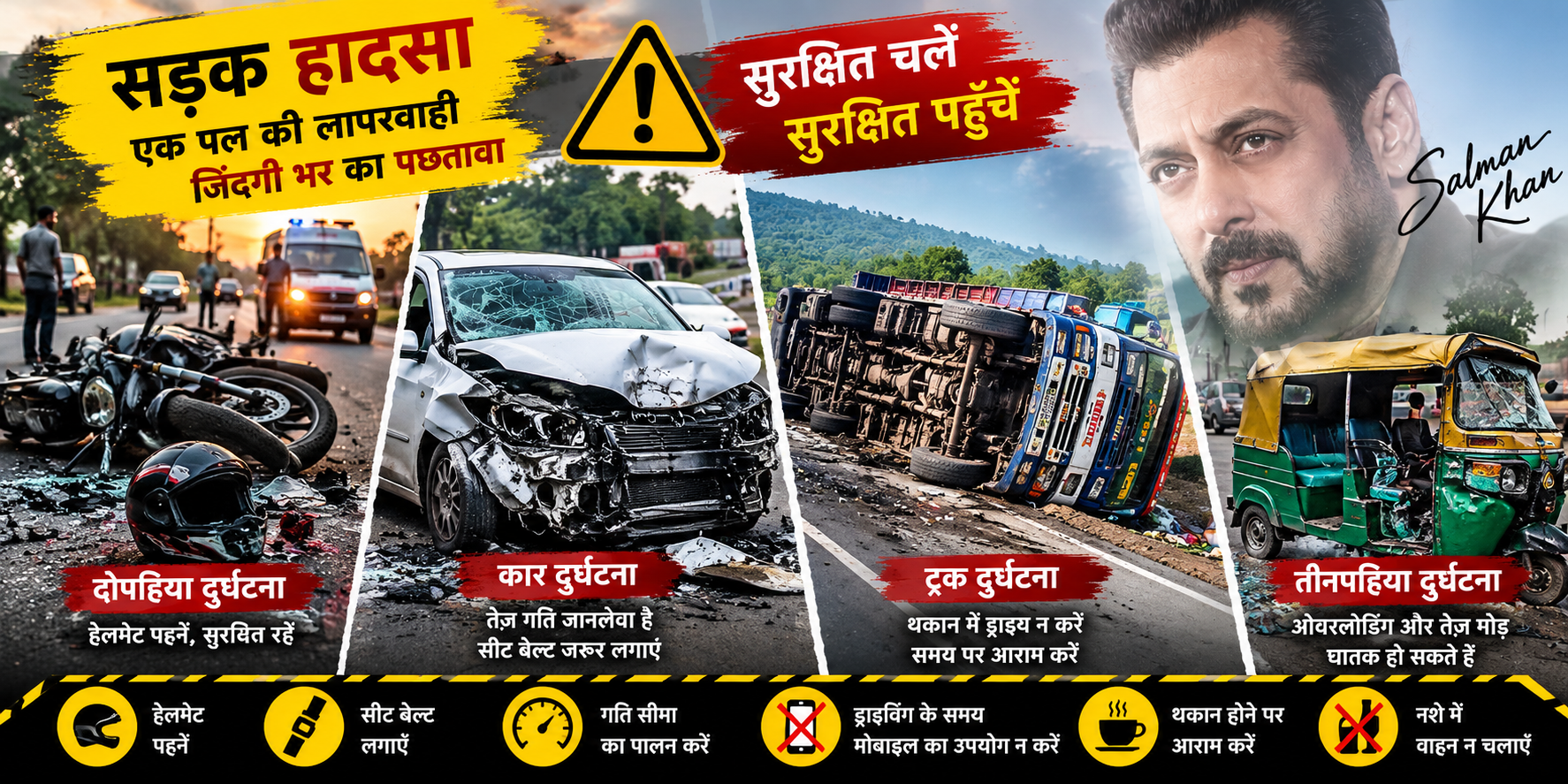
🇮🇳 India’s Road Accident Crisis: Why Are So Many Lives Being Lost on Indian Roads?
❤️ Introduction: Every Road Accident Has a Human Story
A truck driver leaves a transport yard late at night.
He has already spent several hours waiting for his vehicle to be loaded.
The delivery deadline is approaching.
He drinks tea, checks the tyres and begins his journey.
After midnight, the highway becomes darker. His eyes feel heavy, but he continues driving because he has not found a suitable, secure place to stop.
A few kilometres ahead, an unlit vehicle is standing on the roadside.
By the time he notices it, the distance may be too short to stop safely.
Elsewhere, a student rides a motorcycle without a properly fastened helmet.
A family travels in an overcrowded auto-rickshaw.
An e-rickshaw moves slowly along a busy road without adequate rear visibility.
A car driver checks a mobile phone while approaching an intersection.
A pedestrian attempts to cross a high-speed highway because there is no safe crossing nearby.
Different vehicles. Different roads. Different circumstances.
Yet all these situations reveal a serious problem.
India’s road accident crisis is not caused by one mistake or one category of driver. It emerges from a combination of unsafe behaviour, vehicle condition, road engineering, enforcement failures, inadequate rest facilities and weaknesses in the transportation system.
Road accidents are not simply unfortunate events that society must accept.
Many crashes can be prevented.
Even when a crash occurs, better vehicle safety, appropriate speeds, helmets, seat belts, safer roads and emergency medical care can reduce the severity of injuries.
This article examines India’s road safety challenges from the perspective of ordinary road users and professional drivers.
It also explores difficult questions about driver licensing, possible corruption, commercial transport pressure, insufficient highway rest facilities and the responsibility of government authorities.
📊 Are Road Accidents Really Increasing in India?
According to figures provided by India’s Ministry of Road Transport and Highways in a Rajya Sabha reply dated 11 March 2026, reported road accidents and fatalities increased between 2022 and 2024.
| Year | Reported Road Accidents | Reported Deaths | Grievously Injured |
|---|---|---|---|
| 2022 | 4,61,312 | 1,68,491 | 1,95,674 |
| 2023 | 4,80,583 | 1,72,890 | 2,13,589 |
| 2024 | 4,87,707 | 1,77,175 | 2,18,245 |
Source: Government of India, Ministry of Road Transport and Highways, Rajya Sabha reply dated 11 March 2026.
These figures indicate that:
- Reported accidents increased by approximately 5.7% between 2022 and 2024.
- Reported fatalities increased by approximately 5.2%.
- The number of people reported as grievously injured also increased.
However, an increase in total accidents does not automatically mean that the risk per vehicle or per kilometre travelled has increased.
To measure risk accurately, researchers also need information about vehicle exposure, traffic volume, distance travelled and population.
The figures nevertheless demonstrate a substantial public safety problem.
🚨 Why road safety requires urgent attention
Road crashes affect families, businesses and communities.
A fatal accident may remove the primary income earner from a household.
A serious injury may create long-term medical and rehabilitation expenses.
Commercial vehicle crashes can interrupt supply chains and damage expensive equipment.
Road safety is therefore a public health, social welfare and economic development issue.
🛵 Two-Wheeler Accidents: Why Motorcycle and Scooter Riders Face Serious Risks
Two-wheelers are essential to daily transportation in India.
They provide affordable mobility for students, workers, delivery personnel and families.
But motorcycles and scooters offer limited physical protection during a collision.
Unlike cars, they do not surround riders with a protective passenger compartment.
⚠️ Major causes of two-wheeler crashes
Excessive speed: High speeds reduce reaction time and increase the severity of a collision.
Unsafe overtaking: Moving between vehicles without sufficient space can create dangerous conflicts.
Poor road surfaces: Potholes, loose gravel, uneven repairs and slippery surfaces can destabilise two-wheelers.
Helmet non-use: Riding without an appropriate, securely fastened helmet increases the risk of severe head injury.
Mobile phone distraction: Looking at a phone reduces attention to traffic conditions.
Wrong-side riding: Travelling against traffic creates unexpected conflicts.
Overloading: Carrying excessive passengers or goods can affect stability and control.
Poor visibility: Motorcycles can be difficult for other drivers to notice, particularly at night.
🛣️ Why road design matters
Two-wheeler safety cannot be improved through enforcement alone.
Roads should provide predictable surfaces, appropriate speeds, safe intersections and adequate lighting.
Motorcycles are particularly vulnerable to sudden changes in pavement level, open drains and poorly maintained road edges.
🪖 Helmet safety
A helmet should meet applicable safety standards, fit correctly and be fastened properly.
Passengers also require protection.
A helmet cannot prevent every injury, but it can substantially reduce the risk of serious head trauma.
🛺 Three-Wheeler Accidents: Auto-Rickshaws, Shared Autos and Passenger Safety
Auto-rickshaws play an important role in India’s urban and semi-urban transportation.
They provide flexible mobility in locations where buses or other public transport services may be limited.
However, three-wheelers have different stability and occupant-protection characteristics from conventional passenger cars.
⚠️ Important risk factors
Overcrowding can affect vehicle handling and expose passengers to additional injury risks.
Sharp turns at inappropriate speeds may increase rollover risk.
Poor maintenance can affect brakes, tyres, steering and lighting.
Unsafe stopping near intersections creates conflicts with other vehicles.
Sudden lane changes and inadequate signalling can also contribute to crashes.
👥 Shared auto-rickshaw safety
Shared transport services are important for affordable mobility.
But passenger capacity should remain within the vehicle’s approved limits.
Operators should avoid carrying passengers in unsafe positions.
🛠️ Maintenance responsibilities
Commercial three-wheelers require regular checks of brakes, tyres, lights, suspension and steering components.
Owners and fleet operators should not postpone safety-related repairs to reduce operating expenses.
🔋 E-Rickshaw and Tirri Accidents: The Safety Challenges of Low-Speed Electric Vehicles
E-rickshaws, commonly called tirri in parts of northern India, provide affordable last-mile transportation.
They are particularly useful for short journeys near markets, railway stations, residential neighbourhoods and smaller towns.
However, operating low-speed vehicles within mixed, faster-moving traffic can create safety risks.
🚨 Common e-rickshaw safety concerns
Speed differences: A slow-moving e-rickshaw sharing a road with faster cars, buses and trucks can create dangerous overtaking situations.
Overloading: Excess passengers or cargo can affect braking, handling and stability.
Poor lighting: Inadequate headlamps, tail lamps or reflectors can make vehicles difficult to see.
Unsafe stopping: Frequent passenger pickup and drop-off at unsuitable locations can create conflicts.
Vehicle maintenance: Worn tyres, faulty brakes and damaged electrical components require attention.
Driver training: Drivers need to understand road rules, passenger safety and the limitations of their vehicles.
🔌 Electrical and battery safety
Battery systems should be maintained according to manufacturer requirements and applicable regulations.
Unsafe wiring, inappropriate charging equipment and poorly maintained electrical connections can create additional hazards.
🛣️ Safer operating arrangements
Where possible, authorities should provide designated pickup areas and suitable routes for low-speed vehicles.
E-rickshaws should not be placed in traffic environments that expose them to unreasonable risks from much faster vehicles.
🚙 Four-Wheeler Accidents: Cars, SUVs, Taxis and Private Vehicles
Modern passenger cars provide several safety features, but these cannot eliminate crash risk.
Airbags, seat belts, electronic stability control and improved vehicle structures can reduce injury risks under appropriate conditions.
However, unsafe driving can overwhelm these protections.
⚠️ Common causes of car accidents
Speeding: Higher speeds increase stopping distance and collision energy.
Distracted driving: Mobile phones, navigation screens and other distractions can divert attention.
Unsafe overtaking: Misjudging oncoming traffic can result in severe collisions.
Driver fatigue: Long journeys without sufficient rest can impair concentration.
Seat-belt non-use: Occupants face greater injury risks when not properly restrained.
Tyre failures: Incorrect pressure, damage, overloading and worn tyres can contribute to loss of control.
Driving under the influence: Alcohol and drugs can impair judgement, coordination and reaction time.
🚗 Why SUVs are not automatically safer for everyone
A larger vehicle may provide certain forms of occupant protection, depending on its design and crash performance.
However, greater mass can increase risks to pedestrians, cyclists and occupants of smaller vehicles during collisions.
Vehicle safety should be assessed using crash-test performance, active safety features and responsible operation rather than size alone.
👨👩👧👦 Family travel safety
Every occupant should use an appropriate restraint.
Children require suitable child restraints according to their age, size and applicable legal requirements.
Passengers should never assume that sitting in the rear seat eliminates the need for a seat belt.
🚛 Truck Driver Accidents: Why Heavy Commercial Vehicles Need Special Attention
India’s truck drivers are essential to the national economy.
They transport food, medicines, machinery, construction materials, industrial products and consumer goods.
Yet their working conditions can create significant road safety challenges.
A heavy commercial vehicle requires greater stopping distance than a small passenger vehicle under comparable conditions.
Its blind spots, turning requirements and handling characteristics are also different.
🚚 Major truck accident risk factors
| Risk Factor | Potential Consequence | Prevention |
|---|---|---|
| Driver fatigue | Delayed reactions or falling asleep | Adequate sleep and rest |
| Excessive speed | Reduced stopping margin | Safe speed management |
| Overloading | Poor handling and longer braking distances | Legal load compliance |
| Brake defects | Reduced stopping ability | Maintenance and inspections |
| Worn tyres | Tyre failure or reduced grip | Tyre monitoring |
| Poor load securing | Cargo movement or instability | Proper restraint systems |
| Unsafe overtaking | Head-on or side collisions | Defensive driving |
| Blind spots | Collisions with smaller road users | Mirrors, cameras and awareness |
| Inadequate lighting | Reduced night-time visibility | Functional lamps and reflectors |
| Delivery pressure | Unsafe driving decisions | Realistic scheduling |
| Insufficient rest facilities | Continued driving while fatigued | Safe stopping infrastructure |
| Poor route planning | Exposure to unsuitable roads | Route assessment |
⚖️ Why truck drivers should not receive all the blame
Commercial vehicle crashes must be investigated objectively.
A crash involving a truck does not automatically establish that the truck driver caused it.
Road geometry, mechanical condition, loading practices, actions of other road users and employer instructions may all be relevant.
Effective road safety policy should address the entire transport system.
😴 Driver Fatigue and Sleep Deprivation: A Dangerous but Often Overlooked Risk
Driving without adequate sleep is one of the most serious road safety concerns, particularly for long-distance commercial transportation.
Fatigue can impair attention, reaction time, decision-making and the ability to maintain lane position.
Unlike some mechanical defects, fatigue may not be immediately visible to other road users.
🧠 What happens when a driver becomes sleepy?
The driver may experience:
- Repeated yawning and heavy eyelids.
- Difficulty concentrating.
- Frequent lane drifting.
- Slower reactions.
- Failure to remember recent kilometres.
- Missing road signs or exits.
- Brief involuntary episodes of sleep.
These brief episodes are known as microsleeps.
A microsleep lasting only a few seconds can be catastrophic at highway speeds.
🚛 Why truck drivers may experience fatigue
Long-distance drivers may face pressure from delivery deadlines, loading delays, traffic congestion and uncertain rest arrangements.
A driver may spend hours waiting at a factory before beginning a long journey.
Waiting time is not necessarily sleeping time.
If the driver cannot rest properly, the journey may begin with an existing sleep deficit.
☕ Can tea or coffee prevent fatigue-related crashes?
Caffeine may temporarily improve alertness.
However, it does not replace adequate sleep.
Opening windows, playing loud music or washing the face should not be treated as reliable solutions to serious drowsiness.
🛑 What should a sleepy driver do?
The safest response is to stop driving at a suitable, secure location and obtain adequate rest.
If a driver is already struggling to remain awake, continuing until the next distant destination is dangerous.
Transport companies should support this decision rather than penalise drivers for taking necessary safety breaks.
🅿️ Limited Highway Stops and Stay Points: Why India Needs More Safe Driver Rest Facilities
India has expanded its highway network, but safe rest infrastructure remains an important planning challenge.
A driver needs more than a fuel station.
Long-distance transport requires suitable facilities for rest, food, sanitation, parking and emergency assistance.
🚛 What happens when suitable stopping points are unavailable?
Drivers may continue travelling despite fatigue.
Some may stop on unsafe shoulders or near highway entrances.
Heavy vehicles parked in poorly illuminated locations can become hazards for approaching traffic.
Drivers may also avoid stopping because they are concerned about cargo security or personal safety.
🏨 Essential facilities at a highway rest point
| Facility | Importance |
|---|---|
| Secure truck parking | Reduces unsafe roadside stopping |
| Driver sleeping facilities | Supports adequate rest |
| Clean toilets | Improves hygiene and dignity |
| Drinking water | Supports driver health |
| Affordable food | Meets essential needs |
| Lighting | Improves night-time safety |
| CCTV and security | Helps protect drivers and cargo |
| First-aid facilities | Supports emergency response |
| Vehicle inspection area | Enables basic safety checks |
| Tyre and repair services | Helps address mechanical problems |
| Separate parking zones | Reduces conflicts between vehicle types |
| Emergency communication | Supports incident reporting |
🏛️ Government recognition of rest-area safety
The National Highways Authority of India has recognised that wayside amenities can improve highway safety by providing rest facilities and helping reduce fatigue-related crashes.
Its planning documents describe facilities such as toilets, food services, accommodation and vehicle-related amenities. National Highways Authority of India
📍 Where should rest points be developed?
Rest facilities should be planned according to traffic demand, freight movement, driving-time needs and available safe access.
Important locations may include major freight corridors, industrial routes, port approaches and long stretches with limited services.
There should not be a single arbitrary spacing standard applied to every road.
🚨 An important policy question
When a driver is exhausted but cannot find safe parking, who shares responsibility for the resulting risk?
The answer should include drivers, employers, transport contractors, highway operators and public authorities.
A safe transport system must make safe behaviour practically possible.
🌙 Night-Time Road Accidents: Poor Visibility, Dark Highways and Unmarked Hazards
Night driving creates additional challenges.
Drivers have less visual information, and hazards may become visible only at shorter distances.
Glare from oncoming headlights can further reduce visibility.
💡 Major night-driving hazards
Unlit vehicles: Vehicles without functioning tail lamps or reflectors can be difficult to identify.
Unsafe roadside parking: Stationary trucks on dark road shoulders may present collision risks.
Poor road markings: Faded lane markings make road alignment difficult to judge.
Inadequate signage: Missing or poorly positioned warning signs reduce preparation time.
High-beam glare: Excessively bright or improperly aimed headlights can impair visibility.
Pedestrians and animals: People or animals crossing dark roads may be difficult to detect.
Construction zones: Poorly marked diversions can surprise drivers.
Driver fatigue: Sleepiness may be more pronounced during biological low-alertness periods.
📏 How speed affects stopping distance
A vehicle travelling at 80 km/h covers approximately 22.2 metres every second.
At 100 km/h, it covers approximately 27.8 metres every second.
If a driver takes two seconds to recognise a hazard and begin responding, the vehicle travels approximately:
| Speed | Distance Travelled in 2 Seconds |
|---|---|
| 40 km/h | 22.2 metres |
| 60 km/h | 33.3 metres |
| 80 km/h | 44.4 metres |
| 100 km/h | 55.6 metres |
These figures represent distance travelled during a hypothetical two-second response period, not total stopping distance.
Actual stopping distance also includes braking distance and varies with road conditions, vehicle condition and other factors.
🚛 Special precautions for commercial vehicles
Truck operators should ensure that headlights, tail lamps, reflectors, side markers and other required lighting equipment are functional.
Loads should not obscure required lamps or reflective markings.
Drivers should reduce speed when visibility is limited and avoid travelling beyond the distance in which they can safely stop.
🌫️ Fog, Rain, Dust and Poor Weather Visibility
Weather conditions can make already hazardous roads more dangerous.
🌁 Fog
Fog reduces visibility and makes it difficult to estimate distance.
Sudden braking and unsafe overtaking can trigger multiple-vehicle collisions.
Drivers should reduce speed, maintain greater following distances and use appropriate lighting.
🌧️ Heavy rain
Rain reduces tyre grip and can increase stopping distance.
Waterlogging may conceal potholes or other hazards.
Vehicles can lose traction on water-covered roads.
🌪️ Dust storms
Dust can rapidly reduce visibility.
Drivers should avoid sudden manoeuvres and follow official weather and road-safety guidance.
🌄 Sun glare
Low-angle sunlight can temporarily interfere with a driver’s ability to see vehicles, pedestrians or traffic signals.
📊 An important statistical distinction
Although adverse weather is dangerous, most reported crashes do not necessarily occur during bad weather.
An analysis drawing on government data found that approximately 76% of reported road accidents in 2023 occurred during clear or sunny weather.
This reinforces the importance of speed management and safe driving under ordinary conditions as well.
🪪 Driving Licence Issuance: Can Weak Testing and Corruption Contribute to Road Accidents?
Driving licences are intended to establish that an individual meets the legal and practical requirements to operate a vehicle.
A licence should represent demonstrated competence, not merely possession of an official document.
🚨 The risk of inadequate driving tests
If a person receives a licence without demonstrating sufficient driving skills, the licensing system may fail to identify unsafe drivers.
Important competencies include vehicle control, observation, hazard recognition, traffic rules and safe decision-making.
💰 Bribery and corruption concerns
Allegations of bribery or improper involvement by intermediaries in licensing processes deserve serious investigation.
Where corruption occurs, it can undermine confidence in driver testing and allow unqualified applicants to bypass safeguards.
However, it would be inaccurate to claim that all RTO offices or licensing officials engage in corruption.
Nor can a particular share of road accidents be attributed to bribery without reliable evidence.
🧪 What should a proper driving test assess?
| Assessment Area | Why It Matters |
|---|---|
| Traffic rules | Establishes legal knowledge |
| Vehicle control | Tests practical competence |
| Observation | Identifies awareness of hazards |
| Safe turning | Reduces junction conflicts |
| Braking | Assesses stopping control |
| Lane discipline | Improves predictable movement |
| Pedestrian awareness | Protects vulnerable road users |
| Parking and reversing | Reduces low-speed collisions |
| Emergency judgement | Evaluates responses to hazards |
| Vehicle-specific skills | Addresses different vehicle characteristics |
🏛️ How licensing can be improved
Automated testing systems can help improve consistency and reduce opportunities for arbitrary decisions.
Digital records and audit trails can support accountability.
Independent inspections and complaint mechanisms can help identify misconduct.
But automated systems also require maintenance, proper calibration and oversight.
🚛 Commercial vehicle licensing
Heavy vehicle drivers need skills beyond those required for small passenger vehicles.
Training should address load characteristics, braking distances, blind spots, vehicle inspection, turning requirements and fatigue management.
A driving licence should be evidence of competence—not a shortcut to permission.
🏫 Inadequate Driver Training and Road Safety Education
Passing a driving test is only one stage of becoming a safe driver.
Driving requires continuing judgement and adaptation.
🚗 Learning from informal instruction
Some drivers learn primarily from relatives, friends or informal instructors.
Practical experience can be valuable, but poor habits may also be passed from one driver to another.
Structured instruction helps establish consistent safety principles.
🚦 Hazard perception training
Drivers need to recognise developing hazards before an emergency occurs.
Examples include a child approaching the roadside, a truck preparing to turn or a vehicle emerging from a concealed junction.
🛵 Two-wheeler training
Riders need instruction in braking, balance, cornering, protective equipment and defensive riding.
🚛 Heavy vehicle training
Commercial driver training should include:
- Vehicle inspection.
- Safe loading awareness.
- Braking and stopping distance.
- Blind-spot management.
- Safe overtaking.
- Fatigue recognition.
- Emergency procedures.
- Route-specific hazards.
📚 Road safety in education
Schools can teach age-appropriate pedestrian, cycling and passenger safety.
However, education must be supported by safe infrastructure.
Children should not be expected to compensate for dangerous road design.
🍺 Drunk Driving, Drugs and Impaired Judgement
Alcohol and certain drugs can impair coordination, reaction time and judgement.
Driving under their influence increases the risk of serious collisions.
⚠️ Why impaired driving is dangerous
Drivers may underestimate speed, misjudge distances or fail to recognise hazards.
They may also become more willing to take risks.
💊 Prescription and over-the-counter medicines
Some medicines can cause drowsiness or impair alertness.
Drivers should follow medical advice and medicine warnings.
🚕 Professional driver responsibilities
Commercial operators should have clear policies against impaired driving.
Drivers should not be pressured to operate vehicles when medically unfit or impaired.
🚨 Enforcement
Consistent, lawful and non-discriminatory enforcement is important.
Penalties alone are insufficient without credible detection and public awareness.
📱 Mobile Phones, Navigation Screens and Distracted Driving
Modern drivers use mobile devices for navigation, communication and work.
For commercial drivers, phones may also be used to coordinate loading and deliveries.
However, operating a vehicle while distracted can be dangerous.
📲 Types of distraction
Visual: Looking away from the road.
Manual: Taking a hand away from driving controls.
Cognitive: Diverting mental attention from driving.
Auditory: Becoming distracted by sounds or conversations.
🚛 Commercial communication pressure
A truck driver may receive calls from transport brokers, dispatchers, customers and warehouse personnel.
Transport businesses should establish procedures that allow drivers to respond only when safely stopped.
🗺️ Navigation safety
Routes should be reviewed before departure where practical.
Drivers should not attempt complicated screen interactions while the vehicle is moving.
🚧 Poor Road Engineering: When Infrastructure Contributes to Crashes
Driver behaviour is important, but road design also influences crash risk.
Unsafe road geometry can create situations in which ordinary mistakes have severe consequences.
🛣️ Common engineering hazards
Dangerous curves: Poor alignment and inadequate warnings can increase risk.
Unprotected roadside hazards: Trees, poles and rigid structures close to high-speed traffic can worsen crash severity.
Unsafe median openings: Improperly designed crossings can create severe conflicts.
Poor junction visibility: Buildings, vegetation or structures may obstruct sightlines.
Inadequate pedestrian crossings: People may be forced to cross high-speed roads.
Missing barriers: Unprotected embankments or hazardous locations can increase injury severity.
Poor drainage: Standing water may reduce traction.
Unsafe work zones: Inadequate warning and channelisation can create sudden hazards.
🧠 The Safe System approach
Modern road safety thinking recognises that humans make mistakes.
Roads and vehicles should therefore be designed to prevent those mistakes from causing death or serious injury wherever possible.
This requires safer speeds, safer infrastructure, safer vehicles, responsible road use and effective post-crash care.
🕳️ Potholes, Broken Roads and Poor Maintenance
Road defects can create serious hazards.
Two-wheelers are particularly vulnerable to sudden changes in pavement condition.
Cars may lose control during abrupt avoidance manoeuvres.
Heavy vehicles may experience increased stress on tyres and suspension components.
🌧️ Why monsoon damage matters
Water can enter pavement cracks and weaken road structures.
Repeated heavy loading and inadequate drainage may accelerate deterioration.
🚧 Temporary repairs
Poorly executed repairs can leave uneven surfaces.
Temporary roadworks should include appropriate warning signs and safe traffic arrangements.
🏛️ Accountability
Road-owning authorities should maintain inspection records, respond to reported defects and prioritise hazards according to severity.
Crash investigations should examine whether road condition contributed to the incident.
🐄 Stray Animals, Pedestrians and Unexpected Highway Hazards
Unexpected obstacles can create severe risks on high-speed roads.
🐄 Animals on highways
Cattle, dogs and other animals may enter roads where access control is inadequate.
Drivers may brake suddenly or swerve to avoid collisions.
🚶 Pedestrian crossings
Pedestrians may cross highways to reach homes, workplaces, farms or bus stops.
Where safe crossings are absent or inconvenient, risky movements may occur.
🚜 Slow-moving vehicles
Agricultural vehicles and other slow-moving traffic can create speed differences on regional roads.
🛣️ Safer infrastructure
Appropriate fencing, crossings, signage, access management and speed control can reduce these risks.
Solutions should reflect local land use and community needs.
🚚 Overloaded Trucks and Unsafe Cargo Transportation
Commercial vehicle overloading can affect braking, handling and vehicle stability.
It can also damage roads and increase maintenance requirements.
⚖️ Why overloading occurs
Possible contributing factors include commercial pressure, inadequate enforcement and attempts to reduce the cost per tonne transported.
🏗️ Unsafe load securing
Cargo that shifts during movement can destabilise a vehicle.
Poorly secured materials may also fall onto the road.
🚛 Oversized project cargo
Over-dimensional cargo requires appropriate planning, vehicle selection and route assessment.
Special attention may be needed for bridge capacity, road geometry, overhead clearances and turning movements.
🛑 Prevention
Transporters and consignors should follow applicable loading limits, securing requirements and permit conditions.
The responsibility for safe cargo movement should not fall solely on the driver.
🛞 Tyre Bursts, Brake Failure and Mechanical Negligence
Vehicle condition is a fundamental part of road safety.
🛞 Tyre-related hazards
Tyre failures may involve underinflation, overloading, damage, excessive wear or inappropriate use.
Tyre pressure and condition should be checked according to manufacturer recommendations.
🛑 Brake system defects
Brake performance can deteriorate because of wear, defects or inadequate maintenance.
Heavy vehicles require particular attention because of their mass and operating conditions.
💡 Lighting defects
Faulty lamps and reflectors increase night-time risk.
🔧 Maintenance culture
Preventive maintenance is generally safer than waiting for a breakdown.
Operators should keep appropriate inspection and repair records.
Drivers should be able to report defects without fear of unreasonable punishment.
🏭 Transport Companies, Truck Brokers and Delivery Pressure: Who Is Responsible?
Road safety discussions often focus on the person sitting behind the steering wheel.
But commercial transportation involves several decision-makers.
A driver may receive instructions from a fleet owner, transport contractor, broker, dispatcher, customer or warehouse.
These instructions can influence driving schedules and working conditions.
🚛 How unrealistic delivery deadlines create risks
Imagine a truck carrying industrial machinery from Gujarat to northern India.
The journey requires loading, highway travel, toll crossings, mandatory rest and unloading.
If the customer expects delivery without allowing adequate time for these activities, the driver may experience pressure to reduce breaks or drive while tired.
The resulting risk is not merely an individual driving issue.
It is also a transport management issue.
📋 Responsibilities across the logistics chain
| Stakeholder | Important Road Safety Responsibility |
|---|---|
| Truck driver | Safe driving, rest and vehicle inspections |
| Fleet owner | Maintenance, driver welfare and realistic scheduling |
| Transport broker | Clear communication and responsible trip coordination |
| Consignor | Safe cargo preparation and loading |
| Warehouse operator | Efficient loading and unloading arrangements |
| Transport contractor | Appropriate vehicle and driver selection |
| Road authority | Safe infrastructure and maintenance |
| Traffic police | Fair and consistent enforcement |
| Licensing authority | Competency-based licensing |
| Government | Road safety regulation and oversight |
💰 Why low freight rates can become a safety concern
Commercial pressure can encourage cost-cutting.
If transport rates are insufficient to support proper maintenance, safe parking and realistic driver schedules, some operators may be tempted to compromise.
However, low freight rates do not automatically establish unsafe operation.
The important issue is whether the transport contract allows all applicable safety requirements to be met.
🤝 What responsible truck brokers can do
Truck brokers can help by communicating realistic delivery expectations, checking vehicle suitability, avoiding instructions that encourage unsafe driving and coordinating loading schedules.
A responsible logistics system should never reward dangerous shortcuts.
🕒 Driving Hours, Sleep and Rest: Why Commercial Transport Needs Better Scheduling
A safe journey requires more than calculating distance and average speed.
It must account for loading time, unloading time, congestion, vehicle checks, meals and adequate sleep.
😴 Why sleeping inside a parked truck may not be enough
A driver may stop the vehicle but remain unable to sleep because of noise, heat, security concerns or repeated telephone calls.
Rest quality matters.
A few hours spent waiting inside a vehicle should not automatically be counted as restorative sleep.
🚛 Single-driver versus two-driver operations
Two qualified drivers may help distribute driving duties on suitable long-distance operations.
However, adding a second driver does not automatically guarantee adequate rest.
Each driver still needs appropriate sleep and working conditions.
📊 Recommended transport scheduling principles
| Operational Issue | Safer Approach |
|---|---|
| Long-distance journey | Include adequate sleep and rest |
| Loading delay | Recalculate the delivery schedule |
| Driver reports sleepiness | Permit a safe stop and rest |
| Unplanned congestion | Adjust estimated arrival time |
| Vehicle breakdown | Repair before continuing |
| Night-time low visibility | Reduce speed or suspend movement if necessary |
| Unsafe parking location | Identify a suitable stopping facility |
| Repeated driver fatigue | Review trip planning and staffing |
There is no universal driving-hour figure that can safely replace individual assessment and applicable legal requirements.
Drivers and employers must follow the regulations relevant to their vehicle category and operations.
🚦 Traffic Police, Enforcement and Accountability
Traffic enforcement is an essential part of road safety.
But enforcement should aim to prevent dangerous behaviour, not simply maximise the number of penalties issued.
⚖️ Important enforcement priorities
Authorities should address speeding, impaired driving, dangerous overtaking, wrong-side driving, overloading, unsafe vehicle conditions and other serious violations.
Enforcement should be transparent and consistent.
💰 Corruption allegations
Where bribery or misconduct occurs, it can undermine road safety and public confidence.
Such allegations should be investigated using evidence and appropriate legal procedures.
It would be unfair to assume that every enforcement officer or licensing official is corrupt.
📷 Technology and transparency
Electronic challans, automated speed monitoring and digital records may help improve consistency.
However, equipment accuracy, legal procedures, privacy safeguards and appeal mechanisms remain important.
🏛️ Measuring enforcement effectiveness
Authorities should examine whether enforcement reduces crashes and serious injuries.
The number of fines collected is not, by itself, a sufficient measure of road safety success.
🚑 Emergency Medical Response: Why Survival Depends on What Happens After a Crash
Preventing crashes is the first priority.
But when a crash occurs, rapid and effective emergency care can save lives.
❤️ The importance of immediate assistance
Serious injuries may involve severe bleeding, breathing difficulties or head trauma.
Timely professional medical treatment can influence survival and recovery.
🚨 Emergency helpline
In India, 112 is the national emergency response number.
Road users should provide clear information about the location, direction of travel, nearby landmarks and nature of the emergency.
🩺 What bystanders should do
Bystanders should protect themselves from traffic, contact emergency services and follow instructions from trained responders.
An injured person should not be moved unnecessarily unless there is an immediate danger that makes remaining in place unsafe.
Untrained bystanders should avoid interventions that could worsen injuries.
🚑 Highway emergency infrastructure
Important improvements include reliable emergency communication, ambulance availability, trauma care access and coordinated incident management.
Road safety policy should measure not only crash prevention but also post-crash survival.
📊 Road Accidents in India: Important 2024 Findings
The Ministry of Road Transport and Highways reported 4,87,707 road accidents and 1,77,175 deaths in 2024.
This represents approximately 1,336 reported crashes and 485 deaths per day, averaged across the year.
The figures highlight the scale of India’s road safety challenge.
🚨 Road Accident Fatalities by Road Category — 2024
| Road Category | Reported Accidents | Reported Fatalities |
|---|---|---|
| National Highways, including expressways | 1,50,958 | 64,772 |
| State Highways | 1,03,538 | 39,277 |
| Other Roads | 2,33,211 | 73,126 |
| Total | 4,87,707 | 1,77,175 |
Source: Ministry of Road Transport and Highways, parliamentary reply dated 23 July 2026.
🛵 Which road users are most vulnerable?
According to the 2024 road accident report, two-wheeler riders accounted for approximately 46.2% of road accident fatalities.
Pedestrians accounted for approximately 20.6%.
Occupants of cars, taxis, vans and other light motor vehicles accounted for approximately 12.4%.
These figures reinforce the importance of protecting vulnerable road users.
Important distinction: A road-user category’s share of deaths is not the same as the share of crashes caused by that category.
🛣️ A National Road Safety Improvement Plan for India: 2026–2035
India needs a coordinated approach that addresses roads, vehicles, drivers, institutions and emergency care.
🚦 Phase 1: Immediate Safety Improvements
Authorities should prioritise high-risk locations, dangerous intersections, poor lighting and hazardous roadside parking.
Commercial vehicle inspections should focus on serious mechanical defects.
Traffic enforcement should target behaviours associated with severe crashes.
Driver fatigue awareness should be expanded.
🚛 Phase 2: Commercial Driver Welfare
Develop additional secure highway rest facilities where demand and safety assessments justify them.
Improve access to toilets, food, sleeping facilities and safe truck parking.
Encourage realistic delivery scheduling.
Strengthen commercial driver training and vehicle maintenance systems.
🪪 Phase 3: Licensing and Testing Reform
Improve competency-based driving tests.
Strengthen audit trails and independent oversight.
Investigate substantiated corruption allegations.
Ensure that testing requirements reflect the vehicle categories applicants intend to operate.
🏗️ Phase 4: Safer Road Engineering
Improve dangerous junctions, pedestrian crossings, road markings and roadside protection.
Conduct road safety audits and use crash data to identify priority locations.
Address recurring hazards rather than relying exclusively on warning signs.
🚑 Phase 5: Better Post-Crash Care
Improve emergency response coordination, incident reporting and access to trauma care.
Measure outcomes using fatalities and serious injuries, not only crash counts.
❓ Frequently Asked Questions About Road Accidents in India
1. Why are road accidents increasing in India?
Major contributing factors include speeding, unsafe driving, vehicle defects, inadequate infrastructure, fatigue, distracted driving and increasing traffic exposure.
2. Which road users account for the largest share of deaths?
Two-wheeler riders accounted for the largest share of reported road accident fatalities in 2024.
3. Why are truck accidents dangerous?
Heavy vehicles have substantial mass, large blind spots and different braking and turning requirements.
4. Can lack of sleep cause road accidents?
Yes. Sleep deprivation impairs attention, judgement and reaction time and can cause microsleeps.
5. Why are highway rest facilities important?
They provide safer opportunities for drivers to stop, sleep, eat and inspect vehicles.
6. Are night-time accidents caused only by darkness?
No. Fatigue, excessive speed, poor vehicle lighting, road conditions and other factors may also contribute.
7. Why are e-rickshaws vulnerable?
Low-speed operation in mixed traffic, overloading, poor visibility and inadequate vehicle maintenance can create risks.
8. Can poor driving licence testing contribute to accidents?
Inadequate testing may allow unqualified drivers to obtain licences, weakening an important safety safeguard.
9. Is bribery responsible for road accidents?
Corruption can undermine licensing and enforcement systems where it occurs, but its specific contribution to national crash totals cannot be quantified without reliable evidence.
10. Why are two-wheeler accidents often severe?
Riders have limited physical protection and are vulnerable to head injuries and direct impacts.
11. Can poor roads cause crashes?
Yes. Unsafe geometry, potholes, inadequate drainage and poor visibility can contribute to crashes.
12. Are overloaded trucks dangerous?
Overloading can affect braking, handling, stability and mechanical reliability.
13. Does wearing a seat belt matter in the rear seat?
Yes. Appropriate restraints reduce injury risks for vehicle occupants.
14. Can artificial intelligence prevent road accidents?
Technology can support monitoring, incident detection and safety management, but cannot replace good engineering and responsible operation.
15. What should a driver do when feeling sleepy?
Stop at a suitable safe location and obtain adequate rest before continuing.
16. Who is responsible for commercial vehicle safety?
Responsibility is shared among drivers, vehicle owners, transport operators, consignors, regulators and infrastructure authorities according to their respective roles and legal obligations.
17. Why are pedestrians vulnerable?
Pedestrians have little physical protection and may face unsafe crossings, high vehicle speeds and inadequate footpaths.
18. Can road safety education reduce accidents?
Education can improve knowledge and behaviour, especially when combined with safer infrastructure and enforcement.
19. What is India’s emergency response number?
The national emergency number is 112.
20. What is the best solution to India’s road accident crisis?
A coordinated Safe System approach combining safer roads, speeds, vehicles, road users and post-crash care offers the strongest foundation.
❤️ Conclusion: A Delivery Can Be Late, but a Life Cannot Be Replaced
India’s roads connect millions of people with opportunities.
They carry schoolchildren, families, commuters, farmers, workers, tourists and essential freight.
Every person travelling on these roads deserves a reasonable expectation of safety.
A truck driver should not have to choose between adequate sleep and keeping a job.
A motorcyclist should not face an unmarked pothole on a busy road.
An e-rickshaw passenger should not be exposed to unsafe overloading.
A family should not be endangered by an unqualified driver who bypassed proper testing.
And a person injured in a crash should not be denied timely emergency assistance because of poor coordination.
Road safety is not achieved by blaming one category of road user.
It requires shared responsibility, competent institutions and infrastructure designed around human limitations.
🚛 ABCC India Project Cargo Corporation: Road Safety and Responsible Logistics
For companies involved in project cargo, heavy transportation and specialised trailer operations, careful route planning is essential.
ABCC India Project Cargo Corporation’s transport and logistics activities are relevant to road route surveys, industrial connectivity and project cargo movement.
Appropriate vehicle selection, cargo securing, bridge and route assessments, realistic scheduling and coordination with relevant authorities can support safer heavy freight operations.
Road transport businesses should place driver welfare and public safety alongside commercial performance.
🇮🇳 Final Message
India’s transportation progress should not be measured only by new highways, faster vehicles or increased freight movement.
It should also be measured by the number of lives protected.
A successful journey is not simply one that reaches its destination on time. It is one in which the driver, passengers, cargo and other road users remain safe.
📚 Authoritative Sources for Publication
The following references can support the article’s statistical and policy sections:
| Source | Information |
|---|---|
| Ministry of Road Transport and Highways — Road Accidents in India 2023 | Official national road accident statistics and analysis |
| Government of India — National Highway Accident Data, March 2026 | Highway accident and fatality statistics |
| Government of India — Road Safety Measures | Government road safety initiatives |
| NHAI — Highway Wayside Amenities | Rest facilities and fatigue-related safety |
| Government of India — Speed Management | Speed limits and road safety policy |
| Maharashtra Highway Traffic Police — Publications | State road safety reports |

