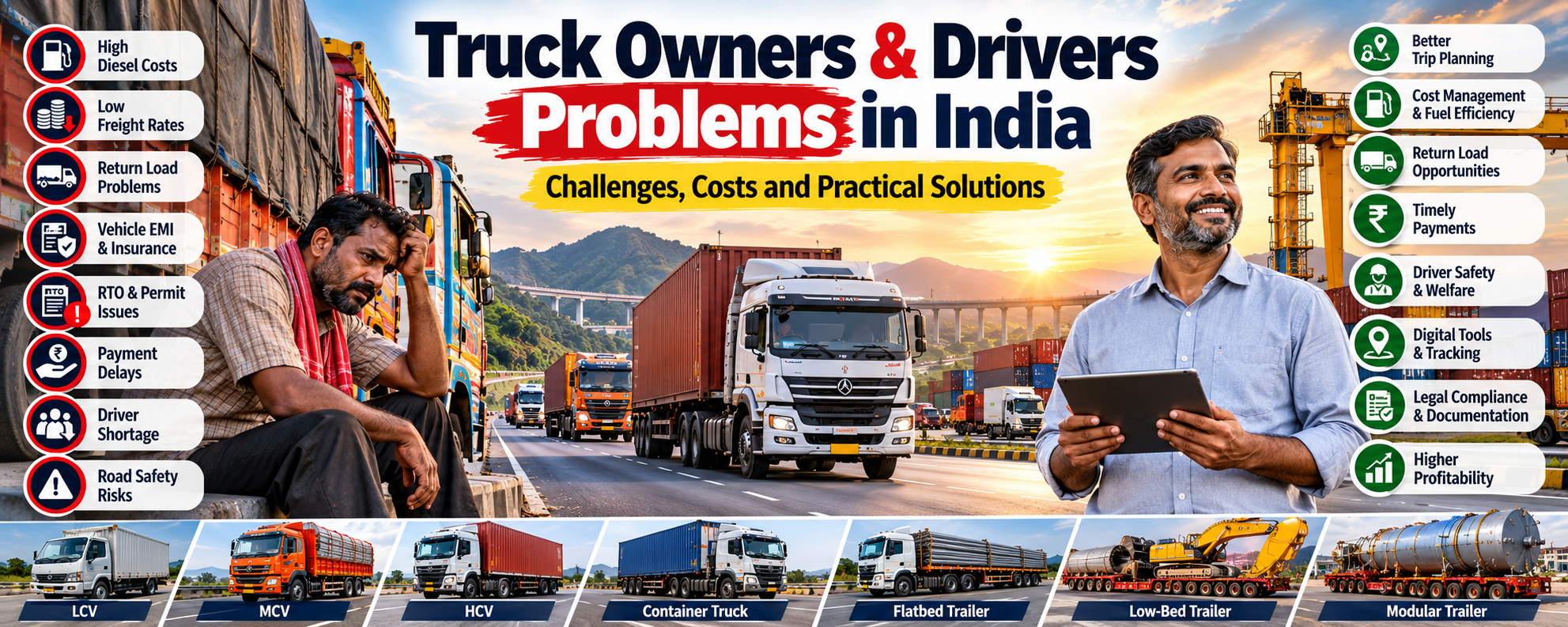
Who Is Truckers ?
Transport forms the backbone and lifeline of Indian economy. In India, transport is the biggest business and it plays an important role in Indian economy. Despite of this it is the most unprofessional and unorganized business. There have been many challenges for truckers transport industry and they are never ending.
Lorry Owner Truckers Future in India :-
Biggest challenges faced by the Lorry Trucks Truckers transporters is that the young generation of new India does not wants to join this industry as their parents and families did. The young generation wants to do something different instead of following their parent industry. Even existing truck drivers are also leaving this industry and moving to some permanent driving jobs for stable income.
Related :-
Warehouse and Warehousing Storage
Types of Warehouse
Warehouse Management WMS Services
Heavy Duty Trucks and Crane Rental Services
Unsafe Truckers and Lorry Truck Drivers India :-
The truck drivers also suffers from highway robberies which is an critical issue to note. Trucks, trucks drivers and truck materials are not safe on highways. There are many cases where robbers stretch away the lorry from drivers. This lorries are then never located.
Truckers Lorry Drivers Low Education less Knowledge :-
One more issue faced by transporters this days is lack of awareness among transporters and truckers. Many times they have to face problems due to lack of knowledge or education. Many transporters do not know how to calculate operating cost. They still follow the theory of calculating operator cost a bit lower than their competitors. This leads to decrease in profit margin and truckers have to face huge loss as they cannot manage margin between freight rate and actual cost they spent.
Weak Infrastructure Increase India Transportation and Logistics Cost :-
Major challenge for the transport organization is infrastructure. Roads not have been developed in good condition which creates an hindrance during the transportation of cargo. There is lack of road side shops, repairing shops, dhabas, rest places, etc due to which truckers has to face problems. At least one big godown is required at all major cities for centralized delivery & pick-up material and one small outlet at each business potential area of that city for better control over the business.
The above are the only some of the problems faced by the transporters and truckers. The truck owner suffers face plenty of challenges on daily basis. They should be always prepared for everything.
Transporters have real struggles. Some people might say they have a easy life as they own a company. In order to run a successful trucking company high level of industry knowledge is needed.
Some of the major hindrance to the truckers lorry owners drivers are described as below :–
Getting Great Trucking Companies to work with even odd Movement :–
Trucking Industry is much more tricky then we think. One of the major challenges that the truck owners face is actually finding reliable companies to work with. This is the main problems that every transporter faces especially those who start a trucking business.
Condition of Highways and Roads for Transportation Service :-
India has developed a lot after Independence but still there are some issues which should be focused on. India has network of over 90,000 kms of National Highways but that picture does not clarify the conditions of roads in India. By looking at the condition of roads it has become crucial for the NHAI to push for the overhaul of its maintenance efforts. Not only the highways are in bad condition but when we look at the inner roads of the country we notice that they are hardly comfortable. These causes delay for the cargo carrier and are responsible for breakdowns of trucks.
It’s more difficult for ODC transporters as the roads are not so flexible enough to handle ODC vehicles. ODC transportation means the length and width of cargo is larger than the standard container dimension. ODC vehicles finds it difficult to take move around the roads, take turns inside the cities.
Related :-
Advantages of road transport :- Please Click
Disadvantages of road transport :- Please Click
Oversized Load Transportation Problems :- Please Click
Always changing fuel prices India and effect Truckers Transportation Cost :-
Always changing fuel prices India is also another challenge that the trucking company owners are facing every day. After the implementation of GST it has become more difficult for the transporters to decide their cost estimation as fuel prices changes daily. They don’t know what will be the price of fuel the next day. Due to this they do suffer more loss than before.
Recommended :-
Transport Department :- Please Click
History of Transportation :- Please Click
importance of transport system :- Please Click
Poor Costly unafordable Maintenance of Indian Vehicles :-
One of the challenges against Indian truckers drivers is the miserable condition of trucks. Most of the transporters have a short term vision and thus they look to get every single penny they have invested. Hence the trucks are kept away from service for a longer period of time and the driver’s comfort is neglected. In the greed of maximum freight with minimum costs, owners seldom take care of the condition of the trucks.
Indian Truckers Drivers Lack of Technical Knowledge:-
India haven’t been so good with literacy rate. Most of the transporters have a problem of not getting truck drivers who are aware to use technology. The industry is now developing fast by adopting new technologies but the drivers who are new to this technology are left in hurdle. Even after the boost in internet penetration and smartphone usage, the drivers are not able to match up with the new technology.
Regular Increase Highways Theft Robberies and Less Material Goods Security for Truckers :-
Commercially a large amount of cargos are moved across India daily. Most of the highways constructed in India goes through region which are almost dark and dangerous. There is always threat to the consignments. This regions are dangerous as there is theft of robberies. Even in some regions during strike the trucks are halted and destroyed. Some of the trucks are burned and looted. This all things are non recoverable and truck owners have to face loss for it.
Truckers Problems with the Indian Authorities :-
During the transit of cargoes across the country, truckers drivers have to go through various check posts while entering or crossing states. At this checkpoints, authorities can be partial in some cases. There are different rules for in different states. Truck drivers are not so literate and aware that they can know all the rules of every states. Officials takes advantage of this situation and fine them during transit. This increases the burden on transporters as they have pay for the fine.
Sometimes officials arrests truckers drivers in case of rush driving, drink & drive and all. Lorry Truckers drivers responsibility is also on the shoulders of lorry truck owners. After the arrest of truck driver owners have to rush to get bail for the truck drivers.
The above are the just some of the challenges faced by the truck owners. And due all these reasons transport business has become the biggest challenge in India. Government should come forward take some steps to create awareness and educate transporters and truckers lorry owners. Good highways and roads should be constructed so that the transportation of goods becomes easy. Fuel prices should be managed by fixing it for some months and then revising again to control the prices. Growth opportunities should be created in this business so that the youth who are moving away from this industry comes again and joins this industry. Proper and same rules should be followed at every checkpoints so that they truck owners don’t face any hurdles while transporting goods from one state to other.
Introduction: The People Who Keep India’s Goods Moving
Every morning, thousands of commercial vehicles begin journeys between factories, warehouses, ports, agricultural markets, construction sites, industrial estates and distribution centres across India.
Some carry agricultural produce over short distances. Others transport steel, cement, machinery, chemicals, containers, consumer goods and industrial equipment across multiple states.
Behind these movements are truck drivers, vehicle owners, fleet operators, transport brokers, mechanics, loading workers and logistics coordinators.
Their work supports manufacturing, construction, agriculture, retail, infrastructure development and international trade.
Yet the commercial realities of road freight transportation are often more complicated than they appear.
A truck owner may receive a profitable-looking freight quotation but eventually lose money because of empty return kilometres, excessive waiting time, rising maintenance expenses or delayed customer payments.
A driver may complete a long-distance journey while dealing with inadequate rest facilities, difficult weather, traffic congestion, unsafe parking and pressure to meet unrealistic delivery schedules.
A small transporter may struggle to compete with larger operators while continuing to pay vehicle instalments, insurance premiums, taxes and other expenses.
These challenges differ by vehicle category.
A pickup truck operating within a city does not face the same commercial risks as a 40-foot flatbed trailer.
A low-bed trailer carrying heavy industrial machinery has different operating requirements from a container truck transporting standard freight.
A modular hydraulic multi-axle trailer used for specialised project cargo may experience long mobilisation periods, complex route restrictions and substantial equipment costs.
Understanding the economics of each vehicle category is essential for developing sustainable solutions to India’s trucking industry problems.
This guide examines 35 major challenges affecting truck owners, drivers, transport companies and logistics professionals, along with practical strategies to improve profitability, safety and operational reliability.
📊 Quick Overview: 35 Major Trucking Problems in India
| No. | Problem | Who Is Affected? | Practical Solution |
|---|---|---|---|
| 1 | Empty return journeys | All freight vehicle owners | Return-load planning |
| 2 | High diesel expenses | Diesel fleet operators | Fuel monitoring and efficient routing |
| 3 | Vehicle EMI pressure | Financed vehicle owners | Cash-flow and debt planning |
| 4 | Insurance expenses | Vehicle owners | Annual cost budgeting |
| 5 | Delayed freight payments | Transporters and brokers | Credit controls |
| 6 | Low freight rates | Truck owners | Cost-based pricing |
| 7 | Driver shortages | Fleet operators | Better working conditions |
| 8 | Driver fatigue | Drivers and road users | Rest planning |
| 9 | Road accidents | Drivers and vehicle owners | Safety management |
| 10 | Highway theft | Drivers and cargo owners | Secure parking and tracking |
| 11 | RTO-related disputes | Drivers and operators | Documentation and lawful grievance procedures |
| 12 | Improper roadside demands | Transporters | Evidence and official complaints |
| 13 | Toll expenses | Fleet operators | Route-cost analysis |
| 14 | Poor road conditions | All vehicles | Route assessment |
| 15 | Truck detention | Vehicle owners | Detention agreements |
| 16 | Maintenance expenses | Fleet operators | Preventive maintenance |
| 17 | Tyre expenses | Heavy vehicles | Tyre management |
| 18 | Breakdown risks | Drivers and operators | Inspection programmes |
| 19 | Unreliable transport intermediaries | Truck owners | Counterparty verification |
| 20 | Cargo damage | Transporters and customers | Secure loading |
| 21 | Overloading pressure | Drivers and owners | Legal load compliance |
| 22 | Permit complications | Commercial operators | Pre-dispatch checks |
| 23 | Parking shortages | Drivers | Planned stopping points |
| 24 | Poor roadside facilities | Drivers | Welfare and route planning |
| 25 | Family separation | Long-distance drivers | Predictable schedules |
| 26 | Healthcare access | Drivers | Preventive health support |
| 27 | Technology gaps | Small operators | Practical digital training |
| 28 | Freight market uncertainty | Fleet owners | Diversified customers |
| 29 | Seasonal demand | Transport businesses | Financial reserves |
| 30 | Container logistics challenges | Container operators | Terminal coordination |
| 31 | Trailer cargo compatibility | Trailer owners | Cargo-specific matching |
| 32 | Low-bed transportation restrictions | Heavy-haul operators | Engineering route assessment |
| 33 | Modular trailer utilisation | Project cargo operators | Project pipeline planning |
| 34 | Transport strikes and disruptions | Supply-chain participants | Contingency planning |
| 35 | Weak profitability records | Small fleet owners | Vehicle-wise financial reporting |
💰 1. Empty Return Load: A Major Financial Challenge for Indian Truck Owners
Empty return journeys are among the most damaging operational problems in road freight transportation.
A truck may transport cargo from Pune to Delhi, Ahmedabad to Kolkata or Gujarat to an industrial project site in another state.
After unloading, the operator must find suitable freight for the return journey.
However, industrial production and freight demand are not evenly distributed across Indian districts.
A location receiving construction machinery may not generate sufficient outbound cargo for the same type of vehicle.
Why return loads are difficult
Several factors contribute to the problem.
Uneven industrial development: Manufacturing activity is concentrated in particular industrial clusters, while other districts have relatively limited freight generation.
Vehicle-specific cargo requirements: Not every shipment can be carried by every truck.
Freight-rate imbalance: Available return cargo may pay less than the cost of operating the vehicle.
Uncertain loading schedules: A driver may wait several days for a suitable consignment.
Route mismatch: Available cargo may be destined for a location that does not support the vehicle’s planned return.
Example: Financial impact of an empty return journey
Consider an illustrative long-distance freight operation.
| Particular | Amount |
|---|---|
| Loaded freight revenue | ₹1,20,000 |
| Outbound operating expenses | ₹65,000 |
| Empty return operating expenses | ₹45,000 |
| Total trip operating expenses | ₹1,10,000 |
| Balance before allocated fixed costs | ₹10,000 |
Although the outbound freight quotation appears attractive, the complete round trip produces only ₹10,000 before the allocation of fixed expenses, finance costs and other applicable charges.
The operator may ultimately earn very little or experience a loss.
These figures are hypothetical and are not current market freight rates.
Practical solutions
Truck owners should evaluate both outbound and return demand before accepting a long-distance shipment.
Transport brokers can improve matching by maintaining verified networks across industrial regions.
Operators should compare available return loads using net contribution rather than freight revenue alone.
Fleet owners should track empty kilometres as a percentage of total kilometres.
Key lesson
A truck’s profitability should be calculated over its complete operating cycle, not merely its loaded journey.
⛽ 2. Diesel Expenses and Fuel Efficiency Problems
Fuel is a major variable expense for diesel-powered commercial vehicles.
Fuel consumption depends on vehicle configuration, payload, terrain, congestion, driving behaviour, maintenance and road conditions.
Two trucks travelling the same distance may incur different fuel costs.
Common causes of excessive fuel expenditure
Poor route planning.
Unnecessary idling.
Underinflated tyres.
Aggressive driving.
Vehicle maintenance problems.
Congested roads.
Excessive empty running.
Illustrative fuel calculation
Suppose a commercial vehicle travels 3,000 kilometres.
Its average fuel efficiency is 4 kilometres per litre.
At an assumed diesel price of ₹90 per litre:
Fuel consumed = 3,000 ÷ 4 = 750 litres.
Fuel cost = 750 × ₹90 = ₹67,500.
If average fuel efficiency improves to 4.3 kilometres per litre, consumption falls to approximately 698 litres.
The difference is about 52 litres for the same distance.
Actual savings depend on fuel prices, vehicle performance and operating conditions.
Solutions
Monitor vehicle-wise fuel consumption.
Investigate unusual changes in mileage.
Maintain tyre pressure.
Reduce unnecessary idling.
Train drivers in safe, fuel-efficient driving.
Use realistic route plans.
Fuel efficiency should never be pursued through unsafe driving practices or overloading.
🏦 3. Truck EMI and Vehicle Finance Pressure
Purchasing a commercial vehicle often requires substantial capital.
Many truck owners use loans or other financing arrangements to acquire vehicles.
Finance obligations generally continue regardless of whether the truck is loaded, waiting or temporarily out of service.
Why EMI becomes a serious problem
A vehicle may experience irregular freight demand.
Customer payments may be delayed.
Repairs can interrupt operations.
Freight rates may fall.
Unexpected accidents may keep the vehicle off the road.
Example: Monthly fixed-cost pressure
| Expense | Illustrative Monthly Amount |
|---|---|
| Vehicle EMI | ₹65,000 |
| Insurance provision | ₹12,000 |
| Permit and tax provision | ₹8,000 |
| Parking and administration | ₹5,000 |
| Other fixed-cost provision | ₹10,000 |
| Total | ₹1,00,000 |
In this example, the owner must recover approximately ₹1 lakh in monthly fixed expenses before considering many trip-related costs.
The figures are illustrative, and actual expenses vary significantly by vehicle category and financing arrangement.
Practical solutions
Avoid purchasing vehicles solely on optimistic freight projections.
Estimate conservative monthly utilisation.
Maintain a cash reserve.
Calculate break-even revenue.
Review financing terms carefully.
Diversify customers where possible.
Important consideration
A vehicle is a productive asset only when its earnings justify its total ownership and operating costs.
🛡️ 4. Insurance Costs, Claims and Financial Protection
Commercial vehicles require appropriate insurance coverage.
Insurance costs depend on factors including vehicle category, coverage, insured value and applicable rating considerations.
Vehicle owners should distinguish compulsory insurance requirements from optional protections.
Common insurance problems
Inadequate coverage.
Policy lapses.
Incorrect vehicle information.
Delayed claim documentation.
Misunderstanding exclusions.
Disputes over loss assessment.
Solutions
Review coverage before renewal.
Maintain accurate vehicle records.
Understand policy exclusions and deductibles.
Report incidents promptly.
Preserve photographs and supporting documents.
Evaluate cargo-related liability separately from vehicle insurance.
Business lesson
Insurance is a financial risk-management mechanism, not a substitute for safe operations.
⏳ 5. Delayed Freight Payments and Working Capital Shortages
A truck may complete its journey within several days, while freight settlement can take substantially longer.
During that period, the operator must continue financing fuel, maintenance, salaries and other expenses.
Common payment problems
Incomplete proof of delivery.
Disputed freight deductions.
Unclear payment terms.
Delayed invoice approval.
Unreliable customers.
Disagreement over detention charges.
Practical solutions
Use written freight agreements.
Verify customer credentials.
Clarify payment schedules.
Collect proof of delivery promptly.
Maintain invoice ageing reports.
Follow up systematically.
Consider advance or milestone payments where commercially appropriate.
Transporter perspective
A profitable freight rate is not sufficient if the customer repeatedly fails to pay.
Customer creditworthiness should be considered alongside freight revenue.
📉 6. Low Freight Rates and Destructive Price Competition
Many truck owners accept freight quotations without calculating their full operating costs.
Some operators focus only on diesel and tolls.
However, sustainable freight pricing must account for vehicle ownership, maintenance, tyres, insurance, salaries, administration and expected empty running.
Why freight rates become unsustainable
Excess vehicle availability.
Weak demand.
Urgent cash requirements.
Poor cost accounting.
Competition from operators with different cost structures.
Practical solution: Calculate the minimum viable freight rate
A basic model is:
Required freight revenue = Variable trip costs + Allocated fixed costs + Risk allowance + Target operating profit
The model should also consider empty kilometres and expected waiting time.
Example
A transporter receives a quotation of ₹80,000.
Estimated trip expenses are ₹60,000.
Allocated fixed costs are ₹12,000.
The remaining amount is ₹8,000 before any unanticipated costs or applicable financial adjustments.
The owner should determine whether this return justifies the operational risk.
👨✈️ 7. Shortage of Experienced Truck Drivers
Truck driving requires technical competence, concentration, physical endurance and responsible decision-making.
Long-distance drivers may spend extended periods away from their families.
Unpredictable schedules and inadequate rest facilities can make the occupation less attractive.
Causes of driver shortages
Difficult working conditions.
Limited predictable home time.
Inadequate welfare facilities.
Safety concerns.
Unclear compensation arrangements.
Insufficient professional development.
Solutions
Offer transparent compensation.
Provide suitable rest opportunities.
Maintain safe vehicles.
Support driver training.
Improve communication between drivers and fleet managers.
Establish predictable schedules where practical.
Industry perspective
Driver retention should be treated as a long-term business investment rather than merely a recruitment problem.
😴 8. Driver Fatigue, Sleep Deprivation and Unrealistic Delivery Deadlines
Fatigue reduces alertness and can impair reaction time.
Long-distance commercial driving requires sustained attention, particularly during night operations.
Common fatigue risks
Insufficient sleep.
Extended driving periods.
Irregular schedules.
Pressure to meet delivery deadlines.
Inadequate rest locations.
Night driving after demanding loading operations.
Solutions
Plan journeys with appropriate rest.
Avoid unrealistic delivery commitments.
Encourage drivers to report fatigue.
Provide safe stopping arrangements.
Train dispatch teams to recognise fatigue-related risks.
Safety principle
No freight delivery deadline is worth a preventable loss of life.
🚨 9. Road Accidents and Commercial Vehicle Safety
Road accidents can result in deaths, injuries, cargo losses, vehicle damage and legal consequences.
Accident risk depends on many factors, including road design, traffic conditions, visibility, vehicle condition and driver behaviour.
Common risk factors
Excessive speed.
Distracted driving.
Fatigue.
Unsafe overtaking.
Poor visibility.
Brake or tyre defects.
Improper cargo securing.
Practical solutions
Conduct pre-trip vehicle inspections.
Maintain braking and lighting systems.
Use suitable load-securing arrangements.
Follow speed limits.
Avoid distracted driving.
Train drivers in hazard recognition.
Investigate incidents to identify preventable causes.
For official road safety information, consult the Ministry of Road Transport and Highways.
🔒 10. Highway Robbery, Cargo Theft and Driver Security
Cargo theft and vehicle-related crime can create serious risks for transport businesses.
The level and nature of risk vary by route, location, cargo and operating conditions.
Potential threats
Theft from parked vehicles.
Cargo pilferage.
Fraudulent vehicle interception.
Driver impersonation.
Unauthorised unloading.
Criminal intimidation.
Preventive measures
Use verified loading and delivery locations.
Plan secure stopping points.
Maintain communication with drivers.
Verify changes in delivery instructions.
Use appropriate cargo seals.
Maintain shipment records.
Report suspected criminal activity to the police.
Operators should avoid assuming that any particular route is unsafe without reliable, current evidence.
🏛️ 11. RTO Inspections, Enforcement Disputes and Administrative Problems
Commercial vehicles operate under various transport-related legal requirements.
These may include registration, fitness, permits, insurance, taxation, driving licence requirements and other applicable documents.
Common operational difficulties
Document discrepancies.
Unclear communication during inspections.
Disagreement over alleged violations.
Delayed administrative processes.
Difficulty understanding jurisdiction-specific requirements.
Practical solutions
Verify documents before dispatch.
Maintain accessible digital and physical records where appropriate.
Train drivers to communicate respectfully during inspections.
Request official documentation for penalties.
Use lawful grievance and appeal mechanisms when necessary.
Important distinction
Legitimate enforcement of road safety and transport laws is necessary.
However, allegations of improper demands, harassment or abuse of authority should be documented and addressed through appropriate legal channels.
Official vehicle and driving licence services are available through Parivahan.
⚖️ 12. Improper Roadside Demands, Fraud and Harassment
Transport operators sometimes report disputes involving unofficial payments, intimidation or fraudulent demands.
Such allegations should be assessed carefully and should not be generalised to all enforcement personnel.
Recommended response
Preserve relevant documents.
Request official receipts.
Record the location, date and circumstances where lawful and safe.
Avoid confrontation.
Report suspected misconduct through authorised channels.
Seek legal assistance for serious incidents.
Driver education can reduce vulnerability to fraudulent demands.
🛣️ 13. Toll Charges and Highway Operating Costs
Tolls are an important component of route economics.
A route with lower fuel consumption may have higher toll expenses.
A toll-free alternative may involve greater distance, congestion or vehicle wear.
Solutions
Compare complete route costs.
Use official toll information.
Consider journey time and road suitability.
Monitor toll transactions.
Investigate incorrect deductions.
The NHAI Toll Information System can help operators obtain relevant toll information.
🚧 14. Poor Roads, Congestion and Industrial Access Problems
Highway development has improved connectivity in many parts of India, but operating conditions remain uneven.
Industrial access roads, urban bottlenecks and local road restrictions can affect commercial transportation.
Common problems
Damaged road surfaces.
Narrow access roads.
Congested industrial gates.
Poor drainage.
Restricted turning space.
Unexpected diversions.
Solutions
Assess routes before dispatch.
Coordinate arrival schedules.
Monitor official road advisories.
Report infrastructure problems through appropriate channels.
For oversized cargo, conduct specialised route assessments where necessary.
⏰ 15. Truck Detention at Factories, Warehouses and Ports
Truck detention occurs when vehicles remain waiting beyond the time reasonably required for loading, unloading or processing.
Common causes
Unprepared cargo.
Warehouse congestion.
Documentation delays.
Insufficient labour or equipment.
Poor appointment scheduling.
Financial impact
Waiting reduces vehicle utilisation.
Drivers remain occupied.
Scheduled return loads may be missed.
Fixed expenses continue.
Practical solutions
Agree on loading windows.
Clarify free waiting time.
Specify detention charges in contracts.
Maintain arrival and departure records.
Coordinate with customers before dispatch.
🔧 16. High Vehicle Maintenance Expenses
Commercial vehicles require regular maintenance to operate safely and reliably.
Maintenance requirements differ by age, vehicle category, duty cycle and manufacturer recommendations.
Common maintenance issues
Delayed servicing.
Poor-quality replacement parts.
Inadequate inspection.
Unexpected component failure.
Insufficient repair budgeting.
Solutions
Follow preventive maintenance schedules.
Maintain service histories.
Inspect vehicles before long trips.
Use suitable replacement parts.
Track maintenance cost per kilometre.
Avoid operating vehicles with safety-critical defects.
🛞 17. Tyre Expenses and Premature Tyre Failure
Tyres represent a significant operating expense for many commercial vehicles.
Their lifespan depends on loading, inflation, alignment, road conditions and driving practices.
Solutions
Monitor tyre pressure.
Check alignment.
Inspect for abnormal wear.
Avoid overloading.
Maintain tyre replacement records.
Investigate repeated failures.
A tyre management programme can improve safety and cost visibility.
🛠️ 18. Breakdowns and Roadside Repair Difficulties
Unexpected breakdowns can disrupt delivery schedules and create safety risks.
Common consequences
Lost operating time.
Additional repair expenses.
Driver exposure to roadside hazards.
Customer dissatisfaction.
Missed return loads.
Solutions
Conduct preventive inspections.
Maintain emergency contact information.
Identify qualified service providers.
Carry appropriate emergency equipment.
Use safe roadside procedures.
Vehicle recovery should be conducted by suitably equipped personnel.
🤝 19. Unreliable Transport Brokers and Commercial Intermediaries
Transport intermediaries help connect cargo owners with vehicle operators.
However, unreliable counterparties can create payment disputes and operational losses.
Common problems
Unverified freight bookings.
Unclear commission arrangements.
False loading information.
Disputed freight deductions.
Payment delays.
Solutions
Verify counterparties.
Use written booking confirmations.
Clarify commission and freight terms.
Preserve transaction records.
Avoid releasing substantial advances without appropriate verification.
Professional intermediaries can create value through reliable information, transparent communication and dispute prevention.
📦 20. Cargo Damage and Loading Problems
Cargo damage may occur because of inadequate packaging, unsuitable vehicles, improper loading or unsafe handling.
Practical solutions
Verify cargo dimensions and weight.
Select appropriate equipment.
Use suitable securing systems.
Inspect packaging.
Document cargo condition.
Clarify loading and unloading responsibilities.
For specialised cargo, obtain technical handling guidance.
⚖️ 21. Overloading and Unsafe Cargo Practices
Overloading can increase safety risks and create legal exposure.
It may affect braking performance, vehicle stability, tyres and road infrastructure.
Solutions
Verify permissible vehicle weights.
Use accurate weighing arrangements.
Reject unsafe loading instructions.
Train loading supervisors.
Maintain weight documentation.
Commercial pressure should never override legal load limits or safety requirements.
📑 22. Vehicle Permits, Fitness and Documentation Problems
Incomplete or expired documentation can interrupt commercial journeys.
Recommended pre-dispatch checklist
| Document or Requirement | Action |
|---|---|
| Registration | Verify validity and particulars |
| Insurance | Confirm appropriate active coverage |
| Fitness | Check applicable validity |
| Permit | Verify route and operating requirements |
| Tax | Confirm applicable compliance |
| Driver licence | Verify correct vehicle authorisation |
| Cargo documents | Check invoice and transport paperwork |
| E-way bill | Verify where legally applicable |
| Special permissions | Confirm where required |
The exact requirements vary according to vehicle category, cargo and journey.
🅿️ 23. Shortage of Safe Truck Parking Facilities
Drivers need suitable places to stop, rest and inspect vehicles.
Parking shortages can increase fatigue and security risks.
Solutions
Plan stopping locations.
Use authorised parking facilities.
Avoid unsafe roadside parking.
Coordinate with industrial customers.
Support development of suitable truck terminals and rest areas.
🚿 24. Inadequate Driver Welfare Facilities
Long-distance drivers need access to drinking water, sanitation, food, rest facilities and medical assistance.
Poor facilities can affect health, dignity and working conditions.
Solutions
Encourage suitable roadside amenities.
Provide information about reliable stopping points.
Consider welfare arrangements in fleet contracts.
Support industry initiatives for driver facilities.
Driver welfare should be recognised as an operational and human responsibility.
👨👩👧 25. Family Separation and Driver Retention
Extended periods away from home can place pressure on drivers and their families.
Practical improvements
Plan predictable home visits.
Improve scheduling.
Maintain regular communication.
Avoid unnecessary waiting.
Offer respectful employment practices.
Better working conditions can support retention and operational continuity.
🏥 26. Driver Health and Access to Medical Support
Commercial drivers may experience health risks associated with prolonged sitting, irregular sleep, stress and limited access to balanced meals.
Solutions
Encourage appropriate medical check-ups.
Promote rest and hydration.
Provide access to health information.
Avoid schedules that undermine basic health needs.
Drivers experiencing symptoms that impair safe driving should seek appropriate medical assessment.
📱 27. Digital Skills and Technology Adoption
Technology can improve vehicle tracking, dispatch planning, payments and recordkeeping.
However, smaller operators may face affordability and training challenges.
Useful digital capabilities
Electronic trip records.
Digital payment tracking.
Vehicle maintenance reminders.
Navigation tools.
Freight enquiry management.
Customer communication.
Solutions
Introduce simple tools first.
Provide practical training.
Protect account credentials.
Avoid unnecessary software expenses.
Measure whether technology improves operations.
📉 28. Freight Market Uncertainty
Freight demand changes with industrial activity, construction schedules, agricultural seasons and broader economic conditions.
Solutions
Maintain relationships with multiple customers.
Track regional freight patterns.
Avoid excessive dependence on one route.
Maintain operating reserves.
Review vehicle utilisation regularly.
🌦️ 29. Seasonal Demand and Weather Disruptions
Weather and seasonal activity can influence transportation demand and route conditions.
Monsoon flooding may disrupt roads.
Extreme heat can increase operating stress.
Agricultural harvest periods may change regional freight requirements.
Solutions
Monitor official advisories.
Prepare alternative routes.
Maintain appropriate financial reserves.
Avoid unsafe movement during severe conditions.
Adjust delivery commitments when necessary.
📦 30. Container Trucking Problems
Container transportation has specific operational requirements.
Common challenges
Terminal congestion.
Container availability.
Documentation delays.
Equipment compatibility.
Empty repositioning.
Waiting time.
Solutions
Coordinate terminal appointments.
Verify container and vehicle compatibility.
Maintain documentation.
Plan empty-container movements.
Monitor detention and other applicable charges.
🚚 31. Flatbed, High-Bed and Semi-Lowbed Trailer Problems
Trailer operations depend heavily on cargo dimensions, weight distribution and route suitability.
Common problems
Limited compatible return cargo.
Loading equipment shortages.
Oversized cargo restrictions.
High maintenance costs.
Route limitations.
Solutions
Verify cargo specifications.
Use suitable trailer configurations.
Assess loading and unloading facilities.
Plan return opportunities.
Maintain specialised equipment.
🏗️ 32. Low-Bed Trailer Transportation Problems
Low-bed trailers are used for cargo requiring lower loading heights or specialised heavy-equipment transport arrangements.
Common challenges
Restricted route geometry.
Ground-clearance limitations.
Heavy equipment loading.
Cargo-securing requirements.
Limited return freight.
Solutions
Assess cargo dimensions and weight.
Evaluate route suitability.
Verify loading arrangements.
Use qualified technical personnel.
Prepare contingency plans.
⚙️ 33. Modular Hydraulic Multi-Axle Trailer Business Challenges
Modular hydraulic multi-axle trailers are specialised equipment used for demanding heavy transport operations.
Their economics differ significantly from ordinary freight vehicles.
Major problems
High capital investment.
Specialised maintenance.
Limited suitable cargo opportunities.
Complex route planning.
Long project mobilisation.
Specialised operating personnel.
Extended idle periods between projects.
Practical solutions
Evaluate project pipelines before investing.
Calculate equipment utilisation over realistic periods.
Develop technical partnerships.
Plan mobilisation and demobilisation carefully.
Maintain specialised maintenance systems.
Use engineering assessments for demanding movements.
Financial principle
High-value equipment requires disciplined project selection and utilisation planning.
🚩 34. Transport Strikes, Road Closures and Operational Disruptions
Transport strikes, protests, administrative restrictions and road closures can interrupt supply chains.
Disruptions may be local, regional or national.
Potential impacts
Delayed deliveries.
Driver waiting time.
Increased transport costs.
Missed production schedules.
Perishable cargo losses.
Solutions
Monitor reliable transport advisories.
Maintain alternative routes.
Communicate with customers.
Avoid unsafe travel through affected areas.
Develop contingency arrangements for critical shipments.
📊 35. Poor Financial Recordkeeping and Unclear Truck Profitability
Many small operators know their freight revenue but lack complete vehicle-wise profitability records.
Without accurate information, it becomes difficult to evaluate routes, customers or vehicle investments.
Essential financial records
Freight revenue.
Loaded kilometres.
Empty kilometres.
Fuel expenses.
Tolls.
Driver costs.
Maintenance.
Tyres.
Insurance.
Permits and taxes.
Finance costs.
Vehicle downtime.
Example: Monthly truck operating statement
| Particular | Illustrative Amount |
|---|---|
| Freight revenue | ₹3,50,000 |
| Fuel | ₹1,25,000 |
| Toll | ₹35,000 |
| Driver and trip expenses | ₹40,000 |
| Maintenance provision | ₹20,000 |
| Tyre provision | ₹12,000 |
| EMI | ₹65,000 |
| Insurance and statutory provisions | ₹18,000 |
| Other expenses | ₹10,000 |
| Total expenses | ₹3,25,000 |
| Balance | ₹25,000 |
This simplified illustration does not necessarily represent accounting profit. Treatment of loan principal, interest, depreciation, taxes and other items must be adjusted appropriately.
Key lesson
Truck owners should maintain both cash-flow records and proper profitability statements.
🚛 Vehicle-Wise Problems in the Indian Trucking Industry
| Vehicle Category | Common Business Problem | Important Management Priority |
|---|---|---|
| Small goods carriers | Local competition | Trip profitability |
| LCV | Low freight rates | Utilisation |
| MCV | Irregular regional demand | Customer diversification |
| HCV | Fuel and maintenance costs | Cost per kilometre |
| Taurus trucks | Loading delays and heavy-duty wear | Maintenance and dispatch |
| Container trucks | Terminal waiting | Scheduling |
| Flatbed trailers | Return-load mismatch | Cargo matching |
| High-bed trailers | Cargo dimensions and route suitability | Load planning |
| Semi-lowbed trailers | Specialised cargo requirements | Equipment selection |
| Low-bed trailers | Route restrictions | Technical assessment |
| Modular hydraulic trailers | Low utilisation between projects | Project pipeline planning |
🧮 How to Calculate Trucking Business Profitability
Truck owners should distinguish operating cash flow from accounting profit.
A practical analysis begins with freight revenue and all relevant operating expenses.
Step 1: Calculate revenue
Include freight earnings and any legitimate additional charges.
Step 2: Calculate variable expenses
Include fuel, tolls, trip allowances and other distance-related expenses.
Step 3: Allocate fixed expenses
Include insurance, statutory expenses, administration and other ownership-related costs.
Step 4: Account for maintenance and depreciation
Vehicle wear and future replacement costs should not be ignored.
Step 5: Evaluate finance obligations
Track loan interest, principal repayments and cash requirements separately as appropriate.
Step 6: Calculate profitability
Review contribution margin, operating profit and cash flow.
Step 7: Analyse empty kilometres
Calculate:
Empty kilometre percentage = Empty kilometres ÷ Total kilometres × 100
This helps identify inefficient route patterns.
🛠️ 30-Day Improvement Plan for Truck Owners
| Period | Action | Objective |
|---|---|---|
| Days 1–5 | Review vehicle expenses | Identify cost pressure |
| Days 6–10 | Analyse freight rates | Detect unprofitable work |
| Days 11–15 | Review empty kilometres | Improve utilisation |
| Days 16–20 | Check maintenance and documents | Reduce operating risks |
| Days 21–25 | Review customer payment performance | Improve cash flow |
| Days 26–30 | Prepare corrective action plan | Strengthen profitability |
Fleet owners should repeat these reviews regularly.
🇮🇳 What Can Improve India’s Trucking Industry?
The challenges facing the trucking industry require action from multiple stakeholders.
Truck owners should strengthen financial planning and maintenance.
Transport brokers should improve transparency and verification.
Cargo owners should support efficient loading, unloading and payment processes.
Fleet operators should invest in driver safety and welfare.
Industry associations can support training and representation.
Public authorities can improve infrastructure, transparency and lawful enforcement.
Financial institutions can help viable operators evaluate suitable financing.
A more efficient trucking industry benefits manufacturers, consumers, workers and the wider economy.
🚛 ABCC India Project Cargo Corporation: Supporting Industrial Transportation Planning
Industrial logistics requires coordination between cargo owners, transport operators, equipment providers and technical specialists.
ABCC India Project Cargo Corporation works within the road freight and project cargo logistics sector.
Its business focus includes transport coordination, specialised trailer requirements, heavy cargo planning and industrial freight support.
For manufacturers and project developers, effective transportation planning should address:
- Vehicle suitability.
- Cargo specifications.
- Route restrictions.
- Loading arrangements.
- Freight documentation.
- Commercial terms.
- Safety requirements.
- Delivery coordination.
Specialised heavy cargo movements may require engineering route assessments and project-specific transport arrangements.
The objective is to improve transportation planning, operational communication and commercial reliability.
❓ Frequently Asked Questions
1. What are the biggest problems faced by truck owners in India?
Major problems include high operating costs, empty return journeys, delayed freight payments, vehicle finance pressure, maintenance expenses and uncertain freight demand.
2. Why do truck owners struggle to make profits?
Profitability may be reduced by low freight rates, empty kilometres, waiting time, fuel costs and inadequate financial planning.
3. What is the return-load problem?
A return-load problem occurs when a vehicle cannot obtain suitable paying cargo after completing an outbound shipment.
4. How can truck owners reduce empty running?
They can improve route planning, develop customer networks and evaluate return freight before accepting long-distance assignments.
5. Why are truck EMIs difficult to manage?
Loan payments remain due even when vehicles experience low utilisation or delayed freight receipts.
6. What are the main problems faced by truck drivers?
Common challenges include fatigue, inadequate rest facilities, unsafe roads, irregular schedules, security risks and extended time away from home.
7. How can truck drivers improve road safety?
Drivers should follow traffic rules, obtain sufficient rest, inspect vehicles and avoid unsafe driving practices.
8. How do diesel expenses affect trucking profits?
Fuel costs directly influence trip expenses and can substantially reduce margins when freight rates are fixed.
9. Why are freight rates sometimes too low?
Rates may fall because of competition, weak demand, excess vehicle availability or poor cost calculations.
10. How can transporters avoid payment disputes?
Written agreements, accurate invoices, customer verification and clear payment terms can reduce disputes.
11. What problems affect container truck owners?
Container operators may face terminal delays, documentation issues, equipment availability problems and empty repositioning costs.
12. Why are low-bed trailers difficult to operate?
Low-bed operations may involve specialised loading, route restrictions, cargo compatibility and limited return freight.
13. What are the challenges of modular hydraulic trailer operations?
These include high investment, specialised maintenance, technical route requirements and uncertain equipment utilisation.
14. How can truck owners calculate profit?
They should account for freight revenue, operating expenses, fixed costs, depreciation, financing and other applicable costs.
15. What should a driver do during an improper roadside demand?
The driver should prioritise safety, request official documentation and use lawful complaint procedures.
16. Why is preventive maintenance important?
Preventive maintenance helps identify defects, reduce breakdown risks and support safe vehicle operation.
17. How does truck detention affect profitability?
Detention reduces vehicle utilisation, increases waiting costs and may cause missed freight opportunities.
18. What causes driver shortages?
Working conditions, safety concerns, compensation arrangements and limited predictable home time can contribute to shortages.
19. Can digital technology improve trucking operations?
Yes. Suitable technology can improve dispatch planning, recordkeeping, maintenance monitoring and payment tracking.
20. What is the future of trucking businesses in India?
Future performance will depend on freight demand, infrastructure, technology adoption, operating efficiency, safety and the ability of businesses to manage financial risks.
🏁 Conclusion: Trucking Businesses Need Sustainable Economics and Safer Working Conditions
India’s trucking industry supports industrial production, agriculture, construction, retail distribution and infrastructure development.
However, truck owners and drivers face interconnected financial, operational and safety challenges.
High fuel expenses, vehicle finance obligations, delayed payments, empty return journeys, maintenance costs and driver welfare concerns cannot be solved through freight growth alone.
Sustainable improvement requires better financial records, realistic freight pricing, stronger commercial relationships, preventive maintenance and responsible journey planning.
Specialised transport operators must also manage cargo compatibility, route engineering and equipment utilisation.
Drivers deserve safe working conditions, respectful treatment and realistic schedules.
Cargo owners benefit when transportation partners operate reliably and sustainably.
The long-term success of India’s trucking industry depends on protecting both the financial viability of transport businesses and the safety and dignity of the people who keep freight moving.

