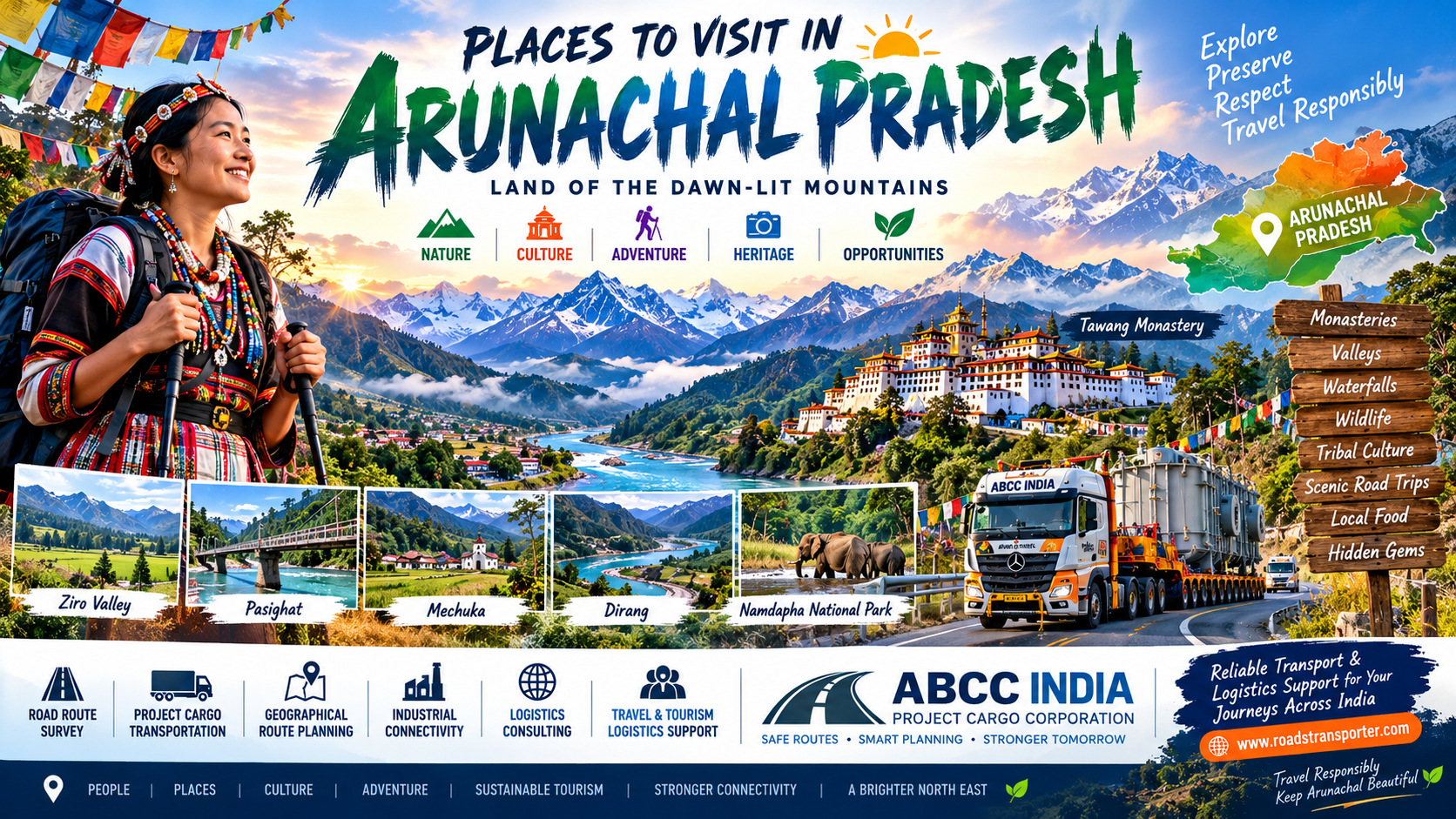
🌿 Introduction – An Invitation to Explore India’s Land of Dawn-Lit Mountains
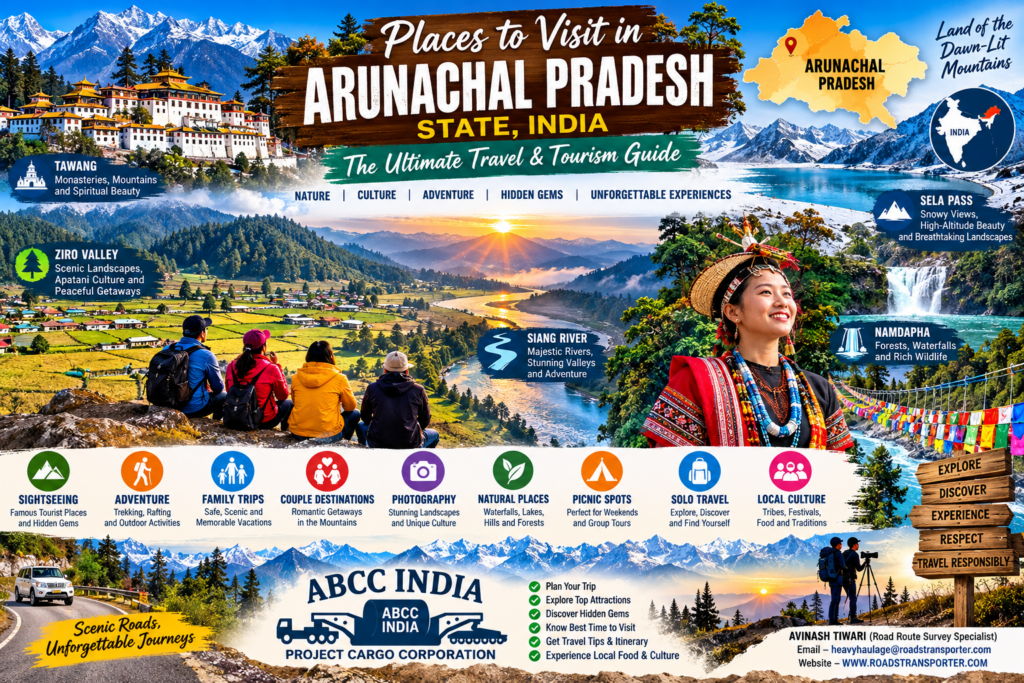
There are journeys you take to see famous places, and then there are journeys that quietly change the way you look at mountains, distance, culture and silence. Arunachal Pradesh belongs to the second kind.
At India’s far northeastern edge, the landscape rises dramatically from the Assam plains into forested hills, deep river valleys and the high Eastern Himalayas. Arunachal Pradesh shares international boundaries with Bhutan, China and Myanmar, and its official tourism identity—“Land of the Dawn-lit Mountains”—feels especially fitting for a state where misty ridges, early sunlight and enormous horizons become part of the travel experience.
If you are searching for the best places to visit in Arunachal Pradesh State, do not imagine a destination that can be understood through a simple “Top 10” list. This is a place for travellers who enjoy the journey as much as the attraction itself. Roads wind through forests and mountain valleys; monasteries occupy dramatic Himalayan settings; rivers cut through remote landscapes; waterfalls appear beside mountain routes; and small settlements introduce visitors to cultures that cannot be understood from photographs alone.
The better question is not simply, “What are the tourist places in Arunachal Pradesh?” It is: What kind of Arunachal Pradesh do you want to experience?
Perhaps it is the high-altitude world of Tawang, where Buddhist heritage, mountain scenery and glacial lakes create one of Northeast India’s most distinctive travel experiences. Tawang sits at about 3,500 metres, and the wider region includes celebrated landmarks such as Tawang Monastery and Sela Pass, alongside numerous high-altitude lakes.
Or perhaps your idea of a vacation is much quieter.
In Ziro, the attraction is not one giant monument demanding your attention. The landscape itself becomes the experience: a high plateau of forests, streams and cultivated fields shaped by generations of Apatani knowledge. The area is particularly known for its paddy-cum-fish cultivation system and the distinctive cultural traditions of the Apatani community.
Then there is Pasighat, where the mighty Siang changes the mood completely. Here, river landscapes, hanging bridges, forests and nearby natural attractions make the eastern side of the state feel different from the Himalayan monastery circuit of western Arunachal. The official tourism portal identifies places around Pasighat such as Daying Ering Memorial Wildlife Sanctuary, Sirki Waterfall, Bodak and Pongging hanging bridge.
And these familiar names are only the beginning.
Arunachal Pradesh rewards travellers willing to look beyond the most photographed tourist places. Routes towards Mechukha, Aalo, Tuting, Yingkiong, Roing, Anini, Tezu, Hayuliang, Miao and Namdapha reveal why the state works so well for slow travel and offbeat exploration. The tourism department itself promotes multiple circuits across these regions rather than presenting Arunachal as a single linear sightseeing route.
🏔️ One State, Many Completely Different Journeys
For a first-time visitor to Arunachal Pradesh, the biggest planning mistake is trying to cover everything quickly.
Distances on a map can be deceptive in mountain country. A trip here is better planned around one geographical circuit, with enough time for changing road conditions, weather, rest and spontaneous stops. Arunachal is a destination where an unhurried morning in a valley, a conversation around a homestay meal or an unexpected mountain view can become as memorable as a scheduled sightseeing stop.
Families can build comfortable trips around established destinations and cultural attractions. Couples looking beyond conventional honeymoon destinations can choose peaceful valleys, mountain viewpoints and intimate homestay experiences. Solo travellers may appreciate the sense of discovery, although remote routes demand more preparation than an ordinary city break. Student and group tours can combine geography, biodiversity, tribal cultures, history and environmental learning in ways few destinations can match.
Adventure travellers have even more possibilities. Official tourism information highlights trekking, rafting, angling, cycling, birding and other outdoor experiences, while recognised trekking routes connect areas such as Bomdila–Tawang, Aalo–Mechukha and Pasighat–Tuting.
For nature lovers, Arunachal Pradesh offers another scale of travel altogether. Forests cover much of the state, while the Kameng, Subansiri, Siang, Lohit and Tirap are among its major river systems. Its protected landscapes include wildlife sanctuaries, national parks and biodiversity-rich forest areas that make the state especially important for birdwatchers, wildlife enthusiasts and travellers interested in the Eastern Himalayas.
This means your list of places to visit in Arunachal Pradesh can be built around your own mood.
You can chase mountain views rather than nightlife. Choose waterfalls and lakes instead of shopping malls. Spend a weekend around a relatively compact circuit or reserve a longer vacation for remote valleys. You can plan photography around monasteries, forests, rivers and sunrise landscapes; build a family trip around culture and accessible sightseeing; or turn the journey into an adventure through trekking routes and lesser-visited settlements.
❤️ Come for the Scenery, Stay Long Enough to Notice the People
Yet reducing Arunachal Pradesh to mountains, lakes and waterfalls would miss much of what makes it special.
Its cultural landscape is remarkably diverse. Indigenous communities have preserved distinct languages, festivals, textiles, food traditions, architecture, agricultural knowledge and relationships with the surrounding environment. Official tourism information describes the state as home to numerous major tribes and sub-tribes, making cultural sensitivity an essential part of responsible travel here.
Travel slowly enough and the details begin to matter: prayer flags moving against a mountain sky, bamboo and cane craftsmanship, local textiles, village fields, monasteries above valleys, market food unfamiliar to a first-time visitor, and the sound of powerful rivers travelling through landscapes that still feel enormous.
These are not attractions to consume and move on from. They are reminders that travellers are guests in living communities.
That distinction becomes particularly important when looking for hidden gems, unexplored places, unknown places and offbeat attractions in Arunachal Pradesh. “Hidden” should never mean entering restricted areas, disturbing villages or treating local communities as exhibits. The most rewarding offbeat travel is usually the opposite: staying on permitted routes, choosing local guides where appropriate, supporting homestays and local businesses, asking before photographing people, carrying waste back, and giving remote landscapes the respect that made you want to visit them in the first place.
🚗 Arunachal Pradesh Is a Journey That Needs Planning
The romance of remote travel should also come with practical preparation.
Arunachal Pradesh is not a destination where every journey should be improvised after arrival. Weather, altitude, long mountain roads and permit requirements can affect travel plans. Domestic tourists require an Inner Line Permit (ILP) to enter Arunachal Pradesh, while foreign visitors are subject to separate Protected Area Permit requirements; travellers should verify current rules through official channels before departure.
High-altitude destinations deserve additional care. A beautiful lake or pass is not worth rushing towards if your body needs time to acclimatise. Likewise, an ambitious itinerary that looks efficient on a screen may become exhausting after repeated hours on mountain roads.
That is why this guide will treat Arunachal Pradesh not merely as a collection of tourist places, picnic spots and sightseeing destinations, but as a complete travel ecosystem.
We will separate famous attractions from genuinely lesser-known experiences; distinguish practical family destinations from demanding adventure routes; examine natural places, waterfalls, lakes, hills and wildlife landscapes; and help you understand which regions make sense for solo travel, couples, families, students, senior citizens and groups.
Most importantly, you will be able to plan according to time, season, comfort level and budget rather than following a generic list copied from one traveller to another.
So come with curiosity—but leave space in your itinerary.
Arunachal Pradesh is better when you do not hurry through it.
Continue through this Ultimate Arunachal Pradesh Travel & Tourism Guide to explore its major attractions and hidden gems, realistic budget planning, local food, suggested itineraries, photography spots, transport guidance, seasonal advice, safety considerations and practical travel tips—everything you need to turn the idea of visiting India’s far northeast into a journey you can actually plan.
🏔️ Best Places to Visit in Arunachal Pradesh State, India
Arunachal Pradesh especially strong for Himalayan scenery, Buddhist heritage, tribal culture, wildlife, trekking, rivers, waterfalls, monasteries, agriculture-based experiences and remote valleys. Official Arunachal Tourism currently organizes travel through multiple circuits including Tawang, Ziro–Aalo–Pasighat, Aalo–Mechuka, Roing–Anini and Tezu–Hayuliang.
Budgets are planning estimates per person, excluding long-distance travel to Arunachal Pradesh, and can change considerably with shared/private vehicles, accommodation and season.
Budget is an indicative local planning range for meals, local/shared transport, basic accommodation or sightseeing as applicable—not a quoted package price or official tariff.
🌦️ Best Time to Visit Arunachal Pradesh State & Seasonal Weather Conditions
Arunachal Pradesh cannot be described by one temperature chart. The state rises from warm, humid foothills to high Himalayan country, so Tawang, Ziro, Pasighat and Namsai can experience very different weather on the same day. As a broad planning rule, October–April is the most dependable tourism window for much of the state, while summer is particularly useful for higher-altitude travel. July–September brings spectacular greenery but also heavier rain and a greater possibility of disrupted road travel. Arunachal Tourism likewise notes October–April as a broadly favourable period and warns that some attractions may become inaccessible during heavy monsoon rainfall.
For domestic visitors, an Inner Line Permit (ILP) is required; foreign visitors have separate Protected Area Permit requirements. These rules should always be checked through the official system before travelling.
📊 Arunachal Pradesh Seasonal Travel at a Glance
| Season | Broad Period | General Experience | Best For | Main Caution |
|---|---|---|---|---|
| ☀️ Summer | March–June | Pleasant highlands; warmer foothills; longer sightseeing days | Tawang, trekking, mountains, lakes, family vacations | Strong sun, altitude, occasional rain |
| 🌧️ Monsoon | July–September | Intense greenery, clouds, waterfalls, atmospheric photography | Slow travel, culture, selected lower-altitude bases | Heavy rain, landslides, road disruption |
| ❄️ Winter | November–February | Dry/cool lower regions; severe cold and possible snow at altitude | Wildlife, culture, valleys, monasteries | Cold, shorter daylight, high-pass conditions |
| 🌸 Shoulder months | October & parts of spring | Often excellent balance of weather and scenery | First-time visitors, road trips, photography | Conditions still vary by altitude |
Official tourism material itself illustrates this variation: its Tawang guidance gives roughly 5–25°C for summer and temperatures around or below freezing during the coldest winter periods, whereas lower circuits can be considerably warmer.
☀️ Best Places to Visit in Arunachal Pradesh in Summer
For travellers who want the Himalayas rather than heavy winter conditions, March to June is one of the most useful periods for western and high-altitude Arunachal Pradesh. Five destinations particularly suited to this season are Tawang, Sela Pass, Dirang, Mechuka and Bomdila.
🛕 1. Tawang – Summer’s Great Himalayan Journey
Tawang is one of the strongest answers to the question, “Where should I visit in Arunachal Pradesh during summer?” The district occupies rugged Himalayan terrain, while Tawang town sits at high altitude. Summer brings comparatively comfortable sightseeing conditions without removing the dramatic mountain character that makes the region special. Arunachal Tourism describes March–June temperatures around 5–25°C, although conditions vary with elevation and weather.
Allow three to four nights in the Tawang area, particularly if arriving by road through Bomdila and Dirang. Trying to compress the entire western Arunachal circuit into a weekend ignores both the road distances and the need to adjust gradually to altitude.
Tawang Monastery is the cultural centrepiece. Founded in 1680–81 according to Arunachal Tourism, it provides far more than a photograph: architecture, Buddhist heritage and the wider Monpa cultural landscape give context to the journey. The region also contains several high-altitude lakes, including Sangetsar and P.T. Tso; official tourism notes that many lakes freeze during winter and become more accessible as summer conditions develop.
Summer mornings are especially valuable for photography. Begin early for softer mountain light and clearer views; cloud can increase later. Monastery architecture, prayer flags, valleys, distant ridges and lakes provide completely different visual subjects.
A practical mid-range allowance of roughly ₹2,500–₹6,000 per person per day can cover accommodation, meals and a share of local transport, but private long-distance vehicles and remote sightseeing can push costs much higher. Hotels, guesthouses and homestays are available in Tawang; reserve ahead during busy holiday periods.
For food, explore local Monpa-influenced meals and simple warming dishes rather than expecting metropolitan restaurant variety everywhere. Ask locally about ingredients if you have dietary restrictions.
Families with older children, couples, friends, students and photographers can find Tawang particularly rewarding. Senior citizens and travellers with heart, respiratory or mobility concerns should seek appropriate medical advice before high-altitude travel. Small children should not be rushed directly from low altitude into demanding high-altitude excursions.
Pack layers rather than one heavy outfit: thermal or warm inner layers, fleece, windproof/water-resistant outerwear, sunscreen, sunglasses, comfortable shoes, personal medicines and reusable water bottles.
Tawang town can be pleasant after sunset, but remote mountain sightseeing should be planned for daylight. Do not make unfamiliar high-altitude roads into a night-drive attraction.
For couples, the romance here comes from quiet Himalayan landscapes rather than artificial entertainment. For families, it offers cultural learning. For solo travellers, it offers reflection—but careful transport planning remains essential.
🏔️ 2. Sela Pass & Sela Lake – Summer Above the Clouds
Sela is not a conventional hill-station picnic ground. It is a high-altitude mountain-pass experience, and that distinction matters.
Located on the road towards Tawang, Sela Pass is among the defining landscapes of the western Arunachal journey. Summer generally provides a more practical opportunity to experience the pass than severe winter periods, but high-altitude weather can still change quickly.
Plan Sela primarily as a daylight transit-and-sightseeing experience, not an isolated overnight holiday. Most visitors incorporate it into the Bomdila–Dirang–Tawang circuit.
The appeal is elemental: mountain ridges, open high-altitude terrain, changing clouds and the lake. Photographers should carry both wide-angle capability for landscapes and protection against moisture and wind. Bright mountain light can create high contrast, so early or later daylight is often more forgiving than harsh midday sun.
Budget is tied mainly to vehicle hire. If Sela forms part of a shared circuit, allocate roughly ₹1,500–₹4,000 per person for the day’s transport and meals, depending heavily on group size and vehicle arrangement. Accommodation is better planned at established bases such as Dirang or Tawang rather than treating the pass itself as a resort destination.
Food options become more limited on remote stretches, so carry water and modest snacks without littering.
Friends, couples, photographers and physically comfortable family travellers are the natural audience. Corporate groups can incorporate Sela into a properly paced Tawang itinerary, but it is unsuitable for a casual large-team picnic with music, alcohol or uncontrolled activities.
Altitude is the key safety consideration. Headache, dizziness, nausea and unusual fatigue should never be dismissed merely because everyone wants a photograph. Avoid running or strenuous exertion immediately after reaching high elevation.
Pack warm layers even in summer, along with a rain/wind shell, sun protection, gloves if you are sensitive to cold and shoes with reliable grip.
This is also not a night-out destination. Mountain roads, cold, reduced visibility and unpredictable conditions make daylight travel the sensible choice.
For couples, the landscape can feel wonderfully remote; for students, it offers a living geography lesson; for photographers, it delivers scale. But Sela is most rewarding when visitors remember that the mountains—not the itinerary—set the rules.
🌿 3. Dirang & Sangti Valley – A Gentler Himalayan Summer
Dirang provides something extremely useful on the road towards Tawang: time to slow down.
At about 1,497 metres, according to Arunachal Tourism, Dirang sits substantially lower than Tawang and offers hot springs, apple and kiwi orchards, the Sangti Valley, Dirang Dzong and Buddhist cultural attractions.
Stay one or two nights. This makes Dirang more than a refuelling stop and also creates a more gradual western Arunachal itinerary.
Summer days are generally comfortable compared with India’s hot plains, although rain and cloud remain possible. Rather than promising a fixed temperature, prepare for cool mornings, mild-to-warm daytime conditions and noticeably cooler evenings.
Sangti Valley is especially attractive to travellers who prefer rural landscapes over monument-heavy sightseeing. Agricultural fields, surrounding hills and open valley scenery create strong opportunities for landscape and lifestyle photography. Dirang’s orchards also introduce an agricultural-tourism dimension to the journey.
Accommodation includes modest hotels, guesthouses and homestay-style options. A sensible independent budget is around ₹2,000–₹4,500 per person per day, depending on room sharing and vehicle arrangements.
Families, couples and senior travellers may find Dirang more relaxed than the highest reaches of the Tawang circuit. Students can connect geography with horticulture and local culture, while photographers can work with valley light rather than only dramatic snow peaks.
Couples should consider an early morning valley drive or an unhurried evening near their accommodation rather than searching for conventional nightlife. Dirang is about quiet landscapes, not clubs.
Pack a light warm layer, rain protection, walking shoes, sunscreen and insect protection. Avoid entering rivers or unfamiliar water bodies simply because the weather looks pleasant.
The hot spring is a documented local attraction, but it should not be marketed as an invented luxury Ayurvedic spa. Arunachal Tourism describes the sulphur-rich spring and local beliefs about its properties; travellers should not interpret tourism descriptions as medical treatment claims.
For a family vacation or couple’s Himalayan road trip, Dirang works because it creates breathing space between longer road journeys.
🌄 4. Mechuka – Summer for Slow Adventure
Mechuka—or Menchuka—is one of Arunachal Pradesh’s great valley journeys.
Official tourism places the settlement at roughly 6,000 feet, surrounded by mountains with the Siyom River running through the valley. It also highlights the area’s Memba and other indigenous communities and its religious and historical significance.
Summer makes sense for travellers who want outdoor exploration without deliberately chasing severe winter weather. Allow two to four nights, not including the considerable road journey required to reach the valley.
The attraction is not a single monument. It is the relationship between river, mountains, settlement and road. Walking, landscape photography, cultural exploration and carefully planned adventure activities are more appropriate than racing through a checklist.
Arunachal Tourism recognizes the Aalo–Mechuka circuit as a formal tourism itinerary, which is a useful way to understand the destination: Mechuka is part of a journey, not an isolated attraction beside a major airport.
Budget around ₹2,500–₹5,500 per person per day locally, but transportation to and from the valley can substantially increase total trip cost. Homestays and modest accommodation fit the destination better than expecting large luxury-resort inventory.
Eat locally where possible. Simple rice-based meals, vegetables, meat dishes where desired and regional preparations can become part of the experience. Travellers with strict dietary needs should communicate them early.
Mechuka works particularly well for couples, friends, solo explorers, photographers and smaller corporate groups seeking a genuine retreat. Families with children can enjoy it if everyone is comfortable with long road travel. Seniors should evaluate journey time and medical access before committing.
Bring rain protection, layers, sturdy shoes, power backup and essential medication. Mobile connectivity should never be treated as guaranteed in remote mountain travel.
Sunrise, mist, the Siyom River and wide valley compositions provide excellent photography opportunities.
Evening walks should remain around inhabited, familiar areas. Avoid unfamiliar trails and riverbanks after dark.
Mechuka’s strongest luxury is not a five-star room. It is space.
🏯 5. Bomdila – Culture, Mountains and a Comfortable Summer Stop
Bomdila is often overshadowed by Tawang, yet that makes it particularly useful for travellers who dislike rushing.
As the headquarters of West Kameng district, it forms part of the established Tezpur–Bhalukpong–Bomdila–Dirang–Tawang tourism corridor. Official tourism highlights Buddhist monasteries and the area’s multi-community cultural character.
Spend one night, or two if travelling slowly.
Summer offers a refreshing mountain break from the hotter plains. Clouds, showers and cool evenings are possible, so a light jacket and rain layer remain useful even when the plains below are experiencing intense heat.
Monastery visits, local markets, viewpoints and mountain-road photography provide the core experience. Bomdila is also an excellent place to stop thinking of Arunachal merely as scenery and start noticing its cultural geography.
Allow roughly ₹1,800–₹4,000 per person per day for ordinary accommodation, meals and local movement. Private intercity transport is additional.
Families and senior travellers may appreciate Bomdila because a relaxed town stay can be less demanding than repeated high-altitude excursions. Couples can use it as a quiet road-trip stop, while students can focus on Buddhist culture and the ethnic diversity of West Kameng.
For corporate groups, it can work as a small retreat stopover, but responsible behaviour matters: monasteries and communities are not party venues.
Photographers should look beyond panoramic viewpoints. Monastery details, changing clouds, streets, crafts and mountain-town life can tell a richer story.
Pack comfortable walking footwear, a light fleece, rain protection and sun protection. Plan evening activity around the town and your accommodation rather than unnecessary night driving.
🌧️ Best Places to Visit in Arunachal Pradesh During Monsoon
Monsoon Arunachal is exceptionally green—but it requires a different travel mindset. Official tourism warns that heavy rainfall can close or disrupt access to some attractions during July–September.
Therefore, the following are bases or destinations that can be considered in monsoon with flexible planning, not a claim that monsoon is their safest or universally best season. Check weather and roads immediately before each journey.
🌾 6. Ziro Valley – Green Fields, Mist and Apatani Landscapes
Monsoon transforms Ziro into an intensely green cultural landscape.
The destination is a recognised hill town on Arunachal Tourism’s Itanagar–Ziro–Daporijo–Aalo–Pasighat circuit, with Talley Valley nearby and a landscape strongly associated with Apatani culture and agriculture.
Allow two or three nights.
Rain can make the valley atmospheric rather than merely inconvenient. Paddy landscapes become saturated with colour, clouds descend around surrounding hills, and photography shifts from clear panoramas to texture, mist and agricultural life.
But this beauty comes with responsibility. Rural paths can become muddy and slippery, road journeys can take longer, and weather may disrupt plans. A monsoon traveller should keep buffer time rather than booking every hour.
Expect roughly ₹2,000–₹4,500 per person per day for homestay/hotel accommodation, meals and local travel, excluding major transfers.
Homestays are particularly valuable because they allow visitors to learn about the valley through residents rather than simply photographing villages. Ask before photographing people or private homes.
Families with older children, couples, students and cultural travellers can enjoy Ziro in the rains. Solo travellers should keep hosts informed about their movements. Senior citizens need extra caution on wet surfaces.
Pack a proper rain jacket, umbrella, quick-drying clothes, waterproof footwear or shoe protection, dry bags for electronics and insect repellent.
Photography can be superb: rice fields, fog, rain clouds, village architecture and reflections offer a visual language completely different from dry-season Arunachal.
Nightlife is not the point. Enjoy dinner, conversation and a safe short evening around your accommodation. Avoid unknown trails after dark.
For travellers who understand that rain is part of the experience rather than an interruption, monsoon Ziro can be deeply atmospheric.
🌆 7. Itanagar – The Practical Monsoon Base
For first-time visitors who want Arunachal Pradesh during the rains without immediately committing to the remotest mountains, Itanagar offers a more practical base.
Official tourism identifies the state capital’s major attractions as Ita Fort, Jawaharlal Nehru State Museum, the Buddhist Gompa and forest-surrounded Geker Sinying/Ganga Lake.
Plan one or two days.
Monsoon weather can be warm, humid and wet, so structure sightseeing around weather windows. Museums and cultural attractions become particularly useful when persistent rain makes outdoor plans uncomfortable.
A daily allowance of around ₹1,500–₹4,000 per person can accommodate a wide range of city stays, meals and local taxis.
Students should prioritize the museum because understanding textiles, crafts and indigenous cultures early can improve the rest of an Arunachal journey. Families can mix indoor attractions with short outdoor visits. Solo travellers benefit from the conveniences of a capital city.
Ganga Lake offers greenery and photography but should be approached according to current weather conditions. Do not enter unsafe water or forest trails during storms.
Pack breathable quick-drying clothes, waterproof footwear, rain protection for phones and cameras and mosquito/insect repellent.
For photography, wet streets, saturated forest vegetation and cloudy hill backgrounds can be surprisingly effective. Protect equipment from condensation as well as direct rain.
Safe evening plans should focus on established restaurants, markets where active, and accommodation areas rather than isolated lake or forest locations.
Itanagar is not the wildest Arunachal experience—and that is exactly why it can be useful during unpredictable weather.
🌊 8. Pasighat – Monsoon Drama Along the Siang
Pasighat sits at only about 155 metres elevation and has a very different atmosphere from Tawang. Arunachal Tourism describes it as the land of the Siang and highlights attractions including Sirki Waterfall, Daying Ering Memorial Wildlife Sanctuary, Bodak, Raneghat and Pongging hanging bridge.
Allow two days, adding buffer time in wet weather.
Monsoon intensifies the region’s river-and-forest character. Waterfalls can become visually impressive and vegetation extraordinarily green—but swollen rivers are a serious reason to remain conservative around water.
Budget around ₹1,800–₹4,500 per person per day depending on hotel level and transport.
Pasighat suits friends, couples, students and photographers interested in river landscapes. Families can enjoy it with careful planning, while corporate groups can use the town as a base rather than organizing risky monsoon adventure activities.
Do not interpret a powerful monsoon river as an invitation to swim. Rafting, boating or angling should only be undertaken when conditions permit and with appropriate authorized/experienced local operators.
Carry serious rain protection, not just a decorative umbrella. Waterproof important documents and electronics.
Sirki Waterfall and forest landscapes can provide dramatic long-exposure photography, but never stand on slippery rocks or cross barriers for an image.
After dark, remain around established urban or accommodation areas. Riverbanks, waterfalls and hanging bridges are daytime experiences.
🏞️ 9. Aalo – A Green Siang-Belt Stop for Slow Travellers
Aalo forms part of two recognised tourism routes: the wider Itanagar–Ziro–Daporijo–Aalo–Pasighat corridor and the Aalo–Mechuka circuit.
In monsoon, consider it primarily as a slow-travel base rather than an aggressive sightseeing schedule.
Spend one or two nights, particularly when connecting larger circuits.
The appeal comes from river-valley landscapes, surrounding greenery, local communities and the experience of travelling through central-western Arunachal. Rain gives the landscape extraordinary colour but can lengthen road journeys.
A budget of roughly ₹1,800–₹4,000 per person per day is a reasonable planning starting point for accommodation, food and local travel, with inter-district private vehicles extra.
Friends and couples on longer Arunachal journeys will appreciate Aalo most. Students interested in geography and indigenous culture can also find value here. Corporate groups should keep schedules flexible enough to accommodate weather delays.
For monsoon photography, use polarizing protection cautiously, carry lens cloths and keep batteries and memory cards dry. Cloud formations above river valleys can produce stronger photographs than a perfectly blue sky.
Choose cooked local meals and safe drinking water, particularly during heavy rain. Carry basic medication and ORS as part of normal travel preparedness.
Avoid river edges during high water, landslide-prone roadside stopping points and unnecessary night driving.
🛕 10. Namsai – Culture and Spiritual Travel in the Rains
Namsai offers a gentler cultural counterpoint to Arunachal’s extreme mountain journeys.
Official tourism highlights the district’s combination of plains and mountains, ethnic diversity, handloom and handicrafts, religious tourism and the Golden Pagoda.
A one- to two-night stay works well.
The monsoon brings lush vegetation and atmospheric skies. Because the experience can combine cultural and religious attractions with relatively shorter local sightseeing, travellers can adapt the day around rain breaks more easily than on a high-pass expedition.
Allow approximately ₹1,500–₹3,500 per person per day for normal lodging, meals and local transport.
The Golden Pagoda is the visual centrepiece. Visit respectfully, preferably in quieter daylight periods. Rain-washed architecture and reflective surfaces can be beautiful for photography.
Families, couples, seniors and students are well suited to Namsai. It can also work for corporate or educational groups interested in cultural tourism rather than adventure.
Wear modest clothing at religious sites, carry rain protection and remove wet footwear where local etiquette requires it.
Evening plans are best kept gentle—dinner, established public areas and your hotel rather than remote drives.
❄️ Best Places to Visit in Arunachal Pradesh in Winter
Winter is one of Arunachal Pradesh’s strongest travel seasons, particularly in lower and middle elevations. High Himalayan destinations can become severely cold, so this section deliberately uses five destinations not already recommended above.
🐅 11. Namdapha National Park – Winter Wilderness
Namdapha is for travellers who want Arunachal Pradesh to feel genuinely wild.
The official tourism circuit connects Margherita–Miao–Namdapha–Vijoynagar, and October–April is identified as the broader favourable period for Arunachal travel.
Allow two to four days, depending on your approved route and activities.
Winter generally offers a more practical forest-travel window than the peak monsoon. The experience centres on biodiversity, forest walking, birding and wilderness rather than conventional resort entertainment.
A realistic planning allowance can reach ₹3,000–₹8,000+ per person per day once guides, permits/entry requirements, transport and accommodation are considered. Treat this only as a planning range; verify current forest charges and arrangements before travelling.
Accommodation around the wider Miao/Namdapha area is more functional than urban luxury. Advance planning is important.
This destination particularly suits wildlife enthusiasts, birders, researchers, students, photographers and physically prepared solo or group travellers. Families should assess the specific itinerary carefully; very young children and travellers expecting effortless sightseeing may prefer another destination.
Wildlife is never guaranteed. Ethical wildlife travel means observing quietly rather than demanding sightings.
Carry good walking shoes, warm layers for mornings, insect protection, torch/headlamp, reusable water, essential medicines and rain protection even in the nominally drier season.
Never walk into forest areas after dark without proper authorization and expert guidance. Night should not be treated as an opportunity for independent wildlife searching.
Namdapha rewards patience—the ability to listen to a forest without demanding that it perform.
🦅 12. Pakke Tiger Reserve Landscape – Winter for Birding & Forests
The Pakke/Pakhui landscape in the Eastern Himalayan foothills provides another strong winter nature experience. Arunachal Tourism identifies Pakhui Wildlife Sanctuary on its Seijosa–Bhalukpong circuit and records its extensive protected forest landscape.
Plan two or three days.
Winter’s comparatively drier conditions can make forest-oriented travel more manageable than peak monsoon. Early mornings are particularly valuable for birding and photography.
Budget approximately ₹2,500–₹6,000+ per person per day, depending on transport, accommodation and guided activities. Current entry procedures and charges should be confirmed rather than copied from old travel blogs.
Birdwatchers, wildlife photographers, students and eco-conscious families are natural audiences. Corporate groups can use a nature-based programme if group size and behaviour remain compatible with conservation rules.
The correct expectation is habitat experience, not guaranteed tiger photography. A quiet hornbill sighting, forest soundscape or river-edge morning may become more memorable than chasing a checklist.
Use neutral, comfortable clothing, walking shoes, binoculars, a telephoto lens where available and warm layers for early starts.
Avoid loud music, litter, feeding animals and independent night wandering. Follow forest staff and guide instructions.
🌄 13. Roing – A Comfortable Winter Gateway
Roing is an excellent winter choice for travellers who want nature and heritage without immediately committing to Arunachal’s harshest high-altitude conditions.
It belongs to the official Dibrugarh–Roing–Mayudia–Anini tourism circuit.
Spend two nights, longer if using Roing as a base for wider Lower Dibang Valley exploration.
Winter mornings can be crisp, while daytime sightseeing is generally more comfortable than the wet monsoon period. Exact temperatures vary considerably between Roing and higher surrounding areas, so layers remain the safest packing strategy.
A daily budget around ₹1,800–₹4,500 per person can work for accommodation, meals and local sightseeing, excluding major private transfers.
Families, couples, friends, solo travellers and students can all use Roing effectively. Its value lies in variety: river-and-valley landscapes, cultural context and access towards higher Dibang country.
Photography works particularly well around sunrise and late afternoon when mountain and valley light is softer.
Carry a fleece or jacket for mornings, comfortable shoes, sunscreen, personal medicines and power backup.
Evening activity should remain around populated areas and accommodation. Save remote roads and wilderness for daylight.
🏔️ 14. Anini & Dibang Valley – Winter for Experienced Offbeat Travellers
Anini represents the more demanding side of Arunachal travel.
It sits on the official Dibrugarh–Roing–Mayudia–Anini circuit, signalling an important planning fact: this is a road journey through remote mountain country rather than a simple weekend flight-and-hotel destination.
Allow three to five days in the wider journey, with additional contingency time.
Winter can deliver striking mountain landscapes, clear air and a powerful sense of remoteness. It can also mean serious cold and changing road conditions at higher elevations. Never use an evergreen article as a substitute for a current road check.
Budget around ₹3,000–₹7,000+ per person per day when private/shared transport and limited remote accommodation are factored in.
Anini is strongest for experienced couples, friends, photographers, road-trip enthusiasts and independent travellers comfortable with basic infrastructure. It is not automatically the best choice for very young children, medically vulnerable travellers or anyone needing predictable urban services.
Bring substantial warm clothing, rain/wind protection, sturdy footwear, medicines, cash backup, snacks and charging capacity.
Photographers should prepare for huge landscapes rather than only identifiable landmarks—rivers, forested slopes, winter light and mountain roads create the story.
Avoid unnecessary night driving. In remote Arunachal, arriving before darkness is not merely convenient; it can materially simplify the journey.
🛕 15. Parshuram Kund & Lohit Valley – Winter Pilgrimage and Landscape Travel
Parshuram Kund provides a very different final chapter to the seasonal guide.
Located in the Lohit region, it is a major pilgrimage destination associated with the legend of Sage Parashuram. The winter period is particularly significant because the site attracts pilgrims around Makar Sankranti. Official tourism documents the religious importance of the kund and its pilgrimage tradition.
Plan one day for the site, or two to three days when combining it with Tezu/Namsai and the wider Lohit region.
Winter generally provides more comfortable conditions for this eastern circuit than peak monsoon. Festival periods, however, can mean substantially greater crowds and demand for transport and accommodation.
An ordinary non-festival planning budget might begin around ₹1,500–₹4,000 per person per day, while festival-period costs and availability can differ significantly.
The destination suits devotees, families, students interested in mythology and cultural geography, and senior travellers who can comfortably manage the actual terrain. Anyone with limited mobility should check current access conditions before committing.
Photography should respect worship. A pilgrimage is not a staged cultural performance, and people bathing or praying deserve privacy.
Carry warm morning layers, comfortable non-slip footwear and drinking water. During busy periods, keep valuables secure and follow crowd-management instructions.
Do not enter strong river currents simply for ritual, swimming or photography. Follow local safety instructions.
For families, Parshuram Kund connects mythology with geography. For students, it demonstrates how landscape and sacred tradition become intertwined. For spiritual travellers, the destination’s meaning extends well beyond sightseeing.
🧳 Seasonal Packing & Traveller Suitability Chart
| Traveller | Best Choice | Why |
|---|---|---|
| 👨👩👧 Family | Dirang, Ziro, Namsai, Roing | Balanced culture, nature and manageable sightseeing |
| ❤️ Couples | Mechuka, Tawang, Ziro, Anini | Quiet landscapes and slow-travel atmosphere |
| 🎒 Solo travellers | Ziro, Mechuka, Pasighat, Roing | Culture, photography and exploratory travel |
| 👴 Senior citizens | Namsai, Itanagar, Bomdila, Dirang | Generally easier sightseeing than extreme high-altitude circuits |
| 🧒 Children | Ziro, Itanagar, Namsai, Dirang | Educational and family-oriented experiences |
| 🎓 Students | Ziro, Itanagar Museum, Pakke, Namdapha | Culture, ecology, history and geography |
| 👥 Friends | Tawang, Mechuka, Pasighat, Anini | Road trips, nature and adventure |
| 🏢 Corporate groups | Ziro, Dirang, Namsai | Better suited to responsible retreats and cultural outings |
| 📸 Photographers | Tawang, Mechuka, Ziro, Anini, Namdapha | Mountains, people, forests, wildlife and cultural landscapes |
⚠️ Important Seasonal Safety Advice
Arunachal Pradesh rewards flexible travellers. Do not treat road time shown on a map as guaranteed journey time. Heavy rain can disrupt monsoon roads, while winter snow or ice can affect high-altitude routes. Official tourism’s own itinerary network demonstrates how travel is organized around long geographic circuits rather than isolated attractions.
Avoid scheduling important flights or trains immediately after a long remote road sector. A buffer day can be worth more than another rushed attraction.
Swimming in unfamiliar rivers and waterfalls should never be assumed safe. During monsoon, the answer should generally be even more conservative because water levels and currents can change rapidly.
For trekking, official Arunachal Tourism identifies May and October as particularly favourable months and lists routes including Bomdila–Tawang, Aalo–Mechuka and Pasighat–Tuting.
Night sightseeing deserves similar restraint. Town centres, established restaurants, hotels and organized cultural programmes can be reasonable evening options, but remote waterfalls, forests, high passes, riverbanks and unfamiliar mountain roads should not be promoted as casual night attractions.
🌤️ So, What Is the Best Time to Visit Arunachal Pradesh?
For a first trip, the most practical answer is generally October through April, selecting the exact month according to altitude and the experiences you want. Spring and early summer become particularly attractive for high Himalayan travel, while winter is excellent for many lower and middle-elevation cultural and wildlife circuits.
Choose summer for Tawang, Sela, Dirang, Mechuka and Bomdila. Choose monsoon only with flexibility for the intensely green landscapes around Ziro, Itanagar, Pasighat, Aalo and Namsai. Choose winter for Namdapha, Pakke, Roing, the Dibang/Anini journey and the Lohit–Parshuram Kund circuit.
There is no single “perfect weather” month for an entire state with such enormous variation in altitude. The better strategy is to decide which Arunachal Pradesh you want to experience first—snow mountains, Buddhist culture, tribal landscapes, forests, wildlife, rivers or remote valleys—and then choose the season around that journey.
That approach produces a safer, slower and far more memorable Arunachal Pradesh vacation than trying to fit every corner of the state into one hurried itinerary.
🍽️ Best Dhabas, Restaurants, Cafés & Food Stops in Arunachal Pradesh

Arunachal Pradesh’s food scene is quite different from Maharashtra, Rajasthan or the major North Indian highway belts. Travellers should come primarily for Arunachali and wider Northeast Indian flavours, momos, thukpa/noodle dishes, rice-based meals, smoked or boiled preparations, local vegetables, Indian and Indo-Chinese food, alongside an expanding café culture in places such as Itanagar and Tawang.
Current restaurant listings also show that Itanagar has considerably greater dining variety than remote tourism circuits. Because restaurant ratings, phone numbers, menus and opening hours change, the information below should be rechecked immediately before publication or travel.
🥘 Verified Food & Restaurant Chart
| Name | Category | Address | Nearby Highway / Location | Famous Dishes / Best For | Meal Type | Cuisine | Veg / Dietary Availability | Approx Budget | Family Friendly | Parking | Contact Number | Google Rating* | Why Visit | Travel Tip |
|---|---|---|---|---|---|---|---|---|---|---|---|---|---|---|
| Nani Kitchen Thali Dhaba | Thali / Dhaba-style Restaurant | VIP Rd, Niti Vihar, Itanagar 791111 | Niti Vihar, Itanagar | Thali; ask for day’s specials | Lunch, Dinner | Indian / Thali | Ask for current veg/Jain options | ₹400–600 | Yes | Verify | 8……3 | 4.9/5 (42) | Strong option for travellers specifically seeking a filling thali-style meal | Ask about the day’s thali before ordering |
| Mumma’s kitchen | Local Restaurant | K2 Building, Niti Vihar, Itanagar 791111 | Itanagar | Menu varies | Lunch, Dinner | Indian / Multi-cuisine | Verify dietary options | ₹200–1,000 | Yes | Verify | 7……7 | 4.6/5 (322) | Popular, well-reviewed city restaurant | Useful for families staying around central Itanagar |
| J’s Jaika | Fine Dining Restaurant | TT Marg, VIP Rd, Bank Tinali, Itanagar 791111 | Bank Tinali | Multi-cuisine dining | Breakfast, Lunch, Dinner | Indian / Multi-cuisine | Ask restaurant | ₹200–800 | Yes | Verify | 8……8 | 4.5/5 (365) | Better suited to comfortable family or business dining | Reserve/check ahead for larger groups |
| Choe-Wang’s Kitchen | Premium Restaurant | NH415, Itanagar 791111 | NH-415 | Tingmo, Asian dishes; menu varies | Lunch, Dinner | Asian / Chinese / Multi-cuisine | Vegetarian choices reported; confirm vegan/Jain | ₹2,000+ listed range | Yes | Verify | 8……7 | 4.2/5 (568) | One of the better-known premium dining choices directly along NH-415 | Useful for corporate/family dining; confirm dietary requests in advance |
| Banamo Kitchen and Bar | Restaurant / Bar | Waii Apartments, Abotani Colony, Itanagar 791111 | Abotani Colony | Indian and regional-style meals | Lunch, Dinner | Indian / Arunachali-influenced | Veg and non-veg; confirm special diets | ₹400–1,400 | Yes | Verify | 8……8 | 4.6/5 (72) | Comfortable social and group-dining option | Better for leisurely dinner than a quick highway halt |
| A2 Restaurant Cum Cafe | Café / Restaurant | Zoo Tinali, Itanagar 791111 | Zoo Tinali | Café and restaurant menu | Breakfast, Lunch, Snacks, Dinner | Multi-cuisine | Verify | ₹200–400 | Yes | Verify | 6……5 | 4.9/5 (38) | Affordable café-style stop | Practical for younger travellers and casual meals |
| Li’s Kitchen Naharlagun | Restaurant | Dokum Colony, Naharlagun 791110 | Naharlagun | Menu varies | Lunch, Dinner | Multi-cuisine | Verify | ₹400–1,400 | Yes | Verify | 8……9 | 4.7/5 (136) | Well-reviewed Naharlagun dining choice | Convenient if staying outside central Itanagar |
| GB BISTRO MULTI CUSINE FAMILY RESTAURANT | Family Restaurant | Papu Nalah 791110 | Papu Nalah | Multi-cuisine meals | Lunch, Dinner | Multi-cuisine | Verify | ₹400–1,600 | Yes | Verify | Not surfaced | 4.4/5 (42) | Explicitly positioned for family dining | Suitable for family/group meals; confirm group seating |
| The Capital Hive | Restaurant / Late Dining | NH415, Itanagar–Naharlagun 791111 | NH-415 | Multi-cuisine | Lunch, Dinner, Late Evening | Multi-cuisine | Verify | Verify | Adults / groups | Verify | Not surfaced | 4.8/5 (18) | Current listing shows unusually late operating hours | Reconfirm same-day hours rather than assuming 24×7 operation |
| THE MARQUEE RESTOBAR | Premium Restobar | ILPP City Center, opposite ICICI Bank, Itanagar 791111 | Central Itanagar | Asian/modern multi-cuisine menu | Lunch, Dinner, Late Evening | Multi-cuisine | Vegetarian choices; verify Jain/vegan | ₹400–1,400 | Groups / adults | Verify | Not surfaced | 4.2/5 (863) | Large review base and suitable atmosphere for social/corporate dining | Restaurant has changing late hours; verify before visiting |
| Food Hut | Highway Food Stop | Trans Himalaya Hwy, Shergaon 790003 | Trans-Arunachal / Trans Himalaya Highway corridor | Simple road-trip meals | Breakfast, Lunch, Early Dinner | Indian / Local-style | Verify | ₹200–400 | Yes | Roadside; verify | 9……4 | 4.5/5 (377) | Particularly useful as an actual road-trip food stop rather than a city restaurant | Current listing closes around 7 pm; don’t depend on it for late-night food |
| L. K. Restaurant | Budget Local Restaurant | Centre Point, near District Museum, Bomdila 790001 | Bomdila town | Affordable meals | Breakfast, Lunch, Dinner | Local / Indian | Verify | ₹1–200 listed | Yes | Verify | 9……7 | 5.0/5 (23) | Budget-friendly stop near central Bomdila | Useful during Bomdila sightseeing; ratings based on relatively few reviews |
| Slice of heaven restaurant | Restaurant | Bomdila 790001 | Bomdila | Restaurant meals | Breakfast, Lunch, Dinner | Multi-cuisine | Verify | ₹200–1,200 | Yes | Verify | 8……8 | 5.0/5 (20) | Another current Bomdila dining option | Verify menu and location before setting out |
| Mon Valley Restaurant | Local Restaurant | Nehru Market, opposite Post Office, Arunachal Pradesh 790104 | Tawang | Chinese-style meals | Breakfast, Lunch, Dinner | Chinese / Himalayan-style | Ask for veg | ₹400–600 | Yes | Verify | 9……1 | 4.8/5 (17) | Central market location makes it useful during Tawang sightseeing | Finish dinner reasonably early on mountain trips |
| Tsering’Resturant & Cafe | Restaurant & Café | Nehru Market, Man Road, Arunachal Pradesh 790104 | Tawang market | Café/restaurant food | Lunch, Snacks, Dinner | Multi-cuisine | Verify | Verify | Yes | Verify | 8……6 | 5.0/5 (54) | Convenient Tawang market food stop | Ask for local recommendations rather than ordering only familiar dishes |
| Jimpan Hot Chilli Restaurant | Local Restaurant | Arunachal University Rd, Namsai 792103 | Namsai | Everyday restaurant dishes | Breakfast, Lunch, Dinner | Indian / Asian | Verify | ₹200–400 | Yes | Verify | Not surfaced | 4.6/5 (44) | Affordable option around Namsai | Current listing opens from 7 am, useful for an early start |
| Taste of Heaven Delight Restaurant | Roadside Restaurant | NH15, Arunachal Pradesh 792102 | NH-15 | Road-trip meals | Lunch, Dinner | Indian / Multi-cuisine | Verify | ₹1–1,000 listed | Yes | Verify | 8……3 | 4.9/5 (36) | Convenient highway-location option | Confirm operating hours before building a route around it |
| Dalai Eco Restro & Homestay | Eco Restro / Homestay | Dalai Bridge, Hayuliang 792102 | Hayuliang / Lohit circuit | Homestay-style meals | Breakfast, Lunch, Dinner | Local / Indian | Ask host | Verify | Yes | Verify | 8……7 | 4.8/5 (136) | Particularly relevant to travellers heading through the remote Hayuliang circuit | Arrange food in advance when travelling through remote areas |
Ratings and review counts above are live-search snapshots and not permanent quality scores.
🏭 Industrial Evolution & Economic Landscape of Arunachal Pradesh State
Arunachal Pradesh is entering an unusual phase of economic change. Unlike Maharashtra, Gujarat or Tamil Nadu, its industrial identity is not built around giant automobile belts, petrochemical corridors or dense manufacturing cities. Its comparative strengths come from hydropower, horticulture, agriculture, bamboo and forest-based value addition, handloom and handicrafts, food processing, tourism, construction, renewable energy and small enterprises adapted to difficult Himalayan geography.
The transformation is becoming particularly visible in power. NEEPCO already operates the 405 MW Panyor Lower, 110 MW Pare and 600 MW Kameng hydro stations in Arunachal Pradesh. Meanwhile, NHPC’s 2,000 MW Subansiri Lower project has begun phased commissioning: NHPC reports four 250 MW units, totaling 1,000 MW, commercially commissioned by May 2026.
That makes Arunachal’s industrial story less about smokestacks and more about converting natural resources, connectivity and indigenous knowledge into sustainable economic value without destroying the landscapes and communities on which those opportunities depend.
📈 Arunachal Pradesh’s Industrial Evolution at a Glance
| Phase | Economic Character | Major Change | Long-Term Significance |
|---|---|---|---|
| Traditional economy | Agriculture, livestock, weaving, cane/bamboo crafts, local exchange | Community-oriented production | Foundation of today’s handicraft and rural enterprise economy |
| Early institutional development | Cottage industries, craft centres, basic processing | Government-supported skills and small industry | First formal industrial ecosystem |
| Industrial-estate era | Small industrial estates and District Industries Centres | Workshops and small manufacturing gained organized space | Beginning of MSME formalization |
| Connectivity expansion | Highways, bridges, telecom, electricity | Reduced isolation of markets | Improved movement of labour, tourists and goods |
| Tourism & horticulture growth | Kiwi, oranges, spices, hospitality, homestays | Greater commercial value from local resources | Rural diversification |
| Hydropower expansion | Large hydro projects and transmission infrastructure | Major capital investment | Potential long-term energy and revenue economy |
| Emerging phase | Food processing, logistics, digital businesses, renewables and startups | Local value addition | Opportunity to retain more economic value within Arunachal |
Historical government gazetteer material records an industrial estate at Pasighat, District Industries Centres at Aalo and Pasighat, and earlier incentives for village and small-scale industries.
⚡ Hydropower – The Emerging Heavy-Industry Backbone
No discussion of Arunachal Pradesh’s future economy is complete without electricity.
The state’s steep gradients and powerful river systems give it exceptional hydropower potential. Existing NEEPCO assets demonstrate that this is already an operating industry rather than merely a proposal: Panyor Lower 405 MW, Pare 110 MW and Kameng 600 MW together represent substantial installed capacity.
The next development wave is much larger. The Ministry of Power reports that hydro-sector CPSUs signed agreements with the Arunachal Pradesh government in 2023 covering 13 hydroelectric projects totalling 12,723 MW. It also describes the broader allocation of projects to NHPC, SJVN, THDCIL and NEEPCO.
NHPC’s Subansiri Lower illustrates how this translates into physical economic activity. Four 250 MW units had entered commercial operation by May 2026, while the full scheme is designed for 2,000 MW. NHPC also lists the 2,880 MW Dibang Multipurpose Project among its Arunachal projects under construction.
Another major investment pipeline is emerging around Kamala. NHPC published a 2026 tender for major civil works on the 1,720 MW Kamala Hydroelectric Project, with an estimated tender cost of ₹5,541.23 crore for that package alone.
These projects create economic demand far beyond electricity generation: cement, steel, explosives handled under regulated conditions, heavy machinery, construction equipment, fabricated structures, transformers, cables, warehousing, employee accommodation, catering, road construction, surveying, environmental services, security and heavy/project-cargo logistics all become part of the supply chain.
But hydro development also carries environmental, social, geological and displacement concerns. Investment value should therefore not be confused with automatic local prosperity; the lasting economic outcome depends on safeguards, benefit sharing, employment, skills and responsible project execution.
🌾 Agriculture, Horticulture & Food Processing
The second major opportunity is almost the opposite of mega hydropower: small-scale value addition close to farms.
Arunachal’s diverse elevations support products such as kiwi, oranges and other citrus fruits, pineapple, spices, ginger, large cardamom and various local crops. Instead of shipping only fresh produce, entrepreneurs can potentially capture greater value through grading, sorting, cold storage, dehydration, juice, preserves, spices, packaging and branded specialty foods.
This creates a practical industrial chain:
Farm → collection centre → grading → cold chain → processing → packaging → branding → wholesale/distribution → retail/e-commerce.
The greatest business opportunity may therefore not be another giant factory. In some districts, a packhouse, reefer vehicle, food-processing unit or reliable aggregation business could solve a more immediate economic problem.
🥝 Arunachal Kiwi – Important GI Accuracy Note
Arunachal kiwi deserves attention, but its GI status needs precise wording.
As of the current Intellectual Property India record, “Arunachal Kiwi” has GI application number 1841 and its status is “Pre Examination.” The applicant is West Kameng Organic Farmer Producer Company Limited, which filed the application in February 2026. It should therefore not yet be described as a registered GI-tagged product unless the official registry later changes its status.
That distinction is important for EEAT. “GI application filed” and “GI registered” are not interchangeable.
Commercially, however, the application itself demonstrates the growing effort to connect Arunachal horticulture with geographical identity, farmer organization and premium branding.
🧵 Handloom, Handicrafts, Bamboo & Traditional Enterprise
Traditional industries are not relics of Arunachal’s economy. They can become modern creative businesses.
Weaving traditions, textiles, cane and bamboo work, woodcraft and community-specific craftsmanship have potential across tourism retail, premium décor, apparel, gifting and online commerce.
The opportunity is not mass production at the expense of identity. It is better design collaboration, quality control, geographical storytelling, packaging, digital catalogues, fair pricing and wider market access.
A ₹500 locally sold craft and a professionally documented, authenticated, beautifully packaged product reaching a metropolitan buyer represent very different value chains even when the artisan’s underlying skill is identical.
Women-led producer groups, SHGs, cooperatives and small enterprises can play a particularly important role here.
🏗️ Industrial Estates, Parks & Manufacturing Clusters
Historically, government documentation records an industrial estate at Pasighat and institutional support through District Industries Centres.
Arunachal’s industrial geography is better understood as small, dispersed clusters near population centres and transport corridors rather than one continuous factory belt.
| Industrial Geography | Natural Economic Role |
|---|---|
| Itanagar–Naharlagun–Banderdewa belt | Services, trade, construction, warehousing, MSMEs |
| Pasighat | Agriculture, food processing, trading, small industry |
| Namsai | Agriculture, tourism, food/value-added enterprise |
| Lower Subansiri/Ziro | Horticulture, tourism, local products |
| West Kameng | Horticulture, tourism, hydro-linked services |
| Papum Pare | Government, services, construction, power-linked activity |
| Lower Dibang/Dibang region | Hydropower, construction and project logistics |
| Changlang/Miao belt | Tourism, forest-linked livelihoods and regional trade |
| Tawang/West Kameng tourism corridor | Hospitality, transport, food and tourism services |
Specific estate boundaries, vacant plots and current allotment status are dynamic and should be checked with the responsible state agency before investment.
🏪 MSMEs – Where Arunachal Can Build a Broader Economy
Large hydro projects attract headlines, but MSMEs can spread employment across far more communities.
Promising categories include food processing, bakeries, packaged foods, bamboo products, furniture, tailoring, textiles, tourism services, vehicle maintenance, construction materials, fabrication, electrical repair, printing, digital services, packaging, transport, warehousing and hospitality.
Micro enterprises are particularly relevant because difficult terrain and relatively small local markets can make huge factories economically inappropriate.
A successful Arunachal industrial policy therefore needs two engines working together: large infrastructure that improves connectivity and power availability, and thousands of smaller enterprises that convert those improvements into local incomes.
🚛 Logistics – The Hidden Industry Behind Industrial Growth
Geography makes logistics unusually important.
Arunachal’s production centres are separated by mountains, rivers and long road corridors. Freight entering the state commonly depends on gateways through Assam before moving deeper into Arunachal.
That creates opportunities for:
- regional warehouses and distribution centres;
- cold-chain and reefer transportation;
- horticultural aggregation;
- last-mile mountain logistics;
- construction-material transport;
- project-cargo movement;
- equipment rental;
- crane and material handling;
- vehicle recovery;
- spare-parts distribution;
- fuel and fleet-support services.
Hydropower creates an entirely different logistics category. Transformers, turbines, generators, fabricated components and construction machinery may require route surveys, bridge assessments, turning-radius studies, permissions, specialized trailers and coordinated material handling.
For investors, this means transport itself is an industrial opportunity, not merely a cost attached to manufacturing.
🛍️ Wholesale, Offline Purchasing & Local Markets
Arunachal Pradesh does not have a wholesale ecosystem comparable in scale with Delhi, Mumbai, Ahmedabad or Kolkata. Its markets are more decentralized.
Itanagar–Naharlagun is the strongest general commercial belt for consumer goods, building materials, food distribution and services. Pasighat functions as an important commercial centre in eastern Arunachal, while Namsai, Tezu, Roing, Bomdila, Tawang, Aalo and Ziro provide district- or circuit-level trading hubs.
For travellers, these markets are valuable for local foods, textiles, handicrafts and everyday cultural observation. For business buyers, however, retail markets should not automatically be treated as manufacturing sources. Bulk procurement requires verification of producer, cooperative, FPO or wholesaler credentials.
💼 Tourism Is Also an Industry
Tourism converts scenery into a surprisingly long economic chain.
A traveller visiting Tawang may spend on taxis, hotels, homestays, restaurants, guides, handicrafts, fuel, photography, local produce and communications. A visitor to Ziro or Mechuka distributes spending differently, often toward smaller locally owned businesses.
This makes tourism particularly valuable when expenditure remains in the community.
The next growth stage can include professionally operated homestays, destination transport, trained guides, adventure operators, local-food experiences, farm tourism, handicraft retail, eco-lodges and responsible corporate retreats.
Overbuilding environmentally sensitive destinations would undermine the very asset on which the tourism economy depends.
🏢 Corporate Houses & Public-Sector Enterprises Shaping the Economy
The most clearly documented large corporate influence comes from India’s power-sector enterprises.
operates Panyor Lower, Pare and Kameng hydro stations in Arunachal. It is also progressing additional Arunachal projects: Ministry of Power reporting lists projects including Tato-I, Tato-II, Heo, Naying and Hirong among its pipeline.
is central to the next phase through Subansiri Lower, Dibang and other planned developments.
SJVN and THDCIL are also part of the central government’s strategy for developing previously stalled Arunachal hydro projects, alongside NEEPCO and NHPC.
Their economic footprint can extend through contracting, roads, bridges, workforce accommodation, procurement, training and local services. The precise employment or CSR contribution of each company should be reported from project-specific audited/current disclosures rather than estimated.
📦 ODOP, Local Products & Export Potential
The One District One Product (ODOP) idea is particularly compatible with Arunachal because districts have strongly differentiated agriculture, craft and cultural identities.
Rather than describing this inaccurately as “One State One Product,” an Arunachal business guide should map verified district products to their current official ODOP designation.
The strongest export/value-addition possibilities broadly fall into four groups:
| Sector | Potential Value Addition | Potential Market |
|---|---|---|
| 🥝 Horticulture | Grading, cold chain, processing, branding | Northeast + Indian metros |
| 🌿 Spices/agri-products | Cleaning, drying, packaging | Domestic speciality food |
| 🧵 Textiles & crafts | Design, authentication, premium packaging | Tourism, urban retail, e-commerce |
| ⚡ Electricity | Hydropower generation and interstate supply | Regional/national grid |
| 🌱 Bamboo | Furniture, engineered products, crafts | Construction/interiors/retail |
| 🏔️ Tourism | Experiences rather than physical exports | Domestic/international visitors |
For physical exports, Arunachal’s distance from major seaports creates additional logistics costs. High-value, low-bulk or differentiated products can therefore make more economic sense than competing with mass-produced low-margin goods.
🧑🔧 Employment – What Types of Jobs Can Industrial Growth Create?
Hydropower can generate construction, engineering, surveying, environmental, electrical, mechanical, safety and logistics employment.
Tourism creates drivers, guides, cooks, hotel workers, travel planners, photographers and adventure professionals.
Horticulture creates opportunities in nurseries, collection, grading, cold storage, food technology, packaging and sales.
Construction and connectivity create demand for machine operators, mechanics, welders, electricians and civil workers.
Digital connectivity adds another layer: online sellers, designers, marketers, programmers, content creators and remote service providers no longer require a giant industrial estate to participate in the wider economy.
The policy challenge is ensuring that local skills grow fast enough for Arunachal’s residents to participate in higher-value roles, rather than capturing only peripheral employment.
🚧 Major Challenges to Industrialization
Arunachal Pradesh’s advantages come with genuine constraints.
Mountainous terrain increases freight costs. Landslides and heavy monsoon rainfall can disrupt roads. Settlements are dispersed. Large urban consumer markets are limited. Cold-chain gaps can reduce agricultural value. Remote businesses may face higher inventory costs, while large projects must navigate complex environmental and social considerations.
Hydropower development in particular involves questions about ecology, river systems, seismic/geological risk, community impacts and land. These cannot responsibly be treated as minor obstacles to investment.
For small businesses, finance, skilled manpower, digital market access, packaging quality and consistent logistics can matter as much as the underlying product.
🚀 Future Business Opportunities in Arunachal Pradesh
The most promising opportunities are businesses that solve a real geographic problem rather than simply copying models from industrialized states.
Cold-chain hubs can reduce horticultural losses. Small food-processing plants can capture value before produce leaves the state. Solar and distributed-energy businesses can serve difficult locations. Warehouses can improve inventory reliability. Specialized transport companies can support hydropower and infrastructure construction.
Bamboo engineering, eco-friendly packaging, furniture and handicrafts can connect traditional resources with modern markets.
Tourism offers room for quality homestays, specialist guides, wellness retreats, birding services, adventure travel, photography tours and premium cultural experiences—provided development remains environmentally responsible.
Digital commerce can allow textiles, crafts and specialty foods to reach consumers without requiring a physical showroom in every Indian city.
📊 Investor Opportunity Matrix
| Opportunity | Capital Requirement | Local Advantage | Main Risk | Outlook |
|---|---|---|---|---|
| Cold storage | Medium–High | Horticulture | Energy/logistics economics | Strong where volumes justify it |
| Food processing | Small–Medium | Local produce | Scale & market access | Strong |
| Homestay/ecotourism | Small–Medium | Unique destinations | Seasonality | Strong in suitable locations |
| Warehousing | Medium | Growing trade/infrastructure | Low density in some districts | Corridor-specific |
| Project logistics | High/specialized | Hydro/infrastructure pipeline | Difficult terrain | Specialized opportunity |
| Bamboo products | Small–Medium | Local raw material/skills | Quality and scale | Promising |
| Handloom e-commerce | Small | Distinctive designs | Authentication/marketing | Promising |
| Agri aggregation/FPO services | Small–Medium | Dispersed growers | Logistics coordination | Strong |
| Renewable-energy services | Medium | Remote settlements/projects | Technical servicing | Long-term potential |
| Digital services | Low–Medium | Young entrepreneurs | Connectivity/skills | Expanding |
🌄 From Remote Frontier to a Value-Addition Economy
Arunachal Pradesh does not need to become another Gujarat or Maharashtra to become economically stronger.
Its opportunity is different.
The state possesses water, forests, biodiversity, horticulture, distinctive crafts, culturally rich destinations and strategic geography. The next economic chapter depends on adding value to those assets while protecting them.
Large hydropower investments are already changing the scale of infrastructure development. The Ministry of Power’s 12,723 MW package of 13 projects and NHPC’s progress at Subansiri demonstrate the magnitude of the emerging energy economy. Yet sustainable development will ultimately be judged not merely by megawatts or project expenditure, but by whether better roads, electricity, skills and markets translate into durable local prosperity.
For an entrepreneur, some of the most practical opportunities may be surprisingly ordinary: a refrigerated truck, fruit packhouse, clean homestay, reliable warehouse, bamboo workshop, local-food brand, equipment-repair business or professionally managed transport service.
For manufacturers and investors, the central question should therefore be: What problem created by Arunachal’s geography can my business solve?
And for travellers, the economic landscape adds another dimension to the journey. Behind a Ziro farm, West Kameng kiwi grower, local loom, roadside market, hydropower construction corridor or family-run homestay lies the same evolving story—Arunachal Pradesh trying to connect its extraordinary natural and cultural wealth with a modern economy without losing what makes the state extraordinary in the first place.
🛍️ Economic Shopping & Business Growth Guide for Arunachal Pradesh, India
Arunachal Pradesh is a very different shopping and investment market from Gujarat, Maharashtra or Delhi. Its commercial opportunity comes from the interaction of mountain geography, agriculture and horticulture, tourism, hydropower, government infrastructure spending, local handicrafts, border-state logistics and a growing urban market around Itanagar–Naharlagun.
For shoppers, this means local markets can reveal products that large malls cannot: regional produce, textiles, bamboo and cane crafts, spices and everyday Northeast Indian goods. For entrepreneurs, the same geography creates gaps in cold storage, food processing, warehousing, transport, packaging, tourism, construction services and digital commerce.
🛒 Major Shopping & Commercial Markets
The strongest all-purpose shopping belt is Itanagar–Naharlagun, while Pasighat, Tawang, Bomdila, Ziro, Namsai, Tezu, Roing and Aalo serve as important regional markets.
| Market / Commercial Area | Location | Best For | Buyer Type | Economic Importance | Shopping Tip |
|---|---|---|---|---|---|
| Ganga market | Itanagar | Everyday shopping, local trade, produce, clothing | Travellers + residents | Major traditional urban market | Compare prices between vendors |
| Ganga Vendors’ Market | Near APST station, Itanagar | Fresh/local market shopping | Budget shoppers | Small-vendor economy | Morning is useful for fresh-market activity |
| Gandhi Market | Itanagar | Grocery, FMCG, vegetables, general trade | Retail + small wholesale buyers | Commercial distribution | Useful for comparing bulk and retail availability |
| KD Store | Gandhi Market, Itanagar | Wholesale vegetables | Traders / food businesses | Fresh-produce supply | Confirm daily wholesale prices locally |
| NEELAM TRADERS | Gandhi Market, Itanagar | FMCG wholesale | Retailers / businesses | Consumer-goods distribution | Useful lead for B2B sourcing |
| Saturday Market Doimukh | Doimukh | Weekly/local market shopping | Residents + travellers | Supports small traders and growers | Visit on the actual market day |
| Yupia Tinali – Naharlagun -Arunachal Pradesh | NH-415, Papu Nalah | General market activity | Local consumers | NH-415 commercial corridor | Combine with Naharlagun procurement |
| Pasighat market areas | East Siang | Produce, household trade, regional goods | Eastern Arunachal buyers | Regional commercial gateway | Useful base for East Siang sourcing |
| Tawang town markets | Tawang | Woollens, souvenirs, regional food, tourist shopping | Travellers | Tourism-driven retail | Prefer locally produced crafts |
| Bomdila markets | West Kameng | Handicrafts, food, everyday goods | Travellers + residents | Tourism and district trade | Ask where a craft was actually produced |
| Ziro/Hapoli markets | Lower Subansiri | Produce, local foods and handicrafts | Cultural travellers | Agriculture + tourism | Explore alongside local producers |
| Namsai markets | Namsai | Agricultural products and general trade | Local/regional buyers | Eastern commercial corridor | Good area for agri-market research |
Individual businesses change; the market areas are more evergreen than any single shop.
🏬 Modern Retail & Shopping Centres in Itanagar
Traditional markets coexist with increasingly organized retail. Current local listings include Akash Deep shopping complex near Ganga Market/APST bus stand, BB Plaza, Max – Sunshine Plaza, Itanagar at Zero Point and STYLE BAAZAR ITANAGAR on NH-415/VIP Road.
These are useful for understanding the urban consumer economy, but travellers looking for distinctly Arunachali products should not restrict themselves to malls. Traditional markets, producer groups, craft outlets and local food sellers usually offer greater cultural information gain.
🧺 What Is Worth Buying in Arunachal Pradesh?
| Product | Relevant Areas | Tourist Appeal | Business Potential | Best Buying Strategy |
|---|---|---|---|---|
| 🥝 Kiwi & processed kiwi | Lower Subansiri, Shi Yomi, Dibang Valley | High | High | Buy seasonally or from verified processors |
| 🍊 Orange products | East Kameng, Kamle, Upper Siang, Upper Subansiri | High | High | Processor/FPO sourcing for bulk |
| 🌶️ Spices | Multiple districts | High | High | Check origin and processing |
| 🌿 Large cardamom | Anjaw, Kra Daadi, Kurung Kumey, Siang | High | High | Compare cleaned/graded quality |
| 🫚 Ginger products | Longding, Lower Dibang Valley, Pakke Kessang | Medium | High | Strong processing opportunity |
| 🌾 Millet products | Tirap | Medium | High | Potential healthy-food positioning |
| 🍍 Pineapple products | West Siang | High | High | Processing can reduce perishability |
| 🍎 Apple products | West Kameng | High | Medium–High | Seasonal aggregation important |
| 🟡 Turmeric | Namsai, Papum Pare, Lower Siang | High | High | Grading, powdering and branding |
| 🧵 Handloom textiles | Multiple tribal regions | Very high | High | Verify artisan/community origin |
| 🎋 Cane & bamboo crafts | Statewide traditions | Very high | High | Buy directly where practical |
| 🍯 Specialty/local foods | Multiple districts | High | Medium–High | Check packaging and shelf life |
The revised official PMFME list identifies 26 Arunachal Pradesh district entries with ODOP products including kiwi, orange, apple, pineapple, ginger, turmeric, large cardamom, walnut, millet, jaggery, sesamum and arecanut.
🌾 APMC, Mandis & Agricultural Buying – Understand the Difference
Entrepreneurs coming from Maharashtra or Gujarat should not assume Arunachal has the same dense network of large regulated APMC yards.
Agricultural commerce is considerably more dispersed. Production often begins with individual farmers, village-level aggregation, SHGs, FPOs/cooperatives and local markets before products move toward larger towns and onward through Assam.
That creates a major business gap.
A modern agricultural value chain needs:
Farmer → collection → aggregation → grading → storage → processing → packaging → cold chain → wholesale → retail/export market.
This is precisely why horticulture logistics can be more commercially significant than simply building another retail store.
🥝 ODOP – A Ready-Made Business Opportunity Map
The central government’s PMFME programme uses One District One Product to develop procurement scale, common services, processing and marketing infrastructure.
Important Arunachal ODOP examples from the revised list include:
| District | ODOP Product | Business Opportunity |
|---|---|---|
| Changlang | Arecanut | Cleaning, grading, packaging |
| East Kameng | Orange products | Juice, squash, marmalade, dried products |
| Kamle | Orange products | Processing + cold chain |
| Kra Daadi | Large cardamom | Drying, grading, branded spice |
| Kurung Kumey | Large cardamom | Aggregation + processing |
| Leparada | Pickle | Commercial food production |
| Lohit | Sesamum products | Oil/value-added foods |
| Longding | Ginger products | Powder, paste, dried ginger |
| Lower Dibang Valley | Ginger products | Processing and distribution |
| Lower Subansiri | Kiwi products | Juice, preserve, dehydration |
| Namsai | Turmeric | Powder, processing, branding |
| Siang | Large cardamom | Premium spice marketing |
| Tawang | Walnut | Grading, packaging, premium foods |
| Tirap | Millet products | Healthy foods and packaged snacks |
| Upper Siang | Orange products | Processing |
| East Siang | Jaggery | Packaging and food products |
| West Siang | Pineapple products | Juice, canned/dried fruit |
| West Kameng | Apple products | Juice, jam, grading |
| Shi Yomi | Kiwi products | Processing |
| Dibang Valley | Kiwi products | Aggregation and processing |
The complete government list contains 26 entries.
This is far more useful to a prospective food entrepreneur than choosing a factory location first and deciding what to manufacture later.
🏭 MIDC, GIDC, SEZ & Industrial-Park Reality Check
Arunachal Pradesh should not be presented as having MIDCs or GIDCs.
Its industrial geography is smaller and more distributed. Historical state records document industrial-estate and District Industries Centre development, while today’s opportunity is better thought of through industrial estates, growth centres, MSME facilities, food-processing infrastructure and activity clusters.
From an investment perspective, the more meaningful economic corridors are:
| Economic Belt | Strongest Opportunities |
|---|---|
| 🏙️ Itanagar–Naharlagun–Banderdewa | Retail, warehousing, FMCG, services, construction, distribution |
| 🌾 Pasighat–East Siang | Agriculture, food processing, regional logistics |
| 🥝 Ziro–Lower Subansiri | Kiwi, tourism, hospitality, specialty foods |
| 🍎 Bomdila–West Kameng | Apple/horticulture, tourism, transport |
| 🛕 Tawang corridor | Tourism, hospitality, food, transport |
| 🌿 Namsai–Lohit | Agriculture, turmeric/sesamum processing, tourism |
| 🚧 Roing–Dibang | Infrastructure and project services |
| ⚡ Hydropower corridors | Heavy transport, construction, equipment and engineering services |
🚛 Logistics & Warehousing – One of the Biggest Hidden Opportunities
Arunachal’s geography makes logistics expensive—but this is precisely what creates business opportunity.
Most heavy consumer and industrial goods must negotiate long road corridors, often using Assam as a gateway. Mountain roads then distribute freight into Arunachal’s interior.
NH-415 is particularly important to the capital-region economy; current business results show multiple commercial establishments directly along this corridor.
The business opportunities include regional warehouses, FMCG distribution, reefer trucks, fruit collection vehicles, last-mile delivery, spare-parts hubs, construction-material depots, cold rooms, packhouses and project-cargo services.
A trader should therefore ask not only, “What can I sell in Arunachal?” but also:
“What product is difficult or expensive to move reliably here?”
The answer may reveal the better business.
❄️ Cold Chain – Perhaps the Most Logical Agricultural Investment
Kiwi, oranges, apples, pineapple and many vegetables lose commercial value quickly when harvesting, transport and market demand are poorly synchronized.
A well-located cold-chain business could combine:
farm collection + pre-cooling + sorting + grading + packaging + cold storage + reefer distribution.
The investor still needs a detailed feasibility study. A cold store without adequate crop volumes, power economics or downstream buyers can become an expensive empty building.
The strongest model may therefore be a multi-service aggregation and processing centre, not cold storage alone.
🏪 Wholesale Business Opportunities
For an outsider exploring wholesale trade, the capital belt is the natural starting point.
Gandhi Market already shows evidence of FMCG and vegetable wholesale activity, while Ganga Market and Naharlagun broaden the consumer catchment.
Promising categories include packaged food, building materials, electrical equipment, plumbing products, vehicle parts, hospitality supplies, institutional goods, clothing, household goods and agricultural inputs.
But inventory planning must account for longer replenishment times than major mainland wholesale centres.
That creates another competitive advantage:
The business that maintains reliable stock can sometimes outperform the business offering the lowest nominal price.
🏨 Tourism & Hospitality Investment
Tourism produces demand far beyond hotels.
Tawang needs transport, restaurants, cafés, guides, laundry, equipment, packaged foods and vehicle services.
Ziro creates demand for homestays, cultural guides, local food and handicrafts.
Mechuka rewards smaller accommodation and experience-based businesses.
Namsai supports religious/cultural tourism, while Namdapha and Pakke create specialist wildlife-tourism opportunities.
Rather than another generic hotel, entrepreneurs should investigate gaps such as clean family accommodation, reliable washrooms, EV charging, parking, laundry, local breakfast, luggage storage, guided experiences and dependable tourist transport.
💻 Startup Ecosystem – Where Young Entrepreneurs Can Compete
A startup in Arunachal does not need to resemble a Bengaluru software company.
Potential models include farm-to-city produce distribution, local-product e-commerce, travel booking, homestay aggregation, digital marketing for small businesses, drone-supported mapping where legally permitted, logistics coordination, handicraft marketplaces, food brands and renewable-energy services.
Digital businesses have an unusual advantage: they allow entrepreneurs to reach markets far larger than their immediate district.
A craft producer in a remote community no longer necessarily needs a shop in Delhi. The missing pieces may instead be photography, cataloguing, payments, packaging and dependable shipping.
💰 PMFME – Particularly Relevant to Arunachal
For micro food-processing businesses, the central PMFME framework is directly relevant.
The scheme states that eligible individual enterprises can receive a 35% credit-linked capital subsidy up to ₹10 lakh per unit, while eligible common infrastructure for FPOs, cooperatives, SHGs and government agencies can receive 35% support up to ₹3 crore. It also provides seed-capital support to SHGs and branding/marketing assistance subject to scheme conditions.
Scheme availability, eligibility and application windows should always be reconfirmed before preparing a project report.
👩🌾 FPOs, SHGs & Cooperatives – Better Partners Than Random Middlemen
Outside investors should not assume that the most efficient sourcing strategy is buying individually from hundreds of growers.
Farmer Producer Organisations, cooperatives and Self-Help Groups can potentially provide aggregation, traceability, collective bargaining and more consistent procurement.
The model can be particularly powerful for kiwi, spices, oranges, pineapple and processed foods.
The PMFME structure explicitly recognizes FPOs, cooperatives and SHGs within its food-processing support architecture.
🎋 Handloom & Handicraft Business Opportunity
Handwoven textiles and cane/bamboo crafts have value because they carry skill, community identity and cultural knowledge.
The weakest commercial strategy would be turning them into generic souvenirs.
The stronger model is:
artisan identification → authentic design story → quality standards → professional photography → premium packaging → digital catalogue → responsible retail/e-commerce.
Tourists can support this economy by asking whether an item is locally produced rather than automatically buying the cheapest version.
For investors, partnerships should preserve artisan attribution and fair compensation.
📦 From Local Market to National E-Commerce
Arunachal’s biggest commercial market does not necessarily need to exist inside Arunachal.
Consider a packaged turmeric producer in Namsai. Instead of depending only on local customers, a well-run business can potentially reach Guwahati, Kolkata, Delhi, Mumbai, Bengaluru and other markets.
But online selling requires more than creating an Instagram account.
The product needs standardized quality, legal food compliance where applicable, batch information, packaging, inventory management, shipping economics, returns handling and consistent customer service.
That is where logistics and digital commerce meet.
⚡ Hydropower & Infrastructure Supply Chain
Large infrastructure creates an entirely separate B2B economy.
Hydropower, highways, bridges and public works create demand for cement, reinforcement steel, fabricated components, electrical equipment, safety products, tools, machinery, lubricants, accommodation, catering, transport and material handling.
Specialized logistics businesses can serve oversized or heavy project cargo requiring route surveys, suitable trailers, cranes and coordinated handling.
For entrepreneurs experienced in industrial India, this may offer greater opportunity than ordinary consumer retail—but tendering, compliance, working capital and technical capability become much more important.
📈 Business Opportunity Comparison
| Business | Investment | Demand Potential | Geographic Advantage | Difficulty |
|---|---|---|---|---|
| 🥝 Fruit aggregation | Low–Medium | High | Horticultural districts | Medium |
| ❄️ Cold chain | Medium–High | High | Farm-to-market corridors | High |
| 🥫 Food processing | Medium | High | ODOP districts | Medium |
| 🚛 Transport fleet | High | High | Statewide | High |
| 📦 Warehouse | Medium–High | High in selected corridors | Capital/gateway towns | Medium |
| 🎋 Bamboo/craft enterprise | Low–Medium | Medium–High | Local skill base | Medium |
| 🧵 Textile e-commerce | Low | Medium–High | Cultural differentiation | Medium |
| 🏨 Homestay | Low–Medium | High in tourist areas | Destination dependent | Medium |
| ☕ Café/restaurant | Low–Medium | Strong in tourist/urban centres | Location critical | Medium |
| 🏗️ Construction supply | Medium–High | Strong | Infrastructure pipeline | High |
| 🔧 Vehicle/equipment repair | Medium | Strong | Highway/project corridors | Medium |
| 💻 Digital services | Low | Growing | Location-light | Low–Medium |
| 🌾 FPO/aggregation services | Medium | Strong | Agricultural districts | Medium |
| 📸 Tourism experiences | Low | Growing | Major destinations | Medium |
These are opportunity categories, not guaranteed-return recommendations.
🚧 Major Business Challenges
Distance is the first challenge. A product that costs ₹100 at a mainland wholesale centre can become significantly more expensive after multiple transport stages.
Weather is the second. Landslides and heavy rainfall can affect delivery reliability.
Scale is the third. A business model designed for a city of five million consumers may fail in a small mountain market.
Skills, cold-chain availability, finance, warehousing and supplier consistency can add further constraints.
Environmental sensitivity also matters. A tourism or industrial project that damages the landscape may destroy the resource generating its own future revenue.
💡 10 Practical Investment Themes Worth Studying
Rather than blindly opening a generic shop, investors can study cold-chain logistics, ODOP food processing, horticultural aggregation, tourism accommodation, local-product e-commerce, warehousing/FMCG distribution, construction supplies, renewable-energy services, vehicle/equipment maintenance and project logistics.
Food processing has particularly strong policy alignment because PMFME’s ODOP framework is explicitly designed around value-chain development, common services, processing, marketing and infrastructure.
🧭 Practical Shopping Tips for Travellers
When shopping for local products, ask where the item was made or grown. A product sold in Arunachal is not automatically an Arunachal product.
For textiles and handicrafts, direct artisan or producer-group purchases can provide better provenance. For food products, check packaging, manufacturing/packing details, expiry dates and FSSAI information where required.
Fresh fruit may look attractive, but carrying agricultural produce across states can sometimes be subject to plant-health or transport requirements depending on the commodity and destination.
For valuable crafts, ask for a bill.
And do not buy wildlife products, protected flora/fauna derivatives or anything whose legality or origin is doubtful.
🏆 Which Area Is Best for Which Business?
| Location | Particularly Worth Studying |
|---|---|
| 🏙️ Itanagar | Retail, corporate services, hospitality, distribution |
| 🚛 Naharlagun/Banderdewa corridor | Warehousing, transport, wholesale |
| 🌾 Pasighat | Food processing, agriculture, logistics |
| 🥝 Ziro | Kiwi value chain, tourism, local products |
| 🍎 West Kameng | Apple/horticulture, tourism |
| 🛕 Tawang | Hospitality, restaurants, tourist services |
| 🌿 Namsai | Turmeric/agriculture, food processing, tourism |
| 🏞️ Roing | Tourism, logistics, infrastructure support |
| ⚡ Hydropower project regions | Engineering supplies, transport, construction services |
| 🎋 Rural craft clusters | Handloom, bamboo, e-commerce |
🌄 Future Economic Growth of Arunachal Pradesh
The biggest mistake would be measuring Arunachal Pradesh against the factory density of Gujarat or Maharashtra.
Its competitive advantage is different.
Agriculture needs processing. Horticulture needs cold chains. Remote towns need dependable logistics. Tourism needs quality services. Infrastructure needs contractors and suppliers. Crafts need branding. Young entrepreneurs need digital access.
These gaps are simultaneously weaknesses and business opportunities.
A traveller can participate in this economy simply by buying authentic local products, choosing locally owned accommodation and eating at independent establishments. A small entrepreneur can enter through food processing, tourism or digital commerce. A larger investor can investigate warehousing, cold chain, construction supply, renewable energy or project logistics.
The strongest business idea is therefore unlikely to be the one copied from Mumbai, Ahmedabad or Delhi.
It will be the one that solves a specifically Arunachal Pradesh problem—distance, preservation, aggregation, connectivity, market access or responsible tourism—at a price customers can actually afford.
That is where Arunachal Pradesh’s shopping economy and its next generation of business growth meet.
💼 Best Business Ideas & 🏕️ Corporate Team Outing Places in Arunachal Pradesh
Arunachal Pradesh offers an unusual combination for entrepreneurs and corporate travellers: horticulture, agriculture, tourism, handicrafts, food processing, hydropower-linked services, logistics and an emerging startup ecosystem, alongside mountain valleys, monasteries, wildlife landscapes, rivers and culturally distinctive towns.
For business planning, the state’s geography is crucial. A model that works in a dense metro may not work in a sparsely populated Himalayan market. Businesses that solve problems involving distance, cold chain, aggregation, accommodation, transportation, food processing, digital market access and infrastructure support have particularly logical use cases.
Arunachal Pradesh’s Startup Policy 2022–23 runs through 2027 according to Startup India. It provides multiple incentives subject to eligibility, including idea-support grants, proof-of-concept assistance, scale-up support and digital-upgradation assistance.
📊 1. Best Business Ideas in Arunachal Pradesh
| Business Idea | Why Suitable | Target Customers | Estimated Investment | Profit Potential* | Skills Required | Potential Schemes / Support** | Key Risks | Success Tips | Future Growth |
|---|---|---|---|---|---|---|---|---|---|
| 🥝 Kiwi collection & processing | Local horticulture + value-addition opportunity | Farmers, retailers, hotels, urban buyers | ₹5–30 lakh | Medium–High | Food processing, sourcing | PMFME, MSME, MUDRA; applicable startup support | Seasonality, spoilage | Add grading, packaging and processing | High |
| 🍊 Orange/fruit processing | Perishable crops benefit from processing | Growers, wholesalers, consumers | ₹10–50 lakh | Medium–High | Food technology, marketing | PMFME, PMEGP, MSME | Raw-material fluctuations | Produce juice, preserves, dried products | High |
| 🌶️ Spice processing & packaging | Ginger, turmeric/cardamom value chains | Retail, hotels, e-commerce | ₹5–25 lakh | Medium | Processing, branding | PMFME, MUDRA, PMEGP | Quality inconsistency | Source directly and standardize batches | High |
| ❄️ Cold-storage/packhouse | Long distances make preservation important | Farmers, FPOs, traders | ₹50 lakh–₹5 crore+ | Medium–High | Refrigeration, operations | NABARD-linked opportunities; horticulture/food-processing support where eligible | High capex, power, insufficient volumes | Do crop-volume feasibility first | Very High |
| 🚚 Reefer transport | Complements horticulture and food processing | Farmers, FPOs, food companies | ₹20–60 lakh+ | Medium–High | Fleet management | MSME/business finance; eligible schemes | Empty return loads, maintenance | Aggregate several commodities/routes | High |
| 📦 Regional warehouse | Difficult replenishment creates inventory needs | FMCG, retailers, institutions | ₹25 lakh–₹2 crore+ | Medium | Inventory/logistics | MSME/business finance | Low utilization | Locate near proven trade corridors | High |
| 🚛 Mountain freight service | Road-dependent economy | Businesses, households, projects | ₹10 lakh–₹1 crore+ | Medium–High | Fleet/route management | MUDRA/PMEGP depending on scale/eligibility | Roads, weather, fuel | Specialize by route/cargo | High |
| 🏗️ Project logistics | Hydro/infrastructure requires equipment movement | EPCs, contractors, PSUs | ₹50 lakh–₹5 crore+ | High but specialized | Engineering, ODC logistics, compliance | MSME finance / institutional credit | Capital, safety, receivables | Route surveys + specialist equipment | High |
| 🔧 Heavy-equipment maintenance | Infrastructure creates machinery demand | Contractors, fleet owners | ₹10–50 lakh | Medium–High | Mechanical/electrical | PMEGP/MUDRA/MSME as applicable | Skilled manpower | Mobile repair teams add value | High |
| 🏠 Quality homestay | Strong destination tourism | Couples, families, solo travellers | ₹5–30 lakh | Medium | Hospitality | Tourism/startup/MSME support where applicable | Seasonality | Sell experience, cleanliness and local food | High |
| 🏕️ Eco-camp | Valleys and nature tourism | Youth, groups, corporates | ₹10–50 lakh | Medium–High | Outdoor hospitality | Tourism/startup support where eligible | Weather, permits, ecology | Low-impact infrastructure | High |
| 🚐 Tourist taxi fleet | Long road circuits create demand | Tourists, corporate groups | ₹10–60 lakh | Medium | Driving, scheduling | MUDRA/PMEGP subject to eligibility | Seasonal demand | Reliable drivers + online booking | High |
| 🧭 Specialist local guiding | Culture, wildlife and trekking need expertise | Tourists, students, photographers | ₹1–5 lakh | Medium | Languages, local knowledge | Startup/skilling programmes | Seasonal income | Specialize: birds/culture/trekking | High |
| ☕ Highway café | Long routes create food/rest-stop gaps | Tourists, drivers, locals | ₹5–25 lakh | Medium | Food service | MUDRA/PMEGP | Location dependence | Clean washrooms + parking matter | High |
| 🍲 Local-food restaurant | Tourism supports authentic food demand | Travellers, families | ₹5–30 lakh | Medium | Culinary/hospitality | MUDRA/PMEGP | Food consistency | Authentic but accessible menu | Medium–High |
| 🎋 Bamboo products | Traditional resource and craft skills | Tourism, interiors, e-commerce | ₹3–25 lakh | Medium | Craft/design | MSME, PMEGP; relevant cluster support | Scaling without quality loss | Modern design + artisan identity | High |
| 🧵 Handloom e-commerce | Distinctive textiles can reach national buyers | Tourists, urban consumers | ₹2–15 lakh | Medium–High | Sourcing, digital marketing | Startup/MSME/MUDRA | Counterfeiting, logistics | Document maker and origin | High |
| 🛒 Local-product marketplace | Producers need wider market access | Artisans, farmers, consumers | ₹5–25 lakh | Medium | Technology, logistics | Startup India/state startup incentives | Customer acquisition | Combine online + tourist retail | High |
| 🏨 Budget business hotel | Infrastructure/projects create non-tourist demand | Contractors, officials, corporate travellers | ₹50 lakh–₹5 crore+ | Medium | Hospitality | MSME/tourism finance | Location and occupancy | Target commercial corridors | Medium–High |
| ☀️ Solar/backup-energy services | Remote sites need resilient energy | Homes, businesses, tourism operators | ₹5–50 lakh | Medium–High | Electrical/solar | Renewable-energy programmes where applicable | Maintenance/service network | Include after-sales support | High |
| 💻 Digital services agency | Businesses increasingly need online presence | Hotels, SMEs, tourism businesses | ₹1–10 lakh | Medium–High | Web, design, SEO | State startup ecosystem | Skills/competition | Sell outside Arunachal too | High |
| 🧺 FPO aggregation service | Dispersed growers need market linkage | Farmers, processors, wholesalers | ₹5–30 lakh | Medium | Procurement, logistics | NABARD/FPO and food-processing programmes where eligible | Supply consistency | Transparent farmer pricing | High |
| ♻️ Waste-management service | Tourism and urban growth increase waste | Hotels, municipalities, institutions | ₹10–75 lakh | Medium | Waste segregation/logistics | MSME/startup programmes | Collection economics | Begin with commercial contracts | High |
| 🧺 Corporate gift business | Local crafts/foods offer distinctive gifting | Companies, government, events | ₹3–15 lakh | Medium–High | Procurement, packaging | MUDRA/MSME/startup support | Seasonal orders | Curate authentic local products | Medium–High |
Profit potential describes business opportunity, not guaranteed profitability.
PMEGP, MUDRA, NABARD, PMFME and other programmes have separate eligibility, sector, borrower and subsidy/credit rules. A business should not assume simultaneous eligibility for every scheme.
🚀 Arunachal Startup Support Worth Knowing
The state’s startup policy is unusually relevant to young entrepreneurs. Startup India’s current policy page describes annual entrepreneurship challenges targeting 50 startups, with stated idea-support grants of ₹5 lakh for the top ten winners and ₹4 lakh for the next forty, subject to policy conditions. It also describes proof-of-concept support and potential scale-up assistance for eligible startups.
The policy additionally provides a digital-upscaling reimbursement of up to ₹10 lakh for eligible startups, with preference for technologies such as AI, ML and blockchain. It also states a procurement preference framework for eligible state-registered startups.
That makes APIIP—the Arunachal Pradesh Innovation and Investment Park in Itanagar—particularly relevant to founders rather than treating Bengaluru or Delhi as the only possible starting point.
🏕️ 2. Best Corporate Team Outing, Offsite & Get-Together Places
Corporate travel needs a different standard from ordinary tourism. A spectacular destination is not automatically a good 100-person conference venue.
Arunachal is strongest for small and medium corporate retreats, leadership offsites, incentive trips, outdoor team building, photography groups, nature retreats and educational corporate programmes. Official tourism identifies established circuits including Tezpur–Bhalukpong–Bomdila–Tawang, Itanagar–Ziro–Daporijo–Aalo–Pasighat, Dibrugarh–Roing–Mayudia–Anini and Aalo–Mechuka.
Capacities below are recommended group-size planning ranges, not the certified capacity of any particular hotel or resort.
| Place | Category | Best Season | Ideal Duration | Team Activities | Practical Group Size | Approx Budget / Person | Facilities | Why Choose | Travel Tip |
|---|---|---|---|---|---|---|---|---|---|
| 🌾 Ziro Valley | Nature Retreat / Cultural Tourism | Oct–Apr; spring pleasant | 2–3 nights | Village exploration, photography, team games, local-food experiences | 10–40 | ₹6,000–15,000+ | Hotels/homestays, restaurants, local transport | Balanced nature + culture | Split large teams across verified properties |
| 🏔️ Tawang | Hill Destination / Cultural Retreat | Mar–Jun, Oct–Nov generally easier | 3–4 nights | Monastery visits, viewpoints, group photography, cultural learning | 10–40 | ₹10,000–25,000+ | Hotels, restaurants, tourist transport | High-impact incentive trip | Build in altitude adjustment |
| 🌿 Dirang | Nature Retreat / Hill Stay | Mar–Jun, Oct–Nov | 2 nights | Sangti Valley, orchard visits, nature walks, team discussions | 10–35 | ₹6,000–14,000+ | Hotels/homestays, food | Quieter than Tawang | Excellent stop before higher altitude |
| 🌄 Mechuka | Eco-Tourism / Adventure Retreat | Oct–Apr; spring | 3 nights | Walking, valley exploration, photography, cultural activities | 8–30 | ₹9,000–20,000+ | Homestays/hotels, local transport | Remote, memorable leadership retreat | Long road access requires buffer time |
| 🏯 Bomdila | Hill Station / Cultural Stop | Mar–Jun, Oct–Dec | 1–2 nights | Monastery visits, viewpoints, group dinner | 10–40 | ₹4,000–10,000+ | Hotels/restaurants | Easy addition to western circuit | Better as part of a longer offsite |
| 🌊 Pasighat | River / Adventure / Eco-Tourism | Oct–Apr | 2 nights | Nature walks, team sightseeing, river landscapes | 10–40 | ₹5,000–12,000+ | Hotels, restaurants, transport | Siang landscape + accessibility | Use trained operators for water activities |
| 🌳 Bhalukpong | Nature / Adventure Gateway | Oct–Apr | 1–2 nights | Nature activities, group recreation, river scenery | 10–40 | ₹4,000–10,000+ | Lodging, food, road access | Convenient western gateway | Verify outdoor activities seasonally |
| 🐅 Pakke landscape | Eco-Tourism / Wildlife | Nov–Apr | 2–3 nights | Birding, conservation learning, guided forest experience | 6–20 | ₹7,000–18,000+ | Eco-oriented accommodation varies | Excellent sustainability-themed retreat | Wildlife rules override team activities |
| 🦋 Tipi–Bhalukpong | Eco-Tourism / Educational | Oct–Apr | 1 day–1 night | Orchid/nature learning, photography | 10–30 | ₹2,500–7,000+ | Basic tourist infrastructure | Good educational corporate outing | Confirm current attraction access |
| 🏙️ Itanagar | Urban / Conference Base | Oct–Apr broadly comfortable | 1–2 nights | Meetings, museum, city dining, networking | 10–100+**** | ₹4,000–12,000+ | Strongest urban hotel/dining base | Best logistics for formal meetings | Verify actual conference room capacity |
| 🌿 Namsai | Cultural / Wellness-style Retreat | Oct–Apr | 2 nights | Golden Pagoda, cultural tours, quiet team sessions | 10–40 | ₹5,000–12,000+ | Hotels, restaurants | Calm eastern-Arunachal retreat | Keep religious-site activities respectful |
| 🏞️ Roing | Nature Retreat | Oct–Apr | 2 nights | Nature exploration, cultural activities, photography | 10–30 | ₹5,000–12,000+ | Hotels, food, transport | Gateway to Lower Dibang landscapes | Avoid overloading the itinerary |
| 🏔️ Anini | Remote Eco-Retreat | Oct–Nov / suitable spring windows | 3–4 nights | Leadership retreat, photography, nature exploration | 6–20 | ₹10,000–25,000+ | Limited compared with cities | True digital-detox character | Keep contingency days |
| 🏕️ Sangti Valley | Nature / Picnic / Eco-Retreat | Mar–Jun, Oct–Nov | Day trip–1 night | Picnic, photography, team games, nature walks | 8–30 | ₹2,000–7,000+ | Limited; use Dirang as base | Excellent small-team outdoor day | Leave no waste |
| 🏞️ Ganga Lake / Gekar Sinyi | Picnic / Nature | Dry-season daylight | Half day | Picnic, photography, informal team bonding | 10–30 | ₹500–2,000+ | Basic visitor infrastructure | Close to Itanagar | Best as daylight city outing |
| 🌲 Namdapha landscape | Wildlife / Eco-Tourism | Nov–Apr | 2–4 nights | Guided nature walks, birding, conservation activities | 6–20 | ₹8,000–20,000+ | Nature-oriented facilities | Serious wilderness experience | Not suitable for loud corporate parties |
| 🛕 Golden Pagoda, Namsai circuit | Cultural Retreat | Oct–Apr | Half day–1 day | Mindful visit, photography, cultural learning | 10–40 | ₹1,500–5,000+ | Namsai accommodation nearby | Peaceful team experience | Respect religious etiquette |
| 🌉 Pongging/Pasighat circuit | Adventure / Nature | Dry season | 1 day | Hiking, landscape photography, team exploration | 6–20 | ₹2,000–6,000+ | Limited outside town | More adventurous small-team option | Use local guidance where necessary |
Indicative land-package planning ranges only; airfare/rail travel to Northeast India is excluded.
Itanagar can accommodate larger groups across its urban hospitality inventory, but this is not a claim that a specific venue has a 100-person hall.
Pasighat is particularly suitable for nature-oriented teams: official tourism documents the Siang, Sirki Waterfall, Daying Ering Memorial Wildlife Sanctuary, Bodak and Pongging among its attractions.
🧑💼 Which Destination Fits Which Corporate Goal?
| Corporate Objective | Better-Fit Destinations | Why |
|---|---|---|
| 🧠 Leadership offsite | Mechuka, Dirang, Ziro | Quiet environment and fewer urban distractions |
| 🤝 Team bonding | Ziro, Sangti, Bhalukpong | Nature + manageable group activities |
| 🏆 Incentive trip | Tawang | High visual and experiential value |
| 🌱 Sustainability programme | Pakke, Namdapha | Biodiversity and conservation context |
| 📊 Formal conference + outing | Itanagar | Stronger urban infrastructure |
| 📸 Creative/marketing retreat | Ziro, Mechuka | Exceptional visual environment |
| 🧘 Quiet executive retreat | Namsai, Dirang | Slower cultural/nature setting |
| 🎓 Educational corporate tour | Pasighat, Ziro, Itanagar | Ecology, culture and institutions |
| 🥾 Adventure-oriented team | Mechuka, Pasighat circuit | Outdoor exploration |
| 👥 Senior-management group | Dirang, Namsai, Itanagar | Less physically demanding when carefully planned |
🚗 Practical Corporate Offsite Planning
The biggest logistical mistake is choosing the prettiest destination without calculating the road journey.
A team travelling to Tawang, Mechuka or Anini spends significant time on the road. That travel can be part of the experience for a small leadership group, but it can become exhausting for a large conference delegation.
For 50–100+ people, Itanagar and other relatively developed centres are generally easier starting points for venue research. For 10–30 people, remote destinations become much more realistic.
Keep at least one buffer period in mountain itineraries. Avoid important return flights immediately after a long remote road sector.
For senior employees, children accompanying families, or participants with relevant medical conditions, high altitude and physically demanding itineraries require additional planning.
🌱 The Business Opportunity Hidden Inside Corporate Tourism
Corporate tourism itself creates business opportunities.
Arunachal Pradesh has room for professional destination-management companies, corporate transport fleets, outdoor facilitators, clean group accommodation, conference support, local catering, branded corporate gifting, trained guides, camping equipment, photography services and responsible team-building operators.
A particularly strong model could combine several:
Corporate transport + accommodation coordination + local activities + authentic meals + meeting support + local-product gifting.
Instead of building another generic resort, an entrepreneur could solve the organizational difficulty companies face when bringing 15–30 employees into Arunachal.
That is a geographically specific problem—and therefore a potentially defensible business opportunity.
🌄 Final Business & Corporate Travel Insight
The strongest Arunachal business ideas share one characteristic: they solve a problem created by geography or unlock value from something the state already possesses.
A cold-chain operator protects fruit. A food processor extends shelf life. A logistics company reduces isolation. An e-commerce business connects artisans to national buyers. A homestay converts tourism into local income. A corporate destination-management company turns complicated mountain logistics into a usable business retreat.
The same principle applies to corporate outings. Arunachal should not imitate Goa’s beach offsites or Gurugram’s giant convention resorts. Its advantage is the opposite: small teams can leave the conventional corporate environment behind and experience mountains, indigenous culture, forests, monasteries, rivers and remote valleys.
That combination—local enterprise + responsible tourism + better logistics + digital market access—offers one of the most credible paths for both business growth and high-value corporate tourism in Arunachal Pradesh.
🎉 Famous Festivals & Cultural Events in Arunachal Pradesh
Arunachal Pradesh has an exceptionally diverse festival calendar because its indigenous communities maintain distinct agricultural, spiritual and cultural traditions. Official Arunachal Tourism material lists festivals associated with communities including the Tagin, Idu Mishmi, Nyishi, Galo, Khamti, Singhpo, Apatani, Adi, Nocte, Wancho and others.
📅 Arunachal Pradesh Festival Calendar at a Glance
| Month | Important Festivals / Cultural Experiences |
|---|---|
| ❄️ January | Si-Donyi, Torgya |
| ❤️ February | Reh, Boori-Boot Yullo, Shapawng Yawng Manau Poi, Oriah, Nyokum |
| 🌸 March | Unying-Aran; Losar period can vary |
| 🌼 April | Mopin, Pongtu, Sangken, Longte, Moh-Mol |
| 🌧️ July | Dree |
| 🌾 September | Solung, Pham-Kho-Sowai, Keh-Meh-Ha; Ziro Festival often falls around Sep/Oct |
| 🍂 October | Chindang; some tourism-event schedules may fall in autumn |
| 🏹 November | Nyethrii-Dow, Chalo Loku |
| 🎊 December | Podi-Barbi; some tourism/music events vary by year |
This broader traditional calendar is supported by Arunachal Tourism’s published festival material.
📸 Which Festival Is Best for Different Travellers?
For traditional agricultural culture, Dree, Mopin, Nyokum and Solung are especially useful festivals to research. For Buddhist and monastic heritage, Torgya and Losar in Tawang and Sonam Losar in Mechuka provide a different cultural experience. For contemporary music and younger travellers, Ziro Festival is the standout modern event; the Ministry of Tourism describes it as a four-day independent-music festival using locally sourced bamboo infrastructure and incorporating food, crafts and community engagement.
Visitors should remember that many of these celebrations are first and foremost community, agricultural or religious observances—not tourist shows. Ask before photographing rituals or individuals, follow local instructions, avoid interfering with ceremonies, and buy food and handicrafts locally where practical. Arunachal Pradesh’s 2025–30 Tourism Policy specifically identifies indigenous festivals, cuisine, crafts and nature-centred spirituality as important components of responsible tribal tourism.
💍 Complete Wedding, Pre-Wedding & Honeymoon Guide for Arunachal Pradesh, India
Arunachal Pradesh is particularly suited to couples who prefer mountains, monasteries, forests, valleys, indigenous culture and intimate destination experiences over beach weddings or large commercial wedding resorts. Tawang, Ziro, Dirang, Sangti Valley, Mechuka, Namsai and the Siang landscapes provide very different photographic settings.
A factual limitation matters: Arunachal is landlocked, so there are no sea-beach wedding or honeymoon destinations. Likewise, a natural hot spring should not be advertised as an Ayurvedic wellness centre unless a licensed facility actually provides those services.
Domestic visitors also require an Inner Line Permit (ILP), while foreign visitors require the applicable Protected Area Permit arrangements.
Photography, hotel and vendor prices below are either currently published prices or planning estimates clearly marked as such. Wedding rates change significantly with dates, crew size, travel, décor and deliverables.
📸 Best Pre-Wedding & Post-Wedding Photoshoot Places
| Place | Category | Best Time | Photography Character | Approx Shoot Budget* | Ideal For | Travel Tip |
|---|---|---|---|---|---|---|
| 🏔️ Tawang | Mountain / Heritage | Mar–Jun, Oct–Dec | Monasteries, Himalayan backgrounds | ₹25K–₹1L+ | Cinematic shoots | Keep altitude and weather buffer |
| 🙏 Tawang Monastery surroundings | Cultural / Architectural | Morning / late afternoon | Monastery architecture and mountains | ₹20K–₹75K+ | Traditional outfits | Obtain permission and respect worship |
| ❄️ Sela landscape | High-altitude mountain | Weather permitting | Lake, mountains, dramatic terrain | ₹30K–₹1L+ | Cinematic couples | Weather can change rapidly |
| 💦 Nuranang/Jung area | Waterfall / Nature | Post-monsoon–spring | Waterfall and forest | ₹25K–₹75K+ | Nature photography | Wet surfaces require care |
| 🌲 Dirang | Mountain village | Mar–Jun, Oct–Nov | Hills, orchards, architecture | ₹20K–₹60K+ | Natural portraits | Good stop on Tawang circuit |
| 🌿 Sangti Valley | Valley / Nature | Mar–Jun, Oct–Nov | Open valley, river and mountains | ₹20K–₹60K+ | Minimal romantic shoots | Start early for soft light |
| 🌾 Ziro Valley | Cultural landscape | Mar–May, Oct–Nov | Paddy fields, villages, hills | ₹20K–₹75K+ | Rustic/elegant shoots | Seek permission before photographing residents |
| 🏞️ Mechuka | Remote mountain valley | Mar–Jun, Oct–Nov | Siyom River, valley, mountains | ₹30K–₹1L+ | Adventure couples | Crew travel raises costs |
| 🌊 Pasighat/Siang | Riverside landscape | Oct–Apr | River, hills, open landscape | ₹20K–₹60K+ | Outdoor shoots | Avoid unsafe river-edge posing |
| 🛕 Golden Pagoda area | Religious / Architecture | Oct–Apr | Golden Buddhist architecture | ₹20K–₹60K+ | Traditional/elegant portraits | Permission and modest clothing essential |
| 🌄 Bomdila | Hill / Monastery | Mar–Jun, Oct–Dec | Hills and Buddhist architecture | ₹20K–₹60K+ | Small shoots | Combine with Dirang/Tawang |
| 🌲 Shergaon | Rural / Nature | Mar–Jun, Oct–Nov | Village and orchard landscape | ₹25K–₹70K+ | Intimate shoots | Limited local vendor infrastructure |
| 🌿 Roing | Nature | Oct–Apr | Forest/hill landscapes | ₹20K–₹60K+ | Offbeat couples | Use local transport planning |
| 🏔️ Anini | Remote mountain | Oct–Apr | Dramatic Dibang landscapes | ₹35K–₹1.25L+ | Adventure shoots | Best for small crews |
Includes a broad allowance for photography plus destination logistics; not an official location fee.
Official Tourism recognizes routes through Tawang, Ziro, Pasighat, Roing–Anini and Aalo–Mechuka. Its Mechuka information specifically highlights valleys, snow-clad mountains and the Siyom River, supporting the destination’s photographic appeal.
🎥 Wedding Photographers & Videographers in Itanagar
The capital is the most practical place to begin vendor searches because photographers can then travel to Ziro, Tawang, Dirang or other destinations.
| Vendor | Location | Service | Contact | Published/Planning Budget | Best Use |
|---|---|---|---|---|---|
| Donyi Polo Studio | C-Sector, Itanagar | Photography studio | 9……1 | Quote required | Local wedding/photo coverage |
| D. D. Studio | NH-415, Vivek Vihar | Photography studio | 7……8 | Quote required | Local photography |
| Pritm studio and electronics | Bank Tinali, Itanagar | Photography studio | Verify live | Quote required | Local studio services |
| Instaclick Memories | Itanagar Capital Complex | Candid, traditional, cinematography, pre-wedding, albums | Enquire through current listing | Pre-wedding ₹85K published; 2-day ₹1.89L; 3-day ₹2.52L | Premium full wedding coverage |
Instaclick Memories currently publishes ₹85,000 for a one-day pre-wedding shoot, ₹1.89 lakh for a two-day engagement/reception plus wedding package, and ₹2.52 lakh for a three-day package including pre-wedding and wedding functions. More generally, current Itanagar wedding-photography marketplace data shows a very broad ₹10,000–₹2 lakh range depending on crew, functions, video, albums and extras.
💰 Photography Budget Planner
| Requirement | Practical Planning Range |
|---|---|
| 📷 Basic local couple shoot | ₹10,000–₹25,000 |
| ❤️ Standard pre-wedding | ₹20,000–₹60,000 |
| 🎬 Cinematic destination pre-wedding | ₹50,000–₹1,25,000+ |
| 💒 Basic wedding-day photography | ₹25,000–₹60,000 |
| 📸 Candid + traditional | ₹50,000–₹1,00,000+ |
| 🎥 Photography + cinematic video | ₹75,000–₹2,00,000+ |
| 💍 Multi-day premium wedding | ₹1.5–₹3 lakh+ |
| 🚁 Drone | Additional; operator/location permission required |
| 📖 Premium album | ₹10,000–₹40,000+ |
These are planning ranges, except where a vendor has published a specific tariff.
❤️ Best First-Honeymoon Destinations
| Destination | Romance Style | Ideal Stay | Couple Activities | Approx Couple Budget* | Best For |
|---|---|---|---|---|---|
| 🏔️ Tawang | Himalayan luxury + culture | 3–4N | Monastery, viewpoints, cafés, mountain drives | ₹30K–₹1L+ | First honeymoon |
| 🌲 Dirang | Quiet mountain romance | 2N | Sangti, walks, slow travel | ₹15K–₹40K | Relaxed couples |
| 🌾 Ziro | Rural/cultural romance | 2–3N | Village landscapes, nature, cafés | ₹18K–₹50K | Culture lovers |
| 🏞️ Mechuka | Remote adventure romance | 3N | River scenery, walks, monastery | ₹25K–₹60K+ | Adventurous couples |
| 🛕 Namsai | Peaceful cultural getaway | 2N | Golden Pagoda, countryside | ₹12K–₹35K | Slow honeymoon |
| 🌄 Bomdila | Short mountain break | 1–2N | Monastery, viewpoints | ₹10K–₹30K | Short stays |
| 🌿 Roing | Offbeat nature | 2–3N | Nature excursions | ₹15K–₹40K | Repeat travellers |
| 🏔️ Anini | Remote wilderness | 3–5N | Landscapes, road trip | ₹30K–₹75K+ | Second honeymoon |
Indicative in-state couple budget excluding travel to/from Arunachal.
For a conventional first honeymoon, Tawang–Dirang offers more developed accommodation choices. For a second honeymoon or anniversary, Mechuka, Ziro or Anini can provide greater privacy and novelty.
🏨 Romantic, Luxury & Nature Stays
Vivanta Arunachal Pradesh, Tawang is the state’s clearest verified luxury-honeymoon option. It has 80 keys including 20 suites, three event spaces, an indoor pool, restaurants and mountain views. Its current Romantic Hideaways offer also includes savings on food and spa therapies.
Timilo Boutique offers a more intimate boutique setting below Tawang Monastery, with handcrafted interiors and valley views.
For Ziro, currently publishes rooms from roughly ₹4,300–₹4,850 per night, with a restaurant and couple-oriented mountain accommodation; verify live dates and taxes before publication/booking.
Other useful current options include Bliss Hometays in Tawang, Siiro Homestay in Ziro and Golden Pagoda Eco Resort near Namsai.
☕ Romantic Cafés & Dinner Options
| Venue | Location | Category | Couple Use | Budget | Tip |
|---|---|---|---|---|---|
| Be Happy Cafe, Tawang | Old Market, Tawang | Café | Casual honeymoon café stop | ₹₹ | Better for café dates than formal candlelight dinner |
| Zigsa cafe | New Market, Tawang | Café | Coffee/snacks | ₹₹ | Useful after sightseeing |
| Cafe Liege Coco | Namsai | Café | Relaxed couple date | ₹₹ | Combine with Namsai sightseeing |
| Taobao korean cafe | Namsai | Korean restaurant | Casual dinner | ₹₹ | Verify current menu |
| Mynt at Vivanta | Tawang | Hotel dining | Special-occasion dinner | ₹₹₹ | Ask hotel directly about private/candlelight setup |
A restaurant being romantic does not mean it routinely offers a candle-light package. Private tables, cakes, flowers and candlelight arrangements should be confirmed directly rather than advertised as guaranteed.
🧖 Spa, Wellness & Hot-Spring Options
Soul Spa in Hotel Pybss, Itanagar is a currently listed massage spa, while B Treasure Unisex Spa & Saloon provides salon/beauty services in the capital.
Vivanta Tawang currently promotes savings on spa therapies under its Romantic Hideaways offer.
Dirang has a genuine natural hot spring identified by Arunachal Tourism. However, it should not be called an Ayurvedic spa. Arunachal Tourism’s page makes traditional therapeutic claims about the spring, but these should not be presented as established medical benefits.
💄 Wedding Planners, Makeup Artists & Decorators
| Vendor | Service | Location | Contact | Budget Guidance |
|---|---|---|---|---|
| Lynn Luxe Event Studio | Event planning | Jollang, Itanagar | Verify live | Quote required |
| The Wild Flower Production | Event management | H-Sector, Itanagar | 8……2 | Quote required |
| Ms Makeup Studio & Academy | Bridal makeup | Ganga, Itanagar | 8……7 | Quote required |
| Ritu’s Makeup | Makeup artist | Chandra Nagar | 9……9 | Quote required |
| CREATIVE DECOR | Decoration | Vivek Bihar | 9……3 | Quote required |
| Urban Decor | Decoration/interiors | Vivek Vihar | 9……5 | Quote required |
🎊 Wedding & Entertainment Venues
For larger Itanagar celebrations, current venue listings include State banquet hall itanagar, DK Convention Hall and Hill Top Hall.
For destination celebrations, Vivanta Tawang is notable because the property officially lists three event spaces totalling more than 464 sq m.
Venue capacity, alcohol rules, catering, music cut-off, fire safety, generator backup and parking should be confirmed directly for the intended wedding date.
🚘 Wedding Cars, Rental Cars & Honeymoon Transport
| Provider / Option | Base | Contact | Suitable For | Price |
|---|---|---|---|---|
| CAPITAL TOURS AND TRAVELS | Itanagar | 6……9 | Local/outstation couple transport | Quote |
| HONPE TOURS AND TRAVELS | Itanagar | 7……4 | Honeymoon road trips | Quote |
| PRO RIDE TAXI ITANAGAR | Itanagar | 9……7 | Local/outstation taxi | Quote |
| KI-GO CAR RENTAL SERVICE Itanagar | Itanagar | 8……4 | Rental car | Quote |
| Clear Car Rental | Itanagar service | 8……0 | Wedding/luxury car requests | Quote required |
One marketplace currently advertises wedding cars in Itanagar starting around ₹2,999, with premium examples substantially higher. Another advertises vehicles such as Mercedes, Audi, BMW and other premium categories. These are marketplace claims rather than proof that every listed luxury model is physically stationed in Arunachal on every date, so vehicle registration, exact model, photographs and local availability should be confirmed before paying an advance.
🙏 Religious Blessing & Spiritual Couple Visits
For Buddhist blessings or a reflective post-wedding journey, Tawang Monastery is the state’s most prominent option. Golden Pagoda in Namsai provides another significant Buddhist setting.
Couples can also encounter Hindu and Christian places of worship across Arunachal, but a tourism article should not imply that a monastery, temple or church provides a formal “wedding blessing package” without confirmation.
Religious sites should remain places of worship first and photo locations second.
🛍️ Wedding & Honeymoon Shopping
| Shopping Need | Better Area | What to Look For |
|---|---|---|
| 👗 General wedding clothing | Itanagar–Naharlagun | Fashion, tailoring, accessories |
| 💍 Jewellery | Itanagar | Established jewellers; request bills/hallmark where applicable |
| 🧵 Arunachali textiles | Itanagar + craft-producing communities | Authentic woven textiles |
| 🎋 Wedding gifts | Craft markets/producer groups | Bamboo/cane crafts |
| 🎁 Return gifts | Artisan/SHG products | Locally made products |
| 🥝 Honeymoon food souvenirs | Ziro/producing districts | Packaged local produce |
| 🙏 Tawang souvenirs | Tawang | Regional crafts/religious souvenirs from legitimate sellers |
For traditional indigenous textiles, avoid describing one community’s dress as generic “Arunachali bridal wear.” Designs and cultural meanings differ considerably among communities.
🧗 Romantic Adventure Activities for Couples
Trekking and nature walks work particularly well around Mechuka, Ziro and other mountain destinations. Scenic road trips suit Tawang–Dirang–Bomdila. Pasighat offers a Siang-centred landscape, while wildlife-oriented couples can consider Pakke or Namdapha with appropriate guides and permissions.
Adventure should not be confused with risky photography. Couples should avoid standing on unstable cliffs, entering fast rivers, walking onto unsafe ice or blocking mountain roads for photographs.
Drone photography requires compliance with applicable aviation and local restrictions, and sensitive/border areas deserve particular caution.
💰 Sample Arunachal Honeymoon Budget for Two
| Style | 5–7 Day Couple Budget* | Typical Experience |
|---|---|---|
| 🎒 Budget | ₹25K–₹45K | Homestays + shared/basic transport |
| ❤️ Comfortable | ₹45K–₹80K | Better hotels + private vehicle portions |
| 💎 Premium | ₹80K–₹1.5L | Premium stays + private transport |
| 👑 Luxury | ₹1.5L–₹3L+ | Luxury accommodation, private vehicle, experiences |
Planning estimates excluding flights/rail travel to the Northeast gateway.
As a live market reference, one current operator publishes Arunachal honeymoon itineraries beginning at ₹33,800 per person for five nights, ₹50,500 for seven nights and ₹72,600 for nine nights, before applicable GST. Treat these as one operator’s current prices, not statewide standard tariffs.
✅ Before Wedding & After Wedding Activities Checklist
| Stage | Activity | Priority | Arunachal-Specific Advice |
|---|---|---|---|
| 💍 6–12 months before | Fix wedding style & budget | Essential | Decide local vs destination wedding first |
| 🏨 6–10 months | Venue shortlist | Essential | Check room inventory, heating and backup power |
| 📸 4–8 months | Photographer | Essential | Ask whether travel/stay is included |
| 💄 3–6 months | Makeup artist | Essential | Book trials where possible |
| 🌸 3–6 months | Decorator/planner | Important | Obtain written inclusions |
| 🚘 2–4 months | Cars/guest transport | Essential | Mountain SUVs may be more practical than luxury sedans |
| 👗 2–4 months | Outfits | Essential | Include warm layers for mountain shoots |
| 📍 1–3 months | Photoshoot location | Essential | Check permissions and accessibility |
| 📄 Before travel | ILP/PAP | Essential | Complete applicable permit requirements |
| 🌦️ 1–2 weeks | Weather/road check | Essential | Maintain backup shoot plan |
| 🎒 Wedding week | Emergency kit | Important | Medicines, chargers, power banks, warm clothing |
| ❤️ After wedding | Honeymoon departure | — | Avoid an exhausting immediate mountain transfer |
| 🏔️ Honeymoon | Acclimatization | Essential at altitude | Keep first day lighter |
| 🍽️ Honeymoon | Romantic dinner | Optional | Pre-arrange special setup |
| 📷 Honeymoon | Couple shoot | Optional | Golden-hour natural photography |
| 🙏 Post-wedding | Spiritual visit | Optional | Follow local religious etiquette |
| 🛍️ Return journey | Local shopping | Optional | Prefer authentic artisan/local products |
| 📖 After trip | Album/video selection | Important | Back up originals in two locations |
❤️ Practical Recommendation for Couples
For a luxury first honeymoon, the most straightforward combination is Dirang + Tawang, because it combines mountain scenery with comparatively stronger premium accommodation. Vivanta Tawang now gives the state a genuine high-end option with suites, indoor pool, dining, recreation and event spaces.
For an intimate pre-wedding shoot, Ziro or Sangti Valley offers a softer landscape. For an adventure-style second honeymoon, Mechuka is considerably more distinctive. For a peaceful spiritual honeymoon, Namsai and the Golden Pagoda circuit deserve consideration.
The central planning rule is simple: choose Arunachal for what Arunachal genuinely offers—mountains, valleys, monasteries, indigenous culture, forests and slow road journeys. Do not try to turn it into Goa by inventing beaches, or Kerala by inventing Ayurvedic resorts. A well-planned Arunachal wedding or honeymoon becomes memorable precisely because it remains authentically Arunachal Pradesh.
🌄“I Am the Land Where India Meets the Dawn”
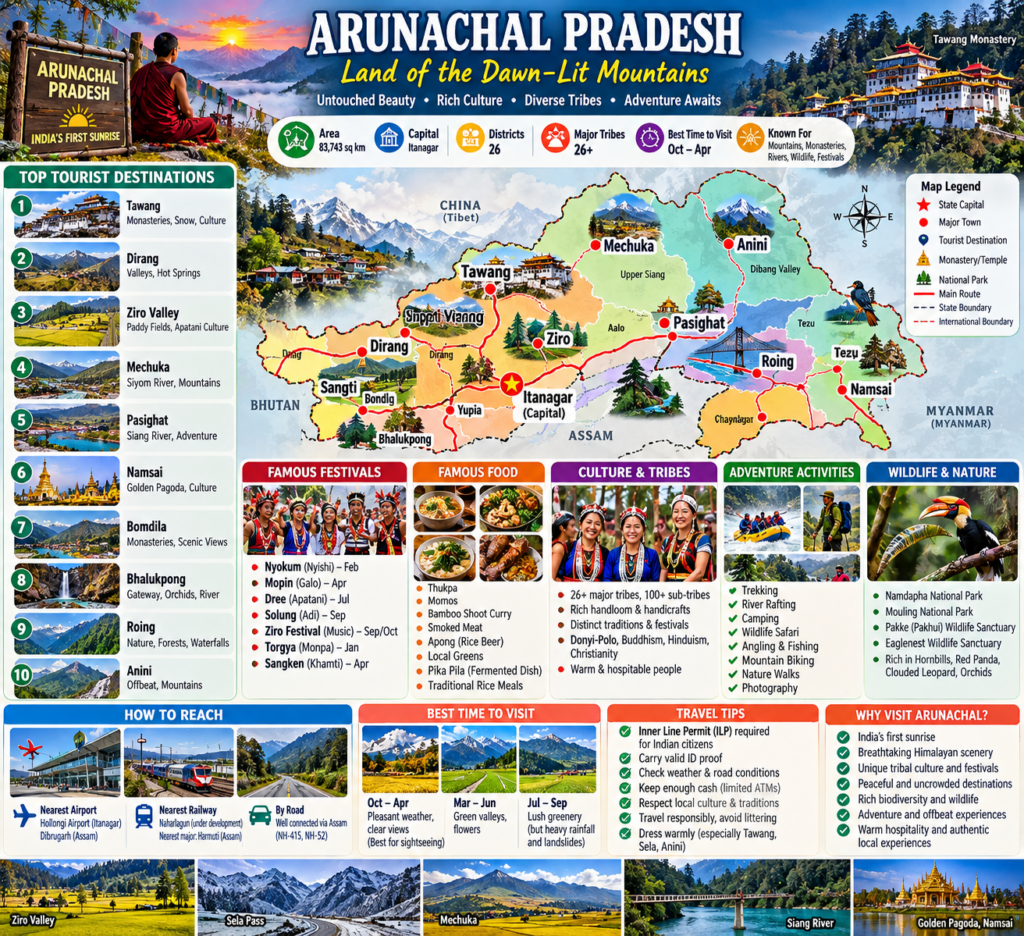
I am Arunachal Pradesh.
I am not a city. I am an entire state spread across India’s far northeastern mountains—about 83,743 sq km of valleys, forests, rivers, villages and Himalayan heights. People lovingly call me the Land of the Dawn-lit Mountains.
Before most of India wakes, light begins touching my eastern horizons.
But if you want to understand me, do not know me only through sunrise photographs, Tawang’s snow or Ziro’s green landscapes.
Sit beside me for a while.
I have a much longer story to tell.
🌅 “My Story Began Long Before My Present Name”
I existed long before political boundaries gave me the name Arunachal Pradesh.
My mountains, river valleys and communities carried histories that cannot be reduced to one kingdom or one ruler. Different parts of me developed different relationships with the Himalayan world, the Brahmaputra valley and neighbouring cultural regions.
Old traditions and archaeological remains still whisper across my landscape. The official state portal connects my cultural memory with the Kalika Purana and Mahabharata traditions, while archaeological and historical sites such as Malinithan, Bhismaknagar and Ita Fort preserve evidence of a much more complex past.
Some of my stories belong to documented history.
Others belong to mythology, faith and oral tradition.
I ask travellers to respect the difference—and appreciate both.
🗺️ “There Was a Time When the World Called Me NEFA”
My modern administrative story eventually became intertwined with the North-East Frontier Agency—NEFA.
That name remains important in understanding my twentieth-century history.
On 20 January 1972, NEFA was renamed Arunachal Pradesh and became a Union Territory. Then came another defining morning: on 20 February 1987, I attained statehood and became India’s 24th state.
My political status changed.
But my rivers continued running.
My villages continued weaving.
My farmers continued cultivating their land.
And my communities continued carrying languages, rituals and memories much older than any administrative name.
👨👩👧👦 “Do Not Call Me One Culture”
This is one of the most important things I want every visitor to understand.
There is no single costume, dance, cuisine or village tradition that can represent all of me.
Official tourism material describes me as home to 26 major tribes and more than 100 sub-tribes, with distinct customs and traditions.
The Adi, Galo, Apatani, Nyishi, Tagin, Monpa, Sherdukpen, Khamti, Singpho, Mishmi, Nocte, Wancho and many other communities make my cultural landscape extraordinarily varied.
Walk through Tawang and you encounter a strong Buddhist Himalayan cultural world.
Reach Ziro and Apatani landscapes tell another story.
Move toward Pasighat and Adi traditions become more visible.
Travel farther east and yet more languages, foods, festivals and beliefs emerge.
That is why I become uncomfortable when someone writes simply:
“Arunachal culture is…”
Which Arunachal?
Which community?
Which valley?
Which generation?
Ask those questions, and you begin to know me properly.
🙏 “My Faith Has Many Voices”
I have never spoken to the sacred in only one language.
Indigenous belief systems, including Donyi-Polo traditions, remain part of my cultural landscape. Buddhism has deep roots among communities including the Monpa and others, while other indigenous communities maintain their own spiritual traditions. Christianity and Hindu traditions are also part of contemporary Arunachal Pradesh.
In Tawang stands the great monastery that has watched generations pass beneath the Himalayan sky.
In Namsai, Buddhist architecture and culture tell another eastern story.
Parshuram Kund carries Hindu pilgrimage traditions.
Across villages, indigenous relationships between community, ancestors and nature continue to shape cultural life.
I do not ask travellers to choose one version of me.
I ask them to understand my plurality.
🎉 “When I Celebrate, My Villages Become My Stages”
If you arrive during one of my festivals, you may understand in a few days what ordinary sightseeing cannot teach in weeks.
Nyokum, Mopin, Dree, Solung, Reh, Losar, Sangken, Oriah and Chalo Loku are not merely colourful additions to a tourism calendar. Many have deep agricultural, community or spiritual meanings. Official tourism material notes the close relationship between many of my festivals and agriculture.
My celebrations can carry prayers for crops, thanksgiving, community memory, music, dance and food.
My modern cultural calendar has grown too.
The Ziro music experience has brought contemporary music audiences into my mountains, while events associated with Tawang, Dambuk and river and adventure tourism have introduced new ways for visitors and local economies to meet.
But remember something when you arrive with your camera:
My festivals existed before your photograph.
Some ceremonies are sacred.
Ask before entering intimate spaces. Ask before photographing people closely. Let celebration remain celebration rather than turning every human moment into content.
🧵 “My History Is Woven Into My Hands”
Look carefully at my textiles.
You may find history without opening a textbook.
Weaving, cane and bamboo work, basketry, wood carving, painting, pottery and other forms of craftsmanship have long formed part of my artistic traditions. Different communities developed recognizable techniques, designs and objects.
These are not merely “souvenirs.”
A handwoven textile can contain identity.
A basket can contain generations of practical knowledge.
A carved object may have a meaning that a casual buyer never notices.
So when you shop here, ask:
“Who made this?”
That simple question can transform shopping into cultural learning—and can help direct economic value toward the people who preserve the skill.
🍚 “Come Hungry, But Do Not Ask Me for One Arunachali Dish”
My food changes as my geography and communities change.
Rice is important across many areas. Depending on the community and locality, travellers may encounter bamboo-shoot preparations, leafy vegetables, meat dishes, smoked or fermented foods, fish, momos, noodles and warming soups such as thukpa.
But please do not reduce my cuisine to “momos and thukpa.”
Nor should every local preparation be labelled “traditional Arunachali food” without identifying the community or place from which it comes.
My contemporary towns have changed too.
Itanagar, Naharlagun, Tawang and other centres now serve combinations of regional food, Indian dishes, Indo-Chinese cooking, cafés and modern restaurant fare.
The Government’s current tourism policy itself recognizes indigenous cuisine, local beverages, festivals and crafts as part of the state’s potential for culturally responsible tourism.
For me, food is not merely something a tourist consumes.
It is geography served on a plate.
🌾 “My Fields Are Part of My Identity”
I am famous for mountains, but agriculture remains deeply connected to my communities.
Travel through my valleys and you may see a different economic Arunachal emerging—horticulture, fruit, spices, local produce, farmer organizations and small processing enterprises.
Kiwi, oranges, apples, pineapple, ginger, turmeric, cardamom and other products offer opportunities for farmers and entrepreneurs in suitable districts.
My future need not be only about producing more.
It can be about adding more value locally.
Grade my fruit here.
Pack it here.
Process it here.
Brand it here.
Build cold chains that reduce waste.
Help my farmers reach distant customers.
When more of that value remains with local communities, economic growth begins to feel different.
🏭 “My Industrial Revolution Does Not Look Like Mumbai or Gujarat”
Do not search my mountains expecting endless factory chimneys.
My industrial evolution follows my geography.
Small enterprises, food processing, handicrafts, tourism, construction, transportation and services matter. Hydropower and major infrastructure projects have introduced another scale of economic activity.
Road building brings machinery.
Hydropower construction brings engineering and project logistics.
Tourism creates demand for hotels, taxis, cafés, guides and homestays.
Horticulture creates demand for packhouses, refrigeration, transportation and processing.
Digital connectivity allows a young entrepreneur sitting in one of my towns to sell beyond my borders.
My industrial future does not need to imitate somebody else’s past.
🚧 “For Generations, Distance Protected Me—and Limited Me”
Mountains are beautiful when seen through a traveller’s camera.
For the person trying to move vegetables, medicine, construction equipment or school supplies, those same mountains are a logistics problem.
That contradiction has shaped me.
Roads and bridges have gradually changed how my communities connect with one another and with neighbouring Assam.
Today, official tourism promotes road circuits linking destinations such as Tawang, Ziro, Pasighat, Tezu, Namdapha, Roing, Anini, Pakke and Mechuka.
Every improved road can mean more than tourists.
It can mean a farmer reaches market faster.
A patient reaches treatment sooner.
A student gains access to education.
A shopkeeper replenishes stock more reliably.
And a remote tourism entrepreneur suddenly becomes reachable.
🌲 “Please Do Not Call My Forests Empty Land”
Much of what appears empty on a map is alive.
My geography ranges from subtropical environments in lower elevations toward alpine conditions in the high mountains. Official tourism material describes more than 80% forest cover and extraordinarily rich biodiversity.
My rivers include the Kameng, Subansiri, Siang, Lohit and Tirap.
My protected landscapes include Namdapha and Mouling National Parks and wildlife sanctuaries such as Pakke/Pakhui and Eaglenest, among others.
Orchids have become another part of my natural identity; Tipi near Bhalukpong is particularly associated with orchid conservation and display.
I want tourists.
I want livelihoods.
I want better infrastructure.
But I cannot afford growth that destroys the reason people travel thousands of kilometres to see me.
🏔️ “Tawang Is Famous, But I Am Much Bigger Than Tawang”
Yes, Tawang is magnificent.
Its Himalayan setting, Monpa culture and monastery have become internationally recognizable symbols of me.
But please keep travelling.
Come to Ziro and slow down.
Follow the Siang toward Pasighat.
Travel to Aalo.
Go farther toward Mechuka.
Explore Namsai.
Discover Roing and the road toward Anini.
Understand Bhalukpong, Tipi and Pakke.
Look toward Miao and Namdapha.
Official tourism now promotes numerous circuits across my western, central and eastern landscapes because I cannot be understood through one destination.
🥾 “I Am Not a Checklist—I Am a Journey”
You may come looking for “Top 10 Places to Visit in Arunachal Pradesh.”
I understand.
But I hope you leave thinking differently.
My road journeys are part of the destination.
Sometimes clouds descend and hide the mountain you travelled hours to photograph.
Sometimes rain changes your plan.
Sometimes the most memorable moment is not a famous attraction but tea in a small settlement while waiting for the weather to clear.
Official tourism highlights trekking, rafting, angling, wildlife, culture and heritage among my major visitor experiences.
You do not need to conquer me.
Travel slowly enough to understand me.
📸 “Photograph Me, But Do Not Hurt Me for a Photograph”
My mountains can make people reckless.
Do not walk onto an unstable edge for a selfie.
Do not enter a powerful river because it looks calm from the road.
Do not fly a drone simply because the valley looks beautiful—aviation, security and local restrictions matter, especially in sensitive border areas.
Do not photograph a person in traditional clothing as though they were part of the scenery.
Ask.
Respect.
Observe.
A better photograph often begins with better behaviour.
🏡 “Tourism Is Changing My Villages”
A traveller sees a homestay.
I see an economic chain.
One guest may create income for a driver, farmer, cook, guide, craftsperson, café, shop and family-owned accommodation.
That is why community-based tourism matters so much to my future.
My 2025–30 Tourism Policy explicitly emphasizes sustainable tourism, indigenous culture, cuisine, crafts, festivals and community experiences.
I do not want every valley covered with identical concrete hotels.
I would rather grow in ways that allow visitors to stay comfortably while still knowing where they are.
💼 “My Young People Are Writing My Next Chapter”
My story is no longer only agriculture and government employment.
A new generation can build tourism companies, food brands, logistics services, digital agencies, photography businesses, cafés, e-commerce stores, homestays and value-added agricultural enterprises.
Some will leave my mountains to study.
Some will return.
Some will build businesses from laptops.
Some will continue family skills with modern branding and technology.
My greatest opportunity is not to become another state.
It is to make being Arunachal an economic advantage.
❤️ “Why Should You Visit Me?”
Do not visit me only because I am beautiful.
Visit because I can change the rhythm of your journey.
Come when you have enough time to drive slowly.
Come when you are willing to learn the difference between communities instead of calling everything “tribal culture.”
Come hungry enough to try local food.
Come curious enough to enter a museum.
Come patient enough to sit beside a river without needing entertainment.
Come respectful enough to understand that a monastery is not a film set, a village is not a theme park and a festival is not performed merely for visitors.
And come prepared.
Domestic tourists require an Inner Line Permit (ILP), while foreign visitors are subject to the applicable Protected Area Permit (PAP) requirements.
🌄 “I Am Arunachal Pradesh, and My Story Is Still Being Written”
I have been known through indigenous homelands, frontier administration, NEFA, Union Territory and finally statehood.
I have watched old walking routes become roads.
I have watched remote settlements receive visitors carrying smartphones and cameras.
I have seen traditional markets meet e-commerce, homestays meet online booking and ancient cultural practices encounter a rapidly changing world.
Yet every morning, the mountains remind me of something simple.
Development is important.
But memory is important too.
Roads matter—but so do forests.
Tourism matters—but so does dignity.
Industry matters—but so do rivers.
Jobs matter—but so does cultural identity.
I am Arunachal Pradesh—the Land of the Dawn-lit Mountains.
Do not rush through me simply collecting destinations.
Listen to my rivers. Learn from my communities. Taste my food. Walk gently through my forests. Buy from my artisans. Respect my sacred spaces. Give my mountains the time they deserve.
Because perhaps my greatest attraction is not that I am one of the first places in India to meet the morning light.
It is that, even after centuries of change, I can still remind a traveller what it feels like to slow down, look carefully, and begin again.
📍 Where Is Arunachal Pradesh State in India?
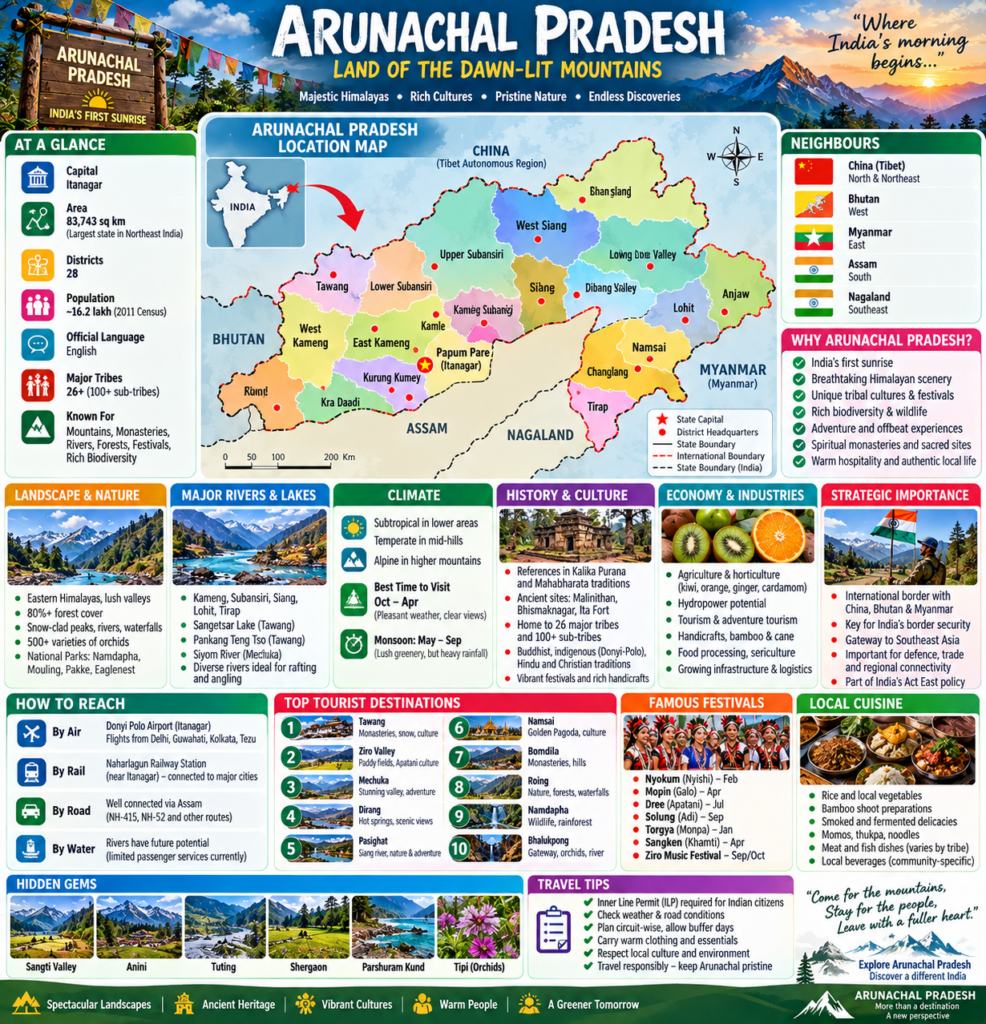
Arunachal Pradesh sits at the far northeastern edge of India, where the plains of Assam rise dramatically into forested hills, deep river valleys and the eastern Himalayas. Its capital is Itanagar, and with an area of about 83,743 sq km, it is the largest state in Northeast India by geographical area. The current Arunachal Pradesh State Portal lists 28 districts.
Look at Arunachal Pradesh on a map and its location immediately explains much of its character. Bhutan lies to the west, China/Tibet to the north and northeast, Myanmar to the east, while Assam and Nagaland lie along its southern side. This international-border position makes Arunachal not only a spectacular tourism destination but also a strategically significant Himalayan state.
| 🧭 Quick Fact | Arunachal Pradesh |
|---|---|
| 📍 Region | Northeast India / Eastern Himalayas |
| 🏛️ Capital | Itanagar |
| 📐 Area | 83,743 sq km |
| 🗺️ Districts | 28 |
| 🌏 International neighbours | Bhutan, China and Myanmar |
| 🇮🇳 Indian neighbours | Assam and Nagaland |
| 🌲 Landscape | Himalayas, forests, valleys, rivers and high-altitude terrain |
| 🌊 Major rivers | Kameng, Subansiri, Siang, Lohit and Tirap |
| 🌦️ Climate | Subtropical in lower areas to alpine in high mountains |
| 🛫 Main capital airport | Donyi Polo Airport, Itanagar |
| 🚆 Important rail gateway | Naharlagun |
| 🚗 Travel character | Primarily road-based within the state |
| 🪪 Visitor requirement | ILP for domestic tourists; applicable PAP requirements for foreign tourists |
Official tourism describes Arunachal’s climate as ranging from subtropical in the south to alpine in the north, with more than 80% of its landscape under thick evergreen forest.
🗺️ Understanding Arunachal Pradesh on the Map
Arunachal Pradesh is not one compact valley or one mountain destination. It stretches for a considerable distance from the Tawang–West Kameng region in the west to the Lohit–Anjaw–Changlang side in the east.
This matters enormously when planning a holiday.
A traveller should not think of Tawang, Ziro, Mechuka, Namdapha and Anini as nearby attractions that can simply be joined in a three-day itinerary. Mountain geography, river systems and road corridors make travel times far more important than straight-line distances.
The state can be understood through several broad travel landscapes:
| 🗺️ Travel Zone | Important Places | Landscape / Character |
|---|---|---|
| 🏔️ Western Arunachal | Tawang, Dirang, Bomdila, Bhalukpong | High Himalayas, monasteries, passes |
| 🌾 Central-West | Itanagar, Ziro, Daporijo | Capital region, valleys, indigenous culture |
| 🌊 Siang belt | Aalo, Pasighat, Yingkiong, Tuting | Major river valleys and adventure |
| 🏞️ Dibang region | Roing, Mayodia, Anini | Mountains, forests, remote valleys |
| 🙏 Eastern belt | Tezu, Namsai, Hayuliang | River valleys, Buddhist and cultural landscapes |
| 🌳 Southeast | Miao, Namdapha, Changlang | Rainforest, wildlife, WWII history |
Arunachal Tourism itself structures travel around multiple circuits such as Tezpur–Bhalukpong–Bomdila–Tawang, Itanagar–Ziro–Daporijo–Aalo–Pasighat, Pasighat–Jengging–Yingkiong, Dibrugarh–Roing–Mayudia–Anini and Aalo–Mechuka.
That is a much more realistic way to plan Arunachal than trying to “cover the whole state.”
🏔️ Geography – From Assam’s Plains to the High Himalayas
The physical transition into Arunachal Pradesh can be dramatic.
Approach from Assam and the landscape begins climbing from broad plains toward densely forested foothills. Continue northward and valleys become narrower, rivers faster and mountains increasingly dominant.
Eventually, in the higher reaches, forested mountains give way to severe Himalayan terrain and snowbound landscapes.
Official tourism describes four broad forest types arising from variations in altitude and climate, and reports more than 500 varieties of orchids.
This vertical geography creates extraordinary ecological diversity—but it also creates difficult engineering and logistics conditions.
A road distance that looks modest on a map can involve bends, steep gradients, bridges, landslide zones and considerable elevation change.
That is why Arunachal is best travelled circuit by circuit rather than kilometre by kilometre.
🌊 The Rivers That Shape Arunachal Pradesh
Five river systems are particularly important in understanding the state:
Kameng, Subansiri, Siang, Lohit and Tirap.
Among them, the Siang has extraordinary geographic significance. It enters India from Tibet and eventually contributes to the Brahmaputra system downstream. Official tourism notes that early explorers once regarded this stretch as the missing geographical link between Tibet’s Tsangpo and Assam’s Brahmaputra.
These rivers are simultaneously natural attractions and economic resources.
They support ecosystems, agriculture, fisheries, rafting and tourism while also underpinning Arunachal Pradesh’s enormous hydropower potential.
But they are powerful Himalayan rivers—not casual swimming pools. Travellers should treat apparently calm stretches with caution.
🏞️ Lakes, Passes and High Mountains
Western Arunachal provides some of the state’s most recognizable high-altitude scenery.
The Sela Pass landscape, alpine lakes around the Tawang circuit, snow-covered peaks and steep mountain roads produce the visual image many first-time travellers associate with Arunachal.
Sangetsar Lake near Tawang has become another well-known high-altitude attraction.
Yet the state contains very different mountain environments farther east.
Mechuka lies within a broad, dramatic valley around the Siyom landscape. Anini opens toward the remote Dibang mountains. Tuting leads travellers deep into the upper Siang country.
These are not simply substitutes for Tawang.
Each landscape has its own geography and communities.
🌲 Forests & Wildlife – Arunachal’s Living Natural Wealth
More than four-fifths of Arunachal Pradesh is described by official tourism material as being covered by thick evergreen forests.
Important protected landscapes include Namdapha, Mouling, Pakke/Pakhui, Eaglenest, Mehao and Daying Ering, among others.
For wildlife travellers, birdwatchers and botanists, this is one of Arunachal’s greatest strengths.
Namdapha in particular represents an entirely different Arunachal from the snowy photographs of Tawang: humid, heavily forested and extraordinarily biodiverse.
Tipi near Bhalukpong is closely associated with orchids, while Pakke and Eaglenest have strong appeal for bird and wildlife enthusiasts.
This diversity explains why a comprehensive Arunachal itinerary can feel almost like travelling through several different geographical regions.
🌦️ Climate – There Is No Single “Arunachal Weather”
As elevation changes, climate changes with it.
Lower areas can be warm, humid and subtropical.
Middle elevations can be comparatively temperate.
High Himalayan locations can experience severe winter conditions.
Official tourism reports average rainfall above 3,000 mm annually across the state while describing the overall climate transition from subtropical to alpine.
This makes broad statements such as “Arunachal temperature is 15°C” meaningless without naming a location and season.
For most sightseeing circuits, October to April offers broadly favourable conditions, while spring and early summer can also work particularly well for mountain landscapes. Monsoon travel can reveal intensely green scenery, but heavy rain may disrupt mountain roads.
Always check actual road and weather conditions immediately before travel.
🏺 Ancient History, Archaeology & Mythology
Arunachal Pradesh has a fascinating meeting point between archaeology, oral traditions and mythology—but these should not be mixed together as though they are equally documented history.
The official tourism portal associates the region with references in the Kalika Purana and Mahabharata traditions. It recounts traditions concerning Parashurama, Vyasa, King Bhishmaka, Rukmini and Krishna.
These are religious and mythological traditions, not evidence that every corresponding event has been historically established.
Archaeology provides a different layer.
🏰 Bhismaknagar
Bhismaknagar in Lower Dibang Valley contains the ruins of a fortified settlement constructed with burnt bricks. Official tourism material dates the remains to roughly the 12th century CE while also recording the traditional association with King Bhismaka and Rukmini.
🪨 Malinithan
Malinithan contains temple ruins and stone sculptures and is associated in local religious tradition with Krishna, Rukmini and Parvati/Malini.
🏯 Ita Fort
Ita Fort is an important archaeological landmark associated with the capital region. The very name Itanagar—“city of bricks”—is connected with the fort.
🙏 Parshuram Kund
Parshuram Kund on the Lohit is a major pilgrimage landscape. Religious tradition recorded in the Kalika Purana associates it with Parashurama washing away his sin.
These places give travellers something much richer than a simplistic claim that “Arunachal has no ancient history.”
👑 Kingdoms, Chiefs and Cultural Regions
It is misleading to search for one continuous “Arunachal dynasty.”
Today’s state incorporates many culturally and historically distinct territories.
Different valleys interacted with neighbouring Assam, Tibet and Himalayan polities in different ways. Indigenous communities maintained their own social and political institutions, while some regions experienced Buddhist cultural influences and others interacted with plains kingdoms.
The Monpa cultural landscape of western Arunachal, for example, cannot simply be interpreted through the same historical framework as the Adi areas around the Siang or the communities of eastern Arunachal.
This fragmented historical geography is not a weakness.
It is precisely what makes Arunachal’s history unusually rich.
🇬🇧 Colonial Era – From Frontier Tracts to NEFA
The modern administrative shape developed largely during the colonial and post-colonial periods.
The official state gazetteer records that in 1914, hill tracts separated from parts of Assam were organized into the North-East Frontier Tract. Administrative names and divisions subsequently changed several times.
The region later became widely known as the North-East Frontier Agency (NEFA).
On 20 January 1972, it became the Union Territory of Arunachal Pradesh.
On 20 February 1987, Arunachal Pradesh attained full statehood.
The state’s southeastern history also contains an unusual Second World War chapter: the Stilwell Road connected Ledo in Assam toward Myanmar and China, and official tourism material notes WWII-related remains in the Changlang region.
👨👩👧👦 Cultural Geography – Many Arunachals Within One State
Arunachal Tourism describes the state as home to 26 major tribes and more than 100 sub-tribes, each with distinct traditions and customs.
This diversity is fundamental to responsible travel writing.
Tawang and West Kameng have strong Monpa and Buddhist cultural influences.
Ziro is strongly associated with Apatani cultural landscapes.
Adi traditions are important across the Siang region.
Galo culture is prominent around Aalo and adjoining areas.
Eastern Arunachal introduces still more cultural worlds, including Khamti, Singpho, Mishmi, Nocte and Wancho traditions.
Donyi-Polo indigenous traditions coexist with Buddhism, Christianity, Hindu traditions and other indigenous belief systems.
Therefore, there is no single “Arunachal costume,” “Arunachal festival” or “Arunachal tribal food.”
Specificity is respect.
🎉 Festivals That Help Explain the State
Agriculture and community life shape many traditional festivals.
Well-known examples include Nyokum, Dree, Mopin, Solung, Reh, Sangken, Oriah, Si-Donyi and Chalo Loku, alongside Buddhist celebrations such as Losar and Torgya.
Arunachal Tourism specifically notes that agriculture is closely connected with many community festivals.
Modern tourism and cultural events have added another layer, including the Ziro Music Festival, Tawang Festival and Dambuk Orange Festival.
For visitors, the distinction matters: a traditional religious or agricultural festival is first a community event and only secondarily a tourist attraction.
🍚 What Does Arunachal Pradesh Taste Like?
Food changes significantly by community and location.
Rice is important across many areas. Travellers may encounter preparations involving bamboo shoots, local greens, meat, smoked or fermented ingredients, fish, momos, noodles and thukpa, depending on where they travel.
Local beverages also occur within particular cultural traditions.
It is better to ask, “What food is traditional to this community?” rather than searching for one universal “Arunachal thali.”
Contemporary Itanagar, Tawang and other towns additionally have cafés and restaurants serving North Indian, Northeast Indian, Indo-Chinese and other modern cuisines.
💰 Economy – Why Geography Shapes Business
Mountains explain Arunachal’s economy almost as much as policy does.
Agriculture and horticulture remain important, while hydropower, tourism, construction, government services, handicrafts and small businesses contribute to its changing economy.
IBEF estimates Arunachal Pradesh’s GSDP at approximately ₹495.06 billion (₹49,506 crore) at current prices in FY2025-26. It identifies arts and crafts, weaving, cane and bamboo, tourism and horticulture among important industries.
The state’s industrial policy identifies areas including food and agro-processing, horticulture processing, bamboo/cane and other non-timber forest products, textiles, handicrafts, sericulture, tourism and adventure-tourism infrastructure as thrust sectors.
This is why Arunachal’s future industrial model should not be imagined as another Pune, Surat or Ahmedabad.
Its comparative opportunities are different.
🚛 Why Arunachal Pradesh Matters for Transport & Logistics
Arunachal Pradesh is a textbook example of how geography changes freight economics.
Consumer goods, construction materials, machinery, fuel, agricultural products and project equipment often depend heavily on roads and gateways through Assam.
Mountain logistics then become progressively more demanding.
For ordinary freight, that means longer transit times and greater sensitivity to weather and road conditions.
For heavy and oversized industrial cargo, the challenges become much more technical:
bridge capacity → gradient → hairpin bends → turning radius → road width → overhead obstruction → landslide risk → unloading location.
Hydropower and infrastructure development consequently create demand for specialized trucking, route surveys, cranes, material handling, warehousing, equipment maintenance and project logistics.
At the other end of the supply chain, horticulture creates the opposite logistics problem: moving perishable, relatively lightweight cargo quickly enough to preserve value.
That is why packhouses, reefer transport, cold storage and aggregation can be as strategically important as heavy haulage.
🛣️ Road Connectivity – The Backbone of Travel
For most visitors, roads remain the essential way of actually experiencing Arunachal.
The state’s tourism circuits demonstrate how strongly Arunachal connects outward through Assam gateways.
Examples include:
Tezpur → Bhalukpong → Bomdila → Tawang
Itanagar → Ziro → Daporijo → Aalo → Pasighat
Dibrugarh → Roing → Mayudia → Anini
Margherita → Miao → Namdapha
This creates an important planning principle:
A 150-km Himalayan journey can behave very differently from 150 km on an expressway.
✈️ Air Connectivity – Donyi Polo Changed the Capital Gateway
Donyi Polo Airport at Hollongi is the primary aviation gateway for Itanagar.
The Airports Authority of India describes it as a greenfield airport connected to the capital via NH-415. Its runway is 2,300 metres long.
AAI’s February 2026 publication reports direct connectivity with Delhi, Kolkata, Guwahati and Tezu at that time; airline schedules remain dynamic and should be checked before travel.
Tezu also has an operational AAI airport.
Depending on the destination, airports in neighbouring Assam—including Guwahati and Dibrugarh—can remain useful gateways.
For example, Dibrugarh is strategically convenient for parts of eastern Arunachal, while Assam-side gateways serve the western Tawang circuit.
🚆 Rail Connectivity – Naharlagun Is the Key Passenger Gateway
Rail does not penetrate most of Arunachal’s mountain destinations.
Naharlagun, near Itanagar, is therefore particularly important.
Northeast Frontier Railway reported in July 2025 that seamless electric traction had reached Naharlagun, with services including the Arunachal AC Express operating over electrified routes.
From the railway station, however, the Arunachal experience quickly becomes road-based.
There is no train directly to Tawang, Ziro, Mechuka or Anini.
That distinction is useful for voice-search queries such as:
“Can I reach Tawang by train?”
The practical answer is no—rail gets you to a gateway; mountain road transport completes the journey.
🚢 Water Connectivity – River Potential, Not a Mature Passenger Network
Arunachal has enormous rivers, but tourists should not interpret that as meaning the state has a developed ferry or cruise network comparable with major inland-waterway regions.
A 2026 Inland Waterways Authority of India document says the Siang currently lacks organized inland-navigation infrastructure, including designated navigation channels, terminals and navigational aids. IWAI is assessing a roughly 114-km Oriumghat–Pasighat View Point stretch for potential inland-waterway development.
So the correct current description is:
Road = primary internal transport.
Rail = important gateway connectivity.
Air = increasingly important gateway connectivity.
Water = substantial future potential, but limited organized navigation infrastructure today.
🏔️ Why Arunachal Pradesh Is Important for Tourism
Few Indian states combine such contrasting experiences within one border.
A visitor can experience Himalayan monasteries in Tawang, Apatani cultural landscapes around Ziro, the Siang around Pasighat, the remote mountain scenery of Mechuka and Anini, Buddhist architecture around Namsai and tropical biodiversity around Namdapha.
Official tourism highlights trekking, rafting, angling, wildlife, culture and heritage among its major experiences.
⭐ Famous Attractions and Hidden Landscapes
| Destination | Why It Matters |
|---|---|
| 🛕 Tawang Monastery | Major Himalayan Buddhist heritage |
| ❄️ Sela landscape | High-altitude mountain scenery |
| 💦 Nuranang/Jung Waterfall | Major waterfall attraction |
| 🌾 Ziro Valley | Apatani cultural landscape |
| 🏞️ Mechuka | Remote mountain valley and Siyom landscape |
| 🌊 Pasighat | Gateway to Siang experiences |
| 🌳 Namdapha | Major biodiversity landscape |
| 🐦 Pakke | Wildlife and birding |
| 🌺 Tipi | Orchid-focused attraction |
| 🛕 Golden Pagoda, Namsai | Buddhist architecture and culture |
| 🌄 Roing | Gateway to Lower Dibang landscapes |
| 🏔️ Anini | Remote Dibang mountain scenery |
| 🌲 Sangti Valley | Quieter valley near Dirang |
| 🏘️ Shergaon | Village and cultural landscape |
| 🏺 Bhismaknagar | Archaeological heritage |
| 🙏 Parshuram Kund | Pilgrimage and Lohit landscape |
🧭 Arunachal Pradesh as a Gateway
Arunachal should not be thought of as an isolated endpoint.
Its tourism geography is closely linked to Assam.
Tezpur helps feed the western route toward Bhalukpong, Bomdila and Tawang.
North Lakhimpur/Harmuti connects naturally with the Itanagar side.
Dibrugarh and Tinsukia are important gateways toward eastern circuits such as Roing, Namsai, Tezu, Miao and Namdapha.
This also matters commercially.
Assam provides access to larger railheads, airports, wholesale markets and the wider Brahmaputra transport economy. Arunachal then functions as the mountain market and production landscape beyond those gateways.
Its location also gives it potential long-term relevance to cross-border Asian connectivity, although international borders and actual trade routes are subject to national security, customs and bilateral arrangements; geographic proximity should never be confused with an automatically open commercial border.
🎒 Practical Visitor Information
Domestic tourists need an Inner Line Permit (ILP) to visit Arunachal Pradesh, while foreign visitors are subject to the applicable Protected Area Permit (PAP) framework. Arunachal Tourism provides the official entry points for these permit processes.
Build buffer days into longer itineraries. Check road and weather conditions immediately before remote journeys. Carry identification and permit copies, essential medication, warm layers for high elevations, rain protection where appropriate and some cash for places where digital connectivity may be unreliable.
Most importantly, do not attempt to cover the entire state simply because a map makes the destinations appear close.
❤️ So, Where Is Arunachal Pradesh Really?
On a political map, the answer is easy:
Arunachal Pradesh is India’s northeasternmost Himalayan state, bordered internationally by Bhutan, China and Myanmar and domestically by Assam and Nagaland.
But a traveller discovers a larger answer.
Arunachal Pradesh lies where the Brahmaputra’s great tributary systems descend from the mountains; where tropical forests gradually climb toward snow country; where monasteries, indigenous faiths, archaeological ruins and living village traditions share the same landscape; and where India’s roads eventually disappear into some of its most remote valleys.
Come for Tawang if that is what first puts Arunachal on your map.
Then look beyond it.
Follow another journey toward Ziro, the Siang, Mechuka, Namsai, Namdapha, Roing or Anini. Travel slowly enough to understand why each valley feels culturally and geographically different.
Because Arunachal Pradesh is not a destination to be “finished.”
It is a state best discovered one river, one road, one community and one mountain valley at a time.
✈️🚆🚌 How to Reach Arunachal Pradesh – Complete Public Transport & Stay Guide
For a first-time or outstation traveller, the most important thing to understand is that there is no single transport hub for the whole of Arunachal Pradesh. The best gateway depends on whether you are going to Itanagar, Ziro, Tawang, Mechuka, Pasighat, Namsai, Roing, Anini or Namdapha.
For Itanagar and central Arunachal, Donyi Polo Airport and Naharlagun railway station are the key gateways. For Tawang, travellers commonly enter through Assam and continue by road via Bhalukpong–Bomdila–Dirang. For eastern Arunachal, Dibrugarh/Tinsukia and other Assam-side gateways can be more practical than travelling through Itanagar.
Indian tourists should also arrange an Inner Line Permit (ILP). Arunachal Tourism currently states that tourist eILP is for stays up to 14 days and lists facilitation at Donyi Polo Airport and Naharlagun railway station, among other locations.
🚦 Arunachal Pradesh Transport Comparison Chart
| 🚗 Mode | Main Gateway / Availability | Best For | Typical Cost* | Travel Character | Online Booking | First-Time Traveller Advice |
|---|---|---|---|---|---|---|
| ✈️ Air | Donyi Polo Airport (Hollongi) | Itanagar/Naharlagun | Dynamic airfare | Fastest long-distance gateway | Airline websites/apps | Best if capital is first stop |
| 🚆 Train | Naharlagun | Itanagar, onward road trips | ₹200–₹3,000+ | Economical | IRCTC | Good for budget travellers |
| 🚆 Assam rail gateway | Guwahati/Harmuti & destination-specific stations | Connecting journeys | Dynamic | Useful network gateway | IRCTC | Match station to final destination |
| 🚌 State bus | APSTS routes | Budget intercity travel | Route dependent | Economical but slower | Verify current route/booking | Confirm departure a day before |
| 🚌 Private bus/shared vehicle | Major towns/Assam gateways | Budget travellers | ₹300–₹2,000+ | Route dependent | Some operators online | Don’t assume every route runs daily |
| 🚙 Shared Sumo/Maxi Cab | Widely important | Mountain towns | ₹500–₹2,500+ | Very useful locally | Mostly local booking | Common solution for remote routes |
| 🚕 Private taxi | Airports/stations/towns | Families/seniors | ₹2,000–₹8,000+ per travel day | Flexible | Local operator/OTA where available | Confirm one-way vs round-trip price |
| 🚘 Rental vehicle | Limited compared with metros | Road trips | ₹2,500–₹7,000+ daily | Flexible | Operator dependent | Local driver is often easier |
| 🛺 Auto-rickshaw | Mainly urban/local areas | Short distances | Local fare | Last mile | Mostly offline | Negotiate/confirm fare first |
| 🏍️ Bike taxi | Limited/not statewide | Short urban trips | Dynamic | Availability uncertain | App/local | Never depend on it for itinerary |
| 📱 App cab | Limited outside larger urban areas | Local transfers | Dynamic | Not dependable statewide | App if service available | Keep local taxi backup |
| 🚇 Metro | None | — | — | Not available | — | Do not search for an Arunachal Metro |
| 🚊 Local/suburban train | Very limited relevance | — | — | Not a practical tourism network | IRCTC | Use rail as gateway, then road |
| ⛴️ Waterway | No mature tourist passenger network | Future/niche potential | — | Not regular public transport | — | Do not plan a trip around ferries |
Costs are planning ranges, not quoted fares. Fuel, season, road conditions, vehicle type and shared/private travel can change them substantially.
✈️ How to Reach Arunachal Pradesh by Air
🛬 Donyi Polo Airport – Main Airport for Itanagar
Donyi Polo Airport at Hollongi is the principal airport serving the capital region. It is the obvious air gateway for travellers whose itinerary starts around Itanagar, Naharlagun or central Arunachal.
AAI’s current information shows the airport operating scheduled services, but flight schedules change and should always be checked for the actual travel date.
✈️ Airport Planning Chart
| Airport | Best For | Approx Road Connection | Last Mile | Best Traveller Type |
|---|---|---|---|---|
| Donyi Polo Airport | Itanagar/Naharlagun | Roughly 25–30 km to Itanagar depending destination | Taxi/private transfer | Families, business, seniors |
| Guwahati Airport | Western/central connections | Long onward road/rail journey | Taxi/bus/train combination | All-India connectivity |
| Dibrugarh Airport | Eastern Arunachal | Road onward | Taxi/shared vehicle | Roing/Namsai/eastern circuits |
| Tezpur-side gateway | Tawang circuit | Road via Bhalukpong | Taxi/shared transport | Tawang visitors |
Do not automatically fly to Itanagar if your only destination is Tawang or far eastern Arunachal. It can create unnecessary backtracking.
🎫 Online Flight Booking
For reliable booking, compare fares but preferably complete the purchase through the operating airline or a reputable travel platform. Search using Donyi Polo Airport / Itanagar rather than assuming every booking engine uses the same destination wording.
Keep your ILP and identification accessible when entering the state.
🚆 How to Reach Arunachal Pradesh by Train
🚉 Naharlagun Railway Station
For the capital region, Naharlagun is the key railway station.
Arunachal Tourism places Naharlagun approximately 15 km from Itanagar and notes onward state/private buses and taxis. It also identifies Harmuti in Assam as another useful railway point.
🚆 Railway Gateway Comparison
| Station | State | Useful For | Approx Onward Connection | Last Mile |
|---|---|---|---|---|
| Naharlagun | Arunachal Pradesh | Itanagar/Naharlagun | ~15 km to Itanagar | Bus/taxi |
| Harmuti | Assam | Capital-region alternative | ~34 km to Itanagar per Tourism information | Taxi/bus |
| Guwahati | Assam | National rail connectivity | Connect onward toward Arunachal | Train/bus/taxi |
| New Tinsukia/Tinsukia area | Assam | Eastern Arunachal gateways | Road onward | Taxi/shared vehicle |
| Dibrugarh area | Assam | Roing/Namsai/east | Road onward | Taxi/shared vehicle |
Arunachal Tourism specifically suggests that travellers with limited direct rail choices can reach Guwahati first and connect onward toward Naharlagun.
📱 Online Train Booking
Use the official for reservations.
A useful first-time rule is:
Train gets you to the gateway; road transport gets you deep into Arunachal.
There is no tourist railway to Tawang, Mechuka, Ziro town centre, Anini or Namdapha.
🚌 Public Transport in Arunachal Pradesh
Public transport exists, but travellers coming from Delhi, Mumbai, Pune, Kolkata, Bengaluru or other major cities should not expect the frequency and predictability of a large metropolitan transport system.
State buses, private buses, shared Sumos/maxi cabs and taxis form the practical road-transport ecosystem.
In many mountain corridors, shared vehicles are especially important.
🚌 Choosing Public Transport
| Traveller | Better Choice | Why |
|---|---|---|
| 🎒 Solo backpacker | State bus/shared Sumo | Lower cost |
| 👨🎓 Student | Bus/shared taxi | Budget friendly |
| ❤️ Couple | Shared cab/private taxi | Better balance |
| 👨👩👧👦 Family | Private vehicle | Luggage + flexibility |
| 👴 Senior citizen | Private taxi | Rest stops and comfort |
| ♿ Reduced mobility | Pre-arranged accessible vehicle | Ordinary mountain public transport may be difficult |
| 📸 Photographer | Private taxi | Flexible stops |
| 🥾 Trekker | Shared/private vehicle + local guide | Remote last mile |
| 👨💼 Business traveller | Airport taxi/private vehicle | Predictability |
| 🏔️ Large group | Reserved tempo/traveller-type vehicle where available | Group logistics |
For buses and shared taxis, verify the actual departure point, reporting time, baggage policy and whether the vehicle runs daily before building a tight itinerary.
🚕 Taxis, Auto-Rickshaws & Last-Mile Transport
Itanagar–Naharlagun has considerably better local transport options than remote tourism circuits.
Autos and local taxis can handle short urban journeys. Shared vehicles become more important for inter-town transport.
App-based cab availability should be treated as supplementary rather than essential infrastructure. Do not construct a Tawang, Ziro or Mechuka itinerary on the assumption that an app cab will appear whenever you tap your phone.
For remote destinations, keep the driver’s number and agree beforehand on:
fare + fuel inclusion + waiting charges + driver’s night allowance + parking + toll/entry charges + return journey + weather-related delay policy.
That prevents most transport misunderstandings.
🚗 Self-Drive & Rental Vehicles
A private vehicle gives freedom, but Arunachal mountain driving can involve steep gradients, sharp bends, fog, rain, rough sections and long distances between services.
A locally experienced driver is often more practical for a first visit.
For high-altitude and remote circuits, choose a vehicle according to actual road conditions, not social-media aesthetics.
A luxury sedan is not automatically a luxury experience on a rough mountain road.
🏍️ Motorcycle Travel
Arunachal can be spectacular for experienced touring riders.
Popular broad riding landscapes include:
Bhalukpong → Bomdila → Dirang → Tawang
and circuits toward Ziro, Mechuka and eastern Arunachal.
But a bike journey requires more preparation than renting a motorcycle and opening Google Maps. Carry suitable riding gear, rain protection, basic puncture/repair supplies and adequate fuel planning.
Avoid riding remote mountain roads after dark.
🚇 Is There a Metro in Arunachal Pradesh?
No. Arunachal Pradesh does not have a metro railway system.
Therefore, phrases such as “nearest metro station to Tawang” or “Itanagar Metro” should not appear in a factual travel guide.
Use airport + railway + bus/shared taxi + local road transport instead.
🚊 Are Local Trains Available?
Arunachal does not have the dense suburban/local railway network seen around Mumbai, Kolkata or Chennai.
Naharlagun provides important rail access, but rail is essentially a gateway mode, not the principal way tourists move between Arunachal destinations.
⛴️ Can You Reach Arunachal Pradesh by Water?
Arunachal contains enormous rivers, but that does not mean there is a regular statewide passenger-waterway network.
For normal tourists, waterways should currently be treated as an experience or future transport opportunity rather than a dependable way to reach the state.
Do not book an Arunachal itinerary expecting regular cruise/ferry connections between tourist destinations.
🧭 Best Gateway for Each Major Tourist Destination
| 🎯 Destination | ✈️ Practical Air Gateway | 🚆 Useful Rail Gateway | 🚗 Main Last-Mile Mode | Approx Road Character |
|---|---|---|---|---|
| 🏛️ Itanagar | Donyi Polo | Naharlagun | Taxi/bus | Easy relative to remote circuits |
| 🌾 Ziro | Donyi Polo | Naharlagun | Taxi/shared vehicle | Mountain road |
| 🛕 Tawang | Guwahati/appropriate Assam gateway | Assam-side rail gateway | Taxi/shared vehicle | Long Himalayan drive |
| 🌲 Dirang | Assam-side gateway | Assam railhead | Road | Mountain |
| 🏞️ Mechuka | Destination-specific Assam/Arunachal gateway + road | Assam/Arunachal gateway | Long road transfer | Remote |
| 🌊 Pasighat | Regional air/road options | Assam gateway | Taxi/shared vehicle | Mixed |
| 🙏 Namsai | Dibrugarh-side gateway often practical | Tinsukia-area rail | Road | Comparatively accessible |
| 🌿 Roing | Dibrugarh-side gateway | Tinsukia-area rail | Road | Regional mountain/valley |
| 🏔️ Anini | Dibrugarh/eastern gateway | Assam rail gateway | Long road transfer | Remote mountain road |
| 🌳 Namdapha/Miao | Dibrugarh-side gateway | Tinsukia/Margherita side | Road | Forest/eastern circuit |
The central lesson is choose the airport and railway station for your final destination, not merely because it lies inside Arunachal Pradesh.
🛣️ Important Tourist Road Circuits
Arunachal Tourism officially promotes circuit-based travel. One of the most established western routes is Tezpur–Bhalukpong–Bomdila–Tawang. The official tourism site describes that circuit as roughly 350 km.
Another important circuit links Itanagar–Ziro–Daporijo–Aalo–Pasighat, while eastern and remote routes require separate planning.
For an outstation traveller, this circuit approach is far more sensible than attempting a “whole Arunachal tour.”
⏱️ Practical Road-Time Planning
Never convert distance into time using plains-highway assumptions.
| Road Type | Example Planning Rule |
|---|---|
| Urban/capital belt | Normal road estimates may broadly work |
| Foothill road | Add traffic/weather margin |
| Himalayan road | Add substantial buffer |
| High pass | Weather can dominate travel time |
| Remote valley | Keep daylight and fuel reserve |
| Monsoon route | Add contingency day |
| Winter high-altitude route | Verify pass/road status immediately before departure |
Google Maps time is an estimate—not a promise from the mountain.
🅿️ Parking & Paid Parking
Formal parking availability is inconsistent across Arunachal.
Larger hotels and some urban attractions may provide parking, while monasteries, market areas, viewpoints and village destinations can have limited designated space.
Do not advertise a tourist site’s parking as “free” or “paid” unless that specific site’s current system has been verified.
For accommodation, ask:
Is parking on the property? Is it secured? Can an SUV enter? Is overnight parking permitted? Is driver accommodation available?
These questions become particularly important for family road trips.
⚡ EV Charging in Arunachal Pradesh
EV travel is possible in parts of Northeast India, but an Arunachal road trip should not yet be planned with the assumption of metropolitan-style charging density.
For an electric-car itinerary, verify charging points immediately before travel, particularly before Tawang, Mechuka, Anini or other long remote sectors.
Keep generous battery reserve and confirm charging at accommodation.
For remote mountain travel, a charging point shown in an app should not be considered operational until recently confirmed.
👴♿ Senior Citizens & Differently Abled Travellers
Arunachal can be rewarding for older travellers, but destination selection matters.
Itanagar and developed town stays are easier than remote treks. Tawang requires high-altitude consideration, and some attractions involve steps, uneven terrain or steep access.
For reduced-mobility travellers, pre-arrange a vehicle rather than relying on shared transport. Ask hotels specifically about:
step-free entrance, lift availability, accessible bathroom, ground-floor rooms, wheelchair width, parking-to-room distance and backup electricity.
Accessible hotel” should never be assumed merely because an online listing says “senior friendly.”
🎫 Online Ticket Booking for Arunachal Pradesh
| Requirement | Recommended Booking Route |
|---|---|
| ✈️ Flights | Operating airline / reputable OTA |
| 🚆 Train | IRCTC |
| 🪪 ILP | Arunachal Tourism ILP information |
| 🏨 Accommodation | Hotel directly / reputable OTA |
| 🚌 Bus | Verify current operator/state transport availability |
| 🚕 Taxi | Hotel/local registered operator/verified marketplace |
| 🏡 Homestay | Tourism listing/direct verified property |
| 🥾 Adventure activity | Recognized local operator; verify permits and insurance |
Arunachal Tourism currently confirms tourist ILP facilitation at Naharlagun railway station and Donyi Polo Airport, among other entry points.
🏨 Budget, Mid-Range & Luxury Accommodation Guide
Arunachal Tourism confirms that accommodation across its circuits ranges from budget hotels and guest houses to homestays and hotels.
Because hotel prices fluctuate by season, festival, room category and booking date, the ranges below are planning budgets rather than live quotations.
| 📍 Area | 🛏️ Category | Approx Nightly Range | Best Location Strategy | Typical Amenities | Booking Tip |
|---|---|---|---|---|---|
| Itanagar/Naharlagun | Budget | ₹1,000–₹2,500 | Near city/transport connection | Basic room, Wi-Fi varies | Check parking and hot water |
| Itanagar | Mid-range | ₹2,500–₹5,500 | City centre/business areas | Restaurant, better rooms | Good for first/last night |
| Itanagar | Premium | ₹5,500–₹10,000+ | Better city properties | Larger rooms/services | Compare airport transfer |
| Ziro/Hapoli | Homestay/Budget | ₹1,200–₹3,000 | Near village/town according itinerary | Local experience | Book early around festivals |
| Ziro | Mid-range | ₹3,000–₹6,000+ | Valley/town | Better comfort | Confirm vehicle access |
| Dirang | Homestay/Budget | ₹1,200–₹3,000 | Town/Sangti access | Basic mountain stay | Heating/hot water matter |
| Dirang | Mid-range/Premium | ₹3,500–₹8,000+ | Scenic properties | Views, restaurant | Confirm winter heating |
| Tawang | Homestay/Budget | ₹1,200–₹3,500 | Town/monastery-side areas | Basic/local hospitality | Check room heating |
| Tawang | Mid-range | ₹3,500–₹7,000 | Town | Restaurant/parking varies | Book well ahead in peak periods |
| Tawang | Luxury | ₹8,000–₹20,000+ | Premium property | Higher-end services | Compare meal inclusions |
| Pasighat | Budget | ₹1,000–₹2,500 | Town centre | Basic hotel | Useful transit base |
| Pasighat | Mid-range | ₹2,500–₹5,500 | Town | Better room/restaurant | Ask about transport |
| Namsai | Budget/Mid | ₹1,500–₹5,000 | Town/Golden Pagoda circuit | Basic to comfortable | Check attraction distance |
| Roing | Budget/Homestay | ₹1,200–₹3,500 | Town | Basic/local | Useful before onward travel |
| Mechuka | Homestay | ₹1,500–₹4,000 | Village/valley | Local stay | Reserve before arrival |
| Anini | Homestay/Basic hotel | ₹1,500–₹4,500 | Town | Limited compared with capital | Don’t expect city luxury |
| Miao/Namdapha | Basic/Eco-style stay | ₹1,200–₹4,000+ | Access-oriented | Simple facilities | Confirm forest/permit logistics |
Official Arunachal Tourism maintains accommodation information for the Itanagar–Ziro–Daporijo–Aalo–Pasighat, West Kameng–Tawang and Aalo–Mechuka circuits, as well as district-based homestay listings.
🏡 Why Homestays Matter in Arunachal
For many destinations, a homestay is not merely the cheap alternative to a hotel.
It can be the more meaningful accommodation.
Arunachal Tourism explicitly promotes homestays as a way to experience local culture and hospitality and lists properties across Tawang, East Siang, Lower Subansiri, Shi Yomi, West Kameng, Namsai, Changlang, Lower Dibang Valley and many other areas.
In Tawang alone, the official tourism directory includes a substantial number of registered/listed homestays across Old Market, Lebrang, Kitpi, Mandreling, Shyo and other areas.
🧳 First-Time Outstation Traveller: The Simplest Strategy
For someone visiting Arunachal for the first time, avoid creating an itinerary around maximum places. Create it around one geographical circuit.
A Tawang-focused traveller can use the western Assam gateway and continue through Bhalukpong–Bomdila–Dirang. A Ziro-focused traveller can enter through Donyi Polo Airport or Naharlagun and continue by road. Someone visiting Namsai, Roing or Namdapha should investigate eastern Assam gateways rather than automatically travelling through Itanagar.
Keep at least one buffer day on a longer mountain itinerary.
Download tickets and permits before leaving a strong internet connection. Carry both digital and offline copies of essential documents. Keep some cash, necessary medication and a power bank. Do not schedule a flight or important train immediately after an exceptionally long remote-road sector without contingency time.
Most importantly, remember the transport rule that makes Arunachal much easier to understand:
✈️ Fly or 🚆 take the train to the right gateway → 🚌/🚕 use road transport for the circuit → 🚙 use local transport for the final mile.
That is the practical answer to “How to Reach Arunachal Pradesh?” for an outstation traveller.
⭐ What Is Arunachal Pradesh Famous For?
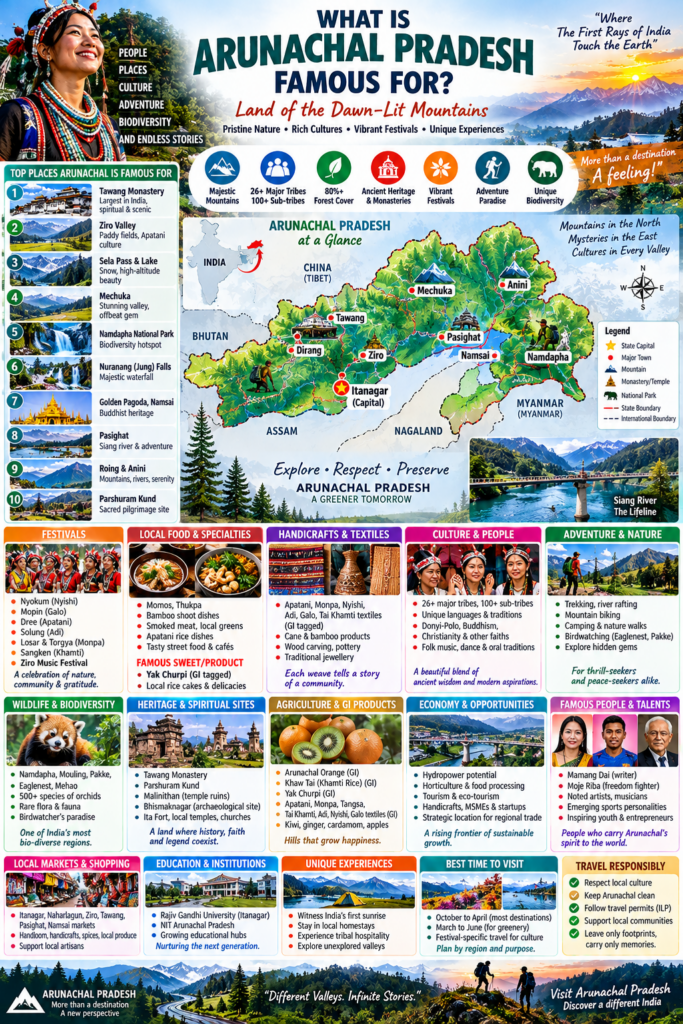
Arunachal Pradesh is famous for its Eastern Himalayan landscapes, Tawang Monastery, Ziro Valley and Apatani culture, high-altitude lakes and passes, enormous biodiversity, indigenous communities, distinctive festivals, handwoven textiles, bamboo and cane craftsmanship, horticulture, adventure travel and remote valleys such as Mechuka and Anini.
But that short answer barely introduces the state. Arunachal is not one uniform culture or tourism landscape: Ziro, Tawang, Pasighat, Namsai, Namdapha and the Dibang Valley can feel remarkably different from one another.
A particularly important development for travellers interested in authentic products is the recognition of multiple Arunachal products under India’s GI system. The official GI registry confirms, among others, Arunachal Orange, Yak Churpi, Khaw Tai (Khamti Rice), Apatani Textile, Monpa Textile, Tangsa Textile, Tai Khamti Textile, Adi Textile, Nyishi Textile, Galo Textile and Adi Apong as registered geographical indications.
🌄 What Is Arunachal Pradesh Famous For? Complete Chart
🌟 Why Arunachal Pradesh Feels Different
- 🌄 It is not only a mountain destination. A journey can move from the high Himalayas around Tawang to the agricultural landscape of Ziro, the Siang river country and the rainforest environment of Namdapha.
- 👨👩👧👦 There is no single “Arunachali tribe.” The state’s communities have distinct languages, textiles, cuisines, festivals and belief systems.
- 🧵 Its crafts now have unusually strong GI visibility. Multiple community-specific textile traditions are registered separately rather than being collapsed into a generic “tribal textile” category.
- 🧀 Yak Churpi is a genuine GI product, not merely a generic tourism-food claim. The official GI registry lists its registration through December 2031.
- 🍊 Arunachal Orange is also GI registered, making horticulture part of the state’s identity as well as its economy.
- 🌾 Ziro’s fame goes beyond scenery. Arunachal Tourism specifically highlights Apatani land-use practices, paddy-cum-pisciculture, water management, handloom and cane-and-bamboo skills.
- 🏭 Its industrial story is geography-led. Hydropower, horticulture, tourism, food processing, handicrafts, construction and difficult mountain logistics make more sense here than imagining a Maharashtra-style MIDC or Gujarat-style GIDC economy.
- 🚀 Its startup ecosystem is still developing. Startup India currently lists the state’s Startup Policy as running from 2022–2027 and identifies the Arunachal Pradesh Innovation and Investment Park in Itanagar as the nodal ecosystem hub.
- 🏖️ It has no sea beaches. River valleys, alpine lakes, waterfalls and forest landscapes are the geographically authentic alternatives.
- ❤️ Its greatest attraction is diversity itself. Tawang, Ziro, Namsai, Pasighat, Mechuka, Roing, Anini and Namdapha should not be treated as interchangeable sightseeing stops.
For a first-time traveller asking “What is Arunachal Pradesh famous for?”, the most useful answer is therefore not just Tawang or snow. Arunachal is famous for the meeting of Himalayan geography, indigenous cultures, Buddhist heritage, living agricultural traditions, extraordinary biodiversity, distinctive textiles and foods, powerful rivers, remote road journeys and communities whose identities remain strongly connected to their own valleys and landscapes.
That combination is what makes Arunachal Pradesh worth exploring slowly rather than simply collecting its famous places.
⚠️ Common Travel Myths, Tourist Scams, Safety Issues & Practical Solutions in Arunachal Pradesh
Arunachal Pradesh should not be portrayed as a scam-heavy or inherently unsafe destination without evidence. For most visitors, the more realistic travel problems are mountain-road disruption, weather, limited connectivity, permit misunderstandings, cash/UPI difficulties, unverified online bookings and the normal fraud risks that can occur anywhere in India.
For Indian citizens, a valid Inner Line Permit (ILP) is required; Arunachal Tourism currently states that the tourist eILP is applicable for stays up to 14 days, while foreign nationals use the applicable PAP/RAP process.
🛡️ Arunachal Pradesh Travel Safety, Myths, Scams & Solutions Chart
🚨 Emergency Numbers Travellers Should Save
The Arunachal Pradesh government currently lists Police 100, Fire 101 and Ambulance 108, while the Arunachal Police citizen portal also lists Women Helpline 1091, Child Helpline 1098 and Citizen Call Centre 155300. India’s national emergency number 112 can also be used for police emergencies.
| 🆘 Situation | Contact |
|---|---|
| 🚨 National Emergency / Police | 112 |
| 👮 Arunachal Police Control Room | 100 |
| 🚑 Ambulance | 108; police portal also lists 102 |
| 🔥 Fire | 101 |
| 👩 Women Helpline | 1091; national women helpline 181 |
| 👶 Child Helpline | 1098 |
| 💳 Cyber/UPI/online financial fraud | 1930 |
| ☎️ Arunachal Citizen Call Centre | 155300 |
For a fraudulent UPI, card or online-booking transaction, speed matters: the National Cyber Crime Reporting Portal specifically directs victims of cyber financial fraud to call 1930 immediately.
🌧️ Mountain Travel Safety Rule
For Arunachal Pradesh, one of the most useful safety habits is surprisingly simple:
Never allow a hotel booking, flight, social-media itinerary or fixed schedule to pressure you into travelling on a mountain road when current conditions say you should wait.
During heavy rain, landslide-prone periods or severe mountain weather, check current alerts rather than relying on an evergreen article. NDMA’s SACHET platform distributes geo-targeted official disaster and weather alerts and was updated in September 2026.
🛡️ 10 Golden Rules for a First-Time Arunachal Traveller
- 🪪 Obtain the correct ILP/PAP through official channels.
- 🚕 Confirm taxi fare and inclusions before departure.
- 🏨 Independently verify accommodation before paying a large advance.
- 💳 Never disclose OTP, UPI PIN, card PIN or banking credentials.
- 📱 If financial cyber fraud occurs, call 1930 immediately.
- 🌧️ Check current weather and mountain-road conditions every travel day.
- 💵 Carry both digital payment options and reasonable cash.
- 🏔️ Allow acclimatization and contingency time on high-altitude circuits.
- 📸 Ask before photographing people, ceremonies or sensitive sites.
- 🚨 Keep 112, 100, 108 and 1930 saved offline.
The strongest evergreen message for Arunachal Pradesh tourist safety is therefore not “beware of scams everywhere.” It is verify before paying, confirm before travelling, respect permits and local communities, prepare for mountain conditions, and use official authorities when something genuinely goes wrong.
🛣️ Major National Highways, Mountain Roads & Road-Safety Guide to Arunachal Pradesh
Road travel is central to Arunachal Pradesh tourism. Airports and railways can bring travellers to gateways, but Tawang, Ziro, Mechuka, Anini, Namdapha, Koloriang and many remote valleys ultimately depend on road connectivity.
The most important fact for an outstation traveller is that Arunachal is not an expressway-style road destination. Mountain gradients, sharp bends, construction zones, high passes, heavy rain, landslides, fog and long distances between services can matter more than the number of kilometres on a map.
As of September 2026, NHIDCL’s official project database shows both completed and ongoing highway works across the state, including NH-13/15, NH-113, NH-215, NH-313, NH-713 and the new NH-913 Frontier Highway.
🚧 Major National Highways in Arunachal Pradesh
| Highway / Corridor | Important Areas Served | Tourism / Economic Importance | Road Character | Main Traveller Concern |
|---|---|---|---|---|
| 🛣️ NH-13 / Trans-Arunachal corridor | Multiple central/eastern belts including Pasighat side | One of the state’s major east-west connectivity systems | Hills, valleys, bridges, construction sections | Rain, landslides, road works |
| 🛣️ NH-15 | Eastern/foothill connectivity around Brahmakund–Kamlang–Chowkham sections | Assam–Arunachal regional movement, agriculture and tourism | Lower-elevation regional road | Construction and seasonal rain |
| 🛣️ NH-415 | Banderdewa–Naharlagun–Itanagar region | Principal capital-region road | Urban/foothill arterial | Congestion, junctions, local traffic |
| 🛣️ NH-713 | Joram–Koloriang | Kurung Kumey connectivity | Mountain highway | Construction, landslides, long travel times |
| 🛣️ NH-313 | Roing–Hunli–Anini | Dibang Valley access | Remote mountain road | Landslides, construction, limited services |
| 🛣️ NH-215 | Changlang–Khonsa–Longding/eastern belt | Tirap–Changlang–Longding regional connectivity | Hill/forest road | Weather and remote sections |
| 🛣️ NH-113 | Khupa–Hayuliang–Hawai | Anjaw district connectivity | Mountain/river-valley road | Rain, slope instability |
| 🛣️ NH-913 Frontier Highway | Planned/developing frontier corridor through multiple remote areas | Strategic and future regional connectivity | Large sections under development | Do not treat as a finished tourist highway |
| 🚗 Bhalukpong–Bomdila–Dirang–Tawang road | West Kameng–Tawang | Essential western tourism corridor | High-altitude Himalayan road | Fog, snow/ice, rain, landslides |
| 🚗 Akajan–Likabali–Bame corridor | Lower Siang/West Siang side | Aalo and western-central access | Foothill-to-hill road | Monsoon disruption |
| 🚗 Miao–Namdapha/Vijaynagar side | Changlang district | Wildlife and remote tourism | Forest/remote road | Limited services and weather |
For example, NHIDCL records the Pasighat–Bomjur section as part of the Trans-Arunachal Highway and confirms the completed 22.15-km two-laning project there.
🏗️ Frontier Highway – Important Future Road, Not Yet a Finished Tourist Route
A traveller should be especially careful with articles describing the Frontier Highway (NH-913) as though it were already a seamless road trip.
It is being developed in multiple packages. NHIDCL currently lists, among other works, Hunli–Hayuliang, Tato–Monigong and Kharsang–Miao–Gandhigram–Vijaynagar sections as ongoing projects, with several packages having scheduled completion dates in 2027–28.
Therefore:
NH-913 = major developing strategic corridor, not currently a guaranteed end-to-end tourist highway.
⚠️ Arunachal Pradesh Road Awareness & Travel Advisory Chart
| Road / Area | Main Risk | When Risk Increases | Warning Signs | Traveller Action | Alternate / Backup Strategy |
|---|---|---|---|---|---|
| 🏔️ Bhalukpong–Bomdila | Mountain bends, rain, slope instability | Monsoon | Falling stones, muddy runoff, stopped traffic | Drive in daylight | Wait for official/local clearance |
| ❄️ Dirang–Tawang | Altitude, fog, ice/snow, mountain weather | Winter/rain | Low visibility, frozen surface | Reduce speed drastically | Stay overnight rather than force journey |
| 🏔️ Sela sector | High altitude and rapidly changing weather | Winter/poor weather | Snow, ice, fog | Check same-day road status | Use operational road/tunnel arrangement directed locally |
| 🌧️ Itanagar–Banderdewa | Heavy rain + urban traffic | Monsoon/peak hours | Waterlogging/congestion | Add time buffer | Follow traffic-police diversions |
| 🌾 Itanagar–Ziro | Hill driving, rain/fog | Monsoon/night | Rockfall/debris | Daylight travel | Delay if conditions deteriorate |
| 🏔️ Joram–Koloriang NH-713 | Mountain terrain + continuing works on parts | Rain/construction periods | Machinery, temporary diversions | Slow down; expect delays | Ask locally before departure |
| 🌊 Pasighat/Siang roads | Heavy rainfall, river-related disruption | Monsoon | Flood warnings/high water | Don’t enter inundated road | Wait for administration clearance |
| 🌧️ Roing–Hunli | Construction + mountain terrain | Rain | Excavation/debris/traffic hold | Allow substantial buffer | Check current NHIDCL/local status |
| 🏔️ Hunli–Anini NH-313 | Remote mountain travel | Monsoon | Landslide debris, damaged edge | Travel early; fuel up | Postpone rather than improvise |
| 🌲 Miao–Namdapha | Forest road and limited services | Heavy rain | Mud/damaged stretches | Check locally at Miao | Stay near Miao if access deteriorates |
| 🌲 Vijaynagar side | Extremely remote connectivity | Rain/construction | Long service gaps | Specialist planning required | Never treat as casual day drive |
| ⛰️ Hayuliang–Hawai/Anjaw | Mountain/river terrain | Monsoon | Landslide/falling stones | Daylight only where practical | Local administration advice |
| 🌄 Mechuka route | Long mountain journey | Rain/fog | Road damage/low visibility | Carry buffer day | Overnight at suitable intermediate point |
| 🌙 Any remote highway | Night-driving hazards | After dark | Fog, animals, poor visibility | Avoid unnecessary night driving | Stop in nearest suitable town |
| 🚧 Active roadwork | Excavation/blasting/temporary closures | Project dependent | Machinery/flagmen | Obey work-zone control | Wait for controlled opening |
NHIDCL’s current database confirms that parts of the Roing–Hunli–Anini NH-313 corridor remain under infrastructure development. Its Roing–Hunli project alone describes a roughly 74.863-km greenfield alignment.
A September 2026 NHIDCL tender also seeks construction of a major bridge on the Hunli–Anini section at design chainage 28+200, another reason an evergreen article should not describe every part of this corridor as permanently “excellent road.”
🚫 No-Entry Roads, Truck Restrictions & Timings
There is no responsible evergreen statewide table of permanent no-entry timings that can be applied to every Arunachal town.
Traffic restrictions can be issued locally because of construction, VIP/security movement, festivals, landslides, markets, school traffic or other temporary conditions.
| 🚦 Situation | Possible Restriction | Is Timing Evergreen? | What Traveller/Driver Should Do |
|---|---|---|---|
| Itanagar/Naharlagun urban roads | Heavy/commercial vehicle controls may be imposed | ❌ No | Check current traffic notification |
| Market areas | Parking/loading restrictions | ❌ No | Follow signs/local police |
| Construction zones | Timed road closure | ❌ No | Confirm before starting |
| Landslide clearance | Complete temporary closure | ❌ No | Wait for clearance |
| Blasting areas | Short controlled closure | ❌ No | Follow contractor/police instructions |
| Festival/event roads | Diversions/no parking | ❌ No | Check district advisory |
| Border/sensitive roads | Permit/access controls | Can change | Carry correct permits and ID |
| Wildlife/protected areas | Entry hours/vehicle conditions | Site specific | Check forest authority |
| Heavy/ODC cargo | Route/bridge/permission restrictions | Consignment specific | Conduct professional route survey |
Do not publish invented timings such as “trucks banned 8–11 AM” unless the competent authority has issued a current notification for that exact road.
🚛 Heavy Trucks, Trailers & Project Cargo
Arunachal’s road network has major logistics importance because hydropower, bridges, road construction and other infrastructure projects require movement of machinery and construction materials.
But mountain freight is fundamentally different from normal highway freight.
For heavy trailers, ODC or project cargo, operators should assess:
bridge capacity → road width → gradient → hairpin turning radius → overhead clearance → pavement condition → retaining walls → temporary structures → landslide exposure → unloading area → crane positioning → weather window.
NHIDCL itself notes that NH-313 connectivity supports movement of heavy machinery, construction material and personnel associated with Dibang Valley infrastructure development.
A route being labelled a “National Highway” does not prove that a 40-, 60- or 100-tonne ODC combination can safely use every bridge and curve.
⚫ Accident-Prone Roads & Black Spots
A road-safety black spot is a technical designation, not simply a dangerous-looking mountain bend.
Therefore, tourist articles should not manufacture lists such as “Top 20 accident black spots in Arunachal Pradesh” from newspaper accident reports.
For evergreen publishing, use three separate descriptions:
| Term | Correct Meaning |
|---|---|
| ⚫ Official black spot | Location formally identified under applicable road-safety criteria |
| ⚠️ Hazardous mountain section | Terrain/weather suggests extra caution |
| 🚨 Recent accident location | A crash occurred there; this alone does not make it an official black spot |
For an exact current list of notified black spots, use the latest MoRTH/state road-safety authority/police data rather than copying an old list into an evergreen travel article.
🌧️ Landslide, Flood & Weather-Prone Road Awareness
Arunachal’s climate and topography make rain-related road disruption one of the most practical travel risks.
The appropriate warning is not that every mountain road is “unsafe.” It is that conditions can change quickly.
| 🌦️ Condition | Road Impact | Best Response |
|---|---|---|
| Heavy rain | Landslide/rockfall risk | Delay if authorities advise |
| Continuous multi-day rain | Saturated slopes | Add contingency day |
| Flash flooding | Culvert/road inundation | Never drive through unknown water |
| River rise | Bridge/approach disruption possible | Follow district alerts |
| Fog | Very poor visibility | Slow down/use safe lights |
| Fresh snow | Slippery high-altitude road | Check current clearance |
| Black ice | Loss of traction | Avoid aggressive braking/steering |
| Rockfall | Road blockage/vehicle danger | Don’t wait directly below unstable slope |
| Road construction | Dust, loose surface, traffic holds | Follow flag personnel |
| Night + rain | Multiplied visibility risk | Stop rather than race itinerary |
🚗 Tawang Road Safety
The Tawang road is among Arunachal’s most important tourism corridors.
For a new outstation traveller, a sensible journey is not “Guwahati to Tawang as fast as possible.” Breaking the road journey around Bomdila or Dirang can make the trip more manageable and also helps with the transition to higher elevations.
At Sela, never equate “road open” with “normal plains-highway conditions.”
Snow, fog, ice, temperature and visibility can still matter.
🏔️ Anini Road Safety
NH-313 toward Hunli and Anini is one of the routes where an evergreen blog needs especially careful wording.
NHIDCL confirms ongoing work on the Roing–Hunli greenfield alignment, while its current Arunachal project inventory records multiple completed and developing works associated with Hunli–Anini.
For travellers this means:
carry a buffer day, refuel before remote sections, travel in daylight, download offline information and obtain current local road information before departure.
🛣️ Joram–Koloriang NH-713
NH-713 is another useful example of why highway status must be checked section by section.
NHIDCL records completed packages but also currently labels some Joram–Koloriang packages as ongoing.
A travel guide should therefore say:
“NH-713 provides important Koloriang connectivity, but verify current construction and weather conditions.”
—not—
“NH-713 is completely finished and smooth throughout.”
🚧 Expressways in Arunachal Pradesh
Travellers searching for “expressways in Arunachal Pradesh” should understand the terminology.
Arunachal’s important long-distance network consists mainly of National Highways, state/district roads, strategic roads and mountain arterial routes. It does not currently offer the type of controlled-access expressway network familiar from Delhi–Mumbai, Delhi–Meerut or other plains corridors.
The developing Frontier Highway should also not be mislabeled as a conventional urban/plains expressway.
💰 Toll Plazas & FASTag
Do not assume that every Arunachal National Highway has a toll plaza simply because it is an NH.
Likewise, an old toll-plaza list should not be made “evergreen.”
Before a long drive, check the current toll information through the official or FASTag ecosystem. Where a toll applies, keep a valid FASTag and sufficient balance.
🅿️ Parking Guide
| Location Type | Typical Situation | Recommendation |
|---|---|---|
| 🏙️ Itanagar/Naharlagun | More formal urban parking options | Follow marked parking/local restrictions |
| 🛕 Tawang town | Space can tighten in busy periods | Prefer hotel parking |
| 🏯 Monastery/religious site | Site-specific arrangements | Follow local signs |
| 🏔️ Viewpoint/pass | Limited safe space | Never block carriageway |
| 🌾 Ziro villages | Community/local roads | Ask before parking |
| 🌲 Wildlife area | Designated access points | Follow forest staff |
| 💦 Waterfall | Limited roadside space possible | Avoid unsafe shoulder parking |
| 🚛 Heavy vehicle | Much harder | Pre-identify lay-by/yard |
| 🚌 Tour coach | Cannot assume car parking = bus parking | Confirm in advance |
Never advertise a parking fee as ₹20, ₹50 or “free parking” unless it has been recently verified for that exact facility.
⚡ EV Charging & Electric Road Trips
Electric mobility is developing, but Arunachal should not yet be approached like Delhi NCR or Mumbai–Pune for charging redundancy.
An EV traveller should plan:
charger A → backup charger → hotel charging confirmation → battery reserve → weather effect → elevation → return range.
Do not rely solely on an old charger pin appearing on a map.
Remote circuits such as Mechuka, Anini, Namdapha/Vijaynagar and high-altitude Tawang sectors deserve substantially more conservative energy planning.
🚑 Road Emergency Planning
Save these numbers before entering remote areas:
| 🆘 Emergency | Number |
|---|---|
| 🚨 Integrated Emergency | 112 |
| 👮 Police | 100 / 112 |
| 🚑 Ambulance | 108 |
| 🔥 Fire | 101 |
| 👩 Women Helpline | 1091 / 181 |
| 👶 Child Helpline | 1098 |
| 💳 Cyber financial fraud | 1930 |
In remote areas, mobile coverage can itself become the limitation. Keep hotel, driver and local-contact details available offline.
🚨 Crime Zones & Personal-Security Awareness
It would be misleading to label entire Arunachal neighbourhoods, highways, districts or tourist places as “crime zones” without current official crime data demonstrating that classification.
A better travel-safety approach is to identify situations where vulnerability can increase:
| Situation | Practical Risk | Safer Approach |
|---|---|---|
| 🌙 Isolated road after dark | Breakdown/help may be far away | Complete remote drives in daylight |
| 🚕 Unverified taxi pickup | Fare/identity dispute | Record vehicle/driver details |
| 🏧 Isolated ATM | Generic card/cash risk | Prefer bank/secure urban ATM |
| 🍺 Late-night unfamiliar location | Reduced transport availability | Arrange return transport first |
| 🏨 Unverified accommodation | Booking/payment fraud | Confirm property independently |
| 📱 Fake payment/refund request | UPI/card fraud | Never disclose OTP/PIN |
| 🥾 Solo remote trek | Injury/getting lost | Guide + route plan + check-in |
| 🌲 Forest road | Wildlife/breakdown/connectivity | Follow forest/local instructions |
| 🛂 Sensitive border area | Access restrictions | Carry permits/ID and obey authorities |
| 📸 Sensitive installation | Security/legal problem | Never photograph restricted facilities |
This distinction matters for EEAT: a recent theft, assault or road accident does not automatically make an entire town or highway a “crime zone.”
🚦 15 Road-Safety Rules for First-Time Arunachal Drivers
- 🚗 Treat travel time, not distance, as the key planning metric.
- 🌅 Start long mountain journeys early.
- 🌙 Avoid unnecessary remote night driving.
- 🌧️ Check current weather before every major road sector.
- 🪨 Never stop unnecessarily beneath an active landslide/rockfall face.
- 🌊 Never drive through floodwater whose depth and road surface you cannot assess.
- ⛽ Refuel before remote sectors.
- 📱 Download maps and key information offline.
- 🛞 Check tyres, spare wheel, brakes and coolant before mountain journeys.
- 🏔️ Use lower gears appropriately on long descents; do not continuously ride the brakes.
- 🚘 Give uphill and heavy vehicles adequate manoeuvring room.
- 🚧 Obey construction-zone flagmen and temporary closures.
- 📸 Never stop on a blind curve for photography.
- 🍺 Never combine alcohol with mountain driving.
- 🕐 Keep at least one contingency day on remote multi-day circuits.
🌄 The Most Important Arunachal Road-Trip Rule
In Arunachal Pradesh, “National Highway” does not mean “four-lane road,” “expressway,” “all-weather perfection” or “constant mobile connectivity.”
The state is undergoing substantial road development. Current NHIDCL records simultaneously show completed corridors, ongoing widening, greenfield construction and the developing NH-913 Frontier Highway.
For travellers, the safest planning formula is:
🗺️ Choose the correct route → 🌦️ check same-day weather → 🚧 verify current road status → ⛽ refuel early → 🌅 travel in daylight → 📱 keep offline information → 🕐 retain a buffer day.
That approach is much more useful than a static list claiming certain roads are permanently “safe,” “dangerous,” “no-entry” or “accident-prone,” because in Arunachal Pradesh the condition of a mountain road can change far faster than an evergreen travel article.
🧳 Arunachal Pradesh Travel Planning, Booking, Safety & Tourist Assistance Guide
For an outstation traveller, Arunachal Pradesh is best planned circuit by circuit rather than as one city-style destination. The practical sequence is: choose the region you want to visit, obtain the correct permit, reserve the main air/rail gateway, confirm a registered or independently verified local operator, book accommodation, arrange the mountain-road transfers, and retain at least one weather-buffer day.
The Arunachal Pradesh Department of Tourism publishes a directory of registered tour operators, including operators specializing in customized, cultural, adventure, wildlife and Northeast India tours. This official directory is a stronger starting point than choosing an agent solely from an advertisement or social-media message. Arunachal Tourism
Verification note: ratings, phone numbers, opening hours, packages and services are dynamic. The ratings below are a current search snapshot, not permanent scores. A service marked “Verify” means I found the business but did not find adequate evidence to claim that particular service. Cruise, international ticketing, visas, passports and insurance should never be assumed merely because a business calls itself a travel agency.
🏢 Verified Physical Travel Agencies & Tour Operators
| Agency Name | Address | Contact | Verified / Evidenced Services | Domestic / International | Road | Rail | Air | Cruise | Visa & Passport | Hotel | Insurance | Current Rating | Best For | Travel Tip |
|---|---|---|---|---|---|---|---|---|---|---|---|---|---|---|
| ITAMOTO TRAVEL | NH-415, ItaMoto Building, H-Sector, Itanagar 791111 | 9…..2 | Physical travel agency; also appears in Tourism Dept operator directory | Verify | Verify | Verify | Verify | Not verified | Not verified | Verify | Not verified | 4.7/5, 504 reviews | Itanagar enquiries | Obtain itemized quotation |
| SAHARA TOURS & TRAVELS | Akash Deep Complex, Ganga, Itanagar 791111 | 7…..1 | Travel agency; also listed by Arunachal Tourism | Verify | Verify | Verify | Verify | Not verified | Verify | Not verified | 4.9/5, 304 reviews | Capital-region planning | Confirm exact services before payment | |
| DRIYANG TOURS TRAVELS AGENCY | Old Papunala, DTO Office area, Naharlagun/Itanagar 791110 | 7…..3 | Physical travel agency | Verify | Verify | Verify | Verify | Not verified | Verify | Not verified | 5.0/5, 85 reviews | Naharlagun arrivals | Useful location for rail-side enquiries | |
| Hills King Tour & Travels OPC private limited | Chandra Nagar, Itanagar 791111 | 8…..9 | Physical travel agency | Verify | Verify | Verify | Verify | Not verified | Verify | Not verified | 4.9/5, 91 reviews | Itinerary enquiries | Ask what is included/excluded | |
| HIGHVEN ADVENTURES | Akash Deep Complex, Ganga, Itanagar 791113 | 9…..5 | Travel agency/adventure-oriented business listing | Domestic focus; verify | Yes/verify route | Verify | Verify | Not verified | Not verified | Verify | Not verified | 4.9/5, 67 reviews | Adventure enquiries | Ask about guides, PPE and permits |
| DRISTI TRAVELS | Bank Tinali, near Apex Bank, C-Sector, Itanagar 791111 | 9…..2 | Physical travel agency | Verify | Verify | Verify | Verify | Not verified | Not verified | Verify | Not verified | 5.0/5, 34 reviews | City-based bookings | Compare quote before advance |
| Eli Tour & Travel Itanagar. | Opp. RK Mission Hospital, First Gate, Itanagar 791111 | 7…..7 | Physical travel agency | Verify | Verify | Verify | Verify | Not verified | Not verified | Verify | Not verified | 4.9/5, 22 reviews | Local travel enquiries | Confirm vehicle registration and driver |
| Pator Gumin Tours and Travels | Near Executive Office, C-Sector, Itanagar 791111 | 9…..2 | Tour operator | Verify | Verify | Verify | Verify | Not verified | Not verified | Verify | Not verified | 4.8/5, 28 reviews | Customized tour enquiry | Request written itinerary |
| Tawang Taxi Service | New Market, Tawang 790104 | 8…..4 | Car rental/local road transport | Domestic/local | Yes | No | Airport transfer: verify | No | No | No | No | 5.0/5, 5 reviews | Tawang local transport | Small review sample; verify current quote |
| Rigyang tour & travels | Dirang 790101 | 9…..4 | Taxi/local transport | Domestic/local | Yes | No | Transfer: verify | No | No | No | No | 5.0/5, 33 reviews | Dirang/Tawang road sector | Confirm waiting/night charges |
🧭 Government-registered operators with specialist services
The Tourism Department’s directory provides useful additional evidence about operator specialization. For example, Abor Country Travels is listed for customized cultural and adventure tours; BAC Voyages for Northeast cultural and birding travel; Miaopum Tours & Travels for homestays, rafting, wildlife and cultural tourism; and Neverland Tour and Travel for Pasighat–Yingkiong–Tuting trekking. Particularly relevant to international travellers, Mercy Tours and Travel is listed for Northeast and international cultural/adventure tours, passport and visa services and customized tours.
The directory does not establish that every operator sells railway tickets, cruises, travel insurance, luxury holidays, international air tickets, MICE packages or bike rentals. Those services should be confirmed individually.
🎫 Which Booking Channel Should a First-Time Traveller Use?
| Need | Safer Booking Strategy | What to Verify |
|---|---|---|
| ✈️ Flight | Airline or reputable OTA | Baggage, cancellation, airport |
| 🚆 Train | Official IRCTC channel | Station, date, wait-list status |
| 🚌 Bus | State/operator’s current booking system | Boarding point and actual departure |
| 🚕 Taxi | Verified local operator/hotel | Full vehicle vs per-seat fare |
| 🚙 Private vehicle | Established rental/operator | Vehicle, driver, fuel and night charges |
| 🏨 Hotel | Property directly or reputable OTA | Exact room, heating, parking, cancellation |
| 🏡 Homestay | Tourism listing/verified host | Location, meals, bathroom, road access |
| 🥾 Trek/adventure | Experienced local operator | Guide, equipment, permit, emergency plan |
| 🪪 ILP | Government-authorized system | Never send ID to random agent |
| 🌍 Foreign permit | Applicable government process | PAP/RAP requirements |
| 💳 Insurance | IRDAI-regulated insurer/channel | Medical evacuation and adventure exclusions |
| 🛳️ Cruise | Not a normal Arunachal transport product | Don’t buy an “Arunachal cruise” without independently verifying itinerary |
🪪 ILP & Entry Planning
Indian citizens require an Inner Line Permit. Arunachal Tourism currently states that the tourist eILP applies to Indian citizens for stays up to 14 days; visitors staying longer use the applicable provisional-ILP process. Children below 14 do not require an individual eILP when accompanied by an adult. Arunachal Tourism
Tourist ILP facilitation is currently listed at Naharlagun railway station, Gumto railway station, Guwahati’s Asom Paryatan Bhawan/LGBI Airport and Donyi Polo Airport. Arunachal Tourism
Foreign nationals use the applicable Protected/Restricted Area Permit framework, not the domestic tourist eILP.
Official Arunachal Tourism ILP information
Because permit rules can change, verify them again immediately before publication or travel.
🌦️ Best Time & Itinerary Planning
| Season | What It Offers | Main Concern | Planning Approach |
|---|---|---|---|
| 🌸 Mar–Apr | Spring landscapes, generally comfortable touring | Variable mountain weather | Strong multi-circuit period |
| 🌤️ May–Jun | Higher areas become attractive | Rain increasingly possible | Check route daily |
| 🌧️ Jul–Sep | Extremely green landscapes | Heavy rain, landslides, road delays | Slow itinerary + buffer days |
| 🍂 Oct–Nov | Clearer touring conditions in many circuits | Cold increases at altitude | Excellent road-trip window for many areas |
| ❄️ Dec–Feb | Winter landscapes, Tawang snow possibilities | Severe high-altitude cold, ice/snow | Flexible schedule essential |
There is no single statewide “perfect month.” Tawang, Namdapha, Ziro and Anini have different elevations, ecosystems and weather patterns.
💰 Practical Arunachal Travel Budget
| Traveller Style | Accommodation | Food | Local Transport | Typical Approach |
|---|---|---|---|---|
| 🎒 Budget | ₹1,000–₹2,500/night | ₹500–₹1,000/day | Shared transport | Homestays + shared Sumo/bus |
| 👨👩👧 Comfortable | ₹2,500–₹6,000 | ₹800–₹1,800 | Shared/private mix | Better hotel + reserved transfers |
| ❤️ Premium couple | ₹6,000–₹15,000+ | ₹1,500–₹3,000+ | Private SUV | Scenic stays + flexible itinerary |
| 👨💼 Premium/private group | ₹8,000–₹20,000+ | Variable | Dedicated vehicle | Customized tour |
These are planning estimates, not quoted market tariffs. Tawang peak periods, festivals, remote vehicle transfers and premium properties can substantially increase costs.
🎒 Packing Checklist
For Arunachal, pack for the route and elevation, not merely the state name. Carry government ID and permit copies, waterproof footwear, rain protection, warm layers for high-altitude circuits, essential medicines, reusable water bottle, sunscreen, sunglasses, power bank, torch, small cash reserve, offline maps, emergency contacts and basic snacks.
A Tawang winter bag and a Namdapha rainforest bag should not look the same.
🚌 Public Transport & Last-Mile Reality
State/private buses and shared Sumos can reduce costs, but schedules and frequency are not comparable with major metros.
Private taxis are particularly useful for families, senior citizens, photographers and travellers with substantial luggage. Remote mountain travel should preferably start early in the day.
Do not assume app cabs, bike taxis, 24-hour buses or rental vehicles will be available in every district.
🚨 Essential Tourist Emergency Contacts
The Arunachal Pradesh government currently publishes Police 100, Ambulance 108 and Fire 101. India’s national emergency number is 112.
| Emergency | Contact | When to Use |
|---|---|---|
| 🚨 Integrated emergency | 112 | Immediate police/emergency assistance |
| 👮 Police | 100 | Crime/security emergency |
| 🚑 Ambulance | 108 | Medical emergency |
| 🔥 Fire | 101 | Fire/rescue |
| 👩 Women Helpline | 181 | Women requiring assistance |
| 💳 Cyber financial fraud | 1930 | UPI/card/online financial fraud |
| 👶 Child emergency | 1098 | Child protection/help |
The National Cyber Crime Reporting Portal confirms 1930 as the 24×7 helpline for online financial fraud
💳 UPI, ATM & Online-Booking Safety
A traveller receiving a “refund” does not normally need to enter a UPI PIN simply to receive money. Never disclose an OTP, card PIN or UPI PIN to an agent, hotel employee, taxi operator or alleged bank representative.
If money has been fraudulently transferred, contact 1930 quickly, preserve screenshots/transaction IDs and submit the complaint through the cybercrime portal. The government portal specifically supports reporting and tracking cybercrime complaints.
⚠️ Common Tourist Problems & Prevention
| Problem / Scam | Warning Sign | Prevention | What to Do |
|---|---|---|---|
| 🚕 Taxi overcharging | Fare unclear before departure | Agree total price in writing | Pay agreed fare; escalate serious coercion |
| 🧑🏫 Fake guide | No identity/operator connection | Use tourism/operator referral | Decline and verify |
| 🏨 Fake hotel | Personal UPI + extreme discount | Call property independently | Stop payment/report fraud |
| 📲 QR-code scam | Asked to enter PIN for “refund” | Never authorize unknown collect/payment request | Call 1930 if money lost |
| 🎟️ Counterfeit ticket | Personal payment presented as official | Use recognized booking channel | Preserve evidence |
| 🧳 Pickpocketing | Crowded market/event | Secure wallet/phone | Report theft |
| 🛍️ Fake “local handicraft” | Seller cannot identify origin | Ask maker/community | Buy traceable artisan work |
| 💰 Fake charity request | Aggressive/emotional pressure | Donate only to verified organizations | Decline politely |
| 🚗 Car-rental dispute | Fuel/waiting terms omitted | Written quotation | Retain chat/receipt |
| 🥾 Unsafe adventure operator | No helmet/PFD/guide briefing | Inspect safety arrangements | Don’t participate |
| 🌧️ Road closure | Driver says “we’ll somehow cross” | Follow authority/local road information | Wait or reroute |
| 🪪 Fake permit agent | Personal payment + suspicious portal | Government channel | Stop and verify |
These are prevention scenarios, not claims that each scam is widespread in Arunachal Pradesh.
👩 Women & Solo Traveller Safety
Solo travel is possible, but no destination should be advertised as “100% safe.” Choose verified accommodation, schedule remote arrivals during daylight, share the vehicle number and itinerary with someone you trust, and avoid depending on an unverified last-minute ride.
For immediate danger use 112; the national women helpline is 181.
👴 Senior Citizen Safety
For older travellers, altitude, long road journeys, stairs and medical access can matter more than crime.
Tawang/Sela itineraries deserve conservative acclimatization. Choose private transport when long shared-vehicle journeys would be uncomfortable, and confirm heating, ground-floor/lift access, hot water and distance between parking and room before booking.
Anyone with significant pre-existing medical concerns should seek personalized medical advice before high-altitude travel.
♿ Differently Abled Travellers
Do not interpret “family hotel” or “senior friendly” as proof of accessibility.
Ask specifically about step-free entry, accessible bathroom, lift, doorway width, wheelchair access, parking-to-room route and accessible vehicle availability.
Remote viewpoints, monasteries, village paths, trails and waterfalls may have stairs or uneven surfaces.
👶 Travelling with Children
Avoid overloaded itineraries. Carry familiar food/snacks, warm layers, prescribed medication and identification.
Arunachal Tourism currently says children below 14 do not need an individual eILP when accompanied by an adult, but permit rules should be rechecked before departure.
🏔️ High-Altitude Health
Tawang and the Sela region can expose visitors to significant altitude.
Headache, nausea, unusual fatigue, dizziness or worsening breathlessness should not simply be dismissed as “normal mountain tiredness.” Avoid rapid exertion after ascent, and if symptoms become concerning, stop ascending and seek medical help.
Alcohol is not treatment for altitude illness.
🌧️ Monsoon & Landslide Safety
Heavy rain can alter an itinerary quickly. A hotel reservation or return flight should never pressure a traveller into crossing an actively unsafe mountain-road section.
During monsoon travel:
check current weather → ask about road condition → leave early → retain fuel → avoid unnecessary night driving → keep a contingency day.
Never cross unknown floodwater merely because another vehicle attempted it.
🐯 Wildlife & Forest Safety
Namdapha, Pakke and other protected landscapes should be experienced according to forest regulations.
Wildlife sightings are never guaranteed. Don’t feed animals, approach wildlife for selfies, play loud music in forests or leave marked/authorized routes without appropriate guidance.
A “100% tiger/red panda/bird sighting guarantee” is a marketing warning sign rather than a credible wildlife promise.
🚣 Adventure Tourism Safety
For rafting, trekking, camping or other adventure activities, verify the operator’s experience, route plan, equipment, weather assessment and emergency procedure.
For rafting, correctly fitted PFDs and safety briefing matter more than attractive social-media photographs.
Drone flying should never be assumed legal merely because other tourists have uploaded aerial footage; aviation, defence, border, forest and local restrictions may apply.
🍛 Food & Drinking-Water Safety
Choose freshly cooked food from hygienic establishments, particularly on long road trips. Use reliably treated, filtered or sealed drinking water where water quality is uncertain.
Traditional foods are an important part of Arunachal travel, but ask about ingredients if you have allergies or dietary restrictions. Different communities have different cuisines; there is no single universal “Arunachal thali.”
🏥 Medical Planning
Itanagar/Naharlagun provides substantially better access to larger medical facilities than many remote tourism circuits.
Before travelling to Anini, Mechuka, Namdapha or other remote areas, carry sufficient regular medication and do not assume a specific specialist, pharmacy or diagnostic service will be available locally.
In a medical emergency use 108.
🌿 Responsible & Eco-Friendly Travel
Arunachal’s greatest tourism assets—forests, rivers, villages, biodiversity and living cultures—are also easily damaged by careless tourism.
Carry reusable bottles where safe refilling is possible, avoid single-use plastic, bring non-biodegradable waste back from remote areas, never collect orchids or wildlife products, avoid loud music in natural areas, buy directly from local artisans where practical and ask before photographing people.
A village is someone’s home, not an outdoor museum.
👍 Advantages vs 👎 Practical Challenges
| 👍 Why Visit Arunachal | 👎 What Requires Planning |
|---|---|
| Extraordinary Himalayan landscapes | Long mountain travel times |
| Strong indigenous cultural diversity | Limited last-mile transport in remote areas |
| Tawang Buddhist heritage | High-altitude conditions |
| Ziro cultural landscape | Monsoon road disruption |
| Namdapha/Pakke biodiversity | Wildlife never guaranteed |
| Mechuka/Anini remote landscapes | Fewer urban services |
| Distinctive textiles and crafts | Authenticity should be checked |
| Community homestays | Amenities vary |
| Less mass tourism in many areas | Advance planning matters more |
| Outstanding road-trip potential | Weather can override itinerary |
✅ Final First-Time Traveller Checklist
Before leaving home, verify your ILP/PAP, ID, flight/train, hotel, local operator, vehicle, weather, road conditions and travel insurance. Keep digital and offline copies of important documents. Never send a large advance merely because an unknown agent creates urgency.
Once in Arunachal, favour daylight mountain travel, keep cash plus digital payment options, respect community and religious etiquette, allow weather buffers, and remember that a 100-km mountain journey can demand much more time and energy than the same distance on a plains highway.
For booking local tours, the safest starting point is the government’s current directory rather than an arbitrary online “Top 10” ranking:
That combination—official verification + careful local planning + flexible mountain travel + responsible tourism—is the strongest foundation for a safe and enjoyable Arunachal Pradesh trip.
🎬📚 Arunachal Pradesh Related Movies, Books, Media, Museums, Archives & Trusted Travel Research Resources
Arunachal Pradesh is best understood through a combination of official tourism information, ethnographic research, local literature, museums, archival records, responsible journalism and selected films/documentaries. For travellers and researchers, government and institutional sources should take priority whenever information involves permits, roads, districts, weather-related disruption, public notices or safety.
The Directorate of Research is particularly valuable: its work covers culture, history, archaeology, philology, museums, archives, publications and a reference library. Its State Archives preserve records including NEFA-era tour diaries, maps, administrative reports, manuscripts, photographs and records connected with the 1962 Sino-Indian War.
🎥📖 Media, Literature, Research & Public Information Chart
| Resource Name | Category | Description | Why It Is Important | Best For | Official Website/Source (if available) | Travel & Learning Tip |
|---|---|---|---|---|---|---|
| Arunachal Tourism | Official Tourism Website | State tourism portal covering destinations, circuits, heritage, culture, wildlife and activities. | One of the most useful starting points for destination research and itinerary planning. | Tourists, Families, Couples, Content Creators | Arunachal Tourism | Verify destination details here before relying on travel blogs. |
| Government of Arunachal Pradesh State Portal | Government Portal | Central state portal linking departments, districts, public notices, government orders, GIS and citizen information. | Useful for authoritative administrative and public information. | Tourists, Researchers, Students, Business Travelers | Arunachal Pradesh State Portal | Check government notices when researching changing rules or administrative information. |
| Directorate of Research, Department of Cultural Affairs | Research / Cultural Institution | Government research institution covering culture, philology, history, archaeology, museums, archives, publications and reference-library functions. | An unusually rich primary institutional source for studying Arunachal Pradesh. | Researchers, Students, Historians, Content Creators | Directorate of Research | Excellent starting point before writing about tribal culture, archaeology or historical development. |
| Arunachal Pradesh State Archives | Archive | Government repository for non-current state records, with holdings including NEFA-period tour diaries, judicial and administrative records, maps, manuscripts, photographs and other historical material. | Provides primary-source material unavailable in ordinary tourism guides. | Historians, Researchers, Students | State Archives information | Researchers should identify the specific district, community or historical period before consulting archival holdings. |
| Reference Library, Directorate of Research | Library / Research Resource | Specialist collection emphasizing social sciences, tribal research, books, journals and reports concerning Arunachal Pradesh. | Particularly valuable for deeper academic work beyond general web sources. | Students, Researchers, Historians | Reference Library information | Use it for bibliography-building before conducting field research. |
| Jawaharlal Nehru State Museum, Itanagar | Museum | Major ethnographic museum containing material connected with textiles, handicrafts, weapons, household life and the state’s diverse cultures. | Gives travellers visual context for cultures they encounter across Arunachal Pradesh. | Families, Students, Researchers, Tourists | Directorate Museum Information | Visit early in an Arunachal trip if possible; it provides useful cultural context for later district travel. |
| District Museums of Arunachal Pradesh | Museums | Directorate records identify ethnographic museums in locations including Tawang, Bomdila, Seppa, Ziro, Daporijo, Aalo, Pasighat, Tezu, Changlang and Khonsa. | Helps travellers learn about local material culture closer to the communities being visited. | Families, Students, Cultural Tourists | Official Museum Directory | Check current operating status before making a museum the main purpose of a long detour. |
| Directorate of Research Publications | Books / Research Publications | Government catalogue covering anthropological, sociological, linguistic and historical works and gazetteers. | Valuable bibliography for serious Arunachal research. | Researchers, Students, Historians, Writers | Official Publications Catalogue | Search by community or district rather than reading the catalogue as a general travel guide. |
| RESARUN | Research Journal | Departmental research journal associated with the Directorate of Research; the Directorate states that it has been published since 1975. | Useful for specialist cultural, historical and anthropological research. | Researchers, Historians, Students | Directorate Reference Library | Useful for finding subjects that mainstream tourism publications rarely cover. |
| A Philosophy for NEFA – Verrier Elwin | Book | Influential work dealing with the former North-East Frontier Agency and approaches to tribal administration and development. The Directorate lists it among its publications. | Important historical reading for understanding the administrative ideas surrounding what later became Arunachal Pradesh. | Historians, Students, Researchers | Official Directorate Publications Catalogue | Read critically as a historical work reflecting its own period rather than as a current guide to communities. |
| Myths of NEFA – Verrier Elwin | Book / Folklore | Listed by the Directorate among its publications on the former NEFA region. | Provides a route into documented folklore and oral traditions. | Students, Researchers, Cultural Travellers | Directorate Publications | Treat mythology and oral tradition separately from independently verified historical fact. |
| Art of NEFA – Verrier Elwin | Book / Art & Culture | Directorate-listed work dealing with artistic traditions of the former NEFA region. | Helpful background for appreciating material culture, crafts and museum collections. | Art Students, Researchers, Travellers | Directorate Publications | Pair the reading with museum collections rather than treating historical descriptions as a complete picture of present-day culture. |
| The Noctes – P. C. Dutta | Ethnographic Book | Government publication listed by the Directorate concerning the Nocte community. | Community-specific research resource. | Researchers, Students, Historians | Official Publications Catalogue | Particularly useful for focused cultural research rather than general sightseeing. |
| The Tangsas – P. C. Dutta | Ethnographic Book | Directorate-listed publication focused on the Tangsa community. | Adds community-level depth absent from generic state guides. | Researchers, Students, Cultural Writers | Official Publications Catalogue | Cross-check historical ethnographic descriptions with contemporary sources. |
| The Mopin Festival – P. C. Dutta | Cultural Book | Directorate publication concerning Mopin. | Useful background for understanding festival traditions. | Tourists, Students, Content Creators | Directorate Publications | Verify current festival dates separately before planning travel. |
| The Solung Festival – P. C. Dutta | Cultural Book | Government-listed publication devoted to Solung. | Useful cultural context for travellers researching festivals. | Cultural Tourists, Students, Researchers | Directorate Publications | Historical/cultural description should not substitute for current event schedules. |
| Handicrafts of Arunachal Pradesh – P. C. Dutta | Book / Crafts | Directorate-listed publication on the state’s handicraft traditions. | Helps travellers understand craft objects beyond their souvenir value. | Shoppers, Students, Researchers, Content Creators | Directorate Publications | Useful companion reading before visiting craft centres and museums. |
| Crossing Bridges | Feature Film | 2013 film directed by Sange Dorjee Thongdok and made in Sherdukpen; it received the National Film Award for Best Film in Sherdukpen. | A significant cinematic reference connected with Arunachal’s indigenous language and cultural landscape. | Film Lovers, Students, Cultural Travellers | Availability varies by legitimate film/OTT distributor | Use it as cultural cinema, not as a substitute for factual travel information. |
| Government GIS Map / State GIS resources | GIS / Map Resource | The state portal provides access to GIS mapping among its citizen and information services. | Helpful for understanding districts, administrative geography and spatial relationships. | Researchers, Road-Trippers, Students, Business Travelers | Arunachal State Portal | For remote trips, combine maps with current road and district-administration information. |
| Arunachal Pradesh State Disaster Management Authority | Emergency / Safety Information | State disaster-management source providing preparedness information, updates and emergency/control-room information. | Particularly important because mountain travel can be affected by weather and natural hazards. | Tourists, Families, Road-Trippers, Business Travelers | Arunachal Pradesh SDMA | Check current situation reports and advisories during periods of heavy rain or disruption rather than relying on an old travel article. |
| District Disaster Management Officers Directory | Emergency Information | District-level disaster-management contact resource. | Useful when travelling beyond Itanagar into remote districts. | Tourists, Tour Leaders, Researchers, Business Travelers | DDMO Directory | Save relevant district information before travelling where mobile connectivity may be inconsistent. |
| District Administration Websites | Government / Local Information | District portals are linked through the state government’s administrative ecosystem. | Often more relevant than a state-wide travel blog for local notices and administration. | Tourists, Researchers, Business Travelers | Arunachal Pradesh State Portal | Check the destination district’s official portal for locally changing information. |
| Philology Section, Directorate of Research | Language / Educational Resource | Government research section documenting indigenous languages through language guides, phrase books and dictionaries. | Particularly valuable in a multilingual state where language is central to cultural identity. | Linguists, Students, Researchers, Cultural Travellers | Directorate of Research | Learn a few locally appropriate words only from reliable language resources rather than assuming one language applies statewide. |
| History & Archaeology Section | Archaeological / Historical Research | Directorate unit involved in surveys and publications concerning historical places and archaeological sites. | Strong source for researching heritage beyond popular tourist summaries. | Historians, Students, Content Creators | Directorate of Research | Useful for fact-checking heritage claims before publishing travel content. |
| Culture Section, Directorate of Research | Cultural Research | Conducts work concerning folk life, oral literature, communities and cultural subjects. | Provides deeper cultural information than attraction-focused tourism pages. | Researchers, Students, Writers | Department of Cultural Affairs | Prefer community-specific research over generalized claims about “Arunachali culture.” |
| India Code | Law / Official Reference | Government legal-information platform linked as an important resource by the Cultural Affairs portal. | Useful when research involves legislation rather than tourism commentary. | Researchers, Students, Business Travelers | India Code | Use current statutory text when discussing laws; don’t rely solely on travel blogs. |
| National Archives of India | National Digital/Physical Archive | National archival institution useful for wider historical and administrative research concerning India’s Northeast. | Complements Arunachal’s State Archives for historical investigation. | Historians, Researchers, Students | National Archives of India | Search both older geographic terminology such as “NEFA” and modern “Arunachal Pradesh.” |
| Digital South Asia Library | Digital Research Resource | Academic digital collection containing maps, reference works and historical South Asian resources. | Helpful for historical geography and contextual research. | Researchers, Students, Historians | Digital South Asia Library | Historical maps should never be treated as current road maps. |
| Internet Archive | Digital Archive | Large digital repository where older books and public-domain research materials may be discoverable. | Useful for locating historical editions and hard-to-find references. | Researchers, Students, Historians | Internet Archive | Search using NEFA, North-East Frontier Agency and individual community names. |
| Google Books | Digital Book Discovery | Searchable catalogue and preview platform containing historical works including bibliographic records for A Philosophy for NEFA. | Useful for identifying editions and building reading lists. | Students, Researchers, Content Creators | Google Books | Use it for discovery; verify important historical claims against primary or scholarly sources. |
| Survey of India | Official Mapping Resource | India’s national mapping agency. | Useful reference for authoritative geographic and topographic research. | Researchers, Trekkers, Road-Trippers | Survey of India | For sensitive border regions, follow current access and mapping restrictions. |
| India Meteorological Department | Weather / Public Information | National official weather and warning source. | Weather can materially affect Himalayan road travel and outdoor itineraries. | Tourists, Families, Trekkers, Business Travelers | India Meteorological Department | Check forecasts close to departure; don’t use an evergreen article as a live weather source. |
🌄 People Who Raised Arunachal Pradesh’s Name Worldwide, Future-Shaping Development Projects & Investment–CSR Opportunities
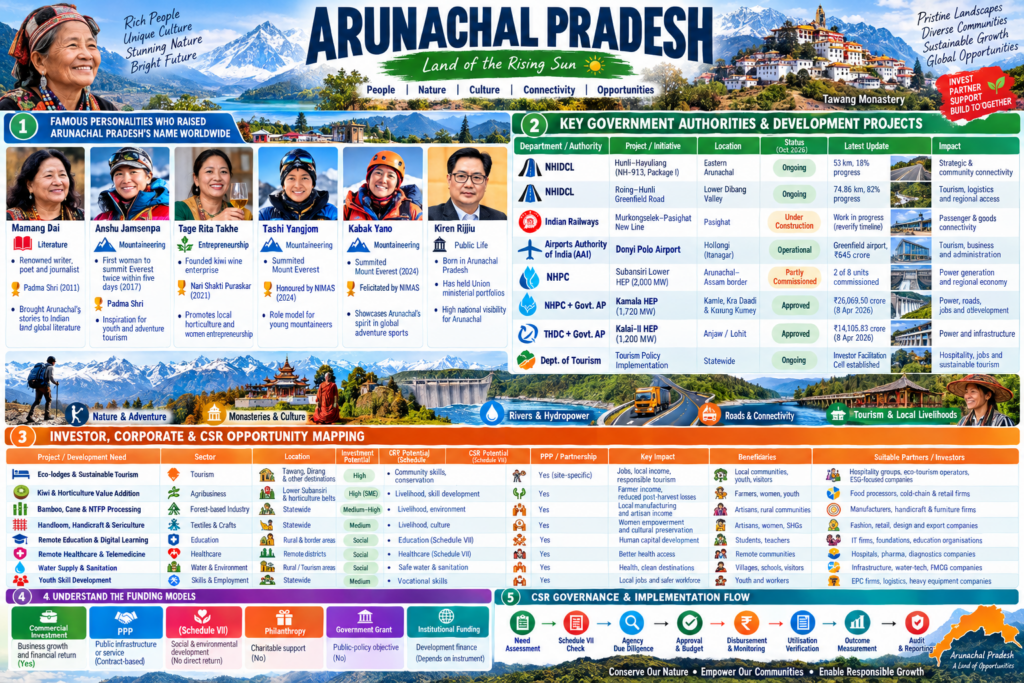
Arunachal Pradesh presents a very different development and investment landscape from large industrial states. Its strengths lie in strategic road and air connectivity, hydropower, nature and adventure tourism, horticulture and food processing, bamboo and non-timber forest produce, handloom and handicrafts, community livelihoods and border-area infrastructure. The state’s industrial policy identifies tourism, agro/horticulture processing, biotechnology, bamboo/cane and medicinal-plant industries, textiles, handicrafts, sericulture and creative industries among its thrust areas.
For investors and CSR teams, four routes must remain separate: 💼 commercial investment, 🤝 PPP/contractual partnership, ❤️ statutory CSR and 🎁 philanthropy. A commercially attractive hotel, highway contract or hydropower asset does not become CSR merely because it generates employment.
👑🌟 1. Famous Personalities Who Raised Arunachal Pradesh’s Profile
This is a selective, non-ranked list representing literature, mountaineering, entrepreneurship, public life and culture.
For heritage content, avoid reducing Arunachal’s identity to a few contemporary celebrities. Community knowledge holders, traditional artisans, monks, oral historians, indigenous-language writers and craftspeople are equally important to cultural preservation even where they lack national awards.
🏗️🛣️ 2. Government Authorities & Major Development Projects
| 🏛️ Authority | 👷 Role | 🚧 Project | 📍 Location | 🚦 Verified Status | 📰 Latest Verifiable Update | 💰 Official Cost/Funding | ⚠️ Key Challenges | 📅 Expected Completion | 👥 Likely Impact | 🔗 Official Source |
|---|---|---|---|---|---|---|---|---|---|---|
| 🛣️ NHIDCL / MoRTH | National highway development | Frontier Highway NH-913 – Hunli–Hayuliang Package I | Eastern Arunachal | 🟡 Ongoing | 53 km; NHIDCL currently reports 18% physical progress | ₹1,262.43 crore TPC | Mountain terrain, weather, logistics, construction management | 1 Mar 2028 current likely date | Strategic and community road connectivity | NHIDCL |
| 🛣️ NHIDCL / MoRTH | Highway development | Frontier Highway – Hunli–Hayuliang Package III | Eastern Arunachal | 🟡 Ongoing | 61.5 km; current physical progress listed at 2% | ₹1,418.67 crore TPC | Difficult terrain and remote mobilisation | 17 Jul 2028 | Regional access and logistics | NHIDCL |
| 🛣️ NHIDCL | Highway development | Tato–Monigong section, NH-913 | Arunachal Pradesh | 🟡 Ongoing | 53.04 km; current physical progress 22% | ₹625.61 crore TPC | High-altitude/remote construction | 14 Nov 2027 | Border-area/community connectivity | NHIDCL |
| 🛣️ NHIDCL | Road connectivity | Pango–Jorging Road | Arunachal Pradesh | 🟡 Ongoing | 40 km; NHIDCL lists 40% physical progress | ₹898.19 crore TPC | Terrain and construction logistics | 16 Jul 2027 | Better remote-area access | NHIDCL |
| 🚗 NHIDCL | Mountain road connectivity | Roing–Hunli Greenfield Road | Lower Dibang/Dibang approach | 🟡 Ongoing | 74.86 km; current listing shows 82% physical progress | ₹1,718.59 crore TPC | Long-delayed mountain construction | Current NHIDCL likely date: 31 Oct 2026 | Tourism, communities, freight and access toward Anini | NHIDCL |
| 🌉 NHIDCL | Bridge infrastructure | 160-m major bridge on Hunli–Anini corridor | Hunli–Anini | 🟢 Completed | NHIDCL now records 100% physical/financial progress | ₹30 crore TPC | Mountain-river engineering | Completed in 2026 according to current listing | More reliable corridor connectivity | NHIDCL |
| 🚆 Indian Railways / Northeast Frontier Railway | Railway expansion | Murkongselek–Pasighat New Line | Pasighat approach | 🟡 Construction programme | A 2025 official factsheet listed Murkongselek–Sille and Sille–Pasighat as under construction, with then-targets of Oct 2025 and Feb 2026. Those dates have passed, so current commissioning status should be reconfirmed before publication. | Use current Railway budget/project statement | Terrain, land and project execution | ⚠️ Reverify | Passenger access, tourism and goods movement | PIB/Railways |
| 🚆 Indian Railways | Future railway connectivity | Bhalukpong–Tawang; Pasighat–Parashuram Kund–Wakro; Bame–Aalo–Mechuka | Multiple districts | 🔵 Survey/planning stage | Final Location Surveys were reported completed; this must not be described as construction approval without a newer sanction. | Not presented here without project sanction | Terrain, tunnelling, environment, economics | Not established | Potential long-term accessibility transformation | PIB/Railways |
| ✈️ Airports Authority of India | Aviation | Donyi Polo Airport | Hollongi/Itanagar | 🟢 Operational | Greenfield airport about 25 km from Itanagar; 2,300-m runway and terminal designed for 300 peak-hour passengers | ₹645 crore development cost stated by AAI | Route economics, last-mile access, weather | Completed/operational | Tourism, administration and business connectivity | AAI |
| ⚡ NHPC | Renewable power | Subansiri Lower HEP – 2,000 MW | Arunachal–Assam border | 🟡 Partly commissioned / ongoing | As of 16 Mar 2026, 2 of 8 units had been commissioned; remaining units planned progressively through Dec 2026 | ₹27,948 crore anticipated cost in official parliamentary information | Geological, environmental, construction and commissioning risks | Dec 2026 official target | Power generation, grid balancing and regional economic activity | Ministry of Power |
| ⚡ NHPC | Multipurpose hydropower | Dibang Multipurpose Project – 2,880 MW | Lower Dibang Valley | 🟡 Under construction | Foundation stone laid in 2024; official government information continues to list it under construction | ₹31,876 crore anticipated cost | Huge engineering footprint, ecology, rehabilitation and community impacts | Feb 2032 anticipated | Power + flood moderation + infrastructure; also significant environmental/social management requirements | PIB/Power Ministry |
| ⚡ NHPC + Govt. of Arunachal Pradesh JV | Hydropower | Kamala HEP – 1,720 MW | Kamle, Kra Daadi & Kurung Kumey | 🟠 Approved / procurement-development stage | CCEA approved investment on 8 Apr 2026; NHPC subsequently tendered major civil works | ₹26,069.50 crore approved outlay | Environmental/social safeguards, resettlement, remote construction | 96 months estimated from approved project framework | Energy, roads, bridges, employment and local-area development | PIB + NHPC |
| ⚡ THDC India + Govt. of Arunachal Pradesh JV | Hydropower | Kalai-II HEP – 1,200 MW | Anjaw / Lohit basin | 🟠 Approved | CCEA approved investment on 8 Apr 2026 | ₹14,105.83 crore; central support includes ₹599.88 crore for enabling infrastructure and ₹750 crore toward state equity | Remote terrain, ecological/social management, major construction | 78 months estimated | Power, jobs plus about 29 km of associated roads/bridges | PIB |
| 🏨 Department of Tourism | Tourism development | Arunachal Pradesh Tourism Policy implementation | Statewide | 🟡 Policy implementation | Policy provides for an Investor Facilitation Cell and collaboration with Invest India for investor outreach | Project-specific | Carrying capacity, land, community consent, environmental sustainability | Continuing | Hospitality investment, jobs and destination development | Tourism Policy |
💰🤝 3. Investor, Corporate & CSR Opportunity Mapping
The entries below are opportunity themes, not declarations that government is currently accepting investment or CSR money for each project.
| 🚀 Development Need | 🏗️ Sector / 📍 Location | 💰 Investment Potential | 🏢 Suitable Partner | ❤️ CSR / Schedule VII Relevance | 💵 CSR Opportunity | 🤝 PPP / Partnership Potential | 🏛️ Scheme / Institutional Route | 📈 Potential Impact | 👥 Beneficiaries | ⚙️ Implementing Route | 🔍 Governance & Measurement | ⚠️ Risks | 💎 Value Proposition | 🔗 Starting Source |
|---|---|---|---|---|---|---|---|---|---|---|---|---|---|---|
| 🏨 Eco-lodges & responsible accommodation | Tourism / identified destinations | High but site-specific | Sustainable hospitality, tourism operators | Commercial hotel itself CSR | Community skills/conservation components may separately qualify | Strong where officially structured | Tourism Dept./Investor Facilitation Cell | Jobs, longer stays, local spending | Communities, guides, entrepreneurs | Commercial approval route | Carrying-capacity, land and environmental DD | Over-tourism, land/community issues | High-value low-volume tourism potential | Tourism Policy |
| 🧗 Adventure-tourism ecosystem | Tawang, Dirang and other officially suitable areas | Medium–High | Adventure operators, equipment/training firms | Skills/youth programmes may qualify | Guide/rescue/skill training | Corporate/institutional partnership | Tourism + NIMAS-type institutional ecosystem | Youth jobs and safer tourism | Youth, guides, visitors | Competent authority/training body | Instructor certification, safety SOPs, insurance | Mountain/weather risk | Arunachal has authentic adventure credentials | NIMAS evidence |
| 🥝 Kiwi & horticulture value addition | Horticulture belts | High SME potential | Food processors, cold-chain, packaging firms | Livelihood/skill elements potentially eligible | Farmer training, livelihood capacity | Strong producer-market partnerships | Industrial/horticulture programmes | Farmer income + reduced post-harvest losses | Farmers, women, youth | FPO/cooperative/private enterprise/eligible CSR agency depending component | Procurement traceability, farmer-income KPIs | Seasonality, cold-chain gaps | Local raw material + premium positioning | State industrial policy |
| 🎋 Bamboo, cane & NTFP processing | Rural/forest-linked economy | Medium–High | Furniture, handicraft, bio-material firms | Livelihood/environment themes may qualify where compliant | Artisan skills, sustainable livelihoods | Producer/company partnerships | Industrial policy + relevant forest/rural schemes | Local manufacturing & artisan incomes | Artisans, rural communities | Enterprise/FPO/SHG/eligible agency | Sustainable sourcing, traceability | Forest regulation, overharvesting | Local-resource value addition | Industrial Policy |
| 🧵 Handloom, handicraft & sericulture | Statewide community clusters | Medium | Fashion, retail, design, export companies | Skills/livelihood/culture can fit relevant Schedule VII purposes | Training, design, livelihoods, heritage craft preservation | Excellent market-linkage potential | State/central textile-handicraft schemes | Women’s income + cultural preservation | Artisans, women, youth | SHGs/cooperatives/eligible institutions | Artisan attribution, wage/income tracking | Imitation, weak market access | Authentic cultural products | Industrial Policy |
| 🎓 Remote education & digital learning | Rural/border communities | Primarily social | IT, telecom, education foundations | Strong potential: education | Labs, digital access, learning support | Government-school partnerships | Education/digital schemes | Human-capital development | Students & teachers | Government/eligible CSR agency | Learning baselines, utilisation, maintenance | Connectivity and teacher support | High measurable social value | CSR subject to MCA framework |
| 🏥 Remote healthcare | Mountain/border districts | Social + health ecosystem | Hospitals, pharma, diagnostics | Strong potential: healthcare | Telemedicine support, diagnostics, preventive health where compliant | Institutional partnership | Health programmes | Access and early diagnosis | Remote communities | Health authority + eligible agency | Clinical governance, patient privacy, utilisation audit | Staffing/connectivity | High social impact | MCA CSR framework |
| 🚰 Safe drinking water & sanitation | Rural/tourism settlements | Social infrastructure | Water-tech, FMCG, infrastructure firms | Strong potential where Schedule VII conditions met | Water systems, sanitation and behaviour programmes | Government/community partnership | Rural/water schemes | Health + tourism cleanliness | Villages, schools, visitors | Competent local authority + eligible agency | Water-quality testing, O&M responsibility | Maintenance failure | Clear measurable outcomes | MCA CSR framework |
| 🌳 Biodiversity/community conservation | Ecologically sensitive landscapes | Social/environmental | Foundations, ESG-focused firms | Environmental sustainability potential | Habitat restoration, awareness, community conservation subject to approvals | Research/community partnerships | Forest/environment authorities | Conservation + sustainable livelihoods | Communities/ecosystems | Competent forest authority + eligible institution | Biodiversity baseline, scientific monitoring | Greenwashing, ecological disturbance | High-value nature stewardship | Requires authority-specific approval |
| 👩 Women entrepreneurship | Statewide | Medium commercial + strong social potential | Banks, food, retail, tourism firms | Gender equality/livelihood themes potentially applicable | Skills, enterprise development, financial literacy | Strong | Livelihood/enterprise programmes | Income and enterprise creation | Women entrepreneurs/SHGs | Eligible agency/institution | Income and business-survival KPIs | Market access | Strong inclusion case | Tage Rita provides a documented entrepreneurship example. |
| 👷 Construction & logistics skills | Highway/hydropower growth corridors | High workforce relevance | EPC, logistics, heavy equipment firms | Vocational skills potentially eligible | Driver, equipment, safety, technical training | Very strong industry linkage | Skill-development institutions | Local jobs + safer projects | Youth/workers | Accredited training route | Certification, placement and safety KPIs | Training without employment linkage | Direct alignment with infrastructure pipeline | NHIDCL’s large active programme demonstrates demand. |
| 🚛 Project-cargo & construction logistics | Highway/hydropower corridors | Commercial opportunity | Heavy haulage, warehousing, crane/project logistics companies | ❌ Ordinary logistics contracts are not CSR | Only separately designed qualifying social projects | Procurement/EPC subcontracting | NHPC/NHIDCL/other tender systems | Supports infrastructure execution | Projects, contractors, workforce | Commercial tender/subcontract | Route surveys, axle-load/bridge analysis, permits, HSE | Mountain roads, landslides, weather, oversized cargo | Specialized logistics demand from major infrastructure | NHIDCL/NHPC project portals |
| ⚡ Hydropower supply chain | Kamala, Dibang, Kalai-II etc. | Very high commercial opportunity | EPC, electrical, mechanical, tunnelling, logistics firms | ❌ Core commercial project expenditure ≠ CSR | Separate LADF/community/eligible CSR projects only | Tender/JV/vendor route | NHPC/THDC/government | Large construction and supply-chain demand | Businesses/workforce + affected communities | Formal procurement route | Technical, environmental, financial, R&R DD | Very high execution/environment/social risk | Large officially approved project pipeline | PIB/NHPC |
⚖️💼 4. Investment, PPP, CSR & Philanthropy Are Not the Same
| 🔖 Route | 🎯 Purpose | 💵 Financial Return? | 🏗️ Appropriate Examples in Arunachal |
|---|---|---|---|
| 💼 Commercial Investment | Build profitable enterprise | ✅ Yes | Hotel, food-processing plant, warehouse, horticulture processing |
| 🤝 PPP / Concession | Deliver public/commercial service under government agreement | Usually contract-based | Airport commercial service or another officially tendered concession |
| ❤️ CSR | Eligible Schedule VII social/environmental purpose | ❌ Not ordinary commercial return | Education, health, skills, water, eligible environment/livelihood programmes |
| 🎁 Philanthropy | Charitable/public-benefit support | ❌ No | Scholarships, community support, cultural initiatives |
| 🏛️ Government Scheme/Grant | Public-policy objective | ❌ Not investor return | Rural infrastructure, education, livelihoods |
| 🌐 Institutional/Development Funding | Defined development outcomes | Instrument-specific | Climate resilience, sustainable infrastructure, institutional programmes |
A useful real-world example of the PPP/concession distinction is Donyi Polo Airport: AAI has separately tendered commercial activities such as an automated vehicle-parking management concession. That is a commercial concession—not CSR.
⚡🏔️ 5. Hydropower: Huge Opportunity, but Not a Simple “Green Investment” Story
Arunachal’s hydropower pipeline is economically significant, but a credible investor guide must discuss environmental clearance, forest impacts, biodiversity, river systems, disaster risk, rehabilitation and resettlement, community interests and cumulative basin impacts, rather than describing every project simply as clean-energy opportunity.
The scale is substantial. The Kamala HEP alone received Cabinet approval for ₹26,069.50 crore, with an estimated 96-month construction period. The government says the associated project is expected to create roughly 196 km of roads and bridges, while the state is to receive 12% free power plus another 1% for the Local Area Development Fund.
The Kalai-II HEP received approval for ₹14,105.83 crore and a 78-month estimated completion period.
These are therefore important commercial procurement, engineering, construction, logistics and workforce-development ecosystems, but the core power projects should not be advertised as CSR projects.
🚛🏗️ 6. Transport, Heavy Haulage & Project-Cargo Opportunity
The state’s infrastructure pipeline creates specialist requirements beyond conventional trucking:
🚛 Heavy haulage • 🏗️ construction equipment movement • 🚜 earthmoving machinery • ⚙️ turbines/generators • 🏗️ transformers • 🚧 bridge components • 🏔️ mountain-road route surveys • 🏗️ crane/material handling • 📦 project warehousing • 🛞 specialized trailers • 🦺 HSE planning
The challenge is unusually technical because mountain freight can involve restricted turning radii, steep gradients, bridge capacities, landslide zones, seasonal disruption, narrow approaches and limited staging areas. Any actual ODC movement therefore requires a project-specific engineering and road-route survey; generic web-route distances are not sufficient.
NHIDCL’s current Arunachal project database itself demonstrates the size of the road-construction pipeline, with multiple NH-913/Frontier Highway and other packages carrying official costs in the hundreds or thousands of crores.
🏨🌿 7. Tourism Investment Should Follow Carrying Capacity, Not Mass Construction
The Arunachal Pradesh Tourism Policy specifically proposes an investor-facilitation mechanism to attract tourism investment, provide information on land, incentives and approvals, address investor queries and collaborate with Invest India.
That creates legitimate areas for investigation such as:
🏡 responsible accommodation • 🌿 eco-tourism • 🧗 adventure services • 🍲 local-food enterprises • 🧵 crafts • 🚐 destination transport • 👨🏫 guide training • ♻️ waste management • 🚰 visitor sanitation • 📱 tourism technology
But fragile mountain and community destinations require carrying-capacity, land-rights, environmental, cultural and local-community due diligence. “Untapped tourism potential” should never be interpreted as permission for unrestricted construction.
❤️📊 8. CSR Governance & Fund-Utilisation Framework
A defensible corporate programme should follow:
🔍 Need Assessment → ⚖️ Schedule VII Mapping → 🏢 Implementing-Agency Due Diligence → 👥 Community Consultation → ✅ CSR/Board Approval → 💰 Budget & Milestones → 💳 Controlled Disbursement → 📍 Physical Verification → 🧾 Utilisation Documentation → 📊 Output/Outcome Measurement → 🔎 Audit → 📑 Statutory Reporting → 🔄 Maintenance/Exit Plan
For remote Arunachal projects, monitoring should be especially rigorous. Useful evidence can include beneficiary baselines, geotagged assets where appropriate, invoices, procurement records, attendance/certification data, utilisation certificates, outcome indicators, maintenance ownership and independent verification for larger projects.
CSR implementation and reporting must follow the Companies Act/CSR Rules rather than treating “CSR funding available” as a generic grant pool. The official CSR framework contains specific reporting requirements for ongoing projects and Schedule VII classification.
🎯🌄 9. High-Potential Opportunity Matrix
| Priority | Opportunity Type | Appropriate Funding Route |
|---|---|---|
| 🥝 Horticulture & food processing | 💼 Business + farmer partnerships | Commercial / institutional |
| 🏨 Sustainable tourism | 💼 Tourism investment | Commercial / approved PPP |
| 🧵 Handloom & handicrafts | 💼 + ❤️ livelihood development | Commercial + eligible CSR components |
| 🎋 Bamboo/cane value addition | 💼 + 🌱 livelihood/environment | Commercial + qualifying programmes |
| 🎓 Remote education | ❤️ Social development | CSR / government |
| 🏥 Remote healthcare | ❤️ Social development | CSR / government |
| 👷 Youth skills | ❤️ + 🏭 industry partnership | CSR / institutional |
| 👩 Women entrepreneurship | ❤️ + 💼 enterprise | CSR + commercial ecosystem |
| 🚰 Water & sanitation | ❤️ Community development | CSR / government |
| 🌳 Biodiversity | ❤️ Environmental stewardship | CSR / institutional, subject to approvals |
| 🛣️ Highways | 🏗️ Infrastructure | Government procurement / EPC, not ordinary CSR |
| 🚆 Railways | 🏗️ Infrastructure | Government procurement, not ordinary CSR |
| ✈️ Airport commercial services | 💼/🤝 | Tender / concession |
| ⚡ Hydropower | 💼🏗️ Major infrastructure | Commercial/JV/procurement, not core CSR |
| 🚛 Project logistics | 💼 Commercial service | EPC/vendor/subcontract |
| 🏔️ Community-based tourism | 💼 + ❤️ where genuinely separable | Commercial + qualifying livelihood CSR |
🌟 Final Perspective
Arunachal Pradesh’s strongest investment proposition is not mass industrialisation copied from another state. Its comparative opportunity lies in carefully planned connectivity, hydropower and associated supply chains, horticulture-based value addition, sustainable tourism, indigenous crafts, skilled local employment and services suited to difficult mountain geography.
For CSR, the strongest areas to investigate are 🎓 education, 🏥 healthcare, 👷 vocational skills, 👩 women’s livelihoods, 🚰 water and sanitation, 🌳 environmental sustainability, 🧵 traditional livelihoods and 🌾 rural development—subject in every case to Schedule VII, implementing-agency and project-specific compliance.
For commercial investors, the starting point should be officially notified policy, tender and investor-facilitation channels, not a generic online “investment opportunity” list. The state’s tourism policy expressly envisages an Investor Facilitation Cell and Invest India collaboration, while its industrial policy identifies sectors with natural or economic potential.
🚛🏔️ The 46-Tonne Transformer That Made Us Measure Arunachal Pradesh One Metre at a Time
At 4:35 in the morning, our convoy was standing in Assam with a 46-tonne power transformer loaded on a hydraulic multi-axle trailer. The final delivery point was in Arunachal Pradesh.
The cargo itself did not frighten me.
The mountains did.
I had already learned one rule from heavy-haul work: a road shown on a map is not necessarily an ODC route.
Our hypothetical documentary case begins in Assam, enters Arunachal Pradesh toward the Pasighat side, and then follows the NH-13/Trans-Arunachal Highway environment toward a fictional project delivery location farther inside the state. I am deliberately not naming a real customer or claiming this was an actual ABCC movement; the geography and engineering constraints are grounded in real corridors, while the shipment, crew and incidents are a reconstructed educational story.
NHIDCL officially records the 22.15-km Pasighat–Bomjur section as completed and identifies it as part of the Trans-Arunachal Highway programme. It also records completed Pasighat–Pangin packages on new NH-13.
🌅 “Sir, Google Map Says the Road Is Open”
Our young coordinator, Rakesh, showed me his phone.
“Sir, route clear dikha raha hai.”
I folded the phone screen down.
“Google truck ka gross combination weight nahi jaanta. Bridge ki capacity nahi jaanta. Aur hamare trailer ko hairpin par kitni swept width chahiye, woh bhi nahi jaanta.”
That morning we were not surveying kilometres.
We were surveying millimetres, tonnes, degrees and consequences.
Before mobilization, our engineering sheet had five figures written across the top:
| 📐 Survey Parameter | 🚛 What We Needed to Establish |
|---|---|
| ⚖️ Loaded combination weight | Tractor + trailer + cargo + accessories |
| 📏 Overall width | Cargo plus safe lateral clearance |
| ↕️ Overall travelling height | Trailer deck + cargo + securing arrangement |
| ↔️ Overall convoy length | Tractor-to-rear extremity |
| 🛞 Axle configuration | Actual load distribution, not simply cargo weight |
I told the team:
“Aaj destination tak pahunchna objective nahi hai. Aaj objective hai yeh prove karna ki destination tak safely pahunch sakte hain.”
🗺️ Assam → Arunachal Pradesh: The Interstate ODC Story Begins
We divided the proposed movement into engineering segments:
Assam staging point → Arunachal entry → Pasighat → Bomjur → NH-13 mountain corridor → project approach road → unloading foundation
The first question was not how far?
It was:
Where does the route stop behaving like a highway and start behaving like an engineering problem?
Arunachal Pradesh’s own state portal provides access to the Inner Line Permit system, so entry documentation is a genuine planning issue for personnel entering the state.
But an ILP for personnel is not an ODC movement approval.
Our movement file therefore had separate checklists for:
👷 crew-entry requirements
🚛 vehicle documents
📦 cargo documents
🧾 invoice/e-way bill and applicable tax documentation
📐 dimensional drawings
⚖️ axle/loading data
🛣️ competent road-authority permissions wherever required
🌉 bridge/structure assessment
🚓 traffic/police coordination where required
⚡ utility-shifting coordination where necessary
🏗️ unloading/crane plan
Nothing was assumed to be approved merely because another transporter had previously driven through the corridor.
🌉 Obstruction No. 1 — A Bridge Can Carry Traffic and Still Be Wrong for an ODC
Our first serious stop came at a bridge approach.
Cars were crossing.
Pickup vehicles were crossing.
A loaded truck crossed while we watched.
Rakesh smiled.
“Sir, bridge okay hai.”
“No.”
I walked to the approach with the survey engineer.
A bridge being open to ordinary traffic does not prove that it can accept our axle group, gross vehicle weight or load configuration.
We recorded:
🌉 span and structure identification
📏 carriageway width
↪️ approach curvature
📐 gradient change at entry/exit
🛞 wheel-path position
🚧 parapet clearance
⚖️ proposed axle loading
🚛 simultaneous-traffic requirement
📸 photographs and coordinates
For any questionable structure, our survey report would mark it:
HOLD — structural verification required.
No inspirational story is worth turning engineering uncertainty into a fake clearance.
↩️ Obstruction No. 2 — The Hairpin Where Trailer Length Became More Important Than Road Width
Farther into the hills, the road looked wide enough.
Then came the bend.
The tractor could turn.
The trailer could not necessarily follow the same path.
I asked the driver to stop before entering the curve.
We measured the inside edge and outside sweep. On an articulated heavy-haul combination, the rear axle group can cut substantially inside the tractor’s path while the cargo or trailer nose can sweep outward.
Our surveyor marked three areas with chalk:
🔴 inner wheel-cut zone
🟡 tractor turning zone
🔵 rear/cargo swept-path zone
The solution was not “drive slowly.”
The engineering options were:
temporary widening, controlled steering, removal of movable roadside obstacles, traffic closure, repositioning of the tractor, or—if none provided adequate margin—rejecting the route.
That bend became Critical Point CP-07 in our survey register.
⛰️ Obstruction No. 3 — Gradient
The mountain began climbing harder.
For tourists, a steep road means a spectacular view.
For us it meant mathematics.
A heavy combination climbing a severe gradient creates questions about:
⚙️ available tractive effort
🛞 tyre-road adhesion
🔥 transmission temperature
🛑 stopping ability
🚛 push/pull tractor requirement
↩️ rollback risk
📍 emergency holding locations
Descending was potentially worse.
I told the driver:
“Chadhai mein truck ruk gaya toh problem hai. Utarai mein control chala gaya toh disaster hai.”
So every significant descent needed an identified safe stopping strategy, speed discipline and braking assessment.
🪨 Obstruction No. 4 — Rock Overhang
Then the measuring pole touched rock.
The carriageway was usable.
Our transport envelope was not.
A rock projection on the hill side reduced the available upper clearance. This is precisely why an ODC survey cannot record only pavement width.
We measured clearance at multiple heights.
Our sheet contained:
Road width: PASS
Cargo envelope: FAIL / engineering intervention required
No excavator was ordered. No rock was touched.
Any cutting in a mountain corridor would require authorization from the competent road/land/environment authority as applicable.
⚡ Obstruction No. 5 — Overhead Electrical Line
Near a settlement, another red mark appeared.
LOW OVERHEAD LINE.
Nobody in my crew was allowed to lift it with bamboo, rope or an improvised pole.
We measured the travelling height and recorded the line location for coordination with the competent utility.
Possible action:
⚡ utility shutdown
🔌 authorized lifting/rerouting
📅 timed movement
👷 utility personnel on site
The convoy would move only after formal coordination.
📡 Obstruction No. 6 — Telecom Cable
Twenty minutes later came a cable that looked harmless.
That is exactly what makes such obstacles dangerous.
Power lines, telecom/fibre cables and miscellaneous overhead services must be identified separately. You cannot assume every black cable is safe to touch.
It became another entry in the obstruction register.
🌳 Obstruction No. 7 — Tree Canopy
A large branch extended into the cargo envelope.
“Cut kar dete hain?”
“No.”
We photographed it, measured it and marked ownership/authority verification as pending.
Pruning or removal would be undertaken only through the appropriate permission process.
ODC route clearance does not give a transporter ownership of the roadside.
🏘️ Obstruction No. 8 — Market Settlement
The mountain was no longer the problem.
People were.
A narrow settlement had:
🏪 shops close to the carriageway
🏍️ parked two-wheelers
🚙 roadside vehicles
👥 pedestrians
🚌 passenger traffic
📦 loading/unloading activity
Moving a long ODC combination through such a place during peak activity would unnecessarily increase risk.
We proposed a controlled movement window subject to local authority/police coordination.
The local shopkeepers gave us the most valuable information of the day:
“Subah road relatively khaali rehta hai. Baad mein gaadi aur market dono badh jaate hain.”
That information did not replace official permission.
But it improved the plan.
🌧️ Obstruction No. 9 — Water Crossing and Monsoon Drainage
Arunachal’s terrain made the next warning obvious.
A dry-looking drain could not be treated as permanently dry.
The state’s official Gazetteer describes the southwest monsoon period as June to September and notes the strong influence of mountainous terrain on weather.
For our fictional movement, therefore, the monsoon register included:
🌧️ landslide susceptibility
💧 cross-drain condition
🪨 falling-rock areas
🌊 flash runoff
🛣️ shoulder erosion
🌫️ visibility
🏔️ slope instability
We added a rule:
Heavy rain = route revalidation, not blind continuation.
🪨 Obstruction No. 10 — Landslide Debris
Around another bend, part of the usable shoulder had been eaten away by old slope debris.
A normal vehicle could pass.
Our trailer required far more usable width.
I walked the edge myself.
There was pavement under my left boot.
Beyond my right boot was a drop.
That location received the strongest marking in the report:
🔴 NO NIGHT MOVEMENT WITHOUT RECTIFICATION AND RE-INSPECTION
The engineering team requested edge-strength assessment and restoration of usable width before movement.
🛣️ Obstruction No. 11 — Road Construction
Arunachal’s road network is actively changing. NHIDCL’s current project register contains both completed and ongoing works, including major Frontier Highway packages, while Pasighat–Bomjur and several NH-13/Trans-Arunachal sections are officially listed as completed.
That creates an unusual ODC problem:
the route you surveyed last month may not have the same traffic diversion this month.
At a work zone in our story, the permanent carriageway was not the issue.
The temporary diversion was.
Its radius was tighter, shoulder softer and entry angle sharper.
Our conclusion:
Survey again immediately before dispatch.
🛞 Obstruction No. 12 — Soft Shoulder
The road looked beautiful from the cab.
I stepped onto the shoulder.
My boot sank.
That ended the discussion.
A multi-axle trailer sometimes needs the outer shoulder during a tight curve. A shoulder that can hold a pedestrian tells us almost nothing about whether it can sustain concentrated heavy-wheel loading.
We flagged it for bearing-capacity verification / strengthening as necessary.
🚧 Obstruction No. 13 — Crash Barrier
At another curve, the pavement width was adequate but the metal barrier occupied part of our swept path.
Removing it casually was impossible.
Our register read:
Barrier interference — competent authority approval + controlled removal/reinstatement if permitted.
That final phrase mattered:
reinstatement.
ODC movement planning includes putting authorized temporary alterations back into safe condition.
🪧 Obstruction No. 14 — Signboards, Gantries and Height Restrictions
Every overhead structure went into the height-clearance table:
| 🚧 Obstruction | 📐 Survey Action |
|---|---|
| ⚡ Electrical line | Measure + utility coordination |
| 📡 Telecom/fibre | Identify owner + clearance |
| 🚦 Signal assembly | Height/sweep check |
| 🪧 Signboard | Clearance + authorized temporary action if required |
| 🌳 Tree canopy | Measure + authority permission |
| 🪨 Rock projection | Envelope survey |
| 🌉 Bridge portal/member | Structural + dimensional verification |
| 🏘️ Building projection | Physical clearance assessment |
| 🚧 Construction gantry | Contractor/road-authority coordination |
🌙 Then I Repeated the Route at Night
A daylight route survey was not enough.
At night I discovered problems that the afternoon survey had hidden:
🌫️ fog-prone stretches
💡 weak lighting
🚗 headlight glare at bends
🐕 animals near settlements
🚛 parked trucks
🕳️ difficult-to-see pavement edges
📱 weak communication pockets
🏘️ sleeping settlements where horn use needed discipline
But night also offered an advantage:
less traffic.
The movement window therefore became an engineering trade-off—not simply “night is better.”
📋 Our Final Obstruction Register
By midnight the survey board contained:
🌉 bridges
↩️ hairpins
⛰️ steep gradients
↘️ descents
🪨 rock overhangs
⚡ power lines
📡 telecom lines
🌳 trees
🚦 signals
🪧 signboards
🏘️ settlements
🛞 weak shoulders
🚧 barriers
🏗️ construction diversions
🌊 culverts/drains
🌧️ monsoon runoff
🪨 landslide zones
🌫️ fog
🚙 parked vehicles
🚶 pedestrians
🐄 animals
⛽ fuel planning
🅿️ holding areas
📱 communication gaps
🚑 emergency access
🔄 turning/recovery points
🏗️ final-site approach
🏋️ unloading/crane position
Only then could I say:
“Ab humne road dekha hai.”
🚛 Assam Border Crossed — Now the Convoy Was Committed
Movement day arrived.
The pilot vehicle left first.
Then came the tractor.
Behind it, the transformer looked almost unreal against the green mountains.
A rear escort followed.
Our communication protocol was deliberately simple:
STOP. HOLD. CLEAR. MOVE.
Nobody gave long speeches on the radio.
At the first critical curve:
“Pilot to convoy—HOLD.”
Everything stopped.
Local traffic was managed through the agreed control arrangement.
Our banksmen took positions.
“Rear clear.”
“Inside clear.”
“Move one metre.”
The tractor crawled.
The trailer steering responded.
One metre.
Stop.
Half a metre.
Stop.
Then the rear axle group crossed the critical point.
“CLEAR.”
Nobody cheered.
There were still mountains ahead.
🌉 At the Critical Structure, I Stopped the Convoy Again
We had the required engineering checks for the planned movement, but field condition still mattered.
I walked the approach once more.
No fresh damage.
No unexpected obstruction.
No vehicle parked in the swept path.
The convoy entered under controlled conditions.
The driver never accelerated to “finish quickly.”
That is one of the strangest truths of heavy haulage:
the bigger the cargo, the less useful hurry becomes.
🌧️ Then Arunachal Changed the Plan
Rain arrived.
Not dramatic cinematic rain.
Just enough to make me uncomfortable.
The hill surface darkened.
Water began finding its way toward the road.
Our predetermined weather rule applied.
HOLD.
We moved to the identified safe staging location rather than gambling with the next exposed section.
The customer wanted an ETA.
I gave him the only answer an engineer should give when conditions change:
“ETA safety ke baad aayega.”
👷 The Local Team Became Part of the Convoy
By the next morning, people from nearby settlements had begun recognizing us.
One man pointed toward a bend and said vehicles often cut too close to one side there.
We inspected it.
He was right.
Not because local knowledge replaces engineering.
Because good engineering knows when to listen.
Our route survey now contained something no satellite image could provide:
human memory of the road.
🏗️ The Final 600 Metres Were Harder Than Hundreds of Highway Kilometres
The project gate appeared.
Everyone relaxed.
I did not.
The last kilometre of an ODC journey is often where the highway ends and the real trouble begins.
The project approach contained:
tight gate geometry, uncompacted shoulder, drainage crossing, internal bend, temporary material stacks and limited crane positioning space.
We stopped outside.
The civil team cleared the designated corridor.
The unloading pad was checked.
The crane/outrigger plan was confirmed.
The trailer entered only after the site engineer gave clearance.
Six hundred metres took nearly two hours.
Then the transformer stopped beside its foundation.
Engine off.
Silence.
🌄 I Looked Back at the Mountains
Rakesh asked:
“Sir, delivery successful?”
I looked at the driver, survey engineer, banksmen, local coordinators and the men who had spent hours measuring bends that most travellers would cross without noticing.
“Cargo pahunch gaya. Lekin success woh nahi hai.”
He waited.
I pointed toward the mountains behind us.
“Success yeh hai ki Assam se Arunachal tak humne cargo pahunchane ke liye road ko force nahi kiya. Humne road ko samjha.”
The transformer was the heaviest object in our convoy.
But responsibility was heavier.
And that evening, somewhere deep in Arunachal Pradesh, I wrote the last line of the route-survey report:
A successful ODC journey is not the story of a powerful truck conquering a mountain. It is the story of engineers, drivers, authorities, communities and machines learning how to cross it without leaving danger behind.
🌄 Blog Recap: Where Mountains, Culture & Adventure Meet
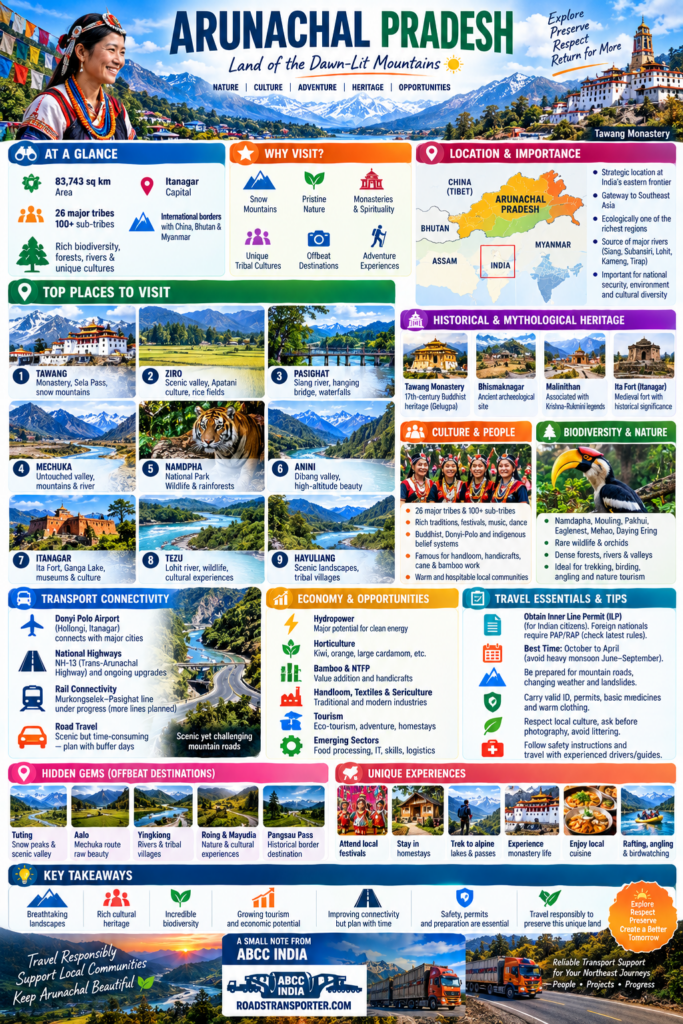
After travelling through this guide, one thing should be clear: Arunachal Pradesh cannot be understood simply as a collection of tourist places. It is a vast eastern Himalayan landscape where geography, indigenous cultures, spirituality, biodiversity, borderland history and difficult mountain connectivity shape almost every journey.
Located at India’s northeastern edge, Arunachal Pradesh covers about 83,743 sq km and shares international borders with Bhutan, China and Myanmar. From subtropical foothills, dense forests and powerful river valleys, the landscape rises toward high Himalayan terrain. The official state portal describes Arunachal as the “Land of the Dawn-lit Mountains”, while Arunachal Tourism highlights its extraordinary forests, orchids, rivers and mountain ecosystems.
🏔️ From Tawang to Ziro, Mechuka to Namdapha — Every Circuit Feels Different
One of Arunachal Pradesh’s greatest strengths is its geographical diversity. A journey toward Tawang brings high mountains, Buddhist heritage and the cultural world of the Monpa people. The Itanagar–Ziro–Daporijo–Aalo–Pasighat circuit connects the capital with valleys, indigenous communities, archaeological and natural attractions. Other official tourism circuits lead towards Mechuka, Tuting, Anini, Tezu, Hayuliang, Namdapha and Pangsau Pass, demonstrating why the state cannot realistically be explored in one hurried itinerary.
Ziro stands apart for its plateau landscape and Apatani cultural environment. Official tourism information particularly notes its traditional paddy-cum-pisciculture system, land-use practices, water management, handloom, bamboo craftsmanship and community institutions.
Pasighat, meanwhile, introduces travellers to the Siang landscape, hanging bridges, waterfalls and access to the Daying Ering Memorial Wildlife Sanctuary.
These places explain why a good Arunachal itinerary should be designed circuit by circuit rather than attraction by attraction.
🏛️ History, Mythology & Spiritual Heritage
Arunachal’s heritage is layered rather than uniform.
The official state narrative connects the region with traditions surrounding the Kalika Purana and Mahabharata, including legends associated with Parashuram, Vyasa, King Bhishmaka, Krishna and Rukmini. Such accounts are important elements of cultural tradition and should be presented as mythological associations rather than archaeological proof of the events themselves.
Archaeological places such as Bhismaknagar and Malinithan, the medieval Ita Fort at Itanagar, and the Buddhist heritage of Tawang add historical dimensions to the journey. Arunachal Tourism describes Tawang Monastery as a 17th-century centre of spiritual life associated with the Gelugpa tradition of Mahayana Buddhism.
👨👩👧👦 Culture Is the Journey, Not a Tourist Performance
Visitors should resist treating Arunachal’s communities merely as photography subjects.
The state contains remarkable linguistic, religious, artistic and cultural diversity. Official tourism material describes 26 major tribes and more than 100 sub-tribes, with distinct traditions and customs. Buddhist traditions are especially prominent in parts of western and eastern Arunachal, while Donyi-Polo and other indigenous belief systems form important parts of the state’s cultural landscape.
That diversity is expressed through festivals, weaving, cane and bamboo work, food, agriculture, village institutions, monasteries and oral traditions.
Responsible cultural tourism therefore means asking before photographing people or ceremonies, respecting sacred spaces, buying genuine local crafts fairly and avoiding stereotypes that reduce many distinct communities to a single “tribal culture.”
🐯🌳 Arunachal Is Also a Biodiversity Journey
Nature lovers can experience something very different from conventional hill-station tourism.
Official tourism resources highlight forests, orchids, trekking, angling, rafting and wildlife, and identify protected landscapes including Namdapha, Mouling, Pakke/Pakhui, Eaglenest, Mehao and Daying Ering among the state’s important nature destinations.
The rivers—particularly the Siang, Subansiri, Kameng, Lohit and Tirap systems—are not simply scenic backdrops. They influence settlement, ecology, agriculture, adventure tourism and transport geography.
For visitors, the practical lesson is simple: leave the ecosystem as you found it. Avoid littering, wildlife disturbance, uncontrolled drone use and activities that damage fragile trails or river environments.
🚗✈️ Connectivity Is Improving, but Distance Must Be Measured in Time
Arunachal is becoming more accessible, but travellers should not plan Himalayan journeys using kilometres alone.
Mountain gradients, weather, road works, landslides and long driving hours can radically change journey times. The state’s Tourism Policy 2025–30 identifies multimodal connectivity as central to tourism development and notes that the Sela Tunnel has improved all-weather access on the Tawang corridor. It also calls for better road access to destinations including Anini and Mechuka and stronger aviation connectivity.
Therefore, keep buffer days in a long Arunachal itinerary rather than scheduling every morning and evening around a rigid arrival time.
🥝🧵 Tourism Supports a Wider Local Economy
The visitor economy extends well beyond hotels.
Money spent responsibly can support homestays, guides, drivers, restaurants, farmers, horticulture producers, weavers, cane-and-bamboo artisans, adventure operators and small local businesses.
Ziro’s agricultural landscape illustrates the close relationship between culture, ecology and livelihood, while Pasighat’s tourism information even identifies a mechanised textile centre producing ethnic garments and household textiles.
Choosing locally operated accommodation, eating regional food, hiring knowledgeable local guides and buying authentic crafts can therefore make tourism expenditure more meaningful.
🔐⚠️ The Practical Rules First-Time Visitors Should Remember
Arunachal is a destination where preparation matters. Domestic tourists require an Inner Line Permit (ILP), while foreign nationals follow the applicable Protected/Restricted Area Permit framework; the official tourism portal should be checked immediately before travel because entry rules can change.
Beyond permits, travellers should carry identification and offline copies of essential documents, check weather and road conditions before long mountain sectors, avoid unrealistic night-driving plans, maintain fuel margins on remote routes, respect local instructions and never enter restricted or sensitive areas simply because an online map shows a road.
For high-altitude journeys, particularly around the western Himalayan circuit, acclimatisation and conservative scheduling matter more than completing a sightseeing checklist.
💎 Hidden Arunachal Is Often Found Between the Famous Places
Tawang, Ziro and Itanagar may attract the first search, but some of Arunachal’s most memorable travel experiences lie along the wider circuits—Aalo–Mechuka, Pasighat–Yingkiong–Tuting, Roing–Mayudia–Anini, Tezu–Hayuliang, and Miao–Namdapha, among others officially promoted by Arunachal Tourism.
“Hidden gem,” however, should never mean trespassing into a protected, culturally sensitive or unsafe location. Sometimes keeping a place special means accepting that visitors are guests rather than consumers of every landscape.
❤️🌄 The Journey Arunachal Leaves With You
Arunachal Pradesh rewards travellers who slow down.
Come for the snow mountains of Tawang, and you may remember the monastery bells. Come for Ziro’s landscape, and you may return thinking about the Apatani relationship with land and water. Follow the Siang toward Pasighat, and the scale of the river may become more memorable than any individual attraction. Travel east toward the forest landscapes, and the journey itself becomes part of the destination.
The best Arunachal trip is therefore not the one with the largest number of places checked off.
It is the one where you understand where you travelled, respect the people who live there, spend locally, protect the environment, follow permit and safety rules, and return without leaving unnecessary damage behind.
🚛 A Small Travel-Support Note from ABCC India
For travellers, groups and organizations planning longer road journeys, vehicle movement, relocation or logistics requirements connected with Northeast India, ABCC India Project Cargo Corporation / RoadsTransporter.com represents the transport-support side of the broader journey.
But the destination must remain the hero of this guide.
🌄 Arunachal Pradesh does not ask you merely to visit. It asks you to travel patiently enough to understand it—and responsibly enough that the mountains, forests, cultures and communities remain worth discovering for the traveller who comes after you.
🌄 Conclusion: Travel Far, Travel Slowly, Travel Responsibly
The best places to visit in Arunachal Pradesh State are not connected by a simple sightseeing checklist. They are spread across mountains, river valleys, forests, monasteries, traditional settlements and remote border landscapes where the journey itself often becomes as memorable as the destination.
From the spiritual atmosphere and dramatic Himalayan scenery of Tawang to the distinctive cultural landscape of Ziro, from the Siang valley around Pasighat to the extraordinary remoteness of Mechuka, Anini and Tuting, Arunachal Pradesh rewards travellers who allow enough time to understand its geography rather than simply racing between attractions.
🏔️ Nature lovers come for mountains, rivers, forests, wildlife and changing Himalayan landscapes.
🙏 Cultural travellers discover monasteries, festivals, indigenous traditions, weaving, crafts and local food.
🥾 Adventure travellers find trekking, rafting, angling, mountain drives and outdoor experiences.
👨👩👧👦 Families and groups can combine sightseeing, culture, nature and educational experiences.
📸 Photographers encounter extraordinary landscapes, but local customs, people and sacred spaces should always be photographed respectfully.
🌿 Responsible travellers can support homestays, guides, drivers, artisans, farmers and locally owned businesses while reducing waste and environmental disturbance.
Arunachal Pradesh is also a destination where planning matters. Mountain-road conditions, weather, landslides, long driving times, permit requirements, fuel availability and limited services in remote areas can affect an itinerary. Travellers should check the latest official information before departure, keep realistic buffer time between destinations and avoid treating map distance as actual mountain-road travel time.
The most rewarding journey is therefore not necessarily the one covering the greatest number of tourist attractions. It is the one that gives you enough time to appreciate a monastery in silence, understand the traditions of the community hosting you, watch a Himalayan valley change with the light, taste local food, purchase crafts responsibly and leave a destination as clean and culturally respected as you found it.
🚛 About ABCC India Project Cargo Corporation
Alongside destination information, ABCC India Project Cargo Corporation / RoadsTransporter.com works in India’s road transport and logistics sector, with a focus on road-route surveys, geographical route planning, project-cargo consulting, heavy-haul transportation planning, industrial connectivity and travel-logistics support.
For difficult road movements, particularly across mountainous and infrastructure-sensitive regions, professional route planning can involve assessment of road geometry, bridges, gradients, turning radii, overhead clearances, potential obstructions, vehicle configuration and operational logistics before movement. These transport services are separate from the tourism recommendations in this guide and should always be planned according to the specific route, cargo and applicable permissions.
Ultimately, places to visit in Arunachal Pradesh State are worth exploring not because they can fill an itinerary, but because they can change the way a traveller understands India’s mountains, cultures and natural heritage.
🌄 Explore Arunachal Pradesh with curiosity.
🙏 Respect its communities and traditions.
🌿 Protect its forests, rivers and mountains.
🚗 Plan mountain journeys patiently.
❤️ And leave every place worthy of being discovered again by the next generation.
❓ New Traveller FAQs
🌄 What are the best places to visit in Arunachal Pradesh?
Some of the best-known places to visit in Arunachal Pradesh include Tawang, Ziro Valley, Itanagar, Pasighat, Mechuka, Bomdila, Dirang, Roing, Anini, Tezu and Namdapha National Park. The right destinations depend on whether you prefer monasteries, Himalayan scenery, wildlife, indigenous culture, road trips or adventure.
⭐ Which is the most famous tourist place in Arunachal Pradesh?
Tawang is among Arunachal Pradesh’s best-known tourism destinations. Travellers visit for Tawang Monastery, high-altitude Himalayan scenery, Buddhist heritage and the wider Sela–Tawang landscape. Ziro is another major destination, particularly for its distinctive valley landscape and Apatani cultural heritage.
🌿 What are some hidden and offbeat places to visit in Arunachal Pradesh?
Travellers looking beyond the most familiar circuits can research Mechuka, Tuting, Yingkiong, Anini, Mayudia, Hayuliang and the Miao–Namdapha region. Many are remote, so road conditions, permits, weather and realistic travel time should be checked before departure.
👨👩👧👦 Which places in Arunachal Pradesh are suitable for a family trip?
Families can consider Tawang, Bomdila, Dirang, Ziro, Itanagar and Pasighat, depending on season and the ages and mobility of travellers. Families travelling with children or senior citizens should avoid overpacked itineraries because long mountain drives and high altitude can require additional rest.
💑📸 What are the best places in Arunachal Pradesh for couples and photographers?
Ziro, Mechuka, Dirang, Tawang and the Siang valley landscapes offer memorable settings for couples and photographers. Mountains, monasteries, rivers, forests, traditional architecture and changing Himalayan light create excellent photography opportunities, but permission should be requested before photographing people, ceremonies or culturally sensitive locations.
🌧️🌺 What is the best time to visit Arunachal Pradesh?
For many popular circuits, October to April can provide favourable conditions, although the ideal period varies considerably by altitude and destination. The monsoon can bring heavy rainfall, landslides and road disruption, while high-altitude winter routes may face snow or weather-related restrictions. Always check current conditions shortly before travelling.
🚗✈️🚆 How can tourists reach Arunachal Pradesh?
Travellers can enter through a combination of air, rail and road connections. Donyi Polo Airport near Itanagar provides direct aviation access to the capital region, while railheads and road gateways connect Arunachal with neighbouring Assam. Inside the state, road travel remains essential for many tourism circuits, and journey time can be much longer than map distance suggests.
📱🔒 Do tourists need a permit to visit Arunachal Pradesh?
Yes. Indian citizens generally require an Inner Line Permit (ILP) to enter Arunachal Pradesh, while foreign visitors are subject to the applicable Protected Area Permit/other current entry requirements. Because permit rules can change, travellers should verify requirements through official Arunachal Pradesh government or tourism channels before departure.
🥾🐯 What are the best adventure and wildlife experiences in Arunachal Pradesh?
Depending on destination, season, permissions and operator availability, Arunachal offers opportunities for trekking, hiking, rafting, angling, birdwatching, wildlife exploration and mountain road journeys. Nature travellers can research areas such as Namdapha National Park, Pakke landscape, Eaglenest, Mehao and Daying Ering, while adventure activities should be undertaken with appropriate local guidance and safety planning.
❤️🙏 How many days are enough for an Arunachal Pradesh trip?
There is no single ideal duration because Arunachal Pradesh is large and mountainous. About 7–10 days can work for one focused circuit, while 10–15 days or longer provides more flexibility for multiple destinations and weather-related delays. Instead of trying to cover the entire state, choose one geographical circuit, keep buffer time and travel slowly enough to experience local culture and landscapes responsibly.


