
🌏 The Journey From Faith to India’s Temple Economy
Before sunrise, the streets surrounding many of India’s famous temples begin to come alive.
Flower sellers prepare fresh garlands. Tea stalls open their shutters. Pilgrims gather near bus stands and railway stations. Hotel workers prepare rooms, drivers check their vehicles, and shopkeepers arrange incense sticks, lamps, sweets and devotional products.
For some visitors, the journey is a lifelong spiritual aspiration. For others, it is a family tradition, a cultural experience or an opportunity to discover India’s architectural and historical heritage.
But behind every pilgrimage is an economic story.
A family travelling to Varanasi may purchase railway tickets, book a hotel, hire an auto-rickshaw, eat at a local restaurant, buy Banarasi textiles and visit nearby attractions. A group travelling to Kedarnath may depend on mountain transport operators, accommodation providers, guides and seasonal workers. A devotee visiting Tirupati participates in a much larger institutional system involving food preparation, procurement, security, accommodation and public services.
Together, these activities form what is commonly described as the Indian temple economy.
India’s temple economy is not a single industry with one balance sheet. It is a network of religious institutions, tourism businesses, public infrastructure, cultural industries, agricultural producers, transportation services and local communities.
It connects large metropolitan cities with small villages, coastal destinations with mountain settlements, and historic traditions with modern digital technology.
Temples also play a role in the country’s cultural identity. Their importance cannot be reduced to revenue, donations or visitor numbers. They are places of worship, memory, architecture, learning, community participation and religious expression.
A useful study of the temple economy must therefore examine both economic benefits and social responsibilities.
🛕 What is the temple economy in India?
The temple economy in India refers to economic activity associated with Hindu temples, pilgrimage journeys, temple festivals, religious services and related tourism. It includes temple administration and spending by visitors on accommodation, transportation, food, shopping, local services and infrastructure.
Religious tourism in India is broader than temple tourism. It also includes visits to Buddhist, Jain, Sikh, Islamic, Christian and other religious heritage destinations.
📊 What makes India’s temple tourism economy important?
| Economic dimension | Importance |
|---|---|
| Tourism | Encourages domestic and international travel |
| Employment | Supports hospitality, retail, transportation and services |
| Agriculture | Creates demand for flowers, fruits, grains and dairy |
| Infrastructure | Encourages investment in roads, sanitation and visitor facilities |
| Culture | Supports architecture, traditional crafts and festivals |
| Rural development | Connects smaller towns with wider tourism markets |
| Entrepreneurship | Creates opportunities for local businesses |
| Transportation | Generates passenger movement and goods distribution |
| Technology | Supports online bookings, donations and visitor management |
| Social welfare | Some religious institutions provide education, healthcare and food services |
The scale of this ecosystem explains why temple tourism deserves serious attention from economists, tourism planners, infrastructure professionals and entrepreneurs.
🕉️ 2. Understanding Temple Tourism, Pilgrimage Tourism and Spiritual Tourism
Although these terms are frequently used together, they have different meanings.
Temple tourism
Temple tourism involves visiting temples for worship, architecture, cultural exploration, festivals or heritage experiences.
Visitors may be devotees, cultural tourists, historians, architecture enthusiasts or families.
Pilgrimage tourism
Pilgrimage tourism involves journeys undertaken primarily for religious or spiritual purposes.
Examples include the Char Dham Yatra, visits to Tirupati, the Pandharpur Wari and pilgrimages to major Jyotirlinga shrines.
Religious tourism
Religious tourism is the broader category of travel associated with religious places, ceremonies, heritage and traditions.
It includes temples as well as other religious sites.
Spiritual tourism
Spiritual tourism may involve meditation, reflection, yoga, religious practice or personal exploration.
Not every spiritual journey is associated with a temple.
Heritage tourism
Heritage tourism focuses on historical, architectural and cultural significance.
For example, the Konark Sun Temple is a major heritage destination as well as a monument connected to India’s religious and architectural history.
Comparison of major tourism categories
| Tourism type | Main motivation | Examples |
|---|---|---|
| Temple tourism | Worship, culture, architecture | Tirupati, Meenakshi Temple |
| Pilgrimage tourism | Religious journey | Char Dham, Pandharpur Wari |
| Religious tourism | Sacred places and traditions | Temples, gurudwaras, monasteries, churches, dargahs |
| Spiritual tourism | Reflection, meditation, spirituality | Rishikesh, spiritual retreats |
| Heritage tourism | History and architecture | Konark, Hampi |
| Festival tourism | Religious and cultural celebrations | Rath Yatra, Kumbh Mela |
| Cultural tourism | Traditions, food, crafts, performances | Varanasi, Madurai, Puri |
These categories overlap, and visitors often have multiple motivations.
📜 3. Historical Development of India’s Temple Economy
India’s temples have been connected with social and economic life for centuries.
In different historical periods, major religious institutions received patronage from rulers, merchants, landowners and communities.
Temple construction supported sculptors, architects, stoneworkers and other skilled craftspeople. Temple activities created demand for ritual materials, food, clothing and services.
Ancient India
Religious centres developed around settlements, rivers and important cultural routes.
Pilgrims required food, shelter and assistance during long journeys.
These needs encouraged the development of local markets and hospitality traditions.
Gupta period
The Gupta period contributed significantly to the development of classical Hindu temple architecture.
Temple patronage encouraged artistic and architectural activity.
Chola period
The Chola dynasty supported major temple construction in South India.
The Brihadisvara Temple in Thanjavur is an important example of monumental temple architecture.
Historical inscriptions reveal aspects of temple administration, endowments, employment and social organization.
Medieval pilgrimage networks
Religious centres such as Varanasi, Puri, Dwarka and Rameswaram were linked through traditions of pilgrimage.
Journeys between sacred destinations facilitated cultural exchange and supported local trade.
Colonial period
Railway expansion changed the accessibility of pilgrimage destinations.
Travelling to distant religious centres became easier for many people, contributing to the growth of accommodation, retail and passenger services.
Independent India
Road development, railway connectivity, urbanization and increasing household mobility contributed to the expansion of domestic pilgrimage tourism.
Temple administration evolved through different legal and institutional arrangements across states.
Digital era
Online information, electronic payments, official booking systems and improved transport connections have transformed modern pilgrimage planning.
The result is a temple economy that combines historical traditions with contemporary service industries.
📊 4. Indian Temple Economy Statistics: How Big Is Religious Tourism in India?
The size of India’s temple economy is often exaggerated because temple donations, religious tourism spending and the overall tourism industry are treated as interchangeable.
They are not.
The Ministry of Tourism does not maintain a separate national count of pilgrimage visits. Domestic tourism statistics include religious journeys alongside leisure, business, family and other travel.
Key Indian tourism statistics
Domestic tourist visits, 2025
428.69 crore
Provisional tourism dashboard figure
Domestic tourist visits, 2024
294.82 crore
All domestic tourism purposes
Tourism contribution to GDP, FY 2023–24
5.22%
Entire tourism sector
Tourism-supported employment, FY 2023–24
8.46 crore
Direct and indirect jobs
Sources: Ministry of Tourism statistical dashboard and government reporting. These are not temple-only figures.
Domestic tourist visits in India, 2019–2025
Growth of domestic tourist visits in India
Visits, not unique travellers. 2025 is the figure displayed on the Ministry’s current tourism dashboard; all categories of domestic tourism.
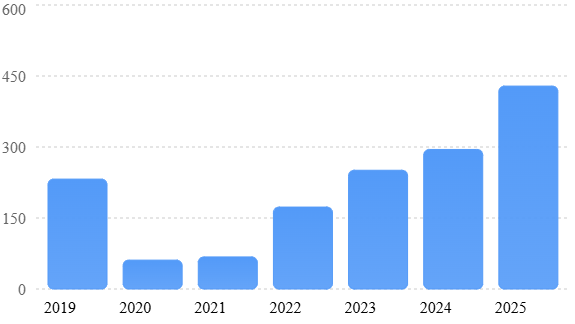
The recovery and expansion of domestic tourism create opportunities for religious destinations, but the data cannot establish what percentage of travel was temple-related.
🧮 How to calculate the economic impact of temple tourism
A basic estimate begins with:
\[ \text{Visitor expenditure}=\text{Visitor visits}\times\text{Average spending per visit} \]
For example, suppose a pilgrimage town receives 20 lakh visits annually and visitors spend an average of ₹3,000 outside the temple.
The resulting gross visitor expenditure would be ₹600 crore.
This amount is not equivalent to GDP contribution or business profit. A proper economic impact study must account for intermediate costs, imported goods, local wages and the portion of spending retained within the destination.
🗺️ 5. India’s Temple Tourism Geography: Major Pilgrimage Regions
India’s temple tourism is spread across coastal regions, river valleys, mountains, historic cities and rural settlements.
The geography of each destination influences visitor behaviour, transport requirements and business opportunities.
North India
Northern India’s temple tourism includes the Himalayan pilgrimage routes, Ayodhya, Mathura–Vrindavan, Varanasi and important temples in Himachal Pradesh.
Mountain destinations face seasonal access challenges, while urban pilgrimage centres often require sophisticated crowd and traffic management.
South India
Southern India is particularly significant for historic temple architecture, established religious institutions and multi-destination pilgrimage circuits.
Tamil Nadu, Andhra Pradesh, Karnataka, Kerala and Telangana contain numerous major temples with distinctive religious traditions and architectural histories.
West India
Western India includes the pilgrimage economies of Gujarat, Maharashtra and Rajasthan.
Important destinations include Dwarka, Somnath, Shirdi, Pandharpur, Trimbakeshwar, Ambaji, Nathdwara and Khatu Shyam Ji.
Road transport plays an important role in connecting these destinations with major population centres.
East India
Eastern India includes Puri, Gaya, Deoghar, Tarapith, Dakshineswar and important temple destinations in Odisha, Bihar, Jharkhand and West Bengal.
River-based religious traditions, seasonal festivals and regional crafts contribute to the tourism experience.
Northeast India
Northeastern India has distinctive temple traditions and religious heritage.
Kamakhya in Assam and Tripura Sundari in Tripura are prominent examples.
Tourism development must account for regional geography, transport access, local culture and environmental sensitivity.
🛕 6. State-Wise Indian Temple Tourism and Economy Directory
The following directory identifies important destinations and their associated economic activities. It is not a ranking by income, temple assets or visitor count.
| State / UT | Important temples and pilgrimage sites | Associated tourism economy |
|---|---|---|
| Andhra Pradesh | Tirumala, Srisailam, Srikalahasti, Simhachalam | Pilgrim accommodation, food services, buses |
| Arunachal Pradesh | Malinithan, Parshuram Kund | Seasonal travel, local guides, hospitality |
| Assam | Kamakhya, Umananda, Sivadol | Festivals, religious retail, urban tourism |
| Bihar | Vishnupad, Mahavir Mandir, Mundeshwari | Pilgrimage services, regional travel |
| Chhattisgarh | Danteshwari, Bhoramdeo, Mahamaya | Heritage tourism, local crafts |
| Goa | Mangeshi, Shantadurga, Mahalasa | Temple festivals, cultural tourism |
| Gujarat | Somnath, Dwarkadhish, Ambaji, Pavagadh | Hotels, highway services, transport |
| Haryana | Mansa Devi, Sheetla Mata | Regional pilgrimage and retail |
| Himachal Pradesh | Jwala Ji, Naina Devi, Chintpurni, Chamunda Devi | Hill transport, lodging, seasonal commerce |
| Jharkhand | Baidyanath Dham, Basukinath, Rajrappa | Kanwar pilgrimage, retail, transport |
| Karnataka | Udupi Krishna, Dharmasthala, Kukke Subramanya, Virupaksha | Accommodation, food, heritage tourism |
| Kerala | Sabarimala, Guruvayur, Padmanabhaswamy | Seasonal pilgrimage, road transport |
| Madhya Pradesh | Mahakaleshwar, Omkareshwar, Maihar | Religious tourism, accommodation |
| Maharashtra | Shirdi, Pandharpur, Trimbakeshwar, Bhimashankar, Siddhivinayak | Pilgrimage buses, hotels, urban retail |
| Manipur | Shri Govindajee Temple | Cultural and religious tourism |
| Meghalaya | Nartiang Durga Temple | Regional cultural tourism |
| Mizoram | Limited major temple-based tourism compared with other states | Small-scale cultural and religious travel |
| Nagaland | Limited major temple-based tourism compared with other states | Broader cultural and heritage tourism |
| Odisha | Jagannath, Lingaraj, Konark Sun Temple | Rath Yatra, handicrafts, hospitality |
| Punjab | Durgiana Temple, Devi Talab Mandir | Regional tourism, local commerce |
| Rajasthan | Khatu Shyam Ji, Salasar Balaji, Shrinathji, Brahma Temple Pushkar | Highway hospitality, retail, transport |
| Sikkim | Kirateshwar Mahadev Temple | Regional pilgrimage and cultural tourism |
| Tamil Nadu | Meenakshi, Rameswaram, Brihadisvara, Chidambaram, Palani | Heritage, crafts, accommodation |
| Telangana | Yadadri, Bhadrachalam, Vemulawada | Temple-town infrastructure and services |
| Tripura | Tripura Sundari Temple | Pilgrimage, markets, regional transport |
| Uttar Pradesh | Ram Mandir Ayodhya, Kashi Vishwanath, Krishna Janmabhoomi area, Vindhyachal | Large-scale pilgrimage and hospitality |
| Uttarakhand | Kedarnath, Badrinath, Gangotri, Yamunotri, Haridwar temples | Mountain tourism and seasonal services |
| West Bengal | Kalighat, Dakshineswar, Tarapith | Urban pilgrimage, food and retail |
| Delhi | Akshardham, Kalkaji, Chhatarpur | Urban heritage and religious tourism |
| Jammu & Kashmir | Vaishno Devi, Amarnath pilgrimage | Mountain access, lodging, transport |
| Puducherry | Manakula Vinayagar Temple | Heritage and coastal tourism |
| Andaman & Nicobar Islands | Local Hindu temples | Community and limited visitor-related activity |
The economic intensity varies considerably. A major pilgrimage hub may support thousands of businesses, while a smaller local shrine primarily serves nearby communities.
🏛️ 7. Major Temple Economy Case Studies in India
🛕 Tirupati, Andhra Pradesh: Institutional Scale and Pilgrimage Management
Tirumala Tirupati is one of India’s most prominent pilgrimage centres.
The Sri Venkateswara Temple is administered by Tirumala Tirupati Devasthanams (TTD), an institution responsible for extensive religious, administrative and pilgrim services.
TTD approved a budget of ₹5,456.26 crore for the financial year 2026–27. The announcement included ₹118.89 crore for educational improvements and plans for additional food-service infrastructure.
TTD News
The Tirupati economy extends beyond the temple administration to hotels, food suppliers, transportation operators, retailers and other service providers.
Economic lessons: Large pilgrimage institutions require reliable procurement, logistics, sanitation, financial management and public-facing services.
🚩 Ayodhya, Uttar Pradesh: Religious Tourism and Urban Transformation
Ayodhya has experienced major infrastructure and tourism changes associated with the development of the Ram Mandir and related facilities.
Religious travel supports accommodation, restaurants, retail, transport and construction-related businesses.
Rapid growth also creates challenges involving land prices, congestion, public services and the preservation of historic neighbourhoods.
Economic lessons: Tourism growth should be evaluated through local employment, service quality and resident welfare, not visitor counts alone.
🌊 Varanasi, Uttar Pradesh: Temples, Riverfronts and Cultural Industries
Varanasi’s economy combines pilgrimage with riverfront tourism, heritage walks, music, textiles, food and traditional commerce.
The Kashi Vishwanath Temple is a major religious destination, while the ghats and historic neighbourhoods attract visitors with wider cultural interests.
Economic lessons: Temple tourism can support a diversified city economy when religious and cultural attractions are connected responsibly.
🌸 Shirdi, Maharashtra: A Pilgrimage-Based Service Economy
Shirdi demonstrates how a religious destination can support hotels, guesthouses, passenger transport, food businesses and retail.
Visitor demand changes during weekends, holidays and festivals.
Economic lessons: Businesses should plan for seasonal variation and competition rather than assuming constant high occupancy.
🏔️ Kedarnath, Uttarakhand: Seasonal Mountain Tourism
Kedarnath is a major pilgrimage destination in a geographically sensitive Himalayan environment.
The local economy depends on seasonal travel, mountain transport, lodging and support services.
Weather, road conditions and ecological constraints influence operations.
Economic lessons: Safety, environmental protection and infrastructure resilience are central to the sustainability of mountain pilgrimage.
🛕 Jagannath Puri, Odisha: Temple Festivals and Coastal Tourism
Puri combines religious pilgrimage, the Rath Yatra festival, traditional food practices and coastal tourism.
Its economy includes hospitality, transport, food, crafts and seasonal event services.
Economic lessons: Festival economies require planning for temporary demand without neglecting year-round residents.
🌺 Madurai, Tamil Nadu: Temple Heritage and Urban Commerce
The Meenakshi Amman Temple is central to Madurai’s cultural identity.
The surrounding urban economy includes traditional markets, textiles, jewellery, hospitality and food services.
Economic lessons: Historic commercial neighbourhoods are important economic assets and should be considered in heritage conservation plans.
🕉️ Ujjain, Madhya Pradesh: Religious Tourism and City Infrastructure
The Mahakaleshwar Temple attracts pilgrims throughout the year, with important seasonal and festival peaks.
Tourism generates demand for accommodation, local transport, food and religious services.
Economic lessons: Improved public spaces and pedestrian movement can enhance tourism, but infrastructure requires continuous maintenance and effective crowd management.
🛕 8. The 12 Jyotirlingas and Their Economic Importance
The twelve Jyotirlingas form one of India’s most widely recognized Shiva pilgrimage traditions. Their locations span multiple states, creating opportunities for regional and interstate religious tourism.
| Jyotirlinga | State | Nearest important tourism hub | Major tourism opportunities |
|---|---|---|---|
| Somnath | Gujarat | Veraval | Coastal tourism, hotels, transport |
| Mallikarjuna, Srisailam | Andhra Pradesh | Srisailam | Forest-region travel, accommodation |
| Mahakaleshwar | Madhya Pradesh | Ujjain | Heritage tourism, retail |
| Omkareshwar | Madhya Pradesh | Omkareshwar | River tourism, lodging |
| Kedarnath | Uttarakhand | Guptkashi region | Mountain pilgrimage, seasonal services |
| Bhimashankar | Maharashtra | Pune region | Hill tourism, passenger transport |
| Kashi Vishwanath | Uttar Pradesh | Varanasi | Urban tourism, handicrafts |
| Trimbakeshwar | Maharashtra | Nashik | Religious tourism, regional hospitality |
| Baidyanath Dham | Jharkhand | Deoghar | Kanwar Yatra, transport, accommodation |
| Nageshwar | Gujarat | Dwarka | Coastal pilgrimage, tourism circuits |
| Rameswaram | Tamil Nadu | Rameswaram | Coastal heritage and hospitality |
| Grishneshwar | Maharashtra | Chhatrapati Sambhajinagar | Heritage tourism, local transport |
Note: Some Jyotirlinga identifications have differing regional traditions. This table follows a commonly used pilgrimage circuit.
Economic importance of Jyotirlinga circuits
Multi-destination pilgrimage creates spending across more than one state. Travellers may use railway services, buses, taxis, hotels and restaurants over several days.
For transport operators, interstate pilgrimages require route planning, passenger comfort, safe driving schedules and suitable rest stops.
For local businesses, the challenge is to convert short visits into longer, meaningful stays without exploiting religious sentiment.
A well-planned itinerary may combine a principal temple visit with nearby heritage sites, museums, traditional markets and local cuisine.
🚩 9. Char Dham, Chota Char Dham and Other Famous Pilgrimage Circuits
India has multiple pilgrimage traditions that connect geographically distant sacred destinations.
Char Dham
The traditional Char Dham circuit includes Badrinath, Dwarka, Puri and Rameswaram.
These destinations represent a geographically extensive pilgrimage journey across India.
Their economic significance extends to national transport networks, accommodation and regional tourism services.
Chota Char Dham
The Uttarakhand Chota Char Dham circuit includes Yamunotri, Gangotri, Kedarnath and Badrinath.
Its operating conditions differ substantially from those of urban pilgrimage destinations because of mountain geography and seasonal accessibility.
Important religious tourism circuits
| Circuit | Main destinations | Tourism characteristics |
|---|---|---|
| Traditional Char Dham | Badrinath, Dwarka, Puri, Rameswaram | Long-distance interstate pilgrimage |
| Uttarakhand Char Dham | Yamunotri, Gangotri, Kedarnath, Badrinath | Seasonal Himalayan pilgrimage |
| 12 Jyotirlingas | Multiple states | Multi-state Shiva pilgrimage |
| Gujarat coastal circuit | Dwarka, Nageshwar, Somnath | Coastal and religious tourism |
| Maharashtra pilgrimage circuit | Shirdi, Nashik, Trimbakeshwar, Bhimashankar | Road and rail pilgrimage |
| Tamil Nadu temple circuit | Madurai, Rameswaram, Thanjavur, Chidambaram | Architecture and heritage tourism |
| Krishna pilgrimage circuit | Mathura, Vrindavan, Govardhan and related sites | Religious and cultural tourism |
| Odisha heritage circuit | Puri, Konark, Bhubaneswar | Temples, architecture, coastal tourism |
| Karnataka heritage circuit | Hampi, Udupi and other destinations | Heritage and religious tourism |
Not every circuit is a formal government-designated tourism route. Travellers should verify distances, opening schedules, local restrictions and seasonal conditions before planning.
🏨 10. Hotels, Dharamshalas, Homestays and the Accommodation Economy
Accommodation is among the most visible commercial sectors associated with pilgrimage.
The industry serves visitors with widely different budgets and expectations.
A family travelling for a short temple visit may choose an economical guesthouse. A group of senior citizens may prefer accommodation close to accessible transport. Visitors combining pilgrimage with leisure tourism may stay in larger hotels.
Accommodation categories
| Accommodation type | Main customer segment | Economic considerations |
|---|---|---|
| Dharamshala | Pilgrims seeking simple lodging | Management and maintenance |
| Budget hotel | Families and groups | Occupancy and competition |
| Mid-range hotel | Families and leisure tourists | Service quality and staffing |
| Premium hotel | Higher-spending visitors | Capital and operating costs |
| Homestay | Cultural and regional travellers | Local participation |
| Pilgrim hostel | Organized groups | Capacity and sanitation |
| Retreat accommodation | Spiritual and wellness visitors | Programme quality and regulation |
Why overnight stays matter
Visitor numbers do not always translate into accommodation revenue.
A destination receiving many day visitors may have less hotel demand than a smaller destination attracting travellers who stay several nights.
The economic effect depends on visitor spending, average length of stay, room occupancy and how much expenditure reaches local suppliers.
Hospitality supply chains
Hotels purchase mattresses, furniture, cleaning materials, food, electricity, laundry services and maintenance.
These activities support businesses beyond the tourism industry itself.
The construction of hotels can also generate temporary demand for building materials, equipment and skilled workers.
However, excessive hotel development may create oversupply and increase pressure on land and water resources.
🚚 11. Temple Tourism and the Indian Transport and Logistics Economy
The connection between religious tourism and transportation is often underestimated.
Every pilgrimage involves the movement of people, while the supporting commercial ecosystem requires the movement of goods.
Road transportation, railways, aviation, local passenger services and goods distribution all contribute.
Passenger transportation
Important services include interstate buses, local buses, taxis, autorickshaws, private cars and authorized shuttle services.
The most appropriate mode depends on the destination.
Urban pilgrimage destinations benefit from mass transit and pedestrian-friendly streets.
Remote mountain destinations require carefully planned road access and emergency arrangements.
Goods transportation
Temple towns require regular deliveries of food, drinking water, flowers, dairy products, textiles, hotel supplies, construction materials and sanitation equipment.
A large pilgrimage destination may also need temporary logistics support during major festivals.
Specialized transportation and project cargo
Large infrastructure works can require generators, transformers, prefabricated structures, construction equipment and other heavy materials.
When equipment is unusually large or heavy, specialized trailers and route engineering may be necessary.
Such movements must be assessed according to actual cargo specifications, road geometry, bridge capacity and applicable permissions.
Transport and logistics business opportunities
| Sector | Potential business | Major requirement |
|---|---|---|
| Passenger transport | Pilgrimage bus operations | Permits, vehicle safety |
| Taxi services | Local sightseeing and transfers | Licensing, reliable service |
| Goods transport | Food and retail supply | Timely deliveries |
| Cold-chain logistics | Dairy and perishable products | Temperature control |
| Hotel logistics | Furniture and consumables | Inventory coordination |
| Construction logistics | Building materials | Site access and safety |
| Heavy-haul transport | Specialized infrastructure cargo | Engineering and permissions |
| Waste logistics | Collection and disposal | Municipal authorization |
| Warehousing | Regional distribution | Suitable location and storage |
| EV mobility | Electric passenger services | Charging and commercial viability |
Temple festival transport planning
During festivals, road authorities may restrict vehicle access to crowded areas.
Commercial operators should use designated delivery routes and comply with local traffic instructions.
Emergency access must remain clear.
Transport businesses should not advertise guaranteed access or travel times during major religious gatherings.
🌾 12. Agriculture, Flowers, Prasad and the Temple Food Economy
The temple economy connects urban pilgrimage destinations with agricultural production.
Flowers, fruits, vegetables, milk, grains and other materials are used in religious practices and visitor services.
Flower supply chains
Flower cultivation supports growers, wholesalers, transporters and retailers.
Fresh flowers are highly perishable, making efficient distribution important.
Festival demand can increase sales but may also produce price volatility.
Dairy products
Milk, ghee and traditional sweets are important in many religious food traditions.
Dairy producers, processors, wholesalers and retailers participate in the supply chain.
Food hygiene and appropriate storage are essential.
Prasad and food preparation
Temple food systems can involve procurement, kitchens, trained workers, packaging and distribution.
Some institutions operate large-scale food services.
Their economic and social significance extends beyond direct commercial revenue.
Traditional sweets and regional products
Many pilgrimage towns are associated with particular sweets or food traditions.
Visitors may purchase these products as gifts, creating markets for local producers.
Businesses should distinguish authentic regional products from generic items marketed through misleading claims.
Food waste management
High-volume food preparation can generate significant organic waste.
Careful demand forecasting, safe food handling, appropriate donation arrangements and lawful waste processing can improve efficiency.
👩💼 13. Employment and Entrepreneurship in Temple Tourism
Temple tourism supports employment across skill levels.
Some people work directly for religious institutions, while others are employed by independent businesses.
Employment categories
| Sector | Employment opportunities |
|---|---|
| Temple administration | Accountants, clerks, maintenance workers |
| Hospitality | Receptionists, chefs, housekeeping |
| Transport | Drivers, dispatchers, mechanics |
| Food services | Cooks, suppliers, vendors |
| Retail | Shopkeepers, sales workers |
| Tourism | Guides, coordinators, interpreters |
| Construction | Engineers, contractors, skilled workers |
| Technology | Booking-system and IT professionals |
| Public services | Sanitation and visitor assistance |
| Crafts | Sculptors, textile workers, artisans |
Women’s entrepreneurship
Women-led enterprises can participate in food production, handicrafts, accommodation, retail and tourism services.
Self-help groups may provide an organizational structure for small producers.
Access to finance, safe working environments and market opportunities remain important.
Youth employment
Young workers may find opportunities in hospitality, digital marketing, language services, transport management and tourism technology.
Training in customer service, first aid, digital literacy and local heritage can improve employability.
Employment quality
The number of jobs created is only one measure of economic success.
Income stability, working conditions, social protection and opportunities for skill development are equally important.
🏗️ 14. Government Schemes for Temple Tourism and Pilgrimage Infrastructure
Public infrastructure has a significant influence on the development of religious destinations.
Government support may include roads, pedestrian facilities, lighting, toilets, drinking water, waste management and visitor information systems.
PRASHAD Scheme
The Pilgrimage Rejuvenation and Spiritual, Heritage Augmentation Drive (PRASHAD) supports development at identified pilgrimage and heritage destinations.
Government reporting in 2026 recorded 54 sanctioned projects across 28 states and Union Territories, with an estimated project cost of ₹1,726.74 crore. A later 2026 update reported 32 physically completed projects.
Press Information Bureau
Swadesh Darshan
Swadesh Darshan and Swadesh Darshan 2.0 support tourism destination development.
Spiritual tourism and cultural heritage are among the themes relevant to pilgrimage-related infrastructure.
Government reporting in January 2026 recorded 53 sanctioned projects under Swadesh Darshan 2.0, with an approved amount of ₹2,208.27 crore.
Press Information Bureau
Public investment priorities
Infrastructure development should consider the entire visitor journey.
A renovated temple entrance may improve access, but visitors also need reliable roads, clean public toilets, safe pedestrian routes and accurate information.
Projects should be assessed through measurable improvements in safety, accessibility, maintenance and local economic participation.
🌱 15. Sustainable Temple Tourism and Environmental Protection
Religious tourism can create environmental challenges when large numbers of visitors arrive in areas with limited infrastructure.
These challenges are particularly important in mountain regions, riverfront cities and environmentally sensitive destinations.
Solid waste
Food packaging, disposable items, flowers and other waste require collection and processing.
Waste segregation and suitable public facilities can reduce pollution.
Water management
Hotels, restaurants and public facilities increase demand for drinking water and sanitation.
Efficient fixtures, wastewater treatment and careful resource planning are essential.
Traffic congestion
Large numbers of private vehicles can increase congestion and emissions.
Appropriate public transport, parking facilities and pedestrian zones can improve movement.
Heritage protection
Historic temple structures require specialized conservation.
Modern commercial development should not damage protected monuments or surrounding heritage areas.
Community participation
Residents should be involved in tourism planning.
Local communities experience the effects of crowding, land-use changes and commercial development throughout the year.
Sustainable tourism requires balancing visitor convenience with resident welfare.
💼 16. Business Opportunities in the Indian Temple Economy
India’s pilgrimage destinations offer business opportunities in both established and emerging sectors.
However, no business should be considered profitable solely because a temple receives many visitors.
Investors must assess local demand, operating costs, competition, licensing and seasonality.
Temple tourism business opportunities chart
| Business idea | Customer segment | Main risk | Growth opportunity |
|---|---|---|---|
| Budget accommodation | Families, pilgrims | Seasonal occupancy | Reliable low-cost stays |
| Restaurant | Pilgrims, residents | Food costs and competition | Regional cuisine |
| Flower shop | Devotees | Spoilage | Organized sourcing |
| Souvenir business | Tourists | Generic products | Authentic crafts |
| Travel agency | Pilgrimage groups | Competition | Customized itineraries |
| Taxi business | Families, senior visitors | Permits and vehicle costs | Reliable local transfers |
| Tourist guide service | Heritage travellers | Seasonal demand | Multilingual guiding |
| Hotel supplies | Hospitality businesses | Credit and inventory | Recurring contracts |
| Laundry service | Hotels | Equipment and utilities | Commercial outsourcing |
| Food distribution | Restaurants, institutions | Perishability | Reliable supply chains |
| Packaging | Food and souvenir businesses | Material costs | Sustainable products |
| EV shuttle service | Local visitors | Charging and utilization | Last-mile mobility |
| Waste-management service | Institutions and businesses | Regulation | Organized collection |
| Digital booking support | Tourism businesses | Trust and competition | Secure technology |
| Accessibility services | Senior and disabled visitors | Specialized equipment | Inclusive travel |
| Construction logistics | Developers and contractors | Project cycles | Infrastructure growth |
Choosing a business location
A shop beside a busy temple may have high visibility but expensive rent.
A business located farther away may benefit from lower operating costs but require stronger transport connections.
Footfall, customer conversion, spending capacity and competition should all be studied.
Business feasibility checklist
Before investing, entrepreneurs should estimate expected customer volume, average revenue per transaction, gross margin, fixed expenses, seasonal fluctuations and working capital.
They should also verify zoning, local permissions, fire safety, taxation and other regulatory requirements.
The most resilient businesses often serve both tourists and permanent residents.
📱 17. Digital Temple Tourism, Online Darshan and Technology
Technology is becoming an important part of religious tourism.
Official websites, digital payments, online information and visitor-management systems can improve planning and administration.
Online services
Depending on the institution, online facilities may include accommodation information, donations, scheduled religious services and visitor guidance.
Not every temple offers the same services.
Pilgrims should rely on official sources and avoid unverified booking intermediaries.
Digital payments
Electronic payments can improve convenience and transaction records.
However, fraudulent payment links and impersonation websites remain risks.
Visitors should verify the intended recipient before transferring money.
Tourism information platforms
Reliable destination websites can help travellers understand how to reach temples, where to stay, what facilities are available and how to travel responsibly.
Useful information includes accessibility, transport connections, seasonal conditions, official booking links and emergency contacts.
Artificial intelligence and visitor services
AI-assisted systems may help organize information, support multilingual communication and forecast visitor demand.
However, religious and travel information must be checked against authoritative sources.
Automated systems should not invent temple opening hours, booking availability, ritual rules or local businesses.
🧭 18. Temple Tourism Travel Planning Guide
Planning a pilgrimage requires more than choosing a temple.
Visitors should consider transportation, accommodation, local customs, accessibility, seasonal conditions and the needs of accompanying family members.
Best time to visit temples in India
There is no single best season for every temple.
| Region | General travel considerations |
|---|---|
| Himalayan destinations | Seasonal access and weather restrictions |
| North Indian plains | Summer heat, winter fog, festival crowds |
| Western India | Summer temperatures and monsoon conditions |
| South India | Heat, humidity, regional monsoon patterns |
| Eastern India | Rainfall, festivals and coastal weather |
| Northeast India | Monsoon conditions and regional connectivity |
Actual conditions vary by destination and year.
Travelling with children
Families should choose manageable itineraries, carry drinking water and identify rest facilities.
Crowded festival periods may require additional precautions.
Senior-citizen pilgrimage
Older travellers may benefit from shorter walking distances, accessible accommodation and flexible schedules.
Medical needs should be discussed with appropriate healthcare professionals before demanding journeys.
Solo travel
Solo visitors should use reliable transport, share travel plans with trusted contacts and verify accommodation arrangements.
International visitors
Foreign travellers should check visa requirements, local customs, permitted areas and official visitor information.
Some religious institutions have specific entry or conduct rules that visitors must respect.
⚠️ 19. Temple Tourism Safety, Scams and Responsible Travel
Pilgrimage is often emotionally meaningful, which makes reliable information particularly important.
Common risks
| Risk | Practical precaution |
|---|---|
| Fake booking websites | Use verified official websites |
| Unauthorized guides | Confirm identity and credentials |
| Misleading transport fares | Agree on transparent pricing |
| Crowded entrances | Follow official crowd instructions |
| Lost belongings | Secure valuables |
| Extreme weather | Check forecasts and local advisories |
| Mountain road hazards | Follow official travel restrictions |
| Food hygiene problems | Choose hygienic establishments |
| Misleading donation requests | Verify the recipient |
| Inaccessible facilities | Check arrangements in advance |
Emergency assistance
India’s integrated emergency response number is 112.
Travellers should also identify nearby healthcare facilities and local police assistance before visiting remote destinations.
Responsible behaviour
Visitors should respect religious customs, avoid obstructing rituals and follow photography restrictions.
They should dispose of waste properly and avoid damaging monuments or natural surroundings.
Responsible tourism protects both sacred places and the communities that maintain them.
📈 20. Economic Impact Calculator for Temple Tourism
A simple scenario model can help researchers and entrepreneurs understand how visitor volume and spending affect the size of a destination’s tourism market.
🧮 Temple Tourism Economic Scenario
Annual tourist visits
25 lakhAverage visitor spending
₹2,500Assumed locally retained share
40%
Annual visitor expenditure
₹625 cr
Assumed locally retained spending
₹250 cr
Hypothetical calculations only. They are not forecasts, audited figures, tax receipts or GDP estimates.Reset scenario
How this model can be used
A hotel investor can estimate potential demand using realistic assumptions about overnight stays.
A transport operator can study seasonal passenger movement.
A local authority can evaluate whether additional infrastructure is justified.
A tourism researcher can use the model as a starting point before collecting actual spending data.
🔮 21. Future of Indian Temple Tourism: 2026–2035
India’s temple tourism sector has opportunities for continued development, but the direction and scale of growth will depend on policy, infrastructure and visitor behaviour.
Integrated tourism circuits
Better connectivity can make it easier to combine pilgrimage with heritage and cultural tourism.
This may distribute spending across multiple destinations.
Accessibility improvements
Facilities for senior citizens and people with disabilities can make pilgrimage more inclusive.
Accessible transport, ramps, toilets and reliable information are important.
Sustainable mobility
Public transport and appropriately planned electric mobility can reduce congestion at suitable destinations.
Local enterprise development
Training, transparent procurement and digital market access can improve opportunities for local businesses.
Cultural preservation
Traditional architecture, festivals, music, food and crafts are valuable cultural assets.
Their protection should remain central to tourism planning.
Better economic statistics
Reliable pilgrimage-specific surveys would help researchers distinguish temple income, tourist spending, employment and regional economic value added.
This is essential for making credible claims about the future size of the temple economy.
❓ 22. Frequently Asked Questions About Indian Temple Economy and Temple Tourism
1. What is the Indian temple economy?
The Indian temple economy is the network of economic activities generated by temples, pilgrimage, religious festivals and related services. It includes accommodation, transportation, food, shopping, employment, temple administration and infrastructure.
2. How much is the temple economy worth in India?
There is no single official figure for the complete value of India’s temple economy. National tourism statistics include religious and non-religious travel, and temple donations cannot be treated as tourism GDP.
3. Why is temple tourism important in India?
Temple tourism supports cultural heritage, regional travel, local employment, small businesses, hospitality, transportation and infrastructure development.
4. Which is the richest temple in India?
The answer depends on whether richness means annual income, institutional budget, financial assets, property or the estimated value of religious treasures. These measures are not directly comparable, and no single consistently audited national ranking covers every temple.
5. Which temple has one of India’s largest annual budgets?
Tirumala Tirupati Devasthanams approved a budget of ₹5,456.26 crore for FY 2026–27.
TTD News
6. How does temple tourism contribute to GDP?
It generates economic value through hospitality, transport, retail, food services and other activities. GDP measures value added, not simply the total money spent or donated.
7. How many religious tourists visit India every year?
The Ministry of Tourism does not maintain a separate national count of pilgrimage visits. Domestic tourist visit figures include religious travel but cannot isolate it reliably.
Digital Sansad
8. What are the most famous temple tourism destinations in India?
Important destinations include Tirupati, Ayodhya, Varanasi, Shirdi, Kedarnath, Badrinath, Puri, Rameswaram, Madurai, Somnath, Dwarka and Ujjain.
9. What is the difference between temple tourism and religious tourism?
Temple tourism focuses on visits to temples. Religious tourism is broader and includes other sacred destinations, traditions and religious heritage sites.
10. How does temple tourism generate employment?
It supports jobs in hotels, restaurants, transport, retail, food production, construction, visitor assistance, administration and traditional crafts.
11. How does temple tourism help rural areas?
It can create markets for local agricultural products, handicrafts, accommodation, food services and transportation.
12. Which businesses benefit from temple tourism?
Hotels, restaurants, travel agencies, taxi operators, retailers, flower suppliers, food producers, transport companies and local service providers may benefit.
13. What is the PRASHAD scheme?
PRASHAD is a Government of India programme supporting pilgrimage and heritage tourism infrastructure, including visitor facilities, sanitation and accessibility.
14. How does road transportation support temple tourism?
Road transportation carries pilgrims and supplies essential goods to temples, hotels, restaurants and surrounding markets.
15. Is temple tourism seasonal?
Some destinations receive visitors throughout the year, while others have strong seasonal or festival-related demand. Himalayan pilgrimages are particularly affected by seasonal access.
16. What are the environmental problems caused by religious tourism?
Potential problems include waste generation, water stress, traffic congestion, pollution and pressure on fragile landscapes.
17. How can temple towns become more sustainable?
They can improve public transport, sanitation, wastewater treatment, waste management, pedestrian safety and heritage conservation.
18. What is spiritual tourism in India?
Spiritual tourism involves travel for meditation, reflection, religious practices or personal spiritual experiences. It can overlap with temple and pilgrimage tourism.
19. What are India’s four major Char Dham destinations?
The traditional Char Dham destinations are Badrinath, Dwarka, Puri and Rameswaram.
20. What are the four destinations of Uttarakhand’s Chota Char Dham?
Yamunotri, Gangotri, Kedarnath and Badrinath.
21. Is investing in a temple town hotel profitable?
Profitability depends on occupancy, location, construction costs, financing, competition and seasonal demand. High visitor numbers alone do not guarantee profitability.
22. How can technology improve temple tourism?
Technology can support official bookings, payments, multilingual information, visitor management and operational planning.
23. What role do temples play in preserving Indian culture?
Temples preserve architecture, religious traditions, music, sculpture, festivals, community practices and historical knowledge.
24. How can temple tourism benefit women entrepreneurs?
Women-led businesses can participate in food services, handicrafts, accommodation, retail and tourism-related activities, provided suitable market access and support are available.
25. What is the future of temple tourism in India?
Its future depends on responsible infrastructure investment, visitor demand, digital services, heritage protection, environmental sustainability and local economic participation.
🏁 Conclusion: Faith, Heritage and the Economic Future of India
India’s temple economy demonstrates how religious and cultural traditions can connect with modern economic activity.
From major pilgrimage institutions to small roadside businesses, religious travel supports an extensive network of services.
A temple journey can create demand for agricultural products, accommodation, passenger transportation, food, traditional crafts, construction and technology.
Yet the economic value of pilgrimage should not be measured only through donations, institutional budgets or visitor numbers.
The real question is whether tourism improves livelihoods, creates dignified employment, protects heritage and provides safe, accessible experiences.
A successful temple town must serve both its visitors and its permanent residents.
India’s religious destinations have an opportunity to demonstrate that cultural preservation and economic development can reinforce each other.
With responsible planning, better infrastructure, reliable information and greater local participation, temple tourism can contribute to sustainable regional development while respecting the spiritual traditions at its heart.
For the transport and logistics industry, pilgrimage infrastructure also highlights the importance of dependable road networks, safe passenger movement, efficient goods distribution and specialized project logistics.
ABCC India Project Cargo Corporation, working in road transportation, project cargo and route-planning services, is part of the wider logistics sector that can support infrastructure development across India.
The future of the Indian temple economy is not simply about attracting more pilgrims. It is about creating safer journeys, stronger local businesses, better public facilities and lasting prosperity while preserving India’s religious and cultural heritage.
📚 Official Research References
The following are useful primary sources for publication and future updates.
| Source | Research purpose |
|---|---|
| Ministry of Tourism — Statistics Dashboard | Domestic tourism, GDP and employment |
| Ministry of Tourism | Tourism policy and infrastructure schemes |
| Government of India — Tourism Statistics and Infrastructure | Tourism and scheme figures |
| Tirumala Tirupati Devasthanams | Official institutional announcements |
| Archaeological Survey of India | Protected monuments and heritage |
| NITI Aayog | Economic and policy research |
| Incredible India | Official destination information |


