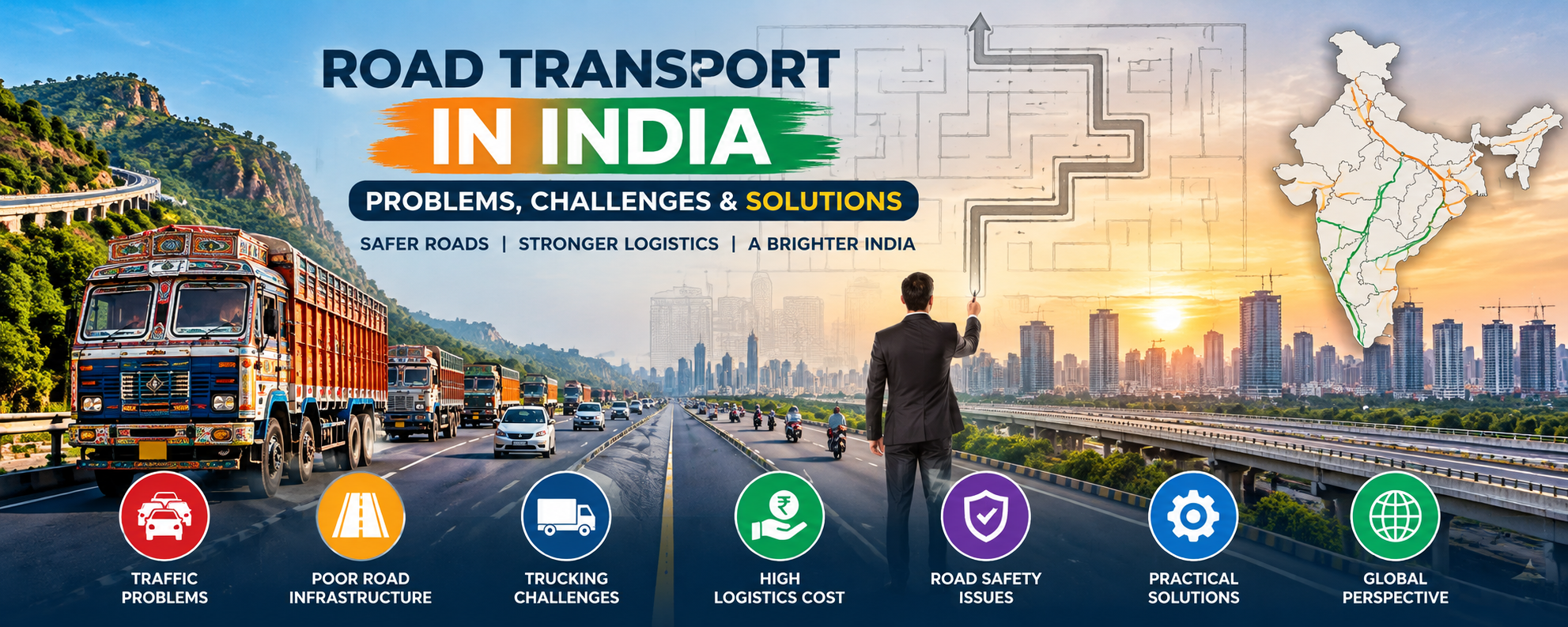
🌍 Introduction: Why Road Transport Is the Lifeline of India
Every morning, before the streets of India’s cities become crowded, thousands of trucks are already moving through industrial corridors, agricultural markets, ports and national highways.
A truck carrying vegetables from Nashik may be heading towards Mumbai. A container trailer could be transporting export cargo from a manufacturing unit in Gujarat to a seaport. A heavy-duty multi-axle trailer might be carrying a transformer to a power project hundreds of kilometres away.
These journeys are part of a transportation network that connects India’s economy.
Road transport in India is the movement of passengers and goods using roads, highways, expressways and local streets. It connects rural communities, agricultural markets, manufacturing centres, commercial cities, warehouses, ports and consumers.
Unlike railways or shipping, road transport provides flexible door-to-door connectivity. A truck can collect goods from a factory, travel along a highway and deliver them directly to a customer’s warehouse.
However, this flexibility comes with serious challenges.
Traffic congestion, deteriorating road surfaces, unsafe driving practices, inadequate truck parking, freight delays, rising operating expenses and environmental pollution affect transport users across India.
These problems are not unique to developing economies. The United States experiences highway congestion and trucking capacity challenges. European countries face urban mobility and freight decarbonisation pressures. Asian megacities struggle with mixed traffic, limited road space and increasing vehicle ownership.
The fundamental challenge is similar everywhere: How can countries move more people and goods without making roads slower, more dangerous and more polluted?
India’s answer will require much more than constructing additional highways.
Better road engineering, intelligent traffic management, disciplined driving, integrated logistics systems, driver welfare, transparent freight operations and effective public transport must work together.
The World Bank ranked India 38th in its 2023 Logistics Performance Index, compared with 44th in 2018. This represents improvement in overall logistics performance, although the index measures multiple dimensions of logistics rather than road quality alone.
This guide examines the most important road transportation problems in India, their economic and social consequences, international approaches and practical solutions for governments, businesses, truck operators, drivers and ordinary road users.
🛣️ What Is Road Transport in India?
Road transport refers to the movement of people, commercial cargo, agricultural products, construction materials, industrial equipment and other goods through road-based vehicles.
India’s road transportation system includes national highways, state highways, district roads, rural roads, urban streets, expressways and industrial access roads.
Major types of road transportation
| Transport category | Common vehicles | Primary purpose |
|---|---|---|
| Passenger transport | Buses, taxis, cars, auto-rickshaws | Public and private mobility |
| General freight | Trucks, lorries, light commercial vehicles | Factory and warehouse deliveries |
| FTL transport | Medium and heavy trucks | Dedicated full-truckload shipments |
| LTL transport | Small trucks and consolidated vehicles | Part-load shipments |
| Container transportation | Container trucks and trailers | Domestic and export-import cargo |
| Heavy haulage | Low-bed, semi-low-bed and modular trailers | ODC and heavy industrial machinery |
| Agricultural transportation | Tractor trailers and goods carriers | Farm-to-market connectivity |
| Construction logistics | Tippers, dump trucks and bulkers | Minerals and construction materials |
| Last-mile delivery | Vans and small commercial vehicles | Retail and e-commerce distribution |
| Emergency transport | Ambulances, fire vehicles, recovery trucks | Essential emergency services |
The challenges vary considerably between these categories.
An urban bus operator may struggle with congestion and inadequate bus lanes. A long-distance truck driver may face insufficient rest facilities. A project cargo transporter may need to examine bridge capacities, turning radii and overhead electrical clearances before beginning a journey.
Consequently, one universal solution cannot address every road transportation problem.
📊 Road Transport Problems in India: Quick Overview
| Major problem | Primary causes | Consequences | Practical solutions |
|---|---|---|---|
| Traffic congestion | Excess vehicles, bottlenecks, poor junction management | Travel delays and fuel waste | Public transport, adaptive signals, junction redesign |
| Road accidents | Unsafe speeds, road defects, risky behaviour | Injuries and fatalities | Safe System design and enforcement |
| Poor road maintenance | Drainage failure, overloaded vehicles, delayed repairs | Vehicle damage and unsafe travel | Preventive maintenance and pavement monitoring |
| Freight delays | Congestion, terminal queues, loading delays | Higher transport costs | Appointment scheduling and digital tracking |
| Truck parking shortages | Insufficient dedicated facilities | Fatigue and unsafe roadside parking | Planned truck terminals |
| Driver fatigue | Long duty periods and inadequate rest | Higher crash risk | Rest scheduling and welfare facilities |
| Pollution | Fossil fuels, congestion, older vehicles | Health and environmental damage | Cleaner fleets and efficient operations |
| Empty return trips | Poor freight matching | Lost earning capacity | Return-load coordination |
| Overloading | Commercial pressure and weak compliance | Pavement damage and crash risk | Weighing and consistent enforcement |
| ODC movement obstacles | Bridges, curves, clearances, local restrictions | Project delays and safety hazards | Engineering route surveys |
| Urban parking problems | Roadside parking and weak enforcement | Reduced road capacity | Parking management and freight bays |
| Climate disruption | Flooding, landslides, extreme heat | Road closures and supply interruptions | Resilient design and alternative routes |
🚦 Traffic Congestion in India: Causes, Effects and Solutions
Traffic congestion occurs when the number of vehicles trying to use a road exceeds the road network’s ability to accommodate them efficiently.
It is particularly visible in major urban areas, industrial corridors, commercial markets and junctions connecting highways with local roads.
Why does traffic congestion occur?
India’s urban transport problems result from several interacting factors.
Rapid urbanisation: As cities expand, residential development, commercial activity and employment centres generate additional travel demand.
Mixed traffic: Cars, motorcycles, buses, trucks, bicycles, pedestrians and auto-rickshaws frequently share the same road space.
Poor junction design: A road may have sufficient width along most of its length but lose capacity at a poorly designed intersection.
Unregulated parking: Vehicles parked along carriageways reduce usable road width.
Construction activity: Metro projects, utility works, flyover construction and road repairs can temporarily restrict capacity.
Weak last-mile public transport: Commuters may prefer private vehicles when bus or rail services do not provide convenient access to their destinations.
Freight movement conflicts: Heavy commercial vehicles entering dense market areas during peak passenger travel periods can intensify congestion.
How congestion affects transport businesses
Consider a hypothetical truck carrying industrial machinery between two manufacturing locations.
If its planned journey takes six hours but congestion increases travel time to nine hours, the operator may face additional fuel consumption, driver duty time, delayed unloading and possible disruption to the next assignment.
The loss is not limited to the truck operator. The receiving factory may experience production delays, while the customer may need to reschedule installation work.
Practical solutions for traffic congestion
- Improve reliable public transport and last-mile connectivity.
- Introduce adaptive traffic signals where traffic patterns justify them.
- Redesign intersections with dangerous or inefficient turning movements.
- Provide designated loading and unloading zones.
- Manage parking instead of allowing unrestricted roadside occupation.
- Coordinate roadworks to reduce simultaneous closures.
- Use traffic data to identify recurring bottlenecks.
- Develop freight access plans for industrial and commercial districts.
Road widening can help where physical capacity is genuinely insufficient, but it is not always a permanent solution. Additional road space can attract more traffic over time.
The objective should be to improve the movement of people and goods, not simply increase the number of vehicles passing through a corridor.
🚨 Road Accidents and Highway Safety in India
Road safety is among the most serious transportation challenges facing India.
According to the Ministry of Road Transport and Highways’ Road Accidents in India 2023 report, the country recorded 172,890 road accident fatalities during 2023. The report also identified pedestrians, cyclists and two-wheeler users as particularly vulnerable road users.
Ministry of Road Transport & Highways These figures represent actual human losses rather than merely statistical indicators.
Behind every fatal collision may be a family losing its income earner, a student losing an opportunity or a commercial driver never returning home.
Common road accident risk factors
Unsafe speeds are particularly dangerous because higher impact speeds increase the severity of crashes.
Other contributing factors include dangerous overtaking, distraction, impaired driving, poor visibility, unsafe road geometry, vehicle defects and inadequate separation between fast vehicles and vulnerable road users.
Fatigue is especially important for commercial transport operations.
A driver who has spent many hours navigating traffic, waiting at loading points and searching for safe parking may be less alert even when the vehicle itself is mechanically sound.
India’s road safety framework
The Ministry of Road Transport and Highways describes its approach through four broad areas:
- Education: Driver training and road safety awareness.
- Engineering: Safer roads and vehicles.
- Enforcement: Compliance with traffic and vehicle safety rules.
- Emergency care: Timely assistance after crashes.
This multi-pronged strategy recognises that road accidents rarely have a single cause.
What should improve?
Road authorities should prioritise dangerous junctions, unsafe crossings, inadequate shoulders and crash-prone road sections.
Transport operators should establish vehicle inspection schedules, fatigue management procedures and incident-reporting systems.
Drivers should follow speed limits, maintain safe distances, avoid distraction and stop when fatigued.
Emergency response systems should focus on rapid location identification, ambulance access and appropriate trauma care.
The most effective road safety approach assumes that human mistakes can occur and designs the transport system to prevent those mistakes from becoming fatal.
🕳️ Poor Road Conditions, Potholes and Infrastructure Maintenance
Constructing a highway is only the beginning of its operational life.
Road surfaces experience continuous stress from vehicle loads, rainfall, temperature changes and environmental conditions.
When drainage and maintenance are inadequate, small defects can develop into major hazards.
Common road infrastructure problems
| Road defect | Potential consequences | Recommended response |
|---|---|---|
| Potholes | Loss of control, tyre and suspension damage | Timely, durable pavement repairs |
| Damaged shoulders | Rollover and roadside collision risks | Shoulder strengthening |
| Waterlogging | Reduced visibility and pavement deterioration | Drainage improvements |
| Faded markings | Lane confusion | Periodic remarking |
| Poor lighting | Difficulty identifying hazards | Targeted lighting improvements |
| Damaged guardrails | Greater roadside crash severity | Barrier inspection and replacement |
| Uneven surfaces | Cargo instability and vehicle wear | Surface rehabilitation |
| Weak bridges | Restricted heavy-vehicle movement | Structural assessment and strengthening |
Why drainage matters
Water is one of the most damaging factors affecting road infrastructure.
Poor drainage can weaken pavement layers, accelerate surface deterioration and create dangerous conditions during monsoon travel.
A road maintenance programme should therefore include drainage inspection, shoulder maintenance, pavement condition surveys and timely repairs.
Technology-based maintenance
Road agencies can use pavement management systems, geotagged inspection records and vehicle-mounted sensors to identify defects.
However, technology is only useful when the collected information leads to actual repairs.
A practical maintenance system requires clearly assigned responsibility, adequate budgets, quality control and public accountability.
🚛 Major Problems Faced by India’s Trucking Industry
Commercial trucking is essential to India’s industrial and agricultural supply chains.
Nevertheless, truck operators face challenges that ordinary passenger vehicle users may rarely notice.
Freight rate uncertainty
Freight rates can vary according to route demand, season, cargo type, truck availability, fuel expenses, return-load prospects and loading conditions.
A transport operator may accept a shipment expecting a profitable round trip, only to discover that no suitable return cargo is available.
Empty return journeys
An empty truck still consumes fuel, incurs tolls and requires driver time.
For example, a trailer carrying machinery from Gujarat to Maharashtra may struggle to find compatible return cargo because of differences in load dimensions, weight or loading requirements.
A return-load marketplace can improve matching, but it cannot eliminate all empty journeys.
Loading and unloading delays
A truck may reach a factory on schedule and still wait several hours because the loading bay is occupied or the required equipment is unavailable.
The solution involves better appointment scheduling, warehouse coordination, cargo readiness and clearly agreed detention terms.
Payment delays
Delayed freight settlement can affect cash flow, particularly for small fleet owners who must continue paying for fuel, wages, repairs and finance instalments.
Written contracts, transparent billing and agreed payment milestones can reduce disputes.
Maintenance expenses
Tyres, brakes, suspension systems and engine components require periodic maintenance.
Operators who defer essential maintenance may reduce short-term expenses but increase breakdown and safety risks.
Driver availability and welfare
Long-distance transport work can involve irregular schedules, prolonged separation from families, uncertain rest arrangements and limited access to hygienic facilities.
Improving driver welfare is therefore both a social responsibility and a business necessity.
🏭 Industrial Corridors and Regional Road Transport Challenges
Road transportation problems differ between India’s industrial regions.
The following table identifies representative operational concerns. It is a planning guide rather than a live traffic assessment.
| Industrial region | Typical transport challenge | Improvement opportunity |
|---|---|---|
| Mumbai–Pune corridor | Mixed freight and passenger demand | Better freight scheduling and interchange management |
| Delhi NCR | Congestion, pollution and urban freight restrictions | Cleaner fleets and planned freight access |
| Ahmedabad–Vadodara | Industrial truck movements and junction conflicts | Dedicated logistics facilities |
| Surat–Vapi | Factory traffic, container movement and loading delays | Industrial access and truck staging |
| Chennai–Sriperumbudur | Manufacturing supply-chain reliability | Appointment-based deliveries |
| Bengaluru industrial belt | Urban congestion and delivery uncertainty | Freight time-window management |
| Jamshedpur industrial region | Heavy industrial cargo and local road constraints | Engineering surveys and maintenance |
| Raipur–Bhilai | Steel, mineral and bulk cargo movements | Safer heavy-vehicle routing |
| Kolkata–Haldia | Port-linked freight and terminal coordination | Digital gate and yard scheduling |
| Hyderabad industrial region | Growing distribution and manufacturing traffic | Logistics hub planning |
A transport policy designed for a congested metropolitan market may not work for a rural mining route or a mountainous highway.
Regional planning must reflect actual road conditions, cargo characteristics, traffic composition and local community needs.
🚧 Oversized and Over-Dimensional Cargo Transportation Problems
Oversized and over-dimensional cargo, commonly called ODC, creates challenges beyond those encountered in conventional trucking.
Examples include transformers, industrial boilers, wind-energy components, large machinery and heavy project equipment.
Why ODC transportation is different
A normal truck route cannot automatically be considered suitable for a heavy-duty trailer.
The route may contain narrow bridges, sharp bends, steep gradients, low overhead structures, restricted railway crossings or insufficient turning space.
Cargo weight distribution is also critical.
A heavy shipment may require specialised axle arrangements to distribute loads appropriately.
ODC transport risk and solution chart
| Challenge | Potential impact | Engineering response |
|---|---|---|
| Low bridge clearance | Cargo collision | Measured vertical clearance survey |
| Weak bridge capacity | Structural risk | Engineering assessment and authorised crossing plan |
| Narrow turns | Trailer obstruction | Swept-path analysis |
| Steep gradients | Traction or braking difficulty | Grade and vehicle capability assessment |
| Overhead power lines | Electrical hazard | Utility coordination and approved isolation arrangements |
| Restricted urban entry | Schedule disruption | Permit and traffic management planning |
| Unstable loading | Cargo movement | Engineered securing and stability checks |
| Poor road shoulders | Trailer instability | Route inspection and suitable mitigation |
Why road route surveys matter
An engineering road route survey should examine the entire journey, not merely the distance between origin and destination.
The assessment may include road geometry, structures, utilities, gradients, traffic restrictions, staging areas and emergency arrangements.
Permits and escorts must be determined according to the applicable authorities and shipment characteristics.
No heavy cargo movement should proceed solely because a digital map displays a road connection.
🅿️ Truck Parking, Driver Rest Areas and Highway Facilities
A modern road transportation network requires more than smooth carriageways.
Truck drivers need safe places to rest, inspect vehicles, access drinking water and obtain essential services.
Inadequate parking can lead to commercial vehicles stopping along highway shoulders, near junctions or in unsuitable industrial areas.
This creates safety risks for drivers and other road users.
Essential facilities at a modern truck terminal
| Facility | Benefit |
|---|---|
| Secure truck parking | Reduces unsafe roadside stopping |
| Toilets and bathing facilities | Improves hygiene and dignity |
| Drinking water | Supports driver health |
| Affordable food | Makes long-distance travel more manageable |
| Rest and sleeping facilities | Supports fatigue management |
| Vehicle inspection area | Enables basic safety checks |
| Tyre and repair services | Reduces breakdown-related delays |
| Emergency assistance | Supports incident response |
| Digital freight information | Improves load coordination |
| Lighting and security | Improves personal and cargo safety |
Truck terminals should be planned near industrial corridors, freight hubs and major highway intersections where demand justifies them.
Access roads must also be designed to avoid creating new bottlenecks.
⛽ Fuel Costs, Toll Expenses and Freight Economics
Road freight prices are influenced by several operating expenses.
Fuel is an important variable, but it is not the only one.
Vehicle finance, insurance, maintenance, tyre replacement, wages, permits, tolls, administrative expenses and loading delays can all affect profitability.
Illustrative transport cost calculation
Consider a hypothetical 1,000-kilometre truck journey.
| Cost component | Illustrative amount |
|---|---|
| Fuel | ₹24,000 |
| Tolls | ₹6,000 |
| Driver and trip allowances | ₹4,000 |
| Maintenance allocation | ₹5,000 |
| Vehicle fixed-cost allocation | ₹7,000 |
| Other trip expenses | ₹2,000 |
| Total estimated operating cost | ₹48,000 |
These figures are hypothetical for explaining cost structure, not verified market freight rates or quotations.
If the operator receives ₹55,000 for the trip, the apparent difference is ₹7,000 before considering any omitted expenses, taxes or commercial risks.
An unexpected unloading delay or empty return journey can change the economics significantly.
How operators can improve cost efficiency
Operators should measure cost per kilometre, loaded kilometres, empty kilometres, fuel consumption, maintenance expenditure and waiting time.
Freight rates should reflect cargo requirements, operational risks and contractual obligations rather than being determined by distance alone.
Digital tools can improve visibility, but disciplined accounting remains essential.
🌧️ Monsoon, Flooding, Landslides and Climate Risks
India’s diverse geography exposes road transportation to different seasonal hazards.
Heavy rainfall can flood urban roads and damage pavement surfaces. Mountain roads may face landslides and falling debris. Extreme heat can affect vehicles, workers and infrastructure.
These risks require location-specific planning.
Seasonal road transportation challenges
| Season or condition | Risk | Recommended precautions |
|---|---|---|
| Heavy monsoon rainfall | Flooding and poor visibility | Check official advisories and avoid flooded routes |
| Mountain rainfall | Landslides and road closures | Monitor local authorities and maintain alternatives |
| Winter fog | Reduced visibility | Adjust speed and travel plans |
| Extreme heat | Tyre stress and driver fatigue | Inspect tyres and schedule rest |
| Cyclonic weather | Wind, flooding and infrastructure damage | Follow official warnings and suspend unsafe journeys |
| Snow and ice | Loss of traction | Use suitable equipment and follow restrictions |
Transporters should avoid assuming that a road is safe merely because navigation software shows it as open.
For critical freight, alternate routes and contingency schedules should be prepared before dispatch.
Climate-resilient road design should include drainage, slope protection, appropriate materials and realistic maintenance plans.
🌐 Global Road Transport Problems: What India Can Learn
Road transportation challenges vary internationally, but several themes are common.
Global comparison
| Country or region | Important transport challenges | Relevant approaches for India |
|---|---|---|
| United States | Highway congestion, long-distance freight, infrastructure maintenance | Freight corridor planning and asset management |
| Germany | Heavy freight demand and motorway maintenance | Engineering standards and coordinated maintenance |
| Japan | Dense urban mobility and ageing infrastructure | Reliable public transport and preventive inspection |
| Singapore | Limited road space and high travel demand | Demand management and integrated traffic planning |
| Netherlands | Competition for urban road space | Safe cycling infrastructure and multimodal planning |
| China | Large-scale freight flows and urban congestion | Integrated logistics hubs and freight data systems |
| Brazil | Long-distance trucking and infrastructure variation | Freight diversification and road resilience |
| United Kingdom | Urban congestion and road maintenance pressures | Traffic management and road-user safety programmes |
| Australia | Very long freight routes and remote-area operations | Heavy-vehicle route planning and fatigue management |
| India | Mixed traffic, road safety, freight inefficiency and varied infrastructure | Combined infrastructure, enforcement and logistics reform |
These comparisons represent broad policy and operational characteristics, not a ranking of national road transport systems.
Lessons from international transport systems
Japan: Reliability through coordination
Japan demonstrates the value of integrating transport services, maintaining infrastructure and providing clear information to travellers.
For India, the lesson is that dependable transport requires operational discipline as well as infrastructure investment.
Singapore: Managing limited road space
Singapore’s experience illustrates how road pricing, public transport and traffic management can work together in a land-constrained environment.
India cannot copy every measure directly, but cities can study the principles of managing demand and providing attractive alternatives to private vehicle use.
Netherlands: Protecting vulnerable road users
Dutch urban planning places considerable emphasis on cycling infrastructure and street design.
Indian cities can adapt suitable approaches to improve pedestrian and cyclist safety, particularly near schools, markets and transit stations.
Australia: Long-distance heavy vehicle operations
Australia’s freight networks illustrate the importance of route suitability, vehicle configuration and fatigue management in long-distance trucking.
These principles are especially relevant for Indian heavy-haul and project cargo operators.
🌱 Environmental Pollution and Sustainable Road Transportation
Road transport contributes to air pollution, greenhouse gas emissions, noise and energy consumption.
The environmental impact depends on vehicle technology, fuel quality, driving behaviour, congestion and transport demand.
An older poorly maintained vehicle operating in stop-and-go traffic may create more local pollution than a well-maintained cleaner vehicle operating efficiently.
However, improving traffic flow alone does not guarantee lower overall emissions if vehicle travel continues to increase.
Sustainable transport solutions
| Solution | Main benefit | Important limitation |
|---|---|---|
| Electric urban buses | Lower tailpipe emissions | Requires charging infrastructure |
| Electric delivery vehicles | Cleaner last-mile operations | Suitability depends on route and charging |
| Cleaner heavy vehicles | Potential emissions reduction | Fuel and technology availability |
| Rail-road multimodal freight | Reduces dependence on long road hauls | Requires suitable terminals and service reliability |
| Route optimisation | Reduces avoidable distance | Cannot eliminate all congestion |
| Preventive maintenance | Improves efficiency and reliability | Requires consistent implementation |
| Consolidated deliveries | Reduces fragmented freight trips | Requires coordination |
| Walking and cycling networks | Supports low-emission mobility | Requires safe infrastructure |
The objective should be to move passengers and freight using the most appropriate combination of transport modes.
For some journeys, road transport will remain essential. For others, railways, waterways or public transport may offer better overall efficiency.
🚆 Multimodal Logistics: Reducing Pressure on Indian Roads
Multimodal logistics combines two or more transportation modes within a supply chain.
A shipment might travel from a factory to a railway terminal by truck, continue over a long distance by rail and complete the final delivery by road.
This can reduce the need for long-distance trucking on suitable routes.
Road-only versus multimodal freight
| Factor | Road-only transport | Multimodal transport |
|---|---|---|
| Door-to-door flexibility | Generally high | Depends on road connections |
| Long-distance bulk movement | Can be expensive | May be more efficient |
| Terminal handling | Often fewer transfers | Requires transfer coordination |
| Scheduling | Flexible but exposed to traffic | Depends on service timetables |
| Cargo visibility | Depends on operator systems | Requires data integration |
| Suitability | Wide variety of shipments | Strongest where volume and infrastructure support it |
India’s National Logistics Policy and PM GatiShakti framework aim to improve connectivity, logistics efficiency and coordination between transportation systems.
The National Logistics Policy was launched in September 2022, with a stated ambition to improve India’s logistics performance and reduce costs towards global benchmarks.
For businesses, the important question is not whether road or rail is universally better.
It is which combination provides safe, reliable and economical transportation for a particular shipment.
📱 Technology and Digital Solutions for Road Transportation
Digital technology can help transport operators make better decisions.
However, the most useful systems solve real operational problems rather than simply generating more data.
Important transport technologies
GPS vehicle tracking: Provides location visibility and supports arrival estimates.
Transport Management Systems (TMS): Help manage dispatch, freight documentation, vehicle allocation and shipment status.
Electronic proof of delivery: Reduces uncertainty about completed deliveries.
Fleet telematics: Can monitor selected vehicle operating parameters and support preventive maintenance.
Digital freight marketplaces: Connect available vehicles with shipment demand.
Intelligent traffic systems: Use traffic information to support signal management and incident response.
Digital logistics integration: Allows authorised systems to exchange shipment and transportation information.
India’s Unified Logistics Interface Platform is intended to support information exchange across the logistics ecosystem. Government reporting in 2025 described expansion of its integrations and applications.
Technology adoption challenges
Small transport operators may face limited digital literacy, inconsistent connectivity, software costs and concerns about data privacy.
Technology should therefore be affordable, multilingual where necessary and compatible with existing business processes.
A system that saves dispatch time and reduces payment disputes may be more valuable to a small fleet than an expensive platform with features it rarely uses.
👨✈️ Truck Drivers: Working Conditions, Safety and Welfare
Commercial drivers are essential workers within the road transportation economy.
Their responsibilities extend beyond operating vehicles.
Drivers must manage route conditions, cargo security, documentation, vehicle inspections, delivery schedules and unexpected disruptions.
Yet their working conditions can be difficult.
Long periods away from home, uncertain rest facilities and pressure to meet deadlines may affect physical and mental well-being.
Improvements that can support drivers
Transport companies should provide realistic trip schedules, safe vehicles, clear instructions and accessible grievance procedures.
Loading facilities should minimise unnecessary waiting.
Highway operators and public agencies should support secure parking and hygienic rest facilities.
Training should address defensive driving, fatigue, emergency response, cargo security and vehicle-specific hazards.
Driver welfare should not be treated as separate from road safety.
A rested, trained and properly supported driver is better positioned to make safe decisions.
🏙️ Urban Road Transport Problems and Solutions
Indian cities need to move commuters, goods and essential services through limited road space.
The same street may serve pedestrians, school buses, delivery vehicles, public transport and private cars.
Conflicts arise when street design does not clearly accommodate these uses.
Key urban transport problems
Pedestrians may be forced onto carriageways when footpaths are obstructed.
Buses may lose reliability when they operate in the same congestion as private vehicles.
Delivery vehicles may stop in active traffic lanes because designated loading areas are unavailable.
Poorly coordinated intersections can cause queues that extend into neighbouring junctions.
Integrated urban solutions
Cities should prioritise safe walking routes, accessible public transport, appropriate cycling facilities and efficient junction operations.
Freight delivery windows can be considered in busy commercial areas, but restrictions should be based on local demand and should not simply transfer congestion to residential streets.
Urban planning should also reduce the need for unnecessarily long daily journeys by improving access to employment, education and essential services.
🏘️ Rural Road Connectivity and Agricultural Transportation
Rural roads connect villages with healthcare, education, markets and economic opportunities.
For farmers, reliable transportation can influence whether produce reaches buyers in good condition.
Poor rural roads can increase travel time, vehicle maintenance expenses and the risk of damage to perishable goods.
Rural transport improvement priorities
- Maintain all-weather access where feasible.
- Improve drainage and small bridge infrastructure.
- Provide safe connections to agricultural markets.
- Support appropriate vehicles for local road conditions.
- Improve access to storage and collection centres.
- Coordinate road investment with agricultural and economic development.
A rural road should be evaluated not only by its length but also by the services and opportunities it makes accessible.
💼 Road Transport Challenges for Businesses and MSMEs
Small and medium enterprises frequently depend on road transport to receive raw materials and deliver finished products.
A shipment delay can interrupt production, increase inventory requirements or damage customer relationships.
Business problems and practical responses
| Business challenge | Recommended action |
|---|---|
| Unpredictable delivery times | Use realistic lead times and shipment tracking |
| Freight rate disputes | Agree on written scope and charges |
| Cargo damage | Improve packaging and loading procedures |
| Unloading delays | Introduce delivery appointments |
| Vehicle shortages | Maintain qualified carrier relationships |
| Poor shipment visibility | Use milestone-based updates |
| Transport documentation errors | Check documents before dispatch |
| ODC route uncertainty | Conduct engineering route assessments |
| Seasonal disruptions | Maintain contingency plans |
| Delayed freight payments | Establish documented payment terms |
Businesses should assess transport partners on reliability, safety, transparency and cargo capability, not price alone.
🧮 How to Measure Road Transportation Efficiency
Transport performance should be measured using practical indicators.
A company cannot improve a problem consistently if it does not know how frequently the problem occurs.
Important road transport KPIs
| KPI | What it measures |
|---|---|
| On-time delivery percentage | Reliability against agreed delivery schedules |
| Vehicle utilisation | Effective use of available fleet capacity |
| Empty running percentage | Distance travelled without revenue cargo |
| Fuel consumption per kilometre | Operating efficiency |
| Cost per loaded kilometre | Freight cost performance |
| Average detention time | Time lost at loading and unloading |
| Breakdown frequency | Fleet reliability |
| Preventable incident rate | Operational safety performance |
| Average trip turnaround | Time required to complete a transport cycle |
| Customer complaint resolution time | Service responsiveness |
These indicators should be interpreted together.
For example, improving vehicle utilisation by forcing excessive driving hours would be a poor outcome if it increases fatigue and crash risk.
The best transport operation balances productivity with safety and worker welfare.
🛠️ A Practical Road Transport Improvement Action Plan for India
India’s road transport challenges require cooperation among public authorities, transport operators, industrial customers and road users.
Short-term, medium-term and long-term priorities
| Time horizon | Priority actions | Responsible stakeholders |
|---|---|---|
| Short term | Repair dangerous defects and improve warning signs | Road agencies |
| Short term | Improve vehicle inspection and driver rest scheduling | Fleet operators |
| Short term | Reduce loading delays | Factories and warehouses |
| Short term | Enforce safe parking and provide temporary alternatives | Local authorities |
| Medium term | Redesign high-risk junctions | Road engineers and authorities |
| Medium term | Develop truck parking and logistics facilities | Public and private developers |
| Medium term | Expand digital freight coordination | Logistics companies |
| Medium term | Improve public transport reliability | Urban transport agencies |
| Long term | Build climate-resilient road infrastructure | Infrastructure agencies |
| Long term | Integrate road, rail and water freight | Transport policymakers |
| Long term | Modernise commercial vehicle fleets | Industry and government |
| Long term | Create safer, more accessible urban mobility networks | Urban planners |
A realistic implementation approach
The first step should be identifying the problem accurately.
A congested junction needs traffic and road design analysis. A dangerous highway curve needs safety engineering. A freight corridor with excessive loading delays needs better logistics coordination.
Authorities should avoid applying the same intervention everywhere.
Projects should establish measurable targets, publish progress and evaluate outcomes after implementation.
The aim is continuous improvement rather than isolated infrastructure announcements.
🔭 The Future of Road Transport in India
India’s road transport future will be influenced by industrial expansion, e-commerce, changing energy systems, urbanisation and advances in digital technology.
Several developments could reshape the sector.
Smarter freight planning
More transport operators may use integrated dispatch, tracking and route-planning systems.
This could improve shipment visibility and reduce avoidable waiting.
Cleaner commercial vehicles
Electric vehicles and other lower-emission technologies may become more practical for selected transport applications as vehicle technology, energy supply and infrastructure improve.
Long-distance heavy freight will require careful evaluation of payload, range, charging or refuelling time and economics.
Improved multimodal connectivity
Better coordination between highways, rail freight terminals, ports and warehouses can reduce unnecessary transfers and support more predictable supply chains.
Stronger safety systems
Vehicle safety technology, road engineering improvements and better crash data may support targeted interventions.
However, technology cannot replace effective enforcement and responsible operations.
Climate-resilient infrastructure
Road planning will increasingly need to account for flooding, heat, landslides and other environmental risks.
Professionalisation of trucking
Transparent contracts, reliable payment practices, driver training and structured maintenance could improve the long-term sustainability of road freight businesses.
The future should not be measured only by highway kilometres or vehicle sales.
It should also be measured by fewer fatalities, dependable deliveries, cleaner mobility and better working conditions.
❓ Frequently Asked Questions About Road Transport in India
1. What is road transport in India?
Road transport in India is the movement of passengers and goods through roads, highways, expressways and local streets using vehicles such as buses, cars, trucks, trailers and commercial goods carriers.
2. What are the major problems of road transport in India?
Major problems include traffic congestion, road accidents, poor maintenance, inadequate truck parking, freight delays, driver fatigue, pollution, overloading and inconsistent last-mile connectivity.
3. Why is road transport important for the Indian economy?
Road transport connects factories, farms, warehouses, ports, businesses and consumers. It supports industrial production, agriculture, retail distribution, construction and passenger mobility.
4. What causes traffic congestion in Indian cities?
Common causes include high travel demand, mixed traffic, poorly designed junctions, roadside parking, construction activity, inadequate public transport and inefficient traffic management.
5. How can road accidents be reduced in India?
Road accidents can be reduced through safer road engineering, appropriate speed management, vehicle maintenance, driver training, enforcement, pedestrian protection and timely emergency medical care.
6. What problems do truck drivers face in India?
Truck drivers may face long duty periods, fatigue, uncertain rest facilities, congestion, loading delays, vehicle breakdowns and inadequate access to safe parking and hygiene facilities.
7. What is the biggest challenge in road freight transportation?
There is no single biggest challenge for every operator. Depending on the route and cargo, major difficulties can include unpredictable delivery times, operating costs, empty return trips, payment delays and road safety risks.
8. How can technology improve road transport?
GPS tracking, fleet management, digital documentation, route planning, freight matching and intelligent traffic systems can improve coordination, visibility and operational efficiency.
9. What is the difference between road transport and multimodal transport?
Road transport uses road vehicles for movement. Multimodal transport combines different modes, such as road and rail, within a shipment journey.
10. Why are truck terminals important?
Truck terminals provide safe parking, rest facilities, food, sanitation, security and operational support. They can reduce unsafe roadside parking and support driver welfare.
11. What is the role of road route surveys in ODC transportation?
Road route surveys assess road geometry, structural capacity, clearances, gradients, restrictions and operational risks to determine whether a proposed heavy or oversized cargo movement can be undertaken safely.
12. How can India reduce road transport pollution?
India can reduce pollution through cleaner vehicles, better maintenance, efficient freight operations, reliable public transport, active mobility infrastructure and suitable multimodal freight solutions.
13. What can India learn from global road transportation systems?
India can learn from international approaches to road safety, preventive maintenance, public transport integration, freight corridor management, driver welfare and sustainable urban mobility.
14. What is the National Logistics Policy of India?
The National Logistics Policy, launched in 2022, aims to improve logistics efficiency through integration, digitalisation, standardisation, workforce development and coordinated transport planning.
15. What is the future of road transportation in India?
The future is likely to involve better digital coordination, safer road infrastructure, cleaner vehicle technologies, improved multimodal logistics and greater attention to driver welfare and climate resilience.
🏁 Conclusion: Building a Safer and More Efficient Road Transport System
Road transport is more than a network of highways and vehicles.
It is the connection between a farmer and a market, a factory and its customer, a worker and a workplace, and a remote community and essential public services.
India has made progress in infrastructure development and logistics coordination, but important challenges remain.
Traffic congestion reduces productivity. Unsafe roads endanger lives. Inadequate freight facilities affect drivers and businesses. Environmental pressures demand cleaner and more efficient mobility.
These problems cannot be solved by one technology, one policy or one construction programme.
A better road transportation system requires safe infrastructure, efficient logistics, responsible driving, reliable public transport, skilled workers and coordinated decision-making.
India can strengthen its transport competitiveness while protecting the people who depend on its roads.
🚛 ABCC India Project Cargo Corporation: Transport and Route Planning Perspective
ABCC India Project Cargo Corporation works in the road transport, project cargo and logistics consulting sector, with a focus on freight coordination, heavy haulage requirements, specialised trailer transportation and road route survey support.
For industrial cargo, particularly oversized and heavy shipments, route feasibility, cargo characteristics, loading arrangements and regulatory requirements are important considerations before dispatch.
The broader lesson applies to every transport operation: effective planning and clear communication can help reduce avoidable delays, control operational risks and support safer cargo movement.
India’s transport future depends not simply on moving more vehicles, but on moving people and goods more safely, reliably and efficiently.
📚 Official References and Further Reading
| Reference | Why it matters |
|---|---|
| MoRTH — Road Accidents in India 2023 | Official Indian road accident data |
| MoRTH — Annual Report 2024–25 | Road infrastructure, transport and safety programmes |
| WHO — Global Status Report on Road Safety 2023 | International road safety evidence |
| World Bank — Logistics Performance Index | Logistics performance comparisons |
| Government of India — National Logistics Policy | National logistics planning and policy |
| World Bank — Road Safety Investments | Global evidence on safety interventions |

