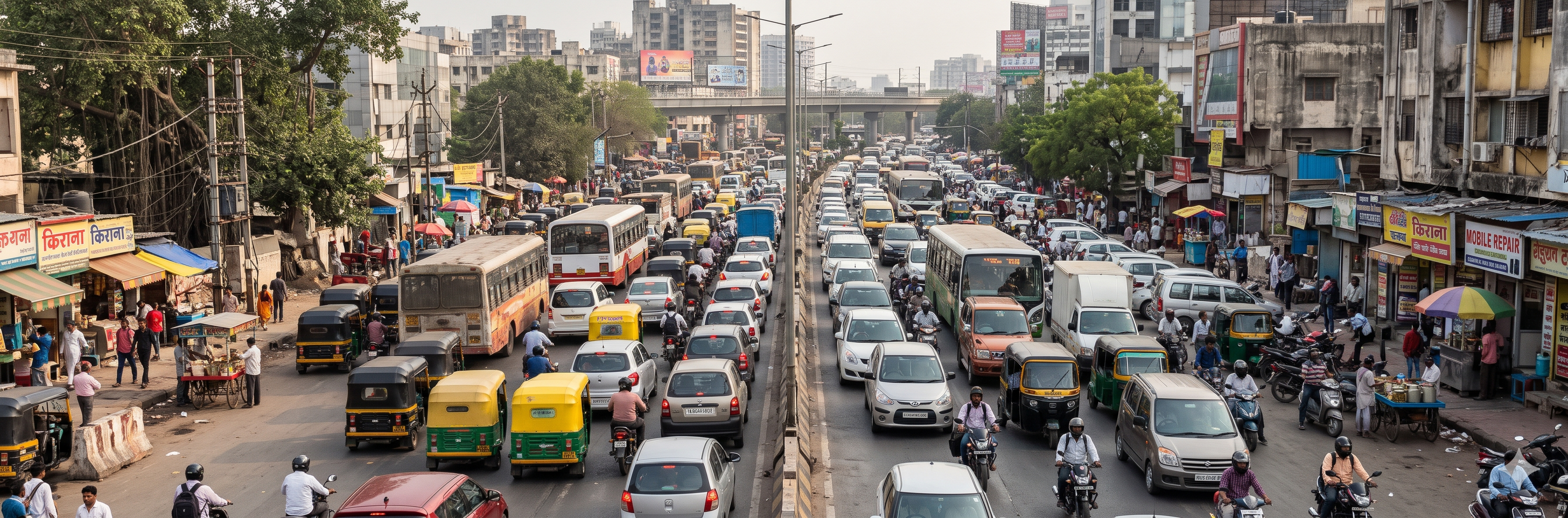
🇮🇳 India’s Growing Traffic Crisis: Why Are Indian Roads Becoming More Congested Every Year?
🚗 Introduction: India Is Moving Faster, but Why Is Traffic Moving Slower?
Every morning, millions of Indians leave their homes with a simple expectation: reach work, school, college, a factory, a hospital or a business meeting on time.
But for many, the journey becomes an exhausting struggle.
A ten-kilometre commute can feel longer than an intercity journey. Motorcycles squeeze between cars, buses compete for limited road space, trucks struggle through crowded industrial corridors, and pedestrians search for safe places to cross.
At a busy intersection, a traffic signal turns green, yet the vehicles barely move.
A few kilometres away, a delivery driver waits behind a line of parked vehicles. An ambulance approaches from behind, but the traffic has nowhere to go.
Meanwhile, a truck carrying industrial machinery is delayed because a railway crossing, narrow bridge or poorly designed junction has become a bottleneck.
These are different experiences of the same underlying problem: India’s demand for road space is growing faster than its ability to move people and goods efficiently through many urban and industrial corridors.
The problem is not simply that India has too many vehicles.
It is also about where vehicles travel, when they travel, how roads are designed, how cities expand, how public transport performs and how road users behave.
India has invested heavily in highways, expressways, bridges, metro systems and transportation infrastructure. Yet traffic congestion remains a serious concern in many cities.
Why?
Because building more roads does not automatically solve traffic congestion.
Sometimes, new roads encourage more vehicle use. Sometimes, an expressway moves traffic quickly until vehicles reach a congested city entrance. Sometimes, a flyover removes one bottleneck while creating another at the next junction.
And sometimes, the real solution is not another road at all.
It may be a reliable bus service, a safe footpath, a better railway freight connection, a redesigned intersection or a change in office working hours.
Understanding India’s traffic problem requires looking beyond traffic jams.
It requires examining the relationship between population, economic growth, urban development, road engineering, public transport, industrial logistics, technology and human behaviour.
This guide explores why road traffic is increasing in India, how congestion affects everyday life and the economy, and which solutions could make Indian transportation safer, cleaner and more efficient.
📊 Quick Answer: Why Is Road Traffic Increasing in India?
Road traffic is increasing in India primarily because vehicle ownership, urban travel demand, commercial deliveries and freight movement are expanding, while road capacity, public transport, parking management and traffic operations have not kept pace in many locations.
The most important contributing factors include population concentration in cities, rising household incomes, private vehicle dependence, rapid suburban development, industrial growth, inadequate public transport, poorly managed intersections and roadside parking.
However, traffic volume and traffic congestion are not the same thing. A road can carry more vehicles efficiently when traffic is well managed, while even a relatively small increase in vehicles can create severe congestion when a junction is already operating near capacity.
🚦 Major Causes of Increasing Road Traffic in India
| No. | Traffic Growth Factor | Why It Matters | Typical Consequence |
|---|---|---|---|
| 1 | 👥 Population growth and concentration | More people need daily transportation | Increased travel demand |
| 2 | 🏙️ Rapid urbanisation | Cities expand faster than transport networks | Longer commutes |
| 3 | 🚗 Private vehicle ownership | More cars occupy limited road space | Urban congestion |
| 4 | 🛵 Two-wheeler dependence | Motorcycles become essential where transit is weak | Mixed-vehicle traffic |
| 5 | 🚌 Insufficient public transport | Commuters depend on personal vehicles | Greater road demand |
| 6 | 🏗️ Unplanned urban development | Housing and employment are separated | Long-distance commuting |
| 7 | 🚚 Freight transportation growth | More industrial goods move by road | Truck congestion |
| 8 | 📦 E-commerce expansion | Frequent local deliveries increase vehicle activity | Kerbside conflicts |
| 9 | 🚧 Road construction | Work zones reduce usable road capacity | Temporary bottlenecks |
| 10 | 🚦 Poor intersection management | Traffic signals and junctions operate inefficiently | Long queues |
| 11 | 🅿️ Illegal and unmanaged parking | Parked vehicles block running lanes | Reduced road capacity |
| 12 | 🏪 Roadside encroachment | Commercial activity occupies pedestrian and road space | Slower movement |
| 13 | 🛣️ Highway-city conflicts | Regional and local traffic use the same corridors | Entry-point congestion |
| 14 | 🚆 Limited freight modal integration | Trucks carry loads that could sometimes use rail | Higher highway demand |
| 15 | 🏫 Peak-hour concentration | Schools and offices generate simultaneous trips | Rush-hour traffic |
| 16 | 🚕 Ride-hailing and empty vehicle movement | Some vehicles circulate without passengers | Additional vehicle-kilometres |
| 17 | 🌧️ Monsoon flooding | Waterlogging reduces safe speeds and capacity | Severe delays |
| 18 | 🚑 Crashes and breakdowns | Incidents block lanes and cause secondary queues | Unpredictable congestion |
| 19 | 🚶 Poor walking and cycling infrastructure | Short trips shift to motor vehicles | Unnecessary road demand |
| 20 | 📍 Weak regional transport planning | Roads, land use and public transport develop separately | Persistent congestion |
Important: These factors do not affect every Indian city equally. Their relative importance depends on local geography, population density, transport supply, industrial activity and road-network design.
🏙️ Rapid Urbanisation: How India’s Growing Cities Create More Traffic
Urbanisation is one of the most important structural forces behind rising traffic demand.
When people move to cities for education, employment, healthcare and business opportunities, transportation needs change.
A person living in a village may travel relatively short distances for daily activities.
After moving to a metropolitan area, that same person may need to travel between a residential suburb, an employment centre, a shopping district and several service locations.
These trips often take place across a much larger urban area.
🌆 The expansion of metropolitan regions
Cities such as Delhi, Mumbai, Bengaluru, Pune, Hyderabad, Chennai, Ahmedabad and Kolkata have expanded beyond their traditional municipal boundaries.
Employment centres, residential developments, educational institutions and industrial estates increasingly operate across metropolitan regions.
Consider a worker who lives in a relatively affordable suburb but works in a technology or industrial district.
The worker may have to cross several administrative boundaries, use multiple roads and travel through crowded junctions.
If a convenient public transport connection is unavailable, a motorcycle or car becomes the practical choice.
Multiply that decision across thousands of households and the cumulative impact on traffic becomes substantial.
🏘️ Why suburban development can increase congestion
Suburban growth is not automatically harmful.
Well-planned suburbs connected by reliable trains, buses, cycling routes and pedestrian infrastructure can support efficient transportation.
Problems emerge when housing projects are approved without adequate public transport, road access, drainage and local employment opportunities.
A large residential township may add thousands of daily trips to a road that was originally designed for much lower demand.
Similarly, a new office complex may generate heavy peak-hour traffic if it relies primarily on private vehicles.
🏢 Employment concentration
In many Indian cities, jobs are concentrated in particular commercial districts.
Large numbers of people travel towards these areas in the morning and away from them in the evening.
This creates directional congestion.
One side of a road may be heavily crowded while the opposite direction remains relatively free.
The solution is not necessarily to widen both sides of the road.
Better public transport, flexible working hours, mixed-use development and employment decentralisation may reduce the imbalance.
📌 What urban planners should consider
Transport planning must be integrated with land-use planning.
Before approving major developments, authorities should assess expected trips, public transport access, walking infrastructure, parking demand, junction capacity and freight movement.
The central lesson is simple:
A city cannot solve tomorrow’s traffic problems by planning housing, employment and transportation separately.
🚘 Rising Private Vehicle Ownership: Why More Cars Do Not Always Mean Better Mobility
Economic development has improved access to personal transportation for many Indian households.
Cars and two-wheelers offer convenience, privacy, flexibility and independence.
For people living in areas with limited public transport, owning a vehicle may be essential rather than optional.
However, the rapid growth of private vehicle use creates a major challenge for road-space management.
🚗 The road-space problem
A car typically occupies considerably more road space per passenger than a well-utilised bus.
Imagine a road carrying 1,000 commuters.
If most commuters travel alone in private cars, a large number of vehicles will be required.
If a substantial proportion use buses, the same number of people can be transported using fewer vehicles.
The key issue is not merely how many vehicles a road carries.
It is how many people and how much essential freight the transport system can move safely and reliably.
🛵 Why two-wheelers are popular
Motorcycles and scooters are widely used because they are relatively affordable, convenient for short trips and often easier to park than cars.
They also help commuters navigate narrow streets and areas with limited public transportation.
Yet large numbers of two-wheelers operating alongside buses, trucks, cars, pedestrians and auto-rickshaws create complicated traffic interactions.
Unsafe lane changes, inadequate separation and unpredictable stopping can reduce traffic efficiency and increase crash risk.
🚙 The second-car phenomenon
As household incomes rise, some families acquire additional vehicles.
A household may own a motorcycle for one family member and a car for another.
Vehicle ownership alone does not prove that congestion will rise, because actual usage matters.
However, when more household vehicles are used for commuting during the same peak hours, road demand increases.
🚦 Why widening roads is not a permanent solution
Road widening can improve traffic flow where a specific capacity constraint exists.
But its benefits may be limited when downstream intersections remain congested.
Additional road capacity can also encourage new trips, longer journeys or a shift from public transport to private vehicles.
This is known as induced demand.
It does not mean road construction is always ineffective.
It means road projects should be evaluated alongside public transport, land-use policy, safety and long-term travel behaviour.
🚌 Public Transport Gaps: Why Millions Depend on Private Vehicles
A strong public transport network is one of the most effective ways to move large numbers of people through limited urban space.
India has extensive railway and bus systems, while metro rail networks have expanded in several cities.
Nevertheless, many neighbourhoods, suburbs and industrial areas still face difficulties accessing convenient, reliable public transportation.
🚏 The last-mile connectivity problem
A commuter may live several kilometres from the nearest metro station.
The destination may also be far from the final station.
Without dependable feeder buses, safe walking routes, affordable shared mobility or bicycle facilities, using public transport becomes inconvenient.
The commuter must compare the entire journey, not just the time spent inside the metro train.
If reaching the station takes too long, waiting is unpredictable and the final destination requires another expensive connection, a private vehicle may appear more attractive.
🚌 Bus service limitations
Bus networks are essential because they can serve corridors where metro construction is impractical or too expensive.
However, bus performance can suffer from congestion, insufficient service frequency, unreliable schedules and inadequate passenger facilities.
When buses are trapped in the same traffic as private vehicles, their travel-time advantage disappears.
Dedicated bus lanes, signal priority and well-designed stops can improve reliability where implemented and enforced properly.
🚉 Metro rail is important but not sufficient
Metro rail can carry large passenger volumes on busy corridors.
Yet metro systems do not automatically eliminate road congestion.
Their effectiveness depends on route coverage, fares, service frequency, feeder connections and integration with other transport modes.
A city needs a coordinated mobility network rather than isolated infrastructure projects.
🚶 Walking is part of public transport
Every public transport journey begins and ends with access to a stop or station.
Broken footpaths, unsafe crossings, open drains, poor lighting and excessive roadside parking make walking difficult.
Improving pedestrian infrastructure is therefore not a cosmetic urban project.
It is a fundamental part of improving public transport.
📈 India’s Traffic Congestion in Numbers: What the Latest Available Data Shows
Traffic discussions often rely on personal experience.
But the extent of congestion becomes clearer when supported by measured travel times and traffic indicators.
The TomTom Traffic Index 2025 provides comparable congestion estimates for several Indian cities.
🚦 India’s Most Congested Cities — 2025
| Indian City | Average Congestion Level | Annual Rush-Hour Time Lost | Change From 2024 |
|---|---|---|---|
| Bengaluru | 74.4% | 168 hours | +1.7 percentage points |
| Pune | 71.1% | 152 hours | +5.4 percentage points |
| Mumbai | 63.2% | 126 hours | −3.3 percentage points |
| New Delhi | 60.2% | 104 hours | +3.5 percentage points |
| Kolkata | 58.9% | 150 hours | +0.3 percentage points |
| Jaipur | 58.7% | 121 hours | +0.4 percentage points |
| Chennai | 58.6% | 132 hours | +0.1 percentage points |
| Hyderabad | 55.5% | 123 hours | −1.3 percentage points |
| Ernakulam | 54.5% | 118 hours | +0.5 percentage points |
| Ahmedabad | 49.0% | 106 hours | −3.8 percentage points |
Source: TomTom Traffic Index — India, 2025. TomTom
The congestion percentages measure additional travel time relative to uncongested conditions under TomTom’s methodology. They do not mean that a corresponding percentage of roads is physically blocked.
🚘 Bengaluru: An example of severe urban congestion
In 2025, Bengaluru recorded an average congestion level of 74.4%.
The average time for a ten-kilometre drive was approximately 36 minutes and 9 seconds.
During the evening rush hour, the same distance took approximately 45 minutes and 27 seconds.
The annual rush-hour time loss was estimated at 168 hours for the measured commuting pattern.
These figures illustrate why commuters can experience substantial delays even over relatively short distances.
🛵 Pune: A rapidly growing metropolitan transport challenge
Pune recorded an average congestion level of 71.1% in 2025.
The average ten-kilometre travel time was approximately 33 minutes and 20 seconds, increasing to around 41 minutes and 40 seconds during the evening rush hour.
Pune’s congestion level increased by 5.4 percentage points compared with 2024.
These figures are particularly relevant to growing metropolitan regions where residential development, industrial activity and employment centres create overlapping travel demand.
📌 An important finding: Traffic does not increase everywhere every year
The data also shows why traffic reporting must avoid exaggerated claims.
Mumbai, Hyderabad and Ahmedabad recorded lower congestion percentages in 2025 than in 2024.
Therefore, it would be inaccurate to claim that every Indian city becomes more congested every year.
The broader concern is that many major urban corridors face persistent congestion, while some cities and routes experience worsening conditions.
🚚 Industrial Growth and Freight Transportation: Why More Trucks Are Using Indian Roads
India’s industrial economy depends on the movement of raw materials, machinery, agricultural products, manufactured goods, construction materials and consumer products.
Factories require regular deliveries.
Ports must connect with inland markets.
Warehouses need to receive and dispatch goods.
Construction sites depend on cement, steel, aggregates and heavy equipment.
As industrial and commercial activity expands, freight transportation demand often increases.
🏭 Industrial corridors generate concentrated truck movement
Industrial estates attract factories, suppliers, workers, contractors and logistics companies.
This creates several types of traffic simultaneously.
Workers arrive by motorcycles, buses and cars.
Light commercial vehicles deliver spare parts and small consignments.
Heavy trucks transport raw materials and finished products.
Trailers move machinery, containers and project cargo.
When all these vehicles depend on the same limited road network, congestion becomes difficult to manage.
📦 Why freight traffic cannot simply disappear
Unlike some passenger journeys, many freight movements are essential physical activities.
A steel plant cannot receive every raw material through a video conference.
A construction project cannot replace a concrete delivery with an online transaction.
A manufacturing company cannot deliver a large industrial transformer using a passenger train.
Freight transportation must therefore be accommodated through efficient infrastructure and scheduling.
🚛 Empty truck movement
A truck that delivers goods may not immediately find a suitable return load.
It may travel empty to another industrial area, transport hub or loading point.
This increases vehicle-kilometres without carrying additional freight.
Digital freight matching, better load planning and regional coordination can reduce avoidable empty movements.
However, return-load availability depends on cargo compatibility, timing, vehicle type, route economics and contractual conditions.
🏗️ Heavy haulage and oversized cargo
Over-dimensional cargo presents additional challenges.
A long trailer carrying industrial equipment may require a wide turning radius, careful bridge assessment, traffic coordination and special movement permissions.
Such movements can temporarily affect traffic flow, particularly near narrow junctions, urban crossings and industrial access roads.
Proper road route surveys, traffic management plans and advance coordination can reduce disruption.
The objective should be to move essential project cargo safely without creating unnecessary inconvenience for other road users.
📦 E-Commerce, Quick Commerce and Last-Mile Delivery Traffic
India’s digital commerce ecosystem has changed how goods reach customers.
Traditional shopping often involved customers travelling to markets and stores.
Online shopping allows products to be delivered directly to homes and workplaces.
This can reduce some shopping trips, but it also creates delivery vehicle movements.
The overall traffic impact depends on how deliveries are consolidated and which shopping journeys they replace.
🛵 Why delivery vehicles are highly visible in cities
Delivery motorcycles and vans operate across residential streets, commercial districts and apartment complexes.
Their movements are often concentrated around meal times, shopping peaks and delivery deadlines.
The main traffic problem is not necessarily the number of delivery vehicles alone.
It is how these vehicles interact with kerbside space.
A delivery motorcycle stopping near a busy intersection can interrupt traffic.
A van parked in a narrow lane may force other vehicles into the opposite direction.
Several delivery vehicles arriving simultaneously at a commercial building can create local congestion.
📍 The kerbside management problem
Road edges are used for many competing activities:
- Passenger pickup and drop-off
- Goods loading and unloading
- Street vending
- Public transport stops
- Parking
- Pedestrian movement
- Emergency access
When these activities are unmanaged, usable road capacity decreases.
🚚 Smarter urban delivery systems
Cities can introduce designated loading zones, scheduled delivery windows and properly designed commercial vehicle parking.
Logistics operators can improve route planning and delivery consolidation.
Apartment complexes and commercial buildings can provide safe delivery areas away from main traffic lanes.
Micro-distribution centres may help in selected high-density areas, although their benefits depend on location, operating costs and the vehicles used for final delivery.
The goal is not to discourage deliveries. It is to organise them so that urban commerce and traffic movement can coexist.
🛣️ Why New Highways and Expressways Do Not Always Reduce Traffic Jams
India has developed major road infrastructure to improve regional connectivity.
Expressways and upgraded highways can reduce travel times, improve access to markets and support economic activity.
However, regional road improvements do not automatically eliminate urban congestion.
🚦 The expressway exit problem
Imagine a six-lane expressway connecting two cities.
Vehicles travel smoothly for most of the journey.
Near the destination, the expressway connects with a narrow urban road.
Thousands of vehicles must merge into a corridor with traffic signals, roadside businesses and local traffic.
The expressway may be functioning well, but its exit becomes a bottleneck.
🌉 The flyover problem
A flyover can separate through traffic from an intersection.
This may significantly improve conditions at the original junction.
However, if vehicles merge immediately after the flyover into a congested road, the queue may simply shift downstream.
Successful projects require corridor-level planning rather than treating every intersection independently.
🚗 Induced demand explained
When road travel becomes faster or easier, some people may change their behaviour.
They may drive instead of using public transport, travel more frequently, choose more distant destinations or relocate farther from employment centres.
Over time, some of the newly created road capacity can be occupied by additional traffic.
This phenomenon is called induced demand.
It is especially important in growing metropolitan areas.
🧠 Better road investment decisions
Road projects should be assessed using several indicators:
| Evaluation Indicator | Why It Matters |
|---|---|
| Travel-time savings | Measures immediate mobility benefits |
| Reliability | Shows whether journey times become predictable |
| Person throughput | Measures how many people can move |
| Freight throughput | Measures essential goods movement |
| Road safety | Identifies crash risks |
| Public transport impact | Checks effects on buses and shared mobility |
| Environmental impact | Examines pollution, noise and land use |
| Long-term demand | Considers future traffic growth |
| Maintenance cost | Evaluates financial sustainability |
| Network integration | Identifies downstream bottlenecks |
The best infrastructure project is not necessarily the widest road.
It is the project that provides the greatest long-term public benefit.
🚦 Poor Traffic Signal Management and Intersection Design
Intersections are among the most important elements of an urban road network.
A poorly functioning junction can create congestion that spreads across several kilometres.
🚥 Why traffic signals cause long queues
Traffic signals must allocate limited green time among competing traffic movements.
If one approach receives insufficient green time, queues accumulate.
If a signal gives excessive green time to a lightly used approach, capacity may be wasted.
If neighbouring signals are not coordinated, vehicles may repeatedly stop at consecutive junctions.
🔄 Problems with turning movements
Right-turning vehicles can block through traffic when dedicated turning space is unavailable.
Similarly, vehicles entering from side roads may interrupt main-road flow.
Improperly designed U-turns can create conflicts and reduce effective capacity.
🚶 Pedestrian crossings matter
A junction designed only for motor vehicles may become unsafe for pedestrians.
People may cross unpredictably when safe crossings are too far away or signal waiting times are excessive.
Good intersection design must accommodate all legitimate road users.
📡 Adaptive traffic signals
Modern traffic control systems can use sensors, cameras and traffic data to adjust signal timings.
These systems may improve performance where traffic demand changes throughout the day.
However, technology cannot compensate for every physical design problem.
A signal system will have limited impact if buses stop across junctions, parking blocks lanes or downstream roads are already saturated.
🛠️ Practical junction improvements
Effective interventions may include better lane markings, protected pedestrian crossings, revised signal phases, dedicated turning lanes, enforcement against junction blocking and coordinated signal timing.
Each measure should be selected after examining actual traffic movements and safety conditions.
🅿️ 11. Illegal Parking, Roadside Encroachment and Reduced Road Capacity
Road congestion is often discussed as a shortage of roads.
But in many locations, part of the existing road is unavailable for moving traffic.
Vehicles parked along the carriageway can reduce effective lane width.
Street activities may occupy footpaths and force pedestrians onto the road.
Loading and unloading operations may interrupt traffic near markets and industrial areas.
🚘 Why roadside parking causes congestion
Consider a road with two usable traffic lanes in one direction.
If parked vehicles occupy one lane, moving traffic must merge into the remaining space.
This creates friction, especially near intersections and bus stops.
The problem becomes worse when vehicles frequently enter and leave parking spaces.
🏪 Commercial streets require special planning
Markets need customers, deliveries and pedestrian access.
Simply prohibiting all roadside activity may harm local businesses without solving the underlying transport problem.
A better approach is to allocate space according to demand.
Some areas may need short-duration parking.
Others need delivery bays, pedestrian-only sections, designated vending areas or off-street parking.
🚛 Industrial parking challenges
Heavy trucks require more space than passenger cars.
When industrial estates lack adequate truck terminals and waiting areas, vehicles may queue along access roads.
Drivers may have nowhere suitable to wait for loading instructions.
This can create congestion even when the main highway has sufficient capacity.
Providing designated truck holding areas and appointment-based loading systems can improve operations.
🏫 School, College and Office Rush Hours: Why Traffic Peaks at the Same Time
Traffic congestion is not determined only by total daily travel.
The timing of journeys is equally important.
A road may function adequately during most of the day but become severely congested during a relatively short peak period.
🎒 School-related traffic
Schools generate concentrated pickup and drop-off movements.
Parents may arrive in private cars and two-wheelers within a narrow time window.
School buses may stop near entrances.
Pedestrians, children and vehicles interact in limited space.
Poorly organised school access can create local queues that affect surrounding roads.
🏢 Office commuting
Business districts experience similar demand concentration.
Thousands of workers may arrive between approximately the same morning hours and leave during the same evening period.
Where many employees use private vehicles, even a small shift in departure times can affect traffic conditions.
🕒 Staggered schedules
Flexible working hours can spread demand across a longer period.
Schools, factories and large employment campuses may also consider staggered schedules where practical.
However, schedule changes must account for family responsibilities, public transport availability and operational requirements.
🚌 Institutional transport
Shared employee buses, school buses and coordinated shuttle services can reduce the number of private vehicles required for group travel.
The greatest benefits occur when services are reliable, convenient and sufficiently well utilised.
🌧️ Monsoon Traffic Congestion: Why Indian Roads Slow Down During Heavy Rain
Rainfall affects road transportation in several ways.
Drivers reduce speed because visibility and road friction deteriorate.
Waterlogging can block lanes.
Traffic signals may malfunction during electrical disruptions.
Road damage can create hazards.
Pedestrians and two-wheeler riders may seek safer routes, changing normal traffic patterns.
💧 Waterlogging and drainage
Urban flooding can occur when drainage capacity is inadequate, outlets are blocked or development changes natural water flow.
Even shallow water can create uncertainty about road conditions.
Deep or fast-moving water can be dangerous, particularly where drains, potholes or road edges are hidden.
🚧 Construction during monsoon
Roadworks can become more disruptive when excavation, temporary diversions and rain occur together.
Poorly maintained work zones may create uneven surfaces and additional bottlenecks.
🚚 Effects on freight transportation
Heavy rainfall can delay loading, unloading and highway movement.
Waterlogged industrial roads may affect truck access.
Transport operators may need alternative routes or revised delivery schedules.
🌿 Long-term solutions
Better stormwater drainage, routine cleaning, road maintenance and flood-sensitive urban planning are essential.
Traffic management systems should also communicate closures and diversions promptly.
Monsoon congestion is not simply a weather problem. It is also an infrastructure resilience problem.
🚑 Road Accidents, Breakdowns and Emergency Traffic Disruptions
Traffic crashes and vehicle breakdowns can cause sudden congestion even on roads that normally operate efficiently.
A collision may block one or more lanes.
Other drivers slow down to observe the incident.
Emergency vehicles require access.
Recovery operations may temporarily restrict movement.
📊 Road Accidents in India: Official Government Figures
According to information supplied by the Ministry of Road Transport and Highways in a Rajya Sabha reply dated 11 March 2026:
| Year | Reported Road Accidents | Reported Fatalities | Grievously Injured |
|---|---|---|---|
| 2022 | 461,312 | 168,491 | 195,674 |
| 2023 | 480,583 | 172,890 | 213,589 |
| 2024 | 487,707 | 177,175 | 218,245 |
The government identified multiple contributing factors, including speeding, impaired driving, wrong-side driving, traffic-rule violations, vehicle condition, weather and road conditions.
These figures represent a major road safety challenge.
However, accident counts should not be interpreted as a direct measurement of traffic congestion.
Road safety and congestion are related but distinct policy issues.
🚨 Why quick incident clearance matters
A disabled vehicle occupying a busy lane can create a long queue.
Incident management teams need clear procedures for securing the scene, protecting injured people, providing emergency access and restoring safe traffic flow.
Safety must always take priority over reopening the road.
🛻 Breakdown prevention
Regular vehicle maintenance reduces the likelihood of mechanical failures.
Commercial operators should pay particular attention to tyres, brakes, steering systems, lighting and load security.
Properly maintained vehicles benefit both safety and transport reliability.
🌫️ Traffic Congestion and Air Pollution: The Environmental Cost of Slow Roads
Traffic congestion affects more than journey times. It can increase fuel consumption, expose road users to harmful pollution and reduce the quality of urban life.
When vehicles repeatedly accelerate, brake and idle, they may consume more fuel per kilometre than during smooth, efficient movement.
The effect depends on vehicle technology, speed, engine condition and driving behaviour.
🚗 How traffic contributes to air pollution
Road vehicles can emit several pollutants, including nitrogen oxides, carbon monoxide and particulate matter.
Tyre wear, brake wear and resuspended road dust can also contribute to airborne particles.
Transport emissions are particularly important near heavily trafficked roads, intersections, bus terminals and freight corridors.
However, road transport is not the only source of urban air pollution. Construction dust, industrial activity, power generation, household fuel use and other sources also contribute.
🫁 Health consequences
Long-term exposure to air pollution is associated with cardiovascular and respiratory diseases.
Traffic congestion can also contribute to stress, fatigue and reduced physical activity.
People who work on roads—including traffic police, delivery workers, drivers and street vendors—may experience prolonged exposure.
⚡ Can electric vehicles solve traffic pollution?
Electric vehicles eliminate tailpipe emissions during operation.
They can improve local air quality by reducing exhaust emissions, particularly when replacing older combustion-engine vehicles.
Their overall environmental benefits depend partly on electricity generation, manufacturing and vehicle use.
But electric vehicles still occupy road space.
Replacing 1,000 petrol cars with 1,000 electric cars does not automatically solve a traffic jam involving 1,000 cars.
India needs cleaner vehicles and more efficient transportation systems.
These are complementary goals, not competing ones.
💰 Economic Impact: How Traffic Congestion Affects India’s Businesses
Traffic congestion creates costs that extend beyond the inconvenience experienced by individual drivers.
Delayed journeys affect workers, businesses, logistics companies and public services.
⏳ Productivity losses
An employee spending additional time commuting has less time available for family, rest and other activities.
Unpredictable commuting also makes punctuality difficult.
Businesses may need to account for delayed staff arrivals, missed appointments and reduced scheduling flexibility.
However, commute time should not automatically be valued as lost working time. Economic assessments need to distinguish between business travel, personal travel and the value individuals place on their time.
⛽ Higher transportation costs
Stop-and-go traffic can increase fuel consumption.
Commercial vehicles may require additional driver hours.
Long delays can reduce the number of deliveries completed in a day.
These effects can increase the cost of transporting goods.
📦 Supply-chain uncertainty
Businesses depend on reliable delivery schedules.
A factory may require components at a particular time.
A retailer may need fresh products before opening.
A construction contractor may need machinery to arrive according to a project schedule.
When transport times become unpredictable, businesses may maintain additional inventory or schedule deliveries earlier than necessary.
Both responses can increase costs.
🧮 Illustrative calculation: The cost of a traffic delay
Consider a hypothetical transport company operating 100 commercial vehicles.
Assume:
- Each vehicle experiences 30 minutes of avoidable delay daily.
- Vehicles operate 25 days per month.
- The estimated combined operational cost of delay is ₹500 per vehicle-hour.
Monthly vehicle-hours lost:
100 × 0.5 × 25 = 1,250 hours.
Illustrative monthly delay cost:
1,250 × ₹500 = ₹6,25,000.
Illustrative annual delay cost:
₹6,25,000 × 12 = ₹75,00,000.
This is a hypothetical calculation, not a measured industry average.
Actual costs depend on vehicle type, driver wages, fuel use, route conditions, contractual arrangements and whether delays cause additional expenses.
Nevertheless, it demonstrates why reducing avoidable congestion can be commercially valuable.
🚛 How Traffic Congestion Affects Truck Drivers and Transport Operators
For India’s commercial vehicle industry, road congestion is both an operational and a human challenge.
A truck driver may begin a journey with a carefully planned delivery schedule.
The vehicle may travel smoothly on a national highway but encounter several hours of delay near a city, port or industrial estate.
The driver then faces difficult decisions about rest, delivery commitments and onward movement.
🛣️ Unpredictable transit times
Road transport companies often estimate transit times based on distance, road conditions, permitted driving hours and loading schedules.
Congestion adds uncertainty.
A route that usually takes a certain number of hours may take considerably longer during festivals, roadworks, accidents or industrial peak periods.
🚚 Loading and unloading delays
Truck congestion is not confined to public roads.
Vehicles may wait outside warehouses, factories, ports and logistics parks.
When entry systems are poorly coordinated, queues can extend onto public roads.
This creates inconvenience for local communities and other motorists.
🅿️ Lack of truck parking
Truck drivers need safe locations for rest, food, sanitation and vehicle checks.
Where proper facilities are unavailable, vehicles may stop along road shoulders or industrial access roads.
This creates safety risks and can obstruct traffic.
🛌 Driver fatigue
Long delays may increase pressure to complete journeys within the original schedule.
Transport operators must avoid allowing commercial deadlines to compromise driver rest and road safety.
📱 Better freight coordination
Digital freight systems can support vehicle tracking, loading appointments, estimated arrival times and return-load planning.
But technology works best when supported by practical operating arrangements.
A digital appointment system cannot eliminate congestion if a warehouse lacks adequate loading bays.
🏭 Industrial Areas and Traffic Congestion: A Special Challenge for India’s Manufacturing Economy
Industrial estates are important engines of employment, manufacturing and exports.
They also generate a distinctive mixture of passenger and freight traffic.
Unlike ordinary residential streets, industrial corridors may need to accommodate heavy trailers, employee buses, motorcycles, tankers, container trucks and pedestrians.
📍 Important Indian industrial regions
| Industrial Region | State | Important Transport Activity | Typical Planning Challenge |
|---|---|---|---|
| Chakan–Talegaon | Maharashtra | Automotive and engineering freight | Worker and truck traffic interaction |
| Ranjangaon–Shikrapur | Maharashtra | Manufacturing and industrial deliveries | Junction and access-road capacity |
| Bhiwandi | Maharashtra | Warehousing and distribution | Truck parking and loading access |
| Vapi | Gujarat | Chemicals, manufacturing and general freight | Industrial and urban traffic overlap |
| Ankleshwar | Gujarat | Chemicals and industrial logistics | Safe freight movement |
| Dahej | Gujarat | Petrochemicals and project cargo | Heavy vehicle access and scheduling |
| Hazira | Gujarat | Steel, ports and industrial freight | Port and industrial corridor integration |
| Sanand | Gujarat | Automotive and manufacturing | Commuter and logistics coordination |
| Manesar–Gurugram | Haryana | Automotive, manufacturing and distribution | Peak-hour regional connectivity |
| Sriperumbudur | Tamil Nadu | Automotive and electronics | Industrial commuting and freight access |
| Oragadam | Tamil Nadu | Manufacturing and automotive logistics | Heavy vehicle route management |
| Hosur | Tamil Nadu | Manufacturing and engineering | Interstate commuter and freight movement |
| Peenya | Karnataka | Engineering and industrial production | Limited space in established industrial roads |
| Pithampur | Madhya Pradesh | Automotive and manufacturing | Freight access and worker transportation |
| Jamshedpur | Jharkhand | Steel and engineering | Heavy freight and urban connectivity |
| Paradip | Odisha | Port-related industrial freight | Port access and truck staging |
Note: These are examples of industrial regions and relevant planning challenges, not a verified ranking of their present congestion levels.
🚛 Why industrial traffic requires separate planning
Heavy vehicles differ significantly from passenger vehicles.
They require larger turning radii, longer stopping distances and appropriate pavement and bridge capacity.
Oversized loads may need route-specific engineering assessments.
Industrial traffic planning should therefore consider freight requirements from the beginning.
🏗️ Five important industrial transport improvements
1. Dedicated freight access: Where justified, separate heavy freight routes from sensitive residential and pedestrian areas.
2. Truck terminals: Provide safe waiting, parking and driver facilities.
3. Appointment-based loading: Coordinate arrivals with available warehouse and factory capacity.
4. Employee transport: Improve bus and shared transport services for industrial workers.
5. Junction engineering: Design intersections to accommodate actual heavy-vehicle movements safely.
These improvements can reduce congestion while supporting industrial productivity.
🛤️ Road Freight Versus Rail Freight: Can Better Integration Reduce Highway Traffic?
Road and rail transportation serve different but complementary functions.
Road transport provides flexible access to factories, warehouses, farms, shops and construction sites.
Rail transport can efficiently move large volumes of suitable freight over long distances.
The challenge is to use each mode where it provides the greatest benefit.
🚆 Why some freight can shift to rail
Bulk commodities, containers and regular long-distance freight flows may be suitable for rail transportation.
Rail can reduce the number of long-distance truck journeys required for certain cargo movements.
However, most rail freight still needs road transport for collection or final delivery unless the shipper has direct rail access.
🚛 Why road freight remains essential
Road transport is particularly important for time-sensitive deliveries, small consignments, geographically dispersed customers and locations without rail connectivity.
Project cargo may also require specialised road transportation even when rail is used for part of the journey.
📦 Multimodal logistics
Multimodal transportation combines two or more transport modes within a supply chain.
For example:
Factory → Truck → Rail Terminal → Freight Train → Inland Terminal → Truck → Customer.
This approach can improve efficiency when terminals, schedules and handling arrangements are properly coordinated.
🏭 The role of logistics parks
Multimodal logistics parks can provide freight consolidation, warehousing, container handling and connections between transport modes.
Their effectiveness depends on location, connectivity, operating efficiency and demand.
Simply constructing a logistics park does not guarantee reduced road congestion.
It must attract suitable freight flows and avoid creating new bottlenecks at its entrances.
🌆 City-Wise Analysis: Why Traffic Problems Differ Across India
India does not have one uniform traffic problem.
Every major city has a different combination of geography, population distribution, economic activity and transport infrastructure.
🚗 Delhi NCR: Regional commuting and complex jurisdiction
Delhi’s transport network serves the national capital and surrounding cities.
Large numbers of people travel between Delhi, Gurugram, Noida, Ghaziabad, Faridabad and other parts of the National Capital Region.
The challenge extends beyond individual roads.
Transport planning must account for cross-border commuting, regional freight, public transport integration and multiple administrative authorities.
🏙️ Mumbai: High travel demand in a constrained urban geography
Mumbai’s geography limits the availability of land for road expansion.
The city depends heavily on suburban railways and other mass transportation systems.
Road congestion is influenced by concentrated employment, limited road space and intense travel demand.
Improved public transport integration, pedestrian access and efficient use of existing corridors are especially important.
💻 Bengaluru: Employment growth and dispersed commuting
Bengaluru’s technology and commercial employment centres generate substantial commuting demand.
Travel often occurs between expanding residential areas and concentrated business districts.
The city’s 2025 TomTom congestion figure of 74.4% illustrates the severity of its road travel delays.
🛵 Pune: Industrial development and metropolitan expansion
Pune combines technology employment, educational institutions, manufacturing and industrial logistics.
Areas such as Hinjawadi, Chakan, Talegaon and Ranjangaon create different types of travel demand.
Transport planning must address passenger mobility and industrial freight together.
🚇 Hyderabad: Expanding metropolitan corridors
Hyderabad has experienced extensive urban development and employment growth.
The challenge is to connect expanding residential areas with employment centres through reliable public transport and well-managed roads.
🏭 Ahmedabad: Manufacturing and urban mobility
Ahmedabad’s transport needs include residential commuting, commercial activity and industrial freight.
Integrated public transport, safe pedestrian access and freight route planning remain important.
🚢 Chennai: Port, manufacturing and commuter traffic
Chennai combines metropolitan passenger travel with significant industrial and port-related logistics.
Freight access, industrial employee transportation and public transport connectivity all influence road conditions.
🌉 Kolkata: Established road networks and dense activity
Kolkata has a complex urban transport environment involving buses, rail, metro services, pedestrians and road freight.
Traffic management must accommodate established neighbourhoods and high-density commercial activity.
🌴 Kochi and Kerala’s urban corridors
Kerala’s settlement patterns create significant travel demand along many interconnected urban and semi-urban corridors.
Congestion management may require regional bus improvements, junction redesign and better coordination of local and through traffic.
🧠 The Science of Traffic Jams: Why a Small Disturbance Can Stop Hundreds of Vehicles
Traffic congestion is not always caused by an accident, road closure or traffic signal.
Sometimes, a traffic jam forms because of the interactions between moving vehicles.
🚗 The phantom traffic jam
Imagine vehicles travelling along a busy highway.
One driver brakes slightly.
The following driver reacts by braking more strongly.
The next driver brakes even harder.
As the disturbance travels backward through the traffic stream, vehicles may eventually come to a complete stop.
This can happen without any visible obstruction.
Such stop-and-go waves are often called phantom traffic jams.
📉 The relationship between speed, density and flow
Traffic engineering studies three important variables:
Speed: How fast vehicles travel.
Density: How many vehicles occupy a particular length of road.
Flow: How many vehicles pass a point during a given period.
A simplified relationship is:\[ q = k \times v \]
Where:
- \(q\) = traffic flow
- \(k\) = traffic density
- \(v\) = average traffic speed
At low traffic density, vehicles generally move freely.
As density increases, traffic flow can initially increase because more vehicles use the road.
But beyond a critical point, interactions between vehicles reduce speeds.
When traffic becomes unstable, throughput may decline and queues may develop.
🚦 Why driving discipline matters
Sudden braking, unsafe merging, abrupt lane changes and blocking intersections can disturb traffic flow.
Consistent speeds, safe following distances and predictable driving behaviour can improve safety and reduce unnecessary disruptions.
However, driver behaviour alone cannot solve structural problems such as inadequate public transport or poorly designed junctions.
🚴 Why Walking and Cycling Infrastructure Can Reduce Traffic
A substantial number of urban journeys involve relatively short distances.
Yet some people use motor vehicles for these trips because walking or cycling feels unsafe or inconvenient.
🚶 The missing footpath problem
Pedestrians may encounter broken pavements, parked motorcycles, construction debris, open drains and unsafe crossings.
When walking becomes difficult, people may choose motorised transport even for short journeys.
🚲 Cycling as a transport option
Cycling can be useful for short and medium-distance trips where road conditions, climate, personal circumstances and safety permit.
Protected cycle infrastructure can make cycling more accessible.
However, isolated cycle lanes are often less effective than connected networks.
🚌 Better access to public transport
Walking and cycling infrastructure can increase the practical reach of bus stops and metro stations.
This reduces the need for private vehicles on some journeys.
👨👩👧👦 Inclusive street design
Streets should accommodate children, older adults, people with disabilities and others with different mobility needs.
Accessible footpaths, safe crossings, adequate lighting and predictable traffic movement benefit the entire transport system.
🏥 Traffic Congestion and Emergency Services
Congestion becomes especially serious when it delays emergency assistance.
Ambulances, fire vehicles and emergency response teams require reliable road access.
🚑 Why emergency vehicles face difficulties
Narrow roads, blocked intersections, illegal parking and undisciplined driving can prevent other vehicles from making space.
Heavy congestion can also limit the effectiveness of emergency sirens.
🚦 Emergency vehicle priority
Some traffic management systems can provide priority to emergency vehicles at selected intersections.
However, effective operation requires coordination between emergency services, traffic police and signal-control systems.
🏘️ Local road access
Emergency access must be considered when designing residential layouts, markets and industrial estates.
A road that appears adequate for motorcycles and small cars may be unsuitable for a fire engine.
❤️ Public responsibility
Drivers should follow applicable traffic rules and make way for emergency vehicles safely.
They should not create new hazards by entering dangerous spaces or violating traffic controls unpredictably.
The objective is safe, coordinated movement.
🏗️ Road Construction and Infrastructure Development: Short-Term Congestion, Long-Term Benefits
Infrastructure development frequently causes temporary traffic disruption.
Metro construction, flyover projects, underground utilities, drainage improvements and highway expansion may require lane closures.
🚧 Why construction creates bottlenecks
Work zones reduce usable road space.
Vehicles must merge into fewer lanes.
Temporary diversions may introduce unfamiliar routes.
Construction equipment may enter or exit the road.
These changes can increase travel time.
🛠️ Better work-zone planning
Construction agencies should prepare traffic management plans before beginning major work.
Plans should consider pedestrian safety, public transport access, emergency routes, commercial deliveries and local residents.
🌙 Night-time construction
Some activities may be scheduled during lower-traffic periods.
However, night work must account for worker safety, noise restrictions and local conditions.
📢 Public communication
Advance information about closures, diversions and expected project timelines helps road users plan.
Real-time updates can reduce unnecessary travel through affected corridors.
📍 Measuring project success
A completed flyover should not be judged only by its appearance or construction cost.
Its success should be evaluated through travel-time reliability, safety, person throughput and wider network performance.
📱 Smart Traffic Management: Can Artificial Intelligence Reduce Congestion?
Digital technology can improve traffic management when applied to clearly identified problems.
Artificial intelligence, traffic sensors, cameras and data analytics can help authorities understand traffic patterns.
But technology should support sound engineering and policy decisions rather than replace them.
🚦 Adaptive signal control
Traffic signals can respond to changing demand instead of relying exclusively on fixed timings.
This may reduce unnecessary waiting at certain intersections.
📷 Incident detection
Camera-based systems can help identify stopped vehicles, crashes or unusual congestion patterns.
Human oversight and appropriate response procedures remain essential.
🚌 Public transport information
Real-time bus arrival information can improve passenger confidence.
Reliable information helps commuters make better decisions about routes and transfers.
🚚 Freight route optimisation
Logistics companies can use routing systems to account for traffic conditions, vehicle restrictions and delivery schedules.
For oversized cargo, digital routing must be supplemented by engineering surveys and current route verification.
🅿️ Parking management
Digital parking systems can provide information about available spaces and support pricing or enforcement.
However, parking policy must be designed carefully to avoid shifting problems into nearby residential streets.
🔐 Data privacy
Smart traffic systems may collect sensitive information about vehicle movement.
Authorities should establish appropriate safeguards, retention policies and accountability mechanisms.
📊 Performance measurement
Technology projects should be evaluated against measurable outcomes.
Relevant indicators include average delay, travel-time reliability, bus punctuality, crash rates and emergency response performance.
🌍 What India Can Learn From International Traffic Management
Countries and cities around the world have experimented with different approaches to congestion.
No international model can be copied directly into every Indian city.
But several principles are relevant.
🇸🇬 Singapore: Managing vehicle demand
Singapore uses a combination of public transport investment, vehicle ownership controls and road pricing.
The broader lesson is that road space is scarce and must be managed deliberately.
However, Singapore’s geography, governance and economic conditions differ substantially from India’s.
🇬🇧 London: Congestion charging
London uses congestion charging in a designated central area.
Such systems aim to influence travel demand and road use.
Their effectiveness depends on pricing, enforcement, exemptions, public transport alternatives and changing travel behaviour.
🇯🇵 Tokyo: Integrated public transport
Tokyo demonstrates the importance of extensive rail networks, coordinated services and transit-oriented urban development.
Rail transport carries large passenger volumes and supports dense urban activity.
🇳🇱 Netherlands: Cycling and street design
Many Dutch cities provide connected cycling infrastructure and pedestrian-friendly streets.
This helps make non-motorised travel practical for appropriate journeys.
🇨🇴 Bogotá: Bus-based mass transportation
Bogotá’s bus rapid transit experience demonstrates the potential of high-capacity bus corridors.
It also illustrates the importance of maintenance, operations, passenger comfort and network integration.
🇮🇳 Lessons for India
India should adapt these principles according to local conditions.
A dense historic city, a rapidly expanding technology hub and an industrial township require different combinations of interventions.
The common objective is to move people and goods efficiently while improving safety and environmental outcomes.
🛣️ National Highways, State Highways and Urban Roads: Different Traffic Problems
Traffic congestion is not identical across road categories.
🚚 National highways
National highways connect major cities, industrial regions, ports and other important destinations.
Congestion may occur near toll plazas, urban crossings, construction zones, major junctions and freight terminals.
🚛 State highways
State highways often carry regional passenger and commercial traffic.
In some locations, highways pass through towns and markets.
This creates interactions between through traffic and local activities.
🏙️ Urban arterial roads
Urban arterial roads carry large volumes of city traffic.
Their performance depends on intersections, access points, public transport stops and roadside activities.
🏘️ Residential streets
Residential streets require a different approach.
The priority should include pedestrian safety, local access and appropriate vehicle speeds.
Turning every residential street into a high-speed traffic corridor can create serious safety problems.
🏭 Industrial access roads
Industrial roads must accommodate heavy vehicles while protecting workers and nearby communities.
Their design should account for turning movements, pavement strength, drainage and safe pedestrian access.
🔮 The Future of Road Traffic in India: 2026–2035
India’s transportation system will continue to evolve as cities expand, economic activity changes and new technologies become more widely adopted.
The future is not predetermined.
Traffic congestion could worsen in some corridors, stabilise in others or improve where effective interventions are implemented.
🚗 Scenario 1: Continued private vehicle dependence
If urban expansion continues without sufficient public transport integration, many households may remain dependent on cars and two-wheelers.
Congestion could become more difficult to manage in growing suburbs.
🚌 Scenario 2: Stronger public transportation
Investment in buses, metro rail, suburban rail and integrated ticketing could make shared transportation more convenient.
Improved last-mile access could increase public transport use.
🚚 Scenario 3: Smarter freight movement
Freight consolidation, better truck terminals, multimodal logistics and improved warehouse scheduling could reduce avoidable truck movements.
⚡ Scenario 4: Cleaner vehicle technology
Electric vehicles and other cleaner technologies may reduce some emissions.
But traffic management will still be necessary because road-space requirements remain.
🏘️ Scenario 5: Better urban development
Mixed-use neighbourhoods, transit-oriented development and improved local accessibility could reduce the need for long motorised journeys.
📊 Indicators India should monitor
| Indicator | Desired Direction | Why It Matters |
|---|---|---|
| Average journey-time reliability | Improve | More predictable travel |
| Public transport accessibility | Increase | Better mobility choices |
| Bus service punctuality | Improve | Greater passenger confidence |
| Road fatalities | Decrease | Safer transportation |
| Freight delivery reliability | Improve | Lower supply-chain uncertainty |
| Vehicle emissions | Decrease | Cleaner urban environment |
| Pedestrian safety | Improve | More inclusive streets |
| Average intersection delay | Reduce where appropriate | Better network efficiency |
| Safe truck parking availability | Increase | Improved freight operations |
| Sustainable transport mode share | Increase where practical | More efficient road-space use |
These are policy objectives, not forecasts of specific future results.
🏛️ A Practical 10-Year Road Traffic Improvement Strategy for India
Reducing traffic congestion requires coordination between national, state and local authorities.
No single project can solve the entire problem.
A phased strategy can help prioritise investment and measure progress.
📅 Phase 1: Immediate Actions — 2026–2027
The first priority should be improving the performance and safety of existing roads.
Authorities can identify the most congested intersections, unsafe crossings and frequent incident locations.
Traffic signal timings can be reviewed.
Illegal parking and junction blocking can be addressed through consistent, fair enforcement.
Bus stops and loading zones can be reorganised where they obstruct traffic.
Road maintenance and drainage improvements can reduce avoidable disruptions.
Key objective: Improve reliability without waiting for major new infrastructure.
📅 Phase 2: Network Improvements — 2028–2030
The next phase should focus on strengthening public transport and freight infrastructure.
Potential measures include:
- Expanded and more reliable bus services.
- Better metro and railway feeder connections.
- Safe walking and cycling networks.
- Industrial truck terminals and holding areas.
- Freight access improvements near ports and logistics hubs.
- Coordinated traffic signal systems.
- Integrated metropolitan transport planning.
Projects should be selected according to local demand and independently evaluated.
📅 Phase 3: Structural Reform — 2031–2035
Long-term progress requires changes in how cities develop.
Land-use planning should encourage better access to employment, education and essential services.
Public transport should become a central consideration in major residential and commercial developments.
Freight infrastructure should be integrated with industrial planning.
Road pricing and parking policies may be considered where suitable alternatives and appropriate safeguards exist.
Key objective: Reduce unnecessary travel demand while improving essential mobility.
👥 What Different Stakeholders Can Do to Reduce Traffic
Traffic management is a shared responsibility, but the greatest structural changes require coordinated public policy.
🚗 Private vehicle owners
Drivers can reduce unnecessary trips, combine errands, maintain vehicles and use public transport when practical.
Predictable driving and respect for traffic rules improve safety.
🛵 Two-wheeler riders
Riders should follow lane discipline, avoid unsafe manoeuvres and use appropriate protective equipment.
🚚 Truck drivers
Commercial drivers should follow approved routes, maintain safe stopping distances and comply with applicable vehicle restrictions.
🏢 Employers
Businesses can consider flexible schedules, employee buses and shared commuting arrangements.
🏫 Schools
Schools can organise pickup areas, coordinate school buses and improve pedestrian safety near entrances.
🏭 Industrial companies
Factories can coordinate loading appointments and provide appropriate truck waiting facilities.
🏛️ Government authorities
Public agencies should prioritise safe, reliable transportation, integrated land-use planning and evidence-based investment.
🚌 Public transport operators
Operators can improve punctuality, service information, accessibility and passenger experience.
🚦 Twenty Practical Solutions to Reduce Road Traffic Congestion in India
| No. | Solution | Main Benefit | Responsible Stakeholders |
|---|---|---|---|
| 1 | Improve city bus networks | Reduces dependence on private vehicles | Transport authorities |
| 2 | Expand reliable feeder services | Improves public transport access | Transit agencies |
| 3 | Coordinate traffic signals | Reduces avoidable intersection delays | Traffic authorities |
| 4 | Introduce appropriate bus priority | Improves passenger throughput | Urban transport agencies |
| 5 | Manage roadside parking | Restores usable road space | Municipal authorities |
| 6 | Provide safe pedestrian crossings | Improves safety and accessibility | Road agencies |
| 7 | Develop connected cycling routes | Supports suitable short trips | Urban planners |
| 8 | Improve road drainage | Reduces monsoon disruptions | Municipal agencies |
| 9 | Strengthen incident response | Reduces crash-related disruption | Police and emergency services |
| 10 | Develop truck parking facilities | Reduces industrial roadside queues | Industrial authorities |
| 11 | Use warehouse loading appointments | Improves freight scheduling | Logistics operators |
| 12 | Improve rail-road freight integration | Supports efficient long-distance freight | Freight agencies |
| 13 | Stagger selected institutional schedules | Spreads peak-hour demand | Employers and institutions |
| 14 | Improve school transport systems | Reduces concentrated private pickups | Schools |
| 15 | Introduce designated delivery zones | Reduces kerbside conflicts | Municipal authorities |
| 16 | Conduct traffic impact assessments | Prevents poorly planned development | Planning authorities |
| 17 | Improve road maintenance | Reduces hazards and bottlenecks | Road agencies |
| 18 | Manage construction diversions | Reduces work-zone disruption | Project contractors |
| 19 | Improve regional transport coordination | Addresses cross-boundary traffic | Metropolitan authorities |
| 20 | Measure transport outcomes regularly | Supports evidence-based decisions | Government and researchers |
Not every solution is appropriate for every road.
Measures should be selected after studying traffic volumes, road safety, land use and local travel needs.
🧩Traffic Myths Versus Facts: Common Misunderstandings About Indian Roads
| Popular Belief | More Accurate Explanation |
|---|---|
| More roads always eliminate traffic jams. | New capacity may help, but induced demand and downstream bottlenecks can limit benefits. |
| Trucks are the main cause of every traffic jam. | Congestion usually involves multiple vehicle types and infrastructure constraints. |
| Electric cars will solve traffic congestion. | Electric cars reduce tailpipe emissions but still occupy road space. |
| Metro rail automatically removes road traffic. | Metro effectiveness depends on accessibility, coverage and integration. |
| Traffic jams happen only because drivers break rules. | Road design, public transport gaps and land use also matter. |
| Flyovers always improve the entire corridor. | Benefits may be limited by congestion at downstream junctions. |
| Traffic congestion is only a big-city problem. | Industrial towns, tourist destinations and regional corridors also experience congestion. |
| Wider roads are always safer. | Safety depends on speed management, design and road-user protection. |
| All truck movements can shift to rail. | Road transport remains essential for many types of freight and final delivery. |
| Traffic management requires expensive technology. | Many effective improvements involve basic engineering, enforcement and maintenance. |
❤️ The Human Side of India’s Traffic Crisis
Behind every traffic statistic is a human experience.
A student worries about reaching an examination centre.
A worker leaves home early to avoid being late.
A truck driver waits outside a factory while delivery deadlines approach.
A small business owner loses a potential customer because a delivery is delayed.
An ambulance driver searches for a safe route through a crowded intersection.
Traffic congestion is therefore more than an engineering problem.
It affects how people experience their cities.
👨👩👧👦 Family time
Long commutes can reduce the time available for family responsibilities, recreation and rest.
🧑🎓 Education
Unreliable transportation can affect students travelling to schools, colleges and examinations.
👴 Older adults
Congested streets, unsafe crossings and inaccessible public transport can make travel difficult for older people.
👩 Women and mobility
Reliable, safe and accessible transportation can improve access to employment, education and public spaces.
Transport planning should consider safety at stops, stations, pedestrian routes and transfer points.
🚛 Professional drivers
Truck, bus, taxi and delivery drivers spend substantial portions of their working lives on roads.
Their working conditions deserve attention in discussions about congestion.
🌱 The quality of urban life
A successful transportation system should allow people to reach opportunities without spending excessive time, money or energy travelling.
The ultimate purpose of transportation is not to move the maximum possible number of vehicles. It is to improve people’s access to places, services and opportunities.
❓ Frequently Asked Questions About Road Traffic in India
1. Why is road traffic increasing in India?
Road traffic demand is increasing because of urbanisation, rising vehicle ownership, expanding economic activity, freight transportation, suburban development and growing delivery services.
Congestion becomes severe when demand exceeds available road capacity or when traffic management is inefficient.
2. What is the biggest cause of traffic jams in India?
There is no single cause applicable to every city.
Major factors include private vehicle dependence, inadequate public transport, poorly designed intersections, unmanaged parking and concentrated peak-hour demand.
3. Which Indian city had the highest congestion level in 2025?
Bengaluru recorded the highest congestion level among the Indian cities listed in the TomTom Traffic Index 2025, at 74.4%. Pune followed at 71.1%.
4. Why is Bengaluru traffic so heavy?
Bengaluru’s congestion reflects a combination of metropolitan growth, commuting demand, road-network constraints and transport system challenges.
Different corridors experience different conditions.
5. Why is Pune traffic increasing?
Pune’s metropolitan expansion, employment centres, educational institutions and industrial activities generate substantial travel demand.
TomTom reported a 5.4-percentage-point increase in Pune’s average congestion level from 2024 to 2025.
6. Do trucks cause traffic congestion?
Trucks contribute to road demand, particularly near industrial estates, ports and freight corridors.
However, traffic congestion generally results from multiple factors.
Efficient freight infrastructure can reduce avoidable delays.
7. Can metro rail reduce traffic congestion?
Metro rail can carry large passenger volumes and provide an alternative to private vehicles.
Its effectiveness depends on coverage, affordability, frequency and last-mile connectivity.
8. Will electric vehicles reduce traffic jams?
Electric vehicles can reduce local tailpipe emissions but do not inherently reduce the number of vehicles occupying roads.
9. Why do traffic jams occur on highways?
Highway congestion can result from crashes, breakdowns, construction, merging conflicts, toll-area bottlenecks, high demand and unstable traffic flow.
10. How does road traffic affect India’s economy?
Congestion can increase transportation costs, reduce travel-time reliability and disrupt business operations.
The size of the economic impact varies by city, corridor and industry.
11. Why is traffic worse during the monsoon?
Rain reduces visibility and safe speeds.
Waterlogging, road damage and drainage problems can reduce road capacity.
12. Can artificial intelligence solve traffic congestion?
AI can help improve traffic signals, incident detection and route planning.
However, it cannot independently solve inadequate infrastructure or poorly planned urban development.
13. Why do flyovers sometimes fail to reduce traffic?
A flyover may remove congestion at one junction while traffic accumulates at another.
Corridor-level planning is essential.
14. How can India reduce traffic without building new roads?
India can improve public transport, coordinate traffic signals, manage parking, develop safer walking infrastructure and improve freight scheduling.
15. What is induced traffic demand?
Induced demand occurs when improved road conditions encourage additional vehicle travel, potentially using some of the newly created capacity.
16. Why are industrial areas frequently congested?
Industrial areas generate overlapping movements of workers, trucks, delivery vehicles and heavy equipment.
Insufficient parking, loading space and access-road capacity can worsen conditions.
17. How can logistics companies reduce road congestion?
Companies can consolidate suitable shipments, reduce avoidable empty journeys, coordinate loading schedules and use appropriate freight routes.
18. Can work-from-home arrangements reduce traffic?
Remote and hybrid work can reduce commuting trips for suitable occupations.
The impact depends on how many journeys are avoided and whether other travel increases.
19. Why is parking management important?
Vehicles parked in inappropriate locations can block traffic lanes, pedestrian facilities and intersections.
Effective parking management improves road-space allocation.
20. What is the best long-term solution to India’s traffic problem?
The most effective approach combines reliable public transport, integrated urban planning, safe roads, efficient freight movement and evidence-based traffic management.
Conclusion: India’s Traffic Problem Is Not Just About Roads—It Is About Planning the Future
India’s road transportation network is essential to its economy.
It connects people with employment, education, healthcare and social opportunities.
It connects factories with suppliers, farmers with markets and businesses with customers.
Road transport also supports tourism, construction, industrial development and national logistics.
As India’s economy develops, transportation demand will continue to change.
But economic growth does not have to mean permanently worsening traffic congestion.
The critical challenge is to manage travel demand and infrastructure intelligently.
Building more roads can be necessary.
Yet better roads alone are not sufficient.
Cities need reliable public transportation, safer pedestrian facilities, efficient intersections, appropriate parking policies and integrated land-use planning.
Industrial regions need properly designed freight corridors, truck terminals and loading facilities.
Highways need effective incident management, maintenance and safe access arrangements.
Logistics companies need better coordination and realistic delivery planning.
Road users need predictable rules and safer driving behaviour.
Most importantly, public investment should focus on moving people and essential goods rather than simply increasing vehicle capacity.
🚛 The Role of ABCC India Project Cargo Corporation
ABCC India Project Cargo Corporation operates in the road transportation and project cargo logistics sector.
For heavy industrial freight, oversized cargo and specialised trailer transportation, route planning plays an important role in reducing operational difficulties.
Road route surveys can help identify bridge restrictions, turning constraints, overhead obstructions, road geometry limitations and other potential movement challenges.
Careful planning and coordination support safer transportation and can help minimise avoidable disruption to surrounding traffic.
🌱 Final Message
India does not need to choose between economic development and efficient mobility.
It needs a transportation system capable of supporting both.
A successful future would mean fewer unnecessary delays, safer roads, more reliable freight deliveries, cleaner air and better access to opportunities.
The real measure of India’s transportation progress will not be how many vehicles fit onto a road, but how safely, efficiently and reliably people and goods reach their destinations.
📚 Research References and Recommended Further Reading
For publication, retain a concise source section so readers can verify important figures.
| Source | Relevant Information |
|---|---|
| TomTom Traffic Index — India | City congestion levels and comparative traffic data |
| TomTom — Bengaluru Traffic Report | Bengaluru travel times and congestion |
| TomTom — Pune Traffic Report | Pune congestion and travel-time data |
| Government of India — Rajya Sabha Road Safety Reply, March 2026 | Official road accident and fatality figures |
| Maharashtra Motor Vehicles Department Statistics | State-level road accident statistics |
Editorial note: The statistical comparisons above refer to the specified reporting years. Hypothetical examples and future scenarios are identified separately. Before publishing later updates, refresh the figures against the latest available source reports.

