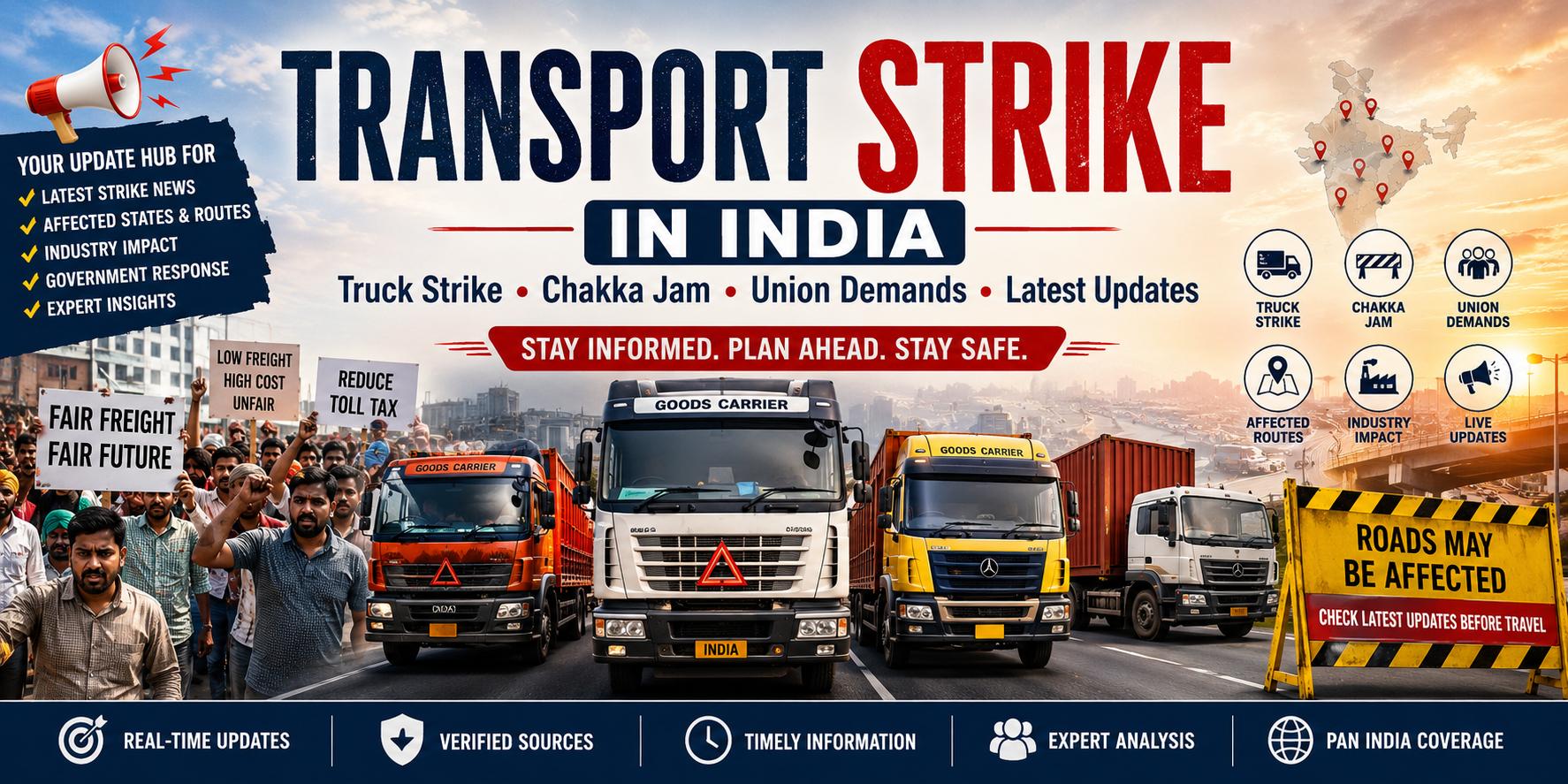
India’s transport sector is one of the most important pillars of the national economy. Every day, trucks, trailers, tankers, container carriers, buses, taxis, autos and other commercial vehicles move raw materials, food, fuel, medicines, industrial cargo and passengers across the country.
That is why even a local transport strike can quickly affect factories, warehouses, ports, vegetable markets, fuel stations, construction projects, retail shops, courier networks and industrial supply chains.
At the same time, transport-strike information is often confusing. A local taxi protest may be described as a transport shutdown. A state-level truck agitation may circulate on social media as an “All India Chakka Jam.” A proposed strike may be reported as if it has already started.
This guide explains how transport strikes work in India, why truckers and transport unions protest, which industries can be affected and how businesses and travellers should respond. The latest verified strike developments can be added to the Latest Transport Strike Updates in India section at the end of this article.
⚡ What Is a Transport Strike?
A transport strike is a coordinated or spontaneous stoppage of transport services by drivers, vehicle owners, transport companies, associations or unions.
Depending on the issue, participants may include:
🚛 Truck operators
🚚 Goods carriers
🛢️ Tanker operators
🏗️ Trailer operators
📦 Container transporters
🚌 Bus operators
🚕 Taxi drivers
🛺 Auto-rickshaw drivers
🚗 Commercial cab operators
⚓ Port transporters
A transport strike may be nationwide, state-wide, city-level, port-specific or limited to a particular transport category.
The most important point for businesses and travellers is simple:
Every transport strike is not an all-India truck strike.
🚛 What Is a Truck Strike?
A truck strike specifically involves freight-transport vehicles or the people and businesses that operate them.
Depending on the strike, affected vehicles may include:
🚛 Open trucks
📦 Container trucks
🚚 LCV and MCV vehicles
🛢️ Oil and chemical tankers
🏗️ Trailers
⚙️ ODC and heavy-haul vehicles
🚗 Car carriers
🧊 Refrigerated trucks
🏭 Industrial cargo vehicles
The actual impact depends on how many operators participate, which states are involved, which vehicle categories stop and how long the action lasts.
A headline saying “truck strike” does not automatically mean every goods vehicle in India has stopped.
🛑 What Is Chakka Jam?
The term “chakka jam” is commonly used for a vehicle stoppage, transport shutdown or road blockade.
A chakka jam can affect:
private vehicles
commercial vehicles
public transport
goods carriers
even if those drivers are not directly participating in the protest.
For businesses, the practical question is therefore not only:
“Is my transporter on strike?”
It is also:
“Is my route still open and operational?”
🚦 Types of Transport Strike Status
🔴 Confirmed
The strike has been officially announced and reliable sources confirm the action.
🟠 Proposed
A union or association has announced a possible future strike.
🟡 Negotiations Underway
Government representatives and transport organisations are discussing demands and the strike may still be withdrawn.
🟢 Called Off
A previously announced strike has been cancelled.
⚪ Ended
The strike has concluded and services are returning to normal.
❓ Unverified
Information is circulating, but sufficient reliable confirmation is not available.
📊 Transport Strike vs Truck Strike vs Chakka Jam
| Term | Meaning | Possible Impact |
|---|---|---|
| 🚛 Truck Strike | Goods vehicle operators stop work | Freight and supply chains |
| 🛑 Chakka Jam | Vehicle stoppage or road blockade | Road movement |
| 🚕 Taxi Strike | Taxi or cab operators suspend services | Passenger travel |
| 🛺 Auto Strike | Auto-rickshaw drivers stop work | Local transport |
| 🚌 Bus Strike | Bus services disrupted | Passenger transport |
| ⚓ Port Transport Strike | Container or port vehicles affected | Imports and exports |
| 🛢️ Tanker Strike | Fuel or chemical tankers affected | Fuel and industrial supply |
| 🏭 Industrial Transport Strike | Factory logistics affected | Production and dispatch |
🏭 Why Transport Strikes Matter to India’s Economy
Road transport connects almost every physical supply chain in India.
Factories receive raw materials through trucks.
Supermarkets receive vegetables, dairy products and packaged goods through trucks.
Fuel stations depend on tankers.
Construction sites depend on cement, steel and machinery carriers.
Hospitals depend on medicine and medical-supply networks.
Even cargo transported by rail, air or sea usually requires a road vehicle at the first or last stage of movement.
That makes road transport one of the most important connecting links in India’s logistics system.
🔗 How a Transport Strike Can Affect the Supply Chain
A prolonged disruption can create a chain reaction:
Truck movement slows
↓
Raw material delivery is delayed
↓
Factory production may slow
↓
Finished goods dispatch is delayed
↓
Warehouse inventory declines
↓
Retail availability may tighten
↓
Urgent freight demand may increase
↓
Consumers may eventually experience shortages or higher prices
The scale of the effect depends on strike duration, geographic coverage, vehicle participation and inventory availability.
🥦 Impact on Vegetables, Fruits & Agricultural Produce
Perishable agricultural cargo is particularly vulnerable.
Vegetables and fruits cannot remain indefinitely inside a delayed truck.
Possible consequences include:
crop spoilage
farmer losses
mandi shortages
retail-price volatility
reduced product availability
This is why agricultural logistics can begin feeling the effects of a prolonged transport strike relatively quickly.
🥛 Impact on Milk & Dairy Supply
The dairy supply chain may involve milk collection, chilling, processing, packaging and distribution.
A prolonged movement disruption can create pressure on this system.
However, essential products may be exempted during some protests.
Therefore, reports claiming nationwide milk shortages should always be verified against the actual strike scope.
⛽ Impact on Petrol, Diesel & LPG
A truck strike does not automatically mean fuel stations will run dry.
Fuel supply is more likely to be affected when:
tanker operators participate
fuel depots are disrupted
major roads are blocked
the action continues for an extended period
Essential-service exemptions can also reduce the impact.
💊 Impact on Medicines & Healthcare Logistics
Healthcare freight can include:
medicines
medical equipment
hospital supplies
temperature-sensitive pharmaceutical products
Medical and essential supplies may receive special treatment during some protests.
Any report of medicine shortages should be checked carefully before publication or forwarding.
📦 Impact on Courier, Parcel & E-Commerce
A goods transport strike can affect e-commerce without completely stopping every delivery.
Modern e-commerce networks use:
large line-haul trucks
regional warehouses
delivery vans
two-wheelers
air cargo
rail cargo
third-party logistics
Possible effects include delayed interstate delivery, slower warehouse replenishment and regional backlogs.
Local last-mile delivery may continue even when long-distance freight is delayed.
⚓ Impact on Ports & Container Movement
Ports depend heavily on road connectivity.
If trailers and container trucks stop or slow down, the effects may include:
container accumulation
CFS congestion
ICD delays
export cargo missing vessel cut-offs
import delivery delays
higher detention or storage costs
A port may remain operational even while truck movement outside the port is disrupted, so these two conditions should always be reported separately.
🏗️ Impact on ODC & Project Cargo
ODC and project cargo can be particularly vulnerable during a strike or road blockade.
Heavy industrial cargo may require:
road-route survey
bridge-capacity checks
height clearance
turning-radius planning
traffic permissions
police coordination
utility shutdowns
escort vehicles
An ODC vehicle cannot always take an alternative road at short notice.
For heavy-haul movement, the complete route should be checked before dispatch.
🏭 Industries Most Exposed to a Major Truck Strike
| Industry | Potential Impact |
|---|---|
| 🥦 Agriculture | Very High |
| 🥛 Dairy | Very High |
| 🐟 Seafood | Very High |
| 🚗 Automobile | High |
| 🏭 Manufacturing | High |
| 🧱 Construction | High |
| 🧪 Chemicals | High |
| 💊 Pharmaceuticals | Medium–High |
| 🛒 Retail | Medium–High |
| 📦 E-commerce | Medium–High |
| ⛽ Petroleum | Very High if tankers participate |
| ⚓ Import/Export | High |
| 🏗️ Project Cargo | Very High |
These are general risk levels and not a prediction for every individual strike.
🤔 Why Do Transporters Go on Strike?
Transport strikes can arise from multiple economic, regulatory and operational issues.
Common concerns include:
⛽ Fuel prices
🛣️ Toll charges
💰 Freight rates
🧾 Taxes and compliance
⚖️ Transport laws
🚓 Enforcement issues
📷 E-challans
🛡️ Insurance premiums
🛞 Tyre and maintenance cost
🏦 Truck EMI and financing pressure
🅿️ Parking shortages
👨✈️ Driver working conditions
📦 Loading and unloading detention
⚓ Port delays
🚛 Overloading pressure
⛽ Fuel Cost Pressure
Fuel is one of the largest operating costs in road freight.
When diesel costs rise while freight rates remain weak, truck operators can experience heavy pressure on margins.
A truck owner still has to pay for:
driver salary
toll
maintenance
tyres
insurance
vehicle finance
permits
taxes
This imbalance can become a major source of transporter dissatisfaction.
🛣️ Toll Charges
Toll charges add substantial cost on long interstate routes.
Transporters may raise concerns relating to:
higher toll expenses
congestion despite toll collection
road quality
new tolling rules
Toll-related issues frequently become part of wider transport-industry negotiations.
💰 Freight Rate Pressure
The freight market is highly competitive.
When the number of available trucks is high but cargo demand is weak, freight rates can fall.
At the same time:
diesel may rise
toll may rise
tyre cost may rise
insurance may rise
If freight rates do not increase accordingly, transporter margins can become unsustainable.
⏰ Factory & Warehouse Detention
A truck earns primarily while it is moving.
If it waits for long periods at a factory or warehouse, productivity falls.
Common detention problems include:
long factory-gate queues
slow loading
slow unloading
documentation delays
warehouse congestion
lack of labour
Transporters often demand reasonable detention compensation for prolonged waiting.
👨✈️ Truck Driver Working Conditions
Transport disputes can also involve driver welfare.
Drivers may face:
long working hours
lack of sleeping facilities
poor roadside toilets
unsafe parking
extended time away from family
accident risk
roadside harassment
A strong transport system depends on safe and dignified working conditions for drivers.
🅿️ Truck Parking Shortage
Truck drivers need safe spaces for:
sleep
food
toilets
vehicle inspection
rest periods
Where adequate truck terminals are unavailable, vehicles may park along highway shoulders or industrial roads.
This can increase accident risk, congestion and conflict with local enforcement agencies.
🤝 Role of Transport Associations & Unions
Transport associations may represent truck owners, drivers, taxi operators, bus operators, container operators and other commercial-vehicle groups.
Their role can include:
representing industry demands
negotiating with government
issuing strike calls
withdrawing protests after settlement
coordinating members
However, not every operator belongs to or follows the same association.
This means an official strike announcement does not always produce identical participation in every region.
⚠️ Strike Announcement Does Not Mean 100% Shutdown
Even during a confirmed strike:
some transporters may continue operations
essential vehicles may receive exemptions
some states may not participate
some routes may remain open
independent operators may continue working
Therefore, claims such as “all trucks in India have stopped” should only be published when supported by strong evidence.
📰 How to Verify a Transport Strike
Before believing or forwarding a strike message, check:
Who Called It?
Look for the name of the union or association.
Where Does It Apply?
Nationwide, state, city, port or industrial zone?
When Does It Begin?
Confirm the exact date and time.
Which Vehicles Are Affected?
Truck, trailer, tanker, taxi, bus or multiple categories?
What Is the Current Status?
Confirmed, proposed, negotiating, called off or ended?
📱 Beware of Fake WhatsApp Strike Messages
Messages such as:
“Tomorrow all transport across India will remain closed indefinitely.”
should not automatically be trusted.
Check whether the message contains:
union name
official notice
clear date
affected region
vehicle category
reliable source
If these details are missing, the correct status is:
Unverified.
📡 Reliable Sources for Transport Strike Updates
Transport-strike information should ideally be verified through:
Government of India announcements
Press Information Bureau
State transport departments
Traffic police
NHAI
Port authorities
Official transport associations
Reputed national and regional news organisations
Social-media forwards should be treated only as leads, not final confirmation.
🔴 Latest Transport Strike Updates in India
This section can be updated whenever a new strike or transport protest occurs. Newest updates should appear first.
🚨 UPCOMING [DATE] — [LOCATION] Transport Strike Update
| Detail | Latest Information |
|---|---|
| 📅 Strike Date | [Date] |
| 📍 Location | [City / State / India] |
| 🔴 Status | Confirmed / Proposed / Ongoing / Withdrawn / Ended |
| 🤝 Called By | [Union / Association] |
| 🚛 Vehicles Affected | [Truck / Trailer / Tanker / Taxi / Bus] |
| 📢 Major Demands | [Main reason] |
| 🛣️ Routes Affected | [Highways / Cities / Industrial Areas] |
| 🏭 Industries Affected | [Industries] |
| 🥦 Essential Goods | Normal / Partially Affected / Affected |
| ⛽ Fuel Supply | Normal / Risk / Affected |
| ⚓ Port Movement | Normal / Delayed / Affected |
| 🏛️ Government Response | [Latest response] |
| ⏰ Expected End | [Date / Unknown] |
| ✅ Outcome | [Ongoing / Called Off / Agreement] |
| 🔄 Last Updated | [Date + Time] |
What Happened?
Write a short factual summary explaining what the union or association announced, where the strike applies and which transport categories are participating.
Why Was the Strike Called?
Explain the main demands, disagreements or policy issues behind the protest.
What Is the Impact?
Explain whether freight, highways, industrial areas, ports, fuel, agricultural cargo or local passenger transport are actually affected.
What Should Businesses & Travellers Do?
Businesses should confirm dispatches, check route conditions, prioritise time-sensitive cargo and keep customers informed. Travellers should verify local transport before leaving for airports, stations or intercity journeys.
Status Note: This update applies only to the locations, dates and vehicle categories mentioned above and should not automatically be interpreted as a nationwide transport shutdown.
📚 Previous Transport Strike Updates
Older updates should remain below the latest strike rather than being deleted.
This creates a useful chronological record of transport disputes and helps readers understand how different strikes were resolved.
✅ How Businesses Should Prepare for a Transport Strike
When a strike is announced, businesses should first verify the scope rather than panic.
A practical response includes:
confirming the official announcement
contacting contracted transporters
checking origin and destination routes
checking transit states
prioritising perishable and critical cargo
informing consignees
building inventory buffer where practical
avoiding unnecessary dispatch into blocked routes
recording delay-related documentation
For high-value industrial cargo, direct confirmation from the transporter and route stakeholders is especially important.
🚚 What Transporters Should Do During a Strike
Transport companies should clearly inform customers about:
participation status
route availability
vehicle availability
possible delays
cargo already in transit
Customers should not have to rely on rumours to understand where their cargo is located.
👨✈️ What Drivers Should Do
Drivers should follow lawful instructions from their employer, association and public authorities.
Safety should remain the priority.
Drivers should avoid:
dangerous road blockades
violent confrontation
unsafe parking
driving while excessively fatigued
A protest should not place drivers, other road users or the public in unnecessary danger.
🌟 Conclusion
Transport strikes are an important part of India’s transport and industrial landscape because road freight connects farms, factories, ports, warehouses and consumers.
But every strike is different.
Some are nationwide.
Some are state-specific.
Some affect only taxis.
Some involve trucks but exempt essential goods.
Some are announced and later withdrawn.
The most useful approach is therefore not to react to the loudest headline.
It is to verify:
who called the strike, where it applies, which vehicles are affected, why it was called and whether the action is still continuing.
This page is designed to remain an evergreen guide while the Latest Transport Strike Updates in India section can be updated whenever a new verified strike occurs.
For transport buyers, manufacturers, exporters, importers and logistics managers, timely information can help prevent avoidable delays and reduce supply-chain disruption.
ABCC India Project Cargo Corporation works across road-route surveys, heavy haulage, project cargo and transport-logistics planning. In complex ODC and industrial movements, route verification becomes particularly important during strikes, road blockages, diversions and changing traffic restrictions.
Reliable transport information is not only news—it is part of logistics planning.

