
Gujarat is located in the west coast of India and the state of Gujarat has the longest coastline in India. It is the most dynamic entrepreneurs. The industries are innovative and highly professional. It has rich natural resources, a vast reservoir of skilled manpower and the most developed industrial infrastructure. This state contributes significantly to the economic development of the nation. It has become the most selected destination for industrial investment.
Related :-
Trucks Truckers and Trucking
Goods Transportation Problems
Logistics Overview
Factories Survey
What is GIDC?
GIDC stands for Gujarat Industrial Development Corporation and it is the Nodal agency of the Government of Gujarat for providing Industrial backbone of the state. It has been set up under the Gujarat Industrial Development Act 1962 as a Statutory Board.
Gujarat Industrial Development Corporation Details:-
- Gujarat Industrial Development Corporation has been established with a vision to make GIDC an effective, vibrant and timely provider of quality industrial infrastructure with the easy and quick. The transparent delivery mechanism at a competitive cost and without losing sight of its social responsibilities.
- It has been created for securing the orderly establishment and organization of industries in industrial areas and industrial estates in the state. This Corporation has established 202 industrial estates. Gujarat Industrial Development Corporation is accepted special investment regions, Industrial areas and large, industrial-specific estates in tune with the changing economic and industrial scenario
GIDC land allotment rules:-
- GIDC has introduced a land allotment rule without any physical touch point where submission of all support documents and presentation. It will be done through the online system.
- The application will be considered complete after the applicant submits the online copies of the application and required documents including project presentation.
- The applicant has to submit the print out of the system generated application and acknowledgment. It is receipt along with all necessary documents through registered post. The 30 days before You are applying online in GIDC.
- Please note that if above-mentioned documents are not received within the order time limit then application stands canceled.
Recommended :-
Transport Department :- Please Click
History of Transportation :- Please Click
importance of transport system :- Please Click
The problem faced by firms located in GIDC:-
The Gujarat Industrial Development Corporation industries are not in a position to play their role strongly due to different constraints and the different problems faced by the firms are:
- Financial problems in industries.
- Raw material requirements.
- The industries are not fully open to the latest technology. The technology is approached with the problems of less production in minor quality and higher cost.
- The firms also exposed to marketing problems.
- Infrastructure is short availability of transportation, communication, power and other facilities in the backward areas.
- Most of the industries are working below full potentials and there is gross under utilization of capacities.
- Another important problem faced by entrepreneurs is poor project planning. The project planning is also one of the problems.
- Management is another serious problem for industries.
GIDC plot transfer rules:-
- The transfer of utilized properties is permitted by the Gujarat Industrial Development Corporation by charging transfer fees based on the utilization of property by transferor vide Circular dated announced this portal.
- The transfer of non-utilized / open Industrial properties is permitted by the Gujarat Industrial Development Corporation by charging transfer fees 20 percent of prevailing A.P. and 1pnercent on-utilization penalty per year to a maximum of 10 percent. The applicant can apply for transfer of non-utilized and open plot to take benefit of the policy. Relevant Circulars have announced this portal.
GIDC BPAMS:-
The BPAMS stands for Building Plan Approval Management System and it is used for online payment method. This payment method should be made only by using the payment gateway provided on the GIDC-BPAMS website. The land crew size is more than 50,000 square meter then payment options are below:
- The first option is 100 percent down payment upfront.
- Another option is, the applicant can pay the down payment 50 percent of the OCA amount within 60 days of the receipt of allotment letter.
- The remaining 50 percent is to be paid by 12 post-dated cheques (PDC) of quarterly installments with the prevailing rate of interest, which is subject to revision from time to time.
- If the land crew size is equal to or less than 50,000 square meter then payment options are
- 30 percent down payment within 2 months from date of allotment.
- The remaining 70 percent is to be paid in quarterly installments. It includes moratorium period of two years, initial 8 quarterly installments of interest only as per prevailing interest rate.
- Remaining amount equally divided into 32 quarterly installments along with prevailing interest rate from 3rd year onwards.
Related :-
Advantages of road transport :- Please Click
Disadvantages of road transport :- Please Click
Oversized Load Transportation Problems :- Please Click
Architects – GIDC:-
Gujarat Industrial Development Corporation (GIDC), a corporation of the Government of Gujarat, seeks expression of Interest from reputed Architectural Firms, for empanelment of Architects to provide Architectural Consultancy for various projects across the State of Gujarat. The detailed pre-qualification criteria, the scope of work and other terms and conditions of empanelment can be downloaded only from the website.
Hiring companies future in GIDC:-
Gujarat Industrial Development Corporation (GIDC) current vacancies will be updated on their official website. There are many job openings for GIDC Recruitment. It will be released by the official’s website and will update the detailed information of GIDC current recruitment soon on this page. The job seekers who would want to know the updates of GIDC recruitments and you can check here. Get all details of MIDC current recruitment by reading this page further. There are many private companies launched in the future project. It is also providing many job offers.
GIDC Benefit:-
- GIDC land is classified as non-agricultural, thus eliminating the need for NA/NOC permission and need for verification of titles
- Titles of GIDC land/building are free from encumbrances and are marketable
- GIDC provides world-class infrastructure as well as state of art facilities in its estates.
- GIDC estates provide quality water supply and adequate power supply.
- GIDC estates are equipped with Chemical and Waste Disposal Systems
- Regular Maintenance of Infrastructure
- GIDC estates facilitate cluster benefits related to raw material, market, technology, common services, linkages, etc.
- GIDC offers reasonable allotment price with flexible payment options
- The chemical estates are equipped with environment management infrastructure
- GIDC also provides sites/land for solid waste disposal and for CETPs at concessional rate
Neighborhood Rural Development in GIDC:
Rural development is one of the major benefits of industrial development. It has accepted greater importance in India today than in the earlier period in the process of the development of the country. It is a strategy package seeking to achieve enhanced rural production and productivity. It develops greater socio-economic equity and goa. It is also balanced in the social and economic development of industrial development.
Increasing employment in GIDC:–
Gujarat Industrial Development Corporation creates more employment opportunities and increases the mobility of labor. It has many of the units and labor intensive. There are many opportunities for both skilled and unskilled workers.
Economic and educational development of public life in GIDC:-
GIDC Industrial s provide employment to the local people. It is developed a host of facilities such as banks, post offices, insurance companies, housing, schools, health care facilities come up. This results in the development of backward areas and balanced regional development. It is also economical wise improved in these industries.
Transportation Increase in GIDC : –
Gujarat Industrial Development Corporation is increased online transportation facility and logistical services . The product of one unit might be the raw material for another unit. This unit is located close by transportation, it results in savings in transportation costs for the purchaser and assured market and reduced selling cost for the seller.
Infrastructure Development in GIDC :-
The infrastructural facilities as well as developed in the state and such as electricity, water, roads, telecom, etc. There are readily available in industrial estates. This industry need not spend their time and money to get electricity connection, water supply, and telephone connection. Therefore production can commence immediately without any wastage of time and resources.
Road and Highway Increasing in GIDC :-
The world is advancing in the current trend. Gujarat Industrial Development Corporation industries are attempting to recognize and fulfill the needs of investors in terms of world-class infrastructure. These state roads are constructed by GIDC for providing a good quality approach to the industries.
Banking and finance Service Class Increase in GIDC :-
The GIDC has also developed a bank and finance department. It is basic infrastructure, banks, post offices, etc. These are located in industrial estates. This facilitates business transactions to a great extent. The Gujarat Industrial Development Corporation units in an industrial estate can cooperate among themselves and undertake joint research. This research can be for exploring new markets, new sources of supply of raw materials, better processes, and more. They can share best practices relating to quality standards,TQM, TPM, ISO standards, and more. Such co-operation would benefit all the member units.
Side effects of GIDC industrial development:-
The biggest side effect of GIDC industries is leading to an increase in pollution as many units emit poisonous gases which over the years. It has turned out to be the main cause of global warming. Gujarat Industrial Development Corporation leads to a shift in the preference of people and they tend to prefer working there because of more money. This is providing opportunities rather than in agriculture sector and hence a gap. The Gujarat Industrial Development Corporation industry is created many side effect. This is one of the long term effects in this industry. It can lead to food shortages because of the lack of interest in agriculture and allied activities.
These industries tend to attract many peoples but it is providing the side effect of Gujarat Industrial Development Corporation industrial development. It leads to problem urbanization where many people from rural areas shift to urban areas leading to urbanization problems like lack of housing, congestion, lack of green space and health-related problems. It sometimes creates monopolies which ultimately lead to the exploitation of consumers of the country and the huge gap between the rich and poor is also attributed to the industries.
The Hooliganism in GIDC :-
This commonly involves conflict among gangs firms. It formed for the purpose of intimidating and physically attacking supporters of other industries. The main reasons may also occupy the local areas. This hooliganism, especially if there is a political undertone to such an industry.
Crime rate increase in GIDC:–
The crime rate is very fastly increasing in Gujarat Industrial Development Corporation. The occupying space concentration of them has been the most disturbing factors in industrial society. The literacy state is high in wean society. The criminal tendency is so dominated in developing industries.
Administrative robbery in GIDC :-
The administrative robbery is one of the theft. This theft of a robbery is increased by many industries. The robber intentionally, knowingly, or recklessly injures another person, with approaching bodily injury or death. The victim should attempt too many ways. It is the responsibility of all staff and faculty to notify Administrative Services if a suspected robbery is in progress.
High Corruption Increase in GIDC :–
corruption is considered a strong restriction on growth and development. High corruption is also increasing currently. It is also one of the side effects of industrial development. The academic literature finds different effects of corruption on economic performance.
Property Rate Increase GIDC :–
The real estate industries are rising property rates. So people are purchasing real estate, the transaction costs are considerably higher. They feel one of the side effect of industrial development.
Security issues in GIDC :–
security issues are the main problem of industries development. Gujarat Industrial Development Corporation industries are facing many security issues. These problems of change of agricultural land to non- agricultural uses attractive for sale. So Thus agricultural lands are not secure and it is a major effect of the whole industries. The upward shift in demand for agricultural land required for economic growth.
Related :-
Warehouse and Warehousing Storage
Types of Warehouse
Warehouse Management WMS Services
Heavy Duty Trucks and Crane Rental Services
Gujarat Industrial Development Corporation GIDC Conclusion:-
Above all information, we can discuss the Gujarat Industrial Development Corporation industries. It has created adequate accomplishment in industrial development. This is considering the scale of the country this development is away from satisfactory.
Please click & See Our Endless Journey – Please Click
GIDC Gujarat Official You tube Channel
Division Wise Estate Details – GIDC
GIDC industrial Business Directory
Gujarat GIDC Industries list pdf
Gujarat Industrial Development Corporation (GIDC) Public FAQs :-


🏭 GIDC Gujarat: Industrial Estates, Land Allotment, Infrastructure and Economic Growth
Gujarat Industrial Development Corporation (GIDC) is a statutory organisation responsible for developing planned industrial areas across Gujarat, India.
Established in 1962 under the Gujarat Industrial Development Act, GIDC helps businesses access industrial land, essential infrastructure and organised manufacturing locations.
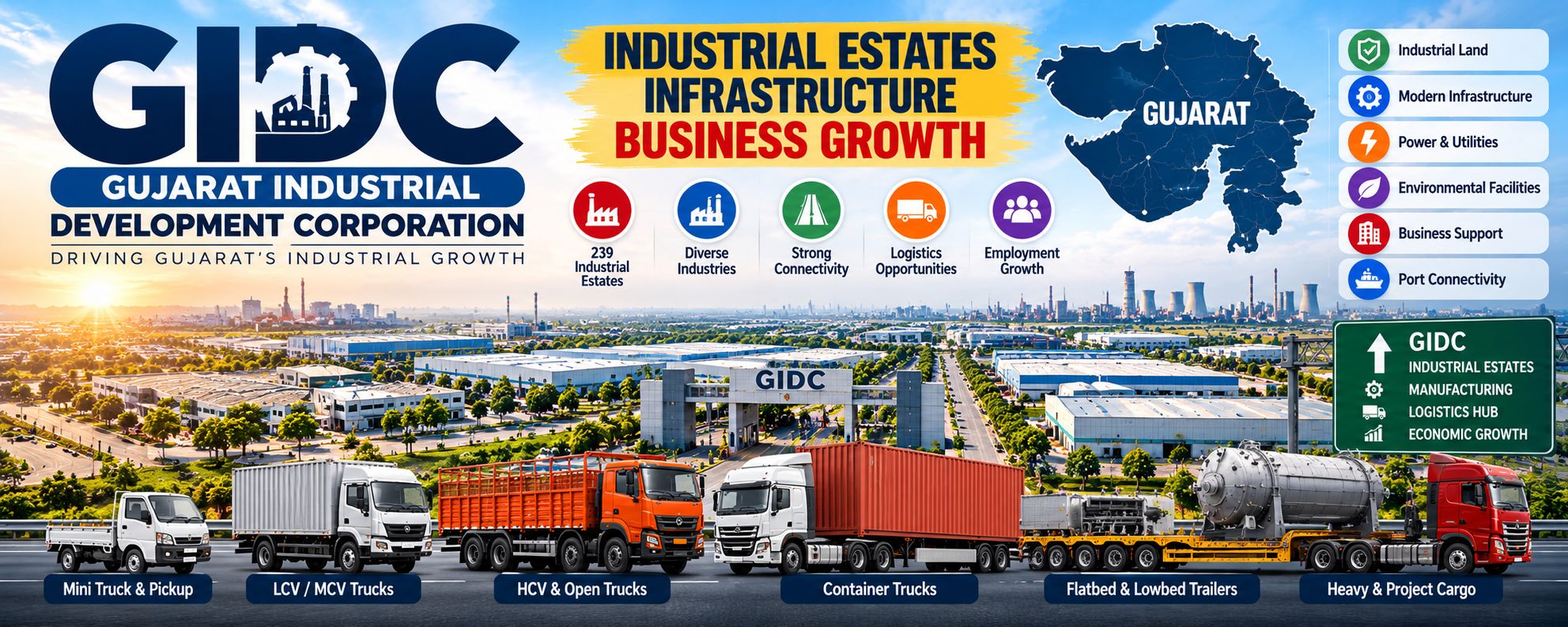
According to its official website, GIDC has established 239 industrial estates across Gujarat.
These estates support different manufacturing activities, including engineering, chemicals, pharmaceuticals, textiles, automobile components, ceramics, plastics and other industrial sectors.
For entrepreneurs, GIDC provides a structured route to industrial establishment. For manufacturers, its estates offer opportunities to operate near suppliers, customers and supporting businesses.
For transporters and logistics companies, GIDC estates represent important centres of raw-material movement, finished-goods distribution and industrial equipment transportation.
This guide explains GIDC’s functions, industrial estate network, land allotment, infrastructure, economic significance and practical business opportunities.
📋 GIDC Gujarat at a Glance
| Particular | Information |
|---|---|
| Full name | Gujarat Industrial Development Corporation |
| Abbreviation | GIDC |
| Established | 1962 |
| Legal basis | Gujarat Industrial Development Act, 1962 |
| State | Gujarat, India |
| Organisation type | Statutory industrial development corporation |
| Main purpose | Planned industrial development |
| Industrial estates | 239, as stated on the official GIDC website |
| Major activities | Industrial land development, allotment and infrastructure |
| Primary beneficiaries | Manufacturers, MSMEs, industrial investors and related businesses |
| Official website | GIDC Gujarat |
The number of industrial estates may change as new estates are developed or administrative classifications are updated.
🏛️ What Is Gujarat Industrial Development Corporation?
GIDC is the Gujarat government’s nodal agency for planned industrial infrastructure development.
Its central responsibility is to identify suitable industrial locations, develop industrial estates and make industrial land and supporting infrastructure available through applicable procedures.
Instead of leaving every manufacturer to independently arrange industrial land and basic infrastructure, GIDC develops designated industrial locations.
This approach can reduce some of the difficulties associated with establishing manufacturing units.
However, obtaining a GIDC plot does not automatically remove every regulatory approval required to operate a factory.
Businesses must still comply with applicable building, environmental, factory, fire, utility and other requirements.
🕰️ History of GIDC and Industrial Development in Gujarat
GIDC was established in 1962 to support organised industrial development across Gujarat.
Industrial development requires more than individual factories. Manufacturers need land, electricity, water, roads, workers, suppliers and access to markets.
Planned industrial estates help bring several of these requirements together.
Over time, Gujarat developed manufacturing concentrations in chemicals, engineering, textiles, pharmaceuticals, ceramics, automotive components and other sectors.
GIDC’s role expanded from conventional industrial estates to include specialised industrial infrastructure and support for larger industrial development initiatives.
📈 How GIDC’s Role Has Evolved
| Development Stage | Main Focus | Industrial Significance |
|---|---|---|
| Initial development | Planned industrial estates | Organised manufacturing locations |
| Expansion of industrial clusters | Industrial land and infrastructure | Greater geographical distribution of manufacturing |
| Sector specialisation | Industry-focused estates | Support for particular manufacturing requirements |
| Infrastructure improvement | Roads, utilities and environmental facilities | Better operating conditions |
| Modern industrial development | Specialised parks and larger industrial initiatives | Support for changing industrial requirements |
This table describes broad stages of development, not a verified decade-wise count of estates.
🗺️ How Many GIDC Industrial Estates Are in Gujarat?
GIDC’s official website currently reports 239 industrial estates.
These are located across different industrial and commercial regions of Gujarat.
Not every estate has the same size, industrial profile, infrastructure or land availability.
Some are mature manufacturing centres with limited vacant land. Others serve developing industrial regions or specialised investment requirements.
A statewide estate count should not be confused with the number of plots currently available for allotment.
🏭 Major GIDC Industrial Locations in Gujarat
| Industrial Location | District or Region | Industrial Significance |
|---|---|---|
| Vatva | Ahmedabad | Established chemical and engineering manufacturing cluster |
| Naroda | Ahmedabad | Diversified industrial manufacturing |
| Odhav | Ahmedabad | Engineering and small manufacturing units |
| Kathwada | Ahmedabad | Engineering and industrial production |
| Sanand | Ahmedabad | Automotive and advanced manufacturing ecosystem |
| Sanand-II | Ahmedabad | Large industrial development and specialised manufacturing |
| Vapi | Valsad | Chemicals, pharmaceuticals and other manufacturing |
| Sarigam | Valsad | Industrial manufacturing and processing |
| Umbergaon | Valsad | Engineering and diversified manufacturing |
| Ankleshwar | Bharuch | Chemical and pharmaceutical manufacturing |
| Panoli | Bharuch | Chemical and industrial production |
| Jhagadia | Bharuch | Large and diversified industrial activity |
| Sachin | Surat | Textiles, processing and other manufacturing |
| Pandesara | Surat | Textile processing and industrial activity |
| Halol | Panchmahal | Engineering and automotive manufacturing |
| Savli | Vadodara | Engineering and industrial manufacturing |
| V.U. Nagar | Anand | Engineering and manufacturing |
| Chitra | Bhavnagar | Industrial manufacturing |
| Lodhika | Rajkot | Engineering and MSME activity |
The table highlights selected industrial locations rather than providing a complete directory of all 239 estates.
Industrial composition varies within each estate. The descriptions indicate important industrial associations, not an exhaustive list of companies.
🏭 Major Industries Supported by GIDC Estates
Gujarat’s industrial economy includes manufacturing activities with very different infrastructure and transportation requirements.
⚙️ Engineering and Machinery
Engineering industries manufacture components, fabricated structures, industrial equipment and machinery.
Their operations may require steel, castings, electrical components, packaging materials and specialised transportation.
🧪 Chemicals and Pharmaceuticals
Chemical and pharmaceutical industries need infrastructure appropriate to their processes and regulatory obligations.
Their logistics requirements may include specialised tankers, compatible packaging, containerised goods and controlled handling procedures.
🧵 Textiles and Garments
Textile manufacturing and processing create demand for yarn, fabric, dyes, packaging materials and finished-goods transportation.
Cargo requirements vary between textile processing units and garment manufacturers.
🚗 Automotive and Components
Automotive manufacturing involves the movement of components, assemblies, machinery, packaging materials and finished products.
Supplier coordination and delivery reliability are particularly important.
🏺 Ceramics and Building Materials
Ceramic manufacturing requires transportation of raw materials, industrial fuels, packaging and finished products.
Damage prevention and suitable vehicle selection are important considerations.
📦 Plastics and Packaging
Plastic and packaging manufacturers serve numerous downstream industries.
Their cargo may include polymers, finished packaging products, industrial containers and manufactured components.
🏗️ What Infrastructure Does GIDC Provide?
GIDC develops industrial infrastructure according to the requirements and characteristics of individual estates.
Facilities may include:
- Developed industrial plots.
- Internal roads.
- Water supply arrangements.
- Drainage systems.
- Street lighting.
- Power and gas-related infrastructure.
- Environmental management facilities.
- Common infrastructure for industrial activities.
- Supporting commercial and community facilities.
Not every GIDC estate provides every facility.
For example, environmental infrastructure in a chemical estate may differ substantially from that required in a general engineering estate.
Businesses should verify the actual facilities available at their intended location before purchasing, leasing or developing industrial property.
🏢 Advantages of Establishing a Business in a GIDC Estate
A planned industrial estate can offer practical advantages over an isolated manufacturing location.
📍 Industrial Land Identification
GIDC identifies and develops land for industrial purposes.
This can simplify certain aspects of location selection.
🛣️ Planned Industrial Access
Industrial estates are developed with internal road infrastructure appropriate to their planning requirements.
Actual road quality, vehicle access and maintenance conditions vary.
💧 Utility Infrastructure
Water, power and other utilities may be supported through estate infrastructure and relevant service providers.
Businesses must verify connection availability and capacity.
🤝 Industrial Cluster Benefits
Manufacturers located near suppliers, customers and service providers may benefit from shorter supply chains and improved coordination.
🏦 Business Support Ecosystem
Established industrial areas can attract banks, transport companies, warehouses, maintenance providers and other commercial services.
🧪 Environmental Infrastructure
Certain estates serving chemical industries include common environmental management infrastructure.
Individual factories remain responsible for meeting applicable environmental requirements.
📝 How to Apply for a GIDC Industrial Plot
Industrial land allotment is one of the most important services associated with GIDC.
However, allotment procedures depend on the estate, plot category, availability and prevailing rules.
Step 1: Identify a Suitable Industrial Estate
Select a location based on manufacturing requirements, suppliers, customers, workforce availability and transport connectivity.
Step 2: Check Current Plot Availability
Review the official GIDC portal for available plots, sheds and relevant notices.
A listed industrial estate does not necessarily have vacant land available.
Step 3: Review Eligibility and Conditions
Examine the requirements applicable to the proposed industrial activity and property category.
Step 4: Prepare Business and Project Information
Applicants may need business identification details, project information and supporting documents specified in the applicable procedure.
Step 5: Submit the Application
Follow the current application method published by GIDC.
Do not rely on old instructions concerning physical documents, payment methods or deadlines.
Step 6: Review the Allotment Terms
If an allotment is offered, examine the financial conditions, permitted use, development obligations and applicable restrictions.
Step 7: Complete Required Compliance
After allotment, obtain the permissions and utility connections required for the proposed activity.
Applicants should consult official GIDC instructions before making payments or committing to a property transaction.
💰 GIDC Industrial Plot Prices in Gujarat
GIDC plot allotment prices vary by industrial estate and financial year.
Land prices in mature manufacturing locations can differ significantly from those in developing industrial areas.
GIDC publishes estate-wise allotment prices.
📊 Selected GIDC Allotment Prices for FY 2026–27
| Industrial Estate | District | Listed Allotment Price |
|---|---|---|
| Vatva | Ahmedabad | ₹11,150 per sq. metre |
| Naroda | Ahmedabad | ₹11,150 per sq. metre |
| Odhav | Ahmedabad | ₹11,150 per sq. metre |
| Kathwada | Ahmedabad | ₹11,150 per sq. metre |
| Sanand-II (Bol) | Ahmedabad | ₹6,070 per sq. metre |
| Viramgam | Ahmedabad | ₹1,470 per sq. metre |
| Halol | Panchmahal | ₹1,830 per sq. metre |
| Amreli | Amreli | ₹2,140 per sq. metre |
| Babra | Amreli | ₹1,060 per sq. metre |
| Rajpipla | Narmada | ₹680 per sq. metre |
Source: GIDC official FY 2026–27 allotment-price schedule.
These are published allotment-price entries, not verified current resale prices or confirmation of plot availability.
Actual transaction costs may involve other charges, taxes, conditions and approvals.
🧮 Example of Industrial Land Cost Calculation
Suppose an industrial plot measures 1,000 square metres.
If the applicable allotment rate is ₹2,000 per square metre:
Basic calculated land amount:
1,000 × ₹2,000 = ₹20,00,000
This is a hypothetical calculation.
It excludes additional charges, taxes, construction expenses, utility connections and other applicable costs.
📑 GIDC Plot Transfer and Property Compliance
Industrial property transfers are governed by applicable GIDC conditions and policies.
A business considering the purchase or transfer of an existing industrial property should verify:
- Allotment status.
- Lease conditions.
- Permitted industrial use.
- Existing financial obligations.
- Applicable transfer permissions.
- Outstanding dues.
- Building approvals.
- Environmental compliance.
- Property utilisation conditions.
Transfer fees and other charges may change through official circulars.
Therefore, older percentage-based transfer formulas should not be treated as current without checking the relevant policy.
Independent legal and technical due diligence is advisable for significant industrial property transactions.
🏗️ GIDC Building Permissions and Industrial Construction
Industrial land allotment and permission to construct a factory are separate considerations.
Depending on the property and applicable requirements, an industrial project may need building-plan approval and other permissions.
Businesses should verify:
Plot boundaries.
Permissible land use.
Applicable building regulations.
Building height and coverage.
Access for emergency vehicles.
Fire safety requirements.
Utility arrangements.
Industrial activity approvals.
Environmental permissions.
The relevant authority and procedure may vary according to the estate and project.
🧪 Environmental Management in GIDC Industrial Areas
Industrial development creates economic opportunities but also requires responsible environmental management.
Chemical processing, wastewater generation, industrial emissions and hazardous waste need appropriate controls.
Some industrial estates have common effluent treatment plants or other environmental facilities.
However, the existence of common infrastructure does not remove the compliance responsibilities of individual units.
Important environmental priorities
Wastewater treatment.
Air-emission control.
Hazardous waste handling.
Water conservation.
Emergency preparedness.
Industrial safety.
Environmental monitoring.
Manufacturers should verify applicable requirements with the relevant authorities and authorised service providers.
🚛 How GIDC Industrial Estates Create Transport and Logistics Demand
Industrial estates are not only manufacturing locations. They also generate continuous goods movement.
A factory needs raw materials before production can begin.
It may need machinery, spare parts, packaging and maintenance supplies.
After production, finished goods must reach warehouses, distributors, ports or customers.
This creates opportunities for road transport and other logistics services.
📦 Industry-Wise Cargo and Vehicle Requirements
| Industry | Typical Inbound Cargo | Typical Outbound Cargo | Potentially Suitable Vehicles |
|---|---|---|---|
| Engineering | Steel, castings, components | Machinery, fabricated products | Open trucks, flatbed trailers |
| Chemicals | Approved chemical inputs, packaging | Chemical products | Compatible tankers, enclosed vehicles |
| Pharmaceuticals | Ingredients, packaging | Finished pharmaceutical goods | Suitable enclosed or temperature-controlled vehicles |
| Textiles | Yarn, fabric, dyes | Processed textiles, garments | LCVs, MCVs, enclosed trucks |
| Automotive | Components, assemblies | Parts, finished products | Container trucks, specialised carriers |
| Ceramics | Raw materials, packaging | Tiles and ceramic products | Suitable heavy trucks |
| Plastics | Polymers, additives | Plastic products | Container-bodied trucks, open trucks |
| Heavy engineering | Steel, equipment, components | Large machinery | Flatbed, low-bed or specialised trailers |
These are representative industry-based requirements. Actual vehicle selection depends on each shipment’s specifications.
🚚 Commercial Vehicles Used in GIDC Industrial Transportation
Different industries require different vehicles.
Small manufacturing units may depend on pickups and light commercial vehicles for local deliveries.
Medium commercial vehicles are useful for suitable regional freight.
Heavy rigid trucks and multi-axle vehicles transport larger industrial consignments.
Container-bodied trucks can protect packaged goods.
Flatbed trailers are used for suitable machinery and fabricated cargo.
Low-bed trailers support particular heavy-equipment movements.
Modular hydraulic multi-axle trailers may be required for specialised project cargo where engineering assessments establish their suitability.
Vehicle selection should consider payload, dimensions, axle limits, loading facilities and route restrictions.
🏗️ Heavy Machinery and ODC Transportation in Gujarat
Large industrial projects may require transportation of machinery that exceeds conventional vehicle dimensions or weight limits.
These movements demand more planning than ordinary goods transportation.
Potential requirements include:
Cargo measurement.
Vehicle configuration.
Load distribution calculations.
Route surveys.
Bridge assessments.
Turning-radius checks.
Overhead clearance assessment.
Loading and unloading arrangements.
Applicable permissions.
Traffic and safety coordination.
Specialised cargo movements must be planned by appropriately qualified professionals.
Not every GIDC industrial estate generates demand for oversized project cargo, and not every road is suitable for such movements.
🛣️ Road, Rail and Port Connectivity for Gujarat Industries
Gujarat’s industrial development is supported by connections between manufacturing centres, consumption markets, ports and other freight infrastructure.
Different regions have different logistical advantages.
Industrial areas around Ahmedabad and Sanand benefit from their position within a major manufacturing and commercial region.
Southern Gujarat’s industrial areas connect with important western Indian markets and port-linked logistics networks.
Bharuch district’s chemical and engineering clusters generate specialised industrial freight requirements.
Saurashtra and Kutch contain important manufacturing, mineral, engineering and port-related economic activities.
However, proximity to a highway or port does not automatically guarantee low transportation costs.
Actual logistics performance depends on road access, congestion, cargo characteristics, vehicle availability and handling infrastructure.
📊 How GIDC Supports Employment and Local Businesses
Industrial estates can generate direct manufacturing employment and demand for supporting services.
👷 Employment and Business Opportunities
| Sector | Typical Opportunities |
|---|---|
| Manufacturing | Production, machine operation, quality control |
| Engineering | Fabrication, maintenance, technical services |
| Warehousing | Inventory handling, storage operations |
| Road transport | Driving, dispatch, fleet management |
| Logistics | Freight coordination, documentation |
| Material handling | Crane, forklift and loading operations |
| Industrial services | Equipment repair, utilities, packaging |
| Business support | Accounting, banking, insurance, administration |
Actual vacancies depend on local employers and market conditions.
GIDC’s own recruitment announcements should be distinguished from jobs offered by private companies located in GIDC estates.
🌱 How GIDC Industrial Development Affects Nearby Communities
Industrial development can influence nearby communities in several ways.
Manufacturing activity may increase demand for housing, transport, retail businesses and services.
Local residents may gain access to employment and business opportunities.
Educational and technical training demand may also increase.
At the same time, industrial growth can create challenges involving traffic, housing affordability, environmental management and pressure on public infrastructure.
The impact varies considerably between locations.
It is not accurate to assume that industrial development automatically causes crime, corruption or social problems.
Such claims require location-specific evidence.
Responsible industrial planning should balance economic development with environmental protection, public infrastructure and community needs.
⚠️ Common Problems Faced by Businesses in GIDC Estates
Industrial units may encounter operational difficulties even within planned estates.
💰 Financing and Working Capital
Businesses may need substantial funds for land, buildings, machinery, inventory and daily operations.
Delayed customer payments can create additional pressure.
📦 Raw-Material Procurement
Manufacturers may face price volatility, supplier delays or inconsistent material availability.
🚛 Transportation Delays
Loading congestion, vehicle shortages, road restrictions and scheduling problems can affect dispatch.
⚡ Utility Reliability
Some operations depend on continuous electricity, water or specialised utility arrangements.
Businesses should assess local service capacity before establishing operations.
🧪 Environmental Compliance
Certain manufacturing activities require significant investment in treatment, monitoring and safety systems.
👷 Workforce Availability
Specialised manufacturing may require trained workers who are not readily available in every industrial location.
🏢 Industrial Property Costs
Mature industrial locations may have higher land and operating costs.
📊 Practical Solutions
| Business Challenge | Practical Response |
|---|---|
| Working-capital pressure | Improve receivables monitoring and financial planning |
| Raw-material delays | Develop alternative qualified suppliers |
| Dispatch congestion | Use scheduled loading and vehicle planning |
| Equipment downtime | Follow preventive maintenance schedules |
| High transport expenses | Compare total freight costs and reduce avoidable empty running |
| Compliance complexity | Maintain a documented compliance calendar |
| Workforce shortages | Invest in recruitment and technical training |
| Land selection uncertainty | Verify infrastructure, access and property conditions before commitment |
These are general industrial management recommendations, not claims that every GIDC estate experiences the same problems.
🏢 GIDC Industrial Estates and MSME Development
Micro, small and medium enterprises form an important part of industrial supply chains.
They may manufacture components, provide fabrication services, supply packaging or support larger industrial companies.
A planned industrial estate can help smaller businesses operate near customers and service providers.
GIDC has also described dedicated MSME parks and multi-storeyed industrial sheds among its industrial development initiatives.
However, the availability and status of these facilities must be verified individually.
MSMEs should evaluate not only the plot price but also their total establishment and operating costs.
🔮 Future of GIDC and Industrial Growth in Gujarat
Gujarat’s industrial infrastructure requirements continue to evolve.
Established manufacturing estates need maintenance, modern utilities and efficient access.
Newer industrial investments may require specialised infrastructure.
Important areas of development include:
Advanced manufacturing.
Industrial automation.
Electronics and related supply chains.
Specialised chemical infrastructure.
Industrial logistics.
Warehousing.
Environmental management.
Skills development.
Improved infrastructure planning.
The success of future industrial development will depend on execution, investment demand, infrastructure quality and sustainable operations.
Proposed projects should not be treated as completed facilities.
🚛 ABCC India Project Cargo Corporation and Industrial Transportation
Industrial manufacturers require transportation arrangements that match their cargo and delivery requirements.
ABCC India Project Cargo Corporation focuses on road freight coordination and specialised industrial transportation requirements.
Relevant activities may include conventional truck transportation, trailer arrangements, heavy machinery movement, project cargo planning and road route survey consulting.
For industrial customers, effective transport planning begins with accurate cargo dimensions, loading requirements, suitable equipment and route feasibility.
❓ Frequently Asked Questions About GIDC Gujarat
1. What is the full form of GIDC?
GIDC stands for Gujarat Industrial Development Corporation.
2. When was GIDC established?
GIDC was established in 1962.
3. How many GIDC industrial estates are there in Gujarat?
The official GIDC website currently reports 239 industrial estates.
4. What is the main purpose of GIDC?
Its main purpose is to support planned industrial development through industrial land and infrastructure.
5. Is GIDC a government organisation?
GIDC is a statutory industrial development corporation established under Gujarat legislation.
6. Does GIDC provide industrial plots?
Yes. Industrial land development and allotment are among its principal functions, subject to applicable procedures and availability.
7. How can I check GIDC plot availability?
Use the official GIDC portal and review current plot, shed and allotment information.
8. Are GIDC plot prices the same across Gujarat?
No. Allotment prices vary by estate and applicable financial year.
9. Can an MSME establish a unit in a GIDC estate?
Eligible MSMEs may apply for suitable industrial properties according to the applicable requirements.
10. Does every GIDC estate have a common effluent treatment plant?
No. Environmental infrastructure varies according to the estate and industrial requirements.
11. What industries operate in GIDC estates?
Industries include engineering, chemicals, pharmaceuticals, textiles, automotive components, plastics and other manufacturing activities.
12. Why are GIDC estates important for transportation?
Factories require inbound raw materials, machinery, packaging and outbound finished-goods transportation.
13. Are heavy trailers used in GIDC industrial areas?
Suitable trailers are used for industrial cargo where cargo dimensions, weights and transportation requirements justify them.
14. Does GIDC provide jobs directly?
GIDC may publish its own recruitment notifications. Private companies located in industrial estates recruit separately.
15. Is every industrial area in Gujarat a GIDC estate?
No. Gujarat also has private industrial parks, industrial clusters and other development arrangements that should not automatically be classified as GIDC estates.
🏁 Conclusion
Gujarat Industrial Development Corporation has played an important role in creating planned industrial infrastructure across the state.
Its industrial estates support manufacturing, supplier networks, employment, business services and goods transportation.
For entrepreneurs, understanding land allotment procedures, industrial infrastructure and location suitability is essential before investing.
For manufacturers, reliable utilities, efficient logistics and regulatory compliance remain important operating priorities.
For transporters and logistics professionals, Gujarat’s industrial estates create varied opportunities in conventional freight, container movement, machinery transportation and specialised project cargo.
The most useful approach is to evaluate each industrial estate according to its actual industries, infrastructure, location and commercial requirements rather than assuming that all GIDC estates offer identical opportunities.
Reliable information and careful planning are essential for sustainable industrial growth.