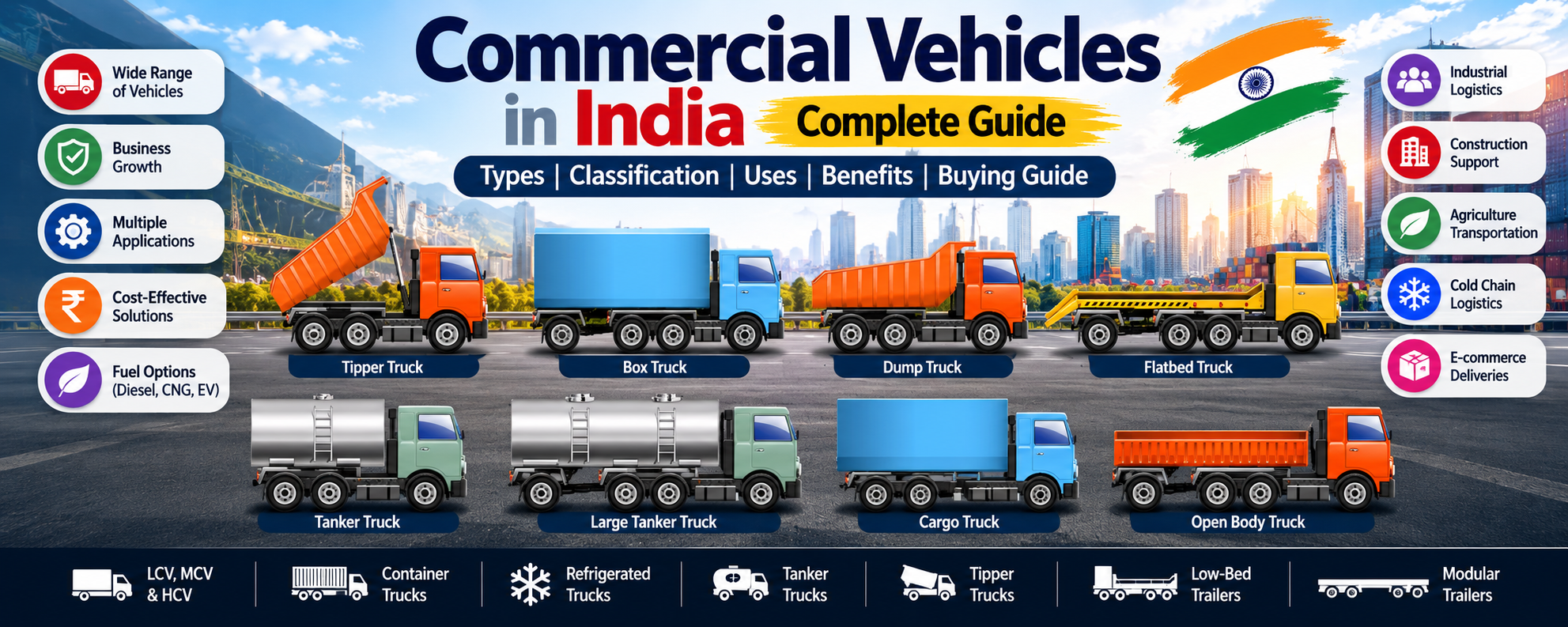
🚛 Commercial Vehicles in India: Complete Guide to Types, Classification, Uses, Costs and Selection (2026)
Introduction: Understanding India’s Commercial Vehicle Industry
Commercial vehicles are an essential part of India’s transportation, manufacturing, agricultural, construction and logistics sectors.
Every day, different types of commercial vehicles transport raw materials, agricultural products, consumer goods, construction materials, industrial machinery and finished products between businesses and customers.
Small pickup trucks deliver goods within cities. Medium-duty trucks connect regional markets. Heavy commercial vehicles transport bulk commodities over long distances. Specialised trailers move oversized industrial equipment that cannot be carried by conventional trucks.
Commercial vehicles also include vehicles used for passenger transportation, such as buses and other vehicles operated for commercial passenger services.
However, commercial vehicles and commercial goods vehicles are not identical categories.
A goods carrier is designed to transport materials or cargo, whereas a passenger-carrying commercial vehicle transports people.
India’s commercial vehicle industry includes conventional diesel trucks, CNG-powered delivery vehicles, electric cargo vehicles, buses, tractor-trailer combinations and specialised transportation equipment.
Choosing the right vehicle requires understanding its legal classification, gross vehicle weight, payload capacity, cargo compatibility, operating costs and intended application.
This guide explains commercial vehicle types in India, their advantages, limitations, uses, ownership considerations and the practical factors that businesses should evaluate before buying or hiring them.
📊 Commercial Vehicles in India: Quick Classification Chart
| Vehicle Type | Typical Applications | Examples |
|---|---|---|
| Mini cargo vehicles | Local deliveries | Mini trucks, small cargo carriers |
| Light commercial vehicles | Urban and regional distribution | Pickups, delivery vans |
| Medium commercial vehicles | Regional goods transportation | Medium-duty rigid trucks |
| Heavy commercial vehicles | Long-distance and bulk transportation | Heavy rigid trucks |
| Multi-axle trucks | Higher-capacity freight | Multi-axle rigid trucks |
| Container trucks | Enclosed freight and container movements | Container-bodied trucks, skeletal trailers |
| Refrigerated trucks | Temperature-controlled transportation | Reefer trucks |
| Tanker trucks | Liquid and specialised bulk cargo | Fuel, water and chemical tankers |
| Tipper trucks | Construction and bulk materials | Tippers and dump trucks |
| Flatbed trailers | Machinery and industrial cargo | Flatbed semitrailers |
| Low-bed trailers | Heavy machinery | Low-bed and semi-lowbed trailers |
| Modular hydraulic trailers | Specialised heavy project cargo | Hydraulic multi-axle trailer systems |
| Passenger commercial vehicles | Passenger transportation | Buses and commercial passenger vehicles |
| Electric commercial vehicles | Suitable urban and regional operations | Electric cargo vans and trucks |
These are practical market descriptions rather than a single legal classification system.
⚖️ 1. What Is a Commercial Vehicle?
A commercial vehicle is generally a vehicle used for business-related transportation activities.
Commercial vehicles may transport goods, passengers, equipment or materials.
In India, legal vehicle categories depend on the applicable provisions of the Motor Vehicles Act, Central Motor Vehicles Rules and related notifications.
The commercial use of a vehicle does not automatically determine its technical category.
For example, a goods-carrying pickup and a passenger-carrying minibus may both operate commercially, but their vehicle classifications and regulatory requirements differ.
Main purposes of commercial vehicles
Commercial vehicles support:
- Goods transportation.
- Passenger transportation.
- Industrial distribution.
- Agricultural logistics.
- Construction operations.
- Retail supply chains.
- E-commerce deliveries.
- Infrastructure projects.
- Temperature-controlled logistics.
- Specialised industrial cargo transportation.
Commercial vehicle versus private vehicle
A private passenger vehicle is generally used for personal transportation.
A commercial vehicle is associated with business or transport activities and may be subject to additional permit, insurance, taxation and operating requirements.
The exact requirements depend on the vehicle’s registration, classification and use.
🚚 2. Official Classification of Goods Vehicles in India
India uses technical vehicle categories that distinguish goods vehicles according to their maximum permitted mass.
The N-category classification is particularly relevant for goods vehicles.
N1, N2 and N3 Goods Vehicle Categories
| Category | Maximum Mass Classification | General Description |
|---|---|---|
| N1 | Not exceeding 3.5 tonnes | Light goods vehicles |
| N2 | Above 3.5 tonnes and not exceeding 12 tonnes | Medium-weight goods vehicles |
| N3 | Above 12 tonnes | Heavy goods vehicles |
These categories are based on the vehicle’s maximum mass, not simply the cargo weight it can carry.
The classifications are consistent with the technical categories referenced by India’s vehicle approval and regulatory framework.
Source: Automotive Research Association of India (ARAI), Ministry of Road Transport and Highways.
What is Gross Vehicle Weight?
Gross Vehicle Weight (GVW) refers to the total permissible weight of a loaded vehicle, including the vehicle and its load, under the applicable specifications.
It should not be confused with payload.
What is payload capacity?
Payload capacity refers to the weight of cargo a vehicle can legally and safely carry within its applicable limits.
A simplified relationship is:
Permissible payload = Permissible gross weight − Relevant unladen weight
Actual loading must also respect axle limits, manufacturer specifications, body configuration and applicable legal requirements.
Why vehicle classification matters
Correct classification helps determine:
- Vehicle suitability.
- Applicable technical standards.
- Registration and documentation requirements.
- Operating restrictions.
- Maintenance planning.
- Cargo compatibility.
🚐 3. Small Commercial Vehicles in India
Small commercial vehicles play an important role in urban distribution, local deliveries and small-business logistics.
Their relatively compact dimensions can make them suitable for narrow roads and short-distance operations.
Common types
Mini trucks: Used for local goods movement, retail deliveries and small consignments.
Pickup trucks: Used for agricultural produce, construction supplies and regional cargo.
Panel vans: Enclosed vehicles suitable for packaged goods and protected deliveries.
Dropside trucks: Vehicles with accessible loading areas for appropriate cargo.
Small tippers: Used for suitable construction and bulk material movements.
Chassis-cab vehicles: Platforms that may be fitted with approved cargo bodies for particular applications.
Advantages
Small commercial vehicles can offer flexibility, accessibility and lower acquisition costs than larger trucks.
However, their payload capacity and operating economics depend on the specific model.
Limitations
Small vehicles may be unsuitable for heavy industrial equipment, oversized cargo or large-volume long-distance freight.
🚛 4. Light Commercial Vehicles (LCVs)
Light commercial vehicles are widely used in local and regional goods distribution.
The term LCV is commonly used in the market, but buyers should verify the specific vehicle’s regulatory classification and GVW.
Common applications
Retail distribution.
E-commerce delivery.
Agricultural produce transportation.
Furniture movement.
Small industrial consignments.
Local construction materials.
Benefits of LCVs
They may provide practical access to urban markets, flexibility for smaller consignments and suitable operating costs for short-distance freight.
Important buying considerations
Check payload capacity, cargo-body dimensions, fuel efficiency, service support, operating restrictions and expected daily utilisation.
An LCV should be selected according to the actual transportation requirement rather than its advertised size alone.
🚚 5. Medium Commercial Vehicles (MCVs)
Medium commercial vehicles serve businesses that need greater carrying capacity than small delivery vehicles but do not necessarily require heavy-duty trucks.
They are commonly used for regional distribution and industrial transportation.
Common cargo
Packaged consumer goods.
Agricultural products.
Manufactured components.
Building materials.
Industrial supplies.
Advantages
MCVs can provide a balance between carrying capacity and operational flexibility.
Limitations
They may be less suitable than smaller vehicles for restricted urban roads and less economical than appropriately utilised heavy trucks for some high-volume routes.
🚛 6. Heavy Commercial Vehicles (HCVs)
Heavy commercial vehicles are designed for demanding goods transportation operations.
They play an important role in industrial supply chains and long-distance freight movement.
Common applications
Steel transportation.
Cement distribution.
Industrial raw materials.
Machinery transportation.
Bulk goods.
Container transportation.
Infrastructure projects.
Key characteristics
Heavy-duty chassis.
Higher permissible vehicle weights.
Commercial-grade drivetrains.
Specialised braking and suspension systems.
Different axle configurations.
Important operating considerations
Vehicle owners should evaluate total operating costs, tyre expenses, fuel consumption, maintenance, financing and return-load opportunities.
A high-capacity truck is not automatically more profitable than a smaller vehicle.
Profitability depends on freight demand, utilisation and operating costs.
🛞 7. Multi-Axle Commercial Trucks
Multi-axle trucks distribute vehicle loads across several axles.
Different configurations are used according to engineering design, applicable weight limits and transportation requirements.
Common applications
Industrial cargo.
Bulk materials.
Construction products.
Heavy machinery components.
Long-distance freight.
Benefits
Appropriate multi-axle configurations can support higher permitted gross weights and suitable load distribution.
Limitations
More complex configurations may involve additional maintenance, tyre expenses and manoeuvring considerations.
Vehicle selection must comply with approved specifications and legal axle-load limits.
📦 8. Container Trucks in India
Container trucks are important for domestic logistics, warehousing and international trade.
The term can describe different vehicle arrangements.
A container-bodied truck carries goods within a fixed enclosed cargo body.
A skeletal trailer is designed to transport compatible freight containers.
These arrangements should not be treated as identical.
Common applications
Import and export logistics.
Industrial distribution.
Warehousing.
Port connectivity.
Containerised cargo movement.
Benefits
Cargo protection.
Standardised handling for compatible containers.
Improved shipment organisation.
Suitability for multimodal logistics.
Limitations
Container transportation may involve terminal waiting, equipment compatibility requirements, documentation and empty-container repositioning.
🧊 9. Refrigerated Trucks and Cold-Chain Vehicles
Refrigerated commercial vehicles are designed to transport cargo requiring controlled temperatures.
Common cargo
Fresh produce.
Frozen foods.
Dairy products.
Pharmaceutical products where appropriate.
Other temperature-sensitive goods.
Important selection factors
Temperature range.
Cooling capacity.
Insulation.
Power supply.
Cargo volume.
Temperature monitoring.
Maintenance support.
Practical advice
The refrigeration system must be suitable for the specific product and required temperature conditions.
A refrigerated body alone does not guarantee compliance with specialised pharmaceutical or food-handling requirements.
🛢️ 10. Tanker Trucks and Bulk Liquid Transportation
Tanker vehicles transport liquid and certain other bulk commodities.
Their design depends on the material being carried.
Common tanker applications
Water transportation.
Petroleum products.
Industrial liquids.
Food-grade liquids.
Certain chemical products.
Safety considerations
Tank design.
Cargo compatibility.
Loading procedures.
Vehicle stability.
Required documentation.
Emergency response arrangements.
Important distinction
Hazardous cargo transportation requires compliance with applicable safety and regulatory requirements.
Not every tanker is suitable for every liquid.
🏗️ 11. Tipper Trucks and Dump Trucks
Tipper trucks are widely used in construction, mining-related operations and bulk material movement.
They use a tipping mechanism to unload suitable materials.
Common cargo
Sand.
Aggregates.
Soil.
Construction debris.
Other permitted bulk materials.
Advantages
Efficient unloading for suitable cargo.
Reduced need for certain manual unloading activities.
Practical application in construction operations.
Limitations
Tipping requires suitable ground conditions, stability and adequate overhead clearance.
Drivers and operators must follow approved safety procedures.
🚜 12. Tractor-Trailer Combinations
A tractor-trailer combination consists of a powered tractor unit and a compatible trailer.
This configuration is used extensively for long-distance and specialised freight.
Common trailer applications
Container movement.
Steel transportation.
Industrial machinery.
Construction equipment.
Project cargo.
Benefits
Trailer interchangeability.
Cargo-specific configurations.
Potential operating flexibility.
Important considerations
The tractor and trailer must be technically compatible.
Vehicle combinations must comply with applicable weight, dimension and operating requirements.
🏭 13. Flatbed Trailers
Flatbed trailers provide open loading platforms for suitable industrial and construction cargo.
Common cargo
Steel structures.
Pipes.
Fabricated components.
Machinery.
Construction materials.
Advantages
Flexible loading arrangements.
Accessibility for cranes and other handling equipment.
Suitability for certain oversized consignments.
Limitations
Cargo may require weather protection and specialised securing.
The loading platform must not be treated as unlimited in capacity.
🚛 14. High-Bed and Semi-Lowbed Trailers
High-bed and semi-lowbed trailers are used for different industrial transportation requirements.
Their suitability depends on deck height, structural design, axle configuration and cargo characteristics.
Common applications
Fabricated industrial structures.
Machinery.
Engineering components.
Construction equipment.
Selection considerations
Cargo height.
Permissible dimensions.
Ground clearance.
Route geometry.
Loading facilities.
Axle-load distribution.
A lower deck may help with overall loaded height, but route and clearance assessments remain necessary.
🏗️ 15. Low-Bed Trailers
Low-bed trailers are commonly used for transporting heavy machinery and equipment requiring specialised loading arrangements.
Common cargo
Excavators.
Industrial machinery.
Construction equipment.
Heavy engineering components.
Advantages
Lower loading deck for suitable configurations.
Specialised heavy-equipment applications.
Compatibility with certain machinery loading requirements.
Challenges
Route restrictions.
Ground-clearance problems.
Loading and unloading risks.
Cargo securing.
Limited compatible return loads.
Practical recommendation
Vehicle selection should follow a technical assessment of the cargo, trailer and intended route.
⚙️ 16. Modular Hydraulic Multi-Axle Trailers
Modular hydraulic multi-axle trailers are specialised transportation systems used for demanding heavy industrial cargo movements.
They differ substantially from conventional commercial trucks.
Common applications
Heavy transformers.
Industrial vessels.
Power-generation equipment.
Large fabricated structures.
Specialised project cargo.
Key characteristics
Multiple axle lines.
Hydraulic suspension systems.
Configurable transport arrangements.
Specialised load distribution.
Project-specific operating requirements.
Major challenges
High equipment costs.
Specialised maintenance.
Complex route engineering.
Limited cargo availability.
Long mobilisation periods.
Important safety requirement
Heavy transport operations may require engineering calculations, bridge assessments, route surveys, permits and specialised personnel.
The equipment’s nominal capacity alone is not sufficient to determine whether a movement is safe.
🚌 17. Passenger Commercial Vehicles in India
Commercial vehicles are not limited to goods transportation.
Passenger-carrying vehicles form an important part of the commercial transportation sector.
Common examples
Public buses.
Private contract buses.
Tourist coaches.
Commercial passenger vans.
Other authorised passenger transport vehicles.
Passenger vehicle classification
The M-category technical classification distinguishes passenger vehicles.
| Category | General Classification |
|---|---|
| M1 | Passenger vehicles with no more than eight passenger seats in addition to the driver’s seat |
| M2 | Passenger vehicles with more than eight passenger seats and maximum mass not exceeding 5 tonnes |
| M3 | Passenger vehicles with more than eight passenger seats and maximum mass exceeding 5 tonnes |
These categories should not be confused with commercial permit classifications.
For technical certification information, refer to ARAI Vehicle Type Approval.
⚡ 18. Electric Commercial Vehicles in India
Electric commercial vehicles are increasingly relevant to fleet planning, particularly for operations where charging infrastructure and predictable routes are available.
Common applications
Urban deliveries.
Last-mile distribution.
Municipal operations.
Selected regional freight routes.
Passenger transportation.
Potential advantages
Reduced tailpipe emissions.
Lower energy costs in suitable operating conditions.
Reduced dependence on conventional liquid fuels.
Limitations
Charging availability.
Vehicle acquisition cost.
Charging downtime.
Battery performance.
Payload and range trade-offs.
Business recommendation
Fleet operators should calculate total cost of ownership rather than comparing only fuel and electricity prices.
🌱 19. Commercial Vehicles by Fuel and Energy Type
| Fuel or Energy Type | Commercial Application | Important Consideration |
|---|---|---|
| Diesel | Broad freight applications | Fuel cost and emissions |
| CNG | Suitable urban and regional fleets | Refuelling infrastructure |
| LNG | Selected heavy-duty applications | Station availability and vehicle suitability |
| Electric | Suitable delivery and fleet operations | Charging and range |
| Biodiesel blends | Compatible approved engines | Fuel specifications |
| Bio-CNG/CBG | Compatible gas-powered vehicles | Supply availability |
| Ethanol-based fuels | Approved compatible applications | Vehicle and fuel compatibility |
| Hydrogen | Emerging approved applications | Infrastructure and technology |
| Methanol | Specialised or developing applications | Technical approval |
| LPG | Approved compatible vehicles | Safety and infrastructure |
| Synthetic fuels | Potential compatible applications | Availability and specifications |
Not all these technologies are commercially available for every vehicle class in India.
Operators should verify approved fuel compatibility and applicable standards before purchasing or modifying a vehicle.
🏢 20. Commercial Vehicle Manufacturers in India
India’s commercial vehicle market includes several manufacturers serving different segments.
Examples include:
| Manufacturer | Relevant Commercial Vehicle Segments |
|---|---|
| Tata Motors | Commercial trucks, buses and cargo vehicles |
| Ashok Leyland | Medium and heavy trucks, buses and light commercial vehicles |
| Mahindra | Pickups, light commercial vehicles and other automotive products |
| Eicher Trucks and Buses | Trucks and buses |
| BharatBenz | Medium and heavy commercial vehicles |
| SML Isuzu | Commercial vehicles and buses |
| Force Motors | Vans, passenger and specialised commercial vehicles |
This is an illustrative manufacturer directory, not a market-share ranking.
Model availability, ownership structures and product specifications should be verified through the manufacturers’ current official information.
💰 21. Commercial Vehicle Prices in India: What Determines the Cost?
Commercial vehicle prices vary considerably.
A small delivery vehicle, heavy rigid truck and specialised multi-axle trailer cannot be compared using one general price range.
Important price factors
Vehicle category.
GVW and payload.
Engine and powertrain.
Fuel technology.
Body configuration.
Axle arrangement.
Safety equipment.
Manufacturer specifications.
Regional taxes and registration charges.
Additional ownership costs
The purchase price is only one component of total cost.
Buyers should also consider:
- Insurance.
- Financing.
- Registration and applicable taxes.
- Maintenance.
- Tyres.
- Fuel or electricity.
- Driver expenses.
- Repairs.
- Downtime.
- Depreciation.
Buying advice: Obtain current written quotations from authorised dealers and compare total operating costs before making an investment.
🛒 22. How to Choose the Right Commercial Vehicle
The most suitable vehicle is not necessarily the largest or cheapest model.
It is the vehicle that meets the transport requirement safely and economically.
Step 1: Identify the cargo
Determine the material, weight, dimensions and handling requirements.
Step 2: Understand the operating route
Evaluate distance, road conditions, restrictions and loading locations.
Step 3: Calculate expected utilisation
Estimate monthly kilometres, trips and available freight demand.
Step 4: Evaluate fuel or energy options
Consider actual operating conditions and infrastructure.
Step 5: Compare maintenance support
Assess service availability and replacement-part support.
Step 6: Estimate total ownership cost
Include both fixed and variable expenses.
Step 7: Verify legal requirements
Confirm vehicle approval, registration, permits and other applicable obligations.
Step 8: Consider resale value
Evaluate depreciation and expected future demand.
🔄 23. New vs Used Commercial Vehicles
| Factor | New Commercial Vehicle | Used Commercial Vehicle |
|---|---|---|
| Initial purchase cost | Generally higher | Often lower |
| Warranty | May include manufacturer warranty | Depends on seller and vehicle |
| Maintenance uncertainty | Generally lower initially | Depends heavily on condition |
| Financing | Subject to lender terms | Subject to lender terms |
| Technology | May offer newer systems | Depends on model year |
| Depreciation | Can be significant | Depends on age and condition |
| Inspection needs | Pre-delivery checks | Detailed technical inspection |
| Suitability | New fleet investment | Budget-sensitive replacement or expansion |
Used commercial vehicle inspection checklist
Before buying a used truck, inspect:
Engine condition.
Transmission.
Chassis.
Suspension.
Brakes.
Tyres.
Electrical systems.
Service history.
Accident history.
Registration and ownership records.
Insurance and applicable statutory documents.
Outstanding finance or encumbrances.
Vehicle identification details.
A qualified independent inspection is particularly valuable for expensive vehicles.
📋 24. Commercial Vehicle Documents and Legal Compliance
Commercial vehicle operators should verify the documents and permissions applicable to their vehicles and activities.
Common requirements
Registration certificate.
Appropriate insurance.
Applicable fitness certification.
Required permits.
Applicable tax compliance.
Driver licensing.
Pollution-related documentation where applicable.
Cargo documentation.
E-way bill where required.
Special permissions for relevant cargo or vehicle movements.
Important note
Legal requirements differ according to vehicle category, registration, cargo, route and applicable law.
For official vehicle-related services, use Parivahan.
📊 25. Commercial Vehicle Operating Cost Calculation
A business should evaluate whether a vehicle can generate adequate returns under realistic operating conditions.
Illustrative monthly example
| Particular | Amount |
|---|---|
| Freight revenue | ₹4,00,000 |
| Fuel expenses | ₹1,40,000 |
| Toll expenses | ₹35,000 |
| Driver and trip expenses | ₹45,000 |
| Maintenance provision | ₹25,000 |
| Tyre provision | ₹15,000 |
| Vehicle loan payment | ₹70,000 |
| Insurance and statutory provisions | ₹20,000 |
| Other expenses | ₹15,000 |
| Total cash expenses and provisions | ₹3,65,000 |
| Illustrative cash balance | ₹35,000 |
These figures are hypothetical.
The balance is not necessarily accounting profit because loan principal, interest, depreciation, tax and other adjustments require appropriate treatment.
Important financial indicators
Cost per kilometre.
Revenue per kilometre.
Loaded kilometre percentage.
Empty kilometre percentage.
Monthly vehicle utilisation.
Maintenance cost per kilometre.
Receivables ageing.
Operating margin.
🚛 26. Commercial Vehicle Selection by Cargo Type
| Cargo | Potentially Suitable Vehicle | Important Consideration |
|---|---|---|
| Small retail deliveries | Mini truck or pickup | Weight and delivery access |
| Packaged goods | LCV, MCV or enclosed truck | Volume and payload |
| Agricultural produce | Suitable cargo truck | Ventilation and handling |
| Frozen food | Refrigerated truck | Temperature control |
| Industrial machinery | Flatbed or suitable trailer | Weight and dimensions |
| Construction aggregates | Tipper | Legal loading and unloading |
| Liquid cargo | Suitable tanker | Material compatibility |
| Freight containers | Compatible container vehicle | Container specifications |
| Excavators | Suitable low-bed trailer | Loading and route assessment |
| Heavy transformers | Engineered heavy-haul configuration | Technical survey and permits |
| Large industrial vessels | Specialised trailer arrangement | Route and load engineering |
Vehicle suitability must be verified for each consignment.
🏭 27. Role of Commercial Vehicles in Industrial Development
Commercial vehicles connect production centres with markets.
Manufacturing industries depend on reliable inbound raw-material deliveries and outbound product transportation.
Construction projects require timely movement of equipment and materials.
Agricultural markets need vehicles suited to produce distribution.
Warehousing networks depend on efficient cargo movement.
Industrial development therefore requires both production infrastructure and suitable transportation capacity.
Industrial clusters and commercial vehicles
Different industrial clusters generate different vehicle demand.
Engineering clusters may require flatbed and specialised trailers.
Consumer-goods clusters may require enclosed trucks.
Agricultural regions may require pickups, medium trucks and refrigerated vehicles.
Port-linked industrial regions may generate container and heavy-freight demand.
Transport planning should reflect actual cargo flows rather than assuming that every vehicle type is equally suitable everywhere.
🌍 28. Commercial Vehicles and Environmental Sustainability
Commercial vehicle operations affect energy consumption, emissions, congestion and road safety.
Improvement opportunities include:
Better vehicle maintenance.
Efficient route planning.
Reduced empty running.
Appropriate vehicle selection.
Driver training.
Suitable alternative-energy vehicles.
Improved loading efficiency.
Important distinction
Environmental performance should be evaluated across the relevant operating conditions.
For example, electric vehicles eliminate tailpipe emissions, but their overall environmental impact also depends on electricity generation, vehicle production and battery-related factors.
Sustainable transportation requires practical assessment rather than one-size-fits-all claims.
🚨 29. Major Problems Faced by Commercial Vehicle Owners
Commercial vehicle ownership involves several risks.
Financial challenges
High acquisition costs.
Vehicle finance obligations.
Fuel expenses.
Insurance.
Maintenance.
Delayed freight payments.
Operational challenges
Vehicle downtime.
Driver shortages.
Loading delays.
Uncertain freight demand.
Empty return journeys.
Regulatory challenges
Documentation.
Permits.
Vehicle fitness.
Applicable operating restrictions.
Safety challenges
Road accidents.
Cargo damage.
Theft.
Driver fatigue.
Practical solutions
Maintain accurate financial records.
Follow preventive maintenance schedules.
Use written freight agreements.
Verify customers and intermediaries.
Train drivers.
Plan suitable return loads.
Maintain appropriate insurance.
Monitor regulatory requirements.
🔮 30. Future of Commercial Vehicles in India
The future of commercial transportation will be influenced by technology, infrastructure, environmental requirements and changing freight demand.
Important developments to monitor
Vehicle electrification: More businesses may evaluate electric vehicles for suitable routes.
Alternative fuels: CNG, LNG and other approved technologies may serve particular applications.
Digital fleet management: Better information systems can improve dispatch coordination and maintenance planning.
Advanced safety systems: Manufacturers and regulators continue to address vehicle safety requirements.
Supply-chain integration: Businesses may increasingly coordinate transport with warehousing and inventory systems.
Specialised project logistics: Industrial and infrastructure projects will continue to require technical transportation expertise.
Business outlook
Fleet owners should avoid assuming that any single technology will dominate every commercial vehicle application.
Vehicle selection will continue to depend on cost, infrastructure, operational suitability and regulatory requirements.
🚛 31. ABCC India Project Cargo Corporation: Commercial Vehicle and Industrial Logistics Perspective
Commercial vehicle selection is a critical part of industrial transportation planning.
ABCC India Project Cargo Corporation works in road freight coordination, trailer transportation requirements and specialised project cargo logistics.
Industrial customers may require different transportation arrangements depending on cargo dimensions, weight, origin, destination and handling requirements.
Areas of logistics planning
Light and medium goods transportation.
Heavy truck transportation.
Container movement.
Flatbed trailer requirements.
High-bed and semi-lowbed trailer transportation.
Low-bed trailer arrangements.
Specialised modular hydraulic multi-axle trailer requirements.
Industrial project cargo planning.
Road route surveys for suitable heavy cargo movements.
Why proper vehicle selection matters
An unsuitable vehicle can create loading problems, route restrictions, cargo damage or unnecessary expenses.
A suitable transport plan should consider the complete movement from loading to delivery.
For specialised cargo, engineering assessments and qualified personnel may be required.
Effective commercial vehicle selection improves transportation planning, safety and operational reliability.
❓ 20 Frequently Asked Questions About Commercial Vehicles in India
1. What is a commercial vehicle?
A commercial vehicle is generally a vehicle used for business-related transportation, including goods or passenger services.
2. What are the main types of commercial vehicles in India?
Common types include mini trucks, pickups, LCVs, MCVs, HCVs, buses, container trucks, tankers, tippers and specialised trailers.
3. What is an LCV?
LCV stands for Light Commercial Vehicle. It is commonly used for smaller goods and passenger vehicle segments, depending on context.
4. What is an MCV?
MCV stands for Medium Commercial Vehicle, a market term commonly associated with medium-duty transportation.
5. What is an HCV?
HCV stands for Heavy Commercial Vehicle and generally refers to heavy-duty goods or passenger transportation vehicles.
6. What is an N1 goods vehicle?
An N1 vehicle is a goods vehicle with maximum mass not exceeding 3.5 tonnes.
7. What is an N2 goods vehicle?
An N2 vehicle is a goods vehicle with maximum mass above 3.5 tonnes and not exceeding 12 tonnes.
8. What is an N3 goods vehicle?
An N3 vehicle is a goods vehicle with maximum mass exceeding 12 tonnes.
9. What is the difference between GVW and payload?
GVW concerns the vehicle’s permissible total loaded weight, while payload refers to the cargo weight that can be carried within applicable limits.
10. Which commercial vehicle is best for city deliveries?
A suitable mini truck, pickup, cargo van or other light goods vehicle may be appropriate, depending on cargo and route requirements.
11. Which commercial vehicle is suitable for long-distance freight?
Medium and heavy trucks are commonly used, but selection depends on cargo, route and operating economics.
12. What is a container truck?
A container truck transports containerised cargo or uses an enclosed cargo body, depending on its configuration.
13. What is a flatbed trailer?
A flatbed trailer is an open-platform trailer used for suitable industrial and construction cargo.
14. What is a low-bed trailer?
A low-bed trailer is a specialised trailer with a lower loading deck, commonly used for suitable heavy machinery.
15. What is a modular hydraulic trailer?
It is a specialised multi-axle transportation system used for demanding heavy project cargo movements.
16. Are electric commercial vehicles available in India?
Yes. Electric commercial vehicles are available in selected categories and applications, subject to model and market availability.
17. What affects commercial vehicle prices?
Vehicle specifications, category, powertrain, body design, equipment, taxes and other factors affect prices.
18. Is a used commercial vehicle a good investment?
It can be suitable when the vehicle’s condition, documentation, operating requirements and total costs are carefully evaluated.
19. How can commercial vehicle owners improve profitability?
Owners can improve financial performance through cost control, vehicle utilisation, preventive maintenance, reliable customers and reduced empty running.
20. How should a business select the right commercial vehicle?
The business should assess cargo specifications, route conditions, legal requirements, vehicle capability and total operating costs.
🏁 Conclusion: Choosing the Right Commercial Vehicle for India’s Transportation Needs
Commercial vehicles are essential to India’s economic activity.
From small delivery vans to heavy trucks and specialised industrial trailers, different vehicle categories serve different transportation requirements.
Understanding vehicle classification, carrying capacity, cargo compatibility, fuel technology and operating costs helps businesses make informed decisions.
Small commercial vehicles provide flexibility for local distribution.
Medium and heavy trucks support regional and long-distance freight.
Container trucks connect industrial supply chains.
Refrigerated vehicles support temperature-sensitive transportation.
Flatbed, low-bed and modular hydraulic trailers serve specialised industrial cargo requirements.
However, purchasing or hiring a commercial vehicle should never depend on vehicle size alone.
Businesses must evaluate safety, suitability, maintenance, financial performance and regulatory compliance.
The right commercial vehicle is the one that transports the intended cargo safely, legally, reliably and economically.
For manufacturers, traders, transporters and fleet owners, informed vehicle selection can improve logistics efficiency and support sustainable business growth.