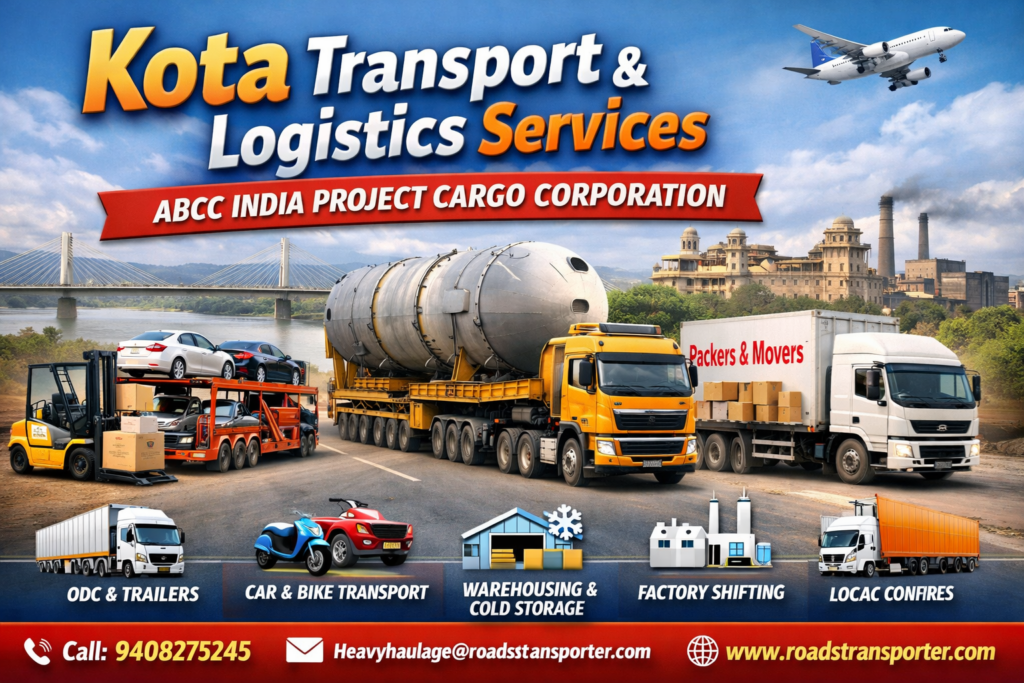
Kota is a strategically positioned city in the south-eastern part of Rajasthan that quietly powers one of North India’s most important industrial and educational economies. Nestled on the banks of the Chambal River, Kota stands at a natural crossroads where central India meets northern India, making it far more than just another district headquarters. It is a city shaped by geography, strengthened by industry, and driven by continuous migration — all of which directly influence its logistics and transportation ecosystem.
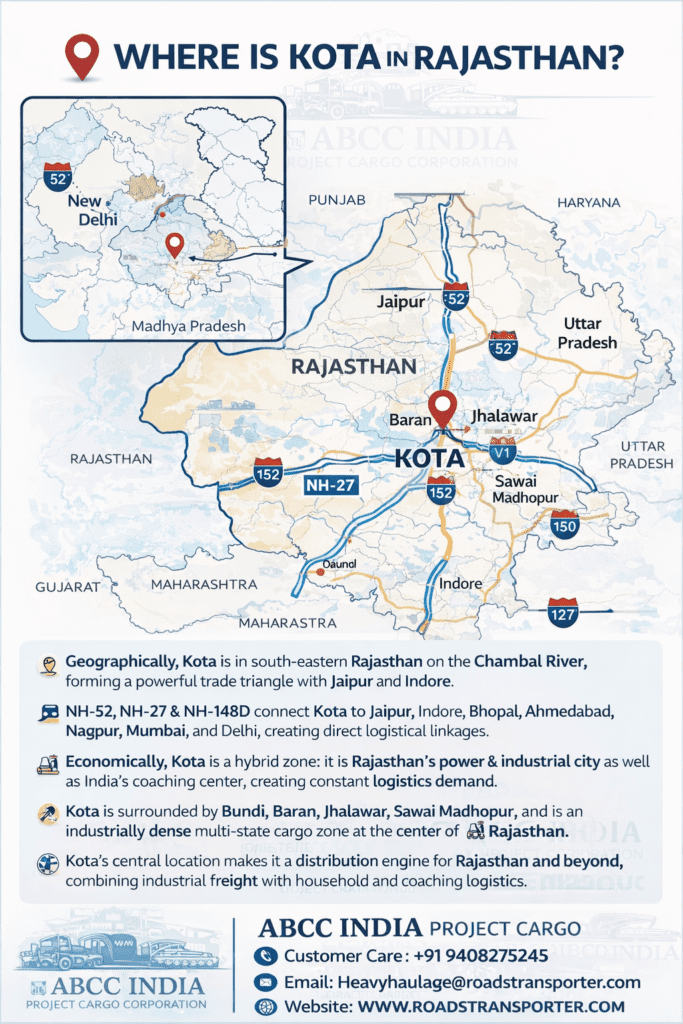
Geographically, Kota is located between Jaipur and Indore, forming a powerful triangular trade corridor connecting Rajasthan, Madhya Pradesh, Gujarat, Maharashtra, and the northern states. This central placement gives Kota a unique advantage: almost every major industrial state lies within direct highway connectivity. The city is surrounded by Bundi, Baran, Jhalawar, and Sawai Madhopur, creating a dense movement zone for agricultural produce, cement, power equipment, fertilizers, coal, FMCG goods, and construction materials.
The Chambal River is not just a scenic feature; it historically turned Kota into a settlement hub by supporting agriculture, water supply, and trade movement. Over time, irrigation projects and power plants grew around this river basin, turning Kota into one of Rajasthan’s most industrially productive belts. The presence of the Kota Super Thermal Power Station and surrounding cement and fertilizer industries transformed the city into a continuous cargo generation zone — where bulk goods move daily in high tonnage.
Economically, Kota is a hybrid powerhouse. On one side, it is Rajasthan’s major power and industrial center. On the other, it is India’s coaching capital, hosting thousands of students who migrate from every corner of the country each year. This dual economy creates year-round logistics demand — industrial cargo moves in massive volumes while residential relocations, household shifting, furniture transport, e-commerce deliveries, and student logistics continue non-stop.
Highways like NH-52, NH-27 and NH-148D connect Kota to Jaipur, Udaipur, Indore, Bhopal, Ahmedabad, Nagpur, Mumbai, Delhi, and further towards eastern corridors. These highways have turned Kota into a major break-bulk and trans-shipment point where trucks unload, reload, and redistribute cargo to nearby districts and industrial clusters. This constant freight circulation makes Kota a natural logistics hub.
Kota’s industrial zones, transport nagars, and warehousing belts have expanded rapidly over the last decade. New godowns, cold storage facilities, and private logistics parks are now serving cement factories, power plants, fertilizer companies, steel traders, agro-mandis, and FMCG distributors. The growth of these logistics ecosystems has also generated large employment opportunities for drivers, loaders, warehouse staff, supervisors, technicians, and logistics coordinators.
Because of its central connectivity, industrial density, student migration, and commercial growth, Kota today is not just a city — it is a distribution engine for Rajasthan and neighboring states. This is why ABCC INDIA PROJECT CARGO CORPORATION has established structured logistics operations here, supporting heavy haulage, industrial cargo, residential relocation, and long-haul freight movement across India.
Kota’s location doesn’t just place it on the map — it places it at the center of Rajasthan’s future logistics and industrial expansion.
🏭 How Industrialization Changed Kota’s Economy
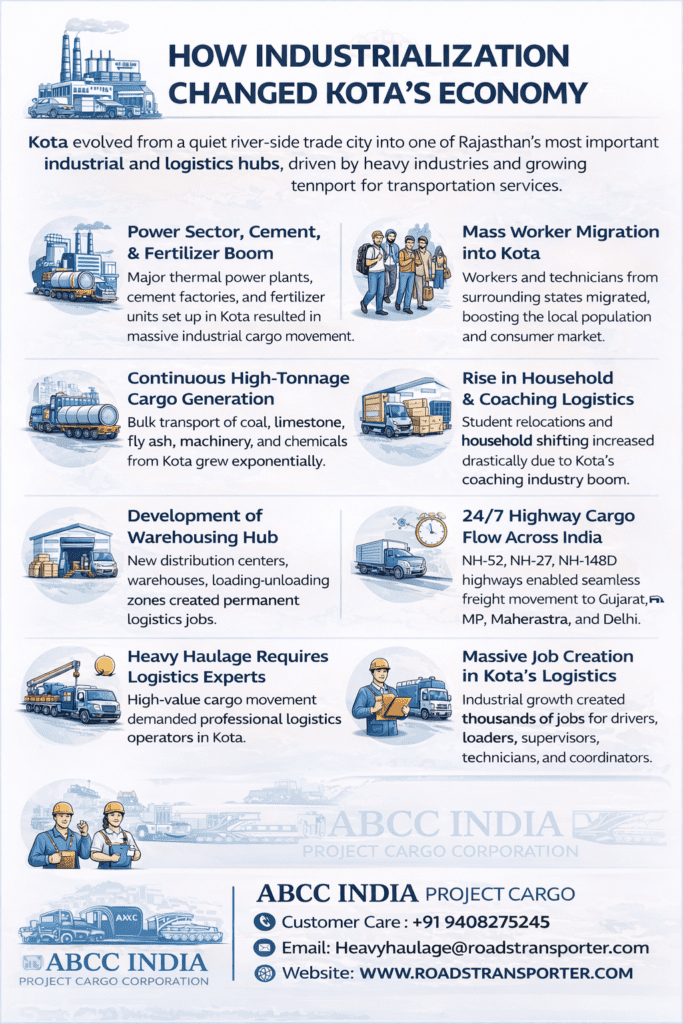
A few decades ago, Kota was largely known as a quiet river-side city with agricultural trade and small local industries. Today, it stands as one of Rajasthan’s most economically dynamic industrial belts. This transformation did not happen overnight. It was shaped by a continuous wave of industrial investments, power sector development, cement manufacturing expansion, fertilizer production, and infrastructure modernization — each step pulling Kota deeper into India’s national supply chain network.
The turning point in Kota’s industrial journey came with the establishment of major thermal power plants, fertilizer factories, and cement units in and around the Chambal basin. These industries required massive quantities of coal, limestone, gypsum, fly ash, chemicals, heavy machinery, and project equipment to be transported daily. What was once a modest trade city became a bulk cargo generation zone where high-tonnage logistics movements started flowing across Rajasthan, Madhya Pradesh, Gujarat, and Maharashtra.
As industries expanded, employment opportunities grew rapidly. Skilled engineers, technicians, supervisors, contractors, drivers, and plant operators began migrating into Kota from surrounding districts and neighboring states. This migration did more than increase population — it created a chain reaction. New housing colonies developed, local markets expanded, coaching institutes multiplied, hospitals and retail chains emerged, and residential relocations became a permanent logistics requirement.
With rising migration came year-round household shifting, student relocations, furniture transport, two-wheeler and car movement, and FMCG supply distribution. Kota’s economy began functioning on two powerful engines — heavy industrial cargo on one side and residential-commercial logistics on the other. This dual economy dramatically increased the demand for organized transportation networks, warehousing, cold storage facilities, and professional logistics operators.
The growth of coaching institutes further accelerated logistics demand. Thousands of students moving in and out of Kota each year generated consistent relocation, courier, furniture shifting, and storage requirements. Coaching hostels, PG accommodations, and residential buildings required regular movement of appliances, bedding, study material, and commercial supplies — creating a unique micro-logistics ecosystem within the city.
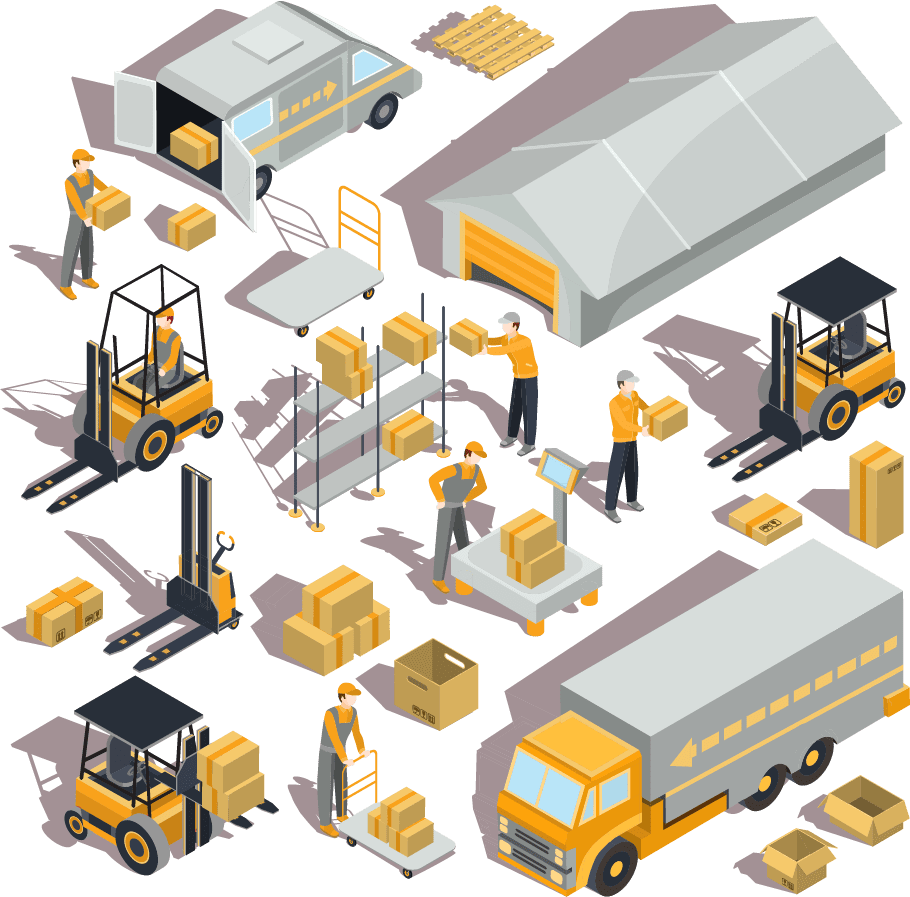
Industries also brought modern warehousing infrastructure. New godowns, cement silos, fertilizer depots, coal yards, cold storages, and distribution centers emerged around Kota Transport Nagar and nearby industrial clusters. This created permanent jobs for loaders, warehouse supervisors, forklift operators, packaging staff, quality controllers, and logistics coordinators.
Today, Kota’s economy is no longer limited to local trade. It has become a distribution engine feeding Rajasthan and neighboring states with cement, fertilizers, power equipment, steel, chemicals, FMCG goods, and agricultural inputs. This is why ABCC INDIA PROJECT CARGO CORPORATION has strengthened its operations in Kota — supporting heavy haulage, industrial cargo, residential relocations, and long-haul freight movements under one integrated logistics network.
Industrialization did not just change Kota’s skyline — it reprogrammed its economic DNA. From migration to job creation, from highways to warehouses, and from local trade to national distribution, Kota has evolved into one of Rajasthan’s most logistics-dependent growth centers — and continues to expand with every new industrial project.
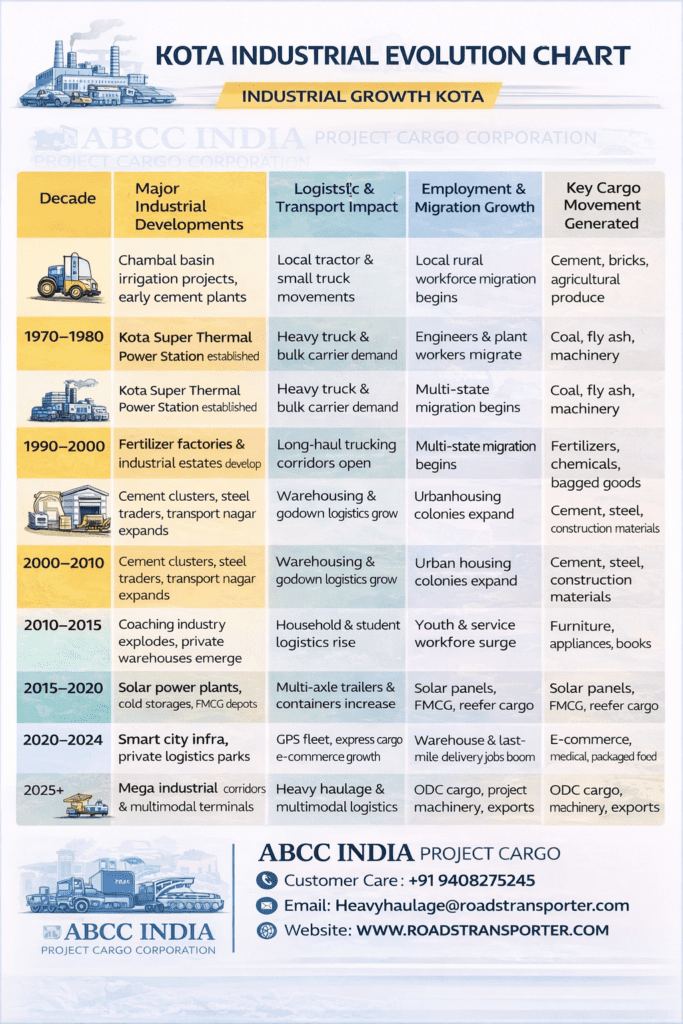
📊 Kota Industrial Evolution Chart – Decade-wise Growth
🕰️ Decade
🏭 Major Industrial Developments
🚛 Logistics & Transport Impact
👷 Employment & Migration Growth
📦 Key Cargo Movement Generated
1970–1980
Chambal basin irrigation projects, early cement plants
Local tractor & small truck movements
Local rural workforce migration begins
Cement, bricks, agricultural produce
1980–1990
Kota Super Thermal Power Station established
Heavy truck & bulk carrier demand rises
Engineers & plant workers migrate
Coal, fly ash, machinery
1990–2000
Fertilizer factories & industrial estates develop
Long-haul trucking corridors open
Multi-state migration begins
Fertilizers, chemicals, bagged goods
2000–2010
Cement clusters, steel traders, transport nagar expands
Warehousing & godown logistics grow
Urban housing colonies expand
Cement, steel, construction materials
2010–2015
Coaching industry explodes, private warehouses emerge
Household & student logistics rise
Youth & service workforce surge
Furniture, appliances, books
2015–2020
Solar power plants, cold storages, FMCG depots
Multi-axle trailers & containers increase
Skilled logistics jobs increase
Solar panels, FMCG, reefer cargo
2020–2024
Smart city infra, private logistics parks
GPS fleet, express cargo, e-commerce growth
Warehouse & last-mile delivery jobs boom
E-commerce, medical, packaged food
2025+ (Emerging)
Mega industrial corridors & multimodal terminals
Heavy haulage & multimodal logistics
Large-scale employment expansion
ODC cargo, project machinery, exports
❤️Story of Kota’s Industrial Revolution
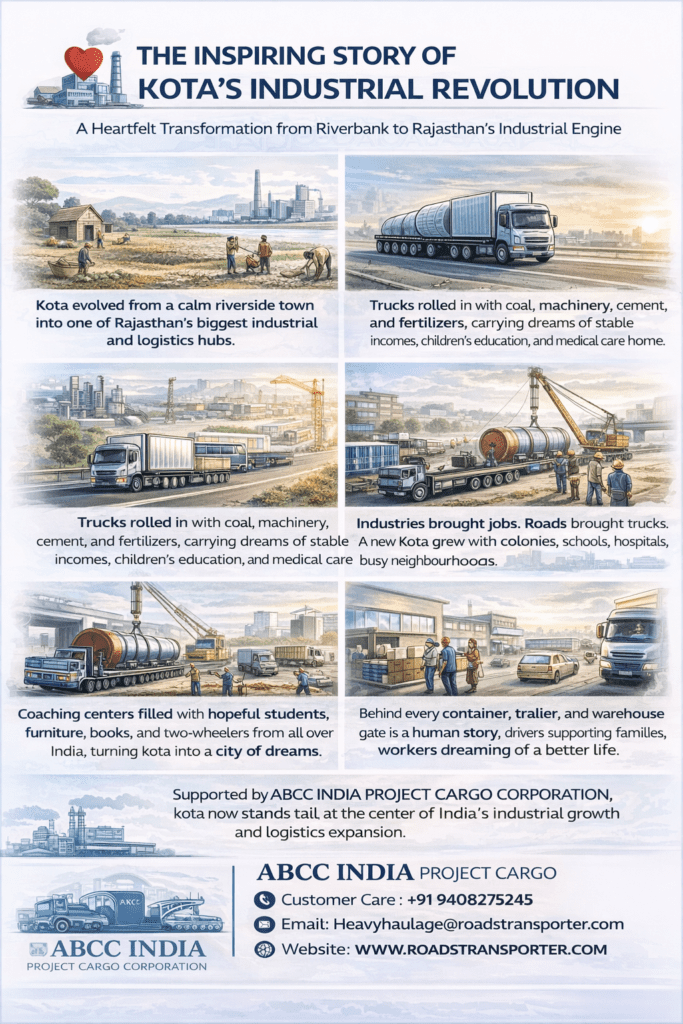
There was a time when Kota was known only as a calm riverside town where life flowed gently with the Chambal. Farmers tilled their land, traders sold grains in modest mandis, and families lived close-knit lives, unaware that their quiet city was standing at the edge of a transformation that would change not just its skyline — but its destiny.
The first sparks of Kota’s industrial revolution were not loud. They arrived quietly, in the form of irrigation canals, cement kilns, and power station foundations rising near the riverbanks. For many locals, these early structures were just new buildings. But for young boys watching cranes lift steel beams and giant trucks rolling through dusty roads, they were symbols of something bigger — hope, opportunity, and a promise of a better future.
As the Kota Super Thermal Power Station came alive, nights that once rested in darkness began glowing with industrial lights. The hum of turbines became the city’s new heartbeat. Men from nearby villages arrived seeking work. They left behind farms, childhood homes, and familiar routines, carrying only dreams of stable incomes and dignity. Some became helpers, some became drivers, some became technicians — but all became builders of a new Kota.
With industries came roads. With roads came trucks. And with trucks came life. Long-haul vehicles started rolling into Kota day and night, carrying coal, machinery, cement, fertilizers, and later, solar panels and heavy project equipment. Every truck meant not just cargo — it meant food on a family’s table, school fees for children, and medical care for aging parents.
Homes began rising around factories. Small tea stalls turned into shops. Shops turned into markets. Markets turned into neighborhoods. Kota slowly grew into a city of ambition. The sound of construction replaced the silence of sleepy afternoons. New schools, hospitals, hostels, and colonies spread across the landscape. People who once thought of migrating out now found reasons to stay — and people who had never heard of Kota now came searching for opportunity.
Then came the coaching revolution. Students arrived from every corner of India. Hostels filled. PG accommodations expanded. Families moved in. Furniture, books, two-wheelers, and household goods started flowing into the city. Kota was no longer only an industrial city — it became a city of dreams, where futures were being built in classrooms and factories at the same time.
Behind every container, every heavy trailer, and every warehouse gate, there is a human story. A driver missing home but proud of his job. A warehouse worker saving for his daughter’s education. A technician sending money back to his village. Kota’s industrial revolution is not just about machines and factories — it is about people who believed in change.
Today, Kota stands tall as one of Rajasthan’s most powerful industrial and logistics engines. ABCC INDIA PROJECT CARGO CORPORATION moves the lifeline of this city — supporting heavy machinery, industrial cargo, household relocations, and nationwide freight flows that keep Kota alive.
Kota’s revolution was not written by policies alone. It was written by courage, migration, labor, and hope — one truckload at a time.
🚛 Why the Transportation Sector is Growing Rapidly in Kota
Kota’s transportation sector is expanding faster than most cities in Rajasthan because the city has become a perfect meeting point of industry, education, migration, and multi-state trade corridors. What once depended on small local truck operators has now transformed into a full-scale organized logistics economy moving thousands of tons of cargo every single day.
The first reason behind this rapid growth is Kota’s industrial load generation. Thermal power plants, cement factories, fertilizer units, solar parks, and construction clusters continuously generate high-tonnage cargo. Coal, fly ash, limestone, heavy machinery, cement, chemicals, and project equipment must move in and out of the city without interruption. This constant flow makes transportation not seasonal — but permanent, creating daily demand for trailers, containers, tankers, and multi-axle heavy vehicles.
Secondly, Kota’s strategic highway connectivity has turned it into a redistribution hub. National highways like NH-52, NH-27, and NH-148D link Kota directly to Jaipur, Indore, Bhopal, Ahmedabad, Nagpur, Mumbai, Delhi, and northern India. Because of this connectivity, Kota now acts as a trans-shipment and break-bulk point where cargo from multiple states is consolidated and redistributed. This function alone has multiplied freight movement volumes and attracted organized logistics players into the region.
Third, Kota’s massive migration ecosystem — driven by industries and the coaching education boom — has created an entirely new layer of transportation demand. Students, working professionals, families, and contractors continuously move into and out of the city. This creates year-round demand for household shifting, two-wheeler transport, car movement, courier logistics, furniture shifting, appliance delivery, and storage solutions. Kota is one of the few cities where residential and industrial logistics grow simultaneously.
Warehousing development is another major driver. New logistics parks, godowns, cold storage units, fertilizer depots, cement silos, and FMCG distribution centers have emerged around transport nagars and industrial belts. Each warehouse requires daily inbound and outbound truck movements, inventory transfers, and long-haul freight movement, creating permanent transportation demand.
Digitalization has further accelerated growth. GPS fleet tracking, e-way bill compliance, online freight bookings, and faster billing cycles have encouraged organized transport operators to invest heavily in fleet expansion, driver training, and route optimization. This modernization has increased capacity utilization and reliability, attracting large corporates and factories to outsource their transportation needs professionally rather than relying on unorganized operators.
Because of this perfect storm of industrial cargo, migration-driven residential movement, warehousing growth, and highway connectivity, Kota’s transportation sector is no longer just expanding — it is structurally evolving into a multi-modal logistics hub. This is precisely why ABCC INDIA PROJECT CARGO CORPORATION continues to scale its operations in Kota, supporting heavy haulage, ODC cargo, long-haul freight, warehousing movements, and residential relocation under one integrated logistics network.
In Kota, transportation is not just a service — it has become the backbone of the city’s economic momentum.
KOTA TRANSPORT & LOGISTICS OVERVIEW
🚚 Kota Transport & Logistics Industry – Overview & Importance
Kota has emerged as one of Rajasthan’s fastest-growing logistics and transportation hubs because its economy runs on continuous cargo generation, heavy industrial movement, and large-scale residential migration. The city’s power plants, cement factories, fertilizer units, solar parks, and MSME clusters generate massive daily freight, while the coaching industry and workforce migration create year-round household and commercial logistics demand. This rare combination makes Kota a dual-engine logistics city — where industrial freight and residential relocations grow together.
Strategically connected by NH-52, NH-27, and NH-148D, Kota functions as a redistribution hub linking Rajasthan with Madhya Pradesh, Gujarat, Maharashtra, and North India. Warehousing belts, cold storage facilities, transport nagars, and private logistics parks have multiplied, creating structured cargo flows for cement, coal, fertilizers, FMCG, chemicals, power equipment, e-commerce goods, and project machinery. Transportation here is not seasonal — it is permanent, predictable, and high-volume.
ABCC INDIA PROJECT CARGO CORPORATION plays a central role in this ecosystem by supporting heavy haulage, ODC movement, long-haul FTL/LTL freight, residential relocations, and industrial logistics under one integrated platform.
📊 Kota Transport & Logistics Sector Classification
🚛 Transport Sector
📦 Sector Description
🏭 Key Cargo Types
🚚 Common Vehicle Types
📈 Importance in Kota
FTL (Full Truck Load)
Dedicated vehicle for single shipper
Cement, fertilizers, steel, machinery
14–32 ft trucks, multi-axle
Backbone of industrial supply
LTL (Part Load)
Consolidated cargo movement
FMCG, parcels, retail supplies
Container trucks, pickup vans
High volume daily movement
ODC (Over Dimensional Cargo)
Heavy & oversized project cargo
Boilers, turbines, plant equipment
Lowbed, modular, hydraulic trailers
Critical for power & solar projects
Project Cargo
Turnkey industrial equipment transport
Power, cement, refinery machinery
Multi-axle trailers, cranes
Supports mega industrial development
Container Logistics
Secured long-haul freight
FMCG, electronics, pharma
20/32 ft containers
Interstate trade growth
Reefer Transport
Temperature-controlled goods
Dairy, medicines, frozen foods
Refrigerated trucks
Growing cold chain demand
Tanker Transport
Liquid bulk cargo
Chemicals, oils, fuels
Tanker trucks
Industrial raw material flow
Household Relocation
Residential & student shifting
Furniture, appliances
Closed body trucks, tempos
Migration-driven logistics
Car & Bike Transport
Vehicle movement
Personal vehicles
Car carriers
Coaching city mobility
E-Commerce Logistics
Last-mile & express delivery
Online retail goods
Mini trucks, vans
Rapid digital economy growth
📍 Where are Truck Terminals & Transport Nagars Located in Kota?
Kota’s truck terminals and transport nagars are strategically spread around the city to support its heavy industrial movement, warehousing demand, and interstate freight corridors. These logistics pockets act as the operational backbone of Kota’s transportation ecosystem, handling daily movement of cement, fertilizers, coal, machinery, FMCG goods, construction material, household goods, and project cargo.
Below is a location-wise logistics geography chart of Kota:
📊 Kota Truck Terminals & Transport Nagar Locations
📍 Transport Nagar / Terminal
🗺️ Area / Locality
🛣️ Highway Connectivity
🏭 Primary Cargo Handled
🚛 Logistics Importance
Kota Transport Nagar
Rangbari Road
NH-52
Cement, fertilizers, steel, FMCG
Main freight distribution hub
Ramganj Mandi Terminal
Ramganj Mandi
NH-52
Cement, limestone, grains
Heavy industrial cargo cluster
Modak Transport Belt
Modak
NH-27
Fertilizer, fly ash, coal
Power & fertilizer corridor
Chechat Truck Terminal
Chechat
NH-52
Coal, cement, project cargo
Long-haul highway freight hub
Sultanpur Transport Yard
Sultanpur
NH-27
Cement, construction material
Regional redistribution point
Mandana Industrial Truck Yard
Mandana
NH-52
Machinery, ODC cargo
Industrial project logistics
Baran Road Logistics Zone
Baran Road
NH-27
FMCG, chemicals, e-commerce
Urban supply & warehouse hub
Dabi Transport Pocket
Dabi
NH-52
Agricultural produce, fertilizers
Rural supply chain hub
These terminals are located directly on national highways, enabling smooth entry and exit of heavy trailers, containers, tankers, and closed-body trucks without congesting city roads. Surrounding each terminal, hundreds of godowns, cold storages, repair workshops, fuel stations, driver rest zones, dhabas, and loading-unloading yards operate continuously.
This structured layout is the main reason Kota handles massive daily truck movements efficiently — and why ABCC INDIA PROJECT CARGO CORPORATION has concentrated its operational fleet, heavy trailers, ODC vehicles, and warehousing linkages around these corridors.
🔍 Kota Goods Transport Industry – Myths vs Facts
https://youtu.be/zX2Exst5rOU\
❌ Myth
✅ Reality (Fact)
Kota is only a student city, not an industrial freight hub
Kota is one of Rajasthan’s highest bulk cargo generating cities due to power plants, cement factories, fertilizer units, and solar parks
Transportation demand in Kota is seasonal
Kota generates year-round freight through industries, coaching migration, and warehousing supply chains
Only small trucks are used in Kota
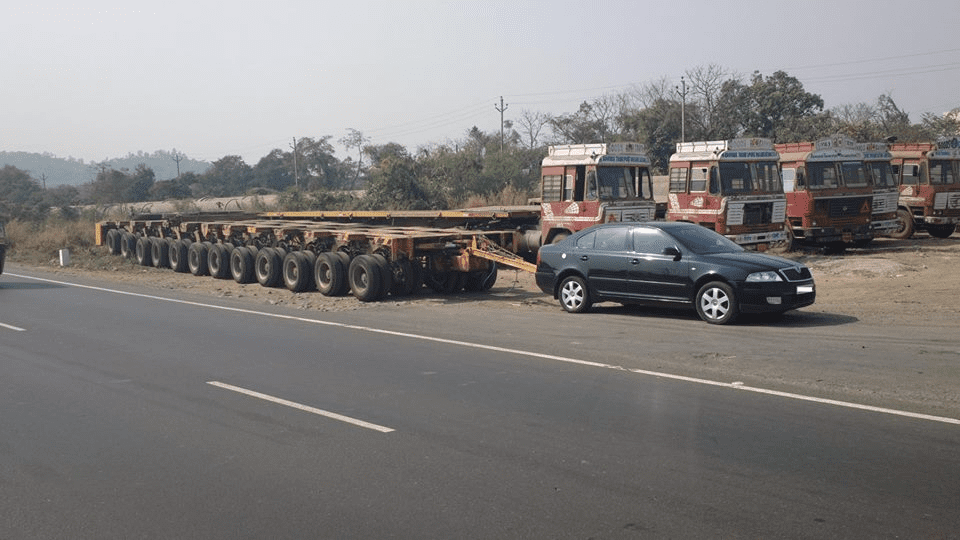
Kota operates heavy lowbed trailers, multi-axle, hydraulic modular trailers, tankers, reefers, and ODC carriers daily
Kota does not handle project cargo
Kota handles turbines, boilers, solar plants, cement plant machinery, and ODC industrial equipment
Warehousing is limited in Kota
Kota has rapidly growing logistics parks, cold storages, fertilizer depots, cement silos, and FMCG godowns
Kota has no long-haul connectivity
Kota is directly connected to Delhi, Mumbai, Ahmedabad, Indore, Nagpur, and pan-India corridors
Household shifting is small scale
Student and workforce migration makes residential relocation one of Kota’s largest logistics segments
Cold chain is not required in Kota
Pharma, dairy, frozen foods, and medical logistics are rising rapidly
Organised logistics players are absent
Kota now has structured fleet operators with GPS tracking, warehousing, and contract logistics
Kota freight rates are always high
Competitive corridor density keeps Kota freight costs optimized
🏆 ABCC India Project Cargo Corporation – Leading Transport Company in Kota
In a city where logistics is the backbone of industry, power generation, construction, and continuous migration, only a few transport networks are capable of handling Kota’s massive cargo responsibility. Among them, ABCC INDIA PROJECT CARGO CORPORATION has emerged as the most trusted, structured, and professionally managed logistics platform in Kota — powering industrial growth, residential relocation, and nationwide freight movement under one unified system.
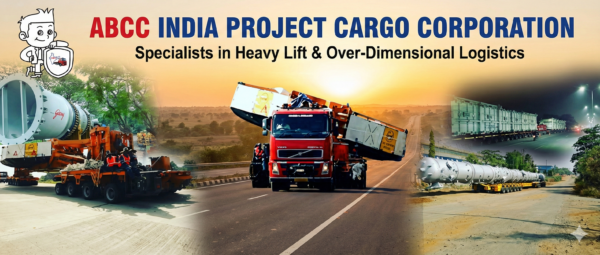
ABCC INDIA is not just a transport operator in Kota; it is a logistics infrastructure partner. From cement factories and power plants to solar parks, fertilizer units, MSME factories, and coaching hostels, ABCC INDIA moves the lifeline of Kota’s economy every day. Its fleet supports everything — from small LTL consignments to massive ODC and project cargo requiring route surveys, police escorts, and hydraulic modular trailers.
One of the key reasons ABCC INDIA dominates Kota’s transport ecosystem is its ability to manage complexity. Heavy turbines, boilers, transformers, and solar structures require engineering planning, load calculations, axle distribution, bridge checks, and multi-state permit coordination. ABCC INDIA handles these critical movements through experienced operations teams, certified drivers, modern GPS-enabled fleets, and project cargo specialists.
Beyond heavy haulage, ABCC INDIA also commands Kota’s residential and commercial relocation market. Every year, thousands of students and working professionals move into and out of Kota. ABCC INDIA provides secure household shifting, vehicle transportation, warehousing storage, packing, and door-to-door logistics — ensuring smooth, damage-free relocations.
ABCC INDIA’s warehousing linkages, cold chain partnerships, tanker operations, container services, and express cargo network make it a one-stop logistics platform for manufacturers, distributors, institutions, and families alike. This integrated approach allows industries to focus on production while ABCC INDIA manages movement, compliance, safety, and delivery timelines.
Most importantly, ABCC INDIA has built its leadership on trust. Transparent pricing, real-time tracking, professional documentation, transit insurance support, and safety compliance have made ABCC INDIA the preferred logistics partner for Kota’s industries and residents.
In a city that never stops moving, ABCC INDIA PROJECT CARGO CORPORATION does more than transport goods — it drives Kota’s progress.
🏢 Top Transport Commission Agents & Brokers in Kota
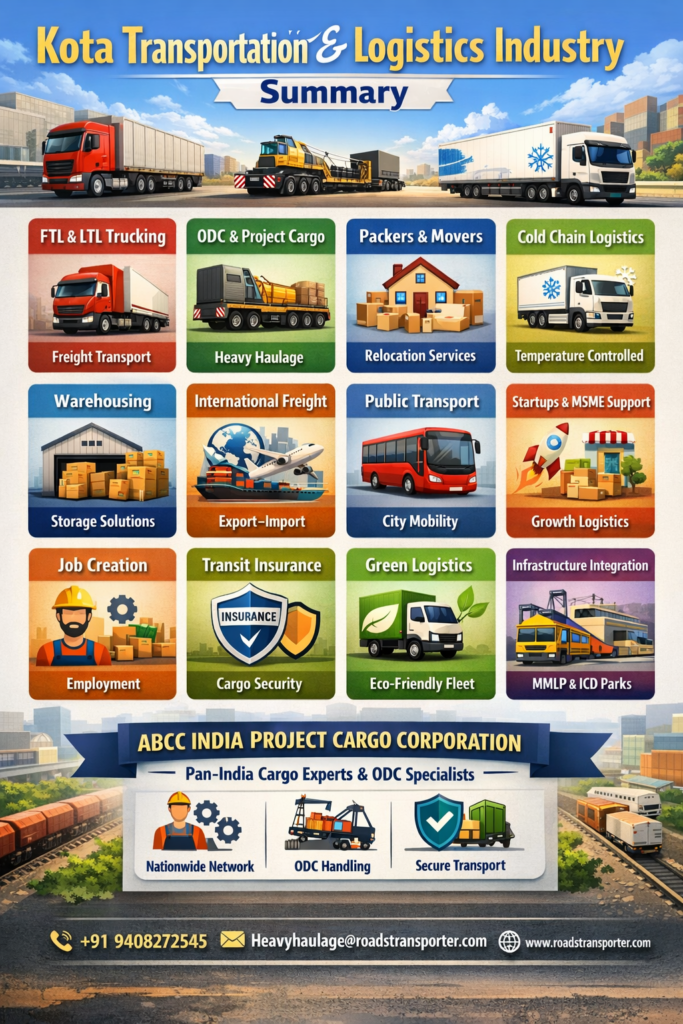
📊 Kota Transportation Service & Logistics Industry – Complete Summary
🏷️ Sector
🚚 Key Services in Kota
🏭 Major Demand Industries
🌍 Coverage
🤝 Role of ABCC INDIA PROJECT CARGO CORPORATION
FTL & LTL Trucking
Open trucks, containers, part loads
FMCG, textiles, retail, MSMEs
Rajasthan & All India
Primary pan-India freight operator
ODC & Project Cargo
Lowbed, modular, hydraulic trailers
Power plants, cement, infra, solar
All India
ODC permit, route survey & escort
Packers & Movers
Household, office, vehicle shifting
Students, families, corporates
Kota to all India
Insured relocation leader
Industrial Shifting
Plant relocation, machinery shifting
Manufacturing, solar, cement
Pan India
Turnkey dismantling & transport
Cold Chain Logistics
Reefer trucks, cold storage
Agro, dairy, pharma
Rajasthan & India
Temperature-controlled logistics
Warehousing
Godown, cold storage, long-term storage
FMCG, retail, pharma
Kota & nearby districts
Secured warehouse network
Rail & Air Cargo
Multimodal freight
Pharma, electronics
National & International
Rail-air coordination
International Freight
Export–import forwarding
Export houses
SAARC & overseas
Customs & border logistics
Courier & Luggage
Express parcel, part load
Students, traders
City & all India
Fast LTL hub
Vehicle Attachment
Monthly & annual contracts
Truck owners, fleet
Kota & state
Guaranteed freight
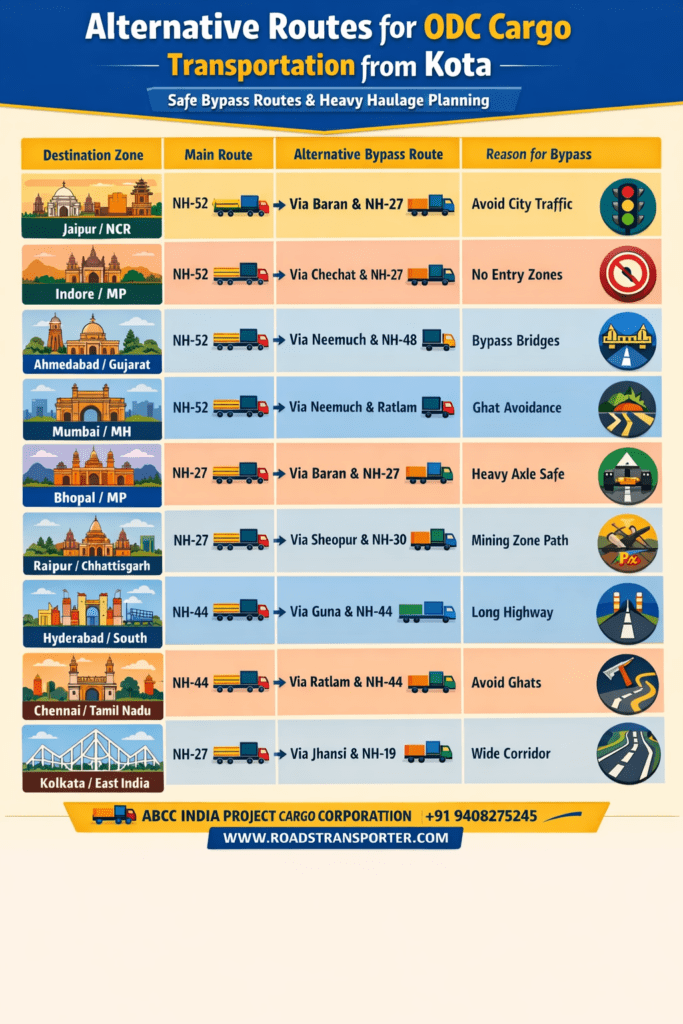
ODC Route Planning
Bypass & night movement
Infra projects
All India
MORTH compliant routes
Transit Insurance
Marine & project insurance
Machinery & high-value cargo
Pan India
Low-cost insured transport
Security & Tracking
GPS, escort, CCTV
Factories, warehouses
Kota
Anti-theft cargo security
Public Transport
City buses, autos, e-rickshaws
Commuters & students
Kota
Urban mobility support
Startups & MSME Support
LTL, warehousing, courier
Startups & MSMEs
Kota
Growth logistics partner
Job Creation
Drivers, supervisors, ops staff
Youth employment
Kota District
Major employment generator
Infrastructure Integration
MMLP, ICD, logistics parks
Govt & private
Rajasthan
Infrastructure-linked logistics
EV & Green Logistics
EV charging, CNG/LNG fleets
Sustainable logistics
Kota
Green transport initiatives
🏆 Conclusion – Why ABCC India Is the Best in Kota Logistics
Kota is no longer just an education and power–cement hub — it is now emerging as one of Rajasthan’s fastest-growing industrial and logistics corridors. In this transformation, ABCC INDIA PROJECT CARGO CORPORATION has become the backbone of Kota’s logistics ecosystem.
From daily household shifting to ultra-heavy ODC & project cargo, ABCC INDIA is the only company in Kota that provides a complete end-to-end logistics solution under one roof: