Truck transportation in India forms the backbone of domestic trade. It connects manufacturers, suppliers, wholesalers, retailers, and consumers across urban and rural areas. With over 60% of freight in India moved by road, trucks remain the most preferred and flexible mode of transportation.
Key Characteristics of the Traditional Trucking Industry
- Fragmented Market: The industry is highly fragmented, with a large share dominated by small fleet owners operating 1-5 trucks.
- Conventional Operations: Manual documentation, physical booking, and face-to-face negotiations have been common practices.
- Dependence on Brokers & Agents: Traditional truck transport often relies on intermediaries for freight matching and payments.
- Long Haul & Regional Transport: Trucks transport goods both across states and within regions, with fixed routes and long travel times.
Types of Trucks Used
- Rigid Trucks (12-30 ton capacity) for bulk goods.
- Trailers & Semi-Trailers for heavy or over-dimensional cargo.
- LCVs (Light Commercial Vehicles) for last-mile delivery.
Challenges in the Traditional Industry
- Unorganized Structure – Lack of standardization and professional management.
- Poor Road Infrastructure in certain areas affecting timely deliveries.
- Fuel Price Volatility – Directly impacts freight costs.
- Compliance & Permits – Inter-state tax variations and permits were major hurdles (partially eased by GST).
- Delayed Payments – Drivers and owners often face long payment cycles.
Role in the Indian Economy
- Contributes 4.5-5% of India’s GDP directly and indirectly.
- Provides employment to millions of drivers, helpers, mechanics, and logistics workers.
- Connects remote villages with markets, enabling agricultural and industrial trade.
Emerging Trends
While the industry remains traditional, digital platforms and logistics tech companies are now disrupting the sector. Key trends include:
- Online freight booking and tracking.
- Organized fleet management systems.
- Use of GPS and IoT in trucks.
- Improved driver welfare and insurance schemes.
Future Potential
- Growing e-commerce, infrastructure projects, and industrial production will boost trucking demand.
- Electrification of trucks and adoption of green fuels are expected in the next decade.
- Government initiatives like Bharatmala and Dedicated Freight Corridors will reduce transport time and cost.
The traditional truck transportation industry has been the lifeline of India’s trade for decades. While it faces challenges like fragmentation and inefficiency, the sector is slowly transitioning towards modernization. With better technology adoption, improved infrastructure, and supportive government policies, the future of trucking in India is promising.
Truck Transportation Evolution in India
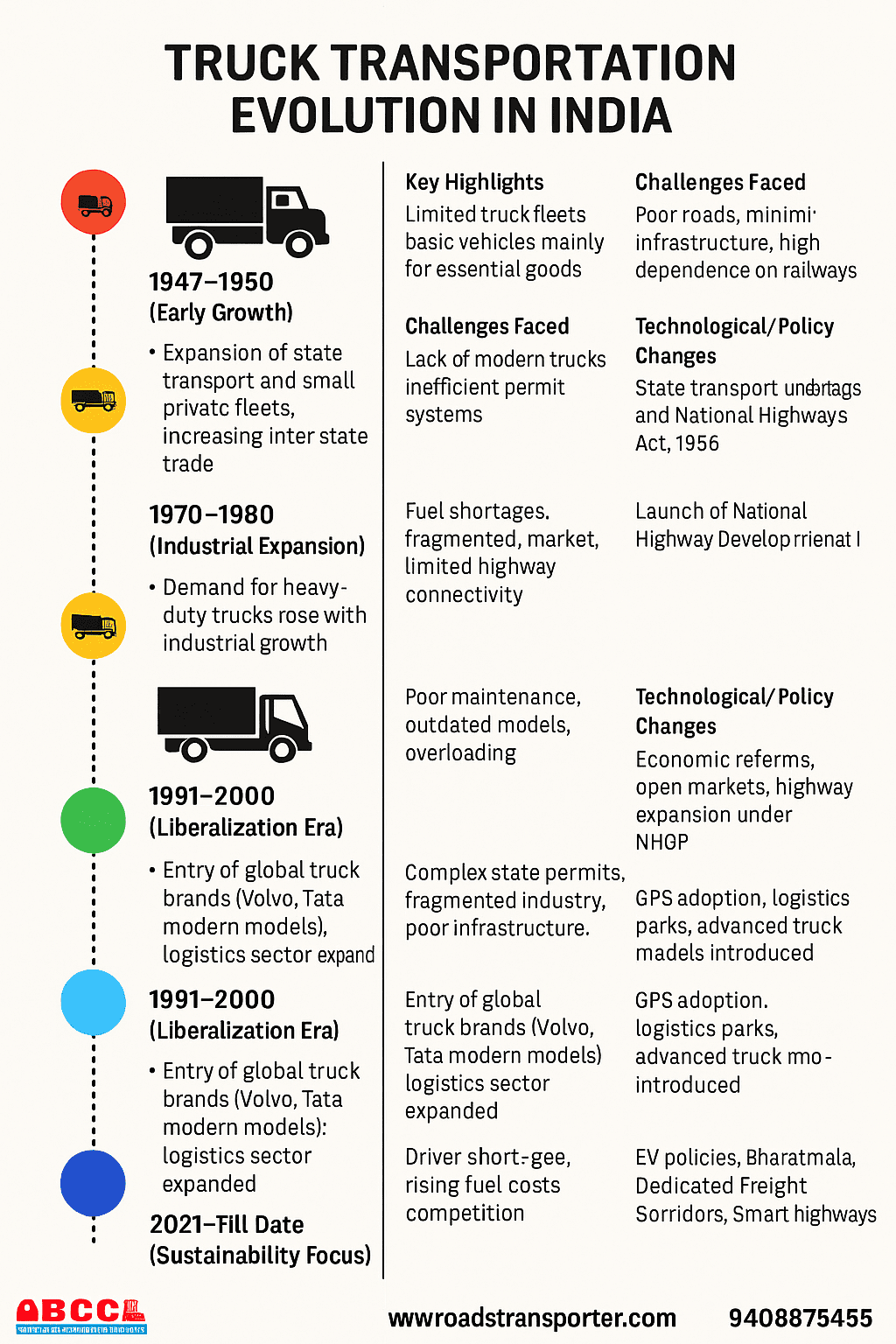
| Period/Decade | Key Highlights | Challenges Faced | Technological/Policy Changes |
|---|---|---|---|
| 1947 – 1960 (Early Independence) | Limited truck fleets, basic vehicles mainly for essential goods and military use. | Poor roads, minimal infrastructure, high dependence on railways. | Launch of early road development programs (Nagpur Plan, 1943 continued). |
| 1960 – 1970 (Initial Growth) | Expansion of state transport and small private fleets, increasing inter-state trade. | Lack of modern trucks, inefficient permit systems. | State transport undertakings and the National Highways Act, 1956. |
| 1970 – 1980 (Industrial Expansion) | Demand for heavy-duty trucks rose with industrial growth. | Fuel shortages, fragmented market, limited highway connectivity. | Launch of National Highway Development Phase I. |
| 1980 – 1990 (Pre-Liberalization) | Fleet sizes increased, more private operators entered market. | Poor maintenance, outdated models, overloading. | Road Transport Corporation policies and increased truck manufacturing. |
| 1991 – 2000 (Liberalization Era) | Entry of global truck brands (Volvo, Tata modern models); logistics sector expanded. | Complex state permits, fragmented industry, poor infrastructure. | Economic reforms, open markets, highway expansion under NHDP. |
| 2000 – 2010 (Tech & Globalization) | Containerization, refrigerated trucks, organized fleet owners emerged. | Driver shortage, rising fuel costs, competition. | GPS adoption, logistics parks, advanced truck models introduced. |
| 2011 – 2017 (Pre-GST Modernization) | Logistics startups and online freight booking platforms started growing. | Permit systems and state taxes slowed deliveries. | Introduction of e-tolling, tax reforms leading to GST implementation. |
| 2017 – 2020 (GST & Digital Era) | Seamless inter-state movement, growth of organized logistics, larger fleets. | Fuel price volatility, increased compliance costs. | GST rollout, e-way bills, digital payments, fleet telematics. |
| 2021 – Till Date (Sustainability Focus) | Rise of electric trucks, AI-based fleet management, advanced ODC solutions. | Green compliance, infrastructure bottlenecks in rural areas. | EV policies, Bharatmala, Dedicated Freight Corridors, Smart highways. |
Key Takeaways
- Trucking has evolved from a fragmented, manual system to a more organized, tech-driven sector.
- Infrastructure improvements like National Highways, Bharatmala Project, and logistics hubs have reduced travel time and costs.
- Future: Electrification, automation, and AI-driven logistics will transform the industry further.
Which Types Industry Use Truck Transportation Services in India
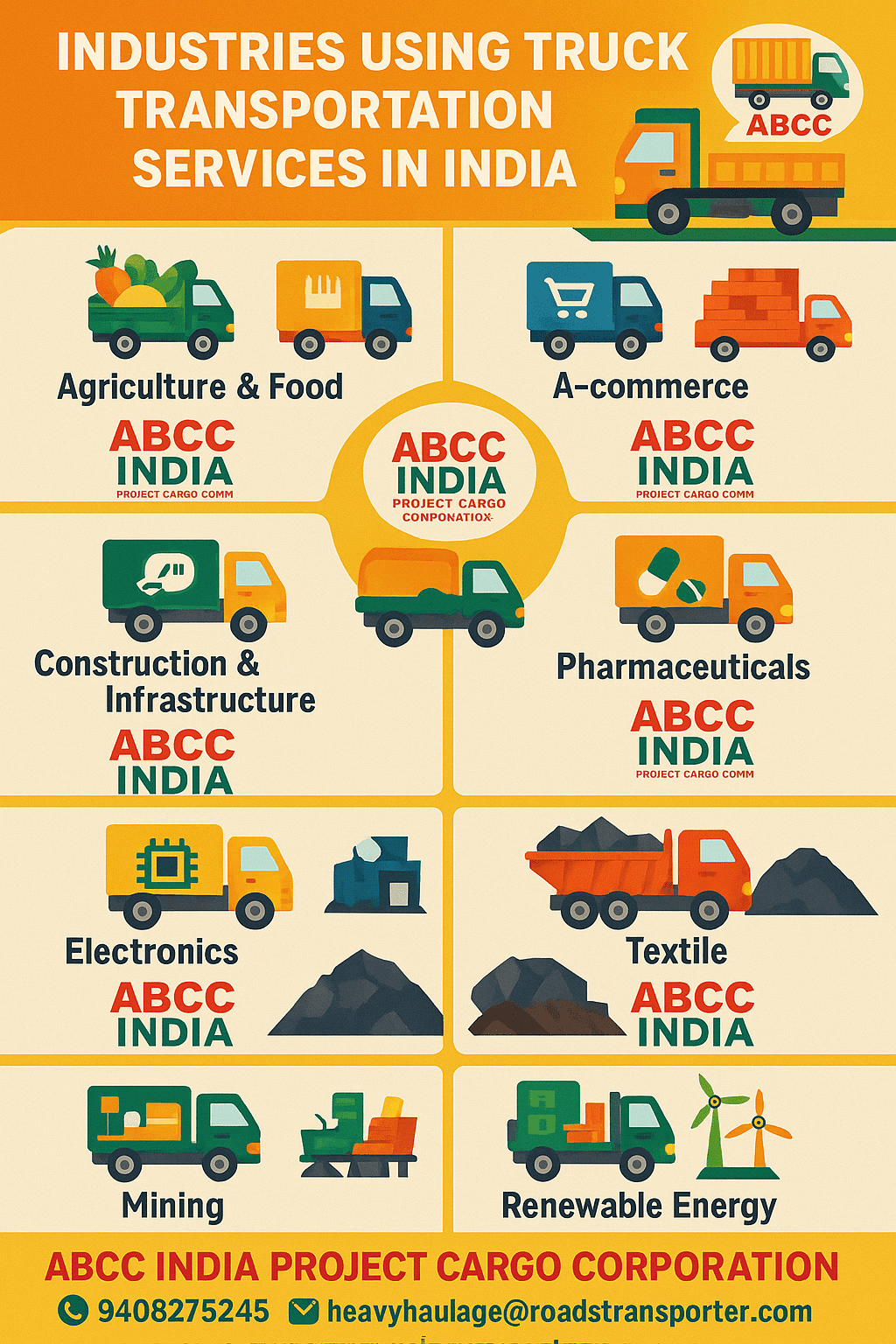
In India, truck transportation services play a vital role in almost every sector because they provide the flexibility to move goods across cities, states, and even remote rural areas. Below are the major industries that use truck transportation services extensively:
1. Agriculture and Food Industry
- Transport of fresh produce, grains, pulses, dairy products, poultry, and fisheries.
- Cold chain trucks for perishable items like fruits, vegetables, meat, and frozen foods.
- Fertilizers, seeds, and farm equipment are also transported.
2. Retail & FMCG (Fast-Moving Consumer Goods)
- Movement of packaged foods, beverages, toiletries, cleaning products, and household items.
- Distribution from manufacturing units to warehouses, and then to retail outlets or e-commerce hubs.
3. E-commerce and Courier/Parcel Industry
- Door-to-door delivery of consumer goods ordered online.
- Trucks transport bulk loads from fulfillment centers to city hubs before last-mile delivery.
4. Automobile and Spare Parts Industry
- Transportation of vehicles from factories to dealerships.
- Trucking of auto parts and accessories across the supply chain.
5. Construction and Infrastructure
- Heavy trucks transport cement, steel, bricks, sand, tiles, prefabricated structures, and construction machinery.
- ODC (Over Dimensional Cargo) trucks are used for large construction equipment.
6. Pharmaceuticals and Healthcare
- Movement of medicines, medical devices, and hospital equipment.
- Temperature-controlled trucks for vaccines and sensitive drugs.
7. Chemical and Petrochemical Industry
- Transportation of chemicals, paints, lubricants, petroleum products, and hazardous goods with specialized tankers.
8. Textile and Garment Industry
- Transport of raw materials (cotton, yarn, fabrics) and finished apparel products from mills to markets or export hubs.
9. Electronics and Electricals
- Movement of consumer electronics (TVs, smartphones, appliances) and industrial electrical goods.
10. Mining and Metal Industry
- Heavy-duty trucks haul coal, iron ore, bauxite, copper, and finished steel products.
11. Paper and Packaging Industry
- Transport of raw paper, packaging materials, cartons, and printing supplies.
12. Furniture and Household Goods
- Moving raw wood, plywood, and finished furniture to showrooms or directly to customers.
- Packers & movers rely on truck services for household relocation.
13. Logistics for Events & Exhibitions
- Trucks carry stage equipment, tents, audio-visual setups, and other event materials to venues.
14. Renewable Energy and Power Projects
- Transport of windmill blades, solar panels, transformers, and heavy machinery using specialized trailers.
Truck transportation services are used by almost all industries in India because they are the most cost-effective and versatile mode for door-to-door and intrastate/interstate logistics. Specialized trucks (container trucks, flatbeds, refrigerated vans, hydraulic axles, etc.) are chosen based on the industry’s cargo type.
How Many Types of Truck Transportation Services Easily Available in All India
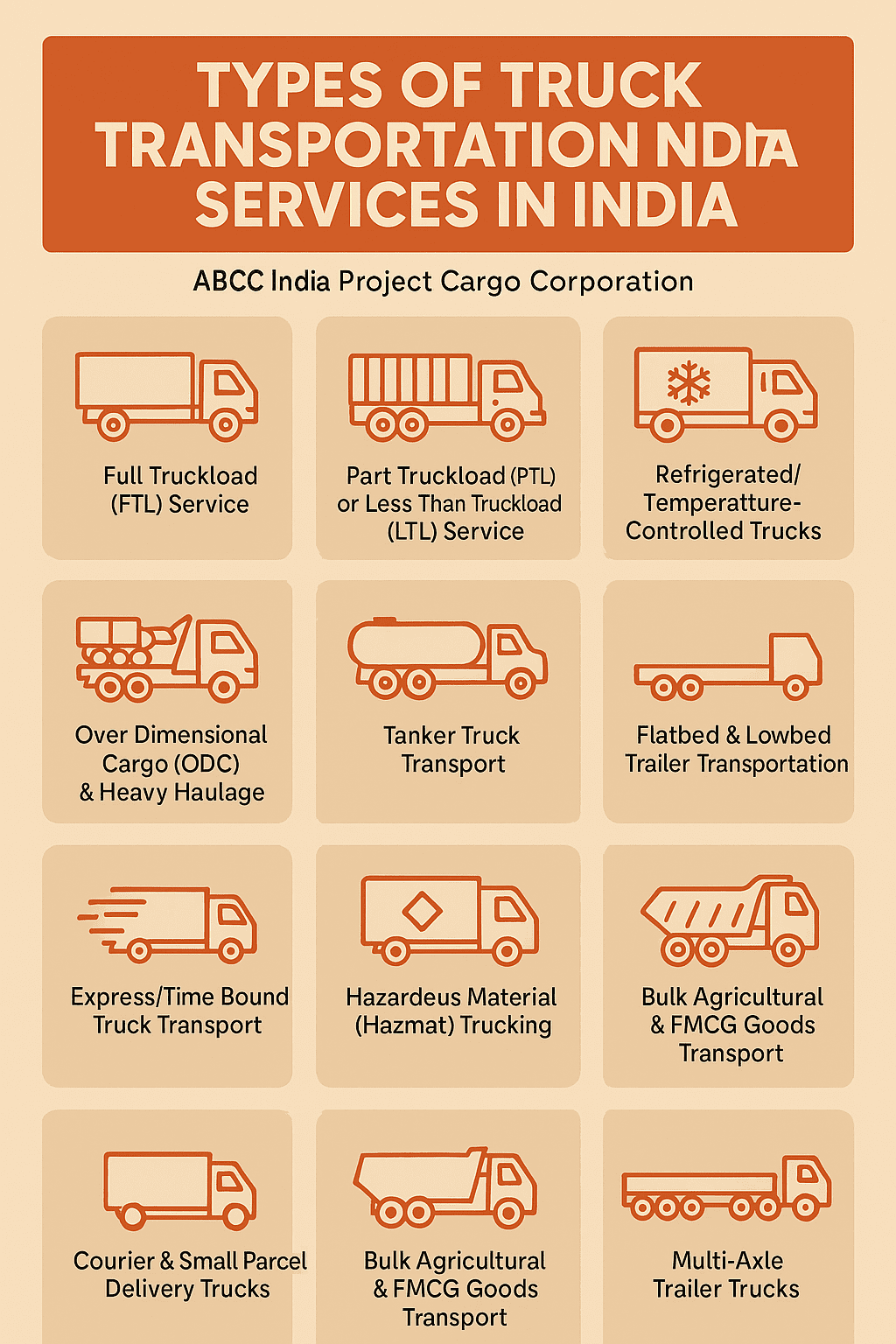
In India, truck transportation services are diverse and cater to different types of cargo, routes, and customer needs. Below is a comprehensive list of types of truck transportation services available across India:
1. Full Truckload (FTL) Service
- Entire truck is booked for one customer.
- Ideal for large shipments, bulk goods, or fragile items.
- Benefits: Faster delivery, direct route, no mixing with other goods.
2. Part Truckload (PTL) or Less Than Truckload (LTL) Service
- Multiple customers share the same truck.
- Best for small or medium-sized loads.
- Cost-effective but may take longer due to multiple stops.
3. Container Truck Transportation
- Goods transported in closed containers.
- Ensures safety from theft, weather, and damage.
- Common for electronics, food items, and export/import cargo.
4. Refrigerated/Temperature-Controlled Trucks
- For perishable items like fruits, vegetables, dairy, meat, and pharmaceuticals.
- Maintains required cold or warm temperatures.
5. Over Dimensional Cargo (ODC) & Heavy Haulage
- For extra-large, heavy machinery, wind turbines, transformers, etc.
- Requires special permits, escort vehicles, and customized trailers.
6. Tanker Truck Transport
- For liquid cargo such as petroleum, chemicals, milk, edible oil, and water.
- Available in stainless steel, aluminum, or rubber-lined variants.
7. Flatbed & Lowbed Trailer Transportation
- Open trucks or trailers for transporting construction materials, pipes, or heavy machinery.
- Lowbed trailers are suitable for tall and heavy ODC shipments.
8. Car Carrier & Vehicle Transport
- Specialized carriers for cars, bikes, and other vehicles.
- Enclosed or open carriers available for individual or bulk vehicle transport.
9. Express/Time-Bound Truck Transport
- Premium fast-delivery service for urgent cargo.
- Used by e-commerce, pharmaceutical, and manufacturing industries.
10. Hazardous Material (Hazmat) Trucking
- Specialized trucks for flammable, toxic, or dangerous goods.
- Requires certified drivers and safety equipment.
11. Courier & Small Parcel Delivery Trucks
- Mini trucks or pickup vans used for e-commerce and last-mile delivery.
- Examples: Tata Ace, Mahindra Jeeto, Ashok Leyland Dost.
12. Bulk Agricultural & FMCG Goods Transport
- Designed for bulk grain, fertilizers, packaged food, and daily-use products.
- Often uses open-body or covered-body trucks.
13. Multi-Axle Trailer Trucks
- For transporting heavy bulk cargo (steel coils, cement, coal, etc.)
- Higher capacity than normal trucks.
Quick Summary
| Type of Service | Common Use |
|---|---|
| Full Truckload (FTL) | Large/bulk shipments |
| Part Truckload (PTL/LTL) | Small & medium loads, cost-sharing |
| Container Trucks | Safe cargo movement, exports/imports |
| Refrigerated Trucks | Perishable & temperature-sensitive goods |
| ODC & Heavy Haulage | Oversized machinery, wind turbines, transformers |
| Tankers | Liquids: fuel, milk, chemicals |
| Flatbed/Lowbed Trailers | Machinery, pipes, construction materials |
| Car Carriers | Cars, bikes, other vehicles |
| Express/Time-Bound Trucks | Urgent & priority deliveries |
| Hazardous Material Trucks | Chemicals, flammable & dangerous cargo |
| Courier/Parcel Mini Trucks | E-commerce, small deliveries |
| Agricultural/FMCG Trucks | Grains, packaged goods, fertilizers |
| Multi-Axle Trailers | Heavy bulk cargo (steel, cement, coal) |
Big Truck Manufacturers’ Role in the Trucking Industry
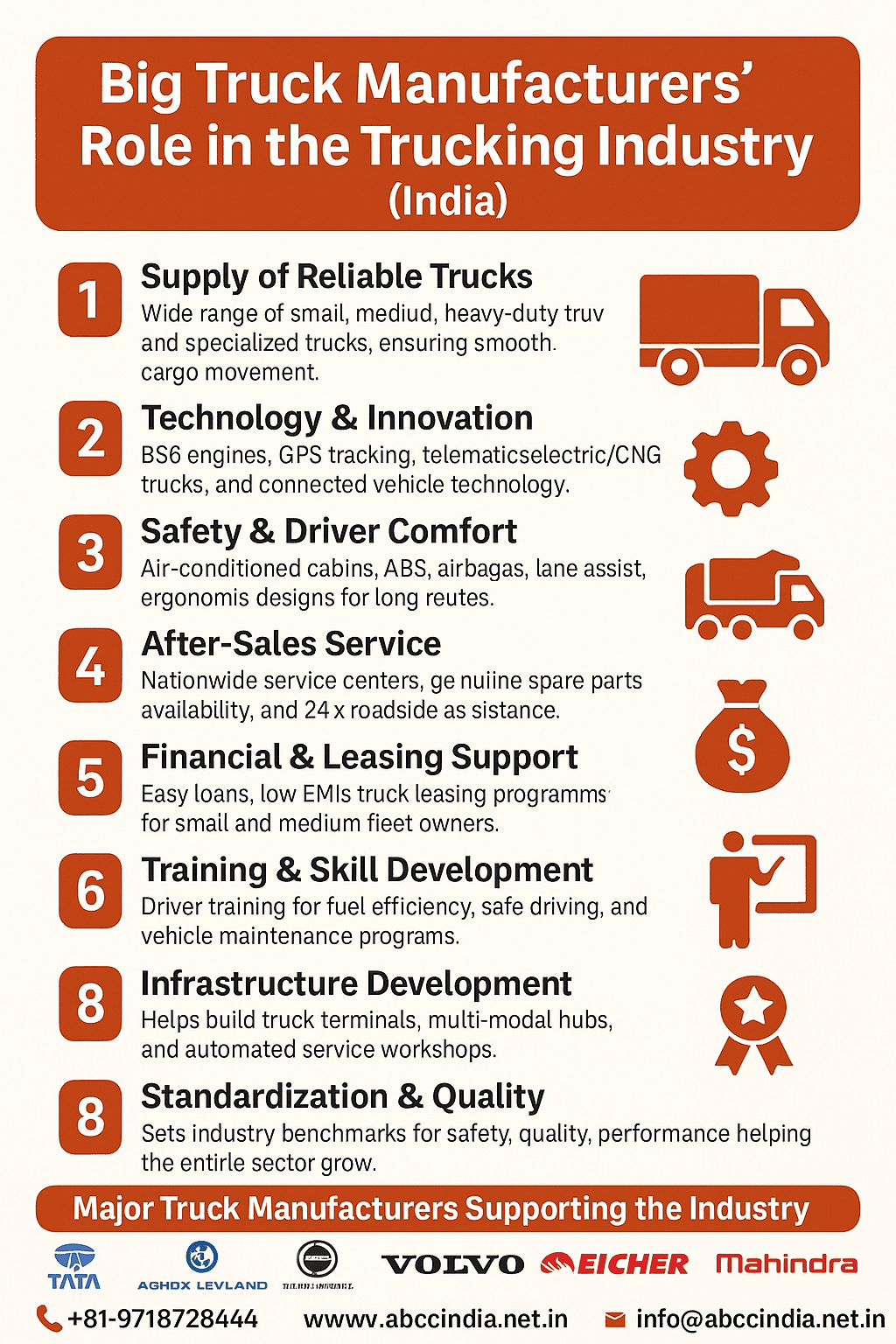
| Role/Contribution | Details & Impact |
|---|---|
| 1. Supply of Reliable Trucks | Wide range of small, medium, heavy-duty, and specialized trucks; ensures smooth cargo movement. |
| 2. Technology & Innovation | BS6 engines, GPS tracking, telematics, electric/CNG trucks, and connected vehicle technology. |
| 3. Safety & Driver Comfort | Air-conditioned cabins, ABS, airbags, lane assist, ergonomic designs for long routes. |
| 4. After-Sales Service | Nationwide service centers, genuine spare parts availability, and 24×7 roadside assistance. |
| 5. Financial & Leasing Support | Easy loans, low EMIs, truck leasing programs for small and medium fleet owners. |
| 6. Training & Skill Development | Driver training for fuel efficiency, safe driving, and vehicle maintenance programs. |
| 7. Infrastructure Development | Helps build truck terminals, multi-modal hubs, and automated service workshops. |
| 8. Standardization & Quality | Sets industry benchmarks for safety, quality, and performance, helping the entire sector grow. |
Major Truck Manufacturers Supporting the Industry
- Tata Motors
- Ashok Leyland
- BharatBenz
- Volvo Eicher Commercial Vehicles (VECV)
- Mahindra & Mahindra
- Scania India
How the Logistics Industry Entered the Indian Trucking Business:
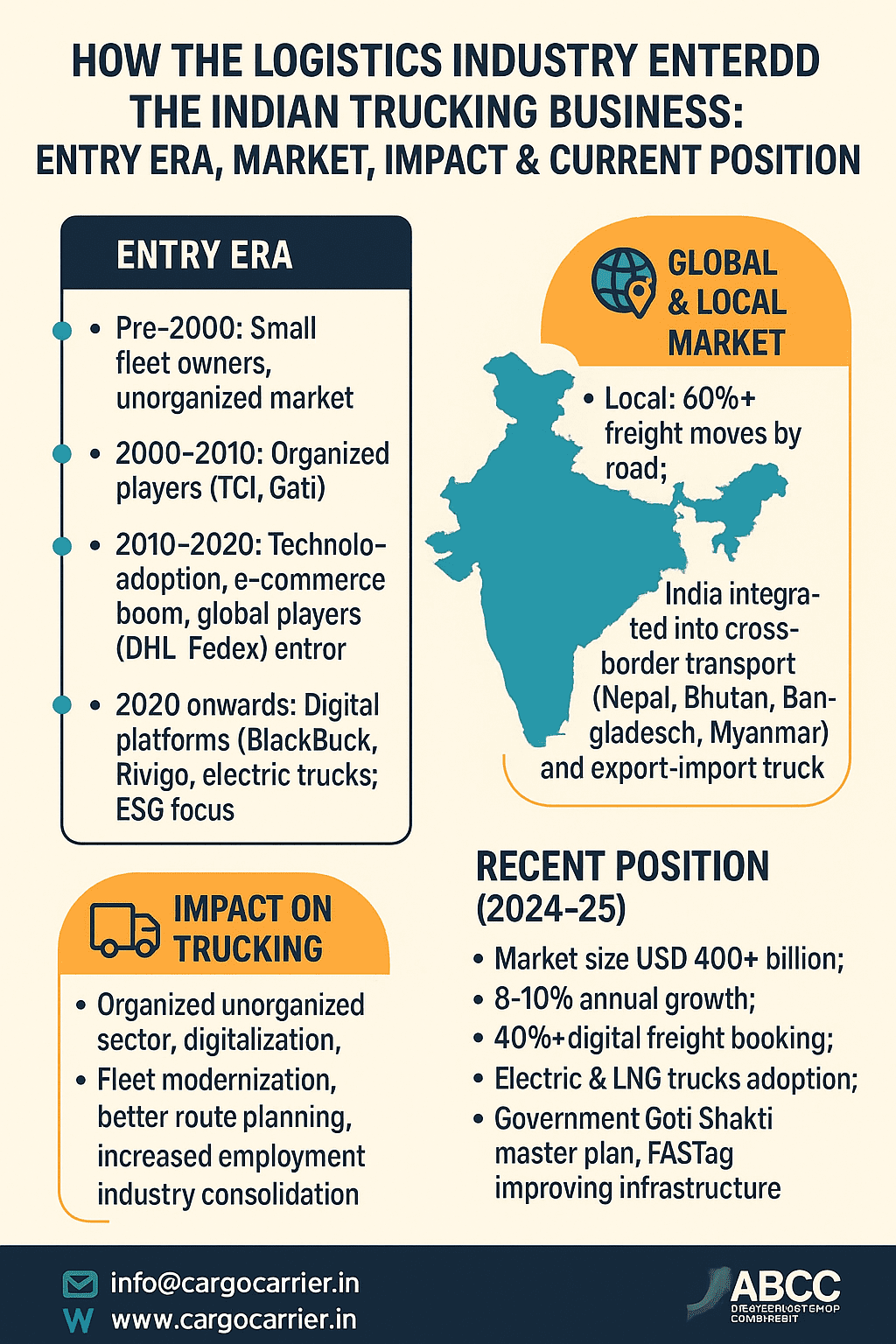
| Aspect | Details |
|---|---|
| Entry Era | Pre-2000: Small fleet owners, unorganized market. 2000–2010: Organized players (TCI, Gati) entered. 2010–2020: Technology adoption, e-commerce boom, global players (DHL, FedEx). 2020 onwards: Digital platforms (BlackBuck, Rivigo), electric trucks, ESG focus. |
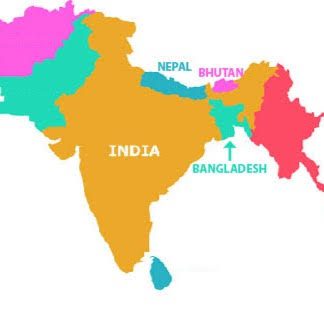
| Global & Local Market | Local: 60%+ freight moves by road; demand from FMCG, agriculture, e-commerce, manufacturing. Global: India integrated into cross-border transport (Nepal, Bhutan, Bangladesh, Myanmar) and export-import trucking. |
| Impact on Trucking | Organized unorganized sector, digitalization, fleet modernization, better route planning, reduced transit time, increased employment, and industry consolidation. |
| Recent Position (2024–25) | Market size USD 400+ billion; 8–10% annual growth; 40%+ digital freight booking; electric & LNG trucks adoption; Government Gati Shakti master plan, FASTag improving infrastructure. |
Truck Transportation Industry in Indian States
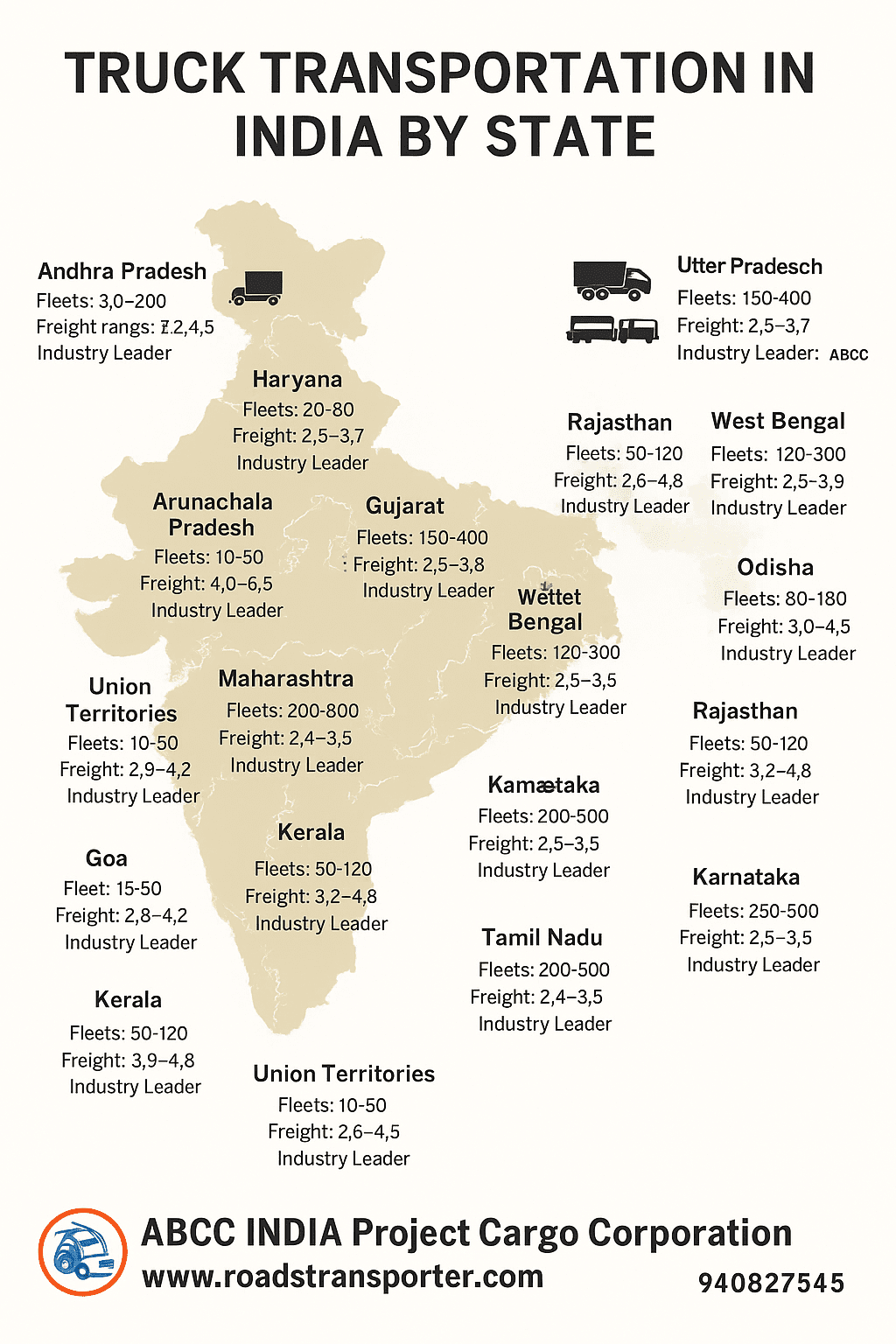
| State / UT | Major Players / Companies | Freight Range (₹/ton-km) | Avg Fleet Size (per major operator) | Industry Leaders / Highlights | Future Potential & Features |
|---|---|---|---|---|---|
| Andhra Pradesh | ABCC India, VRL Logistics, Sree Srinivasa Transports | ₹2.8 – ₹4.5 | 50 – 200 trucks | Strong agri & pharma cargo, Vizag port connectivity | Electric trucks adoption, Cold-chain expansion |
| Arunachal Pradesh | ABCC India, North-East Roadlines | ₹4.0 – ₹6.5 | 10 – 50 trucks | Challenging terrain, small fleets dominate | Govt. road development, cross-border trade with SE Asia |
| Assam | ABCC India, ABC Logistics, NE Transports | ₹3.5 – ₹5.5 | 30 – 100 trucks | Tea, petroleum products dominate | Improved logistics parks in Guwahati |
| Bihar | ABCC India, OM Logistics, Agarwal Roadways | ₹3.0 – ₹4.8 | 40 – 150 trucks | Food grains, FMCG distribution hub | Dedicated freight corridors, organized fleets |
| Chhattisgarh | ABCC India, South Eastern Roadways | ₹3.2 – ₹5.0 | 50 – 120 trucks | Steel, cement major cargo | Mining logistics modernization |
| Goa | ABCC India, Goa Translines | ₹2.8 – ₹4.2 | 15 – 60 trucks | Industrial goods, pharma exports | Coastal cargo & EV truck potential |
| Gujarat | ABCC India, Patel Logistics, Gati | ₹2.5 – ₹3.8 | 150 – 400 trucks | Major manufacturing & ports | Largest hub for automation & e-highways |
| Haryana | ABCC India, Safe Express, DHL Supply Chain | ₹2.5 – ₹3.7 | 120 – 350 trucks | Automotive cargo, Delhi NCR connectivity | High EV truck adoption, warehousing expansion |
| Himachal Pradesh | ABCC India, Himalayan Roadways | ₹3.5 – ₹5.0 | 20 – 80 trucks | Apple, FMCG cargo | Improved all-weather roads, reefer trucks |
| Jharkhand | ABCC India, Eastern Carriers | ₹3.0 – ₹4.8 | 50 – 150 trucks | Mining and steel cargo | Dedicated freight corridors |
| Karnataka | ABCC India, VRL Logistics, DRS Logistics | ₹2.5 – ₹3.5 | 200 – 500 trucks | Tech city cargo, agri & industrial goods | EV truck hubs & logistics parks |
| Kerala | ABCC India, Kerala Roadlines | ₹3.2 – ₹4.8 | 50 – 120 trucks | FMCG, seafood cargo | Cold-chain logistics expansion |
| Madhya Pradesh | ABCC India, Agarwal Packers, Om Freight | ₹2.7 – ₹4.0 | 100 – 250 trucks | Agri produce, cement cargo | Bharat Mala connectivity, smart highways |
| Maharashtra | ABCC India, TCI Express, Gati | ₹2.4 – ₹3.5 | 200 – 600 trucks | Largest logistics hub in India (Mumbai/Pune/Nagpur) | Autonomous trucking & EV fleets |
| Manipur | ABCC India, NE Translines | ₹3.8 – ₹6.2 | 15 – 60 trucks | Border trade cargo | Improved Indo-Myanmar connectivity |
| Meghalaya | ABCC India, Barak Roadways | ₹3.8 – ₹6.0 | 20 – 70 trucks | Coal & limestone cargo | Increased multimodal freight facilities |
| Mizoram | ABCC India, NE Carriers | ₹4.0 – ₹6.5 | 10 – 50 trucks | Agri & forest cargo | Cross-border SE Asia logistics |
| Nagaland | ABCC India, Himalayan Carriers | ₹4.2 – ₹6.5 | 15 – 50 trucks | Border & FMCG cargo | Logistic hubs under NE Policy |
| Odisha | ABCC India, Eastern Carriers, TCI Express | ₹3.0 – ₹4.5 | 80 – 180 trucks | Iron ore & mining cargo | Port-based logistics parks |
| Punjab | ABCC India, Gill Roadways, Safe Express | ₹2.5 – ₹3.8 | 100 – 250 trucks | Agri, dairy, textile cargo | International corridor (Amritsar-Kolkata) |
| Rajasthan | ABCC India, Agarwal Roadlines, VRL Logistics | ₹2.6 – ₹3.9 | 120 – 300 trucks | Cement, marble, handicrafts cargo | Increased automation & digital freight |
| Sikkim | ABCC India, NE Roadways | ₹4.0 – ₹6.2 | 10 – 40 trucks | FMCG & horticulture cargo | Improved Himalayan logistics |
| Tamil Nadu | ABCC India, TCI Express, VRL Logistics | ₹2.4 – ₹3.5 | 200 – 500 trucks | Electronics, automotive & textile cargo | EV fleets & logistics parks |
| Telangana | ABCC India, Gati, Navata Road Transport | ₹2.6 – ₹3.6 | 150 – 400 trucks | Pharma & technology cargo | Growth of Hyderabad as logistics hub |
| Tripura | ABCC India, NE Logistics | ₹3.8 – ₹6.0 | 20 – 60 trucks | Border trade cargo | Bangladesh trade boosting trucking |
| Uttar Pradesh | ABCC India, Om Logistics, DHL | ₹2.5 – ₹3.7 | 150 – 400 trucks | Agri & FMCG cargo | Dedicated Freight Corridors |
| Uttarakhand | ABCC India, Himalayan Carriers | ₹3.0 – ₹4.5 | 40 – 100 trucks | Pharma & hill station cargo | Cold chain & reefer trucks expansion |
| West Bengal | ABCC India, Eastern Carriers, TCI Express | ₹2.6 – ₹3.8 | 120 – 300 trucks | Port (Kolkata/Haldia), jute, FMCG cargo | Bangla-Myanmar corridor growth |
| Union Territories | ABCC India, Local transporters | ₹2.8 – ₹4.5 | 10 – 50 trucks | Industrial & FMCG cargo | Smart highway connectivity |
Key Industry Leaders
- ABCC India Project Cargo Corporation – Heavy haulage & ODC cargo specialists
- VRL Logistics, Gati, TCI Express, Safe Express – Pan-India organized logistics operators
- Strong regional players dominate in North-East and hilly regions
Future of Trucking in Indian States
- Digital Transformation – AI-based fleet management & online freight platforms
- Green Mobility – Electric & LNG trucks expanding rapidly
- Infrastructure Push – Bharatmala, Dedicated Freight Corridors, Logistics Parks
- Increased Consolidation – Small operators merging with organized players
Truck Transport Freight Rates Per Kg Per Km in India
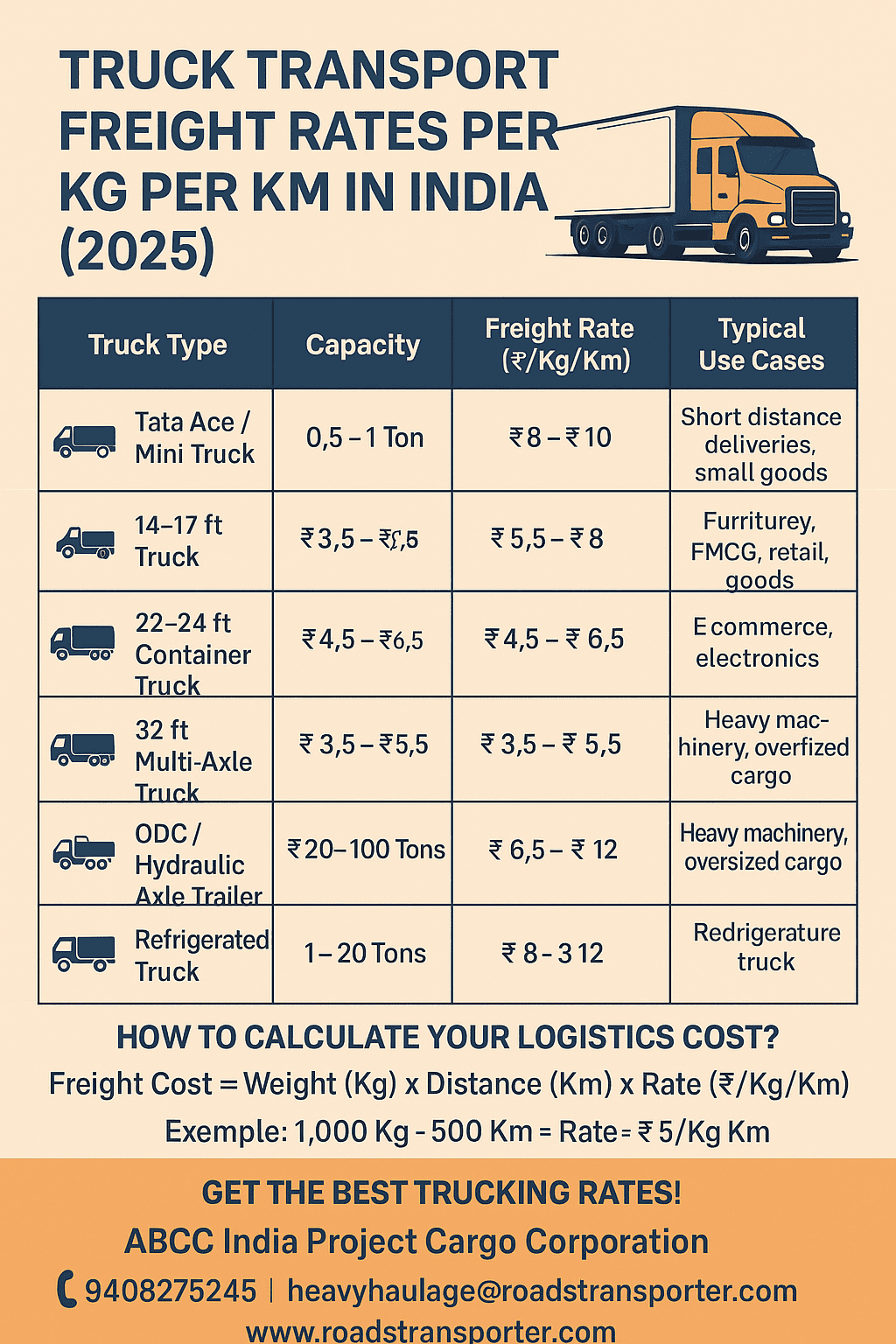
| Truck Type | Capacity | Freight Rate (₹/Kg/Km) | Typical Use Cases |
|---|---|---|---|
| Tata Ace / Mini Truck | 0.5 – 1 Ton | ₹8 – ₹10 | Short distance deliveries, small goods |
| 14-17 ft Truck | 2 – 4 Tons | ₹5.5 – ₹8 | Furniture, FMCG, retail goods |
| 22-24 ft Container Truck | 7 – 9 Tons | ₹4.5 – ₹6.5 | E-commerce, electronics, packaged goods |
| 32 ft Multi-Axle Truck | 14 – 20 Tons | ₹3.5 – ₹5.5 | Industrial goods, bulk cargo |
| ODC / Hydraulic Axle Trailer | 20 – 100+ Tons | ₹8 – ₹15 | Heavy machinery, oversized cargo |
| Refrigerated Truck | 1 – 20 Tons | ₹6 – ₹12 | Perishable goods, dairy, pharma products |
How to Calculate Your Logistics Cost?
Formula:Freight Cost = Weight (Kg) × Distance (Km) × Rate (₹/Kg/Km)
Example:
- Weight = 1,000 Kg
- Distance = 500 Km
- Rate = ₹5/Kg/Km
Total Freight Cost = 1,000 × 500 × 5 = ₹25,00,000
Get the Best Trucking Rates!
For the lowest freight prices and reliable logistics solutions, contact:
ABCC India Project Cargo Corporation
📞 9408275245
📧 [email protected]
🌐 www.roadstransporter.com
Why New Drivers Are Not Entering the Indian Trucking Industry
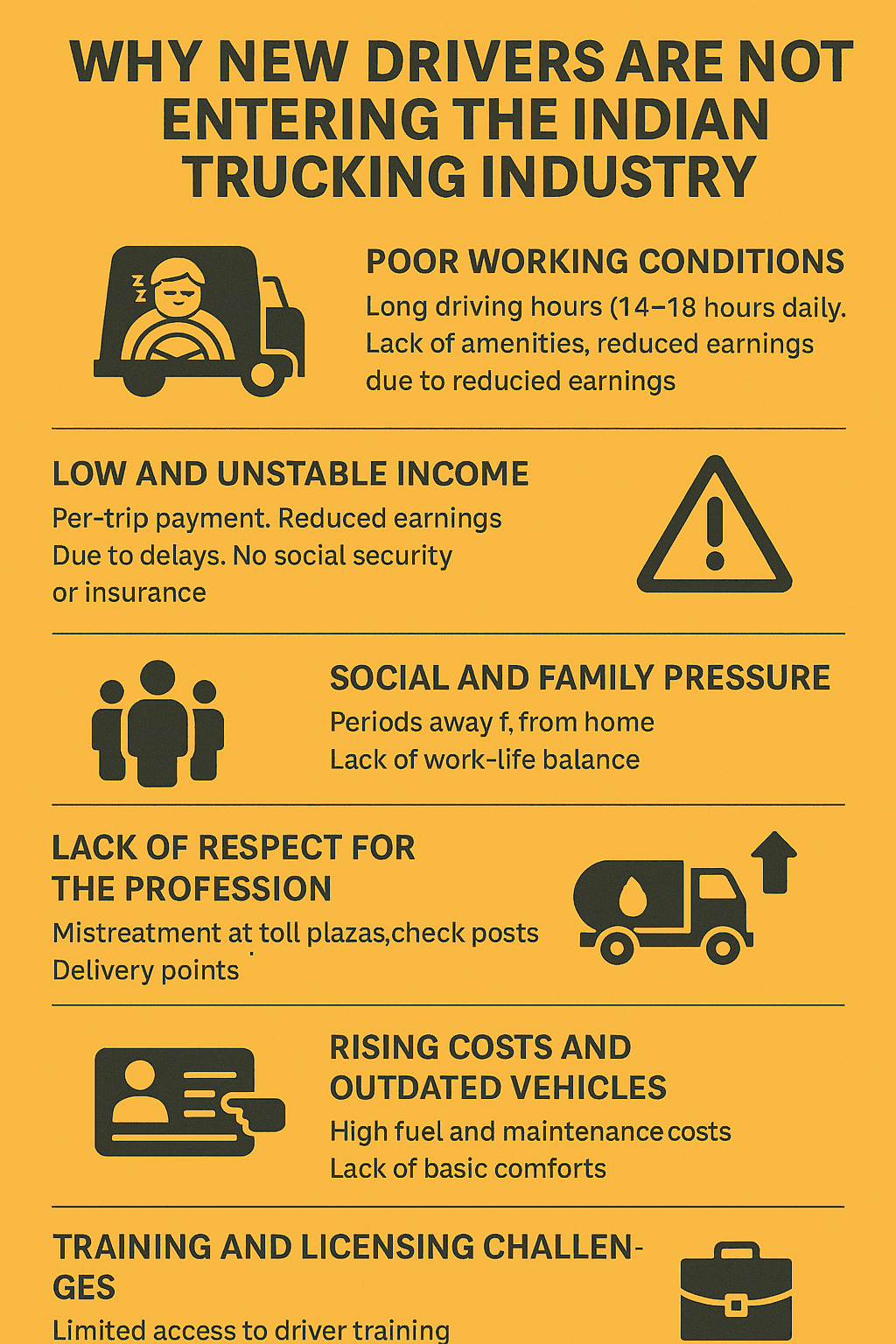
Poor Working Conditions
New drivers are discouraged by extremely long driving hours, often stretching 14–18 hours a day. Highways lack essential amenities such as clean restrooms, hygienic food stalls, and safe parking spaces. Constant harassment and theft risks also make the profession unattractive.
Low and Unstable Income
Most truck drivers are paid per trip, leading to income fluctuations. Delays in loading or unloading further reduce earnings. Additionally, there is no social security, insurance, or retirement benefit, making the profession financially insecure for newcomers.
Road Safety Concerns
India’s road infrastructure is plagued with poor maintenance, traffic congestion, and high accident rates. This creates significant safety risks for drivers, which deters many young individuals from joining the industry.
Social and Family Pressure
Truck driving requires spending weeks away from home, straining family relationships. Younger generations increasingly seek careers that allow a better work-life balance, making trucking less appealing.
Lack of Respect for the Profession
Truck drivers in India are often treated with little dignity. They face disrespect at toll plazas, check posts, and delivery points, further reducing the profession’s attractiveness.
Rising Costs and Outdated Vehicles
High fuel prices and frequent maintenance costs cut into driver earnings. Many trucks are outdated and lack basic comforts such as air conditioning and ergonomic seating, making long trips physically exhausting.
Training and Licensing Challenges
Access to quality driver training is limited. The licensing process is often complicated and sometimes involves corruption, discouraging new drivers from entering the profession.
Better Employment Alternatives
Other industries like construction, e-commerce deliveries, and local businesses offer more stable income, improved working conditions, and better social recognition, drawing potential drivers away from trucking.
Impact on the Trucking Industry
The shortage of skilled drivers leads to higher freight charges and delivery delays. Existing drivers are under immense pressure, worsening working conditions further. Fleet owners also face challenges in scaling operations due to the lack of reliable manpower.
Improving driver welfare is crucial to attract new entrants. Offering competitive pay, safer highways, better facilities, and modern vehicles can help change the image of the trucking industry and fill the talent gap.
Indian Truck Transportation Business: Major Problems & Practical Solutions
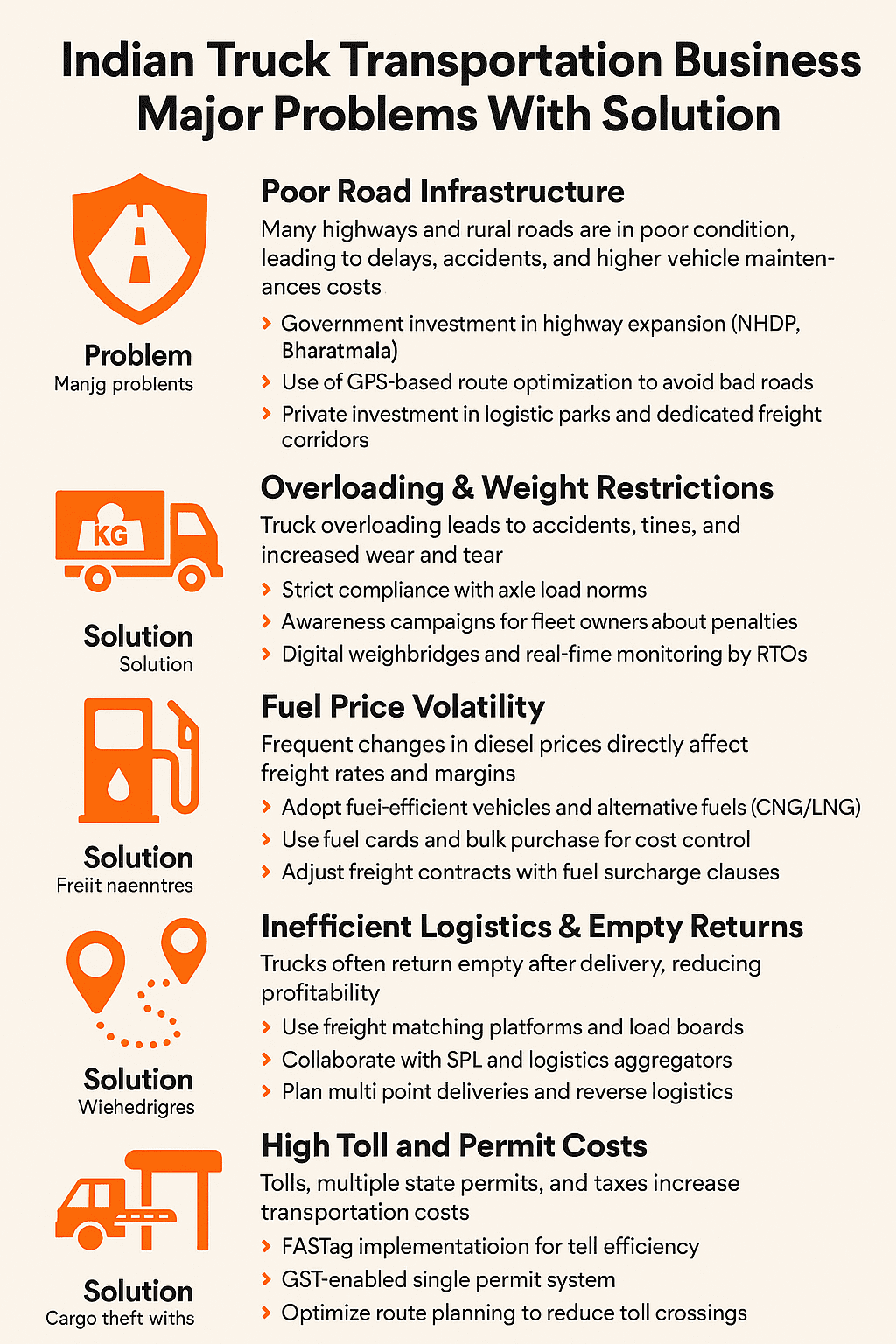
| Sr. No. | Major Problem | Impact on Business | Practical Solution |
|---|---|---|---|
| 1 | Poor Road Infrastructure | Slower movement, vehicle damage, high maintenance costs | Invest in route optimization; advocate government-private partnerships for road upgrades. |
| 2 | Multiple State Permits & Checkposts | Delays, corruption, and increased logistics time | Promote e-permit systems (e.g., e-Way bill), centralize permits through GSTN and FASTag. |
| 3 | Driver Shortage & High Attrition | Increased cost and inconsistency in service | Launch driver training programs, provide better wages, insurance, and dignity of labor campaigns. |
| 4 | Lack of Digitalization | Manual paperwork, slow tracking, poor customer service | Use digital platforms for load booking, GPS tracking, POD, fleet management (TMS) |
| 5 | Fuel Price Volatility | Impacts freight pricing and operating margins | Use fuel-efficient trucks, negotiate long-term contracts, consider alternate fuels (CNG/LNG). |
| 6 | Overloading & Weight Compliance Issues | Fines, vehicle damage, road wear and safety concerns | Enforce legal payloads, install onboard weighing systems, create awareness among clients. |
| 7 | Unorganized Small Fleet Owners | Lack of technology, market access, low profit margins | Support fleet aggregation platforms, logistics startups, cooperative models |
| 8 | Theft and Cargo Pilferage | Loss of goods, insurance issues | Install GPS, geofencing, night halts in secure zones, insurance tie-ups with real-time surveillance. |
| 9 | Inadequate Rest Stops & Sanitation for Drivers | Driver fatigue, health issues, trip delays | Government-private collaboration to build hygienic truck terminals with washrooms, eateries, beds |
| 10 | Unfair Broker Commission System | Loss to both transporters and customers | Use verified online transport marketplaces and direct shipper-transporter platforms |
| 11 | Heavy Toll & Entry Taxes | Higher trip costs, route manipulation | Advocate uniform tolling under NHAI, use FASTag automation and subsidies for essential goods carriers |
| 12 | Slow Vehicle Financing and Insurance Processes | Limits fleet expansion, lack of modernization | Tie-up with NBFCs, banks, and insurance tech platforms for quick approval and digital servicing |
| 13 | Environmental Regulation & BS Norm Changes | Compliance costs, confusion among operators | Adopt BS-VI & electric trucks early, take benefit of green subsidies and tax waivers |
| 14 | Data Transparency and Freight Price Fluctuation | Mistrust between transporter and client | Publish fair pricing charts (freight/km), standardize per industry and lane |
| 15 | Poor Last-Mile Connectivity in Rural/Remote Areas | Limited service area and unserved customers | Use mini-trucks, shared loading, and local franchise tie-ups |
Government Coordination and Error in Truck Transportation Industry India
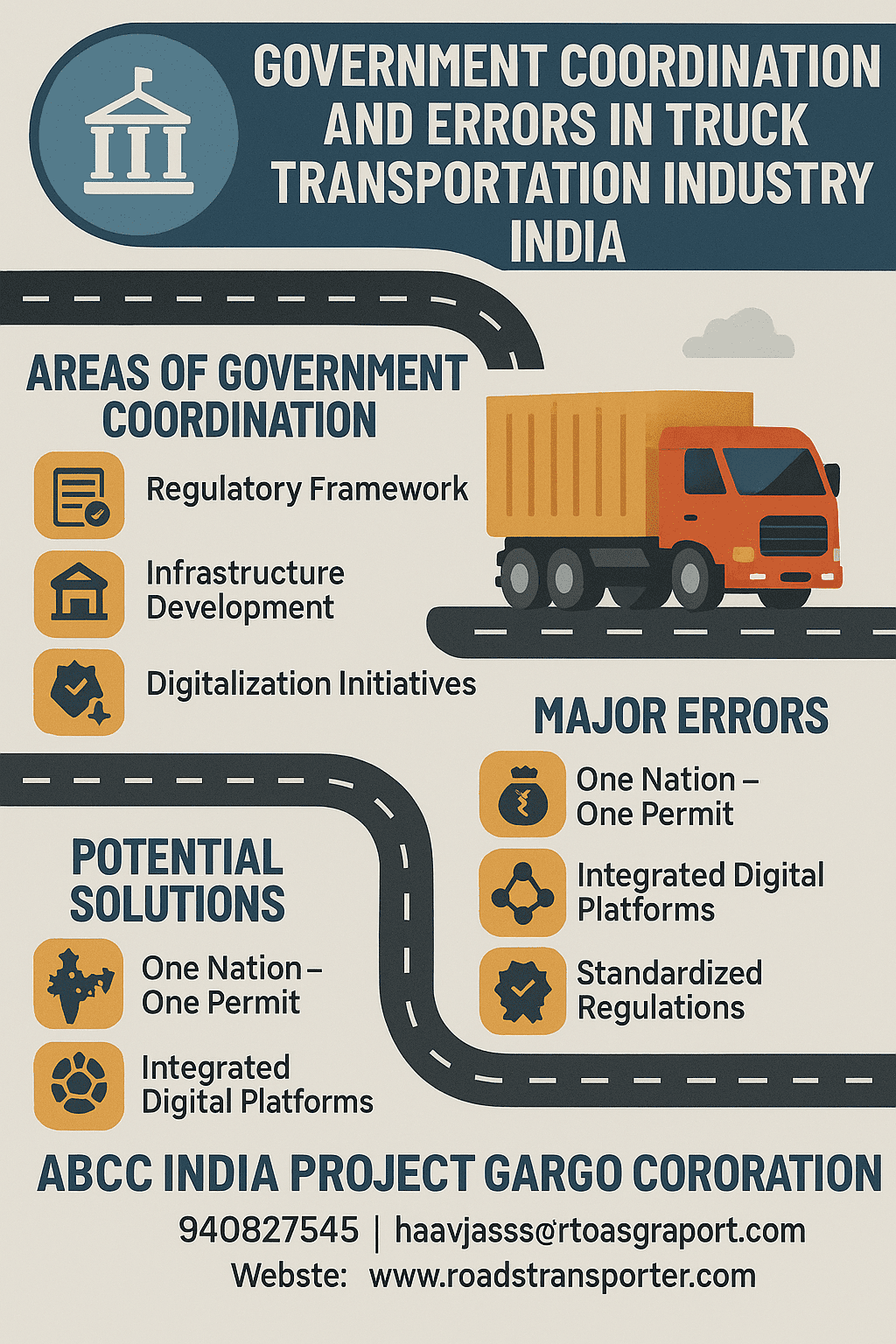
The Indian government has been actively working to modernize and streamline the truck transportation industry, recognizing its crucial role in the country’s economic growth.1 However, a number of coordination and implementation challenges, as well as some policy errors, have historically created bottlenecks and inefficiencies.
Major Government Coordination and Error Problems:
1. Lack of a Unified, Coordinated Policy Framework
- Problem: The logistics ecosystem is governed by multiple ministries and departments at both the central and state levels, leading to regulatory overlap and conflicting policies.2 For instance, while the Ministry of Road Transport and Highways (MoRTH) manages road infrastructure and vehicle regulations, other ministries, such as the Ministry of Finance (for GST) and state-level transport departments, also play a significant role. This lack of a single, cohesive authority has created departmental silos and made it difficult to implement holistic reforms.
- Error: A key historical error was the absence of a “National Logistics Policy” for many years. This meant that efforts were often disjointed and reactive, rather than part of a long-term, integrated vision. The launch of the National Logistics Policy (NLP) in 2022 aims to correct this, but its effective implementation requires strong coordination among all stakeholders.3
2. State-Level Regulatory Fragmentation
- Problem: Despite the introduction of the GST, which was designed to create a “one nation, one market” system, inter-state differences in rules, permits, and taxes continue to persist.4 This creates delays at state borders, increases transaction costs, and complicates compliance for fleet operators who work across multiple states.5
- Error: While the GST was a landmark reform, the initial implementation did not fully address all the ground-level complexities and state-specific regulations.6 Many state-level entry taxes, check posts, and varied enforcement practices remain a challenge, undermining the full benefits of GST.7
3. Inefficient Use of Infrastructure and Technology
- Problem: India has made massive investments in road infrastructure through projects like the Bharatmala Pariyojana.8 However, the full potential of these highways is often not realized due to bottlenecks like poor last-mile connectivity, inadequate roadside amenities for drivers, and a lack of integrated multi-modal transport infrastructure.
- Error: A key error in infrastructure planning has been the occasional mismatch between road development and the development of supporting logistics ecosystems. For example, while new highways are being built, the development of modern logistics parks, truck terminals, and multi-modal hubs at key nodes has lagged behind, preventing seamless end-to-end cargo movement.
4. Challenges in Policy Implementation and Enforcement
- Problem: The government has introduced several positive policies, such as the e-way bill system, AIS140 GPS tracking mandate, and the Voluntary Vehicle Fleet Modernization Program (Vehicle Scrapping Policy).9 However, the implementation of these policies has faced hurdles. Small, unorganized players often lack the awareness or financial resources to comply, leading to a gap between policy intent and ground reality.10
- Error: A significant error lies in the “one-size-fits-all” approach to policy. Policies designed for large, organized logistics companies may not be feasible for the vast number of small, independent truck operators. The government often fails to provide sufficient support, incentives, or a gradual transition period to help the unorganized sector adapt to new, technology-driven regulations.
Government Initiatives to Address these Problems:
The government has recognized these issues and is actively working on solutions through several key initiatives:
- National Logistics Policy (NLP) & PM Gati Shakti: The NLP is the most significant step towards a coordinated approach. It aims to reduce logistics costs, improve efficiency, and create a single, integrated digital system.11 The PM Gati Shakti National Master Plan is a platform that brings 16 ministries together to plan and implement infrastructure projects in a synchronized manner, which is crucial for building a seamless logistics network.12
- Digitalization of Processes: The government is pushing for a paperless environment through initiatives like the FASTag for electronic toll collection and the e-way bill.13 These systems have significantly reduced transit times and eliminated many of the old bottlenecks at toll plazas and check posts. The proposed Unified Logistics Interface Platform (ULIP) aims to further integrate all digital systems across the logistics value chain.14
- Infrastructure Development: Alongside new road projects, the government is also focusing on developing dedicated freight corridors (DFCs) for railways and promoting inland waterways and coastal shipping.15 The goal is to shift some of the load from roads to these more fuel-efficient and cost-effective modes of transport.
- Focus on Driver Welfare: Recent policy changes, such as the mandate for air-conditioned truck cabins and plans to establish modern roadside amenities, demonstrate a growing recognition of the need to improve driver working conditions.16 This is a crucial step toward addressing the severe driver shortage problem.
In summary, while the government has made significant strides in modernizing the Indian trucking industry, challenges remain. The key for future success lies in effective coordination across different government bodies, a more nuanced and supportive approach to policy implementation for the unorganized sector, and a continued focus on building an integrated, multi-modal logistics ecosystem.
Truck Accident-Prone Black Spots – State-wise (India)
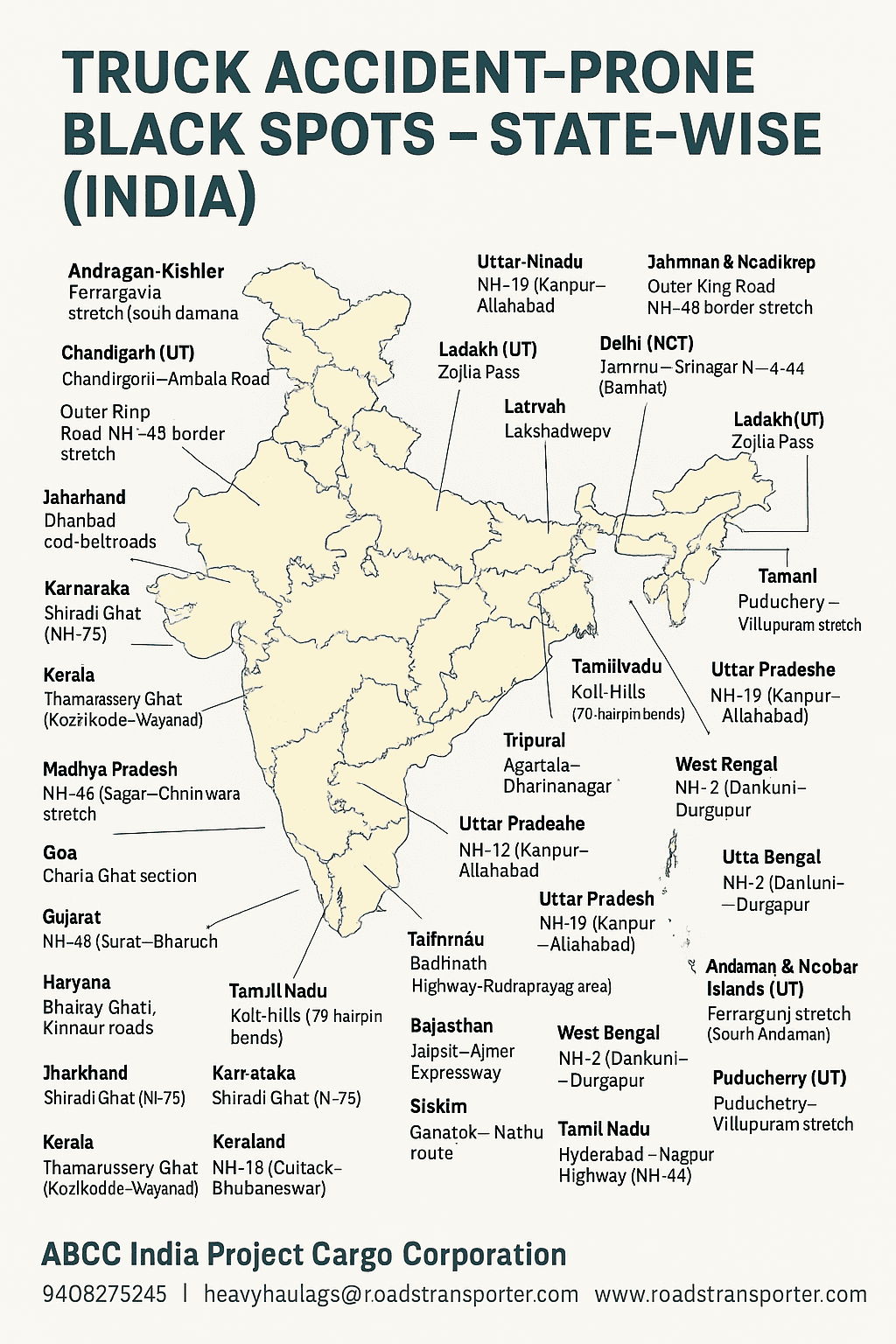
| State / UT | Infamous Truck Accident-Prone Area / Stretch | Reason for Accidents |
|---|---|---|
| Andhra Pradesh | NH-44 (Penukonda – Anantapur stretch) | Heavy truck traffic, overspeeding |
| Arunachal Pradesh | Sela Pass | Landslides, snow, narrow roads |
| Assam | Shillong-Guwahati Highway (NH-6) | Fog, heavy rain, overloaded trucks |
| Bihar | NH-19 (Patna – Aurangabad) | Potholes, mixed traffic, night accidents |
| Chhattisgarh | Raipur – Bilaspur Highway | Poor road design, overloaded trucks |
| Goa | Chorla Ghat section | Hairpin bends, tourist traffic congestion |
| Gujarat | NH-48 (Surat – Bharuch) | High-speed heavy truck corridor |
| Haryana | Kundli – Manesar – Palwal (KMP Expressway) | Overspeeding, fog in winter |
| Himachal Pradesh | Bhairav Ghati, Kinnaur roads | Hairpin curves, landslides |
| Jharkhand | Dhanbad coal belt roads | Overloaded coal trucks, broken roads |
| Karnataka | Shiradi Ghat (NH-75) | Narrow ghats, monsoon landslides |
| Kerala | Thamarassery Ghat (Kozhikode – Wayanad) | Hairpin bends, rain |
| Madhya Pradesh | NH-44 (Sagar – Chhindwara stretch) | Night accidents, speeding |
| Maharashtra | Mumbai – Pune Expressway (Khalapur – Lonavala) | Fog, tyre bursts, high speed |
| Manipur | NH-2 (Imphal – Dimapur) | Narrow mountain roads, landslides |
| Meghalaya | Shillong – Jowai Highway | Fog, poor visibility, heavy trucks |
| Mizoram | NH-54 (Aizawl – Silchar) | Steep climbs, sharp turns |
| Nagaland | NH-29 (Dimapur – Kohima) | Landslides, narrow curves |
| Odisha | NH-16 (Cuttack – Bhubaneswar) | Mixed traffic, rash driving |
| Punjab | Ludhiana – Jalandhar Highway | Fog, high-speed trucks |
| Rajasthan | Jaipur – Ajmer Expressway | Night-time overspeeding |
| Sikkim | Gangtok – Nathula route | Snow, sharp mountain bends |
| Tamil Nadu | Kolli Hills (70 hairpin bends) | Extreme hairpin curves |
| Telangana | Hyderabad – Nagpur Highway (NH-44) | Heavy truck density |
| Tripura | Agartala – Dharmanagar Highway | Narrow single-lane roads |
| Uttar Pradesh | NH-19 (Kanpur – Allahabad) | High truck traffic, potholes |
| Uttarakhand | Badrinath Highway (Rudraprayag area) | Landslides, narrow roads |
| West Bengal | NH-2 (Dankuni – Durgapur) | Congestion, mixed traffic |
| Andaman & Nicobar Islands (UT) | Ferrargunj stretch (South Andaman) | Poor lighting, narrow roads |
| Chandigarh (UT) | Chandigarh – Ambala Road | Overspeeding, mixed traffic |
| Delhi (NCT) | Outer Ring Road, NH-48 border stretch | Congestion, reckless driving |
| Jammu & Kashmir | Jammu – Srinagar NH-44 (Banihal) | Landslides, steep gradients |
| Ladakh (UT) | Zojila Pass | Extreme weather, skidding |
| Lakshadweep (UT) | Narrow jetty roads | Limited truck handling areas |
| Puducherry (UT) | Puducherry – Villupuram stretch | Rash driving, mixed traffic |
Conclusion :
Truck transportation services form the backbone of India’s logistics network, connecting industries, businesses, and communities across the country. From heavy haulage and over-dimensional cargo to part-load and full-load solutions, the sector ensures timely and safe delivery of goods to every corner of India.
At ABCC India Project Cargo Corporation, we take pride in being one of the leading truck transportation service providers in the nation. With our modern fleet, specialized vehicles, and experienced team, we deliver reliable and cost-effective logistics solutions tailored to customer needs. Whether it’s local, inter-state, or pan-India transport, we ensure seamless cargo movement backed by transparency, safety, and on-time commitments.
For dependable truck transportation services, contact ABCC India Project Cargo Corporation today at 9408275245 or email us at [email protected]. Visit www.roadstransporter.com to explore our services and book your next shipment hassle-free.
Summary
| Topic | Details |
|---|---|
| Industry Overview | Truck transportation forms the backbone of India’s logistics network, connecting businesses nationwide. |
| Service Coverage | Local, inter-state, and pan-India cargo transportation services. |
| Cargo Types | Heavy haulage, over-dimensional cargo (ODC), part-load, and full-load solutions. |
| Fleet Strength | Modern, specialized trucks suitable for various cargo types. |
| Key Strengths | Reliable, safe, cost-effective, transparent, and on-time deliveries. |
| Company Introduction | ABCC India Project Cargo Corporation is a leader in truck transportation services across India. |
| Contact Information | Phone: 9408275245 Email: [email protected] Website: www.roadstransporter.com |
| Tagline | “Your cargo, our commitment – Driving India’s logistics forward!” |