🌍 Invention • History • Commercialization • Types • Uses • Engineering • Advantages & Disadvantages • Manufacturers • Global & Indian Markets • Electric Trucks • Future • Business Opportunities
🚛 WHAT IS A TRUCK?
A truck is a powered road vehicle built primarily to transport goods, equipment, materials or specialized loads. Trucks range from compact delivery vehicles to multi-axle highway trucks and tractor–trailer combinations. The modern internal-combustion motor truck is commonly associated with Gottlieb Daimler’s pioneering 1896 vehicle in Germany. Today, trucks are indispensable to farming, manufacturing, construction, mining, retail, emergency services and global trade.
🌟 WHY TRUCKS MATTER
Almost every physical product travels by truck during at least one part of its journey. A truck may bring harvested produce to a market, carry steel to a factory, deliver medicines to a hospital or move an industrial transformer to a power project. Its economic value comes from flexible, door-to-door transportation.
📌 QUICK FACTS
- Invention milestone: Gottlieb Daimler’s 1896 motor truck, Germany.
- Core vehicle categories: light, medium, heavy and specialized trucks.
- Common applications: agriculture, construction, industrial freight, retail distribution, logistics and public services.
- Powertrains: diesel, petrol, natural gas, battery-electric, hydrogen and compatible alternative fuels.
- India: SIAM reported 1,079,871 domestic commercial vehicle sales in FY 2025–26; this is NOT a truck-only figure.
- World: IEA reported more than 400,000 electric medium/heavy freight truck sales in 2025, approximately 9% of global truck sales under its classification.
- Future: electrification, safer vehicle systems, connected fleets, better utilization and selected automated operations.
🧭 CONTENT GUIDE
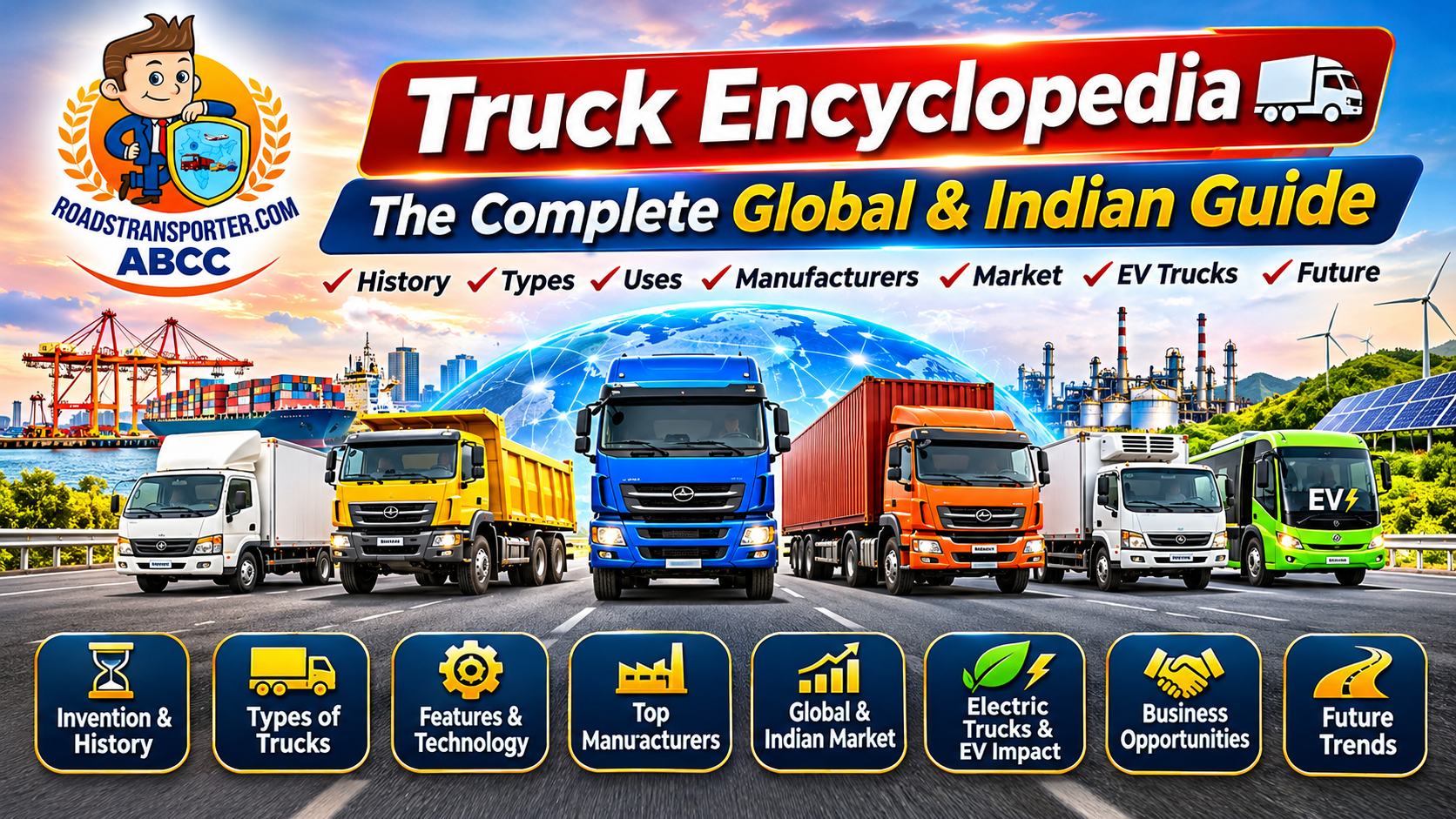
This encyclopedia is organized into 83 chapters plus practical beginner guidance. Start with the truck definition and invention, then explore truck types and components, safety and energy technology, international manufacturers, the Indian market, operating economics and future opportunities. Each chapter answers a distinct reader question without repeating the keyword unnecessarily.
WHAT IS A TRUCK? DEFINITION, PURPOSE AND MEANING
A truck is a powered road vehicle primarily engineered to move freight, equipment or specialized loads. The term covers compact pickups, rigid cargo vehicles, road tractors and purpose-built industrial machines, although legal classifications differ between countries.
A useful definition distinguishes the powered vehicle from its load-carrying body and from an unpowered trailer. In a rigid truck, the cargo body and cab share a chassis. In a tractor–semitrailer combination, the tractor provides power and the semitrailer supports much of the load through its own axles.
The word truck is common in North American English; lorry is familiar in British English. Indian operators also use terms such as goods carrier, tempo, Taurus, trailer truck and multi-axle vehicle, sometimes informally. Exact technical specifications must be checked against the registration certificate and manufacturer documentation.
🌍 Why Trucks Matter To The World Economy
Trucks link farms, mines, factories, ports, rail terminals, warehouses, shops and homes. Their defining advantage is routing flexibility: a vehicle can collect goods from a site that has no railway siding and deliver them directly to a customer.
Road freight is not automatically the cheapest or cleanest mode for every shipment. Rail and water can excel for dense bulk cargo over long corridors, while aircraft handle urgent and high-value goods. Trucking remains essential at the first and last mile even in multimodal supply chains.
A factory’s production schedule, a retailer’s inventory position and a construction project’s progress can all depend on reliable truck availability. Measuring trucking’s economic value therefore requires attention to delivery reliability, cargo condition, inventory cost and customer service, not just freight rates.
🕰️ The Invention Of The Motor Truck
Freight moved by carts and wagons long before engines existed. Steam road vehicles demonstrated mechanical haulage during the nineteenth century, but they faced weight, road-surface, maintenance and regulatory constraints.
Gottlieb Daimler’s 1896 internal-combustion goods vehicle is widely recognized as a landmark in the development of the modern motor truck. It used an early petrol engine and a layout still strongly influenced by horse-drawn vehicles.
No single inventor created all modern truck technology. Pneumatic tires, diesel engines, braking systems, gears, axles, cab design and mass production evolved over decades. A careful history separates the first powered freight experiments from the first practical internal-combustion commercial trucks.
🏭 Commercialization: From Experiment To Fleet
The first commercial buyers needed evidence that a motor truck could outperform horse transport on predictable routes. Early advantages included higher daily utilization and freedom from feeding and stabling animals; disadvantages included breakdowns, scarce repair skills and expensive fuel.
Manufacturers gradually developed standard chassis, dealer networks, spare parts and financing. Businesses adopted motor vehicles for brewery distribution, municipal work, industrial deliveries and postal services before trucking expanded into national long-haul freight.
Commercialization accelerated when paved roads, fuel stations, better tires and highway infrastructure became widespread. The modern trucking business combines asset ownership, fleet dispatch, driver labor, credit, insurance, maintenance and contractual freight demand.
⚙️ The Diesel Revolution
Diesel engines became important in heavy trucking because they offer strong low-speed torque and comparatively efficient fuel use in demanding duty cycles. Engine design and injection systems improved over the twentieth century.
Diesel’s commercial appeal depends on the entire vehicle: gearing, aerodynamic drag, axle ratios, route gradient, loading pattern and driving behavior can change fuel consumption dramatically. A high-powered engine is not necessarily the most economical choice.
Modern diesel vehicles also require emissions-control equipment and suitable maintenance. Operators must account for exhaust aftertreatment, lubricant quality, filtration, diagnostic systems and applicable emissions standards.
📦 Truck Classification By Weight
Light-, medium- and heavy-duty classifications are useful, but they are not universal. India, the European Union and the United States use different regulatory definitions, thresholds and vehicle classes.
Gross vehicle weight rating describes the maximum permitted loaded weight of a vehicle. Payload is the weight of cargo it may legally carry after accounting for the vehicle, body, fuel, occupants and accessories. Gross combination weight applies to relevant vehicle–trailer combinations.
A purchasing decision should begin with actual cargo dimensions, weight distribution, routes and loading equipment rather than a broad category label. A truck advertised as heavy-duty may still be unsuitable for a concentrated machine load.
🚚 Mini Trucks And Last-Mile Delivery
Mini trucks serve narrow streets, local markets, shops and small construction sites. Their compact dimensions can reduce access problems and improve utilization when shipments are small.
Typical applications include vegetables, packaged consumer goods, household items, courier consolidation and short-distance industrial supplies. Small vehicles can operate frequent trips without waiting for a full heavy-truck load.
Their limitations include lower payload, limited cabin space and less suitability for long high-speed freight routes. Overloading small vehicles can compromise braking, stability, tires and compliance.
🛻 Pickup Trucks
Pickups combine a passenger-style cab with an open cargo bed. They are used by contractors, agricultural businesses, service technicians, utilities and rural distributors.
Single-cab, extended-cab and double-cab layouts trade cargo-bed space against passenger accommodation. Two-wheel-drive and four-wheel-drive variants address different terrain and traction requirements.
Not every pickup is legally registered for the same commercial use. Buyers should verify homologation, permitted payload, insurance category and local restrictions before selecting one for business.
🚛 Medium-Duty Distribution Trucks
Medium-duty trucks bridge the gap between city pickups and highway heavy trucks. They often carry food, industrial components, retail stock, parcels and building supplies.
A medium-duty fleet’s economics depend heavily on stop density, loading time, warehouse turnaround and urban restrictions. Box bodies, tail lifts and refrigerated bodies can improve service but add weight and cost.
Route planning should include bridge limits, delivery windows, parking availability and unloading equipment. Vehicle size must match the customer’s receiving facility as well as the cargo.
🚜 Heavy-Duty Rigid Trucks
Heavy rigid trucks carry large payloads on a single powered chassis and may use multiple axles. They are common in industrial supply, construction and regional bulk transportation.
The chassis, body, suspension, braking system and tires must be engineered as a complete system. Axle-load distribution can be as important as gross weight, particularly for dense machinery or materials.
Rigid trucks can be easier to maneuver and reverse than some articulated combinations, but they may offer less flexibility when shippers need interchangeable trailers.
🚛 Truck Tractors And Semitrailers


A truck tractor, sometimes called a prime mover, pulls a semitrailer through a fifth-wheel coupling. The trailer supports part of its weight on the tractor and the rest on trailer axles.
This configuration is widely used for containers, dry vans, flatbeds, tankers and long-distance freight. Fleet operators can decouple a trailer for loading while a tractor handles another assignment.
Safe operation requires correct coupling, air and electrical connections, load placement, turning clearance, brake compatibility and adherence to gross combination and axle-weight rules.
📐 Flatbed Trucks

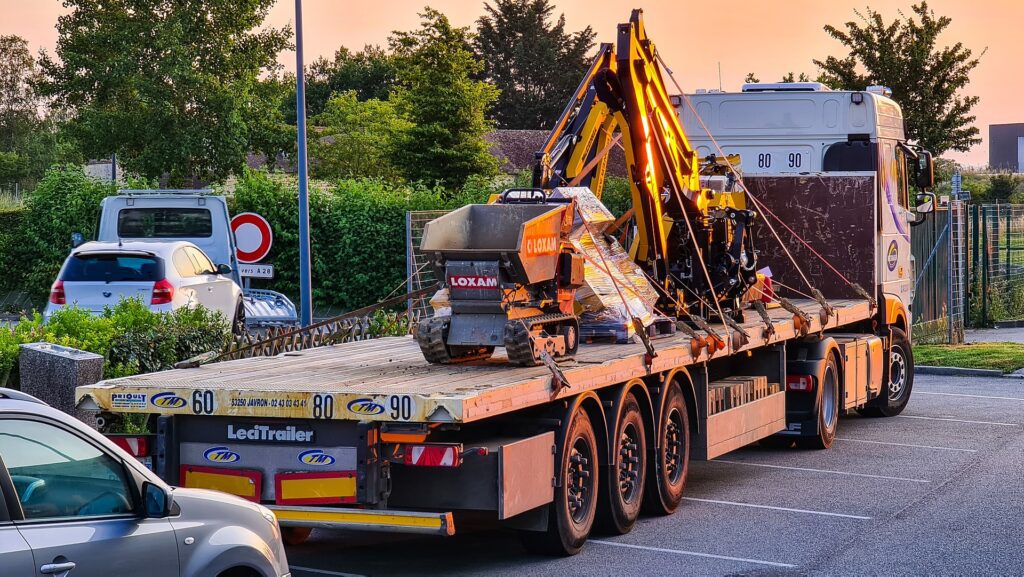
Flatbeds provide an open platform for steel, pipes, machinery, precast components and other cargo that does not need an enclosed body. Side or overhead loading can be convenient.
Open platforms expose freight to rain, road spray and theft. Cargo must be secured with appropriately rated chains, straps, blocking and edge protection; tarpaulins alone are not a substitute for restraint.
Shippers should supply accurate weight, center of gravity, dimensions and lifting points. The cheapest flatbed quotation is poor value if the equipment or securement method is unsuitable.
📦 Box Trucks And Dry Vans
Enclosed box bodies protect cartons, consumer products and many manufactured goods from routine weather exposure. They are common in distribution networks and urban logistics.
Body dimensions, floor strength, rear-door clearance, pallet compatibility and loading-dock height determine operational fit. A vehicle with high cubic capacity may still reach its weight limit before the space is full.
Ventilation, moisture management, door seals and theft-resistant locks are practical considerations. Sensitive goods may need specialized packaging even inside a closed body.
🚢 Container Trucks



Container transport connects maritime terminals, inland container depots, factories and warehouses. Standardized containers simplify transfers between ship, rail and road.
The container’s size, verified gross mass, corner fittings and chassis configuration affect safe movement. Route restrictions may apply to tall combinations, and container seals support cargo integrity.
Operators should distinguish container handling charges, terminal waiting, detention, tolls and chassis arrangements from the basic road freight charge.
❄️ Refrigerated And Cold-Chain Trucks
Reefer trucks maintain controlled temperatures for food, pharmaceuticals and other sensitive products. Temperature requirements differ by commodity and may involve frozen, chilled or controlled ambient transport.
A refrigeration unit does not correct cargo that was loaded at the wrong temperature. Pre-cooling, insulation, door-opening discipline, air circulation and temperature logging are critical.
Cold-chain planning must include backup procedures, generator fuel or battery capacity, loading delays and proof of temperature compliance. The total cost is higher than ordinary dry freight.
🏗️ Tipper And Dump Trucks
Tippers use hydraulic mechanisms to discharge aggregates, soil, coal and other bulk materials. Their productivity is tied to loading equipment, haul distance, site queues and dumping conditions.
Raising a body changes the center of gravity. Dumping on soft, uneven or sloping ground can cause rollover, and overhead wires create additional hazards.
Mine and construction applications may use purpose-built off-road dump trucks that differ substantially from highway-legal tippers.
🛢️ Tanker Trucks
Tankers transport liquids, gases and certain powders using specialized vessels. Examples include fuel tankers, chemical tankers, milk tankers, water tankers and bulk cement tankers.
Liquid surge can affect stability, braking and cornering. Baffles, compartment design, pressure equipment and product compatibility must match the cargo.
Hazardous loads require appropriate approvals, placarding, trained personnel and emergency procedures. A tanker suitable for water is not automatically suitable for chemicals.
🏗️ Concrete Mixers And Construction Trucks
Transit mixers rotate their drums to preserve the workability of concrete during delivery. Dispatch must coordinate batching, travel, site access and placement time.
Construction fleets also use crane trucks, boom pumps, tippers and flatbeds. Each serves a different function and should not be treated as interchangeable.
Congested access roads, unstable ground and insufficient turning space can make an otherwise feasible delivery unsafe.
🚘 Car Carriers And Vehicle Transporters


Vehicle carriers move cars and other road vehicles on purpose-built decks. Loading geometry, vehicle clearance and tie-down arrangements are central to safety.
Transport damage can occur through poor securing, excessive ramp angles, low branches or inadequate overhead clearance. Vehicle condition records and delivery inspections reduce disputes.
Operators may use open or enclosed carriers depending on vehicle value, route and customer requirements.
🌲 Logging And Timber Trucks
Timber trucks carry long, irregular loads that require purpose-built bolsters, stakes and securement. Forest-road conditions can demand specialized traction and suspension.
Timber weight varies with species and moisture. A load that looks visually modest may exceed legal weight limits.
Operators must account for forestry permits, road access, load overhang, turning paths and environmental restrictions.
⛏️ Mining Haul Trucks
Large off-highway mining trucks are designed for repetitive high-volume haul cycles on managed mine roads. Their dimensions and axle loads often make them unsuitable for public highways.
Fleet performance is measured by payload, cycle time, availability, tire life, energy use and safety. Dispatch systems can coordinate loading shovels and haul roads.
Mine electrification may use battery systems, trolley-assist power or other technologies depending on duty cycle and site infrastructure.
🏗️ Crane-Mounted And Recovery Trucks
Crane-mounted trucks combine transport and lifting capability, but safe lifting capacity depends on boom radius, stabilizer deployment, ground conditions and load charts.
Recovery trucks and tow trucks serve breakdowns, accidents and vehicle relocation. Their equipment differs from ordinary cargo trucks and must be matched to the vehicle being recovered.
The presence of a crane does not remove the need for trained operators, lift plans and exclusion zones.
🏋️ Heavy Haulage And Oversized Cargo
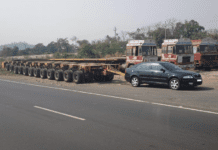
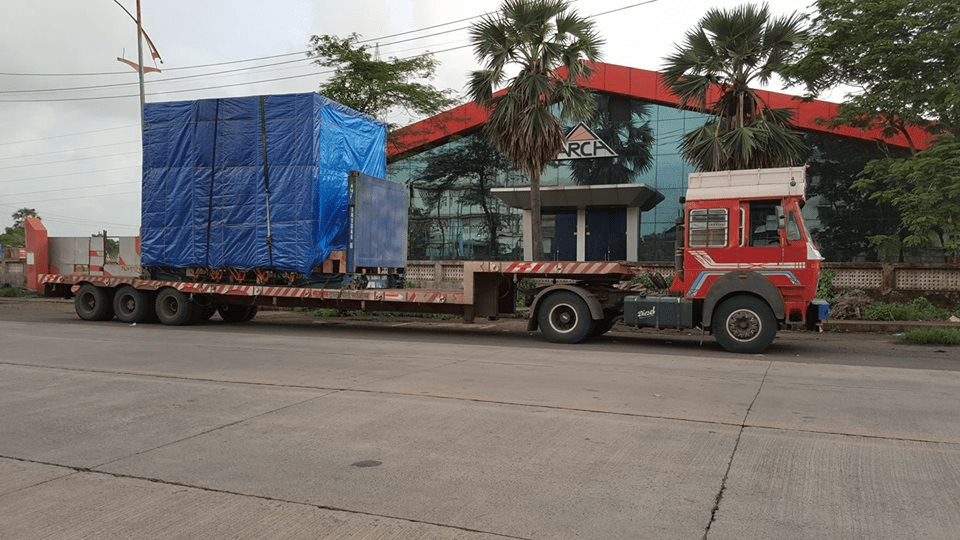
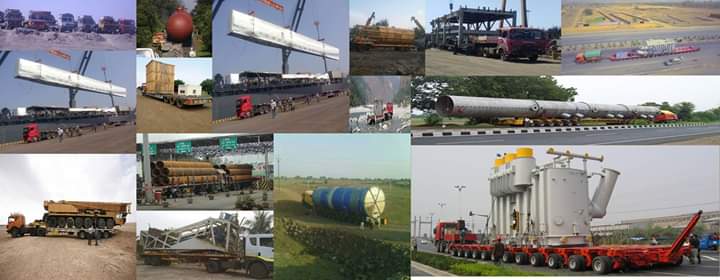
Heavy haulage covers loads that exceed ordinary dimensions, weights or axle-load configurations. Typical projects include transformers, turbines, pressure vessels and industrial modules.
Transport planning begins with verified drawings, load mass, center of gravity, lifting points and route geometry. Bridge assessment, overhead clearance, turning radii, permits and escort arrangements may determine feasibility.
Lowbeds, extendable trailers, hydraulic modular trailers and specialized prime movers solve different engineering problems. A project should never be quoted solely from the headline cargo weight.
🚧 Lowbed And Semi-Lowbed Trailers
Lowbed trailers position the load deck closer to the road to accommodate tall machinery. Semi-lowbeds offer a compromise among deck height, ground clearance and access.
Deck height alone is not enough to determine suitability. Ramp angle, suspension travel, ground clearance, axle capacity and neck geometry must be considered.
Excavators, cranes, industrial machines and tall equipment may require route surveys and special permits even when transported on lowbeds.
⚙️ Hydraulic Modular Trailers
Hydraulic modular trailers use multiple axle lines and adjustable suspension to distribute very heavy loads. Modules may be combined to meet engineering requirements.
Hydraulic steering and suspension provide maneuvering flexibility, but they require trained teams, engineering calculations and carefully prepared routes.
Transport plans should document axle-line configuration, wheel loads, bridge interactions, slope limits and emergency contingencies.
🛞 Self-Propelled Modular Transporters
SPMTs are self-propelled modular platforms often used within ports, shipyards, industrial sites and major project environments. They can move exceptionally large structures at low speeds.
Their use differs from ordinary highway trucking. Transport may require temporary site preparation, ground-bearing analysis, exclusion zones and specialist control systems.
SPMTs should be discussed as adjacent heavy-transport technology rather than assumed to be a standard road truck.
🔩 Truck Engines And Torque
Engine output is commonly described through power and torque. Power influences sustained performance, while torque characteristics affect acceleration and gradeability under load.
Peak torque alone does not describe a vehicle’s performance. Transmission ratios, final drive, tire size, vehicle mass and cooling capacity matter.
Engine selection should reflect the duty cycle: stop-start urban delivery, highway cruising, mountain routes and construction work impose different demands.
⚙️ Manual, Automated And Automatic Transmissions
Manual transmissions give drivers direct gear selection but demand skill in difficult conditions. Automated manual transmissions control clutch and shifting electronically while retaining a mechanically geared architecture.
Conventional automatic transmissions use different mechanisms and may be preferred in particular stop-start or specialist applications.
The right choice depends on terrain, fleet training, repair support, fuel efficiency, driver comfort and acquisition cost.
🛠️ Chassis, Suspension And Axles
The chassis supports vehicle components and transfers load through suspension and axles. Body builders must respect the manufacturer’s design limits and mounting instructions.
Leaf springs, air suspension and other arrangements offer different combinations of durability, ride quality, load equalization and maintenance needs.
Improper body modification can damage structural members or alter stability. Engineering approval is important for specialized applications.
🛑 Truck Brakes And Safety Systems
Heavy trucks may use pneumatic braking systems, electronic controls, engine braking and retarders. These systems work together to manage speed and stopping performance.
ABS helps prevent wheel lock under certain conditions, while stability systems may reduce selected loss-of-control risks. Neither can overcome excessive speed, overloading or poor tire condition.
Brake checks, air-system inspections, downhill speed management and driver training remain essential even on technologically advanced vehicles.
🛞 31. Truck Tires And Wheel Maintenance
Tires are critical to safety, fuel efficiency and payload performance. Selection depends on axle position, load rating, speed rating, road surface and operating environment.
Underinflation increases heat and wear; overinflation can impair contact and ride characteristics. Tire monitoring helps, but inspections are still necessary.
Retreading may be economically attractive in suitable applications when casing quality, standards and maintenance practices are appropriate.
⛽ Aerodynamics And Fuel Efficiency
At highway speeds, aerodynamic drag becomes an important energy demand. Cab shape, roof fairings, side skirts, trailer gaps and vehicle height can affect fuel consumption.
At lower speeds, vehicle mass, acceleration, idle time, rolling resistance and congestion may dominate. Freight efficiency should therefore be measured by cargo moved per unit of energy.
Operators can improve efficiency through proper loading, tire pressure, route planning, driver coaching and preventive maintenance.
🧑✈️ Truck Cabins And Driver Ergonomics
Truck cabins are workplaces. Seat quality, visibility, noise, vibration, climate control, storage and sleeper arrangements affect driver comfort and fatigue.
Long-haul trucks may need rest facilities, while urban distribution vehicles prioritize visibility and easy entry and exit. Cab design should match the job.
Safety is also influenced by schedules, rest opportunities, secure parking and access to sanitation, not only by equipment fitted to the vehicle.
📏 Truck Dimensions And Legal Weight
Length, width, height, axle weights and gross vehicle weight are regulated differently around the world. Legal limits may also vary by road, bridge, permit and vehicle configuration.
Published body dimensions are not the same as usable cargo space. Door openings, internal protrusions, wheel arches and load-securing points reduce practical capacity.
For international comparison, state the jurisdiction and date. Never present a single global maximum truck weight as if it applied everywhere.
⚖️ Payload Versus Gross Weight
Payload is the cargo mass a vehicle can legally carry after subtracting its operating mass from its permitted gross weight. Accessories, bodies and fuel reduce usable payload.
Volume-limited freight fills the body before reaching the weight limit, while dense freight reaches the weight limit first. This distinction is fundamental to vehicle selection and pricing.
The safest quotation uses verified cargo dimensions, weight, packaging and center of gravity rather than assuming that every truck of the same wheel count carries the same load.
🔗 Truck Loading And Cargo Securement
A safe loading plan distributes weight correctly and prevents forward, sideways, rearward and vertical movement. Different cargo types require different restraint systems.
Chains, webbing, blocking, friction materials, corner protectors and rated anchor points should be selected according to applicable standards and the load’s characteristics.
Drivers and loaders should inspect restraint before departure and at appropriate intervals. Damaged straps or improvised securing can turn a routine shipment into a serious hazard.
🦺 Road Safety And Driver Fatigue
Truck crashes can have severe consequences because of vehicle mass, stopping distance and road-user exposure. Risk factors include fatigue, distraction, speed, poor maintenance and unsafe loading.
Effective prevention combines driver scheduling, training, vehicle inspection, road design, enforcement and organizational safety culture.
Fleet operators should examine near misses and incidents systematically rather than focusing only on individual driver blame.
🌱 Truck Emissions And Air Quality
Diesel exhaust contains pollutants that affect air quality, while combustion also produces carbon dioxide. Emissions depend on technology, maintenance, fuel quality and operating conditions.
Modern emissions standards have encouraged advanced engine control and exhaust aftertreatment. Tampering or poor maintenance can undermine their benefits.
Policy comparisons must distinguish tailpipe pollution, greenhouse gases and full lifecycle environmental impacts.
🔋 Battery-Electric Trucks
Battery-electric trucks use electric motors and rechargeable battery packs. They produce no tailpipe emissions and can be efficient in stop-start and predictable-route operations.
Their commercial feasibility depends on acquisition cost, battery capacity, usable range, payload, charging power, electricity tariffs and vehicle downtime.
Depot charging and predictable routes often offer an easier starting point than unpredictable long-haul routes. Heavy freight electrification is expanding, but local economics vary.
⚡ Electric Truck Charging
Charging design is a fleet infrastructure project, not simply the installation of a socket. Operators must estimate simultaneous vehicle demand, grid connection capacity and daily energy requirements.
Charging during scheduled depot dwell time can reduce disruption. High-power corridor charging may be important for long-distance freight but requires substantial infrastructure.
Tariff structure, charger reliability, site layout, queuing and backup arrangements can determine whether an electric fleet delivers expected savings.
🔄 Battery Swapping For Trucks
Battery swapping replaces a discharged battery with a charged unit, potentially reducing stationary time. The approach can suit repetitive industrial corridors and standardized fleets.
Its success depends on battery compatibility, station utilization, capital investment, safety procedures and commercial ownership models.
China has demonstrated meaningful adoption in selected truck applications, but swapping is not yet a universal standard across manufacturers.
💧 Hydrogen Fuel-Cell Trucks
Fuel-cell trucks generate electricity from hydrogen onboard. They may appeal to operations where rapid refueling and high utilization are valuable.
Commercial hurdles include hydrogen production cost, distribution, refueling infrastructure, vehicle cost and energy losses across the supply chain.
Lifecycle emissions depend strongly on how hydrogen is produced. Claims that every hydrogen truck is automatically climate-neutral are misleading.
⛽ Cng And Lng Trucks
Natural-gas trucks can serve particular fleet applications where refueling infrastructure is established. CNG is more common in some urban and regional operations; LNG may be considered for longer distances.
Operators must compare fuel price, tank weight, route coverage, maintenance and resale value. Methane leakage can materially affect climate performance.
Fuel choice should be based on a route-specific business case rather than a broad claim that one technology is always superior.
🌾 Biofuels And Renewable Fuels
Biodiesel blends and other alternative fuels may reduce dependence on conventional fossil fuels in suitable vehicles. Compatibility, availability and sustainability depend on fuel specifications.
Feedstock sourcing and land-use effects matter when evaluating lifecycle emissions. A fuel’s renewable label does not automatically establish a low-carbon outcome.
Fleet managers should follow manufacturer guidance, applicable fuel standards and local regulations.
🤖 Autonomous And Connected Trucks
Connected trucks send operational information such as location, fault codes and vehicle utilization to fleet systems. These functions are commercially distinct from autonomous driving.
Advanced driver-assistance systems can support safety, but driver supervision requirements vary. Automated trucking deployment faces technical, regulatory, insurance and public-trust challenges.
The most practical near-term benefits often come from better diagnostics, route planning, driver coaching and maintenance rather than fully driverless operations.
📡 Telematics And Fleet Software
Fleet platforms can monitor vehicle position, fuel use, idle time, maintenance events and driver behavior. Their value comes from decisions made with the data.
A small fleet may begin with dispatch records, GPS tracking and preventive-maintenance reminders before investing in complex analytics.
Privacy, data quality, system integration and driver communication are important. Monitoring should support safe operations, not simply increase pressure on workers.
🌐 Global Truck Market: How To Read The Numbers
Market reports may measure registrations, wholesale deliveries, retail sales, production, fleet stock or revenue. These figures are not interchangeable.
Some datasets include vans, pickups and buses under commercial vehicles, while others cover only medium- and heavy-duty freight trucks. A reliable article states its definitions beside every number.
Currency conversions, reporting periods and corporate-group ownership can distort rankings. Country-by-country comparisons should use consistent years and segment boundaries.
📊 Global Market Snapshot: 2025–2026
According to the International Energy Agency’s Global EV Outlook 2026, worldwide electric medium- and heavy-freight truck sales exceeded 400,000 in 2025, reaching roughly 9% of the relevant truck market.
The IEA reports that China accounted for more than 90% of global electric truck sales in that year. These figures are specific to the agency’s truck definitions and must not be confused with all commercial vehicles.
Global truck demand is affected by construction cycles, freight activity, replacement demand, financing costs, regulations and energy prices. A single global revenue estimate without transparent methodology is less useful than clearly defined official statistics.
🇮🇳 49. India Commercial Vehicle Market Fy 2025–26
The Society of Indian Automobile Manufacturers reported 1,079,871 domestic commercial vehicle sales in FY 2025–26, an increase of approximately 12.6% over FY 2024–25.
This figure covers SIAM’s commercial vehicle segment and is not a truck-only count. SIAM also reported approximately 95,000 commercial vehicle exports in FY 2025–26.
India’s market reflects demand from manufacturing, agriculture, construction, distribution, e-commerce and infrastructure. Vehicle finance, replacement cycles and operating profitability are major purchase drivers.
Indian Truck Industry History
Indian road freight evolved from locally built goods carriers and early imported commercial vehicles to large domestic manufacturing networks.
The growth of Tata, Ashok Leyland and other manufacturers helped expand access to trucks, while highway development and industrialization created demand for larger and more specialized vehicles.
Modern India includes small single-truck operators, transport brokers, large fleets, specialized project-cargo carriers and technology-enabled logistics platforms.
🏭 Leading Indian Truck Brands



Tata Motors, Ashok Leyland, Eicher, BharatBenz and Mahindra are prominent names in India’s truck market. Their portfolios differ across light, medium and heavy categories.
A buyer should compare actual model specifications, local dealer support, warranty, service intervals, parts availability and total operating cost.
A brand’s share of all commercial vehicles should not be presented as its share of heavy trucks. Segment-specific data are necessary for accurate comparisons.
🚚 India: Light Commercial Truck Demand
Small cargo vehicles serve retail delivery, agricultural markets, courier networks, building suppliers and small manufacturers.
The commercial appeal of a mini truck depends on daily trip count, city access, utilization, financing and maintenance. Lower purchase price does not guarantee lower cost per tonne delivered.
Electric small trucks may become attractive on predictable urban routes where charging and payload requirements are manageable.
🚛 India: Heavy Trucks And Industrial Corridors
Heavy trucks support cement, steel, mining, energy, ports, engineering goods and long-distance supply chains. Freight corridors often connect industrial clusters with consumption centers and maritime gateways.
Operational planning must account for highway conditions, tolls, border or permit rules where applicable, loading queues and return-load opportunities.
For oversized cargo, route engineering and permissions can be more decisive than the nominal distance between origin and destination.
💳 India: Truck Financing And Ownership
Truck owners typically evaluate down payment, interest, tenure, insurance, registration, body-building cost and working capital. Cash flow matters as much as accounting profit.
Monthly fixed expenses continue even when the truck is idle. Fuel, tires, repairs, tolls and driver expenses vary with usage.
A realistic ownership plan includes downtime, bad debts, seasonal demand and a maintenance reserve. A high freight quote does not automatically produce a high margin.
📦 India: Freight Brokers And Commission Agents
Brokers connect cargo owners with suitable vehicle operators. Their role can include load discovery, rate negotiation, vehicle verification and coordination.
Professional brokerage benefits from written terms, transparent commission arrangements, proof of delivery, clear liability boundaries and timely payment.
Technology can improve matching, but trust, documentation and local market knowledge remain central to freight brokerage.
🔄 India: Return Load And Empty Miles
A truck returning without cargo incurs fuel, driver and vehicle costs without matching freight revenue. This can materially reduce corridor profitability.
Return-load planning requires attention to destination demand, vehicle type, load compatibility, pickup timing and payment reliability.
A low-paying return load may still improve economics if it covers marginal costs, but operators must not ignore additional detours, wear and waiting time.
🏭 India: Gidc, Midc And Industrial Trucking
Industrial estates generate inbound raw-material flows and outbound finished-goods movements. Gujarat’s GIDC areas and Maharashtra’s MIDC estates are important examples of organized industrial geography.
Transport needs differ by industry: chemicals may require approved tankers, engineering plants may require flatbeds or heavy haulage, and food manufacturers may need refrigerated transport.
A local logistics guide should identify actual industries and road links instead of assuming that every industrial estate has the same cargo profile.
🚢 India: Port And Container Trucking
Port-linked trucking connects factories and inland depots to container terminals. Transit time depends on terminal processes, documentation, gate appointments and road conditions.
Demurrage, detention, chassis availability and waiting time can change the effective cost of a container movement.
Container logistics requires careful distinction between the shipping line’s obligations, terminal charges and the road carrier’s scope.
🧑✈️ India: Truck Driver Welfare
Drivers are central to freight reliability. Rest, sanitation, secure parking, fair compensation and predictable schedules influence retention and safety.
Long-distance operators may face fatigue, theft risk, payment disputes and poor roadside facilities. These issues cannot be solved by vehicle technology alone.
Responsible fleets should combine safe scheduling, clear contracts, grievance processes and preventive maintenance.
📜 India: Road Rules And Permits
Truck operation involves registration, fitness, insurance, driving authorization, taxation and permits as applicable. Cargo movement may also involve e-way bills and other commercial documentation.
Oversized or hazardous cargo can require additional permissions and safety measures. Requirements differ by route and commodity and may change.
Operators should verify current requirements with relevant transport authorities before dispatch rather than relying on generalized online checklists.
United States Truck Market
The United States has a major market for pickups, vocational trucks and Class 8 highway tractors. Its classifications and operating environment differ from India’s.
Long-distance trucking depends on freight networks, distribution centers, driver regulations and interstate highways. Major brands include Freightliner, Kenworth, Peterbilt, International, Mack and Western Star.
Comparisons should distinguish heavy-duty tractor sales from pickup and light commercial vehicle sales.
European Truck Market
European heavy trucking emphasizes long-distance efficiency, safety regulation and emissions performance. Leading brands include Mercedes-Benz Trucks, Volvo Trucks, Scania, MAN, DAF, Renault Trucks and Iveco.
Cross-border routes create demand for standardized vehicle configurations, compliance systems and service networks.
Electric truck deployment is growing, but purchase price, charging availability and operating patterns continue to shape adoption.
China Truck Market
China has a large domestic truck manufacturing base including FAW Jiefang, Dongfeng, Sinotruk, Foton and Shacman.
Its electric truck market has expanded rapidly, especially in predictable industrial applications such as ports, steel production and mining-related routes.
Domestic battery supply chains and infrastructure investment are important advantages, but results from Chinese corridors should not be assumed to transfer unchanged to every market.
Japan And South Korea Truck Markets
Japanese manufacturers such as Isuzu, Hino, Mitsubishi Fuso and UD Trucks have extensive experience in medium and heavy commercial vehicles.
Reliability, serviceability, compact urban configurations and export markets are important themes. South Korean commercial vehicle manufacturing includes Hyundai and Tata Daewoo.
Corporate ownership and brand portfolios change over time, so current group relationships should be checked when publishing manufacturer directories.
🌍 Truck Manufacturers By Country
Germany: Mercedes-Benz Trucks and MAN. Sweden: Volvo Trucks and Scania. Netherlands: DAF. Italy: Iveco. France: Renault Trucks. Czech Republic: Tatra.
India: Tata Motors, Ashok Leyland, Eicher, BharatBenz and Mahindra. China: FAW Jiefang, Dongfeng, Sinotruk, Foton and Shacman. Japan: Isuzu, Hino, Mitsubishi Fuso and UD Trucks.
United States: Freightliner, Kenworth, Peterbilt, International, Mack and Western Star. Turkey: Ford Trucks and BMC. Brazil: Volkswagen Caminhões e Ônibus and Agrale. Russia: KAMAZ, GAZ and Ural. Belarus: MAZ and BelAZ. This is a representative directory, not a sales ranking.
🏆 How To Compare Truck Manufacturers
Start by defining the category: light trucks, medium trucks, heavy tractors, vocational trucks or mining trucks. Manufacturer leadership differs by segment and country.
Compare annual unit sales, service coverage, product range, warranty, vehicle uptime, parts supply, safety technology and lifecycle cost. Revenue alone may include buses, services or other businesses.
For a countrywise ranking, use a single calendar or financial year and identify whether the figures refer to registrations, retail sales or wholesale dispatches.
💰 Truck Prices And Purchase Decisions
Truck prices vary by country, duty class, engine, emissions standard, cab, body and optional equipment. Currency, taxation and financing conditions also affect cost.
An online price may exclude registration, insurance, cargo body, accessories and operational setup. Buyers should request an itemized on-road quotation.
Purchase decisions should evaluate total cost per kilometer, per trip and per tonne rather than initial price alone.
🔍 New Truck Versus Used Truck
A new truck may provide warranty coverage, current technology and predictable early-life maintenance. Its disadvantages include higher acquisition cost and depreciation.
A used truck can reduce initial investment but requires careful inspection of chassis, engine, gearbox, accident history, legal documentation and service records.
The right choice depends on expected utilization, financing, repair support and the operator’s ability to absorb downtime.
🧮 Truck Operating Cost And Tco
Total cost of ownership includes depreciation or lease expense, interest, insurance, taxes, maintenance, tires, fuel or electricity, driver costs and downtime.
Cost per kilometer is useful but incomplete when loads vary. Cost per tonne-kilometer and contribution per trip provide a better view of freight productivity.
A reliable cost model separates fixed and variable expenses and tests low-utilization scenarios.
💸 Freight Pricing And Rate Negotiation
Freight rates reflect vehicle type, route, cargo weight, dimensions, risk, loading conditions, return-load prospects and market demand.
Detention, tolls, permits, loading labor and insurance should be clarified before dispatch. Hidden assumptions create disputes.
A professional quotation specifies vehicle configuration, service scope, validity, payment terms and exclusions.
🏬 Warehousing And Trucking
Warehouses transform trucking from point-to-point movement into coordinated inventory distribution. Dock capacity, appointment systems and yard layout affect turnaround time.
Cross-docking can reduce storage when inbound and outbound movements are synchronized. Poor scheduling creates truck queues and idle time.
Transport planning should be integrated with order fulfillment, packaging, palletization and delivery windows.
🚢 Multimodal Freight And Trucks
Trucks complement rail, sea and air transport by handling local pickup and final delivery. Containerization makes transfers between modes more predictable.
The best multimodal plan balances time, cost, cargo handling, reliability and emissions. An apparently cheaper line-haul option may be unattractive if terminal delays are excessive.
Transport documents and liability boundaries should be clear when several carriers participate.
👷 Trucking Jobs And Skills
Careers include drivers, mechanics, dispatchers, fleet managers, logistics analysts, transport brokers, body builders, safety officers and heavy-haul engineers.
Electric and connected trucks create additional demand for high-voltage safety, charging infrastructure, diagnostics and software skills.
Training should reflect real tasks and regulations rather than generic certificates alone.
💼 Small Business Opportunities In Trucking
Entrepreneurs can explore brokerage, last-mile distribution, truck maintenance, secure parking, tire services, vehicle inspection, fleet software and cold-chain support.
Entry barriers vary widely. Brokerage may need less capital than owning trucks, but it still requires working capital, customer trust and risk controls.
The strongest opportunities usually solve a verified local problem such as unreliable capacity, poor turnaround or inadequate specialized equipment.
🔧 Truck Maintenance Planning
Preventive maintenance reduces breakdown risk and can extend component life. Service schedules should consider manufacturer guidance and severe-duty conditions.
Fleet records should track inspections, defects, repairs, tire changes, fuel use and recurring failures. Data can reveal vehicles that are unusually expensive to operate.
Deferring essential repairs may create larger financial and safety costs than planned workshop downtime.
🔒 Cargo Theft And Freight Fraud
Cargo theft and transport fraud can involve false carrier identities, document manipulation, insecure parking and diversion of shipments.
Risk reduction includes carrier verification, secure communications, documented handovers, GPS monitoring and appropriate insurance.
Security procedures must be proportionate and respectful of legitimate drivers and operators.
🛡️ Truck Insurance And Liability
Insurance arrangements may cover the vehicle, third-party liability, goods in transit and specialized operational risks, depending on the policy.
Cargo value, packaging, loading responsibility and exclusions should be reviewed before accepting a shipment.
Operators should not assume that basic vehicle insurance automatically covers every cargo-loss scenario.
🌱 Sustainable Trucking Operations
Environmental improvement is broader than switching fuel. Better route planning, vehicle utilization, maintenance and driver practices can reduce energy per tonne delivered.
Fleet electrification should be evaluated with electricity sources, battery production, operating life and charging patterns in mind.
Sustainability claims should distinguish measured results from estimates and avoid unsupported statements of carbon neutrality.
🚀 Truck Technology Through 2030
Near-term developments include more efficient powertrains, wider use of telematics, improved safety assistance and electric trucks on economically suitable routes.
Infrastructure, battery costs, grid connections, policy and financing will determine the pace of adoption. Different countries will transition at different speeds.
Operators should make technology investments around realistic duty cycles rather than speculative promises.
🔮 Truck Technology Through 2050
Long-term scenarios include broader electrification, alternative energy systems, automated highway operations and more integrated multimodal logistics.
The direction is uncertain: energy prices, regulation, material supply chains and public infrastructure can change the relative economics of competing technologies.
Durable business strategies emphasize adaptable fleets, trained people, good maintenance and data-driven decisions.
🧭 How To Choose The Right Truck
Begin with cargo type, verified mass, dimensions, packaging, route, access restrictions and delivery frequency. Then select an appropriate vehicle category and body.
Check legal payload, axle loads, loading equipment, service support and cost per trip. For specialized freight, involve qualified engineers and surveyors.
The best truck is not necessarily the largest or most powerful: it is the vehicle that moves the required cargo safely and profitably.
❓ Client Frequently Asked Questions
Who invented the modern truck?
Gottlieb Daimler’s 1896 motor truck is a key landmark. Is a trailer a truck? A trailer is generally unpowered, while a tractor or truck provides motive power.
Which truck is best for business?
The answer depends on payload, route, demand and operating cost. Are electric trucks practical? They can be highly practical on predictable routes with suitable charging.
Which country leads truck manufacturing?
Rankings depend on year and classification; consult comparable production or sales data rather than mixing trucks with all commercial vehicles.
🏁 Conclusion: The Truck As A Global Industrial Platform
The truck evolved from a simple powered freight carriage into a diverse family of machines serving almost every industry. Its design reflects the cargo, road network, regulations and economic conditions of its market.
India’s commercial vehicle market, global manufacturing networks and rapid electric truck development show that trucking remains a changing industry rather than a mature technology frozen in time.
For shippers, operators and entrepreneurs, the most important principles remain safety, accurate vehicle selection, realistic operating costs, reliable service and responsible treatment of drivers.
🌟 PRACTICAL TRUCK GUIDE: 12 REAL-WORLD QUESTIONS BEFORE BOOKING A VEHICLE
What exactly is being moved?
Describe the goods, packaging and any special handling requirement. A load of steel coils behaves differently from cartons, glass panels or a machine with an uneven center of gravity.
How heavy is the cargo?
Ask for verified gross cargo weight, including packing and lifting fixtures. Never guess weight from appearance or volume.
What are the cargo dimensions?
Record length, width and height in one unit, and specify whether these are packed dimensions. The height of the truck deck must be added when assessing route clearance.
Where will the truck load?
Confirm the loading site’s road width, turning area, gate dimensions, surface strength, operating hours and availability of forklifts or cranes.
Where will it unload?
Check the destination’s entry rules, dock height, crane availability, vehicle waiting space and unloading responsibilities.
What kind of vehicle body is needed?
Rain-sensitive products may need a closed body. Machinery may require a flatbed, lowbed or other specialized trailer. Hazardous goods may require approved equipment.
Does the route contain restrictions?
Check bridges, overhead lines, narrow turns, low clearances, restricted urban streets and any necessary permits. Large cargo may need a formal route survey.
How will the load be secured?
Agree on chains, straps, blocking, protective materials and responsibility for loading. The securing method must match the cargo and relevant standards.
What is included in the freight quotation?
Confirm tolls, loading, unloading, detention, escort, permit costs, transit insurance and payment terms. Ask for a written scope.
How will the shipment be tracked?
Set communication expectations for dispatch, checkpoints, delays and proof of delivery. Tracking should improve coordination rather than distract the driver.
What if something goes wrong?
Confirm breakdown support, escalation contacts, insurance procedures and how damage or shortage will be documented.
Is the return trip relevant?
A transporter with suitable return-load demand may offer competitive pricing, but safety and service quality must not be sacrificed for a cheaper quote.
📘 EASY TRUCK GLOSSARY FOR BEGINNERS
Payload: The weight of goods a truck can legally carry after accounting for the vehicle and other operating weight.
GVW or GVWR: The permitted maximum weight of a loaded vehicle, under the applicable definition.
GCW or GCWR: The permitted maximum combined weight of a powered vehicle and trailer combination.
Axle: A structural assembly associated with wheels and the transfer of load to the road.
Wheelbase: The distance between specified axle centers, commonly used to describe vehicle geometry.
Torque: A measure of turning force produced by an engine or motor.
Horsepower: A common unit used to describe power output.
Chassis: The structural foundation that supports major vehicle components and cargo-body equipment.
Rigid truck: A powered vehicle carrying its cargo body on the same principal chassis.
Tractor unit: A powered vehicle intended to pull a semitrailer.
Semitrailer: A trailer that transfers part of its load onto a tractor through a coupling.
Flatbed: An open cargo platform suited to many industrial goods.
Lowbed: A trailer with a low cargo deck, often used for tall or heavy equipment.
Reefer: A refrigerated truck or trailer used for temperature-controlled transport.
Tipper: A truck with a body that can tilt to discharge bulk material.
Tanker: A specialized vehicle or trailer for liquids, gases or certain powders.
FTL: Full truckload, a shipment using the available capacity of a vehicle or contracted as a full-vehicle movement.
LTL: Less-than-truckload, where smaller shipments may share transport capacity.
ODC: Over-dimensional cargo, a term used for loads exceeding applicable dimensional limits.
POD: Proof of delivery, a record confirming receipt of goods.
Detention: Waiting time beyond agreed terms, which may lead to additional charges.
Deadhead or empty return: Travel without a revenue-producing cargo load.
Telematics: Technology for collecting and communicating vehicle and fleet operating information.
TCO: Total cost of ownership, including purchase or finance, energy, maintenance and other operating costs.
🌍 HOW A TRUCK MOVES GOODS: A SIMPLE EXAMPLE
Consider a factory that needs to send packed machinery to a customer in another state. The factory first measures and weighs the cargo. A dispatcher chooses a vehicle with adequate legal payload and loading space. The team confirms the road route, loading equipment, delivery schedule and cargo restraints. The truck is inspected, loaded and secured. During the journey, the driver follows the planned route and communicates relevant delays. At the destination, the receiving team checks the cargo and signs the proof of delivery. The transporter then looks for an appropriate next load or return movement. This example describes a typical workflow, not a claimed real project.
🚛 INDIA AND THE WORLD: WHAT IS DIFFERENT?
India has a large mix of owner-drivers, small fleets, transport brokers and organized logistics companies. The market includes compact city goods vehicles, rigid multi-axle trucks, tractor-trailer combinations and specialist heavy-haulage operations. Industrial estates, agricultural markets, construction activity and ports generate distinct freight requirements.
North American freight often relies on large highway tractor–semitrailer combinations and extensive distribution networks. European markets place strong emphasis on cross-border compatibility, emissions compliance and fleet safety. China has major domestic truck manufacturing and significant electric-truck adoption in selected industrial uses. Japanese truck brands serve domestic and export markets with strong attention to engineering and service networks. These are broad market characteristics, not claims that every fleet follows the same model.
🌱 THE MOST IMPORTANT FUTURE QUESTION
The next generation of trucking is not only about replacing diesel engines. It is also about moving more useful freight with fewer wasted kilometers, making highways safer, improving drivers’ working conditions, using energy efficiently and reducing avoidable delays. A well-maintained, properly loaded vehicle with a reliable driver and clear delivery plan remains valuable regardless of powertrain.
📚 RESEARCH SOURCES — DIRECT ORIGINAL LINKS
International Energy Agency — Global EV Outlook 2026, electric trucks:
https://www.iea.org/reports/global-ev-outlook-2026/trends-in-other-ev-modes
International Energy Agency — Global EV Outlook 2026, executive summary:
https://www.iea.org/reports/global-ev-outlook-2026/executive-summary
Society of Indian Automobile Manufacturers — official website and industry releases:
https://www.siam.in/
International Organization of Motor Vehicle Manufacturers — production statistics:
https://oica.net/production-statistics/