🚚 Introduction: The Importance of Taurus Trucks in India’s Transport Industry
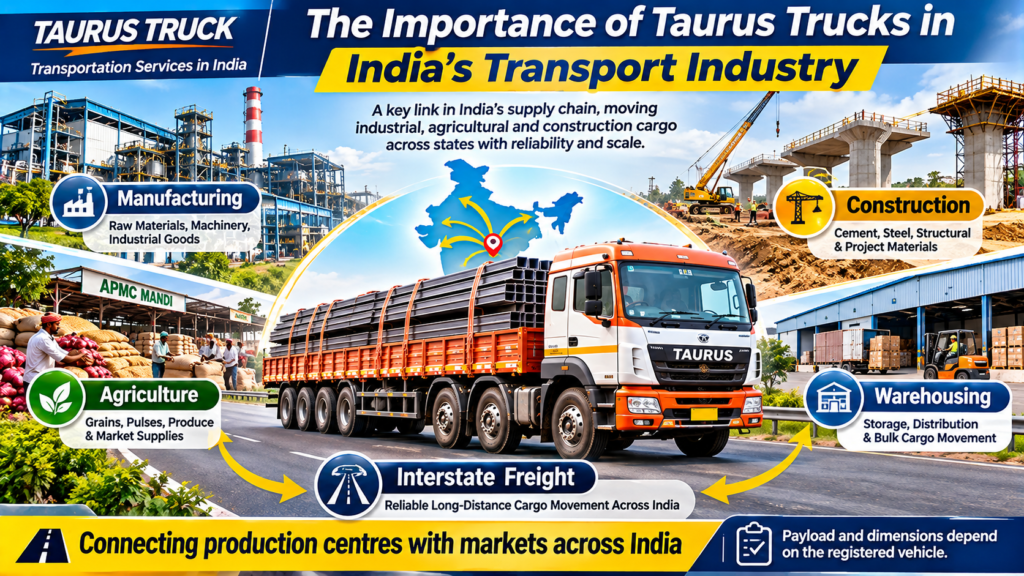
India’s road freight industry connects manufacturing plants, agricultural markets, construction sites, mining regions, warehouses, distribution centres and industrial corridors. Among the many commercial vehicles operating on Indian highways, Taurus trucks have established a familiar identity in the heavy goods transportation market.
A Taurus truck is commonly associated with heavy-duty, multi-axle rigid cargo vehicles. In everyday transport conversations, the name is frequently used for trucks carrying steel, cement, machinery, agricultural commodities, industrial raw materials and other substantial commercial consignments.
However, Taurus is not a universal regulatory category for all multi-axle trucks. The name has historical associations with Ashok Leyland’s Taurus vehicle range, while transport operators sometimes use it informally for similar heavy rigid trucks.
For a customer booking transportation services, the important questions are not simply whether a vehicle is called a Taurus or how many wheels it has. The real considerations are its registered gross vehicle weight, permissible payload, usable body dimensions, axle configuration, cargo suitability and route conditions.
A correctly selected Taurus-type truck can support efficient full-truckload operations, reduce unnecessary vehicle movements and improve industrial supply chain planning.
This guide explains the technical, commercial, operational and legal aspects of Taurus truck transportation in India, including freight calculations, vehicle selection, industrial applications, return-load management and practical advice for transport businesses.
🏗️ What Is a Taurus Truck? Meaning, Design and Commercial Applications
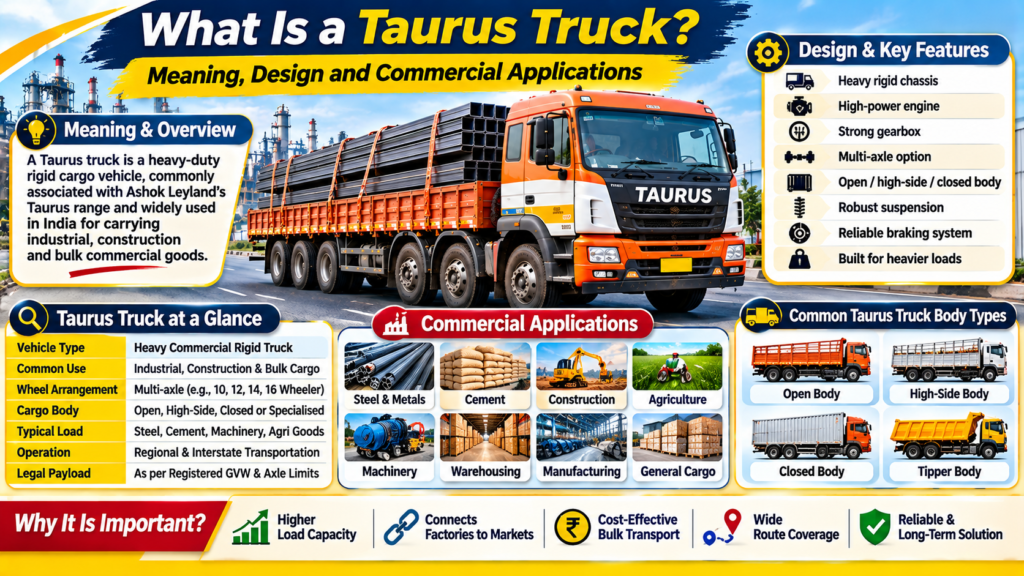
In the Indian commercial vehicle market, the term Taurus generally refers to a heavy rigid truck designed to carry commercial freight on its own chassis.
Unlike a tractor-trailer combination, a rigid truck has its driving unit and cargo body integrated into a single vehicle structure.
The vehicle may be fitted with an open loading platform, high-side body, tipper body, container-type enclosure or another specialised body, depending on the chassis design and approved configuration.
Taurus Truck Technical Overview
| Parameter | Explanation |
|---|---|
| Vehicle category | Heavy commercial goods vehicle |
| Common terminology | Taurus truck, multi-axle truck, heavy rigid truck |
| Chassis design | Rigid chassis |
| Wheel arrangement | Depends on model and axle configuration |
| Cargo body | Open, high-side, closed or specialised |
| Typical customers | Manufacturers, construction firms, traders, warehouses |
| Common cargo | Steel, cement, machinery, agricultural goods |
| Freight arrangement | Primarily full truckload |
| Operating area | Regional and interstate road freight |
| Legal payload | Depends on individual vehicle registration |
| Loading equipment | Forklift, crane, hydraulic equipment or manual handling |
| Freight pricing | Route, capacity, cargo and market dependent |
Why Do Indian Transporters Use the Name Taurus?
The term became familiar through commercial vehicle usage and historical model branding.
Over time, some transport markets began using it as a convenient description for heavy multi-axle trucks.
This can create misunderstandings because a truck described as a Taurus in one market may have different specifications from a similarly named vehicle elsewhere.
Customers should therefore request the exact model and vehicle registration details before booking.
⚙️ Taurus Truck Construction and Major Components
A heavy commercial truck is an integrated mechanical system. Its freight capability depends on several components working together.
Major Components of a Taurus Truck
| Component | Function | Importance |
|---|---|---|
| Engine | Generates propulsion power | Influences gradeability and fuel consumption |
| Gearbox | Transfers engine power | Supports different driving conditions |
| Clutch or transmission system | Controls power transfer | Important for starting and manoeuvring |
| Chassis frame | Supports vehicle and cargo body | Critical to structural integrity |
| Front axle | Supports steering and front load | Important for steering and load distribution |
| Rear axles | Support and transmit heavy loads | Determine axle-load distribution |
| Suspension | Absorbs road shocks | Protects vehicle and cargo |
| Braking system | Controls vehicle speed | Essential for safe heavy-load operation |
| Tyres | Maintain road contact | Must meet load and pressure requirements |
| Cargo body | Holds the consignment | Determines loading suitability |
| Fuel system | Supplies operating fuel | Affects operating economics |
| Electrical system | Supports lighting and electronics | Important for reliability and safety |
| Cabin | Driver operating environment | Influences comfort and fatigue |
| Cargo restraints | Secure the goods | Reduce shifting and damage |
Why Chassis and Axle Configuration Matter
A truck’s carrying capability is not determined by engine power alone.
The chassis, suspension, axles, tyres and brakes must be suitable for the permitted weight and intended operation.
A high-powered truck is not automatically authorised to carry a heavier consignment.
The registered weight limits and manufacturer’s specifications remain essential.
⚖️ Taurus Truck Load Capacity: Understanding GVW, Payload and Axle Limits
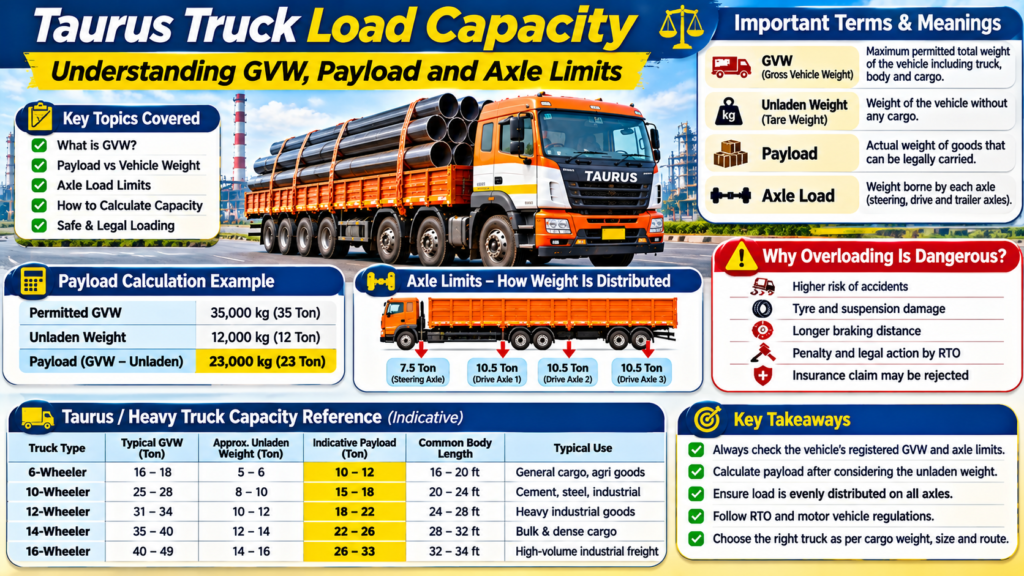
Load capacity is one of the most searched topics among freight customers.
Unfortunately, many online transport advertisements use vague expressions such as “25-ton truck” or “30-ton Taurus” without explaining whether the figure refers to gross vehicle weight or actual payload.
Difference Between GVW, Unladen Weight and Payload
| Term | Meaning | Why it matters |
|---|---|---|
| GVW | Maximum permitted total vehicle weight | Legal operating limit |
| Unladen weight | Weight of vehicle without cargo | Determines available capacity |
| Payload | Permissible weight of goods | Determines booking suitability |
| Axle load | Weight transmitted through an axle | Prevents unsafe weight distribution |
| Body capacity | Physical loading space | Determines cargo fit |
| Volumetric capacity | Space available for bulky goods | Important for lightweight cargo |
| Point load | Weight concentrated in a small area | Important for machinery and steel coils |
Example: How to Calculate Taurus Truck Payload
Consider a hypothetical truck with the following specifications:
| Description | Illustrative value |
|---|---|
| Permitted GVW | 35,000 kg |
| Unladen weight | 12,000 kg |
| Theoretical payload | 23,000 kg |
| Proposed cargo weight | 21,000 kg |
| Difference below theoretical payload | 2,000 kg |
Formula:
Permissible payload = Permitted GVW − Unladen vehicle weight
This example assumes the stated unladen weight accurately reflects the vehicle’s configuration. Additional equipment and other applicable weight restrictions must also be considered.
Even when the total weight is within the permitted GVW, individual axle loads can still exceed their legal limits.
Why Overloading Is Dangerous
Overloading can increase braking distances, damage tyres and suspension, reduce vehicle stability and contribute to road accidents.
It may also result in regulatory action, operational delays, cargo damage and insurance complications.
A responsible transporter should never treat an advertised truck capacity as permission to exceed the vehicle’s registered limits.
🚛 10-Wheeler, 12-Wheeler, 14-Wheeler and 16-Wheeler Taurus Truck Comparison
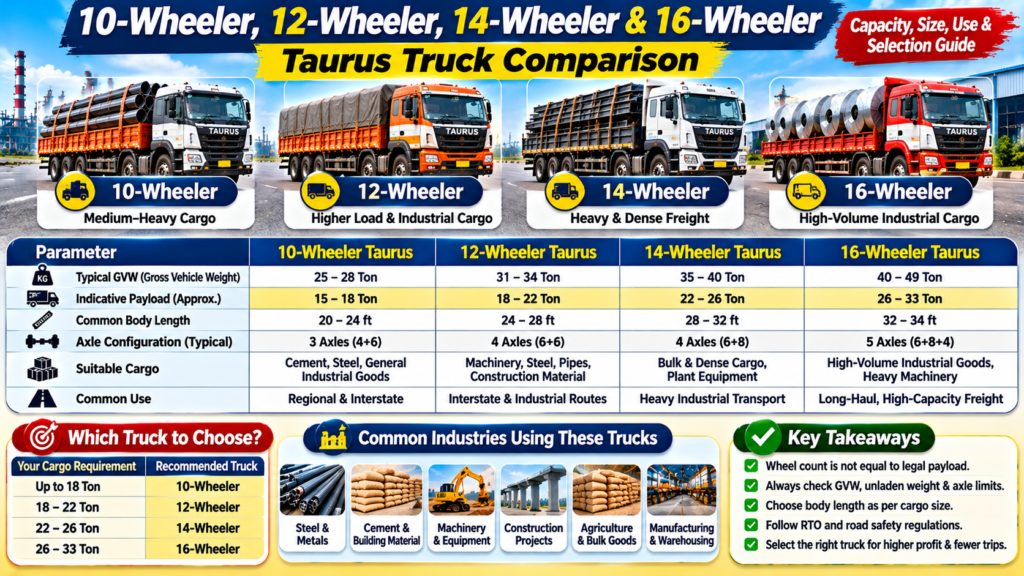
Truck buyers and freight customers frequently identify commercial vehicles by their wheel count. However, the wheel count alone does not determine a vehicle’s legal payload.
A better comparison considers the registered axle configuration, chassis design, cargo body and permitted gross weight.
Taurus and Multi-Axle Truck Comparison Chart
| Truck category | Common market description | Typical application | Important verification |
|---|---|---|---|
| 6-wheeler | Medium or heavy rigid truck | General commercial cargo | GVW and body dimensions |
| 10-wheeler | Heavy multi-axle truck | Steel, cement, industrial freight | Axle configuration and payload |
| 12-wheeler | Market-dependent heavy truck category | Industrial and bulk goods | Actual wheel and axle arrangement |
| 14-wheeler | Higher-capacity rigid truck | Dense freight and construction material | Registered GVW and axle limits |
| 16-wheeler | Heavy multi-axle goods vehicle | Bulk industrial consignments | Model-specific specifications |
| Higher-axle truck | Specialised heavy commercial vehicle | Large-volume or heavy freight | Manufacturer and RC specifications |
These categories are commonly used in freight discussions. They are not a substitute for model-specific specifications.
Which Truck Should a Customer Choose?
For a shipment weighing 15 tonnes, a vehicle with a verified legal payload exceeding the consignment weight may be appropriate.
For a 25-tonne shipment, the customer should obtain the registered specifications of available higher-capacity trucks.
For a 30-tonne or heavier consignment, vehicle selection requires particular attention to permissible gross weight, axle distribution and loading arrangements.
If the cargo is exceptionally long, wide or tall, a semi-trailer or specialised low-bed trailer may be more suitable than a rigid Taurus-type truck.
📏 Taurus Truck Body Length, Width, Height and Cargo Space
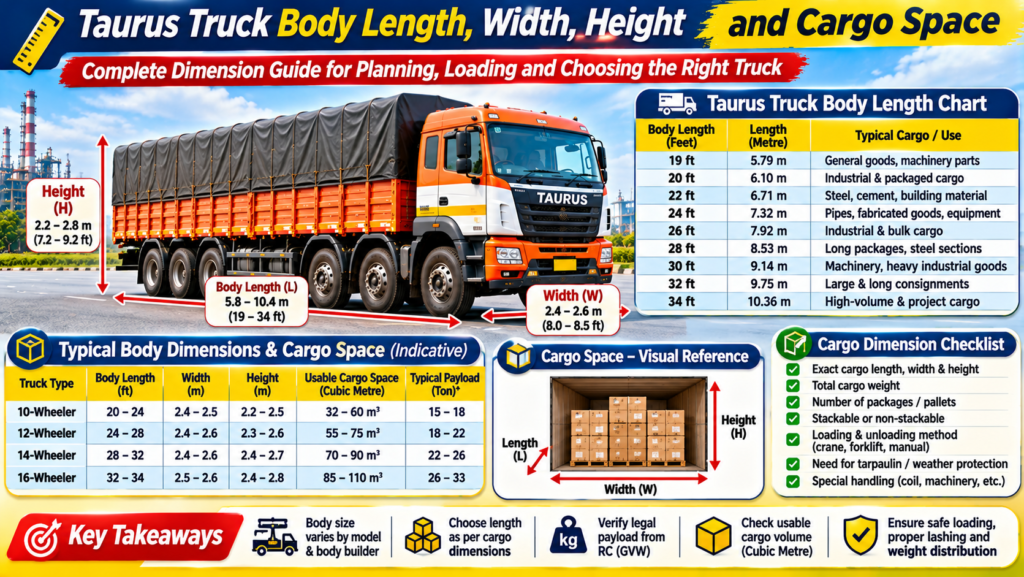
The usable cargo dimensions of a truck are different from its overall external dimensions.
For example, a truck advertised with a 28-foot body may have less usable length because of the front bulkhead, rear structure or body fittings.
Truck Body Length Selection Guide
| Nominal body length | Approximate length in metres | Common cargo |
|---|---|---|
| 19 ft | 5.79 m | Machinery parts, packaged goods |
| 20 ft | 6.10 m | Industrial cargo |
| 22 ft | 6.71 m | Steel and general freight |
| 24 ft | 7.32 m | Pipes, fabricated goods |
| 26 ft | 7.92 m | Industrial materials |
| 28 ft | 8.53 m | Long packaged cargo |
| 30 ft | 9.14 m | Steel sections and machinery |
| 32 ft | 9.75 m | Long industrial consignments |
| 34 ft | 10.36 m | Cargo requiring extended loading space |
These are length conversions and planning categories, not a claim that every listed body size is available on every Taurus model.
Cargo Dimension Checklist
| Measurement | What the customer must provide |
|---|---|
| Cargo length | Longest dimension |
| Cargo width | Maximum width including packaging |
| Cargo height | Height including pallets or supports |
| Cargo weight | Verified gross consignment weight |
| Centre of gravity | Particularly important for machinery |
| Loading method | Crane, forklift, manual or ramp |
| Number of packages | Total packages and individual weights |
| Stackability | Whether cargo may be stacked |
| Weather sensitivity | Need for covered transport |
| Unloading arrangements | Equipment available at destination |
For high-value industrial cargo, a loading drawing or packing list can reduce misunderstandings between the customer, transporter and driver.
🏭 Industrial Applications of Taurus Trucks in India
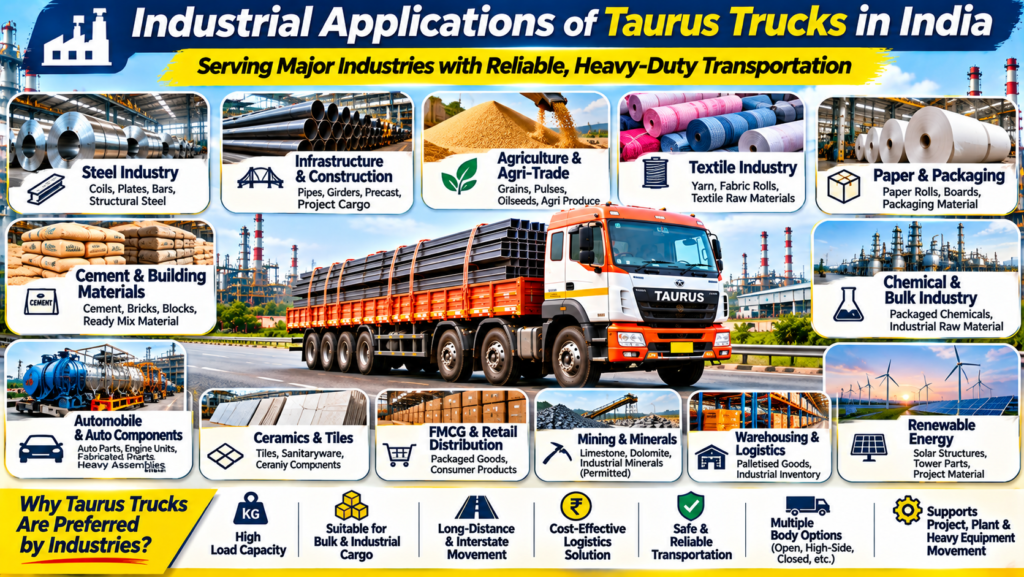
Heavy rigid trucks serve a wide range of industries.
Industry-Wise Taurus Truck Cargo Chart
| Industry | Common cargo | Preferred body consideration |
|---|---|---|
| Steel | Bars, plates, structural sections | Open body with proper restraints |
| Cement | Bagged cement | High-side or covered body |
| Construction | Bricks, packaged materials | Suitable open or high-side body |
| Agriculture | Grains, pulses, produce | Weather and ventilation suitability |
| Engineering | Fabricated machinery components | Load-bearing support and lashing |
| Automobile | Components and assemblies | Cargo protection |
| Textile | Packed fabrics and materials | Closed or weather-protected body |
| Paper | Paper rolls and packaging | Moisture protection |
| Ceramics | Tiles and sanitaryware | Shock protection |
| FMCG | Packaged consumer goods | Closed body where appropriate |
| Chemicals | Permitted packaged chemicals | Compatibility and regulatory compliance |
| Renewable energy | Structural components | Dimensional suitability |
| Warehousing | Palletised commercial goods | Forklift-compatible loading |
| Infrastructure | Fabricated steel and project materials | Weight distribution and securement |
| Mining | Permitted bulk materials | Approved tipper or suitable body |
The suitability of a Taurus truck depends on the cargo’s physical characteristics and applicable regulations, not simply its industry.
💰 Taurus Truck Freight Rates Per Kilometre in India
There is no universal government-fixed commercial freight rate for Taurus truck transportation across India.
Rates vary by corridor, cargo, vehicle size, diesel costs, toll charges, demand, seasonal conditions and return-load availability.
The following table demonstrates how different assumed per-kilometre rates affect trip costs. It is a calculation example, not a verified market-rate survey.
Illustrative Freight Calculation Chart
| Distance | ₹45/km | ₹55/km | ₹65/km | ₹75/km |
|---|---|---|---|---|
| 100 km | ₹4,500 | ₹5,500 | ₹6,500 | ₹7,500 |
| 250 km | ₹11,250 | ₹13,750 | ₹16,250 | ₹18,750 |
| 500 km | ₹22,500 | ₹27,500 | ₹32,500 | ₹37,500 |
| 750 km | ₹33,750 | ₹41,250 | ₹48,750 | ₹56,250 |
| 1,000 km | ₹45,000 | ₹55,000 | ₹65,000 | ₹75,000 |
| 1,250 km | ₹56,250 | ₹68,750 | ₹81,250 | ₹93,750 |
| 1,500 km | ₹67,500 | ₹82,500 | ₹97,500 | ₹1,12,500 |
| 2,000 km | ₹90,000 | ₹1,10,000 | ₹1,30,000 | ₹1,50,000 |
| 2,500 km | ₹1,12,500 | ₹1,37,500 | ₹1,62,500 | ₹1,87,500 |
| 3,000 km | ₹1,35,000 | ₹1,65,000 | ₹1,95,000 | ₹2,25,000 |
Calculation: Distance × assumed rate per kilometre.
Tolls, loading, unloading, detention, permits, GST where applicable and other contractual expenses may be additional.
Factors Affecting Freight Rates
| Factor | Effect on freight |
|---|---|
| Cargo weight | May require a higher-capacity vehicle |
| Cargo dimensions | May restrict vehicle choice |
| Diesel prices | Affect operating expenses |
| Toll charges | Increase route costs |
| Return-load availability | Influences one-way quotations |
| Seasonal demand | Changes vehicle availability |
| Road conditions | Affect travel time and maintenance |
| Loading delays | Increase detention expenses |
| Insurance requirements | May increase total shipment cost |
| Special cargo handling | Adds equipment and labour costs |
🔄 Taurus Truck Return Load: Problems, Opportunities and Solutions
Empty return journeys remain a significant operational concern for India’s road freight industry.
A truck carrying industrial cargo from Ahmedabad to Kolkata may need to search for a suitable consignment before returning west.
A return load is commercially useful only when the freight revenue exceeds the additional costs and risks associated with accepting it.
Return Load Problem and Solution Chart
| Problem | Business impact | Practical solution |
|---|---|---|
| No return cargo | Empty running costs | Plan loads before delivery |
| Low freight offers | Reduced profit | Calculate contribution margin |
| Unverified brokers | Payment and fraud risk | Verify identity and references |
| Loading delays | Loss of operating days | Negotiate detention terms |
| Wrong cargo dimensions | Vehicle mismatch | Obtain packing details |
| Excessive cargo weight | Legal and safety risk | Verify permissible payload |
| Route diversion | Additional fuel and tolls | Compare total trip economics |
| Payment uncertainty | Cash-flow problems | Use written freight agreements |
| Seasonal freight shortage | Lower utilisation | Diversify customer sectors |
| Poor coordination | Missed bookings | Improve dispatch communication |
Example: Return Load Profitability
| Description | Illustrative amount |
|---|---|
| Return freight revenue | ₹45,000 |
| Fuel and toll expenses | ₹25,000 |
| Driver and trip expenses | ₹5,000 |
| Other variable costs | ₹4,000 |
| Contribution before fixed costs | ₹11,000 |
This example demonstrates why freight revenue alone does not determine profitability. Financing, depreciation, insurance, maintenance provisions and other fixed costs must also be considered.
🛣️ Important Taurus Truck Freight Corridors in India

Heavy rigid trucks operate across India’s major industrial and agricultural regions.
Regional Freight Corridor Chart
| Origin region | Common destination markets | Freight opportunities |
|---|---|---|
| Gujarat | Maharashtra, Rajasthan, Delhi NCR | Industrial and commercial goods |
| Maharashtra | Gujarat, Karnataka, Telangana | Manufacturing and warehouse freight |
| Rajasthan | Gujarat, Haryana, Uttar Pradesh | Minerals and construction materials |
| Punjab | Haryana, Delhi NCR, Rajasthan | Agricultural and industrial goods |
| Haryana | Uttar Pradesh, Rajasthan, Punjab | Automotive and distribution cargo |
| Uttar Pradesh | Delhi NCR, Bihar, Madhya Pradesh | FMCG and industrial freight |
| Madhya Pradesh | Gujarat, Maharashtra, Chhattisgarh | Agricultural and manufactured goods |
| Chhattisgarh | Odisha, Maharashtra, Jharkhand | Steel and industrial products |
| Odisha | Jharkhand, West Bengal, Andhra Pradesh | Steel and mineral-related freight |
| Jharkhand | West Bengal, Bihar, Odisha | Steel and engineering goods |
| West Bengal | Bihar, Jharkhand, Odisha | Commercial distribution |
| Karnataka | Maharashtra, Tamil Nadu, Telangana | Engineering and manufactured goods |
| Tamil Nadu | Karnataka, Andhra Pradesh, Telangana | Automotive and industrial cargo |
| Telangana | Maharashtra, Karnataka, Andhra Pradesh | Manufacturing and warehousing |
| Andhra Pradesh | Telangana, Tamil Nadu, Odisha | Industrial and agricultural freight |
These are examples of established regional trading relationships, not verified live load availability or guaranteed Taurus truck routes.
🧾 Documents Required for Taurus Truck Transportation
Documentation is essential for legal and efficient interstate freight movement.
Transport Documentation Chart
| Document | Purpose |
|---|---|
| Registration certificate | Establishes vehicle registration and particulars |
| Driving licence | Confirms driver’s applicable driving entitlement |
| Fitness certificate | Establishes required vehicle fitness compliance |
| Insurance certificate | Confirms vehicle insurance |
| Permit | Authorises applicable commercial operations |
| Pollution certificate | Confirms applicable emission compliance |
| Goods invoice | Identifies commercial consignment |
| E-way bill | Supports GST movement compliance where required |
| Lorry receipt | Records transportation arrangement |
| Packing list | Describes packages and quantities |
| Weighbridge slip | Records measured weight |
| Delivery acknowledgement | Confirms receipt of cargo |
| Cargo insurance documents | Records transit coverage where arranged |
| Special permits | Required for applicable restricted or specialised movements |
Document requirements vary by vehicle, cargo, route and applicable law.
🛡️ Taurus Truck Loading, Lashing and Road Safety
The safe transportation of heavy cargo depends on correct loading and restraint.
A consignment may be within the truck’s total permitted payload but still create unsafe axle loads or concentrated stresses.
Cargo Safety Checklist
| Safety item | Required action |
|---|---|
| Cargo weight | Verify actual weight |
| Axle distribution | Check permissible axle loads |
| Body strength | Confirm suitability for concentrated loads |
| Cargo supports | Use suitable dunnage and supports |
| Lashing | Select suitable restraints |
| Sharp edges | Protect straps and chains |
| Tarpaulin | Provide weather protection where necessary |
| Tyres | Inspect condition and inflation |
| Brakes | Confirm proper operation |
| Lights | Check all mandatory lighting |
| Mirrors | Ensure adequate visibility |
| Driver rest | Plan appropriate breaks |
| Emergency equipment | Carry required safety equipment |
| Route assessment | Identify restrictions and hazards |
| Unloading equipment | Confirm destination readiness |
Steel Coil Transportation Precautions
Steel coils require particular care because their concentrated mass can shift if inadequately supported.
Suitable coil saddles, chocks, restraints and load-distribution arrangements should be selected according to the cargo and vehicle design.
Improvised restraints or unsecured coils can create serious safety risks.
👨✈️ Taurus Truck Drivers: Working Conditions and Operational Challenges
Truck drivers are central to India’s freight supply chain.
They manage long journeys, traffic congestion, unpredictable loading schedules, vehicle inspections and difficult delivery conditions.
Driver Challenges and Practical Improvements
| Challenge | Possible improvement |
|---|---|
| Long waiting hours | Better loading appointments |
| Limited safe parking | Planned rest stops |
| Inadequate sanitation | Access to clean facilities |
| Cargo theft risk | Secure parking and route planning |
| Delayed trip expenses | Timely advances and settlements |
| Driver fatigue | Reasonable schedules and rest |
| Roadside disputes | Proper documents and escalation support |
| Vehicle breakdowns | Preventive maintenance |
| Unclear delivery instructions | Written dispatch details |
| Emergency situations | Reliable contact and assistance procedures |
A transport business that invests in driver welfare can improve safety, reliability and operational continuity.
🔧 Taurus Truck Maintenance and Operating Expenses
Maintenance costs directly influence truck profitability.
Tyres, brakes, suspension, engine condition and lubrication require regular attention, especially in vehicles operating with heavy loads.
Maintenance Planning Chart
| Component | Inspection focus |
|---|---|
| Engine | Oil, coolant, leaks and performance |
| Gearbox | Oil condition and abnormal noise |
| Clutch | Engagement and wear |
| Brakes | Pressure, lining and response |
| Tyres | Pressure, tread and damage |
| Suspension | Springs, bushes and mountings |
| Axles | Bearings, seals and lubrication |
| Steering | Free play and component condition |
| Battery | Connections and charging |
| Lights | Headlamps, indicators and brake lamps |
| Cargo body | Cracks, corrosion and fasteners |
| Lashing equipment | Wear and damage |
| Cabin | Controls, seat belts and visibility |
Inspection and service intervals should follow the vehicle manufacturer’s instructions and actual operating conditions.
📊 Taurus Truck Business Economics for Fleet Owners
Buying a heavy truck is a capital-intensive business decision.
Profitability depends on freight revenue, utilisation, financing, fuel consumption, repairs, driver expenses and the number of empty kilometres.
Illustrative Monthly Truck Operating Statement
| Particulars | Monthly amount |
|---|---|
| Freight revenue | ₹3,50,000 |
| Diesel | ₹1,30,000 |
| Tolls | ₹30,000 |
| Driver and helper | ₹35,000 |
| Maintenance provision | ₹20,000 |
| Tyre provision | ₹12,000 |
| Insurance and statutory provision | ₹8,000 |
| Finance instalment | ₹55,000 |
| Other expenses | ₹15,000 |
| Balance after listed expenses | ₹45,000 |
This is a hypothetical business-planning example, not an industry average or audited profit statement. It excludes any additional costs not listed and does not substitute for a complete accounting assessment.
Important Business Performance Indicators
| Indicator | What it measures |
|---|---|
| Revenue per kilometre | Freight earnings relative to distance |
| Cost per kilometre | Operating expense efficiency |
| Loaded kilometre percentage | Vehicle utilisation |
| Empty running percentage | Unproductive travel |
| Freight payment cycle | Cash-flow efficiency |
| Maintenance downtime | Vehicle availability |
| Revenue per operating day | Daily commercial productivity |
| Detention hours | Loading and unloading delays |
| Customer repeat rate | Business relationship quality |
| Net operating margin | Profitability after relevant costs |
🏦 New and Second-Hand Taurus Truck Purchase Considerations
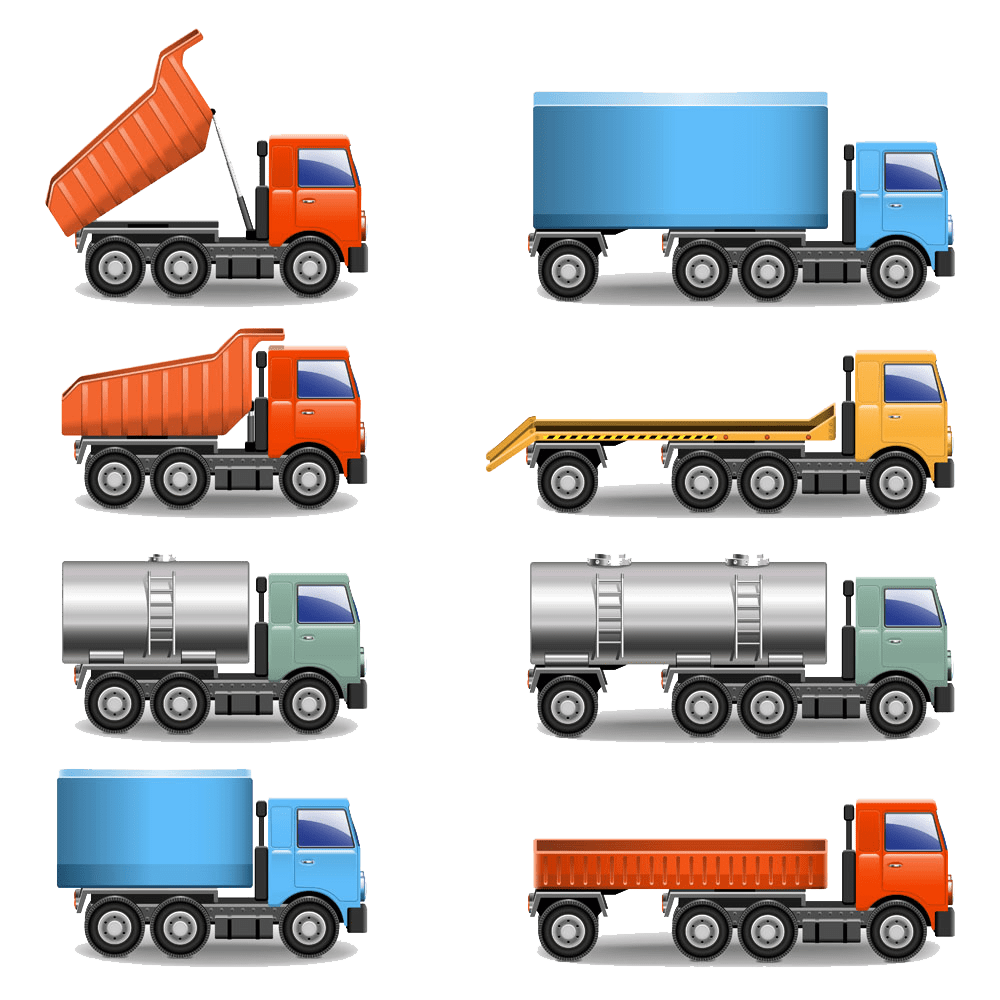
Purchasing a truck requires a different evaluation from hiring one.
A new vehicle may offer updated technology, manufacturer support and warranty benefits, while a used vehicle may require lower initial capital but greater inspection.
New vs Used Heavy Truck Comparison
| Factor | New truck | Used truck |
|---|---|---|
| Purchase cost | Generally higher | Generally lower |
| Initial maintenance risk | Usually lower | Depends on condition |
| Warranty | May be available | Limited or absent |
| Financing | Subject to lender terms | Subject to age and condition |
| Vehicle history | New | Must be investigated |
| Downtime risk | Depends on model and usage | More condition-dependent |
| Resale value | Depreciation begins from purchase | Depends on age and market |
| Inspection requirement | Delivery inspection | Detailed mechanical and legal inspection |
Used Truck Inspection Checklist
Before purchasing a second-hand heavy truck, inspect the chassis, engine, gearbox, axles, tyres, brakes, body structure and maintenance records.
Verify ownership, hypothecation status, registration details, permits, fitness, insurance and any outstanding liabilities.
A professional mechanical inspection and a review of the vehicle’s commercial history can reduce purchase risk.
🚚 Taurus Truck vs Container Truck vs Trailer vs Tipper
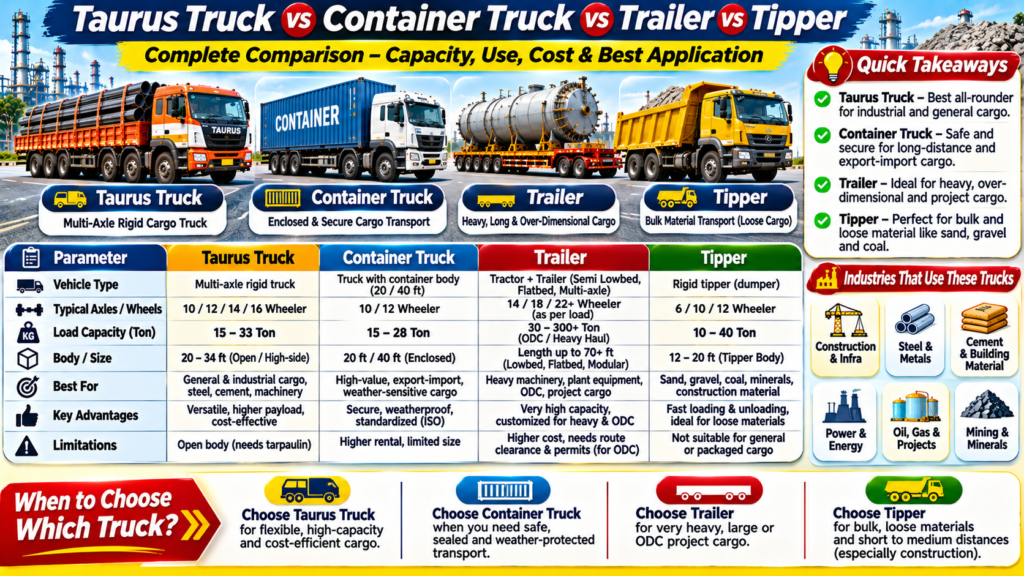
Different commercial vehicles solve different freight problems.
Vehicle Selection Comparison
| Vehicle | Main advantage | Suitable cargo |
|---|---|---|
| Taurus-type rigid truck | Heavy general freight | Steel, machinery, packaged industrial goods |
| Container truck | Enclosed cargo protection | FMCG, electronics, packaged goods |
| Flatbed trailer | Longer loading platform | Structural steel and machinery |
| Semi-lowbed trailer | Lower loading height | Heavy equipment |
| Lowbed trailer | Specialised heavy-load carriage | Construction machinery |
| Tipper truck | Efficient bulk unloading | Sand, aggregates, permitted minerals |
| Refrigerated truck | Temperature control | Perishable and temperature-sensitive cargo |
| Tanker | Bulk liquid transport | Compatible liquid products |
The correct vehicle should be selected according to cargo dimensions, legal payload, loading method and delivery conditions.
📦 Full Truckload and Part Load Transportation
Taurus-type trucks are primarily associated with full truckload transportation, but commercial arrangements may also involve consolidated cargo.
FTL vs LTL Comparison
| Feature | Full Truckload (FTL) | Less Than Truckload (LTL) |
|---|---|---|
| Cargo ownership | Usually one customer’s consignment | Multiple consignments |
| Freight pricing | Vehicle or trip based | Weight, volume and route based |
| Handling | Generally fewer transfers | May involve consolidation |
| Delivery planning | More direct | Depends on network |
| Suitable for | Large industrial shipments | Smaller commercial consignments |
| Cargo compatibility | Customer-specific | Requires consolidation planning |
For dense industrial cargo, full truckload service often provides simpler loading and delivery arrangements.
🤝 Transport Brokers, Commission Agents and Fleet Operators
India’s truck transportation industry relies on relationships between freight customers, truck owners, fleet operators and transport commission agents.
A broker may help match available trucks with suitable consignments, coordinate quotations and assist with operational communication.
Roles in the Transport Business
| Participant | Primary responsibility |
|---|---|
| Manufacturer or shipper | Provides cargo information |
| Freight customer | Contracts transportation |
| Transport company | Organises freight movement |
| Fleet owner | Provides vehicles |
| Commission agent | Connects cargo and vehicle availability |
| Driver | Operates the vehicle |
| Loading contractor | Handles loading operations |
| Warehouse operator | Coordinates storage and dispatch |
| Insurance provider | Provides agreed coverage |
| Consignee | Receives the goods |
Clear documentation of responsibilities, payment terms and claims procedures can reduce disputes.
🚨 Common Taurus Truck Transportation Problems and Solutions
| Problem | Possible cause | Recommended response |
|---|---|---|
| Vehicle not placed on time | Poor availability planning | Confirm dispatch before commitment |
| Truck breakdown | Mechanical failure | Preventive maintenance and backup plan |
| Cargo damage | Inadequate restraint | Improve packaging and lashing |
| Excess freight demand | Seasonal capacity shortage | Plan bookings earlier |
| Driver shortage | Workforce availability | Maintain reliable driver arrangements |
| Wrong vehicle supplied | Incomplete cargo information | Verify RC and body dimensions |
| Overloading dispute | Incorrect weight declaration | Obtain verified weighment |
| Delayed unloading | Site congestion | Schedule unloading appointments |
| Freight payment dispute | Unclear contract | Written payment terms |
| Cargo theft | Insecure parking or handling | Security planning and verified handovers |
| E-way bill expiry | Unexpected delay | Follow applicable extension procedures |
| Return-load shortage | Imbalanced freight corridor | Plan alternative markets |
🌱 Future of Heavy Rigid Truck Transportation in India
India’s freight sector is gradually adopting digital fleet management, GPS-based visibility, electronic documentation and improved vehicle monitoring.
Alternative fuels and newer commercial vehicle technologies may also influence future operating costs and environmental performance.
However, adoption depends on vehicle availability, infrastructure, route economics, financing and operational suitability.
For heavy rigid truck operators, the most practical improvements often begin with better maintenance, accurate loading, lower empty running and improved driver support.
🏢 ABCC India Project Cargo Corporation – Taurus Truck Transportation Support
ABCC India Project Cargo Corporation works in commercial road transportation and project cargo logistics coordination.
Customers requiring heavy rigid trucks, open-body vehicles, industrial freight services or specialised trailers can enquire about suitable vehicle arrangements according to route, cargo and availability.
For an accurate quotation, customers should share cargo weight, dimensions, loading location, destination, dispatch date and handling requirements.
Transport enquiries: ABCC India Project Cargo Corporation
❓ Frequently Asked Questions

What is a Taurus truck?
A Taurus truck is commonly understood in India as a heavy-duty rigid commercial goods vehicle. The term is also associated with historical Ashok Leyland model branding.
What is the load capacity of a Taurus truck?
The legal payload depends on the registered vehicle’s GVW, unladen weight, axle limits and approved configuration. There is no single capacity applicable to every Taurus truck.
Is a Taurus truck the same as a 10-wheeler?
Not necessarily. Taurus is a commercial term, while 10-wheeler describes a wheel arrangement. Exact specifications must be checked.
What is the Taurus truck rent per kilometre?
Rates vary by vehicle, cargo, route, tolls, diesel prices, market demand and return-load availability. Customers should obtain a current route-specific quotation.
Can Taurus trucks carry 30 tonnes?
Only a vehicle with sufficient verified legal payload and appropriate axle distribution may carry such a load. The Taurus name alone does not establish that capability.
Which industries use Taurus trucks?
Steel, cement, construction, agriculture, engineering, warehousing, manufacturing and other commercial sectors use heavy rigid goods vehicles.
What is the difference between Taurus trucks and trailers?
A rigid truck carries its body on a single chassis. A tractor-trailer uses a tractor unit and a separate articulated trailer.
Can Taurus trucks transport oversized machinery?
Some machinery can be transported if its weight and dimensions are legally and technically suitable. Larger or oversized cargo may require specialised trailers and route assessment.
How do Taurus truck owners find return loads?
They may work with verified brokers, freight networks, regular customers and transport companies while checking cargo compatibility and trip profitability.
What documents are required for interstate transportation?
Requirements may include the RC, driving licence, insurance, fitness certificate, permits, invoice, e-way bill and consignment documents, as applicable.
Are Taurus trucks suitable for long-distance freight?
Suitable heavy rigid trucks can operate on long-distance routes when vehicle condition, legal compliance, driver arrangements and route suitability are properly managed.
How can truck owners improve profitability?
Better vehicle utilisation, fewer empty kilometres, preventive maintenance, disciplined freight pricing and timely payment collection can improve operating performance.
👩💻 How This Guide Was Prepared – Industry Knowledge and Editorial Approach
This guide brings together commercial vehicle fundamentals, road freight planning principles, load-capacity calculations, transport documentation requirements and practical operating considerations relevant to Indian heavy truck transportation.
The information distinguishes between manufacturer-specific vehicle specifications, common transport-market terminology and illustrative commercial calculations.
Vehicle specifications and regulatory requirements should always be checked against current official records before operational decisions.
Author: R. K. Savarn
Industry focus: Road transportation, heavy haulage, industrial freight coordination and logistics consulting.
Author profile: https://travel.roadstransporter.com/author/admin/
🚛 Conclusion: The Real Value of Taurus Trucks in Indian Logistics
Taurus-type heavy rigid trucks continue to play an important role in connecting India’s factories, agricultural markets, warehouses and industrial regions.
Their usefulness comes from combining substantial freight capability with the operational flexibility of a rigid commercial vehicle.
However, successful transportation requires more than selecting a truck by wheel count or advertised carrying capacity.
Accurate cargo information, legal loading, appropriate vehicle selection, safe handling, reliable drivers and clear commercial agreements are essential.
For transport companies and truck owners, long-term profitability depends on disciplined operations, dependable customer relationships and effective return-load planning.
For freight customers, the best transport decision is one based on verified vehicle specifications, transparent pricing and safe delivery arrangements.

