Introduction: Why Route Surveys Are Essential for Oversized Cargo Transportation
India’s industrial development depends on the safe movement of machinery, infrastructure components and specialised equipment between manufacturing facilities, ports, construction sites, power plants, refineries and project locations.
Unlike conventional freight, oversized and overweight cargo cannot always travel through ordinary highway networks without detailed engineering assessments, infrastructure verification and regulatory coordination.
A transformer weighing several hundred tonnes, a wind turbine blade extending beyond 70 metres, or a refinery vessel with an exceptional diameter may encounter numerous obstacles during transportation. These include narrow roads, railway crossings, low-clearance bridges, overhead electrical lines, sharp bends, weak culverts, restricted urban corridors and insufficient turning space.
A road route survey for ODC cargo is a technical assessment of a proposed transportation corridor to determine whether an oversized, overweight or unusually configured load can move safely, legally and economically from its origin to its destination.
The survey evaluates more than the road itself. It considers the complete transportation system, including cargo dimensions, trailer configuration, axle loads, bridge capacity, turning geometry, overhead clearance, road gradients, temporary obstructions, loading arrangements, emergency access and applicable permissions.
For project cargo logistics companies, industrial manufacturers, EPC contractors, freight forwarders and heavy haulage operators, a properly documented route survey is an important foundation for transportation planning.
The relationship between ODC transportation and route surveys

| Transportation category | Typical cargo | Major route survey concern |
|---|---|---|
| Over-Dimensional Cargo (ODC) | Large tanks, structural modules, industrial vessels | Width, height, length and clearances |
| Out-of-Gauge Cargo (OOG) | Cargo exceeding a transport equipment’s standard envelope | Overall loaded dimensions and equipment compatibility |
| Overweight Cargo (OWC) | Heavy transformers, generators, industrial machinery | Axle loads, bridges, pavements and structural capacity |
| Heavy Lift Project Cargo | Large plant components and machinery | Lifting arrangements and route engineering |
| Long-Length Cargo | Wind blades, girders, towers and pipes | Turning radius, swept path and rear overhang |
| Super-Heavy Cargo | Exceptional industrial equipment | Bridge analysis, modular axle arrangements and ground-bearing capacity |
| Multimodal Project Cargo | Cargo moving by road, rail, inland waterway or sea | Interface feasibility, transshipment and terminal access |
These categories can overlap. A single transformer may be both over-dimensional and overweight, while a wind turbine blade may be primarily a long-length OOG movement.
The classification should be based on actual cargo dimensions, weight, vehicle configuration and the regulations applicable to the proposed journey.
What Is a Road Route Survey in Heavy Haulage Logistics?
A road route survey is a structured process of collecting, measuring, evaluating and documenting physical and operational conditions along a transportation corridor.
For ordinary trucks, routing may largely involve road connectivity, distance, travel time, tolls and restrictions. For ODC and heavy haulage, routing becomes an engineering and risk-management exercise.
The survey team must establish whether the complete loaded transport combination can negotiate every critical section of the proposed route.
This requires consideration of the cargo, loading supports, trailer, suspension, tractor, steering system, axle configuration and operational arrangements as one integrated transport unit.
Five essential questions
- Physical feasibility: Can the loaded combination pass through every road section, junction, bridge, underpass and overhead obstruction?
- Structural feasibility: Can the roads, bridges, culverts, approaches and temporary working areas safely accommodate the proposed loading?
- Legal feasibility: What permissions, exemptions, escorts and coordination are required from the relevant authorities?
- Operational feasibility: Can the cargo be loaded, transported, manoeuvred, parked, secured and unloaded using the proposed equipment?
- Commercial feasibility: Can the transportation be completed within an acceptable schedule, budget and risk profile?
A route should not be declared feasible merely because another heavy vehicle has previously travelled along it. Changes in vehicle dimensions, axle spacing, cargo centre of gravity, infrastructure condition and temporary obstructions can materially change the outcome.
Why India Requires Specialised ODC Route Surveys
India has a diverse road transportation environment.
National highways, expressways, state highways, industrial access roads, rural roads, urban corridors, port approaches and construction roads may all form part of a single project cargo journey.
A route that appears suitable on a digital map may contain a critical restriction only a few kilometres from the delivery location.
Common route engineering challenges
| Infrastructure condition | Potential transport problem | Survey requirement |
|---|---|---|
| Low railway overbridge | Insufficient vertical clearance | Measure actual clearance and loaded height |
| Narrow village road | Insufficient vehicle envelope | Measure carriageway and roadside constraints |
| Sharp highway junction | Trailer cannot negotiate turn | Swept-path simulation |
| Weak bridge or culvert | Structural loading uncertainty | Competent structural assessment |
| Overhead electrical conductors | Electrical safety and clearance risk | Utility coordination and authorised isolation planning |
| Elevated median or traffic island | Restricted turning geometry | Evaluate authorised temporary modification |
| Steep gradient | Insufficient traction or braking capability | Grade, traction and braking assessment |
| Uneven road or crossfall | Ground clearance and stability problems | Road profile and trailer articulation analysis |
| Railway level crossing | Grounding, clearance and railway operational risks | Crossing geometry and railway coordination |
| Toll plaza or narrow gate | Width and height restrictions | Gate and lane clearance assessment |
| Soft industrial yard | Ground-bearing failure | Geotechnical and ground-bearing verification |
| Urban traffic congestion | Restricted movement window | Traffic management and escort planning |
A technically successful survey must identify these constraints before transportation begins.
The purpose is not simply to find the shortest road. It is to identify the safest practicable and properly authorised transportation corridor.
ODC, OOG, OWC and Heavy Lift Cargo: Understanding the Terminology
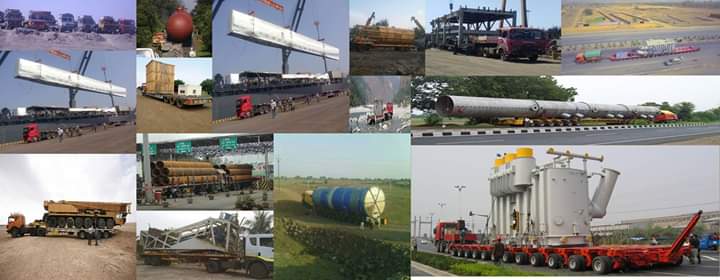
Project logistics frequently uses several overlapping technical terms. Although they are sometimes used interchangeably in commercial discussions, they describe different transport characteristics.
Over-Dimensional Cargo (ODC)
Over-Dimensional Cargo refers to a consignment whose dimensions, or the dimensions of the loaded vehicle combination, exceed the applicable limits for normal road transportation.
Examples include industrial tanks, boilers, large prefabricated structures, wind turbine components and specialised machinery.
The important distinction is that the legal assessment concerns the vehicle and load configuration, not merely the cargo’s dimensions in isolation.
Out-of-Gauge Cargo (OOG)
Out-of-Gauge Cargo is a term widely used in international freight forwarding, container shipping and project logistics.
An OOG consignment extends beyond the normal dimensional envelope of the intended transport equipment.
For example, industrial machinery extending beyond the sides of a flat-rack container may be classified as OOG cargo.
OOG classification for maritime transport does not automatically establish the applicable road transport classification in India.
Overweight Cargo (OWC)
Overweight Cargo describes a consignment or loaded vehicle configuration exceeding the applicable weight limits.
A load may be overweight without being unusually wide or tall.
Conversely, a large but lightweight industrial structure may be over-dimensional without being overweight.
Weight distribution, axle loads, bridge loading and vehicle configuration are particularly important for OWC movements.
Heavy Lift Cargo
Heavy lift is primarily an engineering and operational classification rather than a universal road-vehicle legal category.
It commonly describes cargo requiring specialised lifting systems, cranes, hydraulic jacking, strand jacks, skidding equipment or other engineered handling arrangements.
Project Cargo
Project cargo refers to machinery, equipment and materials transported for a particular industrial, energy, infrastructure or construction project.
Project cargo may consist of conventional truckloads, containerised cargo, ODC, OOG and OWC shipments.
Not every project cargo shipment requires an exceptional-load route survey. The requirement depends on the load characteristics and transport risk.
Types of Road Route Surveys for ODC and Heavy Cargo
Route surveys can be classified by the level of investigation required.
| Survey type | Principal objective | Typical application |
|---|---|---|
| Preliminary desktop survey | Identify possible corridors and major constraints | Early project budgeting |
| Physical reconnaissance survey | Inspect actual road conditions | Standard ODC movements |
| Detailed dimensional survey | Measure width, height, gradients and turning geometry | Wide, tall or long cargo |
| Heavy-load structural survey | Assess bridge, culvert and pavement loading | OWC and super-heavy cargo |
| Swept-path survey | Verify turning and manoeuvring requirements | Long trailers and wind blades |
| Overhead utility survey | Identify electrical and communication obstacles | High ODC consignments |
| Last-mile access survey | Examine industrial gates, yards and final approach roads | Factory and project delivery |
| Multimodal interface survey | Verify port, railhead, jetty and terminal interfaces | International project cargo |
| Pre-dispatch verification | Confirm that approved conditions remain valid | Before actual movement |
| Post-movement survey | Document changes, damage and lessons learned | Project closeout and repeated moves |
Preliminary desktop route survey
The preliminary stage uses available maps, satellite imagery, road network information, project drawings and known infrastructure restrictions.
It identifies candidate routes and eliminates obviously unsuitable alternatives.
Desktop analysis may examine:
- Approximate route distance and highway connectivity.
- Major river crossings and railway interfaces.
- Urban congestion and industrial access.
- Potential steep gradients and mountainous terrain.
- Known road restrictions and construction activities.
- Port connectivity and alternate transport modes.
Desktop assessment is useful for initial planning but cannot establish final clearance or structural suitability.
Physical road reconnaissance
The survey team travels along the proposed corridor to verify actual conditions.
The inspection should cover the complete route, including service roads, turning areas, access gates, parking locations and delivery approaches.
Critical observations should be georeferenced and supported by measurements, photographs and field notes.
Detailed engineering survey
A detailed engineering survey may require survey-grade GNSS, total stations, laser measurement, road profiling, swept-path modelling and structural engineering calculations.
The level of detail should reflect the consequences of failure.
For exceptionally heavy or geometrically complex cargo, a visual inspection alone is insufficient.
Final route validation

Conditions can change between the initial survey and the planned movement.
Temporary construction barriers, damaged pavements, newly installed utilities, seasonal flooding and traffic restrictions can invalidate previous assumptions.
The transport operator should establish a suitable revalidation interval and perform a final critical-obstruction check before dispatch.
Complete Road Route Survey Procedure: From Cargo Drawings to Final Approval
Stage 1 — Cargo data collection Dimensions, weight, centre of gravity, lifting points and drawings
Stage 2 — Transport equipment engineering – Tractor, trailer, axle arrangement, support and loaded envelope
Stage 3 — Desktop corridor screening – Primary route, alternatives and major infrastructure constraints
Stage 4 — Physical and engineering survey – Clearances, turns, bridges, road profile and utility crossings
Stage 5 — Feasibility and mitigation study – Structural checks, swept paths, route modifications and risk controls
Stage 6 — Permissions and execution planning – Authority approvals, escorts, traffic controls and movement method statement
Stage 7 — Pre-dispatch verification – Final route condition, equipment inspection and cargo securement
Stage 8 — Controlled movement and closeout
Authorised transport, monitoring, delivery and post-movement documentation
Collecting the cargo data sheet
The first engineering requirement is an accurate cargo data sheet.
A typical data sheet should include:
| Data field | Engineering purpose |
|---|---|
| Cargo description | Identify equipment and handling requirements |
| Cargo length, width and height | Determine transport envelope |
| Gross cargo weight | Establish lifting and trailer requirements |
| Centre of gravity | Assess stability and load distribution |
| Support locations | Design saddles, stools or transport cradles |
| Lifting points | Verify lifting method |
| Lashing points | Design cargo restraint arrangements |
| Fragile components | Establish protection requirements |
| Permitted inclination | Define allowable transport and handling angles |
| Environmental limitations | Identify weather and vibration restrictions |
| Manufacturer’s drawings | Validate geometry and structural interfaces |
The cargo data should be obtained from the manufacturer or an authorised technical representative.
When dimensions or weight are uncertain, the survey report should identify the uncertainty rather than replace missing information with assumptions.
Establishing the loaded transport envelope
The loaded height is not necessarily equal to the cargo height plus the nominal trailer deck height.
A more accurate calculation considers the actual cargo support geometry, loaded suspension condition, packing, cradle and any protruding components.
For a simple configuration:
H_loaded H_deck H_support H_cargo above support
This relationship must be adjusted for the actual geometry, road crossfall, suspension movement and any tilting or articulation.
Similarly, the effective transport width must include cargo projections, transport supports and any other relevant components.
The effective swept envelope may be substantially larger than the static vehicle width.
Establishing the design vehicle
The survey team should select a realistic transport combination before conducting detailed clearance studies.
For example, a route survey designed around a conventional lowbed trailer may not be valid if the final contractor deploys a modular hydraulic multi-axle system with different axle spacing and steering characteristics.
The route survey should therefore identify the proposed equipment configuration and its permitted operating envelope.
Road Geometry, Turning Radius and Swept-Path Analysis
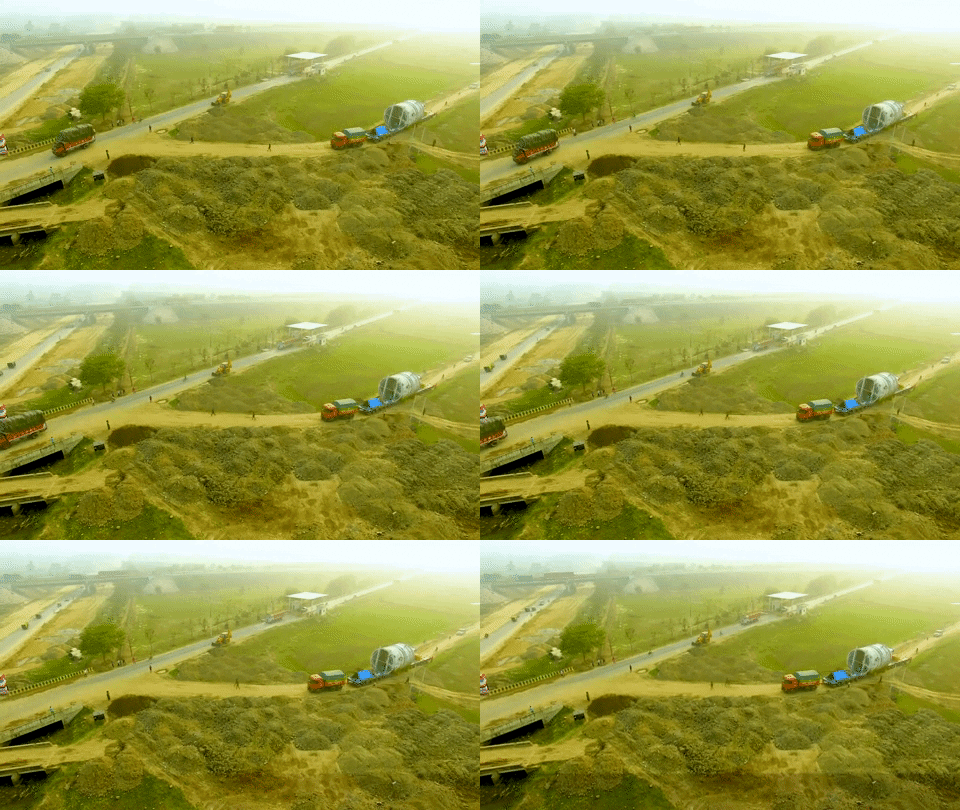
Road geometry is one of the most important aspects of ODC route feasibility.
A long vehicle does not follow the same path as a passenger car or conventional rigid truck.
During a turn, different parts of the vehicle combination may follow different trajectories.
The rear trailer wheels may track inside the tractor’s path, while the cargo or rear overhang may sweep outside the expected lane.
Turning radius versus swept path
Turning radius describes a particular turning characteristic of a vehicle.
Swept-path analysis evaluates the complete area occupied by the moving vehicle combination during a manoeuvre.
For heavy haulage, the latter is generally more useful.
A proper simulation should consider the actual vehicle geometry, articulation limits, steering behaviour, load overhang and clearances.
Critical turning locations
Particular attention is required at:
- Highway intersections and roundabouts.
- Toll plaza approaches.
- Factory entrances.
- Village roads and narrow market areas.
- Hairpin bends in hilly terrain.
- Railway crossings.
- Industrial estate access roads.
- Port and refinery gates.
A route can fail at a single junction even if every other road section is suitable.
Potential engineering solutions
Depending on the site and available approvals, solutions may include temporary traffic management, authorised removal of roadside furniture, temporary widening, alternative approach geometry or selection of a more manoeuvrable trailer.
For exceptionally long cargo, specialised steerable trailers, blade transporters or other purpose-designed equipment may be evaluated.
Temporary modifications must be engineered and authorised. Public roads, utilities and traffic installations should never be altered without the responsible authority’s permission.
Bridge, Culvert and Pavement Assessment for Overweight Cargo

Bridge feasibility is a central concern in the transportation of exceptionally heavy machinery.
A bridge cannot be declared suitable merely because its posted weight limit appears higher than the cargo weight.
The engineering assessment must consider the complete transport combination, including axle groups, wheel spacing, gross vehicle mass, bridge geometry and structural condition.
Important bridge assessment parameters
| Parameter | Why it matters |
|---|---|
| Gross combination weight | Overall transport loading |
| Individual axle and axle-group loads | Localised structural effects |
| Axle spacing | Distribution of load effects along the span |
| Bridge span and structural system | Determines structural response |
| Bridge condition | Identifies deterioration and damage |
| Carriageway width | Determines safe lateral positioning |
| Approach geometry | Affects trailer entry and exit |
| Dynamic effects | Accounts for movement-induced loading |
| Existing restrictions | Identifies legal and operational limitations |
| Previous structural records | Supports engineering assessment |
Why equal axle loading matters
Modular hydraulic trailers can distribute substantial loads across multiple axle lines.
However, nominal hydraulic equalisation does not eliminate the need for engineering verification.
The actual load distribution depends on suspension grouping, cargo position, support geometry, hydraulic settings and operating conditions.
A simplified planning calculation is:
{Average axle-line load} = {Total supported load} = {Number of axle lines}
This is only a preliminary average. It is not proof of compliance or bridge suitability.
The actual configuration must be checked against the applicable requirements, equipment ratings and engineering calculations.
Bridge crossing method statement
For exceptional-load movements, the responsible structural engineer and road authority may require a specific crossing procedure.
It can address vehicle position, traffic exclusion, movement speed, stopping restrictions, monitoring and other controls.
No general crossing speed or axle load should be assumed safe for every bridge.
Pavement and temporary access roads
Bridge capacity is not the only structural concern.
Pavement failure, settlement, soft shoulders, underground services and weak culverts may also threaten a heavy transport movement.
Temporary access roads and unloading yards require particular attention because they may not have been designed for heavy concentrated loads.
A ground-bearing assessment should be completed where required, especially for crane outriggers, jacking positions and heavy trailer manoeuvring areas.
Overhead Clearance Survey: Bridges, Power Lines and Railway Structures
Overhead clearance can determine whether an otherwise suitable route is usable.
Common restrictions include road overbridges, pedestrian bridges, gantries, power lines, communication cables, signboards and industrial pipe racks.
Measuring the available clearance
The survey should record the minimum relevant clearance across the actual swept path of the transport combination.
Clearance at the centre of a road may differ from clearance near the edge.
Road camber, crossfall and trailer articulation can also affect the effective loaded height.
Electrical line crossings
Electrical infrastructure requires specialised coordination.
The survey team should identify the utility owner, conductor arrangement, voltage category and applicable safety requirements.
Only authorised utility personnel should assess or implement electrical isolation, conductor raising or other interventions.
An ODC convoy must never attempt to lift, push, move or pass dangerously close to an energised electrical conductor using improvised equipment.
Railway overbridges and level crossings
Railway interfaces require additional investigation.
A level crossing may present problems associated with road profile, trailer grounding, rail clearances and crossing occupancy time.
Any necessary railway permissions or operational arrangements must be obtained through the relevant railway authorities.
Road Gradients, Traction, Braking and Vehicle Stability
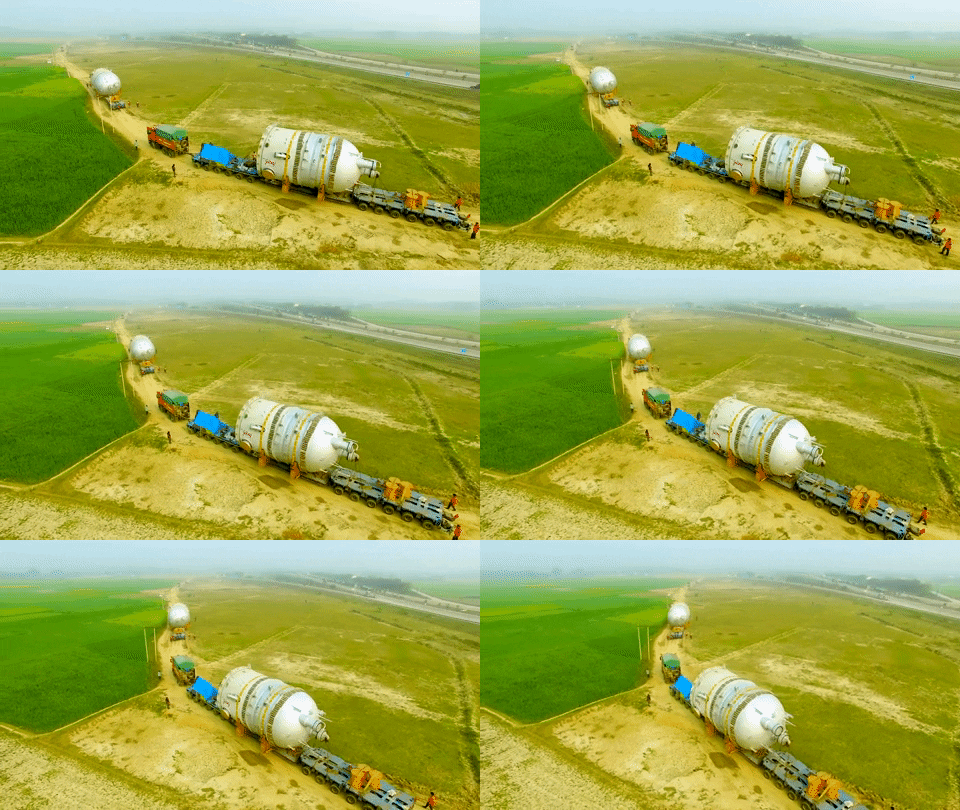
Steep gradients can make an ODC movement difficult even when road width and overhead clearance are sufficient.
The transport engineer should evaluate the complete loaded combination’s ability to climb, descend, stop and restart under the anticipated conditions.
Gradient assessment
The survey should identify maximum gradients, gradient transitions, available traction and road surface condition.
A simplified expression for the component of gravitational force along a slope is: F_g = mg sin(0)
where m is the mass, g is gravitational acceleration and (0) is the road slope angle.
Actual traction and braking assessments require additional inputs, including rolling resistance, tyre-road friction, drivetrain characteristics and the complete vehicle configuration.
Crossfall and stability
High-centre-of-gravity cargo is especially sensitive to lateral inclination.
The stability assessment should consider cargo centre of gravity, trailer suspension, road crossfall, turning manoeuvres and dynamic effects.
Where the cargo manufacturer specifies allowable transport inclination, that limitation must be incorporated into the route and handling plan.
Puller tractors and additional traction equipment
Heavy haulage may use specialised prime movers or multiple tractors in engineered push-pull arrangements.
Such arrangements require coordinated control, suitable couplings, braking compatibility and an approved operating procedure.
Adding a second tractor does not automatically make an otherwise unsafe movement feasible.
Types of Trailers and Specialised Equipment Used for ODC Transportation in India
The choice of transport equipment directly affects route feasibility.
A lowbed trailer may reduce loaded height, while a highbed trailer may provide a suitable platform for long but relatively low-height machinery. A modular hydraulic trailer may be required when exceptional weight and axle-load distribution become the primary considerations.
Equipment selection must be based on actual manufacturer ratings, vehicle registration, cargo characteristics and engineering requirements.
Comparison of ODC trailers and heavy haulage equipment
| Equipment | Principal characteristics | Common applications | Route survey priority |
|---|---|---|---|
| Flatbed trailer | Flat cargo platform | Structural steel, machinery, fabricated components | Width, load securing, turning |
| Highbed trailer | Relatively elevated deck | Industrial machinery and project materials | Overall height, bridges |
| Semi-lowbed trailer | Lower loading platform than many standard trailers | Transformers, plant machinery | Ground clearance, gradients |
| Lowbed trailer | Low cargo-carrying deck | Tall and heavy equipment | Approach angles, grounding |
| Lowboy trailer | Deep-drop loading platform | Heavy construction equipment | Deck clearance, turning |
| Double-drop trailer | Lower central deck between raised sections | Tall industrial components | Loaded height and transitions |
| Extendable flatbed | Adjustable trailer length | Long pipes, structures and beams | Turning and overhang |
| Telescopic trailer | Extendable platform configuration | Wind blades and long structures | Swept path, rear clearance |
| Bolster trailer | Supports long rigid cargo at separated locations | Long girders, structural sections | Steering and load support |
| Steerable trailer | Controlled axle steering | Long and complex loads | Steering envelope |
| Modular hydraulic multi-axle trailer | Interconnected axle modules with hydraulic suspension | Heavy transformers and vessels | Axle loads, bridges, road strength |
| Girder bridge trailer | Load carried within specialised girder structure | Extremely heavy concentrated cargo | Overall dimensions, bridge loading |
| Self-Propelled Modular Transporter (SPMT) | Powered modular platform with coordinated steering | Heavy modules and industrial relocation | Ground bearing, steering and gradients |
| Blade transporter | Specialised wind blade handling arrangement | Wind turbine blades | Blade clearance and wind exposure |
| Tower adapter system | Specialised support for tower sections | Wind tower components | Height, stability and turning |
| Hydraulic jacking and skidding system | Controlled lifting and horizontal movement | Installation and plant relocation | Foundation, ground bearing |
| Multi-axle platform trailer | Multiple axle groups supporting heavy loads | Industrial modules | Axle distribution and geometry |
Terminology such as highbed, semi-lowbed, lowboy and lowbed can vary among Indian operators and manufacturers. Commercial names alone do not establish legal capacity or actual deck height.
Flatbed trailers
Flatbed trailers are among the most versatile equipment types in road freight and project cargo transportation.
They offer an accessible loading platform for machinery, fabricated steel, industrial components and other cargo that can be adequately supported and secured.
Flatbeds are particularly useful when crane loading is required from the side or above.
However, they may not be suitable for tall machinery where the resulting loaded height exceeds the permissible route envelope.
Flatbed cargo requires carefully engineered restraint because it is not contained by conventional vehicle body walls.
Highbed trailers
Highbed trailers are used for many industrial transportation applications, particularly where a comparatively elevated deck is acceptable.
They may carry machinery, structural equipment and project cargo, depending on their rated capacity.
The route survey should establish the actual loaded height rather than relying on a generic equipment description.
Highbed configurations can also create challenges at overhead obstructions, loading platforms and steep road transitions.
Semi-lowbed trailers
Semi-lowbed trailers provide a lower cargo-carrying arrangement than many conventional flatbed or highbed configurations.
They are frequently considered for transformers, industrial machinery, construction equipment and heavy project components.
The lower deck can improve vertical clearance, but it does not eliminate restrictions associated with road camber, approach angles or ground clearance.
Lowbed and lowboy trailers
Lowbed and lowboy trailers are designed to accommodate cargo that benefits from a reduced deck height.
They are commonly associated with the transportation of tall machinery and heavy equipment.
Certain designs incorporate detachable goosenecks or other loading features.
The survey team must examine locations where the trailer may ground, particularly at railway crossings, bridge approaches, speed humps and sudden changes in gradient.
A lower deck is advantageous for height clearance but can increase sensitivity to road profile.
Telescopic trailers
Telescopic trailers can extend to accommodate long cargo.
Applications include wind turbine blades, pipes, structural beams and other elongated components.
The engineering assessment must account for the extended configuration, load support locations, steering geometry, trailer deflection and allowable operating conditions.
A telescopic trailer’s ability to extend does not mean that every extended configuration is suitable for every cargo.
Bolster trailers
Bolster transport arrangements are used for long rigid cargo requiring support at separated positions.
They may be suitable for certain beams, girders and fabricated structures.
Their movement characteristics depend on the design of the supports, articulation and steering arrangement.
The cargo itself must be checked for bending, torsion and support reactions.
Modular hydraulic multi-axle trailers
Modular hydraulic trailers are central to many super-heavy road transportation projects.
They consist of specialised axle modules that can be configured according to cargo weight, dimensions and support requirements.
Hydraulic suspension enables controlled load distribution and height adjustment within the equipment’s design limitations.
Important engineering considerations include:
- Permitted axle-line and wheel loads.
- Number and arrangement of modules.
- Hydraulic suspension groups.
- Load distribution and support reactions.
- Steering modes and turning requirements.
- Braking and towing arrangements.
- Cargo centre of gravity.
- Trailer structural capacity.
- Bridge and pavement loading.
The applicable MoRTH framework includes specific provisions for modular hydraulic trailer movements on National Highways. These must be reviewed against the current circular and the exact proposed vehicle configuration. Ministry of Road Transport & Highways+1
Girder bridge trailers
Girder bridge trailer systems can be considered for exceptional concentrated loads.
In suitable designs, the cargo is supported within or between structural girder assemblies, allowing load transfer to separated axle groups.
These systems require substantial engineering work, including structural analysis, load support design and route feasibility assessment.
Their physical dimensions and manoeuvring requirements may be significantly different from those of conventional modular platforms.
Self-Propelled Modular Transporters (SPMT)
SPMTs are specialised powered transport platforms used for heavy industrial modules and precision movements.
They are particularly valuable in controlled environments such as shipyards, fabrication yards, ports and industrial project sites.
Depending on the system, SPMTs can provide coordinated steering, hydraulic lifting and controlled positioning.
However, an SPMT is not automatically suitable or authorised for unrestricted public-road transportation.
Public-road use requires separate consideration of registration, permissions, route conditions and the applicable regulatory framework.
Choosing the correct equipment
| Cargo condition | Equipment worth evaluating | Critical engineering decision |
|---|---|---|
| Tall but moderate-weight machinery | Lowbed or semi-lowbed | Loaded height |
| Long steel beam | Extendable or bolster trailer | Support and swept path |
| Heavy transformer | Modular hydraulic trailer | Axle distribution and bridges |
| Wind turbine blade | Telescopic or blade transporter | Turning and blade clearance |
| Very heavy industrial module | SPMT or modular transport system | Ground bearing and stability |
| Exceptional concentrated load | Girder bridge system | Structural support and route capacity |
| Conventional project machinery | Flatbed or highbed | Securement and dimensional compliance |
The final equipment selection should be approved by the responsible transport engineering team.
Loading and Unloading ODC Cargo: Engineering Requirements
Loading and unloading are critical operations because the cargo may temporarily be supported by fewer points than during transportation.
An incorrectly planned lift can damage machinery, overload a crane, destabilise a trailer or create a serious risk to personnel.
Preparing a lifting plan
A lifting plan should be developed by competent personnel and include the cargo weight, centre of gravity, lifting points, equipment configuration and operational conditions.
The plan should also identify the crane or lifting system capacity at the actual working radius, rigging arrangement, ground-bearing requirements and exclusion zones.
Crane loading
Crane selection must consider more than the headline lifting capacity.
The usable capacity depends on the specific crane configuration, boom length, operating radius, counterweight arrangement, ground conditions and manufacturer’s load chart.
The lifting team should verify the load and rigging weight, inspect lifting accessories, confirm support conditions and establish clear communication.
Personnel must not stand beneath a suspended load.
Hydraulic jacking
Hydraulic jacking may be used for controlled lifting, support transfer and installation activities.
The operation requires properly rated jacks, engineered support points, stable foundations and controlled synchronisation where multiple jacks are involved.
Temporary supports must be designed to carry the required loads.
A hydraulic system must not be treated as a substitute for mechanically secure support where personnel may be exposed to an unsupported load.
Skidding systems
Skidding arrangements allow heavy cargo to be moved horizontally across prepared support surfaces.
The method may be appropriate for transformers, generators, large machinery and plant equipment where crane access is restricted.
Engineering considerations include friction, track alignment, support reactions, pulling force, structural integrity and emergency stopping arrangements.
Roll-on and roll-off operations
Roll-on/roll-off arrangements may be used when cargo can be moved onto suitable equipment or through a purpose-designed ramp system.
The ramp gradient, bearing capacity, vehicle traction, braking and interface geometry must be verified.
Improvised ramps or unsupported loading plates should not be used.
Unloading at project sites
The unloading location should be surveyed before dispatch, not after the cargo reaches the destination.
The receiving site should confirm that the necessary unloading equipment, access, foundations and personnel will be available.
A delivery is not complete simply because the trailer reaches the project gate.
Cargo Lashing, Securing, Dunnage and Transport Stability
Cargo securement is a fundamental requirement for safe ODC transportation.
A properly designed restraint system prevents unacceptable cargo movement during acceleration, braking, turning, vibration and other anticipated transport conditions.
Cargo lashing is not merely the practice of tightening chains around machinery.
It is an engineered arrangement involving load restraint, friction, structural supports, anchorage capacity and equipment compatibility.
Common securing equipment
| Equipment | Function | Essential verification |
|---|---|---|
| Rated transport chains | Direct restraint | Rated capacity and condition |
| Webbing lashings | Suitable restraint for compatible cargo | Working load limit and edge protection |
| Ratchet binders | Apply tension | Compatibility and condition |
| Turnbuckles | Adjustable restraint | Rating and locking |
| Wire rope assemblies | Specialised restraint | Approved terminations and condition |
| Shackles | Connect restraint components | Rated capacity and correct assembly |
| Engineered stoppers | Resist cargo movement | Strength and attachment |
| Timber or engineered dunnage | Support and separate cargo | Bearing and stability |
| Anti-slip materials | Improve friction where appropriate | Verified friction performance |
| Transport saddles | Support curved or specialised cargo | Structural design |
| Edge protectors | Prevent damage to restraints and cargo | Suitability for contact conditions |
Lashing design principles
The restraint system must account for the forces expected during transportation.
A simplified force relationship is: F=ma
However, cargo securement design requires more than applying this equation to the total cargo weight.
The engineer must consider the applicable design accelerations, friction, restraint geometry, pretension, anchorage capacity and load paths.
Appropriate recognised standards and manufacturer instructions should be selected for the project. Any contractual use of international cargo-securing standards must be reconciled with applicable Indian requirements.
Direct lashing
Direct lashing uses restraint components arranged to resist movement in specified directions.
It is commonly considered for heavy machinery with engineered securing points.
The actual restraining capacity depends on the lashing geometry, equipment ratings and load paths.
Frictional or tie-down lashing
Tie-down systems increase the normal force between cargo and its support surface, where the arrangement and friction conditions permit.
The effectiveness depends on reliable friction characteristics and appropriate pretension.
Frictional restraint should not be assumed sufficient for exceptional loads without engineering verification.
Cargo support and dunnage
Dunnage distributes contact loads, protects surfaces and supports cargo at designated positions.
The support material must have suitable strength and stability.
Incorrect support placement can introduce excessive stress into the cargo or trailer structure.
Lashing inspection before dispatch
The inspection should confirm that the restraint system matches the approved plan, components are undamaged, connections are properly assembled and all required protective materials are installed.
Lashing tension and cargo position should be checked at defined intervals during transportation, subject to safe access arrangements.
Special precautions for transformers and industrial vessels
Transformers and pressure vessels may have sensitive components, restricted support positions and manufacturer-defined handling limits.
Transport restraints should be attached only to approved locations.
Piping, instruments, lifting eyes or other components must not be used as lashing anchors unless specifically approved for that purpose.
Government compliance and technical standards
Indian law governs the legal use of vehicles and roads. Engineering standards and equipment instructions provide additional technical requirements for safe handling and securement.
These are related but distinct obligations.
A transport contractor should not assume that compliance with a lashing standard automatically authorises an over-dimensional road movement.
Similarly, obtaining a road movement permission does not establish that the cargo is adequately secured.
Both matters require separate verification.
Indian Government Rules, ODC Permissions and Regulatory Compliance
ODC transportation in India operates within a regulatory framework involving central legislation, vehicle regulations, highway authorities, state agencies and infrastructure owners.
There is no single universal permit that automatically authorises every oversized movement on every road in India.
The applicable requirements depend on the vehicle, cargo, route, road jurisdiction and proposed movement.
Principal legal and regulatory framework
| Law, regulation or authority | Relevance to ODC transportation |
|---|---|
| Motor Vehicles Act, 1988 | Vehicle registration, weight regulation, road use and enforcement |
| Central Motor Vehicles Rules, 1989 | Vehicle dimensions, construction, equipment and related requirements |
| Ministry of Road Transport and Highways (MoRTH) | National Highway policy and relevant ODC/OWC movement procedures |
| National Highways Authority of India (NHAI) | Relevant National Highway infrastructure and movement coordination |
| National Highways & Infrastructure Development Corporation Limited (NHIDCL) | Relevant highway infrastructure under its jurisdiction |
| State Public Works Departments | State road infrastructure and applicable permissions |
| State transport authorities | Vehicle and movement-related regulatory requirements |
| Traffic police | Traffic management and movement coordination |
| Railway authorities | Railway crossing and infrastructure interfaces |
| Electrical utilities | Power-line clearance and authorised interventions |
| Port and industrial authorities | Terminal and industrial access requirements |
MoRTH guidance for ODC and OWC movements
MoRTH has issued dedicated guidance for over-dimensional and overweight consignments.
The Ministry’s 24 January 2013 circular addressed exceptional-load movements, road-authority permissions, trailer registration and safety conditions. Later circulars developed online permission procedures for specified modular hydraulic trailer movements on National Highways. Ministry of Road Transport & Highways+1
More recent Ministry documents address online applications, cargo details, vehicle information, axle loads, bridge assessment and movement conditions. Ministry of Road Transport & Highways+1
Important regulatory principle: Historical circulars should not be combined indiscriminately. Where a later circular supersedes or amends an earlier procedure, the applicable current requirements and the actual permission conditions take precedence.
Information generally required for exceptional-load applications
Depending on the applicable permission category, documentation may include:
- Applicant and transporter identification.
- Consignor and consignee details.
- Cargo description and dimensions.
- Cargo weight and supporting certification.
- Origin, destination and proposed route.
- Puller tractor and trailer details.
- Registration, fitness and insurance documents.
- Axle arrangement and actual loading information.
- Applicable declarations and engineering documents.
- Bridge assessments and other supporting approvals.
MoRTH’s published procedures specifically recognise the importance of cargo identification, transport weight, route information and vehicle documentation.
Bridge crossing restrictions
Certain MoRTH permission guidelines include detailed operating conditions for heavy hydraulic trailer movements, including bridge crossing controls, pilot vehicles, load positioning and weather-related restrictions.
These conditions are specific to the relevant regulatory framework and should not be applied as a universal operating procedure to every trailer or bridge.
For example, a published revised guideline specifies particular controls for certain ODC/OWC bridge movements, including a maximum crossing speed and carriageway positioning requirements. The transport team must follow the conditions of its actual permission and any more restrictive engineering instructions.
Why a route survey is not a permit
A survey establishes technical findings and recommendations.
A permit or approval provides legal authorisation subject to its conditions.
A technically feasible route may still require approvals before use. Conversely, an administrative permission does not replace the responsibility to verify safe transport conditions.
Permissions Required from Different Authorities
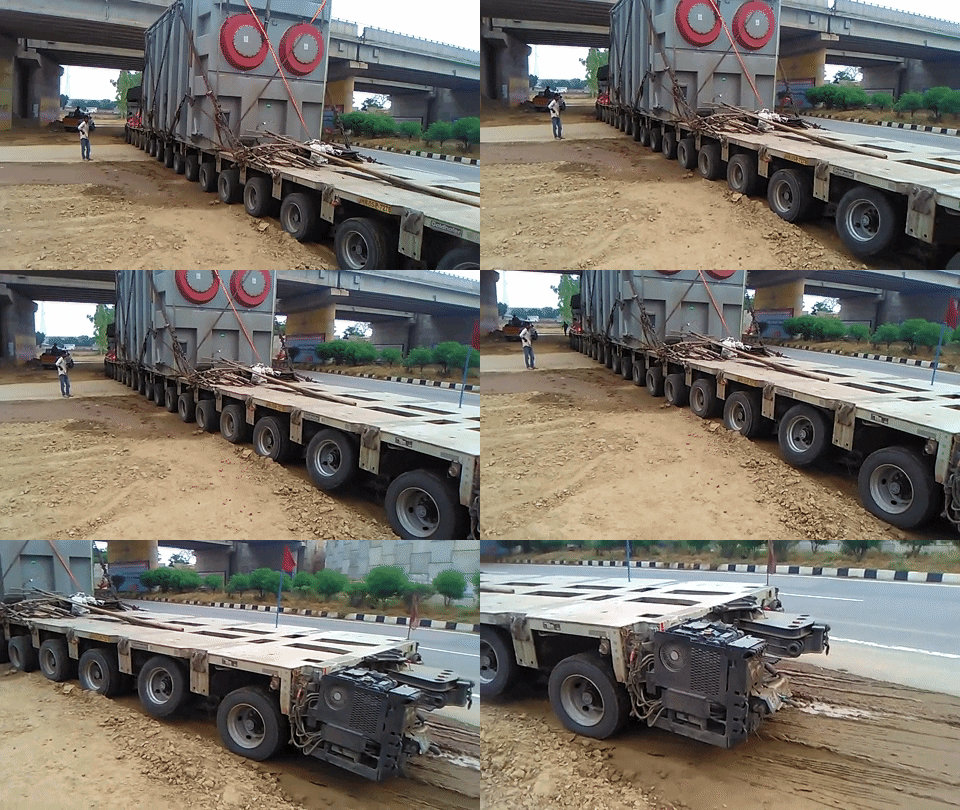
A single project cargo movement may cross several jurisdictions.
The permission matrix should be developed at the route-planning stage.
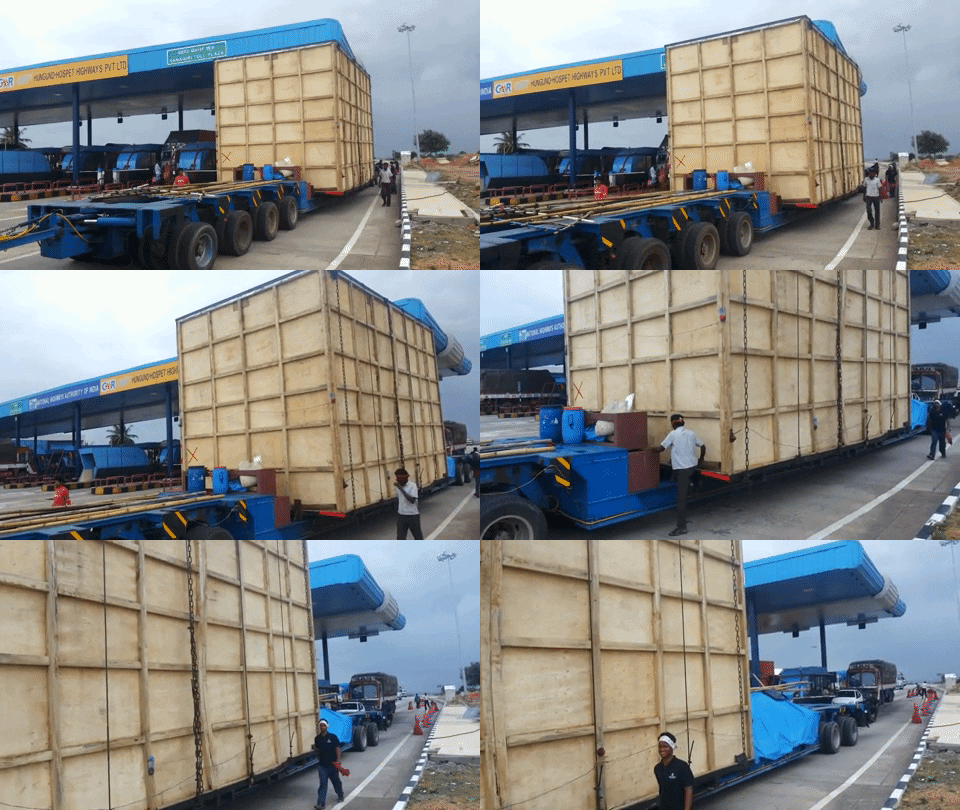
| Authority | Circumstances requiring coordination |
|---|---|
| MoRTH or relevant NH authority | Applicable exceptional-load movement on National Highways |
| NHAI/NHIDCL | Infrastructure and route sections under their jurisdiction |
| State PWD | State road and bridge restrictions |
| State transport department | Applicable vehicle and movement requirements |
| Local traffic police | Traffic control and escorts |
| Municipal authority | Urban restrictions and temporary modifications |
| Electricity distribution/transmission utility | Electrical clearance issues |
| Railway administration | Railway crossings and structures |
| Industrial development corporation | Industrial estate access |
| Port authority | Port terminal entry and cargo handling |
| Local administration | Public safety and temporary movement arrangements |

The exact permission path should be confirmed for the specific movement. A general-purpose right-of-way or industrial-access permission portal should not be confused with the dedicated ODC movement approval procedure.
ODC Route Survey Instruments and Modern Technology
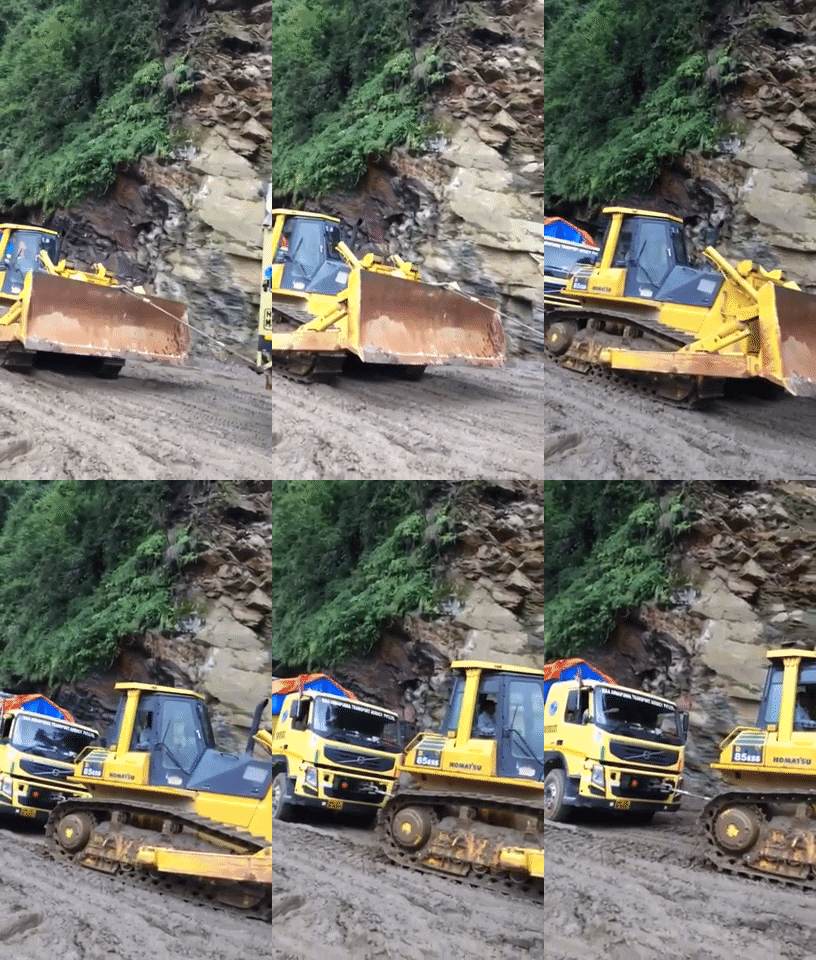
Technology improves the accuracy, consistency and traceability of route surveys.
However, digital tools do not replace competent engineering judgement or necessary field verification.
Survey instruments
| Instrument or technology | Application |
|---|---|
| Survey-grade GNSS | Georeferenced positioning |
| Total station | Precise geometric measurements |
| Laser distance meter | Local clearance measurements |
| Terrestrial laser scanning | Detailed three-dimensional corridor geometry |
| Mobile LiDAR | Corridor mapping |
| Digital inclinometer | Slope and crossfall assessment |
| Road profiling equipment | Longitudinal geometry |
| Ground investigation tools | Pavement and soil assessment |
| Drone photogrammetry | Site reconnaissance where legally authorised |
| GIS software | Route mapping and spatial analysis |
| Swept-path software | Vehicle manoeuvring simulation |
| Structural analysis software | Bridge and support assessment |
| Digital reporting systems | Findings, photographs and approval tracking |
Satellite imagery
Satellite imagery is valuable for identifying route alternatives, junction geometry and nearby infrastructure.
Nevertheless, imagery may be outdated or insufficiently precise.
It should not be used as the sole evidence of overhead clearance, bridge condition or load-bearing capacity.
LiDAR and three-dimensional corridor models
LiDAR-based surveys can capture complex roadside geometry and identify potential clearance conflicts.
The resulting point cloud can support transport-envelope analysis.
Its accuracy depends on survey design, calibration, processing and field conditions.
Digital twins and transport simulation
A digital route model can combine road geometry, vehicle dimensions and infrastructure constraints.
This allows engineers to test alternative transport configurations before mobilising equipment.
Digital simulations are particularly valuable for wind turbine blades, long girders and complex modular trailer movements.
Artificial intelligence in route planning
Artificial intelligence may assist with image classification, obstruction detection, document processing and route comparison.
However, automated recommendations should be validated by competent personnel.
AI-generated clearance values, bridge capacities or permit assumptions must never be treated as verified engineering evidence.
Risk Assessment and Hazard Management
A route survey should include a formal risk assessment appropriate to the complexity of the movement.
The assessment should identify foreseeable hazards, their potential consequences and the controls required to reduce risk.
Typical ODC transportation risk register

| Risk | Potential consequence | Recommended control |
|---|---|---|
| Insufficient overhead clearance | Cargo or infrastructure damage | Verified measurements and authorised mitigation |
| Bridge overload | Structural failure | Competent bridge assessment and approval |
| Trailer grounding | Equipment damage or immobilisation | Road-profile assessment |
| Cargo movement | Instability or cargo damage | Engineered securing system |
| Unstable crane foundation | Crane overturning | Ground-bearing verification |
| Poor turning geometry | Collision or obstruction | Swept-path analysis |
| Unauthorised utility interference | Electrocution or service disruption | Utility-owner coordination |
| Excessive wind exposure | Loss of stability | Cargo-specific weather limits |
| Mechanical failure | Stranded convoy | Preventive maintenance and recovery plan |
| Unexpected road closure | Delay or route deviation | Pre-assessed alternative route |
| Inadequate communication | Uncoordinated manoeuvres | Defined command and communication protocol |
| Weak unloading yard | Settlement or equipment instability | Ground investigation and engineered supports |
A risk register should identify the responsible person, required control, verification evidence and residual risk.
High-consequence risks should remain open until suitable controls have been demonstrated.
Escort Vehicles, Pilot Cars and Convoy Management
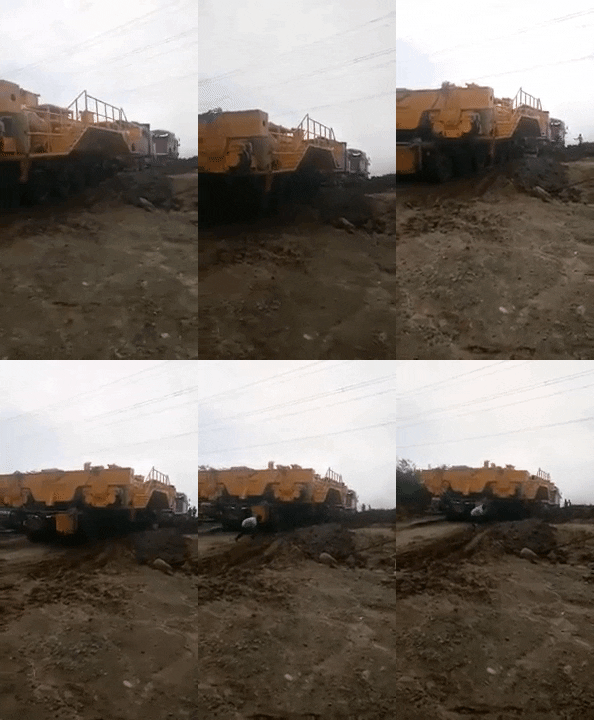
Escort vehicles are an important component of many exceptional-load movements.
Their function may include route observation, hazard communication, convoy coordination and assistance with authorised traffic management.
An escort vehicle is not automatically empowered to stop public traffic or override traffic regulations.
Such activities must be undertaken in accordance with applicable permissions and the instructions of competent authorities.
Typical convoy roles
| Role | Main responsibility |
|---|---|
| Transport manager | Overall movement coordination |
| Route survey engineer | Route-related technical verification |
| Convoy supervisor | Operational control |
| Lead pilot vehicle | Advance observation and communication |
| Trailer operator | Vehicle manoeuvring and equipment control |
| Rear escort | Rear visibility and hazard communication |
| Mechanical support team | Equipment maintenance and recovery |
| Lashing inspector | Cargo restraint inspection |
| Authority representative | Oversight where required by permission |
Convoy communication
The movement plan should establish communication protocols, command hierarchy, stop-work authority and emergency procedures.
Communication failure at a critical manoeuvre should trigger the predetermined safe response.
Parking and emergency stopping
Suitable parking areas should be identified before the journey.
An oversized convoy may not be able to use ordinary roadside parking safely.
The route plan should consider stopping distances, shoulder capacity, security, access and the effect on other road users.
ODC Route Surveys for Major Indian Industrial Sectors
India’s heavy haulage requirements differ considerably between industries.
Power generation
Power projects may require transportation of transformers, generators, turbine components and large fabricated structures.
The survey should emphasise weight distribution, bridge capacity, delivery-site access and unloading arrangements.
Renewable energy
Wind energy projects frequently involve long blades, tower sections, nacelles and other specialised components.
Blade transportation may require advanced swept-path analysis, obstacle surveys and wind-related operating controls.
Solar projects typically involve a different mix of conventional freight and specialised equipment transportation.
Oil, gas and petrochemicals
Refinery and petrochemical projects may require movement of pressure vessels, reactors, columns, heat exchangers and prefabricated modules.
Large diameter and overall height can be decisive constraints.
Port interfaces and industrial access roads often require detailed assessment.
Cement and steel
Heavy industrial equipment, kiln components, grinding machinery and fabricated structures may require specialised transport arrangements.
Route planning should consider industrial access, bridge loading and unloading facilities.
Mining and construction
Mining equipment, excavators, crushers and other large machinery can require lowbed or modular transport equipment.
Where cargo is self-propelled or tracked, loading arrangements and transport restraints must be specifically assessed.
Rail and metro infrastructure
Long structural components, precast girders and heavy machinery may require specialised trailers and temporary traffic arrangements.
Railway interfaces and constrained urban routes can increase complexity.
Major Indian Industrial Corridors and ODC Survey Considerations
The following are examples of industrial regions and the types of route considerations that may arise. They are not pre-approved ODC routes.
| Industrial region | Typical project logistics relevance | Survey emphasis |
|---|---|---|
| Gujarat: Dahej, Hazira, Vadodara | Petrochemical and industrial equipment | Port-to-plant access, utilities, bridges |
| Gujarat: Kutch and Jamnagar | Energy and large industrial projects | Long corridors, wind, remote access |
| Maharashtra: Mumbai, Pune, Chakan | Manufacturing and project machinery | Urban approaches, junctions, access |
| Maharashtra: Raigad industrial belt | Industrial and port-linked cargo | Highway interfaces and plant access |
| Rajasthan: Barmer and Jaisalmer | Energy and infrastructure projects | Remote roads, long loads, weather |
| Madhya Pradesh: Singrauli region | Power and heavy industrial equipment | Heavy-load corridors and site access |
| Chhattisgarh: Korba and Raigarh | Power, steel and industrial machinery | Bridges, industrial roads |
| Odisha: Angul, Jharsuguda, Paradip | Steel, power and port cargo | Port interfaces and structural constraints |
| Jharkhand: Jamshedpur and Bokaro | Steel and heavy machinery | Industrial access and bridge capacity |
| Andhra Pradesh: Visakhapatnam and Kakinada | Port and industrial project cargo | Port clearance and last-mile access |
| Tamil Nadu: Chennai and Thoothukudi | Manufacturing and port logistics | Urban restrictions and terminal access |
| Karnataka: Ballari industrial region | Steel and mining equipment | Heavy-load access and road geometry |
| Assam: Numaligarh region | Refinery and infrastructure equipment | Bridges, rainfall and regional access |
Each shipment requires its own route-specific evaluation. Industrial importance does not establish that a corridor can safely carry a particular exceptional load.
Road Route Survey Cost and Commercial Planning in India
The cost of an ODC route survey varies according to the complexity of the assignment.
A short reconnaissance for a moderately oversized load is fundamentally different from a multi-state engineering study for a super-heavy transformer.
Major cost factors
| Cost component | Typical basis |
|---|---|
| Preliminary feasibility | Desk-based research and engineering time |
| Physical reconnaissance | Route length and survey personnel |
| Detailed dimensional survey | Number and complexity of critical locations |
| Bridge engineering | Number and type of structures requiring assessment |
| Swept-path simulation | Junction count and vehicle complexity |
| Utility survey | Number and type of overhead restrictions |
| Geotechnical investigation | Ground conditions and required testing |
| Permissions coordination | Authorities and application complexity |
| Traffic management planning | Movement restrictions and escort requirements |
| Revalidation | Changes between survey and dispatch |
Why the cheapest survey may not be the lowest-cost option
A low-priced survey that overlooks a critical bridge or turning restriction can result in substantial project delays.
Potential consequences include equipment detention, route modification, additional crane mobilisation, cargo damage and contract penalties.
The commercial value of a survey should therefore be measured against the risks it helps identify and control.
Commercial quotation structure
A professional route survey quotation should define the proposed corridor, scope, deliverables, exclusions, assumptions, schedule and validity period.
Additional engineering investigations should be identified separately.
Survey fees, statutory fees, third-party testing and infrastructure modification costs should not be confused.
Sample ODC Road Route Survey Report
The following format is suitable as a starting point for a professional report. It must be populated with actual survey evidence and reviewed by competent personnel.
ODC / OWC Route Feasibility Report
ILLUSTRATIVE DOCUMENT STRUCTURE — NOT A COMPLETED ENGINEERING CERTIFICATE
A. Project identification
| Field | Information required |
|---|---|
| Project name | [Project identification] |
| Client | [Client organisation] |
| Origin | [Loading location] |
| Destination | [Delivery location] |
| Cargo | [Description and drawing reference] |
| Dimensions | [Verified L × W × H] |
| Weight | [Verified transport weight] |
| Equipment | [Proposed tractor and trailer] |
| Survey date | [Date] |
| Report revision | [Revision number] |
B. Executive feasibility statement
Record whether the proposed movement is feasible, conditionally feasible or not feasible, and clearly identify unresolved issues.
C. Route description
Provide the route map, road identifiers, distances, critical locations and alternatives.
D. Engineering findings
Include dimensional measurements, swept-path results, bridge assessments, road profiles and utility constraints.
E. Mitigation and approvals
Identify required actions, responsible parties and evidence of completion.
F. Movement method statement
Document equipment, cargo securement, traffic management, convoy arrangements and emergency procedures.
G. Attachments
Include photographs, survey drawings, calculations, permission documents and inspection records.
H. Review and authorisation
Record preparation, technical review, client acceptance and relevant authority approvals separately.
Practical Pre-Dispatch ODC Transportation Checklist
[ ] Cargo dimensions and weight verified
[ ] Centre of gravity and support points confirmed
[ ] Transport equipment configuration approved
[ ] Route survey and critical clearances reviewed
[ ] Bridge and pavement assessments completed where required
[ ] Applicable permits and authority clearances obtained
[ ] Cargo loading and lifting plans approved
[ ] Lashing and restraint inspection completed
[ ] Trailer, tractor and hydraulic systems inspected
[ ] Weather and road conditions reviewed
[ ] Pilot escorts and communication arrangements confirmed
[ ] Unloading site and equipment readiness verified
[ ] Emergency and recovery plans available
[ ] Final go/no-go authorisation recorded
Common Mistakes in ODC Route Surveys
Even experienced transport organisations can encounter problems when route surveys are treated as routine logistical exercises.
Mistake 1: Surveying before finalising the vehicle
A route may be checked for one trailer configuration while a different vehicle is ultimately deployed.
The correct approach is to establish a defined transport envelope and assess whether the final equipment remains within it.
Mistake 2: Measuring only the centre of the road
Overhead clearance, road crossfall and roadside obstructions can vary across the carriageway.
The complete swept envelope must be considered.
Mistake 3: Ignoring bridge engineering
Visual inspection cannot establish bridge load capacity.
Exceptional loads require the appropriate structural assessment and authority approval.
Mistake 4: Overlooking the last mile
The final few kilometres can contain the most difficult obstacles, including narrow factory gates, weak access roads and restricted unloading yards.
Mistake 5: Treating a previous movement as approval
A previous successful transport does not demonstrate that another cargo, trailer or bridge condition is safe.
Mistake 6: Inadequate loading and securing plans
An otherwise suitable route cannot compensate for unsafe cargo support or restraint.
Mistake 7: Relying entirely on digital maps
Maps and satellite imagery support planning but cannot replace critical field measurements.
Mistake 8: Ignoring temporary changes
Construction works, utility installations and seasonal deterioration can invalidate an earlier survey.
Mistake 9: Unauthorised route deviations
A driver should not independently divert an exceptional load onto an unassessed route.
The revised route must be technically and legally evaluated.
Mistake 10: Incomplete documentation
Without recorded measurements, assumptions and approvals, the feasibility conclusion may be difficult to verify.
Frequently Asked Questions About ODC Road Route Surveys

What is the main purpose of an ODC road route survey?
The purpose is to determine whether a proposed oversized or overweight cargo movement can be completed safely, technically and legally along a particular route.
Is a road route survey mandatory for every ODC movement in India?
Requirements depend on the cargo, vehicle and applicable regulations. Particular exceptional-load movements require permissions and supporting technical information. The appropriate survey scope must be established for the specific operation.
What is the difference between ODC and OOG cargo?
ODC generally refers to over-dimensional road cargo, while OOG commonly describes cargo exceeding the normal envelope of transport equipment, particularly in shipping and multimodal logistics.
What is the difference between ODC and OWC?
ODC relates to dimensions; OWC relates to weight. A shipment may fall into both categories.
Which trailer is best for ODC cargo?
There is no universal best trailer. Selection depends on cargo dimensions, weight, support requirements, route geometry and regulatory conditions.
When is a modular hydraulic multi-axle trailer required?
It may be selected when exceptional weight, load distribution or transport geometry requires specialised modular equipment. Suitability must be established through engineering assessment.
Can an SPMT travel on public roads in India?
Not automatically. Public-road movement requires assessment of the specific equipment and applicable legal authorisations.
Can a lowbed trailer eliminate height restrictions?
It can reduce loaded height, but the final transport envelope and ground-clearance limitations must still be checked.
Who should conduct an ODC route survey?
A competent team with relevant heavy haulage, surveying and engineering expertise. Specialist structural, geotechnical or electrical personnel should be involved where required.
Can a route survey guarantee successful transportation?
No. It reduces uncertainty and supports informed planning, but actual execution remains subject to equipment condition, weather, infrastructure changes, permissions and operational controls.
How long is a route survey valid?
There is no single universal validity period for every survey. Revalidation should reflect changes in route conditions, cargo configuration, permissions and project timing.
Does a route survey include bridge certification?
Not necessarily. A general reconnaissance report and a detailed structural assessment are different deliverables. The required scope must be specified.
Can overhead electrical wires be temporarily raised?
Only where technically feasible and authorised by the relevant utility, using an approved safe procedure.
What is swept-path analysis?
It is an engineering assessment of the area occupied by a moving vehicle combination during manoeuvres.
Is cargo lashing part of a road route survey?
Lashing design is a separate technical activity, but the route survey should consider transport conditions that influence cargo stability and restraint requirements.
Can a heavy trailer cross a bridge at normal highway speed?
Exceptional-load bridge crossings may be subject to specific restrictions. The actual permission and approved crossing method govern the movement.
Can a route survey be completed using Google Maps?
Digital maps can support preliminary route screening, but they cannot establish structural capacity or precise physical clearance.
Does the shortest route offer the lowest transport cost?
Not necessarily. A longer route may avoid expensive modifications, structural restrictions or operational delays.
What should a client receive after a route survey?
The agreed deliverables should include a route description, critical findings, feasibility assessment, constraints, mitigation recommendations and supporting technical evidence.
Why should a manufacturer arrange the survey before dispatch?
Early assessment helps identify transportation constraints while there is still time to consider equipment, route or project design alternatives.
How This Guide Was Prepared: Engineering, Regulatory and Industry Perspective
This guide integrates practical project cargo planning principles with published Indian government material concerning exceptional-load movements.
The technical discussion distinguishes between general engineering practice, regulatory requirements and project-specific approval conditions.
It is designed to support manufacturers, EPC contractors, industrial project teams, transport operators, freight forwarders and logistics consultants in understanding the principal decisions involved in ODC route feasibility.
The guide does not certify any particular route, bridge, vehicle or cargo movement.
ABCC India Project Cargo Corporation: ODC Route Survey and Heavy Haulage Planning
ABCC India Project Cargo Corporation operates in the project cargo and goods transportation services sector, with a focus on heavy haulage, specialised trailers and transportation coordination.
For complex ODC requirements, the value of a logistics consultant lies in coordinating the technical and commercial elements of the movement.
These may include preliminary route evaluation, equipment selection, survey scope definition, contractor coordination, permissions planning and transport cost assessment.
ABCC’s project cargo services can be considered by industrial clients seeking support with trailer availability, heavy transportation planning and associated logistics coordination.
Specialist engineering certification, statutory approvals and operational execution should remain with appropriately qualified and authorised parties.
Conclusion: A Successful ODC Movement Begins Before the Trailer Starts
The transportation of oversized and overweight cargo is not simply a matter of finding a powerful tractor and a suitable trailer.
It is a coordinated engineering and logistics operation involving cargo characteristics, vehicle design, road geometry, structural capacity, cargo restraint, regulatory compliance and operational control.
A well-executed route survey identifies the constraints that matter, establishes realistic mitigation measures and supports a safer, more predictable transportation plan.
For India’s expanding industrial, energy and infrastructure sectors, this discipline is essential to responsible project cargo logistics.
References and Official Government Resources
The following sources provide the foundation for further regulatory and technical verification.
| Source | Relevance |
|---|---|
| Ministry of Road Transport and Highways | Official road transport notifications, circulars and regulations |
| MoRTH ODC/OWC Movement Circular | Exceptional-load movement and approval procedures |
| MoRTH Revised Online Permission Guidelines | Modular hydraulic trailer movement requirements |
| Bureau of Indian Standards | Indian technical standards and amendments |
| Press Information Bureau | Official government announcements |
| Original Road Route Survey Article | Earlier article and historical editorial reference |