🚛 Container Truck Transport Services in India: Types, Sizes & Freight Rates
From a small closed-body delivery truck to a 40-foot ISO shipping container, discover how India’s container transport system connects factories, warehouses, ports, rail terminals and consumers.

📦 Introduction: Why Container Transportation Matters in India
Every day, Indian manufacturers, wholesalers, retailers and logistics companies need to move goods between production facilities, warehouses, distribution centres, ports and customer locations.
Some shipments contain clothing or consumer goods. Others carry electrical equipment, automotive components, pharmaceuticals, industrial spare parts, machinery accessories or export merchandise.
These products have different transportation requirements, but many share one concern: they must reach their destination without avoidable damage, contamination, theft or delay.
This is where container truck transportation plays an important role.
A container truck provides an enclosed cargo space that helps protect suitable goods during road transportation. Standardized shipping containers extend this concept further by allowing cargo to move between ships, railway wagons and road vehicles without repeatedly unpacking the goods.
India uses both systems extensively.
Domestic closed-body trucks connect manufacturing clusters such as Pune, Bengaluru, Chennai, Ahmedabad, Delhi NCR and Hyderabad with regional markets.
ISO freight containers connect Indian importers and exporters with maritime terminals, inland container depots and international shipping networks.
Although both are frequently called container transportation, their equipment, operating methods, legal requirements and pricing structures are different.
A business shipping eight tonnes of packaged consumer products from Pune to Bengaluru may need a domestic enclosed truck. An exporter dispatching merchandise from an inland factory to a seaport may need a shipping-line container mounted on a suitable chassis.
Choosing between these systems requires more than comparing vehicle lengths.
The customer must understand cargo weight, volume, handling methods, legal payload, road access, delivery schedule, insurance requirements and the total cost of transportation.
This guide explains those decisions in practical terms.
It covers domestic container trucks, ISO shipping containers, container trailers, refrigerated equipment, industrial freight corridors, road–rail logistics, port operations, safety, documentation, freight estimation and common transportation problems.

The objective is simple: help Indian businesses choose suitable transportation equipment and understand the commercial and operational responsibilities involved.
🚚 What Is Container Truck Transportation?
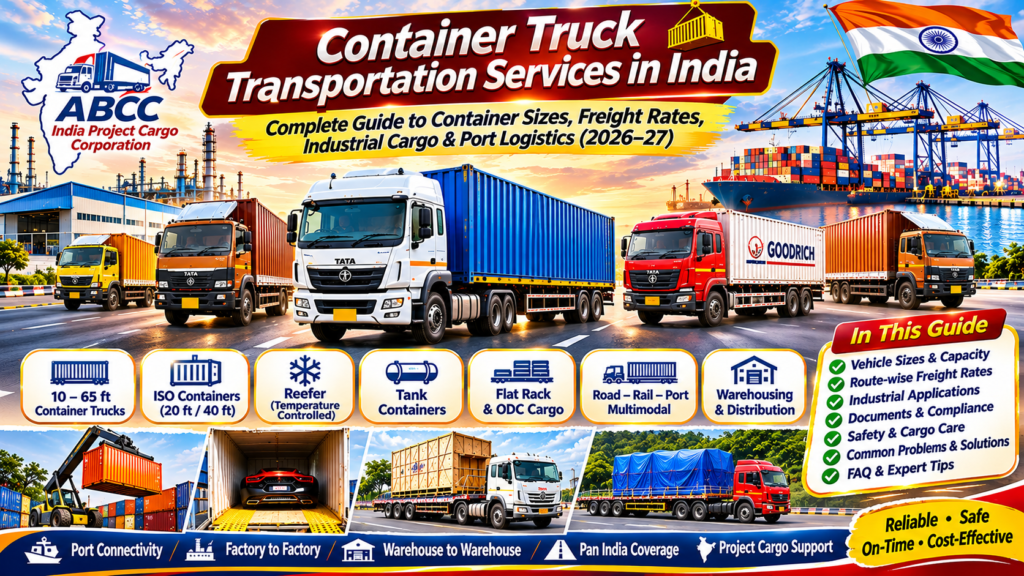
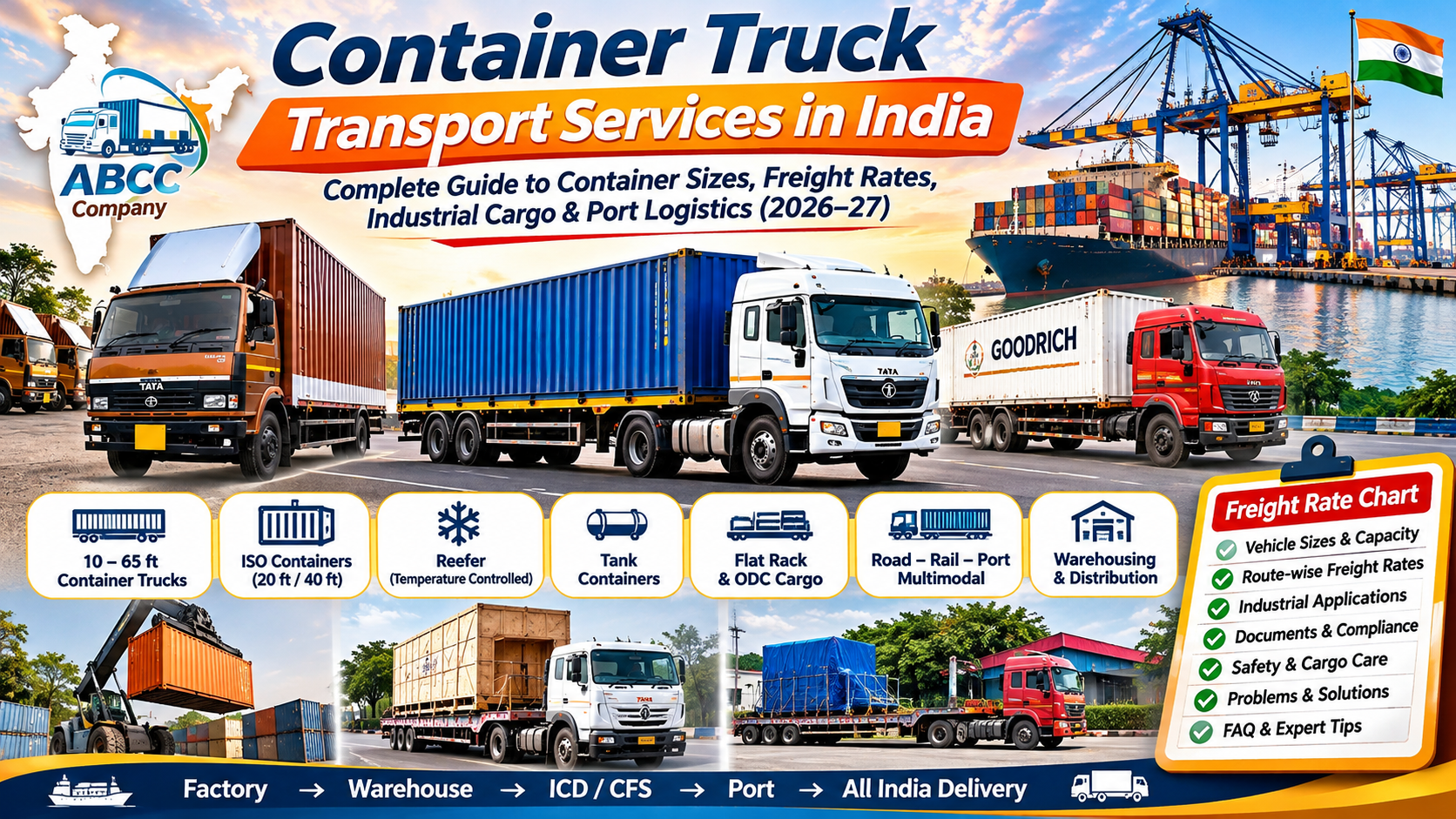
Container truck transportation is the movement of goods inside an enclosed cargo body or a detachable freight container carried by a suitable commercial road vehicle.
The word container describes an enclosure for goods, but not every enclosed cargo body is a standardized intermodal container.
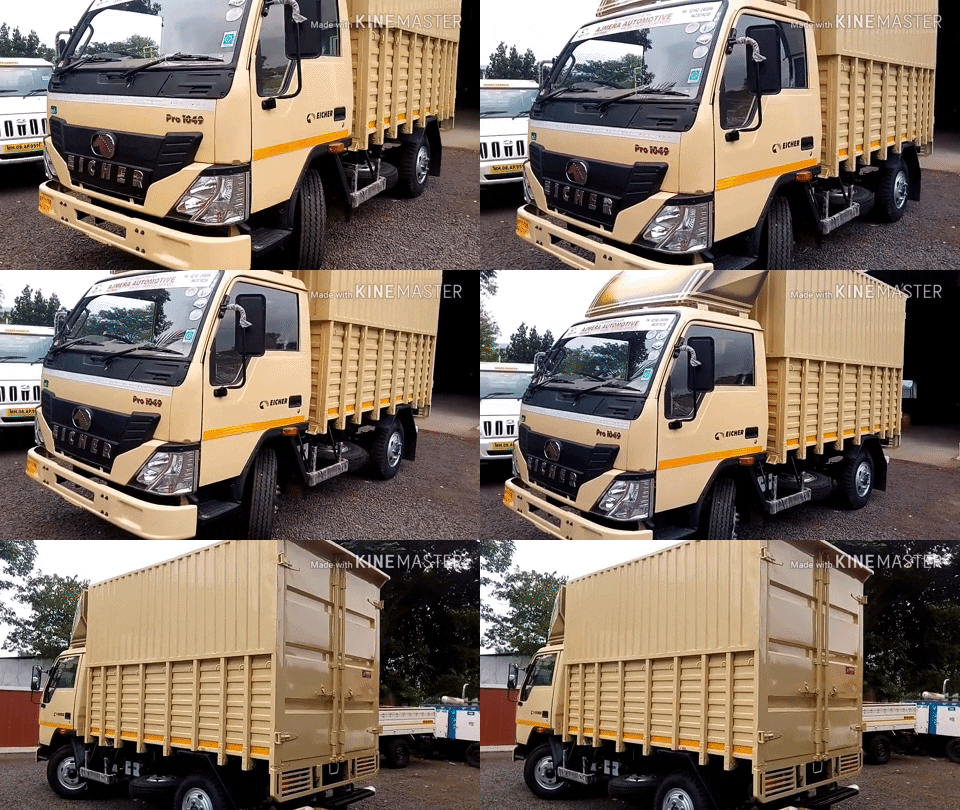
In the Indian domestic trucking market, transporters frequently use the term container truck for rigid trucks fitted with a permanently mounted closed body.
These vehicles are popular for factory dispatches, retail distribution, FMCG transportation, textiles, electronics and other packaged merchandise.
In international logistics, container transportation normally refers to standardized freight units designed for handling by specialized equipment at ports, rail terminals and inland container facilities.
A standardized container can be lifted from a ship and placed on a railway wagon or road chassis without unloading the merchandise inside.
This feature makes containerization valuable for international trade and multimodal transportation.
How Domestic Container Transportation Works

A typical domestic movement follows these stages:
- The customer shares pickup and delivery locations.
- Cargo dimensions, weight and packaging are confirmed.
- A suitable enclosed vehicle is selected.
- Freight charges and commercial conditions are agreed upon.
- The vehicle reports to the loading location.
- Goods are loaded, counted and secured.
- Dispatch documents are checked.
- The truck travels to the destination.
- The consignee unloads and verifies the shipment.
- Delivery confirmation and final commercial settlement are completed.
For a direct full-truckload movement, the same vehicle can normally carry the shipment from pickup to delivery.
For part-load transportation, the goods may pass through consolidation centres or other handling points.
How ISO Container Transportation Works

An ISO container movement involves additional coordination.
Depending on whether the shipment is an import, export or domestic intermodal movement, the process may involve a shipping line, freight forwarder, customs broker, container yard, port terminal, railway operator and road transporter.
The container may be collected empty, taken to a factory for stuffing, sealed, moved to a terminal and transferred to a ship or train.
For imports, the sequence operates in the opposite direction.
The customer should understand which party is responsible for container collection, stuffing, customs procedures, transport, terminal charges and empty-container return.

⚓ Domestic Container Truck vs ISO Shipping Container
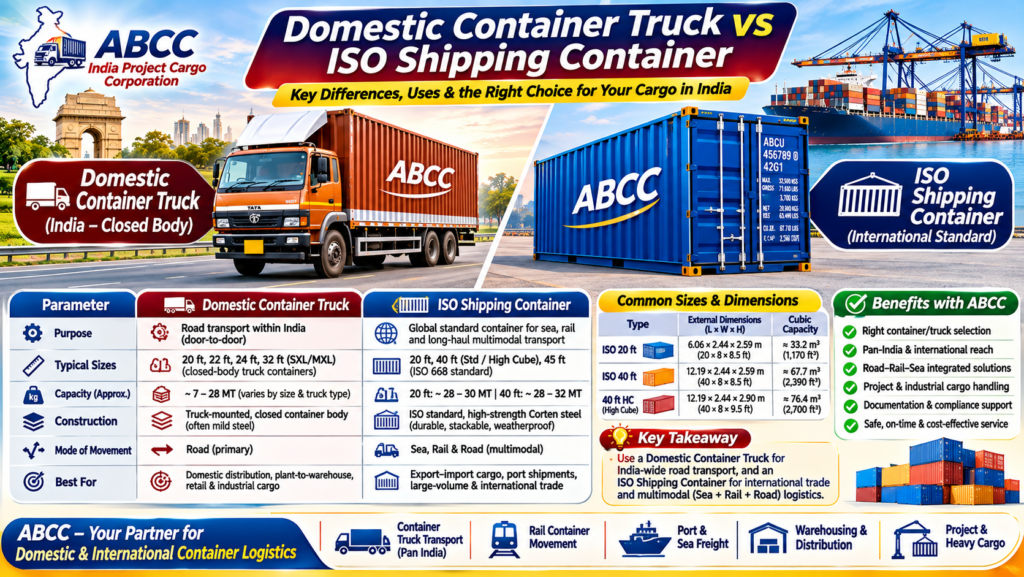
The difference between domestic and ISO containers is one of the most important concepts in Indian transportation.
| Feature | Domestic Closed-Body Truck | ISO Shipping Container |
|---|---|---|
| Basic structure | Enclosed cargo body, usually fixed to truck | Detachable standardized freight unit |
| Main purpose | Domestic road distribution | Intermodal and international freight |
| Common sizes | 14, 17, 19, 20, 22, 24, 32 ft | 20 ft and 40 ft |
| Vehicle requirement | Suitable rigid commercial vehicle | Container chassis or approved trailer |
| Port handling | Generally not designed for standardized lifting | Designed for intermodal handling |
| Rail compatibility | Usually no direct body transfer | Can move on suitable rail equipment |
| Door arrangement | Varies by body builder | Standardized designs with variants |
| Freight quotation | Vehicle and route based | Road haulage plus relevant container-related charges |
| Typical customers | Manufacturers, distributors, retailers | Importers, exporters, logistics operators |
A 20-foot domestic enclosed truck is not necessarily the same as a 20-foot ISO container.
Likewise, a 32-foot domestic truck is not a standard maritime container simply because it has an enclosed body.
The difference affects handling, dimensions, loading limits, documentation and transport costs.
Why This Difference Matters

Imagine a customer asking for a 40-foot container to move cargo from a factory in Gujarat to a warehouse in Maharashtra.
The transporter must first establish whether the customer wants:
- A 40-foot ISO shipping container on a chassis.
- A custom enclosed road vehicle.
- A flatbed trailer carrying an empty or loaded container.
- A specialized vehicle for unusually large cargo.
These are different transport arrangements.
Quoting without identifying the correct equipment can lead to unsuitable vehicles, failed loading, unexpected costs and operational delays.
📏 Types of Domestic Container Trucks in India
India has a diverse commercial vehicle market, with enclosed cargo bodies built for different shipment sizes and operating conditions.
Vehicle dimensions and legally permitted payloads are not determined by body length alone.
The following categories are useful for understanding common commercial applications.
10-Foot Container Truck
A 10-foot enclosed vehicle is useful for small commercial consignments, city distribution, retail stock and industrial spare parts.
It may be suitable where loading space is limited or the shipment does not justify a larger vehicle.
However, a short body does not guarantee access to every city street. Vehicle height, turning radius and local restrictions still matter.
12-Foot Container Truck
A 12-foot vehicle is commonly considered for small packaged shipments, electronics, furniture, cartons and local business distribution.
It can provide an alternative to open-body light commercial vehicles when the cargo requires protection from dust or rain.
14-Foot Container Truck
A 14-foot enclosed body can serve small and medium industrial consignments.
Applications include electrical accessories, packaged engineering products, warehouse stock and consumer goods.
The transporter should confirm usable internal dimensions, door opening and actual payload.
17-Foot Container Truck
A 17-foot body is useful for medium-volume cargo that requires an enclosed environment.
Examples include industrial components, textiles, packaged machinery accessories and commercial distribution.
The body configuration and vehicle capacity vary between operators.
19-Foot Container Truck
A 19-foot enclosed truck is a familiar category in many domestic transport markets.
It may be used for industrial goods, consumer products, warehouse replenishment and regional full-truckload movement.
Loading and unloading arrangements must match the cargo and body design.
20-Foot Domestic Container Truck
The 20-foot domestic truck is widely discussed in the Indian freight market.
It can be suitable for packaged goods, engineering components, electronics and commercial consignments.
However, customers should not assume that its internal dimensions match those of a 20-foot ISO shipping container.
22-Foot Container Truck
A 22-foot enclosed body may be selected for longer-distance transportation of packaged industrial goods.
It offers more cargo volume than smaller bodies, but its suitability depends on payload, weight distribution and loading access.
24-Foot Container Truck
A 24-foot container truck is used for industrial distribution, warehouse transfers, consumer goods and suitable manufacturing cargo.
A larger body may improve volume utilization for lightweight products, but a longer vehicle may be less convenient at restricted factory gates.
28-Foot Container Truck
A 28-foot enclosed body may be encountered in certain markets or specialized vehicle configurations.
It should not be assumed to be a universally standardized commercial vehicle category.
Before booking, verify actual availability, body dimensions, payload and vehicle approval.
32-Foot SXL Container Truck
The 32-foot single-axle-category container truck is widely used for relatively high-volume domestic freight.
It is often considered for packaged consumer goods, textiles, electronics, paper products and other consignments where cargo volume is important.
The commonly advertised SXL category does not itself establish a single legal payload for every vehicle.
32-Foot MXL Container Truck
The 32-foot multi-axle-category container truck is a common choice for larger industrial consignments.
It may offer greater carrying capability than an SXL configuration, subject to the particular vehicle’s approved gross weight and axle arrangement.
Applications include large FMCG dispatches, manufacturing materials, packaged industrial products and warehouse distribution.
Domestic Container Truck Selection Chart

| Body length | Typical cargo | Selection priority |
|---|---|---|
| 10–12 ft | Small packaged consignments | Access, payload, minimum freight |
| 14–17 ft | Medium industrial shipments | Internal space and weight |
| 19–20 ft | General industrial cargo | Weight, dimensions, handling |
| 22–24 ft | Larger packaged consignments | Volume and loading access |
| 28 ft | Selected configurations | Verify actual equipment |
| 32 ft SXL | High-volume freight | Cargo density and legal payload |
| 32 ft MXL | Larger-volume and heavier suitable freight | Axle configuration and approved payload |
These are practical categories rather than guaranteed equipment specifications.
🐘 Can 34, 40, 50 or 65-Foot Enclosed Vehicles Be Used?

Special industrial projects sometimes require equipment outside conventional domestic truck categories.
A manufacturer may need to transport a long fabricated component, a delicate assembly or an unusual product that cannot fit inside a standard enclosed vehicle.
In such cases, transport specialists may investigate custom-built bodies, enclosed trailer arrangements or other engineered solutions.
However, an advertised body length does not establish that the vehicle is legally suitable for public roads.
A 40-foot enclosed road arrangement is not automatically equivalent to a 40-foot ISO container.
Similarly, a 50-foot or 65-foot enclosed arrangement must not be treated as an ordinary domestic container truck.
Before discussing such equipment, confirm:
- Overall vehicle dimensions.
- Approved vehicle configuration.
- Gross vehicle weight and axle loads.
- Road access and turning radius.
- Bridge and overhead clearances.
- Loading and unloading arrangements.
- Applicable permits and restrictions.
- Cargo restraint and structural suitability.
For very long or oversized cargo, an open flatbed, extendable trailer, lowbed or engineered project transport arrangement may be more appropriate than a closed body.
The goal is not to fit every cargo into a container.
The goal is to select the safest and most practical vehicle for the actual shipment.
📦 What Is an ISO Freight Container?

An ISO freight container is a standardized cargo unit designed to support transport, handling and storage across compatible logistics systems.
Its standardized dimensions and corner fittings allow suitable handling equipment to lift, secure and transfer the container.
Containerization reduces the need to handle individual packages at every transport interchange.
For example, cargo can be stuffed into a container at a factory, transported to a port, loaded onto a ship and moved through another transport network without opening the container at every transfer point.
This does not eliminate cargo handling risks.
Incorrect packing, weight distribution, damaged containers, improper securing and documentation errors can still cause serious problems.
The benefit is that the cargo unit can move through multiple transport modes with a more standardized handling process.
📐 ISO Container Dimensions, Capacity and TEU
The most familiar ISO container categories are 20-foot and 40-foot units.
| Container type | Approx. external length | External width | External height |
|---|---|---|---|
| 20 ft standard | 6.06 m | 2.44 m | 2.59 m |
| 40 ft standard | 12.19 m | 2.44 m | 2.59 m |
| 40 ft high cube | 12.19 m | 2.44 m | 2.90 m |
These are representative external dimensions.
Internal dimensions vary according to construction, insulation, floor design and other features.
What Is TEU?
TEU stands for Twenty-foot Equivalent Unit.
It is a standard unit used to express container capacity in shipping and port logistics.
A conventional 20-foot container represents one TEU.
A conventional 40-foot container represents two TEU.
TEU measures container capacity rather than actual cargo weight.
A container terminal handling thousands of TEUs is reporting standardized container volume, not the number of tonnes transported.
Container Weight Terminology
Three important terms are:
Tare weight: Weight of the empty container.
Payload: Maximum cargo weight permitted by the container’s rating, subject to additional transport restrictions.
Maximum gross weight: Total weight of the container and its contents.
A container may be structurally rated for a particular gross weight while the road vehicle carrying it has a different permissible limit.
The transporter must comply with the applicable limits of the container, chassis, vehicle, axles and route.
❄️ Types of Shipping Containers and Their Industrial Uses

Dry Standard Container
A dry container is the most familiar general-purpose container type.
It is used for compatible packaged merchandise, consumer products, textiles, machinery components and industrial materials.
A dry container is not automatically suitable for every chemical, temperature-sensitive or moisture-sensitive product.
High Cube Container
High cube containers provide additional height.
They can be useful for relatively bulky cargo, but the extra height must be considered when planning road transport.
Overhead restrictions, vehicle deck height and total loaded height can affect route suitability.
Reefer Container
A refrigerated container, or reefer, provides controlled-temperature transportation for compatible products.
Applications include frozen foods, seafood, certain pharmaceutical products and temperature-sensitive commodities.
The customer must specify required temperature conditions and monitoring procedures.
Reefer equipment requires suitable power arrangements and operating supervision.
Open-Top Container
An open-top container allows suitable cargo to be loaded from above.
It may be selected for machinery or materials that are difficult to load through ordinary end doors.
Cargo protection and securing requirements must be assessed individually.
Flat-Rack Container
Flat racks are designed for cargo that cannot be accommodated inside a conventional enclosed container.
Applications may include machinery, vehicles and irregularly shaped industrial equipment.
Out-of-gauge cargo requires special attention to lifting, lashing, clearances and transport permissions.
Tank Container
Tank containers are designed for compatible liquids, gases or other approved cargo.
The tank must be suitable for the specific commodity and comply with applicable safety and regulatory requirements.
A tank that carried one product should not automatically be considered suitable for another.
Side-Opening Container
Side-opening containers provide access through side doors.
They may simplify loading for suitable palletized or long cargo.
Insulated Container
An insulated container can reduce temperature exchange, but it is not automatically a powered refrigerated container.
The product’s transport requirements determine whether passive insulation is sufficient.
Container Type Comparison
| Container | Main application | Key limitation |
|---|---|---|
| Dry standard | General merchandise | No active temperature control |
| High cube | Bulky cargo | Height restrictions |
| Reefer | Temperature-sensitive cargo | Power and monitoring requirements |
| Open-top | Overhead-loaded cargo | Additional protection and securing |
| Flat rack | Oversized machinery | Specialized lashing and routing |
| Tank | Compatible liquids and gases | Product-specific certification |
| Side-opening | Side-access cargo | Equipment availability |
| Insulated | Selected temperature-sensitive goods | Limited passive protection |
🏭 Industrial Applications of Container Truck Transportation

Container transportation supports industries with different cargo characteristics.
Automobile and Auto Components
Automobile manufacturers depend on regular deliveries of parts, assemblies, electrical components and accessories.
Closed-body trucks can protect suitable components during inter-plant and supplier-to-assembly movements.
However, large body panels, heavy dies and production machinery may require specialized transport equipment.
Electronics and Electrical Equipment
Electronics often require protection from dust, moisture, impact and unauthorized access.
An enclosed truck provides a useful transport environment, but proper packaging and securing remain essential.
Sensitive equipment may also require shock monitoring or specialized handling.
Textile and Garment Industry
Textiles, garments, yarn packages and finished clothing are frequently transported in enclosed vehicles.
Protection from rain, road dust and contamination is particularly important for export-ready merchandise.
FMCG and Consumer Goods
Fast-moving consumer goods move regularly between factories, regional warehouses, distributors and retail networks.
Container trucks are useful for packaged goods that can be loaded efficiently and transported in suitable quantities.
Pharmaceutical Industry
Pharmaceutical products have different storage and transport requirements.
Some products can move in suitable ambient conditions, while others require controlled temperatures and documented handling procedures.
The vehicle must match the product requirements.
Engineering and Machinery Components
Engineering companies transport fabricated components, tools, assemblies, spares and finished products.
An enclosed truck may be suitable for smaller components.
Large or heavy machinery may require a flatbed, lowbed or other specialized vehicle.
Furniture and Home Appliances
Furniture and appliances can benefit from weather protection and reduced exposure during transport.
However, their dimensions and packaging can consume cargo volume before the vehicle reaches its weight limit.
Paper and Packaging Industry
Paper products and packaging materials can be sensitive to moisture.
Closed-body vehicles help reduce weather exposure, but dry loading conditions and appropriate packaging are still necessary.
Food Processing
Packaged food products may travel in dry enclosed trucks if the product’s transport requirements allow it.
Frozen, chilled or otherwise temperature-controlled food requires suitable specialized equipment.
Renewable Energy
Electrical components, control panels and selected renewable-energy equipment may travel in enclosed vehicles.
Large solar structures, transformers, wind-turbine components and other oversized equipment often need specialized project transport.
⚖️ Cargo Weight vs Cargo Volume: The Most Common Booking Mistake

Many customers choose a truck based only on the total weight of the shipment.
This can be a costly mistake.
A vehicle may have enough permitted payload but insufficient internal space.
Alternatively, a large enclosed truck may have enough volume but be unsuitable for a concentrated heavy load.
Consider two consignments.
The first contains six tonnes of dense engineering components packed in compact crates.
The second contains six tonnes of lightweight but bulky consumer products.
Both shipments have the same weight, but they may need very different body volumes.
Important Cargo Measurements

Before selecting a truck, record:
- Gross cargo weight, including packaging.
- Number of packages.
- Length, width and height of the largest unit.
- Total cubic volume.
- Stackability.
- Centre of gravity where relevant.
- Loading method.
- Unloading method.
- Special handling restrictions.
Cubic Metre Calculation

For a rectangular package:
Volume (m³) = Length × Width × Height, with dimensions expressed in metres.
For example, a package measuring 2 m × 1 m × 1.5 m occupies:
2 × 1 × 1.5 = 3 m³
If a shipment contains ten identical packages, the theoretical package volume is 30 m³.
However, the truck must also accommodate loading gaps, packaging, access and safe cargo restraint.
A simple volume calculation is not a guarantee that the cargo will fit.
🚛 Container Truck vs Open Truck vs Taurus Lorry vs Trailer


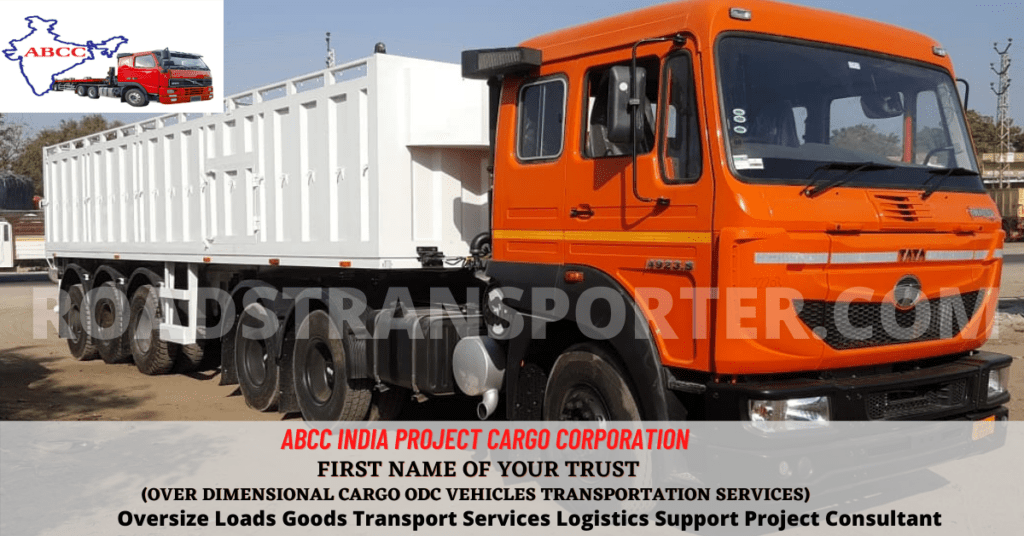
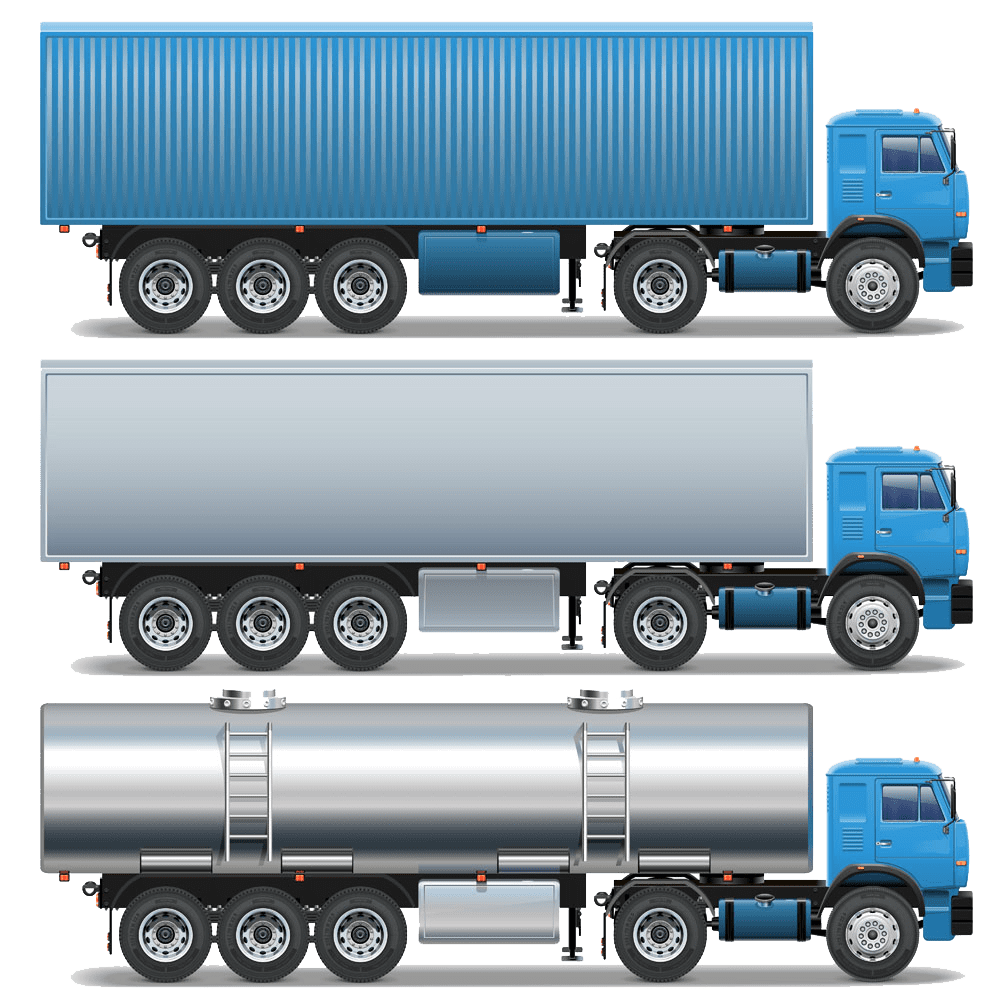
Not every cargo should be transported in an enclosed vehicle.
| Vehicle | Best suited to | Main consideration |
|---|---|---|
| Closed-body container truck | Packaged and protected cargo | Body access and legal payload |
| Open truck | Materials requiring flexible loading | Weather protection |
| Taurus lorry | Suitable higher-capacity road freight | Vehicle configuration and load limits |
| Flatbed trailer | Long or heavy cargo | Cargo securing |
| Semi-lowbed trailer | Selected machinery | Height and route |
| Lowbed trailer | Heavy or tall machinery | Engineering and permissions |
| Extendable trailer | Long cargo | Turning radius and route survey |
| ISO container chassis | Standardized freight containers | Container and chassis compatibility |

When Should You Choose a Container Truck?
Choose a container truck when the cargo fits within the body, can be safely loaded and requires enclosed protection.
When Should You Choose an Open Truck?
Choose an open truck when overhead or side loading is necessary, the cargo is suitable for open transportation and the vehicle complies with loading regulations.
When Should You Choose a Lowbed?
A lowbed may be appropriate for machinery with height or weight characteristics that make ordinary trucks unsuitable.
When Is a Modular Trailer Required?
Modular hydraulic trailers are used for exceptionally heavy or complex project cargo.
They are not substitutes for ordinary container trucks.
Their use requires engineering, route assessment and specialized operations.
💰 Container Truck Transportation Freight Rates in India

Freight rates are among the most frequently searched topics in Indian road transportation.
Customers want to know the cost of hiring a 20-foot, 24-foot or 32-foot container truck.
However, a single all-India per-kilometre rate cannot accurately describe every route.
Transport prices depend on vehicle configuration, cargo, distance, operating costs, demand and return-load availability.
Freight Rate Calculation Example
Suppose a factory needs a suitable enclosed truck for an 850 km journey.
If the illustrative rate is ₹38 per kilometre:
850 × ₹38 = ₹32,300
This is a mathematical example, not a verified market quotation.
The actual amount may differ because of tolls, minimum charges, loading time, cargo weight and vehicle availability.
Published Freight Examples
Publicly displayed freight platforms sometimes provide route-specific prices.
For example, FR8 publishes indicative or live-labelled container truck rates for corridors including Bengaluru–Chennai, Mumbai–Delhi and Pune–Bengaluru.
Such figures should be checked at the time of booking because the published rate may change.
Why a 32-Foot MXL Costs More Than an SXL
A larger-capacity vehicle can have higher operating costs, different equipment availability and different market demand.
But the relationship is not fixed.
On some routes, available return loads or local truck supply can narrow or widen the price difference.
Freight Components
| Component | Description |
|---|---|
| Basic transport freight | Agreed vehicle movement charge |
| Toll | Applicable road-user charges |
| Loading | Labour or equipment at pickup |
| Unloading | Labour or equipment at destination |
| Detention | Charge for waiting beyond agreed time |
| Insurance | Relevant cargo cover |
| Special handling | Forklift, crane or additional equipment |
| Port-related charges | Applicable terminal or container charges |
| Taxes | As applicable to the transaction |
Why Return Loads Matter
A truck delivering cargo from one industrial region to another may obtain a return shipment.
If the truck returns empty, the operator must recover costs over fewer revenue-generating kilometres.
Therefore, two routes of similar distance can have different freight rates.
📊 How to Compare Container Truck Quotations
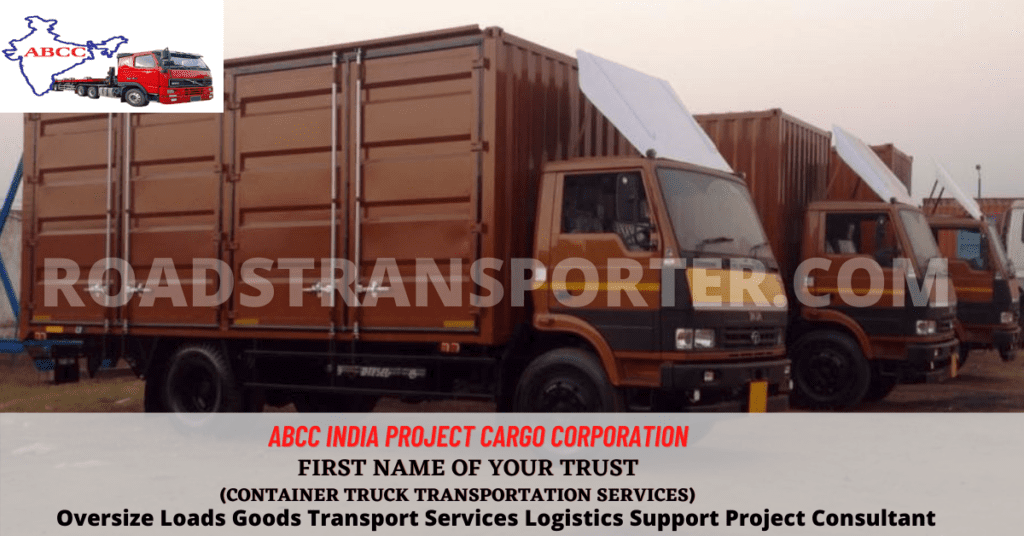


A quotation should be compared on more than the final amount.
| Quotation item | What to verify |
|---|---|
| Vehicle type | Exact body and axle configuration |
| Payload | Legally permissible load |
| Body dimensions | Internal usable space |
| Pickup point | Exact factory or warehouse |
| Delivery point | Exact destination |
| Freight | Total agreed transport amount |
| Toll | Included or extra |
| Loading | Responsibility and cost |
| Unloading | Responsibility and cost |
| Detention | Free time and additional charges |
| Insurance | Who arranges it |
| Transit | Estimated delivery window |
| Documentation | LR, invoice and POD process |
| Special conditions | Cargo restrictions and permits |
The cheapest quotation is not necessarily the most economical.
A wrong vehicle, failed loading, delayed delivery or damaged shipment can create costs greater than the initial freight saving.
🗺️ Major Container Transportation Corridors in India

India’s container freight demand is linked to industrial production, consumer markets, ports and warehousing networks.
Western India
The Mumbai–Pune industrial belt is an important manufacturing and distribution region.
Chakan, Talegaon, Bhiwandi, Navi Mumbai and the JNPA area support different types of freight activity.
Gujarat contains major industrial and port-linked corridors around Ahmedabad, Sanand, Vadodara, Bharuch, Ankleshwar, Vapi, Surat, Mundra and Gandhidham.
These corridors support automotive, engineering, chemicals, textiles and export-import logistics.
Northern India
Delhi NCR connects manufacturing and distribution centres in Gurugram, Faridabad, Noida, Ghaziabad and surrounding areas.
Panipat, Ludhiana and other northern industrial centres generate demand for textile, engineering and consumer-goods transportation.
Southern India
Chennai, Sriperumbudur and Oragadam support automotive and electronics manufacturing.
Bengaluru’s industrial areas include Peenya, Bommasandra, Bidadi and Hoskote.
Hyderabad and its surrounding industrial corridors support pharmaceuticals, engineering and distribution.
Coimbatore, Tiruppur and other Tamil Nadu industrial centres generate machinery, textile and manufacturing freight.
Eastern India
Kolkata, Howrah, Dankuni, Haldia and surrounding industrial areas serve eastern distribution and port-related cargo.
Odisha’s Angul, Jajpur–Kalinganagar and Paradip regions support heavy industry and port-linked logistics.
Jharkhand’s industrial centres include Jamshedpur, Bokaro, Dhanbad and Ranchi.
Central India
Indore, Pithampur, Nagpur, Raipur, Bhilai and other central industrial locations support manufacturing and interregional freight.
These are important logistics markets, but specific container truck availability must be confirmed for each route.
⚓ Container Transport from Indian Seaports

Seaport container transport connects international shipping with inland factories, warehouses and markets.
An import container may arrive at a maritime terminal, undergo applicable procedures and move inland by road or rail.
An export container may be stuffed at a factory or authorized facility and transported to a port for loading onto a vessel.
Important Container Gateways
Major container-related gateways include:
- Jawaharlal Nehru Port Authority area.
- Mundra.
- Deendayal Port/Kandla area.
- Chennai.
- Kamarajar/Ennore.
- Visakhapatnam.
- Kolkata–Haldia.
- Other ports and terminals with relevant facilities.
Actual container services, terminal capabilities and cargo restrictions vary.

Port-to-Factory Transportation
The road transporter must coordinate container release, vehicle reporting, terminal access and delivery instructions.
A failure in documentation can cause delay even when the truck is available.
Factory-to-Port Transportation
Export cargo must be packed and documented according to applicable commercial, customs and shipping requirements.
The dispatch team must consider cut-off times, container condition, sealing and terminal reporting arrangements.
🚆 Road–Rail Container Transportation in India
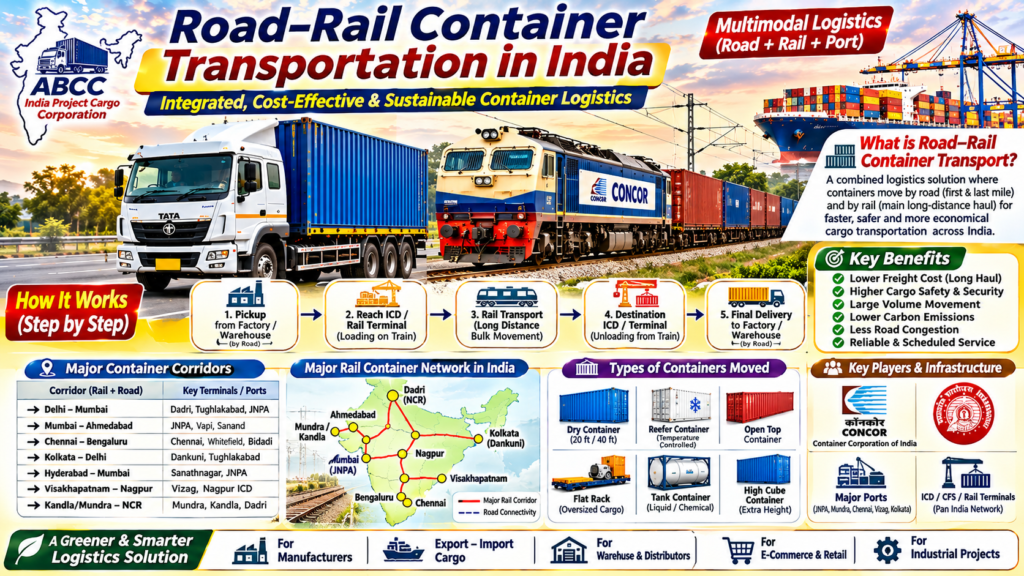
Rail transportation is an important component of India’s container logistics network.
Standardized containers can move between suitable inland terminals and ports using rail services.
Road transport provides flexibility for first-mile and last-mile movements.
What Is an ICD?
An Inland Container Depot is an inland facility supporting relevant container handling and customs-related logistics functions.
What Is a CFS?
A Container Freight Station is a facility used for container and cargo handling associated with port logistics.
What Is a Container Yard?
A container yard is an area used for storing, positioning or managing containers.
Role of CONCOR
Container Corporation of India is an important participant in India’s containerized rail and multimodal logistics system.
Its services and terminal network form part of the country’s inland container transport infrastructure.
Why Multimodal Transport Matters
A suitable road–rail arrangement may reduce dependence on a single mode for long-distance container movement.
However, the customer must compare total transit time, terminal handling, service frequency and door-to-door cost.
Rail is not automatically the cheapest or fastest option for every shipment.
🏗️ Container Loading and Unloading Equipment
The right handling equipment depends on the cargo and container type.
Forklift
Forklifts are commonly used for palletized and suitable packaged cargo.
The forklift’s rated capacity, load centre, floor condition and operating space must be checked.
Hydraulic Crane
A crane may be required for heavy machinery or cargo that cannot be handled through ordinary loading methods.
Reach Stacker
Reach stackers are used in suitable container handling facilities to lift and position freight containers.
Gantry Crane
Container terminals use specialized cranes for handling standardized containers.
Manual Loading
Manual loading may be used for suitable small packages, but safe working practices and appropriate labour arrangements are necessary.
Dock-Level Loading
Warehouses may use loading docks and dock levellers to improve handling efficiency.
A vehicle should not be sent to a loading dock without checking its floor height and access requirements.
🔒 Cargo Lashing, Blocking and Bracing
Container walls do not replace proper cargo restraint.
A truck can brake suddenly, accelerate, turn sharply or encounter uneven road surfaces.
Cargo that is not properly secured can move inside the body.
This movement may damage goods, destabilize the vehicle or injure workers when doors are opened.
Common Securing Methods
Depending on cargo characteristics, securing may involve:
- Suitable straps.
- Blocking materials.
- Bracing.
- Dunnage.
- Pallets.
- Anti-slip materials.
- Approved anchor points.
- Engineered cradles.
Heavy Machinery Inside Containers
A heavy machine may create concentrated floor loading.
Even when its total weight is within the container’s rated capacity, the floor and load distribution must be suitable.
The machinery should not be secured merely by placing wooden blocks around its wheels.
Appropriate engineering and cargo-securing methods are essential.
Cargo Restraint Documentation
For complex shipments, a documented loading and restraint plan can help identify responsibilities and reduce disputes.
Photographs taken before closing the doors may also support cargo-condition records.
🌧️ Monsoon Container Transportation in India
India’s monsoon creates additional challenges for road transportation.
Rain can affect loading yards, roads, cargo packaging and delivery schedules.
An enclosed truck reduces direct weather exposure, but it does not guarantee a completely dry cargo environment.
Common Monsoon Problems
Water may enter through damaged roof joints, doors or body panels.
Cargo may become wet during loading before the doors are closed.
Condensation may develop under certain temperature and humidity conditions.
Road closures and flooding may delay delivery.
Practical Preventive Measures
Inspect the vehicle before loading.
Avoid placing moisture-sensitive cartons directly on a wet floor.
Use suitable protective packaging.
Check the condition of door seals.
Follow official road and weather advisories.
Allow realistic transit time during severe weather.
For temperature-sensitive products, use equipment appropriate to the actual product specification.
📑 Documents Required for Domestic Container Transportation

Domestic road freight documentation depends on the transaction and applicable legal requirements.
Common documents include:
| Document | Main purpose |
|---|---|
| Tax invoice | Commercial details |
| Delivery challan | Applicable non-sale or other movements |
| E-way bill | GST movement compliance where required |
| Lorry receipt | Transport record |
| Vehicle registration | Vehicle identification |
| Fitness and permit documents | Applicable vehicle compliance |
| Driver licence | Driver authorization |
| Insurance | Relevant vehicle and cargo cover |
| Proof of delivery | Delivery confirmation |
The exact requirements should be checked for the shipment.
A domestic container truck does not automatically require a different GST process merely because its body is enclosed.
🛃 Export-Import Container Documentation
Export-import movements involve additional commercial, shipping and customs requirements.
Documents may include:
- Commercial invoice.
- Packing list.
- Shipping bill or applicable customs declaration.
- Bill of lading.
- Container number.
- Seal number.
- Shipping instructions.
- Terminal-related documents.
- Delivery order or release instructions.
- Applicable certificates or permits.
Not every document applies to every shipment.
Responsibilities also depend on the agreed commercial terms and the parties involved.
Why Container Numbers Matter
The container number identifies the freight unit.
Incorrect numbers can create problems with terminal records, shipping documentation and cargo tracking.
Why Seal Numbers Matter
Seal numbers help identify the recorded sealing arrangement.
A seal alone does not guarantee that cargo is secure or that tampering is impossible.
⚠️ Container Detention, Demurrage and Storage Charges

Container detention and demurrage are frequently misunderstood.
The exact meaning and charging arrangements depend on the shipping line, terminal and contract.
Generally, demurrage concerns the container remaining within a terminal or specified facility beyond the permitted free period.
Detention generally concerns keeping a container outside the relevant facility beyond the allowed period.
Storage charges may be separately applicable.
How to Reduce These Costs
Confirm free-time conditions.
Prepare customs and release documents promptly.
Schedule trucks realistically.
Coordinate unloading equipment before arrival.
Plan empty-container return.
Record delays and responsibilities.
Avoid assuming that a freight quote includes all container-related charges.
🚨 Common Container Transportation Problems and Solutions


Problem 1: Wrong Vehicle Arrives
The truck may be too short, too low, too narrow or unsuitable for the cargo weight.
Solution: Share complete cargo specifications before dispatch and obtain vehicle confirmation.
Problem 2: Truck Cannot Enter Factory
A narrow gate, low overhead clearance or restricted turning space can prevent loading.
Solution: Check access dimensions and vehicle manoeuvring requirements.
Problem 3: Cargo Exceeds Permitted Payload
The cargo may fit physically but exceed the legal carrying limit.
Solution: Verify the vehicle’s approved capacity and axle loading.
Problem 4: Loading Takes Too Long
Unavailable forklifts, incomplete packing or delayed paperwork can increase waiting time.
Solution: Prepare the cargo and loading equipment before vehicle reporting.
Problem 5: Cargo Is Damaged
Poor packaging or inadequate restraint can allow movement inside the body.
Solution: Use suitable packing and securing procedures.
Problem 6: Truck Is Delayed at a Port
Container release, terminal procedures or documentation may be incomplete.
Solution: Coordinate with the relevant port, shipping and customs parties before dispatch.
Problem 7: Empty Container Return Is Delayed
The consignee may finish unloading after the agreed return schedule.
Solution: Plan unloading and empty-return arrangements in advance.
Problem 8: Freight Charges Are Disputed
The customer and transporter may disagree about tolls, detention or handling charges.
Solution: Record inclusions and exclusions in the quotation.
Problem 9: Cargo Requires Special Handling
Machinery may be too heavy for ordinary forklifts or loading docks.
Solution: Confirm lifting and restraint requirements before selecting equipment.
Problem 10: Return Load Is Unavailable
The vehicle may have to return empty.
Solution: Consider route planning and backhaul opportunities without compromising the shipment’s requirements.
🏭 Container Transportation for Manufacturing Supply Chains
Manufacturing companies depend on predictable cargo movement.
A delayed shipment of a critical component can affect production planning.
A damaged delivery can create quality-control problems.
An unsuitable vehicle can cause loading delays.
Therefore, container transportation should be integrated with factory dispatch planning rather than treated as an isolated truck-booking activity.
Inbound Logistics

Inbound logistics covers materials arriving at a factory.
These may include raw materials, components, packaging products and machinery parts.
Outbound Logistics
Outbound logistics covers finished goods leaving the factory.
Container trucks can support movement to distributors, warehouses and customers.
Inter-Plant Transfers

Companies with multiple factories may move semi-finished products, assemblies and components between facilities.
Warehouse Replenishment
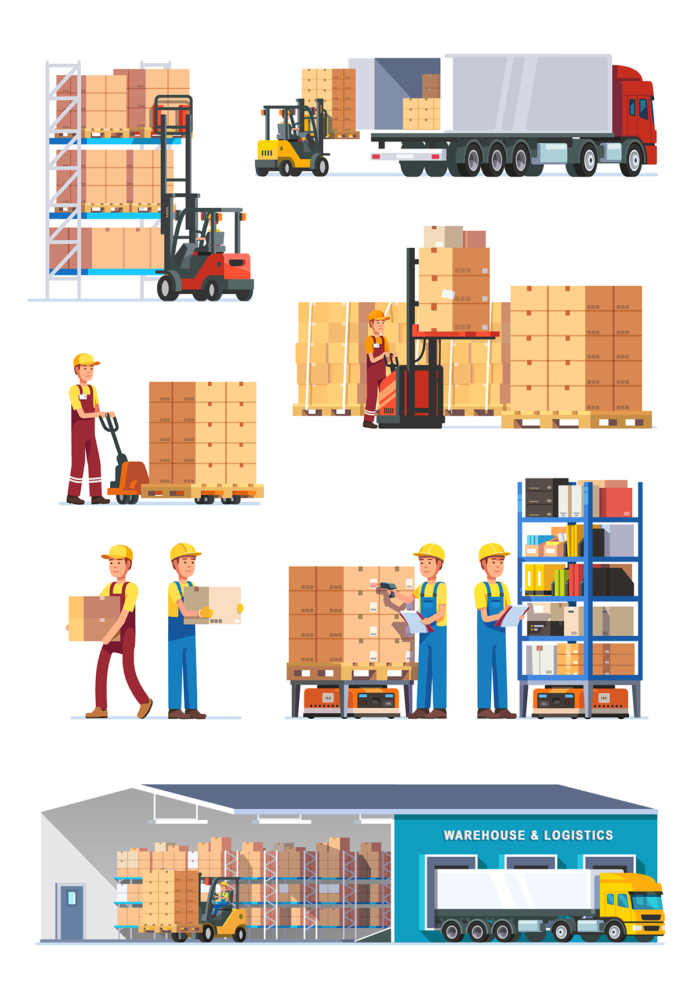
Distribution networks use road transport to replenish inventory according to demand.
Seasonal Demand

Festivals, agricultural cycles and retail promotions can affect freight demand and truck availability.
Manufacturers should plan dispatches accordingly.

📦 Container Transportation for E-Commerce and Retail
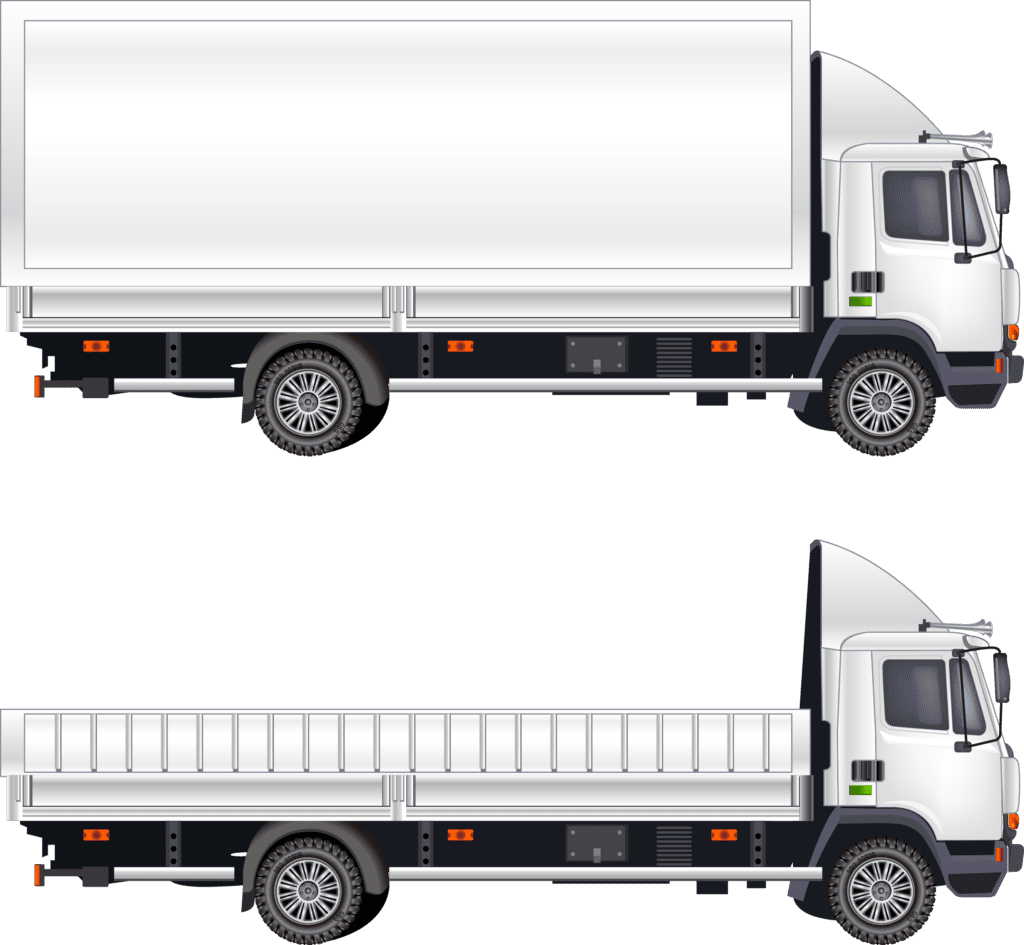
E-commerce logistics relies on frequent movement of packaged products.
Large enclosed trucks may carry consolidated freight between fulfilment centres and regional warehouses.
Smaller vehicles can support local distribution.
The main challenges include shipment volume, delivery schedules, package protection and warehouse handling efficiency.
Why Volume Matters
E-commerce consignments can contain many cartons with relatively low density.
A vehicle may become full before reaching its maximum legal weight.
Why Loading Discipline Matters
Poorly arranged cartons can collapse or become damaged during transit.
Suitable stacking and restraint are important.
Why Tracking Matters
Shipment visibility helps warehouses prepare receiving operations.
However, tracking information should not be confused with a guarantee of delivery time.
🌡️ Refrigerated Container Transportation

Refrigerated transportation is a specialized logistics service.
The vehicle or container must maintain conditions appropriate to the product.
A refrigerated unit is not automatically suitable for every temperature-sensitive commodity.
Important Questions
What temperature range does the product require?
Does the product need continuous temperature monitoring?
How long will loading and unloading take?
Is backup power necessary?
Are temperature records required?
What procedures apply if the refrigeration system fails?
Pharmaceuticals
Some pharmaceutical shipments require documented temperature controls and validated handling procedures.
The requirements depend on the product.
Food Products
Chilled and frozen foods may require controlled temperatures throughout the journey.
The shipper should establish suitable packaging, loading and monitoring procedures.
Industrial Chemicals
Certain chemicals have temperature-related transport requirements.
Equipment selection must be based on product compatibility and applicable regulations.
🧪 Chemical and Hazardous Cargo in Containers

Chemical transportation requires special attention.
A general enclosed truck should not automatically be used for dangerous goods.
The shipper must identify the product and its applicable transport classification.
Key Considerations
Product compatibility.
Packaging requirements.
Vehicle suitability.
Driver training where applicable.
Emergency information.
Placarding and marking requirements.
Applicable permits and documentation.
Safe loading and segregation.
Tank Containers
Tank containers are specialized equipment.
The tank’s design, approval and compatibility must match the cargo.
A transporter should not accept a hazardous shipment without understanding the relevant legal and operational requirements.
🚧 Oversized Cargo and the Limits of Container Transportation
Oversized and overweight cargo is a major part of industrial project logistics.
Examples include transformers, pressure vessels, large machinery, fabricated structures and power-generation equipment.
Such cargo may not fit inside a conventional enclosed body.
Even if it fits dimensionally, its concentrated weight or loading requirements may make the vehicle unsuitable.
When a Route Survey Becomes Important
A route survey may be necessary when cargo or vehicle dimensions create unusual clearance, turning or infrastructure concerns.
The survey may examine:
Road width.
Bridge limitations.
Overhead electrical lines.
Railway crossings.
Sharp curves.
Urban restrictions.
Ground clearance.
Loading and unloading access.
Specialized Trailer Alternatives
Possible equipment categories include flatbeds, semi-lowbeds, lowbeds, extendable trailers and modular hydraulic systems.
The selection depends on engineering requirements.
A specialized trailer should not be described as a container truck merely because it transports industrial cargo.
🏢 How Transport Brokers Help Container Truck Customers
Transport brokers and freight coordinators connect cargo owners with suitable transport capacity.
A useful broker does more than forward a phone number.
The broker should understand the cargo, route, vehicle requirements and commercial terms.
Practical Broker Responsibilities
Collect complete shipment details.
Identify suitable equipment.
Verify relevant vehicle information.
Clarify the freight quotation.
Coordinate pickup.
Communicate dispatch instructions.
Assist with operational updates.
Help resolve documentation or delivery disputes within the agreed scope.
Broker vs Fleet Owner
A fleet owner operates vehicles.
A broker or transport coordinator may arrange vehicles through multiple operators.
Customers should understand which party is contractually responsible for transportation, insurance and service performance.
Why Transparency Matters
A customer should know what is included in the quotation and which services are provided directly or through other parties.
Clear responsibility reduces misunderstandings.
🧾 How to Request an Accurate Container Truck Quotation
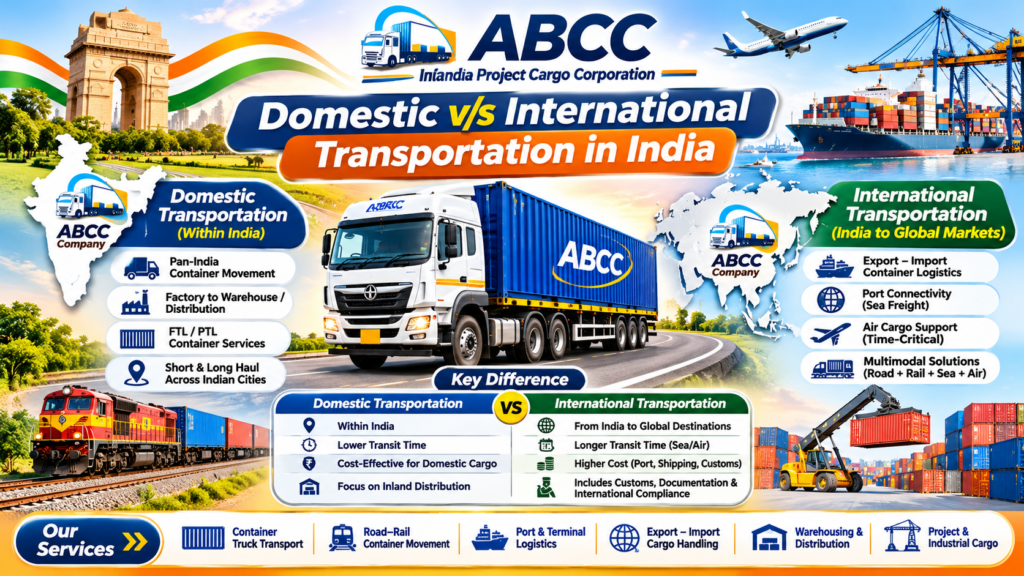
A complete enquiry improves the quality of the quotation.
| Information | What to provide |
|---|---|
| Pickup | Exact factory or warehouse |
| Delivery | Exact destination |
| Cargo | Product description |
| Weight | Gross cargo weight |
| Volume | Dimensions and package count |
| Packaging | Cartons, pallets, crates or drums |
| Vehicle | Preferred type, if known |
| Loading | Forklift, dock, crane or manual |
| Unloading | Available equipment |
| Dispatch | Date and time window |
| Cargo value | For insurance discussion |
| Special conditions | Temperature, security, hazardous classification |
Example Enquiry
A manufacturer needs to move eight tonnes of packaged electrical components from an industrial estate near Pune to a warehouse in Bengaluru.
The cargo consists of palletized cartons.
The factory has forklift loading facilities.
The destination has a loading dock.
The customer wants a dedicated enclosed vehicle.
With this information, a transporter can assess vehicle suitability and prepare a more meaningful quotation.
Without these details, the quoted price may be based on incorrect assumptions.
💡 How Businesses Can Reduce Container Transport Costs
Cost reduction does not always require negotiating a lower per-kilometre rate.
Choose the Correct Vehicle
Avoid booking a larger vehicle than necessary, provided the smaller vehicle can legally and safely carry the shipment.
Improve Packaging
Efficient packaging can reduce wasted space while protecting the goods.
Consolidate Compatible Shipments
Where operationally suitable, combine compatible cargo into fewer dispatches.
Reduce Loading Delays
Prepare goods and handling equipment before the truck arrives.
Improve Delivery Planning
Ensure the receiving warehouse can unload within the agreed time.
Compare Total Cost
Include handling, tolls, detention and other relevant expenses.
Plan Return Loads
Backhaul opportunities can improve vehicle utilization, although availability cannot be guaranteed.
Consider Multimodal Transport
For suitable cargo and corridors, road–rail combinations may offer operational advantages.
🌱 Sustainable Container Transportation
The environmental impact of freight depends on vehicle technology, fuel, utilization, distance, route and operating conditions.
Better planning can reduce avoidable transport activity.
Practical Improvements
Increase suitable load utilization.
Reduce unnecessary empty trips.
Maintain vehicles properly.
Avoid repeated failed deliveries.
Improve loading schedules.
Use suitable multimodal options.
Reduce cargo damage and replacement shipments.
Alternative Fuels
Commercial freight fleets are exploring technologies such as electric vehicles, LNG, CNG and other lower-emission options.
Their suitability depends on vehicle availability, infrastructure, operating range, payload and economics.
No single fuel technology is ideal for every freight corridor.
📍 Major Indian Industrial Regions and Container Transport Demand
| Region | Industrial centres | Typical cargo demand |
|---|---|---|
| Maharashtra | Pune, Chakan, Mumbai, Nashik | Automotive, engineering, distribution |
| Gujarat | Ahmedabad, Sanand, Vapi, Bharuch | Chemicals, textiles, manufacturing |
| Delhi NCR | Gurugram, Noida, Faridabad | Consumer goods, electronics, automotive |
| Tamil Nadu | Chennai, Oragadam, Coimbatore | Automotive, engineering, textiles |
| Karnataka | Bengaluru, Bidadi, Peenya | Electronics, machinery, distribution |
| Telangana | Hyderabad, Medchal, Patancheru | Pharmaceuticals, engineering |
| West Bengal | Kolkata, Howrah, Haldia | Industrial freight, distribution, EXIM |
| Odisha | Angul, Jajpur, Paradip | Steel, aluminium, industrial products |
| Jharkhand | Jamshedpur, Bokaro, Ranchi | Engineering, manufacturing |
| Madhya Pradesh | Indore, Pithampur, Bhopal | Automotive, consumer goods |
| Chhattisgarh | Raipur, Bhilai, Korba | Engineering and industrial freight |
| Punjab | Ludhiana, Jalandhar | Textiles, engineering |
| Haryana | Panipat, Sonipat, Manesar | Manufacturing and distribution |
| Andhra Pradesh | Visakhapatnam, Kakinada | Port-linked and industrial freight |
| Kerala | Kochi, Palakkad | Distribution and selected industrial cargo |
This table identifies broad industrial demand rather than verified live vehicle availability.
🕰️ History and Evolution of Container Transportation
Modern containerization transformed global freight by standardizing cargo units and reducing repeated handling.
Before widespread containerization, many goods were loaded and unloaded as individual packages.
This process required substantial labour and created opportunities for delay, damage and loss.
Standardized containers changed the handling system.
Instead of transferring every package individually, terminals could move the entire container between compatible transport modes.
Containerization and International Trade
The growth of standardized containers supported the expansion of international shipping networks.
Ports invested in container cranes, yards and terminal infrastructure.
Railways developed container-compatible services.
Road transport operators introduced container chassis and related equipment.
Development in India
India expanded its container logistics system through port development, inland terminals, rail container services and private logistics investment.
Container Corporation of India, established in 1988, became an important participant in inland containerized transportation.
The expansion of industrial production and international trade increased demand for both ISO containers and domestic enclosed trucks.
The Digital Logistics Era
Modern freight operations increasingly use electronic documentation, shipment tracking, digital freight platforms and data-supported planning.
These technologies improve visibility, but effective transportation still depends on suitable vehicles, trained personnel and disciplined operations.
📚 Container Transport Terminology Explained
| Term | Meaning |
|---|---|
| FTL | Full Truck Load |
| PTL/LTL | Part Truck Load / Less Than Truckload |
| TEU | Twenty-foot Equivalent Unit |
| FEU | Forty-foot Equivalent Unit |
| ISO Container | Standardized intermodal freight container |
| ICD | Inland Container Depot |
| CFS | Container Freight Station |
| CY | Container Yard |
| Reefer | Refrigerated freight equipment |
| High Cube | Container with additional height |
| Flat Rack | Specialized container platform |
| Drayage | Short container movement, often terminal-related |
| Stuffing | Loading cargo into a container |
| Destuffing | Unloading cargo from a container |
| Tare | Empty equipment weight |
| Payload | Permissible cargo weight under relevant rating |
| Gross Weight | Equipment plus cargo weight |
| Demurrage | Charge related to exceeding applicable terminal free time |
| Detention | Charge related to exceeding applicable container-use free time |
| POD | Proof of Delivery |
| LR | Lorry Receipt |
| E-way Bill | Applicable GST goods-movement document |
| Backhaul | Return-direction freight movement |
| Lashing | Securing cargo against movement |
| ODC | Over-Dimensional Cargo |
❓ Frequently Asked Questions About Container Truck Transportation
What is container truck transportation?
It is the movement of cargo inside an enclosed road vehicle or a detachable freight container carried on a suitable vehicle.
What is the difference between a container truck and a container trailer?
A domestic container truck usually has a fixed enclosed body. A container trailer carries a detachable container on a suitable chassis.
What are the common container truck sizes in India?
Common domestic market categories include 17, 19, 20, 22, 24 and 32 feet, with other sizes available in selected configurations.
What is a 32-foot SXL container truck?
It is a commonly marketed domestic enclosed-truck category associated with a single-axle configuration. Actual payload depends on the vehicle.
What is a 32-foot MXL container truck?
It is a multi-axle-category enclosed truck commonly used for larger domestic consignments.
Is a 32-foot container an ISO container?
A typical 32-foot domestic closed-body truck is not a standard maritime ISO container.
What is the difference between 20-foot and 40-foot shipping containers?
They have different standardized lengths and cargo volumes. Their exact payload ratings depend on the individual container.
What is a high cube container?
A high cube container offers additional height compared with a standard-height container.
What is a reefer container?
A reefer is a refrigerated container designed to maintain specified temperature conditions for suitable cargo.
Can machinery be transported inside a container truck?
Yes, when the machinery fits, the vehicle is suitable and loading and securing can be performed safely.
Can a container truck carry steel coils?
Only if the specific vehicle, floor, weight distribution and restraint arrangements are suitable. Heavy coils often require specialized transport planning.
Can pharmaceuticals move in an ordinary dry container?
Only when the product’s specified storage and transport conditions can be maintained.
Can a container truck carry hazardous chemicals?
Only with equipment, packaging, documentation and operating arrangements suitable for the product and applicable regulations.
What is container drayage?
Drayage generally refers to a relatively short container movement associated with ports, terminals or nearby logistics facilities.
What is container stuffing?
Stuffing means loading cargo into a freight container.
What is destuffing?
Destuffing means unloading cargo from a freight container.
What is a container seal?
A container seal is a device used to identify the recorded sealing arrangement and provide evidence of possible interference.
Is a container seal theft-proof?
No. Seals support security procedures but do not eliminate theft or tampering risks.
What is an ICD?
An Inland Container Depot is an inland facility providing relevant container and customs-related logistics functions.
What is a CFS?
A Container Freight Station is a cargo and container handling facility associated with port logistics.
What is CONCOR?
Container Corporation of India is a major Indian logistics organization involved in containerized rail and multimodal transportation.
What is the role of a container chassis?
A container chassis supports a freight container during road transportation.
What is the difference between FTL and LTL?
FTL uses a dedicated truck for the shipment. LTL or part-load transportation combines smaller consignments in a shared freight network.
How is container truck freight calculated?
It depends on route, vehicle, cargo, demand, tolls, handling, waiting time and other commercial conditions.
Is container truck freight charged per kilometre?
It may be calculated or benchmarked per kilometre, but many actual quotations are negotiated as complete trip charges.
Is toll included in container freight?
That depends on the quotation. Customers should confirm it in writing.
Is loading included in truck hire?
Not necessarily. Loading and unloading responsibilities should be agreed before dispatch.
What is container detention?
It generally concerns retaining a container beyond the applicable free-use period outside a terminal or designated facility.
What is demurrage?
It generally concerns container time beyond the permitted free period at a terminal or specified facility.
Does a domestic container truck require an e-way bill?
The requirement depends on the goods movement and applicable GST rules, not simply on the vehicle body type.
Can a container truck move between all Indian states?
Interstate movement is possible subject to vehicle compliance, permits, road restrictions and other applicable conditions.
What happens if cargo is overloaded?
Overloading can create safety risks and legal consequences. The shipment must comply with applicable vehicle and axle limits.
Is a container truck safer than an open truck?
An enclosed truck provides useful protection for suitable cargo, but safety depends on vehicle condition, packaging, restraint and operating procedures.
Can a container truck protect cargo during monsoon?
It can reduce direct exposure to rain, but the body must be inspected and moisture-sensitive goods must be packed appropriately.
How do I choose between a 24-foot and 32-foot container truck?
Compare actual cargo dimensions, weight, volume, loading requirements, vehicle availability and total freight cost.
Can a 40-foot ISO container be carried on any trailer?
No. The trailer or chassis must be suitable for the container and comply with applicable transport requirements.
What is the best container transport company in India?
There is no single objectively best provider for every shipment. Compare relevant experience, suitable equipment, service coverage, commercial terms and verified performance.
How do I obtain an accurate freight quotation?
Provide complete pickup and delivery addresses, cargo weight, dimensions, packaging, loading arrangements and required dispatch date.

👨💼 How This Container Transport Guide Was Prepared
This guide has been developed as a practical reference for businesses seeking to understand container transportation in India.
It combines general container logistics principles, domestic commercial vehicle categories, industrial freight requirements, road transport operations and multimodal logistics concepts.
The guide distinguishes between ordinary domestic closed-body trucks and standardized ISO freight containers.
It also explains why vehicle length alone cannot determine payload or legal suitability.
Published logistics industry material has been used for background research, while the operational explanations have been written independently.
Where actual vehicle availability, freight charges, terminal procedures or legal requirements may change, readers are advised to verify current conditions before making a commercial decision.
Author: R.K. Savarn
Industry focus: Goods transportation, project cargo coordination, trailer brokerage and road logistics.
Author profile: https://travel.roadstransporter.com/author/admin/
🏢 ABCC India Project Cargo Corporation – Container and Industrial Freight Support

ABCC India Project Cargo Corporation operates in the goods transportation and project cargo coordination sector.
Industrial customers may require different vehicles for different shipments.
A packaged electrical consignment may be suitable for an enclosed container truck.
A heavy machine may require a flatbed or lowbed.
A long fabricated structure may need a specialized trailer.
A large project cargo movement may require additional route and handling assessment.
The important principle is to match the equipment to the cargo rather than attempting to use one vehicle type for every shipment.
What Customers Should Expect from a Transport Arrangement

A clear understanding of the shipment.
Suitable vehicle selection.
Transparent freight terms.
Practical pickup and delivery coordination.
Attention to cargo safety.
Clear responsibilities for loading and unloading.
Documentation appropriate to the movement.
Transport Planning and Cost Control
Customers can reduce unnecessary expenses by providing complete shipment information before the vehicle is arranged.
Accurate dimensions and weight help avoid vehicle mismatch.
Confirmed loading equipment reduces waiting time.
Clear delivery instructions reduce operational confusion.
These principles apply to container trucks, open trucks and specialized trailers.
For container transportation enquiries, share the cargo details, exact pickup and delivery locations, preferred dispatch date and loading arrangements before requesting a final quotation.
🏢🚛 Why Choose Us? – Experience, Expertise & Intelligent Container Transportation

Beyond Truck Booking: A Professional Approach to Container Logistics
In India’s competitive logistics industry, successful container transportation requires more than arranging a commercial vehicle. It demands practical experience, technical understanding, accurate documentation, route planning, cost efficiency and dependable coordination.
ABCC India Project Cargo Corporation approaches industrial freight transportation from this broader logistics perspective.
Whether the requirement involves domestic container trucks, industrial cargo, specialized trailers or project transportation, the primary objective is to identify a suitable transport arrangement based on the customer’s actual cargo and operational requirements.
A transport service should not be evaluated only by the number of trucks advertised or the lowest freight quotation. Its real value lies in understanding the shipment, anticipating operational challenges and supporting informed transportation decisions.
🧠 Industry Experience – Understanding Cargo Before Arranging Vehicles
Experience in industrial transportation develops through exposure to different cargo categories, vehicle configurations, loading conditions and road transport challenges.
ABCC’s business focus includes goods transportation coordination, trailer brokerage and project cargo logistics.
This background supports a practical approach to evaluating container transport requirements.
Before selecting a vehicle, important factors include cargo weight, dimensions, packaging, loading access, delivery location and route conditions.
Our guiding principle: The right transportation decision begins with understanding the cargo, not merely quoting a truck rate.
⚙️ Technical Competence – Selecting the Right Container Truck
Domestic container trucks and ISO shipping containers serve different purposes.
A 20-foot domestic closed-body truck, a 32-foot SXL/MXL vehicle and a 40-foot ISO shipping container have different operational characteristics.
Similarly, some industrial consignments may be better suited to open trucks, flatbed trailers or lowbed equipment.
ABCC’s transport coordination approach emphasizes evaluating equipment suitability before finalizing a movement.
The objective is to reduce the risk of vehicle mismatch, unnecessary handling and avoidable operational delays.
💰 Cost Optimization – Improving Total Transportation Value
Freight optimization is not simply about offering the lowest price per kilometre.
The total transportation cost may include vehicle hire, tolls, loading, unloading, waiting time, route restrictions and return-load availability.
Effective freight planning considers these factors together.
ABCC’s brokerage-oriented approach can support cost comparisons through suitable vehicle selection, available transport capacity and practical route planning.
Where feasible, evaluating backhaul opportunities and avoiding oversized vehicle bookings may also help reduce unnecessary expenses.
Cost optimization means identifying the most commercially practical transport solution without compromising safety or compliance.
💡 Innovation – Combining Industry Knowledge with Modern Logistics Practices
Modern transportation increasingly depends on digital communication, electronic documentation, shipment visibility and coordinated planning.
Innovation also includes improving traditional operating practices.
Better cargo information, timely vehicle confirmation, improved loading coordination and transparent freight terms can create measurable operational benefits.
ABCC’s approach is to combine practical road transport knowledge with opportunities for more efficient coordination and logistics planning.
Technology is most valuable when it improves decision-making, communication and accountability.
🌏 SAARC Transportation Knowledge – Understanding Cross-Border Logistics
India’s commercial connectivity with neighbouring South Asian countries creates opportunities for regional road and multimodal freight transportation.
Cross-border movements involving countries such as Nepal, Bhutan and Bangladesh may require additional planning related to customs, vehicle permissions, border procedures, transit arrangements and cargo documentation.
Understanding these requirements is an important part of international logistics preparation.
ABCC recognizes the importance of evaluating applicable cross-border procedures and coordinating with appropriately authorized service providers where such arrangements are required.
Cross-border transport capability must always be confirmed for the specific country, route, shipment and regulatory conditions.
📑 Documentation Expertise – Supporting Compliant Cargo Movement
Documentation is a critical component of professional goods transportation.
For domestic shipments, relevant records may include invoices, e-way bills, lorry receipts, vehicle compliance documents and proof of delivery.
Export-import container movements may additionally involve container identification, seal records, shipping instructions, customs declarations and terminal-related documentation.
Incomplete or incorrect information can cause delays, disputes and additional expenses.
ABCC’s logistics coordination perspective recognizes the importance of documentation readiness and clear allocation of responsibilities among customers, transport operators and other relevant parties.
🤝 Operational Coordination – Connecting Cargo Owners and Transport Capacity
Industrial transportation frequently involves multiple stakeholders.
The consignor prepares the goods.
The transporter arranges the vehicle.
The driver performs the road movement.
Warehouse personnel manage loading and unloading.
The consignee receives the shipment.
A freight coordinator helps connect these activities through clear communication and practical planning.
ABCC’s role as a transportation and project cargo coordination business is particularly relevant where customers need assistance identifying suitable transport arrangements.
The value of professional coordination lies in reducing misunderstandings and improving operational preparedness.
🏗️ Industrial and Project Cargo Understanding – Beyond Standard Container Trucks
Not every industrial shipment fits inside a conventional container truck.
Heavy machinery, fabricated structures, transformers and other specialized cargo may require different transport equipment.
Knowledge of high-bed trailers, lowbeds, extendable trailers and project cargo requirements can help distinguish routine enclosed freight from movements requiring specialized assessment.
ABCC’s industrial transportation focus provides a broader context for considering these alternatives.
Vehicle selection, lifting arrangements, route suitability and applicable permissions should always be evaluated according to the actual shipment.
❤️ Building Long-Term Business Relationships Through Professional Responsibility
A successful transport relationship is built through consistent communication, transparent commercial terms and responsible coordination.
Customers value clear quotations, suitable equipment, realistic delivery expectations and prompt communication when operational conditions change.
For ABCC India Project Cargo Corporation, the long-term business objective is to develop relationships based on practical logistics knowledge and customer requirements rather than promotional claims alone.
Professional transportation is not measured only by kilometres travelled. It is measured by the quality of planning, coordination and responsibility behind every shipment.
🌟 The ABCC Difference – Experience, Efficiency and Commercial Understanding
The strength of a logistics partner should be assessed through its understanding of cargo requirements, suitability of transport arrangements, documentation awareness and ability to coordinate complex operational needs.
ABCC India Project Cargo Corporation brings together a business focus on industrial goods transportation, trailer brokerage and project cargo coordination.
Its value proposition is built around six practical principles:
- 🧠 Experience: Understanding industrial freight and transport challenges.
- ⚙️ Efficiency: Matching cargo requirements with suitable vehicles.
- 💰 Cost Optimization: Evaluating total freight expenses and operational alternatives.
- 💡 Innovation: Improving coordination through practical and modern logistics methods.
- 🌏 Regional Logistics Knowledge: Recognizing domestic and SAARC cross-border transport requirements.
- 📑 Documentation Awareness: Supporting accurate preparation and compliance coordination.
ABCC India Project Cargo Corporation – Connecting Industrial Cargo, Suitable Transport Capacity and Practical Logistics Solutions.
Every shipment has different requirements. The right logistics decision begins with understanding those differences.
🏁 Final Conclusion: The Right Container Truck Is More Important Than the Biggest Truck
Container transportation is an essential part of India’s domestic distribution and international trade networks.
It connects manufacturing plants, warehouses, ports, inland terminals, distribution centres and customers.
But the term container transport includes several different services.
A 20-foot domestic enclosed truck, a 32-foot MXL vehicle, a 40-foot ISO shipping container and a refrigerated container are not interchangeable.
Each has its own operational purpose.
A successful transport decision begins with the cargo.
What is being shipped?
How much does it weigh?
How much space does it occupy?
How will it be loaded?
Where must it travel?
What protection does it require?
Which legal and operational restrictions apply?
Once these questions are answered, vehicle selection and freight comparison become more meaningful.
For manufacturers, traders, warehouse operators and logistics professionals, the most valuable transport arrangement is one that combines cargo suitability, safety, dependable coordination and transparent commercial terms.

Container transportation works best when the vehicle, cargo, route and handling plan are designed to work together.