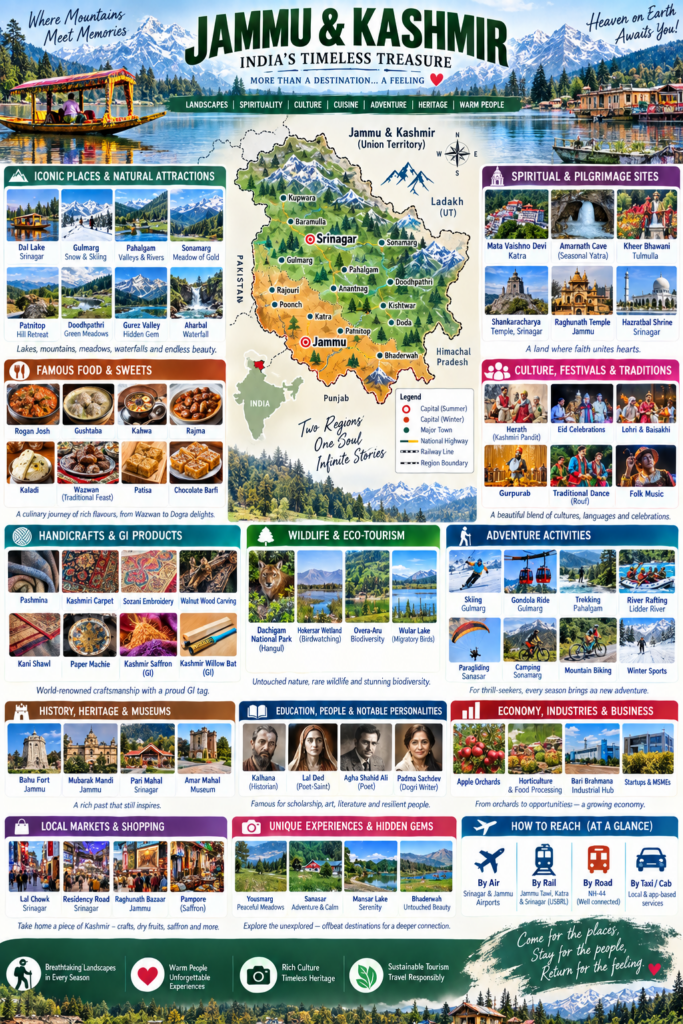
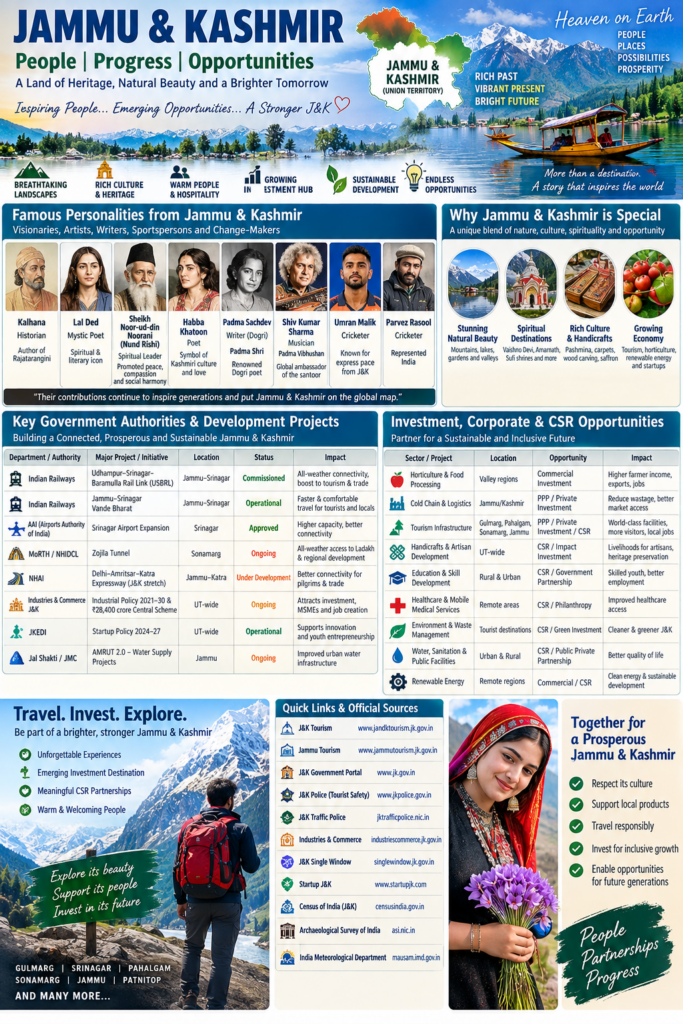
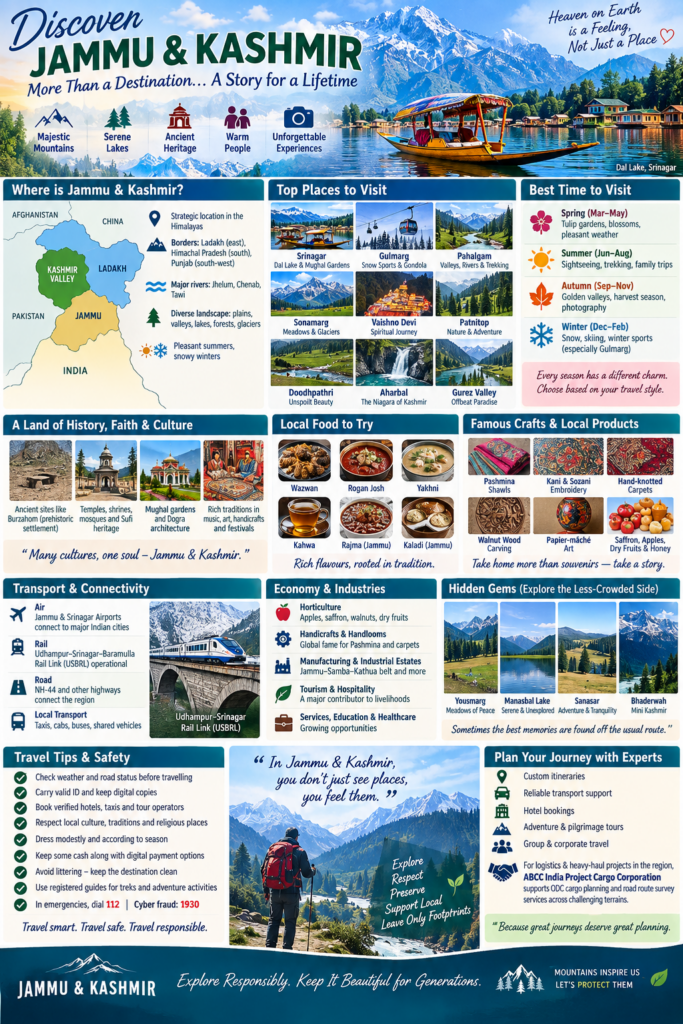
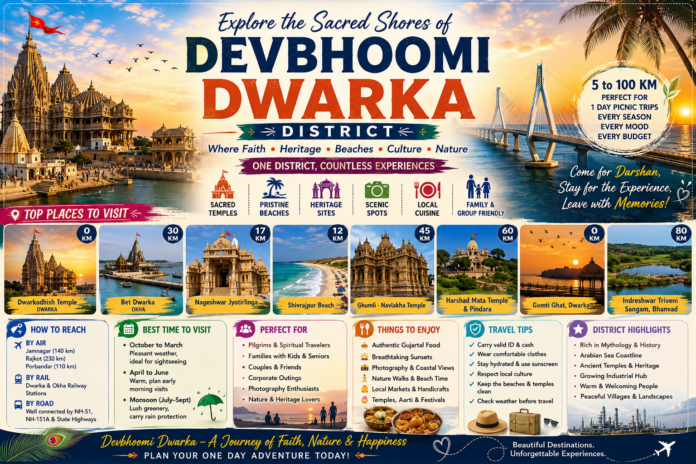
🌏 The Journey From Faith to India’s Temple Economy
Before sunrise, the streets surrounding many of India’s famous temples begin to come alive.
Flower sellers prepare fresh garlands. Tea stalls open their shutters. Pilgrims gather near bus stands and railway stations. Hotel workers prepare rooms, drivers check their vehicles, and shopkeepers arrange incense sticks, lamps, sweets and devotional products.
For some visitors, the journey is a lifelong spiritual aspiration. For others, it is a family tradition, a cultural experience or an opportunity to discover India’s architectural and historical heritage.
But behind every pilgrimage is an economic story.
A family travelling to Varanasi may purchase railway tickets, book a hotel, hire an auto-rickshaw, eat at a local restaurant, buy Banarasi textiles and visit nearby attractions. A group travelling to Kedarnath may depend on mountain transport operators, accommodation providers, guides and seasonal workers. A devotee visiting Tirupati participates in a much larger institutional system involving food preparation, procurement, security, accommodation and public services.
Together, these activities form what is commonly described as the Indian temple economy.
India’s temple economy is not a single industry with one balance sheet. It is a network of religious institutions, tourism businesses, public infrastructure, cultural industries, agricultural producers, transportation services and local communities.
It connects large metropolitan cities with small villages, coastal destinations with mountain settlements, and historic traditions with modern digital technology.
Temples also play a role in the country’s cultural identity. Their importance cannot be reduced to revenue, donations or visitor numbers. They are places of worship, memory, architecture, learning, community participation and religious expression.
A useful study of the temple economy must therefore examine both economic benefits and social responsibilities.
🛕 What is the temple economy in India?
The temple economy in India refers to economic activity associated with Hindu temples, pilgrimage journeys, temple festivals, religious services and related tourism. It includes temple administration and spending by visitors on accommodation, transportation, food, shopping, local services and infrastructure.
Religious tourism in India is broader than temple tourism. It also includes visits to Buddhist, Jain, Sikh, Islamic, Christian and other religious heritage destinations.
📊 What makes India’s temple tourism economy important?
Economic dimension
Importance
Tourism
Encourages domestic and international travel
Employment
Supports hospitality, retail, transportation and services
Agriculture
Creates demand for flowers, fruits, grains and dairy
Infrastructure
Encourages investment in roads, sanitation and visitor facilities
Culture
Supports architecture, traditional crafts and festivals
Rural development
Connects smaller towns with wider tourism markets
Entrepreneurship
Creates opportunities for local businesses
Transportation
Generates passenger movement and goods distribution
Technology
Supports online bookings, donations and visitor management
Social welfare
Some religious institutions provide education, healthcare and food services
The scale of this ecosystem explains why temple tourism deserves serious attention from economists, tourism planners, infrastructure professionals and entrepreneurs.
🕉️ 2. Understanding Temple Tourism, Pilgrimage Tourism and Spiritual Tourism
Although these terms are frequently used together, they have different meanings.
Temple tourism
Temple tourism involves visiting temples for worship, architecture, cultural exploration, festivals or heritage experiences.
Visitors may be devotees, cultural tourists, historians, architecture enthusiasts or families.
Pilgrimage tourism
Pilgrimage tourism involves journeys undertaken primarily for religious or spiritual purposes.
Examples include the Char Dham Yatra, visits to Tirupati, the Pandharpur Wari and pilgrimages to major Jyotirlinga shrines.
Religious tourism
Religious tourism is the broader category of travel associated with religious places, ceremonies, heritage and traditions.
It includes temples as well as other religious sites.
Spiritual tourism
Spiritual tourism may involve meditation, reflection, yoga, religious practice or personal exploration.
Not every spiritual journey is associated with a temple.
Heritage tourism
Heritage tourism focuses on historical, architectural and cultural significance.
For example, the Konark Sun Temple is a major heritage destination as well as a monument connected to India’s religious and architectural history.
These categories overlap, and visitors often have multiple motivations.
📜 3. Historical Development of India’s Temple Economy
India’s temples have been connected with social and economic life for centuries.
In different historical periods, major religious institutions received patronage from rulers, merchants, landowners and communities.
Temple construction supported sculptors, architects, stoneworkers and other skilled craftspeople. Temple activities created demand for ritual materials, food, clothing and services.
Ancient India
Religious centres developed around settlements, rivers and important cultural routes.
Pilgrims required food, shelter and assistance during long journeys.
These needs encouraged the development of local markets and hospitality traditions.
Gupta period
The Gupta period contributed significantly to the development of classical Hindu temple architecture.
Temple patronage encouraged artistic and architectural activity.
Chola period
The Chola dynasty supported major temple construction in South India.
The Brihadisvara Temple in Thanjavur is an important example of monumental temple architecture.
Historical inscriptions reveal aspects of temple administration, endowments, employment and social organization.
Medieval pilgrimage networks
Religious centres such as Varanasi, Puri, Dwarka and Rameswaram were linked through traditions of pilgrimage.
Journeys between sacred destinations facilitated cultural exchange and supported local trade.
Colonial period
Railway expansion changed the accessibility of pilgrimage destinations.
Travelling to distant religious centres became easier for many people, contributing to the growth of accommodation, retail and passenger services.
Independent India
Road development, railway connectivity, urbanization and increasing household mobility contributed to the expansion of domestic pilgrimage tourism.
Temple administration evolved through different legal and institutional arrangements across states.
Digital era
Online information, electronic payments, official booking systems and improved transport connections have transformed modern pilgrimage planning.
The result is a temple economy that combines historical traditions with contemporary service industries.
📊 4. Indian Temple Economy Statistics: How Big Is Religious Tourism in India?
The size of India’s temple economy is often exaggerated because temple donations, religious tourism spending and the overall tourism industry are treated as interchangeable.
They are not.
The Ministry of Tourism does not maintain a separate national count of pilgrimage visits. Domestic tourism statistics include religious journeys alongside leisure, business, family and other travel.
Key Indian tourism statistics
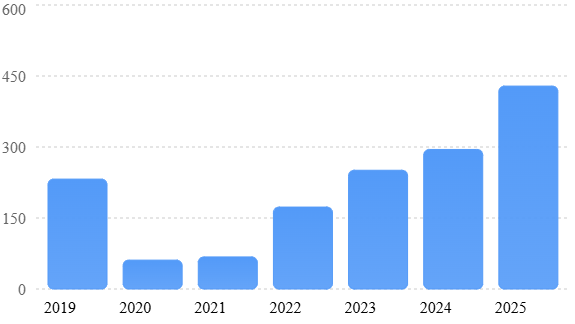
Domestic tourist visits, 2025
428.69 crore
Provisional tourism dashboard figure
Domestic tourist visits, 2024
294.82 crore
All domestic tourism purposes
Tourism contribution to GDP, FY 2023–24
5.22%
Entire tourism sector
Tourism-supported employment, FY 2023–24
8.46 crore
Direct and indirect jobs
Sources: Ministry of Tourism statistical dashboard and government reporting. These are not temple-only figures.
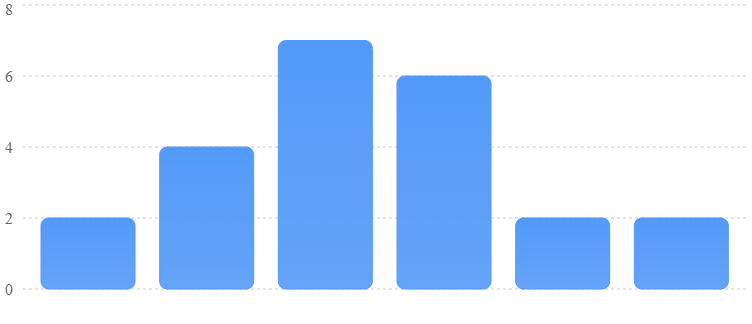
Domestic tourist visits in India, 2019–2025
Growth of domestic tourist visits in India
Visits, not unique travellers. 2025 is the figure displayed on the Ministry’s current tourism dashboard; all categories of domestic tourism.
The recovery and expansion of domestic tourism create opportunities for religious destinations, but the data cannot establish what percentage of travel was temple-related.
🧮 How to calculate the economic impact of temple tourism
A basic estimate begins with:
\[ \text{Visitor expenditure}=\text{Visitor visits}\times\text{Average spending per visit} \]
For example, suppose a pilgrimage town receives 20 lakh visits annually and visitors spend an average of ₹3,000 outside the temple.
The resulting gross visitor expenditure would be ₹600 crore.
This amount is not equivalent to GDP contribution or business profit. A proper economic impact study must account for intermediate costs, imported goods, local wages and the portion of spending retained within the destination.
🗺️ 5. India’s Temple Tourism Geography: Major Pilgrimage Regions
India’s temple tourism is spread across coastal regions, river valleys, mountains, historic cities and rural settlements.
The geography of each destination influences visitor behaviour, transport requirements and business opportunities.
North India
Northern India’s temple tourism includes the Himalayan pilgrimage routes, Ayodhya, Mathura–Vrindavan, Varanasi and important temples in Himachal Pradesh.
Mountain destinations face seasonal access challenges, while urban pilgrimage centres often require sophisticated crowd and traffic management.
South India
Southern India is particularly significant for historic temple architecture, established religious institutions and multi-destination pilgrimage circuits.
Tamil Nadu, Andhra Pradesh, Karnataka, Kerala and Telangana contain numerous major temples with distinctive religious traditions and architectural histories.
West India
Western India includes the pilgrimage economies of Gujarat, Maharashtra and Rajasthan.
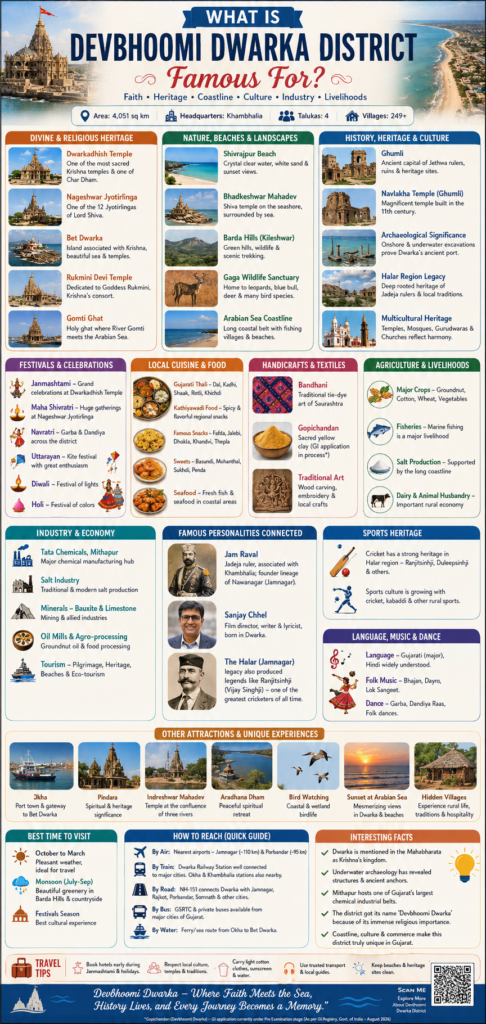
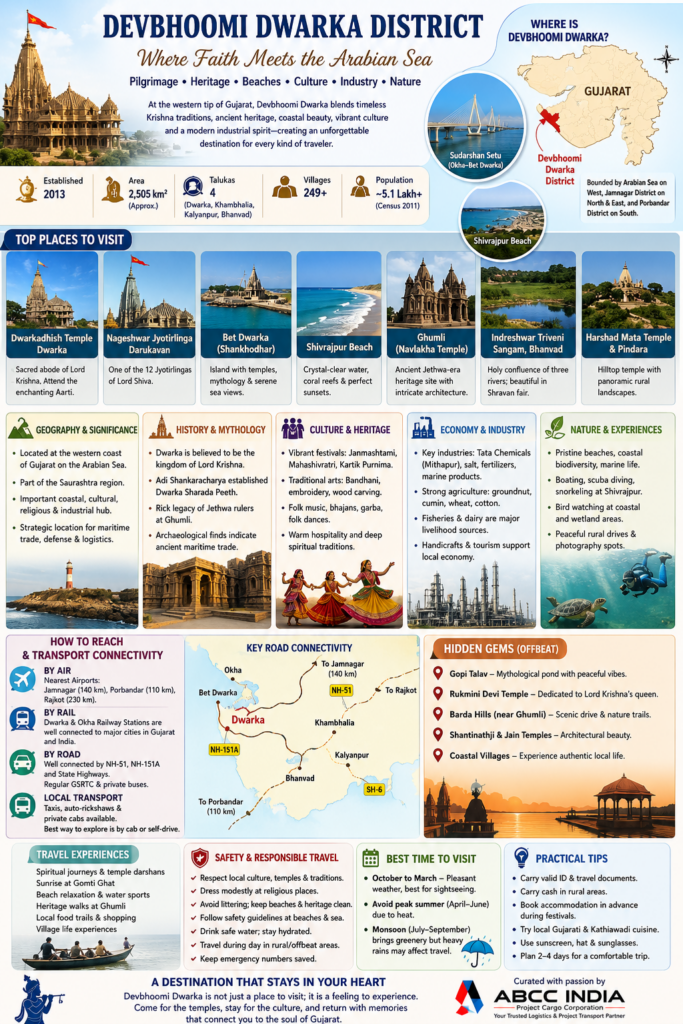
Important destinations include Dwarka, Somnath, Shirdi, Pandharpur, Trimbakeshwar, Ambaji, Nathdwara and Khatu Shyam Ji.
Road transport plays an important role in connecting these destinations with major population centres.
East India
Eastern India includes Puri, Gaya, Deoghar, Tarapith, Dakshineswar and important temple destinations in Odisha, Bihar, Jharkhand and West Bengal.
River-based religious traditions, seasonal festivals and regional crafts contribute to the tourism experience.
Northeast India
Northeastern India has distinctive temple traditions and religious heritage.
Kamakhya in Assam and Tripura Sundari in Tripura are prominent examples.
Tourism development must account for regional geography, transport access, local culture and environmental sensitivity.
🛕 6. State-Wise Indian Temple Tourism and Economy Directory
The following directory identifies important destinations and their associated economic activities. It is not a ranking by income, temple assets or visitor count.
The economic intensity varies considerably. A major pilgrimage hub may support thousands of businesses, while a smaller local shrine primarily serves nearby communities.
🏛️ 7. Major Temple Economy Case Studies in India
🛕 Tirupati, Andhra Pradesh: Institutional Scale and Pilgrimage Management
Tirumala Tirupati is one of India’s most prominent pilgrimage centres.
The Sri Venkateswara Temple is administered by Tirumala Tirupati Devasthanams (TTD), an institution responsible for extensive religious, administrative and pilgrim services.
TTD approved a budget of ₹5,456.26 crore for the financial year 2026–27. The announcement included ₹118.89 crore for educational improvements and plans for additional food-service infrastructure.
TTD News
The Tirupati economy extends beyond the temple administration to hotels, food suppliers, transportation operators, retailers and other service providers.
Economic lessons: Large pilgrimage institutions require reliable procurement, logistics, sanitation, financial management and public-facing services.
🚩 Ayodhya, Uttar Pradesh: Religious Tourism and Urban Transformation
Ayodhya has experienced major infrastructure and tourism changes associated with the development of the Ram Mandir and related facilities.
Religious travel supports accommodation, restaurants, retail, transport and construction-related businesses.
Rapid growth also creates challenges involving land prices, congestion, public services and the preservation of historic neighbourhoods.
Economic lessons: Tourism growth should be evaluated through local employment, service quality and resident welfare, not visitor counts alone.
🌊 Varanasi, Uttar Pradesh: Temples, Riverfronts and Cultural Industries
Varanasi’s economy combines pilgrimage with riverfront tourism, heritage walks, music, textiles, food and traditional commerce.
The Kashi Vishwanath Temple is a major religious destination, while the ghats and historic neighbourhoods attract visitors with wider cultural interests.
Economic lessons: Temple tourism can support a diversified city economy when religious and cultural attractions are connected responsibly.
🌸 Shirdi, Maharashtra: A Pilgrimage-Based Service Economy
Shirdi demonstrates how a religious destination can support hotels, guesthouses, passenger transport, food businesses and retail.
Visitor demand changes during weekends, holidays and festivals.
Economic lessons: Businesses should plan for seasonal variation and competition rather than assuming constant high occupancy.
Kedarnath is a major pilgrimage destination in a geographically sensitive Himalayan environment.
The local economy depends on seasonal travel, mountain transport, lodging and support services.
Weather, road conditions and ecological constraints influence operations.
Economic lessons: Safety, environmental protection and infrastructure resilience are central to the sustainability of mountain pilgrimage.
🛕 Jagannath Puri, Odisha: Temple Festivals and Coastal Tourism
Puri combines religious pilgrimage, the Rath Yatra festival, traditional food practices and coastal tourism.
Its economy includes hospitality, transport, food, crafts and seasonal event services.
Economic lessons: Festival economies require planning for temporary demand without neglecting year-round residents.
🌺 Madurai, Tamil Nadu: Temple Heritage and Urban Commerce
The Meenakshi Amman Temple is central to Madurai’s cultural identity.
The surrounding urban economy includes traditional markets, textiles, jewellery, hospitality and food services.
Economic lessons: Historic commercial neighbourhoods are important economic assets and should be considered in heritage conservation plans.
🕉️ Ujjain, Madhya Pradesh: Religious Tourism and City Infrastructure
The Mahakaleshwar Temple attracts pilgrims throughout the year, with important seasonal and festival peaks.
Tourism generates demand for accommodation, local transport, food and religious services.
Economic lessons: Improved public spaces and pedestrian movement can enhance tourism, but infrastructure requires continuous maintenance and effective crowd management.
🛕 8. The 12 Jyotirlingas and Their Economic Importance
The twelve Jyotirlingas form one of India’s most widely recognized Shiva pilgrimage traditions. Their locations span multiple states, creating opportunities for regional and interstate religious tourism.
Jyotirlinga
State
Nearest important tourism hub
Major tourism opportunities
Somnath
Gujarat
Veraval
Coastal tourism, hotels, transport
Mallikarjuna, Srisailam
Andhra Pradesh
Srisailam
Forest-region travel, accommodation
Mahakaleshwar
Madhya Pradesh
Ujjain
Heritage tourism, retail
Omkareshwar
Madhya Pradesh
Omkareshwar
River tourism, lodging
Kedarnath
Uttarakhand
Guptkashi region
Mountain pilgrimage, seasonal services
Bhimashankar
Maharashtra
Pune region
Hill tourism, passenger transport
Kashi Vishwanath
Uttar Pradesh
Varanasi
Urban tourism, handicrafts
Trimbakeshwar
Maharashtra
Nashik
Religious tourism, regional hospitality
Baidyanath Dham
Jharkhand
Deoghar
Kanwar Yatra, transport, accommodation
Nageshwar
Gujarat
Dwarka
Coastal pilgrimage, tourism circuits
Rameswaram
Tamil Nadu
Rameswaram
Coastal heritage and hospitality
Grishneshwar
Maharashtra
Chhatrapati Sambhajinagar
Heritage tourism, local transport
Note: Some Jyotirlinga identifications have differing regional traditions. This table follows a commonly used pilgrimage circuit.
Economic importance of Jyotirlinga circuits
Multi-destination pilgrimage creates spending across more than one state. Travellers may use railway services, buses, taxis, hotels and restaurants over several days.
For transport operators, interstate pilgrimages require route planning, passenger comfort, safe driving schedules and suitable rest stops.
For local businesses, the challenge is to convert short visits into longer, meaningful stays without exploiting religious sentiment.
A well-planned itinerary may combine a principal temple visit with nearby heritage sites, museums, traditional markets and local cuisine.
🚩 9. Char Dham, Chota Char Dham and Other Famous Pilgrimage Circuits
India has multiple pilgrimage traditions that connect geographically distant sacred destinations.
Char Dham
The traditional Char Dham circuit includes Badrinath, Dwarka, Puri and Rameswaram.
These destinations represent a geographically extensive pilgrimage journey across India.
Their economic significance extends to national transport networks, accommodation and regional tourism services.
Chota Char Dham
The Uttarakhand Chota Char Dham circuit includes Yamunotri, Gangotri, Kedarnath and Badrinath.
Its operating conditions differ substantially from those of urban pilgrimage destinations because of mountain geography and seasonal accessibility.
Important religious tourism circuits
Circuit
Main destinations
Tourism characteristics
Traditional Char Dham
Badrinath, Dwarka, Puri, Rameswaram
Long-distance interstate pilgrimage
Uttarakhand Char Dham
Yamunotri, Gangotri, Kedarnath, Badrinath
Seasonal Himalayan pilgrimage
12 Jyotirlingas
Multiple states
Multi-state Shiva pilgrimage
Gujarat coastal circuit
Dwarka, Nageshwar, Somnath
Coastal and religious tourism
Maharashtra pilgrimage circuit
Shirdi, Nashik, Trimbakeshwar, Bhimashankar
Road and rail pilgrimage
Tamil Nadu temple circuit
Madurai, Rameswaram, Thanjavur, Chidambaram
Architecture and heritage tourism
Krishna pilgrimage circuit
Mathura, Vrindavan, Govardhan and related sites
Religious and cultural tourism
Odisha heritage circuit
Puri, Konark, Bhubaneswar
Temples, architecture, coastal tourism
Karnataka heritage circuit
Hampi, Udupi and other destinations
Heritage and religious tourism
Not every circuit is a formal government-designated tourism route. Travellers should verify distances, opening schedules, local restrictions and seasonal conditions before planning.
🏨 10. Hotels, Dharamshalas, Homestays and the Accommodation Economy
Accommodation is among the most visible commercial sectors associated with pilgrimage.
The industry serves visitors with widely different budgets and expectations.
A family travelling for a short temple visit may choose an economical guesthouse. A group of senior citizens may prefer accommodation close to accessible transport. Visitors combining pilgrimage with leisure tourism may stay in larger hotels.
Accommodation categories
Accommodation type
Main customer segment
Economic considerations
Dharamshala
Pilgrims seeking simple lodging
Management and maintenance
Budget hotel
Families and groups
Occupancy and competition
Mid-range hotel
Families and leisure tourists
Service quality and staffing
Premium hotel
Higher-spending visitors
Capital and operating costs
Homestay
Cultural and regional travellers
Local participation
Pilgrim hostel
Organized groups
Capacity and sanitation
Retreat accommodation
Spiritual and wellness visitors
Programme quality and regulation
Why overnight stays matter
Visitor numbers do not always translate into accommodation revenue.
A destination receiving many day visitors may have less hotel demand than a smaller destination attracting travellers who stay several nights.
The economic effect depends on visitor spending, average length of stay, room occupancy and how much expenditure reaches local suppliers.
Temple towns require regular deliveries of food, drinking water, flowers, dairy products, textiles, hotel supplies, construction materials and sanitation equipment.
A large pilgrimage destination may also need temporary logistics support during major festivals.
Specialized transportation and project cargo
Large infrastructure works can require generators, transformers, prefabricated structures, construction equipment and other heavy materials.
When equipment is unusually large or heavy, specialized trailers and route engineering may be necessary.
Such movements must be assessed according to actual cargo specifications, road geometry, bridge capacity and applicable permissions.
Transport and logistics business opportunities
Sector
Potential business
Major requirement
Passenger transport
Pilgrimage bus operations
Permits, vehicle safety
Taxi services
Local sightseeing and transfers
Licensing, reliable service
Goods transport
Food and retail supply
Timely deliveries
Cold-chain logistics
Dairy and perishable products
Temperature control
Hotel logistics
Furniture and consumables
Inventory coordination
Construction logistics
Building materials
Site access and safety
Heavy-haul transport
Specialized infrastructure cargo
Engineering and permissions
Waste logistics
Collection and disposal
Municipal authorization
Warehousing
Regional distribution
Suitable location and storage
EV mobility
Electric passenger services
Charging and commercial viability
Temple festival transport planning
During festivals, road authorities may restrict vehicle access to crowded areas.
Commercial operators should use designated delivery routes and comply with local traffic instructions.
Emergency access must remain clear.
Transport businesses should not advertise guaranteed access or travel times during major religious gatherings.
🌾 12. Agriculture, Flowers, Prasad and the Temple Food Economy
The temple economy connects urban pilgrimage destinations with agricultural production.
Flowers, fruits, vegetables, milk, grains and other materials are used in religious practices and visitor services.
Flower supply chains
Flower cultivation supports growers, wholesalers, transporters and retailers.
Fresh flowers are highly perishable, making efficient distribution important.
Festival demand can increase sales but may also produce price volatility.
Dairy products
Milk, ghee and traditional sweets are important in many religious food traditions.
Dairy producers, processors, wholesalers and retailers participate in the supply chain.
Food hygiene and appropriate storage are essential.
Prasad and food preparation
Temple food systems can involve procurement, kitchens, trained workers, packaging and distribution.
Some institutions operate large-scale food services.
Their economic and social significance extends beyond direct commercial revenue.
Traditional sweets and regional products
Many pilgrimage towns are associated with particular sweets or food traditions.
Visitors may purchase these products as gifts, creating markets for local producers.
Businesses should distinguish authentic regional products from generic items marketed through misleading claims.
Food waste management
High-volume food preparation can generate significant organic waste.
Careful demand forecasting, safe food handling, appropriate donation arrangements and lawful waste processing can improve efficiency.
👩💼 13. Employment and Entrepreneurship in Temple Tourism
Temple tourism supports employment across skill levels.
Some people work directly for religious institutions, while others are employed by independent businesses.
Employment categories
Sector
Employment opportunities
Temple administration
Accountants, clerks, maintenance workers
Hospitality
Receptionists, chefs, housekeeping
Transport
Drivers, dispatchers, mechanics
Food services
Cooks, suppliers, vendors
Retail
Shopkeepers, sales workers
Tourism
Guides, coordinators, interpreters
Construction
Engineers, contractors, skilled workers
Technology
Booking-system and IT professionals
Public services
Sanitation and visitor assistance
Crafts
Sculptors, textile workers, artisans
Women’s entrepreneurship
Women-led enterprises can participate in food production, handicrafts, accommodation, retail and tourism services.
Self-help groups may provide an organizational structure for small producers.
Access to finance, safe working environments and market opportunities remain important.
Youth employment
Young workers may find opportunities in hospitality, digital marketing, language services, transport management and tourism technology.
Training in customer service, first aid, digital literacy and local heritage can improve employability.
Employment quality
The number of jobs created is only one measure of economic success.
Income stability, working conditions, social protection and opportunities for skill development are equally important.
🏗️ 14. Government Schemes for Temple Tourism and Pilgrimage Infrastructure
Public infrastructure has a significant influence on the development of religious destinations.
Government support may include roads, pedestrian facilities, lighting, toilets, drinking water, waste management and visitor information systems.
PRASHAD Scheme
The Pilgrimage Rejuvenation and Spiritual, Heritage Augmentation Drive (PRASHAD) supports development at identified pilgrimage and heritage destinations.
Government reporting in 2026 recorded 54 sanctioned projects across 28 states and Union Territories, with an estimated project cost of ₹1,726.74 crore. A later 2026 update reported 32 physically completed projects.
Press Information Bureau
Swadesh Darshan
Swadesh Darshan and Swadesh Darshan 2.0 support tourism destination development.
Spiritual tourism and cultural heritage are among the themes relevant to pilgrimage-related infrastructure.
Government reporting in January 2026 recorded 53 sanctioned projects under Swadesh Darshan 2.0, with an approved amount of ₹2,208.27 crore.
Press Information Bureau
Public investment priorities
Infrastructure development should consider the entire visitor journey.
A renovated temple entrance may improve access, but visitors also need reliable roads, clean public toilets, safe pedestrian routes and accurate information.
Projects should be assessed through measurable improvements in safety, accessibility, maintenance and local economic participation.
🌱 15. Sustainable Temple Tourism and Environmental Protection
Religious tourism can create environmental challenges when large numbers of visitors arrive in areas with limited infrastructure.
These challenges are particularly important in mountain regions, riverfront cities and environmentally sensitive destinations.
Solid waste
Food packaging, disposable items, flowers and other waste require collection and processing.
Waste segregation and suitable public facilities can reduce pollution.
Water management
Hotels, restaurants and public facilities increase demand for drinking water and sanitation.
Efficient fixtures, wastewater treatment and careful resource planning are essential.
Traffic congestion
Large numbers of private vehicles can increase congestion and emissions.
Appropriate public transport, parking facilities and pedestrian zones can improve movement.
Modern commercial development should not damage protected monuments or surrounding heritage areas.
Community participation
Residents should be involved in tourism planning.
Local communities experience the effects of crowding, land-use changes and commercial development throughout the year.
Sustainable tourism requires balancing visitor convenience with resident welfare.
💼 16. Business Opportunities in the Indian Temple Economy
India’s pilgrimage destinations offer business opportunities in both established and emerging sectors.
However, no business should be considered profitable solely because a temple receives many visitors.
Investors must assess local demand, operating costs, competition, licensing and seasonality.
Temple tourism business opportunities chart
Business idea
Customer segment
Main risk
Growth opportunity
Budget accommodation
Families, pilgrims
Seasonal occupancy
Reliable low-cost stays
Restaurant
Pilgrims, residents
Food costs and competition
Regional cuisine
Flower shop
Devotees
Spoilage
Organized sourcing
Souvenir business
Tourists
Generic products
Authentic crafts
Travel agency
Pilgrimage groups
Competition
Customized itineraries
Taxi business
Families, senior visitors
Permits and vehicle costs
Reliable local transfers
Tourist guide service
Heritage travellers
Seasonal demand
Multilingual guiding
Hotel supplies
Hospitality businesses
Credit and inventory
Recurring contracts
Laundry service
Hotels
Equipment and utilities
Commercial outsourcing
Food distribution
Restaurants, institutions
Perishability
Reliable supply chains
Packaging
Food and souvenir businesses
Material costs
Sustainable products
EV shuttle service
Local visitors
Charging and utilization
Last-mile mobility
Waste-management service
Institutions and businesses
Regulation
Organized collection
Digital booking support
Tourism businesses
Trust and competition
Secure technology
Accessibility services
Senior and disabled visitors
Specialized equipment
Inclusive travel
Construction logistics
Developers and contractors
Project cycles
Infrastructure growth
Choosing a business location
A shop beside a busy temple may have high visibility but expensive rent.
A business located farther away may benefit from lower operating costs but require stronger transport connections.
Footfall, customer conversion, spending capacity and competition should all be studied.
Business feasibility checklist
Before investing, entrepreneurs should estimate expected customer volume, average revenue per transaction, gross margin, fixed expenses, seasonal fluctuations and working capital.
They should also verify zoning, local permissions, fire safety, taxation and other regulatory requirements.
The most resilient businesses often serve both tourists and permanent residents.
📱 17. Digital Temple Tourism, Online Darshan and Technology
Technology is becoming an important part of religious tourism.
Official websites, digital payments, online information and visitor-management systems can improve planning and administration.
Online services
Depending on the institution, online facilities may include accommodation information, donations, scheduled religious services and visitor guidance.
Not every temple offers the same services.
Pilgrims should rely on official sources and avoid unverified booking intermediaries.
Digital payments
Electronic payments can improve convenience and transaction records.
However, fraudulent payment links and impersonation websites remain risks.
Visitors should verify the intended recipient before transferring money.
Tourism information platforms
Reliable destination websites can help travellers understand how to reach temples, where to stay, what facilities are available and how to travel responsibly.
Useful information includes accessibility, transport connections, seasonal conditions, official booking links and emergency contacts.
Artificial intelligence and visitor services
AI-assisted systems may help organize information, support multilingual communication and forecast visitor demand.
However, religious and travel information must be checked against authoritative sources.
Automated systems should not invent temple opening hours, booking availability, ritual rules or local businesses.
🧭 18. Temple Tourism Travel Planning Guide
Planning a pilgrimage requires more than choosing a temple.
Visitors should consider transportation, accommodation, local customs, accessibility, seasonal conditions and the needs of accompanying family members.
Best time to visit temples in India
There is no single best season for every temple.
Region
General travel considerations
Himalayan destinations
Seasonal access and weather restrictions
North Indian plains
Summer heat, winter fog, festival crowds
Western India
Summer temperatures and monsoon conditions
South India
Heat, humidity, regional monsoon patterns
Eastern India
Rainfall, festivals and coastal weather
Northeast India
Monsoon conditions and regional connectivity
Actual conditions vary by destination and year.
Travelling with children
Families should choose manageable itineraries, carry drinking water and identify rest facilities.
Crowded festival periods may require additional precautions.
Senior-citizen pilgrimage
Older travellers may benefit from shorter walking distances, accessible accommodation and flexible schedules.
Medical needs should be discussed with appropriate healthcare professionals before demanding journeys.
Solo travel
Solo visitors should use reliable transport, share travel plans with trusted contacts and verify accommodation arrangements.
International visitors
Foreign travellers should check visa requirements, local customs, permitted areas and official visitor information.
Some religious institutions have specific entry or conduct rules that visitors must respect.
⚠️ 19. Temple Tourism Safety, Scams and Responsible Travel
Pilgrimage is often emotionally meaningful, which makes reliable information particularly important.
Common risks
Risk
Practical precaution
Fake booking websites
Use verified official websites
Unauthorized guides
Confirm identity and credentials
Misleading transport fares
Agree on transparent pricing
Crowded entrances
Follow official crowd instructions
Lost belongings
Secure valuables
Extreme weather
Check forecasts and local advisories
Mountain road hazards
Follow official travel restrictions
Food hygiene problems
Choose hygienic establishments
Misleading donation requests
Verify the recipient
Inaccessible facilities
Check arrangements in advance
Emergency assistance
India’s integrated emergency response number is 112.
Travellers should also identify nearby healthcare facilities and local police assistance before visiting remote destinations.
Responsible behaviour
Visitors should respect religious customs, avoid obstructing rituals and follow photography restrictions.
They should dispose of waste properly and avoid damaging monuments or natural surroundings.
Responsible tourism protects both sacred places and the communities that maintain them.
📈 20. Economic Impact Calculator for Temple Tourism
A simple scenario model can help researchers and entrepreneurs understand how visitor volume and spending affect the size of a destination’s tourism market.
🧮 Temple Tourism Economic Scenario
Annual tourist visits
25 lakhAverage visitor spending
₹2,500Assumed locally retained share
40%
Annual visitor expenditure
₹625 cr
Assumed locally retained spending
₹250 cr
Hypothetical calculations only. They are not forecasts, audited figures, tax receipts or GDP estimates.Reset scenario
How this model can be used
A hotel investor can estimate potential demand using realistic assumptions about overnight stays.
A transport operator can study seasonal passenger movement.
A local authority can evaluate whether additional infrastructure is justified.
A tourism researcher can use the model as a starting point before collecting actual spending data.
🔮 21. Future of Indian Temple Tourism: 2026–2035
India’s temple tourism sector has opportunities for continued development, but the direction and scale of growth will depend on policy, infrastructure and visitor behaviour.
Integrated tourism circuits
Better connectivity can make it easier to combine pilgrimage with heritage and cultural tourism.
This may distribute spending across multiple destinations.
Accessibility improvements
Facilities for senior citizens and people with disabilities can make pilgrimage more inclusive.
Accessible transport, ramps, toilets and reliable information are important.
Sustainable mobility
Public transport and appropriately planned electric mobility can reduce congestion at suitable destinations.
Local enterprise development
Training, transparent procurement and digital market access can improve opportunities for local businesses.
Cultural preservation
Traditional architecture, festivals, music, food and crafts are valuable cultural assets.
Their protection should remain central to tourism planning.
Better economic statistics
Reliable pilgrimage-specific surveys would help researchers distinguish temple income, tourist spending, employment and regional economic value added.
This is essential for making credible claims about the future size of the temple economy.
❓ 22. Frequently Asked Questions About Indian Temple Economy and Temple Tourism
1. What is the Indian temple economy?
The Indian temple economy is the network of economic activities generated by temples, pilgrimage, religious festivals and related services. It includes accommodation, transportation, food, shopping, employment, temple administration and infrastructure.
2. How much is the temple economy worth in India?
There is no single official figure for the complete value of India’s temple economy. National tourism statistics include religious and non-religious travel, and temple donations cannot be treated as tourism GDP.
3. Why is temple tourism important in India?
Temple tourism supports cultural heritage, regional travel, local employment, small businesses, hospitality, transportation and infrastructure development.
4. Which is the richest temple in India?
The answer depends on whether richness means annual income, institutional budget, financial assets, property or the estimated value of religious treasures. These measures are not directly comparable, and no single consistently audited national ranking covers every temple.
5. Which temple has one of India’s largest annual budgets?
Tirumala Tirupati Devasthanams approved a budget of ₹5,456.26 crore for FY 2026–27.
TTD News
6. How does temple tourism contribute to GDP?
It generates economic value through hospitality, transport, retail, food services and other activities. GDP measures value added, not simply the total money spent or donated.
7. How many religious tourists visit India every year?
The Ministry of Tourism does not maintain a separate national count of pilgrimage visits. Domestic tourist visit figures include religious travel but cannot isolate it reliably.
Digital Sansad
8. What are the most famous temple tourism destinations in India?
Important destinations include Tirupati, Ayodhya, Varanasi, Shirdi, Kedarnath, Badrinath, Puri, Rameswaram, Madurai, Somnath, Dwarka and Ujjain.
9. What is the difference between temple tourism and religious tourism?
Temple tourism focuses on visits to temples. Religious tourism is broader and includes other sacred destinations, traditions and religious heritage sites.
10. How does temple tourism generate employment?
It supports jobs in hotels, restaurants, transport, retail, food production, construction, visitor assistance, administration and traditional crafts.
11. How does temple tourism help rural areas?
It can create markets for local agricultural products, handicrafts, accommodation, food services and transportation.
12. Which businesses benefit from temple tourism?
Hotels, restaurants, travel agencies, taxi operators, retailers, flower suppliers, food producers, transport companies and local service providers may benefit.
13. What is the PRASHAD scheme?
PRASHAD is a Government of India programme supporting pilgrimage and heritage tourism infrastructure, including visitor facilities, sanitation and accessibility.
14. How does road transportation support temple tourism?
Road transportation carries pilgrims and supplies essential goods to temples, hotels, restaurants and surrounding markets.
15. Is temple tourism seasonal?
Some destinations receive visitors throughout the year, while others have strong seasonal or festival-related demand. Himalayan pilgrimages are particularly affected by seasonal access.
16. What are the environmental problems caused by religious tourism?
Potential problems include waste generation, water stress, traffic congestion, pollution and pressure on fragile landscapes.
17. How can temple towns become more sustainable?
They can improve public transport, sanitation, wastewater treatment, waste management, pedestrian safety and heritage conservation.
18. What is spiritual tourism in India?
Spiritual tourism involves travel for meditation, reflection, religious practices or personal spiritual experiences. It can overlap with temple and pilgrimage tourism.
19. What are India’s four major Char Dham destinations?
The traditional Char Dham destinations are Badrinath, Dwarka, Puri and Rameswaram.
20. What are the four destinations of Uttarakhand’s Chota Char Dham?
Yamunotri, Gangotri, Kedarnath and Badrinath.
21. Is investing in a temple town hotel profitable?
Profitability depends on occupancy, location, construction costs, financing, competition and seasonal demand. High visitor numbers alone do not guarantee profitability.
22. How can technology improve temple tourism?
Technology can support official bookings, payments, multilingual information, visitor management and operational planning.
23. What role do temples play in preserving Indian culture?
Temples preserve architecture, religious traditions, music, sculpture, festivals, community practices and historical knowledge.
24. How can temple tourism benefit women entrepreneurs?
Women-led businesses can participate in food services, handicrafts, accommodation, retail and tourism-related activities, provided suitable market access and support are available.
25. What is the future of temple tourism in India?
Its future depends on responsible infrastructure investment, visitor demand, digital services, heritage protection, environmental sustainability and local economic participation.
🏁 Conclusion: Faith, Heritage and the Economic Future of India
India’s temple economy demonstrates how religious and cultural traditions can connect with modern economic activity.
From major pilgrimage institutions to small roadside businesses, religious travel supports an extensive network of services.
A temple journey can create demand for agricultural products, accommodation, passenger transportation, food, traditional crafts, construction and technology.
Yet the economic value of pilgrimage should not be measured only through donations, institutional budgets or visitor numbers.
The real question is whether tourism improves livelihoods, creates dignified employment, protects heritage and provides safe, accessible experiences.
A successful temple town must serve both its visitors and its permanent residents.
India’s religious destinations have an opportunity to demonstrate that cultural preservation and economic development can reinforce each other.
With responsible planning, better infrastructure, reliable information and greater local participation, temple tourism can contribute to sustainable regional development while respecting the spiritual traditions at its heart.
For the transport and logistics industry, pilgrimage infrastructure also highlights the importance of dependable road networks, safe passenger movement, efficient goods distribution and specialized project logistics.
ABCC India Project Cargo Corporation, working in road transportation, project cargo and route-planning services, is part of the wider logistics sector that can support infrastructure development across India.
The future of the Indian temple economy is not simply about attracting more pilgrims. It is about creating safer journeys, stronger local businesses, better public facilities and lasting prosperity while preserving India’s religious and cultural heritage.
📚 Official Research References
The following are useful primary sources for publication and future updates.
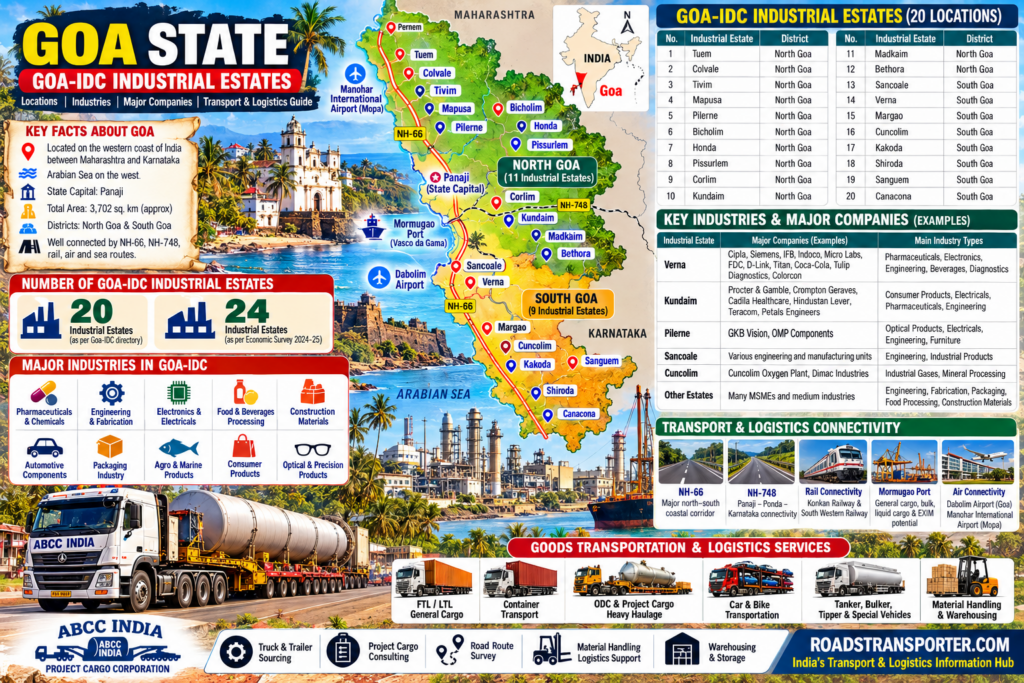
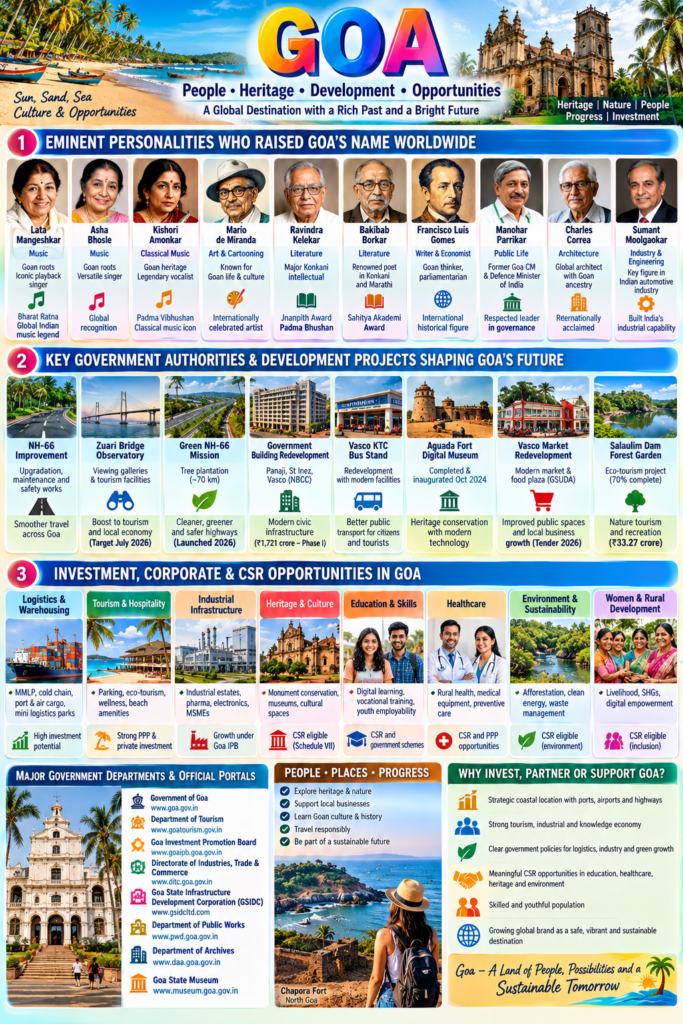
Goa is widely celebrated for its golden beaches, historic churches, Portuguese-influenced architecture, seafood, coastal villages and tourism. Yet beyond its holiday destinations lies another side of the state—an industrial economy supported by manufacturing factories, engineering workshops, pharmaceutical production, warehouses, commercial vehicles, industrial suppliers and an interconnected road transportation network.
From the industrial roads of Verna and Kundaim to the manufacturing units of Pilerne, Tivim, Corlim and Cuncolim, goods transportation plays an important role in keeping Goa’s industrial activities connected with suppliers and customers across India.
A factory may manufacture pharmaceutical products in Verna, receive packaging material from another state, arrange machinery maintenance through a regional engineering supplier and dispatch finished goods to distribution centres hundreds of kilometres away. Each movement requires a different logistics decision: selecting the right vehicle, planning the route, preparing documents, arranging loading and unloading, and ensuring the cargo reaches its destination in suitable condition.
This is why understanding Goa Industrial Development Corporation (Goa-IDC) industrial estates and their goods transportation ecosystem matters to manufacturers, MSMEs, exporters, transport companies, fleet owners, truck brokers, logistics consultants and industrial investors.
Goa is not simply a tourist destination. It is also a coastal manufacturing and distribution market where industrial road transport connects factories with Maharashtra, Karnataka and the wider Indian economy.
📍 Where Is Goa-IDC Industrial Estate Located in Goa?
Goa-IDC does not refer to one single industrial estate. The Goa Industrial Development Corporation is a government-established industrial development organisation responsible for developing and administering industrial estates across Goa.
Its administrative headquarters is situated at Plot No. 13A-2, EDC Complex, Patto Plaza, Panaji, Goa – 403001.
The corporation traces its establishment to February 1966, when it was created as the Goa, Daman and Diu Industrial Development Corporation under the 1965 industrial development legislation. Its principal purpose was to support organised industrial development through industrial estates and developed industrial plots.
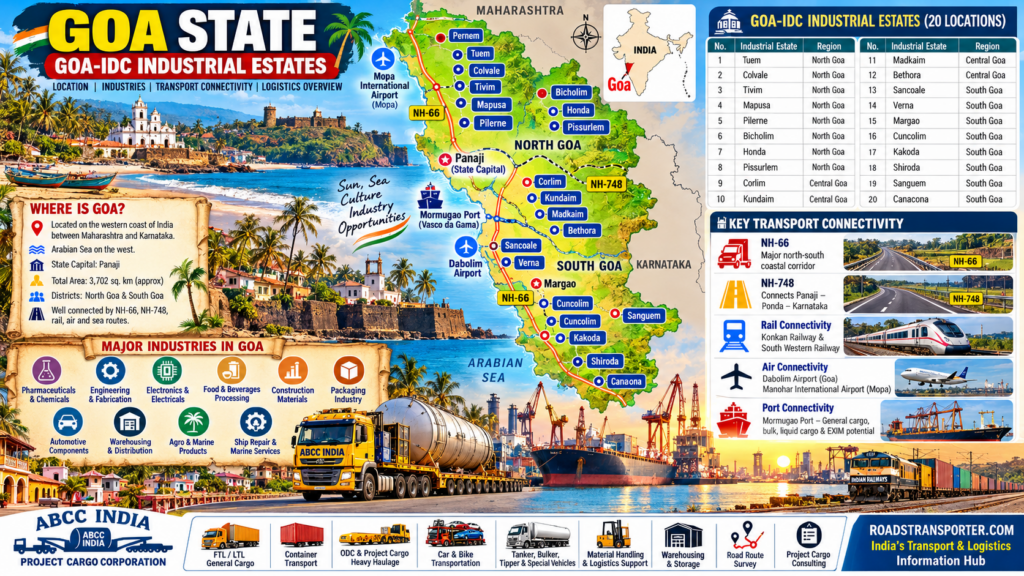
For logistics planning, Goa’s industrial estates can broadly be understood through their geographical relationship with North Goa, South Goa, the Ponda industrial belt, the Mormugao port area and the interstate highway network.
The Government of Goa’s Directorate of Industries, Trade and Commerce identifies the following 20 principal industrial estate locations.
Region
Industrial estates
Logistics relevance
North Goa – Bardez and Pernem belt
Tuem, Colvale, Tivim, Mapusa, Pilerne
Manufacturing dispatches and Maharashtra-bound road connectivity
North Goa – Bicholim and Sattari belt
Bicholim, Honda, Pissurlem
Industrial materials, machinery and regional freight
Central Goa – Tiswadi and Ponda belt
Corlim, Kundaim, Madkaim, Bethora
Manufacturing, engineering, raw-material supply and distribution
South Goa – Coastal industrial belt
Sancoale, Verna
Industrial manufacturing, airport-region access and port-linked logistics
South Goa – Margao and Quepem belt
Margao, Cuncolim, Kakoda, Shiroda
Industrial goods movement and Karnataka/Maharashtra market connections
South Goa – Interior and southern belt
Sanguem, Canacona
Local industrial supply, construction materials and regional transportation
These are geographical groupings for logistics understanding, not separate official Goa-IDC administrative zones.
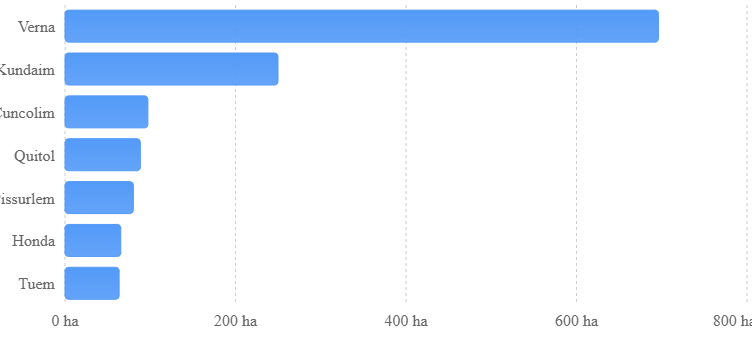
The official Goa Economic Survey 2023–24 also records Latambarcem, Panchawadi and Quitol in its industrial-estate statistics. They should not automatically be described as fully operational manufacturing clusters: the survey reports no running-plant figure for Latambarcem and Panchawadi and zero running plants for Quitol.
🚛 How Important Is Goods Transportation to Goa’s Industrial Economy?
Goods transportation is an essential link between Goa’s industrial estates and the rest of India’s manufacturing and consumer markets.
Factories require raw materials, packaging, components, spare parts, maintenance equipment and machinery. Finished products must then reach wholesalers, distributors, warehouses, ports or end customers.
Goa’s logistics industry therefore involves more than hiring a truck. It includes cargo consolidation, vehicle sourcing, freight forwarding, material handling, warehouse coordination, industrial packing, documentation and specialized project transportation.
The Government of Goa’s Economic Survey 2023–24 recorded 2,747 running plants across its listed industrial estates. The figures included 354 at Verna, 291 at Kundaim, 128 at Sancoale and 112 at Pilerne. These are historical survey figures, not verified live operating counts for October 2026.
🏭 Industry-to-Cargo Transportation Relationships
Industrial sector
Typical cargo movement
Logistics requirements
Pharmaceuticals
Raw materials, packaging, finished medicines
Enclosed vehicles, handling controls, temperature-controlled transport where required
Engineering and fabrication
Components, machines, fabricated structures
Open trucks, flatbeds, cranes and specialized trailers
Electronics and electrical equipment
Components, finished equipment
Protective packing, enclosed vehicles and secure handling
Food and beverage processing
Ingredients, packaging, finished products
Hygienic transport, cold chain where applicable
Construction materials
Steel, pipes, equipment, building products
HCVs, open trucks, suitable loading equipment
Industrial chemicals
Packaged chemicals and liquid products
Cargo-compatible vehicles and applicable safety compliance
Warehousing and distribution
Palletized and mixed consignments
FTL, LTL, PTL and distribution vehicles
These are practical industry-level cargo patterns, not claims about the dispatches of individual factories.
🛣️ Road, Rail, Port and Air Connectivity Supporting Goa Logistics
Goa’s position between Maharashtra and Karnataka gives its industrial sector access to both western coastal markets and inland manufacturing centres.
NH-66 provides an important north–south road corridor, while NH-748 connects the Panaji–Ponda side of Goa towards Karnataka. Other national and state roads connect the industrial estates with Vasco da Gama, Margao, Mapusa and interior industrial locations.
The Mormugao Port area provides a maritime freight gateway. Official port information identifies general cargo, liquid cargo, bulk handling and rail-related facilities. This makes the port relevant to suitable import-export, industrial and bulk-cargo supply chains.
Goa also has Dabolim and Manohar International Airport at Mopa. Air-freight suitability must be checked against the cargo facilities and services actually available at the selected airport.
Transport mode
Major connection
Industrial logistics importance
🚛 Road
NH-66 and connecting national/state roads
Factory dispatches, interstate FTL/LTL and first-mile/last-mile delivery
🚆 Rail
Konkan Railway and South Western Railway connections
Suitable bulk and long-distance freight through available terminals
⚓ Sea
Mormugao Port
Maritime cargo, bulk commodities and applicable EXIM operations
✈️ Air
Dabolim and Mopa airports
Time-sensitive shipments where cargo services are available
🏢 Warehousing
Industrial estates and commercial distribution locations
Inventory storage, consolidation and dispatch coordination
🐘 ODC, Heavy Machinery and Project Cargo Transportation in Goa
Industrial transportation becomes more technically demanding when the consignment is unusually heavy, wide, tall or long.
Machinery installation, factory expansion, electrical infrastructure, marine engineering and industrial maintenance can create requirements for specialized transportation.
Depending on verified cargo dimensions, weight, centre of gravity and road conditions, suitable equipment may include flatbed trailers, semi-low-bed trailers, low-bed trailers, extendable trailers or hydraulic modular combinations.
Such equipment should not be assumed to be permanently available within every Goa industrial estate. Mobilization may be necessary from larger regional or national project-logistics fleets.
For oversized cargo, route planning must also consider bridge capacity, turning radius, road gradients, overhead obstructions, axle loading, loading arrangements and applicable movement permissions.
🤝 How Transporters, Fleet Owners and Truck Brokers Support Goa Industries
Goa’s transportation ecosystem involves different service providers working together.
Fleet owners supply commercial vehicles, transport companies coordinate shipments, truck brokers help source appropriate vehicles, warehouses manage inventory, and freight forwarders arrange relevant multimodal movements.
For manufacturers, reliable logistics coordination can help reduce avoidable vehicle waiting, incorrect vehicle selection, handling delays and documentation problems.
For truck operators, Goa creates potential freight opportunities involving industrial raw materials, finished goods, interstate movements and return-load coordination. Actual truck availability and return loads depend on location, vehicle type, cargo and market conditions.
🌟 Why Goa-IDC Industrial Estates Matter to India’s Logistics Network
Goa’s industrial importance comes from the combination of its manufacturing estates, interstate highway connections, coastal geography and access to a major port.
Verna, Kundaim, Sancoale, Pilerne, Tivim, Corlim and other established industrial locations serve different manufacturing and distribution requirements. Together, they create demand for practical, cargo-specific transportation solutions rather than a single standard trucking service.
For an industrial buyer, the most important question is not simply whether a truck is available. It is whether the selected transport arrangement suits the cargo, loading site, delivery destination, required schedule and applicable safety obligations.
ABCC India Project Cargo Corporation supports industrial transport planning through truck and trailer sourcing, heavy-haulage coordination, project-cargo consulting, road-route survey services and related material-handling logistics support, subject to project requirements and availability.
Understanding Goa’s industrial geography is the starting point for making better freight decisions—whether transporting a small consignment between industrial estates or planning a complex machinery movement across state boundaries.
🏭🚛 How Many Goa-IDC Industrial Estates Are There in Goa? District-Wise Industries, Major Companies & Logistics Guide
Goa has 20 principal industrial estates commonly listed by the Goa Industrial Development Corporation (Goa-IDC), spread across the state’s two districts: North Goa and South Goa.
These estates support pharmaceuticals, chemicals, engineering, electronics, food processing, packaging, fabrication, construction materials and other manufacturing activities.
For the goods transportation industry, the important industrial centres include Verna, Kundaim, Madkaim, Sancoale, Pilerne, Tivim, Corlim, Cuncolim and several smaller industrial estates.
An important distinction: Goa-IDC is one industrial development corporation, not 20 separate corporations. The number refers to industrial estate locations. Some government reports also include additional estate locations, so counts can vary according to the reporting year and development status.
📊 Official Industrial Estate Count and Manufacturing Activity
The newer Goa Economic Survey 2024–25 reports 24 industrial estates, covering 3,307 industrial plots. Verna alone accounts for 651 plots and 333 running plants in that report.
The 2,747 running-plant figure is from the previous survey year and should not be treated as the current count for 2026.
🗺️ District-Wise Goa-IDC Industrial Estates and Industry Types
The following chart covers the 20 locations in the Goa government’s industrial-estate directory. Industry categories describe the general industrial activity associated with these locations, not an exhaustive verified inventory of every factory.
Small manufacturing and regional industrial supply
District grouping uses the established North Goa/South Goa industrial geography. Ponda-area estates fall in North Goa. The table is a logistics-oriented classification, not an official sector-by-sector census.
🏢 Major Companies Associated With Goa-IDC Industrial Estates
The following companies appear in official Goa government estate directories. Some of these directories are historical, so their present operating status, ownership and factory addresses must be verified before publishing them as currently active companies or planning client visits.
Industrial estate
Company name
Industry / products
Verna
Cipla Limited
Pharmaceuticals
Verna
Siemens Limited
Electrical and engineering
Verna
IFB Industries Limited
Manufacturing
Verna
Indoco Remedies Limited
Pharmaceuticals
Verna
Micro Labs Limited
Pharmaceuticals
Verna
FDC Limited
Pharmaceuticals
Verna
D-Link India Limited
Networking and electronics
Verna
Titan Time Products Limited
Time products
Verna
Marine Electricals
Electrical and marine systems
Verna
Hindustan Coca-Cola Bottling
Beverage bottling
Verna
Tulip Diagnostics
Medical diagnostics
Verna
Colorcon Asia
Pharmaceutical coatings
Kundaim
Procter & Gamble India Limited
Consumer products
Kundaim
Crompton Greaves Limited
Electrical motors
Kundaim
Cadila Healthcare Limited
Pharmaceuticals
Kundaim
Hindustan Lever Limited
Consumer products
Kundaim
Teracom Private Limited
Optical fibre products
Kundaim
Petals Engineers Private Limited
Pharmaceutical machinery
Pilerne
GKB Vision Limited
Optical lenses
Pilerne
OMP Components (India) Private Limited
Furniture and electrical systems
Cuncolim
Cuncolim Oxygen Plant Private Limited
Industrial oxygen
Cuncolim
Dimac Industries
Mineral processing
Sources: Government of Goa estate directories for Verna, Kundaim, Pilerne and Cuncolim. These are documented company associations, not a verified 2026 live tenant list.
Industrial materials, fabrication, construction goods
Open trucks, trailers, material handling
Tuem–Colvale
Small industrial consignments, equipment
LCVs, FTL, LTL
Bicholim–Honda–Pissurlem
Engineering and industrial goods
Trucks, trailers, project-cargo coordination
These are potential logistics requirements, not confirmed shipment volumes or guaranteed truck availability.
📈 What Makes Goa Attractive for Industrial Transport Businesses?
The state’s industrial estates generate opportunities for factory-to-factory freight, interstate goods transportation, distribution, warehousing and machinery movement. Maharashtra and Karnataka are particularly relevant neighbouring markets, while longer-distance shipments connect Goa with manufacturing and distribution centres throughout India.
For trailer operators and heavy-haulage brokers, industrial machinery, plant maintenance, factory expansion and equipment relocation can create specialized transport enquiries. Such movements may require route surveys, loading studies, crane coordination and appropriate vehicle mobilization.
For MSMEs, reliable part-load services and regional distribution can be as important as large full-truck shipments.
Goa’s industrial network extends far beyond its tourism economy. Its Goa-IDC estates accommodate a mix of pharmaceutical, engineering, electrical, consumer-product and small manufacturing activities, each requiring different transportation arrangements.
Logistics guide, 24 industrial estates is the more recent government-reported total, while the official industrial-estate directory provides 20 commonly listed locations. The distinction should be stated clearly rather than treating the two figures as contradictory.
ABCC India Project Cargo Corporation can use this industrial geography as a foundation for developing location-specific information about truck sourcing, FTL/LTL, trailer transportation, ODC project cargo, road-route surveys and material-handling coordination.
Goa is widely known for its golden beaches, Portuguese-influenced architecture, historic churches, coastal villages, seafood and tourism. But beyond the familiar holiday destinations lies another important story—the rise of Goa as a manufacturing and industrial economy supported by pharmaceutical factories, engineering workshops, electronics manufacturers, industrial warehouses, commercial trucks and interstate logistics networks.
From the manufacturing facilities of Verna to the engineering activities of Kundaim and Madkaim, the industrial businesses of Pilerne and Tivim, and the manufacturing clusters of Corlim, Sancoale and Cuncolim, industrialization has helped diversify Goa’s economy.
This transformation has created opportunities for factory workers, engineers, technicians, MSME entrepreneurs, transporters, truck brokers, fleet owners, warehouse operators, crane contractors and supply-chain professionals.
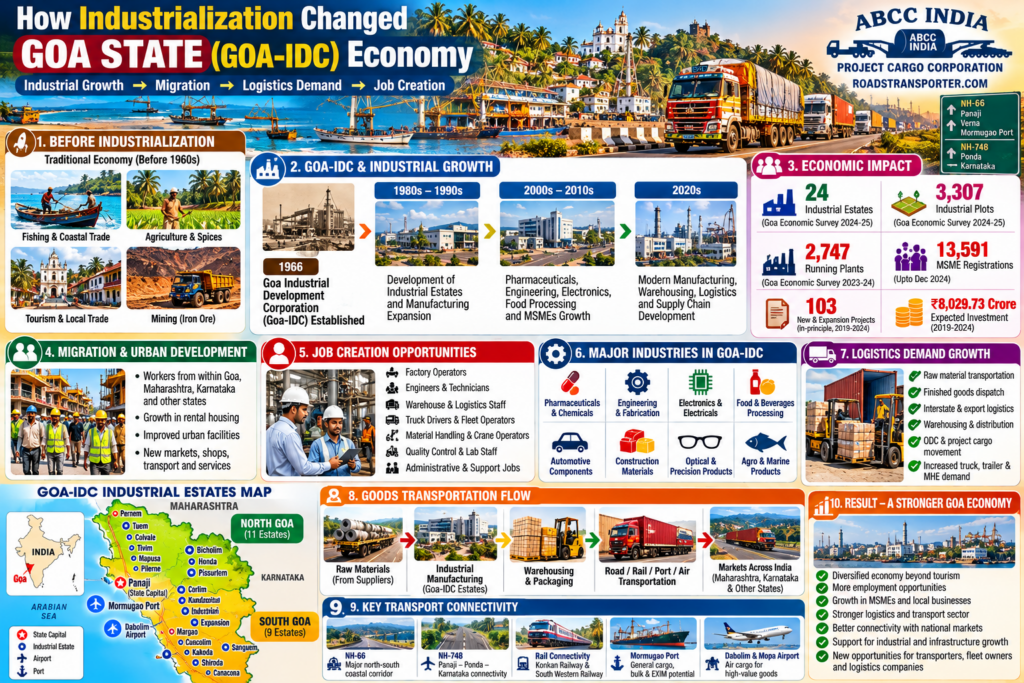
Industrialization changed Goa’s economy by expanding manufacturing, creating direct and indirect employment, encouraging business investment, influencing labour mobility and increasing demand for goods transportation.
A factory does not operate in isolation. It purchases raw materials, employs workers, uses electricity and water, requires machinery maintenance, arranges packaging and hires transport vehicles to deliver finished products.
Every stage creates commercial relationships with other businesses.
A pharmaceutical manufacturing unit in Verna, for example, may require packaging material from another state, laboratory equipment from an engineering supplier, temperature-sensitive transportation for certain products and warehouse facilities for distribution.
An engineering factory in Kundaim may need steel, industrial components, fabrication services, forklifts, cranes and heavy commercial vehicles.
These examples illustrate how manufacturing creates logistics demand; they are not claims about particular companies’ current shipments.
The Goa Industrial Development Corporation (Goa-IDC), established in 1966 under its earlier Goa, Daman and Diu industrial development framework, has played an important role in developing organized industrial estates.
Goa’s industrial transformation has therefore affected not only manufacturing output but also local commerce, employment, residential development, road transportation, industrial services and connections with Maharashtra, Karnataka and other Indian markets.
🕰️ Industrial Evolution of Goa: From Traditional Economy to Organized Manufacturing
Goa’s economic history includes agriculture, fishing, trading, mining, maritime activity and traditional occupations.
Mining and associated transportation were important components of Goa’s economy even before the expansion of organized industrial estates.
Following Goa’s liberation in 1961, industrial development became an important part of the state’s economic diversification.
The establishment of the industrial development corporation in 1966 helped create a framework for developing industrial land and supporting manufacturing activity.
Over subsequent decades, organized industrial estates provided locations for factories, engineering units, pharmaceutical production, electrical equipment manufacturing and other industries.
📊 Goa’s Industrial Development Timeline
Period
Industrial and Economic Development
Employment Impact
Transportation and Logistics Impact
🌾 Before 1961
Agriculture, fishing, coastal trade, mining and traditional occupations
Farmers, fishermen, traders, miners and artisans
Local goods movement, coastal shipping and mineral transportation
🏗️ 1961–1970s
Post-liberation industrial development and establishment of the industrial development corporation in 1966
Factory construction, industrial services and emerging manufacturing jobs
Industrial road access, construction-material transport and machinery delivery
🏭 1980s–1990s
Expansion of organized industrial estates and manufacturing activities
Factory operators, technicians, engineers and maintenance workers
Greater demand for commercial trucks, industrial supplies and distribution
⚙️ 2000s
Manufacturing diversification and stronger integration with national markets
Technical, administrative and industrial employment
Interstate FTL, LTL, packaging, warehousing and cargo handling
💊 2010s
Development of specialized manufacturing and supply-chain activities
Quality-control, technical and logistics employment
More specialized handling, documentation and freight coordination
🚛 2020s
Continuing industrial modernization, investment proposals and logistics development
Potential opportunities in manufacturing, warehousing and technical services
Demand for efficient distribution, specialized transport and industrial logistics
The timeline represents broad economic trends rather than exact commissioning dates for individual factories.
🏭 How Goa-IDC Industrial Estates Changed Goa’s Economic Geography
Before the expansion of organized industrial estates, industrial activities were less concentrated within designated manufacturing locations.
The development of industrial estates helped provide planned industrial land and created opportunities for factories and supporting businesses to operate near one another.
This concentration can improve access to suppliers, maintenance contractors, transport operators and shared industrial infrastructure.
It also creates demand for connecting roads, utilities, warehouses, loading facilities and commercial vehicle services.
Goa’s industrial geography is spread across North Goa and South Goa rather than being concentrated in a single manufacturing city.
📍 Goa-IDC Industrial Estates and Their Economic Importance
Industrial Estate / Cluster
District
Major Industry Types
Economic Contribution
Logistics Requirements
🏭 Verna
South Goa
Pharmaceuticals, electronics, diagnostics, engineering and packaging
Skilled employment, manufacturing and industrial investment
The 103 project approvals consist of 61 new manufacturing proposals, 22 manufacturing expansions, 15 service-sector projects and five hospitality projects.
The employment potential of 26,284 represents expected jobs associated with the proposals. It should not be interpreted as confirmed employment already created.
Similarly, industrial plots, registered MSMEs and running plants represent different statistical categories. They should not be added together to estimate the number of factories.
The industrial-estate count of 24 also differs from the 20 principal locations commonly listed in the Goa government industrial-estate directory. The difference reflects reporting scope and estate development records; it does not mean Goa has 24 separate industrial development corporations.
👷 How Industrialization Created Employment Opportunities in Goa
Industrialization expanded Goa’s employment opportunities by introducing a wider range of manufacturing, technical, administrative and logistics-related occupations.
Factories require production workers, engineers, machine operators, maintenance personnel, laboratory technicians, quality-control staff and supervisors.
Supporting businesses create additional opportunities in transportation, warehousing, industrial packing, equipment servicing and commercial distribution.
A pharmaceutical manufacturer may require trained scientific and technical employees, while an engineering unit may depend on machinists, welders, electricians and fabrication workers.
Both also need people to coordinate supplies, maintain inventory, arrange dispatches and manage transportation.
👨💼 Industry-Wise Employment and Career Opportunities
Documentation, communication and logistics systems
Shipment coordination
🔧 Industrial Maintenance
Mechanics, electricians, maintenance technicians
Mechanical and electrical skills
Factory equipment reliability
🏪 Supporting Services
Retail, catering, accommodation and repair workers
Business and service skills
Indirect employment and local economic activity
These are potential occupational categories rather than verified current vacancies.
Industrialization can create both direct and indirect employment.
Direct employment includes people working within manufacturing units. Indirect employment includes people working for suppliers, transport contractors, warehouses, maintenance companies and other service businesses.
The extent of these employment benefits depends on actual factory operations, production demand, workforce requirements and investment implementation.
🧳 How Industrialization Influenced Migration and Urban Development
Industrial development can attract workers towards locations where employment opportunities are concentrated.
In Goa, manufacturing employment is relevant to workers from within the state as well as people from Maharashtra, Karnataka and other parts of India.
Workers may relocate closer to industrial estates or commute from surrounding towns and villages.
As industrial employment expands, surrounding communities may experience greater demand for rental accommodation, food services, retail shops, staff transportation, healthcare and other facilities.
However, it would be inaccurate to claim that Goa-IDC alone caused a specific increase in migration without supporting census or labour-migration data.
🏘️ Industrialization, Migration and Local Economic Development
Economic Change
How Industrialization Contributes
Potential Local Impact
👷 Worker Migration
Factories recruit skilled, technical and general workers
Demand for accommodation and local services
🏠 Rental Housing
Workers may seek housing near industrial centres
Rental and residential development opportunities
🛒 Retail Businesses
Industrial employees purchase food and household goods
Commercial vehicles and industrial equipment need maintenance
Workshops and spare-parts businesses
🏗️ Infrastructure
Industrial activity increases road and utility requirements
Need for infrastructure investment and maintenance
🏢 Commercial Services
Manufacturers require banking and professional services
Supporting commercial activity
Industrialization may also create challenges involving traffic congestion, housing costs, road maintenance, utility demand and environmental management.
Therefore, industrial development needs to be accompanied by adequate planning for workers, residents and surrounding communities.
🚛 How Industrialization Increased Goods Transportation and Logistics Demand
One of the most important effects of industrialization in Goa has been the creation of regular demand for industrial goods transportation.
Every manufacturing unit needs an organized system for receiving production materials and dispatching finished goods.
Inbound logistics involves transporting raw materials, machinery, packaging, industrial components and other supplies into manufacturing facilities.
Outbound logistics involves moving finished products from factories to warehouses, distributors, ports and customers.
Factories may also require transportation for machinery installation, equipment maintenance, spare parts, rejected materials, reusable packaging and factory relocation.
For example, an engineering factory in Kundaim may need steel components from Maharashtra, arrange fabrication work within Goa and dispatch finished equipment to an industrial customer in Karnataka.
The vehicle required for each movement depends on cargo weight, dimensions, packaging, loading facilities and delivery requirements.
📦 Industrial Production and Logistics Chain in Goa-IDC
Step
Industrial Production & Logistics Chain
Activities and Transportation Requirements
1
📦 Raw Materials & Components
Purchased from local and interstate suppliers, including industrial materials, machinery parts and packaging
⬇️
Inbound Material Movement
Raw materials prepared for delivery to factories
2
🚛 Inbound Freight Transportation
FTL, LTL, container trucks, HCVs and specialized vehicles
⬇️
Factory Delivery
Cargo delivered to the manufacturing unit
3
🏭 Goa-IDC Manufacturing Unit
Processing, production, assembly, quality inspection and packaging
⬇️
Finished Goods Transfer
Manufactured products transferred to storage and dispatch facilities
4
🏢 Warehousing & Dispatch
Inventory management, palletization, consolidation, packing and cargo handling
⬇️
Outbound Movement
Finished goods assigned to suitable transportation modes
5
🚚 Outbound Logistics
Road, rail, port or air cargo transportation where suitable and available
⬇️
Market Distribution
Goods transported to regional and national markets
6
🏬 Distributors, Industries & Customers
Delivery across Goa, Maharashtra, Karnataka and other Indian markets
These are illustrative industry-level supply-chain patterns. They do not imply that particular companies currently ship cargo on every listed route.
🛣️ How Industrial Growth Strengthened Goa’s Road, Rail, Port and Air Connectivity
Goa’s industrial development is closely connected with its geographical position on India’s western coast.
The state lies between Maharashtra and Karnataka, making interstate road connectivity particularly important for manufacturing businesses.
Industrial goods must move between factories, suppliers, warehouses, commercial markets and transport terminals.
NH-66 provides an important north–south coastal road corridor, while NH-748 connects the Panaji–Ponda side towards Karnataka.
The Konkan Railway and South Western Railway networks provide rail connectivity, while Mormugao Port supports suitable maritime freight operations.
Dabolim Airport and Manohar International Airport at Mopa provide aviation connectivity. Specific air-cargo facilities and shipment acceptance must be confirmed before planning freight.
Forklifts, cranes and industrial handling equipment
Factory loading, unloading and machinery handling
🚚 Goa’s Interstate Industrial Freight Connections
Origin Industrial Cluster
Important Market Direction
Typical Logistics Requirements
Verna–Sancoale
Maharashtra and Karnataka
Manufacturing dispatches, packaging, machinery and industrial freight
Kundaim–Madkaim
Karnataka, Maharashtra and other Indian markets
Engineering products, machinery and industrial components
Pilerne–Tivim
Maharashtra and regional distribution markets
Electrical goods, components and finished products
Corlim–Bethora
Goa and interstate industrial centres
Fabricated equipment and industrial materials
Cuncolim–Kakoda
Karnataka, Maharashtra and national markets
Manufacturing goods, engineering and industrial materials
Tuem–Colvale
North Goa and Maharashtra
General cargo, smaller industrial consignments and distribution
Actual routes, vehicle positioning, freight costs and delivery schedules depend on shipment requirements and current operating conditions.
🏢 How Industrialization Encouraged MSMEs and Supporting Businesses
Industrial growth creates commercial opportunities beyond the boundaries of large factories.
Manufacturers depend on suppliers and service providers for components, packaging, maintenance, equipment, transportation and distribution.
This creates opportunities for micro, small and medium enterprises.
For example, a manufacturing company may purchase locally fabricated parts, arrange industrial packaging through a nearby supplier and hire a transport operator to deliver finished goods.
The growth of such relationships can help support entrepreneurship and local economic diversification.
🤝 Industrial Supporting Businesses and Commercial Opportunities
Business Category
Services and Products
Potential Customers
🚛 Truck Transport Companies
FTL, LTL and industrial goods transportation
Manufacturers, warehouses and distributors
🐘 Trailer Operators
Heavy machinery and oversized cargo transportation
Engineering companies and project contractors
🤝 Truck Brokers
Vehicle sourcing and freight coordination
Factories, transport companies and cargo owners
🏗️ Crane and Hydra Operators
Loading, unloading and machinery handling
Industrial units and contractors
📦 Packaging Suppliers
Wooden crates, pallets, cartons and protective packing
Manufacturers and exporters
🏢 Warehouse Operators
Storage, inventory and distribution
Manufacturing and logistics companies
🔧 Engineering Workshops
Fabrication, machinery repair and maintenance
Factories and equipment owners
⚙️ Equipment Suppliers
Industrial tools, components and spare parts
Manufacturing and maintenance departments
👷 Labour Contractors
Skilled and general industrial workforce
Factories and industrial service providers
🛣️ Road Route Survey Consultants
Route feasibility and technical assessment
Heavy-haulage and project-cargo operators
These are potential commercial relationships rather than a verified list of active companies.
🐘 How Industrial Growth Creates ODC and Heavy-Haulage Transportation Opportunities
Industrial development creates transportation requirements beyond ordinary packaged goods.
Factory construction, plant expansion, machinery installation, electrical infrastructure and equipment relocation may require heavy or oversized cargo transportation.
Such consignments may involve transformers, fabricated structures, industrial machinery, pressure vessels and other project equipment.
Unlike ordinary goods transportation, ODC movement can require technical route assessment, trailer selection, axle-load planning, cargo securing and applicable permissions.
🏗️ Heavy Machinery and Project-Cargo Transportation Requirements
Cargo Category
Possible Equipment
Important Planning Requirements
Heavy Industrial Machinery
Flatbed, semi-low-bed or low-bed trailer
Verified weight, dimensions and loading arrangements
Industrial Transformers
Suitable heavy-haul trailer or engineered combination
Centre of gravity, axle planning and route feasibility
Pressure Vessels
Extendable or specialized trailer
Dimensions, lashing and obstruction assessment
Long Fabricated Structures
Extendable or telescopic trailer
Turning radius, overhang and road geometry
Factory Relocation Equipment
Suitable trucks, trailers and handling equipment
Dismantling, packing, loading and installation coordination
Exceptional Heavy Cargo
Hydraulic modular trailer or engineered transport system
Structural assessment, axle configuration and route capacity
Specialized equipment may need to be mobilized from regional or national fleets.
A physical road-route survey helps assess practical movement constraints, but it does not automatically constitute bridge structural certification or replace applicable government permissions.
🌿 Industrialization, Environmental Responsibility and Infrastructure Challenges
Industrial development creates economic opportunities, but it can also increase pressure on infrastructure and the environment.
Goa’s coastal ecosystems, rivers, agricultural areas, residential settlements and tourism destinations make responsible industrial planning especially important.
Factories, transport operators and industrial authorities must consider waste management, wastewater treatment, hazardous-material handling, road safety and resource consumption.
🌱 Industrial Growth: Benefits, Challenges and Solutions
Industrial Development Benefits
Potential Challenges
Responsible Development Approach
Manufacturing employment
Housing and commuting pressure
Better industrial and residential planning
Increased freight movement
Traffic congestion
Improved freight scheduling and route planning
Industrial investment
Greater utility demand
Efficient water and energy management
Manufacturing expansion
Industrial waste generation
Appropriate treatment and disposal
MSME development
Infrastructure pressure
Road and utility maintenance
Expanded road transportation
Fuel consumption and vehicle emissions
Better load planning and vehicle utilization
Heavy machinery transportation
Road and structural limitations
Technical route assessments and compliance
Industrial land development
Environmental and land-use concerns
Regulatory assessment and responsible site planning
Industrial growth should not automatically be described as environmentally sustainable or environmentally harmful without evidence about specific operations.
🔭 Future Opportunities for Goa’s Industrial and Logistics Economy
Goa’s future industrial development will depend on manufacturing competitiveness, infrastructure, skilled workers, investment implementation and access to markets.
Existing industrial estates provide a foundation for future industrial and logistics services.
Modern warehousing, specialized engineering, efficient road transportation, digital freight coordination and machinery-handling services may support industrial productivity.
📈 Potential Industrial and Logistics Growth Opportunities
Growth Area
Potential Opportunity
Logistics and Transportation Benefits
🏭 Manufacturing Modernization
Factory upgrades and machinery installation
Specialized equipment transportation
💊 Pharmaceutical Manufacturing
Quality-controlled manufacturing and distribution
Suitable enclosed and temperature-controlled logistics
⚙️ Engineering
Machinery, components and fabrication
Heavy vehicles, flatbeds and trailers
📦 Modern Warehousing
Inventory and distribution improvements
Storage, consolidation and dispatch
🚛 Interstate Freight
Goa–Maharashtra–Karnataka cargo movement
FTL, LTL and truck brokerage
🐘 Project Cargo
Machinery installation and factory expansion
ODC trailers, route surveys and lifting coordination
🏢 MSME Supply Chains
Smaller and more frequent consignments
PTL, LTL and regional distribution
💻 Digital Logistics
Better freight planning and documentation
Improved shipment coordination
🌿 Efficient Transportation
Better route planning and vehicle utilization
Potential reduction in unnecessary trips
These are potential opportunities, not confirmed future investments or guaranteed freight demand.
🏁From Industrial Estates to a Connected Economic Network
Industrialization has helped Goa develop an economic identity that extends beyond tourism, fishing, agriculture and traditional trade.
The development of organized industrial estates has supported manufacturing, technical employment, business investment and the growth of industrial supply chains.
Its effects extend beyond factory boundaries.
Manufacturing workers support local businesses, factories create demand for contractors and suppliers, warehouses facilitate distribution, and commercial vehicles connect Goa’s production centres with markets across India.
Industrial growth has also influenced migration, settlement patterns, transport infrastructure and the demand for specialized logistics services.
At the same time, long-term development requires attention to environmental management, infrastructure capacity, worker mobility and industrial safety.
For goods transportation businesses, Goa’s industrial network presents potential opportunities in FTL, LTL, container transportation, industrial machinery movement, trailer sourcing, material handling, warehousing and project-cargo coordination.
ABCC India Project Cargo Corporation supports industrial logistics planning through truck and trailer sourcing, heavy-haulage consulting, road-route surveys, project-cargo coordination and related material-handling support, subject to operational requirements and service availability.
Goa’s industrial future will depend not simply on establishing more factories, but on building a productive, well-connected and responsible economic network where manufacturing, employment, entrepreneurship, logistics and environmental sustainability develop together.
📚 Research, Official Sources and Verification
Official Source
Information Covered
Website
Government of Goa – Directorate of Industries, Trade and Commerce
Industrial estates, policies and manufacturing information
📈💸🏭 Goa State GOA-IDC Industrial Evolution Chart (1960s–2026):
Goa’s industrial economy has evolved from a traditional coastal economy supported by agriculture, fishing, mining and trade into a diversified manufacturing and services economy. The establishment of the Goa Industrial Development Corporation (Goa-IDC) in 1966 marked an important institutional step in developing organized industrial estates and attracting manufacturing businesses.
Over subsequent decades, industrial locations such as Verna, Kundaim, Madkaim, Pilerne, Tivim, Corlim, Sancoale and Cuncolim became important parts of Goa’s manufacturing geography.
Industrial growth also created opportunities for engineering contractors, industrial suppliers, commercial truck operators, warehouse businesses, material-handling companies and logistics professionals.
Goa’s industrial evolution is best understood through three connected developments: manufacturing expansion, employment diversification and increasing integration with interstate supply chains.
The following charts distinguish documented historical milestones from broad economic trends. They do not invent decade-wise factory counts, investment totals or freight volumes where comparable official data is unavailable.
Agriculture, fishing, mining, traditional trades and limited organized manufacturing
Strong dependence on primary activities and trading
Local cargo movement, mineral transportation and coastal shipping
🏗️ 1960s
Post-liberation industrial planning; industrial development corporation established in 1966
Institutional foundation for organized industrial land development
Industrial construction materials, machinery deliveries and road connectivity became important
🏭 1970s
Gradual development of planned industrial estates and manufacturing facilities
Diversification beyond traditional economic activities
Factory supply transport and commercial trucking requirements expanded
⚙️ 1980s
Manufacturing activities and industrial-estate development continued
Opportunities in factory production, engineering and industrial services
More demand for raw-material transportation and finished-goods dispatch
💊 1990s
Greater integration with India’s liberalizing manufacturing economy
Pharmaceuticals, engineering and specialized manufacturing became increasingly relevant
Interstate freight, industrial packing and commercial distribution gained importance
🚛 2000s
Manufacturing diversification and broader supply-chain integration
Industrial employment, technical services and supporting MSMEs
FTL, LTL, warehousing, machinery transportation and freight coordination
📦 2010s
Specialized manufacturing, electronics, pharmaceuticals and modern supply-chain practices
Technical employment and greater demand for quality-controlled industrial services
Enclosed cargo, container transportation, inventory management and specialized handling
💻 2020–2024
Continued industrial investment planning, modernization and logistics-policy development
Manufacturing expansion proposals, service-sector investment and infrastructure requirements
Digital freight coordination, project cargo, industrial warehousing and distribution planning
🔭 2025–2026
Continuing industrial development and modernization priorities
Potential opportunities in manufacturing, MSMEs, logistics and skilled employment
Scope for improved truck sourcing, regional distribution, machinery movement and multimodal coordination
The 2025–2026 row describes development priorities and potential opportunities, not verified year-on-year industrial growth results.
📊 Goa-IDC Industrial Estate Expansion: Official Decade-Wise Numbers
The Goa-IDC Regulations Manual 2023 contains a historical list of industrial estates and their establishment years. This allows a genuine decade-wise chart of industrial-estate development, rather than an estimated growth graph.
Goa-IDC estates established by decade
Number of industrial estates with documented establishment years; excludes Dharbandora, whose year is not specified.
The cumulative figures describe estates recorded as established by each decade, not the number of operational factories or actual industrial production in those periods.
🗺️ Goa-IDC Area-Wise Industrial Growth: Establishment Year and Industrial Land
The official Goa-IDC historical list provides both the establishment year and area for each estate.
Industrial Estate
Taluka
Establishment Year
Recorded Area (Hectares, Approx.)
🏭 Corlim
Tiswadi
1966
21.14
🏭 Margao
Salcete
1967
29.26
🏭 Sancoale
Salcete
1971
42.93
🏭 Mapusa
Bardez
1973
6.69
🏭 Tivim
Bardez
1976
25.37
🏭 Bicholim
Bicholim
1977
21.23
🏭 Honda
Sattari
1981
65.40
🏭 Kakoda
Quepem
1981
26.08
🏭 Kundaim
Ponda
1984
249.83
🏭 Bethora
Ponda
1985
20.46
🏭 Canacona
Canacona
1986
14.33
🏭 Tuem
Pernem
1988
63.48
🏭 Verna
Salcete
1989
696.05
🏭 Cuncolim
Salcete
1992
97.23
🏭 Pilerne
Bardez
1993
50.20
🏭 Madkaim
Ponda
1994
53.04
🏭 Colvale
Bardez
1998
23.11
🏭 Pissurlem
Sattari
1998
80.17
🏭 Shiroda
Ponda
1998
10.51
🏭 Sanguem
Sanguem
2002
49.89
🏭 Quitol
Quepem
2009
88.36
🏭 Panchwadi
Ponda
2014
21.61
🏭 Latambarcem
Bicholim
2016
32.70
🏭 Dharbandora
Dharbandora
Not specified
11.20
The official historical schedule records approximately 1,800.26 hectares of industrial-estate land across the 24 entries. This is recorded estate area, not proof that all land has been developed, allotted or occupied by operating factories.
📏 Largest Goa-IDC Industrial Estates by Recorded Land Area
Largest Goa-IDC estates by recorded land area
Approximate hectares from the Goa-IDC Regulations Manual 2023.
Verna stands out in the historical area data, followed by Kundaim. However, industrial land area alone does not measure economic productivity, number of employees, freight demand or current factory activity.
💰 4. Goa Industrial Investment Growth: Government Economic Indicators
The Goa Economic Survey 2024–25 reports 24 industrial estates and 3,307 industrial plots. It also records 103 in-principle project approvals between 2019–20 and December 2024, with expected investment of ₹8,029.73 crore and projected employment potential of 26,284 people.
📈 Industrial Growth Indicator
Reported Figure
Economic Interpretation
🏭 Industrial Estates
24
Statewide industrial-estate network
🏗️ Industrial Plots
3,307
Industrial land parcels reported
📋 In-Principle Approved Projects
103
Projects approved during the stated reporting period
💰 Expected Investment
₹8,029.73 crore
Proposed investment associated with approvals
👷 Employment Potential
26,284
Projected jobs, not confirmed employment
🏭 New Manufacturing Proposals
61
In-principle approvals
🔧 Manufacturing Expansion Proposals
22
In-principle approvals
🏢 Service-Sector Proposals
15
In-principle approvals
🏨 Hospitality Proposals
5
In-principle approvals
📊 Composition of Approved Investment Projects
In-principle project approvals by category
103 approvals, 2019–20 to December 2024. Not all projects are necessarily operational.
■ Hospitality
■ Manufacturing expansion
■ New manufacturing
■ Services
The figures represent investment intentions and approvals rather than completed industrial projects. They should not be used to calculate an actual annual industrial growth rate.
🚛 Decade-Wise Evolution of Goods Transportation and Logistics in Goa
Decade
Industrial Freight Characteristics
Vehicle and Logistics Requirements
Major Development
1960s
Industrial construction and early factory supplies
General trucks, building-material vehicles
Development of industrial access infrastructure
1970s
Growing factory supply requirements
Commercial trucks and local distribution
Expansion of industrial-estate connectivity
1980s
Increasing manufacturing activity
HCVs, machinery carriers and loading equipment
Larger manufacturing supply chains
1990s
Wider interstate industrial relationships
FTL, industrial packing and commercial freight
Integration with national manufacturing markets
2000s
Diversified manufacturing and distribution
FTL, LTL, containers and warehousing
More complex industrial supply chains
2010s
Specialized manufacturing and quality-controlled shipments
Enclosed trucks, suitable cold-chain vehicles and industrial handling
Greater attention to cargo-specific logistics
2020s
Modernization and logistics infrastructure planning
Specialized trailers, digital freight coordination and warehouse services
Opportunities for more integrated logistics
This is a qualitative logistics-evolution chart, not measured historical freight-volume data.
🏭 Goa-IDC Area-Wise Industrial Growth and Cargo Demand
Industrial Belt
Manufacturing Characteristics
Typical Cargo
Logistics Opportunity
Verna–Sancoale
Pharmaceuticals, electronics, engineering and industrial manufacturing
Machinery, components, packaging and finished products
FTL, LTL, containers, specialized transport
Kundaim–Madkaim
Engineering, machinery and electrical products
Steel, machinery, components and fabricated equipment
Open trucks, flatbeds, trailers
Pilerne–Tivim
Optical products, electrical equipment and light manufacturing
Components, finished goods and packaging
Enclosed trucks, PTL, FTL
Corlim–Bethora
Engineering, fabrication and manufacturing
Industrial supplies and machinery
HCVs, flatbeds, material handling
Cuncolim–Kakoda
Manufacturing, fabrication and processing
Industrial materials and equipment
General cargo, HCVs and trailers
Tuem–Colvale
Small manufacturing and industrial services
Components and mixed industrial consignments
LCVs, LTL and regional distribution
Bicholim–Honda–Pissurlem
Engineering and industrial manufacturing
Machinery, equipment and raw materials
Industrial trucks and specialized handling
The table describes potential industry-level cargo requirements. It does not establish current freight volumes, individual factory movements or guaranteed vehicle availability.
👷 Industrial Evolution, Employment and Migration
Industrial growth can generate direct factory jobs and indirect employment in transportation, warehousing, machinery maintenance and local services.
Economic Development
Employment Opportunities
Possible Migration and Local Impact
Manufacturing expansion
Factory operators, supervisors, engineers
Greater demand for skilled and technical workers
Pharmaceutical manufacturing
Chemists, technicians, quality-control personnel
Specialized employment and training needs
Engineering and fabrication
Welders, machinists, electricians
Technical workforce development
Goods transportation
Truck drivers, fleet coordinators, brokers
Regional and interstate labour opportunities
Warehousing
Storekeepers, forklift operators, inventory staff
Logistics employment around industrial locations
Industrial construction
Contractors, equipment operators, skilled labour
Temporary and project-based workforce demand
Supporting commerce
Retail, catering, repairs and accommodation
Additional economic activity around industrial areas
The projected employment potential of 26,284 people is associated with approved investment proposals. It is not a verified migration count or the number of jobs already created.
🔭 Goa Industrial Growth Outlook: 2026 and Beyond
Future industrial growth will depend on investment implementation, available infrastructure, skilled labour, regulatory compliance, manufacturing competitiveness and access to markets.
For logistics businesses, the most relevant opportunities include interstate FTL/LTL freight, industrial warehousing, machinery transportation, specialized trailers, cargo handling and road-route survey services.
However, a large industrial estate does not automatically produce the highest freight demand. Actual opportunities depend on operational factories, shipment frequency, cargo characteristics and customer requirements.
🏁 What Goa’s Industrial Evolution Means for Transport and Logistics
Goa’s industrial history demonstrates a gradual transition from traditional economic activities towards organized manufacturing and more diversified supply chains.
The official establishment records show particularly active industrial-estate expansion during the 1980s and 1990s, while recent economic surveys document a statewide network of 24 estates and continuing investment proposals.
For transporters, truck brokers, fleet owners and industrial buyers, this development creates opportunities in cargo transportation, machinery movement, warehousing and project logistics.
ABCC India Project Cargo Corporation supports industrial transportation through truck and trailer sourcing, heavy-haulage consulting, project-cargo coordination, road-route surveys and material-handling logistics support, subject to technical and commercial assessment.
Goa’s future industrial competitiveness will depend not only on industrial land and investment approvals, but also on efficient transportation, dependable infrastructure, skilled workers and responsible industrial development.
📚 Official Research Sources
Government Source
Research Information
Reference
Goa-IDC Regulations Manual 2023
Estate names, establishment years and recorded land area
Goa is not only a tourism destination but also an important manufacturing, engineering, pharmaceutical and industrial services economy on India’s western coast. The industrial estates developed by the Goa Industrial Development Corporation (Goa-IDC) support a variety of businesses that create opportunities for skilled workers, technicians, engineers, drivers, logistics professionals, warehouse operators, contractors and entrepreneurs.
From the manufacturing units of Verna and the engineering industries of Kundaim to industrial activities in Madkaim, Pilerne, Tivim, Corlim, Sancoale and Cuncolim, Goa’s industrial network offers different career pathways depending on education, practical experience and technical skills.
Career opportunities in Goa-IDC industrial estates include manufacturing, pharmaceuticals, engineering, electronics, logistics, warehousing, transportation, construction, industrial maintenance, material handling, safety, administration and supporting services.
These opportunities are relevant to freshers, ITI trainees, diploma holders, engineering graduates, commerce graduates, experienced industrial workers, professional drivers and people interested in starting transport-related businesses.
The following charts cover potential career categories across Goa’s industrial ecosystem. They are not live job-vacancy listings, and inclusion of an industry does not mean every Goa-IDC estate has companies operating in that sector.
🏭 Goa-IDC Industry-Wise Career Opportunities: Complete Overview
Industry / Sector
Job Opportunities
Education / Skills
Best For
💊 Pharmaceuticals
Production operator, chemist, QA/QC analyst, packaging executive, maintenance technician
B.Pharm, M.Pharm, B.Sc., M.Sc., ITI, diploma
Science graduates, pharmacists, technicians
⚙️ Mechanical Engineering
Fitter, machinist, CNC operator, production engineer, maintenance engineer
ITI, mechanical diploma, B.E./B.Tech
Technical workers and engineers
💡 Electrical Equipment
Electrician, motor technician, testing engineer, maintenance supervisor
These represent possible occupations across relevant industrial sectors. Some roles may be more common in nearby logistics hubs or service businesses than inside the estates themselves.
🗺️ Goa-IDC Industrial Estate-Wise Career Opportunities
The Goa government’s industrial-estate directory lists 20 principal locations, while subsequent economic surveys report a wider estate network. The table below covers the 20 directory locations and their potential employment ecosystems.
The estate-specific job fields are career possibilities, not confirmed vacancies or proof that every listed industry is presently active at that estate.
🚛 Transport, Logistics, Trailer and ODC Career Options in Goa
Job / Profession
Main Responsibilities
Skills Required
Career Progression
🚚 LCV Driver
Small industrial consignments and distribution
Appropriate licence, local routes
Senior driver, fleet coordinator
🚛 HCV Driver
Heavy goods transportation
Appropriate licence, load safety
Senior driver, fleet supervisor
🐘 Trailer Driver
Industrial machinery and heavy cargo
Trailer handling, route awareness
Specialized heavy-haul driver
📦 FTL Booking Executive
Full-truck booking and customer coordination
Vehicle knowledge, negotiation
Transport manager
📦 LTL/PTL Executive
Consolidation and part-load bookings
Documentation, cargo handling
Distribution manager
🤝 Truck Broker
Match cargo owners with suitable vehicles
Market knowledge, verification, negotiation
Transport agency owner
🚛 Fleet Supervisor
Vehicle allocation and driver coordination
Fleet operations, compliance
Fleet manager
🗺️ Route Surveyor
Assess physical road and access constraints
Survey techniques, dimensions, route planning
Senior route survey specialist
🏗️ ODC Coordinator
Plan oversized cargo movements
Cargo assessment, trailer and axle knowledge
Project logistics manager
🐘 Heavy-Haulage Planner
Coordinate complex machinery transportation
Engineering and logistics knowledge
Heavy-haul consultant
📍 GPS Coordinator
Shipment tracking and reporting
Tracking systems, communication
Control-tower supervisor
🏢 Warehouse Executive
Inventory, receiving and dispatch
WMS, stock control
Warehouse manager
🚜 Forklift Operator
Pallet and industrial goods handling
Forklift training, load-centre knowledge
Material-handling supervisor
🏗️ Crane Operator
Equipment lifting
Training, load-chart knowledge
Senior crane operator
⛓️ Rigger
Slinging and securing lifted loads
Rigging and lifting safety
Rigging supervisor
📋 Documentation Executive
LR, POD, e-way bill and shipping paperwork
Documentation and GST workflow knowledge
Logistics compliance executive
⚓ Freight Forwarding Executive
Coordinate multimodal shipments
EXIM processes, documentation
Freight forwarding manager
🚢 Port Logistics Coordinator
Port-related cargo and vehicle coordination
Terminal procedures and documentation
Port operations manager
🔧 Fleet Mechanic
Maintain commercial vehicles
Diesel mechanics, hydraulics
Workshop manager
💼 Logistics Sales Executive
Develop industrial freight customers
Communication and freight knowledge
Business development manager
🎓 Career Opportunities by Education and Qualification
Qualification
Suitable Entry-Level Career Options
Useful Additional Skills
8th–10th Pass
Packing assistant, warehouse helper, supervised loading work
Safety awareness, basic numeracy
12th Pass
Dispatch assistant, inventory assistant, office support
Computer basics, Excel
ITI Fitter
Mechanical fitter, maintenance technician
Drawings, measurement, machine safety
ITI Electrician
Industrial electrician, maintenance assistant
Electrical safety, motors, control panels
ITI Welder
Welder, fabrication technician
Welding processes, drawings
ITI Diesel Mechanic
Truck mechanic, equipment maintenance
Engines, hydraulics, diagnostics
Diploma Mechanical
Production supervisor trainee, maintenance technician
CAD, CNC, quality control
Diploma Electrical
Electrical supervisor trainee, testing technician
PLC, electrical testing
B.E./B.Tech
Production, quality, design and maintenance engineering
Industry-specific software and internships
B.Sc./M.Sc.
Laboratory, quality-control and pharmaceutical roles
Accounts, billing, purchase and inventory administration
Tally, Excel, GST
BBA/MBA
Procurement, HR, logistics and operations
ERP, negotiation, analytics
Computer/IT Graduate
ERP, IT support, automation and data roles
SQL, software systems
Valid Commercial Driving Licence
Eligible goods vehicle driving roles
Vehicle-specific experience, cargo securing
Experienced Transport Broker
Freight brokerage and fleet aggregation
Customer acquisition, vehicle verification
Eligibility varies by employer, role, licence category and statutory requirements. Equipment operation and hazardous tasks require appropriate training and authorization.
🏗️ Construction, Heavy Equipment and Industrial Maintenance Careers
Equipment / Activity
Possible Jobs
Important Skills
🚜 Excavator
Operator, mechanic
Equipment handling, site safety
🏗️ Mobile Crane
Operator, lifting supervisor
Load charts, radius, rigging
🚛 Hydra / Pick-and-Carry Crane
Operator, equipment supervisor
Stability, lifting procedures
📦 Forklift
Operator, maintenance technician
Load centre, stacking, inspection
🚧 Road Construction
Surveyor, site supervisor, equipment operator
Civil works, safety
⚙️ CNC Machinery
CNC operator, programmer
Programming, drawings, precision
🔩 Welding & Fabrication
Welder, fabricator, QC inspector
Welding and measurement
🔌 Electrical Maintenance
Electrician, maintenance engineer
Industrial power and controls
🛢️ Industrial Pumps
Pump technician, maintenance fitter
Mechanical seals, alignment
❄️ Refrigeration & Cold Storage
Refrigeration technician
HVAC, refrigerant safety
🧯 Fire & Industrial Safety
Fire technician, EHS executive
Fire prevention, emergency procedures
🧪 ETP/STP
Treatment plant operator
Process monitoring and environmental compliance
🚀 Self-Employment and Business Opportunities for Goa Industrial Workers
Business Opportunity
Potential Customers
Initial Requirements
🚛 Truck Brokerage
Factories, transporters, traders
Verified vehicle network, customer relationships
🐘 Trailer Commission Agency
Machinery manufacturers, project contractors
Trailer knowledge, fleet network
📦 Packing & Crating
Manufacturers, machinery suppliers
Packing skills, workshop, materials
🏗️ Crane / Forklift Rental
Factories, warehouses
Equipment, operators, maintenance, compliance
🔧 Industrial Maintenance
Manufacturing plants
Skilled technicians, tools
🚚 Local Goods Delivery
MSMEs, distributors
Suitable vehicle, permits, clients
🏢 Warehousing
Manufacturers, wholesalers
Suitable premises, safety systems
⚙️ Fabrication Workshop
Engineering units, contractors
Machines, skilled labour
📋 Transport Documentation
Truck operators, logistics companies
Documentation knowledge and authorized workflows
💻 Inventory / ERP Support
MSMEs and warehouses
Software skills
🛣️ Road Route Survey Consulting
Project-cargo companies
Survey expertise, equipment, technical scope
🍛 Industrial Catering
Factory staff and contractors
Food-safety compliance, kitchen operations
These are possible business models, not guaranteed income opportunities. Investment, permissions, insurance and legal requirements depend on the activity.
🧑🎓 Skill Development, Apprenticeships and Industrial Training in Goa
Goa has an established government vocational training system. Its Economic Survey 2024–25 reports that 17,312 people benefited from the Craftsmen Training Scheme during 2019–20 through 2024–25, and describes training initiatives involving industrial safety, electric vehicles, solar technology and other technical trades.
Training Pathway
Relevant Careers
Official Resource
🛠️ Government and Private ITIs
Fitter, electrician, welder, mechanic, technician
Goa Skill Development Directorate
🏭 Industry-Linked ITI Training
Production, maintenance, technical operations
Trade-wise Employment Opportunities
🎓 Apprenticeship Training
Manufacturing and engineering trainees
Apprenticeship India
📋 National Career Service
Industrial and logistics job search
National Career Service
📦 Logistics Sector Skills
Warehousing, transport and supply-chain operations
Logistics Sector Skill Council
🏢 Industrial Business Development
MSME guidance and enterprise support
Goa Industries Directorate
The state government also identifies medical devices, pharmaceuticals, electronic products, marine and fisheries, agro-food processing, auto components, logistics and warehousing among its industrial or service-sector priorities. These policy priorities indicate potential career directions, not proof of existing vacancies in each sector.
❓ Frequently Asked Questions About Careers in Goa-IDC
What types of jobs are available in Goa-IDC industrial estates?
Manufacturing, engineering, pharmaceuticals, electrical maintenance, quality control, warehousing, logistics, transportation and industrial administration are important career categories.
Which Goa industrial estate is suitable for pharmaceutical careers?
Verna and Tivim are relevant locations to research. Applicants should check current companies and vacancies before applying.
Can ITI students find industrial employment in Goa?
ITI qualifications are relevant to roles such as fitter, electrician, welder, mechanic and industrial maintenance technician, depending on employer requirements.
Are there jobs for truck drivers and transport supervisors in Goa?
Goods transportation creates opportunities for drivers, dispatch coordinators, fleet supervisors and other logistics workers. Actual openings require confirmation.
Can a 12th-pass candidate work in industrial logistics?
Yes. Some employers may consider 12th-pass candidates for entry-level warehouse, dispatch, inventory and office-support roles, with additional training.
What career opportunities exist in ODC and project cargo?
Heavy-haulage coordination, trailer operations, route surveying, rigging, lifting supervision and project logistics planning are possible specialist careers.
Are government jobs available through Goa-IDC?
Goa-IDC and other government departments may advertise recruitment separately. Industrial-estate factory jobs are generally private-sector positions and should not be confused with government employment.
Which qualification is useful for a logistics manager?
A diploma or degree in logistics, supply-chain management, commerce, business or engineering can be useful, alongside relevant practical experience.
Can a person start a truck brokerage business in Goa?
Yes, subject to applicable business and regulatory requirements. Vehicle verification, payment arrangements, customer relationships and documentation are particularly important.
Where can candidates find verified industrial jobs in Goa?
Candidates can check official company career pages, Goa’s employment and skill-development resources, National Career Service and apprenticeship portals.
🏁 Building an Industrial Career in Goa
Goa’s industrial estates provide a foundation for careers in manufacturing, technical services, supply-chain operations and industrial entrepreneurship.
Students can begin with ITI, diploma, degree or apprenticeship pathways. Experienced workers may progress into supervisory and specialist roles, while transport professionals can develop expertise in fleet management, freight brokerage, machinery movement and project logistics.
ABCC India Project Cargo Corporation operates in the industrial transportation and project-logistics field, including truck and trailer sourcing, heavy-haulage coordination, road-route surveys and material-handling support. These services illustrate the specialist knowledge needed in the wider logistics profession.
The most useful approach for job seekers is to identify the relevant industrial sector, obtain appropriate qualifications, build practical experience and verify opportunities directly with employers.
💫👨💼🚛 The Industrial Revolution of Goa:
From the fishing boats of the Arabian Sea to the factory floors of Verna, from the engineering workshops of Kundaim to the highways carrying Made-in-Goa products across India—this is the story of a state that learned to grow beyond its familiar identity.
Editorial note: This is a creative, historically inspired narrative. The workers, families and conversations described are fictional representations, not documented interviews or verified personal experiences. The historical setting draws on Goa’s post-1961 industrial development and the establishment of its industrial development corporation in 1966.
🌅 A Land Known for Its Beaches, but Dreaming of Something More
Every morning, the Arabian Sea sends its waves towards Goa’s beautiful coastline.
Fishing boats return with their catch. Shopkeepers open their shutters. Farmers walk towards their fields. Tourists prepare to explore the beaches, churches, villages and markets.
For generations, these activities have shaped the identity of Goa.
But somewhere beyond the sound of the waves, another Goa was beginning to emerge.
A Goa of factory whistles, engineering drawings, machines, laboratory equipment, warehouses and commercial trucks.
A Goa where young people could imagine careers not only in tourism, agriculture, fishing and trade, but also in manufacturing, technology, engineering and industrial logistics.
The story of Goa’s industrial development is not simply about factories and industrial plots.
It is about people discovering new possibilities.
It is about the dignity of skilled work.
It is about the relationship between a worker’s ambition, a family’s future and a state’s changing economy.
🏗️ The 1960s: When Industrial Dreams Began Taking Shape
Following Goa’s liberation in 1961, the region entered a new phase of political and economic development.
The establishment of the industrial development corporation in 1966 became an important milestone in the development of organized industrial estates.
Industrialization was not an overnight revolution. It was a gradual process involving land development, infrastructure, private investment, government planning and the efforts of thousands of workers.
Imagine a young Goan student in that era.
His father works in a traditional occupation. His family has lived in the same village for generations.
One evening, the student hears people discussing new factories, industrial workshops and employment opportunities.
He asks his father:
“Will there be work for someone like me in these new industries?”
His father replies:
“Learn a skill. Wherever there is work to be done, there is a future to be built.”
That fictional conversation captures an important part of industrial development: the possibility that technical education and manufacturing employment could open new career pathways.
👷♂️A Young Worker’s Dream: From a Small Village to an Industrial Workshop
Imagine a young man named Rohan, growing up in a modest Goan household during a period of industrial expansion.
Rohan is a fictional character, but his ambitions represent those of many young people seeking stable employment.
His family cannot afford an expensive education.
Instead, he chooses technical training.
He learns to use measuring instruments, understand engineering drawings, handle tools and repair machines.
Eventually, he secures an entry-level position in an industrial workshop.
His first working day is unforgettable.
The machines seem enormous.
The production floor is noisy.
Experienced technicians move confidently between equipment.
Rohan feels nervous.
His supervisor hands him a measuring tool and explains that accuracy matters as much as speed.
During the first few weeks, he makes mistakes. He asks questions. He watches experienced workers. He learns the importance of discipline and safety.
Months pass.
One day, he successfully completes a difficult technical task.
The achievement seems small to everyone else.
But for Rohan, it means something extraordinary.
He has become a skilled industrial worker.
And that skill can support his future.
The true power of industrialization is not only the machinery installed inside factories, but the knowledge and confidence developed by the people who operate it.
🏭 Verna, Kundaim, Madkaim and Pilerne: Industrial Estates Become Places of Opportunity
As Goa’s industrial network expanded, locations such as Verna, Kundaim, Madkaim, Pilerne, Tivim, Corlim and Cuncolim became associated with different types of manufacturing activity.
Each industrial estate contributed to the wider economic ecosystem.
A pharmaceutical manufacturing unit required trained technicians, scientific professionals, packaging materials and quality-control systems.
An engineering workshop needed machinists, welders, electricians and machinery components.
An electronics manufacturer depended on assembly workers, testing equipment and careful product handling.
Factories also required accountants, security personnel, maintenance teams, transport coordinators and warehouse workers.
📊 The Human Side of Goa-IDC Industrial Development
Component transport and finished-goods distribution
📦 Packaging industries
Machine operators and packaging technicians
Raw-material supplies and dispatch
🏗️ Factory construction
Civil workers, electricians and equipment operators
Construction materials, cranes and machinery movement
🚛 Goods transportation
Drivers, dispatch executives and fleet supervisors
Interstate freight and local delivery
🏢 Warehousing
Storekeepers, inventory staff and supervisors
Storage, consolidation and distribution
🔧 Industrial maintenance
Mechanics and service technicians
Spare parts, repairs and equipment servicing
The table describes relevant economic relationships, not verified employment counts at individual estates.
🚛 The Truck Driver Who Connected Goa’s Factories With India
Now imagine another character: a truck driver named Mahesh.
His work begins before sunrise.
He checks the tyres, brakes, lights, documents and condition of his vehicle.
Today, his assignment is to collect industrial cargo from a manufacturing unit in Goa and transport it to a customer in another state.
At the factory gate, the security staff verify his documents.
Warehouse workers prepare the shipment.
A forklift operator positions the cargo.
The dispatch executive checks the consignment details.
Mahesh confirms the loading and securing arrangements before departure.
He understands that the goods inside his truck are more than commercial products.
They represent the combined work of factory operators, engineers, technicians, suppliers and warehouse staff.
As he drives towards the interstate highway, the factory slowly disappears behind him.
But its economic connection with the rest of India continues through his vehicle.
A factory may manufacture a product, but transportation helps that product reach the market.
Industrial growth and logistics growth are closely connected: manufacturing creates freight demand, while reliable transportation helps manufacturing businesses serve customers.
📦 From Factory Floor to Customer: The People Behind Every Shipment
Stage
People Involved
Contribution
1. 📦 Raw-material supply
Suppliers, procurement executives
Arrange manufacturing inputs
2. 🚛 Inbound transportation
Truck drivers, brokers, fleet operators
Deliver materials to factories
3. 🏭 Manufacturing
Operators, technicians, engineers
Produce and inspect goods
4. 🏢 Warehousing
Storekeepers, forklift operators
Store and prepare shipments
5. 📋 Dispatch
Logistics executives, documentation staff
Coordinate delivery
6. 🚚 Outbound transportation
Drivers, fleet supervisors
Move finished goods
7. 🏬 Final delivery
Distributors, industrial buyers
Receive and use the products
This chain demonstrates how a single industrial shipment can involve many different professions.
👩🔬The Daughter Who Chose a Career in Science
Industrial development also creates opportunities for people pursuing specialized education.
Imagine a young woman named Meera, whose family hopes she will find a stable professional career.
Meera enjoys chemistry.
She studies science and later begins working towards a career in pharmaceutical quality control.
Her ambition is to work in a laboratory where product quality, accuracy and safety matter every day.
She understands that a mistake in pharmaceutical manufacturing can have serious consequences.
So she learns to follow procedures, maintain records, inspect results and ask questions when something appears incorrect.
Her story represents a broader change.
Industrial employment is not limited to heavy machinery or physical labour.
Modern manufacturing also depends on science, research, testing, administration, digital systems and skilled technical judgment.
For young people in Goa, technical and scientific education can provide pathways into these occupations, depending on employer requirements and available vacancies.
🏠 How One Factory Job Can Influence an Entire Household
Imagine that Rohan, the young technician from our earlier story, has now completed several years of work.
His technical experience has grown.
He contributes regularly to his household expenses.
His family can plan its finances with greater confidence.
A younger sibling becomes interested in vocational education after watching his progress.
A local shop benefits from workers purchasing everyday essentials.
A vehicle mechanic gains customers from commercial transport activity.
A catering business supplies meals to an industrial workplace.
These examples illustrate how employment can generate wider economic relationships.
But industrialization does not automatically guarantee prosperity for every family.
Wages, working conditions, job security, training, housing costs and access to services all influence whether industrial growth translates into improved living standards.
A successful industrial economy must therefore consider the well-being of workers alongside manufacturing investment.
🤝 Migration, New Communities and the Changing Social Life of Goa
Industrial estates can attract workers from different regions.
Some employees commute from nearby towns and villages.
Others may relocate for employment.
Goa’s manufacturing economy has connections with workers, suppliers and businesses from Maharashtra, Karnataka and other Indian states.
As people work together, industrial workplaces can become meeting points for different languages, experiences and professional skills.
A machinist may learn from an experienced technician.
A young engineer may work with a production supervisor who has decades of practical knowledge.
A driver from another state may develop long-term relationships with Goa-based transport companies.
Such interactions can strengthen professional networks and knowledge-sharing.
At the same time, migration and industrial expansion can increase demand for affordable housing, public transport, healthcare and infrastructure.
Respect for local communities, fair working conditions and responsible planning are essential parts of sustainable development.
🐘 When an Industrial Machine Becomes a Project-Cargo Challenge
Not every industrial shipment fits inside an ordinary truck.
During factory construction, modernization or equipment relocation, companies may need to transport large machinery, fabricated structures or exceptionally heavy equipment.
Imagine an engineering team preparing to move a large industrial machine into a manufacturing facility.
The equipment has been measured.
Its weight and centre of gravity have been assessed.
The logistics team must determine whether the proposed trailer is suitable.
A route survey may be required to examine turning space, gradients, road width and overhead obstructions.
Specialist engineers may need to assess structural constraints, while applicable permissions must be obtained.
Crane operators, riggers, trailer drivers, supervisors and project managers coordinate the movement.
Everyone has a different responsibility.
The driver cannot complete the movement alone.
The engineer cannot complete it without the transport team.
The lifting contractor cannot work safely without a suitable lifting plan.
The operation succeeds through technical preparation, communication and teamwork.
This fictional example illustrates the specialist logistics requirements that can accompany industrial growth.
🌱 Industrial Progress Must Also Protect Goa’s Natural Heritage
Goa’s identity is closely connected with its beaches, rivers, forests, agricultural areas, villages and cultural heritage.
Industrial development should not require the state to abandon these strengths.
Instead, economic planning should seek a balance between manufacturing activity, employment, environmental protection and community well-being.
Factories need appropriate waste-management systems.
Transport operators need safe vehicles and responsible cargo-handling practices.
Industrial infrastructure requires maintenance.
Workers need safe conditions and access to essential services.
The success of an industrial economy should be judged not only by investment announcements or industrial land development, but also by the quality and sustainability of the opportunities it creates.
📈 Goa’s Industrial Journey: From Economic Change to Human Opportunity
Industrial Development Stage
Economic Change
Human Impact
Long-Term Importance
🌾 Traditional economy
Agriculture, fishing, mining and trade
Established livelihoods and local skills
Economic and cultural foundation
🏗️ Organized industrial planning
Development of industrial estates
New technical and construction opportunities
Industrial infrastructure
🏭 Manufacturing expansion
Growth of factories and supporting businesses
Production and technical employment
Economic diversification
💊 Specialized industries
Pharmaceuticals, electronics and engineering
Scientific and skilled careers
Higher technical capabilities
🚛 Logistics integration
Greater movement of industrial goods
Driving, warehousing and freight coordination
Wider market connectivity
💻 Modern industrial operations
Greater use of technology and structured processes
Digital and technical skill requirements
Potential productivity improvements
🌿 Responsible future growth
Focus on infrastructure and environmental management
Safer, more sustainable communities
Long-term industrial competitiveness
❤️ An Inspirational Message to Goa’s Young Generation
To the student who is uncertain about the future:
A technical skill can become the beginning of a meaningful career.
To the young engineer preparing for a first job:
Your knowledge can help improve a machine, a manufacturing process or an industrial operation.
To the driver who travels long distances:
Your work helps connect factories with customers.
To the welder, fitter, electrician and machine operator:
Your skills are essential to manufacturing.
To the warehouse worker who carefully prepares a shipment:
Your attention to detail matters.
To the entrepreneur starting a small industrial service business:
Your work may help another business operate more efficiently.
And to every family supporting someone through education, training or a difficult first job:
Industrial progress is built not only through investment and machinery, but through people learning, working and creating opportunities for the next generation.
🏁 Goa’s Industrial Revolution Is a Story of People
Goa’s industrial transformation is more than a history of industrial estates.
It is a story of changing career opportunities, manufacturing diversification, technical education, entrepreneurship and the transportation networks that connect local production with markets across India.
The establishment of the industrial development corporation in 1966 provided an important institutional foundation. Over time, industrial locations such as Verna, Kundaim, Madkaim, Pilerne, Tivim and Cuncolim became part of the state’s manufacturing landscape.
Industrialization has also created responsibilities: protecting workers, managing infrastructure, reducing environmental impacts and ensuring that economic development benefits surrounding communities.
ABCC India Project Cargo Corporation works within this wider industrial ecosystem through heavy-haulage consulting, truck and trailer sourcing, project-cargo coordination, road-route surveys and material-handling logistics support.
Yet the most important message is not about any single company or factory.
It is about the people whose work keeps an industrial economy moving.
Goa’s beaches tell the story of its natural beauty. Its villages tell the story of its culture. And its industrial estates tell another story—of skills, determination, manufacturing and the people helping build its economic future.
Because behind every machine is a skilled person, behind every shipment is a team, and behind every industrial achievement is a human story worth telling.
🚛👩🏻💻📊 Why the Goa GOA-IDC Transportation and Logistics Industry Is Growing 🚚📦🗺️:
Goa is famous for tourism, beaches and coastal culture, but its industrial economy also depends on an extensive network of road transporters, truck brokers, warehouse operators, freight forwarders, packaging contractors, material-handling specialists and manufacturing supply-chain professionals.
Industrial estates developed by the Goa Industrial Development Corporation (Goa-IDC) have created demand for the movement of raw materials, industrial machinery, packaging supplies, engineering components and finished manufactured products.
From Verna and Sancoale in South Goa to Kundaim, Madkaim, Corlim, Pilerne and Tivim in North Goa, industrial activity creates connections between factories, transport companies, suppliers, warehouses, ports and customers across India.
Why is Goa’s transportation and logistics sector growing? The principal structural drivers are manufacturing activity, interstate supply chains, specialized cargo requirements, warehousing needs, industrial construction, distribution networks and the increasing importance of professional freight management.
However, the term rapid growth should be used carefully. Industrial activity creates logistics opportunities, but confirming the actual growth rate of Goa’s transportation sector requires comparable freight-volume, revenue, vehicle-registration or employment data across multiple years.
The following guide explains these growth drivers, including industrial packaging, labelling, lashing, storage, weighbridge facilities, loading and unloading, and specialized heavy-haulage logistics.
🏭 How Goa-IDC Industrialization Creates Transportation Demand
A manufacturing unit cannot function without a reliable flow of materials.
Before production begins, factories need raw materials, machinery, tools, components and packaging. After production, finished goods must reach warehouses, distributors, industrial customers or export gateways.
This creates two essential transportation activities:
Inbound logistics: Movement of materials and components into the factory.
Outbound logistics: Movement of finished products from the factory to the market.
Manufacturers also require reverse logistics, internal transfers, spare-parts deliveries and machinery relocation.
📊 Industrial Growth Drivers and Logistics Opportunities
Growth Driver
Industrial Requirement
Transportation / Logistics Opportunity
Relevant Goa Industrial Areas
🏭 Manufacturing activity
Regular supply and dispatch of goods
FTL, LTL, PTL and distribution
Verna, Kundaim, Madkaim
💊 Pharmaceutical production
Protected and quality-controlled cargo movement
Enclosed vehicles, temperature-controlled logistics where required
Verna and relevant manufacturing clusters
⚙️ Engineering industries
Machinery, steel, components and fabricated products
Every industrial shipment passes through several operational stages. Each stage may involve different service providers, documentation and safety requirements.
🚚 Types of Transportation Services Required by Goa-IDC Industries
Different industries require different vehicles. Vehicle selection should be based on the cargo’s verified weight, dimensions, packaging, handling needs and delivery requirements.
🚛 Industrial Transportation Services Chart
Transportation Service
Suitable Cargo
Typical Vehicle / Equipment
Important Considerations
🚚 FTL – Full Truck Load
Large industrial consignments
LCV, MCV, HCV, container truck
Payload, loading, delivery schedule
📦 LTL / PTL – Part Truck Load
Small and mixed consignments
Shared-load trucks, distribution vehicles
Consolidation, cargo segregation
🚛 Container Transportation
Packed manufactured goods
Closed-body / container vehicles
Internal dimensions, weight and loading
🏗️ Flatbed Transportation
Machinery, fabricated equipment
Flatbed truck or trailer
Securing, dimensions, axle loads
🐘 ODC Transportation
Oversized machinery and structures
Low-bed, semi-low-bed, extendable trailer
Route feasibility and permissions
⚙️ Heavy Machinery Transport
Industrial equipment
Suitable heavy-duty trailer
Weight distribution and lifting plan
❄️ Temperature-Controlled Transport
Cargo requiring controlled temperatures
Refrigerated or temperature-controlled vehicle
Validated temperature requirements
🧪 Chemical Transportation
Compatible industrial chemicals
Approved cargo-specific vehicle
Classification, documentation and compliance
🏭 Factory Relocation
Machinery and industrial equipment
Multiple vehicle types
Dismantling, packing, handling and installation
🚜 Construction Equipment Transport
Excavators, loaders and industrial machines
Suitable flatbed or low-bed
Equipment dimensions, securing and access
🚢 Port-Connected Freight
Import/export and maritime cargo
Suitable road vehicles
Port procedures and cargo documentation
🚐 Local Industrial Distribution
Spare parts, samples, smaller deliveries
LCVs and delivery vehicles
Delivery frequency and handling
📦 Industrial Packaging Services: Protecting Cargo Before Transportation
Industrial packaging is an essential part of manufacturing logistics.
Packaging protects products against vibration, impact, moisture, contamination and damage during handling, storage and transportation.
The correct packing method depends on the product’s characteristics, transport conditions and customer requirements.
For example, delicate electronic components may require anti-static protection, while machinery may need protective wrapping, wooden supports and engineered packing.
📦 Types of Industrial Packaging Required in Goa-IDC
Packaging Type
Suitable Cargo
Main Purpose
Important Precautions
📦 Corrugated Boxes
Small manufactured products and components
Protection and unit packing
Correct box strength and stacking
🪵 Wooden Crates
Machinery, equipment and delicate components
Mechanical protection
Suitable timber, bracing and handling
🪵 Wooden Pallets
Cartons, industrial components
Forklift handling and stacking
Load rating and pallet condition
🧰 Export Wooden Packaging
International shipments
Cargo protection and export handling
Applicable ISPM 15 compliance
🛡️ Bubble Wrap / Foam
Fragile equipment
Cushioning and surface protection
Adequate shock protection
🌧️ Waterproof Wrapping
Moisture-sensitive goods
Reduce exposure to moisture
Appropriate sealing and inspection
🔩 VCI Packaging
Corrosion-sensitive metal components
Corrosion protection
Material compatibility and storage duration
⚡ Anti-Static Packaging
Electronic components
Electrostatic discharge protection
Appropriate ESD procedures
🧵 Strapping / Banding
Palletized cargo
Unitization and load stability
Correct tension and edge protection
🧴 Drums / IBCs
Compatible liquids and chemicals
Containment
Material compatibility and applicable approvals
📐 Customized Machinery Packing
Industrial machines and instruments
Fit-for-purpose protection
Weight, centre of gravity and lifting points
Important: Packaging and cargo lashing are different operations. Packaging protects and unitizes the goods; vehicle cargo securing prevents the load from shifting during transportation.
🏷️ Industrial Cargo Labelling, Marking and Identification
Labelling supports safe handling, accurate identification, traceability and correct delivery.
Industrial consignments may require product labels, package identification, batch information, shipping marks, handling symbols or hazardous-goods markings, depending on the cargo and applicable rules.
🏷️ Industrial Labelling and Marking Chart
Label / Marking
Purpose
Common Application
📦 Product Identification
Identify product or component
General manufacturing
🔢 Batch / Lot Number
Product traceability
Pharmaceuticals, food, components
🏭 Manufacturer Details
Identify responsible manufacturer
Product and regulatory documentation
📍 Consignee / Destination
Correct shipment delivery
Freight transportation
⚖️ Gross / Net Weight
Weight identification
Industrial packing and dispatch
📐 Package Dimensions
Handling and space planning
Machinery and export cargo
⬆️ This Way Up
Orientation guidance
Sensitive or orientation-dependent cargo
🍷 Fragile / Handle With Care
Handling precautions
Instruments, glass and electronics
🌧️ Keep Dry
Moisture protection
Electrical and sensitive products
🌡️ Temperature Requirement
Storage and transport conditions
Temperature-sensitive cargo
🏗️ Centre of Gravity
Lifting and handling reference
Heavy machinery and project cargo
⛓️ Lifting Points
Identify approved lifting locations
Industrial equipment
⚠️ Hazardous-Goods Marking
Communicate regulated hazards
Classified dangerous goods
Hazard labels and transport documents must match the applicable classification and regulations. A generic warning sticker is not a substitute for required hazardous-goods marking.
⛓️ Cargo Lashing, Securing and Heavy Machinery Safety
Lashing is particularly important for Goa-IDC engineering cargo, machinery, steel structures, fabricated equipment and oversized consignments.
Poorly secured cargo may shift during braking, turning or movement over uneven road surfaces.
Cargo securing must account for the actual load, vehicle structure, friction, restraint arrangement and expected transport forces.
⛓️ Industrial Cargo Lashing Services Chart
Lashing / Securing Method
Suitable Cargo
Main Requirement
⛓️ Chain Lashing
Heavy machinery and fabricated equipment
Suitable rated chains, tensioners and anchor points
🪢 Polyester Ratchet Straps
Packaged industrial goods and suitable equipment
Rated straps, edge protection and correct tension
🧱 Blocking & Bracing
Machinery and rigid equipment
Suitable supports to restrict movement
🪵 Timber Dunnage
Machinery and industrial materials
Load support, separation and stability
🛞 Wheel Chocks
Wheeled machinery and equipment
Prevent unintended rolling
🧲 Anti-Slip Mats
Suitable heavy cargo
Improve friction as part of a designed securing system
🔩 Engineered Restraints
Exceptional or irregular cargo
Engineering assessment and verified load paths
📦 Pallet Strapping
Cartons and smaller industrial consignments
Keep the packaged unit stable
🛡️ Edge Protectors
Strapped or chained cargo
Protect cargo and securing equipment
🚧 Pre-Dispatch Cargo-Securing Checklist
Inspection Point
What Must Be Checked
⚖️ Cargo Weight
Verified weight and load distribution
📐 Cargo Dimensions
Length, width, height and overhang
🎯 Centre of Gravity
Stability and appropriate positioning
🚛 Vehicle Capacity
Permissible gross and axle loads
⛓️ Lashing Equipment
Condition, rating and suitability
🔩 Anchor Points
Structural suitability and rated capacity
🏗️ Loading Method
Safe lifting and placement
🛣️ Route
Road access and applicable restrictions
📋 Documentation
Cargo details, permits and required records
👷 Supervision
Competent loading and securing personnel
A visual inspection alone does not prove that a lashing design is adequate. Exceptional cargo may require a formal securing calculation and engineered transport plan.
🏢 Industrial Storage and Warehousing Services in Goa
Warehousing helps manufacturers manage the difference between production schedules, incoming supplies and customer demand.
A factory may receive materials in large quantities but consume them gradually. Finished products may also need to be stored until transportation or customer delivery is arranged.
Warehouses therefore provide more than empty storage space. They support inventory control, cargo protection, handling, consolidation and dispatch.
📦 Types of Warehousing and Storage
Storage Type
Suitable Goods
Important Facility Requirements
🏢 General Warehouse
Packaged industrial products
Security, access, ventilation and suitable flooring
🏭 Raw-Material Warehouse
Manufacturing inputs
Inventory control and segregation
📦 Finished-Goods Warehouse
Completed products
Dispatch management and stock tracking
❄️ Temperature-Controlled Storage
Products requiring specified temperatures
Monitoring, backup systems and validated conditions
🧪 Chemical Storage
Compatible industrial chemicals
Segregation, fire safety and regulatory compliance
🐘 Heavy Machinery Storage
Industrial equipment and large components
Floor capacity, access and lifting facilities
🪵 Open Storage Yard
Suitable weather-resistant industrial materials
Drainage, security and safe stacking
🚛 Transit Warehouse
Cargo awaiting onward transport
Loading bays and short-term inventory control
🏷️ Bonded Warehouse
Eligible customs-controlled goods
Customs authorization and compliance
📦 3PL Warehouse
Outsourced manufacturer inventory
WMS, service-level arrangements and distribution
📍 Goa Industrial Belts Where Warehousing Demand May Arise
Industrial Belt
Potential Storage Requirements
Main Logistics Considerations
Verna–Sancoale
Manufacturing inputs, packaged products, distribution inventory
These are potential demand areas, not a verified directory of available warehouses.
⚖️ Weighbridge Availability in Goa-IDC Industrial Areas
Weighbridges are important for industrial transportation because they help establish the weight of loaded and unloaded vehicles.
A typical weighbridge process records vehicle tare weight and loaded gross weight, allowing the net cargo weight to be calculated.
For many industrial shipments, accurate weighing supports dispatch control, commercial documentation and legal load compliance.
However, a weighbridge ticket does not necessarily establish individual axle loads. Where axle loading is critical, suitable axle-weighing arrangements or technical assessment may also be needed.
⚖️ Weighbridge Services and Their Uses
Weighbridge Type / Service
Purpose
Suitable Application
🚛 Full-Length Truck Weighbridge
Measure vehicle gross and tare weight
Industrial trucks and trailers within platform limits
📟 Digital Weighbridge
Electronic weight measurement and ticketing
Factory dispatch and receiving
🏭 Factory Weighbridge
Weigh vehicles within a manufacturing facility
Raw-material receipt and finished-goods dispatch
🏢 Public Commercial Weighbridge
Paid weighing services for outside vehicles
Transporters and independent freight operators
⚖️ Axle Weighing
Assess individual axle or axle-group loads
Heavy trucks and specialized movements
📋 Weighment Certificate / Slip
Record measured weight
Commercial and operational documentation
📍 Goa-IDC Area-Wise Weighbridge Availability and Verification Chart
Industrial Area / Corridor
Weighbridge Requirement
Verified Public Facility Availability
What Transporters Should Confirm
🏭 Verna–Sancoale
Factory dispatch and interstate freight
Not verified for specific public facilities
Location, operating hours, capacity, public access
Facility access and conditions require verification
Terminal rules, cargo type, weighment procedures
Important availability clarification: This chart identifies areas where weighbridge services may be needed. It does not confirm that a public weighbridge is operating at every location.
Before dispatch, transporters should verify the facility’s physical address, contact number, working hours, calibrated capacity, platform dimensions, approach-road suitability and whether outside vehicles are accepted.
For ODC movements, weighbridge access must also be assessed against trailer length, width, ground clearance and turning requirements.
🏗️ Loading, Unloading and Material-Handling Services
Industrial transportation depends on safe loading and unloading arrangements.
A suitable truck alone is not enough. The dispatch and receiving locations must have the equipment, trained personnel and access needed to handle the cargo.
🚜 Industrial Material-Handling Equipment Chart
Equipment / Service
Typical Use
Important Safety Requirement
🚜 Forklift
Pallets and suitable industrial goods
Load rating, fork positioning and ground conditions
🏗️ Mobile Crane
Machinery and heavy equipment
Lifting plan, load chart and ground stability
🚛 Pick-and-Carry Crane
Suitable lifting and positioning operations
Stability, capacity and safe operating limits
⛓️ Chain Pulley Block
Controlled lifting within rated capacity
Certified equipment and suitable supports
🏭 EOT Crane
Factory and workshop lifting
Rated capacity and competent operators
📦 Pallet Jack
Pallet movement
Floor suitability and load rating
🛠️ Hydraulic Jack
Controlled lifting or positioning
Rated capacity and stable support
🚧 Loading Ramp
Vehicle-to-warehouse transfer
Ramp capacity and secure positioning
🐘 Heavy-Lift Engineering
Exceptional machinery handling
Engineered lifting and transport plan
👷 Manual Handling
Small and manageable goods
Ergonomics, training and appropriate assistance
🗺️ Goa-IDC Industrial Estate-Wise Complete Logistics Service Matrix
Goa’s official Economic Survey 2024–25 reports 24 industrial estates with 3,307 industrial plots. Verna alone was reported to have 651 plots and 333 running plants during that survey period. These figures demonstrate the scale of the manufacturing infrastructure, but do not by themselves establish the growth rate of freight transportation.
In this chart, “potential requirement” means a service that may be commercially relevant to an estate; it does not confirm that a particular service provider, warehouse or weighbridge is available on-site.
Industrial freight, general cargo, port-related movements
Cargo handling, storage and weighing arrangements
⚙️ Kundaim
Engineering cargo, flatbeds, machinery and trailers
Crating, lashing, heavy storage, weighing
🔧 Madkaim
Manufacturing freight, machinery and industrial components
Packing, forklift handling, storage
💡 Pilerne
Component freight, enclosed trucks, distribution
Protective packing, labelling and inventory
📦 Tivim
FTL, LTL, industrial distribution
Consolidation, warehousing, weighing
🏗️ Corlim
Fabrication cargo, machinery and flatbeds
Lashing, cranes and equipment storage
🏭 Cuncolim
Industrial materials, HCVs and trailers
Packing, loading and weighbridge planning
🔩 Kakoda
Machinery, fabrication and general freight
Crating, handling and storage
🏢 Tuem
Industrial freight and local distribution
Packaging and consolidation
🚚 Colvale
General manufacturing freight
Storage, dispatch and weighing
⚒️ Bicholim
Engineering and industrial cargo
Machinery handling and weighing
🏭 Honda
Manufacturing freight and equipment
Loading, storage and lashing
🏗️ Pissurlem
Industrial materials and machinery
Heavy-cargo handling and weighing
📦 Mapusa
Smaller industrial consignments
Packing, LTL consolidation
🔧 Bethora
Fabrication and engineering freight
Lashing and equipment handling
⚙️ Shiroda
General manufacturing cargo
Packing, storage and dispatch
🏢 Margao
General industrial and distribution freight
Warehousing and local delivery
🚛 Sanguem
Industrial goods and equipment
Loading, storage and weighing verification
📦 Canacona
Regional industrial distribution
Packing and local cargo handling
🏗️ Quitol
Industrial freight where facilities are operational
Verify current operations and available services
🏭 Panchwadi
Industrial freight where facilities are operational
Verify current operations and available services
🔧 Latambarcem
Industrial freight where facilities are operational
Verify current operations and available services
🏢 Dharbandora
Potential industrial transport requirements
Verify current development and operational status
⚓ Port, Rail and Multimodal Logistics Opportunities
Goa’s coastal position provides additional freight opportunities through Mormugao Port and suitable railway connections.
Mormugao Port Authority publishes information about cargo-handling facilities, storage, port railway facilities and cargo throughput. These facilities are relevant to maritime logistics, but their suitability depends on the commodity, terminal and applicable operating arrangements.
Logistics Mode
Typical Industrial Application
Important Considerations
🚛 Road Freight
Factory-to-factory and factory-to-market deliveries
Vehicle suitability, route and compliance
🚆 Rail Freight
Suitable bulk or consolidated cargo
Terminal access and service availability
⚓ Maritime Freight
Eligible import-export, bulk and general cargo
Berth facilities, handling and documentation
🚚 Port Road Haulage
Factory-to-port or port-to-factory movement
Terminal procedures and truck access
✈️ Air Cargo
Suitable urgent or high-value consignments
Cargo acceptance, airport facilities and cost
📦 Multimodal Logistics
Combination of road, rail, sea or air
Transfer handling, documentation and scheduling
💼 Business Opportunities for Transporters, Truck Brokers and Logistics Entrepreneurs
Industrial logistics creates opportunities not only for large transport companies but also for specialized contractors and small businesses.
Goa’s industrial development has created a network of manufacturing facilities, suppliers, transporters, warehouse operators, technical contractors and industrial service providers.
The logistics requirements of these businesses extend well beyond simply arranging a truck.
A complete industrial shipment may require protective packaging, accurate labelling, weight verification, forklift or crane loading, cargo lashing, suitable vehicle selection, secure storage, transportation documentation and careful delivery planning.
For heavy machinery, additional requirements may include road-route surveys, specialized trailers, lifting engineering and applicable movement permissions.
This integrated logistics ecosystem creates potential opportunities for transporters, fleet owners, truck brokers, warehouse operators, packaging companies, weighbridge operators and project-cargo specialists.
ABCC India Project Cargo Corporation supports industrial transport planning through truck and trailer sourcing, heavy-haulage coordination, road-route surveys, project-cargo consulting and material-handling logistics support, subject to technical assessment and service availability.
The long-term development of Goa’s logistics sector will depend on reliable infrastructure, responsible operations, skilled professionals and the ability to connect manufacturing businesses with their suppliers and customers efficiently.
🚛🏭 Truck Transportation Services for Goa GOA-IDC Industries by ABCC India Project Cargo Corporation
An Industrial Freight, Factory Transportation, FTL/LTL, Container Truck, Trailer Rental, Machinery Shifting and ODC Heavy-Haulage Guide for Goa to All India
Goa is not only a tourism destination. It is also a manufacturing centre where pharmaceutical plants, engineering workshops, electrical equipment manufacturers, packaging units and other industries depend on commercial transportation.
The Goa Industrial Development Corporation (Goa-IDC) has developed industrial estates in locations including Verna, Kundaim, Madkaim, Pilerne, Tivim, Corlim, Sancoale, Cuncolim and Kakoda. These estates connect Goa’s industrial economy with suppliers and customers in Maharashtra, Karnataka, Gujarat and other parts of India.
What transportation services are required by Goa-IDC industries? Manufacturers use pickups and mini trucks for small consignments; LCVs, MCVs, HCVs and enclosed trucks for packaged industrial goods; Taurus and multi-axle trucks for heavier materials; reefers and tankers for suitable specialized commodities; and flatbed, low-bed or hydraulic modular trailers for machinery and oversized cargo.
ABCC India Project Cargo Corporation supports industrial freight requirements through truck and trailer sourcing, logistics coordination, road-route surveys and project-cargo consulting. Specific vehicles, services and commercial terms are subject to confirmation.
This guide explains which industries generate freight, what materials typically move into and out of factories, the vehicles that may be appropriate, and how industrial transportation can be planned safely.
🗺️ Goa-IDC Industrial Geography and Transportation Network
Goa lies on India’s western coast between Maharashtra and Karnataka. Its industrial supply chains connect with inland manufacturing centres through highways, railway infrastructure and port facilities.
The Goa Economic Survey 2024–25 reports 24 industrial estates and 3,307 industrial plots. These figures describe industrial infrastructure, not the number of active transport contracts or available loads.
General manufacturing and smaller industrial units
Pickup, LCV, MCV
🔩 Cuncolim–Kakoda
Cuncolim, Kakoda
Fabrication, manufacturing and processing
HCV, Taurus, flatbed
🚛 Bicholim–Honda
Bicholim, Honda, Pissurlem
Industrial manufacturing and engineering-related activity
Heavy trucks, equipment transport
🏢 Other Estates
Mapusa, Margao, Shiroda, Sanguem, Canacona and others
Activities vary by operational status
Shipment-specific vehicle selection
📦 Industry-Wise Raw Materials IN, Finished Goods OUT and Truck Requirements
The following table illustrates common freight flows in Goa’s manufacturing sectors. It does not represent verified shipments by individual factories.
Industry Type
Incoming Raw Materials
Outgoing Products
Cargo Nature
Typical Shipment Size*
Suitable Vehicle
💊 Pharmaceuticals
Ingredients, excipients, bottles, cartons
Packaged medicines
Protected, sometimes temperature-sensitive
0.5–15 tonnes
Enclosed LCV/MCV/HCV, reefer if specified
🩺 Diagnostics
Reagents, components, packaging
Diagnostic kits and instruments
Fragile, sometimes controlled-temperature
0.2–10 tonnes
Enclosed truck, suitable reefer
⚙️ Engineering
Steel, castings, bearings, motors
Machinery, fabricated components
Heavy, palletized, irregular
1–30 tonnes
HCV, Taurus, flatbed
🔌 Electrical Equipment
Copper, steel, insulation, parts
Panels, motors, assemblies
Packaged or heavy equipment
1–25 tonnes
Enclosed truck, flatbed
💻 Electronics
Boards, components, packaging
Electronic equipment
Fragile, ESD-sensitive
0.2–12 tonnes
Enclosed LCV/MCV/HCV
👓 Optical Products
Lens materials, precision components
Optical products
Fragile, precision cargo
0.1–8 tonnes
Enclosed LCV/MCV
📦 Packaging
Paperboard, film, polymer materials
Cartons, films, packaging products
Bulky, sometimes lightweight
1–18 tonnes
17/20/22/32-ft trucks
🍱 Food Processing
Ingredients, containers, packaging
Processed foods
Hygienic, sometimes temperature-sensitive
1–20 tonnes
Enclosed truck, reefer as required
🥤 Beverages
Ingredients, bottles, cans
Packaged beverages
Dense, palletized
2–25 tonnes
MCV, HCV, multi-axle
🧪 Chemicals
Compatible chemical inputs
Industrial chemicals
Packaged or bulk liquid
Cargo-specific
Approved tanker or compatible truck
🔩 Fabrication
Steel plates, pipes, sections
Fabricated structures
Long, heavy, irregular
2–35 tonnes
Open HCV, flatbed, trailer
🏗️ Industrial Construction
Steel, cement, equipment
Project materials and structures
Bulk, heavy or oversized
Cargo-specific
Tipper, bulker, HCV, trailer
Shipment-size ranges are illustrative planning scenarios, not observed average loads or guaranteed truck payloads. Actual consignments can fall outside these ranges. Use verified weight, dimensions and legal vehicle limits when booking.
🏢 Major Goa Manufacturing Companies and Potential Freight Requirements
The following are representative manufacturers associated with Goa’s industrial economy. Company operations and exact factory locations should be checked against current company and government records before publishing a definitive active-unit directory.
Company
Industry
Associated Goa Location
Potential Incoming Goods
Potential Outgoing Goods
Transport Requirement
Cipla
Pharmaceuticals
Verna
Ingredients, packaging, machinery
Pharmaceutical products
Enclosed or controlled-temperature freight as required
Indoco Remedies
Pharmaceuticals
Verna
Manufacturing inputs, packaging
Medicines
Enclosed FTL/LTL
Micro Labs
Pharmaceuticals
Verna
Ingredients, cartons, equipment
Finished medicines
Enclosed trucks
FDC
Pharmaceuticals
Verna
Inputs and packaging
Healthcare products
Enclosed trucks
Tulip Diagnostics
Diagnostics
Verna
Reagents, components, packaging
Diagnostic products
Protected freight
D-Link
Electronics
Verna
Components, packaging
Networking equipment
Enclosed trucks
Siemens
Electrical / engineering
Goa manufacturing association
Components, equipment
Industrial products
HCV, flatbed where appropriate
Marine Electricals
Electrical engineering
Goa manufacturing association
Steel, copper, components
Panels and equipment
Enclosed truck, HCV, flatbed
GKB Vision
Optical products
Pilerne association
Precision components
Optical lenses
Protected enclosed freight
Procter & Gamble
Consumer goods
Kundaim association
Ingredients, packaging
Packaged consumer products
Enclosed distribution trucks
These are examples of possible supply-chain requirements, not confirmed ABCC clients, procurement sources or dispatch records.
Goa-IDC’s 2023 regulations manual identifies 24 industrial estates. The chart below describes possible freight needs, not confirmed current loads or vehicle bookings.
⚓ Factory-to-Warehouse, Factory-to-Port and Export-Import Logistics
Service
Transportation Requirement
Suitable Equipment
🏢 Factory-to-Warehouse
Raw materials and finished goods
LCV, MCV, HCV, enclosed trucks
🚛 Factory-to-Factory
Components, machinery and intermediate goods
Open/enclosed trucks, flatbeds
⚓ Factory-to-Port
Eligible export cargo
Suitable container chassis or cargo vehicle
📦 Port-to-Factory
Imported components and machinery
HCV, container chassis, low-bed
🚢 Export Container Movement
Cargo in suitable ISO shipping containers
Approved container trailer/chassis
🏗️ Machinery Shifting
Production equipment
Flatbed, semi-low-bed, low-bed
🐘 ODC Project Cargo
Oversized industrial equipment
Specialized trailer or hydraulic modular vehicle
Port access, terminal handling, container acceptance, customs procedures and vehicle restrictions must be checked for each shipment.
📦 Industrial Packaging, Labelling, Lashing, Storage and Weighbridge Services
Supporting Service
Industrial Purpose
Important Verification
📦 Industrial Packaging
Protect cargo from handling and transit damage
Material suitability
🪵 Wooden Crating
Protect machinery and precision equipment
Packing design and load rating
🏷️ Cargo Labelling
Identification, handling and traceability
Correct shipment details
⛓️ Lashing
Restrain heavy and irregular cargo
Rated restraints and anchor points
🏗️ Crane Loading
Lift machinery
Lift plan and equipment capacity
🚜 Forklift Handling
Move pallets and components
Load rating and site conditions
🏢 Warehousing
Store goods before dispatch
Security, floor capacity, cargo compatibility
⚖️ Weighbridge
Measure gross and tare vehicle weights
Calibration, platform size and availability
📍 Shipment Tracking
Monitor vehicle movement
Agreed tracking arrangements
🛡️ Cargo Insurance
Protect against specified insured risks
Coverage and exclusions
Availability note: A public weighbridge, crane contractor, warehouse or packaging provider has not been verified at every Goa-IDC estate. Confirm the actual service location and capacity before booking.
🐘 Goa ODC Transport and Factory Machinery Shifting
Oversized or exceptionally heavy industrial cargo may require specialized engineering and road-route planning.
🛣️ Heavy-Haulage Planning Chart
Stage
Required Action
Main Objective
1. Cargo Assessment
Verify weight, dimensions and centre of gravity
Determine transport requirements
2. Trailer Selection
Evaluate flatbed, low-bed or modular trailer
Match cargo to equipment
3. Loading Engineering
Plan crane, rigging and support
Safe loading
4. Cargo Securing
Design restraints and supports
Prevent cargo movement
5. Road Route Survey
Check road geometry, clearances and access
Establish route feasibility
6. Axle Assessment
Evaluate legal and structural constraints
Compliant loading
7. Permissions
Obtain applicable approvals
Authorized transportation
8. Execution
Coordinate movement and delivery
Controlled operation
🤝 How ABCC India Project Cargo Corporation Supports Goa Industrial Transportation
Customer Requirement
ABCC Coordination Scope
Information Required
📥 Inbound Raw Materials
Suitable truck sourcing
Origin, destination, cargo weight
📤 Outbound Finished Goods
FTL/LTL coordination
Packages, weight, delivery requirements
🚚 Local Delivery
Mini truck, pickup, LCV sourcing
Pickup and delivery access
🚛 Interstate FTL
Dedicated truck arrangement
Route, cargo and dispatch date
📦 Interstate LTL
Part-load coordination where available
Package count, weight, dimensions
🏢 Factory-to-Warehouse
Transport and handling coordination
Storage and loading requirements
⚓ Factory-to-Port
Suitable vehicle sourcing
Terminal and cargo documents
🏗️ Machinery Shifting
Flatbed and specialized trailer coordination
Machine weight and dimensions
🐘 Goa ODC Transport
Heavy-haulage planning and equipment sourcing
Cargo drawings, route and permissions
🛣️ Road Route Survey
Technical survey and feasibility assessment
Loaded dimensions and route
🚜 Material Handling
Crane/forklift coordination where available
Lift details and site conditions
ABCC’s actual role, vehicle availability, liability and service scope should be documented in the agreed quotation.
📋 Industrial Freight Quotation Checklist
Information
Required Details
📍 Pickup
Goa-IDC estate, factory address and PIN code
🗺️ Delivery
Destination address and PIN code
📦 Cargo
Commodity description and package count
⚖️ Weight
Verified cargo weight
📐 Dimensions
Length × width × height
🚛 Vehicle
Preferred truck or trailer type
🏗️ Handling
Forklift, crane, ramp or other method
🛡️ Protection
Packaging, lashing, temperature, security
📅 Date
Pickup and delivery requirements
📋 Documents
Invoice, e-way bill where applicable, permits
💰 Charges
Freight, loading, detention, tolls and other agreed costs
❓ Frequently Asked Questions
What is the best truck transport service for Goa-IDC industries? It depends on cargo weight, dimensions, handling requirements and destination. Smaller shipments may use LCVs; heavy machinery may need specialized trailers.
Can ABCC arrange Goa-IDC to all-India goods transportation? ABCC can assist with sourcing and coordinating suitable vehicles, subject to route, availability and commercial agreement.
Which trucks are suitable for Goa pharmaceutical manufacturers? Appropriate enclosed vehicles are commonly used. Temperature-controlled transport is required when specified by the product.
Are 14-, 17-, 19-, 20-, 22-, 24- and 32-ft trucks available for industrial goods? These are commonly referenced body-size categories. Actual availability and permitted payload must be confirmed.
What is a Taurus truck used for? A Taurus is commonly a multi-axle rigid truck used for suitable heavier goods, within its permitted weight limits.
Can ABCC arrange machinery transportation from Goa to Gujarat? ABCC can coordinate suitable trailer sourcing and project-cargo planning, subject to technical feasibility.
What is Goa ODC transportation? It is transportation of cargo exceeding applicable ordinary dimensional limits, requiring specialized planning and, where applicable, permissions.
Can Goa factories use LTL transportation? Yes, for suitable smaller consignments where consolidation services are available.
Is a weighbridge available at every Goa-IDC estate? That has not been verified. Confirm the facility and its suitability before dispatch.
How can a Goa factory request a truck quotation? Provide the pickup and delivery locations, cargo description, weight, dimensions, loading method and dispatch date.
🏁 Goa Factory Transportation and All-India Logistics
Goa’s industrial transportation requirements range from small spare-parts deliveries to long-distance pharmaceutical distribution, engineering freight, machinery relocation and oversized project cargo.
A dependable logistics arrangement must combine appropriate vehicles with accurate cargo information, secure loading, compliant transportation and practical route planning.
ABCC India Project Cargo Corporation supports manufacturers and industrial buyers through truck and trailer sourcing, FTL/LTL coordination, machinery shifting, road-route surveys and heavy-haulage consulting.
For shipments from Verna, Kundaim, Madkaim, Pilerne, Tivim, Sancoale, Cuncolim and other Goa industrial estates to destinations across India, the central objective is to select equipment that matches the shipment’s actual requirements.
🚚Container Truck Rental, Tempo, Pickup, Small Van, Car Carrier & Specialized Transportation Services in Goa🚛🚐
Goa’s industrial transportation requirements range from a few cartons moving between factories in Verna to high-value industrial machinery being transported across India. A pharmaceutical manufacturer may need an enclosed truck, an engineering workshop may require a heavy-duty trailer, and a small business in Panaji or Margao may need a Tata Ace, pickup, tempo or secure delivery van.
ABCC India Project Cargo Corporation supports the sourcing and coordination of suitable commercial vehicles for industrial freight, local distribution, intercity goods movement, interstate transportation and specialized project cargo, subject to vehicle availability, service capability and agreed commercial terms.
This guide covers 10, 12, 14, 17, 19, 22, 24, 28, 34, 40, 50 and 65-foot vehicle categories, together with car carriers, bike carriers, mini trucks, small vans and specialist vehicles.
It also explains additional precautions for banking equipment, government consignments, costly machinery, sensitive documents and medical equipment.
Important factual clarification: Goa has an established industrial transport market, but there is no verified national ranking establishing Goa as India’s No. 1 container truck market. For a credible business guide, describe Goa as a manufacturing and freight market connected to Maharashtra, Karnataka and the rest of India rather than making an unsupported No. 1 claim.
🗺️ Three Levels of Goods Transportation in Goa
Service Coverage
Meaning
Example Routes
Suitable Vehicles
🏙️ Intra-City Transportation
Goods movement within a city or local urban area
Panaji to nearby commercial areas; Margao local deliveries
Tata Ace, mini truck, pickup, small van
🏭 Intra-State Transportation
Movement between locations within Goa
Verna to Panaji; Kundaim to Margao; Pilerne to Verna
Pickup, tempo, LCV, MCV, HCV
🚛 Interstate Transportation
Goa to another Indian state or vice versa
Goa to Pune, Mumbai, Belagavi, Bengaluru, Vapi, Ahmedabad, Delhi
LCV, HCV, container truck, trailer
🐘 Project Cargo Transportation
Heavy or oversized industrial movement
Goa factory to an industrial project elsewhere in India
Flatbed, low-bed, modular trailer
Intra-city services may involve local access restrictions, parking constraints and delivery windows. Interstate transportation also requires applicable commercial-vehicle documentation and regulatory compliance.
🚐 Small Van, Tata Ace, Pickup, Tempo and Mini Truck Services
Small commercial vehicles are useful for local industrial logistics because they can handle smaller consignments without booking a full-sized truck.
🚚 Small Vehicle Transportation Chart
Vehicle
Illustrative Cargo Requirement
Suitable Goods
Typical Goa Use Case
Safety Considerations
🚐 Small Enclosed Cargo Van
Small-volume loads within rated payload
Documents, samples, tools, electronic components
Office-to-office, factory spares, urgent delivery
Locking, secure packaging
🛻 Tata Ace / Mini Truck
Generally sub-tonne to approximately 1-tonne class, model-dependent
Cartons, light industrial materials
Panaji, Margao and industrial-area deliveries
Weight limit, load securing
🚚 Compact Pickup
Approximately 1–2-tonne class where rated
Small machinery, industrial supplies
Factory-to-warehouse movement
Proper tie-downs
🚛 Small Tempo
Light goods vehicle
Packaging, spare parts, shop inventory
Local business distribution
Covered body if cargo requires it
🚛 10-ft Truck
Small enclosed or open body
Cartons, parts, office goods
Local and regional factory freight
Body dimensions and rated payload
🚛 12-ft Truck
LCV enclosed or open body
Electrical items, packaging, tools
Goa industrial distribution
Loading and stacking
🚛 14-ft Truck
LCV / MCV
Packaged products and machinery parts
Intra-state and interstate goods transport
Cargo weight and dimensions
❄️ Small Reefer Van
Refrigerated vehicle
Eligible temperature-sensitive products
Medical, food and pharmaceutical deliveries
Temperature monitoring
🔐 Secure Cargo Van
Enclosed commercial vehicle with suitable security measures
Documents, electronics, sensitive equipment
Authorized office and industrial deliveries
Chain of custody, tracking where agreed
The weight descriptions are broad planning categories, not guaranteed payloads for every model. Check the actual vehicle’s registration and manufacturer-rated capacity.
🚛 Complete 10–65 Feet Container Truck and Trailer Rental Chart
Not all advertised vehicle lengths refer to standard enclosed container-body trucks. Long configurations may be specialized trailers, and some requested sizes are less common than others.
Requested Length
Vehicle Category to Evaluate
Suitable Cargo
Typical Service
Availability / Technical Note
🚚 10 ft
Mini / light truck
Cartons, components
Local, intra-state
Check actual body size
🚚 12 ft
LCV
Packed industrial goods
Local, regional
Open/enclosed options vary
🚛 14 ft
LCV / MCV
Industrial supplies
Intra-state, interstate
Verify payload
🚛 17 ft
MCV
Packaging, components
FTL and regional distribution
Vehicle-specific capacity
🚛 19 ft
MCV / HCV
Palletized products
Interstate freight
Confirm internal dimensions
🚛 22 ft
HCV
Finished goods, machinery parts
FTL
Open/enclosed configurations
🚛 24 ft
HCV
Larger industrial consignments
Interstate FTL
Confirm loading height
🚛 28 ft
Long-body vehicle
Bulky packaged cargo
Industrial distribution
Configuration availability varies
🚛 34 ft
Long-body truck or suitable trailer
Large-volume goods
Interstate freight
Confirm actual vehicle category
🚛 40 ft
ISO container chassis or specialized trailer
Containerized goods, industrial cargo
Port and interstate logistics
Correct chassis and container requirements
🏗️ 50 ft
Long / extendable trailer
Long machinery and structures
Project cargo
Route and dimension assessment
🐘 65 ft
Specialized extendable trailer combination
Exceptional-length cargo
ODC heavy haulage
Engineered plan and permissions
For standard high-volume road freight, 20-, 22-, 24- and 32-foot enclosed-body trucks may also be practical options. Vehicle sourcing should prioritize suitability rather than a particular advertised length.
The chart describes possible service needs, not confirmed truck positions or active factory contracts.
🔐 Sensitive, Banking, Government and High-Value Goods Transportation
High-value transportation requires more than an enclosed truck. The shipment may need specialized packing, tamper-evident seals, documented handover, tracking, suitable insurance and authorized personnel.
🛡️ Secure Transportation Chart
Goods Category
Examples
Vehicle to Evaluate
Essential Security Measures
🏦 Banking Equipment
ATMs, safes, office hardware
Suitable enclosed or specialist vehicle
Controlled loading, documented custody
🏛️ Government Equipment
Computers, instruments, office machinery
Enclosed cargo vehicle
Authorized dispatch, receipt records
📁 Confidential Records
Banking and government files
Secure enclosed van/truck
Sealed packaging, access controls
💻 Expensive Electronics
Servers, networking equipment
Enclosed truck
Shock protection, tracking, insurance
🔬 Laboratory Equipment
Precision instruments
Enclosed or specialized vehicle
Crating, handling supervision
🩺 Medical Equipment
Diagnostic machinery
Enclosed truck, flatbed where necessary
Correct packing and lifting
💊 Pharmaceutical Products
Packaged medicines
Enclosed / temperature-controlled vehicle
Product-specific handling and monitoring
💎 High-Value Machinery
Industrial machines
Flatbed or specialized trailer
Engineered securing and agreed insurance
🗄️ Office Relocation
Computers, records, furniture
Enclosed truck or van
Inventory, protective packing
🔋 Power Equipment
UPS systems, electrical components
Cargo-specific truck
Battery classification and safe handling
Regulated cargo limitation: Cash-in-transit, bullion and certain high-risk consignments may require licensed security operators and dedicated procedures. Ordinary truck rental should not be represented as a certified cash-in-transit service.
🚗 Car Carrier, Bike Carrier and Vehicle Transportation
Car and motorcycle transportation serves vehicle dealerships, companies, employees relocating between states and private customers.
Carrier Service
Suitable Vehicle
Common Requirement
Recommended Precautions
🚗 Single-Car Carrier
Passenger car
Individual vehicle movement
Inspection and securing
🚘 Multi-Car Carrier
Multiple passenger cars
Dealership and fleet movement
Vehicle-specific restraints
🚙 SUV Carrier
SUVs and larger cars
Interstate vehicle movement
Height and clearance assessment
🏎️ Premium Car Carrier
Luxury / high-value car
Protected transportation
Specialist carrier, insurance and condition report
🛵 Scooter Transport
Scooter
Relocation
Protective packing and secure loading
🏍️ Motorcycle Transport
Motorcycle
Interstate or local movement
Wheel restraint and padding
🏍️ Premium Bike Transport
High-value motorcycle
Protected delivery
Suitable enclosed carrier where available
🚗 Corporate Fleet Relocation
Company cars
Multiple-vehicle movement
Inventory and handover records
For vehicle transportation, photographs and a written condition report before loading and after delivery can help document the handover condition.
🕊️ Mortuary Vehicle, Hearse and Deceased-Person Transportation
Mortuary transportation is a specialized humanitarian service. It is separate from industrial freight and should be arranged with appropriate dignity, documentation and care.
Service
Purpose
Appropriate Vehicle
Key Requirements
🕊️ Local Hearse Service
Transportation of a deceased person within Goa
Purpose-suitable hearse
Family coordination and required records
🚑 Hospital-to-Residence Transfer
Authorized transfer after hospital release
Suitable mortuary vehicle
Hospital documentation
❄️ Refrigerated Mortuary Transport
Transfer requiring temperature management
Specialized refrigerated mortuary vehicle
Appropriate refrigeration and trained operator
🛣️ Interstate Mortuary Transport
Goa to another state or vice versa
Suitable specialist vehicle
Applicable documents and receiving arrangements
🏥 Hospital / Funeral Coordination
Transfer connected with funeral arrangements
Specialist provider
Authorized handover and communication
ABCC availability clarification: Mortuary transportation has not been independently verified as an operational ABCC service. It should only be offered under ABCC’s name after confirming appropriate specialist providers and service arrangements.
🌅 Goa to Gujarat and All-India Container Truck Transportation
Goa’s industrial freight network connects with manufacturing and distribution centres across India.
Long-distance freight subject to carrier availability
📦 Supporting Industrial Logistics Services
Service
Purpose
Suitable Cargo
📦 Industrial Packaging
Protect goods during movement
Machinery, electronics, components
🪵 Wooden Crating
Protect delicate or heavy equipment
Instruments, industrial machinery
🏷️ Labelling
Shipment identification and traceability
General industrial goods
⛓️ Cargo Lashing
Secure goods against movement
Heavy and irregular cargo
🏗️ Crane Loading
Lift heavy machinery
Industrial equipment
🚜 Forklift Handling
Move pallets and packaged goods
Warehouse and factory cargo
🏢 Warehousing
Temporary or longer-term storage
Manufacturing inventory
⚖️ Weighbridge
Verify vehicle weight
HCVs and trailers
📍 GPS Tracking
Improve shipment visibility
High-value freight
🛡️ Cargo Insurance
Cover specified insured risks
Declared-value consignments
Specific facility availability and inclusion in a freight quotation must be confirmed.
🤝 ABCC India Project Cargo Corporation – Service Arrangement Chart
Customer Requirement
Vehicle / Service to Arrange
Booking Information
🏙️ Within-City Delivery
Tata Ace, mini truck, pickup, cargo van
Local pickup, delivery and cargo
🏭 Goa Intra-State Freight
LCV, MCV, HCV, enclosed truck
Origin, destination, weight
🚛 Goa to All India FTL
Dedicated suitable truck
Cargo, route and dispatch date
📦 Part-Load / LTL
Suitable consolidated freight
Package count, dimensions, weight
🔐 Sensitive Equipment
Secure enclosed transport where available
Cargo value, custody and insurance
🚗 Car Transportation
Suitable vehicle carrier
Vehicle model, condition, pickup/delivery
🏍️ Bike Transportation
Suitable bike carrier
Motorcycle details and packing
🏗️ Factory Machinery
Flatbed, low-bed or suitable trailer
Weight, dimensions, lifting details
🐘 ODC Heavy Haulage
Specialized trailer and route planning
Technical drawings and route
🕊️ Mortuary Transportation
Appropriate specialist provider, if separately confirmed
Required transfer details and documents
📋 Truck Booking and Freight Quotation Checklist
Detail
Required Information
📍 Pickup
Full address, industrial estate or city
🗺️ Delivery
Full destination and PIN code
📦 Cargo
Description, package count
⚖️ Weight
Verified cargo weight
📐 Dimensions
Length × width × height
🚚 Vehicle
Van, pickup, tempo, container, carrier or trailer
🏗️ Handling
Loading and unloading method
🔐 Security
Value, insurance and special requirements
📅 Schedule
Pickup and delivery requirements
💰 Commercial Terms
Freight, tolls, loading, waiting and other agreed charges
❓ Frequently Asked Questions
Can ABCC arrange Tata Ace and small tempo transportation within Goa?
ABCC may coordinate suitable small commercial vehicles through available operators, subject to service-area coverage and booking confirmation.
What is the difference between intra-city, intra-state and interstate transportation?
Intra-city is local movement within a city, intra-state is movement within Goa, and interstate is transportation between Goa and another Indian state.
Are 10–65-ft container trucks available for Goa transportation?
Different truck and trailer configurations may be sourced, but not every requested length is a standard enclosed container-body vehicle. Actual availability and legal suitability must be checked.
Which vehicle is best for small factory goods?
A Tata Ace, mini truck, pickup, tempo or LCV may be suitable depending on weight, dimensions and access.
Can high-value electronics be transported safely?
They can be transported using appropriate enclosed vehicles, protective packing, controlled handling and agreed security arrangements. No transport method eliminates every risk.
Does ABCC provide banking cash transportation?
Certified cash-in-transit capability has not been established. Regulated cash and bullion movements should use qualified specialist providers.
Can cars and motorcycles be transported from Goa to other states?
Yes, through suitable vehicle-carrier arrangements, subject to availability and agreed conditions.
Does ABCC provide mortuary vehicle services?
This has not been verified. Such services require separate confirmation with appropriate specialist operators.
Is Goa India’s No. 1 container truck market?
There is no verified national ranking supporting that claim. Goa is an industrial freight market with connections to major Indian logistics corridors.
🏁 Safe and Suitable Transportation Across Goa and India
From small vans and Tata Ace mini trucks serving local deliveries to enclosed container-body trucks, car carriers and heavy-duty trailers moving industrial cargo across India, different transport requirements demand different equipment and operating procedures.
Goa-IDC manufacturers, traders, offices, vehicle owners and industrial buyers benefit from accurate vehicle selection, proper packing, secure loading, reliable documentation and clear commercial arrangements.
ABCC India Project Cargo Corporation supports industrial transport and project-cargo requirements through truck sourcing, trailer coordination, freight planning and heavy-haulage consulting, subject to confirmed capabilities and availability.
For high-value, regulated or specialist movements, the appropriate service provider and safety arrangements must be established before accepting a booking.
🐘💥🚛 All Types of ODC Trailer Trucks, Heavy Haulage, Hydraulic Modular Trailers & Monthly Rental Services for Goa GOA-IDC Industries
Goa’s industrial transportation requirements extend beyond ordinary commercial trucks. Manufacturing plants, engineering contractors, electrical equipment suppliers, industrial construction companies and project-cargo operators may need specialized trailers to move heavy, tall, wide or exceptionally long equipment.
A 12-tonne industrial machine, a 35-tonne transformer and a 100-tonne process vessel cannot automatically be transported using the same equipment. Each load must be evaluated according to its actual dimensions, gross weight, centre of gravity, lifting points, road restrictions and unloading arrangements.
ABCC India Project Cargo Corporation provides heavy-haulage consulting, trailer sourcing, road-route survey support and transportation coordination for eligible industrial cargo moving within Goa and from Goa to destinations across India, subject to actual equipment availability, engineering feasibility, permits and commercial agreement.
This guide covers trailer types, relevant Goa-IDC industrial demand, possible mobilization hubs, indicative mobilization costs and monthly rental planning.
🏭 Which Goa Industries Need Specialized ODC Trailers?
Industry / Project Category
Possible Heavy Cargo
Trailer Requirement
⚙️ Engineering & Machinery Manufacturing
Industrial machinery, fabricated assemblies
Flatbed, semi-low-bed, low-bed
🔌 Electrical Equipment
Transformers, large panels, generators
Low-bed, multi-axle, hydraulic modular
🏗️ Industrial Construction
Steel structures, bridge components
Flatbed, telescopic, multi-axle
🏭 Factory Installation
Presses, production lines, plant machinery
Semi-low-bed, low-bed, hydraulic trailer
🛢️ Process Industries
Tanks, pressure vessels, industrial skids
Low-bed, telescopic, hydraulic modular
⚓ Port & Marine Engineering
Marine equipment and project components
Multi-axle, modular hydraulic trailer
🌬️ Renewable Energy Projects
Wind-turbine components, transformers
Extendable, blade-adapter, hydraulic modular
🚜 Construction Equipment
Excavators, cranes, heavy machinery
Semi-low-bed, low-bed
🏢 Industrial Plant Relocation
Large machines and production equipment
Flatbed, low-bed, modular equipment
🚛 Complete Trailer Types and Industrial Applications
Trailer length is a commercial description, not a certified carrying capacity. An 80-foot extendable trailer does not automatically carry more weight than a shorter heavy-duty modular trailer.
Requested Length
Possible Equipment
Typical Application
Availability Assessment
20 ft
Short flatbed / specialized platform
Compact machinery, equipment
Confirm with local and regional fleets
30 ft
Mechanical flatbed or semi-low-bed
Engineering machinery
Regional sourcing may be practical
40 ft
Flatbed, high-bed, low-bed
General project cargo
Common sourcing category; exact unit unverified
50 ft
Long flatbed or extendable trailer
Long industrial structures
Specialist fleet confirmation
60 ft
Telescopic / extendable trailer
Long beams, fabricated sections
Specialized equipment
70 ft
Extended platform configuration
Exceptional-length cargo
Engineering and route assessment
80 ft
Telescopic / specialized trailer
Very long project components
Specialist mobilization and permissions
Lengths above ordinary regulatory limits may require applicable approvals and must not be assumed road-legal merely because a trailer can extend mechanically.
📍 Nearest Practical Trailer Mobilization Hubs for Goa-IDC
A mobilization hub is a location from which equipment may be sourced or positioned. It does not necessarily mean that a particular trailer is stationed there today.
Goa Pickup Belt
Hubs to Check First
Secondary Equipment Markets
Likely Sourcing Strategy
Verna–Sancoale
Verna / Vasco industrial transport operators
Belagavi, Hubballi, Pune
Check Goa-based equipment, then interstate sourcing
Kundaim–Madkaim
Ponda / Kundaim transport operators
Belagavi, Hubballi, Pune
Local mechanical trailer enquiry first
Pilerne–Tivim
Mapusa / northern Goa operators
Belagavi, Kolhapur, Pune
Compare empty positioning cost
Corlim–Bethora
Ponda / central Goa operators
Belagavi, Pune
Source by load dimensions
Cuncolim–Kakoda
Margao / southern Goa operators
Karwar, Hubballi, Belagavi
Check southbound and inland approaches
Bicholim–Honda
Bicholim / Ponda operators
Belagavi, Hubballi
Assess road approach and loaded route
Mormugao Port Corridor
Port-related heavy transport operators
Goa, Pune, Mumbai
Check terminal access and specialist equipment
For hydraulic modular trailers, girder bridges and SPMTs, sourcing may need to extend to larger specialist fleet bases elsewhere in India.
Live availability has not been confirmed at any of these hubs. A broker should request the trailer’s present position, configuration, photographs, axle-line details, fitness documents and earliest mobilization date.
💰 Trailer Mobilization and Monthly Rental Cost Chart
Trailer rental is not standardized across India. Rates depend on equipment type, axle configuration, hire duration, operator responsibilities, fuel, empty positioning, cargo characteristics and site conditions.
A publicly displayed Pune rental listing quotes approximately ₹3.80 lakh per month for certain low-bed trailer categories, while specialized hydraulic transport providers generally require project-specific quotations rather than fixed published tariffs.
🚛 Equipment-Wise Commercial Planning Chart
Trailer Category
Monthly Rental / Hire Basis
Mobilization Cost Basis
Price Verification
20–30-ft mechanical platform
Fleet quotation
Empty travel and positioning
No reliable Goa rate verified
40-ft flatbed / high-bed
Fleet quotation
Hub-to-site movement
No reliable Goa rate verified
40-ft semi-low-bed
Fleet quotation
Positioning plus applicable expenses
No reliable Goa rate verified
40-ft low-bed
Published Pune example: ₹3.80 lakh/month for certain categories
Quoted separately
Not a confirmed Goa rate
50–60-ft mechanical trailer
Specialist fleet quotation
Equipment positioning
No reliable Goa rate verified
70–80-ft telescopic trailer
Specialist project quotation
Empty movement, escorts where needed
No reliable Goa rate verified
Mechanical multi-axle trailer
Fleet-specific monthly hire
Positioning and configuration
No reliable Goa rate verified
Hydraulic modular trailer
Project-specific hire
Axle-line transport, assembly and positioning
No standardized rate verified
Girder bridge trailer
Engineered project quotation
Specialized transport and assembly
No standardized rate verified
SPMT
Engineered site-project quotation
Module delivery, assembly and commissioning
No standardized rate verified
Kalandia trolley
Configuration-specific quotation
Local or regional positioning
Equipment specification must be established
Wind-blade / tower trailer
Specialist quotation
Fleet positioning and route assessment
No reliable Goa rate verified
The ₹3.80 lakh figure is an advertised rental listing, not a verified transaction, firm ABCC quotation or guarantee of availability. GST, fuel, driver/operator, tolls, permits, loading, insurance and other charges may be additional.
🧮 Mobilization and Monthly Hire Calculator
Illustrative budget calculator — edit the assumptions to estimate a scenario. These inputs are not confirmed market quotations.Monthly trailer hire (₹)Empty mobilization distance (km)Assumed empty movement rate (₹/km)Other positioning charges (₹)Rental duration (months)
Illustrative mobilization
₹65,000
Rental for 1 month(s)
₹3,80,000
Estimated combined budget, before exclusions
₹4,45,000
Copy budget estimate
A real quotation should separate equipment hire, mobilization, demobilization, operator, fuel, permits, route surveys, escorts, crane work, taxes and detention. This avoids presenting an incomplete rental price as an all-inclusive heavy-haulage cost.
🏗️ Goa-IDC Industrial Estate to Suitable Trailer Matching
Industrial Estate / Belt
Potential Heavy Cargo
First Trailer to Evaluate
Specialist Alternative
Verna
Production machinery, plant equipment
Flatbed, semi-low-bed
Hydraulic modular
Sancoale
Heavy industrial equipment
Low-bed, multi-axle
Modular hydraulic
Kundaim
Engineering machines, electrical equipment
Flatbed, low-bed
Hydraulic multi-axle
Madkaim
Fabricated machinery and industrial equipment
Flatbed, semi-low-bed
Telescopic
Pilerne
Precision machinery
Flatbed, low-bed
Engineered machinery carrier
Tivim
Factory machinery
Flatbed, semi-low-bed
Multi-axle
Corlim
Fabricated frames and structures
Flatbed
Extendable trailer
Cuncolim
Process equipment and machinery
Low-bed, flatbed
Hydraulic modular
Kakoda
Fabrication and machinery
Flatbed, semi-low-bed
Telescopic
Honda–Bicholim
Heavy industrial equipment
Low-bed, multi-axle
Hydraulic modular
Mormugao Port Area
Marine and industrial project cargo
Heavy-duty flatbed, low-bed
SPMT or modular system where technically suitable
This chart is based on plausible industrial requirements. It is not evidence of current ODC cargo bookings at these locations.
🛣️ Goa to All-India ODC and Heavy-Haulage Corridors
These are potential destination markets, not approved ODC routes. Every exceptional load requires its own route feasibility assessment.
⚙️ Heavy-Haulage Technical and Safety Checklist
Stage
Mandatory Planning Question
📐 Cargo Dimensions
What are the actual length, width and height?
⚖️ Cargo Weight
Is the gross cargo weight verified?
🎯 Centre of Gravity
Where is the centre of gravity located?
🚛 Trailer Engineering
Are axle configuration, deck rating and load distribution suitable?
🏗️ Loading
Is the crane and rigging plan adequate?
⛓️ Securing
Are the lashing design and restraints appropriate?
🛣️ Route Survey
Can the loaded combination pass all critical sections?
🌉 Structures
Are bridges and road structures suitable for the imposed loads?
📋 Permissions
Which authorities must approve the movement?
🏭 Site Access
Can the vehicle enter, turn, unload and exit?
🛡️ Insurance
Are cargo and transport risks covered as agreed?
🧾 Documentation
Are the required permits and freight documents complete?
🤝 How ABCC India Project Cargo Corporation Can Support Trailer Rental and ODC Transportation
Requirement
ABCC Coordination Scope
Mechanical Trailer Rental
Suitable trailer sourcing and commercial coordination
Flatbed / High-Bed
Vehicle matching for industrial cargo
Semi-Low-Bed / Low-Bed
Machinery transport equipment sourcing
Telescopic Trailer
Specialist sourcing for long cargo
Girder Bridge Trailer
Engineered heavy-haulage equipment coordination
Hydraulic Modular Trailer
Specialist fleet enquiry and technical planning
SPMT
Site-project specialist coordination where available
Road Route Survey
Route feasibility and technical survey support
Crane / Rigging
Specialist contractor coordination where available
Mobilization
Equipment positioning and scheduling
Monthly Rental
Hire-term and commercial coordination
Interstate ODC Freight
Cargo-specific movement planning and trailer sourcing
ABCC’s confirmed scope, contractual role and available equipment must be established for each job.
❓ Frequently Asked Questions
Which trailer is suitable for Goa-IDC industrial machinery? Flatbeds, semi-low-beds and low-beds are common options. The final selection depends on cargo dimensions, weight and loading requirements.
Can ABCC arrange 20–80-foot mechanical trailers? ABCC can coordinate enquiries for suitable configurations, subject to actual fleet availability and legal feasibility.
What is the monthly rental cost of a low-bed trailer? One publicly advertised Pune listing shows ₹3.80 lakh per month for certain categories, but Goa rental prices must be quoted separately.
What is a hydraulic modular trailer? It is a specialized multi-axle transport system configured for heavy or exceptional loads, with engineering requirements determined by the cargo.
What is an SPMT? A self-propelled modular transporter is specialized equipment for controlled heavy-load movement, commonly in industrial sites, yards and terminals.
What is a girder bridge trailer? It is an engineered heavy-haulage arrangement using a load-supporting girder structure for particular exceptional cargo.
What is a telescopic trailer? It is a trailer with an extendable platform used for suitable long cargo, subject to its design limits.
What is a Kalandia trolley trailer? The term can be used in local transport markets for particular trolley configurations. Its exact construction, capacity and regulatory classification must be established before quotation.
Are hydraulic trailers available immediately in Goa? No immediate availability has been verified. The nearest practical specialist fleet must be checked.
Does monthly trailer rental include mobilization? Not necessarily. Mobilization, demobilization and technical costs should be explicitly addressed in the written quotation.
Goa-IDC industries may require mechanical flatbeds, high-beds, semi-low-beds, low-beds, telescopic trailers, multi-axle hydraulic systems, girder bridge equipment and SPMTs depending on their industrial projects.
The most suitable trailer is determined by the cargo and the route—not simply by the advertised trailer length or axle count.
ABCC India Project Cargo Corporation supports industrial buyers with trailer sourcing, mobilization coordination, monthly hire enquiries, route surveys and heavy-haulage consulting for suitable movements within Goa and across India.
👳🚛12, 16, 19, 21, 25 & 30 Ton Taurus Lorry Transport Services in Goa GOA-IDC🥛🌾
ABCC India Project Cargo Corporation | Industrial Lorry Rental, Milk-Route Logistics, APMC & Mandi Transportation, Warehouse and Godown Distribution, FTL/LTL and Goa-to-All-India Freight
Goa’s industrial, agricultural and wholesale supply chains require trucks that can move goods between factories, market yards, cold-storage facilities, distribution centres, warehouses and interstate trading markets.
A Taurus lorry—commonly understood in the Indian transport market as a multi-axle rigid truck—may be suitable for heavy industrial materials, bagged commodities, palletized goods and other eligible commercial loads. However, 12, 16, 19, 21, 25 and 30 tonnes must be treated as requested payload categories, not guaranteed carrying capacities. The actual permissible payload depends on the vehicle’s registration, gross vehicle weight, axle configuration and unladen weight.
ABCC India Project Cargo Corporation can coordinate enquiries for suitable Taurus lorries and other heavy goods vehicles for Goa-IDC industrial estates, agricultural supply chains, warehouses and interstate goods movement, subject to verified fleet availability and commercial terms.
🚛 Taurus Lorry Capacity and Industrial Applications
Palletized goods, machinery parts, agricultural produce
Regional and interstate freight
🚛 19 Ton
Suitable multi-axle truck
Steel, industrial products, bagged commodities
Heavy FTL
🚛 21 Ton
Suitable multi-axle rigid vehicle
Dense packaged goods, engineering materials
Factory and wholesale distribution
🚛 25 Ton
Heavy multi-axle vehicle, where legally rated
Industrial materials, bulk packaged cargo
Heavy industrial dispatch
🚛 30 Ton
Appropriately rated heavy vehicle or trailer combination
Heavy industrial consignments
Specialized load planning
A requested 30-tonne cargo load should not automatically be assigned to a rigid Taurus lorry. It may require a different vehicle combination depending on the legally permitted payload.
Smaller distribution trucks; Taurus only where suitable
Large Taurus vehicles are not necessarily appropriate for narrow city streets, congested markets or locations with restricted access. Smaller trucks may be required for final delivery.
🌾 Goa APMC Mandi and Market Yard Transportation Routes
Goa’s Agricultural Produce and Livestock Marketing Board identifies eight regulated market yards: Margao Main Yard and seven sub-yards at Ponda, Sanquelim, Mapusa, Curchorem, Canacona, Valpoi and Pernem. The Goa Economic Survey 2025–26 also records facilities such as godowns, cold storage, weighing equipment and ripening infrastructure within the market-yard network.
These are potential transport corridors, not verified daily truck schedules or contracted commodity flows.
A Taurus lorry is most relevant where a sufficiently large consolidated load is available and the market yard permits the vehicle’s entry, parking and unloading. For smaller farm collections, pickups and MCVs are usually more practical.
🥛Goa Dairy and Milk-Route Transportation
Milk logistics is different from ordinary dry-cargo freight. Raw milk requires hygienic collection and appropriate temperature management; packaged milk distribution may need insulated or refrigerated equipment depending on the product and delivery requirements.
Goa government documentation identifies the dairy cooperative collection system and Goa Dairy Milk Union at Curti, Ponda. NABARD’s Goa dairy-sector material describes village-level collection, milk cans, bulk milk coolers and organized procurement routes.
🥛 Milk Collection and Distribution Planning Chart
Route Type
Indicative Movement
Recommended Vehicle
Taurus Suitability
🐄 Village Collection
Village dairy societies → approved collection/chilling facility
Small hygienic milk collection vehicle
Generally unsuitable for scattered small collections
🥛 Bulk Milk Movement
Chilling centre → processing plant
Food-grade insulated milk tanker
Only if correctly designed and rated
🏭 Dairy Input Supply
Packaging supplier → dairy plant
Enclosed MCV/HCV
Suitable for large dry consignments
🐂 Cattle Feed Distribution
Feed warehouse → dairy cooperatives
Covered MCV/HCV or suitable Taurus
Suitable for consolidated loads
❄️ Packaged Dairy Products
Dairy plant → cold-chain distribution centre
Reefer / temperature-controlled vehicle as required
Ordinary Taurus not suitable if refrigeration is required
🏪 Retail Milk Distribution
Distributor → retail outlets
Small refrigerated/insulated distribution vehicle
Generally unsuitable
🚛 Interstate Dairy Supply
Eligible processing centre → Goa distribution facility
Food-grade tanker or refrigerated vehicle
Depends on the actual body and commodity
Milk-route clarification: A 12–30-tonne ordinary Taurus lorry is not a substitute for a food-grade milk tanker. The official daily collection timetable, collection points and milk volumes were not verified, so specific scheduled milk routes are not claimed.
🏢 Goa Warehouse, Godown and Utility-Goods Transportation
Warehouse-to-market and warehouse-to-factory transport is another major use case for heavy rigid trucks.
Product classification and contamination prevention
Cattle feed
Covered HCV / Taurus
Moisture protection
Sugar and packaged food commodities
Enclosed / covered HCV
Hygiene and packaging
Cartons and FMCG
Enclosed long-body truck
Cargo volume and stacking
Cement bags
Suitable HCV / Taurus
Dust protection and legal payload
Steel and hardware
Open HCV / Taurus
Lashing and load distribution
Electrical goods
Enclosed HCV
Shock and weather protection
Chilled or frozen food
Reefer truck
Temperature compliance
Agricultural produce
Ventilated or refrigerated vehicle as required
Product-specific handling
💰 Route-Wise Taurus Lorry Freight Quotation Chart
A reliable freight rate requires a verified vehicle and cargo specification. Rather than inventing ₹/km rates, the table identifies what must be quoted for each route.
Freight Corridor
Cargo Type
Vehicle Category
Quotation Basis
Margao APMC → Ponda
Bagged agricultural goods
MCV / HCV
Weight, loading and unloading
Mapusa APMC → Margao
Consolidated wholesale goods
MCV / HCV
Cargo volume, access and route
Ponda → Verna IDC
Industrial and packaging goods
HCV / Taurus
Payload, waiting and handling
Kundaim → Sancoale
Engineering materials
Taurus / HCV
Weight, securing and unloading
Verna → Belagavi
Industrial products
HCV / Taurus
Interstate freight quotation
Ponda → Hubballi
Bagged goods / industrial materials
HCV / Taurus
Weight, route and delivery
Goa → Kolhapur
Wholesale and industrial freight
HCV / Taurus
Full-truck quotation
Goa → Pune
Industrial goods
HCV / Taurus
Cargo and delivery conditions
Goa → Mumbai
Manufacturing and warehouse goods
HCV / Taurus
FTL terms
Goa → Vapi / Surat
Industrial goods
HCV / Taurus
Interstate freight terms
Goa → Bengaluru
Industrial and distribution cargo
HCV / Taurus
Cargo and schedule
Goa → Hyderabad
Industrial freight
HCV / Taurus
Vehicle suitability and freight terms
The correct commercial quote should specify freight, GST treatment, tolls, loading/unloading, detention, insurance responsibilities and any applicable market fees.
Source covered vehicles for cattle feed and packaging
❄️ Milk and Dairy Cold Chain
Coordinate appropriate specialist vehicles where available
🏭 Goa-IDC Factory Transport
Inbound and outbound industrial FTL
🏢 Warehouse / Godown Transport
Storage-to-distribution freight
🚚 Part-Load Services
LTL consolidation where available
🌅 Goa to All India
Interstate freight coordination
⚖️ Heavy Cargo Planning
Check permissible vehicle and axle loads
ABCC India Project Cargo Corporation supports freight buyers through suitable truck sourcing, full-truckload coordination and industrial transportation planning. Accurate cargo information, appropriate vehicle selection and verified commercial terms are essential for every booking.
🚍🛢️☠️ Specialized Truck Transportation Services in Goa GOA-IDC🚚⛓️⚙️🦾
Industrial Tankers, Dumpers, Tippers, Hazardous Goods Trucks, Garbage Compactors, Cement Bulkers, Tow Trucks, Recovery Vans, Generator Trucks and Self-Loading Vehicles
Goa’s industrial estates, manufacturing plants, construction sites, warehouses, ports, hospitals and public utilities require more than ordinary goods trucks. Some commodities need liquid tankers; construction projects need tippers; factories need self-loading equipment; and commercial vehicle fleets require breakdown recovery support.
Which specialized trucks are suitable for Goa-IDC industries? Chemical-compatible tankers, water tankers, bulk cement carriers, dumpers, tippers, hook-loaders, recovery vehicles, mobile generator trucks and truck-mounted cranes are relevant to different industrial operations. Hazardous waste and municipal waste transportation require additional authorization and specialized handling.
ABCC India Project Cargo Corporation can coordinate suitable vehicle-sourcing enquiries, industrial transport planning and material-handling support, subject to actual service availability and applicable legal requirements.
🚛Complete Specialized Truck Transportation Chart
Vehicle Type
Typical Cargo / Function
Suitable Industry or Customer
Goa Industrial Use Case
🛢️ Chemical Tanker
Compatible liquid chemicals
Chemical and process industries
Bulk liquid supply to eligible factories
⛽ Petroleum Tanker
Diesel and other eligible petroleum products
Fuel distributors, industrial facilities
Fuel distribution
💧 Water Tanker
Potable or industrial-use water
Construction, factories, utilities
Approved water supply
🥛 Food-Grade Tanker
Milk and eligible food liquids
Dairy and food processing
Hygienic bulk liquid movement
🏗️ Tipper Truck
Aggregates, sand, soil and rubble
Construction contractors
Building and infrastructure works
🚜 Dumper
Excavated earth and site materials
Earthmoving contractors
Excavation and site development
🏭 Cement Bulker
Bulk cement and compatible powders
Cement suppliers, batching plants
Pneumatic cement delivery
☠️ Hazardous Goods Truck
Legally classified dangerous goods
Eligible industrial manufacturers
Compliant dangerous-goods transportation
🧪 Hazardous Waste Vehicle
Authorized industrial hazardous waste
Factories and waste contractors
Transfer to authorized treatment facilities
♻️ Garbage Compactor
Segregated municipal solid waste
Municipal bodies, authorized contractors
Urban waste collection
🚮 Hook-Loader Truck
Compatible waste skips and containers
Waste and industrial service providers
Skip collection and transfer
🧹 Vacuum / Suction Tanker
Eligible sludge and liquid waste
Sanitation and industrial maintenance
Tank and approved waste removal
🚘 Tow Truck
Disabled cars and light vehicles
Fleet operators, workshops
Breakdown towing
🚒 Heavy Recovery Truck
Disabled buses and heavy trucks
Commercial fleets
Heavy vehicle recovery
⚡ Generator Van / Truck
Mobile generator set
Industrial plants, events, utilities
Temporary backup power
🦾 Self-Loading Truck
Machinery, equipment and compatible containers
Engineering and construction
Loading and transportation
🏗️ Truck-Mounted Crane
Machinery and industrial components
Factories and contractors
Loading, unloading and shifting
🚜 Skip Loader
Compatible skips and bulk waste containers
Industrial and municipal contractors
Waste-container handling
Important: Vehicle availability, capacity and certification must be confirmed individually. A tanker, waste vehicle or recovery truck cannot be treated as interchangeable with an ordinary open-body goods truck.
Engineering, factory maintenance and machinery movement
Self-loading trucks, cranes, suitable tippers
🔧 Madkaim
Industrial manufacturing and construction support
Tippers, water tankers, machinery carriers
🚛 Sancoale
Engineering, logistics and infrastructure
Dumpers, tippers, forklifts, recovery vehicles
💡 Pilerne
Manufacturing and facility maintenance
Small tankers, generator trucks, self-loading vehicles
📦 Tivim–Colvale
Manufacturing and construction support
Tippers, water tankers, recovery vehicles
🏗️ Corlim–Bethora
Engineering and fabrication
Truck-mounted cranes, self-loading trucks
🏭 Cuncolim–Kakoda
Manufacturing and infrastructure
Tippers, cement bulkers, industrial tankers
🔩 Bicholim–Honda
Industrial equipment and earthworks
Dumpers, tippers, recovery vehicles
♻️ Pissurlem
Authorized industrial waste treatment
Compliant hazardous waste vehicles
⚓ Mormugao / Vasco
Port-related industrial logistics
Heavy recovery, cranes, specialized transport
These are potential demand categories rather than confirmed daily loads or current fleet positions.
🛢️ Tanker Truck Transportation Services
Tanker Category
Suitable Commodity
Key Safety Requirement
Chemical Tanker
Compatible industrial liquids
Tank material and commodity compatibility
Stainless Steel Tanker
Suitable food or chemical liquids
Hygiene or chemical compatibility
Fuel Tanker
Eligible petroleum products
Applicable petroleum and transport approvals
Water Tanker
Potable or non-potable water
Approved source and suitable tank
Milk Tanker
Bulk milk
Food-grade construction and sanitation
Insulated Tanker
Temperature-sensitive eligible liquids
Temperature requirements
Bitumen Tanker
Bitumen
Suitable heating and operating systems
Vacuum Tanker
Approved liquid waste or sludge
Waste classification and disposal authorization
Tank Container Trailer
Suitable ISO tank containers
Correct chassis, securing and cargo approvals
A tanker previously used for hazardous chemicals must not be assumed suitable for milk, drinking water or food products.
🚜Dumper, Tipper and Cement Bulker Truck Services
Vehicle
Typical Application
Relevant Goa Customer
Important Check
🚛 6-Wheeler Tipper
Small construction-material loads
Civil contractors
Legal payload and site access
🚛 10-Wheeler Tipper
Aggregates and earthworks
Infrastructure contractors
Axle limits and covering
🚛 Multi-Axle Tipper
Larger bulk-material movements
Major construction projects
Permissible weight
🚜 Site Dumper
Internal earthmoving
Construction and excavation sites
Site terrain and machine rating
🏭 Pneumatic Cement Bulker
Bulk cement to compatible silos
Ready-mix concrete plants
Silo compatibility and unloading system
🏗️ Cement Bag Truck
Bagged cement
Dealers, warehouses and construction sites
Moisture protection
🚛 Hook-Loader
Skips and compatible containers
Industrial maintenance contractors
Container compatibility
Bulk cement transport and bagged cement transport are different services. A pneumatic bulker is appropriate only when the receiving facility has a suitable bulk unloading arrangement.
♻️Hazardous Waste, Garbage and Environmental Transportation
Goa has a documented hazardous-waste treatment system. The Goa Waste Management Corporation identifies a Common Hazardous Waste Treatment, Storage and Disposal Facility at Pissurlem Industrial Estate, operated by Ponda Envocare Limited. The facility handles specified hazardous-waste streams through authorized treatment and disposal arrangements.
Waste Category
Appropriate Transport
Relevant Destination / System
Industrial hazardous waste
Authorized compatible waste vehicle
Approved recycler or treatment facility
Used oil
Suitable approved waste-oil transport
Authorized recycler
Hazardous sludge
Compatible sealed container or specialized vehicle
Authorized treatment facility
Municipal solid waste
Collection truck or compactor
Authorized municipal processing system
Construction and demolition waste
Suitable tipper or covered truck
Approved processing/disposal facility
Biomedical waste
Dedicated authorized biomedical-waste vehicle
Authorized biomedical-waste treatment facility
E-waste
Secure, compliant collection vehicle
Authorized recycler or collection system
Sewage or eligible liquid waste
Suitable vacuum tanker
Authorized treatment facility
The Goa State Pollution Control Board maintains information on waste authorizations, hazardous-waste management and solid-waste requirements. A general truck operator should not accept regulated waste without verifying its authorization and the receiving facility.
🏢 Goa Specialized Truck and Equipment Service Companies – Verified Local Enquiry Chart
The following are identifiable Goa businesses or public-sector facilities relevant to the requested services. A business listing does not prove that a particular truck is available for immediate dispatch.
Company / Operator
Location
Relevant Service
Industrial Use
GOA EARTHMOVERS
Tivim / Sirsai
Earthmoving and tipper logistics
Excavation and bulk construction materials
VEDA ENTERPRISES
Sancoale / Zuarinagar
Construction equipment, truck and dumper enquiries
Factory and construction projects
All Goa Cargo Handling
Verna Industrial Estate
Crane, forklift and cargo handling
Machinery loading and unloading
KRISHNA CRANES
Verna Industrial Estate
Mobile cranes and industrial lifting
Machinery shifting
DADA CRANE
Margao
Crane and equipment hire
Heavy loading and self-loading support enquiries
Shiva Crane Service, Goa
Fatorda, Margao
Crane, towing and recovery
Breakdown and industrial lifting
H.A.H SERVICE PROVIDERS
Verna / NH-66
Crane and recovery enquiries
Industrial and roadside assistance
Choudhary towing service
Porvorim
Towing and recovery
Fleet breakdowns
Kamat Towing Assistance
Santa Cruz / Panaji
Towing assistance
Light vehicle recovery
Eco Green Infra Solutions Pvt Ltd
Agarvada, North Goa
Waste-management services
Waste collection and environmental services
Ponda Envocare Limited
Pissurlem Industrial Estate
Common hazardous-waste facility operator
Authorized industrial waste treatment
Ponda Envocare’s role is documented by the Goa Waste Management Corporation; it is not presented as an ordinary tanker or truck-rental business.
For chemical tankers, fuel tankers, pneumatic cement bulkers, generator trucks and specialized hazardous-goods fleets, this research did not establish a sufficiently verified Goa-based provider with confirmed equipment. Those categories require additional fleet-specific enquiries rather than an invented company list.
⚡ Generator Truck, Self-Loading Truck and Recovery Vehicle Selection
Service
Suitable Equipment
Common Industrial Requirement
Mobile Generator Rental
Truck-mounted or trailer-mounted generator
Factory shutdown, temporary power
Emergency Generator Transport
Suitable flatbed or self-loading truck
Delivering a generator set
Self-Loading Machinery Truck
Truck-mounted crane / loader crane
Equipment pickup and delivery
Hook-Loader Truck
Hydraulic hook-loader
Compatible industrial skips
Light Vehicle Recovery
Flatbed tow truck
Cars and small commercial vehicles
Heavy Truck Recovery
Rated heavy recovery vehicle
Trucks, buses and large commercial vehicles
Factory Machinery Loading
Mobile crane or appropriate forklift
Plant installation and shifting
A self-loading truck must have a crane and vehicle configuration rated for the intended lift. The crane’s nominal maximum capacity does not represent its capacity at every working radius.
🤝 ABCC India Project Cargo Corporation – Specialized Truck Service Coordination
Customer Requirement
ABCC Coordination Approach
🛢️ Industrial Tanker
Identify compatible and appropriately approved tanker operators
🚜 Tipper / Dumper
Source suitable construction-material vehicles
🏭 Cement Bulker
Check bulk-cement vehicle and unloading compatibility
☠️ Hazardous Goods
Refer to appropriately authorized specialist operators
♻️ Waste Transportation
Coordinate only with suitably authorized providers
🚘 Tow / Recovery Truck
Locate appropriate roadside or heavy recovery equipment
⚡ Generator Truck
Coordinate suitable mobile-power or equipment transport providers
🦾 Self-Loading Truck
Source truck-mounted cranes or suitable machinery carriers
🏗️ Industrial Machinery Shifting
Coordinate lifting, loading and transportation
🚛 Interstate Specialized Transport
Check equipment, route, permits and commercial terms
These are potential coordination services, not a declaration that ABCC owns every listed vehicle or holds every specialist authorization.
📋 Specialized Truck Booking Checklist
Required Information
Details
📍 Pickup / Delivery
Full addresses and site access
📦 Commodity
Exact goods or material classification
⚖️ Quantity
Weight, volume or number of units
🚛 Vehicle
Tanker, tipper, bulker, recovery truck, etc.
🧪 Compatibility
Tank material, waste class or equipment suitability
📋 Documentation
Applicable permits and authorizations
🏗️ Loading
Pump, silo, crane, ramp or forklift
🛡️ Safety
Emergency procedures, insurance and operator competence
📅 Schedule
Date, duration and dispatch requirements
💰 Quotation
Freight, hire, mobilization, waiting and other charges
Goa’s manufacturing, construction and public-service sectors require specialized vehicles that ordinary goods trucks cannot replace. Selecting a suitable tanker, tipper, bulker, recovery truck, generator vehicle or self-loading truck requires technical assessment, operational planning and appropriate legal compliance.
ABCC India Project Cargo Corporation can assist industrial customers with specialized truck sourcing, logistics coordination, material-handling arrangements and project-cargo planning, depending on the equipment and services confirmed for each assignment.
Goa’s industrial estates, construction projects, warehouses, factories and agricultural businesses require different kinds of material-handling equipment. A pharmaceutical warehouse may need an electric forklift; an engineering plant may need a mobile crane; a construction site may need an excavator or wheel loader; and a wholesale godown may need trained workers for loading, unloading, stacking and sorting.
What material-handling services are suitable for Goa-IDC industries? Forklifts, suitable pick-and-carry cranes, mobile cranes, truck-mounted cranes, pallet trucks, excavators, backhoe loaders, tippers, agricultural machinery and trained manual-handling teams can all be relevant, depending on the site and task.
ABCC India Project Cargo Corporation can support enquiries for equipment rental, industrial material handling, machinery shifting, transport coordination and loading–unloading contractors, subject to confirmed availability and commercial terms.
🏭 Goa-IDC Industry-Wise Material Handling Demand
Industrial Sector
Typical Handling Work
Suitable Equipment
Labour Requirement
💊 Pharmaceuticals
Palletized cartons, machinery installation
Electric forklift, pallet truck, crane
Trained warehouse staff and riggers
⚙️ Engineering
Steel, motors, machines, fabricated parts
Forklift, mobile crane, Hydra-type crane where suitable
Riggers, helpers, signalers
🔌 Electrical Equipment
Panels, transformers, generators
Forklift, mobile crane, suitable trailer
Specialist rigging team
📦 Packaging
Paper rolls, pallets, cartons
Forklift, stacker, pallet truck
Warehouse handling staff
🥫 Food Processing
Ingredients and packaged food
Hygienic pallet equipment, forklift
Trained warehouse workers
🏗️ Construction
Steel, aggregates, formwork, equipment
Excavator, loader, crane, backhoe
Equipment operators and helpers
🏭 Factory Relocation
Machinery dismantling, lifting and installation
Mobile crane, forklift, jacks, skates
Technicians, riggers, supervisors
⚓ Port-Related Logistics
Heavy equipment and industrial cargo
Mobile crane, heavy forklift, specialized equipment
Qualified operators and lifting team
🌾 Agriculture
Produce, farm equipment and materials
Tractor, loader, suitable small handling equipment
Farm and loading workers
The examples represent plausible industrial requirements, not confirmed current rental orders.
🚜 Complete Equipment Rental and Material Handling Services Chart
Equipment
Common Application
Rental Basis to Request
Essential Safety Check
🏗️ Hydra / Pick-and-Carry Crane
Suitable industrial lifting and positioning
Shift, day, month
Rated load chart and travel restrictions
🏗️ Mobile Crane
Machinery loading and heavy lifting
Shift, day, project
Lift plan and ground conditions
🚒 Truck-Mounted Crane
Loading and unloading equipment
Trip, day, month
Crane capacity at working radius
🦾 Forklift
Pallet and industrial material movement
Shift, day, month
Rated capacity and operator competence
🔋 Electric Forklift
Indoor warehouse operations
Shift, month
Floor rating and charging arrangements
🚜 Diesel Forklift
Suitable outdoor industrial handling
Shift, month
Ventilation and operating environment
📦 Reach Truck
Warehouse racking
Shift, month
Aisle clearance and rack design
🏢 Stacker
Pallet stacking
Day, month
Load and lift-height limits
🛒 Pallet Truck
Short-distance pallet movement
Day, month
Floor suitability
🚧 Excavator
Earthmoving and excavation
Hour, shift, month
Ground stability and utility clearance
🚜 Backhoe Loader
Excavation and site handling
Hour, shift, month
Operator and worksite safety
🪨 Wheel Loader
Bulk material loading
Hour, shift, month
Material density and bucket rating
🏗️ Telehandler
Elevated material placement
Shift, month
Load chart and approved attachment
🚜 Tractor with Trailer
Agricultural and site material movement
Trip, day, month
Appropriate road and site use
🌾 Agricultural Harvester
Eligible harvesting work
Acre, hour, day
Crop and terrain suitability
🚛 Dumper / Tipper
Bulk material movement
Trip, shift, month
Legal load and site access
🏭 Machinery Skates / Jacks
Controlled machine positioning
Project
Engineered support and load path
A rental quotation should identify whether the equipment comes with an operator, fuel, mobilization, maintenance, rigging accessories and insurance.
📍 Goa Industrial Region-Wise Equipment and Labour Requirements
Goa’s Directorate of Industries lists industrial estates and factory directories that support these geographic clusters. Some published unit lists are historical, so the equipment requirements above are planning examples rather than verified current contracts.
🏢 Material Handling Equipment Rental Service Providers in Goa
These local businesses were found in equipment-rental and material-handling listings. They are useful enquiry points, not confirmed ABCC subcontractors or live equipment inventories.
Company / Provider
Area
Listed Service
Best Enquiry For
All Goa Cargo Handling
Verna
Forklift, crane, cargo handling
Factory loading, unloading and machinery shifting
Express Machines,Warehouse and Scaffolding Private Limited
Verna
Forklift, warehousing, scaffolding
Industrial storage and equipment hire
Aryan forklift rental service
Verna
Forklift rental
Pallet and warehouse handling
Ramanand Laud
Verna
Crane and forklift rental
Industrial material handling
KRISHNA CRANES
Verna
Crane rental and lifting
Hydra, mobile crane and equipment enquiries
VEDA ENTERPRISES
Sancoale
Forklift and construction equipment
Industrial and construction-site support
Goa Crane Services
Ponda
Crane hire
Machinery lifting and shifting
Choudhary Cranes
Farmagudi, Ponda
Crane rental
Construction and industrial lifting
Vaishali Cranes
Ponda
Crane rental
Lifting and erection work
Shiva Crane Service, Goa
Fatorda, Margao
Crane hire, lifting and recovery
Machinery loading and unloading
DADA CRANE
Margao
Crane and forklift rental
Factory equipment shifting
RAFKON INFRA, CONSTRUCTION & JCB FOR HIRE
Candolim
JCB, excavation, debris removal
Construction machinery
Jcb on hire
Borim, Ponda
Earthmoving
Backhoe and site-work enquiries
VERMA EARTHMOVERS
Sanquelim
Earthmoving-related services
North Goa equipment enquiries
📞 Selected Contact Details
Provider
Publicly Listed Contact
Location
All Goa Cargo Handling
+91 98221 68395
Verna
Krishna Cranes
+91 97662 14615
Verna
Aryan Forklift Rental Service
+91 97672 76117
Verna
Express Machines, Warehouse and Scaffolding
+91 98226 89753
Verna
Goa Crane Services
+91 98231 31095
Ponda
Choudhary Cranes
+91 98232 89937
Farmagudi
Shiva Crane Service
+91 98221 57499
Margao
DADA CRANE
+91 99220 22283
Margao
RAFKON INFRA
+91 98224 84147
Candolim
Telephone numbers are from public business listings. Confirm the number, business identity, equipment capacity and service terms before dispatching cargo or making payment.
👷 Manual Loading, Unloading, Labour and Warehouse Employee Services
Manual labour is important for cartons, bagged commodities, furniture, warehouse sorting and cargo preparation. Heavy or unstable machinery, however, must not be lifted manually without an appropriate engineered handling method.
Labour / Handling Service
Suitable Work
Workers or Skills Needed
Typical Worksite
📦 Truck Loading
Cartons, bags and suitable packages
Loading workers, supervisor
Factory dispatch bay
🚚 Truck Unloading
Goods receipt and stacking
Unloading workers
Warehouse or godown
🏢 Warehouse Stacking
Organized storage
Warehouse assistants
Distribution centre
🏷️ Sorting and Labelling
Package identification
Packers and sorting staff
Factory and warehouse
🪵 Industrial Packing
Crates, protective materials
Packers, carpenters
Machinery dispatch
⛓️ Lashing Assistance
Cargo securing
Trained rigging staff
Truck and trailer loading
🦾 Machinery Shifting
Heavy equipment positioning
Qualified riggers, operators
Factory relocation
🚜 Forklift Operation
Pallet handling
Trained forklift operator
Warehouse
🏗️ Crane Signalling
Lift coordination
Competent signaler / banksman
Industrial lifting
📋 Inventory Handling
Counting, scanning, documentation
Warehouse employees
Godown
🧹 Post-Loading Cleanup
Packaging and site housekeeping
Site support staff
Loading bay
👳🏾♀️ Manual Labour Contractors – Verification Status
The available local business results establish several crane, forklift and cargo-handling companies, but they do not independently establish which providers supply dedicated manual loading–unloading labour teams on a contract or daily-wage basis.
For that reason, a named labour-contractor directory is not presented as verified. Factories should obtain written confirmation of staffing, supervision, worker training, labour-law compliance, insurance and payment responsibility.
🌾 Agriculture and Mining Machinery Rental in Goa
Machinery
Possible Application
Service / Rental Basis
Important Note
🚜 Agricultural Tractor
Farm transport and field preparation
Hour / day / project
Match implement and terrain
🌾 Power Tiller
Small agricultural plots
Hour / day
Suitable for plot size
🚜 Rotavator
Soil preparation
Acre / hour
Tractor compatibility
🌾 Paddy Harvester
Suitable rice harvesting
Acre / project
Crop and field conditions
🚚 Farm Produce Loader
Produce and agricultural inputs
Day / shift
Load protection
🪨 Excavator
Approved earthworks and site excavation
Hour / shift
Permissions and ground conditions
🚜 Wheel Loader
Bulk material handling
Shift / month
Material density
🚧 Backhoe Loader
Construction and utility trenching
Hour / shift
Underground utility checks
🚛 Dumper
Approved bulk material transport
Trip / shift
Site and road regulations
🪨 Rock Breaker Attachment
Authorized demolition or rock-breaking
Shift / project
Noise, vibration and safety controls
Mining-related machinery should be hired only for activities that have the necessary permissions. A machinery rental enquiry does not establish that a mining site or extraction operation is legally active.
For agricultural harvesting equipment, this search did not confirm a named specialist rental provider in Goa with a verified available machine. Local agricultural mechanization channels and equipment owners should be checked before promising service.
💰 Material Handling Rental and Labour Quotation Chart
Rental prices vary by equipment capacity, work location, duration, operator inclusion, fuel, mobilization and job complexity. No verified Goa-wide price schedule was established for these services.
Service
Common Quotation Unit
Charges to Clarify
Hydra / Pick-and-Carry Crane
Shift, day, month
Capacity, operator, fuel, mobilization
Mobile Crane
Shift, day, project
Lift plan, boom configuration, operator
Forklift
Shift, day, month
Capacity, operator, fuel/charging
Truck-Mounted Crane
Trip, shift, day
Travel, lifting radius, waiting
Excavator / JCB
Hour, shift, month
Fuel, operator, attachment
Wheel Loader
Hour, shift
Bucket capacity, material
Agricultural Tractor
Hour, day, acre where applicable
Implement, operator, transport
Manual Loading Labour
Worker-shift, team-shift, or agreed work quantity
Team size, supervision, safety
Warehouse Handling
Monthly staffing or handling contract
Headcount, shifts, productivity scope
Machinery Shifting
Project quotation
Rigging, lifting, packing and installation
A factory should compare total job cost, not merely the advertised hourly rental.
🛡️ Material Handling Safety and Labour Compliance
Before equipment or labour enters a factory, verify the following:
Equipment suitability: Rated capacity, operating condition, inspection and maintenance.
Operator competence: Relevant training and authorization for the machine.
Lifting plan: Required for complex, heavy or high-risk lifting.
Site conditions: Ground bearing, slopes, overhead obstructions and access.
Worker protection: Appropriate PPE, welfare arrangements and safe handling procedures.
Labour compliance: Applicable employment, wage, contractor and workplace-safety obligations.
Insurance: Equipment, third-party and worker-related coverage as appropriate.
Supervision: Clearly assigned responsibilities between the factory and contractor.
Cargo protection: Suitable packaging, slings, pallets and securing.
Documentation: Written scope, commercial terms and completion records.
🤝 ABCC India Project Cargo Corporation – Material Handling Support
Customer Requirement
Potential ABCC Coordination
🏭 Factory Loading and Unloading
Arrange suitable equipment and handling enquiries
🚜 Hydra Crane Rental
Source appropriate pick-and-carry equipment
🦾 Forklift Rental
Coordinate industrial forklift hire
🏗️ Mobile Crane Rental
Source lifting equipment and specialist operators
🚧 Construction Machinery
Coordinate JCB, excavator and loader enquiries
🌾 Agricultural Equipment
Identify suitable specialist rental channels
👷 Manual Loading–Unloading
Coordinate qualified labour contractors where available
📦 Warehouse Material Handling
Plan pallet, forklift and staffing requirements
🐘 ODC Machinery Shifting
Coordinate heavy lifting and trailer transportation
🚛 Factory-to-Factory Relocation
Combine loading, transport and unloading planning
ABCC’s actual responsibility, subcontractor arrangements and commercial scope must be confirmed for each assignment.
Goa’s industrial estates require a combination of machinery and skilled people to move goods efficiently. Forklifts support warehouse operations, cranes handle suitable heavy lifts, construction equipment supports site development, and trained workers perform loading, unloading, sorting and packing.
ABCC India Project Cargo Corporation can help industrial buyers coordinate suitable material-handling equipment, labour-service enquiries and transport planning for Goa-IDC factories, warehouses and project sites.
The essential principle is to match equipment and personnel to the actual task, rather than choosing solely by advertised machine capacity or lowest rental price.
👨💼📦🚚 Best Packers and Movers in Goa – Goa-IDC Household, Office, Car, Bike and Luggage Transportation Guide
Goa’s relocation market serves families, students, professionals, government employees, industrial workers, business owners and companies shifting offices or machinery. Moving a few cartons from Panaji to Margao is different from transporting an entire household from Vasco to Pune or relocating expensive laboratory equipment from Verna Industrial Estate.
The best packers and movers in Goa are those that match your particular relocation needs, provide a written itemized quotation, identify the actual transporter, explain packing and storage arrangements, and supply verifiable business and insurance documents.
This guide includes locally listed relocation providers, contact details, service comparisons, heavy-duty packing methods, car and bike transportation, full-truckload (FTL), part-load (LTL), safe warehousing and practical moving precautions.
🏆 Best Packers and Movers in Goa – Company Directory
Company and Address
Contact
Main Services
Public Rating
Why Consider
Mohak Packers and movers Flat No. 203, Sayaddari Manor, nr. Morson graphics, Upper Bazar, Antruj Nagar, Ponda, Goa 403401, India
Shree Balaji Fast Packers Movers Shop No. 2, 16/1-11/B, Margao – Belgaum By Pass Rd, near Ceat tyres, Kirtinagar, Kurtarkar Nagari, Betora, Ponda, Goa 403401, India
+91 97642 62506
Household packing and interstate relocation
4.8(93)
Suitable for obtaining a second home-shifting quotation
Perfect Packways H.No.1506/6-FF2, Pundalik Nagar, BARDEZ, Alto Porvorim, Penha de Franc, Porvorim, Goa 403521, India
+91 77700 45051
Home, office, packing, loading/unloading
5(91)
North Goa and Porvorim relocation enquiries
Max Packers And Movers Shop No. 3, Pragati Home, Cardoz Waddo, Taleigao, Goa 403002, India
+91 84839 97803
Household, office, vehicle transport, storage
4.4(768)
Wide service range; check recent complaints and claim handling
Goa Roadlines | Transporters for all India 7/210, Angod, Mapusa, Goa 403507, India
+91 92096 15986
Goods transportation, bike shifting, packing, storage enquiries
4.9(65)
Mapusa-based transport and two-wheeler enquiries
Dadhich Transport Company shop no 03, near puc center, Ponda, Betora, Goa 403409, India
+91 99237 96341
Household, office and vehicle transport enquiries
4.8(108)
Freight-oriented alternative around Ponda
PN Writer Shop no.6, Citi Centre Building, Patto Centre, Panaji, Goa 403001, India
+91 98204 20222
Household and corporate relocation
4.8(43)
Panaji office and business-relocation enquiries
Arpan India Packers & Movers Pvt Ltd | Packers and Movers Goa Shop No – 4, 2, Airport Rd, nr. Jogers Park, near Chicalim, Chicalim, Vasco Da Gama, Goa 403711, India
+91 72003 12051
Home, office, car/bike shifting, warehousing
4.8(21)
Vasco/Chicalim-area enquiries
Contact numbers are drawn from public business listings. Check the current number, business identity, actual service coverage and written quotation before paying an advance.
📧 Providers with Publicly Listed Email and Website Details
These additional providers have identifiable company websites and published contact information.
Company
Office / Location
Phone
Email
Services and Reasons to Compare
Professional Relocation Services
Ponda, Goa 403401
+91 78877 00040
professional.relocate@gmail.com
Home, office, car/bike moves; publishes packing and itemized-quotation information
Move Max Packers & Movers
Sector H, Alto Porvorim, Goa 403521
+91 90211 70991
info@movemaxglobal.in
Home, office, vehicle transport and warehouse-storage enquiries
Global Packers & Cargo Movers
Garage AG-11, Kamat Complex Building A, opposite EasyBuy Mall, Colmorod, Navelim, Margao 403601
+91 95033 76236
Not reliably extractable from the available page
Home, office and vehicle relocation; also lists Hubballi and Pune offices
Professional Relocation describes optional transit-cover discussions and wooden-crate packing; Move Max advertises warehouse storage and transit-insurance assistance. These are provider-stated services, not independent insurance or warehouse audits.
📦 Household, Office, Car and Bike Transportation Services
Relocation Service
Suitable Goods
Vehicle / Equipment
Packing and Handling
🏠 Household Shifting
Furniture, appliances, kitchenware
Enclosed LCV, MCV or HCV
Cartons, foam, wrapping, loading labour
🛏️ Furniture Transportation
Beds, wardrobes, tables, sofas
Enclosed truck
Corner protection, stretch film, padding
🧳 Luggage Transportation
Suitcases, personal effects, cartons
Cargo van, mini truck, part-load service
Sealed cartons and identification labels
💻 Office Relocation
Computers, printers, desks, records
Enclosed truck
Inventory, anti-static protection where required
🚗 Car Transportation
Passenger cars and SUVs
Suitable car carrier
Inspection, securing and handover report
🏍️ Bike Transportation
Motorcycles and scooters
Suitable bike carrier
Wheel restraints, padding and condition report
🏭 Factory Office Shifting
Office equipment, racks, workstations
HCV and material-handling equipment
Dismantling, packing and reassembly
🏢 Warehouse Relocation
Pallets, inventory, shelving
FTL trucks, forklifts
Palletizing, stock records
🖼️ Fragile Goods
Glassware, artwork, instruments
Protected enclosed vehicle
Custom foam or wooden crates
🗄️ Records and Documents
Office files, archives
Lockable enclosed van
Numbered seals and custody records
🪵 Heavy-Duty Box and Wooden Packing Chart
Packing Material
Best For
Protection Provided
📦 Five-Ply / Seven-Ply Cartons
Books, utensils, office accessories
Stacking and handling protection
🫧 Bubble Wrap
Glassware, electronics, decorative goods
Cushioning
🧽 EPE Foam
TVs, monitors, precision goods
Shock absorption
🪵 Wooden Crates
Machinery, fragile equipment, expensive goods
Rigid external protection
🪚 Wooden Pallets
Industrial cartons and machinery
Forklift-compatible handling
🛋️ Furniture Blankets
Sofas, tables and cabinets
Scratch protection
🧴 Stretch Film
Wrapped furniture and pallets
Surface and dust protection
🌧️ Waterproof Sheets
Monsoon-sensitive household goods
Moisture protection
🏷️ Fragile Labels
Glassware, electronics
Handling identification
🔒 Tamper-Evident Seals
Valuable office records and cartons
Evidence of unauthorized opening
Wooden packing must be designed for the actual cargo. An ordinary wooden box is not automatically suitable for lifting a heavy industrial machine.
For international shipments, wooden packaging may require phytosanitary treatment or marking under applicable destination rules.
🚚 FTL vs Part-Load (LTL) Transportation
Feature
FTL – Full Truck Load
LTL – Less Than Truckload
Vehicle
Dedicated truck
Shared or consolidated freight
Suitable For
Complete home or office moves
Few cartons, luggage, small furniture
Handling
Usually fewer consolidation transfers
May involve hub handling
Scheduling
Greater dispatch flexibility
Depends on consolidation
Cost Basis
Dedicated vehicle and route
Volume, weight and service
Cargo Separation
Dedicated space
Must be properly identified and separated
Best Use
Large household, corporate relocation
Student luggage, small shipments
Consumer tip: For a single bike or a few household cartons, compare part-load quotes. For an entire home containing fragile furniture and appliances, a dedicated enclosed truck may reduce handling complexity.
🏢Goa-IDC Factory, Warehouse and Office Relocation Requirements
Factory-office furniture and machinery accessories
FTL, forklift and packing
Madkaim
Industrial office shifting
Enclosed truck, loading/unloading
Pilerne
Office equipment and fragile products
Protected packing, enclosed transport
Tivim
Employee household relocation
Local and interstate movers
Corlim
Workshop office and equipment relocation
Industrial packing and material handling
Cuncolim
Factory administration and storage shifting
FTL, labour and warehouse coordination
Sancoale
Industrial office and employee relocation
Enclosed truck and packing teams
Vasco
Residential and commercial shifting
Mini trucks, LCVs, interstate movers
Panaji / Margao / Mapusa
Apartment, villa and office shifting
Packers and movers, mini truck, storage
These are potential requirements, not confirmed relocation contracts with any factory.
🏬 Safe Warehousing and Household Goods Storage
Storage Service
Appropriate Use
What to Verify
📦 Short-Term Storage
Gap between moving dates
Storage duration and access rules
🏢 Long-Term Household Storage
Temporary relocation
Security, ventilation, moisture protection
🗄️ Office Records Storage
Archived documents
Access control and inventory
🪑 Furniture Storage
Beds, sofas, cabinets
Protection against dampness and pests
🚗 Vehicle Storage
Cars and motorcycles
Security, parking conditions and insurance
🏭 Industrial Goods Storage
Office inventory and suitable materials
Floor load, handling and cargo compatibility
❄️ Climate-Controlled Storage
Eligible sensitive goods
Verified temperature/humidity monitoring
Ask the warehouse provider for its physical storage address, inventory receipt, insurance details, access policy, storage charges and responsibility for damage. A relocation company’s advertisement for warehousing does not establish that it owns the facility.
🛡️ Travel Insurance vs Transit Insurance – Important Difference
Travel insurance generally concerns risks affecting a person during a journey. Goods-in-transit insurance concerns specified risks to property while it is being transported. They are not interchangeable.
Cover
Primary Purpose
Relocation Relevance
✈️ Travel Insurance
Eligible personal travel risks
Personal journey, subject to policy
🚛 Goods-in-Transit Insurance
Specified damage or loss during movement
Household goods and office equipment
🏠 All-Risk Property / Moving Cover
Broader insured events where offered
Fragile and valuable belongings
🏢 Storage Insurance
Specified risks while goods are stored
Warehouse holding period
🚗 Vehicle Transit Cover
Eligible vehicle transportation risks
Car and motorcycle relocation
Before paying for insurance, obtain the insurer’s name, policy number, insured value, covered events, exclusions, deductible, coverage dates and claim process.
A mover’s promise that a shipment is “fully insured” is insufficient without written policy evidence.
🤝 ABCC India Project Cargo Corporation – Relocation and Transport Support
Customer Requirement
Potential ABCC Service Coordination
🏠 Household Relocation
Suitable moving vehicle and packing contractor enquiry
🏢 Office Relocation
Enclosed vehicle, packing and material handling
🚗 Car Transportation
Appropriate vehicle-carrier sourcing
🏍️ Bike Transportation
Two-wheeler transport coordination
📦 Luggage and Part-Load
Suitable LTL freight enquiry
🚛 Full Truck Load
Dedicated vehicle sourcing
🪵 Wooden Heavy-Duty Packing
Specialist industrial packing coordination
👷 Loading and Unloading
Handling contractor and labour enquiry
🏬 Warehousing
Suitable storage-provider enquiry
🛡️ Transit Insurance
Assistance identifying applicable cover requirements; policy must be issued by an authorized insurer or intermediary
These are coordination opportunities, not claims that ABCC owns every warehouse, operates every moving crew or directly underwrites insurance.
A successful relocation from Goa depends on careful packing, suitable transport equipment, trustworthy handling, transparent quotations and clear responsibility for goods during movement and storage.
For families, professionals and students, the priority may be furniture, luggage, car or bike transportation. For Goa-IDC businesses, it may involve office relocation, industrial wooden packing, material handling, warehouse storage and dedicated FTL transportation.
ABCC India Project Cargo Corporation can assist with vehicle sourcing, freight coordination and industrial logistics planning, while specialist packing, moving, insurance and warehousing arrangements should be confirmed with the responsible providers.
For your next move, compare at least three written quotations and verify the business, insurance and handling arrangements before booking.
🤵🚚 Domestic & International Courier, Logistics, FTL/LTL Transportation and Warehousing Companies in Goa GOA-IDC🚂✈️🚢
Goa’s manufacturing and commercial economy requires a combination of local transporters, national parcel networks, industrial freight companies, customs brokers, warehouse operators and international freight forwarders.
A pharmaceutical manufacturer in Verna may need secure, temperature-controlled distribution. An engineering company in Kundaim may require a dedicated full-truckload vehicle. A small exporter in Ponda may need international air cargo, while a business importing machinery through Mormugao Port may require sea freight, customs clearance and bonded storage.
The right logistics company depends on the shipment—not just the company’s size. Courier operators are generally suited to parcels and small consignments; road transporters handle FTL and part loads; freight forwarders coordinate international cargo; and 3PL providers manage warehousing, inventory and distribution.
🚛 Goa-Based Regional and Industrial Logistics Companies
The following companies have identifiable Goa business locations. Their listed services are useful starting points for enquiries, but individual routes, truck availability and storage capacity require confirmation.
Goa Roadlines | Transporters for all India 7/210, Angod, Mapusa, Goa 403507, India
Regional transport
Road freight, vehicle and goods transportation
Mapusa-based transport enquiries
Machado & Sons Agents & Stevedores Pvt. Ltd. H-5/6, First Floor, FL Gomes Rd, Vaddem, Vasco Da Gama, Goa 403802, India
Port logistics
Shipping agency, stevedoring and warehousing
Mormugao port-oriented logistics
🏢 Goods Storage, 3PL Warehousing and Distribution Companies
Company / Warehouse
Location
Relevant Facility / Service
Best For
Sat Kabir Logistics Pvt. Ltd. | Goa
NOS N73, Plot, N74, Phase IV, Verna Industrial Estate, Verna, Lotli, Goa 403701, India
Industrial warehousing and distribution
Manufacturing inventory and 3PL enquiries
Central Warehousing Corporation CFS
M-50-To-M-54, Verna Industrial Estate, Verna, Rasaain, Goa 403722, India
CFS-related storage and handling
Import/export cargo enquiries
Machado & Sons Agents & Stevedores Warehouse
Machado & Sons Agents & Stevedores Pvt. Ltd., Plot No. U02-D, Verna Industrial Estate, Verna, Goa 403722, India
Industrial warehousing
Commercial storage and inventory
CMM LOGISTICS
9W9W+8P8, Verna Industrial Estate, Verna, Rasaain, Goa 403722, India
Distribution and warehousing
FMCG and industrial distribution
Ndr goaspace pvt ltd
9X65+7F8, Verna Industrial Estate, Verna, Goa 403722, India
Organized industrial warehouse
Storage and 3PL enquiries
Warehouse availability, bonded status, temperature control, floor loading and commercial rental must be confirmed with the operator. A CFS is not automatically equivalent to a general-purpose storage warehouse.
📦 Domestic Courier and National Logistics Networks Serving Goa
Part-truckload, truckload and warehousing enquiries
VRL Logistics
Surface goods transportation
Industrial and commercial goods
Road freight and parcel consignments
TCI Express
Express distribution
Time-sensitive commercial freight
Surface express and cargo enquiries
Safexpress
Supply-chain and express logistics
Commercial and industrial consignments
Express distribution and warehousing enquiries
DHL Express
International express courier
Export documents and eligible parcels
International express, not ordinary heavy FTL
FedEx
International express shipping
Parcels and export cargo
International shipping through available service channels
India Post
Postal and parcel network
Documents and eligible parcels
Domestic and international postal services
Xpressbees
E-commerce logistics
E-commerce parcels
Fulfilment and parcel distribution enquiries
Ekart Logistics
E-commerce delivery network
Consumer parcels
E-commerce delivery and supply-chain services
Shiprocket
Technology-enabled shipping aggregation
E-commerce parcels
Courier aggregation and fulfilment options
These are established logistics networks, but this table does not claim that each company operates a public branch, dedicated fleet or warehouse in every Goa-IDC estate.
🌍 International Freight Forwarding and Multinational Logistics Companies
Company
International Logistics Specialization
Suitable Goa Export / Import Requirement
Official Website
DHL Global Forwarding
Air and ocean freight forwarding
Industrial exports, consolidated freight
dhl.com
Kuehne+Nagel
Sea, air, contract logistics
Industrial supply-chain projects
kuehne-nagel.com
DSV
Road, air, sea and contract logistics
Multimodal freight and warehousing
dsv.com
DB Schenker
International forwarding and logistics network
Project and commercial cargo enquiries
dbschenker.com
Maersk
Ocean shipping and integrated logistics
Containerized exports and imports
maersk.com
CMA CGM
Container shipping and logistics
International container freight
cma-cgm.com
MSC Mediterranean Shipping Company
International container shipping
Eligible import/export containers
msc.com
CEVA Logistics
Freight forwarding and contract logistics
Multimodal industrial cargo
cevalogistics.com
Important distinction: These are international logistics networks that may serve Goa-origin cargo through their wider Indian operations or partners. A physical Goa office, active local service lane, specific shipping schedule or direct sea/air departure has not been established for every company.
🚚🚂 Road, Rail, Air and Sea Cargo Transportation Comparison ✈️🚢
Transport Mode
Goa Logistics Gateway
Suitable Cargo
Service Type
🚚 Road
Verna, Kundaim, Sancoale, Ponda and national highway corridors
Industrial goods, cartons, machinery, FMCG
FTL, LTL, PTL, dedicated trucks
🚂 Rail
Suitable railway goods terminals and connecting rail freight network
Bulk cargo, containers where service is available
Rail rake, container and multimodal freight
✈️ Air
Dabolim / Manohar International Airport cargo channels where accepted
Urgent, high-value, eligible lightweight cargo
Air freight, express
🚢 Sea
Mormugao Port and connecting Indian container ports
Bulk, breakbulk and suitable containerized cargo
Coastal shipping, international sea freight
📦 Multimodal
Road pickup + rail/air/sea transfer
Domestic and export/import consignments
Door-to-door coordinated logistics
Goa’s Logistics and Warehousing Policy 2023 specifically discusses road, rail, airport and port infrastructure, along with the state’s ambitions for container logistics, warehousing and multimodal integration. These policy objectives should not be confused with guaranteed operational services.
🌏Goa to Nepal, Bhutan, Bangladesh and Myanmar by Road – Cross-Border Freight Chart
India’s land ports provide formal customs and cargo-processing gateways. A Goa shipment can be transported domestically toward an authorized border point, but crossing into the destination country depends on trade permissions, cargo classification, customs procedures, vehicle arrangements and current border operations.
Eligible industrial goods and commercial consignments
Confirm current customs gateway and vehicle eligibility
🇧🇹 Bhutan
Darranga–Samdrup Jongkhar
Goa → Assam → Darranga
Eligible commercial freight
Check border operating procedures
🇧🇩 Bangladesh
Petrapole–Benapole
Goa → Eastern India → West Bengal → Petrapole
Industrial exports and containerized cargo
Customs and transshipment requirements
🇧🇩 Bangladesh
Agartala–Akhaura
Goa → Northeast India → Agartala
Eligible regional commercial freight
Verify cargo restrictions and route
🇧🇩 Bangladesh
Dawki–Tamabil
Goa → Meghalaya → Dawki
Permitted commercial cargo
Gateway-specific permissions
🇲🇲 Myanmar
Moreh–Tamu
Goa → Northeast India → Manipur → Moreh
Potentially eligible cross-border cargo
Current operational feasibility must be verified before booking
The Land Ports Authority of India identifies major integrated land ports including Raxaul, Jogbani, Rupaidiha, Petrapole, Agartala, Dawki, Darranga and Moreh.
📋 Cross-Border Documentation Checklist
Document / Requirement
Why It Matters
Commercial Invoice
Customs valuation and transaction details
Packing List
Item quantities, packaging and weights
IEC / Exporter Details
Applicable Indian import/export compliance
Shipping Bill / Customs Declaration
Export customs formalities
Certificate of Origin
Origin verification and possible trade preferences
Vehicle and Driver Documents
Authorized road movement
Cargo Insurance
Defined cross-border risk coverage
Product-Specific Approvals
Food, pharmaceuticals, chemicals and restricted goods
Destination Import Documents
Receiving-country customs compliance
Customs Broker / Freight Forwarder
Documentation, clearance and delivery coordination
For Nepal, Bhutan and Bangladesh, direct vehicle movement or transshipment depends on the applicable bilateral arrangements and gateway procedures. For Myanmar, operational verification is especially important.
🏭 Goa-IDC Industry-Wise Courier, FTL/LTL and Warehousing Requirements
Palletized storage, temperature control where needed
Kundaim
Engineering goods, electrical equipment
FTL, LTL, machinery freight
Industrial warehouse
Madkaim
Fabricated goods and factory supplies
FTL, regional road freight
General warehouse
Sancoale
Industrial materials and port-related goods
FTL, container transport, forwarding
Staging and cargo storage
Pilerne
Precision goods and commercial products
Courier, PTL, secure freight
Dry storage
Tivim–Colvale
Consumer goods and manufacturing products
Road distribution, parcel logistics
Distribution warehouse
Corlim–Bethora
Engineering components and machinery
FTL, part-load freight
Industrial godown
Cuncolim–Kakoda
Industrial products and commercial goods
FTL, LTL
General warehouse
Bicholim–Honda
Industrial materials
Heavy road freight
Material storage
Vasco–Mormugao
Import/export and port-linked cargo
Customs brokerage, shipping, road freight
Port-linked storage
Panaji–Margao–Mapusa
E-commerce, office supplies, consumer parcels
Courier, last-mile and PTL
Fulfilment and distribution
This chart represents plausible requirements rather than evidence that specific factories currently contract with the named logistics companies.
🧑🏻💻 Logistics Startups and Technology-Enabled Supply-Chain Services
Company / Platform
Business Model
Potential Goa Customer Use
Shiprocket
E-commerce shipping aggregation
Online sellers and parcel dispatch
Delhivery
Technology-enabled parcel and freight network
PTL, truckload and e-commerce
Xpressbees
E-commerce and supply-chain services
Parcel distribution and fulfilment
LetsTransport
Enterprise transport technology
Urban and regional distribution enquiries
BlackBuck
Digital trucking ecosystem
Truck sourcing and fleet services
Porter
App-enabled goods transportation
Local goods movement where serviceable
WareIQ
Technology-enabled fulfilment and warehousing
E-commerce inventory and fulfilment enquiries
These are technology-enabled logistics businesses, not necessarily new startups today. Their Goa serviceability and warehouse coverage must be checked individually.
📦 FTL, LTL, Courier, Container and Warehousing Comparison
Service
Suitable Shipment
Main Advantage
What to Verify
FTL – Full Truck Load
Large industrial consignment
Dedicated vehicle
Payload, transit terms, insurance
LTL / PTL – Part Truck Load
Smaller commercial loads
Shared freight cost
Consolidation and handling
Domestic Courier
Documents, parcels, small goods
Tracking and distribution
Weight, dimensions, restrictions
International Courier
Eligible export parcels
Door-to-door express options
Customs and duties
Air Cargo
Urgent or high-value goods
Speed
Acceptance, dimensions, airport routing
Rail Freight
Suitable bulk or container cargo
Large-volume movement
Terminal availability and schedule
Sea Freight – FCL
Full container shipment
Dedicated container
Sailing, port and customs
Sea Freight – LCL
Smaller export shipments
Container consolidation
CFS and handling
3PL Warehousing
Inventory and distribution
Outsourced storage operations
Space, security, systems and SLA
Bonded Warehousing
Eligible customs-controlled goods
Customs-regulated storage
Facility authorization and procedures
🤝 ABCC India Project Cargo Corporation – Logistics Service Coordination
Customer Requirement
Potential ABCC Coordination
🚛 Goa to All India FTL
Dedicated truck and trailer sourcing
📦 LTL / Part Load
Suitable consolidation carrier enquiries
🏭 Industrial Freight
Factory pickup and distribution planning
🐘 ODC / Project Cargo
Heavy-haulage and route-survey coordination
🏬 Goods Storage
Warehouse and godown sourcing
👷 Material Handling
Crane, forklift and labour contractor coordination
🚂 Rail Freight
Suitable multimodal operator enquiries
✈️ Air Cargo
Air freight-forwarder coordination
🚢 Sea Freight
Shipping line, freight forwarder and customs-broker coordination
🌏 Cross-Border Road Freight
Nepal, Bhutan and Bangladesh trade-lane enquiries; Myanmar only after operational verification
📋 Export Documentation
Coordination with appropriately authorized specialists
ABCC’s contractual role and the specialist provider’s authorization must be confirmed for each service. Cross-border and international freight arrangements are not automatically included in ordinary domestic road-transport services.
Goa’s logistics ecosystem combines regional road transporters, national courier networks, industrial freight operators, warehousing companies, international forwarders and port-related service providers.
For Goa-IDC manufacturers, the most effective logistics solution may combine factory pickup, FTL or LTL movement, warehouse storage, customs clearance and onward road, rail, air or sea transportation.
ABCC India Project Cargo Corporation can assist with industrial transport sourcing, heavy-haulage planning, warehousing coordination and multimodal logistics enquiries. International shipments require particular attention to customs, carrier capability, insurance and destination-country regulations.
🚛🏭 Goa State GOA-IDC Goods Transport Industry – Myths vs Facts
Goa’s goods transport industry is often associated with tourism supplies, seafood, mining and port cargo. But its freight requirements also include pharmaceutical products, industrial machinery, engineering components, packaging materials, agricultural commodities, consumer goods and construction materials.
Businesses moving goods through Verna, Kundaim, Madkaim, Pilerne, Tivim, Sancoale, Cuncolim and other Goa industrial areas face several misconceptions about vehicle availability, transport pricing, cargo insurance, delivery schedules and interstate freight.
Understanding the difference between transport myths and verified operating realities can help factories, warehouse managers, truck owners, brokers and commercial buyers make better logistics decisions.
🚛Goa Goods Transport Industry – 30 Myths vs Facts
No.
❌ Common Myth
✅ Actual Fact
💡 Practical Transport Advice
1
Goa’s economy depends only on tourism.
Goa also has manufacturing, trade, agriculture, fisheries, construction and port-related economic activities.
Consider industrial as well as tourism-related freight demand.
2
Goa-IDC is one single industrial estate.
Goa Industrial Development Corporation manages multiple industrial estates across the state.
Identify the exact estate, factory gate and loading location.
3
Every Goa factory requires the same truck.
Vehicle selection depends on commodity, weight, volume and handling requirements.
Share a detailed cargo specification.
4
A 32-foot truck can carry any industrial load.
Body length does not determine legal payload or suitability.
Check registered weights, axle configuration and cargo dimensions.
5
Every Taurus lorry can legally carry 30 tonnes.
Permissible payload varies with vehicle configuration and registration.
Verify the specific vehicle’s documents.
6
A low-bed trailer is suitable for every ODC shipment.
Some loads require semi-low-beds, telescopic trailers, hydraulic modular systems or engineered arrangements.
Obtain a technical trailer recommendation.
7
ODC transport only depends on truck availability.
Route clearances, bridge loading, permits, lifting arrangements and site access can be equally important.
Assess the complete movement before dispatch.
8
The shortest road route is always best.
A longer route may be more suitable for heavy or oversized cargo.
Choose routes based on engineering feasibility.
9
Any transport company can carry hazardous chemicals.
LTL/PTL networks can consolidate eligible consignments.
Compare shared freight and dedicated FTL.
14
Part-load transportation always delivers faster.
Consolidation and transfer schedules can affect transit time.
Confirm handling points and expected delivery.
15
Courier companies transport every kind of industrial machinery.
Express parcel networks have commodity, size and weight restrictions.
Use industrial freight or project-cargo specialists when necessary.
16
Goa has no road connectivity to major industrial states.
Goa connects to interstate road networks serving Maharashtra, Karnataka and wider India.
Compare suitable interstate routes.
17
Every Goa-to-India freight lane has a fixed rate per kilometre.
Freight depends on truck type, cargo, route, empty positioning, market conditions and service terms.
Obtain a dated written quotation.
18
A cheap transport quote includes all charges.
Loading, unloading, detention, permits, escorts and insurance may be extra.
Request an itemized all-in commercial comparison.
19
Transport brokers and truck owners have identical responsibilities.
Their contractual and operational roles can differ.
Identify the contracting carrier and responsible parties.
20
GPS tracking guarantees cargo safety.
GPS supports visibility but cannot replace secure packing, trained handling or appropriate insurance.
Use multiple risk controls.
21
Every transporter’s goods are automatically insured.
Insurance coverage depends on the actual policy and its terms.
Obtain policy evidence and review exclusions.
22
Warehouse storage is always included in freight.
Warehousing and transportation are commonly separate commercial services.
Confirm storage duration, handling and charges.
23
Every Goa warehouse is suitable for pharmaceuticals.
Temperature, humidity, hygiene and regulatory requirements differ.
Audit the storage conditions for the commodity.
24
Forklifts can lift any machine if the load appears small.
Forklift capacity depends on load centre, attachment, lift height and stability.
Check the load chart and equipment suitability.
25
Hydra cranes can safely perform every lifting job.
Pick-and-carry cranes have defined operating limits and may not suit certain lifts or site conditions.
Use a qualified lifting assessment.
26
Manual loading is always cheaper than mechanical handling.
Labour time, injury risk, cargo damage and productivity affect total cost.
Compare complete handling costs.
27
Any waste truck can carry hazardous industrial waste.
Hazardous waste movements require appropriate classification, documentation and authorized arrangements.
Verify transporter and destination authorization.
28
All Goa-origin international freight must leave directly from a Goa airport or port.
Cargo may move by road to another Indian airport, port or freight gateway.
Compare end-to-end multimodal options.
29
Cross-border road transport to neighbouring countries works exactly like domestic freight.
Customs, trade permissions, vehicle eligibility and border procedures apply.
Verify the gateway and destination requirements.
30
The biggest logistics company is automatically the best choice.
Service suitability, reliability, local coverage, technical ability and contractual accountability matter more than brand size alone.
Evaluate providers against the actual shipment.
Key takeaway: A transport service is suitable only when the vehicle, route, handling method, documentation, insurance and commercial agreement all match the cargo.
🏭Goa-IDC Industrial Estate-Specific Myths vs Facts
Goa-IDC’s 2023 Regulations Manual lists 24 industrial estates, including Verna, Kundaim, Madkaim, Corlim, Pilerne, Tivim, Cuncolim, Pissurlem and Dharbandora. An estate’s presence in this list does not mean every plot is occupied or every factory is currently operating.
Industrial Belt
❌ Myth
✅ Fact
🚛 Freight Planning Tip
Verna–Sancoale
Every factory needs only container trucks.
Industrial cargo may require enclosed trucks, flatbeds, reefers or specialist vehicles.
Match the truck to the commodity.
Kundaim–Madkaim
All machinery loads are automatically ODC.
Machinery becomes over-dimensional only when its loaded dimensions exceed applicable limits.
Measure cargo and vehicle combination.
Pilerne–Tivim
Smaller factories cannot benefit from FTL.
Dedicated FTL can be useful for fragile, high-value or time-sensitive goods.
Compare risk and handling, not only price.
Corlim–Bethora
A warehouse can accept any vehicle.
Dock height, access width, floor capacity and unloading equipment vary.
Confirm warehouse infrastructure.
Cuncolim–Kakoda
Every bulk product can travel in a tipper.
Some goods need enclosed trucks, tankers, bulkers or other compatible equipment.
Check commodity requirements.
Bicholim–Honda
Mining-related truck demand is always constant.
Mining-related movements depend on lawful activity, approvals and commercial conditions.
Verify the actual permitted operation.
Pissurlem
Industrial waste can go to any dumping location.
Regulated waste requires appropriate authorization and approved handling or disposal.
Check Goa State Pollution Control Board requirements.
Vasco–Mormugao
All cargo at the port travels only by sea.
Mormugao has road-linked cargo operations and rail infrastructure.
Compare road, rail and sea connections.
The Mormugao Port Authority documents cargo-handling facilities, bulk liquid operations and a broad-gauge railway reception and dispatch yard.
💰Freight Rates, Truck Rental and Brokerage – Myths vs Facts
❌ Myth
✅ Fact
What a Transport Buyer Should Do
Freight is calculated only by kilometres.
Distance is one factor among many.
Request a complete rate breakup.
An empty-return truck is always cheapest.
Return-load availability can reduce positioning cost, but the final rate depends on timing and demand.
Compare actual vehicle offers.
Monthly trailer rental includes unlimited trips.
Hire contracts may specify duty hours, distance, operating limits and exclusions.
Review the rental agreement.
The broker’s quotation proves the truck is booked.
Booking is confirmed only under agreed contractual arrangements.
Obtain written vehicle and dispatch confirmation.
The lowest rate is always most profitable.
Delays, cargo damage and unexpected handling costs can outweigh savings.
Compare total landed cost.
A transport invoice proves the cargo is insured.
Insurance requires actual coverage under an applicable policy.
Request policy details.
All truck operators accept 30-day payment terms.
Credit terms vary by carrier and agreement.
Confirm advance, balance and payment due dates.
Loading labour is included in every truck hire.
Handling may be separately contracted.
Specify loading and unloading responsibilities.
A quoted delivery date is guaranteed.
Weather, breakdowns, restrictions and operational issues may affect transit.
Agree on service commitments and contingency procedures.
Vehicle availability today guarantees availability next week.
Fleet positions and commitments change.
Reconfirm the truck before final booking.
🌧️ Goa Monsoon and Transport Safety – Myths vs Facts
❌ Myth
✅ Fact
Practical Advice
Waterproof tarpaulin makes every cargo completely waterproof.
Poor covering, damaged sheets and condensation can still expose goods to moisture.
Use suitable packaging and inspect covering.
Monsoon transport should always be stopped.
Many ordinary freight movements can continue subject to conditions and restrictions.
Check current weather and road advisories.
A truck can safely cross any waterlogged road.
Flood depth, current, pavement condition and vehicle design affect risk.
Avoid unsafe crossings.
Steel cargo does not need weather protection.
Some steel products can corrode or suffer surface damage.
Match protection to the material specification.
Packaging cartons are safe in any warehouse.
Moisture and poor storage conditions can damage cartons and contents.
Inspect storage conditions.
A driver alone can assess every ODC route.
Exceptional loads may require a specialist route survey and engineering assessment.
Plan before dispatch.
Every bridge suitable for cars is suitable for a heavy trailer.
Bridge loading and vehicle axle distribution are critical.
Verify structural suitability.
🏁 Better Freight Decisions Begin With Better Information
Goa’s goods transport industry is more diverse than many common assumptions suggest. Industrial freight buyers need to understand the difference between truck length and legal payload, ordinary freight and ODC transportation, cargo tracking and insurance, and warehouse availability and warehouse suitability.
The most reliable logistics decision combines verified vehicle details, realistic freight quotations, safe cargo handling, appropriate documentation and clear contractual responsibility.
ABCC India Project Cargo Corporation supports industrial transportation planning, trailer sourcing, heavy-haulage coordination and material-handling enquiries across suitable Goa-to-India freight routes. For businesses moving machinery, factory goods or oversized cargo, the priority should always be technical suitability and transparent commercial arrangements.
🚛💸 Goa GOA-IDC to All India Freight Rate
🌴 South India
Station / City
State
km
Open Truck ₹
Container ₹
Trailer ₹
LTL ₹/kg
FTL ₹
Belagavi
Karnataka
155
4,960–6,200
6,200–8,060
9,300–13,175
4–7
5,425–6,975
Hubballi
Karnataka
185
5,920–7,400
7,400–9,620
11,100–15,725
4–7
6,475–8,325
Dharwad
Karnataka
200
6,400–8,000
8,000–10,400
12,000–17,000
4–7
7,000–9,000
Karwar
Karnataka
95
3,040–3,800
3,800–4,940
5,700–8,075
4–7
3,325–4,275
Sirsi
Karnataka
190
6,080–7,600
7,600–9,880
11,400–16,150
4–7
6,650–8,550
Haveri
Karnataka
255
8,160–10,200
10,200–13,260
15,300–21,675
4–7
8,925–11,475
Davangere
Karnataka
325
10,400–13,000
13,000–16,900
19,500–27,625
5–9
11,375–14,625
Shivamogga
Karnataka
315
10,080–12,600
12,600–16,380
18,900–26,775
5–9
11,025–14,175
Udupi
Karnataka
285
9,120–11,400
11,400–14,820
17,100–24,225
4–7
9,975–12,825
Mangaluru
Karnataka
365
11,680–14,600
14,600–18,980
21,900–31,025
5–9
12,775–16,425
Ballari
Karnataka
390
12,480–15,600
15,600–20,280
23,400–33,150
5–9
13,650–17,550
Vijayapura
Karnataka
340
10,880–13,600
13,600–17,680
20,400–28,900
5–9
11,900–15,300
Bagalkot
Karnataka
290
9,280–11,600
11,600–15,080
17,400–24,650
4–7
10,150–13,050
Gadag
Karnataka
260
8,320–10,400
10,400–13,520
15,600–22,100
4–7
9,100–11,700
Bengaluru
Karnataka
605
19,360–24,200
24,200–31,460
36,300–51,425
7–11
21,175–27,225
Mysuru
Karnataka
630
20,160–25,200
25,200–32,760
37,800–53,550
7–11
22,050–28,350
Tumakuru
Karnataka
560
17,920–22,400
22,400–29,120
33,600–47,600
5–9
19,600–25,200
Hassan
Karnataka
510
16,320–20,400
20,400–26,520
30,600–43,350
5–9
17,850–22,950
Kalaburagi
Karnataka
570
18,240–22,800
22,800–29,640
34,200–48,450
5–9
19,950–25,650
Hyderabad
Telangana
675
21,600–27,000
27,000–35,100
40,500–57,375
7–11
23,625–30,375
Warangal
Telangana
820
26,240–32,800
32,800–42,640
49,200–69,700
7–11
28,700–36,900
Vijayawada
Andhra Pradesh
940
30,080–37,600
37,600–48,880
56,400–79,900
7–11
32,900–42,300
Visakhapatnam
Andhra Pradesh
1,300
41,600–52,000
52,000–67,600
78,000–110,500
9–14
45,500–58,500
Chennai
Tamil Nadu
890
28,480–35,600
35,600–46,280
53,400–75,650
7–11
31,150–40,050
Coimbatore
Tamil Nadu
805
25,760–32,200
32,200–41,860
48,300–68,425
7–11
28,175–36,225
Koppal
Karnataka
420
13,440–16,800
16,800–21,840
25,200–35,700
5–9
14,700–18,900
Raichur
Karnataka
550
17,600–22,000
22,000–28,600
33,000–46,750
5–9
19,250–24,750
Bidar
Karnataka
690
22,080–27,600
27,600–35,880
41,400–58,650
7–11
24,150–31,050
Chitradurga
Karnataka
490
15,680–19,600
19,600–25,480
29,400–41,650
5–9
17,150–22,050
Chikkamagaluru
Karnataka
450
14,400–18,000
18,000–23,400
27,000–38,250
5–9
15,750–20,250
Hosapete
Karnataka
415
13,280–16,600
16,600–21,580
24,900–35,275
5–9
14,525–18,675
Kolar
Karnataka
690
22,080–27,600
27,600–35,880
41,400–58,650
7–11
24,150–31,050
Nellore
Andhra Pradesh
900
28,800–36,000
36,000–46,800
54,000–76,500
7–11
31,500–40,500
Tirupati
Andhra Pradesh
810
25,920–32,400
32,400–42,120
48,600–68,850
7–11
28,350–36,450
Guntur
Andhra Pradesh
900
28,800–36,000
36,000–46,800
54,000–76,500
7–11
31,500–40,500
Kurnool
Andhra Pradesh
690
22,080–27,600
27,600–35,880
41,400–58,650
7–11
24,150–31,050
Nizamabad
Telangana
750
24,000–30,000
30,000–39,000
45,000–63,750
7–11
26,250–33,750
Madurai
Tamil Nadu
1,050
33,600–42,000
42,000–54,600
63,000–89,250
9–14
36,750–47,250
Salem
Tamil Nadu
790
25,280–31,600
31,600–41,080
47,400–67,150
7–11
27,650–35,550
Kochi
Kerala
840
26,880–33,600
33,600–43,680
50,400–71,400
7–11
29,400–37,800
🌅 West India
Station / City
State
km
Open Truck ₹
Container ₹
Trailer ₹
LTL ₹/kg
FTL ₹
Pune
Maharashtra
430
13,760–17,200
17,200–22,360
25,800–36,550
5–9
15,050–19,350
Mumbai
Maharashtra
560
17,920–22,400
22,400–29,120
33,600–47,600
5–9
19,600–25,200
Navi Mumbai
Maharashtra
545
17,440–21,800
21,800–28,340
32,700–46,325
5–9
19,075–24,525
Thane
Maharashtra
570
18,240–22,800
22,800–29,640
34,200–48,450
5–9
19,950–25,650
Kolhapur
Maharashtra
245
7,840–9,800
9,800–12,740
14,700–20,825
4–7
8,575–11,025
Sangli
Maharashtra
280
8,960–11,200
11,200–14,560
16,800–23,800
4–7
9,800–12,600
Satara
Maharashtra
325
10,400–13,000
13,000–16,900
19,500–27,625
5–9
11,375–14,625
Solapur
Maharashtra
445
14,240–17,800
17,800–23,140
26,700–37,825
5–9
15,575–20,025
Ratnagiri
Maharashtra
245
7,840–9,800
9,800–12,740
14,700–20,825
4–7
8,575–11,025
Chiplun
Maharashtra
340
10,880–13,600
13,600–17,680
20,400–28,900
5–9
11,900–15,300
Panvel
Maharashtra
535
17,120–21,400
21,400–27,820
32,100–45,475
5–9
18,725–24,075
Nashik
Maharashtra
740
23,680–29,600
29,600–38,480
44,400–62,900
7–11
25,900–33,300
Ahmednagar
Maharashtra
555
17,760–22,200
22,200–28,860
33,300–47,175
5–9
19,425–24,975
Chhatrapati Sambhajinagar
Maharashtra
675
21,600–27,000
27,000–35,100
40,500–57,375
7–11
23,625–30,375
Jalgaon
Maharashtra
840
26,880–33,600
33,600–43,680
50,400–71,400
7–11
29,400–37,800
Dhule
Maharashtra
865
27,680–34,600
34,600–44,980
51,900–73,525
7–11
30,275–38,925
Nagpur
Maharashtra
1,100
35,200–44,000
44,000–57,200
66,000–93,500
9–14
38,500–49,500
Amravati
Maharashtra
1,070
34,240–42,800
42,800–55,640
64,200–90,950
9–14
37,450–48,150
Akola
Maharashtra
970
31,040–38,800
38,800–50,440
58,200–82,450
7–11
33,950–43,650
Nanded
Maharashtra
770
24,640–30,800
30,800–40,040
46,200–65,450
7–11
26,950–34,650
Latur
Maharashtra
610
19,520–24,400
24,400–31,720
36,600–51,850
7–11
21,350–27,450
Ahmedabad
Gujarat
995
31,840–39,800
39,800–51,740
59,700–84,575
7–11
34,825–44,775
Surat
Gujarat
830
26,560–33,200
33,200–43,160
49,800–70,550
7–11
29,050–37,350
Vadodara
Gujarat
935
29,920–37,400
37,400–48,620
56,100–79,475
7–11
32,725–42,075
Rajkot
Gujarat
1,200
38,400–48,000
48,000–62,400
72,000–102,000
9–14
42,000–54,000
Vapi
Gujarat
760
24,320–30,400
30,400–39,520
45,600–64,600
7–11
26,600–34,200
Valsad
Gujarat
785
25,120–31,400
31,400–40,820
47,100–66,725
7–11
27,475–35,325
Bharuch
Gujarat
900
28,800–36,000
36,000–46,800
54,000–76,500
7–11
31,500–40,500
Ankleshwar
Gujarat
895
28,640–35,800
35,800–46,540
53,700–76,075
7–11
31,325–40,275
Vapi GIDC
Gujarat
760
24,320–30,400
30,400–39,520
45,600–64,600
7–11
26,600–34,200
Gandhinagar
Gujarat
1,020
32,640–40,800
40,800–53,040
61,200–86,700
9–14
35,700–45,900
Jamnagar
Gujarat
1,300
41,600–52,000
52,000–67,600
78,000–110,500
9–14
45,500–58,500
Bhavnagar
Gujarat
1,170
37,440–46,800
46,800–60,840
70,200–99,450
9–14
40,950–52,650
Junagadh
Gujarat
1,350
43,200–54,000
54,000–70,200
81,000–114,750
9–14
47,250–60,750
Morbi
Gujarat
1,270
40,640–50,800
50,800–66,040
76,200–107,950
9–14
44,450–57,150
Gandhidham
Gujarat
1,420
45,440–56,800
56,800–73,840
85,200–120,700
9–14
49,700–63,900
Bhuj
Gujarat
1,480
47,360–59,200
59,200–76,960
88,800–125,800
9–14
51,800–66,600
Palghar
Maharashtra
650
20,800–26,000
26,000–33,800
39,000–55,250
7–11
22,750–29,250
Bhiwandi
Maharashtra
575
18,400–23,000
23,000–29,900
34,500–48,875
5–9
20,125–25,875
Chakan
Maharashtra
450
14,400–18,000
18,000–23,400
27,000–38,250
5–9
15,750–20,250
🏔️ North India
Station / City
State / UT
km
Open Truck ₹
Container ₹
Trailer ₹
LTL ₹/kg
FTL ₹
Delhi
Delhi
1,900
60,800–76,000
76,000–98,800
114,000–161,500
11–16
66,500–85,500
Gurugram
Haryana
1,870
59,840–74,800
74,800–97,240
112,200–158,950
11–16
65,450–84,150
Faridabad
Haryana
1,905
60,960–76,200
76,200–99,060
114,300–161,925
11–16
66,675–85,725
Noida
Uttar Pradesh
1,920
61,440–76,800
76,800–99,840
115,200–163,200
11–16
67,200–86,400
Ghaziabad
Uttar Pradesh
1,935
61,920–77,400
77,400–100,620
116,100–164,475
11–16
67,725–87,075
Jaipur
Rajasthan
1,650
52,800–66,000
66,000–85,800
99,000–140,250
11–16
57,750–74,250
Ajmer
Rajasthan
1,590
50,880–63,600
63,600–82,680
95,400–135,150
9–14
55,650–71,550
Udaipur
Rajasthan
1,370
43,840–54,800
54,800–71,240
82,200–116,450
9–14
47,950–61,650
Jodhpur
Rajasthan
1,580
50,560–63,200
63,200–82,160
94,800–134,300
9–14
55,300–71,100
Bikaner
Rajasthan
1,790
57,280–71,600
71,600–93,080
107,400–152,150
11–16
62,650–80,550
Kota
Rajasthan
1,640
52,480–65,600
65,600–85,280
98,400–139,400
11–16
57,400–73,800
Alwar
Rajasthan
1,790
57,280–71,600
71,600–93,080
107,400–152,150
11–16
62,650–80,550
Chandigarh
Chandigarh
2,160
69,120–86,400
86,400–112,320
129,600–183,600
11–16
75,600–97,200
Ludhiana
Punjab
2,240
71,680–89,600
89,600–116,480
134,400–190,400
11–16
78,400–100,800
Amritsar
Punjab
2,370
75,840–94,800
94,800–123,240
142,200–201,450
13–18
82,950–106,650
Jalandhar
Punjab
2,290
73,280–91,600
91,600–119,080
137,400–194,650
11–16
80,150–103,050
Patiala
Punjab
2,200
70,400–88,000
88,000–114,400
132,000–187,000
11–16
77,000–99,000
Ambala
Haryana
2,140
68,480–85,600
85,600–111,280
128,400–181,900
11–16
74,900–96,300
Panipat
Haryana
1,990
63,680–79,600
79,600–103,480
119,400–169,150
11–16
69,650–89,550
Karnal
Haryana
2,040
65,280–81,600
81,600–106,080
122,400–173,400
11–16
71,400–91,800
Rohtak
Haryana
1,930
61,760–77,200
77,200–100,360
115,800–164,050
11–16
67,550–86,850
Hisar
Haryana
2,000
64,000–80,000
80,000–104,000
120,000–170,000
11–16
70,000–90,000
Dehradun
Uttarakhand
2,180
69,760–87,200
87,200–113,360
130,800–185,300
11–16
76,300–98,100
Haridwar
Uttarakhand
2,100
67,200–84,000
84,000–109,200
126,000–178,500
11–16
73,500–94,500
Lucknow
Uttar Pradesh
2,010
64,320–80,400
80,400–104,520
120,600–170,850
11–16
70,350–90,450
Kanpur
Uttar Pradesh
1,900
60,800–76,000
76,000–98,800
114,000–161,500
9–14
66,500–85,500
Agra
Uttar Pradesh
1,800
57,600–72,000
72,000–93,600
108,000–153,000
9–14
63,000–81,000
Meerut
Uttar Pradesh
2,000
64,000–80,000
80,000–104,000
120,000–170,000
9–14
70,000–90,000
Prayagraj
Uttar Pradesh
2,110
67,520–84,400
84,400–109,720
126,600–179,350
13–18
73,850–94,950
Varanasi
Uttar Pradesh
2,240
71,680–89,600
89,600–116,480
134,400–190,400
13–18
78,400–100,800
Bareilly
Uttar Pradesh
2,080
66,560–83,200
83,200–108,160
124,800–176,800
13–18
72,800–93,600
Moradabad
Uttar Pradesh
2,080
66,560–83,200
83,200–108,160
124,800–176,800
13–18
72,800–93,600
Gorakhpur
Uttar Pradesh
2,340
74,880–93,600
93,600–121,680
140,400–198,900
13–18
81,900–105,300
Shimla
Himachal Pradesh
2,290
73,280–91,600
91,600–119,080
137,400–194,650
13–18
80,150–103,050
Solan
Himachal Pradesh
2,180
69,760–87,200
87,200–113,360
130,800–185,300
13–18
76,300–98,100
Baddi
Himachal Pradesh
2,170
69,440–86,800
86,800–112,840
130,200–184,450
13–18
75,950–97,650
Jammu
Jammu and Kashmir
2,500
80,000–100,000
100,000–130,000
150,000–212,500
13–18
87,500–112,500
Srinagar
Jammu and Kashmir
2,770
88,640–110,800
110,800–144,040
166,200–235,450
13–18
96,950–124,650
Pathankot
Punjab
2,360
75,520–94,400
94,400–122,720
141,600–200,600
13–18
82,600–106,200
Bathinda
Punjab
2,210
70,720–88,400
88,400–114,920
132,600–187,850
13–18
77,350–99,450
🌄 East & Northeast India
Station / City
State
km
Open Truck ₹
Container ₹
Trailer ₹
LTL ₹/kg
FTL ₹
Raipur
Chhattisgarh
1,260
40,320–50,400
50,400–65,520
75,600–107,100
9–14
44,100–56,700
Bhilai
Chhattisgarh
1,230
39,360–49,200
49,200–63,960
73,800–104,550
9–14
43,050–55,350
Bilaspur
Chhattisgarh
1,390
44,480–55,600
55,600–72,280
83,400–118,150
9–14
48,650–62,550
Korba
Chhattisgarh
1,470
47,040–58,800
58,800–76,440
88,200–124,950
9–14
51,450–66,150
Jagdalpur
Chhattisgarh
1,210
38,720–48,400
48,400–62,920
72,600–102,850
9–14
42,350–54,450
Bhubaneswar
Odisha
1,570
50,240–62,800
62,800–81,640
94,200–133,450
9–14
54,950–70,650
Cuttack
Odisha
1,600
51,200–64,000
64,000–83,200
96,000–136,000
9–14
56,000–72,000
Puri
Odisha
1,620
51,840–64,800
64,800–84,240
97,200–137,700
11–16
56,700–72,900
Rourkela
Odisha
1,660
53,120–66,400
66,400–86,320
99,600–141,100
11–16
58,100–74,700
Sambalpur
Odisha
1,490
47,680–59,600
59,600–77,480
89,400–126,650
9–14
52,150–67,050
Berhampur
Odisha
1,430
45,760–57,200
57,200–74,360
85,800–121,550
9–14
50,050–64,350
Balasore
Odisha
1,750
56,000–70,000
70,000–91,000
105,000–148,750
11–16
61,250–78,750
Kolkata
West Bengal
1,940
62,080–77,600
77,600–100,880
116,400–164,900
11–16
67,900–87,300
Howrah
West Bengal
1,940
62,080–77,600
77,600–100,880
116,400–164,900
11–16
67,900–87,300
Durgapur
West Bengal
1,900
60,800–76,000
76,000–98,800
114,000–161,500
11–16
66,500–85,500
Asansol
West Bengal
1,930
61,760–77,200
77,200–100,360
115,800–164,050
11–16
67,550–86,850
Siliguri
West Bengal
2,350
75,200–94,000
94,000–122,200
141,000–199,750
13–18
82,250–105,750
Ranchi
Jharkhand
1,780
56,960–71,200
71,200–92,560
106,800–151,300
11–16
62,300–80,100
Jamshedpur
Jharkhand
1,790
57,280–71,600
71,600–93,080
107,400–152,150
11–16
62,650–80,550
Dhanbad
Jharkhand
1,900
60,800–76,000
76,000–98,800
114,000–161,500
11–16
66,500–85,500
Bokaro
Jharkhand
1,830
58,560–73,200
73,200–95,160
109,800–155,550
11–16
64,050–82,350
Patna
Bihar
2,160
69,120–86,400
86,400–112,320
129,600–183,600
11–16
75,600–97,200
Gaya
Bihar
2,050
65,600–82,000
82,000–106,600
123,000–174,250
11–16
71,750–92,250
Guwahati
Assam
2,930
93,760–117,200
117,200–152,360
175,800–249,050
13–18
102,550–131,850
Agartala
Tripura
3,250
104,000–130,000
130,000–169,000
195,000–276,250
13–18
113,750–146,250
Haldia
West Bengal
2,000
64,000–80,000
80,000–104,000
120,000–170,000
9–14
70,000–90,000
Kharagpur
West Bengal
1,960
62,720–78,400
78,400–101,920
117,600–166,600
9–14
68,600–88,200
Kalyani
West Bengal
2,020
64,640–80,800
80,800–105,040
121,200–171,700
13–18
70,700–90,900
Malda
West Bengal
2,210
70,720–88,400
88,400–114,920
132,600–187,850
13–18
77,350–99,450
Hazaribagh
Jharkhand
1,950
62,400–78,000
78,000–101,400
117,000–165,750
9–14
68,250–87,750
Deoghar
Jharkhand
2,100
67,200–84,000
84,000–109,200
126,000–178,500
13–18
73,500–94,500
Giridih
Jharkhand
2,050
65,600–82,000
82,000–106,600
123,000–174,250
13–18
71,750–92,250
Muzaffarpur
Bihar
2,370
75,840–94,800
94,800–123,240
142,200–201,450
13–18
82,950–106,650
Darbhanga
Bihar
2,460
78,720–98,400
98,400–127,920
147,600–209,100
13–18
86,100–110,700
Purnia
Bihar
2,480
79,360–99,200
99,200–128,960
148,800–210,800
13–18
86,800–111,600
Begusarai
Bihar
2,390
76,480–95,600
95,600–124,280
143,400–203,150
13–18
83,650–107,550
Dibrugarh
Assam
3,450
110,400–138,000
138,000–179,400
207,000–293,250
13–18
120,750–155,250
Shillong
Meghalaya
3,030
96,960–121,200
121,200–157,560
181,800–257,550
13–18
106,050–136,350
Dimapur
Nagaland
3,250
104,000–130,000
130,000–169,000
195,000–276,250
13–18
113,750–146,250
Imphal
Manipur
3,420
109,440–136,800
136,800–177,840
205,200–290,700
13–18
119,700–153,900
🌏 International Freight Chart – Goa to Neighbouring Countries
Country / Mode
Gateway / Route
Freight Pricing
Important Requirement
🇳🇵 Nepal
Goa → Raxaul → Birgunj
Vehicle freight + border costs
Customs and vehicle eligibility
🇧🇹 Bhutan
Goa → Jaigaon → Phuentsholing
Vehicle freight + border costs
Customs and entry rules
🇧🇩 Bangladesh
Goa → Petrapole → Benapole
Vehicle freight + customs costs
Border clearance and transshipment
🇲🇲 Myanmar
Goa → Moreh → Tamu
Specialist quotation only
Verify whether commercial road crossing is currently feasible
🚢 International Sea Freight
Goa → suitable Indian export port → overseas destination
Where are the major truck terminals and logistics hubs in Goa?
Goa’s freight activity is concentrated around Verna–Sancoale, Vasco–Mormugao Port, Kundaim–Madkaim–Ponda, Cuncolim–Margao, Pilerne–Tivim–Mapusa and the highway connections toward Karnataka and Maharashtra.
However, an industrial estate, roadside truck-parking area, freight-office cluster and officially designated Transport Nagar are not the same thing. Not every industrial corridor has a formal truck terminal or a fully equipped logistics park.
For transporters, trailer brokers, fleet owners, industrial buyers and truck drivers, the most useful approach is to identify the actual freight hub first, then verify parking, weighbridge, workshop, fuel and rest facilities individually.
📍 Goa Truck Terminals, Logistics Parks and Freight Hubs – Location Chart
Goa’s Logistics and Warehousing Policy 2023 identifies Balli’s existing multimodal logistics facility, proposes additional logistics parks near Mormugao Port, and envisages highway markets with truck parking, terminals, storage and courier services. Proposed facilities must not be presented as operational truck terminals.
Location / Hub
District / Nearby Area
Facility Type
Freight Importance
Operational Status
🚂 Balli Multimodal Logistics Park / ICD
Balli, South Goa
Rail-road logistics / inland cargo facility
Container and multimodal freight
Existing facility referenced in government policy; current services to verify
⚓ Mormugao Port
Vasco da Gama, South Goa
Seaport cargo terminal
Bulk, breakbulk, shipping and port-connected trucking
Established port
🏭 Verna Industrial Estate
Salcete, South Goa
Industrial freight cluster
Manufacturing dispatch, warehouses, truck loading
Existing industrial estate; not a designated Transport Nagar
📦 Verna CWC CFS
Verna Industrial Estate
Container freight station / warehouse
Import-export handling and storage enquiries
Identifiable facility
🏢 Horizon Industrial Parks, Verna
Verna Industrial Estate
Private industrial/logistics park
Industrial warehousing and distribution
Identifiable facility; access is commercial
🏬 NDR Goaspace
Verna Industrial Estate
Private warehouse / logistics facility
Factory storage and distribution
Identifiable facility
🚛 Verna Goods Yard
Cuelim–Nagve, South Goa
Railway goods-handling location
Road-rail freight interface
Existing rail-linked location; service permissions to verify
🏬 Varama Logistic Park
Sancoale–Consua
Private logistics / warehouse complex
Industrial goods storage
Identifiable facility
🏭 Kundaim Industrial Estate
Ponda region
Industrial freight cluster
Engineering goods and industrial transport
Existing industrial estate
🚚 Madkaim Industrial Estate
Ponda region
Industrial freight cluster
Factory dispatch and regional trucking
Existing industrial estate
🏗️ Cuncolim–Kakoda
South Goa
Industrial freight cluster
Manufacturing and construction logistics
Existing industrial estates
📦 Pilerne–Tivim–Colvale
North Goa
Industrial / distribution cluster
Warehousing, goods movement, vehicle servicing
Existing industrial areas
🚛 Mapusa–Porvorim
North Goa
Commercial freight-service area
Parcel, distribution and road transport
Commercial cluster; not verified formal truck terminal
🚚 Ponda–Farmagudi
Central Goa
Highway and industrial service area
Truck weighment, vehicle support
Service locations exist; not verified formal Transport Nagar
✈️ Mopa Airport Surroundings
Pernem, North Goa
Proposed logistics-development area
Air cargo and future multimodal logistics
Policy opportunity; do not assume completed park
🏗️ Mormugao-area Additional MMLP
Port surroundings
Proposed multimodal logistics park
Container and port logistics
Policy proposal; operational status not established
🚚 Verified Truck Support Facilities – Weighbridges, Warehouses, Tyres and Workshops
These are specific business locations that drivers, transport brokers and fleet managers can investigate. Facilities are not automatically open to public truck parking, and listed operating hours should be confirmed.
Facility / Provider
Location
Service
Practical Use
MERAJ COMPUTERISED WEIGH BRIDGE ( 80 ) TONS
Plot no 250 c opp IDC office kundaim industrial estate kundaim ponda, Kundaim Industrial Estate, Goa 403115, India
9X65+7F8, Verna Industrial Estate, Verna, Goa 403722, India
Industrial warehouse
Storage and 3PL enquiries
Central Warehousing Corporation CFS
M-50-To-M-54, Verna Industrial Estate, Verna, Rasaain, Goa 403722, India
CFS / warehouse
Import-export storage enquiries
VARAMA LOGISTIC PARK
COMPLEX, Sancoale, Consua, Goa 403726, India
Logistics and warehousing
Godown / industrial storage enquiries
Railside Warehouse Complex. Verna goodshed
9W26+PPX, Cuelim, Nagve, Goa 403712, India
Railside warehouse
Road–rail cargo handling
Eicher Trucks and Buses Service Center – Chowgule Industries, North Goa, Kolval
Shop No 219, 220/1, near Glenmark Company, Industrial Estate, Colvale, Bardez, Goa 403513, India
Eicher truck workshop
Commercial vehicle maintenance
Barreto Service Centre
HONDA PONDA ROAD, HONDA, SATTARI, Honda, Goa 403530, India
Truck repair workshop
Fleet repair around Honda
Manora Auto Works; TATA Authorised Service Station
Manora, Raia, Santemol, Goa 403720, India
Tata vehicle service
Commercial vehicle repairs
Suchana Motors / Deepraj Transport / Mahindra Truck and Bus Service Station
G2C6+JRW, Navelim, Sanquelim, Goa 403505, India
Mahindra commercial vehicle workshop enquiry
North Goa fleet servicing
Union Tyres
Union motors, plot No S-1/1 IDC, behind binani factory, Colvale, Goa 403513, India
Tyre shop
Tyre replacement / service
Konkan Retreads (MRF Pretreads)
Shed No. D2-28, Margao Industrial Estate, Sao Jose De Areal, Goa 403709, India
Tyre retreading
Commercial tyre maintenance
Laxmi Tyre Dignem
Sanquelim–velguem–Surla-Usgao Rd, Kudne, Goa 403505, India
Roadside tyre shop
Tyre repairs around Sanquelim
For workshop service, confirm whether the facility handles your particular truck make, axle configuration and tyre size.
🚻 Truck Terminal Amenities – What Should Be Available?
The following is a recommended amenities checklist, not a claim that every Goa freight hub provides these facilities.
Amenity
Why Drivers / Transporters Need It
What to Verify
🅿️ Paid Truck Parking
Safe parking during waiting and rest
Legal parking, charges, trailer length and overnight permission
🚻 Washrooms / Toilets
Driver hygiene
Cleanliness, water and accessibility
🛏️ Driver Restroom / Dormitory
Rest during long journeys
Actual beds, operating hours and charges
🚿 Bathing Facilities
Hygiene during interstate trips
Water, maintenance and access
🚛 Truck Washing Centre
Vehicle cleaning
Heavy vehicle access, wastewater arrangements
⚖️ Weighbridge
Gross / tare weighing
Capacity, certification, hours and fee
⛽ Diesel Fuel Station
Refuelling
Commercial vehicle access and payment methods
🛞 Tyre Repair Shop
Punctures and emergency repair
Truck tyre sizes and service capability
🛞 Tyre Sales / Retreading
Replacement and tyre-life management
Brand, warranty and service suitability
🔧 General Spare Parts
Filters, belts, hoses, brake components
Vehicle-specific inventory
🏭 OEM Workshop
Manufacturer-approved service
Authorized status and truck-model coverage
🔋 Battery / Electrical Repair
Starting, charging and lighting faults
Diagnostic capability
🛠️ Welding / Fabrication
Permitted vehicle-body repairs
Repair safety and compliance
🚒 Breakdown Recovery
Disabled truck recovery
Heavy vehicle lifting / towing rating
🏢 Transport Broker Offices
Loads, truck placement and backloads
Business identity and payment terms
👨💼 RTO Documentation Assistance
Permits and vehicle paperwork
Authorized process and official fees
⚖️ Legal Support
Transport disputes, accidents and compliance
Qualified advocate or appropriate professional
🛡️ Insurance Assistance
Vehicle and cargo insurance
Authorized insurer / intermediary
🍛 Dhaba / Food
Meals and drinking water
Hygiene and parking
🏥 Medical / First Aid
Emergency assistance
Nearest functional facility
🏧 ATM / Digital Payments
Driver expenses
Payment availability
📶 Internet / Mobile Network
Tracking and dispatch communication
Network coverage
📦 Warehouse / Cross-Dock
Freight consolidation and temporary storage
Access, cargo compatibility and charges
🦾 Crane / Forklift
Heavy cargo loading and unloading
Equipment rating and operator competence
🗑️ Waste Disposal
Responsible waste management
Approved disposal arrangements
A good truck terminal should support drivers and goods, not simply provide an open space for vehicle parking.
🔧 Region-Wise Truck Driver Support Planning Chart
Region
Main Truck Activity
Confirmed Nearby Support Examples
Additional Facilities to Check
Verna
Factory loading, FTL/LTL dispatch
Public weighbridge, industrial warehouses, CFS
Paid parking, fuel, washroom, tyre shop
Sancoale–Vasco
Port and industrial transport
Varama logistics / warehousing
Port-gate parking, customs agents, heavy recovery
Kundaim–Ponda
Factory goods, heavy vehicles
Kundaim weighbridge, Farmagudi weighbridge
Truck broker, repair shop, fuel, rest facility
Margao–Cuncolim
Industrial freight, commercial goods
Tyre retreading around Margao Industrial Estate
Truck parking, repair, washing
Colvale–Mapusa
North Goa goods movement
Eicher service centre, tyre shop
Parking, fuel, brokers, RTO support
Honda–Sanquelim
Industrial and construction vehicles
Commercial vehicle workshops, tyre support
Recovery, rest stop, fuel
Balli
Multimodal freight
Government-identified logistics facility
Current rail booking, container handling, parking
Mopa–Pernem
Airport-linked freight opportunities
Airport gateway
Actual cargo-terminal access, future logistics projects
🏗️ Future Logistics Parks and Truck Terminal Development in Goa
Government Policy Initiative
Proposed Benefit
Status Interpretation
Additional MMLP near Mormugao
Container freight, multimodal handling
Policy proposal
Balli ICD / MMLP enhancement
Improved domestic and international cargo handling
Proposed enhancement of an existing node
Mini logistics parks
Local freight consolidation and storage
Policy proposal
Highway Markets
Truck parking, terminals, cold storage, warehousing and courier services
Policy proposal
Airport-area logistics infrastructure
Air cargo and distribution support
Development objective
Warehouses near railway sidings
Rail-road freight integration
Development objective
Integrated cargo complexes
Cargo handling and trade support
Development objective
The Goa Logistics and Warehousing Policy provides the basis for these initiatives, but it does not prove that every proposed project is complete or publicly operational.
Goa’s truck logistics infrastructure is distributed across industrial estates, port and rail cargo facilities, warehouses, weighbridges and commercial vehicle service centres rather than concentrated in one universally recognized Transport Nagar.
For Goa-IDC freight operators, Verna, Kundaim–Ponda, Sancoale–Vasco, Balli and Colvale–Mapusa are especially useful areas to investigate according to the load, vehicle type and destination.
ABCC India Project Cargo Corporation can support transport buyers and fleet operators with suitable truck sourcing, heavy-haulage planning, material-handling coordination and logistics enquiries. Drivers should independently confirm safe parking, sanitation, workshop access and other amenities before arrival.
🚛💼 Job Opportunities in Goa State GOA-IDC – Transport, Logistics, Shipping, Cargo & Shifting Careers
Goa offers employment opportunities beyond tourism, particularly in industrial goods transportation, port logistics, freight forwarding, warehouse operations, cargo handling, commercial vehicle maintenance and household or office relocation services.
The main employment areas include Verna, Sancoale, Vasco da Gama, Mormugao Port, Kundaim, Madkaim, Ponda, Cuncolim, Margao, Tivim, Colvale and the Mapusa industrial corridor.
This guide covers entry-level workers, experienced drivers, ITI and diploma holders, graduates, logistics professionals, women jobseekers and people interested in starting a small transport business.
Important: The following tables describe job opportunities and indicative salary ranges. They are not a list of confirmed vacancies. Actual openings, qualifications, salary and hiring conditions must be checked with employers.
Indicative monthly salary ranges in INR, for career planning only. These are not verified current Goa employer offers. Experience, overtime, incentives, licensing and employer benefits can change compensation substantially.
No.
Job / Career
Sector
Qualification / Skill
Approx. Salary / Month
1
Truck Driver – LCV
Transport
Suitable driving licence
₹15,000–25,000
2
Heavy Truck Driver
Road Transport
Valid heavy vehicle entitlement, experience
₹20,000–38,000
3
Trailer Driver
Heavy Logistics
Relevant licence, trailer experience
₹25,000–45,000
4
ODC Heavy Haulage Driver
Project Cargo
Specialized driving experience
₹30,000–55,000
5
Truck Cleaner / Helper
Transport
Basic skills
₹12,000–19,000
6
Transport Booking Clerk
Freight Office
12th pass, computer knowledge
₹14,000–24,000
7
Transport Supervisor
Fleet Operations
Graduate / experience
₹20,000–38,000
8
Fleet Manager
Transport Management
Fleet and maintenance experience
₹35,000–65,000
9
Logistics Coordinator
Logistics
Graduate, Excel, dispatch
₹18,000–35,000
10
Supply Chain Executive
Supply Chain
Graduate / diploma
₹22,000–42,000
11
Logistics Manager
Supply Chain
Experience / MBA
₹40,000–80,000
12
Warehouse Assistant
Warehousing
10th / 12th pass
₹13,000–22,000
13
Warehouse Supervisor
Warehousing
Inventory and team management
₹20,000–38,000
14
Warehouse Manager
Warehousing
WMS, inventory, leadership
₹35,000–70,000
15
Inventory Controller
Warehouse
Excel / ERP
₹20,000–38,000
16
Forklift Operator
Material Handling
Operator training and experience
₹18,000–32,000
17
Crane Operator
Heavy Lifting
Competent operator, machine-specific skills
₹25,000–48,000
18
Hydra / Pick-and-Carry Operator
Material Handling
Training and lifting experience
₹22,000–40,000
19
Rigger / Slinger
Project Cargo
Rigging and lifting safety
₹18,000–35,000
20
Cargo Loading Supervisor
Cargo Handling
Load securing, site supervision
₹20,000–38,000
21
Freight Forwarding Executive
International Logistics
Shipping documentation
₹22,000–45,000
22
Customs Documentation Executive
Import / Export
Customs and trade documentation
₹22,000–45,000
23
Shipping Operations Executive
Maritime Logistics
Graduate / maritime operations knowledge
₹25,000–48,000
24
Port Cargo Supervisor
Port Logistics
Cargo operations and safety
₹25,000–50,000
25
Vessel / Shipping Agency Assistant
Shipping
Documentation and coordination
₹18,000–35,000
26
Container Yard Supervisor
Container Logistics
Container operations experience
₹25,000–45,000
27
Courier Delivery Executive
Courier
Two-wheeler, licence, smartphone
₹14,000–28,000
28
Courier Hub Supervisor
Express Logistics
Sorting and dispatch
₹20,000–38,000
29
Packers and Movers Team Leader
Shifting
Packing and relocation experience
₹18,000–35,000
30
Furniture Packing Technician
Relocation
Protective packing skills
₹15,000–28,000
31
Household Shifting Labour
Relocation
Manual handling
₹12,000–22,000
32
Car Carrier Driver
Vehicle Logistics
Suitable licence and experience
₹22,000–42,000
33
Cold Chain Technician
Reefer Logistics
Refrigeration / ITI
₹20,000–38,000
34
Truck Diesel Mechanic
Fleet Maintenance
ITI / practical experience
₹18,000–38,000
35
Commercial Vehicle Electrician
Fleet Maintenance
ITI / electrical diagnostics
₹18,000–35,000
36
Tyre Service Technician
Fleet Support
Tyre repair and replacement
₹14,000–28,000
37
Transport Sales Executive
Logistics Sales
Communication, sales skills
₹18,000–35,000 + incentives
38
Freight Broker / Load Coordinator
Truck Brokerage
Negotiation, route knowledge
Variable / commission-based
39
ODC Route Survey Assistant
Heavy Haulage
Field surveying, route documentation
₹20,000–38,000
40
Logistics Business Development Manager
Transport / Shipping
Industry experience
₹35,000–75,000 + incentives
Salary ranges are illustrative, not a wage survey. Verify applicable minimum wages, statutory benefits and contract terms.
The Goa Directorate of Industries publishes a map and list of industrial estates, including Verna, Kundaim, Madkaim, Pilerne, Tivim, Colvale, Corlim, Cuncolim and others.
CMM BULDING INDUSTRIAL ESTATE, near CENTERL WARE HOUSE, Verna Industrial Estate, Verna, Goa 403722, India
Logistics / freight
Branch operations, parcel handling, booking
Sat Kabir Logistics Pvt. Ltd. | Goa
NOS N73, Plot, N74, Phase IV, Verna Industrial Estate, Verna, Lotli, Goa 403701, India
Warehousing / 3PL
Inventory, warehouse operations
All Goa Cargo Handling
Plot no. U02-D5, near The Warehouse Company, PHASE IV, Verna Industrial Estate, Verna, Lotli, Goa 403722, India
Cargo handling / cranes
Equipment operators, riggers, supervisors
Machado & Sons Agents & Stevedores Pvt. Ltd.
H-5/6, First Floor, FL Gomes Rd, Vaddem, Vasco Da Gama, Goa 403802, India
Shipping / stevedoring
Port cargo and shipping coordination
Delta Infralogistics Worldwide Ltd
4th Floor, Anand Trade Centre, 401, Center, opp. Muncipal Building, Vaddem, Vasco Da Gama, Goa 403802, India
Shipping and logistics
Operations, documentation
Samuel Dias & Company
B2,JAEE-JUEE APTS, opp. TILAK MAIDAN, Vasco Da Gama, Goa 403802, India
Freight forwarding
Documentation, forwarding operations
Machado & Sons Agents & Stevedores Warehouse
Machado & Sons Agents & Stevedores Pvt. Ltd., Plot No. U02-D, Verna Industrial Estate, Verna, Goa 403722, India
Warehousing
Warehouse operations, dispatch
Central Warehousing Corporation CFS
M-50-To-M-54, Verna Industrial Estate, Verna, Rasaain, Goa 403722, India
CFS / warehousing
Cargo documentation, inventory, handling
Ndr goaspace pvt ltd
9X65+7F8, Verna Industrial Estate, Verna, Goa 403722, India
Industrial warehousing
Inventory, facility operations
For these companies, use their official HR channels or verified office contact information. Avoid sending personal documents or payments to unverified recruiters.
📢 Where to Find Verified Goa Transport and Logistics Vacancies
Industrial estate information and corporation notices
Check official announcements
Government of Goa Portal
Public-sector recruitment
Search department notices
The Goa government recruitment portal currently lists a Driver on Contract Basis advertisement issued by Goa Tourism Development Corporation on 14 October 2026, with a stated deadline of 5 November 2026. This is a government driver opportunity, not specifically a GOA-IDC freight vacancy. Applicants must check eligibility in the official notice.
Mormugao Port Authority also maintains an official careers page, although the notices observed in the search include earlier 2026 deadlines; do not treat them as currently open without checking.
💼 Self-Employment and Small Business Opportunities
Goa’s industrial freight ecosystem can also create opportunities for people who want to work independently.
Business Opportunity
Customers
Main Requirement
🚛 Truck Commission Agent
Factories, truck owners, transport companies
Verified vehicle network, commercial agreements
📦 LTL Booking Agent
Traders, distributors, MSMEs
Reliable transport partners
🏭 Warehouse Service Contractor
Manufacturers, distributors
Storage and handling capability
🦾 Forklift / Hydra Rental Coordinator
Factories, contractors
Suitable equipment suppliers
🚚 Packers and Movers Service
Families, offices, businesses
Packing team, vehicles, insurance arrangements
🛞 Truck Tyre Service
Fleet owners, drivers
Technical skills and equipment
🔧 Mobile Truck Repair
Commercial vehicle operators
Qualified mechanics and tools
📑 Transport Documentation Service
Truck owners, transporters
Regulatory knowledge and lawful authorization
🚢 Freight Forwarding Agency
Importers, exporters
Trade knowledge and required registrations
🏗️ ODC Transport Coordinator
Industrial project buyers
Heavy-haul knowledge, route and equipment partners
For new transport brokers: Start with a limited number of reliable truck owners and verified industrial clients. Confirm cargo details, freight terms, vehicle documents and payment responsibility before accepting a load.
🔒 Job Application Safety Checklist
Check the company’s official identity and the recruiter’s authorization.
Never pay a fee for a guaranteed job or interview.
Confirm salary, duty hours, overtime, accommodation and statutory benefits in writing.
For drivers, verify vehicle category, licence requirements and operating conditions.
For crane, forklift and ODC jobs, confirm training and safety procedures.
Do not share banking OTPs or sensitive documents with unknown recruiters.
The National Career Service states that its registration and application services are free and warns against fraudulent job offers.
For entry-level applicants, warehouse and dispatch positions may be accessible starting points. Experienced professionals can explore fleet management, international forwarding, ODC heavy haulage and industrial logistics planning.
ABCC India Project Cargo Corporation works in the wider road transport, project cargo, material-handling and logistics-services ecosystem. Its industry model illustrates the different skills required to coordinate trucks, trailers, industrial freight and specialized cargo movements. This is not an ABCC recruitment announcement.
📜Top Transport Commission Agents & Truck Brokers in Goa State GOA-IDC 🚛
Goa’s industrial transport sector needs reliable connections between factories, transport companies, truck owners, trailer operators, warehouses and freight buyers. A transport commission agent or freight broker helps coordinate these parties, arrange suitable vehicles, negotiate commercial terms and support dispatch.
For Goa-IDC businesses, the most relevant brokerage requirements include full truckload (FTL), part-load (LTL), container trucks, flatbed trailers, semi-lowbed trailers, heavy machinery transportation, project cargo and household or office shifting.
🤝 Transport Commission Agents & Brokers – Contact Chart
No.
Transport Company / Broker
Contact Number
Email
Relevant Service Enquiries
Coverage
1
ABCC India Project Cargo Corporation
9408275245
heavyhaulage@roadstransporter.com
ODC heavy haulage, trailers, project cargo, route surveys, industrial freight and logistics coordination
Goa-IDC to interstate routes, subject to availability
2
Prime Movers
9405410002
shifting@cargoo.in
Household shifting, office relocation, packing, goods movement and vehicle transport enquiries
Service area to be confirmed
3
Bhartiya Marg Parivahan
9403117961
overdimensionalcargo@gmail.com
General goods transport, trailer sourcing and ODC-related enquiries
Service area to be confirmed
🏭 Other Transport Booking Offices, Roadlines and Freight Agents in Goa
Company / Agency
Office Location
Transport Services / Enquiry Type
Dadhich Transport Company
shop no 03, near puc center, Ponda, Betora, Goa 403409, India
B Zuarinagar, NH 17, near Upasnagar, Goa 403722, India
National cargo booking and logistics
CJ Darcl Logistics Ltd.
2nd Floor, Hno. 230, opp. Alameda School, near Old Bus Stand, Khadpabandh, Ponda, Goa 403401, India
FTL and multimodal logistics
Ezzy Relocations / Packers and Movers
Plot 16-1-2-2-/A, Kazarwada, Kurtarkar Nagari, Betora, Ponda, Goa 403401, India
Household and commercial relocation
Gati Logistics Packers And Movers
623/2, near Bethoda, near KGN HALL, Prabhu Nagar, Ponda, Betora, Goa 403401, India
Packing, shifting and goods movement
⚓Shipping Agents and Freight Forwarders – Vasco / Mormugao
Company
Goa Office
Suitable B2B Enquiry
Machado & Sons Agents & Stevedores Pvt. Ltd.
H-5/6, First Floor, FL Gomes Rd, Vaddem, Vasco Da Gama, Goa 403802, India
Port cargo, shipping and stevedoring
BROEKMAN LOGISTICS INDIA PVT. LTD.
No. 9 1st Floor, Chase Chamber, Swatantra Path, opp. HoT La Paz, Vaddem, Vasco Da Gama, Goa 403802, India
Freight forwarding and import/export
Merchant Shipping Services Private Limited
5th Floor, Karma Express, Near Kadamba, Bus Stand, Vasco, Vasco, Goa, 403804, India
Shipping agency and maritime freight
Chowgule Brothers Head Office
503, Gambar Appartments, FL Gomes Rd, Vaddem, Vasco Da Gama, Goa 403802, India
Port agency and shipping coordination
Industrial Area
Typical Transport Brokerage Requirement
Vehicle Types to Source
Verna
Factory dispatch and interstate freight
Open trucks, containers, trailers
Sancoale
Industrial and port-linked freight
Flatbeds, containers, heavy trucks
Kundaim
Machinery and engineering cargo
Open trucks, semi-lowbeds
Madkaim
Raw material and finished goods
FTL, LTL, container trucks
Pilerne
Manufacturing and distribution
LCV, open trucks, containers
Tivim
Industrial goods and regional dispatch
LCV, FTL trucks
Colvale
Industrial freight and truck services
Open trucks, containers
Corlim
Factory logistics and warehousing
FTL, LTL, cargo trucks
Cuncolim
Industrial machinery and construction freight
Flatbeds, trailers, open trucks
Kakoda
Industrial and construction logistics
Tippers, open trucks, trailers
Vasco / Mormugao
Port cargo and shipping
Containers, flatbeds, specialist trailers
Ponda / Bethora
Regional truck booking and interstate goods
Open trucks, FTL and LTL
💰Transport Commission Agents – Brokerage and Payment Guide
Business Model
How Revenue Is Earned
Important Precaution
Truck commission agent
Agreed commission for arranging a load or vehicle
Confirm who pays the commission
Freight booking agent
Agreed booking margin or service fee
Clarify responsibility for freight payment
Trailer sourcing broker
Agreed brokerage for specialized equipment
Verify equipment and mobilization charges
ODC project coordinator
Contracted planning and coordination fee
Separate engineering, permits and execution costs
Part-load booking agent
Agreed margin on eligible consolidated freight
Disclose handling and delivery conditions
Packers and movers coordinator
Agreed relocation coordination fee
Confirm packing, insurance and damage responsibility
Shipping freight forwarder
Contracted forwarding or documentation fees
Verify customs and trade responsibilities
There is no single universal commission percentage applicable to every Goa freight transaction. Fees depend on the agreement, scope of work and commercial risk.
🔒 How to Select a Reliable Truck Broker in Goa
Before giving a factory load or trailer booking to an agent, verify:
Business identity, GST details where applicable, and office/contact information.
Whether the agent acts as a broker, contracting transporter or vehicle owner.
Truck registration, fitness, insurance, permit and driver documents.
Cargo dimensions, weight, loading arrangements and delivery location.
Written freight quotation, brokerage fee and payment responsibility.
Consignment documentation, applicable e-way bill requirements and proof of delivery.
Claims procedure for delay, damage or non-delivery.
Goa’s transport commission-agent network serves industrial manufacturers, freight buyers, truck owners, trailer operators and shipping-related businesses. Verna, Ponda, Sancoale and Vasco are useful commercial locations for sourcing transport services.
For heavy machinery, ODC cargo, trailer placement and industrial logistics enquiries, ABCC India Project Cargo Corporation can be contacted using the details above. Prime Movers and Bhartiya Marg Parivahan are also included as user-provided business contacts.
🚛🛢️ The Last Turn Before the Oilfield: A Heavy Haulage Journey Through Sivasagar, Assam
🌧️ 5:45 AM — An Oilfield Equipment Dispatch Near Sivasagar
The steel chains were still wet from the night’s rain.
In a transport yard near Sivasagar, Assam, a crew was preparing to move a heavy oilfield equipment skid toward the Geleky oil-producing area.
The equipment sat on wooden supports. Its steel frame carried several connection points, and its centre of gravity was not immediately obvious from its shape.
A trailer stood nearby. The driver was waiting for the loading supervisor to finish checking the lifting arrangement.
The cargo was intended for an oilfield maintenance contractor operating in the Geleky area. No real contractor or actual consignment is being represented in this fictional scenario.
This was not an ordinary factory dispatch.
The journey would pass through the working landscape of Upper Assam, where oil installations, tea gardens, agricultural settlements and narrow local roads coexist.
Sivasagar’s industrial identity made the assignment geographically plausible. ONGC’s Assam Asset is headquartered at Nazira, while the wider Sivasagar oil-producing region includes Geleky, Lakwa and Rudrasagar.
The destination was not a warehouse beside a national highway.
It was a controlled-access industrial worksite.
And the most difficult part of the movement might be the final few kilometres.
🏗️ 6:30 AM — A Trailer Selected for the Cargo, Not Its Appearance
The fictional consignment was a fabricated oilfield equipment skid requiring careful handling.
Before confirming a trailer, the transport engineer requested the equipment drawing, verified weight, dimensions, centre-of-gravity information and lifting-point details.
A semi-lowbed trailer was considered because a lower loading deck can be useful for certain heavy machinery movements.
But the team did not assume that a semi-lowbed was automatically necessary—or sufficient.
Technical Parameter
Transport Planning Decision
Cargo
Fabricated oilfield equipment skid
Origin
Industrial transport yard near Sivasagar
Destination
Geleky oilfield area, via the Nazira corridor
Industry
Oil and natural gas
Proposed vehicle
Suitable semi-lowbed trailer, subject to engineering verification
Prime mover
Compatible heavy-duty tractor
Loading
Rated crane and engineered lifting arrangement
Cargo securing
Engineered chains, restraints and support points
Route
Sivasagar → Nazira area → Geleky-area access road
Main concern
Local road access, turning space and ground bearing
Permissions
Subject to actual vehicle dimensions, axle loads, route and site requirements
The engineering team would need to confirm whether the loaded combination exceeded applicable dimensional or weight limits.
A heavy-looking machine is not automatically an ODC load. Its legal classification depends on the actual loaded vehicle configuration and applicable regulations.
⚖️ 8:10 AM — The Loading Operation
The crane operator waited for the lifting supervisor’s signal.
Nobody stood beneath the suspended equipment.
The rigging crew checked the lifting accessories against the load information and the approved lifting plan.
Once the skid was positioned on the trailer, the team checked its support points and secured it against forward, backward and sideways movement.
The transport supervisor inspected the arrangement before the lifting equipment was released.
The crew then performed a final walk-around.
The load was ready.
But the vehicle was not yet cleared to depart.
A route assessment still had to answer an important question: could the trailer reach the intended worksite without encountering an unsuitable bridge, tight turn, weak approach or inadequate unloading area?
🌿 9:25 AM — Nazira: Where Oilfields and Tea Gardens Meet
The convoy’s planned corridor passed toward Nazira.
Nazira lies roughly 17 kilometres from Sivasagar town and is known for tea production as well as oil and natural gas activity. The district administration identifies the town as the headquarters of ONGC’s Assam Asset.
The surrounding landscape was not an empty industrial zone.
Tea gardens, settlements, small commercial establishments and local traffic were part of the road environment.
For the driver, the challenge was maintaining adequate clearance without interfering with pedestrians, motorcycles or roadside activity.
The convoy’s fictional route coordinator had prepared a movement plan that included stopping points, communication procedures and the final worksite approach.
The team did not use a public road as an uncontrolled staging yard.
Nor did it assume that local traffic would simply move aside.
The movement had to fit into the everyday life of Sivasagar.
🌉 10:40 AM — The Dikhow River Question
Before dispatch, the team had considered whether the route would involve a crossing of the Dikhow River.
The river is an important geographical feature of Sivasagar and Nazira. Sivasagar’s district administration documents a historic British-era Dikhow bridge, built in 1935, along the Assam Trunk Road toward Joysagar.
That historical bridge was not treated as an approved heavy-haul route.
Its existence demonstrated why bridge identification matters, but it supplied no evidence of current load-carrying capacity.
For any actual heavy trailer movement, the transport engineer would need to identify every bridge on the selected route and verify the relevant restrictions and structural suitability.
The team had three possible decisions:
Use a route with verified bridge and road suitability.
Arrange additional engineering assessment where required.
Reject a route that could not be demonstrated to be safe and lawful.
The fictional movement proceeded only on the assumption that the selected road and structures had been assessed and found suitable.
There was no shortcut around that requirement.
🚧 12:15 PM — The Final Approach to Geleky
Near the destination, the main transport problem finally appeared.
The worksite entrance had enough width for ordinary service vehicles, but the trailer’s swept path needed careful examination.
The driver stopped at the designated holding point.
The route supervisor walked the approach and reviewed the prearranged turning plan. The unloading supervisor confirmed that the designated hardstanding area was ready.
The team had anticipated the issue during planning.
Instead of attempting a hurried turn, the crew arranged controlled access within the site, confirmed clearance and guided the driver through the approved manoeuvre.
The prime mover advanced slowly.
The trailer followed the turn.
The equipment remained secure.
The entrance was cleared without forcing the vehicle into an unsuitable roadside area.
That was the turning point of the story.
Not an accident. Not a spectacular rescue.
A problem solved before it became an emergency.
🦺 1:30 PM — Unloading at the Oilfield Worksite
Inside the controlled worksite, the receiving team checked the consignment details and inspected the load.
The unloading supervisor reviewed the lifting arrangement, ground conditions and exclusion zone.
Only authorized workers entered the designated lifting area.
The cargo restraints were removed in the planned sequence, and the equipment was transferred to its prepared supports.
After the lift, the receiving team inspected the skid and completed the appropriate delivery documentation.
The fictional shipment had reached its destination without cargo damage.
But the operation was not complete until the trailer, lifting crew and supporting vehicles had safely left the worksite.
📊 Sivasagar Heavy Haulage Case Study – Logistics Lessons
Journey Stage
Local Challenge
Solution
Practical Lesson
Sivasagar dispatch yard
Heavy equipment handling
Engineered lifting and securing
Cargo preparation begins before the journey
Trailer selection
Equipment dimensions and weight distribution
Verify trailer and axle suitability
Never select by trailer length alone
Nazira corridor
Tea gardens, settlements and mixed traffic
Planned movement and controlled speed
Respect local road users
River and bridge planning
Potential structural restrictions
Route-specific verification
Never assume bridge capacity
Geleky approach
Tight industrial access
Swept-path and site-access planning
The last kilometre may control the entire route
Oilfield unloading
Lifting and ground-bearing risks
Approved lifting plan and exclusion zone
Delivery includes safe unloading
Commercial coordination
Worksite readiness and vehicle waiting time
Confirm access and unloading arrangements
Avoid preventable detention
🛢️ Why Sivasagar Is Important for Heavy Transport and Project Cargo
Sivasagar’s logistics requirements differ from those of a typical consumer-goods distribution centre.
The district’s oil and natural gas industry creates potential demand for specialized industrial transportation, including drilling-related equipment, mechanical components, fabricated structures, maintenance materials and oilfield service vehicles.
ONGC identifies its Nazira-based Assam Asset as a major operating centre, while official Assam government information documents the district’s oilfields and tea-growing economy.
For logistics providers, this means a technically capable transport plan may need to account for industrial access roads, site-specific safety rules, bridges, weather and lifting operations—not merely the distance between two towns.
🚛 ABCC India Project Cargo Corporation – Project Logistics Perspective
For Sivasagar, Nazira and Geleky industrial freight enquiries, ABCC India Project Cargo Corporation can support discussions about suitable trailer sourcing, ODC heavy-haulage planning, route surveys and material-handling coordination, subject to technical assessment and confirmed availability.
Heavy Haulage Enquiries: 9408275245 Email: heavyhaulage@roadstransporter.com
🌄 The Final Lesson: A Road Is More Than a Line on a Map
By late afternoon, the fictional driver had completed the delivery formalities.
The trailer was empty. The crew was preparing for the next assignment.
Beyond the worksite, the ordinary life of Upper Assam continued: tea gardens, local traffic, small roadside businesses and the industrial activity that supports the region’s economy.
The most important moment of the journey had not been the lift at the beginning or the unloading at the end.
It was the decision to stop before the final turn and verify that the trailer could enter safely.
In Sivasagar’s oilfield country, successful heavy haulage is not about forcing a large machine through a small road. It is about making every kilometre—and especially the last one—technically possible before the wheels begin to move.
Editorial disclosure: This is an illustrative documentary-style case study, not a report of an actual ONGC shipment, ABCC project or witnessed operation. Sivasagar, Nazira, Geleky, the Dikhow River and the region’s oil-and-tea industries are real; the cargo, crew, timing, access challenge and outcome are fictional. No specific public bridge, road or worksite has been certified here for heavy-haulage movement.
🚛 Goa Transport & Logistics Industry – Blog Recap
Goa’s transport and logistics industry connects industrial manufacturing, port operations, warehousing, construction, tourism-related supply chains, wholesale trade and interstate commerce. Although Goa is geographically smaller than many Indian states, its freight requirements are diverse. A shipment leaving Verna Industrial Estate may require a container truck for manufactured goods, while machinery moving from Kundaim may need a flatbed or specialized trailer. Businesses near Vasco da Gama and Mormugao Port may require shipping agents, cargo handling and road–sea coordination.
The state’s logistics ecosystem also supports parcel distribution, courier delivery, household shifting, cold-chain movements, rail-linked cargo and air freight. Each service has different operational requirements, documentation, equipment and commercial considerations.
This guide has been organized to help manufacturers, MSMEs, transport buyers, fleet owners, truck brokers, trailer operators, drivers, logistics professionals, students and investors understand the freight services available in Goa and the practical factors affecting their use.
The central purpose is not merely to list trucks or transport companies. It is to explain how businesses can select suitable transport arrangements, understand local industrial geography, evaluate operational risks and identify the questions they should ask before booking a shipment.
📊 Goa Transport & Logistics Sectors – Complete Summary Chart
Transport Sector
Primary Service
Typical Cargo / Customer
Relevant Goa Locations
Importance
🚚 Full Truck Load (FTL)
Dedicated truck transportation
Factory raw materials, finished goods
Verna, Kundaim, Madkaim, Cuncolim
Industrial supply chain
📦 Less Than Truck Load (LTL)
Shared freight movement
MSME consignments, cartons, spare parts
Margao, Ponda, Mapusa, Vasco
Economical small consignments
🏗️ ODC Heavy Haulage
Oversized cargo transportation
Industrial machinery, fabricated structures
Industrial estates and project sites
Specialized project logistics
🚛 Trailer Transport
Flatbed, semi-lowbed, lowbed and other suitable trailers
Heavy equipment, machinery
Verna, Sancoale, Kundaim
Industrial equipment movement
🚢 Sea Shipping
Coastal and international maritime freight
Bulk, breakbulk, containerized cargo
Mormugao Port
Maritime trade
⚓ Port Logistics
Cargo handling and port-related transport
Import/export and industrial cargo
Vasco–Mormugao
Port connectivity
🚆 Rail Freight
Railway goods and multimodal movement
Eligible bulk and container cargo
Balli and available rail freight terminals
Long-distance freight alternatives
✈️ Air Cargo
Time-sensitive freight
Urgent, high-value, eligible cargo
Goa’s airport cargo gateways
Speed-sensitive logistics
🌊 Inland Water Transport
Waterway cargo where operationally feasible
Suitable bulk or project cargo
Goa’s navigable waterways
Specialized transport potential
📬 Parcel Transport
Consolidated parcel movement
Small commercial shipments
Urban and industrial distribution hubs
Trader and MSME support
📮 Courier Services
Express document and parcel delivery
Documents, e-commerce parcels
Panaji, Margao, Vasco, Mapusa
Last-mile connectivity
🏠 Packers & Movers
Household and office shifting
Furniture, personal belongings
Residential and commercial Goa
Relocation support
🚗 Car & Bike Transport
Vehicle relocation
Cars, motorcycles
Urban and interstate corridors
Personal and commercial mobility
🏢 Warehousing
Storage and inventory management
Industrial and consumer goods
Verna and other industrial locations
Stock management
🦾 Material Handling
Forklift, crane and lifting services
Machinery, pallets, heavy equipment
Industrial estates and cargo terminals
Safe loading and unloading
🧊 Cold Chain
Temperature-controlled logistics
Temperature-sensitive food and pharmaceutical cargo
Industrial and distribution networks
Product quality protection
🛢️ Tanker Transport
Suitable bulk liquid transportation
Petroleum, food-grade and other compatible liquids
Authorized industrial and supply routes
Specialized liquid freight
🏗️ Construction Logistics
Building material transportation
Steel, cement, aggregates, equipment
Construction and industrial corridors
Infrastructure supply
🔧 Fleet Maintenance
Commercial vehicle servicing
Trucks, trailers, LCVs
Workshop and industrial service clusters
Vehicle reliability
🤝 Transport Brokerage
Matching freight with suitable vehicles
Factory loads, return loads, project cargo
Industrial freight markets
Capacity coordination
📋 Freight Forwarding
Multimodal shipment coordination
Domestic and international freight
Port and industrial business centres
Trade documentation and coordination
Important distinction: Road, rail, air and sea freight are established transport categories, but the availability of a particular service depends on the cargo, terminal, operator and route. Goa’s Logistics and Warehousing Policy 2023 also discusses future improvements to rail-linked logistics, port connectivity, inland waterways, logistics parks and truck terminals; policy proposals should not be described as completed facilities.
🗺️ How This Goa GOA-IDC Transport Guide Was Prepared
This guide uses a structured research and editorial approach intended to distinguish established geography, operational transport knowledge, policy objectives and information requiring current verification.
Research Stage
Information Covered
Research / Editorial Approach
Benefit to Readers
📍 Geographic Research
Goa districts, industrial areas, road corridors
Cross-check locations against official administrative and industrial sources
Relate transport requirements to the industries actually associated with Goa
Relevant freight guidance
🚛 Vehicle Research
FTL, LTL, containers, trailers, Taurus and specialized vehicles
Explain equipment applications and technical limitations
Better vehicle selection
🏗️ Heavy Haulage Analysis
ODC, machinery transport, route surveys
Consider dimensions, axle loading, bridges, turning radii and site access
Safer project planning
⚓ Multimodal Research
Shipping, rail, air and inland waterways
Distinguish operational facilities from proposed infrastructure
Avoid misleading availability claims
📦 Supply Chain Research
Warehousing, courier, distribution and relocation
Group services by cargo type and customer requirement
Easier comparison
⚖️ Regulatory Review
Permits, vehicle documentation, safety and applicable transport rules
Refer readers to relevant authorities and current requirements
Compliance awareness
💰 Freight Cost Analysis
Road distances, rates, detention and handling costs
Separate illustrative calculations from confirmed quotations
Transparent budgeting
👷 Workforce Research
Drivers, logistics coordinators, operators and warehouse staff
Describe career pathways and qualification needs
Educational and employment value
🛡️ Safety Research
Monsoon driving, cargo securing, lifting and breakdowns
Explain practical risk-control considerations
Better operational decisions
✍️ Editorial Review
Readability, terminology and local relevance
Organize information into explanations, tables and direct answers
Easier reading and search accessibility
🔄 Update Planning
Rates, businesses, road restrictions and policies
Flag information requiring periodic rechecking
More reliable long-term use
🔎 Research Transparency and Limitations
This guide is a researched industry reference, not a substitute for a certified route survey, legal opinion, live freight quotation or inspection of a specific facility.
The editorial process distinguishes:
Established facts: Named industrial estates, geographical locations and documented government policies.
Technical guidance: General transport planning, cargo securing, vehicle suitability and operational considerations.
Illustrative material: Freight estimates, example journeys and hypothetical logistics case studies.
Dynamic information: Road restrictions, company contacts, vacancies, rates, parking facilities and equipment availability, which must be checked again before use.
No claim is made that the author personally inspected every Goa industrial estate, terminal, company or highway mentioned in the article.
👨💼 3. About the Author – R.K. Savarn
R.K. Savarn
Transport & Logistics Industry Writer | Heavy Haulage and Project Cargo Consultant
R.K. Savarn is presented on the Roads Transporter website as a logistics strategist, transporter and heavy-haulage consultant whose subject areas include Indian freight transportation, highway networks, fleet management, industrial corridors and project logistics. The website also associates R.K. Savarn with ABCC India Project Cargo Corporation.
For this Goa GOA-IDC guide, the author’s relevant subject-matter perspective is the relationship between industrial cargo requirements, suitable commercial vehicles, route planning, loading arrangements and freight coordination.
The guide is designed to combine this industry-oriented perspective with official geographical and policy references, while keeping illustrative examples separate from documented facts.
📊 Author Expertise and Relevance to This Guide
Expertise Area
Relevance to Goa Transport Industry
Reader Benefit
🚛 Road Transport
Truck selection, freight dispatch, interstate movement
Understanding practical goods transportation
🏗️ ODC & Heavy Haulage
Trailers, heavy machinery and project cargo
Awareness of specialized transport planning
🗺️ Road Route Surveys
Bridge constraints, road access, turning space
Understanding route feasibility
🏭 Industrial Logistics
Factory-to-warehouse and factory-to-customer movement
Better industrial freight decisions
📦 Supply Chain Coordination
Cargo consolidation, dispatch and delivery
More effective shipment planning
🦾 Material Handling
Loading, unloading and lifting equipment
Safer cargo handling
🤝 Transport Brokerage
Carrier sourcing and commercial coordination
Understanding freight procurement
📑 Transport Documentation
Movement documents and operational checks
Compliance awareness
✍️ Industry Communication
Explaining technical subjects to general readers
Accessible logistics education
🏛️ Government and Industry Sources for Further Verification
The Goa government’s policy framework specifically recognizes the importance of logistics infrastructure, multimodal connections and warehousing for the state’s industrial economy.
🌱 Why Transport and Logistics Matter to Goa’s Economy
Goa’s transport industry is more than a network of trucks carrying goods between factories.
For manufacturers, reliable freight movement supports raw-material supply and finished-goods distribution. For small businesses, parcel and LTL services can make interstate commerce accessible without booking an entire truck. For exporters and importers, port logistics and freight forwarding connect local operations with international trade.
Warehousing and material handling help businesses manage inventory and cargo safely. Truck workshops, tyre suppliers, fuel stations, transport brokers and driver-support services contribute to the wider freight economy.
Specialized heavy haulage adds another dimension. Industrial machinery cannot always be moved using a standard goods vehicle. Its transportation may require engineering calculations, a suitable trailer, lifting equipment, road-route assessment and coordination with relevant authorities.
Goa’s industrial economy therefore depends not on one mode of transportation, but on the interaction of road, rail, sea, air, warehousing, cargo handling and human expertise.
🏁 Connecting Goa’s Industries with India’s Freight Network
From Verna’s manufacturing operations and Kundaim’s industrial activity to the maritime gateway at Mormugao and the rail-linked logistics opportunities around Balli, Goa’s freight landscape has distinct operational requirements.
The most useful lesson from this guide is that transport planning should begin with the cargo, not with a generic truck quotation. The correct solution depends on cargo dimensions, weight, packaging, handling requirements, route conditions, delivery urgency, legal compliance and total logistics cost.
For industrial buyers, the objective should be safe, suitable and commercially transparent freight movement rather than choosing a vehicle solely on the lowest quoted price.
ABCC India Project Cargo Corporation works in the wider transport brokerage, project cargo, heavy-haulage planning, material-handling and logistics-coordination sector. Businesses seeking support for specialized freight can enquire about suitable equipment and planning assistance, subject to technical assessment and availability.
Goa’s logistics strength lies not simply in how much cargo it moves, but in how intelligently its industries, transport networks, infrastructure and people work together.
🏢👨💼Why Choose Us for Transport & Logistics in Goa State GOA-IDC?🚛
Goa’s industrial economy depends on reliable transportation between manufacturing units, industrial estates, ports, warehouses and interstate markets. From Verna, Kundaim, Madkaim and Sancoale to Cuncolim, Pilerne, Tivim and Mormugao Port, businesses need more than a truck booking service. They need the right vehicle, a practical route, clear commercial terms and dependable coordination.
ABCC India Project Cargo Corporation focuses on connecting industrial transport requirements with suitable trucking, trailer, heavy-haulage and material-handling solutions. Its aggregator and logistics-coordination approach can help businesses compare available options and plan specialized movements without assuming that one vehicle type fits every cargo.
⭐ Why Choose ABCC India for Goa-IDC Transport Services?
Advantage
How ABCC Can Help
Potential Customer Benefit
🚛 Truck Aggregation
Source suitable trucks through transport partners
Wider vehicle options
🏗️ ODC Heavy Haulage
Coordinate specialist trailers and project-cargo requirements
Better equipment matching
🗺️ Road Route Survey
Assess road access, bridges, turning space and cargo dimensions
Identify route risks before movement
📦 FTL Transport
Arrange dedicated vehicle enquiries
Direct industrial dispatch planning
🚚 LTL / Part Load
Coordinate suitable consolidated freight options
Avoid unnecessary full-truck bookings
🚢 Port-Connected Logistics
Support road transport enquiries related to shipping cargo
Improved road–port coordination
🦾 Material Handling
Source cranes, forklifts, Hydra and suitable lifting equipment
Integrated loading and unloading planning
🏢 Warehousing Support
Coordinate storage and handling enquiries
Greater supply-chain flexibility
🤝 Trailer Brokerage
Connect cargo owners with suitable trailer operators
Improved equipment sourcing
📋 Documentation Coordination
Help identify applicable transport-document requirements
Better dispatch preparation
🔄 Return Load Coordination
Explore compatible return-freight opportunities
Potential reduction in empty running
👨💼 Single Coordination Point
Consolidate discussions across transport service providers
Less fragmented communication
Services depend on cargo specifications, operator availability, commercial agreement and applicable permissions. These are service capabilities and potential benefits, not guaranteed outcomes or claims of owned fleet capacity.
🏭 Goa Industrial Area-Wise ABCC Transport Solutions
Goa Industrial Area
Common Freight Requirement
Relevant ABCC Service
Verna Industrial Estate
Manufacturing goods, machinery, packaging material
FTL, LTL, containers, trailers
Kundaim Industrial Estate
Engineering equipment and industrial cargo
Flatbed trailers, heavy haulage
Madkaim Industrial Estate
Raw materials and finished goods
FTL and truck sourcing
Sancoale
Industrial and port-connected goods
Container trucks, project logistics
Cuncolim Industrial Estate
Factory dispatch and equipment transport
Open trucks, trailers, material handling
Kakoda Industrial Estate
Industrial and construction cargo
Trucks, tippers and equipment transport
Pilerne Industrial Estate
Industrial distribution
FTL, LTL and warehousing enquiries
Tivim Industrial Estate
Interstate industrial freight
Truck and container sourcing
Colvale Industrial Estate
Manufacturing and goods movement
FTL and specialized vehicles
Corlim Industrial Estate
Factory logistics
Industrial transport coordination
Vasco–Mormugao
Shipping and port-related freight
Road–port cargo coordination
Ponda–Bethora
Engineering and industrial goods
Trucks, trailers and loading equipment
These are examples of service suitability, not claims that ABCC has a permanent office, franchise or active vehicle at every listed estate.
💰 How ABCC’s Aggregator Model May Help Reduce Logistics Costs
Reducing freight costs does not always mean selecting the lowest quotation. It means avoiding unnecessary expenses while maintaining suitable vehicles, safe handling and dependable delivery.
Cost Driver
Cost-Reduction Approach
Expected Operational Benefit
Empty return trips
Explore verified return loads
Potentially lower repositioning costs
Wrong vehicle selection
Match truck type to cargo weight and dimensions
Avoid unsuitable equipment
Multiple intermediaries
Clarify the contracting and coordination structure
Greater pricing transparency
Excessive loading delays
Confirm loading equipment and appointment
Reduced detention exposure
Route mistakes
Evaluate road restrictions and access before dispatch
Fewer avoidable diversions
Part-load shipments
Consider LTL rather than dedicated FTL
Better utilization for smaller consignments
Heavy cargo handling
Plan crane, forklift and trailer together
Fewer coordination gaps
Repeated truck enquiries
Use an organized supplier network
Faster comparison of available options
Cargo damage
Improve packing, lashing and handling arrangements
Lower avoidable loss exposure
Warehouse delays
Coordinate storage and delivery scheduling
Better inventory movement
📊 Example: Cost Reduction Through Better Vehicle Utilization
Illustrative freight planning example
Separate truck arrangement
₹60,000
Optimized arrangement
₹54,000
Illustrative difference
₹6,000 (10%)
Hypothetical arithmetic only. Not an ABCC quotation, measured saving or promise of a 10% reduction. Actual cost depends on route, cargo, availability and contractual charges.
The objective is cost efficiency without compromising safety, compliance or service quality.
🤝 ABCC India Franchise, Membership & Business Partnership Opportunities
ABCC’s transport coordination model may be relevant to truck owners, independent commission agents, fleet operators, equipment suppliers and industrial service providers who want to develop additional B2B connections.
The following are suggested partnership models for enquiry, not confirmed, currently available franchise packages or membership schemes.
Partnership Option
Suitable For
Potential Benefit
Conditions to Confirm
🚛 Truck Owner Membership
Individual truck owners
Freight enquiry connections
Registration, verification, charges
🏗️ Trailer Operator Network
Lowbed, flatbed, highbed and specialized trailer operators
Industrial and project-cargo opportunities
Vehicle capacity and documentation
🤝 Transport Commission Agent
Local freight brokers
Access to wider transport enquiries
Commission agreement and payment terms
🏢 District Franchise
Local transport entrepreneurs
Potential area-based business development
Official availability, territory and fees
🏭 Industrial Area Partner
GOA-IDC freight coordinators
Factory and transport-network development
Scope of representation
🦾 Equipment Supplier Partner
Crane, forklift and Hydra operators
Material-handling enquiries
Equipment certification and commercial terms
📦 Warehouse Partner
Storage and logistics providers
Industrial warehousing enquiries
Facility suitability and insurance
🚚 Return Load Partner
Fleet owners and transporters
Potential reduction in empty journeys
Route compatibility and freight terms
📋 Suggested Membership and Partner Verification
Before entering a partnership, both parties should confirm the business identity, written agreement, service scope, commission or fee structure, payment responsibilities, liability arrangements and termination conditions.
Important: No ABCC franchise fee, membership price, income guarantee, exclusive territory or official enrollment programme is being advertised here because those terms have not been supplied or independently confirmed.
🎯 Who Can Benefit from ABCC’s Transport Network?
Manufacturers & MSMEs
Industrial cargo, FTL, LTL, dispatch and machinery movement.
Truck & Trailer Owners
Suitable load enquiries, fleet utilization and return-load coordination.
Transport Brokers
Industrial customer connections and collaboration opportunities.
Project Contractors
ODC planning, route assessment and equipment coordination.
Goa’s industrial transport future depends on the effective connection of manufacturers, truck owners, trailer operators, freight brokers, ports, warehouses and skilled logistics professionals.
From Verna and Kundaim to Madkaim, Sancoale, Cuncolim and the Mormugao Port corridor, every shipment has different requirements. Some need economical part-load distribution; others require dedicated trucks, container transport, specialized trailers or engineered heavy-haulage planning.
The most dependable logistics solution is not necessarily the cheapest initial quotation. It is the arrangement that combines suitable equipment, clear pricing, responsible handling, safe routing and dependable communication.
ABCC India Project Cargo Corporation aims to contribute to this ecosystem through transport sourcing, project-cargo planning and collaboration with relevant service providers. For truck owners, transport commission agents and logistics entrepreneurs, carefully structured partnerships may offer opportunities to expand their business networks.
🌟 Final Message
“A strong transport network is not built by trucks alone. It is built by trust between the manufacturer, transporter, driver, broker and customer—and by delivering every consignment with responsibility.”
For Goa-IDC businesses, the goal should be straightforward: move goods safely, reduce avoidable logistics costs and build long-term, transparent transport relationships.
Every morning, before the streets of India’s cities become crowded, thousands of trucks are already moving through industrial corridors, agricultural markets, ports and national highways.
A truck carrying vegetables from Nashik may be heading towards Mumbai. A container trailer could be transporting export cargo from a manufacturing unit in Gujarat to a seaport. A heavy-duty multi-axle trailer might be carrying a transformer to a power project hundreds of kilometres away.
These journeys are part of a transportation network that connects India’s economy.
Road transport in India is the movement of passengers and goods using roads, highways, expressways and local streets. It connects rural communities, agricultural markets, manufacturing centres, commercial cities, warehouses, ports and consumers.
Unlike railways or shipping, road transport provides flexible door-to-door connectivity. A truck can collect goods from a factory, travel along a highway and deliver them directly to a customer’s warehouse.
However, this flexibility comes with serious challenges.
Traffic congestion, deteriorating road surfaces, unsafe driving practices, inadequate truck parking, freight delays, rising operating expenses and environmental pollution affect transport users across India.
These problems are not unique to developing economies. The United States experiences highway congestion and trucking capacity challenges. European countries face urban mobility and freight decarbonisation pressures. Asian megacities struggle with mixed traffic, limited road space and increasing vehicle ownership.
The fundamental challenge is similar everywhere: How can countries move more people and goods without making roads slower, more dangerous and more polluted?
India’s answer will require much more than constructing additional highways.
Better road engineering, intelligent traffic management, disciplined driving, integrated logistics systems, driver welfare, transparent freight operations and effective public transport must work together.
The World Bank ranked India 38th in its 2023 Logistics Performance Index, compared with 44th in 2018. This represents improvement in overall logistics performance, although the index measures multiple dimensions of logistics rather than road quality alone.
This guide examines the most important road transportation problems in India, their economic and social consequences, international approaches and practical solutions for governments, businesses, truck operators, drivers and ordinary road users.
🛣️ What Is Road Transport in India?
Road transport refers to the movement of people, commercial cargo, agricultural products, construction materials, industrial equipment and other goods through road-based vehicles.
India’s road transportation system includes national highways, state highways, district roads, rural roads, urban streets, expressways and industrial access roads.
The challenges vary considerably between these categories.
An urban bus operator may struggle with congestion and inadequate bus lanes. A long-distance truck driver may face insufficient rest facilities. A project cargo transporter may need to examine bridge capacities, turning radii and overhead electrical clearances before beginning a journey.
Consequently, one universal solution cannot address every road transportation problem.
📊 Road Transport Problems in India: Quick Overview
🚦 Traffic Congestion in India: Causes, Effects and Solutions
Traffic congestion occurs when the number of vehicles trying to use a road exceeds the road network’s ability to accommodate them efficiently.
It is particularly visible in major urban areas, industrial corridors, commercial markets and junctions connecting highways with local roads.
Why does traffic congestion occur?
India’s urban transport problems result from several interacting factors.
Rapid urbanisation: As cities expand, residential development, commercial activity and employment centres generate additional travel demand.
Mixed traffic: Cars, motorcycles, buses, trucks, bicycles, pedestrians and auto-rickshaws frequently share the same road space.
Poor junction design: A road may have sufficient width along most of its length but lose capacity at a poorly designed intersection.
Unregulated parking: Vehicles parked along carriageways reduce usable road width.
Construction activity: Metro projects, utility works, flyover construction and road repairs can temporarily restrict capacity.
Weak last-mile public transport: Commuters may prefer private vehicles when bus or rail services do not provide convenient access to their destinations.
Freight movement conflicts: Heavy commercial vehicles entering dense market areas during peak passenger travel periods can intensify congestion.
How congestion affects transport businesses
Consider a hypothetical truck carrying industrial machinery between two manufacturing locations.
If its planned journey takes six hours but congestion increases travel time to nine hours, the operator may face additional fuel consumption, driver duty time, delayed unloading and possible disruption to the next assignment.
The loss is not limited to the truck operator. The receiving factory may experience production delays, while the customer may need to reschedule installation work.
Practical solutions for traffic congestion
Improve reliable public transport and last-mile connectivity.
Introduce adaptive traffic signals where traffic patterns justify them.
Redesign intersections with dangerous or inefficient turning movements.
Provide designated loading and unloading zones.
Manage parking instead of allowing unrestricted roadside occupation.
Coordinate roadworks to reduce simultaneous closures.
Use traffic data to identify recurring bottlenecks.
Develop freight access plans for industrial and commercial districts.
Road widening can help where physical capacity is genuinely insufficient, but it is not always a permanent solution. Additional road space can attract more traffic over time.
The objective should be to improve the movement of people and goods, not simply increase the number of vehicles passing through a corridor.
🚨 Road Accidents and Highway Safety in India
Road safety is among the most serious transportation challenges facing India.
According to the Ministry of Road Transport and Highways’ Road Accidents in India 2023 report, the country recorded 172,890 road accident fatalities during 2023. The report also identified pedestrians, cyclists and two-wheeler users as particularly vulnerable road users.
Ministry of Road Transport & Highways These figures represent actual human losses rather than merely statistical indicators.
Behind every fatal collision may be a family losing its income earner, a student losing an opportunity or a commercial driver never returning home.
Common road accident risk factors
Unsafe speeds are particularly dangerous because higher impact speeds increase the severity of crashes.
Other contributing factors include dangerous overtaking, distraction, impaired driving, poor visibility, unsafe road geometry, vehicle defects and inadequate separation between fast vehicles and vulnerable road users.
Fatigue is especially important for commercial transport operations.
A driver who has spent many hours navigating traffic, waiting at loading points and searching for safe parking may be less alert even when the vehicle itself is mechanically sound.
India’s road safety framework
The Ministry of Road Transport and Highways describes its approach through four broad areas:
Education: Driver training and road safety awareness.
Engineering: Safer roads and vehicles.
Enforcement: Compliance with traffic and vehicle safety rules.
Emergency care: Timely assistance after crashes.
This multi-pronged strategy recognises that road accidents rarely have a single cause.
What should improve?
Road authorities should prioritise dangerous junctions, unsafe crossings, inadequate shoulders and crash-prone road sections.
Transport operators should establish vehicle inspection schedules, fatigue management procedures and incident-reporting systems.
Drivers should follow speed limits, maintain safe distances, avoid distraction and stop when fatigued.
Emergency response systems should focus on rapid location identification, ambulance access and appropriate trauma care.
The most effective road safety approach assumes that human mistakes can occur and designs the transport system to prevent those mistakes from becoming fatal.
🕳️ Poor Road Conditions, Potholes and Infrastructure Maintenance
Constructing a highway is only the beginning of its operational life.
Road surfaces experience continuous stress from vehicle loads, rainfall, temperature changes and environmental conditions.
When drainage and maintenance are inadequate, small defects can develop into major hazards.
Common road infrastructure problems
Road defect
Potential consequences
Recommended response
Potholes
Loss of control, tyre and suspension damage
Timely, durable pavement repairs
Damaged shoulders
Rollover and roadside collision risks
Shoulder strengthening
Waterlogging
Reduced visibility and pavement deterioration
Drainage improvements
Faded markings
Lane confusion
Periodic remarking
Poor lighting
Difficulty identifying hazards
Targeted lighting improvements
Damaged guardrails
Greater roadside crash severity
Barrier inspection and replacement
Uneven surfaces
Cargo instability and vehicle wear
Surface rehabilitation
Weak bridges
Restricted heavy-vehicle movement
Structural assessment and strengthening
Why drainage matters
Water is one of the most damaging factors affecting road infrastructure.
Poor drainage can weaken pavement layers, accelerate surface deterioration and create dangerous conditions during monsoon travel.
A road maintenance programme should therefore include drainage inspection, shoulder maintenance, pavement condition surveys and timely repairs.
Technology-based maintenance
Road agencies can use pavement management systems, geotagged inspection records and vehicle-mounted sensors to identify defects.
However, technology is only useful when the collected information leads to actual repairs.
A practical maintenance system requires clearly assigned responsibility, adequate budgets, quality control and public accountability.
🚛 Major Problems Faced by India’s Trucking Industry
Commercial trucking is essential to India’s industrial and agricultural supply chains.
Nevertheless, truck operators face challenges that ordinary passenger vehicle users may rarely notice.
Freight rate uncertainty
Freight rates can vary according to route demand, season, cargo type, truck availability, fuel expenses, return-load prospects and loading conditions.
A transport operator may accept a shipment expecting a profitable round trip, only to discover that no suitable return cargo is available.
Empty return journeys
An empty truck still consumes fuel, incurs tolls and requires driver time.
For example, a trailer carrying machinery from Gujarat to Maharashtra may struggle to find compatible return cargo because of differences in load dimensions, weight or loading requirements.
A return-load marketplace can improve matching, but it cannot eliminate all empty journeys.
Loading and unloading delays
A truck may reach a factory on schedule and still wait several hours because the loading bay is occupied or the required equipment is unavailable.
The solution involves better appointment scheduling, warehouse coordination, cargo readiness and clearly agreed detention terms.
Payment delays
Delayed freight settlement can affect cash flow, particularly for small fleet owners who must continue paying for fuel, wages, repairs and finance instalments.
Written contracts, transparent billing and agreed payment milestones can reduce disputes.
Maintenance expenses
Tyres, brakes, suspension systems and engine components require periodic maintenance.
Operators who defer essential maintenance may reduce short-term expenses but increase breakdown and safety risks.
Driver availability and welfare
Long-distance transport work can involve irregular schedules, prolonged separation from families, uncertain rest arrangements and limited access to hygienic facilities.
Improving driver welfare is therefore both a social responsibility and a business necessity.
🏭 Industrial Corridors and Regional Road Transport Challenges
Road transportation problems differ between India’s industrial regions.
The following table identifies representative operational concerns. It is a planning guide rather than a live traffic assessment.
Industrial region
Typical transport challenge
Improvement opportunity
Mumbai–Pune corridor
Mixed freight and passenger demand
Better freight scheduling and interchange management
Delhi NCR
Congestion, pollution and urban freight restrictions
Cleaner fleets and planned freight access
Ahmedabad–Vadodara
Industrial truck movements and junction conflicts
Dedicated logistics facilities
Surat–Vapi
Factory traffic, container movement and loading delays
Industrial access and truck staging
Chennai–Sriperumbudur
Manufacturing supply-chain reliability
Appointment-based deliveries
Bengaluru industrial belt
Urban congestion and delivery uncertainty
Freight time-window management
Jamshedpur industrial region
Heavy industrial cargo and local road constraints
Engineering surveys and maintenance
Raipur–Bhilai
Steel, mineral and bulk cargo movements
Safer heavy-vehicle routing
Kolkata–Haldia
Port-linked freight and terminal coordination
Digital gate and yard scheduling
Hyderabad industrial region
Growing distribution and manufacturing traffic
Logistics hub planning
A transport policy designed for a congested metropolitan market may not work for a rural mining route or a mountainous highway.
Regional planning must reflect actual road conditions, cargo characteristics, traffic composition and local community needs.
🚧 Oversized and Over-Dimensional Cargo Transportation Problems
Oversized and over-dimensional cargo, commonly called ODC, creates challenges beyond those encountered in conventional trucking.
Examples include transformers, industrial boilers, wind-energy components, large machinery and heavy project equipment.
Why ODC transportation is different
A normal truck route cannot automatically be considered suitable for a heavy-duty trailer.
The route may contain narrow bridges, sharp bends, steep gradients, low overhead structures, restricted railway crossings or insufficient turning space.
Cargo weight distribution is also critical.
A heavy shipment may require specialised axle arrangements to distribute loads appropriately.
ODC transport risk and solution chart
Challenge
Potential impact
Engineering response
Low bridge clearance
Cargo collision
Measured vertical clearance survey
Weak bridge capacity
Structural risk
Engineering assessment and authorised crossing plan
Narrow turns
Trailer obstruction
Swept-path analysis
Steep gradients
Traction or braking difficulty
Grade and vehicle capability assessment
Overhead power lines
Electrical hazard
Utility coordination and approved isolation arrangements
Restricted urban entry
Schedule disruption
Permit and traffic management planning
Unstable loading
Cargo movement
Engineered securing and stability checks
Poor road shoulders
Trailer instability
Route inspection and suitable mitigation
Why road route surveys matter
An engineering road route survey should examine the entire journey, not merely the distance between origin and destination.
The assessment may include road geometry, structures, utilities, gradients, traffic restrictions, staging areas and emergency arrangements.
Permits and escorts must be determined according to the applicable authorities and shipment characteristics.
No heavy cargo movement should proceed solely because a digital map displays a road connection.
🅿️ Truck Parking, Driver Rest Areas and Highway Facilities
A modern road transportation network requires more than smooth carriageways.
Truck drivers need safe places to rest, inspect vehicles, access drinking water and obtain essential services.
Inadequate parking can lead to commercial vehicles stopping along highway shoulders, near junctions or in unsuitable industrial areas.
This creates safety risks for drivers and other road users.
Essential facilities at a modern truck terminal
Facility
Benefit
Secure truck parking
Reduces unsafe roadside stopping
Toilets and bathing facilities
Improves hygiene and dignity
Drinking water
Supports driver health
Affordable food
Makes long-distance travel more manageable
Rest and sleeping facilities
Supports fatigue management
Vehicle inspection area
Enables basic safety checks
Tyre and repair services
Reduces breakdown-related delays
Emergency assistance
Supports incident response
Digital freight information
Improves load coordination
Lighting and security
Improves personal and cargo safety
Truck terminals should be planned near industrial corridors, freight hubs and major highway intersections where demand justifies them.
Access roads must also be designed to avoid creating new bottlenecks.
⛽ Fuel Costs, Toll Expenses and Freight Economics
Road freight prices are influenced by several operating expenses.
Fuel is an important variable, but it is not the only one.
Vehicle finance, insurance, maintenance, tyre replacement, wages, permits, tolls, administrative expenses and loading delays can all affect profitability.
Illustrative transport cost calculation
Consider a hypothetical 1,000-kilometre truck journey.
Cost component
Illustrative amount
Fuel
₹24,000
Tolls
₹6,000
Driver and trip allowances
₹4,000
Maintenance allocation
₹5,000
Vehicle fixed-cost allocation
₹7,000
Other trip expenses
₹2,000
Total estimated operating cost
₹48,000
These figures are hypothetical for explaining cost structure, not verified market freight rates or quotations.
If the operator receives ₹55,000 for the trip, the apparent difference is ₹7,000 before considering any omitted expenses, taxes or commercial risks.
An unexpected unloading delay or empty return journey can change the economics significantly.
How operators can improve cost efficiency
Operators should measure cost per kilometre, loaded kilometres, empty kilometres, fuel consumption, maintenance expenditure and waiting time.
Freight rates should reflect cargo requirements, operational risks and contractual obligations rather than being determined by distance alone.
Digital tools can improve visibility, but disciplined accounting remains essential.
🌧️ Monsoon, Flooding, Landslides and Climate Risks
India’s diverse geography exposes road transportation to different seasonal hazards.
Heavy rainfall can flood urban roads and damage pavement surfaces. Mountain roads may face landslides and falling debris. Extreme heat can affect vehicles, workers and infrastructure.
These risks require location-specific planning.
Seasonal road transportation challenges
Season or condition
Risk
Recommended precautions
Heavy monsoon rainfall
Flooding and poor visibility
Check official advisories and avoid flooded routes
Mountain rainfall
Landslides and road closures
Monitor local authorities and maintain alternatives
Winter fog
Reduced visibility
Adjust speed and travel plans
Extreme heat
Tyre stress and driver fatigue
Inspect tyres and schedule rest
Cyclonic weather
Wind, flooding and infrastructure damage
Follow official warnings and suspend unsafe journeys
Snow and ice
Loss of traction
Use suitable equipment and follow restrictions
Transporters should avoid assuming that a road is safe merely because navigation software shows it as open.
For critical freight, alternate routes and contingency schedules should be prepared before dispatch.
Climate-resilient road design should include drainage, slope protection, appropriate materials and realistic maintenance plans.
🌐 Global Road Transport Problems: What India Can Learn
Road transportation challenges vary internationally, but several themes are common.
Reliable public transport and preventive inspection
Singapore
Limited road space and high travel demand
Demand management and integrated traffic planning
Netherlands
Competition for urban road space
Safe cycling infrastructure and multimodal planning
China
Large-scale freight flows and urban congestion
Integrated logistics hubs and freight data systems
Brazil
Long-distance trucking and infrastructure variation
Freight diversification and road resilience
United Kingdom
Urban congestion and road maintenance pressures
Traffic management and road-user safety programmes
Australia
Very long freight routes and remote-area operations
Heavy-vehicle route planning and fatigue management
India
Mixed traffic, road safety, freight inefficiency and varied infrastructure
Combined infrastructure, enforcement and logistics reform
These comparisons represent broad policy and operational characteristics, not a ranking of national road transport systems.
Lessons from international transport systems
Japan: Reliability through coordination
Japan demonstrates the value of integrating transport services, maintaining infrastructure and providing clear information to travellers.
For India, the lesson is that dependable transport requires operational discipline as well as infrastructure investment.
Singapore: Managing limited road space
Singapore’s experience illustrates how road pricing, public transport and traffic management can work together in a land-constrained environment.
India cannot copy every measure directly, but cities can study the principles of managing demand and providing attractive alternatives to private vehicle use.
Netherlands: Protecting vulnerable road users
Dutch urban planning places considerable emphasis on cycling infrastructure and street design.
Indian cities can adapt suitable approaches to improve pedestrian and cyclist safety, particularly near schools, markets and transit stations.
Australia: Long-distance heavy vehicle operations
Australia’s freight networks illustrate the importance of route suitability, vehicle configuration and fatigue management in long-distance trucking.
These principles are especially relevant for Indian heavy-haul and project cargo operators.
🌱 Environmental Pollution and Sustainable Road Transportation
Road transport contributes to air pollution, greenhouse gas emissions, noise and energy consumption.
The environmental impact depends on vehicle technology, fuel quality, driving behaviour, congestion and transport demand.
An older poorly maintained vehicle operating in stop-and-go traffic may create more local pollution than a well-maintained cleaner vehicle operating efficiently.
However, improving traffic flow alone does not guarantee lower overall emissions if vehicle travel continues to increase.
Sustainable transport solutions
Solution
Main benefit
Important limitation
Electric urban buses
Lower tailpipe emissions
Requires charging infrastructure
Electric delivery vehicles
Cleaner last-mile operations
Suitability depends on route and charging
Cleaner heavy vehicles
Potential emissions reduction
Fuel and technology availability
Rail-road multimodal freight
Reduces dependence on long road hauls
Requires suitable terminals and service reliability
Route optimisation
Reduces avoidable distance
Cannot eliminate all congestion
Preventive maintenance
Improves efficiency and reliability
Requires consistent implementation
Consolidated deliveries
Reduces fragmented freight trips
Requires coordination
Walking and cycling networks
Supports low-emission mobility
Requires safe infrastructure
The objective should be to move passengers and freight using the most appropriate combination of transport modes.
For some journeys, road transport will remain essential. For others, railways, waterways or public transport may offer better overall efficiency.
🚆 Multimodal Logistics: Reducing Pressure on Indian Roads
Multimodal logistics combines two or more transportation modes within a supply chain.
A shipment might travel from a factory to a railway terminal by truck, continue over a long distance by rail and complete the final delivery by road.
This can reduce the need for long-distance trucking on suitable routes.
Road-only versus multimodal freight
Factor
Road-only transport
Multimodal transport
Door-to-door flexibility
Generally high
Depends on road connections
Long-distance bulk movement
Can be expensive
May be more efficient
Terminal handling
Often fewer transfers
Requires transfer coordination
Scheduling
Flexible but exposed to traffic
Depends on service timetables
Cargo visibility
Depends on operator systems
Requires data integration
Suitability
Wide variety of shipments
Strongest where volume and infrastructure support it
India’s National Logistics Policy and PM GatiShakti framework aim to improve connectivity, logistics efficiency and coordination between transportation systems.
The National Logistics Policy was launched in September 2022, with a stated ambition to improve India’s logistics performance and reduce costs towards global benchmarks.
For businesses, the important question is not whether road or rail is universally better.
It is which combination provides safe, reliable and economical transportation for a particular shipment.
📱 Technology and Digital Solutions for Road Transportation
Digital technology can help transport operators make better decisions.
However, the most useful systems solve real operational problems rather than simply generating more data.
Important transport technologies
GPS vehicle tracking: Provides location visibility and supports arrival estimates.
Transport Management Systems (TMS): Help manage dispatch, freight documentation, vehicle allocation and shipment status.
Electronic proof of delivery: Reduces uncertainty about completed deliveries.
Fleet telematics: Can monitor selected vehicle operating parameters and support preventive maintenance.
Digital freight marketplaces: Connect available vehicles with shipment demand.
Intelligent traffic systems: Use traffic information to support signal management and incident response.
Digital logistics integration: Allows authorised systems to exchange shipment and transportation information.
India’s Unified Logistics Interface Platform is intended to support information exchange across the logistics ecosystem. Government reporting in 2025 described expansion of its integrations and applications.
Technology adoption challenges
Small transport operators may face limited digital literacy, inconsistent connectivity, software costs and concerns about data privacy.
Technology should therefore be affordable, multilingual where necessary and compatible with existing business processes.
A system that saves dispatch time and reduces payment disputes may be more valuable to a small fleet than an expensive platform with features it rarely uses.
👨✈️ Truck Drivers: Working Conditions, Safety and Welfare
Commercial drivers are essential workers within the road transportation economy.
Their responsibilities extend beyond operating vehicles.
Drivers must manage route conditions, cargo security, documentation, vehicle inspections, delivery schedules and unexpected disruptions.
Yet their working conditions can be difficult.
Long periods away from home, uncertain rest facilities and pressure to meet deadlines may affect physical and mental well-being.
Improvements that can support drivers
Transport companies should provide realistic trip schedules, safe vehicles, clear instructions and accessible grievance procedures.
Loading facilities should minimise unnecessary waiting.
Highway operators and public agencies should support secure parking and hygienic rest facilities.
Training should address defensive driving, fatigue, emergency response, cargo security and vehicle-specific hazards.
Driver welfare should not be treated as separate from road safety.
A rested, trained and properly supported driver is better positioned to make safe decisions.
🏙️ Urban Road Transport Problems and Solutions
Indian cities need to move commuters, goods and essential services through limited road space.
The same street may serve pedestrians, school buses, delivery vehicles, public transport and private cars.
Conflicts arise when street design does not clearly accommodate these uses.
Key urban transport problems
Pedestrians may be forced onto carriageways when footpaths are obstructed.
Buses may lose reliability when they operate in the same congestion as private vehicles.
Delivery vehicles may stop in active traffic lanes because designated loading areas are unavailable.
Poorly coordinated intersections can cause queues that extend into neighbouring junctions.
Integrated urban solutions
Cities should prioritise safe walking routes, accessible public transport, appropriate cycling facilities and efficient junction operations.
Freight delivery windows can be considered in busy commercial areas, but restrictions should be based on local demand and should not simply transfer congestion to residential streets.
Urban planning should also reduce the need for unnecessarily long daily journeys by improving access to employment, education and essential services.
🏘️ Rural Road Connectivity and Agricultural Transportation
Rural roads connect villages with healthcare, education, markets and economic opportunities.
For farmers, reliable transportation can influence whether produce reaches buyers in good condition.
Poor rural roads can increase travel time, vehicle maintenance expenses and the risk of damage to perishable goods.
Rural transport improvement priorities
Maintain all-weather access where feasible.
Improve drainage and small bridge infrastructure.
Provide safe connections to agricultural markets.
Support appropriate vehicles for local road conditions.
Improve access to storage and collection centres.
Coordinate road investment with agricultural and economic development.
A rural road should be evaluated not only by its length but also by the services and opportunities it makes accessible.
💼 Road Transport Challenges for Businesses and MSMEs
Small and medium enterprises frequently depend on road transport to receive raw materials and deliver finished products.
A shipment delay can interrupt production, increase inventory requirements or damage customer relationships.
Business problems and practical responses
Business challenge
Recommended action
Unpredictable delivery times
Use realistic lead times and shipment tracking
Freight rate disputes
Agree on written scope and charges
Cargo damage
Improve packaging and loading procedures
Unloading delays
Introduce delivery appointments
Vehicle shortages
Maintain qualified carrier relationships
Poor shipment visibility
Use milestone-based updates
Transport documentation errors
Check documents before dispatch
ODC route uncertainty
Conduct engineering route assessments
Seasonal disruptions
Maintain contingency plans
Delayed freight payments
Establish documented payment terms
Businesses should assess transport partners on reliability, safety, transparency and cargo capability, not price alone.
🧮 How to Measure Road Transportation Efficiency
Transport performance should be measured using practical indicators.
A company cannot improve a problem consistently if it does not know how frequently the problem occurs.
Important road transport KPIs
KPI
What it measures
On-time delivery percentage
Reliability against agreed delivery schedules
Vehicle utilisation
Effective use of available fleet capacity
Empty running percentage
Distance travelled without revenue cargo
Fuel consumption per kilometre
Operating efficiency
Cost per loaded kilometre
Freight cost performance
Average detention time
Time lost at loading and unloading
Breakdown frequency
Fleet reliability
Preventable incident rate
Operational safety performance
Average trip turnaround
Time required to complete a transport cycle
Customer complaint resolution time
Service responsiveness
These indicators should be interpreted together.
For example, improving vehicle utilisation by forcing excessive driving hours would be a poor outcome if it increases fatigue and crash risk.
The best transport operation balances productivity with safety and worker welfare.
🛠️ A Practical Road Transport Improvement Action Plan for India
India’s road transport challenges require cooperation among public authorities, transport operators, industrial customers and road users.
Short-term, medium-term and long-term priorities
Time horizon
Priority actions
Responsible stakeholders
Short term
Repair dangerous defects and improve warning signs
Road agencies
Short term
Improve vehicle inspection and driver rest scheduling
Fleet operators
Short term
Reduce loading delays
Factories and warehouses
Short term
Enforce safe parking and provide temporary alternatives
Local authorities
Medium term
Redesign high-risk junctions
Road engineers and authorities
Medium term
Develop truck parking and logistics facilities
Public and private developers
Medium term
Expand digital freight coordination
Logistics companies
Medium term
Improve public transport reliability
Urban transport agencies
Long term
Build climate-resilient road infrastructure
Infrastructure agencies
Long term
Integrate road, rail and water freight
Transport policymakers
Long term
Modernise commercial vehicle fleets
Industry and government
Long term
Create safer, more accessible urban mobility networks
Urban planners
A realistic implementation approach
The first step should be identifying the problem accurately.
A congested junction needs traffic and road design analysis. A dangerous highway curve needs safety engineering. A freight corridor with excessive loading delays needs better logistics coordination.
Authorities should avoid applying the same intervention everywhere.
Projects should establish measurable targets, publish progress and evaluate outcomes after implementation.
The aim is continuous improvement rather than isolated infrastructure announcements.
🔭 The Future of Road Transport in India
India’s road transport future will be influenced by industrial expansion, e-commerce, changing energy systems, urbanisation and advances in digital technology.
Several developments could reshape the sector.
Smarter freight planning
More transport operators may use integrated dispatch, tracking and route-planning systems.
This could improve shipment visibility and reduce avoidable waiting.
Cleaner commercial vehicles
Electric vehicles and other lower-emission technologies may become more practical for selected transport applications as vehicle technology, energy supply and infrastructure improve.
Long-distance heavy freight will require careful evaluation of payload, range, charging or refuelling time and economics.
Improved multimodal connectivity
Better coordination between highways, rail freight terminals, ports and warehouses can reduce unnecessary transfers and support more predictable supply chains.
Stronger safety systems
Vehicle safety technology, road engineering improvements and better crash data may support targeted interventions.
However, technology cannot replace effective enforcement and responsible operations.
Climate-resilient infrastructure
Road planning will increasingly need to account for flooding, heat, landslides and other environmental risks.
Professionalisation of trucking
Transparent contracts, reliable payment practices, driver training and structured maintenance could improve the long-term sustainability of road freight businesses.
The future should not be measured only by highway kilometres or vehicle sales.
It should also be measured by fewer fatalities, dependable deliveries, cleaner mobility and better working conditions.
❓ Frequently Asked Questions About Road Transport in India
1. What is road transport in India?
Road transport in India is the movement of passengers and goods through roads, highways, expressways and local streets using vehicles such as buses, cars, trucks, trailers and commercial goods carriers.
2. What are the major problems of road transport in India?
Major problems include traffic congestion, road accidents, poor maintenance, inadequate truck parking, freight delays, driver fatigue, pollution, overloading and inconsistent last-mile connectivity.
3. Why is road transport important for the Indian economy?
Road transport connects factories, farms, warehouses, ports, businesses and consumers. It supports industrial production, agriculture, retail distribution, construction and passenger mobility.
4. What causes traffic congestion in Indian cities?
Common causes include high travel demand, mixed traffic, poorly designed junctions, roadside parking, construction activity, inadequate public transport and inefficient traffic management.
5. How can road accidents be reduced in India?
Road accidents can be reduced through safer road engineering, appropriate speed management, vehicle maintenance, driver training, enforcement, pedestrian protection and timely emergency medical care.
6. What problems do truck drivers face in India?
Truck drivers may face long duty periods, fatigue, uncertain rest facilities, congestion, loading delays, vehicle breakdowns and inadequate access to safe parking and hygiene facilities.
7. What is the biggest challenge in road freight transportation?
There is no single biggest challenge for every operator. Depending on the route and cargo, major difficulties can include unpredictable delivery times, operating costs, empty return trips, payment delays and road safety risks.
8. How can technology improve road transport?
GPS tracking, fleet management, digital documentation, route planning, freight matching and intelligent traffic systems can improve coordination, visibility and operational efficiency.
9. What is the difference between road transport and multimodal transport?
Road transport uses road vehicles for movement. Multimodal transport combines different modes, such as road and rail, within a shipment journey.
10. Why are truck terminals important?
Truck terminals provide safe parking, rest facilities, food, sanitation, security and operational support. They can reduce unsafe roadside parking and support driver welfare.
11. What is the role of road route surveys in ODC transportation?
Road route surveys assess road geometry, structural capacity, clearances, gradients, restrictions and operational risks to determine whether a proposed heavy or oversized cargo movement can be undertaken safely.
12. How can India reduce road transport pollution?
India can reduce pollution through cleaner vehicles, better maintenance, efficient freight operations, reliable public transport, active mobility infrastructure and suitable multimodal freight solutions.
13. What can India learn from global road transportation systems?
India can learn from international approaches to road safety, preventive maintenance, public transport integration, freight corridor management, driver welfare and sustainable urban mobility.
14. What is the National Logistics Policy of India?
The National Logistics Policy, launched in 2022, aims to improve logistics efficiency through integration, digitalisation, standardisation, workforce development and coordinated transport planning.
15. What is the future of road transportation in India?
The future is likely to involve better digital coordination, safer road infrastructure, cleaner vehicle technologies, improved multimodal logistics and greater attention to driver welfare and climate resilience.
🏁 Conclusion: Building a Safer and More Efficient Road Transport System
Road Transport in India
Road transport is more than a network of highways and vehicles.
It is the connection between a farmer and a market, a factory and its customer, a worker and a workplace, and a remote community and essential public services.
India has made progress in infrastructure development and logistics coordination, but important challenges remain.
Traffic congestion reduces productivity. Unsafe roads endanger lives. Inadequate freight facilities affect drivers and businesses. Environmental pressures demand cleaner and more efficient mobility.
These problems cannot be solved by one technology, one policy or one construction programme.
A better road transportation system requires safe infrastructure, efficient logistics, responsible driving, reliable public transport, skilled workers and coordinated decision-making.
India can strengthen its transport competitiveness while protecting the people who depend on its roads.
🚛 ABCC India Project Cargo Corporation: Transport and Route Planning Perspective
ABCC India Project Cargo Corporation works in the road transport, project cargo and logistics consulting sector, with a focus on freight coordination, heavy haulage requirements, specialised trailer transportation and road route survey support.
For industrial cargo, particularly oversized and heavy shipments, route feasibility, cargo characteristics, loading arrangements and regulatory requirements are important considerations before dispatch.
The broader lesson applies to every transport operation: effective planning and clear communication can help reduce avoidable delays, control operational risks and support safer cargo movement.
India’s transport future depends not simply on moving more vehicles, but on moving people and goods more safely, reliably and efficiently.
🌴 Places to Visit in Goa State, India – The Ultimate Travel & Tourism Guide
There is a moment in Goa when the postcard disappears.
It may happen early in the morning, before the beach shacks become busy, when fishing boats are returning to shore and the Arabian Sea seems almost silver. It may happen on a narrow village road shaded by coconut palms, beside an old Portuguese-era house glowing after rain. Or perhaps it happens much farther inland, where Goa turns intensely green, forest replaces sand, and the soundtrack changes from waves to birds, flowing water and the occasional bell from a village temple or church.
That is when you begin to understand that Goa is much bigger than its beaches.
For first-time visitors searching for the best places to visit in Goa State, names such as Calangute, Baga, Anjuna and Palolem naturally come to mind. They belong to the Goa millions of travellers recognize: beaches, sunsets, seafood, cafés, watersports and long evenings by the sea. But treating Goa only as a beach vacation means seeing just one layer of a surprisingly diverse destination.
Goa Tourism itself has increasingly promoted a “Beyond Beaches” approach built around hinterlands, heritage, village experiences, biodiversity, cuisine and community-based travel.
And that wider Goa is where this journey becomes interesting.
🌊 Come for the Coast, But Don’t Stop at the Coast
Goa’s coastline remains irresistible. There are lively stretches where music, restaurants and watersports create an energetic holiday atmosphere, as well as quieter coastal pockets where the pleasure is simply walking beside the sea as daylight fades.
Yet a rewarding Goa itinerary should leave room for contrast.
One morning might begin barefoot beside the Arabian Sea; another can begin among the centuries-old monuments of Old Goa. The Churches and Convents of Goa are recognized by UNESCO for their historical and architectural significance, with the Basilica of Bom Jesus among the monuments forming this World Heritage property.
Drive away from the busiest coastal belt and the scenery changes again. Rivers, wetlands, forested landscapes, agricultural villages and spice-growing areas reveal a greener side of the state. Goa Tourism has recently highlighted experiences ranging from heritage walks and village trails to Carambolim Lake biodiversity activities, forest picnics and cycling.
This contrast is one reason Goa sightseeing works for far more travellers than the stereotype suggests.
❤️ A Different Goa for Every Traveller
Goa does not demand that everyone experience it in the same way.
A couple can build a slow vacation around quieter beaches, sunsets, heritage neighbourhoods and intimate meals. Families can balance beaches with cultural attractions, nature, short drives and relaxed picnic spots. Groups of friends may prefer watersports, road trips and lively coastal areas. Students and photographers can concentrate on architecture, village landscapes, markets, wetlands and street life.
For the solo traveller, Goa offers something different again: the freedom to change plans.
You can spend one day exploring famous tourist places and devote the next to a village, heritage walk or natural landscape that never appeared on your original itinerary. That flexibility makes Goa particularly suited to both carefully planned vacations and spontaneous weekend getaways.
Adventure travellers should also resist reducing Goa to parasailing and jet skis. Registered tourism activities in the state include watersports and adventure sports, while the government’s broader tourism direction increasingly encompasses nature trails, kayaking, cycling and hinterland experiences.
The important word, however, is responsible. Forests, waterfalls, rivers and coastal waters are natural environments, not amusement parks. Seasonal conditions can change access and risk considerably, so current local restrictions and official guidance should always take priority over a viral reel or an old travel video.
🌿 Goa’s Green Side May Surprise You Most
Ask someone who has never visited Goa to imagine the state and they will probably picture blue water and golden sand.
Visit during or around the monsoon and the palette changes dramatically.
Vegetation becomes richer, hills and forest landscapes take on deeper shades of green, streams and waterfalls become more prominent, and inland drives can feel completely removed from the Goa of beach advertisements. The state tourism department actively promotes monsoon experiences around lush landscapes, nature walks, heritage, wellness and hinterland tourism.
This is the Goa for travellers searching for natural places, waterfalls, lakes, hills, hidden gems and offbeat attractions.
But “hidden” needs to mean something here.
A place is not a hidden gem simply because social media calls it one. Some supposedly secret locations are already heavily visited; others may be environmentally sensitive, difficult to access or unsuitable in certain weather. In this guide, lesser-known and unexplored places in Goa should earn their inclusion because they offer genuine natural, cultural or historical value—not because an article needs another keyword.
Even well-known Goa can feel unexplored when experienced differently.
A wetland observed patiently in the morning, a village explored on foot, an old neighbourhood understood through its architecture, or a traditional festival witnessed respectfully can reveal more about Goa than racing between ten attractions in a day.
⛪ Goa Is Also a Story of Faith, Villages and Living Culture
Some of Goa’s most memorable travel experiences are surprisingly quiet.
Beyond the coastline are temples, churches and sacred landscapes that remain part of everyday community life rather than existing only for tourists. Goa Tourism highlights festivals including Shigmo, São João and traditional temple celebrations as expressions of the state’s living cultural identity.
This matters because Goa’s heritage should not be reduced to beautiful buildings.
Its identity lives in neighbourhoods, food, music, religious traditions, village celebrations, markets, architecture and family kitchens. The pleasure of travelling here often lies in noticing how these influences coexist rather than trying to fit Goa into a single cultural label.
Food tells the story particularly well.
A serious Goa vacation deserves time beyond generic resort menus. Local breads, seafood traditions, rice-based meals, coconut, kokum, cashew and distinctive Hindu and Catholic culinary traditions can turn eating into another form of sightseeing.
Sometimes the most memorable destination of the day is the table.
🚗 The Best Goa Trip Is Not a Race
One of the easiest mistakes for a first-time visitor is trying to cover all of Goa as though it were a sightseeing checklist.
Rather than measuring your holiday by the number of pins completed on a map, organize it around experiences. Give a coastal day enough time to actually enjoy the coast. Combine nearby heritage attractions instead of crossing the state repeatedly. Keep separate time for inland nature and village landscapes. Allow an evening to remain unscheduled.
This approach works whether you are planning a family trip, couple getaway, solo journey, group tour, short vacation or longer stay.
It also makes budget planning easier. Goa can accommodate very different travel styles, but costs depend heavily on season, location, accommodation, transport choices, food preferences and activities. A traveller staying near a busy beach and relying on frequent private transport will experience a very different budget from someone choosing a quieter base and planning routes efficiently.
The same principle applies to choosing tourist places: famous does not automatically mean suitable for you, and lesser-known does not automatically mean better.
The right Goa is the one that matches your season, companions, interests, mobility, time and budget.
🌅 Your Goa Journey Starts Here
Perhaps that is Goa’s greatest travel secret.
You don’t really choose between famous places and unknown places, beaches and forests, relaxation and adventure, history and nightlife, or food and sightseeing.
You choose your own combination.
Goa can be an easy weekend escape, a family vacation, a romantic couple destination, a solo reset, a photography journey, an adventure trip, a cultural exploration or a slow road trip through villages and hinterlands. Its official tourism vision itself emphasizes authenticity, diversity, sustainability and preservation of the state’s natural and cultural assets.
So don’t arrive merely asking, “What are the best places to visit in Goa?”
Ask what kind of Goa you want to experience.
Do you want the sunrise before the crowds arrive? A road disappearing beneath monsoon-green trees? Centuries-old architecture in Old Goa? A quiet wetland morning? A family picnic surrounded by nature? Local food worth driving across town for? A romantic sunset? An unfamiliar village road that makes you curious enough to slow down?
This Ultimate Goa Travel & Tourism Guide is designed to help you find those answers. Continue exploring for verified famous attractions and genuine offbeat places, beaches and natural escapes, budget planning, authentic Goan food, practical itineraries, photography spots, family and couple ideas, adventure experiences, transport guidance, seasonal advice and essential travel tips—so that your Goa journey becomes more than a collection of places on a map.
Come for the Goa you already know. Stay long enough to discover the Goa you didn’t expect.
🌴 25 Genuinely Available Best Places to Visit in Goa State, India
Goa’s real strengths are beaches, Western Ghats forests, wildlife, waterfalls, heritage, churches, temples, museums, gardens, river landscapes, food, wellness and adventure. Official Goa sources confirm its coastline, hills, heritage monuments, churches, temples and protected natural areas.
Budget below is an approximate per-person sightseeing/day-trip planning range, normally excluding overnight accommodation and long-distance travel to Goa. Entry/activity/boat/watersport charges can change.
Place
Best Season
When to Visit
Why to Visit
Ideal For
Approx Budget
Travel Tip
🏖️ Calangute Beach
Nov–Feb
Morning / sunset
Famous North Goa beach, swimming-area experience, food and coastal recreation
Family, Couples, Friends, Gen Z, Millennials
₹500–₹2,500
Choose only authorized watersports; follow lifeguard flags
🌊 Baga Beach
Nov–Feb
Late afternoon–evening
Beach recreation, restaurants and energetic holiday atmosphere
Friends, Couples, Groups, Gen Z
₹700–₹3,000+
Better for activity than solitude; expect peak-season crowds
🌴 Anjuna Beach
Nov–Feb
Afternoon–sunset
Rocky-coastal scenery, youthful atmosphere and nearby market/café culture
Couples, Friends, Solo, Gen Z
₹500–₹2,000
Combine with Vagator rather than making repeated cross-Goa drives
🏝️ Vagator Beach & Chapora area
Nov–Feb
Late afternoon
Dramatic coastal landscape and sunset viewpoints
Couples, Friends, Photographers
₹400–₹1,500
Clifftop/fort areas can involve uneven walking
❤️ Palolem Beach
Nov–Mar
Morning & sunset
Scenic crescent-shaped South Goa beach and relaxed vacation atmosphere
Couples, Families, Solo, Friends
₹600–₹2,500
Stay nearby if you want a slower South Goa holiday
🌅 Agonda Beach
Nov–Mar
Early morning / sunset
Quieter coastal experience and long beach walks
Couples, Solo, Adults, Boomers
₹500–₹2,000
Particularly suitable when nightlife is not your priority
🌴 Colva Beach
Nov–Feb
Morning / evening
Accessible South Goa beach for traditional family seaside outings
Families, Groups, Seniors*
₹400–₹1,500
Midday heat can be uncomfortable for older travellers
🌊 Miramar Beach & Boardwalk
Nov–Feb
Evening
Panaji-accessible coast and easy urban sightseeing combination
Families, Seniors, Couples
₹300–₹1,000
The Miramar Boardwalk was inaugurated as an accessibility initiative in 2025.
🏰 Fort Aguada
Nov–Feb
Morning / late afternoon
Fort architecture, history and coastal landscape
Families, Couples, Students, Photographers
₹300–₹1,200
Carry water and sun protection
🏰 Reis Magos Fort
Oct–Mar
Morning
Restored heritage setting overlooking the Mandovi area
Families, Couples, Students, History lovers
₹400–₹1,200
Pair with Panaji/Reis Magos rather than a distant South Goa circuit
⛪ Basilica of Bom Jesus & Old Goa
Oct–Mar
Morning
Major Christian heritage and architecture; part of Goa’s internationally important historic church landscape
Families, Pilgrims, Seniors, Students
₹300–₹1,000
Dress respectfully and keep worship areas quiet
⛪ Sé Cathedral, Old Goa
Oct–Mar
Morning
Monumental church architecture and religious history
Families, Christians, Students, Seniors
₹300–₹1,000
Combine with other Old Goa monuments on foot where practical
🛕 Shri Mangueshi Temple
Oct–Mar
Morning / evening
Important living Hindu pilgrimage and cultural site
Families, Pilgrims, Seniors
₹300–₹1,000
Follow temple dress, photography and worship etiquette; Goa Tourism lists Mangueshi among the state’s temple attractions.
🛕 Shri Shantadurga Temple
Oct–Mar
Morning / evening
Devotional tourism and Goan temple architecture
Families, Pilgrims, Seniors
₹300–₹1,000
Combine with a Ponda cultural circuit
🛕🌳 Tambdi Surla Mahadev Temple
Nov–Feb
Daytime
Historic stone temple in a forested Western Ghats setting
Families, Couples, Students, Heritage lovers
₹500–₹1,500
Particularly valuable for travellers combining heritage with nature; official sources locate it near the Mollem landscape.
💦 Dudhsagar Falls
Post-monsoon / cooler months
Day trip
Goa’s spectacular Western Ghats waterfall landscape
Friends, Couples, Families*, Adventure travellers
₹1,000–₹3,000+
Access is seasonal and regulated; verify the current permitted route before departure. Goa Forest Department places the falls within the Bhagwan Mahavir protected landscape.
🐅 Bhagwan Mahavir Wildlife Sanctuary & Mollem National Park
Nov–Mar
Early morning
Western Ghats forest, birding, biodiversity and nature tourism
Nature lovers, Students, Families, Photographers
₹500–₹2,000+
Wildlife sightings are never guaranteed. It forms Goa’s largest contiguous protected wildlife area.
🦌🌹 Bondla Wildlife Sanctuary
Oct–Mar
Morning–afternoon
Wildlife, mini zoo, deer area, botanical garden and educational outing
Children, Families, Students, Seniors
₹400–₹1,500
Excellent alternative to forcing a separate “garden” attraction; official sources identify its zoo, botanical garden and eco-tourism complex.
🐦 Dr. Salim Ali Bird Sanctuary, Chorao
Nov–Feb
Early morning
Mangroves, estuarine ecology and birdwatching
Birders, Couples, Solo, Students, Photographers
₹500–₹1,500
Early morning generally gives a better nature experience; it lies on Chorao Island along the Mandovi.
🌳 Cotigao Wildlife Sanctuary
Nov–Mar
Morning
Dense South Goa woodland, biodiversity and quieter eco-tourism
Nature lovers, Solo, Students, Friends
₹500–₹1,500
Better for forest experience than guaranteed animal sightings; it is an officially protected sanctuary in Canacona.
🏛️ Goa State Museum / Panaji museum circuit
Year-round
Late morning–afternoon
History, archaeology and cultural learning away from beaches
Students, Families, Seniors, History lovers
₹200–₹800
A useful indoor option during strong heat or rain; verify current gallery location/hours before visiting
🎨🏘️ Fontainhas, Panaji
Oct–Mar
Morning / late afternoon
Historic streetscape, colourful architecture and photography
Couples, Solo, Students, Photographers
₹300–₹1,200
It is a living neighbourhood—avoid blocking homes or photographing residents intrusively
🌊 Dona Paula
Oct–Mar
Morning / sunset
Mandovi–Zuari coastal setting, viewpoints and easy Panaji-side sightseeing
Families, Couples, Seniors
₹300–₹1,200
Combine with Miramar and Panaji for an efficient half/full-day circuit
🌿🌶️ Ponda Spice-Plantation Belt
Oct–Mar
Daytime
Spice cultivation, rural landscape, food and agriculture-oriented tourism
Families, Students, Corporate groups, Seniors
₹800–₹2,500
Choose a genuine operating plantation and confirm inclusions before paying
🛍️🍛 Panaji + Mapusa Local Food & Market Experience
Oct–Mar
Morning for markets; lunch/evening for food
Goan produce, local shopping, seafood, traditional flavours and everyday culture
Foodies, Families, Friends, Solo, All adult generations
₹500–₹2,500
Try local food rather than spending the entire trip in generic tourist restaurants
Suitability depends on mobility, weather, access and current conditions.
Official tourism material describes Goa as having about 105 km of coastline along with green hills, World Heritage monuments, churches and temples, reinforcing why the state works for far more than beach tourism.
🎯 Which Goa Experience Fits Which Traveller?
Traveller / Interest
Strong Goa Choices
👨👩👧👦 Family vacation
Palolem, Colva, Old Goa, Bondla, Panaji
❤️ Couples / spouse
Agonda, Palolem, Vagator, Fontainhas, Dona Paula
🎒 Gen Alpha / Students
Bondla, Old Goa, spice plantations, museums, wildlife
Old Goa, South Goa beaches, temples, wildlife, food tourism
👴 Boomers / Senior Citizens
Miramar, Old Goa, Panaji, temples, selected accessible beaches
🚶 Solo / Lonely traveller
Agonda, Fontainhas, Panaji, birding and heritage exploration
📸 Photographers
Fontainhas, Vagator, Old Goa, Salim Ali sanctuary, Mollem
🐅 Wildlife lovers
Bhagwan Mahavir–Mollem, Bondla, Cotigao, Salim Ali
🙏 Devotional tourism
Old Goa churches, Mangueshi, Shantadurga, Tambdi Surla
🌾 Agriculture tourism
Genuine spice plantations around Ponda
🍛 Foodies
Panaji, Mapusa and established Goan restaurants
🧘 Wellness / Ayurveda
Registered/reputable Ayurveda and wellness centres rather than an unverified roadside massage outlet
🌴 Best Time to Visit Goa State: Seasonal Weather & Travel Guide
The best time to visit Goa for classic beach holidays is generally November to February, when conditions are comparatively comfortable and the state is in its main tourism season. June to September is the monsoon period and is better suited to green landscapes, culture, food, waterfalls and carefully planned hinterland travel. March to May becomes progressively hotter and more humid, but can suit travellers interested in heritage, quieter stays, wellness and slower holidays rather than intensive midday sightseeing. Goa Tourism notes that May afternoons can exceed 33°C, while the monsoon normally runs from June through September.
IMD describes Goa as a tropical Konkan-coast state with partly hilly terrain rising toward the Western Ghats. It receives most of its rainfall from June to September, averaging around 250 cm annually.
🌡️ Goa Season-at-a-Glance
Season
Approx. Conditions
Best Travel Style
Main Advantages
Main Limitations
☀️ Summer – March to May
Roughly mid-20s°C at night to low/mid-30s°C by day; hot and humid
Heritage, wellness, food, slower beach stays
Fewer peak-season crowds in many areas; relaxed itineraries
Higher demand and peak prices, especially Christmas/New Year
🌤️ October transition
Rainfall generally declines; warm
Mixed nature + beach + sightseeing
Green scenery with improving outdoor conditions
Residual rain remains possible
Goa Tourism’s long-term table gives average monthly temperatures of about 25°C in January, rising to 30°C in May, before settling around 26–28°C through much of the monsoon. These are monthly averages, not daily maximum/minimum temperatures.
Summer is the season to change your Goa itinerary rather than abandon Goa altogether. Early mornings, shaded heritage areas, long lunches, museums, wellness experiences and sunset outings work much better than attempting continuous midday sightseeing.
Goa Tourism identifies May as the hottest period, with noon temperatures often crossing 33°C.
Panaji is one of the most sensible bases for a summer trip to Goa because travellers can combine architecture, food, riverfront areas and short heritage walks without committing the entire day to exposed beaches.
The colourful historic neighbourhood of Fontainhas is particularly suited to early-morning exploration. Its narrow streets and distinctive architecture reward travellers who slow down rather than treat the neighbourhood as a selfie backdrop.
🌡️ Weather & timing
Expect warm, increasingly humid conditions during March–May. Schedule walking roughly between 7:00 and 10:00 AM, retreat indoors during the strongest afternoon heat, and return outside toward evening.
Allow half a day to one full day.
💳 Approximate budget
A self-guided Panaji day can reasonably be planned around ₹700–₹2,500 per person, excluding accommodation and premium dining. This is a planning estimate rather than an official tariff.
Goa has accommodation ranging from backpacker-style guesthouses to luxury hotels, while Panaji is among the areas listed by the Tourism Department for accommodation.
🍛 Food & experience
This is an excellent destination for travellers who want to understand Goa through food rather than beaches alone. Plan a Goan lunch, explore local markets where appropriate and leave room for cafés rather than attempting nonstop sightseeing.
📸 Photography
Fontainhas offers colourful façades, doors, balconies and streetscapes. Photograph respectfully: these are living neighbourhoods and private homes, not studio sets.
👨👩👧👦 Who should choose it?
Couples, solo travellers, Millennials, Gen X travellers, students, photographers and active seniors can all enjoy Panaji. Corporate groups can use a guided heritage experience as an alternative to a conventional resort outing.
For families with young children or older adults, avoid long exposed walks around noon.
Pack: breathable clothing, hat, refillable water bottle, sunscreen and comfortable walking shoes.
⛪ 2. Old Goa — History for a Hot-Weather Morning
Old Goa is an excellent example of choosing a destination according to the time of day rather than simply the season.
The Churches and Convents of Goa constitute a UNESCO World Heritage property, making this much more than an indoor escape from summer heat. It is one of India’s major historic Christian heritage landscapes.
Start early.
Spend approximately 3–5 hours exploring the principal heritage area rather than trying to combine Old Goa with distant beaches in the same morning.
💳 Budget & access
Allow roughly ₹500–₹1,500 per person for local transport, meals and incidental sightseeing expenses, excluding accommodation.
Panaji makes a practical nearby base.
📸 What makes it special?
Architecture, large façades, interior details and the relationship between individual monuments make Old Goa particularly valuable for history and architecture students.
It also works for multigenerational families because sightseeing can be paced around rest periods, although heat remains important.
🙏 Travel etiquette
These monuments include functioning religious spaces. Modest clothing and respectful behaviour are appropriate, particularly during worship.
Couples and families can comfortably continue into Panaji for an evening meal rather than extending outdoor sightseeing into the hottest part of the day.
🌅 3. Dona Paula — Save the Coast for Sunset
Dona Paula is a much better summer evening destination than a midday stop.
Its coastal setting allows travellers to experience Goa’s maritime landscape without turning an entire hot day into a beach excursion.
Allocate 1–2 hours around late afternoon and sunset, potentially combining the visit with Panaji.
Budget approximately ₹300–₹1,200 per person, depending primarily on transport and food.
For couples and spouses, it makes a straightforward romantic evening stop. Families can enjoy it without planning a strenuous activity schedule, while seniors may find an evening visit easier than extensive beach walking.
Photography works best when softer evening light reaches the coast.
However, viewpoint infrastructure should never be interpreted as permission to enter unsafe rocks or water. Remain within permitted areas.
Carry drinking water even for a short visit.
🌊 4. Miramar — An Easy-Going Summer Evening
Miramar is particularly useful for families staying around Panaji because it doesn’t require turning a simple beach outing into a long road journey.
Treat summer here as an evening experience.
Arrive after the harshest sunlight has eased, walk, enjoy the sea breeze and combine the visit with dinner in the Panaji area.
Suggested duration: 1–2 hours.
Estimated local outing budget: ₹300–₹1,000 per person.
Families, couples, children and older travellers can all appreciate a low-intensity visit. Solo travellers may enjoy the open shoreline at busier public hours.
For photography, sunset colours, silhouettes and coastal scenes are more rewarding than midday images.
Swimming conditions should never be inferred from calm-looking water. Follow lifeguard instructions and flags.
🏛️ 5. Goa’s Museum & Cultural Circuit — Smart Midday Sightseeing
A museum or cultural visit is one of the easiest ways to build a heat-conscious Goa itinerary.
Rather than spending 11 AM–3 PM continuously outdoors, use the hottest part of the day for history, art or cultural interpretation.
Allow approximately 2–4 hours, depending on the institution selected.
A planning budget of around ₹300–₹1,200 per person covers local travel, refreshments and modest admission expenses in many cases, but travellers should verify the current museum, location, opening day and admission fee before departure.
This is especially useful for students, families, senior citizens and educational groups.
It also gives corporate groups a cultural alternative between meetings or outdoor activities.
Do not assume every museum follows the same weekly closure or operating hours; those are dynamic details worth checking immediately before visiting.
Ponda introduces first-time visitors to a Goa substantially different from beach tourism.
Important temples and cultural landscapes make the area suitable for devotional tourism, architecture, family outings and educational travel. Goa’s officially declared tourist places include multiple temples in the state.
Summer requires careful timing: visit early morning or later afternoon/evening rather than walking extensively at midday.
Allocate half a day, or a relaxed full day when combining several sites.
A practical budget might be ₹600–₹1,800 per person, mainly depending on private transport and meals.
Ponda works particularly well for families travelling with parents or grandparents, though heat tolerance and walking ability should determine the itinerary.
Wear respectful clothing, remove footwear where required and check individual temple rules regarding photography.
IMD says most of Goa’s annual rainfall occurs from June through September, while Goa Tourism’s climate table shows particularly heavy average rainfall in June and July.
Monsoon Goa is therefore not simply “cheap beach Goa.” It is a destination of forests, swollen rivers, agriculture, village traditions, food and dramatic greenery.
🌧️ Six different monsoon destinations
Destination
Monsoon Appeal
Ideal Time
Duration
Particularly Good For
Dudhsagar Falls landscape
Powerful waterfall + Western Ghats
Daytime, permitted conditions
Full day
Friends, Nature lovers
Bhagwan Mahavir–Mollem
Forest ecology
Morning/day
½–1 day
Students, Nature groups
Tambdi Surla
Temple + forest landscape
Daylight
2–4 hrs
Couples, Heritage travellers
Chorao & Salim Ali Bird Sanctuary
Mangrove/wetland ecology
Morning
2–4 hrs
Birders, Students
Mayem Lake/Bicholim hinterland
Green inland Goa
Daytime
½ day
Families, Couples
Marcel
Monsoon cultural traditions
Festival-dependent
½ day
Culture seekers, Students
💦 7. Dudhsagar Falls Landscape — Monsoon Drama with Serious Safety Rules
Dudhsagar is among Goa’s most dramatic natural landscapes, but monsoon travel here requires more caution than glossy photographs suggest.
Heavy rain can affect access, trails, water levels and authorized tourism operations. Never assume that a route used during another season remains open or safe.
Make this a full-day excursion and confirm current access before leaving.
Budget approximately ₹1,200–₹3,500+ per person, depending on authorized transport and tour arrangements. Do not treat that figure as an official jeep or entry tariff.
The attraction is strongest for friends, couples, students and nature-oriented groups comfortable with changing weather. Families should assess conditions carefully; it may be inappropriate for very young children or mobility-limited seniors depending on current access.
📸 Photography
Rain clouds, forest, mist and the waterfall provide extraordinary landscape opportunities. Protect cameras and phones with proper waterproofing.
⚠️ Safety
Do not enter restricted railway infrastructure, cross dangerous flowing water or approach an overflowing waterfall merely for photographs.
Pack a rain shell, quick-dry clothing, waterproof pouch, suitable footwear and dry spare clothes.
A monsoon waterfall should be admired as a powerful natural system—not treated automatically as a swimming pool.
The Mollem landscape is one of the strongest answers to the question: “Where can I experience Goa beyond beaches during monsoon?”
Rain transforms the Western Ghats vegetation into intense green, making forest scenery itself the attraction.
Allow half to one full day.
Plan roughly ₹700–₹2,000+ per person, depending on transport and permitted activities.
Students studying ecology, nature photographers, friends and corporate nature groups may find the area particularly rewarding.
But wildlife tourism requires realistic expectations: no sighting should ever be guaranteed.
Wet roads, leeches, slippery surfaces, reduced visibility and sudden rain should shape the day’s decisions.
Pack covered footwear, rain protection, drinking water, insect protection and a waterproof bag.
Avoid wandering after dark. A protected forest is not the place for an improvised night picnic.
🛕🌧️ 9. Tambdi Surla — Stone, Forest and Rain
Tambdi Surla’s Mahadev Temple creates one of Goa’s most distinctive combinations of heritage and Western Ghats landscape.
Official tourism legislation recognizes the Mahadev Temple at Tambdi Surla as a tourist place.
In monsoon, surrounding vegetation can make the setting exceptionally atmospheric.
Plan 2–4 hours, generally during daylight, and consider combining it with the wider Mollem region only when roads and weather make that sensible.
Estimated outing budget: ₹600–₹1,800 per person.
It works for couples, families with older children, history students, photographers and small groups.
Rain makes stone surfaces slippery. Wear footwear with grip and don’t convert streams, rocks or forest edges into unofficial adventure routes.
For photography, the contrast between dark stone and saturated vegetation can be beautiful even under overcast skies.
🐦 10. Chorao & Dr. Salim Ali Bird Sanctuary — Slow Travel in the Rain
Chorao offers a very different monsoon mood: waterways, mangrove ecology and bird habitat rather than crashing surf.
An early morning visit of 2–4 hours is generally more satisfying than rushing through.
Budget approximately ₹500–₹1,500 per person, depending on transfers and any locally available authorized activity.
This is particularly suited to solo nature travellers, couples, birders, photographers, biology students and small educational groups.
Children who genuinely enjoy nature may find it fascinating; children expecting amusement-park entertainment probably won’t.
Photography should focus on habitat as much as individual birds. A telephoto lens or binoculars are useful.
Rain gear and insect protection matter. Avoid loud behaviour, feeding wildlife or disturbing nesting/resting animals.
🌿 11. Mayem Lake & Bicholim Hinterland — A Gentler Green Goa
Mayem and the surrounding hinterland provide a useful counterpoint to high-energy coastal tourism.
Goa Tourism has itself incorporated the Mayem/Bicholim hinterland into monsoon-oriented culinary/tourism experiences, demonstrating the area’s role in Goa’s beyond-beaches offering.
A half-day outing works well.
Allow approximately ₹500–₹1,500 per person, depending on transport and meals.
This can suit couples, families, photographers and travellers who simply want a slower drive through green Goa.
It can also work for a small corporate group seeking a low-intensity outing rather than adventure sports.
Do not assume boating or other activities are operating merely because they existed previously; verify current availability.
🎭 12. Marcel — Experience Goa’s Monsoon Culture
Nature isn’t the only reason to visit Goa during the rains.
Goa Tourism highlights monsoon cultural traditions occurring between June and September, including Chikhal Kalo at Marcel, illustrating how village celebrations reveal another side of the state.
This makes Marcel valuable for travellers interested in culture, photography and local traditions rather than conventional sightseeing.
Festival dates change from year to year, so this is not an attraction that should be scheduled from an evergreen article alone.
When a relevant celebration coincides with your trip, allow half a day and verify dates through current official information.
A modest outing might cost ₹400–₹1,200 per person, excluding specialized transport or guided experiences.
Students, photographers, families and cultural travellers can find the experience rewarding.
Observe rather than obstruct religious or community activity. Ask before taking close portraits, and don’t treat a living tradition as a staged tourist performance.
For the traveller asking “Which season is best for Goa?”, winter remains the easiest all-round answer.
The Goa Tourism directory identifies November–February as peak season. Its historical climate guidance gives winter conditions around 19–29°C, although actual daily temperatures vary.
This is the period for beaches, wildlife, walking, outdoor heritage and romantic evenings—but also the period when accommodation demand can become intense. Goa Tourism specifically warns that rooms can become difficult to secure in December and January without advance booking.
❄️ Seven non-repeating winter destinations
Destination
Main Experience
Best Time
Duration
Best For
Palolem
Scenic South Goa beach
Morning + sunset
½–1 day
Couples, Families
Agonda
Quieter coast
Morning/evening
½–1 day
Couples, Solo
Vagator + Chapora
Beach + dramatic views
Afternoon–sunset
½ day
Friends, Couples
Fort Aguada + Candolim
Heritage + coast
Morning
½ day
Families, Students
Bondla
Wildlife/educational nature
Morning
½–1 day
Families, Children
Cotigao
Forest nature tourism
Morning/day
½–1 day
Nature travellers
Colva–Benaulim
South Goa beach holiday
Morning/evening
½–1 day
Families, Groups
🏖️ 13. Palolem — Winter Goa for Couples and Families
Palolem represents the gentler face of South Goa.
Winter provides the most straightforward conditions for enjoying the coastline: mornings can be spent walking or relaxing, midday reserved for lunch and rest, and sunset enjoyed back beside the sea.
Allow half a day, though staying one or two nights gives the area more value.
A day visitor might spend approximately ₹800–₹2,500 per person, while accommodation can vary enormously by property type and peak-season dates.
Couples and spouses will appreciate the sunset atmosphere; families can enjoy a relatively simple seaside day; solo travellers can use Palolem as a base for slower South Goa exploration.
Photography is strongest around early morning and sunset.
For swimming or watersports, use designated areas and follow lifeguard guidance rather than assuming calm water equals safe water.
🌅 14. Agonda — For Travellers Who Want Goa to Slow Down
Agonda works particularly well for travellers whose ideal Goa vacation means space, walking, reading, conversation and sunset rather than constant entertainment.
Winter is the logical season for this style of coastal stay.
Spend at least half a day, though Agonda makes more sense as a one- or two-night base for slow travellers.
A day budget might fall around ₹700–₹2,000 per person, excluding accommodation.
It is particularly attractive for couples, spouses, solo travellers, Millennials, Gen X travellers and adults seeking a quieter break.
Pack normal beach protection even in winter: sunscreen, hat and drinking water remain useful.
Evening dining can be enjoyable around populated hospitality areas, but isolated stretches of beach should not be treated as automatically safe for solitary late-night wandering.
🌅🏰 15. Vagator & Chapora — Goa’s Sunset Landscape
Vagator and the Chapora area combine coastal scenery with elevated viewpoints and heritage.
Winter afternoons work beautifully here because travellers can explore before finishing with sunset.
Allow 3–5 hours.
Budget roughly ₹500–₹1,800 per person depending on transport and meals.
This is particularly strong for friends, couples, photographers and younger travellers, although active families can also enjoy it.
Some terrain around viewpoints and historic structures can be uneven, so mobility-limited seniors should assess the walking component rather than assuming every viewpoint is easily accessible.
Avoid cliff edges and unsafe shortcuts for photographs.
🏰🌊 16. Fort Aguada & Candolim — History Meets the Arabian Sea
Fort Aguada provides something many Goa itineraries need: historical context alongside the coast.
Visit during the morning or later afternoon, allowing around 3–5 hours when combined with the Candolim area.
Budget approximately ₹500–₹1,800 per person.
Families, couples, school/college groups, photographers and corporate visitors can all use this combination effectively.
Winter makes exposed sightseeing substantially more comfortable than late summer.
Photographers can work with fort architecture, coastal perspectives and strong geometric compositions.
Wear walking shoes rather than treating every Goa excursion as a flip-flop outing.
🦌 17. Bondla Wildlife Sanctuary — Winter Nature for Families
Bondla provides an important alternative for families whose children need more than beaches.
Its wildlife/nature and educational character makes it particularly useful for children, students and multigenerational groups.
Plan half to one full day, preferably beginning in the morning.
Allow roughly ₹600–₹1,800 per person for transport, food and sightseeing; verify current entry charges separately.
Winter’s relatively comfortable conditions improve walking compared with the hottest months.
Carry water, comfortable footwear and basic sun protection.
Parents should teach children to observe animals quietly rather than feeding, chasing or provoking them.
For photographers, ethical wildlife photography means keeping appropriate distance and accepting that animals do not perform on demand.
🌳 18. Cotigao Wildlife Sanctuary — South Goa Beyond the Sand
Travellers staying around Canacona can use Cotigao to discover Goa’s forest environment without crossing the entire state.
Winter provides comfortable conditions for nature walks and daytime forest exploration.
Allow half to one full day.
Estimated budget: ₹600–₹1,800 per person, depending heavily on transport.
It is best suited to nature lovers, students, photographers, couples and small groups. Families can participate when children are comfortable with quiet nature activities.
Senior suitability depends on the specific route and mobility requirements.
Do not promise yourself a tiger, leopard or any particular wildlife sighting. Forest tourism is about habitat, ecology and observation—not guaranteed encounters.
Return before late evening unless participating in an explicitly authorized activity.
👨👩👧👦 19. Colva–Benaulim — An Easy Winter Family Beach Day
Colva and Benaulim provide a practical South Goa combination for travellers who want a conventional beach holiday without constructing a complicated itinerary.
Both appear within Goa Tourism’s accommodation listings, and the state’s seasonal beach-shack allotment records include Colva and Benaulim areas.
Spend half to one full day, or use the area as a multi-night base.
A day-trip budget of approximately ₹600–₹2,000 per person is reasonable for planning, excluding premium watersports and accommodation.
Families, children, friend groups, couples and senior travellers who prefer relatively straightforward coastal access may consider this area.
Morning and sunset are strongest for photography and comfortable walking.
Choose reputable food establishments, drink safe water and check current beach-safety instructions before swimming.
🎒 What to Pack for Goa by Season
Item
☀️ Summer
🌧️ Monsoon
❄️ Winter
Light breathable clothing
Essential
Essential
Recommended
Sunscreen
Essential
Recommended
Essential
Hat / sunglasses
Essential
Useful
Essential
Rain jacket / poncho
Optional
Essential
Usually optional
Quick-dry clothes
Useful
Essential
Useful
Shoes with grip
Useful
Essential
Useful for forts/forests
Waterproof phone pouch
Useful
Essential
Optional
Insect protection
Useful
Essential inland
Useful
Light layer
Usually unnecessary
Optional
Useful on some evenings
Refillable water bottle
Essential
Essential
Essential
Prescription medicines
Essential
Essential
Essential
👨👩👧👦 Which Goa Season Is Best for You?
Traveller
Most Suitable Period
Why
👨👩👧👦 Families
Nov–Feb
Comfortable outdoor sightseeing
❤️ Couples / Spouses
Nov–Feb
Beaches, sunsets and outdoor evenings
🎒 Solo travellers
Nov–Feb or selected monsoon trips
Outdoor mobility or slow green-season travel
👶 Young children
Nov–Feb
Less oppressive heat
👴 Senior citizens
Nov–Feb
Generally easier sightseeing weather
🎓 Students
Monsoon or winter
Ecology, heritage and educational travel
🧑🤝🧑 Friends
Nov–Feb; monsoon for nature
Beach/adventure versus green Goa
🏢 Corporate groups
Nov–Feb
Easier outdoor team activities
📸 Photographers
Monsoon + winter
Green landscapes versus beaches/heritage
🌿 Nature travellers
Monsoon/post-monsoon
Forests and waterfalls at their most dramatic
💳 Budget-conscious travellers
Summer/monsoon, selectively
Potential off-peak value; verify current rates
🌙 Evening-outing travellers
Nov–Feb
More comfortable outdoor temperatures
🏨 A Crucial Accommodation Difference
There is no single “Goa hotel price.”
Accommodation varies enormously by beach, property type, weekday/weekend, festival calendar and booking date. Goa Tourism confirms that the state offers everything from simple guesthouses to five-star luxury accommodation. It also warns that December and January can create accommodation pressure, particularly around Christmas and New Year.
Therefore, rather than publishing a supposedly evergreen ₹1,500/₹3,000/₹5,000 hotel rate that quickly becomes inaccurate:
Summer: compare current rates and look for heat-friendly properties with good ventilation or air conditioning.
Monsoon: prioritize reliable road access, covered spaces and flexible cancellation.
Winter: reserve early, particularly for Christmas–New Year and popular beach belts.
⚠️ Seasonal Safety Rules Travellers Should Not Ignore
The weather should determine what you do in Goa—not merely what photographs you want.
During summer, dehydration, sun exposure and heat are the main practical concerns. Move major outdoor sightseeing to morning and evening.
During the monsoon, monitor IMD warnings. Heavy rainfall can affect roads, forests, waterfalls, rivers and visibility. IMD Goa provides district/state forecasts, highway forecasts and impact-based warnings.
At waterfalls, never assume swimming is safe.
At forests, stay on authorized routes.
At beaches, obey lifeguards, warning flags and restrictions.
During winter, don’t mistake pleasant weather for zero risk. Sun exposure, sea conditions, alcohol-related poor decisions, crowded roads and late-night isolation still require sensible judgment.
For official tourism assistance, Goa Tourism currently lists the Tourism Helpline as 1364.
🌴 So, What Is the Best Month to Visit Goa?
For a first Goa trip centered on beaches, family sightseeing, couples’ travel and comfortable outdoor exploration, November through February is the strongest general window. It is also peak season, so expect greater accommodation demand.
Choose June–September when your priority is green landscapes, monsoon culture, food, forests and the atmospheric side of Goa—and you are comfortable changing plans around rain and official warnings. Goa’s monsoon is substantial, not decorative: IMD says most annual rainfall occurs during these four months.
Choose March–May for a slower, heat-aware holiday emphasizing heritage, wellness, food and morning/evening outings rather than nonstop beach sightseeing.
There is therefore no single perfect season for every traveller. Winter gives you classic Goa; monsoon reveals green Goa; summer rewards travellers willing to slow the itinerary down.
The best time to visit Goa ultimately depends on whether your dream trip is about beaches and sunsets, waterfalls and forests, romance, family vacations, photography, food, heritage, wildlife, weekend getaways or simply doing less for a few days beside the Arabian Sea.
🍛 Best Dhabas, Restaurants, Vegetarian & Famous Food Chains in Goa
Goa’s food scene is far broader than seafood and beach shacks. A useful food guide needs to distinguish authentic Goan restaurants, NH-66 highway stops, pure-vegetarian/Jain kitchens, vegan cafés, bakeries, chain restaurants and premium group-dining venues rather than claiming every requested cuisine is widely available.
🍽️ Verified Goa Food & Restaurant Chart
Name
Category
Address
Nearby Highway / Location
Famous Dishes
Meal Type
Cuisine
Veg / Non-Veg / Jain / Vegan
Approx Budget*
Family Friendly
Parking
Contact
Google Rating**
Why Visit
Travel Tip
🐟 Spice Goa
Highway seafood restaurant
Satt Adhar Complex, Karaswada, Mapusa 403526
Mumbai–Goa Hwy / NH-66 corridor
Fish thali, rava-fried fish, crab, prawns
Lunch, Dinner
Goan, Seafood
Veg + Non-Veg
₹500–₹1,200 pp
✅
Check onsite
+91 95452 63039
4.6
Excellent highway-positioned stop for authentic Goan seafood
Useful around Mapusa/Mopa–Panaji journeys
🐟 Ritz Classic Panjim
Famous local restaurant
Wagle Vision Building, 18th June Rd, Panaji 403001
Central Panaji
Fish thali, rava fry, seafood
Lunch, Dinner
Goan, Seafood
Veg + Non-Veg
₹400–₹1,200 pp
✅
Limited urban
+91 832 242 6417
4.3
One of Panaji’s established fish-thali names
Lunch can be busy; seafood varies seasonally
🦐 Evergreen Restaurante 1975
Heritage-style local restaurant
Dr Dada Vaidya Rd, Altinho, Panaji 403001
Panaji
Fish thali, solkadhi, seafood
Lunch, Dinner
Goan, Seafood, Indian
Veg + Non-Veg
₹400–₹1,200 pp
✅
Check onsite
+91 98221 66968
4.8
Long-running local-style Goan food experience
Strong alternative to tourist-strip dining
🍚 BOMBIL RESTAURANT
Local thali restaurant
Campal Bridge, Panaji 403001
Campal/Panaji
Fish thali, fried seafood, Goan curries
Lunch
Goan
Mainly Non-Veg + some options
₹300–₹800 pp
✅
Check onsite
+91 98232 91413
4.6
No-frills home-style Goan seafood
Arrive early for popular lunch items
🌊 The Fishermans Wharf
Premium riverside restaurant
Riverside, Cavelossim/Mobor 403731
Sal River, South Goa
Fish curry-rice, seafood, Goan dishes
Lunch, Dinner
Goan, Seafood, Indian, Asian
Veg + Non-Veg
₹1,200–₹3,000+ pp
✅
Usually available; verify
+91 90110 18866
4.4
Waterfront setting suited to families, couples and corporate meals
Ask seafood price before ordering when sold by weight
🍽️ The Fisherman’s Wharf Panjim
Premium / group dining
Campal, Panaji 403001
Central Panaji
Seafood, xacuti, cafreal, prawns
Lunch, Dinner
Goan, Indian, Pan-Asian
Veg + Non-Veg
₹1,000–₹2,500+ pp
✅
Check onsite
+91 88884 93333
4.3
Good choice for groups wanting ambience plus broad menu
Reserve for larger corporate/family groups
🐟 Adlem Goi
Goan family restaurant
Dauji Rd, Old Goa 403402
Old Goa
Seafood thali, curries, Goan dishes
Lunch, Dinner, Late evening
Goan + Multi-cuisine
Veg + Non-Veg
₹500–₹1,500 pp
✅
Check onsite
+91 80808 28478
4.6
Convenient food stop with an Old Goa heritage visit
Useful after church/heritage sightseeing
🐠 Fat Fish
Large Goan restaurant
Calangute–Arpora Rd, Arpora 403516
Calangute/Baga belt
Goan thali, fish, seafood
Lunch, Dinner
Goan + Multi-cuisine
Veg + Non-Veg
₹600–₹1,800 pp
✅
Check onsite
+91 88061 77550
3.9
Broad menu helps mixed-preference family groups
Good alternative to eating only inside beach areas
🌴 Kismoor Sangolda
Premium Goan dining
Bella Vista, Sangolda 403507
Sangolda / Porvorim side
Recheado seafood, rava fry, crab, clams
Lunch, Dinner
Goan / Coastal
Veg + Non-Veg
₹800–₹2,000+ pp
✅
Check onsite
+91 88886 21905
4.0
Garden-style setting for relaxed dining
Suitable for celebrations and groups
🌱 Bean Me Up
Vegan restaurant
Devulvaddo, Ozran Beach Rd, Vagator 403509
Vagator/Anjuna
Plant-based breakfast, pancakes, global vegan dishes
Particularly useful for Jain and plant-based visitors
Clearly state strict Jain requirements when ordering
🥗 Greenr Cafe, Panjim
Plant-based chain café
Rua de Ourém, Fontainhas, Panaji 403001
Fontainhas
Jackfruit bowls, black-bean bowls, healthy meals
Lunch, Dinner
Vegetarian / Plant-forward
Veg + Vegan options
₹600–₹1,400 pp
✅
Urban/limited
+91 86920 60504
5.0†
Healthy meal option during Panaji sightseeing
Confirm whether a particular item is fully vegan
🌿 Bibhitaki Vegan & Vegetarian Cafe
Vegan/vegetarian café
Patnem Main Rd, Canacona 403702
Palolem–Patnem
Pad Thai, vegan pasta, spring rolls, vegan sushi
Breakfast–Dinner
Vegan / Vegetarian / Fusion
Vegan + Veg
₹500–₹1,300 pp
✅
Check onsite
+91 97394 63723
4.8
South Goa option for plant-based travellers
Confirm ingredient availability for strict diets
🥐 Padaria Prazeres
Famous bakery-café
Celeste Plaza, Caranzalem, Panaji 403002
Miramar/Caranzalem
Pastel de nata, breads, pastries, coffee
Breakfast, Snacks
Portuguese/European bakery
Veg + Egg/Non-Veg options
₹400–₹1,000
✅
Limited
+91 93228 06130
4.7
Excellent bakery stop around Panaji
Earlier visit gives better choice of fresh bakes
🍰 Confeitaria 31 De Janeiro
Heritage bakery
Rua 31 de Janeiro, Panaji 403001
Fontainhas/Panaji
Traditional Goan-Portuguese baked goods
Snacks
Goan/Portuguese Bakery
Mixed
₹200–₹400
✅
Limited
+91 832 222 5791
4.2
Historic bakery dating to 1930
Combine with a Fontainhas walk
🧁 Café Central
Local bakery & sweets
Altinho, Panaji 403001
Panaji
Samosas, pattices, biscuits, cakes, sweets
Breakfast/Snacks
Bakery / Indian snacks
Veg + mixed
₹150–₹500
✅
Limited
+91 832 242 6451
4.7
Old-school Panaji snack stop
Better for takeaway than a long sit-down meal
🍰 Jila Bakers and confectioners
Traditional bakery
Camorlim/Loutolim 403718
South Goa
Éclairs, plum cake, cookies, bakery snacks
Breakfast/Snacks
Bakery / Confectionery
Mixed
₹150–₹500
✅
Check onsite
+91 832 277 7224
4.6
Useful for traditional bakery products and road-trip takeaway
Check daily availability
✨ Bonita
Luxury / corporate dining
Heritage Village Resort, Arossim 403712
Arossim, South Goa
Seafood, grills, global plates
Lunch, Dinner
Global / Contemporary
Mixed
₹1,500–₹3,500+ pp
✅
Resort parking
+91 74100 42991
4.7
Celebration, executive or corporate dining
Reservation advisable
🐟 What Food Should a First-Time Goa Visitor Actually Try?
For a genuinely Goa-specific experience, prioritise fish curry-rice, seasonal fish thali, rava-fried seafood, recheado preparations, cafreal, xacuti, solkadhi, poi and traditional Goan bakery products according to dietary preference. Current restaurant listings consistently identify fish thalis and coastal seafood among the strongest local restaurant draws in Panaji and Mapusa.
Vegetarian travellers do not need to abandon local exploration, but they should ask about ingredients rather than assuming “veg” means Jain, vegan or onion-and-garlic-free. Vegetarian, Jain, vegan and fasting food are four different requirements.
For seafood, always ask the current price before ordering fish, crab, lobster or prawns sold by size/weight, particularly at premium establishments.
🏭 Industrial Evolution & Economic Landscape of Goa State, India
Goa is often imagined as a tourism-led beach economy, but that picture is incomplete. Behind the coastline is an unusually diversified small-state economy shaped by iron-ore mining, port trade, pharmaceuticals, electrical and electronic manufacturing, shipbuilding, fisheries, food processing, tourism, construction, logistics, MSMEs and increasingly technology-led entrepreneurship.
The scale of manufacturing is particularly revealing. Goa’s Economic Survey 2024–25 put 2023–24 GSDP at ₹1,06,532.57 crore at current prices. At constant 2011–12 prices, manufacturing alone accounted for about ₹24,039 crore, considerably larger than trade/hotels/restaurants in that series. This makes Goa not simply a tourism economy, but an important manufacturing and services economy with an export-oriented industrial base.
📜 From Port Trade and Mining to Modern Manufacturing
Goa’s commercial identity predates modern factories. Its west-coast location connected agriculture, fishing, maritime commerce and overseas trade for centuries. Mormugao’s development into a modern port began in the nineteenth century; today’s Mormugao Port Authority traces the port’s commissioning to 1888.
The first great modern industrial transformation, however, came from iron ore.
Goa’s Directorate of Mines and Geology dates modern mining activity to 1947. Iron-ore exports rose from 436,400 tonnes in 1951 to 35 million tonnes in 2008–09. The state’s combination of mineral deposits, rivers, barges and a deep-sea port created an unusually integrated mine-to-waterway-to-port logistics system.
Mining also helped create some of Goa’s best-known indigenous business groups. Historical research records early export activity by Chowgule & Co., including an iron-ore shipment to Japan in 1950.
Mormugao Port consequently developed around ore logistics: in 1959, Chowgule & Co. was permitted to install a mechanical ore-handling plant at Berth 6 with a stated capacity of 1,000 tonnes per hour.
After Goa’s liberation in 1961, the next transformation was deliberate industrial diversification.
🏗️ Goa IDC and the Industrial-Estate Revolution
The Goa, Daman and Diu Industrial Development Corporation was established in February 1966 under the 1965 Industrial Development Act. Its purpose was to create industrial areas, develop plots and enable orderly industrialization.
Today, the official Directorate of Industries map identifies the following industrial-estate network:
Industrial Estate
Broad Geographic Belt
Economic Role / Practical Character
🏭 Verna
South/Central Goa
Major diversified manufacturing, pharma, electronics and engineering hub
💊 Colvale
North Goa
Manufacturing including pharmaceuticals
⚙️ Kundaim
Central Goa
Engineering and diversified manufacturing
🏭 Corlim
Old Goa belt
Established manufacturing estate
🔧 Pilerne
Bardez
Light/diversified industrial activity
🚚 Tivim
North Goa
Manufacturing and regional industrial activity
🏗️ Mapusa
Bardez
Industrial/MSME activity near a major commercial town
⛏️ Bicholim
North-east Goa
Manufacturing near traditional mining hinterland
⚙️ Honda
Sattari
Industrial manufacturing
🏭 Pissurlem
Sattari
Industrial activity
🏭 Tuem
Pernem
Northern industrial growth belt
🏭 Sancoale
Mormugao
Industry close to port/airport belt
⚙️ Madkaim/Marcaim
Ponda belt
Manufacturing and engineering
🏭 Bethora
Ponda belt
Industrial/MSME manufacturing
🏭 Shiroda
Ponda belt
Industrial activity
🏗️ Margao
Salcete
Industrial/commercial support
🏭 Kakoda
Quepem
Industrial estate
🌿 Sanguem
Eastern/South Goa
Smaller inland industrial base
🏭 Cuncolim
Salcete
Important South Goa industrial cluster
🌴 Canacona
South Goa
Smaller southern industrial estate
The Directorate currently maps 20 industrial estates.
A terminology point matters for SEO accuracy: these are Goa IDC/GIDC industrial estates, not Maharashtra MIDC estates. “MIDC Goa” should therefore not be presented as an official Goa industrial-estate system.
Likewise, SEZs should not simply be mixed with GIDC estates. SEZ status is governed separately under India’s SEZ framework and should always be checked against the current Department of Commerce notified/operational lists before describing a project as an active SEZ.
💊 Verna: The Industrial Counterweight to Goa’s Beach Image
The scale and diversity of Verna Industrial Estate make it one of the clearest examples of Goa’s industrial transformation.
The Government of Goa’s current unit directory includes names such as Siemens, Cipla, IFB Industries, D-Link India, Finolex Cables, Indoco Remedies and other engineering, pharmaceutical, electronics, packaging and logistics units.
Siemens’ official India locations page confirms Goa Works at Verna for energy automation and medium-voltage switchgear.
Pharmaceutical manufacturing is particularly important. Goa’s drug-control records identify manufacturing locations associated with Cipla and Micro Labs at Verna and Glenmark at Colvale, among other pharmaceutical units.
This concentration creates demand beyond the factory gate: packaging, engineering maintenance, testing, calibration, industrial gases, employee transport, warehousing, security, cold/controlled logistics, trucking, material handling and professional services all participate in the wider industrial ecosystem.
The government’s current investment framework itself identifies medical devices, pharmaceuticals, electronic/technology products, marine and fisheries, agro/food processing, logistics and warehousing and auto components among manufacturing priorities; service priorities include IT/ITES, retail/e-commerce, tourism/hospitality and fintech.
That direction is significant: Goa’s next industrial chapter is intended to be less dependent on land- and pollution-intensive activity and more oriented toward high-value, cleaner manufacturing and services.
📊 MSMEs: Goa’s Less Visible Industrial Backbone
Large factories attract attention, but MSMEs show how widely business activity has spread.
According to Goa’s Economic Survey 2024–25, 68,654 MSMEs had been registered by December 2024, associated with stated employment potential of 388,940 and investment of approximately ₹4,425.35 crore. These figures describe registrations/potential reported by the survey and should not be interpreted as a count of currently operating factories or current filled jobs.
MSMEs operate throughout manufacturing, food, hospitality, fabrication, services, transport, printing, repair, construction supply and professional activities.
Goa’s entrepreneurial story also includes small locally built enterprises rather than only multinational factories. In a 2025 MSME recognition announcement, the state highlighted entrepreneurs associated with Desai Concrete Castings, Desai Beverages, Parsekar Foods and Siddhivinayak Occupational Health Services, while Dr. Shweta Shriram Khandeparkar received recognition as a woman entrepreneur.
That is a more defensible way to discuss individual entrepreneurs than creating an unverifiable “richest/famous Goan businesspeople” list.
🚢 Goa Shipyard: Industry with Strategic National Importance
One enterprise gives Goa an economic role extending well beyond the state’s size:
Goa Shipyard is a Government of India undertaking under the Ministry of Defence, located at Vasco-da-Gama near Mormugao Port.
Its portfolio includes offshore patrol vessels, specialized army boats, frigates and other naval/maritime platforms. The company states that it has built more than 200 ships and over 100 GRP fast interceptor boats.
Its economic significance extends into a supplier ecosystem. Current procurement notices show requirements spanning fabrication, piping, cable laying, electrical work, inspection, steel preparation, manpower and technical design.
That translates into opportunities for engineering SMEs, welders, fabricators, electrical contractors, logistics operators, equipment suppliers and skilled technicians.
🚢 Mormugao Port + Rivers = Goa’s Logistics Advantage
Goa’s industrial geography cannot be understood without water.
The state has approximately 555 km of inland waterways, of which the Captain of Ports says about 255 km are navigable, particularly through the Mandovi, Zuari and their tributaries. Historically these waterways became closely integrated with iron-ore transportation to Mormugao and outer anchorage.
The logistics system therefore has several layers:
NH-66 provides the principal north-south road spine, while railways, Mormugao Port, Goa International Airport at Dabolim and Manohar International Airport at Mopa give Goa multiple passenger and cargo connectivity options.
For heavy and project cargo, however, a map distance alone is insufficient. Bridge capacity, axle loads, road geometry, turning radius, overhead clearances, port handling capability and permissions need project-specific assessment.
📦 Exports: From Iron Ore to Pharmaceuticals
Historically, iron ore dominated Goa’s export identity. The Mines Department records the rise of exports to tens of millions of tonnes at their pre-disruption peak and identifies Asian markets among important destinations.
Modern Goa is more diversified.
Pharmaceuticals, marine products, manufactured goods, engineering products and processed/agricultural products complement mineral trade. The presence of globally regulated pharmaceutical manufacturing gives the state a high-value export dimension very different from bulk ore.
This transition is economically important because a tonne of pharmaceutical output, an engineered electrical product and a tonne of iron ore represent completely different value chains, employment profiles and logistics requirements.
Goa’s local economy has another valuable asset: geographically distinctive products.
IP India records registered Goa GIs including Khola Chilli, Harmal Chilli, Myndoli Banana, Goa Cashew (Kaju/Caju), Agsechi Vayingim or Agassaim Brinjal, Sat Shiro Bheno/Sat Shirancho Bhendo, Goa Mankurad Mango and Goan Khaje.
APEDA’s Goa GI catalogue also documents these products and their registered producer organizations.
For entrepreneurs, the commercial opportunity is not merely selling a mango or chilli. It lies in authenticity, traceability, premium packaging, processing, farmer aggregation, farm tourism, storytelling and legitimate GI-linked branding.
🛍️ Traditional Commerce & Offline Purchasing Markets
Goa’s economic landscape also lives outside industrial estates.
Market / Commercial Zone
What Buyers Commonly Explore
Business/Traveller Relevance
🛍️ Panaji
Retail, food, services, branded products
Urban commercial centre
🥭 Mapusa Market
Produce, spices, food products, household goods
Strong North Goa regional market
🛒 Margao Market
Produce, groceries, fish, household and commercial goods
Major South Goa trading centre
🐟 Local fish markets
Marine produce
Important fisheries-retail link
🌰 Cashew/product outlets
Cashew and processed local products
Tourism + agro-processing
🏭 Industrial-estate suppliers
Components, packaging, engineering supplies
B2B procurement
⚓ Vasco
Marine, transport and commercial services
Port/shipyard-oriented economy
Wholesale buyers should distinguish a tourist retail market from a true B2B sourcing channel. Industrial raw materials, machinery, packaging and bulk commercial supplies are generally better sourced through manufacturers, authorized distributors and industrial-estate vendors rather than tourist markets.
🚀 Goa’s Startup Economy
Goa is now trying to build a third economic identity alongside tourism and manufacturing: a high-value startup and technology ecosystem.
The official Startup Goa portal currently reports 241 certified startups, 6 incubators and more than 100 mentors.
Its registered-startup directory illustrates the diversity of the ecosystem, listing businesses in clean energy, technology, healthcare, consulting, consumer services and other fields.
The Goa Startup Policy 2025 strengthens this direction through accelerator support, investor-startup networking, government procurement participation and a single-window mechanism.
Potential niches fit Goa unusually well:
AI and SaaS, travel technology, hospitality technology, marine technology, health-tech, clean energy, waste management, water technology, creator businesses, food-tech, logistics technology and remote-work infrastructure.
💰 Investment Is Moving Beyond the Old Economy
Goa IPB figures reported in the Economic Survey show that, from 2019–20 through December 2024, 103 projects received approval, representing expected investment of about ₹8,029.73 crore and employment potential of 26,284. In 2024–25 through December alone, 15 projects represented proposed investment of roughly ₹1,459.55 crore and employment potential of 1,984.
These are approved/projected figures, not proof that every rupee has already been invested or every projected job created.
That distinction matters for EEAT.
🏢 Corporate Houses, MNCs, PSUs & Local Enterprise
Goa’s industrial history has been influenced by several different types of enterprise rather than one dominant corporate model.
Historic Goan mining/trading houses such as Chowgule and others
Mining, trade, shipping and diversification
🏭 MSMEs
Thousands of registered enterprises
Distributed jobs, services and supplier development
🚀 Startups
State-certified technology and innovation ventures
New-economy jobs and entrepreneurship
🌾 Producer organizations
GI/agricultural producer associations
Local-product commercialization
This is preferable to claiming that every famous Goa family or entrepreneur “built Goa’s economy.” Contributions differ by era, sector and evidence.
👩💼 Women in Goa’s Enterprise Economy
Women entrepreneurship belongs in the industrial story, but it should not be reduced to a decorative list of personalities.
Government policy has explicitly used incentive frameworks to encourage women-led enterprises and self-employment, while recent MSME recognition has included women entrepreneurs and women-led service businesses.
Future growth areas for women-led businesses are particularly broad in food processing, hospitality supply, digital services, healthcare, wellness, creative industries, agro-products, professional services and technology startups.
⚠️ Goa’s Economic Challenges
Goa’s advantages create constraints too.
The state has limited land, sensitive coastal and Western Ghats ecosystems and competing demands from housing, tourism, agriculture, infrastructure and industry.
Mining illustrates the danger of excessive sector dependence and regulatory uncertainty.
Tourism creates seasonal pressure on transport, labour, waste systems and property markets.
Manufacturers need reliable power, water, waste management, skilled labour and efficient logistics.
Pharmaceutical and food exporters need increasingly sophisticated compliance and traceability.
Industrial estates need continuous infrastructure modernization.
And development decisions must balance employment with Goa’s greatest economic asset: its environmental and cultural quality.
This explains why the Industrial Growth and Investment Promotion Policy emphasizes areas including IT/ITES, high-end hospitality, niche tourism, agro/food processing and white/green-category industry.
🔭 Where Are Goa’s Strongest Future Business Opportunities?
For an entrepreneur or investor, Goa’s strongest possibilities are likely to emerge where high value can be generated from relatively limited land.
That points toward pharmaceutical and medical-device supply chains; electronics and precision engineering; marine and shipbuilding suppliers; food processing and premium GI products; cold-chain and fisheries logistics; specialized warehousing; clean energy; recycling and waste technology; water management; SaaS and AI; travel-tech; health-tech; high-value hospitality; and professional services.
For logistics businesses, particularly interesting demand sits around the Verna–Vasco–Mormugao corridor, Goa IDC estates, pharmaceutical manufacturing, shipbuilding, industrial machinery and project cargo.
For agricultural entrepreneurs, Goa Cashew, Mankurad mango, chillies and other GI-linked products create opportunities in processing and premium branding rather than commodity selling alone.
For startup founders, Goa offers a comparatively unusual proposition: a small geographic market that can function as a test bed for tourism technology, mobility, sustainability, hospitality, marine solutions and digitally exportable services.
🌴 What This Means for a Traveller
Understanding industrial Goa can actually improve a travel experience.
Drive through Verna and you see the manufacturing economy hidden behind the tourism brand. Visit Vasco and Mormugao and Goa becomes a maritime and shipbuilding state. Travel inland toward mining country and its rivers explain decades of mineral logistics. Walk through Mapusa or Margao markets and traditional commerce becomes visible. Buy authentic cashew, GI-linked agricultural products or locally made foods and tourism connects directly with the local economy.
Goa’s economic story therefore cannot be summarized as “beaches + tourism.”
It is a transition from maritime trade → mining and ore exports → planned industrial estates → pharmaceuticals and engineering → diversified services → technology startups and higher-value sustainable enterprise.
That transition is still underway.
For manufacturers and investors, the practical question is no longer simply “Can we establish a factory in Goa?” It is whether the business fits Goa’s land, workforce, environmental, logistics and high-value economic model.
For entrepreneurs, the opportunity increasingly lies in solving the gaps between those sectors: factory and port, farmer and premium market, shipyard and supplier, tourist and local producer, pharmaceutical plant and compliant logistics, or startup and global customer.
🛍️ Economic Shopping & Business Growth Guide for Goa State, India
Goa is one of India’s most unusual consumer and business markets. A relatively small state supports several overlapping economies: tourism and hospitality, pharmaceuticals and manufacturing, mining and maritime trade, fisheries, agriculture, traditional markets, modern retail, MSMEs, logistics and a growing startup ecosystem.
For a traveller, this means Goa offers much more than beach-side souvenir shopping. For an entrepreneur, manufacturer or investor, it means the real opportunities are often found away from the tourist belt—in Mapusa, Panaji, Margao, Vasco, Verna, Ponda and Goa’s industrial estates and logistics corridors.
The Goa Directorate of Industries, Trade & Commerce explicitly frames its mission around sustainable employment, environmentally sustainable industrial development, competitive existing industry and reliable infrastructure.
Better for practical city shopping than resort souvenirs
🧺 Margao Market
Margao
Groceries, produce, local products, clothing and household shopping
Retail + regional trade
South Goa residents, bargain hunters
Explore the surrounding lanes, not only the central covered section
🛒 M.M.C New Market
Margao
Everyday goods, clothing and local products
Retail/local trading
South Goa bulk household buying
Compare several vendors before larger purchases
⚓ Vasco Municipal Market
Vasco da Gama
Produce, fish, groceries, clothing and everyday goods
Retail/local trade
Vasco/Mormugao visitors
Use designated parking rather than stopping in crowded market streets
🐟 Fish Market, Panjim, Goa
Panaji
Fresh fish, prawns and seafood
Fresh-food retail
Seafood buyers, food travellers
Early morning generally provides the broadest fresh-market experience
🏬 Mall De Goa
Porvorim
Branded retail, food, entertainment
Organized retail
Families, branded shopping
Located conveniently on the NH-66 corridor
🛍️ Caculo Mall
Panaji
Apparel, everyday branded retail, food
Organized retail
Quick city shopping
More compact than a metropolitan mega-mall
🛍️ Umiya Mercado
Benaulim/Margao
Fashion, groceries, dining and family entertainment
Organized retail
South Goa families
Convenient when staying around Benaulim/Varca
🌴 Calangute Beach Road Mall
Calangute
Souvenirs, clothing, tourist shopping
Tourist retail
First-time visitors
Compare prices before buying tourist merchandise
The Government of Goa itself describes Mapusa primarily as a market town serving surrounding areas such as Calangute, Candolim, Anjuna and Baga. Its Friday market attracts sellers and shoppers from across Goa, with products ranging from fish, spices, fruit and vegetables to Goan sausages and other local goods.
Margao plays a similar role in the south. The government describes its extensive bazaar area as a good place for authentic souvenirs and bargain shopping.
🌰 What Should You Buy in Goa?
For travellers, resellers and speciality-product buyers, Goa’s economic identity is reflected in what its markets sell.
Product
Where to Explore
Buyer Type
Commercial Potential
Buying Precaution
🌰 Goa cashew
Mapusa, Panaji, Margao, specialist sellers
Tourist + trader
Processing, gifting, premium packaging
Check grade, weight and origin
🌶️ Local chillies & spices
Mapusa/regional markets
Household + food business
Spice processing, packaged foods
Distinguish genuine local produce from generic packaged spices
🥭 Seasonal mangoes
Local produce markets
Consumer + specialty food buyer
Premium fruit/processing
Highly seasonal
🥥 Coconut products
Markets + producers
Retail/B2B
Food, bakery, wellness
Check processing/label compliance
🐟 Fresh seafood
Panaji, Margao and coastal fish markets
Household/HORECA
Restaurants, processing, cold chain
Temperature control is critical
🐟 Dried fish
Traditional markets
Retail/food trade
Regional food market
Packaging and hygiene matter
🍞 Goan bakery products
Local bakeries
Traveller/consumer
Food tourism
Best purchased fresh
🧵 Handicrafts
Tourist/local markets
Travellers
Gifts and décor
Verify handmade/local claims
🍶 Feni
Licensed sellers
Adult consumers
GI/local-product economy
Buy only through lawful channels; transport rules apply
🍬 Local sweets
Markets/specialist stores
Travellers
Gifts and food tourism
Check manufacturing/expiry date
A business buyer should not confuse “made in Goa,” “sold in Goa,” and “GI-tagged Goan product.” They are not equivalent.
🌾 APMC, Agricultural Markets & Goa’s Farm Economy
Goa has an official Agricultural Produce and Livestock Marketing Board. The regulated marketing framework was introduced in 1968 with the stated purpose of protecting producer-sellers, improving prices and providing more scientific marketing facilities.
For entrepreneurs, agricultural commerce can extend well beyond buying vegetables at a mandi.
Potential value chains include cashew processing, coconut processing, bakery products, fruit processing, spices, cold storage, seafood cold chain, grading, packaging, farmer aggregation and branded speciality foods.
Goa’s 2025–26 Economic Survey reports that a Common Incubation Centre at Krishi Vigyan Kendra, Chinchinim, supported under PMFME for coconut and bakery processing, had reached about 90% physical progress and was expected to be completed in 2026.
That is precisely the type of infrastructure that can help transform agricultural produce from commodity sales into higher-value processed goods.
🏭 GIDC Industrial Estates: Where Goa Actually Manufactures
A terminology correction is important for search accuracy:
Goa does not have Maharashtra’s MIDC system.
Its principal state industrial-estate authority is the Goa Industrial Development Corporation (Goa IDC/GIDC).
Major industrial estates include Verna, Kundaim, Corlim, Pilerne, Tivim, Mapusa, Colvale, Bicholim, Honda, Pissurlem, Tuem, Sancoale, Madkaim, Bethora, Shiroda, Margao, Kakoda, Cuncolim, Sanguem and Canacona.
For a manufacturer, an industrial estate should be evaluated using power, water, plot/building cost, permitted industry category, environmental clearance, workforce availability, road geometry, distance to customers, airport/port access and truck movement rather than land price alone.
🏢 SEZs, Industrial Parks & Investment Promotion Areas
SEZ and industrial-estate terminology should not be mixed merely for keywords.
A GIDC industrial estate, an SEZ, an Investment Promotion Area and a private industrial/commercial park are legally and functionally different.
This is particularly relevant in 2026 because Goa continues to notify Investment Promotion Areas. Government notifications in September 2026 included an area at Ambaulim, Quepem, while an August notification concerned Latambarcem, Bicholim.
Any investor evaluating such land should verify the exact notification, project proponent, permitted use, title, zoning, environmental requirements and infrastructure commitments rather than assuming that an “investment area” automatically means ready industrial land.
🚛 Logistics, Warehousing & Distribution: A Major Emerging Opportunity
Goa’s economy creates several different logistics markets simultaneously:
That diversity creates an opportunity for professional warehousing.
Goa now has a formal Logistics & Warehousing Policy 2023 and a Goa State Logistics and Warehousing Incentives Scheme 2025. The state’s MSME portal says eligible infrastructure can include logistics parks, warehouses, cold-chain facilities, testing facilities and transport yards.
The scheme currently describes capital support beginning at 10% with a ₹25 lakh-per-year ceiling for general projects, with higher provisions for specified eligible categories. Investors should read the complete current notification before building a financial model.
🚚 Strategic logistics corridors
Corridor
Main Demand
Verna–Vasco–Mormugao
Manufacturing, pharma, airport/port, shipbuilding
Panaji–Porvorim–Mapusa
Retail, tourism, FMCG, e-commerce
Mapusa–Tivim–Colvale
Manufacturing + North Goa distribution
Ponda–Kundaim–Madkaim
Industrial/manufacturing cargo
Margao–Cuncolim
South Goa manufacturing + distribution
Margao–coastal South Goa
Hotels, restaurants, tourism supply
Mopa–Pernem–Tuem
Airport-linked future distribution opportunities
For heavy cargo, ODC or industrial machinery, actual route feasibility requires a route survey. Google Maps distance alone cannot establish ODC feasibility.
🚢 Goa’s Transport Infrastructure & Business Geography
Goa benefits from an unusually dense combination of transport modes for its size:
NH-66 + industrial roads + Konkan Railway/rail network + Mormugao Port + inland waterways + Dabolim Airport + Manohar International Airport at Mopa.
That creates an interesting commercial geography.
North Goa combines tourism, retail, airport-linked growth and distribution.
Central Goa combines Panaji’s administrative/business economy with Ponda-area manufacturing.
The Verna–Vasco–Mormugao axis links manufacturing with aviation, port and shipbuilding infrastructure.
South Goa combines Margao’s commercial role with tourism, manufacturing and agricultural markets.
The Goa Economic Survey says the state’s logistics master plan is a critical component of PM Gati Shakti and reports ongoing industrial-infrastructure works at Verna.
🧑🏭 MSME Opportunities in Goa
For a small entrepreneur, the highest-value opportunity may not be opening another generic tourist shop.
The more defensible opportunities are often businesses supplying existing economic ecosystems.
MSME Idea
Customer Base
Capital Intensity
Why Goa Fits
📦 Industrial packaging
Pharma/manufacturing
Medium
Large manufacturing base
🚛 B2B transport
Factories/distributors
Medium–High
Multiple industrial corridors
🏬 Warehouse/3PL
Manufacturers/FMCG/e-commerce
High
Policy-supported logistics sector
❄️ Cold storage
Seafood/food/HORECA
High
Fisheries + hospitality
🔧 Industrial maintenance
Factories
Medium
Recurring B2B requirement
🍪 Food processing
Local agriculture/tourism
Low–Medium
PMFME + tourist consumer market
🌰 Premium cashew brand
Retail/export/tourists
Low–Medium
Strong Goa identity
🥭 GI-product packaging
Premium consumer market
Low–Medium
High-value local branding
🏨 Hotel supply business
Hospitality
Medium
Large recurring tourism demand
♻️ Waste/recycling services
Hotels/industry/local bodies
Medium
Sustainability pressure
💻 SaaS/AI
Global customers
Low–Medium
Location-independent high-value business
🌊 Marine services
Shipyard/port/marine operators
Medium–High
Mormugao/Vasco ecosystem
🚀 Startup Goa: Small State, High-Value Ambition
Goa’s startup strategy deliberately targets businesses capable of producing high value without requiring enormous land banks.
The official Startup Goa portal currently reports 241 certified startups, six incubators, 100+ mentors and more than 100 events organized.
The Goa Startup Policy 2025 supports areas including intellectual-property protection, incubation, skills, R&D and seed-capital-related mechanisms. The IT department states that 12 schemes were formulated under the policy; its IPR scheme can reimburse eligible national IP costs up to ₹2 lakh and international IP costs up to ₹5 lakh under stated conditions.
Promising sectors include AI, SaaS, hospitality-tech, travel-tech, marine-tech, fintech, health-tech, climate-tech, food-tech, waste management, clean energy and logistics technology.
For founders needing workspace, Goa also has practical business infrastructure such as BIZ Nest – Co-Working & Meetings Zone in Panaji, 91Springboard Panjim Goa and FiiRE – Forum for Innovation Incubation Research and Entrepreneurship, Fatorda in South Goa.
🤝 Business Associations & Networks
Entrepreneurs should build relationships with the appropriate ecosystem rather than relying entirely on online lead generation.
Useful categories include Goa Chamber of Commerce & Industry, Goa State Industries Association, industrial-estate associations, tourism and hotel associations, startup incubators, export organizations and sector-specific industry bodies.
For investment approvals, the Government’s Goa Investment Promotion and Facilitation Board is particularly important. Established in 2014, it facilitates state approvals and assistance with relevant central clearances; the government says it has handled approvals for more than 150 major investment projects.
For MSME/industry policy and incentives, the Directorate of Industries, Trade & Commerce is the core state department.
💰 Government Schemes Worth Checking Before Investing
Do not prepare a Goa investment DPR using an old blog’s subsidy figures.
As of 2026, entrepreneurs should check the current versions of:
The Goa government republished/notified several investment and logistics instruments in September 2026, making current official documents especially important before committing capital.
📈 Where Could Goa’s Next Business Growth Come From?
Goa’s physical constraints make high-value-per-square-metre businesses especially interesting.
That includes pharmaceutical ancillaries, medical devices, electronics, precision engineering, marine equipment, shipbuilding vendors, premium food processing, cold-chain infrastructure, specialized warehouses, AI/SaaS businesses, hospitality technology, waste processing, water technology and high-value branded agricultural products.
The 2025–26 Economic Survey also shows continued attention to PMFME entrepreneurship and industrial infrastructure, while the state maintains formal policies for investment, startups and logistics.
💡 Practical Investment Matrix
Business Concept
Opportunity
Key Location Logic
Major Risk to Check
💊 Pharma-support warehouse
Strong B2B potential
Verna/Colvale connectivity
Compliance + customer concentration
❄️ Seafood cold chain
Fisheries + hospitality
Coastal/market logistics
Power, hygiene, utilization
🚛 Industrial transport
Recurring B2B need
GIDC corridors
Fleet utilization + permits
📦 3PL warehouse
Growing distribution need
NH-66/industrial corridors
Land economics
🌰 Cashew processing/brand
Goa identity + gifting
Near sourcing/distribution
Raw-material economics
🍪 Micro food processing
Tourism + local market
Statewide
Shelf life + FSSAI compliance
🏨 Hotel procurement
Large HORECA ecosystem
Coastal belts
Seasonal demand
⚙️ Engineering vendor
Manufacturing/shipbuilding
Verna–Vasco/Ponda
Technical qualification
🌊 Marine supply
Port + shipbuilding
Vasco/Mormugao
Specialized certification
💻 SaaS/AI startup
Global revenue potential
Panaji/remote
Talent retention
♻️ Waste-tech
Structural local need
Tourism/urban/industrial areas
Approvals + collection contracts
🔋 Clean technology
Emerging policy fit
Industrial/commercial market
Capex + policy dependence
These are opportunity areas, not investment-return promises. Project economics need site-specific due diligence.
⚠️ 10 Rules for Shopping or Investing in Goa
Mapusa for local-product discovery; Panaji for urban retail; Margao for South Goa regional commerce.
Compare tourist-market prices with ordinary municipal markets before bulk souvenir purchases.
Don’t assume something labelled “Goan” was produced in Goa.
For cashew, spices and packaged foods, inspect weight, manufacturer, licence and expiry information.
B2B buyers should source industrial material through authorized manufacturers/distributors rather than tourist markets.
Do not describe every Goa industrial area as “MIDC”; verify the GIDC estate or other legal designation.
Never assume an SEZ or proposed industrial project is currently operational.
Logistics investors should model seasonality, industrial demand and tourism demand separately.
Property buyers should conduct title, zoning, access, environmental and permitted-use due diligence before treating land as industrial/commercial.
Check the latest government notification before relying on subsidy percentages, investment incentives or eligibility rules.
🌴 Shopping + Business Tourism: A Useful Goa Itinerary
A business traveller can understand Goa’s economy surprisingly well in three days.
Day 1 – North Goa: Start at Mapusa Municipal Market to understand traditional trade, travel through the Porvorim/NH-66 commercial belt, and observe the consumer economy around Mall De Goa.
Day 2 – Central/Industrial Goa: Visit Panaji’s commercial/administrative district, then move toward Verna or the Ponda industrial belt for pre-arranged B2B meetings. Panaji’s Patto area also illustrates Goa’s emerging professional-services economy.
Day 3 – South/Maritime Goa: Explore Margao Market, then examine the Verna–Vasco–Mormugao corridor to understand how manufacturing, port activity, shipbuilding, aviation and logistics interact.
That trip reveals the part of Goa most holiday itineraries miss.
🔭 The Bigger Opportunity
The strongest Goa business proposition is probably not copying a business model from Mumbai, Pune or Bengaluru on a smaller scale.
Goa has different economics: limited land, subst antial tourism demand, environmentally sensitive geography, established pharmaceutical and manufacturing clusters, maritime infrastructure, distinctive agricultural products and an increasingly organized startup ecosystem.
That favours businesses that create high value with relatively modest land and environmental footprints.
For a traveller, Goa remains a wonderful place to shop for food, local produce, crafts and speciality products.
For a trader, it is a compact consumer market with tourism-driven demand.
For a manufacturer, it offers established industrial clusters and multimodal connectivity.
For a startup founder, it offers an emerging innovation ecosystem.
And for a logistics entrepreneur, perhaps the most interesting opportunity lies between all four—connecting Goa’s factories, farms, ports, hotels, markets, retailers and consumers more efficiently.
💼 Best Business Ideas & Corporate Team Outing Places in Goa State, India
Goa presents an unusual combination for entrepreneurs and corporate planners: a tourism-heavy consumer market, more than 100,000 Udyam-registered MSMEs as of July 31, 2026, established pharmaceutical and manufacturing activity, fisheries and agriculture, two airports, port connectivity and a growing startup/logistics ecosystem. The Goa MSME portal reports 100,353 registered MSMEs, of which 98.5% are micro enterprises.
The same geography makes Goa particularly versatile for corporate offsites: beachfront conferences, luxury retreats, Western Ghats nature stays, spice farms, adventure activities and wellness programs can all be planned within the state.
🚀 Best Business Ideas in Goa
📊 Goa Business Ideas & Investment Opportunities Chart
Business Idea
Why Suitable for Goa
Target Customers
Estimated Investment*
Profit Potential**
Skills Required
Schemes / Possible Support***
Main Risks
Success Tips
Future Growth
🏨 Boutique Homestay / Heritage Stay
Tourism + demand for local experiences
Couples, families, foreign/domestic tourists
₹10L–₹75L+
Medium–High
Hospitality, digital marketing
Goa Homestay/B&B framework; MSME finance where eligible
Seasonality, licensing, property cost
Sell authentic neighbourhood experiences rather than another generic room
High
🧳 Experiential Tour Company
Beaches + heritage + hinterland + food
Families, corporate groups, international visitors
₹3L–₹15L
Medium–High
Tourism operations, sales, safety
Tourism/startup/MSME support where eligible
Competition, seasonality
Specialize in heritage, culinary, birding or village tourism
High
🌿 Eco-Tourism / Nature Retreat
Western Ghats and inland Goa diversify beach tourism
Couples, schools, corporate teams
₹20L–₹2Cr+
Medium–High
Hospitality, ecology, operations
Tourism/MSME/green-investment schemes where eligible
Environmental permissions, monsoon access
Low-impact development + naturalist-led experiences
High
🌰 Cashew Processing & Premium Brand
Strong local identity and established value chain
Tourists, hotels, gifting, retailers
₹10L–₹50L+
Medium
Food processing, procurement
PMEGP; food/MSME schemes; Goa incentives subject to eligibility
Raw-material prices, quality
Premium grading, packaging and traceability
High
🥭 Goan GI-Product Brand
Goa has commercially distinctive agricultural products
Premium retail, gifting, e-commerce
₹5L–₹25L
Medium–High
Branding, sourcing, e-commerce
MSME/PMEGP/marketing support where eligible
Authenticity and supply consistency
Work with genuine producer groups
High
🍪 Local Food Processing
Tourism creates a large ready consumer market
Hotels, tourists, retailers
₹5L–₹40L
Medium–High
Food technology, FSSAI, sales
PMFME/PMEGP/MSME schemes as applicable
Shelf life, food compliance
Build products that travel well
High
🐟 Seafood Processing / Cold Chain
Fisheries + HORECA + retail demand
Hotels, restaurants, distributors
₹25L–₹3Cr+
High if utilized well
Cold chain, food safety
Fisheries schemes; logistics incentives where eligible
Power, spoilage, utilization
Secure customers before investing in capacity
High
❄️ Cold Storage
Food, seafood and hospitality supply chains
Farmers, distributors, HORECA
₹50L–₹5Cr+
Medium–High
Refrigeration, warehouse management
Goa Logistics & Warehousing incentives; eligible central schemes
Electricity, capex, occupancy
Multi-client model instead of dependence on one commodity
High
📦 Modern Warehouse / 3PL
Manufacturing + FMCG + tourism + e-commerce
Pharma, manufacturers, distributors
₹50L–₹10Cr+
Medium–High
Logistics, WMS, B2B sales
Goa Logistics & Warehousing Incentives Scheme
Land cost, utilization
Target Verna/Ponda/NH-66 corridors based on customers
Very High
🚛 Industrial Transport / Fleet
Industrial estates require inbound/outbound cargo
Manufacturers, distributors
₹15L–₹2Cr+
Medium
Fleet management, compliance
MSME finance/Mudra depending scale and eligibility
Diesel, empty return, maintenance
Contracted cargo before fleet expansion
High
🏗️ Project Cargo / ODC Support
Engineering, port, shipyard and industrial machinery
Factories, EPCs, project companies
₹25L–₹5Cr+
High but specialized
Route surveys, heavy transport, compliance
MSME/business finance where eligible
High liability, irregular jobs
Build technical capability rather than compete only on freight price
High
📦 Pharma Packaging & Logistics
Goa has an established pharma-manufacturing base
Pharmaceutical manufacturers
₹20L–₹2Cr+
High
GMP-aware operations, QA, B2B
MSME/industrial/logistics support depending project
Qualification barriers
Certifications and traceability matter
Very High
⚙️ Engineering / Fabrication Unit
Industrial estates + shipbuilding ecosystem
Manufacturers, marine/industrial buyers
₹25L–₹3Cr+
Medium–High
Engineering, welding, QA
MSME, CGTMSE, industrial incentives where eligible
Skilled labour, equipment utilization
Become an approved vendor
High
🚢 Marine & Shipyard Supply Business
Vasco–Mormugao maritime ecosystem
Shipyard, vessels, contractors
₹10L–₹1Cr+
Medium–High
Procurement, marine standards
MSME schemes
Vendor approvals
Specialize in hard-to-source industrial consumables/components
High
🏨 Hotel & Restaurant B2B Supplies
Large hospitality ecosystem
Hotels, resorts, restaurants
₹10L–₹75L
Medium–High
Procurement, sales, logistics
MSME/Mudra/PMEGP where eligible
Seasonal cash flow
Linen, food, cleaning and amenity contracts create repeat business
Hospitality and industry both need water solutions
Hotels, factories, housing
₹10L–₹1Cr+
Medium–High
Environmental engineering
Green/MSME/startup support if eligible
Technical failures, approvals
AMC/service revenue improves economics
High
☀️ Commercial Solar/Energy Services
Hotels and industry have substantial energy demand
Hotels, factories, villas
₹10L–₹1Cr+
Medium–High
Electrical/solar engineering
Renewable-energy/green schemes subject to current rules
Policy and equipment costs
Focus on energy savings and maintenance
High
💻 Travel-Tech / Hotel SaaS
Large hospitality market offers testing ground
Hotels, villas, tour operators
₹3L–₹30L
High/scalable
Software, UX, sales
Goa Startup Policy/Seed Capital if certified
Customer acquisition
Solve pricing, bookings, staffing or guest-management pain points
Very High
🤖 AI / SaaS Startup
High value with low land requirement
India/global businesses
₹5L–₹50L+
High but uncertain
Software, AI, sales
Goa startup and IT incentives
Talent, product-market fit
Build for markets beyond Goa
Very High
🧑💻 Coworking / Remote-Work Hub
Goa attracts mobile professionals and founders
Startups, freelancers, corporate teams
₹15L–₹1Cr+
Medium
Community, real estate, IT
IT/startup schemes where eligible
Seasonal occupancy
Reliable power/internet + meeting facilities
Medium–High
🧘 Wellness / Ayurveda Retreat
Tourism + wellness positioning
Couples, executives, international visitors
₹20L–₹2Cr+
Medium–High
Hospitality + qualified wellness professionals
Tourism/MSME support where eligible
Medical/wellness claims and staffing
Use properly qualified practitioners
High
🌶️ Spice / Farm Tourism
Goa’s hinterland complements beaches
Families, schools, corporate teams
₹10L–₹75L+
Medium
Agriculture, hospitality
NABARD-linked/agri/MSME programs subject to eligibility
Weather, land permissions
Combine education, local meals and direct farm sales
High
🎤 Corporate MICE & Offsite Company
Goa has extensive resort/event infrastructure
Companies, agencies, associations
₹5L–₹30L
Medium–High
Event management, contracting
Startup/MSME support if eligible
Seasonal rates, cancellation
Sell end-to-end conference + activities + transport
High
🚐 Corporate Ground Transport
Airport–hotel–conference movements
MICE agencies, resorts, companies
₹15L–₹1Cr+
Medium
Fleet dispatch, customer service
MSME/vehicle finance subject to eligibility
Fleet utilization
Contract with MICE organizers and hotels
High
Goa’s official MSME portal currently lists 64+ schemes, including PMEGP, CGTMSE, ASPIRE and state schemes covering capital, employment, green investment and logistics.
💰 Important Funding Reality
PMEGP currently provides eligible new micro-enterprises with a credit-linked margin-money subsidy of up to 35%, depending on category/location, rather than simply handing every entrepreneur a 35% cash grant.
For eligible Goa-certified startups, the state’s Seed Capital Scheme can provide a one-time grant up to ₹10 lakh for MVP development, subject to evaluation and approval.
Logistics is particularly noteworthy. Goa’s current scheme provides eligible logistics/warehouse projects with a 10% fixed-capital subsidy up to ₹25 lakh per year for general projects, with specified higher provisions for backward talukas and eligible women/SC/ST-owned projects. It covers qualifying infrastructure such as warehouses, cold chains, transport yards and logistics parks.
The same policy framework includes separate incentives for areas such as stamp duty/registration, interest, software, tracking technology, quality and skill development.
For larger investment proposals, the Goa Investment Promotion & Facilitation Board facilitates state approvals and assistance with relevant central-government clearances.
🏖️ Best Corporate Team Outing, Offsite & Get-Together Places in Goa
Goa does not have a conventional hill station comparable with Mahabaleshwar or Ooty. Corporate planners searching for a “Goa hill-station outing” should instead consider Western Ghats forest retreats or hilltop resorts. That preserves geographical accuracy while delivering the mountain/nature experience the team is actually seeking.
The capacities and package prices of corporate venues are particularly dynamic. Therefore, instead of inventing fixed numbers, capacity is expressed by practical group scale and budgets are indicative per-person planning bands. For conferences or groups above roughly 30–50 people, obtain a dated MICE proposal from the property.
🏢 Corporate Offsite & Team Outing Comparison Chart
Place
Category
Best Season
Ideal Duration
Team Activities
Practical Group Scale*
Approx Budget**
Facilities
Why Choose
Travel Tip
🏖️ ITC Grand Goa, a Luxury Collection Resort & Spa, Goa
Luxury Beach Resort / MICE
Nov–Feb
2D/1N–3D/2N
Meetings, beach games, wellness, gala dinner
Small–Large
₹8,000–₹25,000+ pp/day
Meeting/event spaces, lawns, beach, spa, dining
Strong premium South Goa offsite environment
Request corporate room + conference + meal package together
🌴 The St. Regis Goa Resort
Ultra-Luxury Beach Retreat
Nov–Feb
2–3 nights
Strategy retreat, wellness, golf/leisure, gala events
Executive–Large
₹12,000–₹35,000+
Beach, gardens, dining, luxury facilities, event venues
Suitable for senior-management and incentive travel
Mobor is far from Mopa; account for transfer time
⛳ The LaLiT Golf & Spa Resort Goa
Beach/Golf/Conference Resort
Nov–Feb
2–3 days
Golf, meetings, beach activities, team games
Large
₹7,000–₹22,000+
32,000+ sq ft stated conference/banquet space, golf, spa, beach
Particularly useful for large-format MICE
Best when the group can remain primarily on-property
🏝️ Holiday Inn Resort Goa
Beach Resort / Conference
Oct–Mar
2D/1N–3D/2N
Beach games, meetings, group dinner
Medium–Large
₹6,000–₹18,000+
Ballroom/meeting facilities, lawns, pool, beach
Balanced corporate + leisure format
Ask for exclusive conference meal packages
🌊 Novotel Goa Dona Sylvia Resort
Beach Resort
Oct–Mar
2–3 days
Team games, sports, beach activities, conference
Medium–Large
₹6,000–₹18,000+
Pool, spa, sports, dining, beach access
Relaxed Cavelossim setting
Good for teams wanting less North-Goa nightlife
🌴 Kenilworth Resort & Spa, Goa
Beach Resort / Corporate Offsite
Nov–Feb
2–3 days
Beach activities, meetings, pool, wellness
Medium–Large
₹6,000–₹18,000+
Banquets, lawns, beach, resort facilities
Nearer the central South Goa/airport belt
Compare Utorda-area transfer costs with deeper South Goa
🏙️ Goa Marriott Resort & Spa
City + Resort / MICE
Oct–Mar
1–3 days
Conference, presentations, team dinner, sightseeing
Small–Large
₹8,000–₹25,000+
Ballroom, meeting rooms, business/event services
Panaji location works well for business-heavy offsites
Combine with Panaji/Old Goa rather than long beach transfers
🌊 DoubleTree by Hilton Goa – Panaji
Riverside Resort / Conference
Oct–Mar
2–3 days
Workshops, meetings, pool, heritage outing
Small–Large
₹6,000–₹18,000+
Conference/event facilities, banquet spaces, river setting
Useful compromise between retreat and Panaji access
Old Goa can complement a cultural team activity
🌄 Hilton Goa Resort
Hilltop Resort / Offsite
Oct–Mar
2–3 days
Workshops, pool, group dining, relaxation
Small–Medium
₹7,000–₹20,000+
Event/banquet facilities, hilltop setting
A genuine elevated-landscape alternative to falsely calling Goa a hill station
Check accessibility requirements because of terraced terrain
🌴 Taj Holiday Village Resort and Spa, Goa
Luxury Beach Resort
Nov–Feb
2–3 days
Beach games, wellness, leadership retreat
Medium–Large
₹9,000–₹30,000+
Beachfront setting, event venues, spa
Premium North Goa corporate retreat
Useful when nightlife/leisure access matters after meetings
🌳 Nature Trails Riverview Rock Valley Goa
Adventure / Nature Retreat
Oct–Mar; selected monsoon dates
1–2 days
Zipline, rope challenges, archery, kayaking, outdoor games
Small–Medium
₹2,500–₹8,000+
Adventure activities, pool, nature setting, accommodation
One of the stronger activity-led alternatives to a hotel ballroom
Obtain current activity/safety availability before booking
🐦 Natures Nest Goa
Eco-Tourism / Forest Retreat
Oct–Mar
1–2 nights
Nature trails, birding, wildlife interpretation, group discussions
Small–Medium
₹3,000–₹8,000+
Eco-stay, food, naturalist-led experiences
Excellent for quieter teams and sustainability-oriented retreats
Not intended for loud party-style corporate events
Use authorized guides/routes; wildlife sightings aren’t guaranteed
🌳 Bondla Wildlife Sanctuary
Nature / Educational Picnic
Oct–Mar
Half/full day
Nature learning, walking, biodiversity
Small–Medium
₹500–₹2,000+
Nature facilities rather than resort infrastructure
Useful for educational/CSR/environment teams
Keep activities quiet and environmentally responsible
🏖️ Palolem–Canacona
Beach / Picnic / Leisure
Nov–Feb
Full day–2 nights
Beach games, kayaking where authorized, sunset gathering
Small–Medium
₹1,500–₹8,000+
Many independent hospitality options
Relaxed small-team retreat
Don’t run unsupervised water activities
🏖️ Colva–Benaulim Belt
Beach / Picnic / Get-Together
Nov–Feb
Full day–2 nights
Beach games, meals, informal bonding
Small–Large
₹1,000–₹8,000+
Wide accommodation/dining choice
Convenient South Goa option
Use a resort/private venue for organized large events
🧘 South Goa Wellness Retreat Format
Wellness / Executive Retreat
Oct–Mar
2–4 days
Yoga, spa, mindfulness, strategy sessions
Executive–Medium
₹6,000–₹30,000+
Depends on selected resort
Useful for leadership and burnout-recovery style retreats
Use qualified wellness practitioners; don’t promise medical outcomes
Exact event capacity depends on seating layout, venue selection and fire/safety restrictions.Indicative planning range per person; airfare/rail, alcohol, specialized production, private entertainment and major event staging excluded.
The protected Bhagwan Mahavir–Mollem landscape covers about 240 sq km in the Western Ghats, making it a genuine eco-tourism option rather than an invented “Goa hill station.”
🎯 Which Goa Corporate Offsite Fits Which Team?
Corporate Requirement
Suitable Format
🧑💼 CEO / Leadership retreat
Luxury South Goa resort or secluded premium retreat
👥 50–200 employee offsite
Large beachfront MICE resort
🏢 Conference + leisure
Panaji or large South Goa conference resort
🧗 Team building & adventure
Inland adventure/nature retreat
🌿 Sustainability / ESG team
Mollem-area eco-retreat or spice/farm experience
🌶️ Agriculture/FMCG team
Ponda/Netravali spice-farm outing
🎓 Student/young employee group
Nature + adventure day program
🧘 Executive wellness
Full-service spa/wellness resort
🏖️ Informal annual get-together
Beach resort with private lawn/banquet
💻 Startup retreat
Small resort/villa + coworking/workshop format
📸 Creative/marketing team
Heritage Panaji + beach/nature combination
🤝 Dealer/distributor meet
Large hotel with ballroom + rooms + airport transfers
💡 Corporate Planning Tip That Can Save Significant Money
Do not ask a Goa resort only for “20 rooms” or “100 rooms.”
For a genuine company offsite, request a single MICE quotation containing:
rooms + breakfast + conference hall + projector/AV + morning/evening tea + working lunch + dinner + team activity space + airport transfers + taxes + early check-in/late checkout terms + cancellation policy.
The cheapest room rate can become the most expensive offsite after meeting-room rental, AV, food, transfers and activity charges are added.
For outdoor programs, also insist on a bad-weather backup plan, especially from June through September.
📈 Business + Corporate Tourism Opportunity
There is also a useful connection between both halves of this guide.
Goa’s corporate-offsite industry itself creates business opportunities in MICE management, buses and executive cars, corporate gifting, AV equipment, event production, photography, catering, adventure facilitation, team-building trainers, wellness instructors, temporary staffing, destination management and B2B hotel contracting.
For entrepreneurs looking beyond tourism, however, logistics and warehousing deserve particular attention because Goa now has an explicit policy and incentive framework. The state supports qualifying warehouses, logistics parks, cold-chain units, testing facilities and transport yards, subject to scheme conditions.
Goa’s wider MSME ecosystem is also substantial: the state’s portal reported 100,353 Udyam-registered MSMEs as of July 31, 2026, but 98.5% were micro enterprises. That suggests a market with a very large small-business base—and therefore opportunities for businesses that help those firms with logistics, technology, compliance, finance, marketing and B2B procurement.
For investors, the central principle is simple: don’t build a business merely because Goa receives tourists. Build around a recurring local or B2B problem that tourism, manufacturing, agriculture, fisheries, logistics or technology makes worth solving throughout the year.
🎉 Famous Festivals & Cultural Events in Goa State, India
Goa’s festival calendar is far richer than Carnival and New Year. Hindu temple traditions, Catholic feasts, monsoon village celebrations, folk dances, harvest-linked rituals, food festivals and contemporary arts events together make Goa a strong year-round cultural tourism destination. Goa Tourism’s official calendar includes events across summer, monsoon, winter and spring.
🥁 Goa Festivals & Cultural Events Chart
Festival / Event
Usual Time
Major Location
Type
What Makes It Famous
Main Experiences
Best For
Approx Duration
Travel Tip
🎭 Goa Carnaval / Carnival
Feb–Mar
Panaji, Margao, Vasco, Mapusa & other centres
Cultural / Carnival
Goa’s iconic pre-Lenten street celebration
Floats, King Momo, music, costumes, parades
Families, Couples, Friends, Photographers
3–4 days
Panaji gets very crowded; book accommodation early
🥁 Shigmo / Shigmotsav
Feb–Mar
Across Goa; major town parades
Hindu / Folk / Spring
One of Goa’s major folk festivals
Folk dances, drums, traditional costumes, floats
Families, Culture seekers, Photographers
Multi-day
Check the centre-wise parade calendar rather than assuming one date statewide
🌧️🍃 São João
Around 24 June
Especially Siolim; communities across Goa
Christian / Monsoon
Celebrates St John the Baptist during Goa’s rains
Traditional celebrations, music, floral headgear, community festivities
Friends, Couples, Cultural travellers
1 day
Respect local customs; don’t enter wells or water unsafely
🟤🌧️ Chikhal Kalo
June/July
Marcel, near Devaki Krishna Temple
Hindu / Monsoon / Agrarian
Extraordinary traditional mud celebration
Mud games, devotion, folk culture, traditional games
Culture seekers, Photographers, Students
1–3 days around celebrations
Wear washable clothes and protect cameras/phones
🚩 Bonderam
August
Divar Island
Village / Heritage
Colourful flag festival rooted in Divar’s local history
Flags, floats, music, village celebrations
Families, Photographers, Culture travellers
1 day
Ferry/road traffic becomes busy; start early
🥒 Touxeachem Fest
Monsoon
St Anne’s Church, Talaulim
Christian / Agrarian
Famous “Cucumber Festival”
Cucumber offerings, thanksgiving and community traditions
Families, Faith travellers, Culture seekers
1 day
Attend respectfully—the celebration is a religious observance
🐘 Ganesh Chaturthi / Chovoth
Aug–Sep
Statewide
Hindu / Family
One of Goa’s most important household religious festivals
Ganesh worship, family gatherings, traditional food
Families, Cultural travellers
Several days
Much celebration occurs inside homes; don’t treat private rituals as tourist attractions
🌺 Navratri & Makharotsav
Sep–Oct
Temples across Goa
Hindu / Devotional
Elaborate temple traditions and decorated makhars
Worship, music, temple ceremonies
Families, Seniors, Devotees
9 nights
Check temple-specific programs
🔥 Narkasur Celebrations
Around Diwali
Across Goa
Folk / Hindu
Large effigies of Narkasur are constructed and ceremonially destroyed
Combine with local markets but expect holiday closures
🛶🪔 Tripurari Poornima
Oct–Nov
Sankhali/Sanquelim
Hindu / Cultural
Illuminated miniature boats and lamps associated with the Valvanti River celebration
Lamps, boats, devotional events, cultural programs
Families, Couples, Photographers
Evening
Arrive before sunset for the atmosphere and photography
⛪ Feast of St. Francis Xavier
3 December
Basilica of Bom Jesus, Old Goa
Christian / Pilgrimage
One of Goa’s most important Catholic pilgrimages
Novena, Mass, pilgrimage, fair atmosphere
Pilgrims, Families, Heritage travellers
Novena + feast day
Old Goa becomes extremely busy; plan transport carefully
👑⛪ Feast of the Three Kings
January
Traditionally associated with Cansaulim and other communities
Christian / Traditional
Distinctive Three Kings celebrations
Processions, Mass and village festivities
Families, Heritage travellers
1 day
Verify the year’s local program before travelling
🎄 Christmas
24–25 Dec
Statewide; especially churches and Christian communities
Christian / Cultural
Goa’s churches and communities create a distinctive Christmas atmosphere
Midnight Mass, cribs, carols, festive food
Families, Couples, Seniors
Several days
Attend church services respectfully; book December stays well ahead
🎆 New Year Celebrations
31 Dec–1 Jan
Coastal belts, Panaji and resorts
Contemporary / Entertainment
One of India’s major holiday-period celebrations
Parties, dinners, music, fireworks/events
Couples, Friends, Groups
1–2 days
This is peak tourism season; accommodation and transport demand surge
🛕 Shirgao Jatra
Usually Apr–May
Shirgao
Hindu / Temple Jatra
Traditional village/temple religious celebration
Rituals, procession and fair
Devotees, Cultural travellers
1 day
Follow temple rules and crowd controls
🌈 Gulalotsav
Around Holi/Shigmo period
Zambaulim
Hindu / Temple
Dramatic gulal-filled devotional celebration
Processions, colour and temple rituals
Photographers, Culture seekers
1 day
Protect camera equipment and wear suitable clothing
🪔 Dindi Utsav
Usually around Kartik period
Margao
Hindu / Devotional
Traditional procession and devotional music
Bhajans, procession, community participation
Families, Devotees
Evening/night
Verify procession route and traffic restrictions
🐟 Sea Food Festival
Usually Dec
Venue varies
Food / Tourism
Celebrates Goa’s coastal culinary identity
Seafood, Goan cooking, cultural programs
Foodies, Families, Tourists
Multi-day
Venue and dates are not fixed annually
🍛🎶 Food & Cultural Festival
Dates vary
Often Margao / notified venue
Food / Cultural
Combines Goan cuisine with cultural entertainment
Food stalls, music, performances
Families, Foodies, Groups
Multi-day
Check official calendar for current venue
🌴 Spirit of Goa Festival
Usually April
Venue varies; 2026 calendar used Colva
Food / Culture / Craft
Highlights Goa’s culture, cuisine and craft
Local food, performances, crafts
Families, Travellers, Foodies
Multi-day
Useful for experiencing Goa beyond beach tourism
🎨 Heritage Festival
Usually Jan/Apr depending annual calendar
Saligao or notified venue
Heritage / Culture
Celebrates built and living Goan heritage
Crafts, music, food, cultural programs
Families, Students, Photographers
Multi-day
Annual dates can move significantly
🎣 Ramponkaranche Fest
Date varies
Arambol
Fishing / Community Culture
Highlights Goa’s traditional fishing community
Coastal traditions, food and cultural activity
Culture seekers, Families
1 day
Verify annual date before planning
🚗 Vintage Car & Bike Festival
Often Oct
Panaji
Heritage / Lifestyle
Display of classic and restored vehicles
Vintage cars, motorcycles, enthusiasts
Families, Auto lovers, Photographers
1 day
Arrive early for unobstructed photographs
🎬 International Film Festival of India (IFFI)
Usually Nov
Panaji
Cinema / International Cultural Event
Major Indian and international film gathering
Screenings, filmmakers, panels, cultural activity
Film lovers, Students, Creatives
About a week
Registration/tickets may be required for screenings
🎨 Serendipity Arts Festival
Usually December
Panaji
Arts / Culture
Large multidisciplinary contemporary arts festival
Visual art, theatre, dance, music, installations
Families, Artists, Gen Z, Students
Several days
Plan venues in advance; events are spread around Panaji
Goa Tourism’s official 2026–27 calendar specifically lists São João, Chikhal Kalo, Deepotsav, Tripurari Poornima, Ramponkaranche Fest, Food & Cultural Festival, Carnaval, Shigmo, Heritage Festival and Spirit of Goa, while its broader tourism material also documents Bonderam and other traditional celebrations.
🌧️ Goa’s Extraordinary Monsoon Festival Season
One of the most useful things for travellers to know is that June–September is not culturally an “off season.” It can actually be one of Goa’s most distinctive periods.
Goa Tourism highlights Chikhal Kalo at Marcel, Touxeachem Fest and Bonderam on Divar Island as living monsoon traditions tied to religion, agriculture, village identity and community life.
Chikhal Kalo is particularly unusual. Goa Tourism describes it as an annual celebration associated with the Devaki Krishna Temple at Marcel, combining devotion, mud play and traditional games. The 2026 edition was held from 24–26 July 2026.
🎭 Carnival vs Shigmo: Don’t Confuse Them
Feature
🎭 Goa Carnival
🥁 Shigmo
Cultural roots
Pre-Lenten/Catholic-influenced Goan tradition
Hindu spring/folk tradition
Typical period
February–March
February–March
Signature experience
King Momo, floats, costumes, street entertainment
Folk dance, traditional music, mythological/cultural floats
Where
Major Goa towns/cities
Numerous centres across Goa
Best for
Street spectacle, entertainment, photography
Folk culture, heritage, traditional Goa
Traveller value
Famous international-facing Goa celebration
Exceptional introduction to Goa’s indigenous folk traditions
Official Goa Tourism material describes Carnival as a four-day celebration with decorated floats led by King Momo, while Shigmo is characterized by folk dances and music associated with Goa’s spring festivities.
📅 Goa Cultural Calendar for Trip Planning
Month
Festivals & Experiences Commonly Worth Watching For
January
Three Kings Feast, heritage/cultural programs
February
🎭 Carnival in some years, cultural events
March
🥁 Shigmo; Carnival depending liturgical calendar
April
🌴 Spirit of Goa; temple jatras/heritage events depending year
May
Temple/village festivals; summer cultural programs
June
🌧️ São João
July
🟤 Chikhal Kalo; monsoon village traditions
August
🚩 Bonderam
September
🐘 Ganesh Chaturthi depending lunar calendar
October
🌺 Navratri, Deepotsav/Diwali-period events depending year
November
🛶 Tripurari Poornima, 🎬 IFFI
December
⛪ St. Francis Xavier Feast, 🎄 Christmas, arts/food events, New Year
The official 2026–27 Goa Tourism calendar marks several future event dates and venues as tentative, so an evergreen travel article should avoid hard-coding future dates unless updated annually.
🌴 Best festivals for first-time Goa visitors
For folk culture, Shigmo is especially important. For Goa’s internationally recognized street-festival atmosphere, Carnival is the obvious major event. For monsoon culture, São João, Chikhal Kalo and Bonderam reveal a completely different Goa. For religious and heritage travel, the Feast of St. Francis Xavier, Ganesh Chaturthi, temple jatras and Tripurari Poornima add considerable depth. Goa Tourism itself highlights Shigmo, São João, Chikhal Kalo, Tripurari Poornima, Gulalotsav, Dindi Utsav, Shirgao Jatra and Makharotsav as examples of the state’s living spiritual traditions.
For travellers planning specifically around a festival, verify the year’s official Goa Tourism calendar before booking flights and hotels, particularly for Shigmo routes, Carnival centres, temple festivals and government-organized food/cultural events.
💍 Complete Wedding, Pre-Wedding & Honeymoon Guide for Goa, India
Goa is unusually well suited to a destination wedding + honeymoon combination because couples can move from Portuguese-era streets and historic churches to forts, beaches, luxury resorts, forested South Goa and candle-light dinners without leaving the state.
For the most comfortable outdoor wedding and photography conditions, November–February is generally the easiest period. October and March can also work well, while monsoon weddings can produce spectacular green backgrounds but need indoor backup plans.
Budget note: Prices below are realistic planning ranges, not vendor quotations. Wedding, photography, hotel, décor and car prices vary sharply by date, guest count, deliverables and season. Verified phone numbers are included where publicly available; always reconfirm them before publishing or booking.
📸 Best Pre-Wedding & Couple Photoshoot Places in Goa
Place
Category
Best Time
Why Choose
Approx Shoot Expense*
Ideal For
Important Tip
🌈 Fontainhas, Panaji
Heritage streets
7–9 AM
Colourful Indo-Portuguese streets, doors and balconies
₹15k–₹50k
Lifestyle, colourful shoots
Respect residents and private homes
🏰 Chapora Fort
Fort + sea
Morning / pre-sunset
Elevated coast and dramatic landscape
₹15k–₹50k
Cinematic couples
Uneven terrain; avoid dangerous edges
🏰 Fort Aguada
Heritage + coast
Morning
Fort architecture + Arabian Sea
₹15k–₹50k
Classic/cinematic
Check current photography rules
🏖️ Ashwem Beach
Quiet beach
Sunrise/sunset
Softer, less urban beach mood
₹15k–₹50k
Romantic/minimalist
Sunrise often provides cleaner frames
🌊 Vagator
Beach/cliff landscape
Sunset
Dramatic coast
₹15k–₹50k
Fashion/cinematic
Stay away from unsafe cliff edges
🌴 Palolem
South Goa beach
Sunrise/sunset
Palm-lined curved shoreline
₹15k–₹55k
Honeymoon/casual
Early morning helps avoid crowds
🌊 Agonda
Natural beach
Sunrise/sunset
Quieter visual environment
₹15k–₹55k
Intimate shoots
Excellent for simple natural styling
🏝️ Cola
Lagoon/coast
Daylight/sunset
Unusual South Goa landscape
₹20k–₹60k
Adventure-romance
Access/logistics need advance planning
🌿 Divar Island
Village/island
Morning
Rural Goa, greenery and heritage
₹20k–₹60k
Traditional/editorial
Don’t block village roads or homes
⛪ Old Goa
Heritage/church exterior
Morning
Monumental historic architecture
₹15k–₹50k
Elegant/traditional
Religious sites aren’t commercial sets; obtain permissions where necessary
🌾 Moira/Aldona countryside
Village/nature
Morning
Fields, roads, greenery
₹20k–₹60k
Rustic/slow-romance
Avoid entering private property
🌅 Dona Paula
Coastal viewpoint
Sunset
Sea views close to Panaji
₹15k–₹45k
Quick couple session
Crowd management matters
Photography-team fees may be separate from styling, transport, makeup, permits and props.
🎞️ Post-Wedding Photography
For a post-wedding shoot, couples have more freedom because there is no wedding-day schedule pressure. Agonda–Palolem works for relaxed barefoot imagery; Fontainhas–Panaji for fashion/heritage photographs; Divar for traditional attire; and Chapora–Vagator for cinematic sunset frames.
A practical Goa post-wedding session usually requires 4–8 hours. For two geographically distant areas, use a full day rather than spending the shoot inside a car.
📷 Professional Wedding Photographers & Videographers
Vendor
Base
Services
Contact
Indicative Budget*
Best For
Photography Thakur
Colva–Benaulim Rd, Margao
Weddings, candid, couples, pre/post wedding
+91 96735 01527
Ask quotation
South Goa weddings
Timeless Photography By Sonia
Ponda
Wedding, candid, traditional, films, pre-wedding
+91 80800 70309
Ask quotation
Couples wanting guided/candid coverage
Alphagraphy Productions
Chorao Island
Weddings, destination weddings, pre-wedding, films
+91 76661 43709
Ask quotation
Cinematic destination coverage
The Bridal Photography – Goa
Fontainhas/Patto Colony, Panaji
Wedding, pre-wedding, engagement
+91 77962 25566
Ask quotation
Panaji/North-Central Goa
Alphagraphy identifies itself as a Goa-based photography and film studio and publishes its Chorao contact details. The Bridal Photography lists a Goa office on the second floor of Prema Building, Fontainhas/Patto Colony.
💰 Realistic Photography Planning Budget
Requirement
Planning Range
📷 Simple pre-wedding shoot
₹15,000–₹30,000
🎥 Premium pre-wedding photo + film
₹30,000–₹75,000+
👗 Makeup/styling addition
₹5,000–₹25,000+
🚘 Props/vintage/luxury car
₹5,000–₹30,000+
💒 Basic one-day wedding coverage
₹40,000–₹1 lakh+
🎬 Candid + traditional + cinematic film
₹75,000–₹2 lakh+
👰 Multi-event destination wedding team
₹1.5–₹5 lakh+
🚁 Drone
Quote separately; subject to lawful flying permissions
📚 Premium albums
₹15,000–₹50,000+
Do not compare photographers by headline price alone. Ask for the number of photographers, videographers, working hours, edited photographs, teaser, full film, reels, drone, albums, raw-data policy, travel/stay expenses and delivery timeline.
The Margao-based Destinations Wedding Planners explicitly lists services covering decoration, entertainment, photography, venues, transportation, theme weddings, catering, honeymoon arrangements and NRI wedding packages. Goa Wedding Planner publishes its Panaji address and contact number and showcases wedding décor work.
For décor budgeting, a small function may start around ₹50,000–₹1.5 lakh, while elaborate destination-wedding décor can run into several lakhs or considerably more. Venue scale, fresh flowers, structures, lighting and production determine the actual figure.
💄 Bridal Makeup & Beauty
One currently verifiable Goa-based option is Looks Unlocked by Sonam, an on-location bridal and occasion makeup service covering bridal makeup, airbrush options, hairstyling and draping. Current contact: +91 95291 41028.
A reasonable planning range is approximately ₹8,000–₹25,000+ for bridal makeup, with premium artists, HD/airbrush work, multiple functions, assistants and family makeup costing more.
Always ask whether the quotation includes hair, lashes, draping, extensions, travel, early-morning surcharge, touch-ups and taxes.
🚘 Wedding Cars, Vintage Cars & Couple Transfers
Provider
Service
Contact
Base
Good For
Celebration Wheels
Wedding + luxury cars
+91 96577 35095
Porvorim/Taleigao
Bride/groom entry, weddings
Wedding Miles Goa
Luxury + vintage cars
+91 77749 99947
Panaji
Pre-wedding shoots, vintage wedding entry
Translines
Luxury cars, SUVs, wedding cars
+91 98900 01900
Serves Goa
Premium transfers
Celebration Wheels publishes a Goa wedding fleet and addresses at Porvorim and Taleigao. celebrationwheels Wedding Miles lists Mercedes/Porsche models alongside vintage Chevrolet, Rover, Ford, Morris and Mercedes vehicles.
Planning range: approximately ₹4,000–₹15,000+ for premium chauffeured local use and ₹10,000–₹40,000+ for special vintage/luxury wedding requirements, depending on vehicle, hours and distance. Get an exact written quote.
❤️ Best First Honeymoon Destinations in Goa
Destination
Romance Style
Ideal Stay
Approx Couple Budget/Day*
Why Choose
🌴 Palolem
Classic beach honeymoon
2–3 nights
₹4k–₹15k+
Scenic South Goa
🌊 Agonda
Quiet romance
2–3 nights
₹4k–₹15k+
Less hectic atmosphere
🏝️ Cola
Secluded/nature
1–2 nights
₹6k–₹20k+
Lagoon + dramatic coast
🌅 Ashwem
Boutique beach
2–3 nights
₹5k–₹20k+
Quieter North Goa
🌿 Moira
Village luxury
1–2 nights
₹6k–₹20k+
Green, slow Goa
🌈 Panaji/Fontainhas
Heritage romance
1–2 nights
₹4k–₹15k+
Cafés, architecture, culture
🌴 Cavelossim/Mobor
Luxury beach
2–4 nights
₹8k–₹30k+
Resort-style honeymoon
🌊 Benaulim
Relaxed luxury
2–3 nights
₹6k–₹25k+
South Goa + premium resorts
Excludes flights/rail and major luxury experiences.
💕 Romantic Second-Honeymoon & Anniversary Escapes
Second honeymoons often benefit from privacy and slow travel rather than trying to see all of Goa again.
Cabo Serai – Eco Resort above Cabo de Rama suits secluded nature-focused stays; Storii By ITC Hotels Moira Riviera, Goa offers a quieter village/backwater setting; Elsewhere . . . at Ashvem emphasizes privacy and an uncrowded beachfront environment.
For couples who want private-villa luxury closer to North Goa activity, Baale Resort Goa in Arpora is another option.
🏨 Luxury Honeymoon & Couple Staycation Resorts
Resort
Location
Category
Couple Appeal
Contact
Taj Exotica Resort & Spa, Goa
Benaulim
Luxury beachfront
Romantic packages, spa, beach
+91 832 668 3333
The St. Regis Goa Resort
Mobor
Ultra-luxury
Beach, tropical grounds, destination wedding/honeymoon
+91 832 662 1234
ITC Grand Goa, a Luxury Collection Resort & Spa, Goa
Arossim
Luxury beachfront
Beach, spa, wedding/staycation
+91 832 272 1234
Cabo Serai – Eco Resort
Cabo de Rama
Eco-luxury
Privacy, ocean views, nature
+91 78878 82414
Palma Beach Resort
Ashwem
Boutique beach
Quieter beachfront
+91 84848 04496
Storii By ITC Hotels Moira Riviera, Goa
Moira
Boutique/nature
Village atmosphere
+91 98346 02551
Taj Exotica currently advertises a round-the-year romance offer with a five-course romantic dinner and a 120-minute couples’ wellness experience, subject to availability and conditions.
Rather than publishing unverified beach-table vendors, couples can use hotel-managed experiences.
Holiday Inn Resort Goa advertises a private beach dinner with candlelight, with event enquiries at +91 832 6626000 ext. 1569.
Taj Cidade de Goa Heritage advertises both a seaside-date experience in a secluded gazebo and “Whispers by Candlelight” dining.
Simroseate at Cola is better suited to couples wanting a private nature-oriented villa stay and in-villa dining rather than a busy restaurant outing.
Plan roughly ₹2,500–₹10,000+ per couple for a specially arranged private/candle-light dinner at premium properties, but obtain the actual menu and package price before booking.
🧘 Couple Spa, Ayurveda & Wellness
Wellness Centre
Area
Type
Contact
Best For
KARE Ayurveda Wellness Retreat Goa
Colva
Ayurveda-led wellness
+91 70300 72133
Structured Ayurveda/wellness
Ayurglow Spa & Kerala Ayurveda
Anjuna–Vagator
Ayurveda + spa
+91 90280 27107
North Goa couples
GoAsian Wellness Spa – Family Oriented
Anjuna
Ayurveda/day spa
+91 90748 17607
Abhyanga/Shirodhara-style wellness
Arti Spa in Goa
Ashwem
Day spa/Ayurveda
+91 77579 80001
Beach-holiday relaxation
Ayurmitra Ayurvedic Spa
Patnem
Ayurveda/spa
+91 89212 46556
South Goa honeymoon
For a premium benchmark, Grand Hyatt Goa’s Shamana Spa currently publishes a 120-minute Couples Retreat at ₹15,000 before stated taxes/service charge. Hyatt Taj’s J Wellness Circle at Fort Aguada also offers 90- and 120-minute couple-oriented therapies.
🪂 Romantic & Adventure Activities for Couples
Activity
Best Area
Typical Couple Budget
Romance / Adventure Level
Safety Tip
🌅 Sunset beach walk
Agonda/Ashwem/Palolem
Free
❤️❤️❤️❤️❤️
Stay in populated/permitted areas after dark
🛶 Kayaking
Palolem/backwaters where operating
₹1k–₹3k
❤️❤️❤️ + 🪂
Use life jackets
🏄 Water sports
Authorized beach operators
₹2k–₹8k+
🪂🪂🪂
Check weather/lifeguard advice
🚲 Heritage exploration
Panaji/Fontainhas
₹500–₹3k
❤️❤️❤️
Avoid midday heat
🌿 Spice plantation visit
Ponda belt
₹1k–₹4k
❤️❤️
Confirm current tour arrangements
🐦 Bird/nature experience
Chorao
₹1k–₹4k
❤️❤️❤️
Early morning is preferable
💆 Couples spa
Luxury resort/spa
₹5k–₹20k+
❤️❤️❤️❤️❤️
Reserve together in advance
🚘 Vintage-car shoot
Panaji/selected locations
₹10k–₹40k+
❤️❤️❤️❤️
Clarify shoot-hour and kilometre limits
🙏 Religious Blessings After Marriage
Goa offers both Hindu and Christian sacred heritage, but couples should approach these places as places of worship, not wedding props.
Sacred Place
Area
Tradition
Why Couples Visit
Etiquette
🛕 Shri Manguesh Temple
Ponda
Hindu
Darshan/blessings
Dress modestly; check photography rules
🛕 Shantadurga Temple
Kavlem
Hindu
Family/couple blessings
Respect ritual areas
🛕 Mahalsa Narayani
Mardol
Hindu
Devotional visit
Verify current temple timings
⛪ Basilica of Bom Jesus
Old Goa
Catholic
Pilgrimage/heritage prayer
Maintain silence during worship
⛪ Sé Cathedral
Old Goa
Catholic
Prayer + sacred heritage
Avoid commercial posing during services
⛪ Our Lady of the Immaculate Conception
Panaji
Catholic
Blessing/heritage visit
Respect active services
A church visit is not automatically permission for a wedding ceremony or professional shoot. Contact the relevant parish/authority when planning anything beyond ordinary visitor access.
🛍️ Wedding & Honeymoon Shopping
Area
Shop For
Best Buyer
🛍️ Panaji
Clothing, jewellery, gifts, branded goods
Wedding guests/couples
🧺 Margao
Fabrics, clothing, jewellery, household shopping
South Goa wedding families
🛒 Mapusa
Local products, gifts, spices, cashews
Wedding hampers
🌰 Specialist cashew stores
Cashew gift boxes
Return gifts
🍰 Traditional bakeries
Goan sweets/baked products
Welcome hampers
🧵 Local craft outlets
Handmade gifts
Couple/wedding souvenirs
For bulk wedding gifts, request GST invoice, delivery schedule, sample approval and packaging specification before placing a large order.
💰 Goa Destination Wedding Budget Planner
Wedding Style
Guests
Broad Planning Range*
💐 Intimate ceremony
20–40
₹5–₹12 lakh+
🌴 Boutique destination wedding
50–80
₹10–₹25 lakh+
🏖️ Resort wedding
100–150
₹20–₹50 lakh+
💎 Premium destination wedding
150–250
₹40 lakh–₹1 crore+
👑 Luxury multi-day wedding
200–400+
₹75 lakh–₹2 crore+
These are planning envelopes, not Goa market averages or vendor quotes. Room nights, venue exclusivity, food, alcohol, décor complexity, artists, guest transport and peak dates can move the total dramatically.
📋 Complete Before & After Wedding Checklist
Stage
Activity
Suggested Timing
Key Check
💍 Planning
Decide total budget
9–12 months
Keep contingency
🏨 Planning
Shortlist Goa venue
9–12 months
Rooms + event spaces
📑 Planning
Confirm ceremony/legal requirements
Early
Requirements depend on ceremony/couple circumstances
📸 Vendor
Photographer/videographer
6–10 months
Deliverables in writing
🎨 Vendor
Planner/decorator
6–10 months
Scope + cancellation clauses
💄 Vendor
Makeup artist
4–8 months
Trial where possible
🚘 Logistics
Guest transport
2–4 months
Mopa vs Dabolim matters
🍽️ Food
Menu tasting
1–3 months
Veg/Jain/allergy requirements
🎵 Entertainment
DJ/live artists
2–6 months
Venue sound restrictions
👗 Pre-wedding
Outfits/props
1–2 months
Match locations/weather
📷 Pre-wedding
Shoot
1–3 months
Sunrise/sunset schedule
🧳 Final
Guest rooming list
2–4 weeks
IDs/check-in requirements
🌧️ Final
Weather backup
Before event
Essential for outdoor venues
💒 Wedding
Vendor coordination sheet
1 week
One responsible contact
💳 Wedding
Final payment schedule
Contract based
Obtain receipts
❤️ After wedding
Blessing/quiet family time
1–2 days
Avoid overloading itinerary
🌴 Honeymoon
Move to quieter Goa
2–5 days
Choose a different property from wedding hotel
📸 Post-wedding
Couple shoot
Optional
Much less time pressure
💆 Honeymoon
Spa/wellness day
Mid-trip
Pre-book couple room
🕯️ Honeymoon
Private dinner
Final evening
Weather backup
🎞️ After wedding
Photo/film follow-up
Contract timeline
Back up delivered files
🌴 A particularly effective Goa wedding-to-honeymoon plan
Instead of holding a large wedding and honeymoon at the same North Goa resort, consider changing the atmosphere completely.
Have the wedding around Arossim/Benaulim/Cavelossim, spend the first post-wedding day resting, then move farther south toward Agonda, Cola or Cabo de Rama for 2–3 private nights. Alternatively, after a South Goa wedding, head north to Moira or Ashwem for a boutique stay.
That simple change makes the honeymoon feel like the beginning of a new trip rather than an extension of the wedding reception.
🌴 “I Am Goa”
I am not merely a destination on India’s western coast. I am Goa—a small piece of land carrying centuries of memory between the Western Ghats and the Arabian Sea.
My capital is Panaji, my language is Konkani, and my body stretches across about 3,702 sq km. The Arabian Sea touches my western edge, while the Western Ghats rise toward my east. Rivers such as the Mandovi and Zuari run through me like veins.
But measurements cannot explain me.
To understand me, you must listen to my temples at dawn, church bells in Old Goa, rain striking tiled roofs in July, fishermen returning from the sea, market sellers calling to customers, drums during Shigmo and waves folding themselves onto my beaches after sunset.
This is my story.
📜 I Was Ancient Long Before the World Called Me a Holiday Destination
My story did not begin with beaches, tourism—or even the Portuguese.
I remember rulers and kingdoms changing across centuries. My recorded history reaches back to the Mauryan period. Chutus, Satavahanas, Chalukyas, Rashtrakutas, Silharas and Kadambas are among the powers associated with different periods of my early history. Later came the Delhi Sultanate, Vijayanagara, Bahmani and Adil Shahi rule.
Each age left something behind.
Routes changed. Settlements grew. Languages encountered one another. Temples rose and were transformed. Merchants arrived and departed.
Then, in 1510, another dramatic chapter began when Portuguese forces took Goa from the Bijapur rulers with the assistance of the local ally Timayya.
What followed would shape me for roughly four and a half centuries.
⛪ I Became a Meeting Place Between India and Europe
Under Portuguese rule, Old Goa grew into an important centre of Portuguese power in Asia.
Churches, convents and grand religious buildings changed my architectural landscape. Christianity became deeply embedded in Goan society alongside older Hindu traditions.
Today, the Churches and Convents of Goa are recognized as a UNESCO World Heritage property. Their architecture demonstrates how European Manueline, Mannerist and Baroque forms interacted with local materials and practices, creating a distinctive Indo-Portuguese legacy.
I carry that history in the Basilica of Bom Jesus, Sé Cathedral and the surviving churches of Old Goa.
Yet look elsewhere and you will hear another part of me.
Temple bells ring at Mangueshi and Shantadurga. Village shrines preserve traditions generations old. Konkani changes subtly from community to community.
That is why it is difficult to divide me neatly into “Indian” and “Portuguese.”
I am Goan.
My identity emerged from encounters—sometimes peaceful, sometimes painful—between cultures, religions, rulers, traders and ordinary families.
🇮🇳 December 19, 1961 — The Day My Story Changed Again
Centuries passed.
India became independent in 1947, but Portuguese rule continued here.
Then came 19 December 1961.
Following Operation Vijay, Portuguese colonial rule ended and Goa became part of India, initially together with Daman and Diu as a Union Territory.
I had entered another era.
And on 30 May 1987, I became India’s 25th state.
Those dates are not simply examination questions in my autobiography.
They mark transformations in identity, administration and opportunity.
I began modernizing rapidly, but I never completely abandoned what came before.
🎭 My Culture Lives in Celebration
People sometimes think my culture means nightlife.
I smile when I hear that.
Come during Shigmo, when folk traditions, music and colour fill the streets.
Come when Catholic communities celebrate their feasts.
Watch families prepare for Ganesh Chaturthi.
Experience São João when the monsoon has transformed my landscape.
Visit village jatras rather than remaining inside a beach resort.
Listen to Konkani music.
Watch traditional performances.
Walk through a village in the evening when there is no tourist event at all.
That is where you begin meeting me.
My culture exists in the coexistence of temples and churches, Konkani and other languages, Indian and European architectural influences, village traditions and cosmopolitan coastal life. Goa’s own government describes the state as a meeting point of peoples, religions and cultures from East and West over centuries.
🍛 If You Want to Know My Heart, Sit at My Table
Please don’t judge me after eating one plate at a generic beach restaurant.
Sit down properly.
Taste my fish curry and rice.
Try seafood according to season and preference. Discover recheado flavours, cafreal and xacuti. Drink solkadhi. Find fresh poi from a local bakery.
Follow the smell coming from an old neighbourhood bakery in the morning.
Try cashews and local produce.
My kitchen tells the same story as my architecture.
The sea contributes fish and shellfish. Coconut appears naturally in my culinary landscape. The hinterland supplies agricultural produce and spices. Portuguese contact introduced and influenced ingredients, techniques and preparations that generations of Goan families subsequently made their own.
My food is not a museum exhibit.
It continues to change because I continue to change.
🏭 I Am Not Just Beaches — I Work for a Living
There is something I wish every visitor understood.
Tourism is important to me, but tourism is not my entire economy.
Behind your beach holiday are farms, fishing communities, markets, factories, workshops, mines, ports, transporters, restaurants, hotels and thousands of small businesses.
Iron ore and manganese have historically played important roles in my economy, while agriculture has long produced crops including rice, coconut, cashew and mango.
Industrial estates brought manufacturing.
Pharmaceuticals, engineering and other industries created another Goa—the Goa that wakes for factory shifts rather than beach sunsets.
Mormugao connected me to maritime trade.
Vasco grew around a different rhythm from the resort towns.
Panaji became my administrative and commercial heart.
Margao became a major southern commercial centre.
Mapusa retained the energy of a market town.
My economy grew through tourism, but also through industry, agriculture, mining, fisheries, commerce and services.
Even my tourism story itself is relatively modern in its present form. Planned tourism development began after Liberation, and the Goa Tourism Development Corporation was established in 1982.
🏖️ Then the World Discovered My Beaches
At some point, travellers began arriving not for conquest or commerce but simply because they wanted to stay.
Anjuna.
Vagator.
Calangute.
Baga.
Candolim.
Colva.
Benaulim.
Agonda.
Palolem.
My beaches acquired identities of their own.
During the 1960s and 1970s, Goa became associated internationally with counterculture travellers; over subsequent decades, tourism expanded into a much broader industry.
Backpackers came.
Then families.
Then honeymooners.
Then luxury resorts, destination weddings, corporate offsites, wellness retreats, food tourism and international festivals.
Some visitors wanted parties.
Others wanted silence.
And I learned that I could offer both.
🌿 But My Greatest Secret Lies Away from the Shore
Turn your back on the Arabian Sea and drive east.
I change.
Coconut-lined coast gives way to villages, fields, forests and the foothills of the Western Ghats.
Goa’s terrain is partly hilly, with the Western Ghats rising along the eastern side of the state, while a substantial portion of Goa remains forested.
Here you discover another version of me.
Mollem.
Tambdi Surla.
Wildlife landscapes.
Waterfalls during the rains.
Spice-growing countryside.
Quiet roads.
Villages where tourism does not determine every conversation.
This is the Goa I wish more first-time travellers would meet.
🌧️ I Love Myself Most During the Rain
People used to speak about my monsoon as though I closed for the season.
I never understood that.
When June arrives, I become intensely alive.
Clouds gather above the Ghats.
Rain pounds my red earth.
Fields turn green.
Rivers swell.
Waterfalls awaken.
Old tiled houses shine beneath the rain.
The beaches become wild and the hinterland becomes lush.
This is not necessarily the season for every conventional beach activity—but it can be an extraordinary season for travellers who understand weather, respect safety restrictions and want to experience my natural landscape.
The rain does not hide Goa.
It reveals another Goa.
❤️ I Have Watched Millions Fall in Love Here
I have witnessed proposals at sunset.
Newly married couples walking barefoot beside the sea.
Children seeing the ocean for the first time.
College friends promising to return together.
Retired couples sitting quietly without needing to speak.
Solo travellers arriving exhausted by city life and slowly rediscovering the pleasure of an unhurried morning.
Perhaps this is why people repeatedly describe me as a feeling rather than simply a location.
My appeal does not come from one monument.
It comes from contrast.
A church and a temple.
A crowded market and an empty beach.
A luxury resort and a village bakery.
A nightclub and a silent forest.
Portuguese-era architecture and an Indian household celebrating Ganesh Chaturthi.
An industrial estate and a coconut grove.
History and reinvention occupying the same few kilometres.
📸 But Please Don’t Reduce Me to a Photograph
I know what happens when a destination becomes famous.
People begin consuming it rather than experiencing it.
A beach becomes a backdrop.
A heritage home becomes somebody else’s photo prop.
A sacred place becomes content.
A forest becomes an adventure playground.
A village becomes a shortcut.
And sometimes the people who actually live there disappear from the traveller’s imagination.
So when you visit me, remember:
I am someone’s home before I am your holiday.
My churches are places of worship.
My temples are living sacred spaces.
My forests are ecosystems.
My fishing villages are workplaces.
My old neighbourhoods contain people’s homes.
My beaches are natural environments, not limitless entertainment zones.
Come to enjoy me—but come with respect.
🌅 My Story Is Still Being Written
I have survived kingdoms, colonialism, political transformation and enormous economic change.
I have gone from ancient settlements and maritime commerce to colonial capital, from mining and port trade to manufacturing, and from the journeys of a few adventurous visitors to one of India’s best-known tourism destinations.
My Churches and Convents entered UNESCO’s World Heritage List in 1986, recognizing a chapter of my history whose architectural influence extended far beyond my borders.
But my future cannot depend only on celebrating my past.
I must protect my coastline.
I must protect my forests and rivers.
I must find space for residents as well as visitors.
I must allow tourism to generate livelihoods without permitting tourism to consume the very character people travel here to experience.
Development will continue.
Hotels will open.
Businesses will grow.
Young Goans will create companies and careers that their grandparents could never have imagined.
Travellers will keep arriving.
But I hope the sound of waves, temple bells, church bells, Konkani conversations, monsoon rain and village life survives alongside them.
🌴 Come and Meet the Goa Behind “Goa”
If this is your first journey to me, don’t ask only:
“Which is Goa’s best beach?”
Ask where my history began.
Walk through Old Goa.
Wake before sunrise.
Eat where local families eat.
Visit a market.
Spend an afternoon in Panaji.
Travel inland.
See a temple.
Enter a church respectfully.
Follow a village road.
Taste something whose name you have never heard before.
Sit beside the Mandovi.
Watch the rain.
And one evening, when the sun begins sinking into the Arabian Sea, put your phone away for a few minutes.
Just listen.
Because I have been telling stories for centuries.
I am Goa.
I carry India and the wider world in my memories, the Konkan in my landscape, the Arabian Sea at my feet, and generations of Goans in my soul.
I have been conquered, transformed, liberated, industrialized, photographed, celebrated and travelled across—but I am still more complicated, more beautiful and more human than the postcard you came looking for.
Come for my beaches if you wish. But stay long enough to discover me.
📍 Where Is Goa State?
Ask most travellers “Where is Goa?” and the quick answer is: on India’s west coast, beside the Arabian Sea.
That answer is correct, but it barely begins the story.
Goa occupies a remarkable meeting point between the Konkan coast, Arabian Sea and Western Ghats. Maharashtra lies to its north, Karnataka to its east and south, and the Arabian Sea opens along its western edge. The state covers just 3,702 sq km, yet within that compact landscape are beaches, estuaries, islands, laterite plateaus, forests, waterfalls, historic ports, industrial estates, farming villages, temples, churches and centuries-old settlements.
In other words, Goa is not simply somewhere you travel to. Geographically, historically and commercially, it is a bridge between coast and Ghats, maritime India and the Deccan, tourism and industry, and India’s past and present.
🗺️ Goa State Location at a Glance
Geographic Detail
Goa
🇮🇳 Country
India
📍 Region
Western India / Konkan Coast
🏛️ Capital
Panaji
🌊 Western Boundary
Arabian Sea
⬆️ Northern Neighbour
Maharashtra
➡️ Eastern Neighbour
Karnataka
⬇️ Southern Neighbour
Karnataka
📐 Area
3,702 sq km
🏖️ Coastline
About 105 km
⛰️ Eastern Landscape
Western Ghats / Sahyadri terrain
🌊 Important Rivers
Mandovi, Zuari, Terekhol, Chapora, Sal, Talpona
🗣️ Official Language
Konkani
✈️ Major Aviation Gateways
Dabolim and Mopa
🚆 Important Rail Gateways
Madgaon, Thivim, Karmali, Vasco-da-Gama and others
⚓ Major Maritime Gateway
Mormugao Port
🛣️ Principal Road Spine
NH-66
Government sources place Goa roughly between 14°54′–15°48′ N latitude and 73°41′–74°20′ E longitude. Its narrow coastal territory stretches approximately 105 km north to south, while the eastern side rises into the Sahyadris/Western Ghats.
🏛️ How Is Goa Administratively Divided?
Goa has traditionally been organized around North Goa and South Goa. However, this is an area where an evergreen guide needs updating rather than copying older material.
The Government of Goa’s dedicated district page now also identifies Kushavati as Goa’s newest district, comprising Dharbandora, Sanguem, Quepem and Canacona talukas, while noting that its collectorate is presently functioning from the South Goa Collectorate until the new administration is established. At the same time, some other Goa government pages still display older two-district information, and the state homepage currently shows three districts.
That administrative transition is worth noting because many older travel articles still describe Goa simply as a two-district state.
🌊 Goa Is a Land Built Around Rivers
Look at Goa from the air and the beaches attract your eye first.
Look more carefully, and the rivers explain the state.
The Mandovi and Zuari are Goa’s great waterways. Together with their tributaries they drain about 69% of Goa’s geographic area. Other important rivers include the Terekhol, Chapora and Sal. Government physiographic information puts the navigable length of Goa’s rivers at roughly 253 km and notes more than 40 estuarine islands.
These waterways have influenced settlement, farming, fishing, mining transport, maritime trade and tourism.
The Mandovi shapes Panaji and the surrounding estuarine landscape.
The Zuari leads toward Mormugao’s natural harbour.
Between them sits Tiswadi, while islands such as Divar and Chorao preserve a very different atmosphere from Goa’s busy beach belt.
For a traveller, this means some of Goa’s most rewarding journeys involve crossing rivers rather than following beaches.
💧 Lakes, Reservoirs & Wetlands
Goa’s natural geography also contains inland water landscapes that receive much less attention than its coastline.
Important wetland and freshwater environments identified in Goa’s wetland atlas include Carambolim Lake, Chorao Island, Salaulim Reservoir, Anjunem Reservoir and Mayem Lake.
Carambolim and Chorao are particularly interesting for bird and wetland enthusiasts, while inland reservoirs and village water bodies reveal the agricultural and ecological Goa that beach-focused itineraries often miss.
⛰️ Where the Coast Meets the Western Ghats
Drive east from Goa’s coastline and the landscape changes remarkably quickly.
The terrain rises into the Western Ghats/Sahyadri system, creating forested slopes, ridges, river valleys and waterfall country. Official sources record elevations reaching about 1,022 metres.
This eastern landscape helps explain attractions such as Dudhsagar Falls, Mollem and the Bhagwan Mahavir wildlife landscape, as well as the greener interiors around Sattari, Dharbandora, Sanguem and Canacona.
So Goa should not be marketed as a hill-station state.
It is better understood as a coastal state backed by Western Ghats terrain.
🌳 Forest Goa: The Side First-Time Visitors Often Miss
Government information puts Goa’s forest cover at more than 1,424 sq km, roughly a third of its territory. Coconut is widespread in lower areas, while cashew, mango, jackfruit and pineapple form part of the wider vegetation and agricultural landscape.
For travellers, this produces an extraordinary contrast.
Morning can begin beside the Arabian Sea.
Lunch can be eaten near a spice-growing agricultural belt.
By afternoon, you can be surrounded by dense greenery toward the Ghats.
That geographical compression is one of Goa’s greatest tourism advantages.
🌦️ What Is Goa’s Climate Like?
Goa has a tropical, warm and humid coastal climate.
Summer temperatures are commonly around 24°C–36°C, while the southwest monsoon normally begins around June and supplies most of the state’s annual rainfall through September.
Swimming and waterfall access should always follow current weather, lifeguard and government safety advice rather than a fixed seasonal assumption.
🪨 Goa Before Written History: Archaeological Evidence
Goa’s story extends dramatically further back than colonial history.
Ancient rock carvings discovered at Mauxi and sites around Panasaimol/Usgalimal provide evidence of prehistoric human presence. Goa government material describes some rock carvings as potentially dating to the Mesolithic period, while other archaeological discussions caution that precise dating remains debated.
That distinction matters.
The carvings are archaeological evidence.
The famous story of Goa’s creation by Lord Parashurama is mythological tradition.
They should not be presented as the same kind of historical evidence.
🏹 Did Lord Parashurama Create Goa?
One of the Konkan’s most enduring legends says that Lord Parashurama reclaimed land from the sea, creating the coastal territory associated with Goa and the wider Konkan.
At Benaulim, local tradition specifically associates the place with the landing of Parashurama’s arrow. Goa’s official tourism material preserves this legend, and Ancestral Goa also depicts Parashurama as the legendary creator of the land.
Ancient literary associations also use names such as Gomanta, Gopakapattana and related forms, although identifying every ancient textual reference directly with the boundaries of modern Goa requires caution.
The most accurate way to tell the story is therefore:
Both help us understand Goa, but in different ways.
👑 Kingdoms & Dynasties That Shaped Goa
Goa’s documented political history is extraordinarily layered.
Period / Power
Historical Importance
🦁 Mauryan period
Goa’s known history reaches at least the 3rd century BCE
🏺 Satavahana-related/Chutu period
Early regional political influence
👑 Bhojas and other regional powers
Part of Goa’s early historical sequence
🛕 Chalukyas
Controlled the region during parts of the early medieval era
⚔️ Rashtrakutas
Important Deccan power influencing Goa
🏯 Silaharas
Ruled parts of Konkan/Goa
👑 Kadambas of Goa
Particularly significant medieval Goan dynasty
🕌 Delhi Sultanate
Controlled Goa briefly from the early 14th century
🏰 Vijayanagara Empire
Took control later in the 14th century
☪️ Bahmani Sultanate
Acquired Goa in the 15th century
🕌 Adil Shahi Bijapur
Goa became an important regional centre
🇵🇹 Portuguese
Established permanent rule from 1510
🇮🇳 India
Portuguese rule ended in 1961; statehood came in 1987
The Goa Department of Information traces this sequence from the Mauryan era through Chutus, Satavahanas, Kshatrapas, Bhojas, Chalukyas, Rashtrakutas, Silaharas and Kadambas, followed by the Delhi Sultanate, Vijayanagara, Bahmani and Adil Shahi periods.
⛪ 1510: The Beginning of Portuguese Goa
In 1510, Portuguese forces defeated the Bijapur rulers with assistance from local ally Timayya and established a permanent settlement at Velha Goa—Old Goa.
That event began more than four centuries of Portuguese political presence.
Old Goa grew into an extraordinary religious and administrative centre.
Churches, convents, European architectural forms, Christianity, maritime connections, new ingredients and cultural interactions reshaped the region. Portuguese influence eventually became interwoven with local traditions rather than replacing Goa’s older identities entirely.
The capital was transferred from Old Goa to Panjim/Panaji in 1843.
Today’s Goa consequently contains Hindu temple traditions, Catholic sacred architecture, Konkani cultural identities, Portuguese-influenced built heritage and broader Indian influences simultaneously.
🇮🇳 From Liberation to Statehood
Portuguese administration continued even after India became independent in 1947.
That ended on 19 December 1961, when Operation Vijay brought Goa, Daman and Diu into the Indian Union.
Goa then formed part of the Union Territory of Goa, Daman and Diu.
On 30 May 1987, Goa became India’s 25th state.
These two dates—19 December and 30 May—remain fundamental milestones in understanding modern Goa.
🏭 Goa Is Also an Industrial & Commercial State
The popular tourism image can hide the scale of Goa’s non-tourism economy.
The state’s 2024–25 GSDP at current prices was estimated at ₹1,12,525.47 crore, according to the Goa Economic Survey 2025–26.
Its economic landscape includes:
tourism and hospitality, pharmaceuticals, manufacturing, mining, engineering, fisheries, agriculture, food processing, maritime activity, construction, logistics, retail, MSMEs and technology/startups.
Industrial estates at Verna, Kundaim, Corlim, Colvale, Pilerne, Tivim, Madkaim, Bethora, Cuncolim and elsewhere connect Goa to domestic and export-oriented manufacturing.
This matters to travellers too: Verna, Vasco, Mormugao and the Ponda industrial belt reveal a Goa very different from Calangute or Palolem.
⚓ Why Goa Matters for Transport & Logistics
Goa’s geography creates a naturally multimodal logistics system.
Its rivers historically supported movement of mineral cargo. Mormugao developed around one of India’s important natural harbours. Rail lines connect the coast with both the Konkan corridor and the Deccan interior.
The Balli Multi-Modal Logistics Park, located on the Konkan Railway near Madgaon, was developed through cooperation between Konkan Railway and CONCOR; Goa’s official district export plan identifies it as infrastructure intended to improve trade and industrial logistics.
This produces several freight chains:
Industrial estate → highway → domestic market
Factory → warehouse → rail/road → national market
Mine/industrial origin → road/waterway → port
Port → road/rail → hinterland
For ODC and project cargo, however, route feasibility cannot be inferred merely from this connectivity. Bridge capacity, turning radius, gradients, overhead clearances, axle loading and permits require project-specific surveys.
🛣️ How to Reach Goa by Road
NH-66 is Goa’s principal north-south highway connection, linking the state toward Maharashtra and Mumbai in one direction and coastal Karnataka/Mangaluru in the other.
Road connections eastward provide access toward Belagavi and the Deccan plateau, creating onward connections toward Karnataka’s major urban and industrial centres.
This makes Goa a natural road-trip destination from western and southern India.
Travellers should distinguish straight-line distance from actual driving time: Ghats, urban traffic, holiday congestion and monsoon conditions can significantly affect journeys.
🚆 Goa by Train
Rail travel is one of the most scenic ways to approach Goa.
The Konkan Railway corridor provides north-south connectivity toward Mumbai and Mangaluru, while the South Western Railway side provides important eastward connections. Goa’s official export plan specifically identifies these two railway axes and notes their role in connecting the state with the rest of India.
Important traveller stations include:
Madgaon (Margao), Thivim, Karmali and Canacona, while Vasco-da-Gama is important for the Mormugao side and inland rail connection.
Do not automatically choose the station labelled “Goa” closest to your train’s route—choose according to your accommodation. A traveller staying in North Goa may find Thivim more practical, while Madgaon is often more convenient for South Goa.
✈️ Goa by Air: A Two-Airport State
Modern Goa has the unusual advantage of two civilian aviation gateways:
Dabolim (GOI) in South/Central Goa’s Vasco area and Manohar International Airport at Mopa (GOX) in North Goa.
Goa’s Civil Aviation Directorate confirms responsibility for both Mopa and Dabolim and notes that civilian operations at Dabolim were intended to continue alongside Mopa.
Dabolim itself handled approximately 68.72 lakh passengers in FY2023–24, according to the Airports Authority of India.
For travellers, choosing the airport matters.
North Goa stay? Mopa may often be geographically more convenient.
Vasco, South/Central Goa or parts of the southern beach belt? Dabolim may be more convenient.
Always compare actual road-transfer time to your hotel rather than selecting solely by airfare.
🚢 Goa by Sea & Water
Mormugao gives Goa a maritime dimension that most Indian leisure destinations do not possess.
The port lies near Vasco, while Dabolim Airport’s official passenger information also identifies a Mormugao Port cruise terminal nearby.
Goa’s navigable rivers further add ferries, estuarine travel and inland-waterway possibilities to the transport landscape.
For visitors, river crossings around islands such as Divar can become part of the travel experience rather than merely transportation.
🏖️ Why Is Goa So Important for Indian Tourism?
Goa’s tourism strength is not one attraction.
It is density of variety.
Within one state a visitor can combine:
Travel Mood
Places / Experiences
🏖️ Famous beaches
Calangute, Baga, Candolim, Vagator
❤️ Quieter couple beaches
Agonda, Ashwem, Palolem
🏰 Forts
Aguada, Chapora, Reis Magos, Cabo de Rama
⛪ Christian heritage
Basilica of Bom Jesus, Sé Cathedral, Old Goa
🛕 Temple heritage
Mangueshi, Shantadurga, Tambdi Surla
🌳 Wildlife
Mollem, Bondla, Chorao
💦 Waterfalls
Dudhsagar and seasonal inland falls
🌈 Heritage streets
Fontainhas
🏝️ Island landscapes
Divar, Chorao
🥁 Culture
Shigmo, Carnival, São João, village festivals
🍛 Food
Fish-curry rice, xacuti, cafreal, recheado dishes, local breads and sweets
🌿 Hidden Goa
Villages, wetlands, farms, Ghats and inland river landscapes
The mistake first-time travellers make is assuming North Goa = Goa.
It isn’t.
North Goa provides many of the state’s best-known beach and entertainment zones. Panaji and Old Goa provide urban and heritage depth. Ponda adds temples and inland culture. Vasco and Mormugao reveal maritime Goa. Margao is a gateway to the south. Canacona, Agonda and Palolem offer a very different coastal rhythm. Mollem and the eastern interior reveal Goa’s Western Ghats identity.
🍛 Geography Even Explains Goan Food
Goan cuisine makes more sense when you understand the map.
The Arabian Sea provides a powerful seafood tradition.
Rivers and estuaries support fishing communities.
Coconut thrives across much of the landscape.
Cashew became economically and culturally important.
Rice remains fundamental.
Centuries of Portuguese contact added ingredients and culinary influences that Goan communities adapted into distinctive local traditions.
That is why dishes such as fish curry-rice, xacuti, cafreal, recheado preparations and traditional breads and sweets belong to a broader cultural landscape rather than a generic “beach food” category.
🥁 Festivals Reveal Goa’s Cultural Geography
Different parts of Goa reveal themselves through festivals.
Shigmo foregrounds folk and Hindu traditions.
Carnival reflects another strand of Goa’s historical-cultural evolution.
São João transforms the monsoon into celebration.
Ganesh Chaturthi/Chovoth is deeply significant to many Goan Hindu families.
The Feast of St. Francis Xavier draws pilgrims to Old Goa.
Village jatras, church feasts, Bonderam, Chikhal Kalo and other celebrations remind visitors that Goan culture continues outside the major tourist calendar.
🚗 Goa as a Gateway to the Wider West Coast
Goa’s location also makes it a useful base for longer journeys.
To the north lie Sindhudurg and Maharashtra’s Konkan coast.
To the east, roads climb toward Belagavi and Karnataka’s Deccan interior.
To the south are Karwar, the Kali River landscape, Gokarna and the Karnataka coast, with Mangaluru farther down the coastal corridor.
To the east and southeast, the Western Ghats create access to forest, waterfall and hill landscapes rather than another continuous beach strip.
That means a Goa trip can become part of a much larger:
Goa → Western Ghats → Belagavi → Karnataka interior
road journey.
🧭 Practical Visitor Insights Before You Go
Question
Practical Answer
📅 Best first-trip season?
November–February for generally comfortable outdoor sightseeing
🌧️ Is monsoon worth visiting?
Yes for greenery, culture and slow travel—but outdoor/water activities require weather awareness
⏱️ Minimum useful trip?
3 days for highlights; 5–7 days is much better for geographic variety
🏖️ North or South Goa?
North for busier tourism/entertainment; South for many quieter beach experiences—neither description applies everywhere
✈️ Which airport?
Compare Mopa and Dabolim against your actual accommodation
🚆 Which station?
Choose by final destination, not merely train availability
🚗 Need a car?
Useful for multi-region exploration; taxis/buses/two-wheelers suit different itineraries
👴 Suitable for seniors?
Yes, with accessible hotels, shorter transfers and less strenuous attractions
👨👩👧👦 Good for families?
Very much—beaches, heritage, nature and resort options extend beyond nightlife
❤️ Couples?
Beaches, boutique stays, river landscapes, heritage quarters and South Goa work particularly well
🎒 Solo travellers?
Strong choice, but normal transport, beach, nightlife and late-night safety precautions remain important
🌿 Want hidden Goa?
Spend less time beach-hopping and more time around islands, villages, wetlands and the eastern interior
🌅 So, Where Is Goa Really?
Geographically, Goa is a small state on India’s western coast between Maharashtra, Karnataka and the Arabian Sea.
Historically, it sits at the meeting point of prehistoric settlement, ancient and medieval dynasties, Deccan politics, maritime trade, Portuguese colonialism and modern India.
Ecologically, it lies between the Arabian Sea and the Western Ghats.
Economically, it connects tourism with manufacturing, pharmaceuticals, agriculture, fisheries, mining, port activity and logistics.
Culturally, it is far more complex than the shorthand of beaches and nightlife.
And for a traveller, that may be the most important answer of all.
Don’t arrive in Goa merely asking, “Where is Baga Beach?”
Ask where the Mandovi flows. Cross to an island. Walk through Old Goa. Look for Kadamba-era traces. Enter a temple respectfully. Wake early for a village market. Travel toward the Ghats. Eat a meal that reflects the land and sea around you. Watch the sunset—but also stay long enough to see what happens after the postcard moment is over.
Goa may occupy only 3,702 square kilometres on India’s map, but its geography contains enough coast, forest, river, history, faith, food and human stories to make a week feel surprisingly short.
🚆✈️🚌 How to Reach Goa State, India – Complete Transport, Public Transit & Stay Guide
For a first-time or outstation traveller, the most important thing to understand about Goa is that there is no single “Goa station,” “Goa airport,” or city centre that works for every holiday. Goa is a state stretched north–south along the Arabian Sea, so the best arrival point depends heavily on whether you are staying in North Goa, Panaji/Old Goa, Vasco, Margao, or the far South Goa beach belt.
Goa currently has two passenger airports, several important railway stations, a statewide Kadamba bus network, taxis and app-based cabs, rental cars/two-wheelers and government ferries. Goa does not currently have an operational metro rail system, so travellers should not search for a “Goa Metro station” for airport or hotel transfers.
🧭 Goa Transport at a Glance
Mode
Main Goa Gateway
Best For
Typical Cost
Speed
Online Booking
Last-Mile Convenience
✈️ Flight
Dabolim GOI / Mopa GOX
Long-distance travellers
Variable
⭐⭐⭐⭐⭐
Yes
Excellent by taxi; buses on selected routes
🚆 Train
Madgaon, Thivim, Karmali, Vasco etc.
Budget + long-distance travel
₹200–₹3,000+
⭐⭐⭐⭐
Yes
Bus/taxi/auto depending station
🚌 KTCL Bus
Panaji, Margao, Mapusa, Vasco, Ponda etc.
Budget travellers
Usually low
⭐⭐⭐
Yes on bookable services
Good in major towns
🚌 Private Bus
Panaji/Mapusa/Margao and operator stops
Mumbai/Pune/Bengaluru etc.
₹700–₹3,000+
⭐⭐⭐
Yes
Depends on drop point
🚖 Taxi
Statewide
Families, luggage, seniors
Distance based
⭐⭐⭐⭐
App/prepaid/local booking
Excellent
📱 App Taxi
GoaMiles
Tourists wanting digital booking
Distance based
⭐⭐⭐⭐
Yes
Excellent where available
🛺 Auto-rickshaw
Town/local routes
Short trips
Meter/negotiated/local tariff
⭐⭐⭐
Usually no
Good locally
🛵 Rental scooter/bike
Tourist belts
Solo/couples
₹300–₹800+ /day
⭐⭐⭐⭐
Vendor dependent
Excellent
🚗 Self-drive car
Statewide
Family/group sightseeing
₹1,200–₹4,000+ /day
⭐⭐⭐⭐
Vendor dependent
Excellent
⛴️ Government ferry
River/island crossings
Divar, Chorao etc.
Free for many passenger categories; vehicle toll where applicable
⭐⭐
Usually not needed
Route-specific
🚇 Metro
None operational
—
—
—
—
Use bus/taxi instead
✈️ How to Reach Goa by Air
Goa has two airports, and choosing the right one can save a surprising amount of road travel.
🛫 Goa Airports Comparison
Airport
Code
Location
Usually Better For
Approx Road Transfer*
✈️ Goa International Airport, Dabolim
GOI
Dabolim/Vasco, South-Central Goa
Vasco, Bogmalo, Verna, Margao, Colva, Benaulim, parts of South Goa
Vasco ~10–20 min; Margao ~35–50 min; Panaji ~40–60 min
✈️ Manohar International Airport, Mopa
GOX
Mopa/Pernem, North Goa
Pernem, Arambol, Mandrem, Morjim, Ashwem, Mapusa, Anjuna, Vagator, much of North Goa
Indicative under normal conditions—not guaranteed transfer times.
Dabolim Airport officially provides lifts, ramps, tactile flooring, designated PRM parking and PRM assistance, making it considerably easier for senior citizens and travellers with reduced mobility.
🚌 Mopa Airport Bus
Kadamba Transport Corporation(KTCL) operates public transport across Goa and airport services. Goa government information confirms shuttle/point-to-point services connecting major commercial centres and airports.
The government also maintains a dedicated current page for Mopa Airport EV-bus timings, updated in September 2026.
An earlier published KTCL airport timetable illustrates how inexpensive this option can be, listing Mopa services from Mapusa, Calangute, Panaji and Margao; because schedules and fares can change, use the current timetable before travelling.
📱 Airport Taxi
GoaMiles provides app-based city and airport transfers and states that it operates under the Goa tourism ecosystem with government-rate arrangements.
For a new traveller arriving late at night, with children, elderly passengers or substantial luggage, a pre-arranged airport taxi is generally easier than changing buses.
🚆 How to Reach Goa by Train
Goa is particularly convenient by rail because the Konkan Railway runs through the state.
Konkan Railway officially lists Thivim, Karmali and Madgaon among its passenger reservation locations, and its network also includes Pernem.
🚉 Which Goa Railway Station Should You Choose?
Railway Station
Code
Best Destination Areas
Approx Last-Mile Option
🚆 Madgaon Junction
MAO
Margao, Colva, Benaulim, Varca, Cavelossim, South Goa
Taxi/auto/bus
🚆 Thivim
THVM
Mapusa, Calangute, Baga, Anjuna, Vagator
Taxi/bus/auto
🚆 Karmali
KRMI
Old Goa, Panaji, Central Goa
Taxi/bus
🚆 Pernem
PERN
Pernem, Mandrem, Arambol, North Goa
Taxi/bus
🚆 Vasco-da-Gama
VSG
Vasco, Dabolim, Mormugao
Taxi/auto/bus
🚆 Canacona
CNO
Palolem, Patnem, Agonda region
Taxi/auto/local transport
🚆 Sanvordem/Curchorem area
SVM
Interior/South-East Goa
Taxi/bus
🎯 Simple rule for first-time visitors
Baga/Calangute/Anjuna/Vagator → look at Thivim.
Panaji/Old Goa → Karmali can be convenient.
Colva/Benaulim/Margao → Madgaon.
Palolem/Patnem → Canacona where your train stops there; otherwise Madgaon.
Vasco/Dabolim → Vasco-da-Gama.
Do not automatically book Madgaon merely because it is Goa’s best-known major junction.
Konkan Railway’s 2026 special-train announcements demonstrate that trains can call at multiple Goa stations such as Madgaon, Karmali and Thivim, so compare your train’s actual halts before purchasing a ticket.
For current schedules and reservations use Indian Railways enquiry and IRCTC.
🚇 Can You Reach Goa by Metro?
No. Goa does not currently have an operational metro rail system.
Therefore:
Nearest Metro Station to Goa: Not applicable.
Visitors arriving from metro-connected cities such as Mumbai, Pune, Delhi, Bengaluru or Hyderabad need to change to flight, railway, interstate bus or road transport for Goa.
Within Goa, use buses, taxis, autos, rental vehicles or ferries instead.
🚌 Public Transport in Goa State
The backbone of Goa’s government road transport is Kadamba Transport Corporation.
Current Goa government information says KTCL has services connecting major centres including Panaji, Margao, Vasco, Mapusa, Ponda, Curchorem and Sanquelim, as well as airport services. It identifies 16 bus stands, including Panaji, Margao, Ponda, Vasco, Mapusa, Marcel, Sankhali, Bicholim, Assonora, Honda, Cuncolim, Canacona, Shiroda, Curchorem, Valpoi and Pernem.
🚌 Important Bus Terminals for Tourists
Bus Stand
Useful For
🏙️ Panaji Kadamba Bus Stand
Panaji, Old Goa, North/Central connections
🌴 Mapusa Bus Stand
Calangute, Baga, Anjuna, Vagator and North Goa
🌊 Margao Bus Stand
South Goa and regional/interstate travel
✈️ Vasco Bus Stand
Vasco/Dabolim side
🛕 Ponda Bus Stand
Temples and interior Goa
🏖️ Canacona Bus Stand
Palolem/Canacona region
🌿 Pernem Bus Stand
Northern Goa/Mopa side
KTCL’s online portal currently advertises interstate routes including Goa–Mumbai, Goa–Pune, Goa–Hyderabad and Goa–Shirdi, alongside its wider network.
🚌 How to Reach Goa by Private & Interstate Bus
Overnight buses are especially practical from:
Origin
Approx Road Journey*
Typical Bus Budget*
Common Goa Arrival Area
🚍 Mumbai
11–15 hrs
₹800–₹2,500+
Mapusa/Panaji/Margao
🚍 Pune
9–12 hrs
₹700–₹2,000+
Mapusa/Panaji/Margao
🚍 Bengaluru
10–13 hrs
₹800–₹2,500+
Panaji/Margao
🚍 Mangaluru
7–9 hrs
₹500–₹1,500+
Margao/Panaji
🚍 Belagavi
3–5 hrs
₹300–₹1,000+
Panaji/Ponda/Margao
🚍 Hyderabad
13–17 hrs
₹1,000–₹3,000+
Panaji/Margao
Broad planning estimates; route, operator, traffic and bus category matter.
For first-time travellers, choose the drop point before choosing the cheapest bus. A bargain bus terminating in Margao is not necessarily a bargain if your hotel is near Arambol.
📱 Online Ticket Booking for Goa
Travel Requirement
Recommended Booking Channel
✈️ Flights
Airline’s official website/app
🚆 Train
IRCTC
🚌 KTCL interstate/bookable bus
KTCL official portal
🚖 App taxi
GoaMiles
🚍 Private interstate bus
Operator’s official portal or established booking platform
⛴️ Government ferry
Generally local/on-site; many crossings do not need advance passenger booking
🚗 Rental car/bike
Licensed rental operator; verify documentation before payment
KTCL also operates a Smart Transit Card system, with separate options for general passengers, students, senior citizens and persons with disabilities.
🚖 Taxi & App-Based Cab Travel in Goa
For tourists who don’t want to drive, taxis are one of the easiest ways to explore Goa.
GoaMiles provides app booking, airport transfers, city transfers and tour/package bookings and publishes 24×7 support.
For ordinary taxis, railway-station taxis and yellow-and-black/contract-carriage services, use authorized operators and establish the applicable fare before starting the trip. Goa’s Department of Transport regulates commercial passenger vehicles and currently publishes transport-related notices and digital services.
🛺 Auto-Rickshaw, Bike Taxi & Local Last-Mile Travel
Auto-rickshaws are useful mainly for shorter local journeys, particularly around towns and railway/bus areas where available.
For motorcycle-based passenger services or “bike taxi” offers, visitors should verify that the service and vehicle are legally authorized for passenger transport rather than assuming every two-wheeler offering a paid ride is licensed.
For first-time tourists carrying luggage, a taxi or bus is usually simpler.
🛵 Rental Scooter & Motorcycle in Goa
Two-wheelers can be extremely useful because attractions are spread out.
Indicative daily planning budget:
Vehicle
Typical Planning Range
🛵 Basic scooter
₹300–₹600+
🛵 Premium scooter
₹400–₹800+
🏍️ Motorcycle
₹500–₹1,500+
🏍️ Premium motorcycle
₹1,000–₹2,500+
Season, model, rental duration and demand can change prices significantly.
Carry the required driving licence and documents, wear helmets, check insurance/vehicle papers and photograph the vehicle before accepting it.
Never surrender your original passport as rental security.
🚗 Self-Drive Rental Cars
Self-drive cars make sense for:
families + four or more travellers + South/North Goa combination trips + travellers staying away from main bus routes.
A broad planning range is roughly ₹1,200–₹4,000+ per day, before fuel and other charges.
Before taking the vehicle, check:
insurance, registration, rental authorization, existing damage, tyre condition, fuel policy, kilometre limits, interstate restrictions and breakdown assistance.
⛴️ How to Travel Goa by Ferry
This is one of the most interesting parts of public transport in Goa.
Goa’s River Navigation Department operates regular ferry crossings primarily for islands and communities separated by rivers. Its current site lists 17 ferry routes, including Panaji–Betim, Ribandar–Chorao, Old Goa–Piedade, St Pedro–Divar, Naroa–Divar, Pomburpa–Chorao and Kerim–Tiracol.
Foot passengers and two-wheelers are exempt from toll on government ferry crossings; tolls apply to certain other vehicles.
Some services operate remarkably late—for example, the current schedule lists Ribandar–Chorao until around 2:00 AM and Old Goa–Piedade until around 2:15 AM.
Ferry terminals generally have basic passenger shelters, and the department says parking is available at most ferry points.
This is local river transport, however—not a substitute for a Mumbai-to-Goa passenger train or flight.
🚙 Major Goa Last-Mile Transfer Guide
Arrival Point
Nearby/Logical Destination
Typical Road Time*
Best Transport
✈️ Dabolim Airport
Vasco
10–20 min
Taxi/bus
✈️ Dabolim Airport
Panaji
40–60 min
Taxi/bus
✈️ Dabolim Airport
Margao
35–50 min
Taxi
✈️ Dabolim Airport
Benaulim/Colva
40–60 min
Taxi
✈️ Dabolim Airport
Palolem
1.5–2 hrs
Taxi
✈️ Mopa Airport
Mapusa
30–45 min
EV bus/taxi
✈️ Mopa Airport
Morjim/Ashwem
30–50 min
Taxi
✈️ Mopa Airport
Calangute/Baga
45–70 min
EV bus/taxi
✈️ Mopa Airport
Panaji
50–75 min
EV bus/taxi
🚆 Thivim
Mapusa
~20–30 min
Taxi/bus
🚆 Thivim
Calangute
~35–50 min
Taxi/bus
🚆 Karmali
Old Goa
~10–15 min
Taxi/bus
🚆 Karmali
Panaji
~25–40 min
Taxi/bus
🚆 Madgaon
Margao centre
~10–20 min
Auto/taxi/bus
🚆 Madgaon
Colva
~25–35 min
Taxi/bus
🚆 Madgaon
Palolem
~60–90 min
Taxi/train+local option
🚆 Canacona
Palolem
~10–20 min
Auto/taxi
Indicative only; traffic and road conditions can materially change times.
🅿️ Paid Parking & Driving in Goa
Major airports, larger hotels, shopping centres and many tourist attractions have designated parking, but historic quarters and popular beach approaches can have limited space.
Dabolim Airport specifically provides PRM parking as part of its passenger facilities.
At beaches, forts and tourist centres, use only authorized parking areas and pay the displayed official charge where applicable. Avoid leaving valuables visible inside vehicles.
Fontainhas, Panaji’s older streets and dense Calangute/Baga lanes are particularly poor places to assume doorstep parking will be available.
⚡ EV Charging in Goa
Goa has an official EV-policy and charging-infrastructure framework administered through the Goa Energy Development Agency. GEDA publishes the state’s EV Charging Infrastructure Policy and related electric-mobility documentation.
For an EV road trip, however, do not rely on an old static list of chargers.
Check live charger availability, connector type, charging speed and operational status immediately before departure using your vehicle’s navigation/charging network application. Keep enough range to reach an alternative station.
♿ Senior Citizens & Differently Abled Travellers
Dabolim is well documented for accessibility: lifts, tactile flooring, ramps, PRM parking and passenger assistance are officially listed.
KTCL’s Smart Transit system also includes specific Senior Citizen and PwD card categories.
For an elderly traveller arriving in Goa for the first time, minimize transfers. A direct airport/railway taxi to the hotel is usually more comfortable than changing from intercity transport to bus and then to local transport.
Wheelchair users should confirm step-free hotel access, accessible bathrooms and actual accessible vehicles before booking rather than relying only on a property’s “accessible” filter.
🏨 Where to Stay Near Goa’s Transport Hubs & Attractions
Hotel rates in Goa can change dramatically between monsoon weekdays and Christmas/New Year. The ranges below are indicative room-night planning bands, not live quotations.
Area / Arrival Point
Example Stay
Category
Approx Budget/Night
Location Advantage
Useful Amenities / Booking Tip
✈️ Dabolim
Hotel Navil Exotica
Budget–Mid
₹2,000–₹5,000+
Airport/Verna/Vasco side
Useful for early flight or one-night transit
🏖️ Calangute
Bloom Hotel – Calangute
Budget–Mid
₹3,000–₹7,000+
Calangute/Baga sightseeing
Pool; central North Goa location
🏖️ Calangute
Bloomrooms @ Calangute, Goa
Mid-range
₹3,000–₹7,500+
Calangute–Candolim belt
Practical for first-time North Goa tourists
🌊 Calangute
The Park Calangute Goa
Upscale
₹7,000–₹18,000+
Beachfront North Goa
Excellent beach access; parking can be limited
🌴 Palolem
SOBIT SAROVAR PORTICO GOA – PALOLEM
Mid–Upscale
₹5,000–₹12,000+
Palolem/Canacona
Suitable for families/couples; near beach
🌴 Palolem
Gateway Goa Palolem
Upscale
₹7,000–₹18,000+
South Goa beaches
Resort comfort and beach-area access
🏖️ Palolem
Coco Cabana
Budget–Mid
₹2,500–₹7,000+
Direct beach area
Strong choice if beach access matters more than touring all Goa
For Madgaon Railway Station, staying around Margao is usually more practical for a late arrival than immediately travelling to the far north. For Panaji Bus Stand, choose Panaji/Patto if you have business, Old Goa or central sightseeing the next morning. For Mopa, travellers with very late arrivals should compare an airport-area stay against the cost and time of immediately travelling to South Goa.
💰 First-Time Traveller: Transport Budget for 5 Days
Travel Style
Local Transport Strategy
Approx Transport Budget / Person*
🎒 Backpacker
Bus + walking + occasional auto/ferry
₹1,000–₹2,500
💸 Budget Couple
Scooter + bus + occasional taxi
₹2,000–₹5,000
👩❤️👨 Comfortable Couple
Rental scooter/car + taxis
₹4,000–₹10,000
👨👩👧👦 Family
Taxi/self-drive car
₹6,000–₹15,000+
👴 Senior Couple
Door-to-door taxi
₹7,000–₹18,000+
💎 Luxury Traveller
Chauffeured/private transfers
₹15,000–₹40,000+
Planning estimate excluding travel to Goa, accommodation and sightseeing admission charges.
🧳 Best Arrival Strategy for Someone Visiting Goa for the First Time
The easiest way to avoid expensive and exhausting transfers is to choose your Goa region before booking the ticket.
For Calangute, Baga, Anjuna, Vagator, Morjim or Ashwem, compare Mopa Airport and Thivim Railway Station first.
For Panaji and Old Goa, compare Karmali railway station, Mopa and Dabolim according to your actual schedule and fare.
For Margao, Colva, Benaulim, Varca and Cavelossim, Madgaon Junction and Dabolim Airport are generally logical gateways.
For Palolem, Patnem and Canacona, consider Canacona station when your train stops there, Madgaon for wider rail choice, or Dabolim for air travel.
And for a trip covering both North and South Goa, consider an open-jaw-style itinerary: arrive near one end of the state, stay there first, move once to the other region, and depart from the most convenient airport or railway station. This is far more efficient than repeatedly travelling from a single hotel across the entire state.
The key answer to “How to Reach Goa State?” is therefore not simply flight, train or bus. It is:
Choose your Goa destination first → choose the nearest practical gateway → book the long-distance journey → arrange the last mile.
That simple order can save a first-time visitor several hours of unnecessary road travel—and often a substantial amount of money as well.
🌴 What Is Goa State Famous For?
Goa is famous for far more than beaches and nightlife. India’s small west-coast state is known for Arabian Sea beaches, UNESCO-listed churches, Hindu temples, Portuguese-influenced architecture, Konkani culture, Carnival and Shigmo, seafood, cashew and feni traditions, forts, Western Ghats forests, waterfalls, music, Tiatr theatre, GI-tagged agricultural products, pharmaceuticals, mining, logistics, MSMEs and an emerging startup economy.
That diversity is the real reason Goa works equally well for a family holiday, honeymoon, solo trip, pilgrimage, heritage tour, food trip, adventure vacation, corporate offsite or business visit.
⭐ What Is Goa Famous For? At-a-Glance Chart
Category
Famous Attraction / Thing
Why It Is Famous
Historical / Cultural Significance
Best Time to Experience
Interesting Fact
Travel Tip
🏖️ Beaches
Calangute & Baga
Goa’s best-known busy beach belt
Helped define Goa’s mass-tourism image
Nov–Feb
Restaurants, shopping and nightlife cluster nearby
Visit early for a calmer experience
🌅 Beaches
Vagator
Cliffs, sunsets and coastal scenery
Part of North Goa’s internationally known coastal belt
Nov–Feb
Chapora Fort overlooks the wider landscape
Combine beach + fort
🌴 Quiet Beaches
Agonda
More relaxed South Goa atmosphere
Represents Goa’s quieter tourism identity
Nov–Mar
Long natural beachfront
Ideal for slow travel
❤️ Beach Escape
Palolem
Crescent-shaped scenic beach
One of Canacona’s tourism icons
Nov–Feb
Famous for its palm-fringed setting
Stay overnight rather than making a rushed day trip
🏰 Fort
Fort Aguada
Sea-facing Portuguese fortification
Built during the Portuguese period for coastal defence
Nov–Feb
Historic fort and lighthouse landscape
Morning is cooler
🏰 Fort
Chapora Fort
Panoramic Vagator coastline
Historic strategic hilltop location
Nov–Feb
Became especially popular with photographers and film tourists
Avoid unsafe cliff edges
🏰 Hidden Heritage
Reis Magos Fort
Restored fort beside the Mandovi
Important Portuguese-period defensive site
Oct–Mar
Less hectic than some famous forts
Combine with Reis Magos village
⛪ UNESCO Heritage
Churches & Convents of Goa
Monumental Christian architecture
UNESCO World Heritage ensemble in Old Goa
Nov–Feb
Reflect Goa’s role in Portuguese Asia
Visit as sacred heritage, not merely a photo set
⛪ Church
Basilica of Bom Jesus
Associated with St Francis Xavier
Major Catholic pilgrimage landmark
Nov–Feb; feast period
Located within UNESCO-listed Old Goa
Dress respectfully
⛪ Church
Sé Cathedral
Monumental religious architecture
Major legacy of Portuguese-era Old Goa
Nov–Feb
Among Old Goa’s most imposing structures
Explore the heritage precinct on foot
🛕 Temple
Shri Manguesh Temple
Major Goan Hindu pilgrimage centre
Important living temple tradition
Year-round
Ponda belt contains several major temples
Observe dress/photography rules
🛕 Temple
Shantadurga Temple, Kavlem
Revered deity and temple complex
Central to Goa’s Hindu religious landscape
Year-round
Located in the temple-rich Ponda region
Avoid peak ritual hours if only sightseeing
🪨 Ancient Temple
Tambdi Surla Mahadev Temple
Stone temple surrounded by forest
Important medieval sacred architecture
Oct–Mar
Very different from coastal Goa
Combine with a nature trip
🕌 Faith Heritage
Safa Masjid, Ponda
Important Islamic heritage monument
Reflects Goa’s pre-Portuguese Muslim-era history
Year-round
Associated with the Adil Shahi period
Dress respectfully
🌈 Heritage Quarter
Fontainhas
Colourful historic streets
Preserves Panaji’s Indo-Portuguese urban character
Oct–Mar
Balconies, tiled roofs and narrow lanes create a distinctive streetscape
Remember these are residential streets
🏛️ Museum
Goa State Museum collections
Goan archaeology/history/art
Helps explain Goa beyond beaches
Year-round
Collections illuminate multiple periods of Goan history
Verify current gallery location/opening before visiting
🛩️ Museum
Naval Aviation Museum
Aviation exhibits
Highlights India’s naval aviation history
Oct–Mar
Particularly popular with families and aviation enthusiasts
Check current opening day/time
💦 Waterfall
Dudhsagar Falls
Huge seasonal waterfall landscape
One of Goa’s most recognizable natural attractions
Goa’s official cultural material emphasizes the coexistence of Shigmo, Chavoth, Diwali, Christmas and Easter and identifies Fugdi, Dekhni, Corridinho, Mando and Dulpod among traditional art forms. It also highlights Goa’s exceptional contribution to Indian classical music through figures including Lata Mangeshkar, Asha Bhosle, Kishori Amonkar and Kesarbai Kerkar.
🏷️ Goa’s GI-Tagged Products Are a Major Part of Its Identity
The official Indian GI register confirms multiple Goa agricultural products, including Khola Chilli, Harmal Chilli, Myndoli Banana, Goa Cashew (Kaju/Caju), Agsechi Vayingim or Agassaim Brinjal, Sat Shiro Bheno, Goa Mankurad Mango and Taleigao Vayingim.
This is important for travellers because “local Goan product” and “GI-registered product from Goa” are not interchangeable descriptions. When buying premium mangoes, chillies, cashews or other speciality produce, provenance matters.
👨🎨 Famous Goans & Personalities Associated With Goa
Goa’s fame also comes from people rather than places. The state government notes major musical personalities with Goan roots or associations such as Lata Mangeshkar, Asha Bhosle, Kishori Amonkar, Kesarbai Kerkar, Jitendra Abhisheki and Prabhakar Karekar.
Its broader cultural world includes writers, Tiatr performers, painters, musicians and folk artists. The state’s cultural-awards database, for example, recognizes contributors across fine art, Tiatr, drama, literature, bhajan, kirtan and music, demonstrating how diverse Goa’s living arts remain.
In freedom-struggle history, names such as T. B. Cunha and other activists associated with the Goa liberation movement deserve attention. For a full historical profile, these figures are better treated in a dedicated Goa freedom-fighters section rather than reduced to tourist trivia.
💃 Goa Is Famous for a Culture That Doesn’t Fit Into One Box
One of Goa’s greatest distinctions is the coexistence of traditions.
You can hear a temple bhajan in the morning, encounter Indo-Portuguese architecture later in the day, watch a Konkani Tiatr, listen to Mando or Dulpod, attend a village feast and experience Shigmo—all within the same state.
The Government of Goa itself describes the state’s cultural identity through religious harmony and the coexistence of different traditions.
Goa Tourism’s current strategy is also deliberately drawing attention toward faith, heritage and spiritual tourism, including temples, churches and mosques across villages, hinterlands and river valleys rather than presenting Goa solely as a beach destination.
🏭 What Is Goa Famous for Economically?
Goa’s tourism image often hides its industrial economy.
The state is associated with pharmaceuticals, manufacturing, mining, agriculture, fisheries, hospitality, port activity, logistics, food processing and a large MSME base. The government’s current portal continues to identify agriculture and mining among its major business industries.
More strikingly, Goa’s official MSME portal reported 100,353 Udyam-registered MSMEs as of July 31, 2026, with 98,814—or 98.5%—classified as micro enterprises.
The 2025–26 Economic Survey also records programs to convert self-help-group members into MSMEs, develop “Champion MSMEs,” support water and energy audits and improve MSME export connections through reverse buyer-seller meets.
Goa’s startup program, meanwhile, explicitly aims to develop the state as a base for high-value startups and Goan entrepreneurship, another indication that the future economy is intended to extend beyond traditional tourism.
🌟 15 Things Goa Is Most Famous For
🏖️ Arabian Sea beaches ranging from busy Calangute and Baga to quieter Agonda and Palolem.
⛪ Old Goa’s UNESCO-listed churches and convents, among India’s most significant Christian heritage landscapes.
🛕 Temples and devotional tourism, particularly around the Ponda region.
🏰 Aguada, Chapora, Reis Magos and Cabo de Rama forts.
🎭 Carnival and Shigmo, which showcase very different strands of Goa’s cultural history.
🌧️ São João, Chikhal Kalo and Bonderam, demonstrating why monsoon Goa is culturally fascinating.
🍛 Fish curry-rice, xacuti, cafreal, recheado dishes, poi and bebinca.
🌰 Cashew and other GI-recognized agricultural products.
🎼 Konkani music, Mando, Dulpod, classical music and Tiatr theatre.
💦 Dudhsagar Falls and the Western Ghats landscape.
🌳 Mollem, wildlife, mangroves, rivers and eco-tourism.
⚓ Mormugao’s port and maritime economy.
💊 Pharmaceutical, manufacturing and MSME activity, particularly around industrial estates.
❤️ Honeymoons, destination weddings, family holidays, nightlife, wellness and slow travel—all within an unusually compact state.
🔎 What Is Goa Famous For Besides Beaches?
This is perhaps the most useful question for a first-time visitor.
Goa is famous for the cultural overlap between Indian and Portuguese-era influences, but that description should not obscure Goa’s much older history. Its temples, archaeological sites, Konkani language, village traditions, agriculture and folk arts existed within a much longer regional story.
It is famous for food that grew from coastal geography, agriculture and centuries of cultural exchange.
It is famous for music. Goa’s Directorate of Art and Culture describes music as deeply rooted in the state’s cultural life and maintains dedicated programs for folk traditions, Hindustani classical music, Konkani literature, Tiatr and visual art.
It is famous for religious coexistence. Goa’s contemporary cultural landscape includes temples, churches, mosques, festivals and community traditions rather than one single heritage narrative.
And increasingly, Goa is becoming known for startups, MSMEs, modern hospitality, pharmaceuticals and new tourism experiences alongside the beach economy.
🌅 What Makes Goa Unique in India?
Perhaps Goa’s greatest attraction is contrast within a very small geographical area.
At sunrise, you can walk beside the Arabian Sea.
By breakfast, you can eat fresh local bread in a village.
Before lunch, you can stand inside centuries-old sacred architecture.
In the afternoon, you can cross a river by ferry, walk through a spice-growing landscape or travel toward the Western Ghats.
By evening, you can return to Panaji, a beach resort, a Konkani cultural performance or a quiet South Goa sunset.
That is the Goa worth discovering.
Come for the famous beaches—but leave enough time for its food, markets, music, temples, churches, forts, villages, rivers, forests, farms, festivals and people. Goa becomes much more interesting when you stop treating it as only a beach holiday.
⚠️ Common Travel Myths, Tourist Scams, Safety Issues & Practical Solutions in Goa
Goa is a major tourism destination and most trips are trouble-free, but first-time visitors can avoid common problems by using registered accommodation and operators, confirming prices before paying, protecting digital payments, following beach flags and lifeguards, and knowing the correct official helplines. Goa Police maintains a dedicated Tourist Police unit, while Goa Tourism currently operates a 24×7 multilingual Tourism Helpline at 1364.
🛡️ Goa Tourist Scams, Problems & Solutions Chart
Myth / Scam / Problem
Reality
Common Target
Warning Signs
Prevention Tips
Recommended Solution
Emergency Helpline / Authority
🚕 “Every taxi charges the same official price.”
Fares and trip arrangements can differ; Goa Transport publishes notified taxi fare information. Goa Tourism recommends settling the applicable fare before departure.
First-time tourists
Driver won’t clarify total fare; unclear inclusions
Ask total fare, toll/parking/waiting charges before boarding; use authorized taxi/app channels
Don’t argue roadside; retain vehicle details and payment proof
112 Police; Transport Dept for fare/operator issues
🛺 Auto-rickshaw overcharging
Goa Tourism notes autos have a meter system but also warns that negotiated fares have commonly occurred.
Railway/bus arrivals
No fare agreement; sudden extra charges
Clarify fare before starting and use recognized stands
Note registration number; report serious disputes
Police 112
🏍️ Unverified motorcycle/bike taxi
Goa has traditional licensed motorcycle taxis or “pilots”; not every person offering a paid motorcycle ride should automatically be treated as authorized.
Solo travellers
Unclear commercial registration/identity
Use identifiable authorized services; wear helmet
Decline doubtful offers
Transport Dept / 112 if threatened
🧑💼 Fake tourist guide/tout
Popular attractions can attract unsolicited offers; Goa Tourism explicitly advises visitors to be careful of touts.
Foreigners, families
Aggressive approach, “official guide” without evidence
Use registered/authorized tourism providers
Walk away; don’t hand over original ID or cash
Tourism 1364
🎟️ Counterfeit activity/event ticket
Tickets bought through unknown sellers are harder to verify
Party/event tourists
Huge discount, QR screenshot, cash-only pressure
Buy from organizer, venue or recognized booking channel
Contact organizer before paying again
Tourism 1364 / Police for suspected fraud
🪂 Cheap unverified water-sport package
Safety and operating conditions matter more than the cheapest quote
Young groups/couples
No safety briefing, unclear operator, pressure to enter rough sea
Use authorized operators and follow lifeguard instructions
Stop activity when safety instructions/weather require it
Lifeguard / 112
🏨 Fake hotel/villa listing
Fraudulent or misleading online listings can occur anywhere, including tourist markets
Families, wedding groups
Payment requested to personal account; copied photos; unrealistic discount
Cross-check address, reviews, official contact and registration where applicable
Contact platform/bank immediately if fraud suspected
Cyber fraud 1930 / Tourism 1364
🏠 “Beach villa” that is actually far inland
Marketing descriptions may be vague rather than fraudulent
Couples/families
No precise map location
Check map pin and recent guest information before paying
Use booking-platform dispute process if materially misrepresented
Platform / Tourism 1364
💳 Card taken out of sight
Card misuse risk increases when payment leaves your supervision
Goa Police specifically advises that drinking on beaches is prohibited and that vehicles must not be driven on beaches.
Party tourists
Others breaking rules
Follow posted rules regardless of what crowds do
Cooperate with authorities
Police 112
🌊 “Every Goa beach is safe to swim anytime.”
Conditions vary. Official guidance requires swimmers to obey designated zones, red flags and lifesavers.
Everyone, especially non-swimmers
Red flags, rough surf, lifeguard warnings
Swim only in permitted zones and during safe conditions
Exit water immediately when instructed
Lifeguard / 112
🌊 Rip currents
Rip currents can pull swimmers away from shore; Goa Tourism specifically warns visitors to seek lifeguard advice.
Swimmers
Warning flags/signage, strong channel of moving water
Follow lifesavers; don’t enter prohibited water
Signal for help; follow trained rescue guidance
Lifeguard / 112
🍻🌊 Swimming after alcohol
Official tourism guidance explicitly warns against entering the sea after consuming alcohol.
Nightlife groups
Impaired judgement/balance
Keep drinking and swimming completely separate
Stay out of water
112 if emergency
🌙 Night swimming
Official Goa Tourism beach guidance says not to swim/bathe after sunset.
Couples/groups
Dark water, no safe supervised swimming
Enjoy the shoreline without entering the sea
Wait for safe supervised hours
112
🌧️ “Monsoon waterfalls are automatically safer because they look beautiful.”
Heavy rain can make waterfalls, rivers, lakes and other water bodies dangerous; authorities have issued monsoon drowning advisories.
Adventure travellers
Flooding, slippery rocks, barriers, official warnings
Check current restrictions and weather
Cancel rather than bypass closure/barrier
112 / 101
🪨 Slippery cliffs/rocks
Wet coastal rock formations can be hazardous
Photographers/couples
Waves reaching rocks; wet algae-covered surface
Don’t climb for photographs
Move to stable ground
112
🌧️ Monsoon transport disruption
Intense rain can slow road/rail journeys and affect outdoor activities
Outstation travellers
Weather alerts, flooded roads, cancellations
Keep buffer time and flexible bookings
Follow operator/government updates
112 in emergency
👜 Pickpocketing / unattended belongings
Crowded tourist areas require normal theft precautions; Goa Police advises keeping wallets secure and belongings attended.
Market/nightlife visitors
Crowding, distraction
Use zipped cross-body bag; keep phone/wallet secure
Report theft promptly
Police 112
🛏️ Hotel-room valuables
Goa Police recommends using hotel safe-deposit facilities for passports, jewellery and important papers.
All travellers
Valuables left visible/unattended
Use secure storage
Notify hotel + police for theft
112
👩 Women travelling alone
Goa has Tourist Police and an all-women Pink Force; normal personal-safety precautions remain appropriate.
Solo women
Unwanted following, unsafe transport situation
Share trip/vehicle details; use known transport; avoid isolated areas late at night
Move to populated place and contact authorities
1091 / 112
👴 Senior traveller separated/lost/in distress
Goa Police operates a dedicated senior-citizen helpline
Seniors
Disorientation, missed transport, lost phone
Carry hotel/contact card and medicines list
Seek police/tourism assistance
1090 / 112
👶 Child separated from family
Crowded beaches/festivals require close supervision
Families
Child missing from immediate sight
Give child hotel/parent contact information
Notify lifeguard/police immediately
1098 / 112
💊 Illegal drugs offered to tourist
Narcotics possession/trafficking can carry serious legal consequences; Goa Police tells tourists to report drug peddlers.
Nightlife tourists
Stranger offers unknown substances
Refuse and leave
Contact police if necessary
112
🕍 “Tourist clothes are acceptable everywhere.”
Religious sites may require modest clothing and respectful conduct
Beach tourists visiting temples/churches/mosques
Posted dress/photography rules
Carry a light cover-up; ask before photographing worship
Follow site instructions
Site management
📸 Intrusive photography
Villages, religious services and private homes are not unrestricted photo sets
Content creators
Residents object; restricted signs
Ask permission for people/private property
Stop when requested
Site/local authority if needed
🌴 “Hidden place means unrestricted place.”
Forests, turtle areas, private land and protected zones may have access restrictions
Explorers/social-media travellers
Fence, closure notice, restricted road
Never bypass barriers for a photo
Use permitted alternatives
Forest/Tourism authority
🌃 Late-night isolated beach shortcut
Remote stretches can lack lighting, transport and assistance
Solo/couple travellers
Empty area, weak signal, no transport
Stay on known routes; pre-arrange return transport
Move toward a staffed/populated area
112
🩺 Heat/dehydration
Goa’s heat and humidity can affect even otherwise healthy travellers
Seniors, children, trekkers
Dizziness, headache, excessive fatigue
Hydrate, use shade, avoid intense midday exertion
Rest/cool down; seek medical help if severe
Ambulance 108/102
🦟 Mosquito exposure
Tropical/monsoon conditions make bite prevention sensible
All visitors
Standing water/mosquito activity
Repellent, suitable clothing, screened rooms
Seek medical care for persistent fever/illness
108 if urgent
🧾 No receipt/no proof
Complaints are harder to resolve without evidence
Everyone
Cash-only transaction with no documentation
Keep bills, screenshots, booking IDs and vehicle numbers
Preserve evidence before complaining
Relevant authority
🚨 Goa Emergency & Tourist Assistance Numbers
These are the most useful numbers to save before travelling. The Goa Government’s current portal lists Police 100/112, Ambulance 108/102, Fire 101, Child 1098, Senior Citizen 1090 and Women 1091. Goa Police also lists 1930 for financial cyber fraud.
Situation
Official Number / Authority
When to Use
🚨 Emergency / Police
112
Immediate danger, crime, accident
👮 Police
100
Police assistance
🌴 Goa Tourism Helpline
1364
24×7 tourism information, accommodation/activity guidance and tourism concerns
🚑 Ambulance
108 / 102
Medical emergency
🔥 Fire
101
Fire/rescue emergency
👩 Women Helpline
1091
Women’s safety/assistance
👴 Senior Citizen Helpline
1090
Senior-citizen assistance
👶 Child Helpline
1098
Child protection/emergency
💳 Financial Cyber Fraud
1930
UPI/card/online financial fraud
🌊 Beach emergency
Nearest lifeguard + 112
Drowning, rip current or beach emergency
The 1364 Goa Tourism Helpline operates around the clock in English, Hindi, Marathi and Konkani and can provide information about accommodation, attractions, activities and other tourism-related concerns.
🧠 12 Goa Travel Myths Worth Correcting
“Goa is only for nightlife.” Goa also offers heritage, temples, churches, wildlife, islands, villages, museums, food, wellness and family tourism.
“South Goa is completely empty.” It has major towns, resorts and popular beaches; it is simply different from the busiest North Goa belts.
“Every secluded beach is safer.” Fewer people can also mean fewer immediate services.
“If locals are swimming, tourists can too.” Follow lifeguard flags and instructions rather than copying another swimmer.
“Monsoon means Dudhsagar and every waterfall will be freely accessible.” Access can be restricted because of weather and safety conditions.
“A cheap online villa with beautiful photos must be genuine.” Verify the address, property identity and payment recipient.
“Every person selling a tour outside an attraction is an official guide.” Verify credentials/operator status.
“UPI refunds require my PIN.” Never approve a payment request simply to supposedly receive money.
“Rental scooters mean traffic rules are relaxed.” They are not.
“Everything labelled local is authentic Goan handicraft or produce.” Ask about provenance when authenticity affects the price.
“Beachwear is suitable everywhere in Goa.” Religious sites and residential communities deserve context-appropriate dress and behaviour.
“Goa is dangerous because scams exist.” That conclusion is unsupported. Sensible precautions are appropriate just as they are in other major tourist destinations.
🏖️ The Most Important Goa Beach Safety Rule
For beach safety, the lifeguard’s instruction should override your itinerary, online reel, tour schedule or swimming experience. Goa Tourism’s published guidance tells visitors to swim only in marked zones, stay out of red-flagged water, avoid swimming after drinking alcohol, keep away from dangerous wet rocks and follow the lifesaver on duty.
Goa Police similarly instructs tourists to follow lifeguards and Tourist Police regarding designated bathing zones, keep valuables secure and avoid leaving belongings unattended.
💳 What to Do Immediately After a UPI, Card or Online Booking Fraud
If money has actually left your account, speed matters. Contact your bank/payment provider immediately and report financial cyber fraud through 1930; Goa Police currently lists 1930 as its citizen financial cyber-fraud reporting number. Preserve transaction IDs, phone numbers, QR codes, screenshots, chats, URLs and booking confirmations rather than deleting them.
👩🦰 Solo Women, Families & Senior Citizens
Goa’s safety infrastructure includes the Tourist Police Unit, Goa Police, Pink Force and coastal lifeguards. Goa Tourism says these services operate across important tourism corridors, marketplaces, nightlife areas and event locations.
That does not mean abandoning normal precautions. Solo travellers should use known transport, avoid accepting rides from strangers and keep somebody informed about late-night journeys. Families should closely supervise children near water. Senior citizens can reduce risk by avoiding excessive midday heat, choosing shorter transfers and keeping medication and hotel contact information accessible.
✅ Golden Rule for First-Time Goa Travellers
A simple formula prevents many problems:
Verify → Confirm Price → Keep Proof → Follow Official Safety Instructions → Pay Through Traceable Channels → Call the Correct Authority if Something Goes Wrong.
A traveller does not need to approach Goa suspiciously. The better approach is to be informed without being fearful: use registered businesses, verify unusually attractive deals, retain receipts, respect local laws and communities, and treat the sea, monsoon, waterfalls and Western Ghats with the caution that natural environments deserve.
For general tourism assistance during the trip, save 1364; for an immediate emergency, save 112.
🛣️ National Highways, State Highways, Ghats & Road Safety Guide for Goa State
Goa has a compact but strategically important road network connecting the Konkan coast, Maharashtra, Karnataka, Western Ghats, Mormugao Port, Dabolim and Mopa airports, Panaji, Margao, Vasco, Mapusa, Ponda and major industrial estates. For an outstation traveller, the most important roads are NH-66 for north–south coastal movement, NH-748 for the Belagavi–Ponda/Panaji approach, and the Vasco/Mormugao connectors serving the airport, industrial and port belt.
Road conditions, diversions, no-entry orders and heavy-vehicle restrictions are dynamic. For example, as of September 30, 2026, a temporary NH-66 diversion is in force around the new toll-plaza construction near the Goa–Maharashtra side through October 31, 2026.
Mapusa–Calangute–Candolim–Panaji and southern beach connectors
Tourism mobility
Beaches, hotels and sightseeing
Peak-season jams, limited parking
🏙️ Panaji–Porvorim corridor
Panaji–Mandovi crossing–Porvorim–Mapusa direction
Major commuter/tourism spine
Panaji ↔ North Goa
Office-hour and holiday congestion
MoRTH’s official NH schedule identifies NH-366 as the Cortalim–Vasco–Mormugao Port highway and NH-566 as the route connecting the Ponda/NH-748 side through Verna/NH-66 toward NH-366 near Vasco.
🚫 Expressways in Goa
Goa does not currently have a conventional operational access-controlled expressway comparable with the Mumbai–Pune Expressway or Delhi–Mumbai Expressway running across the state.
🚗 Major Goa Road Corridors for Travellers
Journey
Practical Road Corridor
Useful For
Main Concern
Mumbai → Goa
NH-66 / Konkan corridor
Road trips from Maharashtra
Long journey; monsoon conditions
Pune → Goa
Multiple approaches via western Maharashtra/Karnataka depending destination and conditions
Pune travellers
Ghat sections and route choice
Belagavi → Goa
NH-748/Anmod or other permitted approach depending destination
Fast inland connection
Ghat/weather/truck movement
North Goa → Panaji
Mapusa–Porvorim–Mandovi/Panaji corridor
Daily sightseeing
Congestion
Panaji → Old Goa → Ponda
Central Goa arterial roads
Churches + temples
Urban/village traffic
Panaji → Calangute/Baga
Porvorim/Saligao-side approaches
North Goa tourism
Severe peak-period congestion possible
Panaji → Mopa
North Goa road network
Airport transfer
Allow buffer time
Panaji → Margao
NH-66
South Goa
Peak traffic
Margao → Palolem
NH-66 southward
Canacona beaches
Junction/local traffic
Margao → Vasco/Dabolim
NH-66/Cortalim-side network
Airport/Vasco
Cortalim bottlenecks
Vasco → Mormugao
NH-366
Port/business
Commercial vehicles
Ponda → Mollem → Karnataka
NH-748
Ghats/Belagavi
Curves, trucks, monsoon
Goa → Karwar
NH-66 south
Coastal Karnataka
Holiday traffic
⛰️ Goa Ghat Roads: Extra Caution Required
Goa’s eastern boundary climbs into the Western Ghats. These routes should not be treated like ordinary coastal roads.
Ghat / Mountain Route
Connects
Risk Factors
Best Practice
⛰️ Anmod Ghat / NH-748 corridor
Goa–Belagavi/Karnataka
Curves, gradient, heavy vehicles, rain, reduced visibility
Slow down and avoid unfamiliar shortcuts after dark
🌲 Canacona/interior roads
South Goa–forest/village belt
Narrow winding roads
Don’t blindly follow navigation shortcuts
A useful example of why travellers must verify current orders: in 2024 the North Goa District Magistrate prohibited heavy commercial vehicles on specified Chorla Ghat/SH-1 approaches except between 10 PM and 5 AM for the notified period. That historical order should not be interpreted as today’s permanent restriction; current notifications must be checked before a commercial-vehicle journey.
⚠️ Goa Road Travel Awareness & Safety Chart
Road / Area / Problem
Risk
Who Should Be Extra Careful
Practical Recommendation
Alternative / Solution
🛣️ NH-66
High traffic and junction interaction
Tourists unfamiliar with Goa
Maintain lane discipline and safe following distance
Travel outside peaks where practical
🚧 NH-66 northern works
Temporary construction/diversion
Maharashtra–Goa road travellers
Follow temporary signs rather than old navigation instructions
Allow extra time
🏙️ Porvorim corridor
Congestion/construction
Airport and North Goa travellers
Add transfer buffer
Follow official diversions
🌴 Calangute–Baga
Tourist traffic
Rental scooter riders
Slow down; expect pedestrians
Park and walk locally
🌴 Anjuna–Vagator
Narrow/local tourist roads
Cars and inexperienced riders
Avoid aggressive overtaking
Use main roads
🏙️ Panaji
Dense urban traffic/parking
Cars
Use designated parking
Walk for nearby attractions
🌉 Mandovi approaches
Peak-hour congestion
North ↔ Central Goa traffic
Add buffer
Follow traffic-police routing
✈️ Cortalim/Dabolim
Airport + commuter + freight traffic
Flight passengers
Leave substantial airport buffer
Monitor current traffic
🚚 Verna
Industrial traffic
Tourists/riders
Watch for heavy vehicles entering/exiting estates
Maintain distance
🏙️ Margao
Dense commercial traffic
Outstation drivers
Avoid unnecessary city-centre driving
Park and walk
🚆 Margao railway area
Bus/taxi/pedestrian activity
Rail passengers
Slow down near station
Use designated pickup
🏖️ Palolem/Canacona
Narrow local approaches
Large vehicles
Avoid unsuitable village shortcuts
Remain on established route
⛰️ Anmod
Ghat driving
New drivers/heavy vehicles
Low gear, safe speed, no blind overtaking
Travel in daylight
⛰️ Chorla
Ghat/fog/rain
Motorcycles and heavy vehicles
Check current restriction/weather
Use legally open alternative corridor
🌧️ Interior Goa
Flash runoff/waterlogging possible
Monsoon road trips
Never drive through unknown-depth floodwater
Turn around
🌳 Forest roads
Wildlife/low illumination
Night drivers
Reduce speed; no unnecessary stopping
Prefer daylight
🌊 Beach approach roads
Pedestrians + parking congestion
All drivers
Expect sudden pedestrian movement
Use official parking
🛵 Tourist belts
Many rental scooters
Car/bus drivers
Expect inexperienced riders
Increase following distance
🍺 Nightlife belts
Impaired-driving risk
Everyone
Never drink and drive
Use taxi/designated driver
Goa Police specifically advises helmet use on two-wheelers, seat belts in four-wheelers, lane discipline, no mobile-phone use while driving and parking only in designated places.
🚧 Current 2026 Road Diversions Travellers Should Know
Because this guide is being prepared on September 30, 2026, some temporary conditions should be separated from evergreen road information.
🚧 NH-66: Goa–Maharashtra Side
A government notification dated September 22, 2026 says traffic is being diverted around the toll-plaza works between approximately Ch. 476/360 and Ch. 476/670, with construction-related routing continuing through October 31, 2026. The works concern a temporary/permanent toll plaza at km 476.500 and affect Mapusa-to-Banda-direction traffic.
🚧 Old Goa–Gaundalim
A Goa government notice lists temporary closure of the road from the Fisherman Training Centre, Ella Old Goa, to Dempo Football Ground, Gaundalim, through December 31, 2026, during specified daytime and nighttime periods.
These are temporary conditions and should be removed or updated in future versions of the article.
🚛 No-Entry Roads & Heavy-Vehicle Restrictions
Goa does not have one simple statewide “truck no-entry time” that can safely be applied to every city and highway.
Restrictions are issued for particular roads, towns, construction projects, schools, festivals and safety situations.
Location / Example
Restriction
Timing / Status
Important Note
🚚 Pedda Khareband–Old Market/Ring Road, Margao
Heavy vehicles & buses except minibuses
6:30 AM–8:30 PM under Jan 2025 notification
Verify latest DM order before commercial trip
🚛 Chorla/SH-1 approaches
Heavy-commercial restriction existed
2024 order permitted movement 10 PM–5 AM during notified period
Historical—not proof of a current restriction
🏫 Pirna/Bardez roads
Heavy-vehicle no-entry/no-parking during school hours
7:30–8:15 AM and 12:30–2 PM under 2023 notification
Check whether order remains/currently applies
🚫 Karaswada/Mapusa service roads
Certain no-entry movements notified
Road-specific
Follow signage/current DM notification
🚧 Construction zones
Temporary restrictions/diversions
Variable
Follow Police/PWD instructions
🎭 Festival/procession routes
Temporary closure/no-entry
Event-specific
Don’t rely on last year’s timing
For trucks, trailers, buses, ODC/project cargo and other commercial vehicles, verify the latest District Magistrate/PWD/Traffic Police order before dispatch rather than relying on an evergreen tourism article.
🚚 Special Note for ODC, Trailer & Project-Cargo Operators
Tourist-route advice is not sufficient for heavy haulage.
Routes such as NH-748/Anmod, Chorla approaches, urban Panaji, Vasco/Mormugao and narrow industrial connectors should never be assumed suitable merely because ordinary trucks use them.
A physical route survey may be necessary.
🚨 Accident-Prone Areas & Black Spots: How to Report Them Accurately
A safety guide should not casually label a junction a “black spot.”
“Accident-prone” and the technical road-engineering term black spot should be based on an official MoRTH/state road-safety identification, not social-media reputation or isolated crashes.
For travellers, a more useful approach is to recognize risk environments:
Road Environment
Typical Hazard
NH intersections
High-speed + turning traffic
Ghat bends
Restricted sight distance
Village crossings
Pedestrians and two-wheelers
Tourist beach roads
Rental scooters and pedestrians
Industrial estates
Heavy trucks entering roadway
Market areas
Sudden stopping and pedestrian crossings
Bridges
Lane changing/bottlenecks
Monsoon roads
Standing water and reduced braking
Night rural roads
Low visibility/animals
Construction areas
Lane shifts and uneven surfaces
For publication, update any named “official black spot” list against the latest Goa Road Safety/PWD/Transport/MoRTH dataset rather than keeping an old list evergreen.
Low-lying urban roads, underpasses, river-adjacent areas and local village roads can experience temporary water accumulation during intense rainfall.
Never enter floodwater when you cannot judge its depth or road condition underneath.
⛰️ Landslide/Ghat Risk
Western Ghats approaches deserve special attention after prolonged heavy rain. Rockfall, fallen trees, surface runoff and localized slope failures can occur on mountain roads.
🌊 Bridge & Causeway Safety
Do not cross a submerged causeway or road merely because another vehicle has done so.
For monsoon road trips, live government/weather/traffic information should override a pre-planned itinerary.
🅿️ Parking in Goa
Destination Type
Parking Situation
Advice
🏙️ Panaji
Designated public/paid parking available but demand can be high
Park once and explore nearby areas on foot
🏖️ Calangute/Baga
Parking can become crowded
Use designated lots
🌴 Anjuna/Vagator
Attraction-specific
Don’t obstruct village roads
⛪ Old Goa
Designated parking around major visitor areas
Festival days require extra time
🛕 Ponda temples
Parking varies by temple
Follow local signs
🏰 Fort Aguada
Visitor parking available in surrounding area
Arrive early
🌴 Palolem
Limited space near dense beach areas
Park legally and walk
🚆 Railway stations
Station/nearby parking varies
Use designated pickup zones
✈️ Airports
Formal parking facilities
Follow airport tariff/signage
🏙️ Margao markets
Congested
Prefer formal parking + walking
Goa Police explicitly tells visitors to park only at designated parking places.
⚡ EV Charging for Goa Road Trips
Goa has an official EV Charging Infrastructure Policy, and the state policy’s stated objective includes encouraging charging availability approximately every 25 km on highways and every 3 km within city limits. This is a policy objective—not a guarantee that a functioning charger will exist at every such interval.
GEDA also publishes EV-charging infrastructure initiatives and tenders.
Keep enough reserve range for an alternative charger, especially before entering ghat or rural routes.
💳 Toll Plazas & FASTag
NH-66 road travellers entering Goa from neighbouring states may encounter toll plazas on the wider interstate corridor. For example, NHAI’s National Highways Toll Information System lists Holegadde on NH-66 in Karnataka, south of Goa.
Within Goa, a new NH-66 toll-plaza project at km 476.500 is currently associated with construction/diversion works as of September 2026. Travellers should therefore check the current operational/toll status immediately before their journey rather than assuming an old toll list remains accurate.
Use a valid FASTag and maintain sufficient balance on interstate highway trips.
🚦 Major Congestion Hotspots for Tourist Planning
These are best understood as potential high-demand corridors, not permanent traffic jams:
Area
Why Congestion Can Build
Avoid / Manage
🚦 Porvorim–Panaji
Major North/Central commuter corridor
Add peak-hour buffer
🌉 Mandovi approaches
Bridge traffic
Avoid tight schedules
🏖️ Calangute–Baga
Dense tourism
Walk locally
🌴 Candolim
Resorts + beach traffic
Start early
🏖️ Anjuna/Vagator
Tourist events/weekends
Avoid event exit times
🏙️ Mapusa
Market/commercial traffic
Friday market can be busier
✈️ Cortalim
Airport/Vasco/NH traffic
Add flight-transfer buffer
🏭 Verna
Industrial + highway traffic
Watch shift periods
🏙️ Margao
Commercial hub
Avoid central market driving where possible
🚢 Vasco
Port + city traffic
Plan around commercial traffic
🎄 Old Goa
Major religious events
Use traffic-management plans
🎉 Event/nightlife zones
Concert/festival traffic
Pre-arrange transport
🔒 Crime & Personal-Security Awareness on Goa Roads
It is better to discuss situational risks than publish “crime zones.” Calling a neighbourhood a crime zone requires current, geographically comparable police crime data and can unfairly stigmatize residents.
Goa Police maintains police stations across tourist areas including Calangute, Mandrem, Mopa, Porvorim, Vasco, Dabolim Airport, Colva, Canacona, Margao and other locations, while Goa has had a dedicated Tourist Police unit since 1990.
Situation
Risk Reduction
🌙 Isolated beach road late at night
Use known routes and pre-arranged transport
🛵 Rental scooter after nightlife
Never drink and ride
🚗 Unknown shortcut
Stay on established roads
🅿️ Isolated parking
Prefer staffed/designated parking
📱 Phone navigation while driving
Passenger navigates or stop safely
💰 Cash/phone visible in parked vehicle
Remove valuables
🚕 Unknown ride offer
Use identifiable authorized transport
👩 Solo late-night travel
Share vehicle/trip details with trusted contact
🆘 Feeling followed/threatened
Drive toward a staffed/public place or police station and call 112
Goa Police’s visitor guidance specifically warns against unauthorized touts, instructs tourists to obey road rules and advises against entering the sea at night, especially after consuming alcohol.
🚑 Road Emergency Checklist
For an accident or immediate threat, 112 is the key nationwide emergency number.
If you encounter a crash:
Stop safely → switch on hazard lights → don’t create a second collision → call emergency services → give an identifiable road/junction/location → don’t unnecessarily move a seriously injured person → follow police/medical instructions.
For remote ghat journeys, save an offline map and keep:
charged phone + power bank + water + spare tyre/inflator + torch + first-aid kit + vehicle documents + emergency contacts.
🛵 15 Essential Safe-Driving Rules for Goa
🪖 Wear a helmet on every two-wheeler journey.
🚗 Wear seat belts in the front and rear where provided.
🍺 Never drink and drive or ride.
📱 Never operate a phone while driving.
🌧️ Reduce speed substantially during heavy rain.
⛰️ Use appropriate lower gears on steep descents.
🚫 Never overtake on a blind ghat bend.
🚚 Give trucks extra stopping and turning space.
🛵 Expect inexperienced rental-scooter riders in tourist areas.
🐄 Expect animals and pedestrians on village roads.
🌊 Never drive a vehicle onto a beach unless specifically authorized.
🅿️ Use designated parking.
🌙 Prefer major roads over unknown shortcuts after dark.
🚧 Obey temporary PWD/Traffic Police diversions even when navigation software disagrees.
⏰ Leave substantial buffer time when travelling to an airport or railway station.
Goa Police officially reinforces several of these basics, including helmets, seat belts, lane discipline, designated parking and the prohibition on mobile-phone use while driving.
🧭 Best Road-Trip Rule for Someone New to Goa
A first-time visitor should think of Goa as three road environments in one state:
Coastal Goa — dense tourism, scooters, pedestrians and parking pressure.
Eastern Goa — forests, Ghats, curves, gradients and monsoon-related risks.
The safest strategy is therefore not simply to choose the shortest route shown on a navigation app. Check the road class, current diversion, weather, ghat conditions, destination parking and arrival time before leaving.
For commercial trucks and trailers, add current no-entry notifications and vehicle-specific restrictions to that checklist. For tourists, add daylight, rest stops and safe parking.
That combination makes Goa’s excellent road connectivity useful without treating a busy highway, a beach lane and a Western Ghats road as though they require the same style of driving.
Goa is easy to visit, but a smooth trip depends on choosing the right airport or railway station, verified accommodation, registered travel operator, safe local transport and season-appropriate activities. This guide is designed especially for first-time and outstation travellers who may need offline assistance rather than relying entirely on apps.
An important verification rule comes directly from the Goa Department of Tourism: tourism businesses such as travel agencies, tour operators, guides, hotels and water-sports operators are required to be registered under Goa’s tourism-trade framework. The Department also publishes lists of registered travel agencies.
🧳 Verified Physical Travel Agencies & Tour Operators in Goa
The service symbols below mean ✓ = specifically supported by the current business listing/research; — = not verified, so ask the agency rather than assuming it is available.
Agency
Physical Address & Contact
Main Verified Services
Domestic / International
Road / Rail / Air
Cruise
Visa / Passport
Hotel
Insurance
Google Rating*
Best For / Travel Tip
Travel Shop
15 Trionora Apartment, Dr Alvares Costa Rd, Panaji 403001 • 98221 82284
Tour planning, ticketing, cruise, transport, visas
✓ / ✓
✓ / ask / ✓
✓
Visa ✓
✓
Ask
4.9
Families, honeymooners, international/group travel. Get inclusions and cancellation conditions in writing.
GAC Holidays
S104, Gera Imperium Star, Patto Plaza, Panaji 403001 • 80072 74939
Air tickets, tours, hotels, taxis, visas, activities
✓ / ✓
✓ / ask / ✓
Ask
Visa ✓
✓
Ask
4.9
Full-service itinerary planning and groups. Confirm supplier names before advance payment.
HOLIDAYPACK TRAVEL
15, Gera Imperium Star, Patto Centre, Panaji 403001 • 93263 81124
Ratings are snapshots, not permanent quality certifications.
The official Department list additionally records businesses such as Citra Holidays, Spice Route Tours & Travels, Manorama Tours & Travels, Jet International Travels and Tours, Vishwa Tours & Travels, South Goa Car Rental and others as registered travel/tour businesses as of its March 2025 update.
🧭 Which Type of Travel Agent Should You Choose?
Traveller
Most Useful Service
What to Verify
👨👩👧👦 Family
Hotel + vehicle + sightseeing package
Child policy, room configuration, vehicle size
❤️ Honeymoon couple
Customized private itinerary
Actual hotel category, transfers, private/shared tours
🎒 Solo traveller
Small-group heritage/activity tours
Meeting point and return transport
👴 Senior citizens
Door-to-door assisted itinerary
Stairs, walking distance, medical access
♿ Reduced mobility
Accessible hotel + private transport
Actual room/bathroom/vehicle accessibility
👨💼 Corporate/MICE
Group hotel + conference + coach logistics
GST invoice, cancellation, capacity, AV facilities
🎓 Students
Educational/group tour
Supervision, insurance, transport permits
🌍 International trip from Goa
Full-service agency
Visa assistance scope, airfare conditions, insurance
🚢 Cruise holiday
Cruise-specialist agency
Port, cabin, taxes, visa requirements
🪂 Adventure traveller
Registered activity operator
Insurance, safety equipment, weather cancellation
🛕 Pilgrimage
Temple/church circuit + transport
Opening times and accessibility
🚗 Goa sightseeing
Licensed taxi/tour operator
Vehicle, total kilometres/hours, parking charges
📝 Before Paying a Goa Travel Agent
A genuine office alone is not enough. Goa’s tourism rules require travel agencies and tour operators to be registered, and the Department has North and South Zone offices responsible for tourism-trade registration and monitoring.
Before paying a substantial amount, obtain:
agency legal/trade name → registration details → GST invoice where applicable → exact hotels → room category → transport type → sightseeing inclusions → activity operator → taxes → cancellation/refund policy → emergency contact → total final amount.
Avoid transferring a large amount merely because someone sends a logo, visiting card or WhatsApp PDF.
☀️ Best Time to Plan a Goa Trip
Season
Experience
Advantages
Limitations
Best For
☀️ Nov–Feb
Pleasant/drier main season
Beaches, sightseeing, outdoor dining
Highest demand/prices around holidays
First trip, family, seniors
🌤️ Mar–May
Hot, humid
Often fewer crowds
Midday heat
Resorts, budget-conscious trips
🌧️ Jun–Sep
Monsoon, lush landscapes
Green Goa, culture, slow travel
Sea/waterfall/activity restrictions possible
Nature and monsoon travellers
🌿 Oct
Post-monsoon transition
Green landscapes + improving beach weather
Conditions vary
Photography/road trips
💰 Goa Holiday Budget Planner
These are planning estimates, not fixed market prices.
Expense / Day
Budget
Mid-Range
Luxury
🏨 Accommodation
₹1,000–₹2,500
₹3,000–₹8,000
₹10,000–₹30,000+
🍛 Food
₹600–₹1,200
₹1,500–₹3,000
₹4,000+
🚌 Local transport
₹200–₹700
₹1,000–₹2,500
₹3,000+
🎟️ Sightseeing
₹200–₹1,000
₹1,000–₹3,000
Private experiences vary
🪂 Activities
Optional
₹1,000–₹5,000+
Private/premium varies
💰 Approx daily total/person
₹2,000–₹5,000
₹5,500–₹13,000
₹17,000+
Christmas/New Year, major events and premium beach locations can cost substantially more.
🎒 Goa Packing Checklist
Pack
Why
👕 Lightweight breathable clothes
Tropical humidity
🧥 Modest cover-up
Temples/churches and cultural sites
🧢 Hat + sunglasses
Strong daytime sun
🧴 Sunscreen
Outdoor/beach exposure
👟 Walking footwear
Forts, heritage streets and nature
🩴 Sandals
Beach/resort use
☔ Raincoat/umbrella
Essential in monsoon
🦟 Mosquito repellent
Useful particularly around greenery/monsoon
💊 Regular medication
Carry adequate personal supply
🔋 Power bank
Navigation/emergency communication
🪪 ID + digital backups
Hotels, flights, rentals
💧 Reusable water bottle
Hydration and less plastic waste
🧳 Dry/waterproof pouch
Monsoon, boats and beaches
🚌 Public Transport & Getting Around Goa
For inexpensive travel, use government buses where practical. For families, elderly travellers, airport transfers and multi-attraction days, taxis/private vehicles are easier.
Rental scooters provide flexibility but are not automatically the cheapest choice once fuel, parking, rental conditions and safety are considered.
Do not ride without the appropriate licence and helmet.
Government ferries are particularly useful around river/island routes such as Divar and Chorao.
🚨 Essential Goa Emergency Contacts
The Goa government’s current portal lists the following statewide emergency contacts.
Emergency
Number
🚨 National/Police Emergency
112
👮 Police
100
🌴 Goa Tourism 24×7 Helpline
1364
🚑 Ambulance
108 / 102
🔥 Fire
101
👩 Women
1091
👴 Senior Citizens
1090
👶 Child Helpline
1098
💳 Financial Cyber Fraud
1930
🏥 Goa Medical College, Bambolim
0832-2458700–08
⚡ Electricity
1912
The 1364 tourism helpline operates 24×7 in English, Hindi, Marathi and Konkani and provides tourism information and assistance regarding accommodation, attractions and activities.
👮 Tourist Police & Official Complaint Channels
Goa established its Tourist Police Unit in 1990. It assists visitors and also supports enforcement of the Goa Registration of Tourist Trade Act.
For a tourism-service complaint, the Department of Tourism headquarters is at Paryatan Bhavan, Patto, Panaji 403001, phone 0832-2494204. The Department identifies public-grievance officers for North and South Goa and accepts tourism feedback/complaints through its official channels.
For immediate danger, however, don’t wait for an administrative grievance process—call 112.
💳 ATM, UPI & Cashless-Payment Safety
Goa is well suited to card and UPI payments, but carry some cash for smaller establishments, ferries/local purchases or network problems.
Never disclose an OTP, UPI PIN, CVV or banking password.
A QR code used to receive money should not require you to approve a debit. If somebody says, “enter your PIN to receive your refund,” check the transaction screen carefully.
If money is fraudulently transferred, contact your bank immediately and report financial cyber fraud on 1930, which Goa Police specifically publishes for cyber-fraud reporting.
⚠️ Common Tourist Scam & Problem Prevention
Problem
Warning Sign
Prevention
What to Do
🧑💼 Fake travel agent
Huge discount + urgent personal-account transfer
Verify physical office/registration
Stop payment; preserve evidence
🏨 Fake hotel booking
Copied photos/no verifiable address
Contact property independently
Platform/bank + 1930 if fraud
🚕 Taxi overcharging
Fare never agreed
Establish price before departure
Keep vehicle/payment details
🎟️ Fake ticket
Screenshot-only ticket from stranger
Buy through official/established seller
Verify with venue/operator
🪂 Unregistered activity
No safety briefing/credentials
Use registered operator
Don’t participate
📱 QR refund scam
PIN requested to “receive” money
Never approve unknown debit
Bank + 1930
🏧 ATM tampering
Loose device/card slot
Prefer bank ATMs
Block card immediately
🛍️ Shopping scam
“Guaranteed genuine” with no provenance
Request bill/certification
Don’t pay premium without proof
💰 Fake charity request
Pressure/unclear organization
Donate only when independently verified
Decline politely
👜 Pickpocketing
Crowded distraction
Secure zipped bag
Police 112 for theft
🅿️ Parking collection
No sign/receipt
Use designated parking
Move to authorized lot
🏍️ Rental damage dispute
No pre-rental inspection
Record vehicle video/photos
Retain rental agreement
Goa Tourism’s own safety material specifically advises visitors to be careful of touts and safeguard personal belongings.
🌊 Beach, Swimming & Water-Sports Safety
This is one area where social-media advice should never override the lifeguard.
Goa Tourism instructs visitors to swim only in areas marked by red-and-yellow flags, obey lifesavers, stay out of red-flagged areas, avoid entering the sea after consuming alcohol and avoid swimming after sunset. It also warns about rip currents, slippery rocky outcrops and jumping from rocks.
The state says its wider visitor-safety system includes trained coastal lifeguards, Tourist Police, Goa Police, night patrols and the all-women Pink Force.
Water-sports rule: cheapest is not necessarily safest. Verify operator registration, life jackets, weather conditions, activity boundaries and emergency procedures.
🌧️ Monsoon Safety
Monsoon Goa is beautiful, but it changes the risk profile.
Avoid entering swollen rivers, unknown-depth water, closed waterfall areas or flooded roads. Don’t climb wet cliffs for photographs. Allow additional road and rail time during intense rain.
Waterfall access—including popular inland attractions—can change according to forest, weather and safety restrictions. A tour operator’s advertisement is not permission to enter a temporarily closed site.
🐾 Wildlife, Trekking & Eco-Tourism Safety
For wildlife sanctuaries, forests and protected landscapes:
use authorized entry → obey Forest Department instructions → don’t feed wildlife → don’t play loud music → don’t leave marked trails without authorization → don’t litter → don’t use drones where prohibited.
Wildlife sightings are never guaranteed.
Avoid describing a remote forest location found on social media as a “hidden tourist place” until its legal public access is confirmed.
🍛 Food & Drinking-Water Safety
Choose busy, hygienic establishments and freshly cooked food.
For seafood, ask the price and portion/weight before ordering, particularly where a menu uses market pricing.
Use sealed packaged water or reliably treated drinking water. Stay hydrated during hot months.
People with severe allergies should explain them clearly; don’t assume every restaurant can guarantee complete allergen separation.
🏥 Medical Facilities & Travel Insurance
Goa Tourism says pharmacies are widely available in towns and tourist areas, while the principal well-equipped hospital centres are around Panaji, Mapusa, Margao and Vasco-da-Gama.
For major emergencies, Goa Medical College at Bambolim is one important government referral facility; the current state portal publishes 0832-2458700–08 for GMC and 108/102 for ambulance services.
Depending on the policy, cover may include medical emergencies, hospitalization, trip cancellation/interruption, baggage problems and emergency assistance.
Never assume adventure sports, alcohol-related incidents, rental-vehicle damage or pre-existing medical conditions are covered—read the exclusions.
👩 Solo & Women Traveller Safety
Goa can work very well for solo travel, but familiarity created by a busy tourist environment should not replace normal precautions.
Use identifiable transport, share late-night vehicle details with somebody you trust, keep your accommodation address available offline, avoid isolated shortcuts after dark and don’t accept unattended drinks from strangers.
The state visitor-safety network includes Tourist Police and the Pink Force, while the statewide women’s helpline is 1091.
👴 Senior Citizen Safety
For elderly travellers:
choose direct airport/station transfers → avoid changing multiple buses with luggage → request lower-floor/lift-access rooms → schedule outdoor sightseeing early → keep medication accessible → allow rest periods → avoid steep fort climbs when unsuitable.
The Goa government’s senior-citizen helpline is 1090.
👶 Goa With Children
At beaches, adult supervision must be continuous. Inflatable toys do not make open-sea swimming safe.
Write the parent’s phone number and hotel name on a card carried by younger children when visiting festivals, markets or crowded beaches.
Goa Tourism specifically instructs beach visitors to keep children in their vicinity.
Child emergency assistance is available through 1098.
♿ Differently Abled Travellers
Goa’s accessibility varies substantially by property and attraction.
Modern airports and many larger hotels are easier than historic forts, beaches, older churches, village lanes and natural trails. “Accessible” on a booking website should therefore be treated as a starting point rather than proof.
Request photographs where accessibility is essential.
⚖️ Local Laws, Etiquette & Responsible Tourism
Goa Tourism’s official beach rules prohibit activities including drinking alcohol, drug use and smoking on beaches, driving vehicles on beaches and littering; visitors must also stay away from protected turtle-nesting areas.
Beyond formal rules:
dress appropriately at religious sites • ask before photographing worshippers • don’t enter private heritage houses • keep music low in residential villages • don’t treat beaches as rubbish dumps • don’t damage dunes or vegetation • use reusable bottles where practical • support locally owned businesses and genuine crafts.
Goa is a holiday destination, but it is also somebody’s home.
👍 Advantages & 👎 Disadvantages of Visiting Goa
👍 Advantages
👎 Challenges
Beaches + heritage + nature in one compact state
Peak-season accommodation can become expensive
Two airports and strong rail connectivity
Cross-state transfers can take longer than expected
Excellent family/couple/solo variety
Popular beaches can become crowded
Strong hotel range
Tourist-area traffic and parking pressure
Rich food and cultural scene
Summer heat/humidity
Adventure + wellness + nightlife
Some sea activities are seasonal/weather dependent
Churches + temples + forts + villages
Remote attractions may require private transport
Strong tourist-support infrastructure
Online/booking fraud still requires vigilance
English/Hindi commonly workable in tourist areas
First-time visitors can underestimate North–South travel time
Monsoon creates a completely different experience
Rain can disrupt outdoor itineraries
✅ 20-Point Goa Hassle-Free Travel Checklist
Before leaving home, verify weather, hotel, airport/station, transfers and travel insurance. Keep booking confirmations offline.
After arriving, save 112, 1364 and 1930.
Before paying a travel agency, confirm its identity and tourism registration where applicable. Before entering a taxi, establish the fare or use an appropriate booking method. Before renting a vehicle, photograph it and verify documentation.
At the beach, obey the lifeguard rather than another tourist. During monsoon, respect closures. At temples, churches and villages, behave as a visitor rather than treating living communities as photo sets.
For digital payments, read the transaction screen before entering your PIN. For shopping, ask for bills. For activities, verify the operator. For expensive seafood, establish the price first.
Most importantly, don’t try to cover all of Goa every day. A first-time traveller usually has a better experience by dividing the trip geographically—North Goa, Panaji/Old Goa and South Goa—rather than repeatedly crossing the state.
🌴 The Best Safety Tool in Goa Is Verification
A safe Goa holiday does not require travelling with suspicion. It requires knowing what to verify and whom to contact when something goes wrong.
Use registered tourism businesses, retain receipts, choose transport appropriate to your group, respect weather and water conditions, protect your digital payments and keep official assistance numbers accessible.
For an outstation traveller who arrives without a local contact, one number is particularly worth saving:
☎️ Goa Tourism 24×7 Helpline: 1364
It provides multilingual assistance in English, Hindi, Marathi and Konkani for tourism-related information and concerns.
That combination of preparation, verified bookings and sensible local decisions is far more valuable than trying to memorize hundreds of warnings—and leaves more of your Goa trip for what you actually came for: the coast, culture, food, heritage, forests, people and the freedom to explore them at your own pace.
🎬📚 Goa State Movies, Books, News, Museums, Digital Archives & Trusted Research Resources
Goa can be researched through much more than travel blogs. Its cinema locations, Konkani literature, newspapers, government records, museums, archives, libraries, cultural institutions and official tourism portals together provide a much more reliable picture of the state.
Chapora Fort sequence became strongly associated with Goa travel culture
Tourists, film fans, creators
India Cine Hub
Visit Chapora for heritage/scenery, not merely the film photo
🎬 Drishyam (2015)
Film
Thriller set substantially in Goa
Shows Goa as a lived-in state rather than simply a resort destination
Film fans, creators
India Cine Hub
Don’t assume every fictional location corresponds exactly to a real place
🎬 Dear Zindagi (2016)
Film
Portions filmed in Goa
Helped popularize Goa’s quieter lanes and residential/coastal imagery
Couples, creators
India Cine Hub
Parra and village roads are living communities
🎬 Golmaal 3 (2010)
Film
Comedy with extensive Goa imagery
Part of a franchise closely associated with Goa locations
Families, film tourists
India Cine Hub
Combine film-location interest with actual heritage
🎬 The Bourne Supremacy
International Film
International production featuring Goa
Illustrates Goa’s attraction for international filmmaking
Film students, creators
India Cine Hub
Useful for comparing international screen representation
🎬 Finding Fanny
Film
Uses Goan villages and landscapes
Particularly useful for seeing a more rural/less resort-driven visual Goa
Creators, tourists
Film/reference sources
Explore villages respectfully
🎬 Go Goa Gone
Film
Horror-comedy strongly associated with Goa
Uses Goa’s party-tourism image as narrative setting
Young viewers, film researchers
Film databases/platform
Treat the film as fiction, not a travel-safety guide
🎬 Dum Maaro Dum
Film
Crime drama set extensively in Goa
Explores a darker fictionalized tourism/nightlife landscape
Film researchers
Film databases/platform
Don’t generalize fictional crime narratives to real Goa
🎬 Singham (2011)
Film
Major scenes associated with Goa
Dona Paula and other Goa imagery became recognizable through cinema
Families, film tourists
Film/reference source
Compare screen geography with real geography
🎥 India Cine Hub – Goa
Official Film Resource
NFDC’s filming-location resource for Goa
Particularly valuable because it identifies locations and filmography officially
Creators, film researchers
India Cine Hub – Goa
Excellent first stop for film-location verification
India Cine Hub officially identifies Dear Zindagi, Drishyam, The Bourne Supremacy, Golmaal 3 and Dil Chahta Hai in its Goa filmography and highlights locations including Dona Paula, Fort Aguada and the Basilica of Bom Jesus.
📖 Books & Literature for Understanding the Real Goa
Resource
Category
What You’ll Learn
Why Important
Best For
Source
Learning Tip
📕 Goa: A Daughter’s Story – Maria Aurora Couto
Memoir / social history
Goa through family, society and historical change
Combines personal memory with social history
Historians, students, travellers
GTDC reading list
Read before a heritage-focused trip
📘 Goa Gold, Goa Silver – Prajal Sakhardande
History
Goa from early periods into modern times
Broad historical treatment
Researchers, students
GTDC reading list
Useful background before Old Goa/Panaji exploration
📗 Medieval Goa: A Socio-Economic History – Teotonio R. de Souza
Academic history
Society and economy in medieval Goa
Goes far beyond tourist narratives
Researchers, historians
GTDC reading list
Useful for serious historical research
📙 Ethnography of Goa, Daman and Diu – A.B. de Braganza Pereira
Ethnography
Communities and traditional society
Important historical ethnographic resource
Researchers
GTDC reading list
Read critically in its historical context
📔 Goa – Olivinho Gomes
Culture/history
Land, people, culture and history
Accessible overview
Students, travellers
GTDC reading list
Good introductory companion
🎉 Feasts, Festivals and Observances – Maria Lourdes Bravo da Costa Rodrigues
Cultural studies
Goa’s festivals and traditions
Useful for cultural-tourism research
Travellers, creators
GTDC reading list
Cross-check annual event dates separately
👗 Moda Goa – Wendell Rodricks
Fashion/history
History of Goan clothing
Unusual route into Goa’s social history
Designers, historians
GTDC reading list
Useful for fashion/cultural content
🍛 Cozinha de Goa – Fatima da Silva Gracias
Food history
Evolution of Goan food and ingredients
Connects cuisine with historical exchange
Foodies, creators
GTDC reading list
Excellent before a food-focused trip
🧑🌾 Traditional Occupations of Goa
Cultural resource
Traditional livelihoods
Helps explain village economy beyond tourism
Students, creators
GTDC reading list
Connect occupations with geography
📚 Konkani Publications – Sahitya Akademi
Literature
Konkani fiction, essays, translation and literary scholarship
National-level literary resource
Students, researchers
Sahitya Akademi publications
Search the Konkani catalogue, not just English-language Goa books
Goa Tourism Development Corporation maintains its own recommended Books on Goa list spanning history, memoir, culture and food, including many of the titles above.
📰 Newspapers, Magazines & Local News
Resource
Category
Description
Why Important
Best For
Source / Website
Tip
📰 The Navhind Times
English newspaper
Long-running Goa daily
Local politics, business, civic affairs and tourism
Travellers, business, researchers
Recognized by Goa DIP
Useful for current local developments
📰 O Heraldo / Herald
English newspaper
Historic Goan newspaper
Important contemporary and historical news source
Researchers, residents
Goa DIP listing
Search archives for historical events
📰 The Goan Everyday
English newspaper
Goa-focused daily
Local reporting and commentary
Travellers, business
Goa DIP directory
Useful for local issues
📰 Gomantak
Marathi newspaper
Major Marathi-language publication
Important for regional reporting
Marathi readers
Goa DIP
Compare language perspectives
📰 Navprabha
Marathi newspaper
Local/regional daily
Goa civic and cultural reporting
Researchers
Goa DIP
Useful for local-language research
📰 Goan Varta
Newspaper
Local news publication
State/community reporting
Residents, students
Goa DIP directory
Verify breaking stories with primary authorities
📖 Goa Today
Magazine
English monthly identified by Goa government
Long-form Goan subjects
Historians, culture readers
Goa DIP
Useful for cultural context
📖 Gulab
Konkani magazine
Konkani monthly
Language and cultural material
Students, literature researchers
Goa DIP
Useful for Konkani cultural research
📖 Bimb
Konkani publication
Devanagari Konkani
Local-language literature/culture
Researchers
Goa DIP
Useful alongside Goa Konkani Akademi
📰 Vavraddeancho Ixtt
Konkani weekly
Roman-script Konkani publication
Valuable part of Goa’s multilingual press tradition
Language researchers
Goa DIP
Useful for studying Roman-script Konkani
The Goa Department of Information & Publicity officially lists publications including The Navhind Times, Herald, Gomantak Times, The Goan, Gomantak, Navprabha, Goan Varta, Goa Today, Gulab and Bimb.
📺 Local TV, News Channels & Audio Sources
Resource
Type
Importance
Best For
Verification
📺 Prudent Media
TV/digital news
Goa-focused current affairs
Residents, travellers, business
Goa DIP official media directory
📺 Goa 365 TV
Local TV/digital
State news and events
Current local information
Goa DIP directory
📺 Goan Varta Live
Digital/news
Goa regional coverage
Local-language audiences
Goa DIP directory
📺 In Goa 24×7
Marathi news
Goa-focused Marathi reporting
Marathi audiences
Goa DIP directory
📺 Prime Media Goa
News media
Local coverage
Residents/content creators
Goa DIP directory
📺 Goemkarponn
Digital media
Goa news/current affairs
Local-information seekers
Goa DIP directory
📻 All India Radio Panaji
Public radio
News, culture and public broadcasting
Families, language learners
Government-recognized broadcaster
📺 Doordarshan Kendra Goa
Public television
Public-interest and regional programming
Families, researchers
Government broadcaster
These are not arbitrary internet recommendations: the Government of Goa’s integrated media directory currently lists All India Radio Panaji, Doordarshan, Goa 365 TV, Prudent Media, Goan Varta Live, Goemkarponn, Prime Media Goa and other accredited media organizations.
For breaking weather, road closures or emergencies, however, a news channel should complement—not replace—the relevant government authority.
▶️ YouTube, Video & Travel Content: How to Use It Safely
YouTube is extremely useful for seeing beaches, hotel approaches, roads, parking, railway stations, festivals and walking routes, but individual creator channels change rapidly and videos age badly.
For evergreen research, prioritize official channels belonging to:
Video Source
Use It For
Reliability
🏛️ Goa Government departments
Schemes, public notices, events
⭐⭐⭐⭐⭐
🌴 Goa Tourism
Destination campaigns, attractions, events
⭐⭐⭐⭐⭐
📺 DD Goa / AIR public media
Culture/public affairs
⭐⭐⭐⭐⭐
📰 Established Goa newsrooms
Current local reporting
⭐⭐⭐⭐
🏛️ Museums/cultural bodies
Heritage education
⭐⭐⭐⭐⭐
🎒 Independent travel creators
Visual impressions and practical experience
Variable
A creator saying that a waterfall is “open,” a beach is “secret,” or an entry is “free” should never be treated as current official confirmation.
🏛️ Government Portals Every Goa Researcher Should Bookmark
Official Resource
What It Provides
Best For
Official Source
Tip
🏛️ Government of Goa
Departments, services, events, helplines, official notices
📊 Directorate of Planning, Statistics & Evaluation
Economic surveys and statistics
Business, researchers
Goa DPSE
Prefer over unsourced economic statistics
💼 Goa Investment Promotion Board
Investment/business information
Investors
Goa IPB
Useful for industrial research
🗣️ Goa Konkani Akademi
Konkani language/literature research and promotion
Students, linguists
Goa Konkani Akademi
Excellent cultural source
The Government’s official directory links the Archaeology, Archives, Environment, Tourism, Forest, Police, Gazetteer, Museum and district administration portals from a single government resource.
🏺 Museums & Heritage Learning Resources
Institution
Category
Why Visit / Research
Best For
Official Source
Practical Tip
🏛️ Goa State Museum
State museum
Archaeology, sculpture, history and Goan cultural objects
Families, students, historians
Goa State Museum
Currently listed at Adil Shah Palace; verify hours before travelling
✈️ Naval Aviation Museum
Aviation museum
Indian naval aviation heritage
Families, aviation enthusiasts
Indian Navy / tourism information
Useful addition near Vasco/Dabolim
🏠 Houses of Goa Museum
Architecture/culture
Goan house architecture and identity
Architects, creators
Museum source
Excellent complement to Fontainhas
🎨 Museum of Christian Art
Art/heritage
Indo-Portuguese Christian sacred art
Historians, pilgrims
Museum source
Combine with Old Goa
🏺 Archaeological Museum, Old Goa
Archaeology
Goa’s historical material culture
Students, historians
Archaeological Survey of India
Pair with UNESCO churches
🏘️ Ancestral Goa / Big Foot
Cultural museum
Interpretive presentation of Goan village culture
Families
Institution source
Treat reconstructions as interpretation, not primary evidence
The Goa State Museum states that its mission is to centralize and preserve antiquities, art objects and culturally important material illustrating Goa’s historical and cultural traditions. It currently lists free admission, Monday–Friday opening and the Adil Shah Palace in Panaji as its location.
📜 Archives, Libraries & Digital Research Resources
Resource
What It Contains
Best For
Why Valuable
📜 Goa Department of Archives
Historical government and archival records
Serious historians
Primary-source research
📚 Krishnadas Shama Goa State Central Library
Books, periodicals, newspapers and reference collections
Everyone
Major public research institution
📰 Central Library Newspaper Collection
Historic Goan newspapers
Historians, journalism students
Tracks Goa across colonial and post-Liberation periods
📖 Goa Gazetteer
Geography, history, economy and society
Researchers, writers
Strong baseline reference
📚 Sahitya Akademi
Konkani literature and literary scholarship
Language/literature students
National literary authority
🗣️ Goa Konkani Akademi
Konkani research and publications
Linguists, students
State-supported specialist institution
🎓 Goa University
Academic departments, theses/research
Researchers
Contemporary academic scholarship
🗺️ Survey of India / official GIS resources
Authoritative geographic mapping
Geographers, creators
Better for geographic verification than tourist maps
📊 DPSE Economic Survey
Population/economic/sector statistics
Business researchers
Essential for current economic claims
📑 Goa Government Gazette/notifications
Regulations and official orders
Legal/business research
Primary authority for government decisions
The State Central Library’s holdings are especially valuable. Its catalogue lists historical newspaper material including India Portuguesa (1861–1937), O Heraldo from 1900, Gomantak from the post-Liberation era, Gomantak Times from 1988 and The Navhind Times from 1963.
That makes the library useful not merely for tourists, but for anyone researching how Goa was reported across different political and cultural periods.
🗺️ Best Resources for Goa Maps, Geography & Environmental Research
For geographic claims, avoid relying solely on Google Maps screenshots or tourism blogs.
Use a hierarchy such as:
Survey of India → Government of Goa → district administration → Forest/Environment/Water Resources departments → official tourism mapping → commercial maps for navigation.
This distinction matters for questions involving:
district boundaries, protected forests, wildlife sanctuaries, rivers, wetlands, industrial estates, highways, village boundaries and restricted areas.
Commercial navigation maps are excellent for driving; they are not automatically authoritative for administrative or ecological boundaries.
🎓 Educational & Academic Resources
Students preparing projects on Goa can combine:
Subject
Strong Starting Resources
📜 History
Archives + Archaeology + Gazetteer + State Museum
🗣️ Konkani
Goa Konkani Akademi + Sahitya Akademi
🌍 Geography
Government datasets + Survey of India
🌳 Environment
Forest + Environment Department
🏭 Economy
DPSE Economic Survey + Industries/IPB
📰 Media studies
DIP + State Central Library newspaper archives
🎭 Culture
Directorate of Art & Culture + Konkani Akademi
⛪ Heritage
Archaeology + ASI + UNESCO
🎬 Cinema
India Cine Hub/NFDC
📚 Literature
Sahitya Akademi + State Central Library
🚢 Maritime studies
Captain of Ports
🌴 Tourism
Department of Tourism + GTDC
This produces substantially stronger school, college and blog research than copying one generic “Facts About Goa” page.
🔎 Best Goa Research Strategy for Bloggers & Content Creators
For a high-quality Google Discover, AI Overview and EEAT-oriented Goa article, don’t cite 30 travel blogs repeating one another.
Start with primary evidence.
For example, if writing about Dudhsagar, first verify current access with government/forest sources. If discussing Goa’s economy, use the Economic Survey. For heritage, use Archaeology, ASI, UNESCO and archival scholarship. For cinema, use India Cine Hub. For Konkani literature, use Goa Konkani Akademi and Sahitya Akademi.
Then use newspapers for contemporary reporting and books for interpretation and context.
Finally, use YouTube, Instagram, travel blogs and traveller reviews to understand visitor experience—parking difficulty, crowds, visual atmosphere, typical trip flow and practical questions—but don’t let these override an official restriction or primary historical source.
🌟 Why These Resources Reveal a Different Goa
Someone who knows Goa only through movies may remember Chapora Fort, palm-lined roads and beaches.
Someone who reads its newspapers discovers civic Goa.
Someone who enters the State Museum discovers archaeological Goa.
Someone who searches the archives finds colonial and pre-Liberation Goa.
Someone who reads Konkani literature encounters Goa through its own linguistic imagination.
Someone studying the Economic Survey discovers pharmaceutical, industrial, agricultural and logistics Goa.
And someone exploring the State Central Library can follow the region through newspapers published more than a century ago.
That is why the best answer to “Where can I learn about Goa?” is not one website or YouTube channel. Use a layered research method:
🎬 Cinema for imagination → 📚 books for depth → 📰 journalism for contemporary context → 🏛️ museums for material history → 📜 archives for primary evidence → 📊 government data for factual verification → 🌴 official tourism sources for trip planning.
Together, these resources transform Goa from a beach destination into what it actually is: a living historical, linguistic, cultural, ecological and economic landscape worth studying as carefully as it is worth travelling.
🌴 People Who Raised Goa’s Name Worldwide, Development Projects & Investment/CSR Opportunity Guide
Goa’s international identity has been shaped not only by beaches and tourism but also by writers, musicians, artists, scientists, architects, freedom-era intellectuals, entrepreneurs and public leaders. Its next phase is being shaped by transport upgrades, tourism infrastructure, logistics and warehousing policy, heritage conservation, industrial investment, environmental projects, public-space redevelopment and digital governance.
Verification date: 30 September 2026. Project status, budgets, tenders and investment opportunities are time-sensitive. I have therefore used current Goa/Central government material wherever these claims are dynamic and separated an officially announced/tendered project from a potential investment or CSR theme.
🌟 Famous Personalities Who Raised Goa’s Name & Fame
Name
Field
Goa Connection
Major Contribution
National / Global Recognition
Legacy
Cultural / Tourism / Economic Impact
🎤 Lata Mangeshkar
Music
Family roots in Goa
One of India’s most influential playback singers
Bharat Ratna; global Indian cultural icon
Extraordinary musical legacy
Strengthens Goa’s association with Indian music
🎤 Asha Bhosle
Music
Mangeshkar family’s Goan roots
Decades of Indian playback and popular music
Major national/international recognition
Cross-generational music influence
Adds to Goa’s musical-cultural identity
🎼 Kishori Amonkar
Hindustani classical music
Born in Bombay into a Goan musical family; strong Goan cultural association
Major Jaipur-Atrauli exponent
Padma Vibhushan
One of modern India’s leading classical vocalists
Strengthens cultural/music-tourism narrative
🎼 Kesarbai Kerkar
Classical music
Born at Keri, Goa
Major Hindustani classical vocalist
Padma Bhushan
Landmark Goan contribution to Indian classical music
Cultural heritage
🎼 Jitendra Abhisheki
Music
Born in Mangeshi, Goa
Classical, devotional and theatrical music
Nationally respected musician/composer
Influenced Indian and Marathi musical theatre
Temple/music-cultural tourism
🎨 Mario de Miranda
Cartooning & illustration
Born in Goa; closely identified with Goan visual culture
Internationally recognized cartoons and illustrations
Padma honours; international exhibitions
His distinctive drawings became visual symbols of Goan life
Art, heritage and cultural tourism
📚 Ravindra Kelekar
Literature
Major Konkani intellectual
Literature and Konkani-language advocacy
Jnanpith Award, Padma Bhushan
Major figure in modern Konkani literature
Language and literary tourism
✍️ Bakibab Borkar
Literature
Goan poet
Major poetry in Marathi and Konkani
Sahitya Akademi Award
Influential Konkani literary figure
Literary and cultural identity
🖋️ Francisco Luís Gomes
Writer, economist, parliamentarian
Born in Navelim
Writer, social thinker, economist and Portuguese parliamentarian
International historical/intellectual significance
Important figure in Goa’s political/intellectual history
Heritage and academic tourism
📰 Luís de Menezes Bragança
Journalism/intellectual life
Chandor
Journalism and advocacy concerning Goa’s political future
Major historical Goan intellectual
Influential in Goa’s political thought
Heritage/research value
🕊️ T. B. Cunha
Anti-colonial movement
Goan nationalist figure
Important role in Goa’s anti-colonial political movement
Known as a foundational figure in Goa’s nationalist movement
Political and freedom-struggle heritage
Museums, education, heritage interpretation
🏛️ Manohar Parrikar
Public life
Born in Mapusa; served as Goa CM
Goa governance and later national defence portfolio
Former Defence Minister of India
Major figure in modern Goan public history
Contemporary political/governance history
🏗️ Charles Correa
Architecture
Born in Secunderabad to a Goan family; ancestral connection to Goa
Globally influential modern architecture and urbanism
Internationally acclaimed architect
Major Indian architectural legacy
Architecture/design education
🩺 Dr. Froilano de Mello
Medicine/science
Born in Benaulim
Physician, microbiologist and researcher
International scientific work
Important figure in Goan medical/scientific history
Educational/scientific heritage
🎨 V. S. Gaitonde
Modern art
Came from a Goan family
Pioneer of Indian abstract/non-objective painting
International art-market and museum recognition
Major modern Indian artist
Goa’s wider artistic diaspora connection
⚙️ Sumant Moolgaokar
Engineering/industry
From a Goan family
Key figure in indigenous Indian automotive engineering and TELCO
Major Indian industrial leadership
Industrial-engineering legacy
Useful link between Goa and Indian industrial history
Goa’s official “Eminent Goans” resource documents figures including Bakibab Borkar, Francisco Luís Gomes, Mario de Miranda, V. S. Gaitonde and Sumant Moolgaokar, among many others.
This section is deliberately about documented contribution and recognition, not a ranking of who was “greatest.”
🏗️ Government Authorities & Projects Shaping Goa’s Future
Goa’s infrastructure pipeline is broader than tourism. The 2025–26 Economic Survey says the state had availed ₹1,405.58 crore as of 31 January 2026 through the Centre’s Special Assistance to States for Capital Investment as a 50-year interest-free loan for infrastructure.
Policy active; incentives scheme notified in 2026 listings
Policy/scheme based
Land, connectivity, environmental approvals
Long-term
Warehousing, freight efficiency, employment
Government of Goa | Official Portal
🏭 Goa-IPB / DITC
New Investment Promotion Areas
Ambaulim, Latambarcem, Surla etc.
Notifications issued during 2026
Project/investor-specific
Statutory approvals, infrastructure
Project-specific
New investment capacity
Government of Goa | Official Portal
🗺️ Finance/Govt
One Map Goa GIS
Statewide
State GIS decision-support platform developed
Government
Data updating/interdepartmental integration
Operational/evolving
Better infrastructure planning/monitoring
Goa Panchayati Raj
🚇 What About a Goa Metro or BRTS?
There is no verified operational Goa Metro, and I found no authoritative current approval supporting a claim that a statewide Goa Metro is an approved construction project.
Therefore, a “Goa Metro investment opportunity” should not be presented to investors or readers as an approved opportunity.
Public-transport investment should instead be discussed around verified bus infrastructure, electric mobility, multimodal integration, parking and last-mile connectivity unless a future official DPR/approval changes the position.
🚚 Goa’s Logistics & Warehousing Opportunity Is Particularly Important
Goa’s official Logistics and Warehousing Policy is unusually useful for identifying what the government itself wants the sector to develop.
The policy envisages, among other things:
integrated logistics parks • multimodal logistics parks • rail-side warehousing • airport cargo facilities • port logistics • cold/specialized storage • modernized jetties • inland-waterway cargo • testing facilities • green logistics.
It specifically discusses facilitating an MMLP near Mormugao Seaport, identifying other MMLP locations with Government of India support, and exploring mini-logistics parks through PPP mode.
That makes logistics different from a speculative “business idea”: there is an identifiable official policy basis.
Important distinction: The entries below are opportunity themes derived from official policies, schemes, tenders or documented public needs. They are not offers to invest unless an active tender, RFP, concession or government invitation exists.
Development Need / Opportunity
Sector & Location
Investment Potential
Suitable Partner
CSR Eligibility / Schedule VII Link*
CSR Funding Role
PPP / Commercial Potential
Govt / Institutional Route
Potential Impact
Beneficiaries
Likely Implementing Counterpart
Governance & Measurement
Key Risks
Value Proposition / Official Route
🚚 MMLP / modern logistics facilities
Mormugao / suitable logistics nodes
Commercial investment
3PLs, ports, warehouse developers, infra funds
Generally not CSR as ordinary commercial infrastructure
Limited to separately eligible social components
High; policy explicitly considers PPP
Logistics & Warehousing Policy / IPB
Freight efficiency, jobs, exports
Manufacturers/exporters
DITC/IPB/GIDC/port stakeholders
SPV/concession KPIs, independent audit
Land, environment, cargo volumes
Official policy identifies MMLP/PPP direction Government of Goa | Official Portal
🏭 Mini logistics parks
Industrial clusters
Commercial
Logistics developers/3PLs
Core asset ordinarily not CSR
Skills/green/community elements may qualify separately
Explicit PPP exploration in policy
DITC/IPB
MSME logistics efficiency
MSMEs
Government/private concessionaire
Tender/concession monitoring
Demand/land
Strong policy fit
❄️ Cold-chain & food/fish storage
Agriculture/fisheries clusters
Commercial/blended
Cold-chain firms, food processors
Rural livelihood/hunger-related eligible projects may potentially qualify if structured lawfully
Training/community infrastructure
High
DITC/agriculture/fisheries
Lower spoilage, market access
Farmers/fishers
Relevant dept/private operator
Temperature/throughput/wastage KPIs
Power cost, utilization
Policy recognizes specialized storage
✈️ Air cargo ecosystem
Airport-linked
Commercial
Express logistics, pharma, perishables
Core commercial cargo operation not CSR
Skill-development component possible
Commercial/PPP depending procurement
Airport operators/IPB
Exports and time-critical freight
Pharma/MSMEs/exporters
Relevant airport/operator
Cargo-volume and service KPIs
Airport approvals
Official policy envisages air cargo terminals/corridor MSME Goa
A company cannot simply finance its own ordinary commercial project and label the expenditure CSR. CSR eligibility has to satisfy the Companies Act, CSR Rules, Schedule VII and implementing-agency requirements applicable to the specific project.
🏛️ Who Should Investors Approach?
For a genuine industrial or commercial proposal, the central investor-facing institution is the Goa Investment Promotion & Facilitation Board.
The Board says its mandate includes reviewing investment proposals, facilitating government approvals and coordinating with DITC, GIDC, GTDC, EDC, ITG and other authorities.
The state also provides an Online Single Window System for approvals, while the National Single Window System can be used for relevant central/state clearances.
For land/industrial-estate enquiries, Goa-IPB’s official GIDC directory currently publishes estate-level management contacts for Bethora, Bicholim, Corlim, Cuncolim, Canacona and other estates.
🔍 Investor & CSR Due-Diligence Framework
Before a corporate board approves ₹10 lakh—or ₹100 crore—the proposal should pass the same basic discipline:
For CSR, additionally verify the Schedule VII linkage, CSR-policy fit, implementing-agency eligibility/CSR-1 where applicable, administrative-overhead treatment, related-party/conflict issues, asset ownership, utilization certificates and impact-assessment requirements where legally triggered.
For PPP or commercial investment, verify RFP/concession terms, demand study, land availability, environmental permissions, tariff/revenue model, termination provisions, financing conditions and government obligations.
For heritage, forest, coastal and environmentally sensitive projects, an enthusiastic CSR proposal cannot substitute for statutory permission.
📊 A Useful Opportunity Signal: Goa’s New Investment Promotion Areas
There is tangible current investment activity rather than merely a generic “Goa welcomes investors” statement.
During 2026, the state published notifications concerning Investment Promotion Areas at Ambaulim in Quepem, Latambarcem in Bicholim and Surla in Bicholim, among others.
Under the Goa Investment Promotion framework, an area with potential for facilities such as power, roads and water supply can be recommended and formally notified as an Investment Promotion Area; private-land investors with appropriate zoning can also follow the statutory application route.
That does not mean every notified IPA is freely available land or that every proposed project is approved. Investors need project-specific due diligence.
Goa’s official policy baseline records a state logistics ecosystem encompassing two airports, a major seaport plus minor ports, industrial estates, rail freight facilities, an ICD, air-cargo facilities, warehouses and navigable waterways.
This creates an unusually interesting logistics proposition for a geographically small state:
🚢 Port → 🚆 Rail → 🚚 Highway → ✈️ Air cargo → 🏭 Industrial estates → ❄️ cold chain → 📦 warehouse → 🌱 green logistics.
The opportunity is therefore not simply “more trucks.” The official policy direction supports better multimodal integration, specialized warehousing, container logistics, testing facilities, rail-side storage, cargo infrastructure and cleaner freight movement.
🌱 CSR Themes With the Clearest Public-Interest Logic
For companies seeking Goa-based social-impact programs rather than commercial investments, several themes have particularly clear public-purpose alignment:
🎓 education and digital learning • 🚰 safe drinking water • 🏥 preventive/public healthcare • 👩 women empowerment • 🧑🔧 employability and vocational skills • ♻️ environmental sustainability • 🏺 heritage/art/culture • 🌳 biodiversity/ecological restoration • 🏘️ rural development.
The District Mineral Foundation provides a useful example of needs-based public spending. Its current portal reports South Goa projects in areas including drinking water and education, with ₹18.32 crore allocated to 13 drinking-water projects and ₹18.43 crore to 16 education projects on the portal snapshot.
Those figures do not mean those projects are seeking CSR money. They demonstrate documented public-development needs and government activity around which companies can investigate separate, non-duplicative eligible partnerships.
🚫 What Investors Should Not Be Told
For a trustworthy investor-attraction article, avoid claims such as:
❌ “Goa Metro investment is open.” No verified approved opportunity established here.
❌ “Government guarantees returns.” Investment facilitation is not a return guarantee.
❌ “Every green project qualifies for CSR.” It does not.
❌ “A company can advertise its own infrastructure as CSR.” CSR treatment depends on the statutory framework.
❌ “This land is available because it is in an Investment Promotion Area.” Notification and land availability are different issues.
❌ “₹X crore CSR funding is available.” Unless an authority has actually issued an invitation, RFP or scheme specifying that amount, this should not be stated.
That restraint improves rather than weakens EEAT.
🌏 Why Goa Can Attract Different Types of Capital
Goa’s opportunity lies in combining several distinct economic identities rather than depending on one.
It has an internationally recognized visitor economy, a pharmaceutical/manufacturing base, two airports, maritime infrastructure, national-highway access, industrial estates, a growing logistics-policy framework, skilled human capital and strong cultural assets.
At the same time, land constraints, ecological sensitivity, coastal regulation, water availability, seasonal tourism pressure, traffic and community acceptance mean that high-footprint development is not automatically the right development.
For an investor, that makes productivity, technology, specialized logistics, clean mobility, knowledge industries, high-value manufacturing and efficient infrastructure particularly relevant areas to investigate through the official approval system.
For CSR, the strongest proposition is different: measurable community impact with transparent governance, particularly in education, healthcare, water, livelihoods, skills, environment and heritage.
And for Goa itself, the key question is not simply how much investment arrives, but whether a project can produce jobs, skills, better infrastructure, stronger local enterprises, environmental safeguards and durable public value while remaining commercially or socially viable under the funding model chosen.
That distinction—commercial investment where returns are expected, PPP where public infrastructure needs private participation, and CSR where the primary objective is eligible social impact—is the foundation for presenting Goa credibly to Indian and global companies.
🚛🏔️ From Goa’s Sea Breeze to Ladakh’s Frozen Frontier: The 2,800-Kilometre ODC Mission That Tested Every Limit
Fictional documentary-style narrative based on real Indian geography and engineering practices. The project, characters, dimensions and events are illustrative, not a record of an actual shipment. Route distance is a preliminary storytelling estimate, not a surveyed distance.
🌊 3:45 AM — Vasco da Gama, Goa: A Cargo That Had to Reach the Himalayas
The Arabian Sea was unusually calm that morning.
I stood in a logistics yard near Mormugao Port, watching a team of riggers prepare an enormous steel equipment module for transportation.
Our destination was not another port, industrial city or power station.
It was a proposed high-altitude infrastructure facility near Leh, Ladakh.
The module had arrived by sea and now needed to travel across western and northern India before entering the Himalayas.
Our fictional cargo specification read:
🚛 Project details
Description
Origin
Mormugao Port area, Goa
Destination
Proposed industrial infrastructure site near Leh, Ladakh
Cargo
Prefabricated power-system equipment module
Weight
54 metric tonnes
Length
17.5 metres
Width
4.2 metres
Height
3.8 metres
Proposed equipment
Multi-axle hydraulic low-bed trailer
Transport type
Interstate ODC project cargo
Major challenges
Ghats, bridges, tunnels, snow, altitude and remote access
The cargo height was only one part of the problem. Once placed on the trailer, the overall loaded height would depend on the deck arrangement, supports and suspension settings.
Our senior driver, Ibrahim, examined the route map.
“Sir, Goa se Ladakh? Itna bada load pahadon mein kaise jayega?”
I looked toward the rising sun.
“Pehle hum raste se poochhenge ki woh humein jaane dega ya nahi.”
He laughed.
I did not.
Because somewhere between the warm coast of Goa and the cold mountains of Ladakh, a single bridge, tunnel portal or narrow bend could stop the entire mission.
🗺️ 6:30 AM — Eight Regions, One Unforgiving Route
Our preliminary map showed a possible journey north through Maharashtra, Gujarat, Rajasthan, Haryana, Punjab, Jammu & Kashmir and Ladakh.
But the coloured line on the map was not an approved transport route.
We divided the journey into engineering sections, each requiring independent assessment.
Region
Candidate corridor
Principal survey concern
Goa
Mormugao–Ponda–northern exit
Industrial junctions, overhead lines, bridges
Maharashtra
Mumbai–Pune region and northbound highway links
Ghats, urban bypasses, flyovers
Gujarat
Surat–Vadodara–Ahmedabad corridor
Bridge capacities, toll plazas, service roads
Rajasthan
Udaipur–Ajmer–Jaipur region
Curves, grades, structures and junctions
Haryana
Northern highway corridor
Traffic management, median openings
Punjab
Ludhiana–Jalandhar–Pathankot direction
Urban crossings, road structures
Jammu & Kashmir
Jammu–Udhampur–Banihal–Srinagar
Mountain roads, tunnel geometry, slope stability
Ladakh
Srinagar–Kargil–Leh corridor
High passes, weather, narrow roads, altitude
Our first rule was clear: no route would be approved merely because ordinary commercial trucks used it.
Our second rule was even more important: we would not dispatch the cargo into Ladakh until the final mountain section had been technically cleared.
🌧️ Day 2 — The Konkan Highway and the First Warning
The survey vehicle entered Maharashtra through the coastal highway corridor.
The landscape was filled with coconut trees, red laterite soil, rivers and steep green slopes.
Near the Ratnagiri–Chiplun section, the first major discussion began.
“Sir, NH-66 se itna bada trailer nikal jayega?” Ibrahim asked.
“Only after we check every critical structure.”
NH-66 provides the Goa–Konkan–Panvel connection, but highway classification alone cannot establish ODC suitability.
At a proposed bridge crossing, our survey engineer, Nisha, reviewed the structural information requested from the road authority.
The loaded combination’s axle configuration had not yet been finalised.
Without that information, we could not complete a defensible bridge-loading assessment.
We recorded the crossing as pending and requested structural clearance.
The next obstacle was a temporary traffic diversion near a roadwork section.
The narrow diversion might accommodate normal trucks, but our proposed modular trailer required a larger turning envelope.
A highway worker pointed toward another approach.
“Badi gaadi wale udhar se dekhte hain.”
His suggestion became an alternative for investigation, not an automatic approval.
We measured the available road width and added the diversion to our list of critical locations.
By sunset, the team had learned an uncomfortable truth.
The easiest road for a tourist is not necessarily the safest road for a heavy-haul convoy.
🌉 Day 4 — Mumbai–Pune: The Shortcut We Rejected
Our next planning meeting took place near the Panvel industrial and logistics corridor.
The customer wanted us to use the fastest available highway connection.
But an expressway built for ordinary commercial traffic could not simply be assumed to permit our oversized combination.
We reviewed an alternative through permitted national-highway links toward Pune.
The Mumbai–Pune region introduced a different set of problems: gradients, flyovers, overhead sign gantries, busy junctions and restrictions on vehicle categories.
Nisha projected the preliminary loaded-height envelope onto the survey drawings.
“One overhead structure is enough to stop the entire movement,” she warned.
We considered whether a lower trailer configuration would reduce the height.
But lowering the deck could create ground-clearance problems at vertical curves.
There was no universal solution.
We needed to compare complete vehicle configurations rather than adjust one dimension in isolation.
That night, I wrote in my diary:
“Every kilometre we save on a map may cost us ten hours if the road cannot accommodate the cargo.”
🏭 Day 6 — Gujarat: Where Industry Meets Heavy Logistics
By the sixth day of our fictional survey programme, we were examining the Gujarat corridor.
Surat, Bharuch, Vadodara and Ahmedabad were familiar names in industrial logistics.
Petrochemicals, manufacturing, engineering and freight activity made the region an important part of our planning.
Yet our concerns remained specific to this vessel.
Near an industrial junction in the Bharuch region, a turning assessment showed that the trailer’s rear swing might interfere with roadside infrastructure.
The transport coordinator proposed removing a roadside sign.
I stopped him.
“Nothing is removed without the asset owner’s permission.”
We documented the obstruction, considered alternative manoeuvres and asked the relevant authority about permitted arrangements.
Further north, our team reviewed potential parking areas, fuel arrangements, tyre support, escort availability and breakdown-recovery options.
The Gujarat section taught us that a heavy-haul journey is supported by far more people than those sitting inside the prime mover.
Mechanics, road engineers, traffic officers, equipment operators and local transport businesses all become part of the supply chain.
🏜️ Day 8 — Rajasthan: Heat, Hills and a Dangerous Assumption
The scenery changed near Udaipur.
Green coastal vegetation had disappeared. Rocky hills, dry stretches and long highways dominated the landscape.
Our candidate route continued toward Ajmer and Jaipur.
The afternoon temperature made working beside the highway exhausting.
At a hilly section, the engineering team reviewed the relationship between gradient, trailer mass and braking performance.
Ibrahim asked whether we could use a powerful additional tractor.
“Only if the coupling, braking, traction and entire vehicle arrangement are engineered for it,” I replied.
Adding horsepower does not automatically make a movement safe.
Our transport engineer reviewed the required gradeability, braking capacity and emergency stopping provisions.
At another location, a roadside culvert demanded attention.
Its surface looked undamaged.
But appearance could not establish its load-bearing capacity.
We requested the necessary structural information.
The customer called again.
“Can you promise the arrival date?”
I looked at the incomplete engineering register.
“Not yet.”
He sighed.
But I would rather disappoint a customer on the telephone than put a driver at risk on a mountain road.
🚦 Day 10 — Haryana and Punjab: The Battle with Traffic
As our survey progressed through the northern plains, the landscape became less mountainous.
But the route was not necessarily easier.
Industrial traffic, toll plazas, flyovers, pedestrian activity and urban intersections created their own challenges.
In the Ludhiana–Jalandhar region, we assessed candidate bypass connections.
At one junction, the available turning space was reduced by roadside barriers.
Our escort coordinator suggested moving the convoy during a quieter traffic period.
“That may help traffic management,” Nisha replied, “but it cannot solve an inadequate turning radius.”
We recorded the need for a revised swept-path assessment.
Our movement plan also required coordination across state jurisdictions.
The team prepared a consolidated register covering applicable ODC permissions, road-authority approvals, bridge clearances, police coordination, utility arrangements and insurance documentation.
By the time we reached the Pathankot direction, our route file was thick with drawings.
The mountains were getting closer.
And our most difficult decision was still ahead.
🏔️ Day 12 — Jammu & Kashmir: The Mountains Refused to Negotiate
The air changed as we approached Jammu.
Beyond the plains lay the Himalayan road system.
Our candidate route followed the Jammu–Udhampur–Banihal–Srinagar direction.
At a tunnel approach, we stopped the survey vehicle.
The portal looked enormous.
But that was irrelevant without its certified usable clearance.
Nisha explained that we needed to consider the entire loaded envelope, including cargo width, trailer articulation, lateral movement, vertical clearance and restrictions imposed by the tunnel operator.
We could not assume that an ODC trailer would be allowed inside merely because ordinary heavy trucks were permitted.
Our team also examined the possibility of an alternate road connection.
None could be accepted without equivalent verification.
That evening in the Srinagar region, the customer sent another message.
“Ladakh site urgently needs the equipment.”
I stared at the screen for a long time.
Urgency had travelled with us from Goa.
But the mountains did not recognise commercial deadlines.
❄️ Day 14 — Sonamarg: The White Wall of Zoji La
The next morning, we reached the Sonamarg side of the Zoji La corridor.
Beyond the valley, the road climbed toward one of the most challenging gateways to Ladakh.
Zoji La lies on the Srinagar–Kargil–Leh NH-1 route and is historically vulnerable to winter closure and severe weather. Its management requires coordination among the Border Roads Organisation, traffic police and local administrations.
I stepped out of the survey vehicle.
The wind was cold enough to sting my face.
A road-maintenance worker looked at our drawings.
“Kitna bada load hai?”
I showed him the cargo dimensions.
He shook his head.
“Normal truck aur yeh load bahut alag hain.”
He was right.
Our biggest problems were not limited to snow.
We had to consider:
Narrow mountain carriageways and hairpin bends.
Rockfall, loose surfaces and roadside edge stability.
Severe gradients and braking requirements.
Snow, ice, wind and sudden visibility changes.
Traffic-control windows and convoy restrictions.
Emergency recovery in remote terrain.
Availability of suitable holding and turning locations.
Actual permitted width, height, gross weight and axle loading.
The proposed movement could not be justified merely because the pass was open to other vehicles.
We needed explicit confirmation that our loaded combination could be accommodated under the prevailing restrictions.
Then the weather deteriorated.
Mist moved across the road.
Our survey team returned to the staging location.
Ibrahim was frustrated.
“Sir, hum itni door aa gaye.”
I placed a hand on the route file.
“Distance travelled does not make the next kilometre safe.”
🧭 Day 15 — The Decision That Saved the Mission
The next morning, the customer arranged a video conference.
His first question was simple.
“Can the cargo reach Leh this week?”
I looked at the engineering team.
We had completed the preliminary corridor reconnaissance, but the critical Himalayan movement approvals and technical assessments remained unresolved.
“No,” I answered.
There was silence.
Then I explained our recommendation.
The cargo should remain at a suitable approved staging facility outside the unresolved mountain section until the final vehicle configuration, route geometry, bridge capacities, traffic permissions, weather window and emergency arrangements had all been verified.
We also recommended investigating whether the equipment could be redesigned into smaller transportable modules.
That option would require the manufacturer to confirm that dismantling, protection, reassembly and recommissioning were technically acceptable.
The customer asked about the additional cost.
I showed him the potential consequences of attempting a movement without the necessary clearances.
A damaged trailer could block a mountain road.
A failed manoeuvre could endanger workers and other road users.
A stranded convoy could interfere with essential local supplies.
The customer finally nodded.
“Proceed with the engineering review. Do not dispatch until it is cleared.”
For the first time in two weeks, I felt the pressure ease.
🌄 Day 18 — The View Toward Kargil and Leh
Our survey team continued its reconnaissance along the Kargil–Leh corridor, independently of the cargo.
The scenery was unlike anything we had seen in Goa.
The blue-grey mountains seemed to rise directly from the road.
Near Kargil, we discussed the remaining engineering work.
Further east, the route toward Leh would require assessment of mountain passes, bridges, narrow settlements and the destination’s final approach.
The team also considered how reduced oxygen availability at high altitude could affect people and equipment.
Crew acclimatisation, medical readiness, engine performance, cooling systems, hydraulic equipment and emergency support all needed attention.
A local driver joined our conversation.
“Yahan pahad ko respect dena padta hai.”
I smiled.
That sentence captured the entire assignment.
Back in Goa, we had worried about industrial gates and urban junctions.
In Gujarat, we had worried about bridges and roadside infrastructure.
In Rajasthan, heat and gradients.
In Punjab, traffic.
In Jammu & Kashmir and Ladakh, the environment itself demanded another level of preparation.
Yet the engineering principle never changed.
Measure first.
Verify independently.
Obtain approval.
Move only when safe.
🌌 The Ending — A Delivery That Began with the Courage to Wait
On the final evening, I stood near Leh looking toward the mountains.
Far below, ordinary vehicles moved along the road.
Some carried food.
Some carried construction materials.
Others carried people returning home.
Our enormous equipment module was not among them.
It remained under controlled storage while the technical and regulatory work continued.
The customer had accepted a revised schedule.
The engineering team had identified the unresolved obstacles.
The drivers had been protected from a movement that was not yet ready.
And the proposed high-altitude facility still had a practical path forward—provided the remaining engineering conditions could be satisfied.
I looked toward the last light fading behind the mountains.
Our assignment had begun beside the Arabian Sea, where cargo ships and industrial cranes dominated the horizon.
It had brought us to Ladakh, where roads are carved into some of India’s most demanding terrain.
The vessel had not yet reached its destination.
But our team had delivered something just as essential to the project: a clear understanding of the risks, the required approvals and the work still needed to move safely.
I closed my notebook with one final thought:
“From Goa’s coastline to Ladakh’s mountains, the greatest achievement of a heavy-haulage team is not how far it can move a load, but how responsibly it decides when and where that load should move.”
Some journeys are measured in kilometres. Others are measured in the lives protected, the mistakes avoided and the trust earned along the way.
movement, none of these story measurements or routing decisions should be reused as a live route survey. A fresh physical survey, engineering assessment and current authority/utility verification are required for the specific cargo, trailer, axle loads and movement date.
🌴 Goa Travel Guide Recap – Beaches Are Only the Beginning
Goa is often introduced through photographs of beaches, palms and sunsets, but a complete journey through the state reveals something much larger. On India’s Konkan coast, between Maharashtra, Karnataka, the Western Ghats and the Arabian Sea, Goa occupies just 3,702 sq km, yet combines a 105-km coastline, river systems, forests, historic settlements, industrial centres and internationally known tourism landscapes. The Mandovi and Zuari are especially important to its physical and cultural geography.
For travellers asking “What are the best places to visit in Goa?”, the better question may be: Which Goa do you want to experience?
🌟 Travel Interest
What Goa Offers
🏖️ Beaches
North and South Goa coastal experiences, from busy tourism belts to quieter shores
⛪ Heritage
Old Goa churches, colonial-era architecture, forts and historic neighbourhoods
🛕 Spiritual Travel
Temples, churches, village shrines, festivals and pilgrimage traditions
🌳 Nature
Western Ghats, forests, waterfalls, rivers, wetlands and hinterland landscapes
🐾 Wildlife
Protected forests, birdlife and nature-based experiences
🏘️ Hidden Goa
Villages, islands, traditional settlements and lesser-visited hinterland routes
🍛 Food
Seafood, local breads, vegetarian traditions, sweets and distinctive Goan cuisine
🎭 Culture
Konkani identity, music, dance, Shigmo, village festivals and living traditions
🏰 History
Pre-colonial legacies, Portuguese rule, Liberation and modern statehood
🚶 Experiences
Heritage walks, food trails, village tourism, photography and slow travel
🪂 Adventure
Water sports, trekking and seasonal outdoor experiences
❤️ Couples
Beaches, heritage stays, sunsets, wellness and quieter South Goa
👨👩👧👦 Families
Beaches, museums, heritage, nature and relaxed sightseeing
🎒 Solo Travellers
Culture, hostels, walking experiences and flexible exploration
👨💼 Corporate Groups
Resorts, meetings, team activities, beaches and nature retreats
🏛️ A State Where History Still Lives in the Landscape
Goa’s identity developed through many historical layers rather than a single colonial chapter. Its temples, churches, forts, traditional houses, settlements, language, cuisine and festivals reflect centuries of cultural exchange.
Portuguese colonial rule ended on 19 December 1961, and Goa eventually attained statehood on 30 May 1987.
Its religious and cultural traditions also carry older legends and local sacred narratives. Such mythology is valuable for understanding community identity, but travellers and writers should distinguish faith traditions and oral narratives from independently established historical evidence.
That distinction makes Goa’s story richer rather than less interesting.
🎭 Culture Is One of Goa’s Greatest Attractions
A visitor who spends the entire holiday moving only between famous beaches misses much of the state.
Konkani language and literature, temple celebrations, church feasts, Shigmo, village traditions, music, architecture, handicrafts and Goan cooking are all parts of the destination.
Current Goa Tourism strategy itself increasingly emphasizes “Goa Beyond Beaches”, including hinterland tourism, heritage walks, food trails, temple circuits, village experiences and community-based encounters.
That creates an opportunity for visitors to see Goa not merely as a recreational product but as a living cultural landscape.
🌊 Beaches to Western Ghats – Goa’s Natural Contrast
Few small Indian states offer such rapid landscape changes.
A morning can begin near the Arabian Sea and end among the greener interior landscapes toward the Western Ghats.
The state government notes that Goa’s major river systems include the Mandovi, Zuari, Terekhol/Tiracol, Chapora, Sal and Talpona, while substantial forest cover forms another major component of its geography.
This ecological variety is one reason a Goa itinerary should leave room for nature and hinterland exploration rather than becoming a beach checklist.
💼 Goa Is Also a Working Economy
Tourism is enormously important, but Goa should not be portrayed as an economy consisting only of hotels and beach shacks.
Agriculture, mining, manufacturing, pharmaceuticals and other industrial activities form part of its economic landscape, alongside tourism and services. Goa’s investment authority identifies 24 industrial estates and roughly 4,000 operating industrial units in its published state profile.
Industrial estates such as Verna, Kundaim, Corlim, Pilerne, Tivim and Cuncolim reveal another side of Goa rarely encountered in conventional travel writing.
Its ports, airports, national highways, railways and industrial infrastructure also make the state significant for freight and logistics.
This is why the traveller moving through Goa may encounter a fishing village, heritage church, pharmaceutical plant, container truck and beach resort within a surprisingly compact geography.
✈️ Goa Is Exceptionally Well Connected for Its Size
Goa’s accessibility is one of its greatest travel advantages.
The state has two airports—Dabolim and Manohar International Airport at Mopa—rail connections, national highways, a major port and navigable waterways.
Within Goa, state/private buses, taxis, rental vehicles, motorcycles and ferries provide different levels of flexibility. Goa Tourism specifically notes ferry connections such as Old Goa–Divar, Divar–Narve and Querim–Tiracol among the state’s local transport experiences.
For first-time visitors, however, distances can be deceptive. A destination appearing close on a map may take longer because of traffic, village roads, river crossings or tourist-season congestion.
Plan Goa geographically rather than attempting to cross the state repeatedly every day.
🧭 Don’t Ignore Goa’s Hidden Side
After visiting the headline attractions, slow down.
Explore a village.
Take an authorized ferry.
Walk through a heritage quarter.
Visit a local market.
Discover traditional architecture.
Try a regional dish whose name you have never heard before.
Spend time in the hinterland.
Visit a museum.
Attend a cultural event respectfully.
Talk to local people without treating their neighbourhood as a tourist set.
The quieter experiences frequently explain Goa better than another crowded beach photograph.
🛡️ Smart Travel Makes Goa Better
Goa’s relaxed atmosphere should never be mistaken for an absence of normal travel precautions.
Wear helmets and seat belts. Never drink and drive. Use authorized accommodation, transport and adventure operators. Confirm prices before accepting services. Protect OTPs, UPI PINs and payment credentials.
At beaches, obey lifeguards and current warning flags. During monsoon, waterfall, forest, ghat and river conditions can change quickly.
Respect places of worship, residential villages, wildlife habitats and private property.
Most importantly, don’t leave plastic, bottles or food waste behind.
Goa’s own tourism policy emphasizes sustainability, safety, authentic Goan experiences, cultural preservation and ease of mobility as central principles for the destination’s development.
🚛 A Small ABCC India Note for Road Travellers & Industry
Travel and freight share the same physical geography.
Behind Goa’s tourism economy is a working network of highways, industrial estates, ports, warehouses, construction projects and manufacturing supply chains.
ABCC India Project Cargo Corporation / RoadsTransporter.com works in the transport and logistics ecosystem, including project cargo and heavy-haul movement. For oversized or heavy cargo, tourist navigation should never substitute for an engineering-led route survey covering bridges, gradients, overhead utilities, turning radii, road restrictions and permissions.
That commercial perspective is only one small part of Goa’s much larger story.
🌅 Goa in One Powerful Summary
Goa is not one destination.
It is the Arabian Sea and the Western Ghats.
It is beaches and forests.
It is temples and churches.
It is Konkani culture and centuries of historical change.
It is seafood and village kitchens.
It is forts, museums, rivers, islands and markets.
It is nightlife—but also mornings when a village road seems almost silent.
It is tourism—but also agriculture, industry, logistics and entrepreneurship.
It can suit students, backpackers, honeymooners, families, photographers, pilgrims, senior citizens, food lovers, corporate groups, historians, nature enthusiasts and travellers simply searching for a few peaceful days away from routine.
The most rewarding Goa trip therefore isn’t necessarily the one that covers the greatest number of attractions.
It is the one that understands where it has arrived.
Travel beyond the famous photographs. Eat locally. Learn a little history. Listen to the stories behind the architecture. Give villages their privacy. Support responsible local businesses. Follow safety instructions. Protect beaches, forests and waterways.
And when you finally leave Goa, try to leave behind nothing except responsible tourism income, respectful memories and footprints that the next tide can erase.
Because the best way to explore Goa is not simply to see more of it.
It is to understand more of it—and help keep what you came to discover worth returning to.
The best places to visit in Goa State reveal a destination far richer than the familiar picture of golden beaches, coconut palms and nightlife. Goa brings together the Arabian Sea, river landscapes, Western Ghats hinterlands, wildlife, waterfalls, historic forts, centuries-old churches, temples, colourful neighbourhoods, village life, local markets and a distinctive Konkani cultural identity within a remarkably compact state.
From the heritage monuments of Old Goa and Fort Aguada to the beaches of North and South Goa, from quieter villages and islands to forest and waterfall experiences, every part of the state can offer a different reason to travel. Families can combine beaches with heritage and nature, couples can seek quieter coastal experiences and sunsets, students can explore history and ecology, solo travellers can discover local culture, while corporate and group travellers have access to resorts, recreation and team-outing experiences.
Yet a memorable Goa trip should not be measured simply by how many tourist places are covered. The richer experience comes from slowing down—trying Goan food, exploring a local market, learning about Konkani traditions, visiting museums and heritage sites, respecting places of worship, and discovering landscapes beyond the most crowded tourism belts.
Season also matters. Winter generally offers comfortable conditions for extensive sightseeing, while the monsoon transforms the hinterland into a greener landscape but requires greater care around waterfalls, forests, rivers, ghats and slippery roads. Summer can suit travellers seeking a different pace, provided outdoor activities are planned around the heat. Conditions, access rules and activity availability should always be checked close to the travel date.
Responsible tourism is equally important. Follow beach and lifeguard warnings, use legitimate transport and activity operators, wear helmets and seat belts, avoid drinking and driving, respect local communities and private property, and never leave waste at beaches, forests or picnic locations. Goa’s natural and cultural attractions remain special only when visitors help protect them.
For travellers arriving for the first time, the most practical approach is to divide the itinerary geographically instead of repeatedly crossing the state. Allow realistic travel time, keep some flexibility for weather and traffic, and balance famous attractions with lesser-known experiences. That approach can turn a checklist of places to visit in Goa State into a much deeper understanding of Goa itself.
🚛 ABCC India Project Cargo Corporation – Connecting Geography with Movement
Travel, industry and transportation ultimately depend on understanding geography. ABCC India Project Cargo Corporation (RoadsTransporter.com) works in road-route surveying, transport and logistics consulting, project-cargo planning, industrial connectivity and heavy-haul transportation support across India. Its route-planning perspective focuses on practical factors such as road geometry, bridges, gradients, overhead obstructions, industrial access and movement feasibility—particularly relevant where oversized or project cargo requires engineering-led planning rather than ordinary navigation.
For visitors, Goa is a destination to explore. For industry, it is also a network of roads, ports, airports, industrial estates and interstate transport corridors connecting businesses with the wider country.
Ultimately, Goa rewards curiosity. Explore its famous beaches, but don’t stop there. Discover its history, villages, food, forests, rivers, heritage and people—and travel in a way that leaves Goa as beautiful, culturally alive and welcoming for the people who come after you as it was when you arrived.
❓ New Traveller FAQs
🌴 What are the best places to visit in Goa for a one-day trip?
Popular choices include Old Goa, Panaji, Fort Aguada, Chapora Fort, Divar Island, Palolem, Colva, Vagator, Mollem and the Dudhsagar Falls region. The best choice depends on your starting point, season, group type and preferred activities.
🚗 Which places can I visit in Goa within 5 to 100 km?
Because Goa is geographically compact, travellers can plan many 5–100 km day trips involving beaches, forts, churches, temples, islands, wildlife areas, waterfalls and heritage neighbourhoods. Actual road distance should always be calculated from your hotel or starting location.
🌟 What are some hidden and offbeat places to visit in Goa?
Travellers looking beyond the major beach belt can explore Divar Island, Chorao Island, Netravali-area landscapes, quieter hinterland villages, heritage neighbourhoods and lesser-visited stretches of South Goa. Access conditions should be checked before visiting remote natural locations.
👨👩👧👦 Which Goa picnic spots are best for families with children?
Families can consider Miramar, Dona Paula, Old Goa, Colva, selected South Goa beaches, museums, riverfront areas and suitable nature attractions. With young children, prioritize toilets, food availability, safe parking, shade and manageable walking distances.
👨💼 What are the best corporate team outing places in Goa?
Corporate groups can choose beach resorts, conference resorts, nature retreats, heritage experiences and organized adventure venues depending on team size and budget. For larger groups, confirm coach parking, meals, meeting facilities, activity safety and group capacity before booking.
❤️ Which places in Goa are best for couples on a one-day trip?
Couples often prefer Fontainhas, Dona Paula, Vagator, Chapora, Palolem and quieter South Goa coastal areas for heritage walks, photography, sunsets and relaxed meals. Avoid isolated locations late at night simply for photographs.
🌧️ Which places are worth visiting in Goa during the monsoon?
The monsoon brings lush landscapes, forests and seasonal waterfall experiences, while Old Goa, Panaji and cultural attractions provide alternatives during heavy rain. Waterfall, sanctuary and trekking access can change with weather, so check current official conditions before travelling.
💳 How much does a one-day Goa picnic trip cost?
A self-planned budget outing may cost roughly ₹800–₹2,500+ per person, while private taxis, premium restaurants, resorts and paid activities can raise the cost considerably. Transport is often one of the biggest expenses, so groups can reduce per-person costs by planning geographically close attractions.
👴 Which Goa tourist places are suitable for senior citizens?
Old Goa, Panaji, Miramar, accessible beaches, major temples and selected museums can work well for seniors when excessive walking is avoided. Check wheelchair access, steps, toilets, seating, parking and midday heat before finalizing the itinerary.
🗺️ Can North Goa and South Goa both be covered properly in one day?
Technically some attractions from both regions can be reached, but trying to cover too much usually means spending much of the day in traffic. For a better Goa one-day itinerary, concentrate on one geographical cluster—North Goa, Panaji–Old Goa, the hinterland, or South Goa—and explore it at a comfortable pace.
🌿 Introduction – An Invitation to Explore India’s Land of Dawn-Lit Mountains
There are journeys you take to see famous places, and then there are journeys that quietly change the way you look at mountains, distance, culture and silence. Arunachal Pradesh belongs to the second kind.
At India’s far northeastern edge, the landscape rises dramatically from the Assam plains into forested hills, deep river valleys and the high Eastern Himalayas. Arunachal Pradesh shares international boundaries with Bhutan, China and Myanmar, and its official tourism identity—“Land of the Dawn-lit Mountains”—feels especially fitting for a state where misty ridges, early sunlight and enormous horizons become part of the travel experience.
If you are searching for the best places to visit in Arunachal Pradesh State, do not imagine a destination that can be understood through a simple “Top 10” list. This is a place for travellers who enjoy the journey as much as the attraction itself. Roads wind through forests and mountain valleys; monasteries occupy dramatic Himalayan settings; rivers cut through remote landscapes; waterfalls appear beside mountain routes; and small settlements introduce visitors to cultures that cannot be understood from photographs alone.
The better question is not simply, “What are the tourist places in Arunachal Pradesh?” It is: What kind of Arunachal Pradesh do you want to experience?
Perhaps it is the high-altitude world of Tawang, where Buddhist heritage, mountain scenery and glacial lakes create one of Northeast India’s most distinctive travel experiences. Tawang sits at about 3,500 metres, and the wider region includes celebrated landmarks such as Tawang Monastery and Sela Pass, alongside numerous high-altitude lakes.
Or perhaps your idea of a vacation is much quieter.
In Ziro, the attraction is not one giant monument demanding your attention. The landscape itself becomes the experience: a high plateau of forests, streams and cultivated fields shaped by generations of Apatani knowledge. The area is particularly known for its paddy-cum-fish cultivation system and the distinctive cultural traditions of the Apatani community.
Then there is Pasighat, where the mighty Siang changes the mood completely. Here, river landscapes, hanging bridges, forests and nearby natural attractions make the eastern side of the state feel different from the Himalayan monastery circuit of western Arunachal. The official tourism portal identifies places around Pasighat such as Daying Ering Memorial Wildlife Sanctuary, Sirki Waterfall, Bodak and Pongging hanging bridge.
And these familiar names are only the beginning.
Arunachal Pradesh rewards travellers willing to look beyond the most photographed tourist places. Routes towards Mechukha, Aalo, Tuting, Yingkiong, Roing, Anini, Tezu, Hayuliang, Miao and Namdapha reveal why the state works so well for slow travel and offbeat exploration. The tourism department itself promotes multiple circuits across these regions rather than presenting Arunachal as a single linear sightseeing route.
🏔️ One State, Many Completely Different Journeys
For a first-time visitor to Arunachal Pradesh, the biggest planning mistake is trying to cover everything quickly.
Distances on a map can be deceptive in mountain country. A trip here is better planned around one geographical circuit, with enough time for changing road conditions, weather, rest and spontaneous stops. Arunachal is a destination where an unhurried morning in a valley, a conversation around a homestay meal or an unexpected mountain view can become as memorable as a scheduled sightseeing stop.
Families can build comfortable trips around established destinations and cultural attractions. Couples looking beyond conventional honeymoon destinations can choose peaceful valleys, mountain viewpoints and intimate homestay experiences. Solo travellers may appreciate the sense of discovery, although remote routes demand more preparation than an ordinary city break. Student and group tours can combine geography, biodiversity, tribal cultures, history and environmental learning in ways few destinations can match.
Adventure travellers have even more possibilities. Official tourism information highlights trekking, rafting, angling, cycling, birding and other outdoor experiences, while recognised trekking routes connect areas such as Bomdila–Tawang, Aalo–Mechukha and Pasighat–Tuting.
For nature lovers, Arunachal Pradesh offers another scale of travel altogether. Forests cover much of the state, while the Kameng, Subansiri, Siang, Lohit and Tirap are among its major river systems. Its protected landscapes include wildlife sanctuaries, national parks and biodiversity-rich forest areas that make the state especially important for birdwatchers, wildlife enthusiasts and travellers interested in the Eastern Himalayas.
This means your list of places to visit in Arunachal Pradesh can be built around your own mood.
You can chase mountain views rather than nightlife. Choose waterfalls and lakes instead of shopping malls. Spend a weekend around a relatively compact circuit or reserve a longer vacation for remote valleys. You can plan photography around monasteries, forests, rivers and sunrise landscapes; build a family trip around culture and accessible sightseeing; or turn the journey into an adventure through trekking routes and lesser-visited settlements.
❤️ Come for the Scenery, Stay Long Enough to Notice the People
Yet reducing Arunachal Pradesh to mountains, lakes and waterfalls would miss much of what makes it special.
Its cultural landscape is remarkably diverse. Indigenous communities have preserved distinct languages, festivals, textiles, food traditions, architecture, agricultural knowledge and relationships with the surrounding environment. Official tourism information describes the state as home to numerous major tribes and sub-tribes, making cultural sensitivity an essential part of responsible travel here.
Travel slowly enough and the details begin to matter: prayer flags moving against a mountain sky, bamboo and cane craftsmanship, local textiles, village fields, monasteries above valleys, market food unfamiliar to a first-time visitor, and the sound of powerful rivers travelling through landscapes that still feel enormous.
These are not attractions to consume and move on from. They are reminders that travellers are guests in living communities.
That distinction becomes particularly important when looking for hidden gems, unexplored places, unknown places and offbeat attractions in Arunachal Pradesh. “Hidden” should never mean entering restricted areas, disturbing villages or treating local communities as exhibits. The most rewarding offbeat travel is usually the opposite: staying on permitted routes, choosing local guides where appropriate, supporting homestays and local businesses, asking before photographing people, carrying waste back, and giving remote landscapes the respect that made you want to visit them in the first place.
🚗 Arunachal Pradesh Is a Journey That Needs Planning
The romance of remote travel should also come with practical preparation.
Arunachal Pradesh is not a destination where every journey should be improvised after arrival. Weather, altitude, long mountain roads and permit requirements can affect travel plans. Domestic tourists require an Inner Line Permit (ILP) to enter Arunachal Pradesh, while foreign visitors are subject to separate Protected Area Permit requirements; travellers should verify current rules through official channels before departure.
High-altitude destinations deserve additional care. A beautiful lake or pass is not worth rushing towards if your body needs time to acclimatise. Likewise, an ambitious itinerary that looks efficient on a screen may become exhausting after repeated hours on mountain roads.
That is why this guide will treat Arunachal Pradesh not merely as a collection of tourist places, picnic spots and sightseeing destinations, but as a complete travel ecosystem.
We will separate famous attractions from genuinely lesser-known experiences; distinguish practical family destinations from demanding adventure routes; examine natural places, waterfalls, lakes, hills and wildlife landscapes; and help you understand which regions make sense for solo travel, couples, families, students, senior citizens and groups.
Most importantly, you will be able to plan according to time, season, comfort level and budget rather than following a generic list copied from one traveller to another.
So come with curiosity—but leave space in your itinerary.
Arunachal Pradesh is better when you do not hurry through it.
Continue through this Ultimate Arunachal Pradesh Travel & Tourism Guide to explore its major attractions and hidden gems, realistic budget planning, local food, suggested itineraries, photography spots, transport guidance, seasonal advice, safety considerations and practical travel tips—everything you need to turn the idea of visiting India’s far northeast into a journey you can actually plan.
🏔️ Best Places to Visit in Arunachal Pradesh State, India
Arunachal Pradesh especially strong for Himalayan scenery, Buddhist heritage, tribal culture, wildlife, trekking, rivers, waterfalls, monasteries, agriculture-based experiences and remote valleys. Official Arunachal Tourism currently organizes travel through multiple circuits including Tawang, Ziro–Aalo–Pasighat, Aalo–Mechuka, Roing–Anini and Tezu–Hayuliang.
Budgets are planning estimates per person, excluding long-distance travel to Arunachal Pradesh, and can change considerably with shared/private vehicles, accommodation and season.
Place
Best Season
When to Visit
Why to Visit
Ideal For
Approx Budget*
Travel Tip
🛕 Tawang Monastery, Tawang
Mar–Jun, Sep–Oct
Morning; 1–2 hrs
Major Buddhist monastery, Himalayan culture, architecture and spiritual atmosphere
Family, Couple, Friends, Students, Seniors
₹500–₹1,500
Dress respectfully and keep the visit unhurried. Tawang is high altitude.
🏔️ Sela Pass & Sela Lake
Apr–Jun, Sep–Oct
Daylight
High-altitude landscapes, mountain photography and lake scenery on the Tawang route
Couple, Friends, Gen Z, Photographers
₹1,500–₹4,000
Weather can change rapidly; do not treat it as a casual roadside picnic.
🌊 Sangetsar Lake, Tawang
Apr–Jun, Sep–Oct
Morning–afternoon
Dramatic high-altitude lake landscape and photography
Couple, Family, Friends
₹1,500–₹4,000
Check current access/permit and road conditions locally before departure.
💦 Nuranang/Jung Waterfall
Mar–Jun, Sep–Nov
Daytime
One of the Tawang circuit’s impressive waterfall landscapes
Family, Couple, Friends, Photography
₹800–₹2,500
Wear shoes with good grip and stay within safe viewing areas.
🎖️ Tawang War Memorial
Mar–Oct
Late afternoon
Military history, remembrance and Himalayan setting
Family, Students, Seniors, Groups
₹300–₹1,000
Combine with Tawang town rather than making a separate long journey.
🌄 Ziro Valley
Mar–May, Sep–Nov
2–3 days
Apatani culture, agricultural landscape, villages and slow travel
Family, Couple, Solo, Students, Groups
₹2,500–₹6,000/day
Stay locally and experience the valley rather than rushing through viewpoints.
🌲 Talley Valley Wildlife Sanctuary
Oct–Apr
Full-day/trek plan
Biodiversity, forest landscapes and trekking; official tourism identifies it as a biodiversity hotspot
Trekkers, Wildlife Lovers, Friends
₹2,000–₹6,000+
This is not an ordinary picnic park; arrange appropriate local guidance.
🏞️ Mechuka Valley
Oct–Apr
2–3 days
Siyom River, mountain valley, indigenous culture and remote Himalayan scenery
Couple, Solo, Friends, Millennials, Gen Z
₹3,000–₹7,000/day
Allow buffer days—the journey is an important part of Mechuka.
🌿 Sangti Valley, Dirang
Oct–Apr
Morning/full day
Peaceful valley, rural landscape, birding and nature
Family, Couple, Seniors, Photography
₹1,000–₹3,000
Excellent for a relaxed nature day rather than checklist sightseeing.
♨️ Dirang Hot Spring & Dirang Area
Mar–Jun, Sep–Nov
Half/full day
Mountain-town break, hot spring and nearby agricultural landscapes
Family, Couple, Friends
₹800–₹2,500
Official tourism lists hot spring, apple/kiwi orchards and Sangti Valley among Dirang attractions.
🛕 Bomdila Monastery & Viewpoints
Mar–Jun, Sep–Nov
Morning–sunset
Monastery, Himalayan views, crafts and cultural experiences
Family, Couple, Seniors, Students
₹800–₹2,500
Bomdila makes a practical stop on the journey toward Tawang.
🏘️ Thembang
Mar–Jun, Sep–Nov
Full day/overnight
Traditional Monpa village landscape, heritage, agriculture and mountain culture
Culture Lovers, Students, Families, Groups
₹1,500–₹4,000
Treat the settlement as a living community, not an open-air photo set.
🌺 Tipi Orchid Area, Bhalukpong Circuit
Spring/season-dependent
Daytime
Orchid-focused nature experience and greenery
Family, Students, Seniors, Botany Lovers
₹500–₹2,000
Confirm current visitor access and flowering conditions before making a special journey.
🌊 Bhalukpong & Kameng River
Oct–Apr
Full day
Riverside scenery, picnic atmosphere and gateway to western Arunachal
Friends, Family, Groups, Adventure Travellers
₹1,000–₹3,500
Use established operators for any river activity; avoid entering strong currents.
🐅 Pakke/Pakhui Tiger Reserve Landscape
Nov–Apr
Guided visit
Forest ecosystem, birding and wildlife-oriented travel
Wildlife Lovers, Students, Photographers
₹2,000–₹6,000+
Wildlife sightings are never guaranteed; follow current forest-entry rules.
🐯 Namdapha National Park
Nov–Mar
2–4 days
Major forest wilderness, biodiversity, birding and trekking experiences
Wildlife Lovers, Solo, Friends, Researchers
₹3,000–₹8,000+/day
Plan as a wilderness trip, not a quick sightseeing stop.
🏞️ Pasighat & Siang River
Oct–Apr
1–2 days
River landscapes, outdoor experiences and gateway to East Siang attractions
Family, Friends, Groups, Adventure
₹1,500–₹4,000/day
Good base for exploring the surrounding Siang region.
🦌 Daying Ering Memorial Wildlife Sanctuary
Nov–Mar
Morning/full day
Wetland/river-island ecosystem, birds and wildlife
Family, Students, Wildlife Lovers
₹1,500–₹4,000
Official tourism places the sanctuary about 13 km from Pasighat; verify current boat/access arrangements.
💦 Sirki Waterfall, Pasighat
Post-monsoon–spring
Daytime
Forest-and-waterfall outing close to the Pasighat circuit
Friends, Couple, Nature Lovers
₹700–₹2,000
Avoid slippery areas and high-flow conditions after intense rain.
🌉 Pongging Hanging Bridge Area
Oct–Apr
Daylight
Traditional-style hanging bridge experience and Siang landscape
Friends, Students, Adventure Travellers
₹800–₹2,500
Respect local instructions and do not overload or misuse bridges for photos.
🏛️ Ita Fort & Itanagar
Oct–Apr
Half day
State-capital sightseeing, history and an easy introduction to Arunachal
Family, Seniors, Students, Solo
₹500–₹2,000
Useful first/last-day destination when routing through the capital region.
🏺 Jawaharlal Nehru State Museum, Itanagar
Year-round
Daytime
Tribal material culture, crafts and historical context
Students, Family, Seniors, Researchers
₹300–₹1,000
Visit early in your trip—it helps explain cultures encountered later.
🌿 Ganga Lake/Gekar Sinyi, Itanagar
Oct–Apr
Morning/afternoon
Forested lake setting and relaxed nature outing
Family, Couple, Friends, Seniors
₹500–₹1,500
Better suited to a gentle local outing than an adventure expedition.
🛕 Parshuram Kund, Lohit
Nov–Feb
Morning
Major Hindu pilgrimage destination on the Lohit River with mythological associations
Temple ruins, sculptures, archaeology and Krishna–Rukmini-associated tradition
Family, Students, Heritage Lovers
₹700–₹2,000
Valuable for travellers interested in archaeology rather than only landscapes.
🏯 Golden Pagoda, Namsai
Oct–Mar
Morning/evening
Buddhist architecture, peaceful grounds and cultural tourism
Family, Couple, Seniors, Photography
₹800–₹2,500
Dress modestly and preserve the site’s contemplative atmosphere.
🏔️ Mayodia Pass
Oct–Apr, weather permitting
Daytime
Mishmi Hills scenery, cool mountain environment and road-trip experience
Couple, Friends, Photographers
₹1,500–₹4,000
Winter conditions can change; check the road before leaving Roing.
🌄 Roing & Lower Dibang Valley
Oct–Apr
1–2 days
Mountains, rivers, archaeological surroundings and gateway to Dibang country
Family, Couple, Friends, Solo
₹1,500–₹4,000/day
A useful base for combining nature and heritage rather than a single attraction.
🏔️ Anini & Dibang Valley
Oct–Apr
2–4 days
Remote mountain landscapes, rivers, forests and offbeat travel
Experienced Solo, Couple, Friends, Photographers
₹3,500–₹8,000+/day
Keep extra time for long road journeys and weather disruption.
🌳 Tezu & Lohit Valley
Oct–Apr
1–2 days
Mishmi cultural landscape, agriculture, river country and access toward Parshuram Kund
Family, Culture Lovers, Groups
₹1,500–₹4,000/day
Local agricultural products include mustard, ginger and oranges.
Budget is an indicative local planning range for meals, local/shared transport, basic accommodation or sightseeing as applicable—not a quoted package price or official tariff.
🌦️ Best Time to Visit Arunachal Pradesh State & Seasonal Weather Conditions
Arunachal Pradesh cannot be described by one temperature chart. The state rises from warm, humid foothills to high Himalayan country, so Tawang, Ziro, Pasighat and Namsai can experience very different weather on the same day. As a broad planning rule, October–April is the most dependable tourism window for much of the state, while summer is particularly useful for higher-altitude travel. July–September brings spectacular greenery but also heavier rain and a greater possibility of disrupted road travel. Arunachal Tourism likewise notes October–April as a broadly favourable period and warns that some attractions may become inaccessible during heavy monsoon rainfall.
For domestic visitors, an Inner Line Permit (ILP) is required; foreign visitors have separate Protected Area Permit requirements. These rules should always be checked through the official system before travelling.
📊 Arunachal Pradesh Seasonal Travel at a Glance
Season
Broad Period
General Experience
Best For
Main Caution
☀️ Summer
March–June
Pleasant highlands; warmer foothills; longer sightseeing days
Tawang, trekking, mountains, lakes, family vacations
Dry/cool lower regions; severe cold and possible snow at altitude
Wildlife, culture, valleys, monasteries
Cold, shorter daylight, high-pass conditions
🌸 Shoulder months
October & parts of spring
Often excellent balance of weather and scenery
First-time visitors, road trips, photography
Conditions still vary by altitude
Official tourism material itself illustrates this variation: its Tawang guidance gives roughly 5–25°C for summer and temperatures around or below freezing during the coldest winter periods, whereas lower circuits can be considerably warmer.
☀️ Best Places to Visit in Arunachal Pradesh in Summer
For travellers who want the Himalayas rather than heavy winter conditions, March to June is one of the most useful periods for western and high-altitude Arunachal Pradesh. Five destinations particularly suited to this season are Tawang, Sela Pass, Dirang, Mechuka and Bomdila.
🛕 1. Tawang – Summer’s Great Himalayan Journey
Tawang is one of the strongest answers to the question, “Where should I visit in Arunachal Pradesh during summer?” The district occupies rugged Himalayan terrain, while Tawang town sits at high altitude. Summer brings comparatively comfortable sightseeing conditions without removing the dramatic mountain character that makes the region special. Arunachal Tourism describes March–June temperatures around 5–25°C, although conditions vary with elevation and weather.
Allow three to four nights in the Tawang area, particularly if arriving by road through Bomdila and Dirang. Trying to compress the entire western Arunachal circuit into a weekend ignores both the road distances and the need to adjust gradually to altitude.
Tawang Monastery is the cultural centrepiece. Founded in 1680–81 according to Arunachal Tourism, it provides far more than a photograph: architecture, Buddhist heritage and the wider Monpa cultural landscape give context to the journey. The region also contains several high-altitude lakes, including Sangetsar and P.T. Tso; official tourism notes that many lakes freeze during winter and become more accessible as summer conditions develop.
Summer mornings are especially valuable for photography. Begin early for softer mountain light and clearer views; cloud can increase later. Monastery architecture, prayer flags, valleys, distant ridges and lakes provide completely different visual subjects.
A practical mid-range allowance of roughly ₹2,500–₹6,000 per person per day can cover accommodation, meals and a share of local transport, but private long-distance vehicles and remote sightseeing can push costs much higher. Hotels, guesthouses and homestays are available in Tawang; reserve ahead during busy holiday periods.
For food, explore local Monpa-influenced meals and simple warming dishes rather than expecting metropolitan restaurant variety everywhere. Ask locally about ingredients if you have dietary restrictions.
Families with older children, couples, friends, students and photographers can find Tawang particularly rewarding. Senior citizens and travellers with heart, respiratory or mobility concerns should seek appropriate medical advice before high-altitude travel. Small children should not be rushed directly from low altitude into demanding high-altitude excursions.
Pack layers rather than one heavy outfit: thermal or warm inner layers, fleece, windproof/water-resistant outerwear, sunscreen, sunglasses, comfortable shoes, personal medicines and reusable water bottles.
Tawang town can be pleasant after sunset, but remote mountain sightseeing should be planned for daylight. Do not make unfamiliar high-altitude roads into a night-drive attraction.
For couples, the romance here comes from quiet Himalayan landscapes rather than artificial entertainment. For families, it offers cultural learning. For solo travellers, it offers reflection—but careful transport planning remains essential.
🏔️ 2. Sela Pass & Sela Lake – Summer Above the Clouds
Sela is not a conventional hill-station picnic ground. It is a high-altitude mountain-pass experience, and that distinction matters.
Located on the road towards Tawang, Sela Pass is among the defining landscapes of the western Arunachal journey. Summer generally provides a more practical opportunity to experience the pass than severe winter periods, but high-altitude weather can still change quickly.
Plan Sela primarily as a daylight transit-and-sightseeing experience, not an isolated overnight holiday. Most visitors incorporate it into the Bomdila–Dirang–Tawang circuit.
The appeal is elemental: mountain ridges, open high-altitude terrain, changing clouds and the lake. Photographers should carry both wide-angle capability for landscapes and protection against moisture and wind. Bright mountain light can create high contrast, so early or later daylight is often more forgiving than harsh midday sun.
Budget is tied mainly to vehicle hire. If Sela forms part of a shared circuit, allocate roughly ₹1,500–₹4,000 per person for the day’s transport and meals, depending heavily on group size and vehicle arrangement. Accommodation is better planned at established bases such as Dirang or Tawang rather than treating the pass itself as a resort destination.
Food options become more limited on remote stretches, so carry water and modest snacks without littering.
Friends, couples, photographers and physically comfortable family travellers are the natural audience. Corporate groups can incorporate Sela into a properly paced Tawang itinerary, but it is unsuitable for a casual large-team picnic with music, alcohol or uncontrolled activities.
Altitude is the key safety consideration. Headache, dizziness, nausea and unusual fatigue should never be dismissed merely because everyone wants a photograph. Avoid running or strenuous exertion immediately after reaching high elevation.
Pack warm layers even in summer, along with a rain/wind shell, sun protection, gloves if you are sensitive to cold and shoes with reliable grip.
This is also not a night-out destination. Mountain roads, cold, reduced visibility and unpredictable conditions make daylight travel the sensible choice.
For couples, the landscape can feel wonderfully remote; for students, it offers a living geography lesson; for photographers, it delivers scale. But Sela is most rewarding when visitors remember that the mountains—not the itinerary—set the rules.
🌿 3. Dirang & Sangti Valley – A Gentler Himalayan Summer
Dirang provides something extremely useful on the road towards Tawang: time to slow down.
At about 1,497 metres, according to Arunachal Tourism, Dirang sits substantially lower than Tawang and offers hot springs, apple and kiwi orchards, the Sangti Valley, Dirang Dzong and Buddhist cultural attractions.
Stay one or two nights. This makes Dirang more than a refuelling stop and also creates a more gradual western Arunachal itinerary.
Summer days are generally comfortable compared with India’s hot plains, although rain and cloud remain possible. Rather than promising a fixed temperature, prepare for cool mornings, mild-to-warm daytime conditions and noticeably cooler evenings.
Sangti Valley is especially attractive to travellers who prefer rural landscapes over monument-heavy sightseeing. Agricultural fields, surrounding hills and open valley scenery create strong opportunities for landscape and lifestyle photography. Dirang’s orchards also introduce an agricultural-tourism dimension to the journey.
Accommodation includes modest hotels, guesthouses and homestay-style options. A sensible independent budget is around ₹2,000–₹4,500 per person per day, depending on room sharing and vehicle arrangements.
Families, couples and senior travellers may find Dirang more relaxed than the highest reaches of the Tawang circuit. Students can connect geography with horticulture and local culture, while photographers can work with valley light rather than only dramatic snow peaks.
Couples should consider an early morning valley drive or an unhurried evening near their accommodation rather than searching for conventional nightlife. Dirang is about quiet landscapes, not clubs.
Pack a light warm layer, rain protection, walking shoes, sunscreen and insect protection. Avoid entering rivers or unfamiliar water bodies simply because the weather looks pleasant.
The hot spring is a documented local attraction, but it should not be marketed as an invented luxury Ayurvedic spa. Arunachal Tourism describes the sulphur-rich spring and local beliefs about its properties; travellers should not interpret tourism descriptions as medical treatment claims.
For a family vacation or couple’s Himalayan road trip, Dirang works because it creates breathing space between longer road journeys.
🌄 4. Mechuka – Summer for Slow Adventure
Mechuka—or Menchuka—is one of Arunachal Pradesh’s great valley journeys.
Official tourism places the settlement at roughly 6,000 feet, surrounded by mountains with the Siyom River running through the valley. It also highlights the area’s Memba and other indigenous communities and its religious and historical significance.
Summer makes sense for travellers who want outdoor exploration without deliberately chasing severe winter weather. Allow two to four nights, not including the considerable road journey required to reach the valley.
The attraction is not a single monument. It is the relationship between river, mountains, settlement and road. Walking, landscape photography, cultural exploration and carefully planned adventure activities are more appropriate than racing through a checklist.
Arunachal Tourism recognizes the Aalo–Mechuka circuit as a formal tourism itinerary, which is a useful way to understand the destination: Mechuka is part of a journey, not an isolated attraction beside a major airport.
Budget around ₹2,500–₹5,500 per person per day locally, but transportation to and from the valley can substantially increase total trip cost. Homestays and modest accommodation fit the destination better than expecting large luxury-resort inventory.
Eat locally where possible. Simple rice-based meals, vegetables, meat dishes where desired and regional preparations can become part of the experience. Travellers with strict dietary needs should communicate them early.
Mechuka works particularly well for couples, friends, solo explorers, photographers and smaller corporate groups seeking a genuine retreat. Families with children can enjoy it if everyone is comfortable with long road travel. Seniors should evaluate journey time and medical access before committing.
Bring rain protection, layers, sturdy shoes, power backup and essential medication. Mobile connectivity should never be treated as guaranteed in remote mountain travel.
Sunrise, mist, the Siyom River and wide valley compositions provide excellent photography opportunities.
Evening walks should remain around inhabited, familiar areas. Avoid unfamiliar trails and riverbanks after dark.
Mechuka’s strongest luxury is not a five-star room. It is space.
🏯 5. Bomdila – Culture, Mountains and a Comfortable Summer Stop
Bomdila is often overshadowed by Tawang, yet that makes it particularly useful for travellers who dislike rushing.
As the headquarters of West Kameng district, it forms part of the established Tezpur–Bhalukpong–Bomdila–Dirang–Tawang tourism corridor. Official tourism highlights Buddhist monasteries and the area’s multi-community cultural character.
Spend one night, or two if travelling slowly.
Summer offers a refreshing mountain break from the hotter plains. Clouds, showers and cool evenings are possible, so a light jacket and rain layer remain useful even when the plains below are experiencing intense heat.
Monastery visits, local markets, viewpoints and mountain-road photography provide the core experience. Bomdila is also an excellent place to stop thinking of Arunachal merely as scenery and start noticing its cultural geography.
Allow roughly ₹1,800–₹4,000 per person per day for ordinary accommodation, meals and local movement. Private intercity transport is additional.
Families and senior travellers may appreciate Bomdila because a relaxed town stay can be less demanding than repeated high-altitude excursions. Couples can use it as a quiet road-trip stop, while students can focus on Buddhist culture and the ethnic diversity of West Kameng.
For corporate groups, it can work as a small retreat stopover, but responsible behaviour matters: monasteries and communities are not party venues.
Photographers should look beyond panoramic viewpoints. Monastery details, changing clouds, streets, crafts and mountain-town life can tell a richer story.
Pack comfortable walking footwear, a light fleece, rain protection and sun protection. Plan evening activity around the town and your accommodation rather than unnecessary night driving.
🌧️ Best Places to Visit in Arunachal Pradesh During Monsoon
Monsoon Arunachal is exceptionally green—but it requires a different travel mindset. Official tourism warns that heavy rainfall can close or disrupt access to some attractions during July–September.
Therefore, the following are bases or destinations that can be considered in monsoon with flexible planning, not a claim that monsoon is their safest or universally best season. Check weather and roads immediately before each journey.
🌾 6. Ziro Valley – Green Fields, Mist and Apatani Landscapes
Monsoon transforms Ziro into an intensely green cultural landscape.
The destination is a recognised hill town on Arunachal Tourism’s Itanagar–Ziro–Daporijo–Aalo–Pasighat circuit, with Talley Valley nearby and a landscape strongly associated with Apatani culture and agriculture.
Allow two or three nights.
Rain can make the valley atmospheric rather than merely inconvenient. Paddy landscapes become saturated with colour, clouds descend around surrounding hills, and photography shifts from clear panoramas to texture, mist and agricultural life.
But this beauty comes with responsibility. Rural paths can become muddy and slippery, road journeys can take longer, and weather may disrupt plans. A monsoon traveller should keep buffer time rather than booking every hour.
Expect roughly ₹2,000–₹4,500 per person per day for homestay/hotel accommodation, meals and local travel, excluding major transfers.
Homestays are particularly valuable because they allow visitors to learn about the valley through residents rather than simply photographing villages. Ask before photographing people or private homes.
Families with older children, couples, students and cultural travellers can enjoy Ziro in the rains. Solo travellers should keep hosts informed about their movements. Senior citizens need extra caution on wet surfaces.
Pack a proper rain jacket, umbrella, quick-drying clothes, waterproof footwear or shoe protection, dry bags for electronics and insect repellent.
Photography can be superb: rice fields, fog, rain clouds, village architecture and reflections offer a visual language completely different from dry-season Arunachal.
Nightlife is not the point. Enjoy dinner, conversation and a safe short evening around your accommodation. Avoid unknown trails after dark.
For travellers who understand that rain is part of the experience rather than an interruption, monsoon Ziro can be deeply atmospheric.
🌆 7. Itanagar – The Practical Monsoon Base
For first-time visitors who want Arunachal Pradesh during the rains without immediately committing to the remotest mountains, Itanagar offers a more practical base.
Official tourism identifies the state capital’s major attractions as Ita Fort, Jawaharlal Nehru State Museum, the Buddhist Gompa and forest-surrounded Geker Sinying/Ganga Lake.
Plan one or two days.
Monsoon weather can be warm, humid and wet, so structure sightseeing around weather windows. Museums and cultural attractions become particularly useful when persistent rain makes outdoor plans uncomfortable.
A daily allowance of around ₹1,500–₹4,000 per person can accommodate a wide range of city stays, meals and local taxis.
Students should prioritize the museum because understanding textiles, crafts and indigenous cultures early can improve the rest of an Arunachal journey. Families can mix indoor attractions with short outdoor visits. Solo travellers benefit from the conveniences of a capital city.
Ganga Lake offers greenery and photography but should be approached according to current weather conditions. Do not enter unsafe water or forest trails during storms.
Pack breathable quick-drying clothes, waterproof footwear, rain protection for phones and cameras and mosquito/insect repellent.
For photography, wet streets, saturated forest vegetation and cloudy hill backgrounds can be surprisingly effective. Protect equipment from condensation as well as direct rain.
Safe evening plans should focus on established restaurants, markets where active, and accommodation areas rather than isolated lake or forest locations.
Itanagar is not the wildest Arunachal experience—and that is exactly why it can be useful during unpredictable weather.
🌊 8. Pasighat – Monsoon Drama Along the Siang
Pasighat sits at only about 155 metres elevation and has a very different atmosphere from Tawang. Arunachal Tourism describes it as the land of the Siang and highlights attractions including Sirki Waterfall, Daying Ering Memorial Wildlife Sanctuary, Bodak, Raneghat and Pongging hanging bridge.
Allow two days, adding buffer time in wet weather.
Monsoon intensifies the region’s river-and-forest character. Waterfalls can become visually impressive and vegetation extraordinarily green—but swollen rivers are a serious reason to remain conservative around water.
Budget around ₹1,800–₹4,500 per person per day depending on hotel level and transport.
Pasighat suits friends, couples, students and photographers interested in river landscapes. Families can enjoy it with careful planning, while corporate groups can use the town as a base rather than organizing risky monsoon adventure activities.
Do not interpret a powerful monsoon river as an invitation to swim. Rafting, boating or angling should only be undertaken when conditions permit and with appropriate authorized/experienced local operators.
Carry serious rain protection, not just a decorative umbrella. Waterproof important documents and electronics.
Sirki Waterfall and forest landscapes can provide dramatic long-exposure photography, but never stand on slippery rocks or cross barriers for an image.
After dark, remain around established urban or accommodation areas. Riverbanks, waterfalls and hanging bridges are daytime experiences.
🏞️ 9. Aalo – A Green Siang-Belt Stop for Slow Travellers
Aalo forms part of two recognised tourism routes: the wider Itanagar–Ziro–Daporijo–Aalo–Pasighat corridor and the Aalo–Mechuka circuit.
In monsoon, consider it primarily as a slow-travel base rather than an aggressive sightseeing schedule.
Spend one or two nights, particularly when connecting larger circuits.
The appeal comes from river-valley landscapes, surrounding greenery, local communities and the experience of travelling through central-western Arunachal. Rain gives the landscape extraordinary colour but can lengthen road journeys.
A budget of roughly ₹1,800–₹4,000 per person per day is a reasonable planning starting point for accommodation, food and local travel, with inter-district private vehicles extra.
Friends and couples on longer Arunachal journeys will appreciate Aalo most. Students interested in geography and indigenous culture can also find value here. Corporate groups should keep schedules flexible enough to accommodate weather delays.
For monsoon photography, use polarizing protection cautiously, carry lens cloths and keep batteries and memory cards dry. Cloud formations above river valleys can produce stronger photographs than a perfectly blue sky.
Choose cooked local meals and safe drinking water, particularly during heavy rain. Carry basic medication and ORS as part of normal travel preparedness.
Avoid river edges during high water, landslide-prone roadside stopping points and unnecessary night driving.
🛕 10. Namsai – Culture and Spiritual Travel in the Rains
Namsai offers a gentler cultural counterpoint to Arunachal’s extreme mountain journeys.
Official tourism highlights the district’s combination of plains and mountains, ethnic diversity, handloom and handicrafts, religious tourism and the Golden Pagoda.
A one- to two-night stay works well.
The monsoon brings lush vegetation and atmospheric skies. Because the experience can combine cultural and religious attractions with relatively shorter local sightseeing, travellers can adapt the day around rain breaks more easily than on a high-pass expedition.
Allow approximately ₹1,500–₹3,500 per person per day for normal lodging, meals and local transport.
The Golden Pagoda is the visual centrepiece. Visit respectfully, preferably in quieter daylight periods. Rain-washed architecture and reflective surfaces can be beautiful for photography.
Families, couples, seniors and students are well suited to Namsai. It can also work for corporate or educational groups interested in cultural tourism rather than adventure.
Wear modest clothing at religious sites, carry rain protection and remove wet footwear where local etiquette requires it.
Evening plans are best kept gentle—dinner, established public areas and your hotel rather than remote drives.
❄️ Best Places to Visit in Arunachal Pradesh in Winter
Winter is one of Arunachal Pradesh’s strongest travel seasons, particularly in lower and middle elevations. High Himalayan destinations can become severely cold, so this section deliberately uses five destinations not already recommended above.
🐅 11. Namdapha National Park – Winter Wilderness
Namdapha is for travellers who want Arunachal Pradesh to feel genuinely wild.
The official tourism circuit connects Margherita–Miao–Namdapha–Vijoynagar, and October–April is identified as the broader favourable period for Arunachal travel.
Allow two to four days, depending on your approved route and activities.
Winter generally offers a more practical forest-travel window than the peak monsoon. The experience centres on biodiversity, forest walking, birding and wilderness rather than conventional resort entertainment.
A realistic planning allowance can reach ₹3,000–₹8,000+ per person per day once guides, permits/entry requirements, transport and accommodation are considered. Treat this only as a planning range; verify current forest charges and arrangements before travelling.
Accommodation around the wider Miao/Namdapha area is more functional than urban luxury. Advance planning is important.
This destination particularly suits wildlife enthusiasts, birders, researchers, students, photographers and physically prepared solo or group travellers. Families should assess the specific itinerary carefully; very young children and travellers expecting effortless sightseeing may prefer another destination.
Wildlife is never guaranteed. Ethical wildlife travel means observing quietly rather than demanding sightings.
Carry good walking shoes, warm layers for mornings, insect protection, torch/headlamp, reusable water, essential medicines and rain protection even in the nominally drier season.
Never walk into forest areas after dark without proper authorization and expert guidance. Night should not be treated as an opportunity for independent wildlife searching.
Namdapha rewards patience—the ability to listen to a forest without demanding that it perform.
The Pakke/Pakhui landscape in the Eastern Himalayan foothills provides another strong winter nature experience. Arunachal Tourism identifies Pakhui Wildlife Sanctuary on its Seijosa–Bhalukpong circuit and records its extensive protected forest landscape.
Plan two or three days.
Winter’s comparatively drier conditions can make forest-oriented travel more manageable than peak monsoon. Early mornings are particularly valuable for birding and photography.
Budget approximately ₹2,500–₹6,000+ per person per day, depending on transport, accommodation and guided activities. Current entry procedures and charges should be confirmed rather than copied from old travel blogs.
Birdwatchers, wildlife photographers, students and eco-conscious families are natural audiences. Corporate groups can use a nature-based programme if group size and behaviour remain compatible with conservation rules.
The correct expectation is habitat experience, not guaranteed tiger photography. A quiet hornbill sighting, forest soundscape or river-edge morning may become more memorable than chasing a checklist.
Use neutral, comfortable clothing, walking shoes, binoculars, a telephoto lens where available and warm layers for early starts.
Avoid loud music, litter, feeding animals and independent night wandering. Follow forest staff and guide instructions.
🌄 13. Roing – A Comfortable Winter Gateway
Roing is an excellent winter choice for travellers who want nature and heritage without immediately committing to Arunachal’s harshest high-altitude conditions.
It belongs to the official Dibrugarh–Roing–Mayudia–Anini tourism circuit.
Spend two nights, longer if using Roing as a base for wider Lower Dibang Valley exploration.
Winter mornings can be crisp, while daytime sightseeing is generally more comfortable than the wet monsoon period. Exact temperatures vary considerably between Roing and higher surrounding areas, so layers remain the safest packing strategy.
A daily budget around ₹1,800–₹4,500 per person can work for accommodation, meals and local sightseeing, excluding major private transfers.
Families, couples, friends, solo travellers and students can all use Roing effectively. Its value lies in variety: river-and-valley landscapes, cultural context and access towards higher Dibang country.
Photography works particularly well around sunrise and late afternoon when mountain and valley light is softer.
Carry a fleece or jacket for mornings, comfortable shoes, sunscreen, personal medicines and power backup.
Evening activity should remain around populated areas and accommodation. Save remote roads and wilderness for daylight.
🏔️ 14. Anini & Dibang Valley – Winter for Experienced Offbeat Travellers
Anini represents the more demanding side of Arunachal travel.
It sits on the official Dibrugarh–Roing–Mayudia–Anini circuit, signalling an important planning fact: this is a road journey through remote mountain country rather than a simple weekend flight-and-hotel destination.
Allow three to five days in the wider journey, with additional contingency time.
Winter can deliver striking mountain landscapes, clear air and a powerful sense of remoteness. It can also mean serious cold and changing road conditions at higher elevations. Never use an evergreen article as a substitute for a current road check.
Budget around ₹3,000–₹7,000+ per person per day when private/shared transport and limited remote accommodation are factored in.
Anini is strongest for experienced couples, friends, photographers, road-trip enthusiasts and independent travellers comfortable with basic infrastructure. It is not automatically the best choice for very young children, medically vulnerable travellers or anyone needing predictable urban services.
Photographers should prepare for huge landscapes rather than only identifiable landmarks—rivers, forested slopes, winter light and mountain roads create the story.
Avoid unnecessary night driving. In remote Arunachal, arriving before darkness is not merely convenient; it can materially simplify the journey.
🛕 15. Parshuram Kund & Lohit Valley – Winter Pilgrimage and Landscape Travel
Parshuram Kund provides a very different final chapter to the seasonal guide.
Located in the Lohit region, it is a major pilgrimage destination associated with the legend of Sage Parashuram. The winter period is particularly significant because the site attracts pilgrims around Makar Sankranti. Official tourism documents the religious importance of the kund and its pilgrimage tradition.
Plan one day for the site, or two to three days when combining it with Tezu/Namsai and the wider Lohit region.
Winter generally provides more comfortable conditions for this eastern circuit than peak monsoon. Festival periods, however, can mean substantially greater crowds and demand for transport and accommodation.
An ordinary non-festival planning budget might begin around ₹1,500–₹4,000 per person per day, while festival-period costs and availability can differ significantly.
The destination suits devotees, families, students interested in mythology and cultural geography, and senior travellers who can comfortably manage the actual terrain. Anyone with limited mobility should check current access conditions before committing.
Photography should respect worship. A pilgrimage is not a staged cultural performance, and people bathing or praying deserve privacy.
Carry warm morning layers, comfortable non-slip footwear and drinking water. During busy periods, keep valuables secure and follow crowd-management instructions.
Do not enter strong river currents simply for ritual, swimming or photography. Follow local safety instructions.
For families, Parshuram Kund connects mythology with geography. For students, it demonstrates how landscape and sacred tradition become intertwined. For spiritual travellers, the destination’s meaning extends well beyond sightseeing.
🧳 Seasonal Packing & Traveller Suitability Chart
Traveller
Best Choice
Why
👨👩👧 Family
Dirang, Ziro, Namsai, Roing
Balanced culture, nature and manageable sightseeing
❤️ Couples
Mechuka, Tawang, Ziro, Anini
Quiet landscapes and slow-travel atmosphere
🎒 Solo travellers
Ziro, Mechuka, Pasighat, Roing
Culture, photography and exploratory travel
👴 Senior citizens
Namsai, Itanagar, Bomdila, Dirang
Generally easier sightseeing than extreme high-altitude circuits
🧒 Children
Ziro, Itanagar, Namsai, Dirang
Educational and family-oriented experiences
🎓 Students
Ziro, Itanagar Museum, Pakke, Namdapha
Culture, ecology, history and geography
👥 Friends
Tawang, Mechuka, Pasighat, Anini
Road trips, nature and adventure
🏢 Corporate groups
Ziro, Dirang, Namsai
Better suited to responsible retreats and cultural outings
📸 Photographers
Tawang, Mechuka, Ziro, Anini, Namdapha
Mountains, people, forests, wildlife and cultural landscapes
⚠️ Important Seasonal Safety Advice
Arunachal Pradesh rewards flexible travellers. Do not treat road time shown on a map as guaranteed journey time. Heavy rain can disrupt monsoon roads, while winter snow or ice can affect high-altitude routes. Official tourism’s own itinerary network demonstrates how travel is organized around long geographic circuits rather than isolated attractions.
Avoid scheduling important flights or trains immediately after a long remote road sector. A buffer day can be worth more than another rushed attraction.
Swimming in unfamiliar rivers and waterfalls should never be assumed safe. During monsoon, the answer should generally be even more conservative because water levels and currents can change rapidly.
For trekking, official Arunachal Tourism identifies May and October as particularly favourable months and lists routes including Bomdila–Tawang, Aalo–Mechuka and Pasighat–Tuting.
Night sightseeing deserves similar restraint. Town centres, established restaurants, hotels and organized cultural programmes can be reasonable evening options, but remote waterfalls, forests, high passes, riverbanks and unfamiliar mountain roads should not be promoted as casual night attractions.
🌤️ So, What Is the Best Time to Visit Arunachal Pradesh?
For a first trip, the most practical answer is generally October through April, selecting the exact month according to altitude and the experiences you want. Spring and early summer become particularly attractive for high Himalayan travel, while winter is excellent for many lower and middle-elevation cultural and wildlife circuits.
Choose summer for Tawang, Sela, Dirang, Mechuka and Bomdila. Choose monsoon only with flexibility for the intensely green landscapes around Ziro, Itanagar, Pasighat, Aalo and Namsai. Choose winter for Namdapha, Pakke, Roing, the Dibang/Anini journey and the Lohit–Parshuram Kund circuit.
There is no single “perfect weather” month for an entire state with such enormous variation in altitude. The better strategy is to decide which Arunachal Pradesh you want to experience first—snow mountains, Buddhist culture, tribal landscapes, forests, wildlife, rivers or remote valleys—and then choose the season around that journey.
That approach produces a safer, slower and far more memorable Arunachal Pradesh vacation than trying to fit every corner of the state into one hurried itinerary.
🍽️ Best Dhabas, Restaurants, Cafés & Food Stops in Arunachal Pradesh
Arunachal Pradesh’s food scene is quite different from Maharashtra, Rajasthan or the major North Indian highway belts. Travellers should come primarily for Arunachali and wider Northeast Indian flavours, momos, thukpa/noodle dishes, rice-based meals, smoked or boiled preparations, local vegetables, Indian and Indo-Chinese food, alongside an expanding café culture in places such as Itanagar and Tawang.
Current restaurant listings also show that Itanagar has considerably greater dining variety than remote tourism circuits. Because restaurant ratings, phone numbers, menus and opening hours change, the information below should be rechecked immediately before publication or travel.
🥘 Verified Food & Restaurant Chart
Name
Category
Address
Nearby Highway / Location
Famous Dishes / Best For
Meal Type
Cuisine
Veg / Dietary Availability
Approx Budget
Family Friendly
Parking
Contact Number
Google Rating*
Why Visit
Travel Tip
Nani Kitchen Thali Dhaba
Thali / Dhaba-style Restaurant
VIP Rd, Niti Vihar, Itanagar 791111
Niti Vihar, Itanagar
Thali; ask for day’s specials
Lunch, Dinner
Indian / Thali
Ask for current veg/Jain options
₹400–600
Yes
Verify
8……3
4.9/5 (42)
Strong option for travellers specifically seeking a filling thali-style meal
Ask about the day’s thali before ordering
Mumma’s kitchen
Local Restaurant
K2 Building, Niti Vihar, Itanagar 791111
Itanagar
Menu varies
Lunch, Dinner
Indian / Multi-cuisine
Verify dietary options
₹200–1,000
Yes
Verify
7……7
4.6/5 (322)
Popular, well-reviewed city restaurant
Useful for families staying around central Itanagar
J’s Jaika
Fine Dining Restaurant
TT Marg, VIP Rd, Bank Tinali, Itanagar 791111
Bank Tinali
Multi-cuisine dining
Breakfast, Lunch, Dinner
Indian / Multi-cuisine
Ask restaurant
₹200–800
Yes
Verify
8……8
4.5/5 (365)
Better suited to comfortable family or business dining
Reserve/check ahead for larger groups
Choe-Wang’s Kitchen
Premium Restaurant
NH415, Itanagar 791111
NH-415
Tingmo, Asian dishes; menu varies
Lunch, Dinner
Asian / Chinese / Multi-cuisine
Vegetarian choices reported; confirm vegan/Jain
₹2,000+ listed range
Yes
Verify
8……7
4.2/5 (568)
One of the better-known premium dining choices directly along NH-415
Useful for corporate/family dining; confirm dietary requests in advance
Banamo Kitchen and Bar
Restaurant / Bar
Waii Apartments, Abotani Colony, Itanagar 791111
Abotani Colony
Indian and regional-style meals
Lunch, Dinner
Indian / Arunachali-influenced
Veg and non-veg; confirm special diets
₹400–1,400
Yes
Verify
8……8
4.6/5 (72)
Comfortable social and group-dining option
Better for leisurely dinner than a quick highway halt
A2 Restaurant Cum Cafe
Café / Restaurant
Zoo Tinali, Itanagar 791111
Zoo Tinali
Café and restaurant menu
Breakfast, Lunch, Snacks, Dinner
Multi-cuisine
Verify
₹200–400
Yes
Verify
6……5
4.9/5 (38)
Affordable café-style stop
Practical for younger travellers and casual meals
Li’s Kitchen Naharlagun
Restaurant
Dokum Colony, Naharlagun 791110
Naharlagun
Menu varies
Lunch, Dinner
Multi-cuisine
Verify
₹400–1,400
Yes
Verify
8……9
4.7/5 (136)
Well-reviewed Naharlagun dining choice
Convenient if staying outside central Itanagar
GB BISTRO MULTI CUSINE FAMILY RESTAURANT
Family Restaurant
Papu Nalah 791110
Papu Nalah
Multi-cuisine meals
Lunch, Dinner
Multi-cuisine
Verify
₹400–1,600
Yes
Verify
Not surfaced
4.4/5 (42)
Explicitly positioned for family dining
Suitable for family/group meals; confirm group seating
The Capital Hive
Restaurant / Late Dining
NH415, Itanagar–Naharlagun 791111
NH-415
Multi-cuisine
Lunch, Dinner, Late Evening
Multi-cuisine
Verify
Verify
Adults / groups
Verify
Not surfaced
4.8/5 (18)
Current listing shows unusually late operating hours
Reconfirm same-day hours rather than assuming 24×7 operation
THE MARQUEE RESTOBAR
Premium Restobar
ILPP City Center, opposite ICICI Bank, Itanagar 791111
Central Itanagar
Asian/modern multi-cuisine menu
Lunch, Dinner, Late Evening
Multi-cuisine
Vegetarian choices; verify Jain/vegan
₹400–1,400
Groups / adults
Verify
Not surfaced
4.2/5 (863)
Large review base and suitable atmosphere for social/corporate dining
Restaurant has changing late hours; verify before visiting
Food Hut
Highway Food Stop
Trans Himalaya Hwy, Shergaon 790003
Trans-Arunachal / Trans Himalaya Highway corridor
Simple road-trip meals
Breakfast, Lunch, Early Dinner
Indian / Local-style
Verify
₹200–400
Yes
Roadside; verify
9……4
4.5/5 (377)
Particularly useful as an actual road-trip food stop rather than a city restaurant
Current listing closes around 7 pm; don’t depend on it for late-night food
L. K. Restaurant
Budget Local Restaurant
Centre Point, near District Museum, Bomdila 790001
Bomdila town
Affordable meals
Breakfast, Lunch, Dinner
Local / Indian
Verify
₹1–200 listed
Yes
Verify
9……7
5.0/5 (23)
Budget-friendly stop near central Bomdila
Useful during Bomdila sightseeing; ratings based on relatively few reviews
Slice of heaven restaurant
Restaurant
Bomdila 790001
Bomdila
Restaurant meals
Breakfast, Lunch, Dinner
Multi-cuisine
Verify
₹200–1,200
Yes
Verify
8……8
5.0/5 (20)
Another current Bomdila dining option
Verify menu and location before setting out
Mon Valley Restaurant
Local Restaurant
Nehru Market, opposite Post Office, Arunachal Pradesh 790104
Tawang
Chinese-style meals
Breakfast, Lunch, Dinner
Chinese / Himalayan-style
Ask for veg
₹400–600
Yes
Verify
9……1
4.8/5 (17)
Central market location makes it useful during Tawang sightseeing
Finish dinner reasonably early on mountain trips
Tsering’Resturant & Cafe
Restaurant & Café
Nehru Market, Man Road, Arunachal Pradesh 790104
Tawang market
Café/restaurant food
Lunch, Snacks, Dinner
Multi-cuisine
Verify
Verify
Yes
Verify
8……6
5.0/5 (54)
Convenient Tawang market food stop
Ask for local recommendations rather than ordering only familiar dishes
Jimpan Hot Chilli Restaurant
Local Restaurant
Arunachal University Rd, Namsai 792103
Namsai
Everyday restaurant dishes
Breakfast, Lunch, Dinner
Indian / Asian
Verify
₹200–400
Yes
Verify
Not surfaced
4.6/5 (44)
Affordable option around Namsai
Current listing opens from 7 am, useful for an early start
Taste of Heaven Delight Restaurant
Roadside Restaurant
NH15, Arunachal Pradesh 792102
NH-15
Road-trip meals
Lunch, Dinner
Indian / Multi-cuisine
Verify
₹1–1,000 listed
Yes
Verify
8……3
4.9/5 (36)
Convenient highway-location option
Confirm operating hours before building a route around it
Dalai Eco Restro & Homestay
Eco Restro / Homestay
Dalai Bridge, Hayuliang 792102
Hayuliang / Lohit circuit
Homestay-style meals
Breakfast, Lunch, Dinner
Local / Indian
Ask host
Verify
Yes
Verify
8……7
4.8/5 (136)
Particularly relevant to travellers heading through the remote Hayuliang circuit
Arrange food in advance when travelling through remote areas
Ratings and review counts above are live-search snapshots and not permanent quality scores.
🏭 Industrial Evolution & Economic Landscape of Arunachal Pradesh State
Arunachal Pradesh is entering an unusual phase of economic change. Unlike Maharashtra, Gujarat or Tamil Nadu, its industrial identity is not built around giant automobile belts, petrochemical corridors or dense manufacturing cities. Its comparative strengths come from hydropower, horticulture, agriculture, bamboo and forest-based value addition, handloom and handicrafts, food processing, tourism, construction, renewable energy and small enterprises adapted to difficult Himalayan geography.
The transformation is becoming particularly visible in power. NEEPCO already operates the 405 MW Panyor Lower, 110 MW Pare and 600 MW Kameng hydro stations in Arunachal Pradesh. Meanwhile, NHPC’s 2,000 MW Subansiri Lower project has begun phased commissioning: NHPC reports four 250 MW units, totaling 1,000 MW, commercially commissioned by May 2026.
That makes Arunachal’s industrial story less about smokestacks and more about converting natural resources, connectivity and indigenous knowledge into sustainable economic value without destroying the landscapes and communities on which those opportunities depend.
📈 Arunachal Pradesh’s Industrial Evolution at a Glance
Phase
Economic Character
Major Change
Long-Term Significance
Traditional economy
Agriculture, livestock, weaving, cane/bamboo crafts, local exchange
Community-oriented production
Foundation of today’s handicraft and rural enterprise economy
Small industrial estates and District Industries Centres
Workshops and small manufacturing gained organized space
Beginning of MSME formalization
Connectivity expansion
Highways, bridges, telecom, electricity
Reduced isolation of markets
Improved movement of labour, tourists and goods
Tourism & horticulture growth
Kiwi, oranges, spices, hospitality, homestays
Greater commercial value from local resources
Rural diversification
Hydropower expansion
Large hydro projects and transmission infrastructure
Major capital investment
Potential long-term energy and revenue economy
Emerging phase
Food processing, logistics, digital businesses, renewables and startups
Local value addition
Opportunity to retain more economic value within Arunachal
Historical government gazetteer material records an industrial estate at Pasighat, District Industries Centres at Aalo and Pasighat, and earlier incentives for village and small-scale industries.
⚡ Hydropower – The Emerging Heavy-Industry Backbone
No discussion of Arunachal Pradesh’s future economy is complete without electricity.
The state’s steep gradients and powerful river systems give it exceptional hydropower potential. Existing NEEPCO assets demonstrate that this is already an operating industry rather than merely a proposal: Panyor Lower 405 MW, Pare 110 MW and Kameng 600 MW together represent substantial installed capacity.
The next development wave is much larger. The Ministry of Power reports that hydro-sector CPSUs signed agreements with the Arunachal Pradesh government in 2023 covering 13 hydroelectric projects totalling 12,723 MW. It also describes the broader allocation of projects to NHPC, SJVN, THDCIL and NEEPCO.
NHPC’s Subansiri Lower illustrates how this translates into physical economic activity. Four 250 MW units had entered commercial operation by May 2026, while the full scheme is designed for 2,000 MW. NHPC also lists the 2,880 MW Dibang Multipurpose Project among its Arunachal projects under construction.
Another major investment pipeline is emerging around Kamala. NHPC published a 2026 tender for major civil works on the 1,720 MW Kamala Hydroelectric Project, with an estimated tender cost of ₹5,541.23 crore for that package alone.
These projects create economic demand far beyond electricity generation: cement, steel, explosives handled under regulated conditions, heavy machinery, construction equipment, fabricated structures, transformers, cables, warehousing, employee accommodation, catering, road construction, surveying, environmental services, security and heavy/project-cargo logistics all become part of the supply chain.
But hydro development also carries environmental, social, geological and displacement concerns. Investment value should therefore not be confused with automatic local prosperity; the lasting economic outcome depends on safeguards, benefit sharing, employment, skills and responsible project execution.
🌾 Agriculture, Horticulture & Food Processing
The second major opportunity is almost the opposite of mega hydropower: small-scale value addition close to farms.
Arunachal’s diverse elevations support products such as kiwi, oranges and other citrus fruits, pineapple, spices, ginger, large cardamom and various local crops. Instead of shipping only fresh produce, entrepreneurs can potentially capture greater value through grading, sorting, cold storage, dehydration, juice, preserves, spices, packaging and branded specialty foods.
The greatest business opportunity may therefore not be another giant factory. In some districts, a packhouse, reefer vehicle, food-processing unit or reliable aggregation business could solve a more immediate economic problem.
🥝 Arunachal Kiwi – Important GI Accuracy Note
Arunachal kiwi deserves attention, but its GI status needs precise wording.
As of the current Intellectual Property India record, “Arunachal Kiwi” has GI application number 1841 and its status is “Pre Examination.” The applicant is West Kameng Organic Farmer Producer Company Limited, which filed the application in February 2026. It should therefore not yet be described as a registered GI-tagged product unless the official registry later changes its status.
That distinction is important for EEAT. “GI application filed” and “GI registered” are not interchangeable.
Commercially, however, the application itself demonstrates the growing effort to connect Arunachal horticulture with geographical identity, farmer organization and premium branding.
🧵 Handloom, Handicrafts, Bamboo & Traditional Enterprise
Traditional industries are not relics of Arunachal’s economy. They can become modern creative businesses.
Weaving traditions, textiles, cane and bamboo work, woodcraft and community-specific craftsmanship have potential across tourism retail, premium décor, apparel, gifting and online commerce.
The opportunity is not mass production at the expense of identity. It is better design collaboration, quality control, geographical storytelling, packaging, digital catalogues, fair pricing and wider market access.
A ₹500 locally sold craft and a professionally documented, authenticated, beautifully packaged product reaching a metropolitan buyer represent very different value chains even when the artisan’s underlying skill is identical.
Women-led producer groups, SHGs, cooperatives and small enterprises can play a particularly important role here.
🏗️ Industrial Estates, Parks & Manufacturing Clusters
Historically, government documentation records an industrial estate at Pasighat and institutional support through District Industries Centres.
Arunachal’s industrial geography is better understood as small, dispersed clusters near population centres and transport corridors rather than one continuous factory belt.
Industrial Geography
Natural Economic Role
Itanagar–Naharlagun–Banderdewa belt
Services, trade, construction, warehousing, MSMEs
Pasighat
Agriculture, food processing, trading, small industry
Tourism, forest-linked livelihoods and regional trade
Tawang/West Kameng tourism corridor
Hospitality, transport, food and tourism services
Specific estate boundaries, vacant plots and current allotment status are dynamic and should be checked with the responsible state agency before investment.
🏪 MSMEs – Where Arunachal Can Build a Broader Economy
Large hydro projects attract headlines, but MSMEs can spread employment across far more communities.
Promising categories include food processing, bakeries, packaged foods, bamboo products, furniture, tailoring, textiles, tourism services, vehicle maintenance, construction materials, fabrication, electrical repair, printing, digital services, packaging, transport, warehousing and hospitality.
Micro enterprises are particularly relevant because difficult terrain and relatively small local markets can make huge factories economically inappropriate.
A successful Arunachal industrial policy therefore needs two engines working together: large infrastructure that improves connectivity and power availability, and thousands of smaller enterprises that convert those improvements into local incomes.
🚛 Logistics – The Hidden Industry Behind Industrial Growth
Geography makes logistics unusually important.
Arunachal’s production centres are separated by mountains, rivers and long road corridors. Freight entering the state commonly depends on gateways through Assam before moving deeper into Arunachal.
That creates opportunities for:
regional warehouses and distribution centres;
cold-chain and reefer transportation;
horticultural aggregation;
last-mile mountain logistics;
construction-material transport;
project-cargo movement;
equipment rental;
crane and material handling;
vehicle recovery;
spare-parts distribution;
fuel and fleet-support services.
Hydropower creates an entirely different logistics category. Transformers, turbines, generators, fabricated components and construction machinery may require route surveys, bridge assessments, turning-radius studies, permissions, specialized trailers and coordinated material handling.
For investors, this means transport itself is an industrial opportunity, not merely a cost attached to manufacturing.
🛍️ Wholesale, Offline Purchasing & Local Markets
Arunachal Pradesh does not have a wholesale ecosystem comparable in scale with Delhi, Mumbai, Ahmedabad or Kolkata. Its markets are more decentralized.
Itanagar–Naharlagun is the strongest general commercial belt for consumer goods, building materials, food distribution and services. Pasighat functions as an important commercial centre in eastern Arunachal, while Namsai, Tezu, Roing, Bomdila, Tawang, Aalo and Ziro provide district- or circuit-level trading hubs.
For travellers, these markets are valuable for local foods, textiles, handicrafts and everyday cultural observation. For business buyers, however, retail markets should not automatically be treated as manufacturing sources. Bulk procurement requires verification of producer, cooperative, FPO or wholesaler credentials.
💼 Tourism Is Also an Industry
Tourism converts scenery into a surprisingly long economic chain.
A traveller visiting Tawang may spend on taxis, hotels, homestays, restaurants, guides, handicrafts, fuel, photography, local produce and communications. A visitor to Ziro or Mechuka distributes spending differently, often toward smaller locally owned businesses.
This makes tourism particularly valuable when expenditure remains in the community.
The next growth stage can include professionally operated homestays, destination transport, trained guides, adventure operators, local-food experiences, farm tourism, handicraft retail, eco-lodges and responsible corporate retreats.
Overbuilding environmentally sensitive destinations would undermine the very asset on which the tourism economy depends.
🏢 Corporate Houses & Public-Sector Enterprises Shaping the Economy
The most clearly documented large corporate influence comes from India’s power-sector enterprises.
operates Panyor Lower, Pare and Kameng hydro stations in Arunachal. It is also progressing additional Arunachal projects: Ministry of Power reporting lists projects including Tato-I, Tato-II, Heo, Naying and Hirong among its pipeline.
is central to the next phase through Subansiri Lower, Dibang and other planned developments.
SJVN and THDCIL are also part of the central government’s strategy for developing previously stalled Arunachal hydro projects, alongside NEEPCO and NHPC.
Their economic footprint can extend through contracting, roads, bridges, workforce accommodation, procurement, training and local services. The precise employment or CSR contribution of each company should be reported from project-specific audited/current disclosures rather than estimated.
📦 ODOP, Local Products & Export Potential
The One District One Product (ODOP) idea is particularly compatible with Arunachal because districts have strongly differentiated agriculture, craft and cultural identities.
Rather than describing this inaccurately as “One State One Product,” an Arunachal business guide should map verified district products to their current official ODOP designation.
The strongest export/value-addition possibilities broadly fall into four groups:
Sector
Potential Value Addition
Potential Market
🥝 Horticulture
Grading, cold chain, processing, branding
Northeast + Indian metros
🌿 Spices/agri-products
Cleaning, drying, packaging
Domestic speciality food
🧵 Textiles & crafts
Design, authentication, premium packaging
Tourism, urban retail, e-commerce
⚡ Electricity
Hydropower generation and interstate supply
Regional/national grid
🌱 Bamboo
Furniture, engineered products, crafts
Construction/interiors/retail
🏔️ Tourism
Experiences rather than physical exports
Domestic/international visitors
For physical exports, Arunachal’s distance from major seaports creates additional logistics costs. High-value, low-bulk or differentiated products can therefore make more economic sense than competing with mass-produced low-margin goods.
🧑🔧 Employment – What Types of Jobs Can Industrial Growth Create?
Hydropower can generate construction, engineering, surveying, environmental, electrical, mechanical, safety and logistics employment.
Tourism creates drivers, guides, cooks, hotel workers, travel planners, photographers and adventure professionals.
Horticulture creates opportunities in nurseries, collection, grading, cold storage, food technology, packaging and sales.
Construction and connectivity create demand for machine operators, mechanics, welders, electricians and civil workers.
Digital connectivity adds another layer: online sellers, designers, marketers, programmers, content creators and remote service providers no longer require a giant industrial estate to participate in the wider economy.
The policy challenge is ensuring that local skills grow fast enough for Arunachal’s residents to participate in higher-value roles, rather than capturing only peripheral employment.
🚧 Major Challenges to Industrialization
Arunachal Pradesh’s advantages come with genuine constraints.
Mountainous terrain increases freight costs. Landslides and heavy monsoon rainfall can disrupt roads. Settlements are dispersed. Large urban consumer markets are limited. Cold-chain gaps can reduce agricultural value. Remote businesses may face higher inventory costs, while large projects must navigate complex environmental and social considerations.
Hydropower development in particular involves questions about ecology, river systems, seismic/geological risk, community impacts and land. These cannot responsibly be treated as minor obstacles to investment.
For small businesses, finance, skilled manpower, digital market access, packaging quality and consistent logistics can matter as much as the underlying product.
🚀 Future Business Opportunities in Arunachal Pradesh
The most promising opportunities are businesses that solve a real geographic problem rather than simply copying models from industrialized states.
Cold-chain hubs can reduce horticultural losses. Small food-processing plants can capture value before produce leaves the state. Solar and distributed-energy businesses can serve difficult locations. Warehouses can improve inventory reliability. Specialized transport companies can support hydropower and infrastructure construction.
Bamboo engineering, eco-friendly packaging, furniture and handicrafts can connect traditional resources with modern markets.
Tourism offers room for quality homestays, specialist guides, wellness retreats, birding services, adventure travel, photography tours and premium cultural experiences—provided development remains environmentally responsible.
Digital commerce can allow textiles, crafts and specialty foods to reach consumers without requiring a physical showroom in every Indian city.
📊 Investor Opportunity Matrix
Opportunity
Capital Requirement
Local Advantage
Main Risk
Outlook
Cold storage
Medium–High
Horticulture
Energy/logistics economics
Strong where volumes justify it
Food processing
Small–Medium
Local produce
Scale & market access
Strong
Homestay/ecotourism
Small–Medium
Unique destinations
Seasonality
Strong in suitable locations
Warehousing
Medium
Growing trade/infrastructure
Low density in some districts
Corridor-specific
Project logistics
High/specialized
Hydro/infrastructure pipeline
Difficult terrain
Specialized opportunity
Bamboo products
Small–Medium
Local raw material/skills
Quality and scale
Promising
Handloom e-commerce
Small
Distinctive designs
Authentication/marketing
Promising
Agri aggregation/FPO services
Small–Medium
Dispersed growers
Logistics coordination
Strong
Renewable-energy services
Medium
Remote settlements/projects
Technical servicing
Long-term potential
Digital services
Low–Medium
Young entrepreneurs
Connectivity/skills
Expanding
🌄 From Remote Frontier to a Value-Addition Economy
Arunachal Pradesh does not need to become another Gujarat or Maharashtra to become economically stronger.
Its opportunity is different.
The state possesses water, forests, biodiversity, horticulture, distinctive crafts, culturally rich destinations and strategic geography. The next economic chapter depends on adding value to those assets while protecting them.
Large hydropower investments are already changing the scale of infrastructure development. The Ministry of Power’s 12,723 MW package of 13 projects and NHPC’s progress at Subansiri demonstrate the magnitude of the emerging energy economy. Yet sustainable development will ultimately be judged not merely by megawatts or project expenditure, but by whether better roads, electricity, skills and markets translate into durable local prosperity.
For an entrepreneur, some of the most practical opportunities may be surprisingly ordinary: a refrigerated truck, fruit packhouse, clean homestay, reliable warehouse, bamboo workshop, local-food brand, equipment-repair business or professionally managed transport service.
For manufacturers and investors, the central question should therefore be: What problem created by Arunachal’s geography can my business solve?
And for travellers, the economic landscape adds another dimension to the journey. Behind a Ziro farm, West Kameng kiwi grower, local loom, roadside market, hydropower construction corridor or family-run homestay lies the same evolving story—Arunachal Pradesh trying to connect its extraordinary natural and cultural wealth with a modern economy without losing what makes the state extraordinary in the first place.
🛍️ Economic Shopping & Business Growth Guide for Arunachal Pradesh, India
Arunachal Pradesh is a very different shopping and investment market from Gujarat, Maharashtra or Delhi. Its commercial opportunity comes from the interaction of mountain geography, agriculture and horticulture, tourism, hydropower, government infrastructure spending, local handicrafts, border-state logistics and a growing urban market around Itanagar–Naharlagun.
For shoppers, this means local markets can reveal products that large malls cannot: regional produce, textiles, bamboo and cane crafts, spices and everyday Northeast Indian goods. For entrepreneurs, the same geography creates gaps in cold storage, food processing, warehousing, transport, packaging, tourism, construction services and digital commerce.
🛒 Major Shopping & Commercial Markets
The strongest all-purpose shopping belt is Itanagar–Naharlagun, while Pasighat, Tawang, Bomdila, Ziro, Namsai, Tezu, Roing and Aalo serve as important regional markets.
Individual businesses change; the market areas are more evergreen than any single shop.
🏬 Modern Retail & Shopping Centres in Itanagar
Traditional markets coexist with increasingly organized retail. Current local listings include Akash Deep shopping complex near Ganga Market/APST bus stand, BB Plaza, Max – Sunshine Plaza, Itanagar at Zero Point and STYLE BAAZAR ITANAGAR on NH-415/VIP Road.
These are useful for understanding the urban consumer economy, but travellers looking for distinctly Arunachali products should not restrict themselves to malls. Traditional markets, producer groups, craft outlets and local food sellers usually offer greater cultural information gain.
🧺 What Is Worth Buying in Arunachal Pradesh?
Product
Relevant Areas
Tourist Appeal
Business Potential
Best Buying Strategy
🥝 Kiwi & processed kiwi
Lower Subansiri, Shi Yomi, Dibang Valley
High
High
Buy seasonally or from verified processors
🍊 Orange products
East Kameng, Kamle, Upper Siang, Upper Subansiri
High
High
Processor/FPO sourcing for bulk
🌶️ Spices
Multiple districts
High
High
Check origin and processing
🌿 Large cardamom
Anjaw, Kra Daadi, Kurung Kumey, Siang
High
High
Compare cleaned/graded quality
🫚 Ginger products
Longding, Lower Dibang Valley, Pakke Kessang
Medium
High
Strong processing opportunity
🌾 Millet products
Tirap
Medium
High
Potential healthy-food positioning
🍍 Pineapple products
West Siang
High
High
Processing can reduce perishability
🍎 Apple products
West Kameng
High
Medium–High
Seasonal aggregation important
🟡 Turmeric
Namsai, Papum Pare, Lower Siang
High
High
Grading, powdering and branding
🧵 Handloom textiles
Multiple tribal regions
Very high
High
Verify artisan/community origin
🎋 Cane & bamboo crafts
Statewide traditions
Very high
High
Buy directly where practical
🍯 Specialty/local foods
Multiple districts
High
Medium–High
Check packaging and shelf life
The revised official PMFME list identifies 26 Arunachal Pradesh district entries with ODOP products including kiwi, orange, apple, pineapple, ginger, turmeric, large cardamom, walnut, millet, jaggery, sesamum and arecanut.
🌾 APMC, Mandis & Agricultural Buying – Understand the Difference
Entrepreneurs coming from Maharashtra or Gujarat should not assume Arunachal has the same dense network of large regulated APMC yards.
Agricultural commerce is considerably more dispersed. Production often begins with individual farmers, village-level aggregation, SHGs, FPOs/cooperatives and local markets before products move toward larger towns and onward through Assam.
This is precisely why horticulture logistics can be more commercially significant than simply building another retail store.
🥝 ODOP – A Ready-Made Business Opportunity Map
The central government’s PMFME programme uses One District One Product to develop procurement scale, common services, processing and marketing infrastructure.
Important Arunachal ODOP examples from the revised list include:
District
ODOP Product
Business Opportunity
Changlang
Arecanut
Cleaning, grading, packaging
East Kameng
Orange products
Juice, squash, marmalade, dried products
Kamle
Orange products
Processing + cold chain
Kra Daadi
Large cardamom
Drying, grading, branded spice
Kurung Kumey
Large cardamom
Aggregation + processing
Leparada
Pickle
Commercial food production
Lohit
Sesamum products
Oil/value-added foods
Longding
Ginger products
Powder, paste, dried ginger
Lower Dibang Valley
Ginger products
Processing and distribution
Lower Subansiri
Kiwi products
Juice, preserve, dehydration
Namsai
Turmeric
Powder, processing, branding
Siang
Large cardamom
Premium spice marketing
Tawang
Walnut
Grading, packaging, premium foods
Tirap
Millet products
Healthy foods and packaged snacks
Upper Siang
Orange products
Processing
East Siang
Jaggery
Packaging and food products
West Siang
Pineapple products
Juice, canned/dried fruit
West Kameng
Apple products
Juice, jam, grading
Shi Yomi
Kiwi products
Processing
Dibang Valley
Kiwi products
Aggregation and processing
The complete government list contains 26 entries.
This is far more useful to a prospective food entrepreneur than choosing a factory location first and deciding what to manufacture later.
🏭 MIDC, GIDC, SEZ & Industrial-Park Reality Check
Arunachal Pradesh should not be presented as having MIDCs or GIDCs.
Its industrial geography is smaller and more distributed. Historical state records document industrial-estate and District Industries Centre development, while today’s opportunity is better thought of through industrial estates, growth centres, MSME facilities, food-processing infrastructure and activity clusters.
From an investment perspective, the more meaningful economic corridors are:
Economic Belt
Strongest Opportunities
🏙️ Itanagar–Naharlagun–Banderdewa
Retail, warehousing, FMCG, services, construction, distribution
🌾 Pasighat–East Siang
Agriculture, food processing, regional logistics
🥝 Ziro–Lower Subansiri
Kiwi, tourism, hospitality, specialty foods
🍎 Bomdila–West Kameng
Apple/horticulture, tourism, transport
🛕 Tawang corridor
Tourism, hospitality, food, transport
🌿 Namsai–Lohit
Agriculture, turmeric/sesamum processing, tourism
🚧 Roing–Dibang
Infrastructure and project services
⚡ Hydropower corridors
Heavy transport, construction, equipment and engineering services
🚛 Logistics & Warehousing – One of the Biggest Hidden Opportunities
Arunachal’s geography makes logistics expensive—but this is precisely what creates business opportunity.
Most heavy consumer and industrial goods must negotiate long road corridors, often using Assam as a gateway. Mountain roads then distribute freight into Arunachal’s interior.
NH-415 is particularly important to the capital-region economy; current business results show multiple commercial establishments directly along this corridor.
The business opportunities include regional warehouses, FMCG distribution, reefer trucks, fruit collection vehicles, last-mile delivery, spare-parts hubs, construction-material depots, cold rooms, packhouses and project-cargo services.
A trader should therefore ask not only, “What can I sell in Arunachal?” but also:
“What product is difficult or expensive to move reliably here?”
The answer may reveal the better business.
❄️ Cold Chain – Perhaps the Most Logical Agricultural Investment
Kiwi, oranges, apples, pineapple and many vegetables lose commercial value quickly when harvesting, transport and market demand are poorly synchronized.
The investor still needs a detailed feasibility study. A cold store without adequate crop volumes, power economics or downstream buyers can become an expensive empty building.
The strongest model may therefore be a multi-service aggregation and processing centre, not cold storage alone.
🏪 Wholesale Business Opportunities
For an outsider exploring wholesale trade, the capital belt is the natural starting point.
Gandhi Market already shows evidence of FMCG and vegetable wholesale activity, while Ganga Market and Naharlagun broaden the consumer catchment.
Promising categories include packaged food, building materials, electrical equipment, plumbing products, vehicle parts, hospitality supplies, institutional goods, clothing, household goods and agricultural inputs.
But inventory planning must account for longer replenishment times than major mainland wholesale centres.
That creates another competitive advantage:
The business that maintains reliable stock can sometimes outperform the business offering the lowest nominal price.
Ziro creates demand for homestays, cultural guides, local food and handicrafts.
Mechuka rewards smaller accommodation and experience-based businesses.
Namsai supports religious/cultural tourism, while Namdapha and Pakke create specialist wildlife-tourism opportunities.
Rather than another generic hotel, entrepreneurs should investigate gaps such as clean family accommodation, reliable washrooms, EV charging, parking, laundry, local breakfast, luggage storage, guided experiences and dependable tourist transport.
💻 Startup Ecosystem – Where Young Entrepreneurs Can Compete
A startup in Arunachal does not need to resemble a Bengaluru software company.
Potential models include farm-to-city produce distribution, local-product e-commerce, travel booking, homestay aggregation, digital marketing for small businesses, drone-supported mapping where legally permitted, logistics coordination, handicraft marketplaces, food brands and renewable-energy services.
Digital businesses have an unusual advantage: they allow entrepreneurs to reach markets far larger than their immediate district.
A craft producer in a remote community no longer necessarily needs a shop in Delhi. The missing pieces may instead be photography, cataloguing, payments, packaging and dependable shipping.
💰 PMFME – Particularly Relevant to Arunachal
For micro food-processing businesses, the central PMFME framework is directly relevant.
The scheme states that eligible individual enterprises can receive a 35% credit-linked capital subsidy up to ₹10 lakh per unit, while eligible common infrastructure for FPOs, cooperatives, SHGs and government agencies can receive 35% support up to ₹3 crore. It also provides seed-capital support to SHGs and branding/marketing assistance subject to scheme conditions.
Scheme availability, eligibility and application windows should always be reconfirmed before preparing a project report.
👩🌾 FPOs, SHGs & Cooperatives – Better Partners Than Random Middlemen
Outside investors should not assume that the most efficient sourcing strategy is buying individually from hundreds of growers.
Farmer Producer Organisations, cooperatives and Self-Help Groups can potentially provide aggregation, traceability, collective bargaining and more consistent procurement.
The model can be particularly powerful for kiwi, spices, oranges, pineapple and processed foods.
The PMFME structure explicitly recognizes FPOs, cooperatives and SHGs within its food-processing support architecture.
🎋 Handloom & Handicraft Business Opportunity
Handwoven textiles and cane/bamboo crafts have value because they carry skill, community identity and cultural knowledge.
The weakest commercial strategy would be turning them into generic souvenirs.
The stronger model is:
artisan identification → authentic design story → quality standards → professional photography → premium packaging → digital catalogue → responsible retail/e-commerce.
Tourists can support this economy by asking whether an item is locally produced rather than automatically buying the cheapest version.
For investors, partnerships should preserve artisan attribution and fair compensation.
📦 From Local Market to National E-Commerce
Arunachal’s biggest commercial market does not necessarily need to exist inside Arunachal.
Consider a packaged turmeric producer in Namsai. Instead of depending only on local customers, a well-run business can potentially reach Guwahati, Kolkata, Delhi, Mumbai, Bengaluru and other markets.
But online selling requires more than creating an Instagram account.
The product needs standardized quality, legal food compliance where applicable, batch information, packaging, inventory management, shipping economics, returns handling and consistent customer service.
That is where logistics and digital commerce meet.
⚡ Hydropower & Infrastructure Supply Chain
Large infrastructure creates an entirely separate B2B economy.
Hydropower, highways, bridges and public works create demand for cement, reinforcement steel, fabricated components, electrical equipment, safety products, tools, machinery, lubricants, accommodation, catering, transport and material handling.
Specialized logistics businesses can serve oversized or heavy project cargo requiring route surveys, suitable trailers, cranes and coordinated handling.
For entrepreneurs experienced in industrial India, this may offer greater opportunity than ordinary consumer retail—but tendering, compliance, working capital and technical capability become much more important.
📈 Business Opportunity Comparison
Business
Investment
Demand Potential
Geographic Advantage
Difficulty
🥝 Fruit aggregation
Low–Medium
High
Horticultural districts
Medium
❄️ Cold chain
Medium–High
High
Farm-to-market corridors
High
🥫 Food processing
Medium
High
ODOP districts
Medium
🚛 Transport fleet
High
High
Statewide
High
📦 Warehouse
Medium–High
High in selected corridors
Capital/gateway towns
Medium
🎋 Bamboo/craft enterprise
Low–Medium
Medium–High
Local skill base
Medium
🧵 Textile e-commerce
Low
Medium–High
Cultural differentiation
Medium
🏨 Homestay
Low–Medium
High in tourist areas
Destination dependent
Medium
☕ Café/restaurant
Low–Medium
Strong in tourist/urban centres
Location critical
Medium
🏗️ Construction supply
Medium–High
Strong
Infrastructure pipeline
High
🔧 Vehicle/equipment repair
Medium
Strong
Highway/project corridors
Medium
💻 Digital services
Low
Growing
Location-light
Low–Medium
🌾 FPO/aggregation services
Medium
Strong
Agricultural districts
Medium
📸 Tourism experiences
Low
Growing
Major destinations
Medium
These are opportunity categories, not guaranteed-return recommendations.
🚧 Major Business Challenges
Distance is the first challenge. A product that costs ₹100 at a mainland wholesale centre can become significantly more expensive after multiple transport stages.
Weather is the second. Landslides and heavy rainfall can affect delivery reliability.
Scale is the third. A business model designed for a city of five million consumers may fail in a small mountain market.
Skills, cold-chain availability, finance, warehousing and supplier consistency can add further constraints.
Environmental sensitivity also matters. A tourism or industrial project that damages the landscape may destroy the resource generating its own future revenue.
💡 10 Practical Investment Themes Worth Studying
Rather than blindly opening a generic shop, investors can study cold-chain logistics, ODOP food processing, horticultural aggregation, tourism accommodation, local-product e-commerce, warehousing/FMCG distribution, construction supplies, renewable-energy services, vehicle/equipment maintenance and project logistics.
Food processing has particularly strong policy alignment because PMFME’s ODOP framework is explicitly designed around value-chain development, common services, processing, marketing and infrastructure.
🧭 Practical Shopping Tips for Travellers
When shopping for local products, ask where the item was made or grown. A product sold in Arunachal is not automatically an Arunachal product.
For textiles and handicrafts, direct artisan or producer-group purchases can provide better provenance. For food products, check packaging, manufacturing/packing details, expiry dates and FSSAI information where required.
Fresh fruit may look attractive, but carrying agricultural produce across states can sometimes be subject to plant-health or transport requirements depending on the commodity and destination.
For valuable crafts, ask for a bill.
And do not buy wildlife products, protected flora/fauna derivatives or anything whose legality or origin is doubtful.
🏆 Which Area Is Best for Which Business?
Location
Particularly Worth Studying
🏙️ Itanagar
Retail, corporate services, hospitality, distribution
🚛 Naharlagun/Banderdewa corridor
Warehousing, transport, wholesale
🌾 Pasighat
Food processing, agriculture, logistics
🥝 Ziro
Kiwi value chain, tourism, local products
🍎 West Kameng
Apple/horticulture, tourism
🛕 Tawang
Hospitality, restaurants, tourist services
🌿 Namsai
Turmeric/agriculture, food processing, tourism
🏞️ Roing
Tourism, logistics, infrastructure support
⚡ Hydropower project regions
Engineering supplies, transport, construction services
🎋 Rural craft clusters
Handloom, bamboo, e-commerce
🌄 Future Economic Growth of Arunachal Pradesh
The biggest mistake would be measuring Arunachal Pradesh against the factory density of Gujarat or Maharashtra.
Its competitive advantage is different.
Agriculture needs processing. Horticulture needs cold chains. Remote towns need dependable logistics. Tourism needs quality services. Infrastructure needs contractors and suppliers. Crafts need branding. Young entrepreneurs need digital access.
These gaps are simultaneously weaknesses and business opportunities.
A traveller can participate in this economy simply by buying authentic local products, choosing locally owned accommodation and eating at independent establishments. A small entrepreneur can enter through food processing, tourism or digital commerce. A larger investor can investigate warehousing, cold chain, construction supply, renewable energy or project logistics.
The strongest business idea is therefore unlikely to be the one copied from Mumbai, Ahmedabad or Delhi.
It will be the one that solves a specifically Arunachal Pradesh problem—distance, preservation, aggregation, connectivity, market access or responsible tourism—at a price customers can actually afford.
That is where Arunachal Pradesh’s shopping economy and its next generation of business growth meet.
💼 Best Business Ideas & 🏕️ Corporate Team Outing Places in Arunachal Pradesh
Arunachal Pradesh offers an unusual combination for entrepreneurs and corporate travellers: horticulture, agriculture, tourism, handicrafts, food processing, hydropower-linked services, logistics and an emerging startup ecosystem, alongside mountain valleys, monasteries, wildlife landscapes, rivers and culturally distinctive towns.
For business planning, the state’s geography is crucial. A model that works in a dense metro may not work in a sparsely populated Himalayan market. Businesses that solve problems involving distance, cold chain, aggregation, accommodation, transportation, food processing, digital market access and infrastructure support have particularly logical use cases.
Arunachal Pradesh’s Startup Policy 2022–23 runs through 2027 according to Startup India. It provides multiple incentives subject to eligibility, including idea-support grants, proof-of-concept assistance, scale-up support and digital-upgradation assistance.
📊 1. Best Business Ideas in Arunachal Pradesh
Business Idea
Why Suitable
Target Customers
Estimated Investment
Profit Potential*
Skills Required
Potential Schemes / Support**
Key Risks
Success Tips
Future Growth
🥝 Kiwi collection & processing
Local horticulture + value-addition opportunity
Farmers, retailers, hotels, urban buyers
₹5–30 lakh
Medium–High
Food processing, sourcing
PMFME, MSME, MUDRA; applicable startup support
Seasonality, spoilage
Add grading, packaging and processing
High
🍊 Orange/fruit processing
Perishable crops benefit from processing
Growers, wholesalers, consumers
₹10–50 lakh
Medium–High
Food technology, marketing
PMFME, PMEGP, MSME
Raw-material fluctuations
Produce juice, preserves, dried products
High
🌶️ Spice processing & packaging
Ginger, turmeric/cardamom value chains
Retail, hotels, e-commerce
₹5–25 lakh
Medium
Processing, branding
PMFME, MUDRA, PMEGP
Quality inconsistency
Source directly and standardize batches
High
❄️ Cold-storage/packhouse
Long distances make preservation important
Farmers, FPOs, traders
₹50 lakh–₹5 crore+
Medium–High
Refrigeration, operations
NABARD-linked opportunities; horticulture/food-processing support where eligible
High capex, power, insufficient volumes
Do crop-volume feasibility first
Very High
🚚 Reefer transport
Complements horticulture and food processing
Farmers, FPOs, food companies
₹20–60 lakh+
Medium–High
Fleet management
MSME/business finance; eligible schemes
Empty return loads, maintenance
Aggregate several commodities/routes
High
📦 Regional warehouse
Difficult replenishment creates inventory needs
FMCG, retailers, institutions
₹25 lakh–₹2 crore+
Medium
Inventory/logistics
MSME/business finance
Low utilization
Locate near proven trade corridors
High
🚛 Mountain freight service
Road-dependent economy
Businesses, households, projects
₹10 lakh–₹1 crore+
Medium–High
Fleet/route management
MUDRA/PMEGP depending on scale/eligibility
Roads, weather, fuel
Specialize by route/cargo
High
🏗️ Project logistics
Hydro/infrastructure requires equipment movement
EPCs, contractors, PSUs
₹50 lakh–₹5 crore+
High but specialized
Engineering, ODC logistics, compliance
MSME finance / institutional credit
Capital, safety, receivables
Route surveys + specialist equipment
High
🔧 Heavy-equipment maintenance
Infrastructure creates machinery demand
Contractors, fleet owners
₹10–50 lakh
Medium–High
Mechanical/electrical
PMEGP/MUDRA/MSME as applicable
Skilled manpower
Mobile repair teams add value
High
🏠 Quality homestay
Strong destination tourism
Couples, families, solo travellers
₹5–30 lakh
Medium
Hospitality
Tourism/startup/MSME support where applicable
Seasonality
Sell experience, cleanliness and local food
High
🏕️ Eco-camp
Valleys and nature tourism
Youth, groups, corporates
₹10–50 lakh
Medium–High
Outdoor hospitality
Tourism/startup support where eligible
Weather, permits, ecology
Low-impact infrastructure
High
🚐 Tourist taxi fleet
Long road circuits create demand
Tourists, corporate groups
₹10–60 lakh
Medium
Driving, scheduling
MUDRA/PMEGP subject to eligibility
Seasonal demand
Reliable drivers + online booking
High
🧭 Specialist local guiding
Culture, wildlife and trekking need expertise
Tourists, students, photographers
₹1–5 lakh
Medium
Languages, local knowledge
Startup/skilling programmes
Seasonal income
Specialize: birds/culture/trekking
High
☕ Highway café
Long routes create food/rest-stop gaps
Tourists, drivers, locals
₹5–25 lakh
Medium
Food service
MUDRA/PMEGP
Location dependence
Clean washrooms + parking matter
High
🍲 Local-food restaurant
Tourism supports authentic food demand
Travellers, families
₹5–30 lakh
Medium
Culinary/hospitality
MUDRA/PMEGP
Food consistency
Authentic but accessible menu
Medium–High
🎋 Bamboo products
Traditional resource and craft skills
Tourism, interiors, e-commerce
₹3–25 lakh
Medium
Craft/design
MSME, PMEGP; relevant cluster support
Scaling without quality loss
Modern design + artisan identity
High
🧵 Handloom e-commerce
Distinctive textiles can reach national buyers
Tourists, urban consumers
₹2–15 lakh
Medium–High
Sourcing, digital marketing
Startup/MSME/MUDRA
Counterfeiting, logistics
Document maker and origin
High
🛒 Local-product marketplace
Producers need wider market access
Artisans, farmers, consumers
₹5–25 lakh
Medium
Technology, logistics
Startup India/state startup incentives
Customer acquisition
Combine online + tourist retail
High
🏨 Budget business hotel
Infrastructure/projects create non-tourist demand
Contractors, officials, corporate travellers
₹50 lakh–₹5 crore+
Medium
Hospitality
MSME/tourism finance
Location and occupancy
Target commercial corridors
Medium–High
☀️ Solar/backup-energy services
Remote sites need resilient energy
Homes, businesses, tourism operators
₹5–50 lakh
Medium–High
Electrical/solar
Renewable-energy programmes where applicable
Maintenance/service network
Include after-sales support
High
💻 Digital services agency
Businesses increasingly need online presence
Hotels, SMEs, tourism businesses
₹1–10 lakh
Medium–High
Web, design, SEO
State startup ecosystem
Skills/competition
Sell outside Arunachal too
High
🧺 FPO aggregation service
Dispersed growers need market linkage
Farmers, processors, wholesalers
₹5–30 lakh
Medium
Procurement, logistics
NABARD/FPO and food-processing programmes where eligible
Supply consistency
Transparent farmer pricing
High
♻️ Waste-management service
Tourism and urban growth increase waste
Hotels, municipalities, institutions
₹10–75 lakh
Medium
Waste segregation/logistics
MSME/startup programmes
Collection economics
Begin with commercial contracts
High
🧺 Corporate gift business
Local crafts/foods offer distinctive gifting
Companies, government, events
₹3–15 lakh
Medium–High
Procurement, packaging
MUDRA/MSME/startup support
Seasonal orders
Curate authentic local products
Medium–High
Profit potential describes business opportunity, not guaranteed profitability.
PMEGP, MUDRA, NABARD, PMFME and other programmes have separate eligibility, sector, borrower and subsidy/credit rules. A business should not assume simultaneous eligibility for every scheme.
🚀 Arunachal Startup Support Worth Knowing
The state’s startup policy is unusually relevant to young entrepreneurs. Startup India’s current policy page describes annual entrepreneurship challenges targeting 50 startups, with stated idea-support grants of ₹5 lakh for the top ten winners and ₹4 lakh for the next forty, subject to policy conditions. It also describes proof-of-concept support and potential scale-up assistance for eligible startups.
The policy additionally provides a digital-upscaling reimbursement of up to ₹10 lakh for eligible startups, with preference for technologies such as AI, ML and blockchain. It also states a procurement preference framework for eligible state-registered startups.
That makes APIIP—the Arunachal Pradesh Innovation and Investment Park in Itanagar—particularly relevant to founders rather than treating Bengaluru or Delhi as the only possible starting point.
🏕️ 2. Best Corporate Team Outing, Offsite & Get-Together Places
Corporate travel needs a different standard from ordinary tourism. A spectacular destination is not automatically a good 100-person conference venue.
Arunachal is strongest for small and medium corporate retreats, leadership offsites, incentive trips, outdoor team building, photography groups, nature retreats and educational corporate programmes. Official tourism identifies established circuits including Tezpur–Bhalukpong–Bomdila–Tawang, Itanagar–Ziro–Daporijo–Aalo–Pasighat, Dibrugarh–Roing–Mayudia–Anini and Aalo–Mechuka.
Capacities below are recommended group-size planning ranges, not the certified capacity of any particular hotel or resort.
Place
Category
Best Season
Ideal Duration
Team Activities
Practical Group Size
Approx Budget / Person
Facilities
Why Choose
Travel Tip
🌾 Ziro Valley
Nature Retreat / Cultural Tourism
Oct–Apr; spring pleasant
2–3 nights
Village exploration, photography, team games, local-food experiences
10–40
₹6,000–15,000+
Hotels/homestays, restaurants, local transport
Balanced nature + culture
Split large teams across verified properties
🏔️ Tawang
Hill Destination / Cultural Retreat
Mar–Jun, Oct–Nov generally easier
3–4 nights
Monastery visits, viewpoints, group photography, cultural learning
10–40
₹10,000–25,000+
Hotels, restaurants, tourist transport
High-impact incentive trip
Build in altitude adjustment
🌿 Dirang
Nature Retreat / Hill Stay
Mar–Jun, Oct–Nov
2 nights
Sangti Valley, orchard visits, nature walks, team discussions
10–35
₹6,000–14,000+
Hotels/homestays, food
Quieter than Tawang
Excellent stop before higher altitude
🌄 Mechuka
Eco-Tourism / Adventure Retreat
Oct–Apr; spring
3 nights
Walking, valley exploration, photography, cultural activities
8–30
₹9,000–20,000+
Homestays/hotels, local transport
Remote, memorable leadership retreat
Long road access requires buffer time
🏯 Bomdila
Hill Station / Cultural Stop
Mar–Jun, Oct–Dec
1–2 nights
Monastery visits, viewpoints, group dinner
10–40
₹4,000–10,000+
Hotels/restaurants
Easy addition to western circuit
Better as part of a longer offsite
🌊 Pasighat
River / Adventure / Eco-Tourism
Oct–Apr
2 nights
Nature walks, team sightseeing, river landscapes
10–40
₹5,000–12,000+
Hotels, restaurants, transport
Siang landscape + accessibility
Use trained operators for water activities
🌳 Bhalukpong
Nature / Adventure Gateway
Oct–Apr
1–2 nights
Nature activities, group recreation, river scenery
Indicative land-package planning ranges only; airfare/rail travel to Northeast India is excluded.
Itanagar can accommodate larger groups across its urban hospitality inventory, but this is not a claim that a specific venue has a 100-person hall.
Pasighat is particularly suitable for nature-oriented teams: official tourism documents the Siang, Sirki Waterfall, Daying Ering Memorial Wildlife Sanctuary, Bodak and Pongging among its attractions.
🧑💼 Which Destination Fits Which Corporate Goal?
Corporate Objective
Better-Fit Destinations
Why
🧠 Leadership offsite
Mechuka, Dirang, Ziro
Quiet environment and fewer urban distractions
🤝 Team bonding
Ziro, Sangti, Bhalukpong
Nature + manageable group activities
🏆 Incentive trip
Tawang
High visual and experiential value
🌱 Sustainability programme
Pakke, Namdapha
Biodiversity and conservation context
📊 Formal conference + outing
Itanagar
Stronger urban infrastructure
📸 Creative/marketing retreat
Ziro, Mechuka
Exceptional visual environment
🧘 Quiet executive retreat
Namsai, Dirang
Slower cultural/nature setting
🎓 Educational corporate tour
Pasighat, Ziro, Itanagar
Ecology, culture and institutions
🥾 Adventure-oriented team
Mechuka, Pasighat circuit
Outdoor exploration
👥 Senior-management group
Dirang, Namsai, Itanagar
Less physically demanding when carefully planned
🚗 Practical Corporate Offsite Planning
The biggest logistical mistake is choosing the prettiest destination without calculating the road journey.
A team travelling to Tawang, Mechuka or Anini spends significant time on the road. That travel can be part of the experience for a small leadership group, but it can become exhausting for a large conference delegation.
For 50–100+ people, Itanagar and other relatively developed centres are generally easier starting points for venue research. For 10–30 people, remote destinations become much more realistic.
Keep at least one buffer period in mountain itineraries. Avoid important return flights immediately after a long remote road sector.
For senior employees, children accompanying families, or participants with relevant medical conditions, high altitude and physically demanding itineraries require additional planning.
🌱 The Business Opportunity Hidden Inside Corporate Tourism
Corporate tourism itself creates business opportunities.
Arunachal Pradesh has room for professional destination-management companies, corporate transport fleets, outdoor facilitators, clean group accommodation, conference support, local catering, branded corporate gifting, trained guides, camping equipment, photography services and responsible team-building operators.
A particularly strong model could combine several:
Corporate transport + accommodation coordination + local activities + authentic meals + meeting support + local-product gifting.
Instead of building another generic resort, an entrepreneur could solve the organizational difficulty companies face when bringing 15–30 employees into Arunachal.
That is a geographically specific problem—and therefore a potentially defensible business opportunity.
🌄 Final Business & Corporate Travel Insight
The strongest Arunachal business ideas share one characteristic: they solve a problem created by geography or unlock value from something the state already possesses.
A cold-chain operator protects fruit. A food processor extends shelf life. A logistics company reduces isolation. An e-commerce business connects artisans to national buyers. A homestay converts tourism into local income. A corporate destination-management company turns complicated mountain logistics into a usable business retreat.
The same principle applies to corporate outings. Arunachal should not imitate Goa’s beach offsites or Gurugram’s giant convention resorts. Its advantage is the opposite: small teams can leave the conventional corporate environment behind and experience mountains, indigenous culture, forests, monasteries, rivers and remote valleys.
That combination—local enterprise + responsible tourism + better logistics + digital market access—offers one of the most credible paths for both business growth and high-value corporate tourism in Arunachal Pradesh.
🎉 Famous Festivals & Cultural Events in Arunachal Pradesh
Arunachal Pradesh has an exceptionally diverse festival calendar because its indigenous communities maintain distinct agricultural, spiritual and cultural traditions. Official Arunachal Tourism material lists festivals associated with communities including the Tagin, Idu Mishmi, Nyishi, Galo, Khamti, Singhpo, Apatani, Adi, Nocte, Wancho and others.
🎊 Festival / Event
👥 Community / Character
📍 Major Place / Region
📅 Usual Period
🌾 Type
⭐ Major Highlights
📸 Best For
🧳 Traveller Tip
☀️ Si-Donyi
Tagin
Daporijo & Upper Subansiri
Early January
Spiritual / Cultural
Worship associated with Earth and Sun, traditional ceremonies, music and dance
Solung, Pham-Kho-Sowai, Keh-Meh-Ha; Ziro Festival often falls around Sep/Oct
🍂 October
Chindang; some tourism-event schedules may fall in autumn
🏹 November
Nyethrii-Dow, Chalo Loku
🎊 December
Podi-Barbi; some tourism/music events vary by year
This broader traditional calendar is supported by Arunachal Tourism’s published festival material.
📸 Which Festival Is Best for Different Travellers?
For traditional agricultural culture, Dree, Mopin, Nyokum and Solung are especially useful festivals to research. For Buddhist and monastic heritage, Torgya and Losar in Tawang and Sonam Losar in Mechuka provide a different cultural experience. For contemporary music and younger travellers, Ziro Festival is the standout modern event; the Ministry of Tourism describes it as a four-day independent-music festival using locally sourced bamboo infrastructure and incorporating food, crafts and community engagement.
Visitors should remember that many of these celebrations are first and foremost community, agricultural or religious observances—not tourist shows. Ask before photographing rituals or individuals, follow local instructions, avoid interfering with ceremonies, and buy food and handicrafts locally where practical. Arunachal Pradesh’s 2025–30 Tourism Policy specifically identifies indigenous festivals, cuisine, crafts and nature-centred spirituality as important components of responsible tribal tourism.
💍 Complete Wedding, Pre-Wedding & Honeymoon Guide for Arunachal Pradesh, India
Arunachal Pradesh is particularly suited to couples who prefer mountains, monasteries, forests, valleys, indigenous culture and intimate destination experiences over beach weddings or large commercial wedding resorts. Tawang, Ziro, Dirang, Sangti Valley, Mechuka, Namsai and the Siang landscapes provide very different photographic settings.
A factual limitation matters: Arunachal is landlocked, so there are no sea-beach wedding or honeymoon destinations. Likewise, a natural hot spring should not be advertised as an Ayurvedic wellness centre unless a licensed facility actually provides those services.
Domestic visitors also require an Inner Line Permit (ILP), while foreign visitors require the applicable Protected Area Permit arrangements.
Photography, hotel and vendor prices below are either currently published prices or planning estimates clearly marked as such. Wedding rates change significantly with dates, crew size, travel, décor and deliverables.
📸 Best Pre-Wedding & Post-Wedding Photoshoot Places
Place
Category
Best Time
Photography Character
Approx Shoot Budget*
Ideal For
Travel Tip
🏔️ Tawang
Mountain / Heritage
Mar–Jun, Oct–Dec
Monasteries, Himalayan backgrounds
₹25K–₹1L+
Cinematic shoots
Keep altitude and weather buffer
🙏 Tawang Monastery surroundings
Cultural / Architectural
Morning / late afternoon
Monastery architecture and mountains
₹20K–₹75K+
Traditional outfits
Obtain permission and respect worship
❄️ Sela landscape
High-altitude mountain
Weather permitting
Lake, mountains, dramatic terrain
₹30K–₹1L+
Cinematic couples
Weather can change rapidly
💦 Nuranang/Jung area
Waterfall / Nature
Post-monsoon–spring
Waterfall and forest
₹25K–₹75K+
Nature photography
Wet surfaces require care
🌲 Dirang
Mountain village
Mar–Jun, Oct–Nov
Hills, orchards, architecture
₹20K–₹60K+
Natural portraits
Good stop on Tawang circuit
🌿 Sangti Valley
Valley / Nature
Mar–Jun, Oct–Nov
Open valley, river and mountains
₹20K–₹60K+
Minimal romantic shoots
Start early for soft light
🌾 Ziro Valley
Cultural landscape
Mar–May, Oct–Nov
Paddy fields, villages, hills
₹20K–₹75K+
Rustic/elegant shoots
Seek permission before photographing residents
🏞️ Mechuka
Remote mountain valley
Mar–Jun, Oct–Nov
Siyom River, valley, mountains
₹30K–₹1L+
Adventure couples
Crew travel raises costs
🌊 Pasighat/Siang
Riverside landscape
Oct–Apr
River, hills, open landscape
₹20K–₹60K+
Outdoor shoots
Avoid unsafe river-edge posing
🛕 Golden Pagoda area
Religious / Architecture
Oct–Apr
Golden Buddhist architecture
₹20K–₹60K+
Traditional/elegant portraits
Permission and modest clothing essential
🌄 Bomdila
Hill / Monastery
Mar–Jun, Oct–Dec
Hills and Buddhist architecture
₹20K–₹60K+
Small shoots
Combine with Dirang/Tawang
🌲 Shergaon
Rural / Nature
Mar–Jun, Oct–Nov
Village and orchard landscape
₹25K–₹70K+
Intimate shoots
Limited local vendor infrastructure
🌿 Roing
Nature
Oct–Apr
Forest/hill landscapes
₹20K–₹60K+
Offbeat couples
Use local transport planning
🏔️ Anini
Remote mountain
Oct–Apr
Dramatic Dibang landscapes
₹35K–₹1.25L+
Adventure shoots
Best for small crews
Includes a broad allowance for photography plus destination logistics; not an official location fee.
Official Tourism recognizes routes through Tawang, Ziro, Pasighat, Roing–Anini and Aalo–Mechuka. Its Mechuka information specifically highlights valleys, snow-clad mountains and the Siyom River, supporting the destination’s photographic appeal.
🎥 Wedding Photographers & Videographers in Itanagar
Instaclick Memories currently publishes ₹85,000 for a one-day pre-wedding shoot, ₹1.89 lakh for a two-day engagement/reception plus wedding package, and ₹2.52 lakh for a three-day package including pre-wedding and wedding functions. More generally, current Itanagar wedding-photography marketplace data shows a very broad ₹10,000–₹2 lakh range depending on crew, functions, video, albums and extras.
💰 Photography Budget Planner
Requirement
Practical Planning Range
📷 Basic local couple shoot
₹10,000–₹25,000
❤️ Standard pre-wedding
₹20,000–₹60,000
🎬 Cinematic destination pre-wedding
₹50,000–₹1,25,000+
💒 Basic wedding-day photography
₹25,000–₹60,000
📸 Candid + traditional
₹50,000–₹1,00,000+
🎥 Photography + cinematic video
₹75,000–₹2,00,000+
💍 Multi-day premium wedding
₹1.5–₹3 lakh+
🚁 Drone
Additional; operator/location permission required
📖 Premium album
₹10,000–₹40,000+
These are planning ranges, except where a vendor has published a specific tariff.
For a conventional first honeymoon, Tawang–Dirang offers more developed accommodation choices. For a second honeymoon or anniversary, Mechuka, Ziro or Anini can provide greater privacy and novelty.
🏨 Romantic, Luxury & Nature Stays
Vivanta Arunachal Pradesh, Tawang is the state’s clearest verified luxury-honeymoon option. It has 80 keys including 20 suites, three event spaces, an indoor pool, restaurants and mountain views. Its current Romantic Hideaways offer also includes savings on food and spa therapies.
Timilo Boutique offers a more intimate boutique setting below Tawang Monastery, with handcrafted interiors and valley views.
For Ziro, currently publishes rooms from roughly ₹4,300–₹4,850 per night, with a restaurant and couple-oriented mountain accommodation; verify live dates and taxes before publication/booking.
Other useful current options include Bliss Hometays in Tawang, Siiro Homestay in Ziro and Golden Pagoda Eco Resort near Namsai.
☕ Romantic Cafés & Dinner Options
Venue
Location
Category
Couple Use
Budget
Tip
Be Happy Cafe, Tawang
Old Market, Tawang
Café
Casual honeymoon café stop
₹₹
Better for café dates than formal candlelight dinner
Zigsa cafe
New Market, Tawang
Café
Coffee/snacks
₹₹
Useful after sightseeing
Cafe Liege Coco
Namsai
Café
Relaxed couple date
₹₹
Combine with Namsai sightseeing
Taobao korean cafe
Namsai
Korean restaurant
Casual dinner
₹₹
Verify current menu
Mynt at Vivanta
Tawang
Hotel dining
Special-occasion dinner
₹₹₹
Ask hotel directly about private/candlelight setup
A restaurant being romantic does not mean it routinely offers a candle-light package. Private tables, cakes, flowers and candlelight arrangements should be confirmed directly rather than advertised as guaranteed.
🧖 Spa, Wellness & Hot-Spring Options
Soul Spa in Hotel Pybss, Itanagar is a currently listed massage spa, while B Treasure Unisex Spa & Saloon provides salon/beauty services in the capital.
Vivanta Tawang currently promotes savings on spa therapies under its Romantic Hideaways offer.
Dirang has a genuine natural hot spring identified by Arunachal Tourism. However, it should not be called an Ayurvedic spa. Arunachal Tourism’s page makes traditional therapeutic claims about the spring, but these should not be presented as established medical benefits.
💄 Wedding Planners, Makeup Artists & Decorators
Vendor
Service
Location
Contact
Budget Guidance
Lynn Luxe Event Studio
Event planning
Jollang, Itanagar
Verify live
Quote required
The Wild Flower Production
Event management
H-Sector, Itanagar
8……2
Quote required
Ms Makeup Studio & Academy
Bridal makeup
Ganga, Itanagar
8……7
Quote required
Ritu’s Makeup
Makeup artist
Chandra Nagar
9……9
Quote required
CREATIVE DECOR
Decoration
Vivek Bihar
9……3
Quote required
Urban Decor
Decoration/interiors
Vivek Vihar
9……5
Quote required
🎊 Wedding & Entertainment Venues
For larger Itanagar celebrations, current venue listings include State banquet hall itanagar, DK Convention Hall and Hill Top Hall.
For destination celebrations, Vivanta Tawang is notable because the property officially lists three event spaces totalling more than 464 sq m.
Venue capacity, alcohol rules, catering, music cut-off, fire safety, generator backup and parking should be confirmed directly for the intended wedding date.
🚘 Wedding Cars, Rental Cars & Honeymoon Transport
Provider / Option
Base
Contact
Suitable For
Price
CAPITAL TOURS AND TRAVELS
Itanagar
6……9
Local/outstation couple transport
Quote
HONPE TOURS AND TRAVELS
Itanagar
7……4
Honeymoon road trips
Quote
PRO RIDE TAXI ITANAGAR
Itanagar
9……7
Local/outstation taxi
Quote
KI-GO CAR RENTAL SERVICE Itanagar
Itanagar
8……4
Rental car
Quote
Clear Car Rental
Itanagar service
8……0
Wedding/luxury car requests
Quote required
One marketplace currently advertises wedding cars in Itanagar starting around ₹2,999, with premium examples substantially higher. Another advertises vehicles such as Mercedes, Audi, BMW and other premium categories. These are marketplace claims rather than proof that every listed luxury model is physically stationed in Arunachal on every date, so vehicle registration, exact model, photographs and local availability should be confirmed before paying an advance.
🙏 Religious Blessing & Spiritual Couple Visits
For Buddhist blessings or a reflective post-wedding journey, Tawang Monastery is the state’s most prominent option. Golden Pagoda in Namsai provides another significant Buddhist setting.
Couples can also encounter Hindu and Christian places of worship across Arunachal, but a tourism article should not imply that a monastery, temple or church provides a formal “wedding blessing package” without confirmation.
Religious sites should remain places of worship first and photo locations second.
🛍️ Wedding & Honeymoon Shopping
Shopping Need
Better Area
What to Look For
👗 General wedding clothing
Itanagar–Naharlagun
Fashion, tailoring, accessories
💍 Jewellery
Itanagar
Established jewellers; request bills/hallmark where applicable
🧵 Arunachali textiles
Itanagar + craft-producing communities
Authentic woven textiles
🎋 Wedding gifts
Craft markets/producer groups
Bamboo/cane crafts
🎁 Return gifts
Artisan/SHG products
Locally made products
🥝 Honeymoon food souvenirs
Ziro/producing districts
Packaged local produce
🙏 Tawang souvenirs
Tawang
Regional crafts/religious souvenirs from legitimate sellers
For traditional indigenous textiles, avoid describing one community’s dress as generic “Arunachali bridal wear.” Designs and cultural meanings differ considerably among communities.
Trekking and nature walks work particularly well around Mechuka, Ziro and other mountain destinations. Scenic road trips suit Tawang–Dirang–Bomdila. Pasighat offers a Siang-centred landscape, while wildlife-oriented couples can consider Pakke or Namdapha with appropriate guides and permissions.
Adventure should not be confused with risky photography. Couples should avoid standing on unstable cliffs, entering fast rivers, walking onto unsafe ice or blocking mountain roads for photographs.
Drone photography requires compliance with applicable aviation and local restrictions, and sensitive/border areas deserve particular caution.
Planning estimates excluding flights/rail travel to the Northeast gateway.
As a live market reference, one current operator publishes Arunachal honeymoon itineraries beginning at ₹33,800 per person for five nights, ₹50,500 for seven nights and ₹72,600 for nine nights, before applicable GST. Treat these as one operator’s current prices, not statewide standard tariffs.
✅ Before Wedding & After Wedding Activities Checklist
Stage
Activity
Priority
Arunachal-Specific Advice
💍 6–12 months before
Fix wedding style & budget
Essential
Decide local vs destination wedding first
🏨 6–10 months
Venue shortlist
Essential
Check room inventory, heating and backup power
📸 4–8 months
Photographer
Essential
Ask whether travel/stay is included
💄 3–6 months
Makeup artist
Essential
Book trials where possible
🌸 3–6 months
Decorator/planner
Important
Obtain written inclusions
🚘 2–4 months
Cars/guest transport
Essential
Mountain SUVs may be more practical than luxury sedans
For a luxury first honeymoon, the most straightforward combination is Dirang + Tawang, because it combines mountain scenery with comparatively stronger premium accommodation. Vivanta Tawang now gives the state a genuine high-end option with suites, indoor pool, dining, recreation and event spaces.
For an intimate pre-wedding shoot, Ziro or Sangti Valley offers a softer landscape. For an adventure-style second honeymoon, Mechuka is considerably more distinctive. For a peaceful spiritual honeymoon, Namsai and the Golden Pagoda circuit deserve consideration.
The central planning rule is simple: choose Arunachal for what Arunachal genuinely offers—mountains, valleys, monasteries, indigenous culture, forests and slow road journeys. Do not try to turn it into Goa by inventing beaches, or Kerala by inventing Ayurvedic resorts. A well-planned Arunachal wedding or honeymoon becomes memorable precisely because it remains authentically Arunachal Pradesh.
🌄“I Am the Land Where India Meets the Dawn”
I am Arunachal Pradesh.
I am not a city. I am an entire state spread across India’s far northeastern mountains—about 83,743 sq km of valleys, forests, rivers, villages and Himalayan heights. People lovingly call me the Land of the Dawn-lit Mountains.
Before most of India wakes, light begins touching my eastern horizons.
But if you want to understand me, do not know me only through sunrise photographs, Tawang’s snow or Ziro’s green landscapes.
Sit beside me for a while.
I have a much longer story to tell.
🌅 “My Story Began Long Before My Present Name”
I existed long before political boundaries gave me the name Arunachal Pradesh.
My mountains, river valleys and communities carried histories that cannot be reduced to one kingdom or one ruler. Different parts of me developed different relationships with the Himalayan world, the Brahmaputra valley and neighbouring cultural regions.
Old traditions and archaeological remains still whisper across my landscape. The official state portal connects my cultural memory with the Kalika Purana and Mahabharata traditions, while archaeological and historical sites such as Malinithan, Bhismaknagar and Ita Fort preserve evidence of a much more complex past.
Some of my stories belong to documented history.
Others belong to mythology, faith and oral tradition.
I ask travellers to respect the difference—and appreciate both.
🗺️ “There Was a Time When the World Called Me NEFA”
My modern administrative story eventually became intertwined with the North-East Frontier Agency—NEFA.
That name remains important in understanding my twentieth-century history.
On 20 January 1972, NEFA was renamed Arunachal Pradesh and became a Union Territory. Then came another defining morning: on 20 February 1987, I attained statehood and became India’s 24th state.
My political status changed.
But my rivers continued running.
My villages continued weaving.
My farmers continued cultivating their land.
And my communities continued carrying languages, rituals and memories much older than any administrative name.
👨👩👧👦 “Do Not Call Me One Culture”
This is one of the most important things I want every visitor to understand.
There is no single costume, dance, cuisine or village tradition that can represent all of me.
Official tourism material describes me as home to 26 major tribes and more than 100 sub-tribes, with distinct customs and traditions.
The Adi, Galo, Apatani, Nyishi, Tagin, Monpa, Sherdukpen, Khamti, Singpho, Mishmi, Nocte, Wancho and many other communities make my cultural landscape extraordinarily varied.
Walk through Tawang and you encounter a strong Buddhist Himalayan cultural world.
Reach Ziro and Apatani landscapes tell another story.
Move toward Pasighat and Adi traditions become more visible.
Travel farther east and yet more languages, foods, festivals and beliefs emerge.
That is why I become uncomfortable when someone writes simply:
“Arunachal culture is…”
Which Arunachal?
Which community?
Which valley?
Which generation?
Ask those questions, and you begin to know me properly.
🙏 “My Faith Has Many Voices”
I have never spoken to the sacred in only one language.
Indigenous belief systems, including Donyi-Polo traditions, remain part of my cultural landscape. Buddhism has deep roots among communities including the Monpa and others, while other indigenous communities maintain their own spiritual traditions. Christianity and Hindu traditions are also part of contemporary Arunachal Pradesh.
In Tawang stands the great monastery that has watched generations pass beneath the Himalayan sky.
In Namsai, Buddhist architecture and culture tell another eastern story.
Parshuram Kund carries Hindu pilgrimage traditions.
Across villages, indigenous relationships between community, ancestors and nature continue to shape cultural life.
I do not ask travellers to choose one version of me.
I ask them to understand my plurality.
🎉 “When I Celebrate, My Villages Become My Stages”
If you arrive during one of my festivals, you may understand in a few days what ordinary sightseeing cannot teach in weeks.
Nyokum, Mopin, Dree, Solung, Reh, Losar, Sangken, Oriah and Chalo Loku are not merely colourful additions to a tourism calendar. Many have deep agricultural, community or spiritual meanings. Official tourism material notes the close relationship between many of my festivals and agriculture.
My celebrations can carry prayers for crops, thanksgiving, community memory, music, dance and food.
My modern cultural calendar has grown too.
The Ziro music experience has brought contemporary music audiences into my mountains, while events associated with Tawang, Dambuk and river and adventure tourism have introduced new ways for visitors and local economies to meet.
But remember something when you arrive with your camera:
My festivals existed before your photograph.
Some ceremonies are sacred.
Ask before entering intimate spaces. Ask before photographing people closely. Let celebration remain celebration rather than turning every human moment into content.
🧵 “My History Is Woven Into My Hands”
Look carefully at my textiles.
You may find history without opening a textbook.
Weaving, cane and bamboo work, basketry, wood carving, painting, pottery and other forms of craftsmanship have long formed part of my artistic traditions. Different communities developed recognizable techniques, designs and objects.
These are not merely “souvenirs.”
A handwoven textile can contain identity.
A basket can contain generations of practical knowledge.
A carved object may have a meaning that a casual buyer never notices.
So when you shop here, ask:
“Who made this?”
That simple question can transform shopping into cultural learning—and can help direct economic value toward the people who preserve the skill.
🍚 “Come Hungry, But Do Not Ask Me for One Arunachali Dish”
My food changes as my geography and communities change.
Rice is important across many areas. Depending on the community and locality, travellers may encounter bamboo-shoot preparations, leafy vegetables, meat dishes, smoked or fermented foods, fish, momos, noodles and warming soups such as thukpa.
But please do not reduce my cuisine to “momos and thukpa.”
Nor should every local preparation be labelled “traditional Arunachali food” without identifying the community or place from which it comes.
My contemporary towns have changed too.
Itanagar, Naharlagun, Tawang and other centres now serve combinations of regional food, Indian dishes, Indo-Chinese cooking, cafés and modern restaurant fare.
The Government’s current tourism policy itself recognizes indigenous cuisine, local beverages, festivals and crafts as part of the state’s potential for culturally responsible tourism.
For me, food is not merely something a tourist consumes.
It is geography served on a plate.
🌾 “My Fields Are Part of My Identity”
I am famous for mountains, but agriculture remains deeply connected to my communities.
Travel through my valleys and you may see a different economic Arunachal emerging—horticulture, fruit, spices, local produce, farmer organizations and small processing enterprises.
Kiwi, oranges, apples, pineapple, ginger, turmeric, cardamom and other products offer opportunities for farmers and entrepreneurs in suitable districts.
My future need not be only about producing more.
It can be about adding more value locally.
Grade my fruit here.
Pack it here.
Process it here.
Brand it here.
Build cold chains that reduce waste.
Help my farmers reach distant customers.
When more of that value remains with local communities, economic growth begins to feel different.
🏭 “My Industrial Revolution Does Not Look Like Mumbai or Gujarat”
Do not search my mountains expecting endless factory chimneys.
My industrial evolution follows my geography.
Small enterprises, food processing, handicrafts, tourism, construction, transportation and services matter. Hydropower and major infrastructure projects have introduced another scale of economic activity.
Road building brings machinery.
Hydropower construction brings engineering and project logistics.
Tourism creates demand for hotels, taxis, cafés, guides and homestays.
Horticulture creates demand for packhouses, refrigeration, transportation and processing.
Digital connectivity allows a young entrepreneur sitting in one of my towns to sell beyond my borders.
My industrial future does not need to imitate somebody else’s past.
Mountains are beautiful when seen through a traveller’s camera.
For the person trying to move vegetables, medicine, construction equipment or school supplies, those same mountains are a logistics problem.
That contradiction has shaped me.
Roads and bridges have gradually changed how my communities connect with one another and with neighbouring Assam.
Today, official tourism promotes road circuits linking destinations such as Tawang, Ziro, Pasighat, Tezu, Namdapha, Roing, Anini, Pakke and Mechuka.
Every improved road can mean more than tourists.
It can mean a farmer reaches market faster.
A patient reaches treatment sooner.
A student gains access to education.
A shopkeeper replenishes stock more reliably.
And a remote tourism entrepreneur suddenly becomes reachable.
🌲 “Please Do Not Call My Forests Empty Land”
Much of what appears empty on a map is alive.
My geography ranges from subtropical environments in lower elevations toward alpine conditions in the high mountains. Official tourism material describes more than 80% forest cover and extraordinarily rich biodiversity.
My rivers include the Kameng, Subansiri, Siang, Lohit and Tirap.
My protected landscapes include Namdapha and Mouling National Parks and wildlife sanctuaries such as Pakke/Pakhui and Eaglenest, among others.
Orchids have become another part of my natural identity; Tipi near Bhalukpong is particularly associated with orchid conservation and display.
I want tourists.
I want livelihoods.
I want better infrastructure.
But I cannot afford growth that destroys the reason people travel thousands of kilometres to see me.
🏔️ “Tawang Is Famous, But I Am Much Bigger Than Tawang”
Yes, Tawang is magnificent.
Its Himalayan setting, Monpa culture and monastery have become internationally recognizable symbols of me.
But please keep travelling.
Come to Ziro and slow down.
Follow the Siang toward Pasighat.
Travel to Aalo.
Go farther toward Mechuka.
Explore Namsai.
Discover Roing and the road toward Anini.
Understand Bhalukpong, Tipi and Pakke.
Look toward Miao and Namdapha.
Official tourism now promotes numerous circuits across my western, central and eastern landscapes because I cannot be understood through one destination.
🥾 “I Am Not a Checklist—I Am a Journey”
You may come looking for “Top 10 Places to Visit in Arunachal Pradesh.”
I understand.
But I hope you leave thinking differently.
My road journeys are part of the destination.
Sometimes clouds descend and hide the mountain you travelled hours to photograph.
Sometimes rain changes your plan.
Sometimes the most memorable moment is not a famous attraction but tea in a small settlement while waiting for the weather to clear.
Official tourism highlights trekking, rafting, angling, wildlife, culture and heritage among my major visitor experiences.
You do not need to conquer me.
Travel slowly enough to understand me.
📸 “Photograph Me, But Do Not Hurt Me for a Photograph”
My mountains can make people reckless.
Do not walk onto an unstable edge for a selfie.
Do not enter a powerful river because it looks calm from the road.
Do not fly a drone simply because the valley looks beautiful—aviation, security and local restrictions matter, especially in sensitive border areas.
Do not photograph a person in traditional clothing as though they were part of the scenery.
Ask.
Respect.
Observe.
A better photograph often begins with better behaviour.
🏡 “Tourism Is Changing My Villages”
A traveller sees a homestay.
I see an economic chain.
One guest may create income for a driver, farmer, cook, guide, craftsperson, café, shop and family-owned accommodation.
That is why community-based tourism matters so much to my future.
My 2025–30 Tourism Policy explicitly emphasizes sustainable tourism, indigenous culture, cuisine, crafts, festivals and community experiences.
I do not want every valley covered with identical concrete hotels.
I would rather grow in ways that allow visitors to stay comfortably while still knowing where they are.
💼 “My Young People Are Writing My Next Chapter”
My story is no longer only agriculture and government employment.
A new generation can build tourism companies, food brands, logistics services, digital agencies, photography businesses, cafés, e-commerce stores, homestays and value-added agricultural enterprises.
Some will leave my mountains to study.
Some will return.
Some will build businesses from laptops.
Some will continue family skills with modern branding and technology.
My greatest opportunity is not to become another state.
It is to make being Arunachal an economic advantage.
❤️ “Why Should You Visit Me?”
Do not visit me only because I am beautiful.
Visit because I can change the rhythm of your journey.
Come when you have enough time to drive slowly.
Come when you are willing to learn the difference between communities instead of calling everything “tribal culture.”
Come hungry enough to try local food.
Come curious enough to enter a museum.
Come patient enough to sit beside a river without needing entertainment.
Come respectful enough to understand that a monastery is not a film set, a village is not a theme park and a festival is not performed merely for visitors.
And come prepared.
Domestic tourists require an Inner Line Permit (ILP), while foreign visitors are subject to the applicable Protected Area Permit (PAP) requirements.
🌄 “I Am Arunachal Pradesh, and My Story Is Still Being Written”
I have been known through indigenous homelands, frontier administration, NEFA, Union Territory and finally statehood.
I have watched old walking routes become roads.
I have watched remote settlements receive visitors carrying smartphones and cameras.
I have seen traditional markets meet e-commerce, homestays meet online booking and ancient cultural practices encounter a rapidly changing world.
Yet every morning, the mountains remind me of something simple.
Development is important.
But memory is important too.
Roads matter—but so do forests.
Tourism matters—but so does dignity.
Industry matters—but so do rivers.
Jobs matter—but so does cultural identity.
I am Arunachal Pradesh—the Land of the Dawn-lit Mountains.
Do not rush through me simply collecting destinations.
Listen to my rivers. Learn from my communities. Taste my food. Walk gently through my forests. Buy from my artisans. Respect my sacred spaces. Give my mountains the time they deserve.
Because perhaps my greatest attraction is not that I am one of the first places in India to meet the morning light.
It is that, even after centuries of change, I can still remind a traveller what it feels like to slow down, look carefully, and begin again.
📍 Where Is Arunachal Pradesh State in India?
Arunachal Pradesh sits at the far northeastern edge of India, where the plains of Assam rise dramatically into forested hills, deep river valleys and the eastern Himalayas. Its capital is Itanagar, and with an area of about 83,743 sq km, it is the largest state in Northeast India by geographical area. The current Arunachal Pradesh State Portal lists 28 districts.
Look at Arunachal Pradesh on a map and its location immediately explains much of its character. Bhutan lies to the west, China/Tibet to the north and northeast, Myanmar to the east, while Assam and Nagaland lie along its southern side. This international-border position makes Arunachal not only a spectacular tourism destination but also a strategically significant Himalayan state.
🧭 Quick Fact
Arunachal Pradesh
📍 Region
Northeast India / Eastern Himalayas
🏛️ Capital
Itanagar
📐 Area
83,743 sq km
🗺️ Districts
28
🌏 International neighbours
Bhutan, China and Myanmar
🇮🇳 Indian neighbours
Assam and Nagaland
🌲 Landscape
Himalayas, forests, valleys, rivers and high-altitude terrain
🌊 Major rivers
Kameng, Subansiri, Siang, Lohit and Tirap
🌦️ Climate
Subtropical in lower areas to alpine in high mountains
🛫 Main capital airport
Donyi Polo Airport, Itanagar
🚆 Important rail gateway
Naharlagun
🚗 Travel character
Primarily road-based within the state
🪪 Visitor requirement
ILP for domestic tourists; applicable PAP requirements for foreign tourists
Official tourism describes Arunachal’s climate as ranging from subtropical in the south to alpine in the north, with more than 80% of its landscape under thick evergreen forest.
🗺️ Understanding Arunachal Pradesh on the Map
Arunachal Pradesh is not one compact valley or one mountain destination. It stretches for a considerable distance from the Tawang–West Kameng region in the west to the Lohit–Anjaw–Changlang side in the east.
This matters enormously when planning a holiday.
A traveller should not think of Tawang, Ziro, Mechuka, Namdapha and Anini as nearby attractions that can simply be joined in a three-day itinerary. Mountain geography, river systems and road corridors make travel times far more important than straight-line distances.
The state can be understood through several broad travel landscapes:
🗺️ Travel Zone
Important Places
Landscape / Character
🏔️ Western Arunachal
Tawang, Dirang, Bomdila, Bhalukpong
High Himalayas, monasteries, passes
🌾 Central-West
Itanagar, Ziro, Daporijo
Capital region, valleys, indigenous culture
🌊 Siang belt
Aalo, Pasighat, Yingkiong, Tuting
Major river valleys and adventure
🏞️ Dibang region
Roing, Mayodia, Anini
Mountains, forests, remote valleys
🙏 Eastern belt
Tezu, Namsai, Hayuliang
River valleys, Buddhist and cultural landscapes
🌳 Southeast
Miao, Namdapha, Changlang
Rainforest, wildlife, WWII history
Arunachal Tourism itself structures travel around multiple circuits such as Tezpur–Bhalukpong–Bomdila–Tawang, Itanagar–Ziro–Daporijo–Aalo–Pasighat, Pasighat–Jengging–Yingkiong, Dibrugarh–Roing–Mayudia–Anini and Aalo–Mechuka.
That is a much more realistic way to plan Arunachal than trying to “cover the whole state.”
🏔️ Geography – From Assam’s Plains to the High Himalayas
The physical transition into Arunachal Pradesh can be dramatic.
Approach from Assam and the landscape begins climbing from broad plains toward densely forested foothills. Continue northward and valleys become narrower, rivers faster and mountains increasingly dominant.
Eventually, in the higher reaches, forested mountains give way to severe Himalayan terrain and snowbound landscapes.
Official tourism describes four broad forest types arising from variations in altitude and climate, and reports more than 500 varieties of orchids.
This vertical geography creates extraordinary ecological diversity—but it also creates difficult engineering and logistics conditions.
A road distance that looks modest on a map can involve bends, steep gradients, bridges, landslide zones and considerable elevation change.
That is why Arunachal is best travelled circuit by circuit rather than kilometre by kilometre.
🌊 The Rivers That Shape Arunachal Pradesh
Five river systems are particularly important in understanding the state:
Kameng, Subansiri, Siang, Lohit and Tirap.
Among them, the Siang has extraordinary geographic significance. It enters India from Tibet and eventually contributes to the Brahmaputra system downstream. Official tourism notes that early explorers once regarded this stretch as the missing geographical link between Tibet’s Tsangpo and Assam’s Brahmaputra.
These rivers are simultaneously natural attractions and economic resources.
They support ecosystems, agriculture, fisheries, rafting and tourism while also underpinning Arunachal Pradesh’s enormous hydropower potential.
But they are powerful Himalayan rivers—not casual swimming pools. Travellers should treat apparently calm stretches with caution.
🏞️ Lakes, Passes and High Mountains
Western Arunachal provides some of the state’s most recognizable high-altitude scenery.
The Sela Pass landscape, alpine lakes around the Tawang circuit, snow-covered peaks and steep mountain roads produce the visual image many first-time travellers associate with Arunachal.
Sangetsar Lake near Tawang has become another well-known high-altitude attraction.
Yet the state contains very different mountain environments farther east.
Mechuka lies within a broad, dramatic valley around the Siyom landscape. Anini opens toward the remote Dibang mountains. Tuting leads travellers deep into the upper Siang country.
These are not simply substitutes for Tawang.
Each landscape has its own geography and communities.
🌲 Forests & Wildlife – Arunachal’s Living Natural Wealth
More than four-fifths of Arunachal Pradesh is described by official tourism material as being covered by thick evergreen forests.
Important protected landscapes include Namdapha, Mouling, Pakke/Pakhui, Eaglenest, Mehao and Daying Ering, among others.
For wildlife travellers, birdwatchers and botanists, this is one of Arunachal’s greatest strengths.
Namdapha in particular represents an entirely different Arunachal from the snowy photographs of Tawang: humid, heavily forested and extraordinarily biodiverse.
Tipi near Bhalukpong is closely associated with orchids, while Pakke and Eaglenest have strong appeal for bird and wildlife enthusiasts.
This diversity explains why a comprehensive Arunachal itinerary can feel almost like travelling through several different geographical regions.
🌦️ Climate – There Is No Single “Arunachal Weather”
As elevation changes, climate changes with it.
Lower areas can be warm, humid and subtropical.
Middle elevations can be comparatively temperate.
High Himalayan locations can experience severe winter conditions.
Official tourism reports average rainfall above 3,000 mm annually across the state while describing the overall climate transition from subtropical to alpine.
This makes broad statements such as “Arunachal temperature is 15°C” meaningless without naming a location and season.
For most sightseeing circuits, October to April offers broadly favourable conditions, while spring and early summer can also work particularly well for mountain landscapes. Monsoon travel can reveal intensely green scenery, but heavy rain may disrupt mountain roads.
Always check actual road and weather conditions immediately before travel.
🏺 Ancient History, Archaeology & Mythology
Arunachal Pradesh has a fascinating meeting point between archaeology, oral traditions and mythology—but these should not be mixed together as though they are equally documented history.
The official tourism portal associates the region with references in the Kalika Purana and Mahabharata traditions. It recounts traditions concerning Parashurama, Vyasa, King Bhishmaka, Rukmini and Krishna.
These are religious and mythological traditions, not evidence that every corresponding event has been historically established.
Archaeology provides a different layer.
🏰 Bhismaknagar
Bhismaknagar in Lower Dibang Valley contains the ruins of a fortified settlement constructed with burnt bricks. Official tourism material dates the remains to roughly the 12th century CE while also recording the traditional association with King Bhismaka and Rukmini.
🪨 Malinithan
Malinithan contains temple ruins and stone sculptures and is associated in local religious tradition with Krishna, Rukmini and Parvati/Malini.
🏯 Ita Fort
Ita Fort is an important archaeological landmark associated with the capital region. The very name Itanagar—“city of bricks”—is connected with the fort.
🙏 Parshuram Kund
Parshuram Kund on the Lohit is a major pilgrimage landscape. Religious tradition recorded in the Kalika Purana associates it with Parashurama washing away his sin.
These places give travellers something much richer than a simplistic claim that “Arunachal has no ancient history.”
👑 Kingdoms, Chiefs and Cultural Regions
It is misleading to search for one continuous “Arunachal dynasty.”
Today’s state incorporates many culturally and historically distinct territories.
Different valleys interacted with neighbouring Assam, Tibet and Himalayan polities in different ways. Indigenous communities maintained their own social and political institutions, while some regions experienced Buddhist cultural influences and others interacted with plains kingdoms.
The Monpa cultural landscape of western Arunachal, for example, cannot simply be interpreted through the same historical framework as the Adi areas around the Siang or the communities of eastern Arunachal.
This fragmented historical geography is not a weakness.
It is precisely what makes Arunachal’s history unusually rich.
🇬🇧 Colonial Era – From Frontier Tracts to NEFA
The modern administrative shape developed largely during the colonial and post-colonial periods.
The official state gazetteer records that in 1914, hill tracts separated from parts of Assam were organized into the North-East Frontier Tract. Administrative names and divisions subsequently changed several times.
The region later became widely known as the North-East Frontier Agency (NEFA).
On 20 January 1972, it became the Union Territory of Arunachal Pradesh.
On 20 February 1987, Arunachal Pradesh attained full statehood.
The state’s southeastern history also contains an unusual Second World War chapter: the Stilwell Road connected Ledo in Assam toward Myanmar and China, and official tourism material notes WWII-related remains in the Changlang region.
👨👩👧👦 Cultural Geography – Many Arunachals Within One State
Arunachal Tourism describes the state as home to 26 major tribes and more than 100 sub-tribes, each with distinct traditions and customs.
This diversity is fundamental to responsible travel writing.
Tawang and West Kameng have strong Monpa and Buddhist cultural influences.
Ziro is strongly associated with Apatani cultural landscapes.
Adi traditions are important across the Siang region.
Galo culture is prominent around Aalo and adjoining areas.
Eastern Arunachal introduces still more cultural worlds, including Khamti, Singpho, Mishmi, Nocte and Wancho traditions.
Donyi-Polo indigenous traditions coexist with Buddhism, Christianity, Hindu traditions and other indigenous belief systems.
Therefore, there is no single “Arunachal costume,” “Arunachal festival” or “Arunachal tribal food.”
Specificity is respect.
🎉 Festivals That Help Explain the State
Agriculture and community life shape many traditional festivals.
Well-known examples include Nyokum, Dree, Mopin, Solung, Reh, Sangken, Oriah, Si-Donyi and Chalo Loku, alongside Buddhist celebrations such as Losar and Torgya.
Arunachal Tourism specifically notes that agriculture is closely connected with many community festivals.
Modern tourism and cultural events have added another layer, including the Ziro Music Festival, Tawang Festival and Dambuk Orange Festival.
For visitors, the distinction matters: a traditional religious or agricultural festival is first a community event and only secondarily a tourist attraction.
🍚 What Does Arunachal Pradesh Taste Like?
Food changes significantly by community and location.
Rice is important across many areas. Travellers may encounter preparations involving bamboo shoots, local greens, meat, smoked or fermented ingredients, fish, momos, noodles and thukpa, depending on where they travel.
Local beverages also occur within particular cultural traditions.
It is better to ask, “What food is traditional to this community?” rather than searching for one universal “Arunachal thali.”
Contemporary Itanagar, Tawang and other towns additionally have cafés and restaurants serving North Indian, Northeast Indian, Indo-Chinese and other modern cuisines.
💰 Economy – Why Geography Shapes Business
Mountains explain Arunachal’s economy almost as much as policy does.
Agriculture and horticulture remain important, while hydropower, tourism, construction, government services, handicrafts and small businesses contribute to its changing economy.
IBEF estimates Arunachal Pradesh’s GSDP at approximately ₹495.06 billion (₹49,506 crore) at current prices in FY2025-26. It identifies arts and crafts, weaving, cane and bamboo, tourism and horticulture among important industries.
The state’s industrial policy identifies areas including food and agro-processing, horticulture processing, bamboo/cane and other non-timber forest products, textiles, handicrafts, sericulture, tourism and adventure-tourism infrastructure as thrust sectors.
This is why Arunachal’s future industrial model should not be imagined as another Pune, Surat or Ahmedabad.
Its comparative opportunities are different.
🚛 Why Arunachal Pradesh Matters for Transport & Logistics
Arunachal Pradesh is a textbook example of how geography changes freight economics.
Consumer goods, construction materials, machinery, fuel, agricultural products and project equipment often depend heavily on roads and gateways through Assam.
Mountain logistics then become progressively more demanding.
For ordinary freight, that means longer transit times and greater sensitivity to weather and road conditions.
For heavy and oversized industrial cargo, the challenges become much more technical:
Hydropower and infrastructure development consequently create demand for specialized trucking, route surveys, cranes, material handling, warehousing, equipment maintenance and project logistics.
At the other end of the supply chain, horticulture creates the opposite logistics problem: moving perishable, relatively lightweight cargo quickly enough to preserve value.
That is why packhouses, reefer transport, cold storage and aggregation can be as strategically important as heavy haulage.
🛣️ Road Connectivity – The Backbone of Travel
For most visitors, roads remain the essential way of actually experiencing Arunachal.
The state’s tourism circuits demonstrate how strongly Arunachal connects outward through Assam gateways.
Examples include:
Tezpur → Bhalukpong → Bomdila → Tawang
Itanagar → Ziro → Daporijo → Aalo → Pasighat
Dibrugarh → Roing → Mayudia → Anini
Margherita → Miao → Namdapha
Aalo → Mechuka
This creates an important planning principle:
A 150-km Himalayan journey can behave very differently from 150 km on an expressway.
✈️ Air Connectivity – Donyi Polo Changed the Capital Gateway
Donyi Polo Airport at Hollongi is the primary aviation gateway for Itanagar.
The Airports Authority of India describes it as a greenfield airport connected to the capital via NH-415. Its runway is 2,300 metres long.
AAI’s February 2026 publication reports direct connectivity with Delhi, Kolkata, Guwahati and Tezu at that time; airline schedules remain dynamic and should be checked before travel.
Tezu also has an operational AAI airport.
Depending on the destination, airports in neighbouring Assam—including Guwahati and Dibrugarh—can remain useful gateways.
For example, Dibrugarh is strategically convenient for parts of eastern Arunachal, while Assam-side gateways serve the western Tawang circuit.
🚆 Rail Connectivity – Naharlagun Is the Key Passenger Gateway
Rail does not penetrate most of Arunachal’s mountain destinations.
Naharlagun, near Itanagar, is therefore particularly important.
Northeast Frontier Railway reported in July 2025 that seamless electric traction had reached Naharlagun, with services including the Arunachal AC Express operating over electrified routes.
From the railway station, however, the Arunachal experience quickly becomes road-based.
There is no train directly to Tawang, Ziro, Mechuka or Anini.
That distinction is useful for voice-search queries such as:
“Can I reach Tawang by train?”
The practical answer is no—rail gets you to a gateway; mountain road transport completes the journey.
🚢 Water Connectivity – River Potential, Not a Mature Passenger Network
Arunachal has enormous rivers, but tourists should not interpret that as meaning the state has a developed ferry or cruise network comparable with major inland-waterway regions.
A 2026 Inland Waterways Authority of India document says the Siang currently lacks organized inland-navigation infrastructure, including designated navigation channels, terminals and navigational aids. IWAI is assessing a roughly 114-km Oriumghat–Pasighat View Point stretch for potential inland-waterway development.
So the correct current description is:
Road = primary internal transport. Rail = important gateway connectivity. Air = increasingly important gateway connectivity. Water = substantial future potential, but limited organized navigation infrastructure today.
🏔️ Why Arunachal Pradesh Is Important for Tourism
Few Indian states combine such contrasting experiences within one border.
A visitor can experience Himalayan monasteries in Tawang, Apatani cultural landscapes around Ziro, the Siang around Pasighat, the remote mountain scenery of Mechuka and Anini, Buddhist architecture around Namsai and tropical biodiversity around Namdapha.
Official tourism highlights trekking, rafting, angling, wildlife, culture and heritage among its major experiences.
⭐ Famous Attractions and Hidden Landscapes
Destination
Why It Matters
🛕 Tawang Monastery
Major Himalayan Buddhist heritage
❄️ Sela landscape
High-altitude mountain scenery
💦 Nuranang/Jung Waterfall
Major waterfall attraction
🌾 Ziro Valley
Apatani cultural landscape
🏞️ Mechuka
Remote mountain valley and Siyom landscape
🌊 Pasighat
Gateway to Siang experiences
🌳 Namdapha
Major biodiversity landscape
🐦 Pakke
Wildlife and birding
🌺 Tipi
Orchid-focused attraction
🛕 Golden Pagoda, Namsai
Buddhist architecture and culture
🌄 Roing
Gateway to Lower Dibang landscapes
🏔️ Anini
Remote Dibang mountain scenery
🌲 Sangti Valley
Quieter valley near Dirang
🏘️ Shergaon
Village and cultural landscape
🏺 Bhismaknagar
Archaeological heritage
🙏 Parshuram Kund
Pilgrimage and Lohit landscape
🧭 Arunachal Pradesh as a Gateway
Arunachal should not be thought of as an isolated endpoint.
Its tourism geography is closely linked to Assam.
Tezpur helps feed the western route toward Bhalukpong, Bomdila and Tawang.
North Lakhimpur/Harmuti connects naturally with the Itanagar side.
Dibrugarh and Tinsukia are important gateways toward eastern circuits such as Roing, Namsai, Tezu, Miao and Namdapha.
This also matters commercially.
Assam provides access to larger railheads, airports, wholesale markets and the wider Brahmaputra transport economy. Arunachal then functions as the mountain market and production landscape beyond those gateways.
Its location also gives it potential long-term relevance to cross-border Asian connectivity, although international borders and actual trade routes are subject to national security, customs and bilateral arrangements; geographic proximity should never be confused with an automatically open commercial border.
🎒 Practical Visitor Information
Domestic tourists need an Inner Line Permit (ILP) to visit Arunachal Pradesh, while foreign visitors are subject to the applicable Protected Area Permit (PAP) framework. Arunachal Tourism provides the official entry points for these permit processes.
Build buffer days into longer itineraries. Check road and weather conditions immediately before remote journeys. Carry identification and permit copies, essential medication, warm layers for high elevations, rain protection where appropriate and some cash for places where digital connectivity may be unreliable.
Most importantly, do not attempt to cover the entire state simply because a map makes the destinations appear close.
❤️ So, Where Is Arunachal Pradesh Really?
On a political map, the answer is easy:
Arunachal Pradesh is India’s northeasternmost Himalayan state, bordered internationally by Bhutan, China and Myanmar and domestically by Assam and Nagaland.
But a traveller discovers a larger answer.
Arunachal Pradesh lies where the Brahmaputra’s great tributary systems descend from the mountains; where tropical forests gradually climb toward snow country; where monasteries, indigenous faiths, archaeological ruins and living village traditions share the same landscape; and where India’s roads eventually disappear into some of its most remote valleys.
Come for Tawang if that is what first puts Arunachal on your map.
Then look beyond it.
Follow another journey toward Ziro, the Siang, Mechuka, Namsai, Namdapha, Roing or Anini. Travel slowly enough to understand why each valley feels culturally and geographically different.
Because Arunachal Pradesh is not a destination to be “finished.”
It is a state best discovered one river, one road, one community and one mountain valley at a time.
✈️🚆🚌 How to Reach Arunachal Pradesh – Complete Public Transport & Stay Guide
For a first-time or outstation traveller, the most important thing to understand is that there is no single transport hub for the whole of Arunachal Pradesh. The best gateway depends on whether you are going to Itanagar, Ziro, Tawang, Mechuka, Pasighat, Namsai, Roing, Anini or Namdapha.
For Itanagar and central Arunachal, Donyi Polo Airport and Naharlagun railway station are the key gateways. For Tawang, travellers commonly enter through Assam and continue by road via Bhalukpong–Bomdila–Dirang. For eastern Arunachal, Dibrugarh/Tinsukia and other Assam-side gateways can be more practical than travelling through Itanagar.
Indian tourists should also arrange an Inner Line Permit (ILP). Arunachal Tourism currently states that tourist eILP is for stays up to 14 days and lists facilitation at Donyi Polo Airport and Naharlagun railway station, among other locations.
🚦 Arunachal Pradesh Transport Comparison Chart
🚗 Mode
Main Gateway / Availability
Best For
Typical Cost*
Travel Character
Online Booking
First-Time Traveller Advice
✈️ Air
Donyi Polo Airport (Hollongi)
Itanagar/Naharlagun
Dynamic airfare
Fastest long-distance gateway
Airline websites/apps
Best if capital is first stop
🚆 Train
Naharlagun
Itanagar, onward road trips
₹200–₹3,000+
Economical
IRCTC
Good for budget travellers
🚆 Assam rail gateway
Guwahati/Harmuti & destination-specific stations
Connecting journeys
Dynamic
Useful network gateway
IRCTC
Match station to final destination
🚌 State bus
APSTS routes
Budget intercity travel
Route dependent
Economical but slower
Verify current route/booking
Confirm departure a day before
🚌 Private bus/shared vehicle
Major towns/Assam gateways
Budget travellers
₹300–₹2,000+
Route dependent
Some operators online
Don’t assume every route runs daily
🚙 Shared Sumo/Maxi Cab
Widely important
Mountain towns
₹500–₹2,500+
Very useful locally
Mostly local booking
Common solution for remote routes
🚕 Private taxi
Airports/stations/towns
Families/seniors
₹2,000–₹8,000+ per travel day
Flexible
Local operator/OTA where available
Confirm one-way vs round-trip price
🚘 Rental vehicle
Limited compared with metros
Road trips
₹2,500–₹7,000+ daily
Flexible
Operator dependent
Local driver is often easier
🛺 Auto-rickshaw
Mainly urban/local areas
Short distances
Local fare
Last mile
Mostly offline
Negotiate/confirm fare first
🏍️ Bike taxi
Limited/not statewide
Short urban trips
Dynamic
Availability uncertain
App/local
Never depend on it for itinerary
📱 App cab
Limited outside larger urban areas
Local transfers
Dynamic
Not dependable statewide
App if service available
Keep local taxi backup
🚇 Metro
None
—
—
Not available
—
Do not search for an Arunachal Metro
🚊 Local/suburban train
Very limited relevance
—
—
Not a practical tourism network
IRCTC
Use rail as gateway, then road
⛴️ Waterway
No mature tourist passenger network
Future/niche potential
—
Not regular public transport
—
Do not plan a trip around ferries
Costs are planning ranges, not quoted fares. Fuel, season, road conditions, vehicle type and shared/private travel can change them substantially.
✈️ How to Reach Arunachal Pradesh by Air
🛬 Donyi Polo Airport – Main Airport for Itanagar
Donyi Polo Airport at Hollongi is the principal airport serving the capital region. It is the obvious air gateway for travellers whose itinerary starts around Itanagar, Naharlagun or central Arunachal.
AAI’s current information shows the airport operating scheduled services, but flight schedules change and should always be checked for the actual travel date.
✈️ Airport Planning Chart
Airport
Best For
Approx Road Connection
Last Mile
Best Traveller Type
Donyi Polo Airport
Itanagar/Naharlagun
Roughly 25–30 km to Itanagar depending destination
Taxi/private transfer
Families, business, seniors
Guwahati Airport
Western/central connections
Long onward road/rail journey
Taxi/bus/train combination
All-India connectivity
Dibrugarh Airport
Eastern Arunachal
Road onward
Taxi/shared vehicle
Roing/Namsai/eastern circuits
Tezpur-side gateway
Tawang circuit
Road via Bhalukpong
Taxi/shared transport
Tawang visitors
Do not automatically fly to Itanagar if your only destination is Tawang or far eastern Arunachal. It can create unnecessary backtracking.
🎫 Online Flight Booking
For reliable booking, compare fares but preferably complete the purchase through the operating airline or a reputable travel platform. Search using Donyi Polo Airport / Itanagar rather than assuming every booking engine uses the same destination wording.
Keep your ILP and identification accessible when entering the state.
🚆 How to Reach Arunachal Pradesh by Train
🚉 Naharlagun Railway Station
For the capital region, Naharlagun is the key railway station.
Arunachal Tourism places Naharlagun approximately 15 km from Itanagar and notes onward state/private buses and taxis. It also identifies Harmuti in Assam as another useful railway point.
🚆 Railway Gateway Comparison
Station
State
Useful For
Approx Onward Connection
Last Mile
Naharlagun
Arunachal Pradesh
Itanagar/Naharlagun
~15 km to Itanagar
Bus/taxi
Harmuti
Assam
Capital-region alternative
~34 km to Itanagar per Tourism information
Taxi/bus
Guwahati
Assam
National rail connectivity
Connect onward toward Arunachal
Train/bus/taxi
New Tinsukia/Tinsukia area
Assam
Eastern Arunachal gateways
Road onward
Taxi/shared vehicle
Dibrugarh area
Assam
Roing/Namsai/east
Road onward
Taxi/shared vehicle
Arunachal Tourism specifically suggests that travellers with limited direct rail choices can reach Guwahati first and connect onward toward Naharlagun.
📱 Online Train Booking
Use the official for reservations.
A useful first-time rule is:
Train gets you to the gateway; road transport gets you deep into Arunachal.
There is no tourist railway to Tawang, Mechuka, Ziro town centre, Anini or Namdapha.
🚌 Public Transport in Arunachal Pradesh
Public transport exists, but travellers coming from Delhi, Mumbai, Pune, Kolkata, Bengaluru or other major cities should not expect the frequency and predictability of a large metropolitan transport system.
State buses, private buses, shared Sumos/maxi cabs and taxis form the practical road-transport ecosystem.
In many mountain corridors, shared vehicles are especially important.
🚌 Choosing Public Transport
Traveller
Better Choice
Why
🎒 Solo backpacker
State bus/shared Sumo
Lower cost
👨🎓 Student
Bus/shared taxi
Budget friendly
❤️ Couple
Shared cab/private taxi
Better balance
👨👩👧👦 Family
Private vehicle
Luggage + flexibility
👴 Senior citizen
Private taxi
Rest stops and comfort
♿ Reduced mobility
Pre-arranged accessible vehicle
Ordinary mountain public transport may be difficult
📸 Photographer
Private taxi
Flexible stops
🥾 Trekker
Shared/private vehicle + local guide
Remote last mile
👨💼 Business traveller
Airport taxi/private vehicle
Predictability
🏔️ Large group
Reserved tempo/traveller-type vehicle where available
Group logistics
For buses and shared taxis, verify the actual departure point, reporting time, baggage policy and whether the vehicle runs daily before building a tight itinerary.
🚕 Taxis, Auto-Rickshaws & Last-Mile Transport
Itanagar–Naharlagun has considerably better local transport options than remote tourism circuits.
Autos and local taxis can handle short urban journeys. Shared vehicles become more important for inter-town transport.
App-based cab availability should be treated as supplementary rather than essential infrastructure. Do not construct a Tawang, Ziro or Mechuka itinerary on the assumption that an app cab will appear whenever you tap your phone.
For remote destinations, keep the driver’s number and agree beforehand on:
A private vehicle gives freedom, but Arunachal mountain driving can involve steep gradients, sharp bends, fog, rain, rough sections and long distances between services.
A locally experienced driver is often more practical for a first visit.
For high-altitude and remote circuits, choose a vehicle according to actual road conditions, not social-media aesthetics.
A luxury sedan is not automatically a luxury experience on a rough mountain road.
🏍️ Motorcycle Travel
Arunachal can be spectacular for experienced touring riders.
Popular broad riding landscapes include:
Bhalukpong → Bomdila → Dirang → Tawang
and circuits toward Ziro, Mechuka and eastern Arunachal.
But a bike journey requires more preparation than renting a motorcycle and opening Google Maps. Carry suitable riding gear, rain protection, basic puncture/repair supplies and adequate fuel planning.
Avoid riding remote mountain roads after dark.
🚇 Is There a Metro in Arunachal Pradesh?
No. Arunachal Pradesh does not have a metro railway system.
Therefore, phrases such as “nearest metro station to Tawang” or “Itanagar Metro” should not appear in a factual travel guide.
Use airport + railway + bus/shared taxi + local road transport instead.
🚊 Are Local Trains Available?
Arunachal does not have the dense suburban/local railway network seen around Mumbai, Kolkata or Chennai.
Naharlagun provides important rail access, but rail is essentially a gateway mode, not the principal way tourists move between Arunachal destinations.
⛴️ Can You Reach Arunachal Pradesh by Water?
Arunachal contains enormous rivers, but that does not mean there is a regular statewide passenger-waterway network.
For normal tourists, waterways should currently be treated as an experience or future transport opportunity rather than a dependable way to reach the state.
Do not book an Arunachal itinerary expecting regular cruise/ferry connections between tourist destinations.
The central lesson is choose the airport and railway station for your final destination, not merely because it lies inside Arunachal Pradesh.
🛣️ Important Tourist Road Circuits
Arunachal Tourism officially promotes circuit-based travel. One of the most established western routes is Tezpur–Bhalukpong–Bomdila–Tawang. The official tourism site describes that circuit as roughly 350 km.
Another important circuit links Itanagar–Ziro–Daporijo–Aalo–Pasighat, while eastern and remote routes require separate planning.
For an outstation traveller, this circuit approach is far more sensible than attempting a “whole Arunachal tour.”
⏱️ Practical Road-Time Planning
Never convert distance into time using plains-highway assumptions.
Road Type
Example Planning Rule
Urban/capital belt
Normal road estimates may broadly work
Foothill road
Add traffic/weather margin
Himalayan road
Add substantial buffer
High pass
Weather can dominate travel time
Remote valley
Keep daylight and fuel reserve
Monsoon route
Add contingency day
Winter high-altitude route
Verify pass/road status immediately before departure
Google Maps time is an estimate—not a promise from the mountain.
🅿️ Parking & Paid Parking
Formal parking availability is inconsistent across Arunachal.
Larger hotels and some urban attractions may provide parking, while monasteries, market areas, viewpoints and village destinations can have limited designated space.
Do not advertise a tourist site’s parking as “free” or “paid” unless that specific site’s current system has been verified.
For accommodation, ask:
Is parking on the property? Is it secured? Can an SUV enter? Is overnight parking permitted? Is driver accommodation available?
These questions become particularly important for family road trips.
⚡ EV Charging in Arunachal Pradesh
EV travel is possible in parts of Northeast India, but an Arunachal road trip should not yet be planned with the assumption of metropolitan-style charging density.
For an electric-car itinerary, verify charging points immediately before travel, particularly before Tawang, Mechuka, Anini or other long remote sectors.
Keep generous battery reserve and confirm charging at accommodation.
For remote mountain travel, a charging point shown in an app should not be considered operational until recently confirmed.
👴♿ Senior Citizens & Differently Abled Travellers
Arunachal can be rewarding for older travellers, but destination selection matters.
Itanagar and developed town stays are easier than remote treks. Tawang requires high-altitude consideration, and some attractions involve steps, uneven terrain or steep access.
For reduced-mobility travellers, pre-arrange a vehicle rather than relying on shared transport. Ask hotels specifically about:
Recognized local operator; verify permits and insurance
Arunachal Tourism currently confirms tourist ILP facilitation at Naharlagun railway station and Donyi Polo Airport, among other entry points.
🏨 Budget, Mid-Range & Luxury Accommodation Guide
Arunachal Tourism confirms that accommodation across its circuits ranges from budget hotels and guest houses to homestays and hotels.
Because hotel prices fluctuate by season, festival, room category and booking date, the ranges below are planning budgets rather than live quotations.
📍 Area
🛏️ Category
Approx Nightly Range
Best Location Strategy
Typical Amenities
Booking Tip
Itanagar/Naharlagun
Budget
₹1,000–₹2,500
Near city/transport connection
Basic room, Wi-Fi varies
Check parking and hot water
Itanagar
Mid-range
₹2,500–₹5,500
City centre/business areas
Restaurant, better rooms
Good for first/last night
Itanagar
Premium
₹5,500–₹10,000+
Better city properties
Larger rooms/services
Compare airport transfer
Ziro/Hapoli
Homestay/Budget
₹1,200–₹3,000
Near village/town according itinerary
Local experience
Book early around festivals
Ziro
Mid-range
₹3,000–₹6,000+
Valley/town
Better comfort
Confirm vehicle access
Dirang
Homestay/Budget
₹1,200–₹3,000
Town/Sangti access
Basic mountain stay
Heating/hot water matter
Dirang
Mid-range/Premium
₹3,500–₹8,000+
Scenic properties
Views, restaurant
Confirm winter heating
Tawang
Homestay/Budget
₹1,200–₹3,500
Town/monastery-side areas
Basic/local hospitality
Check room heating
Tawang
Mid-range
₹3,500–₹7,000
Town
Restaurant/parking varies
Book well ahead in peak periods
Tawang
Luxury
₹8,000–₹20,000+
Premium property
Higher-end services
Compare meal inclusions
Pasighat
Budget
₹1,000–₹2,500
Town centre
Basic hotel
Useful transit base
Pasighat
Mid-range
₹2,500–₹5,500
Town
Better room/restaurant
Ask about transport
Namsai
Budget/Mid
₹1,500–₹5,000
Town/Golden Pagoda circuit
Basic to comfortable
Check attraction distance
Roing
Budget/Homestay
₹1,200–₹3,500
Town
Basic/local
Useful before onward travel
Mechuka
Homestay
₹1,500–₹4,000
Village/valley
Local stay
Reserve before arrival
Anini
Homestay/Basic hotel
₹1,500–₹4,500
Town
Limited compared with capital
Don’t expect city luxury
Miao/Namdapha
Basic/Eco-style stay
₹1,200–₹4,000+
Access-oriented
Simple facilities
Confirm forest/permit logistics
Official Arunachal Tourism maintains accommodation information for the Itanagar–Ziro–Daporijo–Aalo–Pasighat, West Kameng–Tawang and Aalo–Mechuka circuits, as well as district-based homestay listings.
🏡 Why Homestays Matter in Arunachal
For many destinations, a homestay is not merely the cheap alternative to a hotel.
It can be the more meaningful accommodation.
Arunachal Tourism explicitly promotes homestays as a way to experience local culture and hospitality and lists properties across Tawang, East Siang, Lower Subansiri, Shi Yomi, West Kameng, Namsai, Changlang, Lower Dibang Valley and many other areas.
In Tawang alone, the official tourism directory includes a substantial number of registered/listed homestays across Old Market, Lebrang, Kitpi, Mandreling, Shyo and other areas.
🧳 First-Time Outstation Traveller: The Simplest Strategy
For someone visiting Arunachal for the first time, avoid creating an itinerary around maximum places. Create it around one geographical circuit.
A Tawang-focused traveller can use the western Assam gateway and continue through Bhalukpong–Bomdila–Dirang. A Ziro-focused traveller can enter through Donyi Polo Airport or Naharlagun and continue by road. Someone visiting Namsai, Roing or Namdapha should investigate eastern Assam gateways rather than automatically travelling through Itanagar.
Keep at least one buffer day on a longer mountain itinerary.
Download tickets and permits before leaving a strong internet connection. Carry both digital and offline copies of essential documents. Keep some cash, necessary medication and a power bank. Do not schedule a flight or important train immediately after an exceptionally long remote-road sector without contingency time.
Most importantly, remember the transport rule that makes Arunachal much easier to understand:
✈️ Fly or 🚆 take the train to the right gateway → 🚌/🚕 use road transport for the circuit → 🚙 use local transport for the final mile.
That is the practical answer to “How to Reach Arunachal Pradesh?” for an outstation traveller.
⭐ What Is Arunachal Pradesh Famous For?
Arunachal Pradesh is famous for its Eastern Himalayan landscapes, Tawang Monastery, Ziro Valley and Apatani culture, high-altitude lakes and passes, enormous biodiversity, indigenous communities, distinctive festivals, handwoven textiles, bamboo and cane craftsmanship, horticulture, adventure travel and remote valleys such as Mechuka and Anini.
But that short answer barely introduces the state. Arunachal is not one uniform culture or tourism landscape: Ziro, Tawang, Pasighat, Namsai, Namdapha and the Dibang Valley can feel remarkably different from one another.
A particularly important development for travellers interested in authentic products is the recognition of multiple Arunachal products under India’s GI system. The official GI registry confirms, among others, Arunachal Orange, Yak Churpi, Khaw Tai (Khamti Rice), Apatani Textile, Monpa Textile, Tangsa Textile, Tai Khamti Textile, Adi Textile, Nyishi Textile, Galo Textile and Adi Apong as registered geographical indications.
🌄 What Is Arunachal Pradesh Famous For? Complete Chart
Category
Famous Attraction/Thing
Why It Is Famous
Historical/Cultural Significance
Best Time to Experience
Interesting Facts
Travel Tip
🌅 Identity
Land of the Dawn-lit Mountains
Dramatic eastern Himalayan sunrise landscapes
The state’s name is closely associated with the mountains of dawn
Oct–Apr
India’s far northeastern geography creates its sunrise identity
Sunrise timing varies by season and location
🛕 Buddhist Heritage
Tawang Monastery
Monumental Himalayan Buddhist centre
Central to Monpa Buddhist religious and cultural life
Oct–Apr
Tawang sits around 3,500 m above sea level
Acclimatize and behave respectfully inside religious areas
🏔️ Mountains
Tawang Himalayan landscape
Snow, valleys and high mountains
Monpa homeland with long Himalayan cultural connections
Mar–Jun, Oct–Dec
District elevations vary enormously
Keep a weather buffer
❄️ High Pass
Sela Pass
Snow landscapes and high-altitude road journey
Important gateway on the Tawang road
Seasonal
Weather can change rapidly
Verify road conditions before departure
💙 Alpine Landscape
Sela Lake
High-altitude lake scenery
Closely associated with the Sela landscape
Spring/autumn
A classic Tawang-route photo stop
Avoid strenuous activity immediately after rapid ascent
🏞️ Lake
Sangetsar Lake
Dramatic mountain lake landscape
Important modern tourism attraction near Tawang
Apr–Oct, conditions permitting
Often popularly called Madhuri Lake
Local access/permit conditions should be checked
💦 Waterfall
Nuranang/Jung Waterfall
Powerful mountain waterfall
One of western Arunachal’s recognizable natural attractions
Post-monsoon–spring
Located around the Tawang/Jang circuit
Rocks near waterfalls can be slippery
🌾 Cultural Landscape
Ziro Valley
Paddy fields, villages and Apatani culture
Apatani traditional ecological knowledge is central to its identity
Mar–May, Sep–Nov
Paddy-cum-pisciculture is a defining Ziro feature
Stay longer than a photo stop
🌱 Traditional Agriculture
Apatani paddy-cum-fish cultivation
Ingenious integrated farming
Reflects generations of local ecological knowledge
Agricultural season
Arunachal Tourism specifically highlights Ziro’s polyculture and water management
Explore with a knowledgeable local guide
🏞️ Remote Valley
Mechuka
Mountain scenery and Siyom Valley
Memba cultural landscape adds depth beyond scenery
Oct–Apr
Remote location is part of its appeal
Keep extra road days
🌊 River Landscape
Siang
Huge Himalayan river and adventure landscape
Central to communities across the Siang belt
Oct–Apr
Becomes part of the Brahmaputra river system downstream
Never assume calm-looking water is safe
🌄 Eastern Gateway
Pasighat
Siang scenery and access to eastern/central circuits
One of Arunachal’s important older towns and regional centres
Oct–Apr
Combines town facilities with river-country access
Useful base rather than only a transit stop
🏔️ Remote Himalaya
Anini & Dibang Valley
Solitude, mountains and sparsely developed landscapes
Homeland of Idu Mishmi communities
Oct–Apr
Among the state’s more remote travel regions
Plan fuel, cash and accommodation ahead
🌳 Rainforest
Namdapha National Park
Exceptional forest biodiversity
Major conservation landscape in eastern Arunachal
Nov–Mar
Gives visitors a tropical-forest Arunachal very different from Tawang
Wildlife sightings are never guaranteed
🐦 Wildlife
Pakke/Pakhui
Forests, birds and wildlife
Important conservation and eco-tourism landscape
Nov–Apr
Particularly attractive to nature and birding travellers
Use authorized guides where required
🦅 Birding
Eaglenest Wildlife Sanctuary
Exceptional birding reputation
Important Eastern Himalayan biodiversity area
Mar–May, Oct–Nov
Internationally known among serious birdwatchers
Slow travel works better than checklist tourism
🌺 Flora
Orchids & Tipi
Orchid diversity
Orchid conservation is an important part of Arunachal’s natural identity
Flowering seasons vary
The state is associated with hundreds of orchid varieties
Never collect wild orchids
🏯 Buddhist Landmark
Golden Pagoda, Namsai
Striking golden Buddhist architecture
Reflects the Theravada Buddhist traditions of the region
Oct–Apr
Eastern Arunachal offers a different Buddhist landscape from Tawang
Dress respectfully
🙏 Pilgrimage
Parshuram Kund
Major pilgrimage on the Lohit
Connected with the religious tradition of Parashurama
Winter/Makar Sankranti period
Combines pilgrimage and dramatic river geography
Festival periods can be crowded
🏺 Archaeology
Bhismaknagar
Fortified archaeological ruins
Associated archaeologically with medieval settlement and traditionally with Bhismaka-Rukmini stories
Oct–Apr
History and mythology overlap here but should not be treated as identical evidence
Pair with Roing circuit
🗿 Archaeology
Malinithan
Temple ruins and sculptures
Associated with religious traditions involving Krishna, Rukmini and Malini
Oct–Apr
Important archaeological-religious landscape
Distinguish legend from established archaeology
🧱 Fort
Ita Fort
Historic brick fortification
Gives Itanagar its “fort of bricks” association
Oct–Apr
One of the capital area’s key historical landmarks
Connected with community, nature and traditional belief
Around Feb
One of the state’s recognizable cultural celebrations
Ask before photographing rituals
🌾 Festival
Dree
Important Apatani festival
Closely connected with agriculture and community life
Around Jul
Particularly associated with Ziro/Apatani communities
Do not treat ritual activity as a staged show
🎊 Festival
Mopin
Major Galo festival
Agricultural/community significance
Around Apr
Celebrated prominently in Galo areas
Verify annual dates
🌾 Festival
Solung
Major Adi festival
Agricultural and cultural significance
Around Sep
Strongly associated with Adi communities
Attend through respectful local participation
🛕 Festival
Losar & Torgya
Monpa/Buddhist celebrations
Important in Tawang’s Buddhist cultural calendar
Lunar/annual dates
Tawang Tourism identifies both as major Monpa religious festivals
Confirm dates before booking
💦 Festival
Sangken
Water festival
Important among Khamti and related Buddhist communities
Around Apr
Particularly associated with Namsai/eastern Arunachal
Respect monastery etiquette
🎵 Contemporary Culture
Ziro Festival
Music amid a spectacular valley setting
Modern event layered onto the much older Apatani cultural landscape
Usually Sep/Oct
It is not a traditional Apatani religious festival
Accommodation can fill early
🍚 Staple Food
Rice-based cuisine
Rice is central to many local food traditions
Agricultural life varies across communities
Year-round
There is no single standardized “Arunachal thali”
Ask which community a dish belongs to
🍜 Comfort Food
Momos & thukpa
Widely enjoyed Himalayan foods
Especially visible in mountain towns
Cool months
Popular does not mean uniquely Arunachali
Try local preparations rather than expecting one statewide recipe
🌿 Food Tradition
Bamboo-shoot preparations
Distinctive flavour in several Northeast cuisines
Connected with local ingredients and preservation traditions
Year-round
Preparation differs between communities
Ask about fermentation if sensitive to strong flavours
🧀 GI Food
Arunachal Pradesh Yak Churpi
Traditional yak-milk cheese product
Linked to high-altitude pastoral food culture
Year-round
Officially GI registered; certificate issued in 2023
Buy from traceable producers
🍚 GI Agriculture
Khaw Tai/Khamti Rice
Distinctive agricultural product
Associated with Khamti farming heritage
Harvest/market season
Registered GI since 2023
Look for authentic producer information
🍊 GI Horticulture
Arunachal Orange
Important horticultural identity
Supports hill agriculture and value-added business
Fruit season
GI registered and renewed through 2032
Buy seasonally from producers/markets
🥝 Horticulture
Kiwi
Arunachal has become strongly associated with kiwi cultivation
Important high-value horticulture opportunity
Harvest season
Don’t automatically describe “Arunachal Kiwi” as a registered GI without checking the current GI registry
Prefer locally packed traceable fruit
🍺 GI Beverage
Adi Apong
Traditional beverage associated with Adi culture
Part of cultural and social traditions
Cultural occasions
“Arunachal Pradesh Adi Apong” is GI registered
Consumption should respect community context and local rules
🍬 Sweets
Community-specific sweets/snacks
Food traditions vary by community
No single famous statewide sweet equivalent to Mysore Pak or Petha
Year-round
A useful example of why generic state-food lists can mislead
Ask locally rather than expecting one “famous Arunachal sweet”
🍢 Street Food
Momos, noodles, snacks, local cafés
Popular in towns and markets
Shows contemporary food culture alongside traditional cuisine
Year-round
Itanagar and Tawang offer more urban food variety
Prefer busy hygienic stalls
🧵 GI Textile
Apatani Textile
Distinctive woven tradition
Connected with Apatani identity
Year-round
Officially GI registered
Buy from genuine weavers/producers
🧶 GI Textile
Monpa Textile
Distinctive Monpa weaving
Connected with West Kameng/Tawang cultural traditions
Year-round
GI registration covers handicraft/textile classes
Ask who made the piece
🪡 GI Textile
Tai Khamti Textile
Distinctive weaving tradition
Connected with Tai Khamti heritage
Year-round
Registered GI in 2024
Namsai is a logical cultural-shopping region
🧵 GI Textile
Tangsa Textile
Traditional textile craftsmanship
Connected with Tangsa cultural identity
Year-round
GI registered
Avoid generic “tribal print” descriptions
🧵 GI Textile
Adi, Nyishi & Galo Textiles
Distinct community weaving traditions
Demonstrate that Arunachal textiles are not one uniform style
Year-round
All have registered GI recognition
Identify community and producer
🎋 Handicrafts
Cane & bamboo work
Baskets, utility objects and craft traditions
Practical knowledge passed through generations
Year-round
Function and art often overlap
Choose locally produced pieces
🪵 Folk Craft
Wood carving & traditional crafts
Cultural and decorative craftsmanship
Styles differ across communities
Year-round
Not every object sold as “tribal” is locally made
Ask origin before buying
💃 Folk Arts
Community dances
Colourful performance traditions
Connected with festivals and community events
Festival periods
Dance forms vary by community
Avoid describing every dance as one “Arunachal folk dance”
🥁 Music
Folk songs, drums and modern music
Strong traditional and contemporary scenes
Oral tradition remains important
Festivals
Ziro also gives the state modern music visibility
Seek community context
🗣️ Languages
Exceptional linguistic diversity
Many indigenous languages coexist
Reflects extraordinary ethnic diversity
Year-round
Hindi often functions as a practical contact language
Learn basic greetings locally where possible
🧘 Traditions
Donyi-Polo and indigenous beliefs
Important indigenous spiritual traditions
Nature, community and ancestral relationships are significant
Cultural occasions
Religious life differs widely across the state
Never generalize one community’s beliefs to everyone
⛪ Christianity
Churches across several districts
Important part of contemporary religious life
Christianity has substantial presence among several communities
Year-round
Church architecture and congregation traditions vary
Worship spaces are not tourist sets
☪️ Islam
Mosques in urban/commercial centres
Reflects contemporary religious diversity
Smaller part of the state’s wider plural society
Year-round
Not a defining tourism category, but part of modern Arunachal
Observe normal worship etiquette
🎒 Adventure
Trekking
Mountains and remote valleys
Increasingly important nature-tourism activity
Oct–Apr; route dependent
Weather can transform difficulty
Use experienced local guides
🚣 Adventure
River rafting
Siang and other powerful river landscapes
Adventure tourism potential
Seasonal/operator dependent
Himalayan rivers can be extremely powerful
Use competent operators and PPE
🚴 Adventure
Mountain cycling/road trips
Long mountain roads and valleys
Modern adventure-tourism niche
Dry seasons
Elevation gain matters more than distance
Carry repair and weather gear
🏕️ Eco-tourism
Forest camps & community stays
Nature plus local livelihoods
Can channel tourism income locally
Oct–Apr
Small-scale experiences often fit Arunachal better than mass tourism
Minimize waste
📸 Photography
Ziro, Tawang, Mechuka, Siang, Dibang
Huge landscape variety
Photography can document both nature and culture
Season dependent
Human subjects require consent
Don’t stage unsafe photos
🏘️ Hidden Gem
Sangti Valley
Quiet mountain-valley scenery
Connected with the wider Dirang landscape
Mar–Jun, Oct–Nov
Much quieter than major Tawang attractions
Use Dirang as a practical base
🏡 Hidden Gem
Shergaon
Village, forest and cultural landscape
Strong community character
Mar–May, Oct–Nov
Suitable for slower travel
Prefer community-sensitive stays
🏔️ Hidden Gem
Tuting
Remote Upper Siang scenery
Strong geographic and cultural appeal
Oct–Apr
Far beyond the standard first-time circuit
Allow several buffer days
🛍️ Shopping
Itanagar–Naharlagun markets
Broadest urban shopping environment
Mix of local and contemporary commerce
Year-round
Better for general purchases than remote villages
For crafts, verify producer origin
🧺 Local Markets
Ziro, Pasighat, Namsai, Tawang markets
Local produce, food and daily life
Markets reveal living economy rather than staged tourism
Morning/daytime
Product mix changes seasonally
Carry cash backup
🌱 Agriculture
Horticulture & spices
Kiwi, orange, ginger, cardamom and other produce
Important opportunity for hill agriculture
Harvest dependent
Cold-chain and processing can add local value
Buy directly from credible producers where practical
🏭 Industry
Hydropower & infrastructure
Large river systems create major energy potential
Increasingly important to the modern economy
Not tourism-season dependent
Infrastructure also drives heavy logistics demand
Industrial sites are not casual tourist attractions
🏭 MSME
Food, crafts, tourism and services
Well suited to decentralized economy
Links traditional skills with modern markets
Year-round
MSMEs can add value locally rather than exporting raw produce
Look for authentic local brands
🚀 Startups
APIIP/startup ecosystem
Emerging entrepreneurship support
Reflects diversification beyond traditional employment
Year-round
Startup India’s current listing gives Arunachal’s policy a 2022–2027 duration
Verify current schemes before applying
🚛 Logistics
Mountain & project logistics
Terrain makes freight movement unusually demanding
Hydropower, roads, construction and remote communities depend on logistics
Year-round, weather dependent
Route surveys matter greatly for oversized cargo
Never judge mountain freight by km alone
📦 Export Potential
Horticulture, crafts and specialty foods
High-value products can reach markets outside the state
Value addition offers livelihood potential
Product dependent
Distance makes packaging/cold chain particularly important
“Export potential” is not the same as current export volume
🎓 Education
Rajiv Gandhi University
Major higher-education institution
Important centre for teaching and research in the state
Academic calendar
Located near the capital region
Campus access rules should be respected
🎓 Technical Education
NIT Arunachal Pradesh
National-level technical institution
Engineering and technical education
Academic calendar
Part of India’s NIT network
Not primarily a tourist attraction
👩💼 Literature
Mamang Dai
Prominent Arunachal writer and poet
Her work engages landscape, memory and indigenous life
Year-round
Useful reading before travelling through Arunachal
Read local writers to understand place beyond sightseeing
🇮🇳 Freedom Movement
Moje Riba
Remembered in Arunachal’s freedom-movement history
Associated with anti-colonial political activity in the region
Year-round
Regional freedom histories are less widely known nationally
Use museum/archival sources for deeper study
🏋️ Sports
Weightlifting, boxing, football & martial-sport participation
Strong youth interest and emerging athletes
Modern identity increasingly extends into competitive sport
Event dependent
Individual achievements change over time
Check current federation records before calling someone the state’s “most famous” athlete
🏖️ Beaches
No sea beaches
Arunachal is landlocked
Riverbanks and lakes replace coastal tourism
—
“Arunachal beach tourism” is geographically misleading
Choose riverside scenery instead
🚡 Ropeway/Theme Tourism
Not a defining verified statewide attraction
Nature rather than amusement infrastructure dominates
—
—
Do not invent cable cars or theme parks to complete a keyword list
Verify every facility individually
🌟 Why Arunachal Pradesh Feels Different
🌄 It is not only a mountain destination. A journey can move from the high Himalayas around Tawang to the agricultural landscape of Ziro, the Siang river country and the rainforest environment of Namdapha.
👨👩👧👦 There is no single “Arunachali tribe.” The state’s communities have distinct languages, textiles, cuisines, festivals and belief systems.
🧵 Its crafts now have unusually strong GI visibility. Multiple community-specific textile traditions are registered separately rather than being collapsed into a generic “tribal textile” category.
🧀 Yak Churpi is a genuine GI product, not merely a generic tourism-food claim. The official GI registry lists its registration through December 2031.
🍊 Arunachal Orange is also GI registered, making horticulture part of the state’s identity as well as its economy.
🌾 Ziro’s fame goes beyond scenery. Arunachal Tourism specifically highlights Apatani land-use practices, paddy-cum-pisciculture, water management, handloom and cane-and-bamboo skills.
🏭 Its industrial story is geography-led. Hydropower, horticulture, tourism, food processing, handicrafts, construction and difficult mountain logistics make more sense here than imagining a Maharashtra-style MIDC or Gujarat-style GIDC economy.
🚀 Its startup ecosystem is still developing. Startup India currently lists the state’s Startup Policy as running from 2022–2027 and identifies the Arunachal Pradesh Innovation and Investment Park in Itanagar as the nodal ecosystem hub.
🏖️ It has no sea beaches. River valleys, alpine lakes, waterfalls and forest landscapes are the geographically authentic alternatives.
❤️ Its greatest attraction is diversity itself. Tawang, Ziro, Namsai, Pasighat, Mechuka, Roing, Anini and Namdapha should not be treated as interchangeable sightseeing stops.
For a first-time traveller asking “What is Arunachal Pradesh famous for?”, the most useful answer is therefore not just Tawang or snow. Arunachal is famous for the meeting of Himalayan geography, indigenous cultures, Buddhist heritage, living agricultural traditions, extraordinary biodiversity, distinctive textiles and foods, powerful rivers, remote road journeys and communities whose identities remain strongly connected to their own valleys and landscapes.
That combination is what makes Arunachal Pradesh worth exploring slowly rather than simply collecting its famous places.
⚠️ Common Travel Myths, Tourist Scams, Safety Issues & Practical Solutions in Arunachal Pradesh
Arunachal Pradesh should not be portrayed as a scam-heavy or inherently unsafe destination without evidence. For most visitors, the more realistic travel problems are mountain-road disruption, weather, limited connectivity, permit misunderstandings, cash/UPI difficulties, unverified online bookings and the normal fraud risks that can occur anywhere in India.
For Indian citizens, a valid Inner Line Permit (ILP) is required; Arunachal Tourism currently states that the tourist eILP is applicable for stays up to 14 days, while foreign nationals use the applicable PAP/RAP process.
Long mountain drives, steps and altitude may be more relevant than crime
Seniors
Tight schedule/no rest days
Choose slower itinerary
Private vehicle and suitable accommodation can help
108/102
♿ Accessibility assumption
“Tourist attraction” does not guarantee step-free access
Differently abled travellers
No accessibility details
Confirm entrance, bathroom, stairs and parking directly
Pre-arrange appropriate vehicle/help
Property/local authority
📵 Mobile network assumption
Connectivity may weaken in remote valleys
Everyone
Single SIM/no offline info
Download maps/tickets/permits
Keep hotel/driver details offline
—
🪪 Lost ILP/ID
Documents may be needed during travel
Outstation visitors
Only one physical copy
Keep secure digital/offline copies
Contact issuing authority/police if necessary
Tourism/ILP authority
🤝 Cultural misunderstanding
Arunachal contains many distinct communities; one custom cannot represent the whole state
Cultural tourists
Treating villages as tourist exhibits
Ask before photos/ritual entry
Follow host/community guidance
Local administration if needed
🚯 Littering/campfire problems
Fragile mountain and forest landscapes need responsible behaviour
Campers/picnickers
Unmanaged fire/waste
Carry waste out; follow forest rules
Use authorized camping areas
Forest/local authority
📢 “A viral post says the road is closed”
Old videos frequently circulate without current context
Road travellers
Missing date/location
Verify with current official/local sources
Don’t reroute solely on viral content
Police/local administration
🚨 Fake police/customs “digital arrest”
Legitimate authorities do not require travellers to transfer money to escape a supposed online arrest
Anyone with a phone
Video call, secrecy, threat, immediate money demand
Disconnect; independently contact police
Report financial/cyber fraud immediately
1930 / 112
🚨 Emergency Numbers Travellers Should Save
The Arunachal Pradesh government currently lists Police 100, Fire 101 and Ambulance 108, while the Arunachal Police citizen portal also lists Women Helpline 1091, Child Helpline 1098 and Citizen Call Centre 155300. India’s national emergency number 112 can also be used for police emergencies.
🆘 Situation
Contact
🚨 National Emergency / Police
112
👮 Arunachal Police Control Room
100
🚑 Ambulance
108; police portal also lists 102
🔥 Fire
101
👩 Women Helpline
1091; national women helpline 181
👶 Child Helpline
1098
💳 Cyber/UPI/online financial fraud
1930
☎️ Arunachal Citizen Call Centre
155300
For a fraudulent UPI, card or online-booking transaction, speed matters: the National Cyber Crime Reporting Portal specifically directs victims of cyber financial fraud to call 1930 immediately.
🌧️ Mountain Travel Safety Rule
For Arunachal Pradesh, one of the most useful safety habits is surprisingly simple:
Never allow a hotel booking, flight, social-media itinerary or fixed schedule to pressure you into travelling on a mountain road when current conditions say you should wait.
During heavy rain, landslide-prone periods or severe mountain weather, check current alerts rather than relying on an evergreen article. NDMA’s SACHET platform distributes geo-targeted official disaster and weather alerts and was updated in September 2026.
🛡️ 10 Golden Rules for a First-Time Arunachal Traveller
🪪 Obtain the correct ILP/PAP through official channels.
🚕 Confirm taxi fare and inclusions before departure.
🏨 Independently verify accommodation before paying a large advance.
💳 Never disclose OTP, UPI PIN, card PIN or banking credentials.
📱 If financial cyber fraud occurs, call 1930 immediately.
🌧️ Check current weather and mountain-road conditions every travel day.
💵 Carry both digital payment options and reasonable cash.
🏔️ Allow acclimatization and contingency time on high-altitude circuits.
📸 Ask before photographing people, ceremonies or sensitive sites.
🚨 Keep 112, 100, 108 and 1930 saved offline.
The strongest evergreen message for Arunachal Pradesh tourist safety is therefore not “beware of scams everywhere.” It is verify before paying, confirm before travelling, respect permits and local communities, prepare for mountain conditions, and use official authorities when something genuinely goes wrong.
🛣️ Major National Highways, Mountain Roads & Road-Safety Guide to Arunachal Pradesh
Road travel is central to Arunachal Pradesh tourism. Airports and railways can bring travellers to gateways, but Tawang, Ziro, Mechuka, Anini, Namdapha, Koloriang and many remote valleys ultimately depend on road connectivity.
The most important fact for an outstation traveller is that Arunachal is not an expressway-style road destination. Mountain gradients, sharp bends, construction zones, high passes, heavy rain, landslides, fog and long distances between services can matter more than the number of kilometres on a map.
As of September 2026, NHIDCL’s official project database shows both completed and ongoing highway works across the state, including NH-13/15, NH-113, NH-215, NH-313, NH-713 and the new NH-913 Frontier Highway.
🚧 Major National Highways in Arunachal Pradesh
Highway / Corridor
Important Areas Served
Tourism / Economic Importance
Road Character
Main Traveller Concern
🛣️ NH-13 / Trans-Arunachal corridor
Multiple central/eastern belts including Pasighat side
One of the state’s major east-west connectivity systems
Hills, valleys, bridges, construction sections
Rain, landslides, road works
🛣️ NH-15
Eastern/foothill connectivity around Brahmakund–Kamlang–Chowkham sections
Assam–Arunachal regional movement, agriculture and tourism
Lower-elevation regional road
Construction and seasonal rain
🛣️ NH-415
Banderdewa–Naharlagun–Itanagar region
Principal capital-region road
Urban/foothill arterial
Congestion, junctions, local traffic
🛣️ NH-713
Joram–Koloriang
Kurung Kumey connectivity
Mountain highway
Construction, landslides, long travel times
🛣️ NH-313
Roing–Hunli–Anini
Dibang Valley access
Remote mountain road
Landslides, construction, limited services
🛣️ NH-215
Changlang–Khonsa–Longding/eastern belt
Tirap–Changlang–Longding regional connectivity
Hill/forest road
Weather and remote sections
🛣️ NH-113
Khupa–Hayuliang–Hawai
Anjaw district connectivity
Mountain/river-valley road
Rain, slope instability
🛣️ NH-913 Frontier Highway
Planned/developing frontier corridor through multiple remote areas
Strategic and future regional connectivity
Large sections under development
Do not treat as a finished tourist highway
🚗 Bhalukpong–Bomdila–Dirang–Tawang road
West Kameng–Tawang
Essential western tourism corridor
High-altitude Himalayan road
Fog, snow/ice, rain, landslides
🚗 Akajan–Likabali–Bame corridor
Lower Siang/West Siang side
Aalo and western-central access
Foothill-to-hill road
Monsoon disruption
🚗 Miao–Namdapha/Vijaynagar side
Changlang district
Wildlife and remote tourism
Forest/remote road
Limited services and weather
For example, NHIDCL records the Pasighat–Bomjur section as part of the Trans-Arunachal Highway and confirms the completed 22.15-km two-laning project there.
🏗️ Frontier Highway – Important Future Road, Not Yet a Finished Tourist Route
A traveller should be especially careful with articles describing the Frontier Highway (NH-913) as though it were already a seamless road trip.
It is being developed in multiple packages. NHIDCL currently lists, among other works, Hunli–Hayuliang, Tato–Monigong and Kharsang–Miao–Gandhigram–Vijaynagar sections as ongoing projects, with several packages having scheduled completion dates in 2027–28.
Therefore:
NH-913 = major developing strategic corridor, not currently a guaranteed end-to-end tourist highway.
Use operational road/tunnel arrangement directed locally
🌧️ Itanagar–Banderdewa
Heavy rain + urban traffic
Monsoon/peak hours
Waterlogging/congestion
Add time buffer
Follow traffic-police diversions
🌾 Itanagar–Ziro
Hill driving, rain/fog
Monsoon/night
Rockfall/debris
Daylight travel
Delay if conditions deteriorate
🏔️ Joram–Koloriang NH-713
Mountain terrain + continuing works on parts
Rain/construction periods
Machinery, temporary diversions
Slow down; expect delays
Ask locally before departure
🌊 Pasighat/Siang roads
Heavy rainfall, river-related disruption
Monsoon
Flood warnings/high water
Don’t enter inundated road
Wait for administration clearance
🌧️ Roing–Hunli
Construction + mountain terrain
Rain
Excavation/debris/traffic hold
Allow substantial buffer
Check current NHIDCL/local status
🏔️ Hunli–Anini NH-313
Remote mountain travel
Monsoon
Landslide debris, damaged edge
Travel early; fuel up
Postpone rather than improvise
🌲 Miao–Namdapha
Forest road and limited services
Heavy rain
Mud/damaged stretches
Check locally at Miao
Stay near Miao if access deteriorates
🌲 Vijaynagar side
Extremely remote connectivity
Rain/construction
Long service gaps
Specialist planning required
Never treat as casual day drive
⛰️ Hayuliang–Hawai/Anjaw
Mountain/river terrain
Monsoon
Landslide/falling stones
Daylight only where practical
Local administration advice
🌄 Mechuka route
Long mountain journey
Rain/fog
Road damage/low visibility
Carry buffer day
Overnight at suitable intermediate point
🌙 Any remote highway
Night-driving hazards
After dark
Fog, animals, poor visibility
Avoid unnecessary night driving
Stop in nearest suitable town
🚧 Active roadwork
Excavation/blasting/temporary closures
Project dependent
Machinery/flagmen
Obey work-zone control
Wait for controlled opening
NHIDCL’s current database confirms that parts of the Roing–Hunli–Anini NH-313 corridor remain under infrastructure development. Its Roing–Hunli project alone describes a roughly 74.863-km greenfield alignment.
A September 2026 NHIDCL tender also seeks construction of a major bridge on the Hunli–Anini section at design chainage 28+200, another reason an evergreen article should not describe every part of this corridor as permanently “excellent road.”
🚫 No-Entry Roads, Truck Restrictions & Timings
There is no responsible evergreen statewide table of permanent no-entry timings that can be applied to every Arunachal town.
Traffic restrictions can be issued locally because of construction, VIP/security movement, festivals, landslides, markets, school traffic or other temporary conditions.
🚦 Situation
Possible Restriction
Is Timing Evergreen?
What Traveller/Driver Should Do
Itanagar/Naharlagun urban roads
Heavy/commercial vehicle controls may be imposed
❌ No
Check current traffic notification
Market areas
Parking/loading restrictions
❌ No
Follow signs/local police
Construction zones
Timed road closure
❌ No
Confirm before starting
Landslide clearance
Complete temporary closure
❌ No
Wait for clearance
Blasting areas
Short controlled closure
❌ No
Follow contractor/police instructions
Festival/event roads
Diversions/no parking
❌ No
Check district advisory
Border/sensitive roads
Permit/access controls
Can change
Carry correct permits and ID
Wildlife/protected areas
Entry hours/vehicle conditions
Site specific
Check forest authority
Heavy/ODC cargo
Route/bridge/permission restrictions
Consignment specific
Conduct professional route survey
Do not publish invented timings such as “trucks banned 8–11 AM” unless the competent authority has issued a current notification for that exact road.
🚛 Heavy Trucks, Trailers & Project Cargo
Arunachal’s road network has major logistics importance because hydropower, bridges, road construction and other infrastructure projects require movement of machinery and construction materials.
But mountain freight is fundamentally different from normal highway freight.
For heavy trailers, ODC or project cargo, operators should assess:
NHIDCL itself notes that NH-313 connectivity supports movement of heavy machinery, construction material and personnel associated with Dibang Valley infrastructure development.
A route being labelled a “National Highway” does not prove that a 40-, 60- or 100-tonne ODC combination can safely use every bridge and curve.
⚫ Accident-Prone Roads & Black Spots
A road-safety black spot is a technical designation, not simply a dangerous-looking mountain bend.
Therefore, tourist articles should not manufacture lists such as “Top 20 accident black spots in Arunachal Pradesh” from newspaper accident reports.
For evergreen publishing, use three separate descriptions:
Term
Correct Meaning
⚫ Official black spot
Location formally identified under applicable road-safety criteria
⚠️ Hazardous mountain section
Terrain/weather suggests extra caution
🚨 Recent accident location
A crash occurred there; this alone does not make it an official black spot
For an exact current list of notified black spots, use the latest MoRTH/state road-safety authority/police data rather than copying an old list into an evergreen travel article.
Arunachal’s climate and topography make rain-related road disruption one of the most practical travel risks.
The appropriate warning is not that every mountain road is “unsafe.” It is that conditions can change quickly.
🌦️ Condition
Road Impact
Best Response
Heavy rain
Landslide/rockfall risk
Delay if authorities advise
Continuous multi-day rain
Saturated slopes
Add contingency day
Flash flooding
Culvert/road inundation
Never drive through unknown water
River rise
Bridge/approach disruption possible
Follow district alerts
Fog
Very poor visibility
Slow down/use safe lights
Fresh snow
Slippery high-altitude road
Check current clearance
Black ice
Loss of traction
Avoid aggressive braking/steering
Rockfall
Road blockage/vehicle danger
Don’t wait directly below unstable slope
Road construction
Dust, loose surface, traffic holds
Follow flag personnel
Night + rain
Multiplied visibility risk
Stop rather than race itinerary
🚗 Tawang Road Safety
The Tawang road is among Arunachal’s most important tourism corridors.
For a new outstation traveller, a sensible journey is not “Guwahati to Tawang as fast as possible.” Breaking the road journey around Bomdila or Dirang can make the trip more manageable and also helps with the transition to higher elevations.
At Sela, never equate “road open” with “normal plains-highway conditions.”
Snow, fog, ice, temperature and visibility can still matter.
🏔️ Anini Road Safety
NH-313 toward Hunli and Anini is one of the routes where an evergreen blog needs especially careful wording.
NHIDCL confirms ongoing work on the Roing–Hunli greenfield alignment, while its current Arunachal project inventory records multiple completed and developing works associated with Hunli–Anini.
For travellers this means:
carry a buffer day, refuel before remote sections, travel in daylight, download offline information and obtain current local road information before departure.
🛣️ Joram–Koloriang NH-713
NH-713 is another useful example of why highway status must be checked section by section.
NHIDCL records completed packages but also currently labels some Joram–Koloriang packages as ongoing.
A travel guide should therefore say:
“NH-713 provides important Koloriang connectivity, but verify current construction and weather conditions.”
—not—
“NH-713 is completely finished and smooth throughout.”
🚧 Expressways in Arunachal Pradesh
Travellers searching for “expressways in Arunachal Pradesh” should understand the terminology.
Arunachal’s important long-distance network consists mainly of National Highways, state/district roads, strategic roads and mountain arterial routes. It does not currently offer the type of controlled-access expressway network familiar from Delhi–Mumbai, Delhi–Meerut or other plains corridors.
The developing Frontier Highway should also not be mislabeled as a conventional urban/plains expressway.
💰 Toll Plazas & FASTag
Do not assume that every Arunachal National Highway has a toll plaza simply because it is an NH.
Likewise, an old toll-plaza list should not be made “evergreen.”
Before a long drive, check the current toll information through the official or FASTag ecosystem. Where a toll applies, keep a valid FASTag and sufficient balance.
🅿️ Parking Guide
Location Type
Typical Situation
Recommendation
🏙️ Itanagar/Naharlagun
More formal urban parking options
Follow marked parking/local restrictions
🛕 Tawang town
Space can tighten in busy periods
Prefer hotel parking
🏯 Monastery/religious site
Site-specific arrangements
Follow local signs
🏔️ Viewpoint/pass
Limited safe space
Never block carriageway
🌾 Ziro villages
Community/local roads
Ask before parking
🌲 Wildlife area
Designated access points
Follow forest staff
💦 Waterfall
Limited roadside space possible
Avoid unsafe shoulder parking
🚛 Heavy vehicle
Much harder
Pre-identify lay-by/yard
🚌 Tour coach
Cannot assume car parking = bus parking
Confirm in advance
Never advertise a parking fee as ₹20, ₹50 or “free parking” unless it has been recently verified for that exact facility.
⚡ EV Charging & Electric Road Trips
Electric mobility is developing, but Arunachal should not yet be approached like Delhi NCR or Mumbai–Pune for charging redundancy.
An EV traveller should plan:
charger A → backup charger → hotel charging confirmation → battery reserve → weather effect → elevation → return range.
Do not rely solely on an old charger pin appearing on a map.
Remote circuits such as Mechuka, Anini, Namdapha/Vijaynagar and high-altitude Tawang sectors deserve substantially more conservative energy planning.
🚑 Road Emergency Planning
Save these numbers before entering remote areas:
🆘 Emergency
Number
🚨 Integrated Emergency
112
👮 Police
100 / 112
🚑 Ambulance
108
🔥 Fire
101
👩 Women Helpline
1091 / 181
👶 Child Helpline
1098
💳 Cyber financial fraud
1930
In remote areas, mobile coverage can itself become the limitation. Keep hotel, driver and local-contact details available offline.
🚨 Crime Zones & Personal-Security Awareness
It would be misleading to label entire Arunachal neighbourhoods, highways, districts or tourist places as “crime zones” without current official crime data demonstrating that classification.
A better travel-safety approach is to identify situations where vulnerability can increase:
Situation
Practical Risk
Safer Approach
🌙 Isolated road after dark
Breakdown/help may be far away
Complete remote drives in daylight
🚕 Unverified taxi pickup
Fare/identity dispute
Record vehicle/driver details
🏧 Isolated ATM
Generic card/cash risk
Prefer bank/secure urban ATM
🍺 Late-night unfamiliar location
Reduced transport availability
Arrange return transport first
🏨 Unverified accommodation
Booking/payment fraud
Confirm property independently
📱 Fake payment/refund request
UPI/card fraud
Never disclose OTP/PIN
🥾 Solo remote trek
Injury/getting lost
Guide + route plan + check-in
🌲 Forest road
Wildlife/breakdown/connectivity
Follow forest/local instructions
🛂 Sensitive border area
Access restrictions
Carry permits/ID and obey authorities
📸 Sensitive installation
Security/legal problem
Never photograph restricted facilities
This distinction matters for EEAT: a recent theft, assault or road accident does not automatically make an entire town or highway a “crime zone.”
🚦 15 Road-Safety Rules for First-Time Arunachal Drivers
🚗 Treat travel time, not distance, as the key planning metric.
🌅 Start long mountain journeys early.
🌙 Avoid unnecessary remote night driving.
🌧️ Check current weather before every major road sector.
🪨 Never stop unnecessarily beneath an active landslide/rockfall face.
🌊 Never drive through floodwater whose depth and road surface you cannot assess.
⛽ Refuel before remote sectors.
📱 Download maps and key information offline.
🛞 Check tyres, spare wheel, brakes and coolant before mountain journeys.
🏔️ Use lower gears appropriately on long descents; do not continuously ride the brakes.
🚘 Give uphill and heavy vehicles adequate manoeuvring room.
🚧 Obey construction-zone flagmen and temporary closures.
📸 Never stop on a blind curve for photography.
🍺 Never combine alcohol with mountain driving.
🕐 Keep at least one contingency day on remote multi-day circuits.
🌄 The Most Important Arunachal Road-Trip Rule
In Arunachal Pradesh, “National Highway” does not mean “four-lane road,” “expressway,” “all-weather perfection” or “constant mobile connectivity.”
The state is undergoing substantial road development. Current NHIDCL records simultaneously show completed corridors, ongoing widening, greenfield construction and the developing NH-913 Frontier Highway.
For travellers, the safest planning formula is:
🗺️ Choose the correct route → 🌦️ check same-day weather → 🚧 verify current road status → ⛽ refuel early → 🌅 travel in daylight → 📱 keep offline information → 🕐 retain a buffer day.
That approach is much more useful than a static list claiming certain roads are permanently “safe,” “dangerous,” “no-entry” or “accident-prone,” because in Arunachal Pradesh the condition of a mountain road can change far faster than an evergreen travel article.
For an outstation traveller, Arunachal Pradesh is best planned circuit by circuit rather than as one city-style destination. The practical sequence is: choose the region you want to visit, obtain the correct permit, reserve the main air/rail gateway, confirm a registered or independently verified local operator, book accommodation, arrange the mountain-road transfers, and retain at least one weather-buffer day.
The Arunachal Pradesh Department of Tourism publishes a directory of registered tour operators, including operators specializing in customized, cultural, adventure, wildlife and Northeast India tours. This official directory is a stronger starting point than choosing an agent solely from an advertisement or social-media message. Arunachal Tourism
Verification note: ratings, phone numbers, opening hours, packages and services are dynamic. The ratings below are a current search snapshot, not permanent scores. A service marked “Verify” means I found the business but did not find adequate evidence to claim that particular service. Cruise, international ticketing, visas, passports and insurance should never be assumed merely because a business calls itself a travel agency.
🏢 Verified Physical Travel Agencies & Tour Operators
Physical travel agency; also appears in Tourism Dept operator directory
Verify
Verify
Verify
Verify
Not verified
Not verified
Verify
Not verified
4.7/5, 504 reviews
Itanagar enquiries
Obtain itemized quotation
SAHARA TOURS & TRAVELS
Akash Deep Complex, Ganga, Itanagar 791111
7…..1
Travel agency; also listed by Arunachal Tourism
Verify
Verify
Verify
Verify
Not verified
Verify
Not verified
4.9/5, 304 reviews
Capital-region planning
Confirm exact services before payment
DRIYANG TOURS TRAVELS AGENCY
Old Papunala, DTO Office area, Naharlagun/Itanagar 791110
7…..3
Physical travel agency
Verify
Verify
Verify
Verify
Not verified
Verify
Not verified
5.0/5, 85 reviews
Naharlagun arrivals
Useful location for rail-side enquiries
Hills King Tour & Travels OPC private limited
Chandra Nagar, Itanagar 791111
8…..9
Physical travel agency
Verify
Verify
Verify
Verify
Not verified
Verify
Not verified
4.9/5, 91 reviews
Itinerary enquiries
Ask what is included/excluded
HIGHVEN ADVENTURES
Akash Deep Complex, Ganga, Itanagar 791113
9…..5
Travel agency/adventure-oriented business listing
Domestic focus; verify
Yes/verify route
Verify
Verify
Not verified
Not verified
Verify
Not verified
4.9/5, 67 reviews
Adventure enquiries
Ask about guides, PPE and permits
DRISTI TRAVELS
Bank Tinali, near Apex Bank, C-Sector, Itanagar 791111
9…..2
Physical travel agency
Verify
Verify
Verify
Verify
Not verified
Not verified
Verify
Not verified
5.0/5, 34 reviews
City-based bookings
Compare quote before advance
Eli Tour & Travel Itanagar.
Opp. RK Mission Hospital, First Gate, Itanagar 791111
7…..7
Physical travel agency
Verify
Verify
Verify
Verify
Not verified
Not verified
Verify
Not verified
4.9/5, 22 reviews
Local travel enquiries
Confirm vehicle registration and driver
Pator Gumin Tours and Travels
Near Executive Office, C-Sector, Itanagar 791111
9…..2
Tour operator
Verify
Verify
Verify
Verify
Not verified
Not verified
Verify
Not verified
4.8/5, 28 reviews
Customized tour enquiry
Request written itinerary
Tawang Taxi Service
New Market, Tawang 790104
8…..4
Car rental/local road transport
Domestic/local
Yes
No
Airport transfer: verify
No
No
No
No
5.0/5, 5 reviews
Tawang local transport
Small review sample; verify current quote
Rigyang tour & travels
Dirang 790101
9…..4
Taxi/local transport
Domestic/local
Yes
No
Transfer: verify
No
No
No
No
5.0/5, 33 reviews
Dirang/Tawang road sector
Confirm waiting/night charges
🧭 Government-registered operators with specialist services
The Tourism Department’s directory provides useful additional evidence about operator specialization. For example, Abor Country Travels is listed for customized cultural and adventure tours; BAC Voyages for Northeast cultural and birding travel; Miaopum Tours & Travels for homestays, rafting, wildlife and cultural tourism; and Neverland Tour and Travel for Pasighat–Yingkiong–Tuting trekking. Particularly relevant to international travellers, Mercy Tours and Travel is listed for Northeast and international cultural/adventure tours, passport and visa services and customized tours.
The directory does not establish that every operator sells railway tickets, cruises, travel insurance, luxury holidays, international air tickets, MICE packages or bike rentals. Those services should be confirmed individually.
🎫 Which Booking Channel Should a First-Time Traveller Use?
Need
Safer Booking Strategy
What to Verify
✈️ Flight
Airline or reputable OTA
Baggage, cancellation, airport
🚆 Train
Official IRCTC channel
Station, date, wait-list status
🚌 Bus
State/operator’s current booking system
Boarding point and actual departure
🚕 Taxi
Verified local operator/hotel
Full vehicle vs per-seat fare
🚙 Private vehicle
Established rental/operator
Vehicle, driver, fuel and night charges
🏨 Hotel
Property directly or reputable OTA
Exact room, heating, parking, cancellation
🏡 Homestay
Tourism listing/verified host
Location, meals, bathroom, road access
🥾 Trek/adventure
Experienced local operator
Guide, equipment, permit, emergency plan
🪪 ILP
Government-authorized system
Never send ID to random agent
🌍 Foreign permit
Applicable government process
PAP/RAP requirements
💳 Insurance
IRDAI-regulated insurer/channel
Medical evacuation and adventure exclusions
🛳️ Cruise
Not a normal Arunachal transport product
Don’t buy an “Arunachal cruise” without independently verifying itinerary
🪪 ILP & Entry Planning
Indian citizens require an Inner Line Permit. Arunachal Tourism currently states that the tourist eILP applies to Indian citizens for stays up to 14 days; visitors staying longer use the applicable provisional-ILP process. Children below 14 do not require an individual eILP when accompanied by an adult. Arunachal Tourism
Tourist ILP facilitation is currently listed at Naharlagun railway station, Gumto railway station, Guwahati’s Asom Paryatan Bhawan/LGBI Airport and Donyi Polo Airport. Arunachal Tourism
Foreign nationals use the applicable Protected/Restricted Area Permit framework, not the domestic tourist eILP.
Official Arunachal Tourism ILP information
Because permit rules can change, verify them again immediately before publication or travel.
🌦️ Best Time & Itinerary Planning
Season
What It Offers
Main Concern
Planning Approach
🌸 Mar–Apr
Spring landscapes, generally comfortable touring
Variable mountain weather
Strong multi-circuit period
🌤️ May–Jun
Higher areas become attractive
Rain increasingly possible
Check route daily
🌧️ Jul–Sep
Extremely green landscapes
Heavy rain, landslides, road delays
Slow itinerary + buffer days
🍂 Oct–Nov
Clearer touring conditions in many circuits
Cold increases at altitude
Excellent road-trip window for many areas
❄️ Dec–Feb
Winter landscapes, Tawang snow possibilities
Severe high-altitude cold, ice/snow
Flexible schedule essential
There is no single statewide “perfect month.” Tawang, Namdapha, Ziro and Anini have different elevations, ecosystems and weather patterns.
💰 Practical Arunachal Travel Budget
Traveller Style
Accommodation
Food
Local Transport
Typical Approach
🎒 Budget
₹1,000–₹2,500/night
₹500–₹1,000/day
Shared transport
Homestays + shared Sumo/bus
👨👩👧 Comfortable
₹2,500–₹6,000
₹800–₹1,800
Shared/private mix
Better hotel + reserved transfers
❤️ Premium couple
₹6,000–₹15,000+
₹1,500–₹3,000+
Private SUV
Scenic stays + flexible itinerary
👨💼 Premium/private group
₹8,000–₹20,000+
Variable
Dedicated vehicle
Customized tour
These are planning estimates, not quoted market tariffs. Tawang peak periods, festivals, remote vehicle transfers and premium properties can substantially increase costs.
🎒 Packing Checklist
For Arunachal, pack for the route and elevation, not merely the state name. Carry government ID and permit copies, waterproof footwear, rain protection, warm layers for high-altitude circuits, essential medicines, reusable water bottle, sunscreen, sunglasses, power bank, torch, small cash reserve, offline maps, emergency contacts and basic snacks.
A Tawang winter bag and a Namdapha rainforest bag should not look the same.
🚌 Public Transport & Last-Mile Reality
State/private buses and shared Sumos can reduce costs, but schedules and frequency are not comparable with major metros.
Private taxis are particularly useful for families, senior citizens, photographers and travellers with substantial luggage. Remote mountain travel should preferably start early in the day.
Do not assume app cabs, bike taxis, 24-hour buses or rental vehicles will be available in every district.
🚨 Essential Tourist Emergency Contacts
The Arunachal Pradesh government currently publishes Police 100, Ambulance 108 and Fire 101. India’s national emergency number is 112.
Emergency
Contact
When to Use
🚨 Integrated emergency
112
Immediate police/emergency assistance
👮 Police
100
Crime/security emergency
🚑 Ambulance
108
Medical emergency
🔥 Fire
101
Fire/rescue
👩 Women Helpline
181
Women requiring assistance
💳 Cyber financial fraud
1930
UPI/card/online financial fraud
👶 Child emergency
1098
Child protection/help
The National Cyber Crime Reporting Portal confirms 1930 as the 24×7 helpline for online financial fraud
💳 UPI, ATM & Online-Booking Safety
A traveller receiving a “refund” does not normally need to enter a UPI PIN simply to receive money. Never disclose an OTP, card PIN or UPI PIN to an agent, hotel employee, taxi operator or alleged bank representative.
If money has been fraudulently transferred, contact 1930 quickly, preserve screenshots/transaction IDs and submit the complaint through the cybercrime portal. The government portal specifically supports reporting and tracking cybercrime complaints.
⚠️ Common Tourist Problems & Prevention
Problem / Scam
Warning Sign
Prevention
What to Do
🚕 Taxi overcharging
Fare unclear before departure
Agree total price in writing
Pay agreed fare; escalate serious coercion
🧑🏫 Fake guide
No identity/operator connection
Use tourism/operator referral
Decline and verify
🏨 Fake hotel
Personal UPI + extreme discount
Call property independently
Stop payment/report fraud
📲 QR-code scam
Asked to enter PIN for “refund”
Never authorize unknown collect/payment request
Call 1930 if money lost
🎟️ Counterfeit ticket
Personal payment presented as official
Use recognized booking channel
Preserve evidence
🧳 Pickpocketing
Crowded market/event
Secure wallet/phone
Report theft
🛍️ Fake “local handicraft”
Seller cannot identify origin
Ask maker/community
Buy traceable artisan work
💰 Fake charity request
Aggressive/emotional pressure
Donate only to verified organizations
Decline politely
🚗 Car-rental dispute
Fuel/waiting terms omitted
Written quotation
Retain chat/receipt
🥾 Unsafe adventure operator
No helmet/PFD/guide briefing
Inspect safety arrangements
Don’t participate
🌧️ Road closure
Driver says “we’ll somehow cross”
Follow authority/local road information
Wait or reroute
🪪 Fake permit agent
Personal payment + suspicious portal
Government channel
Stop and verify
These are prevention scenarios, not claims that each scam is widespread in Arunachal Pradesh.
👩 Women & Solo Traveller Safety
Solo travel is possible, but no destination should be advertised as “100% safe.” Choose verified accommodation, schedule remote arrivals during daylight, share the vehicle number and itinerary with someone you trust, and avoid depending on an unverified last-minute ride.
For immediate danger use 112; the national women helpline is 181.
👴 Senior Citizen Safety
For older travellers, altitude, long road journeys, stairs and medical access can matter more than crime.
Tawang/Sela itineraries deserve conservative acclimatization. Choose private transport when long shared-vehicle journeys would be uncomfortable, and confirm heating, ground-floor/lift access, hot water and distance between parking and room before booking.
Anyone with significant pre-existing medical concerns should seek personalized medical advice before high-altitude travel.
♿ Differently Abled Travellers
Do not interpret “family hotel” or “senior friendly” as proof of accessibility.
Ask specifically about step-free entry, accessible bathroom, lift, doorway width, wheelchair access, parking-to-room route and accessible vehicle availability.
Remote viewpoints, monasteries, village paths, trails and waterfalls may have stairs or uneven surfaces.
Arunachal Tourism currently says children below 14 do not need an individual eILP when accompanied by an adult, but permit rules should be rechecked before departure.
🏔️ High-Altitude Health
Tawang and the Sela region can expose visitors to significant altitude.
Headache, nausea, unusual fatigue, dizziness or worsening breathlessness should not simply be dismissed as “normal mountain tiredness.” Avoid rapid exertion after ascent, and if symptoms become concerning, stop ascending and seek medical help.
Alcohol is not treatment for altitude illness.
🌧️ Monsoon & Landslide Safety
Heavy rain can alter an itinerary quickly. A hotel reservation or return flight should never pressure a traveller into crossing an actively unsafe mountain-road section.
During monsoon travel:
check current weather → ask about road condition → leave early → retain fuel → avoid unnecessary night driving → keep a contingency day.
Never cross unknown floodwater merely because another vehicle attempted it.
🐯 Wildlife & Forest Safety
Namdapha, Pakke and other protected landscapes should be experienced according to forest regulations.
Wildlife sightings are never guaranteed. Don’t feed animals, approach wildlife for selfies, play loud music in forests or leave marked/authorized routes without appropriate guidance.
A “100% tiger/red panda/bird sighting guarantee” is a marketing warning sign rather than a credible wildlife promise.
🚣 Adventure Tourism Safety
For rafting, trekking, camping or other adventure activities, verify the operator’s experience, route plan, equipment, weather assessment and emergency procedure.
For rafting, correctly fitted PFDs and safety briefing matter more than attractive social-media photographs.
Drone flying should never be assumed legal merely because other tourists have uploaded aerial footage; aviation, defence, border, forest and local restrictions may apply.
🍛 Food & Drinking-Water Safety
Choose freshly cooked food from hygienic establishments, particularly on long road trips. Use reliably treated, filtered or sealed drinking water where water quality is uncertain.
Traditional foods are an important part of Arunachal travel, but ask about ingredients if you have allergies or dietary restrictions. Different communities have different cuisines; there is no single universal “Arunachal thali.”
🏥 Medical Planning
Itanagar/Naharlagun provides substantially better access to larger medical facilities than many remote tourism circuits.
Before travelling to Anini, Mechuka, Namdapha or other remote areas, carry sufficient regular medication and do not assume a specific specialist, pharmacy or diagnostic service will be available locally.
In a medical emergency use 108.
🌿 Responsible & Eco-Friendly Travel
Arunachal’s greatest tourism assets—forests, rivers, villages, biodiversity and living cultures—are also easily damaged by careless tourism.
Carry reusable bottles where safe refilling is possible, avoid single-use plastic, bring non-biodegradable waste back from remote areas, never collect orchids or wildlife products, avoid loud music in natural areas, buy directly from local artisans where practical and ask before photographing people.
A village is someone’s home, not an outdoor museum.
👍 Advantages vs 👎 Practical Challenges
👍 Why Visit Arunachal
👎 What Requires Planning
Extraordinary Himalayan landscapes
Long mountain travel times
Strong indigenous cultural diversity
Limited last-mile transport in remote areas
Tawang Buddhist heritage
High-altitude conditions
Ziro cultural landscape
Monsoon road disruption
Namdapha/Pakke biodiversity
Wildlife never guaranteed
Mechuka/Anini remote landscapes
Fewer urban services
Distinctive textiles and crafts
Authenticity should be checked
Community homestays
Amenities vary
Less mass tourism in many areas
Advance planning matters more
Outstanding road-trip potential
Weather can override itinerary
✅ Final First-Time Traveller Checklist
Before leaving home, verify your ILP/PAP, ID, flight/train, hotel, local operator, vehicle, weather, road conditions and travel insurance. Keep digital and offline copies of important documents. Never send a large advance merely because an unknown agent creates urgency.
Once in Arunachal, favour daylight mountain travel, keep cash plus digital payment options, respect community and religious etiquette, allow weather buffers, and remember that a 100-km mountain journey can demand much more time and energy than the same distance on a plains highway.
For booking local tours, the safest starting point is the government’s current directory rather than an arbitrary online “Top 10” ranking:
That combination—official verification + careful local planning + flexible mountain travel + responsible tourism—is the strongest foundation for a safe and enjoyable Arunachal Pradesh trip.
🎬📚 Arunachal Pradesh Related Movies, Books, Media, Museums, Archives & Trusted Travel Research Resources
Arunachal Pradesh is best understood through a combination of official tourism information, ethnographic research, local literature, museums, archival records, responsible journalism and selected films/documentaries. For travellers and researchers, government and institutional sources should take priority whenever information involves permits, roads, districts, weather-related disruption, public notices or safety.
The Directorate of Research is particularly valuable: its work covers culture, history, archaeology, philology, museums, archives, publications and a reference library. Its State Archives preserve records including NEFA-era tour diaries, maps, administrative reports, manuscripts, photographs and records connected with the 1962 Sino-Indian War.
🎥📖 Media, Literature, Research & Public Information Chart
Resource Name
Category
Description
Why It Is Important
Best For
Official Website/Source (if available)
Travel & Learning Tip
Arunachal Tourism
Official Tourism Website
State tourism portal covering destinations, circuits, heritage, culture, wildlife and activities.
One of the most useful starting points for destination research and itinerary planning.
Tourists, Families, Couples, Content Creators
Arunachal Tourism
Verify destination details here before relying on travel blogs.
Government of Arunachal Pradesh State Portal
Government Portal
Central state portal linking departments, districts, public notices, government orders, GIS and citizen information.
Useful for authoritative administrative and public information.
Tourists, Researchers, Students, Business Travelers
Arunachal Pradesh State Portal
Check government notices when researching changing rules or administrative information.
Directorate of Research, Department of Cultural Affairs
Research / Cultural Institution
Government research institution covering culture, philology, history, archaeology, museums, archives, publications and reference-library functions.
An unusually rich primary institutional source for studying Arunachal Pradesh.
Excellent starting point before writing about tribal culture, archaeology or historical development.
Arunachal Pradesh State Archives
Archive
Government repository for non-current state records, with holdings including NEFA-period tour diaries, judicial and administrative records, maps, manuscripts, photographs and other historical material.
Provides primary-source material unavailable in ordinary tourism guides.
Historians, Researchers, Students
State Archives information
Researchers should identify the specific district, community or historical period before consulting archival holdings.
Reference Library, Directorate of Research
Library / Research Resource
Specialist collection emphasizing social sciences, tribal research, books, journals and reports concerning Arunachal Pradesh.
Particularly valuable for deeper academic work beyond general web sources.
Students, Researchers, Historians
Reference Library information
Use it for bibliography-building before conducting field research.
Jawaharlal Nehru State Museum, Itanagar
Museum
Major ethnographic museum containing material connected with textiles, handicrafts, weapons, household life and the state’s diverse cultures.
Gives travellers visual context for cultures they encounter across Arunachal Pradesh.
Families, Students, Researchers, Tourists
Directorate Museum Information
Visit early in an Arunachal trip if possible; it provides useful cultural context for later district travel.
District Museums of Arunachal Pradesh
Museums
Directorate records identify ethnographic museums in locations including Tawang, Bomdila, Seppa, Ziro, Daporijo, Aalo, Pasighat, Tezu, Changlang and Khonsa.
Helps travellers learn about local material culture closer to the communities being visited.
Families, Students, Cultural Tourists
Official Museum Directory
Check current operating status before making a museum the main purpose of a long detour.
Directorate of Research Publications
Books / Research Publications
Government catalogue covering anthropological, sociological, linguistic and historical works and gazetteers.
Valuable bibliography for serious Arunachal research.
Researchers, Students, Historians, Writers
Official Publications Catalogue
Search by community or district rather than reading the catalogue as a general travel guide.
RESARUN
Research Journal
Departmental research journal associated with the Directorate of Research; the Directorate states that it has been published since 1975.
Useful for specialist cultural, historical and anthropological research.
Researchers, Historians, Students
Directorate Reference Library
Useful for finding subjects that mainstream tourism publications rarely cover.
A Philosophy for NEFA – Verrier Elwin
Book
Influential work dealing with the former North-East Frontier Agency and approaches to tribal administration and development. The Directorate lists it among its publications.
Important historical reading for understanding the administrative ideas surrounding what later became Arunachal Pradesh.
Historians, Students, Researchers
Official Directorate Publications Catalogue
Read critically as a historical work reflecting its own period rather than as a current guide to communities.
Myths of NEFA – Verrier Elwin
Book / Folklore
Listed by the Directorate among its publications on the former NEFA region.
Provides a route into documented folklore and oral traditions.
Students, Researchers, Cultural Travellers
Directorate Publications
Treat mythology and oral tradition separately from independently verified historical fact.
Art of NEFA – Verrier Elwin
Book / Art & Culture
Directorate-listed work dealing with artistic traditions of the former NEFA region.
Helpful background for appreciating material culture, crafts and museum collections.
Art Students, Researchers, Travellers
Directorate Publications
Pair the reading with museum collections rather than treating historical descriptions as a complete picture of present-day culture.
The Noctes – P. C. Dutta
Ethnographic Book
Government publication listed by the Directorate concerning the Nocte community.
Community-specific research resource.
Researchers, Students, Historians
Official Publications Catalogue
Particularly useful for focused cultural research rather than general sightseeing.
The Tangsas – P. C. Dutta
Ethnographic Book
Directorate-listed publication focused on the Tangsa community.
Adds community-level depth absent from generic state guides.
Researchers, Students, Cultural Writers
Official Publications Catalogue
Cross-check historical ethnographic descriptions with contemporary sources.
The Mopin Festival – P. C. Dutta
Cultural Book
Directorate publication concerning Mopin.
Useful background for understanding festival traditions.
Tourists, Students, Content Creators
Directorate Publications
Verify current festival dates separately before planning travel.
The Solung Festival – P. C. Dutta
Cultural Book
Government-listed publication devoted to Solung.
Useful cultural context for travellers researching festivals.
Cultural Tourists, Students, Researchers
Directorate Publications
Historical/cultural description should not substitute for current event schedules.
Handicrafts of Arunachal Pradesh – P. C. Dutta
Book / Crafts
Directorate-listed publication on the state’s handicraft traditions.
Helps travellers understand craft objects beyond their souvenir value.
Shoppers, Students, Researchers, Content Creators
Directorate Publications
Useful companion reading before visiting craft centres and museums.
Crossing Bridges
Feature Film
2013 film directed by Sange Dorjee Thongdok and made in Sherdukpen; it received the National Film Award for Best Film in Sherdukpen.
A significant cinematic reference connected with Arunachal’s indigenous language and cultural landscape.
Film Lovers, Students, Cultural Travellers
Availability varies by legitimate film/OTT distributor
Use it as cultural cinema, not as a substitute for factual travel information.
Government GIS Map / State GIS resources
GIS / Map Resource
The state portal provides access to GIS mapping among its citizen and information services.
Helpful for understanding districts, administrative geography and spatial relationships.
Researchers, Road-Trippers, Students, Business Travelers
Arunachal State Portal
For remote trips, combine maps with current road and district-administration information.
Arunachal Pradesh State Disaster Management Authority
Emergency / Safety Information
State disaster-management source providing preparedness information, updates and emergency/control-room information.
Particularly important because mountain travel can be affected by weather and natural hazards.
Tourists, Families, Road-Trippers, Business Travelers
Arunachal Pradesh SDMA
Check current situation reports and advisories during periods of heavy rain or disruption rather than relying on an old travel article.
Useful when travelling beyond Itanagar into remote districts.
Tourists, Tour Leaders, Researchers, Business Travelers
DDMO Directory
Save relevant district information before travelling where mobile connectivity may be inconsistent.
District Administration Websites
Government / Local Information
District portals are linked through the state government’s administrative ecosystem.
Often more relevant than a state-wide travel blog for local notices and administration.
Tourists, Researchers, Business Travelers
Arunachal Pradesh State Portal
Check the destination district’s official portal for locally changing information.
Philology Section, Directorate of Research
Language / Educational Resource
Government research section documenting indigenous languages through language guides, phrase books and dictionaries.
Particularly valuable in a multilingual state where language is central to cultural identity.
Linguists, Students, Researchers, Cultural Travellers
Directorate of Research
Learn a few locally appropriate words only from reliable language resources rather than assuming one language applies statewide.
History & Archaeology Section
Archaeological / Historical Research
Directorate unit involved in surveys and publications concerning historical places and archaeological sites.
Strong source for researching heritage beyond popular tourist summaries.
Historians, Students, Content Creators
Directorate of Research
Useful for fact-checking heritage claims before publishing travel content.
Culture Section, Directorate of Research
Cultural Research
Conducts work concerning folk life, oral literature, communities and cultural subjects.
Provides deeper cultural information than attraction-focused tourism pages.
Researchers, Students, Writers
Department of Cultural Affairs
Prefer community-specific research over generalized claims about “Arunachali culture.”
India Code
Law / Official Reference
Government legal-information platform linked as an important resource by the Cultural Affairs portal.
Useful when research involves legislation rather than tourism commentary.
Researchers, Students, Business Travelers
India Code
Use current statutory text when discussing laws; don’t rely solely on travel blogs.
National Archives of India
National Digital/Physical Archive
National archival institution useful for wider historical and administrative research concerning India’s Northeast.
Complements Arunachal’s State Archives for historical investigation.
Historians, Researchers, Students
National Archives of India
Search both older geographic terminology such as “NEFA” and modern “Arunachal Pradesh.”
Digital South Asia Library
Digital Research Resource
Academic digital collection containing maps, reference works and historical South Asian resources.
Helpful for historical geography and contextual research.
Researchers, Students, Historians
Digital South Asia Library
Historical maps should never be treated as current road maps.
Internet Archive
Digital Archive
Large digital repository where older books and public-domain research materials may be discoverable.
Useful for locating historical editions and hard-to-find references.
Researchers, Students, Historians
Internet Archive
Search using NEFA, North-East Frontier Agency and individual community names.
Google Books
Digital Book Discovery
Searchable catalogue and preview platform containing historical works including bibliographic records for A Philosophy for NEFA.
Useful for identifying editions and building reading lists.
Students, Researchers, Content Creators
Google Books
Use it for discovery; verify important historical claims against primary or scholarly sources.
Survey of India
Official Mapping Resource
India’s national mapping agency.
Useful reference for authoritative geographic and topographic research.
Researchers, Trekkers, Road-Trippers
Survey of India
For sensitive border regions, follow current access and mapping restrictions.
India Meteorological Department
Weather / Public Information
National official weather and warning source.
Weather can materially affect Himalayan road travel and outdoor itineraries.
Tourists, Families, Trekkers, Business Travelers
India Meteorological Department
Check forecasts close to departure; don’t use an evergreen article as a live weather source.
🌄 People Who Raised Arunachal Pradesh’s Name Worldwide, Future-Shaping Development Projects & Investment–CSR Opportunities
Arunachal Pradesh_ Land of Opportunities
Arunachal Pradesh presents a very different development and investment landscape from large industrial states. Its strengths lie in strategic road and air connectivity, hydropower, nature and adventure tourism, horticulture and food processing, bamboo and non-timber forest produce, handloom and handicrafts, community livelihoods and border-area infrastructure. The state’s industrial policy identifies tourism, agro/horticulture processing, biotechnology, bamboo/cane and medicinal-plant industries, textiles, handicrafts, sericulture and creative industries among its thrust areas.
For investors and CSR teams, four routes must remain separate: 💼 commercial investment, 🤝 PPP/contractual partnership, ❤️ statutory CSR and 🎁 philanthropy. A commercially attractive hotel, highway contract or hydropower asset does not become CSR merely because it generates employment.
👑🌟 1. Famous Personalities Who Raised Arunachal Pradesh’s Profile
This is a selective, non-ranked list representing literature, mountaineering, entrepreneurship, public life and culture.
👤 Personality
🎯 Field
📍 Arunachal Pradesh Connection
🏆 Major Contribution
🌍 Recognition
🕊️ Legacy
📈 Cultural / Tourism / Economic Impact
📚 Mamang Dai
Literature, journalism
Arunachal Pradesh writer
Poetry, fiction and writing that brings Arunachal’s landscape, communities and oral traditions into Indian literature
Padma Shri, 2011 for Literature & Education
Major literary voice from the state
📖 Literary tourism, cultural documentation and wider understanding of Arunachal
Padma Shri; became the first woman to summit Everest twice within five days in 2017.
Inspiration for mountaineers and women athletes
🏔️ Adventure-tourism identity, youth motivation and mountaineering visibility
🍷 Tage Rita Takhe
Entrepreneurship / agro-processing
Lower Subansiri
Founded an enterprise producing kiwi wine from locally grown fruit
Nari Shakti Puraskar 2021; PIB also records recognition through the Women Transforming India Award.
Example of value addition to local horticulture
🥝 Agribusiness, entrepreneurship, farmer linkages and women-led enterprise
🧗♀️ Tashi Yangjom
Mountaineering
Arunachal Pradesh; NIMAS alumna
Successfully summited Mount Everest
Honoured by NIMAS among its Everest-summiting alumni in 2024.
Part of Arunachal’s emerging mountaineering tradition
🏔️ Adventure sports and youth inspiration
🧗♀️ Kabak Yano
Mountaineering
Arunachal Pradesh; NIMAS alumna
Everest summit in 2024
Felicitated by NIMAS at Dirang with other Everest climbers.
Contemporary women-in-adventure story
🎒 Strengthens the state’s adventure-tourism narrative
🏛️ Kiren Rijiju
Public life
Born in Arunachal Pradesh; long association with the state in national politics
National-level public service and representation
Has held Union ministerial portfolios
High national visibility for a political leader from Arunachal
🏛️ Public visibility; political contributions should be documented separately from tourism/economic claims
For heritage content, avoid reducing Arunachal’s identity to a few contemporary celebrities. Community knowledge holders, traditional artisans, monks, oral historians, indigenous-language writers and craftspeople are equally important to cultural preservation even where they lack national awards.
🏗️🛣️ 2. Government Authorities & Major Development Projects
🏛️ Authority
👷 Role
🚧 Project
📍 Location
🚦 Verified Status
📰 Latest Verifiable Update
💰 Official Cost/Funding
⚠️ Key Challenges
📅 Expected Completion
👥 Likely Impact
🔗 Official Source
🛣️ NHIDCL / MoRTH
National highway development
Frontier Highway NH-913 – Hunli–Hayuliang Package I
Eastern Arunachal
🟡 Ongoing
53 km; NHIDCL currently reports 18% physical progress
₹1,262.43 crore TPC
Mountain terrain, weather, logistics, construction management
1 Mar 2028 current likely date
Strategic and community road connectivity
NHIDCL
🛣️ NHIDCL / MoRTH
Highway development
Frontier Highway – Hunli–Hayuliang Package III
Eastern Arunachal
🟡 Ongoing
61.5 km; current physical progress listed at 2%
₹1,418.67 crore TPC
Difficult terrain and remote mobilisation
17 Jul 2028
Regional access and logistics
NHIDCL
🛣️ NHIDCL
Highway development
Tato–Monigong section, NH-913
Arunachal Pradesh
🟡 Ongoing
53.04 km; current physical progress 22%
₹625.61 crore TPC
High-altitude/remote construction
14 Nov 2027
Border-area/community connectivity
NHIDCL
🛣️ NHIDCL
Road connectivity
Pango–Jorging Road
Arunachal Pradesh
🟡 Ongoing
40 km; NHIDCL lists 40% physical progress
₹898.19 crore TPC
Terrain and construction logistics
16 Jul 2027
Better remote-area access
NHIDCL
🚗 NHIDCL
Mountain road connectivity
Roing–Hunli Greenfield Road
Lower Dibang/Dibang approach
🟡 Ongoing
74.86 km; current listing shows 82% physical progress
₹1,718.59 crore TPC
Long-delayed mountain construction
Current NHIDCL likely date: 31 Oct 2026
Tourism, communities, freight and access toward Anini
NHIDCL
🌉 NHIDCL
Bridge infrastructure
160-m major bridge on Hunli–Anini corridor
Hunli–Anini
🟢 Completed
NHIDCL now records 100% physical/financial progress
₹30 crore TPC
Mountain-river engineering
Completed in 2026 according to current listing
More reliable corridor connectivity
NHIDCL
🚆 Indian Railways / Northeast Frontier Railway
Railway expansion
Murkongselek–Pasighat New Line
Pasighat approach
🟡 Construction programme
A 2025 official factsheet listed Murkongselek–Sille and Sille–Pasighat as under construction, with then-targets of Oct 2025 and Feb 2026. Those dates have passed, so current commissioning status should be reconfirmed before publication.
A useful real-world example of the PPP/concession distinction is Donyi Polo Airport: AAI has separately tendered commercial activities such as an automated vehicle-parking management concession. That is a commercial concession—not CSR.
⚡🏔️ 5. Hydropower: Huge Opportunity, but Not a Simple “Green Investment” Story
Arunachal’s hydropower pipeline is economically significant, but a credible investor guide must discuss environmental clearance, forest impacts, biodiversity, river systems, disaster risk, rehabilitation and resettlement, community interests and cumulative basin impacts, rather than describing every project simply as clean-energy opportunity.
The scale is substantial. The Kamala HEP alone received Cabinet approval for ₹26,069.50 crore, with an estimated 96-month construction period. The government says the associated project is expected to create roughly 196 km of roads and bridges, while the state is to receive 12% free power plus another 1% for the Local Area Development Fund.
The Kalai-II HEP received approval for ₹14,105.83 crore and a 78-month estimated completion period.
These are therefore important commercial procurement, engineering, construction, logistics and workforce-development ecosystems, but the core power projects should not be advertised as CSR projects.
🚛🏗️ 6. Transport, Heavy Haulage & Project-Cargo Opportunity
The state’s infrastructure pipeline creates specialist requirements beyond conventional trucking:
The challenge is unusually technical because mountain freight can involve restricted turning radii, steep gradients, bridge capacities, landslide zones, seasonal disruption, narrow approaches and limited staging areas. Any actual ODC movement therefore requires a project-specific engineering and road-route survey; generic web-route distances are not sufficient.
NHIDCL’s current Arunachal project database itself demonstrates the size of the road-construction pipeline, with multiple NH-913/Frontier Highway and other packages carrying official costs in the hundreds or thousands of crores.
🏨🌿 7. Tourism Investment Should Follow Carrying Capacity, Not Mass Construction
The Arunachal Pradesh Tourism Policy specifically proposes an investor-facilitation mechanism to attract tourism investment, provide information on land, incentives and approvals, address investor queries and collaborate with Invest India.
That creates legitimate areas for investigation such as:
But fragile mountain and community destinations require carrying-capacity, land-rights, environmental, cultural and local-community due diligence. “Untapped tourism potential” should never be interpreted as permission for unrestricted construction.
For remote Arunachal projects, monitoring should be especially rigorous. Useful evidence can include beneficiary baselines, geotagged assets where appropriate, invoices, procurement records, attendance/certification data, utilisation certificates, outcome indicators, maintenance ownership and independent verification for larger projects.
CSR implementation and reporting must follow the Companies Act/CSR Rules rather than treating “CSR funding available” as a generic grant pool. The official CSR framework contains specific reporting requirements for ongoing projects and Schedule VII classification.
🎯🌄 9. High-Potential Opportunity Matrix
Priority
Opportunity Type
Appropriate Funding Route
🥝 Horticulture & food processing
💼 Business + farmer partnerships
Commercial / institutional
🏨 Sustainable tourism
💼 Tourism investment
Commercial / approved PPP
🧵 Handloom & handicrafts
💼 + ❤️ livelihood development
Commercial + eligible CSR components
🎋 Bamboo/cane value addition
💼 + 🌱 livelihood/environment
Commercial + qualifying programmes
🎓 Remote education
❤️ Social development
CSR / government
🏥 Remote healthcare
❤️ Social development
CSR / government
👷 Youth skills
❤️ + 🏭 industry partnership
CSR / institutional
👩 Women entrepreneurship
❤️ + 💼 enterprise
CSR + commercial ecosystem
🚰 Water & sanitation
❤️ Community development
CSR / government
🌳 Biodiversity
❤️ Environmental stewardship
CSR / institutional, subject to approvals
🛣️ Highways
🏗️ Infrastructure
Government procurement / EPC, not ordinary CSR
🚆 Railways
🏗️ Infrastructure
Government procurement, not ordinary CSR
✈️ Airport commercial services
💼/🤝
Tender / concession
⚡ Hydropower
💼🏗️ Major infrastructure
Commercial/JV/procurement, not core CSR
🚛 Project logistics
💼 Commercial service
EPC/vendor/subcontract
🏔️ Community-based tourism
💼 + ❤️ where genuinely separable
Commercial + qualifying livelihood CSR
🌟 Final Perspective
Arunachal Pradesh’s strongest investment proposition is not mass industrialisation copied from another state. Its comparative opportunity lies in carefully planned connectivity, hydropower and associated supply chains, horticulture-based value addition, sustainable tourism, indigenous crafts, skilled local employment and services suited to difficult mountain geography.
For CSR, the strongest areas to investigate are 🎓 education, 🏥 healthcare, 👷 vocational skills, 👩 women’s livelihoods, 🚰 water and sanitation, 🌳 environmental sustainability, 🧵 traditional livelihoods and 🌾 rural development—subject in every case to Schedule VII, implementing-agency and project-specific compliance.
For commercial investors, the starting point should be officially notified policy, tender and investor-facilitation channels, not a generic online “investment opportunity” list. The state’s tourism policy expressly envisages an Investor Facilitation Cell and Invest India collaboration, while its industrial policy identifies sectors with natural or economic potential.
🚛🏔️ The 46-Tonne Transformer That Made Us Measure Arunachal Pradesh One Metre at a Time
At 4:35 in the morning, our convoy was standing in Assam with a 46-tonne power transformer loaded on a hydraulic multi-axle trailer. The final delivery point was in Arunachal Pradesh.
The cargo itself did not frighten me.
The mountains did.
I had already learned one rule from heavy-haul work: a road shown on a map is not necessarily an ODC route.
Our hypothetical documentary case begins in Assam, enters Arunachal Pradesh toward the Pasighat side, and then follows the NH-13/Trans-Arunachal Highway environment toward a fictional project delivery location farther inside the state. I am deliberately not naming a real customer or claiming this was an actual ABCC movement; the geography and engineering constraints are grounded in real corridors, while the shipment, crew and incidents are a reconstructed educational story.
NHIDCL officially records the 22.15-km Pasighat–Bomjur section as completed and identifies it as part of the Trans-Arunachal Highway programme. It also records completed Pasighat–Pangin packages on new NH-13.
🌅 “Sir, Google Map Says the Road Is Open”
Our young coordinator, Rakesh, showed me his phone.
“Sir, route clear dikha raha hai.”
I folded the phone screen down.
“Google truck ka gross combination weight nahi jaanta. Bridge ki capacity nahi jaanta. Aur hamare trailer ko hairpin par kitni swept width chahiye, woh bhi nahi jaanta.”
That morning we were not surveying kilometres.
We were surveying millimetres, tonnes, degrees and consequences.
Before mobilization, our engineering sheet had five figures written across the top:
📐 Survey Parameter
🚛 What We Needed to Establish
⚖️ Loaded combination weight
Tractor + trailer + cargo + accessories
📏 Overall width
Cargo plus safe lateral clearance
↕️ Overall travelling height
Trailer deck + cargo + securing arrangement
↔️ Overall convoy length
Tractor-to-rear extremity
🛞 Axle configuration
Actual load distribution, not simply cargo weight
I told the team:
“Aaj destination tak pahunchna objective nahi hai. Aaj objective hai yeh prove karna ki destination tak safely pahunch sakte hain.”
🗺️ Assam → Arunachal Pradesh: The Interstate ODC Story Begins
We divided the proposed movement into engineering segments:
Where does the route stop behaving like a highway and start behaving like an engineering problem?
Arunachal Pradesh’s own state portal provides access to the Inner Line Permit system, so entry documentation is a genuine planning issue for personnel entering the state.
But an ILP for personnel is not an ODC movement approval.
Our movement file therefore had separate checklists for:
👷 crew-entry requirements 🚛 vehicle documents 📦 cargo documents 🧾 invoice/e-way bill and applicable tax documentation 📐 dimensional drawings ⚖️ axle/loading data 🛣️ competent road-authority permissions wherever required 🌉 bridge/structure assessment 🚓 traffic/police coordination where required ⚡ utility-shifting coordination where necessary 🏗️ unloading/crane plan
Nothing was assumed to be approved merely because another transporter had previously driven through the corridor.
🌉 Obstruction No. 1 — A Bridge Can Carry Traffic and Still Be Wrong for an ODC
Our first serious stop came at a bridge approach.
Cars were crossing.
Pickup vehicles were crossing.
A loaded truck crossed while we watched.
Rakesh smiled.
“Sir, bridge okay hai.”
“No.”
I walked to the approach with the survey engineer.
A bridge being open to ordinary traffic does not prove that it can accept our axle group, gross vehicle weight or load configuration.
We recorded:
🌉 span and structure identification 📏 carriageway width ↪️ approach curvature 📐 gradient change at entry/exit 🛞 wheel-path position 🚧 parapet clearance ⚖️ proposed axle loading 🚛 simultaneous-traffic requirement 📸 photographs and coordinates
For any questionable structure, our survey report would mark it:
HOLD — structural verification required.
No inspirational story is worth turning engineering uncertainty into a fake clearance.
↩️ Obstruction No. 2 — The Hairpin Where Trailer Length Became More Important Than Road Width
Farther into the hills, the road looked wide enough.
Then came the bend.
The tractor could turn.
The trailer could not necessarily follow the same path.
I asked the driver to stop before entering the curve.
We measured the inside edge and outside sweep. On an articulated heavy-haul combination, the rear axle group can cut substantially inside the tractor’s path while the cargo or trailer nose can sweep outward.
Our surveyor marked three areas with chalk:
🔴 inner wheel-cut zone 🟡 tractor turning zone 🔵 rear/cargo swept-path zone
The solution was not “drive slowly.”
The engineering options were:
temporary widening, controlled steering, removal of movable roadside obstacles, traffic closure, repositioning of the tractor, or—if none provided adequate margin—rejecting the route.
That bend became Critical Point CP-07 in our survey register.
⛰️ Obstruction No. 3 — Gradient
The mountain began climbing harder.
For tourists, a steep road means a spectacular view.
For us it meant mathematics.
A heavy combination climbing a severe gradient creates questions about:
Any cutting in a mountain corridor would require authorization from the competent road/land/environment authority as applicable.
⚡ Obstruction No. 5 — Overhead Electrical Line
Near a settlement, another red mark appeared.
LOW OVERHEAD LINE.
Nobody in my crew was allowed to lift it with bamboo, rope or an improvised pole.
We measured the travelling height and recorded the line location for coordination with the competent utility.
Possible action:
⚡ utility shutdown 🔌 authorized lifting/rerouting 📅 timed movement 👷 utility personnel on site
The convoy would move only after formal coordination.
📡 Obstruction No. 6 — Telecom Cable
Twenty minutes later came a cable that looked harmless.
That is exactly what makes such obstacles dangerous.
Power lines, telecom/fibre cables and miscellaneous overhead services must be identified separately. You cannot assume every black cable is safe to touch.
It became another entry in the obstruction register.
🌳 Obstruction No. 7 — Tree Canopy
A large branch extended into the cargo envelope.
“Cut kar dete hain?”
“No.”
We photographed it, measured it and marked ownership/authority verification as pending.
Pruning or removal would be undertaken only through the appropriate permission process.
ODC route clearance does not give a transporter ownership of the roadside.
🏘️ Obstruction No. 8 — Market Settlement
The mountain was no longer the problem.
People were.
A narrow settlement had:
🏪 shops close to the carriageway 🏍️ parked two-wheelers 🚙 roadside vehicles 👥 pedestrians 🚌 passenger traffic 📦 loading/unloading activity
Moving a long ODC combination through such a place during peak activity would unnecessarily increase risk.
We proposed a controlled movement window subject to local authority/police coordination.
The local shopkeepers gave us the most valuable information of the day:
That information did not replace official permission.
But it improved the plan.
🌧️ Obstruction No. 9 — Water Crossing and Monsoon Drainage
Arunachal’s terrain made the next warning obvious.
A dry-looking drain could not be treated as permanently dry.
The state’s official Gazetteer describes the southwest monsoon period as June to September and notes the strong influence of mountainous terrain on weather.
For our fictional movement, therefore, the monsoon register included:
Heavy rain = route revalidation, not blind continuation.
🪨 Obstruction No. 10 — Landslide Debris
Around another bend, part of the usable shoulder had been eaten away by old slope debris.
A normal vehicle could pass.
Our trailer required far more usable width.
I walked the edge myself.
There was pavement under my left boot.
Beyond my right boot was a drop.
That location received the strongest marking in the report:
🔴 NO NIGHT MOVEMENT WITHOUT RECTIFICATION AND RE-INSPECTION
The engineering team requested edge-strength assessment and restoration of usable width before movement.
🛣️ Obstruction No. 11 — Road Construction
Arunachal’s road network is actively changing. NHIDCL’s current project register contains both completed and ongoing works, including major Frontier Highway packages, while Pasighat–Bomjur and several NH-13/Trans-Arunachal sections are officially listed as completed.
That creates an unusual ODC problem:
the route you surveyed last month may not have the same traffic diversion this month.
At a work zone in our story, the permanent carriageway was not the issue.
The temporary diversion was.
Its radius was tighter, shoulder softer and entry angle sharper.
Our conclusion:
Survey again immediately before dispatch.
🛞 Obstruction No. 12 — Soft Shoulder
The road looked beautiful from the cab.
I stepped onto the shoulder.
My boot sank.
That ended the discussion.
A multi-axle trailer sometimes needs the outer shoulder during a tight curve. A shoulder that can hold a pedestrian tells us almost nothing about whether it can sustain concentrated heavy-wheel loading.
We flagged it for bearing-capacity verification / strengthening as necessary.
🚧 Obstruction No. 13 — Crash Barrier
At another curve, the pavement width was adequate but the metal barrier occupied part of our swept path.
ODC movement planning includes putting authorized temporary alterations back into safe condition.
🪧 Obstruction No. 14 — Signboards, Gantries and Height Restrictions
Every overhead structure went into the height-clearance table:
🚧 Obstruction
📐 Survey Action
⚡ Electrical line
Measure + utility coordination
📡 Telecom/fibre
Identify owner + clearance
🚦 Signal assembly
Height/sweep check
🪧 Signboard
Clearance + authorized temporary action if required
🌳 Tree canopy
Measure + authority permission
🪨 Rock projection
Envelope survey
🌉 Bridge portal/member
Structural + dimensional verification
🏘️ Building projection
Physical clearance assessment
🚧 Construction gantry
Contractor/road-authority coordination
🌙 Then I Repeated the Route at Night
A daylight route survey was not enough.
At night I discovered problems that the afternoon survey had hidden:
🌫️ fog-prone stretches 💡 weak lighting 🚗 headlight glare at bends 🐕 animals near settlements 🚛 parked trucks 🕳️ difficult-to-see pavement edges 📱 weak communication pockets 🏘️ sleeping settlements where horn use needed discipline
But night also offered an advantage:
less traffic.
The movement window therefore became an engineering trade-off—not simply “night is better.”
📋 Our Final Obstruction Register
By midnight the survey board contained:
🌉 bridges ↩️ hairpins ⛰️ steep gradients ↘️ descents 🪨 rock overhangs ⚡ power lines 📡 telecom lines 🌳 trees 🚦 signals 🪧 signboards 🏘️ settlements 🛞 weak shoulders 🚧 barriers 🏗️ construction diversions 🌊 culverts/drains 🌧️ monsoon runoff 🪨 landslide zones 🌫️ fog 🚙 parked vehicles 🚶 pedestrians 🐄 animals ⛽ fuel planning 🅿️ holding areas 📱 communication gaps 🚑 emergency access 🔄 turning/recovery points 🏗️ final-site approach 🏋️ unloading/crane position
Only then could I say:
“Ab humne road dekha hai.”
🚛 Assam Border Crossed — Now the Convoy Was Committed
Movement day arrived.
The pilot vehicle left first.
Then came the tractor.
Behind it, the transformer looked almost unreal against the green mountains.
A rear escort followed.
Our communication protocol was deliberately simple:
STOP. HOLD. CLEAR. MOVE.
Nobody gave long speeches on the radio.
At the first critical curve:
“Pilot to convoy—HOLD.”
Everything stopped.
Local traffic was managed through the agreed control arrangement.
Our banksmen took positions.
“Rear clear.”
“Inside clear.”
“Move one metre.”
The tractor crawled.
The trailer steering responded.
One metre.
Stop.
Half a metre.
Stop.
Then the rear axle group crossed the critical point.
“CLEAR.”
Nobody cheered.
There were still mountains ahead.
🌉 At the Critical Structure, I Stopped the Convoy Again
We had the required engineering checks for the planned movement, but field condition still mattered.
I walked the approach once more.
No fresh damage.
No unexpected obstruction.
No vehicle parked in the swept path.
The convoy entered under controlled conditions.
The driver never accelerated to “finish quickly.”
That is one of the strangest truths of heavy haulage:
the bigger the cargo, the less useful hurry becomes.
🌧️ Then Arunachal Changed the Plan
Rain arrived.
Not dramatic cinematic rain.
Just enough to make me uncomfortable.
The hill surface darkened.
Water began finding its way toward the road.
Our predetermined weather rule applied.
HOLD.
We moved to the identified safe staging location rather than gambling with the next exposed section.
The customer wanted an ETA.
I gave him the only answer an engineer should give when conditions change:
“ETA safety ke baad aayega.”
👷 The Local Team Became Part of the Convoy
By the next morning, people from nearby settlements had begun recognizing us.
One man pointed toward a bend and said vehicles often cut too close to one side there.
We inspected it.
He was right.
Not because local knowledge replaces engineering.
Because good engineering knows when to listen.
Our route survey now contained something no satellite image could provide:
human memory of the road.
🏗️ The Final 600 Metres Were Harder Than Hundreds of Highway Kilometres
The project gate appeared.
Everyone relaxed.
I did not.
The last kilometre of an ODC journey is often where the highway ends and the real trouble begins.
The project approach contained:
tight gate geometry, uncompacted shoulder, drainage crossing, internal bend, temporary material stacks and limited crane positioning space.
We stopped outside.
The civil team cleared the designated corridor.
The unloading pad was checked.
The crane/outrigger plan was confirmed.
The trailer entered only after the site engineer gave clearance.
Six hundred metres took nearly two hours.
Then the transformer stopped beside its foundation.
Engine off.
Silence.
🌄 I Looked Back at the Mountains
Rakesh asked:
“Sir, delivery successful?”
I looked at the driver, survey engineer, banksmen, local coordinators and the men who had spent hours measuring bends that most travellers would cross without noticing.
“Cargo pahunch gaya. Lekin success woh nahi hai.”
He waited.
I pointed toward the mountains behind us.
“Success yeh hai ki Assam se Arunachal tak humne cargo pahunchane ke liye road ko force nahi kiya. Humne road ko samjha.”
The transformer was the heaviest object in our convoy.
But responsibility was heavier.
And that evening, somewhere deep in Arunachal Pradesh, I wrote the last line of the route-survey report:
A successful ODC journey is not the story of a powerful truck conquering a mountain. It is the story of engineers, drivers, authorities, communities and machines learning how to cross it without leaving danger behind.
🌄 Blog Recap: Where Mountains, Culture & Adventure Meet
After travelling through this guide, one thing should be clear: Arunachal Pradesh cannot be understood simply as a collection of tourist places. It is a vast eastern Himalayan landscape where geography, indigenous cultures, spirituality, biodiversity, borderland history and difficult mountain connectivity shape almost every journey.
Located at India’s northeastern edge, Arunachal Pradesh covers about 83,743 sq km and shares international borders with Bhutan, China and Myanmar. From subtropical foothills, dense forests and powerful river valleys, the landscape rises toward high Himalayan terrain. The official state portal describes Arunachal as the “Land of the Dawn-lit Mountains”, while Arunachal Tourism highlights its extraordinary forests, orchids, rivers and mountain ecosystems.
🏔️ From Tawang to Ziro, Mechuka to Namdapha — Every Circuit Feels Different
One of Arunachal Pradesh’s greatest strengths is its geographical diversity. A journey toward Tawang brings high mountains, Buddhist heritage and the cultural world of the Monpa people. The Itanagar–Ziro–Daporijo–Aalo–Pasighat circuit connects the capital with valleys, indigenous communities, archaeological and natural attractions. Other official tourism circuits lead towards Mechuka, Tuting, Anini, Tezu, Hayuliang, Namdapha and Pangsau Pass, demonstrating why the state cannot realistically be explored in one hurried itinerary.
Ziro stands apart for its plateau landscape and Apatani cultural environment. Official tourism information particularly notes its traditional paddy-cum-pisciculture system, land-use practices, water management, handloom, bamboo craftsmanship and community institutions.
Pasighat, meanwhile, introduces travellers to the Siang landscape, hanging bridges, waterfalls and access to the Daying Ering Memorial Wildlife Sanctuary.
These places explain why a good Arunachal itinerary should be designed circuit by circuit rather than attraction by attraction.
🏛️ History, Mythology & Spiritual Heritage
Arunachal’s heritage is layered rather than uniform.
The official state narrative connects the region with traditions surrounding the Kalika Purana and Mahabharata, including legends associated with Parashuram, Vyasa, King Bhishmaka, Krishna and Rukmini. Such accounts are important elements of cultural tradition and should be presented as mythological associations rather than archaeological proof of the events themselves.
Archaeological places such as Bhismaknagar and Malinithan, the medieval Ita Fort at Itanagar, and the Buddhist heritage of Tawang add historical dimensions to the journey. Arunachal Tourism describes Tawang Monastery as a 17th-century centre of spiritual life associated with the Gelugpa tradition of Mahayana Buddhism.
👨👩👧👦 Culture Is the Journey, Not a Tourist Performance
Visitors should resist treating Arunachal’s communities merely as photography subjects.
The state contains remarkable linguistic, religious, artistic and cultural diversity. Official tourism material describes 26 major tribes and more than 100 sub-tribes, with distinct traditions and customs. Buddhist traditions are especially prominent in parts of western and eastern Arunachal, while Donyi-Polo and other indigenous belief systems form important parts of the state’s cultural landscape.
That diversity is expressed through festivals, weaving, cane and bamboo work, food, agriculture, village institutions, monasteries and oral traditions.
Responsible cultural tourism therefore means asking before photographing people or ceremonies, respecting sacred spaces, buying genuine local crafts fairly and avoiding stereotypes that reduce many distinct communities to a single “tribal culture.”
🐯🌳 Arunachal Is Also a Biodiversity Journey
Nature lovers can experience something very different from conventional hill-station tourism.
Official tourism resources highlight forests, orchids, trekking, angling, rafting and wildlife, and identify protected landscapes including Namdapha, Mouling, Pakke/Pakhui, Eaglenest, Mehao and Daying Ering among the state’s important nature destinations.
The rivers—particularly the Siang, Subansiri, Kameng, Lohit and Tirap systems—are not simply scenic backdrops. They influence settlement, ecology, agriculture, adventure tourism and transport geography.
For visitors, the practical lesson is simple: leave the ecosystem as you found it. Avoid littering, wildlife disturbance, uncontrolled drone use and activities that damage fragile trails or river environments.
🚗✈️ Connectivity Is Improving, but Distance Must Be Measured in Time
Arunachal is becoming more accessible, but travellers should not plan Himalayan journeys using kilometres alone.
Mountain gradients, weather, road works, landslides and long driving hours can radically change journey times. The state’s Tourism Policy 2025–30 identifies multimodal connectivity as central to tourism development and notes that the Sela Tunnel has improved all-weather access on the Tawang corridor. It also calls for better road access to destinations including Anini and Mechuka and stronger aviation connectivity.
Therefore, keep buffer days in a long Arunachal itinerary rather than scheduling every morning and evening around a rigid arrival time.
🥝🧵 Tourism Supports a Wider Local Economy
The visitor economy extends well beyond hotels.
Money spent responsibly can support homestays, guides, drivers, restaurants, farmers, horticulture producers, weavers, cane-and-bamboo artisans, adventure operators and small local businesses.
Ziro’s agricultural landscape illustrates the close relationship between culture, ecology and livelihood, while Pasighat’s tourism information even identifies a mechanised textile centre producing ethnic garments and household textiles.
Choosing locally operated accommodation, eating regional food, hiring knowledgeable local guides and buying authentic crafts can therefore make tourism expenditure more meaningful.
🔐⚠️ The Practical Rules First-Time Visitors Should Remember
Arunachal is a destination where preparation matters. Domestic tourists require an Inner Line Permit (ILP), while foreign nationals follow the applicable Protected/Restricted Area Permit framework; the official tourism portal should be checked immediately before travel because entry rules can change.
Beyond permits, travellers should carry identification and offline copies of essential documents, check weather and road conditions before long mountain sectors, avoid unrealistic night-driving plans, maintain fuel margins on remote routes, respect local instructions and never enter restricted or sensitive areas simply because an online map shows a road.
For high-altitude journeys, particularly around the western Himalayan circuit, acclimatisation and conservative scheduling matter more than completing a sightseeing checklist.
💎 Hidden Arunachal Is Often Found Between the Famous Places
Tawang, Ziro and Itanagar may attract the first search, but some of Arunachal’s most memorable travel experiences lie along the wider circuits—Aalo–Mechuka, Pasighat–Yingkiong–Tuting, Roing–Mayudia–Anini, Tezu–Hayuliang, and Miao–Namdapha, among others officially promoted by Arunachal Tourism.
“Hidden gem,” however, should never mean trespassing into a protected, culturally sensitive or unsafe location. Sometimes keeping a place special means accepting that visitors are guests rather than consumers of every landscape.
❤️🌄 The Journey Arunachal Leaves With You
Arunachal Pradesh rewards travellers who slow down.
Come for the snow mountains of Tawang, and you may remember the monastery bells. Come for Ziro’s landscape, and you may return thinking about the Apatani relationship with land and water. Follow the Siang toward Pasighat, and the scale of the river may become more memorable than any individual attraction. Travel east toward the forest landscapes, and the journey itself becomes part of the destination.
The best Arunachal trip is therefore not the one with the largest number of places checked off.
It is the one where you understand where you travelled, respect the people who live there, spend locally, protect the environment, follow permit and safety rules, and return without leaving unnecessary damage behind.
🚛 A Small Travel-Support Note from ABCC India
For travellers, groups and organizations planning longer road journeys, vehicle movement, relocation or logistics requirements connected with Northeast India, ABCC India Project Cargo Corporation / RoadsTransporter.com represents the transport-support side of the broader journey.
But the destination must remain the hero of this guide.
🌄 Arunachal Pradesh does not ask you merely to visit. It asks you to travel patiently enough to understand it—and responsibly enough that the mountains, forests, cultures and communities remain worth discovering for the traveller who comes after you.
The best places to visit in Arunachal Pradesh State are not connected by a simple sightseeing checklist. They are spread across mountains, river valleys, forests, monasteries, traditional settlements and remote border landscapes where the journey itself often becomes as memorable as the destination.
From the spiritual atmosphere and dramatic Himalayan scenery of Tawang to the distinctive cultural landscape of Ziro, from the Siang valley around Pasighat to the extraordinary remoteness of Mechuka, Anini and Tuting, Arunachal Pradesh rewards travellers who allow enough time to understand its geography rather than simply racing between attractions.
🏔️ Nature lovers come for mountains, rivers, forests, wildlife and changing Himalayan landscapes. 🙏 Cultural travellers discover monasteries, festivals, indigenous traditions, weaving, crafts and local food. 🥾 Adventure travellers find trekking, rafting, angling, mountain drives and outdoor experiences. 👨👩👧👦 Families and groups can combine sightseeing, culture, nature and educational experiences. 📸 Photographers encounter extraordinary landscapes, but local customs, people and sacred spaces should always be photographed respectfully. 🌿 Responsible travellers can support homestays, guides, drivers, artisans, farmers and locally owned businesses while reducing waste and environmental disturbance.
Arunachal Pradesh is also a destination where planning matters. Mountain-road conditions, weather, landslides, long driving times, permit requirements, fuel availability and limited services in remote areas can affect an itinerary. Travellers should check the latest official information before departure, keep realistic buffer time between destinations and avoid treating map distance as actual mountain-road travel time.
The most rewarding journey is therefore not necessarily the one covering the greatest number of tourist attractions. It is the one that gives you enough time to appreciate a monastery in silence, understand the traditions of the community hosting you, watch a Himalayan valley change with the light, taste local food, purchase crafts responsibly and leave a destination as clean and culturally respected as you found it.
🚛 About ABCC India Project Cargo Corporation
Alongside destination information, ABCC India Project Cargo Corporation / RoadsTransporter.com works in India’s road transport and logistics sector, with a focus on road-route surveys, geographical route planning, project-cargo consulting, heavy-haul transportation planning, industrial connectivity and travel-logistics support.
For difficult road movements, particularly across mountainous and infrastructure-sensitive regions, professional route planning can involve assessment of road geometry, bridges, gradients, turning radii, overhead clearances, potential obstructions, vehicle configuration and operational logistics before movement. These transport services are separate from the tourism recommendations in this guide and should always be planned according to the specific route, cargo and applicable permissions.
Ultimately, places to visit in Arunachal Pradesh State are worth exploring not because they can fill an itinerary, but because they can change the way a traveller understands India’s mountains, cultures and natural heritage.
🌄 Explore Arunachal Pradesh with curiosity. 🙏 Respect its communities and traditions. 🌿 Protect its forests, rivers and mountains. 🚗 Plan mountain journeys patiently. ❤️ And leave every place worthy of being discovered again by the next generation.
❓ New Traveller FAQs
🌄 What are the best places to visit in Arunachal Pradesh?
Some of the best-known places to visit in Arunachal Pradesh include Tawang, Ziro Valley, Itanagar, Pasighat, Mechuka, Bomdila, Dirang, Roing, Anini, Tezu and Namdapha National Park. The right destinations depend on whether you prefer monasteries, Himalayan scenery, wildlife, indigenous culture, road trips or adventure.
⭐ Which is the most famous tourist place in Arunachal Pradesh?
Tawang is among Arunachal Pradesh’s best-known tourism destinations. Travellers visit for Tawang Monastery, high-altitude Himalayan scenery, Buddhist heritage and the wider Sela–Tawang landscape. Ziro is another major destination, particularly for its distinctive valley landscape and Apatani cultural heritage.
🌿 What are some hidden and offbeat places to visit in Arunachal Pradesh?
Travellers looking beyond the most familiar circuits can research Mechuka, Tuting, Yingkiong, Anini, Mayudia, Hayuliang and the Miao–Namdapha region. Many are remote, so road conditions, permits, weather and realistic travel time should be checked before departure.
👨👩👧👦 Which places in Arunachal Pradesh are suitable for a family trip?
Families can consider Tawang, Bomdila, Dirang, Ziro, Itanagar and Pasighat, depending on season and the ages and mobility of travellers. Families travelling with children or senior citizens should avoid overpacked itineraries because long mountain drives and high altitude can require additional rest.
💑📸 What are the best places in Arunachal Pradesh for couples and photographers?
Ziro, Mechuka, Dirang, Tawang and the Siang valley landscapes offer memorable settings for couples and photographers. Mountains, monasteries, rivers, forests, traditional architecture and changing Himalayan light create excellent photography opportunities, but permission should be requested before photographing people, ceremonies or culturally sensitive locations.
🌧️🌺 What is the best time to visit Arunachal Pradesh?
For many popular circuits, October to April can provide favourable conditions, although the ideal period varies considerably by altitude and destination. The monsoon can bring heavy rainfall, landslides and road disruption, while high-altitude winter routes may face snow or weather-related restrictions. Always check current conditions shortly before travelling.
🚗✈️🚆 How can tourists reach Arunachal Pradesh?
Travellers can enter through a combination of air, rail and road connections. Donyi Polo Airport near Itanagar provides direct aviation access to the capital region, while railheads and road gateways connect Arunachal with neighbouring Assam. Inside the state, road travel remains essential for many tourism circuits, and journey time can be much longer than map distance suggests.
📱🔒 Do tourists need a permit to visit Arunachal Pradesh?
Yes. Indian citizens generally require an Inner Line Permit (ILP) to enter Arunachal Pradesh, while foreign visitors are subject to the applicable Protected Area Permit/other current entry requirements. Because permit rules can change, travellers should verify requirements through official Arunachal Pradesh government or tourism channels before departure.
🥾🐯 What are the best adventure and wildlife experiences in Arunachal Pradesh?
Depending on destination, season, permissions and operator availability, Arunachal offers opportunities for trekking, hiking, rafting, angling, birdwatching, wildlife exploration and mountain road journeys. Nature travellers can research areas such as Namdapha National Park, Pakke landscape, Eaglenest, Mehao and Daying Ering, while adventure activities should be undertaken with appropriate local guidance and safety planning.
❤️🙏 How many days are enough for an Arunachal Pradesh trip?
There is no single ideal duration because Arunachal Pradesh is large and mountainous. About 7–10 days can work for one focused circuit, while 10–15 days or longer provides more flexibility for multiple destinations and weather-related delays. Instead of trying to cover the entire state, choose one geographical circuit, keep buffer time and travel slowly enough to experience local culture and landscapes responsibly.
🌏 Places to Visit in Bihar State, India – The Ultimate Travel & Tourism Guide
Bihar is not a destination that reveals itself in a single photograph. It unfolds slowly—in the silence of ancient ruins, in temple bells beside old rivers, in the green folds of forested hills, beside a monsoon waterfall, and along roads that lead from internationally known pilgrimage centres to places many first-time visitors have never heard of.
For travellers who know Bihar mainly through history books, the first surprise is its range. This is a state where a journey can move from the Buddhist landscape of Bodh Gaya and the archaeological remains of Nalanda to the hills and lakes around Rajgir, then farther west toward the forests, gorges and waterfalls of the Kaimur region. In the north-west, the landscape changes again around Valmiki Tiger Reserve in West Champaran. Bihar Tourism itself presents the state through Buddhist, Jain, Sufi, Ramayana and Sikh circuits, alongside nature and adventure destinations.
That diversity is the reason a list of the best places to visit in Bihar State should never be limited to famous monuments.
Bihar can be a pilgrimage journey, an archaeological expedition, a family vacation, a photography trip, a wildlife break, a student tour or a quiet weekend getaway. It can work for a solo traveller interested in history, a couple searching for peaceful landscapes, a family looking for picnic spots, or a group that wants to combine sightseeing with food, culture and nature.
🛕 Walk Through a Landscape That Changed World History
Few journeys in India allow travellers to encounter so many layers of civilization within one state.
At Bodh Gaya, the Mahabodhi Temple marks the landscape associated with the Buddha’s enlightenment and is a UNESCO World Heritage Site. Nalanda preserves the archaeological legacy of one of the world’s great historic centres of learning, while the wider Nalanda–Rajgir region carries Buddhist, Jain, Hindu and other cultural associations.
But Bihar becomes much more rewarding when you resist the temptation to rush between famous names.
Spend time understanding the landscape around them. Notice how pilgrimage towns still function as living communities rather than open-air museums. Explore the smaller archaeological and cultural sites. Allow enough time for conversations, local food and unplanned stops.
This slower approach turns sightseeing into something more meaningful: you begin to understand why Bihar’s past remains so visible in its present.
🌿 Beyond Monuments: Bihar Has a Wild Side
Travellers searching online for natural places, hills, waterfalls, lakes and adventure travel in Bihar may be surprised by what lies beyond the state’s better-known heritage circuit.
The Kaimur Hills form part of the eastern Vindhyan landscape and contain forests, gorges, rock shelters, archaeological remains and seasonal waterfalls. Bihar Tourism describes prehistoric rock shelters and paintings in this region as well as waterfalls scattered through its rugged terrain.
Then there is Kakolat Waterfall in Nawada, where water descends through a hill landscape into a natural reservoir below. It has long been a popular seasonal getaway and picnic destination.
In Kaimur, Telhar Kund brings together rocky cliffs, forest scenery and cascading water, while Karakatgarh lies within the Kaimur Wildlife Sanctuary landscape. These are very different experiences from the image of Bihar dominated by plains, cities and historic monuments.
Rajgir provides another mood entirely. Ghora Katora is a lake surrounded by hills, creating the kind of quieter landscape that can appeal to couples, families, photographers and travellers who simply want a pause between heritage visits.
And in West Champaran, Valmiki Tiger Reserve introduces visitors to Bihar’s forest and wildlife landscape. It is the state’s only tiger reserve, near the Nepal border, and supports wildlife and birdlife within a landscape of forest, streams and the Gandak river system. Wildlife sightings, of course, should never be treated as guaranteed.
These places make an important point: Bihar is not only somewhere to study the past. Parts of it invite you to walk, watch birds, photograph landscapes, explore hills and spend time outdoors.
🚗 Famous Places Are Only the Beginning
For a first-time visitor, famous tourist places provide a natural starting point. But some of the most memorable journeys can happen between the headline attractions.
A road trip may lead to an old fort above a plateau, a village associated with a local tradition, a hill trail, a wetland, a seasonal waterfall or a pilgrimage site rarely included in national travel itineraries.
That is where Bihar’s hidden gems, offbeat attractions, unexplored places and lesser-known travel destinations become interesting.
The word “hidden” needs care. A place should not be called a secret merely because it generates an attractive headline. Many supposedly unknown places are already important to nearby communities. The better way to travel is to ask why a lesser-known destination matters—historically, culturally, ecologically or simply because its landscape offers something different.
This approach is especially valuable for repeat visitors and travellers planning longer vacations.
👨👩👧👦 One Bihar, Many Different Journeys
A family travelling with children may prefer manageable sightseeing, parks, heritage attractions and comfortable day trips. Students can build journeys around archaeology, Buddhism, Jainism, architecture, ecology and ancient centres of learning.
Solo travellers may enjoy the freedom of combining major towns with lesser-known destinations, provided transport and accommodation are planned carefully. Couples can mix heritage sightseeing with Rajgir’s landscapes and quieter nature stops rather than searching only for conventional “couple destinations.”
Groups can build tours around religious circuits, historical routes and seasonal picnic spots. Weekend travellers can concentrate on one geographical cluster instead of trying to “cover Bihar” in two days.
And photographers will find subjects far beyond monuments: sunrise and evening light, pilgrimage rituals, old architecture, village landscapes, forests, waterfalls, markets, crafts, festivals and everyday street life.
The important thing is to design the trip around your interests, season, available days and realistic travel time rather than somebody else’s checklist.
🌧️ Bihar Changes With the Season
Season matters enormously when choosing where to go.
A waterfall that becomes dramatic during the rains offers a very different experience from an archaeological site best explored during comfortable walking weather. Forest travel has its own rules and seasonal considerations. Religious festivals can transform a quiet destination into an intensely crowded cultural experience.
Monsoon can bring out the green character of the Kaimur landscape and seasonal waterfalls, but rain can also complicate road conditions and outdoor plans. Bihar Tourism, for example, highlights June–August for Kakolat and Telhar Kund, illustrating why waterfall travel needs to be planned differently from a winter heritage itinerary.
So the “best time to visit Bihar” does not have one universal answer.
The right season depends on what you actually want to experience.
❤️ Come to Bihar With Curiosity, Not a Checklist
Perhaps the most rewarding way to travel through Bihar is to arrive without reducing it to one identity.
Come for Bodh Gaya—but look beyond Bodh Gaya.
Come for Nalanda—but give Rajgir time too.
Come for ancient history—but leave room for forests, lakes and waterfalls.
Come for famous tourist places—but remain curious about the communities and landscapes between them.
And most importantly, travel slowly enough to understand what you are seeing.
This Ultimate Bihar Travel & Tourism Guide is designed to help you do exactly that. Continue exploring to discover verified attractions and lesser-known places, family and couple destinations, picnic spots, seasonal escapes, approximate trip budgets, authentic local food, realistic itineraries, photography locations, transport planning, sightseeing ideas and practical travel tips—so whether Bihar is your weekend getaway or a longer journey, you can build a trip around the Bihar you genuinely want to experience.
🌏Best Places to Visit in Bihar State, India
Bihar Tourism officially highlights heritage, spiritual, nature, wildlife and adventure destinations including Mahabodhi Temple, Valmiki Tiger Reserve, Kanwar Lake, Kakolat Waterfall and Gurpa Hill.
Budget note: The figures below are practical approximate per-person local sightseeing/day-trip budgets, not official package prices. They can vary substantially with origin, hotel class, private cab use, food and season.
Place
Best Season
When to Visit
Why to Visit
Ideal For
Approx Budget*
Travel Tip
🛕 Mahabodhi Temple, Bodh Gaya
Oct–Mar
Early morning/evening
UNESCO Buddhist pilgrimage landscape, meditation, architecture and spiritual tourism
Family, Couples, Seniors, Students, Solo
₹500–₹1,500
Allow quiet time rather than treating it as a quick photo stop.
🎓 Nalanda Archaeological Site, Nalanda
Oct–Mar
Morning
Ancient learning heritage, archaeology and educational tourism
Students, Families, Seniors, History lovers
₹500–₹1,500
Combine with nearby Rajgir instead of rushing both sites.
🚡 Rajgir
Oct–Mar
Full day
Hills, pilgrimage heritage, sightseeing and ropeway-oriented outing
Family, Couples, Friends, Students, Corporate groups
₹800–₹2,500
Keep a full day if combining hill attractions and local sightseeing.
🌊 Ghora Katora Lake, Rajgir
Oct–Mar
Morning/late afternoon
Lake scenery, hills, photography and peaceful picnic-style outing
Couples, Families, Friends, Gen Z, Millennials
₹500–₹1,500
Avoid peak midday heat.
🏞️ Pandu Pokhar, Rajgir
Oct–Mar
Afternoon/evening
Landscaped recreational outing and group-friendly leisure
Family, Children, Friends, Corporate groups
₹600–₹1,500
Useful as a relaxed stop after heritage sightseeing.
🐅 Valmiki Tiger Reserve, West Champaran
Cooler/drier months
Morning wildlife hours
Bihar’s only tiger reserve; forest, wildlife, birding and eco-tourism
Nature lovers, Families, Friends, Photographers
₹1,500–₹4,000+
Wildlife sightings are never guaranteed; verify current entry/safari arrangements.
🐦 Kanwar Lake, Begusarai
Winter
Early morning
Wetland ecosystem, migratory birds, nature photography and birdwatching
Birders, Students, Families, Seniors
₹500–₹1,500
Carry binoculars and never feed or disturb birds. Bihar Tourism recommends roughly September–April.
💦 Kakolat Waterfall, Nawada
Monsoon/post-monsoon
Daylight
Waterfall, greenery, nature outing and seasonal picnic
Friends, Families, Young travellers
₹500–₹1,500
Treat rocks and water cautiously, especially after heavy rainfall.
🏔️ Kaimur Hills
Oct–Mar; monsoon for scenery with caution
Daytime
Hills, forests, waterfalls, archaeology and rugged landscapes
Friends, Adventure travellers, Photographers
₹800–₹2,500
Some locations are remote; plan transport and daylight return beforehand.
💧 Telhar Kund, Kaimur
Monsoon/post-monsoon
Daytime
Waterfall landscape and nature photography
Friends, Couples, Nature travellers
₹600–₹1,500
Do not assume swimming is safe merely because water is accessible.
🌿 Karakatgarh, Kaimur
Cooler months
Daytime
Wildlife-sanctuary landscape, nature and outdoor exploration
Nature lovers, Friends, Students
₹800–₹2,000
Check local access and conditions before departure.
🚡 Mandar Hill & Ropeway, Banka
Sep–Apr
Morning–afternoon
Hill views, Hindu/Jain associations and an actual ropeway experience
Families, Couples, Seniors, Students
₹600–₹1,500
The official tourism site confirms the ropeway and says the ride reaches the top in about four minutes.
🥾 Gurpa Hill
Oct–Mar
Early morning
Hill trekking, pilgrimage associations and outdoor adventure
Friends, Solo travellers, Fit adults, Students
₹500–₹1,500
Bihar Tourism notes that reaching the summit requires trekking.
🏛️ Bihar Museum, Patna
All year
Daytime
Modern museum, Bihar’s history, art and educational exhibits
Families, Students, Seniors, Solo travellers
₹300–₹1,000
Excellent indoor choice during uncomfortable weather; Bihar Tourism lists it as an all-year destination.
🏺 Patna Museum
Sep–Apr
Daytime
Archaeological objects, sculpture, paintings and Bihar’s cultural history
Students, Families, History lovers
₹300–₹1,000
Check current gallery/access arrangements before visiting.
🕊️ Buddha Smriti Park, Patna
Oct–Mar
Late afternoon/evening
Urban spiritual and landscaped leisure stop
Couples, Families, Seniors, Solo travellers
₹200–₹700
Easy to combine with central Patna attractions.
🌅 Gandhi Ghat, Patna
Oct–Mar
Sunset/evening
Ganga views, photography and relaxed city sightseeing
Couples, Families, Friends, Seniors
₹200–₹800
Pair with Patna’s museums and heritage sites for a full city day.
Maintain silence and avoid intrusive photography during worship. Bihar Tourism identifies it as Bihar’s oldest church.
🙏 Takht Sri Harmandir Sahib, Patna Sahib
Oct–Mar
Morning/evening
Major Sikh pilgrimage and devotional tourism
Families, Pilgrims, Seniors, Students
₹300–₹1,000
Cover your head and follow gurdwara etiquette.
🛕 Vishnupad Temple, Gaya
Oct–Mar
Early morning
Hindu pilgrimage, Phalgu River and Pind Daan traditions
Pilgrims, Families, Seniors
₹400–₹1,200
Festival/Pitru Paksha periods can require significantly more planning.
☸️ Kesariya Stupa, East Champaran
Oct–Mar
Morning
Monumental Buddhist stupa and archaeological sightseeing
Students, Families, History travellers
₹500–₹1,500
Best appreciated with some background reading on Bihar’s Buddhist circuit. Bihar Tourism lists it among its popular destinations.
🏺 Vikramshila Ruins, Bhagalpur region
Oct–Mar
Morning
Ancient centre of learning and archaeology
Students, Families, History enthusiasts
₹600–₹1,800
Particularly worthwhile for travellers pairing Nalanda with Bihar’s wider academic heritage.
🕊️ Vaishali
Oct–Mar
Morning–afternoon
Buddhist/Jain heritage and ancient historical landscape
Pilgrims, Students, Families, Seniors
₹500–₹1,500
Better as a heritage circuit than a rushed photo stop.
🎨 Mithila/Madhubani cultural region
Oct–Mar
Daytime
Madhubani painting, crafts, rural culture and creative tourism
Families, Students, Artists, Gen Z, Millennials
₹500–₹2,000
Seek genuine artisan experiences rather than souvenir-only stops; Bihar Tourism specifically promotes Madhubani painting experiences.
🌄 Kawakol, Nawada
Sep–Apr
Daytime
Hills, natural scenery, trekking trails and picnic potential
Friends, Families, Nature lovers
₹600–₹1,500
Bihar Tourism describes it as a nature and picnic destination; maintain cleanliness and respect local communities.
For Gen Alpha and families with children, Patna museums, parks and Rajgir are comparatively easy to structure into activity-rich days. Gen Z and Millennials can focus on Rajgir, Mandar Hill, Kakolat, Kaimur and wildlife/nature photography; Gen X and Boomers may prefer Bodh Gaya–Rajgir–Nalanda, Patna and Vaishali circuits. For senior citizens or people travelling alone, central heritage and pilgrimage destinations with easier transport generally require less logistical effort than remote waterfalls, forests and trekking locations. These are planning suggestions rather than formal age restrictions.
🌦️ Best Time to Visit Bihar State: Seasonal Weather & Travel Guide
The best overall time to visit Bihar is generally October to March, when cooler conditions make heritage walks, pilgrimage circuits, wildlife trips and outdoor sightseeing more comfortable. Summer is hotter and calls for early-morning/evening planning, while the monsoon transforms Bihar’s waterfalls, reservoirs and Kaimur landscapes into some of their most visually dramatic forms. Bihar Tourism itself recommends September–April for many heritage and nature destinations, while several waterfall attractions are specifically recommended for June–August.
Temperature ranges below are seasonal planning ranges rather than daily forecasts; Bihar’s actual temperature, humidity and rainfall vary by district, month and individual weather system. Likewise, budgets are approximate planning estimates per person and should not be treated as fixed tariffs.
Season
Broad Travel Character
Typical Planning Range
Best For
☀️ Summer
Hot, bright, longer days; outdoor sightseeing best early/late
roughly 25–42°C, occasionally hotter
Museums, spiritual visits, short city breaks, early-morning heritage
🌧️ Monsoon
Humid, rainy, greener landscapes and fuller waterfalls
roughly 24–34°C
Waterfalls, reservoirs, green hills, photography, nature trips
❄️ Winter
Cooler, drier and generally easiest for extensive sightseeing
Summer is not Bihar’s easiest all-purpose travel season, especially during afternoon heat. But it should not automatically be written off. Indoor attractions, spiritual destinations, short urban breaks and carefully timed nature outings can still work well. The golden rule is simple: explore outdoors early, rest during peak heat, and return for evening activities.
🏛️ 1. Bihar Museum, Patna — The Smart Summer Escape
When Bihar’s afternoon heat makes long archaeological walks uncomfortable, Bihar Museum becomes one of the state’s most practical summer attractions. Bihar Tourism lists it as an all-year-round destination and describes its interactive galleries, sculptures, manuscripts and ancient artefacts as an introduction to Bihar’s cultural and historical heritage.
Weather & timing: Patna summers are hot, and daytime temperatures can move into the upper 30s or low 40s Celsius during hotter spells. An indoor museum therefore makes far more sense between late morning and afternoon than an exposed ruin or hill trail.
Allow 2–4 hours. Students and families with school-age children can easily spend longer if they explore galleries slowly.
The attraction works particularly well for families, children, students, solo travellers, senior citizens and corporate/educational groups. Couples interested in history can also combine it with a relaxed evening elsewhere in Patna.
The museum’s biggest advantage is context. Before travelling to Nalanda, Vaishali, Bodh Gaya or other historical landscapes, visitors can understand Bihar’s much larger archaeological and cultural story here.
Approximate local budget: ₹500–₹1,500 per person for local transport, admission, meals and miscellaneous expenses, excluding hotel. Bihar Tourism currently lists an admission fee of ₹100 on its Patna destination page, but travellers should verify current ticketing before visiting.
Stay & food: Central Patna provides the broadest accommodation choice, from budget lodging to established hotels. Food travellers can use the city stay to explore litti-chokha, sattu-based preparations, local sweets and mainstream North Indian/Bihari meals rather than depending on museum-area snacks alone.
📸 Photography: Architecture, exterior geometry and permitted exhibits can make good visual subjects, but Bihar Tourism specifically advises no flash photography.
🎒 Pack: water, light cotton clothing, sun protection and comfortable shoes.
Safety: Avoid unnecessary walking through exposed streets during extreme afternoon heat. Children and seniors need regular hydration.
For an evening extension, move to an established public attraction rather than treating isolated riverbanks or unfamiliar streets as automatic night-tourism locations.
🙏 2. Bodh Gaya & Mahabodhi Temple — Summer at a Slower Rhythm
Bodh Gaya remains one of Bihar’s most internationally significant destinations throughout the year, although September to April is Bihar Tourism’s recommended period for the Mahabodhi Temple. The temple is a UNESCO World Heritage Site associated with the place where Buddha attained enlightenment.
Summer requires a different travel rhythm.
Instead of attempting continuous sightseeing from late morning through afternoon, begin around sunrise. The softer morning light, comparatively manageable temperature and quieter atmosphere are much better suited to walking around the sacred landscape.
Expect summer daytime conditions to become hot, potentially around the high 30s or beyond during severe spells. Use the middle of the day for lunch, rest or suitable indoor activities, then resume exploration later.
Recommended duration: one full day works for the core Bodh Gaya experience; 1–2 nights is more rewarding for travellers interested in meditation, monasteries and a slower spiritual journey.
Bodh Gaya is particularly suitable for solo travellers, couples, spouses, families, seniors, students, international visitors and spiritual groups. It is less a conventional picnic destination than a place for contemplation, history and cultural learning.
Approximate budget: ₹800–₹2,500 per person per day for ordinary local travel, meals and budget-to-mid-range arrangements, excluding long-distance transport. Accommodation spans pilgrim-oriented stays through conventional hotels.
Food options are unusually diverse for a Bihar pilgrimage town because of its international visitor profile, although travellers seeking a distinctly local experience should also try regional Bihari meals.
📸 Photography: dawn and evening light can be beautiful, but do not assume cameras or phones are allowed everywhere. Bihar Tourism currently states electronic gadgets are prohibited at the Mahabodhi Temple; follow on-site security instructions.
🎒 Carry breathable clothing, a refillable water bottle, hat/umbrella and easy-to-remove footwear.
For children and senior citizens, reduce walking during the hottest hours. Couples should approach the temple as a sacred site rather than a conventional romantic photo location.
Summer Bodh Gaya rewards patience more than speed.
🧪 3. Shrikrishna Science Centre, Patna — Summer Fun for Children & Students
Families searching for a summer destination where children can remain engaged without spending an entire afternoon in direct sunlight should consider Shrikrishna Science Centre near Gandhi Maidan.
Bihar Tourism describes it as an interactive science museum featuring physics, biology and technology exhibits and notes that the outdoor dinosaur structures are particularly attractive to children.
That makes it especially useful for Gen Alpha children, school students, families, educational groups and curious teenagers.
Allow approximately 2–3 hours.
A science-centre visit can become part of a full Patna educational day by pairing it with Bihar Museum or another central attraction rather than making children travel long distances repeatedly in summer traffic.
Budget: approximately ₹400–₹1,200 per person for local transportation, admission where applicable, food and small expenses. Confirm current admission and opening arrangements before departure.
Central Patna makes accommodation simple compared with remote nature destinations. Budget hotels, mid-range properties and higher-category hotels are available across the city.
Food is another advantage: visitors are not dependent on a single tourist facility. Patna provides restaurants, snacks, sweets and Bihari staples across multiple neighbourhoods.
📸 Photograph permitted interactive displays, family moments and outdoor exhibits, while respecting exhibit-specific restrictions.
🎒 Pack water, summer clothing and sun protection for travel between the centre and your vehicle.
The Science Centre is not primarily a couple or romantic attraction, but it can work very well for friends and young adults who enjoy interactive experiences. Corporate teams seeking a serious outing may find other venues more appropriate, while educational corporate/family groups may enjoy it.
Bihar Tourism lists local access by auto-rickshaw, city bus and taxi from central Patna, making it one of the easier attractions for travellers without a private vehicle.
The combination of accessibility, indoor learning and relatively short visiting time makes it one of Bihar’s more sensible choices when summer heat limits outdoor tourism.
🌳 4. Prakash Punj, Patna — Culture Without a Long Road Journey
Prakash Punj provides another practical warm-season option for travellers who want cultural sightseeing without travelling into remote countryside.
The complex near Guru Gobind Singh Path incorporates landscaped space, exhibition areas and interpretation connected with Guru Gobind Singh and Sikh heritage. Bihar Tourism lists it as an all-year-round attraction, accessible by auto-rickshaw, taxi and city bus from Patna Junction.
Visit in the morning or later afternoon, avoiding unnecessary outdoor exposure around midday.
A typical visit can take 1.5–3 hours, depending on interest in the exhibitions and surrounding religious heritage.
It suits families, students, seniors, solo travellers, Sikh pilgrims and cultural tourists particularly well. Children can benefit when adults explain the historical material rather than treating it simply as another photo stop.
Budget around ₹300–₹1,000 per person for local travel, refreshments and associated sightseeing, excluding accommodation.
Staying in Patna City can be convenient for travellers concentrating on Sikh heritage; central Patna may offer broader hotel choice for visitors building a mixed city itinerary.
Food planning can also become part of the cultural experience, but respect religious practices and local etiquette around sacred spaces.
📸 Architectural lines, landscaped areas and cultural details offer photographic opportunities where permitted.
🎒 In summer carry water, sun protection and light clothing, while also keeping attire suitable for religious environments.
Because this is an urban attraction, it can be combined with other Patna sightseeing without creating an exhausting long-distance itinerary.
For senior citizens, that reduced road time matters. For families, the ability to return quickly to a hotel is useful. For solo travellers, established urban transport simplifies logistics.
Evening visits should follow the attraction’s current operating arrangements; do not assume that a public attraction remains open after dark merely because the surrounding city is active.
💦 5. Kakolat Waterfall, Nawada — Late-Summer Transition to the Rains
Kakolat represents the other face of Bihar’s summer: an outdoor escape that becomes increasingly appealing as the weather moves toward the rainy season.
The waterfall lies in Nawada district near the Bihar–Jharkhand border. Bihar Tourism describes it as one of the state’s renowned getaways and notes that summer weekends can attract substantial picnic crowds. The department, however, identifies June to August as its best visiting period.
So for this guide, Kakolat is best understood as a late-summer/early-monsoon crossover destination, rather than a recommendation for the hottest dry weeks.
Allow a half to full day, depending on your starting point.
It suits friends, younger couples, families with older children, photographers and picnic groups. Very young children, travellers with limited mobility and frail seniors need more caution because wet surfaces, steps, crowding and uneven ground can complicate access.
Approximate day-trip budget: ₹600–₹1,800 per person, heavily influenced by private transport and group size.
Nawada provides practical accommodation if an overnight stay is needed, although many visitors treat Kakolat as a day outing. Carry food responsibly or use established local outlets rather than leaving picnic waste.
📸 Water movement, surrounding greenery and rock formations are obvious photographic subjects. Protect phones and cameras from spray and rain.
🎒 Bring quick-drying clothes, non-slip footwear, rain protection, drinking water and a waterproof pouch.
Most importantly, do not equate a popular bathing location with guaranteed safe swimming conditions. Water volume, slippery rocks and currents can change after rainfall. Follow current local instructions and barriers rather than relying on old travel videos.
Kakolat is a daylight destination—not a night outing.
The monsoon is when Bihar’s nature tourism changes personality. Forested hills become greener, seasonal watercourses revive and waterfalls can become much more impressive. It is also the season demanding the most weather awareness: slippery surfaces, sudden heavy rain, changing water levels, road disruption and lightning all matter.
💧 6. Telhar Kund, Kaimur — Bihar’s Monsoon Waterfall Country
For travellers wanting to see Bihar at its greenest, Telhar Kund belongs high on the monsoon list.
Bihar Tourism places the waterfall in Kaimur district on the Rohtas plateau, surrounded by forests and rocky cliffs, and specifically recommends June to August. It is accessible by auto-rickshaw and private vehicle from Kaimur town.
Monsoon temperatures are commonly warm rather than cool—often roughly mid-20s to low-30s Celsius—but humidity and rainfall dramatically change how the day feels.
Arrive in daylight, preferably morning, allowing several hours rather than trying to squeeze the waterfall into a late-afternoon detour.
The landscape appeals to friends, nature-loving couples, photographers, students, younger families and small groups. It can also suit corporate outing groups when transport and safety are professionally organised, but it is not an ideal casual destination for people with serious mobility limitations.
A realistic day budget is roughly ₹700–₹2,000 per person, depending particularly on hired vehicle costs.
Accommodation is more practical in established towns such as Bhabua/Mohania or another suitable regional base rather than expecting resort-style infrastructure beside the waterfall.
Local food should be planned before entering less-developed stretches. Carry drinking water and basic snacks, but take every wrapper back with you.
📸 Mist, dark rock, forest greenery and falling water can produce dramatic monsoon photographs. Use a rain cover and lens cloth.
🎒 Wear footwear with strong wet-surface grip, quick-dry clothing and lightweight rain protection.
Bihar Tourism’s own page mentions taking a dip, but natural-water conditions can change rapidly. Never interpret general tourism descriptions as a real-time safety clearance for swimming. Obey local restrictions and stay away from deep water or strong flow.
Avoid night visits, thunderstorms and attempts to approach dangerous edges for photographs.
Tutla Bhawani combines three powerful monsoon experiences: a dramatic valley, cascading water and religious significance.
Bihar Tourism places it near Tilauthu, approximately 20 km southwest of Dehri-on-Sone, describing mountains converging around a green valley with a spring waterfall and the Kachuar River. The tourism department recommends June to August.
This is precisely why the destination should be approached differently in monsoon.
Rain makes the scenery richer, but it can also make rocks and pathways more hazardous.
Plan a half-day or full-day excursion, beginning early enough to leave the area well before darkness.
It is best for friends, couples interested in nature, devotional travellers, students, photographers and physically comfortable family groups. Senior citizens should assess walking conditions and current access rather than assuming a waterfall outing will be easy.
Budget roughly ₹700–₹2,000 per person for transport, food and a regional day trip. Private taxis or organised group vehicles generally simplify access; Bihar Tourism also mentions private taxis and buses from Sasaram.
Sasaram/Dehri can serve as more practical accommodation bases.
Foodies should use the road journey to sample established local Bihari eateries rather than expecting sophisticated tourist dining beside a natural attraction.
📸 Wide valley compositions, moving water, religious elements and rain-fed greenery create excellent photography conditions.
🎒 Pack a rain jacket, waterproof phone pouch, spare socks, basic medicines and high-grip shoes.
Do not climb wet rock faces merely for photographs. Keep children away from exposed edges and rapidly moving water. Avoid isolated exploration after dark.
For couples, this can be visually romantic, but it is not a controlled romantic resort environment. Weather, terrain and daylight should determine plans.
The Kaimur Hills are among Bihar’s most unusual landscapes.
They form the eastern end of the Vindhyan system and contain rugged terrain, gorges, forests, waterfalls, archaeological remains and prehistoric rock shelters. Bihar Tourism specifically notes that several waterfalls reach their full visual character during the monsoon and recommends June–August.
This is not a single neatly packaged tourist attraction. That is precisely its appeal—and its challenge.
A serious Kaimur trip deserves 1–2 days, with a clear route and selected destinations rather than wandering into remote forest areas.
Typical monsoon conditions are warm, humid and wet. Rain can reduce visibility and change minor-road conditions quickly.
The hills appeal strongly to adventure travellers, photographers, friends, researchers, students, nature enthusiasts and active couples. Families can visit accessible locations, but remote trekking should not automatically be treated as child- or senior-friendly.
Budget approximately ₹1,200–₹3,500 per person per day, especially where a private vehicle, local guidance or overnight stay is required.
Use Sasaram, Bhabua or another established regional town as a logistical base according to your chosen route.
📸 This is one of Bihar’s stronger destinations for landscape photography: escarpments, rain clouds, forest, waterfalls and geological formations provide considerable variety.
🎒 Carry rain gear, sturdy footwear, offline navigation, power bank, water and basic first aid.
Do not enter forests, caves, cliffs or remote tracks merely because an online reel labels them “hidden.” Respect local communities and protected areas, and verify current access.
Corporate adventure groups should use structured transport and local coordination rather than informal convoy planning.
Kaimur is rewarding precisely because it remains rugged. That ruggedness should never be edited out of the safety advice.
Odhni Dam offers a different kind of rainy-season experience.
Bihar Tourism describes this Banka reservoir as a picnic and nature destination surrounded by hills and lists June to August as its best period. Its tourism page also reports facilities for activities such as motorboating, speed boating and jet skiing.
Because activity availability is operational information, verify it locally before making a trip specifically for water sports.
For general sightseeing, allow 3–5 hours. A full-day outing works when combined with Banka-region attractions without creating excessive road travel.
Odhni suits families, friends, couples, students, younger travellers, picnic groups and corporate teams. It can also work for seniors who mainly want reservoir views rather than active water sports.
Approximate budget: ₹600–₹2,000 per person, excluding accommodation and depending on transport and paid activities.
Banka is the logical accommodation base for travellers staying overnight. Bihar Tourism notes road access by bus and private vehicle from Banka.
Bring picnic food only if you can manage waste responsibly; otherwise use established food outlets encountered on the route.
📸 Reflections, hills, monsoon skies and broad reservoir compositions are particularly attractive.
🎒 Carry rain protection, sun protection—monsoon does not eliminate UV exposure—waterproof footwear and dry clothing for children.
Use life jackets for authorised boating/water activities and follow operator instructions. Never enter reservoir water independently simply because conditions appear calm.
Evening light can be beautiful, but return before poor visibility creates road or waterside hazards. Treat this as a daylight/early-evening destination, not an informal late-night picnic spot.
Kawakol offers travellers an alternative to Bihar’s monument-heavy itinerary.
Bihar Tourism describes it as a scenic place surrounded by hills, with natural scenery, trekking opportunities and picnic appeal. The tourism page gives September to April as its preferred season, so placing it here refers particularly to the late-monsoon transition around September, when greenery can remain strong while conditions begin moving toward the official recommended window.
This distinction matters: an evergreen guide should not pretend that every green destination is automatically best during peak rainfall.
Spend half a day to one day depending on your route.
Kawakol can appeal to friends, couples, families, students, solo nature travellers and picnic groups. Active corporate groups may also find a countryside outing refreshing, provided facilities and transport are checked beforehand.
Approximate day budget: ₹600–₹1,800 per person.
Bihar Tourism lists buses and private vehicles from Gaya Ji and local auto-rickshaws, though travellers should verify the most practical route for their actual starting point.
For accommodation, Nawada/Gaya-region established stays are safer planning choices than assuming tourist accommodation exists beside every rural attraction.
📸 Green hills, rural landscapes and post-rain clouds provide attractive natural frames. Photography involving residents should always be respectful and consensual.
🎒 Carry rain protection, drinking water, insect repellent, suitable footwear and a small waste bag.
After heavy rain, avoid unknown trails and water crossings. Solo travellers should share their itinerary with someone and avoid isolated exploration near dusk.
Kawakol works best for people seeking slow rural and nature tourism, not nightlife or a commercial entertainment complex.
For most first-time travellers, winter is Bihar’s strongest all-round tourism season. Walking is easier, archaeological circuits become more comfortable, wildlife and birding opportunities improve, and multi-destination road trips are more practical.
🐅 11. Valmiki Tiger Reserve — Bihar’s Premier Winter Wilderness
Valmiki Tiger Reserve in West Champaran is Bihar’s only tiger reserve and represents the easternmost Himalayan Terai forest landscape in India. Bihar Tourism recommends visiting between September and April and highlights wildlife viewing, birdwatching and nature-based experiences.
Winter is especially attractive because cooler conditions make outdoor forest experiences more comfortable.
Morning temperatures can feel genuinely cool, while afternoons are usually easier than Bihar’s summer heat. Pack layers rather than assuming northern Bihar is warm year-round.
Allow 2–3 days if wildlife is the main purpose of the journey. A rushed few-hour visit defeats the purpose.
VTR is excellent for wildlife photographers, couples who enjoy nature, families with older children, friends, students, birders, solo nature travellers and small corporate nature groups.
Approximate budget: ₹2,000–₹5,000+ per person per day, depending on accommodation, authorised safari/guided activities and private transportation. Treat this only as a planning range; verify current forest fees and activity prices.
Accommodation planning should prioritise recognised eco-tourism or established stays in the Valmikinagar region, booked in advance during busy periods.
Food choices may be simpler than in Patna or Bodh Gaya, so travellers with dietary needs should plan accordingly.
📸 Carry a telephoto lens if available, but never pressure guides to approach wildlife.
🎒 Winter layers, neutral comfortable clothing, binoculars, power bank and personal medicines are useful.
Most importantly, a tiger reserve does not guarantee tiger sightings. The forest itself—birds, mammals, vegetation and Terai landscape—is the experience.
Never attempt independent night wildlife exploration. Follow forest timings and instructions.
Kanwar Lake is one of Bihar’s strongest winter destinations for travellers whose idea of sightseeing includes binoculars rather than monuments.
Bihar Tourism describes it as a freshwater natural wetland near Manjhaul, around 22 km northwest of Begusarai, attracting large numbers of birds during winter. Its recommended period is September to April.
Visit early morning, when light is softer and bird activity can be rewarding.
Allow 3–5 hours, or longer for serious birders.
The destination suits solo travellers, couples, families with nature-interested children, students, senior citizens who can manage the local terrain, photographers and birdwatching groups. It is also an excellent educational excursion for environmental-science students.
Approximate budget: ₹500–₹1,800 per person, depending primarily on transport.
Begusarai provides a more practical overnight base. Bihar Tourism lists buses and private taxis from Begusarai for local access.
This is not a destination where food should dominate the itinerary; carry basic refreshments responsibly and explore established eateries in town before or after the wetland visit.
📸 A telephoto lens is ideal. Sunrise light, water reflections, reeds and bird movement create more interesting images than trying to get physically close to wildlife.
🎒 Pack binoculars, winter layers for early morning, water, sun protection and quiet footwear.
Do not feed birds, play loud music, use drones without permission or enter sensitive wetland areas merely for a closer photograph.
For couples, Kanwar offers a peaceful nature outing rather than commercial romance. For corporate teams, it works better as a small eco-awareness or photography outing than a noisy picnic.
🚡 13. Mandar Hill & Ropeway, Banka — Winter Views Without the Summer Heat
Mandar Hill is an approximately 800-foot granite hill near Bounsi in Banka district, associated with Hindu and Jain traditions and the legend of Samudra Manthan. Bihar Tourism recommends September to April.
Winter makes the hill considerably more comfortable for sightseeing.
The destination also has a ropeway. Bihar Tourism says the ropeway can reach the hilltop in about four minutes, compared with the much longer traditional climb.
That changes the destination’s appeal for families, couples, children and some senior travellers, although accessibility should still be assessed individually.
Allow half a day, or a full day when combining the hill with nearby Banka attractions.
Budget approximately ₹600–₹1,800 per person, plus current ropeway charges and transportation; verify operational status and fares before travelling.
Banka/Bounsi-area accommodation can support an overnight itinerary, while travellers on a broader Bhagalpur–Banka circuit can choose a larger urban base.
Local food is generally straightforward regional fare rather than destination dining. Keep expectations realistic and enjoy the local character.
📸 The ropeway and hilltop offer opportunities for elevated landscape photographs, especially in clearer winter light.
🎒 Bring light winter clothing, walking shoes, water and sun protection.
Visitors should distinguish mythology from established history: the Samudra Manthan association belongs to religious tradition and should be presented respectfully as such.
Couples can enjoy the landscape; students can explore geology, religion and cultural geography; families gain a manageable hill experience.
Follow ropeway instructions and do not approach cliff edges for photographs.
The ruins of Vikramshila at Antichak near Kahalgaon offer one of Bihar’s most rewarding winter experiences for travellers fascinated by ancient education.
Bihar Tourism identifies Vikramshila as an important Buddhist learning centre founded during the Pala period and places it approximately 38 km from Bhagalpur. The department recommends September to April.
Winter matters because much of the experience involves walking through exposed archaeological remains.
Arrive in the morning and allow roughly 2–4 hours, longer for students, researchers and serious history enthusiasts.
Vikramshila is particularly suitable for students, solo history travellers, families with older children, couples interested in heritage, photographers, teachers and academic groups.
Approximate day-trip budget from a Bhagalpur base: ₹700–₹2,000 per person, depending on vehicle arrangements and group size.
Bhagalpur is the practical accommodation hub and provides much broader food and transport options than the archaeological site itself.
Food lovers can use the wider Bhagalpur stay to explore regional cuisine rather than expecting the ruins to function like a developed resort complex.
📸 Winter’s lower-angle light can emphasize brick textures, stupas and monastic layouts. Bihar Tourism states that electronic gadgets require ASI permission, so respect current photography rules rather than assuming unrestricted shooting.
🎒 Carry water, walking shoes, sun protection and a light winter layer.
Do not climb archaeological structures or remove fragments.
This is not a nightlife destination. Its appeal lies in silence, space and historical imagination—the ability to stand among the remains of an institution that once connected Bihar with wider networks of Buddhist scholarship.
🕊️ 15. Vaishali Heritage Circuit — Ideal Winter History & Pilgrimage Day
Vaishali deserves more than a single monument stop.
The district’s heritage landscape includes the Ashokan Pillar at Kolhua, Buddha Relic Stupa, Raja Vishal ka Garh, Vaishali Museum and other Buddhist and Jain associations. Bihar Tourism provides road access from Hajipur for several of these attractions.
Winter is the easiest season for moving between these open-air sites.
Plan one full day, or stay overnight if you prefer slower archaeological travel.
Vaishali suits an unusually wide range of visitors: families, senior citizens, students, Buddhist and Jain pilgrims, solo travellers, couples interested in culture, historians and educational groups.
Budget approximately ₹700–₹2,000 per person for a day excursion, depending on starting point and private transport.
Travellers coming from Patna can structure Vaishali as a road trip, but actual journey time should be checked on the travel day rather than relying on fixed estimates because traffic conditions vary.
Hajipur/Patna offer broader accommodation and restaurant choice than building an itinerary around small eateries near every monument.
📸 The Ashokan pillar, stupas, archaeological remains and broad winter skies provide excellent heritage-photography subjects. Avoid touching monuments and observe site restrictions.
🎒 Carry comfortable walking shoes, drinking water, a light jacket and sun protection.
Families should explain the historical context to children before arrival—the ruins become much more interesting when visitors understand what they represent.
Senior citizens may prefer a private vehicle between individual sites to reduce unnecessary walking.
Vaishali has little reason to be explored late at night. Finish archaeological sightseeing during official daylight hours and reserve the evening for your established hotel or city base.
🧭 Which Bihar Season Should You Choose?
For a first trip to Bihar, winter remains the easiest choice because it accommodates the widest combination of heritage, wildlife, pilgrimage, family travel and road touring. Summer works best when the itinerary is redesigned around early mornings, evenings and indoor attractions. Monsoon is the specialist season for travellers who specifically want waterfalls, reservoirs, green hills and dramatic landscape photography.
The larger lesson is that there is no single “best time” for every Bihar traveller. A family with young children, a honeymoon couple, a wildlife photographer, a Buddhist pilgrim, a student group and a corporate outing are solving completely different travel-planning problems.
That is why Bihar should be planned season first, destination second, and daily schedule third—not simply by copying a list of famous places.
⚠️ Seasonal Safety Note
Waterfalls, reservoirs and forest landscapes require particular caution during the rains. Never treat old photographs, reels or even a general tourism description as proof of today’s swimming, boating, trekking or road safety. Water levels and local restrictions can change rapidly. For heritage attractions, museums, ropeways and wildlife areas, verify current opening hours, tickets, activity availability and access shortly before travel.
For official destination information and trip planning, use the , which currently provides destination pages, travel information, recognised accommodation resources and tourism contacts.
🍽️ Best Dhabas, Restaurants, Vegetarian Food & Food Streets in Bihar
Bihar Tourism identifies litti chokha, Champaran meat, dahi-chura, khichdi, pittha and sattu sharbat among the state’s characteristic foods, while its tourism material also highlights sweets such as tilkut, anarsa, malpua, thekua and makhana preparations.
📊 Verified Bihar Restaurant & Food Guide
Name
Category
Address
Nearby Highway / Location
Famous Dishes / Food Focus
Meal Type
Cuisine
Veg / Non-Veg / Jain / Vegan
Approx Budget
Family Friendly
Parking
Contact
Google Rating*
Why Visit
Travel Tip
Ghoomar Traditional Thali Restaurants – Raja Bazaar
Rajasthani Thali / Fine Dining
5th Floor, Pillar 55, Samanpura, Raja Bazar, Patna 800014
Raja Bazar / Bailey Road side
Royal Rajasthani thali, dal-baati-style Rajasthani fare
Lunch, Dinner
Rajasthani, North Indian
Pure Veg; Jain option listed
₹400–600 pp approx.
✅ Excellent
Verify
90312 96999
4.6/5
Strong option for families, guests and corporate groups wanting a full Rajasthani thali experience
Jain diners should specify restrictions when ordering
Bansi Vihar Restaurant
Pure-Veg / South Indian
Marwari Campus, Fraser Road, Dak Bunglow, Patna 800001
Central Patna
Masala dosa, idli, vada, sambar, filter coffee
Breakfast–Dinner
South Indian, Indo-Chinese
Vegetarian
₹250–600 approx.
✅
Limited/verify
0612-2224804
4.0/5
Long-running central Patna option for South Indian breakfast
Nursery setting makes it appealing for families, couples and relaxed groups
Better suited to a leisurely break than a rushed highway meal
Sanskriti Family Restaurant
Family Restaurant
Opp. St. Teresa’s School, Bypass Road, Bhagalpur 812005
Bhagalpur Bypass
Indian, South Indian, Indo-Chinese, sweets
Breakfast–Dinner
Multi-cuisine
Check menu
₹200–400 approx.
✅
Verify
96674 97420
4.9/5
Convenient Bypass Road location with broad menu for mixed-age families
Useful road-trip meal stop; reconfirm parking for larger vehicles
Pine Villa Cafe
Garden Café / Hangout
Lajpat Children Park, Swami Vivekanand Road, Bhagalpur 812001
Central Bhagalpur
North Indian and café-style meals
Lunch, Evening, Dinner
North Indian / Café
Veg + other choices; verify
₹300–700 approx.
✅
Verify
74828 74888
4.5/5
Garden-style ambience works well for friends, couples and relaxed evening meals
Avoid peak evening time if you prefer quieter service
Adarsh Jalpan Grih
Vegetarian / Sweets / Multi-cuisine
Adarsh Jalpan Road, Sujaganj, Bhagalpur 812001
Sujaganj
Sweets, South Indian, North Indian, snacks
Breakfast–Dinner
Indian, South Indian, Gujarati, Chinese
Vegetarian; vegan options reported by travel listings
₹150–500 approx.
✅
Verify
0641-2420524
Current structured result: 4.0/5
Long-running vegetarian option with unusually broad menu
Vegan diners should still confirm dairy/ghee use dish by dish
Google/business ratings are snapshots, not evergreen facts. They can change after publication.
🌮 Bihar’s Best Food Streets & Local Food Areas
Individual street vendors change too frequently for an evergreen guide to publish invented phone numbers, permanent ratings or fixed opening hours. For travellers, the food area itself is often the more durable entity.
Food Area
City
Best For
What to Try
Typical Spend
Best Time
Travel Tip
🌮 Maurya Lok
Patna
Classic street-food exploration
Litti chokha, chaat, samosa, rolls and quick snacks
₹50–300
Evening
Incredible India specifically identifies Maurya Lok as a Patna food-street destination.
🍜 Boring Road
Patna
Cafés + street food + young crowd
Litti, momos, chaat, sweets, Indo-Chinese snacks
₹50–600
Late afternoon–evening
One of Patna’s densest mixed café/restaurant/street-food corridors.
🥟 Hathwa Market
Patna
Traditional quick bites
Chana ghugni, golgappa, samosa
₹50–250
Evening
Incredible India specifically highlights the area for street food.
🍢 Exhibition Road
Patna
Budget street snacks
Samosa, kachori, chaat, jalebi
₹30–250
Evening
Dense vendor environment; better for food exploration than luxury dining.
🍽️ Rajendra Nagar
Patna
Mixed family food
North Indian, South Indian and Indo-Chinese
₹100–600
Lunch–Dinner
Useful when groups want different cuisines.
🍢 Darbhanga House food area
Patna
Student/young-traveller snacks
Kebabs, rolls, chaat
₹50–300
Evening
Recognised by Incredible India among Patna’s street-food areas.
🍬 Ramna Road
Gaya
Traditional Bihar sweets
Tilkut and anarsa
₹100–500
Daytime
Bihar Tourism’s own material specifically identifies Ramna Road with Gaya’s tilkut and anarsa tradition.
🍬 Silao
Nalanda district
Regional sweet stop
Silao khaja
₹100–500
Daytime
A worthwhile food stop between the Bihar Sharif/Rajgir region; Bihar Tourism documents Silao’s khaja-making tradition.
🍡 Maner
Patna district
Traditional sweets
Maner laddoo
₹100–500
Daytime
Bihar Tourism specifically associates Maner with its famous laddoo tradition.
🍯 Runi Saidpur corridor
Sitamarhi/Muzaffarpur route
Road-trip sweets
Balushahi
₹100–400
Daytime
Bihar Tourism identifies Runi Saidpur on this route with its balushahi tradition.
🥘 What Foodies Should Actually Eat in Bihar
For a traveller wanting local Bihar cuisine rather than generic paneer-Chinese-fast-food menus, prioritize litti chokha, sattu preparations, dal pitha, dahi-chura, chana ghugni, khichdi and Champaran meat, then regional sweets such as Silao khaja, Gaya tilkut/anarsa, thekua, malpua and makhana kheer. Official Bihar Tourism describes litti as baked wheat dough filled with seasoned sattu and commonly eaten with brinjal or potato chokha.
🚛 Highway Dhabas, Truckers & 24×7 Restaurants
The same verification rule matters even more here. I would not describe a restaurant as a trucker’s stop, 24×7 dhaba, large-trailer parking facility or NH-side restaurant merely because it appears close to a highway. The verified listings above show useful road-oriented locations around New Zero Mile Muzaffarpur and Bhagalpur Bypass, but truck/trailer parking must be confirmed locally before directing a commercial vehicle there.
🏭 Industrial Evolution & Economic Landscape of Bihar State, India
Bihar’s economic story is not simply a story of “old agriculture versus new industry.” It is a much longer transition—from fertile-river agriculture, artisanal production and trading towns to sugar, jute, tobacco and agro-processing; from post-Independence public-sector energy and petroleum projects to dairy cooperatives; and now toward food processing, textiles, leather and footwear, logistics, manufacturing parks, startups and district-level export clusters.
The scale of the economy has also expanded substantially. Bihar’s official 2024–25 Green Budget estimated nominal GSDP at about ₹9.77 lakh crore for 2024–25, compared with about ₹6.19 lakh crore in 2020–21. These are budget-period estimates rather than a claim about the final latest GSDP outturn.
For investors, manufacturers and business travellers, the important change is that Bihar increasingly needs to be viewed not only as a consumption and agricultural market, but as a potential farm-to-factory, food-processing, energy, textiles, leather, warehousing, logistics and MSME economy.
📜 From Agriculture & Artisan Economy to Modern Industry
Bihar’s traditional economy grew around its exceptionally fertile Gangetic plains, agricultural trade, livestock, weaving and crafts. Rice, wheat, maize, sugarcane, fruits, vegetables, milk, silk, tobacco and other agricultural commodities created the raw-material base from which many of its later industries developed.
Traditional production never disappeared. Bhagalpur silk, Madhubani painting, Sujini embroidery, Sikki grass craft, Khatwa appliqué and Manjusha art remain economically important precisely because they combine cultural identity with artisan employment and premium-market potential. Several have obtained Geographical Indication protection.
The twentieth century brought a different industrial layer: sugar mills, food processing, petroleum refining, thermal power, engineering and other organised manufacturing.
One of the clearest landmarks was . IndianOil says the refinery went on stream in 1964 and began with crude-processing capacity of 1 MMTPA; subsequent expansions increased capacity to 6 MMTPA. Barauni’s railway connectivity and industrial ecosystem helped make the Begusarai–Barauni belt one of Bihar’s most recognisable industrial zones.
That post-Independence industrialisation created a foundation on which today’s newer investment strategy is being built.
Potential next stage of Bihar’s industrial transformation
🏢 Bihar Does Not Have GIDC or MIDC — It Has BIADA
This terminology is important for geographic and industrial accuracy.
GIDC refers to Gujarat Industrial Development Corporation, while MIDC refers to Maharashtra Industrial Development Corporation. Bihar’s principal industrial-land development authority is the Bihar Industrial Area Development Authority.
BIADA operates under the BIADA Act framework and currently publishes its land/shed bank, revised Land Allotment and Management Policy 2026, upcoming industrial areas and information about Bihar Integrated Manufacturing City Gaya.
BIADA’s official estate listing includes industrial areas and estates at locations such as Patliputra, Fatuha, Bihta, New Bihta, Bihar Sharif, Buxar, Bihiya, Gidha, Purnea, Maranga, Katihar, Kishanganj, Forbesganj, Supaul and Saharsa, among others.
BIADA industrial land, manufacturing, warehousing and logistics
🚚 Fatuha
Patna region
Established industrial location with road/rail market access
🏢 Patliputra Industrial Area
Patna
Urban industrial/MSME ecosystem
🍱 Hajipur
Vaishali
Food processing, manufacturing and industrial activity
👞 Mahwal
Muzaffarpur
Mega Leather, Footwear & Accessories Park promoted by BIADA
🌾 Muzaffarpur
North Bihar
Litchi processing, food processing, MSMEs and regional distribution
🧵 Bhagalpur
Eastern Bihar
Silk, food/agricultural processing and regional trade
🌾 Purnea–Maranga
Seemanchal
Agro-processing, maize/jute-linked opportunities and regional logistics
🏭 Gaya–Dobhi
South Bihar
Emerging integrated manufacturing and industrial-corridor opportunity
🪨 Rohtas–Kaimur belt
South-west Bihar
Cement, rice processing and mineral-linked manufacturing
🥛 Samastipur
North-central Bihar
Dairy, agriculture, food processing and rural value chains
BIADA also publishes a dedicated brochure for a Mega Leather, Footwear & Accessories Park at Mahwal, Muzaffarpur, indicating the state’s effort to develop sector-specific manufacturing ecosystems rather than relying only on general industrial estates.
🏗️ Gaya Integrated Manufacturing Cluster: A Potential Game Changer
One of Bihar’s most significant emerging industrial projects is the Integrated Manufacturing Cluster at Gaya, near Dobhi, under the Amritsar–Kolkata Industrial Corridor.
covers approximately 1,670 acres. NICDC reports a project cost of ₹1,339 crore, estimated investment potential of ₹16,524 crore and potential employment exceeding 109,000 jobs. These are project projections—not jobs or investments already realised.
Its strategic importance comes from connectivity. NICDC identifies proximity to NH-19, NH-22, Gaya railway station, Gaya International Airport, Fatuha multimodal logistics infrastructure and Patna ICD.
For Bihar, the bigger opportunity is not merely selling industrial plots. A large manufacturing node can generate secondary demand for packaging, fabrication, industrial gases, maintenance, transport fleets, warehousing, employee housing, catering, security, testing, training, construction equipment and thousands of MSME services.
🛢️ Energy, Petroleum & Large Public-Sector Industry
IndianOil’s Barauni Refinery anchors petroleum processing around Begusarai. Meanwhile, currently lists multiple coal-based generating stations in Bihar: Barauni (500 MW), Barh (3,300 MW), Kahalgaon (2,340 MW), Kanti (390 MW) and Nabinagar-NPGC (1,980 MW). NTPC also lists the BRBCL Nabinagar project separately at 1,000 MW.
These projects matter beyond electricity generation. Large power and refinery assets generate demand for engineering services, maintenance contractors, fabrication, industrial transport, heavy haulage, cranes, warehousing, safety equipment, spare parts and skilled manpower.
For logistics companies, these are also project-cargo ecosystems: transformers, boilers, turbines, pressure vessels, structural equipment and maintenance machinery require specialised movement rather than ordinary parcel logistics.
🥛 Sudha: Bihar’s Cooperative Industrial Success Story
Industrialisation does not always begin with a giant private factory.
Bihar’s dairy transformation demonstrates how a cooperative can organise thousands of dispersed rural producers into an industrial supply chain.
The Bihar State Milk Co-operative Federation (COMFED) was established in 1983 as the implementing agency for Operation Flood in Bihar and markets milk and dairy products under the Sudha brand. Eight milk unions are affiliated with COMFED.
A COMFED document reported combined turnover of approximately ₹5,500 crore in 2022–23, with operations extending beyond Bihar into Jharkhand, the Northeast, West Bengal and Delhi-NCR.
The economic contribution is broader than milk packets. Cooperative dairying supports procurement networks, village collection centres, chilling infrastructure, cattle feed, veterinary services, processing plants, refrigerated logistics, distributors and rural household income.
COMFED’s history also records milk unions in Barauni, Patna/Vaishali and Samastipur, demonstrating how dairy industrialisation became geographically distributed rather than confined to Patna.
If Bihar wants to turn agricultural strength into manufacturing value, food processing is one of the most logical bridges.
Instead of exporting only raw farm produce, value can be created through cleaning, grading, sorting, cold storage, dehydration, pulping, milling, packaging, branding, ready-to-eat products and organised distribution.
This is where Bihar’s agriculture, MSMEs, cold-chain logistics and e-commerce can converge.
The Union government’s PMFME ODOP system explicitly uses the One District One Product approach to create scale in procurement, common services, marketing and value-chain development.
For example, the official PMFME system identifies Muzaffarpur, East Champaran and Sitamarhi with litchi, while Arwal and Madhepura are among Bihar districts identified with mango under relevant ODOP listings.
🏷️ GI-Tagged Bihar: Intellectual Property as Economic Infrastructure
A GI tag is more than a tourism label. Used effectively, it can support origin-based branding, producer identity, premium pricing, authenticity and export storytelling.
IP India’s state-wise registered GI list includes Bihar products such as:
GI Product
Type
Economic Opportunity
🎨 Madhubani Painting
Handicraft
Art exports, tourism retail, premium décor
🧵 Bhagalpur Silk
Handicraft
Apparel, fabrics, fashion and export
🌾 Katarni Rice
Agriculture
Premium packaged rice
🥭 Bhagalpuri Zardalu
Agriculture
Premium mango supply chain
🍈 Shahi Litchi of Bihar
Agriculture
Fresh/export/processed fruit
🍃 Magahi Paan
Agriculture
Premium regional produce
🌱 Mithila Makhana
Agriculture
Health snacks and global food markets
🍚 Marcha Rice
Agriculture
Specialty rice branding
🍬 Silao Khaja
Foodstuff
Tourism food retail and packaged sweets
🧺 Sikki Grass Products
Handicraft
Sustainable décor and gifting
🪡 Sujini Embroidery
Handicraft
Apparel/home décor/artisan exports
🧶 Applique (Khatwa) Work
Handicraft
Textile and décor products
🎨 Manjusha Art
Handicraft
Art, souvenirs and creative economy
The official GI registry supports these registrations.
This creates an interesting investment space: Bihar does not necessarily need to convert every traditional product into mass industrial output. Some products can generate greater value through premiumisation, traceability, geographical branding and direct-to-consumer commerce.
🌍 Export Potential: From District Product to International Buyer
Bihar’s export opportunity is highly district-specific.
The Government of India’s Districts as Export Hubs material identifies products such as makhana and Madhubani painting in Darbhanga; Shahi Litchi and Lahathi in Muzaffarpur; jute products in Purnea; pharma and food processing in Patna; cement and tourism in Rohtas; and maize, makhana, rice and other agricultural products across several districts.
Bihar’s geography creates both an advantage and a challenge. It is close to the large eastern and northern Indian consumer belt and Nepal, but it is landlocked. Efficient rail, road, ICD and multimodal connections are therefore critical.
The Department of Commerce has supported an Integrated Export Pack House for Fresh Fruits and Vegetables at Bihta, Patna through TIES funding, demonstrating the importance of export-grade handling infrastructure for Bihar’s horticulture.
🚛 Logistics: The Industry Behind Bihar’s Industrialisation
Manufacturing does not become competitive simply because a factory exists.
Bihar requires an interconnected logistics ecosystem consisting of highways, rail freight, warehouses, cold storage, reefer transport, industrial trucking, container movement, last-mile distribution, multimodal terminals and export handling.
This is why future industrial growth can create opportunities not only for factories but for truck operators, brokers, warehouse developers, freight forwarders, cold-chain companies, material-handling contractors and technology-enabled logistics startups.
🚀 Startup Bihar: The New Entrepreneurial Layer
Bihar’s startup economy is still different in scale from India’s largest technology hubs, but an institutional ecosystem now exists.
The state says its startup programme evolved from the Bihar Startup Policy 2016/2017 to the Bihar Startup Policy 2022. The official portal describes seed funding, matching grants, entrepreneurship development/facilitation centres, incubators, mentoring and simplified clearances as elements of the ecosystem.
The official demonstrates how broad the entrepreneurial base has become, listing ventures in technology, manufacturing, mobility, aerospace/drones, agritech, healthcare, automation, logistics, AI and other categories.
It also documents founders including women entrepreneurs such as Puja Solanky, Ragani Kumari, Khushi Kumari, Arpana Kumari, Ekta Kumari, Sadhana Kumari, Alisha Raj, Aishwarya Priydarshni and Priyanka Kumari across various registered startup ventures. These examples show participation in the ecosystem; they should not be interpreted as a ranking of Bihar’s “most successful” businesswomen without comparable audited business data.
a founder being listed on an official startup portal verifies participation, but not revenue, valuation, employment or market leadership unless those figures are independently documented.
👔 Corporate Houses, Entrepreneurs & Bihar’s Wider Business Influence
Bihar’s relationship with entrepreneurship extends well beyond companies physically headquartered inside the state.
The state has produced or been associated with nationally prominent entrepreneurs and business leaders, but an industrial-history article should distinguish three different things:
born/raised in Bihar, company operating in Bihar, and company materially contributing to Bihar’s industrial economy are not the same claim.
For measuring Bihar’s actual industrial landscape, physical investments such as IndianOil’s Barauni Refinery, NTPC power stations, COMFED’s dairy network, BIADA manufacturing estates and emerging industrial parks are more economically meaningful than simply assembling a celebrity-style list of businesspeople with Bihar ancestry.
For local and family-owned enterprises, the same evidence rule applies: employment, factories, exports and investment should be documented before assigning labels such as “leading industrial house.”
🛍️ Wholesale & Offline Business Markets
Bihar’s traditional markets remain an important layer between agriculture, manufacturing and consumers.
Patna functions as the state’s largest consumption and distribution centre, with major wholesale and retail trading ecosystems. Muzaffarpur is a commercial gateway for north Bihar and an important agricultural trading centre. Bhagalpur combines silk/textile trade with eastern Bihar commerce. Purnea serves the Seemanchal and north-eastern Bihar market, while Gaya combines regional trade with a major tourism/pilgrimage economy.
For investors, however, a famous bazaar should not automatically be treated as a verified industrial wholesale cluster. Product sourcing should begin by identifying the actual manufacturer, FPO, cooperative, artisan group, authorised GI producer or registered wholesaler rather than purchasing purely on a market’s reputation.
Bihar’s greatest industrial opportunity may ultimately be employment density.
Large capital-intensive plants are economically important, but they cannot alone absorb the state’s workforce. Food processing, textiles, garments, footwear, furniture, packaging, logistics, tourism-linked manufacturing, dairy and MSMEs can create employment at multiple skill levels.
The emerging Gaya manufacturing cluster is especially important in this context because NICDC’s projection exceeds 109,000 potential jobs if the planned industrial ecosystem develops as envisaged. Again, this is a project potential estimate—not current employment.
A successful industrial strategy therefore needs both ends:
large anchor investment + thousands of supplier MSMEs.
🏛️ Government Policy & Investment Environment
As of September 2026, Bihar’s industrial policy environment is in transition. The Industries Department states that the validity of the Bihar Industrial Investment Promotion Package 2025 has been extended to 31 December 2026 or until implementation of the new Industrial Investment Promotion Policy 2026, whichever applies under the notification framework. Investors should therefore verify the currently operative incentive rules before preparing a financial model.
BIADA has also published its revised Land Allotment and Management Policy 2026, along with online land/shed information.
This is precisely the type of information that should remain dynamic in an evergreen business article: never hard-code a subsidy percentage, land rate or incentive into a long-lived investment guide without a date and official source.
⚠️ What Still Holds Bihar Back?
Bihar has substantial opportunity, but investment analysis becomes misleading if it discusses only strengths.
Industrial growth still depends on solving practical issues around industrial land availability, reliable infrastructure, supplier depth, workforce training, quality control, cold chain, warehousing, access to finance, technology adoption and export readiness.
Agricultural abundance does not automatically create a food-processing industry. A litchi crop needs pre-cooling, sorting, packaging, refrigeration and fast transport. Makhana needs consistent grading and branded processing. Artisan products need design, quality control, digital marketing and reliable fulfilment.
Likewise, building an industrial park is only the beginning. Investors need electricity, water, roads, labour, housing, vendors, testing facilities, banks, transporters and predictable regulatory processes.
The real industrial revolution occurs when all these systems work together.
💡 Future Business & Investment Opportunities in Bihar
For entrepreneurs and investors, several value chains deserve serious feasibility study rather than speculative enthusiasm: food processing and cold chain; makhana grading and branded snacks; litchi processing; maize and grain processing; dairy value addition; textiles and garments; leather and footwear; packaging; warehousing and 3PL; reefer transport; industrial trucking; renewable-energy support services; EV and mobility services; construction materials; healthcare manufacturing; agri-tech; drones and precision agriculture; artisan e-commerce; export packaging; skill centres; and industrial maintenance.
The strongest opportunity is often not the obvious finished product. A growing footwear cluster needs cartons, labels, moulds, transport and warehouses. A food-processing cluster needs laboratories, packaging, refrigeration and waste management. A manufacturing city needs equipment rentals, cranes, forklifts, employee transport, catering and accommodation.
That supplier economy can sometimes offer MSMEs a more realistic entry point than constructing a large factory.
🧭 Practical Insight for Investors, Manufacturers & Business Travellers
Anyone evaluating Bihar for investment should avoid making a decision from a tourism trip or government brochure alone.
A serious industrial visit should include the relevant BIADA industrial area, available land/shed position, highway and railway approaches, nearest warehouse/cold-chain facilities, electricity and water arrangements, labour catchment, supplier ecosystem, raw-material source, outbound customer market and actual freight economics.
For agro-processing, visit farms/FPOs and mandis as well as industrial plots. For textiles or handicrafts, meet producer groups. For logistics investment, physically inspect truck movement, turning radii, congestion, loading facilities and last-mile roads rather than relying entirely on map distance.
provides its current land and shed bank, application resources and industrial-area information.
🌟 Conclusion: Bihar’s Next Industrial Chapter
Bihar’s economic strength lies in an unusual combination: a large domestic market, deep agricultural production, distinctive GI products, artisan skills, dairy networks, major energy assets, strategic eastern-India geography and a large workforce.
Its next industrial chapter will depend on converting those strengths into higher-value production.
The progression is straightforward:
grow → process → manufacture → package → store → transport → brand → export.
Barauni demonstrates what large industrial infrastructure can do. Sudha demonstrates what organised rural producers can achieve. Bhagalpur and Madhubani show the economic value of traditional skills. Bihar’s litchi, makhana and specialty agricultural products show the potential of origin-based branding. And the planned Gaya Integrated Manufacturing Cluster represents the state’s ambition to compete for a new generation of manufacturing investment.
For an entrepreneur, the opportunity is therefore bigger than asking, “What factory can I open in Bihar?”
The more useful questions are: What does Bihar produce well? What does it currently send outside without enough value addition? What do its emerging factories need locally? Where are storage and logistics gaps? Which traditional products can become premium brands? And which services will the next generation of industrial parks require?
Those questions lead from Bihar’s industrial history to its economic future.
🛍️ Economic Shopping & Business Growth Guide for Bihar State, India
Bihar works best as a network of specialised economic regions, not as one giant marketplace. Patna dominates organised retail, administration and distribution; Muzaffarpur is important for north-Bihar commerce and litchi; Bhagalpur combines silk, agricultural trade and eastern-Bihar distribution; Purnea anchors the Seemanchal agro-economy; Gaya is simultaneously a tourism market and emerging manufacturing location; while Begusarai–Barauni remains an important energy-industrial belt.
For entrepreneurs, the most promising shopping-to-business transition is often local product → aggregation → processing → packaging → warehousing → distribution/export. Bihar’s official ODOP programme already identifies district specialisations ranging from makhana and litchi to maize, honey, rice products, turmeric and sugarcane products.
Sugarcane value addition, specialty rice, logistics
🛒 Traditional Markets vs Modern Malls vs Wholesale Hubs
A traveller shopping for souvenirs has very different needs from a retailer buying 500 sarees or an investor sourcing agricultural produce. Bihar’s markets should therefore be divided by purpose, not simply ranked as “best”.
Shopping Type
Best Use
Typical Buyer
Advantage
Main Caution
🏬 Modern malls
Brands, family shopping, entertainment
Travellers, families
Fixed-price convenience, organised environment
Usually poor choice for wholesale sourcing
🛍️ Traditional bazaars
Clothing, jewellery, household products, food
Residents + travellers
Variety and local character
Congestion and parking
📦 Wholesale markets
Bulk garments/FMCG/grocery/produce
Retailers, traders
Better commercial quantities/pricing
MOQ, quality and GST invoices must be checked
🌾 Mandis
Agricultural commodities
Traders/processors
Direct commodity ecosystem
Seasonal supply and quality variation
🎨 Artisan clusters
Crafts, paintings, textiles
Travellers/exporters/designers
Authentic origin-based sourcing
Verify producer/authenticity
🏭 Industrial estates
B2B sourcing/manufacturing
Manufacturers/investors
Supplier and factory ecosystem
Not conventional tourist-shopping areas
🚚 Logistics hubs
Warehousing/distribution
Manufacturers, 3PLs, distributors
Consolidation and onward movement
Land access and truck movement matter
🏙️ Patna: Bihar’s Largest Organised Shopping & Distribution Market
Central Patna remains Bihar’s most diverse consumer-shopping environment.
Maurya Lok Complex is particularly useful for understanding the difference between an old commercial complex and a contemporary mall. Located around New Dak Bunglow Road, it combines shopping, food and everyday services in a high-footfall central location.
For premium organised retail, City Centre Mall on Budh Marg combines branded retail, dining and entertainment. Reliance Centro Mall on Fraser Road is more fashion-oriented, while Patna One Plaza combines retail and commercial-office activity.
These are useful for retail-market observation—brands, spending patterns, product positioning and consumer behaviour—but should not be confused with wholesale procurement centres.
For an entrepreneur researching Bihar, a day in Patna’s traditional commercial streets plus a modern mall can reveal more about the state’s changing consumer economy than visiting only one category.
🍈 Muzaffarpur: North Bihar’s Trading Gateway
Muzaffarpur deserves particular attention from agro-processing investors because its economic identity extends well beyond urban retail.
The official PMFME ODOP list assigns litchi to Muzaffarpur, and Shahi Litchi of Bihar is GI registered.
For conventional commerce, Pankaj Market in the Saraiyaganj/Gola Road commercial belt combines garments, footwear, accessories and grocery-related wholesale/retail activity. It is useful for value shopping and for small traders studying the local market, although congestion and parking can be difficult.
Organised retail is represented by P&M Mall, Muzaffarpur, Icon Plaza Mall and The Grand Mall.
But Muzaffarpur’s larger investment opportunity lies outside the mall: litchi grading, pre-cooling, pulp, juice, packaging, cold storage, reefer transport and export-oriented handling.
That is the difference between shopping analysis and economic analysis.
🧵 Bhagalpur: Buy the Product Where the Skill Lives
Bhagalpur offers one of Bihar’s clearest examples of destination-specific economic shopping.
The city and surrounding region are associated with silk production, while APEDA’s Bihar GI information confirms Katarni Rice and Bhagalpuri Zardalu as registered Bihar geographical indications.
For travellers, buying silk closer to the manufacturing/weaving ecosystem provides an opportunity to understand fibre, weave, finishing and artisan value—not merely purchase a souvenir.
A concrete example is Malu Silk Processor in Naya Bazar, which operates as a fabric manufacturer/wholesaler and silk store specialising in Bhagalpur-region textiles.
For everyday wholesale food trade, Mini Market (wholesale market) in Bhikhanpur combines wholesale/retail produce activity, particularly fish, potatoes, onions and seasonal produce.
Modern retail is represented by FM Mall Bhagalpur in Barari’s Large Industrial Area.
🧵 Practical Silk-Buying Tip
Do not buy solely on the phrase “Bhagalpuri Silk.” For expensive purchases, ask about fibre composition, handloom/powerloom construction, silk type, bill/invoice and care instructions. If authenticity matters commercially, supplier verification is more valuable than bargaining for the lowest price.
🌱 GI Products: Bihar’s Best Premium Shopping Opportunity
APEDA currently documents Bihar GI products including Katarni Rice, Magahi Paan, Shahi Litchi of Bihar, Bhagalpuri Zardalu, Silao Khaja, Mithila Makhana and Marcha Rice.
These products create a natural bridge between tourism shopping and economic development.
A traveller may buy one packet of makhana.
A retailer may buy 100 kilograms.
A food company may establish cleaning, grading, roasting and packaging.
An exporter may require traceability, testing, certification and containerised logistics.
That progression is exactly how local products can generate higher economic value.
🌾 ODOP: What Bihar’s Districts Actually Produce
The PMFME ODOP framework is particularly useful for identifying potential district-product clusters. The government’s published Bihar list includes all 38 districts .
District / Region
ODOP Product
Business Possibility
Araria
Makhana
Processing/snacks
Arwal
Besan & Sattu
Packaged foods
Aurangabad
Strawberry
Cold chain/jam/pulp
Banka
Katarni rice products
Premium packaged foods
Begusarai
Chilli
Spice processing
Bhagalpur
Jardalu mango
Fresh premium fruit/processing
Darbhanga
Makhana
Roasting/export
East Champaran
Litchi
Processing/cold chain
Gaya
Sesame products
Tilkut/snacks/oil
Gopalganj
Papaya
Processing
Kaimur
Rice products
Poha/murmura
Khagaria
Banana
Chips/flour/processing
Kishanganj
Pineapple
Juice/canning
Madhubani
Makhana
Premium food
Muzaffarpur
Litchi
Cold chain/export
Nalanda
Potato
Chips/flakes/cold storage
Nawada
Betel vine
Fresh produce/value chain
Patna
Bakery products
Branded food/FMCG
Purnia
Maize products
Feed/starch/food
Samastipur
Turmeric
Spice processing
Sitamarhi
Litchi
Processing
Vaishali
Honey
Processing/branding
West Champaran
Sugarcane products
Jaggery/processing
This programme is intended to create scale in input procurement, common facilities, marketing and value-chain development rather than simply provide a tourism slogan for each district.
🌾 APMC, Mandi & Agricultural Procurement Reality
The term “APMC market” should be used cautiously in Bihar. Bihar repealed its APMC framework in 2006, so a generic list of places labelled “Bihar APMC Mandis” would be misleading.
Agricultural trade nevertheless remains enormous. Produce continues to move through local markets, wholesale markets, traders, FPOs, cooperatives, processors and procurement networks.
For a manufacturer sourcing maize, makhana, rice, litchi, vegetables or fruit, the correct process is therefore not simply:
Purnea City, Maranga, Katihar, Khagra, Bhediadangi, Forbesganj, Banmankhi
🌱 Saharsa
Murliganj, Udakishanganj, Supaul, Saharsa
🏭 Bhojpur/Buxar
Bihiya, Gidha, Buxar, Nawanagar
For current land availability, investors should use rather than relying on old blog tables, because plot availability and allotment status change.
🚚 Logistics, Warehousing & Transport Growth
Bihar’s logistics opportunity comes from its position between eastern and northern India, Nepal-facing trade regions and the vast Gangetic consumption belt.
The state now has a dedicated Logistics Policy 2024, alongside IT, textiles/leather and other sectoral policies on its investment portal.
Different districts generate different freight requirements:
Economic Cluster
Likely Cargo
Logistics Need
Muzaffarpur
Litchi
Pre-cooling + reefer
Mithila
Makhana
Dry food-grade warehouse
Purnea
Maize
Bulk storage + FTL
Bhagalpur
Silk
Clean covered transport + parcel/LTL
Nalanda
Potato
Cold storage
Vaishali
Honey
Food-grade packaging/distribution
Patna
FMCG/bakery/retail
Urban warehouse + distribution
Barauni
Industrial/energy cargo
Heavy industrial transport
Emerging manufacturing parks
Machinery/raw materials
FTL/container/project cargo
For warehouse investors, highway frontage alone is not enough. Check approach-road width, truck turning radius, drainage, flood exposure, land use, electricity, fire compliance, labour availability and actual distance to customers.
🚛 Where Logistics Investors Should Look
Patna–Bihta–Fatuha naturally deserves study because of its large consumer market and industrial activity.
Muzaffarpur is important for north-Bihar distribution and agricultural logistics.
Purnea/Seemanchal has strong potential for grain and agro-logistics.
Barauni/Begusarai supports energy and industrial cargo.
Gaya–Dobhi deserves close attention as manufacturing and corridor development advances.
But “best logistics location” cannot be decided statewide without knowing the cargo, origin, destination and vehicle type. A reefer operator serving litchi has different geography from an ODC transporter serving a power project.
🚀 Startup & MSME Ecosystem
Bihar’s official startup programme operates under the Bihar Startup Policy 2022. The state says its startup trust was initially established with a ₹500 crore corpus, while the programme provides policy, funding and ecosystem support.
Startup India describes provisions including an interest-free seed loan of up to ₹10 lakh for eligible startups and preferential space provisions in future industrial parks/SME clusters, subject to policy eligibility and conditions.
is the appropriate official starting point for entrepreneurs rather than third-party consultants promising guaranteed government funding.
MSMEs can also examine food processing, khadi/village industries, entrepreneurship programmes and the Chief Minister’s entrepreneur schemes linked from Bihar’s Industries Department portal.
🏛️ Investment Approvals & Government Support
The state’s is designed as one platform through which industrial investors can apply for, track and receive relevant approvals.
As of September 2026, investors should note an important policy transition: Bihar’s Industries Department states that the Bihar Industrial Investment Promotion Package 2025 has been extended until December 31, 2026, or until implementation of the new Industrial Investment Promotion Policy 2026, as applicable.
Therefore, never prepare a Bihar investment DPR using incentive percentages copied from an old blog.
Check the applicable policy on the date of investment.
🤝 Business Associations & Networking
Entrepreneurs entering Bihar should build relationships across four levels: industry associations/chambers, district industries administration, BIADA/Industries Department, and product-specific FPO/cooperative/manufacturer networks.
For export products, APEDA and exporter/FPO networks become important. For startups, Startup Bihar and incubators matter. For manufacturing land, BIADA is central. For approvals, the Single Window system is relevant.
Business fairs, buyer-seller meets, startup events and trade exhibitions are date-sensitive. They should be researched when the trip is planned rather than hard-coded into an evergreen article.
💎 Hidden Economic Gems
Bihar’s strongest opportunities are not necessarily found in its largest shopping centres.
Silao Khaja demonstrates how a traditional sweet can become an origin-protected commercial identity. Mithila Makhana can move from an agricultural commodity into premium health-food packaging. Madhubani art can move from roadside souvenir to authenticated premium décor. Bhagalpur silk can move from fabric to designer apparel. Shahi Litchi can move from seasonal roadside fruit to cold-chain and processed products.
APEDA’s GI database is especially useful because it identifies registered proprietors and geographical areas for several Bihar GI products.
This is where a traveller can become a business researcher: visit the production region, understand the people behind the product and study why most of its final retail value may be captured elsewhere.
📈 Bihar Business Opportunities: Problem → Opportunity
Existing Gap
Business Opportunity
🍈 Perishable fruits
Cold storage, reefer, processing
🌱 Commodity makhana
Cleaning, roasting, flavours, premium branding
🧵 Artisan textiles
Design, D2C, export and quality certification
🌾 Grain production
Warehouses, silos, milling and branded food
📦 Weak packaging
Food-grade and export packaging
🚚 Fragmented freight
Digital aggregation, LTL/FTL networks
🏭 New industrial areas
Equipment rental, fabrication, maintenance
👞 Manufacturing growth
Supplier MSMEs and logistics
🛒 Expanding consumption
Regional distribution centres
🌐 Small producers
E-commerce onboarding
🧪 Export ambitions
Testing, certification and traceability
👷 Young workforce
Industrial skill and driver/operator training
♻️ Agricultural residue
Bioenergy and circular-economy projects
🧑💼 Practical Shopping Tips for Travellers
When buying Bihar’s specialty products, origin matters more than a flashy package.
For silk, ask about fibre and weaving. For GI agricultural products, look for genuine producer/brand traceability. For Madhubani paintings, distinguish handmade work from mass-printed décor. For sweets, check freshness and shelf life before long-distance travel. For makhana, compare grade, size, moisture, breakage and processing—not only price.
For high-value wholesale purchases, insist on invoices and samples.
A traveller buying ₹500 worth of goods can take a small risk. A retailer ordering ₹5 lakh worth cannot.
🏭 Practical Investment Checklist
Before investing in Bihar, physically verify raw-material availability, seasonality, industrial land title/allotment conditions, electricity, water, labour, road access, truck access, rail connectivity, warehouse availability, flood/drainage risk, customer distance, competitor capacity, government approvals, applicable incentives and outbound freight cost.
For food projects, add FSSAI, cold chain, shelf life, testing and waste management.
For exports, add packaging specifications, certification, buyer standards and inland-to-port logistics.
For factories, add vendor availability, maintenance support and skilled manpower.
For warehousing, add fire compliance, dock design, floor load, clear height and vehicle circulation.
🔭 Future Growth: Where Bihar’s Shopping Economy Meets Industrialisation
Bihar’s long-term opportunity is not simply “more malls”.
The more transformative growth lies in converting what Bihar already grows, makes and trades into higher-value products.
The state’s industrial network is already expanding: BIADA reports more than 94 industrial locations, while Bihar’s State Transformation Cell says the government is pursuing further industrial and MSME parks and priority sectors such as food processing and agro-industry.
🌟 Final Economic Shopping & Business Insight
For a traveller, Bihar offers silk, sweets, makhana, paintings, rice, agricultural products and deeply local bazaars.
For a retailer, it offers sourcing clusters.
For an MSME entrepreneur, it offers value-addition gaps.
For a manufacturer, it offers industrial locations, labour and a large regional market.
For a logistics operator, it offers agricultural, retail, industrial and cold-chain freight.
For an investor, the central question should therefore not be, “Which Bihar market is cheapest?”
A much stronger question is:
“Which Bihar product or industrial cluster produces substantial value locally—but still sends too much of that value elsewhere for processing, packaging, branding, storage or distribution?”
That gap between production and final market value is where many of Bihar’s most interesting future businesses may emerge.
💼🌿 Best Business Ideas & Corporate Team Outing Places in Bihar State
Bihar offers two quite different opportunities for entrepreneurs and companies. On the business side, agriculture, food processing, makhana, litchi, dairy, textiles, leather/footwear, warehousing, logistics and tourism-linked services are especially relevant to the state’s economic structure. BIADA’s current industrial network includes locations such as Bihta, Fatuha, Hajipur, Muzaffarpur, Purnea and emerging sector-specific parks, while Startup Bihar provides a formal startup-support ecosystem.
For corporate outings and offsites, Rajgir, Bodh Gaya, Valmiki Nagar, Banka and Patna serve very different requirements—from outdoor team bonding and eco-tourism to conferences and executive retreats. Bihar Tourism officially identifies MICE facilities in Patna, Bodh Gaya and Rajgir, which is particularly useful for companies that need a genuine meeting venue rather than simply a picnic location.
💡 1. Best Business Ideas in Bihar
Business Idea
Why Suitable for Bihar
Target Customers
Indicative Investment*
Profit Potential
Skills Required
Potential Schemes / Support**
Main Risks
Success Tips
Future Growth
🌱 Makhana cleaning, roasting & packaging
Strong Mithila/north-Bihar value chain; scope for branded healthy snacks
Retail, supermarkets, e-commerce, exporters
₹5–30 lakh
High if branded
Food processing, sourcing, branding
PMFME, MSME, MUDRA; Startup Bihar if innovative/eligible
Raw-material prices, quality inconsistency
Grade carefully; build premium flavours and traceability
⭐⭐⭐⭐⭐
🍈 Litchi processing & cold chain
Muzaffarpur/north Bihar production creates seasonal processing opportunity
Juice/pulp companies, retailers, exporters
₹15 lakh–₹2 crore+
Medium–High
Cold chain, food technology, procurement
PMFME, agriculture/horticulture-linked support, bank finance
Highly perishable crop, seasonality
Locate near production; secure growers/FPOs first
⭐⭐⭐⭐⭐
🌽 Maize processing / animal feed
North/eastern Bihar has major maize economy
Poultry, livestock farms, food/feed processors
₹25 lakh–₹5 crore+
Medium–High
Commodity procurement, processing
MSME/food-processing/agri-finance programmes
Commodity-price volatility
Secure supply contracts and storage
⭐⭐⭐⭐⭐
🥛 Dairy collection & value-added foods
Bihar already has a strong cooperative dairy ecosystem
Households, retailers, hotels, sweet shops
₹10 lakh–₹1 crore+
Medium–High
Dairy technology, cold chain
Dairy/agriculture-linked credit; MUDRA/PMEGP where eligible
Cold-chain failure, spoilage
Focus on paneer, curd, ghee and institutional demand
⭐⭐⭐⭐
🍚 Specialty rice cleaning & packaging
Katarni, Marcha and other regional rice offer differentiation
Premium retail, hotels, online buyers
₹8–40 lakh
Medium–High
Procurement, grading, packaging
PMFME/MSME/credit support
Adulteration, weak branding
Sell origin and traceability rather than only price
⭐⭐⭐⭐
🧵 Bhagalpur silk apparel brand
Existing weaving/textile identity
Fashion retail, designers, tourists, exports
₹5–25 lakh
High with branding
Textile sourcing, design, e-commerce
MSME, textile/handloom programmes
Imitation fabric, inconsistent quality
Work directly with credible weavers
⭐⭐⭐⭐
🎨 Madhubani art D2C/export venture
Strong cultural identity and artisan base
Home décor, gifting, hotels, global buyers
₹2–15 lakh
High niche potential
Design, artisan management, digital marketing
MSME/handicraft/startup support where eligible
Mass-produced imitation
Authenticate artists and tell producer stories
⭐⭐⭐⭐
👞 Footwear/accessories manufacturing
BIADA lists Leather Park Mahwal in the Muzaffarpur cluster
Brands, wholesalers, institutional buyers
₹25 lakh–₹5 crore+
Medium–High
Production, QC, procurement
BIADA/industrial-policy/MSME support
Competition and working capital
Start B2B/private-label before expensive own-brand expansion
⭐⭐⭐⭐⭐
📦 Corrugated boxes & food packaging
Every food, footwear, textile and e-commerce cluster needs packaging
MSMEs, food processors, factories
₹15 lakh–₹1 crore+
Medium
Manufacturing, B2B sales
MSME/PMEGP/MUDRA where eligible
Paper-price volatility
Locate near industrial/customer clusters
⭐⭐⭐⭐⭐
❄️ Cold storage / packhouse
Potato, fruit, vegetables and perishables need controlled storage
Farmers, FPOs, processors, traders
₹1–10 crore+
High if utilisation stays strong
Refrigeration, operations, commodity knowledge
NABARD/agri-infrastructure-linked finance subject to scheme
Electricity cost, seasonal utilisation
Feasibility study must precede land purchase
⭐⭐⭐⭐⭐
🚛 FTL/LTL freight aggregation
Bihar generates agricultural, FMCG and industrial freight
Manufacturers, traders, MSMEs
₹5–30 lakh asset-light
Medium–High
Freight brokerage, operations, technology
Startup/MSME/MUDRA depending model
Payment delays, truck availability
Build verified carrier + shipper database
⭐⭐⭐⭐⭐
🏬 Warehouse / 3PL
Growing industrial and consumption clusters require distribution
Fragmented supply chains create information and market-access gaps
Farmers, FPOs, buyers, processors
₹10–50 lakh
Scalable
Software + agricultural markets
Startup Bihar
Adoption and monetisation
Solve one crop/cluster problem first
⭐⭐⭐⭐⭐
Investment excludes unusually expensive land and varies greatly by capacity.
Scheme names indicate possible financing/support channels, not entitlement. Startup Bihar states that the Bihar Startup Policy 2022 supports eligible startups through seed funding, matching grants, incubation and mentoring. Its current SOP also provides a separate post-seed early-stage funding route of ₹15 lakh for qualifying certified startups that meet specified turnover, employment and other conditions.
🏭 Where Should These Businesses Be Located?
Location can be more important than the idea itself.
A makhana plant belongs close to procurement and processing networks. A litchi packhouse should minimise farm-to-cooling time. A warehouse should follow consumption and freight corridors. A footwear supplier gains more from proximity to a manufacturing cluster than from cheap land hundreds of kilometres away.
BIADA’s current database confirms industrial infrastructure across Bihar, including Purnea/Maranga, Muzaffarpur-region locations, Mahwal Leather Park, West Champaran and numerous other industrial areas. Its live database should be checked before any land decision because vacant plots and sheds change over time.
For Bihar-specific startups, is the appropriate starting point for the current policy and application ecosystem.
👨💼🌿 2. Best Corporate Team Outing, Offsite & Get-Together Places in Bihar
Bihar’s corporate-outing market needs a useful distinction between formal MICE offsites and recreational team outings. A convention centre in Patna can accommodate a serious annual meeting; a Rajgir lake or Banka reservoir can create team bonding but should not be advertised as having conference infrastructure unless it genuinely does.
The capacities below therefore avoid fabricated headcounts. Where no authoritative event capacity is published, I mark it “confirm with venue/operator.”
Place
Category
Best Season
Ideal Duration
Team Activities
Capacity
Approx Group Budget*
Facilities / Character
Why Choose
Travel Tip
🏛️ Samrat Ashok Convention Kendra, Patna
MICE / Conference
All year
Half–2 days
Conference, presentation, awards, networking
Venue-dependent
₹₹₹
Formal convention infrastructure
Strong choice for major corporate events
Book through current official system
🏢 Adhiveshan Bhawan, Patna
Conference / Corporate
All year
Half–1 day
Meetings, seminars, training
Confirm officially
₹₹–₹₹₹
Formal event facility
Central-city business event option
Arrange hotels/transport separately
🧘 Mahabodhi Sanskritik Kendra, Bodh Gaya
MICE + Cultural Offsite
Oct–Mar
1–2 days
Conference, cultural programme, heritage tour
Confirm officially
₹₹₹
Official MICE destination
Combines formal event with Bodh Gaya experience
Respect pilgrimage environment
🏞️ Rajgir International Convention Centre
MICE / Offsite
Oct–Mar
1–2 days
Conference, workshops, awards + Rajgir excursions
Confirm officially
₹₹₹
Official convention facility
Strong conference + leisure combination
Reserve excursion slots separately
🌄 Rajgir–Ghora Katora
Nature / Eco Team Outing
Sep–Apr
Half–1 day
Boating, photography, nature walk, team conversations
Small/medium groups more practical
₹800–₹2,000 pp
Lake, hills, low-impact recreation
Peaceful alternative to noisy amusement outings
Some walking required; keep it plastic-free
🌳 Rajgir Nature/Eco Circuit
Adventure / Nature
Oct–Mar
Full day
Nature exploration, team bonding, sightseeing
Operator-dependent
₹1,000–₹3,000 pp
Multiple Rajgir attractions
Works for mixed leisure + activity itinerary
Verify each attraction’s current booking rules
🌊 Odhni Dam, Banka
Picnic / Water Adventure
Jun–Aug
Full day
Boating, speedboat/available water sports, games, photography
Operator-dependent
₹700–₹2,000 pp
Parking, food availability, water recreation
Good active outing for younger teams
Verify water-sport operations/weather same day
🌿 Valmiki Nagar / Valmiki Tiger Reserve
Eco-Tourism / Nature Retreat
Sep–Apr
2–3 days
Wildlife, birding, nature interpretation, group reflection
Small/medium groups
₹2,500–₹6,000+ pp/day
Forest tourism + local stays
Excellent disconnect-from-office retreat
Wildlife sightings never guaranteed
🏡 Tharu Homestay, Valmiki Nagar
Homestay / Cultural Eco Retreat
Oct–Mar
1–2 nights
Local culture, food, nature, informal bonding
Confirm property
₹₹
Bihar Tourism-recognised homestay
More intimate than conventional corporate hotel
Best for smaller teams; enquire well ahead
🏨 Mahabodhi Hotel Resort Convention Centre, Bodh Gaya
Resort / Convention
Oct–Mar
1–2 nights
Meeting, dining, cultural sightseeing
Confirm hotel
₹₹₹
Recognised hotel/resort/convention facility
Meeting + accommodation under one plan
Ask for group/MICE package
🏨 Marasa Sarovar Premiere, Bodh Gaya
Premium / Luxury Stay
Oct–Mar
1–2 nights
Leadership retreat, dining, sightseeing
Confirm hotel
₹₹₹–₹₹₹₹
Bihar Tourism-recognised hotel
Better suited to executive offsites
Request corporate rate directly
🏨 Bodhi Palace Resort, Gaya
Resort / Team Stay
Oct–Mar
1–2 nights
Meetings, meals, local excursions
Confirm property
₹₹₹
Recognised accommodation
Practical Gaya/Bodh Gaya corporate base
Verify current event package
🏞️ Pandu Pokhar, Rajgir
Recreation / Picnic
Sep–Apr
Half day
Group recreation, informal bonding, photography
Venue-dependent
₹500–₹1,500 pp
Landscaped recreational environment
Suitable for families + employee outings
Better for recreation than formal conference
🚡 Mandar Hill, Banka
Hill / Ropeway / Cultural Outing
Sep–Apr
Full day
Ropeway, hill views, cultural exploration
Small/medium groups
₹700–₹1,800 pp
Hill landscape + ropeway
Distinctive Bihar outdoor outing
Verify ropeway operation before departure
🧗 Barabar Hills & Caves
Trekking / Heritage Adventure
Oct–Mar
Full day
Light trek, caves, history, photography
Small/medium teams
₹600–₹1,500 pp
Outdoor heritage terrain
Low-cost adventure + learning outing
Not suitable for every mobility level
💦 Kakolat Waterfall, Nawada
Waterfall / Picnic
Jun–Aug
Full day
Nature photography, picnic, group outing
Smaller controlled groups preferable
₹600–₹1,500 pp
Natural waterfall
Strong monsoon visual experience
Wet rocks and changing water flow require caution
💧 Tutla Bhawani, Rohtas
Waterfall / Nature
Jun–Aug
Full day
Photography, nature walk, team picnic
Small/medium
₹700–₹1,800 pp
Valley + waterfall
Scenic monsoon team outing
Daylight only; avoid unsafe water/rock activity
🌲 Bhimbandh Wildlife Sanctuary
Eco-Tourism / Nature
Oct–Mar
Full day
Nature observation, photography
Small groups
₹800–₹2,000 pp
Forest environment
Good for nature-focused teams
Check current access before travel
Indicative per-person recreational budget generally assumes shared local transport, food and ordinary activities. Accommodation, conference-hall rental, private coaches, alcohol, professional facilitators and premium banquet packages are excluded.
Bihar Tourism currently lists Samrat Ashok Convention Kendra, Adhiveshan Bhawan and Maulana Mazharul Haque Auditorium in Patna; Mahabodhi Sanskritik Kendra in Bodh Gaya; and Rajgir International Convention Centre as MICE destinations.
It also maintains a recognised-hotel list that includes Mahabodhi Hotel Resort Convention Centre, Bodhi Palace Resort, Marasa Sarovar Premiere and Tharu Homestay, among others. Recognition confirms their presence on the tourism department’s list; it should not be interpreted as a current quality ranking.
🎯 Match the Outing to the Corporate Objective
Corporate Objective
Better Bihar Choice
🧑💼 Board / leadership retreat
Bodh Gaya premium hotel + cultural circuit
🎤 Annual conference
Patna MICE venue
🏆 Awards + team meeting
Rajgir Convention Centre + local excursion
🌳 Stress-relief retreat
Valmiki Nagar
🚣 Young-team adventure
Odhni Dam
📸 Creative-team outing
Rajgir / Ghora Katora
🧗 Physical team bonding
Barabar Hills
🌧️ Monsoon outing
Kakolat or Tutla Bhawani with weather safeguards
👨👩👧 Employee-family day
Rajgir/Pandu Pokhar
🎓 Educational corporate visit
Bodh Gaya–Rajgir–Nalanda circuit
🧘 Quiet strategic planning
Nature stay near Valmiki Nagar
💰 Budget outing
Nearby picnic/nature destination chosen by office location
Ghora Katora is particularly suited to low-noise nature outings: Bihar Tourism describes the lake as surrounded by hills, plastic-free, accessible from Rajgir with some walking, and offering boating.
⚠️ Corporate Outing Planning Checklist
A company should never select an outing solely because a destination looks impressive in photographs. Before paying an advance, verify group capacity, bus parking, washrooms, meal arrangements, current admission/activity fees, first aid, mobile connectivity, accessibility, weather cancellation policy, emergency vehicle access and the venue’s rules for corporate games, sound systems and outside food.
For waterfalls, forests, reservoirs and trekking locations, nominate a safety coordinator and avoid unapproved swimming, night trekking and alcohol-related adventure activities. For large teams, a controlled resort or MICE property may be safer and operationally easier than a remote picnic location.
📈 Which Bihar Business Ideas Have the Strongest Structural Logic?
Rather than ranking businesses as guaranteed winners, Bihar’s current economic structure points to several particularly strong problem–opportunity matches:
agricultural production → food processing, perishable crops → cold chain, industrial expansion → warehousing, new factories → material handling and maintenance, fragmented freight → logistics aggregation, GI/traditional products → premium branding, and tourism growth → quality accommodation and experiences.
That is also why an entrepreneur should not choose a business simply because a subsidy exists. Customer demand must work before subsidy.
The same principle applies to corporate outings: choose the destination according to the team’s purpose rather than its popularity.
For current MICE information, Bihar Tourism maintains an official . For business founders, and are the more appropriate official starting points for current startup support and industrial-location information.
🎉 Famous Festivals & Cultural Events in Bihar State
Bihar’s festival calendar combines religion, folk traditions, pilgrimage, classical and folk performances, fairs, heritage celebrations and regional identity. Chhath Puja is particularly identified with Bihar, while Sonepur Mela, Shrawani Mela, Pitrapaksha and Rajgir Mahotsav are among the state’s major tourism-linked events. Bihar Tourism’s current event calendar also includes numerous district-level mahotsavs.
🎊 Festival / Cultural Event
📍 Major Place / Region
📅 Usual Time*
🪔 Type
🌟 Main Attraction / Cultural Importance
👨👩👧👦 Best For
📸 Traveller Experience & Tip
☀️ Chhath Puja
Statewide; especially Patna and Ganga ghats
Oct–Nov; also Chaiti Chhath in spring
Religious / Folk
Worship of the Sun, river/pond rituals, evening and sunrise arghya
Families, photographers, cultural travellers
One of Bihar’s defining cultural experiences; observe rituals respectfully and avoid obstructing devotees
🐘 Sonepur Mela / Harihar Kshetra Mela
Sonepur, Saran
Around Kartik Purnima, generally Nov–Dec
Historic Fair / Cultural
Traditional fair, pilgrimage, folk entertainment and cultural programmes
Families, photographers, culture seekers
Held near the Ganga–Gandak confluence; combine with Harihar Nath Temple.
🚩 Shrawani Mela
Sultanganj–Munger–Banka pilgrim corridor
Shravan, usually Jul–Aug
Pilgrimage / Religious Fair
Kanwariyas carry Ganga water from Sultanganj toward Baidyanath Dham
The pilgrimage route is about 105 km; expect very heavy crowds.
🙏 Pitrapaksha Mela
Gaya
Sep–Oct, lunar calendar dependent
Pilgrimage / Religious
Pind Daan and ancestral rituals centred on Gaya’s sacred sites
Pilgrims, families, cultural researchers
Major pilgrimage period; accommodation should be arranged early. In 2026 it runs 25 Sep–10 Oct.
🎶 Rajgir Mahotsav
Rajgir, Nalanda
Usually Nov–Dec
Cultural / Tourism Festival
Music, dance, art and celebration of Rajgir–Nalanda heritage
Families, couples, students, cultural tourists
Bihar Tourism says the festival tradition dates to 1986.
☸️ Buddha Mahotsav
Bodh Gaya
Dates vary; tourism calendar event
Buddhist / Cultural
Buddhist heritage, spirituality and cultural programmes
Buddhist travellers, international visitors, students
Combine with Mahabodhi Temple and wider Bodh Gaya heritage circuit
🪯 Prakash Parv
Takht Sri Harmandir Sahib, Patna Sahib
Sikh calendar dependent
Sikh / Religious
Celebrations connected with Guru Gobind Singh Ji
Pilgrims, families, heritage travellers
Patna Sahib becomes especially important for Sikh pilgrimage during major observances
🌾 Makar Sankranti / Makar Mela
Statewide; Rajgir and other locations
January
Seasonal / Religious
Winter harvest traditions, tilkut, dahi-chura and festive gatherings
Families, food travellers
Excellent season for combining Bihar’s food traditions with sightseeing
🏔️ Mandar Mahotsav
Mandar Hill, Banka
January
Cultural / Religious / Tourism
Mandar Hill traditions, pilgrimage and cultural programmes
Families, pilgrims, students
Combine the festival with Mandar Hill and ropeway; Bihar Tourism currently lists it in its event calendar.
🌞 Surya Mahotsav, Dev
Dev, Aurangabad
Event dates vary
Religious / Cultural
Celebration associated with the historic Sun Temple tradition
Pilgrims, photographers, heritage travellers
Particularly relevant to travellers exploring Bihar’s Sun-worship traditions
🏰 Rohtasgarh Kila Mahotsav
Rohtas
Usually Feb
Heritage / Cultural
Fort heritage, regional history and cultural programmes
History lovers, students, photographers
Good opportunity to connect a cultural festival with the Rohtas landscape.
🏛️ Vikramshila Mahotsav
Bhagalpur region
Usually Feb–Mar
Heritage / Cultural
Celebration connected with Vikramshila’s Buddhist and educational heritage
Students, historians, families
Combine with Vikramshila archaeological remains and Bhagalpur
🎨 Mithila Mahotsav
Madhubani
Usually March
Folk Art / Cultural
Mithila culture, music, art and regional traditions
Art lovers, families, students
Combine with Madhubani painting and local artisan exploration.
🌊 Koshi Mahotsav
Saharsa
Usually March
Regional Cultural Festival
Culture and identity of Bihar’s Koshi region
Families, researchers, regional travellers
Useful for discovering Bihar beyond the better-known Patna–Gaya–Rajgir circuit
🛕 Thave Mahotsav
Gopalganj
Usually April
Religious / Cultural
Temple-linked cultural celebration
Pilgrims, families
Combine with Thawe Mandir; verify annual programme before travel
🪯 Patna Sahib Mahotsav
Patna
Usually April
Sikh / Cultural
Cultural celebration associated with Patna Sahib
Pilgrims, families, heritage travellers
Useful addition to a Patna heritage itinerary.
🪷 Vaishali Mahotsav
Vaishali
Usually Mar–Apr
Heritage / Religious / Cultural
Celebration of Vaishali’s Buddhist, Jain and ancient historical significance
Students, pilgrims, international travellers
Combine with Ashokan Pillar and Vaishali archaeological circuit
🛕 Mundeshwari Mahotsav
Kaimur
Usually April
Religious / Cultural
Celebration associated with Maa Mundeshwari Temple
Pilgrims, families, heritage travellers
Useful with a Kaimur cultural and nature itinerary
🏰 Sher Shah Mahotsav
Sasaram, Rohtas
Dates vary
Historical / Cultural
Regional history and cultural programmes associated with Sasaram’s heritage
History lovers, students
Combine with Sher Shah Suri’s Tomb and Sasaram monuments
🕌 Sufi Mahotsav
Maner Sharif, Patna district
Dates vary
Sufi / Cultural
Sufi heritage, spiritual culture and communal traditions
Cultural travellers, photographers
Dress respectfully and combine with Maner Sharif’s historic monuments
🛕 Malmaas Mela
Rajgir
Occurs in Adhik Maas rather than every year
Religious Fair
Sacred kunds, pilgrimage, discourses and month-long religious activity
Pilgrims, culture researchers
Not an annual festival; it occurs when the Hindu calendar includes the additional month.
🌺 Sama-Chakeva
Mithila region
Around Kartik / after Chhath
Folk / Family Tradition
Folk songs, clay figurines and celebration of sibling relationships
Families, cultural researchers, photographers
One of the distinctive folk traditions of Mithila; village/community celebrations provide stronger cultural context
🌿 Madhushravani
Mithila region
Jul–Aug
Traditional / Folk
Mithila marriage traditions, rituals and folk culture
Couples, culture researchers
Best understood through local/community traditions rather than as a commercial tourist festival
💚 Jitiya / Jivitputrika
Across Bihar
Sep–Oct
Religious / Family
Traditional fasting observance centred on children’s well-being
Cultural travellers
Respect fasting households and religious practices
💃 Teej
Across Bihar
Monsoon season
Religious / Folk
Women’s fasting traditions, songs and family celebrations
Families, cultural travellers
Particularly interesting for studying Bihar’s household and folk traditions
🪔 Diwali & Chitragupta Puja
Statewide
Oct–Nov
Religious / Community
Lamps, worship, family gatherings; Chitragupta Puja has particular community significance
Families, travellers
Markets become colourful but busy; book transport early
🎨 Durga Puja / Dussehra
Patna and statewide
Sep–Oct
Religious / Cultural
Pandals, processions, devotional celebrations and public festivities
Families, photographers
Patna becomes particularly lively; expect road diversions and evening crowds
🌈 Holi
Statewide
Feb–Mar
Seasonal / Religious
Colours, music, food and community celebrations
Friends, families, cultural travellers
Participate through trusted hosts; avoid unfamiliar crowds if travelling alone
☸️ Buddha Purnima
Bodh Gaya and Buddhist sites
Apr–May
Buddhist / Religious
Celebration of Buddha, prayer and international Buddhist pilgrimage
Spiritual travellers, students
Bodh Gaya is the principal destination; reserve accommodation early
🕉️ Mahavir Jayanti
Jain pilgrimage sites including Pawapuri/Rajgir region
Mar–Apr
Jain / Religious
Celebration of Lord Mahavira
Jain pilgrims, heritage travellers
Combine with Pawapuri and Nalanda–Rajgir Jain sites
🌙 Eid-ul-Fitr & Eid-ul-Adha
Statewide
Islamic lunar calendar
Islamic / Community
Prayer, family gatherings and festive food
Cultural travellers
Dates shift annually; respect prayer times and local customs
🎄 Christmas
Patna and Christian communities statewide
25 December
Christian / Cultural
Church services, decorations and community gatherings
Families, heritage travellers
Historic churches in Patna add architectural interest
Festival dates based on Hindu, Buddhist, Jain, Sikh and Islamic calendars can move every year. Bihar Tourism maintains a year-specific events calendar, so travellers should verify the exact dates before booking transport or hotels. Its current calendar includes Mandar, Buddha, Vikramshila, Mithila, Koshi, Thave, Patna Sahib, Sonepur, Rajgir and numerous district mahotsavs.
🌟 Bihar’s Festival Identity for Travellers
For a first-time visitor wanting to experience Bihar’s cultural identity, Chhath Puja provides the strongest window into living community tradition; Sonepur Mela combines pilgrimage, rural fair culture and entertainment; Shrawani Mela reveals the extraordinary scale of the Kanwar pilgrimage; Pitrapaksha makes Gaya a major ancestral-pilgrimage centre; and Rajgir Mahotsav showcases organised music, dance, heritage and tourism. Bihar Tourism itself highlights Chhath, Pitrapaksha, Prakash Parv and Rajgir Mahotsav among its principal festival experiences.
Bihar is also culturally broader than these headline events. Mithila’s folk festivals, Buddhist celebrations around Bodh Gaya, Jain observances around Rajgir–Pawapuri, Sikh traditions in Patna Sahib, Sufi heritage at Maner and district mahotsavs make the state’s festival calendar useful for family trips, pilgrimage tourism, photography, cultural research and repeat visits in different seasons.
💍 Complete Wedding, Pre-Wedding & Honeymoon Guide for Bihar State, India
Bihar can support a surprisingly varied wedding journey: urban weddings and vendor sourcing in Patna, destination ceremonies around Rajgir and Bodh Gaya, heritage and nature-based couple photography, spiritual blessings across Buddhist, Hindu, Sikh, Jain and Christian sites, and quiet honeymoon extensions in Rajgir or Valmiki Nagar.
Bihar Tourism itself now maintains a Destination Wedding section and lists wedding properties in Nalanda, Aurangabad, Madhubani and Bodh Gaya, while its recognised-hotel directory provides another useful verification layer.
📸 Best Pre-Wedding & Post-Wedding Photoshoot Places
Place
Category
Best Time
Why Choose
Photographer Base
Approx Shoot Budget*
Ideal For
Travel Tip
🌄 Rajgir Hills
Nature/Heritage
Oct–Mar
Hills, heritage and varied backgrounds
Rajgir/Patna photographer
₹15,000–₹50,000+
Pre/post-wedding
Shoot early; verify commercial-shoot permissions
🌊 Ghora Katora, Rajgir
Lake/Nature
Sep–Apr
Lake surrounded by hills; peaceful setting
Rajgir/Patna
₹15,000–₹45,000+
Romantic portraits
Bihar Tourism permits mobiles/cameras, but commercial production permission should still be checked.
☮️ Vishwa Shanti Stupa area
Scenic/Spiritual
Oct–Mar
Hill landscape and iconic Rajgir setting
Rajgir/Patna
₹15,000–₹45,000+
Elegant couple portraits
Avoid disrupting worshippers
🌳 Pandu Pokhar, Rajgir
Landscaped/Eco
Oct–Mar
Gardens, water and recreational backgrounds
Rajgir/Patna
₹15,000–₹50,000+
Colourful casual shoot
Contact venue regarding professional photography
☸️ Bodh Gaya
Heritage/Spiritual
Oct–Mar
International Buddhist atmosphere
Gaya/Patna
₹15,000–₹50,000+
Subtle cultural portraits
Sacred sites are not fashion sets; obtain permissions
🏞️ Barabar Hills
Hills/Heritage
Oct–Mar
Rocky landscape and ancient cave environment
Gaya/Patna
₹20,000–₹60,000+
Adventure-style couples
Footwear and mobility matter
🌿 Valmiki Nagar
Forest/Nature
Nov–Mar
Forest, river and Himalayan-foothill atmosphere
Patna/local crew
₹25,000–₹75,000+
Nature-loving couples
Forest rules take priority over photography
🎨 Madhubani/Mithila
Cultural
Oct–Mar
Mithila art and regional visual identity
Darbhanga/Patna
₹20,000–₹60,000+
Traditional attire
Prefer genuine artisan/community settings
🌅 Gandhi Ghat, Patna
Riverfront
Oct–Mar
Ganga sunset atmosphere
Patna
₹10,000–₹35,000+
Short urban shoot
Weekday/early hours reduce crowds
🏛️ Bihar Museum surroundings
Contemporary/Architecture
Oct–Mar
Modern urban visual style
Patna
₹10,000–₹35,000+
Modern couples
Ask venue about professional/commercial photography
Photography crew only; travel, styling, entry/permission, accommodation and props may be additional.
🎥 Professional Wedding Photographers & Videographers
For statewide weddings, Patna has the deepest vendor market. These are current identifiable businesses, not a ranking.
Photographer / Studio
Location
Services
Contact
Published/Planning Price
Suitable For
weddingpur
Boring Road, Patna
Wedding, candid, cinematic, aerial/drone, editing
+91 72406 87318
Quote required
Full wedding production
Moments Studio
Buddh Marg, Patna
Wedding, candid, traditional, cinematic, albums, pre-wedding
Raghav Raj publishes its Patna address and contact and specifies edited portraits, cinematic films, save-the-date visuals and reels among its pre-wedding deliverables. Blushing Bride publishes a Patna office and a one-day, three-location pre-wedding format but asks customers to enquire for current pricing.
💰 Photography Budget Planner
One current Patna-market provider publishes ₹35,000 for one-day photo/video coverage, ₹85,500 for a two-day package including pre-wedding and ₹1.60 lakh for a multi-day premium package. These are one vendor’s published prices—not statewide market averages.
Bihar Tourism’s current destination-wedding directory specifically lists Hotel Gautam Vihar in Nalanda, Gargee Hotel in Aurangabad, Mithila Haat in Madhubani and Buddha Heritage & Resort in Bodh Gaya.
Property / Destination
Category
Contact
Best For
Indicative Couple Budget*
Why Consider
Marasa Sarovar Premiere Hotel, Bodhgaya
Premium hotel
+91 92644 94043
1st honeymoon, staycation
₹₹₹–₹₹₹
Design-led quiet Bodh Gaya base
Mahabodhi Hotel Resort Convention Centre
Resort/Convention
7546988900
Destination wedding
Quote
Bihar Tourism-recognised property
Bodhi Palace Resort
Resort
9341512720/21
Wedding/honeymoon
Quote
Gaya resort option
Arunya gautam vihar hotel & Resort, Rajgir
Resort
+91 92644 94053
Wedding/couple retreat
₹₹–₹₹₹
Rajgir tourism complex
The Rajgir Residency Hotel
Resort-style hotel
Verify at booking
Honeymoon/weekend
₹₹–₹₹₹
Pool + convenient Rajgir base
Pandu pokhar eco adventure resort
Eco-adventure resort
+91 77669 16983
Active couple getaway
₹₹
Recreation + cottage-style stay
Hotel Gridhakuta International
Rajgir hotel
7033638383 / 9431046246
Budget/midrange couple trip
₹₹
Tourism-recognised Rajgir accommodation
Tharu Homestay
Valmiki Nagar
9113752320 / 7870003014
Nature honeymoon
₹₹
Forest-region cultural stay
Barabar Eco Camp
Jehanabad
7050330761
Adventure couple retreat
₹₹
Hills/caves experience
Dalaan Resort
Darbhanga
8102926426
Mithila staycation
₹₹–₹₹₹
Resort-style regional stay
The hotel contacts above are corroborated by Bihar Tourism’s recognised-property directory.
*₹ symbols are positioning guides, not live room rates.
Instead of forcing Bihar into a generic “beach honeymoon” template, couples can build trips around its genuine geography: boating at Ghora Katora, Rajgir hills and ropeway sightseeing, nature experiences around Valmiki Nagar, heritage walks, Bodh Gaya’s peaceful international atmosphere, Barabar’s rocky landscapes, Mithila art experiences and relaxed resort stays.
Ghora Katora is especially suitable for a quiet couple excursion: Bihar Tourism describes it as a hill-surrounded, plastic-free lake with boating and recommends September–April.
For candle-light dinners, private poolside dining, spa treatments or room decoration, contact the hotel directly. Do not assume that a hotel automatically offers these simply because it is marketed to couples.
💄 Bridal Makeup Artists in Patna
Vendor
Location
Contact
Bridal Services
Current Price Signal
Beauty island Bridal Makeup in Patna
Boring Road
+91 72505 47186
Bridal/occasion makeup, hair/beauty
Quote
Mitusha Salon
Bailey Road
+91 91553 66491
Basic/HD/airbrush/signature bridal
₹7,999–₹20,999 listed
NR MAKEUP STUDIO AND SALON
Anisabad
+91 82104 99585
Bridal/event makeup + hair
Quote
Bridal Divine
Gulzarbagh
+91 88629 95621
Bridal/HD makeup and hair
Quote
Beauty Canvas Salon
Kankarbagh
+91 96617 49768
Bridal, HD/airbrush, pre-bridal
Quote
For example, Mitusha’s currently surfaced menu lists basic bridal makeup at ₹7,999, HD at ₹11,999, airbrush at ₹13,999 and a signature bridal look at ₹20,999. Treat those as current listing prices and reconfirm before booking.
Bihar offers unusually diverse post-wedding blessing circuits. Hindu couples may choose Vishnupad in Gaya, Maa Mundeshwari in Kaimur or other family-deity temples; Sikh couples can visit Takht Sri Harmandir Sahib in Patna Sahib; Buddhist couples may respectfully visit Bodh Gaya; Jain couples have Rajgir and Pawapuri; Christian couples can explore historic churches in Patna.
These should be treated as places of worship first and photography locations second. Wedding clothing, elaborate posing, lights, drones and commercial photography may be restricted.
🛍️ Wedding Shopping in Bihar
Patna is the practical statewide centre for bridal garments, jewellery, cosmetics, gifts and wedding supplies, while individual regions add specialised purchases.
Shopping Need
Useful Bihar Market/Region
What to Look For
👰 Bridal wear
Patna commercial markets
Lehenga, saree, suits
🤵 Groom wear
Patna
Sherwani, kurta, formalwear
🧵 Silk saree
Bhagalpur
Bhagalpuri silk/textiles
🎨 Wedding gifts
Madhubani/Mithila
Madhubani paintings
🧺 Eco-friendly gifting
Mithila
Sikki craft
🍬 Wedding sweets
Gaya/Silao/Patna
Tilkut, Silao Khaja and regional sweets
🌱 Premium food gifts
Mithila/north Bihar
Makhana gift packs
💍 Jewellery
Established Patna jewellers
Hallmarked gold/diamond jewellery
For expensive silk, jewellery or bulk gifting, demand an invoice and verify material purity/authenticity rather than relying on a shop’s tourism reputation.
💰 Complete Bihar Wedding Budget Framework
Wedding Component
Budget Planning Range
📸 Photography/video
₹35,000–₹3 lakh+
💄 Bridal makeup
₹8,000–₹25,000+ per main look
🌺 Décor
₹50,000–₹10 lakh+
🏨 Venue/banquet
Highly guest-count dependent
🍽️ Catering
Quote per plate
🎧 DJ/entertainment
₹15,000–₹1 lakh+
🚘 Bridal/groom vehicle
₹5,000–₹50,000+
🎬 Pre-wedding production
₹10,000–₹75,000+
🛏️ Guest accommodation
Property/date dependent
💕 Bihar honeymoon
Roughly ₹10,000–₹45,000+ for two
🎁 Wedding gifting
Completely custom
The enormous ranges are intentional: a 100-person local wedding and a 700-person multi-day destination wedding are different products.
✅ Before Wedding & After Wedding Activities Checklist
Stage
Essential Activity
Practical Action
💍 6–12 months before
Budget & guest count
Fix realistic maximum spend
🏨 6–12 months
Venue
Check rooms, parking, power backup and curfew
📸 6–9 months
Photographer
Lock dates and deliverables in writing
🎊 6–9 months
Planner/decorator
Define what is included/excluded
👗 4–6 months
Bridal/groom shopping
Allow alteration time
💄 3–6 months
Makeup artist
Book trial where appropriate
🎬 2–4 months
Pre-wedding shoot
Confirm locations and permissions
🚘 2–3 months
Cars/buses
Fix exact vehicles and reporting times
🎵 1–3 months
Entertainment
DJ/band/licensing/venue sound limits
💌 1–2 months
Invitations
Digital + physical dispatch
🧳 2–4 weeks
Honeymoon
Tickets, IDs, hotel and weather check
🧖 1–2 weeks
Grooming
Avoid untested aggressive treatments immediately before wedding
💳 1 week
Vendor balances
Create payment sheet
🆘 Wedding day
Emergency kit
Medicines, pins, charger, cash, IDs
📷 After wedding
Photo selection
Agree album/revision deadline
🙏 After wedding
Blessing/family visits
Plan around crowds and rituals
💕 After wedding
Honeymoon
Keep first day relatively light
🎞️ 1–3 months after
Film/album delivery
Track contractual deadline
❤️ Anniversary/2nd honeymoon
Couple getaway
Rajgir, Bodh Gaya, Valmiki Nagar or cultural circuit
🌟 Best Way to Build a Bihar Wedding + Honeymoon Plan
A particularly practical combination is Patna for wedding shopping and vendors → Rajgir for pre-wedding photography or a destination celebration → Bodh Gaya for a peaceful couple stay, with Valmiki Nagar reserved for couples who specifically want a longer nature-oriented honeymoon.
The biggest mistake is booking every service independently on the lowest quoted price. Compare portfolio quality, recent work, exact deliverables, backup equipment, cancellation terms, travel charges, overtime, GST/invoice status and payment milestones.
For destination weddings, Bihar Tourism’s official directory is a useful first verification point: . For accommodation, its provides current property contacts across Patna, Bodh Gaya, Rajgir, Darbhanga, Muzaffarpur, Valmiki Nagar and other parts of Bihar.
🌏I Am Bihar
I am Bihar.
Do not search for me as a single city on the map. I am an entire state of India—a land divided by the Ganga, bordered by Nepal in the north, and shaped by the cultural regions of Mithila, Magadh, Bhojpur and Ang.
My story cannot be told only through monuments.
You must listen to my rivers, walk through my ruins, sit beside my village fields, taste my litti chokha, watch the lamps at Chhath, hear the looms of Bhagalpur and stand quietly beneath the Bodhi Tree.
Then, perhaps, you will begin to know me.
📜 I Remember When Pataliputra Watched Empires Rise
My memory is very old.
Long before today’s highways, railway stations and crowded markets, Magadh grew upon my soil. The Mauryan and Gupta dynasties flourished here, and Pataliputra—today’s Patna—became one of ancient India’s great political centres.
I remember Emperor Ashoka.
I remember messengers, scholars, monks and merchants travelling through my lands.
But power was never my only legacy.
I became a place where human beings came looking for answers.
In Bodh Gaya, Siddhartha Gautama attained enlightenment and became the Buddha. Bihar remains deeply connected with the development and spread of Buddhism, while my landscape is also profoundly important to Jain, Hindu, Sikh and Sufi traditions.
That is why, even after centuries, travellers still arrive carrying questions that are bigger than tourism.
Some come searching for history.
Some come searching for God.
Some come searching for themselves.
📚 I Once Welcomed Students From Distant Lands
There was a time when travellers did not come to me merely for sightseeing.
They came to learn.
Nalanda developed into one of the ancient world’s great monastic and educational centres. Vikramshila later became another important centre of Buddhist learning. Scholars travelled great distances to participate in these intellectual traditions.
Today, when I look at Nalanda’s surviving archaeological landscape, I do not see only bricks.
I imagine conversations.
Teachers debating philosophy.
Students studying medicine, mathematics, astronomy, language and logic.
Travellers arriving after exhausting journeys because knowledge was worth crossing borders for.
My classrooms eventually fell silent.
But my identity as a land of learning never entirely disappeared.
Every visitor who stands among those ruins becomes, for a moment, another student.
🌾 The Ganga Became One of My Lifelines
Through my middle flows the Ganga.
She crosses me from west to east, dividing the Bihar plain while nourishing an extensive agricultural landscape. The Kosi, Gandak and Sone belong to this larger river geography too.
My fertile plains grow rice, wheat, maize, sugarcane and many other crops. Agriculture continues to support a large part of my population and economic life.
Travel through rural Bihar and you begin to understand something that city maps cannot explain.
My villages are not empty spaces between tourist attractions.
They are part of the attraction.
Fields changing colour with the seasons, roadside tea stalls, cattle returning home at dusk, weekly markets, mango and litchi orchards, fishermen near rivers and families preparing for festivals—this everyday Bihar tells my story just as surely as an archaeological site does.
🎨 My Hands Learned to Paint Stories
Come north into Mithila, and you will discover another language I speak.
Colour.
For generations, Madhubani painting has transformed walls, paper, cloth and other surfaces into worlds filled with plants, animals, mythology, marriage, fertility, devotion and daily life.
Bihar Tourism describes Madhubani painting as synonymous with Bihar’s arts and crafts and presents Mithila as a region where centuries-old artistic traditions continue alongside festivals and local customs.
But my creativity does not end there.
My artisans weave silk, embroider textiles, make Sikki crafts and create objects whose economic value is inseparable from their cultural identity.
So when you shop here, look beyond the souvenir.
Ask who made it.
Ask where it came from.
Ask how long the craft has survived.
Sometimes the smallest object in your bag carries generations of my memory.
☀️ When Chhath Arrives, Watch Me Become Light
If you really want to understand my relationship with faith, come during Chhath Puja.
Before sunrise, people gather near rivers, ponds and ghats.
Families prepare offerings.
Devotees stand in water.
The setting sun is honoured, and then the rising sun.
Bihar Tourism identifies Chhath as one of my major festivals, celebrated with extraordinary faith and devotion.
But I am not represented by one faith alone.
I carry Buddhist footsteps at Bodh Gaya, Jain memories around Rajgir and Pawapuri, Sikh history at Patna Sahib, Hindu pilgrimage traditions at Gaya and other sacred landscapes, and Sufi traditions associated with places such as Maner Sharif and Bihar Sharif.
My festivals may have different names.
My prayers may sound different.
But generations have lived these traditions upon the same soil.
🍛 Sit Down — You Have Not Known Me Until You Have Eaten With Me
Now I must feed you.
Begin with litti chokha.
Break open the roasted wheat litti filled with seasoned sattu and eat it with chokha. Bihar Tourism describes litti chokha as one of the state’s signature foods.
But please do not stop there.
Taste sattu in its different forms.
Look for dal pitha and seasonal home cooking.
Try dahi-chura where it belongs naturally in local food traditions.
Travel toward Gaya for tilkut, Silao for khaja and Maner for its famous laddoo tradition.
My food does not need luxury plating to explain itself.
Much of it grew from agricultural life: ingredients that were available locally, meals that travelled well, recipes prepared for families and festivals, and foods shaped by seasons.
Sometimes my most memorable meal may come from a modest kitchen rather than an expensive restaurant.
🇮🇳 I Also Remember the Struggle for Freedom
Centuries passed.
Kingdoms changed.
Colonial rule came.
And once again, I found myself inside a turning point in Indian history.
In Champaran, Mahatma Gandhi’s intervention alongside indigo cultivators became an important chapter in India’s freedom struggle. Bihar Tourism identifies Champaran as the place where Gandhi began his Satyagraha movement against the oppression faced by indigo farmers.
Imagine those fields.
They did not look like imperial capitals.
Yet history does not always begin in palaces.
Sometimes it begins when ordinary people decide that suffering should no longer remain ordinary.
💔 Then, in 2000, My Map Changed
My modern political geography also carries a major dividing line.
On 15 November 2000, districts of southern Bihar became the new state of Jharkhand. Bihar’s State Transformation Cell notes that undivided Bihar had possessed a complementary economic structure: the northern plains were strongly agricultural, while major industrial centres such as Jamshedpur, Dhanbad and Bokaro lay in the southern region that became Jharkhand.
My economic identity had to adjust.
Agriculture remained central.
Services expanded.
Infrastructure grew.
New industrial ambitions appeared.
My journey became less about remembering what had been separated from me and more about deciding what I could build with what remained.
🏗️ I Am Not Only My Past
This is where many people misunderstand me.
They know ancient Bihar.
They do not always know changing Bihar.
Roads, bridges, urban development, education, healthcare, tourism infrastructure, businesses and services have been reshaping my economy. Bihar’s official State Transformation Cell reports continued economic expansion and diversification, with quick estimates showing real GSDP growth of 8.6% in 2024–25.
Patna continues expanding as my capital and commercial centre.
Industrial and logistics activity is developing in different corridors.
Food processing seeks to capture more value from my agricultural output.
Makhana can become a premium packaged food.
Litchi can become a sophisticated cold-chain product.
Bhagalpur silk can reach fashion markets far beyond my borders.
Young entrepreneurs can take traditional products and introduce them to digital consumers.
My future does not have to erase my villages.
My greatest opportunity may be connecting them more efficiently with modern markets.
🐅 I Have a Wild Side Too
People sometimes imagine me only through temples, fields and historical ruins.
Travel farther.
In West Champaran lies Valmiki Tiger Reserve, Bihar’s only tiger reserve. Elsewhere you will encounter waterfalls, wetlands, hills, forests, reservoirs and river landscapes. Bihar Tourism highlights natural destinations including Valmiki Tiger Reserve, Kakolat and Ghora Katora alongside my better-known heritage attractions.
Come to Rajgir and see hills surrounding an ancient landscape.
Travel toward Kaimur and discover a rougher terrain of hills, forests and waterfalls.
Visit my wetlands when migratory birds arrive.
Watch the Ganga change character between morning mist and evening light.
I am not a Himalayan state.
I have no sea beach.
I do not need either to possess natural beauty.
🧳 Do Not Rush Through Me
This is perhaps the request I most want to make of you.
Do not arrive, photograph Bodh Gaya and leave believing you have seen Bihar.
Give me time.
Follow a Buddhist circuit through Bodh Gaya, Rajgir, Nalanda and Vaishali.
Explore Patna’s museums, ghats and religious heritage.
Travel into Mithila for paintings, crafts and regional traditions.
Go toward Bhagalpur for silk and the ancient landscape of Vikramshila.
Travel to Champaran for history and nature.
Visit Gaya not merely as a tourist attraction but as a living pilgrimage city.
My official tourism programme itself presents Bihar through spiritual, natural, historical, cultural, wildlife, family and other experiences rather than as a single type of destination.
That is how I would like you to travel through me.
Slowly.
❤️ I Am Bihar — And My Story Is Still Being Written
I have been called ancient.
Spiritual.
Agricultural.
Poor.
Historic.
Difficult.
Resilient.
Developing.
Every word captures something.
None captures all of me.
I am the silence beneath the Bodhi Tree and the noise of a Patna street.
I am Nalanda’s ruined classrooms and today’s students carrying books.
I am a Madhubani artist filling an empty surface with colour.
I am a farmer watching clouds before the monsoon.
I am silk moving through Bhagalpur.
I am a pilgrim walking barefoot.
I am the fragrance of sattu and roasted litti.
I am the Ganga reflecting thousands of lamps.
I am a truck carrying agricultural produce toward another state, a small entrepreneur packing makhana for an online customer, and a family waiting at a railway station for someone returning home.
I remember emperors, monks, teachers, farmers, artisans, freedom fighters and migrants.
Yet please do not visit me only because of what happened here two thousand years ago.
Come and see what is happening now.
Walk through my history. Taste my food. Speak with my people. Visit my villages. Respect my sacred places. Explore my forests. Buy from my artisans. Sit beside my rivers.
And when your journey is over, perhaps you will understand the sentence I have spent centuries trying to say:
I am Bihar. My past is extraordinary—but I am not finished yet.
📍 Where Is Bihar State?
Bihar lies in eastern India, but its location tells only the beginning of its story. Spread across the fertile Gangetic plains, bordered by Nepal to the north and crossed almost through its middle by the Ganga, Bihar has spent more than two millennia sitting at the intersection of pilgrimage, learning, agriculture, politics, trade and human movement.
On a modern map, Bihar is an inland state. On the map of Indian civilisation, however, it occupies an extraordinary crossroads. Bodh Gaya, Nalanda, Rajgir, Vaishali, Patna, Pawapuri, Gaya and Vikramshila connect the state with Buddhism, Jainism, ancient universities, powerful kingdoms and some of South Asia’s most influential historical movements.
For a first-time traveller asking, “Where is Bihar State in India?”, the simplest answer is:
But to understand where Bihar truly is, we need to look beyond coordinates.
🗺️ Bihar State Location at a Glance
Geographic Fact
Bihar
🇮🇳 Country
India
🧭 Region
Eastern India
🏙️ Capital
Patna
📐 Area
About 94,163 sq km
🏛️ Administrative divisions
9
📍 Districts
38
⬆️ North
Nepal
⬅️ West
Uttar Pradesh
➡️ East
West Bengal
⬇️ South
Jharkhand
🌊 Principal river
Ganga
🏞️ Broad landscape
Gangetic plains, wetlands, river systems and southern/southwestern uplands
🌦️ Climate
Tropical/subtropical monsoon climate with hot summer, rainy monsoon and cooler winter
✈️ Important air gateways
Patna, Gaya, Darbhanga
🚆 Major rail gateways
Patna, Gaya, Muzaffarpur, Darbhanga, Barauni, Katihar and other junctions
🚢 Inland-waterway importance
Ganga / National Waterway-1
Bihar government sources describe the state as lying between roughly 24°20′10″–27°31′15″ N latitude and 83°19′50″–88°17′40″ E longitude, with an area of 94,163 sq km.
🧭 Where Is Bihar on the Map of India?
Imagine India’s northern plains.
Find Uttar Pradesh and travel east. Before reaching West Bengal, you enter Bihar. Move north and the landscape reaches the international boundary with Nepal. Move south and you cross into Jharkhand.
This position gives Bihar an unusual geographic personality.
It belongs culturally and economically to the Gangetic heartland, yet it also sits on important east–west movement corridors and close to Nepal-facing trade routes. The Ganga provides the great physical spine, while numerous rivers descend from Nepal and the Himalayan foothills into Bihar’s northern plains.
Patna occupies a particularly strategic position along the Ganga and has developed into Bihar’s principal administrative and commercial metropolis.
🏛️ How Is Bihar Administratively Divided?
Bihar currently has 38 districts organised into nine administrative divisions: Patna, Tirhut, Saran, Darbhanga, Kosi, Purnia, Bhagalpur, Munger and Magadh.
These divisions are useful to travellers because Bihar changes noticeably as you move between regions.
Mithila in the north carries distinctive art, language, food and cultural traditions. Magadh, around Gaya–Rajgir, contains some of India’s most important ancient historical and religious landscapes. Bhojpur in western Bihar has its own linguistic and cultural identity. Anga, associated with the Bhagalpur region, connects travellers with silk, the Ganga and the ancient Vikramshila landscape.
Administrative borders and cultural regions are not always identical, which is why a serious Bihar journey should understand both.
🌊 The Ganga: Bihar’s Great Geographic Spine
Few geographic features explain Bihar better than the Ganga.
The river travels west to east across the state, with Patna, Bhagalpur and numerous smaller settlements forming part of its wider economic and cultural landscape.
The Ganga is joined by important rivers including the Gandak, Kosi, Bagmati, Kamla, Mahananda and Sone, among others. Many northern rivers originate in or flow through Nepal before entering Bihar.
These rivers make Bihar exceptionally fertile—but water is not always gentle.
Flooding, river migration, erosion and sedimentation have profoundly influenced settlement, agriculture, roads and infrastructure, particularly in northern Bihar. The Kosi’s shifting historical behaviour is an important part of this geography.
For travellers, these waterways create wetlands, ghats, bird habitats, agricultural landscapes and some remarkable sunrise and sunset scenes.
For logistics planners, they create an entirely different set of questions: bridges, flood vulnerability, seasonal access, embankments and route resilience.
🌾 Is Bihar Flat?
Mostly—but certainly not entirely.
Much of Bihar consists of the Gangetic alluvial plain, making agriculture one of the state’s defining economic activities.
Travel south and southwest, however, and the landscape begins changing.
Around Kaimur, plateau edges, forests, escarpments and waterfalls create scenery dramatically different from the northern plains.
Around Rajgir, isolated hills rise around one of India’s most historically important valleys.
Mandar Hill in Banka provides another distinctive rocky landscape, while Barabar Hills near Jehanabad contain ancient rock-cut caves.
So Bihar should not be advertised as a Himalayan mountain destination or conventional hill-station state.
But neither should it be described simply as flat farmland.
🌳 Forests, Wildlife, Wetlands & Lakes
Bihar’s natural tourism is often overshadowed by its religious history.
In West Champaran, Valmiki Tiger Reserve forms Bihar’s only tiger reserve and represents one of the state’s strongest forest and wildlife destinations.
Elsewhere, travellers encounter wetlands, river ecosystems, reservoirs and waterfalls.
Kanwar/Kabar Lake in Begusarai is internationally important as a Ramsar wetland. Ghora Katora near Rajgir provides a lake surrounded by hills. Kakolat Waterfall in Nawada and waterfalls of the Kaimur–Rohtas landscape become especially attractive around the rainy season.
These places reveal a Bihar that first-time visitors often do not expect.
🌦️ What Is Bihar’s Climate Like?
Bihar experiences three practical travel seasons:
Season
Approx Period
Travel Character
Better Experiences
☀️ Summer
Mar/Apr–June
Hot; afternoons can become uncomfortable
Museums, early sightseeing, pilgrimage
🌧️ Monsoon
June–Sep
Humid, rainy and green
Waterfalls, reservoirs, landscape photography
❄️ Cooler season
Oct–Mar
Generally most comfortable
Heritage, wildlife, road trips, pilgrimage, family tourism
For most first-time travellers, October to March provides the easiest conditions for a broad Bihar itinerary.
However, seasonal specialists may deliberately choose the monsoon for waterfalls or particular festival periods for cultural travel.
📜 Where Was Bihar in Ancient India?
This is where geography becomes history.
Much of modern Bihar formed the heartland of Magadha, one of ancient India’s most consequential political powers.
Rajgir—ancient Rajagriha—was associated with the early Magadhan kingdom. Later, Pataliputra, corresponding broadly with modern Patna, became an imperial capital.
The Mauryan Empire, associated with Chandragupta Maurya and later Emperor Ashoka, emerged from this political world. The Gupta period also reinforced the region’s importance in classical Indian history.
Bihar Tourism describes the region as the setting for major dynasties including the Mauryas and Guptas and emphasises Pataliputra’s historical importance.
This is why travelling through Bihar can sometimes feel less like moving between tourist attractions and more like moving between chapters of an ancient-history textbook.
☸️ Where Buddhism Changed World History
South of Patna lies Bodh Gaya.
Here, according to Buddhist tradition, Siddhartha Gautama attained enlightenment beneath the Bodhi Tree and became the Buddha.
The Mahabodhi Temple Complex at Bodh Gaya is today a UNESCO World Heritage Site. UNESCO describes it as one of the earliest surviving major brick Buddhist temples in India and a place directly associated with the life and enlightenment of the Buddha.
From Bodh Gaya, the story expands.
Rajgir was deeply connected with the Buddha.
Nalanda became an extraordinary monastic and educational centre.
Vaishali occupies an important place in Buddhist history.
Vikramshila later developed into another renowned centre of Buddhist scholarship.
For international Buddhist travellers, Bihar is therefore not simply another Indian state.
It is one of the fundamental landscapes of their religious history.
🪷 Jainism, Hinduism, Sikhism & Sufi Heritage
Bihar’s sacred geography extends far beyond Buddhism.
Pawapuri is one of Jainism’s most important pilgrimage locations because of its association with Lord Mahavira’s nirvana.
Gaya remains one of India’s great Hindu pilgrimage destinations, particularly for ancestral rites and the Pitrapaksha tradition.
The ancient Mundeshwari Temple landscape in Kaimur contributes another layer to the state’s Hindu heritage.
In Patna, Takht Sri Harmandir Sahib, Patna Sahib is among Sikhism’s most important sacred places and is associated with the birthplace of Guru Gobind Singh.
Bihar’s Islamic and Sufi history can be explored through places such as Maner Sharif and Bihar Sharif.
Christian heritage also survives through historic churches, particularly around Patna.
This religious diversity makes Bihar particularly suited to multi-faith heritage tourism.
📚 Nalanda: When Bihar Was a Global Learning Destination
Nalanda deserves to be understood as more than picturesque ruins.
The Archaeological Site of Nalanda Mahavihara is a UNESCO World Heritage Site representing the remains of a monastic and scholastic institution whose history extends across many centuries. UNESCO describes it as including stupas, shrines, residential and educational buildings and significant artworks.
Students and scholars came from distant regions of Asia.
That makes Nalanda important not only to Bihar or India, but to the broader history of knowledge exchange.
Nearby Rajgir deepens the experience.
Together, Bodh Gaya–Rajgir–Nalanda form one of Bihar’s strongest international tourism circuits.
🏹 Mythology, Legends & Living Tradition
Bihar contains many places connected in local and religious traditions with the Ramayana, Mahabharata, Buddhist Jataka traditions and Jain narratives.
Here an important distinction matters:
archaeological evidence, recorded history and religious tradition are not automatically the same thing.
A responsible traveller should appreciate all three without presenting mythology as scientifically established history.
Sites across Mithila, Gaya, Rajgir, Buxar, Banka and other regions carry stories transmitted through generations. Those narratives are valuable because they explain how communities understand their landscapes, festivals and sacred geography—even when their chronology cannot be independently verified archaeologically.
🇮🇳 Bihar Under Colonial Rule & the Freedom Movement
Bihar’s modern story also runs through colonial India.
The region experienced changes in agriculture, landholding, trade, administration and transportation under British rule.
One of the most famous episodes came in Champaran in 1917, where Mahatma Gandhi became involved in the struggle of indigo cultivators. The Champaran Satyagraha became a major chapter in Gandhi’s political development and India’s freedom movement.
Modern Bihar was separated from Bengal in 1912, initially as the province of Bihar and Orissa. Orissa became a separate province in 1936.
Another major geographical transformation came much later.
On 15 November 2000, Jharkhand was created from southern Bihar.
This changed Bihar’s economic geography significantly because much of the mineral-rich and heavy-industrial territory of undivided Bihar became part of Jharkhand.
🏭 Bihar’s Economy Today
Modern Bihar cannot be understood solely through agriculture, although agriculture remains enormously important.
Rice, wheat, maize, vegetables, sugarcane, fruits and other crops support extensive rural economies. Regional products such as makhana, Shahi litchi, Katarni rice and Zardalu mango also provide opportunities for processing, branding and higher-value marketing.
Other economic pillars include dairy, food processing, textiles, silk, construction, retail, transportation, services and an emerging startup/manufacturing ecosystem.
Bhagalpur is especially associated with silk.
Muzaffarpur has a strong litchi/agricultural economy.
Purnea and surrounding eastern/northeastern districts are important to maize and agricultural trade.
Barauni–Begusarai has an important energy and industrial base.
Patna dominates administration, services, consumption and distribution.
New industrial development around locations including Bihta and Gaya adds another dimension to Bihar’s future economy.
🚚 Why Bihar Matters for Transport & Logistics
Look at Bihar again—but this time through a truck driver’s windshield.
The state lies between the populous Gangetic markets of northern India and eastern India. It borders Nepal, sits immediately north of Jharkhand and connects toward West Bengal and the Northeast.
That creates substantial movement of:
agricultural produce → processing centres
FMCG → urban and rural markets
construction materials → growing towns
industrial cargo → factories and projects
food products → cold storage and distribution
silk/handicrafts → national markets
The Ganga also forms part of National Waterway-1, the navigable waterway extending along the Ganga–Bhagirathi–Hooghly river system between Prayagraj and Haldia. The Inland Waterways Authority of India identifies Bihar as part of this larger multimodal freight geography.
For logistics businesses, Bihar’s opportunity is increasingly about integrating road + rail + warehousing + cold chain + inland waterways rather than looking only at highway trucking.
🚆 Bihar by Train
Rail remains one of the most practical ways to enter and travel through Bihar.
Important railway gateways include Patna, Gaya, Muzaffarpur, Darbhanga, Barauni, Katihar and Bhagalpur, among others.
Bihar’s location means many long-distance trains travelling between northern, eastern and northeastern India pass through or near its major rail corridors.
For budget travellers, students, pilgrims and families, this dense rail connectivity is one of Bihar’s greatest practical advantages.
🚗 Bihar by Road
Major national highways connect Bihar with Uttar Pradesh, Jharkhand and West Bengal, while northbound roads connect toward the Nepal border.
Road travel is particularly valuable when exploring circuits rather than single cities.
For example:
Patna → Nalanda → Rajgir → Bodh Gaya
creates a remarkably dense heritage and spiritual journey.
for ancient history, agricultural landscapes, Gandhian history and eventually nature tourism.
Road conditions, construction, diversions and flood-season access can change, so live navigation should always supplement an evergreen itinerary.
✈️ Bihar by Air
The three most important passenger-air gateways are Patna, Gaya and Darbhanga.
Patna serves the state capital and central Bihar.
Gaya is particularly important for the international Buddhist circuit and Bodh Gaya.
Darbhanga improves access to the Mithila and north-Bihar region.
Flight schedules and international operations are dynamic, so travellers should check current airline schedules rather than relying on an evergreen list of routes.
🚢 Can You Reach Bihar by Water?
Bihar is landlocked, so there is no sea coast or seaport.
But that does not mean water transport is irrelevant.
The Ganga forms part of National Waterway-1, making inland navigation and multimodal logistics strategically important.
This distinction matters for accurate travel writing:
Bihar has riverfronts—not sea beaches.
🏞️ Major Tourist Places That Explain Bihar
Destination
Why It Matters
☸️ Bodh Gaya
Buddha’s enlightenment; UNESCO Mahabodhi Temple
📚 Nalanda
UNESCO archaeological site and ancient learning
🌄 Rajgir
Hills, Buddhism, Jainism, history and nature
🏙️ Patna
Capital, museums, Ganga, Patna Sahib
🙏 Gaya
Hindu pilgrimage and ancient sacred geography
🪷 Pawapuri
Major Jain pilgrimage
🏛️ Vaishali
Ancient republic traditions, Buddhism and Jainism
🧱 Vikramshila
Ancient Buddhist learning centre
🐅 Valmiki Tiger Reserve
Bihar’s principal tiger-reserve landscape
🎨 Madhubani
Mithila art and cultural traditions
🧵 Bhagalpur
Silk, Ganga and access toward Vikramshila
💦 Kakolat
Waterfall and seasonal nature
🌳 Kaimur
Hills, waterfalls, forests and heritage
🪨 Barabar Caves
Ancient rock-cut caves and dramatic hills
⛰️ Mandar Hill
Religious traditions, hill landscape and ropeway
💎 Bihar’s Less-Obvious Travel Experiences
The famous sites deserve their reputation, but Bihar becomes more interesting when travellers stop counting monuments.
Wake before sunrise near a wetland.
Meet a Madhubani artist.
Explore the silk economy around Bhagalpur.
Eat freshly prepared regional food instead of searching only for national restaurant chains.
Spend time around Kaimur’s landscapes.
Visit Barabar.
Study the cultural geography of Mithila.
Explore Champaran beyond a textbook reference to Gandhi.
Travel slowly around the villages surrounding major heritage destinations.
These experiences provide something that a checklist cannot:
context.
🍛 What Should You Eat in Bihar?
Start with litti chokha, but do not finish there.
Look for sattu, dal pitha, dahi-chura, chana ghugni, khichdi, makhana preparations, thekua, malpua and regional meat and fish dishes where appropriate.
Sweet traditions are equally important.
Silao Khaja, Gaya Tilkut, Maner laddoo and regional versions of anarsa and other sweets turn food into geographic storytelling.
In Bihar, a food journey can sometimes double as a road trip.
☀️ Festivals That Bring Bihar to Life
If geography tells you where Bihar is, Chhath Puja tells you something about how Bihar feels.
Devotees gather beside rivers and ponds to worship the setting and rising sun, turning water, light, music, fasting and family participation into an extraordinary communal experience.
Other important cultural periods include Sonepur Mela, Shrawani Mela, Pitrapaksha Mela, Rajgir Mahotsav, Buddhist celebrations around Bodh Gaya, Sikh observances at Patna Sahib and regional Mithila traditions such as Sama-Chakeva.
Festival dates can change according to religious calendars, so exact dates should always be verified for the intended travel year.
🚪 Bihar as a Gateway
Bihar is not geographically isolated.
Travel west and major routes lead toward Varanasi and eastern Uttar Pradesh.
Travel south and you reach Jharkhand, including routes toward Ranchi and the mineral-industrial belt.
Travel east and corridors continue toward West Bengal and Kolkata.
Travel north and Bihar becomes one of India’s important approaches toward Nepal.
This makes the state valuable not only as a destination but as part of longer pilgrimage, business, road-trip and freight journeys across northern and eastern India.
🧳 Practical First-Time Visitor Guide
Question
Practical Answer
📅 Best general travel season?
October–March
⏳ Minimum useful trip?
4–5 days for one circuit
🗓️ Better deep trip?
7–12 days
🚆 Best budget transport?
Rail + local road transport
🚗 Best for multiple destinations?
Car/taxi/coach circuit
✈️ Main air gateways?
Patna, Gaya, Darbhanga
🧘 Best spiritual circuit?
Bodh Gaya–Rajgir–Nalanda
👨👩👧 Good family circuit?
Patna–Nalanda–Rajgir–Bodh Gaya
🐅 Best nature-focused region?
Valmiki Nagar; also Kaimur for landscape travel
🎨 Best cultural region?
Mithila
📚 Best history focus?
Patna–Vaishali–Nalanda–Rajgir–Gaya
🍛 Must-try food?
Begin with litti chokha, then explore regional dishes
🌧️ Monsoon caution?
Flooding, slippery waterfall terrain and changing road conditions
🔒 Safety approach?
Use registered transport/accommodation and verify remote-site conditions
📱 Before departure?
Recheck weather, opening hours, road conditions and tickets
❤️ So, Where Is Bihar Really?
Bihar is south of Nepal and between Uttar Pradesh, Jharkhand and West Bengal.
That is its geographic answer.
But the traveller’s answer is larger.
Bihar is where the Gangetic plain meets some of the deepest layers of Indian civilisation.
It is where Buddha attained enlightenment, ancient Nalanda welcomed scholars, Magadha produced empires, Jain traditions found sacred landscapes, Guru Gobind Singh was born, Gandhi’s Champaran movement entered India’s freedom story, and generations of farmers, artisans, pilgrims and traders continued building lives around rivers and fertile plains.
Come for Bodh Gaya if that is what first catches your attention.
But continue to Rajgir.
Walk through Nalanda.
Watch the Ganga in Patna.
Taste Bihar rather than merely eating in it.
Meet Mithila through its art.
Follow Bhagalpur’s silk.
Look for birds over its wetlands.
Travel toward Valmiki Nagar’s forests.
Listen to the stories attached to hills, temples, monasteries, villages and markets.
Bihar is easy to locate on a map. Understanding where Bihar stands in India’s history, culture and future takes a journey.
✈️🚆🚌 How to Reach Bihar State, India – Complete Public Transport & Stay Guide
For an outstation traveller visiting Bihar for the first time, the most important thing to understand is that Bihar is a large state, not a single destination. Your best entry point changes according to where you actually want to go.
For Patna, Vaishali and central Bihar, Patna is generally the practical gateway. For Bodh Gaya and Gaya, entering through Gaya can save considerable road travel. For Darbhanga, Madhubani and the Mithila region, Darbhanga is useful. For Rajgir and Nalanda, rail or road connections from Patna/Gaya are commonly used. For Valmiki Nagar, expect a longer rail-and-road or road journey.
Current official information should always be checked before departure because flights, trains, bus schedules, fares, metro operations and road conditions can change.
🧭 Quick Answer: What Is the Best Way to Reach Bihar?
Transport Mode
Best For
Main Bihar Gateway
Indicative Cost
Travel Speed
First-Time Traveller Convenience
✈️ Air
Long-distance travellers
Patna / Gaya / Darbhanga
Dynamic
⭐⭐⭐⭐⭐
⭐⭐⭐⭐⭐
🚆 Train
Budget + long-distance travel
Patna / Gaya / Muzaffarpur / Darbhanga etc.
₹150–₹3,000+
⭐⭐⭐⭐
⭐⭐⭐⭐⭐
🚄 Local/intercity train
City-to-city Bihar travel
Major railway corridors
₹20–₹300+
⭐⭐⭐
⭐⭐⭐⭐
🚌 State bus
Budget intercity
Major district bus terminals
₹100–₹1,000+
⭐⭐⭐
⭐⭐⭐
🚍 Private bus
Intercity/interstate
Patna + regional hubs
₹300–₹2,000+
⭐⭐⭐
⭐⭐⭐
🚗 Self-drive/private car
Family/road trip
NH network
Fuel+toll
⭐⭐⭐⭐
⭐⭐⭐⭐
🚕 Taxi
Families/seniors/circuits
Airports/stations/cities
₹12–₹25+/km indicative
⭐⭐⭐⭐
⭐⭐⭐⭐⭐
🛺 Auto/e-rickshaw
Last mile
Cities/towns
₹10–₹300+
⭐⭐
⭐⭐⭐⭐
📱 App cab
Urban last mile
Mainly larger cities
Dynamic
⭐⭐⭐
⭐⭐⭐⭐
🏍️ Bike taxi
Solo/light luggage
Where currently available
Dynamic
⭐⭐⭐
⭐⭐⭐
🚢 Waterway
Special/tourism/logistics use
Ganga corridor
Service-specific
⭐⭐
⭐
Costs above are planning ranges, not regulated/current fares. Always check the operator or booking platform before payment.
✈️ How to Reach Bihar by Air
An Airports Authority of India response identified Patna, Gaya and Darbhanga Civil Enclave among Bihar’s operational airports in its March 2025 information; airline schedules remain dynamic and should be checked for the intended date.
🛬 Which Bihar Airport Should You Choose?
Airport
Better For
Important Nearby Travel Region
Typical Last Mile
Practical Advice
✈️ Patna Airport
Patna, Vaishali, central Bihar, onward Rajgir/Nalanda
Patna metropolitan region
Taxi/app cab/auto
Strong general-purpose gateway
☸️ Gaya Airport
Bodh Gaya, Gaya, Buddhist circuit
Bodh Gaya–Gaya
Taxi/auto/hotel transfer
Better than flying to Patna if Bodh Gaya is your primary destination
🎨 Darbhanga Airport
Darbhanga, Madhubani, Mithila, north Bihar
Mithila region
Taxi/auto/local road transport
Can substantially reduce road travel for north-Bihar visitors
🎟️ Online Flight Booking
Book directly through the operating airline whenever possible. Fare-comparison and online travel platforms can be useful for searching, but verify airport, terminal, baggage allowance, cancellation rules and final fare before paying.
For a new traveller, do not simply search “flight to Bihar.”
Search according to your destination:
Delhi → Patna Mumbai → Patna Delhi → Darbhanga flight to Gaya/Bodh Gaya
and compare the onward road journey as well as the airfare.
A flight ₹1,000 cheaper can become a worse choice if it adds five hours of road travel.
🚆 How to Reach Bihar by Train
For many travellers, rail is the most practical form of public transport in Bihar.
Bihar lies on major east–west and north–east railway corridors, giving the state extensive long-distance connectivity.
Important gateways include:
Patna Junction, Gaya Junction, Muzaffarpur Junction, Darbhanga Junction, Barauni Junction, Katihar Junction and Bhagalpur, along with many other district and pilgrimage stations.
train number → boarding station → destination station → class → confirmation status → scheduled arrival time → station exit → onward hotel transport.
Do not plan a tight connection solely around the scheduled arrival time of a long-distance train.
🚄 Local & Intercity Trains Inside Bihar
Local passenger, MEMU and other short/intermediate-distance rail services can be extremely useful for budget travel between connected towns.
They particularly suit:
students, solo travellers, frequent local passengers and travellers carrying limited luggage.
For families with several suitcases, seniors or visitors unfamiliar with the station, a reserved intercity train followed by a pre-arranged taxi may be easier.
Use the railway’s current timetable rather than hard-coding local-train timings into an evergreen itinerary.
🚇 Can You Travel Around Bihar by Metro?
This needs a very important distinction:
Metro is not a statewide Bihar transport system.
Patna is developing the Patna Metro, but a visitor should verify the actual operational corridors and stations on the date of travel before building an airport, railway or hotel transfer around it.
Even after metro services expand, they will solve only part of a Bihar journey.
They will not replace trains or buses for destinations such as Bodh Gaya, Rajgir, Nalanda, Valmiki Nagar, Madhubani or Bhagalpur.
For evergreen travel planning, treat metro as an urban Patna mobility option where operational, rather than “how to reach Bihar.”
🚌 How to Reach Bihar by State Transport Bus
State and regional buses are valuable for travellers reaching districts without a convenient direct train.
Bus services link Patna and other major towns with district headquarters and neighbouring states, although frequency, boarding points and vehicle type can change.
For a first-time visitor, confirm:
exact bus stand → operator → departure time → destination stop → luggage policy → seat type → arrival time.
Do not assume every Bihar-bound bus terminates at the central bus terminal of the city named on the ticket.
🚍 Private & Interstate Buses
Private operators provide another layer of road connectivity.
Depending on current schedules, travellers may find buses connecting Bihar with cities in Uttar Pradesh, Jharkhand, West Bengal, Delhi/NCR and other regions.
Sleeper and semi-sleeper coaches can be useful when direct rail tickets are unavailable.
For online ticket booking, major bus aggregators can be used to compare operators, but pay particular attention to the actual pickup and drop point.
“Patna” on a ticket may refer to an outer-city pickup point rather than somewhere near Patna Junction or your hotel.
🛣️ Reaching Bihar by Road
Bihar is connected by national and state highways with Uttar Pradesh, Jharkhand, West Bengal and Nepal-border corridors.
Road travel becomes especially useful once you enter the state because many of Bihar’s best journeys are circuits.
🚗 Useful Tourism Circuits
Road Circuit
Best For
Suggested Time
Patna → Nalanda → Rajgir
Heritage + family
2–3 days
Patna → Rajgir → Bodh Gaya
Heritage + spirituality
3–4 days
Patna → Vaishali → Muzaffarpur
Heritage + food/agriculture
2 days
Gaya → Bodh Gaya → Rajgir → Nalanda
Buddhist/heritage
3–4 days
Patna → Madhubani → Darbhanga
Mithila culture
2–3 days
Bhagalpur → Vikramshila
History + Ganga
1–2 days
Patna → West Champaran → Valmiki Nagar
History + wildlife
3–5 days
Actual driving time varies substantially with congestion, construction, weather, local traffic and stops.
🚕 Taxi, App Cab, Auto & Last-Mile Connectivity
This is where an outstation visitor most often becomes confused.
After reaching the airport or railway station, Bihar’s last mile may involve a combination of prepaid/local taxi, app-based cab where available, auto-rickshaw, e-rickshaw, shared vehicle, local bus or hotel transfer.
🛺 Which Last-Mile Option Should You Use?
Mode
Better For
Luggage
Cost
Main Caution
🛺 Auto-rickshaw
Short urban journey
Light/medium
Low
Agree fare/use applicable meter/local practice
🔋 E-rickshaw
Short local trip
Light
Very low
Slow; limited luggage
🚕 Taxi
Airport/station → hotel
Heavy
Medium
Confirm total fare
📱 App cab
Urban point-to-point
Medium
Dynamic
Availability/surge varies
🏍️ Bike taxi
Solo traveller
Very light
Low
Helmet, luggage and service availability
🚐 Hotel transfer
Family/seniors
Heavy
Medium–High
Pre-book
🚙 Rental car
Multi-day circuit
Heavy
High
Clarify km/day, driver allowance, toll/parking
🚌 Shared transport
Budget traveller
Light
Lowest
Less convenient with luggage
For senior citizens, families with children, wheelchair users and first-time international travellers, a pre-arranged hotel or taxi transfer is usually easier than changing between multiple local vehicles.
🚙 Rental Car & Chauffeur-Driven Vehicle
A car becomes particularly valuable when visiting several attractions outside major cities.
Typical options include:
sedan → couple/small family SUV/MUV → family/group with luggage Tempo Traveller → larger family/group coach/bus → institutional/group tour
Before paying, obtain a written quotation showing:
vehicle model/category, AC, included kilometres, extra-km rate, driver allowance, tolls, parking, state tax if applicable, night charges, pickup time and cancellation terms.
Never compare two car quotes until you know whether toll, parking and driver allowance are included.
🏍️ Bike Taxi & Two-Wheeler Rental
Bike taxis may operate in selected urban markets through current mobility platforms, but availability can change according to city, regulation and platform operations.
They work best for:
one traveller + small backpack + short urban distance.
They are usually a poor choice for:
airport luggage, elderly travellers, children, monsoon travel or long-distance tourism.
Likewise, do not assume a tourist destination has a reliable self-drive motorcycle-rental ecosystem merely because a map listing exists.
Verify licence requirements, insurance, helmet provision, deposit and vehicle documents.
🚢 Can You Reach or Explore Bihar by Water?
Bihar has no sea coast.
However, the Ganga forms part of India’s inland-waterway network, and river transport has tourism and logistics significance.
For an ordinary first-time visitor, waterways should currently be regarded as a specialised or supplementary experience, not the primary statewide public-transport system.
Do not plan a Bihar itinerary assuming that a regular passenger boat functions like a railway or interstate bus.
Where ferries or tourism cruises are involved, verify the current jetty, operating day, weather/river condition and ticketing arrangement immediately before travel.
🎟️ Online Ticket Booking for Bihar Travel
Need
Recommended Booking Channel
✈️ Flights
Operating airline / reputable travel platform
🚆 Reserved train
IRCTC
🚌 State/private bus
Official operator/current authorised platform
🚕 App cab
Current app serving that city
🏨 Hotel
Hotel directly or established booking platform
🎟️ Tourist attraction
Official tourism/attraction portal where offered
🚙 Rental car
Written vendor quotation
🚢 Cruise/ferry
Current official/operator booking channel
Bihar Tourism also provides destination information, recognised accommodation and travel resources through its official portal.
🅿️ Paid Parking & Vehicle Planning
Parking varies enormously across Bihar.
Airports, railway precincts, malls, major hotels and organised attractions may have designated paid parking, while heritage centres, old markets and pilgrimage locations can have restricted or remote parking.
For a self-drive trip, ask your hotel specifically:
Avoid publishing one statewide “parking fee” because each facility sets its own current tariff.
⚡ EV Charging in Bihar
EV travel in Bihar is increasingly possible, but an electric road trip requires more preparation than a petrol/diesel journey.
Before starting, map chargers around:
your highway corridor → overnight hotel → destination → backup charger.
Do not rely solely on an old blog’s EV-charger list. Charger status, connector type, operating hours and functionality can change.
For an EV road trip to Rajgir, Bodh Gaya, Valmiki Nagar or remote nature areas, maintain a comfortable battery reserve rather than planning to arrive with minimal charge.
Ask hotels whether charging is an actual EV charger or merely a conventional electrical socket.
♿ Senior Citizens & Differently Abled Travellers
Bihar can be rewarding for senior and mobility-limited travellers, but accessibility varies sharply between modern airports/hotels and ancient or natural sites.
👴 Better Planning Strategy
At airports and major railway stations, request wheelchair/assistance services in advance where available.
Choose a hotel with:
lift access, step-free entrance, accessible bathroom if needed, vehicle drop-off near reception and reliable power backup.
For sightseeing, distinguish between:
easy urban attraction and hill/forest/waterfall/archaeological terrain.
Rajgir hills, waterfalls, caves and forest destinations can involve walking, uneven surfaces or steps.
A destination being famous does not automatically mean it is fully wheelchair accessible.
🏨 Where Should a First-Time Traveller Stay?
Your hotel should follow your itinerary—not merely the lowest online room price.
🛏️ Bihar Accommodation Planning Chart
Base
Budget
Mid-Range
Premium/Luxury
Best Location Strategy
Approx Room Range
🏙️ Patna
Guesthouse/basic hotel
Business hotel
Premium city hotel
Station/Exhibition Rd/Gandhi Maidan/Bailey Rd depending need
₹1,000–₹10,000+
☸️ Bodh Gaya
Guesthouse/homestay
Tourist hotel
Premium resort
Temple-area convenience vs quieter outer resort
₹800–₹12,000+
🙏 Gaya
Basic station/city hotel
Business/tourist hotel
Better full-service property
Station vs pilgrimage area
₹800–₹6,000+
🌄 Rajgir
Basic hotel
Tourism hotel
Resort-style stay
Near town/attractions
₹1,000–₹8,000+
🎨 Darbhanga
Budget city hotel
Business hotel
Resort/premium options
City/airport according to itinerary
₹1,000–₹6,000+
🍈 Muzaffarpur
Basic hotel
Business hotel
Higher-category city stay
Station/commercial district
₹1,000–₹6,000+
🐅 Valmiki Nagar
Homestay/basic stay
Eco/nature stay
Limited compared with Patna
Close to approved tourism access
₹1,000–₹5,000+
🧵 Bhagalpur
Budget city hotel
Business hotel
Limited premium inventory
Station/city centre
₹1,000–₹6,000+
Planning bands only—not live room quotations.
🏨 Government-Recognised Accommodation Examples
Bihar Tourism’s current recognised-property directory provides useful verification for travellers rather than relying entirely on anonymous listings. It currently includes properties such as Hotel Panache and Lemon Tree Premier in Patna; Hotel Delta International, Mahabodhi Hotel Resort Convention Centre, Dhamma Grand, Bodhgaya Regency and Marasa Sarovar Premiere in Bodh Gaya; Hotel Gridhakuta International in Rajgir; Hotel Chandra Palace and J.K. Residency in Muzaffarpur; Hotel Ashoka and Dalaan Resort in Darbhanga; and Tharu Homestay in Valmiki Nagar.
Property
Location
Category Positioning
Useful For
Booking Tip
Hotel Panache
South Gandhi Maidan, Patna
Premium/business
Central Patna
Compare direct rate + breakfast
Lemon Tree Premier
Exhibition Road, Patna
Premium/business
Railway/business-city access
Ask about airport transfer
Hotel Amalfi Grand
Bailey Road, Patna
Premium
Airport/West Patna side
Check transfer time during peak traffic
Hotel Delta International
Bodh Gaya
Mid-range/full-service
Bodh Gaya visitors
Confirm temple transfer
Mahabodhi Hotel Resort Convention Centre
Bodh Gaya
Resort/convention
Family/group/MICE
Compare room+meal package
Bodhgaya Regency
Bodh Gaya
Tourist hotel
Pilgrimage/heritage
Ask exact distance from intended sites
Marasa Sarovar Premiere
Bodh Gaya
Premium
Leisure/couple/international visitor
Book early in peak Buddhist season
Hotel Gridhakuta International
Rajgir
Tourist hotel
Rajgir circuit
Confirm parking and local sightseeing
Hotel Chandra Palace
Muzaffarpur
City hotel
Business/outstation
Confirm station transfer
J.K. Residency
Muzaffarpur
Business hotel
Business/family
Check parking
Hotel Ashoka
Darbhanga
City hotel
Mithila/urban stay
Compare airport transfer
Dalaan Resort
Darbhanga
Resort
Leisure/group
Check distance from your transport gateway
Tharu Homestay
Valmiki Nagar
Homestay
Wildlife/nature
Reserve ahead and coordinate forest itinerary
These are examples from the official recognised list, not rankings or endorsements. Recognition also does not establish today’s room rate, vacancy or guest-review score.
💰 Budget vs Mid-Range vs Luxury: What Do You Actually Get?
Category
Indicative Nightly Budget
Usually Suitable For
Check Carefully
🎒 Budget
₹800–₹2,000
Students, solo, pilgrims
AC, hot water, cleanliness, lift
🧳 Mid-range
₹2,000–₹5,000
Couples, families, business
Breakfast, parking, room size
🏨 Premium
₹5,000–₹10,000+
Families, executives, international travellers
Transfers, dining, accessibility
🌿 Resort
₹4,000–₹15,000+
Leisure/offsite/couple
Distance from attractions
🏡 Homestay
₹1,000–₹4,000+
Cultural/nature traveller
Bathroom, meals, transport
Prices can rise substantially during Chhath, Pitrapaksha, Buddhist events, major fairs, weddings, holidays and conferences.
flight → random hotel → decide everything after arrival.
Instead plan:
Destination → best gateway → confirmed ticket → arrival time → last-mile vehicle → hotel → first sightseeing point.
For example, someone primarily visiting Bodh Gaya should compare arriving at Gaya against flying into Patna and then travelling by road.
Someone visiting Mithila should compare Darbhanga against Patna.
Someone planning Patna–Nalanda–Rajgir–Bodh Gaya can often use Patna as the entry gateway and Gaya as the exit gateway—or reverse the route—if schedules and fares make sense.
A chauffeur-driven car becomes convenient once leaving Patna.
🎒 Budget Student Trip
Train to Patna/Gaya → rail/bus between major towns → e-rickshaw/auto locally → budget hotel/hostel-style stay.
👴 Senior-Citizen Pilgrimage
Fly/train to closest gateway → pre-arranged hotel transfer → centrally located hotel → private AC vehicle for sightseeing → fewer destinations per day.
Do not build an itinerary around constant vehicle changes.
🌿 Nature Traveller
For Valmiki Nagar, first solve the last 100–200 km transport question before booking the long-distance ticket. Remote nature trips fail most often because travellers research the flight/train but not the final road transfer.
⚠️ Important Bihar Transport Safety Tips
Keep your phone charged and save your hotel address offline.
Use the station/airport’s designated pickup area rather than following unsolicited drivers.
Confirm the fare before entering a non-metered vehicle.
For app cabs, verify the vehicle registration and driver shown in the app.
Do not leave valuables visible inside parked cars.
During monsoon, check flood and road conditions before long rural drives.
Avoid scheduling an important flight immediately after a long road transfer from a remote district.
For late-night arrivals, families, women travelling alone, seniors and international tourists may find a pre-booked hotel transfer preferable to searching for transport after arrival.
📌 Public Transport in Bihar State – Final Comparison
Traveller
Better Combination
💰 Lowest budget
Train + bus/local train + e-rickshaw
👨👩👧 Family
Flight/train + private taxi
👴 Senior citizens
Flight/train + pre-booked AC car
🎒 Backpacker
Train + bus + local public transport
💑 Couple
Flight/train + cab/rental car
🧑💼 Business traveller
Flight + hotel transfer/app cab
☸️ Buddhist international visitor
Gaya/Patna air gateway + private circuit vehicle
🐅 Wildlife traveller
Rail/air + pre-arranged road transfer
👥 Large group
Train + chartered coach
🚗 Road-trip traveller
Own/rental car with parking plan
⚡ EV traveller
Road + pre-mapped charging/backup
♿ Mobility-limited visitor
Closest gateway + accessible hotel + private vehicle
🌟 The Simplest Rule for Reaching Bihar
There is no single “nearest airport to Bihar” or “nearest railway station to Bihar” because Bihar itself covers a large area.
The better question is:
“Which gateway is closest and easiest for the Bihar destination I actually want to visit?”
For many first-time tourists, Patna is the broadest gateway. For Bodh Gaya, Gaya can be more practical. For Mithila, Darbhanga can reduce unnecessary road travel.
Once inside Bihar, combine rail for longer intercity journeys, road transport for tourism circuits, and autos/e-rickshaws/taxis/app cabs for the final mile.
Before travelling, recheck flight or train status, weather, road conditions, hotel check-in, attraction opening hours and your final-mile pickup. Bihar Tourism maintains current travel resources and a recognised-accommodation directory that can help with this final verification.
🌟 What Is Bihar State Famous For?
Bihar is famous for something unusually difficult to compress into a single answer. It is the land of Bodh Gaya and the Buddha’s enlightenment, Nalanda’s ancient scholastic tradition, Magadha and the Mauryan age, Jain and Sikh pilgrimage, Madhubani art, Chhath Puja, litti chokha, Bhagalpur silk, Mithila makhana, Shahi litchi, the Ganga, Valmiki Tiger Reserve and the Champaran freedom movement.
Two places give Bihar exceptional international heritage importance: the Mahabodhi Temple Complex at Bodh Gaya, inscribed on UNESCO’s World Heritage List in 2002, and the Archaeological Site of Nalanda Mahavihara, inscribed in 2016. UNESCO describes Nalanda as a monastic and scholastic institution whose archaeological record extends from the 3rd century BCE to the 13th century CE.
🗺️ What Bihar Is Famous For – Comprehensive Chart
Category
Famous Attraction / Thing
Why It Is Famous
Historical / Cultural Significance
Best Time to Experience
Interesting Facts
Travel Tip
☸️ Buddhism
Mahabodhi Temple, Bodh Gaya
Buddha’s enlightenment landscape
One of Buddhism’s most sacred pilgrimage places
Oct–Mar
UNESCO World Heritage Site since 2002; present temple largely dates to the 5th–6th centuries CE
Visit early morning for a quieter spiritual experience
📚 Ancient Education
Nalanda Mahavihara
Ancient monastic university tradition
Major centre of Buddhist learning
Oct–Mar
UNESCO records roughly 800 years of organised transmission of knowledge
Combine with Rajgir
📖 Ancient Learning
Vikramshila
Buddhist scholastic centre
Associated with the Pala-period intellectual world
Oct–Mar
Archaeological ruins lie in the Bhagalpur region
Combine with Bhagalpur
🌄 Heritage
Rajgir
Hills, ancient Magadha, Buddhism and Jainism
Rajagriha was an early Magadhan capital
Oct–Mar
Rare combination of sacred history and hill landscape
Allow at least one full day
🏛️ Ancient History
Pataliputra / Patna
Capital of powerful ancient kingdoms
Closely associated with Mauryan and later imperial history
Oct–Mar
Modern Patna occupies the historical Pataliputra region
Use museums to understand the archaeology
🪷 Jain Tourism
Pawapuri
Sacred Jain pilgrimage
Associated with Mahavira’s nirvana
Oct–Mar
Jal Mandir is surrounded by water
Dress respectfully
🙏 Hindu Pilgrimage
Vishnupad Temple, Gaya
Major ancestral-rites pilgrimage
Gaya has a long Pind Daan tradition
Oct–Mar
Pitrapaksha brings large pilgrim numbers
Expect crowds during major observances
🛕 Ancient Temple
Mundeshwari Temple, Kaimur
Early historic temple landscape
Important in Bihar’s long Hindu religious tradition
Oct–Mar
Mundeshwari appears in UNESCO’s Gupta-temples tentative-list documentation
Combine with Kaimur landscapes
🪯 Sikh Heritage
Takht Sri Harmandir Sahib, Patna Sahib
Birthplace of Guru Gobind Singh
One of Sikhism’s principal Takhts
Oct–Mar / major Sikh observances
Makes Patna internationally significant for Sikh pilgrimage
Cover head and follow gurdwara etiquette
☪️ Sufi Heritage
Maner Sharif
Historic Sufi shrine complex
Important Islamic/Sufi heritage near Patna
Oct–Mar
Adds another layer to Bihar’s multi-faith history
Visit respectfully rather than as only a photo stop
⛪ Christian Heritage
Historic Patna churches
Colonial-era Christian architecture and community history
Part of Patna’s multi-faith heritage
Oct–Mar
Churches provide a lesser-known side of Bihar tourism
Confirm visitor access around services
🪨 Archaeology
Barabar Caves
Ancient rock-cut caves
Associated with Mauryan-period rock architecture
Oct–Mar
Among India’s remarkable early surviving rock-cut caves
Wear shoes suitable for rocky terrain
🏛️ Archaeology
Lauriya Nandangarh
Ashokan and archaeological heritage
Connected with the Mauryan Buddhist landscape
Oct–Mar
West Champaran contains multiple layers of ancient and modern history
Combine with a Champaran itinerary
🏰 Fort Heritage
Rohtasgarh Fort
Dramatic historic fort landscape
Reflects Bihar’s military and regional political history
Nov–Feb
Remote terrain is part of the experience
Check current access before travelling
🇮🇳 Freedom Movement
Champaran
Gandhi’s 1917 Champaran Satyagraha
Major episode in India’s anti-colonial movement
Oct–Mar
Agricultural history and freedom history intersect here
Explore beyond one monument
☀️ Festival
Chhath Puja
Worship of the setting and rising sun
One of Bihar’s defining living traditions
Oct–Nov; Chaiti Chhath in spring
Rivers, ponds and ghats become community sacred spaces
Observe rituals without obstructing devotees
🎪 Fair
Sonepur Mela
Historic fair tradition
Long associated with the Ganga–Gandak confluence region
Rare Bihar destination combining hills and archaeology
Start early
⛰️ Unique Landscape
Mandar Hill
Sacred and scenic hill
Connected with Hindu and Jain traditions
Oct–Mar
Important Banka landmark
Combine spirituality with landscape tourism
🚣 Lake
Ghora Katora
Scenic hill-surrounded waterbody
Eco-tourism attraction near Rajgir
Sep–Apr
Adds a quiet nature experience to the heritage circuit
Allow time beyond central Rajgir
🌊 River
Ganga
Geography, faith, agriculture and transport
Bihar’s principal river corridor
Oct–Mar for comfortable riverfront travel
Connects cities, ghats, wetlands and freight geography
Sunrise/sunset riverfront visits are rewarding
🏖️ Beaches
No sea beaches
Bihar is landlocked
Prevents misleading tourism claims
—
Riverbanks and ghats are not sea beaches
Do not plan Bihar as a coastal holiday
🏔️ Hill Stations
No conventional Himalayan hill station
Bihar has hills/uplands rather than high mountain resorts
Rajgir, Kaimur and Mandar provide alternative hill experiences
Oct–Mar
“Hill destination” is more accurate than claiming Himalayan-style hill stations
Choose Bihar for heritage + landscape
🥾 Adventure
Hiking, nature walks, boating and ropeway experiences
Soft adventure rather than extreme mountain tourism
Strong around Rajgir and selected eco-destinations
Oct–Mar
Adventure availability can change
Verify operator and safety arrangements
🛍️ Shopping
Patna markets
Clothing, jewellery, food, general shopping
Capital-city commercial centre
Year-round
Modern retail and traditional shopping coexist
Compare quality and invoices
🎨 Cultural Shopping
Madhubani/Mithila
Paintings and handicrafts
Artisan economy tied to cultural identity
Year-round
Buying locally can retain more value within artisan communities
Ask who created the piece
🧵 Shopping
Bhagalpur silk markets
Silk sarees, fabric and apparel
Textile production and trading heritage
Year-round
Bhagalpur Silk has GI recognition
Check silk composition and authenticity
🗣️ Languages
Hindi, Urdu + regional languages
Bihar has considerable linguistic diversity
Maithili, Bhojpuri, Magahi and Angika are important regional speech traditions
Year-round
Language changes noticeably between cultural regions
A few local phrases improve interactions
🎵 Folk Music
Bhojpuri, Maithili and Magahi traditions
Songs accompany seasons, marriage, labour and festivals
Oral traditions preserve community memory
Festivals/weddings
Bihar’s folk culture is broader than commercial Bhojpuri cinema
Seek cultural performances rather than stereotypes
💃 Folk Performance
Jat-Jatin, Jhijhiya and regional forms
Community and seasonal performance traditions
Especially associated with north-Bihar cultural life
Festival periods
Performance context varies by region
Verify local festival calendar
📖 Literature
Ramdhari Singh Dinkar
Major Hindi poet
Born in Simaria, Begusarai district
Year-round
Often remembered as “Rashtrakavi” in popular discourse
Literary travellers can connect places with texts
📖 Literature
Phanishwar Nath Renu
Landmark Hindi regional novelist
His writing vividly represented rural north Bihar
Year-round
Maila Anchal is closely associated with regional literary realism
Read before travelling through north Bihar
📖 Literature
Vidyapati
Celebrated Maithili poet
Foundational cultural figure of Mithila
Year-round
His songs remain part of living cultural memory
Explore through Mithila’s language and music
🇮🇳 Freedom Fighter
Dr Rajendra Prasad
India’s first President and freedom-movement leader
Born in Ziradei in present-day Bihar
Year-round
Connects Bihar with India’s constitutional history
Add relevant museum/memorial sites where open
🇮🇳 Freedom Fighter
Kunwar Singh
Leader of the 1857 uprising
Closely associated with Jagdishpur
Oct–Mar
Became an enduring symbol of resistance in Bihar
Jagdishpur suits history-focused travel
🎨 Artist
Sita Devi and other Madhubani masters
Helped bring Mithila painting to wider audiences
Important to modern recognition of traditional art
Year-round
Individual artists helped move wall painting into wider art markets
Support authentic artisan work
🏑 Sports
Bihar’s emerging sporting ecosystem
Growing sporting infrastructure and participation
Contemporary rather than ancient tourism identity
Event-specific
Sports personalities and venues change over time
Check current fixtures rather than evergreen schedules
🏫 Education
Nalanda’s learning legacy + modern institutions
Bihar’s identity is historically tied to scholarship
Ancient Nalanda continues to inspire modern educational institutions
Academic/calendar dependent
UNESCO notes Nalanda’s continuing influence on modern institutions
Combine educational tourism with archaeology
🏭 Industry
Barauni–Begusarai
Energy and industrial activity
Major modern industrial belt
Business travel year-round
Contrasts sharply with Bihar’s tourism image
Industrial visits require prior permission
🏗️ Industrial Growth
Bihta
Industrial/logistics growth near Patna
Part of Bihar’s evolving manufacturing geography
Year-round
BIADA currently lists industrial land/shed availability in Bihta
Useful for business/investment research, not conventional sightseeing
🏭 Industrial Areas
BIADA estates across Bihar
Manufacturing/MSME development
Supports regional industrialisation
Year-round
BIADA currently lists land banks in regions including Bihta, Muzaffarpur, Motipur, Darbhanga, Gaya, Hajipur and Begusarai
Check live BIADA data before investment decisions
🚀 Startups
Startup Bihar ecosystem
State-backed entrepreneurship programmes
Bihar Startup Policy 2022 supports startup development
Year-round
Policy includes seed-funding/matching-grant and incubation-support mechanisms
Policy eligibility is not guaranteed funding
🏪 MSMEs
Food, textiles, crafts, fabrication and services
Connect local raw material and labour with markets
Important for distributed employment
Year-round
GI products create opportunities for value-added local enterprises
Research cluster-specific demand
📦 Exports
Silk, agricultural and processed products
Bihar has products with national/export potential
Links local clusters to wider markets
Product-specific
GI recognition can strengthen product identity but does not itself guarantee exports
Check current APEDA/DGFT data before commercial decisions
🚚 Logistics
East–west + Nepal-facing location
Bihar connects northern/eastern markets and Nepal-border corridors
Agriculture and consumption generate major freight movement
Year-round
Road, rail and river transport can complement each other
Flood season can affect route planning
🚢 Inland Logistics
Ganga corridor
Inland-waterway potential
Adds multimodal freight significance
Service-specific
Bihar is landlocked yet still strategically important for inland water transport
Verify live cargo/passenger services
🌿 Eco-Tourism
Valmiki Nagar
Forest, wildlife and quieter landscapes
Strong alternative to Bihar’s heritage circuits
Nov–Mar
Can combine nature with Champaran history
Book authorised nature activities
🧘 Devotional Tourism
Bodh Gaya–Gaya–Rajgir–Pawapuri–Patna Sahib
Exceptional multi-faith concentration
Buddhism, Hinduism, Jainism and Sikhism
Oct–Mar
Several internationally important sacred places fit into one state journey
Allow more time than a rushed circuit
💎 Hidden Experience
Mithila village-art landscape
Living art rather than monument tourism
Culture survives in homes, crafts and community practices
Oct–Mar
The artist can be more interesting than the souvenir shop
Seek responsible local interaction
💎 Hidden Gem
Barabar–Kaimur–Champaran landscapes
Less conventional Bihar tourism
Archaeology, nature and history away from headline attractions
Oct–Mar
Shows Bihar’s geographic diversity
Research last-mile access carefully
🏷️ Bihar’s GI-Tagged Identity
Bihar has an unusually useful connection between tourism and geographically rooted products. The official GI registry includes Madhubani Painting, Bhagalpur Silk, Sikki Grass Products, Sujini Embroidery, Khatwa appliqué, Manjusha Art, Silao Khaja, Bhagalpuri Zardalu, Shahi Litchi of Bihar, Katarni Rice, Magahi Paan, Mithila Makhana and Marcha Rice, among Bihar registrations.
For a traveller, these are more than products to purchase. They can become a route through the state: Mithila for painting and makhana → Muzaffarpur for litchi → Bhagalpur for silk, Zardalu and nearby Katarni country → Silao for khaja → Magadh for Magahi Paan and regional food traditions.
❤️ Why Is Bihar Unique for Travellers?
☸️ It changed religious history: Bodh Gaya is inseparable from the story of the Buddha’s enlightenment, while Bihar also contains major Jain, Hindu, Sikh and Sufi pilgrimage landscapes. UNESCO describes Mahabodhi as one of Buddhism’s four most important pilgrimage destinations.
📚 Knowledge is part of its tourism identity: Nalanda is not simply an old ruin. UNESCO documents an organised scholastic tradition lasting roughly eight centuries, giving Bihar unusual significance in the global history of education.
🎨 Its culture can be taken home—but should be bought responsibly: Madhubani paintings, Bhagalpur silk, Sikki work, Sujini, Khatwa and Manjusha are connected to identifiable artisan traditions rather than generic souvenirs.
🍈 Its agriculture has destination value: litchi, makhana, aromatic rice, mango, paan and regional sweets allow food travellers to understand Bihar through its farms and production clusters.
🌳 Its landscape breaks stereotypes: Bihar is primarily a Gangetic state, yet Valmiki’s forests, Rajgir’s hills, Kaimur’s uplands, Barabar’s rocks, wetlands and waterfalls create genuine nature itineraries.
🏭 Modern Bihar deserves space beside ancient Bihar: BIADA’s current land bank shows industrial activity and development across multiple regional clusters, while the Startup Bihar programme operates under the Bihar Startup Policy 2022.
🚫 Some categories should not be forced for SEO: Bihar has no sea coast, so it should not be advertised for sea beaches. Likewise, Rajgir and Kaimur offer hill landscapes, but Bihar should not be presented as a conventional Himalayan hill-station state.
🧳 A first-time visitor should not try to “finish Bihar” in two days: A stronger 7–10 day journey might combine Patna → Vaishali → Nalanda → Rajgir → Bodh Gaya, while Mithila, Bhagalpur, Champaran/Valmiki Nagar and Kaimur deserve separate extensions.
Bihar is ultimately famous not for one monument, dish or festival but for the unusual density of stories occupying the same landscape: ancient universities and modern startups, Buddhist monasteries and Sikh pilgrimage, imperial capitals and farming villages, Madhubani painters and Bhagalpur weavers, Chhath ghats and tiger forests, litti chokha and GI-tagged agricultural products.
For travellers willing to move beyond stereotypes, that contrast is precisely what makes Bihar State worth exploring slowly.
🛡️ Common Travel Myths, Tourist Scams, Safety Issues & Practical Solutions in Bihar State
Bihar can be explored comfortably with normal travel precautions. A useful safety guide should not portray ordinary residents, taxi drivers, guides, vendors or particular districts as dishonest without evidence. Bihar Tourism itself advises visitors to use authorised transport, registered guides and verified booking sources, secure belongings, avoid isolated places after dark and follow local laws and customs.
The chart below therefore treats scams as possible traveller risks—not claims that they are widespread or uniquely associated with Bihar.
Fog can affect road/rail/air schedules in the Gangetic plain
Dec–Jan travellers
Low visibility/delays
Add connection buffer
Avoid risky high-speed road travel
Operator/traffic authorities
💦 Waterfall accident
Beautiful monsoon waterfalls can become slippery and fast-flowing
Young groups/photo seekers
Barricades, strong current, slippery rocks
Obey barriers; avoid risky selfies/swimming
Leave hazardous area; call emergency services
112 / 108
🐅 Wildlife misconception
Wildlife sighting is never guaranteed
Valmiki visitors
Unauthorised safari/“guaranteed tiger” seller
Use authorised arrangements and follow forest rules
Report suspicious operators to local forest/tourism authority
Forest/site authority
🐒 Feeding wildlife
Feeding changes animal behaviour and can create injury risk
Nature/temple visitors
Animals gathering around food
Never tease/feed wild animals
Back away calmly
Site/forest staff
🛕 “Mandatory donation” claim
Religious donations are generally distinct from legitimate entry/service fees
Pilgrims/international visitors
Aggressive demand described as compulsory
Use official donation counters/receipts
Decline unofficial demands
Temple/site administration; 112 if threatened
📿 “Special ritual required” sales pressure
Ritual choices are personal; prices/services should be understood beforehand
Gaya/pilgrimage visitors
Fear-based pressure; unclear fee
Use trusted/verified religious contacts
Agree service and amount before proceeding
Site administration/tourism assistance
📸 Photography-rule violation
Bihar Tourism advises seeking permission before photographing people or sensitive places.
Photographers/content creators
No-photo signage/security instruction
Ask before drone/professional/commercial shoots
Delete/stop if legitimately instructed
Site/security authority
🏛️ Touching/climbing heritage
Heritage protection rules matter
Photo/reel creators
Barriers/signage
Do not climb, scratch or vandalise monuments
Follow ASI/site instructions
Site authority
🍺 “Tourists can freely buy alcohol”
False. Bihar Tourism states alcohol consumption is prohibited under state law.
Domestic/international tourists
Unofficial seller promises “no problem”
Do not rely on another state’s rules
Follow current Bihar prohibition law
Bihar Police lists Prohibition Helpline 15545
🚨 Fake police/authority payment demand
Legitimate penalties should follow official procedure
Drivers/tourists
Demand for instant unofficial transfer/cash without documentation
Ask for official identification/challan/process
Do not obstruct authorities, but insist on documented procedure
Bihar Police 112
🔗 Fake QR at attraction/parking
QR stickers can potentially redirect payment
Digital payers
Beneficiary name doesn’t match expected merchant
Read recipient name before confirming
Cancel transaction if mismatch
1930 after fraud
🆘 “There is nobody tourists can contact”
False. Bihar Tourism publishes emergency and tourist-information contacts throughout the state.
First-time visitors
—
Save contacts offline before travelling
Contact nearest TIC/tourism helpline
See emergency box below
📞 Verified Bihar Travel Emergency Numbers
Save these numbers before starting an outstation Bihar journey. 112 is Bihar’s emergency response number; Bihar Police currently lists 1930 for cybercrime, 181/1091 for women’s assistance, 1098 for child protection and 15545 for prohibition-related assistance. Bihar Tourism lists 102/108 for ambulance services, 101 for fire, 139 for railway enquiry and +91-612-2217045 as its tourism helpline.
🚨 Situation
Verified Contact
🚔 Emergency / Police
112
🚑 Ambulance
102 / 108
🔥 Fire
101
👩 Women Helpline
181 / 1091
👶 Child Helpline
1098
💳 Cyber/UPI/online financial fraud
1930
🍺 Prohibition assistance
15545
🚆 Railway enquiry
139
🧳 Bihar Tourism Helpline
+91-612-2217045
🌧️ Bihar State Disaster Management Authority
0612-2547232
The National Cyber Crime Reporting Portal states that 1930 operates 24×7. If money has just been lost through UPI, card, banking or other online fraud, report it promptly rather than waiting until the trip is over.
🧳 Practical Bihar Safety Checklist for First-Time Travellers
For an outstation visitor, the most effective precautions are simple: keep government-issued ID and emergency contacts available; book accommodation and guides through verifiable sources; confirm taxi fares and additional charges before starting; keep OTPs, UPI PINs and banking credentials private; secure phones and wallets in crowded stations, fairs and markets; and avoid isolated places after dark. These points closely match Bihar Tourism’s current visitor guidance.
During the monsoon, weather becomes part of travel safety rather than merely a sightseeing consideration. Bihar’s disaster authority identifies floods, lightning, heat waves, cold waves, high winds and other hazards among the state’s recognised risks and provides district flood-hazard information.
Most importantly, a traveller should distinguish inconvenience from a scam. A delayed train, traffic jam, seasonal road diversion, variable auto fare or crowded festival is not automatically fraud. Equally, a friendly stranger, driver, priest, shopkeeper or guide should not be labelled dishonest merely because a traveller is unfamiliar with local practices.
The best Bihar travel-safety strategy is therefore not fear—it is verification: verify the booking, fare, guide, payment recipient, weather, route and official rule before committing money or changing your plan. This makes the guide useful whether the traveller is arriving in Patna, Bodh Gaya, Rajgir, Nalanda, Gaya, Mithila, Bhagalpur, Champaran or Valmiki Nagar.
🛣️ Major National Highways, State Highways, Expressways & Road Travel Safety Guide for Bihar State
Bihar has an extensive road network linking Patna, Gaya, Bodh Gaya, Rajgir, Nalanda, Muzaffarpur, Darbhanga, Purnea, Bhagalpur, Begusarai, Buxar, Sasaram, Motihari, Raxaul and other district centres with Uttar Pradesh, Jharkhand, West Bengal and the Nepal border.
For travellers, however, the highway number alone does not tell the whole story. Bihar’s Road Construction Department manages and develops National Highways, State Highways and Major District Roads under its jurisdiction, including bridges, flyovers, ROBs and elevated corridors.
Important: no-entry timings, truck restrictions, diversions, toll rates, construction zones, flood closures and even highway numbering can change. Therefore, this guide deliberately avoids inventing a statewide fixed “no-entry timetable.” Check the current district traffic-police or administration order on the day of travel.
🚘 Major National Highways in Bihar – Traveller Connectivity Chart
Highway / Corridor
Important Bihar Connectivity
Useful For Travellers
Road Character / Awareness
🛣️ NH-19
UP side → Kaimur/Mohania → Sasaram/Dehri → Aurangabad → Dobhi → Jharkhand side
Useful for Kaimur district; local terrain differs from Gangetic plains
🛣️ NH-227A
Ram-Janaki corridor through north-west Bihar sections
Religious/interstate circuit
Upgradation work can affect journey times
🛣️ NH-527B
Darbhanga-side corridor
Darbhanga/north Bihar connectivity
Current widening/construction status should be checked
🛣️ NH-80 corridor
Mokama → Munger and eastern Bihar
Munger/Bhagalpur-side movement
Important Ganga-side corridor; sections can carry mixed local/freight traffic
MoRTH’s official NH schedule, for example, describes NH-22 as running from Sonbarsa on the Indo-Nepal border through Sitamarhi, Muzaffarpur, Hajipur, Patna, Punpun, Gaya, Bodh Gaya and Dobhi, continuing into Jharkhand. It similarly records NH-322 from Hajipur through Mushrigharari, Samastipur and Darbhanga, and NH-922 between the Patna side, Ara/Bhojpur and Buxar.
🛤️ State Highways & Major District Roads
Bihar’s State Highways and Major District Roads perform a different job from the NH network: they provide the crucial connection between highways and district headquarters, villages, tourist sites, industrial areas, agricultural markets and local business centres.
The Bihar RCD’s stated development vision includes linking district headquarters to Patna with improved roads, widening State Highways and improving Major District Roads.
For tourism, these secondary roads become especially important around Rajgir–Nalanda, Kaimur, Valmiki Nagar, Mithila villages, Vikramshila, Mandar Hill, Kakolat, Tutla Bhawani and rural heritage destinations.
A highway can therefore be excellent while the final 10–30 km to a waterfall, village, fort or forest destination is considerably slower.
🚧 Bihar Expressways & New High-Speed Corridors
Do not assume every road described online as an “expressway” is already open.
Bihar currently has multiple major greenfield/high-capacity highway projects at different development stages. Government project documents include sections of the Varanasi–Ranchi–Kolkata greenfield highway, NH-119D projects, the Danapur–Bihta corridor and other major capacity additions.
MoRTH’s 2026–27 project documents also show ongoing/new works such as widening on NH-322 and four-lane bypass projects around Arwal and Daudnagar on NH-139.
🚦 Important Rule for Travellers
Online Claim
What Traveller Should Do
“New Bihar Expressway opened”
Verify actual operational section
“4-hour journey now possible”
Check live navigation
“Entire corridor is 4/6 lane”
Confirm your particular section
“New bypass available”
Verify opening before entering
“Old highway closed”
Check district/NHAI advisory
“Expressway connects directly to tourist site”
Check final-mile road separately
Never build an itinerary around a future highway merely because its route appears on a project map.
🚦 No-Entry Roads, Truck Restrictions & Traffic Rules in Bihar
There is no single permanent statewide tourist chart of truck no-entry timings that can safely be applied to every Bihar city.
Restrictions may be issued or changed by the relevant district administration, traffic police or local authority, particularly during festivals, examinations, VIP movement, major religious events, construction or unusual congestion.
🚛 Areas Where Travellers Should Expect Traffic Management
Area / Situation
Likely Issue
Traveller Strategy
🏙️ Central Patna
Dense city traffic
Avoid unnecessary peak-hour crossing
🌉 Major Ganga bridges
Traffic concentration
Keep buffer time
🚉 Patna Junction approaches
Autos, buses, pedestrians
Use designated pickup point
🏥 Bailey Road / major urban corridors
Peak-hour congestion
Check live traffic
🛕 Patna Sahib during major observances
Pilgrim traffic
Use police diversions
☸️ Bodh Gaya during major Buddhist events
Tourist/security traffic management
Follow local restrictions
🙏 Gaya during Pitrapaksha
Major pilgrimage traffic
Park outside crowded core where directed
☀️ Chhath ghats
Temporary closures/diversions
Never rely on normal route
🎪 Sonepur Mela
Event traffic
Follow temporary parking plan
🚩 Shrawani Mela corridor
Heavy pilgrim movement
Reduce speed; expect diversions
🛍️ Old commercial markets
Narrow streets/loading activity
Prefer peripheral parking
🚚 Industrial areas
Truck movement
Avoid blind overtaking
A restriction applying today should not be presented as an evergreen permanent rule.
🚨 Traveller Awareness at Known Historical Black-Spot Types
Road Situation
Why Risk Increases
Safe Driving Response
🚦 Busy highway junction
Crossing/turning traffic
Slow before junction
🏘️ Highway through settlement
Pedestrians/local vehicles
Reduce speed
🐄 Animals on carriageway
Sudden braking/swerving
Maintain stopping distance
↩️ Sharp turning near bridge
Limited reaction distance
Avoid overtaking
🚌 Bus/auto stopping area
Sudden lane changes
Anticipate stopping vehicles
🚚 Heavy freight corridor
Speed/size differences
Maintain safe following gap
🌉 Bridge approach
Lane merging/congestion
Avoid aggressive overtaking
🚧 Construction zone
Lane shifts/uneven surface
Obey temporary signs
MoRTH now specifically directs highway authorities to take advance action on accident locations reported by police rather than waiting for them to qualify formally as black spots.
🌧️ Flood-Prone Roads & Monsoon Travel
Flooding is a much more relevant Bihar road hazard than landslides across most of the state.
Northern Bihar is crossed by major river systems such as the Kosi, Gandak, Bagmati, Kamla and Mahananda, while the Ganga and tributaries affect other areas.
🌊 Higher Monsoon Awareness Zones
Broad Region
Main Concern
Traveller Advice
North Bihar river belts
Flooding/waterlogging
Check district advisory
Kosi region
Floodplain conditions
Never use unofficial shortcuts
Sitamarhi–Darbhanga belt
Heavy-rain/flood disruption possible
Maintain alternate route
Supaul–Saharsa region
River/floodplain travel
Allow additional time
East Champaran/Gandak areas
Local inundation possible
Check bridges/approach roads
Purnea/Kishanganj side
Heavy monsoon rainfall
Check weather before departure
Ganga-side lowlands
Local flooding/waterlogging
Avoid submerged roads
Rural approach roads
Surface deterioration/waterlogging
Travel preferably in daylight
Never drive through standing or flowing floodwater simply because another vehicle has crossed it.
⛰️ Ghat, Hill & Landslide Awareness
Bihar should not be described like Himachal Pradesh or Uttarakhand.
Most of Bihar is plain terrain, so major Himalayan-style landslide highways are not a normal statewide road hazard.
Nevertheless, travellers around Kaimur, Rohtas, Rajgir, Barabar and some southern/southwestern hill approaches can encounter bends, slopes, forest roads, rock surfaces and narrower local approaches.
Use lower speed after dark or during heavy rain and avoid assuming a road is suitable for a large vehicle merely because navigation software displays it.
These are congestion-awareness locations, not permanent congestion claims.
💳 Toll Plazas in Bihar
Bihar’s NH network includes multiple tollable sections. Examples in the NHAI toll-information system include Saukala on NH-19, Toda on NH-82, Mahanth Maniyari on the Muzaffarpur–Barsoni corridor, Balgudar on the Mokama–Munger section, Barsoni on the Purnea–Dalkola corridor, and Kharik and Maranga on the Khagaria–Purnea corridor.
💰 Before a Bihar Road Trip
Do not copy an old toll-price table into your budget. Toll rates are periodically revised.
Check:
FASTag balance → vehicle class → toll plazas → current rate → route → exemptions if legally applicable.
A route that looks slightly shorter may not necessarily be cheaper after tolls and urban congestion.
⚡ EV Charging on Bihar Highways
EV infrastructure is expanding, but charger availability is dynamic.
For long Bihar journeys, plan charging around larger urban/highway nodes such as Patna, Hajipur, Muzaffarpur, Gaya/Bodh Gaya, Darbhanga, Begusarai/Barauni, Purnea and other major centres, but verify the exact operational charger before depending on it.
🔋 EV Traveller Checklist
Check
Why
Charger operational status
Listed ≠ working
Connector type
Vehicle compatibility
Charging speed
Determines stop duration
24-hour availability
Some chargers sit inside restricted premises
Backup charger
Essential
Food/toilet nearby
Useful during long charge
Hotel charging
Excellent overnight option
Battery reserve
Critical on rural excursions
Never arrive at a remote attraction with the battery almost empty based solely on a map pin.
🅿️ Parking in Bihar Tourist Areas
Parking arrangements vary by destination.
Large hotels, airports, malls and organised attractions may have designated parking, while old pilgrimage areas and historic town centres can require peripheral parking.
Destination Type
Parking Strategy
☸️ Bodh Gaya religious core
Follow designated tourist/security parking
🌄 Rajgir
Use attraction-specific parking
📚 Nalanda
Use official visitor parking
🏙️ Patna
Hotel/mall/designated paid parking preferable
🙏 Gaya pilgrimage core
Follow event/local traffic arrangements
💦 Waterfalls
Park only in recognised safe area
🐅 Wildlife areas
Use authorised visitor facilities
🎪 Major festivals
Use temporary official parking
🛍️ Old markets
Park outside congested lanes
Ask for a parking slip where applicable and do not leave luggage visible inside the vehicle.
🚨 Road Emergency Services
For road travellers, 112 is Bihar’s principal 24×7 emergency response number. Bihar Police also publishes its control-room and district officer contacts.
Emergency
Contact / Action
🚔 Police/emergency
112
🚑 Serious road injury
112 / emergency medical service
🔥 Vehicle/fire emergency
Fire/emergency service
💳 Cyber/payment fraud
1930
👩 Women’s emergency
1091 / 112
🛣️ NH problem
Highway/NHAI assistance displayed for corridor
🚧 Bihar RCD road complaint
RCD publishes complaint WhatsApp +91-8544401052
🚗 Accident
Secure scene, call emergency service, do not crowd victim
🌊 Flooded road
Turn back; contact district/emergency authority
🚚 Truck & Heavy-Vehicle Awareness
Tourists sharing Bihar highways with commercial vehicles should understand the different stopping distance and blind spots of trucks.
Avoid travelling continuously beside a truck, especially near its cab or rear quarter. Do not cut sharply in front of a loaded truck.
Around Barauni/Begusarai, industrial areas, major NH corridors, wholesale-market approaches and bridge approaches, expect freight traffic.
City-level truck no-entry rules can change. A navigation app routing a car through a street does not prove that a truck, bus or oversized vehicle is permitted there.
🚧 Poor Road, Construction & Diversion Awareness
Bihar is simultaneously maintaining existing roads and building/widening multiple corridors. For example, current government documents identify widening work on NH-322 and bypass/capacity projects on NH-139, while NHAI documents numerous Bihar highway projects.
For travellers this means temporary:
lane diversions, unfinished shoulders, construction vehicles, dust, temporary median openings, reduced speeds and changed junctions.
Never describe an entire highway as “bad” based on one old review.
Road quality is section-specific and date-specific.
🕵️ Crime-Zone Awareness for Bihar Road Travellers
Police-recorded crime changes over time, and a place with more reported incidents is not automatically unsafe for every traveller.
Instead, use situation-based risk awareness:
Situation
Potential Risk
Safer Practice
🌙 Isolated highway stop after midnight
Theft/personal-safety vulnerability
Stop at busy, well-lit fuel/food facilities
💵 Carrying visible cash
Opportunistic theft
Keep cash divided and concealed
📱 Unverified roadside QR payment
Digital fraud
Verify recipient name
🚕 Unknown vehicle offering unsolicited ride
Personal/fare risk
Use verified transport
🅿️ Isolated parking
Vehicle/baggage theft
Use attended parking
🚉 Crowded station/terminal
Pickpocketing
Keep phone/wallet secure
🛍️ Crowded festival/market
Lost property/separation
Fix family meeting point
🏧 Remote ATM at night
Personal/financial risk
Prefer bank/guarded ATM
🛣️ Breakdown in isolated area
Vulnerability to traffic/strangers
Move safely off carriageway and call assistance
🏨 Late-night arrival without booking
Transport/accommodation uncertainty
Pre-book first night’s stay
For a genuine emergency, Bihar Police directs travellers to 112.
🌫️ Seasonal Bihar Road Travel Advisory
Season
Main Road Risk
Recommended Action
☀️ Apr–Jun
Heat, tyre stress, dehydration
Travel earlier; water + vehicle check
🌧️ Jun–Sep
Heavy rain, flooding, waterlogging
Check weather and district advisories
🌊 Peak flood periods
Diversions/bridge approach disruption
Never bypass official barricades
🌫️ Dec–Jan
Dense fog/low visibility
Reduce speed; avoid unnecessary night driving
🌾 Harvest/rural seasons
Slow agricultural vehicles
Overtake only with clear visibility
☀️ Chhath
Major local diversions near ghats
Follow traffic police route
🚩 Shrawani Mela
Pedestrian pilgrim movement
Drive slowly and expect restrictions
🎪 Large fairs/festivals
Parking/congestion
Use designated parking/shuttle
🛡️ Bihar Highway Safe-Driving Checklist
For a first-time outstation traveller, the safest approach is to check the live route shortly before departure rather than depending entirely on an old itinerary. Keep FASTag funded, fuel or charge before entering remote stretches, avoid unnecessary night driving on unfamiliar rural roads, maintain extra distance from trucks, slow down through settlements and junctions, and never cross floodwater or an official barricade.
During fog, heavy rain or festival traffic, arrival time should become secondary to road safety. Historical black-spot lists are useful for awareness, but they should not be interpreted as a permanent ranking of “dangerous roads”; MoRTH’s own policy is to identify and rectify hazardous locations.
For Bodh Gaya, Rajgir, Nalanda, Valmiki Nagar, Kaimur, Champaran or other remote tourism areas, research the final approach separately from the main NH. That last stretch—its surface, lighting, fuel, mobile coverage, parking and seasonal accessibility—can matter more to the traveller than the condition of the main highway.
The most reliable rule for any Bihar State travel advisory is therefore:
🗺️ Check the route → 🌦️ check weather → 🚧 check construction/diversion → 🚦 check local restrictions → ⛽ fuel/charge → 🅿️ identify parking → 📞 save 112 → 🚗 then begin the journey.
For a first-time or outstation traveller, Bihar is easiest to plan as a multi-base destination rather than one city. Patna works well for central Bihar and Vaishali; Gaya/Bodh Gaya for the Buddhist and pilgrimage circuit; Rajgir for Nalanda–Rajgir; Darbhanga for Mithila; and separate planning is sensible for Bhagalpur, Kaimur and Valmiki Nagar.
Bihar Tourism currently provides official resources for recognised hotels, guides, travel agencies, transport information and tourist assistance. Its published visitor guidance recommends authorised transport, verified guides and official booking channels, while advising travellers to secure belongings, avoid isolated places after dark and respect local laws and religious customs.
🏢 Verified Physical Travel Agencies & Tour Operators in Bihar
Google/business-listing ratings shown are a current search snapshot and can change at any time. They should never be interpreted as a permanent quality guarantee.
Bihar Tourism’s current agency page contains a much larger approved list—including operators in Patna, Bodh Gaya, Gaya, Rajgir, Muzaffarpur, Hajipur, Buxar and other locations. The page publishes physical addresses or locations, telephone numbers and emails for many agencies.
Official Bihar Tourism approved travel-agency directory
⚠️ Important Service-Verification Rule
Do not assume that “tour & travel agency” automatically means the office is authorised to provide every service—particularly passport processing, visas, foreign exchange, travel insurance, cruise booking or railway ticketing.
For these services, ask the agency to identify the actual authorised provider/insurer/booking channel. A travel agent can assist with a passport application, for example, but only the Government of India’s passport authority issues a passport.
🗺️ Bihar Travel Planning – Which Base Should You Choose?
Traveller’s Main Interest
Recommended Base
Suggested Circuit
Ideal Stay
🏛️ First Bihar trip
Patna
Patna–Vaishali–Nalanda–Rajgir
3–5 days
☸️ Buddhist pilgrimage
Bodh Gaya
Bodh Gaya–Rajgir–Nalanda–Vaishali
4–7 days
🙏 Hindu pilgrimage
Gaya
Gaya–Bodh Gaya + onward circuit
2–4 days
🪯 Sikh pilgrimage
Patna
Patna Sahib + Patna heritage
2 days
🎨 Culture
Darbhanga/Madhubani
Mithila circuit
2–4 days
🐅 Wildlife
Valmiki Nagar
VTR + Champaran
2–4 days
📚 History
Patna/Rajgir
Patna–Vaishali–Nalanda–Rajgir–Gaya
5–7 days
👨👩👧 Family
Patna + Rajgir
Patna–Nalanda–Rajgir–Bodh Gaya
4–6 days
🎒 Deep exploration
Multiple bases
Add Mithila/Bhagalpur/Champaran
10–15 days
🌤️ Best Time to Visit Bihar
Season
Conditions
Better For
Main Precaution
🍂 Oct–Nov
Generally pleasant
Heritage, Chhath, sightseeing
Festival crowds
❄️ Dec–Feb
Cooler; fog possible
Full-state touring, wildlife
Rail/air/road fog delays
🌼 Mar
Pleasant to warming
Heritage/nature
Increasing afternoon heat
☀️ Apr–Jun
Hot; severe heat possible
Indoor museums/pilgrimage with planning
Heat illness
🌧️ Jun–Sep
Monsoon
Green landscapes/waterfalls
Flooding, lightning, slippery terrain
For most first-time visitors, October through March is the easiest broad travel window. Bihar Tourism advises checking seasonal conditions before travel, while state disaster information should be consulted during severe monsoon or weather events.
💰 Bihar Travel Budget Planner
These are planning estimates, not live quotations.
Expense / Day
🎒 Budget
🧳 Comfortable Mid-Range
🏨 Premium
Stay
₹800–₹2,000
₹2,000–₹5,000
₹5,000–₹12,000+
Food
₹400–₹800
₹800–₹1,800
₹1,800–₹4,000+
Local transport
₹200–₹700
₹700–₹2,000
₹2,000–₹5,000+
Intercity transport
Public transport
Train + occasional taxi
Private AC vehicle
Sightseeing
₹100–₹500+
₹300–₹1,000+
Private guide/tour
Approx daily total
₹1,500–₹4,000
₹4,000–₹9,000
₹9,000–₹25,000+
Festivals, weddings, Buddhist events, Pitrapaksha and holiday periods can raise room and vehicle prices significantly.
Bihar Tourism currently publishes 112 for police/emergency response, 101 fire, 102/108 ambulance, 1091 women assistance, 1098 child assistance, 139 railway enquiry and +91-612-2217045 for Bihar Tourism. Bihar Police separately lists 1930 for cybercrime and 181/1091 for women.
Situation
Contact
🚨 Emergency Response / Police
112
🔥 Fire
101
🚑 Ambulance
102 / 108
👩 Women
181 / 1091
👶 Child
1098
💻 Cyber/UPI fraud
1930
🚆 Railway enquiry
139
🧳 Bihar Tourism
+91-612-2217045
✈️ Patna Airport assistance listed by Bihar Tourism
9471006724
🚌 State transport enquiry listed by Bihar Tourism
9471006732
🏥 AIIMS Patna
0612-2451070
🏥 PMCH
0612-2300080
Bihar Tourism also publishes Tourist Information Centre contacts for travellers within the state.
🏥 Medical Planning
For an ordinary sightseeing trip, save the closest hospital to each overnight base, not merely a Patna hospital.
Travellers with diabetes, cardiac conditions, severe allergies or other important medical requirements should carry their prescription and enough medication for the entire journey plus a small delay buffer.
A rural waterfall or wildlife trip may be hours from the medical facilities available in Patna or Gaya. This should influence planning for seniors and families with young children.
👩 Women, Solo, Child & Senior Traveller Safety
Traveller
Main Planning Priority
Practical Approach
👩 Solo woman
Late-night transport
Verified pickup; share trip details
🎒 Solo traveller
Accommodation/transport verification
Avoid isolated late-night arrival
👴 Senior
Walking + vehicle changes
Private transfer; fewer stops/day
👵 Senior pilgrim
Heat/crowds
Morning visits and rest periods
👶 Child
Food/water/crowds
Contact card + supervision
♿ Mobility-limited
Actual physical accessibility
Verify ramps/lifts/toilets before booking
🌍 International visitor
Documents/communications
Passport copies, SIM/data, verified guide
Bihar Tourism specifically advises visitors to avoid isolated areas after dark and to remain in secure, well-lit locations.
♿ Accessibility for Differently Abled Travellers
Do not treat the word “accessible” as sufficient.
Ask the hotel or attraction five separate questions:
Can a vehicle reach the entrance? → Is the entrance step-free? → Is there a lift/ramp? → Is an accessible toilet available? → Can a wheelchair reach the main visitor experience?
Modern airports and larger hotels can be considerably easier than ancient ruins, caves, hills, waterfalls and forest environments.
A wheelchair user visiting Nalanda, Rajgir or a heritage site should verify the specific route inside the attraction, not merely whether a wheelchair is available at the entrance.
🛡️ Tourist Scams & Prevention Guide
These are general traveller risks that can occur in many destinations, not claims that they are widespread or uniquely associated with Bihar.
Possible Problem
Warning Sign
Prevention
What to Do
🧭 Fake guide
Unsolicited “official guide”
Verify credentials
Use Bihar Tourism/authorised source
🏢 Fake travel agent
Personal payment account + huge discount
Verify office/operator
Preserve evidence
🏨 Hotel fraud
Payment demanded through unrelated QR
Call hotel independently
Contact bank/platform
🚕 Taxi overcharging
Fare deliberately left unclear
Agree written fare
Keep vehicle details
🎟️ Counterfeit ticket
Unofficial “VIP ticket”
Official counter/site only
Report to site authority
💳 UPI scam
Scan QR to “receive” money
Never enter PIN to receive payment
Call 1930 promptly
📲 OTP fraud
Caller asks OTP/CVV/PIN
Never disclose
Block account/card
🔗 QR-code substitution
Recipient name differs
Check beneficiary before payment
Cancel transaction
👛 Pickpocketing
Distraction/crowding
Secure valuables
Call 112/report theft
🙏 Fake compulsory donation
Donation described as mandatory
Use official counter
Decline unofficial demand
🛍️ Shopping misrepresentation
“Government certified” with no proof
Ask invoice/provenance
Consumer remedy
🎨 Fake handmade product
Identical mass-produced pieces
Ask maker/origin
Buy from credible artisan
🚗 Parking scam
No ticket/rate board
Use designated parking
Ask site authority
💱 Currency/forex issue
Informal exchange
Use authorised provider
Retain receipt
For financial cybercrime, Bihar Police currently directs users to 1930.
💳 Cash, ATM & UPI Safety
Bigger Bihar cities commonly support cards and UPI, but cash remains useful for small purchases and some rural transport.
Never disclose an OTP, UPI PIN, card CVV or banking password to a travel agent, hotel employee, taxi driver or caller.
To receive ordinary UPI money, you should not need to enter your UPI PIN. Treat a “refund” request involving screen sharing, remote-access software or an unknown QR code as suspicious.
Use bank ATMs in well-lit locations and cover the keypad.
🌧️ Monsoon, Flood, Lightning & Weather Safety
Monsoon travel in Bihar requires flexibility.
Never cross flooded roads because another vehicle managed to cross. Do not stand in open fields, under isolated trees or in water during lightning activity.
Waterfalls such as Kakolat or Tutla Bhawani can look most impressive after rain, but high water, slippery rocks and sudden flow make reckless swimming or selfie-taking dangerous.
Build a Plan B indoor/heritage day into a monsoon itinerary.
🐅 Wildlife & Adventure Safety
At Valmiki Tiger Reserve and other nature areas, use authorised visitor arrangements and follow forest instructions.
A tour operator promising a guaranteed tiger sighting should immediately raise doubts—wildlife sightings can never be guaranteed.
Do not feed monkeys or wildlife.
For boating, wear available safety equipment and follow operator restrictions. For hills, caves and waterfalls, proper footwear is more useful than fashionable footwear.
🍽️ Food & Drinking-Water Safety
Bihar’s food is one of the strongest reasons to explore the state, so food safety should encourage—not discourage—local eating.
Choose busy establishments with visible food turnover. Drink reliably treated/sealed water, particularly if your stomach is sensitive.
Try litti chokha, sattu, dal pitha, dahi-chura, makhana dishes, thekua, tilkut and Silao khaja, but introduce rich street foods gradually rather than eating several unfamiliar foods immediately after a long journey.
People with allergies should explicitly ask about milk, ghee, nuts, wheat and cooking oil.
⚖️ Local Laws, Religious Etiquette & Cultural Respect
Bihar Tourism’s visitor guidance specifically states that alcohol consumption is prohibited under Bihar law. It also recommends modest dress at religious sites, removing footwear where required and obtaining permission before photographing individuals or sensitive places.
Do ✅
Don’t ❌
Respect queues and worshippers
Block rituals for reels/photos
Dress appropriately at sacred sites
Treat a temple/monastery as a fashion set
Remove footwear where required
Ignore site instructions
Ask before photographing people
Photograph strangers intrusively
Use authorised guides
Follow aggressive touts
Keep receipts
Pay large advances without documentation
Carry limited cash
Display large amounts publicly
Use bins/refill bottles
Leave plastic at nature sites
Buy local crafts responsibly
Assume every “GI” claim is authentic
Respect wildlife
Feed or chase animals
🧾 Travel Insurance – Is It Worth It?
Travel insurance becomes more useful when the trip involves expensive flights, international travel, elderly travellers, adventure activities, long multi-city itineraries or substantial prepaid bookings.
Do not buy insurance merely because a travel agent says it is “mandatory” unless it genuinely is required for the destination/visa/product involved.
Read the insurer’s policy wording yourself.
📢 Complaint Procedure – What Should a Tourist Do?
If something goes wrong, first prioritise personal safety, then evidence.
For an ordinary booking dispute, save the quotation, invoice, payment receipt, chat history, cancellation policy and screenshots. Contact the agency/platform in writing.
For suspected online financial fraud, contact your bank/payment provider and 1930 promptly. For theft, threats or immediate physical danger, contact 112. Bihar Police provides emergency, cybercrime, women and child-protection channels.
For tourism assistance, contact Bihar Tourism at +91-612-2217045; the Department of Tourism’s current portal lists its office at Old Secretariat, Patna 800015 and working hours of 9:30 AM–6 PM Monday–Friday.
🌱 Responsible & Eco-Friendly Bihar Travel
Carry a refillable bottle where safe refilling is available, refuse unnecessary single-use plastic, keep waterfalls and forests litter-free, and never write on monuments.
Buy Madhubani art, Sikki craft, Sujini, Bhagalpur silk and regional food products from credible local producers where possible.
Responsible cultural tourism means spending time with the story behind the craft rather than treating every village merely as a photo location.
👍 Advantages & 👎 Limitations of Visiting Bihar
👍 Advantage
👎 Planning Challenge
Practical Solution
Exceptional Buddhist heritage
Attractions spread across state
Build regional circuits
Multi-faith pilgrimage
Festival crowds
Book early
UNESCO heritage
Hot summer weather
Prefer Oct–Mar
Strong rail connectivity
Fog delays in winter
Connection buffer
Rich food culture
Hygiene varies
Choose busy/clean vendors
Affordable travel possible
Last-mile transport varies
Pre-plan remote transfers
Authentic local crafts
Authenticity can be difficult to judge
Buy traceably
Wildlife + waterfalls + hills
Seasonal accessibility
Check weather
Less-commercialised destinations
Tourism infrastructure uneven
Use verified operator
Excellent history depth
Easy to rush too many sites
Travel slowly
🧭 Recommended First-Time Bihar Planning Formula
For someone completely new to Bihar, a reliable sequence is:
📍 Choose destinations → ✈️/🚆 choose entry gateway → 🏨 verify accommodation → 🚕 solve last-mile transport → 🧭 verify guide/operator → 💰 get written quotation → 🌦️ check weather → 🛡️ save emergency contacts → 🎒 pack for season → 🚆 reconfirm tickets → then travel.
Travellers with more time can add Mithila, Bhagalpur–Vikramshila, Champaran–Valmiki Nagar or Kaimur/Rohtas rather than forcing everything into one rushed circuit.
The most important rule is simple: verify before you pay. Bihar Tourism maintains current directories for travel agencies, guides, recognised accommodation and tourist assistance, making those official resources a better starting point than an unknown social-media advertisement.
🎬📚 Bihar State Related Movies, TV Shows, Books, News, Museums, Archives & Trusted Research Resources
Bihar can be studied long before a traveller reaches Patna, Bodh Gaya or Rajgir. Its history, politics, literature, folk traditions, Buddhist and Jain heritage, freedom movement, archaeology and contemporary society appear across films, books, television, OTT productions, newspapers, museums, libraries, government portals and digital archives.
For travel research, the strongest approach is to separate creative works from factual sources. A film or novel can help a visitor understand atmosphere and social narratives, but it should not be used to verify history, safety, opening hours or present-day conditions. For those facts, official tourism, government, museum, archive and institutional sources are preferable.
🎥 Movies, TV Shows, Web Series & Screen Resources Related to Bihar
Resource Name
Category
Description
Why It Is Important
Best For
Official Website/Source
Travel & Learning Tip
🎬 Manjhi – The Mountain Man
Film
Biographical drama inspired by Dashrath Manjhi of Gehlaur, Bihar
Introduces one of Bihar’s best-known modern stories of persistence
Tourists, Students, Families
Film’s authorised OTT/distributor listing
Watch before researching Gehlaur; verify biographical details separately
🎬 Super 30
Film
Drama based on mathematician Anand Kumar and his educational initiative in Patna
Connects popular cinema with Bihar’s contemporary education story
Students, Families
Authorised OTT/distributor
Use as a starting point, not a documentary record
🎬 Gangaajal
Film
Fictional crime-police drama strongly associated with a Bihar setting
Influential popular representation of Bihar in Hindi cinema
Film Researchers, Students
Authorised film distributor/OTT
Do not treat fictional crime portrayal as current travel-safety evidence
🎬 Apaharan
Film
Crime/political drama set against a Bihar-inspired social environment
Useful for studying how Bihar has been portrayed in mainstream cinema
Media Students, Researchers
Authorised distributor/OTT
Separate screenplay from historical evidence
🎬 Shool
Film
Hindi political-crime drama set in Bihar
Important in late-1990s cinematic representations of Bihar
Film Researchers
Authorised distributor/OTT
Best studied critically alongside factual social history
🎬 Damul
Film
Prakash Jha drama dealing with bonded labour and caste oppression
Significant social cinema associated with rural Bihar
Researchers, Historians, Students
NFDC/authorised source where available
Useful for social-history discussion, not modern tourism conditions
🎬 Mrityudand
Film
Social drama associated with Bihar’s rural social structures
Examines gender, hierarchy and power
Researchers, Students
Authorised distributor
Compare its themes with academic sources
🎬 Hazaaron Khwaishein Aisi
Film
Political drama touching the Bihar context within wider 1970s India
Helps explore the period’s political and social atmosphere
Students, Historians
Authorised source
Historical context should be independently researched
📺 Maharani
OTT Series
Political drama located in Bihar
Popular fictional interpretation of Bihar’s political environment
OTT Viewers, Media Students
Official streaming platform
Politics and characters are dramatized; don’t use as documentary evidence
📺 Khakee: The Bihar Chapter
OTT Series
Crime/police drama based on a published narrative and adapted for television
Widely watched contemporary Bihar-set OTT production
OTT Viewers, Media Researchers
Official streaming platform
Distinguish adaptation from current crime conditions
📺 Rangbaaz – Bihar-related storyline/season
OTT Crime Drama
Crime drama drawing on Bihar-related themes and figures
Example of Bihar in Indian streaming culture
Media Researchers
Official streaming platform
Treat as dramatized entertainment
📹 Bihar Tourism Video Gallery
Official Videos
Destination, cultural and tourism material
Better visual planning source than fictional cinema
Tourists, Families, Creators
Bihar Tourism
Use with official destination pages
films such as Gangaajal, Apaharan, Shool and crime-oriented streaming dramas have strongly influenced popular perceptions of Bihar, but fictional or dramatized stories should never be converted into claims that present-day Bihar or a particular district is inherently unsafe.
📚 Bihar Books, Literature & Historical Reading
Resource Name
Category
Description
Why It Is Important
Best For
Official Website/Source
Travel & Learning Tip
📖 Bihar Is in the Eye of the Beholder – Vijay Nambisan
Travel/Social Writing
Author’s account based on sixteen months spent in a Bihar town
A distinctive literary portrait of Bihar around the turn of the century
Travellers, Students, Researchers
Penguin Random House India
Read as a period perspective, not a description of Bihar in 2026
📖 Maila Anchal – Phanishwar Nath Renu
Hindi Novel
Landmark regional novel associated with rural north Bihar
Major work for understanding regional literary culture
Students, Literature Readers
Publisher/library edition
Read before exploring the north Bihar cultural landscape
📖 Parti Parikatha – Phanishwar Nath Renu
Literature
Regional literary work deeply connected with rural Bihar
Adds cultural and linguistic context
Students, Researchers
Library/publisher catalogue
Pair with regional history
📜 Vidyapati’s works
Maithili Literature
Poetry central to Mithila’s literary tradition
Essential for understanding Mithila’s language, music and devotional culture
Literature Students, Cultural Travellers
University/library critical editions
Prefer annotated editions
📖 Rashmirathi – Ramdhari Singh Dinkar
Hindi Poetry
One of Dinkar’s celebrated literary works
Connects Bihar with major modern Hindi literature
Students, Literature Lovers
Authoritative publisher/library edition
Add Simaria to a literary itinerary
📖 Godaan / Premchand studies
Wider Hindi Literature
Useful contextual reading but not specifically a Bihar travel source
Helps situate north Indian rural literature
Students
Reputable edition
Don’t label every north-Indian literary work “Bihar literature”
📚 Medieval Bihar: Sultanate and Mughal Period – S. H. Askari
History
Scholarly historical work
Valuable for medieval Bihar research
Historians, Researchers
Khuda Bakhsh/library catalogue
Use alongside primary sources
📚 Three Months at Patna during the Insurrection of 1857 – William Tayler
Historical Primary Account
Colonial-period account concerning Patna in 1857
Useful primary-source perspective
Historians
Library/archive edition
Read critically because authorship and period perspective matter
Vijay Nambisan’s publisher describes Bihar Is in the Eye of the Beholder as an account arising from sixteen months in a small Bihar town. Because it dates to around 2000–01, it is useful for understanding a particular period and viewpoint, rather than as a current Bihar travel guide.
📰 Bihar Newspapers, Magazines & Local News Resources
Resource Name
Category
Description
Why It Is Important
Best For
Official Website/Source
Travel & Learning Tip
📰 Hindustan – Bihar
Hindi Newspaper
Bihar editions and district reporting
Useful for local developments
Travellers, Residents, Researchers
Official Hindustan website
Check publication date carefully
📰 Dainik Jagran – Bihar
Hindi Newspaper
State/district reporting
Useful for district-level news
Travellers, Researchers
Official Jagran website
Cross-check important safety stories
📰 Prabhat Khabar – Bihar
Hindi Newspaper
Strong eastern/northern India regional coverage
Useful for local affairs
Travellers, Students
Official Prabhat Khabar website
Useful for festival/local-event updates
📰 Dainik Bhaskar – Bihar
Hindi Newspaper
Local and state reporting
Broad regional coverage
General Readers
Official Bhaskar website
Check city/district edition
📰 The Times of India – Patna/Bihar
English News
English-language state/city reporting
Accessible to non-Hindi readers
Tourists, Business Travellers
Official TOI website
Useful for major urban developments
📰 The Telegraph – Bihar coverage
English News
Eastern India reporting including Bihar
Regional context
Researchers, Business Travellers
Official publication
Compare with local-language reporting
📺 DD Bihar
Public Broadcaster
Doordarshan’s Bihar regional service
Public-service and regional programming
Families, Students
Prasar Bharati/Doordarshan
Useful for cultural programmes
📺 News18 Bihar Jharkhand
TV/Digital News
Regional television/digital news
Fast local updates
Travellers, Residents
Official News18 platform
Breaking news can evolve—recheck
📺 Zee Bihar Jharkhand
TV/Digital News
Regional news channel
Local/state reporting
General Readers
Official Zee platform
Verify high-impact claims with authorities
📻 All India Radio / Akashvani Patna
Radio
Public radio news and cultural programming
Useful cultural/audio resource
Families, Students, Travellers
Prasar Bharati
Useful when travelling by road
For floods, closures, security restrictions, heat alerts or government orders, media reports are useful early-warning sources, but travellers should ultimately verify actionable information with the relevant government authority.
▶️ YouTube, Video & Digital Travel Resources
Resource Name
Category
Description
Why It Is Important
Best For
Official Website/Source
Travel & Learning Tip
▶️ Bihar Tourism official video resources
Tourism Video
Destination and promotional videos
Government tourism context
Tourists, Families, Creators
Bihar Tourism Video/Resources
Good before itinerary planning
▶️ Bihar Government / IPRD digital media
Government Media
Public-information videos and announcements
Useful for official programmes
Researchers, Residents
Official Bihar Government/IPRD accounts
Confirm account authenticity
▶️ Doordarshan Bihar
Public Video
News, interviews and cultural programming
Regional cultural record
Students, Families
Official DD/Prasar Bharati channels
Search archives by district/festival
▶️ News18 Bihar Jharkhand
News Video
Frequent Bihar news clips
Fast local visual updates
Travellers, Researchers
Official channel
Do not use thumbnails as evidence
▶️ Zee Bihar Jharkhand
News Video
Bihar/Jharkhand regional news
Current affairs
Travellers
Official channel
Check date before embedding
🎥 Bihar Tourism influencer/reel resources
Travel Content
Tourism portal includes influencer and reel initiatives
Bihar Tourism’s current portal includes Stories from Bihar, an events calendar, video gallery, e-brochures, destination maps and a Ready Reckoner, making it one of the better starting points for travel content creation.
🏛️ Government Portals & Official Public-Information Sources
Resource Name
Category
Description
Why It Is Important
Best For
Official Website/Source
Travel & Learning Tip
🏛️ Government of Bihar
State Government
Central gateway to state departments/services
Primary government reference
Everyone
Bihar Government
Prefer department pages for official rules
🧳 Department of Tourism, Bihar
Official Tourism
Destinations, circuits, accommodation, guides, agencies, maps and travel information
Primary Bihar tourism source
Tourists, Pilgrims, Creators
Bihar Tourism
First stop when verifying attractions
🗺️ Bihar Tourism Destinations
Tourism Database
Searchable destination information
Useful itinerary research
Tourists, Families
Official Destinations Directory
Search district-by-district
🗺️ Bihar Government GIS
Government GIS
Administrative and departmental geographic layers
Valuable geographic verification tool
Researchers, Creators, Business Travellers
Bihar GIS
Useful for verifying districts/blocks
🗺️ Bihar GIS Map Downloads
GIS/Maps
District and block map downloads and GIS layers
Strong research/map reference
Researchers, Students
GIS Map Resources
Better than copying random web maps
👮 Home Department GIS
Administrative Maps
Police, district, subdivision, block, village and administrative boundaries
Useful public-administration geography
Researchers
Home Department GIS
Helpful for precise administrative research
🚔 Bihar Police
Safety
Police information and emergency resources
Important traveller-safety reference
Tourists, Families
Bihar Police
Save 112 before travelling
🌊 Bihar State Disaster Management Authority
Disaster/Safety
Flood, lightning, heat and disaster information
Important for seasonal travel
Tourists, Residents
BSDMA
Essential during monsoon/heat events
🛣️ Road Construction Department
Roads
State road infrastructure information
Road/business research
Drivers, Business Travellers
Bihar RCD
Combine with live traffic information
🏭 BIADA
Industry
Industrial areas, land and investment information
Bihar industrial geography
Investors, Business Travellers
BIADA
Useful for industrial-estate research
🚀 Startup Bihar
Entrepreneurship
State startup ecosystem and policy information
Startup/business research
Entrepreneurs, Students
Startup Bihar
Check current eligibility rather than old blogs
The Bihar Government GIS platform includes departmental layers for Home, Health, BIADA, roads, forests, disaster management, water resources, mines, rural development and other departments, plus district/block mapping.
🏺 Museums & Heritage Learning Centres
Resource Name
Category
Description
Why It Is Important
Best For
Official Website/Source
Travel & Learning Tip
🏺 Bihar Museum, Patna
Museum
Major modern museum presenting Bihar’s history, art and culture
Excellent orientation before statewide travel
Everyone
Official Bihar Museum / Bihar Tourism
Visit near beginning of trip
🏛️ Patna Museum
Museum
Historic museum collection
Important archaeological and cultural resource
Historians, Students
Government museum resources
Verify current gallery access
☸️ Buddha Smriti Park Museum
Buddhist Heritage
Buddhist interpretation and cultural space
Helps contextualise Bihar’s Buddhist circuit
Pilgrims, Tourists
Bihar Tourism
Pair with Bodh Gaya/Nalanda
📚 Nalanda archaeological site & interpretation resources
Archaeology
UNESCO archaeological landscape
Fundamental to Bihar’s educational history
Students, Historians
ASI/UNESCO/Bihar Tourism
Museum + ruins together are more meaningful
🏛️ Vikramshila archaeological remains
Archaeology
Remains of an important Buddhist learning centre
Adds depth beyond Nalanda
Researchers, Pilgrims
ASI/Bihar Tourism
Allocate time from Bhagalpur
🕊️ Gandhi/Champaran heritage resources
Modern History
Places and collections connected with Champaran
Important freedom-movement study
Students, Historians
Government/museum sources
Read about 1917 before visiting
Bihar Tourism’s official portal categorises destinations by archaeological, historical, educational, cultural, spiritual, religious, natural and wildlife themes, which is particularly useful when building a research-led itinerary.
📜 Archives, Libraries & Research Resources
Resource Name
Category
Description
Why It Is Important
Best For
Official Website/Source
Travel & Learning Tip
📜 Bihar State Archives
State Archive
Government and historical records
Primary-source research
Historians, Researchers
Bihar Government archive department
Check access/catalogue requirements before visiting
📚 Khuda Bakhsh Oriental Public Library, Patna
National Library/Manuscripts
Internationally important Oriental manuscript and printed-book collection
Exceptional resource for Persian, Arabic, Urdu and Indo-Islamic studies
Scholars, Historians
Official Khuda Bakhsh Library
Research access may differ from tourist visiting
📚 Sinha Library, Patna
Library
Historic public/research library
Useful regional scholarship resource
Students, Researchers
Institutional/government reference
Check opening/access rules
🎓 Patna University
University
Historic higher-education institution
Academic research and Bihar scholarship
Students, Researchers
Official university website
Search department publications
🎓 Nalanda University
University
Contemporary international university near historic Nalanda
Connects ancient learning legacy with modern scholarship
Students, Academics
Official Nalanda University
Do not confuse modern university with UNESCO ruins
🎓 Central University of South Bihar
University
Major central university
Academic research
Students
Official university
Useful for scholarly contacts
📚 National Digital Library of India
Digital Library
Searchable educational resources
Home research before travel
Students, Teachers
Official NDLI
Search Bihar + specific district/topic
📜 Internet Archive / institutional digitisation
Digital Archive
Historical books/maps where legally digitised
Old travel and historical comparison
Researchers
Archive/institutional collection
Check publication date and provenance
📚 Google Books
Digital Book Discovery
Bibliographic search and previews
Finding historical Bihar literature
Students, Researchers
Google Books
Use to discover books, then seek authoritative edition
📑 Shodhganga
Thesis Repository
Indian university theses/dissertations
Deep research on local topics
Researchers, Content Creators
INFLIBNET
Search district + subject rather than only “Bihar”
For example, bibliographic records confirm Vijay Nambisan’s Bihar volume was published around 2000 and records his observations from an extended stay in the state.
Verify whether a place actually belongs to a claimed district
🗺️ Survey of India
Authoritative mapping
National mapping reference
Useful for geographic research
🏛️ Archaeological Survey of India
Protected monuments
Primary archaeological authority
Verify protected-site facts
🌐 UNESCO World Heritage Centre
Bodh Gaya/Nalanda
International heritage reference
Excellent for significance and inscription facts
🐅 NTCA / Forest authorities
Tiger/wildlife information
Wildlife authority
Don’t use travel blogs for tiger-population claims
🌊 BSDMA
Flood/disaster maps
State disaster authority
Use during monsoon planning
🛣️ MoRTH/NHAI
National highways
Primary road/highway information
Verify NH numbers and major projects
🚆 Indian Railways/IRCTC
Railway information
Primary transport source
Use for current schedules/bookings
Bihar’s GIS system provides downloadable district and block maps as well as multiple departmental layers, making it especially valuable for destination fact-checking and avoiding the common SEO error of assigning an attraction to the wrong district.
☸️ Religious & Heritage Reference Platforms
Resource
Main Subject
Best For
Research Advice
UNESCO World Heritage Centre
Mahabodhi Temple & Nalanda
International travellers, historians
Strong heritage reference
Archaeological Survey of India
Monuments/archaeology
Researchers
Prefer ASI over unsourced history blogs
Bihar Tourism Buddhist Circuit
Buddhist destinations
Pilgrims
Build geographically realistic itinerary
Bihar Tourism Jain Circuit
Jain heritage
Pilgrims
Verify temple etiquette locally
Bihar Tourism Sikh Circuit
Patna Sahib and related heritage
Sikh pilgrims
Check festival dates separately
Bihar Tourism Sufi Circuit
Sufi heritage
Cultural/religious travellers
Respect active shrines
Bihar Tourism Ramayana Circuit
Tradition-linked places
Religious travellers
Distinguish religious tradition from archaeological proof
The official tourism portal currently provides dedicated Buddhist, Jain, Sikh, Sufi and Ramayana circuits, alongside heritage, eco and other destination themes.
🚨 Public Information & Emergency Research Sources
For anything affecting an immediate travel decision, prioritise current official information rather than an evergreen article.
Situation
Best Source
Why
🚨 Immediate emergency
112
Integrated emergency response
🌧️ Flood/weather disaster
BSDMA + IMD + district administration
Conditions can change hourly
⚡ Lightning/heat wave
IMD/BSDMA
Official warnings
🚔 Police/security
Bihar Police/district police
Current authority
🚆 Train disruption
Indian Railways/IRCTC
Live operational information
✈️ Flight disruption
Airline + airport operator
Live flight status
🛣️ National highway
NHAI/MoRTH
Official road information
🧳 Tourist assistance
Bihar Tourism
Tourism-specific help
💳 Cyber/UPI fraud
1930 / National Cybercrime Portal
Financial cybercrime reporting
🐅 Forest/wildlife
Bihar Forest Department/local reserve authority
Entry and wildlife rules
🏛️ Monument rules
ASI/site authority
Photography/access/ticket information
🔎 Best Bihar Sources by Traveller Type
Tourists and families should begin with Bihar Tourism because its current portal brings together destinations, districts, circuits, events, accommodation/travel resources, maps and critical contacts.
Students and historians will gain more from Bihar State Archives, Khuda Bakhsh Library, university libraries, ASI, UNESCO, Shodhganga and serious published histories than from generic tourism blogs.
Content creators and travel writers should use Bihar Tourism for destination discovery, then cross-check geography with Bihar Government GIS and historical/archaeological statements with ASI, museums, archives and UNESCO. A movie, reel, YouTube vlog or Wikipedia page can suggest a lead, but it should not be the final authority for a difficult factual claim.
Business travellers should add BIADA, Startup Bihar, state industry departments, RCD, NHAI/MoRTH and official district administration sources rather than relying on leisure-travel websites.
Pilgrims should combine Bihar Tourism’s religious circuits with the current official management information for the individual shrine or religious institution.
A simple source hierarchy prevents most misinformation:
🏛️ Government/official institution → 🎓 university/research publication → 🏺 museum/archive → 📚 reputable published book → 📰 established current reporting → 🧳 specialist travel source → ▶️ creator/vlog → 💬 social-media post.
The lower sources are not automatically useless. A local vlog may reveal a road condition, food stall or neighbourhood experience that an official portal never discusses. But claims about history, district boundaries, opening rules, ticket prices, government policy, crime, wildlife, transport schedules and emergencies should be verified higher up the chain.
This approach makes a Bihar travel guide richer without turning films into history, historical books into present-day advice, or social-media popularity into factual authority.
🌟 People Who Raised Bihar’s Name Worldwide, Development Projects Shaping Its Future & Investment–CSR Opportunity Guide
Bihar’s strongest development story is not a single story. It combines the intellectual legacy of ancient Magadha and Nalanda, internationally known political and literary personalities, a large contemporary infrastructure pipeline, expanding industrial land and manufacturing initiatives, tourism investment incentives, and a newer institutional framework for CSR participation.
This section follows the larger destination-guide principle you supplied: information gain and factual usefulness should take priority over simply making the section long. Pasted text Accordingly, historical legacy, currently sanctioned projects, commercial investment opportunities, PPP possibilities and CSR opportunities are separated below rather than presented as if they were the same thing.
A particularly important development is Bihar’s Corporate Social Responsibility Policy, 2025. The Bihar government approved creation of the policy and a Bihar State CSR Society for monitoring and effective implementation of CSR funds. Bihar Government Separately, the Ministry of Corporate Affairs maintains state/district-level CSR expenditure information through its National CSR data system.
👑 Famous Personalities Who Gave Bihar National & Global Recognition
Bihar’s historical identity is unusually deep. Present-day Bihar contains the core of ancient Magadha; the Maurya and Gupta eras were centred on this wider region, while Nalanda developed into an international centre of learning that attracted scholars from abroad.
The table intentionally mixes historical figures, scholars, spiritual figures, freedom-era leaders, writers, artists and modern achievers. A person’s “Bihar connection” does not imply that every part of that person’s career took place in present-day Bihar.
👤 Personality
Field
📍 Bihar Connection
Major Contribution
🌍 National/Global Recognition
Legacy
Cultural / Tourism / Economic Impact
Gautama Buddha
Spiritual philosophy
Bodh Gaya is associated with his enlightenment; Rajgir and other Bihar sites are important in Buddhist history
Teachings that became Buddhism
One of history’s most internationally influential spiritual teachers
Global Buddhist heritage
Foundation of Bihar’s international Buddhist pilgrimage tourism
Mahavira
Jainism
Closely associated with ancient Bihar; Vaishali region is central to Jain tradition
24th Tirthankara of Jainism
Global Jain religious importance
Major religious and philosophical legacy
Supports Jain pilgrimage and heritage circuits
Chandragupta Maurya
Statecraft
Mauryan power was centred at Pataliputra
Founder of Mauryan Empire
Major figure of ancient Indian history
Imperial and administrative legacy
Gives Patna/Magadh major historical-tourism significance
Ashoka
Governance & Buddhism
Mauryan emperor whose capital was Pataliputra
Imperial governance and patronage of Buddhism
Internationally recognized ancient ruler
Edicts, Buddhist patronage and statecraft
Powerful heritage and Buddhist-tourism association; Bihar Tourism identifies Pataliputra as his capital.
Aryabhata
Mathematics & astronomy
Associated with Kusumapura/Pataliputra scholarly tradition
Aryabhatiya; major work in mathematics and astronomy
International history-of-science significance
Scientific and mathematical heritage
Strong potential for science-history interpretation and educational tourism
Chanakya / Kautilya
Statecraft & political economy
Traditionally associated with the Mauryan rise and Pataliputra
Arthashastra tradition and statecraft
Studied internationally in political and economic thought
Governance and strategy legacy
Adds intellectual depth to Magadh/Mauryan heritage interpretation
Guru Gobind Singh
Sikh history
Born at Patna Sahib
Tenth Sikh Guru
Worldwide Sikh religious significance
Takht Sri Harmandir Sahib Patna Sahib
Makes Patna a major international Sikh pilgrimage destination
Dr Rajendra Prasad
Public life
Born at Ziradei in present-day Siwan district
Freedom movement; first President of India
National constitutional history
Democratic and civic legacy
Important educational and heritage-tourism identity
Jayaprakash Narayan
Public life & social movement
Born at Sitabdiara region
Freedom struggle and later democratic/social movements
Major figure in modern Indian political history
Civic and democratic legacy
Supports historical and educational interpretation
Veer Kunwar Singh
Freedom struggle
Jagdishpur, Bhojpur
Leading figure in the 1857 uprising
National freedom-struggle recognition
Resistance and military heritage
Jagdishpur’s heritage-tourism identity
Ramdhari Singh Dinkar
Literature
Born at Simaria, Begusarai
Hindi poetry and essays
Jnanpith-recognized literary figure
Major Hindi literary legacy
Simaria gains literary and cultural-tourism importance; the government also identifies Simaria as his birthplace.
Phanishwar Nath Renu
Literature
Born in present-day Araria district
Regional Hindi literature including Maila Anchal
Major modern Hindi writer
Helped bring rural Bihar into modern Indian literature
Literary-tourism and regional-cultural interpretation potential
Ustad Bismillah Khan
Music
Born in Dumraon, Buxar district
Elevated shehnai as a concert instrument
Bharat Ratna; internationally recognized musician
Hindustani classical-music legacy
Cultural identity and music-heritage potential
Ram Sharan Sharma
History
Born in Bihar
Influential scholarship on ancient and early-medieval India
Became famous for manually cutting a passage through a hill
Widely known Indian story of determination
Grassroots social-symbol legacy
Gehlaur has cultural and visitor interest
Bindeshwar Pathak
Sanitation/social reform
Born in Bihar
Founded Sulabh sanitation movement
International recognition in sanitation and social reform
Public-health and dignity legacy
Relevant to sanitation, social enterprise and development studies
🏗️ Government Authorities & Major Projects Shaping Bihar’s Future
As of September 2026, Bihar has significant projects across roads, rail, urban transport, industrial infrastructure and tourism. For perspective, the Union government reported that as of 1 April 2026, 59 railway projects covering 5,067 km and costing ₹96,651 crore were sanctioned wholly or partly in Bihar; 1,050 km had been commissioned through March 2026.
🚇 Selected high-impact projects and authorities
🏛️ Authority / Department
Project / Role
📍 Location
Status / Latest Verifiable Position
💰 Officially Reported Cost/Funding
Main Challenge / Dependency
Expected Completion
Likely Traveller / Business / Community Impact
Official Source
Patna Metro Rail Corporation Ltd.
Patna Metro
Patna
Under development; official PMRCL site publishes routes, tenders and project information
Original Union approval: ₹13,365.77 crore
Complex underground/elevated urban construction, utilities and integration
Treat any current commissioning date as dynamic; verify before publication
Urban mobility, station-area accessibility, lower dependence on road vehicles
Patna Metro
Ministry of Railways
Statewide new lines, doubling/multi-tracking and gauge-conversion portfolio
Across Bihar
59 sanctioned projects wholly/partly in Bihar as of 1 Apr 2026
₹96,651 crore sanctioned portfolio
Land, execution and multi-project coordination vary by corridor
Project-specific
Freight capacity, passenger connectivity and regional market access
Press Information Bureau
MoRTH / highway agencies
Khagaria–Purnea NH-31/NH-231 four-laning
Khagaria–Purnea corridor
Approved June 2026
₹3,936.05 crore; BOT (Toll)
Execution, land and concession implementation
Verify concession schedule
Faster east-Bihar movement; government expects journey time to fall to about two hours
Press Information Bureau
MoRTH / highway agencies
Muzaffarpur–Sitamarhi–Sonbarsa NH-22 four-laning
North Bihar to India–Nepal border
Approved Aug 2026
₹3,590.73 crore capital cost; HAM
Construction/land/urban congestion interfaces
Verify contract milestones
Stronger Nepal-border connectivity and freight/passenger movement
Press Information Bureau
NHAI / MoRTH
Aunta–Simaria project and six-lane Ganga bridge
Mokama–Begusarai
Inaugurated 22 Aug 2025
Over ₹1,870 crore
Operational maintenance
Completed
Direct North–South Bihar connection; official estimate says heavy-vehicle detour reduced by up to 100 km
Press Information Bureau
BIADA / BIMCGL
Integrated Manufacturing Cluster / Manufacturing City
Gaya region
Dedicated Bihar Integrated Manufacturing City Gaya Ltd. platform operational; investor information available
✈️ What about airports, BRTS and other proposed infrastructure?
They should be added project by project only after current sanction/status documents are checked. A news report saying an airport, BRTS, ropeway, logistics park or expressway is “planned” is not enough to label it an approved investment opportunity.
That distinction is particularly important because your master prompt explicitly requires dynamic infrastructure and transport information to be researched rather than assumed. Pasted text
Budgetary support, scheme, grant, loan or development finance
Depends on instrument
Highway, urban infrastructure, public health
MCA guidance includes areas such as healthcare and sanitation, education and vocational skills, women empowerment, environmental sustainability, heritage/art/culture and rural development within Schedule VII categories. Ministry of Corporate Affairs Importantly, ordinary government functions or normal commercial infrastructure expenditure should not simply be relabelled as CSR. MCA’s own clarification on road safety, for example, distinguishes eligible education/vocational/health interventions from government establishment functions.
🌱 High-Potential Opportunity Mapping
The following table identifies areas worth developing into proposals. Unless a row specifically cites an approved programme, it is an opportunity theme—not an assertion that government is currently soliciting investment or CSR funding for that exact project.
🎯 Development Need
Sector / Location
💰 Appropriate Capital Route
🏢 Suitable Partner Profile
CSR / Schedule VII Relevance
PPP / Commercial Potential
Possible Government / Institutional Route
Expected Impact
👥 Beneficiaries
Potential Implementing Route
Governance & Measurement
Main Risks
Value Proposition
Heritage conservation and interpretation
Nalanda, Rajgir, Vaishali, Gaya and verified heritage sites
CSR / philanthropy / public heritage funding
Heritage foundations, conservation firms, cultural institutions
Heritage, art & culture potentially relevant
Visitor services may separately have commercial scope
Particularly concrete opportunity: Bihar Health Department approved establishment of rest houses under CSR in state medical colleges/hospitals in May 2026.
🏭 Commercial Investment: Where Bihar Has a Formal Entry Route
For investors, one of the strongest distinctions is between a genuine policy-backed opportunity and an attractive idea.
🏭 1. Industrial investment
BIADA currently publishes the BIADA Land Allotment & Management Policy (Revised), 2026, information on upcoming industrial areas and the Bihar Integrated Manufacturing City Gaya initiative. That creates a substantially firmer basis for investor due diligence than simply claiming that “Bihar needs factories.”
Potential investor categories include manufacturing, food processing, engineering, warehousing, industrial logistics and ancillary suppliers—but each investment still requires its own land, policy, utility, environmental and financial assessment.
🏨 2. Tourism & hospitality investment
Bihar Tourism Policy 2023 expressly seeks private-sector/local-entrepreneur participation and provides mechanisms involving ease of doing business, single-window clearance and specified incentives/subsidies for eligible tourism units. The policy was stated to operate for five years from approval.
This can potentially support eligible hotels and other tourism units, but the applicable incentive must be checked against the actual project and current policy guidelines before quoting a subsidy to an investor.
Bihar Tourism Policy and investment information
🛣️ 3. Infrastructure participation
Some opportunities are explicitly structured for private participation. The ₹3,936.05-crore Khagaria–Purnea highway project, for example, was approved on BOT (Toll) mode, while the ₹3,590.73-crore Muzaffarpur–Sitamarhi–Sonbarsa project was approved on Hybrid Annuity Mode (HAM).
These are fundamentally different from CSR: they are infrastructure procurement/investment structures.
❤️ Bihar’s New CSR Framework: Why It Matters
The Bihar Cabinet’s 2025 decision established a state CSR policy and provided for formation of a Bihar State Corporate Social Responsibility Society to support continuous monitoring and effective implementation of CSR funding. Bihar Government The policy is recorded in Bihar’s official digital repository under the Finance Department.
This gives Bihar an institutional basis for bringing together:
Corporate CSR budget → eligible development need → competent implementing organization → government coordination → monitoring → utilisation reporting → impact measurement.
However, the state policy does not override the Companies Act. The spending company must still establish that expenditure complies with Section 135, the CSR Rules and Schedule VII.
The MCA’s CSR database should also be used before corporate outreach because it allows CSR expenditure to be examined by financial year, state, district, PSU/non-PSU status and sector, including Bihar.
🔍 CSR Fund Utilisation & Governance Framework
For a credible Bihar CSR proposal, a glossy project description is insufficient. A stronger funding dossier would establish the problem through baseline evidence, map the intervention explicitly to Schedule VII, identify an eligible implementing route, define measurable outputs and outcomes, and show how money will be controlled.
🔎 Stage
Minimum Good-Practice Requirement
Need Assessment
District/local baseline supported by credible data
Legal Eligibility
Written Schedule VII mapping and CSR-compliance review
Implementing Partner
Eligibility, registrations, governance, track record and financial capacity verified
Project Design
Geography, beneficiaries, activities, outputs and outcomes clearly defined
Budget
Itemised and benchmarked; no unexplained lump sums
Procurement
Conflict-of-interest and competitive/proportionate procurement controls
Fund Release
Milestone-linked tranches wherever appropriate
Asset Control
Asset register, location evidence and responsible custodian
Monitoring
Monthly/quarterly dashboard depending on project
Financial Control
Utilisation records, invoices and audit trail
Outcome Measurement
Baseline → target → achieved result
Field Verification
Geo-tagging/physical inspection where suitable
Transparency
Progress, expenditure and exceptions reported to funder
Impact Assessment
Conduct where legally required and otherwise where scale justifies it
Exit/O&M
Identify who maintains the asset/service after CSR funding ends
Independent Assurance
Third-party technical/financial verification for larger or higher-risk projects
This is where Bihar’s development opportunities can become significantly more credible to national and international corporate foundations: do not sell “CSR sponsorship”; present an auditable development intervention.
Bihar’s connectivity investment can have effects well beyond passenger travel. The completed Aunta–Simaria connection removes a major heavy-vehicle detour according to the Union government’s infrastructure assessment, while new four-lane corridors toward Purnea and the Nepal border are intended to improve regional connectivity.
Meanwhile, the railway portfolio—59 sanctioned projects wholly or partly within Bihar as of April 2026—indicates substantial long-term expansion of rail capacity.
For businesses, that can create commercial areas to investigate, rather than guaranteed opportunities: industrial warehousing, multimodal logistics, cold-chain networks, agricultural aggregation, truck services, industrial transport, construction logistics and supply-chain support around expanding manufacturing areas.
For CSR, a different set of transport interventions is more appropriate: driver skill development, road-safety education, emergency-response capability, community safety and vocational training, subject to legal eligibility. MCA has specifically clarified CSR treatment for several road-safety education, driver-training and accident-victim healthcare activities.
🏛️ Where Investors and CSR Teams Should Verify Information
Rather than publishing personal mobile numbers of individual officers—which become obsolete quickly—the evergreen article should route readers to institutional sources.
Requirement
Authoritative Starting Point
🏭 Industrial land/investment
BIADA
🏗️ Gaya manufacturing cluster
Bihar Integrated Manufacturing City Gaya
🏨 Tourism investment
Bihar Tourism Department
🚇 Patna Metro
Patna Metro Rail Corporation
🛣️ State road projects
Bihar State Road Development Corporation
🌉 Bridge infrastructure
Bihar Rajya Pul Nirman Nigam
❤️ National CSR expenditure/data
MCA CSR Data Portal
📑 Bihar CSR Policy
Bihar Government Digital Repository
🌾 Rural development/JEEViKA/Jal-Jeevan-Hariyali
Bihar Rural Development Department
🌟 What Makes Bihar Particularly Interesting for Development Partnerships?
Bihar brings together several unusually complementary assets: internationally important Buddhist, Jain and Sikh heritage; the Nalanda/Magadh knowledge legacy; a large rural population and corresponding scope for education, health, livelihoods and skills interventions; major road and railway investment; emerging manufacturing infrastructure; and a state-level CSR framework.
But the most credible message to a corporate or investor is not:
That distinction protects the traveller reading the wider Bihar guide, the community expecting development, the government authority, and the company whose funds and reputation are at stake. It also follows your destination-master rule that uncertainty should never be converted into certainty and that information gaps should not be filled with assumptions. Pasted text
For the wider Bihar State travel encyclopedia, this section works best as a high-information contextual chapter—not as an investor advertisement. It explains who helped shape Bihar’s identity, which verified institutions and projects are changing connectivity and development, and where legitimate commercial, PPP or CSR participation may exist, while keeping tourism and traveller usefulness as the primary purpose of the page.
🚛 The Night a 180-Tonne Transformer Had to Find Its Way Into Bihar
At 4:40 in the morning, I was standing beside a long hydraulic modular trailer while the eastern sky was beginning to turn grey. Our assignment looked simple on paper: move a fictional 180-tonne power transformer from an industrial loading point in Jharkhand to Bihar’s Barauni–Begusarai industrial belt.
But an ODC movement is never just a line between two pins on a map.
The transformer in this story, its weight, dimensions, client and operational events are documentary-style fictional elements. The Bihar geography, industrial-area references and ODC engineering principles are based on verifiable sources. BIADA officially lists both Industrial Area Barauni and Industrial Growth Centre Begusarai, and its Barauni plan places the industrial area alongside NH-31.
My job began before the trailer moved.
I had to find a road on which it could move.
📏 The Cargo Was Heavy—Its Height Worried Me More
A heavy-haul survey begins with four numbers: loaded length, width, height and axle loads.
Weight tells me what bridges and pavement structures must be investigated. Width tells me where medians, toll lanes, market bottlenecks and sharp curves can stop us. Height brings electrical lines, sign gantries, railway structures and tree canopies into the survey. Length determines whether the combination can physically negotiate a junction.
So we did not simply ask:
“Which highway goes to Barauni?”
We asked:
“Which continuous corridor can accept this exact loaded configuration?”
That difference is the heart of ODC route surveying.
I divided the interstate survey into highway stretches, major structures, urban approaches, river crossings and the final industrial approach.
At every critical point, we photographed the obstruction, recorded its position, estimated available clearance and marked it:
🛣️ Bihar Began on Paper Before It Began on the Road
My first survey sheet already contained more questions than answers.
Could the trailer negotiate the entry curve?
Was there enough swept-path width at the junction?
Would the hydraulic suspension have sufficient operating margin on the camber?
Were there weak shoulders?
Could a loaded combination stop safely before a bridge?
Would an alternate route remain available if a structure was rejected?
The official rules explain why these questions matter. MoRTH requires ODC/OWC operators to respect road and bridge load restrictions and obtain permission from the relevant authorities. Where objects such as poles, signboards or transmission lines have to be dealt with, prior permission from the concerned departments is required.
That meant my survey notebook was not just a route map.
Concentrated axle loads can govern route feasibility
🕳️ Culverts
condition and load implication
Small structures can become the weakest point
↪️ Sharp turns
turning radius and swept path
Long trailers may track far inside the tractor path
🛣️ Medians
usable turning envelope
Can physically block a long combination
🚦 Traffic signals
height and lateral clearance
Projecting cargo may conflict
⚡ Power lines
loaded-height clearance
Electrical safety is non-negotiable
📡 Telecom cables
actual clearance
Low cables can stop movement
🪧 Gantries/signboards
vertical clearance
Fixed structures may make a route unusable
🎟️ Toll plazas
lane width and canopy clearance
Standard lanes may be too narrow
🚆 Railway crossings/structures
clearance and operating restrictions
Require separate scrutiny/coordination
🌳 Trees
branches and trunk position
Oversize envelope can conflict
🏘️ Markets
encroachment, parked vehicles, crowd
Width may disappear at peak hours
🚌 Bus stands
congestion
Creates pedestrian and vehicle conflict
🛺 Town sections
mixed traffic
Requires controlled movement planning
⛽ Fuel stations
access and manoeuvring
Puller/support fleet needs planned stops
🏗️ Road works
diversions and temporary geometry
Yesterday’s survey can become obsolete
🟤 Soft shoulders
bearing/edge risk
Trailer wheels may leave pavement during turning
📐 Camber
platform inclination
Critical for tall/high-CG cargo
⛰️ Gradient
traction/braking demand
May require additional pulling/pushing strategy
💧 Waterlogging
pavement edge visibility/condition
Can hide hazards
🚧 Barricades
available width
Temporary obstruction can stop the convoy
🏙️ Final factory gate
width, height, turning radius
A 500-km journey can fail in its last 500 metres
That final line has stayed with me throughout my career:
A highway can carry you hundreds of kilometres, but one factory gate can defeat the entire transport plan.
🌉 The Bridge That Changed Our Thinking
Late in the survey, we reached a bridge approach that looked completely ordinary.
One of the younger surveyors looked at the broad carriageway and said, “Sir, width is fine.”
I replied, “Width tells us whether we fit. It does not tell us whether the structure can carry us.”
That became the most important lesson of the assignment.
For an overweight consignment, visual appearance is not structural approval.
MoRTH maintains specific guidance for movement of over-dimensional/overweight consignments on National Highways, including bridge-related requirements. Current permission conditions can require explicit assessment/permission for relevant structures, while distressed bridges cannot simply be assumed usable because ordinary trucks are crossing them.
So I marked the crossing:
HOLD — STRUCTURAL/PERMISSION VERIFICATION REQUIRED.
No deadline was important enough to convert uncertainty into engineering approval.
⚡ Then Came the Invisible Wall
Our next obstruction did not touch the road.
It hung above it.
An overhead utility crossing appeared uncomfortable against our surveyed loaded-height envelope.
The driver looked up.
The electrician looked up.
Everyone started estimating clearance with their eyes.
I stopped them.
In heavy haulage, “lagta hai nikal jayega” is not an engineering measurement.
We measured the available envelope and entered the crossing in the utility register. Any shutdown, lifting, relocation or other intervention would have to be coordinated with and permitted by the relevant authority; it was not something a transport crew could simply alter.
That principle is also reflected in current government ODC conditions, which require prior permissions for matters such as poles, signboards and transmission-line shutdowns.
The trailer stayed still.
That delay was not failure.
It was safety doing its job.
🌙 Why I Preferred the Quiet Hours
Our movement plan separated survey clearance from actual traffic management.
A pilot vehicle would lead.
The convoy team would maintain communication.
The rear escort would protect the trailer’s extended envelope.
Traffic-control arrangements would be coordinated wherever required.
Bridge movement would follow the applicable authority’s conditions rather than an improvised convoy rule.
MoRTH’s framework makes another point especially important: an oversized movement must not be allowed to obstruct normal traffic indiscriminately, and movement timing may be prescribed by the concerned authority.
So “night movement” was never an automatic assumption.
Authority-approved movement window was the correct phrase in my route plan.
🏘️ Bihar’s Most Difficult Obstruction Wasn’t Concrete
The road narrowed as settlements became denser.
There were bicycles.
E-rickshaws.
Motorcycles.
Roadside vendors.
People returning home.
Children curious about the enormous machine creeping toward their town.
This was where spreadsheets stopped being enough.
A heavy-haul convoy moves through somebody else’s everyday life.
Our local coordination team moved ahead to explain the operation and keep people away from the trailer’s turning and tail-swing zones. Nobody was allowed between tractor and trailer. Nobody was encouraged to stand near a steering axle just to take a photograph.
One elderly man stared at the transformer for several seconds.
Then he asked me:
“Itna bada samaan sadak se jaata hai?”
I smiled.
“Jaata hai. Lekin pehle sadak se poochhna padta hai ki woh ise jaane degi ya nahi.”
That sentence explained my profession better than any job title ever had.
🏭 Barauni Was Getting Closer
Barauni was not a location I had inserted merely to make the story industrial.
BIADA officially identifies Industrial Area Barauni, Begusarai, and its current industrial-land information places IA Barauni extremely close to both railway and highway connectivity.
That industrial geography explained why the final kilometres deserved as much attention as the interstate highway.
Near the destination we repeated our checks.
Factory approach.
Drain/culvert.
Gate width.
Gate height.
Inside turning radius.
Road-edge condition.
Unloading position.
Crane or jacking area.
Trailer withdrawal path.
Emergency access.
Because delivery is not complete when the cargo reaches the gate.
It is complete when the cargo can be positioned safely where the receiver needs it.
🚨 Then the Convoy Stopped
Not because the transformer had failed.
Not because the puller had failed.
Not because anyone had made a dramatic mistake.
A temporary road-work arrangement ahead had changed the usable geometry from what we had documented during reconnaissance.
That is one of the uncomfortable realities of route surveys:
a route is a condition observed at a point in time, not a lifetime guarantee.
We halted before committing the combination.
Our advance team went forward.
Measurements were repeated.
The trailer steering requirement was recalculated against the available width.
We checked whether the shoulder could be relied upon.
It could not.
So nobody ordered the driver to “try once.”
The convoy waited until an acceptable movement arrangement could be established through the appropriate coordination.
The driver’s patience saved us more than horsepower could have.
🤝 Nobody Moves an ODC Alone
At that moment I looked around the convoy.
There was no single hero.
The driver understood the puller.
The hydraulic operator understood axle behaviour.
The route-survey team understood the corridor.
The safety team watched the public interface.
The electrical team understood clearances.
The client understood the cargo.
Local coordinators understood the road in a way no satellite image could.
Road authorities controlled their infrastructure.
Police/traffic authorities, utilities and other agencies had their own roles whenever applicable.
And I understood something I had learned repeatedly:
Heavy haulage is not the art of owning the biggest trailer. It is the art of making many disciplines agree on one safe movement.
🌉 Crossing Bihar Was an Engineering Conversation
Every bridge asked us about weight.
Every curve asked about length.
Every overhead line asked about height.
Every narrow market asked about width.
Every slope asked about traction.
Every village asked about public safety.
Every authority asked for compliance.
And every kilometre asked whether our original survey was still valid.
Government rules themselves recognize this complexity. The applicable ODC conditions require prior permissions, observance of restrictions imposed by road authorities, advance intimation in relevant movements, and responsibility for damage arising from the movement.
That is why a professional ODC survey cannot truthfully be reduced to:
Origin → Google Maps → Destination.
🌅 The Last Turn
Dawn was breaking when the combination approached its final industrial turn.
I stood outside the curve with the radio.
The tractor moved slowly.
The trailer operator began steering the rear modules.
The front cleared.
The cargo body cleared.
Then the rear corner started moving toward the inside edge.
“Hold.”
Everything stopped.
We checked the margin.
A few centimetres on paper can become an expensive mistake under load.
The operator corrected the steering angle.
“Proceed slowly.”
The trailer moved again.
This time the rear cleared.
No applause.
No dramatic music.
Just a long breath from several tired people.
The transformer rolled into the industrial premises.
I watched the last axle cross the gate and closed the survey folder.
The journey had begun in another state with drawings, measurements, doubts and dozens of red marks.
It ended in Bihar without those red marks becoming accidents.
That was the achievement.
Not speed.
Not bravado.
Not the size of the trailer.
Preparation.
Before leaving, I wrote one sentence on the final page of my field diary:
The sun was already above Begusarai when our team finally sat down for tea.
Behind us stood the transformer.
Ahead of us was an empty trailer.
And somewhere on another drawing, in another state, another impossible-looking cargo was already waiting for a road surveyor to find it a safe way home.
🌟 Bihar State Blog Recap — Where Civilisation, Faith, Nature and Everyday India Meet
A journey through Bihar State is far more than a checklist of tourist places. Bihar occupies an important position in eastern India, shaped by the Ganga and its fertile plains and connected culturally and economically with adjoining regions and Nepal. For travellers, this geography creates a destination where ancient cities, pilgrimage centres, river landscapes, rural settlements, wildlife areas and rapidly changing urban centres can all become part of the same journey.
🏛️ A Journey Through Thousands of Years of History
Few destinations in India allow travellers to encounter so many layers of history within one state. Ancient Magadha, Pataliputra, the Mauryas and Guptas form part of Bihar’s historical foundation, while Nalanda and Vikramshila recall its extraordinary intellectual traditions. Modern Patna stands where ancient Pataliputra once became one of the great political centres of the subcontinent.
Bihar’s spiritual geography is equally remarkable. Bodh Gaya is associated with Gautama Buddha’s enlightenment; Rajgir, Nalanda and Vaishali are deeply connected with Buddhist history. Jain traditions connect Bihar with Mahavira and Pawapuri, while Takht Sri Patna Sahib gives Patna international importance for Sikh pilgrims. Hindu traditions, Sufi heritage and Ramayana-associated places add still more layers. Bihar Tourism accordingly organizes the state’s experiences through Buddhist, Jain, Ramayana, Sikh, Sufi and other circuits.
Travellers should nevertheless distinguish documented history from religious tradition and mythology. Both are valuable parts of understanding Bihar, but they should not be presented as the same kind of evidence.
🌿 Beyond Bihar’s Famous Tourist Circuit
Bodh Gaya, Rajgir, Nalanda, Patna and Vaishali may form the best-known face of Bihar, but stopping there leaves the journey incomplete.
The official tourism catalogue also highlights places and experiences such as Valmiki Tiger Reserve, Kakolat Waterfall, Gurpa Hill, Kanwar Lake, Kesariya Stupa, Rohtasgarh Fort, Barabar Caves and Lauria Nandangarh. These show that Bihar can combine spirituality and archaeology with forests, hills, waterfalls, wetlands and quieter heritage landscapes.
For travellers looking for hidden gems, the better strategy is therefore not to chase an artificial “Top 50.” Explore district by district and choose places according to season, accessibility, interests and available time.
🎨 Culture Is Part of the Destination
Bihar is experienced as much through people as through monuments.
Its cultural identity stretches across regions such as Mithila, Magadh and Bhojpur and appears through languages and dialects, folk traditions, festivals, religious practices, handicrafts and food. A Bihar trip becomes richer when a traveller spends time beyond attraction gates—observing local markets, tasting regional dishes and sweets, understanding pilgrimage customs and speaking respectfully with residents.
Even familiar foods such as litti chokha, khaja and malpua form part of the travel experience; Bihar Tourism itself presents local cuisine alongside heritage, nature and spiritual attractions.
🏭 Bihar Beyond Tourism
Modern Bihar should not be viewed only through its archaeological past.
Agriculture and rural economies remain important, while cities, services, education, tourism, construction, manufacturing, logistics and infrastructure create another side of the state. Tourism itself connects multiple local livelihoods—hotels and homestays, taxis, guides, restaurants, crafts, pilgrimage services and small businesses.
The state’s Tourism Policy also treats improved infrastructure, connectivity and private participation as important components of future tourism development.
For a business traveller or industrial visitor, this contemporary Bihar is as relevant as ancient Magadha.
🚆 Getting Around Bihar Requires Planning
Patna is the natural gateway for many itineraries, while Patna and Gaya airports provide important air access. Rail and highway networks connect major cities and pilgrimage destinations, but a statewide trip should be planned as a series of geographic clusters rather than repeatedly returning to one base.
A first-time visitor might combine nearby destinations—for example, Patna and surrounding heritage locations in one segment and the Rajgir–Nalanda–Bodh Gaya belt in another—rather than trying to cover distant corners of Bihar in a rushed schedule.
Actual driving time can differ substantially from map distance. Traffic, urban congestion, road works, weather, pilgrimage crowds and local conditions can change a day’s plan. Check current railway schedules, flights, road conditions, attraction timings and local transport shortly before travelling.
🛡️ Simple Travel Habits Can Improve the Entire Trip
Carry identification and essential medicines, keep digital and offline copies of important bookings, use recognized transport services, confirm prices before hiring local vehicles, protect valuables in crowded pilgrimage areas and avoid isolated unfamiliar locations after dark without reliable local guidance.
During monsoon or extreme-weather periods, verify road and attraction conditions before making long detours. At forests, waterfalls, hills and wildlife areas, follow official access restrictions instead of relying on social-media reels.
Most importantly, never treat an old blog’s entry fee, opening time, permit rule or transport timetable as permanent information. Bihar Tourism maintains destination, travel, accommodation and visitor-information resources that can be checked while planning.
❤️ The Bihar You Remember May Not Be a Single Place
After exploring Bihar deeply, its strongest attraction becomes difficult to reduce to one monument.
For one traveller, Bihar may remain the silence around the Mahabodhi Temple. For another, it may be the ruins of Nalanda, the hills around Rajgir, Sikh heritage in Patna, the wilderness of Valmiki Tiger Reserve, an old fort, a village meal or a conversation beside the Ganga.
That diversity is Bihar’s strength.
The state can offer pilgrimage to a devotee, archaeology to a history lover, nature to a photographer, learning to a student, heritage to a family, quieter discoveries to an offbeat traveller and new commercial perspectives to a business visitor.
🌅 One Last Thought Before You Leave
Do not travel through Bihar merely collecting photographs.
Give its places time.
Read the history before entering the ruins. Understand the faith before photographing a shrine. Ask permission before photographing people. Buy from local artisans where practical. Keep heritage sites clean. Avoid disturbing wildlife. Respect village life, religious customs and local communities.
And remember that some of Bihar’s most meaningful experiences may never appear on a “Top Tourist Places” list.
Travel slowly enough to notice them.
For travellers who need road-transport, project-cargo or heavy-haul logistics support during industrial or commercial movement, ABCC India Project Cargo Corporation / Roadstransporter.com can serve as a specialist transport reference. That commercial role, however, remains separate from the purpose of this travel guide.
Because ultimately, Bihar belongs first to its people, its living traditions and the generations that preserved its extraordinary heritage. Explore it with curiosity, leave it with respect, and allow the journey to change what you thought you knew about Bihar.
🚛 Travel Beyond Tourism — Understanding Bihar Through Its Roads
Exploring the places to visit in Bihar State is also a journey through one of eastern India’s important road and transport landscapes. Highways, bridges, rural roads and industrial corridors do more than connect tourist destinations—they link farms with markets, industries with consumers, pilgrimage centres with visitors and communities with economic opportunities.
For travellers, reliable road connectivity can determine how comfortably destinations such as Patna, Nalanda, Rajgir, Bodh Gaya, Vaishali and Bihar’s lesser-known countryside can be explored. For industries and infrastructure projects, the same geography presents a different challenge: understanding bridge capacity, road width, gradients, overhead clearances, urban restrictions, turning radii and the practical feasibility of moving large or heavy cargo.
This is where specialist road knowledge becomes important.
ABCC India Project Cargo Corporation provides professional support in road route surveys, transport and logistics planning, project-cargo consulting and heavy-haul transportation across India. Its work focuses on geographical route planning, industrial connectivity and evaluating practical road conditions for specialized cargo movements, while also contributing transport and route knowledge relevant to travel-logistics planning.
Yet Bihar’s real story belongs to the destination itself. Whether you arrive for ancient history, Buddhist and Jain heritage, spiritual journeys, local food, wildlife, family travel, photography or an unfamiliar road leading towards a lesser-known place, explore Bihar with patience and respect.
The best places to visit in Bihar State are not simply destinations to tick off a list—they are opportunities to understand the people, landscapes and civilizations that have shaped this remarkable part of India. Travel responsibly, support local communities, respect sacred and heritage places, protect nature, and return home with more than photographs: return with a deeper understanding of Bihar.
❓ New Traveller FAQs
🌟 What are the best places to visit in Bihar State?
Some of the best-known places to visit in Bihar include Bodh Gaya, Nalanda, Rajgir, Patna, Vaishali, Pawapuri, Kesariya, Valmiki Tiger Reserve and important heritage and pilgrimage sites across the state. The best choice depends on whether you prefer history, spirituality, nature, wildlife or family sightseeing.
🚗 Which places in Bihar are good for a one-day trip?
Good one-day trips depend on your starting city. From major cities such as Patna, Gaya and other district headquarters, travellers can plan short journeys to nearby heritage sites, pilgrimage centres, parks and nature destinations. Always calculate the 5–100 km distance from your actual starting point.
👨👩👧👦 What are the best picnic places in Bihar for families?
Families can consider Rajgir, Nalanda, Bodh Gaya, Vaishali and suitable local nature or recreational destinations depending on location and season. For children and seniors, prioritize easy road access, toilets, food availability, shade and shorter walking distances.
🌿 Are there hidden and offbeat places to visit in Bihar?
Yes. Beyond Bihar’s famous tourism circuit, travellers can explore destinations such as Barabar Caves, Gurpa Hill, Rohtasgarh Fort, Kakolat Waterfall and other lesser-known archaeological and natural sites. Accessibility and seasonal conditions should be checked before visiting.
❤️ Which places in Bihar are suitable for couples?
Couples looking for history, nature and peaceful sightseeing can consider Rajgir, Nalanda, Bodh Gaya and selected nature destinations. Rather than searching only for “couple spots,” choose safe public destinations with good accessibility and suitable visiting hours.
👨💼 Which destinations in Bihar are suitable for corporate outings?
Corporate groups can consider accessible nature retreats, heritage destinations and organized recreational properties near their base city. Rajgir can work particularly well for groups combining sightseeing with an overnight or day outing, while the final choice should consider group size, parking, meals, activities and travel time.
🌧️ Which places are best to visit in Bihar during monsoon?
Monsoon can make Bihar’s greenery, hills and waterfalls attractive, but heavy rain can also affect roads, river conditions and outdoor access. Waterfalls and hill destinations should be visited only after checking current weather, local restrictions and safe access conditions.
🐯 Where can nature and wildlife lovers visit in Bihar?
Valmiki Tiger Reserve is Bihar’s major wildlife landscape, while wetlands, forests, hills and waterfall areas provide additional nature experiences. Wildlife sightings are never guaranteed, and visitors should follow forest-department rules and permitted tourism zones.
💳 Can I plan a budget one-day Bihar trip within 100 km?
Yes. A day trip can often be kept economical by choosing a destination close to your starting city, using public transport or sharing a vehicle, carrying essentials and avoiding unnecessary overnight accommodation. Actual expenses depend on distance, transport, entry charges, meals and group size.
📅 What is the best time for a one-day picnic or road trip in Bihar?
For many outdoor sightseeing trips, the cooler months are generally more comfortable, while summer requires heat precautions and monsoon trips require weather and road-condition checks. Religious festivals and major events can also increase crowds, so verify current conditions before departure.
🌄 Introduction – Come, Discover the India That Still Feels Wild and Wonderfully Alive
Some journeys begin with a famous monument, a crowded beach, or a checklist of attractions. A journey through Assam begins differently. It may begin with the first sight of the mighty Brahmaputra stretching toward the horizon, morning mist floating above a tea garden, the distant call of birds from a wetland, or a quiet village road disappearing between bamboo groves and green paddy fields.
Assam is not a destination that should be rushed.
It is a place to slow down, look around, taste something unfamiliar, speak with local people, watch the landscape change and allow Northeast India to reveal itself naturally.
Located in northeastern India, Assam is shaped by two major river valleys—the Brahmaputra Valley and the Barak Valley—and surrounded by an extraordinary mixture of forests, wetlands, hills, agricultural landscapes and culturally distinct communities. For a first-time visitor, this geographical diversity is one of the biggest surprises. Assam is much more than tea gardens and wildlife safaris.
The best places to visit in Assam State can take you from the busy streets and riverfront atmosphere of Guwahati to the grasslands of Kaziranga, the forests of Manas, the river-island landscapes of Majuli, historic Sivasagar, tea country around Jorhat and Dibrugarh, and the quieter corners of districts that many conventional itineraries barely mention.
And between these better-known travel destinations lies another Assam—the Assam of village markets, wetlands, forest roads, riverside sunsets, local festivals, traditional food, small picnic spots and landscapes where the journey itself becomes part of the holiday.
🐘 Why Assam Deserves More Than a Quick Visit
Ask, “What is Assam famous for?” and several answers immediately appear: the one-horned rhinoceros, Assam tea, the Brahmaputra, Bihu, silk, wildlife and the Kamakhya Temple.
All are important, but together they still tell only part of the story.
Assam contains two UNESCO World Heritage wildlife sites—Kaziranga National Park and Manas Wildlife Sanctuary—while Charaideo Moidams, the mound-burial system associated with the Ahom dynasty, adds another remarkable dimension to the state’s heritage. Assam therefore allows a traveler to move between wildlife, living culture, archaeology, spirituality and river landscapes within the same journey.
For nature lovers, there are forests, wetlands, grasslands, river islands and green countryside. Travelers searching for waterfalls, lakes, hills and other natural places can use Assam as a base for exploring landscapes both within the state and across the wider Northeast, although it is important not to confuse attractions in neighboring states with places actually located in Assam.
That distinction matters in this guide. A beautiful photograph on social media is not enough reason to put a destination on your itinerary. Location, season, road conditions, accessibility and local restrictions can completely change the experience.
🚗 One Assam, Many Different Kinds of Holidays
The beauty of Assam travel is that there is no single “correct” way to experience it.
A family trip may combine Guwahati sightseeing with wildlife, heritage attractions and relaxed nature stops. Couples may prefer peaceful river views, tea-estate surroundings, scenic drives and slower stays away from crowded city centres. Groups can build vacations around wildlife, culture, food and road trips, while students can turn the journey into a fascinating introduction to ecology, geography, history and the communities of Northeast India.
Solo travel in Assam offers another perspective. Railway towns, river crossings, markets, temples, old neighbourhoods and conversations over cups of strong Assam tea can make ordinary moments surprisingly memorable. Independent travelers should, however, plan transport carefully when moving beyond major towns, especially when visiting remote or seasonally affected areas.
Adventure travel does not always have to mean extreme sports either. In Assam, adventure can be a wildlife safari, a long road journey through changing landscapes, birdwatching at dawn, exploring a river island, discovering an unfamiliar village craft tradition or reaching an offbeat attraction that rarely appears on standard tourist maps.
For residents and short-stay travelers, there are also numerous possibilities for picnic spots, weekend getaways and short sightseeing trips. Some are famous; others remain primarily local recreation areas whose appeal can depend heavily on season and weather.
🌿 Look Beyond the Famous Tourist Circuit
First-time visitors naturally gravitate toward Assam’s headline attractions, and they should. Famous places become famous for a reason.
But leave enough room in your itinerary for curiosity.
Some of the most rewarding hidden gems and offbeat attractions may not come with grand entrance gates or long lists of online reviews. They can be wetlands alive with birds, historic remains hidden beyond a modern town, quiet riverbanks, traditional craft villages, lesser-known temples, forest-edge settlements or landscapes known better to local residents than to tourists.
These unexplored places and relatively unknown places can add enormous depth to an Assam vacation—but “hidden” should never be interpreted as permission to enter environmentally sensitive, restricted or unsafe areas. Responsible exploration means checking local access, respecting communities and avoiding locations where tourism could damage fragile landscapes.
Assam also changes dramatically with the seasons. A landscape that appears calm during one part of the year can look completely different during the monsoon. Rivers expand, roads may be affected, wildlife tourism schedules can change, and outdoor picnic locations may become unsuitable.
That is why good Assam travel planning should begin not only with “Where should I go?” but also with “When should I go, how long should I stay, and what kind of experience do I want?”
🍛 Travel Through Assam With Your Senses
Do not experience Assam only through a camera.
Wake early enough to see mist hanging over green fields. Watch the Brahmaputra change colour as daylight fades. Listen to the rhythm of a local market instead of walking through it hurriedly. Notice bamboo, cane and handwoven textiles in everyday life. If your journey coincides with a cultural celebration, observe respectfully rather than treating it merely as a photo opportunity.
And arrive hungry.
Assamese food can become one of the quiet highlights of the journey. Rice forms the heart of many meals, accompanied by preparations that may feature fish, vegetables, leafy greens, lentils, herbs and distinctive regional flavours. Food traditions vary among communities, so exploring beyond a generic restaurant menu can reveal another layer of Assam’s cultural diversity.
Photography enthusiasts will find equally rich possibilities: tea landscapes in soft morning light, wildlife habitats, river sunsets, heritage architecture, boats, markets, village scenes and festival colours. Yet the best travel photograph is never worth disturbing wildlife or photographing people without appropriate respect.
❤️ Your Assam Journey Starts Here
Perhaps you have a weekend. Perhaps you are planning a family vacation. Perhaps you are travelling alone across Northeast India, searching for couple destinations, organizing a group tour, planning an adventure, or giving yourself seven to fifteen days to understand Assam beyond its famous landmarks.
Whatever brings you here, do not treat Assam as a collection of pins on a map.
Treat it as a journey through rivers, forests, wildlife, history, faith, food, tea landscapes and living cultures.
This ultimate Assam travel and tourism guide is designed to help you decide not simply what to see, but how to experience the state meaningfully. Continue through the complete guide to discover famous attractions, hidden places and sightseeing ideas alongside realistic budget planning, local food experiences, suggested itineraries, photography spots, seasonal guidance, transport information and practical travel tips.
Come with time, curiosity and respect. Assam has far more stories waiting for you than a single journey can tell.
🌿 25 Genuinely Available Best Places to Visit in Assam State, India
Assam offers a particularly strong mix of wildlife, river landscapes, tea tourism, pilgrimage, heritage, wetlands, hill travel and rural culture. The list below is deliberately restricted to attractions genuinely located within Assam rather than padding it with places from neighbouring Northeast states. Assam Tourism itself highlights destinations including Kaziranga, Manas, Kamakhya, Charaideo, Haflong, Majuli, Pobitora, Hoollongapar, Deepor Beel, Dibrugarh and Panimoor.
Budget figures below are practical planning estimates per person for a typical visit and are not official tariffs. Safari, accommodation, private taxi and activity charges can substantially change the total.
🗺️ Best Places to Visit in Assam – Family, Couple, Friends, Students & Seniors
Approach stories of “magic” as folklore/cultural heritage rather than presenting supernatural claims as established fact.
🎯 Which Assam Experience Matches Your Travel Mood?
For Gen Alpha and families with children, Guwahati, the State Zoo, Kaziranga and accessible heritage attractions are easier choices. Gen Z travelers and friend groups may find Haflong, Majuli, Kakochang, Panimoor, Nameri and wildlife circuits more attractive. Couples can focus on Majuli, Haflong, Chandubi, tea-country landscapes and Brahmaputra sunsets, while students gain particularly strong educational value from Charaideo, Sivasagar, Majuli, wetlands, tea heritage and protected forests.
For Millennials, Gen X and corporate office team outings, Assam works especially well for nature retreats, tea-country stays, wildlife-oriented trips and carefully organized river or rural experiences. Boomers and senior citizens may prefer Guwahati, Kamakhya, Sivasagar, Charaideo, Sualkuchi and comfortable tea-country itineraries with shorter road days.
Solo or lonely travelers do not need to limit themselves to “solo attractions.” Guwahati, Majuli, Tezpur, Jorhat and Dibrugarh can provide meaningful slow-travel experiences, provided accommodation and transport are planned in advance.
🌦️ Best Time to Visit Assam State, India & Seasonal Weather Conditions
Assam does not have one perfect travel season for every kind of visitor. The best time to visit Assam depends on whether you want wildlife safaris, tea landscapes, waterfalls, cultural sightseeing, river scenery, photography, family vacations or quieter monsoon experiences.
For most first-time tourists, roughly October/November to April offers the easiest overall conditions. Assam Tourism describes September–April as broadly pleasant, while its destination guidance places major wildlife experiences such as Kaziranga and Nameri mainly in November–April. Summers become warmer and humid, while the southwest monsoon brings substantial rainfall, flooding risk and disruption to some wildlife and outdoor tourism.
🌡️ Assam Weather & Best Travel Season at a Glance
Season
Approx. Conditions
Best Experiences
Main Challenges
Best For
☀️ Summer – March/April to May
Often warm and increasingly humid; lowland temperatures can approach the mid-to-high 30s °C
Tea country, heritage, city sightseeing, Bihu-period cultural travel, hill escapes
Heat, humidity, thunderstorms
Families, students, culture lovers, couples
🌧️ Monsoon – June to September
Warm, very humid and frequently rainy
Water-rich landscapes, greenery, city culture, museums, food and selected accessible countryside
Flooding, waterlogging, landslides in hill areas, transport disruption
Slow travelers, photographers, repeat visitors
❄️ Winter – November to February
Generally mild to cool; colder mornings/nights, especially in hills
Wildlife, birding, river islands, heritage, trekking and road trips
Fog and cool early mornings
Almost everyone
🌼 Transition – October & March
Generally comfortable but variable
Road trips, photography, outdoor sightseeing
Occasional rain/weather transitions
Couples, families, groups
Assam Tourism notes that low-lying Brahmaputra and Barak Valley areas can reach about 35–38°C in summer and around 6–8°C at the colder end of winter, with lower temperatures possible in hilly terrain.
☀️ Summer in Assam – Tea, Culture, Hills & Green Landscapes
Summer is better than many travelers expect. March is usually easier for extensive sightseeing than late May, while the approaching monsoon gradually increases humidity and thunderstorms. Instead of building a summer itinerary around strenuous midday activity, start early, rest during the hottest hours and return outdoors later in the afternoon.
🍃 1. Dibrugarh – Summer Journey Through Assam’s Tea Country
Dibrugarh is one of the most natural choices for travelers who associate Assam with endless green tea landscapes. Assam Tourism describes Dibrugarh as India’s “original tea city” and a gateway to Assam’s tea districts.
🌡️ Weather, Time & Duration
Expect warm, increasingly humid conditions, broadly around the low-20s to low/mid-30s °C depending on the month and weather system. Morning is the most comfortable period for outdoor photography and plantation-country drives.
Allow 2 days, or 3 days if Dibrugarh forms part of a slower Upper Assam itinerary.
🌿 What to Experience
The appeal is less about racing between monuments and more about understanding tea country, the Brahmaputra environment and Upper Assam’s distinctive rhythm. Tea-related experiences can be particularly rewarding, but remember that plantations and factories are workplaces and private properties—visitor access should always be arranged rather than assumed.
Summer’s fresh vegetation gives photographers layers of intense green. Early morning mist, workers moving through tea landscapes and dramatic pre-monsoon skies can produce memorable frames.
Food lovers can use Dibrugarh to explore Assamese cuisine rather than relying entirely on familiar North Indian menus.
💰 Budget, Stay & Transport
A practical independent-travel allowance is roughly ₹1,500–₹4,500 per person per day, excluding flights and premium tea-estate accommodation. Budget hotels, conventional city hotels and higher-end stays are available.
Dibrugarh is one of Upper Assam’s important transport gateways, with air, rail and road connectivity.
👨👩👧 Who Should Visit?
It suits couples, spouses, families, students, business visitors, solo travelers, tea enthusiasts and small corporate groups. Children may enjoy open landscapes more than long technical tea-industry tours, so families should mix educational experiences with relaxed sightseeing.
⚠️ Summer Safety & Packing
Carry breathable clothes, sunscreen, umbrella, insect repellent and drinking water. Do not enter working plantations without permission. For evening outings, established urban areas and reputable restaurants are preferable to isolated plantation roads.
🏛️ 2. Sivasagar – Summer Heritage Without the Winter Crowds
Sivasagar gives summer travelers something completely different: a journey into the Ahom-era heritage of Assam.
Historic architecture and archaeological landscapes make this a strong destination for students, families and travelers interested in understanding Assam beyond wildlife.
Plan 1–2 days.
Warm weather makes early morning sightseeing especially sensible. Heritage exploration becomes tiring under strong midday sun, so split the day into morning and late-afternoon sessions.
Important attractions in the wider Sivasagar heritage landscape include Ahom-era monuments and historic structures. Combining Sivasagar with Charaideo can turn a simple sightseeing trip into a much deeper historical itinerary; the Charaideo Moidams are now a UNESCO World Heritage property. Assam Tourism also identifies Charaideo among the state’s major cultural destinations.
A practical daily budget of ₹1,000–₹3,500 per
person can cover ordinary accommodation, meals and local travel, while private vehicles increase costs.
Sivasagar works especially well for school-age children, college students, senior travelers who enjoy history, multigenerational families and solo heritage enthusiasts. Couples who prefer architecture and slow travel to amusement-style tourism may also enjoy it.
Photography is strongest when sunlight is softer. Look for architectural details, reflections, old masonry and wider environmental compositions rather than photographing only signboards.
Pack a sun hat, water, breathable clothes and comfortable walking footwear. Historic monuments deserve respectful behavior; avoid climbing fragile structures merely for photographs.
Evenings are better used for meals and relaxed town exploration than isolated archaeological sightseeing after dark.
🌺 3. Tezpur – A Relaxed Summer Family Escape
Tezpur sits on the north bank of the Brahmaputra and works beautifully as a cultural and scenic pause between larger journeys.
Assam Tourism recommends November–April for particularly pleasant weather, but Tezpur remains useful in the earlier summer period when travelers plan around the heat. The official tourism portal describes its climate as subtropical monsoon, with warm and humid summers.
Plan 1–2 days.
Families can combine landscaped spaces, heritage-oriented sightseeing and Brahmaputra scenery without the physical demands of a major trek or safari. This makes Tezpur particularly practical when grandparents and children are travelling together.
Budget around ₹1,200–₹4,000 per person per day, depending heavily on hotel and vehicle choices. Assam Tourism notes accommodation ranging from economical to higher-end hotels, and road access from Guwahati is straightforward.
Couples can seek quieter sunset moments, while students can connect mythology, archaeology and modern Assamese urban culture. Friend groups may use Tezpur as part of a longer north-bank road journey.
Summer photography benefits from early starts and late-afternoon light. The combination of vegetation, heritage and river landscapes provides more variety than many first-time visitors expect.
For packing, prioritize cotton clothing, sunglasses, umbrella/rain protection, mosquito repellent and comfortable shoes.
Safe evening travel should mean populated public spaces, established restaurants and planned transport—not isolated riverbanks after dark.
🧵 4. Sualkuchi – Silk, Looms & Cultural Tourism
Summer does not always require waterfalls or hill stations. Sualkuchi offers something quieter: Assamese weaving culture.
This is an excellent destination for travelers interested in textiles, crafts, women’s entrepreneurship, traditional skills, photography and educational tourism.
A half-day to one full day is usually practical from the Guwahati region.
The experience is strongest when visitors understand that Sualkuchi is a living community rather than an outdoor museum. Looms, fabrics and weaving traditions are connected to people’s livelihoods. Ask before photographing artisans at close range and avoid interrupting work for staged social-media pictures.
Allow approximately ₹500–₹2,000 per person for a simple excursion, excluding major textile purchases and private long-distance transport.
Students can learn about craft economics and cultural geography. Families can introduce children to how textiles are produced. Couples and solo travelers may enjoy the slower pace, while corporate groups interested in local enterprise or responsible cultural outings can incorporate Sualkuchi into a wider itinerary.
The warm season makes lightweight clothing essential. A reusable water bottle and umbrella are useful, especially as pre-monsoon showers become more frequent.
Rather than planning late-night sightseeing, return toward your accommodation after daytime exploration. The real attraction here is daylight activity around weaving and community life.
🌳 5. Diphu – A Different Side of Summer Assam
Diphu provides access to the cultural and green landscapes of Karbi Anglong.
Assam Tourism identifies Diphu as a cultural centre with the Karbi Cultural Museum and surrounding green scenery. The tourism calendar recommends the broader Karbi Anglong region most strongly from October to April and warns against June–September travel because of heavy monsoon rain and landslide concerns.
That makes March and April the more suitable summer window.
Allow around 2 days.
Travelers interested in indigenous culture, landscapes and less conventional Assam itineraries will find more value here than visitors looking for theme parks or luxury nightlife.
A working budget of roughly ₹1,200–₹3,500 per person per day is sensible for ordinary travel, though hired vehicles for rural excursions can increase costs.
Students, photographers, friends, culturally curious couples and repeat Assam visitors are especially well suited. Senior citizens should keep excursions conservative and prioritize comfortable vehicles.
Summer packing should include breathable clothing, rain protection, sturdy footwear and sun protection.
Photography opportunities include green landscapes and cultural subjects, but photographing people requires sensitivity and permission.
Do not turn remote rural roads into spontaneous night drives. Finish countryside excursions before darkness whenever practical.
🌧️ Monsoon in Assam – Beautiful, Powerful and Unpredictable
Monsoon Assam can be extraordinarily green, but this is the season when itinerary flexibility matters most.
Flooding is part of the Brahmaputra system, and heavy rainfall can affect roads, ferries, low-lying areas and wildlife tourism. Assam Tourism’s published guidance notes that many national parks and sanctuaries close during the monsoon period.
The safest monsoon strategy is therefore to favour accessible urban, cultural and carefully selected nature destinations while checking conditions immediately before travel.
🌆 6. Guwahati – Assam’s Most Practical Monsoon Base
Guwahati is one of the easiest places to experience Assam when heavy rain makes remote travel uncertain.
Allow 2–3 days.
Temperatures are generally warm, often around the mid-20s to low-30s °C, but humidity can make it feel warmer. Heavy showers can interrupt outdoor plans.
The advantage is flexibility. Temples, cultural attractions, food experiences and city-based sightseeing allow visitors to change plans around the rain.
Kamakhya Temple is among Assam Tourism’s major spiritual attractions, while Umananda adds a Brahmaputra-island experience when river and ferry conditions permit.
Budget travelers might work with roughly ₹1,500–₹3,000 per person daily, while comfortable hotels, taxis and dining can push expenditure to ₹4,000–₹7,000 or more.
Guwahati suits practically everyone: solo travelers, families, children, couples, seniors, students, corporate travelers and first-time Northeast visitors.
Monsoon photographers can capture storm clouds, rain-washed cityscapes and the dramatic Brahmaputra—but never approach flooded banks simply for a photograph.
Pack a proper rain jacket, umbrella, quick-dry clothing, waterproof footwear or sandals with grip, waterproof phone protection and mosquito repellent.
For evening outings, established restaurant, hotel and commercial areas are more sensible than isolated riverfront locations during severe weather.
🛕 7. Hajo – Spiritual & Cultural Monsoon Excursion
Hajo offers a compact cultural journey from the Guwahati region.
Assam Tourism describes Hajo as a sacred centre containing temples and religious sites, with Hayagriva Madhava Mandir particularly prominent; the destination also has significance within different religious traditions.
A half-day or full day is sufficient for many travelers.
Monsoon greenery adds atmosphere, but wet steps and slippery surfaces deserve extra attention, particularly for seniors and young children.
A simple excursion might cost around ₹500–₹2,000 per person, depending mainly on the vehicle used.
Hajo suits families, pilgrims, history students, senior travelers, solo cultural tourists and couples seeking meaningful sightseeing rather than entertainment.
Dress respectfully for religious sites. Carry rain protection and footwear with strong grip. Photography rules may differ by location, so ask rather than assume.
Avoid framing religious beliefs as scientifically established “miracles.” A trustworthy travel guide should distinguish faith traditions from verifiable facts.
Complete the excursion during daylight where possible, particularly during persistent rain.
🌊 8. Panimoor – Monsoon Beauty That Demands Caution
Panimoor, on the Kopili River in Dima Hasao, is known for powerful water scenery and rock formations. Assam Tourism includes Panimoor Falls among the state’s attractions.
But there is an important distinction between spectacular monsoon scenery and ideal monsoon accessibility.
Assam Tourism explicitly advises avoiding Dima Hasao during the heavy monsoon because of rainfall, while its seasonal pages warn about landslide risk in the hill region.
Therefore, treat Panimoor as a late-monsoon/post-monsoon possibility only when authorities, roads and weather conditions are favourable, rather than a guaranteed June–August outing.
Allow one day locally, with additional time for reaching the region.
Budget approximately ₹1,000–₹3,500+ per person, largely dependent on transport.
Friends, couples and landscape photographers may appreciate it most. It is less appropriate for very young children or mobility-limited seniors during wet conditions.
Never swim near strong currents or climb wet rocks for photographs. Keep substantial distance from turbulent water.
🏛️ 9. Guwahati Museums & Cultural Circuit – Rain-Proof Assam
A heavy-rain day does not need to become a wasted hotel day.
Guwahati’s cultural and educational attractions make the city particularly useful during the monsoon. Museum-focused sightseeing provides context for Assam’s archaeology, communities, art, history and wider Northeast identity.
Plan one flexible day within a longer Guwahati stay.
This is particularly suitable for students, families with school-age children, senior citizens, solo travelers and corporate visitors who unexpectedly lose an outdoor day to rain.
Budget roughly ₹500–₹2,000 per person, depending on transport, meals and which institutions you choose.
Indoor photography policies vary, so check signage rather than assuming cameras or flash are permitted.
Carry a compact umbrella and waterproof document/phone pouch even when travelling mostly by taxi because sudden downpours can be intense.
Evening can be devoted to Assamese cuisine in an established restaurant, creating a useful cultural experience without unnecessary exposure to bad weather.
🍵 10. Jorhat – Monsoon Tea-Country Atmosphere
Jorhat becomes intensely green during the rains.
For visitors comfortable with flexible schedules, this can create an atmospheric introduction to Assam’s tea culture and Upper Assam’s urban life.
Allow 1–2 days, but maintain spare time for rain disruption.
Expect warm, humid conditions, usually in the broad 20s to low-30s °C range. Heavy showers can arrive suddenly.
Tea landscapes can be beautiful under monsoon clouds, but plantation roads may become muddy and organized visits can be weather-dependent. Never enter private estates without permission.
A typical budget might be ₹1,200–₹4,000 per person daily, excluding premium stays.
This is suitable for couples, solo travelers, tea enthusiasts, students, photographers and business travelers. Families can enjoy it too if they avoid an overly ambitious road itinerary.
Photography can be exceptional immediately after rain when leaves shine and clouds create soft light.
Carry insect repellent, quick-dry clothing, rain protection and waterproof footwear.
Jorhat is a better monsoon choice for travelers who enjoy atmosphere and culture than for those expecting guaranteed outdoor adventure every hour.
❄️ Winter in Assam – The Prime Season for Wildlife & Exploration
Winter is the easiest season for a first Assam trip.
Cooler weather improves road touring, wildlife tourism, walking, birdwatching and heritage exploration. It is also when several of Assam’s signature experiences work together in one itinerary.
🦏 11. Kaziranga National Park – Assam’s Essential Winter Wildlife Journey
If you have imagined Assam through photographs of the greater one-horned rhinoceros standing in tall grass, winter is the season to turn that image into a journey.
Assam Tourism recommends November to April for Kaziranga. It describes winter lows around 15°C locally, while summer temperatures can rise much higher.
Allow 2–3 days rather than rushing through one safari.
Kaziranga’s attraction extends beyond rhinos. Its grasslands, wetlands, birds and large-mammal diversity make the landscape itself the experience.
Wildlife sightings are never guaranteed, which is precisely why a safari should be approached as nature observation rather than a checklist.
Budget roughly ₹3,000–₹10,000+ per person for a multi-day visit depending on accommodation, safari choices, group size and transport.
Families, couples, photographers, students, friends, corporate nature groups and active seniors can all enjoy Kaziranga. Very young children and travelers with back problems should consider the physical comfort of safari vehicles.
Assam Tourism lists accommodation around Kohora and road connectivity from Guwahati and Jorhat.
Carry layered clothing because early safaris can feel cold. Bring binoculars, sun protection and a dust mask if sensitive.
Never pressure drivers or guides to approach wildlife too closely. Silence and distance produce better wildlife experiences—and often better photographs.
🐘 12. Manas National Park – Winter Wilderness at the Himalayan Foothills
Manas offers a different visual personality from Kaziranga.
Located at the Bhutan-Himalaya foothills, it combines forest, grassland, river scenery and important wildlife habitat. Assam Tourism identifies species including rhino, tiger, elephant, golden langur, pygmy hog and hispid hare.
Winter brings more comfortable conditions for exploration.
Plan 2–3 days.
Budget roughly ₹2,500–₹8,000+ per person, depending on accommodation, transport and safari arrangements. Assam Tourism lists tourist lodges, eco-camps, private accommodation and homestay-style options around the destination.
Manas is superb for wildlife enthusiasts, couples, photographers, families with older children, students and corporate nature groups.
Early mornings offer atmospheric landscape photography. Long lenses are useful for wildlife; wide lenses capture the broader environment.
Pack layers, closed shoes, binoculars and basic medication.
Wildlife rules should be followed strictly. Do not play loud music, feed animals or treat protected landscapes as picnic grounds.
Night activity should remain within legitimate accommodation or authorized arrangements rather than unsupervised forest-edge exploration.
🏝️ 13. Majuli – Winter Culture on the Brahmaputra
Majuli rewards travelers who want more than sightseeing.
Assam Tourism describes the island as an important centre of Assamese neo-Vaishnavite culture, Satras, Sattriya traditions, mask-making and pottery. It recommends 2–3 days to explore major points of interest and highlights the Raas period as especially significant.
Winter is excellent for cycling, village exploration and cultural photography because temperatures are generally more comfortable and rainfall is lower than in the monsoon.
Allow 2–3 days.
Budget approximately ₹1,500–₹4,500 per person daily, depending on accommodation and transport. Bamboo cottages, homestays and other options are available, according to Assam Tourism.
Majuli works beautifully for couples, solo travelers, students, artists, families, photographers and travelers seeking slower vacations.
Ferries connect via the Jorhat side, but river transport remains condition-dependent, so never build a flight or train connection around an impossibly tight ferry schedule.
Pack layers for cool mornings, comfortable walking footwear and modest clothing for Satra visits.
Evenings can be peaceful, but rural darkness arrives quickly. Stay close to known accommodation rather than wandering unfamiliar roads late at night.
🐦 14. Nameri National Park – Winter for Birding & Gentle Adventure
Nameri is particularly appealing to travelers who prefer forest immersion and birdlife.
Assam Tourism recommends November–April because of the pleasant weather and notes rafting on the Jia Bharali among the area’s experiences.
Plan 1–2 days.
Winter mornings can be cool, while daytime conditions are generally comfortable for nature activities.
Budget around ₹2,000–₹6,000 per person, depending on accommodation, guides, permitted activities and transport.
Nameri works especially well for birdwatchers, couples, friends, students, solo nature travelers and corporate eco-groups. Families with older children may appreciate the educational side.
Accommodation includes tourism and private eco-camp/cottage options around the area.
Photographers should bring binoculars and a telephoto lens if available, but a smartphone can still capture forest atmosphere and river landscapes beautifully.
Follow guides and current park rules. Never assume rafting, trekking or another activity is operating merely because it appears in an old itinerary; river level and official permissions matter.
Pobitora is valuable for travelers who want a wildlife experience without building an entire journey around distant Assam.
The sanctuary lies relatively close to Guwahati and is known particularly for its rhinoceros habitat. Assam Tourism places it roughly 30 km from Guwahati in Morigaon district.
A full day can work well, although an overnight stay can make the experience more relaxed.
Budget approximately ₹1,500–₹4,500 per person, depending on transport and safari arrangements.
Families, students, friends, couples, photographers and short-stay business visitors can incorporate Pobitora into a Guwahati itinerary.
Winter morning light is excellent for grassland and bird photography. Fog can create atmosphere but may also reduce visibility.
Carry a light jacket, binoculars, water and sun protection.
As with Kaziranga, visitors should not expect or demand specific animal sightings. Respect wildlife distance and current sanctuary rules.
⛰️ 16. Haflong – Assam’s Winter Hill Escape
Haflong gives Assam a completely different visual identity.
Assam Tourism identifies it as the state’s only hill station and recommends summer and winter travel while specifically cautioning against the heavy monsoon.
Allow 2–3 days.
Winter brings cool mornings and evenings, so pack warmer layers than you would for Guwahati. The landscape invites slower travel: viewpoints, lake scenery, hills and nearby cultural landscapes rather than rushed attraction collecting.
Budget roughly ₹1,500–₹4,500 per person per day, with costs rising when hiring vehicles for excursions.
Couples and spouses may particularly enjoy the cooler atmosphere and scenic setting. Friends, solo travelers, photographers, students and small corporate groups also fit naturally. Seniors should choose comfortable road transport and avoid physically demanding excursions.
Photography is excellent around sunrise, sunset, mist and layered hills.
Do not confuse scenic mountain roads with safe late-night drives. Hill routes deserve additional caution after dark and during fog.
🏺 17. Charaideo Moidams – Winter Journey Into Ahom History
For travelers who think Assam means only rhinos and tea, Charaideo can fundamentally change that impression.
The Moidams represent the mound-burial tradition of the Tai-Ahom royal dynasty and form one of Assam’s most significant cultural heritage landscapes. Assam Tourism identifies Charaideo as the state’s third UNESCO World Heritage Site.
Winter’s comfortable temperatures make archaeological exploration much easier.
Allow half a day to one day, ideally within a larger Sivasagar–Charaideo itinerary.
Budget roughly ₹700–₹2,500 per person, primarily depending on transport.
Students, families, senior citizens, history enthusiasts, photographers and solo cultural travelers will gain the most from the site. Couples interested in heritage can combine it with a broader Upper Assam road trip.
Photography should emphasize landscape, geometry and archaeological context rather than intrusive poses.
Wear comfortable shoes and carry water. Remember that this is associated with royal funerary traditions; respectful behavior matters.
🎯 Which Season Should You Choose for Assam?
Your Travel Goal
Best Period
🦏 Wildlife safari
November–April, subject to current park operations
🐦 Birdwatching
Winter and early spring
💑 Romantic couple trip
October–March
👨👩👧👦 Family vacation
November–March
👴 Senior-friendly sightseeing
November–February
🎒 Student educational tour
October–March; summer for selected cultural/tea trips
🍃 Tea-country experience
Spring/summer or cooler season depending on desired experience
📸 Landscape photography
Winter, transition seasons and carefully planned monsoon travel
🌧️ Green monsoon photography
June–September with weather flexibility
⛰️ Haflong/Dima Hasao
Mainly cooler/drier months; avoid heavy monsoon conditions
🏝️ Majuli
October–March is particularly convenient
🧑💼 Corporate nature outing
November–March
🚗 Long Assam road trip
October/November–March
💰 Budget-conscious travel
Shoulder periods can offer value, but transport/weather trade-offs matter
🧳 Final Seasonal Travel Advice
For a first visit to Assam, winter is the simplest choice because wildlife, heritage, river-island travel and road sightseeing can be combined more easily. Summer rewards travelers interested in tea country, culture and selected hill destinations. Monsoon offers perhaps Assam’s most dramatic greenery, but it requires the greatest flexibility.
Never choose a season solely because photographs look beautiful online. Assam is a river-dominated state, and rain can alter road conditions, ferry services, wildlife access and local itineraries quickly. Check official weather warnings, transport status and destination access shortly before each journey.
Most importantly, leave some empty space in your itinerary. Assam is at its best when you have enough time to stop for tea, watch the Brahmaputra, listen to birds before breakfast, speak respectfully with local communities and occasionally abandon the checklist.
That is when a vacation begins to feel like Assam.
🍽️ Best Highway Dhabas, Local Restaurants & Food Places in Assam State
Assam’s food landscape is much broader than Assamese thalis alone. A road traveler can move from traditional fish, duck, pork and khar preparations to pure-vegetarian dining, Rajasthani food, South Indian breakfast, Punjabi-style dhabas, cafés, bakeries and busy street-food markets.
For an evergreen travel guide, it is important not to label a restaurant as Jain, vegan, 24×7, pure vegetarian or highway-friendly unless that facility can be verified. The establishments below were checked against current business listings; ratings, telephone numbers, prices, menus and opening hours remain dynamic and should be reconfirmed before travel.
🥘 Verified Food & Restaurant Chart
Name
Category
Address
Nearby Highway / Location
Famous Dishes / Food Style
Meal Type
Cuisine
Veg / Non-Veg / Jain / Vegan
Approx Budget
Family Friendly
Parking
Contact*
Google Rating*
Why Visit
Travel Tip
HIGHWAY HUNGERS DHABA
Highway Dhaba
Dadhara, Dergaon, Bari Chowa Gaon
Dergaon road corridor
Dhaba-style meals
Breakfast–Late Dinner
Indian/Dhaba
Ask on arrival
₹–₹₹
Yes
Check locally
+91 86••• ••284
4.9/5
Road-trip meal stop; open until late in current listing
Confirm kitchen hours before a late-night stop
National Highway Dhaba Cum Family Restaurant
Highway Family Restaurant
Bhotpara Gaon, No.2 Tiulip Bagan
NH-52 corridor
Indian road meals
Breakfast–Dinner
Indian
Veg + other options; verify specifics
₹–₹₹
Yes
Check locally
+91 70••• ••664
4.1/5
Practical family road-stop
Large groups should call ahead
Uttsah By Sachika
Highway Restaurant
Near Narayana Hospital, Amingaon
NH-31 / North Guwahati side
Indian restaurant meals
Breakfast–Dinner
Indian/Multi-cuisine
Check menu
₹₹
Yes
Check locally
+91 70••• ••527
4.8/5
Highly rated option for families and road travelers
Convenient before/after a north-bank road journey
Rajasthani DHANI
Rajasthani Highway Restaurant
Metro, GN Road, Jorabat
AH1/Jorabat gateway
Rajasthani meals
Breakfast–Dinner
Rajasthani/Indian
Veg options
₹200–₹800
Yes
Check locally
+91 70••• ••808
4.0/5
Useful Rajasthani stop entering/leaving Guwahati
Good option for highway groups wanting familiar North/West Indian food
Jaipuri Rajasthan Bhojanalaya
Bhojanalaya
GS Road, Jorabat
Jorabat highway corridor
Rajasthani/Indian meals
Breakfast–Dinner
Indian/Rajasthani
Veg options; confirm Jain
₹200–₹400
Yes
Check locally
+91 80••• ••675
3.8/5
Budget-oriented Rajasthan-style road food
Ask what is freshly prepared before ordering
Rajasthani Dhaba Pure Veg
Pure-Veg Dhaba
Gurudwara Building, Pator Kuchi
NH-27, Guwahati
Rajasthani/North Indian dishes
Breakfast–Dinner
Rajasthani/North Indian
Pure Veg
₹200–₹400
Yes
Check locally
+91 70••• ••970
4.0/5
Particularly useful for vegetarian highway travelers
Current listing runs from morning to late evening
Michinga Restaurant
Assamese Restaurant
Jayanagar Road, Six Mile
Six Mile, Guwahati
Assamese regional meals
Lunch/Dinner
Assamese
Veg + Non-Veg
₹₹–₹₹₹
Yes
Check locally
+91 84••• ••999
4.4/5
Strong option for exploring regional Assamese food
First-timers should ask staff to explain unfamiliar regional dishes
Khorikaa
Assamese Restaurant
Kamal C Plaza, GS Road
GS Road, Guwahati
Assamese regional cuisine
Lunch/Dinner
Assamese
Veg + Non-Veg
₹₹
Yes
Limited/verify
+91 97••• ••029
4.0/5
Established Assamese dining choice with thousands of reviews
Try a regional meal rather than defaulting to generic Chinese/North Indian food
Paradise Restaurant
Assamese Restaurant
Maniram Dewan Road, Silphukuri
Central Guwahati
Assamese meals
Lunch/Dinner
Assamese
Veg + Non-Veg
₹₹
Yes
Check locally
+91 94••• ••812
4.0/5
Long-established option for visitors exploring Assamese cuisine
Ask about portion sizes before ordering multiple dishes
JholoeKiya : Experiential Dining
Premium/Experiential Dining
The Greenwood, Beltola/Basistha
South Guwahati
Experiential regional/multi-cuisine dining
Breakfast/Lunch/Dinner
Regional/Multi-cuisine
Menu-dependent
₹₹₹
Yes
Hotel parking likely; verify
+91 70••• ••282
4.6/5
Suitable for corporate meals, couples and comfortable family dining
Reservation is sensible for an important dinner
Urban Desi Kitchen | Pure Veg Family Restaurant in Guwahati
Pure-Veg Family Restaurant
Centre One, AK Azad Road, Rehabari
Rehabari
Indian vegetarian meals
Lunch/Dinner
Indian
Pure Veg
₹₹
Yes
Check locally
+91 87••• ••288
4.8/5
Strong current rating and dedicated vegetarian positioning
Useful for mixed-age family groups
Pahi’s Pure Veg Restaurant
Pure Vegetarian
Maniram Dewan Road, Chandmari
Chandmari
Vegetarian meals
Lunch/Dinner
Indian Vegetarian
Pure Veg
₹₹
Yes
Check locally
+91 78••• ••931
4.5/5
Straightforward pure-vegetarian option
Confirm special dietary requirements separately
SHREE KRISHNAM
Vegetarian Restaurant
Opp. Kalakshetra Gate 3, Panjabari Road
Panjabari
Vegetarian breakfast & meals
Breakfast/Lunch/Dinner
Indian Vegetarian
Vegetarian
₹₹
Yes
Check locally
+91 88••• ••821
4.4/5
Convenient around the Kalakshetra/Panjabari area
Can combine with cultural sightseeing
Âashirwad Restaurant(Jain Food)
Vegetarian/Jain Food
RG Baruah Road, Ganeshguri Chariali
Ganeshguri
Vegetarian/Jain-oriented meals
Breakfast/Lunch/Dinner
Indian Vegetarian
Veg; Jain food listed
₹₹
Yes
Limited/verify
+91 99••• ••496
4.0/5
One of the clearer current listings specifically identifying Jain food
Explain no-onion/no-garlic requirements when ordering
Lush – The Café
Café
Lamb Road, Ambari
Central Guwahati
Café meals, beverages, snacks
Lunch/Evening/Dinner
Café
Menu-dependent
₹₹–₹₹₹
Yes
Check locally
+91 75••• ••999
4.5/5
Relaxed café stop for younger travelers and couples
Ask directly about vegan substitutions
11th Avenue Cafe Bistro
Café/Bistro
Tayabulla Road, Dighalipukhuri
Central Guwahati
Café food, breakfast, snacks
Breakfast–Dinner
Café/Multi-cuisine
Menu-dependent
₹₹
Yes
Limited/verify
+91 60••• ••628
4.2/5
Popular café with central sightseeing location
Works well as a break during Dighalipukhuri-area sightseeing
Ethnic Taste – A Fusion Café
Fusion Café
Near Barsapara Cricket Stadium
Barsapara
Fusion/ethnic café food
Evening/Dinner
Fusion
Verify
₹₹
Yes
Check locally
+91 70••• ••500
4.7/5
Interesting evening food option near Barsapara
Current listing shows evening-only hours
Street-Za Food Truck
Food Truck / Fast Food
Chandmari Flyover
Chandmari
Affordable street/fast food
Evening Snacks/Dinner
North Indian/Fast Food
Options vary
₹1–₹200
Casual
Street-area parking
+91 60••• ••308
4.2/5
Budget-friendly youth and street-food stop
Best approached as casual food rather than formal family dining
🥣 Rajasthani thali and dal-baati
One particularly useful verified highway option is Rajasthani Dhaba at Beltola/NH-27, whose current menu includes Rajasthani food alongside breakfast parathas, dal, vegetables and North Indian dishes. Its current listing shows a 4.2 delivery rating and explicitly identifies the restaurant as North Indian/Rajasthani.
For dal-baati, ask restaurants about same-day availability instead of publishing it as a permanently available dish unless their current menu confirms it.
🌮 Best Food Streets & Eating Neighbourhoods
Food Area
Location
Best For
Typical Food
Budget
Best Time
Parking
Travel Tip
🌮 Fancy Bazaar
Central Guwahati
Street food, sweets, snacks, vegetarian food
Mithai, snacks, Chinese, Indian street food, beverages
₹100–₹600
Late afternoon/evening
Difficult
Walk rather than attempting to drive through the busiest lanes
🍵 Paltan Bazaar
Railway-station area, Guwahati
Breakfast, tea, budget travelers
Ghugni, snacks, momos, tea and quick meals
₹50–₹400
Morning/evening
Limited
Particularly convenient for railway travelers
🥟 Pan Bazaar
Central Guwahati
South Indian breakfast, snacks, cafés
Dosa, street food, tea, momos, fast food
₹100–₹700
Morning/evening
Limited
Combine with central Guwahati sightseeing
🌯 Chandmari
Guwahati
Youth food scene, food trucks, snacks
Fast food, rolls, momos, North Indian
₹100–₹600
Evening
Variable
Good casual evening stop
🍽️ GS Road
Guwahati
Restaurants, cafés, corporate dining
Assamese, Indian, Chinese, cafés, premium dining
₹300–₹2,000+
Lunch/dinner
Better at restaurants than street areas
Useful for business travelers and families
Current restaurant listings show a substantial street-food concentration around Fancy Bazaar, including sweets, Chinese, beverages and inexpensive snacks. Pan Bazaar listings also currently include South Indian breakfast and street-food businesses.
🏭 Industrial Evolution & Economic Landscape of Assam State, India
Assam’s industrial story is unusually layered. Tea plantations and river commerce created one economic geography; oil discovery at Digboi created another; refineries, natural gas, coal, railways and public-sector enterprises added heavy industry; handloom, silk, bamboo and food processing sustained a large traditional economy; and the newest phase is bringing semiconductors, modern logistics, warehousing, electronics and technology startups into the picture.
The state’s latest Economic Survey reports Assam’s Net State Domestic Product at current prices at about ₹5.81 lakh crore in 2024–25 (quick estimate), while the primary sector was about ₹1.85 lakh crore and the secondary sector about ₹1.16 lakh crore. These numbers illustrate an economy that remains strongly connected to natural resources and agriculture but is progressively broadening its industrial base.
For entrepreneurs and travelers alike, Assam is therefore worth understanding not simply as a tea-producing or tourism state, but as the principal commercial and logistics gateway of Northeast India.
📜 From Tea and Digboi to Chips: Assam’s Industrial Evolution
Assam’s modern industrial history is closely connected with colonial-era tea, petroleum, coal and transport infrastructure. Tea cultivation expanded commercially during the nineteenth century and transformed large parts of Upper Assam into plantation landscapes connected with processing factories, labour settlements, railways and trading networks.
Petroleum produced an equally important industrial turning point. Oil India records that India’s first commercial crude-oil discovery occurred at Digboi in 1889. Assam Oil Company was subsequently formed in 1899; independent India’s first hydrocarbon discovery came at Naharkatia in 1953, followed by Moran in 1956.
That legacy remains visible today. Assam hosts refineries at Digboi, Guwahati, Bongaigaon and Numaligarh. Government petroleum data for April 2026 lists capacities of 0.65 MMTPA at Digboi, 1.2 MMTPA at Guwahati, 2.7 MMTPA at Bongaigaon and 3 MMTPA at Numaligarh; NRL is undertaking a major expansion intended to raise Numaligarh’s capacity from 3 to 9 MMTPA.
The next industrial chapter looks very different.
At Jagiroad in Morigaon, Tata Semiconductor Assembly and Test is developing a semiconductor assembly-and-test facility. The Union government described the project at commencement of construction as an approximately ₹27,000-crore investment, with plans for 15,000 direct and 11,000–13,000 indirect jobs. This introduces advanced electronics manufacturing into a state historically associated with resource-processing industries.
That journey—from tea leaf to crude oil, refinery products and semiconductor packaging—is perhaps the clearest way to understand Assam’s economic transformation.
⚙️ Industries That Built Assam’s Economy
Industry
Major Belt / Cluster
Economic Importance
Major Outputs / Activities
Opportunity
🍃 Tea
Dibrugarh, Tinsukia, Jorhat, Golaghat, Sonitpur, Udalguri and other belts
Historic export and employment sector
CTC, orthodox, green and specialty tea
Branding, premium tea, packaging, tourism
🛢️ Oil & Gas
Digboi, Duliajan, Naharkatia, Moran, Sivasagar belt
One of India’s oldest petroleum regions
Crude oil, natural gas
Services, engineering, equipment, downstream industry
🏭 Refining
Digboi, Guwahati, Bongaigaon, Numaligarh
Major heavy-industry base
Petroleum products
Petrochemicals, logistics, maintenance
🧵 Handloom & Silk
Sualkuchi and statewide clusters
Rural livelihoods and cultural economy
Muga, Eri, Pat textiles, Gamosa
Fashion, e-commerce, exports
🎋 Bamboo & Cane
Statewide
Traditional craft + emerging industrial material
Furniture, handicrafts, boards, utility products
Engineered bamboo, sustainable packaging
🌾 Agriculture
Brahmaputra & Barak valleys
Major livelihood base
Rice, mustard, vegetables, fruits
Processing, cold chain, storage
🍍 Food Processing
Multiple districts
Value addition to farm output
Rice, spices, fruit, meat, beverages
Packaged foods, export processing
🌶️ Spices & Horticulture
Karbi Anglong, Dima Hasao, Jorhat and others
High-value farm economy
Ginger, chilli, citrus, pineapple
Processing, branding, exports
🧪 Petrochemicals & Plastics
Upper Assam/Tinsukia and industrial corridors
Downstream manufacturing opportunity
Plastic and chemical products
Manufacturing MSMEs
💻 Electronics
Jagiroad/Morigaon
New high-technology industrial pillar
Semiconductor assembly/testing
Suppliers, skills, precision services
🏨 Tourism
Guwahati, Kaziranga, Majuli, Manas and others
Service-sector employment
Hotels, transport, experiences
Eco-tourism and hospitality
🚛 Logistics
Guwahati, Jogighopa, highway/rail corridors
Northeast distribution gateway
Road, rail, river, air cargo, warehousing
3PL, cold chain, multimodal logistics
🏗️ GIDC or MIDC in Assam? Understand the Correct Terminology
GIDC is associated with Gujarat and MIDC with Maharashtra. In Assam, industrial infrastructure is developed through agencies including the Assam Industrial Development Corporation (AIDC) and Assam Industrial Infrastructure Development Corporation (AIIDC), alongside the Industries & Commerce machinery.
AIIDC was created under the AIIDC Act, 1990 and established in 1991 to support industrial areas, estates, growth centres and related infrastructure.
The state’s industrial infrastructure includes Industrial Estates, Industrial Areas, Growth Centres, Integrated Infrastructure Development projects, an Export Promotion Industrial Park and sector-specific parks. Government data describes 16 industrial estates, 17 industrial areas, three Industrial Growth Centres, ten integrated infrastructure projects, six mini-industrial estates and numerous commercial estates, alongside specialized facilities.
🏭 Important Industrial Estates, Parks & Business Clusters
Industrial Location
District/Region
Type
Main Relevance
🏭 Bamunimaidam
Guwahati
Industrial Estate
Established urban industrial base
📦 Amingaon
Kamrup
Export Promotion Industrial Park
Manufacturing, warehousing and export-oriented activity
🏗️ Chaygaon
Kamrup
Industrial Growth Centre
Large industrial-development corridor
🎋 Chaygaon
Kamrup
Bamboo Technology Park
Bamboo value addition
🌾 Tihu
Nalbari
Mega Food Park / food infrastructure
Agro and food processing
🧴 Gelapukhuri
Tinsukia
Plastic Park
Plastics/downstream manufacturing
🌿 Matia
Goalpara
Growth Centre / agro-development
Agro-industry
🏭 Balipara
Sonitpur
Industrial Growth Centre
Manufacturing and processing
🧵 Silapathar
Dhemaji
Industrial infrastructure/textile-related development
MSME/textiles
🚛 Bijni
Western Assam
Logistics Hub
Freight and distribution
🌐 Mankachar
Western Assam
Border Trade Centre
Cross-border trade facilitation
🌐 Golakganj
Dhubri
Border Trade Centre
Border commerce
✈️ LGBI Airport
Guwahati
Air Cargo Complex
High-value/time-sensitive cargo
🌶️ Amingaon
Kamrup
Ginger Pack House/AEZ infrastructure
Agricultural value addition
🍃 Proposed/sectoral tea infrastructure
Kamrup region
Tea Park
Tea processing/value addition
AIDC officially lists Plastic Park, Mega Food Park, Bamboo Technology Park, Jute Park and Tea Park among its sector-oriented infrastructure, together with border-trade, air-cargo and logistics projects.
AIIDC’s updated land inventory also demonstrates that industrial development is geographically dispersed: industrial estates or areas are recorded in places including Pathsala, Sonkuchi, New Bongaigaon, Mangaldai, Duliajan, Lahowal, Moran, Jorhat, Chaygaon, Rani, Rangia, Kalapahar and Bamunimaidam.
🍃 Tea – The Industry That Made Assam a Global Name
Tea is simultaneously an agricultural crop, manufacturing industry, export product, tourism asset and cultural identity.
The economic chain begins in nurseries and plantations but extends through plucking, factory processing, grading, auctioning, blending, packaging, warehousing, trucking, retail and exports. This means tea generates economic activity far beyond the garden itself.
For future entrepreneurs, the opportunity is increasingly in value rather than simply volume: premium orthodox tea, specialty tea, organic products, attractive consumer packaging, direct-to-consumer brands, tea cafés, estate experiences and tea tourism.
Assam Orthodox is protected as a registered geographical indication, reinforcing the connection between product identity and place.
🛢️ Oil, Gas & Refining – Assam’s Heavy-Industry Backbone
The Digboi–Duliajan–Naharkatia–Moran belt tells one of India’s oldest industrial stories.
has deep historical roots in Assam’s hydrocarbon development, while refinery operations have created demand for mechanical engineering, fabrication, inspection, maintenance, pipelines, industrial gases, tankers, heavy transportation and skilled technical labour.
is particularly important to the next stage. Its expansion from 3 to 9 MMTPA and associated pipeline projects significantly enlarge the industrial and logistics ecosystem around refining. NRL also identifies a 2G ethanol project using bamboo biomass among its major initiatives.
These investments can create secondary opportunities for MSMEs supplying fabrication, safety equipment, electrical work, civil construction, industrial transport, warehousing, maintenance and workforce services.
💻 Jagiroad Semiconductor Project – A New Industrial Era
Few developments illustrate Assam’s economic transition as dramatically as semiconductor manufacturing.
The semiconductor project at Jagiroad is intended to serve automotive, EV, telecommunications and consumer-electronics applications. The Union electronics ministry stated that the planned facility could eventually produce up to 48 million chips per day.
Its wider importance is the ecosystem that can develop around a large anchor plant.
Precision logistics, electronics suppliers, clean industrial services, packaging, engineering contractors, employee housing, hotels, food services, training institutes, IT support, buses, warehouses and other supporting businesses can benefit when an advanced manufacturing cluster reaches scale.
The employment figures are projections, however—not jobs that should be described as already created.
🚢 Assam’s Logistics Revolution – Road + Rail + River + Air
Geography once imposed a major cost penalty on Assam. Today the same geography is increasingly being treated as a strategic asset.
National Waterway-2 follows the Brahmaputra, creating the possibility of moving suitable bulk and project cargo by inland waterways.
A particularly significant development is Jogighopa. An Inland Waterways Transport terminal was inaugurated there in February 2025 and is connected with the multimodal logistics-park development. The government says the location is intended to facilitate cargo movement across Assam and Northeast India and function as an international port of call involving Bhutan and Bangladesh.
This matters for manufacturers because logistics competitiveness depends on much more than highway distance.
For suitable cargo, future supply chains can combine:
Factory → truck → warehouse/logistics park → rail or Brahmaputra waterway → gateway market
Assam also has an Air Cargo Complex at Guwahati and border-trade infrastructure in western Assam.
Cold storage, reefer transportation, truck terminals, modern warehouses, consolidation centres, container handling, last-mile distribution and project-cargo services therefore represent important adjacent opportunities.
🚛 Why Assam Matters to the Entire Northeast Supply Chain
Assam’s importance is larger than its own consumer market.
Much of the freight travelling between mainland India and different parts of Northeast India passes through or connects via Assam. Guwahati consequently functions as a major distribution, warehousing, wholesale and corporate-services centre.
For transport companies, this creates both opportunities and difficulties. Inbound consumer goods and industrial materials must be balanced against outbound tea, petroleum-related products, agricultural goods and manufactured cargo.
Industrial expansion can improve this freight balance over time.
For heavy-haul and project-cargo operators, refinery expansions, power projects, industrial plants, semiconductor infrastructure and large construction projects can generate demand for route surveys, hydraulic axle trailers, low-bed trailers, cranes and specialized material handling.
🧵 Muga, Eri, Handloom & Traditional Manufacturing
Industrialization in Assam does not mean replacing traditional production.
The state possesses valuable craft economies in silk weaving, handloom, bamboo, cane, bell metal, pottery and related products.
Muga Silk of Assam is a registered GI, with its registration renewed through 2036. Gamosa of Assam is also GI-registered. (
The business opportunity lies in connecting artisan knowledge with contemporary design, quality control, traceability, packaging, digital commerce and reliable logistics without stripping the product of its local identity.
Sualkuchi remains particularly significant for silk and weaving, while Sarthebari is well known for bell-metal craftsmanship.
🌾 ODOP – One District One Product Opportunities
ODOP demonstrates how geographically diverse Assam’s productive economy really is.
The official product list includes honey in Baksa, bell-metal products and rice in Barpeta, maize in Bongaigaon, scented/glutinous rice in Cachar, aromatic rice in Charaideo, lemon in Chirang, vegetables in Darrang, red rice in Dhemaji, chilli in Dhubri, organic tea in Dibrugarh, ginger in Dima Hasao and Karbi Anglong, banana in Goalpara, orthodox tea in Golaghat, arecanut in Hailakandi and Bhut Jolokia in Jorhat.
Other listed opportunities include Eri/Muga/Assam-silk home furnishings in Kamrup Metropolitan, arecanut-leaf plates in Karimganj, processed pork in Lakhimpur, mustard in Majuli, rice products in Nalbari/Sivasagar/Sonitpur, cashew processing in South Salmara-Mankachar, Assam lemon in Tinsukia, tea and Eri products in Udalguri, tea in Biswanath and jaggery in Hojai.
This is extremely useful for entrepreneurs because it reveals opportunities beyond conventional factories: grading, processing, dehydration, packaging, branding, cold-chain services, collection centres and e-commerce can all create value around local products.
🏷️ GI Products – Turning Cultural Identity Into Economic Value
GI protection can help local producers differentiate authentic products from generic copies.
Verified examples include:
GI-linked Product
Economic Potential
🍃 Assam Orthodox Tea
Premium domestic and export tea
🧵 Muga Silk of Assam
Luxury textiles, apparel and crafts
🧣 Gamosa of Assam
Handloom, cultural products and gifting
These should not simply be treated as souvenirs. GI-linked industries can support producers through better authentication, storytelling, traceability and premium positioning.
🏪 Wholesale & Offline Business Markets
For business travelers, Guwahati is the state’s dominant commercial centre.
Fancy Bazaar is widely associated with wholesale and retail trade, while Athgaon is important to commercial and distribution activity. Beltola has major market activity, and GS Road has evolved into a modern retail, office, hospitality and corporate corridor.
Outside Guwahati, cities such as Dibrugarh, Jorhat, Tinsukia, Silchar, Bongaigaon, Nagaon and Tezpur function as important regional trading centres.
Entrepreneurs conducting supplier research should visit markets rather than depending exclusively on online directories. Actual wholesale prices, minimum order quantities, transport terms, seasonal supply and credit practices can differ considerably from web listings.
🏢 Corporate Houses & Public-Sector Enterprises
warehouse and warehousing
Assam’s industrial landscape combines national corporations, PSUs, plantation enterprises and thousands of local businesses.
Major identifiable participants include in hydrocarbons, in refining and associated projects, Indian Oil’s Digboi, Guwahati and Bongaigaon refinery operations, and the through the emerging semiconductor investment. Official refinery statistics confirm the continuing importance of Assam’s four refining centres.
The EPIP at Amingaon illustrates the wider private-manufacturing ecosystem: the government’s tenant list includes businesses involved in engineering, polymers, detergents, pharmaceuticals and other industries.
It is safer, however, to evaluate company-specific employment, CSR spending or exports individually rather than attributing unverified numbers to famous corporate names.
👩💼 Entrepreneurs, Family Businesses & Businesswomen
Assam’s entrepreneurial story is not confined to celebrity industrialists.
Tea growers, women weavers, silk traders, food processors, transport contractors, bamboo artisans, retailers, hospitality operators and family-owned trading businesses collectively form a substantial part of the state’s enterprise economy.
This distinction matters. A destination encyclopedia should not invent a list of “famous entrepreneurs” merely because the section demands names. Business ownership, founder status and regional contribution require individual verification.
Women’s entrepreneurship is particularly relevant in handloom, food processing, crafts, hospitality and self-help-group-based enterprises. The future opportunity is to move more of these businesses from low-margin production toward branded finished products.
🚀 MSMEs & Startups – Assam’s Next Employment Engine
MSMEs can fill the space between Assam’s large industrial projects and its agricultural economy.
Promising categories include food processing, tea packaging, bamboo products, textiles, fabrication, industrial maintenance, logistics, tourism, software, digital commerce and clean-energy services.
The policy environment is also broadening. AIIDC’s current policy directory includes the Assam Start-up and Innovation Policy 2025, Electronics/Semiconductor Policy, Logistics & Warehousing Policy, Aerospace and Defence Manufacturing Policy and MRO Policy, alongside earlier bamboo, handicraft, ethanol and procurement policies.
That combination suggests an industrial strategy increasingly aimed at both traditional comparative advantages and technologically advanced sectors.
📈 Where Future Investment Opportunities Could Emerge
Opportunity
Why Assam Has Potential
Potential Customers
🍍 Food processing
Large agricultural base + ODOP products
Retailers, exporters, hotels
❄️ Cold chain
Perishable horticulture and food products
Farmers, processors, distributors
🍃 Premium tea brands
Assam identity + GI-linked tea
Domestic/export consumers
🎋 Engineered bamboo
Raw-material and craft ecosystem
Construction, furniture, packaging
🧵 Silk & fashion
Muga/Eri heritage
Fashion and luxury markets
💻 Electronics suppliers
Semiconductor ecosystem
Electronics manufacturers
🚛 Warehousing & 3PL
Northeast gateway geography
FMCG, e-commerce, industry
🚢 Multimodal cargo
Brahmaputra + rail + highways
Bulk/project cargo
🔧 Industrial maintenance
Refinery and manufacturing base
PSUs and private plants
♻️ Recycling
Growing manufacturing/urban demand
Industry and municipalities
☀️ Renewable-energy services
Industrial energy transition
Factories and commercial users
🏨 Industrial/business hotels
Expanding project locations
Engineers, vendors, executives
🎓 Technical training
New manufacturing skills demand
Students and employers
📦 Packaging
Tea, food, handicrafts, e-commerce
MSMEs and exporters
🌿 Tea/agri tourism
Strong production landscapes
Domestic/international travelers
These are opportunity areas rather than guaranteed-return investments. Land, electricity, labour skills, environmental approvals, market size, transport economics and incentives need project-specific due diligence.
⚠️ Industrial Challenges Assam Still Needs to Solve
Assam’s opportunity is substantial, but geography cannot be romanticized.
Long distance from many western and southern Indian manufacturing centres can raise logistics costs. Floods can disrupt roads and supply chains. River crossings and difficult terrain matter when serving the wider Northeast. Cold-chain gaps can reduce the value of agricultural production. Smaller businesses may struggle with finance, technology, packaging and market access.
Industrial development must also coexist with Assam’s ecological sensitivity.
Tea landscapes, wetlands, forests, elephant corridors and the Brahmaputra system make careless industrial siting particularly costly. Sustainable drainage, effluent treatment, flood-resilient warehouses and responsible land-use planning are not optional extras.
🔮 Assam’s Economic Future – From Resource State to Value-Creation Hub
Assam’s first industrial advantage came from what lay in its soil and grew in its climate: tea, petroleum, natural gas, coal, forests and agriculture.
Its next advantage could come from what it does with those resources—and from industries that no longer depend on natural resources at all.
A tea leaf can leave Assam as bulk commodity, or as a premium packaged brand.
Bamboo can leave as inexpensive raw material, or become engineered furniture, boards and sustainable packaging.
Fruit can spoil near a farm, or move through a cold chain into juice, dehydrated products and branded foods.
And a state that pioneered India’s petroleum story at Digboi can now participate in the semiconductor supply chain at Jagiroad.
That is the real economic transformation.
For manufacturers, Assam offers access to Northeast India’s consumer and industrial markets. For logistics companies, it offers road, rail, air and increasingly important inland-waterway opportunities. For MSMEs, ODOP products create numerous processing and branding possibilities. For technology businesses, electronics manufacturing can create a new supplier ecosystem. For travelers, tea estates, oil heritage, handloom centres, markets and industrial towns reveal a side of Assam that conventional tourism itineraries rarely explain.
The most promising business strategy is therefore not simply to ask, “What can be sold in Assam?”
A more useful question is:
“What can Assam produce, process, brand, transport and sell to India and the world at much higher value?”
The answer increasingly stretches from tea gardens and traditional looms to refineries, multimodal logistics terminals and semiconductor technology—making Assam one of India’s most interesting examples of an old industrial economy attempting to build a new one.
🛍️ Economic Shopping & Business Growth Guide for Assam State, India
Assam is both a shopping destination and the principal commercial gateway to much of Northeast India. A traveler sees silk, tea, bamboo crafts, traditional jewellery and busy bazaars; a trader sees wholesale distribution; a manufacturer sees industrial land and raw materials; a logistics company sees a strategic road–rail–river–air network; and a startup founder sees a rapidly changing policy environment.
The state’s Economic Survey 2025–26, current industrial-infrastructure records and newer 2025 policies show that Assam is deliberately expanding beyond its historic tea, oil, agriculture and handloom base toward warehousing, logistics, electronics, startups, advanced manufacturing and value-added processing.
⚡ Assam Shopping & Business – Quick Answer
For tourists, Guwahati is the strongest all-round shopping base, while Sualkuchi is especially important for silk and weaving. For wholesale buyers, Guwahati’s traditional commercial districts remain important. For manufacturers, Assam offers industrial estates, areas, growth centres and specialized parks rather than the MIDC/GIDC terminology used in Maharashtra and Gujarat. For logistics investors, Guwahati and the state’s highway, rail and Brahmaputra corridors provide access to the wider Northeast.
The government currently records 16 industrial estates, 17 industrial areas, 3 Industrial Growth Centres, 10 Integrated Infrastructure projects, 6 mini-industrial estates and 64 commercial estates, plus specialized facilities including food, bamboo, jute and textile infrastructure.
🛒 Best Shopping Markets & Commercial Areas in Assam
Assam’s shopping economy operates at several levels: neighborhood markets, traditional bazaars, agricultural markets, specialized craft clusters, wholesale trading streets and modern malls.
For travelers and small buyers, these are among the most useful shopping categories.
Market / Area
Location
Market Type
Best Known For
Best For
Buying Tip
🛍️ Fancy Bazar Guwahati. M. S. Road
Guwahati
Traditional retail/wholesale district
Clothing, household products, general merchandise, trading
Tourists, retailers, budget shoppers
Compare prices between multiple sellers
🧺 Ganeshguri Market
Guwahati
Local market
Fruits, vegetables, daily goods
Families, local shoppers
Useful for understanding everyday urban prices
🥬 Organic Market Complex
Panjabari, Guwahati
Market complex
Produce and general shopping
Families, food-oriented travelers
Ask sellers about origin/seasonality rather than assuming everything is certified organic
🛒 Sixmile Regular Market
Six Mile, Guwahati
Neighborhood market
Daily shopping
Residents, travelers staying nearby
Better for everyday purchases than souvenir hunting
🏬 City Center
GS Road, Guwahati
Modern mall
National brands, shopping, entertainment, dining
Families, couples, corporate travelers
Useful when weather makes traditional-market shopping difficult
🏬 ROODRAKSH MALL
Bhangagarh, Guwahati
Shopping mall
Retail and entertainment
Families, younger travelers
Combine with central-city travel
🛍️ Centro
RG Baruah Road, Guwahati
Shopping mall
Retail, food, branded shopping
Families, Gen Z, Millennials
Better for fixed-price shopping
📦 Five Star wholesale Market
Fancy Bazaar, Guwahati
Wholesale market
Wholesale merchandise
Small traders
Ask about MOQ, GST invoice and transport before negotiating
🛍️ Meer Market
Fancy Bazaar, Guwahati
Traditional market
General merchandise
Budget shoppers
Visit during daytime business hours
Current business listings confirm that Fancy Bazaar continues to support both general markets and wholesale establishments, while GS Road and other parts of Guwahati support large modern retail centres.
🎁 What Should Tourists Buy in Assam?
Assam’s strongest shopping advantage is not generic merchandise. It is products whose identity is connected to the state’s agriculture, craftsmanship and culture.
Product
Best Shopping Context
Why Famous
Tourist / Business Potential
🍃 Assam Tea
Tea stores, producer outlets, Upper Assam
Global Assam identity
Retail, gifting, premium branding
🧵 Muga Silk
Sualkuchi and specialist sellers
Distinctive Assam silk tradition
Premium textiles
🧣 Gamosa
Handloom stores and markets
Assamese cultural identity
Gifts, textiles
🪡 Eri Silk
Handloom outlets
Traditional textile
Clothing, sustainable-fashion potential
🎋 Bamboo Products
Craft outlets/local fairs
Strong bamboo tradition
Décor, furniture, utility products
🪑 Cane Crafts
Craft markets
Traditional craftsmanship
Furniture and home décor
🫖 Tea Gift Packs
Guwahati/tea districts
Easy-to-carry regional gift
Corporate gifting
🥣 Bell Metal
Sarthebari-linked sellers
Traditional metal craft
Premium craft/homeware
🎭 Majuli Masks
Majuli
Satra-associated craft tradition
Cultural collectibles
🍚 Joha/Aromatic Rice
Food/agricultural markets
Distinctive aroma
Premium food retail
🌶️ Bhut Jolokia Products
Food stores
High-value chilli identity
Sauces, processed foods
🍯 Honey
Producer outlets
Agricultural value-added product
Food/gifting
Buyers looking for authentic premium goods should ask about the producer, material and origin rather than assuming every product labelled “Assam silk” or “local tea” has identical provenance.
🌾 APMC, Mandi & Agricultural Market System
Assam uses slightly different terminology from many other Indian states.
The Assam Agricultural Produce Market Act was passed in 1972, and the regulated-market system began in 1976. Assam’s official Agricultural Marketing Board explains that its Regulated Market Committees perform the role commonly associated with APMCs in other states.
This distinction is worth preserving in SEO content rather than repeatedly calling every Assam agricultural market an “APMC mandi.”
The network connects farmers and traders dealing in agricultural commodities through principal and sub-market yards. For a commercial buyer, the practical opportunity extends beyond commodity trading to sorting, grading, packaging, collection, transportation, warehousing and food processing.
Assam does not use MIDC as its state industrial-development system; MIDC belongs to Maharashtra. Similarly, GIDC is Gujarat terminology.
Assam’s industrial ecosystem is principally supported by organizations such as the Assam Industrial Development Corporation (AIDC) and Assam Industrial Infrastructure Development Corporation (AIIDC).
The current government infrastructure inventory includes:
Infrastructure Type
Recorded Number / Example
Business Purpose
🏭 Industrial Estates
16
MSME/manufacturing locations
🏗️ Industrial Areas
17
Industrial land/infrastructure
🌆 Industrial Growth Centres
3
Larger industrial development
⚙️ Growth Centres
11
Distributed industrial activity
🏢 Mini Industrial Estates
6
Smaller enterprise development
🏪 Commercial Estates
64
Commercial infrastructure
📦 Export Promotion Industrial Park
1
Export-oriented industrial activity
🍲 Food Park
Nalbari
Food processing
🎋 Bamboo Park
Jagiroad
Bamboo value addition
🧶 Jute Park
Kharupetia area
Jute processing
🧵 Textile Park
Silapathar
Textile manufacturing
🧴 Plastic Park
Tinsukia
Plastics/downstream industry
🌾 Mega Agro-Hub
Boko
Agriculture/value addition
The government reports approximately 10.66 sq km of developed industrial land across this infrastructure inventory.
📦 Logistics, Warehousing & Distribution Opportunity
Assam’s most important commercial advantage may be its geography.
Guwahati is not merely a large consumer city. It functions as a redistribution point for goods moving into other Northeast markets. This creates demand for:
FTL transport → LTL consolidation → warehouses → distribution centres → cold storage → e-commerce fulfilment → last-mile delivery.
The state has now published an Assam Logistics & Warehousing Policy 2025, confirming logistics and warehousing as a formal investment-policy area.
For investors, important logistics opportunities include modern Grade-A warehousing, cold chains, reefer transport, truck terminals, container handling, FMCG distribution, agricultural collection centres and specialized industrial/project logistics.
🚛 Important Commercial & Logistics Corridors
Corridor / Hub
Business Importance
Suitable Opportunities
🚚 Guwahati
Northeast distribution centre
Warehousing, 3PL, retail distribution
📦 Amingaon
Industrial/export/logistics activity
Warehouses, trucking, manufacturing
🛣️ Jalukbari
Highway/urban gateway
Distribution and transport services
🏭 Chaygaon
Industrial-growth corridor
Manufacturing and industrial logistics
🚢 Jogighopa
Multimodal potential
Road–rail–waterway cargo
🛢️ Bongaigaon
Refinery/industrial economy
Industrial supplies and logistics
🍃 Jorhat
Tea/agri-commercial hub
Tea logistics, food processing
🛢️ Dibrugarh–Duliajan
Tea + hydrocarbons
Industrial logistics, engineering
🚚 Tinsukia
Upper Assam trading/industrial hub
Warehousing and distribution
🌾 Nagaon
Agricultural/central Assam market
Agro-logistics
📦 Silchar
Barak Valley gateway
Warehousing and regional distribution
For heavy cargo, route feasibility must be assessed project by project. Bridge capacity, turning radius, overhead obstructions, road width and permissions can matter more than nominal highway classification.
🏪 MSME Business Opportunities
Large factories receive headlines, but Assam’s economic-shopping ecosystem offers particularly interesting possibilities for smaller enterprises.
A tea-growing region needs packaging. A horticultural district needs cold storage. A weaving cluster needs design, marketing and fulfilment. A semiconductor plant needs supporting vendors. A tourist destination needs food, transport and accommodation.
That creates a long chain of possible MSMEs.
MSME Idea
Local Economic Connection
Investment Level*
Growth Potential
🍃 Tea packaging/branding
Tea production
Low–Medium
High
🌶️ Spice processing
Agricultural production
Low–Medium
High
🍍 Fruit processing
Horticulture
Medium
High
❄️ Cold storage
Perishable produce
High
High
📦 Packaging unit
Food/tea/e-commerce
Medium
High
🎋 Bamboo products
Local material base
Low–Medium
High
🧵 Silk garments
Handloom clusters
Low–Medium
High
🛒 Regional e-commerce
Local products
Low
High
🚛 Truck aggregation
Northeast freight
Medium
High
🏭 Industrial fabrication
Refinery/manufacturing ecosystem
Medium–High
High
🏨 Business accommodation
Industrial corridors
Medium–High
Medium–High
🔧 Equipment maintenance
Industrial plants
Medium
High
🌾 Rice/spice milling
Agriculture
Medium
Medium–High
🧊 Reefer logistics
Food/horticulture
High
High
♻️ Recycling
Urban/industrial growth
Medium
Emerging
Investment level is comparative only, not a capital-cost quotation.
🚀 Startup Ecosystem & New-Age Business Growth
Assam’s startup strategy has recently been refreshed.
The Government of Assam lists the Assam Start-up and Innovation Policy 2025 as its current startup policy. Its broader policy portfolio now also includes Electronics/Semiconductor, Aerospace & Defence Manufacturing, MRO and Logistics & Warehousing policies.
This makes the future startup landscape broader than food delivery or tourism apps.
Potential areas include agritech, logistics technology, supply-chain visibility, drone-related services subject to regulation, climate/flood technology, healthcare, education, fintech, tourism technology, tea technology, food processing, bamboo products and B2B industrial services.
Entrepreneurs should verify the current eligibility conditions of each incentive before incorporating a project financial model; a policy being listed does not mean every startup automatically qualifies.
🤝 Business Associations & Networking
Investors entering Assam should not depend entirely on internet research.
Industry associations, chambers, government agencies, industrial-estate managers, banks, transport associations and local trade groups can help entrepreneurs understand issues that search results rarely reveal: real warehouse rents, labour availability, transport rates, seasonal disruptions, land status, supplier reliability and local demand.
For larger investments, useful institutional touchpoints include the state Industries & Commerce Department, AIDC, AIIDC, District Industries & Commerce Centres and relevant national/state industry associations.
📅 Business Events, Trade Fairs & Buyer-Seller Opportunities
Assam regularly hosts commercial exhibitions, government investment events, craft fairs, tea-related activity and sector-specific conferences, but event names and dates are not evergreen.
For that reason, a long-life travel/business article should avoid promising that a particular fair occurs on a fixed date every year.
Instead, business visitors should check official event calendars before travel and look for:
This gives the article long-term value without publishing stale dates.
💎 Hidden Business Opportunities Beyond Guwahati
One of the biggest mistakes investors can make is equating Assam entirely with Guwahati.
Guwahati is commercially dominant, but value creation often begins elsewhere.
Upper Assam offers tea, oil and gas-related ecosystems. Sualkuchi provides a handloom and silk cluster. Sarthebari connects with bell-metal craftsmanship. Dima Hasao and Karbi Anglong offer agricultural and horticultural possibilities. Barak Valley has its own agricultural, consumer and distribution economy. Western Assam has strategic logistics potential.
The business opportunity is often to process locally and sell nationally, rather than transport low-value raw material over long distances.
📈 Shopping vs Business Location Comparison
Location
Tourist Shopping
Wholesale
Agriculture
Manufacturing
Logistics
Startup/Services
Best Overall Use
Guwahati
⭐⭐⭐⭐⭐
⭐⭐⭐⭐⭐
⭐⭐
⭐⭐⭐
⭐⭐⭐⭐⭐
⭐⭐⭐⭐⭐
Commercial headquarters
Amingaon
⭐
⭐⭐⭐
⭐⭐
⭐⭐⭐⭐
⭐⭐⭐⭐⭐
⭐⭐⭐
Industrial/logistics
Chaygaon
⭐
⭐⭐
⭐⭐⭐
⭐⭐⭐⭐⭐
⭐⭐⭐⭐
⭐⭐
Manufacturing
Dibrugarh
⭐⭐⭐
⭐⭐⭐
⭐⭐⭐⭐
⭐⭐⭐
⭐⭐⭐⭐
⭐⭐⭐
Tea/oil services
Jorhat
⭐⭐⭐⭐
⭐⭐⭐
⭐⭐⭐⭐
⭐⭐⭐
⭐⭐⭐
⭐⭐⭐
Tea/agri business
Tinsukia
⭐⭐⭐
⭐⭐⭐⭐
⭐⭐⭐
⭐⭐⭐⭐
⭐⭐⭐⭐
⭐⭐
Upper Assam trade
Sualkuchi
⭐⭐⭐⭐⭐
⭐⭐⭐
⭐
⭐⭐⭐
⭐⭐
⭐⭐⭐
Silk/handloom
Silchar
⭐⭐⭐
⭐⭐⭐⭐
⭐⭐⭐⭐
⭐⭐⭐
⭐⭐⭐⭐
⭐⭐⭐
Barak Valley distribution
These stars indicate relative functional suitability within this guide, not official investment rankings.
💡 Practical Shopping Tips for Travelers
For tea, silk and premium handicrafts, authenticity matters more than obtaining the lowest price. Ask for bills on substantial purchases and examine labels carefully.
Do not automatically bargain aggressively with artisans selling labour-intensive handmade products. Negotiation is normal in some markets, but craftsmanship has a real production cost.
Fancy Bazaar can be useful for broad market comparison, while modern malls offer predictable fixed-price shopping. Travelers looking for Assam-specific products should spend at least part of their budget with genuine producers, cooperatives, artisan outlets or established specialty retailers.
🧑💼 Practical Checklist Before Investing in Assam
Before purchasing land, leasing a warehouse or establishing a factory, verify:
industrial land title/allotment and permitted land use;
actual electricity load and reliability required by the project;
water availability and effluent requirements;
pollution-control classification and approvals;
GST and business registrations;
labour availability and skill requirements;
distance to suppliers and customers—not merely to Guwahati;
monsoon and flood exposure;
highway and bridge suitability;
warehouse and cold-chain availability;
return-load availability for trucks;
rail/inland-waterway feasibility where economically relevant;
current incentives and eligibility conditions;
realistic working-capital needs.
A subsidy should improve an already viable business; it should not be the only reason the business exists.
🔮 Future Economic Growth – Where Assam Could Gain Most
Assam’s strongest opportunity is value addition.
Instead of shipping agricultural produce with little processing, businesses can clean, grade, process, package and brand it. Instead of treating tea as a bulk commodity, companies can build specialty consumer brands. Instead of selling bamboo cheaply, entrepreneurs can create furniture, engineered materials and packaging. Instead of allowing handloom products to remain geographically restricted, digital commerce can connect artisans to national buyers.
Meanwhile, advanced manufacturing and new industrial policies can create an entirely different supplier economy.
The Government’s current policy catalogue now spans startups, semiconductors/electronics, logistics and warehousing, aerospace and defence manufacturing, MRO, handicrafts, bamboo, ethanol and procurement.
That diversity is significant: Assam is trying to develop traditional industry and advanced industry simultaneously.
🌟 Final Perspective – Shop Local, Invest With Research
For travelers, Assam’s markets provide a route into its culture. Tea explains plantations and global trade. Muga and Eri textiles explain craftsmanship. Bamboo and bell metal reveal traditional production systems. Food markets reveal the agricultural economy.
For entrepreneurs, the same products tell a different story: processing gaps, packaging needs, cold-chain demand, branding opportunities, warehouses and freight flows.
And for manufacturers and logistics investors, Assam’s importance extends beyond the state’s borders. Its position inside Northeast India’s transport and consumer network gives it a strategic role that a population or GDP figure alone cannot explain.
The practical strategy is therefore simple: shop where products originate, research where commodities move, locate businesses near the right supply chain, and verify infrastructure before investing.
That approach turns an Assam shopping guide into something much more useful—a map of how tourism, markets, agriculture, manufacturing, MSMEs and logistics connect to the state’s next phase of economic growth.
💼 Best Business Ideas & Corporate Team Outing Places in Assam State, India
Assam offers two unusually complementary opportunities. Its tea, agriculture, bamboo, handloom, tourism, oil-and-gas economy and position as a Northeast logistics gateway support many small and medium businesses, while its forests, hills, river landscapes and wildlife destinations make it attractive for corporate offsites and team retreats.
The state now has dedicated policies covering startups, logistics and warehousing, semiconductors/electronics, handicrafts, bamboo, ethanol, aerospace and defence manufacturing and MRO. Assam’s Industries & Commerce Department also lists PMEGP and several state enterprise-support schemes.
🚀 1. Best Business Ideas in Assam
📊 Business Ideas, Investment & Growth Potential Chart
Business Idea
Why Suitable for Assam
Target Customers
Indicative Investment
Profit Potential*
Skills Required
Possible Schemes / Support**
Main Risks
Success Tips
Future Growth
🍃 Premium Assam Tea Brand
Major tea-producing ecosystem and strong geographic identity
Consumers, hotels, corporate gifting, e-commerce
₹3–15 lakh
Medium–High
Sourcing, blending, branding
PMEGP, MUDRA, MSME; Startup support where eligible
Commodity competition, quality inconsistency
Sell origin-specific/specialty teas rather than generic tea
⭐⭐⭐⭐⭐
📦 Tea Packaging Unit
Large local tea supply chain
Gardens, traders, D2C brands
₹10–40 lakh+
Medium–High
Packaging, QA, B2B sales
MSME/industrial-policy support subject to eligibility
Machinery utilization, price competition
Serve multiple small brands
⭐⭐⭐⭐⭐
🌶️ Spice Processing
Ginger, chilli and other regional crops
Retail, hotels, distributors
₹5–25 lakh
Medium–High
Food processing, FSSAI, procurement
PMEGP/MUDRA; food-processing schemes where eligible
Seasonal raw-material prices
Build farmer sourcing network
⭐⭐⭐⭐
🍍 Fruit Processing
Pineapple, citrus and horticultural output
Retail, hotels, wholesalers
₹10–50 lakh+
High if scaled
Food technology, sourcing
MSME/food-processing support
Spoilage, cold-chain gaps
Process close to production clusters
⭐⭐⭐⭐⭐
🍚 Rice Packaging & Branding
Strong rice economy and specialty varieties
Urban consumers, retailers
₹5–20 lakh
Medium
Procurement, packaging
PMEGP/MUDRA/MSME
Thin margins
Focus on premium/specialty rice
⭐⭐⭐⭐
🧵 Muga/Eri Silk Brand
Distinctive Assam textile heritage
Fashion buyers, tourists, exports
₹3–20 lakh
Medium–High
Design, sourcing, e-commerce
Handicraft/MSME/startup support
Counterfeit/quality issues
Producer traceability + contemporary design
⭐⭐⭐⭐⭐
🎋 Bamboo Products
Existing material and craft ecosystem
Homes, hotels, offices, exporters
₹5–30 lakh
Medium–High
Product design, manufacturing
Bamboo-related state/national support
Treatment/quality issues
Move beyond souvenirs into utility products
⭐⭐⭐⭐⭐
📦 Sustainable Bamboo Packaging
Plastic alternatives create new market
FMCG, hospitality, gifting
₹15 lakh–₹1 crore+
High but developing
Engineering, manufacturing
MSME/startup/bamboo support
Technology and scale
Test B2B demand before large capex
⭐⭐⭐⭐⭐
🪑 Cane & Bamboo Furniture
Traditional skills + hospitality demand
Resorts, homes, cafés
₹5–25 lakh
Medium
Craft, design, finishing
MSME/PMEGP
Standardization
Contemporary designs + online sales
⭐⭐⭐⭐
🥣 Bell-Metal Products
Sarthebari craft ecosystem
Hotels, households, gifting
₹3–15 lakh
Medium
Artisan network, branding
Handicraft/MSME support
Artisan shortage/copies
Authenticity and premium packaging
⭐⭐⭐⭐
❄️ Cold Storage
Horticulture and perishable-food economy
Farmers, traders, processors
₹50 lakh–₹5 crore+
Medium–High
Refrigeration, operations
NABARD-linked/food/agri schemes where eligible
Electricity cost, utilization
Map year-round commodity throughput first
⭐⭐⭐⭐⭐
🚚 Reefer Transportation
Cold-chain gaps
Food processors, farmers, distributors
₹20–60 lakh/vehicle+
Medium–High
Fleet management
Commercial/MSME finance; relevant agri support
Empty return trips
Contract loads before vehicle purchase
⭐⭐⭐⭐⭐
🏬 Modern Warehouse
Assam distributes goods across Northeast
FMCG, e-commerce, manufacturers
₹1 crore–₹10 crore+
Medium–High
Warehouse/3PL operations
Assam Logistics & Warehousing Policy where eligible
Land, occupancy
Locate by freight flow, not cheap land alone
⭐⭐⭐⭐⭐
🚛 LTL Cargo Consolidation
Fragmented Northeast freight demand
MSMEs, retailers
₹10–50 lakh+
Medium–High
Logistics/network management
MUDRA/MSME/other finance where eligible
Claims, low load factor
Fixed routes + digital POD
⭐⭐⭐⭐⭐
🚜 Agricultural Collection Centre
Dispersed farm production
Farmers, processors
₹10–40 lakh
Medium
Procurement, grading
NABARD/agri schemes where applicable
Seasonal volumes
Add grading and packaging
⭐⭐⭐⭐
🍯 Honey Processing
ODOP/local production opportunities
Consumers, wellness retail
₹3–15 lakh
Medium
Processing, testing, branding
PMEGP/MUDRA/agri support
Adulteration concerns
Laboratory testing and traceability
⭐⭐⭐⭐
🌶️ Bhut Jolokia Products
Strong regional identity
Gourmet buyers, export niches
₹3–15 lakh
High niche margin
Food safety, recipe development
MSME/food/startup schemes
Extreme niche product
Sauces/pickles rather than raw-only sales
⭐⭐⭐⭐
🏡 Tea & Rural Homestay
Tourism + plantation landscapes
Couples, international/domestic travelers
₹8–40 lakh+
Medium
Hospitality
Tourism/MSME financing where eligible
Seasonality
Sell experiences, not just rooms
⭐⭐⭐⭐
🚲 Eco-Tour Operations
Wildlife, rivers, villages and hills
Students, corporate teams, tourists
₹3–15 lakh
Medium
Guiding, safety, marketing
Startup/MSME/tourism support where eligible
Weather, permissions
Small-group specialist experiences
⭐⭐⭐⭐
🧑💼 Corporate Retreat Planner
Strong nature destinations near business centres
Companies, HR departments
₹2–10 lakh
Medium–High
Events, travel, B2B sales
MUDRA/startup support where eligible
Seasonal demand
Build resort + transport partnerships
⭐⭐⭐⭐
💻 Logistics-Tech Platform
Large interstate freight ecosystem
Truckers, brokers, shippers
₹10 lakh–₹1 crore+
High but risky
Technology + logistics
Assam Startup & Innovation Policy
Adoption, funding
Solve one real operational problem first
⭐⭐⭐⭐⭐
🔧 Industrial Maintenance
Oil, refinery and manufacturing ecosystem
Industrial plants, contractors
₹15 lakh–₹1 crore+
High
Mechanical/electrical expertise
MSME/industrial incentives where eligible
Safety/compliance
Certifications + trained workforce
⭐⭐⭐⭐⭐
🏗️ Heavy Equipment Rental
Industrial/infrastructure projects
Contractors, factories
₹30 lakh–₹5 crore+
High if utilized
Fleet/maintenance
MSME/commercial finance
Idle machinery, capex
Secure contracts before fleet expansion
⭐⭐⭐⭐
💻 Electronics Support Services
Jagiroad and emerging electronics ecosystem
Manufacturers/vendors
₹10 lakh–₹2 crore+
Emerging–High
Electronics/quality systems
Electronics/Startup policies where eligible
Skill and technology gaps
Enter vendor ecosystem early
⭐⭐⭐⭐⭐
🏨 Business Hotel/Serviced Stay
Industrial corridors attract engineers/vendors
Corporate/project travelers
₹50 lakh–₹5 crore+
Medium–High
Hospitality
Tourism/MSME financing where applicable
Occupancy cycles
Target industrial clusters with poor accommodation
⭐⭐⭐⭐
Profit potential is qualitative and does not predict actual returns.
Assam currently lists the Startup & Innovation Policy 2025, Logistics & Warehousing Policy 2025 and several industrial/MSME programs. PMEGP supports eligible new micro-enterprises; MUDRA has Shishu, Kishore and Tarun loan categories. Scheme eligibility, project limits and subsidy conditions should always be checked at application time.
💰 Important PMEGP Advantage for Assam Entrepreneurs
Assam falls within the Northeast Region. The Assam government’s published PMEGP guidance places NER beneficiaries within the special category, showing 5% beneficiary contribution and margin-money subsidy rates of 25% for urban and 35% for rural projects under the version of the scheme described on that page. Because PMEGP rules and project ceilings can be revised, entrepreneurs should confirm the current national guidelines before preparing financing.
🧑💼 2. Best Corporate Team Outing, Offsite & Get-Together Places in Assam
Assam can support several distinct corporate formats: a wildlife incentive trip, quiet management retreat, adventure-oriented team outing, cultural immersion, tea-country offsite, picnic or urban conference.
🌿 Corporate Outing & Offsite Destination Chart
Place
Category
Best Season
Ideal Duration
Team Activities
Practical Group Size*
Indicative Budget / Person*
Facilities
Why Choose
Travel Tip
🦏 Kaziranga
Wildlife / Eco-Tourism / Resort Belt
Nov–Apr
2D/1N–3D/2N
Safari, nature observation, photography, team dinner
10–100+ with advance planning
₹4,000–₹15,000+
Wide accommodation range, restaurants, transport
Iconic Assam incentive destination
Book accommodation/safari well ahead in peak season
🐘 Manas
Wildlife / Nature Retreat
Nov–Apr generally
2D/1N–3D/2N
Safari, birding, nature activities, team sessions
10–60+
₹3,500–₹12,000+
Lodges/eco-stays around tourism zone
Quieter wilderness atmosphere
Check current park activities before finalizing agenda
🏝️ Majuli
Cultural Eco-Retreat
Oct–Mar
2D/1N–3D/2N
Village visits, cycling, crafts, cultural learning
Nature walks, games, boating only where locally authorized
10–50
₹1,500–₹5,000+
Eco-stay options around area
Close-to-nature retreat from Guwahati region
Confirm activity and accommodation availability
🦏 Pobitora
Wildlife / Day Outing
Cooler/drier season
1 day–1N
Wildlife viewing, birding, team lunch
10–50
₹1,500–₹5,000+
Tourism facilities in wider area
Shorter wildlife escape from Guwahati
Start early
🐦 Nameri
Adventure / Eco-Tourism
Nov–Apr
1–2 nights
Birding, guided nature activities, rafting when officially operating
10–40
₹3,000–₹8,000+
Eco-camps/lodges
Adventure + wilderness combination
Never promise rafting without checking river/operational status
🌳 Tezpur
Heritage / Riverside City Retreat
Oct–Mar
1–2 nights
Heritage walk, group dinner, nearby nature excursions
10–100
₹2,500–₹7,000+
Hotels, restaurants, road connectivity
Easier for mixed-age corporate groups
Good base for north-bank itineraries
🍃 Dibrugarh
Tea-Country / Business Retreat
Oct–Apr
2 nights
Tea experiences by arrangement, meetings, photography
10–60
₹4,000–₹12,000+
Hotels, airport, corporate facilities
Combines business accessibility with tea landscapes
Plantation access must be pre-arranged
🍵 Jorhat
Tea/Cultural Retreat
Oct–Mar
1–2 nights
Tea-country excursion, meetings, culture
10–60
₹3,000–₹9,000+
Hotels, airport/road connectivity
Convenient Upper Assam corporate base
Can combine with Majuli
🌆 Guwahati
Luxury/Conference/Urban Offsite
Oct–Mar, year-round for indoor events
1–2 days
Conference, workshops, dining, river experience
10–500+ depending venue
₹2,500–₹15,000+
Strongest hotel/conference infrastructure
Best for large formal corporate events
Choose venue around airport/office geography
🧵 Sualkuchi
Cultural / CSR-style Day Outing
Oct–Mar
Half–1 day
Weaving exposure, artisan interaction, cultural learning
10–40
₹800–₹3,000+
Basic visitor infrastructure
Meaningful alternative to amusement outings
Arrange workshops rather than arriving with a large unannounced group
🏛️ Sivasagar
Heritage Offsite
Oct–Mar
1–2 days
Heritage trail, history activity, group meals
10–60
₹2,000–₹6,000+
Hotels/restaurants
Good educational/corporate heritage outing
Combine with Charaideo
🏺 Charaideo
Heritage / Educational Excursion
Oct–Mar
Half–1 day
Heritage interpretation, photography
10–40
₹800–₹3,000+
Limited compared with city destinations
Distinctive Ahom-history experience
Use as excursion rather than large standalone conference site
🌲 Panimoor
Nature / Scenic Outing
Dry/post-monsoon safe conditions
1 day
Photography, nature outing
Small groups preferable
₹1,500–₹4,000+
Limited
Dramatic Kopili landscape
Avoid during unsafe rain/high-water conditions
Capacity is a planning estimate, not an official venue capacity. A destination can contain many hotels but that does not mean one property can accommodate the stated number. Budget is similarly indicative and varies substantially with transport, room category, activities and season.
Assam Tourism officially identifies Kaziranga, Manas and other nature/cultural destinations and promotes activities including cycling, trekking, jeep safari, boating and river cruising. Individual activity availability and permissions still need confirmation for the intended date.
🏨 Which Destination Is Best for Which Corporate Purpose?
Corporate Requirement
Suitable Assam Option
🏢 Large annual corporate conference
Guwahati
🦏 Premium incentive trip
Kaziranga
🌿 Senior-management nature retreat
Kaziranga / Manas
⛰️ Hill offsite
Haflong
🏝️ Creative-team retreat
Majuli
🍃 Tea-industry/business retreat
Dibrugarh / Jorhat
🚣 Adventure-oriented group
Nameri, subject to authorized activities
🧺 One-day picnic
Chandubi
🦏 Wildlife day trip from Guwahati
Pobitora
🧵 Cultural/CSR-oriented team experience
Sualkuchi
🏛️ Educational corporate outing
Sivasagar + Charaideo
👴 Mixed-age team
Guwahati / Tezpur
📸 Photography outing
Kaziranga / Majuli / Haflong
🌱 Eco-conscious small team
Manas / Nameri / Chandubi
Kaziranga is particularly practical for organized corporate wildlife trips because Assam Tourism identifies accommodation around Kohora and recommends November–April for travel.
🧗 Adventure Parks, Waterparks & Resort-Specific Team Building
For a state-level evergreen article, named private adventure parks, waterparks, wellness resorts and luxury hotels should be maintained separately from permanent geographic destinations.
Why? Their operating hours, ownership, activity equipment, room inventory, corporate packages and safety status can change far faster than Kaziranga, Majuli or Haflong.
A corporate planner should verify five things directly before paying an advance:
Actual conference/banquet capacity and room inventory.
GST-inclusive group package and cancellation terms.
Safety certification/qualified supervision for adventure or water activities.
Bus and car parking.
Medical/emergency arrangements and weather cancellation policy.
For wellness retreats, also distinguish a genuine qualified wellness/Ayurveda service from a hotel simply advertising a “spa.”
👥 Building the Right Assam Corporate Offsite
A successful corporate outing should not become an exhausting sightseeing tour.
For a 1-day outing, choose a destination within a manageable drive of the team’s starting point and reserve substantial time for interaction.
For a 2-day offsite, combine one structured meeting block, one team-building activity and one destination-specific experience.
For 3 days, wildlife, tea-country, Majuli or hill destinations become more practical because travel time no longer consumes most of the program.
A mixed-age workforce needs another consideration: rafting, trekking and long safaris cannot be the only activity. Provide lower-intensity alternatives for senior employees, pregnant travelers, people with disabilities or anyone who simply does not want an adventure activity.
💡 Best Assam Business Opportunities Connected to Corporate Tourism
The two parts of this guide actually connect.
Growth in corporate travel creates opportunities for MICE planners, destination-management companies, bus and premium-car rentals, corporate catering, outdoor trainers, event-production firms, photographers, branded merchandise suppliers, eco-resorts and business hotels.
Similarly, Assam’s expanding logistics and industrial economy creates more movement of engineers, consultants, suppliers and project teams—which in turn creates demand for accommodation and corporate services.
The Assam Startup & Innovation Policy 2025 and Logistics & Warehousing Policy 2025 provide a current policy backdrop for eligible ventures in the state’s changing business ecosystem.
🌟 Final Business & Corporate Travel Insight
For a small entrepreneur, some of Assam’s strongest opportunities come from adding value to something the state already does well: tea, agriculture, bamboo, silk, tourism or regional distribution.
For larger investors, logistics, warehousing, food processing, cold chains, industrial services and emerging electronics-related supply chains deserve deeper feasibility studies.
And for corporate teams, Assam should not be reduced to one generic resort outing. A company can choose Guwahati for a professional conference, Kaziranga for an incentive retreat, Haflong for hills, Majuli for culture, Nameri for adventure, Chandubi for a picnic or Dibrugarh for a tea-country business offsite.
The best choice depends on team size, age profile, budget, season and purpose—not simply which destination has the most photographs online.
🎉 Famous Festivals & Cultural Events in Assam State, India
Assam’s festival calendar reflects its agricultural cycles, Neo-Vaishnavite heritage, Shakti traditions and the cultures of Assamese, Bodo, Mishing, Karbi, Dimasa, Tai-Ahom, Tai-Phake and many other communities. Bihu is the state’s best-known celebration, but events such as Ambubachi Mela, Majuli Raas, Jonbeel Mela and Ali-Ai-Ligang give travelers very different cultural experiences. Assam Tourism and the state’s Department of Cultural Affairs recognize many of these among Assam’s important fairs and festivals.
📅 Assam Festival & Cultural Events Chart
🎊 Festival / Event
📍 Famous Location
📅 Usual Time
👥 Community / Tradition
🌟 Main Highlights
🍛 Food / Local Experience
📸 Best For
⏱️ Suggested Visit
💡 Travel Tip
🌺 Rongali / Bohag Bihu
Across Assam; major celebrations in Guwahati and Upper Assam
One of the best periods for first-time cultural travelers
🔥 Bhogali / Magh Bihu
Across Assam
Mid-January
Assamese / harvest
Meji bonfires, community feasts, traditional games
Rice cakes, laru and harvest foods
Food tourism, village culture, families
2–3 days
Rural celebrations can provide a richer experience than city-only programs
🪔 Kati / Kongali Bihu
Across Assam
Mid-October
Assamese / agricultural
Earthen lamps and prayers for crops
More restrained than Bhogali Bihu
Rural culture, traditions
1 day
Treat it as a reflective agricultural observance, not a large entertainment festival
🙏 Ambubachi Mela
Kamakhya Temple, Guwahati
June / monsoon
Shakti tradition
Major pilgrimage, rituals, sadhus and spiritual gatherings
Pilgrimage food/community services
Pilgrimage, spirituality, documentary photography
2–4 days
Expect enormous crowds and monsoon conditions
🎭 Raas Mahotsav – Majuli
Majuli
Oct–Nov, around Raas Purnima
Neo-Vaishnavite
Raas Leela, theatre, masks, music and Satra traditions
Assamese local food
Culture, theatre, families, photographers
2–3 days
Reserve accommodation and plan ferry movements early
🎡 Raas Utsav – Nalbari
Nalbari
Usually November
Vaishnavite/cultural
Raas Leela, large mela and mobile theatre
Fair food and local snacks
Families, fair lovers
1–2 days
Evening programs can be busy; arrange return transport beforehand
🌾 Ali-Ai-Ligang
Mishing areas of Assam
Feb–Mar
Mishing
Seed-sowing festival, Gumrag dance, drums and community celebration
Traditional Mishing foods
Tribal culture, dance, students
1–2 days
Attend respectfully through a locally organized celebration
🛍️ Jonbeel Mela
Dayang Belguri/Jonbeel, Morigaon
January
Tiwa and neighboring hill communities
Traditional barter market, cultural exchange and community gathering
Local produce
Heritage, markets, photography
1–2 days
Arrive early to experience trading activity
🕯️ Me-Dam-Me-Phi
Upper Assam; especially Tai-Ahom areas
31 January
Tai-Ahom
Ancestor remembrance, prayers and cultural programs
Community traditions
History and cultural learning
1 day
Best approached as a heritage observance rather than entertainment
💃 Baishagu / Bwisagu
Bodo-majority areas / BTR
Mid-April
Bodo
Dance, music, traditional instruments and spring/new-year celebration
Bodo cuisine
Dance, music, cultural tourism
1–2 days
Excellent complement to an April Assam cultural itinerary
💦 Poi Sangken
Tai Khamti/Tai Phake areas of Upper Assam
Mid-April
Buddhist Tai communities
Buddha images ceremonially washed, water celebrations, prayers
Community feasts
Culture, spirituality, photography
1–2 days
Ask before photographing religious rituals
🎨 Doul Utsav / Fakuwa
Barpeta
Feb–Mar
Vaishnavite
Colours, devotional traditions, music and processions
Local festive foods
Families, spirituality, photography
1–2 days
Barpeta offers a culturally distinctive Holi experience
🥁 Karbi Youth Festival
Taralangso, Diphu
Usually February
Karbi
Traditional dance, music, dress, crafts and cultural performances
Karbi food
Tribal culture, youth, photography
2–3 days
Particularly valuable for travelers exploring Karbi Anglong
⛰️ Baokhungri Festival
Kokrajhar
April
Bodo / regional
Mass trek, cultural activities and eco-tourism
Regional cuisine
Adventure, groups, students
1–2 days
Suitable footwear and sun protection are useful for the trek
🛕 Mahashivaratri Mela
Sivasagar
Feb–Mar
Hindu
Shiva Dol worship and pilgrimage fair
Festival food
Pilgrimage, heritage
1–2 days
Combine with Sivasagar’s Ahom monuments
☸️ Buddha Purnima / Poi-Nun-Hok
Namphake and Buddhist communities
Usually May
Tai Phake/Buddhist
Monastery prayers, religious observances and community feast
Local community cuisine
Spiritual and cultural tourism
1 day
Dress modestly inside monastery areas
🎭 Under the Sal Tree
Rampur, Goalpara
December
Theatre / performing arts
Outdoor theatre beneath Sal trees
Local cultural experience
Theatre, artists, students
1–2 days
A distinctive choice for travelers interested in performing arts
🍚 Judima Festival
Dima Hasao
Usually December
Dimasa
Dimasa culture, music, dance, cuisine and crafts
Judima and Dimasa cuisine
Food and cultural tourism
2–3 days
Combine with Haflong; never drink and drive
🦅 Falcon Festival
Umrangso, Dima Hasao
Usually December
Conservation/community event
Amur falcons, music, tribal culture and conservation
Local cuisine
Birders, nature lovers
2–3 days
Pair with a wider Dima Hasao itinerary
🌊 Chandubi Festival
Chandubi Lake area
Around early January
Rabha and regional communities
Folk culture, food, crafts and lakeside activities
Ethnic foods
Eco-tourism, families, photography
1–2 days
Accommodation around the lake can be limited
🙏 Bathou Puja
Bodo areas
January observances include Gwthar Bathou San
Bodo
Bathou worship and indigenous spiritual traditions
Community-based
Cultural learning
1 day
Observe religious practices respectfully
🛕 Ashokastami Mela
North Guwahati and parts of western Assam
March–April
Hindu pilgrimage
Worship, pilgrimage and mela
Fair food
Pilgrims, families
1 day
Expect crowding around major religious sites
🎋 Bhatheli Utsav
Lower Assam, including Kamrup/Nalbari/Baksa areas
April
Regional folk tradition
Community celebration and traditional festivities
Regional foods
Rural culture
1 day
Exact local programs vary by village
Assam Tourism confirms that the three Bihus follow the agricultural cycle: Bohag/Rongali in spring, Magh/Bhogali as a harvest celebration and Kati/Kongali as a quieter prayer-oriented observance.
⭐ Best Festivals for Different Types of Travelers
👨👩👧👦 Traveler / Interest
🎉 Recommended Festival
❤️ Why It Stands Out
First-time Assam visitor
Rongali Bihu
Broad introduction to Assamese music, dance and celebration
Cultural traveler
Majuli Raas
Theatre, Satras and Neo-Vaishnavite traditions
Food traveler
Bhogali Bihu
Harvest-season feasting
Spiritual traveler
Ambubachi Mela
One of Assam’s largest pilgrimage experiences
Heritage traveler
Me-Dam-Me-Phi
Tai-Ahom ancestral tradition
Market researcher
Jonbeel Mela
Famous surviving barter tradition
Tribal-culture explorer
Karbi Youth Festival
Strong showcase of Karbi heritage
Rural-tourism traveler
Ali-Ai-Ligang
Mishing agricultural culture
Adventure traveler
Baokhungri Festival
Culture combined with trekking
Photographer
Rongali Bihu / Majuli Raas
Costume, dance, theatre and ceremonies
Bird & nature traveler
Falcon Festival
Conservation-focused cultural event
Theatre lover
Under the Sal Tree
Unusual open-air performing-arts experience
Family traveler
Rongali Bihu / Nalbari Raas
Accessible festive atmosphere
International cultural traveler
Bihu / Majuli Raas / Jonbeel Mela
Strong expressions of Assam’s living heritage
Jonbeel Mela is especially unusual: Assam Tourism traces the fair’s tradition to the 15th century and highlights its surviving barter system involving communities including Tiwa, Karbi, Khasi and Jaintia participants. Majuli’s Raas, meanwhile, is closely connected with its Satras and has developed into one of Assam’s major cultural attractions.
📆 Best Festival Months for Planning an Assam Trip
January–April is the richest continuous festival window for many travelers. January brings Bhogali Bihu, Jonbeel Mela and Me-Dam-Me-Phi; February–March brings Ali-Ai-Ligang and Doul Utsav; April brings Rongali Bihu, Baishagu, Poi Sangken and Baokhungri. Assam Tourism’s current calendar confirms several of these seasonal concentrations.
June is dominated by the extraordinary pilgrimage atmosphere of Ambubachi at Kamakhya Temple, but it coincides with Assam’s monsoon and can involve very large crowds. November is particularly valuable for Majuli and Nalbari Raas, while December brings cultural and conservation-oriented events in Dima Hasao, including Judima and Falcon Festival.
⚠️ Evergreen Travel Note
Festival dates based on lunar, religious or community calendars can change each year. Even recurring cultural festivals may have revised programs, venues or public-access arrangements. Travelers should therefore confirm the exact year’s dates, transport conditions, accommodation availability and official event schedule before booking.
The strongest festival cluster to emphasize is Bihu + Ambubachi + Majuli Raas + Jonbeel Mela + Ali-Ai-Ligang + Baishagu + Me-Dam-Me-Phi, while the smaller community festivals provide valuable information gain and help readers understand Assam far beyond its mainstream tourist attractions.
💍 Complete Wedding, Pre-Wedding & Honeymoon Guide for Assam State, India
Assam can work surprisingly well for couples who want their wedding journey to combine nature, Assamese culture, tea-country landscapes, heritage architecture, wildlife, river scenery and luxury city stays. Guwahati is the practical centre for photographers, makeup artists, planners, decorators, hotels and transport, while Kaziranga, Majuli, Haflong, Sivasagar, Chandubi, Tezpur and Upper Assam provide very different settings for pre-wedding photography and honeymoons.
For honeymoon planning, Assam Tourism highlights wildlife, cultural, spiritual and ecological experiences across the state and specifically describes Haflong as Assam’s only hill station. Kaziranga is generally best visited from November to April.
📸 Best Pre-Wedding & Post-Wedding Photoshoot Places in Assam
📍 Place
Category
Best Time
Why Choose
Suitable Photography
Approx Shoot Budget*
Ideal For
Travel Tip
🌊 Brahmaputra Riverfront, Guwahati
River/Urban
Oct–Mar
Sunset, river and city backgrounds
Pre/Post-wedding
₹15,000–₹60,000+
Couples wanting easy city access
Golden hour generally gives softer light
🌿 Dighalipukhuri
Urban greenery
Oct–Mar
Water and greenery in central Guwahati
Pre-wedding
₹10,000–₹40,000+
Budget shoots
Check photography restrictions
🏛️ Sivasagar
Heritage
Oct–Mar
Ahom-era architectural landscape
Pre/Post
₹20,000–₹70,000+
Heritage themes
Monument rules should be checked first
🏺 Charaideo
Heritage landscape
Oct–Mar
Historic setting and landscaped surroundings
Pre-wedding
₹20,000–₹70,000+
Elegant traditional themes
Obtain any required photography permissions
🍃 Jorhat Tea Country
Tea landscape
Oct–Apr
Iconic Assam greenery
Pre-wedding
₹25,000–₹1 lakh+
Classic Assam concept
Tea estates are private working properties—permission is essential
🍃 Dibrugarh Tea Country
Plantation landscape
Oct–Apr
Long tea rows and Upper Assam atmosphere
Pre/Post
₹25,000–₹1 lakh+
Destination shoots
Arrange estate access in advance
🏝️ Majuli
Island/Cultural
Oct–Mar
Rural scenery and cultural architecture
Pre/Post
₹30,000–₹1 lakh+
Artistic storytelling
Respect Satra rules; build ferry buffer into itinerary
⛰️ Haflong
Hills/Nature
Oct–Apr
Hills, mist and green landscapes
Pre/Post
₹30,000–₹1.2 lakh+
Romantic destination shoot
Avoid weather-dependent monsoon plans
🌊 Chandubi
Lake/Nature
Oct–Apr
Quiet lakeside landscape
Pre-wedding
₹20,000–₹70,000+
Nature-loving couples
Sunrise/late afternoon can work well
🌳 Tezpur
Heritage/Nature
Oct–Mar
Gardens, river landscapes and heritage character
Pre/Post
₹20,000–₹70,000+
Mixed themes
Scout individual sites beforehand
🦏 Kaziranga Region
Nature/Resort
Nov–Apr
Grasslands, resort landscapes, rural scenery
Post/Pre-wedding
₹30,000–₹1.2 lakh+
Destination couples
Never leave designated areas or disturb wildlife for photographs
🌺 Sualkuchi
Handloom/Cultural
Oct–Mar
Assamese textile and village character
Pre/Post
₹20,000–₹60,000+
Traditional Assamese theme
Arrange artisan/workshop photography respectfully
Includes broad photographer/travel-style planning ranges, not location fees, designer clothes or elaborate sets.
Photography inside protected areas, monuments, religious sites, tea estates and private resorts is subject to the respective authority/property’s rules.
🎥 Wedding Photographers & Videographers in Assam
Guwahati has the state’s deepest wedding-vendor market. Current marketplace listings show combined photo/video packages from roughly ₹40,000–₹70,000 per day among several vendors, while WeddingWire gives a much broader Guwahati wedding-photography range of approximately ₹50,000–₹2.5 lakh per day, depending on coverage and equipment.
📷 Photographer / Studio
📍 Location
Service
Contact*
Published / Indicative Price
Best For
PHOTOGRAPHY WORLD GUWAHATI
Narengi, Guwahati
Wedding photography
7…..6
Quote required
Wedding/couple coverage
Prantarip Photography
Birubari, Guwahati
Wedding photography
9…..5
Quote required
Wedding functions
Luxe Wedding Photographer
GS Road, Guwahati
Photography
Verify directly
Quote required
Wedding photography
Tilak Medhi Photography
Zoo Road area, Guwahati
Photo + cinematic video
9…..5
Pre-wedding ₹60,000 published; wedding both sides ₹1.20 lakh/2 days published
Combined coverage
Tilak Medhi Photography currently publishes ₹60,000 for a full pre-wedding package including travel, makeup, drone, stills and video, and ₹1.20 lakh for a two-day both-sides wedding package. Treat these as current examples rather than permanent Assam-wide prices.
💰 Wedding Photography Budget Planner
Package
Practical Planning Range
📸 Simple pre-wedding photography
₹10,000–₹30,000
🎬 Premium photo + cinematic pre-wedding
₹30,000–₹75,000+
🚁 Destination/drone-heavy pre-wedding
₹50,000–₹1.5 lakh+
💍 Basic wedding-day photography
₹35,000–₹75,000+
🎥 Photo + video wedding package
₹50,000–₹1.5 lakh+
🎞️ Premium cinematic multi-team coverage
₹1–₹2.5 lakh+/day
📚 Albums/drone/reels/additional events
Extra according to contract
Marketplace listings currently show examples such as Weddingscandidclicks at ₹40,000/day, True Moments Films and Treasured Memories at ₹45,000/day and 8Fold Stories at ₹70,000/day for photo/video offerings.
Contacts are intentionally masked for evergreen publishing; verify current details before publication/booking.
Current Guwahati bridal-market guidance places bridal makeup broadly around ₹10,000–₹40,000, depending on artist and package. Nayra Care currently advertises HD bridal makeup at ₹18,000 and airbrush at ₹24,000.
❤️ Best First Honeymoon Destinations in Assam
❤️ Destination
Category
Best Time
Ideal Stay
Approx Couple Budget*
Romantic Experience
Best For
Travel Tip
🦏 Kaziranga
Wildlife/Luxury Resort
Nov–Apr
2–3 nights
₹15,000–₹60,000+
Safari + resort time
First honeymoon
Reserve safari and accommodation early
⛰️ Haflong
Hill Station
Oct–Apr
3–4 days
₹15,000–₹45,000+
Hills, walks, slow travel
Peaceful couples
Assam Tourism recommends avoiding heavy monsoon travel
🏝️ Majuli
Island/Culture
Oct–Mar
2–3 nights
₹10,000–₹30,000+
Rural scenery, cycling, culture
Offbeat couples
Keep itinerary flexible around ferry movement
🍃 Dibrugarh
Tea Country
Oct–Apr
2–3 nights
₹15,000–₹50,000+
Plantation atmosphere
Luxury/slow honeymoon
Book tea experiences with permission
🍵 Jorhat
Tea & Heritage
Oct–Mar
2 nights
₹12,000–₹40,000+
Tea-country escape
Relaxed couples
Combine with Majuli
🌊 Chandubi
Lake Retreat
Oct–Apr
1–2 nights
₹8,000–₹25,000+
Lakeside relaxation
Nature couples
Choose accommodation carefully
🐘 Manas
Wildlife/Eco Retreat
Nov–Apr generally
2–3 nights
₹12,000–₹40,000+
Wildlife + forest atmosphere
Adventure couples
Verify seasonal activities
🌳 Tezpur
Riverside/Heritage
Oct–Mar
1–2 nights
₹8,000–₹25,000+
Heritage + Brahmaputra region
Budget couples
Works well as part of a longer circuit
Assam Tourism suggests three to four days for Haflong, while Kaziranga’s recommended tourism period is November–April.
A second honeymoon often benefits from a slower itinerary rather than repeating a packed sightseeing trip.
Place
Mood
Recommended Plan
Why Choose
🍃 Dibrugarh
Slow luxury
Tea-country stay + relaxed meals
Quiet and distinctive
🏝️ Majuli
Cultural romance
Homestay + cycling + cultural exploration
Minimal urban distraction
🐘 Manas
Wilderness
Eco-stay + wildlife activities
Nature-focused anniversary
⛰️ Haflong
Hills
3-night slow stay
Cooler, relaxed setting
🦏 Kaziranga
Luxury nature
Resort + safari + spa where available
Easy celebratory upgrade
🌆 Guwahati
Urban luxury
Premium hotel + river experience + dinner
Best for short anniversaries
🌊 Chandubi
Digital detox
Lakeside stay
Peace and privacy
🏨 Couple Staycation, Luxury Hotel & Nature-Retreat Strategy
For Guwahati, choose premium hotels for spa, fine dining, airport access and short staycations. For Kaziranga, choose a nature resort if wildlife is central to the honeymoon. In Majuli, prioritize characterful homestays or cottages over conventional luxury. In Haflong, views and location can matter more than star category.
A practical couple budget can range from around ₹2,000–₹5,000/night for comfortable accommodation, ₹5,000–₹12,000+ for upscale stays and considerably more for premium suites/resorts during peak dates.
🕯️ Candle-Light Dinner, Romantic Cafés & Date Venues
A restaurant being romantic does not mean it automatically provides candle-light dinner setups. Couples should request a private/candle-light arrangement beforehand.
Venue
Location
Category
Contact*
Couple Experience
Approx Couple Spend
Lush – The Café
Ambari, Guwahati
Café
7…..9
Casual date/café evening
₹800–₹2,000+
Daphne’s Cafe
MG Road, Guwahati
Café
9…..7
Café/date outing
₹800–₹2,500+
Premium hotel restaurants
Guwahati
Fine Dining
Property-specific
Anniversary/honeymoon dinner
₹2,500–₹8,000+
Resort dining
Kaziranga
Nature Resort
Property-specific
Honeymoon dinner
₹2,000–₹7,000+
For a proposal, anniversary or honeymoon dinner, ask specifically about private table decoration, cake, flowers, music, photography, taxes and cancellation charges.
🧘 Spa, Wellness & Couple Relaxation
Wellness Centre
Location
Category
Contact*
Best For
Budget Guidance
Tattva Wellness Spa
Gotanagar, Guwahati
Spa
9…..3
Premium relaxation
Verify current treatment menu
IOSIS Spa & Wellness
Dighalipukhuri
Day Spa
8…..0
City wellness
Verify package
E Thai Spa
GS Road
Massage Spa
9…..9
Relaxation
Verify services/prices
Do not describe a general spa as an Ayurvedic treatment centre unless qualified Ayurvedic practitioners and treatments are explicitly offered. Medical or therapeutic claims require stronger verification.
🚗 Wedding Cars, Honeymoon Rentals & Luxury Vehicle Hire
Provider
Location
Service
Contact*
Best For
Galaxy Car Rental
Lokhra/Barsapara
Car rental
9…..6
Wedding/honeymoon transport
WanderLust Wheels
Gotanagar/Jalukbari
Car rental
8…..7
Airport and tour transport
Goezy Self Drive Car Rental
Jyotikuchi
Self-drive rental
8…..9
Independent couple road trips
A car-rental company should not automatically be described as offering Mercedes, BMW, Audi, vintage cars or decorated wedding cars. Confirm the exact vehicle model, commercial authorization, chauffeur, decoration rules, kilometer allowance and interstate charges before booking.
🙏 Religious Blessings After Marriage
Assam offers important spiritual destinations for couples seeking blessings.
Religious Place
Location
Tradition
Suitable For
Travel Advice
🙏 Kamakhya Temple
Guwahati
Hindu/Shakti
Blessings/pilgrimage
Expect queues, especially on important dates
🛕 Umananda Temple
Guwahati
Hindu/Shiva
Couple pilgrimage
Access conditions depend on river transport
🛕 Navagraha Temple
Guwahati
Hindu
Spiritual visit
Combine with Guwahati itinerary
🛕 Hayagriva Madhava Temple
Hajo
Hindu
Blessings/heritage
Dress respectfully
🛕 Shiva Dol
Sivasagar
Hindu
Blessings + heritage
Combine with Sivasagar monuments
⛪ Christ Church
Guwahati
Christian
Worship/church visit
Check service and visitor timings
☸️ Satras of Majuli
Majuli
Neo-Vaishnavite
Spiritual/cultural visit
Respect photography and dress rules
Marriage rituals or private ceremonies should never be assumed to be permitted simply because a religious site allows ordinary visitors.
🛍️ Wedding & Honeymoon Shopping
Shopping Need
Recommended Area/Product
Best Buy
👰 Assamese bridal textiles
Sualkuchi
Muga/Pat silk garments
🧣 Traditional gifts
Handloom outlets
Gamosa
🍃 Wedding return gifts
Assam tea retailers
Premium tea boxes
🎋 Eco-friendly gifts
Craft outlets
Bamboo/cane products
💍 Jewellery
Established Guwahati jewellers
Bridal jewellery
👗 Modern wedding fashion
GS Road / Guwahati retail districts
Designer/fashion apparel
🛍️ Budget wedding shopping
Fancy Bazaar
Clothing/accessories
🎁 Honeymoon souvenirs
Destination markets
Local crafts/food products
For expensive silk or jewellery purchases, obtain a proper invoice and applicable authenticity/hallmark documentation rather than relying solely on a seller’s verbal claim.
Couples can consider wildlife safaris in Kaziranga or Manas, trekking/walking around Haflong, cycling and cultural exploration in Majuli, Brahmaputra river experiences, birdwatching and nature activities. Assam Tourism also promotes activities such as cycling, rafting, trekking, boating and river cruising across appropriate destinations.
Adventure activities are weather- and operator-dependent. Use licensed/authorized operators, wear required safety equipment and never enter restricted wildlife or river areas merely to obtain a dramatic photograph.
💰 Complete Assam Wedding Budget Snapshot
Expense
Budget
Mid-Range
Premium
📸 Pre-wedding shoot
₹10k–₹25k
₹25k–₹60k
₹60k–₹1.5L+
🎥 Wedding photo/video
₹40k–₹75k
₹75k–₹1.5L
₹1.5L–₹5L+
💄 Bridal makeup
₹8k–₹15k
₹15k–₹30k
₹30k–₹50k+
🌺 Décor
₹30k–₹75k
₹75k–₹3L
₹3L–₹10L+
📋 Wedding planning
Coordination dependent
₹50k–₹2L+
₹2L–₹10L+
🚗 Wedding vehicle
₹3k–₹10k
₹10k–₹30k
Luxury model-dependent
❤️ Assam honeymoon
₹20k–₹35k
₹35k–₹75k
₹75k–₹2L+
🏨 Couple stay/night
₹2k–₹5k
₹5k–₹12k
₹12k–₹30k+
These are planning bands, not statewide market averages. Guest count, season, city, number of ceremonies and service level can change total costs dramatically.
✅ Before Wedding & After Wedding Activities Checklist
For an elaborate Assam wedding, Guwahati is the easiest operational base because photographers, planners, makeup professionals, decorators, transport and premium accommodation are concentrated there. For photographs and honeymoon travel, move beyond the city: Sualkuchi for Assamese textiles, Sivasagar and Charaideo for heritage, Jorhat/Dibrugarh for tea landscapes, Majuli for culture, Haflong for hills, Kaziranga for wildlife and Chandubi for a quieter nature escape.
The best wedding itinerary does not need to include everything. Choose two or three experiences that reflect the couple’s personality, spend more on reliable vendors and comfortable logistics, and leave enough unscheduled time to actually enjoy the wedding and honeymoon.
🌿 “I Am the Land Where the Brahmaputra Sings”
🌅 My Name Is Assam
I am Assam.
I live in the northeastern corner of India, surrounded by hills, forests and frontiers, while the mighty Brahmaputra travels through my heart.
Some people first recognize me through a cup of strong Assam tea. Others imagine a one-horned rhinoceros walking through tall grass. Some remember the rhythm of Bihu, the golden glow of Muga silk, the sacred steps of Kamakhya, or the river island of Majuli.
But I am much more than any one of these things.
I am an old land carrying many histories and many peoples. My landscape stretches across more than 78,000 square kilometres, shaped above all by the Brahmaputra and Barak valleys.
If you want to know me, do not hurry.
Sit beside my river.
Walk through my tea gardens.
Listen to my looms.
Eat in my homes.
Then perhaps you will begin to understand my story.
🏞️ The Brahmaputra Has Been My Lifeline
Long before highways, airports and modern cities connected my towns, the Brahmaputra connected my people.
It brings fertility and livelihoods, but it can also bring floods, erosion and loss. Generation after generation has therefore learned to live not merely beside the river, but with its changing moods.
When you stand beside the Brahmaputra at sunset, you see more than water.
You see ferries carrying people home. You see fishermen working. You see islands and sandbars changing with the seasons. You see a river that has influenced where settlements grew, how people traded and how travelers moved.
Assam Tourism itself calls this great river the “Mahabahu” and presents the Brahmaputra, tea gardens, wildlife and cultural landscapes as defining elements of my visitor experience.
The river is not merely part of my geography.
It is part of my personality.
📜 I Remember Kingdoms, Battles and Changing Times
My memory stretches far beyond modern Assam.
Older traditions associate this region with Pragjyotishpur and Kamrupa. Over centuries, different kingdoms, communities and cultures shaped the land.
Then came one of the defining chapters of my history.
In the thirteenth century, Siu-Ka-Pha crossed the Patkai region and established the foundations of the Ahom kingdom. Charaideo became the first permanent Ahom capital and sacred royal centre.
The Ahoms would influence my political and cultural history for roughly six centuries.
Their memory still stands around Sivasagar in structures such as Rang Ghar, Talatal Ghar and Kareng Ghar.
And at Charaideo, my earth itself became memory.
Royal burial mounds known as Moidams were constructed within a sacred landscape. UNESCO describes the Charaideo necropolis as testimony to roughly 600 years of Tai-Ahom funerary architecture and traditions.
Today those Moidams are a UNESCO World Heritage Site.
I sometimes think of them as chapters of my autobiography written not on paper, but into hills of earth.
⚔️ I Have Known Conflict, But I Endured
My history was never a straight road.
Kingdoms rose and declined. Armies came. Political boundaries changed.
The Ahom era eventually gave way to another major transformation, and after the Treaty of Yandabo in 1826, Assam became part of British India.
Colonial rule changed my economy profoundly.
Tea estates spread across my valleys.
Oil emerged from beneath my soil.
Railways and commercial networks expanded.
Forests, plantations and mineral resources increasingly became connected to distant markets.
Some changes created industries that still define me. But economic history also carried exploitation, difficult labour histories and inequalities that should not disappear beneath romantic pictures of green plantations.
My tea gardens are beautiful.
Their history is complicated.
Both things can be true.
🍃 Then the World Discovered My Tea
There is perhaps no flavour that has carried my name farther around the planet than Assam tea.
But tea was not simply “brought” to me.
Indigenous tea plants and tea knowledge already existed among communities including the Singpho. Assam Tourism notes that recognition of these indigenous tea plants by the British in the early nineteenth century eventually led to commercial plantation development, with the Assam Tea Company pioneering large-scale production in the 1830s.
Plantations transformed parts of my landscape.
Dibrugarh, Tinsukia, Jorhat and other tea-growing regions became part of an enormous agricultural and commercial network.
Today, when someone thousands of kilometres away pours Assam tea into a cup, a little part of my landscape travels with it.
But when you visit me, I want you to look beyond the cup.
Look at the workers.
Look at the factory.
Learn about the communities.
Understand the difference between commodity tea and carefully produced specialty tea.
Then the drink becomes a story.
🛢️ Beneath My Tea Gardens Was Another Story
Above my soil grew tea.
Below it lay petroleum.
Digboi became inseparable from the history of India’s petroleum industry, while later oil and gas development around Duliajan, Naharkatia, Moran and Sivasagar helped create another industrial identity for Upper Assam.
Refineries, pipelines, workshops and engineering services followed.
So I developed an unusual landscape.
A traveler could move from a tea estate to an oil town, from a historic monument to a forest, and from a village loom to an industrial installation within the same wider region.
I became agricultural and industrial at the same time.
🧵 Listen Carefully—You Can Hear My Looms
My history is not only written by kings or industries.
Much of it has been woven by hand.
In Sualkuchi and countless homes elsewhere, looms transform threads into garments carrying generations of knowledge.
Muga, Pat and Eri are not simply fabrics to me. They represent craftsmanship, livelihoods, family traditions and identity. Assam’s tourism authorities particularly identify Muga as the state’s celebrated golden silk and recognize the importance of its handloom tradition.
My crafts extend beyond textiles.
Bamboo becomes baskets and objects of daily life.
Cane becomes furniture.
Bell metal becomes the Xorai and other traditional objects.
Masks become characters.
Clay becomes pottery.
Hands transform ordinary materials into culture.
That is why I hope travelers do more than photograph artisans.
Buy thoughtfully.
Ask who made the product.
Pay fairly.
Carry the story home with the object.
🎶 When Spring Comes, I Dance
If you visit me around Bohag, you may hear me before you understand me.
A dhol begins.
The pepa answers.
Feet start moving.
Voices rise.
And I become Bihu.
I celebrate Bihu three times through the agricultural year. Bohag or Rongali Bihu welcomes spring and the Assamese New Year. Magh or Bhogali Bihu celebrates harvest and feasting. Kati or Kongali Bihu is quieter, associated with prayers for a good harvest.
But I am not culturally one-dimensional.
Bodo, Mishing, Karbi, Dimasa, Rabha, Deori, Tiwa, Tai-Ahom, Tai-Phake, tea communities and many others contribute languages, foods, dances, beliefs and festivals to my identity.
My government’s tourism policy describes Assam as home to a very large number of ethnic and tribal communities with distinctive traditions, attire, dialects and festivals.
My culture is therefore not one colour.
It is a woven cloth.
🙏 My Spiritual Life Has Many Doors
Come to Guwahati and climb Nilachal Hill.
There stands Kamakhya Temple, one of my most important spiritual landmarks.
During Ambubachi, enormous numbers of pilgrims gather around it, turning the hill into an intense landscape of faith.
Travel farther and my spirituality changes again.
On Majuli, Satras preserve traditions associated with Assam’s Neo-Vaishnavite heritage.
Elsewhere are Naamghars, Shiva temples, mosques, churches, monasteries and sacred traditions belonging to numerous communities.
Faith here cannot be understood from a single doorway.
🍚 Come Hungry—I Have Stories on My Plate
Please do not visit me and eat only familiar restaurant food.
Sit down and discover what my kitchens say about my landscape.
Rice forms the foundation of many meals. Fish reflects my rivers and wetlands. Khar provides one of Assamese cuisine’s characteristic preparations. Tenga brings sourness and freshness. Duck, leafy greens, banana flower and numerous regional ingredients reveal how closely food is connected with season and place.
You may encounter masor tenga, duck preparations, doi-chira, pitha, laru and red tea, among many other foods and community-specific cuisines. Assam Tourism describes dishes including duck with white gourd, sour fish curry, beaten rice with curd and jaggery, and pitha with red tea among the state’s culinary experiences.
And then there is tea.
Always tea.
Sometimes I think I begin and end conversations with a cup of it.
🦏 My Wild Heart Still Beats
There are places where I become quiet.
Very quiet.
Tall elephant grass moves.
A wetland reflects the sky.
Then a one-horned rhinoceros appears.
Kaziranga has become one of my most recognizable faces, but my wildlife story is larger than one national park.
Manas carries forests, grasslands and extraordinary biodiversity. My wider natural landscapes support elephants, wild buffalo, primates, birds and many other species. Both Kaziranga and Manas are UNESCO World Heritage properties, and wildlife and biodiversity form a major part of Assam’s tourism identity.
I welcome travelers into these landscapes.
But I ask something in return.
Do not demand that wildlife perform for your camera.
Do not leave the permitted route for a photograph.
Do not turn silence into noise.
You are visiting someone’s habitat.
🏝️ Majuli Shows My Gentler Face
In Majuli, life seems to move differently.
River, villages, fields, monasteries, crafts and performance traditions meet in a landscape shaped by the Brahmaputra.
This is where travelers searching for my cultural heart often slow down.
They cycle.
They talk.
They watch craftsmen work.
They encounter Satras.
They experience Raas.
Majuli reminds visitors that travel does not always need another attraction every hour.
Sometimes the destination reveals itself only when the itinerary becomes quieter.
⛰️ And Yes, I Have Hills Too
People who imagine me only as flat tea country have not met all of me.
Come toward Dima Hasao.
Come to Haflong.
Here my personality changes again.
Hills rise, roads curve and the atmosphere feels different from the plains.
Then move through Karbi Anglong and other landscapes and you realize that “Assam” cannot be represented accurately by a single photograph of tea gardens.
That diversity is precisely my strength.
🚂 I Grew, and My Towns Grew With Me
Guwahati expanded into my largest urban and commercial centre.
Dibrugarh developed through tea, oil, commerce and connectivity.
Jorhat became closely associated with tea, culture and education.
Tinsukia developed as an important Upper Assam commercial centre.
Silchar serves the Barak Valley.
Sivasagar carries history beside modern life.
Bongaigaon, Nagaon, Tezpur and many other towns developed their own economic roles.
Roads, railways, airports, bridges, industries, universities, hospitals, warehouses and modern retail arrived.
My old world did not disappear.
It began living beside a new one.
🏭 I Am No Longer Only Tea, Oil and Agriculture
My economy continues to change.
Traditional industries remain important, but new logistics, manufacturing, tourism, food processing, startups and technology investments are broadening my economic landscape.
My geography also gives me a strategic responsibility.
I am an important gateway connecting much of Northeast India.
Roads, railways and air links meet here, while the Brahmaputra provides an inland-waterway dimension that few Indian regions possess.
This creates opportunities in warehousing, distribution, cold chains, food processing and multimodal logistics.
But growth must be thoughtful.
My wetlands cannot simply become real estate.
My rivers cannot become drains.
My forests cannot pay the entire bill for development.
Progress that destroys the landscape sustaining it is not progress for long.
🌧️ I Have Scars Too
Do not write my autobiography as though everything has always been beautiful.
The Brahmaputra that nourishes me also floods.
Erosion has taken land and displaced families.
Communities have faced economic and social difficulties.
Wildlife and people sometimes compete for shrinking spaces.
Urban growth produces congestion, waste and pressure on infrastructure.
Young people need meaningful opportunities.
Traditional crafts must survive changing markets.
And climate risks make old vulnerabilities more urgent.
I do not want travelers to pity me.
I want them to understand me.
📸 Why Do Travelers Keep Coming to Me?
Perhaps because I never give everyone the same Assam.
A wildlife traveler finds Kaziranga and Manas.
A spiritual traveler finds Kamakhya and Majuli’s Satras.
A history lover finds Sivasagar and Charaideo.
A tea lover finds Jorhat and Dibrugarh.
A hill traveler discovers Haflong.
A cultural traveler encounters Bihu, weaving, music, theatre and community festivals.
A photographer finds mist, grasslands, river sunsets, tea gardens, architecture and faces.
A food traveler discovers that Assamese cuisine is far more diverse than the stereotypical plate they expected.
Assam’s official tourism strategy similarly identifies wildlife, tea landscapes, the Brahmaputra, Majuli, historical monuments, villages and diverse cultures among its major tourism strengths.
❤️ I Am Assam, and This Is My Invitation
Do not come merely to tick Kaziranga off a list.
Stay a little longer.
Watch morning mist lift above a tea garden.
Listen to a loom working in a village.
Taste a meal whose ingredients you cannot immediately identify.
Cross the Brahmaputra.
Hear the dhol during Bihu.
Walk among the monuments of Sivasagar.
Stand quietly before the Moidams of Charaideo and remember that people were building kingdoms here centuries before modern borders existed.
Visit Majuli without rushing it.
Talk to people.
Buy from local makers.
Respect my forests.
And when you see a rhinoceros, remember that you have entered its home—not the other way around.
I have survived kingdoms and colonial rule, floods and erosion, economic transformations and generations of change. My culture continues to evolve rather than remaining frozen as a museum exhibit. Assam’s Cultural Affairs Department itself describes the state’s culture as living, blended and continually changing.
I am ancient, but I am not trapped in the past.
I am rural and urban.
I am tea garden and technology.
I am Satra and marketplace.
I am silk loom and refinery.
I am hill, wetland, forest and city.
Above all, I am the land through which the Brahmaputra continues its endless journey.
I am Assam.
Come not merely to see me.
Come to listen to my story.
📍 Where Is Assam State?
Imagine standing on the banks of a river so wide that the opposite shore sometimes feels like another country. Behind you are crowded markets, temple bells and modern Guwahati; ahead lie tea gardens, grasslands where one-horned rhinoceroses roam, ancient Ahom monuments, river islands, forested foothills and roads disappearing toward the eastern Himalayas.
You are in Assam, one of the eight states of Northeast India and one of the region’s most important geographical, cultural, economic and transport gateways.
🗺️ Where Is Assam Located in India?
Assam is located in Northeast India, approximately between 24°N–28°N latitude and 90°E–96°E longitude. It covers about 78,438 sq km, with Dispur, within Guwahati, as its capital. The state’s long shape follows the great Brahmaputra Valley, while southern Assam includes the Barak Valley and the hill districts create a dramatically different landscape between them.
Assam borders Arunachal Pradesh, Nagaland, Manipur, Mizoram, Tripura, Meghalaya and West Bengal, as well as the countries of Bhutan and Bangladesh. This location explains why Assam is frequently described as a gateway to the wider Northeast.
🧭 Quick Geographic Fact
Assam
📍 Region
Northeast India
🏛️ Capital
Dispur
🌆 Largest commercial city
Guwahati
📐 Area
78,438 sq km
🌊 Principal river
Brahmaputra
🏞️ Major valleys
Brahmaputra Valley & Barak Valley
🌏 International neighbours
Bhutan & Bangladesh
🧭 Indian neighbours
Arunachal Pradesh, Nagaland, Manipur, Mizoram, Tripura, Meghalaya & West Bengal
⛰️ Major hill landscapes
Karbi Anglong & Dima Hasao
🌧️ Climate
Predominantly humid subtropical/monsoon-influenced, varying with elevation
🚪 Strategic identity
Major gateway to Northeast India
Administrative district counts have changed through mergers and restorations in recent years, so an evergreen article should not hard-code a district total without checking the latest government notification. Assam government pages themselves currently show differing totals depending on their update period.
🌊 The Brahmaputra – The River That Explains Assam
To understand where Assam is, first understand the Brahmaputra.
The river enters the region from the northeast and crosses Assam from east to west, creating the vast alluvial Brahmaputra Valley. Towns, farms, wetlands, wildlife habitats, river islands and transport routes have developed around this river system.
The Brahmaputra gives Assam fertile land and spectacular scenery, but its annual hydrological cycle also brings floods, erosion and changing river channels.
Its importance extends beyond geography. It is simultaneously a cultural landscape, tourism resource and transport corridor.
The Brahmaputra stretch between the Bangladesh border and Sadiya is designated National Waterway 2, covering 891 km. The Inland Waterways Authority of India says the route is used by government, security, tourism and private vessels; over-dimensional cargo also moves on portions of it seasonally.
So when a traveler watches a boat crossing the Brahmaputra, and a logistics consultant studies the same river for cargo movement, both are looking at the same geographical advantage from different perspectives.
🏞️ Valleys, Hills, Lakes, Wetlands & Forests
Assam should never be imagined as one endless flat tea garden.
Its geography changes dramatically.
The Brahmaputra Valley dominates northern and central Assam. The Barak Valley, centred around Silchar, forms another major geographical and cultural region in the south. Between and around these valleys rise the landscapes of Karbi Anglong and Dima Hasao.
Then there are wetlands and water bodies.
Deepor Beel near Guwahati is especially important for birdlife and wetland ecology. Chandubi offers a quieter lake landscape. Haflong has its hill-town lake, while Umrangso is known for its large artificial water body. Assam Tourism also highlights rivers, wetlands, forests, hills and wildlife landscapes across the state.
The result is extraordinary geographical variety within one state.
⛰️ Where Are Assam’s Mountains?
Assam itself is primarily a valley-and-hill state rather than a high-Himalayan state.
Yet its northern edge meets the foothills of the eastern Himalayas, with Bhutan and Arunachal Pradesh rising beyond. To the southeast and east are hill systems associated with the Naga-Patkai region, while Karbi Anglong and Dima Hasao provide important upland landscapes within Assam itself. The state’s geology department describes Assam as surrounded on three sides by the Eastern Himalayan foothills and Naga-Patkai hill ranges.
This is why a journey through Assam can quickly transform from floodplain to forest, tea country and hill road.
🌳 Why Is Assam So Important for Wildlife?
Geography created another Assam treasure: biodiversity.
Floodplains, tall grasslands, forests, wetlands, rivers and Himalayan foothills support exceptionally rich wildlife.
Kaziranga National Park is internationally associated with the greater one-horned rhinoceros, while Manas National Park lies against the Bhutan-Himalayan foothills. Other important nature destinations include Nameri, Pobitora, Dibru-Saikhowa and the Laokhowa-Burhachapori landscape.
For a first-time visitor, this means Assam can support wildlife tourism, birdwatching, nature photography and eco-tourism without leaving the state.
📜 From Pragjyotisha and Kamarupa to Modern Assam
Assam’s location has made it a meeting ground of peoples and cultures for centuries.
Ancient literary traditions refer to regions associated with present-day Assam as Pragjyotisha and Kamarupa. These names appear in religious literature and later historical traditions, but mythology and documented political history should not be treated as identical evidence.
Assam Tourism notes references to Pragjyotisha and Kamarupa in the Ramayana, Mahabharata and Puranic traditions.
Recorded political history becomes clearer with the Varman dynasty, beginning with Pushyavarman. One of its most celebrated rulers was Bhaskaravarman, a contemporary and ally of Harshavardhana. The Chinese pilgrim Xuanzang—often rendered historically as Hiuen Tsang—visited Kamarupa during his reign.
The Varmans were followed by other ruling houses, while different regions later came under powers including the Chutiyas, Kacharis, Koches and local Bhuyan chiefs.
Then another chapter transformed Assam.
👑 The Ahoms and Six Centuries of History
In the thirteenth century, Sukapha entered the Brahmaputra Valley and laid the foundations of the Ahom kingdom.
Over centuries, Ahom power expanded across much of the valley. Palaces, temples, tanks, embankments and other remains around Sivasagar preserve this era’s architectural memory.
Nearby Charaideo became the sacred royal burial landscape of the Ahom rulers.
Its Moidams are now recognized internationally as a UNESCO World Heritage property, making Charaideo one of Assam’s most important destinations for travelers interested in archaeology, architecture and the history of Northeast India. Assam Tourism lists it as the state’s third UNESCO World Heritage Site.
🏹 Mythology Lives Beside Archaeology
Assam’s landscape contains another layer that travelers constantly encounter: mythology.
Ancient traditions associate Pragjyotisha with Narakasura and Bhagadatta, figures known from Puranic and epic narratives. Assam Tourism recounts these traditions while separately tracing documented dynastic history.
Tezpur is connected through tradition with the story of Usha and Aniruddha.
Kamakhya carries powerful Shakti traditions.
At Umananda, mythology says Shiva reduced Kamadeva to ashes; Assam Tourism presents this explicitly as a religious legend rather than historical fact.
Even Dighalipukhuri in Guwahati has a tradition associating its origin with King Bhagadatta, though the tourism authority appropriately describes this as a belief rather than established archaeological fact.
This distinction makes a travel guide stronger: mythology tells us what communities have remembered and believed; archaeology and historical records answer a different set of questions.
🇮🇳 Colonial Assam – Tea, Oil and Economic Transformation
The political landscape changed dramatically after conflict involving the Burmese kingdom and the British East India Company.
Following the Treaty of Yandabo in 1826, British control expanded across Assam.
The colonial period reshaped the economy.
Commercial tea plantations expanded.
Oil development emerged around Digboi.
Railways and roads were developed partly to move resources and goods.
New towns and trading centres grew.
These developments helped establish industries that remain important today, but the story also includes colonial extraction, difficult plantation labour histories and profound social change. A serious travel-history article should tell both sides rather than presenting colonial industrialization only as progress.
🍃 Tea Country – The Assam the World Tastes
Say “Assam” almost anywhere in the world and somebody will think of tea.
Upper Assam around Dibrugarh, Jorhat and Tinsukia contains extensive tea landscapes. Assam Tourism describes Dibrugarh as a gateway to Assam’s tea districts.
For travelers, tea tourism can include estate landscapes, tea tasting and—where properties permit—factory or plantation experiences.
For the economy, however, tea represents agriculture, manufacturing, labour, logistics, auctions, packaging, branding and export.
The same green field therefore has two identities: tourist attraction and industrial supply chain.
🛢️ Oil, Gas, Refineries & Modern Industry
Assam is also historically important to India’s petroleum story.
Digboi’s identity remains closely associated with early oil development, while Duliajan and other Upper Assam centres became important to hydrocarbon exploration and production.
Today Assam’s economy includes tea, petroleum and natural gas, refining, agriculture, food processing, handloom, silk, bamboo, tourism, construction, logistics and a growing modern manufacturing ecosystem.
The Assam government’s latest Economic Survey available for 2025–26 documents this wider economic transformation.
This diversification matters to travelers too. Business tourism in Assam increasingly overlaps with industrial travel, trade, logistics and project work rather than leisure alone.
🚛 Why Assam Matters to Indian Logistics
Look at Assam on an Indian map and its logistics importance becomes obvious.
The state’s western connection toward the rest of India funnels into a wider network serving the Northeast. From Assam, road and rail corridors branch toward Arunachal Pradesh, Nagaland, Meghalaya, Mizoram, Manipur and Tripura.
Guwahati therefore operates not simply as Assam’s biggest commercial city but as one of Northeast India’s major distribution and transport hubs.
Cargo arriving from western, northern or southern India can be redistributed through Assam toward markets across the region.
For logistics companies, that creates opportunities in:
And the Brahmaputra adds a mode that many other states cannot offer.
🚢 Brahmaputra as a Cargo Highway
National Waterway 2 gives Assam genuine multimodal potential.
IWAI maintains navigability on different sections of the 891-km Brahmaputra waterway at varying target depths. The authority specifically reports tourism vessels and occasional ODC cargo movement on the river.
For heavy logistics, that can matter enormously.
A massive industrial component that faces road restrictions because of bridge capacity, height or turning radius may, in appropriate projects, benefit from a road–water–road logistics plan.
That does not mean every cargo can simply be placed on a barge. Jetty availability, water depth, season, cargo dimensions, lifting plans, last-mile roads and engineering feasibility must all be surveyed.
🚆 How to Reach Assam by Train
Railways form another backbone of Assam’s connectivity.
Guwahati is a principal rail gateway, while important railway nodes extend through western, central and Upper Assam and toward the Barak Valley.
Long-distance trains connect Assam with major Indian cities, while regional railways provide onward access through much of Northeast India.
For tourists planning Kaziranga, Upper Assam, Barak Valley or western Assam, the nearest practical station depends on the exact destination rather than simply choosing Guwahati for every trip.
✈️ How to Reach Assam by Air
For most first-time air travelers, Guwahati’s Lokpriya Gopinath Bordoloi International Airport is the principal gateway.
Other airports in Assam provide useful regional access, particularly for Upper Assam and the Barak Valley.
This is important when building a long itinerary. Someone visiting Dibrugarh or Upper Assam does not necessarily need to return to Guwahati merely because the journey began there.
An efficient itinerary can enter through one airport and exit through another, subject to current flight schedules.
🛣️ Road Connectivity – The Great Assam Journey
Road travel is often where Assam reveals itself best.
A highway journey may move through a city, paddy fields, river bridges, tea estates, roadside markets, forest edges and small towns within a few hours.
Major road corridors connect Guwahati with Kaziranga, Tezpur, Jorhat, Dibrugarh, Tinsukia, Sivasagar, Bongaigaon and Silchar, while onward highways link Assam with neighboring northeastern states.
Travel times should always be treated as approximate.
Floods, fog, wildlife-zone restrictions, roadworks, landslides in hill approaches and local traffic can alter journey times considerably.
🚤 Travel Assam by Water
Few Indian destinations allow water transport to become such an integral part of the travel experience.
Ferries connect riverine communities and islands, while Majuli journeys traditionally involve the Brahmaputra system.
Tourism cruises provide another perspective.
Assam Tourism describes Brahmaputra cruising as a way to experience forests, settlements, monuments and the wider cultural landscape of the river.
This is slow travel in its most literal form.
Instead of merely crossing Assam, you watch Assam pass beside you.
🦏 Why Is Assam Famous for Tourism?
If someone asks by voice search, “What is Assam famous for?”, the concise answer is:
Assam is famous for the Brahmaputra River, one-horned rhinoceroses, Kaziranga and Manas National Parks, tea gardens, Kamakhya Temple, Majuli, Ahom heritage, Charaideo Moidams, Bihu, Muga silk and its diverse cuisines and communities.
Assam Tourism currently organizes the state’s appeal around historical, ecological, spiritual and cultural experiences.
⭐ Major Places to Visit in Assam
🌟 Destination
📍 Region
❤️ Why Visit
🦏 Kaziranga National Park
Central/Upper Assam corridor
One-horned rhino and wildlife
🐘 Manas National Park
Western Assam
Forest, grassland and wildlife
🙏 Kamakhya Temple
Guwahati
Major Shakti pilgrimage
🏝️ Majuli
Brahmaputra
Satras, culture, island landscape
🏛️ Sivasagar
Upper Assam
Ahom monuments
🏺 Charaideo
Upper Assam
UNESCO-listed Moidams
🍃 Jorhat
Upper Assam
Tea and cultural gateway
🍵 Dibrugarh
Upper Assam
Tea country and regional gateway
⛰️ Haflong
Dima Hasao
Assam’s hill-station landscape
🐦 Nameri
Sonitpur region
Forest, birding and nature
🦏 Pobitora
Near Guwahati
Rhino landscape and short wildlife trip
🌳 Tezpur
North bank
Heritage, river and regional gateway
These destinations are among those currently highlighted by Assam Tourism.
💎 Hidden & Offbeat Assam
Once the headline attractions are covered, another Assam begins.
Explore Panimoor and its Kopili River landscape.
Discover Umrangso in Dima Hasao.
Travel toward Jatinga, known for its unusual seasonal bird-congregation phenomenon.
See Maibang, associated with Dimasa history.
Explore Khaspur’s ruins near Silchar.
Consider Khanduli, Amreng, Garampani Wildlife Sanctuary or the landscapes around Singhason Hills.
These are not invented “hidden gems”: they are among the lesser-known destinations currently identified by Assam Tourism.
The practical difference is infrastructure. Lesser-known places may have fewer hotels, guides, public transport options and reliable last-mile services, so research before setting out.
🍚 What Does Assam Taste Like?
Food tells the geography of Assam almost as clearly as a map.
Rice is fundamental.
Freshwater fish reflects rivers and wetlands.
Leafy vegetables and herbs reflect agricultural diversity.
Fermentation, smoking, souring and other preparation traditions vary between communities.
Travelers commonly encounter khar, masor tenga, duck preparations, pitha, laru, jolpan and Assam tea, while Bodo, Mishing, Karbi, Dimasa and other community cuisines add entirely different culinary experiences.
The best food exploration therefore happens when travelers move beyond a generic “Assamese thali” and ask what a particular community or district traditionally eats.
🎉 Festivals – When Assam Changes Its Rhythm
Bihu is the festival most closely associated with Assam.
Rongali or Bohag Bihu brings spring and new-year celebrations.
Bhogali or Magh Bihu celebrates harvest and feasting.
Kongali or Kati Bihu has a quieter agricultural and spiritual character.
But Assam’s cultural calendar is much wider.
Ambubachi transforms Kamakhya into a major pilgrimage centre.
Majuli’s Raas brings theatre and Vaishnavite tradition alive.
Upper Assam provides approaches toward parts of Nagaland and Arunachal Pradesh.
Southern Assam and the Barak Valley connect toward Mizoram, Manipur and Tripura through the wider regional network.
Western Assam leads toward North Bengal, while Bhutan lies beyond Assam’s northern frontier.
This is why a traveler with seven, ten or fifteen days should not think of Assam as merely a two-night stop before “going to the Northeast.”
Assam itself deserves a substantial itinerary.
🌦️ What Is the Best Time to Visit Assam?
For many first-time sightseeing and wildlife itineraries, the cooler and generally drier months are the easiest period.
But there is no single perfect month for every traveler.
A wildlife visitor follows park seasons.
A Bihu traveler may specifically choose April.
An Ambubachi pilgrim deliberately travels during the monsoon period.
A photographer may value mist, clouds and seasonal landscapes that another traveler considers inconvenient.
During the monsoon, rainfall can affect roads, river levels, wildlife tourism and rural access. Check destination-specific conditions immediately before travel.
🧳 How Many Days Are Enough for Assam?
For a first trip:
⏱️ Available Time
🗺️ Practical Travel Style
2–3 days
Guwahati + nearby excursion
4–5 days
Guwahati + Kaziranga
6–7 days
Guwahati + Kaziranga + Majuli/Jorhat
8–10 days
Add Sivasagar/Charaideo/Upper Assam
10–15 days
Deep Assam circuit including culture, wildlife, tea and offbeat landscapes
2+ weeks
Slow travel with Upper Assam, western Assam or Dima Hasao
Distances can be deceptive on a map. A 10-day trip becomes much more satisfying when it covers fewer destinations properly instead of spending every day inside a vehicle.
❤️ So, Where Is Assam Really?
On a political map, Assam is a state in Northeast India, between approximately 24° and 28° north latitude, connected to seven Indian states and two international neighbours.
But that answer is only geography.
On a historical map, Assam is the landscape of Pragjyotisha and Kamarupa traditions, ancient dynasties, Ahom rule, colonial transformation and modern India.
On an economic map, it is tea country, petroleum country, agricultural land, an industrial economy and a logistics gateway.
On a wildlife map, it is rhinoceros grassland, elephant habitat, wetland and forest.
And on a traveler’s map, Assam is the place where the Brahmaputra ties everything together.
Come first for Kaziranga, Kamakhya or the tea gardens if that is what drew your attention. But give yourself enough time to continue—to Majuli’s Satras, Sivasagar’s monuments, Charaideo’s Moidams, Haflong’s hills, a village market, a quiet wetland or a cup of tea in Upper Assam.
Because the most useful answer to “Where is Assam?” is not simply a coordinate.
It is an invitation to discover one of India’s most geographically and culturally layered regions—slowly, respectfully and with enough time to see what lies beyond the famous places.
✈️🚆🚌 How to Reach Assam State, India – Complete Public Transport, Ticket Booking & Stay Guide
For an outstation traveler arriving in Assam for the first time, the most important thing to understand is that Assam is a large state, not a single destination. Guwahati is the easiest all-round gateway, but it is not automatically the nearest arrival point for every Assam itinerary. Travelers heading toward Upper Assam may save considerable time by flying or taking a train closer to Jorhat or Dibrugarh, while Silchar is a practical gateway for the Barak Valley.
Assam has an unusually diverse transport network: airports, long-distance railways, state and private buses, taxis, app-based cabs in larger cities, rental vehicles, local public transport and Brahmaputra ferries. The Brahmaputra’s Sadiya–Bangladesh-border stretch is also National Waterway-2, giving Assam a water-transport dimension uncommon among Indian destinations.
🧭 Quick Answer: What Is the Best Way to Reach Assam?
🚦 Mode
Main Assam Gateway
Best For
Typical Cost*
Travel Character
Advance Booking
✈️ Flight
Guwahati
Long-distance visitors
₹3,000–₹15,000+
Fastest
Strongly recommended
✈️ Regional flight
Dibrugarh/Jorhat/Silchar etc.
Destination-specific trips
₹2,500–₹12,000+
Time-saving
Recommended
🚆 Train
Guwahati/Kamakhya + regional stations
Budget/long-distance travel
₹300–₹4,000+
Economical
Recommended
🚌 ASTC bus
Guwahati + district terminals
Intercity travel
₹100–₹1,500+
Budget friendly
Available on many routes
🚌 Private bus
Major Assam towns
Overnight/intercity
₹300–₹2,000+
Wide route choice
Recommended
🚕 Taxi
Airport/station/city
Family/luggage
₹300–₹5,000+
Convenient
Optional
🚗 Rental car
Guwahati/major towns
Multi-day sightseeing
₹2,500–₹6,000+/day
Flexible
Recommended
🛺 Auto/e-rickshaw
Town/city
Last mile
₹20–₹500+
Short-distance
Usually local
🏍️ Bike taxi
Selected urban areas
Solo/light luggage
Dynamic
Quick last mile
App/local availability
⛴️ Ferry
Brahmaputra routes
Islands/river crossings
Route-specific
Essential on some routes
Route dependent
🚇 Metro
—
—
—
No operational Assam metro system should currently be assumed
—
Indicative planning ranges only—not official fixed fares. Airfares, taxis, private buses and rentals can vary considerably by season, route and demand.
✈️ How to Reach Assam by Air
For most first-time tourists, Lokpriya Gopinath Bordoloi International Airport (LGBIA), Guwahati is Assam’s primary aviation gateway. India’s aeronautical information system lists Guwahati as an international airport and shows its air-traffic services operating 24 hours.
However, choosing Guwahati automatically can add unnecessary road travel.
Jorhat, tea country, Majuli approaches, Kaziranga’s eastern side
Useful for central/Upper Assam
Dibrugarh – Mohanbari
Dibrugarh, Tinsukia, Digboi, Upper Assam
Excellent for far-eastern Assam
Silchar
Silchar and Barak Valley
Avoids a very long road trip from Guwahati
Tezpur
Tezpur/north-bank region when scheduled service suits
Check current flight schedule
Lilabari/North Lakhimpur region
Lakhimpur and surrounding region when flights operate
Verify current service
Rupsi
Western Assam when suitable service is operating
Check current flights before planning
AAI’s current aviation documentation identifies airports including Guwahati, Dibrugarh, Silchar and Jorhat; flight routes and frequencies remain dynamic and should be checked for the exact travel date.
🚕 Guwahati Airport to the City
LGBIA is at Borjhar, west of central Guwahati. Depending on traffic and your exact destination, allow roughly 45–90 minutes for central-city transfers rather than planning around a rigid journey time.
For first-time visitors carrying luggage, a prepaid/authorized airport taxi or app-based cab where available is generally simpler than changing multiple forms of transport.
🅿️ Guwahati Airport Paid Parking
LGBIA publishes parking tariffs and offers online parking pre-booking. Its current tariff page shows, depending on vehicle/category, rates such as ₹100 or ₹200 for up to two hours and ₹400 or ₹600 for 8–24 hours; the applicable vehicle category should be checked before arrival.
🚆 How to Reach Assam by Train
Rail is one of the most useful options for students, backpackers, families, pilgrims, long-stay travelers and budget visitors.
Guwahati is a major rail gateway, but Assam has numerous strategically useful stations.
🚆 Railway Station / Railhead
Best For
Guwahati
Central Guwahati, general Assam entry
Kamakhya
Western Guwahati/Kamakhya side
New Bongaigaon
Western Assam
Kokrajhar
Western Assam/BTR region
Rangiya
North-bank connections
Nagaon region
Central Assam
Tezpur-area rail connections
North-bank travel
Jorhat Town / Mariani area
Jorhat and Upper Assam
Simaluguri
Sivasagar/Charaideo region
Dibrugarh
Dibrugarh and Upper Assam
New Tinsukia
Tinsukia/Digboi/eastern Assam
Silchar
Barak Valley
Lumding
Important railway junction
For Kaziranga, Assam Tourism identifies Jakhalabandha as the nearest railhead to Kohora at about 50 km, although many long-distance visitors use larger stations and continue by road.
🎫 Online Railway Ticket Booking
Use the official Indian Railways reservation platform:
Interestingly, ASTC also lists railway passenger reservation facilities at its stations in Morigaon, Nagaon, Bokakhat and Dergaon, which can help travelers who need assisted offline booking.
🚌 Public Transport in Assam – ASTC Buses
The Assam State Transport Corporation (ASTC) is one of the most useful transport systems for travelers moving between cities and districts.
ASTC lists inter-state bus terminals in Guwahati, Silchar and Jorhat, along with divisional operations in places including Nagaon, Sivasagar, Tinsukia, North Lakhimpur, Tezpur and Bongaigaon.
📱 ASTC Online Ticket Booking
ASTC officially supports online ticket booking. Passengers select their origin, destination and travel date and can pay digitally; tickets may be provided electronically.
For long-distance services, ASTC also states that advance reservations are available through Paltanbazar and Guwahati ISBT counters.
🚌 Private Buses & Night Coaches
Private operators supplement ASTC extensively on popular intercity routes.
Typical corridors include connections among Guwahati, Tezpur, Nagaon, Kaziranga/Bokakhat, Jorhat, Sivasagar, Dibrugarh, Tinsukia, North Lakhimpur, Bongaigaon and Silchar, although individual routes and departure points change.
Outstation travelers should verify three things before paying:
exact boarding point → exact dropping point → whether the bus actually enters the town or drops passengers on a highway bypass.
That last detail matters when arriving late at night.
🚇 Does Assam Have a Metro?
Travelers searching for “nearest metro station in Assam” should not build an itinerary around metro rail.
There is no operational metro network that should currently be assumed for routine tourist transportation in Assam.
In Guwahati, use city buses, taxis, app-based cabs where available, autos/e-rickshaws and other local road transport instead.
This distinction is important because generic destination templates often incorrectly insert a “nearest metro station” even where no metro service exists.
🚕 Taxi, App Cab, Auto-Rickshaw & Bike Taxi
Guwahati provides the state’s widest range of last-mile transport.
🚕 Transport
Best Use
Typical Traveler
Main Limitation
App cab
Airport/hotel/city
First-time visitors
Availability/surge varies
Regular taxi
Intercity/local
Families/groups
Agree fare beforehand if not metered/app booked
Auto-rickshaw
Short city journey
Budget traveler
Luggage capacity
E-rickshaw
Short/local movement
Budget/local travel
Limited range
Bike taxi
Short urban trip
Solo traveler
Unsuitable for heavy luggage
Shared vehicle
District/town travel
Budget traveler
Fixed/variable local routes
Chauffeur rental
Multi-day circuit
Family/couple/group
Higher cost
Do not assume that an app working in Guwahati will provide the same coverage in Majuli, Haflong, rural Kaziranga or remote districts.
For rural Assam, pre-arranged hotel pickup or a locally verified driver can be far more reliable.
🚗 Rental Cars & Self-Drive Travel
A rental vehicle becomes particularly useful for itineraries such as:
A chauffeur-driven vehicle is often easier for first-time visitors because local drivers understand road conditions, wildlife corridors, ferry approaches and hotel locations.
Indicative chauffeur-driven sightseeing vehicles may cost around ₹2,500–₹6,000+ per day, before considering vehicle class, fuel policy, driver allowance, tolls, parking, interstate permits or long-distance kilometer charges.
Ask for a written quotation defining:
vehicle model + AC + daily kilometre limit + extra-km rate + fuel + toll + parking + driver allowance + night charge + pickup/drop + cancellation.
⛴️ How to Travel Assam by Ferry & Waterway
Assam is one of the Indian states where waterways are genuinely relevant to ordinary travel.
This is particularly important for Majuli.
The Majuli district administration says travelers approaching from Jorhat cross the Brahmaputra from Nimati Ghat toward Kamalabari/Afalamukh, and recommends advance booking of passengers and vehicles through the inland-water-transport system.
Ferry timings can change because of river level, weather, season, maintenance and operational conditions. Never design a flight or train connection around an old ferry timetable without reconfirming it.
🌊 Majuli – A First-Time Traveler Example
Majuli demonstrates why Assam needs destination-specific transport planning.
The district administration lists Jorhat, Lilabari and Dibrugarh among useful airports for reaching Majuli. Road/bus approaches also exist from Lakhimpur, Dhemaji and Dibrugarh, while the traditional Jorhat approach involves a Brahmaputra ferry crossing.
So a traveler searching “nearest airport to Assam” is asking the wrong question.
The better question is:
“Which airport or railway station is nearest to the Assam destination I actually want to visit?”
🦏 How to Reach Kaziranga National Park
Assam Tourism places Kaziranga about 217 km by road from Guwahati and approximately 95 km from Jorhat Airport. It also states that ASTC and private luxury buses operate from Guwahati and taxis are available.
For a first visit:
Starting Point
Practical Option
Guwahati Airport
Taxi/rental car or transfer to bus
Guwahati city
ASTC/private bus/taxi
Jorhat Airport
Road transfer
Jakhalabandha
Local onward road connection
Kohora
Main tourist accommodation/activity base
Avoid booking an onward safari immediately after a long flight or train without a reasonable delay buffer.
🏝️ How to Reach Majuli
Stage
Recommended Connection
✈️ Air
Jorhat/Dibrugarh/Lilabari depending itinerary
🚆 Rail
Jorhat-area rail connection + road
🚕 Road
Transfer toward ferry/bridge route as applicable
⛴️ Ferry
Nimati–Majuli services where operating
🛺 Last mile
Local vehicle/hotel pickup
Assam Tourism’s published circuit illustrates why time buffers matter: one of its Majuli itineraries combines roughly two hours of driving with about 1½ hours of ferry travel.
🅿️ Paid Parking in Assam
Paid parking is easiest to plan at airports, larger hotels, commercial centres and designated city parking facilities.
ASTC’s official portal itself lists multi-level parking among its services/information areas.
At smaller tourist destinations, parking can range from organized paid lots to basic designated spaces.
Never park:
on wildlife corridors or forest roads,
at ferry ramps without authorization,
in front of temple access roads,
on narrow hill-road bends,
or wherever local police/administration restrict parking.
For hotels, ask whether parking is on-site, guarded, chargeable and suitable for SUVs/large vehicles.
⚡ EV Charging for Assam Road Trips
Electric-vehicle travel is becoming increasingly practical around major urban/highway corridors, but do not assume charger availability in remote wildlife, island or hill destinations.
Before a long EV itinerary, check the charging network in real time and plan a reserve charging stop.
For routes toward Majuli, Dima Hasao, Manas, remote Upper Assam or rural eco-tourism destinations, charger status, connector compatibility, operating hours and power availability should be reconfirmed immediately before departure.
A sensible Assam EV itinerary works on the principle:
charge early rather than arrive nearly empty.
♿ Senior Citizens & Differently Abled Travelers
Assam can be very rewarding for senior citizens, but the transport mode matters.
For an easier itinerary, prioritize direct flights/trains, hotels with lifts or ground-floor rooms, chauffeur-driven cars and fewer hotel changes.
Wheelchair users should confirm accessibility directly with the airport, railway station, hotel and attraction rather than assuming universal accessibility.
Ferry ghats, rural homestays, riverbanks, wildlife safari vehicles, older temples and archaeological sites may involve uneven surfaces or steps.
Assam Tourism’s Majuli infrastructure notably lists accessible accommodation at its Prashanti Eco Tourism Resort, including cottages described for disabled guests.
Hotel prices vary strongly with season, festival dates, wildlife season and room category. The following ranges are travel-planning estimates, not fixed tariffs.
📍 Area
Nearby Attraction/Transport
🛏️ Budget
🏨 Mid-Range
✨ Luxury
Approx Nightly Planning Range
Booking Tip
Guwahati Station/Paltan Bazaar
Railway station/city centre
✓
✓
Limited
₹800–₹5,000+
Excellent for rail travelers
Pan Bazaar/Uzan Bazaar
Brahmaputra/city attractions
✓
✓
✓
₹1,200–₹8,000+
Good sightseeing base
GS Road
Shopping/business
✓
✓
✓
₹1,500–₹12,000+
Useful for business/family stays
Guwahati Airport/Borjhar
Airport
✓
✓
✓
₹1,200–₹10,000+
Best for early flights
Kamakhya
Temple
✓
✓
Limited
₹800–₹4,000+
Book early around major festivals
Kohora, Kaziranga
National park
✓
✓
✓
₹1,000–₹20,000+
Wildlife season sells out
Jorhat
Airport/rail/tea region
✓
✓
✓
₹800–₹8,000+
Good Majuli/Upper Assam base
Majuli
Satras/island
✓
✓
Boutique rather than conventional luxury
₹800–₹5,000+
Confirm ferry-compatible arrival
Sivasagar
Ahom heritage
✓
✓
Limited
₹800–₹6,000+
Stay near heritage circuit
Dibrugarh
Airport/tea/business
✓
✓
✓
₹1,000–₹10,000+
Strong Upper Assam base
Haflong
Hills
✓
✓
Limited
₹1,000–₹6,000+
Reserve in peak/event periods
Tezpur
Heritage/north-bank gateway
✓
✓
Some upscale
₹800–₹7,000+
Useful for onward road trips
Silchar
Rail/airport/Barak Valley
✓
✓
Some upscale
₹800–₹8,000+
Practical southern Assam base
Manas
National park
✓
Eco-resorts
Premium nature stays
₹1,000–₹10,000+
Verify park-season logistics
🛏️ Government Tourism Lodges – Useful for Budget Travelers
Assam Tourism Development Corporation provides a particularly useful benchmark because it publishes actual tariffs rather than vague hotel-price estimates.
As of its published February 2025 tariff, Prashanti Tourist Lodge Guwahati ranged from ₹1,119 for a single standard room to ₹2,800 for a deluxe double; Aranya Tourist Lodge at Kaziranga listed standard rooms at ₹1,600, deluxe rooms at ₹1,800 and cottages at ₹2,100; Prashanti Jorhat listed standard/deluxe rooms around ₹952–₹1,064; and the Majuli Loghut cottage was ₹2,970. These are dated official tariffs and should be reconfirmed before booking.
ATDC also lists properties at Guwahati, Kamakhya, Jorhat, Majuli, Tezpur, Pobitora, Nameri, Kaziranga and other destinations.
📱 Online Ticket Booking for Assam – What to Book Where
Need
Recommended Official Channel
🚆 Railway ticket
IRCTC
🚌 ASTC bus
ASTC online booking
⛴️ Assam ferry
Assam Inland Water Transport
✈️ Flight
Airline/airport-linked booking channel
🏨 Government tourist lodge
Assam Tourism/ATDC
🅿️ Guwahati Airport parking
LGBIA official parking portal
For private buses, hotels, taxis and rentals, compare cancellation terms as carefully as price.
💰 Transport Comparison for a First-Time Assam Visitor
Mode
Cost Level
Speed
Comfort
Luggage
Remote Access
Best Use
✈️ Flight
High
⭐⭐⭐⭐⭐
⭐⭐⭐⭐⭐
Good
Low
Entering Assam
🚆 Train
Low–Medium
⭐⭐⭐
⭐⭐⭐–⭐⭐⭐⭐
Good
Medium
Long-distance budget trip
🚌 ASTC
Low
⭐⭐–⭐⭐⭐
⭐⭐–⭐⭐⭐
Moderate
Good
District travel
🚌 Private coach
Low–Medium
⭐⭐⭐
⭐⭐⭐
Moderate
Good
Intercity/night journey
🚕 Taxi
Medium–High
⭐⭐⭐⭐
⭐⭐⭐⭐
Excellent
Excellent
Families/groups
🚗 Rental car
Medium–High
⭐⭐⭐⭐
⭐⭐⭐⭐
Excellent
Excellent
Multi-destination tour
🛺 Auto/e-rickshaw
Low
⭐⭐
⭐⭐
Limited
Local
Last mile
🏍️ Bike taxi
Low
⭐⭐⭐
⭐⭐
Poor
Urban
Solo short trips
⛴️ Ferry
Low/route-specific
⭐⭐
⭐⭐–⭐⭐⭐
Variable
Essential for some river routes
Majuli/river crossing
🚇 Metro
—
—
—
—
—
Not currently applicable
🧳 Best Strategy for Someone Visiting Assam for the First Time
For a 3–5 day trip, fly or take a train to Guwahati and combine the city with one major destination such as Kaziranga.
For 7–10 days, an efficient route can be Guwahati → Kaziranga → Jorhat → Majuli → Sivasagar, returning from Jorhat/Dibrugarh if the available flight or train schedule makes sense.
For a 10–15 day Assam trip, avoid repeatedly returning to Guwahati. An open-jaw journey—enter through Guwahati and leave from Dibrugarh, or the reverse—can reduce backtracking substantially.
Students and backpackers can combine trains, ASTC/private buses, shared local vehicles and government tourist lodges. Families with children or senior citizens will usually find a chauffeur-driven vehicle easier once they leave the major cities.
And for anyone arriving from outside Assam for the first time, remember one simple rule:
Do not search only “How to reach Assam?” Search “How to reach my exact destination in Assam?”
Guwahati may be the gateway, but Assam stretches far beyond Guwahati—from Manas and western Assam to Kaziranga, Majuli, Sivasagar, Dibrugarh, Tinsukia, Haflong and the Barak Valley. Choosing the correct airport, railway station or bus gateway can save half a day—or sometimes much more—while giving you more time for the reason you came: to actually experience Assam.
🌟 What Is Assam State Famous For?
Assam is famous worldwide for Assam tea, the Brahmaputra River, the greater one-horned rhinoceros, Kaziranga and Manas, Kamakhya Temple, Bihu, Majuli, Muga silk, Ahom heritage and the Charaideo Moidams. Yet these headline attractions explain only part of the state. Assam is equally interesting for its Sattriya traditions, riverine culture, indigenous cuisines, oil industry, handloom economy, bamboo crafts, wetlands, hill country and role as a transport gateway to Northeast India. Assam Tourism itself presents the state through historical, ecological, spiritual, cultural and adventure experiences.
Dhol and pepa are strongly associated with performances
Festival season provides the best context
🧵 Textile
Muga Silk
Natural golden sheen
Closely associated with Assam’s weaving heritage
Year-round
Muga silk is one of Assam’s signature luxury textiles
Buy from trusted handloom outlets
🪡 Textile
Eri Silk
Soft, warm handloom textile
Important to weaving communities across Assam
Year-round
Used in traditional as well as contemporary products
Ask whether an item is handwoven or power-loomed
👗 Traditional Dress
Mekhela Chador
Iconic Assamese women’s attire
Important in festivals, weddings and formal culture
Year-round
Available in numerous silk and cotton traditions
Sualkuchi is an important textile-shopping destination
🧣 Cultural Symbol
Gamosa
Recognizable woven Assamese textile
Used in respect, hospitality, ceremony and daily cultural life
Year-round
GI-protected versions reinforce its regional identity
Prefer authentic locally woven pieces
🎋 Handicraft
Bamboo & Cane Craft
Baskets, furniture and utility/decorative products
Bamboo is deeply integrated into rural material culture
Year-round
Assam has a wide range of functional bamboo traditions
Good choice for locally made souvenirs
🔔 Craft
Sarthebari Bell Metal
Traditional metal utensils and ceremonial objects
Long-established artisan tradition of Lower Assam
Year-round
Xorai-type ceremonial objects are culturally significant
Ask about artisan origin before buying
🎭 Craft
Majuli Mask Making
Dramatic masks used in performance
Associated particularly with Satra/Bhaona traditions
Year-round
Masks connect craftsmanship with theatre and religion
Buy directly from recognized artisan workshops where possible
🍚 Food
Khar
Distinctive alkaline preparation
Signature element of Assamese cuisine
Year-round
Represents a cooking technique unfamiliar to many visitors
Try it as part of a complete Assamese meal
🐟 Food
Masor Tenga
Light, sour fish curry
Reflects Assam’s freshwater-fish food culture
Year-round
Sour ingredients vary by recipe and season
Try at a reputable Assamese restaurant or homestay
🦆 Food
Duck Preparations
Rich traditional dishes
Popular in Assamese festive/home cuisine
Cooler months particularly appealing
Duck may be combined with regional vegetables/spices
Ask for the house speciality rather than assuming one recipe
🍘 Sweet/Snack
Til Pitha
Rice and sesame-jaggery preparation
Strongly associated with Bihu
Especially Magh Bihu
Assam Tourism calls it one of the state’s loved Bihu delicacies
Fresh homemade-style pitha is preferable
🍡 Sweet
Tilor Laru
Sesame-and-jaggery sweet
Traditional Bihu food
Winter/Magh Bihu
Symbolically linked with festive sharing
Markets offer packaged versions, but freshness matters
☕ Beverage
Assam Tea
Bold tea character
Agricultural, social and economic icon
Year-round
Tea doubles as a souvenir and tourism experience
Explore tea tasting instead of buying solely by packaging
🍢 Street Food
Guwahati Food Scene
Mix of Assamese and wider Northeast/Indian snacks
Shows modern urban Assam alongside traditional cuisine
Evening/year-round
Guwahati has Assam’s widest restaurant diversity
Choose busy, hygienic vendors
🛍️ Market
Fancy Bazaar, Guwahati
Wholesale/retail shopping
Long-standing commercial district
Year-round
Useful for clothing, household goods and general shopping
Expect congestion; walk where practical
🛍️ Handloom Shopping
Sualkuchi
Silk weaving
One of Assam’s best-known weaving centres
Year-round
Often associated with Muga and Pat silk
Visiting weaving areas adds context to the purchase
🎨 Culture
Satras & Naamghars
Religious, artistic and community institutions
Central to Assamese Neo-Vaishnavite social and cultural history
Year-round
Preserve music, dance, drama and manuscript traditions
Dress modestly and ask before photography
🏛️ Heritage
Rang Ghar
Ahom-era architecture
Part of Sivasagar’s remarkable Ahom heritage landscape
Oct–Mar
One of Assam’s most recognizable historic structures
Combine with Talatal Ghar and nearby monuments
🏰 Heritage
Talatal Ghar
Ahom royal architecture
Associated with the Ahom kingdom
Oct–Mar
Sivasagar contains a dense concentration of Ahom heritage
Hire a knowledgeable guide for context
🛕 Temple
Sivadol, Sivasagar
Major Shiva temple
Part of Sivasagar’s religious-historic landscape
Oct–Mar / Shivaratri
Stands near the historic Sivasagar tank
Combine worship with heritage sightseeing
🛕 Temple
Umananda Temple
Shiva shrine on Brahmaputra island
Religious and river-cultural significance
Cooler/drier period
Reached through a river journey
Check current boat operations
🕉️ Pilgrimage
Hajo
Multi-layered sacred landscape
Associated with Hindu, Islamic and Buddhist traditions in regional history
Oct–Mar
Illustrates Assam’s complex religious history
Explore with sensitivity to each sacred site
⛪ Christianity
Historic Churches of Assam
Christian heritage in several towns/hill communities
Reflect missionary and community histories
Year-round
Church traditions vary widely by region
Check worship/service times before visiting
🕌 Islamic Heritage
Poa Mecca, Hajo
Important Muslim pilgrimage site
Part of Hajo’s multi-faith identity
Cooler months
Hajo combines several religious traditions within one destination
Respect dress and prayer etiquette
🏛️ Museum
Assam State Museum, Guwahati
History, archaeology and cultural collections
Useful introduction to Assam’s past
Year-round
Excellent context before deeper state travel
Verify current opening day/timing
⛰️ Hill Station
Haflong
Hills, lake and Dima Hasao scenery
Distinctive hill culture within Assam
Oct–Apr
Promoted as Assam’s hill-station destination
Give at least 2–3 days rather than rushing
💧 Water Landscape
Panimoor
Kopili River scenery
Popular offbeat Dima Hasao landscape
Safer dry/post-monsoon conditions
Powerful river scenery changes dramatically by season
Avoid dangerous high-water conditions
🐦 Birding
Deepor Beel
Wetland and birdlife
Ecologically important wetland near Guwahati
Winter birding season
Major wetland landscape close to the city
Observe birds without disturbing habitat
🌿 Eco-tourism
Nameri
Forest, birding and nature activities
Important conservation landscape
Cooler/drier season
Appeals strongly to birdwatchers
Use authorized guides/operators
🌊 Eco Getaway
Chandubi Lake
Lake, forest-edge scenery and rural atmosphere
Popular nature escape from Guwahati region
Oct–Apr
Suitable for slow travel and community tourism
Stay overnight for a quieter experience
🚶 Adventure
Dima Hasao
Trekking and hill travel
Mountain and community landscapes
Oct–Apr
Very different terrain from the Brahmaputra plains
Check road/weather conditions
🚣 Adventure
River Experiences
Rafting/boating/cruising where officially available
Brahmaputra and tributaries create water-based tourism
Season dependent
Assam Tourism promotes rafting, boating and cruising
Never assume an activity operates year-round
🦅 Unique Nature
Jatinga
Seasonal bird phenomenon
Long attracted scientific and popular curiosity
Seasonal
Often sensationalized; scientific explanations involve weather/light-related bird disorientation
Avoid myths that portray birds as deliberately “committing suicide”
🏺 Hidden Heritage
Maibang
Dimasa history
Former Dimasa political/cultural centre
Oct–Apr
Important for travelers exploring beyond mainstream Assam
Combine with Dima Hasao
🏚️ Hidden Heritage
Khaspur Ruins
Historic remains near Silchar
Connected with Kachari/Dimasa heritage
Oct–Mar
Lesser-known Barak Valley heritage destination
Useful addition to a Silchar itinerary
📚 Literature
Srimanta Sankardeva
Religious literature, theatre, music and social-cultural reform
Foundational figure in Assam’s Neo-Vaishnavite movement
Year-round
His legacy survives through Satras, Bhaona and devotional traditions
Majuli offers strong cultural context
📚 Literature
Lakshminath Bezbaroa
Assamese literature
Major figure in modern Assamese literary culture
Year-round
Widely remembered as a literary icon
Museums/literary sites require current verification
🎵 Music
Dr. Bhupen Hazarika
Singer, composer, poet and filmmaker
His songs connected Assam and the Brahmaputra with wider Indian audiences
Year-round
One of Assam’s most internationally recognizable cultural figures
Explore his music before a Brahmaputra journey
🎤 Music
Zubeen Garg
Assamese popular music and cinema
Major modern cultural figure
Year-round
Strong influence on contemporary Assamese popular culture
Local music adds context to modern Assam
🇮🇳 Freedom Movement
Kanaklata Barua
Remembered for participation in the Quit India movement
Important figure in Assam’s freedom-struggle memory
Year-round
Became an enduring symbol of youthful courage
Historical memorial information should be verified locally
🇮🇳 Freedom Movement
Kushal Konwar
Freedom fighter
Associated with India’s independence struggle in Assam
Year-round
Widely commemorated in Assam
Pair biographies with documented historical sources
⚽ Sport
Assam’s Football Culture
Strong regional following
Football has deep popularity across many northeastern communities
Tournament season
Guwahati hosts major sporting events
Check current fixtures
🏟️ Sport
Guwahati Sports Infrastructure
Stadiums and national/international events
Helped position Guwahati as Northeast India’s major event city
Event dependent
City has hosted large sporting competitions
Book hotels early around major events
🎓 Education
IIT Guwahati
Engineering, science and research
Major national higher-education institution
Academic visits year-round
Scenic campus near the Brahmaputra
Campus access is subject to institutional rules
🎓 Education
Gauhati University
Higher education and research
One of the region’s important universities
Year-round
Important educational centre in Northeast India
Academic visitors should arrange access in advance
🛢️ Industry
Digboi Oil Heritage
Historic petroleum industry
Assam played a pioneering role in India’s oil story
Oct–Mar for travel
Digboi remains strongly identified with oil heritage
Industrial facilities are not automatically tourist-accessible
🏭 Industry
Duliajan
Oil and gas industry
Important Upper Assam energy centre
Business travel year-round
Industrial economy sits beside tea country
Industrial visits require authorization
🛢️ Industry
Refining & Petrochemicals
Energy sector
Long-standing pillar of Assam’s industrial economy
Year-round
Adds a very different identity beyond tourism
Never enter operating facilities without permission
🧑💼 MSME
Food, Handloom, Bamboo & Tea Enterprises
Local value-added manufacturing
Links traditional skills with modern markets
Year-round
Strong opportunity for branding and processing
Buy locally where provenance is clear
🚀 Startups
Guwahati Startup Ecosystem
Technology/services/consumer ventures
Growing entrepreneurial role in Northeast India
Year-round
Guwahati acts as the region’s main business gateway
Startup information changes quickly; verify current incubators/programs
🚛 Logistics
Guwahati Gateway
Distribution hub for Northeast India
Strategic road, rail, air and river location
Year-round
Assam has road, railway, airway and inland-waterway connectivity
Business travelers should plan monsoon buffers
🚢 Water Logistics
Brahmaputra / National Waterway 2
Passenger and cargo movement
Historic river route with modern logistics importance
Season dependent
Government sources describe Brahmaputra water transport for passengers and goods
Cargo feasibility is highly route/season specific
🌾 Agriculture
Rice, Mustard, Arecanut & Horticulture
Important rural economy
Agriculture shapes food, festivals and village life
Crop/harvest dependent
Assam’s agricultural diversity extends far beyond tea
Rural visits should respect working farms
🌶️ Specialty Food
Bhut Jolokia
Extremely hot chilli associated with Northeast India
Used in regional food traditions
Seasonal availability
Famous internationally for its heat
Consume cautiously
🧵 GI / Craft Identity
Muga Silk & Gamosa
Strong geographical/cultural association
Embody weaving heritage and Assamese identity
Year-round
GI protection helps distinguish origin-linked products
Ask for provenance and invoice
🍚 GI / Food Identity
Regional rice and agricultural products
Unique local varieties
Reflect Assam’s agricultural biodiversity
Harvest/market dependent
Assam has multiple GI-recognized agricultural/craft products
Verify the current GI registry before publishing a complete list
🌍 Export Identity
Tea & Petroleum-linked Products
Major economic associations
Connected Assam with national/international markets
Year-round
Tea is Assam’s most globally recognizable consumer product
For current export values, use official trade statistics rather than evergreen estimates
🌅 Unique Experience
Brahmaputra Sunset
Vast river horizon
River is inseparable from Assamese life
Oct–Apr often easiest
The scale surprises many first-time visitors
Choose an authorized riverfront/boat experience
🍵 Unique Experience
Tea Garden Stay
Plantation atmosphere
Connects tourism with Assam’s signature industry
Oct–Apr popular
Some heritage tea properties offer curated stays
Never enter working estates without permission
🎭 Unique Experience
Bhaona in Majuli
Theatre, masks, music and devotion
Centuries-old Neo-Vaishnavite performance culture
Festival/program dependent
Combines theatre with spiritual storytelling
Check genuine performance schedules locally
Kaziranga, Manas and Charaideo give Assam three UNESCO World Heritage properties: two natural properties and one cultural property. UNESCO describes Kaziranga as a major Brahmaputra floodplain wildlife refuge, Manas as a Himalayan-foothill biodiversity landscape, and the Charaideo Moidams as the Tai-Ahom royal necropolis developed over six centuries.
🍛 What Food Is Assam Famous For?
Assamese food deserves to be treated as a travel attraction rather than a side note. Assam Tourism describes the cuisine as distinctive for its herbs, vegetables and generally restrained use of heavy oil and spices. Khar, masor tenga, duck dishes, pitha, laru and tea are useful starting points, but cuisines differ substantially among Assamese, Bodo, Mishing, Karbi, Dimasa and other communities.
For sweet and festive foods, Til Pitha, Ghila Pitha and Tilor Laru are particularly associated with Bihu. Til Pitha combines rice with black sesame and jaggery, while Tilor Laru uses sesame and jaggery.
🎭 What Culture Is Assam Famous For?
Assam’s cultural identity cannot be reduced to Bihu alone. The state is also known for Sattriya dance, Bhaona theatre, Borgeet devotional music, Satras, Naamghars, weaving, mask making and the traditions of numerous ethnic communities.
Majuli provides one of the clearest places to understand this cultural depth. Assam Tourism describes its Satras as preservers of Sattriya dance, literature, Bhaona, painting, sculpture, music and mask-making traditions.
Bihu remains the most immediately recognizable public expression. Assam Tourism also records the extraordinary 2023 Guwahati performance involving 11,304 Bihu dancers and drummers, which established a Guinness record.
🦏 What Wildlife Is Assam Famous For?
The greater one-horned rhinoceros is Assam’s international wildlife icon.
Kaziranga is much more than a rhino-viewing destination, however. UNESCO describes its floodplain ecosystem as tall alluvial grassland, shallow pools and woodland supporting elephants, tigers, bears, birds and other wildlife.
Manas provides a contrasting environment where Himalayan foothills meet grasslands and tropical forests. UNESCO identifies tiger, pygmy hog, rhinoceros, elephant, swamp deer and Bengal florican among its significant fauna.
🏺 What Is Assam Famous for Historically?
For heritage travelers, Sivasagar and Charaideo should be as important as Kaziranga.
The Charaideo Moidams preserve the royal funerary landscape of the Tai-Ahoms. UNESCO states that the Ahoms established Charaideo as their first capital after arriving in the region in the 13th century and created the royal necropolis there over roughly 600 years. Ninety moidams are contained within the World Heritage property.
Sivasagar complements this story through surviving Ahom-period architecture and religious monuments.
Together, Sivasagar + Charaideo form one of Northeast India’s strongest heritage circuits.
🚛 What Is Assam Famous for Economically?
Assam’s economic identity is unusual because agriculture, natural resources, traditional crafts and modern logistics exist side by side.
Tea is the internationally recognized agricultural industry. Petroleum and natural gas give Upper Assam a major industrial identity. Handloom, silk, bamboo, cane, food processing and agricultural enterprises support traditional and MSME economies.
Its geography also makes Assam a major distribution gateway to the Northeast. The state government’s Industries & Commerce department identifies road, rail, air and inland waterways as Assam’s principal transport modes and notes that the Brahmaputra functions as National Waterway 2 for passenger and goods movement.
Assam is landlocked and has no sea coast or ocean beaches.
Travel content should therefore never manufacture “Assam sea beaches” simply to satisfy a tourism keyword.
What Assam does offer are riverbanks, river islands, wetlands, lakes and seasonal sandbars along waterways such as the Brahmaputra. These can be beautiful leisure landscapes, but they should be described accurately rather than marketed as coastal beaches.
💎 Lesser-Known Things Assam Is Famous For
🐦 Jatinga – known for an unusual seasonal bird phenomenon; avoid repeating the inaccurate “bird suicide” myth.
🌊 Panimoor – dramatic Kopili River scenery in Dima Hasao.
🏺 Maibang – important to Dimasa history and heritage.
🏚️ Khaspur – lesser-known historical ruins near Silchar.
🌿 Chandubi – lake and rural eco-tourism landscape.
🎭 Samaguri Satra mask tradition – one of Majuli’s distinctive living crafts.
🔔 Sarthebari – celebrated for bell-metal craftsmanship.
🧵 Sualkuchi – one of Assam’s best-known handloom and silk centres.
🍃 Dibrugarh–Jorhat tea country – valuable for tea tourism as well as industrial understanding.
🚢 Brahmaputra journeys – combine transportation, landscape, culture and slow travel in a way few Indian destinations can match.
❤️ Why Assam Is Worth Experiencing
The reason Assam stands out is not that it possesses one famous attraction. It is the unusual concentration of very different experiences.
You can watch a rhinoceros in a floodplain grassland, drink tea beside the landscape where it was grown, hear Bihu drums, explore a six-century royal burial tradition, visit Kamakhya, cross the Brahmaputra toward Majuli, watch artisans make masks or weave silk, eat masor tenga, walk through Ahom heritage and then arrive in a modern commercial city handling cargo for much of Northeast India.
That mixture of wildlife + river + tea + heritage + spirituality + food + living culture + industry is what Assam is truly famous for.
For a first journey, do not limit Assam to Guwahati and Kaziranga. Give yourself enough time for at least one cultural landscape such as Majuli, one historical circuit such as Sivasagar–Charaideo, and—if the itinerary allows—tea country, Manas or the hills of Dima Hasao.
That is when Assam stops being a collection of famous places and starts becoming a destination you understand.
🛡️ Common Travel Myths, Tourist Scams, Safety Issues & Practical Solutions in Assam
Assam is a rewarding destination for families, solo travelers, couples, students, senior citizens and international visitors. A useful safety guide should not portray Assam as inherently unsafe or imply that every taxi driver, guide, shopkeeper or accommodation provider is suspicious. The practical approach is to understand ordinary travel risks—fraud, overcharging, weather disruption, unfamiliar transport systems and online scams—and know what to do if something goes wrong.
For an immediate emergency anywhere in India, 112 is the national emergency number. Cyber-financial fraud should be reported quickly through 1930, while 181 is the national women’s helpline. Assam’s disaster-management authority lists 1070/1079 for its State Emergency Operation Centre and 1077 for District Emergency Operation Centres.
Forest/protected/community land may require permission
Adventure travelers
Operator says “permission not needed”
Use authorized campsite/operator
Confirm permission before trip
Forest/local administration
🚁 Unauthorized drone use
Protected areas, airports and sensitive locations may restrict drones
Photographers
Seller says “everyone flies here”
Check current DGCA/site rules
Obtain required permission
Local authority/security
🙏 Temple “special entry” scam
Informal intermediaries may offer questionable paid shortcuts
Pilgrims
Unofficial cash demand
Use official temple systems
Ask official staff
Temple authority/police
🛕 “Photography is allowed everywhere”
Religious, cultural and protected sites may restrict it
Photographers
Signs or instructions prohibit cameras
Ask before shooting people/interiors
Respect refusal
Site authority
👩 Women traveling alone
Solo women can travel Assam, but normal precautions remain sensible
Solo women
Isolated late-night pickup/unverified driver
Share vehicle details; prefer verified transport
Move to populated place if uncomfortable
181 / 112
👴 Senior-citizen overpacked itinerary
Long Assam distances can make rushed itineraries tiring
Seniors
Daily 5–8 hour transfers
Reduce hotel changes; use direct transfers
Build rest days
112 for medical emergency
♿ Accessibility assumption
Heritage sites, ghats and rural locations may have uneven access
Differently abled travelers
Steps, unpaved surfaces, steep ghats
Verify accessibility beforehand
Arrange assistance/accessible vehicle
Site/operator
🗣️ “Everyone speaks the same language”
Assam is multilingual and culturally diverse
New visitors
—
Simple English/Hindi may work in many places, but not universally
Learn a few courteous local expressions
—
🤝 “All tribal/ethnic traditions are interchangeable”
Assam contains many distinct communities
Cultural tourists
Generic “tribal Assam” marketing
Research the specific community
Follow local etiquette
Tourism/local host
📷 Photographing people without consent
Cultural curiosity does not remove privacy and dignity
Photographers
Subject appears uncomfortable
Ask first, especially for close portraits
Delete image if requested
—
🍺 Assuming alcohol rules are identical everywhere
Local rules, licensing and restricted days can apply
Leisure travelers
Unlicensed seller
Buy/consume only where legally permitted
Follow current state/local rules
Excise/local police
🧾 Paying without receipt
Makes disputes harder
All tourists
Vendor refuses invoice for major purchase/service
Request receipt for hotels, rentals, expensive shopping
Keep digital copies
Consumer/police depending issue
🧭 Following viral “hidden gem” coordinates blindly
Social posts can point to private, unsafe or restricted places
Explorers
No official road/access information
Verify locally before departing
Turn back if access is restricted
District/forest/local authority
🌙 Remote night travel
Road conditions/services can be less predictable outside major centres
New travelers
Poor lighting/network coverage
Prefer daylight arrival in unfamiliar rural areas
Inform hotel/driver of ETA
112
📱 Weak mobile signal
Rural, forest, hill and river areas may have patchy coverage
All travelers
Signal disappearing en route
Download offline map; save hotel/driver details
Tell someone your route beforehand
—
💵 “Cash is unnecessary because UPI works everywhere”
Digital payment is widespread, but network/electricity problems can affect remote areas
Digital-only travelers
Weak network/QR unavailable
Carry modest emergency cash
Split cash/cards/digital methods
—
Assam’s Inland Water Transport Directorate says it operates passenger services across the Brahmaputra, Barak and tributaries and explicitly describes safe passenger and cargo transport as part of its mission. Its river-safety guidance says boats should carry flotation devices/life jackets, avoid overloading and not operate in stormy conditions.
📞 Essential Assam Tourist Emergency Numbers
🆘 Situation
Contact
🚔 Police / immediate emergency
112
👩 Women’s Helpline
181
💳 Cyber/UPI/online financial fraud
1930
🌊 Assam State Emergency Operation Centre
1070 / 1079
🗺️ District Emergency Operation Centre
1077
🚤 Assam Inland Water Transport HQ
0361-2526421
ℹ️ Directorate of Tourism, Assam
0361-2547102
The emergency and cyber numbers above are supported by the National Cyber Crime Reporting Portal and ASDMA; Assam Tourism publishes its Directorate contact, while IWT publishes its departmental contact information.
🎒 Practical Safety Checklist for First-Time Visitors
📱 Save 112, 181, 1930 and 1070/1077 before the trip.
💳 Never share a UPI PIN, card PIN, CVV or OTP; report financial cyber fraud quickly to 1930.
🚕 Confirm taxi/rental fares and inclusions before starting.
🏨 Verify unusually cheap hotel offers directly with the property.
🎟️ Buy safari, transport and attraction tickets through authorized channels.
💵 Keep some emergency cash for rural areas, but avoid carrying excessive amounts.
⛴️ Recheck ferry operations on the day of travel and follow IWT safety instructions.
🌧️ During the monsoon, check district-specific flood/weather conditions instead of assuming the entire state is affected; ASDMA maintains Assam flood information and emergency resources.
🦏 Follow Forest Department rules around wildlife; never trade safety for a photograph.
🗺️ Download offline maps before visiting hill, forest, river-island or remote areas.
📸 Ask permission before photographing people, religious ceremonies or community activities.
🧾 Keep digital copies of ID, bookings, tickets and important receipts.
🚗 Share the vehicle number and trip details with family when taking a long private transfer.
👴 Senior citizens should avoid unnecessarily rushed multi-city schedules.
♿ Travelers needing accessibility assistance should confirm the specific vehicle, room, ghat and attraction, not merely whether the destination describes itself as accessible.
🌿 The most important Assam travel-safety rule
Do not let a “scam guide” become a reason to fear Assam.
Most journeys involve ordinary interactions with drivers, hotel staff, shopkeepers, guides, ferry crews and local residents. Good travel safety is primarily about verification, clear prices, authorized bookings, weather awareness, secure digital payments and sensible judgment.
For Assam specifically, add three habits: respect wildlife, respect the Brahmaputra, and leave flexibility for weather. Those precautions are considerably more useful than sensational warnings—and they help first-time visitors explore Guwahati, Kaziranga, Majuli, Sivasagar, Haflong, Manas, Dibrugarh and Assam’s lesser-known landscapes with greater confidence.
🚗 National Highways, State Highways, Road Safety & Travel Advisory for Assam
Assam has one of Northeast India’s most strategically important road networks. Its highways connect Guwahati, Kaziranga, Tezpur, Jorhat, Sivasagar, Dibrugarh, Tinsukia, Silchar, Haflong, Bongaigaon, Dhubri and numerous smaller towns, while also carrying traffic toward Meghalaya, Arunachal Pradesh, Nagaland, Manipur, Mizoram, Tripura, West Bengal and Bhutan.
For travelers, however, road planning in Assam requires more than knowing an NH number. Flooding, intense monsoon rain, hill-road landslides, wildlife crossings, urban congestion, construction zones and temporary traffic restrictions can change journey times. ASDMA continues to publish district disaster plans, flood reports and weather advisories, including heavy-rainfall advisories during the 2026 monsoon.
🛣️ Major National Highways & Road Corridors in Assam
Highway / Corridor
Important Assam Connections
Main Travel Importance
Travelers Commonly Use It For
Key Awareness
🛣️ NH-27
Western Assam–Bongaigaon–Guwahati–Nagaon corridor and onward
Major east-west trunk corridor
Guwahati, western Assam, central Assam, Northeast interstate movement
Heavy passenger + freight traffic
🛣️ NH-17
Guwahati/Lower Assam–Goalpara–Dhubri side
Important western Assam corridor
Goalpara, Dhubri and western districts
Monsoon conditions require checking
🛣️ NH-15
North-bank Assam corridor
Major northern Brahmaputra route
Tezpur-side, Lakhimpur and north-bank destinations
Long stretches; fuel/rest planning useful
🛣️ NH-2
Upper Assam/interstate eastern corridor
Links Assam toward Nagaland and beyond
Upper Assam/interstate trips
Mixed freight/passenger traffic
🛣️ NH-6
Southern Assam/Barak Valley interstate corridor
Critical connection toward Meghalaya/Mizoram side
Silchar and Barak Valley journeys
Hill/monsoon disruptions can affect regional approaches
🛣️ NH-37 designation/legacy corridor references
Guwahati–Kaziranga–Upper Assam axis
Historically familiar Assam travel corridor; sections now appear under renumbered NH network
Kaziranga/Jorhat/Upper Assam
Use current navigation rather than relying solely on old NH numbers
🛣️ Guwahati–Nagaon–Kaziranga corridor
Guwahati–Nagaon–Jakhalabandha–Kohora
Assam’s premier tourist road axis
Kaziranga trips
Wildlife zones, local traffic, road works
🛣️ Kaziranga–Jorhat–Sivasagar–Dibrugarh corridor
Central to Upper Assam
Major tourism/business axis
Tea country + Ahom heritage
Allow more time than map ETA
🛣️ Guwahati–Tezpur corridor
Guwahati–Mangaldai/Tezpur region
North-bank tourism/business movement
Tezpur and onward Arunachal routes
Busy local/intercity traffic
🛣️ Guwahati–Shillong approach
Guwahati toward Meghalaya
One of Northeast India’s busiest tourist corridors
Shillong/Meghalaya
Weekend/holiday congestion possible
🛣️ Guwahati–Bongaigaon–Kokrajhar
Lower/western Assam
Interstate and commercial movement
Manas approaches/western Assam
High freight presence
🛣️ Silchar regional corridors
Silchar–Karimganj/Hailakandi and interstate approaches
Barak Valley’s primary road network
Southern Assam
Check heavy-rain disruptions
🏔️ Haflong–Dima Hasao roads
Hill sections around Haflong
Hill tourism/local connectivity
Haflong, Maibang, Panimoor
Rain, slopes, curves and landslides require caution
Highway numbers and alignments have changed through India’s NH renumbering and subsequent projects. For navigation, travelers should prioritize current road signage and official/current digital maps, not an old travel article or an old milestone.
🚦 Assam Road Traveler Awareness Chart
Area / Issue
Main Risk
When Risk Increases
Warning Signs
Traveler Action
Alternate / Solution
🌧️ Guwahati urban roads
Waterlogging + congestion
Intense monsoon rain
Rapidly rising water, stalled traffic
Do not enter flooded underpasses/roads
Wait or use police-directed diversion
🌊 Brahmaputra valley roads
Flooding
Monsoon/high river conditions
Water crossing carriageway
Never drive through unknown-depth water
Check ASDMA district report
🌾 Kaziranga corridor
Wildlife crossing
Flood periods/night/dawn-dusk
Wildlife signs/forest instructions
Reduce speed substantially
Follow Forest/traffic directions
🦏 Kaziranga landscape
Animals moving toward higher ground
Flood conditions
Animal movement near road
Never crowd, chase or photograph from unsafe position
Stop only where legally safe
⛰️ Dima Hasao/Haflong
Landslide/slope failure
Heavy/prolonged rain
Falling stones, mud, fresh debris
Do not cross unstable section
Wait for official clearance
🌧️ Barak Valley approaches
Rain/flood disruption
Monsoon
Road inundation/diversion
Recheck route before departure
Follow district advisories
🚛 Guwahati approaches
Heavy truck traffic
Commercial peak periods
Slow-moving freight queues
Maintain braking distance
Travel outside peak congestion where practical
🚦 Jalukbari
Heavy junction traffic
Rush hours
Long queues
Add buffer time
Follow live traffic diversion
🚦 Paltan Bazaar
Dense urban traffic
Station peak periods
Bus/taxi/pedestrian congestion
Avoid unnecessary private-car entry
Walk/cab drop nearby where appropriate
🚦 GS Road
Urban congestion
Office/evening peaks
Stop-start traffic
Allow extra time
Alternative city roads depend on destination
🚦 Khanapara
Interstate/city traffic convergence
Rush/weekend periods
Queue toward Meghalaya side
Start earlier
Follow current traffic advice
🚦 Basistha/Lokhra
Freight + urban traffic
Peak hours
Truck/bus queues
Defensive driving
Use current navigation
🚧 Highway construction
Lane shifts/rough surface
Project-dependent
Barricades, temporary diversions
Slow down
Follow temporary signage
🌙 Rural night driving
Low visibility + animals/pedestrians
Night
Unlit road/vehicles
Reduce speed
Prefer daylight travel
🌫️ Winter conditions
Fog
Early morning/night
Reduced visibility
Fog lamps/low speed
Delay departure if severe
🐄 Animals on road
Collision risk
Rural/peri-urban stretches
Cattle near carriageway
Slow down early
Never swerve abruptly
🚶 Village stretches
Pedestrian/cycle traffic
Morning/evening
Markets/schools/settlements
Reduce speed
Stay alert
🛵 Two-wheelers
Mixed traffic
Town approaches
Sudden lane movement
Maintain lateral clearance
Avoid aggressive overtaking
🚚 Slow trucks
Risky overtaking
Highway gradients/busy sections
Long vehicle queues
Overtake only with full visibility
Wait for safe straight section
⛽ Remote stretches
Fuel/service gaps
Rural/hill routes
Few settlements
Refuel early
Keep reserve fuel/range
⚡ EV travel
Charger uncertainty
Remote districts
Long distance to next charger
Charge before leaving major town
Verify working charger beforehand
ASDMA specifically warns drivers not to drive around flood barriers, because a road or bridge beyond them may have been washed out.
🌧️ Flood-Prone Road Travel in Assam
Flood risk deserves special attention because Assam’s river systems are fundamental to its geography.
This does not mean that every Assam highway becomes unsafe during every monsoon. Flood effects vary dramatically by district, river level, rainfall and individual road section.
The better approach is to check the current ASDMA Assam Flood Report immediately before a monsoon road journey.
🚨 Never attempt this
If water is visibly flowing across a road, do not assume an SUV can cross because another vehicle did.
Water can hide:
washed-out pavement, open drains, damaged culverts, bridge approaches and strong cross-currents.
Turn around when police, disaster-management staff or road authorities close a road.
⛰️ Landslide & Ghat-Road Awareness
Most of Assam’s famous Brahmaputra-valley tourism routes are not Himalayan mountain highways. However, Dima Hasao and other hilly approaches require a different driving strategy.
Heavy rain can produce landslides, falling debris and road damage. ASDMA’s disaster guidance specifically includes landslide safety information.
For Haflong/Dima Hasao travel:
⛰️ Situation
Recommended Action
Heavy rain forecast
Reconsider unnecessary night driving
Fresh debris on road
Do not cross blindly
Falling stones
Leave exposed area safely
Police barricade
Never bypass
Poor visibility
Reduce speed significantly
Sharp blind bend
Horn appropriately and remain in lane
Landslide closure
Wait for official road clearance
Google Maps shows tiny shortcut
Avoid unless locally confirmed suitable
🦏 Kaziranga Highway – Special Wildlife Safety Zone
Road travel through the Kaziranga landscape deserves special treatment.
During floods, wildlife may move toward higher ground and cross roads. A rhinoceros, elephant, deer or other animal beside the highway is not an invitation to stop in the traffic lane for a selfie.
Drivers should:
obey wildlife-zone speed restrictions,
watch for Forest Department signs,
never chase an animal with a vehicle,
never sound the horn aggressively near wildlife,
avoid crowding animals,
never block their direction of movement,
stop only where legally and physically safe.
This is both a traveler-safety and responsible-tourism issue.
🚛 No-Entry Roads & Truck Restrictions in Assam
This is one area where an evergreen article should not publish one permanent statewide timing table.
There is no single Assam-wide “truck no-entry time” applicable to every city and every road. Restrictions can be imposed locally depending on congestion, festivals, VIP movements, construction, accidents and public events.
In Guwahati especially, commercial/heavy-vehicle restrictions should be checked against the latest Assam Police/Traffic Police advisory before travel.
Assam Police publishes traffic rules and specifically states that vehicles must not be parked where they cause danger or obstruction; prohibited locations include road crossings, bends, hilltops, footpaths, pedestrian crossings, fast main roads, bus stops and other no-parking areas. Vehicles causing obstruction may be towed.
🚚 Particularly important for truck and ODC operators
A passenger-car route displayed by navigation software does not automatically mean the road is appropriate for:
ODC/project cargo requires separate route-survey consideration for bridge capacity, overhead utilities, turning radius, road width, gradient, railway crossings, local permissions and temporary restrictions.
⚠️ Accident-Prone Black Spots – How Travelers Should Use This Information
Avoid labeling an entire locality as an “accident zone” simply because accidents have occurred there.
A formal road-accident black spot is an engineering/road-safety designation based on accident data and defined criteria—not a synonym for a dangerous neighborhood.
MoRTH maintains a national black-spot identification and rectification program and also directs authorities to address emerging accident locations from police reports rather than waiting for them to qualify formally as black spots.
Therefore, an evergreen Assam guide should not permanently reproduce an old black-spot list as if every location remains unchanged.
For travelers, the higher-value warnings are:
⚠️ Road Environment
Main Defensive Action
Junction
Slow before entering
Market settlement
Expect pedestrians
School zone
Reduce speed
Highway median opening
Expect sudden turns
Bridge approach
Avoid overtaking
Sharp bend
Stay in lane
Construction zone
Obey temporary speed/signage
Wet road
Increase braking distance
Fog
Reduce speed and visibility assumptions
Wildlife zone
Expect unpredictable animal movement
Night highway
Watch unlit vehicles/pedestrians
Truck corridor
Avoid blind overtaking
🅿️ Parking Rules & Safe Parking
Never assume roadside space equals legal parking.
Assam Police states that motorists should not park where a vehicle creates danger, obstruction or inconvenience. Its published rules specifically warn against parking near crossings, bends, hilltops, pedestrian crossings, bus stops, schools/hospitals and designated no-parking areas.
For tourists, prefer:
hotel parking → official attraction parking → designated paid parking → authorized highway rest/parking facilities.
For overnight road trips, avoid leaving valuables visible inside a parked vehicle.
💳 Toll Plazas & FASTag
National Highway tolls are route- and vehicle-specific and are periodically revised.
For example, NHAI’s National Highways Toll Information System records Madanpur Toll Plaza on the Nalbari–Bijni–Guwahati stretch, with its published tariff schedule tied to a specific effective period. This demonstrates why a travel article should link travelers to current toll information rather than hard-code rates permanently.
Use a properly funded FASTag and maintain enough balance before long highway journeys.
⚡ EV Charging on Assam Highways
EV travel is increasingly feasible around major cities and highway corridors, but charger availability should never be assumed in remote Assam.
NHAI’s wayside-amenity model includes facilities such as EV charging, parking, toilets, food services and vehicle-support infrastructure, while its newer highway QR-code initiative is designed to show nearby facilities including e-charging stations, hospitals, fuel pumps, truck lay-bys and service stations.
For an EV road trip:
Route Type
Charging Strategy
Guwahati urban
Numerous potential charging options; verify live status
Major NH corridor
Plan charging stops beforehand
Kaziranga/Jorhat
Charge before reaching low state-of-charge
Dibrugarh/Tinsukia
Use major-town charging opportunities
Haflong/Dima Hasao
Maintain substantial reserve
Remote eco-tourism
Do not assume destination charger
Rural homestay
Ask about compatible charging before arrival
A charger appearing on a map does not guarantee that it is operational, available, compatible or accessible 24×7.
🚑 Highway Emergency Services
For emergencies on National Highways, remember:
☎️ 1033 – National Highway Helpline
NHAI’s current highway information initiative identifies 1033 as the highway emergency helpline and is adding project QR signs containing contacts for highway patrols, toll managers and project managers plus nearby hospitals, police stations, fuel pumps, toilets, truck lay-bys and e-charging facilities.
NHAI has also historically deployed ambulances, patrol vehicles and tow-away vehicles around its highway/toll network.
For general emergencies, 112 remains the number to remember.
🚨 Assam Road-Trip Emergency Quick Chart
Emergency
First Action
🚗 National Highway breakdown/incident
1033
🚔 Police/emergency
112
🚑 Serious injury
112 / seek nearest emergency medical facility
🌊 Flood/road inundation
Stop and seek official alternate route
⛰️ Landslide
Retreat from unstable area; follow authorities
🦏 Wildlife on road
Stop safely/slow down; maintain distance
🔥 Vehicle fire
Exit occupants, move to safety, call emergency services
🚘 Collision
Secure scene without creating another hazard; call emergency services
🚛 Truck breakdown
Move/mark vehicle safely where possible; highway assistance
🌙 Remote breakdown
Stay visible and communicate location/landmark/chainage
🔒 Crime Zones & Personal Security on Assam Road Trips
A responsible travel guide should not publish neighborhoods or highway stretches as “crime zones” without current official crime data. Such labels can unfairly stigmatize communities and quickly become outdated.
Instead, use a situational-risk approach:
🔒 Situation
Potential Problem
Safer Practice
Isolated highway stop at night
Theft/personal vulnerability
Stop at staffed fuel station/toll/recognized establishment
Unknown roadside “parking”
Theft or unofficial fee
Use designated parking
Stranger offering very cheap ride
Unverified transport
Use identifiable/authorized vehicle
Remote ATM at night
Financial/personal-security risk
Prefer bank/secure commercial location
Highway dhaba parking
Vehicle belongings exposed
Lock vehicle; keep valuables out of sight
Unverified shortcut
Isolation/poor road
Stay on recognized route
Breakdown after dark
Exposure to traffic/isolation
Use hazard lights/triangle and contact 1033/112
Fake police/official demand
Extortion risk
Ask for identification; do not hand over PIN/OTP
Cash demand after “minor accident”
Possible pressure/scam
Stay calm; document scene and involve police where needed
Late-night hotel arrival
Difficulty locating property
Confirm location/reception before leaving previous stop
This is more useful than telling visitors that a particular town or community is “criminal.”
🌧️ Seasonal Road Travel Advisory
Season
Road Conditions
Main Risk
Recommendation
☀️ Nov–Feb
Generally favorable
Fog/cool early mornings
Excellent road-trip period
🌸 Mar–Apr
Generally favorable
Storms/local rain possible
Good for touring
🌧️ May–Sep
Highly variable
Flooding, heavy rain, landslides, waterlogging
Check conditions daily
🍂 Oct
Improving
Residual rain/road repairs possible
Good transition period
ASDMA maintains active disaster guidance and Assam Flood Reports, making it a better source for a monsoon journey than an evergreen travel article’s static road-status claim.
🚗 15 Safe-Driving Rules for First-Time Assam Visitors
🚦 Follow posted speed limits rather than copying local traffic speed.
🌧️ Never enter floodwater when depth and road condition are unknown.
🦏 Slow down significantly through wildlife landscapes.
⛰️ Avoid unnecessary hill driving during intense rain.
🌙 Prefer daylight for unfamiliar rural and hill routes.
🚚 Never overtake a long truck on a blind bend.
📱 Download offline maps but do not blindly follow remote shortcuts.
⛽ Refuel before entering long rural stretches.
⚡ EV drivers should verify the next charger before leaving the current one.
🅿️ Use designated parking rather than roadside gaps.
🍺 Never drink and drive.
😴 Stop when fatigued; long Assam routes can take considerably longer than their distance suggests.
🌫️ In fog, slow down and increase following distance.
📞 Save 1033 and 112 before beginning the trip.
📢 During severe weather, follow ASDMA, district administration, Assam Police and highway-authority instructions rather than social-media rumors.
🧭 Final Travel Advice
For most first-time visitors, Assam is very manageable by road when the itinerary is designed around distance, season and geography rather than just Google Maps ETA.
The most straightforward tourist corridors—Guwahati–Kaziranga, Kaziranga–Jorhat–Sivasagar–Dibrugarh, Guwahati–Tezpur and western Assam routes—can still experience freight traffic, construction, festivals, rain and local congestion. Haflong/Dima Hasao requires hill-road awareness, while Kaziranga requires unusually strong wildlife-road discipline.
During the monsoon, make one habit non-negotiable: check the current district-level weather, flood and road situation on the morning of travel. Assam’s conditions can differ enormously from one district to another, so a disruption in one area does not mean the entire state is inaccessible.
For highway emergencies, remember 1033; for a general emergency, 112. And when a barricade says a road is closed—especially during a flood or landslide—treat the closure as a safety instruction, not as an obstacle to bypass.
Assam is comparatively easy to enter but requires thoughtful planning once you begin exploring beyond Guwahati. A first-time traveler may need to combine flights or trains with buses, taxis, ferries, safari vehicles and local transfers, especially for destinations such as Kaziranga, Majuli, Manas, Haflong, Sivasagar and Upper Assam.
The safest booking strategy is simple: use government tourism offices, operators listed by Assam Tourism, established agencies with verifiable physical offices, and official airline/rail/bus/ferry portals. Assam Tourism currently publishes both a tour-operator directory and official tourist-information offices.
🏢 Verified Travel Agencies, Tour Operators & Offline Booking Offices in Assam
Agency Name
Address
Contact
Services
Domestic / International
Road
Rail
Air
Cruise
Visa & Passport
Hotel Booking
Travel Insurance
Google Rating*
Best For
Why Choose
Travel Tips
🏛️ Red River Tours & Travels – ATDC
2nd Floor, Asom Paryatan Bhawan, A.K. Azad Road, Paltan Bazar, Guwahati 781008
DMC, customized East/Northeast India, Bhutan/Bangladesh
Domestic + regional international
✓
Arrange
Arrange
Ask
Ask
✓
Ask
Check live
Customized Northeast & regional touring
Physical Guwahati branch and destination-management focus
Particularly useful for complex regional itineraries
🌿 ABCD Exploration
Dibrugarh district
98643…..05
Tour operations
Domestic/inbound
✓
Ask
Ask
Ask
—
Ask
Ask
Check live
Dibrugarh/Upper Assam
Listed by Assam Tourism
Confirm exact current office before visiting
🌿 Assam Discovery
Jorhat district
98592…..91
Assam tours
Domestic/inbound
✓
Ask
Ask
Ask
—
Ask
Ask
Check live
Jorhat/Majuli/Upper Assam
Listed by Assam Tourism
Useful alternative to Guwahati-based planning
🦏 Kaziranga Travels
Golaghat district
94010…..12
Tour operations
Domestic/inbound
✓
Ask
Ask
Ask
—
✓/Ask
Ask
Check live
Kaziranga region
Listed by Assam Tourism
Confirm safari booking separately
🏞️ Patkai Travels
GNG Road, Hospital Road, Sivasagar 785640
98643…..15
Local/regional tours
Domestic
✓
Ask
Ask
—
—
Ask
Ask
Check live
Sivasagar/Upper Assam
Appears in Assam Tourism’s registered-operator material
Confirm current address before walk-in visit
The first three operators and numerous others appear directly in Assam Tourism’s current operator/package resources. Assam Tourism’s directory currently includes operators from Guwahati/Kamrup Metro, Dibrugarh, Jorhat, Golaghat, Bongaigaon and North Lakhimpur, so visitors do not have to arrange everything from Guwahati.
Pushpak currently advertises ticketing, packages, hotels, visa/forex and charter services from its Ulubari office; NCS lists air tickets, visas, holidays, forex and travel insurance from its Fancy Bazaar branch. Travel Space publishes flight, railway, passport/visa, insurance, hotel and vehicle-rental services.
🏛️ Government Tourist Assistance Offices
For a traveler who arrives without a tour operator, these are particularly useful.
Tourist Assistance Point
Location
Purpose
🏛️ Directorate of Tourism
Station Road, Guwahati 781001
General tourism information
🌿 Assam Tourism Development Corporation
Asom Paryatan Bhawan, A.K. Azad Road, Paltan Bazar
Accommodation/tourism services
✈️ Tourist Information Office
LGBI Airport, Borjhar
Assistance on arrival by air
🚆 Tourist Information Counter
Guwahati Railway Station
Assistance for railway arrivals
🏙️ Assam Tourist Information Office
New Delhi
Pre-trip information
🏙️ Assam Tourist Information Office
Kolkata
Pre-trip/regional information
🏙️ Assam Tourist Information Office
Siliguri
Useful for travelers entering Northeast India overland
The Directorate of Tourism currently publishes 0361-2547102 for its Station Road office, while ATDC lists its office at Asom Paryatan Bhawan.
🗺️ Assam Trip Planning for a First-Time Visitor
Do not design an Assam itinerary solely around distance.
A 200-km trip can behave differently depending on traffic, ferry connections, weather, wildlife-zone restrictions and road conditions.
Available Time
Sensible Travel Style
⏱️ 2–3 days
Guwahati + Kamakhya + nearby attraction
🚗 4–5 days
Guwahati + Kaziranga
🌿 6–7 days
Guwahati + Kaziranga + Jorhat/Majuli
🏺 8–10 days
Add Sivasagar–Charaideo/Upper Assam
🧳 10–15 days
Slow multi-region Assam itinerary
🌏 15+ days
Assam + neighboring Northeast state(s)
A longer trip is usually better if you want Assam’s wildlife + culture + tea + Ahom history + Brahmaputra + village life rather than merely checking attractions off a list.
🌤️ Best Time to Visit Assam
Season
Experience
Advantages
Main Concern
Suitable For
☀️ Nov–Feb
Cool/drier
Comfortable sightseeing
Cool mornings/fog possible
Wildlife, heritage, families
🌸 Mar–Apr
Spring
Bihu season, greenery
Increasing heat/rain later
Culture, photography
🌧️ May–Sep
Monsoon
Dramatic green landscapes
Floods, heavy rain, transport disruption
Experienced/flexible travelers
🍂 Oct
Transition
Greener landscape, improving weather
Some residual rain
General touring
Wildlife-park access is seasonal and should be checked independently. Festival dates also change annually.
💰 Assam Travel Budget Planner
These are planning bands rather than fixed market prices.
Expense
Budget Traveler
Mid-Range
Comfortable/Luxury
🛏️ Room/night
₹800–₹2,000
₹2,000–₹5,000
₹5,000–₹20,000+
🍛 Food/day
₹400–₹900
₹900–₹2,000
₹2,000+
🚌 Local/intercity transport
₹200–₹800
₹800–₹2,500
Private car ₹2,500–₹6,000+/day
🦏 Wildlife/activity
Extra
Extra
Extra
☕ Shopping
Personal
Personal
Personal
✈️ Flight
Dynamic
Dynamic
Dynamic
Safari charges, guide fees, park permits, premium resorts and long-distance taxis can significantly increase daily spending.
🎒 Packing Checklist for Assam
Item
Why Carry It
👕 Lightweight breathable clothes
Warm/humid periods
🧥 Light jacket
Winter mornings/hill destinations
🌧️ Rain jacket/umbrella
Monsoon and unpredictable rain
👟 Walking shoes
Heritage/nature sightseeing
🦟 Insect repellent
Forest/wetland/rural trips
☀️ Sunscreen/hat
Outdoor touring
💊 Personal medicines
Especially remote travel
🔋 Power bank
Long road/ferry journeys
📱 Offline maps
Patchy rural signal
💧 Refillable bottle
Hydration/waste reduction
🪪 ID copies
Hotels/permits/transport
💵 Emergency cash
Network/UPI failure in remote areas
🧴 Basic hygiene kit
Road travel
🔦 Small torch
Rural/homestay/emergency use
🚌 Public Transport & Last-Mile Travel
Guwahati offers the broadest selection of taxis, local transport and app-based options. Outside large cities, travelers may depend more heavily on buses, shared vehicles, local taxis, e-rickshaws, hotel transfers and hired cars.
For Majuli and some riverine routes, ferries remain important.
Never assume that an app-based cab available in Guwahati will be equally available at Kaziranga, Majuli, Haflong or a remote village.
For an early flight, late train or remote resort, arrange your transfer beforehand.
The Assam government’s published helpline directory confirms 108 medical assistance, 181 women’s assistance, 1098 Child Helpline and 1070/1077 disaster-management contacts.
For immediate emergencies, 112 should be treated as the primary integrated emergency number.
🏥 Medical Planning & Hospitals
Do not wait until an emergency to search for medical care.
Guwahati has the state’s broadest concentration of major hospitals and specialist services. District headquarters such as Dibrugarh, Jorhat, Tezpur, Silchar and other large towns also provide hospital facilities.
For remote tourism:
carry essential medicines → note the nearest major town → inform your guide of medical conditions relevant to an activity → maintain insurance details → avoid exhausting travel schedules.
For a life-threatening emergency, use 108/112 rather than trying to diagnose or self-transport unnecessarily.
👩 Women & Solo Traveler Safety
Solo travel is entirely compatible with an Assam itinerary, but unfamiliar rural areas require sensible planning.
Prefer daylight arrivals at remote properties. Share your driver’s registration and journey details with a trusted contact. Use verified taxis or accommodation transfers where practical.
Do not disclose your hotel room number or unnecessary personal details to strangers.
If a situation becomes threatening, move toward a hotel reception, staffed shop, police facility, transport terminal or populated public area and call 112.
The Assam Women & Child Development Department says its women’s support system is designed to provide 24-hour emergency response and referral to police, hospitals, One Stop Centres and other services.
👴 Senior Citizen Travel
Assam’s biggest challenge for older visitors is often travel fatigue rather than the attraction itself.
Avoid consecutive long road-transfer days.
A better senior itinerary is:
2 nights Guwahati → 2 nights Kaziranga → 2 nights Jorhat/Majuli region → 2 nights Sivasagar/Dibrugarh, adjusted for individual mobility.
Request:
ground-floor/lift-accessible rooms,
easy vehicle entry,
western-style toilets where required,
minimal walking,
dietary needs,
early check-in where possible,
assistance at airports/stations.
👶 Traveling Assam with Children
Children should remain supervised around:
Brahmaputra riverbanks, ferries, waterfalls, safari vehicles, highways, elephants and other wildlife, steep hill terrain and crowded festivals.
Do not allow children to feed wild animals.
Carry snacks, water, basic medicines, mosquito protection and spare clothing.
For infants, confirm road-transfer length before booking a remote itinerary.
♿ Differently Abled Travelers & Accessibility
Accessibility varies substantially.
Modern airports and many larger hotels may provide accessible facilities, while old temples, archaeological monuments, ferry ghats, village paths, forest terrain and remote homestays may be difficult.
Before booking, ask specifically:
Is there step-free access? Is the bathroom wheelchair-accessible? Is the lift large enough? Can a wheelchair enter the transfer vehicle? What is the surface between parking and the attraction?
A vague “yes, accessible” is not enough.
💳 UPI, Cashless Payments & ATM Safety
UPI is widely used in urban Assam, but a traveler should still carry modest emergency cash.
🚨 Golden UPI rule
You do not need to enter your UPI PIN merely to receive money.
If a fraudulent financial transaction occurs, contact the bank immediately and report cyber-financial fraud through 1930 and the National Cyber Crime Reporting Portal.
⚠️ Common Tourist Scams & Prevention
Potential Problem
Warning Sign
Prevention
What to Do
🚕 Taxi overcharging
Fare not agreed
Confirm total before departure
Keep vehicle/booking details
🗺️ Fake guide
No recognized credentials
Use authorized guide
Verify with park/site
🏨 Fake hotel
Personal UPI request + huge discount
Call hotel independently
Contact platform/bank
💳 QR scam
“Scan this to receive refund”
Never enter PIN to receive money
Call bank + 1930
📱 Fake customer care
Requests OTP/screen sharing
Contact official channel yourself
End call
🎟️ Fake ticket
Unofficial seller
Official portal/counter
Report to site authority
🛍️ Shopping fraud
“Pure Muga” at implausibly low price
Reputable handloom seller + invoice
Ask provenance
🙏 Fake donation pressure
Aggressive cash demand
Donate only voluntarily/officially
Walk away
👝 Pickpocketing
Crowded distraction
Secure valuables
Block cards/report theft
🅿️ Fake parking
No receipt/signage
Designated parking
Ask for receipt
🦏 Fake safari guarantee
“Guaranteed tiger/rhino”
Wildlife cannot be guaranteed
Use authorized safari
💱 Hidden tour charges
Very cheap headline quote
Written inclusions/exclusions
Don’t pay until clarified
🦏 Wildlife & Adventure Safety
Kaziranga, Manas, Nameri and other natural landscapes should be treated as wild ecosystems rather than amusement parks.
Never leave a safari vehicle unless permitted.
Never request a driver to chase wildlife.
Never feed an animal.
Never block an elephant or rhino.
Never approach wildlife for selfies.
For rafting, boating or river activities, use properly equipped operators and wear safety equipment.
For trekking, inform someone of the route and avoid entering protected forests without authorization.
🌧️ Monsoon & Flood Safety
Assam’s monsoon can produce spectacular landscapes, but it can also alter transport plans.
Before a monsoon journey check:
weather → ASDMA advisory → district conditions → road status → ferry status → accommodation accessibility.
Never drive through unknown-depth floodwater.
A viral post saying “Assam is flooded” does not necessarily mean every district is affected. Conversely, clear weather in Guwahati does not prove that your remote destination is unaffected.
Use district-specific information.
🍛 Food & Drinking-Water Safety
Assamese cuisine is one of the pleasures of traveling here.
Eat at busy, hygienic establishments and prefer freshly prepared hot food if you have a sensitive stomach.
Use safe drinking water. Be cautious with ice where the water source is uncertain.
Travelers with allergies should ask about ingredients, especially when trying unfamiliar fermented foods, fish, meat preparations or regional herbs.
Do not describe Assam’s freshwater fish traditions as “seafood”—Assam is landlocked.
🛕 Local Laws, Culture & Etiquette
Assam is culturally diverse. Assamese, Bodo, Mishing, Karbi, Dimasa, Rabha, Tiwa and numerous other communities have their own traditions.
Dress respectfully at temples, mosques, churches, Satras and Naamghars.
Ask before photographing:
people • monks/religious figures • ceremonies • village homes • artisans at close range • religious interiors.
Never treat a village or indigenous community as a photography set.
Follow photography/drone restrictions at airports, protected areas, wildlife parks and sensitive installations.
🌱 Responsible & Eco-Friendly Assam Travel
Assam’s strongest tourism assets—rivers, forests, wetlands, wildlife, tea landscapes and village cultures—are also vulnerable.
Carry a refillable bottle where safe refill facilities exist, minimize disposable plastic, do not litter safari routes, avoid loud music in nature areas and never collect plants, stones or wildlife material from protected environments.
Buying locally woven textiles, artisan products, local food and community tourism experiences can keep more visitor spending in the destination.
🛡️ Why Travel Insurance Can Be Useful
Travel insurance may help with covered situations such as:
Coverage Type
Why It Can Matter in Assam
✈️ Trip interruption
Flight/weather disruption
🏥 Medical emergency
Unexpected treatment
🧳 Baggage issue
Flight/transport travel
🚑 Emergency assistance
Remote itinerary
❌ Cancellation
Covered unforeseen event
🌍 International extension
Overseas traveler requirements
Policies differ substantially. Flood, adventure sports, pre-existing conditions, safari activities, rental vehicles and trip cancellation are not automatically covered. Read exclusions.
⚖️ Advantages & Disadvantages of Visiting Assam
👍 Advantages
⚠️ Practical Challenges
Extraordinary wildlife
Wildlife access is seasonal
Brahmaputra landscapes
Ferry schedules can change
Tea tourism
Attractions spread over large distances
Strong cultural diversity
Multi-destination road journeys take time
Ahom/UNESCO heritage
Some heritage sites have limited accessibility
Excellent food traditions
Specialized diets need advance checking in remote areas
Majuli and Satra culture
River travel requires flexibility
Less commercialized destinations
Tourism infrastructure varies by district
Good air/rail gateway through Guwahati
Remote last-mile transport needs planning
Excellent slow-travel potential
Monsoon can disrupt rigid itineraries
✅ Best Booking Strategy for an Outstation Visitor
A first-time traveler should book the long-distance flight/train first, then the first night’s accommodation, essential wildlife permits/safaris, critical ferry-dependent transfers and any private vehicle required for remote destinations.
Do not prepay every small activity months in advance.
For complicated trips, especially Guwahati → Kaziranga → Majuli → Sivasagar → Dibrugarh or multi-state Northeast circuits, a verified Assam-based tour operator can be useful because local road transfers and logistics matter as much as hotel booking.
Before transferring a substantial amount to any agency, verify its physical address, current phone number, written itinerary, cancellation terms, GST/invoice details where applicable, hotel names, vehicle category and exact inclusions.
The strongest official starting points are the Government of Assam’s tourism resources:
A well-planned Assam journey does not need to be complicated. Verify before paying, keep weather flexibility, use authorized wildlife and adventure services, respect local communities, and leave enough time between destinations. Those habits will do more for a safe and enjoyable Assam trip than an overloaded itinerary ever will.
Assam can be understood far more deeply when a journey is combined with its cinema, literature, newspapers, museums, historical records, government portals and academic research. For a first-time visitor, Assam Tourism and government portals are best for practical information; for students and historians, the Directorate of Historical and Antiquarian Studies, museums, university libraries and digital repositories provide much deeper context. The Government of Assam’s historical directorate, for example, maintains collections, publications, library services and Ahom Studies resources.
The chart below deliberately distinguishes official reference sources from newspapers, commercial media, films and books. A movie or travel video can inspire a journey, but it should not replace an official source for current permits, weather, road conditions or government rules.
🎬📚 Assam Related Movies, Books, Media & Research Resources
Resource Name
Category
Description
Why It Is Important
Best For
Official Website / Source
Travel & Learning Tip
🎬 Joymoti (1935)
Assamese Film
Jyotiprasad Agarwala’s pioneering Assamese film, based on Lakshminath Bezbaroa’s historical play
Landmark in Assamese cinema and useful entry into Ahom-era cultural memory
Students, historians, film lovers
Film/archive/library sources
Read about Ahom history before viewing
🎬 Indramalati
Classic Assamese Film
Early Jyotiprasad Agarwala film
Important in the development of Assamese cinema
Film students, historians
Film archives
Study alongside Joymoti
🎬 Village Rockstars
Film
Rima Das film rooted in rural Assam
Internationally acclaimed portrayal of childhood, aspiration and village life
Families, creators, cinema travelers
Film-festival/distributor sources
Watch for cultural understanding, not as a literal travel guide
🎬 Bulbul Can Sing
Film
Rima Das coming-of-age drama set in rural Assam
Explores youth, friendship and social expectations
Students, creators
Film/distributor sources
Useful for understanding contemporary rural social settings
🎬 Aamis
Assamese Film
Bhaskar Hazarika’s unconventional contemporary drama
Important example of modern Assamese independent cinema
Adult film enthusiasts
Film/distributor/OTT source
Check current legal streaming availability
🎬 Kothanodi
Film
Assamese film drawing from regional folktales
Introduces darker dimensions of Assamese folklore
Culture researchers, adults
Film/distributor source
Read the underlying folk traditions afterward
🎬 Local Kung Fu
Independent Film
Assamese martial-arts comedy
Popular example of low-budget regional independent filmmaking
Young viewers, creators
Producer/distributor source
Good introduction to contemporary local cinema culture
🎥 Assam Tourism Films
Tourism Videos
Destination and promotional films
Visual introduction to wildlife, heritage, culture and landscapes
Tourists, families
Assam Tourism Department
Use as inspiration, then verify practical information
📺 Doordarshan Kendra Guwahati
Public Television
Public-service broadcasting from Assam
News, culture, public affairs and regional programming
Families, students
Prasar Bharati
Useful for regional cultural programming
📻 All India Radio Guwahati
Radio
Public radio programming
Assamese music, news, culture and public information
Students, culture travelers
Prasar Bharati
Listen while traveling for regional context
📺 Pratidin Time
Local News Channel
Assamese/Northeast news broadcaster
Useful for current Assam events and disruptions
Travelers, business visitors
Pratidin Time
Cross-check emergency information with government authorities
📺 News Live
Local News Channel
Assam/Northeast television news
Regional breaking news and public affairs
Travelers, residents
News Live
Helpful during major local developments
📺 NorthEast Live
Regional News
Northeast-focused English news service
Gives interstate Northeast context
Business travelers, tourists
NorthEast Live
Useful for multi-state Northeast itineraries
📰 The Assam Tribune
Newspaper
Long-established English newspaper from Assam
Regional reporting and public affairs
Researchers, travelers, students
The Assam Tribune
Search archives for historical events and places
📰 The Sentinel
Newspaper
English-language Northeast newspaper
Regional news, opinion and local reporting
Researchers, business travelers
The Sentinel Assam
Useful supplementary source
📰 Asomiya Pratidin
Assamese Newspaper
Major Assamese-language daily
Strong local-language perspective
Assamese readers, researchers
Asomiya Pratidin
Valuable for district-level cultural context
📚 Burhi Aair Sadhu
Literature/Folklore
Lakshminath Bezbaroa’s celebrated collection associated with Assamese folk stories
Important doorway into Assamese storytelling traditions
Families, students, culture travelers
Libraries/publishers
Excellent pre-trip cultural reading
📚 A Cultural History of Assam – B.K. Barua
History/Culture Book
Major reference work on Assamese cultural history
Helps connect religion, society, literature and traditions
Researchers, historians
Library/catalogue sources
Read selected chapters according to itinerary
📚 History of Assamese Literature – Birinchi Kumar Barua
Literary History
Study of the development of Assamese literature
Strong introduction to literary traditions
Students, researchers
Google Books record
Pair with original Assamese texts
📚 The History of Assam – Edward Gait
Historical Book
Influential colonial-era historical work
Frequently cited in Assam historiography
Researchers, historians
Libraries/digital archives
Read critically alongside modern scholarship
📚 An Early History of Kamarupa – K.L. Barua
History
Historical study of ancient Kamarupa
Useful for early Assam/Kamarupa research
Historians, students
Library/archive
Compare with recent archaeology and scholarship
📚 Assam in the Ahom Age
Historical Research
Study of Ahom-period Assam
Helpful for understanding pre-colonial Assam
Historians
Library/catalogue
Particularly useful before Sivasagar–Charaideo
📖 Lakshminath Bezbaroa studies
Literary Research
Scholarship on one of modern Assamese literature’s central figures
Connects literature, language and colonial modernity
Researchers, students
IIT Guwahati has relevant doctoral research
Academic research can add context missing from general travel books.
📖 Mamoni Raisom Goswami / Indira Goswami
Literature
Major Assamese author and scholar
Important for modern Assamese literary study
Literature students
Sahitya Akademi/library catalogues
Read translated works if Assamese is unfamiliar
📖 Homen Borgohain
Literature
Major Assamese novelist, journalist and intellectual
Important voice in modern Assamese writing
Students, readers
Libraries/publishers
Useful for social context beyond tourism
🎼 Jyotiprasad Agarwala
Culture/Cinema
Writer, filmmaker, composer and cultural figure
Foundational to modern Assamese cinema and music
Historians, creators
Cultural institutions/archives
Explore film and music together
🎵 Bhupen Hazarika
Music/Cultural Resource
Singer, composer, filmmaker and cultural icon
His work strongly evokes Assam and the Brahmaputra
All travelers
Archives/authorized music services
Listening before a Brahmaputra journey adds cultural context
🏛️ Assam State Museum
Museum
Major museum in Guwahati
Collections help explain Assam’s archaeology, ethnography, crafts and history
Families, students, tourists
Directorate of Museums Assam
Visit early in a long Assam trip
🏛️ Directorate of Museums, Assam
Government Museum Authority
Government authority responsible for museum collections and preservation
Authoritative museum information
Researchers, tourists
Directorate of Museums
Check current hours before visiting
📜 Directorate of Historical & Antiquarian Studies (DHAS)
Archive/Research
Government repository concerned with historical records, manuscripts, publications and research
One of the most valuable authoritative Assam-history resources
Historians, researchers
DHAS Assam
Check reader/access requirements before visiting
📜 DHAS Library
Research Library
Library service attached to the historical directorate
Useful for specialized Assam research
Researchers, historians
DHAS Assam
Search collection/publication lists before arrival
🏺 Directorate of Archaeology, Assam
Archaeology
Government resource for archaeological heritage
Important for factual heritage research
Historians, creators
Archaeology Assam
Verify monument information here rather than relying only on blogs
🏛️ Srimanta Sankaradeva Kalakshetra
Cultural Institution
Cultural complex in Guwahati
Helps visitors understand Assamese arts and regional cultural traditions
Families, tourists, students
Official institutional source
Allocate several hours rather than treating it as a photo stop
📚 Krishna Kanta Handiqui Library, Gauhati University
Academic Library
Major university research library
Strong humanities and Assam studies potential
Researchers, students
Gauhati University
External-reader access should be confirmed
📚 Lakshminath Bezbaroa Central Library, IIT Guwahati
Academic/Digital Library
IIT Guwahati library and institutional scholarship ecosystem
Useful for academic research and theses
Researchers, students
IIT Guwahati
Institutional repositories can reveal research unavailable in travel guides
🎓 GYAN – IIT Guwahati Repository
Digital Archive
Repository containing theses and academic work
High-value scholarly source for Assam-related research
Researchers, creators
IITG GYAN Repository
Search specific places, communities or historical figures
🎓 Gauhati University
University
Major higher-education institution
Research in history, Assamese, geography, folklore and related disciplines
Students, researchers
Gauhati University
Search departmental publications
🎓 Dibrugarh University
University
Major Upper Assam university
Particularly useful for Upper Assam studies and regional scholarship
Researchers, students
Dibrugarh University
Useful research stop for Upper Assam subjects
🎓 Tezpur University
Central University
Research university in Tezpur
Academic resource across humanities, environment and technology
Students, researchers
Tezpur University
Explore institutional repository/catalogue
🎓 Assam University, Silchar
Central University
Major academic institution in Barak Valley
Valuable for southern Assam/Barak Valley research
Researchers, students
Assam University
Important counterbalance to Brahmaputra-Valley-only research
🏛️ Government of Assam State Portal
Government Portal
Gateway to Assam government departments and public services
Primary official reference platform
Everyone
Government of Assam
Use for rules, schemes and department links
🌿 Department of Tourism, Assam
Official Tourism Portal
Government tourism policy, destinations and travel information
Authoritative tourism reference
Tourists, operators, researchers
Assam Tourism Department
Use for current tourism policy and official information
🌿 Assam Tourism
Destination Portal
Attractions, culture, festivals and travel inspiration
Practical destination research
Tourists, families
Assam Tourism
Verify seasonal information near departure
🦏 Forest Department Assam
Government / Wildlife
Protected areas, forestry and conservation information
Essential authority for wildlife-related research
Eco-tourists, researchers
Assam Forest Department
Park rules outrank third-party travel blogs
🌊 ASDMA
Disaster Information
Flood, disaster and emergency information
Critical during monsoon travel
Travelers, families, businesses
Assam State Disaster Management Authority
Check district-specific conditions during heavy rain
📊 Directorate of Economics & Statistics Assam
Data Portal
Official statistical/economic information
Strong source for population, economy and sectoral research
Researchers, business travelers
DES Assam
Prefer official statistics over unsourced blogs
🏭 Industries & Commerce Assam
Business/Government
Industrial infrastructure, policies and business information
Useful for industrial tourism/business research
Investors, business travelers, creators
Industries & Commerce Assam
Check policy dates carefully
🚢 Inland Water Transport Assam
Transport Authority
Ferry and inland-waterway information
Important for river travel
Tourists, business travelers
IWT Assam
Recheck ferry operations on travel day
🗺️ Survey of India
Maps/GIS
India’s national mapping agency
Authoritative geographic reference
Researchers, creators
Survey of India
Better for geographic validation than decorative online maps
🛰️ Bhuvan – NRSC/ISRO
GIS / Satellite Maps
Indian geospatial and satellite-information platform
Useful for terrain, land-use and spatial study
Researchers, planners
ISRO Bhuvan
Useful when studying rivers, wetlands and settlement patterns
🌦️ India Meteorological Department
Weather
Official weather forecasts and warnings
Essential for trip planning and severe-weather verification
Everyone
IMD
Check immediately before monsoon/hill journeys
🛣️ NHAI / Highway Information
Road Information
National-highway information
Useful for road trips and highway planning
Drivers, business travelers
NHAI
Pair with current local traffic advisories
🚆 Indian Railways / IRCTC
Transport
Official rail booking ecosystem
Essential for Assam railway planning
Tourists, students
IRCTC
Don’t rely on old blog timetables
📚 National Digital Library of India
Digital Library
Large academic/digital-resource discovery platform
Useful for locating books, articles and learning resources
Students, researchers
NDLI
Search both “Assam” and specific historical place names
📜 Internet Archive
Digital Archive
Digitized historical books and documents
Particularly useful for older Assam publications
Historians, creators
Internet Archive
Treat colonial texts as historical sources, not unquestioned modern facts
Use bibliographies to locate stronger primary/academic sources
📚 Sahitya Akademi
Literature Institution
India’s national academy of letters
Authoritative starting point for Assamese literary scholarship and authors
Students, literature travelers
Sahitya Akademi
Explore translations if you cannot read Assamese
🏺 UNESCO World Heritage Centre
Heritage Reference
Official documentation for Kaziranga, Manas and Charaideo Moidams
Internationally authoritative heritage source
Tourists, historians, creators
UNESCO World Heritage Centre
Excellent source for fact-checking World Heritage claims
🆘 112 India
Emergency Information
Integrated emergency-response system
Essential practical resource
All travelers
112 India
Save 112 before traveling
💻 National Cyber Crime Reporting Portal
Public Safety
Cybercrime and online financial-fraud reporting
Important for booking/UPI fraud
Everyone
Cyber Crime Portal
For financial cyber fraud, act quickly and use 1930
🎥 YouTube – Assam Tourism/Government Content
Video Research
Destination videos, cultural events and public information
Helpful visual preparation
Tourists, creators
Use verified official-government channels
Confirm channel authenticity before treating videos as official
🎥 Independent Assam Travel Creators
YouTube/Travel Media
Ground-level videos of food, roads and destinations
Can reveal practical visitor experiences
Travelers, creators
No single creator should be treated as official
Cross-check fees, roads and rules because videos age quickly
The Government of Assam says its Directorate of Museums exists to scientifically collect and preserve the state’s antiquities and art objects for future generations. That makes the museum network particularly useful for fact-checking cultural claims rather than relying entirely on tourism summaries.
🎬 Films to Watch Before Traveling Around Assam
A useful Assam cinema starter set is Joymoti → Village Rockstars → Bulbul Can Sing → Kothanodi → Aamis. They should not be treated as documentaries, but together they expose viewers to very different layers of Assamese history, rural life, folklore and contemporary society.
Joymoti is particularly significant historically: Jyotiprasad Agarwala’s 1935 production is recognized as the first Assamese film and was based on Lakshminath Bezbaroa’s play.
📚 Essential Books for Understanding Assam
For general cultural study, Birinchi Kumar Barua’s A Cultural History of Assam and History of Assamese Literature remain useful reference works. The latter was published as part of Sahitya Akademi’s histories-of-literature series.
Historical researchers can go considerably deeper through works on Kamarupa, Ahom history, tea plantations, colonial Assam and Assamese literature. A historical bibliography includes titles such as The History of Medieval Assam, An Early History of Kamarupa, Assam in the Ahom Age and Tungkhungia Buranji.
Older works should be read in context. A colonial-era publication can be extremely valuable as a primary or historiographical source without necessarily representing today’s scholarship, terminology or community perspectives.
🏛️ Best Resources for Historians & Serious Researchers
For deeper Assam research, a particularly useful sequence is:
DHAS → Directorate of Archaeology → Directorate of Museums → Gauhati University → IIT Guwahati GYAN → Dibrugarh University → Assam University → UNESCO → National Digital Library.
DHAS is especially important because its official portal explicitly provides library services, publications, collections and Ahom Studies resources.
IIT Guwahati’s institutional repository is valuable for newer scholarship. For example, it hosts doctoral research examining Lakshminath Bezbaroa in relation to colonial modernity, Assamese print culture, language, religion and social history—exactly the kind of information that can add depth beyond generic tourism copy.
🗺️ Best Sources for Travelers
For ordinary trip planning, use a different hierarchy:
Assam Tourism → Tourism Department → Forest Department → ASDMA → IMD → IWT → Indian Railways/NHAI → district administration.
The Assam Tourism Department’s official portal currently includes destinations, communication information, tourism policies, tea-tourism guidelines and tour-operator registration information.
During a monsoon trip, a beautiful YouTube travel video from last year is not an appropriate source for today’s flood, ferry or landslide status. Check ASDMA, IMD and the relevant transport/district authority.
📺 How to Use Newspapers, TV & YouTube Correctly
Local newspapers and television are valuable for understanding festivals, road disruption, local events, cultural debates, new attractions and breaking developments. Assamese-language media can also reveal district-level stories that national travel websites miss.
Government/primary source for rules and official facts → academic/archival source for history → reputable local journalism for current developments → firsthand traveler media for experience and inspiration.
🔎 Research Assam by Topic
Research Goal
Start Here
Then Cross-Check With
🦏 Kaziranga/Manas
Forest Department
UNESCO + Assam Tourism
🏺 Ahom history
DHAS
Archaeology + academic books
👑 Charaideo Moidams
UNESCO
Archaeology/DHAS
🎭 Sattriya/Sankardeva
Cultural institutions
University scholarship
📚 Assamese literature
Sahitya Akademi
University libraries
🎬 Assamese cinema
Film archives/institutions
Interviews/academic research
🍃 Tea history
Historical scholarship
Government/industry sources
🌊 Brahmaputra
Government/GIS sources
Academic research
🗺️ Maps
Survey of India/Bhuvan
District administration
🌧️ Floods
ASDMA
IMD
🚆 Trains
Indian Railways
Current station information
⛴️ Ferries
Assam IWT
Local operating notice
🏭 Industry
Industries & Commerce
DES Assam
📊 Economy
DES Assam
Government economic surveys
🎉 Festival dates
Tourism/organizer
District administration
🆘 Emergency
112/government authority
Local police/administration
🌿 Travel & Learning Tip
The strongest way to understand Assam is to combine physical travel with cultural research. Before Kaziranga, read about the Brahmaputra floodplain ecosystem. Before Charaideo and Sivasagar, learn about the Ahoms. Before Majuli, understand Sankardeva, Satras, Bhaona and Sattriya. Before visiting a tea estate, read about plantation history as well as tea tourism.
That approach transforms an Assam itinerary from sightseeing into understanding—and it also produces substantially more trustworthy, original and useful travel content than simply rewriting attraction lists found across the web.
🌟 People Who Raised Assam’s Name Worldwide, Development Projects & Investment–CSR Opportunity Guide
Assam’s international identity rests on several layers at once: the Brahmaputra and tea economy, wildlife and UNESCO heritage, petroleum and natural resources, literature and music, sport, handloom traditions, and increasingly semiconductors, logistics, multimodal transport, healthcare and modern infrastructure.
For investors and CSR teams, one distinction is essential: an infrastructure need is not automatically an investable government project, and a socially useful activity is not automatically eligible CSR expenditure. Commercial investment, PPP/concession projects, government procurement, philanthropy and Companies Act CSR should be evaluated separately.
As of September 2026, Assam’s official investment platform highlights electronics and semiconductors, infrastructure, mobility/logistics, tourism, food and beverages, renewable energy/hydrocarbons, aerospace/defence and other sectors. The ₹27,000-crore Tata semiconductor assembly/test project at Jagiroad is one of the state’s major industrial anchors.
🌟 1. Famous Personalities Who Raised the Name of Assam
👤 Name
Field
Assam Connection
Major Contribution
National / Global Recognition
Legacy
Cultural / Tourism / Economic Impact
🙏 Srimanta Sankardeva
Spirituality, literature, performing arts
Central figure of Assam’s Vaishnavite cultural history
Neo-Vaishnavite movement; literature, music, Bhaona and Satra tradition
One of Assam’s most influential cultural figures
Satras, Naamghars, Borgeet, Bhaona and Sattriya traditions
Fundamental to Majuli and cultural tourism
🙏 Madhavdeva
Spirituality, literature, music
Major disciple and successor in Assam’s Vaishnavite tradition
Literature, devotional music and institutional development
Major Assamese saint-poet
Strengthened Satra/Naamghar traditions
Supports pilgrimage and cultural tourism
⚔️ Lachit Borphukan
Military history
Ahom commander
Associated especially with the Battle of Saraighat
Nationally commemorated historical figure
Symbol of military leadership in Assam
Strengthens heritage interpretation around Guwahati/Ahom history
👑 Chaolung Sukapha
State formation/history
Founder of Ahom polity in Assam
Established Ahom rule in the 13th century
Major figure in Northeast Indian history
Beginning of centuries of Ahom political history
Important to Charaideo and Upper Assam heritage circuits
🎭 Jyotiprasad Agarwala
Cinema, literature, music
Major Assamese cultural figure
Made Joymoti, the first Assamese film; literature and music
Pioneer of Assamese cinema
Jyoti Sangeet and Assamese filmmaking
Film, literary and cultural tourism
🎨 Bishnu Prasad Rabha
Music, dance, literature, culture
Closely identified with Assamese cultural life
Multidisciplinary contribution to arts and society
Celebrated cultural icon
Rabha Sangeet and cultural legacy
Performing-arts and educational value
🎵 Dr Bhupen Hazarika
Music, cinema, poetry
Born in Assam; Brahmaputra and Assam central to much of his work
Music, filmmaking and socially engaged cultural work
Bharat Ratna recipient and nationally renowned artist
One of Assam’s strongest cultural identities
Music, film and Brahmaputra cultural tourism
📚 Lakshminath Bezbaroa
Literature
Major architect of modern Assamese literature
Poetry, essays, satire and folklore
Central literary figure
Assamese linguistic/literary identity
Literature and educational tourism
📚 Indira Goswami (Mamoni Raisom Goswami)
Literature
Assamese novelist and scholar
Fiction, scholarship and social engagement
Jnanpith Award recipient
Major modern Indian literary voice
Literary and academic interest
🎬 Dr Bhabendra Nath Saikia
Cinema, literature
Assamese filmmaker and writer
Literature and parallel/regional cinema
Nationally recognized filmmaker/writer
Major Assamese cultural legacy
Film and educational value
🎤 Parveen Sultana
Hindustani classical music
Born in Assam
Internationally known classical vocalist
Padma honours and major musical recognition
Connects Assam with Indian classical music
Performing-arts identity
🕊️ Kanaklata Barua
Freedom movement
Born in present-day Assam
Participated in the Quit India movement and died carrying the national flag
Remembered nationally as a young freedom fighter
Symbol of courage and sacrifice
Freedom-movement heritage
🇮🇳 Kushal Konwar
Freedom movement
Assamese independence activist
Executed during the Quit India period
Remembered in Indian freedom history
Anti-colonial heritage
Historical and educational tourism
🏃♀️ Hima Das
Athletics
From Assam
International sprint performances
International medal-winning Indian athlete
Youth/sports inspiration
Sports and youth-development visibility
🥊 Lovlina Borgohain
Boxing
From Assam
International boxing career
Olympic medalist
Major contemporary sporting icon
Sports participation and youth inspiration
🥊 Shiva Thapa
Boxing
Associated with Assam
International boxing career
Olympian and international medalist
Helped strengthen Assam’s boxing profile
Sports ecosystem visibility
India’s President has publicly highlighted Sankardeva, Madhavdeva, Jyotiprasad Agarwala, Bishnu Prasad Rabha and Bhupen Hazarika among Assam’s figures whose cultural contributions reached wider Indian society.
The Assam Directorate of Cultural Affairs also maintains state cultural records and awards information, including records relating to Bhupen Hazarika.
🏗️ 2. Major Government Authorities & Development Projects Shaping Assam
Because individual officers change, an evergreen business guide should primarily identify the institution responsible. Where a current official is useful, it should be dated.
As of late August 2026, Assam Tourism lists Diganta Barah, IPS, as Commissioner & Secretary and Dr Debajit Khanikar, ACS, as Secretary. The Industries & Commerce Department lists Dr J.B. Ekka, IAS, as Additional Chief Secretary. Assam’s Personnel Department currently lists Dr Ravi Kota, IAS, as Chief Secretary. These names should be rechecked before corporate correspondence.
The following table deliberately uses labels such as commercial opportunity, PPP potential, CSR-compatible theme and needs-based concept. A CSR-compatible theme is not a statement that the government is currently soliciting CSR money for that exact project.
GMDA already operates a substantial public-space portfolio.
CSR eligibility must be determined against the Companies Act, 2013, Schedule VII, CSR Rules, MCA circulars and the company’s approved CSR policy for the specific proposal.
⚖️ 4. Commercial Investment vs PPP vs CSR vs Philanthropy
Funding Route
Investor Gets Commercial Return?
Government Approval Needed?
Can It Be Called CSR?
Typical Assam Example
💼 Commercial investment
Yes
Depends on sector
❌ Normally no
Hotel, warehouse, manufacturing plant
🤝 PPP / concession
Usually
✅ Yes
❌ PPP investment itself is not automatically CSR
Transport/tourism infrastructure where officially tendered
🏢 Corporate CSR
No commercial return as ordinary business investment
Project-specific
✅ Only when compliant with Section 135/Schedule VII/Rules
Not corporate CSR unless specifically structured lawfully
JJM, PM-DevINE, tourism schemes
MCA’s official guidance makes an important distinction: activities undertaken in the normal course of a company’s business generally do not count as CSR, and Schedule VII defines the broad eligible themes.
Before publishing “CSR funding available” beside any Assam project, verify the actual funding mechanism. A defensible corporate programme should move through:
Need assessment → Schedule VII legal mapping → government/community consultation → implementing-partner due diligence → baseline → measurable outputs/outcomes → Board-approved annual action plan → agreement and milestones → controlled disbursement → utilization certificates → financial/programmatic audit → beneficiary verification → impact assessment where legally applicable → public/Board reporting.
MCA says eligible CSR implementing agencies include qualifying Section 8 companies, registered public trusts/societies, government-established entities and statutory bodies under the conditions in the CSR Rules; relevant non-government implementing agencies generally require the prescribed tax registrations and MCA registration.
The CSR Rules also require Board-level oversight and reporting. Administrative overheads are capped at 5% of total CSR expenditure, and qualifying companies/projects can trigger mandatory independent impact assessment requirements.
📊 Minimum monitoring indicators
Project
Measure Outcomes With
💧 Drinking water
Water-quality compliance, uptime, households served
🏭 6. Where Commercial Investors Should Start Their Assam Research
The state’s Advantage Assam platform is the logical first official investment reference rather than approaching a random intermediary. It currently identifies infrastructure, electronics and semiconductors, aerospace and defence, renewable energy/hydrocarbons, tourism, food and beverage, fragrance/flavours, and mobility/logistics among its focus sectors.
The official helpdesk published by the platform is +91 361-2200399, with AIDC at R.G. Baruah Road, Guwahati, and the portal provides B2B/B2G networking information. Because contacts can change, companies should retrieve them directly from the portal when initiating discussions.
For industrial policy, logistics parks, SEZ and investment-cell matters, the Assam Industries & Commerce Department publishes responsible officials and departmental contact routes.
For tourism investment, ATDC’s official page is unusually useful because it explicitly identifies potential joint-venture/investment concepts including hotels, resorts, convention centres, floating hospitality and Brahmaputra luxury cruises. These are investment concepts, not blanket approvals or guaranteed concessions.
🚛 7. Logistics & Project-Cargo Opportunity Created by Assam’s Development
Assam’s infrastructure pipeline has a secondary economic effect that is particularly relevant to transport and industrial-service companies.
Projects involving bridges, highway construction, rail doubling, semiconductor equipment, medical colleges, industrial parks, waterways and energy infrastructure can create demand for heavy machinery movement, containerized cargo, cranes, warehousing, last-mile industrial transport and project logistics. That is an inference from the documented project pipeline—not a claim that any particular transport contract is currently open.
For ODC/heavy-haul operators, Assam also creates unusual engineering constraints: Brahmaputra crossings, bridge capacities, monsoon conditions, road geometry, urban no-entry restrictions, utility clearances and last-mile industrial access mean route survey and engineering validation should precede quotation and mobilization.
🌏 8. Why Assam Is Attracting Corporate Attention
Assam is no longer an investment story based only on tea, oil and natural gas.
The official investment agenda now combines those legacy strengths with semiconductors, digital infrastructure, multimodal logistics, highways, inland waterways, tourism, food processing, healthcare, manufacturing and skills. Advantage Assam 2.0 was specifically organized as the state’s investment and infrastructure promotion platform, while subsequent central and state announcements have continued adding large transport and infrastructure projects.
🚛 The Night the Transformer Had to Bow Before the Brahmaputra
At 4:40 in the morning, I was standing beside a highway in Assam, watching the first grey light appear over the Brahmaputra valley.
I was not there as a tourist.
There was no safari waiting for me, no tea-garden resort and no sightseeing itinerary folded inside my pocket. I had a laser distance meter, measuring tape, route drawings, bridge notes and a phone full of photographs of culverts, electric lines and junctions.
Several hundred kilometres away, an enormous electrical transformer was waiting to begin an interstate journey.
Our assignment was simple only on paper:
move one indivisible ODC transformer from Assam to an industrial project outside the state.
In reality, before that transformer could move even one kilometre, somebody had to answer a much harder question:
Could the road carry it?
That somebody was our route-survey team.
🌅 5:10 AM – Our Journey Began at Jogighopa
I chose Jogighopa as the opening point of this story for a reason.
It is no longer simply another settlement beside the Brahmaputra. The Inland Waterways Terminal at Jogighopa was inaugurated in February 2025 on National Waterway-2, and the government describes it as being connected with the Multi-Modal Logistics Park. The wider logistics development is intended to integrate road, rail and waterways.
For an ODC engineer, that makes Jogighopa fascinating.
Because in heavy haulage, the obstruction you forget during the survey is often the obstruction that stops the convoy at midnight.
📏 The Cargo Was Bigger Than the Road Was Designed to Imagine
Our hypothetical transformer was loaded on a modular hydraulic axle trailer with a prime mover, producing an overall combination far beyond an ordinary commercial truck.
This immediately changed the engineering question.
For a car driver, a bridge is either open or closed.
For us, that was nowhere near enough.
We needed to know:
bridge span and structural configuration,
posted load restriction,
approach gradient,
carriageway width,
parapet clearance,
expansion-joint condition,
trailer centreline,
axle-load distribution,
whether another vehicle could be permitted on the bridge simultaneously,
and whether the bridge was eligible for the proposed ODC/OWC configuration at all.
That caution is not fictional.
MoRTH’s ODC/OWC framework requires route and bridge scrutiny for modular hydraulic trailer movements. Current guidance also places restrictions on distressed or under-capacity bridges and requires particular study for structures outside prescribed conditions.
This is why I never tell a client:
Google Maps can help you find a road.
It cannot certify that a bridge will accept your axle configuration.
🌉 The First Bridge Changed Our Entire Plan
By late morning we reached a structure that looked harmless.
Two lanes.
Straight approach.
No dramatic gradient.
Enough apparent width.
One of the younger members of the team said, “Sir, this one looks easy.”
I smiled.
“Easy for what?”
That question matters.
A bridge may be easy for a bus and completely unsuitable for a loaded hydraulic trailer.
We stopped away from traffic and began documenting it.
The real concern wasn’t merely the transformer weight. It was how that weight would be distributed through the trailer and ultimately into the bridge.
The photographs went to our structural team.
No bridge clearance, no movement.
We marked the route:
🟡 HOLD – ENGINEERING VERIFICATION REQUIRED
That yellow mark eventually forced us to examine an alternate approach.
We lost half a day.
But a route survey is not successful because it is fast.
It is successful because the convoy doesn’t discover the problem after the cargo arrives.
⚡ Then Assam Put a Wire Across Our Sky
At a market settlement, our vehicle slowed almost to walking speed.
Across the road hung several lines.
Telecommunication cable.
Service connection.
Electric distribution line.
And something that looked like a cable television line.
This is where many people misunderstand ODC transportation.
You cannot simply arrive with a bamboo pole and lift an electrical wire over a transformer.
The utility belongs to an authority.
Isolation, lifting, shutdown or temporary modification—where permitted—requires coordination with the responsible utility and must be performed safely by authorized personnel.
The same applies to traffic signals, gantries and other public infrastructure.
So the route-survey report began acquiring another layer:
🚦 The Market Was Only 400 Metres Long—and Still Became a Major Obstruction
The road narrowed suddenly.
Shops appeared on both sides.
Motorcycles occupied the shoulder.
An auto-rickshaw stopped wherever its passenger wanted.
A vegetable cart reduced the turning envelope.
Then came the junction.
The prime mover could theoretically negotiate it.
The trailer could not simply follow the prime mover’s path.
That is one of the deceptive things about long ODC combinations.
The tractor turns first.
The cargo follows another geometry.
We measured the junction from edge to edge.
The inner corner had a concrete drain.
The outer side had a pole.
A traffic island sat almost exactly where our trailer’s swept path wanted to go.
We stood there for nearly an hour.
A tea seller eventually asked:
“इतनी देर से सड़क को क्यों नाप रहे हो?”
I showed him the cargo drawing.
His expression changed immediately.
“इतना बड़ा सामान इस रास्ते से जाएगा?”
I nodded.
He pointed farther down the road.
“आगे और तंग है।”
That sentence probably saved us several hours.
🤝 The Most Valuable Survey Instrument Was Sometimes a Local Person
We followed his advice.
The next section contained exactly what he had warned about: another constriction, this time accompanied by roadside structures and a sharper bend.
This is something years of road-route surveying teaches you.
Satellite imagery can show alignment.
Engineering drawings can show dimensions.
Government records can tell you the classification of a road.
But the mechanic beside a junction may know that every evening trucks queue there.
The shopkeeper may know which road floods.
The bus driver may know which bend causes trouble.
The farmer may know where the shoulder collapses after rain.
Local knowledge does not replace engineering.
It makes engineering smarter.
🌧️ Then the Rain Came
By afternoon, Assam had changed colour.
The sky darkened.
Rain struck the windshield so heavily that our driver reduced speed.
Within minutes, water began collecting along the shoulder.
For ordinary traffic it was inconvenient.
For us it was information.
I photographed every waterlogged location.
An ODC route that appears comfortable in the dry season can behave completely differently during heavy rain.
A hydraulic trailer needs more than a strip of pavement.
Its movement depends upon stable shoulders, predictable road edges and sufficient space for steering corrections.
And Assam adds another variable:
monsoon hydrology.
MoRTH’s ODC/OWC guidance itself calls for special care during monsoon conditions and says movement should occur when water current is minimum in relevant bridge situations. It also specifies that ODC/OWC vehicles should not move when wind speed exceeds 40 km/h.
So I added another note:
🔴 MONSOON MOVEMENT – REASSESS IMMEDIATELY BEFORE MOBILISATION.
A route survey is a snapshot.
Nature does not promise to remain identical until transportation day.
🌙 At Night, the Route Became a Different Road
We deliberately surveyed part of the corridor after dark.
That was when another set of problems appeared.
Tree branches that looked harmless during daylight suddenly formed a dark canopy.
Reflectors disappeared.
Pedestrians emerged from places where we had seen no settlement.
Trucks were parked partly on the carriageway.
A temporary barricade narrowed one construction section.
At another location, a badly positioned vehicle made the usable width smaller than our survey measurement.
This is why I always separate:
physical road width
from
operational road width.
The road may be 7 metres wide.
But if parked trucks consume 2 metres, the ODC convoy doesn’t have 7 metres.
It has a problem.
🚧 The Obstruction Register Became Longer Than the Route Map
By the end of that day our Assam survey sheet included almost every category that matters in serious heavy haulage:
🚧 Obstruction
What We Checked
🌉 Bridges
Capacity, width, span, approach, restrictions
🕳️ Culverts
Width, condition, shoulder edges
⚡ Power lines
Vertical clearance and utility coordination
📡 Telecom cables
Sag/clearance
🚦 Traffic signals
Height and lateral clearance
🪧 Signboards/gantries
Cargo-envelope conflict
🌳 Trees
Branch clearance
🏘️ Markets
Encroachment and operating width
🔄 Junctions
Swept-path requirement
↩️ Sharp bends
Trailer steering geometry
⛰️ Gradient
Prime-mover traction/braking
🚧 Construction zones
Temporary diversions
🚆 Railway crossings
Geometry/clearance/authorization
🛣️ Medians
Turning restriction
🧱 Toll plazas
Lane width/canopy clearance
🚏 Bus stops
Crowd/parking interference
🚛 Truck parking
Night-time narrowing
🌧️ Flood-prone sections
Seasonal operability
🪨 Weak shoulders
Trailer-edge risk
🏗️ ROB/RUB/underpass
Vertical clearance
🌉 Distressed structures
Possible prohibition/detour
🏙️ Urban entry
Traffic/no-entry coordination
⛽ Fuel/repair points
Convoy support planning
🚑 Emergency access
Breakdown/incident response
🅿️ Holding area
Safe ODC parking
🔧 Breakdown area
Recovery feasibility
👥 Settlements
Pedestrian/community safety
🐘 Wildlife-sensitive road
Speed/noise/night-movement considerations
The list was not created to make the report look impressive.
Every row could decide whether the transformer reached its destination.
🌉 The Brahmaputra Was Not Our Enemy
On the second morning, I stood near the river and understood why Assam teaches humility to a heavy-haul engineer.
The Brahmaputra does not care about a dispatch deadline.
Nor does a bridge become stronger because a factory is waiting for its transformer.
For a modular hydraulic trailer, official ODC/OWC permission procedures require route details and bridge scrutiny. Current MoRTH guidance says that on a bridge the ODC/OWC vehicle should travel at 5 km/h or less, should not brake while crossing, and its centreline should remain as close as practicable to the carriageway centreline within the specified eccentricity condition.
Those are not ceremonial conditions.
They exist because a bridge crossing is an engineering event.
We therefore began preparing three possibilities:
Plan A – approved road/bridge alignment
Plan B – engineered road detour
Plan C – investigate multimodal handling where commercially and technically practical
That third option is becoming increasingly interesting in Assam.
🚢 Jogighopa Changed the Way I Looked at Heavy Cargo
Standing beside the Brahmaputra, I remembered something important.
Heavy cargo does not always have to fight every kilometre by road.
The Jogighopa Inland Waterways Terminal was inaugurated in 2025 on National Waterway-2 and is linked strategically with the multimodal logistics development there.
The Jogighopa MMLP has been planned as a freight aggregation and distribution hub with road, rail and water connectivity. Government material describes facilities such as warehouses, container yards, cold storage, truck parking and associated logistics infrastructure.
For suitable future project cargo, that creates an important engineering question:
Not every ODC can use inland waterways.
Terminal lifting capacity, draft, vessel suitability, Ro-Ro/Lo-Lo arrangements, cargo dimensions, seasonal navigation, last-mile roads and commercial viability all have to work.
But a good heavy-haul consultant should evaluate road + rail + water, not fall in love with one mode.
🚛 Assam Was Only Half the Story
Our assignment did not finish at the state boundary.
The transformer had to leave Assam and continue into Meghalaya.
That changed everything again.
State-to-state ODC transportation is not simply:
Assam road ends → Meghalaya road begins.
Our documentation had to remain coherent across the entire route.
Vehicle configuration could not mysteriously change on paper.
Cargo dimensions could not be rounded down.
Axle loading had to remain consistent.
Bridge conditions had to be checked along the selected National Highway sections.
Traffic and local restrictions had to be incorporated.
And every detour created a new set of structures that needed evaluation.
The Dhubri–Phulbari corridor illustrated why Northeast logistics is changing. NHIDCL is constructing the 19.282-km four-lane Dhubri–Phulbari bridge and approaches on NH-127B, connecting Dhubri in Assam with Phulbari on the Meghalaya side. The project remains officially listed as ongoing.
But there was a critical professional lesson:
An ongoing future bridge cannot be treated as today’s available ODC route.
We could discuss its future logistics significance.
We could not put our trailer on a bridge that was not operational.
📋 Permission Day
Back in the temporary project office, our wall slowly disappeared beneath drawings.
Route map.
Cargo GA drawing.
Trailer configuration.
Prime-mover details.
Axle arrangement.
Gross vehicle weight.
Bridge list.
Obstruction register.
Photographs.
Utility locations.
Alternative alignments.
Traffic-management requirements.
Emergency plan.
MoRTH’s current framework provides an online permission process for single indivisible ODC/OWC units on modular hydraulic trailers on National Highways, with the concerned MoRTH/NHAI/NHIDCL regional authorities involved in route/bridge verification.
And there was one rule I repeated to the entire team:
We would never hide a dimension to make permission easier.
A 5.1-metre cargo does not become 4.7 metres because somebody changes an Excel cell.
A 200-tonne movement does not become safe because the quotation is urgent.
Heavy haulage has very little sympathy for dishonest mathematics.
⚠️ Then We Found the Obstruction That Nearly Killed the Route
It was not a giant bridge.
It was not a mountain.
It was an underpass.
From a distance it looked generous.
Then the laser returned the number.
I measured again.
Same result.
Our loaded height did not have adequate safe clearance.
Nobody spoke for several seconds.
Weeks of planning seemed to end underneath one concrete structure.
But that is exactly why we survey.
We opened the alternate-route drawing.
Twenty-six extra kilometres.
More village roads.
Two additional bridges.
One sharp junction.
Another power-line crossing.
The shortest route had failed.
The longer route still had a chance.
For an ODC transporter, shortest is rarely the same as safest.
MoRTH’s guidance specifically recognizes overhead structures, ROBs, RUBs and underpasses as vertical constraints; where required, the transporter may need an appropriate diversion rather than assuming the cargo can pass beneath them.
We selected the longer alignment for detailed engineering verification.
The client asked how much freight it would add.
I answered:
“First tell me what an immovable transformer underneath an underpass would cost.”
There was silence.
Then the alternate route was approved for further study.
🚨 Movement Night
Weeks later, after the engineering and required clearances had been worked through for our fictional movement, the convoy finally stood ready.
Prime mover in front.
Hydraulic modular trailer behind it.
Escort vehicles.
Supervisors.
Technicians.
Drivers.
Helpers.
Communication team.
Emergency equipment.
Nobody was celebrating yet.
I walked once around the cargo.
Lashing.
Supports.
Hydraulic system.
Tyres.
Lights.
Reflective markings.
Communication.
Everything checked.
“Ready?”
The driver looked at me.
I looked at the road.
“Move.”
The transformer began travelling.
Not fast.
Not dramatically.
Almost silently.
🌙 Assam Watched Us Pass
At one village, people came out of their homes.
Children stared at the trailer.
A man lifted his phone.
An elderly shopkeeper folded his hands behind his back and watched the machine crawl past.
At the narrow market we had surveyed weeks earlier, the road had been managed for the planned passage.
Our trailer entered the junction.
The prime mover turned.
The hydraulic steering operator watched the rear.
“Left two.”
Pause.
“Straight.”
Pause.
“Rear clear.”
The transformer missed the critical obstruction with the margin our survey had predicted.
That tiny empty space was worth more to me than a hundred kilometres of open highway.
🌉 Five Kilometres per Hour
Then came the bridge.
The convoy stopped before it.
The crossing procedure was reviewed again.
No improvisation.
No unnecessary traffic conflict.
No sudden braking.
The trailer aligned.
I walked ahead.
The driver eased forward.
One kilometre per hour.
Two.
Three.
The enormous load entered the structure.
Nobody spoke over the radio except the designated controllers.
Halfway across, I looked toward the dark river.
That moment explained the entire profession to me.
A transformer worth crores.
A bridge designed by engineers I would never meet.
A hydraulic trailer assembled from dozens of axle lines and components.
A driver trusting instructions through a radio.
A project somewhere beyond Assam waiting for electricity.
And between them—
a route survey.
The trailer rolled off the bridge.
“Rear clear.”
Only then did I breathe normally.
🌄 At the Assam Border, Nobody Said Goodbye
After days of controlled movement, our convoy approached the interstate transition.
Assam was behind us.
Another state lay ahead.
But logistics does not recognize emotion at a border.
We checked the next route package.
Different terrain.
Different traffic behaviour.
Different local coordination.
Fresh structures.
Fresh risks.
The driver asked me:
“Sir, Assam खत्म?”
I shook my head.
“Cargo destination तक पहुँचेगा तब खत्म होगा।”
We moved forward.
❤️ The Lesson Assam Left With Me
Months later, I did not remember the number of kilometres first.
I remembered the tea seller who warned us about the narrow road.
I remembered the engineer who refused to clear a bridge without proper assessment.
I remembered the electrician discussing a line crossing.
I remembered our driver waiting patiently while we measured the same corner three times.
I remembered rainwater reaching the edge of the pavement.
I remembered the underpass that destroyed our shortest route.
And I remembered the transformer moving across a bridge at walking speed while an entire team watched every axle.
People often think heavy haulage is about powerful trucks.
It isn’t.
The truck is only what everyone sees.
Behind every successful ODC movement are people nobody photographs:
route surveyors, bridge engineers, drivers, hydraulic operators, mechanics, utility teams, safety personnel, traffic authorities, local coordinators, helpers and villagers who sometimes know the road better than any map.
Assam taught me something I have carried into every route survey since:
That evening our transformer crossed into the next state.
The convoy continued toward its industrial destination.
I closed the Assam obstruction register.
Not one bridge had been gambled with.
Not one low wire had been ignored.
Not one impossible underpass had been challenged.
And nobody had been injured.
For me, that was the real delivery.
The cargo reaching the factory would be the client’s success.
Everyone reaching home safely would be ours.
🌿 Blog Recap: Where the Brahmaputra, Wildlife, Heritage and Human Stories Meet
After travelling through this guide—from the banks of the Brahmaputra to wildlife grasslands, tea country, ancient monuments, sacred places, river islands, hills and lesser-known rural landscapes—one thing becomes clear: Assam cannot be understood through a short list of tourist attractions.
Assam occupies a strategically important position in Northeast India. Spread across about 78,438 sq km, its landscape is broadly shaped by the Brahmaputra Valley, the central hill regions and the Barak Valley. Its location, bordering other northeastern states as well as Bhutan and Bangladesh, has helped make Assam an important geographical and transport gateway to the wider Northeast.
🌏 Assam Travel Guide at a Glance
⭐ Travel Theme
🌿 What Assam Offers
👨👩👧👦 Best Suited For
🦏 Wildlife
Kaziranga, Manas and other protected landscapes
Wildlife lovers, families, photographers
🌊 River Experiences
Brahmaputra landscapes, islands, wetlands and ferry journeys
Slow travelers, photographers, couples
🍃 Tea Country
Tea gardens and Upper Assam landscapes
Families, couples, business travelers
🏛️ History
Charaideo, Sivasagar and Ahom heritage
Students, historians, families
🙏 Spiritual Travel
Kamakhya and Assam’s diverse sacred traditions
Pilgrims, cultural travelers
🎭 Culture
Bihu, Satras, Sattriya, Bhaona, music, crafts and community traditions
Culture seekers, students
🧵 Shopping
Muga and Eri silk, handloom, Gamosa, bamboo and cane crafts
Families, shoppers
🍛 Food
Rice-based cuisine, khar, masor tenga, pitha, jolpan and regional community cuisines
Food travelers
🌳 Nature
Forests, wetlands, hills, rivers and rural landscapes
Nature lovers
📸 Photography
Wildlife, tea estates, heritage, festivals and river sunsets
Photographers, creators
🥾 Offbeat Travel
Dima Hasao, rural Assam and lesser-known heritage/nature areas
Explorers, repeat visitors
🚆 Connectivity
Road, rail, air and inland waterways
All traveler types
🏭 Business
Tea, energy, agriculture, manufacturing, logistics and emerging industries
Business travelers
🚛 Logistics
Northeast gateway and multimodal freight connectivity
Industrial/business visitors
🦏 More Than Kaziranga
Kaziranga deserves its global reputation. UNESCO describes it as one of the finest wildlife refuges in the world and an outstanding surviving representation of the Brahmaputra Valley floodplain, internationally important for the greater one-horned rhinoceros and numerous other species.
But travelers who see only Kaziranga see only one chapter of Assam.
Manas Wildlife Sanctuary adds Himalayan foothills, alluvial grasslands and tropical forests to the experience and protects globally important wildlife including rhino, tiger, elephant and pygmy hog.
Then there are the quieter experiences: village roads disappearing between paddy fields, tea landscapes around Upper Assam, wetlands filled with birds, the hills of Dima Hasao, river journeys and small communities where Assam feels very different from its famous tourism photographs.
These lesser-known experiences are often where slow travelers discover the state’s personality.
🏛️ History That Still Lives in the Landscape
Assam’s heritage stretches far beyond monuments.
Ancient traditions connect the region with Pragjyotisha and Kamarupa, while later centuries saw multiple kingdoms and political cultures shape the region. Mythological traditions surrounding Kamakhya and other sacred landscapes remain important parts of Assam’s cultural memory, but travelers should distinguish religious tradition and mythology from independently established historical evidence.
The Ahom period forms another extraordinary chapter.
The Tai-Ahom established Charaideo as their first capital in the 13th century, and the dynasty’s royal mound-burial tradition continued for centuries. Today, the Moidams – the Mound-Burial System of the Ahom Dynasty are recognized by UNESCO as a World Heritage property.
A journey through Charaideo and Sivasagar therefore becomes much more meaningful when travelers understand the people and history behind the monuments rather than treating them merely as photography locations.
🙏 Culture Is Assam’s Greatest Living Attraction
Some destinations preserve culture inside museums.
Assam also preserves it in everyday life.
It appears in Bihu celebrations, handwoven textiles, Naamghars and Satras, Sattriya and Bhaona, folk traditions, community festivals, music, food and hospitality.
The state’s cultural identity has developed through interaction among numerous communities with their own languages, customs, clothing, festivals and artistic traditions. Assam government sources similarly describe the state as having a rich composite culture encompassing many tribal and other communities.
That diversity is why travelers should resist searching for a single definition of “Assamese culture.”
Travel from Guwahati to Majuli, then toward Sivasagar, Dibrugarh, Karbi Anglong, Dima Hasao or the Barak Valley, and the cultural experience changes repeatedly.
🍃 Tea, Oil, Agriculture and a Changing Economy
Tourism is only one part of Assam’s identity.
Tea remains one of its internationally recognizable industries, while agriculture, petroleum and natural gas, refining, handloom and sericulture, bamboo-based activities, food processing and logistics have long contributed to the economy. Newer investment is expanding the industrial story further.
This matters even to leisure travelers.
Tea gardens explain landscapes. Oil explains parts of Upper Assam’s industrial history. Handloom explains what appears in markets. Agriculture shapes local cuisine. New roads and logistics infrastructure influence how quickly previously distant destinations become accessible.
Assam’s economy is also changing substantially: the state’s GSDP at current prices rose from about ₹3.40 lakh crore in 2020–21 to about ₹6.44 lakh crore in 2024–25, according to the state’s audited financial reporting.
So an industrialist arriving for business, a student studying development and a tourist photographing tea country are often observing different sides of the same Assam.
✈️🚆🚌⛴️ Connectivity Makes a Multi-Destination Assam Trip Possible
Assam has an unusual transportation advantage because road, railway, aviation and inland waterways all contribute to its connectivity. The Brahmaputra is designated National Waterway-2, while Guwahati functions as the state’s principal transport gateway.
For travelers, however, Assam should not automatically be planned as a series of day trips from Guwahati.
A better approach is to divide a longer journey geographically:
or create a separate western, Barak Valley or hill circuit depending on interests.
A 7–10 day trip can introduce several major landscapes. With 10–15 days, a traveler can slow down, include lesser-known destinations and experience Assam beyond headline attractions.
🌧️ Safety, Seasons and Responsible Planning
Assam rewards flexible travelers.
Weather and river conditions can change plans, particularly during the monsoon. Wildlife parks have seasonal operating schedules, ferries can be affected by river conditions, and road conditions in hill or flood-affected areas may change.
For that reason, travelers should verify weather, wildlife access, ferry operations, road conditions, accommodation and transport shortly before travel, rather than treating an old itinerary, reel or YouTube video as live information.
Official Assam Tourism currently identifies November through April as the preferred travel period for Kaziranga, illustrating why wildlife itineraries in particular need seasonal planning.
Travelers should also avoid feeding or disturbing wildlife, entering restricted areas, attempting unsafe river activities, photographing people without permission or treating religious and community spaces merely as social-media backgrounds.
Responsible tourism is not an inconvenience here.
It protects precisely what visitors have travelled so far to experience.
💡 Practical Lessons for a First Assam Journey
Do not try to “complete Assam” in three days. Choose a circuit according to your interests, keep realistic travel times between destinations and leave some flexibility for weather and transport changes.
Carry identification, essential medicines, rain protection when appropriate, comfortable footwear, power backup and some cash for locations where digital payments or mobile networks may be unreliable. Book critical long-distance transport and important wildlife experiences through legitimate channels, but verify current prices, schedules and rules rather than depending on old travel blogs.
Most importantly, speak with local people.
A guide can explain a forest. A monk or cultural interpreter can add context to a Satra. A weaver can change how you understand a piece of silk. A local cook can explain why a dish belongs to a particular community.
Those conversations often become stronger memories than another hurried photograph.
⭐ Summary – Why Assam Deserves More Than One Journey
Assam is where the Brahmaputra shapes geography, wildlife shapes conservation, tea shapes landscapes, the Ahoms shape historical memory, sacred traditions shape pilgrimage, and dozens of communities give the state its cultural depth.
Kaziranga and Manas provide internationally significant natural heritage, while the Charaideo Moidams add a globally recognized cultural World Heritage dimension.
Yet Assam’s real strength lies in how these experiences connect.
You can begin a morning beside a river, drive through tea country, encounter centuries-old architecture, eat a cuisine shaped by local agriculture, listen to music connected to the Brahmaputra and end the day in a landscape that feels completely different from where you started.
For a student, Assam can become a living classroom.
For a family, it can combine nature, history and learning.
For couples and photographers, it offers landscapes without requiring every journey to revolve around crowded tourist centres.
For pilgrims, it contains deeply significant sacred traditions.
For industrial and business travelers, Assam reveals another identity—as a transport and commercial gateway linking important parts of Northeast India.
And for slow travelers, its greatest reward may be everything that exists between the famous places.
🌿 A Quiet Conclusion
Perhaps the best way to leave Assam is without feeling that you have finished it.
There should still be a village road you did not take, a festival you want to return for, a tea garden you only saw through the window, another Brahmaputra sunset, another local dish, another forest and another story waiting somewhere beyond the highway.
That unfinished feeling is part of Assam’s attraction.
For travelers planning deeper road journeys, group movement, industrial visits or specialized logistics, ABCC India Project Cargo Corporation / ROADSTRANSPORTER.COM can naturally form part of the wider transport-planning ecosystem. But transportation should remain only a supporting element of the journey—the destination, its communities and its environment come first.
Travel slowly. Respect wildlife. Support local guides, artisans and businesses. Ask before photographing people. Keep Assam’s forests, rivers and villages cleaner than you found them.
And when you finally cross the state boundary or watch Assam disappear beneath an aircraft wing, don’t think of it as goodbye.
Think of it as a reason to return—because Assam is not simply a place to visit; it is a place that becomes larger the more deeply you explore it.
The best places to visit in Assam State are not limited to a checklist of famous tourist attractions. Assam is a destination where the Brahmaputra shapes everyday life, tea gardens transform entire landscapes, forests protect remarkable wildlife, and centuries of history remain visible in temples, monuments, Satras, villages and living traditions.
From the one-horned rhinoceros landscapes of Kaziranga and the biodiversity of Manas to the spiritual atmosphere of Kamakhya Temple, the cultural world of Majuli, Ahom heritage around Sivasagar and Charaideo, tea country around Jorhat and Dibrugarh, and the hills of Dima Hasao, every region offers a different reason to explore Assam.
What makes Assam especially rewarding is everything between these celebrated destinations. Village markets, river ferries, handloom communities, traditional food, wetlands, tea estates, seasonal festivals and conversations with local people can become as memorable as the major sightseeing attractions.
For first-time visitors, Assam deserves time. A short trip can introduce Guwahati and one major destination, while a longer journey of 7–15 days allows travelers to combine wildlife, heritage, culture, food, nature and slower rural experiences. Families, couples, solo travelers, students, photographers, pilgrims, senior citizens and business visitors can therefore build very different itineraries around the same state.
Season and location should always guide the plan. Wildlife access, ferry services, road conditions and outdoor activities can change with weather and river conditions, particularly during the monsoon. Travelers should verify current information through official tourism, transport, forest and local-authority sources before departure rather than relying solely on an older itinerary.
Responsible travel is equally important. Respect religious customs and community traditions, ask permission before photographing people, follow wildlife regulations, avoid littering, support genuine local artisans and guides, and never compromise safety simply to reach an unfamiliar location or create a photograph.
Ultimately, the finest places to visit in Assam State are connected by something deeper than roads. They are connected by the Brahmaputra, centuries of cultural exchange, indigenous knowledge, extraordinary biodiversity and the hospitality of communities that give Assam its distinctive identity.
🚛 ABCC India Project Cargo Corporation – Connecting Geography with Movement
For journeys where geography becomes a transport and logistics challenge, ABCC India Project Cargo Corporation provides specialized support in road route surveys, transport and logistics planning, project-cargo consultancy, industrial connectivity and heavy-haul transportation across India. Its work focuses on understanding practical route conditions—including highways, bridges, gradients, clearances, industrial access and movement constraints—before complex cargo transportation is planned.
This geographical and logistics experience can also support businesses, industrial travelers and specialized travel-logistics requirements where dependable road connectivity and route planning matter.
But Assam should never be experienced only as a route between two points.
Travel beyond the highway. Spend time beside the Brahmaputra. Walk through tea country. Understand its history. Listen to its communities. Protect its wildlife and landscapes.
And when your journey ends, leave Assam with photographs, knowledge and memories—not footprints that its forests, rivers or communities have to repair.
Explore Assam responsibly today, and help preserve its extraordinary stories for the travelers who will arrive tomorrow.
❓ New Traveller FAQs
⭐ What are the best places to visit in Assam State?
The best places to visit in Assam include Kaziranga National Park, Manas National Park, Kamakhya Temple, Majuli, Sivasagar, Charaideo Moidams, Jorhat, Dibrugarh, Haflong and Guwahati. Assam is especially attractive for wildlife, tea gardens, Brahmaputra landscapes, history, culture and nature-based travel.
🚗 What are the best places to visit in Assam within 100 km for a one-day trip?
The best options depend on your starting city because Assam is a large state. From Guwahati, popular day-trip possibilities include Hajo, Sualkuchi, Chandubi Lake and Pobitora Wildlife Sanctuary. Travelers starting from Jorhat, Tezpur, Dibrugarh, Sivasagar or Silchar should use destination-specific 5–100 km circuits rather than distances measured from Guwahati.
🌿 What are the best hidden places to visit in Assam?
Travelers looking beyond Assam’s major attractions can explore destinations such as Panimoor, Maibang, Umrangso, Khaspur ruins, Chandubi, lesser-known areas of Dima Hasao and rural cultural landscapes around Majuli and Upper Assam. Accessibility and seasonal road conditions should be checked before visiting remote places.
👨👩👧👦 Which places in Assam are best for a family picnic?
Families can consider Chandubi Lake, Sualkuchi, Hajo, Pobitora, Tezpur, heritage areas around Sivasagar and selected nature destinations near major Assam towns. Choose locations according to children’s ages, senior travelers, travel time, weather, toilets, food availability and safe parking.
👨💼 Which places in Assam are suitable for corporate outings?
Corporate groups can consider tea-garden experiences, nature resorts, riverfront locations, wildlife-oriented stays, heritage circuits and outdoor destinations around Guwahati, Kaziranga, Jorhat and Upper Assam. For larger groups, confirm parking, meals, meeting facilities, activity safety and group capacity directly with the property or operator.
❤️ What are the best one-day destinations in Assam for couples?
Couples looking for a peaceful day trip can explore Chandubi, Sualkuchi, Hajo, Brahmaputra viewpoints, tea-country landscapes and suitable nature destinations near their starting city. Scenic drives, sunsets, photography and cultural experiences can work well, but isolated locations are better visited during safe daylight hours.
🌧️ Which Assam picnic places are best in summer, monsoon and winter?
Winter is generally convenient for wildlife, sightseeing and outdoor picnics, while spring combines pleasant travel with seasonal cultural experiences. The monsoon makes Assam exceptionally green but can bring floods, high river levels, ferry disruptions and difficult road conditions. Summer trips should prioritize comfortable travel times, shade and hydration.
8. 💳 Are there budget-friendly picnic places in Assam?
Yes. Public heritage areas, temples, river viewpoints, village experiences, local markets and some nature destinations can make relatively inexpensive day trips. Your largest expenses are often transport, food, parking, activity or entry charges, so confirm current fees and avoid assuming old online prices remain valid.
🐘 Can Kaziranga National Park be covered as a one-day Assam trip?
Kaziranga can be explored on a focused day if you are already staying nearby, but it is not a practical one-day outing from every Assam city. Safari zones, opening periods, permits and timings are regulated and seasonal, so visitors should verify current information before planning. An overnight stay often provides a less rushed wildlife experience.
📱 How should I plan a safe one-day picnic trip in Assam?
Choose the destination according to your starting city, season, road distance and return time. Check weather, road and ferry conditions where relevant; use authorized wildlife or adventure services; carry identification, water, essential medicines, rain protection and some cash; avoid entering floodwater or restricted areas; and respect wildlife, local communities and religious sites.
Surat is not represented by a single “Surat GIDC.” For a transport or logistics buyer, it is more accurate to understand Surat district as a network of GIDC industrial estates and industrial clusters connected with Surat city, NH-48, the Hazira industrial-port belt and the wider South Gujarat manufacturing corridor.
The current Gujarat Industrial Development Corporation (GIDC) listing for Surat includes Apparel Park–Sachin (SEZ), Bardoli, Doswada, Hajira/Hazira, Ichchapore, Katargam, Khatodara, Miyawadi, Miyawadi MSME/Women Development Park, Nizar, Olpad, Pandesara, Sachin and Valod. Importantly, GIDC currently marks Miyawadi, Miyawadi MSME/Women Development Park and Nizar as “Tentative,” so these should not be presented to logistics customers as established operating estates without further project-level verification.
This distinction matters for a locally trustworthy Surat transport and logistics guide. GIDC separately classifies several Surat-area estates—including Sachin, Hazira, Ichchapore, Pandesara, Katargam, Khatodara, Olpad, Bardoli and Doswada—as saturated estates for its property-allotment framework. “Saturated” here is a GIDC allotment category; it should not be interpreted as meaning that every factory, warehouse, transporter or plot is occupied or that logistics capacity is permanently full.
🏭 Surat GIDC Industrial Geography at a Glance
Industrial estate / area
Current GIDC evidence
Logistics relevance
Sachin GIDC
Listed by GIDC; saturated estate
Important industrial dispatch and receiving zone
Apparel Park–Sachin SEZ
Listed by GIDC
Textile/apparel-oriented logistics relevance
Pandesara GIDC
Listed by GIDC; saturated estate
Manufacturing and industrial goods movement
Ichchapore GIDC
Listed by GIDC; saturated estate
Industrial transport demand with access toward western Surat/Hazira side
Hajira/Hazira
Listed by GIDC; saturated estate
Strategically important for heavy industry, project cargo and port-linked logistics
Katargam GIDC
Listed by GIDC; saturated estate
Urban industrial goods movement
Khatodara GIDC
Listed by GIDC; saturated estate
City-side industrial and commercial freight movement
Olpad GIDC
Listed by GIDC; saturated estate
Industrial and regional road-freight relevance
Bardoli GIDC
Listed by GIDC; saturated estate
Links the district’s interior economy with wider road markets
Doswada
Listed by GIDC; saturated estate
District-level industrial freight relevance
Miyawadi
GIDC lists it as tentative
Do not describe as a fully established estate without verification
Miyawadi MSME / Women Development Park
GIDC lists it as tentative
Project/status verification required
Nizar
GIDC lists it as tentative
Project/status verification required
Valod
Listed by GIDC
District/interior industrial connectivity
Source/status classification follows GIDC’s current estate and allotment information.
🚚 Why Surat Creates Diverse Goods-Transportation Demand
For a transporter, Surat is better viewed as several overlapping freight ecosystems rather than one truck market.
The Sachin–Pandesara side creates industrial road-freight requirements around factory inputs, finished goods, packaging material, machinery, engineering supplies and distribution cargo. Depending on the commodity and consignment size, this can translate into pickup and LCV movement, part-load/LTL distribution, full-truck-load operations, containerized road movement and multi-axle truck requirements.
The Hazira side presents a very different logistics environment. Here, conventional road freight intersects with port connectivity and large industrial operations. Consequently, logistics planning can extend beyond ordinary FTL movement to containers, industrial machinery, fabricated structures, heavy equipment and, where cargo dimensions or weight require it, specialized trailer and project-cargo planning. The exact vehicle must always be selected from verified cargo weight, dimensions, centre of gravity, loading arrangement and legal vehicle configuration rather than simply choosing a truck by body length.
Sachin also has relevance beyond ordinary road freight. GIDC’s official PM MITRA connectivity information identifies ICD Sachin as part of the area’s logistics ecosystem and identifies Hazira as the port-side gateway in its connectivity planning. This helps explain why Surat’s industrial supply chain can involve road-to-ICD, road-to-port and other multimodal movements rather than only direct factory-to-factory trucking.
📦 From Small Parcels to Industrial Project Cargo
The practical strength of the Surat goods-transportation market is the variety of shipment profiles that an industrial buyer may need to manage.
A small manufacturer may require a pickup or LCV for local collection. An MSME may consolidate several consignments through LTL or part-load services. A factory dispatch may require an open-body, closed-body or container truck. Larger machinery may require a multi-axle vehicle, flatbed or specialized trailer. An oversized industrial component can move into an entirely different planning category involving dimensions, axle loading, route feasibility, loading and unloading arrangements, lashing, permissions where applicable and potentially a professional road-route survey.
Therefore, “Surat GIDC transport service” should not be treated as one standardized service. The correct logistics solution depends on what is being moved, from which industrial cluster, to which destination, in what quantity, and under what handling and delivery constraints.
🛣️ Surat as a South Gujarat Freight Gateway
Surat’s logistics importance also comes from its position within South Gujarat rather than from its GIDC estates alone. Industrial freight originating in Surat can interact with the broader Gujarat and interstate road network, while Hazira adds a maritime gateway to the district’s logistics geography.
This combination makes Surat relevant to manufacturers, MSMEs, traders, distributors, exporters/importers, contractors, warehouse operators, transport companies, fleet owners and project-logistics buyers.
For an industrial buyer, the important question is therefore not simply, “Is a truck available in Surat?”
A better enquiry is: What is the cargo, where exactly is the loading point, what are its verified weight and dimensions, how will it be loaded, where is it going, what delivery constraints exist, and which vehicle configuration can legally and safely perform the movement?
That difference between merely booking a truck and professionally planning cargo movement is central to understanding Surat’s transportation and logistics industry.
🐘🏗️ Where ABCC India Fits Into the Surat Logistics Ecosystem
ABCC India Project Cargo Corporation can position its Surat operations around truck transportation, FTL/LTL and industrial cargo coordination, trailer and heavy-haul requirements, ODC/project-cargo support, material-handling logistics, warehousing support and professional road-route-survey requirements.
For specialized ODC equipment, however, local availability should never be assumed. Hydraulic modular trailers, multi-axle combinations or other specialized equipment may need mobilization from regional or national project-logistics fleets depending on the shipment.
For buyers, the starting point remains the same: commodity, cargo photographs, verified weight, maximum length × width × height, number of packages, loading and unloading PIN codes, loading/unloading facilities and expected dispatch date. For ODC or project cargo, drawings, centre-of-gravity information and detailed site/route assessment may also become necessary.
Surat’s real logistics advantage is therefore not one GIDC estate or one type of truck. It is the interaction of multiple industrial estates, manufacturing clusters, road freight, ICD/container infrastructure, the Hazira industrial-port ecosystem and access to wider Gujarat and all-India markets—a combination that creates logistics requirements ranging from everyday industrial distribution to technically planned heavy and project cargo movement.
This introduction follows your master requirement that local industrial infrastructure be verified against GIDC and that proposed/tentative infrastructure not be described as fully operational.
🏭📍 How Many GIDC Industrial Estates Are in Surat District?
According to GIDC’s current FY 2026–27 estate listing, the Surat category contains 14 GIDC estate/area entries. However, this number needs an important qualification: 3 of the 14 are explicitly marked “Tentative” by GIDC—Miyawadi, Miyawadi MSME/Women Development Park, and Nizar. Therefore, a Surat logistics guide should not present all 14 as equally established and fully operational industrial estates.
📊 Surat District GIDC List, Industry Types & Logistics Importance
Agro-linked MSMEs, engineering, general manufacturing and trading
LCV, FTL/LTL, agricultural and industrial cargo
3
🏭 Doswada
Listed – as-is-where basis
General industrial/MSME potential; exact current tenant mix should be individually verified
General cargo and regional road transport
4
⚙️ Hajira/Hazira
Listed – as-is-where basis
Steel, petrochemicals, heavy engineering, energy and port-linked industries
HCV, containers, trailers, ODC/project cargo, heavy haulage
5
🏗️ Ichchapore
Listed
Engineering, fabrication and general manufacturing ecosystem
Machinery, fabricated cargo, FTL, trailers
6
💎 Katargam
Listed
Urban MSMEs and diamond/textile-linked businesses in the surrounding cluster
Small commercial vehicles, parcel, LTL, distribution
7
📦 Khatodara
Listed
Urban industrial, engineering and commercial units
Pickup, LCV, FTL/LTL and city distribution
8
🏭 Miyawadi MSME / Women Development Park
⚠️ Tentative
Do not assign a current industry mix without verification
Future/project-specific requirement
9
🏭 Miyawadi
⚠️ Tentative
Do not describe as an established operating industrial cluster
Future/project-specific requirement
10
🏭 Nizar
⚠️ Tentative
Do not assign operating companies without verification
Future/project-specific requirement
11
🌾 Olpad
Listed
Agro-linked and general industrial/MSME activity in the wider area
FTL/LTL, pickups, general industrial cargo
12
🧵 Pandesara
Listed
Textile processing, dyeing/printing, art silk, machinery/components, chemicals, paints, plastics and rubber
Raw material inbound, textile outbound, chemicals, FTL/LTL
13
🧶 Sachin
Listed
Strong textile/manufacturing ecosystem; engineering and supporting industries
FTL/LTL, containers, machinery and distribution cargo
14
🏭 Valod
Listed – as-is-where basis
General/agro-linked industrial activity; individual unit verification required
Regional goods transport and general cargo
GIDC itself confirms the 14 names and identifies the three tentative entries. The industry descriptions above are deliberately presented at cluster/industry level where company-level activity has not been independently established.
Sachin and Pandesara deserve special attention from a goods-transportation perspective because they sit within Surat’s enormous textile manufacturing and processing ecosystem.
Surat Municipal Corporation describes Pandesara Industrial Estate as approximately 219.58 hectares with 785 industrial units, with most units being small or micro enterprises. Its documented industry mix includes textile production, dyeing and printing, art silk, machinery/components, chemicals, paints, plastics and rubber. The same municipal planning document reports an average of more than 830 truck inflow/outflow movements per day for Pandesara; this should be treated as the planning document’s reported figure, not as a live 2026 truck count.
Surat’s broader textile ecosystem includes yarn production, weaving, processing and embroidery, with important clusters around Pandesara, Sachin, Kadodara and Palsana.
For transport buyers, this creates recurring requirements for yarn and fabric movement, textile chemicals and dyes where legally appropriate, packaging material, machinery/spares, finished textiles and distribution cargo.
⚙️🚢 Hazira: Heavy Industry, Steel, Petrochemical & Project Cargo Hub
Hazira has a completely different logistics profile from the textile-oriented parts of Surat.
Surat Municipal Corporation’s transport planning documentation identifies Hazira as a major industrial area with large and medium industries and highlights petroleum, chemicals, construction machinery, polymers, heavy engineering products, gas, steel-related products and other industrial commodities.
Several major industrial companies have independently verifiable facilities in the Hazira belt.
operates its A. M. Naik Heavy Engineering Complex at Hazira. L&T says the campus includes Heavy Engineering, Precision Engineering & Systems, power equipment, modular fabrication and green-hydrogen-electrolyser manufacturing capabilities. Its waterfront and load-out infrastructure is particularly relevant to very large engineered equipment.
officially lists its Hazira Manufacturing Division at Village Mora on Surat-Hazira Road under its petrochemicals manufacturing locations.
operates its integrated steel facility at Hazira. Its official documentation identifies manufacturing activities including hot-rolled, cold-rolled, galvanized and annealed coils/sheets, steel pipe and plate production.
These facilities should be understood as part of the wider Hazira industrial ecosystem. Their presence in Surat/Hazira does not mean that every company is necessarily located on a standard GIDC plot, nor should their specific freight routes or transporter relationships be assumed without evidence.
🚛📦 What Do These GIDC Areas Mean for Surat Logistics?
Surat’s industrial geography produces several very different freight streams. Textile clusters generate raw-material, processing and finished-goods distribution; engineering units generate machinery, steel and fabricated cargo; petrochemical activity requires commodity-specific and regulation-compliant transport; while Hazira’s heavy-engineering and steel ecosystem can create requirements for multi-axle vehicles, trailers and specialized project logistics.
The cargo-to-vehicle relationship can be summarized practically as:
Engineering → machinery/components/fabrications → open trucks, container trucks, multi-axle vehicles or trailers depending on dimensions and weight.
Steel → coils, sheets, plates and fabricated products → appropriately configured HCVs/trailers with cargo-specific securing.
Petrochemical/chemical → industrial chemicals and petrochemical products → compatible, legally compliant vehicles and tank/container systems according to cargo classification.
Heavy engineering → oversized machinery and equipment → flatbed, high-bed, semi-low-bed, low-bed or specialized multi-axle equipment after technical assessment.
This distinction is important: being located in Surat does not automatically make a cargo ODC, and being heavy does not automatically determine the trailer. Verified weight, dimensions, centre of gravity, axle configuration, loading method, route feasibility and applicable regulations determine the transport plan.
🗺️ Important Clarification for This Blog
A more defensible sentence is:
“GIDC’s FY 2026–27 listing contains 14 estate/area entries under Surat, including Sachin, Pandesara, Hazira, Ichchapore, Katargam, Khatodara, Bardoli and Olpad; three entries—Miyawadi, Miyawadi MSME/Women Development Park and Nizar—are explicitly marked tentative.” (GIDC)
This follows your master prompt’s requirement to distinguish established infrastructure from tentative/proposed development rather than creating industrial areas or company information merely to make the article larger.
🏗️ ō͡≡o ✇⛟ ⚡︎⏲ How Industrialization Changed the Surat District GIDC Economy
Surat’s industrial transformation is much bigger than the growth of factories inside individual GIDC estates. Over decades, manufacturing, textile processing, diamond cutting and polishing, chemicals, petrochemicals, engineering and port-linked heavy industry have reshaped where people work, where goods move, how businesses source raw materials, and why the district requires such a diverse transportation and logistics ecosystem.
Surat Municipal Corporation notes that post-independence Surat experienced substantial growth in industrial activity—particularly textiles—along with trade, and that this concentration of economic activity contributed to the physical expansion of the city.
Today, the economic relationship can be understood as:
Industrial estates & clusters → factories & MSMEs → employment → worker migration → supplier networks → higher goods movement → trucking & distribution → warehousing & handling → wider regional and national markets.
🏭 From Trading City to Diversified Industrial Economy
Surat historically developed around commerce, but modern industrialization created several specialized economic zones rather than one uniform manufacturing belt.
Textile production and processing became deeply concentrated around areas such as Sachin and Pandesara. Diamond cutting and polishing developed another highly specialized urban economy. Hazira added a completely different industrial layer involving petrochemicals, natural gas, steel, engineering and other large-scale industries.
Surat Municipal Corporation currently identifies textile manufacturing and trade, diamond cutting and polishing, zari work, chemicals, and petrochemical/natural-gas-based industries at Hazira among the city’s important economic activities.
This diversification matters to logistics because a textile processor, diamond business, engineering manufacturer and heavy industrial plant do not create the same freight requirement.
🧵 Textile Industrialization Created a Large Supply-Chain Network
Textiles are especially important in understanding Surat’s industrial economy because the business is not limited to a finished piece of fabric leaving a factory.
The supply chain can involve raw materials and yarn, weaving, knitting, texturizing, dyeing, processing, embroidery, garment or made-up production, packaging and finally wholesale or distribution movement. GIDC’s current information on Gujarat’s textile ecosystem specifically recognizes activities including garments, apparel, technical textiles, weaving, knitting, dyeing and processing, texturizing, twisting and embroidery.
Every additional production stage can create another logistics transaction.
For example, material may arrive at one unit, undergo processing, move to another specialized unit, reach a packaging or trading facility and then leave Surat for a domestic or export-linked market.
This helps explain why Surat needs both high-volume factory transportation and flexible smaller-vehicle distribution.
💎⚙️ Industrial Diversification Expanded the Economic Base
Textiles alone do not explain Surat’s logistics economy.
Government industrial profiling has historically identified diamond processing, textiles, chemicals and petrochemicals as important contributors to Surat’s industrial development.
The Hazira belt expanded the nature of industrial freight further. Heavy engineering, steel, petroleum and petrochemical activities require different vehicles, handling practices and supply-chain planning from textile distribution.
As a result, the district’s logistics market can range from small commercial-vehicle collections to full truck loads, container movement, machinery transportation and technically planned heavy/project cargo.
That diversity is one of the most important consequences of industrialization for Surat’s transport economy.
👷♂️🏙️ Industrial Growth and Migration Became Closely Connected
Industrial growth also changed Surat socially.
Both the Surat district administration and Surat Municipal Corporation describe immigration from other parts of Gujarat and other Indian states as an important element in Surat’s rapid growth. The district administration also notes that people continue to come to Surat for business and employment.
The relationship is straightforward:
Factories need workers → supporting businesses need workers → construction and services expand → more people arrive → housing and consumption grow → urban distribution demand increases.
Industrial employment therefore creates logistics demand indirectly as well as directly.
A worker employed in textile processing or engineering is part of the industrial economy, but the growing population also requires food, household products, construction materials, consumer goods, vehicles, parcels and countless other supplies.
This means industrialization increases both B2B factory freight and the wider distribution economy.
🚛 Industrialization Turned Trucking Into Essential Infrastructure
A factory cannot operate merely because machinery and labour are available.
Raw materials have to arrive. Packaging has to reach production facilities. Finished products must leave. Machinery requires installation and maintenance. Spare parts need delivery. Warehouses require replenishment. Export cargo must connect with its next logistics gateway.
Surat’s official Comprehensive Mobility Plan illustrates the scale of this relationship. Based on its 2016 activity survey, it estimated approximately 269,000 internal-to-internal goods-vehicle trips, of which roughly 261,000 were LCV trips and 8,000 were truck trips. These are historical planning-survey figures—not current 2026 daily traffic counts—but they demonstrate how strongly commercial movement had already become embedded in the urban economy.
The same planning document reported that Sachin GIDC and adjoining areas generated an average of around 2,300 truck inflow/outflow movements per day at the time of the underlying study. Again, this should be treated as historical transport-planning evidence rather than today’s live truck count.
📦 How Industrial Growth Creates Different Logistics Demand
Compatible tankers/containers and regulated cargo transport where applicable
Plant operations, safety, logistics, maintenance
⚙️ Engineering
Machinery and component manufacturing
Open trucks, containers, machinery transport
Fabrication, machining, maintenance, logistics
🏗️ Heavy engineering
Large industrial equipment
Trailers, cranes, rigging, ODC/project logistics where required
Engineers, operators, riggers, supervisors
🔩 Steel & metal
Industrial raw material and finished products
HCVs, trailers and cargo-specific securing
Plant, warehouse, loading, fleet and handling jobs
📦 MSMEs
Distributed manufacturing and trading
Pickup, LCV, LTL, FTL and parcel movement
Drivers, loaders, dispatchers, sales and warehouse staff
🚢 Port-linked industry
Domestic and EXIM supply chains
Container, project cargo and first/last-mile transport
Port, documentation, freight, equipment and transport roles
🏢 Warehousing
Inventory positioning and distribution
Inbound/outbound trucks, cross-docking and local distribution
Warehouse, forklift, inventory, picking and dispatch roles
🚚 Road logistics
Connects factories with markets
FTL, LTL, PTL, containers and specialized transport
Drivers, brokers, fleet staff, mechanics and coordinators
These are industry-to-logistics relationships, not claims that every Surat company uses every listed service.
👨🔧 Industrialization Created Jobs Beyond Factory Gates
One of industrialization’s less visible effects is the creation of employment outside manufacturing itself.
A functioning industrial estate requires transport drivers, fleet supervisors, dispatch coordinators, warehouse workers, forklift and crane operators, riggers, mechanics, tyre technicians, packing and lashing workers, documentation staff, security personnel and supply-chain professionals.
Around these activities develop additional businesses—vehicle repair, tyres, fuel, food, accommodation, packaging, equipment rental, commercial transport and other industrial services.
Historical Gujarat Industries Commissionerate material illustrates the scale of the wider MSME ecosystem: its 2017 South Gujarat profile described textiles, diamonds, pharmaceuticals, chemicals/petrochemicals and mineral-based industries among the region’s key sectors and identified Surat as a particularly important MSME centre. Because those figures are historical, they should not be presented as Surat’s current 2026 MSME or employment totals.
🚚➡️🏭➡️📦➡️🇮🇳 How a GIDC Factory Creates a Logistics Chain
Consider a manufacturing unit in Sachin or Pandesara.
Production begins before the finished product leaves the factory. Raw material must first arrive. Supporting consumables, machinery parts and packaging material follow. Internal or inter-unit processing may create additional movements. Finished goods then require sorting, packing, consolidation and dispatch.
Depending on shipment size and destination, that cargo may move through parcel/PTL/LTL networks, a dedicated FTL truck, a container, a warehouse or another logistics gateway.
For heavy engineering, the chain becomes more technical:
If the cargo becomes over-dimensional or unusually heavy, professional route feasibility, axle planning, specialized equipment and permissions where applicable may become part of the job.
🛣️ Industrialization Also Changed Surat’s Transport Geography
Industrial development concentrated freight generation around particular corridors rather than distributing it evenly across the district.
The Comprehensive Mobility Plan identifies major manufacturing clusters around Pandesara, Katargam, Sachin, Udhana and Hazira and documents substantial goods movement associated with Surat’s industrial economy.
That creates an important lesson for a transport buyer:
“Surat pickup” is not sufficiently precise information.
A truck being positioned for Hazira, Sachin, Pandesara, Katargam or an interior district location may face a different approach road, industrial traffic environment, loading arrangement, vehicle requirement and onward route.
Loading and delivery PIN codes therefore matter commercially.
🧠 Industrial Growth Changed Logistics From a Support Service Into Part of Production
Modern manufacturing depends on transportation performance.
If raw material arrives late, production may be affected. If the wrong truck is positioned, loading can fail. If machinery dimensions are not checked, a trailer may be unsuitable. Poor packaging or securing can increase cargo-damage risk. Delayed evacuation of finished goods can occupy factory or warehouse space.
This is why the economic effect of Surat’s industrialization should not be measured only through the number of factories.
It should also be understood through the ecosystem created around them:
Industrial investment → production → employment → migration → supplier development → freight demand → fleet and warehouse demand → distribution → market access → further economic activity.
Surat’s industrial development therefore transformed transportation from simple point-to-point truck movement into a broad logistics ecosystem involving local pickups, LCV distribution, FTL/LTL networks, containers, warehousing, material handling, multimodal connectivity and, for appropriate industrial cargo, specialized ODC and project logistics.
That is the deeper economic connection between Surat’s GIDC industrialization, migration, job creation and the growth of its goods-transportation industry.
📈💸 Surat District GIDC Industrial Evolution Chart – Decade-wise & Area-wise Growth
Surat’s industrial growth did not happen uniformly across the district or in a single decade. The most defensible way to explain “Industrial Growth Surat District GIDC Area wise” is through the evolution of industrial functions—traditional textile and diamond activity, development of GIDC estates, expansion of processing and MSMEs, growth of Hazira’s heavy-industrial ecosystem, and today’s increasingly integrated logistics network.
A historical MSME district profile confirms substantial industrial activity across Sachin, Pandesara, Ichchapore-Bhatpore, Hazira-Mora, Katargam, Khatodara, Olpad, Bardoli and Surat Apparel Park. Current GIDC data continues to list these major estates, while also identifying Miyawadi, Miyawadi MSME/Women Development Park and Nizar as tentative entries.
🕰️ Surat District Industrial Evolution – Decade-wise Chart
Period
Industrial evolution
Important Surat areas
Logistics transformation
🏘️ Pre-1960s
Surat already had a strong commercial base with textile and trading traditions
Surat urban area
Local goods movement, traditional trading and regional distribution
🧵 1960s
Organized industrial-estate development began becoming increasingly important in Gujarat’s industrial model
Surat industrial belt
Factory-oriented road transport starts becoming more important
🏭 1970s
Manufacturing and textile-related industrialization expanded
Urban and emerging industrial areas
Raw-material inbound and finished-goods outbound freight grows
This is an industrial-development chronology, not a statistical claim that production or employment increased by a particular percentage in each decade. Reliable comparable decade-by-decade output data for every Surat GIDC estate is not available in the official material reviewed, so artificial “growth percentages” should not be created.
🗺️ Industrial Growth Surat District GIDC Area Wise
GIDC / Industrial Area
Industrial character supported by available evidence
Evolution & present logistics significance
🧵 Sachin
Large manufacturing cluster with textile, engineering, chemical and construction-machinery activity documented in planning sources
Developed into one of Surat’s major freight-generating industrial areas
🎨 Pandesara
Textile processing plus engineering/textile industrial activity
High-frequency raw material, processing and finished-goods logistics
⚙️ Ichchapore
Large industrial estate; recent GIDC auctions include non-chemical industrial properties
Important western Surat industrial and Hazira-side connectivity
🚢 Hazira
Heavy-industry and port-oriented industrial ecosystem
Heavy engineering, steel/petrochemical-linked, container and project-logistics relevance
💎 Katargam
Dense urban industrial/MSME environment
Small commercial vehicle, LTL and urban distribution significance
🏙️ Khatodara
Smaller urban industrial estate
City-oriented manufacturing and commercial freight
🌾 Bardoli
Smaller district industrial estate
Links interior Surat manufacturing/agro economy with larger markets
🚚 Olpad
Established industrial estate
Regional industrial freight and Hazira-side district connectivity
👕 Apparel Park–Sachin SEZ
Apparel-focused industrial development
Garment/textile production, packaging and domestic/export-linked logistics
🏗️ Doswada
Current GIDC-listed estate
Local industrial development; current unit-level composition should be verified before naming companies
🏭 Valod
Current GIDC-listed estate
Interior industrial activity; current company mix requires verification
⚠️ Miyawadi
Tentative in current GIDC listing
Should not be described as a mature operational GIDC
⚠️ Miyawadi MSME/Women Development Park
Tentative in current GIDC listing
Future/development status must be verified before commercial claims
⚠️ Nizar
Tentative in current GIDC listing
Do not assume established factory or logistics activity
Current estate status is based on GIDC’s FY 2026–27 listing.
🧵 Sachin – From Industrial Estate to Major Manufacturing & Freight Cluster
Sachin provides one of the clearest examples of Surat’s industrial scale.
An older official MSME profile, using GIDC Surat data, recorded approximately 749 hectares of acquired/developed land, 1,557 plots and 2,075 units in production at Sachin. Those figures describe the historical period covered by that report and should not be treated as a live 2026 unit count.
Surat’s Comprehensive Mobility Plan separately describes Sachin as a major manufacturing cluster containing engineering, textile and chemical industries and construction-machinery activity. Its underlying activity survey reported roughly 2,300 daily truck inflow/outflow movements from Sachin GIDC and adjoining areas. Again, this is historical transport-survey evidence rather than a current truck count.
For logistics, Sachin’s evolution means demand can extend from pickup and LCV movement through LTL/FTL and containers to machinery transportation.
🧶 Pandesara – Processing-Led Industrial Growth
Pandesara developed a different freight personality.
Historical GIDC data in the MSME district profile recorded about 218 hectares of developed industrial land and 782 units in production.
More recent evidence shows continued industrial use: a 2025 GIDC property auction specifically categorized a Pandesara property for Engineering/Textile industrial use.
The logistics consequence is important. Textile processing can generate repeated movements rather than one simple factory-to-customer trip:
Yarn/raw material → manufacturing → processing/dyeing → finishing → packing → trader/warehouse → domestic or export-linked dispatch.
Each stage potentially generates another transport requirement.
⚙️ Ichchapore – Industrial Expansion Toward Western Surat
Historical official data recorded Ichchapore-Bhatpore-Kawas at approximately 920 hectares, making its documented land footprint substantial.
The estate remains commercially relevant: GIDC’s 2025 auction documentation included multiple industrial non-chemical properties at Ichchapore.
Its location also matters because western Surat connects toward the Hazira industrial environment, creating potential interaction between conventional factory freight and larger industrial supply chains.
🚢 Hazira – The Heavy-Industry Transformation
Hazira represents perhaps the biggest change in the type of logistics Surat requires.
Textile freight may involve yarn, chemicals, fabric and cartons. Heavy industrial activity can involve steel products, fabricated structures, industrial machinery, equipment and other cargo whose weight or dimensions demand more technical transportation planning.
This is where multi-axle vehicles, trailers, cranes, rigging and ODC/project-cargo expertise can become relevant—but only according to the actual cargo.
🚛 Industrial Evolution Also Changed the Type of Vehicle Surat Needs
Earlier / simpler movement
Expanding industrial requirement
Modern logistics requirement
Local goods vehicle
LCV
Integrated first/last-mile distribution
General truck
Dedicated FTL
Industry-specific vehicle selection
Local parcel movement
LTL / part load
Organized distribution networks
General factory cargo
Closed/open truck
Containerized road transport
Machinery transport
Multi-axle truck
Specialized trailer where technically required
Local storage
Industrial godown
Warehouse/distribution operations
Simple loading
Forklift/Hydra/crane
Engineered lifting and rigging for appropriate cargo
Road-only movement
Road + port linkage
Road + ICD/CFS/port/rail ecosystem
Large load
Heavy trailer
ODC/project logistics after dimensional assessment
🚢📦 The Next Stage Is Regional Logistics Integration
A useful indicator of Surat’s changing logistics geography lies just outside Surat district.
GIDC’s PM MITRA textile park is at Vansi in Navsari district, not Surat district, so it should never be incorrectly called a “Surat GIDC.” However, GIDC explicitly describes it as strategically located near Surat’s textile cluster. Its official connectivity plan identifies ICD Sachin at about 40 km, Hazira Port at about 65 km, Surat Airport at about 55 km and NH-48 at about 30 km from the park. )
That illustrates an important next phase of Surat’s industrial evolution: the logistics economy increasingly works across district boundaries.
Surat factories → South Gujarat logistics corridor → ICD/CFS → port/rail/road gateway → Indian and international markets.
📈 The Most Important SEO Takeaway
For the keyword “Industrial Growth Surat District GIDC Area Wise,” avoid an invented graph claiming something like “1980 = 20%, 1990 = 40%, 2020 = 95% growth.” There is no consistent official dataset in the sources reviewed that supports such a decade-by-decade percentage series.
A stronger EEAT approach is to present the evolution as:
Textile & trading base → GIDC estate expansion → MSME manufacturing → textile processing ecosystem → Hazira heavy-industry development → container/project logistics → integrated South Gujarat multimodal supply chain.
This gives Google and, more importantly, the industrial buyer meaningful historical and location-specific information without converting incomplete historical records into fake statistics.
🤷♂️🚴👮🏻♂️👷♂️ Career Options in Surat District GIDC – All Industries Overview
Surat District’s industrial economy creates career opportunities far beyond factory-floor jobs. The wider ecosystem around Sachin, Pandesara, Hazira, Ichchapore, Katargam, Khatodara, Olpad, Bardoli and other industrial areas supports manufacturing, textiles, engineering, chemicals, steel, logistics, warehousing, machinery maintenance, material handling and commercial services.
The chart below describes potential career categories associated with Surat’s industrial ecosystem—not verified current vacancies. Actual openings, qualifications, salaries and contractor requirements should be checked directly with employers or authorized recruitment channels.
🏭👷 Surat District GIDC Career Options – Industry-wise Chart
Production manager, plant manager, logistics manager, warehouse manager, operations manager
Relevant degree plus industry experience
Medium and large industrial organizations
🚛📦 Logistics Careers Created by Industrial Growth
Surat’s manufacturing economy also creates an important indirect employment chain. A factory job is only one part of it.
Raw-material supplier → factory → material handling → production → packing → warehouse → truck → transport office → distribution centre → customer
Each stage can support different occupations: drivers, loaders, forklift operators, dispatch coordinators, fleet supervisors, mechanics, tyre technicians, warehouse workers, transport brokers, documentation executives, packing/lashing workers, logistics planners and supply-chain professionals.
For heavy engineering and oversized machinery, additional specialist careers can include ODC transport coordination, road-route surveying, rigging, lifting supervision, trailer operations and project logistics.
🎓👷 Career Opportunities by Education & Skill Level
Education / Skill Level
Potential Career Direction
👷 Entry-level / trained worker
Packing, warehouse support, production support and material handling
Production, mechanical, electrical, instrumentation, maintenance and QC roles
🎓 Graduate
Logistics, administration, procurement, sales, accounts, warehouse and operations
👨🔧 Engineering Graduate
Mechanical, electrical, chemical, civil, industrial, production and project roles
📊 MBA / Supply Chain
Procurement, logistics planning, supply chain, warehouse, operations and commercial management
🚛 Commercial Driver
LCV/HCV/trailer driving according to applicable licence and vehicle requirements
🏗️ Equipment-skilled worker
Forklift, crane, Hydra and other equipment roles subject to applicable competence/safety requirements
⛓️ Specialist technician
Rigging, lashing, lifting, machinery installation and project-cargo support
💻 Digital/Technical
ERP, WMS, automation, PLC, GPS/fleet technology, MIS and data roles
🚧 Important Job-Seeker Note
“Career options in Surat GIDC” should not be confused with “current vacancies in Surat GIDC.” The roles above describe career pathways supported by the types of industries and logistics activities present in the Surat industrial ecosystem.
Current vacancies, salary, shift pattern, contractor status, qualification requirements and employer details change frequently and should be verified directly before applying. Never pay an unknown agent merely on the promise of a GIDC factory job.
For logistics professionals in particular, Surat offers a broad skills ladder—from driving, loading and warehouse operations at the operational level to fleet management, procurement, supply-chain planning, ODC/project logistics and industrial logistics management at specialist and managerial levels.
💫👨💼 Emotional & Inspirational Story of Surat District GIDC Industrial Revolution
🌅 A City That Learned to Turn Work Into Opportunity
Before sunrise, when much of Surat is still waking up, another Surat is already moving.
A truck approaches an industrial gate. A textile worker prepares for the morning shift. A mechanic opens his small workshop. Somewhere in Pandesara, material is being prepared for processing. In Sachin, a dispatch team checks packages waiting for transportation. Toward Hazira, the scale changes completely—steel, engineering equipment, industrial plants and port-linked cargo become part of the landscape.
These are different worlds, yet they tell one story: Surat’s industrial revolution was not created by factories alone. It was created by people, movement and opportunity.
Surat had been a trading city for centuries. After Independence, however, industrial and trading activities—particularly textiles—expanded substantially and contributed to the physical growth of the city.
🧵 From a Thread of Yarn to Thousands of Livelihoods
Imagine a young worker arriving in Surat with a small bag, a telephone number written on a piece of paper and one question:
“Will I find work here?”
This is a representative story, not the biography of a specific person.
That worker might have entered a textile unit as a helper. At first, the factory would have looked overwhelming—the noise of machinery, bundles of fabric, production schedules, loading vehicles and workers who seemed to know exactly where everything belonged.
Months passed.
The helper learned the machine.
The machine taught him a skill.
The skill gave him confidence.
Eventually, he was no longer simply looking for daily work. He understood production, quality, deadlines and the importance of getting material to the customer on time.
His story represents something documented in Surat’s development: the district administration says people from different parts of Gujarat and other Indian states have continued to come to Surat for business and employment
Industrialization therefore changed more than land use. It changed individual economic journeys.
🏭 Sachin and Pandesara: When Factories Created an Ecosystem
A factory rarely creates only factory jobs.
When Sachin and Pandesara expanded as industrial areas, the economic effect spread outward.
A textile unit needed yarn and other inputs. Production needed operators and technicians. Machinery needed mechanics. Finished material needed packing. Packed goods needed trucks. Trucks needed drivers, tyres, repairs and fuel. Dispatch required documentation. Growing businesses required warehouses, accountants, supervisors and transport coordinators.
Historical government industrial data illustrates the scale that these estates had already achieved: an MSME district profile recorded 2,075 units in production at Sachin and 782 at Pandesara at the time covered by that report. Those numbers are historical and should not be treated as current 2026 unit counts.
One industrial unit could therefore become the starting point of many livelihoods beyond its own gate.
🚚 The Driver Was Also Part of the Industrial Revolution
Industrial history is often written around investment, factories and production.
But consider the driver waiting outside a factory at midnight.
His truck might contain yarn going into production or finished fabric heading toward another Indian market. Another driver may be carrying machinery. A container movement may be connecting industrial production with a wider logistics gateway.
Without transportation, industrial output remains at the factory.
So Surat’s industrial revolution also belongs to the people rarely shown in corporate photographs—the driver, loader, mechanic, warehouse worker, forklift operator, packing worker, transport broker, dispatch executive and fleet coordinator.
Their work connects production with the market.
Factory creates the product. Logistics gives that product movement.
⚙️ Hazira Changed the Scale of the Dream
Then the industrial story moved toward another scale.
Hazira’s industrial development brought large industrial and engineering activity into Surat’s economic geography. Historical official industrial profiles identify Surat’s diamond processing, textiles, chemicals and petrochemicals as major parts of the district’s industrial development.
For a young technician, fitter, welder, engineer, crane operator or logistics worker, this meant a different world of opportunity.
Cargo could now be more than cartons and fabric rolls.
It could involve steel, fabricated equipment, machinery and other industrial loads requiring heavier vehicles and more specialized handling.
The transport professional’s job also changed. For suitable project cargo, the question was no longer merely:
“How many tonnes can the truck carry?”
It could become:
“What are the exact dimensions? Where is the centre of gravity? How will it be lifted? Which trailer configuration is suitable? Can the route accommodate it? How will it be secured?”
Industrial growth therefore created not only more work, but increasingly specialized work.
👷♂️ One Generation Worked; the Next Generation Learned
There is another emotional side to industrialization that statistics struggle to capture.
Picture a factory worker returning home after a long shift. His hands carry the marks of physical work, but his ambition may be that his daughter studies engineering or his son learns logistics, accounting, automation or another profession.
The first generation may enter industry as labour.
The next may become an operator.
Another may become a technician.
Another may become a supervisor, engineer, entrepreneur or supply-chain professional.
Not every family follows this path, and industrial growth does not guarantee upward mobility. But an expanding industrial economy can create a wider ladder of occupations—from entry-level work to technical and managerial careers.
That possibility is one reason migration and industrial growth became so closely connected in Surat. The district administration explicitly describes immigration from Gujarat and other states as part of Surat’s rapid development.
🔧 The Small Workshop Beside the Big Factory Matters Too
Surat’s industrial revolution should not be understood only through large companies.
Behind a large factory can exist hundreds of smaller economic relationships.
A mechanic repairs a truck.
A fabricator makes a component.
A small transporter arranges a vehicle.
A packaging supplier delivers material.
A tea stall serves workers and drivers.
A warehouse provides temporary storage.
A tyre shop keeps commercial vehicles moving.
A local entrepreneur begins with one service and gradually employs several people.
This is how industrialization spreads through an economy: direct employment inside factories and indirect economic activity outside them.
💎 From Silk and Diamonds to a Multi-Layered Industrial City
Surat’s identity still carries the familiar descriptions “Silk City” and “Diamond City.” The district administration identifies textiles and diamonds as defining parts of Surat’s economy and history.
But modern Surat’s industrial story is broader.
Textiles created enormous production and trading networks. Diamond processing created specialized skills and high-value commerce. Chemical and petrochemical industries diversified manufacturing. Engineering and heavy industry changed the scale of industrial cargo. Warehousing, trucking and distribution connected these activities to markets.
The transformation can be expressed simply:
🧵 Raw material → 🏭 Factory → 👷 Employment → 📦 Finished product → 🚛 Transport → 🏢 Warehouse → 🌍 Market → 💰 Business growth → 👨👩👧👦 New livelihoods
🌙 The Industrial City Never Completely Sleeps
Late at night, another truck leaves an industrial area.
Behind it is much more than cargo.
There may be a factory trying to meet a customer’s deadline.
A driver earning his livelihood.
A warehouse expecting the shipment.
A transport office tracking the delivery.
A small supplier waiting for payment.
Workers whose next production cycle depends on incoming material.
And eventually, a customer hundreds or thousands of kilometres away who may never know how many people helped that consignment reach its destination.
That is why transportation is woven so deeply into Surat’s industrial story.
❤️ Surat’s Industrial Revolution Is Ultimately a Human Story
Factories can be measured in hectares. Production can be measured in tonnes. Trucks can be counted. Industrial estates can be mapped.
But the full value of industrialization cannot be captured by those numbers alone.
It is also visible in the worker who learned a skill, the driver who connected a factory with a distant market, the mechanic who built a small business, the technician who moved into a specialist role, and the family that came to Surat looking for an economic opportunity.
Surat’s official history itself describes the post-Independence expansion of industry and trade and the resulting growth of the city
So the most meaningful story of the Surat District GIDC industrial revolution is not simply that industrial estates grew.
It is that industry created movement, movement created logistics, logistics connected markets, and the entire ecosystem created new forms of work and enterprise.
🏭 A factory may occupy one plot of land. But the economic chain it creates can extend across an entire district—and far beyond it.
🚛👩🏻💻📊🚚📦🗺️ Why the Surat GIDC Transportation Sector and All Types of Logistics Industry Is Growing Rapidly
Surat’s transportation and logistics industry is expanding because the district does not depend on a single commodity or industrial estate. It combines textiles, engineering, chemicals, petrochemicals, steel and metal, diamond-related businesses, MSMEs, heavy industry and port-linked manufacturing with multiple GIDC estates and industrial clusters.
GIDC’s current FY 2026–27 records list Sachin, Pandesara, Hazira, Ichchapore, Katargam, Khatodara, Olpad, Bardoli, Apparel Park–Sachin and other Surat-area estates. Surat Municipal Corporation’s mobility planning also identifies Sachin, Pandesara, Katargam, Udhana and Hazira among the major manufacturing clusters around the city.
This industrial diversity creates an important logistics effect:
More manufacturing → more inbound material → more inter-factory movement → more packaging and handling → more outbound cargo → more trucks → more warehousing → more distribution → more logistics jobs and supporting businesses.
🏭📦 Why Industrial Production Generates Continuous Freight Demand
A factory does not require transportation only when finished goods are ready.
The logistics cycle starts much earlier. Raw materials must reach the plant. Machinery, spare parts, consumables and packaging materials need replenishment. Some products move between manufacturing and processing units. Finished goods then require packing, labelling, weighing, loading, securing, transportation, storage and final distribution.
That creates multiple freight movements from a single production cycle.
Surat’s official Clean Air Action Plan, drawing on the MSME industrial profile, documented large industrial clusters including Sachin, Pandesara, Apparel Park, Ichchapore-Bhatpore-Kawas, Hazira-Mora, Khatodara, Olpad and Katargam. The figures in that report are historical rather than live 2026 establishment counts, but they demonstrate the breadth of Surat’s industrial base.
🚚📊 Surat’s Freight Requirement Extends From Pickup to Project Cargo
Industrial requirement
Typical logistics solution
Supporting activity
📦 Small factory supplies
Pickup / LCV
Packing, labelling, local delivery
🧵 Textile consignments
LCV, LTL/PTL, FTL
Bundling, packing, weighing
🏭 Factory dispatch
FTL truck
Loading, documentation, securing
📦 Consolidated cargo
LTL / PTL
Sorting, labelling, consolidation
🚛 General industrial cargo
Open/closed-body truck
Packing, loading, lashing as appropriate
🚢 Containerized cargo
Container road vehicle
Stuffing, sealing, documentation
⚙️ Machinery
Suitable truck/trailer
Crating, lifting, chocking and lashing
🔩 Steel/fabrication
HCV/trailer as technically suitable
Weight verification and cargo securing
🐘 ODC/project cargo
Specialized trailer after assessment
Dimensions, axle planning, route feasibility, lifting and securing
🏢 Inventory/distribution
Warehouse + road transport
Unloading, palletization, storage, picking and dispatch
Vehicle selection must follow actual cargo weight, dimensions, packaging, loading method and legal vehicle configuration. A truck’s body length alone does establish its legal payload capacity.
📦🏷️ Packaging Is Becoming Part of Industrial Logistics
Packaging is not merely a cosmetic step before dispatch.
Surat’s different industries can require very different forms of cargo protection. Textile goods may require moisture-conscious wrapping and appropriate bundling. Machinery may need wooden crates, skids or other protective systems. Fragile or high-value equipment can require cushioning, controlled handling and stronger packaging. Export-linked cargo may have customer, carrier or destination-specific requirements.
Good packaging helps reduce handling and cargo-damage risk, but the correct method depends on the commodity rather than on one universal packing standard.
🏷️📋 Labelling Improves Cargo Identification and Handling
Industrial cargo frequently changes hands—from factory staff to loading crews, drivers, warehouses, distribution centres and finally receivers.
Clear labels can therefore identify information such as package number, consignee, destination, handling orientation, batch or order reference and special handling instructions where applicable.
For multi-package machinery or project consignments, package identification becomes even more important because individual pieces may need to be unloaded or installed in a planned sequence.
Labels, however, should complement—not replace—proper commercial and statutory transport documentation.
⛓️🚛 Lashing and Cargo Securing Are Critical
Loading a consignment onto a truck does not mean the transportation job is complete.
Cargo can move under acceleration, braking, cornering, road vibration and uneven road conditions. The load therefore needs an appropriate securing system based on its weight, dimensions, centre of gravity, vehicle configuration and available anchor points.
Ordinary rope should not automatically be treated as sufficient for industrial machinery or heavy cargo.
For machinery, fabricated structures and project cargo, incorrect securing can create risks to the cargo, vehicle, driver and other road users.
⚖️🚚 Weighbridge Availability Is Important—But Must Be Verified Locally
Weighing is another important link in Surat’s industrial logistics chain.
A weighbridge can help establish the loaded vehicle’s measured weight and support operational checks before dispatch. For industrial cargo, this can be useful for comparing tare and gross vehicle weights and identifying possible overloading concerns.
But a weighbridge ticket does not by itself prove that a vehicle is legally or technically suitable for the cargo. RC/GVW, permitted axle configuration, load distribution and applicable regulations also matter.
For ODC and heavy cargo, total weight alone is even less sufficient; axle loading, centre of gravity, trailer configuration and route feasibility can become critical.
Specific public/private weighbridge names, capacities, operating hours and current availability around Sachin, Pandesara, Hazira or other Surat industrial areas should be verified before dispatch. I have not found sufficiently authoritative current evidence to justify publishing an “all Surat GIDC weighbridges” directory as fact, so it is safer not to invent one.
🏢📦 Storage and Warehousing Support Manufacturing
Factories cannot always synchronize production and customer delivery perfectly.
This creates requirements for industrial godowns, warehouses, temporary storage, staging and distribution facilities.
GIDC’s own 2025 Surat-region auction documentation included a commercial godown property at Sachin, providing direct evidence of warehousing/godown use within the industrial ecosystem.
This means warehousing creates another layer of logistics employment—warehouse supervisors, forklift operators, inventory executives, pickers/packers, dispatch coordinators and drivers.
🏗️🚜 Material Handling Connects Factory and Transport
Transportation cannot function efficiently if cargo cannot be loaded or unloaded safely.
Depending on cargo characteristics, Surat’s industrial logistics requirements can involve forklifts, Hydra-type pick-and-carry cranes, mobile cranes, hoists, chain pulley blocks, rigging equipment and manual handling teams.
Equipment selection should never be based simply on the cargo’s stated weight.
For crane work, the load weight, centre of gravity, lifting radius, required height, boom configuration, rigging arrangement, ground conditions and manufacturer’s load chart can all matter.
For forklifts, load weight, load centre, lifting height, attachment and floor conditions affect suitability.
🚢📦 Hazira and Sachin Add a Multimodal Dimension
Surat’s freight economy is not limited to factory-to-factory road transportation.
GIDC’s official connectivity information for the regional PM MITRA ecosystem identifies ICD Sachin and CFS Hazira as important logistics facilities. GIDC places ICD Sachin at approximately 40 km and CFS Hazira at about 70 km from the Vansi PM MITRA site, illustrating how the Surat textile/manufacturing ecosystem connects with container and multimodal infrastructure.
Surat district’s official connectivity information also describes the city as well connected by road and rail and identifies Hazira’s highway connectivity.
For suitable cargo, the chain can therefore become:
🏭 Factory → 🚛 road transport → 🏢 warehouse/ICD/CFS → 🚢 port or 🚆 rail gateway → 🌍 domestic/export market.
🐘🏗️ Heavy Industry Creates Specialized Logistics Demand
Hazira changes the nature of Surat’s transport market because industrial cargo can move beyond conventional cartons, textile bundles and pallets.
Machinery, fabricated structures and oversized industrial equipment may require flatbed, high-bed, semi-low-bed, low-bed, multi-axle or other specialized trailer configurations.
Specialized equipment should not be assumed to be permanently stationed in Surat. For individual projects, equipment may need to be mobilized from regional or national project-logistics fleets.
For genuine ODC movements, the planning sequence becomes more technical:
Cargo drawing/photos → verified weight → L × W × H → centre of gravity → loading arrangement → trailer selection → axle planning → route feasibility → road-route survey where necessary → permissions where applicable → loading → dunnage/lashing → movement → unloading.
The growth is therefore not simply “more trucks because there are more factories.”
It is the multiplication of logistics functions surrounding production.
Manufacturing creates freight. Freight creates loading and unloading. Cargo protection creates packaging and lashing work. Multiple packages create labelling requirements. Vehicle compliance creates weighing requirements. Inventory creates storage and warehousing. Distribution creates FTL/LTL and local-delivery demand. Heavy industry creates trailer and project-logistics requirements. Export-linked production creates container and multimodal logistics.
This is why Surat GIDC transportation and logistics should be understood as an interconnected industrial service ecosystem rather than only a truck-booking market.
From a small pickup carrying factory consumables to an FTL truck leaving Sachin, textile cargo moving through Pandesara, a container connecting with the wider freight network, warehouse inventory awaiting dispatch, or technically assessed machinery moving from the Hazira industrial belt, each movement is part of the same economic chain:
🚛🏭 Truck Transportation Services for Surat GIDC Industries by ABCC India Project Cargo Corporation
Surat District requires a broad truck-transportation ecosystem because its industrial economy ranges from textile manufacturing and processing to chemicals, engineering, steel, heavy fabrication and port-linked industry. Surat Municipal Corporation identifies textiles, diamond processing, zari, chemicals, and petrochemical/natural-gas-based activity at Hazira among the city’s important economic sectors.
For an industrial buyer, therefore, there is no single “best Surat GIDC truck.” A shipment may need a pickup for a few packages, an LCV for local factory movement, an FTL truck for finished goods, a container for protected cargo, a tanker for a compatible bulk liquid, or a technically selected trailer for heavy machinery.
GIDC’s FY 2026–27 Surat listing contains 14 estate/area entries: Apparel Park–Sachin SEZ, Bardoli, Doswada, Hajira, Ichchapore, Katargam, Khatodara, Miyawadi MSME/Women Development Park, Miyawadi, Nizar, Olpad, Pandesara, Sachin and Valod. GIDC explicitly marks Miyawadi, its MSME/Women Development Park and Nizar as tentative, so they should not be represented as mature operational estates without further verification.
🗺️🏭 Surat GIDC Area-wise Industrial Goods Transportation Requirements
Industrial area / cluster
Verified / typical industrial character
Goods commonly relevant to the industry
Typical transport requirement
🧵 Sachin GIDC
Textiles, processing, engineering and supporting manufacturing
HCV, container, trailer, specialized project transport; tanker/bulk equipment only when commodity-compatible
💎 Katargam
Dense urban MSME/diamond-textile business environment
Small industrial consignments, packaging, machinery/spares, commercial goods
Mini truck, pickup, LCV, parcel/PTL/LTL
🏙️ Khatodara
Urban industrial/commercial activity
General industrial goods, components and commercial consignments
Pickup, LCV, MCV, FTL/LTL
🌾 Bardoli
GIDC estate plus wider agro/MSME economy
General manufactured goods, agricultural/agro-linked cargo where applicable
Pickup, LCV, open truck, FTL/LTL
🚚 Olpad
GIDC-listed industrial estate
General industrial/MSME consignments
LCV, MCV/HCV, FTL/LTL
👕 Apparel Park–Sachin SEZ
Apparel/textile-oriented estate
Fabric, garment inputs, packaging and finished apparel
Closed truck, container, LTL/FTL
🏭 Doswada
GIDC-listed, as-is-where-basis estate
Current unit-specific commodity must be verified
Vehicle after actual commodity/load assessment
🏭 Valod
GIDC-listed, as-is-where-basis estate
Current unit-specific commodity must be verified
General road transport after shipment assessment
⚠️ Miyawadi / MSME-Women Development Park / Nizar
Tentative in current GIDC listing
Do not assume an established factory/cargo base
Verify project and operating status first
The table deliberately uses industry-level cargo patterns where company-specific procurement or dispatch information is not publicly established. It should be interpreted as saying that every unit in an estate handles every listed commodity.
🧵📦 Textile Industries – Inbound Raw Materials to Outbound Finished Goods
Surat’s textile supply chain is unusually important to truck transportation because manufacturing can involve several separate production stages. Surat Municipal Corporation describes the local textile ecosystem as involving yarn production, weaving, processing and embroidery, with important clusters including Pandesara and Sachin.
Supply-chain stage
Typical IN
Typical OUT
Cargo nature
Practical vehicle options
🧶 Yarn/textile unit
Yarn/fibre and production inputs
Yarn/fabric/intermediate product
Bales, cartons, rolls
Pickup, LCV, closed/open truck
🧵 Weaving
Yarn
Grey/raw fabric
Rolls/bundles
LCV, MCV, FTL/LTL
🎨 Processing
Grey fabric + compatible processing inputs
Processed fabric
Rolls/bundles
LCV, MCV/HCV, closed/open truck
🪡 Embroidery/value addition
Fabric + accessories
Value-added fabric
Bundles/rolls
Pickup, LCV, LTL
👕 Apparel
Fabric + trims + packaging
Garments/apparel
Cartons
Closed truck, container
📦 Textile trader/warehouse
Multiple finished products
Consolidated market dispatch
Cartons/bales/rolls
LTL/PTL, FTL, container
Cargo protection should be matched to the commodity. Textile cargo may benefit from appropriate wrapping and protection from moisture/contamination; this does not mean every textile consignment needs the same packaging specification.
Engineering cargo requires a different decision process.
A small pump, motor or machine component may fit into an LCV. A fabricated structure may require an open-body HCV. A large machine may require a flatbed or low-bed trailer. Oversized equipment can enter the ODC/project-logistics category.
The buyer should provide:
Commodity → number of packages → individual/max weight → L × W × H → loading point → delivery point → loading/unloading facility → cargo value where relevant → photographs/drawing.
Only after those details are available should the truck or trailer be finalized.
🏗️🐘 Hazira Heavy Engineering – A Different Scale of Cargo
One of Surat’s clearest examples of specialized industrial logistics is at Hazira.
L&T’s official information says its A. M. Naik Heavy Engineering Complex manufactures critical and ultra-heavy equipment for process-plant and nuclear sectors and has waterfront load-out/Ro-Ro infrastructure. The company reports facilities capable of handling extremely large engineered equipment.
L&T also identifies products such as reactors, vessels, columns and heat exchangers among its process-plant equipment.
This does not mean ABCC transports L&T cargo, nor should a commercial relationship be inferred. L&T is cited only as a verified example demonstrating the type and scale of manufacturing present in Hazira.
For this category of cargo, possible transport equipment can include flatbed, high-bed, semi-low-bed, low-bed, mechanical multi-axle or hydraulic modular equipment—but the selection must follow engineering assessment.
🔩🚛 Steel & Metal Industry Transportation
Surat’s Hazira industrial ecosystem also creates requirements associated with steel and fabricated-metal cargo.
Typical industrial movements can include plates, sheets, coils, structural steel, fabricated components and machinery inputs. The suitable vehicle depends strongly on cargo geometry.
Cargo
Important transport consideration
Possible vehicle category
🔩 Steel plates
Weight, dimensions, support and securing
HCV / flatbed
🌀 Coils
Coil orientation, concentrated load and securing arrangement
Technically suitable HCV/trailer
🏗️ Structural steel
Length, overhang and securing
Open truck / flatbed / extendable trailer if technically required
⚙️ Fabricated equipment
L × W × H, weight and COG
Flatbed/high-bed/low-bed
🐘 Oversized fabrication
Axle loading + route feasibility
Multi-axle/specialized trailer
Simply stating “20 tonnes of steel” is not enough to select the vehicle safely. Twenty tonnes of compact plate and twenty tonnes of a long fabricated structure can require completely different configurations.
🧪⚗️ Chemical & Petrochemical Logistics
Surat’s official economic profile identifies chemicals and Hazira-based petrochemical activity as important components of the industrial economy.
This category needs particularly careful wording.
A tanker is not a universal chemical vehicle.
The correct transport system depends on the product’s classification, physical/chemical properties, compatibility requirements, packaging, applicable regulations and required documentation.
Possible modes can include compatible tanker systems, drums/IBCs or other approved packages in suitable vehicles, or containerized transport where appropriate.
ABCC should therefore collect the exact commodity name and relevant shipment/safety information before proposing equipment for chemical or regulated cargo.
🚚📐 Mini Truck to 32-ft Truck – Practical Selection Guide
The dimensions below describe common market body-length categories; they do not establish legal payload.
Vehicle category
Typical use
Suitable cargo examples
Key limitation
🛻 Mini truck
Local/light distribution
Small cartons, spares, samples
Actual payload depends on registered vehicle
🚐 Pickup
Factory/local pickup
Components, packages, small machinery
Verify RC/GVW and dimensions
🚚 LCV
City/regional movement
Textile, cartons, industrial supplies
Vehicle-specific capacity
🚛 MCV
Medium industrial loads
Packaged goods, machinery/components
Weight and volume both matter
🚛 HCV
Larger FTL movement
Industrial goods, steel, bulk packaged cargo
Axle/GVW limits apply
📏 14-ft
Smaller distribution
General packaged cargo
Length ≠ payload
📏 17-ft
Regional distribution
Industrial/consumer cargo
Confirm actual vehicle specification
📏 19/20-ft
Medium FTL
General factory goods
Cargo density matters
📏 22/24-ft
Larger volume movement
Cartons, textile, industrial cargo
Verify weight/volume
📏 32-ft
High-volume cargo
Textile/cartons/consumer/industrial cargo
Different axle/body configurations exist
📦 Container truck
Protected/containerized movement
Packaged, sensitive or EXIM-linked cargo
Container/body specification matters
🏗️ Taurus/multi-axle
Heavy conventional cargo
Steel, machinery, industrial goods
RC/GVW/axle configuration governs capacity
A 32-ft truck cannot be assigned a universal tonnage merely because it is 32 feet long. The registered GVW, number of axles, body construction, tare weight and load distribution must be checked.
🚜🚢 Specialized Truck & Trailer Selection
Equipment
Appropriate application
Must verify before deployment
🧊 Reefer
Temperature-controlled cargo
Required temperature, commodity and equipment capability
🛢️ Tanker
Compatible liquid/bulk commodity
Commodity compatibility and regulatory requirements
🌾 Bulker
Suitable dry bulk material
Product/equipment compatibility
🚜 Tipper/Dumper
Suitable loose bulk/construction material
Loading/unloading environment and legal configuration
🚗 Car carrier
Cars/appropriate automobiles
Vehicle count/dimensions and carrier configuration
🏍️ Vehicle carrier
Bikes/vehicles where configured
Packing/securing and carrier design
🛤️ Flatbed
Machinery, steel, fabrication
Dimensions, weight and securing
🏗️ High-bed
Appropriate industrial/project cargo
Overall loaded height
🐘 Low-bed
Tall/heavy machinery
Ground clearance, axle loading, route
↔️ Extendable trailer
Long cargo
Loaded length, turning radius, route
⚙️ Mechanical multi-axle
Heavy/project cargo
Axle load distribution and route
💧 Hydraulic modular trailer
Very heavy/special project cargo
Engineering assessment and mobilization
🏭 Specialized ODC combination
Exceptional cargo
Complete transport engineering
Hydraulic modular trailers and SPMTs are not interchangeable terms. An SPMT is a specialized self-propelled modular transport system, typically used for very heavy load movement under specific site/project conditions.
Specialized trailers should also not be advertised as permanently available in Surat unless current fleet positioning has actually been confirmed. They may need mobilization from regional or national project-logistics fleets.
📍➡️🇮🇳 Surat GIDC to All-India Goods Transport – Typical Market Corridors
Surat’s location allows industrial cargo to connect with major Gujarat and interstate consumption/manufacturing markets. The following are planning corridors, not claims of fixed daily ABCC services or guaranteed truck availability.
Hyderabad, Bengaluru, Chennai and regional markets
Industrial/finished-goods movement
🟤 East India
Kolkata and eastern industrial/consumer markets
Long-haul FTL/LTL and distribution
Exact route, distance, transit time, tolls, restrictions and current freight should be checked at enquiry stage.
📦🚛 FTL, LTL, PTL & Local Factory Transportation
Not every Surat GIDC shipment needs a dedicated truck.
FTL can make sense when the shipper needs a dedicated vehicle, has sufficient cargo, needs direct factory-to-customer movement, or has handling/security requirements that make consolidation unsuitable.
LTL/PTL can suit smaller consignments where the customer does not need the entire vehicle.
The commercial decision should consider cargo nature, quantity, delivery urgency, handling sensitivity and total logistics cost—not merely the lowest quoted freight.
🏢📦 Factory-to-Warehouse & Distribution Logistics
Surat’s industrial transport chain does not end when a truck reaches a warehouse.
This creates potential requirements for forklifts, pallet handling, temporary storage, cross-docking and local distribution in addition to the primary truck movement.
ABCC should describe these as services that can be coordinated subject to actual scope and availability, rather than promising every warehouse or handling machine at every Surat location.
🚢📦 Factory-to-Port, EXIM & Container Movement
For export/import cargo, a road transporter is one component of a larger chain.
A typical movement can look like:
Surat factory → road vehicle → warehouse/CFS/ICD/port terminal → sea/rail/other main mode → destination gateway → road delivery.
Road transportation, freight forwarding, customs brokerage, shipping-line services and terminal operations are different functions. A road transporter should not automatically represent itself as performing all of them unless those services are genuinely within its scope.
🏗️⚙️ Machinery Shifting Services
Machinery relocation may require considerably more than a truck.
Depending on scope, specialist riggers, forklifts, Hydra-type equipment, mobile cranes or other handling equipment may be required.
Nominal crane capacity alone is not enough. Lift radius, boom configuration, COG, rigging, ground condition and manufacturer’s load chart matter.
🐘🛣️ Surat ODC & Heavy-Haul Transportation
For oversized or exceptionally heavy industrial cargo, ABCC India’s role should begin with technical information rather than an instant freight figure.
A responsible ODC workflow is:
Enquiry → cargo drawing/photos → verified weight → L × W × H → COG → loading facility → trailer selection → axle planning → route feasibility → professional road-route survey where necessary → obstruction/structure assessment → permissions where applicable → loading → securing → movement → unloading → POD.
A visual/physical road-route survey should not be represented as a structural engineering certification. Bridge engineering, structural verification, utility shifting, permissions, escorts and traffic-management plans may require separate specialist scope.
💰📋 ABCC Professional Assessment & Quotation
For detailed commercial assessment, the supplied ABCC policy uses a separate Professional Assessment & Quotation Fee.
Enquiry category
Professional Assessment & Quotation Fee
🏍️🚗 2/4-Wheeler Transportation
₹500
🏠🏢 Office & Home Relocation
₹1,000
📦🚛 General Cargo / LTL / Part Load
₹1,000
🐘🏗️ ODC / Project Cargo
₹10,000
These are assessment/quotation fees, not transportation freight. The applicable scope should be explained before assessment. Refundability or adjustment against freight should not be promised unless ABCC has a written policy confirming it.
🛣️📐 Professional Road Route Survey Charges
Route survey distance
Professional survey fee
🛣️ Up to 500 km
₹3,00,000
🛣️ Above 500 km up to 1,500 km
₹5,00,000
These figures are road-route-survey professional fees—not truck or trailer freight charges.
Final survey scope can depend on cargo dimensions/weight, route complexity, terrain, structures and obstructions, alternative-route studies, survey team, deliverables and schedule. GST, travel, accommodation, local conveyance, tolls, structural engineering, third-party studies, permissions, escorts, utility work or other project-specific costs may be additional according to the agreed written scope.
📋🚛 Information ABCC Needs Before Arranging a Truck
For faster and more technically appropriate vehicle assessment, an industrial buyer should provide commodity name, cargo description, number of packages, actual/estimated weight, maximum L × W × H, loading PIN code, delivery PIN code, loading facility, unloading facility, expected dispatch date, preferred vehicle if known, cargo value/insurance information where relevant and photographs.
For machinery and ODC cargo, add technical drawing, individual piece dimensions/weights and COG information where available.
Accurate enquiry data reduces the risk of sending an unsuitable vehicle.
🧠📈 Surat GIDC Transport Company – What Industrial Buyers Actually Need
A useful Surat District GIDC Transport Company is not simply one that can quote a truck quickly. Industrial buyers increasingly need the correct relationship between cargo, vehicle, loading method, securing, route and delivery requirement.
That applies equally to a small LTL textile consignment from Sachin and a large engineered component from the Hazira ecosystem.
ABCC India Project Cargo Corporation can position its Surat service around truck sourcing and coordination, FTL/LTL industrial transportation, container and trailer requirements, machinery movement, material-handling coordination, warehousing support and ODC/project-cargo planning, with equipment and commercial terms confirmed against the actual enquiry.
One SEO correction is important: the supplied keyword set includes “Nashik ODC Transport,” “Nashik Factory Transportation” and “Nashik Logistics Company.” Those keywords belong to a Nashik page, not this Surat guide. Inserting them here would weaken geographic relevance and create keyword stuffing. For this page, use natural Surat variants such as Surat ODC Transport, Surat Factory Transportation, Surat Logistics Company, Surat GIDC Trailer Transport, Surat GIDC FTL/LTL Service and Surat GIDC to All India Goods Transport instead.
🚚🚛🚐 ABCC India Truck, Container & Vehicle Carrier Services for Surat District GIDC to Gujarat & All India
ABCC India Project Cargo Corporation can position this service as a vehicle-arrangement and logistics-coordination solution for Surat’s industrial areas, including Sachin, Pandesara, Hazira, Ichchapore, Katargam, Khatodara, Olpad, Bardoli and other verified GIDC locations. GIDC’s current FY 2026–27 listing confirms these Surat-area estates, while Miyawadi, Miyawadi MSME/Women Development Park and Nizar remain marked tentative.
For website accuracy, 10, 12, 14, 17, 19, 22, 24, 28, 34, 40, 50 and 65 ft should be described as requested/market vehicle or body-length categories—not as fixed payload classes. Actual vehicle configuration, legal GVW, axle configuration, internal dimensions and current availability must be confirmed before booking.
🚛📏 Surat GIDC Truck & Container Vehicle Requirement Chart
🚚 Requested vehicle / length
📦 Practical industrial use
🏭 Suitable cargo examples
🛡️ Protection / handling consideration
🚐 Small cargo van
Local urgent deliveries
Documents, samples, small cartons, spares
Closed-body option useful for sensitive packages
🛻 Mini truck / pickup
GIDC-to-GIDC and local factory supply
Components, cartons, packing material, small machinery
Secure packing and load restraint
🚚 10 ft
Small industrial dispatch
Boxes, spares, light factory material
Confirm actual payload/inside dimensions
🚚 12 ft
Local/regional distribution
Packaged industrial goods, textile cargo
Open/closed configuration as required
🚚 14 ft
Light/medium factory movement
Cartons, textile bundles, components
Match volume and weight
🚚 17 ft
Regional industrial movement
Factory goods, machinery components
Verify body type and RC/GVW
🚚 19 ft
Medium-volume FTL
Textile, packaging, engineering products
Cargo-specific loading
🚛 22 ft
Industrial FTL
Packaged factory cargo, components
Open/closed/container configuration
🚛 24 ft
Larger-volume dispatch
Textile, consumer/industrial goods
Weight and cubic volume both matter
🚛 28 ft
Volume-oriented industrial movement
Cartons, lightweight/high-volume cargo
Verify actual market configuration
🚛 34 ft
Long-body requirement
Industrial/volume cargo
Availability and exact configuration must be confirmed
🚛 40 ft
Container/long-body requirement
Containerized/EXIM-linked and industrial cargo
Container/chassis specifications matter
🚛 50 ft
Long industrial/project cargo requirement
Fabricated structures, machinery
May require specialized trailer rather than ordinary truck
🏗️ 65 ft
Exceptional long/project requirement
Long structures/project equipment
Technical assessment, turning radius and route feasibility essential
Important: body length does not establish legal carrying capacity. A “34-ft” or “40-ft” vehicle can exist in different axle, body and GVW configurations.
🏦🏛️ Sensitive, Banking, Government & High-Value Cargo
Sensitive cargo should not be marketed with a blanket promise such as “100% safe” or “zero damage.” Instead, ABCC can offer cargo-damage and security-risk reduction through appropriate vehicle selection, packing, documented handover and shipment-specific controls.
Tracking should only be promised when the selected vehicle actually has an operational tracking arrangement. Transit/goods-in-transit insurance responsibility should also be confirmed in writing rather than assumed.
📦🔒 Recommended Sensitive-Cargo Workflow
For valuable banking, government, electronic or industrial cargo, a stronger workflow is:
Enquiry → cargo identification → declared value where relevant → packing assessment → vehicle selection → vehicle/driver verification → package inventory → photographs → loading → securing → seal where applicable → dispatch documentation → controlled delivery → POD.
This gives the buyer more useful protection than simply advertising a “closed container truck.”
🚢🏭 Surat’s Container Logistics Advantage
Surat has a genuine container-logistics ecosystem rather than container transport being only an SEO phrase. GIDC identifies ICD Sachin and CFS Hazira in its regional connectivity information, while Hazira has active container/CFS infrastructure. )
Hazira Container Freight Station Pvt.Ltd. operates in the Hazira port logistics ecosystem, supporting the practical relevance of factory-to-CFS/port container movement in the Surat region.
For import cargo, the flow can operate in reverse toward the factory or warehouse.
🚗🏍️ Car & Bike Carrier Transportation
Car and bike transportation should remain separate from general factory cargo wherever the operating method requires specialized handling.
Before booking, record the vehicle’s condition, photographs, registration details, pickup/delivery locations, personal items policy and carrier type. At delivery, the consignee should inspect the vehicle against the handover record.
For premium or sensitive automobiles, an enclosed transportation option may be considered when genuinely available; it should not be advertised as automatically available on every Surat-to-India route.
🗺️🚚 Surat GIDC to Gujarat & All-India Movement
From Surat, truck requirements can connect industrial cargo with Ahmedabad, Vadodara, Bharuch, Ankleshwar, Vapi and other Gujarat markets, as well as Mumbai/Navi Mumbai, Pune, Nashik, Delhi-NCR, Rajasthan, Madhya Pradesh, Uttar Pradesh, Telangana, Karnataka, Tamil Nadu and eastern Indian markets.
These should be described as serviceable/arrangeable corridors subject to current vehicle positioning and commercial confirmation, rather than guaranteed daily departures.
📍🚛 About the Claim “Vapi Is India’s No.1 Container Truck Market”
I would not publish “Vapi is India’s No.1 container truck market” as a verified fact.
GIDC does confirm Vapi as a major established industrial estate: its official notified-area information records Vapi at about 939 hectares, and GIDC continues to list Vapi among its industrial estates. However, I did not find an authoritative government dataset establishing Vapi as India’s No.1 container-truck market.
A safer, strong sentence for the blog is:
🚛 Vapi is an important South Gujarat industrial and truck-sourcing market and can support the wider Surat–Vapi industrial freight corridor; however, specialized or specific container-vehicle availability should be reconfirmed for each shipment.
This preserves your commercial point without making an unsupported national ranking.
⚰️🚐 Mortuary / Hearse Transportation – Keep It Separate From Goods Transport
Dead-body transportation should not be placed inside the same commercial table as container trucks, factory cargo or banking goods.
It is a separate and sensitive service category.
A responsible ABCC wording would be:
“Mortuary/hearse transport coordination is subject to specialized vehicle availability and applicable documentation.”
Government hospital guidance itself treats hearse movement and mortuary intake as specialized processes involving records, identification and controlled handover of the deceased. For international movement of human remains, additional permissions and prescribed documentation apply.
Surat also has dedicated local providers advertising this type of service, confirming that it is a specialist ecosystem rather than ordinary goods transport; for example, Sirvi Ambulance Service – Ambulance Service in Surat lists hearse/deceased-transport support.
Therefore, ABCC should advertise this only as specialized coordination subject to availability and documentation unless it directly owns/operates the appropriate authorized vehicle.
🚛📋 ABCC Vehicle Arrangement Policy for Surat GIDC
ABCC India Project Cargo Corporation can present 10–65 ft vehicle requirements, mini trucks, pickups, LCV/MCV/HCV, container trucks, car/bike carriers and specialized trailers as vehicle categories that may be arranged according to the shipment requirement.
Only then should the actual vehicle, availability and commercial quotation be confirmed.
For exceptional 50-ft/65-ft or ODC requirements, the process should move from ordinary truck booking to technical trailer selection and route-feasibility assessment. This approach keeps the Surat GIDC page commercially strong while avoiding unsupported claims about payload, vehicle availability, safety guarantees or nationwide fleet positioning.🚚🚛🚐 ABCC India Truck, Container & Vehicle Carrier Services for Surat District GIDC to Gujarat & All India
ABCC India Project Cargo Corporation can position this service as a vehicle-arrangement and logistics-coordination solution for Surat’s industrial areas, including Sachin, Pandesara, Hazira, Ichchapore, Katargam, Khatodara, Olpad, Bardoli and other verified GIDC locations. GIDC’s current FY 2026–27 listing confirms these Surat-area estates, while Miyawadi, Miyawadi MSME/Women Development Park and Nizar remain marked tentative.
For website accuracy, 10, 12, 14, 17, 19, 22, 24, 28, 34, 40, 50 and 65 ft should be described as requested/market vehicle or body-length categories—not as fixed payload classes. Actual vehicle configuration, legal GVW, axle configuration, internal dimensions and current availability must be confirmed before booking.
🚛📏 Surat GIDC Truck & Container Vehicle Requirement Chart
🚚 Requested vehicle / length
📦 Practical industrial use
🏭 Suitable cargo examples
🛡️ Protection / handling consideration
🚐 Small cargo van
Local urgent deliveries
Documents, samples, small cartons, spares
Closed-body option useful for sensitive packages
🛻 Mini truck / pickup
GIDC-to-GIDC and local factory supply
Components, cartons, packing material, small machinery
Secure packing and load restraint
🚚 10 ft
Small industrial dispatch
Boxes, spares, light factory material
Confirm actual payload/inside dimensions
🚚 12 ft
Local/regional distribution
Packaged industrial goods, textile cargo
Open/closed configuration as required
🚚 14 ft
Light/medium factory movement
Cartons, textile bundles, components
Match volume and weight
🚚 17 ft
Regional industrial movement
Factory goods, machinery components
Verify body type and RC/GVW
🚚 19 ft
Medium-volume FTL
Textile, packaging, engineering products
Cargo-specific loading
🚛 22 ft
Industrial FTL
Packaged factory cargo, components
Open/closed/container configuration
🚛 24 ft
Larger-volume dispatch
Textile, consumer/industrial goods
Weight and cubic volume both matter
🚛 28 ft
Volume-oriented industrial movement
Cartons, lightweight/high-volume cargo
Verify actual market configuration
🚛 34 ft
Long-body requirement
Industrial/volume cargo
Availability and exact configuration must be confirmed
🚛 40 ft
Container/long-body requirement
Containerized/EXIM-linked and industrial cargo
Container/chassis specifications matter
🚛 50 ft
Long industrial/project cargo requirement
Fabricated structures, machinery
May require specialized trailer rather than ordinary truck
🏗️ 65 ft
Exceptional long/project requirement
Long structures/project equipment
Technical assessment, turning radius and route feasibility essential
Important: body length does not establish legal carrying capacity. A “34-ft” or “40-ft” vehicle can exist in different axle, body and GVW configurations.
🏦🏛️ Sensitive, Banking, Government & High-Value Cargo
Sensitive cargo should not be marketed with a blanket promise such as “100% safe” or “zero damage.” Instead, ABCC can offer cargo-damage and security-risk reduction through appropriate vehicle selection, packing, documented handover and shipment-specific controls.
Tracking should only be promised when the selected vehicle actually has an operational tracking arrangement. Transit/goods-in-transit insurance responsibility should also be confirmed in writing rather than assumed.
📦🔒 Recommended Sensitive-Cargo Workflow
For valuable banking, government, electronic or industrial cargo, a stronger workflow is:
Enquiry → cargo identification → declared value where relevant → packing assessment → vehicle selection → vehicle/driver verification → package inventory → photographs → loading → securing → seal where applicable → dispatch documentation → controlled delivery → POD.
This gives the buyer more useful protection than simply advertising a “closed container truck.”
🚢🏭 Surat’s Container Logistics Advantage
Surat has a genuine container-logistics ecosystem rather than container transport being only an SEO phrase. GIDC identifies ICD Sachin and CFS Hazira in its regional connectivity information, while Hazira has active container/CFS infrastructure.
Hazira Container Freight Station Pvt.Ltd. operates in the Hazira port logistics ecosystem, supporting the practical relevance of factory-to-CFS/port container movement in the Surat region.
For import cargo, the flow can operate in reverse toward the factory or warehouse.
🚗🏍️ Car & Bike Carrier Transportation
Car and bike transportation should remain separate from general factory cargo wherever the operating method requires specialized handling.
Before booking, record the vehicle’s condition, photographs, registration details, pickup/delivery locations, personal items policy and carrier type. At delivery, the consignee should inspect the vehicle against the handover record.
For premium or sensitive automobiles, an enclosed transportation option may be considered when genuinely available; it should not be advertised as automatically available on every Surat-to-India route.
🗺️🚚 Surat GIDC to Gujarat & All-India Movement
From Surat, truck requirements can connect industrial cargo with Ahmedabad, Vadodara, Bharuch, Ankleshwar, Vapi and other Gujarat markets, as well as Mumbai/Navi Mumbai, Pune, Nashik, Delhi-NCR, Rajasthan, Madhya Pradesh, Uttar Pradesh, Telangana, Karnataka, Tamil Nadu and eastern Indian markets.
These should be described as serviceable/arrangeable corridors subject to current vehicle positioning and commercial confirmation, rather than guaranteed daily departures.
📍🚛 About the Claim “Vapi Is India’s No.1 Container Truck Market”
I would not publish “Vapi is India’s No.1 container truck market” as a verified fact.
GIDC does confirm Vapi as a major established industrial estate: its official notified-area information records Vapi at about 939 hectares, and GIDC continues to list Vapi among its industrial estates. However, I did not find an authoritative government dataset establishing Vapi as India’s No.1 container-truck market.
A safer, strong sentence for the blog is:
🚛 Vapi is an important South Gujarat industrial and truck-sourcing market and can support the wider Surat–Vapi industrial freight corridor; however, specialized or specific container-vehicle availability should be reconfirmed for each shipment.
This preserves your commercial point without making an unsupported national ranking.
⚰️🚐 Mortuary / Hearse Transportation – Keep It Separate From Goods Transport
Dead-body transportation should not be placed inside the same commercial table as container trucks, factory cargo or banking goods.
It is a separate and sensitive service category.
A responsible ABCC wording would be:
“Mortuary/hearse transport coordination is subject to specialized vehicle availability and applicable documentation.”
Government hospital guidance itself treats hearse movement and mortuary intake as specialized processes involving records, identification and controlled handover of the deceased. For international movement of human remains, additional permissions and prescribed documentation apply.
Surat also has dedicated local providers advertising this type of service, confirming that it is a specialist ecosystem rather than ordinary goods transport; for example, Sirvi Ambulance Service – Ambulance Service in Surat lists hearse/deceased-transport support.
Therefore, ABCC should advertise this only as specialized coordination subject to availability and documentation unless it directly owns/operates the appropriate authorized vehicle.
🚛📋 ABCC Vehicle Arrangement Policy for Surat GIDC
ABCC India Project Cargo Corporation can present 10–65 ft vehicle requirements, mini trucks, pickups, LCV/MCV/HCV, container trucks, car/bike carriers and specialized trailers as vehicle categories that may be arranged according to the shipment requirement.
Only then should the actual vehicle, availability and commercial quotation be confirmed.
For exceptional 50-ft/65-ft or ODC requirements, the process should move from ordinary truck booking to technical trailer selection and route-feasibility assessment. This approach keeps the Surat GIDC page commercially strong while avoiding unsupported claims about payload, vehicle availability, safety guarantees or nationwide fleet positioning.
🐘💥🚚🚛 ABCC India Project Cargo Corporation – All Types of ODC Trailer Trucks for Surat District GIDC to Gujarat & All India
Surat has a genuine requirement for specialized trailer transportation because the district combines textile machinery, engineering, steel, fabrication, chemical/petrochemical facilities and the heavy-industrial Hazira belt. Government environmental-clearance records, for example, document major steel-industry capacity at Hazira, while Surat’s mobility plan identifies Hazira as having substantial external HCV freight interaction.
For ABCC India Project Cargo Corporation, the technically correct approach is to arrange the trailer after checking cargo weight, L × W × H, centre of gravity, loading method, axle requirements and route feasibility. Specialized trailers should not be represented as permanently stationed in Surat; they may have to be mobilized from Surat/Hazira or larger Gujarat and national heavy-haul fleets.
Long structures, machinery, fabrication, project cargo
Surat/Hazira; Ahmedabad/Vadodara if required
Project-specific quotation
🏗️ Semi-low-bed trailer
Various axle/deck configurations
Construction machinery, industrial equipment, moderately tall cargo
Surat/Hazira; wider Gujarat
Project-specific quotation
🐘 Low-bed trailer
Multi-axle options
Tall machinery, excavators, transformers, heavy equipment
Surat/Hazira; Vadodara/Ahmedabad
Project-specific quotation
🚜 Mechanical trailer
20/30/40 ft
Machinery, fabricated cargo, industrial equipment
Surat + Gujarat trailer markets
Project-specific quotation
🚜 Long mechanical trailer
50/60/70/80 ft requirement
Long structures and project cargo
May require regional mobilization
Project-specific quotation
↔️ Extendable / telescopic trailer
Extendable deck
Long beams, pipes, columns, industrial structures
Specialist Gujarat/national fleet
Project-specific quotation
🌬️ Wind-blade trailer
Specialized long-cargo configuration
Wind turbine blades and exceptional long cargo
Specialist national/project fleet
Engineering quotation
⚙️ Multi-axle mechanical trailer
Axle configuration selected by load
Heavy machinery, transformers, vessels
Gujarat heavy-haul fleet
Project-specific quotation
💧 Hydraulic modular trailer
Modular axle lines
Heavy transformers, reactors, vessels, exceptional equipment
Specialist regional/national fleet
Engineering quotation
🧩 Hydraulic multi-axle combination
Configured according to load
Heavy concentrated/project cargo
Specialist fleet mobilization
Engineering quotation
🏗️ Girder / bridge trailer
Special engineered configuration
Exceptional concentrated heavy loads
National specialist fleet
Engineering/project quotation
🚢 Vessel/transformer trailer
Cargo-specific arrangement
Pressure vessels, transformers, reactors
Gujarat/national project fleets
Engineering quotation
🛢️ Boiler trailer arrangement
Selected after dimensions/weight
Boilers/process equipment
Regional/national specialist fleet
Engineering quotation
🏭 Drop-deck / double-drop
Cargo-dependent
Tall industrial machinery
Regional specialist fleet
Project-specific quotation
🔄 Steerable modular configuration
Project engineered
Long/heavy cargo needing turning control
Specialist heavy-haul fleet
Engineering quotation
🦾 SPMT
Self-propelled modular transporter
Extremely heavy modules, plant/site movement, shipyard/heavy-engineering operations
Specialist national heavy-lift fleet
Project-specific specialist quotation
🚜 Tractor trolley / industrial trolley
Local/site-specific application
Suitable plant/site material movement
Local/regional
Availability-based quotation
🛞 “Kalandia/Kalendia” trolley terminology
Market/local terminology varies
Configuration must be identified from drawing/photo
Verify exact equipment required
Quote only after identification
The term “Kalandia trolley/trailer” does not have a sufficiently clear standardized technical definition in the sources I reviewed, so ABCC should not assign it a capacity or technical specification without seeing the required equipment/photo/drawing.
🏭⚙️ Which Surat Industries Can Require Which Trailer?
📍 Industrial ecosystem
📦 Potential ODC/project cargo
🚛 Likely trailer family
🏗️ Hazira heavy engineering
Reactors, vessels, columns, heavy fabricated equipment
These are industry-level applications, not claims that a particular Surat company currently has these consignments ready for transport.
📍🚛 Nearest Practical Trailer-Sourcing Hubs
Local search confirms that Surat itself has trailer/ODC activity. For example, MFC Transport Private Limited has an Ichchhapor/Hazira Road location with heavy-transport/rental capabilities, while Rahul Transport is listed in Ichhapore GIDC as a transportation and trailer-rental provider. Surat also has other industrial transport businesses around Sachin, Pandesara and the Hazira corridor. These examples demonstrate a local sourcing ecosystem; they are not endorsements or claims that a specific trailer is currently available.
For equipment that cannot be sourced locally, Vadodara and Ahmedabad are useful regional heavy-transport markets. Search results show ODC/project-logistics businesses there handling low-bed, semi-low-bed, hydraulic and other heavy-haul equipment. Very specialized modular systems or SPMTs may need mobilization from farther away depending on fleet position and project schedule.
A practical sourcing hierarchy for ABCC is therefore:
Current availability must be checked for the required loading date.
💰📊 Mobilization & Monthly Trailer Rental Cost – Why Fixed Rates Should Not Be Published
I would not create fake monthly prices for 20-ft through 80-ft mechanical trailers, hydraulic modular trailers, girder trailers or SPMTs.
Public market information is inconsistent and often quotes trip freight or per-kilometre transport, rather than like-for-like monthly dry rental. One current Surat ODC provider advertises 40-ft flatbed and low-bed services on a per-kilometre basis, while Hazira CFS’s published tariff says ODC-container movement on low-bed trailers is case-by-case and subject to vehicle availability.
For SEO and buyer trust, use this cost framework instead:
💰 Cost component
🔎 What determines it
🚛 Trailer hire
Trailer type, axle configuration, deck dimensions
🐘 Heavy-haul equipment
Cargo weight and load distribution
🚜 Prime mover/puller
Required pulling capacity and terrain
🛣️ Mobilization
Trailer’s current location → Surat loading point
↩️ Demobilization
Project destination → next fleet position/base
📅 Monthly deployment
Number of operating days and contractual minimum
👷 Crew
Drivers, operators and project personnel
⛽ Fuel
Vehicle/puller consumption and operating distance
🛣️ Toll
Actual route
🏗️ Loading/unloading
Crane, Hydra, forklift, jacking/skidding etc.
⛓️ Rigging/lashing
Cargo-specific securing arrangement
🚧 Route preparation
Obstruction management/temporary works where applicable
📋 Permissions
Applicable regulatory/project requirements
🚓 Escort/pilot
Requirement determined by movement
🏨 Crew logistics
Travel, lodging/local expenses where applicable
🧑🔧 Engineering
Axle plan, transport engineering and specialist studies
🛣️ Road-route survey
Separate professional scope where required
This makes the page commercially useful without misleading buyers with a ₹ figure that may bear little relationship to their actual project.
🧮🐘 Why Axle Configuration Matters More Than “Trailer Feet”
A customer may ask:
“80-feet trailer chahiye.”
But length alone cannot determine the correct heavy-haul vehicle.
ABCC first needs to establish:
Cargo weight + L × W × H + centre of gravity + support points + loading method + unloading method + ground clearance + route geometry + axle-load considerations.
A 70-ft lightweight fabricated structure may primarily create a length and turning-radius problem. A much shorter transformer may create a very high concentrated-weight and axle-loading problem.
They may therefore require completely different transport engineering.
💧⚙️ Hydraulic Modular Trailer vs Mechanical Multi-Axle vs SPMT
These terms should remain separate on the Surat GIDC page.
Mechanical multi-axle trailers are road-going heavy-haul configurations used for suitable heavy/ODC cargo.
Hydraulic modular trailers use modular axle-line arrangements with hydraulic suspension/levelling capabilities and can be configured for demanding heavy cargo.
SPMTs—Self-Propelled Modular Transporters—are self-propelled modular systems. They are particularly relevant to extremely heavy plant/site, module, fabrication-yard, port or heavy-engineering movements. They should not simply be advertised as another road trailer.
A project may even involve one system for internal/site movement and another configuration for the long-distance road leg.
🛣️🐘 ABCC ODC Planning Workflow for Surat GIDC
For a serious Surat ODC enquiry, ABCC India Project Cargo Corporation should work through:
For specialized equipment, the correct commercial wording is:
“Specialized ODC trailers, hydraulic modular equipment and heavy-haul systems may need to be mobilized from regional or national project-logistics fleets. Final equipment availability, configuration, mobilization cost and freight are confirmed only after cargo and route assessment.”
💸📋 ABCC ODC Assessment & Route-Survey Charges
For ODC/project cargo, the supplied ABCC policy specifies a ₹10,000 Professional Assessment & Quotation Fee. This is an assessment/quotation fee, not freight or trailer rental.
Where a professional road-route survey is required, the supplied ABCC fee structure is ₹3,00,000 up to 500 km and ₹5,00,000 above 500 km up to 1,500 km. These are route-survey charges, again not transportation freight.
Final survey scope may additionally involve GST, travel, accommodation, local conveyance, tolls, third-party studies, structural engineering, permissions, escorts, utility work or other project-specific expenses according to the agreed written scope.
This distinction is particularly important for Surat GIDC ODC Transport, Hazira Heavy Haulage, Surat Hydraulic Axle Trailer Transport, Surat Low-Bed Trailer Transport and Surat Project Cargo Transportation, because the largest mistake in heavy haulage is choosing a trailer from a rate chart before understanding the cargo and route.
🚍🛢️☠️🚚⛓️🏟️⚙️🦾 Specialized Industrial Truck Transportation Services in Surat District GIDC
Surat’s industrial mix creates demand for far more than ordinary open and container trucks. The Sachin–Pandesara manufacturing belt, Hazira–Ichhapore heavy-industry corridor, construction activity, chemical/process industries, warehouses and port-linked logistics can require tankers, dumpers/Hyva, tippers, hazardous-goods vehicles, cement bulkers, towing/recovery vehicles, generator vans and self-loading trucks.
The important distinction is that these vehicles are cargo- and purpose-specific. A tanker suitable for water is not automatically suitable for chemicals, a dumper is not a substitute for a cement bulker, and an ordinary truck cannot become a hazardous-waste vehicle merely because the cargo physically fits.
🚛🏭 Specialized Vehicle Demand in Surat GIDC – Industry-wise Chart
🚚 Vehicle / service
🏭 Suitable Surat demand
📦 Typical application
📍 Likely demand area
⚠️ Selection requirement
🛢️ Liquid tanker
Process/manufacturing industries
Compatible industrial liquids
Hazira, Ichhapore, Sachin, Pandesara
Tank material, commodity compatibility, capacity and applicable rules
💧 Water tanker
Factory/construction/site requirements
Industrial/site water supply
GIDC estates, construction/project sites
Water purpose and tanker hygiene/specification
☠️ Chemical tanker
Chemical/process industries
Compatible bulk liquid chemicals
Hazira and chemical-linked industrial ecosystem
Product-specific compatibility and regulatory compliance
🚜 Dumper / Hyva
Construction, earthwork, infrastructure
Soil, aggregates and suitable loose bulk material
Construction/project sites across district
Body capacity, GVW, access and unloading conditions
🚧 Tipper
Civil/project/material movement
Sand, aggregate, rubble and suitable bulk cargo
Industrial development/construction sites
Legal load, road/site access
🗑️ Garbage/waste vehicle
Industrial/municipal waste streams
Appropriate non-hazardous waste
Industrial estates/facilities
Waste category and authorized disposal chain
☠️ Hazardous-waste vehicle
Authorized industrial waste movement
Classified hazardous waste
Chemical/textile-processing/industrial units
Authorization, manifest, dedicated compliant vehicle and disposal destination
🏗️ Cement bulker
Construction/concrete/cement supply chain
Bulk cement
RMC/infrastructure/industrial construction
Compatible silo/bulker and unloading system
🚛 Dry bulker
Suitable powder/granular industrial material
Commodity-specific dry bulk
Manufacturing/process industries
Product contamination/compatibility controls
🚨 Tow truck
Cars/LCVs/commercial vehicles
Breakdown towing
GIDC roads and highways
Vehicle size, condition and towing method
🏗️ Heavy recovery vehicle
Trucks/trailers/heavy vehicles
Breakdown/accident recovery
Hazira, Sachin, Pandesara, NH corridors
Vehicle weight, position, terrain and recovery equipment
🚐 Recovery van
Fleet/workshop support
Breakdown technicians/tools/spares
Industrial and highway corridors
Required repair/recovery scope
⚡ Generator van/truck
Factory/project/event/emergency power
Mobile DG-set movement or generator-mounted vehicle
Crane/load capacity at working radius, cargo weight and COG
🏗️ Truck-mounted crane
Engineering/fabrication/project work
Machinery/components/site delivery
Hazira, Sachin, Ichhapore
Load chart, boom radius, ground conditions and rigging
🚚 Crane + cargo truck combination
Machinery relocation
Load → transport → unload
Industrial estates
Separate lifting and transport assessments may be required
🛢️☠️ Tanker & Chemical Transportation
The Hazira industrial corridor has a real tanker-logistics ecosystem. Seros operates from the Hazira/Ichhapore industrial belt and is associated with industrial bulk-logistics activity. Another regional operator, Surabhi Group, states that it operates a fleet of stainless-steel tankers and maintains a Hazira branch for chemical logistics.
Surat also has locally listed tanker-related operators such as AVADHESH TRANSPORT in Ichhapore GIDC and S M CARRIERS (Chemical Transport Service) on the Adajan–Hazira corridor.
However, “tanker available” is not sufficient information for booking. Before arranging one, ABCC should obtain the exact commodity, physical state, quantity, SDS/safety information where applicable, loading/unloading method, required tank material/specification and regulatory requirements.
☠️🚨 Hazardous-Waste Transportation Requires Separate Compliance
Hazardous waste should not be mixed into an ordinary “truck rental” service.
GPCB-linked authorization conditions found in government environmental-clearance records require safe transportation, appropriately registered vehicles, emergency planning and movement to authorized disposal facilities; manifest requirements also apply. A GPCB authorization concerning a Pandesara GIDC unit specifically required hazardous-waste transportation in GPS-mounted dedicated vehicles
An ordinary container, tanker or tipper must never be presented as suitable for hazardous waste merely because it can carry the material.
🚜🏗️ Dumper, Hyva & Tipper Requirements
Surat’s industrial expansion and construction/project activity can create demand for Hyva/dumper and tipper equipment. Hinal & Co. (Construction Equipment Rental) in the Surat–Kamrej/NH-48 corridor is locally listed for construction and earthmoving equipment, including Hyva-type equipment.
Hazira-based also publicly lists a Dumper (Hyva) among its equipment, along with hydraulic axles, trailers, Taurus trucks, LCVs and material-handling equipment. This is useful evidence that such specialized equipment exists in the wider Surat industrial logistics market
For ABCC enquiries, specify the material, estimated quantity, density, loading machine, site condition, lead distance and unloading method before selecting the vehicle.
🏗️🏟️ Cement Bulker & Dry-Bulk Transportation
Cement bulkers serve a fundamentally different purpose from tippers.
A cement bulker is designed for suitable dry bulk cement/powder movement and normally needs a compatible loading and pneumatic/unloading arrangement. A tipper is designed around tipping suitable loose material.
For Surat industrial and construction buyers, a bulker enquiry should therefore identify:
I did not find sufficiently strong current evidence to publish a named Surat GIDC company as a dedicated cement-bulker specialist in this section. It is better to state that ABCC can source the requirement from suitable regional fleets subject to current availability rather than fabricate a local provider.
🚨🚗 Tow Trucks & Recovery Services in Surat GIDC
There is clear local evidence for towing and breakdown services.
Ravi Breakdown operates from Pandesara GIDC and is listed for towing and roadside assistance. Umiya Breakdown Service is located inside the Sachin GIDC/Laxmi Textile Park area and provides towing/recovery support.
Elsewhere in Surat, Hindustan Assistance Pvt Ltd and Datar Towing Service are also locally listed towing providers.
For a commercial truck or trailer breakdown, ABCC should first establish the disabled vehicle’s type, GVW/load status, location, axle/wheel condition, accident condition and whether the cargo remains onboard. Heavy recovery can require very different equipment from ordinary car towing.
Self-loading trucks can be commercially useful around Surat’s machinery, engineering, fabrication and warehouse ecosystem because the same vehicle can provide transport plus onboard lifting within its engineered capability.
N.R. Tempo Service in Udhana GIDC is locally listed for transportation plus crane-related support, demonstrating the local market for combined transport/material-handling requirements.
But a “10-ton crane truck” does not mean it can safely lift 10 tonnes at every boom radius. Actual safe lifting depends on the manufacturer’s load chart, boom extension, working radius, vehicle stability, ground conditions, rigging and cargo COG.
Generator requirements can arise during factory shutdowns, construction projects, temporary installations and emergency power requirements.
A “generator van” can mean either a vehicle-mounted generator system or simply transportation of a DG set. Those should not be treated as the same service.
Where the requirement is only transportation, the generator’s weight, dimensions, lifting points and fuel condition must be established before vehicle selection. Where the requirement includes temporary power generation, electrical capacity, installation, earthing, cabling, operating permissions/safety and qualified technical personnel become a separate service scope.
I did not find enough authoritative local evidence to publish a specific Surat GIDC company as a verified generator-van fleet operator, so current equipment should be sourced and confirmed against the actual enquiry.
📊🏭 Surat Industrial Demand → Specialized Vehicle Quick Selector
Chemical/process plant → compatible tanker Construction/project site → tipper/Hyva/dumper Bulk cement requirement → cement bulker Hazardous waste → authorized dedicated hazardous-waste transport system Broken car/LCV → tow truck Disabled loaded HCV/trailer → heavy recovery equipment Machinery with no crane facility → self-loading/truck-mounted-crane solution Temporary power project → suitable DG/generator transport or specialized generator vehicle
This is a selection guide, not a guarantee of current vehicle availability.
🚛🧠 ABCC India Project Cargo Corporation – Service Positioning
For Surat District GIDC, ABCC India Project Cargo Corporation can coordinate specialized vehicle requirements alongside conventional FTL/LTL and project logistics: tankers, dumpers/Hyva, tippers, dry bulkers, suitable cement bulkers, towing/recovery requirements, generator transportation and self-loading/truck-mounted-crane vehicles, subject to cargo, regulation, route and current fleet availability.
The enquiry should start with the cargo—not the truck name.
For regulated chemicals or hazardous waste, compatibility and legal requirements come first. For dumpers and bulkers, material characteristics matter. For recovery, the disabled vehicle’s condition matters. For self-loading trucks, lifting geometry matters.
That distinction makes the Surat GIDC logistics guide technically stronger and prevents a common industrial-transport mistake: choosing a vehicle because its name sounds suitable rather than because its configuration is actually suitable for the job.
🚜👷🚧🏗️ Material Handling, Hydra, Forklift, Crane, Machinery Rental & Manual Loading-Unloading Services in Surat District GIDC
Surat’s textile factories, engineering units, warehouses, process industries and Hazira heavy-industry belt create demand for both mechanized material handling and manual labour. Local-market evidence confirms crane, Hydra, forklift, excavator and construction-equipment rental around Sachin, Pandesara, Ichhapore/Hazira and wider Surat. Central Warehousing Corporation has also tendered for manual handling work at its Surat warehouse involving loading, unloading, carrying and stacking bags, boxes and packages.
🏗️📊 Surat GIDC Material Handling & Machinery Rental Chart
Surat-based rental evidence supports several of these categories. Alpha Crane & Forklift Service / Alfa Crane is listed for forklift, Hydra, crawler, mobile and hydraulic-telescopic crane hire, while Jha Crane Service is listed for Hydra, forklift-crane and heavy-machine-shifting services.
🏗️🦾 Crane & Hydra Rental for Loading and Unloading
Hydra and crane requirements are particularly relevant when machinery or fabricated cargo cannot be safely handled manually or by forklift.
Surat-based Patel Crane Service publicly offers crane lifting for vessels, tanks, boilers, heavy machinery, unloading/positioning and plant-shutdown work, together with forklift services for factories, warehouses and construction sites.
The critical rule is:
Nominal crane capacity ≠ safe lifting capacity at every radius.
A crane shSurat District GIDC Transport & Logistics
A request such as “20-ton Hydra required” is therefore incomplete until the actual lift geometry is known.
🚜📦 Forklift Rental & Warehouse Material Handling
Forklifts are particularly useful for palletized cargo, wooden crates, machinery components and warehouse operations.
A proper forklift enquiry should specify cargo weight, dimensions, load centre, required lifting height, pallet/attachment requirement, aisle/access conditions and floor condition.
Surat also has a local material-handling equipment ecosystem covering hand pallet trucks, stackers, dock equipment, goods lifts and related warehouse equipment.
Hinal & Co. publicly lists rental services involving JCB loaders, excavators, dozers, Tata Hitachi machines, breakers, rollers, dumpers/Hyva and other construction equipment.
These machines can support industrial-site development, excavation, road work, trenching, foundations, earthmoving and civil construction.
However, the phrase “mining machinery in Surat GIDC” should be used carefully. Availability of an excavator, loader or dumper does not prove that mining operations occur inside a particular GIDC. For this article, it is more accurate to describe these as construction, earthmoving and mining-type machines available for suitable legally permitted work.
🌾🚜 Agriculture Machinery Requirements
Agricultural machinery is more relevant to Surat district’s rural and agro-linked areas than to dense industrial estates such as Pandesara.
Depending on the agricultural operation, potential equipment can include tractors, trolleys, harvesters and other farm machinery. Rental availability is highly seasonal and location-specific, so ABCC should verify the crop/application, village/site, machine required, operating period and transport requirement rather than promising a district-wide fleet.
Large agricultural machines may themselves need suitable road transportation between locations.
👳🏾♀️📦 Manual Loading, Unloading & Labour Services
Manual material handling remains relevant even where forklifts and cranes are available.
Central Warehousing Corporation’s 2025 Surat handling tender explicitly describes labour activities including removing bags, boxes and packages from warehouse stacks, carrying them, loading them into trucks, unloading from trucks/wagons and stacking them. This provides strong evidence that organized manual loading/unloading remains part of Surat’s warehousing logistics ecosystem.
Manual service
Typical requirement
👷 Loading labour
Truck/container loading
👷 Unloading labour
Factory/warehouse receiving
📦 Material-handling labour
Internal goods movement
🧱 Stacking labour
Warehouse/godown stacking
📦 Packing workers
Cartons, wrapping and industrial packing
🏷️ Labelling workers
Package identification/dispatch preparation
🪵 Palletization support
Preparing cargo for forklift handling
🪢 Lashing assistants
Assisting qualified cargo-securing work
🏭 Factory shifting labour
Suitable manual components of machinery/factory relocation
🚛 Container stuffing/destuffing labour
Suitable packaged cargo handling
🧹 Warehouse support employees
Sorting, staging and housekeeping around handling operations
Heavy machinery or unsafe loads should not be manually handled merely to reduce crane/forklift cost.
👷⚠️ Labour & Employee Safety During Material Handling
For industrial loading/unloading, manpower quantity should be decided from the actual cargo and handling method rather than simply asking for “10 labour.”
Before work begins, identify the package weight, dimensions, sharp edges, lifting points, floor condition, working height, traffic around the loading area and mechanical assistance available.
Mechanical handling should be preferred when manual handling would expose workers to unreasonable lifting, crushing or falling-object risk.
For contracted labour, the factory or buyer should also verify the contractor’s applicable labour-law, insurance and statutory responsibilities rather than relying solely on a verbal manpower arrangement.
🧠🏭 Material Handling Equipment Selection by Surat Industry
🧵 Textile factory: labour + pallet truck + forklift for suitable packaged/palletized goods 📦 Warehouse: labour + pallet truck + stacker + forklift/reach equipment ⚙️ Engineering factory: forklift + Hydra/crane + rigging team 🏗️ Heavy engineering: engineered crane + rigging + specialized transport 🧪 Process plant: commodity/equipment-specific lifting with plant safety controls 🚧 Construction project: excavator/JCB + loader + dumper + crane as required 🐘 Project cargo: crane/hydraulic lifting + rigging + trailer + route planning 🌾 Agricultural work: tractor/implement/harvester according to actual farm operation**
🚛🦾 ABCC India Material Handling Support for Surat District GIDC
ABCC India Project Cargo Corporation can position its Surat material-handling support around equipment and manpower coordination according to the actual job—Hydra, forklift, suitable mobile cranes, machinery-shifting equipment, construction/earthmoving machinery, rigging crews and manual loading-unloading labour.
The buyer should send:
📍 Site location → 📦 cargo description → ⚖️ weight → 📐 L×W×H → 🔢 quantity → ⬆️ lifting height → ↔️ working radius where applicable → 🏭 indoor/outdoor conditions → 🚪 access restrictions → 📅 required date → 👷 manual/mechanical work scope.
Current equipment, operator and labour availability should then be reconfirmed. This is safer and more useful than advertising every Hydra, forklift, crane or employee as permanently available throughout Surat GIDC.
👨💼📦🚚 Best Packers & Movers in Surat District GIDC for Household, Office, Car, Bike & Commercial Relocation
Surat’s relocation market serves two different requirements: consumer shifting—household goods, furniture, luggage, cars and bikes—and commercial/industrial shifting involving office furniture, computers, machinery, stock, packing, material handling and storage. For Surat GIDC customers, a provider should therefore be selected according to the actual cargo rather than ratings alone.
A current local-business check found the following Surat providers. Ratings and review counts are dynamic and should be reconfirmed before publishing or booking.
Household, office/corporate, logistics, warehouse and careful/high-value handling
5.0/5 (204)
Not reliably verified
📦 Broad packing/logistics/warehouse service profile
*Ratings shown are the current local-search values retrieved for this research, not permanent ratings.
I have intentionally left email and GSTIN as “not reliably verified” where I could not establish them confidently from authoritative/current sources. Inventing GST numbers or copying an unverified directory value would weaken the EEAT value of the page.
The packing method should change with the goods being moved. Household clothes and soft goods do not need the same protection as a computer server, glass furniture or industrial machine.
Vehicle carrier rather than ordinary household-goods truck
Condition report and documented handover
⚙️ Machinery
Wooden crate/skid where technically appropriate
Weight, COG, forklift/crane and securing assessment
🔬 Precision/high-value equipment
Engineered heavy-duty packaging where required
Handling/lifting instructions
🏭 Industrial commercial cargo
Commodity-specific boxes, pallets, crates or skids
Forklift/crane + lashing as required
Wooden packing should therefore be offered where the commodity requires it, not automatically added to every relocation.
🚛📦 FTL, Part Load & Luggage Transportation
A complete Surat relocation page should also distinguish dedicated FTL from part-load/shared movement.
FTL can be useful when a house, office or commercial customer has enough cargo for a dedicated vehicle, needs direct movement or wants to reduce intermediate cargo handling. Part-load/LTL can be economical for smaller luggage, furniture, cartons or commercial consignments, but consolidation can involve additional handling and intermediate operations.
For industrial/commercial relocation, the workflow may become:
Temporary storage can be useful when possession dates do not match, an office is being renovated, factory space is unavailable or interstate cargo needs staging.
Before accepting a warehouse offered by a mover, verify physical address, security arrangement, fire-safety arrangements, storage conditions, inventory process, access policy, insurance responsibility and charges.
For industrial goods, also verify whether the warehouse is actually suitable for the commodity. A household-goods godown should not automatically be assumed suitable for chemicals, hazardous material, food, temperature-sensitive cargo or expensive industrial machinery.
🛡️📋 Transit Insurance vs Travel Insurance – Important Correction
For this section, “travel insurance” and “transit insurance” should not be treated as the same product.
IRDAI specifically explains that a Marine Cargo policy can cover household goods against transit risks when they are being transported from one place to another, with coverage depending on the policy selected and its terms.
Travel insurance, by contrast, is primarily insurance associated with the traveller/trip and policy-defined travel risks. IRDAI separately recognizes domestic travel insurance products.
So the SEO-safe wording is:
🛡️ Transit/Goods-in-Transit Insurance: for eligible household, office or commercial goods being transported, subject to the insurer’s policy wording, declared value, exclusions, deductible and claim conditions.
✈️ Travel Insurance: separate cover for the person/trip and only whatever benefits are expressly included in that policy.
Do not advertise “free full insurance” or “100% insured shifting” unless the actual policy document supports that statement.
🚗🏍️ Car & Bike Transportation
For vehicle relocation, obtain photographs before handover and record the registration number, visible condition, pickup/delivery locations and accessories handed over.
For bikes, ask how the motorcycle will be packed and secured. For cars, confirm whether the movement is through a dedicated vehicle carrier, shared carrier or another suitable arrangement.
Insurance should also be clarified: the vehicle’s normal motor policy should not automatically be assumed to cover every carrier-transit risk. Obtain written clarification from the insurer/provider where necessary.
🔎👨💼 How to Choose a Surat Packers & Movers Company
Do not choose solely from the words “best packers and movers” or a five-star rating. Before paying an advance, verify the provider’s legal/business identity, physical office, written quotation, GSTIN where applicable, vehicle arrangement, LR/consignment note, packing specification, inventory, pickup/delivery terms, loading/unloading charges, storage charges, insurance responsibility, exclusions, damage-claim process and payment beneficiary.
For an expensive household, office or industrial relocation, ask for the actual insurance policy/certificate, not merely the word “insurance” printed on the mover’s quotation.
🚚📦 ABCC India Relocation & Commercial Logistics Support
ABCC India Project Cargo Corporation can position its Surat District GIDC service around household and office relocation coordination, car/bike transportation, luggage and commercial cargo, FTL/LTL movement, material handling, temporary warehousing, wooden/heavy-duty industrial packing and machinery shifting, with the exact service scope confirmed before booking.
For office/home relocation, the supplied ABCC policy specifies a ₹1,000 Professional Assessment & Quotation Fee. This is separate from packing, labour, vehicle freight, storage and insurance charges.
For industrial/commercial cargo, the more useful enquiry is not simply “packers and movers price.” It is:
That information makes the quotation more transparent and helps select the right combination of packing, loading, transportation, storage, material handling and transit-risk protection.
🤵⛴️🚢📦🚂✈️🏭 Domestic, Regional & MNC Courier, Freight, FTL/LTL and Warehousing Companies in Surat District GIDC
Surat’s logistics requirement extends from a 500-gram courier packet to pallets, textile cartons, machinery, FTL truckloads, containerized export cargo and warehouse distribution. For Sachin, Pandesara, Hazira, Ichhapore and the wider Surat industrial ecosystem, the right provider depends on whether the shipment is courier/express, PTL/LTL, FTL, warehousing, rail-linked freight, air cargo, sea freight or international forwarding.
The table below separates these capabilities rather than implying that every courier company operates every mode.
International express-related road pickup/delivery
Supply-chain services through DHL businesses
✅ International express
Through appropriate DHL freight solutions
✅ International logistics network
Export samples, documents, urgent international industrial parcels
DHL Supply Chain
🌍 MNC contract logistics
✅ FTL/PTL transport solutions
✅ Warehousing, fulfillment and distribution
Separate DHL-group capability
Multimodal depending contracted solution
Supply-chain/multimodal solutions
Large manufacturers, distribution networks and contract logistics
Delhivery
🇮🇳 Integrated logistics
✅ PTL/FTL network
Warehousing/supply-chain solutions
Express parcel
Multimodal capabilities depend service
Cross-border/international services by applicable product
MSME, e-commerce, parcels, PTL/FTL and distribution
TCI Express
🇮🇳 Express B2B logistics
Surface/express cargo
Distribution-oriented services
Air express products
Rail express products
International/other offerings subject to service
Time-sensitive B2B industrial cargo
TCI Group
🇮🇳 Integrated multimodal logistics
✅ Road freight
✅ Warehousing/supply chain
Air/cargo solutions as applicable
✅ Rail/multimodal
✅ Seaways/international logistics
Larger industrial supply chains and multimodal cargo
Safexpress
🇮🇳 Supply-chain/logistics
Surface express/industrial distribution
✅ Warehousing/logistics parks
Express distribution
Multimodal as service permits
Not equivalent to a shipping line
B2B industrial distribution and warehousing
VRL Logistics
🇮🇳 Road logistics
✅ Parcel/PTL and road freight
Logistics support
Courier/parcel-type movement by applicable service
Not every booking
Not a shipping line
Textile cartons, industrial parcels and regional/national surface cargo
Allcargo Logistics
🌍 Integrated logistics
Road/contract logistics through group solutions
Warehousing/logistics
Freight solutions
Multimodal capabilities
✅ LCL/FCL/international freight ecosystem
Import-export, containerized and international industrial cargo
DSV
🌍 MNC freight forwarder
Road freight solutions
Contract logistics/warehousing
✅ Air freight
Multimodal solutions
✅ Sea freight
Exporters/importers and international industrial supply chains
Maersk
🌍 Global integrated logistics
Inland transportation
Warehousing/distribution solutions
Air-freight solutions
Rail/inland solutions where offered
✅ Ocean shipping
FCL/LCL, export/import and factory-to-port supply chains
Quora Cargo
📍 Surat-based logistics company
Transportation/fleet management and consolidated movement
✅ Warehousing & distribution
Express cargo/courier
Confirm shipment-specific requirement
Confirm international/multimodal requirement
Surat MSMEs, B2B/B2C cargo, consolidation and local distribution
The capability columns mean that the company has relevant services in its broader network; they do not mean every service is available from every Surat PIN code or for every commodity on demand.
📍✈️ DHL & Blue Dart Have Verified Surat Presence
DHL Express currently lists a Surat service point at No. 159-A/314, Turning Point Shopping Complex, Ghod Dod Road, Athwa, Surat 395007, with domestic and international parcel services.
Blue Dart specifically lists Surat as a pickup city for certain Domestic Priority products. Its network covers surface and air-express services, while international destinations are accessible through its DHL Group relationship.
This makes courier/express movement particularly useful for Surat manufacturers sending documents, textile samples, components, urgent spares, commercial papers and eligible high-priority packages.
🚚📦 FTL, LTL, PTL & Courier – Which One Should a Surat Factory Use?
Shipment requirement
Suitable logistics model
Typical Surat GIDC example
✉️ Documents/sample
Courier/express
Textile sample, documents
📦 Few cartons
Parcel/courier
Garments, components
🧺 Multiple textile cartons
PTL/LTL
Surat → regional distributor
🪵 Pallets/crates
LTL/PTL
Engineering components
🚛 Full production dispatch
FTL
Factory → distributor/warehouse
⚙️ Machinery
Dedicated suitable truck
Factory machinery/engineering cargo
🐘 Oversized machinery
ODC/project logistics
Heavy equipment
🏢 Inventory
Warehousing + distribution
Finished goods awaiting dispatch
✈️ Urgent international shipment
Air freight/express
Export sample/critical component
🚢 Large international consignment
Sea freight LCL/FCL
Export/import commercial cargo
🚂 Suitable bulk/long-distance cargo
Rail/multimodal
Shipment-specific industrial movement
DHL, for example, currently offers both LTL and PTL/FTL road solutions in India, including transport-related warehousing as an additional service.
🏢📦 Goods Storage, Warehousing & Distribution
Storage should be treated as more than “keeping goods in a godown.” Industrial buyers may need receiving, unloading, inspection, palletization, inventory control, storage, order picking, packing, staging and secondary distribution.
DHL Supply Chain officially offers warehousing and fulfillment in India alongside transport solutions, while Blue Dart reports a nationwide warehouse infrastructure as part of its distribution network.
A Surat-based operator, lists transportation/fleet management, milk-run and consolidation, express cargo/courier, e-commerce logistics, and warehousing/distribution from Saroli, Surat.
🚂🚛 Rail + Road Logistics
Rail freight should not be marketed as though a normal courier company automatically loads a customer’s goods directly onto a train.
Whether rail is commercially practical depends on cargo volume, terminal access, route, handling requirements, train/service availability and the cost of first- and last-mile road movement.
For small urgent parcels, courier/road/air is usually a fundamentally different product from rail freight.
✈️📦 Air Cargo & International Express
Air freight is particularly relevant to Surat when the cargo is urgent, relatively high-value, time-sensitive or commercially critical.
International express providers can handle eligible documents and parcels, while larger commercial air-freight consignments normally move through freight-forwarding arrangements.
DHL Express states that its international express network covers more than 220 countries and territories. Blue Dart likewise reports access to more than 220 countries and territories through DHL Group.
Dangerous, restricted, temperature-controlled and other specialized goods require separate acceptance and regulatory checks. Blue Dart, for example, maintains separate dangerous-goods and regulatory rules rather than treating every commodity as ordinary courier cargo.
🚢📦 Sea Freight – FCL & LCL for Surat Exporters and Importers
For international industrial transportation, the logistics chain can involve:
🏭 Surat factory → 🚛 container/road freight → 📦 CFS/ICD → 🚢 port → 🌊 ocean freight → 🚢 destination port → 🛃 customs/terminal process → 🚛 final delivery
FCL can suit shipments requiring a full container, while LCL consolidates suitable smaller consignments with other cargo.
A freight forwarder can coordinate parts of this chain, but it should not automatically be described as the shipping line, customs broker, transporter, warehouse operator and airline unless it actually performs or contracts those functions.
🌍🚛 Road + Rail + Air + Sea – Multimodal Model for Surat GIDC
For a Surat manufacturer, “international logistics” is therefore not one vehicle travelling from factory to overseas customer.
This distinction adds substantially more information value than simply listing courier-company names.
🧠🏭 Selecting a Logistics Company for Surat GIDC
A textile manufacturer sending 12 cartons does not need the same provider as a Hazira engineering company exporting a large machine.
Before booking, the buyer should identify commodity, number of packages, gross and volumetric weight, dimensions, Surat pickup PIN, destination PIN/country, required delivery time, FTL/LTL preference, storage requirement, cargo value where relevant, insurance responsibility, export/import requirement and handling restrictions.
For international cargo, also establish who is responsible for freight forwarding, customs documentation/clearance, export packing, terminal handling, duties/taxes and destination delivery.
🚛📦 ABCC India Project Cargo Corporation – Surat Logistics Coordination
ABCC India Project Cargo Corporation can complement courier and MNC networks by focusing on the industrial road-transport side of the supply chain: factory pickup, FTL, LTL/part load, truck and container arrangement, machinery transportation, ODC/project cargo, material handling and warehousing coordination.
This wording is preferable to claiming that ABCC itself is an airline, shipping line, railway operator, customs broker or international courier company unless those services are actually provided under the applicable authorization and commercial arrangement.
🚛🧠 Surat District GIDC Goods Transport Industry – Myths vs Facts
Surat’s goods transportation ecosystem is much broader than simply finding a truck and negotiating freight. Textile cargo from Sachin or Pandesara, engineering equipment from industrial clusters, heavy cargo around Hazira, chemicals, containers, machinery and warehouse distribution can each require different vehicles, handling methods, documentation and risk controls.
The following Myths vs Facts chart addresses common misunderstandings among manufacturers, MSMEs, traders, transport buyers, truck owners and first-time industrial shippers.
🚫 Myth
✅ Fact
💡 What Surat GIDC Transport Buyers Should Do
🚚 Any truck can carry any industrial cargo
Vehicle suitability depends on cargo weight, dimensions, packaging, body type, axle/GVW limits and handling requirements.
Share cargo details before asking for a truck.
📏 A 32-ft or 40-ft truck tells you its carrying capacity
Body length alone does not establish legal payload. RC/GVW, tare weight, axle configuration and load distribution matter.
Verify the actual vehicle documents and configuration.
💰 Cheapest freight means lowest logistics cost
Very low freight can become expensive if it causes delays, unsuitable vehicle selection, extra handling, detention or cargo damage.
Compare the complete transport scope, not only ₹/trip.
📦 LTL/part load is always cheaper than FTL
It can be economical for smaller consignments, but consolidation, handling, delivery urgency and cargo characteristics affect suitability.
Compare FTL and LTL for the actual shipment.
🚛 FTL means the truck can be loaded up to any weight
FTL means dedicated/full-truck movement; it does not override legal or technical vehicle limits.
Match cargo with registered vehicle capacity.
🐘 ODC simply means hiring a bigger trailer
ODC/project cargo may require dimensional assessment, COG analysis, trailer selection, axle planning, route feasibility, securing and permissions where applicable.
Start with cargo drawings and verified dimensions/weight.
🗺️ Google Maps is enough for an ODC route survey
Digital maps cannot reliably establish every height clearance, turning radius, structure, temporary obstruction or site approach condition.
Conduct a physical/technical route assessment when required.
🌉 Looking at a bridge tells us whether heavy cargo can cross it
Visual road-route survey is not structural engineering certification.
Obtain specialist structural assessment where required.
🚛 A low-bed trailer is suitable for every ODC cargo
Cargo height, weight, length, COG, support points, axle distribution and route determine the configuration.
Select the trailer only after technical assessment.
⚙️ Hydraulic modular trailer and SPMT are the same
They are different equipment categories. An SPMT is self-propelled; hydraulic modular road-trailer systems have different operating configurations.
Specify the actual movement requirement instead of using the terms interchangeably.
🏗️ Specialized trailers are permanently available in Surat
Heavy-haul equipment may need to be mobilized from regional or national project-logistics fleets.
Check current positioning and mobilization before committing a dispatch date.
🦾 A 20-ton crane can lift 20 tonnes anywhere
Crane capacity changes with radius, boom configuration and operating conditions.
Check the manufacturer’s load chart, COG, radius, ground and rigging.
🚜 Forklift capacity alone decides whether it can lift a machine
Load centre, lifting height, attachment, floor condition and cargo geometry also matter.
Provide complete machinery dimensions and COG information.
👷 Manual labour is always cheaper than mechanical handling
Heavy or awkward manual handling can create injury, cargo-damage and productivity risks.
Use forklift, Hydra, crane or other mechanical assistance where appropriate.
🪢 Ordinary rope is sufficient for every truckload
Industrial cargo may require dunnage, chocking, rated webbing, chains, binders and edge protection.
Develop securing according to cargo and vehicle configuration.
🪵 Wooden packing is necessary for every shipment
Packing should match the commodity and risk. Some cargo needs cartons or pallets; machinery may require skids/crates.
Select packaging after assessing handling and transit conditions.
🛢️ One tanker can transport any liquid
Tank material, previous cargo, contamination risk and commodity compatibility matter; regulated cargo may have additional requirements.
Identify the exact commodity before sourcing a tanker.
☠️ Any truck can carry hazardous material if it fits
Hazardous cargo/waste can require specific vehicle, packaging, placarding, documentation, driver and authorization requirements.
Verify classification and applicable compliance before dispatch.
🏗️ Tipper, dumper and cement bulker are basically the same
They perform different functions. A cement bulker is designed for compatible dry-bulk/pneumatic operations; a tipper handles suitable loose materials.
Choose equipment according to the material and unloading system.
📦 A container truck automatically makes expensive goods safe
A closed body reduces some exposure, but packing, sealing, securing, custody, vehicle/driver verification and documentation remain important.
Use a high-value-cargo control process.
🛡️ Transporter’s quotation automatically includes transit insurance
Freight and cargo insurance are separate commercial issues unless specifically included in writing.
Verify policy/certificate, declared value, exclusions and responsibility.
✈️ Travel insurance and transit insurance are the same
Travel insurance relates to defined traveller/trip risks; goods-in-transit/cargo insurance relates to transported goods under its policy terms.
Ask for the correct cargo/transit cover.
🏢 Any godown is suitable for any industrial goods
Warehouses differ in access, security, fire arrangements, floor/loading facilities and commodity suitability.
Inspect or verify the facility before storage.
🚗 Cars and bikes can be loaded like ordinary cartons
Vehicle transportation requires suitable carrier arrangements, securing and condition documentation.
Take pickup photographs and obtain a handover record.
🚂 Rail eliminates the need for road transport
Many rail movements still require road first-mile and last-mile connections.
Evaluate the complete multimodal chain.
🚢 A freight forwarder is automatically a shipping line
Forwarders, shipping lines, customs brokers, transporters and CFS/ICD operators have different roles.
Confirm exactly who performs each part of the shipment.
✈️ International courier can accept every industrial product
Commodity restrictions, dangerous-goods rules, dimensions, value and destination requirements can affect acceptance.
Confirm acceptance before packing/dispatch.
🚛 Return-load trucks are always available from Surat
Truck positioning changes continuously with freight flows, season and fleet operations.
Treat return load as an opportunity, not a guarantee.
📱 A WhatsApp freight quote is enough for industrial transport
Important shipment terms can be missed in an informal rate message.
Obtain a written scope covering vehicle, freight, loading/unloading, detention and other applicable charges.
⭐ A high online rating alone proves a transporter is reliable
Ratings are only one signal and can change. Legal identity, vehicle/driver verification, documentation and payment details also matter.
Conduct basic transporter verification before paying.
🧾 GSTIN alone proves a transport company is safe and capable
GST registration does not establish technical capability for a particular cargo.
Verify business identity and operational suitability.
🚨 GPS guarantees cargo security
Tracking improves visibility but cannot eliminate theft, accident, damage or operational risk.
Combine tracking, where available, with proper packing, documentation and custody controls.
⏱️ Every Surat-to-India truck has a guaranteed delivery time
Transit can be affected by route, traffic, restrictions, weather, loading/unloading, breakdowns and regulatory checks.
Use realistic transit planning rather than absolute guarantees.
🏭 Every Surat GIDC requires the same logistics solution
Sachin/Pandesara textile and manufacturing movements can differ greatly from Hazira heavy-industry/project logistics.
Design the logistics plan around the specific industrial cluster and commodity.
🚚 Every advertised vehicle is physically stationed in Surat
Fleet owners, brokers and aggregators may source vehicles from different markets.
Confirm vehicle number/location before loading where appropriate.
💸 A published ₹/km rate is a guaranteed final freight rate
Freight changes with vehicle, cargo, distance, tolls, fuel, detention, season, positioning, return load and special handling.
Obtain a shipment-specific current quotation.
📦 “Door-to-door” automatically includes everything
Packing, labour, crane, insurance, storage, toll, detention and unloading may be separate depending on the contract.
Ask for inclusions and exclusions in writing.
🐘🚧 Biggest ODC Myth in Surat: “Just Send a Bigger Trailer”
For a normal carton shipment, vehicle selection can often be relatively straightforward. For a transformer, pressure vessel, fabricated structure or oversized machine, cargo geometry and route conditions become part of transportation planning.
A responsible heavy-haul sequence is:
📷 Cargo details → ⚖️ verified weight → 📐 L × W × H → 🎯 centre of gravity → 🏗️ loading facility → 🚛 trailer selection → ⚙️ axle planning → 🗺️ route feasibility → 🚧 obstruction/structure assessment → 📋 permissions where applicable → 🪵 dunnage/chocking → ⛓️ lashing → 🚛 movement → 🏗️ unloading.
That is why Surat ODC transportation should not be sold merely as “low-bed trailer rental.”
💰🚚 Freight Rate Myth: “One Surat Rate Chart Works for Everyone”
There is no responsible single freight number for every Surat GIDC shipment.
Even two consignments moving from Surat to the same destination can have different costs because one may be lightweight high-volume textile cargo while another is dense engineering equipment requiring a different vehicle.
Any planning figure published in a logistics guide should therefore be clearly identified as an “Indicative Freight Planning Estimate – Not a Live Quotation.”
For a current commercial rate, vehicle position, cargo specifications, pickup/delivery location, tolls, loading/unloading, detention, special handling and other applicable costs need to be checked.
🧠📋 Smart Surat GIDC Transport Buyer Rule
Before asking “Surat se freight kitna hai?”, a professional industrial buyer should first provide:
📦 Commodity + ⚖️ weight + 📐 L×W×H + 🔢 packages + 📍 loading PIN + 📍 delivery PIN + 🏗️ loading/unloading facility + 🚛 preferred vehicle if known + 📅 dispatch date + 💰 cargo value where relevant + 🛡️ insurance requirement + 📷 photographs/drawings for machinery or ODC cargo.
The strongest fact behind almost every myth in industrial logistics is simple:
The right transport decision begins with understanding the cargo—not with choosing the cheapest truck.
💸🚛 Surat District GIDC to All India – 100 Cities Indicative Freight Planning Chart
For this section, the rates should be published as “Indicative Freight Planning Estimate – Not a Live Quotation.” Current Surat market references show substantial variation by vehicle: one published Surat rate card quotes about ₹62–74/km for a 22-ft open truck, ₹85–105/km for a 32-ft container and ₹140–190/km for a 40-ton ODC flatbed; another Surat provider shows lower rates for smaller vehicles. This confirms that a single universal ₹/km figure would be misleading.
Surat is well connected to national freight corridors; Surat Municipal Corporation identifies NH-48 as a major interstate trunk route, while the district administration notes road connectivity toward Mumbai/Ahmedabad and the Hazira–Dhule–Nagpur–Raipur–eastern corridor.
📊 Planning assumptions used below
Open Truck: indicative medium/heavy industrial truck benchmark. Container: indicative long-body closed/container truck benchmark. Trailer: indicative flatbed/heavy trailer benchmark—not an ODC quotation. LTL: illustrative ₹/kg planning band; actual chargeable weight may be actual or volumetric. FTL Cost: rounded planning estimate based on the midpoint of the indicated general FTL road-rate band × approximate road distance. It is not ABCC’s live freight quotation.
Distances are approximate planning distances from Surat; several established Surat-to-city distances are cross-checkable against SMC/Maps of India distance tables, but the exact dispatch route can differ.
🌇 West India – 25 Cities
City
Approx km
Open Truck ₹/km
Container ₹/km
Trailer ₹/km
LTL ₹/kg
General FTL ₹/km
Est. FTL Trip
Ahmedabad
265
58–70
78–98
125–170
6–10
58–70
₹17,000
Vadodara
150
62–74
85–105
140–190
5–9
62–74
₹10,000
Bharuch
75
62–74
85–105
140–190
5–9
62–74
₹5,000
Ankleshwar
85
62–74
85–105
140–190
5–9
62–74
₹6,000
Vapi
120
62–74
85–105
140–190
5–9
62–74
₹8,000
Valsad
95
62–74
85–105
140–190
5–9
62–74
₹6,000
Navsari
40
62–74
85–105
140–190
5–9
62–74
₹3,000
Mumbai
280
58–70
78–98
125–170
6–10
58–70
₹18,000
Navi Mumbai
290
58–70
78–98
125–170
6–10
58–70
₹19,000
Thane
265
58–70
78–98
125–170
6–10
58–70
₹17,000
Pune
420
58–70
78–98
125–170
7–12
58–70
₹27,000
Nashik
250
58–70
78–98
125–170
6–10
58–70
₹16,000
Aurangabad
410
58–70
78–98
125–170
7–12
58–70
₹26,000
Kolhapur
610
52–65
72–90
115–155
8–14
52–65
₹36,000
Nagpur
750
52–65
72–90
115–155
8–14
52–65
₹44,000
Rajkot
480
58–70
78–98
125–170
7–12
58–70
₹31,000
Jamnagar
570
52–65
72–90
115–155
7–12
52–65
₹33,000
Bhavnagar
500
58–70
78–98
125–170
7–12
58–70
₹32,000
Gandhinagar
290
58–70
78–98
125–170
6–10
58–70
₹19,000
Indore
470
58–70
78–98
125–170
7–12
58–70
₹30,000
Ujjain
520
52–65
72–90
115–155
7–12
52–65
₹30,000
Bhopal
650
52–65
72–90
115–155
8–14
52–65
₹38,000
Raipur
1,030
48–60
66–84
105–145
10–16
48–60
₹56,000
Panaji
770
52–65
72–90
115–155
8–14
52–65
₹45,000
Kota
790
52–65
72–90
115–155
8–14
52–65
₹46,000
🏙️ North India – 25 Cities
City
Approx km
Open Truck ₹/km
Container ₹/km
Trailer ₹/km
LTL ₹/kg
General FTL ₹/km
Est. FTL Trip
Delhi
1,170
48–60
66–84
105–145
10–16
48–60
₹63,000
Gurugram
1,150
48–60
66–84
105–145
10–16
48–60
₹62,000
Noida
1,200
48–60
66–84
105–145
10–16
48–60
₹65,000
Ghaziabad
1,190
48–60
66–84
105–145
10–16
48–60
₹64,000
Faridabad
1,160
48–60
66–84
105–145
10–16
48–60
₹63,000
Jaipur
900
52–65
72–90
115–155
8–14
52–65
₹53,000
Ajmer
780
52–65
72–90
115–155
8–14
52–65
₹46,000
Jodhpur
970
52–65
72–90
115–155
8–14
52–65
₹57,000
Udaipur
510
52–65
72–90
115–155
7–12
52–65
₹30,000
Bikaner
1,120
48–60
66–84
105–145
10–16
48–60
₹60,000
Chandigarh
1,390
48–60
66–84
105–145
10–16
48–60
₹75,000
Ludhiana
1,480
48–60
66–84
105–145
10–16
48–60
₹80,000
Amritsar
1,550
45–57
62–80
100–138
12–18
45–57
₹79,000
Ambala
1,360
48–60
66–84
105–145
10–16
48–60
₹73,000
Panipat
1,260
48–60
66–84
105–145
10–16
48–60
₹68,000
Sonipat
1,210
48–60
66–84
105–145
10–16
48–60
₹65,000
Rohtak
1,240
48–60
66–84
105–145
10–16
48–60
₹67,000
Hisar
1,245
48–60
66–84
105–145
10–16
48–60
₹67,000
Agra
1,080
48–60
66–84
105–145
10–16
48–60
₹58,000
Lucknow
1,240
48–60
66–84
105–145
10–16
48–60
₹67,000
Kanpur
1,160
48–60
66–84
105–145
10–16
48–60
₹63,000
Meerut
1,235
48–60
66–84
105–145
10–16
48–60
₹67,000
Dehradun
1,405
48–60
66–84
105–145
10–16
48–60
₹76,000
Haridwar
1,370
48–60
66–84
105–145
10–16
48–60
₹74,000
Srinagar
2,050
43–55
60–78
95–132
14–22
43–55
₹100,000
🌴 South India – 25 Cities
City
Approx km
Open Truck ₹/km
Container ₹/km
Trailer ₹/km
LTL ₹/kg
General FTL ₹/km
Est. FTL Trip
Hyderabad
910
52–65
72–90
115–155
8–14
52–65
₹53,000
Secunderabad
910
52–65
72–90
115–155
8–14
52–65
₹53,000
Bengaluru
1,280
48–60
66–84
105–145
10–16
48–60
₹69,000
Chennai
1,605
45–57
62–80
100–138
12–18
45–57
₹82,000
Coimbatore
1,465
48–60
66–84
105–145
10–16
48–60
₹79,000
Kochi
1,585
45–57
62–80
100–138
12–18
45–57
₹81,000
Thiruvananthapuram
1,740
45–57
62–80
100–138
12–18
45–57
₹89,000
Mangaluru
1,135
48–60
66–84
105–145
10–16
48–60
₹61,000
Mysuru
1,265
48–60
66–84
105–145
10–16
48–60
₹68,000
Hubballi
790
52–65
72–90
115–155
8–14
52–65
₹46,000
Belagavi
700
52–65
72–90
115–155
8–14
52–65
₹41,000
Vijayawada
1,185
48–60
66–84
105–145
10–16
48–60
₹64,000
Visakhapatnam
1,475
48–60
66–84
105–145
10–16
48–60
₹80,000
Guntur
1,215
48–60
66–84
105–145
10–16
48–60
₹66,000
Nellore
1,440
48–60
66–84
105–145
10–16
48–60
₹78,000
Tirupati
1,425
48–60
66–84
105–145
10–16
48–60
₹77,000
Kurnool
1,075
48–60
66–84
105–145
10–16
48–60
₹58,000
Warangal
965
52–65
72–90
115–155
8–14
52–65
₹56,000
Madurai
1,720
45–57
62–80
100–138
12–18
45–57
₹88,000
Salem
1,420
48–60
66–84
105–145
10–16
48–60
₹77,000
Tiruchirappalli
1,535
45–57
62–80
100–138
12–18
45–57
₹78,000
Puducherry
1,495
48–60
66–84
105–145
10–16
48–60
₹81,000
Thrissur
1,535
45–57
62–80
100–138
12–18
45–57
₹78,000
Kozhikode
1,390
48–60
66–84
105–145
10–16
48–60
₹75,000
Tirunelveli
1,800
45–57
62–80
100–138
12–18
45–57
₹92,000
🌅 East & Northeast India – 25 Cities
City
Approx km
Open Truck ₹/km
Container ₹/km
Trailer ₹/km
LTL ₹/kg
General FTL ₹/km
Est. FTL Trip
Kolkata
1,760
45–57
62–80
100–138
12–18
45–57
₹90,000
Howrah
1,760
45–57
62–80
100–138
12–18
45–57
₹90,000
Durgapur
1,820
45–57
62–80
100–138
12–18
45–57
₹93,000
Asansol
1,780
45–57
62–80
100–138
12–18
45–57
₹91,000
Haldia
1,860
45–57
62–80
100–138
12–18
45–57
₹95,000
Bhubaneswar
1,500
48–60
66–84
105–145
10–16
48–60
₹81,000
Cuttack
1,560
45–57
62–80
100–138
12–18
45–57
₹80,000
Rourkela
1,460
48–60
66–84
105–145
10–16
48–60
₹79,000
Ranchi
1,670
45–57
62–80
100–138
12–18
45–57
₹85,000
Jamshedpur
1,590
45–57
62–80
100–138
12–18
45–57
₹81,000
Dhanbad
1,860
45–57
62–80
100–138
12–18
45–57
₹95,000
Patna
1,565
45–57
62–80
100–138
12–18
45–57
₹80,000
Gaya
1,580
45–57
62–80
100–138
12–18
45–57
₹81,000
Varanasi
1,330
48–60
66–84
105–145
10–16
48–60
₹72,000
Prayagraj
1,200
48–60
66–84
105–145
10–16
48–60
₹65,000
Gorakhpur
1,500
48–60
66–84
105–145
10–16
48–60
₹81,000
Siliguri
2,100
43–55
60–78
95–132
14–22
43–55
₹103,000
Guwahati
2,630
43–55
60–78
95–132
14–22
43–55
₹129,000
Agartala
3,105
43–55
60–78
95–132
14–22
43–55
₹152,000
Shillong
2,700
43–55
60–78
95–132
14–22
43–55
₹132,000
Dimapur
2,905
43–55
60–78
95–132
14–22
43–55
₹142,000
Imphal
3,115
43–55
60–78
95–132
14–22
43–55
₹153,000
Aizawl
2,970
43–55
60–78
95–132
14–22
43–55
₹146,000
Bokaro
1,780
45–57
62–80
100–138
12–18
45–57
₹91,000
Paradip
1,660
45–57
62–80
100–138
12–18
45–57
₹85,000
⚠️💰 Important Freight-Rate Disclaimer
These 100-city figures are planning estimates, not live ABCC freight quotations. They are deliberately presented as ranges because current Surat public market quotations vary materially by vehicle and provider. For example, current published Surat benchmarks show heavy FTL around ₹60–90/km in some configurations, while individual open trucks, containers and trailers can differ substantially.
The Trailer ₹/km column must especially not be interpreted as an ODC quotation. ODC freight depends on cargo L×W×H, verified weight, COG, axle configuration, trailer type, route survey, permits where applicable, escorts, mobilization/demobilization and project conditions.
Likewise, LTL pricing can depend on actual versus volumetric/chargeable weight, commodity, package dimensions, minimum freight, handling, pickup/delivery PIN and service level. Therefore ₹/kg figures above are budgeting bands rather than carrier tariffs.
🚛💸 ABCC Current-Quotation Rule
For a real Surat GIDC shipment, collect:
Commodity → Weight → L×W×H → Packages → Loading PIN → Delivery PIN → Vehicle requirement → Loading/unloading arrangement → Dispatch date → Cargo value/insurance where relevant → Special handling.
ABCC India Project Cargo Corporation’s supplied policy sets the Professional Assessment & Quotation Fee at ₹1,000 for General Cargo/LTL/Part Load and ₹10,000 for ODC/Project Cargo. These assessment fees are separate from the actual transportation freight.
This methodology is much safer for SEO and buyer trust than publishing the above ₹ figures as “fixed Surat-to-All-India transport rates,” because real truck freight changes with fuel, tolls, vehicle positioning, return-load availability, season, detention, route conditions and cargo characteristics.💸🚛 Surat District GIDC to All India – 100 Cities Indicative Freight Planning Chart
For this section, the rates should be published as “Indicative Freight Planning Estimate – Not a Live Quotation.” Current Surat market references show substantial variation by vehicle: one published Surat rate card quotes about ₹62–74/km for a 22-ft open truck, ₹85–105/km for a 32-ft container and ₹140–190/km for a 40-ton ODC flatbed; another Surat provider shows lower rates for smaller vehicles. This confirms that a single universal ₹/km figure would be misleading.
Surat is well connected to national freight corridors; Surat Municipal Corporation identifies NH-48 as a major interstate trunk route, while the district administration notes road connectivity toward Mumbai/Ahmedabad and the Hazira–Dhule–Nagpur–Raipur–eastern corridor.
📊 Planning assumptions used below
Open Truck: indicative medium/heavy industrial truck benchmark. Container: indicative long-body closed/container truck benchmark. Trailer: indicative flatbed/heavy trailer benchmark—not an ODC quotation. LTL: illustrative ₹/kg planning band; actual chargeable weight may be actual or volumetric. FTL Cost: rounded planning estimate based on the midpoint of the indicated general FTL road-rate band × approximate road distance. It is not ABCC’s live freight quotation.
Distances are approximate planning distances from Surat; several established Surat-to-city distances are cross-checkable against SMC/Maps of India distance tables, but the exact dispatch route can differ.
🌇 West India – 25 Cities
City
Approx km
Open Truck ₹/km
Container ₹/km
Trailer ₹/km
LTL ₹/kg
General FTL ₹/km
Est. FTL Trip
Ahmedabad
265
58–70
78–98
125–170
6–10
58–70
₹17,000
Vadodara
150
62–74
85–105
140–190
5–9
62–74
₹10,000
Bharuch
75
62–74
85–105
140–190
5–9
62–74
₹5,000
Ankleshwar
85
62–74
85–105
140–190
5–9
62–74
₹6,000
Vapi
120
62–74
85–105
140–190
5–9
62–74
₹8,000
Valsad
95
62–74
85–105
140–190
5–9
62–74
₹6,000
Navsari
40
62–74
85–105
140–190
5–9
62–74
₹3,000
Mumbai
280
58–70
78–98
125–170
6–10
58–70
₹18,000
Navi Mumbai
290
58–70
78–98
125–170
6–10
58–70
₹19,000
Thane
265
58–70
78–98
125–170
6–10
58–70
₹17,000
Pune
420
58–70
78–98
125–170
7–12
58–70
₹27,000
Nashik
250
58–70
78–98
125–170
6–10
58–70
₹16,000
Aurangabad
410
58–70
78–98
125–170
7–12
58–70
₹26,000
Kolhapur
610
52–65
72–90
115–155
8–14
52–65
₹36,000
Nagpur
750
52–65
72–90
115–155
8–14
52–65
₹44,000
Rajkot
480
58–70
78–98
125–170
7–12
58–70
₹31,000
Jamnagar
570
52–65
72–90
115–155
7–12
52–65
₹33,000
Bhavnagar
500
58–70
78–98
125–170
7–12
58–70
₹32,000
Gandhinagar
290
58–70
78–98
125–170
6–10
58–70
₹19,000
Indore
470
58–70
78–98
125–170
7–12
58–70
₹30,000
Ujjain
520
52–65
72–90
115–155
7–12
52–65
₹30,000
Bhopal
650
52–65
72–90
115–155
8–14
52–65
₹38,000
Raipur
1,030
48–60
66–84
105–145
10–16
48–60
₹56,000
Panaji
770
52–65
72–90
115–155
8–14
52–65
₹45,000
Kota
790
52–65
72–90
115–155
8–14
52–65
₹46,000
🏙️ North India – 25 Cities
City
Approx km
Open Truck ₹/km
Container ₹/km
Trailer ₹/km
LTL ₹/kg
General FTL ₹/km
Est. FTL Trip
Delhi
1,170
48–60
66–84
105–145
10–16
48–60
₹63,000
Gurugram
1,150
48–60
66–84
105–145
10–16
48–60
₹62,000
Noida
1,200
48–60
66–84
105–145
10–16
48–60
₹65,000
Ghaziabad
1,190
48–60
66–84
105–145
10–16
48–60
₹64,000
Faridabad
1,160
48–60
66–84
105–145
10–16
48–60
₹63,000
Jaipur
900
52–65
72–90
115–155
8–14
52–65
₹53,000
Ajmer
780
52–65
72–90
115–155
8–14
52–65
₹46,000
Jodhpur
970
52–65
72–90
115–155
8–14
52–65
₹57,000
Udaipur
510
52–65
72–90
115–155
7–12
52–65
₹30,000
Bikaner
1,120
48–60
66–84
105–145
10–16
48–60
₹60,000
Chandigarh
1,390
48–60
66–84
105–145
10–16
48–60
₹75,000
Ludhiana
1,480
48–60
66–84
105–145
10–16
48–60
₹80,000
Amritsar
1,550
45–57
62–80
100–138
12–18
45–57
₹79,000
Ambala
1,360
48–60
66–84
105–145
10–16
48–60
₹73,000
Panipat
1,260
48–60
66–84
105–145
10–16
48–60
₹68,000
Sonipat
1,210
48–60
66–84
105–145
10–16
48–60
₹65,000
Rohtak
1,240
48–60
66–84
105–145
10–16
48–60
₹67,000
Hisar
1,245
48–60
66–84
105–145
10–16
48–60
₹67,000
Agra
1,080
48–60
66–84
105–145
10–16
48–60
₹58,000
Lucknow
1,240
48–60
66–84
105–145
10–16
48–60
₹67,000
Kanpur
1,160
48–60
66–84
105–145
10–16
48–60
₹63,000
Meerut
1,235
48–60
66–84
105–145
10–16
48–60
₹67,000
Dehradun
1,405
48–60
66–84
105–145
10–16
48–60
₹76,000
Haridwar
1,370
48–60
66–84
105–145
10–16
48–60
₹74,000
Srinagar
2,050
43–55
60–78
95–132
14–22
43–55
₹100,000
🌴 South India – 25 Cities
City
Approx km
Open Truck ₹/km
Container ₹/km
Trailer ₹/km
LTL ₹/kg
General FTL ₹/km
Est. FTL Trip
Hyderabad
910
52–65
72–90
115–155
8–14
52–65
₹53,000
Secunderabad
910
52–65
72–90
115–155
8–14
52–65
₹53,000
Bengaluru
1,280
48–60
66–84
105–145
10–16
48–60
₹69,000
Chennai
1,605
45–57
62–80
100–138
12–18
45–57
₹82,000
Coimbatore
1,465
48–60
66–84
105–145
10–16
48–60
₹79,000
Kochi
1,585
45–57
62–80
100–138
12–18
45–57
₹81,000
Thiruvananthapuram
1,740
45–57
62–80
100–138
12–18
45–57
₹89,000
Mangaluru
1,135
48–60
66–84
105–145
10–16
48–60
₹61,000
Mysuru
1,265
48–60
66–84
105–145
10–16
48–60
₹68,000
Hubballi
790
52–65
72–90
115–155
8–14
52–65
₹46,000
Belagavi
700
52–65
72–90
115–155
8–14
52–65
₹41,000
Vijayawada
1,185
48–60
66–84
105–145
10–16
48–60
₹64,000
Visakhapatnam
1,475
48–60
66–84
105–145
10–16
48–60
₹80,000
Guntur
1,215
48–60
66–84
105–145
10–16
48–60
₹66,000
Nellore
1,440
48–60
66–84
105–145
10–16
48–60
₹78,000
Tirupati
1,425
48–60
66–84
105–145
10–16
48–60
₹77,000
Kurnool
1,075
48–60
66–84
105–145
10–16
48–60
₹58,000
Warangal
965
52–65
72–90
115–155
8–14
52–65
₹56,000
Madurai
1,720
45–57
62–80
100–138
12–18
45–57
₹88,000
Salem
1,420
48–60
66–84
105–145
10–16
48–60
₹77,000
Tiruchirappalli
1,535
45–57
62–80
100–138
12–18
45–57
₹78,000
Puducherry
1,495
48–60
66–84
105–145
10–16
48–60
₹81,000
Thrissur
1,535
45–57
62–80
100–138
12–18
45–57
₹78,000
Kozhikode
1,390
48–60
66–84
105–145
10–16
48–60
₹75,000
Tirunelveli
1,800
45–57
62–80
100–138
12–18
45–57
₹92,000
🌅 East & Northeast India – 25 Cities
City
Approx km
Open Truck ₹/km
Container ₹/km
Trailer ₹/km
LTL ₹/kg
General FTL ₹/km
Est. FTL Trip
Kolkata
1,760
45–57
62–80
100–138
12–18
45–57
₹90,000
Howrah
1,760
45–57
62–80
100–138
12–18
45–57
₹90,000
Durgapur
1,820
45–57
62–80
100–138
12–18
45–57
₹93,000
Asansol
1,780
45–57
62–80
100–138
12–18
45–57
₹91,000
Haldia
1,860
45–57
62–80
100–138
12–18
45–57
₹95,000
Bhubaneswar
1,500
48–60
66–84
105–145
10–16
48–60
₹81,000
Cuttack
1,560
45–57
62–80
100–138
12–18
45–57
₹80,000
Rourkela
1,460
48–60
66–84
105–145
10–16
48–60
₹79,000
Ranchi
1,670
45–57
62–80
100–138
12–18
45–57
₹85,000
Jamshedpur
1,590
45–57
62–80
100–138
12–18
45–57
₹81,000
Dhanbad
1,860
45–57
62–80
100–138
12–18
45–57
₹95,000
Patna
1,565
45–57
62–80
100–138
12–18
45–57
₹80,000
Gaya
1,580
45–57
62–80
100–138
12–18
45–57
₹81,000
Varanasi
1,330
48–60
66–84
105–145
10–16
48–60
₹72,000
Prayagraj
1,200
48–60
66–84
105–145
10–16
48–60
₹65,000
Gorakhpur
1,500
48–60
66–84
105–145
10–16
48–60
₹81,000
Siliguri
2,100
43–55
60–78
95–132
14–22
43–55
₹103,000
Guwahati
2,630
43–55
60–78
95–132
14–22
43–55
₹129,000
Agartala
3,105
43–55
60–78
95–132
14–22
43–55
₹152,000
Shillong
2,700
43–55
60–78
95–132
14–22
43–55
₹132,000
Dimapur
2,905
43–55
60–78
95–132
14–22
43–55
₹142,000
Imphal
3,115
43–55
60–78
95–132
14–22
43–55
₹153,000
Aizawl
2,970
43–55
60–78
95–132
14–22
43–55
₹146,000
Bokaro
1,780
45–57
62–80
100–138
12–18
45–57
₹91,000
Paradip
1,660
45–57
62–80
100–138
12–18
45–57
₹85,000
⚠️💰 Important Freight-Rate Disclaimer
These 100-city figures are planning estimates, not live ABCC freight quotations. They are deliberately presented as ranges because current Surat public market quotations vary materially by vehicle and provider. For example, current published Surat benchmarks show heavy FTL around ₹60–90/km in some configurations, while individual open trucks, containers and trailers can differ substantially.
The Trailer ₹/km column must especially not be interpreted as an ODC quotation. ODC freight depends on cargo L×W×H, verified weight, COG, axle configuration, trailer type, route survey, permits where applicable, escorts, mobilization/demobilization and project conditions.
Likewise, LTL pricing can depend on actual versus volumetric/chargeable weight, commodity, package dimensions, minimum freight, handling, pickup/delivery PIN and service level. Therefore ₹/kg figures above are budgeting bands rather than carrier tariffs.
🚛💸 ABCC Current-Quotation Rule
For a real Surat GIDC shipment, collect:
Commodity → Weight → L×W×H → Packages → Loading PIN → Delivery PIN → Vehicle requirement → Loading/unloading arrangement → Dispatch date → Cargo value/insurance where relevant → Special handling.
ABCC India Project Cargo Corporation’s supplied policy sets the Professional Assessment & Quotation Fee at ₹1,000 for General Cargo/LTL/Part Load and ₹10,000 for ODC/Project Cargo. These assessment fees are separate from the actual transportation freight.
This methodology is much safer for SEO and buyer trust than publishing the above ₹ figures as “fixed Surat-to-All-India transport rates,” because real truck freight changes with fuel, tolls, vehicle positioning, return-load availability, season, detention, route conditions and cargo characteristics.
🚛🅿️🏭 Truck Terminals, Transport Nagars & Logistics Parks in and Near Surat District GIDC
Surat does not have one single official “Surat GIDC Transport Nagar” serving every industrial estate. Freight activity is distributed across the Sachin–Palsana–Kadodara corridor, Pandesara/Udhana belt and Hazira–Ichhapore port-industrial corridor. GIDC’s current Surat list confirms Sachin, Pandesara, Hazira, Ichhapore, Katargam, Khatodara, Olpad and other estates, while Surat’s mobility plan identifies Sachin, Pandesara and Hazira among its major manufacturing clusters.
For truck operators and logistics buyers, the most useful approach is therefore to identify the nearest freight ecosystem rather than assume every facility—parking, weighbridge, broker, repair, tyre, RTO assistance and driver rest—is available inside one compound.
📊🚚 Surat Truck & Logistics Hub Location Chart
📍 Hub / corridor
🗺️ Location & GIDC relevance
🚛 Main logistics use
🅿️ Parking / driver support
⚖️ Weighment
🔧 Repair / tyre / spares
📦 Warehouse / terminal support
🏭 Rajhans Transport Nagar
Chalthan, NH-48/NH-8 side, near Kadodara Cross Road; useful for Sachin–Palsana corridor
Truck movement, textile-market and highway logistics
🟡 Distributed private facilities
🟡 Available in wider corridor
✅ OEM/service/spares ecosystem
🟡 Transport godowns
🚛 Kamrej–NH-48 corridor
Kamrej/Valthan/Amboli side
Highway truck support and northbound freight
🟡 Highway/private stops
✅ Weighbridge availability
✅ OEM, diesel and repair support
🟡 Freight/transit support
Rajhans Transport Nagar is the clearest verified planned Transport Nagar/logistics-hub type facility in this list. Its developer describes 300 warehouses, wide RCC roads, loading/unloading areas, large parking, an electronic weighbridge and driver’s rooms. The project is at Chalthan near Kadodara Cross Road with NH-8/NH-48 connectivity.
🏭🅿️ Rajhans Transport Nagar – Strongest Integrated Facility Near Sachin
Rajhans Transport Nagar
Rajhans Transport Nagar Address: Kadodara, Gujarat 394305
For a driver or transporter working around Sachin GIDC, Palsana or Kadodara, this is one of the most useful organized logistics locations identified in the research.
Its published amenities include large parking spaces, 50-ft-wide RCC internal roads, electronic weighbridge, loading/unloading areas, driver’s rooms, 24-hour electricity, sewage-treatment infrastructure and warehouses starting from larger commercial configurations.
This is significantly stronger evidence than calling every roadside truck-parking compound a “Transport Nagar.”
🚛📦 Sachin–Palsana–Kadodara Freight Ecosystem
The Sachin corridor has particularly strong freight logic. Surat’s Comprehensive Mobility Plan describes Sachin GIDC as a major manufacturing cluster with access through the Surat–Navsari highway and historically recorded substantial truck inflow/outflow. Those truck figures come from an older activity survey and should be presented as live 2026 traffic counts.
Transport businesses are visibly concentrated along this corridor. Vidhi Transport, for example, publishes a Sachin branch at Plot No. 2, Godown No. 3, near Ambica Weighbridge, Sachin–Palsana Road, while ST Roadways lists a Surat facility near Ambika Dharmkhata on Sachin–Palsana Road.
A private truck-parking ecosystem also exists around Kadodara/Palsana; search records identify Soham Truck Parking near NH-8 at Kadodara.
⚖️🚛 Verified Weighbridges Around Surat Industrial Areas
Several current local-business records provide useful options for industrial vehicle weighment.
Shree Umiya Weigh Bridge is on Road No. 8 at Sachin Apparel Park SEZ and is listed as operating 24 hours.
Shiv ashish weigh bridge is at Gate No. 2, Road No. 10, Hojiwala Industrial Estate, Vanz/Sachin and is also listed 24 hours.
For Pandesara, Shree charbhuja weigh bridge is at Central Park, Pandesara GIDC, while Shiv Weigh Bridge serves the Pandesara–Bamroli/Dundi side.
On the highway corridor, Patel Weigh Bridge is on the Kamrej–Kadodara NH-48/NH-8 route at Valthan.
A weighbridge ticket establishes measured weight; it does not by itself certify that a truck is legally or technically suitable for a particular cargo. RC/GVW, axle configuration and load distribution still matter.
⚓🚢 Hazira – Surat’s Port & Container Logistics Support Zone
Hazira functions differently from a conventional Transport Nagar. It is better understood as a port–CFS–container yard–heavy-industry logistics ecosystem.
Hazira Container Freight Station Pvt.Ltd. is on Hazira Port Road and provides CFS/logistics functions, including warehousing-related infrastructure, equipment and first/last-mile transportation support.
Hind Terminals Private Limited operates at Bhatha/Hazira and has container-handling/CFS infrastructure; current business information reports a 100-MT weighbridge at the facility.
Hazira Container Yard LLP at Junagam serves the empty-container/depot ecosystem and advertises trailer-supported container movement.
GIDC’s own regional connectivity information also identifies CFS Hazira and ICD Sachin, confirming the importance of these nodes in South Gujarat’s multimodal industrial-logistics network.
🔧🚛 Truck Repair, OEM Service & General Spare-Parts Support
Surat’s industrial corridors also have useful commercial-vehicle maintenance infrastructure.
In Pandesara GIDC, Valvoline Truck Xpert – New Aman Motors provides truck-focused repair and lubrication support.
On Surat–Kadodara Road, Eicher Trucks and Buses – Surat, Kumbhariya provides truck sales, service and spares. Sachin also has Eicher Trucks and Buses – Trishul Motors, Surat, Sachin inside Hoziwala Industrial Estate.
For the Hazira side, Tata Motors Commercial Vehicle Dealer – Shree Ambica Auto Sales & Service at Bhatpore provides commercial-vehicle sales, spares and workshop support, while Drive Trucking Pvt Ltd serves the Hazira/Ichhapore corridor as a BharatBenz-oriented truck service/dealer point.
Near Kamrej, Dhruv Motors Private Ltd – Ashok Leyland provides another authorized commercial-vehicle sales/service/spares option.
🛞⛽ Tyres, Diesel Repair & Fuel Support
Tyre puncture, replacement, wheel work, diesel-injection repairs and fuel are usually found across the highway/industrial ecosystem rather than inside a single official Transport Nagar.
For example, Pramukh Diesels – Diesel Pump Service, Fuel Injector & Turbo Charger Repair Center operates on the NH-48/Kamrej corridor and specializes in diesel fuel-system/injector/turbo work.
Fuel pumps are widespread along the major industrial/highway corridors, but I would not publish an arbitrary list claiming particular company fuel pumps have guaranteed HCV parking, toilets or 24-hour truck facilities without verifying each outlet individually.
👨✈️🛏️🚿 What a Good Surat Truck Support Hub Should Ideally Provide
For a truck driver, fleet owner or broker, the useful support package is broader than truck parking:
However, do not put a ✓ beside every amenity for every Surat location unless it has actually been verified. In particular, restroom, bathing, truck washing, paid-parking tariff, RTO-agent, lawyer/legal support, transport-union office and 24-hour availability change frequently and are poorly documented online.
👨💼⚖️ RTO Agents, Brokers, Transport Union & Legal Support
The Sachin–Palsana–Kadodara belt has a visible transporter/broker ecosystem, and historical government research even identified a Transport Nagar/Reliance Parking trucker location in Surat with brokers and an association/union present. But that source dates to 2007, so it should not be used as proof of a current 2026 union office, broker count or present-day amenities.
For the blog, the safer wording is:
Transport brokers, documentation consultants, RTO-related service providers and legal professionals are available across Surat’s major transport corridors, but their current licence/authorization, office address and service scope should be verified before engagement.
Never hand original RC/permit documents or make an unreceipted payment merely because someone introduces themselves as an “RTO agent.”
🚧🅿️ Important Reality About Truck Parking Inside Surat City
An SMC micro-level action plan previously stated that there was no official truck-parking arrangement inside Surat city and discussed the need for truck rest areas/parks along national and state highways. This is an important reason not to tell drivers that a universal municipal “Surat Truck Terminal” exists without current evidence.
SUDA’s Development Plan 2035 separately proposed a logistics zone adjacent to Sachin Udhyognagar around Bhatia, Kachholi and Ravla-Vaktana, with the planning concept including warehouses, terminals, truck parking, packaging and mechanized handling. That is a planning proposal, not evidence that every proposed facility is operational today.
🧠🚛 Best Practical Hub by Transport Requirement
For Sachin/Palsana textile and factory freight, the Sachin–Palsana–Kadodara corridor offers the strongest combination of transport offices, weighment, truck sourcing, godowns and highway access.
For Pandesara factory freight, local weighbridges and repair facilities are available within the industrial belt, while larger long-haul truck support can be sourced toward Sachin/Kadodara.
For containers, EXIM, port cargo and Hazira heavy industry, the Hazira–Ichhapore–Bhatha ecosystem is more relevant because of CFSs, container yards, terminals and port-linked infrastructure.
For highway repair, OEM service and long-haul fleet support, the Kadodara–Kamrej–NH-48 corridor is particularly useful.
The strongest SEO-safe conclusion is therefore: Surat’s truck-support infrastructure is a network of industrial and highway logistics hubs—not one single Transport Nagar containing every facility. This distinction makes the guide substantially more useful to drivers, brokers, manufacturers and transport buyers.
👷🚛📦 Job Opportunities in Surat District GIDC – Transport, Logistics, Shipping, Cargo & Shifting
Surat’s industrial economy creates employment beyond factory production. Truck transportation, textile dispatch, warehousing, courier and cargo operations, Hazira-linked shipping logistics, packing and shifting, material handling, fleet maintenance and documentation all create potential career paths.
These are job categories and career opportunities, not claims of current vacancies. Candidates should verify the employer, salary, working hours, statutory benefits and job location before joining.
📊 Transport & Logistics Job Opportunities in Surat District GIDC
Industrial transport, machinery movement, heavy vehicles, workshop and fleet support
🚛 Kadodara–Palsana
Truck operations, transport offices, warehouses, FTL/LTL, brokers, mechanics and highway logistics
🏢 Udhana
Distribution, transport offices, shifting, courier, warehouses and commercial cargo
🚚 Kamrej–NH-48 Belt
Long-haul trucking, workshops, tyre/service, fleet and highway-support jobs
🎓📈 Career Path – Helper to Logistics Professional
The sector has entry points at several education levels. A worker may begin in packing, loading, warehouse or driver-assistant work, gain operational knowledge and progress toward supervisor or dispatch roles. A driver can develop experience in HCV, trailer or specialized cargo operations. Computer-literate candidates can enter POD, billing, GPS tracking, warehouse inventory and transport coordination, while graduates can build careers in supply chain, EXIM, freight forwarding, procurement and logistics management.
Technical skills can be particularly valuable in forklift operation, crane/rigging work, diesel mechanics, auto electrical systems, tyre services, industrial packing and project logistics.
🚢✈️ Shipping, Cargo & EXIM Career Opportunities
“Shipping job in Surat” does not necessarily mean working aboard a ship. In an industrial/export economy, shipping-related employment can include freight forwarding, FCL/LCL coordination, container documentation, CFS operations, export documentation, customer service, first/last-mile transport and warehouse operations.
Hazira’s port-linked industrial ecosystem makes these roles different from ordinary courier or household-shifting jobs. Candidates interested in this segment can benefit from learning Incoterms, basic customs/EXIM documentation, container terminology, FCL/LCL processes and professional Excel/ERP usage.
⚠️👨💼 Job Seeker Safety
A genuine career section should not publish unverified vacancies as “jobs available now.” Candidates should verify the company’s legal identity, actual workplace, job description, salary structure, duty hours, employment terms and statutory benefits where applicable.
Be especially cautious when an unknown person demands a large advance payment merely for a driver, warehouse, shipping or logistics job. For driving and equipment-operation positions, the applicable licence, competence and safety requirements should be confirmed before employment.
🚛🌟 Why Surat’s Logistics Sector Offers Diverse Career Paths
Surat’s advantage is the variety of logistics work surrounding its industrial economy. One person may build a career in truck transportation, another in warehouse and cargo operations, another in shipping and freight forwarding, while others specialize in packing and shifting, material handling, fleet maintenance, project cargo or road-route surveys.
That makes the Surat District GIDC logistics ecosystem relevant not only to truck drivers but also to students, ITI candidates, graduates, experienced transport professionals, machine operators, warehouse workers, documentation specialists, brokers and supply-chain managers.
📜🧑🚒👬🏾 Transport Commission Agents & Truck Brokers in Surat District GIDC
Surat’s truck-broker and transport-commission ecosystem is important for FTL, LTL/part load, open trucks, containers, trailers, machinery movement and ODC/project cargo. Demand is concentrated around industrial and freight belts such as Sachin, Pandesara, Ichchapore–Hazira, Udhna and the Sachin–Palsana–Kadodara corridor. Current GIDC records confirm Sachin, Pandesara and Ichchapore industrial estates, while Surat’s mobility planning identifies the area’s major industrial nodes.
A critical distinction for buyers: a truck broker/commission agent normally connects cargo owners with suitable vehicles or fleet owners; this does not automatically mean the broker owns the truck being supplied.
🚛📊 Surat Transport Commission Agents & Broker Contact Chart
👨💼 Transport / Broker Network
📞 Contact
📧 Email
🚛 Relevant Requirement
📍 Surat GIDC Use
🔎 Status / Buyer Note
ABCC India Project Cargo Corporation
9408275245
heavyhaulage@roadstransporter.com
Heavy haulage, trailers, machinery, ODC/project cargo, industrial transport coordination
Sachin, Pandesara, Hazira, Ichchapore & Surat district requirements
Contact supplied for this guide; vehicle positioning should be confirmed for each enquiry
Prime Movers
9405410002
shifting@cargoo.in
Goods shifting, vehicle sourcing and transport coordination
Surat/local and interstate requirements subject to availability
Contact supplied for this guide; exact service scope should be reconfirmed
Contact supplied for this guide; confirm vehicle owner and commercial terms before dispatch
ST Roadways
8000163798 / 7490034881
strsurat@gmail.com
Road freight/logistics
Sachin–Palsana industrial corridor
Surat branch publicly lists Gala No. 7, Bhadwas Compound, near Ambika Dharmkhata, Sachin–Palsana Road
I have not filled this table with random directory-listed “top brokers.” Current web research does not provide sufficiently reliable primary-source evidence to responsibly identify and rank a long list of independent Surat commission agents, along with verified current phone numbers and credentials.
📍🚛 Where Are Transport Brokers Concentrated in Surat?
📍 Freight Market / Area
🏭 Main Cargo Environment
🚚 Typical Truck Requirement
Sachin GIDC
Textile, manufacturing, engineering and commercial goods
Open trucks, containers, LTL/PTL, FTL
Sachin–Palsana Road
Transport godowns and highway freight
FTL, LTL, containers, long-haul trucks
Kadodara–Chalthan
Highway and warehouse ecosystem
Return-load trucks, containers, HCVs
Pandesara GIDC
Textile/process manufacturing
FTL/LTL, local industrial trucks
Udhna
Commercial and industrial distribution
LCV/MCV/HCV, parcel and FTL
Ichchapore–Bhatpore
Industrial/heavy-engineering belt
Heavy trucks, trailers and machinery transport
Hazira
Steel, engineering, port and project logistics
Trailers, containers, heavy haul/project cargo
Kamrej/NH-48
Interstate highway freight ecosystem
Long-haul HCV and truck sourcing
For example, ST Roadways currently publishes both a Surat City facility on the Surat–Kadodara Road and a Sachin facility on Sachin–Palsana Road, demonstrating the commercial importance of these freight corridors.
👨💼🚛 Fleet Owner vs Transport Company vs Broker vs Aggregator
Business model
What it generally does
What buyer should verify
🚛 Fleet Owner
Owns/operates commercial vehicles
RC, vehicle condition, driver and insurance
🏢 Transport Company
Organizes freight movement
Legal identity, LR, service scope and payment details
🤝 Truck Broker
Connects cargo with truck/fleet owner
Actual vehicle/fleet identity and commission/commercial terms
💼 Commission Agent
Facilitates freight/vehicle transaction
Role, payment responsibility and written terms
🌐 Fleet Aggregator
Sources vehicles through partner network
Platform terms, actual operating vehicle and liability
🚢 Freight Forwarder
Coordinates domestic/international freight chains
Mode, carrier, customs/forwarding scope and documentation
🐘 Project Logistics Company
Plans specialized/heavy/project movement
Engineering capability, equipment sourcing, route planning and scope
This distinction is particularly important for Surat GIDC truck booking because a customer may believe they are dealing directly with a fleet owner when the counterparty is actually arranging a vehicle through another operator.
🔍📋 10-Point Broker Verification Before Paying Advance
For a new Surat truck broker or commission agent, verify business/legal identity, office location, GST details where applicable, actual vehicle registration number, RC/GVW, driver’s identity and licence, vehicle insurance, written freight quotation, LR/consignment documentation, payment beneficiary and POD process.
For high-value cargo, also clarify cargo/transit-insurance responsibility. For chemicals, hazardous material and specialized cargo, ordinary truck verification alone is insufficient; applicable cargo-specific compliance must also be checked.
A broker’s WhatsApp profile, visiting card or membership in a group should not by itself be treated as proof of fleet ownership or transport capability.
🐘🚧 ODC & Trailer Brokerage Needs Extra Verification
A broker may be able to locate a trailer, but ODC transportation is not merely vehicle matching.
For heavy or oversized cargo, the enquiry should include:
Specialized equipment may need to be mobilized from regional or national project-logistics fleets. A broker saying “trailer available” should therefore not be interpreted as confirmation that the trailer is technically suitable for the cargo.
💰🤝 Commission & Freight Transparency
There is no single official commission percentage that can responsibly be quoted for every Surat truck-broker transaction. Brokerage may be structured as a fixed amount, percentage, rate spread or another agreed commercial arrangement.
A good B2B practice is to establish in writing:
Truck freight + broker/coordination charge where separately applicable + toll treatment + loading/unloading + detention + material handling + insurance responsibility + GST/tax treatment as applicable + payment terms.
This helps both the truck owner and cargo owner understand the commercial arrangement before dispatch.
🚛🏭 ABCC India Project Cargo Corporation – Surat Industrial Transport Enquiries
For machinery, heavy equipment, trailer and ODC/project cargo requirements, ABCC India Project Cargo Corporation can be contacted at 9408275245 or
For ODC/project cargo, the supplied ABCC policy specifies a ₹10,000 Professional Assessment & Quotation Fee. Where a dedicated Road Route Survey is required, the stated survey charge is ₹3,00,000 for routes up to 500 km and ₹5,00,000 for routes above 500 km up to 1,500 km.
These are assessment/survey charges—not truck freight. Survey scope may also require separately agreed travel, accommodation, local conveyance, tolls, specialist engineering, permissions, escorts, utility work or other project-specific expenses.
For any Surat transport broker—including the contacts in this chart—the safest buyer principle remains:
📜 Verify the broker → 🚛 verify the actual truck → 👨✈️ verify the driver → 💰 confirm written freight terms → 📦 verify cargo suitability → 🧾 obtain transport documents → 📍 then dispatch.📜🧑🚒👬🏾 Transport Commission Agents & Truck Brokers in Surat District GIDC
Surat’s truck-broker and transport-commission ecosystem is important for FTL, LTL/part load, open trucks, containers, trailers, machinery movement and ODC/project cargo. Demand is concentrated around industrial and freight belts such as Sachin, Pandesara, Ichchapore–Hazira, Udhna and the Sachin–Palsana–Kadodara corridor. Current GIDC records confirm Sachin, Pandesara and Ichchapore industrial estates, while Surat’s mobility planning identifies the area’s major industrial nodes
A critical distinction for buyers: a truck broker/commission agent normally connects cargo owners with suitable vehicles or fleet owners; this does not automatically mean the broker owns the truck being supplied.
🚛📊 Surat Transport Commission Agents & Broker Contact Chart
👨💼 Transport / Broker Network
📞 Contact
📧 Email
🚛 Relevant Requirement
📍 Surat GIDC Use
🔎 Status / Buyer Note
ABCC India Project Cargo Corporation
9408275245
heavyhaulage@roadstransporter.com
Heavy haulage, trailers, machinery, ODC/project cargo, industrial transport coordination
Sachin, Pandesara, Hazira, Ichchapore & Surat district requirements
Contact supplied for this guide; vehicle positioning should be confirmed for each enquiry
Prime Movers
9405410002
shifting@cargoo.in
Goods shifting, vehicle sourcing and transport coordination
Surat/local and interstate requirements subject to availability
Contact supplied for this guide; exact service scope should be reconfirmed
Contact supplied for this guide; confirm vehicle owner and commercial terms before dispatch
ST Roadways
8000163798 / 7490034881
strsurat@gmail.com
Road freight/logistics
Sachin–Palsana industrial corridor
Surat branch publicly lists Gala No. 7, Bhadwas Compound, near Ambika Dharmkhata, Sachin–Palsana Road (St Roadways)
I have not filled this table with random directory-listed “top brokers.” Current web research does not provide sufficiently reliable primary-source evidence to responsibly identify and rank a long list of independent Surat commission agents, along with verified current phone numbers and credentials.
📍🚛 Where Are Transport Brokers Concentrated in Surat?
📍 Freight Market / Area
🏭 Main Cargo Environment
🚚 Typical Truck Requirement
Sachin GIDC
Textile, manufacturing, engineering and commercial goods
Open trucks, containers, LTL/PTL, FTL
Sachin–Palsana Road
Transport godowns and highway freight
FTL, LTL, containers, long-haul trucks
Kadodara–Chalthan
Highway and warehouse ecosystem
Return-load trucks, containers, HCVs
Pandesara GIDC
Textile/process manufacturing
FTL/LTL, local industrial trucks
Udhna
Commercial and industrial distribution
LCV/MCV/HCV, parcel and FTL
Ichchapore–Bhatpore
Industrial/heavy-engineering belt
Heavy trucks, trailers and machinery transport
Hazira
Steel, engineering, port and project logistics
Trailers, containers, heavy haul/project cargo
Kamrej/NH-48
Interstate highway freight ecosystem
Long-haul HCV and truck sourcing
For example, ST Roadways currently publishes both a Surat City facility on the Surat–Kadodara Road and a Sachin facility on Sachin–Palsana Road, demonstrating the commercial importance of these freight corridors.
👨💼🚛 Fleet Owner vs Transport Company vs Broker vs Aggregator
Business model
What it generally does
What buyer should verify
🚛 Fleet Owner
Owns/operates commercial vehicles
RC, vehicle condition, driver and insurance
🏢 Transport Company
Organizes freight movement
Legal identity, LR, service scope and payment details
🤝 Truck Broker
Connects cargo with truck/fleet owner
Actual vehicle/fleet identity and commission/commercial terms
💼 Commission Agent
Facilitates freight/vehicle transaction
Role, payment responsibility and written terms
🌐 Fleet Aggregator
Sources vehicles through partner network
Platform terms, actual operating vehicle and liability
🚢 Freight Forwarder
Coordinates domestic/international freight chains
Mode, carrier, customs/forwarding scope and documentation
🐘 Project Logistics Company
Plans specialized/heavy/project movement
Engineering capability, equipment sourcing, route planning and scope
This distinction is particularly important for Surat GIDC truck booking because a customer may believe they are dealing directly with a fleet owner when the counterparty is actually arranging a vehicle through another operator.
🔍📋 10-Point Broker Verification Before Paying Advance
For a new Surat truck broker or commission agent, verify business/legal identity, office location, GST details where applicable, actual vehicle registration number, RC/GVW, driver’s identity and licence, vehicle insurance, written freight quotation, LR/consignment documentation, payment beneficiary and POD process.
For high-value cargo, also clarify cargo/transit-insurance responsibility. For chemicals, hazardous material and specialized cargo, ordinary truck verification alone is insufficient; applicable cargo-specific compliance must also be checked.
A broker’s WhatsApp profile, visiting card or membership in a group should not by itself be treated as proof of fleet ownership or transport capability.
🐘🚧 ODC & Trailer Brokerage Needs Extra Verification
A broker may be able to locate a trailer, but ODC transportation is not merely vehicle matching.
For heavy or oversized cargo, the enquiry should include:
Specialized equipment may need to be mobilized from regional or national project-logistics fleets. A broker saying “trailer available” should therefore not be interpreted as confirmation that the trailer is technically suitable for the cargo.
💰🤝 Commission & Freight Transparency
There is no single official commission percentage that can responsibly be quoted for every Surat truck-broker transaction. Brokerage may be structured as a fixed amount, percentage, rate spread or another agreed commercial arrangement.
A good B2B practice is to establish in writing:
Truck freight + broker/coordination charge where separately applicable + toll treatment + loading/unloading + detention + material handling + insurance responsibility + GST/tax treatment as applicable + payment terms.
This helps both the truck owner and cargo owner understand the commercial arrangement before dispatch.
🚛🏭 ABCC India Project Cargo Corporation – Surat Industrial Transport Enquiries
For machinery, heavy equipment, trailer and ODC/project cargo requirements, ABCC India Project Cargo Corporation can be contacted at 9408275245 or heavyhaulage@roadstransporter.com.
For ODC/project cargo, the supplied ABCC policy specifies a ₹10,000 Professional Assessment & Quotation Fee. Where a dedicated Road Route Survey is required, the stated survey charge is ₹3,00,000 for routes up to 500 km and ₹5,00,000 for routes above 500 km up to 1,500 km.
These are assessment/survey charges—not truck freight. Survey scope may also require separately agreed travel, accommodation, local conveyance, tolls, specialist engineering, permissions, escorts, utility work or other project-specific expenses.
For any Surat transport broker—including the contacts in this chart—the safest buyer principle remains:
📜 Verify the broker → 🚛 verify the actual truck → 👨✈️ verify the driver → 💰 confirm written freight terms → 📦 verify cargo suitability → 🧾 obtain transport documents → 📍 then dispatch.
🚛🌙 The Hazira Night Shift — A Documentary-Style Heavy Cargo Journey from Surat to Panipat
The fabrication bay had gone quiet, but Hazira had not.
Beyond the industrial lights, the Tapi was moving toward the Arabian Sea. Forklifts, cranes and trailers were still working inside the wider Hazira industrial belt while tea stalls outside waited for the next shift of drivers. This is the landscape where Surat stops looking like a textile city and starts looking like a heavy-engineering logistics centre.
This is a realistic documentary-style case study, not a claim about an actual ABCC shipment. Its setting is factual: L&T’s A. M. Naik Heavy Engineering Complex at Hazira sits on the banks of the Tapi near the Arabian Sea and manufactures large, ultra-heavy process-plant equipment. Its facilities include heavy fabrication and waterfront load-out capability.
Our representative cargo for the journey was a large fabricated process-plant vessel destined for an industrial project in the Panipat region of Haryana. The cargo type is consistent with Hazira’s documented manufacturing capability—L&T lists reactors, pressure vessels, columns and heat exchangers among equipment produced at its heavy-engineering facilities—but the particular shipment and characters in this story are illustrative.
📐⚖️ The First Decision Was Not Freight—it Was Geometry
Nobody responsible asked, “Trailer ka rate kya hai?” first.
The first sheet on the planning desk needed the vessel’s verified weight, overall length, width, loaded height, support locations and centre of gravity.
Only after those numbers could the transport team decide whether the movement called for a conventional flatbed, low-bed, multi-axle mechanical configuration or a hydraulic modular arrangement.
That distinction mattered.
A trailer long enough to accommodate the vessel could still be technically unsuitable if its axle arrangement, deck height, support points or load distribution did not match the cargo.
And because this was a representative ODC movement, the team made no assumption that specialized equipment was permanently standing in Surat.
Specialized equipment may need to be mobilized from regional or national project-logistics fleets.
🏗️⛓️ Loading Became an Engineering Operation
At the loading area, the driver was only one member of the team.
The lifting crew checked the planned lifting points. The trailer crew prepared the supporting arrangement. Timber and engineered dunnage were positioned where required so the fabricated surface was not simply resting on an unsuitable steel deck.
Then came positioning.
A few centimetres mattered because the cargo had to sit correctly relative to the trailer’s axle groups.
After placement came chocking and securing.
Chains, rated binders and other suitable securing equipment were selected according to the actual engineering requirement. Edge protection was used where needed. Nothing in the plan relied on the dangerous assumption that a few ordinary ropes could secure a large industrial vessel.
Before departure, the team checked the load again.
Only then was the combination ready to become a road-transport problem.
🗺️🚧 Hazira to Haryana Was Not Just a Google Maps Route
The obvious northbound geography eventually connects Surat with the national highway network through Gujarat and onward toward Rajasthan, Delhi and Haryana. MoRTH’s national-corridor mapping places Surat, Vadodara, Ahmedabad, Udaipur and Delhi on India’s major north-western highway network.
But an ODC route cannot be approved simply because a blue navigation line connects two cities.
The first challenge began much closer to the factory.
Hazira lies beside the Tapi, and Surat’s road system contains bridges, flyovers, urban junctions and approaches that can become important dimensional constraints. Surat Municipal Corporation, for example, documents the Gujarat Gas Circle flyover on the Surat–Hazira main road, while the city’s road map shows the relationship between Hazira, the Tapi, NH corridors and the urban road network.
For an ordinary truck, these are roads.
For an ODC surveyor, they are questions.
Can the combination turn? What is the usable width? What is the actual vertical clearance? Is there a median obstruction? Can the trailer negotiate the approach? Are overhead utilities present? What happens at the next junction?
And critically, visual inspection of a bridge would not establish its structural capacity.
A physical road-route survey can identify geometry and visible constraints; structural adequacy, where required, needs the appropriate engineering assessment.
🌉⚠️ The Narmada Became the First Major Checkpoint
North of Surat, the corridor reaches Bharuch and the Narmada.
MoRTH documents the major extradosed bridge across the Narmada at Bharuch on NH-48, while NHAI records another Narmada bridge and its approaches on the Vadodara–Surat section of NH-48.
For the planning team, the existence of a highway bridge did not mean:
“ODC hai, nikal jayega.”
The movement had to be assessed against the particular combination and the applicable route conditions.
That is one of the hardest commercial conversations in heavy haulage. The factory wants dispatch. The consignee wants delivery. The transporter wants the trailer moving rather than waiting.
But a schedule cannot make a bridge wider, raise an overhead obstruction or reduce an axle load.
So the transport plan had one rule:
No commercial deadline could substitute for route feasibility.
☕🚛 The Highway Changed After Midnight
Once the movement entered suitable highway sections, another India appeared.
Container trucks rolled north. Tankers occupied dhabas. Mechanics worked under harsh white workshop lights. Drivers washed their faces beside parked trucks while helpers checked tyres and walked around their combinations with torches.
The convoy did not treat those stops merely as tea breaks.
Every controlled halt was another inspection opportunity.
Tyres.
Hydraulic systems where applicable.
Trailer connections.
Lights.
Securing.
Visible movement of dunnage or cargo.
The driver knew the machine through vibration and steering response. The supervisor watched the cargo. The route team thought one junction ahead.
Heavy haulage was becoming less about one heroic driver and more about a chain of people refusing to overlook small things.
🌧️🚧 Rajasthan Changed the Rhythm
The northbound corridor eventually moved toward Rajasthan.
Here the operational question was no longer simply distance. A long combination behaves differently through approaches, junctions, gradients and changing road geometry.
For an actual movement, the exact approved route—not a generic Surat-to-Panipat itinerary—would determine which roads could be used. Applicable permissions, movement restrictions and authority requirements would have to be established for that cargo and route before dispatch.
That qualification matters because ODC permissions and movement conditions cannot responsibly be invented in a travel-style story.
At one constrained turn in our representative case study, the convoy stopped.
The problem was not dramatic enough for a movie: the trailer simply needed more turning space than an ordinary truck.
But this is precisely where project logistics succeeds or fails.
The driver could not “try harder” and make the combination shorter.
The route crew controlled the manoeuvre, the spotters watched the trailer sweep and roadside clearance, and the driver moved only on coordinated signals.
A few minutes later, the last axle cleared.
No cheering.
Just another radio call:
“Clear.”
🛣️🌃 Delhi Was Something to Plan Around, Not Drive Into Blindly
As the cargo approached the National Capital Region, the character of the journey changed again.
Traffic density, interchanges, urban development and operating restrictions make advance planning increasingly important for a large combination.
Beyond Delhi, NHAI identifies the Mukarba Chowk–Panipat section of NH-44 as an eight-lane corridor, and its current records also identify the Panipat elevated section between km 86 and km 96.
Again, those facts establish geography—not automatic ODC clearance.
The actual combination would still require the route, structures, clearances and applicable movement conditions to be checked.
By now the original Surat loading crew was hundreds of kilometres behind, but their work remained visible in every securing point holding the vessel steady.
🏭🏗️ Arrival Was Only Half the Job
At the destination, nobody loosened the securing equipment simply because the gate had appeared.
The unloading site had to be ready.
The team reconfirmed the unloading position, lifting arrangement, ground conditions and access. Only after the receiving and lifting teams were coordinated could the securing system be released in a controlled sequence.
The crane operation—if a crane was selected—would depend on more than its nominal tonnage.
Cargo weight, centre of gravity, lifting radius, boom configuration, rigging arrangement, ground condition and the manufacturer’s load chart all mattered.
A machine advertised as a “high-capacity crane” was not automatically suitable.
Eventually the vessel left the trailer.
For the driver, the strangest moment of a heavy-haul trip often comes then: a combination that has demanded constant attention for hundreds of kilometres suddenly becomes an empty trailer.
The paperwork moved toward POD.
The crew looked for tea.
And the trailer prepared for whatever came next.
🌅🚛 The Lesson That Returned to Surat
Back in Hazira, the Tapi would still be meeting the Arabian Sea.
That geography helps explain why this part of Surat has developed such a distinctive logistics identity. L&T’s Hazira complex itself combines road, rail and sea connectivity and has waterfront load-out and Ro-Ro capability for very large equipment—an important reminder that sometimes the smartest heavy-cargo solution may involve multimodal engineering rather than forcing every load entirely onto the highway.
The memorable lesson from this representative Surat GIDC-to-interstate ODC case study is therefore not about the biggest trailer or the strongest crane.
It is this:
🚛 Ordinary transport asks, “Which truck will carry it?” 🐘 Heavy haulage must first ask, “Can the cargo, vehicle, route, structures, people and unloading plan work safely as one system?”
When that second question is answered properly, a giant piece of steel stops being merely an oversized load.
It becomes a planned journey.
👩🏻💻📊🚚📦🗺️ How This Guide Was Prepared – Surat District GIDC Transport & Logistics Industry Recap
🏭🚛 Surat District GIDC Transport & Logistics Industry – Overview & Importance
This guide was prepared as a practical industrial transport and logistics reference for Surat District, rather than as a simple list of transport companies. It connects Surat’s major industrial and freight environments—such as Sachin, Pandesara, Hazira, Ichhapore and adjoining highway/logistics corridors—with the transportation requirements that manufacturers, MSMEs, traders, exporters, importers, warehouses, fleet operators and logistics buyers encounter in real operations.
The guide covers the logistics chain from factory gate to final customer: local pickup, FTL and LTL/part-load transportation, open and container trucks, trailers, ODC/project cargo, material handling, packing and lashing, household and office shifting, courier and parcel services, warehousing, truck terminals, freight brokerage, road-route surveys and multimodal connections involving road, rail, air and sea.
Surat’s logistics importance comes from the diversity of cargo rather than one transport mode. Textile and commercial consignments may move through parcel, PTL/LTL or FTL networks; engineering and machinery cargo can require dedicated trucks and mechanical handling; oversized equipment can require specialized project-logistics planning; exporters may need a combination of factory pickup, warehouse/CFS/ICD operations and sea or air freight. The correct logistics solution therefore depends on the commodity, dimensions, weight, quantity, origin-destination pair, handling requirement, delivery schedule and regulatory conditions, not merely the cheapest available truck.
📊🚛 Surat Transport & Logistics Sector Recap Chart
🚚 Logistics Sector
📦 What It Covers
🏭 Typical Industrial Requirement
🔗 Role in Surat Supply Chain
🚛 FTL – Full Truck Load
Dedicated truck movement
Large factory dispatches, pallets, textile cargo, industrial goods
Factory-to-customer/direct warehouse movement
📦 LTL / PTL – Part Load
Consolidated smaller consignments
Cartons, components, smaller B2B shipments
Cost-oriented distribution where dedicated truck is unnecessary
🛻 Local Goods Transport
Pickup, mini-truck, LCV/MCV movement
Factory supplies, local deliveries, small machinery
First/last-mile Surat movement
🚚 Open Truck Transport
Suitable general/industrial cargo
Engineering goods, fabricated material and appropriate general cargo
This is why a useful Surat logistics guide cannot treat courier, LTL, FTL, container transport, shipping and ODC as interchangeable services.
🔎📚 How This Surat GIDC Guide Was Prepared
The guide combines transport-industry knowledge with government, industrial, infrastructure and logistics sources, while separating verified facts from planning estimates and representative explanations.
Location-sensitive information was checked against relevant sources such as industrial-development information, government/local-authority material and official infrastructure or company sources where appropriate. Provider information, infrastructure and other dynamic details should still be reconfirmed before commercial use because addresses, services, fleet positions and operating conditions can change.
Freight rates should likewise never be interpreted as permanently fixed tariffs. Where planning figures appear in the guide, they should be labelled:
“Indicative Freight Planning Estimate – Not a Live Quotation.”
Current freight depends on cargo, vehicle, weight, dimensions, distance, fuel, tolls, loading/unloading, detention, season, route, vehicle positioning, return-load possibilities and special handling.
The author’s relevance to this guide is the practical transport-planning perspective used throughout the content: understanding cargo characteristics, vehicle suitability, loading and unloading requirements, road-route feasibility, industrial freight movement, material handling, trailer requirements and the operational issues surrounding ODC/project cargo.
Rather than presenting unverified personal projects or fabricated first-hand experiences, the guide uses documented local information and clearly identified representative case studies where practical logistics situations need to be explained.
No unsupported awards, certifications, project counts or years of experience should be added to the author biography unless they can be documented.
🛡️📋 Research & Accuracy Note
This guide is designed as an industrial logistics information and decision-support resource, not as a substitute for shipment-specific engineering, statutory approval, insurance advice or a live freight quotation.
Dynamic information—including freight rates, regulations, vehicle availability, business contacts, road restrictions, terminal conditions and service availability—should be reconfirmed before shipment.
For heavy and oversized cargo, a visual/physical road-route survey should also not be confused with structural engineering certification. Bridge capacity, specialist structural analysis, utility shifting, traffic management, statutory permissions and other technical work may require separate competent authorities or specialists.
🌟🚛 Final Recap – Why Surat Logistics Matters
Surat’s transport industry works because many specialized systems connect with one another. FTL and LTL move industrial production; courier and parcel networks handle smaller consignments; warehouses manage inventory; trucks and trailers connect factories with markets; material-handling teams bridge factory floors and vehicles; Hazira strengthens port-linked logistics; rail, air and sea extend the supply chain beyond road transport; and specialized project logistics makes exceptionally large cargo movements possible.
The central lesson of this guide is therefore simple:
📦 Understand the cargo → 🚛 select the appropriate transport system → 🏗️ plan handling → 🗺️ verify the route → 🛡️ control the risks → 📋 document the movement → 🌍 connect Surat industry safely and efficiently with its destination.
🏢👨💼🚛 ABCC India Project Cargo Corporation – Why Choose for Surat District GIDC Logistics?
Surat’s industrial logistics needs are highly varied. A textile consignment from Sachin, routine factory cargo from Pandesara, machinery from an engineering unit, container-linked cargo toward Hazira, and an oversized project load cannot all be handled with the same vehicle or operating plan.
ABCC India Project Cargo Corporation positions itself as a Heavy Haulage Trucks Aggregator, Project Consultant – Heavy Hauling, Material Handling Logistics Support and Warehousing provider. Its published contact information lists its headquarters at Nigdi, Pune, with logistics enquiries through 9408275245 and heavyhaulage@roadstransporter.com.
⭐🚚 Why Industrial Customers May Consider ABCC India
🔍 ABCC Capability
🏭 Relevance for Surat District GIDC
💰 How It Can Help Control Logistics Cost
🚛 Vehicle sourcing & coordination
Sachin, Pandesara, Hazira, Ichchapore and surrounding industrial belts
Match vehicle category to actual cargo rather than simply ordering a larger truck
📦 FTL / LTL / Part Load
Textile, engineering, packaged and commercial goods
Choose dedicated vs consolidated transport according to shipment size
🚚 Open & container trucks
Routine industrial and packaged cargo
Avoid unnecessary vehicle specification where a simpler suitable vehicle works
🐘 ODC & project cargo
Heavy machinery, fabricated equipment and oversized cargo
Planning before mobilization can reduce avoidable route/vehicle mismatch
🚛 Specialized trailer sourcing
Low-bed, multi-axle and other project configurations
Select equipment from cargo dimensions, weight and route requirement
🗺️ Road Route Survey
Large ODC/interstate movements
Identify geometric constraints before movement instead of discovering them during transit
🏗️ Material handling coordination
Factory loading/unloading and machinery shifting
Match forklift/Hydra/crane/rigging requirement to the job
⛓️ Packing & securing planning
Machinery and sensitive industrial cargo
Appropriate packing, dunnage and securing help reduce cargo-damage risk
🏢 Warehousing support
Temporary storage/staging/distribution
Can support better dispatch sequencing where storage is commercially sensible
🚗 Vehicle transportation
Car/bike and suitable commercial vehicle movement
Dedicated carrier planning according to requirement
🌍 Interstate logistics
Surat to industrial markets across India
Provides a single coordination point for geographically dispersed requirements
🤝 Transport-network model
Spot and specialized equipment requirements
Network sourcing can broaden vehicle options, subject to actual availability
📋 Professional assessment
Complex/non-standard enquiries
Clarifies cargo and scope before commercial planning
📞 Central coordination
Multi-party transport requirements
Reduces communication gaps between shipper, vehicle, handling and project teams
ABCC’s own published material describes project-cargo support involving route planning, transportation-mode selection and heavy/oversized equipment logistics. These are company-stated capabilities; actual equipment positioning, service scope and availability should be confirmed for each Surat enquiry.
💰📉 Cost Reduction Should Come From Planning—not “Cheapest Freight”
For Surat manufacturers, a cost-reduction strategy should not simply mean bargaining for the lowest ₹/km.
A lower truck quote can become expensive if the wrong vehicle reaches the factory, a trailer cannot enter the loading gate, cargo requires an unplanned crane, an ODC combination encounters a route obstruction, detention increases, or a shipment has to be repacked.
ABCC’s role can therefore be framed around logistics cost optimization, not a promise of “lowest freight”:
This approach aims to reduce avoidable logistics costs. It does not guarantee that every ABCC quotation will be cheaper than every market quotation.
💳📋 Professional Assessment & Quotation Policy
For enquiries requiring professional assessment, the stated ABCC fee structure is:
📦 Requirement
💳 Professional Assessment & Quotation Fee
🚗 2/4-Wheeler Transportation
₹500
🏠 Office & Home Relocation
₹1,000
📦 General Cargo / LTL / Part Load
₹1,000
🐘 ODC / Project Cargo
₹10,000
These are Professional Assessment & Quotation Fees, not freight charges. The assessment scope should be established before work begins.
🗺️🐘 Road Route Survey for Complex ODC Movements
For oversized/project cargo where a dedicated physical road-route survey is required, the stated ABCC policy is:
🛣️ Survey Distance
💰 Road Route Survey Fee
Up to 500 km
₹3,00,000
Above 500 km up to 1,500 km
₹5,00,000
These are route-survey charges—not trailer freight.
Final survey scope can depend on cargo dimensions and weight, route complexity, terrain, structures and obstructions, alternative-route investigation, manpower, schedule and required deliverables. Travel, accommodation, local conveyance, tolls, specialist structural engineering, statutory permissions, escorts, utility work and other project-specific requirements may be additional according to the agreed written scope.
🤝🌐 Franchise, Membership & Local Business Collaboration
A franchise or membership programme should only be advertised as formally available when ABCC has documented commercial terms, eligibility criteria and a written agreement. I did not find a sufficiently clear current public ABCC source establishing standardized Surat franchise fees, guaranteed territory, income, commission percentage or membership benefits, so those details should not be invented.
A safer and commercially useful section for the Surat page is:
🤝 ABCC Local Logistics Network – Collaboration Opportunity
ABCC India Project Cargo Corporation may explore suitable business collaboration and network-development opportunities with transport professionals, subject to company approval and written terms.
Potential participants can include fleet owners, truck brokers, commission agents, trailer owners, crane/Hydra/forklift operators, warehouse operators, packers, rigging teams, mechanics, recovery operators, transport offices and other legitimate logistics-support businesses.
The objective of a local network is practical: improve vehicle sourcing, identify suitable local service capability, reduce unnecessary empty movement where possible, improve response time and connect specialized requirements with appropriate service providers.
This should not be presented as guaranteed income, guaranteed loads, guaranteed return loads or an investment return.
🧑💼🚛 Membership Can Be More Useful Than a Simple Directory Listing
A properly designed future ABCC membership network could focus on verified capability rather than merely collecting names and phone numbers.
For example, a participating fleet owner could declare vehicle category, RC/GVW and operating corridors; a trailer operator could specify actual configurations; a crane provider could identify equipment and lifting capability; a warehouse could state location and handling facilities; and a broker could clearly identify that the business acts as an intermediary rather than claiming fleet ownership.
That creates a stronger B2B ecosystem because a Surat manufacturer looking for a truck, trailer or handling resource can make decisions from verified operational information instead of an unverified WhatsApp advertisement.
Any such programme should have published membership terms before being marketed as an established ABCC service.
🔐📋 Authority Comes From Verification & Transparency
For a logistics brand, authority should not be created through claims such as “No.1,” “cheapest,” “guaranteed lowest freight” or “100% safe.”
It is stronger to demonstrate authority through:
cargo assessment, correct vehicle selection, transparent scope, route planning, responsible ODC procedures, verified service partners, documented quotations, LR/POD processes, clear payment terms and honest disclosure when specialist engineering or statutory approval is required.
ABCC’s own published profile emphasizes transparency, coordination and logistics/project-cargo support
📞🏭 ABCC India Project Cargo Corporation – Surat Enquiry
ABCC India Project Cargo Corporation 📞 Customer/Project Enquiry: 9408275245 📧 Email: heavyhaulage@roadstransporter.com 🌐 RoadsTransporter / ABCC India
For a useful quotation, a Surat industrial customer should share commodity, cargo description, verified weight, maximum L×W×H, number of packages, loading and delivery PIN codes, loading/unloading facilities, required vehicle if known, dispatch date, photographs and—particularly for ODC—cargo drawings and support/COG information where available.
🌟🚛 Conclusion Message – Surat Industry Moves When Logistics Is Planned Correctly
Surat’s industrial strength is created on the factory floor, but its commercial reach depends on what happens after the goods leave that floor. From Sachin’s textile cargo and Pandesara’s industrial dispatches to Hazira’s engineering, container and project-logistics ecosystem, every shipment needs a transport solution appropriate to its cargo and destination.
ABCC India Project Cargo Corporation’s most useful role should therefore not be described simply as “providing a truck.” Its value proposition is connecting cargo information, vehicle sourcing, handling requirements, route planning and logistics coordination into one practical movement plan, subject to the requirements of each shipment.
🏭 Surat manufactures. 📦 Industry creates cargo. 🚛 Transport connects markets. 🗺️ Planning reduces avoidable problems. 🤝 And transparent logistics relationships create long-term business value.
ABCC India Project Cargo Corporation — plan the cargo first, then choose the transport.🏢👨💼🚛 ABCC India Project Cargo Corporation – Why Choose for Surat District GIDC Logistics?
Surat’s industrial logistics needs are highly varied. A textile consignment from Sachin, routine factory cargo from Pandesara, machinery from an engineering unit, container-linked cargo toward Hazira, and an oversized project load cannot all be handled with the same vehicle or operating plan.
ABCC India Project Cargo Corporation positions itself as a Heavy Haulage Trucks Aggregator, Project Consultant – Heavy Hauling, Material Handling Logistics Support and Warehousing provider. Its published contact information lists its headquarters at Nigdi, Pune, with logistics enquiries through 9408275245 and
⭐🚚 Why Industrial Customers May Consider ABCC India
🔍 ABCC Capability
🏭 Relevance for Surat District GIDC
💰 How It Can Help Control Logistics Cost
🚛 Vehicle sourcing & coordination
Sachin, Pandesara, Hazira, Ichchapore and surrounding industrial belts
Match vehicle category to actual cargo rather than simply ordering a larger truck
📦 FTL / LTL / Part Load
Textile, engineering, packaged and commercial goods
Choose dedicated vs consolidated transport according to shipment size
🚚 Open & container trucks
Routine industrial and packaged cargo
Avoid unnecessary vehicle specification where a simpler suitable vehicle works
🐘 ODC & project cargo
Heavy machinery, fabricated equipment and oversized cargo
Planning before mobilization can reduce avoidable route/vehicle mismatch
🚛 Specialized trailer sourcing
Low-bed, multi-axle and other project configurations
Select equipment from cargo dimensions, weight and route requirement
🗺️ Road Route Survey
Large ODC/interstate movements
Identify geometric constraints before movement instead of discovering them during transit
🏗️ Material handling coordination
Factory loading/unloading and machinery shifting
Match forklift/Hydra/crane/rigging requirement to the job
⛓️ Packing & securing planning
Machinery and sensitive industrial cargo
Appropriate packing, dunnage and securing help reduce cargo-damage risk
🏢 Warehousing support
Temporary storage/staging/distribution
Can support better dispatch sequencing where storage is commercially sensible
🚗 Vehicle transportation
Car/bike and suitable commercial vehicle movement
Dedicated carrier planning according to requirement
🌍 Interstate logistics
Surat to industrial markets across India
Provides a single coordination point for geographically dispersed requirements
🤝 Transport-network model
Spot and specialized equipment requirements
Network sourcing can broaden vehicle options, subject to actual availability
📋 Professional assessment
Complex/non-standard enquiries
Clarifies cargo and scope before commercial planning
📞 Central coordination
Multi-party transport requirements
Reduces communication gaps between shipper, vehicle, handling and project teams
ABCC’s own published material describes project-cargo support involving route planning, transportation-mode selection and heavy/oversized equipment logistics. These are company-stated capabilities; actual equipment positioning, service scope and availability should be confirmed for each Surat enquiry.
💰📉 Cost Reduction Should Come From Planning—not “Cheapest Freight”
For Surat manufacturers, a cost-reduction strategy should not simply mean bargaining for the lowest ₹/km.
A lower truck quote can become expensive if the wrong vehicle reaches the factory, a trailer cannot enter the loading gate, cargo requires an unplanned crane, an ODC combination encounters a route obstruction, detention increases, or a shipment has to be repacked.
ABCC’s role can therefore be framed around logistics cost optimization, not a promise of “lowest freight”:
This approach aims to reduce avoidable logistics costs. It does not guarantee that every ABCC quotation will be cheaper than every market quotation.
💳📋 Professional Assessment & Quotation Policy
For enquiries requiring professional assessment, the stated ABCC fee structure is:
📦 Requirement
💳 Professional Assessment & Quotation Fee
🚗 2/4-Wheeler Transportation
₹500
🏠 Office & Home Relocation
₹1,000
📦 General Cargo / LTL / Part Load
₹1,000
🐘 ODC / Project Cargo
₹10,000
These are Professional Assessment & Quotation Fees, not freight charges. The assessment scope should be established before work begins.
🗺️🐘 Road Route Survey for Complex ODC Movements
For oversized/project cargo where a dedicated physical road-route survey is required, the stated ABCC policy is:
🛣️ Survey Distance
💰 Road Route Survey Fee
Up to 500 km
₹3,00,000
Above 500 km up to 1,500 km
₹5,00,000
These are route-survey charges—not trailer freight.
Final survey scope can depend on cargo dimensions and weight, route complexity, terrain, structures and obstructions, alternative-route investigation, manpower, schedule and required deliverables. Travel, accommodation, local conveyance, tolls, specialist structural engineering, statutory permissions, escorts, utility work and other project-specific requirements may be additional according to the agreed written scope.
🤝🌐 Franchise, Membership & Local Business Collaboration
A franchise or membership programme should only be advertised as formally available when ABCC has documented commercial terms, eligibility criteria and a written agreement. I did not find a sufficiently clear current public ABCC source establishing standardized Surat franchise fees, guaranteed territory, income, commission percentage or membership benefits, so those details should not be invented.
A safer and commercially useful section for the Surat page is:
🤝 ABCC Local Logistics Network – Collaboration Opportunity
ABCC India Project Cargo Corporation may explore suitable business collaboration and network-development opportunities with transport professionals, subject to company approval and written terms.
Potential participants can include fleet owners, truck brokers, commission agents, trailer owners, crane/Hydra/forklift operators, warehouse operators, packers, rigging teams, mechanics, recovery operators, transport offices and other legitimate logistics-support businesses.
The objective of a local network is practical: improve vehicle sourcing, identify suitable local service capability, reduce unnecessary empty movement where possible, improve response time and connect specialized requirements with appropriate service providers.
This should not be presented as guaranteed income, guaranteed loads, guaranteed return loads or an investment return.
🧑💼🚛 Membership Can Be More Useful Than a Simple Directory Listing
A properly designed future ABCC membership network could focus on verified capability rather than merely collecting names and phone numbers.
For example, a participating fleet owner could declare vehicle category, RC/GVW and operating corridors; a trailer operator could specify actual configurations; a crane provider could identify equipment and lifting capability; a warehouse could state location and handling facilities; and a broker could clearly identify that the business acts as an intermediary rather than claiming fleet ownership.
That creates a stronger B2B ecosystem because a Surat manufacturer looking for a truck, trailer or handling resource can make decisions from verified operational information instead of an unverified WhatsApp advertisement.
Any such programme should have published membership terms before being marketed as an established ABCC service.
🔐📋 Authority Comes From Verification & Transparency
For a logistics brand, authority should not be created through claims such as “No.1,” “cheapest,” “guaranteed lowest freight” or “100% safe.”
It is stronger to demonstrate authority through:
cargo assessment, correct vehicle selection, transparent scope, route planning, responsible ODC procedures, verified service partners, documented quotations, LR/POD processes, clear payment terms and honest disclosure when specialist engineering or statutory approval is required.
ABCC’s own published profile emphasizes transparency, coordination and logistics/project-cargo support.
📞🏭 ABCC India Project Cargo Corporation – Surat Enquiry
For a useful quotation, a Surat industrial customer should share commodity, cargo description, verified weight, maximum L×W×H, number of packages, loading and delivery PIN codes, loading/unloading facilities, required vehicle if known, dispatch date, photographs and—particularly for ODC—cargo drawings and support/COG information where available.
🌟🚛 Conclusion Message – Surat Industry Moves When Logistics Is Planned Correctly
Surat’s industrial strength is created on the factory floor, but its commercial reach depends on what happens after the goods leave that floor. From Sachin’s textile cargo and Pandesara’s industrial dispatches to Hazira’s engineering, container and project-logistics ecosystem, every shipment needs a transport solution appropriate to its cargo and destination.
ABCC India Project Cargo Corporation’s most useful role should therefore not be described simply as “providing a truck.” Its value proposition is connecting cargo information, vehicle sourcing, handling requirements, route planning and logistics coordination into one practical movement plan, subject to the requirements of each shipment.
🏭 Surat manufactures. 📦 Industry creates cargo. 🚛 Transport connects markets. 🗺️ Planning reduces avoidable problems. 🤝 And transparent logistics relationships create long-term business value.
ABCC India Project Cargo Corporation — plan the cargo first, then choose the transport.
🎯🚛 SEO Title, Meta Description & URL Samples – Surat District GIDC Transport & Logistics
Below are 10 search-intent-focused samples. I’d keep the primary page centered on Surat GIDC + transport + logistics services, while using 1–2 variants to capture industry/manufacturing logistics intent. No title can guarantee first-page ranking; these are designed for relevance, CTR, and natural keyword coverage.
#
🎯 SEO Title
📝 Meta Description
🔗 Suggested URL
1
🚛 Surat GIDC Transport & Logistics Services Guide
Explore Surat GIDC transport and logistics services covering FTL, LTL, trucks, containers, trailers, ODC cargo, warehousing and industrial freight.
/surat-gidc-transport-logistics-services/
2
🏭 Surat GIDC Transport Company – FTL, LTL, ODC & Trucks
Find transport solutions for Surat GIDC industries including FTL, LTL, container trucks, trailers, ODC project cargo, handling and warehousing.
/surat-gidc-transport-company/
3
🚚 Surat Transport & Logistics – Truck, Trailer, ODC Cargo
Complete Surat industrial logistics guide for truck transport, trailers, containers, machinery, ODC heavy haulage, LTL, FTL and all-India cargo.
/surat-transport-logistics-services/
4
🐘 Surat GIDC ODC & Project Cargo Transport Services
Guide to Surat GIDC ODC transport, heavy haulage, low-bed and specialized trailers, machinery shifting, route surveys and project logistics planning.
/surat-gidc-odc-project-cargo-transport/
5
📦 Surat GIDC FTL & LTL Transport – All India Freight Guide
Explore Surat GIDC FTL, LTL and part-load logistics, open and container trucks, cargo handling, warehousing and interstate freight planning.
/surat-gidc-ftl-ltl-transport/
6
🚛 Surat GIDC Truck Transport – Container & Trailer Services
Surat GIDC truck transportation guide covering open trucks, containers, trailers, part loads, machinery transport, industrial cargo and logistics support.
/surat-gidc-truck-transport-services/
7
⚓ Surat Hazira Logistics – Container, Shipping & Cargo Guide
Explore Hazira and Surat industrial logistics covering road freight, containers, CFS support, shipping cargo, warehousing, trailers and project transport.
/surat-hazira-logistics-shipping-cargo/
8
🏗️ Surat Industrial Logistics – Machinery & Heavy Transport
Surat industrial logistics guide for machinery shifting, cranes, trailers, ODC cargo, material handling, warehousing, route surveys and heavy transport.
/surat-industrial-logistics-heavy-transport/
9
🧵 Surat Textile Industry Transport & Logistics Guide
Explore logistics for Surat textile industries including FTL, LTL, parcel cargo, container trucks, warehousing, distribution and all-India transportation.
/surat-textile-industry-transport-logistics/
10
🏭 Surat Industries Transport & Supply Chain Logistics Guide
A practical Surat industry logistics guide covering textile, engineering, manufacturing, FTL, LTL, trailers, containers, ODC, warehousing and shipping.
/surat-industries-transport-logistics/
⭐🚛 Recommended Primary SEO Combination
For the main Surat District GIDC mega guide, I would use:
Title: 🚛 Surat GIDC Transport & Logistics Services Guide
Meta: Explore Surat GIDC transport and logistics services covering FTL, LTL, trucks, containers, trailers, ODC cargo, warehousing and industrial freight.
URL: /surat-gidc-transport-logistics-services/
This keeps the URL short and preserves the three strongest topical entities: Surat + GIDC + Transport/Logistics.
🏭📦 Industry + Logistics Keyword Targeted Variants
For your requirement to capture people searching by industry rather than only transport company, Samples 9 and 10 are particularly useful.
The textile-focused variant targets the relationship between Surat textile industry + transportation + FTL/LTL + parcel + warehousing + distribution, while the broader industrial variant allows the article to naturally cover textile, engineering, manufacturing, Hazira-linked heavy industry, machinery, ODC and supply-chain logistics.
I would not create all 10 URLs with substantially duplicate content. Use one as the canonical mega page and reserve the others only for genuinely different pages with distinct search intent. Otherwise, multiple near-identical Surat transport pages can compete with each other rather than strengthening the main guide.
❓🚛 Top 10 FAQs – Surat District GIDC Transport & Logistics
❓ 1. What transport and logistics services are available in Surat GIDC?
Surat GIDC industrial areas are supported by FTL, LTL/part load, open and container trucks, trailers, parcel, courier, warehousing, machinery shifting, material handling and ODC/project cargo logistics. The right service depends on cargo type, dimensions, weight, quantity and destination.
🚛 2. How can I book a truck from Surat GIDC to anywhere in India?
Share the cargo description, weight, L×W×H, number of packages, loading and delivery PIN codes, dispatch date and loading/unloading arrangements. Machinery and ODC enquiries should also include photographs or drawings where available.
📦 3. What is the difference between FTL and LTL transport in Surat?
FTL (Full Truck Load) generally uses a dedicated vehicle for one shipment. LTL/PTL (Less/Part Truck Load) consolidates smaller consignments. The economical choice depends on shipment size, cargo characteristics, urgency and destination.
💰 4. What is the truck transport cost from Surat GIDC to other Indian cities?
There is no single fixed freight rate. Cost varies with vehicle type, distance, cargo weight and dimensions, fuel, tolls, loading/unloading, detention, season, truck positioning, route and special handling. A shipment-specific quotation is preferable to a generic ₹/km rate.
🐘 5. What is ODC and project cargo transportation in Surat?
ODC/project logistics covers oversized, heavy or specialized industrial cargo such as machinery, fabricated structures and large equipment. Such movements may require specialized trailers, axle planning, route feasibility checks, securing and applicable permissions.
🗺️ 6. Is a road route survey required for ODC cargo from Surat?
For complex oversized movements, a survey may be required to assess road width, turning radius, gradients, flyovers, underpasses, railway crossings, overhead utilities, median openings and other route constraints. A visual route survey does not itself certify bridge structural capacity.
🏗️ 7. Are crane, Hydra, forklift and machinery-shifting services available in Surat GIDC?
Material-handling support is available in Surat’s industrial ecosystem. Depending on the cargo, requirements may include forklifts, pick-and-carry/Hydra-type cranes, mobile cranes, rigging teams and machinery-shifting equipment. Equipment suitability and current availability should be verified before booking.
⚓ 8. How are Surat GIDC goods transported by road, rail, air and sea?
Road transport handles much of the first- and last-mile movement. Suitable shipments can also connect with rail freight, air cargo, CFS/ICD operations, FCL/LCL sea freight and freight-forwarding networks, depending on cargo and destination.
🏭 9. Which Surat industrial areas have strong transport and logistics demand?
Important freight-generating areas include Sachin, Pandesara, Hazira and Ichchapore, together with the Udhna, Palsana, Kadodara and NH-48 logistics corridors. Requirements range from textile and general cargo to containers, machinery and project logistics.
⭐ 10. How should I choose a transport company or truck broker in Surat GIDC?
Compare providers based on cargo suitability, vehicle documents, actual fleet/vehicle source, written freight terms, LR/consignment documentation, insurance responsibility, handling arrangements and POD process. For ODC cargo, also verify trailer configuration, route feasibility and technical planning rather than choosing only the lowest quotation.❓🚛 Top 10 FAQs – Surat District GIDC Transport & Logistics
❓ 1. What transport and logistics services are available in Surat GIDC?
Surat GIDC industrial areas are supported by FTL, LTL/part load, open and container trucks, trailers, parcel, courier, warehousing, machinery shifting, material handling and ODC/project cargo logistics. The right service depends on cargo type, dimensions, weight, quantity and destination.
🚛 2. How can I book a truck from Surat GIDC to anywhere in India?
Share the cargo description, weight, L×W×H, number of packages, loading and delivery PIN codes, dispatch date and loading/unloading arrangements. Machinery and ODC enquiries should also include photographs or drawings where available.
📦 3. What is the difference between FTL and LTL transport in Surat?
FTL (Full Truck Load) generally uses a dedicated vehicle for one shipment. LTL/PTL (Less/Part Truck Load) consolidates smaller consignments. The economical choice depends on shipment size, cargo characteristics, urgency and destination.
💰 4. What is the truck transport cost from Surat GIDC to other Indian cities?
There is no single fixed freight rate. Cost varies with vehicle type, distance, cargo weight and dimensions, fuel, tolls, loading/unloading, detention, season, truck positioning, route and special handling. A shipment-specific quotation is preferable to a generic ₹/km rate.
🐘 5. What is ODC and project cargo transportation in Surat?
ODC/project logistics covers oversized, heavy or specialized industrial cargo such as machinery, fabricated structures and large equipment. Such movements may require specialized trailers, axle planning, route feasibility checks, securing and applicable permissions.
🗺️ 6. Is a road route survey required for ODC cargo from Surat?
For complex oversized movements, a survey may be required to assess road width, turning radius, gradients, flyovers, underpasses, railway crossings, overhead utilities, median openings and other route constraints. A visual route survey does not itself certify bridge structural capacity.
🏗️ 7. Are crane, Hydra, forklift and machinery-shifting services available in Surat GIDC?
Material-handling support is available in Surat’s industrial ecosystem. Depending on the cargo, requirements may include forklifts, pick-and-carry/Hydra-type cranes, mobile cranes, rigging teams and machinery-shifting equipment. Equipment suitability and current availability should be verified before booking.
⚓ 8. How are Surat GIDC goods transported by road, rail, air and sea?
Road transport handles much of the first- and last-mile movement. Suitable shipments can also connect with rail freight, air cargo, CFS/ICD operations, FCL/LCL sea freight and freight-forwarding networks, depending on cargo and destination.
🏭 9. Which Surat industrial areas have strong transport and logistics demand?
Important freight-generating areas include Sachin, Pandesara, Hazira and Ichchapore, together with the Udhna, Palsana, Kadodara and NH-48 logistics corridors. Requirements range from textile and general cargo to containers, machinery and project logistics.
⭐ 10. How should I choose a transport company or truck broker in Surat GIDC?
Compare providers based on cargo suitability, vehicle documents, actual fleet/vehicle source, written freight terms, LR/consignment documentation, insurance responsibility, handling arrangements and POD process. For ODC cargo, also verify trailer configuration, route feasibility and technical planning rather than choosing only the lowest quotation.
📍🏭 Understanding the Industrial Location of Tapi District
tapi district
Tapi district is located in South Gujarat, with Vyara as its administrative headquarters. The district was created in 2007 after being separated from the erstwhile Surat district. According to the latest Tapi district administration information, the district now includes Vyara, Songadh, Ukai, Valod, Uchchhal, Dolvan, Kukarmunda and Nizar talukas.
For an industrial buyer, transporter or logistics planner, however, it is important not to think of “Tapi GIDC” as one single giant industrial estate comparable with Vapi, Ankleshwar or Sachin. Industrial activity is distributed across different parts of Tapi district, while GIDC’s current development programme also identifies industrial-estate opportunities in the district. The latest GIDC brochure maps three upcoming industrial-estate locations/projects in Tapi district and specifically identifies Nizar as an industrial estate in a tribal area.
This distinction matters for freight planning. A truck requirement described simply as “Tapi GIDC load” should ideally be confirmed by exact factory, village, taluka and PIN code before freight is quoted or a vehicle is dispatched.
🗺️🚚 Why Tapi District Has Strategic Logistics Importance
Tapi sits in a useful freight geography between the industrial economy of South Gujarat and markets toward Maharashtra and central India. The district administration states that Vyara has road connectivity with the rest of Gujarat as well as northern Maharashtra and southern Madhya Pradesh. Surat is about 70 km from Vyara, while the administration lists Mumbai at roughly 300 km, Nashik at 240 km and Ahmedabad at 310 km from Vyara.
Vyara also has railway connectivity. The district administration lists direct train links toward destinations including Surat, Ahmedabad, Vadodara, Nagpur, Raipur, Durg, Howrah and Chennai, while Surat functions as the nearest major rail and air gateway.
That geography gives Tapi’s logistics market an important characteristic: it is not only about moving finished goods from an industrial estate. It can involve a combination of factory logistics, agricultural cargo, forest-based material, construction supplies, machinery, project cargo, retail distribution and regional truck movement.
🏗️📦 What Drives Goods Transportation in Tapi?
Tapi has a different freight profile from Gujarat’s large coastal chemical and manufacturing belts. Its logistics requirements are influenced by its semi-industrial, agricultural, forest and infrastructure-based economy.
The district administration specifically notes Tapi’s dense forests and significant bamboo production. (TAPI) The presence of the Ukai area and dispersed towns and villages creates another layer of demand for construction material, engineering supplies, machinery, consumer goods and project-related transportation.
This creates opportunities for both primary transportation—movement between manufacturers, suppliers, warehouses and markets—and secondary or last-mile transportation into smaller industrial and rural locations.
Machinery, components, fabricated goods, raw materials
LCV, open truck, container, trailer
🌾 Agricultural logistics
Farm produce, inputs, packaged commodities
Pickup, LCV, truck
🎋 Forest-based movement
Legally permitted bamboo/forest products
Open-body truck as appropriate
🏗️ Construction logistics
Steel, cement, equipment, structural material
Truck, Taurus, trailer
⚙️ Machinery movement
Industrial machines and equipment
Flatbed, semi-low-bed or low-bed as required
📦 MSME distribution
Cartons, components and commercial goods
LCV, FTL/LTL vehicles
🛒 Retail distribution
FMCG and packaged products
Pickup, tempo, container
🚧 Project logistics
Heavy or abnormal equipment
Trailer/ODC equipment selected after cargo and route study
🏪 Local delivery
Dealer and shop replenishment
Mini truck, pickup, tempo
🔄 Regional freight
Tapi–Surat–South Gujarat–Maharashtra movements
FTL/LTL trucks depending on shipment
Actual vehicle selection should be based on cargo dimensions, gross weight, loading method, road access and applicable legal limits rather than cargo description alone.
⛓️🚚 How the Tapi Logistics Chain Works
A typical industrial shipment into Tapi may start hundreds of kilometres away. Raw material or machinery can arrive from another Gujarat industrial cluster or from Maharashtra, be carried by an FTL truck or trailer to a factory or project location, unloaded using suitable material-handling equipment, and later move outward as finished goods or redistributed cargo.
The reverse process applies to outbound production.
For smaller consignments, the model can be different: goods may first move to a regional consolidation point and then enter Tapi through LTL, parcel, courier or local delivery networks.
This makes route planning especially important. A transporter should not calculate freight solely from a city-to-city distance. The final kilometres to a plant can change vehicle suitability, turnaround time and operating cost.
🧠💰 What Determines Freight Cost in Tapi District?
For a transport buyer, the lowest quoted freight is not necessarily the lowest final logistics cost.
The practical freight equation is closer to:
Freight Cost = Vehicle Type + Distance + Cargo Weight/Volume + Fuel + Toll + Loading/Unloading + Waiting + Route Conditions + Risk + Return-Load Position + Special Permissions
A vehicle waiting several hours for loading, travelling empty after delivery or entering a difficult factory approach road can cost more operationally than a truck running a longer but predictable industrial corridor.
Before finalizing a Tapi industrial shipment, businesses should therefore communicate the pickup location, exact delivery point, cargo weight, dimensions, material type, loading arrangement, unloading arrangement, required vehicle body and expected reporting time.
🏭🌐 Why GIDC Infrastructure Matters to the Logistics Ecosystem
Gujarat Industrial Development Corporation is the state government’s nodal agency for industrial infrastructure and says it has established 239 industrial estates across Gujarat. Its role includes identifying and developing industrial land and providing infrastructure such as roads, water, power and street lighting in industrial areas.
For Tapi, continued industrial-estate development can have effects beyond factories themselves. Industrial concentration can create demand for transport offices, truck operators, warehouses, loading contractors, equipment rentals, repair workshops, fuel services, packaging suppliers, freight brokers and other supporting businesses.
That is why the development of industrial locations such as Nizar is relevant not just to manufacturers but to the broader regional logistics ecosystem.
🚛🧠 The Practical Logistics Opportunity in Tapi
Tapi’s transportation industry should therefore be viewed as a regional supply-chain network rather than merely a truck-booking market.
The district’s proximity to Surat, connectivity toward Maharashtra, railway access through Vyara, emerging industrial locations and dispersed economic activity create requirements ranging from a small pickup carrying commercial goods to a trailer transporting industrial machinery.
As industrialization expands, the competitive advantage will increasingly come from reliable vehicle availability, transparent freight calculation, GPS visibility, cargo insurance, correct documentation, efficient loading and unloading, return-load planning and realistic delivery commitments.
🏢🚛 ABCC India Project Cargo Corporation in the Tapi Logistics Network
For industrial cargo requiring coordinated road transportation, heavy-haul planning, material handling or warehousing support, ABCC India Project Cargo Corporation positions its services around conventional freight as well as specialized project movements.
The operating approach can include suitable truck and trailer selection, heavy-haulage planning, route assessment for abnormal cargo, loading/unloading coordination and material-handling logistics according to the individual movement.
ABCC India Project Cargo Corporation India’s 1st Heavy Haulage Trucks Aggregator Project Consultant – Heavy Hauling Material Handling Logistics Support & Warehousing 📧 Inquiries: heavyhaulage@roadstransporter.com 📧 Customer Support & Complaints: grievance@roadstransporter.com 📞 Customer Care: +91 9408275245 🌐 Roads Transporter
For businesses searching for Tapi Vyara goods transportation, Songadh truck transport, Nizar GIDC logistics, FTL/LTL services, industrial machinery transportation, trailer services or project cargo transportation, the key is to treat Tapi as part of the wider South Gujarat supply chain rather than as an isolated freight destination. Its future logistics potential lies in connecting emerging local industrial activity efficiently with Surat, Gujarat’s established manufacturing clusters, Maharashtra and the wider Indian freight network.
🏭📍 How Many GIDC Industrial Estates Are in Tapi District, Gujarat?
For a transport and logistics encyclopedia, Tapi district should not be presented as having dozens of mature GIDC estates like Surat, Bharuch or Ahmedabad. Current official GIDC information needs careful interpretation because some Tapi-area estates are still grouped under the Surat administrative listing, reflecting the district’s historical connection with Surat.
As of FY 2026–27, official GIDC records clearly list Nizar and Valod as industrial-estate locations associated with the present-day Tapi district. GIDC’s current development brochure additionally marks 3 upcoming industrial-estate projects/locations for Tapi district, with Nizar specifically identified as an industrial estate in a tribal area.
🏭🗺️ Tapi District GIDC & Industrial Areas at a Glance
📍 Industrial Location
🏭 Current Official Evidence
⚙️ Industrial Character
🚚 Logistics Potential
Nizar
GIDC lists Nizar (Tentative); current GIDC development material identifies Nizar as a tribal-area industrial estate
Emerging/general industrial development
Raw materials, machinery, construction cargo, FTL/LTL, trailers
Valod
GIDC FY 2026–27 list includes Valod on an “as is where basis”
Existing industrial/MSME belt
Agricultural, industrial, construction and distribution freight
Other Tapi upcoming locations
GIDC’s current map shows 3upcoming locations/projects for Tapi district in total
Future industrial development
Potential future factory, warehouse and truck demand
Vyara industrial belt
Important MSME/business concentration rather than a single large GIDC estate
Engineering, fabrication, agro, commercial and service units
LCV, FTL, LTL, machinery and distribution
Songadh–Ukai belt
Major established industrial/project zone outside the simple “GIDC count”
Paper, power/project-related and forest-resource-linked activity
GIDC’s current FY 2026–27 allotment rates show Nizar at ₹1,460/sq. m (tentative) and Valod at ₹180/sq. m on an “as is where basis.” These are official GIDC allotment rates, not general private-market land prices.
🏗️📈 What Types of Industries Operate in Tapi District?
Tapi’s industrial economy is quite different from the chemical-heavy Ankleshwar–Dahej belt or the textile-dominated Surat belt. Government and institutional district profiles describe an economy where MSMEs, agriculture-linked industries, forest products and a relatively small number of large industrial units have historically played important roles.
A Government of India MSME district profile records industrial activity including mineral-based units, engineering units, electrical machinery and transport-equipment businesses, metal fabrication, rubber/plastic-related activity and repair/service enterprises.
For logistics planning, Tapi’s industrial base can broadly be understood like this:
🏢⚙️ Major Industries & Companies Historically Associated with Tapi
Two names stand out particularly strongly in institutional industrial profiles.
NABARD’s Tapi district assessment identifies two large-scale industries in the district: J. K. Paper Mill Ltd. in the Ukai/Songadh area and Hyderabad Industries Ltd. at Golan in Valod taluka. The Government of India’s MSME district profile likewise identifies these two large-scale units.
🏢 Major Industrial Unit
📍 Area
🏭 Sector
🚚 Logistics Relevance
J.K. Paper Mill Ltd.
Ukai/Songadh belt
Paper
Raw materials, chemicals, machinery, packaging and finished paper
Hyderabad Industries Ltd.
Golan/Valod
Building/industrial products
Raw materials and manufactured industrial/building products
These references establish their historical presence in official/institutional district profiles; they should not automatically be treated as a current directory of operating plants without company-level verification.
🏭📦 MSME Economy of Vyara, Songadh & Valod
The district’s logistics opportunity is much broader than its handful of large factories.
NABARD notes that Tapi historically lacked a large concentration of medium and large industries and that micro and small industries were spread particularly across Vyara, Songadh and Valod blocks.
This matters enormously for transportation.
Hundreds of smaller cargo requirements collectively create demand for pickups, tempos, LCVs, 14-ft/17-ft/19-ft vehicles, open-body trucks, container trucks, part-load networks and regional FTL transportation.
Current local-business data also shows manufacturing and industrial-support businesses around Vyara, such as AADITYA ALUMINIUM PVT.LTD., CAMRYN LIFESCIENCE PVT LTD, Bhawsar Chemicals Pvt. Ltd. and TAPI GREEN SOLAR PVT. LTD.. These examples illustrate the diversity of the local commercial/industrial ecosystem; they are not a complete GIDC tenant list.
🚚🔄 What Cargo Can Tapi’s Industrial Economy Generate?
From a transporter or freight buyer’s perspective, the important question is not merely “How many GIDCs are there?” It is “What type of freight can these industrial clusters generate?”
Tapi can create transport demand for paper and packaging material, agricultural commodities, sugar-related cargo, bamboo/forest-based products where legally permitted, steel and fabrication material, machinery, electrical equipment, construction materials, industrial consumables, FMCG, fertilizer, farm equipment and project cargo.
This produces several logistics layers:
Local distribution → Tapi district movements → South Gujarat industrial connectivity → Maharashtra connectivity → long-haul all-India freight.
🗺️🏭 Why Nizar GIDC Is Important for Future Logistics
Nizar deserves special attention in a forward-looking Tapi logistics article.
GIDC’s current development brochure explicitly places Nizar, Tapi among its industrial estates being developed in tribal areas. The same GIDC document shows three upcoming industrial-estate locations/projects within Tapi district.
The FY 2026–27 GIDC database also assigns Nizar a tentative allotment price of ₹1,460 per sq. m, providing stronger evidence that this is more than a generic proposed industrial concept.
As factories are allotted land and actual production develops, logistics demand can expand beyond trucks into warehousing, loading/unloading, forklifts, Hydra cranes, trailers, employee transportation, industrial packaging, maintenance supply chains and last-mile distribution.
🚛📊 Tapi vs Major South Gujarat Industrial Belts
📍 Industrial Belt
🏭 General Industrial Character
🚚 Freight Character
Tapi
Emerging + MSME + agro/forest/project-linked
Mixed regional industrial freight
Surat
Textile, engineering, diamond and diversified manufacturing
Very high FTL/LTL/container movement
Sachin
Large industrial manufacturing cluster
Industrial and container freight
Hazira
Steel, engineering, port and heavy industry
Heavy haul, ODC, bulk and project cargo
Navsari
MSME, agro and manufacturing
Regional FTL/LTL
Valsad–Vapi
Chemicals, engineering, manufacturing
Tanker, container, FTL and industrial freight
The table is a qualitative logistics comparison rather than a ranking.
“Tapi district has established and emerging industrial locations including Nizar and Valod, while GIDC’s current development programme maps three upcoming industrial-estate locations/projects in the district. The wider industrial economy extends beyond formal GIDC boundaries into Vyara, Songadh, Ukai, Valod and other parts of Tapi.”
🏗️ How Industrialization Changed the Tapi District GIDC Economy
Industrialization in Tapi district, Gujarat, has not followed the same path as the massive chemical and manufacturing belts of Vapi, Ankleshwar or Dahej. Tapi’s transformation has been more gradual, combining agriculture, forest resources, MSMEs, established industrial units, infrastructure projects and emerging GIDC development.
That distinction is important. Industrialization has not simply meant “more factories.” It has gradually changed how goods move, where people find work, what services local businesses need, and how places such as Vyara, Songadh, Ukai, Valod and Nizar connect with the wider South Gujarat economy.
Official GIDC information currently lists industrial locations including Nizar and Valod, while GIDC’s development material identifies additional upcoming industrial-estate development in Tapi.
🌾➡️🏭 From Agriculture-Based Economy to a Mixed Economy
Traditionally, Tapi has had a strong rural and agriculture-linked economic character. Forest resources are also important; the district administration notes the significance of forests and bamboo in the district.
Industrial development adds another economic layer.
Instead of income depending only on farming and traditional rural activities, an industrializing district can create demand for factory workers, machine operators, electricians, welders, drivers, warehouse staff, mechanics, security personnel, accountants, transport contractors and small service businesses.
Importantly, this is an economic mechanism, not a claim that every part of Tapi has industrialized equally.
🏭📈 How Industrial Growth Changes Tapi’s Local Economy
🔄 Economic Change
🌾 Earlier/Traditional Pattern
🏭 Industrializing Pattern
🚛 Logistics Impact
Employment
Agriculture and local occupations dominate
Factory + service + technical opportunities expand
More drivers, loaders and logistics workers
Goods movement
Agricultural/local market freight
Raw materials + finished products + machinery
Higher truck diversity
Business activity
Rural/local commerce
Industrial support ecosystem develops
Transport offices and vendors gain demand
Skills
Farm/traditional skills
Technical and machine-related skills become useful
Forklift, crane and fleet skills
Infrastructure
Village-market connectivity
Industrial-road requirements increase
Better truck access becomes important
Warehousing
Limited local storage
Commercial/industrial storage demand can increase
Warehouse opportunity
Vehicle demand
Pickup/tractor/local trucks
LCV to heavy trucks and trailers
Larger freight ecosystem
Supply chain
Mostly local/regional
Interstate sourcing and distribution
FTL/LTL opportunities
Entrepreneurship
Traditional shops/services
Fabrication, repair, packaging and logistics
New B2B businesses
Land use
Predominantly rural
Selected industrial pockets develop
Industrial clusters influence freight routes
🏭⚙️ Large Industry Created an Industrial Anchor
Institutional district profiles have historically identified J.K. Paper’s unit in the Songadh/Ukai area and Hyderabad Industries at Golan in Valod taluka among Tapi’s major industrial units.
Large plants matter economically beyond their direct employment.
A manufacturing facility needs an entire supply chain:
Supplier → Raw Material Transport → Factory → Material Handling → Production → Packaging → Warehouse → Truck Loading → Distributor/Customer
Every stage can generate secondary economic activity.
For example, a factory receiving raw material may indirectly support truck operators, fuel stations, tyre shops, workshops, loading labour, packaging suppliers, roadside businesses and local transport intermediaries.
🚛📦 Industrialization Multiplies Logistics Demand
One of the clearest effects of industrial development is the diversification of freight.
Agricultural transportation might require pickups, tractors or conventional trucks. Industrial transportation can require considerably more specialized equipment.
📦 Cargo
🚛 Likely Vehicle Requirement
🏭 Typical Requirement
Small industrial goods
Pickup / mini truck
Local delivery
Packaged products
Closed container
Distribution
General raw material
Open truck
Factory supply
Part loads
LCV / LTL network
MSME consignments
Full loads
MCV/HCV
Factory-to-market
Steel & structures
Open truck / flatbed
Fabrication/projects
Machinery
Flatbed / trailer
Factory installation
Heavy machinery
Low-bed / semi-low-bed
Industrial projects
Oversized equipment
Specialized trailer
ODC/project cargo
Bulk construction material
Tipper / dumper
Infrastructure
Liquid cargo
Suitable certified tanker
Industry-specific movement
Palletized goods
Container + forklift
Warehousing/distribution
This explains why industrial development can create a transport ecosystem, rather than simply increasing the number of trucks.
👷♂️🏭 Industrialization and Job Creation
Employment effects extend well beyond people standing on a factory production line.
⚙️ Direct Industrial Employment
Factories and industrial units can employ machine operators, engineers, supervisors, electricians, fitters, welders, technicians, quality-control staff, administrative workers and plant-support personnel.
🚛 Indirect Logistics Employment
Industrial freight creates work for truck drivers, helpers, fleet supervisors, transport brokers, warehouse personnel, forklift operators, Hydra/crane operators, loading contractors and vehicle maintenance workers.
🏪 Induced Local Employment
When workers and businesses earn locally, their expenditure can support restaurants, tea stalls, rental accommodation, retail stores, garages, medical services, banking, mobile shops and other businesses.
Therefore:
1 industrial investment does not equal only factory employment.
Its wider economic effect can spread through suppliers, transporters and household spending.
👨👩👧👦➡️🏭 Industrial Growth and Migration
Industrialization can also change population movement.
Workers may travel daily from nearby villages, while skilled employees, contractors and technicians may temporarily or permanently relocate closer to industrial locations.
However, it would be misleading to claim that GIDC development alone has caused large-scale migration into Tapi without current migration data proving it.
Vyara’s role as district headquarters makes it particularly relevant as a commercial and service centre supporting surrounding economic activity.
🚚🛣️ Better Connectivity Becomes an Economic Requirement
Industry cannot operate efficiently if raw material reaches the factory late or finished goods remain stranded.
Tapi’s location therefore matters.
The district administration describes Vyara as connected by road with Gujarat, northern Maharashtra and southern Madhya Pradesh, with Surat approximately 70 km away. Vyara also has railway connectivity, while Surat serves as the nearest major air gateway.
For industry, such connectivity can support:
Tapi → Surat → major Gujarat industrial corridors
as well as movements toward:
Tapi → Maharashtra → wider western/central Indian markets.
Connectivity influences freight cost, inventory planning, delivery reliability and the ability of a factory to source material competitively.
📦🏢 Warehousing Becomes More Important
Industrialization changes the question from:
“Where will we manufacture?”
to:
“Where will we store everything before and after manufacturing?”
Factories require space for raw materials, packaging, spare parts, work-in-progress and finished goods.
This creates opportunities for:
🏢 Industrial warehouses 📦 Distribution centres 🧊 Temperature-controlled storage where commercially required 🚛 Truck parking 🔄 Cross-docking 📋 Inventory management 🏗️ Material-handling services 🔧 Machinery and spare-parts storage
Tapi does not need to become another major national warehousing hub for these services to matter. Even localized industrial expansion can increase demand for organized storage.
🏪💼 MSMEs Can Become the Biggest Supporting Network
Large companies receive attention, but small businesses often form the operating backbone of an industrial cluster.
An expanding Tapi industrial ecosystem can support:
For Tapi, this integration can be particularly relevant because its economic base includes substantial rural activity.
A stronger logistics network can potentially allow agricultural goods to travel farther and faster, although actual benefits depend on infrastructure, market access, storage availability and commercial viability.
🚛🔄 Return Loads Can Reduce Transport Costs
One practical challenge for an emerging industrial district is empty truck movement.
Suppose a truck brings industrial material from Surat into Tapi but cannot find an outbound load. The transporter must recover the empty-return cost through the incoming freight rate.
Industrial diversification can improve this equation.
Inbound raw material + outbound finished goods = better vehicle utilization.
Better utilization can reduce empty kilometres and potentially improve freight economics, though actual rates still depend on vehicle availability, season, fuel, tolls, waiting time and market conditions.
⚙️🚧 Industrialization Also Creates Challenges
Industrial growth is not automatically beneficial in every respect.
It can increase:
🚛 heavy-vehicle traffic, 🌫️ pollution risk, 💧 water demand, 🏘️ pressure on housing, 🛣️ road maintenance requirements, ⚠️ industrial safety risks, 🗑️ waste-management requirements, and 🌳 pressure on environmentally sensitive areas.
These issues are particularly important in a district with substantial rural, tribal and forest areas.
🌱⚡ Green Industrialization Can Shape Tapi’s Next Phase
Tapi has an opportunity to develop differently from older industrial belts.
New industrial areas can increasingly incorporate:
☀️ rooftop solar 💡 energy-efficient factories ♻️ material recycling 💧 water reuse 🚛 route optimization 📡 GPS fleet management 🏢 efficient warehouses 📦 recyclable packaging ⚡ cleaner commercial vehicles where operationally viable
For logistics companies, fuel efficiency and route optimization are not merely environmental initiatives—they can directly reduce operating costs.
🧠📊 Industrialization’s Economic Chain Reaction
🏭 Industrial Development
➡️ Immediate Requirement
🚛 Secondary Effect
💰 Wider Economic Effect
New factory
Raw materials
Truck demand
Transport revenue
Production expansion
More inventory
Warehouse demand
Storage businesses
Machinery installation
Heavy equipment movement
Trailer/crane demand
Specialized logistics
Workforce expansion
Daily mobility
Local transport
Service economy
Vendor development
Components
LTL/FTL freight
MSME growth
Finished production
Market distribution
Interstate freight
Trade expansion
Infrastructure project
Construction material
Tippers/trailers
Contractor employment
Industrial cluster
Maintenance
Workshops/spares
Local entrepreneurship
More businesses
Commercial activity
Courier/parcel
Retail growth
Higher freight density
Return loads
Better truck utilization
Potential logistics efficiency
🏗️🚛 From Factory Gate to a Wider Logistics Economy
The real economic importance of Tapi’s industrialization lies in its multiplier effect.
A factory needs raw material. Raw material needs a truck. The truck needs fuel, tyres and maintenance. The factory needs workers. Workers need housing, food and transportation. Production needs packaging and storage. Finished goods need distributors and another truck.
That creates a chain:
🏭 Industry → 📦 Cargo → 🚛 Transport → 🏢 Warehousing → 👷 Employment → 🏪 Local Business → 💰 Income → 📈 Regional Economic Activity
Tapi’s industrial development remains smaller and more dispersed than Gujarat’s largest manufacturing clusters, but that also means its future logistics story is still developing.
Emerging GIDC development, existing industrial activity around Valod, Songadh–Ukai and Vyara, and the development potential around Nizar can gradually deepen demand for FTL, LTL, warehousing, machinery transport, material handling and specialized project logistics.
For transporters and logistics businesses, the opportunity is therefore not simply to count factories—it is to understand the entire supply chain developing around them.
📈 Tapi District GIDC Industrial Evolution Chart – Decade-wise Growth 💸
Tapi’s industrial evolution is best understood as a transition from an agriculture- and forest-linked district economy toward a mixed MSME, manufacturing, industrial-service and logistics economy. Because Tapi became a separate district only in 2007, older industrial history must be interpreted using the areas that now form Tapi rather than treating pre-2007 statistics as if they were originally reported for today’s district.
⏳🏭 Decade-wise Industrial Growth of Tapi District GIDC Area
📅 Period
🏭 Industrial Evolution
📍 Area-wise Growth Focus
⚙️ Important Activities
🚛 Transport & Logistics Effect
🌾 Before 1980
Predominantly rural economic base
Vyara, Songadh, Valod and surrounding villages
Agriculture, forest produce, local trade and traditional activities
Mainly local agricultural and market transportation
🏗️ 1980–1990
Early organized industrial base develops
Songadh–Ukai, Valod
Paper, sugar, agro-based activity and basic manufacturing
Raw-material and finished-goods truck movement becomes more important
⚙️ 1990–2000
Liberalization-era MSME opportunities expand
Vyara, Songadh, Valod
Fabrication, engineering, minerals, agro processing and services
Greater need for commercial trucks and regional freight
🚚 2000–2010
Small-industry network becomes more visible
Vyara, Songadh, Valod, Nizar
Agro, textiles, sugar, paper, mineral and engineering activities
FTL/LTL and industrial-supply movements expand
🏭 2010–2020
MSME + infrastructure-linked industrial phase
Vyara–Songadh–Valod corridor
Engineering, food products, fabrication, construction materials and industrial services
Warehousing, machinery movement and interstate trucking become increasingly relevant
MSMEs, industrial supply, warehousing, distribution and project requirements
GPS-enabled freight, specialized vehicles, material handling and organized logistics gain relevance
🚀 Future
Emerging industrial-estate expansion
Nizar and other development locations
New manufacturing/MSME opportunities depend on actual allotment and investment
Potential growth in FTL, LTL, warehouses, trailers, cranes and last-mile logistics
This is an evolution framework, not a claim that industrial output rose by a particular percentage each decade. Comparable decade-by-decade official output data are not available in the sources reviewed, so inventing a “growth %” would be misleading.
📊🏭 A Verified Snapshot of the 2000s–Early 2010s
One of the most useful historical datasets comes from the Government of India’s MSME district profile. It records 188 registered units through 2010–11, with the annual series accelerating sharply in 2010–11.
📅 Registration Year
🏭 Registered Units
👷 Employment Reported
💰 Investment (₹ lakh)
2001–02
14
—
—
2002–03
10
—
—
2003–04
14
—
—
2004–05
18
—
—
2005–06
8
—
—
2006–07
0
—
—
2007–08
7
476
477
2008–09
9
145
713
2009–10
2
20
26
2010–11
108
724
590.25
Total reported
188
1,365
₹1,804.25 lakh
The unusually large 2010–11 registration number should be read as a registration-series observation, not automatically as proof that 108 entirely new factories physically started production that year.
🗺️📈 Industrial Growth Tapi District GIDC – Area-wise
🏭📍 Vyara – Administrative, MSME & Distribution Centre
As the district headquarters, Vyara naturally plays an important role in Tapi’s commercial economy. Historical industrial data show MSMEs concentrated in Vyara alongside Songadh and Valod. NABARD’s district assessment likewise identifies these three blocks as locations where micro and small industries are spread.
For logistics, Vyara can function as a distribution, commercial-service and regional truck-demand centre, connecting smaller destinations with Surat and other markets.
📄⚙️ Songadh–Ukai – Large-Industry & Project Logistics Belt
The Songadh–Ukai side represents one of Tapi’s most important established industrial zones.
Official and institutional profiles identify J. K. Paper Mill Ltd. at Ukai/Songadh as one of the district’s major large industrial units.
Its wider industrial environment creates demand for:
For transport businesses, this is particularly relevant to heavy commercial vehicles and industrial supply-chain movements.
🏭🌾 Valod – Small Industry & Agro-linked Growth
Valod has a longstanding place in Tapi’s industrial geography. The MSME district profile recorded a GIDC industrial area at Valod, while institutional reports also identify industrial activity in the taluka.
Its economic potential combines industrial, agricultural and local manufacturing demand, creating opportunities for pickups, LCVs, conventional trucks and regional FTL/LTL services.
🚧🏭 Nizar – Emerging Industrial Development Zone
Nizar represents a different phase of Tapi’s industrial story.
Historical MSME records already identified a small GIDC industrial area at Nizar, while its location and industrial-development status have continued to make it relevant to Tapi’s future industrial geography.
For logistics planners, the important opportunity is not merely existing freight. Future industrial investment could generate demand for construction material, factory machinery, project cargo, employee mobility, warehouses, FTL/LTL trucks and last-mile industrial distribution.
🌳⚙️ Uchchhal, Dolvan & Kukarmunda – Emerging Support Economy
These areas should not be described as equivalent to a mature industrial belt such as Songadh–Ukai.
Their future role is more appropriately considered in terms of resource-linked enterprises, rural MSMEs, agricultural processing, local distribution and supporting industrial activity. The current district structure includes these talukas alongside Vyara, Songadh, Ukai, Valod and Nizar.
🏭📊 What Industries Actually Emerged?
The historical MSME profile gives useful evidence about Tapi’s diversification. It recorded 66 agro-based units, alongside cotton textile, wood, paper, mineral, steel-fabrication, engineering, electrical machinery/transport-equipment and repair/service units.
The 2011 District Census Handbook provides another snapshot: 77 important industrial establishments employing an average 555 persons per day in 2010–11, with food products accounting for the largest establishment count in that dataset.
rather than portraying it as a single-industry manufacturing district.
🚛📈 How Each Industrial Phase Changed Logistics
🕰️ Industrial Phase
📦 Freight Pattern
🚛 Vehicle Demand
🏢 Logistics Development
Rural economy
Farm/local-market cargo
Pickup, tractor, small truck
Local storage
Early industry
Raw materials + finished goods
Conventional trucks
Factory storage
MSME expansion
Frequent smaller consignments
LCV, MCV, FTL/LTL
Transport operators
Manufacturing diversification
Machinery + industrial inputs
Container, open truck, trailer
Industrial warehouses
Modern supply chain
Multi-location sourcing
GPS-enabled FTL/LTL fleet
Organized inventory/distribution
Project development
Heavy/oversized equipment
Flatbed, low-bed, ODC trailer
Crane/Hydra + project logistics
Future industrial estates
Mixed industrial cargo
Full vehicle spectrum
Warehousing + 3PL potential
💰🔄 Industrial Growth Creates a Logistics Multiplier
Tapi’s industrial evolution creates a chain reaction:
🏭 New Industry → 📦 More Raw Material → 🚛 More Freight → 🏢 More Storage → ⚙️ More Material Handling → 👷 More Jobs → 🏪 More Local Businesses → 🔄 More Return Loads → 📈 Stronger Regional Supply Chain
This is particularly important because NABARD has described Tapi as still lacking a large concentration of large and medium industries, while noting its proximity to Surat, Mumbai and Ahmedabad, road/rail connectivity and availability of raw materials as factors supporting further industrial development.
🔭🚛 Tapi District GIDC Industrial Growth – What Comes Next?
Tapi should therefore be positioned as an emerging and diversified industrial-logistics district, not exaggerated as an already mature mega-industrial hub.
Its established anchors lie around Songadh–Ukai, Vyara and Valod, while Nizar represents another industrial-development opportunity. The next stage will depend on actual land allotment, factory commissioning, infrastructure investment and private-sector demand.
For logistics companies, that evolution can translate into opportunities across mini-truck distribution, FTL, LTL, container transportation, warehousing, machinery shifting, Hydra and crane services, flatbed/low-bed trailers, ODC project cargo and all-India industrial freight connectivity.
🤷♂️🚴Career Options in Tapi District GIDC – Industry-Wise Employment & Skills Overview👮🏻♂️👷♂️
Tapi district’s employment market is broader than factory-floor jobs. The industrial ecosystem around Vyara, Songadh–Ukai, Valod, Nizar and surrounding areas can support careers in manufacturing, paper and pulp, agro-processing, engineering, fabrication, power and utilities, construction, transportation, warehousing, retail distribution and industrial support services.
🏭👷 Tapi District GIDC Career Options – Complete Chart
🏭 Industry / Sector
👷 Typical Career Options
🎓 Useful Qualification / Skill
🚀 Career Level
📄 Paper & Pulp
Machine operator, production helper, process operator, quality technician, maintenance worker
ITI, Diploma, B.E./B.Tech, plant experience
Helper → Technician → Supervisor → Engineer
🌾 Agro & Food Processing
Production worker, machine operator, QC assistant, packaging worker, procurement staff
Mechanical, electrical, civil, production, project and maintenance engineering
📊 MBA
Operations, HR, marketing, supply chain, procurement, business development
🚛 Logistics Qualification
Transport operations, warehouse, supply-chain and freight management
Actual eligibility is employer- and role-specific.
👩🏭👩💻 Career Opportunities for Women
Industrial employment should not be viewed as male-only.
Depending on employer policies, qualifications, shift arrangements and workplace requirements, opportunities can include quality control, laboratory work, HR, accounts, administration, procurement, packaging, inventory management, warehouse administration, customer support, logistics documentation, MIS, sales, supply-chain planning and engineering.
Automation and digital logistics are also expanding the range of roles that rely more on analytical and technical skills than physical labour.
👮🏻♂️🛡️ Safety, Security & Compliance Careers
Industry also generates jobs whose purpose is protecting people, cargo and facilities.
Potential occupations include:
🦺 Safety Officer • 👮 Security Supervisor • 🚒 Fire & Safety Technician • 🩺 Occupational Health Support • 📋 Compliance Executive • ⚖️ Labour/Legal Support • 📹 CCTV Operator • 🚛 Transport Safety Coordinator • 🧯 Emergency Response Staff
Qualifications and statutory requirements vary considerably by role, particularly for professional safety and medical positions.
💻📡 New-Age Industrial & Logistics Careers
Tapi’s future employment opportunities need not be limited to traditional factory work.
Modern logistics increasingly uses:
📡 GPS tracking • 🛰️ telematics • 💻 ERP • 📦 warehouse management systems • 📊 data analytics • 🤖 automation • ☀️ renewable-energy systems • 🔋 EV technology • 🗺️ digital route planning • 📱 digital freight platforms.
This creates career paths such as GPS monitoring executive, MIS executive, fleet analyst, inventory controller, ERP operator, e-commerce logistics coordinator and supply-chain analyst.
💼🚚 Self-Employment & Small Business Opportunities
Industrial growth can also create entrepreneurship opportunities.
💡 Business Opportunity
🎯 Potential Customers
🚚 Truck ownership/attachment
Factories and transport companies
🛻 Pickup/LCV service
MSMEs, retailers, distributors
📦 Packing service
Manufacturers and warehouses
👷 Loading contractor
Factories/transporters
🔧 Truck repair workshop
Commercial fleets
🛞 Tyre service
Trucks and industrial vehicles
🔋 Battery/electrical shop
Fleets and equipment
🏗️ Forklift/Hydra rental
Factories/projects
🏢 Small warehouse
Manufacturers/distributors
🍱 Industrial canteen
Workers/factories
🦺 PPE supply
Factories/contractors
⚙️ Fabrication workshop
Industrial customers
🪵 Pallet/packing support
Warehouses/exporters
📡 GPS installation/service
Fleet owners
🚛 Transport brokerage
Manufacturers/vehicle owners
These are business categories, not guaranteed income opportunities. Investment should follow a local demand study, competition check, licensing review and financial assessment.
🗺️👷 Area-Wise Career Opportunity Overview
📍 Tapi Area
🏭 Economic/Industrial Character
👷 Career Potential
Vyara
Administration, MSMEs, commerce, distribution
Office, logistics, sales, warehousing, MSME jobs
Songadh–Ukai
Established industrial/project activity
Plant, paper, maintenance, power, heavy logistics
Valod
MSME/agro/industrial activity
Manufacturing, fabrication, agro, transport
Nizar
Emerging industrial-development location
Future factory, construction and logistics opportunities
Uchchhal
Rural/agro-linked economy
Agro, distribution, services
Dolvan
Rural/local enterprise
Construction, local logistics, MSMEs
Kukarmunda
Agriculture/local business
Agro-processing, transportation, distribution
📈👷 How One Factory Can Create Many Types of Careers
Industrial employment has a multiplier structure:
🏭 Factory
↓ 👷 Production Workers
↓ ⚙️ Engineers & Technicians
↓ 📦 Packaging & Warehouse Workers
↓ 🚛 Drivers & Transport Operators
↓ 🏗️ Forklift, Hydra & Crane Operators
↓ 🔧 Mechanics & Maintenance Businesses
↓ 📋 Accounts, HR, Purchase & Documentation
↓ 🏪 Shops, Food, Housing & Local Services
This is why industrial development can affect employment well beyond the number of people directly appearing on a factory payroll.
🚀🧠 Skills That Can Improve Employability in Tapi’s Industrial Economy
For a student or first-time job seeker, practical skills can matter as much as general education.
ITI trades, welding, electrical maintenance, diesel mechanics, CNC operation, industrial safety, computer skills, Tally/GST, Excel, inventory management, commercial driving, forklift operation, logistics documentation and spoken Gujarati/Hindi/English can each be useful depending on the chosen career.
Young workers should avoid paying unofficial agents for a “guaranteed GIDC job.” Applications should preferably go through the employer’s official recruitment channel, recognized apprenticeship systems, government employment platforms or verified contractors.
🏭🚛 From Worker to Entrepreneur – Tapi’s Industrial Career Ladder
A person entering the Tapi industrial ecosystem as a helper does not necessarily have to remain a helper.
That is one of the most important economic effects of industrialization: it can create career ladders as well as jobs.
For Tapi district, continued development around Vyara, Songadh–Ukai, Valod and emerging industrial locations such as Nizar can broaden opportunities across manufacturing, skilled trades, transportation, warehousing, material handling, digital logistics and supporting MSMEs—provided actual industrial investment and local skill development progress together.
🌅🌾 When Tapi’s Morning Began with Farms, Not Factory Sirens
Long before industrial estates, logistics networks and GPS-tracked trucks became part of everyday business language, the economy of Tapi district was closely connected with its villages, farms, forests and local markets.
A morning around Vyara, Valod or Songadh meant something different then.
Farmers prepared for another day in the fields. Small traders waited for customers. Agricultural produce moved toward nearby markets. Forest-linked livelihoods remained important in parts of the district. For many families, employment opportunities outside traditional occupations were comparatively limited.
Then, gradually, another sound joined Tapi’s mornings—the sound of machines, workshops and commercial vehicles.
It was not an overnight industrial revolution.
It was a slow economic transition.
And that makes Tapi’s story more interesting.
🏭🌱 The First Factories Changed More Than the Skyline
Industrialization is often photographed through factory chimneys and machines.
But its deeper story happens outside the photograph.
When an industrial unit starts operating, somebody has to bring its raw materials. Someone repairs its machines. Someone loads its finished goods. Someone drives the truck. Someone prepares invoices. Someone operates the forklift. Someone supplies workers with food. Someone rents rooms to employees arriving from elsewhere.
This is how an industrial economy begins spreading beyond a factory boundary.
Institutional district profiles have historically identified major industrial activity in the Songadh–Ukai and Valod areas, alongside smaller industrial enterprises around Vyara and other parts of Tapi.
Tapi therefore did not suddenly become another Vapi or Ankleshwar.
Instead, agriculture and industry gradually began sharing the same economic landscape.
👨🌾➡️👷 The Story of a Generation Finding New Choices
Imagine a young person growing up in a village of Tapi.
His father works in agriculture.
His grandfather knew the nearby forests, farms and weekly markets.
But the young man sees trucks passing toward an industrial plant. He notices workshops opening beside busy roads. A friend joins a factory as an operator. Another learns welding. Someone becomes an electrician.
He completes an ITI course.
His first job may be modest.
He enters a workshop as a trainee.
🔧 First he learns tools. ⚙️ Then he understands machines. 🦺 Then he learns industrial safety. 👷 Eventually he becomes a skilled technician.
Years later, perhaps he supervises other workers—or opens a small maintenance workshop of his own.
This character is illustrative, but the economic pathway is real: industrialization can create new occupational choices and skill ladders where an economy previously offered fewer formal industrial options.
🚛❤️ And Somewhere Else, a Driver’s Journey Begins
There is another person in this story.
A truck driver.
At 5:30 in the morning, he checks his tyres, documents and cargo securing before starting the engine.
Behind his cabin might be paper products, agricultural goods, steel, machinery, construction material or industrial supplies.
To someone watching from the roadside, it is simply another truck.
This multiplier effect is one of industrialization’s most important contributions to a regional economy.
🗺️🏭 Vyara, Songadh–Ukai, Valod and Nizar – Different Chapters of One Story
Tapi’s industrial transformation is not concentrated in one place.
Vyara functions as the district headquarters and an important commercial and service centre.
Songadh–Ukai represents a longstanding industrial and infrastructure-related belt, historically associated with major industrial activity.
Valod adds its MSME, agro-linked and industrial character.
And Nizar represents another chapter—the possibility of further organized industrial development.
The significance of emerging industrial locations is not merely the land inside an estate.
A developing industrial cluster can eventually require roads, electricity, water, factories, workers, warehouses, transporters, workshops, material-handling equipment and commercial services.
The economic footprint can therefore extend far beyond the estate gate.
👷♀️📚 The Revolution Also Happens Inside a Classroom
Industrial development changes aspirations.
A student who once saw only a handful of conventional career choices can discover entirely different occupations:
At this point, transportation becomes engineering.
Project logistics companies, trailer operators, crane owners, riggers and route-survey specialists become part of the industrial ecosystem.
🌳🏭 Progress Must Remember the Land That Came Before It
Tapi’s story also carries a responsibility.
This is a district with important rural, tribal, agricultural and forest landscapes.
Industrial growth cannot be measured only by factories, trucks and investment.
It must also consider:
🌳 environmental protection 💧 responsible water use ♻️ waste management 🌫️ pollution control 🦺 worker safety 🚛 road safety 👨👩👧👦 community welfare 🌾 coexistence with agriculture
Development becomes more durable when economic opportunity and environmental responsibility move together.
The objective should not be to erase Tapi’s earlier identity.
It should be to add opportunity without unnecessarily sacrificing what makes the district distinctive.
🔄💰 From Empty Return Trucks to a Stronger Freight Economy
A transporter understands industrial development in another way.
Imagine a truck bringing machinery or raw material into Tapi but returning empty.
That empty journey still consumes diesel, driver time, tyres and capital.
As industrial activity becomes more diversified, opportunities for outbound freight may increase.
A truck that arrives with raw material and departs with finished goods achieves better utilization.
That simple improvement can affect freight economics across an entire corridor.
Industrial growth therefore has the potential to create not only more loads, but also better-connected freight flows.
🚀🏭 Nizar and the Next Generation of Tapi’s Industrial Story
The next chapter is still being written.
Emerging industrial development around places such as Nizar could bring factories and supporting businesses, but future growth should not be presented as guaranteed before investments and units actually materialize.
What can be said is that every new industrial project potentially creates multiple layers of demand:
🏗️ Construction → ⚙️ Machinery Installation → 📦 Raw Materials → 🏭 Production → 🏢 Storage → 🚛 Distribution → 🔧 Maintenance → 👷 Employment
The truck visible outside a new factory is therefore often only the final visible link in a much larger economic network.
💫👨💼 The Real Industrial Revolution of Tapi
Perhaps Tapi’s industrial revolution should not be measured only through factory numbers.
Measure it in the farmer’s child who becomes an engineer.
Measure it in the helper who becomes a certified welder.
Measure it in the driver who becomes a fleet owner.
Measure it in the warehouse assistant who becomes an operations manager.
Measure it in the electrician who starts his own contracting business.
Measure it in the small shop whose customers now include factory workers and truck drivers.
And measure it in the entrepreneur who looks at an emerging industrial area and sees an opportunity to build something useful.
The transformation can be written simply:
🌾 Land created livelihoods. 🏭 Industry created new occupations. 🚛 Logistics connected those industries to markets. 👷 Skills created careers. 🏪 Careers supported local businesses. 📈 Local businesses strengthened the economy.
🚛❤️ Every Load Carries More Than Cargo
For ABCC India Project Cargo Corporation, the deeper meaning of industrial transportation is easy to understand.
A trailer carrying machinery is not transporting steel alone.
That machinery may create production.
Production may create freight.
Freight may create jobs.
Jobs may support families.
And those families become part of the next chapter of Tapi’s economy.
From conventional truck transportation to heavy haulage, material handling, warehousing and project logistics, every successful industrial movement ultimately serves the same purpose:
connecting a place where something is made with a place where it is needed.
That is the emotional heart of the Tapi District GIDC industrial story—not simply the arrival of factories, but the gradual creation of skills, mobility, businesses, livelihoods and new possibilities for the generations that follow.
🚛👩🏻💻📊 Why the Tapi GIDC Transportation Sector & All Types of Logistics Industry Are Growing🚚📦🗺️
Tapi district’s transportation opportunity is expanding because its economy increasingly requires much more than simply moving a truck from one city to another. Industrial and MSME activity around Vyara, Songadh–Ukai and Valod, together with industrial-development potential around Nizar, creates demand for an entire logistics chain—transportation, packaging, labeling, lashing, loading, unloading, material handling, storage, weighbridge services, documentation and final delivery.
GIDC’s FY 2026–27 records list Nizar (tentative) and Valod (as-is-where basis) among its industrial estates, while GIDC describes its broader role as developing industrial infrastructure across Gujarat. (GIDC Gujarat) Tapi itself now comprises eight talukas, with Vyara as district headquarters.
📦⛓️🚚 From “Truck Booking” to Complete Industrial Logistics
A modern factory does not simply call a transporter after manufacturing is finished. Logistics begins much earlier.
Hazardous goods require their applicable statutory markings and documentation; ordinary commercial labels are not substitutes for dangerous-goods compliance.
⛓️🚛 Lashing & Cargo Securing – A Critical Industrial Service
Industrial freight is not safe merely because it fits on the vehicle.
Heavy machinery, fabricated structures, pipes, steel coils and project equipment can shift under braking, cornering or poor road conditions if inadequately secured.
Depending on the engineered securing plan and cargo, equipment can include:
For heavy or unusual cargo, restraint should be designed around cargo weight, centre of gravity, vehicle configuration and rated securing equipment—not guesswork.
⚖️🚛 Weighbridge Availability & Why It Matters
A weighbridge (dharam kanta) is an important part of industrial road logistics because it helps establish the loaded vehicle’s gross weight and, through tare/gross measurements, the cargo’s net weight.
For a Tapi GIDC logistics article, it is safer to state that commercial weighbridge services should be confirmed near the specific loading point or intended truck route before dispatch. I would not publish an unverified list claiming particular private weighbridges are currently operational.
The district does have an ARTO function at Vyara, reinforcing the importance of road-transport administration in the district.
🏢📦 Storage & Warehousing Demand
Industrialization separates the time of production from the time of consumption.
That gap creates warehousing demand.
Tapi’s industrial logistics ecosystem can require:
Vyara’s administrative and commercial importance makes the broader Vyara area relevant to distribution, while Songadh–Ukai, Valod and emerging industrial locations create their own localized storage requirements.
🚜🏗️ Loading, Unloading & Material Handling
A truck arriving at a factory is only half of the transportation solution.
The cargo must still move between the factory floor, warehouse and vehicle deck.
🚜 Equipment / Service
🏭 Common Industrial Use
👷 Manual labour
Cartons/light goods
🚜 Forklift
Pallets and industrial packages
🏗️ Hydra
Machinery and engineering cargo
🏗️ Mobile crane
Heavy equipment
⛓️ Chain pulley block
Controlled lifting in suitable applications
🛒 Hand pallet truck
Warehouse pallet movement
🏢 Reach equipment
Organized warehouse operations
🏗️ Heavy crane
Project/heavy cargo
🪢 Rigging crew
Machinery lifting and positioning
Equipment capacity must be selected from the actual load, radius, centre of gravity, lifting points and site conditions.
🚛📦 All Types of Logistics Services With Potential in Tapi
Different industries will require different combinations of these services.
🚚🛻 Vehicle Demand Is Also Becoming More Diverse
🚛 Vehicle
📦 Suitable Requirement
🛻 Pickup
Local/light cargo
🚚 Mini Truck
Urban/local distribution
🚛 LCV
Small industrial consignments
🚛 ICV/MCV
Regional freight
🚚 Open Truck
Steel/general industrial cargo
📦 Container Truck
Packaged/protected goods
🚛 Multi-axle Truck
Heavy conventional cargo
🏗️ Flatbed Trailer
Machinery/structures
⬇️ Semi-Low-Bed
Tall/heavy machinery
🚧 Low-Bed Trailer
Heavy equipment
🛞 Multi-Axle Trailer
Heavy/project cargo
🏗️ Hydraulic/Modular Trailer
Specialized heavy haul
🚜 Tipper/Dumper
Construction/bulk material
🚘 Car Carrier
Vehicle logistics
🧪 Tanker
Compatible liquid/bulk cargo
🏭 Bulker
Suitable dry bulk commodities
Actual payload must always follow the vehicle’s registration, axle configuration and applicable legal limits.
🗺️🚛 Geography Gives Tapi a Logistics Advantage
Tapi is in South Gujarat, bordering Maharashtra, while Vyara is its headquarters.
That geography allows the district’s freight economy to interact with the much larger industrial and commercial network of South Gujarat as well as routes toward Maharashtra.
For a manufacturer, this matters because logistics competitiveness depends not only on where a factory is located, but on how efficiently it can connect with suppliers, customers, warehouses, transport hubs and interstate markets.
🔄🚛 Return Loads Can Strengthen Freight Economics
Return-load availability is particularly important in an emerging industrial market.
A truck arriving loaded and returning empty still consumes:
That is the real reason the Tapi GIDC transportation sector and logistics industry can grow alongside industrialization: every additional unit of manufacturing potentially creates several logistics requirements before, during and after transportation.
🏢🚛 ABCC India Project Cargo Corporation – Integrated Industrial Logistics
For specialized industrial movements, ABCC India Project Cargo Corporation can support requirements spanning conventional truck transportation, heavy haulage, project logistics, route planning, material handling and warehousing coordination.
For project cargo, the objective should not be merely to arrange a trailer. A professional movement may require cargo measurements → vehicle engineering → route survey → loading plan → lifting arrangement → lashing → permissions where applicable → transportation → unloading and positioning.
This integrated approach becomes increasingly relevant as Tapi develops a more diversified industrial base.
🏆 India’s 1st Heavy Haulage Trucks Aggregator ⚙️ Project Consultant – Heavy Hauling 🏗️ Material Handling Logistics Support & Warehousing 📧 Inquiries: heavyhaulage@roadstransporter.com 📧 Complaints: grievance@roadstransporter.com 📞 +91 9408275245 🌐 ROADSTRANSPORTER.COM
The strongest long-term opportunity for Tapi GIDC transportation and logistics is therefore not a single transport service. It is the development of an interconnected industrial-support market where packaging, labeling, weighment, loading, lashing, transportation, tracking, storage, material handling and distribution work together as one supply chain.
🚚 Truck Transportation Services for Tapi GIDC Industries by ABCC India Project Cargo Corporation🏭
Tapi district requires a mixed industrial transportation network rather than one standard truck type. Cargo generated around Vyara, Songadh–Ukai, Valod, Nizar and surrounding industrial locations can range from small factory supplies and agricultural products to paper, fabricated components, construction materials, machinery and project cargo.
📦 What is the cargo? → ⚖️ How heavy is it? → 📐 What are its dimensions? → 🏭 Where will it load? → 🗺️ Where will it go? → 🚛 Which vehicle is technically and commercially suitable?
ABCC India Project Cargo Corporation can function as a truck and trailer arrangement partner for local movement, FTL, LTL, factory-to-warehouse dispatch, interstate freight, machinery shifting and specialized heavy-haul requirements, subject to vehicle availability, cargo specifications, route feasibility and statutory requirements.
🗺️🏭 Tapi District Industrial & Freight Geography
Tapi’s freight market should not be presented as though all industrial activity sits inside one giant “Tapi GIDC.” Industrial and commercial demand is distributed across several locations.
📍 Area
🏭 Industrial / Economic Character
📦 Likely Freight Requirements
🚛 Transport Requirement
Vyara
District HQ, MSMEs, trade and distribution
FMCG, engineering goods, agro goods, building materials, general cargo
Pickup to HCV/container
Songadh–Ukai
Established industrial and infrastructure activity
Compatible tanker/container under applicable rules
🪨 Mineral-related
Minerals/raw inputs
Processed materials
Tipper, dumper, open HCV
📦 Packaging
Paperboard, polymer/packing inputs
Cartons/industrial packaging
LCV/container
🔧 Industrial Maintenance
Spares, tools, motors, equipment
Repaired/replacement equipment
Pickup, LCV, open truck
🏗️ Project/Infrastructure
Steel, equipment, machinery
Site-to-site/project movements
Trailer, low-bed, hydraulic axle
📄🏭 Paper & Pulp Industry Transportation
The Songadh–Ukai industrial belt is particularly important to Tapi’s established industrial identity, including longstanding paper-sector activity.
Paper-related logistics can generate two-way freight.
Inbound movements may involve manufacturing inputs, chemicals where applicable, machinery, maintenance spares and packaging materials. Outbound movement can include reels, sheets, boards or packaged paper products depending on the manufacturer’s product portfolio.
Moisture protection and load stability are important considerations for many paper products.
Vehicle selection should be based on actual package dimensions, payload and loading method.
🌾🚜 Agro & Food Supply-Chain Transportation
Tapi’s rural economy means industrial logistics and agricultural logistics can overlap.
Potential inbound/outbound flows include agricultural produce, food ingredients, seeds, fertilizer where applicable, packaging material and processed goods.
The vehicle requirement can change significantly with shipment size:
Temperature-sensitive products should move only in an appropriate ❄️ reefer/cold-chain vehicle when the product’s temperature specification requires it.
⚙️🔩 Engineering & Fabrication Transportation
Engineering cargo presents a different challenge.
A fabricated component weighing several tonnes may occupy relatively little deck area, while a lightweight fabricated structure may exceed normal dimensional limits.
Therefore, both weight and dimensions matter.
⚙️ Cargo
🚛 Possible Vehicle
Small components
Pickup/LCV
Palletized parts
Container truck
Steel fabrication
Open truck
Long structural cargo
Suitable long-body truck/flatbed
Industrial machine
Flatbed/semi-low-bed
Tall machine
Low-bed subject to dimensions
Very heavy equipment
Multi-axle/hydraulic trailer subject to engineering
🚚📏 Truck Size Selection for Tapi GIDC Cargo
🚛 Vehicle / Body
📦 Typical Application
🛻 Pickup
Samples, spare parts, small local consignments
🚚 Mini Truck
Local industrial distribution
🚛 LCV
Light factory cargo
🚛 MCV
Medium industrial loads
🚚 HCV
Full-load industrial freight
📏 14-ft Truck
Small/medium volume goods
📏 17-ft Truck
Industrial/general cargo
📏 19-ft Truck
Regional distribution
📏 20-ft Truck
General/industrial movement
📏 22-ft Truck
Higher-volume cargo
📏 24-ft Truck
Factory/warehouse freight
📏 32-ft SXL/MXL
High-volume industrial cargo
📦 Container Truck
Protected packaged cargo
🚚 Open Truck
Machinery, steel, fabrication
🐂 Taurus/Multi-Axle
Heavy conventional loads
❄️ Reefer
Temperature-controlled products
🧪 Tanker
Compatible liquid/bulk commodity
🏭 Bulker
Compatible dry bulk cargo
🚜 Tipper/Dumper
Construction/mineral material
🚘 Car Carrier
Cars/vehicle movement
🏗️ Flatbed Trailer
Machinery/structures
⬆️ High-Bed Trailer
Suitable dimensional/project cargo
⬇️ Low-Bed Trailer
Tall/heavy equipment
↘️ Semi-Low-Bed
Machinery/project equipment
⚙️ Hydraulic Multi-Axle
Extremely heavy/specialized cargo
🚧 ODC Heavy-Haul Vehicle
Oversized/overweight project cargo
Body length alone does not determine legal payload. Registered GVW, axle configuration, body specification, cargo distribution and applicable regulations must be checked before loading.
📦🚛 FTL Transportation from Tapi GIDC
Full Truck Load (FTL) is generally appropriate when one customer uses the vehicle primarily or entirely for one shipment.
The trade-off is that consolidation can involve additional handling and potentially different transit schedules compared with dedicated FTL.
🗺️🚛 Tapi GIDC to All India Goods Transport
Tapi’s South Gujarat location gives industrial freight access toward major manufacturing and consumption markets across western, northern, central and southern India.
🧭 Freight Direction
🏙️ Example Markets
🚛 Common Requirement
West Gujarat
Surat, Bharuch, Vadodara, Ahmedabad, Rajkot
FTL/LTL/container
Maharashtra
Nashik, Mumbai region, Pune, Nagpur
Truck/container/trailer
NCR/North
Delhi NCR, Faridabad, Gurugram
FTL/container
Rajasthan
Jaipur, Ajmer, Udaipur
Industrial freight
Madhya Pradesh
Indore, Pithampur, Bhopal
Factory freight
Telangana
Hyderabad
Long-haul FTL
Karnataka
Bengaluru
Container/FTL
Tamil Nadu
Chennai, industrial belts
Long-haul/container
East India
Kolkata region
Long-distance industrial freight
Central India
Raipur/Bhilai
Industrial/project cargo
These are illustrative freight markets, not fixed routes or guaranteed daily services.
🚛🏭 Tapi–Nashik Industrial Freight Corridor
For Tapi industries, Nashik can represent an important Maharashtra-side industrial market for:
For complex machinery, coordination between factory engineers, transport planners, crane operators, riggers and vehicle operators is essential.
🚧🏗️ Tapi GIDC ODC & Heavy-Haul Transportation
ODC cargo needs a different planning process from ordinary FTL.
Examples may include:
⚡ Transformers • 🏭 Industrial machinery • 🛢️ Process vessels • 🏗️ Fabricated structures • ⚙️ Heavy equipment • 🔋 Power equipment • 🏗️ Construction machinery
Possible vehicles include flatbeds, low-beds, semi-low-beds, multi-axle trailers and hydraulic modular equipment depending on cargo engineering.
🗺️🚧 ODC Route-Survey Checklist
🔍 Survey Point
🚧 Why It Matters
📐 Cargo dimensions
Determines loaded envelope
⚖️ Cargo weight
Determines axle/vehicle requirement
🌉 Bridges
Structural/route feasibility
↕️ Overhead lines
Height clearance
🚦 Signals/gantries
Vertical clearance
🔄 Sharp turns
Turning radius
🛣️ Road width
Trailer maneuverability
🚧 Construction zones
Route obstruction
🛤️ Railway crossings
Ground/height clearance
🏭 Factory gate
Entry feasibility
🏗️ Loading site
Crane/trailer positioning
📋 Permissions
Applicable regulatory requirements
⚓📦 Factory-to-Port & Export Cargo
Tapi manufacturers involved in export supply chains may require cargo movement from the factory to an appropriate port, container facility, freight station or other logistics node selected by the shipper and forwarder.
The actual gateway depends on the shipping line, commodity, container booking, customs arrangement and destination.
ABCC’s road-transport role should therefore be coordinated with the customer’s freight forwarder/customs/logistics partners rather than implying that every shipment follows the same port.
🚢➡️🏭 Import Cargo Transportation
The reverse flow is equally important.
Imported machinery, components or raw materials may need movement:
⚓ Port/CFS/ICD → 🚛 Road Transport → 🏭 Tapi Factory
Containerized cargo may move using appropriate container transportation, while heavy imported machinery may require trailers and project-logistics planning after customs release.
🏢📦 Factory-to-Warehouse Transportation
Not every finished product travels directly to the customer.
Manufacturers may use:
Factory → Local Warehouse → Regional Distribution Centre → Dealer/Customer
This creates demand for both long-haul trucks and smaller secondary-distribution vehicles.
A 32-ft vehicle might perform the primary movement, for example, while smaller LCVs handle regional deliveries. The actual model depends on cargo volume and the company’s distribution network.
⚖️📦 Approximate Load-Requirement Planning
Instead of publishing misleading universal tonnage figures, industrial buyers should match the vehicle using the actual shipment.
📦 Shipment Character
🚛 Vehicle Category to Evaluate
Very small/light
Pickup/mini truck
Small industrial shipment
LCV
Medium shipment
MCV
Full conventional load
HCV/multi-axle
High-volume lightweight
Long-body/32-ft container
Temperature-sensitive
Reefer
Liquid cargo
Compatible tanker
Dry bulk
Appropriate bulker
Loose construction material
Tipper/dumper
Long machinery
Flatbed
Tall machinery
Semi/low-bed
Heavy machinery
Multi-axle trailer
Exceptional ODC
Engineered hydraulic/heavy-haul configuration
The final selection should use actual cargo weight + L×W×H + centre of gravity + loading method + route + legal vehicle capacity.
🧠💰 What Determines Tapi GIDC Truck Freight?
Industrial freight quotations generally depend on multiple variables:
Therefore, publishing one fixed “Tapi to All India rate per km” as though it applied to every cargo would be commercially misleading.
A 5-ton packaged shipment and a 70-ton industrial machine may travel between the same two cities but require completely different engineering and pricing.
📋📲 Information Needed Before Booking a Truck
For faster vehicle planning, an industrial customer should provide:
📋 Required Information
📝 Example
📍 Loading location
Factory/GIDC + PIN code
📍 Unloading location
City/site + PIN code
📦 Commodity
Machinery/paper/components
⚖️ Weight
Actual cargo weight
📐 Dimensions
Length × width × height
📦 Packages
Number/type
🚜 Loading method
Forklift/Hydra/crane/manual
🚛 Preferred vehicle
If technically known
📅 Loading date
Dispatch requirement
🧪 Special nature
Hazardous/fragile/temp-controlled etc.
🛡️ Insurance
Customer/transporter arrangement as agreed
📋 Documents
Applicable invoice/e-way bill etc.
🛡️🚛 Industrial Cargo Safety Checklist
Before dispatch, the transporter and shipper should confirm applicable requirements relating to:
For hazardous, chemical, petroleum or other regulated cargo, specialized legal and safety requirements can apply. A normal truck should never be selected simply because it is cheaper.
🚛🤝 How ABCC India Can Support Tapi Industrial Customers
🏭 Customer Requirement
🚚 ABCC Transport Arrangement
Small factory dispatch
Pickup/LCV
Local delivery
Mini truck/LCV
Regular FTL
MCV/HCV/container
Part-load cargo
LTL coordination where available
High-volume cargo
24/32-ft vehicles
Factory-to-warehouse
Dedicated truck/container
Interstate freight
Long-haul FTL
Machinery shifting
Open truck/flatbed/trailer
Heavy machinery
Low-bed/multi-axle
ODC cargo
Specialized trailer planning
Project cargo
Route + vehicle + handling coordination
Loading/unloading
Suitable material-handling coordination
Warehouse requirement
Storage coordination
Export/import road leg
Factory-port/CFS/ICD transport coordination
Return load
Vehicle-network matching subject to availability
🏆🚛 ABCC India Project Cargo Corporation – Tapi District GIDC Transport Support
For industrial customers searching for a Tapi District GIDC Transport Company, Tapi District GIDC Truck Transport Service, Tapi District GIDC Industrial Goods Transport, Tapi District GIDC FTL/LTL Service, Tapi District GIDC Trailer Transport or Tapi District GIDC to All India Goods Transport, the most important requirement is not merely obtaining a vehicle—it is obtaining the right vehicle for the cargo and route.
ABCC India Project Cargo Corporation focuses on this requirement through its wider transport and project-logistics network.
🏆 India’s 1st Heavy Haulage Trucks Aggregator ⚙️ Project Consultant – Heavy Hauling 🏗️ Material Handling Logistics Support & Warehousing
From a pickup carrying urgent factory spares to a container carrying finished products—and from a flatbed transporting machinery to an engineered multi-axle configuration moving ODC cargo—the objective remains the same:
📦 Understand the cargo → 📐 Measure it correctly → 🚛 Select the right vehicle → 🗺️ Plan the route → ⛓️ Secure the load → 📡 Track the movement → 🏭 Deliver safely.
That approach makes truck transportation a genuine industrial supply-chain service, rather than simply a truck-booking transaction.
🚚🚛🚐 10 to 65 Feet Container Truck, Vehicle Carrier & Specialized Transport Rental from Tapi District GIDC to Gujarat & All India
For industrial customers in Vyara, Songadh–Ukai, Valod, Nizar and the wider Tapi district, ABCC India Project Cargo Corporation can arrange different vehicle configurations according to cargo dimensions, weight, sensitivity, loading method, destination and regulatory requirements.
The service requirement may range from a small enclosed van carrying confidential office material to a long-body container carrying high-volume factory goods, a car carrier moving multiple vehicles, or a specialized trailer transporting industrial machinery.
The lengths below should be treated as commercial vehicle requirements/categories, not as a promise that every length represents a standardized factory-built truck body or is immediately available in every location. Exact body dimensions, payload and configuration must be confirmed before booking.
🚚 Requested Vehicle
⚖️ Load Planning
📦 Typical Cargo / Industrial Use
🛡️ Body Choice
🚐 10-ft
Light cargo
Spare parts, cartons, local supplies
Closed/open body
🚐 12-ft
Light distribution
FMCG, small machinery, packages
Container/open
🚚 14-ft
Small industrial load
Components, cartons, packaging
Container/open
🚚 17-ft
Medium distribution
Factory supplies, engineering goods
Container/open
🚛 19-ft
Medium industrial cargo
Machinery parts, packaged products
Container/open
🚛 22-ft
Factory dispatch
Industrial/general cargo
Container/open
🚛 24-ft
Higher-volume freight
Factory-to-warehouse cargo
Container/open
🚛 28-ft
Volume cargo
Industrial products, distribution
Availability-based body
🚛 34-ft
Specialized/volume requirement
Long or high-volume cargo
Configuration-specific
🚛 40-ft
Long cargo/container/trailer requirement
Machinery, containers, industrial freight
Trailer/container configuration
🚛 50-ft
Specialized long cargo
Fabrication, structures, machinery
Trailer configuration
🚛 65-ft
Specialized project requirement
Long/ODC/project cargo
Engineered trailer combination
🚘 Car Carrier
Vehicle logistics
Cars/SUVs
Multi-vehicle carrier
🏍️ Vehicle Carrier
Automotive movement
Bikes/two-wheelers/vehicles
Purpose-suitable carrier
⬇️ Low-Bed
Tall/heavy machinery
Industrial equipment
Heavy-haul trailer
🏗️ Hydraulic Multi-Axle
Heavy/ODC cargo
Transformers/project equipment
Engineered configuration
Important: payload should never be estimated from body length alone. Registered GVW, axle configuration, permitted dimensions and actual cargo specifications determine what can legally and safely be transported.
🏭📦 Tapi GIDC Industrial Use Cases
🏭 Customer
📦 Cargo
🚚 Vehicle to Evaluate
⚙️ Engineering factory
Components/spares
14–24-ft container
📄 Paper industry
Packaged paper/reels
HCV/container
🌾 Agro processor
Packaged products
LCV/HCV/container
🛒 FMCG distributor
Cartons
17–32-ft container
🔩 Fabricator
Steel structures
Open truck/flatbed
☀️ Solar contractor
Modules/structures
Container/flatbed
⚡ Power project
Electrical equipment
Container/trailer
🏗️ Infrastructure contractor
Machinery
Flatbed/low-bed
🚘 Automobile dealer
Cars
Car carrier
🏍️ Two-wheeler distributor
Bikes
Vehicle carrier
🏢 Warehouse
Mixed inventory
Container truck
🧪 Regulated cargo shipper
Compatible commodity
Approved specialized vehicle
🔒🏦 Sensitive, Banking, Government & High-Value Goods Transportation
Sensitive cargo requires a different operating procedure from ordinary industrial freight. A closed-body vehicle alone does not make a shipment secure.
🔐 Cargo Category
📦 Examples
🚚 Transport Approach
🛡️ Additional Controls to Consider
🏦 Banking material
Non-cash equipment, records, fixtures
Sealed enclosed vehicle
Authorized handover, seal control, GPS
🏧 Banking equipment
ATM/IT equipment
Enclosed vehicle
Packing, lifting, securing, controlled POD
🏛️ Government material
Documents/equipment/supplies
Closed container/van
Authorized consignee + documented custody
💻 IT equipment
Servers/computers/network hardware
Enclosed vehicle
Shock/moisture protection + GPS
📱 Electronics
High-value devices/components
Closed container
Tamper-evident sealing + restricted handling
⚙️ Precision machinery
CNC/electronic equipment
Container/trailer
Engineered packing + lashing
🧪 Laboratory equipment
Sensitive instruments
Closed suitable vehicle
Shock-control packaging
☀️ Solar/electrical
Inverters/modules/components
Container/flatbed
Protective packing and securing
📄 Confidential records
Archived documents
Sealed van/container
Chain-of-custody procedure
💎 High-value commercial goods
Customer-declared valuable cargo
Security-planned vehicle
Insurance/security assessment
For cash, currency, bullion or similarly regulated high-security banking cargo, a normal goods truck should not be represented as a substitute for an authorized cash/security logistics operation. Those movements require the applicable security arrangements and specialized service providers.
🔐📡 High-Value Cargo Security Checklist
For sensitive commercial shipments, customers and transport planners should determine the appropriate level of protection from the cargo’s value and risk profile.
📦 Tamper-evident packing → 🏷️ Unique package identification → 📸 Loading record → 🔒 Vehicle sealing → 📡 GPS tracking where arranged → 👨✈️ Driver/vehicle verification → 🗺️ Planned route → 📲 Controlled status updates → ✍️ Authorized POD
Transit insurance should also be agreed explicitly. It should never be assumed merely because a vehicle has been hired.
Vehicle logistics differs from ordinary goods transport because loading ramps, wheel restraint, vehicle spacing and loading/unloading procedures matter.
For a single car, a smaller specialized carrier may sometimes make more commercial sense than booking a multi-car carrier.
🏍️📦 Bike & Two-Wheeler Carrier Services
Motorcycles and scooters can be moved for dealer distribution, corporate requirements, relocation and commercial fleet movement.
For urgent industrial requirements, smaller vehicles can provide dedicated point-to-point movement without paying for unnecessary large-truck capacity.
⚰️🚐 Dead Body & Mortuary Transport – Separate Specialized Service
A mortuary/hearse vehicle is fundamentally different from a goods container truck and should be presented as a separate service category.
Where arranged through an appropriate service provider, mortuary transportation can cover local or intercity movement of human remains using a purpose-suitable hearse/mortuary vehicle, with the documentation and procedures applicable to the circumstances.
Government road-transport material recognizes vehicles used solely for conveyance of corpses as a distinct transport use.
ABCC should therefore advertise this carefully as “mortuary/hearse transport coordination subject to specialized vehicle availability and applicable documentation”, rather than mixing it with industrial cargo transportation.
🗺️🚛 Tapi District GIDC to Gujarat Transport Network
ABCC can coordinate requirements from Tapi toward major Gujarat industrial and commercial markets such as:
📦 Commodity? ⚖️ Total weight? 📐 L × W × H? 🔢 Number of packages? 🚜 Loading method? 📍 Loading PIN code? 📍 Destination PIN code? 🛡️ Fragile/high-value? 🧪 Regulated cargo? 📅 Loading date?
Only then should the vehicle be finalized.
A 32-ft high-volume container, for example, can be the wrong vehicle for a compact but extremely heavy machine. Conversely, a heavy-duty open vehicle can be commercially inefficient for lightweight high-volume cartons.
🏗️🚧 40–65 Feet Project & ODC Vehicle Requirements
Requirements described commercially as 40, 50 or 65 feet increasingly move into specialized trailer/project-transport territory depending on the cargo.
Long fabricated structures, machinery, industrial vessels and project components may require:
For ODC cargo, ABCC’s planning should begin with cargo dimensions and weight—not with a predetermined trailer.
Route survey, bridge/road feasibility, turning radius, overhead clearances, loading engineering, lashing and applicable permissions may all become part of the movement.
🏆🚛 One Network, Multiple Vehicle Requirements
ABCC India Project Cargo Corporation can position its Tapi service as a vehicle-arrangement and industrial-logistics network covering small commercial vehicles through specialized project trailers:
🚐 Small Van → 🛻 Pickup → 🚚 LCV → 🚛 MCV/HCV → 📦 Container → 🐂 Taurus → 🚘 Car Carrier → 🏍️ Vehicle Carrier → 🏗️ Flatbed → ⬇️ Low-Bed → 🛞 Multi-Axle → 🚧 ODC Heavy Haul
This allows one industrial customer to source different vehicles for urgent spares, regular factory dispatch, high-volume cargo, sensitive commercial goods, vehicle movement, machinery shifting and project transportation without treating every shipment as the same transport problem.
🏆 India’s 1st Heavy Haulage Trucks Aggregator ⚙️ Project Consultant – Heavy Hauling 🏗️ Material Handling Logistics Support & Warehousing
🐘🐘 ABCC India Project Cargo Corporation – 50 Types of Trailer Trucks for Tapi District GIDC to Gujarat & All India ODC Cargo Transportation🚚🚛👊🏼
For Tapi District GIDC ODC transportation, the trailer should be selected from the cargo’s actual weight, length, width, loaded height, centre of gravity, axle-load requirement, ground clearance, loading method and route feasibility—not simply from the name “low-bed” or the requested trailer length.
Current South Gujarat market evidence confirms commercial availability around Surat/Vapi of low-bed, extendable flatbed and multi-axle hydraulic configurations for ODC work. Surat-area local listings also show multiple trailer transport operators, making the Surat–Hazira belt a practical sourcing zone for specialized equipment.
🚛📊 All Types of Trailer Trucks – Tapi GIDC Heavy-Haul & ODC Chart
The cost columns below are planning bands, not fixed quotations. Specialized trailer pricing changes sharply with axles, tractor, mobilization distance, crew, permits, escorts, detention, route work and whether the equipment is hired alone or as a complete transport package. Published market examples themselves vary substantially—for example, conventional flatbeds and low-beds are quoted differently from hydraulic modular equipment.
No
🚛 Trailer Type
📏 Typical Requirement
🏭 Suitable Industry / Cargo
📍 Likely Sourcing Hub
💰 Indicative Mobilization*
💰 Indicative Monthly Hire*
1
🚚 20-ft Flatbed
General cargo
Engineering, steel
Surat/Vapi
₹15k–35k
₹1.5–2.5L
2
🚚 30-ft Flatbed
Machinery
Engineering
Surat/Vapi
₹20k–45k
₹1.8–3.0L
3
🚚 40-ft Flatbed
Long cargo
Steel, fabrication
Surat/Vapi
₹25k–60k
₹2.0–3.5L
4
🚚 50-ft Flatbed
Structures
Fabrication/projects
Surat/Hazira
₹35k–80k
₹2.5–4.5L
5
🚚 60-ft Flatbed
Long ODC
Project fabrication
Surat/Hazira
₹45k–1.0L
₹3–5L
6
🚚 70-ft Flatbed
Very long cargo
Infrastructure
Surat/Hazira
₹60k–1.3L
₹3.5–6L
7
🚚 80-ft Mechanical Trailer
Exceptional long cargo
Project/energy
Gujarat/project hub
₹75k–1.75L
₹4–7L
8
⬆️ High-Bed Trailer
General heavy cargo
Engineering/steel
Surat/Vapi
₹25k–60k
₹2–3.5L
9
⬆️ 40-ft High-Bed
Machinery/structures
Manufacturing
Surat/Vapi
₹30k–70k
₹2.2–4L
10
⬆️ Extendable High-Bed
Long equipment
Fabrication
Surat/Hazira
₹50k–1.25L
₹3.5–6L
11
↘️ Semi-Low-Bed
Tall machinery
Manufacturing
Surat/Vapi
₹35k–80k
₹2.5–4.5L
12
↘️ 2-Axle Semi-Low-Bed
Medium equipment
Engineering
Surat/Vapi
₹30k–70k
₹2–4L
13
↘️ 3-Axle Semi-Low-Bed
Heavy machine
Engineering/project
Surat/Hazira
₹40k–90k
₹2.5–4.5L
14
↘️ 4-Axle Semi-Low-Bed
Heavy plant
Cement/power
Surat/Hazira
₹50k–1.1L
₹3–5L
15
⬇️ Standard Low-Bed
Tall/heavy cargo
Machinery
Surat/Vapi
₹40k–90k
₹2.5–4.5L
16
⬇️ 2-Axle Low-Bed
Equipment
Construction
Surat/Vapi
₹35k–80k
₹2.3–4L
17
⬇️ 3-Axle Low-Bed
Excavator/machine
Construction
Surat/Hazira
₹40k–95k
₹2.5–4.5L
18
⬇️ 4-Axle Low-Bed
Heavy equipment
Industrial/project
Surat/Hazira
₹50k–1.2L
₹3–5.5L
19
⬇️ 5-Axle Low-Bed
Heavy machinery
Power/project
Gujarat heavy-haul hub
₹60k–1.4L
₹3.5–6L
20
⬇️ 6-Axle Low-Bed
Heavy ODC
Power/cement
Gujarat heavy-haul hub
₹70k–1.6L
₹4–7L
21
🏗️ Detachable Gooseneck
Earthmoving equipment
Construction/mining
Gujarat/Maharashtra
₹60k–1.5L
₹4–7L
22
🏗️ Removable Gooseneck
Heavy equipment
Mining/project
Gujarat/Maharashtra
₹70k–1.6L
₹4.5–8L
23
↕️ Drop-Deck Trailer
Tall equipment
Industrial
Surat/Vapi
₹35k–85k
₹2.5–4.5L
24
↕️ Double-Drop Trailer
High cargo
Machinery/project
Surat/Hazira
₹50k–1.2L
₹3–5.5L
25
📏 Extendable Flatbed
Pipes/girders
Steel/infrastructure
Surat/Hazira
₹50k–1.25L
₹3.5–6L
26
📏 Telescopic Trailer
Long cargo
Energy/infrastructure
Gujarat/Maharashtra
₹75k–2L
₹5–9L
27
🌬️ Wind-Blade Trailer
Wind turbine blade
Renewable energy
Gujarat project hub
₹1–3L+
Quote-based
28
🏗️ Girder Bridge Trailer
Extremely heavy load
Power/refinery
Major heavy-haul hub
₹1.5–4L+
Quote-based
29
⚡ Transformer Trailer
Transformer/reactor
Power sector
Gujarat heavy-haul hub
₹1–3L+
Quote-based
30
🛢️ Vessel Trailer
Pressure/process vessel
Chemical/refinery
Hazira/Dahej
₹75k–2.5L
₹5–10L+
31
🛞 4-Axle Mechanical
Heavy cargo
Engineering
Surat/Hazira
₹40k–90k
₹2.5–4.5L
32
🛞 6-Axle Mechanical
Heavy ODC
Machinery
Gujarat hub
₹50k–1.2L
₹3–5L
33
🛞 8-Axle Mechanical
Heavy ODC
Power/project
Gujarat hub
₹60k–1.5L
₹3.5–6L
34
🛞 10-Axle Mechanical
Super-heavy cargo
Power/steel
Gujarat hub
₹80k–2L
₹4.5–8L
35
⚙️ 4-Axle Hydraulic Modular
Heavy machinery
Power/project
Gujarat/Maharashtra
₹75k–1.75L
₹3–5L+
36
⚙️ 6-Axle Hydraulic Modular
Heavy machinery
Transformer/project
Gujarat/Maharashtra
₹1–2L
₹4–6L+
37
⚙️ 8-Axle Hydraulic Modular
Super-heavy cargo
Power/refinery
Gujarat/Maharashtra
₹1.25–2.5L
₹5–7L+
38
⚙️ 10-Axle Hydraulic Modular
Super ODC
Energy/project
Major heavy-haul hub
₹1.5–3L
₹6–9L+
39
⚙️ 12-Axle Hydraulic Modular
Extreme heavy haul
Transformer/reactor
Major heavy-haul hub
₹2–4L+
₹7–12L+
40
⚙️ 16-Axle Hydraulic Modular
Extreme project cargo
Power/refinery
National project fleet
₹2.5–5L+
Quote-based
41
🔗 Hydraulic Modular Combination
Multi-file configuration
Super-heavy projects
National project fleet
₹3L+
Quote-based
42
↔️ Side-by-Side Modular
Wide/heavy cargo
Energy/refinery
National project fleet
₹3L+
Quote-based
43
🔗 End-to-End Modular
Long/heavy cargo
Project engineering
National project fleet
₹3L+
Quote-based
44
🐘 SPMT
Ultra-heavy site movement
Refinery/power/shipyard
Major project hubs
₹5L+ mobilization
Project quote
45
🐘 Multi-Line SPMT
Extreme heavy lift
Petrochemical/power
Major project hubs
₹8L+
Project quote
46
🏗️ Kalandia/Kalandria-Type Trolley*
Heavy industrial movement
Transformer/machinery
Specialist fleet
Quote-based
Quote-based
47
🚜 Ballast Tractor + Modular
Extreme pull requirement
Heavy project cargo
National heavy-haul hub
Quote-based
Quote-based
48
🏗️ Beam/Girder Deck Modular
Concentrated heavy load
Transformer/reactor
National specialist fleet
Quote-based
Quote-based
49
🚢 Port/Shipyard Heavy Transporter
Port project cargo
Marine/heavy engineering
Hazira/Dahej/ports
Quote-based
Quote-based
50
🧩 Custom Engineered Trailer Combination
Exceptional ODC
Any mega-project
Pan-India mobilization
Engineering quote
Engineering quote
🏭🐘 Industry-Wise Tapi GIDC Trailer Selection
🏭 Industry
📦 Typical ODC Cargo
🚛 Trailer Family
📄 Paper
Plant machinery, rolls/equipment
Flatbed, low-bed
⚡ Power
Transformer, reactor, generator
Hydraulic modular, girder system
☀️ Renewable Energy
Tower sections, blades, equipment
Telescopic, extendable, modular
🏗️ Construction
Excavator, crane components
Low-bed/RGN
🔩 Fabrication
Girders, structures
Flatbed/extendable
🧪 Chemical
Process vessels, columns
Low-bed/modular
🏭 Manufacturing
CNC/press/plant machinery
Semi-low-bed/low-bed
🪨 Cement/Mineral
Crushers, plant equipment
Low-bed/multi-axle
🛢️ Oil & Gas
Vessels/skids/process modules
Hydraulic modular
🚢 Port/Marine
Heavy modules/equipment
Modular/SPMT
🚆 Infrastructure
Beams/girders/equipment
Extendable/girder trailer
🏗️ EPC Projects
Complete plant equipment
Mixed heavy-haul fleet
📍🚛 Nearest Practical Trailer Mobilization Hubs for Tapi District
Tapi itself should not be marketed as though 50 specialized trailer configurations are permanently stationed there. In practice, specialist equipment may need to be mobilized from larger freight centres.
Surat–Hazira is particularly relevant. Current local results identify trailer operators including Rayka Trailer service Rayka treilor service, SANMATI TRAILER SERVICE and Shubham Trailor Transport around the Hazira/Ichchhapor belt. Commercial heavy-haul providers also advertise low-bed, extendable and multi-axle hydraulic ODC capability in Surat.
Vapi is another useful South Gujarat sourcing market. Pilania Trailer Transport Service is one locally returned trailer-transport business, while current commercial sources advertise flatbed, low-bed and hydraulic multi-axle ODC services from Vapi.
For very specialized hydraulic modules, girder systems, SPMTs or unusually large axle combinations, mobilization may need to extend to Hazira, Dahej, Vadodara, Ahmedabad, Mumbai/JNPT or another national project-equipment base rather than relying solely on Tapi.
💰🧠 How Trailer Mobilization Cost Should Actually Be Calculated
For ordinary trucks, customers often think in ₹/km. Heavy-haul equipment is different.
This is why an SPMT, girder trailer or 12-line hydraulic modular combination should not be given a universal monthly rental figure without the project details.
📆💸 Monthly Trailer Rental – Important Commercial Difference
A monthly trailer quotation should specify whether the price covers:
Trailer only, trailer + prime mover, or complete operating package.
Without those terms, two “₹5 lakh/month” quotations may represent completely different services.
🐘⚙️ Modular Hydraulic Trailer vs SPMT
A hydraulic modular trailer is commonly configured from axle-line modules and pulled/pushed by a suitable prime mover for road/project transport.
An SPMT—Self-Propelled Modular Transporter— is self-propelled modular equipment used for exceptionally heavy or complex movements, particularly within project sites, ports, yards and industrial facilities.
They should not be treated as interchangeable keywords.
Current commercial ODC fleets advertise hydraulic axle trailers capable of handling 100+ MT classes, alongside low-bed and extendable configurations; actual capacity depends on the specific combination and engineering.
🚧📐 When Tapi Cargo Becomes an ODC Project
Before ABCC selects any trailer, the shipper should provide:
⚖️ Actual weight → 📏 Length → ↔️ Width → ↕️ Height → 🎯 Centre of gravity → 🏗️ Lifting points → 📍 Loading site → 📍 Destination → 📸 Cargo drawing/photos.
This engineering-first approach is especially important for transformers, boilers, reactors, pressure vessels and other high-value ODC equipment.
🏆🚛 ABCC India Project Cargo Corporation – Tapi GIDC Heavy Haulage Network
ABCC India Project Cargo Corporation can coordinate Tapi District GIDC trailer transportation to Gujarat and all India through conventional and specialist trailer sourcing, subject to live fleet availability.
rather than forcing every ODC load onto the same trailer.
👳🚒 12, 16, 19, 21, 25 & 30 Ton Taurus Lorry Transport Services in Tapi District GIDC🧑🚒🚛
For Tapi District GIDC industries, agricultural markets, warehouses, godowns, construction sites and distributors, Taurus/multi-axle lorries are useful where cargo is heavier than typical LCV/MCV requirements but does not require a specialized ODC trailer.
The practical freight network extends beyond one GIDC estate. Vyara, Songadh–Ukai, Valod, Nizar, Uchchhal, Dolvan and Kukarmunda generate different transport requirements, while nearby Surat, Navsari, Bardoli and the Vapi–Valsad industrial belt can support wider truck availability and interstate connections.
Important freight note: The rates below are indicative budgeting ranges, not live ABCC quotations or official tariffs. Actual freight changes with vehicle configuration/GVW, commodity, legal payload, exact PIN codes, diesel/tolls, season, loading/unloading, detention, return-load availability and market conditions.
🚛⚖️ Taurus Lorry Capacity & Industrial Use Chart
🚛 Requirement
📦 Common Cargo Use
🏭 Suitable Customers
🚚 Body Requirement
12-ton class
Packaged goods, engineering items
MSMEs, distributors
Open/closed as required
16-ton class
Industrial materials, cartons
Factories, warehouses
Open/container
19-ton class
Machinery parts, steel, paper
Engineering/manufacturing
Open/container
21-ton class
General heavy industrial freight
Factory/warehouse
Multi-axle/open
25-ton class
Dense industrial cargo
Steel, construction, engineering
Suitable multi-axle
30-ton class
Heavy conventional cargo
Large industrial dispatch
Legally suitable multi-axle
🗺️🚛 Tapi District Local & Regional Milk-Run Freight Chart
In industrial logistics, a milk run means one vehicle follows a planned multi-stop collection or delivery circuit rather than performing only one pickup and one delivery.
🥛 Suggested Milk-Run Circuit
🏭 Typical Purpose
📦 Likely Cargo
🚛 Vehicle Strategy
Vyara → Valod → Vyara
Factory/vendor collection
Components, packaging
12–16T where volume supports
Vyara → Songadh → Ukai → Vyara
Industrial supply circuit
Spares, paper/plant supplies
12–21T
Vyara → Nizar → Kukarmunda → Vyara
Emerging/rural supply
Utility/agro/general goods
Load-specific
Vyara → Uchchhal → Songadh → Vyara
Supplier/distributor route
FMCG/agro/industrial supplies
12–19T
Valod → Vyara → Songadh
Inter-unit movement
Industrial goods
16–25T
Tapi → Bardoli → Surat → Tapi
Supplier/distribution circuit
Packaging, FMCG, engineering
16–30T
Tapi → Navsari → Surat → Tapi
Warehouse/distributor run
General goods
16–25T
Tapi → Valsad → Vapi → Tapi
Industrial sourcing run
Components/industrial supplies
19–30T
Tapi → Surat → Bharuch/Ankleshwar
Industrial delivery
Engineering/general cargo
21–30T
Tapi → Maharashtra-side markets → Tapi
Interstate sourcing/distribution
Industrial/agro goods
HCV/multi-axle
These are logistics-planning examples, not claims that scheduled ABCC milk-run services operate daily on every circuit.
💰🚛 Indicative Milk-Run Freight Planning
Milk-run freight should generally be calculated differently from simple point-to-point transport.
🚚 Operation
💰 Indicative Budgeting Method
Local single pickup/drop
Minimum vehicle/day or trip charge
2–3 stop milk run
Base trip + additional-stop charges
Full-day local circuit
Vehicle-day + km + waiting terms
Factory vendor collection
Contracted km/day or trip basis
Dedicated monthly route
Monthly vehicle contract
Interstate milk run
Round-trip km + toll + detention
Multi-factory pickup
Route + stop + loading time
Warehouse distribution
Vehicle/day + drops + kilometres
For SEO and customer usefulness, publishing this method is safer than inventing a fixed “₹X per tonne” tariff for every Tapi route.
📍🚛 Indicative Regional FTL Freight Matrix from Tapi
For planning purposes only, a conventional Taurus/HCV freight requirement may be budgeted initially by distance and then quoted live.
📍 Tapi to Market
🧭 Approx. Route Character
🚛 Common Demand
💰 Indicative Freight Approach
Bardoli
Short regional
Industrial/agro
Local trip quotation
Surat
Major regional market
Factory/warehouse cargo
Trip/FTL quotation
Navsari
Regional
Agro/general goods
Trip quotation
Valsad
Regional industrial
Factory freight
FTL quotation
Vapi
Industrial corridor
Industrial goods
FTL/return-load quote
Bharuch
Industrial corridor
Engineering/chemical-compatible goods
FTL quote
Ankleshwar
Industrial corridor
Factory cargo
FTL quote
Vadodara
Interstate-style regional haul
Industrial goods
FTL ₹/trip
Ahmedabad
Long Gujarat haul
General industrial
FTL ₹/trip
Nashik
Maharashtra industrial
Factory/engineering cargo
Interstate FTL
Mumbai region
Major consumption/industrial market
General/container cargo
Interstate FTL
Pune
Industrial market
Engineering/automotive cargo
Interstate FTL
Indore
Central India
Industrial/general goods
Long-haul FTL
Delhi NCR
North India
Industrial/distribution
Long-haul FTL
Hyderabad
South-central market
Factory cargo
Long-haul FTL
Bengaluru
South India
Industrial cargo
Long-haul FTL
Chennai
South India/port market
Industrial/container cargo
Long-haul FTL
Kolkata
Eastern market
General industrial cargo
Long-haul FTL
A live rate should be taken after specifying loading PIN → unloading PIN → commodity → weight → truck type → body type → loading date.
Tapi’s logistics economy is closely connected to agriculture, so lorry demand should also cover APMC/market-yard, farm aggregation and agro-processing movements.
The useful market network can include Vyara and other local agricultural trading points within Tapi, while larger regional trading/distribution connections can extend toward Bardoli, Surat, Navsari and neighbouring South Gujarat markets.
Typical mandi-linked cargo includes:
🌾 grains • 🥜 pulses/oilseeds where traded • 🍌 fruits • 🥬 vegetables • 🎋 agricultural/forest-linked produce where legally traded • 🧪 fertilizers • 🌱 seeds • 📦 packaging material • 🚜 agricultural inputs.
Because agricultural market activity and notified commodities can change, individual mandi names, auction schedules and commodity lists should be verified before publishing them as current operational facts.
🏢📦 Warehouse & Godown Transportation
A Taurus lorry is equally useful outside factory transportation.
🏢➡️🚛 Utility-Goods Warehouse Cargo
📦 Goods Category
🏢 Storage Point
🚛 Typical Movement
🍚 Food grains
Godown/warehouse
Warehouse → distributor
🛒 FMCG
Distribution warehouse
Warehouse → dealer
📦 Packaging material
Industrial godown
Supplier → factory
🧱 Building material
Stockyard
Godown → project
🔩 Steel/hardware
Yard/godown
Warehouse → factory/site
🌱 Agricultural inputs
Dealer warehouse
Godown → rural distributor
⚙️ Machinery spares
Industrial warehouse
Warehouse → plant
🧴 Consumer products
Distributor godown
Depot → retailer
📄 Paper products
Covered warehouse
Factory → stockist
🔌 Electrical goods
Secure godown
Warehouse → dealer/project
🚜 Farm equipment
Dealer yard
Warehouse → customer
☀️ Solar equipment
Project warehouse
Godown → installation site
Cargo-sensitive storage requirements—food, chemicals, pharmaceuticals, high-value electronics or hazardous materials—should use facilities suitable for the commodity rather than a generic godown.
🏭➡️🏢➡️🛒 Factory–Warehouse–Market Distribution Model
Tapi’s industrial logistics can operate through three connected layers:
🏭 Primary Transportation Factory → Regional warehouse using HCV/Taurus/container
↓
🏢 Secondary Transportation Warehouse → distributor using MCV/LCV
↓
🏪 Last-Mile Distribution Distributor → dealer/customer using mini truck/pickup/van
This means a 25-ton Taurus and a 1-ton pickup are not competing vehicles. They perform different parts of the same supply chain.
🚛🔄 Taurus Return-Load Opportunities
Return-load planning can materially affect vehicle economics.
For example:
Tapi → Surat industrial cargo → Tapi inbound packaging/raw material
or
Tapi → Vapi finished goods → Tapi inbound industrial supplies
or
Tapi → Nashik industrial cargo → Tapi return machinery/components
A successful return load can reduce empty kilometres, but return cargo should never be promised before actual market availability is confirmed.
🥛📊 Why Milk-Run Logistics Can Help Tapi Industries
Traditional transport:
Supplier A → Factory Supplier B → Factory Supplier C → Factory
Three independent trips may be required.
A properly designed milk run can become:
🏭 Factory → Supplier A → Supplier B → Supplier C → 🏭 Factory
Potential benefits include fewer partially utilized vehicle movements, consolidated collection, predictable scheduling and better vehicle utilization.
However, milk runs work best when supplier locations, shipment frequency, cargo compatibility and production schedules are predictable.
⚖️📦 Weight-Based Truck Selection
Industrial buyers should avoid saying only:
“I need a 30-ton Taurus.”
Instead provide:
📦 Commodity: Steel components ⚖️ Cargo weight: 28 MT 📐 Package dimensions: actual L × W × H 🔢 Packages: number 🏭 Loading: Tapi GIDC 📍 Destination: Pune 🏗️ Loading method: crane 📅 Date: required loading date
The transporter can then determine whether a suitable legal multi-axle configuration is available.
🛡️🚛 Taurus Lorry Safety Checklist
Before loading a heavy conventional truck, verify:
🚛 RC/GVW & axle configuration → ⚖️ legal payload → 🛞 tyre condition → 🛑 brakes → 📋 transport documents → 📦 cargo distribution → ⛓️ securing/lashing → 🪵 dunnage where required → 🧪 commodity-specific compliance → 🛡️ insurance arrangement → 📡 tracking where agreed.
Overloading should never be treated as a freight-saving technique.
👳🚛 ABCC India Project Cargo Corporation – Tapi Taurus & Lorry Transport Network
ABCC India Project Cargo Corporation can arrange suitable commercial vehicles for Tapi District GIDC lorry transport, Taurus truck transportation, factory-to-warehouse movement, mandi-to-godown cargo, industrial FTL/LTL, milk-run logistics and Tapi-to-All-India goods transportation, subject to live fleet availability.
The vehicle chain can cover:
🚐 Small Van → 🛻 Pickup → 🚚 LCV → 🚛 MCV → 🚚 HCV → 🐂 Taurus/Multi-Axle → 📦 Container → 🏗️ Trailer → 🐘 ODC Heavy Haul
For industries, the objective should be to select the smallest legally suitable and commercially efficient vehicle, rather than automatically booking the largest truck.
For the 12, 16, 19, 21, 25 and 30-ton Tapi Taurus market, the commercially strongest model is therefore not just “lorry available.” It is factory + mandi + warehouse + godown + milk-run + return-load + interstate freight planning working together as one regional supply chain.
🚍🛢️☠️ Specialized Truck Transportation Services in Tapi District GIDC🚚⛓️🏗️⚙️🦾🧑🏻💻
The Tapi District GIDC transportation market needs more than conventional open and container trucks. Industries, infrastructure projects, construction contractors, municipal operations, factories, warehouses and utility projects can require specialized vehicles such as tankers, dumpers, tippers, hazardous-goods vehicles, cement bulkers, tow trucks, recovery vans, generator vans and self-loading trucks.
Availability of highly specialized equipment can be more limited locally than standard trucks, so vehicles may also be mobilized from larger South Gujarat transport markets such as Surat–Hazira, Bardoli, Navsari, Valsad–Vapi, Ankleshwar–Bharuch and Vadodara, depending on equipment type and live fleet position.
🚛⚙️ Tapi GIDC Specialized Truck Availability & Industry Use Chart
🚛 Specialized Vehicle
📦 Main Cargo / Purpose
🏭 Major Users
📍 Likely Availability / Mobilization
⚠️ Important Requirement
🛢️ Liquid Tanker
Compatible liquid commodities
Process/manufacturing industries
Tapi + Surat/Vapi/Bharuch
Tank must be compatible with commodity
🥛 Food-Grade Tanker
Milk/edible liquids where suitable
Dairy/food processors
Regional dairy/logistics hubs
Hygienic food-grade specification
💧 Water Tanker
Industrial/construction water
Factories, projects, construction
Local/regional
Source/use compliance
⛽ Petroleum Tanker
Petroleum products
Authorized petroleum supply chain
Specialist regional fleet
Petroleum/safety compliance
🧪 Chemical Tanker
Compatible chemicals
Chemical/process industries
Ankleshwar/Dahej/Surat/Vapi hubs
Chemical compatibility + statutory compliance
🧯 Gas Tanker
Approved liquefied gases
Industrial gas/LPG operators
Specialist fleet
Highly regulated specialist transport
🚜 Tipper
Sand, aggregate, soil etc. where legally sourced
Construction/infrastructure
Local/regional
Legal sourcing + loading limits
🚧 Dumper
Earth/rock/site material
Construction/mining/projects
Local/project fleet
Site/road suitability
🏗️ Heavy-Duty Tipper
Dense bulk materials
Infrastructure/industrial projects
Regional fleet
Axle/GVW compliance
🗑️ Garbage Compactor Truck
Municipal solid waste
Municipal/authorized waste contractors
Local/regional specialized fleet
Waste-management rules
♻️ Waste Collection Truck
Segregated waste
Industries/municipal operators
Local/regional
Authorized handling
☠️ Hazardous-Waste Truck
Regulated hazardous waste
Authorized industrial generators/handlers
Specialist Gujarat operators
Authorization + manifest/compliance
🧪 Hazardous-Goods Vehicle
Regulated dangerous goods
Chemical/industrial sectors
Specialist fleet
Commodity-specific legal requirements
🏭 Cement Bulker
Bulk cement
Cement plants/RMC/infrastructure
Gujarat industrial fleet
Pneumatic unloading compatibility
🌾 Dry-Bulk Tanker/Bulker
Compatible powders/granules
Industrial/process sectors
Regional specialist fleet
Commodity-compatible vessel
🚗 Tow Truck
Disabled cars/light vehicles
Workshops/fleets
Vyara/nearby towns
Correct towing method
🚛 Heavy Tow Truck
Disabled commercial vehicles
Truck fleets/transporters
Surat/Vapi/regional hubs
Recovery capacity
🚐 Recovery Van
Breakdown support
Fleet operators
Local/regional
Tools/spares/technician
🏗️ Heavy Recovery Vehicle
Truck/bus recovery
Fleet/highway operators
Major transport hubs
Winch/boom capacity
⚡ Generator Van
Mobile electrical power
Factories/events/projects
Surat/Tapi/regional rental fleet
Generator rating + electrical safety
🔌 DG-Set Truck
Temporary industrial power
Construction/factory shutdowns
Regional equipment suppliers
Load assessment
🦾 Self-Loading Truck
Cargo requiring independent loading
Factories/projects
Surat/Vapi/industrial hubs
Lifting capacity/radius
🏗️ Truck-Mounted Crane
Machinery/material loading
Engineering/construction
Regional equipment fleet
Load chart + lifting plan
🚛 Knuckle-Boom Truck
Pallets/equipment
Industrial/utility work
Specialist suppliers
Crane reach/capacity
🪝 Hook Loader
Industrial/waste containers
Waste/industrial contractors
Specialist fleet
Compatible container system
📦 Skip Loader
Waste/scrap/site material
Factory/construction
Regional
Approved disposal destination
🚒 Emergency/Support Vehicle
Site/emergency support
Large industrial/project sites
Requirement-specific
Not a substitute for statutory emergency services
🛢️⚙️ Industrial Tanker Transportation
A tanker must never be selected simply by capacity.
The same tanker should not automatically be switched between incompatible products.
For example, food-grade, petroleum and chemical tankers have fundamentally different cleanliness, material-compatibility and regulatory considerations.
Vehicle type, packaging, labels/placards, driver requirements, emergency information, documentation and authorization depend on the substance and applicable Indian regulations.
For hazardous waste in particular, the transporter and receiving facility must be appropriately authorized. ABCC should never market an ordinary container or open truck as a hazardous-waste vehicle merely because the cargo physically fits inside it.
🚜🏗️ Dumper & Tipper Transportation Services
Tippers and dumpers primarily support construction, earthwork and bulk-material operations.
Typical applications include:
🪨 Aggregate → 🏗️ Construction Site 🧱 Approved building material → 🚧 Infrastructure Project 🌍 Excavated material → 📍 Authorized destination 🏭 Suitable industrial bulk material → 📦 Processing/Project Site
For Tapi’s industrial development, these vehicles can support factory construction, road work, civil projects, site preparation and infrastructure development.
Material must be legally sourced and transported, and overloading should not be treated as normal commercial practice.
🏭🚛 Cement Bulker Transportation
A cement bulker differs considerably from a bagged-cement truck.
This is particularly relevant for chemical tankers, cement bulkers, heavy recovery vehicles, large self-loaders and unusual industrial trucks.
It is more accurate to describe these as vehicles that can be arranged or mobilized subject to availability rather than claiming every specialized vehicle is permanently stationed inside Tapi GIDC.
🏭📊 Industry-to-Specialized-Vehicle Selection
🏭 Industry
🚛 Specialized Vehicle Requirement
🏗️ Construction
Tipper, dumper, water tanker, self-loader
🧱 Cement/RMC
Cement bulker, tipper
⚙️ Engineering
Self-loading truck, recovery van
📄 Paper
Suitable tanker where process-specific, industrial trucks
⚡ Power
Self-loader, generator van, heavy recovery
☀️ Solar
Self-loader, truck-mounted crane
🧪 Chemical
Approved compatible tanker/hazardous vehicle
♻️ Industrial Waste
Authorized waste/hazardous-waste vehicle
🏢 Factory Maintenance
Recovery van, generator van, self-loader
🚛 Transport Fleet
Tow truck, heavy recovery, mobile workshop
🛣️ Infrastructure
Dumper, tipper, tanker, generator truck
🏘️ Municipal Services
Garbage compactor/waste vehicle
🌾 Food/Agro
Food-grade tanker where appropriate
🏭 Project Cargo
Self-loader plus specialized trailer/crane combination
🚚⚙️ ABCC India Project Cargo Corporation – Specialized Vehicle Arrangement
For Tapi District industrial customers, ABCC India Project Cargo Corporation can position its service as a broader equipment and vehicle-arrangement network rather than claiming that every specialized truck is physically owned or stationed locally.
Depending on cargo and live availability, requirements can include:
For specialized movements, ABCC’s role can extend beyond truck placement to vehicle selection, route planning, loading coordination, material handling, lashing, storage and project-logistics support.
🚜👷 Material Handling, Hydra, Forklift, Crane, Machinery Rental & Manual Loading-Unloading Services in Tapi District GIDC🚧🏗️🕹️
Material handling is the link between 🏭 factory production, 📦 storage and 🚛 transportation. A truck reaching a Tapi industrial site is useful only when the cargo can be safely loaded, secured, unloaded and positioned.
Across Vyara, Songadh–Ukai, Valod, Nizar and surrounding Tapi industrial areas, requirements can range from a few workers unloading cartons to forklifts handling pallets, Hydra cranes shifting machinery, mobile cranes lifting heavy equipment, or construction and agricultural machinery working at project sites.
For equipment not positioned locally, mobilization may need to come from larger equipment markets in Bardoli, Surat–Hazira, Navsari, Valsad–Vapi, Bharuch–Ankleshwar or other Gujarat hubs.
🚜📊 Tapi District GIDC Material Handling Equipment & Rental Chart
🚜 Equipment / Service
⚙️ Typical Work
🏭 Suitable Industry
📦 Typical Material
👷 Operator / Labour Need
📍 Availability Strategy
🦾 Hydra Crane
Loading/unloading, machinery shifting
Engineering, factory, construction
Machinery, structures
Trained operator + riggers
Local/regional
🏗️ Mobile Crane
Heavy lifting
Projects, power, construction
Heavy equipment
Operator + rigging team
Regional mobilization
🏗️ Telescopic Crane
Higher/reach-intensive lifting
Industrial/project sites
Equipment, structures
Specialist crew
Surat/major hubs
🏗️ Crawler Crane
Major project lifting
Infrastructure/heavy projects
Heavy modules
Specialist crew
Project mobilization
🏗️ Truck-Mounted Crane
Loading + transportation
Engineering/utilities
Machinery/equipment
Operator/rigger
Regional
🦾 Knuckle-Boom Crane
Compact loading work
Utilities/industrial service
Equipment/pallets
Trained operator
Specialist fleet
🚜 Forklift
Pallet/material movement
Warehouse/factory
Pallets, crates
Forklift operator
Local/regional
🔋 Electric Forklift
Indoor handling
Warehouse/clean facility
Palletized cargo
Operator
Rental fleet
⛽ Diesel Forklift
Outdoor/heavy handling
Factory/yard
Heavy pallets/material
Operator
Rental fleet
📦 Reach Truck
Rack operations
Warehouse
Pallets
Skilled operator
Warehouse-equipment supplier
🛒 Hand Pallet Truck
Short internal movement
Warehouse
Pallet cargo
Warehouse worker
Easily sourced
🏗️ Telehandler
Lift + reach
Construction/project
Materials/equipment
Trained operator
Regional
🚜 Backhoe Loader
Excavation/loading
Construction
Soil/site material
Operator
Local/regional
🚜 Excavator
Excavation/heavy earthwork
Construction/mining
Earth/rock
Operator
Regional
🚜 Wheel Loader
Bulk loading
Construction/mineral
Aggregate/bulk material
Operator
Regional
🚧 Motor Grader
Road/site preparation
Infrastructure
Earthwork
Operator
Contractor fleet
🚜 Bulldozer
Site development
Construction/mining
Earthwork
Operator
Project fleet
🛞 Road Roller
Compaction
Roads/construction
Site work
Operator
Contractor fleet
🌾 Tractor
Agriculture/site utility
Agriculture/construction
Farm/site materials
Driver/operator
Local
🌾 Tractor-Trolley
Farm/local goods movement
Agriculture/rural logistics
Produce/input material
Driver
Local
🚜 Harvester
Crop harvesting
Agriculture
Farm operation
Specialist operator
Seasonal
🌾 Agricultural Loader
Farm-material handling
Agriculture
Produce/input material
Operator
Local/seasonal
⛓️ Chain Pulley Block
Controlled lifting
Workshop/factory
Motors/components
Skilled workers
Industrial supplier
⚙️ Electric Hoist
Indoor lifting
Factory/workshop
Machinery/components
Trained personnel
Industrial supplier
🪝 Winch
Pulling/positioning
Machinery/recovery
Equipment
Skilled crew
Project-specific
👳 Manual Labour Team
Loading/unloading
All industries
Bags/cartons/general cargo
Labour supervisor
Local
👷 Skilled Rigging Team
Heavy lifting support
Machinery/project cargo
Heavy equipment
Riggers + supervisor
Regional specialist
📦 Packing Team
Dispatch preparation
Factory/warehouse
Industrial goods
Packing workers
Local/regional
⛓️ Lashing Team
Cargo securing
Transport/project cargo
Machinery/ODC
Skilled lashers
Specialist/local
🪵 Wooden Packing Team
Export/machinery packing
Engineering/export
Machines/components
Carpenters/packers
Regional
🏷️ Labeling/Sorting Team
Warehouse operations
FMCG/manufacturing
Cartons/packages
Warehouse labour
Local
🦾🏗️ Hydra Crane Rental for Tapi GIDC
Hydra cranes are particularly useful for industrial logistics because they can support relatively mobile lifting operations around factories, warehouses and project sites.
However, “Hydra required” is not enough information for safe equipment selection.
The customer should provide cargo weight, dimensions, lifting points, required lifting radius, lifting height, site photographs and ground conditions.
A machine weighing 10 tonnes does not automatically mean that any nominally rated crane can safely lift it. Actual lifting capability changes with radius, boom configuration and operating conditions.
🚜📦 Forklift Rental & Warehouse Material Handling
Forklifts are among the most useful pieces of equipment for Tapi GIDC loading and unloading services.
📦🏢 Common Forklift Applications
🚛 Truck → Forklift → 🏢 Warehouse
🏢 Warehouse → Forklift → 🚛 Dispatch Truck
🏭 Production → Pallet → Forklift → Storage
📦 Container → Forklift → Factory
Typical materials include palletized goods, wooden crates, industrial components, drums where safely palletized/handled, machinery components and packaged finished products.
Forklift capacity must be matched to load weight, load centre, attachment, lifting height and floor/site conditions.
🏗️🐘 Crane Rental for Heavy Industrial Lifting
When Hydra capacity or reach is insufficient, industrial projects may require a larger mobile or crawler crane.
🏗️ Lifting Requirement
🚜 Equipment to Evaluate
Small industrial component
Forklift/Hydra
Palletized equipment
Forklift
Medium machine
Hydra/mobile crane
Heavy machine
Mobile crane
Tall installation
Telescopic crane
Long structural component
Mobile/telescopic crane
Heavy project equipment
Engineered crane arrangement
ODC loading
Crane + trailer combination
Transformer/reactor
Engineered heavy-lift system
Major erection work
Heavy mobile/crawler crane
Crane tonnage should never be selected from cargo weight alone. Load charts, radius, boom length, counterweight, ground-bearing pressure and rigging configuration must be considered.
⛓️🪝 Rigging & Machinery Shifting Services
Heavy machinery shifting requires more than a crane operator.
Rigging equipment may include certified slings, shackles, spreader beams, chains, lifting beams, turnbuckles and other rated equipment selected for the job.
🚜🚧 Construction Machinery Rental in Tapi District
Construction and industrial-development projects can generate demand for:
Workers should never stand beneath suspended cargo, and machinery or exceptionally heavy industrial material should be mechanically handled using suitable equipment.
🏢📦 Warehouse & Godown Material Handling
Material handling continues after the truck leaves.
This makes labour, employees, forklifts and warehouse systems parts of the same logistics chain rather than separate services.
💰🚜 Equipment Rental Cost Structure
Rather than publishing unreliable fixed rental prices, Tapi customers should obtain quotations using the actual job specification.
💰 Cost Factor
📋 What Changes the Price
🚜 Equipment type
Forklift vs Hydra vs large crane
⚖️ Capacity
Higher capacity generally costs more
⏱️ Duration
Hour/shift/day/month
📍 Mobilization
Equipment source to Tapi site
⛽ Fuel
Included or customer-supplied
👷 Operator
Included/excluded
🦾 Rigging crew
Number/skill level
⛓️ Accessories
Slings, beams, shackles etc.
🏗️ Site conditions
Access/ground/space
🌙 Shift
Day/night
⏳ Detention
Waiting beyond agreed period
🚛 Transportation
Machinery mobilization/demobilization
📋 Compliance
Project-specific requirements
For cranes and heavy equipment, the quote should clearly distinguish equipment rental from mobilization/demobilization, operator, fuel, rigging, overtime and taxes.
📍🚜 Tapi GIDC Material Handling Equipment Mobilization
A practical sourcing strategy can be:
📍 Vyara/Tapi local market — labour, tractors, small equipment, selected forklifts/Hydras and construction machinery subject to availability.
This is particularly useful for machinery shifting and project cargo because the truck cannot leave until loading equipment, manpower and securing arrangements work together.
🏆🚛 ABCC India Project Cargo Corporation – Material Handling Logistics Support
ABCC India Project Cargo Corporation can coordinate Tapi District GIDC loading and unloading, manual labour, forklift rental, Hydra crane requirements, crane mobilization, machinery shifting and material-handling logistics, subject to equipment, operator and workforce availability.
For industrial/project requirements, the service chain can combine:
This creates one integrated logistics workflow covering both transportation and material handling rather than treating truck placement as the entire job.
👨💼👬🏾🔰 Best Packers and Movers in Tapi District GIDC for Household, Car, Bike, Luggage & Office Relocation📦🚚🤵
A complete Tapi District GIDC packers and movers service can involve much more than household shifting. Families, factory employees, government staff, business owners and industrial offices may need packing, loading, unloading, car and bike transportation, luggage transport, office relocation, FTL/part-load movement, wooden packing, material handling, storage, warehousing and transit insurance.
For this section, I checked current local/business listings and provider pages rather than filling the chart with invented companies. Ratings are snapshots and can change. GST numbers, insurance terms, email addresses and service scope should always be reconfirmed directly before booking.
📊📦 Verified / Currently Listed Packers & Movers Serving Tapi–Vyara
📦 Service Provider
📍 Address / Service Area
🚚 Services Found
📞 Contact
📧 Email
🧾 GST
⭐ Current Listed Rating
🔰 Why Consider
Home Care Logistic Packers And Movers
112 Satyam Nagar, College Road, NH-6, Vyara 394650
Moving & storage; confirm car/bike, packing and insurance requirements directly
One currently listed Vyara provider specifically advertises open/enclosed carrier transportation, photographed condition reports, GPS tracking and insured transport.
🏍️📦 Bike Transportation & Wooden Crating
Two-wheelers need particular attention around the fuel tank, mirrors, indicators, paintwork and wheel restraint.
A current Vyara provider advertises padded securing or purpose-built crating and optional transit insurance, while another advertises multilayer packing and wooden crating for premium motorcycles.
For an expensive motorcycle, customers should ask specifically whether the quote includes:
A customer shifting only luggage does not necessarily need a complete household-moving truck.
📦 Part Load/LTL can be useful for a few cartons, student luggage, books, household boxes, small furniture and selected office goods.
🚛 Dedicated FTL becomes more attractive when the customer has a large household, substantial office inventory, sensitive goods, strict delivery requirements or wants to minimize consolidation handling.
The cheaper option is not automatically the safer option; cargo value, handling frequency and urgency matter.
For Tapi GIDC factories, relocation can also extend to administrative offices, laboratories, stores and small machinery.
The objective should be minimum business downtime, not merely lowest freight.
🏗️👷 Material Handling During Relocation
Heavy household and office relocation may require:
👷 Manual labour • 🛒 Hand trolley • 📦 Pallet truck • 🚜 Forklift • 🦾 Hydra • 🏗️ Crane
A piano, safe, industrial cabinet, large server rack or heavy machine should not automatically be assigned to ordinary manual labour.
The mover should assess the item’s weight, staircase/lift access, doorway dimensions, floor level and parking distance before quoting.
🏢🔒 Goods Storage & Safe Warehousing
Temporary storage can be useful when:
🏠 the new house is not ready • 🏢 office possession is delayed • ✈️ customer is travelling • 🏭 factory relocation occurs in phases • 📦 excess household inventory needs storage.
Before selecting a warehouse, check:
🔒 access control • 📹 CCTV where offered • 🌧️ water protection • 🐀 pest-control practices • 🔥 fire precautions • 📦 pallet/rack condition • 🧾 inventory records • 🛡️ insurance terms • 🚚 loading access.
Do not assume a packer’s “storage facility” is company-owned; ask whether it is owned, leased or third-party warehousing.
🛡️✈️ Travel Insurance vs Transit Insurance – Important Difference
These two terms should not be used interchangeably.
🛡️ Transit/Goods-in-Transit Insurance concerns goods while they are being transported, subject to the policy’s coverage, exclusions, declared value, excess/deductible and claim conditions.
✈️ Travel Insurance generally protects the traveller against specified travel-related risks under the purchased policy. It does not automatically insure household furniture, a car or office inventory being moved by a packer.
Therefore a relocation customer may need transit insurance for the goods and, separately, travel insurance for the people travelling.
🛡️📋 Transit Insurance Checklist Before Paying
Before accepting a mover’s claim of “100% insured,” ask for:
Do not rely only on the word “insurance” printed on a quotation.
ABCC India Project Cargo Corporation can complement conventional relocation requirements with its wider transportation network for household goods, luggage, office accessories, car/bike transportation, FTL/part-load cargo, wooden packing coordination, loading/unloading, material handling and storage requirements, subject to service and partner availability.
For complex relocation, the workflow can be organized as:
For businesses around Vyara, Songadh–Ukai, Valod, Nizar and the wider Tapi industrial region, logistics requirements range from a 500-gram document to pallets, part-load industrial consignments, full truckloads, warehouse inventory and international export cargo.
Tapi’s multimodal advantage is its connection with the larger Surat logistics ecosystem. The Tapi district administration identifies Vyara as the district headquarters, Surat about 70 km away as the major nearby rail hub, and Surat as the nearest airport. (District Tapi) This means many higher-level air cargo, international freight-forwarding and multimodal requirements can practically be consolidated through Surat.
📊🚚 Courier, Logistics, FTL/LTL & Storage Companies Serving the Tapi Region
🏢 Company / Provider
📍 Base / Local Presence
📦 Main Services
🚛 FTL / LTL
🏢 Storage
🌐 International / Multimodal
🎯 Useful For
Blue Dart Express Limited
Station Road, Vyara
Courier, express parcels
Freight options depend on service
Network-based
✈️ International network
Documents, parcels, time-sensitive B2B
international Courier Service pvt.ltd Vyara
Old Bus Stand, Vyara
Courier service
Confirm locally
Confirm
International service scope should be confirmed
Local courier requirements
Shree Anjani Courier Services Pvt. Ltd.
Navkar Shopping Center, Vyara
Courier/parcel
Confirm service
Confirm
Confirm
Regional parcel movement
Shree Tirupati Courier Services Pvt Ltd
Songadh
Courier service
Confirm service
Confirm
Confirm
Songadh-area parcels
Om Turanth Express – Vyara | Mumbai, Bhiwandi, Vasai to Vyara Transport Service
Vyara
Shipping/transport
Route-based freight
Confirm
Domestic
Vyara–Mumbai/Bhiwandi/Vasai freight
Awadh Logistics vyara
Vyara/Panvadi
Logistics service
Confirm directly
Confirm
Confirm
Local/regional logistics
NITIN TRANSPORT
Vyara
Transportation
Confirm FTL/load options
Confirm
Domestic
Local industrial transportation
Maa Enterprise
Tadkuva, Vyara
Warehouse
—
✅ Warehouse
—
Local goods storage
FCI WAREHOUSE
Uchchhal
Warehouse
—
✅
—
Storage function; access/use depends on facility rules
Sky bird Logistic
Surat
Transportation
Confirm
Confirm
Confirm
Wider Surat logistics support
Grizone Trans-India Logistics Private Limited
Ankleshwar
Transportation
Industrial freight
Confirm
Domestic network
Industrial/interstate freight
Foxygo Logistics | International and Domestic Courier Services
Surat
Domestic/international courier
Cargo options to confirm
Confirm
✈️ International courier
Global parcels/documents
The local-business results confirm the physical/local presence or listing, but they do not establish every service in the table as available for every Tapi PIN code. FTL, LTL, warehouse capacity, international commodity acceptance and pickup should be reconfirmed before dispatch.
🚚📦 FTL vs LTL/PTL vs Courier – Which Should a Tapi Factory Use?
📦 Shipment
🚚 Best Mode to Evaluate
🏭 Example
Envelope/document
Courier
Invoice, document
Small parcel
Courier/express
Samples/spares
Several cartons
Parcel/LTL
Factory supplies
200 kg–small commercial lot
LTL/PTL
Components
Multiple pallets
PTL/LTL or FTL
Industrial goods
Large consignment
FTL
Factory dispatch
Complete truck requirement
FTL
Raw/finished goods
Sensitive urgent shipment
Express/air cargo
Critical component
High-volume lightweight goods
Long-body/container truck
Packaging/FMCG
Heavy machinery
Open truck/trailer
Engineering
ODC machinery
Specialized trailer
Project cargo
Export container
Road + sea
International shipment
There is no universal weight at which LTL automatically becomes FTL. Freight rate, cargo volume, handling risk, urgency and vehicle utilization should all be compared.
🏢📦 Goods Storage & Warehousing for Tapi GIDC
Warehousing can bridge the gap between production and transportation:
🏭 Factory → 🚛 Primary Transport → 🏢 Warehouse → 📦 Inventory → 🚚 Secondary Distribution → 🏪 Dealer/Customer
A warehouse may provide short-term storage, long-term storage, pallet storage, inventory management, pick-and-pack, labeling, order consolidation and dispatch staging, depending on the operator.
BGTS currently describes integrated warehousing with pick-and-pack, labelling, last-mile fulfilment and WMS integration, while Vishal Express advertises short- and long-term warehousing in Surat with digital inventory management.
🔒🏢 Safe Warehousing Checklist
Before placing industrial goods into a warehouse, a Tapi customer should check:
Chemical, food, pharmaceutical, hazardous or temperature-sensitive products may require specialized storage and should not automatically be placed in a general-purpose godown.
🚂📦 Tapi GIDC Rail Logistics
Vyara has railway connectivity, while the district administration identifies Surat, about 70 km away, as the major nearby station with broad national connections.
Industrial rail logistics should therefore be considered separately from passenger-station connectivity.
A multimodal cargo model can look like:
🏭 Tapi Factory → 🚛 First Mile → 🚂 Suitable Rail Freight Terminal → 🚂 Long-Haul Rail → 🚛 Last Mile → 🏢 Customer
Rail can become commercially relevant for appropriate long-distance, high-volume freight, but terminal availability, commodity acceptance, rake/container arrangements and first/last-mile costs must be checked for each shipment.
✈️📦 Tapi GIDC Domestic & International Air Cargo
For urgent, valuable or relatively lightweight industrial cargo:
🏭 Tapi Factory → 🚐 Pickup → ✈️ Surat/Air-Cargo Gateway → ✈️ Destination Airport → 🚚 Final Delivery
The Tapi district administration identifies Surat as the nearest airport to Vyara, about 70 km away.
Vishal Express currently advertises domestic and international air cargo from Surat, including door-to-airport and airport-to-door options.
🚢⚓ Tapi GIDC International Sea Freight
International industrial transportation usually requires several companies and transport modes rather than one truck operator carrying the shipment “internationally” from beginning to end.
A typical export chain is:
🏭 Tapi Factory → 📦 Export Packing → 🚛 Road Transport → ⚖️ Weighment → 🏢 CFS/ICD/Port → 🛃 Customs Process → 🚢 Ocean Freight → 🌍 Destination Port → 🚛 Overseas Delivery
🚢📦 FCL & LCL International Cargo
FCL – Full Container Load is suitable when the shipper requires a complete container or the cargo economics/security justify dedicated equipment.
LCL – Less than Container Load consolidates smaller export consignments with other compatible shipments.
Surat-based Logiquest currently advertises both FCL and LCL sea freight, along with customs support and global routes.
🌍🚚🚂✈️🚢 Road, Rail, Air & Sea Comparison
🌐 Mode
📦 Best Suited For
⚡ Speed
💰 General Cost Character
🌍 Reach
🚚 Road
Most industrial cargo
Medium/Fast
Flexible
India + cross-border where legally arranged
🚂 Rail
High-volume long distance
Medium
Potentially economical at scale
Domestic freight network
✈️ Air
Urgent/high-value/light cargo
Fastest
Higher
International
🚢 Sea
Large international cargo
Slow
Economical for large volumes
Global
🚚+🚂 Multimodal
Long-distance bulk/general freight
Balanced
Route-dependent
India
🚚+✈️
Urgent export/import
Very fast
Higher
Global
🚚+🚢
Export/import industrial freight
Slower
Strong volume economics
Global
🛃🌍 International Freight Forwarding for Tapi Industries
A freight forwarder can coordinate multiple pieces of an international shipment:
Depending on the shipment, documents can include commercial invoice, packing list, transport document, shipping bill and commodity-specific certificates. Exact requirements depend on commodity, destination and applicable trade regulations.
A forwarder advertising “door-to-door international logistics” should still clearly identify which parts are performed directly and which are handled by airlines, shipping lines, customs brokers or overseas agents.
🚀📱 Logistics Startups & Technology-Led Services
The startup opportunity around Tapi is particularly strong where traditional transportation meets technology.
Potential models include digital truck aggregation, LTL consolidation, warehouse aggregation, same-day industrial spares, GPS fleet visibility, digital POD, freight-rate comparison, rural delivery, farm-to-market logistics, reverse logistics and shared warehousing.
For Tapi’s smaller industrial base, such services can help connect local factories with the much larger Surat/South Gujarat freight ecosystem without requiring every logistics asset to be physically based in Vyara.
♻️📦 Reverse & Sustainable Logistics
Modern logistics also moves cargo backward through the supply chain:
Reverse logistics can cover product returns, reusable pallets, packaging, repairable components and legally handled recyclable material.
Hazardous waste must remain outside an ordinary reverse-logistics stream and follow the applicable authorized waste-management process.
🚛🤝 ABCC India Project Cargo Corporation – Integrated Tapi Logistics Support
ABCC India Project Cargo Corporation can connect the heavy-transport side of this ecosystem through Tapi GIDC FTL/LTL transportation, container trucks, industrial cargo, machinery movement, trailers, ODC/project cargo, material handling, warehousing coordination and all-India road transportation.
For international requirements, the practical model is:
This keeps the distinction clear between road transportation, freight forwarding, customs processes, airlines, rail operators and shipping lines instead of presenting them as one service.
🚛🧠Tapi District GIDC Goods Transport Industry – Myths vs Facts❌✅
The Tapi District GIDC goods transport industry is often misunderstood. Some customers assume the cheapest truck is automatically the best option, every industrial vehicle is locally available, or every heavy machine needs an ODC trailer. In practice, transportation around Vyara, Songadh–Ukai, Valod, Nizar and surrounding Tapi industrial areas depends on cargo characteristics, vehicle availability, legal loading limits, material handling, route conditions and destination.
A Myths vs Facts section is particularly useful for first-time logistics buyers because it converts common transport confusion into practical booking guidance.
❌✅🚚 Tapi GIDC Transportation Myths vs Facts Chart
No
❌ Common Myth
✅ Practical Fact
💡 What the Customer Should Do
1
🚛 Any truck can carry any industrial material.
Trucks must be selected according to cargo weight, dimensions, nature and handling requirements.
Share complete cargo details before booking.
2
⚖️ A “25-ton truck” can always legally carry exactly 25 MT.
Permissible loading depends on the registered vehicle, GVW and axle configuration.
Verify the actual vehicle documents and permissible load.
3
💰 The cheapest transporter always saves money.
Poor vehicle selection, damage, detention or failed delivery can make a cheap quotation expensive.
Compare total logistics cost, not freight alone.
4
📏 Truck body length determines payload.
A 20-, 32- or 40-ft body description does not by itself determine legal carrying capacity.
Check body dimensions, GVW and axle configuration separately.
5
🐘 Every heavy machine is ODC.
Heavy cargo is not automatically over-dimensional; loaded dimensions determine whether special planning is needed.
Calculate loaded L × W × H and weight.
6
🏗️ Every machine can travel on a normal flatbed.
Tall or heavy machinery may require a semi-low-bed, low-bed or specialized multi-axle trailer.
Match deck height and axle arrangement to cargo.
7
🚜 A Hydra can safely lift anything below its advertised tonnage.
Safe lifting capacity changes with boom radius, configuration and operating conditions.
Use the applicable load chart and lifting plan.
8
🏗️ Crane capacity only needs to exceed cargo weight.
Radius, boom length, rigging, ground conditions and centre of gravity also matter.
Conduct a lifting assessment.
9
👷 Manual labour can unload every type of cargo.
Heavy machinery and many industrial loads require mechanical handling.
Use forklifts, Hydra or cranes where appropriate.
10
🚜 Any forklift can lift any pallet.
Capacity depends on load centre, lifting height and attachment/configuration.
Provide pallet weight and dimensions.
11
⛓️ Heavy cargo does not move once placed on a trailer.
Braking, turning and road movement can shift unsecured cargo.
Use engineered blocking, dunnage and lashing.
12
🪢 Ordinary rope is enough for every machine.
Heavy machinery may require appropriately rated chains, webbing, binders and engineered securing.
Select securing equipment according to cargo.
13
📦 Packing is needed only for household goods.
Industrial machinery, electronics and fabricated components may also require protective packing.
Select packing according to cargo vulnerability.
14
🪵 More wooden packing automatically means safer cargo.
Poorly engineered crates can fail even when large amounts of timber are used.
Design crates around weight, COG and lifting points.
15
🛡️ Transporter’s responsibility automatically equals full insurance.
Liability and cargo/transit insurance are different concepts.
Obtain written insurance details and understand coverage.
16
🛡️ “Transit insurance included” means every type of damage is covered.
Policies have declared values, exclusions, deductibles and claim procedures.
Check the actual policy/certificate.
17
🚚 FTL always means the truck is filled completely.
FTL generally means a dedicated vehicle; it does not require filling every cubic foot.
Choose FTL for control, volume or reduced handling.
18
📦 LTL/part load is always cheaper.
For larger consignments, multiple handling and freight calculations can make dedicated FTL competitive.
Compare both quotations.
19
📦 Part load is unsuitable for industrial cargo.
Many compatible commercial consignments can move through PTL/LTL networks.
Assess handling sensitivity and delivery urgency.
20
🏢 Warehousing simply means putting goods inside a godown.
Proper warehousing may include security, inventory, handling, picking, packing and dispatch control.
Inspect storage standards before booking.
21
🔒 Every warehouse is safe for every commodity.
Food, chemicals, pharmaceuticals and sensitive goods may require specialized conditions.
Match warehouse capability to commodity.
22
🛢️ One tanker can carry any liquid.
Tank material, previous cargo, cleaning and commodity compatibility matter.
Use a commodity-compatible tanker.
23
☠️ Hazardous cargo can move in a normal truck if properly packed.
Regulated dangerous goods can require specific vehicles, documentation, markings and trained personnel.
Determine regulatory classification first.
24
♻️ Hazardous waste is ordinary return cargo.
Hazardous-waste transportation involves authorized handling and regulatory requirements.
Use appropriately authorized service providers.
25
🏭 Cement bulker and cement bag truck are the same.
🚗 Car transport and ordinary goods transport are identical.
Vehicle carriers require suitable loading and restraint systems.
Record vehicle condition before pickup.
27
🏍️ A bike can simply be placed between household cartons.
Two-wheelers need protective packing and secure restraint.
Ask for dedicated bike-packing procedure.
28
🚂 Rail freight eliminates road transport.
Most rail cargo still needs first- and/or last-mile road movement.
Calculate complete door-to-door cost.
29
✈️ Air freight is only for documents.
Urgent industrial spares and suitable high-value cargo can also move by air.
Compare urgency against freight cost.
30
🚢 International sea freight starts directly from Tapi.
Export cargo normally needs road movement to the appropriate container/freight/port ecosystem first.
Plan first mile, customs and ocean legs together.
31
🚛 Every specialized trailer is permanently available in Tapi.
Rare equipment may need mobilization from Surat–Hazira or other Gujarat/national heavy-haul hubs.
Confirm equipment position before committing dates.
32
⚙️ SPMT and hydraulic modular trailers are the same thing.
They are different equipment concepts used for different heavy-transport situations.
Let heavy-haul engineers select the configuration.
33
📏 A longer trailer always solves ODC problems.
Length may solve overhang but not width, height, axle loading or turning-radius issues.
Engineer the complete loaded configuration.
34
🗺️ Google Maps is enough for an ODC route survey.
Digital mapping cannot reliably replace physical checks of bridges, wires, gantries, turns and road works.
Conduct an appropriate route survey.
35
🌉 If a normal truck uses a bridge, an ODC trailer can too.
Heavy-haul axle loads and dimensions can create very different engineering constraints.
Assess the intended route and load configuration.
36
⏱️ Loading and unloading time does not affect freight.
Detention can materially affect truck utilization and trip economics.
Agree free time and detention terms beforehand.
37
🔄 Return-load freight is always available.
Backhaul availability changes by destination, vehicle, season and market demand.
Treat return load as live-market availability.
38
🥛 Milk-run logistics means milk transportation.
In supply-chain terminology, a milk run is a planned multi-stop collection/delivery route.
Use it for repetitive supplier/distributor circuits.
39
📱 GPS alone guarantees cargo security.
Tracking helps visibility but does not replace sealing, documentation and controlled handover.
Combine technology with physical controls.
40
📸 Photos are unnecessary for a freight quotation.
Cargo and site photographs can reveal lifting, access and packing issues that dimensions alone miss.
Send clear cargo and loading-site photographs.
41
⚖️ Approximate weight is enough for heavy haulage.
Incorrect weight can lead to wrong trailer, crane and axle planning.
Obtain reliable cargo weight data.
42
🏭 Factory-to-factory transport needs only a truck.
Loading equipment, labour, packing, lashing, documentation and unloading may all be required.
Plan the entire movement chain.
43
🚚 Bigger truck always means better value.
Oversized equipment can increase freight and access problems unnecessarily.
Use the smallest legally suitable vehicle.
44
🏘️ Local transporter is always cheaper than an outside vehicle.
An outside truck with a suitable return-load position can sometimes be more competitive.
Compare live vehicle positions.
45
🚛 All-India transport means one truck type works everywhere.
Cargo, road conditions, restrictions and unloading infrastructure differ by route.
Plan destination-specific vehicle requirements.
46
🧾 A verbal freight quote is enough.
Disputes often arise around detention, loading, unloading, tolls, insurance and taxes.
Obtain written commercial terms.
47
📦 The transporter automatically packs the goods.
Packing and transportation can be separate services.
Define responsibility in the quotation.
48
👷 Labour charges are always included in truck freight.
Loading/unloading labour may be separately chargeable.
Confirm labour scope before dispatch.
49
🏗️ Crane charges are included with an ODC trailer.
Trailer transportation and lifting equipment are commonly separate cost components.
Ask for an itemized project quote.
50
🚚 Booking the vehicle is the final logistics decision.
Good logistics starts with cargo assessment and ends only after safe delivery and POD.
Plan cargo → handling → vehicle → route → delivery as one system.
💸💸Tapi District GIDC to All India – 100 Cities Freight Rate Chart💸💸
For a 100-city Tapi GIDC freight chart, the rates should be treated as budgetary transport estimates, not fixed tariffs. Current 2026 market references show substantial variation by truck type: one nationwide benchmark places heavy-container trucking around ₹45–55/km, while other current commercial rate cards show roughly ₹32–36/km for certain 32-ft multi-axle containers and ₹46–54/km for a 40-ft flatbed trailer. Rates change with payload, body size, route, fuel, tolls, season, truck availability and return loads.
🌴 SOUTH INDIA
No
📍 Destination
🛣️ Approx km
🚚 Open ₹/km
📦 Container ₹/km
🏗️ Trailer ₹/km
📦 LTL ₹/kg
🚛 Est. FTL Trip
1
Hyderabad
900
32–40
38–48
52–68
4.0–6.0
₹36k–45k
2
Secunderabad
900
32–40
38–48
52–68
4.0–6.0
₹36k–45k
3
Bengaluru
1,300
32–40
38–48
52–68
4.0–6.0
₹50k–64k
4
Chennai
1,400
32–42
38–50
52–70
4.5–6.5
₹55k–70k
5
Coimbatore
1,500
32–42
38–50
52–72
4.5–7.0
₹59k–75k
6
Kochi
1,750
33–43
40–52
55–74
5.0–7.5
₹70k–88k
7
Thiruvananthapuram
1,950
33–44
40–53
55–75
5.0–8.0
₹78k–98k
8
Madurai
1,650
33–43
40–52
55–74
5.0–7.5
₹66k–83k
9
Tiruchirappalli
1,600
33–43
40–52
54–73
5.0–7.5
₹64k–80k
10
Salem
1,450
32–42
39–50
53–70
4.5–7.0
₹57k–72k
11
Tiruppur
1,500
32–42
39–51
53–72
4.5–7.0
₹59k–75k
12
Erode
1,500
32–42
39–51
53–72
4.5–7.0
₹59k–75k
13
Hosur
1,250
32–40
38–48
52–68
4.0–6.5
₹48k–62k
14
Mysuru
1,450
32–42
39–50
53–70
4.5–7.0
₹57k–72k
15
Mangaluru
1,300
32–41
39–49
53–69
4.5–7.0
₹51k–65k
16
Hubballi
900
31–39
37–47
50–66
4.0–6.0
₹35k–45k
17
Belagavi
800
31–39
37–47
50–66
4.0–6.0
₹32k–41k
18
Vijayawada
1,150
32–41
38–49
52–69
4.5–6.5
₹45k–58k
19
Visakhapatnam
1,400
33–43
40–51
54–72
4.5–7.0
₹56k–71k
20
Guntur
1,150
32–41
38–49
52–69
4.5–6.5
₹45k–58k
21
Nellore
1,400
33–42
39–51
54–71
4.5–7.0
₹55k–70k
22
Tirupati
1,350
33–42
39–51
54–71
4.5–7.0
₹53k–68k
23
Warangal
950
32–40
38–48
52–68
4.0–6.0
₹38k–48k
24
Kurnool
1,050
32–40
38–49
52–68
4.0–6.5
₹41k–53k
25
Kozhikode
1,550
33–43
40–52
54–73
5.0–7.5
₹62k–78k
🌇 WEST & CENTRAL INDIA
No
📍 Destination
🛣️ Approx km
🚚 Open ₹/km
📦 Container ₹/km
🏗️ Trailer ₹/km
📦 LTL ₹/kg
🚛 Est. FTL Trip
26
Surat
70
34–46
40–55
55–75
6–12
₹5k–8k minimum
27
Navsari
90
34–46
40–55
55–75
6–12
₹5k–8k minimum
28
Valsad
120
34–45
40–54
54–74
6–11
₹6k–9k
29
Vapi
150
34–45
40–54
54–74
5.5–10
₹7k–10k
30
Bharuch
160
33–44
39–53
53–72
5.5–10
₹7k–11k
31
Ankleshwar
150
33–44
39–53
53–72
5.5–10
₹7k–10k
32
Vadodara
240
32–43
38–52
52–70
5–9
₹10k–14k
33
Ahmedabad
310
32–42
38–50
52–69
4.5–8
₹13k–18k
34
Sanand
330
32–42
38–50
52–69
4.5–8
₹14k–19k
35
Rajkot
490
32–41
38–49
51–68
4.5–7.5
₹19k–26k
36
Jamnagar
580
32–41
38–49
51–68
4.5–7.5
₹23k–30k
37
Morbi
520
32–41
38–49
51–68
4.5–7.5
₹21k–27k
38
Bhavnagar
430
32–41
38–49
51–68
4.5–8
₹17k–23k
39
Gandhidham
700
32–41
38–49
52–69
4–7
₹27k–36k
40
Mumbai
300
32–42
38–50
52–70
4.5–8
₹13k–18k
41
Navi Mumbai
320
32–42
38–50
52–70
4.5–8
₹14k–19k
42
Thane
310
32–42
38–50
52–70
4.5–8
₹13k–18k
43
Nashik
240
32–42
38–50
52–70
5–9
₹10k–14k
44
Pune
450
32–42
38–50
52–70
4.5–8
₹18k–25k
45
Chhatrapati Sambhajinagar
450
32–42
38–50
52–70
4.5–8
₹18k–25k
46
Nagpur
700
32–42
38–50
53–72
4–7
₹28k–37k
47
Indore
400
32–42
38–50
52–70
4.5–8
₹16k–22k
48
Pithampur
380
32–42
38–50
52–70
4.5–8
₹16k–21k
49
Bhopal
600
32–42
38–50
52–70
4–7.5
₹24k–32k
50
Panaji/Goa
850
33–43
40–52
54–73
4.5–7.5
₹34k–44k
The official Tapi reference distances support the key nearby benchmarks—Surat 70 km, Ahmedabad 310 km, Rajkot 490 km, Mumbai 300 km and Nashik 240 km—although actual truck-route kilometres vary by loading point and route.
🏙️ NORTH INDIA
No
📍 Destination
🛣️ Approx km
🚚 Open ₹/km
📦 Container ₹/km
🏗️ Trailer ₹/km
📦 LTL ₹/kg
🚛 Est. FTL Trip
51
Udaipur
550
32–41
38–49
52–69
4.5–7.5
₹22k–29k
52
Kota
650
32–41
38–49
52–69
4.5–7
₹26k–34k
53
Jaipur
850
32–42
38–50
53–70
4–7
₹34k–44k
54
Ajmer
800
32–42
38–50
53–70
4–7
₹32k–42k
55
Jodhpur
850
32–42
38–50
53–70
4–7
₹34k–44k
56
Bikaner
1,100
32–42
38–50
53–71
4–6.5
₹43k–55k
57
Delhi
1,100
32–42
38–50
53–71
4–6.5
₹43k–55k
58
Gurugram
1,080
32–42
38–50
53–71
4–6.5
₹42k–54k
59
Faridabad
1,100
32–42
38–50
53–71
4–6.5
₹43k–55k
60
Noida
1,130
32–42
38–50
53–71
4–6.5
₹44k–57k
61
Ghaziabad
1,140
32–42
38–50
53–71
4–6.5
₹45k–57k
62
Chandigarh
1,350
33–43
39–51
54–72
4.5–7
₹53k–68k
63
Ludhiana
1,400
33–43
39–51
54–72
4.5–7
₹55k–70k
64
Jalandhar
1,460
33–43
39–51
54–72
4.5–7
₹57k–73k
65
Amritsar
1,550
33–43
40–52
55–73
4.5–7.5
₹62k–78k
66
Panipat
1,170
32–42
38–50
53–71
4–6.5
₹46k–59k
67
Karnal
1,220
32–42
38–50
53–71
4–6.5
₹48k–61k
68
Sonipat
1,130
32–42
38–50
53–71
4–6.5
₹44k–57k
69
Rohtak
1,130
32–42
38–50
53–71
4–6.5
₹44k–57k
70
Agra
1,050
32–42
38–50
53–71
4–6.5
₹41k–53k
71
Kanpur
1,250
33–43
39–51
54–72
4.5–7
₹49k–63k
72
Lucknow
1,350
33–43
39–51
54–72
4.5–7
₹53k–68k
73
Varanasi
1,450
33–43
40–52
55–73
4.5–7.5
₹58k–73k
74
Dehradun
1,350
33–44
40–52
55–74
4.5–7.5
₹54k–69k
75
Haridwar
1,300
33–44
40–52
55–74
4.5–7.5
₹52k–67k
🌅 EAST & NORTHEAST INDIA
No
📍 Destination
🛣️ Approx km
🚚 Open ₹/km
📦 Container ₹/km
🏗️ Trailer ₹/km
📦 LTL ₹/kg
🚛 Est. FTL Trip
76
Raipur
850
33–43
39–51
54–72
4–7
₹34k–44k
77
Bhilai
870
33–43
39–51
54–72
4–7
₹35k–45k
78
Bilaspur
1,000
33–43
39–51
54–72
4–7
₹40k–51k
79
Ranchi
1,400
34–44
40–52
55–74
4.5–7.5
₹56k–71k
80
Jamshedpur
1,450
34–44
40–52
55–74
4.5–7.5
₹58k–73k
81
Dhanbad
1,550
34–44
40–53
56–75
4.5–8
₹62k–78k
82
Bokaro
1,500
34–44
40–53
56–75
4.5–8
₹60k–76k
83
Kolkata
1,750
34–45
41–54
57–76
5–8
₹70k–89k
84
Howrah
1,750
34–45
41–54
57–76
5–8
₹70k–89k
85
Durgapur
1,650
34–45
41–54
57–76
5–8
₹66k–84k
86
Asansol
1,600
34–45
41–54
57–76
5–8
₹64k–82k
87
Siliguri
2,150
35–46
42–55
58–78
5.5–9
₹86k–1.10L
88
Bhubaneswar
1,450
34–44
40–53
56–75
4.5–8
₹58k–74k
89
Cuttack
1,470
34–44
40–53
56–75
4.5–8
₹59k–75k
90
Rourkela
1,250
33–44
40–52
55–74
4.5–7.5
₹50k–64k
91
Sambalpur
1,150
33–44
40–52
55–74
4.5–7.5
₹46k–59k
92
Patna
1,550
34–45
41–54
57–76
5–8
₹62k–79k
93
Gaya
1,450
34–44
40–53
56–75
4.5–8
₹58k–74k
94
Muzaffarpur
1,650
34–45
41–54
57–76
5–8
₹66k–84k
95
Guwahati
2,450
36–48
43–58
60–80
6–10
₹98k–1.25L
96
Shillong
2,550
36–48
43–58
60–80
6–10
₹1.02L–1.30L
97
Agartala
2,800
37–49
44–60
62–80
6.5–11
₹1.12L–1.43L
98
Imphal
2,850
37–50
45–60
62–80
6.5–11
₹1.14L–1.46L
99
Dimapur
2,600
36–49
44–59
61–80
6–10.5
₹1.04L–1.33L
100
Dibrugarh
2,900
37–50
45–60
62–80
6.5–12
₹1.16L–1.49L
🚛 Where Are Truck Terminals, Transport Nagars & Logistics Parks Located in and Near Tapi District GIDC?🏢🅿️
For Tapi District GIDC logistics, it is important to distinguish a formal Transport Nagar / truck terminal / logistics park from an ordinary transporter office, roadside truck parking, warehouse or garage.
🚛📊 Tapi District & Nearby Truck/Logistics Infrastructure Chart
📍 Location / Facility
🗺️ Area
🏢 Type
🚛 Logistics Utility
🎯 Best Use for Tapi Industries
📌 Status
🚚 Vyara Freight/Transport Activity
Vyara, Tapi
Local transport cluster rather than verified formal Transport Nagar
Truck operators, repair/support, local dispatch
Tapi factory dispatch, local trucks, breakdown support
Vyara is the headquarters of Tapi district. The district administration says it has rail and bus connectivity and is approximately 70 km from Surat, while road links connect it with Gujarat, northern Maharashtra and southern Madhya Pradesh.
That makes the practical freight hierarchy:
🏭 Nizar / Valod / Songadh / Ukai → 🚚 Vyara → 🛣️ Bardoli/Kadodara → 🚛 Surat Transport Nagar → ⚓ Hazira / wider Gujarat → 🇮🇳 All India
Vyara therefore functions more naturally as a local collection and dispatch centre, while Surat’s larger ecosystem supplies deeper truck, warehousing, container and interstate logistics capacity.
🚚🅿️ Truck Parking & Roadside Support Around Vyara
The current local search also finds supporting commercial-vehicle infrastructure in Vyara, including Tata Motors Commercial Vehicle Dealer – Shree Ambica Auto Sales & Service and the 24-hour Star Auto Garage near Unai Naka. These are useful truck-support businesses, but they should not be described as Transport Nagars or truck terminals.
This distinction improves the accuracy of a Tapi logistics page.
🚛🏙️ Why Magob–Kadodara–Surat Matters for Tapi GIDC
the larger Kadodara–Magob–Surat logistics belt can be more important than searching only inside Vyara.
The current local search identifies multiple logistics parks, truck-parking locations and Transport Nagar-addressed facilities in this corridor, supporting its role as a broader freight ecosystem.
⚓🚢 Hazira – Important for Container & International Logistics
For export/import freight, Tapi industries can connect by road toward Hazira.
CBIC documentation identifies Hazira Container Freight Station Pvt. Ltd. at Plot 434-A/1, Adani Port Road, Hazira, Surat 394270, as well as another Hazira facility operated by Sarman Ports in Suvali.
A typical international cargo chain can therefore become:
🏭 Tapi Factory → 🚛 Vyara/Bardoli/Surat Road Leg → 📦 CFS/Container Handling → ⚓ Hazira → 🚢 International Shipping
depending on shipping line, port, container and customs arrangements.
🏢🚛 What a Proper Transport Nagar Normally Contains
Gujarat planning guidance describes Transport Nagar facilities as potentially including transport agencies, parking, petrol pumps, service centres, shops, godowns, weighbridges, restaurants/dhabas, administrative offices, cold storage, spare-parts shops and body-building workshops. It also recommends locating truck terminals on major goods-movement corridors with connections to freight-generating activities.
🗺️📦 Best Logistics Hub by Tapi Customer Requirement
📦 Requirement
📍 Practical Hub to Check
🚚 Local Tapi delivery
Vyara
🏭 Nizar industrial freight
Nizar → Vyara/regional network
🏭 Valod industrial freight
Valod → Bardoli/Surat
⚙️ Songadh–Ukai cargo
Songadh/Vyara → Surat
🚛 Regular FTL
Vyara/Bardoli/Kadodara
📦 LTL/PTL
Surat/Kadodara consolidation network
🏢 Warehousing
Tapi local options + Kadodara/Surat
🐂 Taurus trucks
Tapi + Surat truck market
🏗️ Trailer/ODC
Surat–Hazira and wider Gujarat fleet
🐘 Hydraulic heavy haul
Hazira/Dahej/Vadodara/national mobilization
📦 Container trucks
Surat/Hazira/Kadodara
🚢 Export/import
Hazira/CFS/appropriate port ecosystem
🚂 Rail-linked logistics
Vyara/Surat + suitable freight terminal
✈️ Urgent air cargo
Surat gateway
🔄 Return-load sourcing
Surat/Kadodara/Vapi/wider freight network
🚧🔮 Scope for a Future Tapi Truck Terminal
Tapi’s developing industrial geography creates a reasonable planning case for more organized truck infrastructure, but this should be presented as an opportunity rather than a confirmed government project.
An integrated facility near a major freight corridor could potentially combine:
🅿️ Truck Parking + ⚖️ Weighbridge + ⛽ Fuel + 🔧 Workshop + 🛞 Tyre Shop + 🚿 Driver Amenities + 🍛 Dhaba + 🏢 Transport Offices + 📦 Godowns + 🏗️ Material Handling + 🔌 EV Charging + 📱 Digital Freight Desk.
GIDC’s current development brochure maps three upcoming industrial-estate locations/projects in Tapi district and specifically identifies Nizar among industrial estates in tribal areas. (GIDC) This supports future freight-demand potential, but it does not establish that a new Tapi Transport Nagar has already been sanctioned.
For ABCC, the useful operating model is:
🏭 Tapi Factory → 🚚 Local Pickup → 📍 Vyara → 🚛 Bardoli/Kadodara/Surat Logistics Network → ⚓ Hazira / Gujarat Industrial Corridors → 🇮🇳 All India
This allows customers to access FTL, LTL, containers, Taurus trucks, trailers, ODC heavy haulage, warehousing, material handling and port-connected logistics without incorrectly claiming that every specialized logistics asset is physically stationed inside Tapi.
👷♂️🚛 Job Opportunities in Tapi District GIDC – Transport, Logistics, Shipping, Cargo & Shifting📦🏭
Tapi’s employment opportunity is broader than factory-floor work. Vyara, Songadh–Ukai, Valod, Nizar and nearby industrial areas can create direct and indirect jobs in manufacturing, truck transportation, warehouses, cargo handling, machinery shifting, vehicle maintenance, documentation and distribution.
Official MSME material for Tapi records activity across agro-based industries, paper products, mineral-based units, engineering, electrical machinery/transport equipment, fabrication and repair/service activities. GIDC’s current records also show Nizar in ongoing industrial-estate development/allotment activity and Valod in its estate records, which can support additional industrial and logistics activity over time.
📊🚛 Tapi District GIDC Transport & Logistics Jobs Chart
👷 Job / Career
🏭 Work Area
🛠️ Main Work
🎓 Useful Skill / Qualification
📍 Opportunity Zone
🚛 Truck Driver
Transportation
FTL/local delivery
Valid appropriate licence + experience
Tapi/All India
🚚 LCV Driver
Distribution
Local/regional delivery
Driving + route knowledge
Vyara/Tapi
🚛 HCV Driver
Industrial freight
Heavy goods transport
Appropriate HMV/HCV qualification
Tapi–Surat network
🐂 Multi-Axle/Taurus Driver
Heavy freight
Industrial loads
Heavy-vehicle experience
Regional/All India
🏗️ Trailer Driver
Project logistics
Machinery/trailer movement
Specialized driving experience
Gujarat/All India
🐘 ODC Driver
Heavy haulage
Over-dimensional cargo
Heavy-haul experience
Project based
👨💼 Transport Supervisor
Transport office
Vehicle/driver coordination
Operations skills
Vyara/industrial areas
🧑💻 Transport Coordinator
Factory/logistics office
Dispatch planning
Computer + logistics knowledge
Factory/GIDC
📞 Truck Broker
Freight market
Load–truck matching
Network + negotiation
Tapi/Surat
📦 Dispatch Executive
Factory
Invoice/LR/dispatch
Computer/documentation
Industrial units
🧾 Logistics Documentation Executive
Logistics office
LR, POD, billing records
Office/computer skills
Tapi/Surat
📱 GPS Fleet Executive
Fleet operator
Vehicle tracking
GPS/TMS knowledge
Transport company
🗺️ Route Planner
Logistics
Route/freight planning
Maps + operations
Regional logistics
🐘 ODC Route Surveyor
Project cargo
Route feasibility survey
Heavy-haul knowledge
Project logistics
⚖️ Weighbridge Operator
Factory/logistics hub
Weight recording
Computer/basic operations
Industrial locations
🏢 Warehouse Supervisor
Warehouse
Inventory/dispatch
Warehouse skills
Tapi/Surat
📦 Warehouse Associate
Godown
Receiving/stacking/picking
Basic warehouse training
Local warehouses
🚜 Forklift Operator
Factory/warehouse
Pallet handling
Equipment training
Industrial/warehouse
🦾 Hydra Operator
Material handling
Machinery loading
Skilled equipment operation
Project/factory
🏗️ Crane Operator
Heavy lifting
Industrial lifting
Certified/competent operation
Project based
⛓️ Rigger
Heavy logistics
Slinging/rigging
Rigging & safety training
ODC/project cargo
👷 Loading Labour
Warehouse/factory
Loading/unloading
Manual-handling safety
Local
👷♀️ Packing Worker
Packing/shifting
Packing/sorting
Packing skills
Warehouse/movers
🪵 Wooden Packer
Machinery/export cargo
Crate/skid fabrication
Carpentry
Industrial logistics
⛓️ Lashing Worker
Truck/trailer
Cargo securing
Lashing knowledge
Transport/project
🏠 Packers & Movers Crew
Relocation
Household/office shifting
Packing + handling
Vyara/Tapi
🚗 Vehicle Carrier Driver
Automobile logistics
Car/bike transport
HCV experience
Regional
🔧 Diesel Mechanic
Fleet workshop
Truck maintenance
ITI/mechanical skills
Transport hubs
🛞 Tyre Technician
Fleet support
Tyre repair/replacement
Practical skill
Highway/transport market
⚡ Auto Electrician
Fleet maintenance
Electrical/GPS repair
ITI/electrical skill
Workshop/fleet
🏭 Factory Logistics Executive
Manufacturing
Inbound/outbound freight
Logistics/SCM
Industrial units
📊 Supply Chain Executive
Manufacturing
Planning/inventory
Graduate/MBA/SCM
Larger companies
🛒 Procurement Logistics Coordinator
Factory
Vendor movement
Procurement + logistics
Manufacturing
📦 LTL/PTL Coordinator
Cargo company
Part-load consolidation
Freight operations
Surat-linked network
🚚 FTL Booking Executive
Transport company
Full-truck placement
Truck-market knowledge
Tapi/Surat
🏢 Inventory Executive
Warehouse
Stock control
ERP/computer
Warehouse
🧑💻 WMS/ERP Operator
Logistics centre
Digital inventory
ERP/WMS
Organized warehouse
📋 POD Executive
Transport office
Delivery documentation
Computer/admin
Logistics companies
💰 Freight Billing Executive
Transport office
Billing/reconciliation
Accounts/computer
Transport companies
🤝 Customer Service Executive
Logistics/courier
Shipment support
Communication
Courier/logistics
📦 Courier Executive
Express logistics
Parcel operations
Basic logistics
Vyara
🛵 Last-Mile Delivery Executive
Courier/e-commerce
Final delivery
Driving/local knowledge
Tapi towns
✈️ Air Cargo Coordinator
Freight forwarding
Urgent cargo coordination
Air-freight knowledge
Mainly Surat gateway
🚢 Sea Freight Executive
Freight forwarding
Export/import coordination
Shipping knowledge
Surat/Hazira
🚂 Rail Cargo Coordinator
Multimodal logistics
Rail freight coordination
Rail/logistics knowledge
Suitable regional terminals
🛃 EXIM Documentation Executive
International logistics
Export/import documents
EXIM knowledge
Surat/Hazira
♻️ Reverse Logistics Executive
Warehouse/distribution
Returns/recovery
Inventory/logistics
Distribution network
🦺 Safety/HSE Supervisor
Warehouse/project
Safety compliance
Safety qualification
Factory/project
🏗️ Machinery Shifting Supervisor
Industrial relocation
Machine movement
Rigging/logistics experience
Factory/project
🚛 Fleet Manager
Transport company
Trucks/drivers/cost control
Fleet-management experience
Regional fleet
👨💼 Logistics Manager
Factory/3PL
End-to-end logistics
Experience/SCM education
Industrial companies
🏭📈 Why Logistics Jobs Can Develop Around Tapi
The historical district MSME profile identifies multiple goods-generating sectors—including agro-based units, paper, minerals, engineering, electrical machinery/transport equipment and servicing businesses—so logistics employment is not dependent on a single industry.
GIDC’s FY 2026–27 records list Nizar (Tentative) and Valod, while GIDC has also invited applications for industrial plots in Nizar. Its development brochure identifies Nizar as an industrial estate in a tribal area and maps further upcoming industrial-estate development within Tapi district.
That can create a broader employment chain:
🏭 New/expanding industry → 📦 raw materials → 🚛 trucks → 👷 loading → 🏢 warehouse → ⚙️ production → 📦 finished goods → 🚚 distribution → 🔧 fleet maintenance → 📑 logistics administration
Importantly, this describes potential job categories, not a claim that every position above has a vacancy today.
🚚👷 Entry-Level Jobs Without a Logistics Degree
A person does not necessarily need an MBA to enter logistics. Entry points can include warehouse associate, packing worker, loading/unloading employee, delivery executive, transport-office assistant, POD executive, dispatch assistant or driver helper.
With experience and training, a career can progress:
For industrial logistics, some of the more specialized career paths are built around forklifts, Hydra cranes, mobile cranes, rigging and machinery shifting.
Safety competence becomes increasingly important as cargo weight and lifting complexity increase.
🚢✈️ Shipping & Cargo Jobs – Important Location Difference
Tapi can generate cargo, but international shipping and air-cargo jobs are more likely to concentrate in larger logistics gateways rather than inside every Tapi industrial location.
Someone living in Tapi and targeting shipping, freight forwarding, EXIM documentation, customs-related logistics, container operations, air cargo or international freight should therefore also consider the wider Surat–Hazira logistics ecosystem.
shipping jobs in Tapi can include jobs supporting cargo originating from Tapi, without falsely implying that Tapi itself is a seaport.
Industrial shifting expands this further into forklift operators, riggers, Hydra operators, crane crews, machinery-shifting supervisors and trailer coordinators.
🎓📚 Skills That Can Improve Employability
For transport and logistics careers, useful skills include driving qualifications appropriate to the vehicle, ITI mechanical/electrical skills, forklift/crane competency, rigging and industrial safety, MS Excel, ERP/WMS/TMS software, GST/e-way-bill familiarity, inventory management, freight documentation, GPS/fleet tracking, English/Hindi/Gujarati communication and supply-chain education.
The right qualification depends heavily on the role; a crane operator, warehouse executive and EXIM documentation employee need very different training.
🔎⚠️ Job-Seeker Safety
Applicants should distinguish between a career opportunity and a verified vacancy. Never pay an unknown broker merely because a website or WhatsApp message promises a GIDC job.
For current vacancies, check the employer’s official recruitment channel and government/recognized employment platforms, verify the company and work location, and obtain written employment terms before paying any legitimate statutory or training charge.
🚛🏆 Employment Ecosystem Around ABCC & Transport Businesses
Transport companies such as ABCC India Project Cargo Corporation form only one part of the employment ecosystem. A complete industrial movement can involve:
For specialized heavy logistics, career opportunities can extend into ODC route surveying, project cargo coordination, trailer operations, machinery shifting, heavy lifting and material-handling logistics.
Tapi District logistics jobs are not limited to truck driving. Transport, cargo, warehousing, shifting, material handling, fleet technology and supply-chain operations together create a much wider career ecosystem.
📜🧑🚒👬🏾 Top Transport Commission Agents & Brokers in Tapi District GIDC
Transport commission agents and truck brokers can be useful when a Tapi manufacturer needs quick truck placement, FTL/LTL freight, container trucks, trailers, return-load vehicles, machinery transportation or project cargo support. However, a transporter, commission agent, fleet owner and freight broker are not necessarily the same business model, so customers should confirm the contracting party before dispatch.
🚛📊 Tapi GIDC Transport Commission Agent & Broker Chart
📜 Transport Agent / Broker
📍 Coverage / Base
🚚 Relevant Services
📞 Contact
📧 Email
🔎 Verification / Best Use
ABCC India Project Cargo Corporation
Pan-India; project logistics network
ODC, project cargo, heavy haulage, trailers, route survey, warehousing/logistics support
+91 9408275245
heavyhaulage@roadstransporter.com
Contact and core heavy-haul services confirmed on official site; suitable for specialized/project movements
Prime Movers
Pune-based; wider relocation/logistics network
Truck rental, goods transport, container/trailer transport, shifting, storage and logistics support
+91 9405410002
shifting@cargoo.in
Contact and services confirmed on official website; suitable for truck/shifting/storage enquiries
This becomes especially useful when a Tapi business suddenly needs a 32-ft container, open truck, Taurus, trailer, return-load vehicle or specialized heavy-haul equipment that is not immediately stationed in Vyara.
📍🚛 Tapi’s Practical Truck-Broker Network
For normal cargo, the sourcing radius can begin around:
Surat–Hazira → Vapi → Ankleshwar → Bharuch–Dahej → Vadodara → Ahmedabad → Mumbai/Pune → All India
This is why a broker’s live truck-owner network can matter more than the physical size of the broker’s office.
🛡️📋 B2B Verification Before Giving a Load
Before handing a valuable industrial consignment to any broker, commission agent or transporter, verify business identity, truck registration, driver details, quotation, LR/consignment documentation, payment beneficiary, cargo/transit insurance responsibility and POD procedure.
For ODC/project cargo, additionally verify the actual trailer configuration, cargo dimensions and weight, loading method, route feasibility, lashing arrangement and required permissions.
👩🏻💻📊Blog Recap: Tapi District GIDC Transport & Logistics Industry – Overview & Importance🚚📦🗺️
Tapi District’s transport and logistics industry works as the connecting link between factories, suppliers, farms, warehouses, distributors, industrial markets and end customers. The logistics ecosystem around Vyara, Songadh–Ukai, Valod, Nizar and surrounding industrial areas is not limited to ordinary truck transportation; it includes FTL, LTL/PTL, parcel and courier, containers, machinery shifting, material handling, warehousing, ODC/project cargo and multimodal connections through road, rail, air and sea gateways.
Vyara is especially important because it is Tapi district headquarters and has road and railway connectivity. The district administration places Surat about 70 km from Vyara and identifies Surat as the nearby major railway and air gateway; road connectivity also extends toward northern Maharashtra and southern Madhya Pradesh. (District Tapi) Meanwhile, GIDC’s current development material identifies Nizar in Tapi as an industrial estate in a tribal area and maps three upcoming industrial-estate locations/projects within Tapi district, indicating additional long-term industrial-logistics potential.
📊🚛 Tapi District GIDC Transport & Logistics Industry – Complete Recap Chart
🚚 Logistics Sector
📦 Typical Cargo / Requirement
🚛 How It Works
📍 Important Tapi / Gateway Connection
🎯 Importance
🚛 FTL – Full Truck Load
Raw materials, finished goods, bulk factory dispatch
Dedicated truck from origin to destination
Vyara → Gujarat → All India
Core industrial transportation
📦 LTL / PTL – Part Load
Cartons, small industrial lots, spare parts
Multiple compatible consignments consolidated
Tapi → Surat consolidation network
Economical for smaller loads
🚚 Open Truck Transport
Steel, machinery, construction material, general cargo
Plant equipment and multi-piece industrial projects
Coordinated lifting, trailers, routes and delivery
Tapi ↔ industrial/project locations
Complex industrial projects
🏗️ Machinery Shifting
Factory machines, equipment relocation
Crane/Hydra/forklift + trailer/truck
Factory/GIDC locations
Plant installation/relocation
🦾 Material Handling
Machinery, pallets, industrial goods
Forklift, Hydra, crane, labour
Factory/warehouse/site
Essential loading/unloading support
👷 Loading & Unloading
Cartons, bags, furniture, factory goods
Labour or mechanized handling
Local factories/godowns
First/last handling stage
⛓️ Lashing & Cargo Securing
Machinery, steel, fabricated goods
Chains/webbing/dunnage/chocks
Truck/trailer loading point
Helps prevent cargo movement
📦 Industrial Packing
Machinery, electronics, fragile goods
Box, pallet, protective/wooden packing
Factory/warehouse
Damage-risk reduction
🪵 Wooden Packing
Machinery, instruments, export cargo
Crates/skids designed around cargo
Tapi → domestic/export gateway
Heavy-duty protection
⚖️ Weighment
Bulk/general industrial cargo
Gross/tare/net verification
Factory/route weighbridge
Payload and dispatch control
🏢 Warehousing
Raw materials and finished goods
Storage + inventory + dispatch
Tapi + Surat regional network
Supply-chain continuity
📦 Goods Storage
Household/commercial/industrial inventory
Short/long-term storage
Vyara/Tapi/Surat
Handles timing mismatch
🔄 Distribution Logistics
Finished products
Warehouse → distributor → dealer
Gujarat/All India
Market connectivity
🏪 Last-Mile Delivery
Parcels, cartons, retail goods
LCV/pickup/van
Tapi towns and villages
Final customer connection
📮 Parcel Transport
Small commercial consignments
Parcel-network movement
Tapi → regional hubs
Small business support
✉️ Courier
Documents, samples, small packages
Express network
Vyara → national network
Fast lightweight shipments
🛒 E-commerce Logistics
Parcels/consumer goods
Hub → delivery network
Tapi towns/rural markets
Digital commerce support
🏠 Packers & Movers
Household, office, luggage
Packing → loading → truck → unloading
Tapi ↔ India
Relocation services
🚗 Car Transportation
Cars
Vehicle carrier
Tapi → major cities
Relocation/automobile logistics
🏍️ Bike Transportation
Two-wheelers
Packed/secured transport
Tapi → All India
Consumer relocation
🚂 Rail-Linked Logistics
Suitable long-distance freight
Road first mile → rail → road last mile
Vyara/Surat + suitable freight terminal
Multimodal option
✈️ Air Cargo
Urgent spares, high-value/light cargo
Road → airport → air freight
Surat gateway
Time-critical logistics
🚢 Sea Freight
Export/import industrial goods
Road → CFS/port → vessel
Hazira/appropriate port
International trade
📦🚢 FCL
Full-container export/import cargo
Dedicated shipping container
Port/container ecosystem
Large international shipments
📦🚢 LCL
Smaller export/import shipments
Consolidated sea container
Freight forwarder/CFS/port
Smaller exporters
🌍 Freight Forwarding
International commercial cargo
Road + customs coordination + air/sea
Surat/Hazira/global network
International supply chain
🛃 EXIM Logistics
Export/import goods
Documentation + customs + freight
Appropriate customs/port gateway
Global market access
🚚🚂 Multimodal Logistics
Long-distance cargo
Road + rail
Tapi → regional terminal → destination
Mode optimization
🚚✈️ Multimodal Logistics
Urgent international/domestic cargo
Road + air
Tapi → Surat/other air gateway
Faster movement
🚚🚢 Multimodal Logistics
Export/import cargo
Road + sea
Tapi → port ecosystem
International bulk/container freight
♻️ Reverse Logistics
Returns, reusable packaging, repairable goods
Customer → warehouse/factory
Regional supply chain
Recovery and reuse
📱 Digital Logistics
Trucks, shipments, POD
GPS/TMS/digital documents
All routes
Visibility and control
🔄 Return-Load Logistics
Trucks returning from delivery markets
Backhaul load matching
Surat/Gujarat/All India
Can improve fleet utilization
🚛 Truck Brokerage
Urgent/variable vehicle demand
Load-to-truck matching
Tapi + larger truck markets
Expands vehicle sourcing
🔧 Fleet Support
Trucks/trailers
Repair, tyres, maintenance
Vyara/major transport hubs
Vehicle uptime
🛡️ Transit-Risk Management
Valuable commercial goods
Documentation + insurance where arranged
Domestic/international
Financial risk management
🗺️🚛 Why Tapi’s Location Matters to Logistics
Tapi does not need every truck, trailer, warehouse, airport or shipping facility to be physically located inside the district to participate in a much larger supply chain.
Its practical logistics model is:
🏭 Tapi Factory → 🚚 Vyara/Local Road Network → 🛣️ Bardoli–Surat Logistics Ecosystem → ⚓ Hazira / 🚂 suitable rail terminal / ✈️ air gateway → 🇮🇳 All India or 🌍 International Market
Official district information confirms Vyara’s connections with Surat, Ahmedabad, Mumbai, Nashik and other regional markets, and identifies Surat—about 70 km away—as the nearby major railway station and airport.
🏭📦 Why Transport & Logistics Is Important for Tapi Industry
The value of logistics begins before a truck reaches the factory.
If one link fails, production or delivery can be affected. A factory may have enough raw material at the supplier but still stop production if transportation is delayed. Similarly, manufactured goods generate little commercial value while they remain stuck inside a warehouse instead of reaching the buyer.
This is why transportation should be treated as part of the production and supply-chain strategy, rather than merely a truck-hiring expense.
🚚📦 Small Cargo to Super-Heavy Cargo – One Logistics Ecosystem
Tapi’s logistics requirements can range dramatically:
The correct mode depends on cargo weight, dimensions, volume, value, urgency, loading conditions, destination and regulatory requirements.
This is also why comparing transport services only by ₹/km can be misleading.
🚂✈️🚢 Road, Rail, Air & Water Transport – Different Roles
Road transport remains the most flexible link because it provides factory-to-factory and first/last-mile connectivity. Rail can become useful for appropriate high-volume, long-distance freight. Air cargo serves urgent and relatively high-value shipments, while sea freight supports international containerized and bulk trade.
Vyara itself has railway connectivity, and the district administration lists direct passenger-rail connectivity to several major cities; however, passenger railway connectivity should not be confused with guaranteed industrial freight-terminal capability. Specific rail cargo arrangements must be checked for the commodity and shipment.
Similarly, international cargo from Tapi normally requires a multimodal chain rather than a direct “Tapi-to-foreign-country truck.”
🌱🏭 Future Importance of Tapi Industrial Logistics
GIDC’s current development programme is important for the longer-term picture. Its development brochure maps three upcoming industrial-estate locations/projects in Tapi district, with Nizar specifically identified among industrial estates in tribal areas. (GIDC) Current FY 2026–27 GIDC records also list Nizar as tentative and Valod in the estate schedule.
More industrial activity can translate into additional demand for inbound raw-material transportation, factory dispatch, warehousing, truck brokerage, material handling, packaging, drivers, mechanics, logistics employees and regional distribution. That is a potential development pathway, not a guarantee of specific investment or job numbers.
👩🏻💻📊 Final Blog Recap
The Tapi District GIDC transport and logistics industry should ultimately be viewed as an interconnected network rather than simply a collection of trucks.
🚚 Road freight moves the majority of door-to-door requirements. 📦 FTL and LTL serve different shipment sizes. 🏗️ Trailers and ODC systems handle industrial machinery. 🏢 Warehousing controls inventory. 👷 Material handling connects the factory floor to the vehicle. 📮 Parcel and courier networks support smaller consignments. 🚂 Rail, ✈️ air and 🚢 sea extend Tapi’s reach through larger regional gateways.
Together, these services connect Tapi’s factories, MSMEs, traders, farmers, warehouses and consumers with Gujarat, Maharashtra, the rest of India and international supply chains.
Tapi’s logistics strength is not based on having every transport facility inside the district—it comes from combining local industrial movement with the much larger South Gujarat logistics network.
🏢👨💼 ABCC India Project Cargo Corporation – Transport & Project Logistics Support for Tapi District GIDC
For manufacturers, MSMEs, contractors, traders, warehouses and project companies operating around Vyara, Songadh–Ukai, Valod, Nizar and the wider Tapi industrial region, transportation is not simply about finding a truck. The real requirement is to match the cargo, vehicle, route, loading equipment, storage requirement and delivery schedule while controlling unnecessary logistics costs.
ABCC India Project Cargo Corporation presents itself as a project-cargo and heavy-haul logistics organization providing project cargo transportation, warehousing and logistics support, route surveys and project consultancy. Its official website publishes customer contact +91 9408275245 and
🚛📊 ABCC India – Tapi GIDC Logistics Service Overview
🚚 Service
📦 Tapi Industry Requirement
⚙️ ABCC Support Model
💰 Potential Cost-Control Approach
🚛 FTL Transport
Full factory loads
Dedicated vehicle sourcing
Correct truck-size selection
📦 LTL / Part Load
Smaller commercial consignments
Consolidated freight coordination
Avoid paying for unnecessary full vehicle
🚚 Open Trucks
Steel, machinery, building material
Vehicle matching
Match body/payload to cargo
📦 Container Trucks
Packaged/sensitive goods
Closed-body vehicle coordination
Reduce handling/weather exposure
🐂 Multi-Axle/Taurus
Higher-load industrial freight
Suitable vehicle sourcing
Cargo–vehicle matching
🏗️ Trailer Transport
Machinery/long cargo
Flatbed/low-bed/specialized trailer
Avoid oversized equipment where unnecessary
🐘 ODC Heavy Haulage
Oversized/heavy equipment
Route + trailer planning
Plan before mobilization
⚙️ Project Cargo
Plant/project equipment
Multi-stage coordination
Integrated movement planning
🗺️ Route Survey
ODC/project cargo
Route-feasibility support
Identify obstacles before dispatch
🦾 Material Handling
Machinery loading/unloading
Crane/Hydra/forklift coordination
Match equipment to actual lift
⛓️ Lashing
Machinery/heavy cargo
Cargo-securing coordination
Reduce movement/damage risk
📦 Packing
Industrial goods
Packing coordination
Cargo-specific protection
🏢 Warehousing
Temporary inventory
Storage/logistics support
Synchronize production and dispatch
🚚 Return-Load Sourcing
Flexible industrial freight
Network-based vehicle search
May improve freight economics when available
🚗 Vehicle Transport
Cars/bikes where arranged
Carrier coordination
Consolidated relocation planning
🏠 Shifting Logistics
Office/commercial relocation
Packing + transportation coordination
Single movement plan
🇮🇳 Pan-India Movement
Interstate cargo
Network coordination
Wider vehicle sourcing
🌏 Cross-border Project Cargo
Eligible international road movements
Route/project coordination
Shipment-specific planning
ABCC’s official material specifically lists project cargo, warehousing/logistics support, route surveys and project consultancy; other routine logistics services should be confirmed for the specific Tapi enquiry rather than assumed to be available for every shipment.
💸🚛 How a Logistics Network Can Help Reduce Transportation Cost
The safest way to describe “cost reducing” is cost optimization, because no transporter can responsibly guarantee the lowest freight on every route.
Savings can potentially come from:
📦 combining compatible part loads → 🔄 locating return-load vehicles → 🚛 selecting the right vehicle instead of an oversized one → 📍 sourcing trucks closer to the loading point → ⏱️ reducing detention → 🏗️ planning loading equipment beforehand → 🗺️ checking difficult ODC routes before mobilization → 🏢 coordinating storage with dispatch schedules.
For example, a 32-ft container should not be booked merely because it is commonly available if a smaller suitable vehicle can legally and safely carry the shipment. Likewise, an ODC trailer should not be mobilized before confirming cargo dimensions, weight and route feasibility.
🤝🏢 Franchise, Membership & Local Partner Opportunity
ABCC’s own published content describes a franchise/channel-partner model involving partnership discussion, selection of a service focus, local office/branding, fleet onboarding and logistics operations.
For Tapi, such a model could potentially connect local transport capacity with a wider logistics network:
🤝 Partnership Type
👨💼 Possible Participant
🚚 Role in Logistics Network
💡 Business Opportunity
🏢 Local Franchise / Channel Partner
Entrepreneur
Local enquiries and coordination
Develop Tapi customer base
🚛 Fleet Partner
Truck owner
Provide vehicles against requirements
Improve fleet utilization
🏗️ Trailer Partner
Trailer owner
Project/ODC equipment availability
Specialized freight
📞 Commission Agent
Transport broker
Truck/load matching
Brokerage opportunities
🔄 Return-Load Member
Fleet owner/broker
Share available vehicles/loads
Reduce empty running
🏢 Warehouse Partner
Godown owner
Storage/distribution
Integrated logistics
🦾 Equipment Partner
Crane/Hydra/forklift owner
Material handling
Industrial projects
👷 Labour Contractor
Handling team
Loading/unloading
Local employment
📦 Packing Partner
Packer/carpenter
Industrial/wooden packing
Value-added logistics
🔧 Fleet Support Partner
Garage/tyre/service operator
Vehicle support
Transport ecosystem
🧑💻 Logistics Associate
Local professional
Documentation/tracking/POD
Service employment
🏭 Corporate Member
Factory/MSME
Regular transport requirements
Structured freight coordination
⚠️🤝 Important Partnership Note
Franchise, membership, commission, investment, territory, revenue sharing and guaranteed freight savings should never be promised from a blog page alone. Interested businesses should obtain the current written commercial terms directly from ABCC before investing or joining.
This makes the page stronger from an EEAT perspective and prevents an informational article from being mistaken for a binding franchise offer.
🔄🚛 Membership Network – A Practical Cost-Control Concept
A useful transport membership ecosystem can connect:
Suppose a Tapi truck delivers cargo to Delhi and another network customer needs a compatible load from NCR toward Gujarat. Finding that return opportunity can potentially reduce empty kilometres.
But return loads are market-dependent. They should be described as an opportunity—not a guaranteed daily service or guaranteed discount.
📍🗺️ Why the Network Model Makes Sense for Tapi
Not every specialized vehicle needs to remain permanently stationed in Tapi.
That allows a Tapi customer to search a much larger market for open trucks, containers, Taurus vehicles, trailers, cranes and specialized project equipment rather than depending entirely on local fleet availability.
🐘🏗️ ABCC’s Strongest Brand Position – Heavy & Project Cargo
The most clearly documented ABCC specialization is heavy haulage and project cargo. Its official website highlights transformer transportation, ODC transportation, windmill transportation and oversize-load movement, together with project management, route survey, warehousing/logistics support and project consultancy.
For Tapi industries, the workflow should therefore be:
Tapi District’s industrial future depends not only on factories and investment, but also on how efficiently raw materials reach production units and finished goods reach customers.
From a small part-load consignment leaving Vyara to a dedicated container travelling across India, and from routine factory transportation to a heavy machine requiring a specialized trailer, every movement benefits from one principle:
choose the logistics solution according to the cargo—not simply according to the cheapest available truck.
ABCC India Project Cargo Corporation can position itself within this ecosystem as a logistics coordinator connecting transport buyers, truck owners, trailer operators, material-handling providers, warehouses, commission agents and project-cargo specialists. Its official site emphasizes heavy haulage, project cargo transportation, warehousing/logistics support, route surveys and project consultancy.
For Tapi’s manufacturers and logistics buyers, better planning can mean fewer empty kilometres, appropriate vehicle selection, less unnecessary handling, reduced detention, safer machinery movement and stronger visibility across the supply chain. For local truck owners, brokers and service providers, a structured partner network can create opportunities to participate in a wider freight ecosystem.
🤝🚛 ABCC Closing Message
Your cargo may travel 10 kilometres or 2,000 kilometres. It may weigh 100 kilograms or require specialized heavy-haul engineering. The objective remains the same—plan correctly, move responsibly and deliver with transparency.
ABCC India Project Cargo Corporation 🏆 India’s 1st Heavy Haulage Trucks Aggregator ⚙️ Project Consultant – Heavy Hauling 🏗️ Material Handling Logistics Support & Warehousing
🚛 What transport and logistics services are available in Tapi District GIDC?
Tapi District industries can use FTL, LTL/PTL, open trucks, container trucks, Taurus vehicles, trailers, ODC/project cargo transport, parcel and courier, warehousing, packing, machinery shifting and material-handling services. Specialized vehicles may need to be mobilized from larger South Gujarat logistics hubs.
📍 Which are the main industrial and logistics locations in Tapi District?
Important freight-generating and logistics locations include Vyara, Songadh–Ukai, Valod and Nizar, along with surrounding industrial and commercial areas. Vyara acts as an important local transport gateway, while Bardoli, Kadodara, Surat and Hazira provide access to larger freight networks.
🚚 Can I book FTL and LTL transport from Tapi GIDC to all India?
Yes. FTL (Full Truck Load) is suitable when a shipper requires a dedicated vehicle, while LTL/PTL (Less/Part Truck Load) allows smaller compatible consignments to move through consolidation networks. Availability and freight depend on destination, cargo, weight, dimensions and dispatch date.
💰 What is the truck transport cost from Tapi GIDC to other Indian cities?
There is no single fixed freight rate. Tapi GIDC transport cost depends on distance, truck type, payload, cargo dimensions, fuel and toll costs, loading/unloading, detention, season, route conditions and return-load availability. An exact quotation should therefore be obtained using loading and delivery PIN codes plus cargo details.
🐘 Are ODC and heavy-haulage transport services available for Tapi industries?
ODC and project cargo can be arranged for heavy machinery, industrial equipment and oversized loads, subject to equipment availability and route feasibility. Planning may require cargo weight and dimensions, centre of gravity, trailer selection, route survey, loading method, lashing and applicable permissions. Specialized trailers may be mobilized from larger regional or national heavy-haul fleets.
🏗️ Are Hydra, forklift, crane and machinery-shifting services available in Tapi GIDC?
Industrial projects can source Hydra cranes, forklifts, mobile cranes, rigging teams and machinery-shifting support through local and regional equipment networks. Equipment must be selected according to actual load weight, lifting radius, height, centre of gravity, ground conditions and site access—not simply advertised crane capacity.
🏢 Are warehouse, storage, packing and loading-unloading services available in Tapi District?
Yes, depending on local provider availability. Logistics requirements can include commercial storage, industrial warehousing, wooden packing, palletization, loading/unloading, inventory handling and cargo dispatch. Larger warehousing and distribution requirements can also connect with the broader Surat logistics ecosystem.
🚂✈️🚢 Can cargo from Tapi District move by rail, air and sea?
Yes, through a multimodal logistics chain. Road transport normally handles the first and last mile. Suitable cargo may connect with rail freight infrastructure, urgent/light cargo can move through an appropriate airport gateway, and export/import shipments can connect to container and port infrastructure such as the wider Surat–Hazira logistics ecosystem. Mode availability should be checked for the actual shipment.
📦 Which truck or trailer should I choose for industrial cargo from Tapi GIDC?
Vehicle selection should be based on cargo type, verified weight, length × width × height, number of packages, loading method and destination. Options can range from mini trucks and LCVs to open trucks, closed containers, multi-axle/Taurus vehicles, flatbed trailers, low-bed trailers and specialized modular equipment. Truck body length alone does not determine legal payload.
🏆 How can ABCC India Project Cargo Corporation support Tapi GIDC transportation?
ABCC India Project Cargo Corporation can be approached for project cargo, heavy-haul transportation, route-survey and logistics-support requirements, with the final solution depending on cargo and route conditions. For a meaningful quotation, customers should provide commodity, weight, dimensions, loading PIN code, destination PIN code, required dispatch date and cargo photographs.
📍 Valsad GIDC: A Strategic Industrial Belt in South Gujarat
Valsad district lies in South Gujarat, with the Arabian Sea on its western side and Maharashtra immediately to the south. For transport and logistics businesses, however, “Valsad GIDC” should not be understood as just one industrial location. The district contains a network of GIDC industrial estates, creating an extended manufacturing and freight belt.
Current GIDC records list Valsad, Vapi, Pardi, Dungra, Sarigam and Umargam (Umbergaon) under its Vapi regional grouping. GIDC also specifically identifies Vapi, Sarigam, Umbergaon and Valsad (Gundlav) as industrial estates within Valsad district.
This distinction matters for anyone searching for a transport company in Valsad GIDC, because freight demand is distributed across several industrial clusters rather than concentrated only around Valsad city.
🏭 Vapi–Valsad–Sarigam–Umbergaon: An Industrial Freight Corridor
Valsad district has a substantial manufacturing base. According to the Valsad district administration, important sectors include chemicals, textiles, paper and pulp, engineering and medical-device-related manufacturing. The administration reports more than 300 medium and large industries in Vapi and more than 10,716 SME units across the district.
That industrial density naturally creates multiple types of cargo movement: incoming raw materials, machinery and industrial components; factory-to-factory transfers; packaging materials; finished goods dispatch; warehouse replenishment; and outbound loads moving toward customers, distributors, ports and other manufacturing regions.
This makes Valsad more than a local truck-booking market. It functions as part of a broader South Gujarat–Maharashtra industrial supply chain.
🚛 Why Goods Transportation Is Important in Valsad District
A chemical plant does not have the same logistics requirements as an engineering unit, textile manufacturer or machinery supplier. Consequently, the district can generate demand across several vehicle and service categories.
🚚 Logistics Requirement
🏭 Typical Industrial Application
FTL transportation
Factory-to-factory and long-distance dispatch
LTL / part-load
Smaller commercial consignments
Open trucks
Engineering goods and general industrial cargo
Container trucks
Packaged and protected industrial cargo
Taurus / multi-axle trucks
Heavy industrial loads
Flatbed trailers
Machinery, structures and equipment
Low-bed / semi-low-bed trailers
Heavy and oversized machinery
Tankers
Suitable liquid/bulk cargo, subject to cargo-specific compliance
Warehousing
Inventory, distribution and temporary storage
Material handling
Factory loading, unloading and machinery handling
Crane / Hydra / forklift support
Heavy cargo and equipment handling
Project cargo logistics
Plant equipment and abnormal/heavy consignments
Return-load transportation
Backhaul opportunities after delivery
The precise truck, trailer and handling method should always be selected according to cargo dimensions, gross weight, axle-load considerations, commodity characteristics, route conditions and applicable regulatory requirements rather than simply choosing the lowest freight quotation.
🛣️ Valsad’s Location Creates a Logistics Advantage
Valsad’s position in southern Gujarat puts its industrial areas close to the Maharashtra border and on one of western India’s major industrial movement axes. This geography supports road freight moving between South Gujarat and the Mumbai–Thane industrial region, while northbound movements connect Valsad’s factories with other Gujarat manufacturing and consumption centres.
For industrial buyers, this creates an important logistics advantage: a vehicle delivering cargo into the Vapi–Valsad industrial belt may potentially find another industrial load for its next movement. In practice, return-load availability can reduce empty running and sometimes improve freight economics, although availability and rates vary by truck type, destination, season and market conditions.
🏗️ Gundlav GIDC and the Wider Valsad Industrial Network
GIDC records identify Valsad (Gundlav) as a notified industrial area. The same official records show Vapi, Sarigam and Umbergaon among the district’s other important notified industrial areas.
This cluster structure is especially important for transport planning. A transporter receiving an inquiry saying simply “Valsad loading” should confirm the exact factory location, GIDC estate, pickup gate, cargo dimensions and destination before quoting freight.
A pickup from Gundlav and a pickup from an industrial unit farther south in the Vapi–Sarigam–Umbergaon belt are not operationally identical. Empty-vehicle positioning, loading time, route selection and return-load probability can all affect the final transportation cost.
⚗️ Chemical and Industrial Cargo Requires More Than a Truck
Valsad’s strong chemical-manufacturing presence also means that logistics planning cannot be reduced to vehicle availability alone.
Where the commodity is regulated, hazardous or otherwise subject to special handling requirements, the transporter and consignor need to determine the applicable vehicle suitability, documentation, packaging, labeling, driver requirements, emergency information, insurance and statutory compliance for that specific cargo.
For heavy machinery and ODC cargo, planning becomes different again. The job may require dimensional assessment, suitable trailers, loading and unloading equipment, route surveys, overhead-clearance checks, turning-radius assessment and permissions wherever legally applicable.
📦 From Factory Gate to Final Destination
The logistics ecosystem around Valsad district therefore extends well beyond conventional truck transportation. Manufacturers may require an integrated chain such as:
Factory → Material Handling → Truck/Trailer → Warehouse or Logistics Hub → Long-Haul Transportation → Distribution Point → Customer
For project cargo, the chain can become:
Factory Survey → Cargo Measurement → Trailer Selection → Loading Engineering → Route Survey → Permissions, where required → Heavy Haul Movement → Site Unloading
This is where experienced transport brokers, fleet owners, warehouse operators, crane and Hydra operators, trailer suppliers and project-logistics specialists become important parts of the industrial ecosystem.
💰 What Determines Freight Rates From Valsad GIDC?
There is no reliable single “Valsad freight rate.” The actual quotation depends on the shipment.
Distance and destination are important, but so are cargo weight and dimensions, vehicle type, loading and unloading arrangements, tolls, waiting time, route restrictions, cargo risk, insurance requirements, seasonal truck availability and return-load opportunities.
For ODC and heavy haulage, costs can additionally depend on trailer configuration, route survey requirements, escort arrangements, handling equipment and statutory permissions.
Therefore, industrial buyers should compare quotations on the same operational scope, rather than comparing only the final rupee amount.
🏢 ABCC India Project Cargo Corporation and Valsad Industrial Transportation
For industrial cargo requirements in and around the Valsad–Vapi industrial belt, ABCC India Project Cargo Corporation works across heavy haulage, trailer-truck aggregation, project cargo consulting, material-handling logistics support and warehousing requirements.
The practical objective in an industrial market such as Valsad is not merely to arrange a truck. It is to match the right cargo with the right vehicle, handling equipment, route and transportation plan so that unnecessary empty movement, delays and avoidable logistics costs can be reduced.
GIDC itself describes its estates as industrial clusters that can provide benefits through access to raw materials, markets, technology, common services and business linkages.
🚚📍 Valsad GIDC Logistics in Simple Words
Valsad district is one of South Gujarat’s important manufacturing and freight-generating belts. Its combination of Valsad/Gundlav, Vapi, Pardi, Dungra, Sarigam and Umbergaon industrial locations, together with chemicals, textiles, engineering, paper and other manufacturing activities, creates continuing requirements for trucks, trailers, warehousing, material handling, FTL/LTL movement and specialized industrial logistics.
🏭🚚 How Many GIDC Industrial Estates Are in Valsad District?
warehouse and warehousing
For a transport and logistics article, the most useful current answer is that GIDC’s FY 2026–27 estate list under its Vapi regional grouping contains 6 industrial estates relevant to Valsad district: Vapi, Sarigam, Umargam, Pardi, Dungra and Valsad.
🗺️ Six Main GIDC Industrial Estates of Valsad District
Raw-material trucks, tankers, open trucks, containers, trailers, machinery transport
3
Umargam / Umbergaon GIDC
Engineering, manufacturing, plastics, packaging and industrial products
Containers, open trucks, LCV/HCV, machinery and finished-goods transport
4
Pardi GIDC
Manufacturing, engineering, chemicals and SME industries
FTL/LTL, open trucks, containers and local industrial distribution
5
Dungra GIDC
Manufacturing, engineering and supporting industrial units
Factory supplies, machinery, packaging and general industrial cargo
6
Valsad GIDC
Engineering, manufacturing and SME industries
FTL/LTL, machinery, raw materials, finished goods and warehouse movements
The district administration confirms the broader industrial mix: chemicals, textiles and paper/pulp are major sectors, alongside engineering and medical-device manufacturing. It reports more than 300 medium and large industries in Vapi and 10,716+ SME units across Valsad district.
🏭 1. Vapi GIDC – Major Industrial & Freight Hub
Among these estates, Vapi is the major industrial centre. The district administration specifically reports more than 300 medium and large-scale industries there.
Its industrial ecosystem is especially relevant to chemical and process-industry logistics, but also includes pharmaceutical, engineering and other manufacturing activities. Examples currently identifiable within Vapi GIDC include Aarti Industries, BHAGERIA INDUSTRIES LIMITED, Grauer & Weil (India) Limited – Vapi Plant and Avik Pharmaceutical Ltd.. These examples illustrate the estate’s chemical/pharmaceutical manufacturing profile; they are not intended as a complete company directory.
🚛 Transport Opportunities in Vapi GIDC
Vapi’s manufacturing concentration can generate freight requirements for chemical raw materials, drums and packaged chemicals, industrial machinery, engineering goods, pharmaceutical materials, packaging products and finished goods.
For transporters, that means potential demand for FTL, LTL, container trucks, open-body trucks, tankers, trailers, warehousing, material handling and specialized project cargo services. Chemical or hazardous cargo must, of course, use the appropriate vehicle, documentation and statutory safety procedures for the commodity concerned.
Sarigam is another substantial industrial estate. GIDC records it as a 509-hectare notified area, compared with 939 hectares for Vapi.
Current businesses illustrate a diversified industrial base: Veritas Industries Pvt Ltd is associated with steel, Pharma Chemicals Industries with chemicals, Sai Industries (Flameproof & Weather proof equipment) with electrical equipment, and Madura Industrial Textiles LTD with manufacturing/textiles.
This mix can create logistics demand for steel and engineering cargo, chemicals, textile materials, electrical equipment, industrial machinery, packaging and finished products.
⚙️ 3. Umargam / Umbergaon GIDC
Umargam—also commonly written Umbergaon—is another established industrial estate toward the Maharashtra side of Valsad district. GIDC lists Umargam among the six estates in its Vapi regional grouping and records Umbergam as a 197-hectare notified industrial area.
For logistics planning, its southern location is significant because industrial cargo can move toward Vapi and the rest of Gujarat northward or Maharashtra and the Mumbai region southward.
Typical requirements include industrial raw-material movement, engineering cargo, machinery, containers, finished products and factory-to-warehouse transportation.
🏗️ 4. Pardi GIDC
Pardi appears separately in GIDC’s current estate list.
For freight buyers and transporters, Pardi should be treated as its own pickup/delivery market rather than simply writing “Vapi loading.” Manufacturing and supporting businesses around the belt can require open trucks, container vehicles, part loads, FTL movements and machinery transportation.
🚚 5. Dungra GIDC
Dungra is also independently listed by GIDC and, interestingly, its FY 2026–27 industrial plot allotment rate is shown separately from Vapi, confirming its treatment as a distinct estate in the current GIDC schedule.
Its manufacturing ecosystem contributes to factory supplies, industrial components, machinery, packaging materials and finished-goods movements, making it relevant for local as well as interstate trucking.
🏭 6. Valsad GIDC
GIDC also separately lists Valsad as an industrial estate. Its notified-area records show Valsad at approximately 108 hectares.
This cluster supports the wider district’s manufacturing economy and can generate demand for raw-material transport, engineering goods, machinery, FTL/LTL dispatch, warehousing and distribution.
🧪📦 What Types of Companies Operate Across Valsad’s Industrial Belt?
The industrial profile is much broader than chemicals alone. The Gujarat government’s Valsad district portal identifies chemicals, textiles, engineering, paper, and manufacturing of medical devices, diagnostic reagents and instruments, sutures and orthopaedic implants among the district’s activities.
For a logistics buyer, this creates several important cargo groups:
Chemicals & Pharma → Textiles → Paper & Pulp → Engineering → Machinery → Medical Devices → Plastics & Packaging → Steel & Metal Products → Agricultural/Food-linked Goods → General Manufacturing
This diversity is important because each industry creates a different transportation requirement. A textile shipment might need a closed/containerized vehicle; machinery could require a flatbed or low-bed trailer; a regulated chemical shipment may require specialized compliant transportation; and an oversized plant component may require an ODC route survey and heavy-haul planning.
🚛 Why Valsad District Is Important for Transport & Logistics
The industrial scale gives Valsad a substantial freight base. Government district data says there are 10,716+ SMEs, while Vapi alone has 300+ medium and large industries.
That means logistics demand is not limited to moving finished goods out of factories. Freight movements can occur throughout the industrial supply chain:
Supplier → Raw Material → Factory → Inter-Plant Transfer → Warehouse → Distributor → Customer
For machinery and project cargo:
Manufacturer → Loading Equipment → Trailer → Route Planning → Heavy Haul Movement → Industrial Site → Crane/Hydra Unloading
This creates business opportunities for truck owners, trailer operators, transport brokers, FTL/LTL companies, warehouse operators, crane and Hydra providers, material-handling contractors, project-cargo specialists and return-load operators.
📊 Valsad GIDC at a Glance
📍 Industrial Estate
🏭 Industrial Character
🚛 Logistics Potential
Vapi GIDC
Large, chemical/manufacturing-intensive
⭐ Very substantial
Sarigam GIDC
Chemicals + diversified manufacturing
⭐ Substantial
Umargam GIDC
Manufacturing & engineering belt
⭐ Substantial
Pardi GIDC
Manufacturing/SME cluster
🚚 Regular industrial freight
Dungra GIDC
Industrial/manufacturing cluster
🚚 Regular industrial freight
Valsad GIDC
Manufacturing & SME ecosystem
🚚 Regular industrial freight
The descriptions above indicate the nature of the freight market, not a ranking of official production or freight volumes; comparable official freight-tonnage data for all six estates was not found.
🧠🚛 Logistics Opportunity for ABCC India
For ABCC India Project Cargo Corporation, the wider Valsad–Vapi–Dungra–Pardi–Sarigam–Umargam industrial belt is relevant to services such as FTL/LTL transportation, open and container trucks, trailers, low-bed and semi-low-bed transportation, ODC/heavy haulage, machinery shifting, project cargo, material handling, Hydra/crane support, warehousing and return-load planning.
The key logistics advantage is not simply the number of GIDC estates. It is the concentration of thousands of manufacturing units across multiple industrial clusters, generating inward raw-material traffic, inter-factory movements and outward finished-goods freight.
In simple terms: Valsad district has 6 GIDC estates in the current GIDC Vapi-region estate list — Vapi, Sarigam, Umargam, Pardi, Dungra and Valsad — forming one of South Gujarat’s important industrial transportation belts.
🏭 From Agriculture and Local Trade to an Industrial Economy
How Industrialization Changed Valsad District GIDC Economy
Industrialization fundamentally changed the economic character of Valsad district in South Gujarat. Agriculture, horticulture, fishing and local commerce remain important, but the expansion of manufacturing—particularly around Vapi, Sarigam, Umargam/Umbergaon, Pardi, Dungra and Valsad—created a much larger industrial ecosystem.
The transformation is especially visible in Vapi. The Valsad district administration describes chemicals, textiles and paper-and-pulp as major industries and reports more than 300 medium and large industries in Vapi, alongside more than 10,716 SME units in the district. It also identifies engineering and medical-device-related manufacturing among important activities.
Industrialization therefore did much more than add factories. It generated interconnected demand for workers, housing, transportation, warehouses, industrial services, equipment, packaging, maintenance and supply-chain businesses.
⏲️ Industrial Evolution of Valsad District
🕰️ Stage
🏗️ Economic Change
👷 Employment Impact
🚛 Logistics Impact
Early economy
Agriculture, horticulture, fishing and local trade dominated
Farm and local-market employment
Mainly local goods movement
Industrial-estate development
Planned industrial areas attracted factories
Factory and construction employment expanded
Raw-material transportation increased
Manufacturing expansion
Chemicals, textiles, paper, engineering and related sectors developed
Technical and industrial jobs increased
Regular interstate truck demand
SME ecosystem growth
Ancillary manufacturers and service businesses expanded
More diversified employment
FTL, LTL and local distribution grew
Supply-chain expansion
Warehouses, vendors, contractors and transporters supported factories
Logistics and service-sector jobs expanded
Multi-stage freight movements developed
Modern industrial phase
Automation, compliance, digital logistics and specialized manufacturing
Greater demand for skilled workers
GPS, specialized vehicles and integrated logistics increasingly important
The exact development path differs by estate and industry, so this table describes the broad economic transition rather than assigning unsupported dates or production figures.
🧪 Vapi Became an Industrial Anchor
Vapi’s growth is central to understanding the modern Valsad economy.
Chemical and process industries require continuous flows of inputs, packaging materials, equipment, spare parts and finished products. Engineering plants need steel, machinery and components. Textile businesses require raw materials and outbound distribution. Paper-related manufacturing similarly creates substantial inbound and outbound cargo movements.
One factory can consequently support economic activity far beyond its own payroll.
A simplified industrial multiplier looks like:
🏭 Factory → 📦 Suppliers → 👷 Workers → 🏠 Housing → 🛒 Local Consumption → 🚛 Transport → 🏢 Warehousing → 🔧 Industrial Services → 💼 More Employment
This multiplier effect helped turn industrialization into a broader local economic transformation.
👷 Industrial Growth and Worker Migration
One of the most visible consequences of industrial development is the movement of workers toward manufacturing centres.
Factories require people at many skill levels—from production and maintenance workers to engineers, supervisors, safety personnel, accountants, drivers, warehouse staff and managers. Construction, restaurants, retail, accommodation and transportation services can then expand around this workforce.
The result is a second economic cycle:
New Factory → More Employment → Worker Movement → Housing Demand → Retail & Services → Local Transportation → Further Business Activity
Migration should not, however, be described as purely beneficial. Rapid industrial growth can also put pressure on housing, roads, public services, sanitation and urban infrastructure. Good industrial planning therefore needs to consider the surrounding community as well as factory output.
🚛 Industrialization Created a Large Logistics Ecosystem
Perhaps the clearest connection between industrialization and transportation is that manufacturing cannot operate without freight movement.
A typical Valsad industrial supply chain can involve:
Raw Material Supplier → Truck/Tanker → GIDC Factory → Production → Warehouse → Truck/Container/Trailer → Distributor or Industrial Customer
This creates opportunities for much more than conventional truck operators.
🚚 Logistics Activity
🏭 Why Industry Needs It
FTL transport
Full factory dispatches
LTL / part-load
Smaller industrial consignments
Container trucks
Protected finished goods and packaged cargo
Open trucks
Engineering and general industrial goods
Tankers
Suitable liquid/bulk commodities
Trailers
Machinery and heavy equipment
Low-bed trailers
Heavy/oversized equipment
ODC transportation
Over-dimensional plant and machinery
Warehousing
Inventory and distribution
Forklifts
Factory/warehouse cargo handling
Hydra cranes
Machinery loading and shifting
Heavy cranes
Large industrial equipment
Courier/express cargo
Documents, samples and urgent parts
Reverse logistics
Returns, reusable packaging and rejected material
Return-load services
Reducing empty truck movements
The appropriate equipment and regulatory requirements depend on the commodity, dimensions, weight and route.
📦 One Factory Can Generate Several Freight Movements
Industrial freight should not be measured only by the final truck carrying finished products out of the gate.
Consider an engineering manufacturer.
Steel and components first arrive from suppliers. Packaging material may come from another vendor. Replacement machine parts arrive periodically. Finished machinery is dispatched to customers. Scrap or reusable materials leave separately. Heavy equipment may occasionally require a trailer and crane.
Therefore:
1 manufacturing unit ≠ 1 transport requirement.
It can create multiple inbound, outbound and internal supply-chain movements, supporting truck owners, brokers, drivers, warehouses, material-handling operators and logistics companies.
🧑🔧 Industrialization Created Direct and Indirect Jobs
Factories provide direct employment, but their wider supply chains also support indirect employment.
👷 Employment Area
💼 Examples
Manufacturing
Operators, supervisors, engineers
Maintenance
Electricians, mechanics, technicians
Transportation
Drivers, fleet managers, truck brokers
Warehousing
Supervisors, loaders, inventory staff
Material handling
Forklift, Hydra and crane operators
Safety & compliance
EHS and documentation personnel
Supply chain
Procurement, dispatch and logistics executives
Vehicle services
Mechanics, tyre shops and workshops
Packaging
Pallet, box and industrial-packaging workers
Security
Factory and warehouse security
Food & accommodation
Restaurants, messes and rental housing
Local commerce
Shops and service businesses
This explains why industrialization affects the economy beyond the boundaries of a GIDC estate.
🛣️ Location Strengthened the Industrial-Logistics Connection
Valsad’s geography is particularly valuable to manufacturing.
The district sits in South Gujarat next to Maharashtra, placing its industrial belt within the broader western India manufacturing and consumption corridor. Vapi and other southern industrial locations have road and rail connections supporting movement toward Gujarat markets as well as the Mumbai region.
This geographic position makes logistics planning particularly important because freight flows are both inbound and outbound.
For fleet operators, that can create opportunities to combine a delivery with a return load. A successful backhaul can reduce empty kilometres, although return-load availability and actual freight savings depend on destination, vehicle type, timing and prevailing market conditions.
🏢 SMEs Expanded Around Large Industries
Large factories are only one layer of an industrial economy.
Manufacturing clusters encourage smaller enterprises to provide components, fabrication, machining, repair, packaging, electrical work, industrial consumables, transport, warehousing and other support services.
This helps explain the significance of the district administration’s figure of 10,716+ SME units across Valsad district.
For logistics companies, SMEs are particularly important because their requirements can range from a few cartons and part loads to full trucks and machinery movements.
💰 Industrialization Changed How Money Circulates Locally
When factories purchase transport, maintenance, labour, packaging, equipment and local services, industrial expenditure spreads through the surrounding economy.
For example:
₹ Factory expenditure → Transporter → Driver → Fuel station → Workshop → Tyre dealer → Restaurant → Local retailer
The actual economic multiplier cannot be assumed without a dedicated economic study, but the mechanism demonstrates why industrial development can stimulate businesses that do not manufacture anything themselves.
⚠️ Growth Also Created Industrial and Logistics Challenges
More factories can mean more truck traffic, road congestion, loading queues, parking requirements, pollution concerns, hazardous-material risks and pressure on industrial infrastructure.
Chemical manufacturing requires particularly careful logistics management. Where cargo falls under hazardous-goods regulations, the consignor and transporter need to follow the applicable requirements concerning vehicle suitability, packaging, labeling, documentation, driver preparedness and emergency procedures.
Similarly, heavy machinery transportation may require cargo measurement, axle-load planning, appropriate trailers, loading engineering, route surveys and statutory permissions where applicable.
Industrial growth therefore makes safe and compliant logistics more important—not less.
🌱 Green Logistics Is Becoming Part of Industrial Development
The next phase of industrial growth is increasingly connected with efficiency and sustainability.
Route optimization can reduce unnecessary kilometres. Better load consolidation can improve vehicle utilization. Preventive maintenance can improve fuel efficiency. Warehouses can use energy-efficient equipment, while suitable applications may gradually shift toward alternative-fuel or electric commercial vehicles as infrastructure and economics permit.
For a manufacturing cluster such as Valsad, even basic improvements such as reducing empty running, improving dispatch scheduling and selecting the correct truck capacity can improve both logistics costs and resource efficiency.
🧠 Industrialization Created a Logistics Economy Around the Factory Economy
The biggest change is therefore not simply the number of factories.
Industrialization created an interconnected ecosystem:
🏭 Manufacturing Growth ↓ 👷 Employment & Worker Movement ↓ 🏠 Housing + Local Business Growth ↓ 📦 Higher Raw-Material & Finished-Goods Movement ↓ 🚛 Truck, Trailer & Tanker Demand ↓ 🏢 Warehousing & Distribution ↓ 🏗️ Material Handling & Project Logistics ↓ 💼 New Service Businesses & Jobs
This relationship helps explain why the Valsad–Vapi–Pardi–Dungra–Sarigam–Umargam industrial belt matters to both manufacturers and India’s road-transport industry.
🚛🏗️ ABCC India and the Industrial Supply Chain
For ABCC India Project Cargo Corporation, industrial development in Valsad creates relevance across FTL/LTL transportation, trailer-truck aggregation, machinery movement, ODC and heavy haulage, material-handling support, warehousing and project logistics.
The practical opportunity is to connect factories with appropriate transport capacity while reducing avoidable empty running, waiting time and poor vehicle selection.
Ultimately, Valsad’s industrialization changed three things together: the economy, employment pattern and movement of goods. Factories created jobs; jobs and businesses attracted people; and increasing production created continuous demand for transportation and logistics.
That interconnected cycle is what transformed Valsad’s GIDC belt from a collection of industrial estates into a wider manufacturing, employment and freight ecosystem of South Gujarat.
🏗️📊 Valsad District GIDC Industrial Evolution Chart – Decade-wise Growth
valsad gidc evolution
🕰️ Decade
🏭 Industrial Growth
⚙️ Major Industries / Development
👷 Jobs & Migration Impact
🚛 Transport & Logistics Growth
1960s
Early stage of planned industrial development
Initial manufacturing and industrial infrastructure around the Vapi belt
Agriculture and traditional occupations remained important; industrial employment began emerging
Limited industrial truck movement; mainly local goods and raw-material transport
1970s
Manufacturing activity expanded around Vapi
Chemicals, dyes, textiles, engineering and small manufacturing
Factory jobs increased and workers increasingly moved toward industrial areas
Regular raw-material and finished-goods trucking started growing
1980s
Vapi developed into a stronger manufacturing cluster
Chemicals, pharmaceuticals, textiles, paper and engineering
More factory, technical and supporting-service employment
Higher demand for tankers, open trucks, containers and interstate freight
1990s
SMEs and ancillary industries expanded
Engineering, fabrication, plastics, packaging, machinery and industrial services
Growth of skilled and semi-skilled jobs; industrial settlements and services expanded
FTL, part-load, machinery transport and factory-to-factory movement increased
2000s
Industrial activity diversified across the wider district
Chemicals, pharma, engineering, paper, plastics, packaging and medical-device-related manufacturing
SMEs and supporting businesses created wider employment opportunities
Container movement, warehousing, distribution and organized logistics became more important
2010s
Manufacturing became increasingly integrated with modern supply chains
Specialty chemicals, engineering, plastics, textiles, food-related manufacturing and diversified industries
Greater demand for technical, logistics, warehouse and supply-chain professionals
The Valsad–Vapi–Sarigam–Umargam–Pardi–Dungra industrial belt supports career opportunities ranging from entry-level factory work and apprenticeships to engineering, chemical processing, quality control, logistics, warehousing, EHS, finance and senior plant management. The district administration identifies chemicals, textiles, paper and pulp, engineering and medical-device-related manufacturing among important industrial activities, so career opportunities extend well beyond factory production alone.
🏭📊 Valsad District GIDC Career Options by Industry
🏭 Industry / Sector
👷 Career Options
🎓 Typical Qualification / Skills
🧑🎓 Entry Level Opportunities
📈 Career Growth
🧪 Chemical Industry
Chemical Operator, Plant Operator, Chemical Engineer, Process Engineer, Production Executive
ITI, Diploma, B.Sc., B.Tech Chemical
Helper, Trainee, Operator
Supervisor → Engineer → Production/Plant Manager
💊 Pharmaceuticals
Production Officer, QA/QC Executive, Chemist, Microbiologist, Packaging Executive
B.Pharm, M.Pharm, B.Sc., M.Sc.
Trainee, Packing Staff, Junior Chemist
Executive → Manager → Plant/Quality Head
🧵 Textile Industry
Machine Operator, Textile Engineer, Production Supervisor, Quality Inspector
ITI, Diploma, Textile Engineering
Helper, Operator, Trainee
Supervisor → Production Manager
📄 Paper & Pulp
Machine Operator, Process Technician, Maintenance Engineer, Quality Executive
ITI, Diploma, Engineering
Helper, Apprentice, Operator
Technician → Supervisor → Manager
⚙️ Engineering
Mechanical Engineer, Production Engineer, CNC Operator, Maintenance Engineer
The biggest career advantage of the Valsad District GIDC industrial belt is therefore its diversity. A person does not necessarily need an engineering degree to enter the industrial economy. Opportunities can exist for 10th/12th-pass candidates, ITI apprentices, diploma holders, graduates, engineers, pharmacists, science graduates, drivers, skilled operators and experienced logistics professionals, depending on the employer’s requirements.
For job seekers, actual vacancies, salary, qualifications, licences and experience requirements should always be checked directly with the hiring company or authorized recruitment channel.
🌅 When Factory Sirens Began Changing the Rhythm of Valsad
There was a time when the economic story of Valsad district was closely connected with farms, orchards, fishing communities, small markets and traditional local businesses. Families planned their lives around agriculture, seasonal work and neighbourhood trade.
Then another sound gradually became part of the landscape.
The sound of machines.
Industrial estates developed. Factory gates opened. Trucks began arriving with raw materials and leaving with manufactured goods. Workers came looking for opportunities. Workshops appeared beside industrial roads. Warehouses, transport offices, repair garages and small businesses followed.
The transformation did not happen in a single year.
It happened factory by factory, worker by worker, truck by truck.
🏭 Vapi Became More Than an Industrial Estate
For many people, Vapi might appear on a map simply as an industrial location.
For a worker, however, a factory gate could represent something completely different:
a first salary, a new technical skill, an apprenticeship, or a chance to build a more stable livelihood.
For an entrepreneur, the same industrial expansion could mean a fabrication workshop, packaging unit, transport office, warehouse, canteen or maintenance business.
For a truck driver, it could mean another load.
For a logistics operator, another route.
For a young engineer, another place to begin a career.
That is why industrialization cannot be understood only through the number of factories.
It must also be understood through the people and businesses that grow around those factories.
👷♂️ A Young Worker Arrives With a Small Bag and a Big Hope
Imagine a young person arriving in the Vapi industrial belt for the first time.
This is a representative story rather than the biography of a particular worker.
He may have completed an ITI course in fitting, electrical work or welding. Perhaps there was limited industrial employment near his hometown.
He arrives carrying a small bag, some certificates and one important question:
“Can I build my future here?”
His first position might be as an apprentice.
The work is unfamiliar. Factory discipline is different from life back home. He learns about machines, production targets, PPE, shift timings and workplace safety.
The first salary may not transform his life overnight.
But it changes something important.
It gives him a beginning.
With experience, the apprentice can become an operator. An operator may become a technician. A technician may eventually become a supervisor.
Apprentice → Operator → Technician → Supervisor
Industrialization becomes personal when economic growth creates a pathway like this.
👩🔬 The Industrial Revolution Was Not Only About Manual Labour
As industries diversified, career opportunities expanded beyond production floors.
Chemical and pharmaceutical businesses need chemists, laboratory professionals, process personnel and quality-control teams.
Engineering companies need mechanical and electrical professionals.
Factories need accountants, HR teams, procurement personnel and safety professionals.
Warehouses need inventory specialists.
Transport businesses need dispatch executives, fleet supervisors and logistics managers.
Modern industry therefore creates an employment network:
These jobs may receive less attention than large factories, but they are essential to modern industrial supply chains.
❤️ Industrialization Is Ultimately a Human Story
Industrial statistics can tell us how many businesses exist.
Maps can show GIDC estates.
Freight records can show how much cargo moves.
But those numbers cannot completely describe what industrialization means to people.
For one family, it might mean a regular income.
For a young engineer, a first job.
For an ITI student, an apprenticeship.
For a driver, another freight route.
For a woman entering a technical or professional role, greater economic opportunity.
For an entrepreneur, a first industrial customer.
For a transporter, a first truck.
For a small vendor, a contract that allows the business to employ more people.
That is the human side of an industrial revolution.
⚠️ Progress Also Carries Responsibility
An inspirational industrial story should not hide its difficult chapters.
Industrial growth can create pollution concerns, traffic pressure, workplace risks, hazardous-material challenges, housing demand and pressure on infrastructure.
Chemical and process industries especially require strong environmental and safety practices.
More production should not mean weaker safety.
More trucks should not mean careless transportation.
More factories should not mean ignoring communities or environmental responsibilities.
Sustainable industrial development requires economic growth to move alongside worker safety, regulatory compliance, environmental responsibility and efficient infrastructure.
🌱 The Next Revolution May Look Different
Valsad’s next industrial chapter may not be defined only by how many new factory sheds appear.
It may increasingly be defined by how intelligently existing industries operate.
🤖 Automation can improve manufacturing.
📡 Telematics can improve fleet visibility.
📦 Better inventory systems can reduce waste.
🛣️ Route optimization can reduce unnecessary kilometres.
🚛 Better return-load planning can reduce empty truck movement.
♻️ Cleaner technologies can reduce environmental impact.
👷 Skills development can prepare workers for increasingly technical jobs.
The future industrial economy is therefore likely to depend increasingly on the connection between manufacturing, technology, skilled people and efficient logistics.
🚛🏭 The Road Ahead for Valsad District GIDC
Drive through an industrial belt and it is easy to see only factories, warehouses, chimneys, loading bays and trucks.
Look more closely and the picture becomes much larger.
Behind the factory gate is a worker learning a skill.
Behind the warehouse door is a team preparing tomorrow’s dispatch.
Behind the steering wheel is a driver carrying the factory’s production hundreds of kilometres away.
Behind a trailer carrying machinery is a logistics team calculating how it can safely reach its destination.
And behind many successful industrial businesses are thousands of suppliers, contractors and small entrepreneurs whose names may never appear on a factory signboard.
That is what makes the Valsad District GIDC industrial revolution more than an industrial-development story.
It is a story about opportunity, migration, skills, entrepreneurship, manufacturing and movement.
🌅🏭 From Soil to Industry, From Industry to Opportunity
🌾 Agriculture created livelihoods.
🏭 Industry created new occupations.
👷 Skills created careers.
📦 Production created trade.
🚛 Transportation connected factories with markets.
🏢 Logistics connected the entire system.
And every morning, when another factory gate opens and another loaded truck begins its journey, a small part of that industrial story continues.
Valsad’s industrial revolution is ultimately not just about what its factories manufacture—it is about the economic journeys those factories make possible.
🚚🏭 Truck Transportation Services for Valsad District GIDC Industries
Valsad district is one of South Gujarat’s important manufacturing and freight-generating belts. For transport planning, it is better viewed as a network of industrial estates and private industrial clusters rather than simply “Vapi GIDC.” GIDC’s current FY 2026–27 listing under its Vapi region shows six estates: Vapi, Sarigam, Umargam, Pardi, Dungra and Valsad. Official district information identifies chemicals, textiles, engineering, paper and pulp, and medical-device-related manufacturing among the district’s important industries.
This industrial diversity creates demand for everything from a pickup carrying urgent machine parts to tankers serving process industries and multi-axle trailers carrying heavy plant machinery.
🗺️🏭 Valsad District GIDC Industrial & Logistics Network
📍 Industrial Cluster
🏭 Broad Industrial Character
📥 Typical Inbound Cargo
📤 Typical Outbound Cargo
🚛 Common Transport Requirement
Vapi GIDC
Chemicals, textiles, paper, engineering and diversified manufacturing
Specialized compliant vehicles, tankers where appropriate, trucks and trailers
GIDC separately identifies Valsad (108 ha), Umbergam (197 ha), Vapi (939 ha) and Sarigam (509 ha) as notified industrial areas. The district government also specifically highlights Vapi’s industrial estate and Atul’s chemical-factory concentration.
🧪🏭 Major Industries and Their Truck Requirements
Official district data says Valsad has more than 10,716 SME units across sectors including chemicals, textiles, engineering and paper, while Vapi alone has 300+ medium and large industries.
🏭 Industry
📥 Goods Coming IN
📤 Goods Going OUT
⚖️ Cargo Nature
🚚 Suitable Vehicle Categories
🧪 Chemicals
Approved chemical feedstocks, packaging, drums, plant equipment
Chemicals and intermediates
Liquid/solid; some commodities may be regulated or hazardous
Closed-body/container trucks; temperature-controlled vehicle where actually required
🧵 Textiles
Yarn, fibre, chemicals, packaging
Fabric and processed textile products
Volume-oriented, moisture-sensitive
Closed/container trucks, 17–32-ft vehicles
📄 Paper & Pulp
Pulp/recovered paper and process inputs
Paper and related products
Bulky, moisture-sensitive
Covered/container/open trucks as cargo requires
⚙️ Engineering
Steel, castings, components, machinery
Fabricated/engineered products
Dense, irregular or heavy
Open trucks, Taurus, flatbed trailers
🏗️ Heavy Engineering
Steel and machinery components
Large machinery/equipment
Heavy/ODC possible
Flatbed, high-bed, low-bed, hydraulic multi-axle
🧴 Plastics
Polymer/resin, additives, packaging
Plastic products/components
Bagged/bulk/volumetric
Containers, open trucks; specialized bulk equipment where appropriate
📦 Packaging
Paper, board, polymer and consumables
Boxes, films, containers and packaging material
Often lightweight/voluminous
LCV/MCV/container trucks
🩺 Medical Devices
Precision components, polymers, packaging
Devices, instruments and related products
Sensitive/high-value
Closed-body/container/express vehicles
🍎 Food/Horticulture
Packaging and processing inputs
Mango, chikoo, banana and other produce/products
Perishable depending on commodity
Pickup/LCV; reefer where temperature control is actually required
🔧 SME Manufacturing
Metals, parts, consumables
Components and finished products
Mixed industrial freight
Pickup through HCV depending on consignment
🏭 Capital Equipment
Machinery/components
Machinery and plant equipment
Heavy/high-value/ODC possible
Flatbed, low-bed, semi-low-bed, hydraulic trailer
The district government’s current profile supports this broad sector mix and identifies mango, chikoo, banana and sugarcane among important horticultural crops.
🏢🚛 Examples of Major Industrial Companies
Historical government industrial profiles identify companies such as Aarti Industries, Atul Industries, Raymond, Sun Pharmaceuticals, United Phosphorus and Welspun among significant businesses associated with the district. Because corporate plants, ownership and operating status can change, these historical references should not be presented as a complete current customer/company directory without plant-by-plant verification.
One current example can be verified directly: Aarti Industries lists its Vapi unit at Plot 801/23, GIDC Estate, Phase III, Vapi, Valsad district.
The better approach is to describe industry-specific cargo opportunities rather than claim that ABCC transports for any named company unless there is an actual customer relationship.
🚚📏 Which Truck Is Suitable for Which Valsad GIDC Load?
Vehicle capacities vary by manufacturer, body construction, axle configuration, registration, legal GVW/payload and cargo distribution. Therefore the ranges below should be treated as selection guidance, not guaranteed payload specifications.
🚚 Vehicle
📦 Best Used For
🏭 Typical GIDC Application
Mini Truck
Small consignments
Local factory supplies
Pickup
Urgent parts/small machinery
Vendor-to-factory delivery
LCV
Light industrial cargo
Local/regional distribution
MCV
Medium industrial loads
Factory-to-warehouse
HCV
Larger full loads
Interstate industrial freight
14-ft Truck
Small/medium consignments
Local/regional distribution
17-ft Truck
Industrial part/full loads
SME dispatch
19-ft Truck
General industrial cargo
Regional/intercity freight
20-ft Truck
Industrial cargo
FTL movement
22-ft Truck
Larger-volume loads
Manufacturing dispatch
24-ft Truck
Voluminous industrial freight
Interstate movement
32-ft SXL/MXL
High-volume cargo
Textiles, packaging, industrial products
Open Truck
Machinery/steel/fabrication
Engineering industries
Container Truck
Protected cargo
Pharma, textiles, packaged goods
Taurus/Multi-Axle
Dense/heavy legal loads
Engineering and industrial material
Reefer
Temperature-controlled cargo
Selected food/pharma consignments
Tanker
Compatible liquid/bulk commodity
Chemical/process industry
Bulker
Compatible dry bulk cargo
Bulk industrial material
Tipper/Dumper
Loose construction/mineral material
Construction/infrastructure
Flatbed Trailer
Machinery/structures
Engineering/project cargo
High-Bed Trailer
Suitable industrial machinery
Long/heavy cargo
Semi-Low-Bed
Taller/heavier machinery
Plant equipment
Low-Bed Trailer
Heavy/tall machinery
Project cargo
Hydraulic Multi-Axle
Very heavy/complex cargo
Heavy haulage
Modular Trailer/SPMT
Exceptional heavy loads
Specialized project movement
⚖️📦 Approximate Load Requirement by Shipment Type
Instead of publishing fixed tonnage against truck names—which can be misleading—the transport enquiry should first be divided by cargo requirement.
📦 Shipment
🔍 Information Needed
🚛 Likely Solution
Few cartons/components
Weight + dimensions
Mini truck/pickup/LCV
Part load
Weight + volume + destination
LTL vehicle/network
Full factory load
Total weight + volume
MCV/HCV/container/open truck
Bulky textile/packaging
CBM + body dimensions
Long-body/container truck
Dense engineering cargo
Weight + loading footprint
Multi-axle/open truck
Liquid chemical
Commodity + classification + quantity
Compatible compliant tanker
Temperature-sensitive goods
Temperature specification
Reefer
Machinery
L×W×H + weight + lifting points
Open truck/trailer
ODC machinery
Exact dimensions + weight
Low-bed/multi-axle configuration
Extremely heavy project cargo
Engineering drawings + COG + axle study
Hydraulic modular trailer/SPMT as required
📥🏭 Inbound Raw-Material Transportation
For Valsad GIDC factories, inbound logistics can originate from suppliers throughout Gujarat and other Indian manufacturing regions.
Typical flows can include:
Supplier → Transport Pickup → Valsad District Factory → Unloading → Raw-Material Storage → Production
Potential origins vary by commodity and supplier network, so a transport company should not assume a fixed origin simply because two factories manufacture similar products.
ABCC can plan the vehicle around cargo type, quantity, dimensions, loading method, delivery deadline and destination factory.
📤🚛 Outbound Finished-Goods Transportation
Once production is complete, finished goods may need movement to:
Distributor → Customer Factory → Warehouse → Logistics Hub → Port-linked facility → Another State
This is where Valsad District GIDC FTL/LTL services become important.
FTL is generally appropriate when a shipper needs most or all of a vehicle’s usable capacity or requires dedicated movement.
LTL/part-load can be appropriate when the consignment is smaller and can economically share transport capacity, subject to commodity compatibility and service requirements.
🏢↔️🏭 Factory-to-Warehouse Transportation
Short-haul industrial logistics should not be overlooked.
Factories may regularly need:
Factory → Warehouse
Warehouse → Factory
Plant A → Plant B
Vendor → Factory
Factory → Distribution Centre
These routes can use pickups, LCVs, MCVs, HCVs or larger trucks according to shipment size.
For frequent movements, dispatch scheduling and vehicle utilization can be as important as the basic per-trip freight rate.
🛣️🚛 Valsad GIDC to All India Goods Transport
Valsad’s location in southern Gujarat places the district close to Maharashtra and within an important western India industrial corridor.
Depending on customer demand, industrial freight can move toward major markets in:
Gujarat → Maharashtra → Rajasthan → Madhya Pradesh → Delhi-NCR → Haryana → Punjab → Uttar Pradesh → Telangana → Karnataka → Tamil Nadu → West Bengal and other regions
These should be understood as serviceable interstate markets, not claims that every Valsad factory routinely ships to every listed state.
Return-load planning can sometimes reduce empty running, but availability changes continuously according to vehicle type, destination, timing and freight-market conditions.
🚢📦 Factory-to-Port & EXIM Cargo Transportation
Export-oriented manufacturers may require road transport between the factory and the port, container facility, freight station or other logistics node selected for the shipment.
Typical workflow:
🏭 Factory → 📦 Export Packing → 🚛 Road Transport → 🏢 CFS/ICD/Terminal as applicable → 🚢 Port → 🌍 Overseas Destination
Import logistics works in reverse:
🚢 Port → Customs/Terminal Process → 🚛 Transport → 🏭 Valsad Factory
Container size, customs status, shipping-line instructions, port procedures, weight limits and cargo documentation should be confirmed for the actual consignment rather than generalized.
🏗️🚧 Machinery Shifting & ODC Transportation
This is where industrial transportation becomes significantly more technical.
A machine measuring several metres in width or height cannot safely be booked merely by saying:
“Send one trailer.”
A professional enquiry should provide:
Cargo Length × Width × Height + Weight + Centre of Gravity + Loading Method + Origin + Destination
Depending on the cargo, planning can then include:
Site Assessment → Trailer Selection → Loading Plan → Route Survey → Clearance Assessment → Applicable Permissions → Movement Planning → Unloading
Suitable equipment may include flatbed, high-bed, semi-low-bed, low-bed, hydraulic multi-axle or modular trailers, depending on engineering requirements.
🧪⚠️ Chemical & Hazardous Cargo Transportation
Because Vapi is a major chemical-based industrial hub, safety deserves particular attention. Both current district information and government industrial profiles identify chemicals as one of Valsad’s major sectors.
For a chemical shipment, the transporter should first establish:
What exactly is the commodity?
The answer determines whether special packaging, placarding, documentation, vehicle specifications, driver requirements, emergency information or other regulatory controls apply.
A standard commercial vehicle should never automatically be recommended for a chemical load solely on the basis of weight.
💰🚛 What Determines Valsad GIDC Truck Freight?
💰 Factor
📈 Why It Changes Freight
Distance
Determines operating kilometres
Vehicle type
Different vehicles have different operating costs
Payload
Changes equipment requirement
Cargo dimensions
May require larger/specialized vehicle
Loading/unloading
Equipment and waiting affect cost
Toll
Route-specific expense
Fuel
Major operating input
Transit requirement
Express/dedicated movement can differ
Waiting/detention
Reduces vehicle utilization
Cargo risk
May change handling/insurance requirements
Route condition
Can affect equipment and journey planning
Return load
Can influence market pricing
ODC dimensions
Can trigger specialized planning
Crane/Hydra requirement
Adds handling operations
Permissions
Applicable to certain specialized movements
This is why publishing a single claim such as “Valsad to Delhi truck rate = ₹X” without vehicle, cargo, date and operating conditions would be unreliable.
🧠🚛 How ABCC India Can Match Cargo With the Right Vehicle
This approach is especially important for machinery, chemicals, high-value equipment and ODC cargo.
🏢🚚 ABCC India Project Cargo Corporation – Valsad Industrial Logistics Support
ABCC India Project Cargo Corporation can position its Valsad industrial transport services around:
🚛 FTL Transportation • 📦 LTL/Part Load • 🚚 Truck Placement • 🏗️ Trailer Transportation • ⚙️ Machinery Movement • 🚧 ODC Heavy Haulage • 🏢 Warehousing Support • 🏗️ Material Handling • 🚜 Hydra/Forklift/Crane Coordination • 🗺️ Route-Survey Support • 📦 Project Logistics • 🔄 Return-Load Planning
📞🏭 Valsad District GIDC Transport Enquiry Checklist
Before requesting a quotation, send:
📋 Required Information
✍️ Example Format
Pickup
Vapi GIDC Phase III
Destination
Pune / Delhi / Chennai etc.
Commodity
Exact material name
Quantity
Packages / units
Weight
Actual gross weight
Dimensions
L × W × H
Vehicle preference
If already determined
Loading
Forklift / crane / manual
Unloading
Forklift / crane / manual
Cargo classification
General / regulated / hazardous as applicable
Dispatch date
Required placement date
Special requirement
Covered body / temperature / ODC etc.
🚛 One rule matters most:
Do not choose the truck first and try to fit the cargo afterward.
Understand the cargo first → then select the truck.
That principle is especially important across the Vapi, Sarigam, Umargam, Pardi, Dungra and Valsad GIDC industrial network, where cargo can range from a few boxes of engineering components to chemical consignments and extremely heavy plant machinery.
For a Valsad District GIDC Transport Company page, this cargo-first approach gives businesses a more useful answer than simply publishing a long vehicle list: what is moving, from which industrial cluster, where it is going, how it must be handled, and which vehicle can move it safely and economically.
🚚🚛🚐 ABCC India – Truck, Container & Specialized Vehicle Rental for Valsad District GIDC to Gujarat & All India
ABCC India Project Cargo Corporation can present a broad industrial vehicle-placement service for factories, warehouses, institutions and project sites across Vapi, Valsad, Dungra, Pardi, Sarigam and Umargam GIDC, which are all listed under GIDC’s current Vapi-region estate network.
🚛📊 ABCC India Vehicle Availability & Industrial Use Chart
🚚 Vehicle / Body Size
📦 Typical Cargo / Application
🏭 Industrial Use Case
🛣️ Movement Type
🚐 Small Van
Documents, small cartons, urgent components
Factory samples, spare parts, emergency supplies
Local/intercity
🛻 Pickup
Small machinery, cartons, components
Vendor-to-factory supply
Local/Gujarat
🚚 10-ft Truck
Light industrial goods
Small factory dispatch
Local/intercity
🚚 12-ft Truck
Cartons, components, packaged cargo
SME transportation
Local/intercity
🚚 14-ft Truck
Industrial supplies, cartons, components
Factory-to-warehouse
Gujarat/interstate
🚛 17-ft Truck
Medium-volume industrial cargo
Manufacturing dispatch
Gujarat/All India
🚛 19-ft Truck
General industrial goods
FTL/part-load movement
Interstate
🚛 22-ft Truck
Machinery, packaging, industrial goods
Factory dispatch
All India
🚛 24-ft Truck
Higher-volume cargo
Industrial FTL
All India
🚛 28-ft Truck
Bulky manufactured products
Factory-to-distributor
All India
🚛 32/34-ft Truck
High-volume industrial cargo
Packaging, textile, FMCG/general cargo
All India
🚛 40-ft Vehicle/Trailer
Long cargo, machinery and equipment
Engineering/project cargo
Interstate
🏗️ 50-ft Trailer
Long structures and machinery
Project/engineering movement
All India
🏗️ 65-ft Specialized Trailer
Exceptional long cargo
Project cargo/ODC
Route-specific
📦 Container Truck
Protected industrial cargo
Factory-to-warehouse/terminal
Gujarat/All India
🚘 Car Carrier
Cars/SUVs as configuration permits
Automobile distribution/fleet relocation
All India
🏍️🚗 Vehicle Carrier
Suitable vehicle movements
Dealer/fleet/relocation requirements
Interstate
❄️ Reefer Truck
Temperature-sensitive cargo
Pharma/food where specified
Interstate
🧪 Tanker
Compatible liquid commodities
Chemical/process industries
Specialized movement
🏗️ Flatbed Trailer
Machinery, fabricated structures
Engineering factories
Project/interstate
🚧 Low-Bed Trailer
Tall/heavy machinery
Plant & machinery shifting
ODC/project cargo
⚙️ Hydraulic Multi-Axle
Extremely heavy equipment
Heavy haulage/project cargo
Engineered movement
Note: A vehicle’s length does not establish its legal payload. Actual selection must consider registered GVW, axle configuration, body dimensions, cargo weight/distribution, commodity and applicable regulations.
For banking, government, confidential or unusually high-value cargo, a normal industrial truck booking may be insufficient. The service should be designed according to the customer’s security protocol and applicable law.
🔐 Cargo Type
📦 Examples
🚚 Vehicle Requirement
🛡️ Important Controls
🏦 Banking Equipment
ATM machines, server racks, bank furniture/equipment
Closed-body/container vehicle
Sealing, documented handover, GPS where arranged
💻 IT Equipment
Servers, computers, networking equipment
Closed/container vehicle
Protective packing, controlled handling
🏛️ Government Equipment
Office/electronic/project equipment
Closed or suitable dedicated vehicle
Authorized documentation and delivery protocol
🏥 Medical Equipment
Diagnostic machines, hospital equipment
Closed truck or suitable trailer
Shock-sensitive handling and lifting plan
⚙️ Precision Machinery
CNC, laboratory and production equipment
Container/flatbed/low-bed as appropriate
Lashing, lifting and cargo insurance planning
🔌 Electrical Equipment
Panels, transformers, switchgear
Closed/open truck or trailer according to dimensions
Weather protection, securing and handling
📑 Sensitive Records
Authorized document/record consignments
Secure closed vehicle
Controlled access and chain-of-custody procedure
💎 High-Value Industrial Goods
Specialized components/equipment
Dedicated vehicle selected by risk profile
Tracking, sealing and appropriate insurance
For cash, currency, bullion, securities or similarly regulated valuables, a standard goods truck should not be marketed as an ordinary solution. Such movements should only be handled through legally compliant, specifically authorized secure-cash/valuable logistics arrangements.
🚗🏍️ Car & Bike Carrier Transportation
ABCC India’s vehicle-placement offering can also cover car carriers and suitable vehicle carriers for automobile-related movement.
Vehicle type should be chosen according to the number, dimensions and type of vehicles being transported rather than promising a fixed carrying count for every carrier.
🏭📦 Vapi GIDC Container Truck Rental
Vapi is a major industrial and container-truck transportation market in South Gujarat, serving manufacturing and distribution requirements across the wider Valsad industrial belt.
Closed/container bodies are particularly useful where protection against weather, dust or unauthorized access is important, subject to the cargo’s specific requirements.
⚰️🚐 Dead-Body & Mortuary Transportation
This service should be kept separate from industrial cargo marketing and described respectfully.
ABCC India may arrange or coordinate dedicated mortuary/dead-body transportation vehicles where legally and operationally available, rather than using ordinary goods vehicles.
🚐 Requirement
🏥 Appropriate Arrangement
Local deceased-person transfer
Dedicated mortuary vehicle/hearse
Hospital-to-residence transfer
Appropriate authorized mortuary vehicle
Intercity transfer
Dedicated long-distance mortuary transportation
Interstate transfer
Documentation and state-specific requirements should be confirmed
Temperature-sensitive long movement
Appropriate mortuary/refrigeration arrangement where required
This service should never be mixed with ordinary industrial cargo in the same vehicle, and documentation should be checked with the hospital, police/local authority or other relevant authority depending on the circumstances.
🏭➡️🚛➡️🇮🇳 ABCC India Valsad GIDC to All India Vehicle Network
Small Van → Pickup → 10 ft → 12 ft → 14 ft → 17 ft → 19 ft → 22 ft → 24 ft → 28 ft → 32/34 ft → Container Truck → Taurus/Multi-Axle → Car Carrier → Tanker → Flatbed → High-Bed → Low-Bed → 40/50/65-ft Specialized Trailer → Hydraulic Multi-Axle
That gives ABCC India a stronger, safer positioning than simply claiming that every size of vehicle can carry every type of cargo.
🐘💥🚚🚛 All Types of Trailer Trucks for Valsad District GIDC ODC Cargo Transportation
For Valsad, Vapi, Sarigam, Pardi, Dungra and Umargam industrial cargo, trailer selection should be based on actual cargo weight, length, width, height, centre of gravity, loading method, road clearances and axle-loading requirements. Vapi already has an active market for flatbeds, low-beds, extendable trailers and hydraulic multi-axle equipment, while specialist operators also serve Vapi/Valsad from Mumbai–Thane and other Gujarat heavy-transport hubs.
ABCC India Project Cargo Corporation also has a publicly listed Vapi presence near GIDC 4 Rasta, with trailer-rental and transportation activities listed for the business.
🚛📊 50 Types Trailer Truck – Valsad GIDC to Gujarat & All India
No
🚛 Trailer Type
📏 Typical Configuration
⚙️ Best-Suited Cargo / Industry
📍 Practical Mobilization Source
💰 Monthly Rental Guidance*
1
Flatbed Trailer
20 ft
Steel, pallets, machinery
Vapi/Valsad
Quote required
2
Flatbed Trailer
30 ft
Pipes, fabricated equipment
Vapi/Valsad
Quote required
3
Flatbed Trailer
40 ft
Machinery, steel structures
Vapi/Valsad
Quote required
4
Flatbed Trailer
50 ft
Long structures/project cargo
Vapi/Mumbai-Gujarat network
Quote required
5
Flatbed Trailer
60 ft
Long pipes, structures
Specialist mobilization
Project quote
6
Flatbed Trailer
70 ft
Extra-long industrial cargo
Specialist mobilization
Project quote
7
Flatbed Trailer
80 ft
Exceptional long cargo
Specialist mobilization
Project quote
8
High-Bed Trailer
20–40 ft
Steel, machinery, fabricated goods
Vapi/Valsad
Quote required
9
High-Bed Multi-Axle
30–40 ft
Heavy engineering equipment
Vapi/Gujarat
Quote required
10
Semi-Low-Bed Trailer
20–30 ft
Industrial machinery
Vapi/Gujarat
Quote required
11
Semi-Low-Bed Trailer
40 ft
Taller machinery
Vapi/Mumbai-Gujarat
Quote required
12
Semi-Low-Bed Multi-Axle
Custom
Transformers, process equipment
Gujarat/Mumbai
Project quote
13
Low-Bed Trailer
20–30 ft
Excavators, machinery
Vapi/Gujarat
Quote required
14
Low-Bed Trailer
40 ft
Tall/heavy equipment
Vapi/Gujarat
Quote required
15
Low-Bed Multi-Axle
Custom
Transformers, reactors
Gujarat/Mumbai
Project quote
16
Drop-Deck Trailer
Custom
Tall plant machinery
Specialist network
Project quote
17
Step-Deck Trailer
Custom
Engineering equipment
Gujarat/Maharashtra
Project quote
18
Detachable Gooseneck
Custom
Construction/heavy equipment
Specialist network
Project quote
19
Mechanical Multi-Axle
40 ft class
Heavy industrial machinery
Gujarat/Mumbai
Quote required
20
3-Axle Mechanical Trailer
Standard
Machinery/steel
Vapi/Gujarat
Quote required
21
4-Axle Mechanical Trailer
Standard
Heavy machinery
Vapi/Gujarat
Quote required
22
5-Axle Mechanical Trailer
Heavy-duty
Engineering/project cargo
Gujarat
Project quote
23
6-Axle Mechanical Trailer
Heavy-duty
Heavy industrial equipment
Gujarat/Mumbai
Project quote
24
8-Axle Mechanical Trailer
Heavy-duty
Heavy ODC
Specialist hub
Project quote
25
Hydraulic Multi-Axle
Modular
Transformer/reactor/boiler
Gujarat/Mumbai
Project quote
26
Hydraulic 6-Line Axle
Modular
Heavy equipment
Specialist hub
Project quote
27
Hydraulic 8-Line Axle
Modular
Transformer/process equipment
Specialist hub
Project quote
28
Hydraulic 10-Line Axle
Modular
Heavy project cargo
Specialist hub
Project quote
29
Hydraulic 12-Line Axle
Modular
Very heavy equipment
Specialist hub
Project quote
30
Hydraulic 16-Line Axle
Modular
Super-heavy cargo
Pan-India mobilization
Engineering quote
31
Hydraulic 20+ Line Axle
Modular combination
Exceptional heavy haul
Pan-India mobilization
Engineering quote
32
Modular Platform Trailer
Configurable
Power/process/project cargo
Gujarat/Maharashtra
Engineering quote
33
SPMT
Modular powered platform
Extremely heavy plant modules
Specialist national fleet
Engineering quote
34
Telescopic Flatbed
Extendable
Long beams/pipes
Gujarat/Mumbai
Project quote
35
Telescopic Low-Bed
Extendable
Long + tall machinery
Specialist hub
Project quote
36
Wind-Blade Trailer
Extendable
Wind turbine blades
Pan-India specialist fleet
Project quote
37
Wind-Tower Trailer
Specialized
Wind tower sections
Specialist fleet
Project quote
38
Girder Trailer
Modular girder arrangement
Transformers/heavy equipment
Specialist national fleet
Engineering quote
39
Beam Trailer
Specialized
Transformers/very heavy cargo
Specialist fleet
Engineering quote
40
Vessel Trailer
Long/low configuration
Chemical reactors & vessels
Gujarat/Maharashtra
Project quote
41
Boiler Trailer
Heavy low-deck
Boilers/process equipment
Specialist hub
Project quote
42
Transformer Trailer
Hydraulic/modular
Power transformers
Specialist hub
Engineering quote
43
Kalandia/Kalandi Trolley
Heavy-duty trolley configuration
Heavy machinery/project cargo
Specialist availability
Engineering quote
44
Drawbar Trolley Trailer
Custom
Industrial structures
Regional specialist fleet
Project quote
45
Extendable Pole Trailer
Variable length
Poles/pipes/long structures
Gujarat/Maharashtra
Project quote
46
Pipe Carrier Trailer
Long platform
Large pipes/pipeline cargo
Gujarat
Quote required
47
Coil-Well Trailer
Specialized deck
Heavy steel coils
Steel logistics fleet
Quote required
48
Heavy Equipment Carrier
Low deck
Excavator, loader, crane equipment
Vapi/Gujarat
Quote required
49
Plant Machinery Trailer
Customized
CNC, presses, industrial machines
Vapi/Gujarat
Quote required
50
Custom Engineered ODC Trailer Combination
Cargo-specific
Exceptional dimensions/weights
Pan-India specialist mobilization
Engineering quote
🏭⚙️ Industry → ODC Cargo → Suitable Trailer Chart
🏭 Valsad Industrial Sector
🐘 Typical Heavy/ODC Cargo
🚛 Likely Trailer Family
🧪 Chemical
Reactors, columns, vessels, tanks
Low-bed / hydraulic axle / vessel trailer
💊 Pharmaceutical
Process machinery, plant equipment
Flatbed / semi-low-bed / low-bed
⚡ Power
Transformer, generator, switchgear
Hydraulic multi-axle / girder / low-bed
⚙️ Engineering
CNC machines, presses, fabricated equipment
Flatbed / low-bed / multi-axle
🏗️ Infrastructure
Girders, beams, equipment
Extendable / flatbed / telescopic
🛢️ Oil & Gas
Pressure vessels, columns, skids
Hydraulic / telescopic / vessel trailer
🏭 Heavy Manufacturing
Plant machinery
Low-bed / hydraulic multi-axle
🏗️ Construction
Excavator, loader, paver
Low-bed / detachable gooseneck
🧱 Steel
Beams, structures, coils
Flatbed / coil-well / extendable
♻️ Renewable Energy
Blades, towers, nacelles
Telescopic / blade / tower trailer
📄 Paper
Large production machinery
Low-bed / hydraulic axle
🚢 Export Project Cargo
Machinery, vessels, modules
Trailer chosen from cargo dimensions
📍🚛 Nearest Practical Trailer Mobilization Network
For ordinary flatbed and 40-ft-class trailers, Vapi itself is a practical first sourcing market. Current Vapi listings show 40-ft flatbed, semi-bed and low-bed availability, while specialist heavy-haul operators advertise hydraulic axles, low-beds and extendable trailers in Vapi.
For less common equipment—particularly large hydraulic-axle combinations, girder systems and specialized ODC equipment—the mobilization pool can extend toward Vadodara, Ahmedabad and the Mumbai/Thane/Navi Mumbai heavy-transport belt. One established specialist explicitly lists Vapi and Valsad among its Gujarat service locations while operating hydraulic axles, low-beds, semi-beds and long-wheelbase trailers from its wider network.
💰📐 How Monthly Trailer Rental Should Actually Be Calculated
For ODC, mobilization cost can be substantial because the required equipment may not be stationed in Vapi when the enquiry arrives. A Vapi-based specialist currently describes typical specialized-equipment mobilization as taking roughly 2–5 days, although actual timing varies by equipment and project.
🐘📋 Information ABCC Needs Before Selecting a Trailer
Cargo: Machine / Transformer / Reactor / Vessel / Structure Weight: ___ MT Length: ___ m Width: ___ m Height: ___ m Centre of Gravity: ___ Pickup: ___ GIDC / Factory Destination: ___ Loading: Crane / Jacking / Skidding / Other Unloading: ___ Required Date: ___
This is particularly important because public Vapi heavy-haul providers already distinguish ordinary 40-ft flatbeds from 35–55 MT-class low-bed multi-axle equipment and 100+ MT hydraulic combinations. Heavier or unusually dimensioned loads require engineering feasibility rather than choosing a trailer from a generic capacity chart.
🐘🚛 ABCC India Project Cargo Corporation
For the page, a defensible service positioning is:
One cargo should not be matched to a trailer merely by tonnage. For ODC movement, weight + dimensions + centre of gravity + route + axle configuration together determine the appropriate transport solution.
👳🚒 12, 16, 19, 21, 25 & 30 Ton Taurus Lorry Transport Services in Valsad District GIDC🧑🚒🚛
The Valsad–Vapi industrial transport market has regular demand for multi-axle/Taurus-type trucks for chemicals in approved packaged form, engineering goods, steel, machinery, paper, packaging, construction materials and other dense industrial cargo. GIDC’s FY 2026–27 records list Vapi, Dungra, Pardi, Sarigam, Umargam and Valsad under its Vapi regional industrial-estate grouping.
For ABCC India Project Cargo Corporation, 12–30 ton should be treated as the customer’s required payload/load category—not a universal guaranteed carrying capacity of every Taurus. Actual legal payload depends on the truck’s registered GVW, axle configuration, body, tare weight and applicable regulations.
Engineering products, packed chemicals where compliant, machinery
Vapi/Sarigam
All India
21 Ton
Dense industrial cargo
Steel, machinery, raw materials
Vapi/Umargam/Sarigam
Interstate
25 Ton
Heavy factory dispatch
Engineering goods, metal products, industrial machinery
Vapi industrial belt
Long-haul FTL
30 Ton requirement
Heavy/dense cargo
Machinery, steel, project materials
Industrial/project sites
Vehicle selected after legal payload check
🏭🚛 GIDC-Wise Taurus Lorry Requirement
📍 Industrial Area
🚛 Taurus/Lorry Utility
📦 Typical Freight Requirement
🔄 Vehicle Availability Strategy
Vapi GIDC
Very broad industrial application
Raw materials + finished goods + machinery
Local Vapi placement first
Dungra GIDC
Factory and engineering cargo
Components, packaging, machinery
Vapi/Dungra fleet network
Pardi GIDC
SME/general manufacturing
Raw materials and finished products
Pardi/Vapi sourcing
Sarigam GIDC
Process/manufacturing cargo
Industrial raw materials and products
Sarigam/Vapi/Umargam sourcing
Umargam GIDC
Engineering/manufacturing
Machinery, components, packaged goods
Umargam/Vapi transport market
Valsad/Gundlav
General industrial freight
Engineering, packaged goods, raw materials
Valsad/Vapi sourcing
The six-estate grouping above is supported by GIDC’s current estate list; Vapi, Sarigam, Umbergam and Valsad are also separately listed as notified industrial areas.
In transport-market language, a milk route/milk run is a planned multi-pickup or multi-delivery circuit rather than a literal dairy route. It can improve vehicle utilization where several suppliers or factories lie along a practical sequence.
Taurus trucks are not limited to factory cargo. Valsad district’s economy also includes significant agricultural activity, so transport demand can extend to agricultural inputs, packaging and suitable non-perishable/bulk goods.
🏢 Location Type
📥 Incoming Goods
📤 Outgoing Goods
🚚 Useful Vehicle
🌾 Mandi/Market Yard
Packaging, agricultural inputs
Suitable agricultural produce
Pickup/LCV/HCV depending on load
🏢 Industrial Warehouse
Factory production
Distributor/customer loads
12–25T requirement
📦 Godown
Bulk packaged goods
Dealer/distributor stock
12–21T
🏭 Factory Warehouse
Raw materials
Finished goods
16–25T
🧱 Building-Material Godown
Cement/steel/material
Site delivery
Suitable HCV/Taurus
🧴 Chemical Warehouse
Approved chemical products
Factory/customer supply
Commodity-compatible compliant vehicle
📄 Paper Warehouse
Paper/raw material
Paper products
Covered/open vehicle as appropriate
🥭 Produce Collection Point
Empty crates/packaging
Fruits/produce
Suitable truck; reefer if temperature control is required
🔩 Steel Stockyard
Steel products
Factory/project delivery
Multi-axle/open-body vehicle
⚙️ Machinery Godown
Machines/components
Factory/project cargo
Open truck/trailer depending on dimensions
🏢📦 Nearest Practical Warehouse & Freight Hubs
For Valsad-district factories, Vapi itself is the first major industrial transport and warehousing node, rather than automatically sending every requirement to a distant city. GIDC’s Vapi administrative office is located inside the Vapi industrial estate, and the current GIDC regional structure groups the surrounding estates around Vapi.
From there, the broader supply chain can connect northward toward Valsad/Navsari/Surat/Bharuch/Vadodara/Ahmedabad and southward toward the Maharashtra industrial and Mumbai-region market, depending on the actual customer, commodity and destination.
🥛🚛 Industrial Milk-Run Example
A manufacturer might have four suppliers instead of ordering four separate trucks:
🏭 Supplier A – Umargam ↓ 🏭 Supplier B – Sarigam ↓ 🏭 Supplier C – Vapi ↓ 🏢 Consolidation / Factory Delivery
Alternatively:
🏭 Vapi Factory → 📦 Valsad Warehouse → 🏪 Navsari Distributor → 🏢 Surat Hub → 🔄 Return Load
A well-designed route can reduce repeated empty running, but consolidation only makes sense when cargo compatibility, vehicle capacity, delivery windows, loading sequence and route economics permit it.
⚖️🚛 12–30 Ton Load Selection Rule
12T Requirement → Smaller industrial FTL 16T Requirement → Medium industrial load 19T Requirement → General heavy factory dispatch 21T Requirement → Dense industrial freight 25T Requirement → Heavy industrial FTL 30T Requirement → Check legal vehicle configuration before placement
👳🚛 ABCC India – Valsad District GIDC Lorry Transport Support
ABCC India Project Cargo Corporation can position this service around:
The Valsad–Vapi industrial belt requires more than conventional open and container trucks. With chemicals, engineering, paper, manufacturing and other process industries operating across Vapi, Sarigam, Umargam, Pardi, Dungra and Valsad GIDC, specialized vehicles may be required for liquid cargo, bulk powder, construction material, waste movement, vehicle recovery, mobile power and self-loading operations.
Commercial cars/light vehicles depending on equipment
GIDC roads/factory fleets
Correct towing capacity
🦾 Heavy Recovery Truck
Truck/bus recovery
Disabled HCV/truck
Highway/industrial fleet
Recovery rating and safe rigging
🚐 Recovery Van
Roadside assistance
Tools, mechanics, spares
Factory/fleet operations
Service equipment
⚡ Generator Van/Truck
Mobile power
DG generator/power equipment
Shutdowns, projects, events
Electrical/fire safety
🏗️ Self-Loading Truck
Cargo lifting + transport
Machinery/pallets/equipment
Factory/site movement
Crane/load rating
🦾 Truck-Mounted Crane
Loading + transport
Machinery/equipment
Engineering/project sites
Lift-plan requirements
📦 Tail-Lift Truck
Loading without dock
Palletized goods
Warehouse/distribution
Tail-lift capacity
🚜 Hook Loader
Container/bin movement
Industrial bins/containers
Waste/factory operations
Compatible container system
♻️ Skip Loader
Waste/scrap movement
Skip bins
Factories/workshops
Authorized disposal destination
🧹 Vacuum Tanker
Industrial cleaning
Sludge/liquid waste where legally permitted
Process plants
Waste classification/compliance
🚿 Jetting/Suction Vehicle
Drain/process cleaning
Sludge/wastewater
Industrial maintenance
Authorized disposal
🛢️☠️ Chemical & Hazardous-Goods Transportation
This category deserves particular attention in the Vapi–Valsad belt because chemicals are a significant part of the district’s industrial economy.
A tanker cannot be selected merely by asking:
“How many tonnes?”
The transporter needs the exact commodity name, physical state, classification, quantity, density where relevant, loading method, unloading method and origin/destination before selecting equipment.
For hazardous goods, applicable requirements may involve vehicle suitability, markings/placards, documentation, trained personnel, emergency information, PPE and other statutory controls. An ordinary goods truck should never be substituted simply because it is cheaper.
🏗️🚧 Tipper & Dumper Transportation
Tipper and dumper requirements generally arise from factory construction, road works, infrastructure projects, earthwork and material movement.
Typical movement chain:
⛰️ Authorized Material Source → 🚚 Tipper/Dumper → 🏗️ Industrial Construction Site
For bulk materials, legal sourcing, permitted routes, loading limits and local restrictions should be checked. Overloading should not be treated as a freight-saving method.
🏭🧱 Cement Bulker Truck Service
Cement bulkers are fundamentally different from bagged-cement trucks.
Bagged Cement → Covered/Open Goods Vehicle as appropriate
Industrial distribution, construction vehicles, recovery and specialized freight
👨💻🚛 ABCC India Specialized Vehicle Arrangement
For the website, ABCC India Project Cargo Corporation can present the service as a specialized vehicle arrangement and logistics-coordination network, where availability is confirmed against the actual requirement:
For specialized industrial transportation, the principle should remain:
“First identify the cargo and operation; then select the vehicle.”
This is especially important for chemical, hazardous, waste, bulk-cement, recovery and lifting operations, where choosing the wrong vehicle is not merely inefficient—it can create serious safety and compliance risks.
🚜👷 Material Handling, Hydra, Forklift, Crane & Manual Loading–Unloading Services in Valsad District GIDC🚧🏗️
Industrial material handling in the Valsad–Vapi industrial belt can involve everything from manually unloading cartons to lifting multi-tonne machinery. Factories across Vapi, Sarigam, Umargam, Pardi, Dungra and Valsad/Gundlav may require Hydra cranes, forklifts, mobile cranes, construction and agricultural machinery, specialized equipment operators and loading/unloading labour.
For ABCC India Project Cargo Corporation, the practical service model is equipment + trained operator/manpower + transport + site coordination, selected according to the actual cargo and lifting requirement.
🚜📊 Material Handling Equipment Rental & Services Chart
🚜 Equipment / Service
⚙️ Typical Work
🏭 Industrial Use
👷 Manpower Required
📍 Typical Application
🦾 Hydra Crane
Loading/unloading machinery
Engineering/manufacturing
Operator + riggers/helpers
Factory/warehouse
🏗️ Mobile Crane
Heavy lifting
Machinery/project cargo
Operator + rigging team
Factory/project site
🏗️ Truck-Mounted Crane
Lift + transport
Equipment shifting
Operator + helpers
Factory-to-factory
🏗️ Crawler Crane
Heavy project lifting
Construction/heavy engineering
Specialist crew
Major project site
🏗️ Telescopic Crane
High/reach lifting
Plant installation
Operator + riggers
Industrial projects
🏗️ Rough-Terrain Crane
Uneven-site lifting
Construction/projects
Trained operator
Project site
🚜 Forklift
Pallet/material movement
Warehousing/manufacturing
Forklift operator
Factory/warehouse
🚜 Diesel Forklift
Outdoor/heavier handling
Industrial yards
Operator
Yard/loading bay
🔋 Electric Forklift
Indoor material movement
Warehouse/clean operations
Operator
Warehouse
↔️ Reach Truck
Rack handling
Warehousing
Trained operator
High-rack warehouse
🏢 Stacker
Pallet stacking
Small warehouses
Operator
Godown/warehouse
🛞 Hand Pallet Truck
Short-distance pallet movement
Warehouse/dispatch
Employee/helper
Warehouse floor
🦾 Telehandler
Lift + reach operations
Construction/industrial
Operator
Project site
🚧 Wheel Loader
Bulk-material handling
Construction/industrial yard
Operator
Stockyard/site
🚜 Backhoe Loader
Digging/loading
Construction/site development
Operator
Project site
🚜 Excavator
Excavation/demolition
Construction/infrastructure
Operator
Industrial project
🚜 Mini Excavator
Restricted-space excavation
Factory/site work
Operator
Industrial premises
🚧 Skid-Steer Loader
Compact loading/cleaning
Factory/construction
Operator
Tight working areas
🚜 Bulldozer
Earthmoving/site preparation
Construction
Operator
Large site
🚜 Motor Grader
Road/site grading
Infrastructure
Operator
Industrial roads
🚧 Road Roller
Compaction
Construction/roads
Operator
Infrastructure site
🏗️ Boom Lift
Work at height
Maintenance/installation
Trained operator
Factory
🏗️ Scissor Lift
Elevated maintenance
Warehouse/factory
Trained operator
Indoor/outdoor site
🌾 Tractor
Material/equipment movement
Agriculture/site logistics
Driver/operator
Rural/industrial
🌾 Tractor-Trolley
Agricultural/general material
Agro supply chain
Driver
Farm/market/godown
🌾 Harvester
Crop harvesting
Agriculture
Specialist operator
Agricultural areas
🌾 Rotavator/Tillage Equipment
Land preparation
Agriculture
Tractor operator
Farm
🏗️ Concrete Mixer
Concrete work
Industrial construction
Operator/workers
Project site
🏗️ Concrete Pump
Concrete placement
Factory construction
Pump crew
Project
🦾 Winch/Hoist
Controlled lifting/pulling
Machinery shifting
Skilled crew
Factory
⚙️ Chain Pulley Block
Machinery lifting
Maintenance/shifting
Riggers
Factory
🛞 Machine Skates/Rollers
Machinery positioning
Plant relocation
Machinery-shifting crew
Factory floor
🦾 Hydraulic Jack System
Jacking heavy machinery
Heavy equipment
Specialist crew
Project/plant
🏗️ Gantry System
Heavy indoor lifting
Machinery installation
Specialist rigging team
Plant
👷📦 Manual Loading, Unloading & Labour Services Chart
Not every industrial movement requires a crane. Cartons, bags, drums, components and suitable packaged material can often require organized manual handling.
👳🏾♀️ Manpower Service
📦 Typical Work
🏭 Suitable Location
⚠️ Important Requirement
👷 Loading Labour
Truck loading
Factory/godown
Supervision + PPE
👷 Unloading Labour
Vehicle unloading
Factory/warehouse
Safe handling method
📦 Packing Labour
Packing/cartoning
Factory
Product-specific training
📦 Unpacking Labour
Unpacking equipment
Plant/site
Damage prevention
🏢 Warehouse Labour
Picking/put-away
Warehouse
Inventory discipline
📋 Dispatch Labour
Sorting/staging
Dispatch area
Shipment identification
🧱 Bag Handling Labour
Suitable bagged material
Godown/warehouse
Weight/manual-handling controls
🛢️ Drum Handling Crew
Drum positioning
Industrial site
Mechanical aids where required
⚙️ Machinery-Shifting Crew
Machine relocation
Factory
Skilled supervision
⛓️ Riggers
Slinging/rigging
Crane operations
Competent trained personnel
🚛 Truck Helpers
Loading support
Transport operations
Site safety
🧹 Warehouse Housekeeping
Material-area upkeep
Warehouse
Safety procedures
🔢 Stock Handling Staff
Counting/sorting
Warehouse
Documentation
🪵 Packing/Crating Team
Machinery export/project packing
Factory
Cargo-specific packing
👷 Contract Workforce
Approved industrial support work
Factory/project
Labour-law and site compliance
🏭📍 Valsad District GIDC Area-Wise Material Handling Requirements
📍 Industrial Area
🏭 Typical Requirement
🚜 Useful Equipment
👷 Labour Requirement
Vapi GIDC
Machinery, process equipment, warehouse cargo
Hydra, forklift, crane, pallet equipment
Loading/unloading + riggers
Sarigam GIDC
Process/manufacturing equipment
Hydra, forklift, mobile crane
Industrial handling teams
Umargam GIDC
Engineering/manufacturing
Forklift, Hydra, crane
Machine-handling labour
Pardi GIDC
SME/manufacturing cargo
Forklift, Hydra
Loading/unloading labour
Dungra GIDC
Machinery/components
Forklift, Hydra
Warehouse/factory labour
Valsad/Gundlav
General manufacturing/warehousing
Forklift, Hydra, pallet equipment
Loading/unloading teams
Industrial Construction Sites
Structural and construction work
Excavator, loader, crane, boom lift
Site labour + operators
Warehouses/Godowns
Pallets/cartons/stock
Forklift, reach truck, pallet truck
Pickers/loaders
Agricultural Locations
Produce/material/equipment
Tractor, trolley, suitable loaders
Agricultural handling labour
⚙️🏭 Industry-Wise Material Handling Selection
🏭 Industry
📦 Material
🚜 Recommended Handling Approach
🧪 Chemical
Drums/IBCs/process equipment
Forklift + compliant handling procedures
💊 Pharmaceutical
Pallets/cartons/equipment
Electric forklift/pallet equipment
⚙️ Engineering
Machinery/steel/components
Hydra/forklift/mobile crane
📄 Paper
Rolls/pallets
Suitable forklift/attachment
🧵 Textile
Bales/cartons
Forklift/manual handling
📦 Packaging
Pallets/cartons
Forklift/reach truck
🔩 Steel
Sections/coils
Crane/Hydra with appropriate lifting gear
🏗️ Construction
Steel/concrete/equipment
Crane/loader/excavator
🌾 Agriculture
Produce/input material
Tractor/trolley/forklift as appropriate
⚡ Electrical
Panels/transformers
Crane/Hydra/heavy-lifting arrangement
🏭 Heavy Engineering
CNC/press/plant machinery
Crane + jacking/skidding + rigging
🚧 Project Cargo
Heavy/ODC equipment
Engineered lifting system
🦾🚛 Machinery Loading → Transportation → Unloading
For machinery movement, ABCC can combine transport and material-handling planning:
For complex jobs, machinery weight alone is insufficient. Dimensions, centre of gravity, lifting points, floor strength, doorway clearance, crane radius and trailer deck height can all affect the plan.
👷🦺 Employee & Labour Safety
Loading and unloading labour should never be treated simply as “number of workers required.”
A 20-person untrained team cannot replace the correct mechanical equipment.
Light manageable cargo → 👷 Manual Handling
Palletized Cargo → 🚜 Forklift
Heavy Machinery → 🦾 Hydra/Crane
Very Heavy Machinery → 🏗️ Engineered Lifting/Jacking System
PPE, competent supervision, equipment inspection and site-specific safety procedures should form part of the job.
💰🚜 Equipment Rental Cost Factors
Instead of publishing unreliable fixed rental prices, a quotation should consider equipment capacity, working hours/shifts, operator, mobilization/demobilization distance, fuel arrangement, minimum hire period, lifting radius, attachments, site conditions, overtime, labour requirement and job complexity.
A monthly rental may therefore differ substantially from a single-shift or per-day requirement.
🚜👷 ABCC India Material Handling Support
ABCC India Project Cargo Corporation can position the Valsad District service around:
👨💼 Best Packers & Movers in Valsad District GIDC for Home, Office, Car, Bike & Luggage Transport📦🚚
For relocation around Valsad, Vapi GIDC, Pardi, Dungra, Sarigam and Umargam, the useful service mix is broader than household shifting: car and bike transportation, luggage transport, office relocation, wooden/crate packing, FTL and part-load transport, material handling, transit insurance and temporary warehousing can all matter.
Wooden packing is especially useful when ordinary corrugated boxes do not provide enough structural protection.
🚚 FTL vs Part-Load Relocation 📦
🚛 Option
Best For
Main Advantage
Important Consideration
FTL / Dedicated Truck
Full household, office, expensive cargo
Vehicle dedicated to one consignment
Usually costs more
Part Load / Shared Vehicle
Few boxes, luggage, small furniture
Lower transport cost
More handling/consolidation possible
Car Carrier
Cars
Purpose-built vehicle movement
Confirm loading/unloading arrangement
Bike Transport
Motorcycles/scooters
Dedicated vehicle-relocation service
Check packing and anchoring
Container/Closed Truck
Furniture/electronics/office goods
Weather/dust protection
Select correct body size
Warehouse + Part Load
Flexible delivery dates
Consolidation/storage flexibility
Storage and handling charges
For example, WheelGo currently advertises household/office moves plus car and motorcycle transportation from Vapi and states that GST invoice and transit-insurance documentation are available on request.
🏢🔒 Safe Warehousing & Goods Storage
Temporary storage can solve the common problem where the old house/office must be vacated before the new location is ready.
Before accepting storage, check inventory records, access control, fire protection, CCTV/security arrangements, pest/moisture controls where relevant, stacking method, insurance terms and whether repeated handling attracts extra charges.
🛡️📑 Travel Insurance vs Transit Insurance
For household goods, the relevant term is generally goods-in-transit/transit insurance, not ordinary passenger travel insurance.
Before booking, ask the mover for the insurer name, policy/certificate, insured value, covered risks, exclusions, deductible/excess, claim procedure and whether loading/unloading/storage are included. Do not rely solely on “100% insured” written in an advertisement.
Hamsafar, for example, currently advertises transit insurance for its Vapi relocation service and publishes GSTIN 19DMHPR0815L2ZL on its own site. Those are provider claims and should still be independently verified before booking.
🔰📋 10 Checks Before Selecting Packers & Movers
GSTIN verification on the official GST system.
Physical/local office address.
Written quotation after survey.
Separate packing, transport, labour, storage and tax charges.
Truck/container type and whether dedicated or shared.
Car/bike carrier details where required.
Written inventory and condition photographs.
Transit-insurance certificate—not just a verbal promise.
Warehouse address and security arrangements if storage is required.
Payment terms, delivery period and damage/claim procedure in writing.
For a high-value relocation, comparing these documents is more useful than selecting a company solely because it has the highest online rating.
🤵⛴️🚢 Domestic, Regional & MNC Courier and Logistics Companies in Valsad District GIDC📦🚂✈️🏭
The Vapi–Valsad industrial belt has a useful combination of national logistics networks, international express companies, regional transporters, courier operators and warehouses. For factories, the important distinction is that courier/express parcel, LTL/PTL, FTL, warehousing, international express and multimodal logistics are different services—one company may not provide all of them from the same Vapi branch.
For the larger national market, DTDC currently lists B2B logistics, 3PL, international shipping and LTL among its services. DTDC TCI offers a broader industrial portfolio including LTL/FTL, warehousing, rail/container movement, coastal shipping, port logistics, EXIM, liquid/gas bulk logistics and ODC/project-heavy-haul services.
🏭🚛 Which Logistics Service Should a Valsad GIDC Factory Use?
📦 Requirement
🚚 Suitable Logistics Mode
🏭 Example Use
Documents/samples
Courier/express
Purchase documents, samples
Small cartons
Express parcel
Spare parts/components
50–500 kg cargo
Parcel/PTL depending on carrier
Industrial components
500 kg–several tonnes
LTL/PTL
Partial factory dispatch
Full vehicle requirement
FTL
Factory-to-customer
Dedicated high-value load
Dedicated FTL
Machinery/equipment
Multiple supplier pickups
Milk-run logistics
Vendor consolidation
Export documents/small shipment
International express
Overseas B2B
Large export cargo
Freight forwarding/EXIM
Factory-to-port/CFS/terminal
Stored inventory
Warehousing/3PL
Factory overflow/distribution
Heavy machinery
Trailer/project logistics
Plant relocation
ODC equipment
Heavy-haul/project cargo
Reactor/transformer/machinery
🏢📦 Goods Storage, Warehouse & Godown Availability
Two concrete warehouse options surfaced around the industrial belt:
Rhenus Warehousing Solutions operates a warehouse location inside Phase II, GIDC, Vapi, while Galaxy HubCo – Warehouse on lease near Vapi, Valsad & Mumbai is located at Talwada on NH-48 near Vapi.
A factory can therefore structure distribution as:
For chemicals, pharmaceuticals, food products, hazardous materials or temperature-sensitive goods, a generic godown should not automatically be assumed suitable. Fire protection, licenses, product compatibility, temperature requirements and other applicable compliance need checking first.
🌍✈️ MNC & International Logistics
DHL Express (India) Pvt. Ltd gives Vapi a direct international-express presence. For domestic time-critical movement, Blue Dart’s official service information explicitly lists Vapi as a pickup location for Domestic Priority services.
India’s customs courier system also lists operators including DHL Express India, DTDC, FedEx and Gati, among others, although inclusion there should not be interpreted as proof that every international service is available from every Valsad/Vapi outlet.
🚂🚢✈️ Multimodal Logistics for Valsad Industries
Large industrial companies may require much more than road transportation:
TCI, for example, currently lists road LTL/FTL together with rail/container movement, coastal shipping, port logistics and EXIM services, demonstrating the type of integrated multimodal supply chain available in the broader Indian logistics market.
🚀📦 Logistics Startups & Digital Freight Networks
For a Valsad logistics article, companies such as Delhivery belong in a separate technology-enabled/new-generation logistics category rather than being presented automatically as a local Vapi office. Delhivery’s documented service portfolio includes express delivery, part-truckload and truckload logistics.
The useful distinction for a manufacturer is:
Traditional Transporter → 🚛 Vehicle/route expertise
Courier Network → 📦 Parcel distribution
Digital Logistics Platform → 🧑💻 Technology-enabled booking/tracking/network
Freight Forwarder → 🚢✈️ International cargo coordination
📦🚛 Local Vapi Transporter Example
Rakshak Logistic Pvt. Ltd. is particularly relevant to the local industrial section because its own website lists godowns 60–61 near Padam Plastics on Silvassa Road, GIDC Vapi, says it has owned/attached vehicles and describes all-India goods transportation.
That is the type of regional operator worth including alongside the large MNC/national networks because a Vapi factory may need both: local factory pickup and truck availability on one side, national/international network connectivity on the other.
🔰🚚 Combined Industrial Logistics Positioning
For ABCC India Project Cargo Corporation, this section can connect conventional logistics with heavier factory requirements:
🚛💡 Valsad District GIDC Goods Transport Industry – Myths vs Facts
The Valsad–Vapi industrial transport ecosystem handles everything from small factory consignments and FTL/LTL loads to tankers, machinery, trailers and ODC project cargo. Yet transport buyers often make decisions based on assumptions that can increase freight cost, waiting time, cargo risk or compliance problems.
🤔🚚 Myths vs Facts – Valsad GIDC Transportation Chart
No
❌ Common Myth
✅ Practical Fact
🚛 Why It Matters
1
Cheapest transporter is always best.
Freight price is only one factor; vehicle suitability, reliability, documentation and cargo safety also matter.
A low quote can become expensive after delays or damage.
2
Any truck can carry any industrial material.
Vehicle selection depends on commodity, weight, dimensions, body type and legal requirements.
Wrong selection can create safety and compliance problems.
3
A 20-ton load only needs a “20-ton truck.”
Registered GVW, tare weight, axle configuration and legal payload must be checked.
Avoids assuming capacity from a market nickname.
4
FTL is always more expensive than part load.
LTL/PTL can suit smaller consignments, while FTL can be economical for larger or dedicated loads.
Compare total shipment economics.
5
Part load is suitable for every commodity.
Cargo compatibility, handling sensitivity, delivery urgency and regulatory requirements matter.
Some loads are better moved dedicated.
6
Container trucks are only for port cargo.
Closed/container-body trucks are widely useful for domestic industrial freight too.
Protects suitable cargo from weather/dust.
7
Vapi transport means only chemical transportation.
The wider Valsad belt also supports engineering, textiles, paper and other manufacturing activity.
Creates demand for many vehicle categories.
8
Every chemical can go in the same tanker.
Tank construction, previous cargo, compatibility and legal requirements depend on the exact commodity.
Chemical identification comes before tanker selection.
9
Hazardous cargo is just normal freight with a warning sticker.
Dangerous-goods movement can require specialized vehicles, documentation, markings and trained personnel.
Compliance is part of transportation planning.
10
Every industrial waste transporter can carry hazardous waste.
Hazardous-waste movement must follow the applicable authorized handling and disposal framework.
Waste classification matters.
11
All 32-ft trucks have the same payload.
Body length does not determine legal payload by itself.
Axles, GVW, tare and configuration matter.
12
Taurus means one fixed capacity.
“Taurus” is commonly used for multi-axle rigid trucks, but configurations and legal payloads vary.
Check RC/configuration before loading.
13
More cargo can simply be added if space remains.
Available volume and legal carrying capacity are different things.
A truck can cube out or weigh out first.
14
Overloading saves freight.
Overloading creates legal, road-safety, tyre/braking and vehicle-stability risks.
Proper vehicle planning is safer.
15
ODC means only very heavy cargo.
Cargo may become over-dimensional because of its width, height or length even without exceptional weight.
For machinery and ODC cargo, add centre of gravity, lifting points, axle-load planning and route clearances before movement.
ABCC India Project Cargo Corporation can position its role around cargo-first vehicle selection across FTL, LTL/part load, Taurus trucks, containers, tankers, specialized vehicles, trailers, ODC/heavy haulage, Hydra/forklift/crane support, warehousing and material handling.
The strongest message for this section is simple:
❌ Myth: Logistics starts with finding a truck. ✅ Fact: Professional industrial logistics starts with understanding the cargo.
💸🚛 Valsad District GIDC to All India Cities – Tentative Freight Chart
🌴 South India
City
Approx KM
Open Truck ₹/km
Container ₹/km
Trailer ₹/km
LTL ₹/kg
Est. Standard FTL Trip
Mumbai
180
45–55
50–65
65–80
4–7
₹10k–15k
Navi Mumbai
190
45–55
50–65
65–80
4–7
₹10k–16k
Pune
340
42–52
48–60
62–78
4–7
₹15k–22k
Nashik
230
42–52
48–60
62–78
4–7
₹11k–17k
Kolhapur
570
40–50
46–58
60–75
5–8
₹24k–34k
Goa
750
40–50
46–58
60–75
5–9
₹31k–45k
Hyderabad
850
40–50
46–60
60–76
6–10
₹36k–51k
Secunderabad
850
40–50
46–60
60–76
6–10
₹36k–51k
Vijayawada
1,180
39–49
46–59
58–74
7–11
₹50k–71k
Visakhapatnam
1,550
38–48
45–58
58–74
8–12
₹65k–93k
Bengaluru
1,050
39–49
46–59
58–74
7–11
₹44k–63k
Mysuru
1,180
39–49
46–59
58–74
7–11
₹50k–71k
Mangaluru
1,100
39–49
46–59
58–74
7–12
₹46k–66k
Hubballi
780
40–50
46–58
60–75
6–9
₹33k–47k
Belagavi
690
40–50
46–58
60–75
5–9
₹29k–42k
Chennai
1,300
39–49
46–59
58–74
8–12
₹55k–78k
Coimbatore
1,350
39–49
46–59
58–74
8–12
₹57k–81k
Madurai
1,600
38–48
45–58
58–74
9–13
₹67k–96k
Salem
1,250
39–49
46–59
58–74
8–12
₹53k–75k
Tiruchirappalli
1,480
38–48
45–58
58–74
8–13
₹62k–89k
Kochi
1,550
38–48
45–58
58–74
9–13
₹65k–93k
Thiruvananthapuram
1,750
38–48
45–58
58–74
10–14
₹74k–1.05L
Kozhikode
1,300
39–49
46–59
58–74
8–12
₹55k–78k
Thrissur
1,480
38–48
45–58
58–74
8–13
₹62k–89k
Tirupati
1,250
39–49
46–59
58–74
8–12
₹53k–75k
🌇 West & Central India
City
Approx KM
Open Truck ₹/km
Container ₹/km
Trailer ₹/km
LTL ₹/kg
Est. Standard FTL Trip
Surat
120
48–55
52–65
68–80
3–6
₹7k–12k
Bharuch
190
45–55
50–65
65–80
3–6
₹10k–16k
Ankleshwar
180
45–55
50–65
65–80
3–6
₹10k–15k
Vadodara
270
43–53
49–62
63–78
4–7
₹12k–18k
Ahmedabad
380
42–52
48–60
62–78
4–7
₹16k–23k
Gandhinagar
405
42–52
48–60
62–78
4–7
₹17k–25k
Rajkot
600
40–50
46–58
60–75
5–8
₹25k–36k
Jamnagar
680
40–50
46–58
60–75
5–9
₹29k–41k
Morbi
610
40–50
46–58
60–75
5–8
₹26k–37k
Bhavnagar
520
40–50
46–58
60–75
5–8
₹22k–32k
Junagadh
720
40–50
46–58
60–75
5–9
₹30k–44k
Porbandar
800
40–50
46–58
60–75
6–9
₹34k–48k
Bhuj
780
40–50
46–58
60–75
6–9
₹33k–47k
Indore
570
40–50
46–58
60–75
5–8
₹24k–34k
Ujjain
610
40–50
46–58
60–75
5–8
₹26k–37k
Bhopal
760
40–50
46–58
60–75
6–9
₹32k–46k
Jabalpur
1,000
39–49
46–59
58–74
7–11
₹42k–60k
Gwalior
950
39–49
46–59
58–74
7–11
₹40k–57k
Nagpur
780
40–50
46–58
60–75
6–9
₹33k–47k
Aurangabad
430
42–52
48–60
62–78
4–7
₹18k–26k
Solapur
690
40–50
46–58
60–75
5–9
₹29k–42k
Sangli
600
40–50
46–58
60–75
5–8
₹25k–36k
Satara
450
42–52
48–60
62–78
4–8
₹19k–27k
Jalgaon
400
42–52
48–60
62–78
4–7
₹17k–24k
Raipur
1,150
39–49
46–59
58–74
7–11
₹48k–69k
🏙️ North India
City
Approx KM
Open Truck ₹/km
Container ₹/km
Trailer ₹/km
LTL ₹/kg
Est. Standard FTL Trip
Delhi
1,180
39–49
46–59
58–74
7–11
₹50k–71k
Gurugram
1,150
39–49
46–59
58–74
7–11
₹48k–69k
Faridabad
1,170
39–49
46–59
58–74
7–11
₹49k–70k
Noida
1,210
39–49
46–59
58–74
7–11
₹51k–73k
Ghaziabad
1,220
39–49
46–59
58–74
7–11
₹51k–73k
Jaipur
850
40–50
46–60
60–76
6–10
₹36k–51k
Jodhpur
720
40–50
46–58
60–75
5–9
₹30k–44k
Udaipur
520
40–50
46–58
60–75
5–8
₹22k–32k
Kota
750
40–50
46–58
60–75
6–9
₹32k–45k
Ajmer
780
40–50
46–58
60–75
6–9
₹33k–47k
Chandigarh
1,430
38–48
45–58
58–74
8–12
₹60k–86k
Ludhiana
1,500
38–48
45–58
58–74
8–13
₹63k–90k
Amritsar
1,640
38–48
45–58
58–74
9–13
₹69k–98k
Jalandhar
1,560
38–48
45–58
58–74
8–13
₹66k–94k
Patiala
1,420
38–48
45–58
58–74
8–12
₹60k–85k
Ambala
1,390
38–48
45–58
58–74
8–12
₹58k–84k
Dehradun
1,400
38–48
45–58
58–74
8–13
₹59k–84k
Haridwar
1,340
39–49
46–59
58–74
8–12
₹56k–80k
Lucknow
1,400
38–48
45–58
58–74
8–13
₹59k–84k
Kanpur
1,280
39–49
46–59
58–74
8–12
₹54k–77k
Agra
1,050
39–49
46–59
58–74
7–11
₹44k–63k
Meerut
1,280
39–49
46–59
58–74
8–12
₹54k–77k
Bareilly
1,400
38–48
45–58
58–74
8–13
₹59k–84k
Varanasi
1,600
38–48
45–58
58–74
9–14
₹67k–96k
Prayagraj
1,450
38–48
45–58
58–74
8–13
₹61k–87k
🌅 East & Northeast India
City
Approx KM
Open Truck ₹/km
Container ₹/km
Trailer ₹/km
LTL ₹/kg
Est. Standard FTL Trip
Kolkata
1,850
38–48
45–58
58–74
10–14
₹78k–1.11L
Howrah
1,850
38–48
45–58
58–74
10–14
₹78k–1.11L
Durgapur
1,700
38–48
45–58
58–74
9–14
₹71k–1.02L
Asansol
1,650
38–48
45–58
58–74
9–14
₹69k–99k
Siliguri
2,250
38–48
45–58
58–74
11–16
₹95k–1.35L
Bhubaneswar
1,650
38–48
45–58
58–74
9–14
₹69k–99k
Cuttack
1,630
38–48
45–58
58–74
9–14
₹68k–98k
Rourkela
1,450
38–48
45–58
58–74
8–13
₹61k–87k
Ranchi
1,550
38–48
45–58
58–74
9–14
₹65k–93k
Jamshedpur
1,600
38–48
45–58
58–74
9–14
₹67k–96k
Dhanbad
1,700
38–48
45–58
58–74
9–14
₹71k–1.02L
Patna
1,700
38–48
45–58
58–74
9–14
₹71k–1.02L
Gaya
1,600
38–48
45–58
58–74
9–14
₹67k–96k
Muzaffarpur
1,780
38–48
45–58
58–74
10–15
₹75k–1.07L
Guwahati
2,550
38–48
45–58
58–74
12–18
₹1.07L–1.53L
Shillong
2,650
38–48
45–58
58–74
13–18
₹1.11L–1.59L
Agartala
3,000
38–48
45–58
58–74
14–18
₹1.26L–1.80L
Imphal
3,100
38–48
45–58
58–74
14–18
₹1.30L–1.86L
Aizawl
3,050
38–48
45–58
58–74
14–18
₹1.28L–1.83L
Dimapur
2,700
38–48
45–58
58–74
13–18
₹1.13L–1.62L
Gangtok
2,350
38–48
45–58
58–74
12–17
₹99k–1.41L
Itanagar
2,850
38–48
45–58
58–74
14–18
₹1.20L–1.71L
Dibrugarh
3,050
38–48
45–58
58–74
14–18
₹1.28L–1.83L
Silchar
2,850
38–48
45–58
58–74
14–18
₹1.20L–1.71L
Bokaro
1,600
38–48
45–58
58–74
9–14
₹67k–96k
Best enquiry format: 📍 Vapi/Valsad pickup → 📍 Destination → 📦 Commodity → ⚖️ Weight → 📐 Dimensions → 🚛 Vehicle → 📅 Dispatch date → Live freight quotation.
🚛📍 Where Are Truck Terminals, Transport Nagars & Logistics Parks in Valsad District GIDC?
Truck parking, transport offices, godowns and warehousing are distributed along the Vapi–Pardi–Valsad–Sarigam–Umargam and NH-48 industrial corridor. GIDC records confirm Vapi, Sarigam, Umargam, Pardi and Valsad among the district’s industrial-estate locations.
🚚🏢 Valsad District Truck & Logistics Location Chart
The Vapi–Valsad industrial corridor creates employment not only inside factories but across the supporting supply chain—truck transportation, FTL/LTL, warehousing, courier, cargo handling, material handling, packing and moving, fleet maintenance, EXIM documentation and project logistics. Opportunities can be found around Vapi, Sarigam, Umargam, Pardi, Dungra and Valsad/Gundlav industrial areas.
🚛📊 Transport & Logistics Jobs in Valsad District GIDC
👷 Job / Career
🏭 Work Area
📝 Main Responsibility
🎓 Typical Skill / Qualification
📍 Where Opportunities May Occur
🚛 Truck Driver
Transportation
Factory-to-customer goods movement
Appropriate driving licence + experience
Vapi, Valsad, Sarigam, Pardi
🚚 LCV Driver
Local distribution
Small/medium deliveries
Appropriate licence
All industrial areas
🚛 HCV Driver
Long-haul freight
Interstate FTL movement
Appropriate heavy-vehicle licence/experience
Vapi transport market
🐘 Trailer Driver
Heavy haulage
Machinery/ODC movement
Heavy-vehicle + specialist experience
Vapi/project logistics
🛢️ Tanker Driver
Liquid cargo
Suitable liquid/chemical movement
Required licence/training/compliance
Vapi/Sarigam
🚗 Car-Carrier Driver
Automobile logistics
Vehicle transportation
HCV/carrier experience
Interstate logistics
🔄 Transport Supervisor
Transport operations
Dispatch and vehicle coordination
Graduate/experience
Factory/transport office
📞 Truck Broker
Freight brokerage
Match loads with vehicles
Market/lane knowledge
Vapi/Valsad
👨💼 Transport Manager
Fleet/logistics
Freight, drivers, routes and operations
Logistics/operations experience
Factory/3PL
📋 Transport Coordinator
Dispatch
Vehicle placement and follow-up
Computer + communication
GIDC factories
🗺️ Route Planner
Transportation
Route/time/cost planning
Geography + logistics knowledge
Logistics/project cargo
📱 GPS/Fleet Tracker
Fleet control
Vehicle monitoring and reporting
GPS/software skills
Fleet office
🔧 Fleet Maintenance Supervisor
Workshop
Truck maintenance planning
Automobile/mechanical skills
Transport fleets
📦 LTL/PTL Coordinator
Part-load logistics
Consolidation and deliveries
Logistics experience
Transport hubs
🚛 FTL Coordinator
Full-truckload
Dedicated truck placement
Freight-market knowledge
Vapi logistics offices
🔁 Return-Load Coordinator
Brokerage
Find backhaul loads
Lane/network knowledge
Transport market
💰 Freight Billing Executive
Accounts
Freight bills/POD/accounts
Commerce/computer skills
Transport companies
📑 POD Executive
Documentation
Delivery records/POD follow-up
Office/computer skills
Logistics offices
📦🏢 Warehouse, Godown & Goods-Storage Jobs
👷 Job
⚙️ Work
🎓 Useful Skills
📈 Possible Career Path
📦 Warehouse Helper
Loading, sorting, stacking
Basic handling skills
Helper → Operator
👷 Loader/Unloader
Vehicle handling
Physical handling + safety
Team Leader
🚜 Forklift Operator
Pallet movement
Equipment training/authorization
Senior Operator
↔️ Reach-Truck Operator
Rack operations
Warehouse equipment skill
Warehouse Supervisor
📋 Inventory Executive
Stock records
Excel/ERP
Inventory Controller
📦 Picker/Packer
Order preparation
Accuracy
Team Leader
🏷️ Dispatch Executive
Dispatch documents
ERP/computer
Dispatch Supervisor
🏢 Warehouse Supervisor
Shift/team management
Warehouse experience
Warehouse Manager
👨💼 Warehouse Manager
Complete operations
SCM/management
Regional Operations
💻 WMS Operator
Warehouse software
WMS/ERP
Systems/Inventory Lead
🔍 Stock Auditor
Inventory verification
Accounts/inventory
Inventory Manager
🦺 Warehouse Safety Officer
Safety/compliance
EHS/safety qualification
EHS Manager
⛴️🚢✈️ Shipping, EXIM & Cargo Jobs
🌍 Job Profile
📝 Main Work
🏭 Relevant To
🚢 EXIM Executive
Import/export documentation
Exporting factories
📑 Shipping Documentation Executive
Shipment paperwork
Manufacturers/freight forwarders
🌍 Freight Forwarding Executive
International cargo coordination
EXIM logistics
🚛 Container Transport Coordinator
Factory-container movement
Export/import cargo
⚓ Port Logistics Coordinator
Port-linked movement
EXIM supply chains
✈️ Air Cargo Executive
Air-freight coordination
Urgent/high-value cargo
🚂 Rail Logistics Coordinator
Rail/container planning
Multimodal cargo
📦 Cargo Executive
Shipment handling
Logistics/freight companies
🛃 Customs Documentation Support
Documentation coordination
Import/export operations
💰 Freight Pricing Executive
Rate/lane quotation
Freight forwarders
👨💼 Key Account Executive
Industrial customer management
3PL/logistics companies
🌐 International Logistics Executive
Overseas shipment coordination
Export-oriented businesses
🏠📦 Shifting, Packers & Movers Jobs
👷 Job
📦 Typical Work
🔧 Skills
📦 Packing Worker
Household/office packing
Packing technique
🪵 Wooden Packing Carpenter
Crates/boxes/skids
Carpentry
👷 Moving Helper
Loading/unloading
Safe material handling
🏠 Relocation Supervisor
Home/office shifting
Team coordination
🚗 Vehicle Transport Coordinator
Car/bike shifting
Carrier coordination
📋 Survey Executive
Pre-move assessment
Volume/cost estimation
🚚 Shifting Driver
Household/office transportation
Appropriate licence
🏢 Storage Coordinator
Customer-goods storage
Inventory skills
🤵 Relocation Manager
End-to-end shifting
Operations/customer service
🏗️🐘 Project Cargo & Heavy-Logistics Careers
Valsad’s industrial environment can also create specialized careers beyond conventional truck transportation.
🐘 Specialized Job
⚙️ Work
🏗️ ODC Transport Coordinator
Over-dimensional cargo planning
🗺️ Route Surveyor
Road/bridge/clearance/site-access assessment
📐 Heavy-Haul Planning Engineer
Trailer and movement planning
🦾 Crane Coordinator
Crane selection and lifting coordination
⛓️ Rigger
Safe rigging/slinging
🚜 Hydra Operator
Industrial material handling
🏗️ Crane Operator
Heavy lifting
⚙️ Machinery-Shifting Technician
Machine relocation
🛞 Jacking/Skidding Technician
Heavy machinery positioning
🚛 Hydraulic-Axle Trailer Operator/Crew
Heavy-haul trailer operations
👷 Project Logistics Supervisor
Site and transport coordination
🦺 Heavy-Lift Safety Officer
Lifting/transport safety
🎓🚛 Opportunities by Education & Skill Level
🎓 Background
💼 Possible Logistics Careers
10th Pass
Helper, loader, packer, warehouse worker
12th Pass
Dispatch assistant, POD executive, courier operations
The same ecosystem can also support small businesses such as truck brokerage, return-load brokerage, pickup/LCV ownership, HCV fleet operation, trailer brokerage, forklift/Hydra rental, loading-unloading contracting, warehouse/godown services, packing services, wooden-box manufacturing, car/bike transportation, courier franchise operations, tyre services, truck repair and industrial material-handling support.
Actual vacancies, salaries, licences, certifications and qualification requirements vary by employer and role. For a live job section, vacancies should therefore be checked at the time of application rather than publishing permanent vacancy counts.
📜🧑🚒👬🏾 Top Transport Commission Agents & Brokers in Valsad District GIDC
The Valsad–Vapi industrial belt generates regular demand for truck brokers, transport commission agents and logistics coordinators who connect factories and cargo owners with suitable vehicles. Requirements may range from FTL and LTL/part load to containers, Taurus trucks, trailers, machinery transportation and ODC/project cargo.
For local B2B trust, a broker should be evaluated on vehicle verification, cargo understanding, documentation, transparent commission/freight terms, communication and actual ability to arrange the required vehicle.
🚛📊 Transport Commission Agents & Truck Brokers Chart
🏢 Transport Broker / Company
📍 Service Coverage
🚚 Main Services
📦 Suitable Requirements
☎️ Contact
📧 Email
ABCC India Project Cargo Corporation
Valsad District GIDC, Vapi & All India
Heavy haulage coordination, project cargo, trailers, ODC, FTL, industrial transport, material handling support
Heavy machinery, project cargo, ODC, trailers, industrial loads
9408275245
heavyhaulage@roadstransporter.com
Prime Movers
Valsad/Vapi enquiries & interstate requirements
Truck/trailer arrangement and goods transportation coordination
The contact details and service positioning above are based on the information supplied for this article. Vehicle availability should be confirmed for each enquiry.
🏭🚚 What Can a Transport Commission Agent Arrange?
📦 Customer Requirement
🚛 Vehicle / Service a Broker May Coordinate
Small industrial consignment
Pickup / LCV
Part factory load
LTL / PTL
Full factory consignment
FTL
General industrial cargo
Open truck
Weather-sensitive cargo
Closed/container-body truck
High-volume cargo
24/32-ft vehicle
Dense industrial cargo
Suitable multi-axle/Taurus configuration
Car/bike movement
Vehicle carrier
Liquid cargo
Compatible tanker subject to commodity requirements
Machinery
Flatbed/trailer
Tall machinery
Low-bed/semi-low-bed
Long cargo
Extendable/telescopic trailer where suitable
Heavy machinery
Hydraulic multi-axle trailer
ODC/project cargo
Engineered heavy-haul arrangement
Factory loading/unloading
Hydra/forklift/crane coordination
Temporary inventory
Warehouse/godown coordination
Return freight
Backhaul/return-load vehicle sourcing
📍🚛 Valsad District GIDC Broker Network
A useful transport broker serving Valsad district should understand the freight geography around:
From these industrial clusters, freight can connect through NH-48 toward Surat, Bharuch, Vadodara and Ahmedabad to the north, and toward the Maharashtra/Mumbai region to the south.
🔄🚛 Why Return-Load Brokerage Matters
A commission agent’s role can become particularly useful when an industrial customer needs a truck on a lane where a suitable vehicle is already looking for a return load/backhaul.
A return-load opportunity can improve vehicle utilization, but it does not guarantee the lowest freight rate. Vehicle type, destination, commodity, timing, weight, loading time and current market availability still determine the final quotation.
🤝📋 What Should a Good Truck Broker Verify?
Before vehicle placement, the broker should collect:
A transport commission agent or truck broker may arrange a vehicle without owning that truck. This is normal in freight brokerage, but the commercial relationship should be transparent.
Before paying an unknown broker, businesses should verify business identity, GST details where applicable, office/contact information, vehicle RC, driver details, insurance documents, freight terms, advance-payment terms and POD procedure. For high-value, chemical, hazardous or ODC cargo, additional verification is advisable.
👩🏻💻📊 Blog Recap: Overview & Importance🚚📦🗺️
Valsad District is an important industrial and freight-generating part of South Gujarat, with manufacturing activity spread across Vapi, Sarigam, Umargam, Pardi, Dungra and Valsad/Gundlav industrial areas. Its location on the Gujarat–Maharashtra industrial corridor makes road transportation especially important for movement toward Surat, Bharuch, Vadodara and Ahmedabad in one direction and Silvassa, Maharashtra, Mumbai, Bhiwandi and the wider western India market in the other.
The district’s logistics requirement is much broader than simply booking a truck. Industries may require FTL, LTL/part load, parcel and courier, containers, tankers, Taurus/multi-axle trucks, trailers, ODC and project cargo, warehousing, material handling, packing and shifting, freight forwarding and multimodal road–rail–air–sea logistics. The correct solution depends on the commodity, shipment size, dimensions, urgency, destination, handling requirement and applicable compliance.
For local factories, a well-planned logistics network connects raw-material suppliers → factories → warehouses → distributors/customers → ports, airports and other domestic or international markets.
📊🚚 Valsad District GIDC Transport & Logistics Sectors – Recap Chart
🚚 Logistics Sector
📦 What It Means
🏭 Typical Industrial Use
🗺️ Typical Connectivity
🚛 FTL – Full Truck Load
Dedicated truck for one shipper/load
Full factory dispatch, machinery, bulk orders
Valsad/Vapi → Gujarat & All India
📦 LTL / PTL – Part Load
Multiple compatible consignments consolidated
SME cargo, cartons, components
Vapi → regional/national distribution
🚚 Local Goods Transport
Short-distance factory movement
Vendor pickup, factory-to-godown
GIDC ↔ local industrial areas
🔄 Milk-Run Logistics
Planned multiple pickup/delivery route
Supplier consolidation
Vendor → multiple plants/warehouse
↩️ Return-Load Transport
Backhaul freight matching
Cost-efficient fleet utilization
Gujarat ↔ interstate corridors
📦 Parcel Transport
Smaller commercial consignments
Samples, spares, cartons
Domestic distribution
✉️ Courier & Express
Small/time-sensitive shipments
Documents, samples, urgent parts
Domestic/international networks
🚛 Container-Body Transport
Protected road freight
Textiles, pharma, packaged products
Factory → warehouse/customer
🚢 Container/EXIM Transport
Import/export container movement
Export/import cargo
Factory → CFS/ICD/port as applicable
🛢️ Tanker Transportation
Suitable liquid/bulk movement
Chemical/process cargo
Industrial corridors
🏗️ Tipper & Dumper
Loose-material transport
Construction/material movement
Authorized source → project
🏭 Cement Bulker
Pneumatic bulk-cement movement
Cement to silo/project
Plant/depot → construction site
🚛 Taurus/Multi-Axle Truck
Heavy rigid-truck configuration
Dense industrial cargo
Interstate factory freight
⚙️ Machinery Transportation
Industrial machine movement
CNC, plant machinery, equipment
Factory → factory/project site
🐘 ODC Transportation
Over-dimensional cargo movement
Reactors, vessels, large machinery
Project-specific routes
🏗️ Heavy Haulage
Engineered heavy cargo movement
Transformers, plant equipment
Route-survey-based movement
🚛 Trailer Transportation
Flatbed/low-bed/specialized trailers
Heavy/tall/long machinery
Industrial/project locations
🦾 Hydraulic Multi-Axle
Modular heavy-haul configuration
Very heavy project cargo
Engineered project routes
🏗️ Material Handling
Loading/unloading/positioning
Factory and warehouse operations
Plant/site/warehouse
🦾 Hydra & Crane Services
Mechanical lifting
Machinery loading/unloading
GIDC/project sites
🚜 Forklift Services
Pallet/material movement
Warehouse/factory
Indoor/outdoor handling
👷 Manual Loading & Unloading
Labour-based cargo handling
Cartons, bags, manageable goods
Factory/godown/truck
🏢 Warehousing & Storage
Temporary/long-term goods storage
Inventory and distribution
Vapi/Valsad logistics belt
🔗 3PL Logistics
Transport + warehouse + distribution
Outsourced supply-chain operations
Regional/national
🏠 Packers & Movers
Packing and relocation
Household/office shifting
Local/interstate
🚗 Car & Bike Transport
Vehicle relocation
Employee/family/corporate relocation
Gujarat & interstate
🪵 Wooden Packing
Crates/skids/boxes
Machinery, fragile/high-value goods
Before road/export movement
🚂 Rail Freight
Long-distance rail cargo
Suitable bulk/container freight
Road → rail terminal → destination
✈️ Air Cargo
Fast/high-value transportation
Urgent components, samples, selected goods
Road → cargo airport → destination
🚢 Sea Freight
International maritime cargo
Export/import containers/project cargo
Factory → port → overseas
⛴️ Coastal Shipping
Domestic sea movement
Suitable container/bulk cargo
Port-to-port + road legs
🌊 Inland Waterways
Waterborne freight where suitable network exists
Selected bulk/project cargo
Multimodal; not a direct Valsad GIDC default
🌍 Freight Forwarding
International shipment coordination
EXIM industries
Road + sea/air/rail
🔀 Multimodal Logistics
Combination of transport modes
Domestic/EXIM supply chains
🚛 + 🚂 + 🚢/✈️
♻️ Reverse Logistics
Goods/packaging returned upstream
Returns, reusable packaging, rejected material
Customer → warehouse/factory
☠️ Hazardous Cargo Logistics
Regulated commodity movement
Applicable chemical/dangerous goods
Specialized compliant movement
🚨 Tow & Recovery
Disabled vehicle recovery
Commercial fleets/trucks
Highway/industrial locations
🏭📦 Why Transport & Logistics Matter to Valsad District Industries
A factory cannot operate efficiently merely because production capacity exists. Raw materials must arrive on time, finished products must leave the plant, machinery must be installed and warehouses must maintain the flow between production and customers.
The basic industrial supply chain can be understood as:
🏭 Factory → 🚛 First Mile → 🚂 Rail/Container Network → 🚛 Last Mile → 🏢 Customer
📍🚛 Valsad District’s Logistics Geography
The district’s different industrial locations serve complementary roles. Vapi is a major industrial and truck-transport market; Sarigam and Umargam support the southern industrial corridor toward Maharashtra; Pardi and Dungra connect factories and warehouses around the Vapi–Valsad belt; while Valsad/Gundlav provides another manufacturing and freight cluster farther north.
NH-48 provides the principal road spine connecting these industrial areas with the wider western India market. However, the best freight route should always be selected according to destination, vehicle, cargo characteristics, restrictions and current road conditions rather than distance alone.
💰📦 Logistics Cost Is More Than Freight
Industrial buyers should compare total logistics cost, not merely the lowest truck quotation:
Better vehicle selection and planning can sometimes create greater savings than simply negotiating the lowest per-kilometre freight rate.
🔮🚚 Future of Valsad GIDC Logistics
The direction of industrial logistics is toward GPS/telematics, digital freight matching, warehouse-management systems, better shipment visibility, route optimization, automated material handling, multimodal transportation and lower-emission fleets. At the same time, traditional strengths—experienced drivers, transport brokers, fleet owners, warehouse operators, riggers and local route knowledge—remain essential.
For Valsad’s industries, the strongest logistics model is therefore not “find a truck after the material is ready.” It is:
📦 Understand Cargo → 📐 Measure → ⚖️ Weigh → 🚛 Select Vehicle → 🏗️ Plan Handling → 🗺️ Plan Route → 📑 Check Compliance → 🏢 Plan Storage if Needed → 🚚 Dispatch → 📍 Track → ✅ Deliver
🤝🚛 Logistics Support
For specialized requirements, ABCC India Project Cargo Corporation can be positioned as a coordination point for FTL/LTL transportation, truck and trailer placement, machinery transportation, ODC/heavy haulage, material handling and warehousing support, subject to vehicle/equipment availability and the exact cargo requirement.
For heavy or over-dimensional cargo, provide origin, destination, commodity, gross weight, L×W×H, centre of gravity where relevant, loading method and unloading requirements before trailer selection.
🏢👨💼 ABCC India Project Cargo Corporation – Transport & Project Logistics Support in Valsad District GIDC
The industrial belt of Valsad, Vapi, Pardi, Dungra, Sarigam and Umargam needs more than ordinary truck booking. A factory may require a pickup today, an FTL truck tomorrow, a trailer for machinery next week and warehousing, crane support or ODC movement for its next expansion project.
ABCC India Project Cargo Corporation can position itself as a single-window transport and logistics coordination network for such requirements—connecting cargo owners with suitable trucks, trailers, material-handling equipment and logistics support for movements from the Valsad industrial belt to destinations across India.
Rather than choosing a vehicle only on the basis of freight price, the operating principle should remain:
Commodity-compatible vehicle arrangement subject to requirements
🚛 Flatbed Trailers
Machinery/structural cargo
⬇️ Low-Bed/Semi-Low-Bed
Heavy/tall machinery
🦾 Hydraulic Multi-Axle
Specialized heavy cargo
🐘 ODC Transport
Over-dimensional/project cargo planning
⚙️ Machinery Transport
Factory relocation and equipment movement
🗺️ Route Survey
ODC route feasibility support
🏗️ Crane/Hydra
Loading and unloading coordination
🚜 Forklift
Factory/warehouse material handling
👷 Labour
Loading/unloading support
🪵 Heavy-Duty Packing
Wooden box/crate/skid coordination
🏢 Goods Storage
Warehouse/godown coordination
🚢 EXIM Support
Factory-to-port/CFS/ICD logistics as applicable
🇮🇳 All-India Transport
Interstate industrial freight coordination
💰🤝 Membership Model – A Practical Way to Reduce Logistics Cost
For factories, transporters, truck owners, brokers, warehouse operators and material-handling providers, an ABCC membership/network model can be positioned around reducing unnecessary intermediaries and improving access to available capacity.
👥 Membership Category
🎯 Possible Benefit
🏭 Factory / Shipper Member
Access to a wider transport-sourcing network
🚛 Truck Owner Member
Access to suitable freight enquiries and return-load opportunities
🐘 Trailer Owner Member
Machinery/ODC/project-cargo enquiries
📞 Transport Broker Member
Wider load and vehicle network
🏢 Warehouse Member
Industrial storage enquiries
🏗️ Crane/Hydra Owner
Loading/unloading and project requirements
🚜 Forklift Provider
Factory and warehouse handling enquiries
👷 Labour Contractor
Loading/unloading and shifting requirements
🪵 Packing Vendor
Industrial wooden-packing enquiries
🔧 Fleet Service Provider
Potential transport-industry business network
Membership should not be advertised as guaranteeing freight, loads, income or a fixed percentage saving unless ABCC has documented terms supporting those promises.
💡📉 How the Network Can Help Control Transport Cost
The strongest cost-reduction opportunity is often better utilization, not simply bargaining down the driver’s rate.
Potential savings depend on the actual lane, vehicle availability, cargo, season, tolls, detention, handling and market conditions; they should be calculated shipment by shipment rather than promised as a fixed discount.
🏭🤝 Franchise & Local Business Opportunity
A carefully structured franchise or associate-office network could help ABCC develop local presence in industrial markets while retaining centralized logistics coordination.
A potential model is:
🏢 Local ABCC Associate/Franchise → 🏭 Local Industries → 📞 Freight Enquiry → 🌐 Central Network → 🚛 Suitable Vehicle/Trailer → 📍 Tracking & Coordination → ✅ Delivery
Potential franchise activities could include local business development, factory visits, freight enquiries, truck-owner networking, vehicle sourcing, documentation coordination, warehouse/vendor networking and customer support.
Before marketing any franchise commercially, ABCC should have a written franchise agreement, fee structure, territory policy, trademark/brand-use rules, commission structure, responsibilities, dispute process and applicable legal/tax documentation. That makes the opportunity more credible to prospective partners.
👨💼🚛 Why Industrial Customers May Use an Aggregated Logistics Network
A manufacturer can have very different requirements within the same month:
Maintaining separate vendor relationships for every category can be cumbersome. A logistics coordination network can provide value when it can source the correct equipment, coordinate multiple vendors and maintain a single operational point of contact.
📞🏢 ABCC India Project Cargo Corporation
ABCC India Project Cargo Corporation Project Cargo • Heavy Haulage • FTL/LTL • Truck & Trailer Coordination • Material Handling • Warehousing Support
📞 Transport Enquiry: +91 9408275245 📧 Email: heavyhaulage@roadstransporter.com 🌐 ROADSTRANSPORTER.COM
For a freight enquiry, customers should ideally provide:
Valsad District’s industrial strength depends not only on what its factories manufacture, but also on how safely, economically and reliably those goods reach customers.
From a small part-load consignment leaving Vapi to a full truck moving across India, from a machine being lifted inside a factory to an oversized project cargo movement requiring a specialized trailer, every shipment begins with one fundamental decision—choosing the right logistics solution for the cargo.
ABCC India’s long-term opportunity is therefore not simply to become another truck-booking contact. It is to build a network where industries, transporters, truck owners, trailer owners, brokers, warehouses and material-handling partners can work together, improve vehicle utilization, find return-load opportunities and reduce avoidable logistics costs.
🏭 Industry grows when goods keep moving. 🚛 Transport grows when trucks keep earning. 🤝 A logistics network grows when both sides benefit.
ABCC India Project Cargo Corporation — connecting cargo, capacity and logistics support from Valsad District GIDC to destinations across India.
❓🚛Industrialist FAQs
🚛 What transport services are available in Valsad District GIDC?
Valsad District’s industrial belt supports FTL, LTL/part load, parcel, courier, container trucks, tankers, trailers, machinery transport, ODC/heavy haulage, warehousing and material handling.
📍 Which are the major GIDC industrial areas in Valsad district?
Important industrial locations include Vapi, Sarigam, Umargam, Pardi, Dungra and Valsad/Gundlav, creating regular demand for industrial goods transportation.
🚚 How can I book an FTL or LTL truck from Vapi GIDC?
Provide the pickup, destination, commodity, weight, vehicle requirement and dispatch date. FTL is suitable for dedicated loads, while LTL/PTL can be economical for smaller consignments.
💰 How is truck freight calculated from Vapi or Valsad?
Freight depends on distance, vehicle type, cargo weight/dimensions, tolls, fuel, loading time, detention, route conditions, vehicle availability and return-load potential.
🐘 Is ODC and heavy-haul transportation available from Vapi GIDC?
Specialized transport can be arranged for industrial machinery and over-dimensional/project cargo. Planning may require cargo dimensions, weight, centre of gravity, trailer selection, route survey and applicable permissions.
🏢 Are warehousing and goods-storage services available near Vapi GIDC?
Yes. Warehousing and godown facilities operate across the Vapi–Valsad and NH-48 industrial corridor. Storage suitability should be checked according to the commodity and required handling conditions.
🏗️ Are Hydra, forklift, crane and loading-unloading services available in Valsad GIDC?
Material-handling services can be arranged for factory loading, unloading, machinery shifting and warehouse operations. Equipment capacity should always match the cargo and lifting conditions.
🛢️ Can chemical and hazardous goods be transported from Vapi GIDC?
Yes, subject to the exact commodity and applicable requirements. Vehicle compatibility, cargo classification, documentation, packaging, markings and safety requirements should be established before dispatch.
🚢 Can Valsad GIDC industries send cargo by road, rail, air and sea?
Yes, subject to the exact commodity and applicable requirements. Vehicle compatibility, cargo classification, documentation, packaging, markings and safety requirements should be established before dispatch.
📞 How can I contact ABCC India Project Cargo Corporation for transport from Valsad GIDC?
For FTL/LTL, truck and trailer coordination, machinery transport, ODC/heavy haulage, material handling and warehousing support, contact ABCC India Project Cargo Corporation at +91 9408275245 or heavyhaulage@roadstransporter.com.
🌄 Introduction – An Invitation to Journey Beyond the Ordinary
ladakh invitation
There are journeys you remember through photographs, and then there are journeys that quietly change the way you see the world. Ladakh belongs to the second kind.
High in the Indian Himalayas, surrounded by immense mountains, stark valleys, ancient monasteries and extraordinarily clear skies, Ladakh feels dramatically different from the landscapes most travelers know. The journey is not simply about ticking famous tourist places off a list. It is about slowing down enough to notice the silence of a mountain pass, the changing colours of a high-altitude lake, prayer flags moving in the wind and tiny settlements appearing unexpectedly between seemingly endless walls of rock.
And before planning the trip, one geographical detail is worth getting right: although travelers frequently search online for “places to visit in Ladakh State,” Ladakh is officially a Union Territory of India, not a state. It comprises the districts of Leh and Kargil. That distinction may sound administrative, but understanding Ladakh’s geography makes planning a journey here much easier.
For a first-time visitor, Leh is usually the natural introduction. The town is more than a base for sightseeing. Its old lanes, hilltop monuments, markets, cafés and surrounding monasteries provide a gentler way to understand Ladakh before travelling deeper into the mountains. More importantly, spending time around Leh gives your body an opportunity to adjust to the high altitude rather than rushing immediately towards even higher destinations.
Beyond Leh, the scale of Ladakh begins to reveal itself.
Drive towards Nubra Valley, and the landscape shifts between mountain passes, broad river valleys, villages and cold-desert terrain. Travel southeast and Pangong Tso introduces another side of Ladakh: a vast high-altitude lake surrounded by barren mountains, where changing light can make the water appear remarkably different from one hour to the next. Tso Moriri, in the Changthang region, offers a more remote high-altitude lake experience for travelers whose itinerary and acclimatization allow the longer journey.
Move westward and Ladakh tells a different story again. The route towards Kargil passes through landscapes associated with monasteries, villages, dramatic geology and important historical connections. Continue into the wider Kargil region and places such as the Suru Valley reveal greener mountain scenery beneath enormous Himalayan and trans-Himalayan peaks.
That diversity is why a list of the best places to visit in Ladakh cannot be reduced to lakes and mountain passes.
For adventure travelers, Ladakh offers trekking, cycling, rafting opportunities and demanding road journeys through high-altitude terrain. For photographers, almost every change in elevation brings a new composition—whitewashed monasteries against brown mountains, blue water beneath enormous skies, village fields contrasting with arid slopes, and stars appearing above landscapes with very little artificial light.
For solo travelers, Ladakh can provide both solitude and easy opportunities to meet other travelers around Leh and established routes. Couples looking beyond conventional romantic destinations may find something special in quiet landscapes and slow evenings rather than crowded entertainment districts. Families can experience monasteries, villages, museums and accessible sightseeing around Leh, although itineraries involving children or older travelers deserve particularly careful altitude planning.
Groups can turn the journey into an unforgettable road adventure, while students may find Ladakh almost like an open-air classroom for geography, Buddhism, Himalayan ecology, borderland history, architecture and climate adaptation.
Even travelers searching for picnic spots, weekend getaways and natural places in Ladakh need to approach the destination differently. Ladakh is not a conventional weekend destination where dozens of attractions can comfortably be rushed through in two days. Distances that look manageable on a map can involve high passes, mountain roads, changing weather and considerable elevation.
Here, slow travel is smart travel.
The same principle applies to travelers searching for waterfalls. Ladakh is primarily a high-altitude cold-desert landscape, so waterfalls are not its defining attraction in the way they are in wetter Himalayan regions. Its strongest natural experiences come instead from lakes, rivers, valleys, mountains, wetlands and unusual geological formations. Seasonal streams and cascades may appear, but planning a Ladakh holiday around supposedly famous waterfalls can lead visitors towards exaggerated or poorly verified online claims.
That is precisely why the region rewards curiosity more than checklist tourism.
Away from the most photographed viewpoints are smaller villages, less-discussed monasteries, remote valleys, traditional homes, agricultural landscapes and quiet stretches of road that reveal everyday Ladakh. These hidden gems, offbeat attractions and comparatively unexplored places in Ladakh can be deeply rewarding, but “unknown” should never be mistaken for unrestricted. Some areas are environmentally sensitive, strategically important or subject to travel regulations, so current access requirements should always be checked through official sources before departure.
Ladakh also asks visitors to travel responsibly.
This is a fragile high-altitude environment where water is precious and waste can remain long after a tourist has left. A beautiful lake is not merely a backdrop for a photograph. A monastery is not a film set. A village is somebody’s home. Wildlife habitats are not places to chase animals for a closer picture.
Respecting local customs, carrying reusable essentials, minimizing plastic waste, staying on permitted routes and avoiding disturbance to wildlife make the journey better not only for Ladakh but also for the people who will visit after you.
There is another practical reality every first-time traveler should understand: altitude deserves respect. Leh itself sits at a high elevation, and several popular travel routes climb considerably higher. A packed itinerary that looks efficient on paper may be uncomfortable—or unsafe—if it ignores acclimatization. Hydration, rest, gradual ascent and attention to symptoms matter more here than squeezing another attraction into the day. Anyone with relevant medical concerns should seek appropriate medical advice before undertaking high-altitude travel.
Once you stop trying to race through Ladakh, however, something wonderful happens.
You begin noticing details.
The morning light slowly touching a monastery wall. A distant patch of cultivated green surrounded by brown mountains. The warmth of a simple meal after hours on a cold road. The enormous silence beside a lake. The sudden realization that a place that appeared empty from a distance is actually full of geology, wildlife, history, faith and human adaptation.
That is the Ladakh worth discovering.
This ultimate Ladakh travel and tourism guide is designed to help you explore it with curiosity rather than confusion. Whether you are planning your first family vacation, a solo journey, a couple’s escape, a group road trip, an adventure holiday or a slower cultural experience, the sections ahead will take you through the major attractions and lesser-known destinations while helping you decide what genuinely belongs in your itinerary.
Continue through the complete guide to discover Ladakh’s best places to visit, realistic budget planning, local food, suggested itineraries, photography spots, transport guidance, seasonal planning, safety advice and practical travel tips—so that when the mountains finally appear ahead of you, you are prepared not merely to visit Ladakh, but to experience it responsibly and meaningfully.
🏔️ Best Places to Visit in Ladakh, India – Genuine Tourist Places Chart
Official Ladakh and Kargil tourism sources confirm major circuits including Pangong Tso, Tso Moriri, Nubra, Lamayuru, Drass, Suru and Zanskar, along with monasteries, adventure areas and village destinations.
The budgets below are approximate local sightseeing/trip budgets per person, excluding travel to Ladakh from your home city. Actual costs vary significantly with shared/private transport, accommodation category, season and route.
No
Place
Best Season
When to Visit
Why to Visit
Ideal For
Approx Budget
Travel Tip
1
Leh
Apr–Oct
2–3 days
Heritage, markets, food, monasteries and base for Ladakh sightseeing
Family, Couple, Friends, Students, Seniors
₹2,000–5,000/day
Keep the first days easy for acclimatization
2
Pangong Tso
May–Sep
1–2 days
Iconic high-altitude lake, mountains, landscapes and photography
Family, Couple, Friends, Gen Z
₹4,000–9,000
Prepare for cold and high altitude
3
Nubra Valley
May–Sep
2–3 days
Desert landscape, villages, monasteries, orchards and adventure
Family, Couple, Friends, Groups
₹5,000–10,000
Stay overnight rather than rushing
4
Hunder Sand Dunes
May–Sep
Afternoon–sunset
Cold desert, dunes and double-humped Bactrian camels
Family, Kids, Couple, Friends
₹500–2,000
Avoid disturbing fragile dune areas
5
Diskit Monastery
May–Sep
Morning
Buddhist culture, monastery and Nubra views
Family, Seniors, Students
₹500–1,500
Combine with Hunder
6
Panamik
May–Sep
Half/full day
Genuine hot springs and Nubra scenery
Family, Couple, Friends
₹1,500–4,000
Check local bathing arrangements
7
Sumur & Samstanling Monastery
May–Sep
Half day
Village atmosphere, monastery and quieter Nubra experience
Family, Couple, Seniors
₹1,000–3,000
Excellent for slow travelers
8
Turtuk
May–Sep
Full day/overnight
Balti heritage, orchards, village culture and mountain scenery
Family, Couple, Students, Explorers
₹2,500–6,000
Respect homes and ask before portraits
9
Tso Moriri & Korzok
Jun–Sep
1–2 days
Remote high-altitude lake, wetlands, wildlife habitat and Changthang culture
Couple, Friends, Nature lovers
₹5,000–10,000
Visit only after adequate acclimatization
10
Hanle
May–Sep
1–2 days
Remote landscapes, exceptional night skies and astronomy
Couple, Students, Photographers
₹3,000–7,000
Check current access requirements
11
Changthang
Jun–Sep
2–3 days
Wildlife habitat, vast plateau and pastoral landscapes
Wildlife lovers, Photographers, Students
₹6,000–15,000
Never chase wildlife for photographs
12
Hemis Monastery
May–Sep
Morning
Important Buddhist monastery, festival heritage and museum
Family, Students, Culture lovers
₹1,000–2,500
Follow monastery etiquette
13
Thiksey Monastery
Apr–Oct
Morning
Spectacular monastery architecture and Indus Valley views
Family, Couple, Seniors, Students
₹700–2,000
Morning gives a peaceful experience
14
Shey Palace & Monastery
Apr–Oct
Morning
Royal heritage, Buddhist culture and scenic landscape
Family, Seniors, Students
₹500–1,500
Combine with Thiksey/Hemis
15
Shanti Stupa
Apr–Oct
Sunrise/sunset
Panoramic Leh views and peaceful Buddhist setting
Family, Couple, Solo, Seniors
₹200–800
Sunset is beautiful but busier
16
Leh Palace
Apr–Oct
Morning
Ladakhi royal history, architecture and Old Leh views
Family, Students, History lovers
₹500–1,500
Combine with Leh Old Town
17
Alchi Monastery Complex
Apr–Oct
Morning
Exceptional historic Buddhist paintings and architecture
Family, Seniors, Students
₹1,000–3,000
Don’t rush through the temples
18
Lamayuru
May–Oct
Day/overnight
Ancient monastery and extraordinary moonscape-like terrain
Couple, Family, Photographers
₹2,000–5,000
Overnight stay allows quieter exploration
19
Magnetic Hill–Sangam Circuit
May–Oct
Half/full day
Optical-illusion stop plus Indus–Zanskar confluence
Family, Friends, Students
₹1,000–3,000
Combine several west-Leh attractions
20
Hall of Fame,Leh
Apr–Oct
1–2 hours
Military-history museum and educational exhibits
Family, Students, Seniors
₹500–1,500
Useful educational stop near Leh
21
Stok Museum & Stok
Apr–Oct
Half day
Royal heritage, museum collections and village landscape
Family, Students, History lovers
₹1,000–3,000
Confirm museum access before departure
22
Drass
May–Oct
1–2 days
Mountain scenery, history and local culture
Family, Friends, History travelers
₹2,000–5,000/day
Nights can become very cold
23
Kargil War Memorial, Drass
May–Oct
1–2 hours
Important military-history and remembrance site
Family, Students, Seniors
₹1,000–3,000
Maintain respectful behavior
24
Goashan, Drass
May–Oct
Half day
Genuine picnic area and polo-ground setting
Family, Friends, Groups
₹500–2,000
Good relaxed addition to Drass
25
Suru Valley
Jun–Sep
2–3 days
Green valleys, villages and Nun–Kun mountain scenery
Family, Couple, Friends, Photographers
₹4,000–8,000
Excellent alternative to busier circuits
26
Damsna
Jun–Sep
Half/full day
Officially identified picnic spot and rafting take-off area
Family, Friends, Corporate Groups
₹1,000–3,000
Verify rafting operations locally
27
Panikhar
Jun–Sep
Full day/overnight
Trekking, mountaineering, rock climbing and Suru scenery
Friends, Adventure Groups, Gen Z
₹2,000–5,000
Use qualified support for technical activities
28
Parkachik
Jun–Sep
Full day
Glacier landscape, picnic spot, climbing and trekking
Friends, Couple, Adventure travelers
₹2,500–6,000
Observe glaciers from safe locations
29
Rangdum
Jun–Sep
Overnight
Remote Himalayan wilderness and historic monastery
Couple, Friends, Solo Explorers
₹3,000–7,000
Expect limited facilities
30
Zanskar Valley
Jun–Sep
3–7 days
Remote villages, monasteries, trekking and extraordinary mountain scenery
Adventure, Couple, Friends, Groups
₹8,000–25,000+
Keep buffer days for mountain travel
Official Kargil tourism specifically identifies Damsna as a picnic spot, Panikhar for mountaineering, rock climbing, rafting and trekking, and Parkachik for its glacier, picnic setting and adventure activities. This makes them much better keyword matches than inventing artificial attractions. (Kargil) Drass tourism information also verifies Goashan as a picnic spot and describes rafting, polo and historic landscapes in the valley.
🌤️ Best Time to Visit Ladakh – Seasonal Weather & Travel Guide
For most first-time tourists, May to September is the easiest period to visit Ladakh. Official Ladakh Tourism identifies summer as the season for lake excursions, trekking, biking and monastery festivals; spring brings apricot blossom and melting snow, autumn offers clear skies and golden landscapes, while November to February is the specialist winter season.
One important difference from many Indian destinations is that Ladakh does not experience a conventional wet monsoon season. Its high-altitude, cold-desert geography means summer can remain comparatively dry, although rain, snowfall, cloudbursts, landslides and road disruptions can still affect Himalayan approach routes and individual valleys.
Travel Season
Approx Period
Typical Experience
Best For
Main Concern
Summer
May–June
Pleasant days, cold nights, accessible sightseeing
First-timers, families, couples, groups
Altitude + strong UV
Monsoon/Summer
July–September
Green pockets, lakes, trekking, cultural travel
Adventure, photography, students
Road/weather disruptions
Autumn
September–October
Clear skies, golden landscape, fewer crowds
Couples, photographers
Colder nights
Winter
November–February
Snow, frozen landscapes, winter culture
Experienced travelers, wildlife enthusiasts
Extreme cold + limited accessibility
Temperature figures below are planning ranges rather than forecasts. Conditions vary sharply with altitude, wind, sunshine, valley and weather system. Ladakh Tourism warns that winter temperatures can fall to around −30°C in parts of the region.
☀️ Summer in Ladakh – May to June
Summer is the easiest introduction to Ladakh for most travelers. Sunshine makes sightseeing comfortable, accommodation choices increase and the classic circuits gradually become practical. Yet “summer” in Ladakh should never be confused with summer on the plains: mornings and evenings can remain distinctly cold, particularly around high lakes and passes.
1. Leh – The Best First Stop for a Summer Ladakh Journey
Leh is where a sensible Ladakh itinerary should begin rather than merely the town through which visitors hurry towards Pangong or Nubra.
At roughly 3,500 metres above sea level, Leh already places visitors in a genuinely high-altitude environment. Official Ladakh Tourism currently advises tourists arriving in Leh to take at least 48 hours of rest for acclimatization before travelling to higher-altitude areas.
During May and June, daytime conditions can feel pleasantly sunny, while mornings, evenings and shaded areas remain cool. As a practical planning range, expect roughly 5–25°C, with considerable variation during the season. Strong sunshine can make the afternoon feel warmer than the thermometer suggests.
Spend 2–3 days here before a demanding high-altitude circuit. Explore Leh Palace, Shanti Stupa, the old town, market and nearby cultural attractions at an unhurried pace. Families and students can use this time to understand Ladakhi history, while couples can enjoy sunset viewpoints and cafés without undertaking an exhausting road journey.
Leh also offers Ladakh’s widest selection of accommodation—from economical guesthouses and homestays to comfortable hotels. A practical local budget can start around ₹2,000–₹3,500 per person per day with simple accommodation and meals and rise considerably for premium hotels and private vehicles.
Try thukpa, momos, skyu and other Ladakhi dishes alongside familiar Indian food. Leh is also the easiest place to adjust your diet and hydration before travelling into remote areas.
Photography is particularly rewarding around sunrise and sunset when the surrounding mountains catch softer light. For night outings, the central market and established populated areas are much more practical than wandering onto isolated roads.
Families, solo travelers, students, couples and corporate groups can all use Leh effectively. Senior citizens and travelers with medical conditions, however, should obtain individual medical advice about high-altitude travel rather than assuming a gentle sightseeing itinerary eliminates altitude risk.
Pack sunglasses, high-SPF sunscreen, lip balm, layers, a warm jacket, reusable water bottle and comfortable walking shoes. The biggest mistake is arriving by air and immediately trying to “make the most of the day.” In Ladakh, the smarter first day is often the least ambitious one.
2. Nubra Valley – Summer Desert, Villages and Mountain Drama
Nubra gives travelers one of Ladakh’s great visual contrasts: enormous mountains surrounding river valleys, cultivated settlements and the remarkable cold-desert landscape around Hunder.
Official Ladakh Tourism recognizes Nubra among Ladakh’s principal valleys and specifically highlights Hunder’s cold-desert sand dunes and double-humped Bactrian camels.
May and June are excellent months once road access is stable. Valley daytime temperatures may broadly range around 8–25°C, but conditions become substantially colder at high passes and after sunset.
Allow 2–3 days. Diskit Monastery, Hunder, Sumur and the wider village landscapes reward travelers who resist converting Nubra into an exhausting touch-and-return excursion.
Families can combine cultural sightseeing with open landscapes; couples get excellent sunrise and sunset photography; groups have enough variety for a relaxed road trip; students can observe cold-desert geography and high-altitude agriculture. Turtuk can be incorporated when time and current access conditions allow.
Guesthouses, camps, hotels and homestays are available across established tourist settlements, although facilities should not be expected to match metropolitan standards everywhere. Depending heavily on vehicle sharing and accommodation choice, a practical Leh–Nubra trip may cost roughly ₹5,000–₹12,000+ per person.
Local meals are often the most satisfying choice. Homestays also provide an opportunity to understand village food and agriculture rather than treating Nubra simply as a photograph.
For photographers, the best moments frequently arrive early or late: dunes against mountains, monastery architecture, village fields and long evening shadows. Avoid climbing unstable slopes or trampling cultivated land merely for a different angle.
Corporate teams can enjoy Nubra, but it works better as a scenic retreat than a formal urban-style conference destination. Senior travelers should consider road duration and altitude before committing.
Carry warm layers even when Leh feels hot. Dust protection, sunscreen and drinking water are useful. Avoid isolated night drives unless genuinely necessary; daylight travel offers both better scenery and easier management of unexpected road conditions.
3. Pangong Tso – Ladakh’s Famous Blue High-Altitude Lake
Few landscapes explain Ladakh’s international appeal as immediately as Pangong Tso.
Official Ladakh Tourism places the lake at approximately 4,350 metres and describes its changing blue, green and golden hues. The lake is also an important bird habitat.
May and June bring increasing accessibility, although weather can remain surprisingly severe. A sunny afternoon can be followed by a bitterly cold, windy evening. A reasonable seasonal planning range is approximately 0–15°C around the lake, with colder conditions entirely possible.
Spend one night if properly acclimatized rather than attempting an unnecessarily exhausting dash from Leh. The journey itself—high mountains, Chang La and changing terrain—is part of the experience.
Pangong is outstanding for couples, friends and photographers. Families can visit with careful planning, but parents should treat children’s altitude response seriously. It is not an appropriate place to assume that every elderly traveler will be comfortable simply because vehicle access exists.
Accommodation is primarily seasonal guesthouse, homestay and camp-style lodging around established settlements. Facilities can be basic compared with Leh. Depending on shared/private transport and lodging, budget roughly ₹4,000–₹10,000+ per person for the excursion.
Simple meals such as dal-rice, noodles, momos and tea are more realistic expectations than elaborate dining.
Photography peaks around sunrise, sunset and changing cloud patterns, but do not enter sensitive shoreline habitat or disturb birds to obtain photographs. Despite photographs that make the water look inviting, this is not a recreational swimming destination.
Pack thermal layers, windproof outerwear, gloves, sunscreen and sufficient water. Most importantly, Pangong should come after acclimatization, not immediately after landing in Leh.
4. Lamayuru – Summer Heritage Beneath a Lunar Landscape
Lamayuru provides an entirely different summer experience from Ladakh’s famous lakes.
Here, the attraction is the meeting of geology and Buddhist heritage. The monastery rises amid dramatically eroded terrain commonly described as Ladakh’s “moonscape.”
Official Ladakh Tourism includes Lamayuru among its prominent monastery landscapes and identifies May–October as the broader period for outdoor landscape and heritage experiences.
Expect broadly 5–22°C through the early-summer travel period, although wind and altitude can make mornings and nights colder.
A full day is possible, but one overnight stay gives photographers much better access to early and late light. Lamayuru can form part of a Leh–Kargil road itinerary rather than becoming an isolated return journey.
Budget travelers will find guesthouses and modest local stays; comfort expectations should remain realistic. Allow roughly ₹2,000–₹5,000 per person depending on transport arrangement.
The destination suits couples, solo travelers, families, students and older travelers who prefer heritage and scenery to strenuous adventure. It can also work for small corporate or educational groups interested in culture and geology.
Visit the monastery respectfully. Religious spaces are living institutions rather than photo sets. Ask before photographing people and follow any photography restrictions inside sacred areas.
Summer photography is superb when low-angle light emphasizes the ridges and folds of the surrounding terrain. Wide landscape frames, monastery architecture and road-trip compositions all work well.
Carry sun protection and a warm layer. If staying overnight, do not underestimate the temperature drop after sunset.
5. Suru Valley – Ladakh’s Greener Summer Face
Travelers who think Ladakh means nothing but brown mountains should see Suru Valley.
Official Kargil tourism describes Suru around Sankoo as a landscape of green vegetation and dense plantation, while the wider valley presents dramatic views towards the Nun-Kun massif.
June is particularly attractive as warmer conditions return to western Ladakh. Depending on location and elevation, expect roughly 8–25°C by day, with considerably cooler nights.
Plan 2–3 days rather than driving through. Sankoo, Panikhar and Parkachik can form part of a slow exploration of the valley.
Suru is particularly rewarding for families, friends, couples, students and corporate groups looking for a quieter nature-oriented outing. Its green spaces also make it more convincing as a genuine picnic landscape than many barren high-altitude destinations.
Accommodation includes guesthouses and limited tourism facilities around settlements, with eco-log-hut facilities documented around Panikhar. (Kargil) Expect a simpler hospitality environment than Leh and budget around ₹3,000–₹7,000 per person per day including local travel, depending heavily on vehicle arrangements.
Local food and basic North Indian meals are more realistic than a large restaurant scene.
Landscape photographers should look for combinations of cultivated fields, rivers, villages and snow-covered mountains. Avoid entering fields without permission.
The valley also connects with serious trekking and mountaineering country. Casual visitors should not confuse seeing the Nun-Kun massif with being equipped to climb it.
Pack rain/wind protection despite Ladakh’s dry reputation, plus good footwear and warm evening clothing. Road conditions should be checked before departure.
🌦️ Monsoon-Period Ladakh – July to September
July to September is one of Ladakh’s most active travel periods. Because the region lies in a rain-shadow environment, the monsoon experience is very different from much of India. Nevertheless, rainfall elsewhere in the Himalayas can disrupt approach highways, while localized storms and landslides remain real possibilities.
This is an excellent season for trekking, wildlife, remote valleys and high-altitude lakes. Official Ladakh Tourism identifies May–September for the major lakes and June–September for adventure travel.
6. Tso Moriri – Quiet Water and Changthang Wilderness
Tso Moriri is the choice for travelers who want a high-altitude lake experience with a stronger sense of remoteness.
Official tourism information places it at approximately 4,522 metres on the Changthang plateau and identifies May–September as its main visiting period. Korzok village and monastery provide the principal cultural connection beside the lake.
July through September can bring daytime temperatures around 5–18°C, but wind chill and nighttime cold make warm clothing essential.
Allow 1–2 nights after proper acclimatization. Walking quietly around permitted areas, observing the landscape, visiting Korzok and watching changing light are the principal pleasures.
Accommodation is comparatively basic—homestays, guesthouses and seasonal tourist facilities. Allow approximately ₹5,000–₹12,000+ per person depending on vehicle sharing and length of stay.
Food is straightforward and warming rather than elaborate. Carry personal snacks if you have specific dietary needs.
Tso Moriri is excellent for couples, photographers, wildlife enthusiasts and small groups. It is less suitable for an impulsive weekend trip from Leh, and altitude makes it inappropriate to describe as universally senior- or child-friendly.
Photography is exceptional, particularly with reflections, clouds and enormous open landscapes. Wildlife and birds must be photographed from a responsible distance.
Night skies can be impressive, but stay near your accommodation rather than walking blindly across isolated terrain. Carry thermals, gloves, wind protection and sun protection.
7. Tso Kar – Birdwatching and Salt-White Landscapes
Tso Kar is one of Ladakh’s strongest choices for travelers interested in ecology rather than crowds.
At around 4,500 metres, it combines turquoise water, white salt flats and Changthang’s immense mountain scenery. Ladakh Tourism identifies it as a Ramsar site and an important birdwatching destination, with May–September the recommended season.
July to September generally offers workable road access and birdwatching opportunities. Plan for approximately 5–18°C by day with much colder evenings.
A day trip can work within a larger Changthang itinerary, but an overnight stop allows better wildlife observation and photography.
Budget approximately ₹3,000–₹8,000+ per person, with transport representing the major expense. Accommodation and food choices are limited compared with Leh.
This is especially good for students, birdwatchers, photographers, environmentally minded couples and small groups. Families can visit if everyone is well acclimatized.
Carry binoculars rather than attempting to approach birds. Never drive off-road across wetlands or nesting habitat.
Wide-angle landscape photography works beautifully here, while telephoto lenses are preferable for wildlife.
The biggest safety consideration remains altitude. Tso Kar is not an ordinary roadside picnic lake, despite its visual accessibility.
8. Zanskar Valley – The Monsoon-Season Adventure Journey
Zanskar is where a Ladakh vacation begins feeling like an expedition.
Official Ladakh Tourism lists Zanskar among its principal valleys and identifies June–September as the main adventure season.
July to September is well suited to road trips, trekking and cultural exploration, though road conditions can change. Valley temperatures may broadly range from 5–22°C, depending heavily on altitude and weather.
Give Zanskar at least 4–6 days, preferably more. Padum provides a practical base for surrounding monasteries, villages and valleys, while serious trekkers can build longer itineraries.
Budget approximately ₹10,000–₹25,000+ per person for a multi-day visit, depending primarily on transport, trekking support and accommodation.
Homestays and guesthouses provide some of the most meaningful accommodation because they connect visitors with local life. Food tends toward straightforward Ladakhi and Indian meals.
Zanskar is outstanding for friends, adventurous couples, solo travelers with experience, students and small corporate adventure groups. It is not an easy “weekend getaway” simply because modern road connectivity has improved.
Photography ranges from monasteries and villages to rivers, enormous cliffs and mountain roads. Carry multiple layers, rain protection, sturdy shoes, basic medicines and backup power.
Remote travel requires flexibility. A buffer day is often more useful than an overfilled itinerary.
9. Markha Valley – Ladakh on Foot
For trekkers, Markha Valley transforms Ladakh from something seen through a vehicle window into something physically experienced.
Official Ladakh Tourism lists the Markha Valley Trek among Ladakh’s recognized trekking experiences and places the broader adventure season in June–September.
July to September generally offers the most practical trekking window. Daytime temperatures can range roughly 5–20°C, but high camps and passes can be significantly colder.
Depending on route, allow approximately 5–8 days. This is not conventional sightseeing: walking, village encounters, high-altitude scenery and changing ecosystems are the attraction.
A supported trek might cost approximately ₹15,000–₹35,000+ per person, depending on route, group size, guide/support arrangements and accommodation.
Homestays can form part of some itineraries, making Markha particularly appealing to travelers interested in community-based tourism.
It suits fit solo travelers, friends, couples and student/adventure groups far better than very young children or travelers with limited mobility. Corporate groups should attempt it only when participants have appropriate fitness and preparation.
Photographers should travel light enough to trek safely. A phone or lightweight mirrorless system can be more practical than excessive equipment.
Proper footwear, layers, sun protection, water management and altitude preparation are essential. Do not turn a trek into a competition.
10. Aryan/Dha-Hanu Valley – Orchards, Villages and Cultural Travel
The lower Indus settlements around Dha and Hanu offer a different visual and cultural experience from the high lakes.
Official Ladakh Tourism recognizes Aryan Valley among Ladakh’s principal valley experiences.
July to September brings relatively comfortable conditions, agricultural activity and greenery. Lower elevations can feel considerably warmer than Changthang, with an approximate daytime planning range of 12–28°C.
One or two days work well. The appeal lies in village landscapes, orchards, local culture and slower travel rather than a list of amusement-style attractions.
Budget roughly ₹2,500–₹6,000 per person, depending on transport and overnight arrangements. Homestays can provide a more culturally meaningful experience than rushing back to Leh.
This area suits couples, families, photographers, solo cultural travelers, students and senior visitors who tolerate the journey comfortably.
Photography needs particular sensitivity. Residents are people, not tourist exhibits; always seek consent for close portraits.
Pack sun protection, a light jacket and modest clothing suitable for village environments.
Evenings are best spent around your accommodation rather than roaming isolated roads.
❄️ Winter in Ladakh – November to February
Winter changes Ladakh completely. Official tourism material describes December–February as the season of frozen rivers, snowy valleys and winter adventures, and identifies October–March as an important period for snow-leopard tourism.
This is not the easiest season. Ladakh Tourism warns temperatures can reach around −30°C, remote medical facilities are limited, and serious cold-weather preparation is necessary.
11. Leh in Winter – Silence, Snow and Local Life
Winter Leh is almost another destination.
The busy summer streets become quieter, mountains turn white and travelers gain a closer look at how life continues through Ladakh’s harshest season.
Typical winter conditions may range roughly from −15°C to 5°C around Leh, with colder spells possible.
Spend 3–4 days before undertaking additional winter travel. Explore accessible monasteries, markets, heritage areas and viewpoints according to weather.
Heated guesthouses and hotels are particularly valuable. Winter accommodation should be chosen for reliable heating and water arrangements, not simply the lowest price. Allow approximately ₹2,500–₹7,000 per person daily.
Winter is attractive to photographers, couples seeking quiet, solo travelers and culturally curious visitors. Families with small children and senior travelers require more cautious medical and comfort planning.
Photograph snow-covered mountains, winter streets and monasteries, but remember that batteries discharge rapidly in severe cold.
Pack insulated boots, thermal base layers, fleece, down jacket, gloves, warm socks, neck protection and sunglasses.
After dark, stay around established populated areas. Ice, extreme cold and reduced visibility make casual night wandering far less sensible than during summer.
12. Hemis National Park – Winter Wildlife Country
Winter brings a completely different reason to visit the Hemis landscape: wildlife.
Official Ladakh Tourism identifies October–March as the snow-leopard wildlife season and recognizes Hemis National Park among Ladakh’s major sanctuaries.
Temperatures can remain well below freezing, particularly early and late in the day. Depending on altitude and weather, travelers should prepare for approximately −20°C to 5°C, potentially colder.
A serious wildlife itinerary usually deserves 4–7 days or more. Snow leopard sightings are never guaranteed; the value lies equally in tracking signs, mountain ecology, ibex and the winter landscape.
Specialist trips can easily cost ₹25,000–₹70,000+ per person, depending on guides, duration, transport and accommodation.
This is best for committed wildlife photographers, naturalists, fit solo travelers and small groups. It is not a casual family picnic.
Long telephoto lenses are useful, but ethical distance matters more than a photograph. Never pressure guides to approach animals too closely.
Thermal layering, insulated boots, hand protection and cold-rated sleeping equipment where required are fundamental.
The Chadar Trek is among Ladakh’s most famous winter adventure concepts, following the frozen Zanskar River environment.
Official Ladakh Tourism lists Chadar Trek among its recognized trekking experiences and winter imagery.
Conditions can fall far below freezing, potentially around −10°C to −30°C. Ice conditions vary and safety can change rapidly.
This is not a sightseeing outing, romantic picnic or ordinary family vacation. It is a specialist winter expedition requiring current local verification, qualified organization, proper equipment, acclimatization and fitness.
Allow roughly 7–10 days or more, including acclimatization and contingencies. Commercial expedition costs can vary enormously; approximately ₹20,000–₹40,000+ should be treated only as a broad planning figure.
Photography can be extraordinary—ice formations, canyon walls and winter landscapes—but cameras should never distract from footing or group instructions.
No traveler should assume the route is available merely because it appears in an old blog. Ice stability and official operating conditions must be checked for the intended trip.
14. Alchi Monastery – A Gentler Winter Cultural Escape
Not every winter visitor needs an expedition.
Official Ladakh Tourism lists Alchi Monastery as a year-round heritage destination, renowned for its early Buddhist art, wall paintings, wood carving and sculptures.
Winter temperatures can be below freezing, but a road-based cultural outing can be considerably less demanding than trekking or remote lake travel when conditions permit.
Allow a half or full day from an appropriate base, while checking current roads. Budget approximately ₹1,000–₹3,000 per person depending on vehicle sharing.
Alchi suits families, couples, students, history enthusiasts and some senior travelers much better than extreme winter adventures, although altitude and cold still require individual assessment.
The monastery’s artistic importance rewards slow observation. Photography restrictions should be respected, particularly around historic interiors.
Nearby accommodation can be limited in deep winter, so Leh may remain the more practical base.
Pack thermals and insulated footwear even for a simple sightseeing day.
15. Thiksey Monastery – Winter Spirituality in the Indus Valley
Thiksey is another strong cultural choice for travelers who want to see Ladakh beyond summer adventure tourism.
Official Ladakh Tourism describes the 15th-century monastery as an active religious centre about 19 km east of Leh, with prayer halls, monastic education and a major Maitreya Buddha statue; it is listed as a year-round attraction.
Winter mornings can be extremely cold, commonly well below freezing, so a visit should be timed around weather and road conditions.
A half-day is usually sufficient. Combine the monastery with other accessible Indus Valley heritage only if conditions allow.
Local excursion costs can remain around ₹700–₹2,000 per person when transport is shared, though private winter vehicles cost more.
Students, photographers, couples, families and spiritually interested travelers will find the monastery rewarding. Older visitors should remember that stairs and cold can make even apparently easy sightseeing tiring.
Winter photography is especially striking when snow surrounds the monastery architecture.
Dress modestly, keep voices low and never treat ceremonies as performances staged for tourists.
🧭 Which Season Is Best for You?
Traveler
Best Period
Strong Choices
First-time visitor
May–Sep
Leh, Nubra, Pangong
Family vacation
May–Sep
Leh, Nubra, Lamayuru
Couple / honeymoon-style trip
Jun–Sep
Pangong, Tso Moriri, Nubra
Solo traveler
May–Oct
Leh, Zanskar, cultural circuits
Children
Summer
Leh + carefully paced lower-stress circuits
Senior citizens
Warmer months
Leh and accessible heritage, subject to medical suitability
Students
May–Sep
Leh, monasteries, Tso Kar, Suru
Corporate group
Jun–Sep
Leh, Nubra, Suru
Wildlife enthusiast
May–Sep birds; winter specialist wildlife
Tso Kar / Hemis landscape
Trekker
Jun–Sep
Markha, Zanskar
Photographer
May–Oct; winter for specialists
Almost every region
Budget traveler
Shoulder season
Leh + shared-road circuits
Winter adventure traveler
Dec–Feb
Winter Leh, specialist treks/wildlife
⚠️ Ladakh Seasonal Safety Rule That Matters More Than Your Itinerary
The best time to visit Ladakh is not simply the month with the nicest weather. Acclimatization determines what you can safely enjoy.
Current official Ladakh Tourism guidance states that tourists arriving in Leh should undergo at least 48 hours of complete rest for acclimatization before proceeding to higher-altitude areas and warns that rapid ascent above 3,500 metres can create serious altitude-related risk. Medical facilities are also much more limited in remote areas than in Leh.
That means Pangong, Tso Moriri, high passes and strenuous trekking should never be squeezed into the first day merely to save time.
For the majority of first-time visitors, June to September offers the broadest combination of accessible lakes, valleys, monasteries, trekking and road-trip experiences. Travelers seeking fewer crowds and strong photography conditions can consider September–October, while winter should be approached as a completely different, specialist Ladakh experience rather than a cheaper version of the summer holiday.
The mountains set the pace here. Build spare time into the itinerary, check weather and road conditions immediately before long journeys, respect local communities and wildlife, and choose fewer places with enough time to experience them properly.
🍽️ Best Highway Dhabas, Restaurants, Pure Veg Food & Cafés in Ladakh
Ladakh is officially a Union Territory, not a state. Its food scene is strongest in Leh and Kargil, while Nubra, Zanskar, Changthang and other remote circuits rely much more on seasonal cafés, guesthouses, homestays and simple roadside food stops. Ladakh Tourism itself promotes local cuisine as a core visitor experience, particularly thukpa, hand-rolled momos and apricot-based foods.
🥟 Best Restaurants, Dhabas, Pure Veg Food, Cafés & Bakeries in Leh–Ladakh
🍴 Name
🏷️ Category
📍 Address
🛣️ Nearby Highway / Location
🍲 Famous Dishes / Best For
⏰ Meal Type
🌶️ Cuisine
🥗 Veg/Non-Veg/Jain/Vegan
💰 Approx Budget
👨👩👧👦 Family Friendly
🚗 Parking
☎️ Contact
⭐ Google Rating*
🌟 Why Visit
🧭 Travel Tip
The Tibetan Kitchen
🥟 Local Restaurant
Fort Rd, Leh
Fort Road
Tibetan/Himalayan meals, momos, noodles, soups
Lunch, Dinner
Tibetan, Himalayan
🟢 Veg + 🔴 Non-Veg; ask for vegan
₹400–1,000
✅
⚠️ Limited
+91 84…..40
⭐ 4.4
Established choice for Tibetan-style dining
Dinner can be busy in peak season
Nathu’s( Pure Vegetarian Restaurant)
🥬 Pure Vegetarian
Himalayan Complex, Main Market
Leh Main Market
Vegetarian Indian meals, snacks
Breakfast, Lunch, Dinner
Indian
🟢 Pure Veg; Jain must be confirmed
₹200–600
✅
⚠️ Market parking
+91 95…..56
⭐ 4.3
Strong central option for vegetarian families
Ask separately for no-onion/no-garlic food
Punjabi Rasoi
🫓 Punjabi Restaurant
Main Bazaar Rd, Leh
Main Bazaar
Punjabi comfort food
Breakfast, Lunch, Dinner
Punjabi, North Indian
🟢 Veg options
₹200–400
✅
⚠️ Limited
+91 98…..70
⭐ 4.8
Familiar North Indian meals for families
Useful after returning from remote circuits
Punjabi Tadka Veg Restaurant
🥬 Punjabi Veg
Main Market, Leh
Main Market
Dal, roti, sabzi, Punjabi meals
Breakfast, Lunch, Dinner
Punjabi
🟢 Vegetarian
₹200–500
✅
⚠️ Limited
+91 70…..06
⭐ 4.5
Convenient vegetarian Punjabi food
Check Jain preparation separately
New Punjabi Dhaba
🚚 Dhaba / Budget Restaurant
Manaykhang, Leh
Central Leh
Everyday Indian/Punjabi meals
Breakfast–Dinner
Indian, Punjabi
🟢/🔴 Ask restaurant
₹150–400
✅
⚠️
Not listed
⭐ 4.7
Dhaba-style budget choice
Listed from early morning to late evening, but not 24×7
SINGH PUNJABI DHABA
🚛 Punjabi Dhaba
Gurudwara Datun Sahib Street
Leh
Punjabi/dhaba meals
Breakfast, Lunch, Dinner
Punjabi
🟢/🔴 Confirm
₹150–500
✅
⚠️
Not listed
⭐ 4.6
Useful dhaba-style alternative
Better SEO match for “Punjabi dhaba in Leh” than inventing highway outlets
Amritsar Haveli Leh Ladakh
🍛 Punjabi Restaurant
Tsaskan Complex, Main Market
Main Market
Punjabi and North Indian meals
Lunch, Dinner
Punjabi
🟢 Veg options
₹400–600
✅
⚠️ Limited
+91 88…..08
⭐ 4.1
Familiar flavours in tourist centre
Suitable for groups
Radhey dosa corner
🥞 South Indian
Changspa Rd
Changspa
Dosa and South Indian food
Late Breakfast, Lunch, Dinner
South Indian
🟢 Veg-oriented
₹100–300
✅
⚠️ Limited
+91 91…..46
⭐ 5.0
Useful South Indian alternative
Rating has relatively few reviews
Tsaa™️ (Multi Cuisine Restaurant)
🍽️ Multi-Cuisine
Spituk Gonpa Complex, Shagaran Main Market
Central Leh
Indian and multi-cuisine dining
Lunch, Dinner
Indian, Multi-Cuisine
🟢 + 🔴
₹300–800
✅
⚠️
+91 97…..46
⭐ 4.7
Useful for families/groups wanting variety
Strong group-dining option
Himsagar
🍛 Family Restaurant
Karzoo Complex, opposite CMO Office
Leh
Everyday restaurant meals
Breakfast, Lunch, Dinner
Indian
🟢 + 🔴/confirm
₹200–400
✅
⚠️
Not listed
⭐ 4.5
Budget-friendly family dining
Practical for mixed-age groups
Ri-yul restaurant
🍽️ Restaurant
Main Market
Leh Main Market
Sit-down dining
Lunch, Dinner
Multi-cuisine
Ask
₹200–600+
✅
⚠️
Not listed
⭐ 4.5
Convenient central dining
Combine with Main Market evening walk
The Cafe Garden
☕ Café
2nd Floor, Main Market
Main Market
Café meals, drinks, snacks
Breakfast, Snacks, Dinner
Café
🟢 Veg choices
₹200–400
✅
❌/Limited
Not listed
⭐ 5.0
Affordable central café
Rating is based on a smaller review count
Crafty Beanz cafe and roastery
☕ Coffee Roastery
Old Road, Leh
Old Road
Specialty coffee, café snacks
Breakfast, Evening Snacks
Café
🟢 Vegan options should be confirmed
₹200–400
✅
⚠️
+91 88…..96
⭐ 4.8
Good choice for coffee lovers
Ask about plant milk before ordering
Ladakh Royal Bakery and cafe
🥐 Bakery & Café
GH Road, Skara Rd
Skara / Leh
Baked items, coffee, snacks
Breakfast, Evening Snacks
Bakery/Café
🟢 Options
₹200–500
✅
⚠️
+91 94…..98
⭐ 4.8
Convenient bakery away from Main Market
Useful for breakfast supplies
Sugar House™ Live Bakery & Cafe DB2 Zangsti
🧁 Bakery & Café
DB2 Zangsti
Zangsti
Bakery, cakes, café snacks
Breakfast, Snacks
Bakery/Café
🟢 Options
₹200–500
✅
⚠️
+91 94…..77
⭐ 4.8
Good sweets/bakery stop
Useful for families and evening snacks
Rilam Utopia cafe cum Restaurant
🍽️ Café-Restaurant
Gonpa Village, Leh
Leh
Café and restaurant dining
Breakfast, Lunch, Dinner
Multi-cuisine
Ask
₹800–1,000
✅
Check locally
+91 88…..43
⭐ 4.5
Higher-budget dining option
Better for leisurely meals than a quick highway stop
🍲 Kargil Restaurants & Road-Trip Food Stops
🍴 Name
🏷️ Category
📍 Address
🛣️ Location
🍽️ Best For
⏰ Meal
🌶️ Cuisine
🥗 Dietary Choice
💰 Budget
👨👩👧👦 Family
🚗 Parking
☎️ Contact
⭐ Rating*
🌟 Why Visit
🧭 Tip
Rego Cafe & Restaurant
🍽️ Restaurant
Bemathang, Baroo
Kargil
Road-trip meal
Breakfast–Dinner
Restaurant / Multi-cuisine
Ask
₹200–600
✅
Check locally
Not listed
⭐ 3.9
Established Kargil dining stop
Useful before/after remote road journeys
Krishna Hotel and Restaurant
🍛 Indian Restaurant
Khurba Thang
Kargil
Indian meals
Breakfast–Dinner
Indian
Ask
₹200–400
✅
Check locally
Not listed
⭐ 4.0
Economical Kargil meal
Confirm current menu
Suru Adventure Hub & Food Corner
🍔 Fast Food
Kargil
Kargil/Suru side
Quick food
Snacks, Meals
Fast Food
Ask
₹150–500
✅
Check
Not listed
⭐ 4.8
Convenient casual stop
Rating comes from a modest review base
LALA AMIR RESTAURANT
🍔 Fast Food
Near Jamia Masjid, Subzimandi
Kargil
Quick local stop
Snacks/Meals
Fast Food
Ask
₹150–400
✅
Limited
+91 84…..74
⭐ 4.5
Central Kargil option
Verify opening time before relying on it
🛣️ Popular Food Streets & Roadside Food Zones in Ladakh
Indian restaurants, cafés and everyday local dining
Breakfast–Dinner
Road Travelers, Families
₹150–700
Useful supply stop before remote circuits
🚚 Leh–Kargil Road
Seasonal roadside eateries/tea points
Tea + simple meals
Drivers, Bikers, Groups
₹100–400
Never rely on one specific seasonal dhaba
🏞️ Suru Valley
Homestays, guesthouses, simple local meals
Basic meals
Adventure Groups
₹150–500
Carry backup food and water
⛰️ Zanskar Routes
Homestay/guesthouse meals and seasonal food points
Simple meals
Trekkers, Bikers
₹150–600
Food choices become progressively limited
💙 Pangong Circuit
Seasonal camps, homestays and simple restaurants
Dinner + Breakfast
Couples, Groups
₹200–700
Eat where you stay when possible
🐦 Changthang/Tso Moriri
Homestays and limited seasonal eateries
Simple local meals
Adventure Travelers
₹200–700
Carry emergency snacks and drinking water
Leh has a substantial tourism and hospitality economy, and the UT administration specifically notes the concentration of hotels, guesthouses, taxis and catering activity there. Remote Ladakh is a very different food environment, so travelers should not assume metro-style restaurant density throughout the Union Territory.
🥗 Jain, Vegan, Upvas, Rajasthani, Marathi & Special Diet Reality Check
🔎 Requested Keyword
✅ Genuine Ladakh Situation
🧭 Traveler Recommendation
🥬 Pure Vegetarian
Available, particularly in Leh
Use verified pure-veg businesses such as Nathu’s
🪷 Jain Food
Some restaurants may prepare it on request
Never label an establishment “Jain restaurant” without confirmation
🌱 Vegan Food
Increasingly available in cafés/modern restaurants
Confirm dairy, butter, curd and ghee separately
🥔 Upvas / Fasting Food
Not a major documented restaurant category
Call ahead for vrat-specific preparation
🍛 Rajasthani Thali
Not a defining Ladakh food category
Do not invent a dedicated restaurant
🟤 Dal Baati
Rajasthan speciality
Include only where a current menu verifies it
🌾 Litti Chokha
Bihar/Jharkhand speciality
Not Ladakhi cuisine
🌶️ Marathi Food
Maharashtra cuisine
No reason to describe it as “local Ladakh cuisine”
🥞 South Indian Breakfast
Available in Leh
🫓 Punjabi Dhaba
Available in Leh
Genuine Punjabi/dhaba businesses can be covered
🍜 Chinese/Tibetan
Widely relevant to tourist dining
Momos, noodles and soups naturally fit
🐟 Seafood
Ladakh is landlocked
Seafood is not local Ladakhi cuisine
🍔 Fast Food
Available in Leh/Kargil
Useful for family and student intent
☕ Cafés
Strongest in Leh
Excellent Discover/Gen Z keyword cluster
🥐 Bakeries & Sweets
Available in Leh
Good breakfast/evening-snack intent
🥗 Healthy Food
Café and contemporary dining options
Verify menu rather than making health claims
🚛 Truckers’ Stops
Simple roadside food exists
Avoid calling a place a truckers’ hub without evidence
🌙 24×7 Restaurants
No verified establishment above is 24×7
👨💼 Corporate Dining
Best handled in Leh
Multi-cuisine restaurants/hotel dining are more practical
🍷 Luxury Dining
Primarily Leh/hotel-based
Separate premium dining from authentic local-food recommendations
⚠️ Food & Highway Travel Tips in Ladakh
🍲 Eat local where possible: try Ladakhi food alongside familiar Indian meals instead of spending the entire trip searching for mainland chains.
🥬 Jain/Vegan travelers: explicitly explain your restrictions while ordering. “Vegetarian” does not automatically mean vegan or Jain.
🚗 Remote-road rule: carry water and non-perishable backup snacks when travelling toward Pangong, Changthang, Zanskar, Suru or isolated mountain roads.
🌙 Night dining: Leh and Kargil are more practical for evening meals. Avoid planning unnecessary late-night driving between remote settlements.
📱 Call before travelling specifically for food: opening hours, seasonal closures, menus, prices and phone numbers can change quickly.
🏭 Industrial Evolution & Economic Landscape of Ladakh, India
Ladakh’s economy is unusual by Indian standards. It is not a conventional manufacturing belt dominated by large factories, automobile plants, petrochemicals or giant industrial corridors. Its competitive advantage comes instead from tourism, horticulture, pashmina, handicrafts, food processing, renewable energy potential, government and defence-linked demand, construction, transport, hospitality and a growing MSME/startup ecosystem.
For geographical accuracy, Ladakh is a Union Territory, not a state. Its industrial strategy therefore needs to be understood through the realities of high altitude, fragile ecology, a small and dispersed population, long logistics chains and extraordinary local products. The UT Industries & Commerce Department explicitly frames industrial development around sustainability, local resources, employment, exports, food processing, MSMEs, startups and digitized ease of doing business.
Apricot, seabuckthorn, vegetables and other local produce
⭐⭐⭐⭐⭐
🐄 Dairy & Allied Agriculture
Local-demand sector
Milk products, livestock-based enterprises
⭐⭐⭐
🍄 Mushroom/Fish Farming
Emerging entrepreneurship
Local food supply and livelihood diversification
⭐⭐⭐
☀️ Renewable Energy
Exceptional natural potential
Solar, storage and supporting infrastructure
⭐⭐⭐⭐⭐
🚚 Transport & Logistics
Essential enabling industry
Freight, passenger transport, warehousing and cold chain
⭐⭐⭐⭐⭐
🏗️ Construction
Strong infrastructure-linked demand
Building materials, fabrication and services
⭐⭐⭐⭐
💻 Digital Businesses
Emerging
E-commerce, tourism tech, online food, professional services
⭐⭐⭐⭐
🔭 Astro-tourism
Emerging niche
Accommodation, guides, observatories, experiences
⭐⭐⭐⭐
❄️ Winter Economy
Underdeveloped opportunity
Winter tourism, equipment, accommodation and experiences
⭐⭐⭐⭐
Current development discussions with NITI Aayog identify tourism diversification, renewable energy, infrastructure, connectivity and value addition in seabuckthorn, apricot and pashmina among Ladakh’s major economic opportunities.
🕰️ Industrial Evolution of Ladakh
🐑 Phase 1 – Traditional Trade, Agriculture & Pastoral Economy
Long before modern industrial policy arrived, Ladakh’s economy depended on its geography.
Agriculture supported settlements in short growing seasons. Livestock provided wool, meat, dairy products and transport. Changthang’s pastoral communities developed an economy around goats and high-value pashmina fibre.
Caravan trade connected Ladakh with Central Asia, Tibet, Kashmir and other Himalayan regions. Leh’s position on historic trade routes made commerce an important part of regional life.
This was not industrialization in the modern factory sense. It was a resource-based mountain economy built around agriculture, animals, trade, craftsmanship and community production.
Weaving, wool processing, carpets, traditional clothing, woodwork and other artisan skills became important non-farm livelihood activities.
Even today this historical foundation matters because Ladakh’s strongest premium products are often those that cannot be cheaply replicated elsewhere without losing their geographical identity.
Pashmina illustrates the model perfectly: the commercial opportunity is not merely producing raw fibre but creating more value inside Ladakh through grading, storage, processing, design, weaving, branding and premium marketing.
In September 2026, the UT administration reviewed improvements to scientific storage, grading, processing and quality management for raw pashmina and progress on a proposed Pashmina Centre—evidence that the policy direction is moving toward greater local value addition.
🚧 Phase 3 – Roads, Government Spending & Modern Services
Road connectivity, defence requirements, public infrastructure and the growth of Leh and Kargil changed the economic structure.
Construction, transport, workshops, retail, hospitality and service enterprises expanded alongside the public sector.
For a geographically isolated region, every new road or telecommunications link has an unusually large economic multiplier: it can reduce freight constraints while simultaneously expanding tourism, market access and mobility.
🏨 Phase 4 – Tourism-Led Transformation
Modern Ladakh’s most visible economic transformation came through tourism.
Tourism also created secondary demand for construction materials, fuel, food, laundry, vehicle maintenance, telecommunications and freight.
The challenge is now to diversify beyond an extremely seasonal tourism model. Current policy discussions include winter, astro, Buddhist and cultural tourism as avenues for broader economic activity.
🚀 Phase 5 – MSMEs, Startups, Processing & Digital Commerce
The newest stage is less about heavy industrialization and more about small-scale value addition and entrepreneurship.
A 2026 Kargil review documented businesses spanning apricot processing, oyster mushrooms, wood carving and furniture, dairy products, bakeries, digital food delivery, clothing design, handloom and handicrafts, cement bricks and other emerging activities.
The transition is important: instead of exporting a raw apricot, wool fibre or local crop at a low value, entrepreneurs can potentially process, package, brand and sell the finished product to national or international consumers.
Ladakh’s relevant institutional framework includes the Industries & Commerce Department, District Industries Centres and Sindhu Infrastructure Development Corporation (SIDCO).
🏭 Infrastructure Type
📍 Ladakh Status
🎯 Role
SIDCO-supported industrial estates
✅ Relevant
Industrial plots, infrastructure and MSME development
Mini Industrial Estate, Diskit
✅ Confirmed
Planned MSME industrial development in Nubra
District Industries Centre, Leh
✅
MSME/entrepreneur support
District Industries Centre, Kargil
✅
MSME/entrepreneur support
Incubation / co-working infrastructure
✅ Developing
Startups, students, entrepreneurs
Common Facility Centres
🚧 Development opportunity
Shared processing/finishing/equipment
Specialized agro-processing clusters
🚧 Strong policy opportunity
Apricot, seabuckthorn and horticulture
Pashmina/weaving clusters
🚧 Strong opportunity
Processing and value addition
GIDC
❌ Not Ladakh system
Gujarat-specific
MIDC
❌ Not Ladakh system
Maharashtra-specific
Large conventional SEZ ecosystem
❌ Not defining current industrial model
Ladakh requires smaller sustainable clusters
The Mini Industrial Estate at Diskit in Nubra was being mapped and planned for future MSME allotment in 2026. SIDCO is also reviewing its wider industrial-estate portfolio and examining specialized clusters in horticulture, agro-processing and weaving, supported by Common Facility Centres.
🏪 MSMEs – The Real Industrial Backbone
For Ladakh, MSMEs are more economically realistic than mass industrialization.
The MSME ecosystem includes food processors, cafés, hotels, tailoring businesses, woodworkers, handicraft producers, transporters, repair workshops, bakeries, digital services and agriculture-linked enterprises.
The central and UT policy environment includes PMEGP, PMFME, PM Vishwakarma, Weaver Mudra, RAMP, the Ladakh Sustainable Industrial Policy 2022–27, Industrial Land Allotment Policy 2022–27 and procurement measures for micro and small enterprises.
SIDCO reported in November 2025 that financial assistance had been sanctioned to 137 beneficiaries—89 in Leh and 48 in Kargil—with ₹16.17 crore of total project outlay. Supported activities included knitting, tailoring, cleaning services, fish farming, wood carving, cafés, mushroom cultivation, laboratory testing and CCTV businesses.
That illustrates Ladakh’s likely industrial future: thousands of specialized local businesses rather than a handful of giant factories.
🍑 ODOP – One District One Product Opportunities
The correct programme terminology is generally One District One Product (ODOP) rather than “One State One Product.”
Official ODOP documentation has identified products/opportunities for Ladakh districts, although product designations can be revised over time and should therefore be checked before making investment decisions.
🏨 Tourism appears in broader ODOP/export-hub listings
Experiences, hospitality, handicrafts
Kargil
🌿 Seabuckthorn appears in ODOP/export-hub documentation
Juice, oil, tea, nutraceutical ingredients
Kargil
🧶 Pashmina appears in broader product listings
Fibre processing, weaving, finished goods
Invest India’s district export-hub product list identifies apricot and tourism for Leh and seabuckthorn and pashmina for Kargil. Earlier government reporting also discussed ODOP treatment of apricot and seabuckthorn, demonstrating why publication should specify the source/version rather than implying that ODOP designations never change.
🏷️ GI-Linked Products & Premium Branding
🍑 Raktsey Karpo Apricot
Ladakh’s apricot economy has moved beyond local fruit markets into premium branding and international export ambitions.
The UT Administration identifies Raktsey Karpo as a GI-tagged Ladakhi apricot variety. In 2026, the administration signed an agreement with UAE-based Lulu Retail aimed at exporting 1,000 metric tonnes of Ladakhi apricots during the season, including Raktsey Karpo and the region-specific Halman variety.
That development illustrates the potential economic progression:
Seabuckthorn has considerable potential in juice, pulp, seed oil, herbal beverages, wellness and food-product development.
Government reporting has documented product samples including juice, pulp, seed oil and herbal fusion tea being supplied for commercial product development.
The bigger opportunity is not simply harvesting berries. It is building an integrated ecosystem involving cultivation/collection, processing, quality control, R&D, packaging, cold storage, branding and national distribution.
🚢 Exports – From Mountain Economy to Global Market
Ladakh has no seaport. Export cargo must therefore travel overland or by air before connecting to national and international gateways.
Promising export categories include:
📦 Product
🌍 Market Potential
🔧 Missing/Needed Value Addition
🍑 Fresh Apricot
High
Cold chain, grading, rapid logistics
🍑 Dried Apricot
High
Hygienic drying, premium packaging
🌿 Seabuckthorn
High
Processing, certification, product development
🐐 Pashmina
Very High
Local processing, design, authenticity
🧶 Handloom
High niche value
Branding and e-commerce
🪵 Handicrafts
Niche/export
Standardization, packaging
🍎 Apples
Regional/export
Grading and cold chain
🫙 Processed Foods
Growing
FSSAI compliance, branding and distribution
🏔️ Tourism
Service export
Longer season, premium experiences
🔭 Astro-tourism
Emerging
Specialized infrastructure
APEDA has previously facilitated trial exports of Kargil apples to Middle Eastern markets and solar-dried apricots to Singapore.
🚚 Logistics Infrastructure – Ladakh’s Biggest Industrial Constraint and Opportunity
Logistics determines whether many Ladakhi businesses can compete.
Ladakh’s mountain geography creates high transport costs, seasonal risks, long distances and difficult last-mile delivery. Fresh horticultural products face an additional challenge: their value deteriorates rapidly if grading, cooling and transportation are slow.
This creates commercial opportunities in:
🚚 Logistics Business
💡 Why Ladakh Needs It
❄️ Cold-chain vehicles
Fresh apricot, vegetables, dairy
🧊 Packhouses
Sorting, grading and pre-cooling
🏬 Cold storage
Reduce post-harvest losses
📦 Warehousing
Build winter inventory and stabilize supplies
🚛 Small freight vehicles
Village-to-market aggregation
🏔️ Specialized mountain logistics
Remote project and construction cargo
📲 Digital freight aggregation
Match small businesses with transport
📦 E-commerce fulfilment
Ship local products nationwide
✈️ Air-cargo consolidation
High-value/time-sensitive products
🔋 EV charging/wayside amenities
Future road mobility
⛽ Fuel infrastructure
Remote-route resilience
SIDCO is currently examining new petrol pumps with wayside amenities and EV charging facilities at Zanskar, Nyoma, Kargil and Leh, alongside its transport operations.
Connectivity remains a policy priority: current UT/NITI Aayog discussions include road connectivity, power transmission, 4G connectivity and airport infrastructure.
☀️ Renewable Energy – A Major Future Industrial Opportunity
Ladakh’s high solar exposure and open landscape create exceptional renewable-energy potential, although projects must be balanced against ecology, wildlife, land use, grid evacuation and community interests.
The business ecosystem can extend beyond power generation itself into:
☀️ solar installation and maintenance; 🔋 battery/storage systems; 🏨 solar heating for hotels; 🌡️ energy-efficient buildings; 🚗 EV charging; 🥶 renewable-powered cold storage; 💧 water pumping; 🍑 solar food drying; and 🏭 energy systems for remote processing units.
Current official development discussions continue to identify Ladakh’s solar and renewable-energy potential while simultaneously noting energy and connectivity infrastructure gaps.
🚀 Startups, Incubation & Digital Commerce
A mountain business no longer needs to depend exclusively on tourists walking into a shop in Leh.
E-commerce allows a producer of apricot products, handicrafts or clothing to reach customers in Delhi, Mumbai, Bengaluru or potentially overseas.
In 2026, DIC Kargil was actively training MSMEs, startups, artisans, SHGs and producer groups in e-commerce, GST compliance, ONDC onboarding, digital payments, product cataloguing, logistics and online branding.
Kargil also has an Incubation Centre/co-working space, where students are receiving exposure to startups, MSMEs, self-employment and government support programmes.
This is a meaningful industrial transition:
Traditional artisan → registered MSME → branded product → digital catalogue → online marketplace → national customer.
👩🔧 Women, Youth & Artisan Entrepreneurship
One of Ladakh’s strongest opportunities is inclusive entrepreneurship rather than employment growth concentrated in a few large employers.
Women can participate across weaving, food processing, tailoring, tourism, cafés, digital commerce, handicrafts and horticulture. Youth can build businesses around technology, adventure tourism, transport, photography, renewable energy, equipment servicing and e-commerce.
PM Vishwakarma implementation in Ladakh now includes efforts to improve artisans’ entrepreneurial, financial, digital-marketing, e-commerce, bookkeeping and business-management skills, alongside cluster development.
Ladakh should not be written about as though it has the corporate landscape of Maharashtra, Gujarat or Karnataka.
There is currently much stronger evidence of government corporations, local MSMEs, entrepreneurs, cooperatives, artisans, producer organizations and national/international market partners than of large private manufacturing conglomerates headquartered in Ladakh.
🏢 Institution / Business Type
🤝 Contribution
SIDCO Ladakh
Industrial infrastructure, entrepreneurship finance, transport and economic development
DIC Leh & Kargil
MSME registration/support and entrepreneurship facilitation
NABARD
Credit planning, FPOs, natural-resource projects, pashmina/handicraft/value-chain support
APEDA
Agricultural export development and market linkage
Lulu Retail
International market linkage for Ladakhi apricot
Cooperatives
Producer aggregation, artisan and agricultural livelihoods
FPOs
Farmer aggregation and market access
Local MSMEs
Jobs, processing, tourism and services
Startups
Digital commerce, food, technology and new services
Artisans
Preservation and commercialization of traditional skills
NABARD’s 2026–27 focus paper estimates ₹1,427.84 crore of priority-sector credit potential for Ladakh, with emphasis on agriculture, rural tourism, farm/non-farm activity, MSMEs, FPOs, horticulture, handloom, handicrafts and value addition.
Named individual entrepreneurs should be added only where their businesses and contributions can be reliably documented.
👨💼 Employment Generation – Where Future Jobs Can Come From
Ladakh’s employment opportunity is distributed across interconnected sectors rather than a single dominant factory industry.
🏨 Tourism creates guides, hotel staff, cooks, drivers and travel entrepreneurs.
💻 Digital commerce needs designers, photographers, marketers, accountants and logistics coordinators.
🧶 Handicrafts create home-based and village-level employment while preserving traditional skills.
💰 Investment Trends & Government Support
Ladakh’s policy framework is increasingly oriented toward sustainable, locally anchored investment rather than indiscriminate industrial expansion.
Important mechanisms include:
🏛️ Initiative
🎯 Business Relevance
Ladakh Sustainable Industrial Policy 2022–27
Sustainable industrial development
Industrial Land Allotment Policy 2022–27
Industrial land framework
PMEGP
Micro-enterprise creation
PMFME
Micro food-processing formalization
PM Vishwakarma
Artisan skills/business support
RAMP
MSME competitiveness
Weaver Mudra
Weaver finance
SIDCO finance
Entrepreneurship and self-employment
ODOP
Product-based value chains
ONDC initiatives
Digital market access
Incubation Centres
Startup support
FPO development
Farmer aggregation
These policies and programmes have been explicitly included in official MSME reviews for Ladakh.
🛍️ Economic Shopping in Ladakh – What to Buy & Where
For travelers, shopping is not merely souvenir consumption. Buying genuinely local products can move tourism spending directly toward farmers, artisans, weavers, processors and small businesses.
🛍️ Product
📍 Where to Explore
💰 Price Character
🔍 What to Check
🌱 Economic Benefit
🧣 Pashmina products
Leh markets / verified sellers
Premium
Fibre authenticity, labelling, invoice
Herders + weaving value chain
🍑 Dried apricots
Leh, Kargil, producer outlets
Budget–Premium
Origin, cleanliness, packaging
Orchard farmers
🫙 Apricot jam/products
Leh/Kargil
Mid-range
Ingredients, FSSAI details
Food processors
🌿 Seabuckthorn products
Leh/Kargil
Mid-range
Ingredients and manufacturer
Farmers/processors
🧶 Woollen products
Leh markets
Mid–Premium
Material composition
Weavers/artisans
🪵 Wood carving
Kargil/local artisan outlets
Mid–Premium
Handmade origin
Craftspeople
🏺 Handicrafts
Leh/Kargil
Wide range
Handmade vs mass-produced
Artisan economy
🧺 Handloom
Government/cooperative/local stores
Mid–Premium
Origin and weave
Local producers
💍 Traditional jewellery
Leh markets
Mid–Premium
Material/authenticity
Crafts/retail
🍎 Local produce
Seasonal markets
Budget
Freshness and season
Farmers
🥫 Packaged local food
Leh/Kargil
Budget–Mid
Label, expiry, manufacturer
MSMEs
🎁 Locally branded gift packs
Tourist markets
Mid-range
Actual local manufacturing
Multiple local value chains
🏪 Famous Local Shopping Areas
🛍️ Leh Main Market is the most accessible shopping centre for travelers, combining handicrafts, clothing, food products, cafés and tourism businesses.
🏘️ Leh Old Town provides a more heritage-oriented shopping and walking experience.
🛒 Kargil’s commercial markets serve both residents and travelers and are particularly relevant when exploring western Ladakh products.
🌳 Village and producer outlets can sometimes provide the strongest direct economic benefit because fewer intermediaries stand between buyer and producer.
🤝 Cooperatives, SHGs and artisan outlets deserve special attention when provenance can be verified.
A useful traveler rule is simple: ask who made the product and where it was made. A souvenir sold in Ladakh is not automatically manufactured in Ladakh.
📦 Wholesale & Offline Purchasing Opportunities
Business buyers should approach Ladakh differently from a conventional wholesale market.
The most commercially interesting sourcing categories are:
🍑 apricots and processed apricot products; 🌿 seabuckthorn; 🐐 pashmina; 🧶 handloom and wool products; 🪵 wood carving; 🥫 processed foods; 🍎 horticultural produce; and 🎁 locally designed handicrafts.
Large orders should ideally be negotiated with registered producers, cooperatives, FPOs, processors or verified MSMEs rather than assuming tourist-market retailers are wholesalers.
🚧 Major Industrial Challenges
⚠️ Challenge
📉 Economic Effect
💡 Opportunity Hidden Inside
Extreme terrain
High freight cost
Specialized logistics
Long winters
Seasonal disruption
Warehousing and winter inventory
Short growing season
Limited agricultural output
Premium high-value crops
Small population
Limited local demand
E-commerce/export
Remote villages
High last-mile cost
Digital freight aggregation
Limited processing
Raw products leave value behind
Local food-processing units
Cold-chain gaps
Post-harvest losses
Packhouses/refrigerated logistics
Tourism seasonality
Uneven cash flow
Winter/astro/wellness tourism
Fragile ecology
Limits heavy industry
Green/low-impact industry
Skill gaps
Difficult expansion
Vocational and technical training
Power/connectivity gaps
Higher operating costs
Renewable energy + digital infrastructure
High construction costs
Expensive projects
Local materials/services innovation
🚀 Future Business & Investment Opportunities in Ladakh
The strongest investment opportunities are those that solve a local constraint while adding value to a local resource.
🚀 Opportunity
💰 Investment Level
📈 Potential
🎯 Target Market
🍑 Apricot processing
Low–Medium
⭐⭐⭐⭐⭐
India + export
🌿 Seabuckthorn products
Medium
⭐⭐⭐⭐⭐
Wellness/export
🐐 Pashmina processing
Medium–High
⭐⭐⭐⭐⭐
Luxury market
❄️ Cold storage
High
⭐⭐⭐⭐⭐
Farmers/processors
🚚 Refrigerated logistics
High
⭐⭐⭐⭐⭐
Horticulture/dairy
☀️ Solar food drying
Low–Medium
⭐⭐⭐⭐⭐
Fruit processors
📦 E-commerce fulfilment
Medium
⭐⭐⭐⭐
MSMEs/artisans
🏨 Eco-hospitality
Medium–High
⭐⭐⭐⭐
Tourism
🔭 Astro-tourism
Medium
⭐⭐⭐⭐⭐
Premium tourism
❄️ Winter tourism
Medium
⭐⭐⭐⭐
Domestic/international
🧶 Handloom branding
Low–Medium
⭐⭐⭐⭐
Premium retail
🎁 Local-product gift brands
Low
⭐⭐⭐⭐
Tourism/e-commerce
🔋 Solar & storage services
Medium–High
⭐⭐⭐⭐⭐
Homes/businesses
🚗 EV charging
Medium
⭐⭐⭐⭐
Future mobility
🏬 Warehousing
High
⭐⭐⭐⭐
Wholesale/retail
🧪 Food testing/quality services
Medium
⭐⭐⭐⭐
MSMEs/exporters
📲 Tourism technology
Low
⭐⭐⭐⭐
Visitors/operators
🥬 Greenhouses/hydroponics
Medium
⭐⭐⭐⭐
Local food market
♻️ Waste-management businesses
Medium
⭐⭐⭐⭐⭐
Tourism/towns
💧 Water-efficiency technology
Medium
⭐⭐⭐⭐⭐
Agriculture/hospitality
🌄 Ladakh’s Economy Should Grow Differently
Ladakh does not need to become another conventional heavy-industrial region to create prosperity.
Its greatest economic assets are precisely the things that make it different: high-altitude agriculture, apricots, seabuckthorn, pashmina, craftsmanship, extraordinary landscapes, renewable-energy potential and a globally recognizable tourism identity.
The next economic leap is therefore likely to come from value addition.
🍑 Don’t merely grow apricots—grade, process, package and export them.
🐐 Don’t merely produce raw pashmina—process, weave, design, certify and brand it.
🧶 Don’t allow craftsmanship to remain invisible—connect artisans directly to national and international buyers.
🏔️ Don’t depend only on peak-summer sightseeing—develop responsible winter, cultural, wellness, rural and astro-tourism.
🚚 And don’t treat logistics as an afterthought. Cold chain, storage, reliable freight, digital commerce and better market connectivity determine whether many of these ideas can become scalable businesses.
That direction is already visible in current policy: industrial estates are being reassessed for specialized clusters; SIDCO is expanding entrepreneurship support; MSMEs are being trained for ONDC and e-commerce; pashmina processing is receiving renewed attention; and Ladakhi apricots are moving toward substantially larger international-market linkages.
For an entrepreneur or investor, the most promising question is therefore not “Which giant factory can be built in Ladakh?” It is “Which local resource or mountain-economy problem can be converted into a sustainable, high-value business while protecting the ecology and keeping more income within Ladakh?”
🛍️ Economic Shopping & Business Growth Guide for Ladakh, India
Ladakh’s commercial economy is unlike the factory-and-mall economies of Maharashtra, Gujarat or NCR. Leh is the principal tourism, retail and service centre, while Kargil is the second major commercial hub and an important gateway for agriculture, horticulture, transport and western Ladakh trade. Beyond these towns, village markets, producer groups, cooperatives, homestays and seasonal roadside commerce become increasingly important.
For entrepreneurs, Ladakh’s strongest opportunities lie less in mass manufacturing and more in apricot and seabuckthorn processing, pashmina and handicrafts, tourism, renewable energy, cold-chain logistics, warehousing, construction support, e-commerce and sustainable MSMEs. Current UT policy is also emphasizing specialized industrial clusters in horticulture, agro-processing and weaving.
📊 Ladakh Economic Shopping & Business Snapshot
🔎 Area
📍 Main Centres
💼 Economic Role
🚀 Growth Outlook
🛍️ Retail Shopping
Leh, Kargil
Consumer + tourist trade
⭐⭐⭐⭐
🧣 Pashmina & Wool
Leh, Changthang-linked supply chain
Premium traditional product
⭐⭐⭐⭐⭐
🍑 Apricot
Kargil, Leh and producing valleys
Fresh + processed horticulture
⭐⭐⭐⭐⭐
🌿 Seabuckthorn
Ladakh
Processing/value addition
⭐⭐⭐⭐⭐
🎨 Handicrafts
Leh, Kargil
Tourism + artisan economy
⭐⭐⭐⭐
🥫 Food Processing
Leh/Kargil
MSME opportunity
⭐⭐⭐⭐⭐
🏨 Tourism
Leh, Nubra, Kargil, Zanskar etc.
Major service economy
⭐⭐⭐⭐⭐
🚚 Logistics
Leh–Kargil + regional routes
Essential supply infrastructure
⭐⭐⭐⭐⭐
❄️ Cold Chain
Horticulture belts
Major infrastructure gap/opportunity
⭐⭐⭐⭐⭐
☀️ Renewable Energy
UT-wide
Long-term investment opportunity
⭐⭐⭐⭐⭐
📲 E-commerce
Leh/Kargil MSMEs
National market access
⭐⭐⭐⭐
🏭 Industrial Estates
Existing/developing sites
MSME clustering
⭐⭐⭐⭐
🏪 Best Shopping Markets in Ladakh
For travelers, the strongest shopping experience is concentrated in Leh, with Kargil offering a more locally oriented commercial environment.
Useful for price comparison beyond tourist-focused stores
Leh City Market , Ladakh
Balkhang Chowk
Mixed retail and local shopping
Budget–Mid
General shoppers
Central
Explore alongside Main Market
Tibet Mall
Leh
Small shopping complex
Mid
Tourists
Central
Don’t expect a metropolitan-scale mall
Kargil Main Market
Kargil
Everyday goods, local retail and supplies
Budget–Mid
Residents + road travelers
Good town access
Important western-Ladakh shopping stop
Apo Bazar آپو بازار
Kargil
Local-market shopping
Budget–Mid
Locals + travelers
Town access
Useful for observing local rather than tourist-only commerce
Drass Market
Drass
Everyday supplies, food and road-trip purchases
Budget
Road travelers + locals
Roadside town
Stock essential supplies before remote journeys
Leh Main Market remains the most obvious tourist shopping hub, but a traveler who wants to support the local economy should also explore artisan outlets, SHG stalls, producer groups and genuine Ladakh-made products rather than assuming everything sold in Leh was produced locally.
🧣 What to Buy in Ladakh – Economic Shopping Comparison
🎁 Product
🌍 Ladakh Connection
💰 Price Level
🛒 Best Buying Channel
🔍 Check Before Buying
💼 Economic Opportunity
🧣 Pashmina
Strong traditional value chain
Premium
Verified artisan/cooperative/specialist seller
Fibre authenticity
Finished luxury products
🍑 Fresh Apricots
Major horticulture product
₹
Farmers/seasonal markets
Season, freshness
Grading + cold chain
🍑 Dried Apricots
Strong local product
₹–₹₹
Producer/market
Origin + packaging
E-commerce/export
🫙 Apricot Jam
Value-added
₹₹
Local processor
Manufacturer + ingredients
Food processing
🧴 Apricot Kernel Oil
Value-added
₹₹₹
Verified processor
Purity + labelling
Wellness/cosmetics
🌿 Seabuckthorn Products
High-altitude resource
₹₹
Processors
Ingredients
Beverage/wellness sector
🧶 Woollens
Traditional
₹₹–₹₹₹
Artisan outlets
Fibre/material
Handloom
🏺 Handicrafts
Traditional
₹₹–₹₹₹
Artisan/cooperative
Handmade origin
Tourism/export
🪵 Woodwork
Traditional MSME
₹₹–₹₹₹
Direct artisan
Actual local production
Furniture/craft
💍 Jewellery
Cultural/tourist product
₹₹–₹₹₹
Specialist sellers
Material authenticity
Craft retail
🥫 Packaged Ladakhi Food
Emerging
₹–₹₹
MSMEs
FSSAI label/expiry
National e-commerce
🎁 Local Gift Hampers
Emerging
₹₹
SHGs/MSMEs
Product origin
Corporate gifting
A useful rule for responsible economic shopping in Ladakh is to ask three questions: Who made it? Where was it made? Can the seller provide an invoice or product information? This matters particularly for expensive pashmina and supposedly “local” souvenirs.
Women-led Self Help Groups are becoming an increasingly important part of Ladakh’s retail ecosystem. In September 2026, the LRLM-SARAS Mela in Leh Main Market provided SHGs with direct market access while emphasizing branding, packaging, enterprise development and buyer interaction.
These events can be economically more interesting than conventional souvenir shopping because visitors may encounter food products, textiles, handicrafts and household goods closer to their producer.
For travelers, seasonal fairs, craft exhibitions and SHG melas are therefore worth checking alongside permanent markets.
🥬 APMC, Mandi & Agricultural Trading Reality
Ladakh should not be described as though it has the huge APMC-yard network of Maharashtra, Gujarat, Punjab or Haryana.
Agricultural commerce operates at a much smaller scale and revolves around dispersed mountain production, local markets, aggregation, cooperatives, FPO-type structures, government-supported channels and private buyers.
This creates a particularly strong business case for collection centres, grading, sorting, packaging, packhouses, refrigerated transportation and digital farm-to-market aggregation.
For business content, it is safer to use terms such as horticultural aggregation centre, local produce market, farmer/producer outlet and agricultural supply chain unless a specific facility’s APMC/regulated-market legal status has been verified.
🏬 Malls & Modern Retail – Keep Expectations Realistic
Ladakh does not currently have the large mall ecosystem familiar in Delhi, Mumbai, Pune or Bengaluru.
Its retail structure is much more heavily based on:
🏪 independent shops; 🛍️ traditional markets; 🧣 handicraft outlets; 🥫 local-product sellers; 🏨 tourism retail; 🛒 grocery/supermarkets; 🎁 souvenir shops; and 📲 emerging digital commerce.
That is not necessarily an economic weakness. It leaves room for organized retail, local-brand distribution, e-commerce fulfilment, B2B supply and modern inventory systems without needing to reproduce metropolitan mall formats.
🏭 MIDC, GIDC & SEZ Reality Check
This distinction is important for SEO accuracy.
🏭 Term
❓ Does It Apply to Ladakh?
📌 Correct Context
MIDC
❌ No
Maharashtra Industrial Development Corporation
GIDC
❌ No
Gujarat Industrial Development Corporation
Large established SEZ ecosystem
⚠️ Not Ladakh’s defining model
Do not invent SEZs
SIDCO
✅ Yes
Sindhu Infrastructure Development Corporation
Industrial Estates
✅ Yes
MSME/industrial infrastructure
Mini Industrial Estates
✅ Yes
Smaller industrial development
DIC Leh
✅ Yes
District-level industrial/MSME support
DIC Kargil
✅ Yes
District-level industrial/MSME support
Specialized clusters
🚧 Developing direction
Horticulture, agro-processing, weaving
Common Facility Centres
🚧 Development direction
Shared machinery/infrastructure
The UT administration is actively examining better use of existing and upcoming industrial clusters, simplified approvals and MSME facilitation.
🏗️ Industrial Estates & Future Business Clusters
A concrete example is the Mini Industrial Estate at Diskit, Nubra. In May 2026, SIDCO inspected the under-developed estate to assess mapping, infrastructure and future industrial plot allotment.
More broadly, SIDCO’s August 2026 review called for industrial estates to be examined for specialized clusters in horticulture, agro-processing and weaving, supported where appropriate by Common Facility Centres offering shared machinery, finishing and infrastructure.
This model fits Ladakh much better than attempting to create pollution-intensive mega-industrial zones.
🏪 MSME Clusters With Strong Potential
🏭 Cluster
📍 Suitable Economic Geography
📦 Products/Services
🚀 Potential
🍑 Apricot Processing
Leh/Kargil production belts
Dried fruit, jam, juice, kernel oil
⭐⭐⭐⭐⭐
🌿 Seabuckthorn
Producing areas + processing hubs
Juice, oil, food/wellness products
⭐⭐⭐⭐⭐
🧣 Pashmina
Changthang–Leh value chain
Fibre, yarn, shawls, apparel
⭐⭐⭐⭐⭐
🧶 Handloom
Leh/Kargil
Woollens, textiles
⭐⭐⭐⭐
🎨 Handicraft
Leh/Kargil
Souvenirs, craft, décor
⭐⭐⭐⭐
🥫 Food Processing
Leh/Kargil
Packaged local foods
⭐⭐⭐⭐⭐
🪵 Woodwork
Kargil/other centres
Furniture, carving
⭐⭐⭐
🏨 Tourism Services
UT-wide
Hospitality, tours, experiences
⭐⭐⭐⭐⭐
🚚 Logistics
Leh/Kargil
Freight, storage, distribution
⭐⭐⭐⭐⭐
☀️ Solar Services
UT-wide
Installation, maintenance
⭐⭐⭐⭐⭐
♻️ Waste Management
Tourism centres
Collection, recycling
⭐⭐⭐⭐⭐
💻 Digital Commerce
Leh/Kargil
Marketplace and marketing
⭐⭐⭐⭐
🚀 Startup Ecosystem & Digital Business
Ladakh’s startup opportunity is increasingly connected to market access rather than physical industrial scale.
In June 2026, DIC Kargil ran training for MSMEs, entrepreneurs, SHGs, startups, artisans and producer groups covering e-commerce, GST compliance, ONDC onboarding, digital payments, product cataloguing, logistics and online branding.
A Ladakhi entrepreneur selling dried apricots, wool products or handicrafts no longer needs to depend entirely on tourists physically arriving during summer.
💰 Government Schemes & Entrepreneur Support
The official MSME ecosystem includes PMEGP, PMFME, PM Vishwakarma, Weaver Mudra, RAMP, Industrial Development Scheme 2017, Ladakh Sustainable Industrial Policy 2022–27, Ladakh Industrial Land Allotment Policy 2022–27 and the Ladakh procurement framework for micro and small enterprises.
The SIDCO Ladakh portal also brings together credit-linked schemes aimed at self-employment and entrepreneurship across areas such as transport, tourism, small industries, services, agriculture and horticulture.
Scheme eligibility, subsidy levels and application windows can change, so entrepreneurs should verify the current notification rather than relying on an old blog.
🚚 Logistics, Transport & Warehousing – One of Ladakh’s Biggest Opportunities
SIDCO’s current plans include examining petrol pumps with wayside amenities and EV charging facilities at Zanskar, Nyoma, Kargil and Leh, illustrating how transport infrastructure itself can become a business-development platform.
🤝 Business Associations, Cooperatives & Commercial Networks
Ladakh’s economic network extends beyond conventional chambers of commerce. Entrepreneurs should consider relationships with DIC Leh, DIC Kargil, SIDCO, Industries & Commerce Department, banks, NABARD-linked programmes, SHGs, cooperatives, producer groups, artisan organizations, tourism bodies and sector-specific business associations.
The Industries & Commerce Department says its development role includes DICs, handicrafts, handloom, cooperative formation, craft markets, skill upgrading and participation by weavers in district, national and international exhibitions and melas.
For a small entrepreneur, these networks can be more useful than merely joining a generic business directory.
The September 2026 SARAS Mela is a good example: it was explicitly designed not just for sales but for market access, branding, enterprise development, packaging and interaction with buyers.
💡 Future Investment Opportunities
🚀 Business Idea
💰 Investment
📈 Potential
⚠️ Main Risk
🎯 Best Strategy
🍑 Apricot processing
Low–Medium
⭐⭐⭐⭐⭐
Seasonal supply
Multiple processed products
🌿 Seabuckthorn processing
Medium
⭐⭐⭐⭐⭐
Processing/market development
Branded finished products
🧣 Pashmina value addition
Medium
⭐⭐⭐⭐⭐
Authenticity/skills
Premium traceable brand
❄️ Cold storage
High
⭐⭐⭐⭐⭐
Utilization + power
Multi-product facility
📦 Packhouse
Medium
⭐⭐⭐⭐⭐
Seasonal throughput
Farmer/FPO contracts
🚚 Refrigerated logistics
High
⭐⭐⭐⭐⭐
Terrain/utilization
Aggregate multiple producers
🏬 Warehouse
High
⭐⭐⭐⭐
Seasonal demand
B2B contracts
☀️ Solar services
Medium
⭐⭐⭐⭐⭐
Technical capability
Installation + maintenance
🔋 Energy storage
High
⭐⭐⭐⭐⭐
Capital cost
Commercial/institutional clients
🏨 Eco-hospitality
Medium–High
⭐⭐⭐⭐
Tourism seasonality
Extend season
🔭 Astro-tourism
Medium
⭐⭐⭐⭐⭐
Infrastructure
Premium small-group experiences
♻️ Waste management
Medium
⭐⭐⭐⭐⭐
Collection economics
Hotel/municipal partnerships
🛒 Local-product e-commerce
Low–Medium
⭐⭐⭐⭐⭐
Logistics
Curated Ladakh marketplace
🎁 Corporate gifting
Low
⭐⭐⭐⭐
Seasonal sales
Apricot/pashmina/craft hampers
🥬 Controlled farming
Medium–High
⭐⭐⭐⭐
Energy/water
Premium local produce
🧪 Quality/testing services
Medium
⭐⭐⭐⭐
Market size
Serve exporters/processors
⚠️ Key Business Challenges
The same geography that gives Ladakh premium products creates serious constraints. Freight costs are high, winters disrupt movement, markets are small, construction is expensive and remote settlements increase last-mile costs.
That means a successful Ladakh investment should generally satisfy at least one of four conditions: reduce imports, add value to local resources, extend the tourism/business season, or connect Ladakhi producers with larger external markets.
Heavy, water-intensive or pollution-intensive industry requires especially careful scrutiny because Ladakh’s ecological carrying capacity is fundamentally different from India’s established industrial belts.
🧭 Practical Shopping Tips for Travelers
🧣 Verify expensive pashmina: “Pashmina” written on a shop sign is not itself proof of fibre quality.
🍑 Prefer genuine Ladakh produce: dried apricots and locally processed products can put tourist spending deeper into the regional economy.
🧶 Buy closer to the maker: cooperatives, artisan groups, SHGs and producer outlets can offer better traceability.
🧾 Take an invoice: especially for expensive textiles, jewellery and bulk purchases.
📦 Check packaging: food products should carry appropriate manufacturer, ingredient and expiry information.
🤝 Bargain respectfully: a handmade product is not comparable to a mass-produced souvenir.
👨💼 Practical Investment Checklist
Before investing, verify land eligibility and allotment rules, environmental requirements, power and water availability, winter accessibility, labour/skill availability, inbound freight cost, outbound logistics, storage requirements, seasonality, current incentives, local demand and the feasibility of selling outside Ladakh.
For manufacturing, processing or warehousing, the first conversations should normally involve the Industries & Commerce Department/DIC and SIDCO, rather than assuming the regulatory and industrial-land model used by another state applies here. The government is currently working on MSME facilitation, industrial-cluster land use and simplified compliance.
🌄 Economic Shopping + Business Growth: The Ladakh Opportunity
The strongest economic model for Ladakh is not simply “sell more things to tourists.”
It is:
🍑 Local Resource → 🏭 Local Processing → 🎨 Better Design → 📦 Professional Packaging → 🏷️ Ladakh Branding → ❄️ Efficient Storage → 🚚 Reliable Logistics → 📲 Digital Commerce → 🇮🇳 National Market → 🌍 Export Market
That approach keeps a larger share of each product’s final value inside the region.
For travelers, economic shopping means choosing authentic local products, artisan work, SHG products and genuinely Ladakh-made food rather than generic souvenirs.
For entrepreneurs, the strongest opportunities are likely to emerge where Ladakh currently has a bottleneck: cold chain, storage, processing, sustainable packaging, logistics, renewable energy, digital distribution, waste management and year-round tourism.
And for investors, Ladakh should be evaluated on value rather than volume. A geographically authentic premium apricot product, traceable pashmina garment, efficiently distributed horticultural product or low-impact tourism experience can make more economic sense than trying to reproduce the large-scale industrial model of Maharashtra or Gujarat in a fragile Himalayan economy. Current government direction toward specialized industrial clusters, Common Facility Centres, MSME digitization and infrastructure development broadly supports that value-added approach.
💼 Best Business Ideas & 🏔️ Corporate Team Outing Places in Ladakh, India
Ladakh offers an unusual combination of high-altitude tourism, horticulture, pashmina, handicrafts, renewable-energy potential, defence/infrastructure-linked demand, hospitality and an emerging MSME/startup ecosystem. For businesses, the strongest opportunities generally come from solving Ladakh-specific problems—seasonality, expensive logistics, cold-chain gaps, limited processing and remote-market access—rather than copying large-city business models.
For corporate outings, Ladakh is particularly strong for nature retreats, trekking, camping, cultural immersion, photography, wellness-style slow travel and leadership/team-bonding journeys. Official Ladakh Tourism currently lists Nubra, Pangong, Tso Moriri, Tso Kar, Zanskar, Sham Valley, Markha Valley and other landscapes among its tourism experiences.
1️⃣ 💡 Best Business Ideas in Ladakh
Investment figures below are broad planning estimates, not quotations. Land, freight, equipment, construction, power, licensing and working-capital requirements can change costs substantially.
💡 Business Idea
🏔️ Why Suitable for Ladakh
🎯 Target Customers
💰 Estimated Investment
📈 Profit Potential
🧠 Skills Required
🏛️ Possible Schemes / Support*
⚠️ Main Risks
✅ Success Tips
🚀 Future Growth
🍑 Apricot Drying & Processing
Signature horticultural value chain
Retailers, tourists, e-commerce, exporters
₹5–25 lakh
High
Food processing, QA, marketing
PMFME, PMEGP, MSME/NABARD-linked support
Seasonal supply
Build farmer contracts + premium packaging
⭐⭐⭐⭐⭐
🫙 Apricot Jam/Juice/Oil Brand
Converts fruit into higher-value products
Urban consumers, hotels, gifting
₹8–40 lakh
High
Food tech, branding
PMFME, PMEGP
Quality consistency
Sell multiple products from same crop
⭐⭐⭐⭐⭐
🌿 Seabuckthorn Processing
High-altitude resource with value-add potential
Wellness, food and cosmetic markets
₹10–50 lakh
High
Processing, formulation
MSME, PMFME, NABARD-linked programmes
Market development
Focus on traceability and tested products
⭐⭐⭐⭐⭐
🐐 Pashmina Processing & Brand
Premium Ladakh-linked value chain
Luxury buyers, tourists, export market
₹10 lakh–₹1 crore+
High
Fibre grading, textile/design
Weaver Mudra, MSME programmes
Counterfeits, skill constraints
Traceable fibre + premium design
⭐⭐⭐⭐⭐
🧶 Handloom & Handicraft E-commerce
Strong artisan base
India/global buyers
₹3–15 lakh
Medium–High
Digital marketing, sourcing
PM Vishwakarma, MSME
Logistics, imitation products
Work directly with artisans
⭐⭐⭐⭐
🎁 Ladakh Corporate Gift Hampers
Combines apricot, craft and local brands
Companies, weddings, premium gifting
₹3–12 lakh
Medium–High
Procurement, packaging, B2B sales
PMEGP/MUDRA subject to eligibility
Seasonal orders
Create premium traceable gift boxes
⭐⭐⭐⭐
❄️ Cold Storage
Addresses horticulture bottleneck
Farmers, processors, traders
₹50 lakh–₹5 crore+
High
Refrigeration, operations
NABARD/agri-infra routes subject to eligibility
High capex, utilization
Aggregate several crops/customers
⭐⭐⭐⭐⭐
📦 Packhouse & Grading Centre
Needed for quality horticultural marketing
FPOs, growers, exporters
₹20 lakh–₹1 crore+
High
Post-harvest management
NABARD/agri schemes
Seasonal throughput
Add sorting + packing + pre-cooling
⭐⭐⭐⭐⭐
🚛 Refrigerated Transport
Connects perishables with external markets
Farmers, hotels, processors
₹20–60 lakh/vehicle
High
Transport, cold-chain operations
Commercial vehicle/MSME finance
Terrain, fuel, seasonality
Secure contracts before fleet expansion
⭐⭐⭐⭐⭐
🏬 Warehouse & B2B Distribution
Remote geography rewards inventory planning
Hotels, shops, contractors
₹25 lakh–₹2 crore+
Medium–High
Inventory/logistics
MSME/institutional credit
Land + construction cost
Multi-client model
⭐⭐⭐⭐⭐
📲 Digital Freight Aggregator
Fragmented freight creates coordination need
MSMEs, retailers, transporters
₹10–50 lakh
Medium–High
Technology, logistics
Startup/MSME ecosystem
Adoption, connectivity
Start with Leh–Kargil freight
⭐⭐⭐⭐
🏨 Eco-Homestay / Boutique Stay
Tourism demand + community experiences
Couples, families, international visitors
₹15 lakh–₹1 crore+
High but seasonal
Hospitality
Tourism/MSME finance subject to rules
Seasonality
Sell culture, food and experiences
⭐⭐⭐⭐⭐
🔭 Astro-Tourism Experience
Dark skies + high-altitude landscape
Premium travelers, students
₹10–50 lakh
High niche
Astronomy, guiding
Startup/tourism support
Weather, specialized skills
Small premium groups
⭐⭐⭐⭐⭐
❄️ Winter Tourism Company
Helps diversify summer dependence
Adventure/wildlife travelers
₹10–40 lakh
High niche
Safety, guiding
Tourism/startup ecosystem
Severe weather
Specialist rather than mass-market model
⭐⭐⭐⭐⭐
🥾 Trekking & Expedition Operator
Ladakh has established trekking circuits
Adventure travelers, corporates
₹5–25 lakh
High seasonal
Mountain safety, logistics
PMEGP/MUDRA/MSME subject to eligibility
Weather, safety
Certified guides + small groups
⭐⭐⭐⭐
👨💼 Corporate Offsite Planner
Unique landscape for premium teams
Companies, startups, institutions
₹5–20 lakh
High
Events, logistics
Startup/MSME routes
Altitude, cancellations
Sell acclimatized 4–6 day programmes
⭐⭐⭐⭐
☀️ Solar Installation & Maintenance
High solar potential + remote energy needs
Hotels, homes, institutions
₹10–50 lakh
High
Electrical/solar engineering
Renewable/MSME finance as applicable
Technical maintenance
Build annual-maintenance revenue
⭐⭐⭐⭐⭐
🔋 Battery/Energy Storage Services
Complements distributed renewable energy
Businesses/institutions
₹20 lakh–₹1 crore+
High
Electrical engineering
Renewable/startup financing
Capital/technology
Focus on remote commercial clients
⭐⭐⭐⭐⭐
🌱 Greenhouse / Protected Farming
Extends limited growing season
Hotels, residents, institutions
₹5–30 lakh
Medium–High
Horticulture
Agriculture/NABARD routes
Water, heating
Target high-value fresh produce
⭐⭐⭐⭐⭐
🍄 Mushroom Farming
Indoor production fits small enterprise
Hotels, restaurants, retailers
₹3–15 lakh
Medium–High
Cultivation
PMFME/PMEGP/agri finance
Temperature control
Contract restaurant buyers
⭐⭐⭐⭐
🥛 Dairy Processing
Local food demand
Households, hotels, cafés
₹10–50 lakh
Medium
Food safety, cold chain
Dairy/agri/MSME programmes
Feed + cold chain
Focus on fresh premium products
⭐⭐⭐⭐
♻️ Tourism Waste Management
Visitor centres generate waste pressure
Hotels, camps, institutions
₹10–75 lakh
Medium–High
Recycling, operations
Startup/MSME/urban programmes
Collection economics
Hotel contracts + segregation
⭐⭐⭐⭐⭐
💧 Water-Efficiency Solutions
Water is a critical mountain constraint
Hotels, farms, institutions
₹10–50 lakh
High future
Engineering
Startup/green-finance routes
Adoption cost
Combine monitoring + reuse systems
⭐⭐⭐⭐⭐
☕ Local-Produce Café
Tourism + Ladakhi food storytelling
Tourists, youth, remote workers
₹8–30 lakh
Medium–High
Hospitality
PMEGP/MUDRA
Seasonality
Local menu + retail products
⭐⭐⭐⭐
📸 Photography / Content Studio
Highly visual tourism destination
Hotels, brands, travelers
₹3–12 lakh
Medium
Photo/video/marketing
MUDRA/PMEGP where eligible
Seasonal demand
Add destination marketing services
⭐⭐⭐⭐
🛒 Ladakh Product Marketplace
Solves fragmented artisan distribution
Artisans, processors, national buyers
₹10–40 lakh
High
E-commerce, logistics
Startup/MSME ecosystem
Fulfilment cost
Curate verified Ladakh-made products
⭐⭐⭐⭐⭐
Scheme eligibility is not automatic. Ladakh’s Industries & Commerce Department currently lists the Ladakh Sustainable Industrial Policy, Industrial Land Allotment Policy, PM Vishwakarma, PMEGP, PMFME, Weaver Mudra and other programmes. Ladakh’s Startup Policy support framework was also under revision in August 2026. Applicants should verify the latest eligibility, subsidy, loan and application conditions before preparing a DPR.
NABARD’s FY 2026–27 focus paper estimates ₹1,427.84 crore in priority-sector credit potential for Ladakh and specifically highlights agriculture, rural tourism, MSMEs, FPOs, apricot, seabuckthorn, handloom and handicrafts.
🏆 Business Opportunities With Particularly Strong Ladakh Fit
For a small entrepreneur, food processing, handicraft/pashmina value addition, tourism services and digital commerce avoid some of the capital burden of heavy industry. For larger investors, cold chain, warehouses, renewable energy, packhouses and specialized logistics address structural gaps.
Ladakh is also simplifying its business environment: an integrated Ease of Doing Business portal launched in May 2026 to provide businesses, startups, MSMEs and investors with a unified interface for government services and approvals.
2️⃣ 🏔️ Best Corporate Team Outing, Offsite & Get-Together Places in Ladakh
The budgets below are approximate per-person ground costs from Leh, generally excluding flights to Ladakh. Actual corporate packages vary substantially with hotel class, vehicles, activities, group size and season.
Group-size figures are planning guidance, not venue capacities. Confirm accommodation inventory, conference halls, transport and permissions directly with operators before contracting a corporate event.
Official Ladakh Tourism describes Tso Kar as particularly suitable for eco-tourism, birdwatching, trekking and photography, while Pangong is promoted for its high-altitude lake landscape and bird habitat. Markha, Sham Valley and other trekking circuits are also listed by the official tourism portal.
🏨 Which Ladakh Destination Fits Which Corporate Outing?
👨💼 Corporate Requirement
🏆 Suitable Areas
💡 Best Format
🏢 Conference + sightseeing
Leh
Hotel conference + cultural excursions
💎 Luxury incentive trip
Leh + Nubra
Premium hotels + curated experiences
🤝 Leadership development
Sham/Markha trekking
Guided trek
🧘 Wellness & slow retreat
Sham Valley / Alchi belt
Small-group retreat
🌿 Eco-tourism
Tso Kar / Hemis NP
Conservation-focused outing
📸 Creative team
Nubra / Pangong
Photography/storytelling challenge
🔭 Technology/science team
Hanle
Astro-tourism experience
🏕️ Camping experience
Nubra / Suru
Managed campsite
🌾 Rural immersion
Turtuk / Aryan Valley
Homestay + local experience
🥾 Adventure team building
Markha / Zanskar
Multi-day guided expedition
👴 Mixed-age executive group
Leh + Sham Valley
Comfortable hotel + day trips
🎓 Student/institutional group
Leh + monasteries + Sham
Educational itinerary
🏔️ Remote executive retreat
Tso Moriri
Small premium group
🚌 Large corporate group
Leh-based circuit
Split into smaller excursion groups
⚠️ Corporate Offsite Safety in Ladakh
The biggest difference between a Goa-style corporate outing and a Ladakh offsite is altitude.
Current official Ladakh Tourism guidance states that tourists arriving in Leh should undergo at least 48 hours of complete rest for acclimatization before travelling to higher-altitude areas. It also warns that medical facilities are more limited in remote areas.
Therefore, a corporate group should not land in Leh in the morning and immediately schedule strenuous games, Pangong, Khardung La or a hard trek.
Companies should also collect relevant medical/travel information through appropriate confidential channels, use experienced local operators, arrange adequate vehicles, keep hydration/rest stops, carry contingency supplies and maintain flexible itineraries for weather or road disruptions.
📈 Why Both Markets Have Future Potential
The business and corporate-tourism opportunities reinforce each other.
A larger year-round tourism economy generates demand for local food, handicrafts, guides, transport, hotels, renewable energy, waste management, warehouses and digital services. Meanwhile, stronger local businesses improve the visitor experience.
Ladakh is explicitly working toward becoming a 365-day high-altitude destination, highlighting winter sports, wildlife, adventure, cultural festivals, wellness, community tourism and astro-tourism rather than depending only on the traditional summer season.
At the same time, Ladakh’s MSME/startup ecosystem is receiving new institutional support through SIDCO financing, Startup Policy revisions, MSME programmes and easier digital approvals. In August 2026, SIDCO also added a ₹20 crore government revolving guarantee with NMDFC to expand concessional/interest-subsidized finance for eligible beneficiaries across transport, tourism, agriculture, services and small businesses.
🚀 Practical Opportunity Formula
For entrepreneurs, the strongest model is:
🌿 Local Resource → 🏭 Value Addition → 📦 Packaging → 🏷️ Ladakh Brand → 🚚 Logistics → 📲 E-commerce → 🇮🇳 National Market → 🌍 Export
This keeps the business guide commercially useful without turning Ladakh into something it is not—and gives the page strong semantic coverage for searches around business opportunities in Ladakh, MSME ideas, Ladakh startups, corporate offsites in Ladakh, team outings near Leh, eco-tourism retreats, corporate trekking trips and investment opportunities in Ladakh.
🎉 Famous Festivals & Cultural Events in Ladakh, India
Ladakh’s festival calendar combines Buddhist monastic celebrations, masked Cham dances, village traditions, nomadic culture, agricultural celebrations, music, food, sports and modern tourism events. Ladakh Tourism says the UT hosts monastic festivals throughout the year, while the administration has also designated nine major UT-level tourism festivals to strengthen year-round cultural tourism.
🪷 Famous Festivals & Cultural Events of Ladakh – Complete Chart
🎊 Festival / Event
📍 Main Location
📅 Usual Period
🏷️ Type
🌟 Famous For
🎭 Major Experiences
👨👩👧👦 Best For
⏱️ Ideal Visit
📸 Photography
💰 Budget Level
🧭 Travel Tip
🎭 Hemis Tsechu / Hemis Festival
Hemis Monastery
Usually Jun–Jul
🪷 Buddhist / Monastic
Sacred Cham masked dances and monastery traditions
Rituals, music, masks, Buddhist culture
Families, couples, photographers, cultural travelers
1–2 days
⭐⭐⭐⭐⭐
₹₹
Arrive early; respect monastery rules
🎆 Losar Festival
Across Ladakh
Usually Dec–Jan; date varies
🪷 Religious / New Year
Ladakhi/Tibetan New Year traditions
Prayers, family celebrations, cultural customs
Cultural travelers, winter visitors
2–3 days
⭐⭐⭐⭐
₹₹
Expect severe winter conditions
🎭 Dosmoche Festival
Leh and monasteries
Usually Feb
🪷 Buddhist / Winter
Ritual ceremonies and masked dances
Cham, prayers, traditional music
Culture lovers, photographers
1–2 days
⭐⭐⭐⭐⭐
₹₹
Excellent winter-cultural experience
🎭 Spituk Gustor
Spituk Monastery
Usually Jan
🪷 Monastic
Masked dances and Buddhist rituals
Cham performances, ceremonies
Photographers, spiritual travelers
1–2 days
⭐⭐⭐⭐⭐
₹₹
Dress for extreme winter cold
🙏 Matho Nagrang
Matho Monastery
Usually Feb–Mar
🪷 Monastic
Important monastery ceremonies and oracle tradition
Rituals, masks, spiritual traditions
Culture/religion researchers, travelers
1–2 days
⭐⭐⭐⭐⭐
₹₹
Observe ceremonies respectfully
🏯 Stok Guru Tsechu
Stok
Usually Feb–Mar
🪷 Monastic
Sacred dances and Buddhist traditions
Rituals, Cham, village culture
Families, culture enthusiasts
1–2 days
⭐⭐⭐⭐
₹₹
Combine with Stok heritage attractions
🎭 Thiksey Gustor
Thiksey Monastery
Usually Oct–Nov
🪷 Monastic
Sacred masked dances
Buddhist rituals, music, monastery culture
Families, photographers
1–2 days
⭐⭐⭐⭐⭐
₹₹
Excellent cultural addition to an autumn trip
🪷 Chemrey Angchok
Chemrey Monastery
Usually Nov
🪷 Monastic
Religious ceremonies and masked dances
Cham and monastery rituals
Spiritual/cultural travelers
1 day
⭐⭐⭐⭐
₹₹
Verify annual date before planning
🏯 Takthok Tsechu
Takthok Monastery
Usually Jul–Aug
🪷 Monastic
Buddhist festival in a distinctive monastery setting
Traditional dishes, local produce, culinary heritage
Foodies, families, students
1–2 days
⭐⭐⭐⭐
₹₹
Excellent for discovering food beyond tourist menus
🏹 Traditional Archery Events
Villages / festival venues
Varies
🏹 Sport / Culture
Traditional Ladakhi archery
Competition, music, community gathering
Families, students, photographers
Half–1 day
⭐⭐⭐⭐
₹
Treat village events as community occasions
🐎 Traditional Polo Events
Leh and festival venues
Mainly warmer season
🐎 Sport / Heritage
Ladakh’s polo tradition
Matches, cultural atmosphere
Families, groups, photographers
Half–1 day
⭐⭐⭐⭐⭐
₹–₹₹
Festival programmes determine schedules
🎶 Kargil Cultural Festival
Kargil
Schedule varies
🎭 Culture / Tourism
Kargil district’s diverse cultural traditions
Folk dance, music, food and regional heritage
Families, students, travelers
1–2 days
⭐⭐⭐⭐
₹₹
Check Tourism Department’s current calendar
The Kargil district administration confirms that tourism authorities organize Kargil and Zanskar festivals to showcase the district’s cultural heritage.
Zanskar Festival, Ladakh Festival, Himalayan Film Festival
Culture + photography + generally clearer autumn landscapes
For 2026 specifically, the official tourism calendar lists Apricot Blossom Festival on April 8–16, Hemis Tsechu on June 24–25, Changthang Nomadic Festival on August 9–10, Zanskar Festival on September 15–16 and Ladakh Festival beginning September 21. These dates are useful examples, but they should not be hard-coded as permanent annual dates.
🍑 Apricot Blossom Festival – Ladakh’s Spring Cultural Highlight
The Apricot Blossom Festival, locally associated with Chuli Mentok/Chuli Mendok, is particularly valuable for a travel guide because it combines nature, agriculture, culture and village tourism.
The 2026 programme spread across apricot-growing communities in Leh and Kargil. In Kargil, activities included orchard walks, heritage trails, cycling, handicraft and handloom stalls, local foods, storytelling, traditional cooking, nature hikes and blossom photography.
Rather than being only a flower-viewing event, it helps travelers understand the economic and cultural importance of Ladakh’s apricot-growing communities. The Garkone celebration, for example, highlighted local folk music, dance, handicrafts and apricot products while promoting community-based tourism.
🎭 Ladakh Festival – Best All-in-One Cultural Experience
For travelers who cannot coordinate their itinerary with several monastery festivals, the Ladakh Festival in Leh provides one of the broadest introductions to the region’s culture.
The official tourism programme describes traditional-costume processions through Leh Market, music and dance, archery, polo, mask dances and cultural concerts, bringing traditions from different parts of Ladakh together in one celebration.
It is particularly suitable for first-time visitors, families, students, international tourists, photographers and travelers interested in traditional clothing, music and performing arts.
🐐 Changthang Nomadic Festival – Best for Living Heritage
The Changthang Nomadic Festival focuses on the culture of the Changpa pastoral communities.
Visitors can gain insight into nomadic lifestyles, livestock traditions, Rebo tent culture and pashmina-linked heritage rather than experiencing culture only inside museums or tourist markets. The official tourism calendar identifies it as one of Ladakh’s major cultural events.
Because Changthang lies at considerable altitude, this festival is better placed later in an itinerary after appropriate acclimatization.
🎶 Zanskar Festival – Best for Remote Himalayan Culture
The Zanskar Festival combines one of Ladakh’s most dramatic landscapes with traditional music, dance, food, handicrafts and monastic heritage.
Official tourism information describes displays of woollen textiles, metal crafts and wooden artifacts, alongside cultural performances and indigenous products.
For photographers and cultural travelers, the journey itself becomes part of the experience—but visitors should allow additional travel time rather than treating Zanskar as a quick excursion from Leh.
🗓️ Nine Major UT-Level Tourism Festivals
Ladakh’s administration announced nine major UT-level festivals for structured tourism promotion: 🌸 Apricot Blossom Festival, 🔭 Ladakh Astro Week, 🐐 Changthang Nomadic Festival, 🏔️ Suru Summer Festival, 🎶 Zanskar Festival, 🎊 Ladakh Festival, 🎬 Himalayan Film Festival, 🏍️ Ladakh Bike Week and 🍲 Ethnic Food Festival. The initiative was designed to improve predictable event planning and promote Ladakh beyond the traditional short summer season.
📸 Festival Travel Tips
🎭 Respect sacred ceremonies: Cham dances are part of living Buddhist religious traditions, not simply entertainment staged for photographs. Follow monastery instructions and avoid obstructing rituals.
📅 Verify dates before booking: monastery festivals frequently follow religious calendars, while modern tourism events may be rescheduled.
🏨 Book early for major events: Hemis and large tourism festivals can increase demand for accommodation and vehicles.
📷 Ask before photographing people: particularly monks, local residents and ceremonies where photography restrictions may apply.
🧣 Dress appropriately: even summer mornings and evenings can be cold, while winter festival travel requires serious cold-weather clothing.
🌿 Support the local economy: buy genuine handicrafts, food and agricultural products from local artisans, SHGs and producers where possible.
🏔️ Plan for altitude: festival excitement should not replace acclimatization, particularly when traveling from Leh toward Changthang, Zanskar or other high-altitude areas.
💍 Complete Wedding, Pre-Wedding & Honeymoon Guide for Ladakh, India
Ladakh can create an extraordinary wedding journey for couples who value mountains, Buddhist heritage, cold-desert landscapes, luxury retreats, starry skies, road trips and intimate celebrations. It is especially strong for destination pre-wedding photography and honeymoons, but it is not a conventional large-scale wedding destination like Jaipur, Goa or Udaipur.
For geographical accuracy, Ladakh is a Union Territory of India, not a state. Couples should also treat its lakes, monasteries and villages as sensitive natural or cultural spaces rather than outdoor film studios. Current permit rules remain particularly relevant in northern and eastern Ladakh, and the administration was reviewing the PAP/RAP framework in August 2026.
📌 Budget note: All photography, hotel, transport and honeymoon prices below are approximate planning ranges, not vendor quotations. Season, crew size, drone requirements, accommodation, travel, editing, number of shoot days and location permissions can dramatically change the final price.
📸 Best Pre-Wedding Photoshoot Places in Ladakh
📍 Place
🏷️ Category
🌤️ Best Time
❤️ Why Choose
📷 Photographer Base
💰 Approx Shoot-Trip Budget*
💑 Ideal For
🧭 Travel Tip
🏔️ Leh
Heritage + Mountain
May–Sep
Ladakhi architecture and mountain backgrounds
Leh
₹25,000–₹1 lakh+
First shoot
Begin only after acclimatization
☮️ Shanti Stupa surroundings
Heritage/Viewpoint
May–Sep
Leh panorama and dramatic evening light
Leh
₹20,000–₹60,000+
Minimalist portraits
Religious-site etiquette comes first
🏯 Leh Old Town
Heritage
May–Oct
Earthen architecture and lanes
Leh
₹20,000–₹60,000+
Traditional outfits
Avoid obstructing residents
🏯 Thiksey area
Monastery landscape
May–Oct
Iconic monastery and mountain setting
Leh
₹25,000–₹75,000+
Cultural portraits
Obtain permission where required
🌿 Sham Valley
Nature/Cultural
May–Oct
Villages, mountains and Indus landscape
Leh
₹30,000–₹90,000+
Relaxed couples
Good early-trip shoot circuit
🏜️ Hunder
Cold Desert
May–Sep
Dunes + mountains
Leh/Nubra
₹40,000–₹1.2 lakh+
Cinematic shoot
Don’t damage dune vegetation
🌳 Turtuk
Village/Orchard
May–Sep
Apricot landscape and Balti village atmosphere
Leh/Nubra
₹45,000–₹1.3 lakh+
Natural storytelling
Ask before photographing homes/people
💙 Pangong Tso
High-Altitude Lake
May–Sep broadly
Blue lake and barren mountains
Leh
₹45,000–₹1.5 lakh+
Cinematic couples
No intrusive setups near sensitive shore
🩵 Tso Moriri
Nature/Wetland
May–Sep broadly
Remote, quieter lake landscape
Leh
₹50,000–₹1.6 lakh+
Premium editorial shoot
Protected wetland; minimize impact
🌕 Lamayuru
Heritage/Landscape
May–Oct
Monastery + moonland terrain
Leh
₹35,000–₹1 lakh+
Editorial photography
Consider an overnight shoot
🌄 Suru Valley
Mountain Valley
May–Sep
Greener western-Ladakh scenery
Kargil
₹40,000–₹1.2 lakh+
Nature-loving couples
Useful alternative to mainstream Leh circuit
🌸 Apricot Villages
Orchard/Rural
Blossom period
Spring blossoms and village landscape
Leh/Kargil
₹30,000–₹1 lakh+
Soft romantic imagery
Blossom timing changes annually
🔭 Hanle
Astro/Landscape
Clear-weather period
Dark skies and astrophotography potential
Leh
₹50,000–₹1.5 lakh+
Astro-themed couples
Verify current access/permissions
Takes the broad concept of photographer + local shoot logistics into account, but not necessarily flights, luxury hotels or elaborate styling.
Tso Moriri requires particularly careful behavior: Incredible India describes it as the Tso Moriri Wetland Conservation Reserve/Ramsar site and notes restrictions on structures close to the lake.
Unlike hotels, photographer pricing and availability are highly dynamic and many local professionals operate primarily through social media/referrals. I would not publish invented phone numbers or packages as verified vendors.
A stronger evergreen page separates current vendor quotations from realistic planning ranges.
📸 Service
💰 Typical Planning Range
📦 Usually Expected
🧭 Booking Advice
Couple portrait session
₹10,000–₹30,000+
Photographer + edited photos
Ask number of final images
Half-day pre-wedding
₹20,000–₹50,000+
Photography
Clarify travel separately
Full-day pre-wedding
₹30,000–₹80,000+
Photography + edits
Check location costs
Photo + cinematic video
₹50,000–₹1.5 lakh+
Photo + highlight film
Ask about crew size
2–3 day Ladakh shoot
₹75,000–₹2.5 lakh+
Multiple locations
Hotel/vehicle may be extra
Wedding-day photography
₹40,000–₹1.5 lakh+
Traditional + candid
Deliverables matter more than headline price
Premium wedding team
₹1.5–₹5 lakh+
Multiple photographers/video crew
Obtain written contract
Drone add-on
₹10,000–₹40,000+
Aerial footage
Only where legally permitted
Album
₹10,000–₹40,000+
Printed album
Check pages/material
Reels/social edits
₹5,000–₹25,000+
Vertical short videos
Specify quantity beforehand
⚠️ Drone warning: do not assume a photographer can legally fly a drone merely because the location looks spectacular. Ladakh contains sensitive border, military, protected and environmentally restricted areas. Verify the current aviation/security/location rules for the exact site.
🏨 Romantic Hotels, Resorts & Couple Staycations
Rather than inventing “honeymoon resorts,” these are identifiable properties that can be contacted directly about honeymoon arrangements.
🏨 Property
📍 Location
🏷️ Style
❤️ Couple Appeal
🍽️ Dining / Wellness
💰 Indicative Positioning
☎️ Verified Contact
🧭 Tip
The Zen Ladakh
Fort Road, Leh
Luxury hotel
Views, upscale stay, private functions
Multiple restaurants
₹₹₹–₹₹₹
01982-253336; +91-8493898993
Ask for current honeymoon package
Chospa Hotel
Old Road, Leh
Boutique luxury
Contemporary Ladakhi design
Juniper + café/bakery
₹₹₹
+91-1982258903/904; +91-8494013328
Good central stay
Saboo Resorts
Saboo
Resort
Cottages, mountain views, quieter setting
Restaurant + spa advertised
₹₹₹
Verify current number on official booking page
Good staycation format
AYUM Ladakh
Sabu
Boutique nature retreat
Apple orchard, private balconies
Outdoor dining + spa treatments advertised
₹₹₹–₹₹₹
Verify with property
Romantic quiet retreat
The Mogol
Changspa, Leh
Family-run boutique
Stok-range views, quieter setting
Restaurant
₹₹
+91-9999119435; +91-6006200015
Near Leh attractions
Panah The Earthen Retreat
Hunder, Nubra
Nature retreat
Orchard dining, private setting
Candlelit Machaan/garden dining
₹₹₹–₹₹₹
+91-9149811139
Reserve private dinner in advance
The Legacy Alchi
Alchi
Boutique retreat
Indus Valley setting
Dining Under the Sky
₹₹₹
+91-7780993371
Strong anniversary option
The Zen publishes several dining venues and explicitly describes one restaurant as suitable for private parties and family functions. (The Zen Ladakh) Chospa confirms its Old Road location and current reservation contacts.
🕯️ Romantic Candle-Light Dinner & Couple Dining
🍽️ Venue
📍 Location
❤️ Experience
💰 Budget Expectation*
☎️ Contact
💡 Why Choose
Panah The Earthen Retreat
Hunder
Private garden/Machaan candlelight dining
₹₹₹
+91-9149811139
Explicitly offers romantic candlelit setups
The Legacy Alchi
Alchi
Open-air dinner under stars
₹₹₹
+91-7780993371
Himalaya/Indus Valley setting
Cafe Cloud at Chamba Camp
Thiksey
Private candlelight dining
₹₹₹–₹₹₹
+91-9717815544
Farm-to-table + private dining
The Zen Ladakh Dining
Leh
Luxury multi-cuisine dining
₹₹₹
01982-253336
Convenient upscale Leh option
Chospa – Juniper
Leh
Chef-led boutique hotel dining
₹₹₹
+91-8494013328
Central and contemporary
Ask for the current menu/setup charge; do not assume candlelight arrangements are included with a room.
Panah specifically advertises its Upper Machaan for couples and a private garden with candle lights and bonfire, subject to advance booking and availability. (Panah The Earthen Retreat) Cafe Cloud similarly advertises private dining by candlelight.
🧘 Spa, Wellness & Romantic Relaxation
🌿 Option
📍 Area
🏷️ Category
❤️ Couple Use
💰 Planning Level
🧭 Verification
Saboo Resorts
Saboo
Resort spa
Relaxation day
₹₹₹
Confirm treatments directly
AYUM
Sabu
Boutique wellness stay
Spa + retreat
₹₹₹
Property advertises spa treatments
Luxury hotels in Leh
Leh
Hotel wellness
Recovery/rest day
₹₹–₹₹₹
Ask current spa menu
Yoga/meditation retreats
Leh surroundings
Wellness
Slow honeymoon
Varies
Verify instructor/program
Monastery-area slow travel
Indus Valley
Mindful travel
Reflection
Low–Mid
Not a commercial spa
❤️ First Honeymoon Destinations in Ladakh
💑 Destination
❤️ Romance
🌤️ Best Broad Season
⏱️ Stay
💰 Couple Ground Budget*
🌟 Honeymoon Highlight
🏙️ Leh
⭐⭐⭐⭐
May–Sep
2–3 nights
₹12k–₹50k+
Luxury + cafés + heritage
🏜️ Nubra
⭐⭐⭐⭐⭐
May–Sep
2 nights
₹15k–₹40k+
Desert + mountains
🌳 Turtuk
⭐⭐⭐⭐⭐
May–Sep
1–2 nights
₹10k–₹25k+
Orchard/village romance
💙 Pangong
⭐⭐⭐⭐⭐
May–Sep
1 night
₹10k–₹30k+
Iconic lake landscape
🏯 Alchi
⭐⭐⭐⭐
Apr–Oct
1–2 nights
₹8k–₹25k+
Quiet heritage retreat
🌕 Lamayuru
⭐⭐⭐⭐
May–Oct
1 night
₹8k–₹20k+
Moonland landscape
🌄 Suru
⭐⭐⭐⭐⭐
May–Sep
2 nights
₹12k–₹30k+
Less-crowded mountain valley
Approximate accommodation + local meals + local travel allocation; flights excluded.
For couples returning to Ladakh, skip simply repeating Leh–Nubra–Pangong. A more distinctive second honeymoon can combine Alchi and Sham Valley for slow heritage travel, Suru Valley for nature, Turtuk for village immersion, or Hanle for astronomy.
Tso Moriri can be spectacular for an acclimatized couple seeking remoteness, but its protected wetland status makes low-impact tourism especially important.
These services exist in Leh, but the local vendor market is considerably smaller than major Indian destination-wedding cities. Because phone numbers, social-media businesses and seasonal availability change frequently, vendor names should only be published after direct verification.
👰 Service
💰 Approx Planning Range
📋 What to Confirm
Bridal makeup
₹10k–₹30k+
Trial, products, hair, lashes
Groom styling
₹3k–₹10k+
Hair/grooming
Couple shoot makeup
₹5k–₹15k/day
Touch-ups + travel
Basic wedding décor
₹30k–₹1 lakh+
Flowers/material/transport
Premium décor
₹1–₹5 lakh+
Production + freight
Intimate wedding planner
₹50k–₹2 lakh+ fee
Vendor coordination
Full destination planning
₹1.5–₹5 lakh+ fee
Logistics, hospitality, production
DJ/entertainment
₹15k–₹75k+
Equipment + venue rules
Live local cultural programme
Quote based
Authentic performers + permissions
💡 Ladakh-specific issue: importing elaborate flowers, décor, lighting and production equipment from outside Ladakh can sharply increase logistics costs. A locally inspired minimalist wedding using textiles, reusable décor and regional craftsmanship can be both more distinctive and easier on the environment.
🎉 Intimate Wedding & Celebration Venues
For a legal wedding reception or private event, hotel banquet/private-event space in Leh is generally more practical than attempting to stage a ceremony beside Pangong or another ecologically sensitive destination.
The Zen Ladakh specifically promotes its restaurant for private parties and family functions. (The Zen Ladakh) Luxury/boutique properties such as Chospa, Saboo and other established hotels can be contacted for current event policies rather than assuming wedding permission from ordinary room availability.
The most important honeymoon decision is not which hotel has the best flower decoration—it is building the itinerary around altitude. A couple arriving from the plains should not schedule an exhausting pre-wedding shoot or rush directly to a remote high-altitude lake.
Permit rules also deserve a fresh check immediately before travel. The Ladakh administration was reviewing the PAP/RAP framework in August 2026, particularly for foreign tourists and restricted northern/eastern areas.
For romantic dining, book the experience rather than assuming it: Panah explicitly requires advance booking for its Machaan dining. (Panah The Earthen Retreat) Likewise, hotel rooms, spas, photographers, decorators and vehicles should be confirmed with written current quotations because seasonal pricing in Ladakh can change substantially.
🏙️ Leh → 🏯 Alchi/Sham → 🌳 Turtuk/Nubra → 🔭 Hanle or another suitable remote retreat, subject to current access conditions.
The result is a more authentic Ladakh wedding or honeymoon than trying to reproduce a Goa beach wedding or Rajasthan palace wedding in the Himalayas. Ladakh’s romance comes from its mountains, silence, monasteries, orchards, extraordinary light, local culture and shared journey—and those are precisely the elements worth preserving in wedding photography and honeymoon planning.
🌄 “My Name Is Ladakh”
ladakh map
I am Ladakh.
Please do not call me merely a city. I am much larger than that—a vast Union Territory of India, a high-altitude land where the Himalaya and Karakoram shape my horizons, where the Indus has carried life through an otherwise austere landscape, and where human settlements have learned for centuries to live with altitude, cold, distance and silence.
People often introduce me through photographs: blue water at Pangong Tso, the sand dunes of Nubra, monasteries clinging to mountainsides, motorcycles crossing high passes and prayer flags moving in the wind.
Those photographs are beautiful.
But they are only my face.
If you want to know me, sit beside the Indus for a while. Walk through an old village. Listen to conversations in Leh or Kargil. Watch farmers tending small fields against enormous mountains. Enter an ancient monastery without hurrying. Taste food made for a cold, high-altitude climate.
Then you may begin to hear my story.
Official tourism descriptions today present me as a meeting place of culture, nature and adventure, shaped by monasteries, historic trade routes, high-altitude lakes, wildlife, traditional communities and extraordinary mountain landscapes.
🏺 “My Story Began Long Before Tourism”
My memory is much older than the hotels and cafés of modern Leh.
Across my mountains and valleys are traces of early human presence, including petroglyphs and rock art. They remind visitors that people crossed, inhabited and understood this difficult landscape long before modern roads existed. Ladakh Tourism now recognizes this rock-art heritage as part of my archaeological identity.
Over centuries, different communities, rulers, traders, monks, farmers and pastoralists added new chapters to my life.
Buddhism became one of the strongest threads in my cultural fabric. Monasteries rose above villages and valleys. Their walls preserved paintings, scriptures and religious traditions. Their courtyards became places where generations gathered for ceremonies and festivals.
But my identity has never been only one-dimensional.
Buddhist, Muslim and other communities have contributed to my social and cultural landscape. Leh’s sacred geography itself tells part of that story through monasteries, the Jama Masjid, Gurudwara Pathar Sahib and other religious places.
My culture developed through coexistence—with different communities, but also with mountains, animals, water and a difficult climate. Ladakh’s Culture Department describes this heritage through its languages, literature, folklore, folk songs, dance, drama, architecture, carving and painting.
🐫 “Once, Caravans Passed Through My Heart”
There was a time when the sound of commerce in Leh was not a taxi horn or motorcycle engine.
It was the movement of caravan animals.
My location placed me on important historic trading routes connecting regions including Kashmir, Tibet, Punjab and Central Asia.
Leh grew as a caravan-trading centre. Incredible India’s account of the town notes that from the seventeenth century until 1949, Leh served as an important hub for trade between Punjab and Central Asia and between Kashmir and Tibet. Even the broad Main Bazaar accommodated horses, donkeys and camels carrying merchandise.
Imagine my market then.
Traders arriving after exhausting mountain journeys.
Bundles being opened.
Goods changing hands.
Languages from distant regions mixing in the same bazaar.
Stories traveling alongside merchandise.
My mountains looked like barriers on a map, but people repeatedly turned them into bridges.
👑 “I Remember My Kings and Palaces”
Above modern Leh stands one of the great reminders of my royal past—Leh Palace.
The nine-storey palace was constructed under King Sengge Namgyal in the seventeenth century and remains one of the defining monuments of my historic capital.
I have watched centuries pass beneath its walls.
Royal authority changed.
Trade routes changed.
Political boundaries changed.
Modern roads appeared.
Tourists arrived.
Phones replaced letters.
Yet when evening light falls across the old town and palace, different centuries can seem strangely close together.
My heritage also survives at Stok, Alchi, Lamayuru, Hemis, Thiksey and numerous other settlements and monasteries. In 2026, the UT administration continued formal heritage-conservation work, including notifications concerning protected monuments and new heritage-preservation rules.
My past is not decoration.
It is inheritance.
🪷 “My Monasteries Carry My Memory”
If you want to understand my spiritual character, do not merely photograph my monasteries from the road.
Enter quietly.
Hemis, Thiksey, Alchi, Lamayuru, Spituk and many other monasteries preserve traditions that are still alive rather than existing simply as historical attractions. Official tourism material describes my Buddhist heritage through ancient monasteries, festivals and rituals, some connected with traditions around a thousand years old.
During monastic festivals, courtyards can fill with colour.
Monks perform Cham masked dances.
Music echoes between the walls.
Families gather.
Visitors watch.
For a traveler, it may be an unforgettable spectacle. For me, however, these ceremonies are part of living religious traditions.
That distinction matters.
Come with your camera, but bring respect with it.
🎭 “My Culture Is Alive”
You may see me dancing during a festival.
You may hear folk songs.
You may watch polo or traditional archery.
You may see artisans working with wool, textiles, metal, wood or religious art.
And when winter comes, do not imagine that my culture disappears because the tourist season becomes quieter.
Losar and winter traditions remind me that my calendar was never designed around tourism.
Today, visitors can encounter my heritage through monastic festivals as well as events celebrating apricot blossoms, Changthang’s nomadic traditions, Zanskar, Ladakh-wide culture, food, cinema and other aspects of contemporary life. Official tourism promotion explicitly presents festivals, crafts, traditional communities and monastery culture as central parts of the Ladakh experience. (Ladakh Tourism)
I am not a museum frozen in the mountains.
I am changing while trying to remember who I am.
🐐 “In Changthang, My Nomadic Heart Still Beats”
Travel east and another side of my personality appears.
In Changthang, pastoral life has been shaped by altitude, livestock, mobility and an environment that demands resilience.
The Changpa communities and their livestock heritage are inseparable from the story of Ladakh’s famous pashmina.
A pashmina shawl displayed in an elegant shop has a much longer story behind it.
Before the boutique comes the mountain.
Before the finished garment comes fibre.
Before the fibre comes pastoral knowledge and animals surviving one of India’s harshest inhabited landscapes.
That is why I ask travelers not merely to buy my products.
Learn their stories.
🍑 “When My Apricot Trees Blossom, I Become Soft”
People imagine me in shades of brown, white and blue.
Then spring arrives.
In my apricot-growing villages, branches begin to bloom.
Suddenly the cold-desert image changes.
Pink and white blossoms stand against barren mountains and clear skies.
The apricot is more than something I offer visitors to eat. It is connected to farming, village livelihoods, food traditions and an emerging value-added economy.
My annual Apricot Blossom celebrations now invite travelers into these landscapes, while official tourism promotion recognizes spring as a season of apricot blossoms, melting snow and scenic photography.
For photographers, it is beautiful.
For farming families, it is livelihood.
The best traveler understands both.
🍲 “Come, Sit in My Kitchen”
If you truly want to know me, eventually I will invite you to eat.
My food grew from necessity.
High altitude, cold winters, limited agricultural seasons and centuries of cultural exchange shaped what people cooked.
Taste thukpa, warming noodle soup.
Try momos, now familiar far beyond the Himalayas.
Discover skyu, a hearty Ladakhi dish.
Learn about ngamphe, roasted barley flour.
Then explore apricot products and other foods whose meaning becomes clearer when eaten close to where their ingredients originate.
Official tourism material highlights thukpa, momos and apricot foods as part of Ladakh’s culinary identity, while Incredible India also documents dishes such as skyu and tsampa/ngamphe.
My cuisine does not need to shout.
It was designed to nourish people living where winter is serious.
🕌 “I Am More Diverse Than the Postcard Suggests”
Sometimes visitors arrive believing they already understand me.
They have seen Buddhist monasteries in travel advertisements, so they assume that is my entire cultural identity.
Travel farther west.
Listen to Kargil.
Explore Suru.
Understand Drass.
Meet Balti and other communities.
My cultural geography becomes richer and more complicated.
My story contains Buddhist monasteries and Islamic traditions, pastoral communities and agricultural villages, Leh’s historic trading character and Kargil’s distinctive social landscape.
My greatest strength is not that everyone here is identical.
It is that different histories have found homes within the same extraordinary mountain region.
🛣️ “Then Roads Changed Me”
For centuries, distance protected me and constrained me at the same time.
Modern connectivity transformed my economy.
Roads brought construction materials, fuel, food and consumer products.
They carried students, workers and entrepreneurs.
And increasingly, they carried travelers.
Cars replaced caravans.
Motorcycles became part of my tourism imagery.
Hotels and guesthouses expanded.
Restaurants and cafés appeared.
Taxi businesses grew.
Travel agencies, trekking companies and rental services developed.
Tourism became deeply connected to livelihoods in transport, accommodation, catering and cottage industries. The UT administration explicitly identifies tourism as an important source of employment and income with economic effects extending into remote areas. (Ladakh)
I welcomed this opportunity.
But growth brought new questions too.
🗓️ “In 1974, Another Door Opened”
One date changed my modern tourism story dramatically.
1974.
That was when Ladakh opened to tourism, and Leh subsequently saw increasing visitor numbers drawn by landscape, culture and adventure.
At first they came looking for somewhere remote.
Then more followed.
Trekkers came.
Mountaineers came.
Photographers came.
Motorcyclists came.
Families came.
Couples came.
Filmmakers came.
Students came.
People searching for monasteries came.
People searching for silence came.
Eventually, social media introduced me to millions who had never crossed the Himalaya.
My remoteness became part of my attraction.
🇮🇳 “Then My Administrative Identity Changed”
Another major transition arrived in 2019, when I became a separate Union Territory of India following the reorganization of the former state of Jammu and Kashmir.
My Tourism Department’s present institutional structure developed following that reorganization, with tourism offices and development authorities serving Leh, Kargil and Zanskar.
So when someone searches for “Ladakh State,” I understand what they are looking for.
But my correct present identity is:
Union Territory of Ladakh, India.
💙 “Pangong Made Millions Dream About Me”
Some landscapes become ambassadors.
For me, Pangong Tso became one of them.
Its shifting blues against enormous bare mountains created an image that traveled across cinema, television, websites and social media.
But I want visitors to remember something.
Pangong is not a movie set.
It is a high-altitude ecosystem.
Likewise, Tso Moriri and Tso Kar are not merely backgrounds for selfies.
My lakes, wetlands, wildlife habitats and remote landscapes deserve restraint.
Take your photograph.
Then take your litter back too.
🏜️ “Nubra Shows You Another Face”
Cross into Nubra and I change again.
There are mountains, settlements, monasteries, orchards and the famous cold-desert dunes of Hunder, associated with Bactrian camels.
Travel farther and you may reach Turtuk, where Balti culture and apricot orchards reveal yet another cultural landscape. These places are among the signature destinations promoted by Ladakh Tourism today.
That is something I wish travelers understood:
I am not one landscape.
I am many Ladakhs within one Ladakh.
🌿 “Suru Is My Green Surprise”
If Pangong represents my blue and Nubra my desert gold, Suru Valley reveals green.
Its villages, cultivated landscapes and the great Nun-Kun mountain backdrop remind visitors that the phrase “cold desert” cannot explain every corner of me.
And beyond familiar circuits, Zanskar carries another dimension—remote settlements, monasteries, trekking landscapes and a powerful cultural identity of its own.
You could visit me several times and still meet a different version of me each journey.
🐆 “Some of My Residents Walk Without Roads”
Humans are not my only inhabitants.
My mountains support extraordinary high-altitude wildlife.
Snow leopards move through landscapes most visitors would find almost impossible.
Ibex negotiate cliffs.
Birds migrate through high-altitude wetlands.
Official tourism promotion now presents wildlife and ecological travel as fundamental parts of my identity alongside culture and adventure.
If you are lucky enough to see wildlife, remember:
You are the visitor.
They live here.
🥾 “Adventure Travelers Test Themselves Against Me”
People come to trek my valleys.
They cycle my roads.
They camp.
They climb.
They photograph the Milky Way.
They cross passes.
Some arrive believing they have come to conquer Ladakh.
I smile at that word.
No traveler conquers a mountain.
At best, the mountain allows safe passage.
My altitude demands patience. My weather can change quickly. My distances can deceive. Roads that look short on a map may consume hours.
Adventure here becomes meaningful when confidence is accompanied by humility.
🌌 “At Night, I Show You Another Universe”
When artificial lights fade, my darkness becomes an attraction of its own.
My clear high-altitude skies have helped astro-tourism emerge alongside trekking, culture, wildlife, wellness and eco-tourism. Ladakh Tourism now officially presents astro-tourism as one of the region’s distinctive visitor experiences.
Travelers look upward and suddenly become quiet.
Sometimes I think that is one of my greatest gifts.
I remind people how small they are.
🏨 “Tourism Gave Me Opportunity—and Responsibility”
Tourism brought livelihoods.
A farmer could operate a homestay.
A driver could build a taxi business.
A young person could become a guide.
A family could open a guesthouse.
An artisan could reach customers from across India and abroad.
Restaurants, cafés, adventure companies, photographers, mechanics and transport businesses benefited indirectly.
But growth also brought pressure.
More vehicles.
More construction.
More waste.
Greater water demand.
Pressure on fragile places.
Cultural commercialization.
My challenge now is not simply attracting more tourists.
It is learning how tourism can support livelihoods without consuming the very environment and culture people travel here to experience.
That is why official tourism planning increasingly emphasizes eco-tourism, homestays, conservation and responsible travel.
🌱 “My Future Cannot Be Built by Copying the Plains”
Please do not measure my progress only by shopping malls, factories or concrete.
I am a high-altitude ecosystem.
My future must be different.
I can grow through sustainable tourism.
Through local agriculture.
Through apricot and seabuckthorn products.
Through pashmina and handicrafts.
Through renewable energy.
Through responsible hospitality.
Through local entrepreneurship.
Through better transport and digital connectivity.
Through science, education and conservation.
Through businesses that create livelihoods without destroying landscapes.
Development and preservation are not enemies if people plan carefully.
❤️ “When You Visit Me, Do Not Rush”
Do not land in Leh and immediately race toward the highest road you can find.
Your body needs time.
Your mind probably does too.
Walk slowly.
Drink water.
Sit somewhere without photographing it.
Visit a monastery without treating it as a checklist.
Eat something local.
Talk to someone whose family lives here.
Shop from an artisan.
Spend a night in a village.
Look at the sky.
Listen to the silence.
Then you will discover that the most memorable thing about Ladakh may not be a single tourist attraction.
It may be the feeling of space.
🌍 “I Am Ladakh—and This Is What I Ask of You”
I have survived harsh winters, political change, shifting trade routes and generations of human movement.
I remember caravans crossing my mountains.
I remember kings watching over Leh.
I remember markets before tourism.
My monasteries remember prayers older than modern roads.
My villages remember farming before Instagram discovered my landscapes.
My elders remember a quieter Ladakh.
My young people are building a different future.
Today, motorcycles cross roads once traveled by caravans. Smartphones photograph mountains once known to outsiders mainly through maps and stories. Boutique hotels stand not far from old settlements. Travelers arrive from across India and the world.
I do not reject change.
Change has always been part of my autobiography.
But I ask one thing:
Do not love me so much that you destroy what you came to love.
Come for Pangong’s blue.
Come for Nubra’s dunes.
Come for Zanskar’s remoteness.
Come for Suru’s mountains.
Come for Hemis, Thiksey, Alchi and Lamayuru.
Come for apricot blossoms.
Come for pashmina and handicrafts.
Come for thukpa, skyu and momos.
Come for trekking, photography, wildlife and stars.
But also come to understand the people who have made a life here despite cold, altitude and isolation.
Travel gently.
Respect my monasteries.
Protect my lakes.
Leave my wildlife undisturbed.
Support my local communities.
Carry your waste back.
And when your journey ends, do not remember me only as a destination you crossed off a list.
Remember me as a living land.
A land that taught traders to cross mountains.
A land that taught farmers to grow life in a cold desert.
A land where prayer flags still move with the Himalayan wind.
A land where ancient heritage and modern ambition now stand beside each other.
I am Ladakh. 🏔️
I am not simply a place you visit.
I am a journey that asks you to slow down—and listen.
📍 Where Is Ladakh in India? Geography, History, Culture, Connectivity & Travel Guide
where is ladakh
There is a moment on the journey toward Ladakh when the landscape seems to rewrite the rules of India. Dense vegetation becomes sparse, settlements grow smaller, mountains become enormous, and rivers appear like ribbons cut through stone. The road no longer feels like a route between two cities; it feels like an entrance into another geographical world.
That world is Ladakh.
And one factual correction is important at the beginning: Ladakh is not a state or a city. It is a Union Territory of India. Since 2019, it has existed as a separate Union Territory, and in April 2026 its administrative map expanded from two districts to seven districts—Leh, Kargil, Nubra, Sham, Changthang, Zanskar and Drass.
🧭 Where Is Ladakh? Quick Answer
Ladakh is located in the far north of India, in the high-altitude Trans-Himalayan region. It lies between major mountain systems and contains the upper Indus landscape, spectacular valleys, high passes, cold deserts, glaciers and high-altitude lakes.
Its geography places it close to Jammu & Kashmir to the west/southwest, Himachal Pradesh toward the south, Pakistan-administered territories toward the west/northwest, and China-controlled territories toward the north and east. Because several international boundary sectors in the wider region are disputed, maps intended for publication should follow the official Government of India map.
Leh is the principal urban, administrative and tourism centre, while Kargil is the major western commercial and transport centre.
Official Ladakh Tourism identifies summer broadly as May–September, spring as March–April, autumn as September–October and winter as November–February, although actual road and attraction access varies with weather and location.
🏛️ Ladakh’s New Administrative Map: An Important Update
Many older travel articles still say that Ladakh consists of only Leh and Kargil districts. That information is now outdated.
On 27 April 2026, five additional districts were formally created. Ladakh now has:
🏛️ District
📍 Headquarters
Leh
Leh
Kargil
Kargil
Nubra
Diskit
Sham
Khaltse
Changthang
Nyoma
Zanskar
Padum
Drass
Drass-Ranbirpura
The reorganization was followed by the creation of 17 additional tehsils, bringing Ladakh’s total to 32 tehsils.
🏔️ Understanding Ladakh’s Geography
Ladakh makes sense only when you understand its mountains.
This is not a conventional green Himalayan hill station. Much of the region is a high-altitude cold desert, where great mountain barriers limit moisture and create stark, treeless landscapes.
Yet calling Ladakh “barren” misses its extraordinary diversity.
Follow the Indus and you encounter cultivated settlements.
Travel toward Nubra and the landscape opens into a remarkable valley associated with the Shyok and Nubra river systems, villages, monasteries, orchards and the cold-desert dunes around Hunder.
Move toward Changthang and the world becomes higher and more austere—wetlands, grazing landscapes and great lakes.
Travel west toward Kargil and you meet a different transition. The official Kargil district description divides its geography into major natural valleys and emphasizes the Suru and Drass river landscapes.
Then enter Suru Valley and the stereotypical brown Ladakh postcard changes again: cultivated land and mountain scenery appear beneath the great Nun-Kun massif.
This is why Ladakh should never be described as one uniform desert.
🌊 Rivers – The Lifelines of the Cold Desert
The Indus River is fundamental to Ladakh’s geography and human history.
Settlements, fields and historic routes developed around river valleys because water determines where sustained human life is possible in this dry environment.
Other important river systems include the Zanskar, Shyok, Nubra, Suru and Drass.
One of the most photographed river landscapes is the confluence of the Indus and Zanskar near Nimmu, west of Leh.
For a traveler, these rivers create viewpoints.
For a geographer, they carve valleys.
For villages, they are connected with agriculture and settlement.
For logistics planners, their valleys have historically influenced movement corridors.
The same river can therefore be a tourist attraction, geographical force and economic lifeline.
💙 Lakes of Ladakh
Few places have shaped Ladakh’s modern tourism image as powerfully as its high-altitude lakes.
Pangong Tso is the most internationally recognizable. Official Ladakh Tourism describes it as a high-altitude lake extending across India and China and famous for its changing blue appearance.
Tso Moriri, in the Changthang region, offers a different experience—more remote, quieter and ecologically sensitive.
Tso Kar is especially interesting for nature-oriented travel and birdlife.
These are not conventional recreational lakes or “beaches.” Visitors should not treat their shores as amusement zones. Their high-altitude ecology is part of their attraction and part of what must be protected.
🏔️ Mountains, Passes & Glaciers
Ladakh sits among some of the world’s most dramatic mountain landscapes.
The wider geography is shaped by major systems including the Karakoram, Ladakh and Zanskar ranges. High passes historically connected valleys that otherwise appear isolated from one another.
In the west, Zoji La has long been one of the crucial gateways between Kashmir and the Ladakh region. Kargil’s official geographical account describes Zoji La and Fotu La as important gateways in this mountain system.
The region also includes major glacier landscapes. In the far north lies the Siachen Glacier region, while western Ladakh contains spectacular glacier-and-peak landscapes around Suru and the Nun-Kun massif.
These are not merely scenic features. Mountains determine Ladakh’s roads, military logistics, climate, settlement, agriculture and economy.
🌳 Does Ladakh Have Forests?
Not in the way travelers may imagine forests in Himachal Pradesh, Uttarakhand or Kashmir.
Ladakh’s aridity and altitude mean extensive dense forests are not its defining natural feature. Vegetation tends to concentrate around river valleys, villages, irrigated fields, wetlands and comparatively favorable microclimates.
You may find willow and poplar plantations, orchards, shrubs, alpine vegetation and cultivated green belts around settlements.
This contrast is precisely what makes a Ladakhi village so striking: a ribbon of green can appear almost suddenly against immense brown mountains.
🌤️ Climate – Why Ladakh Feels Like Another World
Ladakh’s climate is defined by altitude, dryness, intense sunlight, low humidity, large temperature variations and severe winters.
Summer brings the easiest access to many famous tourism circuits. Autumn offers crisp landscapes and changing agricultural colours. Winter can transform valleys and settlements into snowbound environments and is increasingly relevant for specialized cultural, wildlife and winter travel. Official tourism promotion now presents Ladakh across all four seasons rather than exclusively as a summer destination.
Altitude, however, is not a marketing detail.
It changes how visitors should travel.
A sensible Ladakh itinerary begins slowly rather than racing from the airport toward high passes and remote lakes.
🪨 Before the Kingdoms – Archaeology & Rock Art
Long before Leh Palace, monasteries, highways or tourism, people were leaving marks on Ladakh’s rocks.
Petroglyphs and rock art across the region provide important evidence of Ladakh’s ancient human landscape. Ladakh Tourism now specifically identifies petroglyphs and rock art among the region’s heritage attractions.
Kargil district likewise documents ancient rock carvings, forts, palaces, Buddhist statues, mosques, monasteries and other heritage remains across its landscape.
These traces are particularly valuable because Ladakh’s earliest history cannot always be reconstructed neatly from written records.
📜 Ancient History – A Crossroads Rather Than an Isolated Desert
It is tempting to imagine ancient Ladakh as cut off from the world.
Its history suggests almost the opposite.
Its difficult passes connected cultural and commercial worlds stretching toward Kashmir, Tibet, Central Asia and the Indian subcontinent.
Official Leh district history records traditions of Dard, Mon and Tibetan settlement and describes Buddhism spreading through Ladakh on routes linking India and Tibet. It also records references to the wider region in Chinese and other historical traditions.
The western region around modern Kargil developed its own complex history. Much of it was historically known as Purig, with Dardic, Tibetan and later Islamic cultural influences interacting across its valleys.
That helps explain modern Ladakh’s remarkable cultural diversity.
Ladakh contains many sacred narratives, monastery traditions, local legends and oral histories.
These deserve careful treatment.
A local sacred story is not automatically the same thing as archaeologically verified history.
Buddhist traditions connect numerous monasteries, caves, mountains and landscapes with teachers, saints and religious events. Local oral histories also preserve accounts of migration, rulers, battles and supernatural events.
The best travel writing does not flatten these traditions into “facts.” Instead, it says clearly:
Tradition says…
Local belief associates…
Historical evidence indicates…
That distinction protects both cultural respect and editorial trust.
👑 The Rise of the Ladakhi Kingdom
One of the major transitions came around the 10th century, when Nyima Gon/Nyimagon established political authority in the region. Official Leh district history describes a kingdom centred initially at Shey.
Centuries later, the Namgyal dynasty became central to Ladakh’s political history.
Its most celebrated ruler is Sengge Namgyal, remembered as a major monarch, builder and consolidator. Leh district’s official history credits him with strengthening the Ladakhi kingdom and building the historic nine-storey Leh Palace.
The palace still dominates the old city landscape.
Stand beneath it today and modern Leh spreads below—hotels, cafés, taxis, markets and smartphones—while the palace silently represents an earlier political world.
⚔️ Dogra Conquest & the Nineteenth Century
The next great political shift came from the south.
In 1834, forces led by General Zorawar Singh, acting for Gulab Singh of Jammu, entered Ladakh. Kargil’s official historical account describes the campaign through Kishtwar and Zanskar and the resistance encountered in the region.
Ladakh eventually became incorporated into the Dogra-ruled political structure that developed into the princely state of Jammu and Kashmir.
This changed the region’s political relationship with the wider subcontinent and formed an important bridge between the kingdom era and modern administration.
🇬🇧 Was Ladakh a British Colony?
The answer requires nuance.
Ladakh was not administered like a conventional directly ruled British Indian province. Following the Dogra conquest, it became part of the princely state of Jammu and Kashmir, which existed under British paramountcy.
European influence nevertheless arrived through explorers, scholars, missionaries and wider imperial-era politics.
Official Leh history specifically records the presence of German Moravian missionaries, adding another layer to Ladakh’s nineteenth-century cultural encounters.
🏛️ From Jammu & Kashmir to Union Territory
After Indian independence and the political transformations surrounding Jammu and Kashmir, Ladakh remained administratively within the former state of Jammu and Kashmir for decades.
Leh and Kargil emerged as separate districts in 1979.
Then came another historic change.
On 31 October 2019, Ladakh became a separate Union Territory of India.
And in 2026, the five new districts of Nubra, Sham, Changthang, Zanskar and Drass were added, creating today’s seven-district structure.
🛡️ Why Ladakh Is Strategically Important
Look at a map and Ladakh’s strategic importance becomes immediately apparent.
It lies beside sensitive international boundary regions involving China and Pakistan, while mountain corridors connect Kashmir, Himachal, the Indus Valley, Nubra and remote border areas.
Consequently, roads, bridges, tunnels, air connectivity and logistics here have significance beyond tourism.
They support civilian communities, government services, disaster response, infrastructure projects and national defence.
Kargil’s strategic importance became internationally visible during the 1999 India–Pakistan conflict, particularly around places such as Drass, Tiger Hill and Tololing.
For travel writing, these landscapes should be approached respectfully—they are not merely selfie locations.
🐫 Ladakh Was a Logistics Hub Long Before Trucks
Before modern highways, Ladakh already understood logistics.
Kargil’s official district history describes it as an important historical meeting point where traders from Central Asia, China and different parts of India exchanged tea, wool, carpets, silk and precious stones.
Leh likewise developed through caravan commerce.
Imagine today’s logistics chain without trucks, warehouses or GPS:
Modern freight has changed the technology, but not the underlying geographical challenge.
🚚 Modern Transport & Logistics Importance
Almost everything required by a modern mountain economy—fuel, construction material, machinery, packaged goods, hotel supplies and industrial equipment—faces significant transport costs.
The same roads supporting tourists also carry food, building materials and essential supplies.
In Ladakh, logistics is therefore not merely another industry.
It is infrastructure for almost every other industry.
🛣️ How to Reach Ladakh by Road
Two classic overland approaches dominate travel planning.
The western approach links Srinagar–Sonamarg–Zoji La–Drass–Kargil–Leh.
The southern approach links Manali toward the Ladakh region, crossing a spectacular high-mountain environment.
Kargil sits strategically on the western corridor. Official district information places it roughly between Srinagar and Leh and emphasizes its historic role as a meeting and trading point.
For travelers, these are road trips.
For transport companies, they are supply corridors.
For local communities, they are lifelines.
Road opening and closure conditions are dynamic, however, so a travel article should never hard-code seasonal road availability without checking current official advisories.
✈️ How to Reach Ladakh by Air
For most travelers, flying into Leh is the fastest practical route.
But the ease of a flight creates an unusual problem: an aircraft can move a traveler from the plains to high altitude much faster than the human body can adjust.
Therefore, arrival day should not be treated like a normal city-break arrival.
Keep the initial itinerary light and allow time for acclimatization before moving toward substantially higher or more remote destinations.
🚆 Can You Reach Ladakh Directly by Train?
Not currently by a conventional passenger railway into Leh.
Travelers using rail normally combine a railway journey to a suitable gateway outside Ladakh with onward road or air travel.
That makes road freight and aviation disproportionately important to Ladakh compared with many other Indian destinations.
Future infrastructure can change this, so an evergreen travel article should verify operational railway status before claiming a direct service.
🛳️ Can You Reach Ladakh by Water?
No.
Ladakh is landlocked and has no seaport.
Its rivers may support localized adventure activities in suitable conditions, but they do not form a passenger or freight waterway comparable to coastal or major navigable-river transport systems.
That distinction prevents a common SEO mistake: inserting “water connectivity” into every destination template even where it does not geographically exist.
💼 Economy – How Do People Make a Living Here?
Ladakh’s economy has historically adapted to limited agricultural land, harsh winters and long distances.
Today important sectors include:
🏨 tourism and hospitality, 🍑 horticulture, 🐐 pashmina, 🧶 handloom and handicrafts, 🥫 food processing, 🚚 transport and logistics, 🏗️ construction and infrastructure, ☀️ renewable-energy-related activity, 🛍️ retail and services, and growing MSME/startup activity.
Agriculture remains culturally and economically important despite the short growing season.
Apricot is particularly significant in parts of Leh and Kargil, while Changthang’s pastoral economy is closely associated with pashmina.
This creates a distinctive economic opportunity: instead of competing through mass production, Ladakh can create value through origin, quality, craftsmanship, processing and premium branding.
🏭 What Kind of Industry Fits Ladakh?
Ladakh is not Maharashtra’s MIDC belt or Gujarat’s large manufacturing corridor.
Its industrial future is more naturally suited to smaller, higher-value and lower-impact activities such as:
🍑 apricot processing, 🌿 seabuckthorn products, 🧣 pashmina value addition, 🧶 textiles and handicrafts, 🥫 packaged foods, ☀️ solar services, ❄️ cold storage, 📦 packhouses, 🚚 logistics, ♻️ waste management and 📲 digital commerce.
Heavy industry must be considered against Ladakh’s fragile environment, water constraints, freight economics and small population.
In other words, Ladakh’s competitive advantage is often value rather than volume.
🪷 Culture – Where Different Himalayan Worlds Meet
One of the greatest mistakes a traveler can make is reducing Ladakh to “Buddhist monasteries.”
Buddhist heritage is enormously important, particularly across Leh, Sham, Nubra, Changthang and Zanskar.
But western Ladakh adds strong Shia Muslim, Balti, Purig, Shina and other cultural traditions.
Official Kargil history documents the region’s multi-ethnic and multilingual character and the historical spread of Islam beginning centuries ago, alongside surviving Buddhist communities and heritage.
Ladakh is therefore best understood as a cultural meeting ground rather than a single cultural block.
🎉 Festivals – When the Landscape Becomes a Stage
Monastery courtyards come alive during festivals with masks, robes, horns, drums and ritual dances.
Hemis Tsechu is among the best-known.
Losar marks the traditional New Year period.
Other monastery festivals preserve religious traditions across the region.
Contemporary cultural tourism has expanded the calendar further. Official Ladakh Tourism currently highlights events including the Changthang Nomadic Festival and Zanskar Festival, alongside monastery festivals such as Hemis Tsechu.
Kargil authorities likewise organize Kargil and Zanskar festivals to showcase local cultural heritage.
🍲 What Does Ladakh Taste Like?
Cold places often produce comforting food.
Ladakh is associated with warming dishes such as thukpa, momos and skyu, alongside barley-based foods, breads, butter tea and regional variations shaped by local communities.
Apricot products provide another flavour of the landscape.
A meaningful food journey should go beyond ordering the same North Indian restaurant menu every evening. Local food reveals how generations adapted cooking to altitude, climate, agriculture and available ingredients.
Official Ladakh Tourism now treats Ladakhi cuisine itself as a tourism experience, alongside culture, wellness and nature.
📸 Major Tourist Attractions
🌟 Attraction
📍 Region
❤️ Why Visit
💙 Pangong Tso
Eastern Ladakh
Extraordinary high-altitude lake landscape
🏜️ Nubra Valley
Nubra
Cold desert, villages and monasteries
🐫 Hunder
Nubra
Dunes and Bactrian-camel landscape
🌳 Turtuk
Nubra
Balti culture and apricot orchards
🏯 Hemis Monastery
Near Leh
Major Buddhist monastery and festival
🏯 Thiksey Monastery
Indus Valley
Architecture and valley views
👑 Leh Palace
Leh
Royal history
☮️ Shanti Stupa
Leh
Panorama and spiritual atmosphere
🌕 Lamayuru
Sham
Monastery and dramatic terrain
💧 Tso Moriri
Changthang
Remote lake and wetland landscape
🐦 Tso Kar
Changthang
High-altitude ecology and birdlife
🔭 Hanle
Changthang
Dark skies and remote landscape
🥾 Markha Valley
Leh region
Trekking
🏔️ Zanskar
Zanskar
Remote mountain culture and adventure
🌿 Suru Valley
Kargil region
Green valley and Nun-Kun scenery
🇮🇳 Drass
Drass
Mountain landscape and war-history context
Official Ladakh Tourism currently highlights Pangong, Hunder’s sand dunes, Turtuk, Hemis, Thiksey and Zanskar’s Gonbo Rangjon among its signature destinations.
🌿 Hidden & Less-Rushed Ladakh
Ladakh becomes even more interesting when you move beyond the famous circuit.
Suru Valley deserves far more attention from landscape travelers. Kargil district identifies places including Sankoo, Panikhar, Tangole and Parkachik as bases for scenery, trekking, climbing, rafting and mountaineering.
Zanskar rewards travelers who can give the journey time.
And Changthang provides wildlife, pastoral and astronomical experiences that should be approached carefully rather than consumed as rushed sightseeing.
🚪 Ladakh as a Gateway
Ladakh sits at the meeting point of several extraordinary travel regions.
🚪 Direction
🛣️ Gateway / Corridor
🌄 What It Connects
West
Kargil–Drass–Zoji La
Kashmir Valley / Srinagar side
South
High-Himalayan road corridor
Himachal / Manali side
North
Nubra
Shyok/Nubra high-altitude landscapes
East
Changthang
Pangong, Tso Moriri, Hanle landscapes
Southwest
Kargil–Suru
Nun-Kun / Suru landscapes
Southwest/Interior
Zanskar corridors
Padum and remote Zanskar
West of Leh
Sham
Alchi, Lamayuru, Khaltse and heritage circuit
Kargil’s geographical position has historically made it especially important: official district material describes it as a historical meeting point and roughly equidistant from several major regional centres.
⚠️ Practical Visitor Insights
Do not plan Ladakh like an ordinary hill-station weekend.
Altitude comes first. Give your body time before strenuous activity or rapid movement to higher locations.
Road conditions come second. Weather, snow, landslides and construction can alter mountain journeys; check current official advisories.
Permissions matter. Border and protected-area rules can change, particularly for certain remote areas and foreign nationals.
Distances deceive. A route that looks short on a map can take many hours because of altitude, road geometry and stops.
Carry responsibly. Avoid disposable waste wherever possible and never leave rubbish beside lakes, passes or camps.
Respect religious sites. Monasteries, mosques, churches and sacred landscapes are living places of worship.
Buy locally. Authentic handicrafts, pashmina-related products, apricot products and locally produced foods can keep more tourism income within local communities.
🌄 So, Where Is Ladakh Really?
On a map, Ladakh is in northern India.
Geographically, it is a high-altitude meeting place of mountains, rivers, deserts, glaciers and lakes.
Historically, it is a crossroads where Dardic, Tibetan, Central Asian, Kashmiri and other influences met; where kingdoms rose; where Buddhism developed deep roots; where Islam shaped western Ladakh; where caravan traders crossed mountains; and where Dogra expansion later changed political history.
Administratively, it is now a seven-district Union Territory.
Economically, it is moving from isolation toward an increasingly connected system of tourism, horticulture, handicrafts, logistics, infrastructure, renewable energy and small enterprise.
Strategically, its border geography gives roads, bridges, airports and logistics national significance.
And emotionally?
Ladakh is one of those rare destinations where the journey itself becomes part of the answer.
Come slowly. Let Leh introduce you to the altitude. Follow the Indus west toward monasteries and old villages. Watch the landscape change in Nubra. Stand quietly beside a high-altitude lake without treating it as a film set. Taste local food. Meet people outside the tourism bubble. Give Kargil, Suru, Drass and Zanskar the time they deserve.
✈️ How to Reach Ladakh, India – Complete Air, Road, Rail, Bus, Taxi & Public Transport Guide
For an outstation traveler visiting for the first time, Ladakh is easier to understand if you remember one rule: you can enter the main Ladakh tourism network by air or road; there is currently no direct passenger railway, metro or navigable waterway into Leh.
Also, Ladakh is a Union Territory, not a state. Leh is its main aviation and tourism gateway, while Kargil is an important western road hub.
The District Leh administration currently identifies three principal road approaches: Srinagar–Drass–Kargil–Leh, the traditional Manali–Leh route, and the newer Manali–Darcha–Zanskar–Nimmu–Leh approach. It also confirms bus and taxi connectivity from the Srinagar and Manali sides.
📌 First-time visitor answer: Flying to Kushok Bakula Rimpochee Airport, Leh is generally the fastest way to reach Ladakh. For a scenic overland journey, enter via Srinagar–Kargil or Manali. If arriving by train, continue from a railhead outside Ladakh by road or connect to a flight.
🚗 How to Reach Ladakh – All Transport Modes Compared
🚦 Mode
📍 Main Gateway
⏱️ Typical Journey
💰 Approx Cost*
🎟️ Booking
👍 Best For
⚠️ Key Limitation
✈️ Flight
Leh Airport
Delhi–Leh roughly 1.5 hr airborne
₹3,000–₹15,000+
Airline websites/apps
First-time, family, senior travelers
Rapid altitude gain
🚌 Public/State Bus
Srinagar/Manali → Leh
About 1–2 days depending service/route
₹800–₹3,000+
Operator/counter; verify current service
Budget travelers
Seasonal/limited
🚐 Private Bus
Srinagar/Manali
1–2 days
₹1,500–₹4,000+
Operator/OTA where listed
Backpackers
Availability varies
🚕 Private Taxi
Srinagar/Manali/Kargil
1–2 days
₹15,000–₹40,000+ vehicle
Taxi operator/union
Family/groups
Expensive solo
🚙 Private Car
Srinagar/Manali
1–3 days recommended
Fuel + toll/parking
N/A
Road-trip travelers
Mountain-driving experience needed
🏍️ Motorcycle
Manali/Srinagar
2+ days sensible
₹₹–₹₹₹
Rental/operator
Experienced riders
Weather, altitude, road risk
🚆 Train + Road
Railhead outside Ladakh
2+ stages
₹₹
IRCTC + onward vehicle
Rail-preferring travelers
No direct train to Leh
🚇 Metro
None
—
—
—
—
Ladakh has no metro
🚂 Local Train
None
—
—
—
—
No local rail network
🛺 Auto-rickshaw
Not a primary Ladakh transport mode
—
—
—
—
Do not rely on it
🏍️ Bike Taxi
Not a dependable UT-wide network
—
—
—
—
Do not plan around it
📱 App Cab
Limited/not dependable like metros
—
—
Check locally
Opportunistic use
Local taxis dominate
🛳️ Waterway
None
—
—
—
—
Ladakh is landlocked
Prices are planning ranges rather than official fares. Airfare, taxis, buses and rental prices vary by season, route, vehicle and demand.
✈️ Reaching Ladakh by Air
🛫 Nearest Airport to Leh
The principal airport is:
Kushok Bakula Rimpochee Airport (IXL), Leh
AAI – Leh Airport
The airport sits at very high altitude—AAI documentation places it at approximately 3,256 metres above mean sea level.
Leh district’s tourism information identifies air connectivity with Delhi and services associated with other Indian cities/routes, although individual airline networks change frequently. Current flights should therefore be checked rather than relying on an old airline list.
✈️ Flight Planning Chart
🛫 Origin
📍 Arrival
⏱️ Broad Air Time
💰 Indicative One-Way Fare
👍 Suitable For
Delhi
Leh
~1.5 hr
₹3,000–₹12,000+
Most travelers
Srinagar
Leh
~1 hr
₹3,000–₹10,000+
Kashmir + Ladakh trip
Jammu
Leh
~1–1.5 hr where scheduled
₹4,000–₹12,000+
Jammu travelers
Chandigarh
Leh
~1.5 hr where scheduled
₹4,000–₹12,000+
Punjab/Haryana region
Other Indian cities
Leh via connection
4–10+ hr total
₹6,000–₹20,000+
Outstation travelers
AAI provides a current Leh flight-schedule page but explicitly warns that published schedules are tentative and passengers should confirm actual timings with their airline.
🎟️ Online Flight Booking
Use the airline’s official website/app or a reputable travel-booking platform. For schedule verification, the airline itself should be the final source.
Do not build a Ladakh article around permanently naming airlines because routes change.
🚕 Leh Airport to Leh City – Last-Mile Connectivity
Leh Airport is close to the urban area, making the final transfer comparatively simple.
The most dependable options are usually pre-arranged hotel transfers and local taxis. For first-time travelers, pre-booking an airport pickup through a registered hotel or travel operator can remove considerable uncertainty.
Do not assume Uber/Ola-style service will function in exactly the same way it does in Delhi, Mumbai or Bengaluru.
😴 Critical Advice After Flying to Leh
This is arguably more important than saving ₹500 on your airport transfer.
The Leh administration advises travelers arriving by air to take two days of complete rest for acclimatization, because of the sudden altitude gain.
Therefore, a sensible first-time itinerary is:
✈️ Airport → 🚕 Leh Hotel → 😴 Acclimatization → 🚶 Gentle Leh exploration → 🏔️ Higher-altitude journeys later
Do not schedule Pangong, Tso Moriri, a strenuous trek or a demanding pre-wedding photoshoot immediately after landing.
🛣️ How to Reach Ladakh by Road
For many travelers, the road itself is one of Ladakh’s greatest experiences.
🚘 Major Road Routes to Leh
🛣️ Route
📏 Official Leh District Distance
🏔️ Major Stops/Regions
⏱️ Practical Style
❤️ Best For
Srinagar → Drass → Kargil → Leh
~434 km
Zoji La, Drass, Kargil, Lamayuru side
2 days recommended
First road trip
Manali → Keylong → Leh
~473 km on traditional route
High Himalayan passes
2 days+
Adventure road trip
Manali → Darcha → Zanskar → Nimmu → Leh
Route dependent
Zanskar landscapes
Multi-day
Slow/adventure travelers
These route distances and corridors are identified by the Leh district administration.
🌄 Srinagar–Kargil–Leh Route
This is particularly attractive to travelers who want the landscape to evolve gradually.
A typical journey becomes:
Srinagar → Sonamarg → Zoji La → Drass → Kargil → Lamayuru region → Leh
Instead of treating Kargil merely as a night halt, consider adding time for Drass, Suru Valley or western Ladakh.
🏔️ Manali–Leh Route
The classic Manali approach is more demanding because it travels through a succession of high mountain environments.
It is spectacular, but it should not be treated like an ordinary interstate highway journey.
Weather, snow, road work and local restrictions can alter travel times substantially.
The Leh district page gives broad historical opening windows for these highways, but because mountain-road conditions change, check current official road status before departure rather than assuming a fixed annual opening date.
🚌 Public Transport in Ladakh
Public transport exists, but travelers accustomed to major Indian cities should adjust expectations.
Ladakh does not have a dense high-frequency metropolitan bus network covering every tourist attraction.
Government documentation identifies Leh–Manali and Leh–Srinagar as interstate public-transport routes, alongside intra-Ladakh operations.
Public transport is improving. In April 2026, the Government of India sanctioned 33 seven-metre electric buses for Ladakh under PM-eBus Sewa, specifically selected for the region’s terrain and road conditions.
🚌 Bus Connectivity Guide
🚌 Journey
🚏 Public Transport Potential
💰 Broad Budget
🎒 Suitable For
⚠️ Advice
Srinagar → Kargil
Good when services operate
₹–₹₹
Budget travelers
Check same-season schedule
Kargil → Leh
Important intercity corridor
₹–₹₹
Backpackers
Departures may be limited
Manali → Leh
Seasonal
₹₹
Adventure/budget
Road must be open
Leh → nearby settlements
Selected routes
₹
Slow travelers
Timetable matters
Leh → Nubra
Limited compared with taxi
₹–₹₹
Flexible backpackers
Verify day/frequency
Leh → Pangong
Limited
₹–₹₹
Budget traveler
Return timing can be restrictive
Leh → remote Changthang
Limited
₹–₹₹
Experienced independent travelers
Do not assume daily service
Kargil → Zanskar
Route/service dependent
₹₹
Slow travelers
Check locally
For a first-time traveler with only five or six days, buses can save money but may cost flexibility.
🚕 Taxis – The Most Practical Ladakh Ground Transport
Once in Ladakh, taxis remain one of the most practical ways to visit dispersed attractions.
A private taxi is particularly useful for:
👨👩👧 families • 👴 seniors • 💑 couples • 📸 photographers • 🧳 travelers with luggage • 👥 small groups
Typical taxi journeys include Leh local sightseeing, Sham Valley, Nubra, Pangong, airport transfers and multi-day circuits.
🚖 Taxi Budget Planning
🚕 Trip Type
💰 Broad Vehicle Budget
🧭 Note
Airport → Leh
₹500–₹1,500+
Location/vehicle dependent
Leh local half/full day
₹2,000–₹5,000+
Stops and vehicle matter
Sham Valley
₹3,500–₹7,000+
Route dependent
Nubra multi-day
₹10,000–₹20,000+
Vehicle/route dependent
Pangong circuit
₹10,000–₹20,000+
Route dependent
Nubra + Pangong
₹15,000–₹30,000+
Common private circuit
Tso Moriri circuit
₹15,000–₹30,000+
Longer remote travel
Multi-day custom Ladakh
₹20,000–₹60,000+
Distance/days/vehicle
These are planning estimates only—not taxi-union tariffs. Always obtain the current applicable rate before publication or booking.
📱 Are Ola, Uber & App-Based Cabs Available?
Do not plan a Ladakh trip on the assumption that metropolitan app-cab availability will be waiting everywhere.
The more reliable planning model is:
local taxi + hotel transfer + registered tour operator + public bus where practical.
If an app-based service becomes available for a particular journey, treat it as an additional option rather than your only transport plan.
🛺 Auto-Rickshaws & 🏍️ Bike Taxis
Conventional auto-rickshaws are not a defining component of Leh’s transport system in the way they are in Delhi, Pune, Jaipur or Bengaluru.
Likewise, do not promise tourists a Rapido-style bike taxi network.
🏍️ Reaching Ladakh by Motorcycle
For experienced riders, Ladakh remains one of India’s iconic motorcycle journeys.
But the Instagram version of the ride often hides the difficult part: altitude, fatigue, cold, unpredictable weather, rough sections, long distances, fuel planning and mechanical problems.
Rental rules and vehicle restrictions can change. Verify the current requirements governing rented vehicles and particular tourist circuits before departure.
🚙 Rental Cars & Self-Drive Vehicles
Rental cars may work for reaching the wider region depending on the rental contract and current local rules, but do not assume that an outside rental vehicle can automatically be used for every sightseeing circuit.
Before booking, ask the rental company—in writing—about:
Ladakh use, high-altitude routes, restricted circuits, insurance, breakdown assistance, recovery charges and local vehicle rules.
For many first-time families, hiring an experienced local driver is less stressful than self-driving.
🚆 How to Reach Ladakh by Train
❌ Is There a Railway Station in Leh?
No operational conventional passenger railway currently reaches Leh.
Therefore, searches for “Leh railway station” should not be answered with a fictitious station.
Travelers must combine rail with road or air.
🚆 Rail + Ladakh Strategy
🚆 Rail Approach
➡️ Continue By
👍 Suitable For
Jammu-side rail gateway
Road toward Srinagar/Kargil/Ladakh or onward air connection
North/West India
Chandigarh-region rail
Road/flight connection
Punjab/Haryana
Delhi rail hub
Direct flight or road via northern gateways
All-India travelers
For western Ladakh, Kargil district’s Drass information identifies Jammu Tawi as a rail gateway, although onward road travel remains substantial.
🎟️ Online Train Booking
Use:
IRCTC official railway booking
Book the train only to your chosen gateway. The onward Ladakh journey must be arranged separately.
🚇 Metro Connectivity
❌ Does Ladakh Have a Metro?
No.
There is currently no metro railway in Leh, Kargil or elsewhere in Ladakh.
Therefore:
Query
Correct Answer
Nearest Leh Metro Station
❌ None
Ladakh Metro
❌ None
Airport Metro to Leh city
❌ None
Metro to Pangong
❌ None
Metro to Nubra
❌ None
A taxi/hotel transfer is the practical airport last-mile alternative.
🚂 Local Trains
Ladakh has no suburban or local train network.
For local movement, travelers rely primarily on:
🚌 buses + 🚕 taxis + 🚙 private vehicles + 🏍️ motorcycles + 🚶 walking within compact town areas.
🛳️ Water Connectivity
Ladakh is landlocked.
There is:
❌ no seaport ❌ no passenger ferry gateway ❌ no cruise terminal ❌ no navigable tourist transport system connecting Leh
Rivers may support regulated recreational activities in suitable locations and seasons, but river rafting is an adventure activity, not a practical transport network.
🎟️ Online Ticket Booking for Ladakh
🎫 Requirement
🌐 Best Booking Method
💡 Advice
✈️ Flight
Airline official website/app
Compare, then verify directly
🚆 Train to gateway
IRCTC
Book early in peak periods
🚌 Interstate bus
Government/operator portal where offered
Verify route actually operating
🚐 Private bus
Reputable operator/OTA
Confirm boarding point
🚕 Taxi
Registered operator/hotel/local taxi provider
Get written itinerary and price
🏨 Hotel
Hotel website/reputable OTA
Check cancellation
🏡 Homestay
Registered property/platform
Verify location/access
🏍️ Rental
Local registered operator
Check documents/rules
📑 Restricted-area requirements
Official government portal/authority
Never rely solely on old blogs
Leh district maintains current lists of approved travel agencies and registered hotels, guest houses and homestays, making these useful verification resources.
🅿️ Parking in Leh & Tourist Areas
Parking is more constrained in compact central Leh than many first-time road travelers expect.
Do not assume that a hotel, café or attraction automatically includes free vehicle parking.
Ask:
🅿️ Is on-site parking available? 💳 Is parking paid? 🚙 Is SUV parking possible? 🏍️ Is motorcycle parking secure? 🌙 Is overnight parking allowed? 🔌 Does the site have EV charging?
The administration has previously planned integrated parking/transport-terminal infrastructure in Leh and Kargil incorporating automated entry/exit, public amenities, accessibility features and EV charging.
Because parking charges and operating arrangements are dynamic, avoid publishing invented ₹20/₹50/₹100 fees unless verified for the specific parking facility.
🔌 EV Charging in Ladakh – Major 2026 Update
Electric mobility infrastructure has taken a significant step forward.
In July 2026, Ladakh inaugurated its first five EV charging stations, located at:
🔌 EV Charging Location
📍 Area
Main Bus Stand
Leh
Tia Rong
Ladakh
Solar Colony
Leh
Chuchot Shamma
Leh region
Khaltsi
Sham corridor
Magnetic Hill
Sixth station was nearing completion when announced
The administration described these as Ladakh’s first EV charging stations.
However, this does not yet make Ladakh equivalent to a metropolitan EV-charging network.
EV road trippers should still plan conservatively around range, cold-weather battery performance, altitude, charger functionality and long gaps between settlements.
♿ Senior Citizens & Differently Abled Travelers
Ladakh can be rewarding for seniors and travelers with reduced mobility, but altitude and terrain make advance planning particularly important.
♿ Accessibility Planning Chart
👤 Traveler
🚗 Recommended Transport
🏨 Stay Strategy
⚠️ Main Consideration
👴 Senior citizen
Private taxi
Leh hotel with lift/heating
Altitude
♿ Wheelchair user
Pre-arranged accessible vehicle
Confirm step-free room/bathroom
Many older buildings have stairs
🦯 Reduced mobility
Door-to-door taxi
Central hotel
Uneven surfaces
👨👩👧 Family with children
Private taxi
Family hotel/homestay
Acclimatization
🤰 Pregnant traveler
Medical advice before high-altitude trip
Avoid rushed itinerary
High-altitude risk requires professional guidance
👶 Infant/toddler family
Medical advice + private vehicle
Strong facilities
Altitude/environment
New transport-terminal infrastructure planned by the administration has specifically included disabled-friendly design.
🏨 Accommodation in Ladakh – Budget to Luxury
Leh has a very large tourism-accommodation ecosystem. The district administration maintains official lists of registered hotels, guest houses and homestays.
Kargil’s official accommodation inventory records 34 hotels, 82 guest/paying guest houses and several tourism accommodation units, including facilities in Drass, Kargil, Mulbek, Sankoo, Panikhar, Rangdum and Padum.
Rather than inventing hotel prices—which can swing dramatically between winter, shoulder season and summer—the following is the safer planning chart.
🛏️ Ladakh Accommodation Budget Chart
📍 Area
🏨 Category
💰 Approx Room/Night
📌 Best Nearby Access
🛎️ Typical Amenities
👍 Ideal For
💡 Booking Tip
Leh
🎒 Budget guesthouse
₹800–₹2,000
City/market
Basic room, Wi-Fi varies
Solo/backpacker
Check hot water
Leh
🏡 Homestay
₹1,000–₹3,000
Local neighbourhoods
Local hospitality
Culture travelers
Ask meal inclusion
Leh
🏨 Mid-range hotel
₹2,500–₹6,000
Market/airport access
Heating, restaurant, Wi-Fi
Families/couples
Check lift
Leh
💎 Premium boutique
₹6,000–₹15,000
Leh/quiet outskirts
Better rooms/dining
Couples
Book early
Leh
👑 Luxury
₹10,000–₹30,000+
Premium city/resort setting
Premium dining/wellness varies
Luxury travelers
Compare direct package
Kargil
🎒 Budget
₹1,000–₹2,500
Town/bus route
Basic amenities
Road travelers
Good transit stop
Kargil
🏨 Mid-range
₹2,500–₹6,000
Town centre
Restaurant/parking often available
Families
Ask parking
Drass
🏡 Budget/mid
₹1,000–₹4,000
Srinagar–Kargil corridor
Basic stay
Road trippers
Reserve in season
Nubra
🏡 Homestay
₹1,500–₹4,000
Villages/attractions
Meals/local stay
Culture travelers
Ask exact village
Nubra
⛺ Camp/resort
₹3,000–₹10,000+
Hunder/Diskit region
Meals/garden/camp facilities
Couples/families
Check night temperature
Pangong circuit
🏡 Homestay/camp
₹1,500–₹6,000+
Lake region
Basic–comfortable
Scenic stay
Expect simpler facilities
Tso Moriri/Korzok
🏡 Homestay/guesthouse
₹1,500–₹5,000+
Lake region
Basic
Nature travelers
Book conservatively
Zanskar/Padum
🏡 Guesthouse/homestay
₹1,000–₹4,000+
Padum
Basic/mid
Adventure travelers
Carry cash backup
Suru
🏡 Guesthouse/tourist stay
₹1,000–₹4,000+
Panikhar/Sankoo
Basic
Nature travelers
Verify meal availability
These are indicative planning bands, not live hotel quotations.
🏨 Where Should a First-Time Traveler Stay?
🎯 Priority
📍 Best Base
❤️ Why
✈️ Close to airport
Leh
Easy arrival
🛍️ Market/cafés
Central Leh
Walkability
😴 Quiet acclimatization
Leh outskirts
Less traffic/noise
🏜️ Nubra sightseeing
Diskit/Hunder
Convenient valley base
🌳 Village experience
Turtuk
Cultural landscape
💙 Pangong
Established settlement/stay zone
Sunrise/evening experience
🌿 Western Ladakh
Kargil
Transport/services hub
🇮🇳 Drass visit
Drass
Road journey stop
🏔️ Suru Valley
Sankoo/Panikhar
Mountain exploration
🥾 Zanskar
Padum
Main regional base
🧭 Best Transport Strategy for Someone New to Ladakh
A first-time visitor should prioritize simplicity, acclimatization and reliable transport, rather than trying to use the cheapest possible mode for every leg.
A practical 7-day structure is:
Day 1 ✈️ Fly to Leh → 🚕 pre-arranged airport transfer → 😴 rest
Day 2 🏙️ Leh acclimatization + gentle local sightseeing
Day 3–4 🚕 Private/shared vehicle → Nubra Valley
Day 5 💙 Pangong circuit where current route/access permits
Day 6 🏯 Return toward Leh / local heritage
Day 7 ✈️ Airport departure
Travelers entering by road can instead use Srinagar → Drass → Kargil → Leh, turning transportation itself into part of the itinerary.
💰 Approximate Transport Budget for a First-Time Traveler
💰 Travel Style
✈️ Arrival
🚗 Local Transport
🏨 Accommodation
👤 Broad Ground Budget
🎒 Backpacker
Flight/Bus
Public/shared
Hostel/homestay
₹15k–₹30k+
💼 Budget
Flight
Shared taxi/bus
Budget hotel
₹25k–₹45k+
👨👩👧 Comfortable
Flight
Private taxi
Mid-range hotel
₹45k–₹80k+
❤️ Premium Couple
Flight
Private SUV
Boutique hotel
₹70k–₹1.3L+
👑 Luxury
Flight
Premium private vehicle
Luxury stay
₹1.2L–₹3L+
Airfare is best calculated separately because it can fluctuate substantially.
🚦 Which Is the Best Way to Reach Ladakh?
For first-time visitors, families and seniors, flying to Leh and using a private/local taxi is usually the simplest logistical combination.
For budget travelers, flight or rail to a gateway followed by buses/shared transport can reduce costs.
For road-trip lovers, Srinagar–Kargil–Leh provides a spectacular journey with worthwhile stops along the way.
For motorcyclists, Ladakh can be exceptional, but route, weather, altitude and vehicle preparation matter far more than social-media itineraries suggest.
For luxury travelers, fly into Leh, arrange airport pickup and use a private vehicle throughout the trip.
And for rail, metro and waterway searches, the accurate answer remains straightforward: there is currently no direct passenger railway to Leh, no Ladakh metro system and no water transport gateway.
🌄 Final Travel Advice
The easiest route is not automatically the best Ladakh journey.
Flying saves time; driving reveals geography. A bus saves money; a private taxi gives flexibility. A motorcycle creates freedom; it also increases exposure to weather, fatigue and mechanical problems.
Whatever route you choose, do not let speed become the objective.
Ladakh rewards slow travel.
Check the latest road status, flight schedule, public-bus timetable, accommodation availability and access requirements immediately before departure. Build spare time into long road journeys, pre-arrange essential transport if traveling with children or seniors, and give your body enough time to adjust after flying into Leh.
That turns the question “How to Reach Ladakh?” into something more useful:
How do I reach Ladakh safely, comfortably, affordably—and still enjoy the journey?
For most first-time travelers, that is the question worth planning around.
🌟 What Is Ladakh Famous For?
What Is Ladakh Famous For
Ladakh is famous worldwide for its dramatic high-altitude landscapes, Buddhist monasteries, Pangong Tso, Nubra Valley, cold deserts, ancient trade routes, Tibetan-influenced culture, pashmina, apricots, wildlife, trekking, mountain roads and distinctive Buddhist-Muslim cultural heritage.
Its identity is much broader than the familiar Leh–Pangong–Nubra tourist circuit: western Ladakh adds Kargil, Drass and Suru landscapes; Zanskar brings remote monasteries and mountain culture; Changthang contributes wetlands, pastoral traditions, wildlife and pashmina.
🏔️ What Ladakh Is Famous For – Comprehensive Chart
Category
🌟 Famous Attraction / Thing
Why It Is Famous
Historical / Cultural Significance
Best Time to Experience
Interesting Facts
🧭 Travel Tip
🏔️ Geography
High-altitude cold desert
Extraordinary treeless mountain landscapes
Geography shaped settlement, agriculture and trade
May–Sep broadly
Ladakh is very different from a conventional green hill station
Acclimatize before strenuous travel
💙 Lake
Pangong Tso
Brilliant blue high-altitude scenery
Important trans-Himalayan landscape
May–Sep broadly
The lake extends across the India-China boundary region
Protect shoreline; don’t enter restricted zones
🩵 Wetland/Lake
Tso Moriri
Remote lake, wildlife and scenery
Important Changthang wetland landscape
May–Sep broadly
A Ramsar-designated wetland
Low-impact travel is essential
🐦 Lake/Eco-tourism
Tso Kar
Birdlife and stark landscapes
Important high-altitude wetland ecosystem
Summer
Known for saline/wetland environment
Carry binoculars; don’t disturb birds
🏜️ Cold Desert
Hunder Sand Dunes
Sand dunes surrounded by mountains
Part of Nubra’s distinctive landscape
May–Sep
Associated with double-humped Bactrian camels
Avoid damaging dune vegetation
🐫 Heritage
Bactrian Camels
Iconic Nubra experience
Echo Ladakh’s historical connections with caravan trade
Warmer months
Double-humped rather than single-humped
Choose responsible animal-tourism operators
🌳 Village
Turtuk
Balti culture, orchards and mountain scenery
Distinctive cultural landscape of northern Ladakh
May–Sep
One of India’s northern inhabited tourism areas
Respect homes and private orchards
🏔️ Valley
Nubra Valley
Desert, villages, monasteries and mountains
Historically connected with trans-Karakoram trade
May–Sep
Shyok and Nubra shape the valley
Spend at least 1–2 nights
🌿 Valley
Suru Valley
Greener landscapes and Nun-Kun views
Important Kargil-region agricultural/cultural valley
May–Sep
Visually contrasts with eastern Ladakh
Base around Sankoo/Panikhar as appropriate
🏔️ Remote Region
Zanskar
Monasteries, trekking and remoteness
Strong Buddhist cultural heritage
Summer–early autumn
Historically isolated by severe geography
Allow buffer days
🌕 Landscape
Lamayuru “Moonland”
Eroded terrain and monastery
One of Ladakh’s historic Buddhist centres
May–Oct
Landscape resembles an otherworldly moonscape
Consider overnighting rather than rushing through
🪷 Monastery
Hemis Monastery
Hemis Tsechu and Buddhist heritage
Major Drukpa Buddhist institution
Festival period / summer
Famous for elaborate religious festival
Treat Cham as religious ritual
🏯 Monastery
Thiksey Monastery
Dramatic architecture and views
Important Buddhist religious centre
Most accessible seasons
Multi-level monastery complex
Visit respectfully in quieter morning hours
🎨 Heritage
Alchi Monastery Complex
Ancient Buddhist art
Exceptional early Buddhist artistic heritage
Apr–Oct broadly
Particularly important for old wall paintings
Follow photography restrictions
🏯 Monastery
Lamayuru Monastery
Heritage + spectacular setting
One of the region’s renowned monasteries
May–Oct
Creates one of Ladakh’s signature road-trip scenes
Combine with western Ladakh
👑 Palace
Leh Palace
Royal history and architecture
Associated with the Namgyal dynasty
Apr–Oct
Nine-storey historic palace dominates Old Leh
Combine with Old Town
🏘️ Heritage
Leh Old Town
Historic urban fabric
Reflects Leh’s royal and trading past
Apr–Oct
Once linked to caravan commerce
Explore on foot
☮️ Landmark
Shanti Stupa
Panorama and Buddhist symbolism
Modern Buddhist peace monument
Apr–Oct
Excellent Leh viewpoint
Sunrise/evening light is attractive
🌊 River
Indus
Geographic lifeline
Central to settlements and historic movement
Year-round where accessible
One of Asia’s great river systems
Explore established viewpoints
🌊 River Landscape
Indus–Zanskar Sangam
Dramatic confluence
Illustrates Ladakh’s river geography
Warmer months
Contrasting river colours may vary by season
Don’t judge it by edited social-media images
🧊 Glacier
Siachen region
Extreme glacier geography and strategic significance
Closely associated with India’s military history
Access highly restricted
Not an ordinary sightseeing destination
Never imply unrestricted tourist access
🏔️ Mountains
Karakoram & Ladakh ranges
Huge peaks and passes
Shaped trade, defence and settlement
Depends on route
Central to Ladakh’s identity
Mountain conditions override itineraries
🏔️ Peaks
Nun–Kun Massif
Mountaineering and dramatic scenery
Landmark of Suru landscape
Climbing season varies
Among western Ladakh’s defining mountain sights
Climbing requires specialist planning
🛣️ Road Travel
High mountain passes
Iconic road journeys
Historic barriers and connectors
Road-open season
Pass status changes with weather
Check official road conditions
🇮🇳 History
Kargil–Drass region
1999 conflict history
Important part of modern Indian military history
Summer–autumn broadly
Drass became globally recognized through the conflict
Visit memorials respectfully
🪖 Museum/Memorial
Kargil War Memorial
Remembrance and military history
Commemorates Indian soldiers of the 1999 conflict
Accessible road season
Located in Drass sector
Avoid entertainment-style photography
🪨 Archaeology
Petroglyphs / rock art
Evidence of ancient human presence
Helps trace early movement and settlement
Depends on site
Rock art occurs at multiple Ladakh locations
Never touch or mark rock surfaces
🐫 Ancient Trade
Caravan routes
Linked regional trading worlds
Connected Kashmir, Tibet and Central Asia
Historical experience
Leh was an important caravan centre
Explore through Old Leh and museums
👑 History
Namgyal Dynasty
Shaped Ladakhi kingdom
Sengge Namgyal is especially prominent
Year-round via heritage sites
Associated with Leh Palace and major building activity
Pair palace with historical interpretation
🎭 Festival
Hemis Tsechu
Masked Cham dances
Living Buddhist religious tradition
Lunar-calendar date
One of Ladakh’s most famous festivals
Verify annual dates
🎆 Festival
Losar
Ladakhi/Tibetan New Year
Important religious and community celebration
Winter
Offers a very different Ladakh experience
Prepare for severe cold
🌸 Festival
Apricot Blossom Festival
Blooming orchards and village culture
Connects agriculture with cultural tourism
Spring
Celebrated across apricot-growing communities
Blossom dates vary with weather
🐐 Culture
Changthang Nomadic traditions
Pastoral high-altitude life
Closely linked with pashmina production
Summer
Changpa livelihoods depend heavily on livestock
Don’t treat communities as photo props
🧣 Textile
Ladakh Pashmina
Fine fibre and luxury textiles
Pastoralism and craftsmanship have deep regional roots
Year-round shopping
Raw material originates from high-altitude goats
Ask about fibre origin/authenticity
🍑 Agriculture
Ladakh Apricot
Flavor, fresh/dried fruit and processing
Important horticultural livelihood
Blossom in spring; fruit later
Ladakh has distinctive apricot varieties
Buy from producers/SHGs where possible
🏷️ GI Product
Raktsey Karpo Apricot
Distinctive Ladakhi apricot
Important regional horticultural identity
Fruit season
GI-recognized product
Check genuine origin when purchasing
🌿 Agriculture
Seabuckthorn
Hardy high-altitude berry
Increasing value-added-product potential
Seasonal
Used for juices and processed products
Check ingredients and producer
🌾 Traditional Food
Barley / Ngamphe
Climate-adapted staple
Long associated with high-altitude food culture
Year-round
Roasted barley has deep Himalayan importance
Try traditional preparations
🍜 Food
Thukpa
Warming noodle soup
Himalayan/Tibetan culinary influence
Especially cold weather
Many local variations exist
Try a locally focused kitchen
🥟 Food
Momos
Popular dumplings
Shared Himalayan culinary tradition
Year-round
Not unique only to Ladakh
Explore local fillings
🍲 Food
Skyu
Distinctive Ladakhi comfort food
Reflects local household cuisine
Especially colder weather
Hearty wheat-based dish
Better cultural choice than generic fast food
🫖 Drink
Butter Tea
High-altitude traditional beverage
Part of Himalayan/Tibetan food culture
Cold weather
Salty rather than sweet
Try before judging
🍞 Food
Khambir
Traditional bread
Common Ladakhi food tradition
Year-round
Often paired with tea or local dishes
Good breakfast experience
🍬 Sweets
Local apricot preparations
Natural sweetness from local fruit
Linked to horticulture
Seasonal/year-round processed
Jam, dried fruit and preserves are common
Good edible souvenir
🍢 Street Food
Leh Market snacks & momos
Accessible food scene
Mixes local and wider Himalayan/Indian influences
Main travel season
Leh has the widest food variety
Prioritize busy hygienic outlets
🛍️ Market
Leh Main Market
Shopping, cafés and urban culture
Modern descendant of Leh’s trading identity
Apr–Oct busiest
Pedestrian-friendly central experience
Compare quality before buying
🛍️ Market
Kargil markets
Regional commerce
Important western Ladakh trading centre
Year-round
Less tourism-centric than Leh
Good place to observe everyday commerce
🧶 Handicraft
Woollens & weaving
Traditional craftsmanship
Connected with pastoral and household economy
Year-round
Local production varies by item
Ask where the item was made
💍 Craft
Traditional jewellery
Distinctive designs and cultural identity
Dress and ornament traditions vary by community
Year-round
Turquoise-style ornamentation is visually prominent
Verify materials before premium purchase
🪵 Craft
Wood carving
Traditional artisanal skill
Used in architecture and craft
Year-round
Supported under artisan/MSME initiatives
Prefer genuine local artisan work
🎨 Folk Art
Thangka painting
Buddhist religious art
Sacred artistic tradition
Year-round
Not merely decorative artwork
Buy ethically from genuine artists
🎶 Music
Ladakhi folk music
Festivals and community life
Preserves oral and cultural traditions
Festivals
Varies between communities
Cultural festivals offer best context
💃 Dance
Folk & Cham dances
Colourful visual identity
Cham is religious; folk dance is social/cultural
Festivals
The two should not be treated as identical
Ask before close-up filming
🗣️ Languages
Ladakhi, Balti, Purig, Shina and others
Linguistic diversity
Reflects centuries of cultural interaction
Year-round
Hindi and English are also widely useful in tourism
Learn simple greetings
🕌 Mosque
Jama Masjid, Leh
Religious and urban landmark
Reflects Leh’s Muslim heritage and historic cultural interaction
Year-round
Located near central Leh
Dress respectfully
✝️ Christianity
Moravian heritage
Missionary-era history
Moravian missions became part of nineteenth-century Ladakh history
Year-round
Churches/congregations exist in Ladakh
Check access/service times
🪷 Devotional Tourism
Monastery circuit
Spiritual travel
Buddhism is central to much of Ladakh’s heritage
Year-round depending access
Hemis, Thiksey, Alchi, Lamayuru and others differ greatly
Avoid turning prayer halls into photo studios
🐆 Wildlife
Snow Leopard
Flagship Himalayan predator
Symbol of high-altitude ecology
Winter often important for specialist tracking
Extremely elusive
Use ethical wildlife guides
🐐 Wildlife
Himalayan Ibex
Dramatic mountain wildlife
Adapted to steep terrain
Varies
Excellent climber
Use binoculars
🐦 Wildlife
Black-necked Crane
Rare high-altitude bird
Closely associated with Changthang wetlands
Breeding/seasonal period
Culturally and ecologically significant
Keep substantial distance
🌿 Eco-tourism
Changthang
Wetlands, wildlife and pastoral landscapes
Sensitive high-altitude ecosystem
Summer
Combines culture and ecology
Low-impact travel essential
🥾 Adventure
Markha Valley Trek
Classic trekking route
Connects settlements and mountain landscapes
Trekking season
One of Ladakh’s best-known treks
Acclimatize properly
🧗 Adventure
Zanskar trekking
Remote expedition feel
Old routes connect isolated settlements
Summer
Landscape and culture are equally important
Use experienced operators
🚴 Adventure
High-altitude cycling
Challenging terrain
Modern adventure-tourism identity
Warmer months
Altitude makes distances harder
Train beforehand
🌌 Experience
Hanle Stargazing
Dark skies
Supports Ladakh’s emerging astro-tourism identity
Clear nights
High altitude and low light pollution aid observation
Consider moon phase
📸 Photography
Ladakh landscapes
Exceptional scale, colour and light
Modern tourism imagery helped global recognition
All seasons
Each season creates different imagery
Don’t photograph people without permission
🏡 Experience
Village Homestays
Community-based tourism
Keeps tourism income closer to residents
Seasonal
Offers insight beyond hotels
Respect household customs
☀️ Industry
Renewable Energy
Strong solar potential
Important to future sustainable development
Year-round sector
High solar radiation creates opportunity
Distinguish potential from commissioned capacity
🥫 MSME
Food Processing
Apricot/seabuckthorn value addition
Can increase farmer income
Year-round business
Local processing reduces raw-product dependence
Look for registered producers
🧶 MSME
Handloom & Handicrafts
Local employment
Preserves skills while creating income
Year-round
Strong fit for e-commerce
Authenticity adds value
📲 Startup
Tourism & Digital Commerce
Helps remote businesses reach customers
Part of evolving post-isolation economy
Year-round
ONDC/e-commerce capacity building has been promoted
Connectivity can still vary
🚚 Logistics
Mountain Freight
Essential supply-chain function
Remoteness makes transport strategically important
Year-round with route constraints
Tourism itself depends heavily on freight
Build weather buffers
❄️ Logistics
Cold Chain
Important for horticulture
Can reduce losses and improve market access
Business activity
Apricot and perishables create demand
Power reliability matters
📦 Export Potential
Apricot products
Premium regional identity
Emerging value-added/export opportunity
Seasonal + processed year-round
Ladakh has pursued overseas apricot markets
Quality, packaging and cold chain matter
🏨 Industry
Tourism & Hospitality
Major livelihood generator
Tourism expanded strongly after Ladakh opened to visitors
Peak warmer season
Benefits taxis, hotels, guides, cafés and artisans
Spend locally
🎓 Education
University of Ladakh
Higher education
Important institution for the UT
Academic calendar
Has campuses in Leh and Kargil
Check campus visitor policies
🏥 Education/Research
High-altitude research
Unique environment
Ladakh supports research in ecology, astronomy and mountain systems
Varies
Geography itself creates research opportunities
Institutional access may require permission
🏭 Industrial Reality
Small-scale/value-added economy
Geography limits mass industry
MSMEs suit Ladakh better than pollution-intensive mega industry
Year-round
GIDC/MIDC are not Ladakh systems
Use SIDCO/DIC terminology
🏝️ Beaches
None
Ladakh is landlocked
Not part of its geography
—
Lake shores are not sea beaches
🌊 Waterfalls
Minor/seasonal natural flows
Not a defining tourism category
Mountain hydrology varies
Seasonal
Ladakh is not famous for large waterfall tourism
Don’t invent named waterfalls
🌲 Hill Stations
Not conventional
Ladakh itself is a high-altitude region
Different geography from Shimla/Mussoorie
—
Leh should not be falsely called a typical hill station
Describe it as a high-altitude mountain destination
🎢 Theme/Water Parks
Not defining
Climate and geography differ
Not part of authentic tourism identity
—
Nature is Ladakh’s primary attraction
Don’t manufacture attractions for keyword coverage
🌟 Why Is Ladakh So Famous Among Travelers?
🏔️ Landscape unlike most of India: Ladakh combines enormous mountains, cold deserts, river valleys, glaciers, wetlands and high-altitude lakes in one region.
💙 Pangong Tso: The lake became one of India’s most recognizable travel images, but its appeal goes beyond cinema and social media—it is part of a fragile high-altitude landscape.
🏜️ Nubra Valley: Travelers can experience monasteries, villages, orchards, cold-desert dunes and Bactrian camels within the same wider valley.
🪷 Ancient Buddhist heritage: Hemis, Thiksey, Alchi, Lamayuru, Spituk and many other monasteries make Ladakh one of India’s most significant Buddhist tourism regions.
🕌 Cultural diversity: Ladakh is not culturally uniform. Buddhist, Muslim, Balti, Purig, Shina and other communities contribute to its languages, cuisine, architecture, music and traditions.
👑 Royal and caravan history: Leh Palace and Old Leh recall the Namgyal kingdom, while old bazaars preserve memories of the trade routes that once linked the Indian subcontinent with Tibet and Central Asia.
🍑 Apricots: Apricot cultivation is particularly important to Ladakh’s horticultural economy. Fresh fruit, dried apricots, jams, juices, kernel products and gift packs also create opportunities for local processing businesses.
🧣 Pashmina: Ladakh’s Changthang landscape is closely connected with the high-altitude pastoral system behind fine pashmina fibre. Buying genuine products supports a much longer economic chain than the final shawl suggests.
🐆 Rare wildlife: Snow leopard, Himalayan ibex, blue sheep and high-altitude birdlife make Ladakh important for wildlife enthusiasts and conservation-oriented travelers.
🌌 Dark skies: Hanle and the wider high-altitude landscape have helped make astronomy and astrophotography an emerging reason to visit.
🥾 Adventure: Trekking, mountaineering, cycling, road trips and carefully managed rafting give Ladakh a powerful adventure-tourism identity.
🎭 Festivals: Hemis Tsechu, Losar, monastery festivals, the Apricot Blossom Festival, Changthang cultural celebrations and Zanskar events give travelers reasons to understand Ladakh beyond landscapes.
🍲 Food: Thukpa, skyu, momos, khambir, butter tea, barley foods and apricot products tell the story of adaptation to climate, altitude and cultural exchange.
🛍️ Shopping: Pashmina, handloom, handicrafts, jewellery, apricot products and other locally made goods make Leh and Kargil interesting shopping destinations—but buyers should distinguish genuine local production from generic souvenirs.
🚚 Strategic logistics: Ladakh’s remoteness means roads, freight transport, warehousing, cold chain, aviation and project logistics are disproportionately important to daily life and economic development.
👤 Famous People, Personalities & Historical Figures Connected With Ladakh
The region’s best-known historical personalities include King Sengge Namgyal, the major seventeenth-century Ladakhi ruler associated with Leh Palace and the Namgyal period. Buddhist scholars, monks and religious figures have also played major roles in Ladakh’s cultural history.
Modern Ladakh has produced or been associated with notable figures in education, environmental innovation, mountaineering, public service, literature, sport, Buddhist scholarship and social development. For an evergreen SEO page, individual contemporary biographies should be separately fact-checked rather than inserting loosely connected celebrity names simply to cover the keyword.
The same applies to “freedom fighters of Ladakh.” The region’s political and military history does not fit neatly into a generic state-blog template, so verified biographies and documented contributions should be used instead of inventing a list.
🏷️ What GI-Tagged Product Is Ladakh Famous For?
One especially important regional product is Ladakh Raktsey Karpo Apricot, which has received Geographical Indication recognition. Ladakh’s administration has also been actively promoting the region’s horticultural and value-added products.
For travelers, GI recognition matters because it turns shopping into more than souvenir buying: the geographical origin, traditional production and regional identity of a product become part of its value.
For producers and entrepreneurs, it creates opportunities in:
Ladakh is not famous for giant factories or metropolitan industrial corridors, and that is an important factual distinction.
Its stronger economic opportunities lie in:
🏨 tourism and hospitality 🍑 horticulture and food processing 🐐 pashmina and livestock-linked value chains 🧶 handloom and handicrafts 🚚 transport and logistics ☀️ renewable energy ❄️ cold-chain infrastructure 🏡 homestays and community tourism 📲 e-commerce and digital businesses ♻️ environmentally appropriate services
Ladakh’s industrial-development ecosystem instead involves its own Industries & Commerce institutions, District Industries Centres and SIDCO-related initiatives.
🛍️ What Should You Buy in Ladakh?
The most meaningful Ladakh shopping is not necessarily the souvenir with the biggest “LADAKH” printed across it.
Look instead for genuine pashmina and wool products, local handloom, handicrafts, traditional jewellery, dried apricots, apricot preserves, seabuckthorn products and locally produced gift items.
Before paying a premium price, ask a simple question:
“Where was this actually made?”
A product sold in Ladakh is not automatically a Ladakhi product.
❤️ What Makes Ladakh Truly Unique?
Ladakh is famous because seemingly contradictory worlds exist beside one another.
A cold desert contains intensely green villages.
Sand dunes appear below snow-covered mountains.
Ancient monasteries overlook modern highways.
Pashmina from remote pastoral landscapes reaches luxury markets.
Apricot orchards bloom against bare mountains.
A town once shaped by caravans now receives travelers by aircraft.
Buddhist monastery bells and Muslim calls to prayer belong to the same wider cultural landscape.
And beyond Leh’s famous tourist circuit lie Kargil, Drass, Suru, Sham, Nubra, Changthang and Zanskar, each telling a different part of the Ladakh story.
That is the strongest answer to “What is Ladakh famous for?”
It is famous for Pangong Tso and Nubra Valley, monasteries and mountain passes, pashmina and apricots, snow leopards and dark skies, trekking and road journeys, royal history and caravan trade—but above all, for a high-altitude culture that learned to create communities, agriculture, commerce, faith and art in one of India’s most demanding landscapes.
🛡️ Common Travel Myths, Tourist Scams, Safety Issues & Practical Solutions in Ladakh
Ladakh is generally approached by visitors as a mountain destination rather than a place where scams should dominate trip planning. A useful safety guide should therefore not imply that every listed scam is common in Ladakh. Several items below—UPI fraud, fake booking links, counterfeit listings and phishing—are general travel risks that can affect visitors anywhere in India. Ladakh-specific risks are often more practical: high altitude, rapidly changing mountain weather, road disruption, remote connectivity, limited services and unverified tourism operators.
Official Ladakh Tourism currently identifies Acute Mountain Sickness (AMS) as a major visitor-safety issue and provides acclimatization and emergency guidance. Ladakh Police lists 112 for emergencies and 1930 for cyber-fraud reporting.
Fibre quality and origin can be difficult for tourists to judge
Premium shoppers
Extraordinary luxury claims at implausibly low price
Ask for bill, fibre composition and provenance
Buy from credible sellers
Consumer grievance route
🍑 “Every apricot product is Ladakhi”
Packaging should be checked for origin/manufacturer
Food shoppers
No producer/address/label
Read packaging carefully
Prefer traceable local producer
Food/consumer authority if needed
🍽️ Food overcharging
Prices can legitimately be higher because of transport costs
Budget travelers
No visible menu/price
Ask price before ordering where unclear
Request itemized bill
Consumer grievance/police only if appropriate
🥤 Unsafe food/water assumption
Mountain location does not automatically make all water safe to drink
Everyone
Questionable source/storage/hygiene
Use safe drinking water and hygienic food outlets
Rehydrate and seek care for significant illness
Medical: 102 / 112
🅿️ Unofficial parking charge
Parking arrangements differ by location
Self-drive tourists
No signage/receipt/authority
Use designated parking and check displayed fee
Ask who manages parking
Police 112 if coercive
🚫 Illegal parking
Leh Police has been enforcing against illegal parking amid tourist traffic
Drivers
Parking outside designated area
Follow local signs and traffic directions
Move vehicle when instructed
Ladakh Traffic Police / 112
🌨️ “Road open today means it will remain open”
Mountain weather and road conditions can change rapidly
Road trippers
Snowfall, rain, landslide warnings, traffic hold
Check official road/traffic information close to departure
Keep buffer day, food, water and fuel
Police/road authorities
🚌 Fixed bus timetable assumption
Remote/seasonal services can change
Backpackers
Old blog timetable
Reconfirm locally/currently
Have alternate transport plan
Bus operator/tourism office
✈️ Tight same-day connection
Weather/operational disruption can affect mountain travel
Air travelers
No buffer between flight and onward booking
Avoid fragile connections
Keep flexible/cancellable bookings
Airline
⛽ “Fuel is available everywhere”
Remote routes can have long service gaps
Drivers/riders
Long route between settlements
Plan range before departure
Refuel whenever sensible
Roadside assistance/operator
📱 “Mobile network works everywhere”
Coverage can weaken or disappear on remote circuits
Solo travelers
Moving beyond settlements
Download offline maps and share itinerary
Establish check-in plan
112 when reachable
🗺️ Blind dependence on Google Maps
A mapped road is not proof of current access or suitability
Self-drivers
App suggests remote shortcut
Verify route locally/currently
Stay on recognized routes
Police/road authority
🚧 Entering restricted/border areas
Some zones have security/access restrictions
Photographers/adventure travelers
Signs, barriers, military instructions
Follow current access rules
Turn back when directed
Police/security authority
📸 Photographing sensitive installations
Ladakh has strategically sensitive areas
Photographers
“No Photography” signs/security presence
Never photograph where prohibited
Delete/stop if lawfully instructed
Police/security authorities
🏯 “Monastery = tourist photo studio”
Monasteries are living religious institutions
Content creators
Photography prohibition inside halls
Ask permission and obey signage
Put camera away during restricted rituals
Monastery management
👥 Photographing residents without consent
Cultural respect matters
Photographers
Subject appears uncomfortable/refuses
Ask before portraits
Accept “no” immediately
—
🐫 Animal-photo pressure
Animal tourism should be approached responsibly
Families/social-media travelers
Rough handling/pressure to ride
Choose responsible operators
Walk away from poor welfare practices
Local authority/operator
💙 Swimming in high-altitude lakes
Pangong/Tso Moriri should not be treated like recreational beach resorts
Social-media travelers
Visitors entering sensitive lake areas
Stay within permitted visitor zones
Observe from shore/designated areas
Local authority
🗑️ Leaving litter
Fragile high-altitude environments have limited waste capacity
Everyone
Remote campsite without disposal
Carry reusable items/waste bag
Bring waste back to proper disposal point
Local civic/tourism authority
🔥 Unsafe campfire
Dry/high-altitude environments require care
Campers
Fire outside approved setup
Follow operator/local rules
Extinguish completely; avoid unauthorized fires
101 / 112
🏔️ “I am fit, so altitude won’t affect me”
Physical fitness does not guarantee protection from AMS
Young/athletic travelers
Headache, nausea, dizziness, breathlessness
Acclimatize and ascend gradually
Stop ascending; seek help if symptoms worsen
102 / 112
✈️ Pangong immediately after landing
Rapid ascent after flying to Leh increases altitude concerns
Short-trip tourists
“Airport → lake same day” itinerary
Build acclimatization time into itinerary
Stay lower/rest first
Medical 102/112
💊 Self-medicating AMS
Medication decisions should not substitute for acclimatization or medical care
Travelers
Ignoring worsening symptoms because medicine was taken
Discuss preventive medicine with clinician beforehand
Descend/seek medical attention if worsening
SNM Hospital / 112
🫁 Severe altitude illness
HAPE/HACE can be life-threatening
Any high-altitude visitor
Worsening breathlessness, confusion, severe symptoms
Never continue ascending with worsening illness
Descend urgently and seek emergency medical help
112 / 102
🍺 Alcohol during acclimatization
Can complicate hydration/rest at altitude
Party travelers
Drinking heavily immediately after arrival
Avoid alcohol during initial adjustment
Rest, hydrate appropriately
Medical help if unwell
☀️ Sun/UV exposure
High altitude can mean strong UV exposure even in cool weather
Everyone
Sunburn, eye discomfort
Sunscreen, sunglasses, hat
Seek medical care for serious symptoms
102 if needed
❄️ Hypothermia/cold exposure
Temperatures can fall sharply, especially at night/high passes
Riders/campers
Shivering, confusion, numbness
Layered clothing and weatherproof gear
Get warm/dry; seek care if severe
112
💧 Dehydration
Dry climate and altitude increase hydration needs
Everyone
Dark urine, headache, fatigue
Drink regularly; don’t rely on thirst alone
Rest/rehydrate appropriately
Medical help if serious
🐕 Feral/free-ranging dogs
Local tourism stakeholders have raised concerns about increasing feral-dog populations
Walkers, cyclists
Packs of dogs, especially isolated/night areas
Avoid provoking/feeding unknown packs; use caution after dark
Move calmly to safe populated area
112 for immediate danger
👩 “Women cannot travel Ladakh safely”
Such a blanket claim is unsupported; normal solo-travel precautions still apply
Women travelers
Isolated late-night situations/unverified transport
Share itinerary, use verifiable stays/transport
Use 112 if threatened
112 / Women Helpline 1091
👩 Unverified driver late at night
Risk-management issue anywhere
Solo travelers
Vehicle/driver differs from booking
Record/share vehicle details
Contact accommodation/registered operator
112 / 1091
👴 “All seniors should avoid Ladakh”
Age alone is not a blanket prohibition, but altitude can be demanding
Senior travelers
Rushed itinerary, significant symptoms
Discuss relevant medical conditions with clinician; travel slowly
Seek care promptly if symptoms appear
102 / 112
♿ Assuming every hotel is accessible
Older mountain properties may have stairs/uneven access
Mobility-impaired travelers
“Accessible” without details
Confirm ramp, lift, bathroom and vehicle access
Get requirements confirmed in writing
Property/tourism authority
🏍️ Inexperienced high-pass riding
Ladakh roads can involve altitude, weather and remote stretches
New riders
Long ambitious itinerary/no gear
Ride conservatively with proper equipment
Stop if weather/fatigue deteriorates
112
🚗 Driving at night unnecessarily
Mountain roads are less forgiving than urban roads
Self-drivers
Fatigue, poor visibility
Prefer daylight journeys
Stop safely rather than pushing schedule
112
🏨 “Cheapest room online must be best deal”
Extremely low prices may omit facilities or occasionally indicate suspicious listings
Budget travelers
No reviews/address/phone verification
Cross-check property
Pay only after verification
1930 for cyber fraud
🧾 No receipt for major purchase
Makes later dispute harder
Shoppers
Seller refuses documentation
Request bill for expensive items
Preserve payment record
Consumer authority
🎫 Social-media “VIP access”
Special access claims around restricted/sensitive sites require skepticism
Influencers/photographers
Cash-only secret access
Verify through official authority
Refuse unauthorized entry
Police 112
🚁 “Emergency evacuation is always immediate”
Weather, terrain and remoteness can complicate rescue
Trekkers/remote travelers
No evacuation/insurance plan
Carry suitable insurance and itinerary
Follow rescue authority instructions
112
🗓️ Old travel blog information
Ladakh access, permits, roads, prices and services change
Everyone
Article several years old with fixed fees/timings
Cross-check dynamic information
Prefer official current source
Ladakh Tourism
Official Ladakh Tourism’s current medical guidance says that if altitude symptoms worsen, a traveler should stop ascending, descend when necessary and seek medical help; it lists SNM Hospital Leh among emergency medical resources.
🏔️ The Biggest Ladakh Safety Myth: “Fitness Prevents Altitude Sickness”
This deserves more attention than many supposed tourist scams. Ladakh Police’s tourist-safety guidance identifies high-altitude sickness as a major challenge for visitors and advises an acclimatization period before proceeding higher.
A traveler can be young, athletic and experienced and still develop altitude illness. If symptoms worsen, the correct response is not to continue toward Pangong, Nubra, Tso Moriri or a high pass simply because accommodation has already been booked. Official tourism guidance advises stopping further ascent and seeking medical assistance when necessary.
💳 ATM, UPI & Online Booking Fraud in Ladakh
Digital fraud should be described as an India-wide traveler risk, not falsely branded as a “Ladakh scam.” The safest approach is to independently verify a hotel, travel agency or taxi operator before transferring a large advance.
A genuine-looking WhatsApp profile, Instagram page, Google result or QR code by itself does not prove that the recipient controls the business being represented.
If money has been lost through online financial fraud, Ladakh Police currently lists 1930 as the Cyber Crime Helpline.
Report quickly rather than spending hours arguing with the suspected fraudster.
🏨 How to Avoid Fake Hotels, Homestays & Travel Agencies
Ladakh strengthened tourism-unit regulation in 2026 through the Ladakh Tourist Unit Unified Registration Order. The Tourism Department says hotels, guest houses, homestays and travel agencies are among the tourism establishments covered by registration requirements, with registration handled through the official Ladakh Tourism system.
For an unfamiliar property or operator, verify the business through more than one independent channel before sending substantial advance payment. Matching property name, location, telephone number, recent reviews, payment beneficiary and registration/business information greatly reduces risk.
👩 Women, Solo Travelers & Senior Citizens
Women traveling alone can reduce ordinary travel risks by using verifiable accommodation and transport, sharing vehicle and itinerary information with someone trusted, avoiding unnecessarily isolated situations late at night, and keeping emergency contacts available offline. India’s integrated emergency response number 112 operates in Ladakh; the UT administration also publishes 1091 as the Women Helpline.
For older visitors, the distinctive issue is usually not crime but altitude, mobility and long road journeys. A slower itinerary and suitable medical advice for relevant pre-existing conditions are more useful than arbitrary age cutoffs.
🌨️ Weather, Road Closures & Transport Problems
One of the easiest Ladakh travel mistakes is treating a mountain itinerary like a fixed urban timetable.
Snow, rainfall, landslides, road work, traffic controls, flight disruption and changing mountain conditions can alter journeys. A hotel reservation at the next destination does not guarantee that the road will remain usable.
Keep at least one buffer day in itineraries involving remote areas or an important onward flight. Download maps before leaving reliable connectivity, carry basic food and water during long road sectors, and obtain current road information rather than depending on a months-old YouTube video or blog.
🚨 Verified Ladakh Emergency Numbers
🚨 Situation
☎️ Official Contact
When to Use
🆘 Integrated emergency
112
Police/emergency/distress
👮 Police Control Room
100
Police assistance
🚑 Medical
102
Medical emergency
🔥 Fire
101
Fire emergency
👩 Women Helpline
1091
Women requiring assistance
💳 Cyber/financial fraud
1930
UPI, banking and online fraud
👮 Leh Police Control Room
01982-258880
District Leh police assistance
👮 Kargil Police Control Room
01985-232275
District Kargil police assistance
🏥 SNM Hospital Leh
01982-252014
Medical assistance
🧳 Tourism assistance
ladakhtouristhelpline@gmail.com
Tourism-related assistance
These numbers are published by Ladakh Police, the UT Administration and Ladakh Tourism; travelers should still re-check emergency details immediately before publication or travel because departmental contacts can change.
✅ Ladakh Safe-Travel Checklist
Before leaving for Ladakh, verify your accommodation and transport independently; save 112, 102 and 1930 offline; keep some backup cash; download offline maps; share remote-route plans with a trusted person; check current weather, road and access conditions; allow proper acclimatization; avoid unauthorized shortcuts and restricted areas; obtain bills for expensive shopping; never share an OTP or UPI PIN; respect photography restrictions; carry waste back from remote landscapes; and keep at least one contingency day where the itinerary depends on mountain roads or flights.
The most useful Ladakh safety principle is simple: prepare for the mountains rather than fear the destination. High altitude, distance, weather and limited remote infrastructure are often more relevant to a visitor’s safety than sensational “tourist scam” stories. Use registered or independently verifiable tourism services, verify dynamic information shortly before travel, and contact official authorities rather than relying on social-media advice when something genuinely goes wrong.
🛣️ Major National Highways, Important Roads, Traffic Restrictions & Road-Safety Guide for Ladakh
Ladakh’s road network is not comparable with a plains state. Ladakh is a Union Territory, and its roads cross high-altitude deserts, narrow river valleys, exposed mountain slopes, strategic border regions and passes where snow, flash floods, landslides, rockfall and construction can change conditions quickly.
For travelers, truck operators and self-drive tourists, the most important rule is simple: do not treat a Ladakh road as “open” merely because an old blog or map shows it. Traffic directions, convoy arrangements, pass conditions and temporary restrictions can change at short notice.
As of June 2026, the UT administration said six accident blackspots had been identified on Ladakh’s National Highways and ordered scientific assessment and mitigation. The official release did not publicly name all six locations, so an EEAT-focused travel page should not invent a “top six black spots” list.
🗺️ Major National Highways & Strategic Road Corridors in Ladakh
Remote terrain and ongoing infrastructure development
⭐⭐⭐⭐⭐ Future significance
Verify entire route before departure
Kargil–Suru Valley road
Kargil–Sankoo–Panikhar–Suru
Tourism/agriculture/local access
Landslide/weather-sensitive stretches
⭐⭐⭐
Build weather buffer
Leh–Sham/Lamayuru corridor
Leh–Nimmu–Khaltsi–Lamayuru
Heritage tourism + NH-1 connectivity
Curves, mixed tourist/commercial traffic
⭐⭐⭐⭐
Avoid unsafe overtaking
Kargil–Drass corridor
Kargil–Drass–Zoji La side
Western access and strategic highway
Winter weather, mountain traffic
⭐⭐⭐⭐⭐
Check Zoji La-side advisory
MoRTH’s National Highway schedule identifies NH-1 as the Srinagar–Kargil–Leh highway and NH-301 as the Kargil–Zanskar highway. NHIDCL currently lists multiple packages of NH-301 as either completed or under construction, so road quality can vary significantly by section.
🏗️ NH-301 Kargil–Zanskar: A Road Travelers Should Watch Closely
The Kargil–Zanskar highway is one of Ladakh’s most important developing road corridors.
NHIDCL describes the corridor at roughly 230 km and says it is intended to improve local, tourism and strategic connectivity. Multiple highway packages remain under development.
That means a traveler should not translate the words “National Highway” into “uniform four-lane paved road.”
🚧 NH-301 Factor
Traveler Meaning
Construction packages
Road quality may change from section to section
Mountain terrain
Average speed can be low
Bridge/road works
Temporary holds or diversions possible
Weather
Can rapidly alter conditions
Remote settlements
Fuel/repair/medical options may be widely spaced
Heavy vehicles
Construction/logistics traffic may share narrow stretches
Mobile network
Do not assume continuous coverage
Estimated time
Use generous buffer rather than map ETA
Kargil district’s official travel guidance specifically notes seasonal landslide susceptibility beyond Sangra and historical seasonal closure on the traditional Kargil–Zanskar approach. Conditions are changing as new infrastructure develops, so travelers should verify current status rather than treating those historic closure periods as permanent.
🏎️ Does Ladakh Have Expressways?
Ladakh does not currently have a metropolitan-style access-controlled expressway network comparable with the Delhi–Mumbai Expressway, Yamuna Expressway or Mumbai–Nagpur Samruddhi Mahamarg.
The more relevant infrastructure vocabulary for Ladakh is:
National Highways + strategic roads + border roads + tunnels + mountain passes + district roads + urban arterial roads.
🛣️ State Highways in Ladakh – Important Clarification
Because Ladakh is a Union Territory rather than a state, travelers should not assume it has a state-highway system identical to Maharashtra, Gujarat or Rajasthan.
Roads may instead fall under different authorities or classifications involving:
MoRTH, NHIDCL, BRO, UT Public Works/R&B agencies, local authorities and other strategic-road organizations.
For practical travel planning, knowing which corridor you are using and its current condition is more useful than simply knowing whether a road has an SH label.
Police can impose temporary diversions, HMV restrictions, one-way movement, parking bans and event-specific traffic arrangements.
For example, an older Leh event advisory temporarily prohibited HMVs from entering parts of Leh Market until 16:00 and imposed special parking/entry arrangements. That demonstrates the type of regulation authorities can introduce, but it should not be republished as today’s permanent Leh rule.
🚦 Issue
📍 Likely Area
⏰ Timing / Status
🚛 Vehicle Concern
⚠️ Traveler Action
🚫 Temporary no-entry
Leh central/market areas
Dynamic
Cars/HMVs
Follow current police signs
🚚 HMV restriction
Congested urban sections
Can be time/event-specific
Trucks/buses
Check Traffic Police before entry
↔️ One-way traffic
Mountain bottlenecks/passes
Dynamic
All vehicles
Never assume yesterday’s arrangement
🚧 Construction hold
NH/strategic roads
Dynamic
All vehicles
Allow waiting time
❄️ Snow closure
High passes
Weather-dependent
All vehicles
Check road status before departure
🪨 Landslide/rockfall closure
Mountain sections
Weather-dependent
All vehicles
Do not bypass barricades
🌊 Flash-flood closure
Nallah/river sections
Rain-dependent
All vehicles
Never cross flowing floodwater
🅿️ No parking
Leh/Kargil congested zones
Signposted/dynamic
All vehicles
Use designated parking
🪖 Restricted security zone
Border/sensitive areas
Permanent/dynamic
Tourist vehicles
Follow police/security instructions
📸 Photography restriction
Sensitive installations
Site-specific
Travelers
Obey “No Photography” signs
🏍️ Vehicle/access rule
Tourist circuits
Can change
Rental/self-drive
Verify before starting
🚛 Commercial vehicle enforcement
National Highways
Ongoing
Trucks/HMVs
Keep permits/fitness/docs valid
In June 2026, the administration specifically reviewed enforcement concerning heavy commercial vehicles, unauthorized highway parking, challans and traffic discipline.
⚠️ Accident-Prone Roads & Official Blackspots
This is a section where travel websites frequently overstate the evidence.
The current verified fact is that six National Highway blackspots had been identified across Ladakh by June 2026. The administration directed highway agencies to scientifically assess them and introduce engineering, signage, traffic-calming and monitoring measures. The public announcement does not identify all six by name.
Instead, travelers should apply extra caution to road types that inherently demand more attention:
⚠️ Road Situation
🚗 Main Risk
🛡️ Safer Approach
Blind mountain bend
Head-on collision
Slow before curve; stay in lane
Narrow bridge
Limited passing width
Give priority; don’t overtake
Cliff-side road
Small recovery margin
Avoid speed
Loose gravel
Loss of traction
Smooth braking/steering
Wet road
Skidding
Increase following distance
Ice/snow
Very low grip
Avoid abrupt inputs
Roadworks
Machinery/loose surface
Follow flagman/signage
Rockfall section
Falling debris
Don’t stop unnecessarily
Tourist viewpoint
Vehicles/pedestrians entering road
Reduce speed
Village
Pedestrians/animals
Slow down
Night mountain road
Limited visibility
Prefer daylight travel
Long descent
Brake overheating
Use suitable gear/engine braking
Ladakh Police explicitly advises drivers not to overtake on narrow roads, bridges, hill roads, curves and other locations where visibility is inadequate.
🌊 Flood, Cloudburst, Landslide & Nallah Risk
The image of Ladakh as a cold desert sometimes creates a dangerous myth:
“It hardly rains, so flooding isn’t a serious road issue.”
That is incorrect.
In July 2026, Ladakh’s disaster-management authorities warned that heavy rainfall could cause flash floods, landslides and disruption of essential services. The advisory specifically told people to stay away from nallahs, riverbanks, flood-prone areas and landslide-prone slopes, and not to cross swollen streams, damaged roads or unstable bridges.
🌧️ Rain & Flash-Flood Road Safety Chart
🌧️ Situation
🚨 Risk
❌ Never Do
✅ Safer Response
Heavy rain
Rockfall/landslide
Continue merely to meet hotel booking
Wait for official clearance
Nallah swelling
Flash flood
Attempt crossing
Turn back/wait
Mud across road
Hidden road damage
Accelerate through
Stop and assess safely
Damaged bridge
Structural failure
Follow another vehicle blindly
Wait for authority
Riverbank road
Erosion
Park beside rising water
Move to safe higher area
Rockfall
Vehicle impact
Stop beneath unstable slope
Clear area when safe
Landslide
Burial/road collapse
Walk over active slide
Stay away
Cloudburst warning
Rapid flooding
Camp in drainage channel
Relocate to safer ground
🏔️ High Pass & Mountain-Road Risk
Ladakh does have the equivalent of what plains travelers may loosely call ghat-road driving, but “high mountain pass” is the more geographically appropriate description.
The risks include steep gradients, hairpin bends, snow, black ice, altitude, rockfall, narrow carriageways, low visibility and long distances between services.
The biggest mistake is chasing a famous pass as soon as you land in Leh.
Ladakh Police advises tourists to spend approximately 24–48 hours acclimatizing in Leh before traveling higher.
🚛 Truck & Heavy Commercial Vehicle Awareness
Ladakh’s highways are simultaneously tourist roads and strategic freight corridors.
Trucks carry:
⛽ fuel • 🥦 food • 🏗️ construction material • ⚙️ machinery • 📦 consumer goods • 🏨 hotel supplies • 🪖 strategic cargo
Consequently, tourists may encounter slow-moving commercial vehicles on mountain sections.
🚚 Situation
🚗 Tourist Driver Advice
Truck climbing slowly
Wait for genuinely safe overtaking zone
Truck descending
Leave greater following distance
Convoy movement
Follow police/security instructions
Narrow bridge
Do not force simultaneous passage
Hairpin bend
Never overtake
Parked truck
Expect pedestrian/driver movement
Construction vehicle
Watch for dust and loose material
Long queue
Don’t drive wrong-side to jump traffic
Commercial drivers must also carry the applicable permit and fitness documentation, in addition to normal vehicle documents.
Not every Ladakh road is poor, and major infrastructure investment continues. But travelers should expect road quality to vary dramatically.
A single journey can move from excellent pavement to construction, gravel, damaged edges or narrow village roads.
The UT itself acknowledged in 2026 that many remote and high-footfall locations still have limited toilets, cafeterias, parking and seating facilities, prompting planning for additional wayside amenities.
That makes this road-trip kit sensible:
💧 drinking water • 🍫 emergency food • 🧥 warm layer • 🔦 torch • 🔋 power bank • 🛞 usable spare tyre • 🧰 basic tools • 📱 offline map • 💵 backup cash • 💊 personal medicines • 📄 vehicle documents
🅿️ Parking & Congestion Hotspots
Traffic pressure is most relevant around urban and high-footfall areas rather than open remote highways.
Ladakh Police reported a joint enforcement drive against illegal parking in June 2026 because of increasing tourist traffic and commercial activity.
🅿️ Area Type
🚦 Likely Issue
🚗 Recommendation
Leh central market
Congestion/parking limits
Park only in designated area
Tourist attractions
Peak-hour vehicle accumulation
Visit early
Monasteries during festivals
Event traffic
Follow temporary arrangements
Airport approach
Pickup/drop-off traffic
Use authorized zone
Bus stand
Bus/taxi movements
Don’t block entrance
Popular viewpoints
Roadside parking
Keep carriageway clear
Kargil centre
Mixed local/commercial traffic
Follow signs
Festival venues
Temporary closures/diversions
Prefer public/shared transport where advised
🔌 EV Charging Stations in Ladakh
This changed significantly in July 2026.
The UT administration inaugurated Ladakh’s first five public EV charging stations at:
🔌 EV Charging Station
📍 Location
⚡ Official 2026 Status
Main Bus Stand
Leh
Operational/inaugurated
Tia Rong
Ladakh
Operational/inaugurated
Solar Colony
Leh
Operational/inaugurated
Chuchot Shamma
Leh region
Operational/inaugurated
Khaltsi
Western/Sham corridor
Operational/inaugurated
Magnetic Hill
Leh region
Nearing completion when announced
Each of the first five stations was reported to have two fast-charging guns, with an indicated 80% charge taking roughly 30–60 minutes depending on the vehicle/battery conditions.
This does not mean an EV driver can travel through every remote Ladakh circuit without range planning.
Cold weather, climbing, heater use, long distances and charger availability can materially affect range.
The administration is also considering additional petrol pumps with wayside amenities and EV charging facilities at Zanskar, Nyoma, Kargil and Leh, but proposals should not be presented as already operational.
💳 Toll Plazas & FASTag
Do not automatically copy the plains-highway assumption of frequent toll plazas into a Ladakh guide.
Many Ladakh road journeys do not resemble India’s dense access-controlled toll-road network. Tolling arrangements can also change as highway projects develop.
Therefore, rather than publishing an evergreen list of supposed toll booths and fees, travelers should:
keep FASTag active + maintain sufficient balance + carry backup payment + check the current route before departure.
A toll or fee should only be listed with an exact amount when its current official notification can be verified.
🛡️ Crime Zones & Roadside Personal Safety
This section should be handled carefully.
A better safety classification is based on situations rather than labeling places dangerous:
🛡️ Situation
⚠️ Potential Problem
✅ Practical Precaution
Isolated road at night
Breakdown/no immediate assistance
Prefer daylight travel
Remote viewpoint
Weak/no mobile signal
Share itinerary beforehand
Unverified roadside guide
Fraud/misinformation
Use verifiable operator
Unknown taxi
Fare/service dispute
Confirm identity and price
ATM/UPI transaction
Cyber fraud
Never disclose PIN/OTP
Unattended vehicle
Theft opportunity
Lock valuables out of sight
Crowded market/festival
Lost belongings
Secure wallet/phone
Remote campsite
Delayed emergency response
Use established camp/operator
Sensitive border road
Security issue
Obey access/photography rules
Unauthorized shortcut
Stranding/security issue
Remain on permitted route
For immediate danger or suspected crime, use 112 rather than relying on social-media advice. Ladakh Police lists 1930 for cybercrime, Leh PCR at 01982-258880, and Kargil PCR at 01985-232275.
🚨 Ladakh Road Emergency Contacts
🚨 Emergency
☎️ Contact
🆘 Integrated Emergency Response
112
👮 Police
100 / 112
🔥 Fire
101 / 112
🚑 Health emergency
102 / 112
💳 Cyber fraud
1930
👮 Leh Police Control Room
01982-258880
👮 Kargil Police Control Room
01985-232275
🚦 Traffic Police Leh
01982-255388
🚦 Traffic Police Kargil
01985-295196
🌧️ State Emergency Operations Centre
1070
🌧️ Kargil DEOC
01985-259052 / 8082743220
Police contacts are published by Ladakh Police, while the disaster-management contacts were reiterated by the UT administration during its July 2026 heavy-rain advisory.
🚗 Ladakh Road-Safety & Driving Checklist
Before Starting
While Driving
Remote Road
🌦️ Check weather
🪖 Wear helmet on two-wheeler
⛽ Don’t run fuel critically low
🚧 Check road status
💺 Wear seat belt
💧 Carry water
🛞 Inspect tyres/spare
📵 No phone driving
🍫 Carry food
🛑 Check brakes
🚫 No blind overtaking
🧥 Carry warm clothing
⛽ Fill fuel
↔️ Maintain safe distance
🔋 Power bank
📄 Carry DL/RC/insurance
🐄 Slow for animals/villages
📱 Offline maps
💵 Carry backup cash
🌙 Prefer daylight
🧰 Basic repair kit
🔦 Carry torch
🚚 Give trucks space
📍 Share route
💊 Carry medicines
🌊 Never cross floodwater
⏱️ Keep buffer time
📞 Save 112
🪨 Respect barricades
🚫 Don’t take unknown shortcuts
Ladakh Police’s highway guidance emphasizes vehicle inspection, valid documents, helmets, avoiding unsafe overtaking and never mixing alcohol with driving.
🧭 Alternate Routes – Use Them Carefully
“Alternate road” does not automatically mean “safer road.”
Main Journey
Possible Alternative Concept
⚠️ Important Qualification
Srinagar → Leh
Manali-side approach
Very different geography/weather
Manali → Leh
Darcha–Zanskar–Nimmu corridor
Verify complete operational status
Kargil → Zanskar
Emerging alternative connectivity via wider Zanskar network
Construction/access changes
Leh → eastern Ladakh
Different permitted circuits may exist
Access rules can change
Blocked pass
Wait/divert as authorities advise
Never invent your own bypass
Urban Leh congestion
Police-designated diversion
Follow current signs
Google Maps is useful for navigation, but in Ladakh it should not overrule a police barricade, BRO/NHIDCL restriction, local road closure or security instruction.
🚦 Quick Answer: Are Ladakh Roads Safe?
Ladakh’s main highways and tourist corridors carry substantial civilian, tourism, freight and strategic traffic, but road travel requires more preparation than in an ordinary city or plains destination.
The UT administration is actively addressing road safety: in 2026 it reviewed the six identified NH blackspots, commercial-vehicle enforcement, unauthorized parking and highway engineering interventions; in August it also formally created the Ladakh Road Safety Council and Road Safety Fund framework.
The greatest practical hazards are usually not a sensationalized “dangerous road” label. They are combinations of speed, blind overtaking, altitude, fatigue, snow or ice, flash floods, landslides, falling rocks, construction, poor visibility, long service gaps and ignoring official traffic controls.
For tourists, bikers, families and truck drivers, the safest Ladakh road-trip strategy is therefore:
Check the road → check the weather → check the vehicle → start early → drive slowly → obey local restrictions → never force a flooded/blocked road → keep emergency supplies → save 112.
For first-time travelers, a safe planning sequence is simple: verify the operator → book transport and registered accommodation → allow 48 hours in Leh for acclimatization → confirm current road/access conditions → travel gradually → keep emergency contacts offline. Ladakh Tourism currently requires at least 48 hours of acclimatization/rest after arrival in Leh before proceeding to higher-altitude areas.
🧳 Verified Physical Travel Agencies & Tour Operators in Leh
Leh district maintains an official approved travel-agency list, making it a valuable final verification point before paying a local operator. (District Leh) The businesses below also have identifiable physical locations and current business listings. Ratings and review counts are dynamic and should be rechecked before publication or booking.
Agency
📍 Physical Address
☎️ Contact
🧳 Main Services / Best For
🇮🇳/🌍
🚗 Road
🚆 Rail
✈️ Air
🛳️ Cruise
🛂 Visa/Passport
🏨 Hotel
🛡️ Insurance
⭐ Current Rating*
Ladakh Mountain Tour & Travels
P. Namgyal Rd, Sheynam, Leh 194101
+91 99069 77774
Ladakh tours, local itineraries
Mainly domestic; confirm international
✓
Confirm
Confirm
—
Confirm
Confirm
Confirm
4.6/5
Ladakh Vacation
D Manzil, Zangsti, Main Bazaar Rd, Leh
+91 96229 55386
Holiday planning, Ladakh packages
Confirm
✓
Confirm
Confirm
—
Confirm
Confirm
Confirm
4.4/5
Western Ladakh Travel Agent Company Leh Ladakh Tour
Shanti Stupa/Changspa Rd, Leh
+91 70066 15123
Local tours, customized trips
Confirm
✓
Confirm
Confirm
—
Confirm
Confirm
Confirm
4.9/5
Ladakh Travel Hub
Murtsey Colony, near FRL Gate, Leh
+91 97973 08600
Local holiday/tour planning
Confirm
✓
Confirm
Confirm
—
Confirm
Confirm
Confirm
5.0/5
Exotic Asia Travels
H-59 Exotic Asia Complex, Leh
+91 99069 83313
Touring and customized travel
Confirm
✓
Confirm
Confirm
—
Confirm
Confirm
Confirm
4.9/5
Active Adventures
Hemis Complex, Zangsti/Upper Tukcha Rd, Leh
+91 97977 96483
Adventure-oriented travel
Confirm
✓
—
Confirm
—
—
Confirm
Confirm
4.8/5
Ladakh Bike Tour and Travel Agency
Upper Tukcha Rd, Leh
+91 80823 59135
Bike and road-trip travelers
Mainly domestic
✓
—
Confirm
—
—
Confirm
Confirm
4.9/5
Make My Travel Ladakh
New Bus Stand/Seyanam Complex Rd, Leh
+91 99069 85353
Local packages, road trips
Confirm
✓
Confirm
Confirm
—
Confirm
Confirm
Confirm
4.9/5
Tour De Ladakh Travel Agency
LBA Complex, Zangsti Rd, Leh
+91 99069 96420
Ladakh itineraries/local touring
Confirm
✓
—
Confirm
—
—
Confirm
Confirm
5.0/5
Geographic Tours ( The road to adventure )
Chubi Rd, near Chubi Petrol Pump, Leh
+91 96229 79799
Adventure/road travel
Confirm
✓
—
Confirm
—
—
Confirm
Confirm
4.9/5
Ladakh My Trip
Phu Dho Complex, DC Office Rd, Leh
+91 99069 91233
Local tour planning
Confirm
✓
Confirm
Confirm
—
Confirm
Confirm
Confirm
4.7/5
Ladakh Network Tours
P. Namgyal Rd, Shaynam, Leh
+91 96222 55508
Local touring
Confirm
✓
Confirm
Confirm
—
Confirm
Confirm
Confirm
4.6/5
Wanderlust Ladakh
Ganjor Complex, Changspa Rd, Leh
+91 94699 29326
Customized Ladakh trips
Confirm
✓
—
Confirm
—
—
Confirm
Confirm
5.0/5
Travlocale
Phudho Complex, near DC Office, Leh
+91 96227 31866
Customized local tours
Confirm
✓
Confirm
Confirm
—
Confirm
Confirm
Confirm
4.9/5
Leh Ladakh Tours
Raku Complex, Fort Rd, Leh
+91 92125 53109
Leh/Ladakh tour packages
Confirm
✓
Confirm
Confirm
—
Confirm
Confirm
Confirm
4.4/5
Travel Leh
Fort Rd, Leh
Contact at office
Local tour operation
Confirm
✓
—
Confirm
—
—
Confirm
Confirm
4.9/5
Ratings are current search-result snapshots, not endorsements or permanent scores.
🔎 What Should Be Verified Before Paying an Agency?
Ask the agency for its current registration details, complete itinerary, hotel names, exact vehicle type, airport transfers, meals, permit assistance where applicable, cancellation/refund terms, GST/invoice details, emergency contact and what happens after a road or flight cancellation. For trekking, rafting, mountaineering or remote expeditions, also ask about guide qualifications, first aid, oxygen/emergency arrangements, evacuation procedures and insurance requirements.
🧭 Which Travel Service Should You Book Where?
🎫 Requirement
Recommended Booking Channel
⚠️ Verification
✈️ Flight to Leh
Airline’s official website/app
Verify schedule directly with airline
🚆 Train to gateway city
IRCTC
There is no direct train to Leh
🚌 Interstate bus
Government/operator channel where available
Confirm current operation
🚕 Ladakh taxi
Local taxi/operator/hotel
Obtain route + total price in writing
🏍️ Motorcycle rental
Physical registered/local operator
Inspect bike and documents
🚙 Rental vehicle
Established rental/operator
Confirm Ladakh circuit restrictions
🏨 Hotel/homestay
Registered property/direct/major OTA
Cross-check address and phone
🥾 Trek/adventure
Registered adventure operator
Check rescue plan
💑 Honeymoon
Local specialist/hotel + operator
Confirm room/decor/dinner individually
👥 Group/MICE
Experienced operator + hotel
Get capacity and transport plan
🎓 Student tour
Institution + verified operator
Teacher/guardian/emergency protocol
🛂 Visa/passport
Official government process/authorized provider
Never hand passport to an unknown agent
🛡️ Travel insurance
Insurer/authorized intermediary
Check high-altitude/adventure exclusions
🛳️ Cruise
Not a Ladakh ground-tour product
Ladakh is landlocked
🌤️ Best Time to Visit & Seasonal Planning
🌦️ Period
❤️ Best For
⚠️ Main Issue
🧳 Planning Advice
🌸 Spring
Apricot blossoms, culture, photography
Some remote access may remain limited
Check roads individually
☀️ Summer
Broadest sightseeing/road-trip possibilities
Peak demand
Book early
🍂 Autumn
Photography, culture, fewer crowds
Nights become colder
Carry layers
❄️ Winter
Snow, wildlife, festivals, specialist trips
Severe cold, limited remote services
Use experienced local support
Do not publish permanent road-opening dates. Snowfall, construction and weather make annual opening and closure dates dynamic.
💰 Ladakh Trip Budget Planning
Travel Style
🏨 Stay
🚕 Ground Transport
🍲 Food
🎫 Activities
Approx Ground Budget/Person*
🎒 Backpacker
Hostel/homestay
Bus/shared vehicle
Local
Limited
₹15,000–₹30,000+
💼 Budget
Guesthouse/budget hotel
Shared/private mix
Local + café
Standard
₹25,000–₹50,000+
👨👩👧 Comfortable
Mid-range hotel
Private taxi
Mixed
Major attractions
₹45,000–₹90,000+
❤️ Premium Couple
Boutique stay
Private SUV
Premium
Experiences
₹75,000–₹1.5 lakh+
👑 Luxury
Luxury/boutique
Dedicated premium vehicle
Premium/private dining
Customized
₹1.5 lakh+
Planning estimates only; flights, shopping and specialized expeditions can change totals substantially.
🏔️ Altitude Safety – The Most Important Ladakh Travel Rule
Official Ladakh Tourism currently states that all tourists arriving in Leh should undergo at least 48 hours of rest/acclimatization before proceeding to higher-altitude areas. It also warns that medical facilities are limited in remote regions such as Zanskar, Hanle and Changthang.
🚨 Situation
Warning
Recommended Response
🤕 Headache/nausea after ascent
Possible altitude illness
Stop further ascent; rest and monitor
😵 Worsening symptoms
More serious altitude problem possible
Seek medical help
🫁 Severe breathlessness
Medical emergency
Descend safely and obtain urgent care
🧠 Confusion/loss of coordination
Serious warning sign
Emergency medical assistance
✈️ Just landed in Leh
Rapid altitude gain
Rest/acclimatize
🏔️ Higher lake/pass planned immediately
Unsafe itinerary design
Reschedule after acclimatization
Ladakh Tourism’s advisory says worsening altitude illness requires stopping ascent and, when necessary, descending and obtaining medical help.
🚑 Hospitals, Police & Tourist Assistance
🆘 Need
📍 Authority / Facility
☎️ Contact
🆘 All-in-one emergency
ERSS
112
👮 Police
Police Control
100 / 112
🔥 Fire
Fire Service
101
🚑 Medical
Medical Helpline
102
👩 Women’s assistance
Women Helpline
1091 / 112
💳 Cyber/UPI fraud
Cyber Crime
1930
👮 Ladakh Police HQ
Leh
01982-260887
👮 Leh Police Control Room
Leh
01982-258880
👮 Kargil Police Control Room
Kargil
01985-232275
🏥 SNM Hospital
Leh
01982-252014
🏥 District Hospital
Kargil
102
ℹ️ Tourist Information Centre
Leh
01982-257788
🧳 Tourist assistance
UT Ladakh
ladakhtouristhelpline@gmail.com
These contacts are currently published by Ladakh Police and the district/UT administrations.
💳 ATM, UPI, QR-Code & Online Booking Safety
Digital-payment fraud is an India-wide travel risk rather than something uniquely associated with Ladakh. The most important rule is that your UPI PIN authorizes a payment; you do not need to enter it merely to receive money.
⚠️ Problem
🚩 Warning Sign
🛡️ Prevention
🚨 If It Happens
Fake hotel
Huge discount + immediate advance
Independently call property
Bank + 1930
Fake agent
No registration/address/invoice
Cross-check approved operator
Police/cybercrime
QR scam
Asked to scan/pay for a “refund”
Verify transaction purpose
1930
UPI collect request
Unexpected payment request
Reject it
Bank + 1930
OTP scam
Agent asks for OTP
Never share OTP
Block account/card
Fake ticket
Screenshot/PDF only
Verify booking reference with provider
Contact provider
Fake taxi
Different driver/vehicle
Confirm before boarding
Hotel/operator/112
Shopping fraud
Premium claim without provenance/bill
Request invoice
Consumer remedy
ATM tampering
Suspicious card slot/keypad
Use established bank ATM
Block card + bank
Screen-sharing fraud
“Support” asks to install remote app
Refuse
Disconnect + 1930
Ladakh Police currently publishes 1930 as its cybercrime helpline.
👩 Solo Women, 👴 Seniors, 👶 Children & ♿ Accessible Travel
Traveler
Main Consideration
Safer Planning
👩 Solo woman
Verified transport/accommodation
Share itinerary and vehicle details; save 112
👤 Solo traveler
Remote connectivity
Scheduled check-ins + offline maps
👴 Senior
Altitude + long road journeys
Slow itinerary; private transport can help
👶 Child
Altitude/cold/dehydration
Discuss suitability with pediatric clinician where appropriate
♿ Wheelchair user
Stairs/uneven terrain
Confirm actual step-free access before booking
🦯 Limited mobility
Long walking distances
Door-to-door vehicle + central accommodation
👨👩👧 Family
Fatigue/rushed itinerary
Reduce daily driving
Leh has a dedicated Women Police Station; the official police directory currently lists it alongside police stations/posts in Leh, Nubra, Nyoma and other areas.
🌧️ Weather, Monsoon, Flash-Flood & Road Safety
Never drive through fast-moving floodwater, cross an officially closed road, park below an obviously unstable slope or rely solely on a navigation app when police/road authorities have stopped traffic. Keep a buffer day before an important return flight when traveling from remote regions.
🐆 Wildlife & Adventure Safety
Activity
⚠️ Risk
✅ Good Practice
🥾 Trekking
Altitude/weather/getting lost
Registered operator/guide where appropriate
🧗 Mountaineering
Technical + altitude hazards
Specialist expedition support
🚴 Cycling
Traffic, altitude, exhaustion
Helmet + realistic distances
🏍️ Motorcycling
Cold, fatigue, road conditions
Protective gear + inspected bike
🏕️ Camping
Weather/waste/fire
Use established legal sites
🐆 Wildlife watching
Disturbance/unsafe approach
Maintain distance
🐦 Birdwatching
Wetland disturbance
Stay away from nests
🌊 Rafting
Cold water/river hazards
Qualified operator + safety equipment
🌌 Astro-tourism
Cold/remoteness
Warm gear + known location/guide
Adventure-tour operators in Ladakh are subject to tourism registration and activity guidelines, so verification is especially worthwhile for higher-risk activities.
🍲 Food & Drinking-Water Safety
High altitude can reduce appetite, while dry air increases the importance of hydration. Choose hygienic establishments, eat lighter meals during initial acclimatization and use safe drinking water.
Remote circuits may have limited menu choices, so people with allergies, diabetes, strict dietary requirements or other food constraints should carry appropriate backup food rather than assuming every village can accommodate specialist diets.
🛕 Local Etiquette & Laws
👍 Do
👎 Don’t
🙏 Respect monasteries, mosques and churches
📸 Photograph people without permission
🪧 Follow photography signs
🪖 Photograph sensitive security installations
♻️ Carry waste back
🗑️ Leave rubbish near lakes/passes
🛍️ Support genuine local producers
🧣 Assume every souvenir is locally made
🚗 Follow police road instructions
🚧 Bypass barricades
🐆 Maintain wildlife distance
🍖 Feed/chase wildlife
💧 Conserve water
🚿 Waste scarce water
🏡 Respect village privacy
🚶 Enter private land without permission
📑 Carry required documents
🗺️ Enter restricted areas casually
🤝 Ask before cultural photography
🎭 Treat religious rituals as staged entertainment
🛡️ Travel Insurance – Is It Worth Having?
For Ladakh, insurance deserves more attention than on an ordinary urban holiday because a trip may involve high altitude, flight disruption, long road journeys, trekking, motorcycling and remote areas.
⚖️ Advantages & Disadvantages of Visiting Ladakh
❤️ Advantages
⚠️ Limitations
Extraordinary mountain scenery
High altitude
Pangong, Nubra, Zanskar and Changthang
Long road journeys
Buddhist and multi-community cultural heritage
Remote medical facilities
Trekking and adventure
Weather-dependent access
Wildlife and wetlands
Limited network in remote areas
Dark-sky/astro experiences
Cold nights
Village homestays
Limited public transport on some routes
Distinctive food and crafts
Higher freight-driven costs
Photography
Sensitive border/restricted areas
Strong road-trip appeal
Requires more contingency planning
🧭 Practical First-Time Ladakh Plan
A new visitor should resist the temptation to cover every famous attraction in five days. A safer pattern is Leh arrival → 48-hour acclimatization → nearby lower-intensity sightseeing → Nubra/Sham or another suitable circuit → higher/remote destinations only after adjustment → buffer before departure.
Book the first nights in Leh before arrival, use verifiable accommodation, obtain written taxi/tour quotations, keep emergency numbers and hotel details available offline, carry some cash, and confirm weather and road conditions again before each remote leg.
The official Tourism Reception Centre in Leh is another useful point of assistance, and the district administration currently lists a Tourist Information Centre number of 01982-257788.
🌄 Final Travel Advice
A good Ladakh travel agency can simplify hotels, taxis, sightseeing, remote logistics and adventure arrangements—but no rating, Instagram page or cheap package should replace verification. Use the government’s approved/registered tourism resources, obtain written inclusions and cancellation conditions, and use official booking channels for flights, rail tickets and government services.
Above all, plan Ladakh around its geography rather than a checklist. Give yourself time to acclimatize, keep itineraries flexible, travel with experienced operators when entering remote or technical terrain, respect local communities and sensitive ecosystems, and keep 112, 102 and 1930 saved offline.
That approach makes Ladakh not only easier to book, but considerably safer and more rewarding to experience.
For travelers, students, historians, researchers and content creators, the strongest Ladakh research usually comes from combining three kinds of material: official government sources for current rules and tourism information, academic/cultural institutions for history and research, and carefully selected films, books and local media for cultural context.
The official Ladakh Tourism portal itself is relatively new: the UT Administration launched it in April 2026 as a dedicated tourism and cultural-information platform.
🌟 Ladakh Related Movies, Books, Media, Museums & Official Resources Chart
Resource Name
Category
Description
Why It Is Important
Best For
Official Website / Source
💡 Travel & Learning Tip
🎬 3 Idiots
Movie
Popular Hindi film strongly associated with Pangong Tso through its climax
Helped make Pangong one of India’s most recognizable screen-tourism locations
Tourists, Families, Content Creators
Incredible India confirms Pangong as a cinematic backdrop
Visit for the landscape, not merely movie props
🎬 Dil Se..
Movie
Parts were filmed in Ladakh, including scenes around Alchi, Thiksey/Basgo and Pangong
Useful example of Ladakh’s long relationship with Indian cinema
Film lovers, Content Creators
Filming records identify Ladakh locations
Do not confuse Chaiyya Chaiyya with Ladakh—it was filmed in the Nilgiris
🎬 Jab Tak Hai Jaan
Movie
Yash Chopra film whose production included Ladakh
Shows Ladakh’s dramatic potential for large-scale cinema
Film lovers, Tourists
Yash Raj Films has an official Ladakh making-of feature
Treat film sites as real communities/landscapes, not sets
🎥 Ancient Futures
Documentary / Film
Film adaptation associated with Helena Norberg-Hodge’s influential work on Ladakh
Explores traditional society, modernization and sustainability
Students, Researchers, Eco-travelers
OUP documents the book and film connection
Compare its arguments with newer research
🎥 The Song Collector
Documentary
Documentary centred on Ladakhi folk artist Morup Namgyal and preservation of traditional songs
Valuable introduction to music, oral heritage and cultural change
Students, Historians, Musicians
The Song Collector official site
Excellent companion before attending cultural events
📕 Ancient Futures: Learning from Ladakh
Book
Helena Norberg-Hodge’s influential study/critique of modernization
Major work in discussions of development, ecology and Ladakhi society
Students, Researchers, Eco-tourists
Oxford University Press – Ancient Futures
Read critically: it presents an author’s interpretation, not the only view of Ladakh
📘 Ladakh: Crossroads of High Asia
Book
Scholarly historical/cultural introduction to Ladakh
Useful foundation for understanding Ladakh beyond tourism
Historians, Researchers, Students
Oxford University Press
Read before researching kingdoms and caravan trade
📚 Ladakh Studies
Academic Journal
Official journal of the International Association for Ladakh Studies
Dedicated scholarly resource covering history, society, ecology, culture and contemporary research
Researchers, Students, Historians
Ladakh Studies Journal
Older issues are downloadable; use them alongside recent scholarship
🎓 International Association for Ladakh Studies
Research Network
International interdisciplinary Ladakh-research organization
Connects scholarship on art, history, languages, environment and society
Researchers, Historians, Students
IALS
Excellent starting point for bibliography building
🏛️ UT Ladakh Administration
Government Portal
Main official UT government portal
Primary source for government notifications, departments, policies and current administrative information
Everyone
UT Ladakh Administration
Prefer this over blogs for changing government rules
🧳 Ladakh Tourism
Official Tourism Portal
Official UT tourism portal for destinations and visitor information
Primary tourism reference
Tourists, Families, Pilgrims, Creators
Official Ladakh Tourism
Recheck advisories shortly before traveling
🏔️ District Leh
Government Portal
Leh district administration information
Useful for tourism, public services and district-level notices
Tourists, Researchers, Business Travelers
District Leh
Useful for local verification
🏔️ District Kargil
Government Portal
Kargil district administration portal
Essential for Kargil, Drass, Suru and Zanskar-side research
Tourists, Researchers, Historians
District Kargil
Don’t research Ladakh only through Leh sources
🏛️ LAHDC Leh
Local Governance
Autonomous Hill Development Council
Important source for decentralized governance and development
Researchers, Students, Business Travelers
District portal explains the council
Useful for understanding local governance
🏛️ LAHDC Kargil
Local Governance
Kargil’s Autonomous Hill Development Council
Important for western Ladakh governance and development
Researchers, Students
LAHDC Kargil
Useful for district-development research
⚖️ Ladakh eGazette
Legal/Public Records
Authorized electronic Gazette of UT Ladakh
Primary source for official regulations, notifications and orders
Researchers, Businesses, Journalists
Ladakh eGazette
Use this for legal claims instead of travel blogs
📜 Archives Repository, Leh
Government Archive
Holds historical administrative and land-related records
Important primary-source archive for Ladakh history
Historians, Researchers
Archives Department
Contact department before specialist research visits
🪨 Archives, Archaeology & Museum Department
Heritage Authority
Responsible for archives, archaeology and museum functions
Official authority for protected heritage and historical records
Historians, Students, Creators
Official Department page
Check protected-monument notifications here
💻 Ladakh Digital Archives Initiative
Digital Archive
Government is digitizing historic records
Improves long-term preservation and research accessibility
Researchers, Historians
Department reports about 100,000 pages digitized
Ask what collections are currently publicly accessible
🏺 Munshi Aziz Bhat Museum
Museum
Kargil museum preserving Central Asian/Silk Route trade artifacts
Exceptional resource for understanding Ladakh’s historic trading networks
Families, Historians, Researchers
Kargil District Museum information
Particularly valuable before writing about caravan trade
🏺 Himalayan Museum, Garkone
Community Museum
Museum focused on local cultural heritage in the Garkone area
Adds community-level perspective beyond Leh
Cultural Tourists, Students
Listed by District Kargil (Kargil District Website)
Verify visiting arrangements beforehand
🎨 Ladakh Arts and Media Organisation
Art/Culture/Archive
Leh-based cultural organization with exhibitions, research, visual archives and heritage work
One of the strongest cultural-learning resources in Leh
Creators, Historians, Students, Families
LAMO
Combine a visit with an Old Leh heritage walk
🖼️ LAMO Visual Archives
Digital/Cultural Archive
Visual and cultural documentation related to Ladakh
Useful for art, architecture and cultural research
Researchers, Creators
LAMO Explore & Visual Archives
Seek permission before republishing archival images
🏘️ LAMO Walks in Ladakh
Heritage Resource
Heritage walks and cultural mapping material
Helps interpret settlements as living cultural landscapes
Tourists, Students, Creators
LAMO (LAMO)
Better for slow travel than checklist sightseeing
🎭 Ladakh Academy of Art, Culture & Languages
Cultural Institution
Government cultural institution supporting languages, literature, folklore, music, dance and arts
Important authority for Ladakh’s intangible heritage
Students, Artists, Historians
UT Culture Department (Ladakh)
Strong source for researching folk culture
🎓 University of Ladakh
University/Research
Ladakh’s multidisciplinary university with Leh and Kargil hubs
Major higher-education and research resource
Students, Researchers
University of Ladakh
Look for research tied to Trans-Himalayan environments and society
☸️ Central Institute of Buddhist Studies
Education/Research
Deemed-to-be university in Choglamsar focused on Buddhist studies and related knowledge
Important academic reference for Buddhist philosophy, language and Himalayan heritage
Students, Pilgrims, Researchers
CIBS
Better source than generic blogs for Buddhist-study context
📚 Libraries & Research Department
Public Libraries
Government public-library and reading-room system
Useful local learning infrastructure
Students, Families, Researchers
UT Libraries & Research Department
Ask district library about local-history holdings
🌱 SECMOL
Educational Resource
Alternative educational movement/campus founded in 1988
Important for studying education reform, sustainability and youth development
Students, Educators, Researchers
SECMOL
Don’t treat it merely as a movie-tourism attraction
🌱 LEDeG
Sustainability Research
Ladakh Ecological Development Group
Useful for renewable energy, sustainable agriculture, water, waste and ecological development
Researchers, Eco-tourists, Students
LEDeG
Excellent counterpoint to conventional tourism literature
🗺️ Ladakh Land Records Web GIS
GIS/Public Data
Web-GIS system launched for digitized land records
Useful example of Ladakh’s growing geospatial governance
Researchers, Businesses
UT Administration announcement (Ladakh)
Do not substitute land GIS for navigation maps
📰 Reach Ladakh Bulletin
Newspaper / News Portal
Regional English news and tourism publication
Useful local reporting on society, development, tourism and culture
Tourists, Researchers, Creators
Reach Ladakh Bulletin
Cross-check breaking or contested claims with primary sources
📖 Reach Ladakh Guidebook
Travel Guide
Periodic Ladakh tourism guide from Reach Ladakh
Local travel-oriented background resource
Tourists, Families
Reach Ladakh says its guidebook is published biannually (Reachladakh)
Verify prices, permits and road details separately
📰 Voice of Ladakh
Newspaper / Digital News
Bilingual weekly newspaper with a strong Kargil focus
Adds western-Ladakh perspective often missing from Leh-centric coverage
Researchers, Residents, Creators
Voice of Ladakh
Useful for local Kargil issues; distinguish news from opinion
📻 Akashvani Leh / AIR News Leh
Radio/News/YouTube
Public broadcaster’s Leh regional news unit
Valuable local-language and official public-service news source
Residents, Tourists, Students
Akashvani News Leh
Useful when internet news is noisy or fragmented
▶️ AIR News Leh
YouTube/News
Akashvani Leh’s official video-news presence
Local Ladakhi-language/current-affairs material
Students, Locals, Researchers
Official unit lists YouTube handle @airnewsleh (Akashvani News)
Useful for listening to Ladakhi and following regional news
🎙️ Akashvani Ladakhi Bulletins
Audio Archive
Regional Ladakhi news bulletins available online
Valuable current-language and media resource
Language Learners, Researchers
Current Leh bulletins
Excellent supplementary Ladakhi-language exposure
👮 Ladakh Police
Safety/Public Information
Official police, emergency and traffic information
Essential travel-safety reference
All Travelers
Ladakh Police
Save 112 offline
🚨 Ladakh Police Emergency Portal
Emergency Resource
Police control rooms and cybercrime contacts
Primary emergency reference
Everyone
Emergency contacts
Current cyber-fraud helpline is 1930
🆘 ERSS 112 Ladakh
Emergency Platform
Integrated emergency response system
One number for urgent assistance
Everyone
ERSS Ladakh
Save 112 before remote travel
🏛️ Tourism & Culture Documents
Public Documents
Government orders, heritage rules, tourism registration and policy documents
Strong primary source for regulatory research
Researchers, Businesses, Creators
Tourism & Culture document repository
Check publication date before quoting a rule
🪨 Protected Monument Notifications
Heritage Reference
Official notifications identifying protected heritage sites
Prevents creators from inventing or misclassifying heritage status
Historians, Creators, Tourists
Tourism & Culture repository (Ladakh)
“Historic” and “officially protected” are not interchangeable
🎶 Cultural Repository Initiatives
Digital Heritage
UT/IGNCA work concerning documentation of music, folklore, dance, literature and manuscripts
Important long-term preservation initiative
Researchers, Historians
UT Administration/IGNCA collaboration (Ladakh)
Check which collections are actually online before promising access
🎬 Ladakh Through Cinema – Use Films as Inspiration, Not Geography Textbooks
Cinema has contributed enormously to Ladakh’s travel image. Pangong Tso’s association with 3 Idiots is even acknowledged by official Indian tourism material. Jab Tak Hai Jaan used Ladakh for part of its production, while Yash Raj Films maintains an official making-of video showing the Ladakh shoot.
Dil Se.. also used Ladakh locations, with production records identifying the region among its filming areas.
But a film should never become the source for road access, geography, cultural interpretation or historical facts. Locations may be edited together, fictionalized or presented outside their real spatial context.
📚 Best Ladakh Resources for Serious Home Study
For someone who wants to progress from “tourist information” to genuine Ladakh studies, a strong research sequence is Ladakh: Crossroads of High Asia → Ancient Futures → Ladakh Studies journal → LAMO archives → government Archives/Archaeology resources → University of Ladakh/CIBS material.
The International Association for Ladakh Studies is particularly valuable because its journal accepts and publishes work across historical, social, cultural, ecological and scientific themes, and older issues are available as downloadable PDFs. (Ladakh Studies Association)
For sustainability, compare Ancient Futures with contemporary sources rather than treating it as a final description of present-day Ladakh. Oxford University Press describes the book as both a portrait of traditional Ladakhi culture and a critique of modernization.
🏺 Museums & Archives – Where Ladakh’s History Becomes Tangible
One of the most interesting specialist resources is the Munshi Aziz Bhat Museum of Central Asian and Kargil Trade Artifacts. District Kargil describes its collection as including coins, currencies, jewellery, carpets, clothing, utensils, paintings, manuscripts and other objects associated with the nineteenth- and early-twentieth-century Silk Route trading world.
For primary documentary research, the government’s Archives Repository at Leh is even more important. The Archives, Archaeology and Museum Department says its holdings include revenue records dating to 1908, land maps and other historical administrative records. It also reports that approximately 100,000 pages have been digitized, although “digitized” should not automatically be interpreted as freely downloadable online.
📰 Local Ladakh News – Why You Should Read Both Leh and Kargil Sources
A common research mistake is to understand the entire Union Territory through Leh alone.
Reach Ladakh Bulletin is an English regional publication covering local affairs, development, sports, tourism and culture; its registered title is listed by India’s Press Registrar as a fortnightly publication.
Voice of Ladakh describes itself as a bilingual weekly with its core readership particularly in Kargil, giving researchers another regional perspective.
For public broadcasting, Akashvani Leh is especially useful. Its Regional News Unit currently carries Ladakhi-language regional bulletins alongside national programming and identifies its official YouTube presence as @airnewsleh.
▶️ YouTube Channels – What Should Travelers Trust?
Instead, use YouTube in layers: watch official Ladakh Tourism/government material for public information; AIR News Leh for regional updates; local media such as Reach Ladakh and Voice of Ladakh for current context; cultural organizations such as LAMO for heritage; and independent travel creators mainly for visual inspiration and personal experience.
Never use a YouTube vlog as the sole authority for permits, border access, road openings, medical advice, entry fees, traffic restrictions or safety rules.
🗺️ GIS, Maps & Digital Research
Ladakh’s digital-government resources are expanding. The UT launched a Land Records Web GIS Portal in December 2025 as part of its land-record modernization program.
However, researchers should distinguish between different types of maps:
🗺️ Map Type
Best Use
⚠️ Limitation
Government Web GIS
Land/governance research
Not a tourist navigation substitute
Survey/topographic data
Geographic research
Sensitive areas/data restrictions may apply
Satellite imagery
Landscape understanding
Image date matters
Google Maps
General navigation
Doesn’t prove road is currently open
Offline maps
Remote backup
Can become outdated
Tourism maps
Attraction planning
Often schematic, not survey-grade
Historic maps
Trade/history research
Boundaries/routes may no longer apply
⚖️ Which Ladakh Sources Should You Trust Most?
Research Question
🥇 First Source
🥈 Supporting Source
🛂 Permits/access
Government/Tourism authority
Registered operator
🚧 Road restrictions
Police/road authority
Local administration
🚨 Emergency
Ladakh Police/112
Hotel/operator
🏛️ Government rule
eGazette/department
District administration
🏯 Protected monument status
Archives/Archaeology/Gazette
Academic literature
📜 History
Archives + scholarly publications
Museum
🎭 Culture
Culture Department/Ladakh Academy
LAMO/local scholarship
☸️ Buddhism
CIBS + scholarly research
Monastery sources
🌱 Sustainability
Academic studies/LEDeG
NGOs/local case studies
🎓 Education
University/CIBS/official institution
Research papers
📰 Current local news
Local media + government source
National media
🌦️ Travel conditions
Current official advisory
Recent local reports
🎬 Film location
Studio/production source
Reliable film database
📱 Social media claim
Trace claim to primary source
Never rely on virality
🌄 Final Travel & Learning Tip
The best way to understand Ladakh is not through a single movie, book, YouTube channel or government page.
Watch 3 Idiots for the cinematic landscape, but learn Pangong’s ecology from reliable tourism and scientific sources. Read Ancient Futures, but compare its interpretation with newer Ladakhi scholarship. Visit Leh Palace and monasteries, but add LAMO and local archives to understand what lies behind the architecture. Explore Leh, but read Kargil-based media so western Ladakh does not disappear from the story. And when a rule, road condition or permit determines whether you can actually travel somewhere, move away from entertainment sources altogether and check the current official authority.
That combination—cinema for inspiration, books for depth, museums for objects, archives for evidence, local media for contemporary voices, universities for scholarship and government portals for current facts—creates a much richer and more trustworthy understanding of Ladakh.
🌟 People Who Raised Ladakh’s Name Worldwide, Government Development Projects & Investment–CSR Opportunities
The region needs stronger roads, aviation, healthcare, water systems, renewable energy, tourism infrastructure, digital connectivity, logistics and employment, but these investments must work within an ecologically fragile, high-altitude and strategically sensitive landscape.
This guide separates three things that are often mixed together online: projects officially approved or underway; development needs that may offer future commercial/PPP opportunities; and social-development themes that may qualify for CSR only when they satisfy Section 135, Schedule VII and the CSR Rules. A development need listed here should never be interpreted as an open government tender, investment invitation or approved CSR project unless the competent authority has formally issued one.
As of September 2026, Ladakh has also taken a notable institutional step: UT Government Order No. 405-LA(GAD) of 2026 designates a nodal department for CSR projects. Separately, projects costing ₹25 crore or more are required to be mapped on the PM Gati Shakti National Master Plan portal.
👑 1. Famous Personalities Who Raised the Name of Ladakh
The table deliberately uses people whose Ladakh connection and contribution can be documented. It avoids the common SEO mistake of padding a list with celebrities who merely visited or filmed in Ladakh.
👤 Name
Field
🏔️ Ladakh Connection
Major Contribution
🏆 Recognition
Legacy
🌍 Cultural / Tourism / Economic Impact
👑 Sengge Namgyal
History / Kingship
Major ruler of the Namgyal dynasty
Associated with expansion, architecture and royal Ladakh
One of Ladakh’s best-known historical rulers
Leh Palace and the Namgyal era remain central to Ladakh history
Strengthens heritage-tourism storytelling
🎵 Morup Namgyal
Folk music / Culture
Ladakhi musician, composer and cultural figure
Preserved and promoted Ladakhi folk music and performance traditions
Padma Shri; UT sources continue to identify him as a Padma Shri cultural figure
Important figure in preservation of Ladakhi musical heritage
Music, festivals, cultural tourism and heritage education
🧊 Chewang Norphel
Engineering / Water conservation
Engineer associated with Ladakh
Known for artificial-glacier/water-conservation work
Padma Shri
Popularized locally adapted approaches to high-altitude water scarcity
Water-security and sustainability awareness
🩺 Dr. Tsering Norbu
Medicine
Ladakhi physician
Long medical/public-service contribution
Padma Shri; identified as such by UT administration
Medical-service legacy
Strengthened recognition of Ladakhi public service
🏛️ Chewang Phuntsog
Public administration
Ladakh-born senior administrator
Served in senior administrative roles including former Chief Secretary of erstwhile J&K
Padma Shri; identified by UT administration
Administrative/public-service contribution
Institutional representation of Ladakh
🎓 Sonam Wangchuk
Education / Innovation
Founder associated with SECMOL and HIAL in Ladakh
Alternative education and sustainability-oriented experimentation
National/international public recognition for education/innovation
Helped put Ladakh’s educational experimentation into global discussion
Education tourism, sustainability discourse and innovation interest; UT sources document his SECMOL/HIAL role
✍️ Akhone Asgar Ali Basharat
Literature / Poetry
Kargil/Ladakh literary tradition
Balti writing and poetry
Padma Shri; described by UT sources as a renowned Balti writer and poet
Preservation and promotion of Balti literary culture
Expands Ladakh’s cultural identity beyond the Leh-centric narrative
🎭 Mipham Otsal
Theatre
Ladakhi theatre and storytelling
Theatre, story-making and cultural education
Sangeet Natak Akademi awardee according to UT cultural documentation
Contemporary performing-arts legacy
Supports theatre, cultural education and creative tourism
🏗️ 2. Government Authorities & Major Projects Shaping Ladakh’s Future
Current development is being coordinated across the UT Administration, LAHDCs, BRO, NHIDCL, AAI, POWERGRID, tourism agencies, PWD, PHE, Health, Education, SIDCO and Union ministries. At an August 2026 NITI Aayog review, Ladakh identified infrastructure, connectivity, education, tourism, energy, water and employment among its major development priorities.
🚧 Infrastructure, Transport, Tourism, Energy, Health & Water Projects
🏛️ Authority / Department
🚧 Major Project / Programme
📍 Location
📊 Verified Status
💰 Official Funding/Budget Where Available
⚠️ Challenges
📅 Completion / Latest Update
👥 Traveller / Business / Community Impact
Official Source
NHIDCL / UT Administration
🛣️ Kargil–Zanskar NH-301
Kargil–Zanskar
Ongoing packages
Project/package-specific
Terrain, clearances, construction logistics
Reviewed Aug 2026
Major tourism, freight and community connectivity improvement
UT review (Ladakh)
NHIDCL / Union Govt
🚇 Zojila Tunnel
Srinagar–Kargil–Ladakh gateway
Ongoing
Use current sanctioned project records for exact cost
This is an opportunity/need map, not an investment solicitation or list of government-approved projects.
A company cannot simply call a commercial project “CSR.” Under Schedule VII, eligible themes include health and sanitation, safe drinking water, education and vocational skills, gender equality, environmental sustainability, heritage/art/culture, sports and rural development, among other specified areas. MCA rules also exclude activities carried out in the normal course of business in applicable circumstances, employee-only benefits, statutory obligations and sponsorship primarily designed to generate marketing benefits.
🌱 High-Impact Investment & CSR Opportunity Chart
💡 Development Need
Sector / Location
💰 Investment Potential & Suitable Partner
⚖️ CSR Theme Where Potentially Applicable
🤝 CSR / PPP / Commercial Route
🏛️ Scheme / Institutional Possibility
📈 Potential Impact
👥 Beneficiaries
Implementing Route
🔍 Governance & Impact Requirements
⚠️ Key Risks
💎 Value Proposition
Official Starting Point
☀️ Distributed solar + storage
Villages, hotels, institutions
Solar EPCs, storage firms, climate funds
Environmental sustainability
Commercial/PPP; CSR only for eligible community-benefit components
PM Surya Ghar, UT/MNRE programmes
Energy resilience, green jobs
Residents/MSMEs/institutions
LPDD/LREDA/eligible entity
Baseline, generation monitoring, O&M
Winter performance, logistics
High solar-resource context
UT Energy / CAP (Ladakh)
🔌 EV charging
Leh/Kargil/highway nodes
OEMs, charging CPOs, energy firms
CSR eligibility must be separately established; ordinary commercial charging is not automatically CSR
Primarily commercial/PPP
Transport/energy programmes
Cleaner mobility
Residents/tourists/fleets
Competent authority/private operator
Utilisation, uptime, tariff transparency
Low early utilisation, cold
First-mover mountain-mobility ecosystem
UT Administration
🚻 Wayside amenities
Highways/tourist corridors
Hospitality, fuel, sanitation, mobility firms
Sanitation/rural development components may qualify
Strong PPP/commercial possibility; eligible public toilets may suit CSR
Tourism/PD&MD
Safer road travel, jobs, longer stays
Tourists/drivers/communities
Tourism/PWD/local bodies
O&M contract, footfall, cleanliness KPIs
Seasonal revenue
Clear unmet traveler need
(Ladakh)
❄️ Cold storage & packhouses
Apricot/horticulture belts
Cold-chain/logistics/agri companies
Livelihood/rural-development elements may qualify; commercial asset ≠ automatically CSR
For applicable projects, companies should verify the implementing agency’s eligibility under the current CSR Rules, including CSR registration requirements, rather than assuming every NGO, trust, association or local group can receive statutory CSR funds.
Impact indicators should be concrete. A drinking-water project can track water-quality compliance, functional days and households served; a skills programme can track certification, placement and income; heritage conservation can track fabric stabilized/restored and conservation compliance; waste programmes can measure tonnes collected, segregated and recovered; healthcare can track patients served and referral-time reduction.
🏢 Evidence That Corporate Partnerships Can Work in Ladakh
Ladakh already has useful partnership precedents.
In July 2026, the Centre of Excellence on Integrated Technologies – Srujan opened at Government ITI Leh under the CSR initiative of Kalyani Strategic Systems Limited, a Bharat Forge subsidiary, with Scientech Technologies involved; the first batch comprised 22 students and included hands-on solar training.
Education has another model: in May 2026, the School Education Department and 17000ft Foundation launched foundational-learning initiatives across government and government-aided schools. (Ladakh) Environmental education has a partnership model too, with the School Education Department and WWF-India running Mission Khoryug for government schools.
The UT has also previously discussed CSR activity with banks, foundations and implementation partners in sectors including education, healthcare, rural infrastructure, environment and skill development.
These are precedents, not evidence that a company can automatically join or fund the same projects.
🏭 Where Commercial Investors Have the Clearest Economic Logic
Ladakh’s strongest investment proposition is not conventional mass manufacturing. Distance, climate, ecological sensitivity, a relatively small local market and expensive logistics make that model difficult.
More natural commercial opportunities exist around high-value, low-volume products and infrastructure that solves geographic bottlenecks: renewable energy, cold chain, apricot processing, pashmina value addition, tourism technology, sustainable accommodation, warehousing, mountain logistics, EV services, water-efficient technology, controlled-environment agriculture and digital commerce.
SIDCO’s August 2026 agreement with NMDFC is relevant to this entrepreneurial ecosystem: an additional ₹20 crore government revolving guarantee was signed to expand concessional financial assistance for eligible minority beneficiaries in activities including transport/commercial vehicles, tourism, agriculture, services, small businesses and education.
🌿 Where CSR Can Potentially Create the Strongest Social Value
For Ladakh, high-impact CSR is particularly suited to gaps where geography makes ordinary service delivery expensive: remote healthcare, special education, vocational skills, drinking-water resilience, sanitation, women’s livelihoods, traditional arts, environmental conservation, rural development and eligible sports programmes.
CSR should be used to supplement—not replace—government responsibility or finance a company’s normal commercial expansion. The distinction is particularly important where the same region already has substantial government-funded infrastructure.
⚠️ Investor & CSR Risk Matrix
Risk
Why It Matters in Ladakh
🛡️ Mitigation
🌨️ Short construction season
Delays physical projects
Seasonal execution plan
🏔️ Extreme altitude
Labour/equipment performance
High-altitude engineering standards
🚚 Expensive logistics
Raises capex/O&M
Local sourcing + realistic contingency
🌿 Fragile ecology
Poor projects can damage destination
Carrying-capacity/environmental assessment
💧 Water scarcity
Tourism/business can compete with communities
Water budget + reuse
❄️ Winter freezing
Water/energy infrastructure can fail
Freeze-resistant engineering
📶 Remote connectivity
Digital solutions may lose uptime
Offline/resilient systems
👥 Small population
Limits conventional market size
Focus on value, not volume
📑 Multiple approvals
Sensitive geography/land/heritage
Obtain competent approvals first
🪖 Strategic sensitivity
Some areas have access/data constraints
Respect security regulations
💰 CSR misclassification
Can create compliance problems
Legal/CS/CSR eligibility review
🏗️ O&M failure
Donated asset becomes unusable
Ring-fenced O&M model
📊 Weak impact measurement
Funding produces outputs, not outcomes
Independent baseline/KPIs/audit
🤝 Community exclusion
Reduces acceptance and sustainability
Local consultation/co-design
📞 Where Investors, Companies & CSR Teams Should Start
For a genuine proposal, the safest entry point is the competent UT department rather than an intermediary claiming to “arrange government approval.”
UT Administration of Ladakh — government departments, policies, orders, tenders and official updates.
Ladakh Government Orders – including CSR Nodal Order No. 405 of 2026 — particularly important for companies seeking the current institutional CSR route.
Ladakh Tourism — tourism development, visitor infrastructure and destination information.
Industries & Commerce / UT Administration — MSMEs, industrial policy, handicrafts and enterprise ecosystem.
Ladakh e-Procurement Portal — use formal tenders rather than informal claims when government procurement is involved.
🌄 Investor & CSR Outlook for Ladakh
The strongest case for investing in Ladakh is not to make the Himalayan region imitate an industrialized plains state.
Its opportunity is different.
A cold-chain facility can make an apricot farmer’s harvest more valuable. A solar installation can reduce dependence on difficult mountain energy logistics. A telemedicine network can bring specialist care closer to a remote village. A skills centre can connect Ladakhi youth with renewable-energy, EV and advanced-technology employment. A carefully designed wayside facility can simultaneously improve road safety, sanitation, tourism and local livelihoods. Heritage conservation can preserve a historic structure while supporting guides, craftspeople and cultural tourism.
The current development agenda supports that direction: Ladakh’s 2026 government reviews are explicitly focusing on connectivity, tourism, renewable energy, water, education, healthcare, employment and sustainable infrastructure, while a formal CSR nodal mechanism has now been designated.
For investors, the opportunity is therefore best framed as high-value, climate-appropriate and logistics-solving enterprise. For CSR teams, it is measurable social impact in underserved high-altitude communities. For government and communities, the test should be whether the project remains useful after the ribbon-cutting—financially maintainable, environmentally appropriate, locally beneficial and independently measurable.
🚛 Gujarat to Ladakh: The Night Our 96-Tonne ODC Cargo Met the Zanskar Road
The first measurement I wrote in my survey diary was not a highway number. It was the loaded transport envelope of a massive process vessel waiting in a fabrication yard outside Vadodara, Gujarat.
The assignment was a fictionalized heavy-haul case built around real roads and genuine ODC engineering constraints. The vessel itself weighed roughly 96 tonnes before adding the trailer and transport accessories, and its destination lay in the Zanskar region of Ladakh.
Before anyone discussed dispatch dates, I had to answer a much harder question:
Could this abnormal load actually travel from one state to another and finally climb into Ladakh—without exceeding the physical, structural or legal limits of the route?
I already knew one thing.
A navigation app could suggest a road.
It could not certify an ODC route.
📐 I Surveyed the Machine Before Surveying India
I began at the cargo itself.
My team recorded the loaded height and width, overall combination length, gross combination weight, trailer configuration, axle spacing, individual axle loads, tractor specifications, steering arrangement, suspension travel, minimum ground clearance and the vessel’s centre of gravity.
Only after understanding those numbers did I sketch the interstate corridor:
That line crossed several jurisdictions, but on an ODC drawing it was still only an idea.
Between Vadodara and Zanskar were bridges, flyovers, toll plazas, railway crossings, electrical lines, median openings, village gates, roundabouts, culverts, retaining walls, construction diversions and Himalayan hairpins.
Any one of them could stop the project.
⚡ Rajasthan Gave Me the First Red Mark
The mountains were still hundreds of kilometres away when our first serious obstruction appeared.
Several electrical distribution lines crossed the proposed route near a settlement.
From road level, somebody could easily have said, “It looks high enough.”
That phrase has no place in my final survey report.
I measured the available envelope and documented the crossing from both approaches. Wire sag, road camber, trailer suspension movement and changing gradient all mattered.
My report did not say “clear.”
It said:
UTILITY INTERVENTION REQUIRED — SUBJECT TO OWNER APPROVAL AND AUTHORIZED SHUTDOWN/LIFTING PROCEDURE.
No helper, driver or transport contractor should improvise around an energized electrical line using rope, bamboo or another makeshift method.
The schedule could wait.
Electricity would not forgive us.
🌉 A Bridge Is More Than Its Width
Soon my notebook began filling with bridge observations.
For every questionable structure, I looked at approach alignment, carriageway width, parapet clearance, visible condition, expansion joints, gradients, span arrangement and nearby holding space.
But I deliberately avoided writing one dangerous phrase:
“Bridge is safe.”
A visual road survey cannot establish structural capacity for a specific abnormal load.
The actual transport combination—gross weight, axle spacing, axle loads, tyre configuration and proposed crossing arrangement—would need to be considered by the competent authority.
Published MoRTH ODC/OWC permission conditions show how controlled such movements can be. They can require a pilot vehicle, exclusion of other traffic during the crossing, a maximum speed of 5 km/h and prescribed positioning on the bridge deck.
So my field note always ended the same way:
Subject to structural verification and written clearance by the competent authority.
🔄 The Junction Where Length Became More Dangerous Than Weight
At one urban roundabout, the tractor had plenty of room.
The trailer did not.
As the tractor turned, the rear modules cut toward the centre island while the forward portion of the cargo swept outward. A streetlight occupied one side of the swept envelope. A traffic sign occupied the other. The divider nose reduced the usable entry angle.
We measured a possible controlled manoeuvre using part of the opposing carriageway.
It was physically conceivable—but only with the required approvals and traffic control.
Three items went into my obstruction register:
temporary traffic management; removable street furniture subject to permission; low-traffic or night movement window subject to police approval.
An ODC contractor cannot dismantle public infrastructure simply because the cargo needs another metre.
🚧 The Toll Plaza Looked Wide Until I Measured It
Passenger vehicles distort your sense of road space.
From inside a car, a toll plaza appears enormous.
With an oversized vessel behind a modular trailer, it becomes a tunnel of concrete islands, booths, kerbs and steel canopy.
I measured the widest possible passage, overhead clearance, booth projection, entry angle and the space available for the combination to straighten before entering.
Again the lesson was simple:
ODC clearance is three-dimensional.
Width alone tells me nothing about turning.
Height alone tells me nothing about vertical curvature.
Gross weight alone tells me nothing about axle loading.
🌾 Across the Plains, Traffic Became an Obstruction Too
Punjab offered easier terrain, but easier terrain did not mean easier transportation.
Dense traffic introduced a different risk.
By then our obstruction register was becoming a complete movement-control document.
🚧 Obstruction
🔍 My Survey Check
🛠️ Likely Engineering / Operational Control
⚡ Electrical lines
Height, sag, ownership
Authorized utility intervention if required
🌉 Bridges
Geometry + structural-clearance requirement
Authority assessment/approval
🔄 Hairpins & junctions
Swept path
Steering study and controlled manoeuvre
🛣️ Medians
Trailer turning envelope
Authorized temporary intervention if required
🏗️ Flyovers
Loaded vertical envelope
Measure or bypass
🚆 Railway crossings
Geometry and overhead restrictions
Railway coordination where applicable
🚧 Construction zones
Temporary usable carriageway
Re-survey before movement
🌳 Trees
Branch intrusion
Authorized pruning only
🪧 Gantries/signboards
Height and width
Approved intervention or bypass
🚗 Parked vehicles
Effective road width
Local/police coordination
🚶 Settlements
Pedestrian exposure
Escort and controlled movement
🐄 Animals
Unpredictable crossing
Controlled passage
⛰️ Gradients
Traction/braking requirement
Puller/pusher assessment
🪨 Rock overhangs
Upper cargo envelope
Precision survey
🌊 Nallahs
Flooding and approach condition
Weather contingency
❄️ Snow/ice
Access and traction
Seasonal movement planning
📡 Network gaps
Communication reliability
Radio/satellite contingency where justified
🏔️ The Himalaya Changed the Meaning of “Clear Road”
Once we began climbing toward the Jammu & Kashmir–Ladakh approach, the road stopped giving us generous recovery space.
There could be mountain on one side and river or drop on the other.
Shoulders narrowed.
Curves tightened.
Stopping places became scarce.
At that point, my survey question changed.
It was no longer merely:
Will the trailer fit?
It became:
If the combination develops a mechanical problem here, where can more than 150 tonnes of loaded transport safely stop?
From then onward we marked possible emergency holding locations, recovery points, tractor-change areas and places where the convoy should never be allowed to stop.
🪨 Then I Found an Obstruction Above the Road
One bend appeared acceptable at wheel level.
I almost walked past it.
Then I looked upward.
The rock face projected toward the road several metres above the pavement.
Our tyres had clearance.
The vessel did not.
This is why road width by itself is a poor ODC metric.
The entire cargo envelope must pass through the corridor.
I measured the rock projection and marked the location red.
Any rock cutting or modification would require appropriate engineering assessment and road-owner approval. Until that happened, the route remained conditional.
🌧️ Yesterday’s Survey Could Become Wrong Tomorrow
Mountain roads introduced another variable that no spreadsheet could freeze:
weather.
A dry drainage channel could become dangerous after intense rain. A temporary diversion could wash out. Rockfall could reduce the usable carriageway. A shoulder that appeared firm during the survey could later erode.
That is why I added one compulsory instruction to the report:
Final route reconnaissance immediately before mobilization.
A route survey records conditions at a particular time.
It is not permanent permission to transport an abnormal load.
🇮🇳 Drass and Kargil Changed the Mood of the Survey
By the time we entered the Drass–Kargil region, this no longer felt like an industrial transport corridor.
The same roads served residents, ordinary freight, tourists and strategically important traffic.
I reminded the team of the movement principle that mattered most:
Our cargo never outranks public safety.
An ambulance would get priority.
A security instruction would be obeyed.
Bad weather would stop us.
A bridge rejection would trigger engineering reassessment—not roadside argument.
🌉 At Kargil, NH-301 Became the Critical Corridor
The proposed approach toward Zanskar brought us onto NH-301.
This was precisely where relying on an old travel article or an old route survey could become dangerous.
NHIDCL’s current project information shows that the Kargil–Zanskar NH-301 corridor contains both completed and ongoing packages.
Near the Kargil end, official NHIDCL information also records an ongoing short-term maintenance contract from Km 0 at Iqbal Bridge to Km 6 at Chutuk. A March 2026 Gazette notification separately concerns land on the NH-301 Km 0–6 section in Kargil for highway widening/development, maintenance, management and operation.
For a tourist, road improvement is generally good news.
For my abnormal-load survey, active change meant I needed new measurements.
A newly installed crash barrier could remove usable width.
A temporary diversion could destroy the turning geometry calculated months earlier.
A new road level could change vertical clearance.
A replacement structure could require an entirely different bridge assessment.
🏗️ Every Construction Package Forced Me to Survey Again
The deeper we went, the more NH-301 behaved like a changing engineering drawing.
NHIDCL’s current records show ongoing two-lane-with-paved-shoulder works on portions of the Kargil–Zanskar highway, while several other packages and dedicated bridge works have been completed.
I therefore documented temporary road width, bridge approaches, culvert transitions, loose shoulders, excavation edges, barriers, stockpiled construction material, retaining structures, machinery positions and potential night holding areas.
A better highway does not automatically equal an ODC-approved highway.
Sometimes construction temporarily makes abnormal-load movement harder before the permanent road makes it easier.
🌉 One Bridge Reduced the Entire Project to a Single Question
Late in the survey, we reached a bridge approach that made the team unusually quiet.
I walked across.
Then I came back.
I measured the approach again.
The deck, parapets and turning geometry were all recorded.
NHIDCL documents show that bridge construction has formed part of the NH-301 improvement programme, including completed bridge works on this corridor.
But nothing I could see with my eyes answered the decisive question for our hypothetical 96-tonne vessel.
Could the structure accept the actual loaded transport configuration?
That required the authorities to consider the complete data: axle spacing, axle loads, axle-line count, tyre configuration, gross vehicle weight, trailer arrangement and proposed crossing method.
Across the top of the page I wrote:
BRIDGE CONTROLS THE PROJECT.
❄️ Zanskar Introduced an Obstruction No Engineering Crew Could Move
Snow.
The Padum–Darcha route has historically undergone winter closure and seasonal reopening. When the UT Administration announced its reopening in April 2025, it explicitly stated that traffic remained subject to the issued advisory and prevailing weather conditions.
The regional network is also continuing to evolve. BRO has highlighted the Nimmu–Padum–Darcha axis and the upcoming 4.1-km Shinku La Tunnel, which is expected after completion to strengthen a third all-weather route to Ladakh through Zanskar.
That future route matters enormously for logistics planning.
But I cannot move today’s ODC on tomorrow’s tunnel.
My survey has to work with infrastructure that is physically available and legally usable on the actual movement date.
🚧 By Then My Obstruction Register Had 137 Entries
The mountains were only part of the problem.
By the end of reconnaissance I had recorded 137 separate observations or interventions involving utility crossings, village turns, bridge approaches, rock projections, culverts, retaining walls, parapets, drainage channels, steep gradients, hairpins, soft shoulders, construction zones, traffic conflicts, sign structures, trees and inadequate emergency holding areas.
The number did not disappoint me.
Finding problems is the purpose of a route survey.
A survey engineer who goes into the field determined to prove that the selected route works is already asking the wrong question.
I go looking for the point where it fails.
🧮 At Night, Geography Turned Into Engineering
Back at the hotel in Kargil, the dining table became our temporary engineering office.
One colleague worked through turning envelopes.
Another organized the bridge coordinates.
The transport supervisor reconsidered tractor requirements.
I divided the route into three categories:
Green: passable without intervention.
Amber: movement possible only with operational control.
Red: engineering intervention, competent-authority clearance or another route required.
Then we asked a question that can save both money and infrastructure:
Could we alter the transport configuration instead of altering the road?
Additional axle lines might reduce axle loading.
Another modular arrangement might improve steering.
A lower deck could solve a vertical-clearance conflict.
A push-pull configuration might provide better gradient control.
Sometimes the smartest road modification is no road modification at all.
📑 The Actual Movement Would Begin With Paper, Not Diesel
An interstate ODC journey of this kind would require far more than a route map.
Depending on the actual dimensions, weights, jurisdictions and road ownership, coordination could involve highway authorities, transport departments, traffic/police authorities, bridge owners, utility owners and other competent agencies.
It supported the process of obtaining the permissions and engineering clearances actually required.
🚨 On Movement Day, Everyone Had One Job: Control
In my mind, the execution began from the front pilot vehicle.
The convoy was not organized for spectacle. It was organized so that information could reach the tractor before the tractor reached the hazard.
Critical bridge passages would follow whatever conditions the competent authority imposed. Published MoRTH ODC permission conditions demonstrate how strict those controls can be, including pilot-vehicle requirements, exclusion of other traffic and a 5 km/h maximum bridge-crossing speed in the specified conditions.
If ordinary traffic accumulated behind us, we would not rush a critical crossing to clear the queue.
Traffic can recover from a delay.
A damaged bridge may not.
🏘️ In the Villages, Engineering Became Courtesy
People stepped outside when the enormous combination approached.
Shopkeepers watched from doorways.
Children stared at the modular trailer.
Local drivers waited while marshals controlled a difficult turn.
Some residents knew the behaviour of their road better than any drawing could show us, and their observations could help us understand where ordinary traffic normally squeezed through or where the surface regularly deteriorated.
But the convoy could never behave as if buying transport permission meant buying ownership of the road.
The road still belonged to everyone.
Our marshals protected people first.
The cargo came second.
⛰️ Five Metres from the Final Climb, We Stopped
Near the destination, the scenery had become almost silent.
There was no toll plaza, industrial estate or city traffic now. Only cold air, mountains, radio communication and the low mechanical sound of the tractor.
The driver called:
“Gradient clear?”
Our engineer answered:
“Hold.”
A small patch of loose material had appeared in the inside wheel path.
An SUV might cross it without noticing.
A concentrated heavy-haul combination deserved a different decision.
The immediate hazard was dealt with through the appropriate site arrangement, the surface was inspected, and the approach was reassessed.
Only then did the radio call come.
“Proceed.”
The tractor pulled.
The trailer advanced one metre.
Then another.
The rear steering operator corrected the modules while the puller maintained controlled traction.
Almost everyone watched the tyres rather than the giant vessel above them.
That is where the road tells you what the load is doing.
🌄 At Zanskar, I Changed the Last Line of My Report
Against the mountains, the vessel finally looked strangely small.
Someone called everyone together for a photograph.
I stayed with my notebook for another few minutes.
On its first page were three simple entries:
Origin: Gujarat. Destination: Ladakh. Cargo: ODC process equipment.
Between those lines had been thousands of kilometres of India: industrial plains, cities, rivers, highways, bridges, construction corridors, settlements, tunnels, mountain approaches and high-altitude valleys.
There had also been engineers, drivers, helpers, bridge specialists, utility personnel, highway authorities, police, contractors and communities—people whose work would barely appear in the delivery photograph.
I closed the report without writing:
“Cargo delivered successfully.”
Instead, the final entry in my fictional survey diary read:
“The route was never ours. For a few days, thousands of people allowed us to share it.”
That journey changed what success meant to me.
ODC transportation is not a contest to see who can move the biggest machine. It is the discipline of making hundreds of small engineering and human decisions correctly enough that an abnormal load can travel through ordinary public space without turning someone else’s ordinary journey into an unsafe one.
From Gujarat’s industrial landscape to the cold roads of Ladakh, the 96-tonne vessel left me with one rule worth carrying into every future survey:
A heavy-haul engineer does not conquer a road.
He earns permission to pass through it.
🏔️ Ladakh Travel Guide Recap: Where Mountains, Culture and Adventure Meet
Ladakh Travel Guide Recap
Ladakh is not simply a collection of famous sightseeing spots. It is a vast high-altitude cold-desert region and Union Territory of India, shaped by the Himalaya and Karakoram, river valleys, remote settlements, high passes, wetlands and centuries of movement between South and Central Asia. Its administrative geography also changed significantly in 2026: Ladakh now has seven districts—Leh, Kargil, Nubra, Sham, Changthang, Zanskar and Drass.
For travelers, its geographical diversity is the beginning of the experience. Pangong Tso, Tso Moriri and Tso Kar reveal Ladakh’s high-altitude lake landscapes; Nubra and Hunder combine mountain scenery with cold-desert dunes; Suru and Zanskar offer a very different world of valleys, villages and dramatic peaks; while Changthang introduces travelers to wetlands, wildlife, pastoral landscapes and Changpa traditions. Official Ladakh Tourism now promotes not only landscape sightseeing but also cultural, wildlife, eco, wellness and astro-tourism experiences.
🏯 History, Heritage & Spiritual Identity
Ladakh’s appeal becomes much deeper when a journey goes beyond photographs. Ancient trade routes, royal history, petroglyphs, traditional settlements, monasteries and religious institutions preserve layers of its past. Leh Palace, Alchi, Hemis, Thiksey, Lamayuru and other historic sites help explain how religion, architecture, art and trans-Himalayan cultural exchange shaped the region.
The heritage story is also being formally strengthened. In 2026 the UT notified the Ladakh Heritage Conservation and Preservation Rules and issued notifications concerning protected monuments, giving travelers and content creators another reason to distinguish genuine protected heritage from loosely labelled social-media attractions.
Mythology and oral traditions remain part of Ladakh’s cultural landscape, but travelers should distinguish faith, folklore and community tradition from documented history. Sacred landscapes deserve respect even where their spiritual significance cannot be treated as a historical fact.
🙏 Culture Is the Real Heart of Ladakh
Ladakh cannot be understood through mountains alone. Buddhist monastic traditions, Muslim communities of Kargil and other western areas, Balti and Purig heritage, Changpa pastoral culture, traditional music, masked dances, polo, archery, handicrafts, pashmina, apricot cultivation and village hospitality all contribute to its identity.
Food adds another layer. Instead of travelling only for familiar restaurant meals, visitors can explore local dishes and ingredients such as thukpa, momos, skyu, khambir, barley preparations, butter tea and apricot products, while recognizing that cuisines and food traditions vary across communities and districts.
The best cultural traveler does not treat a monastery, festival or village as a photo set. Ask before photographing people, observe religious etiquette, buy genuinely local products where possible and allow communities to tell their own stories.
🌊 Famous Places—and the Ladakh Beyond the Famous Places
Pangong Tso, Nubra Valley, Hunder, Leh, Shanti Stupa and the major monasteries deserve their popularity, but they represent only one layer of Ladakh.
Travelers willing to slow down can explore places and experiences such as Turtuk, Sham Valley, Suru Valley, Zanskar, Hanle, Tso Kar, traditional villages, apricot-growing settlements, rock-art sites and quieter monastery circuits. Official tourism material increasingly highlights rock art, trekking, sanctuaries, remote valleys and community experiences alongside the headline attractions.
A better Ladakh itinerary therefore asks not “How many famous places can I cover?” but “How much of Ladakh can I understand without rushing through it?”
🐆 Wildlife, Adventure & Photography
For nature travelers, Ladakh offers ecosystems associated with snow leopard, Himalayan ibex, high-altitude birds and the Changthang wetlands, while Hemis National Park and the Tso Kar landscape are important nature-oriented destinations. Adventure possibilities range from trekking and cycling to carefully planned road expeditions and specialist winter experiences.
Photographers can move from the blue-water landscapes of Pangong to Nubra’s dunes, monastery interiors where photography is permitted, apricot blossoms, village architecture, Suru’s mountain scenery and some of India’s clearest high-altitude night skies.
But responsible photography matters: wildlife should never be chased, nesting birds should not be disturbed, drones should not be flown without checking applicable rules, and sensitive/security installations should never be photographed casually.
💼 Tourism, Economy & Local Livelihoods
Tourism is economically important because visitor spending supports accommodation, taxis, restaurants, guides, handicrafts and other local services; the administration itself describes tourism as an important source of employment and income.
Yet Ladakh’s economy is broader than tourism. Apricot and other horticulture, pashmina, handloom and handicrafts, livestock, food processing, construction, renewable energy, transport and logistics, small enterprises and emerging digital businesses all have roles.
That connection gives travelers economic power. Choosing a locally operated homestay, buying authentic crafts, hiring legitimate local services and eating local food can keep a larger share of tourism expenditure within the destination.
✈️ Road, Air & Transport Connectivity
Leh remains Ladakh’s principal aviation gateway, while major road corridors connect the region through the Srinagar–Kargil and Manali sides, with the broader road network continuing to develop. The administration is also promoting Ladakh as a more accessible, year-round destination while infrastructure continues to evolve.
Travelers should nevertheless avoid treating a map as a road-status report. Snow, construction, landslides, flooding, security requirements and temporary traffic controls can change mountain-road conditions rapidly.
There is no conventional passenger railway directly into Leh, no metro system and no seaport. Ladakh is landlocked, so references to cruises or sea beaches do not belong in an accurate Ladakh travel guide.
🩺 Safety Can Decide Whether Ladakh Becomes a Beautiful Memory
The greatest mistake a first-time visitor can make is treating altitude as an inconvenience rather than a genuine physiological challenge.
Keep the beginning of the itinerary slow, hydrate sensibly, avoid unnecessarily strenuous activity immediately after arrival, recognize symptoms of altitude illness and seek medical help if symptoms become serious or worsen. People with relevant health concerns should obtain individualized medical advice before undertaking high-altitude travel.
Road journeys deserve similar caution. Avoid racing on mountain roads, driving while exhausted, approaching unstable edges for photographs or attempting water crossings merely because another vehicle succeeded.
Remote travel also requires offline maps, identification, emergency contacts, backup cash, essential medication, warm layers, sun protection, drinking water and schedule flexibility.
Access regulations can change too. The UT Administration reviewed the Protected Area Permit/Restricted Area Permit framework in August 2026, particularly in relation to restricted northern and eastern areas, illustrating why travelers should verify current requirements instead of copying an old blog or video.
📌 Ladakh at a Glance
🧭 Travel Question
Quick Recap
🗺️ What is Ladakh?
Union Territory and high-altitude Trans-Himalayan region
🏔️ Famous for
Mountains, lakes, valleys, monasteries, culture, wildlife and adventure
Monasteries, Leh Palace, historic settlements, rock art and trade-route history
🙏 Culture
Buddhist, Muslim, Balti, Purig, Changpa and other local traditions
🐆 Nature
Cold-desert ecosystems, wetlands and high-altitude wildlife
🍲 Food
Ladakhi/Tibetan-influenced dishes, barley foods, breads and apricot products
🧣 Shopping
Pashmina, textiles, handicrafts, jewellery and apricot products
🥾 Experiences
Trekking, culture, road trips, wildlife, photography and astro-tourism
👨👩👧 Family
Possible with sensible altitude and road planning
❤️ Couples
Landscapes, boutique stays, villages and slow travel
🎒 Solo travelers
Excellent but remote routes require extra preparation
👴 Seniors
Slower itineraries and medical planning are particularly important
✈️ Main gateway
Leh by air; road approaches provide alternatives
🚆 Direct railway to Leh
No
🛳️ Sea/cruise tourism
No—Ladakh is landlocked
💰 Economy
Tourism plus horticulture, pashmina, crafts, services, logistics and emerging sectors
📅 Trip style
Keep buffer days and avoid overpacking the itinerary
🪪 Permits
Check current official requirements for your nationality and intended route
🚨 Biggest planning issues
Altitude, weather, distance and changing road/access conditions
♻️ Responsible rule
Leave less waste, use less water and respect communities
🌱 Responsible Tourism Is No Longer Optional
Ladakh’s popularity brings both opportunity and pressure. More visitors can create income, but concentrated tourism also increases demand for water, waste disposal, transport, accommodation and fragile natural spaces.
The region is actively broadening tourism beyond conventional summer sightseeing into community tourism, wildlife, winter sports, cultural experiences, wellness and astro-tourism. (Ladakh) That makes responsible visitor behaviour even more important.
Carry reusable bottles where practical, minimize single-use plastic, never leave waste around lakes or passes, avoid unnecessary water consumption, stay on appropriate trails, respect wildlife habitats and support local businesses.
⭐ Powerful Summary: Why Ladakh Stays With You
Ladakh is simultaneously a geographical classroom, cultural landscape, spiritual destination, adventure region and living mountain economy.
Its lakes may attract you first.
Its mountains may dominate your photographs.
Its monasteries may introduce you to centuries of art and belief.
Its roads may test your patience.
Its altitude may force you to slow down.
But slowing down is precisely how Ladakh becomes more meaningful.
The traveler who spends time speaking with a homestay family, understanding a monastery before photographing it, tasting regional food, buying from an artisan, learning why a wetland matters or simply watching evening light move across a silent valley will leave with something a checklist itinerary cannot provide.
Official tourism policy is increasingly emphasizing sustainable, inclusive and year-round tourism, while visitor numbers continue to demonstrate the region’s growing appeal. (Ladakh) The challenge is therefore not merely bringing more people to Ladakh—it is helping people experience Ladakh without diminishing what made them want to visit.
🌄 Before You Leave Ladakh…
There is one final destination that will never appear on your map.
It is the point where you stop behaving like a tourist and begin travelling like a guest.
When that happens, Pangong is no longer merely a photograph. A monastery is no longer another pin on Google Maps. A village is no longer a roadside attraction. The silence of Changthang, the orchards of Turtuk, the streets of Leh, the valleys of Suru and Zanskar, and the communities that call these landscapes home begin to feel connected.
For travelers researching long Himalayan road journeys, difficult terrain or specialized cargo movement, ABCC India Project Cargo Corporation / Roadstransporter.com also brings a transporter’s perspective to road connectivity, route surveys and heavy-haul logistics. That commercial perspective should remain secondary to the purpose of this guide: helping people understand and respect the destination.
So when you finally plan your journey, do not go to Ladakh simply to say:
“I have been there.”
Travel slowly enough, responsibly enough and curiously enough to return saying:
“I understand why this place deserves to be protected.”
🏔️ Explore Ladakh. Learn from Ladakh. Support Ladakh. Leave it better than you found it.
🌄 Conclusion: Places to Visit in Ladakh – A Journey Worth Taking Responsibly
The best places to visit in Ladakh are not limited to the blue waters of Pangong Tso, the sand dunes of Nubra Valley or the monasteries surrounding Leh. Ladakh rewards travelers who look deeper—toward the remote landscapes of Zanskar and Suru, the wetlands of Changthang, the night skies of Hanle, the villages of Sham Valley, traditional markets, ancient monasteries and communities whose lives have been shaped by this extraordinary high-altitude environment.
Every journey here should be planned around the realities of the mountains. Allow enough time for acclimatization, keep buffer days for changing road and weather conditions, verify current access requirements through official sources, respect wildlife and religious places, minimize plastic and water waste, and support local guides, homestays, drivers, artisans and food businesses wherever practical. Ladakh is a fragile destination where responsible travel directly contributes to protecting the landscapes and livelihoods visitors come to experience.
What makes Ladakh unforgettable is the combination of geography, history, spirituality, culture, adventure and human resilience. A photograph may capture Pangong’s colours or a Himalayan sunset, but the deeper memories often come from a quiet village, a conversation with a local family, the sound of a monastery courtyard, an apricot orchard, a difficult mountain road or simply the immense silence between two valleys.
For travelers researching places to visit in Ladakh, the most rewarding itinerary is therefore not necessarily the one containing the greatest number of destinations. Travel slowly enough to understand where you are. Respect local customs, allow the altitude to determine your pace and leave enough flexibility to discover places that were never part of the original checklist.
🚛 Road connectivity is also an important part of Ladakh’s story. ABCC India Project Cargo Corporation works in road route surveys, transport and logistics planning, project-cargo consulting, geographical route assessment, industrial connectivity and heavy-haul transportation across India. Its route-planning perspective is particularly relevant to challenging regions where terrain, bridges, gradients, road geometry and logistics infrastructure influence the movement of both people and cargo.
Ultimately, Ladakh should not be remembered as a destination that was simply “covered.”
It should be experienced as a place that taught you to travel slower, observe more carefully, respect nature, understand local culture and value the road as much as the destination.
🏔️ Explore Ladakh responsibly. Support its communities. Protect its mountains, lakes and wildlife—and allow this remarkable Himalayan journey to remain meaningful for the travelers who come after you.
❓ Real Traveller Questions
🏔️ What are the best places to visit in Ladakh?
The best places to visit in Ladakh include Leh, Pangong Tso, Nubra Valley, Tso Moriri, Tso Kar, Zanskar Valley, Suru Valley, Hanle, Turtuk, Lamayuru, Alchi, Thiksey and Hemis. The right choices depend on season, altitude tolerance, available days and current road/access conditions.
📅 What is the best time to visit Ladakh?
For most first-time travelers, the warmer months are generally the easiest period for sightseeing and road trips because more high-altitude routes and destinations tend to be accessible. Winter offers snow landscapes and specialized experiences but requires significantly more preparation. Always verify current weather and road conditions before departure.
🚗 Which places can I visit near Leh within 100 km?
Popular day-trip possibilities around Leh include Shey, Thiksey, Hemis, Stok, Spituk, Magnetic Hill, the Indus–Zanskar Sangam, Basgo, Likir and Alchi. Distances vary according to the exact starting point and road route, so travelers should check current navigation and road conditions.
👨👩👧👦 Is Ladakh suitable for a family trip with children and senior citizens?
Ladakh can be visited by families, but its high altitude requires careful acclimatization and a slower itinerary. Children, seniors and travelers with relevant medical conditions may need additional planning and individualized medical advice. Avoid rushing directly from Leh toward very high passes or remote lakes immediately after arrival.
❤️ What are the best places to visit in Ladakh for couples?
Couples often choose Pangong Tso, Nubra Valley, Turtuk, Sham Valley, Tso Moriri, Hanle and quieter villages around Leh for scenery, photography and slow travel. Rather than packing many distant destinations into a short honeymoon, allow enough time for acclimatization and relaxed exploration.
🌿 What are some hidden and unique places to visit in Ladakh?
Beyond the most famous attractions, travelers can explore Tso Kar, Suru Valley, Hanle, lesser-visited Zanskar landscapes, Sham Valley villages, apricot-growing settlements and quieter cultural circuits. Some remote locations may have seasonal, environmental or access restrictions, so current official information should be checked.
✈️ How many days are enough for a Ladakh trip?
Around 7–10 days gives many first-time visitors a more practical framework for acclimatization plus Leh and selected surrounding circuits. Longer trips are better for travelers adding distant areas such as Zanskar or Suru. Avoid designing an itinerary based only on kilometres—mountain travel can take considerably longer than plains travel.
💳 How much does a Ladakh trip cost?
There is no single fixed Ladakh trip cost. Expenses depend on flights or road travel, season, accommodation, shared versus private taxis, meals, activities, permits where applicable and itinerary length. Shared transportation, modest accommodation and fewer long-distance circuits can reduce costs considerably.
🏥 What safety precautions should first-time Ladakh travelers follow?
Give your body adequate time to acclimatize, avoid strenuous activity immediately after reaching high altitude, stay appropriately hydrated, protect yourself from strong sun and cold, carry essential medication and recognize symptoms of altitude illness. Also keep buffer time for weather and road disruptions and verify current access requirements before remote journeys.
🌟 Why is Ladakh famous and worth visiting?
Ladakh is famous for its extraordinary high-altitude landscapes, lakes, valleys, monasteries, Buddhist heritage, diverse communities, wildlife, trekking, road journeys, traditional villages and night skies. What makes it especially rewarding is the combination of dramatic geography with living culture. Travel responsibly by respecting local customs, conserving water, minimizing waste and supporting local communities.
🏝️ Places to Visit in Lakshadweep: Best Islands, Beaches, Things to Do & Complete Travel Guide
There are destinations you visit to see monuments, destinations you visit for food, and destinations where you spend your holiday moving from one attraction to another.
Lakshadweep belongs to a different category.
Here, the destination is the ocean itself.
It is the changing colour of a lagoon as the morning sun climbs higher. It is the narrow strip of white sand separating coconut palms from an enormous blue horizon. It is the experience of looking through clear tropical water and realizing that an entirely different world of coral and marine life exists beneath the surface.
For travelers searching for the best places to visit in Lakshadweep, the first thing to understand is that Lakshadweep is not a conventional sightseeing destination.
You do not arrive here, hire a taxi and cover twenty tourist attractions before dinner.
Instead, you choose islands.
You experience lagoons.
You explore beaches.
You snorkel, dive, kayak, photograph sunsets, observe marine ecosystems and experience the slower rhythm of island life.
And that difference is exactly what makes Lakshadweep special.
According to the Lakshadweep Administration, the territory consists of 36 islands, including 12 atolls, three reefs and five submerged banks, with a total land area of only about 32 square kilometres.
The islands lie roughly 220–440 km from Kochi on India’s southwest coast.
What Lakshadweep lacks in land area, however, it more than compensates for with its marine geography.
Its lagoons, reefs and surrounding waters form an environment dramatically larger than the tiny pieces of land visible above the sea.
That is one reason a Lakshadweep holiday feels fundamentally different from an ordinary Indian beach vacation.
⭐ Why Is Lakshadweep So Famous?
Lakshadweep is primarily famous for its coral atolls, turquoise lagoons, tropical beaches, coconut-covered islands, marine ecosystems and opportunities for water-based recreation.
But reducing Lakshadweep to the phrase “beautiful beaches” misses much of its character.
The geography itself is unusual.
Many islands are tiny strips of land associated with shallow lagoons protected by reef structures. The result is the combination travelers often imagine when dreaming of a remote tropical island: intensely blue water, lighter turquoise shallows, coral environments and narrow palm-covered land.
Lakshadweep also remains geographically isolated from mainland India.
That remoteness shapes almost every aspect of a holiday here—from transportation and accommodation to food supply, permits and the number of visitors an island can comfortably handle.
The relative absence of mainland-style mass tourism is therefore both an attraction and a practical limitation.
Visitors should come expecting an island ecosystem rather than a conventional commercial resort city.
🗺️ Best Places to Visit in Lakshadweep
The most useful way to plan Lakshadweep is to understand what each important island offers.
Island/Place
Main Attraction
Best For
Major Experiences
Agatti
Lagoon and gateway
First-time visitors
Beach, lagoon, photography
Bangaram
Tropical island setting
Couples & honeymoon
Beach, snorkeling, relaxation
Kavaratti
Capital + lagoon
Families & explorers
Culture, lagoon, water sports
Kadmat
Marine adventures
Divers & active travelers
Diving, snorkeling, kayaking
Minicoy
Culture + lagoon
Culture seekers & couples
Village life, diving, beaches
Kalpeni
Lagoon landscape
Families
Snorkeling, kayaking, sightseeing
Thinnakara
Small-island escape
Couples & nature lovers
Beach, snorkeling, kayaking
Andrott
Inhabited island culture
Cultural travelers
Local heritage and island life
Amini
Traditional island environment
Cultural exploration
Community and crafts
Kiltan
Remote island character
Offbeat travelers
Local landscapes and culture
Chetlat
Remote northern island
Exploratory travelers
Community life
Bitra
Tiny inhabited island
Geography enthusiasts
Remote island environment
Accessibility is not the same for every island or every traveler. Lakshadweep is a restricted-entry territory, so an island should never be added to an itinerary simply because it appears on a map.
🏖️ 1. Agatti Island – The Spectacular Gateway to Lakshadweep
For travelers arriving by air, Agatti can provide the first unforgettable view of Lakshadweep.
Even before exploring the island, the geography makes an impression.
A narrow piece of land appears between expanses of tropical water, surrounded by shades of blue that can change dramatically with depth, sunlight and weather.
Agatti is important because it has the airport that acts as the principal aviation gateway for tourists.
But treating Agatti only as an airport would be a mistake.
Its lagoon and beaches make it an important part of the Lakshadweep experience in their own right.
What Makes Agatti Special?
Agatti offers the classic visual elements travelers associate with Lakshadweep:
Photography can be particularly rewarding because the island’s narrow geography creates strong visual contrasts between land, lagoon and open water.
The experience is less about rushing between attractions and more about spending time around the coast.
Things to Do in Agatti
Depending on current permissions, authorized operators, weather and sea conditions, visitors may be able to enjoy lagoon activities, snorkeling, kayaking, boat experiences and other water sports.
Simply walking beside the lagoon can be equally memorable.
Early morning and late afternoon are especially attractive for photographers because the angle of the sunlight changes the apparent colour and texture of the water.
Who Should Visit Agatti?
Agatti can work particularly well for:
families visiting Lakshadweep for the first time,
couples,
photographers,
beach lovers,
water-sports enthusiasts,
and travelers connecting onward to permitted tourism islands.
Important planning point
Do not automatically trust accommodation listings found on generic booking sites or social media.
Tourism regulation in Lakshadweep is important, and travelers should verify that their accommodation and tour operator are currently authorized before making substantial payments.
💙 2. Bangaram Island – A Classic Tropical Escape
If there is one Lakshadweep experience that closely matches the popular imagination of an isolated tropical holiday, Bangaram deserves serious consideration.
The island is associated with a broad shallow lagoon protected by coral reef.
Bangaram is especially attractive because there is very little need for conventional sightseeing.
The beach is the attraction.
The lagoon is the attraction.
The surrounding marine environment is the attraction.
This is exactly why travelers looking for a quiet honeymoon or slow island holiday often become interested in Bangaram.
Why Visit Bangaram?
Bangaram is suitable for travelers who want to reduce the pace of their holiday.
Rather than spending hours driving between attractions, a day might revolve around the lagoon.
You might begin with an early walk, spend part of the day enjoying water activities, rest during the stronger afternoon sun and return to the shoreline as evening approaches.
This is slow travel in its most literal form.
Things to Do Around Bangaram
Depending on current tourism operations, conditions and permissions, experiences may include:
snorkeling,
kayaking,
swimming,
scuba diving,
beach activities,
marine-life observation,
photography,
and relaxed lagoon exploration.
SPORTS, the tourism organization associated with the Lakshadweep Administration, currently identifies Bangaram among the islands where it operates tourist-resort services.
Best For
Bangaram is particularly appealing to:
honeymoon couples,
romantic travelers,
photographers,
nature lovers,
divers,
snorkeling enthusiasts,
and people wanting an escape from crowded urban destinations.
🏝️ 3. Kavaratti Island – Capital, Culture and Lagoon Life
Kavaratti is the administrative capital of Lakshadweep.
But anyone imagining a mainland-style capital city should adjust their expectations.
The setting remains unmistakably tropical and maritime.
Kavaratti combines administrative importance, inhabited-island life and tourism experiences, making it valuable for travelers who want to see something beyond a secluded resort environment.
Why Visit Kavaratti?
Kavaratti can provide a broader perspective on Lakshadweep.
Visitors can experience the lagoon while also seeing how everyday life functions on an inhabited island.
This balance is important.
A resort island can show you the natural beauty of Lakshadweep, but an inhabited island adds human context.
Lagoon Experiences
Water-based recreation is one of Kavaratti’s major attractions.
Official tourism programs have included activities such as glass-bottom boat rides, kayaking, snorkeling and scuba diving.
A glass-bottom boat experience can be particularly useful for families or travelers who are uncomfortable snorkeling but still want a glimpse of the underwater environment.
Marine Experiences
The marine ecosystem is one of the strongest reasons to visit Lakshadweep.
Kavaratti provides opportunities to understand this world without making every experience physically demanding.
That can make it a particularly useful destination for multi-generational family trips.
Best For
Families,
first-time visitors,
students,
couples,
marine-life enthusiasts,
photographers,
and travelers interested in both nature and inhabited-island life.
🤿 4. Kadmat Island – Adventure and Scuba Diving
If underwater experiences are a priority, Kadmat should be high on your research list.
Kadmat is one of the islands associated with organized diving tourism in Lakshadweep.
Its long, narrow geography and surrounding marine environment make the island visually impressive even before entering the water.
Why Kadmat Appeals to Adventure Travelers
The great advantage of Kadmat is that a holiday here can be active without requiring conventional sightseeing.
The ocean becomes the activity zone.
Scuba diving allows qualified participants to explore underwater environments.
Snorkeling provides a more accessible introduction.
Kayaking offers a quieter way to move through lagoon water.
Beach walking and photography fill the spaces between organized activities.
Scuba Diving at Kadmat
Official Lakshadweep tourism information has specifically promoted diving at Kadmat.
Beginners should never select an operator purely on price.
Training quality, equipment condition, weather assessment, instructor qualifications and compliance with current tourism rules matter much more.
Coral should never be touched, stood upon or collected.
The best underwater visitor leaves nothing behind and damages nothing.
Best For
Scuba divers,
snorkelers,
adventure couples,
groups of friends,
underwater photographers,
and travelers who prefer activities over conventional sightseeing.
🌴 5. Minicoy Island – Where Culture Adds Another Dimension
Minicoy is geographically and culturally distinctive within Lakshadweep.
The local language, Mahl, distinguishes Minicoy from the islands where Malayalam is widely spoken.
This alone makes Minicoy particularly interesting for travelers who want to understand that Lakshadweep is not culturally identical from one island to another.
Why Visit Minicoy?
Minicoy combines tropical scenery with community and cultural experiences.
The island has been part of official tourism packages, including longer stays and diving-related tourism.
Traditional village life, lagoon scenery and local cultural identity create a different atmosphere from a purely resort-oriented island.
Minicoy Lighthouse
The lighthouse is one of the recognizable landmarks associated with Minicoy and has been included in official tourism itineraries.
Access conditions can change, so visitors should confirm whether entry is currently permitted rather than assuming it from old travel blogs.
Culture of Minicoy
Minicoy is particularly valuable for culturally curious travelers.
Lakshadweep Administration identifies Lava as the most popular dance form in Minicoy, while Kolkali and Parichakali are important folk traditions elsewhere in the territory.
The island therefore offers an opportunity to see Lakshadweep as a living cultural landscape rather than merely a beach destination.
Best For
Couples,
cultural travelers,
photographers,
families,
divers,
slow travelers,
and people wanting a deeper understanding of island life.
🐚 6. Kalpeni Island – A Beautiful Lagoon Destination
Kalpeni is another important name in Lakshadweep tourism.
Official cruise itineraries have included Kalpeni together with Kavaratti and Minicoy.
Its lagoon-oriented tourism experiences make it particularly suitable for visitors interested in relatively gentle water recreation.
What Can You Experience?
Official tourism itineraries have included activities such as snorkeling, sea bathing, kayaking, sightseeing and cultural programs.
Actual activities depend on the current package, operator, weather and sea conditions.
Kalpeni can therefore fit particularly well into a ship-based itinerary where visitors experience several islands without constantly changing hotels.
Best For
Families,
groups,
first-time visitors,
snorkeling beginners,
photographers,
and travelers interested in organized cruise itineraries.
🌊 7. Thinnakara Island – Small Island, Big Escape
Thinnakara represents another side of Lakshadweep.
It is tiny.
And that is precisely the appeal.
Thinnakara sits close to Bangaram and shares the wider lagoon environment of the area.
For travelers who associate island holidays with quiet beaches rather than shopping districts and nightlife, the setting can be enormously attractive.
Why Couples Love This Type of Destination
There is something naturally romantic about a place where the itinerary does not need to be complicated.
Wake up near the sea.
Walk beside the beach.
Explore the lagoon.
Snorkel or kayak when conditions allow.
Watch the light change.
Slow down.
That simplicity is the product.
Best For
Honeymooners,
couples,
nature photographers,
slow travelers,
and anyone trying to escape the intensity of city life.
🕌 8. Andrott Island – Looking Beyond Resort Tourism
Andrott is one of Lakshadweep’s inhabited islands.
It should be understood differently from destinations such as Bangaram.
Travel here is more relevant to people interested in the human and historical dimensions of the archipelago.
The important principle is to treat inhabited islands as communities first and attractions second.
Visitors should respect local customs, privacy and access rules.
Cultural tourism works best when travelers observe rather than intrude.
🌴 9. Amini Island – Traditional Island Life
Amini is another inhabited island that helps travelers understand Lakshadweep beyond its promotional beach photographs.
The islands historically developed livelihoods connected with coconut cultivation, fishing and coir-related activity.
For visitors interested in geography, society and traditional island economies, such communities provide important context.
Not every inhabited island should automatically be promoted as a mass-tourism destination.
Check current visitor permissions and available tourism infrastructure before planning a trip.
🌊 10. Kiltan Island
Kiltan is one of the inhabited islands officially listed by Lakshadweep Administration.
For mainstream tourists, it is considerably less familiar than Agatti, Kavaratti or Bangaram.
That does not mean travelers should simply label it a “hidden tourist place.”
The responsible approach is to distinguish between an interesting island and a readily accessible tourism destination.
Travel permissions, accommodation and transport should all be confirmed before considering a visit.
🏝️ 11. Chetlat Island
Chetlat belongs to Lakshadweep’s northern group of inhabited islands.
Its value in a comprehensive guide is partly educational: it demonstrates that Lakshadweep is much more extensive than the handful of islands most tourists recognize.
Visitors researching Chetlat should check current access and infrastructure instead of relying on generic itineraries copied from older websites.
🌊 12. Bitra Island
Bitra is the smallest inhabited island in Lakshadweep according to official Administration information.
It is fascinating from a geographic perspective precisely because of its small scale and isolation.
But again, “interesting” does not automatically mean “easy tourist destination.”
A high-quality Lakshadweep guide should make this distinction clearly.
🐠 Best Things to Do in Lakshadweep
A Lakshadweep holiday becomes much easier to understand when you stop thinking exclusively in terms of places and start thinking in terms of experiences.
1. Scuba Diving
Scuba diving is one of the most important adventure experiences associated with Lakshadweep.
Official tourism material identifies Kadmat, Kavaratti and Minicoy among destinations offering diving experiences.
Diving gives travelers a perspective on Lakshadweep that is impossible to obtain from the beach.
The landscape continues underwater.
Coral formations and marine life transform the lagoon and reef into a living environment.
Always use properly authorized operators.
2. Snorkeling
Snorkeling is more accessible than scuba diving and can be suitable for many beginners.
A mask and snorkel can transform what appears from shore to be simply beautiful blue water into an entirely different ecosystem.
Never stand on coral.
Never chase or touch marine animals.
Never remove shells, coral or other natural material where collection is restricted.
3. Kayaking
Kayaking can be one of the most peaceful ways to experience a lagoon.
Without the noise of a motorized craft, the emphasis shifts toward the water, shoreline and surrounding landscape.
Conditions matter, however.
Follow operator instructions and avoid going out when sea or weather conditions are unsuitable.
4. Glass-Bottom Boat Rides
Not everyone wants to dive or snorkel.
Glass-bottom boats can provide an alternative for children, senior travelers and visitors who prefer staying above water.
Kavaratti has featured glass-bottom boat experiences in official tourism programs.
5. Swimming
Swimming in tropical lagoon water sounds simple, but visitors should never assume every beach is safe at every time.
Currents, tides, weather and designated swimming areas matter.
Use local guidance.
6. Beach Walking
Some of Lakshadweep’s finest moments require no equipment.
Walking along a beach during softer morning or evening light can be more memorable than trying to fill every hour with paid activities.
7. Sunrise and Sunset Photography
The narrow island geography creates excellent opportunities for coastal photography.
Depending on orientation, location and weather, both morning and evening light can transform the lagoon.
8. Marine-Life Observation
Marine ecosystems are not entertainment parks.
Observe wildlife without touching, feeding or disturbing it.
Responsible observation creates better experiences and protects the very environment visitors have traveled to see.
9. Cultural Exploration
On inhabited islands, learn about local food, language, traditions, livelihoods and community life.
Do this respectfully.
Always seek permission before closely photographing individuals.
10. Slow Travel
Perhaps the most underrated activity in Lakshadweep is doing less.
Modern tourism often rewards the number of attractions covered.
Lakshadweep rewards time.
Sit near the lagoon.
Watch the fishing boats.
Notice the tide.
Spend an hour without checking your phone.
The islands make more sense when experienced slowly.
🤿 Scuba Diving in Lakshadweep – Complete Beginner’s Overview
Scuba diving deserves special attention because “scuba diving in Lakshadweep” is an important travel-planning query.
Lakshadweep’s coral-atoll geography naturally makes the underwater environment central to tourism.
Where can tourists research diving?
Kadmat, Kavaratti and Minicoy are specifically associated with diving packages in official tourism information.
Other authorized experiences may be available depending on current operations.
Can beginners scuba dive?
Introductory experiences may be available through authorized operators, subject to medical, age, weather and safety requirements.
Visitors should never hide medical conditions from a dive professional.
Is snorkeling better for beginners?
For someone unsure about scuba, snorkeling can provide a much simpler introduction to the marine environment.
You remain close to the surface while observing underwater life.
Underwater Photography
Underwater photography can be extraordinary, but getting the photograph should never come before environmental protection.
Do not grab coral for balance.
Do not pursue wildlife.
Do not manipulate marine creatures to create a better image.
The photograph should document the ecosystem—not alter it.
❤️ Best Places to Visit in Lakshadweep for Couples
Lakshadweep and romantic travel naturally fit together.
The strongest couple experiences generally revolve around privacy, scenery and time rather than entertainment districts.
Bangaram
Excellent for travelers seeking a classic tropical island atmosphere.
Thinnakara
Attractive for couples wanting a smaller, quieter island experience.
Kadmat
Better for couples who want romance mixed with diving and adventure.
Kavaratti
Useful for couples who want both island scenery and a broader inhabited-island experience.
Minicoy
A good candidate for travelers interested in culture alongside beaches and water activities.
Couples should resist the temptation to cover too many islands.
Three relaxed days in one beautiful location can feel more romantic than three exhausting transfers.
💑 Lakshadweep Honeymoon Guide
A honeymoon in Lakshadweep should be planned around experience quality rather than attraction count.
The ideal honeymoon might include:
a beachfront stay,
a quiet lagoon,
snorkeling together,
a boat experience,
sunset walks,
one or two adventure activities,
photography,
and enough unplanned time to simply enjoy the island.
What honeymooners should check before booking
Confirm:
entry permits,
authorized accommodation,
flight or ship availability,
inter-island transfer arrangements,
meal inclusion,
water-sports charges,
cancellation conditions,
weather-related transfer policies,
and what exactly is included in a package.
A beautiful Instagram advertisement is not a substitute for confirmed logistics.
👨👩👧👦 Places to Visit in Lakshadweep with Family
Lakshadweep can be rewarding for families, but family planning should prioritize comfort and simplicity.
Children may enjoy:
beaches,
shallow-water experiences where safe,
glass-bottom boats,
kayaking where permitted,
snorkeling subject to age and ability,
marine-life observation,
and simply exploring a very different geography from mainland India.
For families traveling with senior citizens, minimize unnecessary transfers.
A holiday based on one well-chosen island may be better than constantly packing luggage and boarding boats.
👴 Lakshadweep for Senior Citizens
Senior travelers should pay particular attention to transportation.
Island travel can involve ships, smaller boats, jetties and weather-dependent transfers.
Before booking, check:
walking requirements,
boarding arrangements,
medical facilities,
dietary needs,
room accessibility,
distance from accommodation to activity areas,
and contingency plans for weather disruptions.
A quieter Kavaratti-style itinerary may suit some senior travelers better than a highly active diving-focused holiday.
Individual health and mobility requirements matter more than age alone.
🎒 Lakshadweep for Solo Travelers
Lakshadweep can appeal strongly to solo travelers who enjoy nature, photography and quiet.
But this is not the kind of destination where spontaneous backpacking is always straightforward.
Restricted entry, limited accommodation and controlled transport mean that planning is particularly important.
Solo travelers should have confirmed accommodation, permit documentation, transport and emergency contacts before arrival.
👥 Lakshadweep for Friends & Groups
Groups can design an excellent trip around:
snorkeling,
diving,
kayaking,
beach activities,
photography,
boat excursions,
and relaxed evening conversations.
The main challenge is coordination.
Different group members may have different swimming abilities and adventure preferences.
Do not design the entire itinerary around scuba if half the group is uncomfortable underwater.
A balanced trip should offer both active and relaxed options.
🏢 Lakshadweep for Corporate Team Outings
Lakshadweep can sound like an extraordinary corporate retreat, but logistics are more complex than a mainland resort outing.
Companies considering a team trip need to think about:
group permits,
transport capacity,
accommodation availability,
meeting requirements,
internet connectivity,
emergency planning,
weather contingencies,
and environmental impact.
Small leadership retreats or incentive trips may be more practical than very large conferences, depending on current facilities and permissions.
📸 Best Photography Experiences in Lakshadweep
Lakshadweep is naturally photogenic, but the strongest images are not necessarily the obvious midday beach photographs.
Golden-hour lagoons
Lower sunlight adds texture and depth to the water.
Coconut silhouettes
Palms against sunrise or sunset create classic tropical compositions.
Fishing boats
Boats add scale and cultural context.
Lagoon colour transitions
Shallow and deeper water can produce striking natural colour patterns.
Island life
With permission, everyday scenes can tell a more meaningful story than landscapes alone.
Underwater scenes
A waterproof camera can reveal another side of Lakshadweep.
Drone Photography
Never assume that drone operation is automatically legal simply because an island looks ideal for aerial photography.
Check current aviation, security, local and protected-area restrictions before carrying or operating a drone.
🌦️ Best Time to Visit Lakshadweep
According to Lakshadweep Administration tourism information, October to March is generally considered an ideal period for island visits.
The climate is tropical.
April and May are warmer, while the southwest monsoon becomes active from roughly June onward.
Ship-based tourism is affected by monsoon conditions.
Period
General Conditions
Good For
October–November
Post-monsoon transition
Couples, photography, beaches
December–February
Popular pleasant period
Families, honeymoon, activities
March
Warm and generally popular
Water activities
April–May
Hotter conditions
Heat-tolerant travelers
June–September
Southwest monsoon period
Limited/condition-dependent tourism
Weather is never guaranteed.
Always check the forecast and current transport status close to travel.
✈️ How to Reach Lakshadweep
Understanding transport is essential before choosing your island.
Lakshadweep lies hundreds of kilometres off the Kerala coast.
Kochi functions as the major mainland gateway.
By Air
Agatti has the airport used for tourist air access.
Travelers commonly route through Kochi.
Flights should be checked directly for the intended travel dates because schedules and availability can change.
By Ship
Passenger and tourism ships provide another way to reach or experience Lakshadweep.
Ship travel is fundamentally different from flying.
It takes longer but can form part of the holiday itself.
Official tourism programs such as Lakshadweep Samudram have historically combined ship accommodation with daytime island visits.
Inter-Island Transfers
This is where many online itineraries become misleading.
You cannot assume that because two islands look close on a map, tourists can freely take a boat between them whenever they wish.
Transfers depend on authorized services, permits, sea conditions and the particular tourism arrangement.
Confirm the transfer before booking the itinerary.
🛂 Lakshadweep Entry Permit
This is one of the most important practical differences between Lakshadweep and many mainland destinations.
Entry to Lakshadweep is restricted.
Visitors require an entry permit issued under the applicable rules.
Do not rely on a years-old blog post for the latest document list or process.
Use the official Lakshadweep Administration information when preparing your trip.
Keep copies of important travel documents available both digitally and offline.
🏨 Where to Stay in Lakshadweep
Accommodation in Lakshadweep requires more care than booking a hotel in Goa or Kochi.
Inventory is limited.
Tourism is regulated.
Individual islands have very different accommodation situations.
SPORTS currently identifies tourist resort operations at Bangaram, Thinnakara, Kadmat, Minicoy and Kavaratti.
Before booking any accommodation promoted independently online, confirm its current authorization and the entry/transfer arrangements associated with the stay.
Which type of island should you choose?
For Honeymoon
Bangaram or Thinnakara-style quiet island experiences.
For Diving
Kadmat, Kavaratti or Minicoy.
For Culture
Minicoy or an appropriately permitted inhabited-island itinerary.
For First-Time Visitors
An organized package can simplify logistics.
For Families
Prioritize comfortable accommodation and straightforward transfers rather than the most remote possible location.
🍛 Food in Lakshadweep
Food provides another window into island geography.
Coconut and seafood naturally have an important place in the local food environment.
Rice and regional preparations influenced by Kerala and island traditions also form part of the broader culinary picture.
Fish availability and preparation can reflect the surrounding marine economy.
Visitors should remember that remote islands do not have the same supply chain as large mainland cities.
Do not expect every imported snack, international cuisine or specialty ingredient to be available everywhere.
Vegetarians and travelers with allergies or strict dietary requirements should notify accommodation providers before travel.
🥥 Coconut, Fishing and Island Livelihoods
Tourism is only one part of Lakshadweep’s economy.
Official Administration information identifies fishing, coconut cultivation and coir-related work among traditional occupations.
Understanding this changes how you see the landscape.
The coconut trees are not simply decorative elements for holiday photographs.
The sea is not simply a recreational swimming pool.
Both land and ocean have supported community livelihoods.
Responsible tourism recognizes this relationship.
🎭 Culture and Traditions of Lakshadweep
A comprehensive Lakshadweep travel guide should not treat local culture as an afterthought.
The Administration identifies Kolkali and Parichakali among popular folk art forms in the territory.
Minicoy has its distinctive Lava dance tradition.
Oppana also forms part of marriage celebrations.
Language varies too.
Malayalam is spoken widely across the islands, while Minicoy is notable for Mahl.
These cultural differences are important because they remind visitors that the islands are living communities with their own histories and traditions.
Respect local customs.
Ask before photographing people.
Dress appropriately in inhabited communities.
A beach resort and a residential village are not the same social environment.
🌿 Eco-Tourism and Why Responsible Travel Matters
Few sections of this guide are as important as this one.
Lakshadweep’s attractiveness depends directly on environmental health.
Coral reefs, lagoons, beaches and marine ecosystems are not infinitely resilient.
Tourism can support local livelihoods and conservation awareness, but poorly managed tourism can also create waste, damage coral and place pressure on limited island resources.
SPORTS describes eco-friendly tourism and protection of the delicate balance between people and nature as central to its tourism approach.
Lakshadweep also issued Tourist Trade Guidelines in 2026 regulating tourism establishments and water-sports activities.
Responsible travelers should:
avoid single-use waste wherever possible,
never break or collect coral,
avoid standing on coral,
never throw waste into the sea,
use authorized operators,
follow designated swimming/diving areas,
respect wildlife,
avoid loud or intrusive behavior,
respect community privacy,
and follow local conservation instructions.
Your goal should be simple:
Leave the island capable of giving the next traveler the same beautiful experience.
💰 Lakshadweep Trip Cost – How to Calculate a Realistic Budget
A common Google query is:
“How much does a Lakshadweep trip cost?”
There is no single honest number.
The final amount depends on:
mainland origin,
flight or ship,
season,
island,
number of nights,
accommodation,
package structure,
inter-island transfer,
meals,
scuba diving,
other water sports,
and personal spending.
A traveler flying from Delhi and staying in premium island accommodation will obviously spend differently from someone already in Kochi using a ship-based package.
Better Budget Formula
Total Lakshadweep Cost = Home-to-Kochi Travel + Lakshadweep Transport + Accommodation/Package + Island Transfers + Food + Activities + Permit/Administrative Costs + Personal Expenses + Emergency Buffer
Always obtain current prices before booking.
Do not base your budget on a viral reel made several years ago.
🗓️ 3-Day Lakshadweep Itinerary
Three days is short.
If you have only three days, avoid trying to visit multiple distant islands.
Snorkeling or water activities, photography and beach relaxation.
Day 3
Short permitted local activity followed by departure preparation.
A short trip works best when transport connections are reliable.
🗓️ 5-Day Lakshadweep Itinerary
Five days provides a more comfortable introduction.
Day 1 – Arrival
Reach the island, check in and rest.
Enjoy an evening beach walk.
Day 2 – Lagoon Day
Snorkeling, kayaking or other permitted water sports.
Day 3 – Marine Adventure
Scuba diving for suitable travelers or an alternative boat/marine experience.
Day 4 – Culture + Slow Travel
Explore appropriate local areas, photograph island life and spend unstructured time beside the sea.
Day 5 – Departure
Enjoy a relaxed morning before onward travel.
🗓️ 7-Day Lakshadweep Itinerary
Seven days gives you room to slow down.
Depending on current permits and confirmed transfers, it may also allow an additional island experience.
The important phrase is confirmed transfers.
Do not create a seven-day itinerary based solely on Google Maps.
Your final plan should be built around actual transport and permitted accommodation.
🎒 What to Pack for Lakshadweep
A practical packing list includes:
lightweight breathable clothes,
modest clothing for inhabited communities,
swimwear appropriate to permitted areas,
sun hat,
sunglasses,
high-SPF sunscreen,
personal medicines,
basic first-aid supplies,
waterproof phone pouch,
quick-dry towel if useful,
comfortable sandals,
reusable water bottle where practical,
camera,
power bank,
copies of permits and identification,
and sufficient backup payment options.
Do not overpack.
Small-island and boat transfers are easier with manageable luggage.
⚠️ Lakshadweep Safety Guide
Lakshadweep can look peaceful enough to make travelers forget that the ocean requires respect.
Water Safety
Follow local instructions.
Do not swim alone in unfamiliar areas.
Do not assume calm-looking water means no current.
Use life jackets where instructed.
Diving Safety
Use qualified, authorized operators.
Follow medical requirements.
Never exaggerate your swimming or diving ability.
Sun and Heat
Tropical sun exposure can be intense.
Hydration, sun protection and rest matter.
Boat Travel
Follow crew instructions.
Weather can affect departure and arrival times.
Medical Planning
Travelers with important medical requirements should research available healthcare facilities before choosing a remote island.
Carry adequate prescribed medication.
Travel Insurance
Consider coverage appropriate to your itinerary, particularly if expensive flights, water sports or weather-sensitive connections are involved.
🚫 Common Mistakes Tourists Should Avoid
Trying to cover too many islands
Lakshadweep is better experienced slowly.
Booking before understanding permits
Permit and access planning should come early.
Trusting every social-media package
Verify operators and accommodation.
Treating coral as a souvenir
Do not remove or damage marine material.
Ignoring transfer logistics
A beautiful hotel is useless if your transport arrangement cannot actually get you there.
Packing like a mainland road trip
Keep luggage practical.
Expecting nightlife
Lakshadweep’s attraction is nature, not metropolitan entertainment.
Ignoring local culture
Inhabited islands are communities, not theme parks.
Building a minute-by-minute itinerary
Weather and sea conditions can change plans.
🆚 Lakshadweep vs Maldives
Lakshadweep and Maldives are often compared because both offer coral-island imagery.
But they should not be treated as interchangeable products.
Maldives has a much larger internationally oriented resort industry.
Lakshadweep has more restricted access and a tourism model strongly shaped by environmental sensitivity, local communities and limited island infrastructure.
Travelers should choose Lakshadweep for what it genuinely is rather than expecting a copy of another destination.
🆚 Lakshadweep vs Andaman
Lakshadweep and the Andaman Islands also provide very different travel experiences.
Lakshadweep’s strongest identity comes from coral atolls, lagoons, compact islands and water-based experiences.
The Andaman tourism circuit combines beaches with forests, historical attractions and larger land-based sightseeing possibilities.
For travelers obsessed with lagoon scenery, snorkeling and compact coral islands, Lakshadweep offers a distinctive proposition.
For travelers wanting a broader mix of road sightseeing, forest environments, history and beaches, the Andaman experience is different.
Neither comparison should be reduced simply to “which is better.”
The right choice depends on the traveler.
🌧️ What Happens During the Monsoon?
The southwest monsoon has a major influence on Lakshadweep.
Sea conditions affect ships and water activities, and official Administration information notes that ship-based tourism closes during monsoon conditions.
This is why travelers should avoid copying a generic “Lakshadweep is open all year” statement without qualification.
Even when access is technically possible, the quality and reliability of the tourism experience may differ significantly by season.
🌅 A Perfect Day in Lakshadweep
Imagine waking before the island becomes hot.
The light outside is soft.
The lagoon looks almost silver-blue.
You walk toward the beach without traffic noise.
Fishing boats appear farther out.
After breakfast, you head onto the water.
Perhaps you snorkel.
Perhaps you kayak.
Perhaps you simply sit beneath the shade and watch the colour of the lagoon deepen as the sun rises.
Lunch is unhurried.
The afternoon is slower.
By evening, the harsh tropical brightness has disappeared.
The beach becomes comfortable again.
Families walk beside the water.
Someone photographs the palms.
The horizon begins changing colour.
Nothing monumental has happened.
You haven’t visited ten attractions.
You haven’t completed a checklist.
Yet the day feels full.
That is the essential rhythm of Lakshadweep.
❓ Frequently Asked Questions
1. What are the best places to visit in Lakshadweep?
Agatti, Bangaram, Kavaratti, Kadmat, Minicoy, Kalpeni and Thinnakara are among the most important islands for travelers to research. Accessibility and tourism permissions vary.
2. What is Lakshadweep famous for?
Lakshadweep is famous for coral atolls, turquoise lagoons, tropical beaches, marine ecosystems, snorkeling, scuba diving and small-island landscapes.
3. Which is the most beautiful island in Lakshadweep?
Beauty is subjective. Bangaram and Thinnakara appeal strongly to travelers seeking secluded tropical scenery, while Kadmat, Kavaratti, Agatti and Minicoy offer different combinations of lagoons, culture and activities.
4. Which Lakshadweep island is best for honeymoon couples?
Bangaram and Thinnakara are particularly relevant to couples seeking a quiet island atmosphere, while Kadmat can suit adventure-oriented couples.
5. Is Lakshadweep good for families?
Yes, provided transport, accommodation and activities are chosen according to children’s ages and family members’ mobility and comfort.
6. Do I need a permit to visit Lakshadweep?
Yes. Entry to Lakshadweep is restricted and visitors require an appropriate entry permit.
7. How can I reach Lakshadweep?
Kochi is the principal mainland gateway. Air travel connects to Agatti, while ships are also used for passenger and tourism movement depending on schedules and season.
8. Does Lakshadweep have an airport?
Yes. Agatti Airport provides the key air gateway for tourists.
9. What is the best time to visit Lakshadweep?
October to March is generally identified by the Lakshadweep Administration as an ideal tourism period.
10. Can I visit Lakshadweep during monsoon?
Travel and tourism operations can be significantly affected by the southwest monsoon, particularly ship-based tourism.
11. Is scuba diving available in Lakshadweep?
Yes. Kadmat, Kavaratti and Minicoy are among the islands officially associated with diving tourism.
12. Is snorkeling available?
Yes. Snorkeling forms part of tourism activities on several tourism islands, depending on current conditions and operators.
13. Is Lakshadweep suitable for senior citizens?
It can be, but seniors should choose itineraries with comfortable accommodation, limited transfers and appropriate medical planning.
14. Is Lakshadweep suitable for solo travel?
Yes, although permits, accommodation and transport make advance planning more important than in many mainland destinations.
15. How many days are enough for Lakshadweep?
Around five to seven days can provide a comfortable first experience, although transport arrangements and island choice are more important than an arbitrary number of days.
16. Can I visit every Lakshadweep island?
No traveler should assume unrestricted access to every island. Access depends on permits, tourism operations and current regulations.
17. Is Lakshadweep expensive?
Costs can be higher than many mainland beach holidays because of air/sea transport, limited accommodation and island logistics.
18. What food is available in Lakshadweep?
Local food traditions include seafood, coconut and rice-based preparations, with regional influences. Exact availability varies by island and accommodation.
19. Is alcohol available in Lakshadweep?
Rules and availability are restricted and can differ according to location and current regulations. Travelers should verify the current official position for their specific destination rather than carrying alcohol based on assumptions.
20. Can I use a drone in Lakshadweep?
Do not assume drone use is permitted. Check current aviation, security and local rules before carrying or operating one.
21. Is Lakshadweep better than Maldives?
They offer different tourism models. Lakshadweep emphasizes restricted, environmentally sensitive Indian island tourism, while Maldives has a much larger international resort network.
22. Is Lakshadweep better than Andaman?
They provide different experiences. Lakshadweep emphasizes coral lagoons and compact atoll islands; Andaman combines beaches with larger islands, forests and historical sightseeing.
23. Which island is good for diving?
Kadmat, Kavaratti and Minicoy are major names to research for official diving experiences.
24. Can children enjoy Lakshadweep?
Yes. Beaches, marine-life experiences, appropriate snorkeling, kayaking and glass-bottom boat activities can appeal to children, subject to operator age and safety requirements.
25. Why should I visit Lakshadweep?
Visit Lakshadweep if you value tropical lagoons, coral ecosystems, beaches, diving, snorkeling, photography, quiet surroundings and slow island travel.
🌊 Final Thoughts – Is Lakshadweep Worth Visiting?
Some destinations impress through architecture.
Some impress through history.
Others overwhelm you with entertainment.
Lakshadweep does something quieter.
It changes your sense of scale.
A tiny strip of land suddenly feels precious when surrounded by hundreds of kilometres of sea.
A lagoon becomes more interesting than a shopping street.
A coral reef becomes more valuable than another artificial attraction.
And an evening spent walking beside the water can become the memory you remember longest.
That is why searching for the best places to visit in Lakshadweep should not end with a numbered list.
Agatti introduces you to the extraordinary geography.
Bangaram offers the fantasy of a tropical escape.
Kavaratti combines lagoon beauty with the life of the capital.
Kadmat opens the underwater world.
Minicoy adds a distinctive cultural dimension.
Kalpeni brings lagoon experiences into an organized island journey.
Thinnakara strips the tropical holiday back to its simplest ingredients—sand, palms, water and time.
Together, these places explain why Lakshadweep occupies such an unusual position on India’s travel map.
But the islands also demand something from visitors.
Patience.
Planning.
Respect.
Entry restrictions must be followed.
Transport must be confirmed.
Local communities deserve privacy and consideration.
Coral should remain underwater rather than becoming a souvenir.
Waste should leave with the traveler rather than remain on the beach.
The best Lakshadweep visitor is therefore not the person who manages to tick off the largest number of islands.
It is the traveler who experiences the islands deeply while leaving them almost exactly as they were found.
Come for the blue lagoons.
Stay long enough to understand the islands behind the photographs.
And leave with memories rather than pieces of the reef.
🏝️ Places to Visit in Andaman and Nicobar Islands: Beaches, Islands, Adventure & Complete Travel Guide
Imagine beginning your morning beside a quiet tropical beach where dense green forest ends at a ribbon of pale sand and the Bay of Bengal stretches towards the horizon.
A few hours later, you could be looking through the dark cells of a colonial-era prison that preserves memories of India’s freedom struggle. The following day could take you across the sea to coral reefs, mangrove creeks or another small island where life seems to move at an entirely different speed.
That contrast is what makes the Andaman and Nicobar Islands such an unusual Indian destination.
This archipelago in the Bay of Bengal combines tropical beaches, rainforests, coral ecosystems, mangroves, maritime history and adventure activities within one journey. Official tourism sources identify places such as Swaraj Dweep (Havelock Island), Shaheed Dweep (Neil Island), Cellular Jail, Netaji Subhas Chandra Bose Dweep, North Bay, Baratang, Chidiya Tapu and Mahatma Gandhi Marine National Park among its important visitor experiences.
But planning an Andaman holiday is different from planning an ordinary mainland road trip.
You cannot simply put every attractive-looking island into a route and start travelling. Ferries, weather, protected forests, tribal reserves, marine regulations and island accessibility determine where visitors can actually go.
This guide therefore focuses on genuine, practical tourism experiences rather than creating a long list of places merely to reach a keyword target.
🌊 Andaman and Nicobar Islands at a Glance
Travel Question
Quick Answer
Destination
Andaman and Nicobar Islands, India
Region
Bay of Bengal
Administrative status
Union Territory of India
Capital
Sri Vijaya Puram, historically known as Port Blair
Main airport
Veer Savarkar International Airport (IXZ)
Best-known tourist island
Swaraj Dweep / Havelock Island
Famous beach
Radhanagar Beach
Major historical attraction
Cellular Jail
Popular adventure activities
Scuba diving, snorkelling, sea walking, boating and other water sports
Nature highlights
Coral reefs, tropical forests, mangroves, beaches and marine ecosystems
Popular island combination
Sri Vijaya Puram + Swaraj Dweep + Shaheed Dweep
Best general tourism period
October to May
Monsoon period
June to October
Passport for Indian citizens
Not required
Currency
Indian Rupee
Ideal first trip
Around 5–8 days
Better for deeper exploration
8–12+ days
The Tourism Department says the islands can be visited throughout the year, while identifying October to May as the best general period and June to October as the monsoon tourism season. Indian citizens do not need a passport to visit.
⭐ Why Visit Andaman and Nicobar Islands?
The easiest answer would be “for the beaches.”
That answer is correct, but incomplete.
The real strength of an Andaman holiday is the number of completely different experiences that can fit into a relatively short trip.
🏖️ 1. Tropical Beaches
Beaches are the visual identity of Andaman tourism.
Radhanagar Beach on Swaraj Dweep is the famous name, but the experience extends far beyond one shoreline. Bharatpur, Laxmanpur, Sitapur, Corbyn’s Cove, Wandoor, Chidiya Tapu and beaches farther north create very different moods.
Some are suited to sunsets.
Some are better starting points for marine activities.
Some appeal to families.
Others are better for travellers who simply want a quiet morning beside the sea.
🤿 2. Underwater Adventures
The landscape becomes even more interesting below the water.
Scuba diving, snorkelling, sea walking, glass-bottom boat trips and other marine activities are major reasons travellers choose Andaman.
Official tourism information lists snorkelling, scuba diving, sea walking, speed boating, sea kart, jet skiing and parasailing among available water-based experiences.
This makes the islands particularly attractive for younger travellers, couples and families looking for more than conventional sightseeing.
🇮🇳 3. Freedom-Struggle History
The sea may bring you to Andaman, but the history can become one of the most memorable parts of the journey.
The Cellular Jail National Memorial in Sri Vijaya Puram preserves a difficult chapter in India’s colonial history and freedom movement.
Nearby Netaji Subhas Chandra Bose Dweep, historically Ross Island, offers another perspective on the colonial period through its surviving structures and ruins.
That combination of tropical scenery and serious historical heritage gives the destination a depth many beach holidays lack.
🌿 4. Rainforests and Mangroves
Move away from the famous beaches and another Andaman appears.
Mangrove creeks, dense forests and tropical ecosystems become central to the landscape.
Baratang is especially associated with mangrove journeys, limestone formations and its mud-volcano landscape, while North and Middle Andaman expand the possibilities into turtle-nesting areas, birdwatching and eco-walks.
💑 5. Romantic Island Holidays
For couples and honeymooners, Andaman provides something different from India’s mountain destinations.
There are no snowy peaks or alpine cafés.
Instead, the romance comes from ferry journeys, tropical sunsets, beachfront stays, quiet walks and days built around the sea.
Swaraj Dweep and Shaheed Dweep work especially well when a couple wants a relaxed itinerary rather than continuous sightseeing.
👨👩👧👦 6. Family Vacations
Families do not need to scuba dive to enjoy Andaman.
Beach time, museums, historical attractions, boat journeys, glass-bottom experiences, easy island sightseeing and nature excursions allow a family itinerary to be adapted for different ages.
📸 7. Photography
The colour palette alone makes the islands photogenic:
turquoise and deep-blue water, tropical green forest, pale beaches, old ruins, wooden boats, jetties, mangrove channels and changing sunset skies.
Rather than chasing dozens of Instagram points, photographers can often get better results by spending longer at fewer places and observing how the light changes.
🗺️ Best Places to Visit in Andaman and Nicobar Islands
Here is a practical shortlist for trip planning.
Place
Category
Why Visit
Ideal For
Suggested Time
Cellular Jail
History
Freedom-struggle heritage
Everyone
2–3 hours
Swaraj Dweep
Island
Beaches + diving + relaxation
Couples, families, friends
2–3 days
Radhanagar Beach
Beach
Scenic tropical coastline
Everyone
Half day
Elephant Beach
Beach/Adventure
Snorkelling and water activities
Adventure travellers
Half day
Kalapathar Beach
Beach
Scenic, quieter coastal stop
Couples, photographers
1–2 hours
Shaheed Dweep
Island
Relaxed island experience
Couples, families
1–2 days
Bharatpur Beach
Beach/Marine
Shallow-water scenery and activities
Families
2–3 hours
Laxmanpur Beach
Beach
Sunset and coastal scenery
Couples, photographers
2–3 hours
Sitapur Beach
Beach
Peaceful coastal views
Early risers, couples
1–2 hours
Netaji Subhas Chandra Bose Dweep
Heritage
Colonial ruins
History lovers
Half day
North Bay
Marine Adventure
Coral and water activities
Families, friends
Half/full day
Corbyn’s Cove
Beach
Easy beach visit from capital
Families
2–3 hours
Chidiya Tapu
Nature
Birds, forest and sunset scenery
Nature lovers
Half day
Wandoor
Beach/Nature
Gateway to marine landscapes
Families, nature lovers
Half/full day
Mahatma Gandhi Marine National Park
Marine Nature
Coral and marine ecosystems
Nature lovers
Full day
Baratang Island
Nature/Geology
Mangroves and limestone caves
Explorers
Full day
Limestone Caves
Geological
Limestone formations
Nature travellers
Part of Baratang trip
Mud Volcano
Geological
Unusual geological feature
Curious travellers
Part of Baratang trip
Rangat
Nature
Quieter Middle Andaman base
Slow travellers
1–2 days
Dhani Nallah
Mangrove/Nature
Mangrove nature experience
Eco travellers
Half day
Long Island
Island
Less-commercial island atmosphere
Slow travellers
1–2 days
Diglipur
North Andaman
Base for northern attractions
Explorers
2–3 days
Ross & Smith Islands
Island/Nature
Famous sandbar landscape
Nature lovers
Full day
Kalipur
Beach/Nature
Northern coastal experience
Nature travellers
Half day
Saddle Peak region
Trek/Nature
North Andaman landscape
Fit travellers
Full day
Barren Island
Volcano/Boat Experience
India’s active volcanic landscape
Special-interest travellers
Boat excursion
Accessibility, permits, boat operation and weather can change, particularly for remote and protected locations. Verify these before building a fixed itinerary.
🥇 Top 10 Places to Visit in Andaman for a First Trip
If you have only five to seven days, trying to cover the entire archipelago is unnecessary.
Concentrate on the strongest combination.
1. 🏛️ Cellular Jail National Memorial
Best for: History, families, students, first-time visitors Location: Sri Vijaya Puram Time required: Approximately 2–3 hours, longer if combining a show
There are destinations you visit for entertainment and places you visit to understand history.
Cellular Jail belongs firmly to the second category.
Its architecture was designed around isolation. Individual cells and radiating wings became part of a colonial penal system associated deeply with India’s independence movement.
Today, walking through the complex puts physical dimensions around history that is otherwise often encountered only in books.
Give the site time.
Do not reduce it to a quick photograph between the airport and ferry.
The Tourism Department currently lists general visiting hours and separate evening Sound & Light Show schedules, but these are operational details that should always be checked before travel.
Travel Tip
Visit the historical galleries carefully before moving through the rest of the complex. If you plan to attend an evening show, organize the rest of your Sri Vijaya Puram sightseeing around it instead of rushing back from a distant attraction.
For many travellers, this is the island they imagined when they decided to visit Andaman.
Swaraj Dweep, still widely known by its former name Havelock Island, combines the destination’s three biggest attractions:
beaches, tropical scenery and underwater adventure.
Radhanagar is its star.
Elephant Beach supplies much of the adventure.
Kalapathar offers a quieter coastal contrast.
But the biggest mistake is treating Swaraj Dweep like another sightseeing checklist.
Leave some empty space in your schedule.
A slow breakfast, an unhurried beach afternoon and a sunset with nowhere else to reach can become more memorable than adding another five stops.
Regular government and private ferry services connect Sri Vijaya Puram with Swaraj Dweep, and the Tourism Department recommends confirming return tickets well in advance.
3. 🌅 Radhanagar Beach
Best for: Families, honeymoon couples, photographers, solo travellers Recommended time: Half day, preferably extending towards evening
Radhanagar Beach is the headline beach of Andaman.
Its appeal is surprisingly simple.
Forest.
Sand.
Sea.
Space.
There does not need to be a complicated activity plan.
Walk.
Swim where permitted and safe.
Sit beneath the tropical greenery.
Watch the light change.
Official tourism information notes that Radhanagar received Blue Flag certification in 2020.
Its fame means you should not expect complete isolation, especially during popular travel periods. Yet the broad natural setting remains the reason it deserves a place in almost every first-time itinerary.
Best Experience
Arrive with enough time to enjoy the beach before sunset instead of appearing five minutes before the sun disappears.
4. 🤿 Elephant Beach
Best for: Snorkelling, water sports, groups and adventure travellers Recommended time: Half day
If Radhanagar represents the relaxing side of Swaraj Dweep, Elephant Beach represents its adventurous side.
The surrounding marine environment makes it a popular place for snorkelling and water-based recreation. Incredible India also highlights Elephant Beach as one of the island’s preferred snorkelling destinations.
Conditions determine what activities can operate on a particular day.
That means an itinerary should never assume that every water sport will definitely run at a fixed time.
Weather and sea conditions matter.
Who Will Enjoy It Most?
Friends travelling together, active couples, teenagers and first-time snorkellers generally have more reason to prioritize Elephant Beach than travellers looking only for quiet coastal scenery.
5. 🌴 Kalapathar Beach
Best for: Couples, photography and relaxed sightseeing Recommended time: 1–2 hours
Kalapathar is useful precisely because it does not need to compete with Radhanagar.
The coastal road, tropical vegetation and stretches of blue water make the journey part of the experience.
Come here to slow down rather than to fill the afternoon with activities.
It fits especially well into a Swaraj Dweep itinerary after a busier morning.
6. 🏖️ Shaheed Dweep – Neil Island
Best for: Couples, families, relaxed travellers Recommended stay: 1–2 nights
Shaheed Dweep, historically known as Neil Island, changes the rhythm again.
The island is associated particularly with Bharatpur, Laxmanpur and Sitapur beaches, which are also highlighted by India’s official tourism portal.
Compared with packing your trip entirely into Sri Vijaya Puram and Swaraj Dweep, adding Shaheed Dweep creates a more relaxed island-hopping experience.
You wake up knowing that the day’s biggest decision might simply be which beach to see first.
That is part of its attraction.
7. 🐠 Bharatpur Beach
Best for: Families, couples and marine activities Recommended time: 2–3 hours
Bharatpur is one of the most accessible beach experiences on Shaheed Dweep.
Its coastal environment makes it popular with visitors who want beach time alongside marine-oriented activities.
Families often find it easier to incorporate into an itinerary than more demanding adventure experiences.
As everywhere in the islands, choose swimming and marine activities according to local safety instructions and current conditions.
8. 🌇 Laxmanpur Beach
Best for: Sunset, couples and photographers Recommended time: Late afternoon to sunset
Laxmanpur Beach is where the pace should become deliberately slow.
Arrive before sunset.
Walk.
Watch the shoreline.
Let the sky change.
Travellers who schedule every fifteen minutes of an island holiday often miss precisely this kind of experience.
Shaheed Dweep works because it gives you permission to do less.
9. 🌊 Sitapur Beach
Best for: Quiet scenery and early-morning travellers Recommended time: 1–2 hours
Sitapur offers another side of Shaheed Dweep.
Instead of treating all three major beaches as interchangeable, use them at different moments of the day.
This creates a better itinerary than racing around them merely to collect photographs.
10. 🏚️ Netaji Subhas Chandra Bose Dweep – Ross Island
Best for: History, architecture and photography Recommended time: Half day
Only a short journey away from modern Sri Vijaya Puram lies an island that once played an important administrative role during the colonial period.
Nature has gradually moved through many of the surviving structures.
Roots wrap around walls.
Trees rise beside ruins.
Old buildings meet tropical forest.
The result is one of Andaman’s most visually distinctive historical experiences.
Official tourism information identifies the island, historically known as Ross Island, as an important colonial heritage site.
Pairing it with Cellular Jail provides a much stronger understanding of Andaman’s colonial history than visiting either attraction without context.
🐠 North Bay Island – For Coral and Water Adventures
North Bay is one of the better-known marine recreation destinations near Sri Vijaya Puram.
Its attraction lies mainly beneath and around the water rather than on land.
Depending on current operations and sea conditions, visitors may encounter opportunities for activities such as snorkelling, scuba experiences, sea walking or glass-bottom viewing.
Official tourism material specifically identifies North Bay as a major water-sports destination with coral reefs and activities including scuba diving and glass-bottom boat experiences.
For travellers uncomfortable with diving, surface-based or boat-based experiences can still provide a way to appreciate the marine environment.
🌴 Corbyn’s Cove Beach
Corbyn’s Cove is useful for a completely different reason:
convenience.
You do not need to move to another major island to get a beach experience.
The coconut-fringed coastline makes it an easy addition to a Sri Vijaya Puram sightseeing day, especially when your schedule is too short for a distant excursion.
Do not compare it directly with Radhanagar.
Their purposes are different.
Radhanagar is a destination in itself.
Corbyn’s Cove works particularly well as an accessible urban-base beach.
🐦 Chidiya Tapu
The name gives away part of the attraction.
Chidiya Tapu is strongly associated with birdlife, forest scenery and sunsets.
It makes a good counterpoint to the beaches and historical attractions around Sri Vijaya Puram.
Incredible India’s itinerary material highlights birdwatching, sunset scenery, Mundapahar Beach and a forest trek in this area. It also specifically advises awareness of crocodile risk when considering entering the water.
That warning matters.
A beautiful tropical beach should never be interpreted automatically as a safe swimming beach.
Observe local signs and official instructions.
🌿 Wandoor and Mahatma Gandhi Marine National Park
Wandoor is an important gateway to one of the region’s great natural assets: Mahatma Gandhi Marine National Park.
The wider landscape combines sea, islands, creeks, mangroves and coral ecosystems.
For nature-focused travellers, this is where Andaman stops being simply a beach holiday and becomes an ecological journey.
Official tourism information describes the marine national park as lying around 29 kilometres from Sri Vijaya Puram and containing open sea, creeks and multiple islands.
Protected areas can have specific entry and activity regulations. Current Andaman wildlife rules require permits for tourism entry into sanctuaries/national parks and contain additional provisions for scuba diving.
Always check current access arrangements rather than relying on an old blog itinerary.
🛶 Baratang Island
Baratang provides one of the most unusual sightseeing days in Andaman.
This is not primarily a resort-and-beach destination.
Its identity comes from mangroves, limestone caves and geological features such as the mud volcano.
Official tourism information identifies the limestone caves, mangrove boat journeys and mud volcano among the area’s attractions.
The journey also requires greater sensitivity because routes in this broader region intersect environmentally and culturally protected landscapes.
⚠️ Critical Ethical Rule for Baratang Travel
Do not treat indigenous communities as sightseeing attractions.
Do not attempt to photograph, interact with, feed or pursue members of protected tribes.
The Andaman Tourism Department explicitly states that entering tribal reserves, meeting tribes or photographing indigenous tribal people is prohibited and can constitute an offence.
This should be regarded as a basic rule of responsible Andaman tourism, not simply a technical restriction.
🪨 Limestone Caves at Baratang
The limestone formations offer a striking contrast to Andaman’s marine scenery.
Part of the appeal is the journey through the surrounding mangrove environment.
Instead of thinking only about the final cave, pay attention to the changing landscape along the route.
The combination of creek, vegetation and geology makes the excursion distinctive.
🌋 Mud Volcano
Baratang’s mud volcano adds another geological curiosity to the itinerary.
It should not be imagined as a dramatic lava volcano.
The interest lies in the unusual geological phenomenon itself.
According to the Tourism Department, the Baratang mud-volcano site involves a road journey from Nilambur jetty followed by a short walk to the site.
🌳 Rangat – The Slower Side of Middle Andaman
Travellers who move beyond the standard first-time circuit begin discovering a very different Andaman.
Rangat is one such base.
Here the attraction becomes less about famous bucket-list landmarks and more about mangroves, coastal nature and quieter travel.
Official tourism sources identify the Rangat region with nature experiences and turtle-related coastal habitats, including Cuthbert Bay.
Rangat therefore suits travellers with longer itineraries better than visitors trying to complete Andaman in four days.
🌿 Dhani Nallah Mangrove Nature Experience
Mangroves are among the defining ecosystems of these islands, yet many first-time visitors focus almost exclusively on beaches.
Dhani Nallah helps correct that.
The Tourism Department identifies Dhani Nallah among the places where visitors can experience Andaman’s mangrove environment.
For eco-tourists, photographers and families interested in nature education, experiences like this can be as meaningful as another afternoon on the beach.
🏝️ Long Island
Long Island belongs in a different category from Swaraj Dweep.
Do not go expecting the same tourism infrastructure.
Its appeal lies in its quieter island environment and access to less-commercial coastal landscapes.
This is a better choice for travellers with time, patience and a preference for slow travel.
🌊 Diglipur – Gateway to North Andaman
If your first Andaman holiday is about beaches, a second trip could easily be about the north.
Diglipur provides access to some of the archipelago’s most interesting northern landscapes.
The wider North Andaman experience can include trekking, birdwatching, seasonal turtle-related nature experiences and visits towards the famous Ross and Smith island area. The Tourism Department highlights these activities among North and Middle Andaman’s main attractions.
You need additional days to make the journey worthwhile.
Trying to squeeze Diglipur into a standard five-day honeymoon itinerary usually defeats the purpose.
🏖️ Ross and Smith Islands
Two green islands.
A natural-looking sandbar connection.
Blue water on either side.
This landscape is one of the strongest visual reasons travellers venture into North Andaman.
The experience suits photographers, nature lovers and travellers who have already covered the classic Sri Vijaya Puram–Swaraj Dweep circuit.
Access conditions and permits should be confirmed locally before departure.
🥾 Saddle Peak and North Andaman Trekking
Andaman is usually marketed horizontally:
beach, sea and horizon.
Saddle Peak changes the perspective.
The northern landscape introduces trekking and forest exploration to a holiday otherwise dominated by marine experiences.
This is better suited to physically prepared travellers than casual beach tourists.
Check current forest access, permits, weather and trail conditions before planning the trek.
🌋 Barren Island – India’s Volcanic Frontier
Few Indian journeys offer the possibility of looking towards an active volcanic island from the sea.
That makes Barren Island extraordinary.
But this is not a conventional island where tourists simply land and walk around.
The Andaman Tourism Department states that tourists may visit on board vessels without landing ashore, subject to required permission.
For most travellers, therefore, Barren Island should be considered a specialized boat-based experience rather than a standard sightseeing stop.
🏖️ Best Beaches in Andaman
Beach
Island/Area
Best For
Character
Radhanagar
Swaraj Dweep
Sunset, swimming where safe, scenery
Iconic
Elephant Beach
Swaraj Dweep
Snorkelling, adventure
Active
Kalapathar
Swaraj Dweep
Photography, couples
Relaxed
Bharatpur
Shaheed Dweep
Families, marine recreation
Accessible
Laxmanpur
Shaheed Dweep
Sunset
Scenic
Sitapur
Shaheed Dweep
Quiet mornings
Peaceful
Corbyn’s Cove
Sri Vijaya Puram
Easy city-side beach trip
Convenient
Wandoor
South Andaman
Nature
Eco-focused
Chidiya Tapu/Mundapahar area
South Andaman
Nature, sunset
Forest + coast
Kalipur
North Andaman
Nature and northern itinerary
Remote
Aamkunj
Middle Andaman
Road-trip break
Eco-friendly
Butler Bay
Little Andaman
Remote beach landscape
Adventure-oriented
Never assume that swimming is safe simply because a beach appears calm. Follow warning boards, lifeguards and local authorities, particularly around crocodile-risk zones and during rough weather.
💑 Best Places in Andaman for Honeymoon Couples
A good Andaman honeymoon does not require twenty attractions.
It needs time.
Swaraj Dweep
Choose this for beautiful beaches, resort time, diving or snorkelling and memorable sunsets.
Radhanagar Beach
Best for a long, relaxed evening rather than rushed sightseeing.
Kalapathar Beach
A quieter coastal stop that works particularly well for couples.
Shaheed Dweep
Stay overnight rather than treating it merely as a transit stop.
Laxmanpur Beach
Make this your sunset evening on Shaheed Dweep.
Sitapur Beach
Visit early for a calmer start to the day.
Netaji Subhas Chandra Bose Dweep
Useful when you want to add history and photography to a beach-heavy honeymoon.
❤️ Suggested 7-Day Andaman Honeymoon
Day
Plan
Day 1
Arrive Sri Vijaya Puram + Cellular Jail
Day 2
Ferry to Swaraj Dweep + Radhanagar Beach
Day 3
Elephant Beach + relaxed evening
Day 4
Kalapathar + ferry/transfer depending on schedule
Day 5
Shaheed Dweep + Bharatpur + Laxmanpur sunset
Day 6
Return to Sri Vijaya Puram + local sightseeing
Day 7
Departure
Keep ferry schedules flexible enough to handle operational or weather changes.
👨👩👧👦 Best Places for Families
Families should prioritize convenience over collecting remote attractions.
A strong combination is:
Sri Vijaya Puram → Swaraj Dweep → Shaheed Dweep → Sri Vijaya Puram
It gives children and adults a mix of:
history,
ferry travel,
beaches,
marine experiences,
nature,
and enough relaxation.
For families with elderly members, avoid creating a trip where luggage changes islands every morning.
Two or three bases are usually better than five.
🤿 Best Adventure Activities in Andaman
Activity
Popular Area
Suitable For
Scuba Diving
Swaraj Dweep / other authorized sites
Adventure travellers
Snorkelling
Elephant Beach and authorized marine sites
Beginners + swimmers
Sea Walking
Selected operational sites
First-time underwater explorers
Glass-Bottom Boat
Selected marine areas
Families/non-swimmers
Jet Ski
Authorized beaches
Adventure seekers
Parasailing
Operational water-sports zones
Adventure travellers
Speed Boat
Various island routes
Groups
Trekking
Chidiya Tapu / northern forest areas
Nature lovers
Birdwatching
Chidiya Tapu and forest regions
Wildlife travellers
Mangrove Boat Journey
Baratang and other mangrove zones
Nature travellers
Availability varies by weather, permissions, operator and location. Official tourism information confirms a broad range of water activities, including scuba diving, snorkelling, sea walking, speed boating, sea kart, jet skiing and parasailing.
☀️ Best Time to Visit Andaman and Nicobar Islands
October to May – Main Travel Season
This is the broad period recommended by the Tourism Department for visiting Andaman.
It is generally the period most travellers should examine first for:
beach holidays,
island hopping,
honeymoons,
family trips,
diving,
snorkelling,
and outdoor sightseeing.
June to October – Monsoon Experience
Andaman does not close when the rain begins.
The Tourism Department specifically recognizes June to October as the monsoon tourism period.
The landscape becomes intensely green and tourist numbers can differ from peak-season patterns.
However, travellers should build more flexibility into their plans because sea conditions and weather can affect outdoor and marine activities.
✈️ How to Reach Andaman and Nicobar Islands
By Air
The principal air gateway is Veer Savarkar International Airport (IXZ) in Sri Vijaya Puram.
Flying is the practical option for most tourists.
When booking, leave enough margin between your arriving flight and any important inter-island ferry connection.
🚢 By Sea
Passenger ship services also connect the islands with mainland India.
The Tourism Department lists passenger services from Chennai, Kolkata and Visakhapatnam, with the voyage taking roughly 50–60 hours in fair weather. Frequency varies by route and schedule.
This should not be confused with a short tourist cruise.
It is a long sea journey.
⛴️ How to Travel Between Islands
Inter-island ferries are fundamental to Andaman travel.
Government and private ferries connect important tourist destinations, including routes linking Sri Vijaya Puram with Swaraj Dweep and Shaheed Dweep. The Tourism Department specifically advises travellers to reserve and confirm tickets in advance.
The most important planning rule is simple:
Do not design an island itinerary as though ferries were city buses.
Timings, availability and operations matter.
Avoid creating extremely tight airport–ferry or ferry–flight connections.
💰 Approximate Andaman Trip Budget
Rather than presenting temporary hotel or airfare prices as fixed facts, use these as planning categories:
Travel Style
Accommodation
Food
Activities
Overall Approach
Backpacker
Hostels/basic stays
Local meals
Selective paid activities
Lowest practical spend
Budget Couple
Basic/private hotels
Local + casual restaurants
1–2 major activities
Value focused
Mid-range Couple
Comfortable hotels/resorts
Mixed dining
Diving/snorkelling + sightseeing
Most balanced
Family
Family rooms/resorts
Flexible meals
Family-friendly activities
Convenience focused
Honeymoon
Better resort rooms
Resort + outside dining
Private/romantic experiences
Experience focused
Luxury
Premium properties
Premium dining
Customized excursions
Comfort focused
Flights, ferry classes, resort rates and water-sport prices can vary significantly by season and demand, so live quotations should be checked before publishing a precise package budget.
🗓️ 5-Day Andaman Itinerary
Day 1: Arrive Sri Vijaya Puram → Cellular Jail → local sightseeing.
Day 2: Ferry to Swaraj Dweep → Radhanagar Beach.
Day 3: Elephant Beach or another suitable marine activity → relaxed evening.
Day 4: Kalapathar → return/transfer according to confirmed ferry schedule.
Day 5: Sri Vijaya Puram sightseeing → departure.
This is a fast itinerary.
🗓️ 7-Day Andaman Itinerary
Day 1: Sri Vijaya Puram + Cellular Jail Day 2: Netaji Subhas Chandra Bose Dweep/North Bay depending on operations Day 3: Swaraj Dweep + Radhanagar Day 4: Elephant Beach + Kalapathar Day 5: Shaheed Dweep + Bharatpur + Laxmanpur Day 6: Return to Sri Vijaya Puram + Chidiya Tapu Day 7: Departure
For most first-time visitors, this offers a much better balance.
🗓️ 10-Day Andaman Itinerary
With ten days, you can begin moving beyond the standard circuit.
Days 1–2: Sri Vijaya Puram and nearby attractions Days 3–4: Swaraj Dweep Day 5: Shaheed Dweep Day 6: Return/transition Day 7: Baratang Days 8–9: Middle/North Andaman depending on transport and confirmed access Day 10: Return/departure buffer
For remote areas, route planning should be based on current ferry/road schedules rather than an evergreen article alone.
🚨 Andaman Travel Safety Guide
The islands reward prepared travellers.
Respect the Sea
Sea conditions can change.
Do not swim in restricted areas or ignore warning signs simply because other visitors are in the water.
Follow Crocodile Warnings
Saltwater crocodiles occur in parts of the islands. Official tourism material specifically warns visitors to remain mindful of crocodile possibility around Chidiya Tapu.
Never Enter Tribal Reserves
Protected indigenous communities deserve privacy and legal protection.
Entering tribal reserves, attempting interaction or photographing tribal people is prohibited.
Choose Authorized Adventure Operators
For scuba diving and other technical water activities, use appropriately authorized operators and follow safety briefings.
Keep Ferry Buffers
Do not book your final ferry so tightly that a delay risks your flight home.
Protect the Environment
Avoid damaging coral, collecting marine life or leaving plastic waste on beaches.
A tropical island is beautiful partly because its ecosystems remain intact.
❓ Frequently Asked Questions
1. What are the best places to visit in Andaman?
For a first visit, prioritize Cellular Jail, Swaraj Dweep, Radhanagar Beach, Elephant Beach, Shaheed Dweep, Bharatpur Beach, Laxmanpur Beach, Netaji Subhas Chandra Bose Dweep, North Bay and Chidiya Tapu.
2. How many days are enough for Andaman?
Around 5–7 days works for the classic circuit, while 8–12 days gives more space for slower travel or North and Middle Andaman.
3. What is the best time to visit Andaman?
The Andaman Tourism Department identifies October to May as the main best period, with June to October forming the monsoon tourism season.
4. Is a passport required for Indians?
No. Indian citizens do not require a passport to visit Andaman.
5. Is Andaman good for honeymoon couples?
Yes. Swaraj Dweep and Shaheed Dweep are particularly suitable for couples seeking beaches, sunsets, water activities and a slower island holiday.
6. Can non-swimmers enjoy Andaman?
Yes. Beaches, historical attractions, ferry journeys, sightseeing and some boat-based marine experiences do not require scuba diving or strong swimming ability.
7. Which island is best for first-time tourists?
Swaraj Dweep is usually the strongest island experience to combine with Sri Vijaya Puram because it brings together Radhanagar Beach, marine activities and resort-based relaxation.
8. Is Andaman suitable for senior citizens?
It can be, provided the itinerary minimizes frequent hotel changes, strenuous treks and unnecessarily rushed ferry transfers.
9. Can tourists visit Barren Island?
Boat-based visits can be permitted, but tourists are not simply allowed to land ashore. Current permissions and operating conditions must be checked.
10. Can tourists meet the indigenous tribes?
No. Tribal reserves and indigenous communities must not be treated as tourism experiences. Entering reserves, meeting or photographing protected tribal communities is prohibited.
🌟 Final Travel Perspective
The biggest mistake you can make in Andaman is trying to see too much.
This is not a destination that rewards a race.
It rewards mornings when you hear the sea before checking your phone.
It rewards afternoons spent watching light move through clear water.
It rewards travellers who look beyond the famous beach photograph and understand the forests, coral ecosystems, mangroves, maritime geography and difficult human history surrounding them.
For a first trip, Sri Vijaya Puram, Swaraj Dweep and Shaheed Dweep create the most practical foundation.
Add Baratang when you want geology and mangroves.
Move towards Rangat and Diglipur when you have enough time to experience a quieter, more remote Andaman.
And throughout the journey, remember that some parts of this extraordinary archipelago are protected precisely because they are not places for unrestricted tourism.
Travel slowly.
Respect the sea.
Respect the forest.
Respect the people who call these islands home.
And the Andaman experience becomes much more than another tropical holiday.
🏔️ Places to Visit in Jammu and Kashmir, India – The Ultimate Travel & Tourism Guide
🌿 Introduction – A Journey Where Every Road Reveals a Different Kashmir
There are journeys you remember through photographs, and then there are journeys that stay with you as feelings. Jammu and Kashmir belongs to the second kind.
Imagine beginning your morning beside a quiet Himalayan lake, watching mountains appear in its reflection as the first light touches the water. A few hours later, you may be walking through a busy old market filled with the fragrance of spices and freshly prepared food. Continue towards the mountains and the landscape changes again—pine forests replace city streets, rivers run beside winding roads, green meadows open beneath enormous peaks, and small villages appear where life seems to move at its own peaceful rhythm.
That extraordinary variety is what makes the places to visit in Jammu and Kashmir so fascinating.
One important detail should be clear for first-time visitors: Jammu and Kashmir is currently a Union Territory of India, not a state, although travelers still commonly search online for phrases such as “Jammu and Kashmir State tourist places.” This guide uses those familiar travel-search terms where helpful while keeping the geography accurate.
For many travelers, the first picture of Kashmir is Srinagar’s famous Dal Lake—shikaras moving across the water, houseboats resting near the shore and mountains forming a dramatic backdrop. Dal Lake is indeed one of the icons of Kashmir tourism, surrounded by gardens and deeply connected with Srinagar’s visitor experience. But treating Jammu and Kashmir as only Dal Lake would be like reading the first page of a beautiful book and assuming you know the entire story.
The journey becomes much richer when you travel beyond that familiar postcard.
There is Gulmarg, associated with mountain scenery and outdoor experiences; Pahalgam, where valleys, forests and rivers create an entirely different Himalayan mood; Sonamarg, opening towards high mountain landscapes; and quieter destinations such as Yousmarg, Daksum and Gurez that invite travelers to slow down rather than rush from one famous viewpoint to another. These destinations are also represented within the official J&K tourism network.
And then there is Jammu—a side of the destination that deserves far more attention in a complete travel guide.
Travel towards Patnitop, and the experience shifts to wooded hills and mountain views. Official tourism information places Patnitop in the Lower Himalayan region near the Pir Panjal range and highlights its pine forests, walks and surrounding attractions. Nearby Sanasar, surrounded by conifers and mountain scenery, has developed a reputation for outdoor recreation and adventure activities such as paragliding.
For families searching for peaceful picnic spots in Jammu and Kashmir, lakes such as Mansar and Surinsar offer another kind of escape. They combine nature with local cultural and religious associations, making them particularly interesting when you want a slower day away from crowded sightseeing circuits.
The real surprise, however, often begins when you stop searching only for famous tourist places.
Jammu and Kashmir contains lakes, waterfalls, alpine landscapes, forests, meadows, pilgrimage destinations, historic sites and trekking country scattered far beyond the most photographed routes. Aharbal, for example, is associated with its waterfall landscape and also serves as a base for outdoor activities and trekking towards higher alpine country. Naranag is connected with ancient temples and the beautiful trekking route towards Gangabal Lake.
Even among the lakes, every experience is different. Manasbal Lake in Ganderbal district is known for clear water, lotus growth and aquatic birdlife, providing a quieter contrast to the energy surrounding Dal Lake.
These are the kinds of hidden gems, offbeat attractions and lesser-explored places in Jammu and Kashmir that can transform a sightseeing holiday into a genuine journey of discovery.
Adventure travelers have another Jammu and Kashmir waiting for them altogether. Mountain trails, trekking routes, skiing areas, paragliding locations and high-altitude lakes create possibilities far beyond conventional sightseeing. Official tourism material itself identifies trekking, skiing and river rafting among activities promoted in the region. The important lesson is not to treat these mountains casually: weather, road conditions, permits and local restrictions can change, so adventure plans should always be checked with current official information before departure.
But you do not need to be an adventurer to fall in love with this region.
For a couple, the memorable moment might be an unhurried shikara ride or a quiet mountain evening. For a family trip, it may be children seeing snow or enormous Himalayan landscapes for the first time. Students and groups can combine nature with history, geography and culture. Senior citizens can build a slower itinerary around accessible sightseeing and pilgrimage destinations. And for a solo traveler, perhaps the greatest pleasure is simply having enough time to observe—the sound of water, conversations in a market, changing mountain light and everyday life beyond tourist viewpoints.
That is also why there is no single answer to the question, “What are the best places to visit in Jammu and Kashmir?”
The right destination depends on your season, interests, budget, physical comfort and available time.
If you love lakes and gardens, Srinagar can become a natural starting point. If snow landscapes and mountain recreation attract you, your route will look different. If you prefer waterfalls, forests, quiet picnic spots or photography, lesser-known destinations may deserve more days than famous attractions. And if your idea of a vacation is escaping crowds, the most rewarding experience may come from choosing one peaceful valley rather than trying to cover ten places quickly.
Food deserves space in that journey too. Jammu and Kashmir cannot be understood only through viewpoints. Its regional cuisines, breads, rice dishes, local produce, traditional sweets and tea culture add another layer to travel. Even simple roadside stops can reveal how dramatically food traditions change as you move between Jammu and the Kashmir Valley.
The same is true of people and culture. Languages, architecture, religious traditions, crafts, clothing, music and everyday customs vary across the region. Travel here becomes more meaningful when visitors approach communities with curiosity rather than treating villages and markets merely as photography backgrounds.
And photography? You may arrive thinking that the snow mountains will produce your best photograph. Sometimes they will. But another frame may surprise you more—a wooden boat crossing still water, mist moving through pine trees, a roadside tea stop, autumn foliage, an old doorway, a shepherd trail, or the final sunlight disappearing behind a ridge.
That is the Jammu and Kashmir this guide invites you to discover: not merely a checklist of tourist places, but a collection of landscapes, cultures and journeys that deserve time and respect.
Whether you are planning your first Kashmir vacation, a Jammu family trip, a romantic couple getaway, a solo journey, an adventure holiday, a group tour, a weekend escape or a search for natural places, lakes, waterfalls, hills, hidden gems, unexplored corners and lesser-known attractions, start with one principle—travel slowly enough to notice where you are.
Continue through this complete Jammu and Kashmir travel and tourism guide to discover verified attractions, famous and offbeat destinations, seasonal choices, realistic budget planning, local food experiences, suggested itineraries, photography spots, transport guidance, safety considerations and practical travel tips—so that your trip becomes more than a vacation and turns into a Himalayan story worth remembering.
🏔️ Best Places to Visit in Jammu and Kashmir – 30 Genuine Tourist Destinations
I have deliberately limited the list to 30 genuinely identifiable destinations within present-day Jammu & Kashmir and excluded Ladakh destinations such as Leh, Pangong and Kargil. Official JKTDC listings confirm many of the destinations below, including Gulmarg, Aharbal, Aru, Daksum, Kokernag, Sonamarg, Verinag, Yousmarg, Gurez, Katra, Patnitop, Mansar and Sanasar.
Approximate budgets below are planning estimates per person, generally excluding travel to/from Jammu & Kashmir, premium hotels, shopping and major adventure packages. Actual costs vary considerably with season, transport and accommodation.
🌿 30 Genuinely Available Places to Visit in Jammu and Kashmir
Place
Best Season
When to Visit
Why to Visit
Ideal For
Approx Budget
Travel Tip
1. Srinagar & Dal Lake
Spring–Autumn
2–3 days
Shikara rides, houseboats, lake scenery, old-city culture and food
Family, Couple, Friends, Seniors, Students, Solo
₹2,000–6,000/day
Stay at least one night near the lake; compare shikara prices before riding
2. Nishat Garden
Spring–Autumn
1–2 hrs
Historic Mughal garden overlooking Dal Lake
Family, Couple, Seniors, Students
₹300–1,000
Combine with other Srinagar gardens
3. Shalimar Garden
Spring–Autumn
1–2 hrs
Mughal garden architecture, chinars and landscaped terraces
Family, Couple, Seniors, Students
₹300–1,000
Morning/evening light is better for photography
4. Chashme Shahi Garden
Spring–Autumn
1–2 hrs
Compact Mughal garden, spring and mountain backdrop
Family, Couple, Seniors
₹300–1,000
Easy addition to a Srinagar sightseeing day
5. Tulip Garden Srinagar
Spring
Seasonal visit
Famous seasonal tulip display beneath the Zabarwan Hills
Family, Couple, Friends, Photographers
₹500–1,500
Tulip flowering is seasonal; verify opening before planning
6. Gulmarg
Year-round
1–3 days
Snow, skiing, mountain scenery, meadows and Gondola cable-car experience
Family, Couple, Friends, Adventure, Corporate Groups
₹2,500–8,000/day
Book authorized activities; winter conditions can alter access
7. Strawberry Valley
Spring–Summer
2–4 hrs
Meadow scenery and quieter Gulmarg countryside
Couple, Friends, Family, Solo
₹500–2,000
Combine with Gulmarg rather than making a separate overnight trip
8. Pahalgam
Spring–Autumn
2–3 days
Lidder Valley, rivers, pine landscapes and access to surrounding valleys
Family, Couple, Friends, Seniors, Solo
₹2,000–6,000/day
Local sightseeing transport arrangements can differ from through-taxis
9. Aru Valley
Spring–Autumn
Half/full day
Meadow scenery, trekking gateway and peaceful mountain environment
Couple, Friends, Students, Trekkers
₹1,000–3,000
Carry layers even in warmer months
10. Betaab Valley
Spring–Autumn
2–4 hrs
River, mountain and meadow landscapes near Pahalgam
Family, Couple, Friends
₹800–2,500
Visit early during peak holiday periods
11. Sonamarg
Late spring–Autumn
1–2 days
Dramatic mountain valley, glaciers and trekking country
Family, Couple, Friends, Adventure
₹2,000–5,000/day
High-altitude weather changes rapidly
12. Thajiwas Glacier Area
Warmer accessible months
Half/full day
Glacier landscape and high-mountain experience near Sonamarg
Friends, Couple, Adventure Travelers
₹1,500–4,000
Check local access/weather before starting
13. Yousmarg
Spring–Autumn
1 day
Meadows, forests, picnic atmosphere and quieter scenery
Family, Couple, Friends, Corporate Groups, Solo
₹1,000–3,000
Excellent alternative for travelers seeking fewer urban attractions
14. Doodhpathri
Spring–Autumn
1 day
Rolling meadows, streams and picnic landscapes
Family, Couple, Friends, Corporate Outing
₹1,000–3,000
Carry food/water and return before poor visibility or darkness
15. Gurez Valley
Warmer accessible months
2–4 days
Remote valley landscapes, villages and Kishanganga River
Friends, Couple, Solo, Photographers
₹2,000–5,000/day
Check current road and permission requirements before departure
16. Manasbal Lake
Spring–Autumn
Half day
Lake scenery, lotus landscapes and birdlife
Family, Couple, Seniors, Photographers
₹500–2,000
Particularly attractive for slow nature-oriented travel
17. Wular Lake
Spring–Autumn
Half/full day
Vast freshwater landscape, birdlife and rural Kashmir scenery
Family, Friends, Students, Nature Lovers
₹500–2,000
Choose viewpoints/access areas locally rather than assuming the entire shoreline is tourist-ready
18. Verinag Spring & Mughal Garden
Spring–Autumn
2–4 hrs
Historic spring, Mughal architecture and landscaped surroundings
Family, Couple, Seniors, Students
₹500–1,500
Combine with an Anantnag-region itinerary
19. Botanical Garden, Kokernag
Spring–Autumn
Half day
Gardens, springs, greenery and relaxed picnic environment
Family, Couple, Seniors, Students
₹500–1,500
Good slower-paced stop for mixed-age families
20. Aharbal Waterfall
Spring–Autumn
Half/full day
Powerful waterfall, forest scenery and trekking opportunities
Family, Friends, Couple, Photographers
₹800–2,500
Keep away from slippery edges and strong currents
21. Daksum
Spring–Autumn
Half/full day
Forests, streams, mountain scenery and offbeat nature
Couple, Friends, Solo, Nature Lovers
₹1,000–3,000
Limited facilities compared with major resorts; plan essentials beforehand
22. SinthanTop Daksum Kashmir
Warmer accessible months
Half/full day
High mountain pass scenery and panoramic photography
Friends, Couple, Road-Trippers
₹1,000–3,500
Confirm road/weather conditions before leaving
23. Dachigam National Park
Season/access dependent
Half/full day
Protected Himalayan ecosystem and Hangul habitat
Wildlife Lovers, Students, Photographers
₹1,000–3,000
Entry/access rules should be verified with the Wildlife Department
24. Patnitop
Year-round
1–2 days
Hill landscapes, forests, walks and mountain recreation
Meadows, adventure activities and peaceful mountain scenery
Friends, Couple, Family, Corporate Outing
₹1,000–3,500
Verify adventure operators and weather locally
26. Mansar Lake
Most of year
Half/full day
Lake, picnic setting, religious associations and nearby wildlife landscape
Family, Couple, Seniors, Students
₹500–2,000
Combine with Surinsar if your route permits
27. Surinsar Lake
Most of year
Half day
Quiet lake, nature and picnic outing
Family, Couple, Seniors, Students
₹500–1,500
Better for relaxed sightseeing than a packed activity day
28. Katra & Shri Mata Vaishno Devi
Most of year
1–3 days
Major devotional pilgrimage in the Trikuta Hills
Family, Devotees, Friends, Seniors*
₹1,500–5,000/day
*Senior travelers should choose transport/assistance according to health and current official arrangements
29. Amar Mahal Museum and Library
Most of year
1–2 hrs
Dogra heritage, museum collections and Jammu history
Family, Seniors, Students, History Lovers
₹300–1,000
Combine with Jammu city heritage sightseeing
30. Akhnoor Fort
Autumn–Spring
Half day
Fort heritage, Chenab-side landscape and historic Akhnoor
Family, Friends, Students, History Lovers
₹500–1,500
Best incorporated into a Jammu-region road trip
Government tourism records independently identify places such as Cheshmashahi, Nishat, Shalimar, Verinag, Achabal and Martand in Kashmir, and Akhnoor Fort and Mubarak Mandi in Jammu. Wildlife records also confirm Dachigam National Park and protected areas including Overa-Aru and Surinsar–Mansar. Dachigam is particularly important as habitat for the Hangul (Kashmir stag).
Use appropriate guides/permissions for serious routes
🎿 Snow Adventure
Gulmarg
Skiing depends on snow/weather
🪂 Paragliding
Sanasar and other authorized seasonal operations
Availability/weather dependent
🧺 Picnic
Yousmarg, Doodhpathri, Mansar, Surinsar, Kokernag
Suitable for family/group outings
👨💼 Corporate Team Outing
Patnitop, Sanasar, Yousmarg, Pahalgam
Accommodation/capacity should be confirmed directly
🙏 Devotional Tourism
Vaishno Devi, Jammu temples and Kashmir shrines
Respect religious rules and local customs
🌾 Agriculture/Rural Tourism
Orchard and village landscapes
Prefer genuine locally organized experiences rather than entering farms without permission
🍛 Food Tourism
Srinagar and Jammu
Explore regional Kashmiri and Dogra cuisine
💆 Ayurveda/Wellness
Available commercially in some hotels/wellness businesses
I would verify individual centers before naming them
💦 Waterpark/Swimming
Commercial facilities exist around Jammu
Not a defining J&K tourism attraction; verify operation before visiting
🎢 Bumper Cars/Dodgems
May exist at individual amusement facilities
Not appropriate to claim as a major regional attraction without current verification
🍷 Wine Party
Not presented as a J&K tourism attraction
Do not confuse nightlife keywords with established destination features
🏖️ Sea Beach
None
Jammu & Kashmir is landlocked; lake/river shores are not sea beaches
⚓ Sea Port
None
There is no seacoast or sea port in Jammu & Kashmir
For first-time visitors, a practical mix is Srinagar + Gulmarg + Pahalgam + Sonamarg for the classic Kashmir experience, while Jammu + Katra + Patnitop + Sanasar/Mansar creates a contrasting Jammu-region journey. Travelers looking specifically for lesser-known natural places can investigate Gurez, Daksum, Aharbal, Yousmarg and Doodhpathri, subject to current road, weather and local access conditions.
Important: Weather, road access, security arrangements, pilgrimage procedures, permits, Gondola operations and adventure activities can change. Verify them shortly before travel rather than treating any evergreen blog as a live operational advisory.
🌦️ Best Time to Visit Jammu and Kashmir: Seasonal Weather & Travel Guide
Jammu and Kashmir does not have one universal “best month.” The right season depends on whether you want green valleys, alpine meadows, waterfalls, pilgrimage, snow, skiing, photography, family sightseeing or a quiet romantic holiday. The region also has major altitude differences, so weather in Jammu, Srinagar, Gulmarg and Pahalgam can be dramatically different on the same day.
For accuracy, this guide treats Jammu and Kashmir as a Union Territory, despite the frequently searched phrase “Jammu and Kashmir State.” JKTDC’s destination directory confirms the destinations used below across both Kashmir and Jammu divisions.
🌡️ Jammu and Kashmir Seasonal Travel at a Glance
Season
Broad Period
Typical Experience
Best For
Main Caution
☀️ Summer
April–June
Gardens, green valleys, lakes, trekking, picnics
Families, couples, students, seniors, groups
Jammu plains can become very hot
🌧️ Monsoon
July–September
Waterfalls, forests, lakes, greener Jammu hills
Slow travel, photography, couples, nature trips
Heavy rain can disrupt roads, especially Jammu-side hill routes
❄️ Winter
December–February
Snow, skiing, winter landscapes, pilgrimage and city breaks
Couples, snow lovers, photographers, families
Snow, ice, cold and road/flight disruption
🍂 Autumn*
October–November
Clearer landscapes, changing foliage, photography
Couples, seniors, photographers
Cold increases rapidly at altitude
Autumn is worth mentioning even though your requested detailed sections are summer, monsoon and winter.
The difference between Jammu and the Kashmir Valley is important. IMD’s 1991–2020 climate normals for Jammu show average July rainfall of about 416.5 mm and August rainfall of about 403.1 mm, demonstrating how significant the summer monsoon can be there.
Temperatures below are practical planning ranges rather than guaranteed forecasts. Mountain weather varies by altitude and year, so travelers should check IMD forecasts immediately before departure.
☀️ Best Places to Visit Jammu and Kashmir in Summer
Summer is one of the easiest seasons for a first trip. The Kashmir Valley turns green, many higher routes become more practical, daylight is long, and families can combine lakes, gardens, valleys and outdoor activities.
🌷 Srinagar – Lakes, Gardens and Easy Family Sightseeing
Summer brings Srinagar into its classic holiday mood. Dal Lake reflects green hills, gardens are active with visitors, and long daylight hours allow sightseeing without turning every day into a race.
For practical planning, expect broadly mild-to-warm days and cooler evenings, often around 12–30°C across the wider summer period, although hot spells are possible. The most comfortable sightseeing hours are usually morning and late afternoon.
Allow 2–3 days. Spend one morning around Dal Lake, combine Nishat, Shalimar and other garden attractions on another day, and reserve time for Srinagar’s older neighbourhoods, food and local shopping. A shikara ride is more enjoyable when treated as an experience rather than a hurried photo stop.
Srinagar works particularly well for first-time families because accommodation ranges from houseboats and guesthouses to conventional hotels. Kashmiri dishes, breads and tea culture add another dimension to the visit. Vegetarian food is also readily obtainable in tourist areas.
For photography, try early lake reflections, shikaras, gardens, wooden architecture, markets and the evening mountain light. Couples can enjoy a relaxed lakefront itinerary, while senior citizens can build a comfortable holiday around short drives and gardens rather than strenuous walks.
A realistic mid-range planning allowance is roughly ₹2,000–₹6,000 per person per day, excluding flights, major shopping and premium accommodation.
Families, children, couples, solo travelers, students and groups can all use Srinagar effectively as a base. Corporate groups should choose properties with appropriate meeting and transport arrangements rather than assuming every houseboat or small hotel can accommodate a large team.
Evenings around established tourist areas can be enjoyable, but “safe at night” should never be treated as a permanent guarantee. Follow current local advisories, ask your hotel about local conditions and arrange transport for unfamiliar areas.
Pack comfortable shoes, sun protection, a light jacket and rain protection. Even during summer, mountain weather can change quickly.
🏔️ Sonamarg – A Summer Gateway to High Mountain Country
Sonamarg is where a conventional sightseeing holiday begins to feel distinctly Himalayan.
The journey itself is part of the attraction: valleys narrow, peaks rise higher and the landscape gradually becomes more dramatic. Summer is especially valuable because winter snow can make the wider high-altitude region much more restrictive.
Typical summer conditions can range roughly from single-digit temperatures on cold mornings to the low or mid-20s°C on pleasant afternoons, depending on altitude and weather.
Stay one night, or preferably two if you want something more meaningful than a day trip. Walk through the valley, enjoy riverside landscapes, investigate locally accessible trekking options and use clear mornings for mountain photography.
Accommodation includes hotels and guesthouses, though the choice is smaller than Srinagar. Simple North Indian and Kashmiri-style meals are generally available in tourist areas. Carry snacks and drinking water when heading away from established facilities.
Budget approximately ₹2,000–₹5,000 per person per day, with trekking, pony rides, private vehicles or guided activities adding to the cost.
Sonamarg particularly suits couples, photographers, friends, students and active families. Small children and senior citizens can enjoy the main valley without attempting strenuous high-altitude excursions.
Pack layered clothing, sunscreen, sunglasses, sturdy footwear and a waterproof outer layer. Do not underestimate UV exposure or sudden temperature changes.
For photographs, morning light over the peaks, rivers, meadows and layered mountain ridges are more rewarding than simply taking portraits at busy viewpoints.
High-altitude excursions require greater caution. Weather, road conditions and access can change; check locally before leaving the main tourism zone.
🌲 Aru Valley – Meadows, Walks and a Quieter Side of Pahalgam
Aru feels particularly rewarding when Pahalgam itself seems busy.
This mountain settlement and surrounding valley provide access to meadow landscapes, walks and trekking country. JKTDC includes Aru among its established Kashmir tourism destinations.
Summer days are generally pleasant, while mornings and evenings remain cool. A sensible planning range is roughly 8–24°C, with considerable variation caused by altitude and weather.
A full day works for casual visitors; 1–2 nights are better for travelers who genuinely want nature rather than another sightseeing stop.
Walk instead of rushing between photo points. Sit beside open landscapes, explore only appropriate local trails, and allow the silence to become part of the experience. Serious trekkers should use reliable local guidance and confirm route conditions.
Accommodation tends toward guesthouses, hotels and smaller properties in the wider Pahalgam-Aru area. Food choices become simpler as you move away from Pahalgam, so travelers with children or dietary requirements should plan accordingly.
Allow approximately ₹1,500–₹4,000 per person per day, excluding specialist trekking.
Aru is excellent for couples, friends, solo travelers, photographers and students. Active families can enjoy it too. Seniors should choose easy walks and avoid uneven trails if mobility is limited.
Photography works beautifully during early morning and late afternoon when meadow textures and mountain layers become more pronounced.
Pack walking shoes, warm layers, rain protection, medicines and some cash. Avoid wandering onto unfamiliar trails late in the day.
For a romantic trip, Aru’s appeal is not nightlife—it is the opposite: quiet landscapes and time together.
🪂 Sanasar – Summer Adventure and Corporate Outings
Sanasar offers a completely different summer from Kashmir’s famous lake circuit.
Located around 2,050 metres, it is known for its meadow setting and adventure activities. JKTDC describes it as an adventure hub and notes walks in the surrounding hills. Official tourism information specifically identifies May–June and September–October as suitable periods for paragliding, subject to operating and weather conditions.
Summer weather is generally cooler than Jammu city, making the area attractive when the plains become hot. Expect broadly 10–25°C, while remembering that mountain conditions can change rapidly.
One full day is enough for a Patnitop-based excursion; one night provides a slower experience.
Activities can include meadow walks, photography, picnics, camping where properly organized and authorized adventure sports when operational. JKTDC also mentions paragliding, rappelling, rock climbing and camping in the Sanasar area.
Budget approximately ₹1,500–₹4,000 per person, with adventure activities extra.
This is one of the stronger choices for friends, students and corporate team outings because open landscapes lend themselves to group activities. Families and couples can enjoy it without participating in adventure sports.
Use recognized operators for technical activities. Weather determines whether flying is possible, so never build an entire trip around guaranteed paragliding.
Carry sun protection, walking shoes, layers and rain protection.
🌾 Gurez Valley – Summer for Slow and Offbeat Travel
Gurez is for travelers who want the journey to feel like exploration again.
It offers a remote valley experience, mountain villages, river scenery and landscapes far removed from Srinagar’s urban tourism environment. JKTDC lists Gurez among its Kashmir destinations.
The practical travel season is strongly influenced by snow and road accessibility, making warmer months especially important. Summer temperatures can broadly range around 8–25°C, with colder nights and substantial local variation.
Give Gurez 2–4 days. Trying to squeeze a remote valley into a rushed day trip defeats its greatest advantage.
The experience is about landscapes, villages, walking, photography and observing a less commercial side of mountain life. Accommodation is more limited than in Srinagar or Pahalgam, so advance planning is wise.
Budget around ₹2,000–₹5,000 per person per day, depending heavily on private transport and accommodation.
Gurez suits photographers, friends, couples, experienced solo travelers and students interested in geography and culture. It is less convenient for travelers who require extensive urban facilities.
Pack warm layers even in summer, basic medicines, power backup and sufficient essentials. Mobile connectivity and services should not be assumed to match major cities.
Most importantly, check current road status and any applicable entry/document requirements before setting out.
For photography, resist photographing local residents as if they are scenery. Ask permission and respect homes, farms and community spaces.
🌧️ Best Places to Visit Jammu and Kashmir During Monsoon
Monsoon travel requires more judgment. Jammu receives substantial seasonal rain, while rainfall patterns in the Kashmir Valley differ. The reward is greener landscapes, stronger waterfalls and atmospheric photography; the trade-off is possible road disruption, slippery trails and thunderstorms.
💦 Aharbal Waterfall – Monsoon Nature at Its Most Dramatic
Aharbal offers something different from Kashmir’s famous lakes and meadows: moving water with genuine force.
During the wetter part of the year, the surrounding landscape can become especially green. Temperatures may broadly sit around 12–27°C, but conditions vary.
A half-day visit is possible, although a relaxed full day allows time for forest scenery and photography.
Budget around ₹800–₹2,500 per person, depending primarily on transport and food. Accommodation choices are more limited than Srinagar, so many travelers visit as an excursion.
Families, couples, friends, students and photographers can enjoy Aharbal. Corporate groups can consider it for a nature outing only after confirming transport, facilities and weather.
The waterfall is most impressive when viewed responsibly. Wet rocks and strong water are not places for risky selfies. Stay behind barriers and away from slippery edges.
A waterproof jacket, grippy shoes and a protected camera bag are far more useful here than fashionable footwear.
For photography, use wider landscape compositions that include forest and rock rather than concentrating solely on the falling water.
🌲 Daksum – Forests, Streams and Rain-Washed Landscapes
Daksum is one of those destinations that rewards travelers who do not need entertainment infrastructure.
Forested landscapes, mountain water and a quieter atmosphere make it appealing during the greener months. JKTDC recognizes Daksum as a tourism destination.
Expect roughly 10–25°C during much of the wetter summer period, with cooler conditions after rain.
One day works; an overnight stay makes sense for nature-focused travelers.
This is best approached as a walking, photography and relaxation destination rather than an attraction checklist. Food and accommodation are comparatively limited, so carry essentials and confirm lodging before arrival.
A planning budget of ₹1,000–₹3,000 per person per day is reasonable before specialist activities.
Daksum suits couples, friends, solo travelers and nature-oriented students. Families can visit, but parents should supervise children carefully around streams and slippery ground. It is less suitable for seniors needing highly developed tourist infrastructure.
Pack waterproof footwear, a light rain jacket, warm layers, insect protection and essential medicines.
Avoid isolated forest walks after dark. Monsoon conditions can affect roads and trails, so local advice should override a pre-written itinerary.
🌊 Manasbal Lake – A Slower Monsoon Lake Escape
Manasbal is an attractive alternative for travelers who want a quieter lake experience.
During the warmer wet season, surrounding vegetation and lake landscapes can produce beautiful photography. Expect roughly 15–30°C depending on the month.
Allow half a day or combine it with nearby sightseeing.
Nature observation, lake views, bird photography and relaxed family time are the main attractions. It is more suited to slow travel than adventure tourism.
Budget around ₹500–₹2,000 per person for a day excursion from a nearby base.
Families, couples, seniors, solo travelers and students can all enjoy it. It is especially useful when a group contains different ages because no strenuous mountain trek is necessary.
Carry rain protection and mosquito/insect protection where appropriate. Do not assume every shoreline section is suitable for swimming; local water safety guidance matters.
For photography, lotus vegetation, reflections, birdlife and changing skies can produce stronger images than midday landscapes.
🌿 Kokernag – Springs, Gardens and a Relaxed Rainy-Season Break
Kokernag works well for travelers who prefer gardens and flowing water to strenuous adventure.
JKTDC lists Kokernag among its established Kashmir destinations.
During the green season, expect broadly 13–28°C, with cooler periods after rainfall.
Allow half a day to one full day. Garden walks, spring landscapes, picnicking and photography make up the experience.
A budget of approximately ₹500–₹2,000 per person works for a straightforward excursion. Accommodation is available in the wider region, but travelers seeking a large choice may prefer a bigger nearby base.
Families, children, couples, seniors and student groups are particularly well suited. The destination’s relatively gentle character makes it easier for mixed-age parties than high-altitude trekking areas.
Pack an umbrella or rain jacket and non-slip footwear.
Wet pathways deserve more attention than dramatic travel photographs suggest. Senior travelers should avoid rushing over damp steps.
🏞️ Mansar Lake – Monsoon Picnic and Cultural Landscape
Mansar combines a lake outing with cultural and religious associations.
JKTDC notes temples beside Mansar and describes it as a significant religious site. Its official itineraries combine Mansar and Surinsar in short Jammu-region tours.
Monsoon weather in the Jammu region is warm and humid, commonly around 22–34°C, but rainfall can be heavy. IMD climate normals show July and August as particularly wet months in Jammu.
Allow half a day or a relaxed full day.
Budget around ₹500–₹2,000 per person. Lake views, family picnics, cultural sightseeing and photography are the principal experiences.
It works well for families, students, couples and seniors. Corporate groups can consider a day outing if road and weather conditions are favorable.
Carry an umbrella, hydration, quick-drying clothing and anti-slip footwear. Never enter lake water simply because it appears calm.
Heavy-rain days should be reconsidered rather than treated as an adventure challenge.
❄️ Best Places to Visit Jammu and Kashmir in Winter
Winter completely changes the region. High meadows become snow landscapes, road journeys require more flexibility, daylight shortens and warm clothing becomes essential. The reward is an experience unavailable in summer.
🎿 Gulmarg – The Classic Snow and Skiing Destination
Gulmarg is one of Jammu and Kashmir’s defining winter experiences.
Snow transforms the meadows and surrounding mountains into a major winter recreation landscape. Temperatures can remain around or below freezing, with practical winter ranges often roughly -10 to 7°C, depending on weather and elevation.
Stay 2–3 days if skiing or snow activities matter; one rushed day from Srinagar gives little margin for weather disruption.
Activities include snow play, skiing where conditions permit, winter photography and the famous Gondola experience when operational.
Budget approximately ₹3,000–₹10,000+ per person per day, because winter hotels, equipment, instructors, cable-car tickets and private transport can significantly increase costs.
Gulmarg suits couples, friends, photographers, active families and adventure travelers. Children can enjoy snow with close supervision. Seniors should consider cold tolerance, altitude, icy surfaces and mobility before planning extensive outdoor activity.
Carry thermals, waterproof insulated shoes, gloves, warm socks, sunglasses and multiple layers. Ordinary sneakers are inadequate in deep snow.
Never use unqualified ski instructors or walk onto unfamiliar snow slopes simply for photographs.
Cable-car operation and road access are weather dependent; check official information rather than assuming normal operation.
🌨️ Pahalgam – A Quiet Winter Valley
Pahalgam in winter feels very different from its busy summer personality.
Snow can soften the landscape, tourist numbers may be lower and the Lidder Valley takes on a quieter mood.
Expect broadly -5 to 10°C, with colder nights and weather-dependent snow.
Two nights allow enough time to enjoy the valley without rushing. Walk where conditions are safe, photograph snow-covered forests and spend time enjoying the slower pace.
Hotels remain available, though the choice of fully operating properties can vary seasonally. Confirm heating before booking—“room available” and “comfortably heated room” are not the same thing.
Allow roughly ₹2,500–₹6,000 per person per day.
Couples and romantic partners will appreciate the atmosphere, while families can enjoy snow experiences without making skiing the focus. Friends and photographers also have plenty to do.
Senior citizens should minimize walking on ice. Families with small children need waterproof gloves and spare socks because wet clothing becomes uncomfortable quickly.
Road conditions can change after snowfall, so keep itinerary buffers.
🌲 Patnitop – Accessible Jammu-Side Winter Hills
Patnitop provides a winter hill experience without requiring every traveler to build the entire trip around the Kashmir Valley.
The resort sits at about 2,024 metres in the Lower Himalayan region; JKTDC highlights its pine forests, mountain scenery and walking opportunities.
Winter temperatures can broadly range around -2 to 12°C, with snow possible depending on weather.
Stay 1–2 nights.
Enjoy forest landscapes, viewpoints, short walks where safe and winter photography. Nearby Kud is associated with Patisa sweets, while Batote is known for rajma in JKTDC’s tourism description.
Budget approximately ₹1,500–₹4,500 per person per day.
Patnitop suits couples, families, friends, students and corporate groups. It can also work for seniors when roads are clear and the itinerary minimizes slippery walks.
Accommodation includes hotels, huts and tourist facilities. JKTDC lists accommodation options at Patnitop itself.
Pack thermals, waterproof footwear and gloves. Drivers should check road conditions before climbing into the hills after snowfall.
🙏 Katra and Shri Mata Vaishno Devi – Winter Pilgrimage
Winter can provide a very different pilgrimage experience at Katra and Vaishno Devi.
The shrine lies in the Trikuta hills, and JKTDC describes the traditional climb from Katra as roughly 12 km, with the journey time varying according to weather, crowd levels and walking speed.
Katra itself is milder than high Kashmir destinations, but the pilgrimage route becomes colder with elevation. Conditions can broadly range from 5–20°C around the lower town, with significantly colder conditions higher up.
Plan 1–2 days, or longer if traveling with children or senior relatives.
Budget approximately ₹1,500–₹5,000 per person, excluding premium accommodation and optional services.
Hotels and vegetarian food are widely central to Katra’s pilgrimage economy. Transport links through Jammu make it one of the more straightforward major destinations in the region.
Families, devotional groups, friends, students and solo pilgrims visit, but suitability depends more on individual fitness than age labels.
Wear supportive walking shoes and layered winter clothing. Senior citizens, children and travelers with medical conditions should plan conservatively and consult relevant professional advice when needed.
Always verify current Shri Mata Vaishno Devi Shrine Board registration, route and service arrangements before travel rather than relying on an evergreen blog.
🏛️ Jammu City – Winter Heritage, Food and Family Travel
Jammu is sometimes treated merely as a transport gateway, but winter is an excellent season to slow down and explore it.
Unlike high-altitude Kashmir, Jammu generally experiences comparatively mild winter weather. IMD’s 1991–2020 climate normals show mean January minimum and maximum temperatures of approximately 7.3°C and 18.1°C respectively.
That makes daytime heritage sightseeing much easier than during the hottest months.
Spend 1–2 days exploring temples, heritage areas, museums, markets and local food before continuing towards Katra, Patnitop or other Jammu-region destinations.
Budget around ₹1,500–₹4,000 per person per day, depending on hotel category and transport.
Jammu is particularly suitable for families, children, seniors, students, solo travelers and groups because accommodation, restaurants, rail connections and urban facilities are easier to access than in remote mountain valleys.
Photographers should look beyond monuments: bazaars, Dogra architectural details, winter morning light and food markets can create a stronger visual story.
A light-to-medium jacket may suffice during many days, but nights require warmer clothing.
Normal urban precautions still apply. Use established transport at night and ask your accommodation about current local conditions rather than assuming that any neighborhood is universally safe after dark.
🧳 Which Season Should You Choose?
Traveller Type
Best Choice
Why
👨👩👧👦 First family trip
Summer
Easier sightseeing and wider outdoor options
💑 Couple/Honeymoon
Summer or Winter
Green valleys versus snow landscapes
🎿 Snow lover
Winter
Gulmarg and snow-oriented hill experiences
🥾 Trekker
Summer
Better access to many mountain routes
📸 Photographer
All seasons
Each season creates a different landscape
👴 Senior citizen
Summer/early autumn
Generally easier temperatures and walking conditions
🎓 Students
Summer
Nature, geography, history and group travel combine well
👨💼 Corporate group
Summer
More practical outdoor team activities
🌧️ Waterfall lover
Monsoon/green season
Aharbal and lush landscapes
🚶 Solo traveler
Summer/Autumn
Easier mobility and broader accommodation choices
💰 Budget traveler
Shoulder periods
Potentially better value, but compare live rates
🧺 Picnic traveler
Summer/green season
Meadows, lakes and forests are more practical
⚠️ Seasonal Safety and Packing Guide
Season
Pack
Watch For
☀️ Summer
Light layers, jacket, sunscreen, walking shoes, water bottle
Snowfall, black ice, flight/road delays, extreme cold
🏔️ High Altitude
Layers, sunglasses, sun protection, water
Rapid weather changes and altitude-related discomfort
No evergreen guide can reliably label a mountain destination “safe for night travel” throughout the year. Weather, road conditions and local circumstances change. For evenings, prefer populated tourism zones, pre-arranged transport and guidance from your accommodation. For intercity or mountain driving, check current weather and road advisories shortly before departure.
🌤️ So, What Is the Best Time to Visit Jammu and Kashmir?
For the broadest combination of green valleys, gardens, lakes, sightseeing, family holidays and accessible mountain landscapes, late spring through early summer is one of the easiest periods for a first visit. Winter is the stronger choice when snow and skiing are the purpose of the journey. Monsoon travel can be beautiful for waterfalls, forests and photography, but requires substantially greater flexibility—particularly in the Jammu hills, where climatological rainfall is much heavier in July and August.
The most useful rule is simple: choose the season according to the experience you want, not merely the cheapest package or the most popular photograph. Jammu and Kashmir changes character dramatically with weather and altitude. Giving each season its own itinerary produces a safer, slower and far more memorable journey.
🍽️ Best Dhabas, Restaurants & Food Places in Jammu and Kashmir
Jammu and Kashmir’s food scene is much broader than Wazwan alone. Jammu is strongly associated with Dogra dishes such as rajma, ambal, khatta meat, kaladi, madra and local sweets, while Kashmir’s culinary identity includes rogan josh, yakhni, dum olav, goshtaba, modur pulao and other traditional preparations. Official J&K tourism information documents these regional differences.
For an evergreen travel article, restaurant ratings, telephone numbers, opening hours, menus and prices should be treated as dynamic information. The Google ratings below are current search snapshots, not permanent scores. As requested, telephone numbers are partially masked.
🛣️ Verified Highway Dhabas, Local Restaurants, Pure-Veg & Famous Food Stops
Name
Category
Address
Nearby Highway / Location
Famous Dishes / Best For
Meal Type
Cuisine
Veg / Non-Veg / Jain / Vegan
Approx Budget
Family Friendly
Parking
Contact*
Google Rating*
Why Visit
Travel Tip
The North Wok
Highway-side restaurant
National Highway, Channi Bypass, Jammu
National Highway / Channi Bypass
Kashmiri & multi-cuisine meals
Lunch, Dinner
Kashmiri / Indian
Veg + Non-Veg
₹400–1,200
Yes
Check onsite
+91 9•••••6606
4.6
Convenient higher-end highway meal stop
Useful before/after Jammu road journeys
Lambad Da Dhaba
Traditional Dhaba
Ratnuchak, Sanjay Nagar, Jammu
Jammu outskirts
Dhaba-style Indian meals
Lunch, Dinner
North Indian / Dhaba
Veg + Non-Veg
₹200–700
Yes
Check onsite
Not listed
4.0
Casual local dhaba experience
Ask about day’s freshest preparations
Pooja Vaishno Dhaba
Pilgrim Dhaba
Ban Ganga Road, Main Bazaar, Katra
Vaishno Devi pilgrimage area
Vegetarian North Indian meals
Breakfast–Dinner
Indian
Vegetarian
₹100–300
Yes
Limited/local
01991-2•••98
4.6
Budget food near pilgrimage route
Good for simple pre/post-yatra meals
Peerah Wale (Sharma Vaishno Dhaba)
Vegetarian Dhaba
Hari Singh Chowk, Katra
Katra
Vegetarian dhaba meals
Breakfast–Late Dinner
North Indian
Vegetarian
₹100–300
Yes
Check onsite
+91 9•••••6800
4.9
Long operating window and economical food
Verify current late-night service
Laajawaab Food court
24-hour Food Court
Purana Droorh, Katra
Katra
Indian fast meals
All-day / Late Night
Indian
Options vary
₹100–300
Yes
Check onsite
+91 8•••••1042
4.8
Current listing reports 24-hour operation
Reconfirm hours before relying on it overnight
TULSI khana khazana
Family Restaurant
Jammu Road, Katra
Jammu–Katra corridor
Indian family meals
Breakfast–Dinner
Indian
Veg options
₹200–1,000
Yes
Check onsite
+91 7•••••8023
4.5
Convenient for families entering/leaving Katra
Highway traffic can affect arrival time
Khaana Khazana
Local Restaurant
B.C. Road, near Bus Stand, Jammu
Jammu Bus Stand
North Indian meals
Lunch, Dinner
North Indian
Veg + Non-Veg
₹250–800
Yes
Limited/nearby
+91 9•••••2361
4.0
Central location for travelers
Convenient around bus connections
Kake Di Hatti (Pure Veg Restaurant) Jewel Chowk
Pure-Veg Restaurant
Jewel Chowk, Jammu
Central Jammu
Dal, paneer, breads, North Indian meals
Lunch, Dinner
North Indian
Pure Veg
₹250–700
Yes
Nearby
+91 9•••••5254
4.5
Strong option for vegetarian families
Portions can be substantial
Kesar home stay and pure veg.restaurant
Pure-Veg Restaurant
Gumat Chowk, Jammu
Central Jammu
Vegetarian Indian meals
Breakfast–Dinner
Indian
Pure Veg
₹200–700
Yes
Check onsite
+91 9•••••1652
4.5
Central vegetarian option
Useful for mixed-age family groups
Satgur Kitchen
Vegetarian Restaurant
Vasant Vihar, Trikuta Nagar, Jammu
Trikuta Nagar
Vegetarian meals
Breakfast–Dinner
Indian
Vegetarian
₹200–600
Yes
Check onsite
+91 9•••••6949
4.7
Useful vegetarian neighborhood restaurant
Confirm special dietary requests beforehand
Barbeque Nation – Jammu
Premium Chain / Corporate Dining
Greater Kailash, Jammu
Jammu city
Buffet / grills
Lunch, Dinner
Indian / Barbecue
Veg + Non-Veg
₹800–1,500+
Yes
Check property
080-6•••••31
4.4
Groups, celebrations and corporate dining
Reserve for large groups
Stream Restaurant
Famous Local Restaurant
Boulevard Road, opposite Ghat 2, Srinagar
Dal Lake / Dalgate
Kashmiri dishes & Indian meals
Lunch, Dinner
Kashmiri
Veg + Non-Veg
₹400–1,200
Yes
Limited area
0194-2•••44
4.7
Popular location beside Dal Lake tourism zone
Peak dinner hours can be busy
Ahdoos Restaurant
Heritage-style Famous Restaurant
Residency Road, Srinagar
Lal Chowk / Residency Road
Traditional Kashmiri cuisine
Lunch, Dinner
Kashmiri
Veg + Non-Veg
₹500–1,500
Yes
Nearby/limited
+91 7•••••0634
4.1
Established name for Kashmiri dining
Try regional food rather than generic dishes
Wah Kabab
Mughlai / Kebab Restaurant
Court Road, Lal Chowk, Srinagar
Lal Chowk
Kebabs & Mughlai food
Lunch, Dinner, Late Evening
Mughlai
Primarily Non-Veg + options
₹300–900
Yes
Limited
0194-2•••55
4.8
Strong choice for meat and kebab lovers
Vegetarians have better specialist options elsewhere
Kake Di Hatti Srinagar
Vegetarian Restaurant
Khon Khan Chowk, Khayam, Srinagar
Khayam
Dal, paneer, breads
Lunch, Dinner
North Indian
Vegetarian
₹250–700
Yes
Limited
+91 8•••••1213
4.6
Familiar North Indian vegetarian food
Useful for travelers wanting a break from Kashmiri cuisine
Winterfell Café
Café
Boulevard Road, opposite Ghat 5, Srinagar
Dal Lake
Café meals, beverages, snacks
Breakfast, Snacks, Dinner
Café / Continental-style
Veg + Non-Veg
₹300–900
Yes
Limited
+91 9•••••2389
4.3
Café break near Dal Lake
Attractive stop between lake sightseeing
Punjabi Rasoi
Punjabi Restaurant
Bus Stand, Pahalgam
Pahalgam Market
Punjabi / North Indian comfort food
Breakfast–Dinner
Punjabi
Veg + options
₹250–700
Yes
Nearby
+91 9•••••5555
4.7
Familiar meals for families in Pahalgam
Convenient for market sightseeing
Khaasiyat
Vegetarian Restaurant
Main Market, KP Road, Pahalgam
Main Market
Vegetarian Indian meals
Breakfast–Dinner
Indian
Vegetarian
₹250–700
Yes
Nearby
+91 9•••••8985
4.9
Highly rated current vegetarian option
Good choice for vegetarian family groups
Cafe Wilo
Café / Restaurant
Near Amusement Park, Pahalgam
Pahalgam
Café meals & snacks
Lunch, Snacks, Dinner
Multi-cuisine
Veg + Non-Veg
₹300–900
Yes
Check onsite
Not listed
4.3
Relaxed café stop during Pahalgam sightseeing
Better suited to leisure dining than a quick highway meal
Sifar Pahalgam
Restaurant
Hotel Raj Palace, Main Market, Pahalgam
Pahalgam Market
Multi-cuisine meals
Lunch, Dinner
Indian / Multi-cuisine
Veg + Non-Veg
₹400–1,000
Yes
Check hotel
+91 9•••••2829
4.5
Central market dining
Ask about seasonal specialties
Ratings, hours and contact information can change. Verify immediately before publication or travel.
🥗 Verified Pure Vegetarian & Jain Food in Srinagar
Two establishments deserve separate attention because their own websites explicitly document dietary facilities rather than requiring us to infer them.
Pushpa Pure Vegetarian Restaurant, Dalgate Bridge opposite Durga Nag Mandir, describes itself as a 100% vegetarian kitchen and explicitly advertises Jain meals prepared without onion, garlic or root vegetables. Its menu covers Kashmiri vegetarian specialties, North Indian and South Indian food, and its current website lists a 4.5/5 Google rating.
Hotel New Mamta Restaurant, below Dalgate, states that its restaurant is 100% vegetarian and offers North Indian, Punjabi, South Indian, Indo-Chinese and a specialized Jain selection without onion, garlic or root vegetables.
These are substantially safer recommendations for an article promising Jain food in Srinagar than assuming an ordinary vegetarian restaurant can meet strict Jain preparation requirements.
Rogan Josh, Yakhni, Gushtaba, Dum Olav, Modur Pulao, Lyodur Tschaman
Traditional cuisine
Wazwan
Multi-dish Kashmiri feast
Groups & serious food travelers
Vegetarian Kashmir
Dum Olav, Haak, Nadru dishes, paneer preparations
Vegetarians
Katra
Sattvik vegetarian meals, North Indian thali
Pilgrims & families
Jammu Street Food
Kaladi Kulcha, Gol Gappe, Kachaalu, Rajma Kulcha
Budget travelers
Sweets
Patisa, chocolate barfi, phirni and regional sweets
Families / food souvenirs
Drinks
Kahwa
Almost every traveler
J&K Tourism specifically identifies Jammu with rajma, aloo dum, Kashmiri pulao, patisa, chocolate barfi and kaladi, while also documenting Dogra dishes such as ambal, khatta meat and madra. Its Kashmir cuisine guide identifies dishes including rogan josh, yakhni, dum olav, goshtaba and modur pulao.
🌮 Popular Food Areas Rather Than Invented “Food Streets”
For Srinagar, Lal Chowk–Residency Road, Khayam and the Boulevard/Dalgate tourism belt provide useful concentrations of restaurants and cafés. For Jammu, Residency Road, Raghunath Bazaar/Gumat, Jewel Chowk and central-city markets are practical food-hunting areas. Katra Main Bazaar and Ban Ganga Road naturally cater heavily to pilgrims, particularly vegetarian travelers.
⚠️ Requested Foods That Need Careful Treatment
Rajasthani thali, dal baati, litti chokha, Marathi cuisine and dedicated vegan cafés are not defining cuisines of Jammu and Kashmir. Individual restaurants may offer them, but I would not advertise specific establishments as specialist destinations without current menu verification.
Likewise, a restaurant being vegetarian does not automatically make it Jain or vegan. Vegan travelers should specifically ask about milk, paneer, curd, butter and ghee; Jain travelers should confirm onion, garlic, root vegetables and preparation practices.
There is also no local sea coast, so seafood should not be marketed as a regional Jammu and Kashmir specialty. Fish dishes do exist in Kashmiri cuisine—the official tourism cuisine guide, for example, identifies Kashmiri Muji Gaad—but that is very different from coastal seafood tourism.
For Upvas/fasting food, Katra is the logical place to look because of its pilgrimage economy, but menus change around religious periods. Rather than claiming permanent sabudana khichdi, kuttu, singhara or vrat-thali availability at a particular restaurant, call ahead and confirm the day’s fasting menu.
Finally, 24×7 claims are especially dynamic. The current listing for Laajawaab Food court reports 24-hour operation, but travelers and publishers should recheck this rather than turning a live business listing into a permanent evergreen claim.
🏭 Industrial Evolution & Economic Landscape of Jammu and Kashmir
Jammu and Kashmir’s economy is unusual because its industrial identity was never built around one giant manufacturing belt. It developed through agriculture and horticulture, handicrafts and handloom, tourism, food processing, forest-based livelihoods, sericulture, small manufacturing, construction and services, while modern industrial estates around Jammu and Kashmir have gradually added pharmaceuticals, packaging, engineering, food processing and other organized industries.
Today, Jammu and Kashmir is a Union Territory, not a state. For search relevance, phrases such as “Jammu and Kashmir State industries” may still appear naturally, but investors should use the current administrative structure when dealing with policies, land or approvals.
The latest official Economic Survey shows just how service-oriented the economy has become. Services are estimated to account for 61.02% of GSVA, the primary sector 20.45%, and the secondary sector 18.52% in 2025–26. Agriculture and allied activities nevertheless remain exceptionally important for employment, accounting for 42.99% of the workforce in the referenced PLFS data.
Tourism alone is estimated by the 2025–26 Economic Survey to contribute nearly 7% of J&K’s GSDP and support around five lakh direct and indirect livelihoods, illustrating why hospitality, transport, retail and handicrafts need to be considered part of the economic story rather than merely tourism activities.
🕰️ From Artisan Economy to Modern Industrialization
For centuries, Kashmir’s economic reputation travelled far beyond the Himalayas through skilled craftsmanship rather than factories. Shawls, carpets, wood carving, papier-mâché and other handmade products created decentralized production networks in which skills were frequently transmitted within families and communities.
Jammu developed a somewhat different economic base, drawing on agriculture, trade, pilgrimage, food products and its position as a gateway connecting the plains with mountain districts.
Modern institutional industrialization became more structured after independence. The J&K Industries and Commerce Department states that the department was established in 1970, with directorates and public-sector organizations covering industries, handicrafts, handloom, minerals, cement, entrepreneurship and village industries. The department says the industrial network subsequently expanded across numerous industrial estates.
The next major transition was from protected small-scale manufacturing towards industrial estates, private investment, food processing, pharmaceuticals and service industries.
A new phase followed the 2019 administrative reorganization. The New Central Sector Scheme for Industrial Development of Jammu & Kashmir, introduced in 2021, carries an overall outlay of ₹28,400 crore and was designed to encourage industrial and service-sector investment and employment.
Rather than describing this as one conventional “industrial revolution,” it is more accurate to view Jammu and Kashmir as undergoing several overlapping transformations: traditional craft commercialization, horticultural modernization, industrial-estate development, tourism expansion, infrastructure integration and digital entrepreneurship.
🏗️ Major Industrial Estates & Manufacturing Clusters
Industrial development has historically involved organizations such as SIDCO and SICOP alongside the Industries & Commerce Department. The department’s own institutional history identifies SIDCO and SICOP among its industrial organizations.
Because individual estate boundaries, land availability and allotment status change, investors should confirm a proposed plot through the J&K Industries & Commerce Department / InvestJK single-window system, rather than relying on an evergreen tourism article. The Private Industrial Estate Development Policy provides for private industrial estates and IT/ITeS parks through the single-window framework.
🍎 Horticulture – The Economic Bridge Between Farm and Factory
If there is one sector where Jammu and Kashmir can create enormous additional value without losing its regional identity, it is horticulture.
Apples are the obvious example, but the opportunity extends to walnuts, cherries, saffron, vegetables, honey, mushrooms, aromatic plants and other specialized produce.
That transformation creates opportunities for reefer transport, controlled-atmosphere warehouses, crates, packaging, juice and concentrate production, dehydrated foods, quality laboratories, traceability technology and e-commerce.
The government’s Holistic Agriculture Development Plan has been designed around 29 projects with planned investment of ₹5,013 crore, according to the Economic Survey.
🧶 Handicrafts – Jammu and Kashmir’s Original Global Industry
Long before “Make in India” became modern industrial vocabulary, Kashmir’s artisans were producing internationally recognizable goods.
The craft economy remains particularly important because manufacturing happens not only in factories but in homes, workshops and artisan clusters.
Official GI records provide unusually strong protection for this identity.
🏷️ Important GI-Registered Products of Jammu and Kashmir
GI Product
Category
Economic Value
Kashmir Pashmina
Handicraft
Premium shawls/textiles
Kashmir Sozani Craft
Handicraft
Fine embroidery
Kani Shawl
Handicraft
Luxury woven textiles
Kashmir Paper Machie
Handicraft
Decorative products
Kashmir Walnut Wood Carving
Handicraft
Furniture/decor
Khatamband
Handicraft
Architectural wood craft
Kashmiri Hand Knotted Carpet
Handicraft
Premium carpets
Basohli Painting
Handicraft
Traditional art
Rajouri Chikri Wood Craft
Handicraft
Wood craft
Basohli Pashmina Woollen Products
Handicraft
Wool products
Kashmir Namda
Handicraft
Felted floor covering
Kashmir Wagguv
Handicraft
Traditional matting
Shikara
Handicraft
Traditional craftsmanship
Gabba
Handicraft
Textile floor covering
Kashmir Willow Bat
Handicraft
Cricket/sports goods
Kashmir Chain Stitch
Handicraft
Embroidery
Kashmir Crewel
Handicraft
Embroidered textiles
Kashmir Tweed
Handicraft
Wool textile
Mushqbudji Rice
Agricultural
Premium aromatic rice
Bhaderwah Rajmash
Agricultural
Specialty beans
Ramban Anardana
Agricultural
Specialty food product
Ramban Sulai Honey
Foodstuff
Premium honey
Udhampur Kaladi
Foodstuff
Traditional dairy product
These products appear on the official Indian GI registry; newer records include Kashmir Namda, Wagguv, Gabba, Chain Stitch and Crewel.
A useful publishing precaution is to distinguish registered GI products from pending applications. For example, the official database currently shows Kashmiri Kala Zeera and Paddar/Kishtwar Blue Sapphire at pre-examination stages rather than as registered GIs.
🏏 Kashmir Willow Cricket Bat Industry
One of the most interesting specialized manufacturing stories is the Kashmir willow bat industry.
The sector links forestry/raw material, skilled shaping, seasoning, sports manufacturing, branding and domestic distribution. Kashmir Willow Bat itself appears in India’s registered GI list.
For entrepreneurs, the future opportunity is not simply selling more unfinished bats. It lies in better seasoning technology, standardized quality, branded finished products, sports retail partnerships, traceability and export positioning.
💊 Pharmaceuticals and Modern Manufacturing
The Jammu–Samba–Kathua industrial corridor has become important for organized manufacturing, including pharmaceuticals.
Current central-government data shows that 29 pharmaceutical units had received registration under NCSS 2021, with 24 having commenced operations. Separate pharmaceutical PLI investments were also reported in the UT.
This creates secondary demand for packaging, temperature-sensitive transport, warehousing, laboratory services, engineering maintenance, industrial safety, employee transport and B2B distribution.
📦 ODOP – One District One Product
Technically, the relevant program is One District One Product (ODOP) rather than “One State One Product.”
JKTPO’s published list identifies 21 products across J&K’s 20 districts.
District
ODOP Product
Jammu
Basmati Rice
Samba
Mushroom
Ramban
Honey
Reasi
Aromatic Plants
Doda
Natural Oils / Lavender
Udhampur
Garlic
Poonch
Pecan Nut
Rajouri
Walnut
Kishtwar
Saffron
Kathua
Basohli Painting + Basohli Pashmina
Anantnag
Trout Fish
Bandipora
Crewel
Baramulla
Apple
Budgam
Kani Shawl
Ganderbal
Willow Wicker
Kulgam
Garlic
Kupwara
Walnut
Pulwama
Saffron
Shopian
Apple
Srinagar
Silk Carpet
This is more than a tourism-shopping list. ODOP can connect farmers and artisans with processing, branding, packaging, logistics, e-commerce and export markets.
🚚 Logistics Infrastructure – The Hidden Engine of Growth
Geography has historically been one of Jammu and Kashmir’s greatest economic constraints.
Mountain roads, snow, landslide exposure, long freight routes and the absence of a seaport increase logistics complexity. This makes transport infrastructure disproportionately important.
Jammu functions as a major gateway for road and rail freight. National highways connect the region with Punjab and the rest of India, while improvements in tunnels, highways, bridges, railways and airports are progressively reducing logistical isolation.
The economic importance is easy to understand with apples. A fruit can be excellent when harvested but lose value through poor handling, temperature fluctuation, delayed trucking or inadequate storage. Therefore, cold-chain logistics is effectively part of horticultural manufacturing.
The Economic Survey records continued expansion of railway connectivity into Kashmir, alongside electrification, airport improvements and highway projects.
For industrial investors, better connectivity potentially changes the economics of locating production inside the UT. Reduced transit uncertainty can help manufacturers carry lower inventories, improve delivery reliability and reach national markets more efficiently.
But mountain logistics will remain different from plains logistics. Businesses should budget for seasonal buffers, route restrictions, weather disruption and higher last-mile costs rather than building projections around ideal travel times.
💼 MSMEs, Startups and Entrepreneurship
Jammu and Kashmir’s strongest entrepreneurship opportunity may not be a landscape of enormous factories. It may instead be thousands of small, specialized enterprises built around local competitive advantages.
Potential businesses include apple grading, dry-fruit packaging, saffron branding, spice processing, honey bottling, wool products, craft e-commerce, tourism technology, homestay services, logistics, adventure equipment, digital marketing, waste management and renewable energy.
Food-processing formalization is already visible. Central-government figures show 389 J&K micro food-processing enterprises formalized under PMFME through the end of 2025, with ₹126.71 crore of investment mobilized under the scheme in the UT.
For startups, the biggest opportunity is often to solve an existing local problem rather than copy a metropolitan app: orchard traceability, tourist mobility, craft authenticity, rural logistics, cold storage utilization and market access are examples.
🏢 Government Policies and Investment Push
The modern investment framework includes the J&K Industrial Policy 2021–30, Industrial Land Allotment Policy, Private Industrial Estate Development Policy, Single Window Rules and other sector-support measures.
The flagship central industrial-development scheme carries an outlay of ₹28,400 crore. Its incentive framework includes capital investment support, capital-interest support, GST-linked incentives and working-capital support subject to eligibility conditions.
Government figures reported nearly ₹18,000 crore of investment between 2016–17 and 2025–26, although investment statistics should always be read carefully because proposals, approvals, committed investment and actually grounded investment are different measurements.
That distinction is particularly important for responsible business reporting.
👷 Employment – Where the Jobs Come From
Jammu and Kashmir’s employment structure demonstrates why development cannot be judged solely by factory construction.
Agriculture and allied sectors account for a large workforce share, while services dominate value addition. Construction, tourism, retail, transport and small businesses therefore matter alongside formal manufacturing.
The more stages retained locally, the more economic value can remain within Jammu and Kashmir.
👩💼 Companies, Corporate Houses, Entrepreneurs and Cooperatives
This subject requires care. Jammu and Kashmir’s industrial story should not be rewritten around famous personalities merely because their names attract search traffic.
A more defensible way to understand business leadership is through four groups:
Business Actor
Contribution
Local MSME owners
Manufacturing, services and local employment
Artisan families/cooperatives
Preserve craft knowledge and production
Farmer/FPO/cooperative networks
Aggregate horticulture and agricultural output
Larger Indian corporate investors
Bring capital, technology, supply chains and organized employment
Hotel/hospitality businesses
Tourism employment and destination infrastructure
Pharmaceutical manufacturers
Industrial employment and supply-chain demand
Startups
Digitization, market access and innovation
Women-led SHGs/enterprises
Food processing, handicrafts and rural livelihoods
Public institutions/PSUs
Industrial infrastructure, finance and market development
Organizations such as J&K SIDCO, SICOP, J&K Industries, J&K Handicrafts Corporation, J&K Handloom Development Corporation and J&K Khadi & Village Industries Board have historically formed part of the institutional industrial ecosystem.
🛍️ Economic Shopping in Jammu and Kashmir
Travel spending can become a form of local economic participation when visitors purchase authentic products directly from legitimate artisans, cooperatives and established merchants.
🛒 What to Buy and Where to Look
Product
Strong Shopping Area
What to Check
Best Buyer
Pashmina
Srinagar
Authenticity/GI information
Premium shoppers
Carpets
Srinagar
Material, knotting, provenance
Home/interior buyers
Papier-mâché
Srinagar
Hand-painted workmanship
Souvenir buyers
Walnut wood carving
Kashmir markets
Wood/workmanship
Decor buyers
Kani/Sozani work
Srinagar/Budgam
Handwork authenticity
Textile collectors
Saffron
Pampore/Srinagar
Source, labeling, authenticity
Food/gift buyers
Apples
Shopian/Baramulla markets
Grade/season
Food buyers
Walnuts
Kashmir/Jammu markets
Quality and kernel condition
Retail/wholesale
Kaladi
Jammu/Udhampur
Freshness/cold handling
Food travelers
Basohli art
Kathua/Basohli
Artist/provenance
Art collectors
Basohli Pashmina
Kathua region
Authentic product identity
Textile buyers
Rajma
Bhaderwah/Jammu markets
Variety/source
Food shoppers
Honey
Ramban/Jammu markets
Producer and labeling
Food/wellness buyers
Willow cricket bats
South Kashmir
Willow grade/workmanship
Sports buyers
🏪 Famous Traditional Shopping Areas
For travelers rather than bulk industrial buyers, Lal Chowk, Residency Road and older Srinagar market areas are useful starting points for Kashmiri products. Jammu’s Raghunath Bazaar and central commercial markets offer textiles, dry foods, religious goods and everyday retail.
However, wholesale buyers should not treat a tourist bazaar as a procurement strategy.
A manufacturer or exporter purchasing carpets, fruit, saffron, walnuts or handicrafts in volume should work through verified producers, cooperatives, FPOs, registered traders or industry bodies and request invoices, specifications and certification where relevant.
⚠️ Economic Challenges
Jammu and Kashmir has considerable potential, but investors need to model the difficult parts as seriously as the opportunities.
Challenge
Business Impact
Possible Response
Mountain geography
Higher freight costs
Regional warehousing
Weather disruption
Delivery uncertainty
Inventory and route buffers
Small land holdings
Fragmented supply
FPO/cooperative aggregation
Perishable horticulture
Post-harvest losses
Cold chain and processing
Craft imitation
Damages premium value
GI/authenticity systems
Seasonal tourism
Uneven cash flow
Year-round tourism products
Skill gaps
Recruitment difficulty
Industry-linked training
Limited local scale
Higher unit costs
Cluster/shared infrastructure
Environmental sensitivity
Limits unsuitable industry
Low-impact, circular manufacturing
Remote districts
Market-access difficulty
Digital commerce + logistics
The goal should not be industrialization at any environmental cost. The region’s natural landscape is itself an economic asset supporting tourism, agriculture and quality of life.
🚀 Future Business Opportunities
The strongest future opportunities sit where Jammu and Kashmir already has a natural or cultural advantage.
Food processing and cold chain can capture more value from apples, walnuts, saffron, honey, mushrooms, vegetables and dairy.
GI-based premium brands can transform craft authenticity into stronger pricing rather than competing with mass-produced imitations.
Tourism technology and experience businesses can serve the substantial hospitality economy.
Pharmaceutical and healthcare supply chains can grow around established industrial activity.
Warehousing, reefer transport and freight consolidation can address structural logistics constraints.
IT/ITeS and remote digital services are less dependent on mountain freight.
Renewable energy, waste management and sustainable packaging fit a region where environmental quality is economically valuable.
Lavender and aromatic-plant processing, food brands, sports goods, rural experiences and craft-tech platforms also provide opportunities for smaller entrepreneurs.
📈 Practical Takeaway for Investors, Manufacturers and Entrepreneurs
Jammu and Kashmir should not be approached as a cheaper imitation of an established industrial state such as Maharashtra, Gujarat or Tamil Nadu.
Its competitive advantage is different.
The region has high-value horticulture, internationally recognized crafts, pilgrimage and leisure tourism, specialty foods, pharmaceuticals, sports goods, human skills and increasingly stronger physical connectivity.
A sensible investor begins by asking:
What does Jammu and Kashmir produce unusually well, and what value is currently leaving the region because processing, branding, storage, technology or logistics are missing?
That question leads naturally toward cold chains, fruit processing, branded saffron and walnuts, GI-certified handicrafts, sports goods, tourism services, digital businesses, pharmaceuticals and specialized logistics.
The official economic structure reinforces this approach: services currently dominate GSVA, agriculture remains a major source of livelihoods, while manufacturing and construction form part of a smaller but developing secondary economy.
For travelers, economic shopping means buying thoughtfully—choosing authentic crafts, locally produced food, regional art and legitimate small businesses rather than merely hunting for the cheapest souvenir. For entrepreneurs, the same principle scales upward: Jammu and Kashmir’s strongest long-term opportunity is not replacing its traditional economy, but connecting its distinctive products and skills to modern processing, technology, branding, finance, logistics and national and global markets.
🛍️ Economic Shopping & Business Growth Guide for Jammu and Kashmir, India
Jammu and Kashmir’s commercial strength lies in the unusual way tourism, horticulture, handicrafts, agriculture, pilgrimage, manufacturing and logistics meet in one economy. Srinagar is a major consumption, handicraft and horticultural-trade centre; Jammu acts as a powerful wholesale, transport and distribution gateway to northern India; while districts such as Pulwama, Shopian, Baramulla, Budgam, Kathua, Samba and Udhampur contribute specialized agricultural or industrial activity.
For investors, an important correction is necessary: Jammu and Kashmir is a Union Territory, and it does not have Maharashtra-style “MIDCs.” The correct terms are industrial estates, industrial zones and private industrial estates. The J&K Industries & Commerce Department maintains the industrial policy and single-window framework.
📊 Economic Shopping & Business Landscape at a Glance
Sector
Important Locations
Major Products/Activity
Buyer/Investor Opportunity
Handicrafts
Srinagar, Budgam
Pashmina, carpets, embroidery, papier-mâché
Retail, exports, e-commerce
Horticulture
Shopian, Baramulla, Sopore, Pulwama
Apples, walnuts, cherries
Grading, cold storage, processing
Saffron
Pampore/Pulwama
Saffron
Premium branding/export
Agriculture
Jammu, Kathua, Samba, Udhampur
Basmati, vegetables, mushrooms, garlic
Processing/distribution
Dry Fruits
Kashmir + Jammu markets
Walnuts, almonds, dried fruit
Wholesale/retail
Tourism Retail
Srinagar, Gulmarg, Pahalgam, Katra
Crafts, foods, souvenirs
Retail/hospitality
Pilgrimage Economy
Katra–Jammu
Hotels, food, transport, retail
Tourism services
Manufacturing
Bari Brahmana, Samba, Kathua
Pharma, engineering, packaging, consumer goods
B2B manufacturing
Food Processing
Jammu and Kashmir industrial clusters
Fruit, spices, honey, dairy
MSME investment
Logistics
Jammu–Samba–Kathua corridor
Freight, warehousing, distribution
3PL, trucking, warehouses
Startups
Jammu, Srinagar, Pampore
Technology and services
Incubation/digital businesses
🏪 Famous Shopping Markets & Retail Hubs
For travelers, local shopping is one of the easiest ways to connect tourism expenditure with the regional economy. However, souvenir shopping and commercial procurement should be treated differently.
Srinagar Shopping
POLO VIEW MARKET is one of the most convenient central shopping areas around Regal Chowk. It is useful for visitors comparing handicrafts, garments and other retail products without traveling deep into wholesale areas.
Aftab Market in Lal Chowk represents the busier everyday commercial character of central Srinagar, while Sonwar Main Market serves another active local shopping district.
For visitors specifically interested in regional craftsmanship, JAMMU & KASHMIR GOVERNMENT ARTS EMPORIUM on Residency Road is particularly relevant because it focuses on the handicraft economy.
Modern retail is represented by locations including City Mall and Sangar Mall.
Srinagar Shopping Comparison
Area
Best For
Buyer Type
Main Advantage
Lal Chowk
General retail, garments, everyday shopping
Tourist + Local
Central location
Polo View
Crafts, clothing, relaxed shopping
Tourist
Walkable retail environment
Residency Road
Crafts and established shops
Tourist + Premium Buyer
Convenient central area
Dalgate
Tourism-oriented products
Travelers
Close to Dal Lake
Downtown Srinagar
Traditional commerce
Experienced shopper
Local market character
Pampore
Saffron sourcing
Food buyer
Close to producing region
Sopore
Fruit trade
Wholesale buyer
Horticultural importance
For valuable Pashmina, carpets, saffron or handcrafted goods, an invoice, product description and applicable authenticity documentation are more useful than bargaining alone.
🛒 Jammu – Wholesale Gateway and Distribution Market
Jammu has a different commercial personality. Its position on the road and rail network makes it important not only for local consumption but also for moving goods toward Kashmir and the hill districts.
Sabzi Mandi, Narwal at Transport Nagar is a genuine vegetable wholesale market and illustrates the connection between agricultural trading and Jammu’s transport ecosystem.
Kanak Mandi, City Chowk, Raghunath Bazaar and adjoining old-city commercial areas are important for various forms of traditional retail and wholesale commerce. Search results also confirm wholesale activity around Lakhdatta Bazaar and Pakki Dhaki.
Jammu Commercial Zone
Broad Character
Suitable For
Narwal
Fruit/vegetable trade + transport
Produce buyers, logistics
Transport Nagar
Trucking and freight activity
Transport businesses
Kanak Mandi
Traditional wholesale/retail commerce
Traders
Raghunath Bazaar
Tourism and traditional retail
Travelers
City Chowk
Dense city commerce
Retail/wholesale buyers
Jewel Chowk
Commercial services and retail
General buyers
Bari Brahmana
Industrial manufacturing
B2B procurement
Samba
Manufacturing/industrial activity
Investors
Kathua belt
Manufacturing and logistics
Industry
A wholesale buyer should negotiate on delivered cost, not simply the market price. Loading, packaging, wastage, GST treatment, freight, insurance and seasonal road risk can materially change the economics.
🍎 APMCs, Mandis & Agricultural Procurement
Agricultural markets are particularly important because J&K produces high-value but often perishable goods.
Rather than thinking of the region as one giant mandi, business buyers should understand its commodity geography.
Commodity
Important Production/Trade Belt
Business Opportunity
Apples
Shopian, Baramulla/Sopore, Pulwama, Kulgam
CA storage, grading, juice
Walnuts
Kupwara, Kashmir districts, Rajouri
Processing and packaging
Saffron
Pampore/Pulwama
Premium packaging
Basmati
Jammu region
Milling and branding
Mushrooms
Samba and other production areas
Processing/cold chain
Honey
Ramban and other districts
Testing, packaging
Garlic
Udhampur/Kulgam
Grading/processing
Aromatic plants
Reasi/Doda belts
Essential oils
Vegetables
Multiple districts
Reefer distribution
Trout
Kashmir
Cold-chain food business
For bulk procurement, verify the current notified mandi/APMC, trader licensing and applicable market rules with the relevant agriculture/horticulture authorities. These are regulatory details that can change and should not be frozen into an evergreen article.
🧶 What Should Travelers and Business Buyers Purchase?
Product
Where to Explore
Retail Potential
Wholesale/Export Potential
Kashmir Pashmina
Srinagar
★★★★★
★★★★★
Hand-knotted carpets
Srinagar
★★★★★
★★★★★
Kani/Sozani products
Srinagar/Budgam
★★★★★
★★★★☆
Papier-mâché
Srinagar
★★★★☆
★★★★☆
Walnut wood craft
Kashmir
★★★★☆
★★★★☆
Saffron
Pampore/Srinagar
★★★★★
★★★★★
Apples
Shopian/Sopore
★★★☆☆
★★★★★
Walnuts
Kashmir/Jammu
★★★★☆
★★★★★
Basohli painting
Kathua/Basohli
★★★★☆
★★★☆☆
Kaladi
Jammu/Udhampur
★★★★★
★★★☆☆
Honey
Ramban/Jammu
★★★★☆
★★★★☆
Kashmir willow bats
South Kashmir
★★★★☆
★★★★☆
The stars here indicate commercial use-case strength, not a ranking of individual sellers.
🏭 Industrial Estates, Parks & Manufacturing Corridors
Jammu and Kashmir’s industrial geography is increasingly divided between the Jammu–Samba–Kathua belt and industrial estates within the Kashmir Valley.
Industrial Area
Region
Business Character
Bari Brahmana
Jammu/Samba belt
Major established industrial concentration
Gangyal
Jammu
MSME/manufacturing
Samba industrial belt
Samba
Manufacturing and processing
Kathua industrial belt
Kathua
Manufacturing/logistics
Birpur
Jammu region
Industrial activity
Lassipora
Pulwama
Major Kashmir industrial estate
Khonmoh
Srinagar
Manufacturing
Rangreth
Srinagar/Budgam side
Industry/technology
Zainakote
Srinagar
Industrial units
Zakura
Srinagar
Industrial activity
The government currently operates an industrial single-window system, while the Industrial Land Allotment Policy 2021–30 and Private Industrial Estate Development Policy 2021–30 form part of the investment framework. The private-estate policy was subsequently amended in 2024.
Prospective investors should therefore check current plot availability rather than assuming that land shown in an older article remains available.
📦 Logistics, Warehousing & Transport Hubs
Jammu is strategically important because a large share of road freight entering the UT approaches from the plains through the Kathua–Samba–Jammu corridor.
From there, cargo can move toward Kashmir and other districts through mountain road networks.
cold storage and controlled-atmosphere warehousing;
reefer transport;
general warehousing and 3PL;
fruit crates and packaging;
truck terminals and driver facilities;
e-commerce fulfillment;
pharmaceutical distribution;
industrial project cargo;
reverse logistics and recycling.
Road, rail and air infrastructure improvements can progressively reduce isolation, but investors should still budget for mountain weather, seasonal road disruption and longer safety buffers.
🚛 Jammu–Samba–Kathua: Why Businesses Should Watch This Corridor
For manufacturing and logistics, this southern corridor has a structural advantage: it is closer to Punjab and India’s broader highway and rail network than the Kashmir Valley.
Kashmir, by contrast, offers stronger location-specific advantages in horticulture, crafts, tourism, food processing and products whose identity depends on origin.
The two regions therefore complement rather than duplicate one another.
🚀 MSMEs and Startup Ecosystem
The current Jammu & Kashmir Startup Policy 2024–2027 identifies JKEDI as the nodal agency. The policy provides for incubation/co-working support and includes measures around public procurement and other startup assistance.
The policy specifically references incubation facilities at Pampore and Bari-Brahmana, demonstrating why entrepreneurship is developing on both sides of the UT.
Promising startup themes include:
Startup Idea
Why J&K Fits
Orchard traceability
Large horticulture economy
Cold-chain marketplace
Fragmented perishable logistics
Authentic craft marketplace
GI/craft heritage
Tourism technology
Large visitor economy
Homestay management
Rural tourism potential
Saffron authenticity technology
High-value specialty product
Food processing
Strong agricultural base
Logistics technology
Difficult mountain supply chains
Waste/recycling
Tourism + urban growth
Adventure-tech
Outdoor tourism
BPO/KPO
Lower freight dependence
Renewable-energy services
Mountain/energy opportunity
💰 Government Schemes Entrepreneurs Should Investigate
Do not assume eligibility merely because a scheme appears online. Business structure, sector, investment date, location and applicant profile matter.
Scheme/Framework
Potential Relevance
New Central Sector Scheme
Industrial investment incentives
J&K Industrial Policy
Manufacturing/service investment
Industrial Land Allotment Policy
Industrial land
Private Industrial Estate Policy
Private estate development
J&K Startup Policy
Startup/incubation support
Startup India
Recognition/startup ecosystem
PMEGP
Microenterprise
PMFME
Micro food processing
MUDRA
Small-business credit
CGTMSE
Credit guarantee
ODOP
District-specialty development
Agriculture/Horticulture schemes
Farm and post-harvest businesses
MSME schemes
Technology, quality and enterprise support
The official Industries & Commerce portal and J&K Single Window should be the starting points for current industrial rules. J&K Industries & Commerce Department J&K Single Window System
🤝 Business Associations & Institutional Network
Entrepreneurs should build relationships beyond government offices. Relevant networks can include chambers of commerce, industrial associations, exporters’ organizations, artisan bodies, farmer organizations, hotel associations and sector-specific trade groups.
The practical benefit is considerable: local associations often help investors understand supplier reliability, freight patterns, labor availability, seasonal demand, local operating conditions and genuine market prices better than a generic investment brochure.
For export-oriented companies, institutions such as JKTPO and national export-promotion bodies become particularly relevant.
🎪 Trade Fairs, Exhibitions & Business Events
Events can be valuable for handicrafts, food, horticulture, tourism and B2B networking, but schedules are inherently non-evergreen.
Instead of publishing permanent event dates, maintain a small dynamically updated section covering:
Check the organizer immediately before publication or travel.
💎 Hidden Economic Gems
Some of Jammu and Kashmir’s most interesting investment opportunities are not giant factories.
Lavender and Aromatic Plants
Value can be created through cultivation support, distillation, essential oils, cosmetics, branded wellness products and packaging.
Premium Honey
Testing, traceability and branding can turn commodity honey into a specialty regional product.
Kashmir Willow
Instead of exporting low-value semi-finished material, manufacturers can capture additional value through finished bats, branding and sports distribution.
Craft Authentication
Digital certificates, GI awareness and traceability could help genuine artisans distinguish their work from mass-produced imitation products.
Rural Cold Chain
A strategically located pre-cooling or aggregation facility can sometimes solve a bigger commercial problem than a large urban warehouse.
Food Souvenirs
Saffron, walnuts, honey, rajma, spices and other products can be developed into well-designed travel-friendly gift packs.
📈 Business Opportunity Comparison
Opportunity
Capital Requirement
Local Advantage
Logistics Need
Growth Potential
Craft e-commerce
Low–Medium
Very High
Medium
High
Saffron branding
Medium
Very High
Low
High
Apple processing
High
Very High
Very High
Very High
CA cold storage
High
Very High
Very High
Very High
Reefer logistics
High
High
Core Business
High
Tourism services
Low–High
Very High
Medium
High
Warehouse/3PL
High
High
Core Business
High
Honey brand
Low–Medium
High
Medium
High
Food processing
Medium–High
High
High
High
IT/BPO
Medium
Human capital
Low physical freight
High
Handicraft export
Medium
Very High
Medium
High
Pharmaceutical support
Medium–High
Industrial ecosystem
High
High
These are qualitative opportunity assessments, not investment-return guarantees.
⚠️ Practical Shopping Tips for Travelers
For expensive handicrafts, do not buy solely because a salesperson says “original Kashmiri.” Ask about material, manufacturing method, origin, GI/authenticity information where applicable and obtain a proper invoice.
Saffron deserves similar care. Extremely cheap “premium saffron” should trigger questions rather than excitement.
For carpets, understand dimensions, fiber, knotting and return/shipping terms before payment.
Food products should have appropriate labeling and packaging, especially when being carried long distances.
Buying directly from genuine artisans or legitimate cooperatives can also keep a greater share of tourism expenditure within local communities.
Jammu and Kashmir’s next economic phase is likely to be shaped less by simply producing more and more by capturing more value from what the region already produces exceptionally well.
An apple that leaves an orchard as an ungraded commodity creates one level of income. The same apple passing through scientific grading, controlled storage, processing, branding and organized national distribution creates an entire chain of businesses.
The same principle applies to saffron, walnuts, honey, carpets, Pashmina, willow bats and tourism.
For travelers, economic shopping means seeking authentic regional products and supporting genuine local businesses. For traders, Jammu offers powerful gateway and distribution advantages, while Kashmir provides distinctive high-value products. For manufacturers, the Jammu–Samba–Kathua belt and established Kashmir industrial estates deserve detailed feasibility studies. For startups, the greatest opportunities may lie in fixing the gaps between producer and market—traceability, cold chain, digital commerce, tourism technology and logistics.
The strongest investment question is therefore not simply “What business can I open in Jammu and Kashmir?” It is “Which existing Jammu and Kashmir product, skill or customer need can I move one step higher in the value chain?”
That is where economic shopping becomes economic growth.
💼 Best Business Ideas & Corporate Team Outing Places in Jammu and Kashmir
Jammu and Kashmir’s strongest business opportunities come from sectors where the region already has a natural advantage: horticulture, food processing, handicrafts, tourism, pilgrimage, logistics, cold chain, pharmaceuticals, digital services and specialty agricultural products. Services account for the majority of regional value addition, while agriculture and allied activities remain a major source of employment, making businesses that connect farms, tourism and markets particularly relevant.
The investment figures below are indicative planning ranges, not quotations or guaranteed capital requirements. Likewise, “profit potential” and “future growth” describe the business model qualitatively—they are not promises of returns.
Small producers may not justify machinery ownership
Farmers/FPOs
₹10L–₹1Cr
Medium
Machinery operation/maintenance
Agriculture mechanization/NABARD-linked finance where eligible
Seasonal demand
Cluster-based booking model
High
J&K currently has a Startup Policy 2024–2027, with JKEDI as nodal agency. It provides for measures including subsidized co-working/incubation support and, subject to eligibility and approval, seed assistance of up to ₹20 lakh in installments. Entrepreneurs should use the current policy rather than the superseded 2018 framework.
Government support in the table means “investigate eligibility,” not “automatic subsidy.” PMEGP, Mudra, NABARD-linked finance, MSME programs, Startup India and sector schemes have separate applicant, activity, project-cost and lending requirements.
The crucial business principle is value addition. An apple sold as a commodity captures one margin; grading, controlled storage, processing, branded packaging and organized distribution can create several businesses around the same crop.
🏔️ 2. Best Corporate Team Outing, Offsite & Get-Together Places in Jammu and Kashmir
The destinations below are genuine locations. However, capacity is not a fixed destination-wide number. It depends on the hotel, campsite, conference property, transport and permissions selected. For that reason, the chart gives practical group-size guidance rather than inventing venue capacities.
Budgets are indicative per-person ground costs, normally excluding travel to Jammu and Kashmir and luxury upgrades.
Avoid tight schedules because weather affects roads
🌿 Yousmarg
Picnic / Eco-Nature Retreat
Spring–Autumn
Day trip–1 night
Meadow games, picnic, nature walk, photography
Small–Medium
₹1,500–₹4,000
Basic tourist facilities
Quiet alternative to major resorts
Carry essentials for large groups
🌾 Doodhpathri
Picnic / Nature Retreat
Late spring–Autumn
Day trip
Team games, picnic, walking, photography
Small–Medium
₹1,500–₹4,000
Limited compared with major resorts
Large meadow landscapes
Better as daytime outing than conference destination
🌲 Aru Valley
Nature / Trekking Retreat
Spring–Autumn
1–2 days
Trekking, nature walks, team challenges
Small–Medium
₹2,500–₹6,000
Guesthouses/small hotels
Less commercial mountain setting
Stronger for active teams than formal meetings
💦 Aharbal
Waterfall / Eco-Tourism / Picnic
Spring–Autumn
Day trip
Photography, walking, picnic
Small–Medium
₹1,500–₹4,000
Limited tourist infrastructure
Different from standard meadow outing
Keep groups away from slippery water edges
🌊 Manasbal Lake
Lake / Picnic / Nature Retreat
Spring–Autumn
Half/full day
Nature observation, photography, group picnic
Small–Medium
₹1,000–₹3,000
Basic local facilities
Relaxed low-intensity outing
Better for mixed-age groups
🏕️ Gurez Valley
Remote Eco-Tourism / Adventure
Accessible warmer months
3–4 days
Hiking, cultural interaction, photography
Small groups preferred
₹6,000–₹15,000+
Limited compared with Srinagar
Immersive remote offsite
Verify current road/access requirements
🌲 Patnitop
Hill Station / Resort / Corporate Offsite
Most of year
1–2 days
Forest walks, team games, sightseeing, meetings
Small–Large*
₹3,000–₹10,000+
Hotels and tourism accommodation
Convenient Jammu-side mountain offsite
Excellent option for teams arriving via Jammu
🪂 Sanasar
Adventure / Camping / Picnic
Spring–Autumn
1–2 days
Paragliding when operational, camping, walks, group activities
Small–Medium
₹2,500–₹7,000+
Tourism/adventure facilities vary
Adventure-oriented team building
Use authorized operators; activities are weather dependent
🌊 Mansar Lake
Picnic / Eco-Tourism
Most of year
Day trip
Picnic, nature walk, photography
Small–Large day groups
₹1,000–₹3,000
Tourism facilities
Easy Jammu-region group outing
Avoid assuming lake swimming is permitted/safe
🌿 Surinsar Lake
Nature / Picnic
Most of year
Half/full day
Group picnic, nature photography
Small–Medium
₹1,000–₹2,500
Basic facilities
Peaceful short outing
Combine with another Jammu-region activity
🏙️ Srinagar
Luxury Stay / Conference / Urban Offsite
Spring–Autumn
2–3 days
Conference, shikara experience, gardens, dining
Small–Very Large*
₹5,000–₹20,000+
Broadest Kashmir hotel/conference ecosystem
Best for formal corporate events + tourism
Select hotel according to actual ballroom capacity
🛕 Jammu City
Conference / Business Offsite
Autumn–Spring
1–2 days
Meetings, heritage visits, dining
Small–Very Large*
₹3,000–₹10,000+
Hotels, rail/air access, urban services
Logistically easiest formal event base
Useful for teams coming from North Indian cities
🌲 Bhaderwah
Hill / Nature / Adventure
Spring–Autumn
2–3 days
Meadows, walking, photography, outdoor team activities
Small–Medium
₹3,000–₹8,000+
Hotels/guesthouses, more limited than Jammu
Strong offbeat Jammu-region experience
Build generous road-travel time into itinerary
Large corporate groups should obtain written venue capacity, room inventory, meal capacity, parking and conference-hall specifications from the chosen hotel. Destination popularity does not prove that a particular venue can accommodate 100, 300 or 500 people.
Actual prices can be substantially higher during peak periods.
🧭 How to Plan a Jammu and Kashmir Corporate Offsite
Do not choose the destination from photographs alone. Start with the objective: conference, reward trip, team building, picnic, adventure, leadership retreat or employee-family gathering. Then match the location to the group’s fitness, age profile, room requirement and transport tolerance.
For a 100-person team, obtain written confirmation of rooms, conference seating, dining capacity, heating/air-conditioning, generator backup, parking and audiovisual equipment. For adventure programs, ask who operates the activity, what qualifications they hold, what insurance applies and what the bad-weather cancellation procedure is.
Mountain itineraries also need buffer time. A corporate group should not schedule an important flight immediately after a weather-sensitive mountain transfer.
For evening activities, use established hotel/resort premises rather than promising that remote outdoor destinations are universally “safe at night.” Weather, road conditions and local circumstances are dynamic.
📈 Business + Corporate Tourism Opportunity
The two charts actually reveal the same economic opportunity.
That means an entrepreneur does not necessarily need to build a resort.
A small company providing professional team-building programs, corporate transport, locally sourced gift hampers, outdoor safety services, event photography, conference technology or sustainable catering can participate in the same market with far less capital.
Jammu and Kashmir’s current startup framework reinforces this broader innovation opportunity. The J&K Startup Policy 2024–2027 is administered by JKEDI and includes incubation/co-working support and potential seed assistance for qualifying recognized startups.
For investors, the strongest principle remains simple: build around a genuine regional advantage or an identifiable local problem. In Jammu and Kashmir that means horticulture, authentic crafts, tourism, food, mountain logistics, industrial supply chains and technology that helps these sectors reach customers more efficiently.
🎉 Famous Festivals & Cultural Events in Jammu and Kashmir
Jammu and Kashmir’s festival calendar reflects its Kashmiri, Dogra, Gujjar-Bakarwal, Pahari, Sikh, Buddhist and other local cultural traditions, alongside major religious celebrations. Festival dates based on lunar or religious calendars change each year, while tourism festivals may also change or be paused; travelers should verify dates before planning a trip.
Festival / Cultural Event
Main Location / Region
Usual Period*
Type
Major Highlights
Best For
Travel Experience / Tip
🌷 Tulip Festival / Tulip Season
Srinagar
Spring
Tourism / Flowers
Tulip displays, gardens, photography, cultural programs when scheduled
Families, Couples, Photographers
Visit early in the flowering window; opening depends on bloom conditions
🕌 Eid-ul-Fitr
Across J&K
Islamic calendar
Religious / Cultural
Prayers, family gatherings, festive meals and markets
Cultural Travelers, Families
Respect prayer times and local customs
🕌 Eid-ul-Adha
Across J&K
Islamic calendar
Religious
Prayers, community gatherings and family traditions
Cultural Travelers
Expect changes to business hours
🌙 Shab-e-Meraj
Kashmir and other Muslim communities
Islamic calendar
Religious
Mosque gatherings and prayers
Spiritual Travelers
Observe respectfully rather than treating worship as entertainment
🕌 Urs Celebrations
Various Sufi shrines
Varies by shrine
Spiritual / Cultural
Devotional gatherings and local traditions
Pilgrims, Cultural Travelers
Dates differ between shrines
🕉️ Herath (Maha Shivratri)
Kashmir, especially Kashmiri Pandit communities
Feb–Mar, varies
Religious / Cultural
Distinctive Kashmiri Pandit Shivratri traditions and family observances
Heritage & Cultural Travelers
Herath traditions differ from many other Indian Shivratri celebrations
🔱 Maha Shivratri
Jammu region and temples across J&K
Feb–Mar, varies
Religious
Temple worship and devotional activities
Families, Pilgrims
Popular temples may become crowded
🚩 Navratri Festival
Katra & Jammu
Mar–Apr / Sep–Oct, varies
Religious / Tourism
Devotional atmosphere, cultural programs and pilgrimage activity
Families, Pilgrims, Groups
Accommodation around Katra can become busy
🙏 Shri Mata Vaishno Devi Pilgrimage
Katra–Trikuta Hills
Year-round
Pilgrimage
One of India’s major pilgrimage journeys
Families, Groups, Devotees
Not technically a festival; verify Shrine Board procedures before travel
🏔️ Amarnath Yatra
Kashmir Himalayas
Seasonal, officially announced
Pilgrimage
High-altitude pilgrimage to the Amarnath cave shrine
Pilgrims
Registration, routes, health requirements and dates must be checked officially each season
🔥 Lohri
Jammu region
January
Seasonal / Folk
Bonfires, songs, community celebration
Families, Students, Cultural Travelers
Particularly relevant to Jammu’s cultural landscape
🌾 Baisakhi / Vaisakhi
Jammu region, Sikh communities
April
Harvest / Religious
Gurdwara observances, fairs and community gatherings
Families, Cultural Travelers
Excellent time to observe regional spring traditions respectfully
🌾 Bahu Mela
Bahu Fort/Bawe Wali Mata, Jammu
Navratri periods
Religious / Fair
Pilgrimage, stalls and fair atmosphere
Families, Pilgrims
Expect crowds and traffic around the temple
🛕 Jhiri Mela
Jhiri, Jammu district
Usually autumn
Rural / Religious Fair
Baba Jitto tradition, rural fair and agricultural-community participation
Families, Students, Culture Researchers
One of the most interesting Jammu-region folk fairs
🏞️ Sudh Mahadev Mela
Sudh Mahadev, Udhampur district
Usually summer
Religious / Traditional Fair
Pilgrimage and local fair
Pilgrims, Families
Road and event arrangements should be checked locally
🔱 Mela Pat
Bhaderwah, Doda district
Usually late summer
Cultural / Religious
Traditional procession and local cultural heritage
Culture Lovers, Photographers
Particularly valuable for understanding Bhaderwah traditions
🌾 Mansar Mela
Mansar, Jammu region
Schedule varies
Cultural / Tourism
Folk culture, lake setting and community activities when organized
Families, Groups
Combine with Mansar Lake sightseeing
🐎 Baba Jitto Mela / Jhiri Fair
Jhiri
Autumn
Folk / Agrarian
Tribute to Baba Jitto and rural traditions
Students, Families
Useful for agricultural and folk-culture tourism
🪯 Gurpurab / Guru Nanak Gurpurab
Jammu, Srinagar & Sikh communities
Sikh calendar
Religious / Cultural
Gurdwara prayers, kirtan and langar
Families, Spiritual Travelers
Cover head and follow gurdwara etiquette
🪔 Diwali
Jammu and communities across J&K
Oct–Nov, varies
Religious / Cultural
Lamps, worship, sweets and markets
Families, Shoppers
Jammu markets become especially lively
🎨 Holi
Primarily Jammu and participating communities
Feb–Mar
Seasonal / Religious
Colours and social celebration
Friends, Families, Youth
Participation varies considerably by locality
🌙 Ramadan / Ramzan
Kashmir and Muslim communities across J&K
Islamic calendar
Religious / Cultural Season
Fasting, evening meals, markets and worship
Food & Culture Travelers
Ramadan is a month, not a festival; respect fasting customs
🍲 Wazwan Cultural/Food Events
Srinagar & tourism events
Event-dependent
Food Heritage
Kashmiri culinary traditions
Foodies, Groups, Corporate Visitors
Choose established restaurants/events rather than expecting a fixed annual festival
🧶 Handicraft & Handloom Exhibitions
Srinagar/Jammu
Varies
Art / Commerce
Pashmina, carpets, embroidery, woodwork and artisan demonstrations
Shoppers, Designers, Students
Good opportunity to learn about authentic craftsmanship
🍎 Apple / Horticulture Events
Kashmir horticulture belt
Harvest/event-dependent
Agriculture
Apples, growers, horticultural products and trade promotion
Agritourists, Business Visitors
Individual events are not necessarily annual
🪻 Lavender Events / Festivals
Bhaderwah and Doda region
Flowering/event-dependent
Agriculture / Tourism
Lavender fields, aromatic crops and agritourism
Couples, Photographers, Entrepreneurs
Confirm flowering and event schedule before traveling
🏂 Winter Tourism Events
Gulmarg
Winter
Sports / Tourism
Skiing, snow activities and cultural programs when organized
Friends, Corporate Groups, Adventure Travelers
Do not assume a festival is held on identical dates every year
🏔️ Adventure & Tourism Events
Patnitop / Sanasar
Event-dependent
Adventure / Tourism
Paragliding, outdoor activities and cultural programs when scheduled
Youth, Corporate Teams
Adventure activities remain weather dependent
🎭 Dogri Cultural Programs
Jammu region
Various
Language / Folk Culture
Dogri music, dance, theatre and literature
Students, Researchers, Families
Check cultural-academy schedules for current performances
🎶 Kashmiri Folk & Sufi Cultural Programs
Kashmir Valley
Various
Music / Heritage
Folk music, Sufi traditions and regional arts
Cultural Travelers
Prefer officially announced programs rather than assuming regular performances
Exact dates should be checked for the intended travel year.
Tulip gardens, cultural exhibitions and accessible city events
For an evergreen travel blog, it is better to distinguish established religious festivals such as Eid, Herath, Navratri, Lohri and Baisakhi from government-organized tourism events. Tourism festivals, winter carnivals, food festivals and exhibitions may change their dates, format, location or even skip a year, so they should always be verified shortly before publication or travel.
💍 Complete Wedding, Pre-Wedding & Honeymoon Guide for Jammu and Kashmir
Jammu and Kashmir can combine a destination wedding, Himalayan pre-wedding photoshoot, honeymoon, pilgrimage blessing, luxury stay and adventure trip within one journey. Srinagar and Jammu offer the strongest vendor and hotel ecosystems, while Gulmarg, Pahalgam, Sonamarg, Patnitop and Sanasar provide dramatic outdoor settings.
For couples planning commercial photography, drone filming, elaborate décor or shoots at protected/religious properties, permission should be checked beforehand. Vendor prices and phone numbers are inherently dynamic; the budgets below are planning ranges rather than quotations.
📸 Best Pre-Wedding Photoshoot Places
Place
Category / Best Time
Why Choose
Approx Shoot Budget*
Ideal For
Travel Tip
🌷 Indira Gandhi Memorial Tulip Garden, Srinagar
Floral / spring bloom
Tulips + mountain backdrop
₹20,000–₹80,000+
Colourful romantic shoot
Commercial-shoot permissions should be confirmed
🚤 Dal Lake, Srinagar
Lake / spring–autumn
Shikara, reflections, mountains
₹20,000–₹75,000+
Classic Kashmir imagery
Sunrise generally gives softer light
🌳 Nishat Garden
Mughal garden / spring–autumn
Terraces, fountains, Dal landscape
₹20,000–₹60,000+
Traditional outfits
Confirm professional photography rules
🌿 Shalimar Garden
Heritage garden / spring–autumn
Mughal landscape architecture
₹20,000–₹60,000+
Heritage romance
Avoid blocking visitors
🏔️ Gulmarg
Snow/meadow / season dependent
Snow, mountains and meadows
₹30,000–₹1.25L+
Cinematic couples
Build weather buffer into shoot
🌲 Pahalgam
Valley / spring–autumn
River, forest and mountain scenery
₹30,000–₹1L+
Natural romantic shoot
Use locally permitted locations
🌾 Aru Valley
Meadow / warmer months
Quieter landscapes
₹30,000–₹90,000+
Minimalist/outdoor shoot
Carry footwear suitable for uneven ground
🏞️ Betaab Valley area
Valley / spring–autumn
Green valley and mountain backdrop
₹25,000–₹80,000+
Bollywood-style imagery
Check current photography rules/fees
🏔️ Sonamarg
Alpine / accessible months
Dramatic mountain scenery
₹35,000–₹1.2L+
Adventure couples
Road/weather conditions can alter schedule
🌲 Yousmarg
Meadow / spring–autumn
Less-commercial nature setting
₹25,000–₹75,000+
Quiet couple portraits
Daylight shoot is preferable
🌾 Doodhpathri
Meadow / warmer months
Streams and broad grasslands
₹25,000–₹75,000+
Nature photography
Facilities are more limited than Srinagar
🌊 Manasbal Lake
Lake / spring–autumn
Water, lotus season, mountains
₹20,000–₹60,000+
Peaceful romantic imagery
Sunrise/evening light can work well
🌲 Patnitop
Forest/hill / much of year
Pines and mountain atmosphere
₹20,000–₹70,000+
Jammu-side couples
Winter access depends on weather
🪂 Sanasar
Meadow/adventure / spring–autumn
Meadows + adventure character
₹20,000–₹70,000+
Young/adventure couples
Activities depend on operator/weather
🌊 Mansar Lake
Lake / autumn–spring
Lake and wooded surroundings
₹15,000–₹50,000+
Budget-friendly Jammu shoot
Combine with nearby Jammu itinerary
Includes a broad photographer/travel/shoot planning estimate, not venue-specific fees.
💑 Post-Wedding Photography & First-Look Locations
Location
Best Style
Suggested Duration
Approx Couple Shoot
Special Advantage
Dal Lake + Boulevard
Romantic/editorial
3–5 hrs
₹20K–₹60K
Iconic Srinagar setting
Old Srinagar
Heritage/documentary
3–4 hrs
₹20K–₹60K
Architecture and street character
Gulmarg
Cinematic/snow
Full day
₹30K–₹1L+
Mountain scale
Pahalgam
Natural/candid
Full day
₹30K–₹90K
Forest + river landscapes
Sonamarg
Adventure/editorial
Full day
₹35K–₹1L+
Alpine background
Patnitop
Forest romance
Half/full day
₹20K–₹60K
Easier from Jammu
Jammu heritage locations
Traditional/heritage
Half day
₹15K–₹50K
Works well with ethnic wedding clothing
🎥 Wedding Photographers & Videographers
Vendor / Market
Base
Services to Request
Indicative Package
Contact Strategy
Srinagar professional wedding studios
Srinagar
Candid + traditional photography
₹40K–₹1.5L/day
Verify current Google/Instagram/business listing
Kashmir destination-wedding teams
Srinagar
Photo + cinematic video + drone where permitted
₹75K–₹3L+
Request written portfolio/quotation
Jammu wedding studios
Jammu
Traditional + candid + videography
₹30K–₹1.5L/day
Compare 3 recent full wedding albums
Destination photography team
Jammu/Srinagar
Multi-day wedding coverage
₹1.5L–₹6L+
Obtain travel/stay charges separately
Premium cinematic team
Regional/outstation
Films, teasers, reels, drone
₹2L–₹10L+
Check deliverables and copyright terms
💰 Photography Budget Planner
Service
Budget Range
Basic couple photoshoot
₹15,000–₹30,000
Premium pre-wedding shoot
₹30,000–₹75,000
Cinematic destination pre-wedding
₹75,000–₹2,00,000+
Basic wedding photography
₹30,000–₹60,000/day
Photo + video team
₹60,000–₹1,50,000/day
Premium cinematic wedding
₹1,50,000–₹5,00,000+
Multi-day destination wedding coverage
₹2,00,000–₹10,00,000+
Drone add-on
₹10,000–₹40,000+ where legally permitted
Albums
₹10,000–₹50,000+
Same-day/reel editing
₹10,000–₹40,000+
Always ask whether GST, travel, accommodation, drone permissions, raw footage, albums, editing revisions and delivery storage are included.
❤️ Best First Honeymoon Destinations
Destination
Best Time
Romantic Experiences
Suggested Stay
Couple Budget*
Ideal For
🚤 Srinagar
Spring–autumn
Shikara, gardens, houseboat, cafés
2–3 nights
₹10K–₹40K+
First-time couples
❄️ Gulmarg
Winter for snow; warmer months for meadows
Gondola, snow, walks, luxury stays
2 nights
₹12K–₹50K+
Luxury/adventure
🌲 Pahalgam
Spring–autumn
River walks, valleys, quiet stays
2–3 nights
₹10K–₹40K+
Slow romance
🏔️ Sonamarg
Accessible warmer season
Alpine landscapes, walks
1–2 nights
₹8K–₹30K+
Nature couples
🌾 Aru
Spring–autumn
Meadows, village landscapes, trekking
1–2 nights
₹6K–₹20K+
Peace seekers
🌲 Patnitop
Most seasons
Forest walks, mountain stay
1–2 nights
₹6K–₹25K+
Short honeymoon
🪂 Sanasar
Spring–autumn
Adventure + meadow experience
1 night
₹5K–₹20K+
Active couples
Approximate couple ground budget excluding travel to J&K.
💕 Romantic Second Honeymoon & Anniversary Escapes
Couples who have already experienced Srinagar–Gulmarg–Pahalgam can make a second trip deliberately slower.
Place
Romantic Character
Recommended Experience
Duration
Gurez
Remote & scenic
Village landscapes + photography
2–3 nights
Yousmarg
Quiet meadow
Picnic + nature walk
Day/1 night
Doodhpathri
Rustic nature
Meadow picnic
Day trip
Manasbal
Lakeside
Slow afternoon + photography
Day trip
Bhaderwah
Mountain retreat
Meadows + road journey
2 nights
Patnitop
Forest retreat
Relaxed resort stay
2 nights
🏨 Luxury Hotels, Staycations & Couple Resorts
Some established premium properties include The Khyber Himalayan Resort & Spa, The Lalit Grand Palace Srinagar and Vivanta Dal View.
Destination
Accommodation Style
Typical Couple/Night
Best For
Srinagar
Luxury hotel
₹12K–₹40K+
Honeymoon/staycation
Srinagar
Premium houseboat
₹5K–₹20K+
Kashmir experience
Gulmarg
Luxury resort
₹15K–₹60K+
Premium honeymoon
Pahalgam
Resort/boutique hotel
₹6K–₹30K+
Nature retreat
Patnitop
Resort/hotel
₹4K–₹15K+
Weekend couple trip
Sonamarg
Hotel/resort
₹5K–₹20K+
Mountain getaway
Room rates can multiply during peak periods; current hotel pricing should be checked before publication.
Rather than promising a particular restaurant permanently offers “candle-light dinner,” couples should ask their hotel or resort for a private dinner setup. That is generally easier to customize with flowers, cake, dietary preferences and weather backup.
Area
Experience
Approx Couple Budget
Best For
Dal Lake/Srinagar hotel
Private romantic dinner
₹2K–₹10K+
Honeymoon
Gulmarg resort
Indoor/fireplace-style premium dinner
₹3K–₹15K+
Winter couples
Pahalgam resort
Garden/riverside-style setup where available
₹2.5K–₹10K+
Anniversary
Boulevard Road
Café date
₹800–₹2.5K
Casual couples
Srinagar premium restaurant
Kashmiri dinner
₹1.5K–₹5K
Food-loving couples
Jammu premium hotel
Celebration dinner
₹1.5K–₹6K
Staycation
🧘 Spa, Wellness & Ayurvedic Experiences
Luxury hotels in Srinagar, Gulmarg and Pahalgam may provide spa/wellness treatments, but menus and therapists change. Ayurvedic treatment should not be assumed merely because a hotel advertises a spa.
Wellness Experience
Typical Location
Approx Couple Budget
Advice
Luxury hotel spa
Gulmarg/Srinagar
₹5K–₹20K+
Pre-book
Couple massage
Premium resort
₹6K–₹20K+
Verify therapist/facility
Sauna/steam
Selected luxury properties
Often hotel-specific
Check inclusions
Yoga/wellness session
Resorts/retreats
₹1K–₹5K+
Arrange privately
Ayurveda
Specialist facility only
Varies
Verify qualified provider
🧗 Romantic Adventure Activities
Activity
Destination
Couple Cost
Best Season
Important Tip
🚠 Gondola
Gulmarg
Variable official tariff
Season dependent
Buy through authorized channels
🎿 Skiing
Gulmarg
₹3K–₹15K+
Winter
Use qualified instructors
🥾 Trekking
Aru/Sonamarg etc.
₹2K–₹10K+
Warmer months
Guide needed for appropriate routes
🪂 Paragliding
Sanasar/authorized sites
Variable
Weather dependent
Confirm current operation
🚤 Shikara ride
Dal Lake
Current local tariff
Most tourist seasons
Agree fare/route first
🏕️ Camping
Authorized locations
₹2K–₹8K+
Warmer months
Never camp merely because land appears empty
📸 Couple photography
Multiple valleys
₹15K–₹1L+
All seasons
Obtain permissions when needed
🙏 Religious Blessings After Marriage
Place
Faith / Category
Location
Couple Experience
Travel Tip
Shri Mata Vaishno Devi
Hindu
Katra
Post-wedding pilgrimage/blessing
Use official Shrine Board information
Raghunath Temple
Hindu
Jammu
Temple visit
Dress respectfully
Shankaracharya Temple
Hindu
Srinagar
Spiritual visit + elevated setting
Security/access rules may apply
Kheer Bhawani
Hindu
Tulmulla
Kashmiri Pandit pilgrimage
Maintain religious etiquette
Hazratbal Shrine
Muslim
Srinagar
Important spiritual site
Follow shrine dress/photography rules
Charar-e-Sharief
Sufi/Islamic
Budgam
Spiritual visit
Respect worship activities
St. Mary’s Church
Christian heritage
Gulmarg
Historic church setting
Confirm opening/access before visit
Religious sites should be treated as places of worship first and photo locations second. Wedding photography may be restricted even when ordinary visitors are admitted.
🛍️ Wedding & Honeymoon Shopping
Shopping
Best Area
Buy
Budget
Pashmina
Srinagar
Shawls/gifts
₹3K–₹1L+ depending on authenticity/quality
Kani/Sozani work
Srinagar/Budgam
Bridal textiles
₹5K–₹1L+
Carpets
Srinagar
New-home purchase
₹10K–several lakh
Walnut wood craft
Kashmir
Home décor
₹1K–₹1L+
Papier-mâché
Srinagar
Wedding favors
₹300–₹10K+
Saffron
Pampore/verified retailers
Wedding gifting
Quality dependent
Dry fruits
Srinagar/Jammu
Gift boxes
₹1K–₹10K+
Bridal fashion
Jammu/Srinagar commercial markets
Wedding clothing/accessories
Wide range
Kaladi/local foods
Jammu/Udhampur
Food experience
Budget
For Pashmina, carpets and saffron, prioritize authenticity, invoice and provenance over an unusually cheap price.
Individual vendors and telephone numbers change too quickly for an evergreen page to safely present as permanent facts. A useful vendor directory should be refreshed periodically from current business listings.
Vendor
Typical Budget
What to Verify
Wedding planner
₹50K–₹5L+
Portfolio, coordination scope
Destination wedding planner
₹1.5L–₹10L+
Hotel/vendor relationships
Bridal makeup artist
₹8K–₹40K+
Trial, products, hairstyling
Premium bridal makeup
₹25K–₹75K+
Travel + assistant charges
Decorator
₹50K–₹10L+
Flowers, lighting, stage
Mehendi artist
₹3K–₹25K+
Bridal vs guest pricing
DJ
₹15K–₹75K+
Sound equipment and permissions
Live musicians
₹20K–₹1L+
Performance duration
Wedding anchor
₹10K–₹50K+
Language/event style
Photographer
₹30K–₹3L+/day
Team size + deliverables
Cinematic video team
₹50K–₹5L+
Teaser/full film/raw footage
🚘 Wedding Cars & Luxury Vehicle Hire
Vehicle Type
Typical Use
Indicative Cost
Sedan
Couple/local transfer
₹3K–₹6K/day+
SUV
Mountain honeymoon
₹5K–₹10K/day+
Premium SUV
Wedding/VIP transport
₹8K–₹20K/day+
Luxury sedan
Bride/groom entry
₹10K–₹40K+
Decorated wedding car
Wedding day
₹8K–₹30K+
Tempo Traveller
Family/group
₹6K–₹15K/day+
Coach
Destination wedding guests
Quote-based
Confirm commercial permit, driver, fuel/km allowance, waiting charges, interstate conditions, mountain-route suitability and decoration policy before paying.
🎊 Before & After Wedding Complete Checklist
Stage
Activity
Recommended Timing
Key Action
💍 Before
Set total wedding budget
Early planning
Keep contingency fund
🏨 Before
Select destination/venue
Early
Compare capacity + accessibility
📅 Before
Fix wedding dates
Early
Consider weather/peak tourism
📸 Before
Book photographer
Early
Sign deliverables contract
🎬 Before
Plan pre-wedding shoot
Early
Check location permissions
👗 Before
Wedding shopping
Early
Keep alteration time
💄 Before
Makeup trial
Weeks ahead
Photograph trial in daylight
🎨 Before
Finalize décor
Weeks ahead
Obtain visual mock-up
🍽️ Before
Menu tasting
Weeks ahead
Include dietary needs
🚘 Before
Guest transport
Weeks ahead
Prepare arrival manifest
🏨 Before
Room allocation
Weeks ahead
Family-wise rooming list
🎵 Before
Entertainment
Weeks ahead
Check sound restrictions
🩺 Before
Health preparation
Before mountain trip
Consider altitude/cold needs
💒 Wedding
Ceremony
Wedding day
Keep timeline coordinator
📷 Wedding
Family portraits
Wedding day
Prepare group list
🎥 Wedding
Video coverage
Wedding day
Confirm key moments
🎁 After
Vendor settlements
Immediately after
Check contract first
🙏 After
Blessing visit
Optional
Respect religious procedures
❤️ After
Honeymoon
After adequate rest
Avoid overpacked itinerary
📸 After
Couple/post-wedding shoot
Honeymoon
Keep one relaxed shoot
🧘 After
Spa/wellness
Mid-honeymoon
Reserve downtime
🛍️ After
Local shopping
Final days
Keep baggage allowance in mind
💾 After
Photo backup
Immediately
Maintain multiple copies
📖 After
Album selection
After delivery
Select without rushing
💰 Complete Jammu and Kashmir Destination Wedding Planning Range
A modest destination celebration and a five-star wedding are fundamentally different products. As a broad planning framework, a small intimate event may begin around ₹5–15 lakh, a more elaborate destination wedding may run roughly ₹15–50 lakh, while luxury multi-event celebrations can move well beyond ₹50 lakh or ₹1 crore depending on hotel inventory, guest count, décor, entertainment, transport and season.
These figures should never be presented as guaranteed wedding packages.
For honeymooners, a practical 5–7 day trip can range from approximately ₹35,000–₹70,000 per couple at a comfortable level, while premium hotels, private transfers, upgraded rooms, professional photography and luxury experiences can push the trip beyond ₹1 lakh–₹2 lakh.
🌹 Best Combination for a First Jammu and Kashmir Honeymoon
A particularly balanced first journey is Srinagar → Gulmarg → Pahalgam, with Sonamarg added when season, road conditions and trip length permit. It combines lake scenery, luxury accommodation, mountain landscapes, adventure and quiet couple time without forcing couples to change hotels every day.
For a wedding or honeymoon article designed to remain trustworthy for years, keep the destinations and planning advice evergreen, but maintain vendor names, mobile numbers, hotel prices, photography packages, opening hours and permissions as a periodically refreshed block. Those are precisely the details most likely to become outdated.
❤️ I Am Jammu and Kashmir
Jammu and Kashmir State Story
🏔️ If I Could Speak, I Would Tell You This…
I am Jammu and Kashmir.
Do not know me only through photographs of snow-covered mountains, shikaras floating on Dal Lake, flowering gardens or winding Himalayan roads. Come closer. Listen to the rivers, old temples, shrines, markets, orchards and villages. They carry pieces of my story.
Today I am officially the Union Territory of Jammu and Kashmir, although generations of people still remember and search for me as Jammu and Kashmir State.
My story is not the story of one city. I am a land of many landscapes and communities—Jammu’s plains and hills, the Kashmir Valley, mountain settlements, forests, lakes, rivers, farms, orchards and pilgrimage routes.
If you travel through me slowly, you will discover that my greatest attraction is not any single destination.
It is the way my landscape keeps changing while my memories travel with you.
📜 My Childhood Is Older Than Your Travel Maps
My memories stretch back centuries.
Long before modern highways, airports and hotels, people crossed my mountains for faith, trade, learning and survival. Kingdoms rose and disappeared. Religious traditions met one another. Languages and artistic traditions developed across valleys and hills.
Kashmir became renowned for scholarship, literature, spirituality and craftsmanship. Hindu and Buddhist traditions form important parts of its early cultural history; Islam later became deeply rooted in the Valley, including through Sufi traditions and interactions often associated with Kashmir’s distinctive spiritual culture.
Jammu developed its own powerful cultural personality, shaped by Dogra history, hill kingdoms, temples, forts, agriculture and trade.
The nineteenth century brought the Dogra monarchy and the princely state of Jammu and Kashmir. The twentieth century brought enormous political and social change.
I have witnessed moments of beauty, progress and coexistence, but also conflict, displacement and grief. These parts of my past deserve careful history, not romantic exaggeration.
My administrative identity changed again in 2019, when the former state was reorganized into the Union Territories of Jammu and Kashmir and Ladakh.
So when you hear someone casually call Ladakh part of today’s Jammu and Kashmir, remember: we are now separate Union Territories.
🌊 Dal Lake Is One of My Mirrors
Come to Srinagar early in the morning.
Before traffic fills the streets, Dal Lake can feel like another world.
A shikara cuts through the water. Mountains rise beyond the city. Houseboats sit quietly along the lake. Vendors begin their day. In the distance are gardens that carry memories of Kashmir’s Mughal period.
You may arrive because you searched for the best places to visit in Jammu and Kashmir, but Dal Lake teaches an important lesson.
A destination is not merely scenery.
It is also somebody’s workplace, neighborhood and home.
When you photograph my lakes, keep them clean. When you ride in a shikara, remember that tourism supports real families.
🌷 Every Spring, I Change My Clothes
Winter does not leave me all at once.
Snow retreats from lower elevations. Trees awaken. Gardens regain colour. Srinagar’s tulips become one of spring’s most photographed attractions.
Then summer opens more of my mountain landscapes.
Pahalgam becomes green and inviting. Sonamarg reveals dramatic alpine scenery. Gulmarg exchanges much of its winter-white personality for meadows. Yousmarg, Doodhpathri and Aru offer quieter encounters with nature.
Autumn changes my colours again.
And then winter returns.
Gulmarg becomes one of my great snow destinations, while many higher landscapes become colder and more difficult to reach.
I therefore have no single “best” season.
I have different personalities for different travelers.
❄️ Gulmarg Is My Winter Smile
When snow covers Gulmarg, I understand why people travel such long distances to see me.
Some come to ski. Some want the Gondola experience. Some have never touched snow before.
Children throw snowballs. Couples stand silently before the mountains. Photographers wait for light to break through the clouds.
But I ask my visitors to remember something.
Mountains are beautiful because they are powerful.
Weather can change. Roads can become difficult. Visibility can fall. Outdoor activities can stop.
Do not challenge my mountains merely for a photograph.
Respect them, and they will give you memories far more valuable than a reckless adventure.
🌲 Pahalgam Is Where I Slow Down
If Srinagar shows you my urban and lake-side personality, Pahalgam asks you to slow your pace.
Listen to flowing water.
Look toward the forests and mountain slopes.
Travel onward toward Aru and other nearby landscapes when conditions permit.
You do not need to fill every hour with sightseeing.
Sometimes the most meaningful part of traveling through me is sitting quietly beside a landscape without trying to turn it into a checklist.
💦 I Hide Beauty Beyond My Famous Names
I know most visitors recognize Srinagar, Gulmarg and Pahalgam.
But I have other stories.
At Aharbal, water falls dramatically through a rugged landscape.
At Manasbal, the lake creates a gentler experience.
At Yousmarg and Doodhpathri, meadows offer peaceful day trips.
Farther away, Gurez Valley presents a more remote side of Kashmir.
In the Jammu region, Patnitop brings forests and mountain air, while Sanasar is associated with outdoor recreation and adventure. Mansar and Surinsar lakes provide quieter picnic and nature experiences.
And Bhaderwah reminds travelers that Jammu’s mountain districts should never be reduced to transit routes.
These are not substitutes for my famous destinations.
They are different chapters of me.
🙏 Faith Has Walked My Roads for Generations
Some visitors come to me not for sightseeing, but because they believe a journey here has spiritual meaning.
From Shri Mata Vaishno Devi near Katra to the seasonal Amarnath Yatra, pilgrimage is deeply woven into my travel economy and cultural landscape.
There are historic temples, mosques, Sufi shrines, gurdwaras and churches across my towns and countryside.
You may practice a different faith—or none at all.
That is fine.
When you enter these places, simply arrive with respect.
Lower your camera when photography is inappropriate. Dress according to local expectations. Do not turn prayer into a tourist performance.
A sacred place does not exist merely because it makes a beautiful photograph.
🧶 My Hands Tell Stories Too
Look closely at a Kashmiri carpet.
Touch a genuine Pashmina carefully.
Observe Sozani embroidery, Kani weaving, papier-mâché or walnut-wood carving.
You are looking at skills that have traveled through generations.
My artisans created economic connections with the wider world long before modern e-commerce existed.
Today those traditions face new challenges: mass-produced imitation, misleading claims of authenticity, changing consumer tastes and pressure on artisan livelihoods.
So when you shop in Srinagar or elsewhere, do not ask only:
“How cheaply can I buy this?”
Ask:
“Who made it?”
That question can change the meaning of your purchase.
🍎 My Orchards Are Also My Factories
When you see apple orchards stretching across parts of Kashmir, you are looking at more than beautiful countryside.
You are looking at livelihoods.
Apples, walnuts, saffron and other agricultural and horticultural products connect farmers with traders, packers, warehouses, truck operators, processors and markets across India.
Around Pampore, saffron carries extraordinary cultural and commercial importance.
In Jammu and surrounding regions, agriculture and specialty foods tell another economic story.
Modern cold storage, grading, packaging, food processing and logistics are gradually changing the journey between my farms and consumers.
My future is not only tourism.
It is also about adding more value to what my farmers and artisans already know how to create.
🚚 I Have Learned That Roads Can Change Economies
For a mountain region, a road is never just a strip of asphalt.
It can determine whether fruit reaches a market on time.
Whether tourists reach a hotel.
Whether medicines arrive.
Whether a factory can receive raw material.
Whether a village business can reach customers outside its district.
Jammu has long played an important gateway role. The Jammu–Samba–Kathua side has developed important manufacturing and logistics activity, while industrial estates in the Kashmir Valley support additional manufacturing and processing.
Railways, highways, tunnels, bridges and airports continue to change the way people and goods move through me.
Yet my geography still demands patience.
Snow, rain, landslides and mountain conditions do not follow a business timetable.
🏭 I Am More Than Tourism
People often look at my mountains and assume tourism is my entire economy.
It is not.
Agriculture and horticulture matter enormously. So do handicrafts, handloom, food processing, construction, retail, transport, hospitality, pharmaceuticals, MSMEs and other services and industries.
Industrial areas around Bari Brahmana, Samba and Kathua contribute to the Jammu-side manufacturing economy. Estates such as Lassipora and Khonmoh, among others, form parts of Kashmir’s modern industrial landscape.
Entrepreneurs are experimenting with technology, food brands, tourism services, e-commerce, logistics and value-added agriculture.
My economic evolution therefore has two faces.
One is ancient—artisan, farmer, orchard and market.
The other is modern—startup, warehouse, processing plant, hotel, pharmaceutical unit and digital marketplace.
My future depends on connecting the two.
🍲 Sit With Me for Dinner
If you want to understand me, eat with curiosity.
Kashmiri cuisine includes a rich tradition of meat and vegetarian preparations. Wazwan is perhaps the best-known ceremonial culinary tradition, with dishes that may include rogan josh, rista, goshtaba and other preparations depending on the feast.
There are also vegetarian dishes and ingredients deeply embedded in regional cooking.
Drink kahwa slowly.
Then travel toward Jammu and discover another food personality.
Taste rajma, kaladi/kulcha, local sweets and Dogra culinary traditions.
Food changes across my geography because I am not culturally uniform.
Please do not come looking for one dish that “represents all Jammu and Kashmir.”
No single plate can tell my entire story.
🎉 Celebrate With Me, But Understand Me
I celebrate in many ways.
There is Herath, the distinctive Kashmiri Pandit observance of Shivratri.
There are Eid celebrations, Gurpurabs, Navratri, Lohri and Baisakhi.
There are traditional fairs such as Jhiri Mela, and regional cultural traditions in areas such as Bhaderwah.
Spring flowers, harvests, crafts, food and winter tourism may also become the subjects of organized cultural and tourism events.
But not every tourism festival occurs on exactly the same date—or even necessarily every year.
My religious calendar follows multiple traditions.
That diversity is part of who I am.
❤️ Lovers Come to Me With Dreams
Some arrive before marriage carrying cameras and carefully chosen clothes.
They want their pre-wedding photographs beside Dal Lake, among gardens, under snow-covered mountains or in Pahalgam’s landscapes.
Others arrive immediately after marriage.
They call me their honeymoon.
Srinagar gives them quiet lake mornings.
Gulmarg gives them snow and mountain grandeur.
Pahalgam gives them forest and river landscapes.
Sonamarg offers alpine drama when accessible.
Patnitop gives couples from the Jammu side a convenient mountain retreat.
I enjoy being part of their happiest memories.
But I hope they remember that romance does not require rushing through ten destinations in five days.
Sometimes two people need only one beautiful place and enough time to actually experience it.
📸 I Have Been Photographed Millions of Times—Yet I Am Still Misunderstood
You may have seen photographs of me before you ever considered visiting.
Snow.
Shikaras.
Tulips.
Chinar trees.
Houseboats.
Mountains.
Those images are real, but incomplete.
Turn your camera toward my craftspeople.
My farmers.
My old bazaars.
My food.
My villages.
My architecture.
My everyday streets.
My lesser-known lakes and forests.
Travel photography becomes more meaningful when it records a place rather than merely proving that the photographer visited it.
🌱 I Want Tourism, But I Also Want Respect
Yes, visitors support hotels, restaurants, drivers, guides, photographers, artisans, shopkeepers and many other livelihoods.
I welcome responsible tourism.
But tourism also creates pressure.
Plastic waste does not disappear because mountains make a photograph beautiful.
Noise does not become harmless because people are on vacation.
A meadow is not an unlimited parking lot.
A lake is not a dustbin.
A forest is not an amusement park.
If you come to admire my beauty, help me keep it.
🧭 To the Solo Traveler, I Say: Prepare
Come.
But research your route.
Keep your family informed. Use established accommodation and reliable transportation. Check weather and road conditions. Avoid treating remote mountain areas like city neighborhoods after dark.
👨👩👧👦 To Families, I Say: Travel Slowly
Children do not need twenty attractions.
Parents do not need exhaustion.
Grandparents do not need an itinerary designed for Instagram.
Choose fewer destinations, comfortable accommodation and realistic road journeys.
💑 To Couples, I Say: Leave Empty Space in Your Itinerary
Do not schedule every sunrise.
Sit beside a lake.
Drink tea.
Walk.
Talk.
Let me become part of your memory naturally.
👴 To Senior Travelers, I Say: Comfort Is Not a Weakness
Choose accessible locations.
Allow rest days.
Prepare for temperature changes.
Discuss altitude and strenuous activities with an appropriate medical professional when relevant.
Seeing fewer places comfortably is better than seeing more places painfully.
🌏 And to Every Traveler, I Say: Do Not Judge Me From a Headline
My history and contemporary circumstances are complex.
I cannot be understood through a viral photograph, political slogan, movie scene or a single day’s news.
Meet my people.
Taste my food.
Study my history.
Talk respectfully with artisans and shopkeepers.
Watch an orchard worker sort fruit.
Listen to a guide explain a landscape.
Walk through a market without rushing.
Then form your own memories.
🌄 My Story Is Still Being Written
I have changed through kingdoms, trade routes, religious movements, political transformations, roads, railways, tourism and technology.
I am changing again.
My orchards are meeting cold-chain technology.
My artisans are meeting e-commerce.
My young entrepreneurs are meeting digital markets.
My remote destinations are meeting travelers who once knew only Srinagar and Gulmarg.
My industrial areas are connecting with wider supply chains.
And my roads are carrying not just travelers, but apples, medicines, handicrafts, machinery, dreams and livelihoods.
Yet development brings responsibility.
I need investment without destroying the landscapes that make me valuable.
I need tourism without turning culture into a commodity.
I need modern infrastructure without forgetting communities.
I need economic opportunity that reaches beyond famous destinations.
❤️ My Invitation to You
I am Jammu and Kashmir.
Come for Dal Lake if that is what first captured your imagination.
Come for Gulmarg’s snow.
Come for Pahalgam’s forests, Sonamarg’s mountains, Patnitop’s hills or the quiet beauty of Gurez, Yousmarg, Doodhpathri, Mansar and Bhaderwah.
Come for pilgrimage.
Come for food.
Come for photography.
Come to understand my handicrafts, orchards, businesses and history.
But when you arrive, do not simply ask:
“What are the best places to visit in Jammu and Kashmir?”
Ask something deeper:
“What is this land trying to tell me?”
Perhaps you will hear my answer in the sound of a shikara moving across still water.
Perhaps in the hands of an artisan.
Perhaps beside an orchard.
Perhaps on a mountain road when the clouds suddenly open and sunlight touches the valley below.
And when it is finally time for you to leave, I hope you carry more than photographs.
Carry respect for my people.
Carry curiosity about my history.
Carry the taste of my food.
Carry responsibility toward my mountains, forests and lakes.
And leave a little space in your heart for the possibility that someday, when the mountains call again, you will return.
I will still be here—Jammu and Kashmir—writing the next chapter of my autobiography.
📍 Where Is Jammu and Kashmir? — Where the Plains Rise Into the Himalayas
Where Is Jammu and Kashmir
If you travel north from India’s plains and watch the landscape slowly change—fields giving way to foothills, foothills becoming forested mountains, and mountain roads opening into valleys—you begin to understand Jammu and Kashmir.
But before beginning the journey, one geographical correction matters: Jammu and Kashmir is no longer a state. It is a Union Territory of India. The former State of Jammu and Kashmir was reorganized on 31 October 2019, creating the separate Union Territories of Jammu and Kashmir and Ladakh. So although travelers still commonly search for “Jammu and Kashmir State,” Ladakh should not be included in a present-day J&K travel guide.
🗺️ Where Exactly Is Jammu and Kashmir in India?
Jammu and Kashmir lies in the northernmost part of India, in the western Himalayan region. To its south are Punjab and Himachal Pradesh; Ladakh lies to its east/northeast, while its western and northwestern side includes the Line of Control and international-border geography associated with Pakistan.
Its landscape broadly falls into two administrative and cultural divisions: Jammu Division and Kashmir Division.
Quick Geographic Guide
Jammu and Kashmir
Country
India
Current Status
Union Territory
Administrative Divisions
Jammu Division + Kashmir Division
Number of Districts
20
Summer Capital
Srinagar
Winter Capital
Jammu
Southern Neighbours
Punjab and Himachal Pradesh
Eastern/Northeastern Neighbour
Ladakh UT
Major Mountain Systems
Himalaya, Pir Panjal and Shivalik landscapes
Major Rivers
Jhelum, Chenab, Tawi, Ravi and tributaries
Famous Lakes
Dal, Wular, Manasbal, Mansar, Surinsar
Main Tourism Gateways
Srinagar, Jammu, Katra
Major Road Spine
NH-44
Major Airports
Srinagar and Jammu
Important Rail Gateway/Route
Jammu–Katra–Kashmir rail corridor
The UT has 20 districts—10 in Jammu Division and 10 in Kashmir Division. Government listings confirm the Jammu-side districts as Jammu, Samba, Kathua, Udhampur, Reasi, Ramban, Doda, Kishtwar, Rajouri and Poonch, while Kashmir Division comprises Srinagar, Ganderbal, Budgam, Pulwama, Shopian, Kulgam, Anantnag, Baramulla, Bandipora and Kupwara.
🏔️ Geography: One Territory, Many Landscapes
Jammu and Kashmir cannot be understood as a single mountain landscape.
In the south, Jammu approaches the Himalayan foothills from the northern plains. Jammu city itself stands beside the Tawi River, where the Shivalik environment begins rising from the plains.
Travel north and the terrain becomes increasingly mountainous.
Beyond the Pir Panjal lies the Kashmir Valley—an elongated mountain basin surrounded by high ranges, containing wetlands, lakes, agricultural land, settlements and distinctive elevated deposits known as karewas.
These karewa formations are especially important because they preserve evidence of the Valley’s geological past. The Archaeological Survey of India’s Burzahom report notes that the Valley’s physiography indicates the long existence of a large ancient lake.
This helps explain why Kashmir’s mythology and its physical geography sometimes seem to speak to each other.
🌊 Rivers That Built Settlements and Economies
Water is one of Jammu and Kashmir’s defining geographical forces.
The Jhelum is the great river of the Kashmir Valley, flowing through Srinagar and connecting a wider system of wetlands and water landscapes.
The Chenab cuts through dramatic mountain country in the Jammu region.
The Tawi passes through Jammu city before ultimately joining the Chenab system; official planning documents describe it as a major tributary of the Chenab.
Then there are lakes.
Dal Lake is inseparable from Srinagar’s tourism identity.
Wular Lake is one of Kashmir’s great natural water bodies.
Manasbal offers another quieter lake landscape.
Farther south, Mansar and Surinsar create a very different lake-tourism experience in the Jammu region.
These waters are not merely attractions. They intersect with ecology, fisheries, agriculture, livelihoods and settlement history.
🌲 Forests, Meadows and High Mountains
Climb away from the populated valleys and another Jammu and Kashmir appears.
Forests spread across substantial hill and mountain terrain. Higher elevations lead toward alpine meadows and seasonal snow landscapes.
That transition creates destinations as different as Gulmarg, Sonamarg, Pahalgam, Aru, Yousmarg, Doodhpathri, Patnitop, Sanasar and Bhaderwah.
Official J&K Tourism listings also identify less-publicized destinations such as Chatpal, Daksum, Sinthan Top, Keran Valley, Tosamaidan, Pancheri, Bani, Sarthal, Pogal-Paristan and several Rajouri–Poonch landscapes.
That is why a serious Jammu and Kashmir itinerary should look beyond the familiar Srinagar–Gulmarg–Pahalgam triangle.
🌦️ What Is the Climate Like?
There is no single “Jammu and Kashmir climate.”
Jammu’s lower elevations can experience very hot summers.
The Kashmir Valley is generally cooler, with four strongly recognizable seasons.
Higher mountain areas can remain cold even when the plains are experiencing summer, while heavy snowfall can transform accessibility in winter.
That means the best season depends on what you want to experience.
Spring brings blossoms and gardens. Summer opens many mountain landscapes. Autumn produces distinctive foliage and harvest scenery. Winter transforms Gulmarg and other higher areas into snow destinations.
The practical rule is simple: check destination-specific weather and road conditions rather than relying on Srinagar’s forecast for the entire UT.
📜 Myths, Memory and the Ancient Story of Kashmir
Kashmir’s origin story is one of the most fascinating examples of mythology meeting landscape.
A traditional account says the Valley was once occupied by a great body of water and associates its drainage with the sage Kashyapa. JKTDC’s historical account records the tradition that Kashmir was originally a lake drained by Kashyapa.
This is a traditional/mythological narrative, not something that should be presented as literal geological history.
Yet archaeology demonstrates that Kashmir’s human past is genuinely ancient.
At Burzahom, northeast of Srinagar, Archaeological Survey of India excavations revealed a cultural sequence extending from the Aceramic Neolithic through Ceramic Neolithic and Megalithic phases into the historical period. ASI also records other Neolithic settlements across the Valley.
So beneath the modern tourism landscape lies evidence of human communities stretching far back into prehistory.
👑 Kingdoms, Dynasties and Kashmir’s Historical Layers
Kashmir possesses an unusually rich written historical tradition.
The Sanskrit chronicle Rajatarangini, written by Kalhana, is central to reconstructing Kashmir’s historical memory. JKTDC’s historical account also notes Kashmir’s association with the Mauryan period and the spread of Buddhism, followed by subsequent dynasties and religious-cultural transformations.
Over centuries the region experienced Hindu and Buddhist traditions, powerful local dynasties, the Kashmir Sultanate, Mughal authority, Afghan rule, Sikh control and eventually Dogra rule.
Jammu developed its own political and cultural traditions.
A popular Jammu legend tells of Raja Jambu Lochan, who supposedly saw natural enemies drinking peacefully from the same place beside the Tawi and chose the site for a settlement that eventually became Jammu. Government tourism sources preserve this as a local tradition; it should be understood as legend rather than securely dated archaeological history.
🏰 The Dogra Period and the Making of the Princely State
A major political turning point came in the nineteenth century.
Following the Treaty of Amritsar of 1846, Gulab Singh became Maharaja of the princely state of Jammu and Kashmir, establishing the Dogra dynasty’s rule over the state. Dogra rule continued until the upheavals surrounding the end of British paramountcy and Indian independence in 1947.
The events of 1947 and the region’s subsequent political history remain complex and contested. For a tourism guide, the useful historical point is that today’s administrative geography should not be confused with either the nineteenth-century princely state or the pre-2019 Indian state.
🛕 A Landscape Where Cultures Meet
Geography has made Jammu and Kashmir a cultural crossroads.
Jammu has strong Dogra cultural traditions, alongside Pahari, Gujjar-Bakarwal, Sikh and other communities.
Kashmir has distinctive Kashmiri language, literature, crafts, music, architecture and culinary traditions, shaped over centuries by Hindu, Buddhist, Islamic and Sufi influences.
Across the UT, travelers encounter temples, mosques, Sufi shrines, gurdwaras and churches.
That cultural diversity also appears in celebrations including Herath, Eid, Navratri, Lohri, Baisakhi, Gurpurabs and local fairs and pilgrimages.
🍲 Geography You Can Taste
The food changes as you move through the territory.
In Kashmir, travelers encounter dishes associated with the celebrated Wazwan tradition, alongside foods such as rogan josh, yakhni and dum olav, as well as breads, rice dishes and kahwa.
Move toward Jammu and another culinary identity emerges.
Rajma, kaladi, Dogra dishes, pickles and sweets become part of the experience.
Agriculture adds another layer: Kashmir is strongly associated with apples, walnuts and saffron, while different Jammu districts produce their own agricultural specialties.
Food here is not merely something to eat between sightseeing stops.
It is geography served on a plate.
🍎 Economy: Orchards, Artisans, Tourism and Modern Industry
The romantic image of Jammu and Kashmir can obscure the complexity of its economy.
The official Economic Survey 2025–26 estimates services at 61.02% of GSVA, the primary sector at 20.45%, and the secondary sector at 18.52%. Agriculture and allied activities remain especially important for livelihoods; the survey cites a 42.99% workforce share for the primary sector using PLFS 2023–24.
Horticulture links orchards with grading, packaging, controlled-atmosphere storage, trucking and markets across India.
Handicrafts connect Pashmina, carpets, embroidery, papier-mâché and walnut-wood carving with domestic and international consumers.
Modern industrial estates add manufacturing, food processing, engineering, pharmaceutical and other enterprises. The Industries & Commerce Department maintains estates in both Jammu and Kashmir divisions.
🚛 Why Jammu and Kashmir Matters for Logistics
To a traveler, NH-44 is a road.
To a logistics planner, it is an economic artery.
The Kathua–Samba–Jammu corridor connects the UT with Punjab and the wider Indian highway and rail network. Jammu therefore functions as a major distribution and transport gateway.
Northward movement becomes progressively more constrained by Himalayan terrain.
That makes tunnels, bridges, railways, warehouses, cold storage and reliable truck operations economically important.
For apples, vegetables, pharmaceuticals and other time-sensitive cargo, connectivity directly affects cost and quality.
Mountain weather also means logistics planning requires realistic buffers for road disruption rather than ordinary plains-style transit assumptions.
🚆 A Historic Change: Kashmir Is Now Connected by Rail
One of the biggest connectivity changes in the region’s modern history occurred recently.
The 272-km Udhampur–Srinagar–Baramulla Rail Link (USBRL) was commissioned in 2025. The project includes major tunnels and hundreds of bridges, including the Chenab Railway Bridge and Anji Bridge.
The connection is no longer merely a future project.
By April 2026, direct Jammu–Srinagar passenger rail service was operating, while official railway reporting in August 2026 described USBRL as commissioned and emphasized its role in moving apples, dry fruits, Pashmina and handicrafts to wider markets.
For tourism, agriculture and freight, this is a structural change.
✈️ How to Reach Jammu and Kashmir
By Air
Srinagar Airport is the principal aviation gateway for the Kashmir Valley.
Jammu Airport serves Jammu and is convenient for Jammu city, Katra and surrounding destinations.
Flight schedules and direct-city connections change seasonally, so they should be checked for actual travel dates.
By Rail
Jammu Tawi remains a major gateway from India’s national rail network, while the completed USBRL now provides rail connectivity onward into Kashmir.
By Road
NH-44 is the principal road connection between the Jammu side and Kashmir Valley.
Other roads lead toward Rajouri, Poonch, Kishtwar, Doda, Bhaderwah and numerous mountain destinations.
Always check current road conditions before long mountain transfers.
By Water
Jammu and Kashmir has no seaport and no navigable sea connection.
Water transport here is principally local and tourism-oriented—most famously the shikaras and other boats of Dal Lake—rather than an interstate passenger or freight gateway.
🛣️ Jammu: The Gateway From the Plains
For travelers arriving overland from Delhi, Punjab or Himachal Pradesh, Jammu often feels like the doorway where plains travel begins turning into Himalayan travel.
Jammu city itself sits on the Tawi and on the larger northbound transport corridor.
From here, routes branch toward Katra and Vaishno Devi, Udhampur, Patnitop, Sanasar, Doda, Bhaderwah, Kishtwar, Rajouri and Poonch, while the principal corridor continues toward Kashmir.
Economically, Jammu also connects travelers and freight with the industrial belt around Bari Brahmana, Samba and Kathua.
This combination of pilgrimage, manufacturing, wholesale trade, road transport and rail connectivity explains why Jammu is much more than a stopover.
🕌 Srinagar: The Gateway to the Kashmir Valley
Srinagar performs a different role.
It is an administrative, commercial, cultural and tourism centre as well as the principal base from which many travelers explore the Valley.
From Srinagar, journeys spread outward toward:
Gulmarg → west
Sonamarg → northeast
Pahalgam → southeast
Yousmarg and Doodhpathri → southwest/central Kashmir
Manasbal and Ganderbal → north/northeast
Baramulla and Sopore → northwest
Gurez → farther north via Bandipora
The city therefore works beautifully as the centre of a multi-day Kashmir itinerary.
📸 Famous Places Every First-Time Visitor Knows
For a first journey, the classic attractions remain compelling:
Srinagar and Dal Lake for shikaras, houseboats and Mughal gardens.
Gulmarg for mountains, meadows, snow sports and Gondola experiences.
Pahalgam for river-and-forest landscapes.
Sonamarg for high Himalayan scenery.
Katra and Shri Mata Vaishno Devi for pilgrimage.
Patnitop and Sanasar for Jammu-region mountain tourism.
But stopping there would reveal only the most famous face of the territory.
💎 Hidden and Less-Explored Jammu and Kashmir
The government’s own tourism promotion lists reveal just how much exists beyond the conventional circuit.
Consider Chatpal, Daksum, Sinthan Top, Tosamaidan, Keran Valley, Doodhpathri, Yousmarg, Bani, Pancheri, Sudh Mahadev–Mantalai, Budhal, Darhal, Pogal-Paristan and Bhaderwah-area landscapes.
Some require longer road journeys, seasonal planning or additional local checks.
That inconvenience is often precisely why they retain a different character.
🧭 Why Jammu and Kashmir Is Strategically Important
Look at a physical map and the answer becomes apparent.
Jammu and Kashmir occupies difficult Himalayan and border terrain. Its roads, bridges, tunnels, airports and railways therefore carry significance far beyond tourism.
The engineering difficulty of the new railway demonstrates this geography particularly clearly: the 272-km USBRL required 36 major tunnels and 943 bridges, according to official reporting.
Geography here does not sit quietly in the background.
It shapes almost everything.
🌄 So, Where Is Jammu and Kashmir Really?
The simple answer is:
Jammu and Kashmir is a Union Territory in northern India, stretching from the plains-facing Jammu region into the western Himalayas and the Kashmir Valley, with Jammu and Srinagar serving as its winter and summer capitals respectively.
But that answer is too small for the place.
Jammu and Kashmir exists where the plains begin climbing toward the Himalayas.
It exists beside the Tawi and Jhelum.
It exists in Dal’s morning reflections and Gulmarg’s winter snow.
It exists in a saffron field near Pampore, an apple orchard in Shopian, a carpet workshop in Srinagar, a market in Jammu and a truck climbing a mountain highway with fruit destined for cities hundreds of kilometres away.
It exists in Neolithic remains at Burzahom and historical memories preserved in the Rajatarangini. (ASI)
And today it exists in a landscape where an ancient geography is being connected by new highways, tunnels and a railway that finally crosses the Himalayan barrier into Kashmir.
❤️ A Practical Invitation to the Traveler
Do not try to “finish” Jammu and Kashmir in three days.
For a first trip, build your journey around Srinagar, Gulmarg and Pahalgam, adding Sonamarg when season and time permit. If approaching from Jammu, consider Jammu–Katra–Patnitop before continuing north. On a second journey, explore places such as Yousmarg, Doodhpathri, Gurez, Bhaderwah, Daksum or the quieter Jammu hills.
Keep spare time for mountain-weather disruptions. Check official road, rail, pilgrimage and attraction information close to departure. Carry appropriate clothing even when the plains are warm, and never assume that a remote mountain road is suitable for an unplanned late-night journey.
Most importantly, travel beyond the photograph.
Taste the food. Talk to an artisan. Walk through an old market. Watch the orchards change with the season. Learn why a road, river or mountain pass matters to the people who live beside it.
Then the question “Where is Jammu and Kashmir?” stops being something you answer with coordinates.
It becomes somewhere you remember.
🚗 How to Reach Jammu and Kashmir – Complete Air, Train, Bus, Road & Local Transport Guide
For an outstation traveler visiting for the first time, the easiest way to understand Jammu and Kashmir is to think of it as having two major gateways: Jammu for the Jammu region, Katra and many pilgrimage journeys; and Srinagar for the Kashmir Valley, Gulmarg, Pahalgam and Sonamarg.
A major update makes older travel guides obsolete: the 272-km Udhampur–Srinagar–Baramulla Rail Link (USBRL) has been commissioned, and direct Jammu–Srinagar passenger rail connectivity began in 2026.
🧭 Quick Answer: What Is the Best Way to Reach Jammu and Kashmir?
Transport
Main Gateway
Best For
Typical Travel Cost
Major Advantage
Limitation
✈️ Flight
Srinagar Airport
Kashmir tourists
₹3,000–₹15,000+
Fastest from major cities
Fares fluctuate
✈️ Flight
Jammu Airport
Jammu/Katra travelers
₹3,000–₹15,000+
Fast access to Jammu region
Katra needs road transfer
🚆 Train
Jammu Tawi
Jammu + onward Kashmir
₹300–₹3,000+
Economical long-distance travel
Journey length varies
🚆 USBRL Train
Jammu–Srinagar corridor
Jammu ↔ Kashmir
Train-specific
All-weather rail connection
Timetable must be checked
🚆 Train
Shri Mata Vaishno Devi Katra
Vaishno Devi pilgrims
₹300–₹3,000+
Convenient for Katra
Not ideal for every Kashmir itinerary
🚌 JKRTC Bus
Jammu/Srinagar
Budget travelers
Route-specific
Affordable
Longer journey
🚌 Private Bus
Major towns
Budget/intercity
₹300–₹2,000+
Multiple operators/routes
Comfort varies
🚕 Taxi
Jammu/Srinagar
Families/groups
₹2,000–₹8,000+/day
Door-to-door
Costly for solo travelers
🚗 Self-drive/Rental
Selected operators
Flexible road trip
₹2,500–₹8,000+/day
Independence
Local rules/route suitability matter
🏍️ Motorcycle
Road routes
Experienced riders
Variable
Adventure/flexibility
Weather + mountain-road risk
🚤 Water
Dal Lake/local lakes
Tourism only
Local tariff
Unique experience
Not an interstate arrival mode
Costs are planning ranges rather than fixed fares.
✈️ How to Reach Jammu and Kashmir by Air
Srinagar International Airport – Best for Kashmir Valley
If your itinerary is primarily Srinagar → Gulmarg → Pahalgam → Sonamarg, flying into Srinagar is usually the simplest option.
From the airport, travelers can continue by prepaid/authorized taxi, hotel transfer or other currently available local transport.
Approximate road planning distances vary by exact route:
From Srinagar Airport
Approx Journey
Srinagar central tourist areas
~30–45 minutes
Dal Lake/Boulevard
~35–50 minutes
Gulmarg
~2–3 hours
Pahalgam
~2.5–3.5 hours
Sonamarg
~2.5–3.5 hours
Traffic, weather, roadwork and security arrangements can substantially change mountain travel times.
AAI documentation confirms organized vehicle parking infrastructure at Srinagar Airport.
Jammu Airport – Best for Jammu & Katra
Choose Jammu Airport if your main destinations include:
Jammu City → Katra/Vaishno Devi → Patnitop → Sanasar → Udhampur, or if you plan to continue toward Kashmir afterward.
For first-time pilgrims, flying to Jammu and taking a taxi/bus onward to Katra is straightforward.
✈️ Online Flight Booking
Flights can be booked directly through airline websites/apps or established travel-booking platforms. For airport information, use the Airports Authority of India.
Book early for peak spring/summer, festival periods and popular winter dates, but always compare the airline’s direct fare with aggregator prices.
🚆 How to Reach Jammu and Kashmir by Train
This section needs special attention because many older websites still describe Katra as the effective end of national rail access toward Kashmir.
That information is outdated.
The USBRL has been commissioned, covering 272 km through Udhampur, Reasi, Ramban, Srinagar, Anantnag, Pulwama, Budgam and Baramulla districts.
On 30 April 2026, the Srinagar–Katra Vande Bharat service was extended to Jammu Tawi, creating direct Jammu–Srinagar passenger rail connectivity. Regular service began on 2 May 2026.
🚉 Important Railway Stations
Station
Best For
Jammu Tawi
Jammu city + national rail connections
Shri Mata Vaishno Devi Katra
Vaishno Devi/Katra
Udhampur
Udhampur/Patnitop-side connections
Srinagar
Srinagar and central Kashmir
Budgam
Central Kashmir
Anantnag
Pahalgam/south Kashmir approach
Qazigund
South Kashmir
Baramulla
North Kashmir
Banihal
Mountain corridor
For actual train numbers, days and seat availability, use IRCTC official booking or Indian Railways enquiry systems rather than an old blog timetable.
🚆 First-Time Traveler Tip
If coming from Delhi, Mumbai, Pune, Ahmedabad, Kolkata or another distant city, search both:
Your City → Jammu Tawi
and
Your City → Shri Mata Vaishno Devi Katra
Then separately check current Jammu/Katra–Srinagar rail services.
This can reveal combinations that a simple destination search may miss.
🚌 How to Reach by JKRTC Government Bus
The Jammu & Kashmir Road Transport Corporation (JKRTC) operates passenger services and provides official online booking, timetables and fare information. Its website currently directs online passengers to its StarBus booking system.
A useful benchmark from the current JKRTC fare page is Jammu–Srinagar: listed fares range from ₹397 for semi-deluxe to ₹675 for certain larger classes, with ₹550 listed for Deluxe A-Class. These are current published figures and should be rechecked before travel.
🚌 Important Bus/Transport Points
City
Important Transport Area
Useful For
Jammu
General Bus Stand / BC Road area
Regional buses
Jammu
Rail Head / JKRTC complex
JKRTC connections
Jammu
Narwal / Transport Nagar
Transport connections; verify passenger departure point
Srinagar
TRC / central transport areas
Tourist/intercity transport
Srinagar
Parimpora
Regional bus/shared transport
Katra
Katra bus stand
Pilgrims/local transfers
Always confirm the actual boarding point printed on your ticket; operators may use different terminals.
🚌 Private Buses & Shared Transport
Private buses and shared passenger vehicles supplement JKRTC services across the region.
They can be economical for travelers moving between major towns, but comfort, luggage space, stops and departure locations vary.
For a first-time traveler carrying large luggage, an official bus or pre-arranged taxi is generally easier than trying to identify informal shared transport immediately after arrival.
🚗 How to Reach Jammu and Kashmir by Road
The main highway connection is NH-44, linking the region toward Punjab and the rest of India’s national road system.
For tourism, this road is far more than a highway. It is the principal road artery between Jammu and Kashmir Valley.
Approximate Road Journey Planning
Route
Approx Travel Time Under Normal Conditions
Jammu → Katra
1.5–2 hrs
Jammu → Patnitop
2.5–3.5 hrs
Jammu → Srinagar
~6–9 hrs
Srinagar → Gulmarg
~2–3 hrs
Srinagar → Pahalgam
~2.5–3.5 hrs
Srinagar → Sonamarg
~2.5–3.5 hrs
Srinagar → Doodhpathri
~1.5–2.5 hrs
Srinagar → Yousmarg
~2–3 hrs
These should never be treated as guaranteed arrival times. Mountain weather, traffic regulation, landslides, road maintenance and seasonal conditions can change journeys substantially.
🚕 Taxis: Often the Simplest Local Transport
For families, senior citizens and first-time visitors, taxis remain one of the easiest ways to move between airport, hotel and tourist destinations.
Indicative full-day vehicle planning:
Vehicle
Approx Daily Planning Range
Sedan
₹2,500–₹4,500+
SUV
₹3,500–₹6,500+
Premium SUV
₹5,000–₹9,000+
Tempo Traveller
₹6,000–₹12,000+
Always clarify whether the quotation includes driver allowance, fuel, parking, tolls, waiting time, night charges and destination-specific local transport restrictions.
Some tourist destinations may have local taxi arrangements for onward sightseeing. Do not assume an outstation vehicle can perform every local sightseeing circuit.
📱 App-Based Cabs, Auto-Rickshaws & Bike Taxis
This is one area where an evergreen article should avoid overpromising.
App-cab availability can change by city, operator and regulation. Autos and local shared transport are easier to find in some urban areas than remote tourist locations.
For an outstation visitor:
Airport/railway station → hotel: pre-booked taxi is safest operationally.
Inside Jammu/Srinagar: compare current local taxi, auto and app-based options.
Gulmarg/Pahalgam/Sonamarg: expect destination-specific taxi arrangements rather than metropolitan-style app coverage.
Bike taxis: verify legal/current availability locally; do not design an essential airport or late-night connection around them.
🚇 Is There a Metro in Jammu and Kashmir?
There is no operational metro system that a tourist should currently rely upon for Jammu or Srinagar travel.
Therefore:
Nearest metro station: Not applicable.
Do not confuse proposals for urban mass transit with an operating metro.
For city travel, use buses, taxis, autos and other currently operating road transport.
🚆 What About Local Trains?
The Kashmir rail network is now part of the commissioned USBRL corridor and can be useful for movement between rail-served locations.
However, trains do not directly reach major mountain tourist destinations such as Gulmarg, Pahalgam or Sonamarg.
A traveler still needs last-mile road transport.
For example:
Train → Srinagar → taxi → Gulmarg
or
Train → Anantnag/suitable station → road transfer → Pahalgam
Always compare the actual timetable with a direct taxi or bus before deciding.
🚤 Can You Reach Jammu and Kashmir by Water?
No.
Jammu and Kashmir is landlocked and has no seaport.
There is therefore no interstate ferry, cruise or sea route by which a traveler can arrive from another Indian state.
Water transport is a local tourism experience, especially shikara rides on Dal Lake.
JKTDC also currently lists cruise-related services, but these should be understood as local tourism products—not transport into Jammu and Kashmir.
🅿️ Paid Parking & Self-Drive Travelers
Major airports, railway facilities, hotels and commercial areas generally have designated or paid parking arrangements, but parking fees are dynamic.
Srinagar Airport has an organized paid vehicle-parking system, while current AAI procurement documentation for Jammu Airport specifically covers vehicle parking and an EV charging station within the designated parking area.
At tourist destinations, do not park simply because a roadside shoulder appears empty.
Use designated parking and follow police/local authority instructions.
During pilgrimage, snow season and peak tourism, parking can be separated from the actual attraction, requiring shuttle or local transport.
⚡ EV Charging in Jammu and Kashmir
Electric-road travel is increasingly feasible, particularly around cities and major corridors, but a Himalayan EV journey requires more planning than a metropolitan commute.
A useful strategy is:
Charge in major urban/corridor locations → maintain generous battery reserve → confirm the next charger before entering a remote mountain route.
AAI’s 2026 Jammu Airport documentation explicitly provides for EV charging within airport parking, which is a useful sign of expanding infrastructure.
For a long-distance EV trip, check a live charging network immediately before departure because individual chargers can be unavailable, occupied or incompatible.
♿ Senior Citizens & Differently Abled Travelers
For senior citizens, wheelchair users and travelers with reduced mobility, the most comfortable gateway is usually:
Flight/train → pre-arranged accessible taxi → centrally located hotel → shorter sightseeing days.
When booking, ask specifically for:
step-free or lift access;
accessible bathroom;
wheelchair availability;
ground-floor room if needed;
vehicle capable of carrying mobility equipment;
minimum walking distance from drop-off to attraction.
Do not assume “wheelchair friendly” from photographs.
High-altitude snow areas, meadows, trekking routes and old religious sites can have uneven terrain even when the hotel itself is accessible.
JKRTC’s current website specifically directs online bus bookings to its StarBus system.
🏨 Where to Stay – Budget, Mid-Range & Luxury Accommodation Planner
Hotel rates change sharply with season, weekends, snowfall, tulip season, pilgrimage periods and major holidays. The figures below are therefore planning ranges per room/night, not current quotations.
Location
Best For
Budget
Mid-Range
Luxury
Approx Access Advantage
Booking Tip
Srinagar – Dal/Boulevard
Sightseeing/couples
₹1,500–₹3,500
₹3,500–₹8,000
₹10,000–₹40,000+
Dal Lake/gardens
Lake-view rooms cost more
Srinagar – City Centre
Business/budget
₹1,200–₹3,000
₹3,000–₹7,000
₹8,000+
Markets/transport
Better for practical city access
Srinagar – Airport side
Early flights
₹1,500–₹3,500
₹3,500–₹8,000
₹8,000+
Airport access
Check transfer availability
Gulmarg
Snow/luxury
₹2,500–₹5,000
₹5,000–₹12,000
₹15,000–₹60,000+
Gondola/snow tourism
Winter prices can surge
Pahalgam
Nature/honeymoon
₹1,500–₹4,000
₹4,000–₹10,000
₹12,000–₹35,000+
Valleys/river scenery
Compare location with market
Sonamarg
Alpine tourism
₹2,000–₹4,500
₹4,500–₹10,000
₹10,000–₹25,000+
Mountain access
Seasonality is important
Jammu City
Transit/business
₹1,000–₹2,500
₹2,500–₹6,000
₹7,000–₹15,000+
Rail/airport/markets
Rail-head area is convenient
Katra
Vaishno Devi
₹800–₹2,500
₹2,500–₹6,000
₹7,000–₹15,000+
Pilgrimage access
Check Ban Ganga/shuttle access
Patnitop
Hill getaway
₹1,500–₹3,500
₹3,500–₹7,000
₹7,000–₹15,000+
Nature/road trip
Winter access needs checking
JKTDC currently provides government accommodation across Jammu and Kashmir; its booking site shows accommodation starting from roughly ₹2,000–₹4,900 in examples, though actual property/date rates vary.
For Pahalgam, its current portfolio includes the Pahalgam Club & Convention Centre, Hotel Alpine, Pahalgam Resort, Yatri Niwas and Aru Resort. JKTDC also lists hutments and tourism accommodation in Gulmarg and Patnitop.
💰 Transport Comparison for Budget Planning
Mode
Budget Level
Speed
Comfort
Flexibility
Best Traveler
✈️ Flight
₹₹₹
⭐⭐⭐⭐⭐
⭐⭐⭐⭐
⭐⭐
Short trip
🚆 Train
₹
⭐⭐⭐
⭐⭐⭐⭐
⭐⭐
Budget/family
🚌 Government Bus
₹
⭐⭐
⭐⭐
⭐⭐
Backpacker/budget
🚌 Private Bus
₹–₹₹
⭐⭐
⭐⭐–⭐⭐⭐
⭐⭐
Budget traveler
🚕 Shared Taxi
₹–₹₹
⭐⭐⭐
⭐⭐
⭐⭐⭐
Solo traveler
🚖 Private Taxi
₹₹₹
⭐⭐⭐⭐
⭐⭐⭐⭐
⭐⭐⭐⭐⭐
Family/couple
🚗 Rental Vehicle
₹₹₹
⭐⭐⭐⭐
⭐⭐⭐⭐
⭐⭐⭐⭐⭐
Experienced road traveler
🏍️ Motorcycle
₹₹
⭐⭐⭐
⭐⭐
⭐⭐⭐⭐⭐
Adventure rider
🗺️ Which Gateway Should an Outstation Traveler Choose?
If you want Dal Lake, Gulmarg, Pahalgam and Sonamarg, choose Srinagar Airport or the rail connection into Kashmir.
If you want Vaishno Devi, choose Jammu or Katra.
For Patnitop and Sanasar, Jammu/Udhampur is usually the logical approach.
For a combined trip, a particularly efficient itinerary is:
⚠️ Essential Advice for Someone Visiting Jammu and Kashmir for the First Time
Do not calculate a Himalayan itinerary using distance alone. A 100-km mountain journey can take much longer than 100 km on a plains expressway.
Keep at least some buffer before flights and important trains. Check road and weather conditions before moving between Jammu and Srinagar or toward higher tourist destinations. In winter, carry proper warm clothing even when your departure city is hot.
Download tickets and hotel confirmations before leaving your hotel; mobile connectivity can vary along mountain routes.
For taxis, agree on the total fare, sightseeing route, waiting time, parking/toll treatment and whether local taxi restrictions apply before starting.
And for senior citizens, children or first-time mountain travelers, resist the temptation to cover Srinagar, Gulmarg, Pahalgam and Sonamarg on consecutive rushed days.
The easiest Jammu and Kashmir trip is not necessarily the one with the cheapest ticket.
It is the one where your arrival gateway, hotel location and onward transport fit together.
With the USBRL now commissioned and direct Jammu–Srinagar passenger rail connectivity operating, travelers have more choices than ever before: fly for speed, take the train for comfort and scenery, use JKRTC for economy, and choose a private taxi when flexibility matters most.
🌄 What Is Jammu and Kashmir Famous For?
Jammu and Kashmir is famous worldwide for its Himalayan landscapes, Dal Lake and shikaras, Gulmarg’s snow, Pahalgam and Sonamarg, Vaishno Devi pilgrimage, Kashmiri cuisine, Wazwan, Pashmina, hand-knotted carpets, saffron, apples, walnuts, traditional crafts and extraordinary cultural diversity. Today it is officially a Union Territory of India, although “Jammu and Kashmir State” remains a common travel-search phrase.
Its appeal goes far beyond scenery. The J&K Economic Survey 2025–26 describes tourism as contributing nearly 7% of UT GSDP and supporting around five lakh direct and indirect livelihoods, illustrating how closely tourism is connected with hospitality, transport, handicrafts and adventure services.
🏔️ What Jammu and Kashmir Is Famous For – At a Glance
Category
Famous Attraction / Thing
Why It Is Famous
Historical / Cultural Significance
Best Time to Experience
Interesting Fact
Travel Tip
🌊 Lake Tourism
Dal Lake, Srinagar
Shikaras, houseboats, Himalayan scenery
Central to Srinagar’s tourism identity
Apr–Oct
Lake tourism supports many local livelihoods
Try an early-morning ride
🚤 Traditional Craft
Shikara
Iconic wooden boat
Symbol of Kashmir’s lake culture
Apr–Oct
“Shikara” is also a registered J&K GI handicraft
Agree on route/fare before ride
❄️ Hill Destination
Gulmarg
Snow, skiing, Gondola, meadows
Historic mountain resort
Dec–Mar snow; May–Oct greenery
Major winter-sports destination
Pre-book authorized activities
🌲 Valley Tourism
Pahalgam
Forests, Lidder landscapes, valleys
Important tourism and pilgrimage region
Apr–Oct
Gateway to several scenic valleys
Stay 2 nights rather than rush
🏔️ Alpine Tourism
Sonamarg
Dramatic high-mountain scenery
Historic mountain-route landscape
Late spring–autumn
Name is popularly translated as “Meadow of Gold”
Check road/weather conditions
🌷 Garden Tourism
Tulip Garden, Srinagar
Huge seasonal tulip display
Modern icon of Kashmir spring tourism
Mar–Apr, bloom dependent
Opening depends on flowering
Check bloom status before booking
🌳 Heritage Gardens
Mughal Gardens
Terraces, fountains and views
Mughal-era landscape heritage
Spring–autumn
Nishat and Shalimar are signature Srinagar experiences
Morning is quieter
🛕 Pilgrimage
Shri Mata Vaishno Devi
Major Hindu pilgrimage
Centred on Trikuta Hills near Katra
Year-round
Katra is a major pilgrimage gateway
Use official Shrine Board information
🕉️ Pilgrimage
Amarnath Cave
Seasonal Himalayan pilgrimage
Major Shaivite sacred tradition
Official yatra season
High-altitude pilgrimage
Registration/health rules change
🌲 Jammu Hills
Patnitop
Pine forests and mountain getaway
Long-established Jammu hill resort
Most seasons
JKTDC places it at about 2,024 m altitude
Winter weather can affect travel
🪂 Adventure
Sanasar
Paragliding and meadow landscapes
Jammu-region adventure destination
Spring–autumn
JKTDC identifies it as a paragliding location
Verify operations/weather
💎 Hidden Gem
Gurez Valley
Remote mountain scenery
Distinctive northern Kashmir landscape
Accessible warmer months
Very different from mainstream resort tourism
Check current access conditions
🌾 Hidden Gem
Doodhpathri
Meadows and streams
Emerging nature destination
May–Oct
Ideal for a slower day trip
Facilities are limited
🌿 Hidden Gem
Yousmarg
Meadows, forest landscapes
Quieter Kashmir excursion
Apr–Oct
Alternative to heavily visited circuits
Prefer daylight travel
💦 Waterfall
Aharbal
Powerful waterfall landscape
Important south Kashmir nature attraction
Spring–autumn
Often called a major Kashmir waterfall destination
Stay behind safety barriers
🌊 Lake
Wular Lake
Vast freshwater/wetland landscape
Ecological and livelihood importance
Spring–autumn
One of the region’s major water bodies
Combine with north Kashmir
🪷 Lake
Manasbal
Peaceful lake scenery
Recreation, ecology and local livelihoods
Spring–autumn
Known for seasonal lotus landscapes
Good for slow tourism
🌊 Jammu Lakes
Mansar & Surinsar
Lake, picnic and devotional tourism
Strong cultural associations
Oct–Apr
Useful Jammu-side family excursion
Avoid assuming swimming is safe
🍛 Famous Food, Sweets & Street-Food Traditions
Jammu and Kashmir does not have one cuisine. Kashmir Valley and Jammu possess distinct culinary identities. JKTDC highlights dishes such as rogan josh, yakhni, dum olav, muji gaad, goshtaba and modur pulao in Kashmiri cuisine, while Jammu is particularly associated with rajma, kaladi, ambal, khatta meat, madra, patisa and chocolate barfi.
Category
Famous Food
Why Famous
Cultural Significance
Best Time
Interesting Fact
Travel Tip
🍽️ Ceremonial Cuisine
Wazwan
Elaborate multi-dish Kashmiri feast
Strong association with weddings and celebrations
Year-round
Traditionally prepared by specialist cooks
Choose a reputable restaurant
🍖 Kashmiri Dish
Rogan Josh
Aromatic meat preparation
Signature regional dish
Year-round
One of Kashmir’s internationally recognized dishes
Recipes differ by tradition
🥛 Kashmiri Dish
Yakhni
Yogurt-based preparation
Part of Kashmir’s culinary repertoire
Year-round
Distinct from many North Indian gravies
Try in a traditional restaurant
🧆 Kashmiri Dish
Goshtaba
Meatball preparation
Closely associated with Wazwan
Year-round
Important ceremonial dish
Rich meal—order thoughtfully
🥔 Vegetarian
Dum Olav
Kashmiri potato preparation
Important vegetarian regional food
Year-round
Regional style differs from generic dum aloo
Ask for local preparation
☕ Drink
Kahwa
Aromatic tea
Hospitality and everyday culture
Especially winter
Often associated with saffron/spices/nuts
Try without excessive sweetener
🫘 Jammu Food
Rajma
Strong Jammu association
Part of Dogra-region food culture
Year-round
Batote is particularly associated with quality rajma by JKTDC
Try with rice
🧀 Jammu Food
Kaladi
Traditional cheese
Strong Jammu/Udhampur identity
Year-round
Udhampur Kaladi is GI-registered
Try fresh preparation
🍬 Sweet
Patisa
Flaky sweet
Famous in Jammu region
Year-round
Kud near Patnitop is known for fresh Patisa
Buy fresh
🍫 Sweet
Chocolate Barfi
Jammu specialty
Popular local sweet
Year-round
Specifically highlighted by JKTDC
Buy from established sweet shops
🧶 GI-Tagged Products Jammu and Kashmir Is Famous For
This is one of the strongest parts of J&K’s cultural economy. The official Intellectual Property India register documents a substantial portfolio of registered geographical indications.
Category
Registered GI Product
Famous For
Main Identity
🧣 Textile
Kashmir Pashmina
Fine luxury fibre/textiles
Kashmir
🪡 Embroidery
Kashmir Sozani Craft
Intricate needlework
Kashmir
🧣 Weaving
Kani Shawl
Elaborate woven designs
Kashmir
🎨 Craft
Kashmir Paper Machie
Hand-painted decorative craft
Kashmir
🪵 Woodcraft
Kashmir Walnut Wood Carving
Detailed carved wood
Kashmir
🏠 Architecture/Craft
Khatamband
Decorative wooden ceiling work
Kashmir
🧶 Carpet
Kashmiri Hand Knotted Carpet
Skilled knotting and design
Kashmir
🎨 Painting
Basohli Painting
Distinctive miniature tradition
Kathua/Jammu region
🪵 Craft
Rajouri Chikri Wood Craft
Local wood craftsmanship
Rajouri
🧣 Textile
Basohli Pashmina Woollen Products
Traditional wool textiles
Basohli/Kathua
🧶 Craft
Kashmir Namda
Felted floor covering
Kashmir
🧵 Craft
Kashmir Wagguv
Traditional mat craft
Kashmir
🚤 Craft
Shikara
Traditional boat craftsmanship
Kashmir
🧶 Textile
Gabba
Traditional floor covering
Kashmir
🏏 Sports Craft
Kashmir Willow Bat
Cricket-bat craftsmanship
Kashmir
🪡 Textile
Kashmir Chain Stitch
Decorative embroidery
Kashmir
🪡 Textile
Kashmir Crewel
Embroidery tradition
Kashmir
🧥 Textile
Kashmir Tweed
Woven textile
Kashmir
🌾 Agriculture
Kashmir Saffron
Premium saffron
Kashmir
🍚 Agriculture
Mushqbudji Rice
Aromatic rice
Kashmir
🫘 Agriculture
Bhaderwah Rajmash
Regional kidney beans
Doda/Bhaderwah
🍎 Agriculture
Ramban Anardana
Dried pomegranate product
Ramban
🍯 Food
Ramban Sulai Honey
Regional honey
Ramban
🧀 Food
Udhampur Kaladi
Traditional cheese
Udhampur
The current IP India registry confirms products including Kashmir Saffron, Mushqbudji Rice, Bhaderwah Rajmash, Ramban Anardana, Ramban Sulai Honey, Udhampur Kaladi and numerous craft GIs. Kashmir Willow Bat is also officially registered, with its current GI registration valid to 2032. Kashmir Saffron’s registration is documented through December 2028.
🍎 Agriculture & Horticulture
Famous Product
Region/Association
Why Important
Best Experience
Traveler Tip
🍎 Apples
Shopian, Baramulla and other Kashmir districts
Major horticulture value chain
Harvest season
Purchase from reliable sellers
🌺 Saffron
Pampore belt
High-value specialty crop
Autumn flowering period
Look for authentic GI-labelled product
🌰 Walnuts
Kashmir and Jammu districts
Food, trade and processing
Harvest/markets
Compare grade and freshness
🍒 Cherries
Kashmir
Seasonal fruit
Late spring/early summer
Best eaten fresh
🍯 Honey
Several districts
Rural enterprise
Year-round
Check source/label
🌿 Lavender
Bhaderwah/Doda region
Aromatic-crop opportunity
Flowering season
Flowering dates vary
🍚 Mushqbudji Rice
Kashmir
Aromatic GI rice
Food/shopping
Buy sealed, traceable packs
🫘 Bhaderwah Rajmash
Bhaderwah
GI-recognized agricultural product
Food shopping
Excellent souvenir for food lovers
🛍️ Handicrafts, Shopping & Famous Markets
Market / Product
Location
Famous For
Ideal Buyer
Travel Tip
Lal Chowk
Srinagar
Central shopping/commercial district
General travelers
Compare before purchasing premium crafts
Residency Road
Srinagar
Shopping, food, crafts
Families
Useful central shopping stop
Old Srinagar markets
Srinagar
Traditional commercial atmosphere
Culture travelers
Explore respectfully
Raghunath Bazaar
Jammu
Shopping, pilgrimage goods, souvenirs
Families/pilgrims
Convenient near central Jammu
Jammu city markets
Jammu
Clothing, dry fruits, sweets
All travelers
Try regional products
Pampore
Pulwama area
Saffron association
Food/craft buyers
Authenticity matters
Craft retailers/cooperatives
Srinagar/Jammu
Pashmina, carpets, embroidery
Premium buyers
Ask for invoice/provenance
For expensive Pashmina, carpets or saffron, an unusually cheap price should trigger questions rather than excitement. GI registration protects geographic identity, but buyers should still verify seller, product and documentation.
🎉 Culture, Languages, Festivals, Music & Traditions
Category
Famous For
Why Important
Best Time
🗣️ Language
Kashmiri
Major Valley language and literary tradition
Year-round
🗣️ Language
Dogri
Major Jammu-region language/literary identity
Year-round
🗣️ Communities
Gujjar-Bakarwal traditions
Pastoral and cultural heritage
Varies
🗣️ Regional Culture
Pahari traditions
Important mountain cultural identity
Varies
🪕 Folk Music
Chakri and regional folk forms
Kashmir’s musical heritage
Cultural events
💃 Folk Culture
Rouf and regional dances
Traditional cultural expression
Festivals/events
🔱 Festival
Herath
Kashmiri Pandit Shivratri tradition
Feb–Mar, varies
🌙 Festival
Eid
Major Muslim celebration
Islamic calendar
🔥 Festival
Lohri
Strong Jammu-region celebration
January
🌾 Festival
Baisakhi
Spring/religious/agricultural significance
April
🚩 Festival
Navratri
Strong Jammu/Katra pilgrimage atmosphere
Varies
🪯 Festival
Gurpurabs
Sikh religious-cultural tradition
Sikh calendar
🎪 Folk Fair
Jhiri Mela
Rural/agricultural and devotional tradition
Usually autumn
🎭 Heritage
Mela Pat
Distinctive Bhaderwah tradition
Seasonal
🛕 Temples, Mosques, Shrines & Churches
Site
Category
Location
Famous For
Travel Tip
Mata Vaishno Devi
Hindu pilgrimage
Katra
Major pilgrimage
Follow Shrine Board procedures
Shankaracharya Temple
Hindu heritage
Srinagar
Spiritual/history + elevated location
Security rules may apply
Kheer Bhawani
Hindu pilgrimage
Tulmulla
Kashmiri Pandit tradition
Respect worship
Raghunath Temple
Hindu
Jammu
Major Jammu temple
Dress appropriately
Sudh Mahadev
Hindu
Udhampur district
Pilgrimage + mountain landscape
Combine with Patnitop region
Hazratbal Shrine
Muslim
Srinagar
Major sacred site
Observe religious etiquette
Charar-e-Sharief
Sufi/Islamic
Budgam
Spiritual heritage
Avoid intrusive photography
Jamia Masjid
Mosque/heritage
Srinagar
Architecture and religious importance
Check visitor access
St. Mary’s Church
Christian heritage
Gulmarg
Historic mountain church
Verify opening times
🏰 Forts, Museums & Heritage
Heritage Place
Location
Why Famous
Best For
Bahu Fort
Jammu
Jammu heritage + temple landscape
Families/history
Amar Mahal Museum
Jammu
Dogra heritage and museum collections
Students/history
Mubarak Mandi complex
Jammu
Historic Dogra palace complex
Architecture/history
Akhnoor Fort
Akhnoor
Historic fort landscape
Heritage travelers
Pari Mahal
Srinagar
Historic architecture + views
Photography/history
Mughal Gardens
Srinagar
Mughal landscape design
Families/couples
Burzahom
Srinagar region
Important prehistoric archaeological site
Archaeology enthusiasts
🐻 Wildlife & Eco-Tourism
Destination
Famous For
Experience
Best Time
Tip
Dachigam National Park
Hangul conservation
Wildlife/ecology
Season-dependent
Entry rules should be checked
Hokersar Wetland
Migratory birds
Birdwatching
Winter
Carry binoculars
Wular landscape
Wetland/lake ecology
Birding, landscape
Spring–autumn
Choose responsible operators
Overa-Aru landscape
Forest/wildlife environment
Nature tourism
Warmer months
Follow protected-area rules
Hirpora landscape
Mountain ecology
Nature/wildlife
Season-dependent
Access may require planning
🧗 Adventure Tourism
J&K’s current Economic Survey highlights skiing, snowboarding, Gondola rides, trekking, mountaineering and river rafting among the activities supporting its growing adventure-tourism identity.
Adventure
Famous Destination
Best Season
Ideal For
Safety Tip
🎿 Skiing
Gulmarg
Winter
Adventure travelers
Use trained instructors
🏂 Snowboarding
Gulmarg
Winter
Youth/adventure
Check avalanche/weather guidance
🚠 Gondola
Gulmarg
Seasonal/year-round subject to operation
Families/couples
Use official ticket channels
🥾 Trekking
Kashmir/Jammu mountains
Summer–autumn
Fit travelers
Route difficulty varies
🧗 Mountaineering
High mountain areas
Season-specific
Experienced travelers
Specialist planning essential
🪂 Paragliding
Sanasar when operational
Weather-dependent
Adventure couples/groups
Authorized operators only
⛳ Golf
Srinagar/Jammu
Warmer months
Leisure/business travelers
Advance booking advisable
🏭 Industries, MSMEs, Startups & Logistics
Jammu and Kashmir is famous to tourists for mountains, but its economic identity is broader. Tourism itself supports hospitality, transport, handicrafts and adventure services; the official 2025–26 survey estimates nearly 7% of GSDP from tourism.
Economic Category
Important Hub / Activity
Why It Matters
🍎 Horticulture
Kashmir districts
Apples, walnuts, cherries and value-added processing
🌺 Saffron
Pampore/Pulwama
Premium agricultural branding
🧶 Handicrafts
Srinagar/Kashmir
Pashmina, carpets, embroidery, woodcraft
🏏 Sports Goods
South Kashmir
Kashmir willow cricket bats
🏭 Manufacturing
Bari Brahmana–Samba–Kathua
Major Jammu-side industrial belt
🏭 Industrial Estate
Lassipora
Manufacturing/processing in Kashmir
🏭 Industrial Estate
Khonmoh
Industrial activity near Srinagar
💊 Pharmaceuticals
Jammu/Samba industrial belt
Manufacturing and supply-chain activity
🍏 Food Processing
Horticulture belts
Adds value and shelf life to produce
🚚 Logistics
Jammu–Samba–Kathua corridor
Gateway to India’s plains and national markets
❄️ Cold Chain
Horticultural districts
Critical for perishables
💻 Startups
Jammu/Srinagar ecosystem
Tourism-tech, food, logistics, digital services and commerce
🏡 Rural Enterprise
Across districts
Homestays, foods, crafts and agritourism
🏏 Famous Sports Identity
One especially interesting connection between tourism, agriculture, craftsmanship and sport is the Kashmir willow cricket bat.
It is not merely a souvenir. Intellectual Property India’s GI database records Kashmir Willow Bat as a registered geographical indication, with the current certificate dated March 2025.
That makes a cricket-bat workshop or authentic sports-goods outlet an interesting experience for cricket enthusiasts visiting south Kashmir.
📚 Literature, Art & Famous Personalities
Jammu and Kashmir’s cultural influence includes Sanskrit historical writing, Kashmiri poetry, Dogri literature, Sufi traditions, modern literature, music, cinema and visual art.
Rather than turning personalities into a subjective ranking, some historically significant names worth researching include Kalhana, author of the Rajatarangini; poet-saint Lal Ded/Lalleshwari; mystic poet Sheikh Noor-ud-din Noorani/Nund Rishi; Kashmiri poet Habba Khatoon; Dogri literary figure Padma Sachdev; artist Ghulam Rasool Santosh; and poet Agha Shahid Ali. Their periods, genres and identities differ considerably, so a dedicated personalities section should explain each in historical context rather than treating them as one category.
🎓 Education & Knowledge Centres
Jammu and Kashmir is also home to major educational institutions including the University of Kashmir, University of Jammu, Shri Mata Vaishno Devi University, IIT Jammu, IIM Jammu, NIT Srinagar and AIIMS Jammu.
For students and educational travelers, these institutions show a side of the region that conventional “snow and honeymoon” tourism articles often overlook.
🏖️ Is Jammu and Kashmir Famous for Beaches?
No sea beaches.
Jammu and Kashmir is landlocked. It has spectacular lakes, rivers, reservoirs and lakefront landscapes, but they should not be misleadingly marketed as ocean beaches.
Travelers looking for waterside experiences should instead consider Dal Lake, Wular Lake, Manasbal Lake, Mansar Lake, Surinsar Lake and river landscapes around Pahalgam.
💡 What Makes Jammu and Kashmir Truly Unique?
🏔️ Four-season Himalayan tourism: spring blossoms, summer meadows, autumn colours and winter snow create entirely different journeys.
🚤 Shikara and houseboat culture: Srinagar offers one of India’s most recognizable lake-tourism experiences.
🧶 Living craft traditions: Pashmina, Kani weaving, Sozani, carpets, papier-mâché and walnut carving remain economic activities, not museum relics. Many have GI recognition.
🌺 Kashmir saffron: officially GI-registered and strongly associated with the Pampore landscape.
🏏 Kashmir willow: cricket connects a regional natural resource with skilled manufacturing and national sporting culture.
🍎 Orchard landscapes: apples, walnuts, cherries and other horticultural products connect rural life with cold storage, processing, trucking and markets throughout India.
🍛 Two strong culinary personalities: Kashmir’s Wazwan and other Valley dishes coexist with Jammu’s Dogra cuisine, rajma, Kaladi and sweets.
🙏 Major devotional tourism: Vaishno Devi and Amarnath coexist with historic temples, mosques, Sufi shrines, gurdwaras and churches.
🌲 Beyond the famous circuit: Doodhpathri, Yousmarg, Gurez, Aharbal, Bhaderwah, Sanasar, Mansar and other destinations make repeat visits worthwhile.
🚚 A strategic logistics gateway: Jammu connects the Himalayan economy with Punjab and India’s wider road and rail networks, while new transport infrastructure is reducing historic geographic isolation.
🌱 Eco-tourism potential: lakes, wetlands, forests, alpine environments and rural landscapes offer opportunities—but their long-term appeal depends on responsible tourism.
❤️ Why Is Jammu and Kashmir Famous? — The Short Answer for Travelers
Jammu and Kashmir is famous because very few destinations combine snow mountains, lakes, gardens, forests, pilgrimage, adventure, living handicrafts, saffron fields, apple orchards, historic architecture, distinctive cuisines and deeply layered cultural traditions within one relatively compact Himalayan region.
But its real character emerges when you go beyond the postcard.
Ride a shikara in Srinagar, but also meet an artisan.
See Gulmarg’s snow, but taste Jammu’s Kaladi.
Visit Pahalgam, but leave time for a quieter landscape such as Yousmarg or Doodhpathri.
Buy saffron, Pashmina or a cricket bat—but learn how to recognize authentic regional products.
And when planning your journey, remember that Jammu and Kashmir is not simply a summer hill station or winter snow destination. Its official Economic Survey describes it as a multi-dimensional destination spanning pilgrimage, leisure, heritage, adventure, eco-tourism and MICE tourism.
That diversity—not any single lake, mountain or monument—is what Jammu and Kashmir is truly famous for.
⚠️ Common Travel Myths, Tourist Scams, Safety Issues & Practical Solutions in Jammu and Kashmir
Jammu and Kashmir is a major tourism region, and most trips are completed without serious problems. A useful safety guide should therefore prepare travelers without portraying local people, taxi drivers, guides, shopkeepers or an entire destination as dishonest or unsafe.
The most practical risks are familiar travel problems—unverified bookings, unclear taxi pricing, online payment fraud, weather disruption, mountain-road delays, misleading shopping claims and inadequate preparation for altitude or cold.
For emergencies in India, 112 is the national emergency number; 181 is the women’s helpline and 1930 is the 24×7 cyber-financial-fraud helpline.
Premium hotel does not automatically mean step-free
Disabled travelers
No detailed accessibility information
Call hotel before payment
Confirm lift, bathroom, entrance and vehicle access
Hotel/tourism office
🧾 No receipt for expensive purchase
Makes disputes and authenticity claims harder
Craft buyers
Cash-only expensive purchase
Demand itemized invoice
Preserve invoice/card record
Consumer grievance authority
💵 Carrying excessive cash
Digital payments are common but connectivity can fail
All travelers
Large visible cash bundle
Split modest emergency cash/cards
Store valuables securely
Police if theft
🎒 Unattended luggage
Airports, stations and pilgrimage areas require vigilance
All tourists
Stranger asks you to watch/carry unknown bag
Keep your own luggage with you
Alert security to suspicious baggage
Security/police
🧳 Stranger asks you to carry package
Contents may be unknown
Air/rail travelers
“Small favour” from stranger
Never carry unknown goods
Inform security if suspicious
Police/security
📦 Fake parcel/customs call
Common cyber-fraud pattern, not J&K-specific
Travelers
Threat + immediate payment demand
Verify independently
Do not transfer money
1930
🚨 Rumours/social-media road alerts
Viral posts may be outdated
Everyone
No date/source
Check official traffic/police sources
Follow latest official advisory
Traffic Police/PCR
🏨 “Sold out everywhere” pressure
Peak periods can be busy, but urgency is also a sales tactic
Last-minute visitors
Agent demands immediate transfer
Verify accommodation independently
Book through traceable platform/property
JKTDC for its own booking issues
🚗 Mountain-Road Safety Deserves Special Attention
J&K Traffic Police advisories demonstrate why travelers should not treat a mountain highway like an ordinary city-to-city road. Advisories can include single-lane sections, vehicle breakdowns, shooting-stone risk, weather-dependent movement and cut-off timings. Traffic Police specifically advises travelers to confirm road status before starting when conditions warrant it.
For evergreen content, avoid publishing a fixed statement such as “NH-44 is open” or “Sonamarg road is closed.” That can become false within hours. Instead direct readers to the official source:
💳 ATM, UPI & Online Booking Fraud: The 5-Minute Rule
If money has actually left your bank account because of suspected online fraud, speed matters. Call 1930 immediately and report the incident through India’s National Cyber Crime Reporting Portal. The government portal identifies 1930 as the national cyber-financial-fraud helpline and provides online reporting.
Save the transaction ID, UPI ID, phone number, website address, screenshots, chat history and bank message. Do not continue negotiating with the fraudster.
☎️ Essential Jammu and Kashmir Tourist Emergency Numbers
Situation
Contact
🚨 Police / National Emergency
112
👩 Women Helpline
181
💳 Cyber Financial Fraud
1930
🚗 Traffic Control Jammu
0191-2459048 / 0191-2740550 / 9419147732 / 103
🚗 Traffic Control Srinagar
0194-2450022 / 2485396 / 18001807091 / 103
🚗 Traffic Control Ramban
9419993745 / 1800-180-7043
🧳 JKTDC Tourist Reception Centre Srinagar
0194-2502270 / 2502271 / 2502274
🧳 JKTDC Jammu Regional Office
0191-2549065 / 2579554
The Traffic Control numbers above are published by J&K Traffic Police; travelers should verify them from the current advisory before relying on a saved copy months later. JKTDC currently publishes its Srinagar and Jammu Tourist Reception Centre contacts on its official website.
✅ 12 Practical Rules for a First-Time Jammu and Kashmir Traveler
Keep screenshots/offline copies of flight, railway, hotel and attraction bookings.
Verify accommodation using a second independent source before sending a large advance.
Never disclose an OTP, UPI PIN, CVV or banking password.
Never enter a UPI PIN merely to “receive” a refund.
Confirm the complete taxi fare and sightseeing scope before departure.
Obtain an invoice for expensive Pashmina, carpet, saffron or other premium purchases.
Check J&K Traffic Police updates on the same day before a major mountain-road journey.
Keep a buffer day before an important return flight during periods of difficult mountain weather.
Do not fly drones, camp, trek or enter restricted locations merely because social media shows others doing it.
Respect photography restrictions at religious, security and protected sites.
Women, seniors and families should prioritize verified accommodation and known transport for late arrivals.
Save 112 and 1930 before beginning the trip.
🛣️ Major National Highways, Road Connectivity, No-Entry Rules & Road Safety Guide for Jammu and Kashmir
For a road traveler, Jammu and Kashmir is one of India’s most spectacular—but operationally demanding—regions. Highways climb from the Punjab-facing plains through the Jammu belt into the Pir Panjal and Kashmir Valley, while other mountain corridors branch toward Akhnoor, Rajouri–Poonch, Kishtwar, Bhaderwah, Pahalgam, Gulmarg and Sonamarg.
🗺️ Major National Highways & Strategic Road Corridors
Srinagar–Ganderbal–Sonamarg–Zoji La toward Kargil/Ladakh
Strategic tourism/inter-regional corridor
High altitude, snow, seasonal restrictions
Never assume Zoji La is open
NH-144A
Jammu–Akhnoor and onward toward Rajouri/Poonch corridor
Western Jammu connectivity
Construction/congestion on developing sections
Allow extra time
NH-244
Chenani–Sudh Mahadev–Goha/Khellani–Doda/Kishtwar and onward corridor
Doda–Kishtwar connectivity; developing alternative Kashmir connection
Narrow mountain sections and major ongoing works
Daytime travel preferable
Mughal Road
Shopian–Peer Ki Gali–Bafliaz/Surankote–Poonch/Rajouri side
Historic alternative between Kashmir and Pir Panjal region
Snow, high pass, weather restrictions
Verify opening before departure
Srinagar–Gulmarg Road
Srinagar–Tangmarg–Gulmarg
Major tourist road
Snow/ice and peak-season congestion
Winter-ready vehicle planning
Srinagar–Pahalgam Road
Srinagar–Anantnag/Bijbehara–Pahalgam
Major tourist corridor
Town traffic and tourist peaks
Start early in high season
Srinagar–Sonamarg Road
Srinagar–Ganderbal–Kangan–Sonamarg
Alpine tourism corridor
Weather/snow/high-altitude onward section
Same-day conditions matter
Jammu–Katra corridor
Jammu–Domel–Katra
Vaishno Devi pilgrimage gateway
Heavy seasonal/pilgrimage traffic
Add peak-period buffer
Udhampur–Patnitop corridor
Udhampur–Chenani/Patnitop
Hill tourism
Mountain weather
Watch fog/snow in winter
Bhaderwah access roads
Doda region–Bhaderwah
Tourism/local connectivity
Mountain curves, seasonal conditions
Avoid rushed night driving
Gurez Road
Bandipora–Razdan Pass–Gurez
Remote tourism/strategic access
High pass, snow, limited services
Confirm access before leaving Bandipora
NHIDCL’s current project register confirms substantial ongoing development on NH-244 and NH-144A, including tunnels, bridges, bypasses and widening works. The NH-244 programme is specifically intended to improve Doda–Kishtwar connectivity and develop alternative connectivity toward the Kashmir Valley.
🚧 Is There an Expressway in Jammu and Kashmir?
Travelers should not imagine the Jammu–Srinagar journey as a continuous plains-style access-controlled expressway.
The region’s principal connections are National Highways and strategic mountain roads, with extensive four-laning, tunnels, viaducts, bypasses and other improvements underway or completed on individual sections.
Road quality can therefore change dramatically within the same journey—from broad divided carriageway to constrained mountain sections.
🏔️ NH-44 Jammu–Srinagar Highway: The Road Every Traveler Should Understand
NH-44 is the most important road corridor for most overland visitors.
The most operationally sensitive part is the mountainous Ramban–Banihal corridor.
Traffic Police advisories have specifically warned of shooting stones and constrained sections around the Ramban–Banihal area and have advised passenger vehicles to undertake the Jammu–Srinagar highway journey during daylight when such risks exist.
That does not mean every location is permanently dangerous. It means conditions should be treated dynamically.
Local inundation possible during serious flood conditions
Exceptional high water/heavy rainfall
Official flood warning
Avoid affected streets
Follow administration diversion
Srinagar’s official master planning documents recognize flood exposure around the Jhelum system, including a flood-absorption area toward Lasjan. This is a flood-planning issue, not a claim that central Srinagar roads routinely flood.
This information should be treated differently from an ordinary tourism table because there is no trustworthy evergreen universal timetable for all J&K highways.
Traffic Police can regulate LMVs, passenger vehicles and HMVs independently depending on highway condition, convoy requirements, weather, pilgrimage traffic and construction.
For example, an official NH-44 advisory has previously used specific release windows from Nagrota, Jakheni and Qazigund and separate arrangements for HMVs/load carriers. Those timings applied to that traffic plan—not permanently.
Vehicle / Situation
Possible Restriction
What Traveler/Operator Should Do
🚗 LMV/private car
Cut-off/release window on NH-44 when notified
Check today’s advisory
🚌 Passenger bus
Controlled movement possible
Confirm with operator/Traffic Police
🚚 HMV/truck
Separate release schedule
Never enter mountain corridor based on yesterday’s timing
🚛 Loaded commercial vehicle
Weight/fitness/traffic controls
Carry documents and adequate fuel
🍎 Perishable-goods truck
Special traffic guidance may be issued
Follow current Traffic Police instructions
🛢️ Tanker/hazardous vehicle
Additional operational/safety restrictions possible
For current road movement, use Jammu & Kashmir Traffic Police.
🚚 Special Advice for Truck & Logistics Operators
The Jammu–Srinagar corridor is not simply a freight highway where an HMV can depart whenever convenient.
Traffic Police has advised HMV operators to avoid overloading, verify vehicle fitness and carry sufficient fuel before entering the Jammu–Srinagar highway. Perishable and livestock carriers can also receive specific movement instructions when road capacity is constrained.
For ODC/project cargo, the planning requirement is substantially higher. Tunnel envelopes, bridge capacities, turning radii, gradients, overhead utilities, construction diversions and temporary restrictions should be physically surveyed before dispatch.
🪨 Accident-Prone Roads & “Black Spots”: Use the Term Correctly
A dangerous-looking mountain curve is not automatically an official road-accident black spot.
MoRTH identifies National Highway black spots according to accident data involving fatalities and grievous injuries and uses engineering measures such as signs, markings, barriers, junction improvements, widening and underpasses to rectify them.
Therefore an evergreen travel article should not invent a list of black spots from online reviews or individual accidents.
Instead, distinguish:
Classification
Meaning
Official NH black spot
Identified under government accident-data criteria
Landslide-prone section
Geological/weather hazard
Shooting-stone section
Falling-rock hazard
Congestion bottleneck
Traffic-capacity problem
Poor road/construction section
Infrastructure condition
Snow-sensitive route
Seasonal weather issue
Flood-sensitive area
Hydrological risk
Sharp mountain road
Terrain characteristic—not automatically a black spot
🏗️ NH-244: One of the Most Important Developing Mountain Corridors
NHIDCL is undertaking substantial works along the Chenani–Sudh Mahadev–Goha–Khellani–Kishtwar–Vailoo–Ashajipora/Alstop corridor.
Projects include two-lane paved-shoulder upgrades, bridges, tunnels, viaducts and bypasses. NHIDCL says the programme is designed partly to address accident-prone areas and create more resilient alternative connectivity toward Kashmir.
As of September 2026, several packages remain under development; NHIDCL’s current register shows ongoing works around Goha–Khellani, Premnagar–New Thatri, Kishtwar and other sections.
For travelers, the practical consequence is simple: allow construction delays and never assume the entire NH-244 corridor has uniform road width or quality.
🛣️ Jammu–Akhnoor NH-144A
The Jammu–Akhnoor corridor is another major road-improvement zone.
NHIDCL’s current programme includes four-laning and an elevated flyover/service-road project from the 4th Tawi Bridge near Bhagwati Chowk toward Canal Head, specifically intended to relieve congestion and improve safety.
Travelers heading toward Akhnoor, Rajouri or Poonch should therefore allow for urban/construction-related delay rather than assuming highway speeds immediately after leaving Jammu.
🚦 Major Congestion Hotspots to Plan Around
These should be understood as traffic-pressure areas, not permanently congested roads.
Area
Why Traffic Can Build
Practical Tip
Jammu city approaches
Urban + highway traffic
Avoid unnecessary peak-hour crossing
Nagrota
NH-44 gateway traffic
Check traffic release
Udhampur/Jakheni
Highway movement
Keep buffer
Ramban corridor
Terrain + incidents + HMVs
Never schedule tightly
Banihal/Qazigund
Corridor transition/weather
Check advisory
Jammu–Akhnoor urban stretch
Construction + commuters
Allow extra time
Katra
Pilgrimage vehicles
Pre-plan parking
Srinagar central areas
Urban/tourism traffic
Use hotel parking/taxi
Dal/Boulevard tourist belt
Peak visitor traffic
Walk where practical
Tangmarg/Gulmarg
Winter tourist traffic
Start early
Pahalgam
Seasonal tourism
Avoid late peak arrival
💰 Toll Plazas
NHAI’s National Highways Toll Information System documents tolling on the Jammu approach and Chenani–Nashri corridor.
Examples include Lakhanpur–Rajbagh on the Jammu–Pathankot stretch and the Nashri/Mada tolling arrangement associated with the Chenani–Nashri section and tunnel.
Do not hard-code toll prices into an evergreen travel article. NHAI revises rates periodically.
🅿️ Parking in Jammu, Srinagar & Tourist Destinations
Parking should be planned rather than improvised.
Jammu’s urban planning includes multi-level parking projects associated with the General Bus Stand, City Chowk and other central areas. Srinagar’s Smart City planning likewise includes multi-level and distributed parking facilities.
At tourist destinations:
Destination
Parking Strategy
Jammu
Use authorized city/hotel/multi-level parking
Srinagar
Hotel or designated public parking
Dal Lake
Use marked parking; avoid obstructing Boulevard
Katra
Use pilgrimage/designated parking
Gulmarg
Follow current traffic/local parking arrangement
Pahalgam
Use designated tourist parking
Sonamarg
Follow seasonal local parking directions
Patnitop
Hotel/designated tourism parking
Remote valleys
Ask accommodation/local authority rather than roadside parking
A person asking for cash beside an empty roadside space does not automatically represent an authorized parking operator. Look for a rate board or receipt where applicable.
⚡ EV Charging & Electric Road Trips
EV infrastructure is expanding, but a Jammu–Kashmir mountain trip should not be planned like an urban EV commute.
The sensible strategy is:
charge fully at a major city/corridor location → verify the next working charger → maintain a large battery reserve before entering mountain/remote roads.
Cold weather, gradients, cabin heating and traffic holds can alter real-world range.
Because charger operation changes frequently, an evergreen guide should not promise that an individual charger will be functioning months later. Check a live charging-network application on the day of travel.
🚑 Emergency Services for Road Travelers
Emergency
Number / Authority
🚨 National emergency
112
🛣️ National Highway assistance
1033
🚓 J&K Traffic Police
Current Traffic Police control room
🚑 Medical emergency
112 / nearest hospital
🔥 Fire/emergency
112
🏔️ Road closure/traffic hold
J&K Traffic Police
🚗 Highway incident
Police/Traffic Police/NHAI as applicable
Save the numbers before entering areas with weak mobile connectivity.
J&K does not normally use “ghat road” as its principal local terminology in the same way parts of western or southern India do, but it has many roads with ghat-like mountain characteristics: steep gradients, hairpins, cliffs, narrow valleys and high passes.
The major weather-related concerns are:
Monsoon/heavy rain: landslides, shooting stones, mud/debris and local flooding.
Winter: snow, ice, avalanches in relevant high-altitude terrain, poor visibility and road closures.
Spring: snowmelt and unstable high mountain conditions can persist.
Mountain thunderstorms/heavy rainfall: sudden deterioration can occur even when departure weather looked acceptable.
🚨 “Crime Zones” – What a Responsible Travel Guide Should Say
There is no sound basis for labeling entire Jammu or Kashmir neighborhoods as permanent “crime zones” for tourists without current, granular police data. Doing so can unfairly stigmatize residents and mislead travelers.
Crime patterns can change. For an immediate threat, use 112 rather than relying on a blog’s historical neighborhood ranking.
🧭 Alternate Routes: Never Treat Them as Automatic Diversions
Main Journey
Potential Alternative
Important Limitation
Jammu ↔ Srinagar by NH-44
Rail via USBRL
Check current train availability
Jammu region ↔ Kashmir
Mughal Road
Seasonal/weather-dependent
Future/strategic alternative
NH-244 corridor
Sections remain under development
Jammu ↔ Akhnoor
NH-144A/local official diversions
Construction conditions change
Srinagar ↔ Ladakh direction
Sonamarg–Zoji La
High-altitude seasonal restrictions
NHIDCL specifically describes NH-244 development as providing alternative connectivity toward Kashmir, but ongoing works mean it should not simply be treated as a drop-in replacement for NH-44 today.
🚘 15 Road-Safety Rules for First-Time Travelers
Check J&K Traffic Police on the morning of departure, not only the night before.
Prefer daylight through difficult mountain sections when advisories recommend it.
Never cross a police barricade or road-closure point because another vehicle did.
Do not stop beneath unstable cliffs for photographs.
Never overtake a queue waiting for an official traffic release.
Keep adequate fuel before entering remote corridors.
Check brakes, tyres, spare wheel, coolant and lights before a long mountain journey.
Use low gears appropriately on long descents; do not continuously ride the brakes.
Expect buses and trucks on mountain roads.
Maintain substantially greater following distance in rain, snow or fog.
Avoid parking on blind curves, bridges, tunnel approaches or narrow shoulders.
Do not assume Google Maps knows a temporary closure or vehicle restriction.
Keep water, warm clothing, medicines, food and a charged power bank in winter.
Build a substantial time buffer before a flight or important train.
If police stop traffic because of rockfall, snow or weather, waiting is part of safe Himalayan travel—not wasted travel time.
📱 Before Starting Any Long Road Journey
Check three things: weather, road status and vehicle condition.
For NH-44, Mughal Road, Sonamarg/Zoji La and other sensitive corridors, current J&K Traffic Police information should override an old itinerary, blog, taxi driver’s previous-day experience or map application’s estimated arrival time.
J&K Traffic Police – current road and traffic advisories
NHIDCL – current Jammu & Kashmir highway projects
NHAI Toll Information System
The central lesson for road connectivity in Jammu and Kashmir is not that the roads are inherently unsafe. It is that Himalayan roads are dynamic. A route that is smooth and unrestricted today can be regulated tomorrow because of snow, rainfall, construction, pilgrimage traffic or an incident. The traveler who checks conditions, respects traffic controls and keeps schedule flexibility will be far better prepared than one relying on a fixed “no-entry timing” copied months earlier.
For a first-time visitor, Jammu and Kashmir rewards careful planning more than hurried planning. The region combines airports, the new Kashmir rail connection, mountain highways, local taxi systems, pilgrimage routes, houseboats, high-altitude destinations and weather-sensitive roads. A good travel plan therefore needs more than a hotel and flight—it needs verified bookings, realistic transfer times, emergency contacts and flexibility.
Useful where international/air capability matters; official site identifies it as IATA-accredited and lists Bali, Bangkok and Dubai among international destinations.
hala travels
Boulevard Road, Srinagar; +91 914…0828
Kashmir packages, houseboats, hotels/villas, experiences and trip planning
Mainly Kashmir; ask for wider services
✓
Ask
Flight assistance/search
Local experience
Ask
✓
Not included in packages checked
4.9 claimed by agency
Boutique/customized Kashmir, honeymoon and slow travel. Agency says it is registered and affiliated with the J&K Tourism Department; independently verify registration before a large payment.
Kashmir Travels
The Bund, Polo View Road, near J&K Bank, Srinagar; +91 990…1122
Tour/airline/boat/bus/sightseeing services listed
Ask
✓
Ask
Listed
Boat tours
Ask
Ask
Ask
4.7/5
Convenient central Srinagar physical location; obtain written inclusions before paying.
Physical Srinagar option; compare written quotations rather than rating alone.
🏛️ Government Tourist Assistance Offices
The Directorate of Tourism publishes tourist offices at Jammu Airport, Jammu Railway Station, Katra Bus Stand, Patnitop, Batote and Srinagar, in addition to other offices.
This is particularly useful for a visitor who arrives without a tour operator.
J&K Police also states that Tourist Police are posted at important tourist locations and that the Tourism Department’s enforcement mechanism handles complaints involving cheating, overcharging, harassment, pestering and touting.
These are planning ranges, not quotations. Gulmarg winter, tulip season, holidays and pilgrimage periods can change prices sharply.
🎒 Jammu and Kashmir Packing Checklist
Carry government photo ID, tickets, hotel confirmations, medicines and prescriptions, power bank, charging cables, small emergency cash, water bottle, comfortable walking shoes, sunglasses, sunscreen and basic first aid.
For the mountains, add layered clothing even outside winter. For snow travel, use waterproof footwear, gloves and suitable outerwear rather than relying on ordinary city winter clothes.
Keep important bookings downloaded offline because network reliability can vary on mountain routes.
🚆 Public Transport & Local Travel
Rail connectivity has improved substantially, but Gulmarg, Pahalgam, Sonamarg, Doodhpathri and most mountain attractions still require road transport.
Government buses, private buses, shared vehicles and taxis operate in different corridors. Local taxi arrangements can apply at particular tourist destinations, so a vehicle hired in Srinagar should not automatically be assumed to include every local sightseeing circuit.
For airport arrivals, families, senior citizens and travelers landing after dark, a pre-arranged traceable transfer is usually the simplest arrangement.
The Srinagar district government currently publishes 181, 1098, 14567 and 1930 among its official helplines. India’s 112 system handles police, fire/rescue and health emergencies nationwide.
The national tourism portal also publishes 1363 as the tourist helpline.
For non-emergency police complaints, the J&K Police Citizen Portal provides an online complaint-registration service.
🏥 Medical Planning
Srinagar has multiple government medical facilities. The district administration lists SMHS Hospital, Super Speciality Hospital, Government Children Hospital, Bone & Joint Hospital, Chest Diseases Hospital and Lal Ded Hospital, among others.
For remote travel, however, “there is a hospital in Srinagar” is not enough. A traveler in Gurez, a high mountain area or on a trek may be hours from advanced care.
People with regular medication should carry enough for the entire trip plus a delay buffer.
🏔️ Weather & Mountain-Road Safety
The greatest routine planning mistake is treating Kashmir road travel like travel across the plains.
Rain, snowfall, rockfall, road works and traffic controls can change journey times dramatically. A weather forecast for Srinagar also does not describe conditions at Gulmarg, Sonamarg or a high mountain pass.
Before a major transfer:
check weather → check official traffic status → check vehicle → then leave.
Do not build a flight departure around a tight same-day mountain-road connection.
👩 Solo & Women Traveler Safety
Use centrally located, verifiable accommodation; send your vehicle number and itinerary to someone you trust; avoid unplanned isolated late-night transfers; keep your phone charged; and use traceable transport.
For an immediate emergency call 112; the government-listed Women Helpline is 181.
👴 Senior Citizens, Children & Accessible Travel
Senior travelers benefit most from fewer hotel changes, shorter sightseeing days and hotels with lifts or ground-floor rooms.
Parents should keep children away from unprotected riverbanks, frozen water, steep viewpoints and moving traffic at crowded tourist sites.
For differently abled travelers, never infer accessibility from a hotel’s star category. Before paying, ask specifically about step-free entrance, lift dimensions, accessible bathroom, wheelchair availability, parking-to-room distance and vehicle accessibility.
Mountain meadows and snow areas can remain difficult even when the hotel itself is accessible.
💳 UPI, ATM & Cashless Payment Safety
Digital payments are convenient, but retain modest emergency cash because connectivity can fail.
Remember one rule:
You do not enter your UPI PIN merely to receive money.
Never share OTP, CVV, card PIN, banking password or screen-sharing access. Before approving UPI payment, check both the recipient and amount.
If money is fraudulently transferred, contact 1930 immediately and preserve transaction IDs, screenshots, numbers and messages.
⚠️ Common Tourist Scams & Prevention
Problem
Warning Sign
Prevention
What to Do
Fake travel agent
Huge discount + immediate advance
Verify office/registration/invoice
Stop payment; preserve evidence
Hotel impersonation
WhatsApp number demands personal UPI payment
Call hotel via independently found official contact
Bank + 1930 if defrauded
Taxi overcharging
No fare agreed beforehand
Fix total fare, route and inclusions
Tourism Enforcement for serious dispute
Fake guide
No ID/credentials
Use recognized/recommended guide
Tourist Police
Counterfeit attraction ticket
“Guaranteed” sold privately
Buy official ticket
Report fraud
QR-code scam
Asked to scan QR to “receive refund”
Read payment screen
1930 if money lost
ATM assistance scam
Stranger offers help
Use bank ATM privately
Block card immediately
Shopping pressure
“Only today” + extraordinary discount
Compare products/sellers
Leave without paying
Fake Pashmina
Premium claim at implausibly low price
Invoice + provenance/authenticity
Consumer/tourism complaint if misrepresented
Saffron substitution
Very cheap loose product
Traceable sealed product
Retain invoice
Fake charity request
Pressure + emotional urgency
Donate only through independently verified organization
Decline
Pickpocketing
Crowd/distraction
Zipped front/secure bag
Police
Fake adventure operator
Poor equipment/no briefing
Verify operator and safety equipment
Do not participate
Tourism enforcement is particularly relevant because J&K’s tourism framework specifically provides complaint mechanisms for issues including cheating, overcharging, harassment, pestering and touting.
📝 What to Do When a Travel Booking Goes Wrong
First collect evidence: invoice, booking confirmation, screenshots, transaction ID, advertisement, WhatsApp/email conversation and the service provider’s details.
For an ordinary service dispute, contact the provider first. For tourism-related cheating or overcharging, approach the Tourism Department/Tourist Police. For a police matter, use J&K Police or 112 when immediate assistance is required. For cyber-financial fraud, call 1930 immediately.
Do not delete chats after discovering fraud.
🎿 Adventure, Wildlife & Outdoor Safety
Never choose an adventure operator solely because it is cheapest.
For skiing, rafting, paragliding, trekking, camping or mountaineering, verify current operation, weather, guide competence, safety equipment and emergency arrangements.
Protected areas and wildlife locations may have entry restrictions. Do not feed wildlife, approach animals for photographs, leave marked trails where prohibited or assume an empty meadow is automatically a legal campsite.
Likewise, beautiful rivers and lakes are not automatically safe or permitted swimming areas.
🍛 Food & Drinking-Water Safety
Eat at busy, clean establishments where food turnover is good. Prefer freshly cooked hot food and properly sealed drinking water where water quality is uncertain.
Travelers with food allergies should explain the actual ingredient rather than only saying “allergy,” especially where language differences may cause confusion.
Vegetarian, vegan and Jain food are not interchangeable terms. Confirm ingredients separately.
🛕 Local Etiquette & Responsible Tourism
Jammu and Kashmir contains temples, mosques, Sufi shrines, gurdwaras, churches and communities with different customs.
Dress appropriately at religious sites, remove footwear where required and ask before photographing worshippers. Never assume photography or drone use is permitted merely because somebody posted similar footage online.
Avoid photographing security-sensitive infrastructure where prohibited and comply with lawful instructions from police and local authorities.
♻️ Eco-Friendly Travel
Carry a reusable water bottle where practical, avoid disposable plastics, bring rubbish back from remote landscapes, use established trails, do not disturb wildlife and support genuine local crafts and locally operated accommodation.
A mountain destination’s beauty does not make it infinitely capable of absorbing litter, traffic and construction.
🛡️ Is Travel Insurance Worth Considering?
Yes—particularly for a trip involving expensive flights, winter travel or adventure activities.
IRDAI maintains approved domestic and overseas travel-insurance products and advises travelers to understand the policy document rather than assuming every event is covered.
Before buying, compare:
Cover
Why It Matters
Emergency medical treatment
Illness/injury
Accident cover
Road/outdoor incidents
Trip cancellation
Unexpected cancellation
Trip interruption
Journey ends early
Flight delay/cancellation
Weather/operational disruption
Baggage loss/delay
Air travel
Adventure-sport cover
Essential if participating—often excluded unless specifically covered
Emergency evacuation
Important for remote/high-altitude travel
Pre-existing conditions
Frequently limited/excluded
Deductible/excess
Determines what you actually pay
Do not buy insurance merely because an agent says “everything is covered.” Read exclusions.
👍 Advantages & 👎 Limitations of Visiting Jammu and Kashmir
Advantages
Practical Limitations
Exceptional Himalayan scenery
Mountain journeys take time
Four distinct tourism seasons
Weather can disrupt itineraries
Snow and winter sports
Winter requires preparation
Lakes, gardens and valleys
Popular places become crowded
Major pilgrimage destinations
Peak pilgrimage periods affect traffic
Distinctive food and crafts
Tourist-market authenticity varies
Luxury to budget accommodation
Peak-season prices rise sharply
Adventure tourism
Activities are weather-dependent
Rail, road and air access
Last-mile road transport remains important
Excellent photography
Photography/drone restrictions apply in some locations
Strong local cultural identity
Visitors should respect local customs
Many offbeat destinations
Remote areas have fewer facilities
✅ 15 Rules for a Hassle-Free Jammu and Kashmir Trip
Book through traceable channels, obtain invoices, never send a large advance merely because a WhatsApp seller creates urgency, and verify expensive packages independently.
Keep at least one flexible day in a longer itinerary. Confirm mountain-road conditions before departure. Carry medicines and offline copies of documents. Fix taxi inclusions before boarding. Do not rely on app cabs in remote valleys. Buy high-value crafts only when you understand what you are buying.
Use authorized operators for adventure activities. Respect religious and security restrictions. Keep modest backup cash but avoid carrying excessive amounts. Never share an OTP or UPI PIN.
And save 112, 1363 and 1930 before the journey.
The best Jammu and Kashmir travel plan is not the itinerary that squeezes the most destinations into the fewest days. It is the one that leaves enough room for the mountains, weather, local culture—and the unexpected moments that make the journey worth remembering.
🎬📚 Jammu and Kashmir Movies, Books, News, Museums, Archives & Trusted Travel Research Resources
Jammu and Kashmir has been represented through cinema, literature, poetry, journalism, photography, archaeology and travel writing for generations. For travelers and researchers, however, the most useful approach is to separate entertainment from evidence: a Bollywood film can inspire a journey, while government tourism portals, museums, archives, Census publications, academic books and official advisories should be used to verify facts.
🎯 Complete Jammu and Kashmir Reference Resource Chart
Resource Name
Category
Description
Why It Is Important
Best For
Official Website / Source
Travel & Learning Tip
Department of Tourism, J&K
🏛️ Official Tourism
UT government’s principal tourism department
Destination, policy and tourism information
Tourists, families, researchers
J&K Tourism
Check before relying on commercial blogs
Directorate of Tourism Jammu
🏛️ Official Tourism
Official Jammu-division tourism portal
Jammu, Patnitop, Bhaderwah, Kishtwar, heritage, pilgrimage and circuits
Tourists, pilgrims, creators
Jammu Tourism
Particularly useful for Jammu-side hidden destinations
JKTDC
🏨 Tourism/Accommodation
Government tourism corporation
Accommodation and tourism services
Families, pilgrims, tourists
JKTDC
Verify current tariff and availability
J&K Government Portal
🏛️ Administration
Central government-services gateway for the UT
Departments, notifications and public services
Researchers, residents, business travelers
J&K Government
Start here for administrative facts
J&K Police
🚨 Safety
Police advisories and tourist-safety information
Tourist Police, public advisories, highway and safety guidance
Every traveler
J&K Police
Use official advisories for safety, not viral posts
J&K Traffic Police
🚗 Road Information
Highway and traffic advisories
Essential for NH-44 and weather-sensitive journeys
Drivers, tourists, logistics
J&K Traffic Police
Check on the actual travel day
Tourist Police
👮 Tourist Assistance
Tourist-focused police support at important destinations
Helps with cheating, harassment, overcharging and tourist problems
Tourists, women, solo travelers
Tourist Safety Guidance
Save contacts before travel
J&K Planning Department
📊 Research/Data
Economic surveys and development information
Economy, tourism, agriculture, infrastructure and industry
Researchers, businesses, creators
J&K Planning Department
Excellent primary source for economic articles
Census of India – J&K District Handbooks
📊 Public Data
Village, town, demographic and infrastructure data
One of the strongest district-level research resources
Students, researchers, SEO writers
Census of India
Useful for historical baseline data, but remember 2011 data are not current estimates
District Census Handbook – Jammu
📚 Data Archive
Village/town and population reference
Detailed Jammu district research
Researchers, students
Jammu DCHB
Excellent for local-history/background research
Archaeological Survey of India
🏺 Archaeology
National authority for protected monuments and archaeological research
Burzahom and other archaeological context
Historians, students, creators
ASI
Prefer ASI reports over copied mythology claims
IP India GI Registry
🧶 Cultural/Economic Research
Official geographical-indication database
Verifies Pashmina, saffron and other GI registrations
Shoppers, researchers, businesses
IP India
Check registration rather than repeating “GI-tagged” claims from blogs
India-WRIS
🗺️ Water/GIS
National water-resource information system
Rivers, basins and hydrological research
Geographers, researchers
India-WRIS
Useful for river/watershed research
Survey of India
🗺️ Mapping
India’s national mapping agency
Authoritative geographic reference
Geographers, researchers
Survey of India
Better than decorative tourist maps for geographic research
Bhuvan
🛰️ GIS/Satellite
ISRO geospatial platform
Satellite and thematic mapping
Researchers, students, map creators
ISRO Bhuvan
Useful for understanding terrain and landforms
India Meteorological Department
🌦️ Weather
Official weather forecasts/warnings
Critical for mountain-trip planning
Every traveler
IMD
Check destination forecast close to travel
Government tourism sources confirm that the Tourism Department is the principal developmental, promotional and regulatory tourism arm and operates provincial directorates and tourist offices across the UT.
🎥 Movies Connected With Jammu and Kashmir
Films are valuable for understanding how Kashmir has been imagined on screen, but they are not historical documents. Some were filmed extensively in the region; others use Kashmir primarily as a narrative setting.
Movie
Category
J&K Connection
Why It Is Interesting
Best For
Research Tip
Kashmir Ki Kali
Classic Hindi Film
Kashmir scenery central to its visual identity
Helped popularize romantic Kashmir imagery
Film lovers, tourists
Compare old cinematic landscapes with modern Srinagar/Gulmarg
Junglee
Classic Cinema
Famous Kashmir-location imagery
Important to the history of Kashmir as a Bollywood destination
Film/history enthusiasts
Research individual shooting locations before visiting
Bobby
Hindi Film
Kashmir sequences
Part of the region’s long cinema-tourism association
Film tourists
Do not assume every remembered scene survives unchanged
Kabhi Kabhie
Romance
Kashmir landscapes
Strong romantic visual association
Couples, film lovers
Useful for cinema-location content
Mission Kashmir
Drama
Kashmir central to story
Presents conflict-related themes through commercial cinema
Film/media students
Treat as fiction, not a historical source
Yahaan
Drama/Romance
Kashmir setting
Combines romance with conflict backdrop
Film students
Compare narrative with factual sources
Haider
Drama
Kashmir setting; adaptation of Hamlet
Uses Kashmir as both physical and narrative landscape
Cinema/literature students
Analyze as artistic interpretation, not documentary evidence
Rockstar
Hindi Film
Kashmir sequences
Memorable scenic and cultural imagery
Young travelers, film fans
Verify exact locations separately
Jab Tak Hai Jaan
Romance
Kashmir sequences
Modern romantic tourism imagery
Couples, content creators
Useful inspiration for photography—not itinerary verification
Highway
Road Drama
Northern mountain landscapes including Kashmir-related sequences
Road-travel aesthetic
Road travelers
Verify locations before labeling them J&K
Bajrangi Bhaijaan
Drama
Kashmir-associated locations/story
Popular cinematic representation of the region
Families, cinema students
Separate shooting location from story geography
Fitoor
Romance/Drama
Kashmir strongly shapes visual world
Winter/heritage aesthetic
Photographers, couples
Strong visual inspiration
Raazi
Historical Spy Drama
Kashmir-linked story
Period/political narrative
Cinema/history students
Cross-check historical claims independently
Shikara
Drama
Kashmir and displacement central to narrative
Focuses on Kashmiri Pandit displacement through fictional characters
Students, film researchers
Pair with multiple historical sources
Because films dealing with conflict, displacement or politics present a filmmaker’s narrative rather than a neutral historical record, they should be paired with primary documents and scholarship rather than used alone.
📺 TV, Documentary, OTT & Broadcast Resources
Instead of publishing a long list of streaming titles that may disappear from platforms, an evergreen guide is better served by reliable archives and broadcasters.
Resource
Category
Why Important
Best For
Source
DD Kashir
📺 Public Broadcasting
Kashmir-focused public broadcasting
Families, students, culture researchers
Prasar Bharati
Doordarshan Jammu
📺 Regional Broadcasting
Jammu-region programming
Dogri culture, news, local events
Prasar Bharati
Akashvani Srinagar
📻 Radio
Regional news, language and cultural broadcasting
Language/culture researchers
Akashvani
Akashvani Jammu
📻 Radio
Jammu/Dogri regional broadcasting
Students, cultural researchers
Akashvani
Sansad TV Archives
🎥 Public Affairs
Parliamentary discussions and documentaries
Policy researchers
Sansad TV
Films Division/NFDC resources
🎞️ Documentary Archive
Historical documentary material
Historians, filmmakers
NFDC India
📚 Essential Books for Understanding Kashmir
Books deserve special treatment because mythology, chronicles, colonial scholarship, modern academic history and memoir are different kinds of evidence.
Book
Category
Description
Importance
Best For
Tip
Rajatarangini – Kalhana
Ancient/Medieval Chronicle
12th-century Sanskrit chronicle of Kashmir’s kings
Foundational historical-literary source
Historians, students
Early portions mix tradition and history; read critically
Early text associated with Kashmir’s sacred geography and traditions
Important for mythology, ritual and cultural history
Mythology researchers
Do not treat mythological chronology as archaeology
The Making of Early Kashmir – Shonaleeka Kaul
Academic History
Examines landscape, identity and Rajatarangini
Modern scholarly interpretation
University students, researchers
Excellent companion to primary texts
Kashmir Under the Sultans – Mohibbul Hasan
History
Study of Kashmir’s Sultanate period
Important medieval-history reference
Researchers
Compare editions/scholarship
Culture and Political History of Kashmir – P. N. K. Bamzai
Historical Study
Broad historical/cultural treatment
Useful reference work
Historians
Cross-check contested claims with newer scholarship
The Valley of Kashmir – Walter R. Lawrence
Historical/Ethnographic
Colonial-period account
Detailed late-19th-century observations
Historians
Valuable but shaped by its colonial context
Kashur: The Kashmiri Speaking People – Mohini Qasba Raina
Cultural/Linguistic
Cultural study of Kashmiri-speaking communities
Language/culture research
Students
Useful alongside linguistic sources
Works of Lal Ded
Poetry/Spiritual Literature
Vakhs associated with the Kashmiri mystic poet
Central to Kashmir’s literary/spiritual heritage
Literature students
Compare translations
Poetry of Habba Khatoon
Poetry
Major Kashmiri poetic tradition
Cultural and literary importance
Literature/culture travelers
Explore with Kashmiri-language context
Works of Padma Sachdev
Dogri Literature
Major modern Dogri literary voice
Important for understanding Jammu’s literary identity
Literature students
Do not make Kashmir Valley literature stand for all J&K
The Rajatarangini is a 12th-century chronicle by Kalhana, while modern scholarship such as Shonaleeka Kaul’s The Making of Early Kashmir re-examines it alongside material culture, language, art and sacred geography.
📰 Newspapers, Magazines & Local News Sources
For current information, use multiple outlets plus official sources, particularly for politics, security, road conditions and emergencies. Newspapers contain reporting, analysis and editorial viewpoints; they are not substitutes for government orders.
Resource
Type
Focus
Best For
Website
Daily Excelsior
📰 Newspaper
Jammu, Kashmir and regional news
Jammu-region/current affairs research
Daily Excelsior
Greater Kashmir
📰 Newspaper
Kashmir news/current affairs
Kashmir local reporting
Greater Kashmir
Rising Kashmir
📰 Newspaper
J&K current affairs
Local developments
Rising Kashmir
Kashmir Life
📰 Magazine/News
Long-form reporting, society, culture, economy
Researchers/content creators
Kashmir Life
Daily Excelsior E-paper Archive
🗄️ News Archive
Searchable older digital editions
Historians, researchers
Excelsior E-paper
Daily Excelsior traces its publication history to 1965 and maintains Jammu and Srinagar news operations, while Kashmir Life describes itself as a weekly launched in 2009 with an emphasis on detailed narrative reporting.
🏛️ Museums & Heritage Learning
Museum / Institution
Location
Main Value
Best For
Visitor Tip
SPS Museum
Srinagar
Archaeology, art and regional heritage
Historians, families, students
Verify current opening days/hours
Amar Mahal Museum & Library
Jammu
Dogra royal heritage, art and library collections
Families, historians
Combine with Jammu heritage circuit
Dogra Art Museum
Jammu
Dogra/Pahari miniature art and regional heritage
Art students
Allow time to study paintings, not just photograph them
Mubarak Mandi Heritage Complex
Jammu
Dogra-era palace architecture/history
Heritage travelers
Restoration/access can affect areas open to visitors
Burzahom archaeological landscape
Kashmir
Neolithic archaeology
Archaeology students
Archaeological significance matters more than conventional sightseeing
Museum opening hours, ticket prices and gallery availability can change, so verify directly before travel.
🗄️ Libraries, Archives & Research Platforms
Resource
Category
Why Important
Best For
National Archives of India
Digital/Physical Archive
Colonial and government historical records
Historians
National Digital Library of India
Digital Library
Books, academic material and learning resources
Students
Digital South Asia Library
Academic Digital Archive
Historical gazetteers/maps/reference works
Researchers
Internet Archive
Digital Library
Digitized historical editions of older Kashmir books
Home researchers
Google Books
Book Discovery
Searchable historical/modern book records
Students
Shodhganga
Thesis Repository
Indian doctoral theses
Advanced researchers
INFLIBNET
Academic Resource
University/research information infrastructure
Scholars
Census Digital Library
Government Data Archive
District handbooks, village/town information
Demographers, SEO researchers
Indian Culture Portal
Cultural Archive
Museums, manuscripts, heritage and cultural resources
Students, creators
Useful starting points include National Archives of India, National Digital Library of India, Shodhganga and Indian Culture Portal.
The Census District Handbooks are particularly valuable because they combine demographic information with village/town directories and infrastructure information such as education, health, drinking water, communications, transport, electricity and banking.
🎭 Culture, Language & Arts Research
For serious work on Dogri, Kashmiri, Pahari, folk traditions, theatre, literature and visual arts, combine regional institutions with national cultural bodies.
Useful authorities include Sahitya Akademi for literature, Sangeet Natak Akademi for performing arts, and IGNCA for arts, heritage and cultural documentation.
For a travel writer, these are particularly useful when verifying claims about a folk dance, poet, language or tradition rather than copying descriptions from tourism blogs.
▶️ YouTube Channels & Video Research
For evergreen research, I would prioritize institutional channels over a fixed list of individual vloggers, because creator channels can change ownership, quality or activity.
Channel Type
Recommended Source
Best For
Reliability Rule
Tourism videos
J&K Tourism / Jammu Tourism
Destination inspiration
Verify practical details separately
Government updates
DIPR J&K / official administration
Government announcements
Check upload date
Public broadcasting
Doordarshan / DD Kashir
Culture/news/documentaries
Separate news from cultural programming
Radio/video
Akashvani
Language, interviews, culture
Useful for local voices
Archaeology
ASI
Heritage/archaeology
Stronger factual authority
Weather
IMD
Forecasts/warnings
Use newest update
Railways
Indian Railways
Connectivity/infrastructure
Check timetable separately
Travel vloggers
Independent creators
Visual feel, road experience
Never use one vlog as proof of price, safety or current road status
🚨 Public Information Sources Every Traveler Should Save
For live travel decisions, these resources matter more than films, blogs or guidebooks.
Need
Best Source
Tourism information
J&K Tourism / Jammu Tourism
Government notices
J&K Government portal
Road condition
J&K Traffic Police
Tourist complaint/safety
Tourist Police / Tourism Enforcement
Weather warning
IMD
Train information
Indian Railways / IRCTC
Airport information
Airports Authority of India
Highway/tolls
NHAI
Emergency
112
Cyber financial fraud
1930
Tourist assistance
1363
Pilgrimage information
Respective official Shrine/Yatra authority
J&K Police specifically states that Tourist Police are deployed at important tourist locations and directs visitors facing cheating, overcharging, harassment, pestering or touting toward tourism enforcement mechanisms.
🌍 Jammu & Kashmir: People of Distinction, Development Pipeline, Investment Potential & CSR Opportunity Map
People Who Raised Jammu & Kashmir’s Name Worldwide
Jammu and Kashmir’s future is being shaped by two forces at once. One is its long-established cultural capital—literature, music, crafts, agriculture and sport. The other is a changing infrastructure and investment landscape built around railways, highways, tunnels, airports, industrial estates, startups, tourism and urban services.
For accuracy, Jammu and Kashmir is currently a Union Territory of India; “Jammu and Kashmir State” remains useful as a historical and commonly searched phrase.
For investors and CSR teams, an important distinction should run through this entire guide: a development need is not automatically a government-approved investment opportunity, and a socially beneficial project does not automatically qualify as CSR. Commercial investment, PPPs, philanthropy and statutory CSR follow different legal, financial and governance routes.
🌟 Famous Personalities Associated With Jammu & Kashmir
The following names represent different periods and fields. This is a representative reference table, not a ranking of their importance.
Name
Field
J&K Connection
Major Contribution
National / Global Recognition
Legacy
Cultural / Tourism / Economic Impact
Kalhana
History & Sanskrit literature
Medieval Kashmir
Author of Rajatarangini
Internationally studied historical chronicle
Foundational source for Kashmir history
Strengthens heritage and academic tourism
Lal Ded / Lalleshwari
Poetry & spirituality
Kashmir
Mystical vakhs and philosophical poetry
Major figure of Kashmiri literary tradition
Enduring spiritual/literary influence
Literature, culture and heritage interest
Sheikh Noor-ud-din Noorani / Nund Rishi
Poetry & spirituality
Kashmir
Rishi spiritual-literary tradition
Major historical-cultural figure
Deep influence on Kashmiri culture
Shrine, spiritual and cultural tourism
Habba Khatoon
Poetry
Kashmir
Celebrated Kashmiri lyric poetry
Major name in Kashmiri literary history
Symbol of Kashmir’s poetic heritage
Literature, music and cultural storytelling
Maharaja Gulab Singh
Historical ruler
Founder of Dogra dynasty of princely J&K
Major role in 19th-century political history
Important figure in regional history
Dogra-period heritage
Heritage sites, museums and historical research
Maharaja Ranbir Singh
Historical ruler
Dogra J&K
Administration, scholarship and institutional development
Important Dogra-era ruler
Associated with institutional and cultural development
Jammu heritage tourism
Maharaja Pratap Singh
Historical ruler
Dogra J&K
Infrastructure and administrative modernization during his reign
Historical importance
Associated with modernization period
Heritage research
Maharaja Hari Singh
Historical ruler
Last ruling Maharaja of princely J&K
Central figure in 20th-century J&K history
Internationally studied historical figure
Major place in modern history
Museum/history tourism
Padma Sachdev
Dogri literature
Jammu
Poetry and writing in Dogri/Hindi
Padma Shri; Sahitya Akademi recognition
Major modern Dogri literary voice
Raised visibility of Dogri language
Dina Nath Nadim
Poetry/literature
Kashmir
Major contribution to modern Kashmiri literature
Widely studied literary figure
Modern Kashmiri literary heritage
Cultural/educational value
Agha Shahid Ali
Poetry
Srinagar-born
English-language poetry with Kashmir as a recurring cultural landscape
International literary recognition
Took Kashmir-linked poetry to global readers
Global cultural visibility
Shiv Kumar Sharma
Music
Born in Jammu
Popularized the santoor in Indian classical music
Padma Vibhushan
Internationally recognized instrumental legacy
Strong association between santoor and J&K culture
Ghulam Rasool Santosh
Visual art
Kashmir-born
Neo-Tantric modern art
National/international art recognition
Important modern Indian artist
Art and cultural identity
Ghulam Nabi Dar
Wood carving
Srinagar
Traditional walnut wood carving
Padma Shri 2024
Preservation of heritage craftsmanship
Supports craft visibility and artisan economy
Romalo Ram
Dogri folk art
Jammu region
Revival/promotion of Geetru and Bhakh folk forms
Padma Shri
Trained and encouraged younger practitioners
Dogri cultural preservation
Farooq Ahmad Mir
Kani/Pashmina weaving
Srinagar
Innovations in Kani weaving and calligraphic designs
Padma Shri; Sant Kabir and National awards
Artisan livelihoods and craft transmission
Premium craft economy and cultural tourism
Parvez Rasool
Cricket
Kashmir
Prominent professional cricketer from J&K
Represented India
Inspired regional cricket participation
Sports visibility
Umran Malik
Cricket
Jammu
Fast bowler emerging through J&K cricket
Represented India
Increased visibility of regional cricket talent
Youth/sports inspiration
Chain Singh
Shooting
Jammu region
International competitive shooting
International-level Indian shooter
Sports achievement
Youth sporting aspiration
🏗️ Government Authorities and Development Projects Shaping J&K
The following project picture uses official information verifiable through 2026. Infrastructure schedules can move, so proposed completion dates should always be checked again before republishing.
Department / Authority
Major Project / Role
Location
Status
Latest Verifiable Update
Official Budget / Funding
Challenges
Expected Completion / Stage
Likely Community / Business / Traveler Impact
Official Source
Indian Railways
Udhampur–Srinagar–Baramulla Rail Link (USBRL), 272 km
JKEDI is nodal agency; incubation, startup support and seed-assistance mechanisms
Eligibility-based
Scale, market access, funding
Policy period 2024–27
Entrepreneurship/youth employment
(Startup India)
JMC/Jal Shakti/HUDD
AMRUT 2.0 water augmentation
Jammu
Ongoing
13 tube wells proposed; Feb 2026 update said works progressing
Centrally sponsored AMRUT 2.0
Water availability/execution
Package-specific
Improved urban water security
(JMC)
🚇 Metro and BRTS: distinguish proposals from operating infrastructure
Older plans and reports have discussed metro concepts for Jammu and Srinagar. That is not sufficient evidence to call either an operational or ongoing metro investment project.
For investor-facing publication, Jammu Metro, Srinagar Metro or any BRTS corridor should not be described as operational unless a current implementing authority confirms that status. The need for better urban public transport may be real, but a transport need is not the same thing as an approved PPP or procurement opportunity.
🏭 The investment-policy framework
Commercial investors have several formal policy routes to examine. The New Central Sector Scheme for Industrial Development of J&K has an official outlay of ₹28,400 crore and provides Capital Investment Incentive, Capital Interest Subvention, GST-Linked Incentive and Working Capital Interest Subvention, subject to applicable conditions.
The broader policy architecture also includes the J&K Industrial Policy 2021–30, Industrial Land Allotment Policy, Private Industrial Estate Development Policy, Foreign Investment Policy, Single Window Rules and Startup Policy.
💰 Investor, Corporate Partnership and CSR Opportunity Map
The following table deliberately labels possible development opportunities rather than presenting them as already approved projects. “Potential” means an area worth investigating; it does not mean a department is currently inviting investment or CSR funding for that exact proposal.
Development Need / Opportunity
Sector & Location
Route
Investment / Funding Potential
Suitable Partner
CSR / Schedule VII Relevance*
Government / Institutional Route
Potential Impact
Implementing Route
Due Diligence / Monitoring
Key Risk
Investor / CSR Value
🍎 Apple grading, sorting & packaging
Horticulture belts
Commercial
High
Food processors, FPO partners, agritech
Livelihood CSR only where structured as eligible non-business beneficiary project
Horticulture/MSME/food-processing schemes
Less wastage, higher farmer realization, jobs
Investor/FPO/private unit
DPR, procurement, food compliance, farmer metrics
Seasonality
Strong local raw-material base
❄️ CA/cold storage
Shopian, Baramulla, Pulwama etc.
Commercial / eligible scheme support
High
Cold-chain/infrastructure investors
CSR generally inappropriate for investor-owned commercial asset
Relevant horticulture/food/MSME financing
Reduced post-harvest losses
Private/cooperative/FPO
Utilization, energy, tariff, capacity
Capex/power
Critical value-chain gap
🚚 Reefer logistics
Horticulture corridors
Commercial
Medium–high
Logistics/3PL/fleet operators
Usually not CSR as ordinary commercial fleet
MSME/finance
Market access, less spoilage
Private operator
Fleet utilization/temperature tracking
Return-load economics
Links farms to national markets
📦 Warehousing/GCT-linked logistics
Samba, Jammu, Kathua, Anantnag
Commercial/PPP where invited
High
3PL, rail-logistics, warehousing funds
Limited CSR relevance
Railways/industrial/single-window route
Lower freight cost, MSME access
Tender/private development
Land, demand study, contracts
Utilization
USBRL opens new freight possibilities
🌺 Saffron value addition
Pampore/Pulwama
Commercial/FPO
Medium
Food brands/exporters
Farmer livelihood/skills may qualify separately
Agriculture/MSME/export support
Branding, processing, farmer income
FPO/private
GI/authenticity, lab testing
Counterfeit/quality
Premium globally recognized product
🧶 Pashmina/Kani/craft traceability
Srinagar/Budgam
Commercial + possible CSR component
Medium
Luxury brands, retail-tech, foundations
Heritage/artisan livelihood can potentially fit Schedule VII
Handicrafts/I&C schemes
Artisan incomes, authenticity
Artisan groups/qualified entity
Beneficiary baseline, provenance, sales metrics
Imitation goods
Heritage + premium branding
🏏 Kashmir-willow sports cluster
South Kashmir
Commercial
Medium
Sports-goods manufacturers/exporters
Youth sports/skills may be separately CSR eligible
MSME/I&C
Jobs, exports, sport ecosystem
Manufacturers/cluster bodies
Supply chain, certification
Raw material/quality
Distinctive GI-linked manufacturing
🍯 Honey processing
Ramban/rural J&K
Commercial/FPO
Low–medium
FMCG, food startups
Livelihood training may qualify
Agriculture/MSME
Rural income
FPO/private/SHG
Quality testing, traceability
Quality/market
Scalable rural enterprise
🌿 Lavender/aromatic products
Bhaderwah/Doda
Commercial + research partnership
Medium
Cosmetics, wellness, essential-oil firms
Livelihood/skills/environment components may qualify
Agriculture/science/MSME
Diversification, rural employment
Farmer groups/private
Crop economics, distillation yields
Price volatility
High-value mountain crop
♻️ Tourist waste segregation
Srinagar/Gulmarg/Pahalgam/pilgrimage hubs
Municipal contract / CSR / philanthropy depending structure
Parking, tourism facilities, urban infrastructure when officially tendered
🏢 Corporate CSR
No commercial return as ordinary business investment
Depends on project/partner
Must satisfy Companies Act/CSR Rules
Education, health, sanitation, skills, environment, heritage where eligible
❤️ Philanthropy
No
Depends on recipient/project
May or may not qualify as CSR
Community welfare, culture, disaster support
🌱 Impact/social enterprise investment
Potential financial + social return
Business/regulatory route
Investment itself not automatically CSR
Rural enterprise, waste, agritech
🏛️ Government grant/scheme
Not investor return
Scheme eligibility
Separate from CSR
Startup/MSME/agriculture/industrial support
Schedule VII includes areas such as healthcare and sanitation, education and vocational skills, gender equality, environmental sustainability, protection of heritage/art/culture, rural development and other notified categories.
🔍 A practical CSR governance framework
A company considering a J&K social project should establish legal eligibility first and funding second. The sequence should cover the implementing entity, local permissions, beneficiary need, baseline evidence, project budget, procurement controls, banking/payment controls, milestone-linked disbursement, utilization certificates, physical verification, outcome measurement, statutory disclosure and independent review where appropriate.
Schools equipped, people trained, water points installed etc.
Outcomes
Learning, income, health, water quality, waste diverted etc.
Asset ownership
Written handover/O&M responsibility
Audit
Financial + programme audit appropriate to size/risk
Transparency
Board/CSR committee/statutory disclosure
Exit plan
Who maintains the asset after CSR funding ends?
A worthwhile social objective alone is not enough reason to transfer CSR money to an informal organization.
🚀 Where commercial opportunities may be strongest
A useful way to think about J&K is not simply “What new industry can be brought here?” but “Where is value already being produced locally and then lost because processing, storage, logistics, packaging, technology or market access are insufficient?”
Cold-chain infrastructure, controlled-atmosphere storage, grading, dehydration, juice production, packaging, traceability and reefer logistics can potentially retain more of that value close to the production region.
Pashmina, Kani, Sozani, carpets, papier-mâché and walnut carving create opportunities at the intersection of traditional knowledge, provenance technology, premium design and international e-commerce.
Mountain landscape → responsible tourism → hospitality → local food → guides → transport → rural employment
🚆 What USBRL changes for logistics
The 272-km USBRL is commissioned. Railways says it is providing all-weather connectivity and creating market opportunities for commodities including apples and dry fruits as well as Pashmina shawls and handicrafts. Samba already has a commissioned Goods Cargo Terminal, while in-principle approvals have been reported for GCTs in Kathua, Anantnag and Jammu.
That can support investigation into rail-linked aggregation, warehousing, packaging, multimodal logistics and e-commerce fulfillment. Actual investment decisions still require freight-volume analysis and confirmation of terminal arrangements.
💻 Startup opportunities
Under the J&K Startup Policy 2024–27, JKEDI is the nodal agency. Startup India currently describes measures including subsidized co-working space and, for qualifying startups, one-time assistance of up to ₹20 lakh in four installments, subject to evaluation, approval and progress monitoring.
Relevant business models include agritech, tourism technology, logistics software, cold-chain technology, craft authentication, BPO/KPO, food brands and digital marketplaces.
🏭 Industrial investors: use J&K terminology
An investor should not search for a “Jammu Kashmir MIDC.” MIDC is Maharashtra terminology. Jammu and Kashmir uses industrial estates and its own industrial-development framework.
The Industries & Commerce Department lists industrial estates in both divisions and is responsible for industrial-development and investment functions.
Before building a financial model, investors should obtain current information on land availability, zoning, electricity, water, environmental clearance, incentive eligibility and logistics costs.
✈️ Srinagar Airport and downstream business demand
The Srinagar International Airport Civil Enclave expansion is one of the clearest recently approved infrastructure projects.
The CCEA approved it in February 2026 at an estimated ₹1,677 crore. The project covers 73.18 acres and includes a 71,500-square-metre terminal building area, including existing structure. The design capacity is approximately 2,900 peak-hour passengers and 10 million passengers per year.
This does not mean the airport expansion itself is an open investment proposition. Its significance for private business is the possible downstream demand it creates in hospitality, transfers, tourism services, food supply, destination management and logistics.
A digital-education project can monitor student participation and learning. A drinking-water intervention can track water quality and uptime. Skill programmes can measure certification, placement and income. Waste programmes can report tonnes diverted. Artisan initiatives can track beneficiary income and verified sales. Ecological projects can monitor appropriate environmental indicators.
This gives corporate boards and CSR committees something stronger than a broad promise of “development.”
⚠️ Claims that require particular caution
Investor-facing content should not describe a project as a “government-approved CSR opportunity” without actual approval. A subsidy should never be described as guaranteed because eligibility and claim conditions apply. Industrial land is allocated through formal processes rather than guaranteed on request.
Likewise, a metro concept should not be marketed as an investment opportunity without current procurement; a proposal should not be called an approved PPP; and employment numbers should not be invented without a credible DPR.
The same discipline applies to investment statistics. Proposals, approvals, commitments, grounded projects and actual investment are different measures and should not be treated as interchangeable.
Jammu and Kashmir increasingly has the physical ingredients for stronger value chains: USBRL is commissioned, the Jammu–Srinagar Vande Bharat is operational, the ₹1,677-crore Srinagar airport Civil Enclave expansion is approved, Zojila and other highway projects remain under construction, and the ₹28,400-crore NCSS framework supports eligible industrial development.
The practical investment process should therefore be:
Identify the real need → determine whether the route is commercial investment, PPP, CSR or philanthropy → verify land/government/regulatory status → prepare the DPR → establish financial or social baseline → conduct due diligence → contract transparently → fund against milestones → audit expenditure → measure results.
That framework allows J&K’s agriculture, craftsmanship, tourism, new connectivity and entrepreneurial ecosystem to be developed without confusing an attractive idea with a sanctioned project or an eligible investment opportunity.
🚛 The Morning the Mountain Changed Our Route
At 4:40 a.m., the headlights of our survey vehicle cut through the darkness outside Bari Brahmana, Samba. Behind the industrial sheds, the Pir Panjal was still invisible, but I knew that somewhere beyond those mountains lay the real question of the day:
Could an oversized industrial vessel actually be moved from the Jammu industrial belt toward the Kashmir Valley without forcing the mountain road to accept a load it was never designed to carry?
The cargo existed only on my drawings that morning—a long cylindrical process vessel planned for a future industrial movement. This is a documentary-style reconstruction inspired by real route-survey practice; the cargo movement, crew and incidents are fictional, while the geography and infrastructure are grounded in real locations.
Our proposed starting point was the Bari Brahmana–Samba industrial belt, an established industrial zone. Jammu & Kashmir’s Industries & Commerce records identify Bari Brahmana and IGC Samba among the Jammu Division’s industrial estates, while the government has also approved newer industrial-estate development around Kartholi and Karandi in Samba.
I closed the vehicle door, unfolded the route sheet and wrote the first line:
Origin: Bari Brahmana industrial belt Proposed corridor: Jammu → Udhampur → Ramban → Banihal → Qazigund → Kashmir Valley Primary highway: NH-44 Survey objective: ODC feasibility—not dispatch approval.
That last distinction mattered.
A route survey does not prove that a trailer may move tomorrow. It identifies what must be measured, engineered, permitted or changed before anyone should consider dispatch.
🌄 Before the Truck, I Sent a Small Vehicle
There is an old mistake in heavy haulage: people become fascinated by the cargo and forget about the road.
I do the opposite.
Before imagining a hydraulic modular trailer on the highway, I try to see the road as the trailer would see it.
A passenger car sees a bridge.
I see deck width, parapets, approach geometry, structural capacity and load distribution.
A tourist sees a tunnel.
I see portal clearance, internal envelope, lane width and whether the cargo’s swept path survives a curve inside it.
A driver sees an overhead sign.
I see an obstruction.
A traveler sees a hairpin.
I see tractor length, trailer wheelbase, steering angle, rear swing and the possibility of reversing several tonnes of machinery on a mountain road.
That morning our fictional survey team consisted of four people: I was responsible for route feasibility; Sameer handled measurements and photographs; Dev maintained the obstruction register; and our local driver, Rafiq, understood something no satellite image could teach us—the rhythm of mountain traffic.
We carried measuring equipment, a laser rangefinder, camera, GPS records, PPE, reflective jackets, route drawings and an empty spreadsheet that would eventually become far more valuable than the photographs.
🚧 Jammu Wasn’t the Mountain—but It Was Already Engineering
Leaving the industrial belt, my first concern wasn’t snow or landslides.
It was geometry.
Industrial cargo must first escape the factory.
We checked the gate width, internal turning area, roadside drains, utility poles, median openings and the point at which a long combination could merge onto the main road without blocking both directions.
“Everyone asks whether the highway is wide enough,” I told Sameer.
“Almost nobody asks whether the trailer can leave the factory.”
He laughed and wrote it into the obstruction sheet anyway.
The first kilometres also reminded us why a heavy-haul survey cannot be copied from an ordinary truck route. A 32-ton commercial truck and a long ODC combination may share a highway number, but they do not occupy the road in the same way.
A long trailer can clear the tractor around a corner while its rear still cuts toward the inside edge.
So every difficult junction received three questions:
Can we enter? Can the trailer follow? Can we recover if the movement stops?
🏔️ The Plains Slowly Became a Mountain Road
Beyond Jammu and Udhampur, the road began changing character.
The horizon tightened.
Valleys became deeper.
Cut slopes rose beside us.
The highway was no longer merely connecting points on a map; it was negotiating geology.
By the time we were studying the Ramban side of the corridor, our conversation had almost stopped.
Every few minutes one of us called out another observation.
“Retaining wall.”
“Restricted shoulder.”
“Rock face.”
“Bridge approach.”
“Curve.”
“Construction interface.”
“Stopping location—possible.”
“Stopping location—absolutely not.”
This is where the difference between route planning and route surveying becomes brutal.
On Google Maps, the line continues.
On the ground, a 45-metre combination may discover that there is nowhere safe to stop for kilometres.
🪨 Ramban Changed the Survey
At one location we stepped out beside a constrained mountain section and looked upward.
Loose rock sat above the road.
I didn’t need a dramatic incident to understand the risk.
J&K Traffic Police has specifically advised daylight travel on the Jammu–Srinagar NH-44 when there is apprehension of shooting stones between Ramban and Banihal. Its advisories have also documented single-lane conditions and difficult sections around Dalwas, Mehad, Marog and Kishtwari Pather.
For an ordinary vehicle, such an advisory means caution.
For ODC, it changes the engineering plan.
A normal vehicle can sometimes clear a vulnerable stretch quickly.
A heavy combination may travel slowly, require traffic regulation, occupy more lane width and become extremely difficult to recover after a mechanical failure.
I opened my notebook.
ODC RULE 01: Never create a planned stoppage beneath a shooting-stone or unstable cut-slope section.
Then another:
ODC RULE 02: Highway opening does not automatically mean ODC movement is acceptable.
Those two lines eventually became more important than half the measurements we collected.
🌉 The Bridge That Looked Wide Enough
Later, we reached a bridge approach that visually appeared comfortable.
Sameer looked at it and said, “This one should be easy.”
“Measure it.”
That phrase has saved more projects than optimism ever has.
We recorded the usable width, parapet relationship, approach curvature and the position where a long trailer would begin straightening.
But bridge width was only the first filter.
For the actual movement, the relevant bridge-owning authority and engineering team would need to establish whether the proposed axle configuration and gross load were permissible. A heavy-haul contractor should never convert visual inspection into structural certification.
Our route sheet therefore did not say:
Bridge OK.
It said:
Geometrically promising. Structural verification required against proposed axle-load configuration.
That wording matters.
An engineer’s uncertainty is not weakness.
Sometimes it is the most professional sentence on the page.
📐 I Drew the Trailer in the Dust
At a difficult curve, Rafiq stopped at a safe location.
There was a retaining structure on one side and a steep edge on the other. The curve looked manageable from the driver’s seat.
I walked it.
Then I walked it again.
I crouched beside the road and drew a crude tractor-trailer combination in the dust with a stone.
Rafiq watched.
“The tractor will go,” he said.
“Yes.”
“The trailer?”
“That is the problem.”
The inside rear portion could potentially encroach toward the edge depending on the eventual combination length and steering configuration.
So we photographed the geometry and marked it for a proper swept-path analysis.
No heroic driving.
No “experienced driver will manage.”
Engineering first.
Driving second.
🚦 Permissions Are Part of the Route
By midday, our obstruction register was becoming a permission register.
For a genuine ODC movement, depending on cargo dimensions, weight and route, coordination can involve the highway authority/road-owning agency, Traffic Police, local administration, utility owners, bridge/tunnel authorities and other competent bodies.
If a power or communication line interferes, the transporter’s driver cannot simply decide to lift it.
If a sign structure obstructs the cargo, it cannot simply be dismantled.
If temporary traffic control is required, the transporter does not own the highway.
And if a bridge requires structural evaluation, a verbal assurance at a tea shop has no engineering value.
Traffic Police’s published advisories themselves show how actively NH-44 movement can be regulated: vehicle categories, release windows and road conditions can all affect movement plans.
Our fictional ODC plan therefore had a simple hierarchy:
Survey → engineering analysis → authority coordination → permissions → traffic-management plan → final pre-dispatch inspection → movement.
Not:
Load first → solve problems later.
☕ The Tea Seller Who Gave Us a Better Question
Near a roadside settlement we stopped for tea.
The shopkeeper asked what we were measuring.
“A very long truck may come this way one day,” Rafiq explained.
The man smiled.
“Then don’t only check the road. Check where you will park it when the road closes.”
Nobody spoke for a second.
Dev opened the spreadsheet.
A new column appeared:
Emergency holding / parking location.
That is why I never underestimate local knowledge.
Local knowledge cannot replace engineering calculations, but it can tell an engineer where to look.
Truck drivers know where traffic queues form.
Shopkeepers know where rockfall commonly interrupts movement.
Residents know where snow remains after sunshine reaches the opposite slope.
Road workers know which drain repeatedly fills with debris.
A good survey engineer listens to all of them—and then verifies what can be verified.
🚛 The Problem Wasn’t Moving. It Was Stopping.
That afternoon I began thinking less about whether the cargo could travel and more about what would happen if it could not.
Suppose the prime mover overheated.
Suppose hydraulic pressure dropped.
Suppose traffic was stopped ahead.
Suppose weather deteriorated.
Suppose an obstruction that had been clear during survey changed before dispatch.
Where could a long combination stand without blocking the corridor?
Where could technicians reach it?
Where could another tractor assist?
Where could traffic safely pass?
Mountain heavy haulage is not just the science of forward movement.
It is the science of controlled failure.
A route becomes much safer when the team has already answered:
What do we do when the plan stops working?
🌧️ Then the Weather Gave Us a Warning
We did not need a landslide.
A short spell of rain was enough.
The rock darkened. Water began running through drains. Visibility softened.
Rafiq looked at the slope and said, “This is why you don’t make a timetable here like Delhi.”
That sentence stayed with me.
In the plains, planners often build schedules around kilometres.
In the Himalayas, I build them around risk windows.
Daylight.
Weather.
Traffic release.
Road condition.
Recovery locations.
Crew fatigue.
And the possibility that the correct decision is not to move at all.
For this corridor, current traffic status must be checked immediately before an actual journey; official advisories explicitly tell travelers and operators to confirm road status with Traffic Control Units.
🌌 Banihal Was Where I Stopped Thinking About Distance
By the time we approached the Banihal side, the kilometre count had become almost meaningless.
A transport quotation may calculate kilometres.
An ODC feasibility study calculates constraints per kilometre.
One kilometre of open highway may require almost no intervention.
Two hundred metres around a constrained curve, bridge approach or work zone may consume hours of planning.
We reviewed the proposed combination again:
cargo height;
trailer deck height;
overall height;
cargo width;
overall combination length;
axle spacing;
gross combination weight;
ground clearance;
hydraulic suspension travel;
prime-mover requirement;
push/pull assistance;
minimum turning radius.
Only after those numbers were frozen could we transform the reconnaissance into an engineering route plan.
🚇 A Tunnel Is Not Just a Height Measurement
At every tunnel interface, I mentally removed the passenger vehicles from the picture.
An ODC engineer needs more than a sign displaying clearance.
The critical envelope may depend on the crown, sidewalls, kerbs, ventilation/electrical installations, signs, emergency equipment, lane alignment and the way a long trailer enters a curved approach.
For an actual movement, verified as-built or authority-confirmed dimensions and a physical pre-movement check would be essential.
I wrote:
Never design a multimillion-rupee movement around an assumed tunnel clearance.
🌅 Qazigund Changed the Landscape
When we finally emerged toward the Kashmir side, the geography opened.
The mountain walls loosened their grip.
The valley stretched ahead.
For a few minutes nobody discussed axle loads.
Fields appeared beside the corridor, settlements became more frequent, and distant ridges sat beneath a changing sky.
Sameer lowered his camera.
“So we can move it?”
I shook my head.
“We have proved nothing yet.”
He looked disappointed.
“We have found the questions.”
That was the successful outcome.
🏭 The Last Kilometre Was Waiting for Us
Reaching the Kashmir Valley would not finish an industrial ODC movement.
The final destination could be harder than the entire highway.
Industrial access roads may contain narrow gates, drains, utility poles, sharp internal turns and weak shoulders.
The same principle we had used at Bari Brahmana applied again:
The national highway may carry the cargo for hundreds of kilometres, but the final 500 metres can stop the project.
So our destination survey would require another round of measurements:
gate opening;
internal road width;
pavement condition;
underground services;
turning space;
crane setup area;
trailer unloading orientation;
ground-bearing capacity;
temporary storage;
escape route;
night lighting;
emergency access.
The route survey was becoming a logistics plan.
🧮 That Night, the Road Became Data
In the hotel room, we did not celebrate.
We opened laptops.
Hundreds of photographs were renamed by chainage/location.
Measurements entered the obstruction register.
Every uncertain bridge was marked for structural confirmation.
Every questionable curve was marked for swept-path analysis.
Potential holding areas were separated into verified and provisional locations.
We divided obstacles into four categories:
Green — no special intervention identified during reconnaissance.
Amber — engineering verification required.
Red — intervention/permission or route modification potentially required.
Black — movement not to be considered until the fundamental constraint is resolved.
The map suddenly looked very different.
It was no longer a road from Jammu to Kashmir.
It was a sequence of engineering decisions.
🦺 The Most Important Vehicle Wasn’t the Trailer
People often photograph the enormous trailer.
They photograph the prime mover.
They photograph the cargo.
Almost nobody photographs the survey engineer standing beside a culvert with a measuring device.
Or the mechanic checking the hydraulic system.
Or the traffic team communicating around a blind bend.
Or the local driver explaining where trucks queue after rain.
Or the person who spends midnight renaming 600 photographs so that an engineer three days later knows exactly which bridge he is evaluating.
But those people move the cargo before the cargo ever moves.
Heavy haulage is spectacular only at the end.
Before that, it is mostly patience.
🌄 The Final Decision Came at Sunrise
The next morning I stood outside with the Pir Panjal behind us and opened the survey summary.
I expected myself to feel satisfied.
Instead I noticed how many cells still said:
VERIFY.
Years ago that word frustrated me.
Now it reassures me.
Because an unsafe survey report tries to sound certain.
A responsible one tells the next engineer exactly where certainty still has to be earned.
Our conclusion was not:
“Route cleared.”
It was:
“The proposed Jammu–Kashmir corridor may be taken forward for detailed ODC engineering assessment subject to final cargo/trailer configuration, structural verification, swept-path analysis, tunnel/overhead-clearance confirmation, authority permissions, traffic-management planning, weather and road-status review, and a final pre-dispatch route inspection.”
It was less dramatic than a photograph of a giant trailer beneath snow-covered mountains.
But that sentence was the real work.
I closed the laptop.
Rafiq was already drinking tea.
“Will your big truck come?” he asked.
I looked back toward the road.
“Only when the road says yes.”
He smiled.
And that was when I understood something I had missed on every previous survey.
We call ourselves road route survey engineers, but we are not really searching for a road.
The road is already there.
We are searching for the narrow line between what is physically possible and what is responsibly possible.
In the Himalayas, those are never the same thing.
And somewhere between the industrial sheds of Samba, the rock faces of Ramban, the approaches of Banihal and the opening landscape beyond Qazigund, our four-person team had found that line—not by conquering the mountain, but by respecting every place where the mountain told us to measure again.
🌄 Jammu and Kashmir Travel Guide Recap – Where Mountains, Heritage and Human Stories Meet
Summary – What Makes Jammu and Kashmir Worth Exploring
After exploring the best places to visit in Jammu and Kashmir, one thing becomes clear: this destination cannot be understood through Dal Lake, Gulmarg or Vaishno Devi alone. Jammu and Kashmir is a combination of Himalayan geography, centuries of history, sacred traditions, living crafts, distinctive cuisines, agriculture, pilgrimage, adventure and communities whose lives are closely connected with the mountains.
Today, Jammu and Kashmir is officially a Union Territory of India, although travelers frequently search online using the historical phrase “Jammu and Kashmir State.”
🗺️ Geography That Creates a Different Journey Every Few Hours
Jammu and Kashmir’s geography is one of the biggest reasons its travel experiences are so varied. The Jammu plains and Shivalik foothills gradually rise toward mountain country, while the Pir Panjal separates the Jammu region from the Kashmir Valley.
Rivers including the Jhelum, Chenab and Tawi, together with lakes such as Dal, Wular, Manasbal, Mansar and Surinsar, shape both landscapes and local livelihoods.
For travelers, this means one itinerary can include lakes, forests, alpine meadows, snow-covered mountains, pilgrimage towns, orchards and historic city neighborhoods.
The geography also demands patience. A short distance on a map can take much longer on a mountain road, particularly during snowfall, rain, roadworks or traffic restrictions.
🏛️ History, Mythology and Heritage Beyond Sightseeing
The region’s story reaches far beyond modern tourism.
Burzahom provides archaeological evidence of prehistoric human settlement in the Kashmir Valley, while Kalhana’s 12th-century Rajatarangini remains an essential literary source for studying Kashmir’s historical traditions.
Ancient religious traditions, Buddhist influences, Kashmir Shaivism, Sufi and Rishi traditions, Sultanate and Mughal periods, Sikh rule and the Dogra era all contributed layers to the region’s cultural landscape.
Traditional accounts associated with Kashyapa and the origins of the Kashmir Valley remain culturally important, but mythology should be distinguished from archaeological and geological evidence.
Historic gardens, temples, shrines, mosques, forts, palaces, archaeological sites and museums allow visitors to experience these different periods without reducing the destination to a single historical narrative.
🕌 Culture Lives Beyond Monuments
Jammu and Kashmir’s cultural identity survives through everyday life.
Kashmiri, Dogri, Pahari and other regional linguistic and cultural traditions appear in poetry, music, storytelling, clothing, architecture, cuisine and festivals.
The craftsmanship is particularly remarkable. Kashmir Pashmina, Kani shawls, Sozani embroidery, hand-knotted carpets, papier-mâché, walnut-wood carving, Namda, Crewel and other crafts represent knowledge transmitted across generations.
In Jammu, Dogra culture contributes its own distinctive cuisine, language, folk traditions, architecture and religious heritage.
Responsible tourism means seeing these crafts as livelihoods—not merely souvenirs.
🍛 A Destination You Should Also Explore Through Food
Food tells another part of the story.
Kashmir’s culinary traditions include dishes associated with Wazwan, alongside Rogan Josh, Yakhni, Goshtaba, Dum Olav and Kahwa. Jammu contributes regional favorites such as Rajma and Kaladi, along with a wider Dogra culinary tradition.
Vegetarian travelers can find substantial options, particularly in Jammu, Katra and major tourist centers, but vegetarian, vegan and Jain food should not be treated as identical. Travelers with dietary restrictions should confirm ingredients directly.
Eating locally, rather than limiting a trip to familiar national restaurant chains, can become one of the most memorable parts of the journey.
🏔️ Famous Places—and the Quieter Side of Jammu and Kashmir
First-time travelers understandably gravitate toward Srinagar, Dal Lake, Gulmarg, Pahalgam, Sonamarg, Katra and Vaishno Devi.
They deserve their popularity.
But travelers with additional time can discover another side of the region through places such as Yousmarg, Doodhpathri, Aharbal, Manasbal Lake, Gurez Valley, Daksum, Sinthan-area landscapes, Patnitop, Sanasar, Mansar, Surinsar and Bhaderwah.
These quieter destinations should not simply become the next overcrowded social-media locations. Their limited infrastructure and environmentally sensitive landscapes make responsible behavior even more important.
🌷 One Destination, Four Very Different Seasons
Spring brings blossoms, gardens and changing mountain colors.
Summer opens more valleys and outdoor experiences.
Autumn transforms orchards, forests and agricultural landscapes.
Winter changes destinations such as Gulmarg into snow-tourism centers while also introducing icy roads, closures and weather-related delays.
That is why there is no single “best time to visit Jammu and Kashmir.”
The right season depends on whether you want flowers, family sightseeing, trekking, pilgrimage, photography, autumn landscapes or snow.
🚆 Road, Rail and Air Connectivity Is Transforming Travel
Jammu and Srinagar remain the two principal gateways.
Jammu Airport and Srinagar Airport provide air access, while major road corridors connect Jammu, Kashmir and surrounding regions.
The commissioning of the Udhampur–Srinagar–Baramulla Rail Link (USBRL) has substantially changed rail connectivity between the Jammu region and Kashmir Valley.
NH-44 remains a crucial road artery, while other mountain corridors provide regional connectivity.
But better infrastructure does not eliminate Himalayan geography.
Weather, construction, rockfall, snowfall and traffic regulation can still affect road journeys. Visitors should check current traffic and weather advisories shortly before long transfers rather than relying on an itinerary prepared months earlier.
🍎 Tourism Is Only One Part of the Economy
The region’s economic identity also comes from horticulture, agriculture, handicrafts, food processing, livestock-related livelihoods, services, manufacturing and increasingly logistics and entrepreneurship.
Apples, walnuts, saffron, honey, dry fruits and other agricultural products connect rural landscapes with national markets.
Industrial areas around the Jammu–Samba–Kathua belt, together with industrial estates elsewhere in the Union Territory, contribute manufacturing and employment.
Improving highways, railways, cold chains, warehouses and freight connectivity can be especially important for perishable horticultural produce and small businesses.
For a curious traveler, understanding these economic landscapes adds depth to the trip: an apple orchard, saffron-growing area or artisan workshop can explain the region as meaningfully as a famous viewpoint.
🥾 Adventure Should Never Become Carelessness
Jammu and Kashmir offers skiing, trekking, hiking, Gondola experiences, camping and other outdoor activities depending on destination, season and current operations.
Mountain beauty, however, should never be confused with an absence of risk.
Travelers should use suitable operators, check weather, carry proper clothing and equipment, respect protected areas and avoid treating rivers, frozen lakes, cliffs or snow slopes as automatically safe recreation areas.
Remote trekking deserves considerably more preparation than an ordinary sightseeing excursion.
🛡️ Safety Is Mostly About Preparation
Avoid both extremes: describing the entire region as dangerous or promising that every traveler will always be perfectly safe.
Practical precautions work better.
Use verified accommodation and traceable transport. Agree taxi fares and inclusions beforehand. Keep invoices for expensive purchases. Never share an OTP, card PIN, CVV or UPI PIN. Check the recipient before digital payments.
Keep important tickets and documents available offline.
For mountain-road journeys, check weather and current road status on the day of travel.
Save 112 for emergencies and 1930 for cyber-financial fraud.
Women traveling alone, senior citizens, families with young children and differently abled travelers should plan accommodation, transfers and accessibility according to their individual needs rather than depending on generic “safe for everyone” claims.
💰 Practical Planning Makes the Journey Better
Do not try to cover Jammu, Katra, Srinagar, Gulmarg, Sonamarg and Pahalgam in a rushed sequence simply to increase the number of places visited.
Allow time for the destination.
Stay longer where possible.
Keep a weather-buffer day on longer itineraries.
Book major seasonal attractions and accommodation early, but verify cancellation conditions before paying large advances.
Carry some emergency cash alongside digital payment options. Pack layers even outside deep winter when visiting higher elevations. Keep essential medicines with you rather than inside inaccessible luggage.
Most importantly, remember that 100 mountain kilometres are not equivalent to 100 highway kilometres across the plains.
🌟 Powerful Summary – What Makes Jammu and Kashmir Worth Exploring?
Jammu and Kashmir is simultaneously a Himalayan landscape, pilgrimage destination, historical region, cultural homeland, agricultural economy, craft center and evolving tourism destination.
Come for Dal Lake and you may remember a conversation with a Shikara operator.
Come for Gulmarg’s mountains and you may leave fascinated by a craftsman’s work.
Visit Pahalgam for its scenery and you may begin understanding how rivers, forests and tourism shape mountain livelihoods.
Travel through Jammu and you discover that the region is much more culturally diverse than the popular image of Kashmir Valley alone.
Explore Bhaderwah, Gurez, Doodhpathri, Aharbal, Mansar or another less-commercialized landscape and you begin to understand why slower travel often creates stronger memories than checklist tourism.
The best Jammu and Kashmir itinerary therefore isn’t necessarily the one containing the largest number of destinations.
It is the journey that helps you understand the place.
🌿 Before You Leave Jammu and Kashmir…
Take photographs—but leave the landscape as you found it.
Buy crafts—but ask who made them.
Taste regional food—but respect the people who preserve those traditions.
Visit sacred places—but remember they are places of worship before they are tourist attractions.
Explore villages and hidden destinations—but don’t turn someone’s everyday home into a photography set.
Enjoy the mountains—but don’t underestimate them.
And when you travel by road, remember that every highway, tunnel, bridge and mountain pass represents the work of thousands of people who keep remote communities connected.
For specialized industrial movements, ABCC India Project Cargo Corporation works in heavy-haul logistics, ODC cargo planning and road-route survey support—an entirely different side of understanding the same mountains, bridges, tunnels and transport corridors that tourists experience from their car windows.
But for the traveler, the responsibility is simpler.
Travel slowly. Spend locally. Respect culture. Protect nature. Verify before you go.
Jammu and Kashmir does not need to be “conquered” in one holiday.
It deserves to be experienced—one valley, one road, one meal, one conversation and one unforgettable mountain morning at a time.
🌄 Conclusion: Let Jammu and Kashmir Stay With You Long After the Journey
Exploring the best places to visit in Jammu and Kashmir State is not simply about collecting photographs from Dal Lake, Gulmarg, Pahalgam, Sonamarg, Vaishno Devi or Patnitop. The real journey begins when travelers look beyond famous attractions and understand the geography, people, traditions and everyday life that give this Himalayan region its identity.
From the quiet waters of Dal and Manasbal lakes to the meadows of Yousmarg and Doodhpathri, the dramatic landscapes around Gurez and Bhaderwah, the pilgrimage atmosphere of Katra, and the snow-covered slopes of Gulmarg, every part of Jammu and Kashmir offers a different reason to slow down and explore.
Its appeal also extends far beyond scenery. Ancient archaeological heritage, Dogra and Kashmiri traditions, Sufi and spiritual heritage, historic gardens, regional cuisines, Pashmina and Kani craftsmanship, walnut wood carving, saffron cultivation, apple orchards and mountain communities make the destination equally rewarding for families, couples, solo travelers, photographers, pilgrims, students and cultural explorers.
Good travel planning remains essential. Mountain weather can change quickly, road journeys can take longer than expected, and conditions at higher elevations may differ significantly from Srinagar or Jammu. Check current weather and road information before departure, use verified accommodation and transport, respect local customs and religious places, support genuine local products, avoid littering, and never compromise safety simply to reach a viewpoint or complete an itinerary.
The best Jammu and Kashmir travel experience is therefore not necessarily the trip covering the greatest number of destinations. It is the journey that gives enough time to understand each place, meet local people, taste regional food, discover lesser-known landscapes and return home with more than photographs.
🚛 ABCC India Project Cargo Corporation – Understanding India Through Its Roads
Behind every tourism destination is another network that travelers rarely notice—highways, bridges, tunnels, industrial corridors and logistics routes that connect communities and businesses.
ABCC India Project Cargo Corporation works in road route surveys, transport and logistics planning, project-cargo consultancy and heavy-haul transportation support across India. Its work focuses on geographical route planning, industrial connectivity and evaluating road conditions and engineering constraints for specialized cargo movements.
This transport perspective also provides a practical understanding of how geography influences connectivity—especially in challenging mountain regions where route selection, bridges, tunnels, gradients, weather and road conditions matter to both logistics operations and everyday travel.
For ordinary visitors, however, Jammu and Kashmir asks for something much simpler:
Explore responsibly. Respect the mountains. Support local communities. Protect nature. Travel safely—and give yourself enough time to experience the destination rather than merely pass through it.
Because the most memorable places to visit in Jammu and Kashmir State are not always the places where you take the most photographs. Sometimes they are the quiet roads, unexpected conversations, mountain mornings and small local experiences that remain with you long after the journey ends.
❓ Real Traveller Questions
🏔️ What are the best places to visit in Jammu and Kashmir?
Some of the best places to visit in Jammu and Kashmir include Srinagar, Gulmarg, Pahalgam, Sonamarg, Katra–Vaishno Devi, Patnitop, Sanasar, Bhaderwah, Yousmarg, Doodhpathri, Gurez Valley, Aharbal Waterfall, Manasbal Lake, Wular Lake, Verinag, Kokernag, Mansar Lake and Surinsar Lake. The right destinations depend on your season, available days and interests.
🌷 What is the best time to visit Jammu and Kashmir?
For general sightseeing, spring through autumn offers very different experiences, while winter attracts travelers interested in snow. Spring is known for blossoms and gardens, summer for valleys and outdoor sightseeing, autumn for colorful landscapes and harvest scenery, and winter for snow experiences, particularly around Gulmarg. Always check current weather and road conditions.
👨👩👧👦 Which places in Jammu and Kashmir are best for a family trip?
Srinagar, Gulmarg, Pahalgam, Sonamarg, Katra, Patnitop, Mansar and Sanasar are popular choices for family holidays. Families traveling with small children or senior citizens should consider walking requirements, altitude, weather, road journey times and accommodation accessibility before finalizing the itinerary.
❤️ Which are the best places in Jammu and Kashmir for couples and honeymooners?
Couples commonly choose Srinagar, Gulmarg, Pahalgam and Sonamarg, while quieter destinations such as Yousmarg and Doodhpathri can add slower nature experiences. A honeymoon itinerary should include enough leisure time rather than trying to cover too many mountain destinations in a few days.
💳 How much does a Jammu and Kashmir tour package cost?
The cost of a Jammu and Kashmir tour package varies considerably according to trip duration, season, hotel category, number of travelers, vehicle type, sightseeing, activities and transport to the region. Instead of relying on a fixed online figure, compare current quotations and check exactly what is included or excluded before paying.
🗓️ How many days are enough for a Jammu and Kashmir trip?
Around 5–7 days can cover a classic Kashmir itinerary at a comfortable introductory pace, while 8–12 days or longer allows travelers to include additional destinations or combine Jammu, pilgrimage and Kashmir experiences. Keep some flexibility because mountain weather, traffic restrictions and road conditions can affect travel times.
🌿 What are some hidden and offbeat places to visit in Jammu and Kashmir?
Travelers looking beyond the most famous tourist circuit can research Gurez Valley, Yousmarg, Doodhpathri, Aharbal, Daksum, Manasbal Lake, Sanasar and Bhaderwah. Some lesser-visited destinations have limited infrastructure or seasonal accessibility, so verify current road, accommodation and local conditions before departure.
❄️ Where can tourists see snow in Jammu and Kashmir?
Gulmarg is one of the best-known winter snow destinations, while snow may also occur around Sonamarg, Pahalgam, Patnitop and other higher-altitude areas, depending on weather and seasonal accessibility. Snowfall cannot be guaranteed for a particular travel date, so check recent weather reports rather than depending solely on historical patterns.
🚆 How can tourists reach Jammu and Kashmir by flight, train and road?
Travelers can enter through Jammu and Srinagar airports, use expanding rail connectivity through the Udhampur–Srinagar–Baramulla Rail Link (USBRL), or travel by road using major corridors such as NH-44. Local journeys commonly use taxis, buses and other authorized transport. Mountain-road travel times should always include a reasonable buffer.
🛡️ Is Jammu and Kashmir safe for tourists, families and solo travelers?
Travel conditions can vary by location, weather and current circumstances, so travelers should check official tourism, weather and traffic advisories close to departure. Use verified hotels and transport, avoid restricted or closed areas, follow local authority instructions, protect payment credentials, keep essential documents available offline and use 112 for emergencies.
🛕🌊 Places to Visit in Devbhoomi Dwarka District, Gujarat – The Ultimate Travel & Tourism Guide
🌅 Introduction – Where Faith Meets the Arabian Sea
There are some journeys you plan because you need a holiday, and then there are journeys that quietly become part of your memory. Devbhoomi Dwarka District belongs to the second kind.
My strongest memory of arriving here is not of a monument or a photograph. It is the feeling of standing close to the Arabian Sea while temple bells travelled through the salty coastal air. Pilgrims moved through the old streets, shopkeepers arranged flowers and devotional offerings, and somewhere beyond the crowded lanes, waves kept striking Gujarat’s western shoreline with their timeless rhythm.
That combination—faith, sea, history and everyday local life—is what makes Devbhoomi Dwarka different.
Located on the western edge of Gujarat’s Saurashtra peninsula, Devbhoomi Dwarka is best known for Dwarka, one of India’s most revered pilgrimage destinations and a city deeply associated with Lord Krishna. Yet first-time visitors who see the district only as a religious stopover miss much of its personality.
Travel beyond the temple lanes and another Devbhoomi Dwarka begins to appear.
There are windswept coastlines, quiet beaches, fishing settlements, ancient sacred sites, birdlife, salt-touched landscapes and small roads where the Arabian Sea suddenly appears beside you. There are places where families arrive with picnic baskets, stretches of coast suited to an unhurried sunset, and lesser-known corners where the experience feels far removed from the busy pilgrimage circuit.
This is why a journey through the places to visit in Devbhoomi Dwarka District can work for surprisingly different kinds of travellers.
Come here for spirituality and you can build your trip around Dwarka’s sacred heritage. Come for sightseeing and the district combines temples, coastal scenery, historic associations and marine landscapes. Couples can search for peaceful sunsets and scenic drives, families can combine pilgrimage with relaxed coastal outings, while solo travellers may appreciate the simplicity of moving slowly through an old pilgrimage town and then escaping towards quieter shores.
Even a group tour does not have to become a temple-to-temple checklist.
Give yourself time.
Wake before sunrise and walk through Dwarka while the town is still gathering momentum. Listen to the sounds around the temple quarter. Have a simple Gujarati breakfast. Later, follow the road towards the coast, where the landscape becomes broader and the horizon seems to stretch endlessly into the Arabian Sea.
That contrast is one of the district’s greatest pleasures.
🌊 Why Devbhoomi Dwarka Is Worth Exploring Beyond Dwarkadhish Temple
For a first-time traveller asking, “What is Devbhoomi Dwarka famous for?”, the quickest answer is its Krishna heritage, Dwarkadhish Temple, coastal pilgrimage sites and Arabian Sea setting.
But that answer is only the beginning.
Among the most recognised tourist places in Devbhoomi Dwarka District are the sacred city of Dwarka, Dwarkadhish Temple, Bet Dwarka, Nageshwar Jyotirlinga, Rukmini Devi Temple, Gopi Talav and Shivrajpur Beach. The wider district also rewards travellers interested in coastal landscapes, local communities, religious history and quieter excursions away from the main sightseeing route.
Shivrajpur, in particular, reveals a completely different mood from Dwarka’s old religious quarter. Blue water, an open horizon and a long coastal setting make the area attractive for leisure travellers as well as pilgrims looking to add a relaxed seaside experience to their journey.
Then there is Bet Dwarka, where reaching the island side of the pilgrimage landscape adds a sense of movement and anticipation to the trip. The journey itself reminds you that geography has shaped faith and settlement here for centuries.
Devbhoomi Dwarka is therefore not a destination that should be rushed simply because its famous attractions can be listed quickly.
The district deserves to be experienced in layers.
🧭 A Journey for Pilgrims, Families, Couples and Curious Explorers
If you are planning family trips, group tours, vacations or weekend getaways, Devbhoomi Dwarka offers the advantage of combining meaningful sightseeing with relatively simple experiences—temple visits, coastal drives, beach time, local meals and sunsets.
For solo travel, early mornings and quieter coastal stretches can provide some of the journey’s most memorable moments. For couples, the district is less about conventional luxury romance and more about shared experiences: watching the sun disappear over the Arabian Sea, driving beside an open coastline or sitting somewhere peaceful after the day’s pilgrim crowds begin to thin.
Travellers interested in adventure travel should keep expectations realistic. Devbhoomi Dwarka is not a Himalayan adventure destination of mountain trails, dramatic hills and waterfalls. Its natural character comes primarily from the sea, beaches, coastal ecology, open landscapes and marine environment.
That distinction matters.
Searches for waterfalls, lakes, hills and natural places often bring travellers to broad destination lists, but responsible travel planning means understanding the actual geography rather than forcing every popular travel category onto every district. Here, the Arabian Sea is the dominant natural attraction.
And it is more than enough.
Stand beside the coast at the right hour and you will understand why.
🗺️ Look Beyond the Famous Tourist Circuit
Some of my favourite travel moments happen when I stop asking, “What is the next attraction?” and start asking, “What is down that road?”
Devbhoomi Dwarka rewards that curiosity.
Its hidden gems, offbeat attractions, unexplored places and lesser-known corners are not necessarily spectacular monuments waiting to become viral photographs. Sometimes the discovery is a quiet stretch of shoreline. Sometimes it is a village scene, a small shrine, a fishing boat returning towards the coast or an unexpectedly beautiful section of road.
These ordinary-looking moments can reveal more about the district than another hurried selfie.
First-time visitors should therefore leave some breathing room in the itinerary. Visit the important landmarks, certainly—but do not schedule every hour. Walk through local streets. Watch how pilgrimage and commerce coexist. Taste regional food rather than relying entirely on familiar restaurant chains. Speak respectfully with local people when appropriate. Stop for the sunset.
Photography enthusiasts should carry both a wide-angle perspective and patience. Temple architecture, devotional scenes, coastal silhouettes, boats, birds, colourful markets and changing evening light provide opportunities far beyond standard landmark photography. Always ask permission before taking identifiable close-up photographs of local residents.
And remember that Devbhoomi Dwarka remains a living religious landscape, not merely a tourism backdrop.
Dress appropriately at sacred sites, follow temple rules, avoid disturbing worshippers, keep beaches clean and treat local customs with respect. During hotter months, carrying drinking water and sun protection can make sightseeing considerably more comfortable. Coastal weather can also change the feel of a day, so seasonal planning matters.
🚗 Your Devbhoomi Dwarka Journey Starts Here
So, should you visit Devbhoomi Dwarka only for Dwarkadhish Temple?
I would say come for Dwarka—but give the district enough time to surprise you.
Follow Krishna’s sacred geography. Cross towards Bet Dwarka. Experience the spiritual atmosphere of ancient temples. Spend time beside the Arabian Sea. Search for peaceful picnic spots and lesser-known coastal corners. Taste Gujarat rather than merely passing through it. Watch at least one sunset without checking how quickly you need to reach the next attraction.
Whether you are planning your first Gujarat vacation, a spiritual family journey, a solo escape, a couple trip, a photography expedition or a short weekend adventure, Devbhoomi Dwarka District offers something increasingly valuable: a chance to travel more slowly and with greater purpose.
And this is only where our journey begins.
Continue through this complete Devbhoomi Dwarka travel and tourism guide as we explore the district’s famous attractions and hidden places, realistic budgets, local food, suggested itineraries, photography spots, seasonal planning, transport options, accommodation ideas, safety advice and practical travel tips—everything you need to turn a first visit into a journey worth remembering.
The temple bells are ringing, the Arabian Sea is waiting, and the road through Devbhoomi Dwarka is open. Come, let us explore it.
The district’s official tourism sources confirm a strong mix of pilgrimage, archaeology, beaches, islands, Barda hills, birding and marine landscapes. They specifically identify Dwarkadhish, Nageshwar, Bet Dwarka, Gomti Ghat, Rukmini Temple, Gopi Talav, Ghumli, Harshad Mata, Pindara, Kileshwar and other sites; Gujarat Tourism additionally highlights Shivrajpur, Okha Madhi, Poshitra and the Charakhla salt pans.
🌊🙏 Best Places to Visit in Devbhoomi Dwarka District, Gujarat
Devbhoomi Dwarka is not only a pilgrimage district. Its geography combines Krishna and Shiva pilgrimage circuits, Arabian Sea beaches, islands, coral and marine habitats, ports, ancient temple ruins, Barda hill landscapes, lakes, ghats and archaeological/mythological sites. The district officially consists of Dwarka/Okhamandal, Kalyanpur, Bhanvad and Khambhalia talukas, so the table below is restricted to places genuinely within these areas rather than adding attractions from neighbouring Jamnagar or Porbandar merely to reach 50 entries.
Official district tourism sources specifically document attractions including Dwarkadhish Temple, Nageshwar Jyotirlinga, Bet Dwarka, Gopi Talav, Ghumli, Pindara, Kileshwar, Indreshwar, Dandi Hanuman and others.
🗺️ 25 Genuinely Available Places to Visit in Devbhoomi Dwarka District
Place
Best Season
When to Visit
Why to Visit
Ideal For
Approx Budget*
Travel Tip
🛕 Dwarkadhish Temple, Dwarka
Oct–Mar; Janmashtami for festival atmosphere
Early morning or evening; 2–3 hrs
District’s iconic Krishna pilgrimage, historic temple architecture and spiritual atmosphere
Family, Solo, Couples, Seniors, Students
₹100–₹800
Visit early to avoid heavy queues; combine with Gomti Ghat
🌊 Gomti Ghat
Oct–Mar
Sunrise or evening; 1–2 hrs
Sacred ghats where the Gomti meets the Arabian Sea; temples, rituals and photography
Family, Seniors, Solo, Couples
₹50–₹400
Steps can be slippery; elderly visitors should walk carefully
🌉 Sudama Setu
Oct–Mar
Sunrise/sunset; 30–60 min
Pedestrian crossing and attractive views around Gomti Creek and Dwarka
Family, Couples, Friends, Photography lovers
₹50–₹300
Best combined with Dwarkadhish and Gomti Ghat
🌊🛕 Bhadkeshwar Mahadev Temple
Oct–Mar
Sunset; 1–2 hrs
Dramatic Shiva temple surrounded by Arabian Sea scenery
Couples, Family, Solo, Photographers, Seniors
₹50–₹400
Avoid unsafe rocks and rough-sea conditions
🏖️ Dwarka Beach / Gomti Sea Front
Oct–Mar
4 PM–sunset; 1–2 hrs
Easy seaside outing close to Dwarka’s pilgrimage area
Families, Children, Couples, Friends, Seniors
₹100–₹500
Better for strolling and views than uncontrolled swimming
🛕 Rukmini Devi Temple
Oct–Mar
Morning; 45–90 min
Historic temple known for Rukmini-Krishna traditions and carved architecture
Family, Couples, Seniors, Students
₹100–₹500
Include it on the Dwarka–Nageshwar circuit
🔱 Nageshwar Jyotirlinga
Oct–Mar
Early morning; 1–2 hrs
One of the famous Jyotirlinga pilgrimage sites; huge Shiva statue and landscaped grounds
Family, Seniors, Solo pilgrims, Students
₹100–₹700
Shivratri and Shravan can be extremely crowded
🌿 Gopi Talav
Oct–Feb
Morning/evening; 1 hr
Krishna-associated sacred lake, distinctive yellowish soil and devotional atmosphere
Families, Pilgrims, Students, Seniors
₹100–₹500
Combine with Nageshwar and Bet Dwarka circuit
🏖️🌊 Shivrajpur Beach
Oct–Mar
Morning or 4 PM–sunset; 2–4 hrs
Clear-water beach, coastal recreation, photography, family picnic and seasonal water activities
Gen Alpha, Gen Z, Couples, Family, Friends, Corporate groups
₹300–₹2,500
Use only authorised water-sport/swimming zones and follow lifeguards
🏝️ Bet Dwarka Island
Oct–Mar
Morning–afternoon; half/full day
Island pilgrimage, Krishna traditions, coastline, marine scenery and old port history
Families, Friends, Students, Seniors, Solo pilgrims
₹400–₹1,500
Keep enough time for transport and temple queues
🙏 Dandi Hanuman Temple, Bet Dwarka
Oct–Mar
Morning; add 1–2 hrs
Unusual Hanuman–Makardhwaj tradition on Bet Dwarka
Pilgrims, Families, Mythology students
₹200–₹700
Plan local island transport before travelling
🪯 Gurudwara, Bet Dwarka
Oct–Mar
Daytime
Religious diversity and connection with Sikh tradition documented by the district
Families, Students, Spiritual travellers
₹100–₹500
Dress respectfully and observe religious etiquette
⚓ Okha Port & Coastal Waterfront
Oct–Mar
Morning/evening
Working sea-port landscape, ferry activity, fishing and maritime geography
Students, Transport enthusiasts, Photographers, Families
₹100–₹600
Working-port areas may be restricted; view only from permitted public zones
🌊 Okha–Bet Dwarka Sea Crossing Area
Oct–Mar
Daylight
Excellent way to experience the district’s maritime landscape and island geography
Family, Friends, Students, Couples
₹100–₹700
Check current local access/transport arrangements before going
🐚🐙 Narara Marine National Park / Intertidal Zone
Mainly Oct–Mar
According to low tide
Corals and intertidal marine biodiversity; one of the strongest wildlife/nature experiences in the region
Tide timing is essential; use authorised guidance and never disturb marine organisms
🛕🏛️ Ghumli – Navlakha Temple
Oct–Feb
Morning; 2–3 hrs
Major heritage ruins, ancient architecture and atmospheric archaeological landscape
History lovers, Students, Couples, Friends, Photographers
₹200–₹800
Wear walking shoes and carry water
🛕 Sonkansari Temple, Ghumli Area
Oct–Feb
Morning/daytime
Historic temple connected with local Ghumli traditions
Family, Students, Heritage travellers
₹150–₹600
Combine with Navlakha Temple
🪐🙏 Hathla Shani Dev Temple
Oct–Mar
Morning/daytime
Ancient Shani shrine and rural devotional tourism near Bhanvad
Families, Pilgrims, Students
₹150–₹700
Road trip is more convenient than depending on frequent public transport
⛰️🌿 Kileshwar Mahadev & Barda Hills
Oct–Feb
Early morning; half day
Hill landscape, Mahadev temple, nature drive and light exploration
Friends, Couples, Students, Nature lovers, Fit families
₹300–₹1,200
This is hill terrain, not a hill station; avoid isolated trekking after dark
🌊🛕 Indreshwar Mahadev & Triveni Sangam, Bhanvad
Jul–Feb; especially pleasant post-monsoon
Morning/evening; 1–2 hrs
Temple, river confluence, lake, bathing ghats and garden; attractive rural picnic location
Family, Seniors, Students, Children
₹150–₹700
Take extra care near water during monsoon flows
🛕 Harshad Mata / Harsiddhi Mata Temple Area
Oct–Mar
Morning or sunset
Famous coastal devotional destination with mythology and sea landscape
Families, Pilgrims, Couples, Seniors
₹200–₹900
Confirm road and local temple timings before a long detour
🛕 Pindara Sacred & Archaeological Area
Oct–Feb
Morning; 1–2 hrs
Ancient pilgrimage landscape associated with Pind-daan traditions and old remains
History students, Pilgrims, Solo travellers
₹200–₹800
Facilities are limited compared with Dwarka; carry water
🧘 Aradhana Dham
Oct–Mar
Morning/daytime
Peaceful religious complex on the Sinhan River; suited to quiet spiritual tourism
Families, Seniors, Meditation travellers
₹150–₹600
Maintain silence and religious etiquette
🕉️ Shardapith, Dwarka
Year-round; Oct–Mar most comfortable
Morning/evening
Important monastic and philosophical centre associated with Adi Shankaracharya traditions
Students, Scholars, Pilgrims, Seniors
₹50–₹300
Good addition to a Dwarka heritage walk
🙏 Gayatri Shaktipith, Dwarka
Year-round
Morning/evening
Smaller devotional site offering a quieter break from Dwarkadhish crowds
Family, Seniors, Solo travellers
₹50–₹300
Suitable for a short stop rather than a separate full-day trip
Approximate budget is a per-person local sightseeing estimate, generally excluding long-distance travel and premium hotel accommodation. Ticket, ferry, activity and vehicle costs can change.
The district administration confirms Bet Dwarka’s temples, white-sand coast, coral reefs, marine life, sea excursions and picnic potential; it also specifically describes Dwarka Beach, Gomti Ghat, Rukmini Temple and Gopi Talav as local attractions. Nageshwar is about 16 km by road from Dwarka railway station according to the district tourism page.
🐬 Best Wildlife, Beach & Adventure Choices
For wildlife and nature, prioritise the marine/intertidal ecosystem around Narara and coastal bird/marine observation rather than expecting a conventional tiger or lion safari. For swimming, beach recreation and family picnics, Shivrajpur is the district’s strongest option. Bet Dwarka provides island, coral, sea-excursion and coastal experiences, while the Barda/Kileshwar side offers rugged hill-country scenery.
Shivrajpur is about 13 km from Dwarka and is known for its sandy Arabian Sea coastline and water-based recreation.
👨💼 Best Corporate Office Team-Outing Choices
Place
Best Corporate Use
Suggested Duration
Approx Group Budget
🏖️ Shivrajpur Beach
Beach games, photography, picnic, relaxation
Half day
₹700–₹2,500/person
🐙 Narara Marine Area
Environmental learning, biodiversity excursion
Half day
₹600–₹1,500/person
🏝️ Bet Dwarka Circuit
Island excursion + spiritual/cultural outing
Full day
₹700–₹2,000/person
🏛️ Ghumli Heritage Circuit
Heritage walk + photography + history activity
Half day
₹500–₹1,500/person
⛰️ Kileshwar–Barda Area
Nature outing/light exploration
Half/full day
₹600–₹1,800/person
🌿 Indreshwar, Bhanvad
Relaxed picnic + temple + river landscape
Half day
₹300–₹1,000/person
👨👩👧👦 Best Choices by Traveller Type
Traveller
Best Choices
👶 Gen Alpha / Children
Shivrajpur Beach, Indreshwar garden area, Bet Dwarka
🌤️ Best Time to Visit Devbhoomi Dwarka District, Gujarat – Seasonal Weather & Travel Guide
The best time to visit Devbhoomi Dwarka District is generally from October to March, when the coastal weather is comparatively pleasant for temples, beaches, heritage walks, island excursions and long sightseeing days. Summer can still work well for pilgrimage-focused trips if sightseeing is limited to mornings and evenings, while the monsoon gives Bhanvad, river landscapes and the Barda-side countryside a greener, more atmospheric character.
Devbhoomi Dwarka lies in Gujarat’s Saurashtra region and includes Dwarka, Kalyanpur, Bhanvad and Khambhalia talukas. Much of its tourism identity is shaped by the Arabian Sea, but the district also extends inland toward historic settlements and the Barda Hills.
Dwarka’s long-term climate typically ranges from about 18°C on cooler winter nights to around 31°C during hotter months. May averages roughly 31°C by day and 27°C at night, while January averages about 26°C during the day and 18°C at night. July and August bring the cloudiest, wettest and windiest conditions, with humidity making temperatures feel warmer than the thermometer suggests.
📊 Devbhoomi Dwarka Weather and Best Season at a Glance
Season
Approx. Period
Typical Coastal Conditions
Best For
Main Travel Challenge
☀️ Summer
March–June
Roughly 23–31°C; increasingly humid and sunny
Temples, short pilgrimage circuits, early-morning photography
Heat, UV exposure, dehydration
🌧️ Monsoon
July–September
Roughly 26–30°C; humid, cloudy, windy with rain spells
Roughly 18–31°C, with Dec–Feb generally most comfortable
Beaches, Bet Dwarka, sightseeing, family holidays, photography
Peak-season crowds and higher accommodation demand
⭐ Overall Best
November–February
Cooler mornings and relatively comfortable days
First-time visitors and complete district tours
Advance booking advisable
Weather averages are historical guides rather than forecasts. Travellers should check the IMD/local forecast, sea conditions and official advisories immediately before travel, particularly during the monsoon and before any marine activity.
Summer is not the easiest season for an all-day Devbhoomi Dwarka vacation, but it should not automatically be dismissed. The Arabian Sea moderates extreme daytime temperatures compared with some inland parts of Gujarat, yet humidity, strong sunshine and warm nights can make long outdoor sessions tiring. May averages around 31°C maximum and 27°C minimum at Dwarka, while June remains warm, humid and increasingly windy as the monsoon approaches.
The secret to a successful summer trip is simple: travel like the locals do—early, slow and with a long midday break.
🛕 1. Dwarkadhish Temple – The Best Summer Pilgrimage Experience
Few places explain the emotional power of Devbhoomi Dwarka better than the lanes leading toward Dwarkadhish Temple before the day’s heat takes control.
In summer, I would plan this visit either around the first available morning darshan period or later in the evening rather than walking through central Dwarka at midday. The official district tourism portal identifies Dwarkadhish, also called Jagat Mandir, as the city’s principal Krishna temple on the Gomti creek.
Expect coastal summer conditions of roughly 25–31°C during the hotter part of the season, with humidity becoming particularly noticeable in May and June. The most comfortable sightseeing window is generally from sunrise through early morning, followed by another outing after about 5 pm.
Allow 2–4 hours if you want to combine the temple with nearby streets, local markets and a relaxed breakfast or evening meal. Religious festivals can change crowd levels dramatically, so avoid building a tight onward schedule around darshan.
Budget travellers can experience the area for around ₹300–₹800 per person excluding accommodation, while a comfortable day involving auto-rickshaws, meals and incidental shopping may cost ₹800–₹1,500.
Dwarka has the district’s widest choice of accommodation, ranging from dharamshalas and economical guesthouses to family hotels. During summer, air-conditioning adds genuine comfort rather than luxury, particularly for senior citizens and families with small children.
Food is largely vegetarian around the pilgrimage centre. Gujarati thali, farsan, poha, tea, buttermilk and simple North Indian meals are easy to find. In hot weather, choose busy restaurants with good turnover and drink packaged or reliably filtered water.
Photography is most rewarding outside the temple complex: the temple skyline, flags, pilgrimage streets and morning light create powerful frames. Always follow current photography restrictions inside religious areas.
The destination is excellent for solo travellers, families, spouses, senior citizens, students and devotional groups. Couples who enjoy culture rather than conventional romantic tourism will also find the evening atmosphere memorable.
Carry a reusable water bottle, cap, sunglasses, breathable cotton clothes and footwear that is easy to remove. Never leave elderly relatives standing in direct sun for long queues.
For night outings, central Dwarka stays active around pilgrimage areas, but ordinary precautions remain sensible. Use recognised transport and avoid isolated waterfront sections after crowds disperse.
The Rukmini Devi Temple, situated a short distance outside central Dwarka, is one of the smartest additions to a summer itinerary because the visit itself can be compact.
The district tourism authority places the temple around two kilometres from Dwarka city and highlights its sculptural and painted details.
Plan to arrive between 7 am and 10 am where opening arrangements permit. By late morning, the exposed surroundings can feel much hotter because there is less dense urban shade than in parts of Dwarka.
A visit generally needs 45–90 minutes, although photographers and travellers interested in religious architecture may stay longer. The temple works particularly well on a two-day Dwarka itinerary, paired with another attraction before returning to the hotel during peak afternoon heat.
A realistic local budget is approximately ₹200–₹700 per person, depending on transport. Hiring an auto or combining several nearby attractions by taxi is often more efficient for families.
Accommodation is best kept in Dwarka rather than changing hotels. This also gives travellers access to more restaurants, pharmacies and transport.
The site’s visual appeal comes from its temple architecture against the open Saurashtra sky. Morning side-light can reveal details that harsh noon sunshine flattens. A polarising filter can be useful for outdoor photography, although respectful conduct matters more than getting the perfect shot.
Families and senior citizens usually find the excursion manageable because it does not require a long trek. Children can enjoy it when the visit is kept short. Solo travellers and students interested in architecture, Krishna traditions or heritage can add it easily to a low-budget day.
For couples and spouses, this is not a conventional romantic attraction, but combining it with a quiet breakfast and a coastal drive can create an enjoyable morning.
Corporate groups should visit only when the purpose includes cultural sightseeing; large parties should avoid obstructing pilgrims.
Summer packing should include a head covering, sunscreen, water and light clothing suitable for a religious site. Bare shoulders or overly casual beachwear should be avoided.
Because the temple lies outside the densest part of town, I prefer visiting in daylight rather than making it an unnecessarily late-night excursion. A morning visit also leaves the cooler evening free for Dwarka’s coast.
🔱 3. Nageshwar Jyotirlinga – Summer Spirituality Without an All-Day Trek
Nageshwar Jyotirlinga is among the district’s most important pilgrimage sites and lies on the route connecting Dwarka with the Bet Dwarka side of Okhamandal. The district administration describes it as one of the celebrated Jyotirlinga shrines and notes that Shivratri draws especially large numbers of devotees.
Summer visitors should aim for an early morning departure from Dwarka. The road journey is straightforward compared with destinations that require walking or trekking, which is why Nageshwar remains practical even in warmer months.
Expect temperatures broadly in the upper 20s to low 30s Celsius through late spring and early summer, with humidity increasing towards June. Direct sun feels stronger in open spaces around temple complexes, so shade breaks matter.
Allow 1–2 hours for a normal visit and more during busy religious dates. Combining Nageshwar with Gopi Talav is efficient, but avoid squeezing too many exposed outdoor attractions into one midday circuit.
A shared vehicle or local sightseeing arrangement can keep costs to roughly ₹400–₹1,200 per traveller, while a private cab circuit may raise the per-person cost depending on group size.
Stay in Dwarka unless your broader itinerary requires otherwise. Food choices near pilgrimage sites are simpler than in central Dwarka, so families with children or elderly travellers may prefer carrying approved snacks and water rather than depending on a particular roadside stop.
The large Shiva statue and temple environment provide recognisable outdoor photography, particularly against a clear morning sky. Never assume cameras are permitted in every interior space.
Nageshwar suits families, solo pilgrims, seniors, students, religious tour groups and first-time Gujarat visitors. Children can manage the visit if protected from the heat. It is less suitable as a romantic outing by itself, although couples interested in pilgrimage frequently include it.
Senior citizens should avoid prolonged queues under the sun, and travellers with health concerns should plan a comfortable vehicle rather than relying on multiple transfers.
Wear modest cotton clothing, carry oral hydration support if necessary and use sunscreen on exposed skin.
A daylight visit is preferable. There is little tourism value in deliberately staying around isolated stretches of the highway late at night when the same pilgrimage can be experienced more comfortably in the morning.
🟡 4. Gopi Talav – Krishna Legends in a Golden Summer Landscape
Gopi Talav offers a very different experience from monumental temples. The district tourism portal describes the lake as being associated with Krishna and the Gopis and notes the distinctive yellow, sandal-like earth surrounding it.
Summer intensifies the earthy colours here, but it also makes midday exposure uncomfortable. Arrive before 10 am or in late afternoon.
Plan approximately 45–90 minutes for the site. It is commonly combined with Nageshwar or the wider Okhamandal circuit, making the transport cost more economical.
Budget around ₹300–₹900 per person for a combined local excursion depending on vehicle sharing, meals and incidental purchases.
There is no compelling reason for most tourists to stay overnight specifically beside Gopi Talav. Dwarka offers the more practical accommodation base, particularly for families, women travelling alone and senior visitors.
Food arrangements should also be planned around Dwarka or trusted restaurants encountered on the circuit. Summer is not the season for experimenting carelessly with food stored for long periods in the heat.
The attraction works especially well for students of mythology, family pilgrims, solo travellers and photographers. Children may enjoy the open setting but need sun protection. Couples can appreciate the quieter atmosphere when the site is not crowded.
Photography possibilities include the earth tones, water body, pilgrimage activity and broad landscape. Avoid staging photographs that disrespect ritual areas or collecting material merely as a souvenir where prohibited.
Because this is an open landscape, the heat can be deceptive when there is a breeze. Carry water even if you expect a short stop.
Wear closed or comfortable sandals, sunscreen, a hat and breathable clothes. During the hottest weeks, do not schedule Gopi Talav after an already exhausting morning of temple queues.
For group and corporate excursions, it works as an educational stop rather than a recreation venue. Keep the group organised and avoid littering.
Daylight visiting is strongly preferable. The appeal is the visual landscape and religious association, neither of which improves by staying late after normal visitor activity declines.
🌊 5. Gomti Ghat – Summer Sunrise Beside Sacred Water
If I had to choose one summer experience that captures both the sacred and coastal personality of Dwarka, I would choose Gomti Ghat at sunrise.
The ghat sits near Dwarkadhish Temple where the Gomti meets the sea. The district administration notes numerous small shrines along the banks and the availability of boat views across the water.
Early morning is ideal because the light is soft, temperatures are lower and the waterfront feels more intimate before the day’s heavier pedestrian movement.
Allow 1–2 hours, longer if you plan to combine it with Dwarkadhish Temple. Budget can be as low as ₹100–₹500, excluding optional boat trips and meals.
Accommodation is plentiful in Dwarka, and staying within reasonable walking or auto distance makes sunrise visits much easier.
Afterwards, breakfast in town can include tea, poha, fafda, jalebi or a more substantial vegetarian meal. Hydration is especially important because summer humidity can make even an easy waterfront walk tiring.
For photographers, Gomti Ghat is outstanding: temple silhouettes, steps, boats, birds, pilgrims and the meeting of water and architecture provide many compositions. Sunrise and evening blue hour are more flattering than midday.
The ghat is suitable for solo travellers, couples, spouses, families, senior citizens and students. Parents must closely supervise children near steps and water. Wet stone can be slippery even outside monsoon season.
Do not enter water simply because other people are doing so. Currents, tides and local conditions can vary. Follow on-site instructions.
Pack slip-resistant footwear, sun protection and a small dry pouch for electronics.
For a safe evening outing, the active area near the principal pilgrimage zone is generally preferable to wandering onto quiet shoreline sections. Return using established streets and recognised transport.
🌧️ Monsoon in Devbhoomi Dwarka – July to September
Monsoon does not transform Devbhoomi Dwarka into a conventional waterfall destination. What it does is change the mood: clouds become dramatic, inland landscapes gain colour, rivers and seasonal drainage revive, old stone turns darker and the Barda side of the district feels more alive.
July is historically Dwarka’s wettest month, while August remains humid, cloudy and windy. Average August temperatures are around 29°C by day and 26°C at night. The coast can experience strong winds and rough water, so marine activities should never be assumed available.
🌿 6. Indreshwar Mahadev – Monsoon Atmosphere at a River Confluence
The district administration describes Indreshwar Temple on the Bhanvad–Khambhalia road as an ancient shrine situated at the confluence of three rivers.
That geography makes the monsoon especially atmospheric, although it also demands caution.
A cloudy morning after moderate rain can reveal a greener side of Devbhoomi Dwarka that pilgrimage-only visitors rarely see. Temperatures are generally around the upper 20s Celsius, but humidity stays high.
Spend approximately 1–2 hours at the temple and landscape. Travellers based in Khambhalia or Bhanvad can build it into a half-day rural circuit.
Budget roughly ₹300–₹1,000 per person, depending heavily on private transport because rural point-to-point connectivity is less convenient than central Dwarka.
Bhanvad and Khambhalia offer practical accommodation, although visitors seeking a wider hotel range may choose Dwarka and accept a longer drive.
For food, I prefer eating in established town restaurants rather than depending on an isolated monsoon roadside outlet. Gujarati vegetarian meals, rotla-based dishes and tea make an uncomplicated travel day.
Photography after rain can be excellent: darker temple stone, clouds, vegetation and flowing water create a completely different palette from summer.
The site suits families, religious travellers, couples, photographers, students and small friend groups. Seniors can visit when road and walking conditions are dry enough, but wet surfaces require extra attention.
Children should never be allowed to approach swollen water channels unsupervised. A river confluence is not a swimming attraction.
Carry a compact umbrella or rain jacket, waterproof footwear, insect repellent and a dry bag for phones and cameras.
Do not plan a late-night picnic here. Monsoon rural roads can be harder to judge after dark, and sudden heavy rain can change conditions quickly. Visit during daylight and return before visibility deteriorates.
🧘 7. Aradhana Dham – A Calm Monsoon Stop Beside the Sinhan River
Aradhana Dham is listed by the district administration as a religious destination situated on the bank of the Sinhan River amid pleasant surroundings.
In monsoon, the combination of cloud cover, greener vegetation and riverine scenery makes it particularly restorative.
Visit from morning to late afternoon, ideally avoiding periods of heavy rainfall. A normal stay of 1–2 hours is sufficient unless you are participating in religious activities.
A practical budget is around ₹300–₹900 per person as part of a Khambhalia-area outing. Transport by private or hired vehicle offers the greatest flexibility when weather changes.
Accommodation is most convenient in Khambhalia or another established town rather than relying on an unverified rural stay.
Food should be planned around recognised restaurants or officially available facilities. Do not assume every religious site provides meals to casual tourists.
This is an excellent place for travellers who dislike crowded sightseeing. Senior citizens, spouses, families, solo spiritual travellers and students may find the atmosphere more rewarding than visitors looking for entertainment.
Corporate groups can include the stop in a cultural or reflective excursion, but it is not a venue for loud team games.
Photography should focus on architecture, river landscape, greenery and monsoon clouds rather than intruding on worship.
Packing needs are simple: a light raincoat, umbrella, water-resistant footwear, mosquito repellent and a cloth for drying spectacles or camera lenses.
The greatest monsoon danger is complacency around water. Stay on established paths, never attempt to cross moving water and do not walk onto muddy banks simply for a better photograph.
Evening visits should conclude before rural roads become dark. A peaceful location can become inconvenient when visibility is poor and rain begins unexpectedly.
For couples, the green surroundings can feel romantic, but treat the site as a religious place first. Respectful clothing and quiet behaviour remain essential.
⛰️ 8. Kileshwar Mahadev and the Barda Hills – Devbhoomi Dwarka’s Green Monsoon Face
Many travellers imagine Devbhoomi Dwarka only as flat coastline. Kileshwar, on the Bhanvad side near the Barda Hills, changes that picture.
The district’s tourism portal identifies Kileshwar Mahadev above the Barda Hills near the Porbandar district boundary.
During and just after monsoon showers, the hill landscape becomes one of the district’s most interesting nature-oriented excursions.
Temperatures remain warm—generally in the upper 20s Celsius—but cloud cover can make outdoor exploration more comfortable than summer. Humidity remains high.
Allow 3–5 hours including road travel and short walks. Serious trekking should only be attempted where access is officially allowed and local conditions are safe.
Budget around ₹700–₹1,800 per person, because a hired vehicle and possibly local guidance are sensible.
Stay in Bhanvad, Khambhalia or another established base. Do not assume remote hill areas provide tourist-standard accommodation.
Carry food and drinking water responsibly, but take all waste back with you.
The Barda setting is particularly suitable for friends, younger couples, photographers, nature-focused students and active solo travellers. Families can enjoy scenic sections, while seniors should select only easily accessible areas.
Monsoon photography is the main attraction: layered hills, clouds, shrines, green vegetation and misty light can create images that look nothing like coastal Dwarka.
Safety is non-negotiable. Do not climb wet rock, enter forest or restricted areas without permission, or chase waterfalls that are not recognised visitor sites. Flash floods and slippery trails can turn a casual adventure dangerous.
Pack grippy shoes, quick-drying clothes, rain protection, sufficient water, power bank and offline map information.
Avoid arriving late. Hill roads and rural stretches are much easier to navigate in daylight.
For corporate teams, a professionally organised nature-and-heritage excursion can work well, but large groups need transport planning and must avoid disturbing local communities or natural areas.
🏛️ 9. Ghumli and Navlakha Temple – Monsoon Heritage Among Green Hills
Ghumli is one of Devbhoomi Dwarka’s strongest answers for travellers who believe the district contains only Krishna temples.
The district administration identifies ancient Ghumli near Bhanvad and highlights its monumental Navlakha Temple, associated with the Jethwa rulers.
Monsoon gives the archaeological setting a dramatic quality. Stone architecture, vegetation and brooding skies combine beautifully, particularly after rainfall rather than during a downpour.
Allow 2–4 hours for the heritage area. Travellers interested in architecture should avoid rushing through in 30 minutes.
Daytime temperatures are usually around the upper 20s Celsius, but humidity and wet ground increase fatigue.
Budget approximately ₹500–₹1,500 per person, depending on transport and guide arrangements.
Bhanvad is the logical nearby base for simple accommodation; travellers wanting more choice can stay farther away and make a day trip.
Eat in Bhanvad or carry light refreshments. Avoid leaving food waste around archaeological remains.
Ghumli is excellent for students, history lovers, photographers, solo explorers, couples and friend groups. Families with school-age children can turn the visit into an informal lesson in architecture and regional history.
For senior citizens, the principal concern is uneven and potentially slippery ground rather than altitude.
Photographers should carry lens protection. Monsoon clouds can produce excellent contrast, while wet stone brings out architectural texture.
Do not climb fragile ruins or treat centuries-old structures as adventure playgrounds. Follow any Archaeological Survey or local restrictions displayed on site.
A waterproof daypack, umbrella, grippy shoes and mosquito protection are useful.
Plan to leave well before dark. Heritage landscapes are far easier to appreciate safely in daylight, and rural transport becomes less predictable at night.
For corporate groups, Ghumli makes a more thoughtful team outing than a conventional entertainment venue: combine heritage interpretation, photography and a local meal instead of loud recreational activities.
🛕 10. Harshad Mata Temple – Faith, Coast and Monsoon Drama
Harshad Mata Temple, also referred to locally as Harsiddhi Mata in regional traditions, is among the important sacred places listed by Devbhoomi Dwarka district tourism.
The temple’s wider setting gains visual drama during monsoon when clouds move across the coastal landscape.
The ideal visit is morning or afternoon during a stable weather window. Avoid deliberately travelling during heavy rain simply for dramatic photographs.
Allow around 1–2 hours, or half a day when combined with nearby coastal scenery.
Budget approximately ₹400–₹1,200 per traveller, mostly for transport and food.
Accommodation is better planned in an established town rather than expecting extensive resort infrastructure at every smaller pilgrimage location.
Simple vegetarian Gujarati food is the safest default around religious circuits. During monsoon, choose freshly cooked hot dishes and avoid food that appears to have been sitting exposed.
The destination works for families, spouses, senior pilgrims, solo devotional travellers, students and small groups. Couples who appreciate coastal drives may enjoy the journey as much as the destination.
Photography can include temple architecture, landscape and monsoon skies, but do not photograph rituals or people closely without permission.
Children must be supervised near coastal edges and wet steps. Do not enter rough water.
Pack an umbrella, light rain jacket, waterproof sandals or shoes, drinking water and a small towel.
Travelling after dark offers little benefit. Monsoon visibility can deteriorate, and coastal roads deserve greater caution during wind and rain.
❄️ Winter in Devbhoomi Dwarka – October to February
For most first-time visitors, winter is the best season to explore Devbhoomi Dwarka District comprehensively.
January averages around 26°C by day and 18°C at night at Dwarka, while skies are generally clearer and humidity is lower than during monsoon. This makes walking, beach time, island excursions, photography and long driving circuits substantially easier.
🏖️ 11. Shivrajpur Beach – The District’s Classic Winter Seaside Day
Winter is when a Devbhoomi Dwarka trip can finally slow down beside the Arabian Sea, and Shivrajpur Beach is one of the best-known choices.
Comfortable temperatures, clearer skies and lower humidity make late morning and the final two hours before sunset especially enjoyable.
Plan 3–5 hours for a relaxed beach visit. Families may spend longer when authorised recreation facilities are operating.
Budget approximately ₹500–₹1,500 per person for transport, meals and permitted activities. Premium water activities, where officially operating, cost extra.
Most travellers stay in Dwarka and make Shivrajpur a day outing. That gives access to a much broader range of hotels and restaurants.
Carry your own drinking water and snacks or use hygienic authorised vendors. Do not leave plastic, bottles or food packaging on the beach.
The destination is particularly good for families, children, couples, romantic partners, friends, Gen Z travellers, corporate groups and photographers. Seniors can enjoy the shore without needing strenuous activity.
Sunset is the visual highlight. Wide horizons, reflections, silhouettes and beach activity work beautifully for phones and cameras.
Swimming must never be treated as automatically safe. Obey lifeguards, flags and local restrictions. Sea conditions can change even in winter.
Pack sunscreen, hat, sunglasses, sandals, a change of clothing and a light layer for the journey back after sunset.
For evening outings, remain in populated beach areas during operating hours and arrange return transport rather than depending on finding a vehicle very late.
A winter picnic at Shivrajpur can be one of the most enjoyable non-religious experiences in Devbhoomi Dwarka—provided visitors leave the beach exactly as clean as they found it.
🏝️ 12. Bet Dwarka – Island Heritage in the Best Travel Weather
Bet Dwarka, traditionally associated with Krishna and historically important as a maritime location, is one of the district’s signature excursions. The district tourism portal describes the island’s temples, beach environment, coral setting and marine appeal.
Winter makes the journey far more comfortable than peak summer.
Begin in the morning, allowing approximately 4–6 hours for transport, pilgrimage and island exploration. Access arrangements have evolved in recent years, so travellers should verify the current bridge, local transport and ferry situation immediately before visiting rather than relying on an old blog.
Budget around ₹600–₹1,800 per person, depending on local transport, food and sightseeing choices.
Dwarka remains the easiest accommodation base, though travellers following a broader Okha circuit may select other legitimate stays.
Food on an island excursion should remain simple. Carry drinking water and use established eateries rather than assuming every stop will suit dietary or hygiene needs.
Bet Dwarka works for families, couples, students, friends, solo pilgrims and senior citizens, although elderly visitors should consider walking distances and transport transfers.
The island/coastal setting creates excellent photography: boats where operating, temple approaches, sea views, local life and wide skies.
Do not touch coral, remove shells from protected environments or disturb marine organisms.
For children, the changing transport experience can be exciting, but water edges require close supervision.
Pack comfortable footwear, sun protection even in winter, water and a light jacket for breezy mornings.
Avoid turning the island into a rushed late-night excursion. A daylight return gives a safer, calmer experience and leaves time for dinner in Dwarka.
🐒 13. Dandi Hanuman – An Offbeat Extension of Bet Dwarka
Travellers who want something beyond the main Bet Dwarka circuit can look toward Dandi Hanuman, which the district tourism authority lists several kilometres east of the main Bet Dwarka Krishna temple.
Winter is the logical season because walking and local movement are far more comfortable.
The experience is devotional and relatively offbeat rather than entertainment-driven. Allow 1–2 additional hours beyond your principal Bet Dwarka visit, depending on local access.
Budget approximately ₹300–₹900 extra for local movement and refreshments, though exact costs vary with access arrangements.
Accommodation should remain in Dwarka or another established mainland base.
Food options may be limited, so carry water and a modest snack while respecting restrictions around religious premises.
Dandi Hanuman suits pilgrims, families with older children, students, solo travellers and visitors interested in lesser-known religious traditions. It can also appeal to couples who enjoy exploring beyond the obvious landmark list.
Photography is more documentary than spectacular: religious architecture, local island scenery and everyday pilgrimage life.
Visitors should confirm current access locally before setting out, particularly because transport systems on and around Bet Dwarka have changed.
Wear walking shoes rather than decorative footwear, carry sunscreen and protect yourself from coastal wind.
Senior citizens should decide based on actual mobility requirements on the day rather than assuming the destination will be effortless.
Return before dark unless you have reliable local arrangements. Offbeat does not need to mean isolated.
Bhadkeshwar Mahadev is one of those places where Devbhoomi Dwarka’s identity becomes visually obvious: spirituality and the Arabian Sea occupy the same frame.
The district administration lists Bhadkeshwar as a significant Shiva shrine associated with the sea.
Winter afternoons are particularly pleasant. Arrive 60–90 minutes before sunset to experience changing light without rushing.
Allow around 1–2 hours.
Because the site lies near Dwarka, budget can remain around ₹100–₹500 per person, excluding meals.
Stay in Dwarka, where accommodation ranges from economical pilgrim lodging to comfortable hotels.
Combine the visit with tea, snacks or dinner back in town rather than carrying an elaborate picnic into a sacred coastal space.
The location suits couples, spouses, families, solo travellers, photographers, senior citizens and friend groups. It is one of the more naturally romantic places around Dwarka, though respectful behaviour remains important because it is first and foremost a temple.
Photography at sunset can be exceptional: waves, temple silhouettes and orange light create strong compositions.
Sea spray makes surfaces slippery. Keep children away from exposed edges and never walk into rough water for a photograph.
Pack a wind-resistant light layer in December or January, especially if travelling by two-wheeler after sunset.
After dark, use established access roads and transport. There is no advantage in wandering onto isolated rocky sections once visibility drops.
For a first-time couple visiting Devbhoomi Dwarka, this is an excellent place to finish a winter sightseeing day quietly.
🌉 15. Sudama Setu and Dwarka Waterfront Walk – A Gentle Winter Evening
For travellers who do not want another long road trip, Sudama Setu and the wider Gomti waterfront area provide an easy winter experience within Dwarka itself.
The district administration lists Sudama Setu among the city’s tourism attractions, while Gomti Ghat sits at the river mouth beside the main pilgrimage zone.
Late afternoon into early evening is ideal. The winter air is more comfortable for walking than summer, and sunset gives the waterfront its strongest visual character.
Allow 1–2 hours, or longer when combining it with temples and dinner.
Budget approximately ₹100–₹600 per person, making this one of the district’s easiest low-cost outings.
Accommodation choices are abundant within Dwarka. Travellers without private vehicles can generally rely on walking for short central distances and local autos for longer connections.
Food is another advantage: once the walk is finished, Gujarati snacks, vegetarian restaurants and thali establishments are readily available in town.
The outing is suitable for almost everyone—solo travellers, families, children, couples, seniors, students and groups. It is particularly convenient for travellers who have spent the morning on a longer excursion and want something gentle before dinner.
Photography possibilities include river views, temple skyline, evening lamps, boats where operating and street activity.
The waterfront requires ordinary caution around steps and water. Senior citizens should use stable walking routes rather than taking shortcuts across uneven surfaces.
Carry a light winter layer, especially in December and January when the breeze may feel cooler after sunset.
Central active areas are better choices for evening sightseeing than isolated coastal roads. Even so, keep valuables secure in crowds and arrange transport back to your accommodation if staying farther away.
📅 Which Month Is Best for Devbhoomi Dwarka?
Month
Travel Rating
Weather Character
Best Experience
January
⭐⭐⭐⭐⭐
Coolest, dry and comfortable
Complete sightseeing, beaches, temples
February
⭐⭐⭐⭐⭐
Pleasant and mostly clear
Couples, families, photography
March
⭐⭐⭐⭐
Warmer but manageable
Pilgrimage + beach mornings
April
⭐⭐⭐
Hotter, bright and dry
Budget pilgrimage, early sightseeing
May
⭐⭐
Hot and humid
Short temple-focused trips
June
⭐⭐
Warm, humid, increasingly windy/rain-prone
Pilgrimage with flexible plans
July
⭐⭐⭐
Wet, windy and cloudy
Monsoon heritage and inland scenery
August
⭐⭐⭐
Humid, cloudy, rain spells
Barda/Bhanvad landscape trips
September
⭐⭐⭐⭐
Monsoon retreating
Green countryside and heritage
October
⭐⭐⭐⭐
Warm but improving
Coastal trips begin becoming easier
November
⭐⭐⭐⭐⭐
Pleasant and drier
Complete family vacation
December
⭐⭐⭐⭐⭐
Comfortable days, cooler evenings
Beaches, pilgrimage, couples, seniors
🧳 Seasonal Packing Guide for Devbhoomi Dwarka
Season
What to Carry
☀️ Summer
Cotton clothes, sunscreen, SPF lip balm, hat, sunglasses, reusable water bottle, ORS, umbrella
Light cotton clothing for daytime, thin jacket/shawl for mornings and evenings, walking shoes, sunscreen
🛕 Temples – All Seasons
Modest clothing, easy-to-remove footwear, small bag, water, patience during queues
🏖️ Coast – All Seasons
Sunscreen, hat, sandals, change of clothes, waterproof phone pouch
📷 Photography
Lens cloth, power bank, spare memory, protective bag; ask before photographing people
👨👩👧👦 Best Season by Traveller Type
Traveller
Recommended Season
Why
Solo traveller
Nov–Feb
Easier walking, sightseeing and public activity
Family with children
Nov–Feb
Comfortable beaches and outdoor days
Couple / spouse
Nov–Feb
Sunsets, coastal drives and comfortable evenings
Romantic getaway
Dec–Feb
Best combination of sea, pleasant evenings and sightseeing
Senior citizens
Nov–Feb
Lower heat stress
Students
Jul–Feb
Heritage, ecology and field-learning opportunities
Friend groups
Oct–Feb
Beaches, heritage and day trips
Corporate groups
Nov–Feb
Best weather for organised outdoor excursions
Pilgrims
Oct–Mar
Comfortable temple circuits
Budget travellers
Apr–Sep
Potentially lower demand, but weather trade-offs
Photographers
Jul–Sep and Nov–Feb
Monsoon drama or clear winter light
Weekend travellers
Nov–Feb
Highest chance of comfortably covering several attractions
⚠️ Seasonal Safety Advice
Devbhoomi Dwarka’s greatest seasonal safety consideration is the Arabian Sea. A beautiful beach does not automatically mean safe swimming. Monsoon winds, waves, currents and sudden weather changes can make coastlines dangerous. Follow lifeguards, official flags, local administration instructions and Marine National Park restrictions wherever applicable.
During summer, dehydration and heat exposure are bigger risks than distance. Schedule temples early, rest from roughly midday through mid-afternoon and restart sightseeing later.
During monsoon, avoid flooded roads, slippery hill trails, swollen rivers and spontaneous attempts to find unnamed waterfalls. Barda-area excursions should follow permitted access rather than social-media shortcuts.
Winter is the easiest season but also attracts heavier pilgrimage traffic. Book accommodation and long-distance transport earlier for major religious dates and holiday weekends.
❓ What Is the Best Time to Visit Devbhoomi Dwarka District?
November to February is the best time for most travellers visiting Devbhoomi Dwarka District, especially first-time visitors, families, couples, senior citizens and photographers. The weather is generally comfortable enough to combine Dwarkadhish Temple, coastal sightseeing, Bet Dwarka and beaches without designing the entire day around heat.
Summer is best for travellers whose priority is pilgrimage and who can sightsee early and late.
Monsoon is most rewarding for repeat visitors, photographers and travellers interested in Bhanvad, Ghumli, Barda Hills and greener inland landscapes, rather than beach swimming.
🍽️ Best Highway Dhabas, Restaurants & Food Stops in Devbhoomi Dwarka District
Devbhoomi Dwarka’s food scene is strongly influenced by Gujarati, Kathiyawadi and pilgrimage-friendly vegetarian cooking, particularly around Dwarka. Khambhalia adds local Gujarati, Punjabi, Kathiyawadi, South Indian and highway dining, while seafood is easier to encounter toward coastal settlements such as Okha and along selected coastal routes. Current restaurant listings also show cafés, bakeries, late-night food, Jain-friendly meals and multi-cuisine restaurants.
🛣️ Comprehensive Devbhoomi Dwarka District Food & Dhaba Chart
Name
Category
Address
Nearby Highway / Location
Famous Dishes / Best For
Meal Type
Cuisine
Veg / Non-Veg / Jain / Vegan
Approx. Budget
Family Friendly
Parking
Contact Number
Google Rating*
Why Visit
Travel Tip
GIRIRAJ GUJARATI RESTAURANT
Gujarati restaurant
Shivraj Sinh Rd, inside Iskon Gate, Dwarka
Central Dwarka
Gujarati meals, traditional local food
Breakfast, Lunch, Dinner
Gujarati
Veg; Jain requests should be confirmed
₹1–200
Yes
Check locally
9…..4
4.9
Very highly rated budget Gujarati option
Excellent for pilgrims wanting a simple traditional meal
Vraj Restaurant
Vegetarian restaurant
Opp. The Fern Sattva Resort, beside Alakh, Dwarka
Dwarka approach
Vegetarian mains, family dining
Lunch, Dinner
Indian vegetarian
Veg; confirm Jain/Vegan
₹200–400
Yes
Better prospects than old-city restaurants; confirm
7…..1
4.6
Popular family-friendly vegetarian restaurant with large review base
Useful for groups travelling by car
MAKHKHAN BHOG RESTAURANT
Multi-cuisine restaurant
Jakat Naka Rd, opp. Kandas Bapu Ashram, Dwarka
Jakat Naka
Gujarati/Indian meals, breakfast dishes
Breakfast, Lunch, Dinner
Gujarati, Indian, multi-cuisine
Predominantly veg; confirm Jain
₹200–400
Yes
Check locally
9…..8
4.5
Convenient all-day dining from 7am
Good choice for families starting sightseeing early
HONEST DWARKA / AFM FOOD MALL
Famous food-chain / food mall
Dwarka–Porbandar Hwy, near Govardhan Green Resort, Baradia
Highway approach to Dwarka
Pav bhaji, Punjabi-style veg, sandwiches, fast food
Strongly rated roadside alternative to crowded central dining
Suitable for cars and group vehicles
Dwarkadhish Dhaba
Dhaba
GJ SH 6A, Bhimrana
Dwarka–Mithapur/Okha corridor
Dhaba-style Indian meals
Lunch, Dinner
Indian / regional
Confirm
₹200–400
Yes
Roadside setting; confirm heavy-vehicle space
9…..1
4.6
More than 1,400 reviews and useful highway location
Truckers and road-trip groups should verify parking before stopping
KRISHNA GARDEN RESTAURANT
Garden / highway restaurant
Jamnagar Highway, Bhimrana
Jamnagar–Dwarka corridor
Indian family meals
Lunch, Dinner
Indian / multi-cuisine
Confirm dietary preparation
₹250–600 approx.
Yes
Likely roadside; confirm
9…..7
4.8
Highly rated option with more than 1,000 reviews
Good potential stop for family and corporate road groups
Makhan – Pure Vegetarian Restaurant
Pure vegetarian restaurant
153/1 Porbandar–Dwarka Highway
Dwarka highway
Vegetarian breakfast and Indian meals
Breakfast, Lunch, Dinner
Indian vegetarian
Pure Veg; confirm Jain/Vegan
₹200–500 approx.
Yes
Highway property; confirm
Not publicly surfaced
3.8
Useful dedicated vegetarian highway option
Practical for pilgrimage groups avoiding mixed kitchens
Prasad Restaurant
Punjabi / 24×7 restaurant
Dwarka
Central Dwarka
Punjabi and Indian food
Breakfast, Lunch, Dinner, Late Night
Punjabi / Indian
Confirm
₹200–400
Yes
Check locally
9…..0
3.9
Listed as open 24 hours, useful for late arrivals
Reconfirm 24×7 operation before depending on it after midnight
Tamilnadu Restaurant
South Indian restaurant
Home Guard Chowk, Market Rd, Dwarka
Temple-market area
Dosa, idli and South Indian breakfast-style dishes
Breakfast, Lunch, Dinner
South Indian
Predominantly veg; confirm Jain/Vegan
₹1–200
Yes
Limited central-city parking likely; verify
9…..2
3.6
Convenient South Indian breakfast alternative
Morning is the natural time to visit
Rajdhani Restaurant
Gujarati restaurant
Hotel Rajdhani, Bhadrakali Rd, Dwarka
Central Dwarka
Gujarati meals / thali-style dining
Breakfast, Lunch, Dinner
Gujarati
Veg-focused; confirm Jain
₹200–400
Yes
Check hotel parking
7…..1
3.8
Convenient near pilgrimage accommodation zone
Ask about current thali format before ordering
Deep Sea Dine
Higher-budget restaurant
Near SBI Bank Circle, Dwarkadhish Temple Rd
Central Dwarka
Multi-cuisine restaurant meals
Breakfast, Lunch, Dinner
Multi-cuisine
Confirm Veg/Jain options
₹400–600
Yes
Central parking can be constrained
Not surfaced
4.5
Suitable when travellers want a more comfortable sit-down meal
Useful for family or corporate dining near central Dwarka
GOKULAM CAFE
Vegetarian café & deli
Jodhabha Manek Chowk, Shivrajsingh Road, Dwarka
Central Dwarka
Quick bites, café food, vegetarian snacks
Breakfast, Snacks, Late Evening
Vegetarian café
Veg; ask for Vegan/Jain customisation
₹1–200
Yes
Limited/confirm
8…..3
4.8
Very well-rated inexpensive café with unusually long operating hours
Useful for early breakfast or late snack; verify same-day closing time
BANSI’S FOOD CORNER
Fast-food restaurant
Aditya Rd, Narshi Keshavji Vadi, Dwarka
Dwarka city
Fast food, evening snacks
Evening Snacks, Late Night
Fast food
Veg status should be confirmed
₹1–200
Yes
Check locally
9…..5
4.8
Popular inexpensive late-evening option
Listed into early morning hours; recheck before a late visit
Cafester
Café / Khau Gali outlet
Gayatri Parking, Khau Gali, Dwarka
Khau Gali
Café snacks and casual evening food
Evening Snacks
Café / fast food
Ask outlet
₹1–200
Yes
Gayatri Parking nearby
Not surfaced
5.0
Located directly in a local Khau Gali food area
Rating has very few reviews, so don’t rank it solely by stars
Shree Shankar Bakery
Bakery
Bhadrakali Rd, Dwarka
Temple-side city area
Bakery products, bread, snacks
Breakfast, Snacks
Bakery
Veg status of individual products should be checked
₹1–200
Yes
Limited central parking
9…..4
4.3
Convenient bakery for economical travel snacks
Check freshness and egg content where relevant
Dattani Farsan House
Farsan & sweets
MG Rd, opp. Govind Studio, Dwarka
Central market
Gujarati farsan, sweets, travel snacks
Breakfast, Evening Snacks
Gujarati snacks / sweets
Primarily vegetarian; ask about ingredients
₹1–300 approx.
Yes
Central-city parking; verify
9…..0
4.7
Strong choice for local Gujarati snack culture
Buy small portions first and sample several items
Rajputana sea food
Seafood restaurant
GJ SH 6A, Dwarka
Coastal/highway corridor
Fish and seafood preparations
Lunch, Dinner
Seafood
Non-Veg / Seafood
₹1–1,000
Confirm
Check locally
Not surfaced
4.5
One of the clearly identified seafood restaurants in the area
Seafood freshness matters; prefer busy meal periods
Tatva Hotel & Multi Cuisine Restaurant
Highway / multi-cuisine restaurant
NH 151A, Jamnagar–Dwarka Hwy, near APMC, Khambhalia
NH 151A
Gujarati, North Indian and multi-cuisine meals
Lunch, Dinner
Multi-cuisine
Confirm Jain/Vegan
₹300–700 approx.
Yes
Highway location; confirm bus/truck space
8…..7
4.6
One of the strongest verified Khambhalia highway choices
Useful for corporate teams and travellers between Jamnagar and Dwarka
Milan Restaurant
Famous Gujarati restaurant
Milan Hotel, Char Rasta, Khambhalia
Traffic Police Station / Char Rasta
Gujarati meals
Lunch, Dinner
Gujarati
Veg-focused; confirm Jain
₹150–400 approx.
Yes
Check locally
9…..8
4.1
More than 5,000 Google reviews, giving it substantial local visibility
Good local-food stop in Khambhalia rather than only eating in Dwarka
Dalwadi Hotel
Budget Gujarati restaurant
Main Road, Khambhalia
Khambhalia town
Gujarati everyday meals
Breakfast, Lunch, Dinner
Gujarati
Confirm dietary specifics
₹1–200
Yes
Check locally
9…..0
4.0
Large review base and low-budget positioning
Strong option for economical local dining
Hotel Madhuli Garden & Restaurant
Garden / family restaurant
Jamnagar–Dwarka Road, Harshadpur, Khambhalia
Jamnagar–Dwarka road
North Indian / family meals
Lunch, Dinner
Indian / Chinese-style options reported online
Confirm
₹200–600 approx.
Yes
Roadside setting; verify
9…..7
4.2
Convenient garden-style family stop on the road
Suitable for larger groups when parking is confirmed
SHREEJI HOTEL
Highway dhaba
Dwarka Highway Rd, Dharampur, Khambhalia
Dwarka Highway
Dhaba meals
Lunch, Dinner
Indian / regional
Confirm
₹150–400 approx.
Yes
Highway-oriented; confirm truck parking
9…..7
4.0
Relevant roadside option for drivers and highway travellers
Truck drivers should confirm overnight parking separately
Ramadhani hotal
Roadside dhaba
Kuvadiya, Devbhoomi Dwarka area
Rural road corridor
Regional dhaba food
Breakfast, Lunch, Dinner
Regional Indian
Confirm
₹1–600
Yes
Roadside; confirm
9…..5
4.1
Opens from early morning to around midnight in current listing
Useful for road travellers; don’t assume 24×7 operation
TEA SPOT
Café / late-night stop
Jamnagar Highway, near Platinum Hotel, Khambhalia
Jamnagar Highway
Tea, café snacks, quick bites
Breakfast, Evening Snacks, Late Night
Café
Confirm
₹1–200
Yes
Highway-area parking; verify
Not surfaced
4.1
Listed until about 2am, making it useful for late road arrivals
Late hours can change; check before travelling specifically for it
K.K. LIVE PUFF ZONE
Café / fast-food
Station Rd, near Atithi Hotel, Khambhalia
Railway Station Road
Puff, pizza-style snacks, fast food
Snacks, Evening
Fast food
Vegetarian options available; verify kitchen status
₹1–200
Yes
Check locally
9…..1
4.4
Handy Gen Z/student quick-bite option
Best considered a snack stop rather than traditional local dining
Kumar Dhosa Centre
South Indian
Sharda Cinema Rd, Navapara, Khambhalia
Central Khambhalia
Dosa / South Indian food
Breakfast, Evening
South Indian
Confirm
₹100–300 approx.
Yes
Check locally
Not surfaced
5.0
Local South Indian alternative
Rating is based on very few reviews, so treat cautiously
Shree Ram Pendawala
Sweet shop
Bethak Rd, opp. Sarda Tokies, Khambhalia
Central Khambhalia
Penda and Indian sweets
Snacks / Dessert
Gujarati/Indian sweets
Vegetarian; ingredients vary
₹100–500
Yes
Check locally
9…..2
4.2
Useful for sweets and edible souvenirs
Ask for packing suitable for your onward journey
Shree Ram Namkin
Namkeen / bakery
Nagar Gate, Khambhalia
Khambhalia town
Namkeen, bakery/snack products
Breakfast, Snacks
Indian snacks
Check individual ingredients
₹100–300
Yes
Check locally
9…..5
5.0
Current listing shows 24-hour operation
Small review count—verify both quality and opening time locally
The Vegan Restaurant
Restaurant
Station Rd, Bhatiya
Bhatiya / Kalyanpur-side circuit
Vegetarian/plant-oriented meals; exact vegan menu must be checked
Lunch, Dinner
Indian
Vegan branding; verify each dish
₹200–500 approx.
Yes
Check locally
9…..1
4.6
One of the district-region’s few businesses explicitly using “Vegan” in its name
Ask clearly about dairy, ghee, paneer and curd before assuming a dish is vegan
Google/business ratings are dynamic and are not permanent quality scores.
🥘 Verified Thali, Jain & Regional Food Choices
For Gujarati thali, current listings particularly support Dwarka and Khambhalia. Aamantran in central Dwarka is reported to serve Gujarati thali and accommodate Jain diners, while Khambhalia’s online restaurant listings show Gujarati thalis at several establishments.
Khambhalia also has a useful Rajasthani-food lead: Annapurna Family Restaurant currently lists a Special Rajasthani Dal Bati alongside Gujarati and Punjabi thalis.
Search Intent
Best Evidence-Based Area / Choice
What Travellers Should Know
Gujarati Thali
Dwarka + Khambhalia
One of the easiest cuisines to find locally
Kathiyawadi food
Khambhalia and highway restaurants
Expect robust regional flavours; spice levels can be high
Rajasthani Dal Bati
Khambhalia
Available at selected multi-cuisine restaurants rather than every thali house
Jain food
Dwarka pilgrimage area
Several restaurants can customise meals, but specify no onion/no garlic when ordering
South Indian breakfast
Dwarka / Khambhalia
Dosa, idli and similar breakfast foods are available
Punjabi dhaba food
Highways + Khambhalia
Paneer, dal, roti and North Indian dishes widely represented
Seafood
Dwarka–Okha coastal side
Available, but central pilgrimage-zone dining remains heavily vegetarian
Fast food
Dwarka + Khambhalia
Pizza, sandwiches, puff, noodles and café snacks readily available
Bakery & sweets
Dwarka + Khambhalia
Good for breakfast supplements and road-trip snacks
Vegan meals
Limited
Do not assume “pure veg” means vegan; explicitly exclude dairy/ghee
Upvas/Fasting food
Often seasonal/request-based
Verify sabudana, potato, fruit, rajgira or farali preparation with restaurant
Corporate dining
Highway garden/multi-cuisine restaurants
Tatva, Krishna Garden and similar road-oriented properties are more practical for groups
Truckers’ food stops
NH/SH corridors around Khambhalia–Bhimrana
Verify heavy-vehicle parking before entering
24×7 food
Very limited
Prasad Restaurant is currently listed 24 hours; other late-night businesses have variable hours
Luxury dining
Resort/hotel restaurants around Dwarka
Better ambience, but usually more expensive than local thali halls
Food streets
Dwarka’s central market/Khau Gali zones
Best for evening snacks rather than a guaranteed single “signature street”
Marathi/Maharashtrian food
Limited rather than locally dominant
One Khambhalia dhaba listing includes Maharashtrian cuisine, but it is not a defining Devbhoomi Dwarka cuisine
Litti Chokha
No strong permanent specialist verified
Do not market it as a famous local dish
Healthy food
Custom-order opportunity
Request low-oil vegetables, dal, roti, salad and simple rice rather than relying on a dedicated health café
Wine/alcohol dining
Not a core pilgrimage-food recommendation
Check Gujarat’s applicable prohibition/permit laws rather than assuming availability
🌶️ What Should You Actually Eat in Devbhoomi Dwarka?
For a first visit, prioritise Gujarati thali, Kathiyawadi vegetables, dal or kadhi, rotli/roti, khichdi, chaas, farsan and regional sweets instead of spending every meal at national-style fast-food outlets. Khambhalia’s current menus show classic combinations such as Gujarati vegetables, dal-rice, kadhi-khichdi and thalis, while Dwarka has a particularly strong vegetarian dining ecosystem because of its pilgrimage character.
Seafood is culturally relevant to parts of the district’s coast, but travellers should understand the geographic contrast: Dwarka’s religious core is overwhelmingly vegetarian, whereas fishing and seafood culture becomes more visible toward coastal settlements and Okha. A fish shop or wholesaler should not automatically be represented as a tourist restaurant; for example, current Okha results identify seafood sellers as well as dining-related businesses, so verify dine-in service before recommending one as a restaurant.
🥗 Jain, Vegan and Upvas Food – Important Difference
Jain food, vegan food and fasting food are not interchangeable. A Jain preparation may contain dairy; a vegetarian restaurant may cook heavily with ghee, butter, curd or paneer; and a farali/upvas meal may follow particular religious ingredient rules while still containing dairy.
When ordering, clearly say what you need: no onion and garlic for Jain food; no milk, butter, ghee, paneer or curd for vegan food; and exact permitted ingredients for your personal fasting practice. Aamantran reviews specifically report Jain customisation, which makes it a useful lead, but dietary procedures should still be reconfirmed on the day.
🚚 Best Food Strategy for Highway Travellers and Truck Drivers
Drivers using the Jamnagar–Khambhalia–Dwarka corridor will generally find better vehicle access outside Dwarka’s congested temple zone. NH 151A around Khambhalia and the approaches toward Dwarka contain garden restaurants, highway hotels and dhabas where stopping a private car or commercial vehicle is generally more practical than searching for food immediately beside Dwarkadhish Temple.
⚠️ Food Safety & Traveller Tips
During summer, prefer freshly cooked hot food, refrigerated dairy products and busy restaurants with high food turnover. Carry safe drinking water on Bet Dwarka, Shivrajpur, Barda/Bhanvad and rural excursions rather than assuming a restaurant will always appear exactly when needed.
During pilgrimage festivals and long weekends, popular thali restaurants can develop queues. Families with children and seniors should eat slightly before conventional peak lunch and dinner times.
Devbhoomi Dwarka is usually introduced through Krishna, Dwarkadhish Temple and the Arabian Sea. Travel beyond the pilgrimage streets, however, and another identity gradually emerges—salt fields, mineral-bearing land, chemical manufacturing, fishing harbours, agricultural markets, oil mills, transport fleets, small workshops and coastal trade.
This economic landscape is not accidental. Geography created it.
The district occupies about 4,051 sq km on Gujarat’s Saurashtra peninsula, bordered by the Arabian Sea and the districts of Jamnagar and Porbandar. It comprises Khambhalia, Bhanvad, Dwarka and Kalyanpur talukas. Official district data identifies groundnut, cotton, wheat and vegetables among its agricultural crops; bauxite and limestone among its mineral resources; and salt, washing soda and baking soda among its industrial products.
For entrepreneurs, manufacturers and investors, that combination is important. Devbhoomi Dwarka is not simply a tourism economy. It is a coastal-resource economy connecting chemicals, minerals, salt, agriculture, fisheries, handicrafts, religious tourism and logistics.
📊 Devbhoomi Dwarka Economy at a Glance
Economic Indicator
Practical Picture
District headquarters
Khambhalia
District formation
15 August 2013, carved from Jamnagar district
Area
Approx. 4,051 sq km
Talukas
Khambhalia, Bhanvad, Dwarka, Kalyanpur
Population
752,484 according to 2011 Census data used by district administration
Major crops
Groundnut, cotton, wheat, vegetables
Important minerals
Bauxite, limestone
Major industrial strengths
Chemicals, soda ash-related manufacturing, salt, minerals
Important coastal activity
Fisheries and marine products
Traditional economic activity
Bandhani/handicrafts, agriculture, fishing
Major industrial centre
Mithapur
Important commercial centre
Khambhalia
Maritime centres
Okha and other coastal settlements
Tourism economy
Dwarka, Bet Dwarka, Nageshwar, Shivrajpur and associated pilgrimage circuit
The Government of India’s Districts as Export Hubs product list identifies Marine & Fisheries as the district’s export product focus.
📜 From Agriculture and Maritime Trade to Modern Industry
Long before modern factories appeared, economic life here depended on three resources: land, minerals and the sea.
Villages produced agricultural commodities. Coastal communities developed fishing and maritime livelihoods. Salt could be produced in a dry coastal environment, while mineral deposits created another source of trade.
Dwarka simultaneously attracted pilgrims. Pilgrimage created its own economic network of accommodation, food, religious merchandise, local transport and small commerce.
The emergence of large-scale chemical manufacturing fundamentally changed the industrial story.
Mithapur became an important chemical-manufacturing centre, creating a more formal industrial ecosystem around production, engineering, maintenance, transport, contractors and supporting services.
Today’s district economy therefore operates on several layers rather than depending upon one industry.
Economic Era
Important Development
Economic Effect
Traditional period
Agriculture, fishing, salt and local commerce
Village and coastal livelihoods
Pilgrimage economy
Growth of Dwarka as religious destination
Hospitality, food, retail and transport
Early industrialisation
Expansion of salt and mineral utilisation
Raw-material trade and employment
Chemical industrialisation
Large-scale manufacturing at Mithapur
Skilled jobs, contractors and industrial logistics
Post-independence expansion
Roads, power, mechanisation and organised industry
Better market integration
Modern district era
Devbhoomi Dwarka created in 2013
Dedicated district administration and planning
Current transformation
Tourism, exports, renewable energy, MSMEs and digital commerce
More diversified economic opportunities
Next phase
Industry 4.0, green energy and value-added processing
Potential productivity and investment growth
The district’s official export plan explicitly discusses preparing local industry and MSMEs for Industry 4.0 while identifying agro-, livestock-, mineral- and marine-based industries as areas with development potential.
🧪 Mithapur – The Industrial Landmark That Changed the Region
One corporate name is inseparable from the modern industrial history of Devbhoomi Dwarka:
The company’s manufacturing presence at Mithapur represents large-scale industrialisation on a coastline otherwise widely associated with pilgrimage and fishing.
A 2025 environmental-compliance report for the Mithapur complex records an approved soda ash capacity of 1.316 million tonnes per annum and captive power capacity of 125 MW. The report concerned the expansion of the soda ash and captive-power facilities at Mithapur and Surajkaradi in Devbhoomi Dwarka.
That matters beyond factory output.
A large industrial anchor creates demand for engineering contractors, road transport, warehousing, industrial maintenance, fabrication, packaging, employee services, safety equipment, construction, catering and numerous smaller businesses.
🏭 Major Economic Contributions of the Mithapur Industrial Ecosystem
Area
Regional Impact
Chemical manufacturing
Large-scale industrial production
Direct employment
Technical, operational and administrative jobs
Contract employment
Maintenance, construction and industrial services
Transportation
Movement of raw materials and finished products
Engineering services
Fabrication, electrical, mechanical and maintenance opportunities
Skills
Demand for technicians, engineers and trained operators
Local purchasing
Opportunities for regional vendors and MSMEs
CSR
Education, livelihoods, environment and community programmes
Infrastructure
Long-term industrial development around Mithapur
Supply chain
Links Devbhoomi Dwarka with Gujarat and national industrial markets
Tata Chemicals’ community-development footprint is also significant. A recent impact assessment says its self-help-group initiative began in one Mithapur-area village in 1996 and subsequently expanded to 37 villages across two blocks of Devbhoomi Dwarka, supporting women’s savings, financial literacy, credit access and economic participation.
The company’s education portfolio through the Tata Chemicals Society for Rural Development also includes programmes around the Mithapur plant and across Okhamandal, covering foundational learning, science education and other educational interventions.
⛏️ Bauxite, Limestone and the Mineral Economy
Official district information places bauxite and limestone among Devbhoomi Dwarka’s principal mineral resources.
Mining produces an economic chain considerably larger than the mine itself.
Excavation requires machinery. Machinery requires fuel, spare parts and maintenance. Minerals require loading, weighing and transport. Buyers require quality control and documentation. Communities require environmental safeguards and responsible rehabilitation.
That produces business for:
mining contractors;
excavator and loader operators;
tipper and dumper owners;
tyre and mechanical workshops;
weighbridges;
mineral traders;
transport brokers;
laboratories;
environmental consultants;
safety-equipment suppliers; and
heavy-equipment maintenance businesses.
The district administration maintains a District Mineral Foundation framework connected with mining-affected development and PMKKKY guidelines.
Future mineral growth should therefore be judged not only by extraction volumes but also by environmental compliance, water management, land restoration, road safety and the benefits reaching mining-affected communities.
🧂 Salt – The Traditional Industry Behind Modern Chemistry
Salt is both an old livelihood and a modern industrial input in this coastal region.
The Arabian Sea, saline conditions and long dry periods have historically made the broader Saurashtra–Kutch coast suitable for salt-related activity.
But the value chain does not end at producing raw salt.
It can include harvesting, grading, washing, industrial processing, packaging, storage, transportation and use in downstream chemical manufacturing.
This creates opportunities for MSMEs in packaging, material handling, transport, industrial consumables, equipment maintenance and storage.
For investors, value addition matters more than simply moving an unprocessed commodity.
🐟 Fisheries, Marine Products and the Blue Economy
If chemicals define Mithapur’s industrial identity, the sea defines another major part of the district’s economy.
Fishing communities, landing points, ice requirements, cold storage, transport and seafood trading form an interconnected coastal value chain.
Most importantly for future development, the Government of India’s Districts as Export Hubs programme identifies Marine & Fisheries as Devbhoomi Dwarka’s export-focused product sector.
That creates opportunities extending far beyond fishing boats.
Marine Value Chain
Potential Business
Fish landing
Sorting and auction infrastructure
Preservation
Ice plants and insulated boxes
Processing
Cleaning, grading, freezing and value addition
Cold chain
Refrigerated storage
Transport
Reefer vehicles
Packaging
Export-grade packaging
Quality assurance
Testing and certification
Export logistics
Port/airport-connected supply chains
Waste utilisation
Fish by-product processing
Technology
Catch traceability and digital marketplaces
Cold-chain reliability is particularly important. A seafood product can lose value quickly if temperature control fails between landing, processing and final market.
This makes reefer transport, cold storage and processing infrastructure among the district’s most logical blue-economy investment areas.
🌾 Agriculture, Groundnut and Rural Enterprise
Industrialisation has not erased agriculture.
Groundnut, cotton, wheat and vegetables remain among the district’s officially identified crops.
Agriculture supports an ecosystem of mandi traders, transporters, oil mills, agricultural-input shops, packaging suppliers, warehouses and food-processing enterprises.
Instead of selling only raw produce, enterprises can explore cleaned and graded peanuts, groundnut oil, packaged products, cattle-feed by-products and other value-added processing where economically viable.
The district’s Vibrant Gujarat 2024 programme demonstrates this existing entrepreneurial base: participating businesses included New Dasharam Oil Mill, Saguna Oil Mill, Shree Harshidhhi Oil Mill and Shree Hariom Oil Industry, alongside mineral, bio-coal and other enterprises.
These examples are important because economic development does not happen only through famous multinational corporations. Family-owned mills and regional businesses circulate income through rural communities, buy agricultural commodities, employ local workers and create demand for transport.
🧵 Bandhani, Handicrafts and Women’s Enterprise
The district government explicitly includes Bandhani among the components of Devbhoomi Dwarka’s diversified economy.
This traditional sector connects culture with entrepreneurship.
Bandhani and associated handicrafts can create home-based income, particularly for women, without requiring large industrial plots. Their economic potential increases substantially when traditional production is combined with better design, quality consistency, digital marketing, tourism retail and transparent artisan compensation.
Tata Chemicals’ CSR reporting also documents handicraft and cluster-development activity in Devbhoomi Dwarka.
A modern handicraft strategy could connect:
artisan → SHG → design support → quality control → packaging → tourism shop → e-commerce → national buyer
rather than leaving the artisan dependent entirely upon local intermediaries.
🛕 Tourism Is Also an Industry
The industrial landscape cannot be understood without Dwarka tourism.
Pilgrims and leisure travellers spend on hotels, dharamshalas, restaurants, taxis, buses, guides, souvenirs, flowers, photography, snacks and local shopping.
Shivrajpur Beach, Bet Dwarka and broader coastal tourism have expanded the district’s appeal beyond conventional temple tourism.
Tourism therefore supports thousands of small economic interactions even when visitors never see a factory.
Its strongest characteristic is the low barrier to entry.
A young entrepreneur may not be able to build a chemical plant, but can potentially build a responsible homestay, operate tourist transport, develop a food business, sell local products, offer photography, provide guided heritage experiences or create travel technology.
⚓ Okha and the Importance of Maritime Logistics
Okha’s location near the western edge of Saurashtra gives the district an important maritime dimension.
Marine livelihoods and industrial supply chains create demand for road connectivity, storage, material handling and coastal logistics.
A typical district supply chain may involve:
Village/Factory → Khambhalia/Dwarka corridor → Jamnagar/Rajkot → Gujarat industrial network → port/rail/airport → national or export market.
For heavy industries, minerals and chemicals, road freight remains particularly important because first- and last-mile movements rarely begin directly beside a railway siding or port berth.
🚚 Logistics – The Industry Behind Every Other Industry
Almost every important economic activity in Devbhoomi Dwarka eventually needs transportation.
Industry
Typical Logistics Requirement
Chemicals
Tankers, bulkers, containers, industrial trucks
Minerals
Tippers, dumpers, heavy trucks
Salt
Bulk/open/container transport
Fisheries
Refrigerated vehicles and insulated logistics
Agriculture
LCV, MCV, trucks and warehousing
Groundnut/oil
Tankers, trucks, packaging and storage
Machinery
Flatbeds, trailers and cranes
Tourism
Buses, cars, taxis and passenger transport
Construction
Tippers, cement carriers and equipment transport
Retail
LCVs, pickups and parcel distribution
ODC/project cargo
Low-bed, hydraulic-axle and specialised trailers
Khambhalia’s location makes it especially relevant as an inland commercial and transport node connecting the coast with Jamnagar and the rest of Gujarat.
Future industrial growth will increase demand not merely for trucks but for organised logistics—GPS tracking, digital documentation, safe loading, warehousing, cold chains, multimodal planning and professional fleet management.
🏗️ Industrial Estates, GIDC and the Correct MIDC/SEZ Terminology
MIDC is Maharashtra’s industrial-development corporation. In Gujarat, the relevant state agency is the Gujarat Industrial Development Corporation (GIDC).
Gujarat Industrial Development Corporation describes itself as Gujarat’s nodal agency for industrial infrastructure and currently reports a network of 239 industrial estates statewide. Its Jamnagar administrative division covers Jamnagar and Devbhoomi Dwarka.
For Devbhoomi Dwarka, however, investors should not assume the presence of a giant SEZ or industrial estate merely because the district contains major industry.
Its economic geography is better understood as industrial clusters and production locations distributed around Mithapur, Khambhalia, mineral zones, agricultural areas and coastal settlements.
That distinction keeps the information accurate.
🏢 Corporate Houses, MSMEs and Local Enterprises
Devbhoomi Dwarka’s business structure can be visualised as a pyramid.
At the top are large anchor industries such as Tata Chemicals. Beneath them are established mineral, agricultural, marine and manufacturing businesses. Below those are hundreds of smaller contractors, transporters, traders, workshops, shops and service providers.
The district administration’s Vibrant Gujarat programme publicly identified entrepreneurs and enterprises including Powrica Ltd., Kedarnath Enterprise, Giriraj Clasine Bauxite, Varun Minerals, Khedut Biocoal, Krishna Minerals, MK Biocoal, Anurag Industries and several oil mills and regional enterprises.
These names should be understood as participants documented by the district administration—not automatically as a ranking of the district’s “largest” companies.
That distinction is important for trustworthy business journalism.
👩 Women’s Entrepreneurship and Community Enterprise
Economic influence does not always come from a famous CEO.
Self-help groups, artisan networks and rural women running microenterprises can have significant cumulative economic impact.
TCSRD’s documented SHG programme expanded across 37 villages in two Devbhoomi Dwarka blocks, providing financial-literacy support, bank linkages, microcredit and livelihood assistance.
For women entrepreneurs, future opportunities include handicrafts, packaged foods, tailoring, tourism products, digital retail, catering, farm processing and local services.
📦 MSMEs – The Quiet Engine of the District
The most promising MSME opportunities frequently sit between the district’s large industries and its raw resources.
Consider a chemical factory.
It needs packaging, welding, fabrication, maintenance, electrical work, uniforms, safety equipment, transport, catering and cleaning.
Consider fisheries.
They need ice, boxes, refrigeration, transport and processing.
Consider tourism.
It needs beds, meals, vehicles, guides, souvenirs and digital marketing.
That is where MSMEs become economically powerful.
MSME Sector
Opportunity
Engineering fabrication
Industrial maintenance
Packaging
Chemicals, food and fisheries
Cold storage
Seafood and vegetables
Reefer transport
Marine products
Oil milling
Groundnut value addition
Food processing
Agricultural produce
Bio-coal
Industrial fuel alternatives
Warehousing
Agriculture and distribution
Handicrafts
Tourism + e-commerce
Vehicle maintenance
Freight and passenger fleets
Digital services
Hotels, businesses and exporters
Solar services
Commercial and industrial installations
Waste management
Industry and tourism
Skill training
Industrial workforce
🚀 Startups and the Next Generation of Business
Devbhoomi Dwarka is not yet primarily known as a venture-capital startup hub like Bengaluru, Ahmedabad or Gurugram.
That does not mean startup opportunities are absent.
In fact, districts with real operational problems often create excellent conditions for practical startups.
Potential models include:
digital fish-market platforms;
seafood traceability;
cold-chain monitoring;
truck aggregation;
tourism booking platforms;
pilgrimage mobility services;
EV charging;
drone mapping;
agricultural marketplaces;
farm-to-market logistics;
artisan e-commerce;
waste recycling;
solar maintenance;
industrial safety technology; and
skill-development platforms.
The district’s Vibrant Gujarat 2024 discussions explicitly included startups, GeM, PMEGP, ZED certification, PM Vishwakarma and the Aatmanirbhar Gujarat Industrial Policy among entrepreneurship topics.
🌍 Exports – Where Devbhoomi Dwarka Can Create More Value
The district export plan sees minerals, agriculture, livestock and marine resources as important economic strengths and seeks export-oriented development through district-level intervention.
The strongest officially designated export focus is marine and fisheries products.
The next step should increasingly be value addition.
Selling processed, graded, branded and efficiently transported products usually creates more local economic activity than exporting raw material alone.
Potential export-support businesses include laboratories, certification services, cold storage, export packaging, customs consulting, digital traceability and freight forwarding.
🛍️ Wholesale and Offline Purchasing Markets
Travellers and business buyers should distinguish between tourism shopping and industrial sourcing.
Area
Best Known Economic Function
Useful For
Khambhalia
District commercial centre
Agricultural trade, general wholesale, services
Dwarka
Tourism/pilgrimage market
Religious goods, souvenirs, food, accommodation
Mithapur
Industrial township/cluster
Industrial supply and contractor ecosystem
Okha
Maritime economy
Fisheries and marine-linked commerce
Bhanvad
Agriculture/rural commerce
Farm-linked trade and local markets
Kalyanpur belt
Agriculture/minerals
Rural supply and resource-linked businesses
Dwarka temple-market area
Visitor retail
Religious merchandise and handicrafts
Industrial buyers should contact producers or authorised distributors directly for chemicals, minerals or bulk commodities rather than treating tourist markets as wholesale sourcing centres.
🏷️ ODOP and GI Tags
ODOP, Districts as Export Hubs and GI registration are different systems.
For Devbhoomi Dwarka, the Government of India’s Districts as Export Hubs list clearly identifies Marine & Fisheries.
Bandhani is also part of the district’s traditional economy, but writers should not automatically describe every locally sold Bandhani product as a Devbhoomi Dwarka-specific GI-tagged product.
Likewise, a district product appearing in one government promotion scheme does not automatically make it a registered geographical indication.
For an evergreen business guide, GI status should only be stated against the official GI Registry’s current records.
⚡ Renewable Energy and Green Industrial Potential
Devbhoomi Dwarka’s geography gives it another long-term advantage: sun, wind and open coastal terrain.
The district administration maintains documentation specifically concerning wind energy in Kalyanpur taluka, demonstrating the relevance of renewable-energy development to the region.
Renewables can create opportunities for:
wind-project logistics;
turbine-component transport;
crane services;
route surveys;
solar installations;
electrical contracting;
operations and maintenance;
battery systems;
green warehousing; and
workforce training.
Large wind components also generate specialised heavy-haul logistics requirements—one of the areas where local industrial growth can connect directly with specialised transport expertise.
👷 Employment – Who Can Find Opportunity Here?
Industrial development generates jobs at several skill levels.
Qualification / Skill
Potential Employment
ITI
Fitter, electrician, welder, mechanic
Diploma
Plant technician, supervisor
Engineering
Chemical, mechanical, electrical, civil
Commerce
Accounts, procurement, administration
Logistics
Fleet, warehouse, dispatch, freight operations
Fisheries
Processing, cold chain, quality control
Agriculture
Procurement, processing, input sales
Hospitality
Hotel, restaurant and tourism services
Driving
Truck, bus, taxi, equipment operation
Digital skills
Marketing, e-commerce, software support
Crafts
Bandhani, tailoring and handicrafts
Entrepreneurship
MSMEs, services, transport and tourism
The most resilient workforce will increasingly combine traditional local knowledge with formal technical and digital skills.
🏛️ Government Initiatives Supporting Industrial Development
The district’s current entrepreneurship ecosystem intersects with several central and Gujarat programmes.
These include PMEGP for microenterprise development, PM Vishwakarma for traditional artisans, GeM for government-market access, ZED certification for MSME quality and sustainability, startup programmes and Gujarat’s industrial-policy framework. The district’s Vibrant Gujarat activities have actively discussed these instruments with local entrepreneurs.
GIDC remains important for industrial infrastructure and investment facilitation, while the District Industries Centre is a logical first administrative contact for many local MSME enquiries.
💰 Where Could the Next Investment Opportunities Emerge?
Devbhoomi Dwarka does not need to copy Ahmedabad, Surat or Jamnagar.
Its best investment strategy is to build around resources and demand that already exist.
Opportunity
Why It Makes Sense
Investment Scale
Seafood processing
Export-focused marine economy
Medium–Large
Cold storage
Fisheries + agriculture
Medium
Reefer logistics
Export and domestic food markets
Medium
Groundnut processing
Strong agricultural base
Small–Medium
Food packaging
Agriculture + tourism
Small–Medium
Industrial fabrication
Chemical/mineral ecosystem
Small–Medium
Warehousing
Growing distribution demand
Medium
Logistics park
Industrial + highway freight
Large
Renewable-energy services
Wind/solar potential
Small–Large
EV charging
Tourism + road mobility
Small–Medium
Tourism accommodation
Growing visitor economy
Small–Large
Handicraft e-commerce
Bandhani and SHGs
Micro–Small
Marine waste utilisation
Circular-economy opportunity
Medium
Industrial safety services
Chemical/mineral sectors
Small
Skill-development centre
Industry workforce demand
Medium
Truck repair/service hub
Freight corridors
Small–Medium
Digital freight marketplace
Fragmented logistics
Startup
Pilgrimage-tech services
Large visitor flows
Startup
⚠️ Challenges Devbhoomi Dwarka Must Manage
Growth is not automatically development.
The district’s next industrial phase must balance economics with environmental and social realities.
Water availability is critical in a coastal, industrial environment.
Marine ecology matters because fisheries and tourism depend on healthy coastal systems.
Mining requires responsible extraction and rehabilitation.
Industrial pollution must be monitored rather than treated as an unavoidable price of employment.
Skill gaps can prevent local residents from obtaining higher-value industrial jobs.
Cold-chain gaps can reduce seafood and agricultural value.
Logistics costs can weaken MSME competitiveness.
Tourism seasonality makes hospitality employment less predictable.
And climate risks—including coastal storms, extreme rainfall and heat—need to become part of industrial planning.
The strongest future investments will solve these problems rather than merely consume more resources.
🔮 Devbhoomi Dwarka’s Next Economic Transformation
Stand beside Dwarkadhish Temple and you see thousands of years of cultural memory.
Travel toward Mithapur and you encounter modern chemical industry.
Continue toward Okha and the economy becomes maritime.
Turn inland and you encounter farms, minerals, oil mills, workshops and small-town commerce.
Head toward Bhanvad and another landscape emerges.
That is why Devbhoomi Dwarka’s economic future should not be reduced to a single industry.
Its competitive advantage lies in the intersection of coast + minerals + chemicals + agriculture + fisheries + tourism + renewable energy + logistics.
For manufacturers, the district offers access to raw-material and industrial ecosystems.
For entrepreneurs, opportunities lie in solving practical gaps—cold chains, processing, packaging, maintenance, tourism services, digital platforms and logistics.
For investors, the lesson is to study individual talukas rather than treating the entire district as one homogeneous market.
For MSMEs, supplying established industries can sometimes be more realistic than competing directly with them.
For women and rural entrepreneurs, SHGs, handicrafts, food processing and digital commerce offer routes into the formal economy.
And for travellers, understanding this economic landscape adds another dimension to the journey. The truck carrying mineral on a highway, the fishing boat returning near the coast, the Bandhani seller in a market, the factory skyline at Mithapur and the family running a small restaurant are not disconnected scenes.
Together, they are the working economy of Devbhoomi Dwarka.
🌅 From Sacred Geography to an Industrial Future
Devbhoomi Dwarka will always be recognised first as one of India’s great spiritual landscapes. That identity should be protected, not replaced.
Yet behind the temple flags stands an economically diverse district shaped by Tata Chemicals and the Mithapur manufacturing ecosystem, salt and soda ash, bauxite and limestone, fisheries, agriculture, groundnut processing, Bandhani, MSMEs, tourism and transportation. Official planning now adds export development, entrepreneurship, renewable energy and Industry 4.0 to that story.
The strongest future is therefore not unlimited industrialisation. It is higher-value, environmentally responsible development: process more seafood locally, strengthen cold chains, modernise MSMEs, create skilled jobs, empower women entrepreneurs, digitise supply chains, improve logistics, expand renewable energy and allow tourism and industry to grow without damaging the coast that supports both.
For an entrepreneur arriving with an idea, an investor examining western Gujarat, a manufacturer searching for suppliers or even a traveller curious about how the district actually earns its living, Devbhoomi Dwarka deserves to be viewed from both sides.
One side faces its extraordinary past.
The other faces the Arabian Sea—and a very different economic future.
🛍️ Economic Shopping & Business Growth Guide for Devbhoomi Dwarka District, Gujarat
Devbhoomi Dwarka is widely known for temples, pilgrimage and the Arabian Sea, but for a business traveller, investor, wholesaler or entrepreneur, the district tells a much broader economic story. Its commercial landscape stretches from the pilgrimage markets of Dwarka to the trading streets of Khambhalia, from agricultural mandis and oil mills to the industrial ecosystem around Mithapur, from fisheries near the coast to mineral, salt, logistics and rural-enterprise networks spread across four talukas.
The district was formed in 2013 and consists of Khambhalia, Bhanvad, Dwarka and Kalyanpur talukas, with Khambhalia serving as the headquarters. Official district information identifies agriculture, bauxite, limestone, salt production, Tata Chemicals, Bandhani and tourism among the pillars of the local economy.
For buyers, the district works best when approached by purpose. Dwarka is strongest for pilgrimage retail, souvenirs, hospitality and visitor spending; Khambhalia functions as the principal administrative and commercial centre; Mithapur represents the major industrial manufacturing ecosystem; Okha and coastal settlements support fisheries and marine trade; Bhanvad and Kalyanpur connect agriculture, minerals and rural commerce.
📊 Devbhoomi Dwarka Shopping and Business Economy at a Glance
🏪 Where Should Travellers Shop in Devbhoomi Dwarka?
For ordinary visitors, Dwarka’s temple and central market areas are the district’s most accessible shopping zones.
Shops around the pilgrimage centre sell devotional articles, Krishna idols, religious books, puja materials, conch-themed souvenirs, textiles, traditional clothing, snacks and inexpensive gifts. The strongest commercial activity naturally follows pedestrian movement between accommodation areas, the temple precinct and main roads.
This is not a conventional luxury-shopping destination. The attraction lies in local character, pilgrimage commerce and regional products.
🛍️ Main Shopping Areas and What to Buy
Market / Area
Type
What to Shop For
Typical Buyer
Best Time
Buying Tip
Dwarka Temple Market
Pilgrimage retail
Puja goods, idols, souvenirs, religious books
Pilgrims, families
Morning/evening
Compare prices before buying several pieces
Bhadrakali Chowk area, Dwarka
General urban retail
Clothing, daily goods, snacks
Travellers, locals
Evening
Walk rather than drive during busy periods
Dwarka central commercial lanes
Mixed retail
Gifts, textiles, packaged food
Tourists
Evening
Check quality rather than buying from first shop
Khambhalia town centre
General and wholesale commerce
Household, agricultural and business supplies
Traders, residents
Business hours
Better suited to practical purchases than souvenirs
Khambhalia Char Rasta zone
Commercial hub
Retail, services, food, transport connections
Business travellers
Day/evening
Useful starting point for local sourcing
Bhanvad town market
Rural-commercial market
Farm-linked goods, daily retail
Farmers, local traders
Morning/day
Market activity may vary by weekday
Okha market
Coastal town commerce
Daily goods and marine-linked supplies
Fishery workers, travellers
Morning
Do not confuse wholesale marine businesses with tourist shops
Mithapur local market
Township retail
Daily necessities and worker-oriented retail
Employees, residents
Evening
Industrial premises themselves may have restricted access
Raval market
Taluka-side retail
Rural household and agricultural goods
Local buyers
Daytime
Useful for local needs rather than destination shopping
Salaya market
Coastal local market
Everyday goods and marine-linked trade
Local businesses
Daytime
Visit with a clear sourcing purpose
The district administration lists municipalities at Dwarka, Khambhalia, Okha, Salaya, Raval and Bhanvad, reinforcing their role as important urban service and market centres.
🧵 What Local Products Are Worth Buying?
The most meaningful products are those tied to the district’s actual economy rather than generic souvenirs imported from elsewhere.
Official district information includes Bandhani among Devbhoomi Dwarka’s economic activities. Agriculture centres on groundnut, cotton, wheat and vegetables, while the wider economy includes salt, minerals and marine products.
Product
Why It Matters
Best Buyer
Shopping Advice
Bandhani textiles
Traditional regional craft
Tourists, boutique buyers
Ask about fabric, dye and whether work is handmade
Devotional articles
Strong pilgrimage economy
Pilgrims and retailers
Compare similar products across several shops
Gujarati snacks and sweets
Easy edible souvenir
Families and travellers
Check freshness and packaging date
Groundnut products
Major agricultural crop
Food buyers
Prefer sealed branded products for travel
Groundnut oil
Rural/agro-processing economy
Local consumers, wholesale buyers
Wholesale purchases should be from verified mills
Handicrafts
Supports artisans/SHGs
Responsible shoppers
Ask who produced the item
Marine products
Export and fisheries economy
Trade buyers
Requires cold-chain and food-safety compliance
Salt-related products
Historic coastal industry
Industrial buyers
Tourist retail is different from bulk industrial sourcing
Mineral products
Bauxite/limestone ecosystem
Industrial buyers
Purchase only through licensed channels
🌾 APMC, Mandi and Agricultural Trading Economy
Agriculture remains fundamental to Devbhoomi Dwarka’s rural economy. The district officially lists groundnut, cotton, wheat and vegetables among major crops.
For business buyers, agricultural purchasing is fundamentally different from tourist shopping. Procurement may involve regulated-market systems, commission agents, mills, processors, warehouses, cooperatives and direct farmer networks subject to applicable regulations.
Khambhalia and Bhanvad are particularly relevant for exploring farm-linked commerce because they serve large rural catchments.
🌱 Agricultural Business Opportunities
Agricultural Activity
Business Opportunity
Groundnut
Cleaning, grading, oil milling, packaging
Cotton
Aggregation, transport, trading
Wheat
Storage, milling, distribution
Vegetables
Cold storage, sorting, local distribution
Farm inputs
Seeds, fertilisers, equipment, irrigation
Agricultural transport
Pickup, LCV, MCV and bulk truck services
Warehousing
Seasonal storage
Digital agriculture
Price discovery and farm-market platforms
Packaging
Bags, cartons, food-grade materials
For investors, the real opportunity is often value addition after the farm gate, not merely buying and reselling commodities.
🐟 Fisheries Markets and Marine Business
Marine and fisheries deserve special attention because the Government of India’s Districts as Export Hubs programme identifies Marine & Fisheries as Devbhoomi Dwarka’s export product focus.
The coastal economy therefore creates business opportunities in fish landing, sorting, ice, refrigeration, reefer transport, seafood processing, packaging and export compliance.
🐠 Marine Value Chain Opportunities
Stage
Business Need
Investment Opportunity
Fish landing
Fast handling
Auction/handling infrastructure
Sorting
Quality segregation
Sorting equipment
Ice
Immediate preservation
Ice plants
Storage
Temperature control
Cold stores
Transport
Cold-chain integrity
Reefer trucks
Processing
Value addition
Processing plants
Packaging
Export quality
Food-grade packaging
Testing
Compliance
Laboratories
Export
Documentation/logistics
Freight forwarding
Waste
By-product utilisation
Fishmeal/organic processing
This is one of the clearest places where local infrastructure investment can directly increase the value retained within the district.
🏭 Industrial Shopping – What Businesses Actually Buy
Around Mithapur and other industrial zones, commercial demand changes completely.
Industrial buyers require:
mechanical and electrical spares;
bearings and industrial lubricants;
welding consumables;
PPE and safety equipment;
packaging;
fabrication;
valves and pumps;
construction materials;
tyres;
vehicle parts;
material-handling services;
cranes and hydras;
tankers and trailers;
industrial housekeeping;
manpower;
laboratory services; and
transport documentation support.
The district economy officially includes Tata Chemicals, salt production, bauxite and limestone, creating a natural B2B market for these support services.
🧪 Mithapur Industrial Ecosystem
Mithapur is different from a conventional market town.
Its importance comes from the manufacturing ecosystem associated with Tata Chemicals and downstream/ancillary demand.
For entrepreneurs, the smarter strategy is generally not to open a random retail shop near a factory. It is to identify recurring operational problems that large plants and contractors need solved.
Potential niches include:
B2B Service
Why Demand Exists
Fabrication
Industrial maintenance
Electrical contracting
Plant and infrastructure work
PPE supply
Safety compliance
Transport
Raw materials and finished goods
Crane services
Heavy maintenance and projects
Packaging
Industrial dispatch
Industrial cleaning
Plant operations
Manpower contracting
Project/maintenance needs
Vehicle maintenance
Industrial fleet activity
Calibration/testing
Quality and safety
Waste handling
Environmental compliance
🏗️ GIDC, MIDC, Industrial Parks and SEZ Reality Check
Devbhoomi Dwarka is in Gujarat, so industrial-development references should use GIDC, not MIDC.
MIDC belongs to Maharashtra. Gujarat’s nodal industrial-infrastructure agency is the Gujarat Industrial Development Corporation (GIDC), which reports 239 industrial estates across Gujarat.
Devbhoomi Dwarka’s economy should not be described as though it contains a Mumbai/Pune-style belt of enormous MIDC estates.
Its industrial geography is more dispersed, with activity centred around:
Mithapur’s chemical industry;
mineral belts;
Khambhalia-based commerce;
agricultural processing;
coastal fisheries;
salt-related businesses;
rural MSMEs; and
transport/service enterprises.
Likewise, a writer should not claim that Devbhoomi Dwarka contains a major operational SEZ unless a specific current SEZ is verified.
🏭 Industrial Location Comparison
Location
Economic Character
Best Suited Business
Mithapur
Large-scale chemicals
Industrial vendor/contractor
Khambhalia
Commercial and administrative
MSME, distribution, warehousing
Okha
Marine/coastal
Fisheries, cold chain, transport
Bhanvad
Agricultural/rural
Processing and farm services
Kalyanpur
Resources/agriculture
Processing, renewables, logistics
Dwarka
Tourism/service economy
Hospitality, retail, mobility
Salaya
Coastal commerce
Marine-support services
🚚 Logistics and Warehousing Hubs
Devbhoomi Dwarka’s logistics demand is created by unusually different cargo categories.
One truck may be carrying agricultural produce.
Another may carry industrial materials.
A reefer may be transporting fish.
A tanker may serve industrial demand.
A tourist coach may be carrying pilgrims.
This creates room for both general logistics and specialised transportation.
🚛 Cargo and Recommended Logistics Infrastructure
Cargo
Typical Transport Need
Supporting Infrastructure
Groundnut
Open/container truck
Warehouse, mandi
Cotton
Open truck
Covered storage
Fish
Reefer
Cold store, ice plant
Chemicals
Specialised tanker/container
Safety-compliant parking
Salt
Bulk/open truck
Yard, weighbridge
Minerals
Tipper/dumper
Weighbridge, truck yard
Machinery
Trailer/flatbed
Crane, route survey
Hotel supplies
LCV/mini truck
Urban distribution
Retail goods
Parcel/LTL
Small warehouse
Wind equipment
Heavy-haul trailer
Route planning and crane support
Khambhalia is strategically useful as an inland logistics base because it is the district headquarters and sits on the road network connecting the coastal belt with Jamnagar and other Gujarat markets.
🛣️ Transport Infrastructure and Business Connectivity
Road connectivity is critical because much of the district’s economic activity is dispersed.
Khambhalia connects toward Jamnagar, while roads continue west toward Dwarka, Mithapur and Okha. Rail connectivity also supports passenger and freight movement along the wider Saurashtra network.
For businesses, road transport remains essential because farms, fish landing points, mines, factories, shops and hotels do not all sit beside a rail terminal.
An effective district logistics strategy therefore needs:
Warehousing in Devbhoomi Dwarka can serve multiple sectors.
Warehouse Type
Likely Demand
Dry agricultural warehouse
Groundnut, wheat
Cotton storage
Cotton trade
Cold storage
Seafood and vegetables
Industrial warehouse
Spare parts, packaging
Tourism distribution warehouse
Hotels/restaurants
FMCG warehouse
District retail
E-commerce micro-hub
Last-mile parcels
Mineral yard
Bulk mineral handling
Transport godown
Part-load/LTL cargo
Khambhalia is one of the most logical locations for multi-user warehousing because of its commercial role. Coastal cold-chain infrastructure has a different location logic and should remain closer to fisheries activity.
🛒 Are There Major Malls in Devbhoomi Dwarka?
Devbhoomi Dwarka should not be marketed as a major mall-shopping destination.
Its strongest retail experiences remain traditional markets, local commercial streets, temple markets and town-centre retail.
That can actually be an advantage for travellers seeking local character.
For modern branded shopping on a larger scale, nearby larger urban centres such as Jamnagar or Rajkot generally offer broader choice.
For local entrepreneurs, this also means opportunities remain for:
organised family retail;
supermarkets;
quality cafés;
branded local-food stores;
pharmacy/health retail;
tourism-oriented concept stores; and
experience-driven souvenir shops.
💼 MSME Clusters and Local Business Strengths
The district’s 2023 Vibrant Gujarat–Vibrant Devbhoomi Dwarka programme provides an unusually useful picture of what local enterprises are discussing.
The district administration reports that B2B sessions covered agro-processing, mining, fisheries, tourism, milk processing, handicrafts and banking. More than 530 participants attended, 33 organisations displayed products, and 180 investment MoUs worth approximately ₹914.17 crore were reported, with expected employment exceeding 1,500 jobs.
That is more useful than guessing which sectors might grow.
It shows where actual local business interest exists.
📈 Strong MSME Themes
Sector
Current Strength
Future Opportunity
Agro-processing
Groundnut/crops
Branded food and exports
Oil mills
Local enterprise base
Packaging and modernisation
Mining
Bauxite/limestone
Processing and services
Fisheries
Coastal economy
Cold chain/export processing
Tourism
Dwarka pilgrimage
Higher-quality experiences
Handicrafts
Traditional production
E-commerce and branding
Biocoal
Local entrepreneurs
Industrial fuel markets
Transport
Essential across sectors
Aggregation/digital logistics
Packaging
Cross-sector demand
Food/industrial packaging
Renewable energy
Coastal potential
O&M and logistics
The district’s own Vibrant Gujarat participant list included enterprises such as Powrica Ltd., Kedarnath Enterprise, Giriraj Clasine Bauxite, Varun Minerals, Khedut Biocoal, New Dasharam Oil Mill, Krishna Minerals, Saguna Oil Mill, MK Biocoal, Anurag Industries and Shree Hariom Oil Industry.
These should be treated as documented participants—not automatically as a ranking of the district’s biggest firms.
🚀 Startup Ecosystem – Where New Businesses Can Win
Devbhoomi Dwarka does not need hundreds of generic apps.
Its best startups would solve real local problems.
💡 Startup Ideas with Local Relevance
Startup Idea
Local Problem Solved
Target Customer
Digital fish marketplace
Fragmented seafood sales
Fishermen, traders
Cold-chain monitoring
Product spoilage
Seafood processors
Freight marketplace
Empty truck capacity
Manufacturers/traders
Pilgrim mobility app
Local transport uncertainty
Visitors
Hotel inventory platform
Seasonal demand
Hotels
Artisan e-commerce
Limited market reach
SHGs/artisans
Groundnut sourcing platform
Farm-market connection
Mills/traders
Farm logistics
First-mile gaps
Farmers
Industrial maintenance marketplace
Contractor discovery
Factories
EV charging platform
Growing road tourism
Drivers
Heritage guide platform
Limited interpretation
Tourists
Waste collection platform
Tourism/industrial waste
Municipal/business
Solar/wind O&M
Renewable-energy maintenance
Asset owners
Skill marketplace
Workforce matching
MSMEs
Local food brand
Low product branding
Consumers/tourists
👩💼 Self-Help Groups and Women-Owned Businesses
Microenterprise is particularly important because investment need not begin with an industrial plot.
Women-led SHGs and home businesses can enter areas such as:
Bandhani;
food processing;
snacks;
tailoring;
handicrafts;
hospitality supplies;
online selling;
local catering; and
tourism souvenirs.
The district’s Vibrant Gujarat event specifically included SHGs and artisans in its exhibitions and market-access efforts.
This is a strong model because tourism provides a ready retail audience while e-commerce allows products to reach customers after they return home.
🏦 Government Schemes Entrepreneurs Should Know
The district’s official Vibrant Gujarat programme specifically discussed a range of entrepreneurship-support schemes, including PM Vishwakarma, Aatmanirbhar Gujarat Industrial Policy, ZED certification, startup support, GeM and PMEGP.
Scheme / Programme
Who It Can Help
Practical Use
PMEGP
New microenterprises
Project-linked finance/subsidy framework
PM Vishwakarma
Traditional artisans
Skill/tool/credit support
GeM
Eligible businesses
Government procurement access
ZED
MSMEs
Quality and sustainability certification
Startup programmes
New ventures
Incubation/support depending on eligibility
Gujarat industrial incentives
Manufacturers/MSMEs
Investment support subject to current policy
Mudra
Small businesses
Microenterprise credit
CGTMSE
Eligible MSMEs
Credit-guarantee support
Districts as Export Hubs
Export-oriented businesses
Export ecosystem support
Fisheries schemes
Marine businesses
Sector-specific infrastructure/support
Eligibility, subsidy rates and application rules change. Investors should always check the current government portal and District Industries Centre before making financial assumptions.
🌍 Export Opportunities
The official Districts as Export Hubs list identifies Marine & Fisheries as Devbhoomi Dwarka’s district export focus.
The district export plan also considers food processing and agriculture-based industries within the broader export-development strategy.
For new exporters, the biggest mistake is focusing only on production.
Export readiness also requires:
quality + documentation + packaging + certification + logistics + working capital + reliable buyers.
🤝 Business Associations and Networking
A smaller district may not have the dense corporate-association network of Ahmedabad, but relationships remain extremely important.
Useful networking channels include:
District Industries Centre;
GIDC-related offices;
local trader associations;
APMC/commodity networks;
fisheries groups;
transport associations;
hotel and tourism networks;
chambers in nearby Jamnagar/Rajkot;
MSME networks; and
bank/financial-institution outreach programmes.
The district’s Vibrant Gujarat event brought together local associations, MSMEs, DGFT, GIDC, GPCB, GMDC, DIC, banks, labour authorities, agriculture departments and other agencies, making these multi-agency business events especially useful for entrepreneurs.
🎪 Business Events and Investment Networking
The 2023 district-level Vibrant Gujarat–Vibrant Devbhoomi Dwarka programme provides a useful model for future business networking.
Its sessions included:
B2B meetings;
B2C exhibitions;
B2G discussions;
government-scheme awareness;
local-product displays;
MSME participation;
artisan participation;
investment discussions; and
employment-oriented business commitments.
Entrepreneurs should watch for future district-industry events, Vibrant Gujarat-linked programmes, MSME seminars, export workshops and GeM/DGFT outreach.
These events often provide more actionable information than generic online “best businesses to start” lists.
🧭 Hidden Business Opportunities Most Visitors Miss
Some opportunities are visible only when you travel slowly through the district.
A fisherman waiting for ice tells you about cold-chain demand.
A hotel manager struggling with supplies reveals distribution gaps.
A farmer travelling far to sell produce suggests aggregation opportunities.
A tourist unable to find reliable transport reveals mobility demand.
A truck waiting on a highway reveals parking and driver-facility demand.
These are not glamorous observations, but many durable businesses begin this way.
💰 Lesser-Discussed Opportunities
Hidden Opportunity
Why It Could Work
Driver rest facility
Long road freight movement
Safe truck parking
Industrial/mineral transport
Multi-brand spare-parts store
Commercial fleet demand
Industrial laundry
Factory/hotel requirements
Packaged Gujarati food
Tourism market
Pilgrimage luggage storage
Visitor convenience
Senior-friendly transport
Pilgrimage demographics
Public toilets/amenity operations
Tourism corridors
Fish-waste processing
Circular economy
Plastic recovery
Coastal/tourism waste
Mobile repair workshop
Rural fleet uptime
Agricultural grading
Better farmer realisation
Small fulfilment warehouse
E-commerce growth
Professional laundry
Hotels/dharamshalas
Local-guide marketplace
Tourism employment
🏨 Tourism and Hospitality Investment
Dwarka’s religious importance gives the district a demand base unlike many rural districts.
Visitors need:
hotels;
dharamshalas;
restaurants;
taxis;
buses;
local tours;
clean toilets;
luggage facilities;
parking;
food;
souvenirs; and
accessible services for seniors.
The opportunity is not simply “build another hotel.”
The stronger opportunity may be a better-designed product:
clean budget hotel;
family apartment accommodation;
senior-friendly pilgrimage stay;
premium vegetarian restaurant;
reliable tourist taxi fleet;
organised beach transfer;
multilingual guiding;
pilgrimage package;
digital queue/travel information;
accessible transport; or
environmentally responsible resort.
🏖️ Shivrajpur and Leisure-Tourism Opportunity
Shivrajpur adds a leisure component to a district historically dominated by pilgrimage.
This creates business possibilities around:
food and beverages;
family recreation;
responsible water activities;
transport;
photography;
beachwear essentials;
accommodation;
parking;
clean sanitation; and
coastal waste management.
Any business in a sensitive coastal environment should prioritise environmental permissions and waste handling before expansion.
⚡ Renewable Energy and Green Business
Devbhoomi Dwarka’s coastal geography creates potential for wind and solar-related activity, particularly in open rural and coastal zones.
Investment opportunities may include:
wind O&M;
solar EPC;
equipment transport;
heavy-lift cranes;
blade/component logistics;
cable work;
electrical maintenance;
EV charging;
battery systems; and
renewable-workforce training.
Such projects can also generate demand for specialised heavy-haul route surveys, because wind-turbine components and transformers often require non-standard logistics.
🚗 EV Charging and Future Mobility
Tourism traffic between Jamnagar, Dwarka, Shivrajpur, Okha and surrounding attractions makes EV charging an increasingly relevant business concept.
The best locations would generally combine:
highway visibility;
secure parking;
food;
toilets;
reliable electricity;
waiting area; and
proximity to tourist or commercial routes.
A standalone charger in an inconvenient location is less useful than a destination charging hub where travellers can eat or rest.
📦 E-Commerce and Last-Mile Delivery
Digital commerce is another under-discussed opportunity.
District towns and villages increasingly need:
parcel collection;
delivery hubs;
reverse logistics;
small warehouses;
cold delivery;
local seller fulfilment; and
B2B distribution.
Khambhalia is particularly logical for a district-level distribution hub because of its administrative/commercial role.
Dwarka creates seasonal parcel and retail demand from tourism.
🛣️ Best Location by Business Type
Business
Best Location to Study First
Reason
Wholesale distribution
Khambhalia
Central commercial function
Hotel
Dwarka
Pilgrimage demand
Beach tourism
Shivrajpur corridor
Leisure visitors
Seafood processing
Coastal/Okha side
Proximity to catch
Cold storage
Coastal + agro belts
Fisheries/agriculture
Industrial vendor
Mithapur
Manufacturing demand
Agro-processing
Khambhalia/Bhanvad
Farm connectivity
Oil mill
Agricultural belt
Groundnut supply
Truck workshop
Highway near Khambhalia
Freight movement
Warehouse
Khambhalia outskirts
Road access
Handicraft retail
Dwarka
Tourist demand
Renewable services
Kalyanpur/coastal belt
Resource potential
Export services
Khambhalia/coastal network
Trade connectivity
Café
Dwarka/Shivrajpur
Visitor demand
Logistics startup
Khambhalia
Multi-sector freight
Driver facility
Highway corridor
Truck movement
📊 Retail vs Wholesale vs Industrial Buying
Buying Type
Where to Go
What to Expect
Tourist shopping
Dwarka
Souvenirs, puja goods, snacks
Household shopping
Khambhalia/Dwarka
General retail
Agricultural wholesale
Khambhalia/Bhanvad belt
Commodity trading
Seafood sourcing
Coastal centres
Cold-chain required
Industrial sourcing
Mithapur/Khambhalia
B2B vendors
Handicrafts
Dwarka/local artisans
Retail and direct craft purchase
Bulk food
Commercial markets
Trader/distributor network
Machinery/spares
Khambhalia/Jamnagar linkage
Wider sourcing may require Jamnagar
Luxury shopping
Limited locally
Larger cities offer more choice
⚠️ Practical Shopping Tips for Travellers
Ask for a bill when purchasing higher-value items.
For textiles, ask whether the work is handmade, machine-produced or merely printed to resemble Bandhani.
Do not carry industrial salt, minerals, shells or marine material as casual souvenirs without understanding applicable rules.
Pack edible products properly before long road or rail journeys.
Avoid buying perishable seafood unless you have proper refrigeration.
During major festivals and pilgrimage periods, central Dwarka can become very crowded. Shopping in the morning or after the main rush may be easier.
For digital payments, keep some backup cash because network reliability can vary in smaller locations.
⚠️ Practical Investment Tips
Never choose a factory location solely because land is cheap.
First assess:
zoning;
environmental permissions;
water;
power;
road width;
labour;
distance to suppliers;
market distance;
waste disposal;
logistics cost;
flood/coastal risk;
expansion possibility; and
community impact.
For fisheries, cold-chain economics should be calculated before construction.
For tourism, study seasonal occupancy rather than assuming year-round high demand.
For mining-linked businesses, confirm licences and environmental compliance.
For industrial supply, speak with procurement teams before building inventory.
For warehouses, analyse actual freight flow.
For startups, solve one real local problem before expanding statewide.
🔮 Where Devbhoomi Dwarka’s Business Growth May Come From Next
The district’s future probably will not emerge from a single mega-project.
More likely, growth will come from several linked trends:
Government-backed district investment activity already demonstrates interest across agro-processing, mining, fisheries, tourism, milk processing, handicrafts and banking, while 180 MoUs involving about ₹914.17 crore were reported at the district’s Vibrant Gujarat programme.
That is a useful signal—but investment intentions should never be confused with guaranteed completed projects. Entrepreneurs should verify implementation status before citing individual MoUs as operating investments.
🌅 Shop Locally, Invest Intelligently
Devbhoomi Dwarka rewards two kinds of curiosity.
The traveller can walk through Dwarka’s old market, buy a small Bandhani piece, taste Gujarati snacks and see how pilgrimage sustains thousands of small economic transactions.
The entrepreneur can travel farther—toward Khambhalia, Mithapur, Okha, Bhanvad and Kalyanpur—and begin seeing supply chains instead of tourist attractions.
A fishing harbour becomes a cold-chain opportunity.
A groundnut field becomes food processing.
A chemical plant creates industrial-service demand.
A tourist crowd creates mobility, hospitality and retail opportunities.
A highway creates warehousing and transport possibilities.
That is the real economic-shopping lesson of Devbhoomi Dwarka.
For shoppers, buy products with a genuine connection to the local economy. For entrepreneurs, solve real local problems. For manufacturers, calculate logistics before land cost. For investors, verify infrastructure and permissions. And for travellers, remember that every local purchase can support the people who keep this sacred coastal district economically alive.
💼 Best Business Ideas & Corporate Team Outing Places in Devbhoomi Dwarka District, Gujarat
Devbhoomi Dwarka has an unusual business profile because pilgrimage tourism, beaches, fisheries, agriculture, chemicals, salt, minerals, transport and rural commerce operate within the same district. This creates opportunities ranging from low-investment tourism and food businesses to cold-chain, agro-processing, industrial services, renewable energy and specialised logistics.
For corporate outings, the district is equally diverse. Teams can choose beaches, heritage ruins, Barda Hill landscapes, pilgrimage circuits, island/coastal excursions and full-service resorts around Dwarka. The district tourism department officially highlights places such as Ghumli, Kileshwar, Bet Dwarka, Dwarka Beach, Gomti Ghat and other cultural/natural attractions.
📈 1. Best Business Ideas in Devbhoomi Dwarka District
Business Idea
Why Suitable
Target Customers
Estimated Investment
Profit Potential
Skills Required
Government Schemes / Support to Explore
Main Risks
Success Tips
Future Growth Potential
Pilgrimage Taxi & Tour Service
Dwarka attracts large religious visitor flows
Families, seniors, groups, NRIs
₹5–25 lakh
Medium–High
Driving, tourism, customer service
Mudra, PMEGP, MSME finance
Seasonality, competition
Clean vehicles, fixed packages, multilingual support
Gujarat tourism/investment incentives subject to policy
Capital intensive
Target destination weddings, corporate offsites and wellness
High
Gujarati & Kathiyawadi Restaurant
Strong local and tourist food demand
Pilgrims, locals, highway travellers
₹8–40 lakh
Medium–High
Food operations
PMEGP, Mudra
Food quality, staffing
Pure-veg/Jain menu can widen market
High
Highway Dhaba & Truckers’ Stop
Long-distance road freight and pilgrimage traffic
Drivers, tourists, buses
₹20 lakh–₹1 crore
High at correct site
F&B, parking operations
MSME/Mudra
Wrong location, permits
Toilets, safe parking, 24-hour lighting
High
Groundnut Cleaning & Grading Unit
Groundnut is an important district crop
Traders, oil mills, exporters
₹15–60 lakh
Medium–High
Agro-processing
PMFME, NABARD-linked finance, MSME
Commodity price fluctuations
Add grading, packing and direct marketing
High
Groundnut Oil Mill
Existing regional oil-milling ecosystem
Retailers, wholesalers, households
₹25 lakh–₹2 crore
Medium–High
Food processing
PMFME, PMEGP, MSME
Raw-material prices
Sell filtered and branded oils
High
Packaged Gujarati Snacks
Tourism creates ready retail demand
Tourists, shops, e-commerce
₹5–30 lakh
High for strong brands
Food production, branding
PMFME, Mudra
Shelf life, competition
Travel-friendly packaging and local branding
High
Seafood Processing Unit
Marine & fisheries are officially an export-focus sector
Exporters, hotels, wholesalers
₹1–10 crore+
High
Food processing, quality compliance
Fisheries schemes, MSME, export support
Cold-chain failure, compliance
Build HACCP-style process control and traceability
Very High
Ice Plant
Fishing economy requires rapid chilling
Fishers, traders, processors
₹30 lakh–₹2 crore
Medium–High
Refrigeration
Fisheries infrastructure schemes
Electricity cost
Locate near landing/processing areas
High
Cold Storage
Fisheries plus agriculture create dual demand
Fish traders, farmers, wholesalers
₹1–8 crore+
High
Refrigeration, warehousing
NABARD / sector-specific schemes
Power costs, capacity utilisation
Multi-commodity design where technically feasible
Very High
Reefer Transport
Marine products need temperature-controlled logistics
Seafood processors, food firms
₹30–60 lakh per vehicle
High
Logistics, cold-chain handling
MSME vehicle finance
Fuel, breakdown, temperature loss
GPS + temperature monitoring
Very High
General Warehousing
Khambhalia can serve distribution and agricultural trade
FMCG, traders, transporters
₹50 lakh–₹5 crore
Medium–High
Warehouse management
MSME/infrastructure finance
Low utilisation
Site near main freight corridors
High
LTL / Part-Load Logistics Hub
Small businesses need consolidated freight
MSMEs, retailers, manufacturers
₹25 lakh–₹1.5 crore
Medium–High
Transport operations
Mudra/MSME
Price competition
Daily routes to Jamnagar, Rajkot, Ahmedabad
High
Heavy-Haul & Project Logistics
Chemicals, minerals and renewables create specialist cargo
Industries, EPC firms
₹50 lakh–₹10 crore+
High
Route survey, ODC planning, safety
MSME finance
High capital and compliance
Specialise in trailers, cranes and route engineering
High
Commercial Vehicle Repair Hub
Freight movement creates recurring maintenance demand
Truckers, buses, fleets
₹15–75 lakh
Medium–High
Mechanical skills
PM Vishwakarma/Mudra where eligible
Skilled labour
Tyres, alignment, welding and spares under one roof
High
Crane / Hydra Rental
Industrial maintenance and construction require lifting
Factories, contractors, projects
₹20 lakh–₹2 crore+
High
Equipment operations
MSME finance
Idle machinery, safety risk
Certified operators and maintenance discipline
High
Industrial Fabrication Workshop
Mithapur and industrial contractors need engineering support
Plants, contractors, mines
₹20 lakh–₹1 crore
Medium–High
Welding/fabrication
MSME, ZED
Tender dependence
Focus on quality, safety and quick response
High
PPE & Industrial Safety Supply
Chemical/mineral industry needs compliant safety equipment
Plants, contractors, workshops
₹5–25 lakh
Medium
B2B sales
Mudra/MSME
Counterfeit/low-grade goods
Supply certified products only
High
Mineral Transport Service
Bauxite/limestone create bulk freight demand
Mines, processors
₹35 lakh–₹2 crore+
Medium–High
Fleet management
Vehicle finance/MSME
Road restrictions, commodity cycles
GPS, weighment discipline and legal compliance
Medium–High
Salt Packaging & Distribution
Salt is a traditional district industry
Wholesalers, industrial users
₹10–50 lakh
Medium
Packaging, sales
MSME/PMEGP
Commodity margins
Move toward branded/value-added products
Medium–High
Bandhani & Handicraft Brand
Traditional craft has tourism and e-commerce potential
Tourists, boutiques, online buyers
₹2–15 lakh
High at small scale
Design, digital marketing
PM Vishwakarma, Mudra, SHG schemes
Imitation goods
Artisan traceability and modern designs
High
Women-led SHG Food Business
Low-capital rural enterprise model
Local shops, tourists
₹1–10 lakh
Medium–High
Food production
SHG finance, NRLM-linked support, Mudra
Branding, distribution
Standard recipes and attractive packaging
High
Tourism Photography & Reels Service
Dwarka, coast and temples are visual destinations
Couples, families, pilgrims
₹1–8 lakh
High margin
Photography, editing
Mudra
Seasonal demand
Sunrise/sunset packages and fast delivery
Medium–High
Local Guide Service
Heritage and mythology need interpretation
Domestic/international tourists
₹50,000–₹3 lakh
High margin
Languages, history, hospitality
Skill-development programmes
Informal competition
Train in factual storytelling
High
Corporate Event & Offsite Planner
Resorts and beaches can support group travel
Companies, institutions, dealers
₹3–20 lakh
High
Events, vendor management
Startup India/Mudra
Weather, cancellations
Package transport + venue + activities
High
Beach Activity Support
Leisure tourism generates recreational demand
Families, Gen Z, groups
₹10–75 lakh
High seasonally
Adventure-safety skills
Tourism/MSME schemes as applicable
Weather and safety regulations
Operate only with permissions and trained staff
High
EV Charging Station
Tourist and highway EV traffic will rise
Cars, taxis, fleets
₹10–60 lakh+
Medium now, higher later
Electrical operations
EV/renewable incentives subject to current policy
Slow early utilisation
Pair charging with café/toilets
Very High
Solar EPC / Maintenance
High solar suitability and industrial demand
Businesses, farms, hotels
₹5–50 lakh
High
Electrical/solar skills
MNRE/state schemes where applicable
Policy changes
Focus on O&M subscriptions
Very High
Wind-Energy O&M Support
Kalyanpur/Barda-side areas have renewable activity
Wind-project operators
₹15 lakh–₹1 crore
High
Electrical/mechanical
Renewable/MSME support
Specialist skill requirement
Build trained technical team
High
Rural Farm Equipment Rental
Farmers avoid buying expensive machines
Farmers, cooperatives
₹15–75 lakh
Medium–High
Machinery operations
NABARD / agriculture mechanisation schemes
Seasonal utilisation
Cluster-based rental model
High
Agri Warehouse + Procurement Centre
Farmers need aggregation and storage
Farmers, traders, processors
₹30 lakh–₹3 crore
Medium–High
Commodity management
NABARD, agriculture infrastructure programmes
Price volatility
Add weighing, grading and digital records
High
Organic / Local Food Store
Tourist demand for authentic packaged products
Tourists, health-conscious buyers
₹5–20 lakh
Medium
Retail, sourcing
Mudra
Small market initially
Sell groundnut, millet, snacks and artisan products
Medium–High
Laundry for Hotels & Dharamshalas
High room turnover creates recurring linen demand
Hotels, hospitals, restaurants
₹10–50 lakh
Medium–High
Operations
PMEGP/Mudra
Water and energy cost
Pickup/drop contracts
High
Waste Collection & Recycling
Tourism and industrial growth create waste-management need
Hotels, municipalities, businesses
₹10 lakh–₹1 crore
Medium–High
Waste compliance
Swachh/urban/MSME programmes depending project
Segregation and permissions
Build B2B contracts first
Very High
Fish-Waste Processing
Can add value to marine by-products
Seafood processors, feed companies
₹50 lakh–₹5 crore
High
Processing, environmental compliance
Fisheries/MSME support
Odour, environmental issues
Locate correctly and secure approvals
High
Digital Freight Marketplace
Fragmented transport markets benefit from aggregation
Truckers, manufacturers, traders
₹5–50 lakh
High if scaled
Technology, logistics
Startup India
Customer acquisition
Start on one corridor and solve payment/trust issues
Very High
Pilgrimage Travel App
Visitors need transport, itinerary and local information
Pilgrims, hotels
₹5–30 lakh
Medium–High
Software, tourism
Startup India
Monetisation
Add verified taxis, hotels, darshan and guides
High
District-level investment planning should focus on actual local demand rather than fashionable business ideas. Government records identify agriculture, minerals, tourism and coastal resources as important parts of Devbhoomi Dwarka’s economy, while its tourist infrastructure creates a large service-sector opportunity.
🏖️ 2. Best Corporate Team Outing, Offsite & Get-Together Places
The strongest corporate-outing options are winter beach days, heritage outings, resort-based offsites and carefully organised Barda/Bhanvad nature trips. Bet Dwarka is officially described as suitable for sea excursions, camping and picnics, while Kileshwar lies in the Barda Hills and is particularly attractive during the monsoon/Shravan period.
Place
Category
Best Season
Ideal Duration
Team Activities
Practical Group Capacity
Approx Budget / Person
Facilities
Why Choose
Travel Tip
Shivrajpur Beach
Beach / Picnic / Eco-tourism
Oct–Mar
Half/Full Day
Beach games, photography, team challenges, sunset
15–100+ with planning
₹500–2,000
Seasonal visitor facilities
Best-known leisure beach near Dwarka
Confirm current activity permissions and sea conditions
Bet Dwarka
Island / Coastal / Pilgrimage
Oct–Mar
Full Day
Cultural trail, group sightseeing, coastal photography
10–60 comfortably
₹600–2,000
Basic tourism/pilgrimage infrastructure
Combines culture, sea and group travel
Verify current transport/ferry arrangements
Ghumli & Navlakha Temple
Heritage / Educational
Oct–Feb
Half Day
Heritage walk, team quiz, photography
10–80
₹400–1,500
Basic local facilities
Ideal for educational and leadership outings
Hire a knowledgeable local guide; Ghumli is documented as the former Jethwa capital.
Kileshwar & Barda Hills
Nature / Trekking / Eco-tourism
Monsoon–winter
Full Day
Guided walks, nature observation, photography
10–40
₹500–1,500
Limited rural facilities
One of the district’s most distinctive hill landscapes
Reserve-forest rules and weather conditions must be respected.
Dwarka Beach
Beach / Evening Get-Together
Oct–Mar
2–3 Hours
Sunset, informal networking, photography
10–50
₹200–700
Close to city amenities
Easy option without long road travel
Use populated areas and keep the outing low-impact
Sudama Setu & Waterfront
Urban / Photography / Heritage
Oct–Mar
1–2 Hours
Team walk, photography, sunset
10–40
₹100–500
Seating and central accessibility
Easy evening add-on after meetings
Official district tourism highlights the bridge, beach and sunset views.
Dwarka–Nageshwar–Coastal Circuit
Pilgrimage / Cultural
Oct–Mar
Full Day
Cultural tour, team travel, local-food stop
10–50
₹800–2,500
Strong tourism infrastructure
Good for mixed-age corporate groups
Avoid peak festival dates
Bhanvad–Ghumli Heritage Circuit
Heritage / Rural
Oct–Feb
Full Day
History trail, local lunch, photography
10–50
₹800–2,000
Moderate
Offbeat alternative to Dwarka
Start early
Aradhana Dham
Spiritual / Wellness-style Retreat
Oct–Mar
Half Day
Quiet reflection, cultural visit
10–40
₹300–1,000
Religious-site facilities
Suitable for senior management or reflective groups
Keep group behaviour respectful
Indreshwar–Bhanvad Landscape
Nature / Pilgrimage
Monsoon–winter
Half Day
Rural drive, photography, temple visit
10–40
₹400–1,200
Basic
Relaxed rural team outing
Avoid flooded areas during heavy rain
Harshad Mata Coastal Circuit
Temple / Coast
Oct–Mar
Half/Full Day
Cultural sightseeing, sunset, photography
10–50
₹500–1,500
Basic tourism facilities
Mixes spirituality and landscape
Plan return before late night
Okha Coastal View Circuit
Maritime / Educational
Oct–Mar
Half Day
Maritime observation, photography, industry discussion
10–30
₹500–1,200
Town facilities
Interesting for logistics/industrial teams
Do not enter restricted port areas
Dwarka Spiritual Photography Trail
Urban / Cultural
Oct–Mar
Half Day
Photo contest, heritage walk, local food
8–30
₹300–1,000
Excellent urban facilities
Low-cost team engagement
Follow temple photography restrictions
Dwarka–Shivrajpur Corporate Day
Beach + Cultural
Nov–Feb
Full Day
Morning heritage + beach games + sunset
15–80
₹1,000–3,000
Strong when pre-arranged
Excellent first-time corporate outing
Arrange bus, meals and return timing in advance
🏨 Resort, Conference & Luxury Offsite Options
For a formal corporate offsite, a hotel or resort is usually safer and easier than trying to conduct meetings at a public beach. The following are currently operating accommodation businesses returned in an August 2026 local search; conference halls, lawns, banquet capacity and team packages must be confirmed directly because these facilities can change.
Property
Type
Best Use
Approx. Outing / Stay Budget
Why Consider It
Planning Note
Hawthorn Suites by Wyndham Dwarka
Upscale hotel
Leadership retreat, premium offsite
₹4,000–10,000+ room/night plus events
Resort-style environment and established hospitality brand
Request current conference/banquet specification
The Fern Sattva Resort Dwarka
Resort hotel
Corporate retreat, dealer meet, family offsite
₹3,500–8,000+
Highway-accessible resort setting
Confirm group dining and meeting-space capacity
Enrise by Sayaji Dwarka
Hotel
Corporate stay + meetings
₹3,000–7,000+
Strong current guest ratings and highway location
Ask for corporate package
Lemon Tree Premier, Dwarka
Premium hotel
Executive meetings, management retreat
₹4,000–8,000+
Recognised premium hotel category
Confirm banquet/event inventory
Club Mahindra Resort – Dwarka, Gujarat
Resort
Leisure-heavy team offsite
₹3,000–8,000+
Resort atmosphere suited to multi-day get-togethers
Membership/booking conditions may affect access
The Sky Imperial – Bapu’s Resort, Dwarka
Resort
Budget-to-midrange group retreat
₹2,500–6,000+
Resort-style setting outside the dense temple centre
Confirm bus parking and meal arrangements
Goverdhan Greens Resort Dwarka
Resort-style hotel
Dealer meets, family-corporate groups
₹2,500–6,000+
Highway location can simplify group movement
Verify current banquet and activity facilities
Amazing Fun World Resort In Dwarka
Resort / Recreation-oriented stay
Informal team outings and family days
Call for package
Recreation-oriented positioning
Confirm exactly which activities are operating
Dwarkadhish Lords Eco Inn
Seafront hotel
Small executive groups
₹2,500–6,000+
Central seafront location
Better for smaller groups than large outdoor games
VITS Devbhumi, Dwarka
Hotel
Corporate accommodation and small offsites
₹3,000–7,000+
Established city hotel
Ask specifically about conference layout and parking
🎯 Best Corporate Outing by Team Objective
Corporate Goal
Recommended Destination
🧠 Leadership retreat
Premium Dwarka resort
🤝 Dealer / distributor meet
Highway resort around Baradia
🏖️ Fun employee day
Shivrajpur Beach
📸 Creative team outing
Ghumli + Navlakha
🌿 Nature reset
Kileshwar / Barda Hills
🛕 Senior-management spiritual retreat
Dwarka + Nageshwar
👨👩👧 Employee family day
Resort + Shivrajpur
🎓 Student / trainee outing
Ghumli heritage circuit
🚢 Logistics-industry team
Okha maritime circuit
💼 One-night strategy meet
Full-service Dwarka hotel
🧘 Wellness / quiet retreat
Aradhana Dham + resort stay
🌅 Low-budget evening get-together
Dwarka Beach / Sudama Setu
🏆 Team-building games
Resort lawn or authorised beach activity zone
🚌 Large corporate group
Resort with pre-booked bus parking and meal package
A useful Devbhoomi Dwarka guide should not claim that every popular tourism category exists locally.
Requested Category
Reality-Based Position
Major Hill Station
No conventional hill station; Barda Hills/Kileshwar serves hill/nature intent
Large Theme/Adventure Park
Verify individual private facilities before claiming
Major Waterpark
Do not present one as a district landmark without current verification
Permanent Beach Camping
Bet Dwarka tourism material mentions camping, but current permission/operator status must be checked.
Forest Trekking
Barda areas require respect for reserve-forest/access regulations
Luxury Wellness Retreat
Resort-based wellness should be verified property by property
Night Beach Party
Not advisable to promote as a generic activity; use lawful resort/private-event venues
Corporate Wine Party
Gujarat’s applicable alcohol laws and permit requirements must be respected
💡 Practical Corporate Planning Advice
For groups above about 25–30 people, book transport, meals, toilets and contingency space before choosing activities. A beautiful beach is not automatically a good corporate venue if there is no shade, weather backup or authorised activity operator.
For outdoor programmes, November to February is the easiest period. Summer requires early-morning or evening scheduling, while monsoon nature trips around Barda can be attractive but need flexible weather planning.
Companies conducting formal meetings should combine a hotel meeting room with an outdoor experience rather than attempting the entire offsite at a public attraction. This produces better privacy, power supply, AV availability, food service and emergency support.
And for the business side of the district, the strongest ideas are those that connect directly with real local demand—pilgrimage, fisheries, agriculture, industry, transport, renewable energy and tourism—rather than simply copying a business that works in Ahmedabad or Mumbai.
🎉 Famous Festivals & Cultural Events in Devbhoomi Dwarka District, Gujarat
Devbhoomi Dwarka’s cultural calendar is shaped primarily by Krishna devotion, Shiva worship, Navratri traditions, temple fairs, pilgrimage rituals and Gujarat’s wider festive culture. Dwarkadhish Temple is especially important during Janmashtami, while Nageshwar becomes a major gathering point during Maha Shivratri; the district’s own tourism pages specifically highlight both occasions.
Festival / Cultural Event
Approx. Time
Main Location
Cultural / Religious Importance
Main Attractions & Activities
Best For
Crowd Level
Photography Opportunities
Travel Tip
🦚 Krishna Janmashtami
Aug–Sep
Dwarkadhish Temple, Dwarka
Most important Krishna celebration in the district
Temple decoration and festive offerings where photography is allowed
Arrive early and follow temple photography rules
🪔 Diwali & Gujarati New Year
Oct–Nov
Dwarka, Khambhalia and district towns
Major family, religious and commercial festival
Lamps, rangoli, temple worship, shopping, family gatherings
All age groups
High
Illuminated streets, rangoli, festive markets
Many businesses may operate reduced hours around festival days
🌞 Makar Sankranti / Uttarayan
14 Jan
Dwarka, Khambhalia and urban areas
Gujarat’s famous kite festival
Kite flying, family gatherings, seasonal foods
Families, children, photographers
Moderate–High
Rooftop kites and colourful skies
Watch for kite strings when riding two-wheelers
🕉️ Ram Navami
Mar–Apr
Temples across district
Celebration of Lord Rama’s birth
Temple prayers, bhajans, religious gatherings
Families, seniors, pilgrims
Moderate
Temple rituals
Check local temple timing
🚩 Hanuman Jayanti
Mar–Apr
Dandi Hanuman, Bet Dwarka and Hanuman temples
Important Hanuman devotional festival
Worship, recitation, temple gatherings
Pilgrims, families
Moderate–High
Temple ceremonies
Combine with Bet Dwarka only after confirming transport timings
🐒 Dandi Hanuman Pilgrimage Observances
Throughout year; busier on Hanuman-related days
Bet Dwarka–Dandi Hanuman
Distinctive local religious destination
Darshan and pilgrimage journey
Devotional travellers, students
Moderate
Island/coastal pilgrimage scenes
Dandi Hanuman is officially listed among district tourist places.
🌸 Rukmini Devi Religious Celebrations
Festival dates vary
Rukmini Devi Temple, Dwarka
Krishna-Rukmini devotional traditions
Temple worship and seasonal rituals
Couples, families, pilgrims
Moderate
Architecture and decorated shrine exterior
Confirm annual programme directly before travel
🙏 Guru Purnima
Jun–Jul
Temples, ashrams and religious centres
Honouring spiritual teachers
Bhajans, satsang, worship
Seniors, spiritual travellers
Moderate
Devotional ceremonies
Monsoon weather may affect local travel
🪷 Shravan Month Celebrations
Jul–Aug
Nageshwar, Kileshwar and Shiva temples
Sacred month dedicated to Shiva
Monday worship, abhishek, devotional journeys
Shiva devotees, families
High
Monsoon temple atmosphere
Carry rain protection and expect busier Mondays
⛰️ Shravan at Kileshwar Mahadev
Jul–Aug
Kileshwar, Barda Hills
Shiva pilgrimage in a hill landscape
Temple visit, monsoon scenery, devotional outing
Families, friends, nature lovers
Moderate–High
Green Barda landscape and temple scenes
Official district tourism identifies Kileshwar above the Barda Hills.
🌾 Local Village Melas
Dates vary
Bhanvad, Kalyanpur and rural villages
Community religion, trade and social gathering
Temporary stalls, food, folk activity, devotional programmes
Families, cultural travellers
Variable
Rural culture and local dress
Dates can change annually; verify locally rather than relying on old calendars
🐄 Janmashtami Rural Fairs
Aug–Sep
Villages across Okhamandal/Kalyanpur
Krishna devotion beyond central Dwarka
Bhajans, temple events, village gatherings
Cultural travellers, photographers
Moderate
Authentic village celebrations
Attend respectfully and avoid treating religious activity as staged entertainment
🪘 Garba & Dandiya Community Nights
Navratri
Khambhalia, Dwarka, Bhanvad
Gujarat folk-dance tradition
Garba, dandiya-raas, music, traditional clothing
Youth, corporate groups, families
High
Excellent cultural/night photography
Wear modest traditional clothing if participating
🧵 Handicraft & Local Product Exhibitions
Event-dependent
Khambhalia / district-level programmes
Supports artisans, SHGs and local enterprises
Bandhani, handicrafts, local food and business displays
Shoppers, entrepreneurs, travellers
Variable
Crafts, artisans, colourful textiles
District event calendars are not continuously populated, so confirm current exhibitions before travel.
🧑💼 District Business & Cultural Exhibitions
Periodic
Khambhalia and district venues
Connects local enterprise, tourism and community culture
MSME stalls, artisan products, food, networking
Business travellers, students
Variable
Local-products displays
Treat these as periodic rather than annual guaranteed festivals
🛕 Temple Aarti Traditions at Harshad Mata
Daily, especially important during festivals
Harshad Mata Temple
Distinctive local devotional practice
Extended aarti, temple worship
Pilgrims, families
Moderate–High
Temple exterior and devotional atmosphere
District tourism describes the temple’s aarti as especially notable.
📅 Best Festival Months for Travellers
Period
Major Experience
Why Visit
January
Uttarayan
Kite-filled Gujarati winter atmosphere
February–March
Maha Shivratri, Holi
Shiva pilgrimage plus colourful spring celebrations
March–April
Ram Navami, Hanuman Jayanti
Strong devotional travel period
July–August
Shravan
Shiva temples and greener Barda-side landscapes
August–September
Janmashtami
The most iconic festival experience in Dwarka
September–October
Navratri
Garba, dandiya and Shakti traditions
October–November
Sharad Purnima, Diwali, Annakut
Pleasant weather plus major religious celebrations
⭐ Which Festival Is Devbhoomi Dwarka Most Famous For?
Janmashtami in Dwarka is the district’s signature festival experience. Dwarkadhish Temple becomes the focus of large-scale Krishna devotion, with pilgrims gathering for prayers and rituals around the celebration of Lord Krishna’s birth; the district administration specifically describes Janmashtami eve as the temple’s most special occasion.
For Shiva devotees, Maha Shivratri at Nageshwar Jyotirlinga is another major religious event. For travellers interested in Gujarat’s living folk culture, Navratri and Garba provide the strongest combination of dance, music, traditional clothing and community celebration.
A useful publishing note: the Devbhoomi Dwarka district website’s dedicated Festivals and Events pages currently do not maintain a full upcoming calendar, so exact mela, exhibition and local-event dates should always be reconfirmed close to travel rather than presented as fixed annual dates.
Devbhoomi Dwarka can give a wedding journey something that conventional banquet destinations often cannot: sacred Krishna heritage, Arabian Sea sunsets, beaches, historic architecture and deeply meaningful post-wedding blessings within the same trip. For couples who want their photographs and honeymoon memories to feel connected to Gujarat rather than copied from a generic destination-wedding template, Dwarka, Shivrajpur, Bhadkeshwar, Ghumli and the wider Okhamandal coast offer genuinely distinctive settings.
For most couples, November to February is the best period for a wedding, pre-wedding shoot or honeymoon in Devbhoomi Dwarka because outdoor photography and sightseeing are considerably more comfortable. October, February and early March can also work well. Monsoon gives Ghumli and the Barda-side landscape greener backgrounds, but rain, wind and sea conditions make scheduling less predictable.
Wedding-vendor availability in Devbhoomi Dwarka is smaller than in Ahmedabad or Rajkot. Current wedding-marketplace results, for example, show only a limited number of photographers specifically indexed for Devbhoomi Dwarka, making early booking or bringing selected specialists from Jamnagar/Rajkot/Ahmedabad sensible for elaborate destination weddings. One locally indexed studio currently advertises photo-and-video wedding coverage from about ₹25,000 per day.
📸 1. Best Pre-Wedding Photoshoot Places in Devbhoomi Dwarka
Place
Category / Visual Style
Best Time
Why Choose
Approx Shoot Budget*
Ideal For
Photography Ideas
Travel Tip
Shivrajpur Beach
Beach / blue-water / sunset
Nov–Feb, sunrise or 4pm–sunset
Open coast, sand, romantic light and cleaner visual background
Convenient location with river-mouth and Dwarka skyline
₹10,000–₹30,000
Low-budget couples
Walking, candid, evening portraits
Visit before peak pedestrian hours
Ghumli & Navlakha landscape
Archaeological / royal heritage
Oct–Feb
Stone architecture gives editorial and cinematic frames
₹20,000–₹60,000
Heritage-loving couples
Royal outfits, architectural frames
Never climb fragile ruins for photographs
Kileshwar–Barda landscape
Hills / nature
Post-monsoon–Feb
Rare green/hill atmosphere within the district
₹20,000–₹60,000
Nature and adventure couples
Wide landscape portraits, walking sequences
Confirm access conditions and avoid restricted forest land
Dwarka seafront
Coastal / city
Nov–Feb
Easy to combine with hotel and temple itinerary
₹10,000–₹30,000
Budget shoots
Sunset, promenade-style portraits
Avoid isolated rocks after dark
Okha coastal landscape
Maritime / rugged coast
Nov–Feb
More raw and less conventional than Dwarka
₹15,000–₹45,000
Adventure and documentary-style couples
Fishing/coastal context, dramatic horizon
Stay outside restricted port areas
Bet Dwarka circuit
Island/coastal/pilgrimage
Nov–Feb, morning
Combines sacred geography with marine scenery
₹20,000–₹70,000
Destination-story shoots
Travel story, temple approach, sea
Verify current access and commercial-shoot restrictions
Dwarka old lanes
Street / cultural
Nov–Feb, early morning
Real pilgrimage-town character
₹10,000–₹30,000
Documentary/candid couples
Markets, traditional clothing, street frames
Always ask before including identifiable locals
Shoot budget generally assumes a local/regional photographer, photography plus basic editing. Designer clothes, makeup, cinematography, drone, props and location permissions are additional.
💑 2. Best Post-Wedding Photoshoot Locations
Post-wedding photography usually works better when the couple no longer needs elaborate wedding-day styling. Devbhoomi Dwarka is ideal for a lightweight honeymoon-style shoot using one photographer, natural clothing and sunrise or sunset.
Location
Best Concept
Best Time
Why Visit
Approx Budget
Ideal For
Travel Tip
Shivrajpur
Honeymoon beach story
Sunset
Relaxed newlywed photographs
₹10,000–₹40,000
Newlyweds, anniversaries
Carry change of clothes
Bhadkeshwar coast
Spiritual newlywed portrait
Sunset
Sea + temple symbolism
₹8,000–₹25,000
Traditional couples
Avoid ritual areas
Ghumli
Heritage love story
Morning
Elegant stone architecture
₹15,000–₹45,000
Editorial couples
Use comfortable footwear
Dwarka waterfront
First-trip-as-married-couple shoot
Sunrise
Easy and inexpensive
₹7,500–₹25,000
Budget couples
Combine with breakfast
Kileshwar side
Nature portrait
Post-monsoon
Green landscape
₹15,000–₹50,000
Outdoorsy couples
Weather backup essential
Bet Dwarka
Travel-documentary shoot
Morning
Journey itself becomes part of story
₹15,000–₹50,000
Cultural travellers
Travel light
🎥 3. Professional Wedding Photographers & Videographers
For genuine local sourcing, couples can begin with photographers physically based in Dwarka, then compare their work with specialists willing to travel from larger Gujarat cities.
Photographer / Studio
Location
Services
Current/Indicative Price
Contact
Why Consider
Booking Tip
Krishna Studio
Patel Samaj Rd, Dwarka
Photography studio; ask specifically for candid/cinematic wedding coverage
Quote required
7…..9
Local Dwarka studio; current rating 4.8/5
Ask for 3 complete recent wedding galleries, not only Instagram highlights
Jaydeep Studio
Hanuman Temple Rd, Dwarka
Photography
Quote required
9…..1
Locally based; current listing shows 24-hour availability
Confirm number of photographers and delivery schedule
Amazing Studio
Devbhoomi Dwarka
Traditional, candid, cinematography, drone, albums, pre-wedding
₹25,000 photo/video per day listed; pre-wedding ₹50,000 on current marketplace page
Enquiry through vendor platform
Specifically indexed as a Devbhoomi Dwarka wedding photographer
Get drone and album charges in writing (WeddingBazaar)
Barai Studio
Near vegetable market, Dwarka
Photographer
Quote required
Not surfaced
Local photographer with established review history
Compare cinematic-video capability separately
Current marketplace pricing for Amazing Studio lists photo-and-video coverage around ₹25,000 per day, while its detailed service page displays a ₹35,000 basic package and ₹50,000 pre-wedding shoot. Those differing figures are a good example of why couples should request a dated written quotation rather than copying marketplace prices into the final budget.
💰 4. Approximate Wedding Photography Budget
Photography Requirement
Practical Budget Range
Usually Includes
Simple pre-wedding photography
₹10,000–₹25,000
2–4 hour shoot + edited photographs
Pre-wedding photo + cinematic video
₹25,000–₹60,000
Photo, short film/reel, editing
Premium pre-wedding production
₹60,000–₹1.5 lakh+
Multiple looks, drone where legal, cinematography, larger team
Small wedding – 1 day
₹25,000–₹60,000
Traditional photo/video
Wedding – candid + cinematic
₹50,000–₹1 lakh+
Multiple shooters, candid and film
2-day wedding
₹75,000–₹1.75 lakh+
Engagement/reception + wedding
3-day destination wedding
₹1.25–₹4 lakh+
Pre-events, wedding, films, candid team
Drone add-on
₹5,000–₹25,000+
Subject to legal/location permission
Album
₹8,000–₹30,000+
Depends on size and page quality
Same-day reel/edit
₹5,000–₹25,000
Dedicated editor may be needed
Devbhoomi Dwarka marketplace pricing begins around ₹25,000–₹45,000 for some locally indexed providers, but larger teams brought from outside the district can cost considerably more.
👰 5. Bridal Makeup Artists & Beauty Services
Vendor
Location
Category
Published / Approx Price
Contact
Ideal For
Booking Tip
Khushi Beauty Zone & Academy
Station Rd, Dwarka
Beauty salon
Ask for bridal package
7…..5
Local bridal and family grooming
Take trial makeup before final booking
Florence Makeup Studio
Tinbatti Chowk, Dwarka
Beauty salon
Quote required
7…..8
Bridal/occasion grooming
Confirm early-morning wedding-call charges
Dipali Beauty Parlour Spical makeup and hair artice only women
Narshi Keshavji Vadi, Dwarka
Women’s beauty salon
Quote required
9…..8
Bride and female family members
Confirm hairstyle, draping and extensions separately
Unique Looks Salon
Dwarka city
Bridal makeup salon
Bridal makeup listed at ₹8,000; ₹5,000–₹9,999 range
Resort-style setting away from dense old-city congestion
Negotiate room blocks for 30+ rooms
Lemon Tree Premier, Dwarka
Premium hotel
Couples, family wedding accommodation
₹5,000–₹10,000+
Central premium stay and in-house spa access
Request honeymoon and group rates directly
The Sky Imperial – Bapu’s Resort, Dwarka
Resort hotel
Group wedding stay, economical staycation
₹2,500–₹6,000+
Larger resort-style environment
Check banquet/lawn inventory before promising venue capacity
Amazing Fun World Resort In Dwarka
Resort / recreation stay
Families, relaxed couple outing
₹3,000–₹8,000+
Recreation-oriented environment
Confirm which activities operate on your dates
The Fern Sattva Resort Dwarka, Series by Marriott
Resort
Honeymoon, destination wedding, couple dinner
Around ₹6,000 observed for selected dates; highly variable
Current listing specifically advertises private candlelit dining
Reserve romantic dining separately from the room.
Hotel prices are dynamic and should never be treated as fixed wedding-season tariffs.
🕯️ 8. Romantic & Candle-Light Dinner Options
Dwarka’s strongest romantic dinner experience is generally resort-based rather than nightlife-based.
Venue / Style
Category
Approx Couple Budget
Why Choose
Travel Tip
The Fern Sattva Resort Dwarka, Series by Marriott
Private candlelit resort dining
₹2,500–₹8,000+
Current property listing explicitly advertises candlelit private dining
Pre-book and confirm décor/menu charge separately.
Lemon Tree Premier, Dwarka
Premium hotel dinner
₹1,500–₹4,000+
Convenient for honeymooners staying in-house
Ask whether a private romantic setup can be arranged
Resort sunset dinner
Custom setup
₹3,000–₹15,000+
Privacy and controlled ambience
Prefer private property over unregulated beach setups
Shivrajpur sunset + dinner in Dwarka
Experience combination
₹1,500–₹5,000
Sunset first, restaurant later
Do not set up candles/fire on the beach without permission
💆 9. Spa, Massage & Wellness for Couples
Wellness Centre
Location
Type
Approx Budget
Contact
Ideal For
Tip
Fresco By Ciela Spa
Lemon Tree Premier, Dwarka
Hotel spa
₹2,000–₹7,000+ per person estimated
8…..2
Honeymoon relaxation
Current rating 4.8/5; ask specifically about couple-treatment availability
RD MASSAGE CENTER
Dwarkadhish Temple Rd, Dwarka
Massage/spa
Quote required
Not surfaced
General wellness
Verify services, hygiene and therapist availability before booking
Do not automatically advertise every massage outlet as an Ayurvedic treatment centre. Ayurveda is a defined therapeutic system; use that label only when the establishment and practitioners genuinely provide qualified Ayurvedic services.
☕ 10. Romantic Cafés & Casual Couple Stops
Venue
Location
Approx Budget for Two
Why Visit
Best Time
GOKULAM CAFE
Jodhabha Manek Chowk, Dwarka
₹200–₹600
Highly rated vegetarian café; convenient for inexpensive honeymoon snacks
Breakfast or evening
Achijaa Food Cafe
Home Guard Chowk, Dwarka
₹300–₹800
Casual daytime food stop
Morning/lunch
Resort café / poolside setting
Dwarka resorts
₹800–₹2,500
Quieter ambience than central pilgrimage streets
Late afternoon
For romance, Devbhoomi Dwarka works best through sunsets, beach drives and resort dining, not clubbing or late-night café culture.
🚗 11. Wedding Cars, Honeymoon Taxis & Luxury Vehicle Hire
Vendor
Base
Service
Approx Budget
Contact
Best For
Tip
Mama dev Tours & travels car rental Dwarka
Dwarka
Local/outstation cars
₹2,000–₹5,000+ per day depending vehicle
8…..8
Honeymoon circuits, family transfers
Current listing has a substantial review base; confirm vehicle model in writing
Dhirubha’s_car
Rabari Gate, Dwarka
Car leasing
Quote required
9…..6
Local wedding movement
Request actual vehicle photos before paying
PT car rental
Jamnagar
Car rental
₹2,500–₹8,000+ depending class/distance
9…..4
Airport/rail transfers and premium regional movement
Useful when guests arrive via Jamnagar
For a decorated wedding sedan/SUV, plan roughly ₹3,000–₹12,000 per event, while premium luxury vehicles brought from Jamnagar, Rajkot or Ahmedabad can cost substantially more once kilometres, chauffeur waiting and mobilisation are added.
👗 12. Wedding & Honeymoon Shopping
Shopping Need
Best Area
What to Buy
Indicative Budget
Tip
Bandhani / Gujarati textiles
Dwarka & Khambhalia
Dupatta, saree, dress material
₹500–₹10,000+
Ask whether Bandhani is hand-tied or printed
Religious wedding gifts
Dwarka Temple Market
Krishna idols, puja items
₹200–₹5,000+
Buy from established shops and request bill for higher-value items
Wedding basics
Khambhalia commercial market
Clothing, household items, accessories
₹1,000–₹50,000+
Better for practical local shopping
Premium bridal lehenga
Jamnagar/Rajkot/Ahmedabad
Designer and wider selection
₹15,000–₹2 lakh+
Devbhoomi Dwarka has a more limited designer market
Devbhoomi Dwarka has coastal and heritage retreats rather than conventional Himalayan-style hill resorts.
Getaway
Type
Ideal Duration
Couple Budget
Best Season
Shivrajpur
Beach
Half/full day
₹1,500–₹6,000
Nov–Feb
Ghumli
Heritage/nature
Full day
₹2,000–₹6,000
Oct–Feb
Kileshwar/Barda
Hill landscape
Full day
₹2,500–₹8,000
Post-monsoon–Feb
Bet Dwarka
Island/coast
Full day
₹2,000–₹6,000
Nov–Feb
Dwarka luxury stay
Staycation
1–2 nights
₹10,000–₹35,000
Oct–Mar
Harshad coast
Spiritual/coastal
Half day
₹2,000–₹5,000
Nov–Feb
🎤 18. Entertainment & Wedding Function Ideas
Function
Suitable Venue Style
Entertainment
Approx Budget
Mehndi
Resort lawn / indoor banquet
Folk music, acoustic singer
₹50,000–₹3 lakh+
Sangeet
Hotel banquet/resort
DJ, garba, dandiya, live band
₹1–₹8 lakh+
Haldi
Lawn/poolside where permitted
Floral décor, music
₹30,000–₹2 lakh
Wedding
Mandap lawn/banquet
Shehnai, traditional music
₹2–₹15 lakh+ excluding rooms/catering
Reception
Ballroom/lawn
DJ/live singer
₹2–₹10 lakh+
Family Garba Night
Resort/banquet
Garba troupe/dhol
₹75,000–₹5 lakh+
Honeymoon Dinner
Resort
Candlelit/private dining
₹2,500–₹15,000
Public beaches, temples and heritage monuments should not be assumed to permit private wedding events, generators, décor, alcohol, amplified music or commercial photography. Obtain written permission where required.
Review all hotel and transport bills before departure.
Buy locally made gifts responsibly.
Leave beaches and sacred places cleaner than you found them.
🌅 Final Wedding & Honeymoon Recommendation
For couples planning their first destination wedding or honeymoon in Devbhoomi Dwarka, the most practical formula is simple: base yourself in Dwarka, choose a comfortable resort or premium hotel, keep the wedding events professionally managed, use Shivrajpur and Ghumli for photography, reserve sacred sites for respectful blessings, and add Bet Dwarka or the Okha coast only when the itinerary has enough breathing room.
A three-night honeymoon can comfortably combine Dwarkadhish and Rukmini blessings, a Shivrajpur sunset, a relaxed resort day with spa or private dining, and one Bet Dwarka or heritage excursion. A destination wedding generally needs substantially more advance planning because Devbhoomi Dwarka’s specialist vendor ecosystem is smaller than that of Ahmedabad, Rajkot or major national wedding hubs.
Most importantly, couples should not allow photography to overpower the place itself. Dwarka is a living pilgrimage destination, Shivrajpur is a coastal environment and Ghumli is heritage—not a private studio set. Respecting worshippers, local residents, marine ecology and monument rules will give you photographs that are not only beautiful, but memories you can feel good about years later.
🌊 I Am the Land Where Faith Meets the Arabian Sea
🪶 If I Could Tell You My Story
I am Devbhoomi Dwarka.
Do not know me only as a district on Gujarat’s western coast. Do not measure me only through roads, villages, census numbers or administrative boundaries. Come closer, stand where my land meets the Arabian Sea, listen to the bells of Dwarkadhish at dawn, watch fishing boats returning toward my shore, and then perhaps you will begin to understand me.
I am a land where faith, salt, sea wind, ancient memory and everyday human struggle have lived together for generations.
My present administrative identity is young. Devbhoomi Dwarka district was created in 2013, after being separated from Jamnagar district. But my story is far older than the date printed on a government notification.
My memories belong to ancient Dwarka, to Krishna traditions, to maritime communities, to temples and sacred journeys, to dynasties that ruled parts of western Saurashtra, to farmers waiting for rain, to fishermen reading the mood of the sea, and to traders who understood the Arabian coast long before modern highways connected my towns.
Today, I contain four talukas—Dwarka, Khambhalia, Kalyanpur and Bhanvad—and Khambhalia serves as my district headquarters.
Yet if you ask me where my heart is, I cannot point to only one place.
Part of it beats beneath the flag flying above Dwarkadhish Temple.
Part of it moves with the waves at Shivrajpur.
Part of it survives among the stones of Ghumli.
Part of it works inside Mithapur’s industrial landscape.
And part of it leaves shore every morning in a fisherman’s boat.
🦚 My Name Carries the Memory of Krishna
People have crossed enormous distances to reach me because of one name—Krishna.
Dwarka is revered in Hindu tradition as Krishna’s kingdom and is among India’s most important pilgrimage destinations. Through centuries of devotion, storytelling and pilgrimage, Krishna became inseparable from my cultural identity.
At the heart of this devotion stands Dwarkadhish Temple, also known as Jagat Mandir.
I have watched generations approach it differently.
Some arrive chanting.
Some bring children by the hand.
Some support elderly parents climbing toward darshan.
Some arrive after years of saving for the journey.
Some say nothing at all.
That silence often tells me the most.
At sunrise, when the streets are only beginning to awaken and the sea breeze moves through old Dwarka, I hear temple bells before I hear traffic. Shopkeepers lift shutters. Tea begins to boil. Flowers arrive for worship. Pilgrims ask directions.
Another day of faith begins.
Nearby, Gomti Ghat carries its own rhythm. Pilgrims descend toward the water, priests perform rituals, birds circle overhead and the temple skyline rises behind the ghats.
A little farther away stands Rukmini Devi Temple, preserving another important part of the Krishna tradition.
And on the road toward Bet Dwarka, Nageshwar Jyotirlinga brings Shiva devotion into my spiritual landscape.
This is why calling me only a “tourist destination” never feels quite sufficient.
For millions of visitors, I am a journey of belief.
🏺 I Remember Kingdoms Beyond Dwarka
My past does not belong to one religious story alone.
Travel inland toward Ghumli, and my personality changes.
There, amid the Barda-side landscape, stand the remains associated with an old capital of the Jethwa rulers. The magnificent Navlakha Temple and surrounding archaeological remains tell visitors that political power, architecture and settlement flourished in parts of my landscape long before modern district boundaries existed.
Walk through those ruins slowly.
Weathered stones do not speak loudly, but they remember.
They remind me that cities can rise, become powerful and eventually become archaeological landscapes.
Near Bhanvad and the Barda hills, places such as Kileshwar reveal another face of me—quieter, greener in the right season and far removed from the crowds of central Dwarka.
So when someone asks me about my “hidden places,” I smile.
Some of my secrets are not hidden.
People simply hurry past them.
🌊 The Arabian Sea Has Always Been My Neighbour
My western edge opens toward the Arabian Sea.
The sea gives me beauty, but never assume our relationship is merely romantic.
For coastal communities, the sea is workplace, food source, danger, inheritance and identity.
Around Okha and other coastal settlements, fishing has supported generations of families. Boats, nets, ice, fish markets, traders, transporters and processing businesses form an economy visitors may barely notice while travelling between famous attractions.
At sunrise, the coast can appear peaceful enough for a postcard.
For a fisherman preparing to leave shore, however, that same horizon represents uncertainty.
Weather matters.
Fuel matters.
The catch matters.
Market prices matter.
Returning safely matters most.
That is another side of my autobiography—the Devbhoomi Dwarka that works while tourists photograph the sunset.
🏖️ Then Travellers Discovered Another Side of Me
For a long time, many visitors came primarily for temples.
Now more of them stay to explore my coastline.
Shivrajpur Beach changed the way many travellers imagine a holiday around Dwarka. Families come for the open coast. Young travellers come for photographs. Couples wait for sunset. Children discover the simple excitement of standing where waves reach the sand.
My coastal circuit encourages visitors to slow down.
Instead of arriving, taking darshan and immediately leaving, they can explore Dwarka’s waterfront, Shivrajpur, Okha-side landscapes, Bet Dwarka and other coastal experiences according to current access and conditions.
That change matters economically too.
When a visitor stays an additional night, a hotel gains business. A restaurant serves another meal. A taxi driver gets another booking. A shop sells another product. A guide finds work.
Tourism spreads through an economy one small transaction at a time.
🎉 You Should Meet Me During Janmashtami
If you want to understand my emotional relationship with Krishna, come near Janmashtami.
Dwarka changes.
The anticipation becomes visible before you reach the temple.
Devotional songs drift through the streets. Markets become busier. Hotels fill. Families arrive from distant states. The atmosphere grows more intense as the celebration approaches Krishna’s birth.
But I am also Gujarat, and Navratri brings another energy.
Garba circles, dandiya, devotional music and colourful traditional clothing transform community evenings across my towns and villages.
During Maha Shivratri, Nageshwar draws Shiva devotees.
Diwali illuminates homes and markets. Uttarayan sends kites into my winter sky. Holi brings colour. Shravan brings another cycle of devotion to Shiva temples.
My festivals are not performances arranged for visitors.
They belong first to the people who live here.
That is precisely why they are worth experiencing.
🍲 Sit Down – I Want to Feed You
Travellers sometimes search for my “famous food” expecting one spectacular signature dish.
My answer is simpler.
Come hungry.
My everyday table carries the flavours of Gujarati and Kathiyawadi cooking—rotli or rotla, vegetables, dal, kadhi, rice or khichdi, chaas, pickles, farsan and sweets. Groundnut is deeply connected with the agricultural economy of this part of Gujarat.
In pilgrimage-oriented Dwarka, vegetarian food is particularly easy to find. Jain travellers can often request suitable preparation, although dietary requirements should always be explained clearly.
Travel inland and regional Kathiyawadi flavours become more noticeable.
Travel toward fishing communities and you encounter a completely different food economy shaped by the sea.
My food therefore changes with geography.
That is how you should taste me—not by searching for one fashionable restaurant, but by noticing how a temple town, farming settlement, highway stop and coastal community eat differently.
🌾 I Am Also a Farmer’s Land
Move away from my famous coast and you will see another landscape.
Agriculture remains important to my rural life, with crops including groundnut, cotton, wheat and vegetables.
A traveller sees a field.
I see an entire chain of livelihoods.
I see the farmer who worries about rainfall.
The worker harvesting crops.
The trader checking prices.
The oil mill processing groundnut.
The driver carrying produce.
The shopkeeper selling agricultural inputs.
The family whose annual decisions depend upon the success of a season.
My tourism photographs may be dominated by blue water and temples, but my villages remind me that rural Gujarat remains fundamental to who I am.
🧂 Salt, Stone and Industry Changed Me Too
My modern economic story contains another surprising chapter.
I hold mineral resources including bauxite and limestone, while salt and chemical manufacturing have played major roles in my industrial development.
At Mithapur, large-scale chemical industry transformed part of my coastline into an important manufacturing landscape.
Factories brought technical employment, engineering, contractors, transport requirements, maintenance services and new forms of community infrastructure.
Industrialisation also brought responsibilities.
A coastal district cannot think only about production. I depend on healthy marine ecosystems, responsible water use, safe industrial practices and careful environmental management.
My future will be judged not simply by how much I manufacture, mine or transport, but by whether economic progress can coexist with the coast, villages and communities that were here before modern industry.
🚚 My Roads Carry More Than Pilgrims
Stand beside one of my highways and watch carefully.
A tourist bus may pass carrying pilgrims toward Dwarka.
Behind it may be a truck carrying industrial cargo.
Another vehicle may be moving agricultural produce.
A refrigerated vehicle may serve the fisheries supply chain.
A taxi may be taking newlyweds toward Shivrajpur.
This is my modern bloodstream.
Khambhalia, my district headquarters, plays an especially important commercial and administrative role. Roads connect my coastal economy toward Jamnagar and onward into Gujarat’s wider industrial and consumer markets.
Logistics may not appear in tourism brochures, but without it my hotels cannot receive supplies, farmers cannot efficiently reach markets, factories cannot move materials and coastal products cannot reach distant consumers.
Every journey depends on another journey happening behind it.
🧵 My Culture Lives in Ordinary Hands
Do not search only in monuments when looking for my culture.
Look at textile traditions such as Bandhani.
Listen to Gujarati and regional speech in my markets.
Watch families preparing for festivals.
Notice village shrines, fishermen repairing nets, women working through self-help groups, artisans making products and shopkeepers who have occupied the same commercial lane for years.
My culture is not frozen in history.
It changes every day.
Smartphones arrived.
Digital payments arrived.
Online hotel booking arrived.
Young people began making travel reels beside landscapes their grandparents considered ordinary.
Yet older traditions survived beside these changes.
That tension between continuity and modernisation is part of my personality.
💙 I Have Places That Still Feel Unhurried
I know most first-time visitors will begin with Dwarkadhish Temple.
They should.
But I hope they do not end there.
Travel toward Ghumli and listen to the silence around the ruins.
Explore the Bhanvad side.
Experience the Barda landscape where access is permitted.
Watch the Arabian Sea change colour toward sunset.
Visit coastal communities without turning residents into tourist props.
Spend time around Khambhalia and understand that a district headquarters has a rhythm completely different from a pilgrimage town.
Look beyond the famous photograph.
My lesser-known places reward travellers who are willing to travel without demanding entertainment every minute.
📸 I Have Watched Tourism Change
Once, pilgrimage largely defined my visitor economy.
Today I welcome many kinds of travellers.
Families arrive for vacations.
Solo travellers come searching for spiritual quiet.
Couples combine temple blessings with a beach sunset.
Students explore history and archaeology.
Photographers chase changing coastal light.
Senior citizens undertake journeys they have dreamed about for decades.
Corporate groups occasionally combine meetings with sightseeing.
Road-trippers use me as part of a longer Saurashtra journey.
That diversity is good for me—provided tourism remains respectful.
I do not want my beaches buried under plastic.
I do not want heritage stones damaged for photographs.
I do not want sacred rituals interrupted for social-media content.
And I do not want visitors to see my residents merely as colourful backgrounds.
Travel can strengthen my economy without weakening my dignity.
🌱 I Am Still Growing
My administrative life as Devbhoomi Dwarka district is relatively young.
My future may increasingly be shaped by tourism, fisheries and cold chains, agriculture and food processing, industrial services, renewable energy, logistics, MSMEs, handicrafts and digital businesses.
But growth should not mean becoming identical to every other destination.
I do not need skyscrapers beside every beach.
I do not need every quiet coastline converted into entertainment.
I need cleaner public spaces, responsible infrastructure, better skills, safer roads, sustainable jobs, stronger local businesses and development that respects the environment.
If tourism grows, let local people benefit.
If industry expands, let environmental responsibility expand with it.
If investment arrives, let skills and opportunities reach nearby communities.
If my photographs travel around the world, let the reality behind those photographs remain worth visiting.
🌅 Come to Me, But Come Slowly
So this is my invitation.
Come to Devbhoomi Dwarka.
Come for Dwarkadhish, but stay for the sea.
Come for Krishna’s stories, but also discover Ghumli’s stones.
Come for Shivrajpur’s sunset, but notice the fishing boat on the horizon.
Come for Gujarati food, but remember the farmer behind the groundnut and wheat.
Come to my markets, but look for products connected to local hands.
Come with your family, your spouse, your friends—or come alone.
Take photographs.
Make memories.
Ask questions.
Talk to people.
And sometimes put the camera away.
Stand quietly beside the Arabian Sea as evening arrives and the wind begins carrying the distant sounds of temple bells.
You may have come searching for the best places to visit in Devbhoomi Dwarka District.
But perhaps, somewhere between an ancient temple, a forgotten ruin, a village road and a fading coastal sunset, you will understand something more important:
I am not merely a place you visit.
I am a story you enter.
I am Devbhoomi Dwarka—and my story is still being written.
🗺️ Where Is Devbhoomi Dwarka District?
Devbhoomi Dwarka District lies in the Saurashtra region of western Gujarat, India, on the Arabian Sea. It occupies part of Gujarat’s far-western peninsula between approximately 21.89°–22.31° N latitude and 69.33°–69.71° E longitude. The district covers about 4,051 sq km, and Khambhalia is its administrative headquarters. It borders Jamnagar and Porbandar districts, while a substantial part of its identity is shaped by the Arabian Sea.
That is the geographical answer. But it does not really explain where Devbhoomi Dwarka is.
To understand this district, imagine travelling west across Saurashtra until the landscape begins to feel increasingly maritime. Agricultural fields, villages and dry countryside gradually give way to salt-laden winds, fishing settlements, temple towns and long horizons. Eventually, land meets the Arabian Sea—and religion, mythology, archaeology and everyday coastal life begin overlapping.
This is Devbhoomi Dwarka: a district where Krishna’s sacred Dwarka, an ancient maritime tradition, coastal tourism, agriculture, minerals and modern industry share the same map.
📍 Devbhoomi Dwarka District at a Glance
Quick Fact
Details
State
Gujarat
Region
Saurashtra, western India
District Headquarters
Khambhalia
Area
About 4,051 sq km
Coordinates
Approx. 21.89°–22.31° N, 69.33°–69.71° E
District Formation
15 August 2013
Parent District
Jamnagar
Talukas
Khambhalia, Bhanvad, Dwarka and Kalyanpur
Sub-divisions / Prants
Khambhalia and Dwarka
Villages
249
Municipalities
Dwarka, Khambhalia, Okha, Salaya, Raval and Bhanvad
Population
752,484, based on 2011 Census data
Population Density
183 persons per sq km
Literacy
69%, according to district data
Important Crops
Groundnut, cotton, wheat, vegetables
Important Minerals
Bauxite, limestone
Major Economic Activities
Tourism, salt, chemicals, minerals, agriculture, fisheries and related trade
Major Rivers Listed by District
Gomti and Ghee
Important Reservoirs/Dams Listed
Sani, Sinhan, Vartu, Ghee and Veradi
Main Tourism Identity
Krishna pilgrimage + Arabian Sea coast
The administrative figures above come from the current Devbhoomi Dwarka district portal.
🧭 Where Is Devbhoomi Dwarka on the Gujarat Map?
Look at Gujarat’s map and move toward its far-western Saurashtra coast.
That is where you find Devbhoomi Dwarka.
The district administration itself describes the district as being in the westernmost part of Gujarat and notes that the broader area has historically been associated with the Halar region.
The district’s geography can be understood through four contrasting zones.
Dwarka and Okhamandal provide the sacred and maritime face: Dwarkadhish Temple, Bet Dwarka, Nageshwar, Okha and the coastline.
Kalyanpur opens into a more rural and coastal landscape associated with agriculture, villages, mineral activity and routes toward attractions such as Shivrajpur.
Khambhalia provides the administrative and commercial centre.
Bhanvad leads travellers toward historical and more rugged inland landscapes, including Ghumli and the Barda-side country.
This variety is one reason a Devbhoomi Dwarka trip becomes far more interesting when you stop treating Dwarka city and Devbhoomi Dwarka district as interchangeable terms.
🏛️ How Devbhoomi Dwarka Became a District
Devbhoomi Dwarka is ancient culturally but surprisingly young administratively.
The modern district was carved out of Jamnagar district on 15 August 2013, with Khambhalia becoming its headquarters. It comprises four talukas and two administrative sub-divisions.
Khambhalia itself has an important historical association with the Jadejas. The district’s historical account records Jam Shri Ravalji, head of the Jadeja clan, establishing himself at Khambhalia before founding Navanagar, the historical predecessor of modern Jamnagar.
So although tourists naturally associate the district with Krishna’s Dwarka, its historical story includes far more than mythology.
🦚 The Dwarka of Krishna – Where Mythology Becomes Geography
Few districts in India carry a mythological identity as powerful as this one.
In Hindu tradition, Dwarka is intimately associated with Lord Krishna. Traditional accounts describe Krishna leaving Mathura and establishing his kingdom at Dwarka. The district’s own historical account preserves traditions of the Yadavas establishing their kingdom here and of Krishna administering his realm from Dwarka while being associated with Bet Dwarka.
This distinction matters for responsible travel writing:
Krishna’s Dwarka belongs to religious tradition and sacred literature; archaeological evidence should be discussed separately rather than presented as proof of every mythological detail.
At the centre of the living pilgrimage city stands Dwarkadhish Temple, also known as Jagat Mandir.
The present temple is a monumental limestone structure overlooking the Gomti side of Dwarka. District tourism information describes its carved shikhara as about 43 metres high and its great ceremonial flag as visible from considerable distance.
For a first-time visitor, however, statistics are not what make the greatest impression.
It is the atmosphere.
Walk toward old Dwarka early in the morning and the city seems to wake around pilgrimage. Tea stalls open. Flowers appear outside shops. Bells travel through narrow streets. Families walk toward darshan. Elderly pilgrims pause before continuing.
Here, mythology is not simply something printed in a guidebook.
It remains part of everyday life.
⚓ Archaeology Beneath the Story of Dwarka
Dwarka also fascinates archaeologists because investigations have taken place both on land and offshore.
The district’s history page records Archaeological Survey of India investigations beginning on land in 1963 and describes offshore discoveries including submerged structural remains, a stone-built jetty and stone anchors. The archaeological interpretation cited by the district indicates that Dwarka functioned as an important port during historical periods.
These findings make Dwarka particularly interesting for travellers because three different narratives coexist:
sacred Dwarka of religious tradition, archaeological Dwarka associated with maritime settlement, and today’s living pilgrimage city.
They overlap—but they should not be carelessly treated as identical evidence.
That distinction makes the history more fascinating, not less.
👑 Kings, Kingdoms and Forgotten Ghumli
Travel inland from the famous pilgrimage circuit and another chapter appears.
Ghumli, near the Bhanvad side, preserves the memory of the Jethwa rulers and an earlier political landscape of western Saurashtra.
Ancient temples, architectural remains and the surrounding Barda landscape make this one of the district’s strongest destinations for travellers interested in history rather than only pilgrimage.
Ghumli is exactly the kind of place that changes your understanding of Devbhoomi Dwarka.
At Dwarka you encounter sacred continuity.
At Ghumli you encounter the fragility of kingdoms.
Stone survives after political power disappears.
For photographers, historians and students, this inland heritage landscape deserves considerably more attention than it generally receives on rushed pilgrimage itineraries.
🇮🇳 From Princely Saurashtra to Modern Gujarat
The district’s historical geography is tied to the wider story of Halar, Kathiawar/Saurashtra and princely-state politics rather than a simple narrative of direct British urban rule.
Various princely powers shaped western Saurashtra before independence. During the colonial era, the wider Kathiawar region existed within the system of princely states under British paramountcy.
After independence and political integration, the region became part of the changing administrative landscape that eventually formed modern Gujarat in 1960.
Devbhoomi Dwarka itself arrived much later, in 2013.
Its administrative history is therefore recent; its cultural memory is not.
🌊 Landscape – Sea, Plains, Hills and Coastal Country
The Arabian Sea is the district’s dominant geographical personality.
But Devbhoomi Dwarka is not one continuous beach.
Its landscape includes:
rocky and sandy coastal sections;
agricultural plains;
scrub and semi-arid countryside;
villages;
mineral-bearing landscapes;
wetlands and seasonal water bodies;
Barda-side hills toward the inland southeast;
creeks and coastal ecosystems; and
densely built pilgrimage and industrial settlements.
This variation explains why a journey from Dwarka toward Bhanvad can feel almost like entering another district.
⛰️ Does Devbhoomi Dwarka Have Mountains or a Hill Station?
It has hilly landscapes but no conventional hill station comparable to Saputara, Mount Abu or the Himalayan resorts.
The most important elevated landscape for travellers lies around the Barda Hills, particularly toward Kileshwar and the Bhanvad side.
This area becomes especially attractive during and after good monsoon rainfall, when vegetation can make the inland landscape noticeably greener.
For nature travellers, it offers a valuable contrast to the exposed coast.
Visitors should nevertheless respect forest-access restrictions and should not assume every trail is open for recreational trekking.
💧 Rivers, Dams and Water Landscapes
The official district profile lists the Gomti and Ghee among its rivers and names Sani, Sinhan, Vartu, Ghee and Veradi among important dams or reservoirs.
The Gomti has particular cultural importance at Dwarka because of its association with the pilgrimage landscape around Gomti Ghat and Dwarkadhish Temple.
In this relatively dry western environment, reservoirs and seasonal water systems have practical importance beyond tourism. They support settlements, agriculture and local ecosystems.
Travellers visiting inland natural places during monsoon should remember that seasonal water conditions can change quickly. A quiet-looking stream, causeway or low-lying road should never be treated casually after heavy rainfall.
🌦️ Climate – When Should You Visit?
Devbhoomi Dwarka has a coastal, generally warm climate, moderated near the Arabian Sea by maritime influence.
Season
General Travel Experience
Best For
October–February
Most comfortable overall
Pilgrimage, beaches, heritage, family travel
March
Warmer but manageable
Sightseeing with early starts
April–June
Hot, often humid near coast
Short pilgrimage trips, sunrise/evening sightseeing
July–September
Monsoon; variable rainfall and sea conditions
Green landscapes, atmospheric photography
August–September
Monsoon + major Krishna festivities depending calendar
Janmashtami-focused pilgrimage
For most first-time tourists, November to February is the easiest travel window.
During summer, schedule temples and outdoor sightseeing early in the morning and toward evening.
During monsoon, check forecasts and marine conditions before planning beaches, boats or remote coastal travel.
🌿 Forests and Natural Landscapes
Devbhoomi Dwarka should not be marketed as a heavily forested district.
Its natural appeal comes from a mixture of coastal ecosystems, marine environments, scrubland, rural landscapes and the Barda-side hills.
That makes responsible tourism particularly important.
Coastal litter, careless driving on beaches, disturbance to wildlife, unauthorised construction and insensitive tourism can damage precisely the landscapes visitors have come to enjoy.
A good traveller should leave no evidence behind except legitimate local spending.
🏖️ Tourism Importance – Much More Than One Temple
For first-time visitors, these are among the district’s most important experiences:
Place
Character
Why Visit
Dwarkadhish Temple
Sacred / heritage
Heart of Krishna pilgrimage
Gomti Ghat
Sacred waterfront
Rituals and old-Dwarka atmosphere
Rukmini Devi Temple
Religious
Krishna-Rukmini tradition
Nageshwar Jyotirlinga
Shiva pilgrimage
Major Jyotirlinga destination
Bet Dwarka
Island/coastal pilgrimage
Krishna traditions and marine setting
Shivrajpur Beach
Beach / leisure
Coastal recreation and sunsets
Bhadkeshwar Mahadev
Temple / coast
Dramatic sea-facing spiritual setting
Ghumli
Archaeology / heritage
Jethwa-era history and architecture
Kileshwar
Hills / spirituality
Barda landscape and Shiva tradition
Harshad Mata
Temple / coastal-rural
Shakti pilgrimage and scenic setting
Okha
Maritime town
Gateway toward Bet Dwarka and coastal economy
Khambhalia
District town
Local commerce and administrative life
Nageshwar lies on the route between Dwarka and Bet Dwarka and is presented by district tourism as one of the major Shiva pilgrimage sites in the region.
💎 Hidden Gems Beyond the Famous Circuit
The greatest mistake a first-time visitor can make is treating Devbhoomi Dwarka as a Dwarkadhish–Nageshwar–Bet Dwarka checklist.
Go farther.
Ghumli rewards architecture lovers.
Kileshwar introduces the Barda landscape.
Bhanvad reveals inland Saurashtra.
Harshad Mata takes you into another devotional and coastal-rural setting.
Smaller roads reveal farms, villages and landscapes that never appear in glossy advertisements.
These are not attractions that require manufactured entertainment.
Their appeal comes from context.
🎉 Culture and Festivals
Janmashtami is the festival most powerfully associated with Dwarka.
During Krishna’s birth celebrations, the pilgrimage atmosphere intensifies dramatically. Hotels fill, temple areas become crowded and devotees arrive from across India.
Maha Shivratri gives Nageshwar a different devotional energy.
Navratri brings Gujarat’s garba and dandiya traditions into towns and communities.
Uttarayan fills January skies with kites.
Diwali lights homes and markets.
Holi brings colour.
Shravan draws Shiva devotees.
The most rewarding way to experience these celebrations is as a respectful guest rather than treating religious activity as a staged tourist performance.
🍲 What Does Devbhoomi Dwarka Taste Like?
Food follows geography here.
In Dwarka, vegetarian Gujarati food, thalis, farsan, sweets, snacks and Jain-friendly options are easy to find because of the pilgrimage economy.
Travel inland and Kathiyawadi influences become more prominent.
Expect combinations of rotla or rotli, vegetables, dal, kadhi, khichdi, chaas, pickles and seasonal preparations.
Groundnut deserves special attention because it is also an important agricultural crop in the district. Official district data lists groundnut, cotton, wheat and vegetables among the major crops.
Along fishing communities, the economic food story changes again, with marine produce supporting coastal livelihoods.
The best food journey therefore does not ask, “What is the one famous dish?”
It asks, “How does the food change as I move through the district?”
🏭 Economy – Pilgrimage, Agriculture, Minerals and Industry
Tourism is highly visible, but Devbhoomi Dwarka has a diversified economy.
The district administration identifies bauxite, limestone, Tata Chemicals, salt production, Bandhani and tourism among important economic activities.
Agriculture supports rural communities.
Fishing and marine commerce support coastal settlements.
Minerals create bulk-cargo movement.
Tourism supports hotels, restaurants, taxis, guides, retail and pilgrimage services.
Mithapur represents one of the district’s major industrial landscapes, associated strongly with chemical manufacturing.
These different economic systems explain why the same district requires tourist taxis, fishing infrastructure, farm transport, industrial trucks, warehousing and specialised freight services.
🚚 Why Devbhoomi Dwarka Matters for Transport and Logistics
The district sits at the western end of important Saurashtra transport chains.
Freight may include:
agricultural produce → food processing → markets
fish → ice/cold storage → reefer transport → processing/markets
minerals → industrial processing → bulk transport
industrial materials → Mithapur and other facilities
hotel/FMCG supplies → tourism centres
This makes Khambhalia particularly important as a road-connected commercial and administrative node, while Okha and the coastal belt add marine significance.
Devbhoomi Dwarka is therefore both a tourism destination and the endpoint—or beginning—of several specialised supply chains.
🛣️ How to Reach Devbhoomi Dwarka by Road
Road travel is one of the easiest ways to explore the district because attractions are widely dispersed.
The district’s official travel guidance identifies NH-151 for reaching Dwarka, while individual tourism pages also reference the current numbered highway network serving the city and Nageshwar. Regular state and private buses connect Dwarka with other cities.
A private car or taxi becomes particularly useful if your itinerary includes:
Dwarka → Nageshwar → Shivrajpur → Okha/Bet Dwarka
or
Dwarka → Khambhalia → Bhanvad → Ghumli/Kileshwar.
Always check current road conditions rather than relying solely on historical highway numbers in old travel blogs.
🚆 How to Reach by Train
Dwarka Railway Station (DWK) provides direct rail access to the pilgrimage city, and the district administration notes regular train connectivity with other major cities.
Okha is another important railhead toward the western end of the district and is particularly useful for the Bet Dwarka side.
Rail is often the most practical option for long-distance pilgrims who do not want to fly and then undertake a long road transfer.
✈️ Nearest Airport to Devbhoomi Dwarka
Dwarka does not have a regular commercial airport.
The district administration identifies Jamnagar and Porbandar airports as the nearest air gateways. Its current travel page places Porbandar Airport at roughly 95 km from Dwarka and Jamnagar’s airport at roughly 110 km, although actual road distance and journey time depend on route and destination within the district.
For many travellers, the practical pattern is:
Fly → Jamnagar or Porbandar → road transfer → Dwarka.
Always verify current airline schedules before building an itinerary around either airport.
⛴️ Water Connectivity and Bet Dwarka
The sea is not merely scenery here.
Historically it helped shape Dwarka’s maritime identity, and today water crossings remain part of the Bet Dwarka travel experience depending on the chosen route and current transport arrangements.
The district’s Bet Dwarka guidance historically describes access from Okha’s jetty by ferry and notes the maritime character of the journey.
Because infrastructure and access arrangements can change, check locally before travel instead of depending on an old blog’s ferry instructions.
🏙️ Devbhoomi Dwarka as a Gateway
The district works well as the western anchor of a wider Saurashtra road trip.
Travellers can connect it with:
Jamnagar;
Porbandar;
Somnath;
Junagadh;
Gir region;
Rajkot; and
other western Gujarat destinations.
Jamnagar provides a particularly useful connection for airport access, larger-city services and industry.
Porbandar links Dwarka with another major coastal heritage destination.
Travellers continuing south can build longer coastal journeys toward Somnath and the wider Kathiawar peninsula.
This makes Devbhoomi Dwarka more than an endpoint.
It can become the beginning of an extraordinary western Gujarat journey.
🧳 Practical Advice for First-Time Visitors
For a first trip, allow at least two full days, while three days provides a far better balance between pilgrimage and sightseeing. Base yourself in Dwarka if religious attractions are the priority; consider additional road time if Ghumli, Bhanvad or Barda-side destinations are important.
Wear modest clothing at temples. Carry drinking water on longer road trips. Use sun protection even in winter. Check sea conditions before coastal activities. Never climb protected ruins for photographs. Confirm forest access before nature walks. During Janmashtami and major religious festivals, reserve accommodation well ahead.
And most importantly, do not rush.
A traveller who arrives in Dwarka at noon, completes darshan, photographs one sunset and leaves the next morning has visited a famous temple city.
A traveller who watches dawn at Gomti Ghat, follows the Krishna circuit, stands beside the Arabian Sea, explores Ghumli’s ruins, tastes local food, drives through farming country and watches daily life in Khambhalia begins to understand Devbhoomi Dwarka District.
🌅 Come to the Western Edge of Gujarat
Come because you have faith.
Come because you love history.
Come for archaeology, architecture, beaches, road trips, food or photography.
Come alone, with your parents, with children, with friends or with someone you love.
But when you reach the western edge of Gujarat, give this district more than a checklist.
Stand near the sea at sunset. Listen to the temple bells. Watch fishing boats on the horizon. Walk among stones left by earlier kingdoms. Drive inland where pilgrimage crowds disappear and rural Saurashtra begins.
Devbhoomi Dwarka is located on the map in western Gujarat—but its real location is somewhere between mythology and archaeology, between temple bells and sea wind, between an ancient sacred imagination and a modern district still writing its future.
For official maps, current administrative information and travel updates, use the Devbhoomi Dwarka District Administration before travelling.
🚆 How to Reach Devbhoomi Dwarka District – Complete Transport, Booking & Stay Guide
For a first-time traveller, the easiest way to understand how to reach Devbhoomi Dwarka District is to choose your base first. Most tourists stay in Dwarka city, while Khambhalia is the district headquarters, Okha is important for Bet Dwarka-side travel, and Bhanvad/Kalyanpur are more useful for inland or offbeat trips.
Dwarka does not have a regular commercial airport. The district administration identifies Porbandar Airport at about 95 km and Jamnagar Airport at about 110 km from Dwarka as the nearest air gateways. Dwarka itself has a railway station, regular bus connectivity, and direct road access through the national highway network.
For most outstation travellers, the three most practical combinations are:
Train directly to Dwarka → auto/taxi to hotel
Flight to Jamnagar or Porbandar → taxi/bus/train connection to Dwarka
GSRTC/private bus or self-drive vehicle directly to Dwarka
📊 Best Ways to Reach Devbhoomi Dwarka District – Quick Comparison
Transport Mode
Best Arrival Point
Typical Travel Use
Approx Local/Transfer Cost
Convenience
Best For
Important Note
✈️ Air
Jamnagar or Porbandar Airport
Long-distance domestic travellers
₹2,500–₹5,500+ taxi onward
High
Couples, families, seniors
No regular commercial airport in Dwarka
🚆 Train
Dwarka Railway Station (DWK)
Direct long-distance travel
Fare depends on class/origin
Very High
Pilgrims, families, budget travellers
Official district portal confirms direct rail connectivity to Dwarka.
🚆 Train
Okha Railway Station
Bet Dwarka/Okha-side trips
Variable
High
Pilgrims, coastal travellers
Useful western railhead
🚆 Train
Khambhalia Railway Station
District HQ/Bhanvad-Kalyanpur-side travel
Variable
High
Business travellers, offbeat tourists
Better for some inland routes
🚌 GSRTC Bus
Dwarka Bus Station
Gujarat intercity travel
₹100–₹700+ typically by route/class
High
Budget travellers, students
GSRTC provides online booking.
🚌 Private Bus
Dwarka/Khambhalia
Overnight/intercity travel
₹300–₹1,500+
High
Young travellers, groups
Compare boarding points and bus type carefully
🚗 Private Car
Dwarka/whole district
Flexible sightseeing
Fuel + toll + parking
Very High
Families, couples, road trips
Best for dispersed attractions
🚕 Taxi
Airport/station/city
Door-to-door transfer
₹12–₹20+ per km broadly, operator-dependent
Very High
Seniors, families
Agree fare/toll/waiting charges before departure
🛺 Auto-rickshaw
Dwarka city
Short last-mile trips
₹50–₹300+
High
Solo, couples, pilgrims
Best for city temples, station and hotel transfers
🏍️ Bike/Scooter Rental
Dwarka
Independent sightseeing
₹500–₹1,200/day approx.
Medium–High
Solo, young couples
Verify licence, insurance and helmet
⛴️ Water route
Okha–Bet Dwarka side
Coastal/island access
Variable
Moderate
Pilgrims, families
Access infrastructure has evolved; check current local arrangements before travel
🚇 Metro
None
Not applicable
—
—
—
Devbhoomi Dwarka has no metro system
✈️ How to Reach Devbhoomi Dwarka by Air
🛫 Nearest Airports to Dwarka
The district administration lists Porbandar Airport (PBD) and Jamnagar Airport (JGA) as the closest airports to Dwarka. Its current travel page gives approximate distances of 95 km from Porbandar and 110 km from Jamnagar.
Airport
Approx Distance to Dwarka
Typical Road Time*
Best For
Onward Transport
Porbandar Airport
~95 km
~2–2.5 hrs
Travellers combining Porbandar + Dwarka
Taxi, hired car
Jamnagar Airport
~110 km
~2.5–3 hrs
Many Gujarat/business connections
Taxi, car, onward train/bus where practical
Rajkot International Airport
Much farther
~4–5+ hrs depending route
Wider flight choice if Jamnagar/Porbandar schedules do not suit
Taxi, bus, train connection
Times vary with traffic, roadwork, stops and destination within the district.
For first-time travellers carrying luggage, a pre-booked airport taxi is the simplest option. Families with children or senior citizens should avoid complicated multi-transfer journeys solely to save a small amount.
💰 Approx Airport Transfer Cost
Route
Approx Taxi Cost
Shared/Lower-Cost Option
Jamnagar Airport → Dwarka
₹2,500–₹4,500+
Bus/train connection from Jamnagar city where schedule suits
Porbandar Airport → Dwarka
₹2,000–₹4,000+
Intercity bus/private vehicle
Rajkot → Dwarka
₹5,000–₹8,000+
Train or GSRTC/private bus
These are planning estimates, not fixed tariffs. Vehicle category, night charges, tolls, waiting time and festival demand can change the total.
📱 Online Flight Booking
Flights can be booked through airline websites/apps or major travel portals. Before paying, check the actual operating airport and current schedule, because smaller-city flight frequencies can change seasonally.
🚆 How to Reach Devbhoomi Dwarka by Train
For many travellers, train is the easiest and most economical way to reach Dwarka.
The district administration confirms that Dwarka Railway Station (DWK) is connected to other major cities by regular trains.
🚉 Important Railway Stations
Railway Station
Best Used For
Approx Local Connectivity
Dwarka (DWK)
Main pilgrimage city, Dwarkadhish, Gomti Ghat
Auto, taxi and hotel transfer
Okha
Bet Dwarka side, Okha town
Auto/taxi/local road transport
Khambhalia
District HQ and inland business travel
Auto, taxi, buses
Bhanvad
Ghumli/Kileshwar-side exploration
Road transport required
The district tourism page states that Dwarkadhish Temple is about 2 km from Dwarka Railway Station, making the station especially convenient for pilgrimage travellers.
🚆 Who Should Prefer Train Travel?
Train is particularly practical for:
senior citizens who want to avoid long airport-road transfers;
families carrying luggage;
budget travellers;
pilgrimage groups;
solo travellers;
travellers arriving from Ahmedabad, Rajkot, Vadodara, Surat, Mumbai and other rail-linked cities.
📱 Online Train Ticket Booking
Use official Indian Railways/IRCTC booking systems or authorised travel platforms. For major festivals, especially Janmashtami, reserve early because trains and accommodation can fill quickly.
Keep a digital and offline copy of your ticket and identity document.
🚌 How to Reach by GSRTC State Transport Bus
The district administration confirms regular bus connectivity to Dwarka from other cities.
The Gujarat State Road Transport Corporation (GSRTC) operates an official online reservation system allowing passengers to search routes, select dates and book tickets.
🚌 Common Road Connections
Travellers commonly approach Dwarka from:
Jamnagar;
Rajkot;
Ahmedabad;
Porbandar;
Somnath/Veraval side;
Junagadh;
other Saurashtra towns.
Service frequency and bus type vary by date.
💸 Approx GSRTC Bus Budget
Route Type
Typical Budget
Short regional journey
₹100–₹300
Medium Saurashtra route
₹200–₹500
Long intercity journey
₹400–₹800+
Premium/AC service where available
Higher
Always check the current GSRTC fare rather than treating these planning estimates as final.
📱 GSRTC Online Ticket Booking
GSRTC’s official website currently supports route search, online reservations, ticket status, cancellation, rescheduling and related services.
For corporate or organised group movements, GSRTC also provides an online bus-on-contract facility.
🚌 Private Buses and Sleeper Coaches
Private bus operators can be convenient for overnight travel from major Gujarat cities and some interstate origins.
Options may include:
non-AC seating;
AC seating;
sleeper;
AC sleeper;
Volvo-type/premium coaches on selected routes.
Approximate fares commonly fall between ₹300 and ₹1,500+, depending on origin, date and bus category.
Before booking, check:
actual boarding point;
actual drop point in Dwarka;
whether the bus ends outside the old city;
luggage policy;
recent passenger reviews;
toilet/meal stop pattern;
cancellation rules.
For elderly travellers, choose a clearly defined drop point and pre-arrange hotel pickup if arriving late at night.
🚗 How to Reach Devbhoomi Dwarka by Road
The official district travel page states that Dwarka is directly accessible by road through NH151, while current destination pages also reference the highway network leading toward Dwarka/Nageshwar.
A road trip is often the best transport choice for exploring the entire district, because attractions are spread far beyond Dwarka city.
🚘 Useful Road-Trip Circuits
Circuit
Ideal Duration
Best For
Jamnagar → Khambhalia → Dwarka
Half/full day with stops
First-time road travellers
Dwarka → Nageshwar → Shivrajpur → Okha
Full day
Families, couples
Dwarka → Bet Dwarka side → Okha
Full day
Pilgrimage
Dwarka → Khambhalia → Bhanvad → Ghumli
Full day
Heritage travellers
Dwarka → Kileshwar/Barda side
Full day
Nature/heritage travellers
Porbandar → Dwarka
Half day transfer
Coastal Gujarat itinerary
🚕 Taxis and App-Based Cabs
Local taxi operators are widely used for Dwarka sightseeing, airport transfers and one-day circuits.
App-based cab availability can be less predictable than in Ahmedabad, Surat or Rajkot. Do not plan an early airport transfer assuming that a national ride-hailing app will definitely have a car available at that moment.
For important transfers:
pre-book through your hotel or a verified local taxi operator.
💰 Indicative Taxi Costs
Journey
Approx Budget
Station → central Dwarka hotel
₹150–₹400
Local half-day sightseeing
₹1,500–₹2,500
Full-day Dwarka circuit
₹2,500–₹4,500
Airport transfer
₹2,000–₹5,000+
Larger SUV/MPV
Usually ₹500–₹1,500+ above sedan depending route
Ask whether tolls, parking, driver allowance and waiting time are included.
🛺 Auto-Rickshaws and Local Public Transport
Auto-rickshaws are among the easiest options for public transport in Dwarka city.
They are useful for:
Dwarka Railway Station;
bus stand;
hotels;
Dwarkadhish Temple area;
Gomti Ghat;
Rukmini Temple;
short urban connections.
Typical fares may range from roughly ₹50 to ₹300+, depending on distance, time and negotiation.
For tourists unfamiliar with local fares, ask your hotel for an approximate price before boarding.
For longer distances such as Shivrajpur, Nageshwar or Okha, a taxi or sightseeing vehicle is usually more comfortable.
🏍️ Bike Taxis, Scooter and Motorcycle Rental
Bike-taxi app coverage is not something I would rely on as a guaranteed district-wide service.
Rental scooters or motorcycles can be useful for confident riders exploring Dwarka and nearby places. Budget roughly ₹500–₹1,200 per day, depending on vehicle and season.
Before taking the vehicle:
inspect tyres and brakes;
photograph existing damage;
verify insurance;
check registration;
insist on helmets;
confirm fuel policy;
carry a valid driving licence.
Do not ride unfamiliar rural/coastal roads late at night.
🚇 Is There a Metro in Devbhoomi Dwarka?
No. Devbhoomi Dwarka District has no metro rail system.
Within Devbhoomi Dwarka, use railway, GSRTC/private buses, taxis, autos and private vehicles.
🚆 Local Trains
There is no Mumbai-style suburban local-train network in Devbhoomi Dwarka.
However, regular passenger and long-distance railway services can connect stations along the railway corridor, depending on timetable.
For point-to-point tourist travel, road transport is generally more flexible than waiting for a train between small local stations.
⛴️ Waterways and Bet Dwarka Connectivity
Water travel is relevant mainly on the Okha–Bet Dwarka side.
The current district tourism page still describes reaching Bet Dwarka from Okha via a 2.1 km ferry journey.
Because road/bridge and ferry arrangements have evolved in recent years, visitors should check current local access on the day of travel instead of depending solely on an old itinerary.
For elderly travellers:
avoid rush periods;
ask about boarding steps;
carry minimal luggage;
check sea/weather conditions;
use assistance where available.
🅿️ Parking in Dwarka and Tourist Areas
Parking can become difficult near Dwarkadhish Temple and central Dwarka, particularly during weekends, festival days and pilgrimage peaks.
ask the hotel whether parking is included before booking.
🚗 Practical Parking Strategy
Location
Parking Advice
Dwarkadhish Temple
Use designated paid parking and complete last stretch on foot/auto
Dwarka Railway Station
Short-term station parking/vehicle pickup zones; verify signage
Shivrajpur Beach
Use designated visitor parking only
Nageshwar
Dedicated attraction-area parking generally easier than old Dwarka
Okha
Use authorised parking near your onward access point
Ghumli
Park only in recognised visitor areas, never on protected remains
Hotels
Confirm on-site parking before booking
Parking tariffs can change and should be checked on arrival rather than published as permanent fixed amounts.
⚡ EV Charging in Devbhoomi Dwarka
EV charging infrastructure is developing across Gujarat, but availability in smaller tourist districts can be less dense and less predictable than major cities.
If arriving in an electric vehicle:
charge fully at Jamnagar/Rajkot or another major hub before entering the farther western circuit;
check live charging apps on travel day;
ask the hotel whether it has an EV charger or 15A charging arrangement;
do not rely on a single station;
keep enough range for Dwarka–Okha–Shivrajpur–return driving.
For long road trips, maintain a backup charging plan around Jamnagar/Khambhalia.
♿ Accessibility for Senior Citizens and Differently Abled Travellers
Devbhoomi Dwarka is a major pilgrimage district, so many senior citizens travel here. Accessibility, however, varies significantly between modern hotels and older religious/heritage locations.
👵 Senior-Friendly Travel Tips
Requirement
Recommendation
Arrival
Prefer direct train or pre-booked airport taxi
Hotel
Choose lift, ground-floor rooms and vehicle access
Temple travel
Use auto/taxi to minimise walking
Heat
Visit early morning/evening
Medication
Carry complete supply; do not depend on tourist-area pharmacies
Wheelchair
Ask hotel/temple authority about current accessibility before arrival
Bet Dwarka
Verify current boarding/walking requirements
Beaches
Avoid deep sand if mobility is limited
Ghumli/Barda
Uneven ground makes these harder for limited-mobility travellers
At Dwarkadhish, old urban streets and temple architecture can make movement harder than in a modern attraction. Families should not assume completely step-free access.
For differently abled travellers, request assistance in advance from the railway operator, hotel and transport provider whenever possible.
🎟️ Online Ticket Booking for Devbhoomi Dwarka District
Service
Recommended Booking Channel
Book in Advance?
Flights
Airline website/app or major OTA
Yes
Trains
IRCTC / authorised railway booking platform
Strongly recommended
GSRTC bus
Official GSRTC portal/app
Recommended on weekends/festivals
Private bus
Established bus-booking portal/operator
Recommended
Taxi
Hotel/verified local operator
Yes for airport/early-morning transfer
Rental car
Established vehicle-rental service
Yes in peak season
Bet Dwarka transport
Verify current local arrangement
Check same day/current season
Hotel
Hotel website/major OTA/direct call
Strongly recommended Oct–Mar and festivals
🏨 Where to Stay in Devbhoomi Dwarka – Budget to Luxury
The district administration maintains an accommodation section for hotels, dharamshalas and guest houses, confirming Dwarka’s substantial pilgrimage-stay ecosystem.
Prices below are approximate room-per-night planning ranges and can rise sharply during Janmashtami, long weekends and winter holidays.
💰 Budget Accommodation
Stay Type / Area
Approx Price
Approx Location Advantage
Typical Amenities
Best For
Booking Tip
Dharamshala near central Dwarka
₹500–₹1,500
Temple area
Basic room, attached/common bath varies
Pilgrims, budget families
Check curfew, meal and booking rules
Budget hotel near Dwarka Railway Station
₹800–₹2,000
Easy rail arrival
AC/non-AC room, basic Wi-Fi
Train travellers
Ask about station pickup
Budget hotel near bus stand
₹800–₹2,000
Convenient for GSRTC/private buses
Basic room
Backpackers, students
Confirm actual walking distance
Guest house in Dwarka city
₹700–₹1,800
Central access
Basic lodging
Solo/pilgrims
Read recent cleanliness reviews
Budget stay in Khambhalia
₹800–₹2,000
District HQ/business area
Basic AC room
Business travellers
Better base for inland district work
🏨 Mid-Range Hotels
Property / Area Type
Approx Price
Location
Typical Amenities
Ideal For
Booking Tip
Mid-range Dwarka city hotel
₹2,000–₹4,500
Central/tourism zone
AC, restaurant, lift, parking varies
Families, couples
Confirm parking and lift
Dwarka highway hotel
₹2,500–₹5,000
Outside congested old city
Parking, restaurant, larger rooms
Self-drive families
Good for cars and groups
Resort-style stay near Dwarka
₹3,000–₹6,000
City outskirts
Lawn, restaurant, parking
Families/corporate groups
Ask about temple shuttle
Mid-range Khambhalia hotel
₹1,500–₹3,500
Commercial centre
AC, restaurant
Business travellers
Useful for district-level work
✨ Premium & Luxury Accommodation
Property
Category
Approx Price Range
Best Location Advantage
Typical Amenities
Best For
Lemon Tree Premier, Dwarka
Premium
₹4,500–₹10,000+
Dwarka
Upscale rooms, dining, wellness facilities
Couples, families, business travellers
The Fern Sattva Resort Dwarka
Resort
₹5,000–₹12,000+
Dwarka approach/outskirts
Resort atmosphere, dining, parking
Honeymoon, family, corporate
Hawthorn Suites by Wyndham Dwarka
Upscale resort/hotel
₹5,500–₹12,000+
Outside crowded core
Resort-style facilities
Leisure, groups
Premium resort around Baradia/Dwarka corridor
Resort
₹4,000–₹10,000+
Highway access
Parking, lawns, dining
Self-drive travellers
Actual hotel tariffs are dynamic. Always compare the hotel’s own rate with a major booking platform and check whether breakfast, GST, cancellation and parking are included.
📍 Best Area to Stay Based on Your Trip
Traveller Type
Best Area
First-time pilgrim
Central Dwarka
Elderly parents
Close to temple but with vehicle access/lift
Train traveller
Dwarka Railway Station–city corridor
Couple / honeymoon
Resort or premium hotel outside congested core
Beach-focused visitor
Dwarka/Shivrajpur corridor
Bet Dwarka-focused trip
Dwarka or Okha-side accommodation after verifying quality
Business traveller
Khambhalia
Heritage traveller
Dwarka/Khambhalia base with car for Ghumli
Road-trip family
Highway hotel/resort with secure parking
Corporate group
Resort with bus parking and meal package
🧳 Best Transport Plan for Someone Visiting for the First Time
If you are completely new to the district, the easiest plan is:
Day 1: arrive at Dwarka by train or airport taxi → check into hotel → Dwarkadhish and Gomti Ghat.
Day 2: hire a taxi → Nageshwar → Shivrajpur → Okha/Bet Dwarka circuit depending current access.
Day 3: either relax in Dwarka or take a full-day car trip toward Khambhalia, Bhanvad and Ghumli.
This avoids repeatedly changing hotels and keeps luggage movement simple.
💡 Money-Saving Transport Tips
Book trains and GSRTC buses directly through official systems whenever convenient.
Travel in a small group and split a full-day taxi.
Stay near central Dwarka if most of your sightseeing is temple-based.
Do not hire a car for the whole stay if you only need it for one outstation sightseeing day.
For airport arrival, compare airport taxi → Dwarka against airport → city station/bus → Dwarka, but prioritise convenience if travelling with elderly relatives.
Ask whether a hotel offers complimentary or paid station pickup.
Avoid paying premium late-night transport charges by timing arrival during normal operating hours where possible.
⚠️ Transport Safety Tips
Do not board an unmarked private vehicle merely because someone claims to offer a cheap taxi.
Confirm the vehicle number before pre-booked transfers.
Wear seat belts.
Use helmets on two-wheelers.
Avoid long unfamiliar coastal/rural drives late at night.
During monsoon, check road and marine conditions.
Allow extra time during Janmashtami, Maha Shivratri and major holiday weekends.
Do not park on highway shoulders or block temple access roads.
For Bet Dwarka and other marine travel, follow current local authority and operator instructions rather than old social-media information.
❓ What Is the Easiest Way to Reach Devbhoomi Dwarka District?
For most travellers, a direct train to Dwarka Railway Station is the simplest public-transport option. The station brings you close to the principal pilgrimage area, and the district administration states that Dwarkadhish Temple is roughly 2 km away.
For air travellers, Jamnagar and Porbandar are the nearest airports, followed by a road transfer.
For tourists who want to explore beyond Dwarka city, a private car or full-day taxi offers the greatest flexibility, because beaches, Okha, Nageshwar, Bhanvad, Ghumli and other attractions are spread across the district.
🌅 Final Travel Advice
Reaching Devbhoomi Dwarka is easy; exploring it intelligently takes a little planning.
If you are young and travelling light, a train, bus and local auto combination can keep costs very low.
If you are travelling with children or elderly parents, pay more for a direct arrival and comfortable taxi.
If you are arriving with your own vehicle, choose accommodation with secure parking rather than fighting old-city congestion.
And if this is your first journey to western Gujarat, do not treat Dwarka simply as the last stop on a railway line.
Use it as your base, then travel outward—toward Shivrajpur’s coast, Nageshwar, Okha and Bet Dwarka, or inland toward Khambhalia, Ghumli and the Barda-side landscapes.
The easier your transport plan is, the more time you will have for the reason you came: to experience Devbhoomi Dwarka rather than merely reach it.
⭐ What Is Devbhoomi Dwarka District Famous For?
Devbhoomi Dwarka District is most famous for Dwarkadhish Temple and its association with Lord Krishna, but its identity reaches much further—from Nageshwar Jyotirlinga, Bet Dwarka and Shivrajpur Beach to Ghumli archaeology, Barda Hills, marine fisheries, salt and chemical industries, Bandhani traditions, groundnut farming and the working port-and-logistics economy of western Saurashtra. Official district records describe the economy as diversified across bauxite, limestone, Tata Chemicals, salt production, Bandhani and tourism, while the Government of India identifies Marine & Fisheries as the district’s export focus.
🗺️ Complete Famous Things, Attractions, Culture & Economy Chart
Category
Famous Attraction / Thing
Why It Is Famous
Historical / Cultural Significance
Best Time to Experience
Interesting Facts
Travel Tip
🛕 Devotional Tourism
Dwarkadhish Temple
One of India’s most important Krishna pilgrimage sites
Dwarka is traditionally associated with Krishna’s kingdom and is part of the Char Dham pilgrimage tradition
Oct–Mar; Janmashtami for festival atmosphere
The district itself derives its name from Dwarka and Dwarkadhish Temple
Visit early morning or evening; expect very heavy crowds on Janmashtami.
🦚 Mythology
Krishna’s Dwarka
Sacred city associated with Lord Krishna after his departure from Mathura
Central to Mahabharata and later Krishna traditions
Year-round
Sacred tradition and archaeological research should be distinguished rather than treated as identical evidence
Read the mythology before visiting—it makes the landscape much richer.
🔱 Temple
Nageshwar Jyotirlinga
Major Shiva pilgrimage destination
Traditionally counted among the celebrated Jyotirlinga shrines
Oct–Mar; Maha Shivratri
Famous for its large Shiva statue and Shivratri gatherings
Start early to avoid queues and midday heat.
🏝️ Island Pilgrimage
Bet Dwarka
Krishna traditions, temples and marine setting
Historically important island/port landscape
Nov–Feb
District tourism describes beaches, coral reefs, marine life and sea excursions around Bet Dwarka
Verify current bridge/ferry arrangements before travel.
🌊 Sacred Waterfront
Gomti Ghat
Ritual bathing, temples and sea-river meeting point
Integral to Dwarka pilgrimage
Oct–Mar, sunrise
One of the most atmospheric places around old Dwarka
Combine with Dwarkadhish before breakfast.
🛕 Krishna Heritage
Rukmini Devi Temple
Dedicated to Krishna’s consort Rukmini
Important part of the Dwarka pilgrimage circuit
Oct–Mar
Known for detailed carvings and paintings
Visit in morning light for architecture photography.
🟡 Mythological Landscape
Gopi Talav
Associated with Krishna and the Gopis
Important local Krishna tradition
Oct–Mar
Famous for its distinctive yellow earth used devotionally
Combine with Nageshwar and Bet Dwarka circuit.
🏖️ Beach
Shivrajpur Beach
Scenic Arabian Sea coast and leisure tourism
Represents Dwarka’s shift from pilgrimage-only tourism toward coastal vacations
Oct–Mar
One of the district’s strongest family/couple leisure attractions
Use only authorised water activities and respect sea flags.
🌅 Beach
Dwarka Beach
Easy sunset stop near temple city
Adds a coastal dimension to pilgrimage
Oct–Mar
Located very close to central religious attractions
Better for sunset views than risky swimming.
🛕 Sea Temple
Bhadkeshwar Mahadev
Dramatic Shiva shrine beside the Arabian Sea
Strong local Shaiva tradition
Nov–Feb, sunset
Incredible India notes that the sea can at times surround the temple area
Wear non-slip footwear and avoid rough water.
🏛️ Heritage
Ghumli
Ancient ruins and Navlakha Temple
Former centre of the Jethwa rulers
Oct–Feb
One of the best places for understanding the district beyond Krishna pilgrimage
Allow at least 2–3 hours.
🏛️ Temple Architecture
Navlakha Temple, Ghumli
Monumental historic temple architecture
Built under the Jethwa rulers
Oct–Feb
District tourism identifies it among Gujarat’s notable old temple remains
Do not climb fragile archaeological structures.
⛰️ Hills
Barda Hills / Kileshwar
Green post-monsoon landscapes and temple setting
Connects nature with Shiva devotion
Aug–Feb
Gives Devbhoomi Dwarka a very different inland personality
Check forest/access rules before trekking.
🛕 Shakti Tradition
Harshad Mata Temple
Important regional goddess shrine
Associated with Krishna traditions and regional royal history
Oct–Mar; Navratri
The temple area contains significant historical architecture
Combine worship with coastal-rural sightseeing.
🛕 Hidden Pilgrimage
Pindara
Lesser-known sacred and historical site
Connected with old regional religious traditions
Oct–Mar
Far quieter than central Dwarka
Best with a private vehicle.
🛕 Hidden Temple
Indreshwar Mahadev
Temple at a river confluence
Important local Shiva centre
Monsoon–winter
District tourism identifies it at the meeting of three rivers
Avoid risky water access during heavy rain.
🧘 Spiritual Retreat
Aradhana Dham
Peaceful religious destination
Adds another layer to Halar-region devotional travel
Oct–Mar
Located beside the Sinhan River
Good for seniors and quiet spiritual travellers.
🐒 Religious Oddity
Dandi Hanuman
Unique Hanuman pilgrimage near Bet Dwarka
Important local devotional tradition
Oct–Mar
Located east of the principal Bet Dwarka temple circuit
Confirm current last-mile access.
🪯 Sikh Heritage
Bet Dwarka Gurudwara
Sikh religious connection on Bet Dwarka
Associated in district tourism with Mohkamsinhji
Oct–Mar
Adds Sikh heritage to a largely Krishna-centred tourism circuit
Cover your head and follow gurudwara etiquette.
🕌 Mosques
Local Muslim religious heritage
Reflects the district’s multicultural coastal settlements
Muslim communities form part of the historic maritime and trading landscape
Year-round
Not every local mosque is a tourism attraction
Visit only where visitors are welcome and avoid prayer times unless invited
✝️ Churches
Local Christian worship centres
Part of modern community life
Minority-faith presence rather than a major district tourism theme
Year-round
No major district-level church is established in official tourism sources as a headline attraction
🏺 Archaeology
Dwarka’s onshore and offshore archaeological research
Evidence of historical maritime settlement and port activity
Excavations revealed structural remains, stone anchors and a stone-built jetty
Oct–Mar for associated sightseeing
Archaeology supports Dwarka’s historic maritime significance but does not automatically prove every mythological claim
Use careful language when discussing submerged Dwarka.
⚓ Maritime History
Ancient Dwarka Port Tradition
Dwarka historically functioned as a maritime trading settlement
Connects Saurashtra with centuries of Arabian Sea trade
Oct–Mar
Stone anchors are among important archaeological finds
Combine history with Okha/Bet Dwarka coastal travel.
⚓ Sea Port
Okha
Maritime town, railhead and access point for western coast
Historically and economically important to marine trade
Oct–Mar
Bet Dwarka was the principal port before development of Okha according to district tourism
Respect operational/restricted port zones.
🐟 Fisheries
Marine fishing & seafood economy
One of the district’s strongest coastal livelihoods
Fishing communities have long depended on the Arabian Sea
Oct–Mar for travel
Government of India’s Districts as Export Hubs identifies Marine & Fisheries as the district’s export focus
Seafood buyers need reliable cold chain.
🌍 Export Sector
Marine & Fisheries Products
Official district export-focus sector
Links local fishing to national and international markets
Business activity year-round
Creates demand for ice, processing, packaging and reefer logistics
Trade buyers should verify quality and export certification
🧪 Industrial Hub
Mithapur
Major chemical-manufacturing centre
One of the principal drivers of modern industrialisation in the district
Business travel year-round
Closely associated with Tata Chemicals
Industrial sites are working facilities, not casual tourist attractions
🏭 Industry
Tata Chemicals
Landmark industrial presence in Mithapur
Helped shape the district’s modern chemical economy
Year-round
Generates ancillary demand in engineering, logistics and services
B2B visitors need prior appointments
🧂 Traditional Industry
Salt production
Natural coastal conditions support salt economy
Salt links traditional livelihoods with modern chemical manufacturing
Dry season visually interesting
Official district economy lists salt production among major activities
Do not enter salt-production sites without permission.
⛏️ Minerals
Bauxite & Limestone
Important mineral resources
Supports mining, transport and industrial activity
Business year-round
Both are officially listed district minerals
Never treat active mines as tourist sites without permission.
🧪 Manufacturing
Washing Soda / Baking Soda
Part of district’s industrial-output identity
Connected with chemical manufacturing
Year-round
District profile specifically lists these industrial products
Useful B2B keyword, not a tourism attraction.
🌾 Agriculture
Groundnut
One of the district’s major crops
Supports rural trade and oil mills
Harvest/market season varies
Groundnut creates processing, packaging and logistics opportunities
Buy packaged food products rather than unverified bulk produce.
🌿 Agriculture
Cotton, Wheat & Vegetables
Important rural crops
Supports farmers, mandis, traders and transporters
Seasonal
Agriculture remains important despite the strong tourism image
Rural markets are best explored in daylight.
🛢️ MSME
Groundnut Oil Mills
Natural extension of local groundnut production
Family-run and regional enterprises support rural employment
Year-round
Khambhalia-side economy has longstanding oil-mill activity
B2B buyers should verify FSSAI/GST and production capacity
🧵 Handicraft
Bandhani
Tie-dye textile tradition associated with Gujarat and the district economy
Represents artisan and women’s livelihood traditions
Year-round shopping
District economy officially lists Bandhani
Ask whether pieces are genuinely hand-tied or printed.
Ruins preserve the memory of past political centres
Jethwa-era heritage
Oct–Feb
District tourism emphasises Ghumli rather than a major intact tourist fort
Wear walking shoes
🚤 Adventure
Sea excursions / seasonal water activities
Coastal geography enables marine recreation
Newer leisure layer beside traditional pilgrimage
Nov–Feb
Bet Dwarka tourism material mentions sea excursions and water sports
Use authorised operators only.
🧗 Adventure
Barda-side walking and nature exploration
Adds inland outdoor activity
Landscape contrast to Dwarka coast
Post-monsoon–Feb
Not a mass-market trekking hub
Follow forest/access rules
🚚 Logistics
Khambhalia–Dwarka–Okha freight corridor
Connects industrial, agricultural, fishery and tourism economies
Crucial to movement of goods across western Saurashtra
Year-round
One district handles seafood, chemicals, minerals, farm cargo and tourists
Business visitors should plan freight movements around local road/port conditions
🚛 Specialised Transport
Industrial, mineral & reefer logistics
Needed for chemicals, minerals and fisheries
Supports the district’s export and industrial economy
Year-round
Marine exports need refrigerated logistics
Cold-chain monitoring is critical
🚆 Rail
Dwarka & Okha railway connectivity
Makes western Gujarat pilgrimage accessible nationally
Long-standing link between tourism and transport
Oct–Mar
Dwarka is directly rail-connected while Okha is an important western railhead
Book early around festivals
🌅 Unique Experience
Temple bells + Arabian Sea sunset
Captures the district’s spiritual-coastal identity in one experience
Rare combination of Char Dham pilgrimage and western coastline
Nov–Feb
You can move from intense temple atmosphere to open sea within a short journey
Keep one evening unscheduled
🚗 Road Trip
Dwarka–Nageshwar–Shivrajpur–Okha circuit
Combines faith, beaches and coast
Best introductory district route
Oct–Mar
Several of the district’s strongest identities fit into one day
Do not overpack the itinerary
💎 Hidden Gem
Bhanvad–Ghumli–Kileshwar circuit
Heritage and hills away from pilgrimage crowds
Shows the district’s Jethwa and Barda heritage
Oct–Feb/post-monsoon
A completely different visual landscape from Dwarka
Start early and carry water
🌍 Overall Identity
Faith + Sea + Heritage + Industry
Few Indian districts combine all four so visibly
Makes Devbhoomi Dwarka culturally and economically unusual
Oct–Mar
The district is simultaneously sacred geography, coastline, industrial zone and export economy
Stay 2–3 days minimum to experience more than temples
✨ Why Is Devbhoomi Dwarka So Famous?
It is one of India’s great Krishna pilgrimage landscapes. Dwarkadhish Temple is the district’s defining religious landmark, and Dwarka is recognised as a major Char Dham destination.
Its mythology is unusually powerful. Krishna’s kingdom, Rukmini, Bet Dwarka, Gopi Talav and other traditions turn the district into a living sacred geography rather than a single-temple pilgrimage.
It also has genuine archaeological significance. Onshore and offshore investigations around Dwarka have documented settlement remains, stone anchors and maritime structures associated with its history as a port.
The district has two very different tourism personalities: sacred Dwarka and the leisure-oriented Arabian Sea coast around places such as Shivrajpur and Bet Dwarka.
Ghumli is one of its most underrated treasures. Its Jethwa-era ruins and Navlakha Temple reveal a historical story that many temple-focused visitors never discover.
Devbhoomi Dwarka is not just a tourism economy. Bauxite, limestone, salt, chemical manufacturing, Bandhani, agriculture and fisheries are officially identified parts of the district economy.
Marine and fisheries products have national export significance. They are the district’s designated focus under the Government of India’s Districts as Export Hubs initiative.
Mithapur gives the district an industrial identity, while Khambhalia serves as its administrative and commercial centre and Okha strengthens its maritime character.
Food changes as you travel. Dwarka is strongly vegetarian because of pilgrimage demand; Kathiyawadi flavours become more visible inland, while fishing communities add a marine-food culture to the coast.
Janmashtami is the signature festival experience, with Dwarkadhish becoming the centre of intense Krishna devotion. Maha Shivratri at Nageshwar and Navratri across communities add other major cultural dimensions.
Bandhani is genuinely connected to the local economy, but be careful with GI claims. The official GI Registry currently shows “Devbhoomi Dwarka Gopichandan” as a GI application at Pre Examination stage, meaning it should not yet be described as a registered GI product.
Devbhoomi Dwarka District is famous for Dwarkadhish Temple and Lord Krishna’s sacred Dwarka, Nageshwar Jyotirlinga, Bet Dwarka, Shivrajpur Beach, Ghumli heritage, Barda Hills, Janmashtami, Gujarati-Kathiyawadi food, Bandhani, fisheries, salt, minerals and the Mithapur chemical-industrial ecosystem.
For a first visit, give the district at least 2–3 days: one day for Dwarka’s sacred core, one for Nageshwar–Shivrajpur–Bet Dwarka/Okha, and one for Ghumli, Bhanvad or another quieter inland experience. That is when Devbhoomi Dwarka stops feeling like a temple stop and begins to feel like an entire destination.
🛡️ Common Travel Myths, Tourist Scams, Safety Issues & Practical Solutions in Devbhoomi Dwarka District
Devbhoomi Dwarka is a major pilgrimage and coastal tourism district, and visitors should approach safety without fear or sensationalism. There is no reliable basis for describing the district generally as unsafe for tourists. The more useful approach is to prepare for ordinary travel risks: unclear taxi fares, unofficial guides, digital-payment fraud, crowded pilgrimage areas, misleading online bookings, heat, rough seas, festival congestion and long-distance road travel.
For any serious emergency anywhere in India, 112 is the unified emergency number. The Ministry of Tourism also operates the 24×7 multilingual Tourist Helpline 1363 / 1800-11-1363. Devbhoomi Dwarka’s district administration currently lists Police 100, Fire 101, Ambulance 108, Women Helpline 181 and its District Emergency Response Centre at 02833-1077.
Visitors unfamiliar with local water may prefer sealed/treated drinking water
Children/seniors
Broken seal or reused bottle
Check seal; carry reliable water
Rehydrate and seek care for serious illness
108
☀️ Heat exhaustion
Western Gujarat can become very hot, especially April–June
Seniors, children, pilgrims
Dizziness, headache, weakness
Hydrate, use shade, avoid midday exertion
Cool down; seek medical care for severe symptoms
108
🌊 “Calm-looking sea is always safe”
Currents, waves and changing conditions can be dangerous
Beach visitors
Rough surf, warning flags, locals avoiding water
Swim only where permitted and follow lifeguards
Leave water immediately when instructed
112 / 108
🏖️ Unauthorised water sport
Safety standards differ among operators
Young travellers
No life jacket, unclear operator identity
Choose recognised operators
Do not participate without safety gear
Local authority / 112
🌧️ Monsoon coastal disruption
Rain, wind and rough sea can alter outdoor plans
Monsoon tourists
Weather warnings, cancelled marine activity
Check forecast before coastal excursion
Switch to inland/indoor itinerary
District emergency services
⛴️ “Bet Dwarka access never changes”
Bridge, road and marine arrangements can evolve
Pilgrims using old blogs
Old article contradicts current signage
Verify locally on travel day
Follow current official route
Tourist Helpline 1363
🚌 Bus cancellation/delay
Weather, congestion or operational issues can affect schedules
Budget travellers
Unconfirmed third-party booking
Verify operator and departure point
Keep buffer before train/flight connection
Bus operator
🚆 Missed train from tight itinerary
Temple/festival traffic can be unpredictable
Rail travellers
Sightseeing scheduled too close to departure
Return early
Keep 60–90+ min buffer during peak periods
Railway assistance
🚗 Festival traffic
Janmashtami and other major events can dramatically increase crowds
Self-drive tourists
Road diversions, full parking
Stay near attractions or park outside core
Follow police diversions
Traffic Police / 112
🅿️ Unofficial parking fee
Someone standing beside a road is not necessarily an authorised attendant
Self-drive tourists
No board, ticket or marked parking
Use designated parking
Ask for receipt
Municipality / Police
🚙 Vehicle towing/parking dispute
Restricted lanes may apply around temples and crowded zones
Self-drive visitors
No-parking signage
Follow local signs even if others ignore them
Contact traffic authority if vehicle removed
Traffic Control 103
⛽ Fuel shortage on remote circuit
Distances between convenient services can matter on rural/coastal drives
Road-trippers
Low fuel before remote excursion
Refuel before leaving major towns
Return to nearest recognised fuel station
Roadside assistance
⚡ EV charger unavailable
Charging coverage is less predictable than major metros
EV road-trippers
Charger shown online but offline/occupied
Maintain range reserve and backup charger
Recharge earlier than necessary
Charger network/operator
🛵 Unsafe scooter rental
Poor maintenance or missing documents can turn a cheap rental into a problem
Young/solo travellers
No helmet, insurance or inspection
Photograph vehicle; verify papers
Reject unsafe vehicle
Police/insurer if accident
🏍️ No-helmet riding
Short tourist journeys still carry accident risk and traffic laws apply
Scooter users
Rental operator says helmet unnecessary
Always wear certified helmet
Follow traffic law
Traffic Police
🌙 Remote night driving
Rural/coastal roads can have limited lighting and services
Couples/solo drivers
Poor visibility, livestock, fatigue
Complete remote sightseeing in daylight
Stop at populated place if uncertain
112
🗺️ Navigation into restricted industrial/port zone
Okha/Mithapur and other working areas can contain restricted facilities
Curious tourists
Security barriers/no-entry boards
Follow signage; don’t chase map shortcuts
Turn around when instructed
Local security/Police
⛏️ Entering active mining areas
Mines are workplaces, not sightseeing attractions
Adventure seekers
Trucks, blasting warnings, private roads
Never enter without permission
Leave immediately
Police/site security
🏛️ Climbing Ghumli ruins
Heritage structures may be fragile
Photographers/students
Barriers/signage
Stay on recognised paths
Follow archaeological/site instructions
Site authority
📸 Drone use without checking rules
Drone restrictions may apply near temples, defence, ports, crowds or other sensitive areas
Creators
Security personnel/signage
Check current DGCA/local restrictions before flight
Do not launch if uncertain
Police/local authority
📷 Photographing worshippers without consent
A legal/public-space question can also be one of basic cultural respect
Content creators
People visibly uncomfortable
Ask before close portraits
Delete image if reasonably requested
Site/security if dispute
👩 “Women should never travel alone here”
Such a blanket claim is unsupported; normal solo-travel precautions are more useful
Women travellers
Fear-based social-media posts
Use well-reviewed stays, known transport, populated areas at night
Share itinerary and transport details with trusted contact
181 / 112
👩 Harassment or stalking
Any unwanted pursuit should be taken seriously
Women/solo travellers
Repeated following, unwanted contact
Move to populated/security-controlled area
Call emergency assistance and document details safely
Women 181; Emergency 112
👴 Senior traveller fatigue
Pilgrimage queues, heat and walking can be physically demanding
Seniors
Breathlessness, dizziness, exhaustion
Schedule breaks and avoid midday
Use taxi/auto for short transfers
108
♿ Assuming every heritage site is step-free
Old temples/ruins can have uneven surfaces or stairs
Mobility-limited visitors
Steps, narrow lanes, rough ground
Confirm accessibility before travelling
Adjust itinerary around accessible sites
Tourist Helpline 1363
👶 Child separated in festival crowd
Major pilgrimage events can become extremely busy
Families
Dense crowd movement
Put guardian contact details with child
Alert police/security immediately
Child Helpline 1098 / 112
🐕 Feeding/approaching animals
Animals can behave unpredictably
Children/photographers
Growling, territorial behaviour
Observe from distance
Seek medical care promptly after bite/scratch
108
🐍 Walking through scrub after dark
Rural/natural areas carry ordinary wildlife risks
Campers/photographers
Poor visibility
Closed footwear; avoid unknown trails after dark
Seek medical attention after suspected bite
108
🍷 “Beach party means alcohol is freely available”
Gujarat has strict alcohol laws; tourists should never assume Goa-style rules
Domestic/foreign tourists
Unofficial seller/private offer
Check current Gujarat legal permit rules
Never buy illicit liquor
Police
🚭 Smoking anywhere near temples is acceptable
Religious premises and public-place restrictions should be respected
Visitors
No-smoking signs
Use designated legal areas only
Follow site rules
Local authority
🗑️ Littering on beaches/heritage sites
Responsible tourism protects fragile coastal and sacred landscapes
Everyone
Overflowing tourist areas
Carry waste until proper bin is available
Leave site cleaner than found
Municipality
🏨 “Cheapest hotel is always best value”
Very low tariffs may mean poor location, hygiene or accessibility
Budget travellers
No recent reviews, hidden charges
Compare total cost and location
Prioritise verified cleanliness and safety
Booking platform
📲 “An OTP is required to receive a refund”
Never share OTP, UPI PIN or CVV to receive money
Everyone
Caller creates urgency
End call and contact company through official channel
Notify bank immediately
Cyber Helpline 1930
💰 Cyber fraud after payment
Speed matters when reporting financial cyber fraud
All digital users
Unexpected debit/unauthorised transfer
Save screenshots and transaction ID
Immediately contact bank and report fraud
1930
📞 General tourist distress
India’s multilingual Tourist Helpline can provide guidance
Domestic/foreign tourists
Lost, stranded, unsure whom to contact
Save number offline
Call for tourism-related assistance
1363 / 1800-11-1363, 24×7
🚨 Verified Emergency Numbers to Save Before Visiting
The most useful number to remember is 112, India’s unified emergency response number for emergencies requiring police, fire, health or related assistance. Devbhoomi Dwarka district currently publishes the following additional contacts.
Situation
Verified Number
🚨 Unified Emergency
112
👮 Police
100
🚑 Ambulance
108
🔥 Fire
101
👩 Women Helpline
181
👶 Child Helpline
1098
🚦 Traffic Control
103
🌧️ Rescue & Relief
1070
🏛️ District Emergency Response Centre
02833-1077
🌍 24×7 Tourist Helpline
1363 / 1800-11-1363
💳 Cyber/UPI Financial Fraud
1930
👴 Senior Citizens Helpline
14567
The National Portal currently lists 14567 for senior citizens and 1930 for cybercrime, while the Ministry of Tourism confirms that 1363 operates 24×7 in multiple languages.
For a local police matter, the Devbhoomi Dwarka administration also publishes contacts for Dwarka, Khambhalia, Bhanvad, Kalyanpur, Mithapur and the Okha, Salaya and Vadinar marine police units.
✅ Practical Safety Checklist for First-Time Visitors
Save 112, 1363, 108 and 1930 in your phone before travelling.
Keep digital copies of ID, train/flight tickets and hotel confirmation separately from the originals.
Agree taxi/auto fares before departure when no transparent meter or prepaid tariff applies.
Never share an OTP, UPI PIN, ATM PIN or CVV, even with someone claiming to process a refund.
Use official or independently verified booking channels for hotels, buses, guides and pilgrimage services.
Carry limited cash and avoid displaying jewellery or large amounts of money in crowded temple areas.
During Janmashtami and major festivals, allow considerably more time for parking, queues and transport.
Follow lifeguards, warning flags and local authorities at beaches; never assume calm-looking water is safe.
Avoid isolated coastal, forest, archaeological and rural areas after dark unless travelling with a knowledgeable local operator.
Women travelling alone should use the same sensible precautions appropriate to unfamiliar destinations: verified accommodation, known transport and populated routes after dark.
Seniors should build rest periods into temple circuits rather than attempting several distant attractions in a single day.
If a situation feels coercive—whether involving money, transport, shopping or religious solicitation—leave the interaction and move toward an official counter, hotel reception, police point or populated public area.
The central principle is simple: Devbhoomi Dwarka should be explored with awareness, not anxiety. Most practical travel problems can be reduced by verifying before paying, agreeing prices in advance, respecting the sea and weather, using authorised services and keeping official emergency contacts available offline.
🛣️ National Highways, Road Connectivity & Travel Safety Guide for Devbhoomi Dwarka District
Devbhoomi Dwarka’s road network is more important than it first appears. The same highways carry pilgrims bound for Dwarka, seafood moving from the coast, chemical and industrial cargo from Mithapur, agricultural produce from inland talukas, buses, tourist vehicles and heavy commercial trucks.
For ordinary visitors, the two nationally important corridors are the Porbandar–Dwarka section of NH-51 and the Dwarka–Khambhalia–Jamnagar-side NH-151A corridor. NHAI records show the Porbandar–Dwarka highway was four-laned as part of NH-51, while the Dwarka–Khambhalia–Devariya section is part of NH-151A. The Devbhoomi Dwarka district travel page still uses the shorter notation “NH151” when describing road access to Dwarka, so travellers may encounter both forms in older/local information; current NHAI project records use NH-151A for the Dwarka–Khambhalia corridor.
There is no major operational expressway within Devbhoomi Dwarka comparable with the Ahmedabad–Vadodara Expressway. The practical road system is a combination of national highways, state/district roads and urban arterial streets connecting Dwarka, Khambhalia, Bhanvad, Kalyanpur, Mithapur, Okha, Shivrajpur and rural attractions.
🚗 Major National Highways & Important Road Corridors
Major four-lane corridor on Dwarka–Khambhalia sections
Pilgrims, industrial freight, buses
Jamnagar Airport–Dwarka and Rajkot-side access
Mixed tourist/heavy commercial traffic
Dwarka–Okha corridor
Dwarka → Nageshwar → Mithapur/Surajkaradi → Okha
Critical pilgrimage/coastal road
Regional highway/arterial corridor
Tourists, industrial traffic, local commuters
Nageshwar, Bet Dwarka, Okha
Junctions, industrial traffic, night visibility
Dwarka–Shivrajpur road
Dwarka → Shivrajpur coast
Important tourism link
Local/coastal approach road
Tourist cars, buses
Shivrajpur Beach
Weekend congestion and pedestrian movement near beach
Khambhalia–Bhanvad corridor
Khambhalia → Bhanvad
Main inland district connection
State/district arterial road
Rural traffic, buses, goods vehicles
Ghumli/Barda-side access
Two-wheelers, village junctions, animals
Bhanvad–Ghumli–Kileshwar roads
Bhanvad → heritage/Barda areas
Heritage and nature access
Secondary/rural roads
Local residents, tourists
Ghumli, Kileshwar
Narrower sections, monsoon deterioration
Khambhalia–Salaya road
Khambhalia → Salaya coast
Commercial/marine connection
Regional road
Freight and local traffic
Limited mainstream tourism
Heavy goods vehicles and coastal weather
Kalyanpur/Bhatia rural network
Kalyanpur → Bhatia → villages/coast
Agriculture/mineral connectivity
District/state roads
Tractors, trucks, buses
Pindara and lesser-known locations
Slow vehicles, livestock, limited lighting
Dwarka urban approach
NH corridor → Iskon Gate/Jakat Naka → city
Main tourist entry
Urban arterial
Cars, buses, pilgrimage coaches
Hotels and temple access
Peak-season congestion
Central Dwarka temple lanes
Bhadrakali Chowk / temple precinct
Pilgrimage core
Narrow urban streets
Pedestrians, autos, local vehicles
Dwarkadhish, Gomti Ghat
Parking difficulty and event diversions
NHAI’s completed-project list records 71.89 km of four-laning on NH-151A between Dwarka–Khambhalia–Devariya sections, as well as 117.74 km on the Porbandar–Dwarka section of NH-51.
🧭 Which Highway Should Travellers Use?
Starting Point
Practical Main Corridor
Typical Direction
Jamnagar
NH-151A
Jamnagar → Khambhalia → Dwarka
Rajkot
NH network toward Jamnagar/Khambhalia → NH-151A
Rajkot → Jamnagar/Khambhalia → Dwarka
Porbandar
NH-51
Porbandar → Dwarka
Somnath
NH-51/coastal highway network via Porbandar
Somnath → Porbandar → Dwarka
Ahmedabad
NH network toward Rajkot/Jamnagar → NH-151A
Ahmedabad → Rajkot → Jamnagar/Khambhalia → Dwarka
Okha
Dwarka–Okha arterial corridor
Okha → Mithapur → Nageshwar → Dwarka
Khambhalia
NH-151A
Khambhalia → Dwarka
Bhanvad
District/state road → Khambhalia or direct local route depending destination
Bhanvad → Khambhalia/Dwarka
💰 Toll Plazas Travellers Should Know
The Porbandar–Dwarka and Dwarka–Khambhalia corridors are tolled national-highway routes.
NHAI lists Okhamadhi Toll Plaza on the Porbandar–Dwarka section, at km 470.875 of the older NH-8E designation, now associated with the NH-51 corridor. The NHAI listing available for FY 2025–26 showed a single-journey car/jeep/van toll of ₹110, but tolls are revised periodically, so travellers should check RajmargYatra/NHTIS on the day of travel rather than relying on an old tariff.
NHAI procurement records also identify the Dharampur-Danta toll plaza on the Dwarka–Khambhalia–Devariya section of NH-151A, while national fee-plaza data lists it as part of the corridor connecting Dwarka with Khambhalia, Jamnagar and onward routes.
Toll Plaza / Corridor
Highway
Practical Relevance
Advice
Okhamadhi
NH-51 / Porbandar–Dwarka
Travellers approaching from Porbandar/Somnath
Keep FASTag active and sufficient balance
Dharampur-Danta
NH-151A
Travellers approaching from Khambhalia/Jamnagar
Check live tariff on RajmargYatra
Other plazas outside district
Connecting NH network
Ahmedabad/Rajkot/Somnath long-distance trips
Calculate total trip tolls in route planner
🚨 Road-Safety & Traveller Awareness Chart
The following table separates verified infrastructure facts from practical risk awareness. Where there is no current official published list of a specific local black spot or permanent no-entry timing, I do not invent one.
Road / Situation
Main Risk
When Risk Is Higher
Warning Signs
Recommended Action
Alternate / Backup
NH-51 Porbandar–Dwarka
High-speed collisions, lane changes
Night, rain, holiday traffic
Fast overtaking, heavy trucks
Maintain lane discipline and safe following distance
Stop at safe service area if tired
NH-151A Khambhalia–Dwarka
Mixed tourist + industrial freight
Peak pilgrimage periods
Coaches, trucks, sudden junction traffic
Avoid aggressive overtaking
Delay journey rather than rush
Dwarka city entry
Congestion
Janmashtami, weekends, evenings
Police diversions, queues
Park outside core and use auto/walk
Hotel pickup/municipal parking
Dwarkadhish temple zone
Pedestrian crowd, vehicle restrictions
Major festivals and aarti periods
Barricades, no-entry boards
Follow current police instructions
Use designated parking
Dwarka–Okha road
Industrial + tourist traffic
Day shift-change/peak tourism
Heavy trucks, buses
Keep left and overtake only with clear visibility
Travel daylight where possible
Shivrajpur approach
Pedestrian/tourist congestion
Weekends and sunset
Cars parked on shoulders, pedestrians
Slow dramatically near beach
Arrive early
Rural Bhanvad/Kalyanpur roads
Animals, tractors, unlit junctions
Night
Cattle, slow farm vehicles
Reduce speed after dusk
Finish rural touring before dark
Barda/Kileshwar roads
Wet/slippery sections
Monsoon
Water on road, mud, poor visibility
Avoid flooded sections
Return via Bhanvad/main roads
Low-lying rural crossings
Temporary flooding
Heavy monsoon rain
Water across carriageway
Never cross moving water
Wait or use officially advised diversion
Coastal roads
Wind, salt spray, reduced visibility
Cyclonic/monsoon conditions
Strong crosswinds, warnings
Postpone unnecessary travel
Stay in major town
Mineral/industrial routes
Tippers, dusty road edges
Working hours
Heavy haul vehicles
Increase following distance
Avoid overtaking near bends/junctions
Night highway travel
Fatigue and limited services
After midnight
Sleepiness, long dark stretches
Stop and rest
Use daytime departure
⚠️ Accident-Prone Black Spots: What Can Be Verified?
Instead, travellers should treat the following as situational caution areas, not officially designated black spots:
Situational High-Risk Area
Why Extra Caution Is Sensible
Highway junctions around Khambhalia
Highway + local + commercial traffic
Dwarka city approaches
Tourist buses, autos and pedestrians mix
Dwarka–Okha industrial corridor
Tourist vehicles share road with heavy goods traffic
This matters because traffic restrictions around Dwarka are often event- and crowd-dependent, particularly during Janmashtami and other major religious periods.
Area
Typical Restriction Type
Permanent Timing Verified?
Traveller Advice
Dwarkadhish Temple core
Vehicle access restrictions / pedestrian priority
No universal current timing found
Follow barricades and police directions
Bhadrakali Chowk / temple approaches
Temporary traffic diversions
Event-dependent
Do not rely on an old blog’s timings
Dwarka festival routes
Bus/car diversion and parking controls
Temporary
Check district/police advisories before arrival
Okha port/industrial areas
Restricted operational zones
Site-specific
Never enter security-controlled roads
Mithapur industrial premises
Private/security-controlled access
Site-specific
Business visitors need permission
Heavy trucks
May be locally diverted during crowd events
Event-specific
Commercial operators should check traffic branch before dispatch
The district maintains a Traffic Branch under the Superintendent of Police, while Dwarka Municipality is based at Bhadrakali Chowk and can be useful for current municipal parking or local-access questions.
🌧️ Monsoon, Flooding & Coastal Weather Risks
Devbhoomi Dwarka is coastal. The dominant natural road hazards are therefore heavy rain, waterlogging, low-lying crossings, high winds and cyclone-related disruption, rather than Himalayan-style landslides.
The district operates an Emergency Operations Centre because local disaster response is coordinated at district level. Current official contacts include District Helpline 02833-1077, District EOC 02833-232125 and Rescue & Relief 1070.
Hazard
Likely Area Type
Travel Risk
Best Response
Heavy monsoon rain
District-wide
Reduced visibility, waterlogging
Delay travel during intense rainfall
Low-lying rural roads
Inland/village network
Flash water over road
Do not cross moving water
Coastal storm/cyclone
Dwarka–Okha/coastal belt
Strong wind, debris, closures
Follow Collector/IMD instructions
Waterlogged urban streets
Town centres
Slow traffic
Use main roads, avoid unknown shortcuts
Barda-side monsoon roads
Bhanvad/Kileshwar
Slippery/muddy conditions
Travel daylight only
Sea spray/high wind
Exposed coastal road
Crosswinds, poor motorcycle control
Reduce speed or stop
Landslide
Not a dominant district-wide hazard
Limited compared with mountainous regions
Do not falsely market the district as a ghat-landslide zone
⛰️ Are There Dangerous Ghats or Mountain Roads?
There are no major Himalayan- or Western-Ghats-style ghat highways in Devbhoomi Dwarka.
The Barda Hills near Bhanvad/Kileshwar introduce more elevation and curving rural roads, but they should not be exaggerated into a major mountain-driving corridor.
For ordinary travellers, the greater road risks remain:
speed + fatigue + heavy vehicles + animals + rain + festival congestion.
🚛 Truck & Industrial Traffic Awareness
Devbhoomi Dwarka’s highway system supports several industrial supply chains.
Freight Type
Likely Road Environment
Traveller Caution
Chemicals
Mithapur/industrial routes
Do not tailgate tankers
Minerals
Kalyanpur/Khambhalia rural corridors
Expect tippers and dust
Salt
Coastal/industrial roads
Bulk trucks may travel slowly
Fisheries
Okha/coastal routes
Reefer and commercial vehicle movement
Agriculture
Bhanvad/Khambhalia/Kalyanpur
Tractors and slow farm vehicles
Tourism
Dwarka–Nageshwar–Okha
Coaches frequently stop/turn
ODC/project cargo
Industrial/project corridors
Obey escort instructions and never squeeze past oversized loads
If an oversized industrial convoy is moving, keep a large distance and follow escort personnel. ODC vehicles can require the entire usable carriageway at bridges, turns or junctions.
🅿️ Parking Availability
Parking conditions vary dramatically between the open highways and central Dwarka.
Location
Parking Situation
Best Practice
Central Dwarka / Dwarkadhish
Limited and heavily pressured at peak times
Use designated municipal/private parking
Railway Station
Passenger pickup/parking areas
Follow railway signage
Dwarka Bus Station
Congested during arrivals
Do not stop on approach road
Shivrajpur Beach
Visitor parking expected in designated areas
Do not park on dunes/road shoulders
Nageshwar
Generally easier than central Dwarka
Use official temple parking
Okha
Use authorised parking before onward travel
Avoid blocking local/port traffic
Ghumli
Basic visitor parking
Keep vehicles away from ruins
Hotels
Highly variable
Confirm secure on-site parking before booking
Large buses
Advance arrangement recommended
Ask hotel/parking operator before arrival
⚡ EV Charging for Road Travellers
EV charging is growing in Gujarat, but a traveller should not yet assume charger density around Dwarka is equivalent to Ahmedabad or Surat.
For an evergreen guide, naming a specific charging station without live verification can quickly become outdated.
Use this strategy instead:
EV Journey
Recommended Strategy
Jamnagar → Dwarka
Start with high state of charge
Dwarka local sightseeing
Recharge whenever reliable hotel/public charger is available
Dwarka → Okha → Shivrajpur → Dwarka
Keep reserve range; don’t depend on one charger
Rural Bhanvad/Ghumli trip
Charge before leaving major town
Long Gujarat road trip
Use live charger apps immediately before each leg
A good EV hotel is often more valuable than a charger several kilometres off-route. Call the accommodation and ask whether they provide a dedicated EV charger or an approved charging arrangement.
🚑 Emergency Services for Highway Travellers
Emergency
Number / Authority
National Highway assistance
1033
Unified Emergency Response
112
Ambulance
108
Police
100 / 112
Rescue & Relief
1070
District Emergency Helpline
02833-1077
District EOC
02833-232125
Devbhoomi Dwarka District Police Control Room
02833-232002
Dwarka Police Station
Official district police directory
Okha Marine Police
Official district police directory
Khambhalia Police
Official district police directory
The district administration currently lists dedicated police stations for Dwarka, Khambhalia, Bhanvad, Kalyanpur, Mithapur and marine units at Okha, Salaya and Vadinar.
🏥 Useful Medical Backup
The district public-utilities directory lists Community Health Centres at locations including Dwarka and Kalyanpur, along with other district hospitals/health facilities.
For a highway medical emergency, however, call 108 or 112 first rather than driving around searching for a hospital yourself.
🕵️ Crime Zones: What Travellers Should Know
Doing so could wrongly stigmatise a neighbourhood, village or community.
Instead, classify places by situational vulnerability:
Situation / Area Type
Practical Risk
Recommendation
Crowded temple queues
Pickpocketing/lost items
Keep phone/wallet in zipped bag
Railway/bus arrival points
Unsolicited transport offers
Use verified taxi/auto
Isolated coastal roads after dark
Breakdown/limited help
Complete sightseeing before late night
Empty beach sections
Limited assistance
Stay near populated visitor zones
Festival parking areas
Confusion/overcharging
Use authorised parking and retain ticket
ATM/UPI transactions
Digital fraud
Never share OTP/PIN
Industrial/port areas
Security restrictions, not “crime”
Follow no-entry signs
Rural roads at night
Road safety rather than criminality
Avoid unnecessary night driving
This is a much more responsible way to cover tourist safety and crime awareness than publishing unsupported “dangerous areas.”
🚦 Congestion Hotspots
Area
When Congestion Is Most Likely
Why
Dwarkadhish Temple precinct
Aarti/darshan and festivals
Pilgrims + autos + pedestrians
Bhadrakali Chowk
Peak local/tourist periods
Central urban movement
Dwarka bus/rail approaches
Arrival/departure windows
Passenger pickup
Dwarka city entrance
Holiday weekends
Tourist coaches
Nageshwar
Shivratri/peak pilgrimage
Temple buses/cars
Shivrajpur
Weekend sunset
Beach visitors
Okha/Bet Dwarka access
Holiday pilgrimage periods
Visitor transfers
Toll plazas
Holiday peaks
Vehicle queues
🛣️ Alternate Route Planning
Alternate routes should be selected from live navigation plus police/NHAI instructions, particularly during roadworks or festival closures.
Disruption
Sensible Alternative
Dwarka central congestion
Park outside core and use auto/walk
NH roadwork
Follow official signed diversion
Heavy rain
Stay on principal highways; avoid rural shortcuts
Festival diversion
Follow local traffic police rather than GPS shortcuts
Coastal storm
Postpone coastal leg
Barda rural-road closure
Return via Bhanvad/main-road network
Toll congestion
Do not use unknown village shortcuts simply to avoid tolls
Google Maps or another navigation app is useful, but temporary police barricades override the app.
🧰 Road-Trip Checklist Before Entering the District
Item
Why It Matters
FASTag balance
NH tolls
Fuel
Rural/coastal sections may have longer gaps
Spare tyre
Remote road backup
Tyre pressure
Long high-speed NH travel
Coolant/engine fluids
Hot climate
Drinking water
Summer travel
Offline map
Mobile coverage backup
Power bank
Navigation
Emergency numbers
Faster assistance
First-aid kit
Minor incidents
Sunglasses
Glare
Rain protection
Monsoon
Reflective triangle
Breakdown safety
Torch
Night emergency
EV charging backup plan
Electric vehicles
✅ Safe-Driving Recommendations
Keep speeds appropriate even on four-lane sections.
Avoid overtaking trucks on blind junctions or curves.
Expect two-wheelers, tractors, livestock and pedestrians near settlements.
Do not drive directly after a full night on a train or bus without rest.
Use low beams around oncoming traffic at night.
Take a break every two hours on longer drives.
During summer, check tyres before midday highway driving because road-surface temperatures can be high.
During monsoon, never assume a shallow-looking flooded road is safe.
Do not stop on bridges or highway shoulders for photographs.
For sunrise and sunset photography, park completely off the carriageway.
Keep extra space behind tankers, tippers and oversized cargo.
⭐ Best Road-Travel Strategy for First-Time Visitors
If travelling from Jamnagar, use the principal NH-151A corridor via Khambhalia.
If coming from Porbandar or the Somnath side, NH-51 is the natural approach.
Once in Dwarka, use a hotel or designated parking base and explore the old temple quarter partly on foot or by auto. Use a car/taxi for Nageshwar, Shivrajpur, Okha and the wider district.
For Bhanvad, Ghumli and Kileshwar, leave early and return before dark unless you are familiar with the local road network.
🌅 Final Travel Advisory
Devbhoomi Dwarka has generally straightforward road connectivity, and major highway investment has substantially improved the main Porbandar–Dwarka and Dwarka–Khambhalia corridors. NHAI records confirm four-lane development on both NH-51 and NH-151A stretches serving the district.
The real road-safety challenge is not dramatic mountain terrain. It is the coexistence of pilgrims, buses, trucks, industrial freight, farm vehicles, local commuters and seasonal tourist traffic on the same network.
Drive defensively. Follow temporary police restrictions during festivals. Treat monsoon water seriously. Avoid isolated rural and coastal roads late at night. Use authorised parking. Maintain FASTag and fuel reserves. For highway emergencies, remember 1033, and for a wider emergency use 112.
Devbhoomi Dwarka is easy to visit when the trip is planned around three realities: pilgrimage crowds, a widely spread coastal district, and weather-sensitive outdoor travel. Dwarka city has the district’s largest tourism-service ecosystem, Khambhalia works better for administrative and inland travel, while Okha, Shivrajpur, Bhanvad and Kalyanpur often require additional road planning.
For a first-time visitor, the safest booking strategy is to reserve long-distance train/flight/bus travel and the hotel first, then use a verified local operator for airport transfers, Dwarka sightseeing, Bet Dwarka/Okha-side travel or multi-day Saurashtra circuits. India’s Ministry of Tourism operates the 24×7 multilingual Tourist Helpline 1363 / 1800-11-1363, while 112 is India’s unified emergency number.
🏢 Verified Local Travel Agencies, Tour Operators & Booking Offices
The businesses below were checked against current local business listings in 2026. Ratings, office hours and services can change, so travellers should confirm the exact package in writing. A business being listed here does not mean every service in your requested categories—air, rail, cruise, visa, insurance or international travel—is automatically offered.
Agency Name
Address
Contact
Verified / Likely Core Services
Domestic / International
Road
Rail
Air
Cruise
Visa & Passport
Hotel Booking
Travel Insurance
Google Rating*
Best For
Why Choose
Travel Tip
Buddha Tours And Travels
Tirth Apartment 204, Ghanshyam Nagar, Dwarka
7…..4
Travel agency, local/outstation tour planning
Domestic verified by category; international confirm
Yes/confirm vehicle
Confirm
Confirm
Not verified
Not verified
Confirm
Confirm
4.9
Families, pilgrimage groups
Large current review base and 24-hour listing
Ask for vehicle model, total km and driver allowance
Yashoda Travels Agency
1st Corner Shop, Mahajan Bazar, MG Rd, Dwarka
7…..0
Travel agency and trip assistance
Confirm
Confirm
Confirm
Confirm
Not verified
Not verified
Confirm
Confirm
4.9
Walk-in bookings in central Dwarka
Convenient market location
Get cancellation rules in writing
Dwarka tour
Bhathan Chowk, Dwarka
7…..0
Tour operator, local sightseeing
Mainly domestic/local
Yes
Confirm
Airport transfer confirm
Not verified
No verified service
Confirm
Confirm
4.9
Dwarka sightseeing, families
Strong local tour focus and substantial reviews
Ask exactly which attractions and entry/boat costs are included
Confirm pickup accessibility in congested temple streets
Shree Chamunda Tours and travels
Office 7, Maruti Complex, Shivraj Sinh Rd, opp. Hotel Damji, Dwarka
9…..6
Tour operator
Domestic/local; international confirm
Yes
Confirm
Confirm
Not verified
Not verified
Confirm
Confirm
5.0
Small groups, custom sightseeing
High current rating
Small review base compared with larger operators; inspect quotation carefully
Dk tours and travels
Railway, Station Rd, Ghanshyam Nagar, Dwarka
9…..1
Tour agency, station-oriented assistance
Domestic/local
Yes
Station assistance likely; ticketing confirm
Airport transfer confirm
Not verified
Not verified
Confirm
Confirm
4.9
Train arrivals
Convenient railway-station-side location
Useful for late/early rail pickup if pre-booked
Devbhoomi Tour and Travel Dwarka
Gomati Ghat, Devbhoomi Residency, Gomati Rd, near Rajput Seva Sadan, Dwarka
9…..4
Tour operator
Domestic/local
Yes/confirm
Confirm
Confirm
Not verified
Not verified
Confirm
Confirm
5.0
Gomti Ghat/Dwarka visitors
Close to principal pilgrimage zone
Very small current review count; compare with other quotes
Mama dev Tours & travels car rental Dwarka
Near Kandas Bapu Ashram, Shyam Wadi, Dwarka
8…..8
Travel agency, car rental, local/outstation transport
Domestic
Yes
Station transfer
Airport transfer
Not verified
No verified service
Confirm
Confirm
4.9
Families, road trips, airport transfers
Strong current review count and 24-hour listing
Request actual vehicle photo/number before pickup
Dwarka Somnath Tour
Ramdhun Rd, Dwarka
Contact not surfaced
Tour operator, Dwarka–Somnath-style regional touring
Domestic
Yes
Confirm
Confirm
Not verified
No verified service
Confirm
Confirm
4.5
Multi-city Saurashtra pilgrimage
More than 1,100 current reviews
Check whether Porbandar/Somnath stops, hotel and meals are included
J B TRAVELS
Ground floor, Hotel Tulsi, near Axis Bank, Bhadrakali Rd Chowk, Dwarka
6…..3
Travel agency
Domestic; wider services confirm
Confirm
Confirm
Confirm
Not verified
Not verified
Confirm
Confirm
4.2
Walk-in central-city travellers
Very substantial current review history
Compare recent reviews because rating is lower than several competitors
Mahadev Tours & Travels
Near Sudama Setu, Dwarkadhish Temple/Gomtiji area, Dwarka
Not surfaced
Tour operator
Domestic/local
Confirm
Confirm
Confirm
Not verified
Not verified
Confirm
Confirm
4.7
Temple-area local tour planning
Excellent sightseeing location
Ask about vehicle access during temple traffic restrictions
SUDAMA TRAVELS COMPANY DWARKA
Bhadrakali Rd, Dwarka
7…..5
Bus company
Mainly domestic road travel
Yes
No verified rail booking
No verified air booking
No
No verified service
Confirm
Confirm
4.6
Bus passengers/groups
Large review base
Confirm actual bus boarding point before travel
Google ratings are dynamic observations from the current business listings and should be rechecked before publication or booking.
🚕 Verified Local Car Rental & Taxi Options
Provider
Address / Base
Contact
Core Service
Rating*
Best For
Practical Tip
Shivam Car Rental
Birla Plot, near Garbhi Chowk, Ghanshyam Nagar, Dwarka/Okha
9…..3
Car leasing/rental
4.8
Full-day local trips and outstation travel
Ask whether fuel, toll and driver allowance are included
Dhirubha’s_car
Rabari Gate, Dwarka
9…..6
Car leasing
5.0
Couples/family sightseeing
Request registration number and current vehicle photos
Dev car rental
Gomti Ghat Rd, near Swaminarayan Mandir, Dwarka
Not surfaced
Taxi service
5.0
Short/local sightseeing
Confirm pricing before boarding
DWARKADHISH CAR RENTAL
Near Health & Wellness Centre, Beyt Dwarka
Not surfaced
Car rental
5.0
Bet Dwarka-side movement
Only two current reviews; verify availability directly
🌍 International Travel, Visa & Passport Support
The local Dwarka listings surfaced above do not reliably establish a full-service international visa/passport ecosystem. For specialist immigration or visa assistance, nearby Jamnagar currently has more clearly identified consultancies.
Consultant
Location
Contact
Verified Category
Rating*
Best For
Important Caution
Dream Viza Services
202 Golden Plaza, near Blue Club, Khodiyar Colony, Jamnagar
8…..8
Visa consulting service
4.9
Visa-related consultation
A visa consultant cannot guarantee government approval
VISA X CONSULTANCY
Office 18, Adinath Plaza, Air Force 1 Main Rd, Jamnagar
9…..5
Consultant
5.0
International-document/visa enquiries
Confirm exact countries and services before paying
For passports, use India’s official Passport Seva system rather than paying an intermediary to obtain a supposedly guaranteed appointment or approval. For visas, final decisions are always made by the relevant embassy, consulate or immigration authority.
✅ How to Verify a Travel Agent Before Paying
Verification Step
Why It Matters
Search the physical office independently
Stops many impersonation scams
Call a number obtained independently
Avoids fake WhatsApp profiles
Ask for GST/business invoice where applicable
Provides transaction evidence
Request hotel names before payment
Prevents vague package substitution
Get vehicle category and seating capacity in writing
Avoids last-minute downgrade
Ask whether toll, parking and driver allowance are included
Prevents billing disputes
Verify rail PNR yourself
Confirms actual reservation
Verify airline PNR directly with airline
Detects fake tickets
Check hotel confirmation directly
Prevents fake voucher scams
Never accept “guaranteed visa” claims
No agent controls visa approval
Pay to business account where practical
Creates clearer audit trail
Save chats, quotations and receipts
Critical if a dispute arises
🎟️ Booking a Devbhoomi Dwarka Trip Safely
🚆 Train Booking
Use IRCTC or an authorised railway platform for Indian Railways reservations. Do not send money to a social-media account merely because someone claims to have a railway quota seat.
For Janmashtami, Diwali, Christmas/New Year and long weekends, reserve significantly earlier than an ordinary weekday trip.
🚌 GSRTC & Private Bus Booking
For Gujarat state buses, use the official GSRTC booking system or recognised counters. Private sleeper and AC buses can also be booked through established operators or reputable booking portals.
Always check whether the drop point is actually Dwarka city, highway bypass, Khambhalia or another stop.
✈️ Flight Booking
Dwarka has no regular commercial airport. Travellers usually use Jamnagar or Porbandar according to available schedules and continue by road.
Book through the airline itself or a reputable travel portal and verify:
flight number;
airport;
baggage allowance;
change/cancellation rules;
onward taxi arrangement.
🏨 Hotel Booking
Book through the property directly or a reputable platform. After booking a high-value stay, call the property through an independently sourced number and ask them to confirm your name, dates and room type.
Avoid making large transfers solely from a WhatsApp message.
🌤️ Best Time to Visit & Seasonal Planning
Season
Conditions
Best For
Main Precaution
Oct–Feb
Most comfortable overall
Temples, beaches, families, seniors
Peak demand—book early
March
Warm
Pilgrimage + morning sightseeing
Sun protection
Apr–Jun
Hot/humid
Budget/short pilgrimage trips
Heat and dehydration
Jul–Sep
Monsoon, wind and variable sea conditions
Ghumli/Barda landscapes, devotional travel
Heavy rain and marine disruption
Janmashtami period
Major festival crowd
Cultural/pilgrimage experience
Transport and accommodation congestion
💰 Practical Trip Budget
Travel Style
Approx Daily Budget per Person*
Suitable For
Shoestring pilgrimage
₹1,000–₹2,000
Students, solo pilgrims
Budget traveller
₹1,800–₹3,500
Couples, friends
Comfortable family trip
₹3,000–₹6,000
Families/seniors
Premium leisure trip
₹6,000–₹12,000+
Couples, executives
Private guided family circuit
₹5,000–₹10,000+
Multi-generation families
Excludes travel to Gujarat and major shopping. Festival pricing may be much higher.
India’s 112 Emergency Response Support System is operational across all states and UTs and covers police, health, fire and related emergencies.
Assistance
Number
When to Use
🚨 Unified emergency
112
Immediate police/fire/medical danger
🌍 Tourist Helpline
1363 / 1800-11-1363
Tourist information and distress assistance
👮 Police
100
Police assistance
🚑 Ambulance
108
Medical emergency
🔥 Fire
101
Fire emergency
👩 Women Helpline
181
Women’s assistance
👶 Child Helpline
1098
Child safety/emergency
🚦 Traffic Control
103
Traffic-related assistance
🌧️ Rescue & Relief
1070
Disaster/rescue assistance
🏛️ District Emergency Response Centre
0…..7
District emergency coordination
💳 Cyber Financial Fraud
1930
UPI/card/bank cyber fraud
📞 Gujarat Consumer Helpline
1…..2
Consumer grievances
The Devbhoomi Dwarka administration currently publishes Police 100, Fire 101, Traffic 103, Ambulance 108, Child Helpline 1098, Women Helpline 181, Rescue & Relief 1070 and District Emergency Response Centre 02833-1077. The National Cyber Crime Reporting Portal directs victims of financial cyber fraud to 1930.
👮 Local Police Assistance
The district has police stations/units covering Dwarka, Khambhalia, Kalyanpur, Mithapur and Okha Marine areas, with a district control room based in the Khambhalia system.
For an urgent threat, do not waste time searching for the nearest station—dial 112.
🏥 Hospitals & Medical Facilities
Current district records list a district hospital at Khambhalia and community health centres in Dwarka, Kalyanpur, Bhanvad and Raval.
Medical Facility
Location
Contact
Best Use
District Hospital Devbhumi Dwarka
Bypass Salaya Chokdi, Jamkhambhalia
0…..0
Main district-level government hospital
Community Health Centre
Dwarka
2…..2
Medical support in pilgrimage city
Community Health Centre
Kalyanpur
0…..3
Kalyanpur/rural travel
Community Health Centre
Bhanvad
0…..5
Bhanvad/Ghumli-side travel
Community Health Centre, Raval
Kalyanpur taluka
0…..0
Rural Kalyanpur/Raval area
For serious emergencies, call 108 or 112 rather than trying to decide which hospital to drive to.
👩 Women Travellers’ Safety
Devbhoomi Dwarka should not be presented through fear-based “women cannot travel alone” claims. A more useful approach is standard unfamiliar-destination precautions.
Situation
Safer Practice
Late railway/bus arrival
Pre-book hotel pickup
Local taxi
Share vehicle number with trusted person
Remote beaches
Visit during populated operating hours
Rural roads
Return before late night
Hotel
Choose property with strong recent reviews
Harassment/stalking
Move into populated/security-controlled place and call 112/181
Photography outing
Avoid isolated cliffs/coastal stretches alone after sunset
🧍 Solo Traveller Safety
Solo travel is practical, particularly in Dwarka city. Keep itineraries realistic, avoid unplanned rural exploration after dark and tell accommodation staff when undertaking a long offbeat day trip.
A local SIM/data connection, offline map and power bank are particularly useful.
👴 Senior Citizen Travel
Need
Best Practice
Transport
Direct train or pre-booked taxi
Accommodation
Lift/ground-floor room
Temples
Early darshan and rest periods
Heat
Avoid midday
Bet Dwarka
Verify current access/walking requirements
Medication
Carry full prescription supply
Meals
Eat simple, freshly cooked food
Emergency
Keep 108/112 accessible
Trying to complete Dwarkadhish, Nageshwar, Bet Dwarka, Shivrajpur and several smaller temples in one exhausting day is rarely a good senior-friendly itinerary.
👶 Child Safety
Write a parent’s phone number on a card carried by young children during major festival crowds.
At beaches, ghats and ferry/boat environments, maintain direct adult supervision.
Child Helpline 1098 is listed by the district administration.
♿ Differently Abled Travellers
Accessibility is inconsistent because several attractions are historic temples, old ghats or archaeological landscapes.
Before booking:
ask the hotel about lift dimensions and step-free entry;
ask transport operators whether a wheelchair fits;
check current temple accessibility;
avoid assuming heritage ruins are wheelchair-friendly;
choose private transport for maximum flexibility.
Dwarka’s dense historic core may require more assistance than modern resort properties.
📲 UPI, ATM & Cashless Payment Safety
UPI is widely useful, but the most important rule is simple:
You never need to enter a UPI PIN to receive money.
Fraud Pattern
Warning Sign
What to Do
Fake refund
Asked to scan QR/enter PIN
Stop transaction
Fake customer care
Requests OTP/CVV
End call
Fake hotel payment
Personal UPI after suspicious WhatsApp message
Verify hotel independently
Screen sharing
Caller asks you to install remote-control app
Refuse
ATM help scam
Stranger offers to handle card
Decline
Unauthorised transaction
Money suddenly debited
Call bank and 1930 immediately
The National Cyber Crime Reporting Portal specifically directs financial cyber-fraud victims to 1930 and accepts online complaints.
🕵️ Common Tourist Scams & Prevention
Potential Scam / Problem
Warning Sign
Prevention
What to Do If It Happens
Fake travel agent
No verifiable office, pressure for full payment
Verify independently
Preserve evidence and report fraud
Fake hotel
Huge discount + personal UPI
Call actual hotel
Contact bank/platform/1930
Taxi overcharging
No fare agreed
Set price first
Seek police help if threatened
Fake guide
No credentials, exaggerated claims
Agree service/price first
Walk away
Counterfeit ticket
Screenshot-only “ticket”
Verify PNR/booking number
Contact operator
Fake temple VIP access
Guaranteed queue bypass for cash
Use official procedures
Report coercion
QR refund scam
PIN requested to receive refund
Never approve
1930 + bank
Fake charity donation
Aggressive compulsory demand
Donate only voluntarily
Leave interaction
Shopping deception
“Handmade/GI” claim without evidence
Ask questions/bill
Consumer complaint if warranted
Pickpocketing
Crowd distraction
Zipped bag
Police/112
Parking scam
No ticket/authorisation
Use marked parking
Municipality/police
🌧️ Weather, Monsoon & Coastal Safety
Devbhoomi Dwarka’s biggest environmental risk is not mountainous terrain—it is the Arabian Sea and coastal weather.
The district operates an Emergency Operations Centre and publishes 1070 for rescue/relief plus district emergency contacts.
During monsoon:
check weather before Shivrajpur/Okha/Bet Dwarka;
avoid entering rough sea;
never drive through flowing floodwater;
avoid unfamiliar rural shortcuts;
expect transport delays;
keep a flexible itinerary.
During summer:
begin sightseeing early;
take a midday break;
drink water frequently;
carry ORS;
protect children and seniors from heat.
🌊 Beach, Adventure & Wildlife Safety
Activity
Safety Rule
Swimming
Follow lifeguards/flags; never assume calm water is safe
Water sports
Use authorised operator and life jacket
Boat/ferry travel
Follow current operator/local authority instructions
Barda-side exploration
Respect forest/access restrictions
Birdwatching
Keep distance; do not feed wildlife
Coral/marine ecology
Do not collect or damage marine organisms
Drone filming
Check current DGCA/local/port/temple restrictions
Heritage exploration
Never climb fragile ruins
Travel insurance becomes particularly useful when a trip includes adventure activities, expensive non-refundable bookings or older travellers with appropriate covered risks.
🥘 Food & Drinking Water Safety
Eat freshly prepared food from busy establishments.
For seafood, choose reliable outlets with visible refrigeration and good turnover.
For Jain, vegan or fasting diets, explain requirements explicitly; “vegetarian” does not automatically mean Jain or vegan.
Use sealed packaged water or a trusted filtered source.
If a traveller develops persistent vomiting, severe dehydration, high fever or other serious symptoms, seek medical help rather than trying to complete the sightseeing schedule.
🛕 Local Laws, Religious Etiquette & Cultural Respect
Do
Don’t
Dress modestly at temples
Wear beachwear inside sacred premises
Follow photography signs
Secretly photograph prohibited interiors
Queue patiently
Buy dubious “guaranteed” unofficial access
Ask before photographing local people
Treat residents as photo props
Follow Gujarat’s current alcohol laws
Assume coastal tourism means Goa-style alcohol access
Use authorised beach activities
Enter rough sea despite warnings
Keep heritage sites clean
Scratch/climb ancient monuments
Respect marine ecology
Collect coral/wildlife products
Use designated parking
Block temple or highway approaches
🧾 Complaint Procedure When Something Goes Wrong
💳 Online / UPI / Card Fraud
Contact your bank/payment provider immediately.
Call 1930 as soon as possible.
Save transaction IDs, screenshots and messages.
File the complaint through the National Cyber Crime Reporting Portal.
🚕 Taxi, Threat or Harassment
If it is merely a fare misunderstanding, first attempt a calm resolution.
If there is coercion, threat, stalking, assault or danger, move toward a populated location and call 112.
🏨 Hotel / Package Dispute
Save:
invoice;
advertisement;
confirmation;
chat messages;
photographs; and
payment proof.
Raise the issue with the hotel/booking platform and, when appropriate, use the Gujarat consumer helpline published by the district administration.
🛡️ What Travel Insurance Can Help With
Depending on the actual policy, travel insurance may provide cover for:
medical emergencies;
hospitalisation;
trip cancellation/interruption;
delayed/lost baggage;
accidental injury;
travel delays;
emergency assistance;
international medical care; and
other specifically listed risks.
Read exclusions carefully. Buying insurance after a known event has already disrupted the trip generally does not retroactively create coverage.
For international trips, policy requirements may also depend on the destination country’s visa rules.
🌱 Eco-Friendly & Responsible Travel
Devbhoomi Dwarka’s tourism economy depends on temples, coastlines and local communities remaining attractive and functional.
Carry refillable water bottles where safe refilling is available.
Avoid single-use plastic at beaches.
Do not leave religious offerings or packaging in natural areas.
Support locally made products rather than wildlife/coral souvenirs.
Use shared transport for groups.
Avoid noise around temples and villages.
Book licensed/authorised adventure services.
Spend money with local restaurants, drivers, artisans and small businesses when their service meets your needs.
⚖️ Advantages & Disadvantages of Visiting Devbhoomi Dwarka
Advantages
Disadvantages / Trade-offs
Extraordinary Krishna pilgrimage heritage
Major festivals can be extremely crowded
Beaches and temples within one destination
Summer can be hot and humid
Direct railway access to Dwarka
No commercial airport in Dwarka itself
Strong family and senior-citizen appeal
Accessibility varies at historic locations
Affordable local food and accommodation choices
Premium nightlife is limited
Ghumli/Barda provide offbeat alternatives
Remote locations need private transport
Strong Gujarati culture
Public transport is less convenient for every rural attraction
Works well in 2–3 days
A one-day visit feels rushed
Good Saurashtra road-trip base
Coastal weather can alter outdoor plans
⭐ Best Booking Strategy for a First-Time Traveller
For a traveller who has never visited Devbhoomi Dwarka before, the most reliable sequence is:
1. Book train/flight/bus → 2. Book verified accommodation → 3. Arrange arrival transfer → 4. Keep Dwarka city sightseeing independent → 5. Hire one verified taxi/tour operator for the longer Nageshwar–Shivrajpur–Okha/Bet Dwarka circuit.
Do not prepay every optional activity months in advance.
Keep one flexible half-day for weather or crowds.
Before accepting a package, ask the operator to write down:
vehicle + sightseeing list + pickup time + hotel + meals + tolls + parking + driver allowance + entry fees + cancellation terms + final payable amount.
That single step prevents a surprising number of travel disputes.
🌅 Final Tourist Assistance Advice
Devbhoomi Dwarka rewards preparation but does not require complicated travel planning. A direct train, a verified hotel and a reliable local car are enough for many families to explore the major circuit comfortably.
Use official booking channels for high-value transactions. Verify local operators before paying. Keep 112, 1363, 108 and 1930 saved offline. India’s Tourist Helpline is available around the clock in multiple languages, while 112 is designed as the nationwide emergency-response number.
And leave room for the unexpected—the peaceful early morning at Gomti Ghat, an extra sunset beside the Arabian Sea or a quiet road toward Ghumli may become more memorable than anything you prepaid in a package.
The best Devbhoomi Dwarka trip is not the one with the most bookings. It is the one in which your transport is dependable, your accommodation is verified, your money is protected, your itinerary has breathing space and you feel free to actually enjoy the journey.
📚 Devbhoomi Dwarka District Movies, Books, Media, Research & Official Resources Guide
For travellers, students, historians, pilgrims and content creators, Devbhoomi Dwarka has an unusually rich mix of official tourism portals, archaeological research, documentaries, district records, newspapers and digital archives. The strongest sources are not all travel websites: some of the most valuable material comes from the district administration, Gujarat Tourism, Incredible India, CSIR–National Institute of Oceanography and archaeological publications.
🎬 Complete Devbhoomi Dwarka Media, Books, Research & Information Resources Chart
Resource Name
Category
Description
Why It Is Important
Best For
Official Website / Source
Travel & Learning Tip
Devbhoomi Dwarka District Administration Portal
Government Portal
Official NIC-managed district website with administration, tourism, public utilities, notices, documents and helplines
Best primary source for district-level facts, administration and current public information
Tourists, Students, Researchers, Business Travelers
District Administration
Start fact-checking here before relying on blogs.
Devbhoomi Dwarka Tourism Section
Official Tourism Resource
Covers places of interest, tourist places, accommodation and how to reach
Direct district-level tourism reference
Tourists, Families, Pilgrims
District Tourism Portal
Use for local attraction names and official travel basics.
District Tourist Places Directory
Official Attraction Database
Lists Ghumli, Kileshwar, Harshad Mata, Pindara, Bet Dwarka, Aradhana Dham and more
Valuable for discovering verified lesser-known places
Tourists, Content Creators, Historians
District Administration
Excellent source for hidden-gem research without inventing attractions.
District Documents Archive
Digital Archive
Hosts district profile, development publications and official documents
Useful for older administrative and development data
Researchers, Students, Business Travelers
District Administration
Always compare older documents with current district pages.
District Directory
Public Information Source
Links helplines, offices, hospitals, municipalities and disaster-management information
Practical emergency and planning reference
Tourists, Families, Business Travelers
District Administration
Save important pages offline before a road trip.
District Panchayat Portal
Government / Local Development
Provides department contacts covering agriculture, health, irrigation, roads and rural development
Useful for serious local-economic or infrastructure research
Researchers, Businesses, Students
District Panchayat
Especially useful for agriculture and rural-development reporting.
District at a Glance
Official Statistics
Population, area, talukas, crops, minerals, reservoirs, education and health data
Fast factual reference for demographic and economic writing
Researchers, Students, Content Creators
District Administration
Cite the year of each statistic; population figures shown are from Census 2011.
Gujarat Tourism – Devbhoomi Dwarka
State Tourism Website
Official state destination hub for Dwarka attractions and experiences
Strong destination-planning source
Tourists, Families, Content Creators
Gujarat Tourism
Use with district sources for cross-verification.
Gujarat Tourism – Dwarkadhish Temple
Official Attraction Page
Covers temple history, architecture and visitor information
Good for temple-specific travel planning
Pilgrims, Historians, Tourists
Gujarat Tourism
Treat mythological statements as tradition unless independently established archaeologically.
Gujarat Tourism – Nageshwar Jyotirlinga
Official Attraction Page
Visitor information, mythology and season guidance
Useful for Shiva pilgrimage planning
Pilgrims, Families
Gujarat Tourism
Pair with current temple/local advisories for festival visits.
Incredible India – Dwarka
Government Tourism Website
Ministry of Tourism destination guide with attractions, accessibility and travel inspiration
National-level official tourism reference
Tourists, International Visitors, Content Creators
Incredible India
Helpful for broad trip planning and national-tourism context.
Incredible India – Beyt Dwarka
Government Tourism Website
Covers Bet Dwarka’s religious and marine character
Useful for island/coastal itinerary research
Pilgrims, Families, Nature Travellers
Incredible India
Check current access locally because transport arrangements can evolve.
Incredible India Content Hub
Digital Media Archive
Official repository of tourism photographs, films, newsletters and media assets
Valuable for legitimate tourism-media research
Content Creators, Journalists, Students
Ministry of Tourism
Check licensing before reusing images commercially.
Dwarkadhish – Kingdom of Krishna
TV Documentary / Special
2019 documentary special exploring Dwarka, Krishna traditions and Dwarkadhish Temple
Strong audiovisual introduction to Dwarka’s religious identity
Pilgrims, Families, Students
IMDb / broadcaster availability varies
Watch for cultural context, then verify factual claims independently.
Dwarka: The Atlantis of the East
Documentary
2013 documentary examining claims around submerged Dwarka
Shows how Dwarka archaeology entered popular documentary culture
Students, Documentary Fans
IMDb listing
Treat speculative claims cautiously and compare them with archaeological literature.
Kathiyawadi Tales
Film
2025 film indexed with Dwarka, Gujarat among filming-location data
Shows contemporary screen use of the broader Kathiawad/Dwarka landscape
Film Fans, Content Creators
IMDb location database
Use filming-location databases as leads, not proof that every scene was filmed there.
Jaishree Krishh
Film
2023 musical faith-and-love film appearing in IMDb’s Dwarka filming-location results
Relevant to contemporary religious/cultural screen associations
Film Fans, Pilgrims
IMDb location database
Verify individual shooting locations before publishing exact claims.
Gaslight
Film / Shooting Connection
Sara Ali Khan and Vikrant Massey were reported in Gujarat during the film shoot, with a visit to Dwarkadhish Temple
Demonstrates Dwarka’s continuing visibility around film productions
Film Fans, Content Creators
India Today report
Do not claim the temple itself was a shooting location solely from their visit.
Excavations at Dwarka
Archaeological Publication
Scholarly account discussing archaeological excavation at Dwarka
Important historical source for separating archaeology from legend
Historians, Researchers, Students
IGNCA-hosted ASI material
Read the full excavation context rather than quoting isolated dates.
Excavation of the Legendary City of Dvaraka
Marine Archaeology Paper
Research on underwater structures and archaeological exploration offshore Dwarka
One of the core historical marine-archaeology references
Researchers, Historians
CSIR-NIO Digital Repository
Compare early interpretations with later research.
An Ancient Harbour at Dwarka
Peer-Reviewed Research
Study of marine archaeological explorations by A. S. Gaur, Sundaresh and Sila Tripati
Important evidence for Dwarka’s maritime past
Researchers, Historians, Students
Current Science / CSIR-NIO
Particularly useful for ancient-port research.
Offshore Extension of Gomati River
Marine-Geology Research
Geophysical survey of submerged Gomati channel off Dwarka
Helps explain coastline and marine-archaeological context scientifically
Geographers, Researchers
CSIR-NIO
Excellent for geography-focused content beyond mythology.
CSIR–National Institute of Oceanography Digital Repository
Scientific Archive
Research repository containing marine archaeological work on Dwarka and western Indian coasts
High-value primary scientific resource
Researchers, Students, Historians
CSIR-NIO
Search author names such as Gaur, Sundaresh and Tripati.
IGNCA Digital Archaeological Resources
Cultural / Research Archive
Hosts scanned archaeological books, reports and heritage resources
Useful for historical literature that may be hard to find elsewhere
Historians, Students, Researchers
IGNCA
Older scanned works may represent historical scholarship rather than current consensus.
Archaeological Survey of India
Government Heritage Authority
National body responsible for protected monuments and archaeological research
Authoritative for archaeology and protected-heritage status
Historians, Tourists, Researchers
ASI
Verify monument protection and photography rules here when applicable.
National Archives of India
Digital / Physical Archive
Colonial-era government records, administrative documents and maps
Valuable for serious historical research
Historians, Researchers
National Archives
Search old spellings such as Dwarka/Dwaraka and Kathiawar.
National Digital Library of India
Educational Resource
Aggregates books, papers and educational documents
Good home-study source for students
Students, Teachers, Researchers
NDLI
Search both “Dwarka” and “Dvaraka”.
Google Books
Digital Book Search
Searchable historical and modern books on Dwarka, Gujarat and Krishna traditions
Useful for identifying rare books and citations
Researchers, Content Creators
Google Books
Verify publication date and author expertise before citing.
Internet Archive
Digital Library
Historic books, gazetteers, maps and scanned texts
Valuable for colonial and older travel writing
Historians, Researchers
Internet Archive
Search “Kathiawar,” “Halar,” “Okhamandal,” and “Dwarka.”
District Gazetteers / Old Jamnagar Gazetteer Material
Historical Reference
Older district records can provide administrative, economic and settlement history predating the 2013 district
Critical because Devbhoomi Dwarka formerly belonged to Jamnagar district
Researchers, Historians
Government/archival libraries
Older statistics should never be represented as current.
Census of India – Jamnagar District Census Handbook 2011
Government Data
Census-era demographic and village information from before Devbhoomi Dwarka’s separation
Important baseline for population and settlement research
Researchers, Businesses, Students
Census of India
Map old taluka data carefully onto current district boundaries.
Geological Survey of India
Scientific / Geological Resource
Maps and research on geology, minerals and coastal formations
Useful for bauxite, limestone and regional geomorphology research
Geographers, Industrial Researchers
GSI
Prefer geological maps over travel blogs for mineral claims.
Survey of India
Mapping Resource
Official national mapping agency
Important for geographic, topographic and cartographic research
Geographers, Researchers, Planners
Survey of India
Use official maps for serious geographic work.
Bhuvan – ISRO/NRSC
GIS / Satellite Map Platform
Indian satellite and thematic mapping system
Helpful for coastline, land use and regional geographic study
Researchers, Students, Content Creators
Bhuvan
Excellent for understanding landscape beyond tourist maps.
OpenStreetMap
Community GIS Resource
Detailed open map with roads, settlements and POIs
Helpful for field planning and route context
Travellers, Researchers
OpenStreetMap
Verify critical roads and access locally because community maps can lag changes.
Google Maps
Navigation / Local Information
Roads, businesses, accommodation and reviews
Extremely practical for current trip planning
Tourists, Families, Business Travelers
Google Maps
Treat ratings and opening hours as dynamic, not permanent facts.
Gujarat Samachar – Devbhumi Dwarka News
Newspaper / Local News
Maintains district-specific news coverage
Useful for current events, local administration and incidents
Residents, Researchers, Travelers
Gujarat Samachar
Check publication dates before using local news in evergreen articles.
Gujarat Samachar
Newspaper
Major Gujarati newspaper covering Saurashtra and Devbhoomi Dwarka
Strong regional-current-affairs source
Families, Researchers, Business Travelers
Gujarat Samachar
Useful before travel for strikes, weather or local developments.
Sandesh
Newspaper
Major Gujarati-language daily with regional reporting
Helps track western Gujarat news
Residents, Travelers, Researchers
Sandesh
Search district/taluka names for local reports.
Divya Bhaskar
Newspaper
Gujarati daily with city and district reporting
Useful secondary regional news source
General Readers, Travelers
Divya Bhaskar
Cross-check major claims with official authorities.
DD Girnar / Doordarshan Gujarat
Television / Public Broadcaster
Public broadcaster covering Gujarat’s culture, festivals and government information
Useful for credible regional cultural programming
Families, Students, Pilgrims
Doordarshan
Search archives around Janmashtami and Dwarka specials.
All India Radio / Akashvani Gujarat
Radio / Audio Resource
Public radio with regional news and cultural broadcasts
Valuable for Gujarati-language culture and public information
Families, Students, Researchers
Akashvani
Good low-bandwidth source while travelling.
Gujarat Tourism Official Video Channels
YouTube / Tourism Media
Destination films and promotional travel content
Good visual orientation before visiting
Tourists, Content Creators
Gujarat Tourism official channels
Use official videos for inspiration, not as sole historical evidence.
Incredible India Official Video Channels
YouTube / Tourism Media
National tourism films and destination storytelling
Useful for travel inspiration and visitor context
Tourists, Families, International Visitors
Incredible India
Compare visual marketing claims with current local conditions.
Devbhoomi Dwarka District Media Gallery
Government Media Archive
Official photographs and district media
Useful visual reference for public landmarks
Content Creators, Students
District Administration
Check reuse rights before publishing images.
District Emergency / Helpline Pages
Public Safety Resource
Official emergency contacts and disaster links
Essential for real-world travel safety
All Visitors
District Administration
Save key emergency numbers offline.
Gujarat State Disaster Management Authority
Emergency / Weather Resource
Disaster-preparedness and public-safety information
Relevant during cyclone, monsoon or coastal emergencies
Tourists, Families, Businesses
GSDMA
Check advisories before monsoon coastal travel.
India Meteorological Department
Weather Resource
Official weather forecasts and warnings
Most important source for cyclone, heavy-rain and heat alerts
All Visitors
IMD
Prefer IMD alerts over viral weather posts.
National Cyber Crime Reporting Portal
Public Safety Platform
Official reporting system for digital-payment and booking fraud
Useful against UPI, fake hotel and travel-agent fraud
All Travelers
Government of India
Report financial cyber fraud quickly through 1930 as applicable.
GSRTC
Public Transport Resource
Gujarat state bus schedules and booking
Key for budget travel across the district and Saurashtra
Tourists, Students, Pilgrims
GSRTC
Verify boarding point before departure.
IRCTC / Indian Railways
Rail Booking / Travel Resource
Official railway reservation and schedule ecosystem
Essential for Dwarka and Okha rail travel
Tourists, Pilgrims, Families
IRCTC / Indian Railways
Never trust a third-party screenshot without checking PNR.
NIDHI+ Tourism Database
Government Tourism Platform
Ministry-related accommodation/tourism registration resource linked from district tourism
Helps identify tourism-service information
Travelers, Businesses
Government tourism ecosystem
Useful when verifying formal tourism establishments.
🎥 Films, TV & Documentaries Connected With Dwarka
The strongest clearly documented screen title dedicated specifically to Dwarka is Dwarkadhish – Kingdom of Krishna, a 2019 Hindi documentary TV special centred on Dwarkadhish, Krishna legends and the sacred city.
IMDb’s current filming-location search for Dwarka, Gujarat also returns titles including Kathiyawadi Tales, Jaishree Krishh and the documentary Dwarkadhish – Kingdom of Krishna. Filming databases are useful discovery tools, but they should not be used to claim that a specific temple or beach appeared in a film without scene-level verification.
Gaslight also has a documented Dwarka connection: during production in Gujarat, actors Sara Ali Khan and Vikrant Massey were reported visiting Dwarkadhish Temple. That proves their presence in Dwarka during the production period, but it does not by itself prove that the temple was used as a filming location.
📖 Best Resources for Studying the History of Dwarka
For serious research, begin with archaeology rather than entertainment.
The IGNCA-hosted Excavations at Dwarka records early archaeological investigation and material evidence from the site.
CSIR–NIO research is even more valuable for underwater and maritime questions. Publications discuss submerged structures, stone anchors, the Gomati palaeochannel and evidence supporting Dwarka’s importance as an ancient maritime centre.
These studies should still be interpreted carefully. Archaeological evidence for historical settlement and maritime activity is not automatically proof of every chronology or event described in later sacred traditions.
🗞️ Best News & Current-Information Sources
For fast-changing information such as road closures, severe weather, festival arrangements, government notices, local incidents and administrative changes, use current sources rather than evergreen travel blogs.
The Devbhoomi Dwarka District Administration portal is the strongest first stop for official notices. It is actively updated and includes public services, tourist information, documents and helplines.
For local journalism, Gujarat Samachar maintains Devbhumi Dwarka-specific coverage and is useful for recent district developments.
For severe weather, always prefer official meteorological and disaster-management advisories over local social-media forwarding.
🗺️ Best Maps & GIS Resources
For ordinary navigation, Google Maps and OpenStreetMap are practical.
For academic or professional work, use Survey of India, Bhuvan/NRSC and official district maps. Marine archaeology researchers can supplement these with the survey diagrams and geophysical studies published by CSIR–NIO.
This combination is particularly useful for understanding why Devbhoomi Dwarka cannot be reduced to Dwarka city alone: the district includes coastal settlements, agricultural land, industrial Mithapur, Okha, Khambhalia, Bhanvad, Kalyanpur and the Barda-side heritage landscape. Official district data confirms four talukas, 249 villages and six municipalities.
📱 YouTube & Social-Media Research – How to Use It Safely
YouTube can be extremely helpful for seeing road conditions, festival crowds, temple approaches, hotel locations and the visual character of Shivrajpur or Bet Dwarka.
However, creators frequently repeat each other’s claims. A cinematic video saying that an underwater structure is definitively Krishna’s palace does not turn that claim into archaeological consensus.
For reliable research, use this order:
Official district/Gujarat/India tourism → archaeological/scientific papers → government data → reputable journalism → established guidebooks → user-generated videos and blogs.
✅ Best Resource by User Type
User
Best Starting Resources
First-time tourist
Gujarat Tourism + District Tourism + Incredible India
Pilgrim
District tourism + official temple information + current local advisories
Student
District profile + Census + NDLI + archaeological publications
Historian
ASI/IGNCA + CSIR-NIO + National Archives + old gazetteers
Geographer
District data + Survey of India + Bhuvan + NIO coastal studies
Content creator
Incredible India Content Hub + Gujarat Tourism + original field research
Business traveller
District Administration + Panchayat/department directories + current local news
Archaeology researcher
CSIR-NIO + ASI/IGNCA publications
Family traveller
Gujarat Tourism + official transport portals + district emergency pages
Journalist
District Administration + Gujarat Samachar + official department releases
⭐ Best Five Sources to Bookmark
If you want only the most reliable starting set, save these:
Devbhoomi Dwarka District Administration – local facts, notices, tourism and emergency information.
Gujarat Tourism – Devbhoomi Dwarka – official attraction and trip-planning information.
Incredible India – Dwarka – national tourism information and broader visitor context.
CSIR–National Institute of Oceanography research – serious marine archaeology and coastal-history study.
IGNCA/ASI archaeological material – excavation reports and historical archaeological documentation.
The best trusted resources for researching Devbhoomi Dwarka District are the Devbhoomi Dwarka District Administration, Gujarat Tourism, Incredible India, CSIR–National Institute of Oceanography, ASI/IGNCA archaeological archives, Census and GIS platforms, supported by current Gujarati newspapers and carefully verified documentaries, books and travel media.
🌍 People Who Raised Devbhoomi Dwarka’s Name, Development Projects & Investment–CSR Opportunities
Devbhoomi Dwarka’s global identity has been built in several different eras. Krishna tradition made Dwarka sacred; Adi Shankaracharya strengthened its status as a national spiritual and knowledge centre; regional rulers shaped Khambhalia and Ghumli; industrial pioneers transformed Mithapur; and modern governments, Indian Railways, highway agencies, tourism authorities and private companies are changing how people and goods move through the district.
Today the district is simultaneously a pilgrimage destination, Arabian Sea tourism belt, chemical-industrial centre, fisheries economy, mineral and agricultural region, railway terminus, logistics corridor and emerging renewable-energy territory. The district administration currently identifies bauxite, limestone, Tata Chemicals, salt production, Bandhani and tourism among its economic strengths.
This creates two very different types of opportunity. Commercial projects such as hotels, cold storage, warehouses, industrial services and logistics must stand on their own investment economics. In contrast, eligible CSR projects must comply with Section 135, Schedule VII and the Companies (CSR Policy) Rules and cannot simply be a company’s normal business, employee-only benefit, sponsorship designed for marketing returns, or fulfilment of an existing statutory obligation.
👑 1. People Who Raised the Name and Fame of Devbhoomi Dwarka
The table deliberately distinguishes religious tradition, documented historical association and modern industrial contribution. It does not present mythological tradition as archaeological proof or claim that every person listed was born inside today’s post-2013 district boundaries.
Name
Field
Devbhoomi Dwarka Connection
Major Contribution
National / Global Recognition
Legacy
Cultural / Tourism / Economic Impact
Lord Krishna
Sacred tradition / cultural identity
Hindu tradition identifies Dwarka as Krishna’s kingdom and Dwarkadhish as its central deity
Made Dwarka one of India’s most important sacred geographies
Krishna devotion is global; Dwarka is a major Indian pilgrimage destination
Dwarkadhish, Bet Dwarka, Rukmini, Gopi Talav and associated pilgrimage traditions
The single strongest driver of the district’s religious-tourism identity and pilgrimage economy
Adi Shankaracharya
Philosophy, religion, Sanskrit learning
Traditionally associated with establishment of Dwarka Sharada Peeth, one of the four cardinal monastic seats
Connected Dwarka with India’s wider Vedantic and monastic network
One of India’s most influential philosophers and religious teachers
Sharada Peeth remains an important centre of religion, culture and Sanskrit learning
Strengthened Dwarka’s all-India spiritual status beyond Krishna pilgrimage alone.
Jam Raval / Jadeja historical tradition
Regional rulership
Khambhalia is linked with the Jadeja political history preceding establishment of Navanagar/Jamnagar
Helped shape the political geography of the Halar region
Important figure in Saurashtra’s dynastic history
Connects modern Khambhalia with the wider history of Halar
Adds heritage depth to a district otherwise known internationally mainly for Dwarka
Jethwa rulers of Ghumli
Kingdom, architecture and heritage
Ghumli was an important Jethwa centre; Navlakha Temple is among its major surviving monuments
Built an architectural and political legacy in the Bhanvad region
Ghumli is an important western-Indian archaeological/heritage destination
Navlakha Temple and associated ruins
Diversifies tourism from pilgrimage toward archaeology, architecture and educational travel.
Kapil Ram Vakil
Chemical engineering / industrial entrepreneurship
Established Okhamandal Salt Works in 1927 in the area that became the Mithapur industrial ecosystem
Recognised industrial potential of Okhamandal salt resources and pursued soda-ash production
Important figure in the origin story of Tata Chemicals
Tata Chemicals was formed in 1939 after the early salt enterprise evolved toward large-scale chemicals
His work helped transform a remote salt landscape into one of India’s significant chemical-manufacturing centres.
Darbari Seth
Chemical engineering / industrial leadership
Closely associated with Tata Chemicals’ Mithapur development
Helped establish indigenous soda-ash technology when imported expertise was difficult to obtain
Became one of India’s influential industrial and sustainability leaders
Tata Chemicals later named educational initiatives and an ICT professorship after him
Strengthened Mithapur’s technological capability, employment base and industrial reputation.
Generations of fishers, salt workers, farmers, artisans and pilgrimage-service families
Community economy
Spread across Okhamandal, Khambhalia, Kalyanpur, Bhanvad and coastal settlements
Sustained fisheries, agriculture, salt, handicrafts and visitor services
Collective rather than individual recognition
Living cultural and occupational heritage
Their livelihoods make the destination function beyond monuments—food, fishing, transport, crafts, markets and rural commerce
🧭 Why the list is intentionally selective
The stronger approach is to distinguish:
born in today’s district → historically associated with the territory → religiously connected with Dwarka → contributed economically to the district → merely visited the district.
Only the first four categories should normally appear in a serious biography section.
🏛️ 2. Government Officers, Authorities & Major Development Projects
As of the district portal’s 2026 update, the Collector & District Magistrate is listed as Shri R. M. Tanna, IAS; the Superintendent of Police as Shri Jayrajsinh Vala, IPS; and the District Development Officer as Ms H. P. Joshi (I/C), GAS. Officer postings can change, so future versions should link to the district’s current Who’s Who rather than hard-code names indefinitely.
Department / Authority
Role
Major Public / Transport / Tourism / Infrastructure Project
Location
Status
Latest Verifiable Update
Budget / Funding Source
Challenges
Expected Completion
Traveller / Business / Community Impact
Official Source
District Collectorate, Devbhoomi Dwarka
District coordination, disaster management, land/revenue and interdepartmental administration
District-wide administration and coordination of tourism, disaster, infrastructure and public services
Khambhalia / district-wide
Ongoing governance function
District portal updated Aug 20, 2026; R. M. Tanna listed as Collector & DM
Government budgets by department; no single district-project figure
Coordination across tourism, industrial, coastal and rural priorities
Continuous
Important for investment facilitation, disaster response and public administration
District Administration.
Ministry of Road Transport / Gujarat road agencies / NHAI ecosystem
National road connectivity
Four-lane national-highway connectivity serving Dwarka–Khambhalia and Porbandar–Dwarka corridors
District approaches
Major sections completed
Main corridors already upgraded; ongoing maintenance/improvement is continuous
Central road/highway funding depending section
Tourist and heavy-industrial traffic sharing same corridors
Completed sections; maintenance ongoing
Faster access from Jamnagar/Porbandar; stronger freight and pilgrimage movement
NHAI/MoRTH records should be rechecked for individual packages
Government of India / bridge implementing agencies
Strategic pilgrimage connectivity
Sudarshan Setu – Okha mainland to Beyt Dwarka
Okha–Bet Dwarka
Completed / operational
Inaugurated 25 Feb 2024
Around ₹980 crore
Marine engineering, long-span construction, island connectivity
Completed
Eliminated dependence on boat-only access for routine road connectivity; major tourism landmark
PMO.
Indian Railways / Western Railway
Passenger and freight rail infrastructure
Okha–Kanalus rail doubling, 141 km
Okha–Kanalus corridor
Approved
CCEA approval announced 26 Nov 2025
Part of two approved projects with combined estimated cost ₹2,781 crore; official release does not allocate that combined figure solely to Okha–Kanalus
Construction sequencing, operational works and land/utility interfaces
No project-specific completion date stated in cited approval
More capacity, reliability and freight/passenger mobility; strategically important for pilgrimage and industry
PIB / Ministry of Railways.
Indian Railways / Western Railway
Station modernisation
Okha railway station redevelopment under Amrit Bharat Station Scheme
Okha
Completed / substantially executed
PIB on 22 May 2025 reported redevelopment executed
₹7.12 crore
Maintaining operations during station improvement
Completed by time of PIB report
Better surfaces, signage, accessibility, circulating and parking areas for pilgrims and residents
PIB.
Government of India / petroleum infrastructure agencies
Energy logistics
Vadinar and Rajkot–Okha pipeline-related projects dedicated in 2024
Saurashtra / district-linked corridor
Dedicated / operational project package
Included in Dwarka development inauguration of Feb 2024
Part of wider project package; separate district-only cost not stated in cited release
Energy infrastructure integration
Dedicated
Supports regional energy connectivity and industrial logistics
PMO.
Dwarka Municipality
Urban roads, sanitation, public spaces, parking and local civic services
Urban tourism management around Dwarka pilgrimage core
Dwarka
Continuous
Municipality details current on district portal Aug 2026
Municipal/state/central schemes depending project
Seasonal crowding, waste, pedestrian movement and parking
Continuous
Direct impact on visitor experience, cleanliness, accessibility and urban business
District municipality directory.
District / local tourism authorities
Visitor facilities and destination management
Gomti Ghat renovation and safety/facility improvements
Dwarka
Completed improvements / continuing maintenance
District tourism states renovation added facilities and safety
Specific current budget not stated on cited page
Heavy pilgrimage use, water safety, maintenance
Existing facility
Better waterfront visitor experience and pilgrimage safety
District Tourism.
Local government / tourism-development ecosystem
Urban tourism infrastructure
Sudama Setu pedestrian bridge and visitor waterfront
Dwarka
Built / visitor attraction
Current district tourism page lists suspension bridge, paved riverbank and visitor amenities
Budget not stated on current district page
Maintenance, crowd control, coastal exposure
Completed
Connects pilgrimage waterfront with beach-side visitor area and creates walking/photography asset
Employment, vendor ecosystem, logistics, skills and CSR impact
Tata Chemicals.
🚫 Major Infrastructure Categories That Should Not Be Invented
Infrastructure Keyword
Current Evidence-Based Position
🚇 Metro
No verified metro project for Devbhoomi Dwarka District
🚍 BRTS
No established district BRTS project verified
✈️ Dwarka commercial airport
No operational commercial airport in Dwarka city; air access relies on regional airports
🛣️ Urban expressway
No major operational city expressway equivalent to Ahmedabad-type urban expressway infrastructure
🚡 Ropeway
No verified major public ropeway project should be presented as approved without an official sanction
🏙️ Smart City status
Do not describe Dwarka as a Smart Cities Mission city unless a specific official programme supports the claim
🏗️ Proposed project based only on media/social posts
Label as proposal only after an official DPR, tender, administrative approval or government release is found
💰 3. Commercial Investment, PPP, Philanthropy & CSR – What Is the Difference?
This distinction is essential for corporate outreach.
Funding Model
Primary Objective
Can Investor Earn Commercial Return?
Typical Devbhoomi Dwarka Example
Commercial Investment
Profit and enterprise growth
Yes
Hotel, cold store, warehouse, industrial service, food processing, transport fleet
PPP
Public infrastructure/service delivered through contractual public-private model
Potentially, under concession/payment structure
Parking, tourism amenities, sanitation, mobility or infrastructure—but only when government formally tenders/offers it
CSR
Eligible social/environmental development under Companies Act framework
No normal commercial return objective
Education, preventive health, water, sanitation, skills, women empowerment, heritage conservation, environment, rural development
Philanthropy / Grant
Public-benefit giving
No commercial return
Scholarship, conservation grant, community health programme
Sponsorship / Marketing
Brand visibility
Marketing benefit intended
Event sponsorship; not automatically CSR
Statutory compliance spending
Meet regulatory obligation
Not CSR
Pollution-control requirement legally required from an industry
The CSR Rules specifically exclude activities undertaken in the normal course of business in most circumstances, activities benefitting only employees, sponsorship for marketing benefit and expenditure required merely to fulfil another statutory obligation.
Important: The rows below are opportunity/need maps, not claims that government has approved or invited investment in each project. A project becomes an investible PPP or government-backed project only after an authorised agency issues a scheme, DPR, EOI, RFP, tender, concession or formal partnership framework.
Project / Development Need
Sector
Priority Location
Investment Potential
Suitable Investor / Corporate
CSR Eligibility / Schedule VII Link Where Applicable
Credible nature-positive programme when science-led
Forest/coastal authority
Tourist waste-to-resource system
Circular economy
Dwarka and high-footfall sites
Medium
Waste firms, FMCG, hospitality
Sanitation/environment
CSR possible for public-benefit components
Strong service-contract potential
Municipal schemes
Cleaner destination and local green jobs
Residents, pilgrims, workers
Municipality/private operator/NGO
Material-flow tracking and authorised disposal
Recovery rate, landfill diversion
Revenue instability
Visible ESG and tourism-quality impact
Municipality
Heritage interpretation / multilingual digital guide
Tourism / culture / technology
Dwarka/Ghumli
Small–Medium
Tourism-tech, banks, foundations
Heritage/culture and education components can qualify if structured appropriately
Possible
Commercial tourism-tech model also possible separately
Tourism/culture grants
Better visitor learning, longer dwell time
Pilgrims, international visitors, students
Tourism/heritage authority
Scholarly content review and accessibility standards
Usage analytics, content accuracy review
Myth presented as fact
Low-cost high-reach cultural interpretation
District Tourism
Rural tourism / community homestay capacity-building
Tourism / livelihood
Bhanvad/Kalyanpur heritage/nature zones
Small–Medium
Hospitality, booking platforms, travel companies
Livelihood/rural-development training components may qualify
Potential CSR for training; homes remain private businesses
Strong commercial linkage
Rural tourism/state schemes if available
Disperses visitor spend beyond Dwarka
Rural households, women, youth
Tourism + local community institutions
Transparent participant selection
Household income, occupancy, guest satisfaction
Overtourism, inconsistent quality
Community-owned tourism growth
District Tourism / Panchayat
Public toilets, shaded rest points and drinking water for pilgrimage routes
Visitor infrastructure
High-footfall pilgrimage corridors
Medium
Hospitality, banks, infrastructure companies
Sanitation, health, safe drinking water
High CSR potential for free/public-benefit assets
O&M partnership possible
Municipal/tourism schemes
Senior-friendly pilgrimage and better hygiene
Pilgrims, vendors, residents
Municipality/site authority
Lifecycle O&M funding essential
Cleanliness audits, usage sensors/manual checks
Asset deterioration
Highly visible and measurable visitor welfare
Municipality / pilgrimage authority
Disaster preparedness for cyclone-prone coastal villages
Disaster management
Okha and coastal belt
Medium
Insurance, ports, chemical, energy companies
Disaster management under Schedule VII
Strong CSR relevance
Non-commercial
Disaster-management institutional funding
Faster evacuation, reduced loss of life/assets
Coastal residents
District Disaster Management + eligible agency
Hazard mapping, drills, equipment inventory
Drill frequency, response time, independent evaluation
Equipment becoming non-functional
High-impact climate-resilience programme
Collectorate / District EOC
Women/youth entrepreneurship accelerator
Entrepreneurship
Khambhalia/Dwarka/rural clusters
Small–Medium
Banks, fintech, e-commerce, large corporates
Livelihood, women empowerment, vocational skill themes
Possible CSR where structured as capacity building rather than private equity
Commercial follow-on capital separate
Startup/PMEGP/Mudra ecosystem where eligible
New enterprises and employment
Women, youth, SHGs
DIC/eligible incubator/NGO
Conflict-of-interest rules and transparent selection
Survival rate, revenue/jobs after 12–24 months
Grant dependency
Creates local entrepreneurs instead of only employment
DIC / District Administration
🧪 5. Existing Corporate & CSR Experience: Tata Chemicals as a Local Case Study
Devbhoomi Dwarka already provides a strong example of how a major industrial company can combine commercial activity with long-term community programmes.
Tata Chemicals’ historical records show that the company’s roots at Mithapur go back to 1939, building upon Kapil Ram Vakil’s earlier Okhamandal Salt Works. Its sustainability reporting describes Okhamandal—not only the factory township—as a long-term community-development geography involving water, healthcare, employment and other interventions.
More recent impact-assessment material documents scholarships and other education initiatives around Okhamandal; one assessment recorded 1,567 scholarships over three years worth ₹49.84 lakh across the scholarship programmes studied.
This is useful for future corporate partners because it demonstrates that CSR in the district can move beyond one-time donations toward:
Factory pollution-control obligation required by law
❌ Statutory obligation is not CSR
Sponsor-only employee clinic
❌ Employee-exclusive benefit generally excluded
Event sponsorship mainly for brand marketing
❌ Not treated as CSR merely by calling it CSR
Equity investment in a startup
❌ Ordinary investment, not CSR expenditure
Schedule VII expressly covers health and sanitation, education and vocational skills, gender equality, environmental sustainability, heritage and other development themes, while the CSR Rules govern how qualifying companies design, implement and monitor programmes.
🔎 7. Due Diligence Before Any Investor or CSR Commitment
Check
Commercial Investor
CSR Funder
Land title / permitted use
Essential
Essential for infrastructure assets
Government approval / tender
Essential where public land/PPP involved
Essential where partnering with government
DPR / technical feasibility
Essential
Essential for capital projects
Environmental / CRZ implications
Critical on the coast
Critical
Financial model
Revenue/IRR/DSCR
Cost effectiveness and sustainability
Implementing agency eligibility
Contractor capability
Must comply with applicable CSR Rules
Beneficiary selection
Market/customer analysis
Transparent public-benefit criteria
Conflict-of-interest check
Essential
Essential
Procurement policy
Commercial controls
Competitive and documented
Fund release
Milestone based
Milestone/output based
Asset ownership
Contractually clear
Must be clearly documented
O&M responsibility
Essential
Critical—many CSR assets fail here
Audit
Financial/statutory
Financial + programme audit
Impact measurement
Commercial/social KPIs
Outcome/impact KPIs
Public disclosure
Regulatory/contractual
CSR and government disclosure as applicable
Exit strategy
Sale/operation/concession
Community/government O&M handover
Grievance mechanism
Customers/community
Beneficiaries/community
Data privacy
Applicable
Especially health/education beneficiaries
📐 8. Recommended CSR Project Management Framework
A strong Devbhoomi Dwarka CSR programme can follow:
Need Assessment → Government/Community Consultation → Schedule VII Legal Mapping → Baseline → DPR → Implementing-Agency Due Diligence → Board/CSR Approval → MoU → Milestone-Based Funding → Procurement Controls → GIS/Photo Evidence → Beneficiary Verification → Quarterly MIS → Financial Audit → Independent Impact Assessment where applicable → O&M Plan → Public Disclosure.
For multi-year infrastructure, include a five- to ten-year maintenance plan wherever practical. Building a toilet, water unit, classroom or tourism facility without funding its maintenance creates an asset, not a solution.
🏢 9. Who Should Investors and CSR Teams Approach?
Need
Appropriate First Contact
District-level coordination
Collector & District Magistrate, Devbhoomi Dwarka
Rural development
District Development Officer / District Panchayat
Dwarka civic project
Dwarka Municipality
Khambhalia civic project
Khambhalia Municipality
Okha civic project
Okha Municipality
Railway infrastructure
Western Railway / Ministry of Railways
National highway project
NHAI / MoRTH
Tourism infrastructure
Gujarat Tourism / District Tourism / concerned local authority
Heritage
Competent archaeology/heritage authority
Industrial investment
District Industries Centre / Gujarat industrial-investment ecosystem
Fisheries
Fisheries Department / relevant harbour/coastal authority
Renewable energy
State energy agencies and project authorities
Coastal ecology
Forest/environment/coastal authorities
CSR compliance
Company’s CSR Committee + qualified legal/CS professional + MCA framework
The district website provides current contacts for the Collectorate, SP, DDO, prant offices and six municipalities; because postings and phone numbers change, corporate teams should use those live official directories instead of copying contact data indefinitely into proposals.
🚆 10. The Biggest Near-Term Infrastructure Signal: Okha–Kanalus Rail Doubling
For logistics, tourism and business readers, the most significant currently approved future-facing transport project verified in this review is the 141-km Okha–Kanalus doubling project.
The Cabinet Committee on Economic Affairs approved it in November 2025. The Ministry of Railways says the additional line capacity is intended to improve mobility, operating efficiency and reliability and reduce congestion.
The likely economic logic is powerful:
more rail capacity → improved passenger reliability + greater freight capacity → stronger industrial/logistics connectivity + easier pilgrimage movement + potential economic opportunities around stations and supply chains.
However, do not allocate the entire ₹2,781 crore Cabinet figure to Devbhoomi Dwarka. The official release states that ₹2,781 crore is the combined estimated cost of two separate multitracking projects, one in Gujarat and one in Maharashtra.
That distinction is exactly the type of detail that keeps an investor-facing guide trustworthy.
🌉 11. Sudarshan Setu – A Case Study in Infrastructure Changing Tourism Geography
Before Sudarshan Setu, pilgrims reaching Bet Dwarka traditionally depended on boat transport.
The 2.32-km cable-stayed Sudarshan Setu, built for around ₹980 crore and inaugurated in February 2024, created direct road connectivity between Okha mainland and Bet Dwarka. Solar panels incorporated into the bridge’s pedestrian structure generate around one megawatt, according to the PMO.
Better connectivity can attract more tourism, but unchecked construction, congestion, waste and ecological pressure can destroy the destination value that created the investment opportunity.
Community acceptance: Projects imposed without local participation can create resistance even if technically sound.
Land/title risk: Never infer development permission merely because land is privately owned.
CSR misclassification: A profitable corporate facility cannot simply be labelled CSR because it also creates employment.
O&M failure: Public toilets, water plants, skill centres and digital labs frequently fail when maintenance has no owner.
Impact-washing: Number of beneficiaries reached is not the same as impact. Measure outcomes.
🌅 Devbhoomi Dwarka Needs Investment That Respects What Made It Valuable
Devbhoomi Dwarka’s global fame did not begin with highways, factories or investment summits.
It began with a sacred story beside the Arabian Sea.
Over centuries, Krishna traditions, Dwarkadhish, Sharada Peeth, regional kingdoms, Ghumli, coastal communities and maritime life gave the district its identity. In the twentieth century, Kapil Ram Vakil, Darbari Seth and Tata Chemicals’ Mithapur ecosystem added another chapter—industrialisation, engineering, employment and organised community development. Modern infrastructure has added yet another: Sudarshan Setu, upgraded railway facilities and the approved Okha–Kanalus rail doubling are changing the district’s accessibility and economic geography.
The next chapter should not be measured only in rupees invested.
A successful commercial investor should create productive assets, jobs and resilient supply chains.
A successful PPP should deliver public infrastructure transparently and efficiently.
A successful CSR programme should create measurable social or environmental outcomes, not advertising disguised as philanthropy.
And a successful government–corporate partnership should leave Devbhoomi Dwarka cleaner, safer, better connected, more skilled, more inclusive and economically stronger without weakening its heritage or Arabian Sea ecology.
For domestic and global companies considering the district, the most compelling opportunity is therefore not to invent another mega-project.
It is to look carefully at what Devbhoomi Dwarka already has—pilgrims, fisheries, agriculture, industry, railways, highways, heritage, artisans, young people and an extraordinary coastline—and invest in the missing links between them.
🚛 We And Devbhoomi Dwarka : The Night the Arabian Sea Tested Our Route Survey
At 4:35 in the morning, the Arabian Sea was still invisible behind the darkness, but I could smell it.
The wind carried salt across the road outside Mithapur, and the headlights of our survey vehicle cut through a thin coastal haze. Somewhere behind the industrial skyline, another shift was beginning. Workers were arriving, tea stalls were opening, and truck engines were warming up.
I was not there as a tourist.
I was there because a piece of oversized industrial equipment had to move safely out of the Mithapur industrial belt toward the Khambhalia side, and before a single axle could roll under the load, somebody had to prove that the road would accept it.
That somebody was our route-survey team.
The proposed cargo was an ODC industrial module—long enough to turn a normal junction into an engineering problem, high enough to make every overhead cable suspicious, and heavy enough that bridges, culverts and road shoulders could not be treated casually.
I had surveyed difficult routes before, but Devbhoomi Dwarka presented a combination I respected immediately:
coastal wind, pilgrimage traffic, industrial movement, village roads, utility crossings and long stretches where one small mistake could stop the convoy for hours.
We began from the Mithapur side before sunrise because the first objective was simple: understand the industrial exit before normal traffic increased.
I walked the first critical turn with a measuring wheel.
The road looked wide enough.
That is one of the most dangerous phrases in heavy haulage.
“Looks wide enough” means nothing.
I measured the usable carriageway, shoulder condition, drain edge, pole offset and turning approach. Then we checked the swept path that a long trailer would require.
A normal truck could turn through the junction without thinking.
Our trailer would not.
Its rear swing would move toward a roadside pole while the tractor nose needed extra space on the opposite side. We marked the turning envelope and photographed every obstruction.
The solution would require controlled traffic, temporary clearance of the edge space and an exact turning sequence agreed before the movement.
No improvisation.
In ODC transport, improvisation usually means somebody failed during the survey.
By sunrise, the sky above Okhamandal had changed from grey to pale orange. On the road ahead, motorcycles appeared, workers moved toward industrial areas, and local buses began their morning runs.
We continued eastward toward the Dwarka–Khambhalia corridor and NH-151A connectivity, stopping repeatedly.
An ordinary traveller sees a highway.
A route-survey engineer sees hundreds of questions.
How high is that wire?
How much crossfall does the road have?
Can the trailer’s hydraulic suspension compensate?
Is the shoulder compacted or only visually firm?
Can the tractor recover after the curve?
Will a divider nose interfere with the trailer?
Is there enough holding area before the next narrow section?
What happens if the convoy reaches this point while a bus approaches from the opposite direction?
Every kilometre becomes a calculation.
Near one village junction, I noticed something that did not appear important at first.
A concrete culvert crossed a drainage channel just beyond the curve.
Passenger vehicles were using it continuously. So were ordinary goods trucks.
But an ODC movement cannot assume that because hundreds of vehicles cross a structure every day, it is automatically suitable for a concentrated heavy load.
We stopped.
Our civil engineer inspected the visible condition of the culvert, approach settlement, parapets and road edges. We recorded dimensions and location details for structural verification.
The convoy would not be cleared until the appropriate load assessment and authority coordination were completed.
That delayed our schedule.
I was pleased.
A good route survey is supposed to discover reasons to slow down.
The dangerous survey is the one that finds everything convenient.
A little later, we met a farmer standing beside the road watching us measure an overhead line.
He asked what we were doing.
I explained that a very large machine might travel along the route.
He looked at the line and immediately pointed farther ahead.
“There is another one lower than this near the next turn,” he told us.
He was right.
Around fifteen minutes later, we reached a cluster of utility lines crossing the road at different heights. One appeared comfortably high. Another was much lower.
That single observation from a local resident saved us time and reinforced something I have learned on almost every serious route survey:
maps know roads; local people know what happens on them.
We measured each crossing from the road surface to the lowest conductor, keeping safety clearance requirements in mind. The cargo’s loaded height could not be approved against an optimistic measurement.
Utility coordination would be required.
Depending on final clearance, the movement plan could involve temporary lifting, controlled shutdown or another technically approved method by the responsible utility agency.
Nothing would be touched by the transport crew without formal permission.
That rule is absolute.
A high-value cargo is never important enough to gamble with electrical safety.
By late morning, coastal wind became stronger.
Devbhoomi Dwarka’s geography began influencing the engineering plan in a different way.
Tall ODC cargo does not experience wind like a normal truck.
A large vertical surface behaves almost like a sail.
On exposed stretches, crosswinds can affect stability, steering correction and safe convoy speed. The sea might be kilometres away from the exact road section, but its influence was still moving across the landscape.
We added a weather condition to the movement plan.
Wind forecasts would need to be checked before dispatch and again before critical exposed sections. If conditions exceeded the movement team’s safety threshold, the convoy would stop.
Commercial pressure could not override physics.
Around midday, we reached a roadside tea stall.
Our team had already completed dozens of measurements, but nobody talked much while the tea arrived.
One engineer reviewed photographs.
Another checked the route notes.
Our driver was speaking with two local truckers.
I listened.
They told us about peak traffic periods, cattle movement near a settlement and a junction where buses frequently stopped partly on the carriageway.
Those details rarely appear in satellite imagery.
For us, they were operational intelligence.
We marked the bus-stop conflict point as a potential temporary traffic-control location.
The convoy would need pilot vehicles ahead and behind, communications between escort teams and coordination with relevant traffic and local authorities for critical sections.
An ODC movement through Devbhoomi Dwarka cannot be planned as though the road belongs to the cargo.
It belongs first to everyone who already uses it.
Pilgrims.
Farmers.
School buses.
Motorcyclists.
Ambulances.
Industrial trucks.
Local families.
Our job was to move through their road system with the least possible disruption.
By afternoon, we approached the broader Khambhalia side, where traffic patterns became more commercially active.
This was another key part of the survey.
Khambhalia is not merely a name on the route. As the district headquarters and an important commercial node, it connects the coastal-industrial side of Devbhoomi Dwarka with the wider Saurashtra road network.
For heavy haulage, that means junction geometry matters.
We stopped at a major turning point and used the vehicle dimensions to visualise the trailer path.
The theoretical road width was acceptable.
The practical width was not.
Parked vehicles, sign supports, a raised island and normal roadside activity had reduced the usable turning area.
We considered three possibilities.
A different approach angle.
Temporary traffic clearance.
Or an alternate turning point farther away.
The alternate route added distance, but its geometry was more forgiving.
This is where transport planning becomes a business decision as well as an engineering one.
The shortest route is not always the cheapest.
A five-kilometre detour can be far less expensive than dismantling street furniture, waiting for permissions, repairing damaged shoulders or blocking an important junction for hours.
We chose to survey the longer alternative.
The afternoon sun was descending when another problem appeared.
A section of road had a soft outer shoulder.
From inside a car, it looked harmless.
I stepped onto it and immediately felt the surface give slightly beneath my boot.
A multi-axle hydraulic trailer may use the shoulder during a wide turn. If that edge is weak, trailer wheels can sink, producing dangerous tilt and potentially stopping the entire combination.
We took soil-condition observations and marked the section for temporary strengthening if the final swept path required shoulder occupation.
Compacted granular material, steel plates or another engineered solution could be considered after detailed assessment.
Again, nothing dramatic had happened.
That is exactly what I wanted.
The best heavy-haul stories are often about disasters that never occurred because somebody found the problem first.
As evening approached, the road carried more local traffic.
Our team pulled into a safe area and reviewed the entire day.
We had found:
a difficult industrial exit turn;
multiple overhead utility conflicts;
a culvert requiring load verification;
a bus-stop traffic conflict;
crosswind exposure;
a weak shoulder;
and a junction where the shortest path was not the safest one.
To somebody outside logistics, that might sound like a failed route.
To me, it meant the survey had succeeded.
We now knew where the route would fight us.
The next stage would involve drawings, measurements, photographs, route maps and coordination requirements.
The movement plan would require conversations with the relevant road authority, traffic police, local administration and utility agencies. Where structural capacity or temporary modifications were involved, technical approvals would have to come before movement.
Pilot vehicles would be positioned.
Emergency contacts would be prepared.
Tyres, hydraulic suspension, braking systems, tractor configuration and trailer axle loading would be checked.
Night or low-traffic movement windows could be evaluated where permitted and operationally safer.
Weather would be monitored.
Every driver and escort member would attend a toolbox briefing.
And every major obstruction would have a named person responsible for clearing or managing it.
No assumption would be allowed to travel with the cargo.
It was already dark when we began driving back.
For a few minutes nobody spoke.
Then, through the windshield, I saw something that belonged entirely to Devbhoomi Dwarka.
In the distance, the evening sky still carried a faint line of orange above the Arabian Sea side, while trucks continued moving through the industrial landscape.
One road.
Two completely different worlds.
Visitors travelled this district searching for temples, mythology and sunsets.
We had spent the day looking at culverts, electric wires, turning radii and road shoulders.
Yet I felt we had also discovered Devbhoomi Dwarka.
We had spoken with local people.
We had watched pilgrimage traffic merge with industrial freight.
We had seen how coastal weather influences engineering.
We had followed the connection between Mithapur’s manufacturing economy and Khambhalia’s wider transport network.
And we had been reminded that infrastructure is not merely concrete beneath tyres.
It is the invisible agreement that allows thousands of different journeys to happen safely on the same road.
Several days later, after engineering review and coordination, the route plan was ready for the next formal stages.
I looked once more at the survey photographs.
There was one picture I kept returning to.
It showed nothing famous.
No Dwarkadhish Temple.
No Shivrajpur Beach.
No postcard sunset.
Just our measuring staff beside a quiet road, a heavy electrical line above it and a farmer’s motorcycle parked in the background.
For me, that photograph contained the entire meaning of a road route survey.
The machine had not moved yet.
No trailer had arrived.
No convoy lights had appeared.
But the most important journey had already taken place.
We had walked the road before asking the road to carry our cargo.
And somewhere between Mithapur’s industrial horizon and the roads leading toward Khambhalia, Devbhoomi Dwarka had taught us the lesson again:
Heavy haulage is not the art of forcing a giant load through a landscape.
It is the discipline of understanding the landscape so completely that, when the giant finally moves, everyone watching believes the road was always ready for it.
🌅 Blog Recap: Devbhoomi Dwarka District – Where Faith, Coast, Heritage and Everyday Gujarat Meet
Devbhoomi Dwarka District is far more than a pilgrimage stop on Gujarat’s western edge. It is a destination where the Arabian Sea, Krishna traditions, ancient settlements, coastal communities, archaeological heritage, beaches, temples, industry and modern transport corridors exist within the same journey.
For most first-time travellers, Dwarka city is naturally the starting point. The spiritual atmosphere around Dwarkadhish Temple and Gomti Ghat, the religious importance of Nageshwar Jyotirlinga, the journey toward Bet Dwarka, and the open coastal scenery around Shivrajpur Beach form the district’s best-known tourism circuit. But travellers who stop there see only one layer of Devbhoomi Dwarka.
Move farther into the district and another landscape appears. Ghumli’s historic ruins and Navlakha Temple, Bhanvad’s heritage, Harshad Mata Temple, Pindara, Kalyanpur’s rural landscapes, Okha’s maritime character and the Mithapur industrial belt reveal how varied this part of Gujarat actually is.
That diversity is the strongest reason to explore the district slowly.
🛕 History, Mythology and a Living Spiritual Landscape
Dwarka occupies an extraordinary position in India’s sacred geography. Hindu tradition remembers it as Lord Krishna’s kingdom, and that association has shaped the region’s identity for generations.
The district is therefore not simply a collection of monuments. Religious traditions remain part of everyday life through temple rituals, pilgrimage routes, festivals, local businesses and family journeys made across generations.
At the same time, responsible travel writing should distinguish faith, historical evidence and archaeological interpretation. Dwarka’s marine archaeology and long maritime history deserve serious attention without turning every underwater discovery into proof of a religious narrative.
Ghumli adds another historical dimension through its Jethwa-era heritage and temple architecture, while the wider Okhamandal and Halar landscape connects the district to Saurashtra’s political, trading and coastal history.
This combination makes Devbhoomi Dwarka rewarding for pilgrims, history enthusiasts, archaeology students and curious travellers alike.
🌊 Tourism Beyond the Famous Temple Circuit
A good Devbhoomi Dwarka itinerary should combine spirituality with nature and heritage.
Spend an early morning around Dwarka’s sacred waterfront. Experience the major temple circuit without rushing. Reserve another part of the trip for the Okha and Bet Dwarka side, and allow time for the coast rather than treating it merely as a background for photographs.
Shivrajpur offers a completely different mood from the temple streets. Ghumli rewards travellers willing to leave the standard pilgrimage route. Rural Bhanvad and Kalyanpur introduce landscapes and communities that package tours can easily overlook.
These lesser-visited places are particularly valuable for travellers searching for offbeat attractions, photography, heritage exploration, peaceful family outings and slower road trips.
Not every “hidden place” needs to become a viral attraction. Some are memorable precisely because they remain quiet.
🎭 Culture, Food and Local Life
The cultural experience of Devbhoomi Dwarka is rooted strongly in Gujarati and Saurashtra traditions.
Janmashtami gives Dwarka its most powerful festive identity, but religious calendars influence visitor flows throughout the year. Temple traditions, devotional music, Gujarati language and local customs remain integral to the travel experience.
Food is another easy way to understand the region.
Gujarati meals, farsan, sweets, tea, simple vegetarian food and Kathiawadi flavours are widely relevant to travellers, while coastal communities have their own food traditions. Jain travellers and pilgrims can generally find suitable vegetarian choices in major visitor centres, although dietary requirements should always be explained clearly.
Rather than searching only for famous restaurants, try a clean, busy local establishment where residents actually eat. Some of the simplest meals become the strongest travel memories.
🏭 Economy, Industry and the Other Devbhoomi Dwarka
Tourism tells only part of the district’s economic story.
Agriculture, fisheries, salt, minerals, small businesses, pilgrimage services and manufacturing all contribute to local livelihoods. Mithapur’s industrial development and Tata Chemicals ecosystem give the district an industrial identity rarely discussed in conventional Dwarka tourism guides.
Okha and the surrounding coast connect livelihoods with fishing and maritime activity, while Khambhalia functions as an important administrative and commercial centre.
Road and rail connectivity supports not just tourists but also agricultural commodities, industrial materials, fisheries, retail supply chains and everyday passenger movement.
Understanding this economic landscape helps visitors see Devbhoomi Dwarka as a living district rather than an attraction map.
🚆 Road, Rail and Regional Connectivity
Dwarka and Okha have important railway connectivity, while highways link the district with Jamnagar, Porbandar and the wider Saurashtra region.
Travellers arriving by air generally continue by road from a regional airport according to current flight availability. Buses, trains, taxis and private vehicles provide different combinations of affordability and flexibility.
Recent infrastructure has also changed local movement significantly. Sudarshan Setu between the Okha mainland and Bet Dwarka transformed access to the island side, while continuing railway and road improvements reinforce the district’s role as both a tourism and logistics corridor.
For travellers hoping to explore beyond Dwarka city, a private taxi or self-drive vehicle can be useful because some heritage, coastal and rural attractions are geographically dispersed.
💰 Practical Trip Planning at a Glance
Travel Question
Practical Answer
Best overall season
October to February
Ideal first trip
Around 2–3 days for the principal circuit
Better slow-travel duration
4–5 days including heritage/offbeat areas
Best for pilgrims
Dwarka, Bet Dwarka, Nageshwar and associated sacred sites
Best for beaches
Shivrajpur and permitted coastal recreation areas
Best for heritage
Ghumli and historic temple landscapes
Best for photography
Gomti waterfront, coastal sunsets, Ghumli and rural landscapes
Best for families
Winter pilgrimage + coastal circuit
Best for seniors
Cool season, slower itinerary and pre-arranged vehicle
Best for solo travellers
Dwarka-based itinerary with planned daytime excursions
Budget approach
Train/bus + simple accommodation + shared/local transport
Comfortable approach
Good hotel + private sightseeing vehicle
Festival caution
Reserve transport and accommodation well ahead
Summer priority
Hydration, sun protection and early sightseeing
Monsoon priority
Check coastal weather and local advisories
Coastal priority
Follow lifeguard/local-authority instructions
🛡️ Safety, Respect and Responsible Travel
Devbhoomi Dwarka is best enjoyed with ordinary but important travel precautions.
Avoid swimming where sea conditions or authorities advise against it. Coastal weather can change quickly, particularly during the monsoon. Keep children closely supervised around beaches, ghats and crowded pilgrimage areas.
During major festivals, protect phones, wallets and documents in dense crowds. Confirm taxi fares and tour inclusions before beginning a journey, and use trusted booking channels for hotels and transport.
For remote heritage and rural locations, daytime exploration is generally more practical than arriving after dark.
Temple etiquette matters too. Dress respectfully, follow photography restrictions, remove footwear where required and remember that religious places are functioning sacred spaces rather than sets created for social-media photographs.
At natural and archaeological sites, avoid littering, collecting marine material, scratching monuments or climbing fragile ruins.
The goal should be simple: leave each place as worthy of visiting as it was when you arrived.
✨Summary – Why Devbhoomi Dwarka Deserves More Than a One-Day Visit
Devbhoomi Dwarka District brings together experiences that are rarely found so naturally within one destination.
It has one of India’s most celebrated Krishna pilgrimage landscapes, Arabian Sea coastlines, beaches, ancient temple architecture, archaeological questions, historic settlements, fishing communities, agriculture, industrial activity and evolving road and rail infrastructure.
Dwarka provides the spiritual centre.
Bet Dwarka extends the pilgrimage toward the sea.
Shivrajpur introduces the recreational coastline.
Okha reveals maritime life.
Mithapur shows the industrial side.
Khambhalia provides the administrative and commercial connection.
Ghumli and Bhanvad open the door to a much older heritage landscape.
Together, they explain why the best places to visit in Devbhoomi Dwarka District cannot be reduced to a checklist of famous temples.
Come for faith if faith brings you here.
Come for history if ruins make you curious.
Come for the coast if you need open horizons.
Come for photography, food, architecture, family time or an unhurried Gujarat road trip.
But give the district enough time to reveal the spaces between its headline attractions.
🌊 The Dwarka You Carry Home
Perhaps the most important thing about Devbhoomi Dwarka cannot be photographed.
After the temple bells fade, after the last photograph of the Arabian Sea is taken and after the road begins carrying you away from Dwarka, small moments remain.
A quiet morning beside Gomti.
Salt in the coastal wind.
An old stone wall at Ghumli.
Tea beside a highway.
A fisherman’s boat near the horizon.
A family walking toward a temple that their grandparents once visited.
These moments explain why travel here feels different.
Devbhoomi Dwarka does not need to be made extraordinary by exaggerated stories. Its real geography, living faith, coastal culture, heritage and people already give it enough character.
Travel slowly enough to notice them.
Support local drivers, guides, artisans, eateries and responsible tourism businesses. Respect sacred traditions without disturbing them. Protect beaches and heritage sites. Explore lesser-known communities without turning their daily lives into spectacles.
For specialised road journeys and industrial movement, ABCC India Project Cargo Corporation represents another side of travel through this landscape—route knowledge, logistics planning and heavy-haul road-route expertise. But for the traveller, the most important cargo is much lighter: curiosity, respect and the willingness to understand the place beyond its photographs.
So when you visit Devbhoomi Dwarka District, don’t simply ask:
“How many tourist places can I cover?”
Ask instead:
“How much of this place can I truly understand?”
Because the finest journey through Devbhoomi Dwarka is not completed when you finish the sightseeing list.
It is completed when you leave its temples cleaner, its coast untouched, its culture respected—and carry a little of its story with you.
🌅 Conclusion – Why Devbhoomi Dwarka Deserves a Place in Your Gujarat Journey
Exploring the best places to visit in Devbhoomi Dwarka District is not simply about moving from one tourist attraction to another. It is a journey through faith, coastline, archaeology, village life, historic architecture and the changing face of modern Gujarat.
For many travellers, the journey begins with the spiritual energy of Dwarkadhish Temple. Yet the district gradually reveals much more—from the sacred landscape around Nageshwar and Bet Dwarka to the Arabian Sea at Shivrajpur, the heritage remains of Ghumli, the quieter countryside around Bhanvad and Kalyanpur, and the industrial and maritime character of Mithapur and Okha.
This variety is what makes Devbhoomi Dwarka suitable for very different travellers. Families can combine pilgrimage with beaches and relaxed sightseeing. Couples can enjoy coastal sunsets and peaceful heritage locations. Solo travellers can explore the district’s spiritual and cultural character at their own pace, while students and history enthusiasts can look beyond mythology to archaeology, maritime history and regional architecture.
A comfortable first journey generally deserves more than a hurried day trip. Allow enough time for the major pilgrimage circuit, but keep some space in the itinerary for lesser-known places. Early mornings are particularly rewarding around sacred sites, while the cooler months are usually more comfortable for longer sightseeing days.
Travel responsibly as you explore. Respect temple customs and local communities, follow photography restrictions, avoid damaging archaeological remains, keep beaches free from litter and follow official instructions around the sea. During festivals and holiday periods, book accommodation and long-distance transport early. For remote locations, check road and weather conditions before leaving and avoid depending entirely on unverified online information.
Most importantly, do not measure Devbhoomi Dwarka only by how many attractions you can cover.
Some of its finest memories may come from experiences that never appear on a checklist—a quiet coastal road, the sound of temple bells at dawn, Gujarati food after a long sightseeing day, an old stone structure at Ghumli, fishermen returning toward shore or the Arabian Sea changing colour as the sun disappears.
That is the deeper appeal of the places to visit in Devbhoomi Dwarka District: pilgrimage may bring you here, but history, landscapes, culture and everyday local life give you reasons to understand the district more deeply.
🚛 ABCC India Project Cargo Corporation – Connecting Geography with Logistics
For readers interested in the transport and industrial side of the region, ABCC India Project Cargo Corporation works in road-route surveys, project cargo consulting, goods transportation, logistics planning and heavy-haul movement across India.
Its work focuses on understanding the geography behind transportation—examining highways, bridges, turning restrictions, overhead obstructions, industrial connectivity and other route conditions that can affect the safe movement of oversized and heavy cargo. This practical route knowledge is particularly relevant in regions where tourism corridors, industrial traffic, ports, highways and local communities share the same transport network.
Whether you arrive in Devbhoomi Dwarka as a pilgrim, family traveller, photographer, researcher or business visitor, travel with curiosity rather than haste. Support local livelihoods, protect the coast, respect its sacred spaces and give its lesser-known landscapes a chance to surprise you.
Come to Devbhoomi Dwarka for the places you already know—and leave remembering the places you never expected to find.
⭐ What are the best places to visit in Devbhoomi Dwarka District?
The best places to visit in Devbhoomi Dwarka District include Dwarkadhish Temple, Bet Dwarka, Nageshwar Jyotirlinga, Shivrajpur Beach, Rukmini Devi Temple, Gomti Ghat, Gopi Talav, Ghumli and Navlakha Temple, Harshad Mata Temple, Pindara and the Bhanvad heritage landscape. A good trip combines pilgrimage, beaches, history and lesser-known rural attractions.
🚗 Which places can I visit near Dwarka within 5 to 100 km?
Within roughly 5–100 km of Dwarka, travellers can plan trips toward Nageshwar, Gopi Talav, Shivrajpur Beach, Okha, Bet Dwarka and other coastal or pilgrimage locations. More distant district attractions can require longer driving, so always check current road distance from your exact starting point before making a one-day itinerary.
👨👩👧👦 What are the best one-day picnic places near Dwarka for families?
Shivrajpur Beach, Bet Dwarka, Nageshwar–Gopi Talav circuit and Dwarka’s temple-and-waterfront attractions are practical family choices. Families with children or senior citizens should avoid overcrowding the itinerary and keep additional time for meals, rest and traffic.
🌿 What are the hidden and offbeat places to visit in Devbhoomi Dwarka District?
Travellers looking beyond the standard Dwarka circuit should research Ghumli and Navlakha Temple, Pindara, Kileshwar, Harshad Mata Temple, Indreshwar around Bhanvad and quieter rural/coastal landscapes. These places reveal the district’s archaeology, architecture and countryside beyond its famous Krishna pilgrimage sites.
🌊 Which is the best beach to visit near Dwarka?
Shivrajpur Beach is one of the best-known beaches near Dwarka for coastal scenery and recreation. Visit according to current operating conditions, follow lifeguard and local-authority instructions, and never assume the sea is safe for swimming simply because the weather appears calm.
👨💼 Which places are suitable for corporate team outings near Dwarka?
Corporate groups can consider Shivrajpur-side coastal outings, organised resort experiences, heritage excursions and professionally arranged Dwarka–Okha circuits. For larger teams, confirm parking, meals, washrooms, group capacity, activity permissions and emergency arrangements before departure.
❤️ What are the best places near Dwarka for couples and photography?
Couples and photographers can explore Shivrajpur’s coastline, Gomti waterfront, Dwarka’s coastal sunset locations, Bet Dwarka-side landscapes and Ghumli’s heritage architecture. Early morning and late afternoon generally provide softer natural light, while photography restrictions must be respected at religious and protected sites.
🌤️ What is the best time to visit Devbhoomi Dwarka District?
October to February is generally the most comfortable period for sightseeing, pilgrimage, beaches and road trips. Summers can be hot, while monsoon travel requires extra attention to rain, coastal winds, sea conditions and local advisories. Janmashtami offers an exceptional cultural experience but attracts much larger crowds.
💳 How much does a one-day Devbhoomi Dwarka sightseeing trip cost?
A one-day trip can range from a relatively inexpensive pilgrimage using public or shared transport to several thousand rupees for a family using a private vehicle, restaurant meals and paid activities. The final cost depends on distance, vehicle type, group size, parking, food, accommodation if required and attraction/activity charges.
🙏 How many days are enough to explore Devbhoomi Dwarka District?
Allow 2–3 days for the principal Dwarka pilgrimage and coastal circuit. Around 4–5 days is better if you want to include beaches, heritage locations, photography, local food and lesser-known parts of Bhanvad, Kalyanpur and the wider district. Rather than covering the maximum number of places, build an itinerary around realistic road travel and meaningful experiences.
🌿 Places to Visit in Bharuch District, Gujarat – The Ultimate Travel & Tourism Guide
🚗 Introduction – Come, Let Bharuch Surprise You
There are some destinations you visit because everyone talks about them, and then there are places you discover almost by accident—and remember because they showed you a side of India you were not expecting. For me, Bharuch District belongs firmly to the second category.
My first impression of Bharuch was shaped by movement. Trucks rolled along busy highways, trains crossed the region, industrial landscapes appeared beyond the road, and the mighty Narmada quietly reminded me that this district has existed for far longer than the modern world surrounding it. But the more I travelled through Bharuch District, the more I realised that treating it merely as an industrial or transit destination would be a mistake.
Bharuch is a place of contrasts.
Here, one journey can take you from the crowded streets of an ancient river city to peaceful village roads, from historic religious sites to the open landscapes around the Narmada, and from major industrial corridors to surprisingly quiet corners where a first-time visitor may feel far removed from urban Gujarat.
That contrast is exactly what makes exploring the places to visit in Bharuch District so interesting.
If you arrive expecting a conventional tourist circuit filled with famous monuments at every turn, Bharuch may challenge your expectations. Its character reveals itself more slowly. You have to notice the river, stop at places that do not always dominate travel brochures, taste local food, observe everyday life and occasionally leave the obvious route behind.
And once you do that, Bharuch begins to tell its story.
🌊 A Journey Shaped by the Narmada
The Narmada is not simply another geographical feature on a Bharuch sightseeing map. It is part of the district’s identity.
Standing near the river, especially when the light begins to soften toward evening, gives you a different perspective on this historically important region. Bharuch developed near the mouth of one of India’s great rivers and has been connected with trade and travel for centuries. Its historic identity as Bhrigukachchha or Broach links today’s district with a much older commercial and cultural past.
That history gives Bharuch a travel personality unlike Gujarat’s more heavily promoted destinations.
You may come looking for tourist places in Bharuch District and discover that the journey itself becomes part of the attraction. River views, bridges, temples, old neighbourhoods, agricultural landscapes and roadside settlements create a constantly changing picture.
For photographers, history lovers and curious travellers, these layers matter as much as individual landmarks.
🧭 More Than a One-Type Destination
One of the pleasures of travelling through Bharuch District is that different travellers can experience it differently.
A family may look for comfortable picnic spots, religious places and easy sightseeing destinations. Couples may prefer peaceful riverfront moments, scenic drives and quieter locations away from crowded city centres. Groups can combine local attractions with food stops and short road trips, while solo travellers can explore the district’s historical character at their own pace.
Weekend travellers from nearby parts of Gujarat can also use Bharuch as a base for short excursions rather than trying to turn every trip into a long vacation.
Adventure travel here should be understood realistically. Bharuch is not a Himalayan trekking destination, nor should every natural location be marketed as an extreme-adventure attraction. Its appeal lies more in road exploration, nature observation, riverside landscapes, rural discovery and finding lesser-known corners beyond the most familiar tourist circuit.
That distinction is important.
A useful travel guide should tell you what a destination genuinely offers instead of forcing popular travel keywords onto places where they do not belong.
🌿 Looking for Nature, Hidden Gems and Offbeat Places?
Travellers frequently search for waterfalls, lakes, hills, natural places, hidden gems, offbeat attractions, unexplored places and unknown places in Bharuch District.
This is where careful trip planning becomes especially valuable.
Not every beautiful photograph circulating online is necessarily located within Bharuch District, and seasonal natural attractions can change dramatically depending on rainfall and local conditions. A quiet monsoon landscape may look completely different during the dry months. Riverbanks can also require additional caution during periods of high water.
Instead of chasing exaggerated promises, I find Bharuch more rewarding when approached with curiosity.
Look for landscapes rather than only landmarks.
Notice the Narmada changing character through the day. Take the smaller road when it is safe and practical. Stop for tea where local residents stop. Watch agricultural Gujarat gradually replace industrial Gujarat outside the main urban stretches. Ask locally before visiting an unfamiliar natural spot.
Sometimes the most memorable Bharuch travel destinations are not places where you spend three hours. They are places where you unexpectedly stop for twenty minutes.
🛕 Where History, Faith and Everyday Gujarat Meet
Bharuch’s appeal also comes from its cultural continuity.
This is a district where religious traditions, historic settlements, commercial activity and modern industry exist alongside one another. Temples and other places of worship attract devotees, while old neighbourhoods reveal fragments of a city that has evolved through different periods of history.
For a first-time visitor, this creates an important travel lesson: do not explore Bharuch only through a checklist.
Slow down.
Observe how people use the spaces around you. Visit religious places respectfully. Dress appropriately where required. Avoid photographing worshippers without permission. Spend time understanding why a location matters locally rather than judging it only by how impressive it looks in photographs.
That approach often transforms ordinary sightseeing into meaningful travel.
🍲 Follow the Road, but Follow the Food Too
Some of my favourite travel memories rarely begin at a ticket counter. They begin with hunger.
Bharuch is no exception.
Gujarati snacks, simple vegetarian meals, local sweets, tea breaks and highway food stops can add character to a road journey through the district. Instead of eating only at familiar chains, try including a trusted local restaurant or traditional snack stop in your itinerary.
Food is also an easy way for families, groups and first-time visitors to experience the region without adding another formal attraction to an already crowded schedule.
And that is something worth remembering while planning a Bharuch trip: you do not need to rush.
A good weekend getaway can include fewer places and better experiences.
☀️ When Should You Visit Bharuch District?
For many travellers, the cooler months are the easiest time for extended outdoor sightseeing because daytime exploration is generally more comfortable than during peak summer.
The monsoon can give parts of the countryside a fresher appearance and make road journeys visually rewarding, but rainfall also means checking current road conditions, river levels and local safety advice before heading toward unfamiliar natural areas.
Summer requires a different strategy. Begin sightseeing early, keep afternoons lighter, carry adequate drinking water and avoid unnecessary exposure to intense heat.
Whatever the season, check current opening hours, access conditions and weather before travelling. Smaller attractions and religious sites may not operate according to the schedules visitors expect from major tourist destinations.
📸 Bharuch Is for Travellers Who Still Enjoy Discovering
Perhaps this is the reason I find Bharuch interesting.
It has not been packaged into one neat tourism identity.
It can be historical without feeling like a museum city, industrial without being only about factories, spiritual without being limited to pilgrimage, and scenic without pretending to be a hill station.
Bharuch District can work for family trips, couple destinations, solo travel, group tours, short vacations and weekend getaways—but the best experience comes when you match the destination to your own travel style.
Come for the Narmada.
Come for history.
Come for faith, food, photography or an unhurried road trip.
Or simply come because you have crossed Bharuch many times and finally want to know what lies beyond the highway signs.
This complete Bharuch District travel guide will take you deeper into the region—covering famous attractions and lesser-known places, picnic possibilities, seasonal experiences, realistic budgets, local food, suggested itineraries, photography spots, transport planning, family and solo-travel advice, safety considerations and practical travel tips.
So keep a little space in your itinerary for the unexpected. Charge your camera, carry comfortable shoes, leave the rush behind and come explore Bharuch with an open mind.
The road ahead may lead to a famous attraction—or to a quiet corner you never knew you were looking for.
🌿 27 Best Places to Visit in Bharuch District & Nearby Travel Circuit
The district’s official tourism material specifically identifies places such as Kabirvad, Bharuch Fort, Narmada Park, Neelkantheshwar Temple, Jama Masjid, Gumandev, Kukarwada, Osara, Kadia Dungar, Ankleshwar, Hansot and Dahej.
Approximate budget is generally per person for a local day visit, excluding travel to Bharuch and luxury accommodation. Actual boat fares, food charges and entry rules can change.
Place
Best Season
When to Visit
Why to Visit
Ideal For
Approx Budget
Travel Tip
🌳 Kabirvad, Narmada River Island
Oct–Feb
Morning–4 PM; half/full day
Bharuch’s signature nature-pilgrimage destination; huge banyan grove, Kabir tradition, temple, museum and Narmada boat experience
Family, Couples, Friends, Students, Seniors
₹300–₹800
Check boat operation/weather before leaving; avoid risky river activity during strong monsoon flow
🏰 Bharuch Fort / Lallubhai Haveli
Oct–Mar
8 AM–5 PM; 1–2 hrs
Historic hilltop precinct overlooking Narmada; ideal for heritage, architecture and photography
Family, Solo, Students, Seniors
₹50–₹300
Combine with Jama Masjid and old-city heritage walk
🕌 Jama Masjid, Bharuch Fort Area
Oct–Mar
Daytime outside prayer congestion
Important historic mosque associated with Bharuch’s medieval heritage and fort precinct
Heritage travellers, Students, Family, Solo
₹50–₹200
Dress respectfully and avoid disturbing prayers
🌉 Golden Bridge / Narmada Viewpoint
Oct–Feb
Sunrise or sunset
Iconic 1881 bridge linking Bharuch and Ankleshwar; one of the district’s strongest industrial-history photo landmarks
Gen Z, Couples, Families, Photographers
₹0–₹200
Treat it primarily as a heritage/viewing landmark; don’t obstruct traffic or enter restricted sections
🌳 Narmada Park
Oct–Mar
4 PM–8 PM
Riverside urban recreation, garden walks, children’s outing and relaxed evenings
Family, Children, Couples, Seniors
₹50–₹300
Best paired with riverfront sunset
🕉️ Neelkantheshwar Mahadev Temple
Jul–Mar
Early morning/evening
Popular Shiva temple on the Narmada bank; especially important during Shravan
Family, Seniors, Couples, Devotees
₹100–₹400
Crowds increase sharply during Shravan and major Shiva festivals
🙏 Swaminarayan Temple, Bharuch
Oct–Mar
Morning/evening
Historic devotional site with colourful traditional architecture
Family, Seniors, Spiritual visitors
₹50–₹250
Maintain temple dress and photography etiquette
📜 Bhrigu Rishi Temple
Oct–Mar
Morning
Connected with the ancient identity of Bharuch/Bhrigukachchha and Sage Bhrigu traditions
Students, History lovers, Family, Devotees
₹50–₹250
Combine with Dandia Bazaar heritage walk
🌊 Dashashwamedh Ghat
Oct–Feb
Sunrise/sunset
Ancient Narmada-side religious landscape connected with local mythology and old Bharuch
Solo, Family, Photographers, Spiritual visitors
₹0–₹200
Do not assume bathing conditions are safe; riverbed conditions vary
🛕 Vamana Temple Precinct
Oct–Mar
Morning
Religious and mythological site close to Dashashwamedh Ghat
Family, Devotees, Heritage travellers
₹50–₹200
Visit with the ghat and Bhrigu Temple in one walking circuit
🚪 Undai Darwaja & Old Fortifications
Oct–Feb
Daylight
Surviving historic gateway/fortification landscape of old Bharuch
History lovers, Students, Photographers
₹0–₹200
Explore only in daylight; some old-city approaches are narrow
🪦 Dutch Cemetery / European Heritage Remains
Oct–Mar
Daylight
Traces of Bharuch’s Dutch-European trading-era history
Historians, Students, Photographers
₹50–₹250
Heritage conditions may vary; avoid damaging old graves or structures
🕰️ Victoria Clock Tower / Fort Heritage Precinct
Oct–Mar
Morning/late afternoon
Colonial-era element of Bharuch’s layered urban heritage
Family, Students, Photographers
₹0–₹200
Best as part of a broader Bharuch heritage walk
🪯 Gurdwara Chadar Sahib
Oct–Mar
Morning/evening
Sikh religious landmark associated in local tradition with Guru Nanak’s visit to Bharuch
Family, Seniors, Pilgrims
₹50–₹300
Head covering and respectful conduct expected
🕉️ Shri Vishnu Ayyappa Temple, Zadeshwar Road
Nov–Jan
Morning/evening
South Indian devotional culture; especially interesting around Mandala-season observances
Family, Devotees, Cultural travellers
₹50–₹250
Festival days can be crowded
🙏 Panchmukhi Hanuman Temple, Kukarwada
Oct–Mar
Morning
Well-known Hanuman devotional stop west of Bharuch
Family, Seniors, Devotees
₹100–₹350
Suitable for a short road-trip stop
🌺 Osara Kali Temple
Oct–Mar
Tuesday
The district administration specifically notes its Tuesday opening/devotee attraction
Family, Devotees, Spiritual travellers
₹100–₹400
Confirm current opening arrangements before a special trip
🚩 Gumandev Hanuman Temple, Jhagadia Side
Jul–Mar
Morning; Saturdays especially popular
Old Hanuman shrine and major regional faith destination
Family, Seniors, Devotees, Groups
₹150–₹500
Shravan Saturdays can be highly crowded
🙏 Hathila Hanuman Temple
Oct–Mar
Morning
Rural devotional tourism toward Amod
Family, Devotees, Seniors
₹150–₹400
Combine with countryside/agriculture tourism rather than expecting commercial attractions
🪨 Kadia Dungar Buddhist Caves
Oct–Feb
7 AM–4 PM
One of Bharuch district’s most interesting offbeat archaeological landscapes; caves and rocky terrain
Friends, Students, Solo, History lovers
₹200–₹700
Wear trekking shoes; avoid midday heat and isolated late-evening visits
🏭 Ankleshwar Heritage & Industrial City
Oct–Feb
Daytime
Mix of old religious sites and one of Gujarat’s major industrial landscapes; useful for business/industrial tourism
Students, Corporate visitors, Business travellers
₹200–₹800
Industrial facilities are not tourist zones—enter plants only with authorization
🕉️ Antarnath/Anantnath Mahadev, Ankleshwar
Jul–Mar
Morning/evening
Ancient devotional attraction identified with Ankleshwar
Family, Seniors, Devotees
₹100–₹300
Combine with Ram Kund
💧 Ram Kund, Ankleshwar
Oct–Mar
Daytime
Historic-religious water structure associated with old Ankleshwar
Heritage travellers, Family, Students
₹50–₹250
Visit during daylight and check present site condition
🌾 Sajod – Chyavana Rishi Tradition
Oct–Feb
Morning/daytime
Quiet rural-religious destination associated in district records with Sage Chyavana
Expect a rural heritage experience, not a commercial tourist complex
🌊 Hansot & Narmada Estuarine Countryside
Nov–Feb
Morning–sunset
Rural landscape, river-estuary environment, village culture and photography
Friends, Couples, Solo, Family
₹200–₹600
Do not market ordinary tidal/coastal stretches as a safe swimming beach
⚓ Dahej Port & Coastal-Industrial Landscape
Nov–Feb
Daytime
Major port-industrial geography; interesting for logistics, engineering, port and industrial-tourism context
Corporate groups, Engineering students, Business travellers
₹300–₹1,000
Working port/industrial areas require permission; not a conventional recreation beach
🛕 Angareshwar–Mangleshwar–Nikora Narmada Temple Belt
Oct–Mar
Morning–sunset
Series of quieter religious settlements/sites along the Narmada mentioned by district tourism authorities
Family, Devotees, Solo travellers
₹200–₹600
Excellent for a slow devotional road trip; verify individual temple timings locally
Kabirvad is particularly important because the district administration describes its huge banyan spread, temple/museum setting and Narmada boat experience. (Bharuch District) Bharuch Fort, Narmada Park, Swaminarayan Temple and Neelkantheshwar Mahadev are also specifically listed on the district’s official tourist-place portal. The historic Golden Bridge dates to 1881 and connects Bharuch with Ankleshwar across the Narmada.
🎯 Bharuch District Tourism by Traveller Type
Traveller / Age Group
Best Choices in Bharuch District
👶 Gen Alpha / Children
Narmada Park, Kabirvad, river sightseeing with adults
📱 Gen Z
Kabirvad, Golden Bridge photography, Kadia Dungar, Bharuch heritage walk
❤️ Couples / Spouses
Kabirvad, Narmada Park, Golden Bridge sunset viewpoints, quieter Narmada-side routes
Dahej – only from public areas or through authorized industrial visits
Requested Category
Genuine Bharuch District Status
🐯 Major wildlife sanctuary/safari
❌ No major safari attraction comparable with Gir or nearby major sanctuary destinations should be claimed for Bharuch
⛰️ Hill station
❌ No established hill station in Bharuch district
🏖️ Developed tourist beach
⚠️ Bharuch has Gulf/estuarine coastal geography around Dahej-Hansot, but it should not be marketed as a conventional swimming beach without site-specific safety verification
🚡 Cable car / ropeway
❌ No major verified tourist ropeway
🎢 Bumper cars / dodgems
⚠️ May exist temporarily at private fairs/amusement setups, but not a dependable district tourist landmark
💦 Major destination waterpark
⚠️ Private facilities may change; verify individual businesses before publishing
🏊 River swimming
❌ Do not recommend uncontrolled Narmada swimming; currents, tides and monsoon conditions can be dangerous
🧗 Major climbing destination
⚠️ Kadia Dungar offers rocky/offbeat terrain, but should not be promoted as a formal technical-climbing facility
🍷 Wine tourism / wine party
❌ Gujarat’s alcohol laws apply; do not promote Bharuch as a wine-party destination
💆 Ayurvedic massage tourism
⚠️ Individual wellness/AYUSH centres may operate, but no specific centre should be called a tourist attraction without current verification
✝️ Christian heritage
✅ Bharuch’s historic fort/European-era heritage includes Christian/European traces; however, individual active churches should be verified before listing as major tourist sites
⚓ Sea port
✅ Dahej is a genuine major port-industrial area, but not an unrestricted tourist attraction
🏭 Corporate/industrial tourism
✅ Bharuch–Ankleshwar–Dahej is exceptionally relevant, subject to industrial access permission
The district’s own heritage material confirms that Bharuch includes layers of fortifications, European/Dutch remains, religious sites, Narmada ghats and old urban heritage.
🌟 Best 10 Bharuch District Attractions for First-Time Visitors
For a normal 2–3 day Bharuch trip, the strongest shortlist is: Kabirvad → Bharuch Fort → Golden Bridge → Narmada Park → Neelkantheshwar Mahadev → Bhrigu Rishi Temple → Jama Masjid → Dashashwamedh Ghat → Kadia Dungar Buddhist Caves → Dahej/Ankleshwar industrial landscape.
🌦️ Best Time to Visit Bharuch District and Seasonal Weather Conditions
The best time to visit Bharuch District is generally from October to February, when cooler and drier conditions make heritage walks, Narmada-side sightseeing, temple visits, village drives and outdoor photography considerably more comfortable. Bharuch can nevertheless be explored throughout the year if the itinerary is adapted to the season.
The district lies along the Narmada River, which eventually reaches the Gulf of Khambhat through Bharuch. Gujarat government information describes Bharuch as a landscape influenced by the Narmada, western coastal conditions, forests and greener riverbank areas.
Broadly, the local climatic pattern consists of a hot summer, humid southwest monsoon and comparatively moderate winter. Gujarat’s water-resources department similarly describes the regional climate as having a hot, dry summer, humid monsoon and moderate winter, with most seasonal rainfall occurring between June and September.
Season
Approx. Travel Period
Practical Daytime Feel
Best For
Overall Rating
☀️ Summer
March–June
Hot to very hot; roughly upper-20s to around 40°C+ on hotter days
Warm, humid, cloudy and rainy; commonly mid-20s to low/mid-30s
Green drives, countryside, photography, seasonal nature
⭐⭐⭐⭐
❄️ Winter
October–February
Mild mornings, pleasant days and cooler evenings
Almost every major outdoor attraction
⭐⭐⭐⭐⭐
These temperature bands are practical trip-planning ranges rather than guaranteed daily forecasts. Travellers should check IMD forecasts immediately before departure, particularly during the monsoon, when Gujarat can receive heavy-rain, thunderstorm and lightning warnings.
☀️ Summer in Bharuch District – March to June
Summer does not mean Bharuch must be avoided completely. It means you should travel differently.
The smartest summer itinerary concentrates outdoor sightseeing between sunrise and about 10:30 AM, keeps the hottest afternoon hours for meals, rest or indoor places, and resumes exploration after roughly 5 PM. Hydration, sun protection and realistic scheduling are much more important than trying to complete a long attraction checklist.
🏰 Bharuch Fort and Old Bharuch Heritage Area
Bharuch Fort is one of the most logical summer attractions because its historical character can be appreciated during a compact early-morning visit rather than an all-day outdoor excursion. The district’s tourism information identifies Bharuch Fort among local places of tourist interest, while Bharuch itself developed as an ancient settlement beside the Narmada.
During summer, reach the old-city area shortly after sunrise. Temperatures can rise quickly as the morning advances, and exposed stone, roads and built-up neighbourhoods retain heat. A visit of roughly 60–90 minutes is generally enough for travellers interested in architecture, historic streets and views without exhausting themselves.
The experience is especially rewarding for students, history enthusiasts, solo travellers and photographers. Old lanes surrounding the heritage zone provide a sense of Bharuch beyond its modern industrial identity. Instead of rushing from landmark to landmark, spend time noticing traditional façades, religious buildings and the relationship between the old settlement and the Narmada.
Photography is strongest in the early morning when sunlight is softer and local streets are beginning their day. Wide-angle photographs can capture architectural context, while tighter frames work well for doors, old masonry and street details.
A modest local outing may cost approximately ₹150–₹600 per person, excluding intercity travel. This can cover local auto-rickshaw or cab movement, breakfast and basic refreshments. There is normally no need to book accommodation specifically for the fort; Bharuch city has accommodation across budget, business and mid-range categories.
Summer food planning is simple: have a proper breakfast after the walk, carry packaged drinking water and avoid experimenting with uncovered food that has been sitting in intense heat.
Families with older children can manage the visit comfortably. Young children and senior citizens should have a shorter route with regular shade. Couples who enjoy history may find the quiet morning atmosphere more appealing than the midday period. Corporate or student groups should arrange transport that can remain nearby rather than requiring long walks back through the heat.
Wear breathable cotton clothing, sunglasses or a hat, comfortable footwear and high-SPF sunscreen. Carry more drinking water than you expect to need.
Avoid climbing unstable structures, entering unsafe ruins or standing on exposed edges merely for photographs. Heritage exploration is rewarding only when it remains respectful and safe.
Best time: approximately 7–9:30 AM Recommended duration: 1–1.5 hours Budget: ₹150–₹600 per person Best for: history lovers, students, photographers, couples and solo travellers Summer verdict: worthwhile when visited early.
📚 Raichand Deepchand Library and Central Bharuch Cultural Stop
Hot afternoons are often the most difficult part of a Bharuch summer itinerary, so culturally oriented travellers benefit from including places that do not require prolonged exposure to open landscapes.
The historic and intellectual side of Bharuch is an important counterpoint to its temples, bridges and industrial estates. A library-oriented heritage stop can therefore work particularly well for students, researchers and travellers interested in understanding how an old commercial city developed its civic and educational institutions.
Plan roughly 45–90 minutes, depending on visitor access and your research interest. Unlike a conventional tourist attraction designed around entertainment, this should be approached respectfully as a functioning cultural institution. Always check current visiting rules and opening hours before making a dedicated journey.
Summer makes this kind of stop particularly valuable because it breaks the day into manageable segments. You might complete a heritage walk in the morning, eat lunch, spend part of the hotter period exploring Bharuch’s cultural history, rest at your hotel and then return outdoors near sunset.
The approximate local expense can remain under ₹100–₹500, excluding accommodation. Students and solo travellers will find it especially economical.
Photography should be treated cautiously. Never assume that interior books, manuscripts, people or reading areas may be photographed. Ask permission first. Exterior architectural details and nearby heritage streets may provide better unrestricted compositions.
Families with teenagers who enjoy history can include this stop, although very young children may not find it engaging. Senior citizens may appreciate the slower pace if seating and accessibility suit their needs. Corporate visitors with an interest in Bharuch’s civic development could combine it with a heritage-oriented city tour.
For accommodation, staying centrally in Bharuch reduces unnecessary summer transfers. Business hotels, budget properties and conventional city hotels are more practical than selecting accommodation far from the main urban zone.
Carry minimal luggage, drinking water and an identification document if needed. Dress simply and respectfully.
This is not a nightlife destination. It works best as part of a daytime cultural itinerary, leaving your evening for the riverfront or gardens.
Best time: according to current working hours; ideally afternoon Recommended duration: 45–90 minutes Budget: ₹100–₹500 Best for: students, researchers, solo travellers, seniors and heritage enthusiasts Summer verdict: useful for balancing an outdoor-heavy itinerary.
🛕 Swaminarayan Temple, Bharuch
Religious architecture becomes especially valuable during hot-weather travel because a temple visit can provide a slower, more reflective experience than physically demanding sightseeing.
Bharuch district tourism information includes Swaminarayan Temple among prominent local tourist places.
Visit either early in the morning or during the evening period according to current temple schedules. Summer afternoons can be uncomfortable even when the destination itself is peaceful, particularly while walking across exposed paving or parking areas.
Allow 45 minutes to 1.5 hours. The attraction here is not amusement but atmosphere: architecture, devotional practice, community life and a pause from fast road travel.
Families, spouses and senior citizens can appreciate this destination particularly well. Solo travellers are also comfortable at major religious sites provided they observe normal etiquette. Students interested in architecture, religion or cultural geography can gain more by reading a little about Bharuch’s historic religious diversity before arriving.
A simple temple visit may cost only ₹50–₹400 per traveller, mostly for transport, water or refreshments.
Photography rules should always be checked. Even when exterior photography is allowed, avoid photographing worshippers at close range without consent.
Summer clothing should remain light but modest. Cover shoulders and knees appropriately, carry drinking water and remember that footwear may need to be removed in designated areas. Ground surfaces exposed to sunlight can become extremely hot, so follow the temple’s arrangements rather than wandering barefoot across open areas unnecessarily.
Families with children should visit in the morning or evening rather than forcing them through a hot midday schedule. Elderly travellers need the same consideration.
Nearby city hotels make Bharuch an easy overnight base. For food, vegetarian Gujarati meals, snacks and conventional restaurants are widely practical options in the urban area.
The temple is also appropriate for a peaceful evening visit, although travellers should still return using reliable transport rather than walking through unfamiliar areas late at night.
Best time: early morning or evening Recommended duration: 45–90 minutes Budget: ₹50–₹400 Best for: families, couples, pilgrims, seniors and cultural travellers Summer verdict: one of the easier warm-weather experiences.
🌊 Dashashwamedh Ghat and Narmada Morning Experience
A hot Bharuch summer becomes much more pleasant when the day starts beside the Narmada.
Bharuch’s identity has been deeply connected to the river throughout its history, with the Narmada providing access toward inland kingdoms and trade networks before entering the Gulf of Khambhat.
Dashashwamedh Ghat works best at first light. The attraction is atmosphere rather than a long sequence of formal activities: changing river light, devotional movements, local routines and the visual contrast between water and historic Bharuch.
Allow 30–60 minutes. Photographers may want slightly longer, particularly around sunrise.
Summer is not the time to linger on unshaded riverbanks after the sun strengthens. Complete the ghat experience early, follow it with breakfast and move to your next indoor or shaded destination.
Your local cost may be only ₹50–₹300, making this one of the most affordable travel experiences in the district.
Couples can enjoy a peaceful morning together, while solo travellers can experience Bharuch before traffic becomes intense. Seniors may appreciate the devotional environment, but steps and uneven river edges require care. Parents should keep children close to them at all times.
Do not treat the Narmada as a casual swimming location. Water levels, currents and bank conditions vary, and safe travel does not include entering unfamiliar river stretches simply because the surface looks calm.
Use footwear with a good grip. Carry water but avoid creating plastic waste. Photography equipment should be protected from accidental splashes and dust.
There is no need for special accommodation: stay in Bharuch city and travel to the ghat by local cab or auto-rickshaw.
Breakfast afterwards can become part of the experience—tea, Gujarati snacks or a simple local meal often feels more memorable after an early start.
Best time: sunrise to approximately 8:30 AM Recommended duration: 30–60 minutes Budget: ₹50–₹300 Best for: solo travellers, couples, pilgrims, seniors and photographers Summer verdict: excellent at dawn, poor at midday.
🌳 Narmada Park and Evening Leisure
If summer mornings belong to heritage, Bharuch evenings belong to open spaces.
Narmada Park is recognised by Bharuch district tourism authorities among local attractions.
It works especially well for families because it does not demand complex planning. After spending the hotter part of the day indoors, arrive around late afternoon and allow one to two hours for walking, relaxing and enjoying the evening atmosphere.
Children benefit from having an open recreational environment rather than being taken through a sequence of monuments. Couples can use the visit as an easy sunset outing, while senior citizens may appreciate a slower evening provided walking distances remain manageable.
The approximate outing cost can stay between ₹100 and ₹500 per person, depending mainly on local transport and food.
Photography opportunities include landscaped areas, families at leisure, changing sky and broader Narmada-related urban scenery. Golden-hour light is usually more flattering than harsh midday summer conditions.
Carry mosquito repellent during warmer humid evenings, especially as the season approaches the monsoon. Lightweight clothing, walking shoes and water are sufficient.
Dinner afterwards can be planned in Bharuch rather than depending entirely on food available around the park.
For corporate travellers staying in the district on business, this is also a simple way to experience Bharuch outside factories and meetings without committing to a long-distance excursion.
Do not stretch an evening outing unnecessarily late merely for the sake of calling it nightlife. Bharuch is better enjoyed through relaxed evening recreation followed by dinner and return to your accommodation.
Best time: approximately 5:30–8 PM Recommended duration: 1–2 hours Budget: ₹100–₹500 Best for: children, families, couples, seniors and business travellers Summer verdict: one of Bharuch’s easiest evening outings.
🌧️ Monsoon in Bharuch District – June to September
Monsoon changes the visual personality of Bharuch.
The southwest monsoon supplies most of the region’s annual rainfall, and eastern countryside landscapes become greener than they appear during the dry months.
But monsoon sightseeing requires flexibility. IMD issues district-level warnings for Gujarat covering hazards such as heavy rain, thunderstorms and lightning, so a beautiful cloudy morning should never be treated as proof that conditions will remain safe all day.
⛰️ Kadia Dungar Buddhist Caves
Kadia Dungar is among Bharuch District’s most distinctive offbeat attractions. Official district information places it about 40 km south of Bharuch and identifies the site with Buddhist caves.
During and immediately after moderate monsoon rain, the surrounding countryside can look dramatically greener. The drive itself becomes an enjoyable part of the experience, especially for young travellers accustomed to urban Gujarat.
Allow 2–3 hours at the site and surrounding area, plus travel time. Visit in daylight, preferably after checking that there is no heavy-rain or thunderstorm warning.
The experience suits friends, students, solo explorers, photographers and physically comfortable couples. It is less appropriate for frail senior citizens during wet conditions because rocky ground can become slippery.
A road trip from Bharuch may cost roughly ₹500–₹1,500 per person when transport, food and basic expenses are shared. Private cab costs will depend heavily on group size.
There is no compelling reason to stay beside the caves; Bharuch or Ankleshwar makes a more convenient accommodation base.
Pack shoes with strong grip, a light rain jacket, drinking water, mosquito repellent, a waterproof phone cover and a small first-aid kit. Avoid carrying an umbrella while scrambling over uneven rock if strong winds are present.
Photography is excellent after rain: textured rocks, cloud formations, green fields and wider landscape compositions become more dramatic. Protect camera equipment from moisture.
Never enter unstable cavities, climb wet rock faces or attempt improvised technical climbing. Monsoon cliffs and rock surfaces are unforgiving.
Families with adventurous teenagers can consider the site if weather is stable. Small children require close supervision. Corporate groups should use the attraction only as a professionally organised heritage excursion rather than an unsupervised adventure.
Best time: 8 AM–noon on a stable-weather day Recommended duration: 2–3 hours plus road travel Budget: ₹500–₹1,500 Best for: students, friends, photographers and active couples Monsoon verdict: atmospheric and rewarding, with weather discipline essential.
🌿 Netrang Countryside and Green Road-Trip Circuit
Netrang represents a different side of Bharuch from the industrial landscape travellers often associate with the district.
The eastern side benefits visually from the monsoon, with agricultural fields, village roads and forest-influenced landscapes becoming richer in colour. Gujarat government material describes Bharuch District as having forests and attractive greener lands associated with the Narmada region.
This is not a single-ticket tourist attraction. Its strength lies in slow travel.
Set aside half a day, ideally from morning through early afternoon, and travel by a reliable private vehicle. Stop only where parking is safe and where you are not trespassing on farmland or obstructing village roads.
A shared road trip can cost around ₹600–₹1,800 per person, primarily for vehicle hire, fuel and meals.
Friends, couples and photographers will probably appreciate this route most. Families can enjoy it too if they prefer scenery to formal amusement parks. Students studying rural geography, agriculture or regional development may find the changing land use especially interesting.
Photographic opportunities include monsoon clouds, fields, village roads, seasonal vegetation and everyday rural life. Never photograph individuals closely without permission.
Food planning should be conservative. Eat at established roadside restaurants or carry sealed snacks rather than expecting tourism infrastructure at every stop.
Accommodation is better arranged in Bharuch, Ankleshwar or another established town rather than depending on an unverified rural stay.
Pack a raincoat, waterproof shoes, spare socks, drinking water, power bank and insect repellent.
Avoid driving through visibly flooded roads. Even shallow-looking moving water can hide potholes, damaged road edges or stronger currents than expected. If local residents advise against continuing, turn back.
This circuit can make an excellent weekend getaway for Millennials, Gen Z travellers and couples, but it should never become a monsoon driving challenge.
Best time: morning to afternoon after checking the forecast Recommended duration: 4–6 hours Budget: ₹600–₹1,800 Best for: couples, friends, photographers, students and nature-focused families Monsoon verdict: one of the best seasonal road experiences in Bharuch.
🛕 Gumandev Hanuman Temple and Jhagadia Circuit
Gumandev near Jhagadia combines spirituality with a greener monsoon road journey.
The Bharuch district administration describes Gumandev as an old Hanuman temple near Jhagadia and notes that a fair is organised on Saturdays during Shravan, when devotees travel there from Bharuch, Ankleshwar and other areas.
That makes the monsoon particularly meaningful for devotional travellers because Shravan frequently overlaps the rainy season.
Plan 2–4 hours, including local exploration. On special religious days, allow considerably more time because of crowds and traffic.
The budget can range from approximately ₹300–₹1,000 per traveller, depending on transport.
Families, senior citizens, devotees and cultural travellers are particularly well suited. Young travellers may enjoy combining the temple with a scenic Jhagadia-area drive.
Rain creates beautiful temple and countryside photography, but photography should remain secondary to worship. Avoid obstructing devotees, ceremonies or entrances.
Wear modest clothing and footwear that handles wet ground. Carry an umbrella or rain jacket, but remember footwear may need to be removed at the temple.
Senior travellers should avoid peak-crowd periods if mobility is limited. Parents should keep children nearby during fairs and busy Saturdays.
For food, choose established eateries in Jhagadia or carry simple snacks. Do not rely on temporary festival stalls as the sole meal plan for children or elderly travellers.
Bharuch and Ankleshwar provide convenient accommodation bases for visitors who prefer established hotels.
Travellers seeking a peaceful experience should avoid the busiest Shravan Saturday period; those interested in living devotional culture may intentionally choose it.
Best time: morning; avoid severe-weather days Recommended duration: 2–4 hours Budget: ₹300–₹1,000 Best for: families, pilgrims, seniors and cultural travellers Monsoon verdict: particularly meaningful during Shravan.
🌾 Valia Countryside and Agriculture Landscape Drive
For travellers who enjoy seeing how a destination lives rather than merely photographing landmarks, the Valia side of Bharuch provides an opportunity for responsible rural exploration.
Monsoon brings a stronger agricultural character to the landscape. Fields become active, roadside vegetation intensifies and cloud cover changes the quality of light throughout the day.
Treat this as a half-day slow-travel route, not a theme-park attraction.
Families with older children can use the trip to introduce them to rural Gujarat. Students may find it useful for understanding agriculture, transport and settlement patterns. Couples and friends can enjoy it as a quiet road journey away from crowded destinations.
An estimated shared cost of ₹500–₹1,500 per person should cover road transport and meals in a normal day-trip format.
Agriculture tourism needs boundaries. A green field beside the road is private property unless clearly stated otherwise. Never enter farms, touch crops, fly drones or photograph workers at close range without permission.
Photography is best when the weather is cloudy but stable. Wide fields, monsoon skies and village roads lend themselves to landscape photographs.
Avoid isolated stopping points after sunset. Rural Bharuch is better explored in daylight, especially in the rainy season.
Pack rain protection, mosquito repellent, waterproof footwear and extra drinking water. Keep a dry bag for electronics.
Food should be planned around known towns or established highway eateries rather than depending on finding cafés in small villages.
Corporate groups interested in agriculture or rural supply chains should arrange a pre-authorised farm, cooperative or institutional visit rather than simply arriving unannounced.
Best time: approximately 8 AM–3 PM Recommended duration: 4–6 hours Budget: ₹500–₹1,500 Best for: students, families, photographers, couples and rural-tourism enthusiasts Monsoon verdict: rewarding for slow travellers who respect local communities.
🌊 Dahej Coastal and Industrial Landscape
Dahej shows travellers a Bharuch that is very different from temples and heritage lanes.
The western side of Bharuch District reaches toward the coast, while the district has long held major industrial significance. (NRI Gujarat)
Monsoon creates dramatic skies over the coastal-industrial landscape, but this is a destination requiring particularly sensible travel behaviour.
Dahej’s operating industrial and port facilities are not ordinary tourist attractions. Visitors must not enter restricted premises, photograph sensitive infrastructure or stop vehicles in prohibited industrial areas.
Instead, approach Dahej as a geography and road-trip experience using lawful public roads and accessible public spaces.
Allow half a day from Bharuch, especially if combining lunch and coastal views. Estimated costs may fall around ₹600–₹1,800 per person, depending on transport.
Corporate travellers, engineering students, logistics professionals, photographers and adults interested in industrial geography will obtain the most value.
Couples or families seeking a conventional beach holiday should adjust expectations: this is not equivalent to a developed Gujarat leisure beach destination.
During the monsoon, avoid approaching rough water, muddy edges or flooded low-lying areas. Coastal winds and thunderstorms can change conditions rapidly.
Photography can be impressive when dark clouds, open horizons and industrial silhouettes interact, but obey every security sign.
Carry rain gear and keep your vehicle fuelled. Choose established restaurants en route or around developed areas rather than expecting recreational beach facilities.
For accommodation, Bharuch city is generally the more versatile leisure base, while business travellers may choose accommodation according to their industrial work requirements.
Best time: daylight hours under stable weather Recommended duration: half day Budget: ₹600–₹1,800 Best for: corporate travellers, students, logistics enthusiasts and photographers Monsoon verdict: fascinating, but not a conventional beach outing.
❄️ Winter in Bharuch District – October to February
Winter is the easiest season for a first trip to Bharuch.
Longer outdoor sightseeing becomes practical, road trips are more comfortable, temple visits require fewer heat-related breaks and photography can continue well beyond the first hours of the morning.
This is the season I would recommend for families planning their first Bharuch vacation, senior citizens, couples wanting an easy weekend getaway and travellers hoping to combine several parts of the district.
🌳 Kabirvad – Bharuch’s Signature Narmada Island Experience
If a first-time visitor asked me to choose one Bharuch experience that combines river scenery, spirituality, history and nature, Kabirvad would be among my first recommendations.
Gujarat Tourism describes Kabirvad as an island in the Narmada known for its extraordinary banyan growth and association with Saint Kabir. Access involves crossing the river by boat from the Shuklatirth side. The Bharuch district administration likewise identifies Kabirvad as a major island attraction near Bharuch.
Winter makes the experience much easier because visitors can spend longer outdoors without the draining heat of summer.
Set aside 3–5 hours, including road travel, waiting for boat access and time beneath the banyan canopy.
A realistic day-trip budget is approximately ₹400–₹1,200 per person, depending on your starting point, vehicle and food choices.
Families, couples, friends, students, solo travellers and reasonably mobile seniors can all enjoy Kabirvad. Children often find the boat crossing and giant tree environment particularly memorable.
Photography possibilities are excellent: aerial roots, filtered sunlight, riverside scenes, boats and broad Narmada landscapes. Avoid damaging roots or climbing trees for photographs.
Wear comfortable walking shoes and layers suitable for cooler mornings. Carry water, sunscreen and a small amount of cash because payment infrastructure should never be assumed at a river-island destination.
Boat operations depend on actual river and local conditions, so confirm availability before travelling. Never pressure an operator to cross if conditions are considered unsafe.
Food arrangements can be basic. Travellers who want a substantial meal may prefer eating before or after the island visit rather than relying solely on whatever happens to be available.
Bharuch city works as the simplest accommodation base.
Best time: approximately 9 AM–3 PM Recommended duration: 3–5 hours Budget: ₹400–₹1,200 Best for: almost every age group Winter verdict: essential for a first Bharuch itinerary.
🕉️ Shuklatirth and Narmada Pilgrimage Landscape
Shuklatirth is one of the district’s most natural combinations of river travel and devotional heritage.
It also functions as an access point for the Kabirvad boat journey, according to Gujarat Tourism. (gujrattourism)
Because this seasonal guide avoids repeating places, treat Shuklatirth here as a separate winter destination focused on the settlement, temples, ghats and Narmada atmosphere rather than crossing to Kabirvad.
Winter mornings are ideal.
Allow 2–3 hours, more if attending religious activities or taking a slow riverside walk.
An approximate budget of ₹250–₹800 per person is practical for local transport, refreshments and modest travel expenses.
Families and senior citizens may appreciate Shuklatirth more than highly active travellers because the experience is contemplative. Couples interested in culture rather than conventional romance will also enjoy the river atmosphere.
Photography works best near the river during morning or late-afternoon light. Maintain respectful distance from rituals.
Use footwear that grips well because ghats and river approaches may remain damp even during relatively dry weather.
Children should never wander unsupervised beside the Narmada.
Eat at established local or Bharuch eateries and carry water.
The destination works very well for a half-day outing from Bharuch and can become part of a relaxed weekend itinerary without excessive driving.
Best time: 8 AM–noon or late afternoon Recommended duration: 2–3 hours Budget: ₹250–₹800 Best for: families, pilgrims, couples, seniors and cultural travellers Winter verdict: calm, spiritual and distinctly Bharuch.
🙏 Bhrigu Rishi Temple and Ancient Bharuch Story
Bharuch’s identity is traditionally connected with Maharishi Bhrigu, and the city’s older names include variants of Bhrigukachchha. The district administration traces Bharuch’s historic identity through names including Bhrugukutch and Bharukutch. (Bharuch District)
A Bhrigu Rishi-focused visit makes more sense when treated not as an isolated temple stop but as an introduction to Bharuch’s historical imagination.
Winter provides ideal walking weather for combining the temple with nearby old-city exploration.
Spend 1–2 hours in the immediate area or up to half a day if building a larger heritage route.
Typical local expenses may be ₹100–₹500 per person.
Students of history, pilgrims, solo travellers and families benefit most. Senior citizens can participate comfortably if the itinerary avoids unnecessary walking.
Photography should focus on architecture and contextual street scenes while respecting religious restrictions.
For a deeper experience, read about Bharuch’s historical importance before arriving. The district’s position on the Narmada helped make the river a route between the western coast and inland parts of India.
Carry a light winter layer for early mornings, particularly if arriving before sunrise. Daytime conditions may become considerably warmer, so dress in layers rather than heavy clothing.
There are plentiful accommodation options in Bharuch city categories ranging from basic lodging to business-oriented hotels.
Combine the visit with Gujarati breakfast or lunch to turn a short temple stop into a richer local experience.
Best time: 8–11 AM Recommended duration: 1–2 hours Budget: ₹100–₹500 Best for: families, pilgrims, history lovers, students and seniors Winter verdict: important for understanding Bharuch rather than merely seeing it.
🛕 Ankleshwar Heritage – Antarnath Mahadev and Ram Kund
Most travellers know Ankleshwar because of industry, but official Bharuch tourism information also describes it as an ancient town and specifically notes Antarnath Mahadev and Ram Kund among its important places. (Bharuch District)
Winter is the best season to explore that less-publicised historical side.
Allow 2–3 hours for a compact heritage and temple circuit. Visitors travelling from Bharuch can conveniently cross into Ankleshwar by road or rail depending on their itinerary.
Budget approximately ₹200–₹700 per person, excluding hotel stays.
This experience suits business travellers particularly well because it allows them to add meaningful local tourism around work commitments. Students, families, solo travellers and heritage enthusiasts can also enjoy it.
The strongest photography comes from architecture, street context and everyday town life rather than spectacular landscape panoramas.
Traffic can be the principal inconvenience. Start reasonably early and avoid planning an unnecessarily tight schedule around industrial rush periods.
Food is easy to arrange because Ankleshwar is a substantial urban and industrial centre with conventional dining options.
Business hotels and other accommodations are available locally, while leisure travellers can equally remain based in Bharuch.
Evening temple visits can be pleasant, but unfamiliar visitors should not convert a cultural walk into a late-night exploration of isolated streets.
Best time: morning or early evening Recommended duration: 2–3 hours Budget: ₹200–₹700 Best for: business travellers, families, students and heritage enthusiasts Winter verdict: an excellent alternative to seeing Ankleshwar only through its factories.
🙏 Osara Kali Temple and Rural Winter Excursion
Osara offers an opportunity to finish a Bharuch seasonal itinerary away from the most familiar urban attractions.
The Bharuch district administration includes Osara among its places of interest and notes the importance of its Kali temple.
Winter makes a rural devotional outing considerably easier than peak summer because longer road journeys and outdoor waiting periods are more comfortable.
Plan around 3–5 hours including transport, depending on your starting point.
The likely cost is ₹300–₹900 per person when road transport and food are considered.
This destination is best for devotees, families, seniors comfortable with road travel and travellers specifically interested in lesser-known spiritual places.
Photography opportunities come from the rural route as much as the temple itself—fields, village environments and softer winter landscapes. Always ask before photographing residents.
Carry drinking water, basic medication, modest clothing and a light morning layer. Senior citizens should bring any required medicines rather than assuming pharmacies will always be conveniently available on the rural route.
Food is best planned around established towns or carried as simple packaged snacks.
Because rural access and religious schedules can change, verify current temple timings locally before setting out.
This is better as a daytime excursion than a late-night outing. Return before unfamiliar rural roads become difficult to navigate.
Best time: morning to early afternoon Recommended duration: 3–5 hours including travel Budget: ₹300–₹900 Best for: devotees, families, seniors and offbeat travellers Winter verdict: a good choice for visitors who have already seen central Bharuch.
👨👩👧👦 Which Season Is Best for Different Bharuch Travellers?
Traveller Type
Best Season
Recommended Experiences
Solo traveller
Winter / early monsoon
Heritage Bharuch, Kabirvad, Kadia Dungar
Couple / spouse
Winter
Kabirvad, Shuklatirth, Narmada experiences
Romantic partners
Winter
River sunsets, Kabirvad, rural drives
Families
Winter
Kabirvad, temples, heritage and parks
Small children
Winter
Kabirvad, Narmada Park, easy city sightseeing
Friends
Monsoon / winter
Kadia Dungar, Netrang drive, Dahej
Senior citizens
Winter
Temples, Shuklatirth, Bharuch heritage
Students
Winter / monsoon
Kadia Dungar, ancient Bharuch, industrial geography
Corporate groups
Winter
Dahej learning trip, Bharuch city, team outings
Photographers
Monsoon + winter
Eastern landscapes, Narmada, heritage streets
Weekend travellers
Winter
1–2 day Bharuch–Kabirvad–Shuklatirth circuit
Budget travellers
Winter
City heritage, temples, ghats and shared transport
🎒 Seasonal Packing Guide for Bharuch District
Summer
Monsoon
Winter
Cotton clothing
Quick-dry clothing
Light layers
Hat/cap
Rain jacket
Light sweater for cool mornings
Sunscreen
Waterproof footwear
Comfortable walking shoes
Sunglasses
Waterproof phone pouch
Sunscreen
ORS/electrolytes
Spare socks
Water bottle
Extra drinking water
Mosquito repellent
Lip balm
Comfortable shoes
Small first-aid kit
Light scarf/shawl
Reusable water bottle
Power bank/dry bag
Camera gear
⚠️ Seasonal Safety Advice
During summer, heat is the main planning issue. Avoid long exposed walks in the middle of the day, especially for children, elderly travellers and people unaccustomed to Gujarat’s hot conditions.
During monsoon, check IMD district forecasts before long drives. Heavy rain, thunderstorms and lightning can affect Gujarat, and local flooding or poor road visibility can turn an otherwise easy trip into a dangerous one.
Never enter an unfamiliar river, waterfall pool, coastal stretch or flooded road simply because other visitors are doing so.
Winter is easiest, but hydration, sun protection and normal road-safety precautions remain necessary.
🗓️ Bharuch Seasonal Travel Decision Chart
If You Want…
Best Period
Best overall first visit
November–February
Heritage sightseeing
November–February
Family holiday
November–February
Senior-citizen trip
December–February
Couple weekend
October–February
Green countryside
July–September
Monsoon photography
July–September
Temple pilgrimage
Winter or festival-specific dates
Kabirvad outing
October–February
Kadia Dungar exploration
Post-rain / cool weather
Corporate sightseeing
November–February
Lowest heat exposure
December–January
Summer weekend
Sunrise + evening itinerary only
🌤️ What is the best time to visit Bharuch District?
October to February is generally the most comfortable period for Bharuch sightseeing because outdoor travel, river experiences, temples and heritage walks are easier in the cooler season.
🌧️ Is Bharuch worth visiting during the monsoon?
Yes, particularly for travellers interested in greener countryside, road photography and the eastern Bharuch landscape. However, plans should remain flexible and IMD rain and thunderstorm warnings should be checked before travelling.
☀️ Can I visit Bharuch in summer?
Yes. Plan temples and heritage attractions early in the morning, rest during the hottest afternoon hours and use evenings for parks and riverside experiences.
👨👩👧👦 Which month is best for a Bharuch family trip?
November through February is the easiest window for most families because outdoor conditions are generally more comfortable.
❤️ Which season is best for couples in Bharuch?
Winter offers the most comfortable combination of Narmada sunsets, Kabirvad, Shuklatirth, heritage exploration and road trips.
👴 Is Bharuch suitable for senior citizens?
Yes. Winter is preferable, particularly for temple circuits, Narmada-side sightseeing and shorter heritage outings. Strenuous rock terrain such as Kadia Dungar should be considered according to individual mobility.
🌃 Is Bharuch safe for evening sightseeing?
Busy parks, temples, restaurants and established urban locations can be planned for the evening, but first-time visitors should use reliable transport and avoid isolated riverbanks, rural roads, industrial areas and unfamiliar locations late at night.
🌿 Final Seasonal Recommendation
For a first Bharuch District vacation, choose three days between November and February if your schedule allows.
Use the first day for historic Bharuch and the Narmada, the second for Kabirvad and Shuklatirth, and the third for a specialised circuit—Ankleshwar for heritage, eastern Bharuch for countryside, or Dahej for industrial and coastal geography.
Return during the monsoon only after you understand what makes Bharuch interesting. That second journey feels completely different: fields become greener, clouds lower over the roads and the district begins to reveal a landscape that winter travellers never fully see.
Summer requires more discipline, but it can still reward travellers who understand the rhythm of western India—wake early, slow down at noon, return outside at sunset and never confuse seeing more places with having a better journey.
Bharuch is not a destination that needs to be rushed. Its best experiences come from matching the right place with the right season, right hour and right travel companion.
The seasonal weather guidance above is designed as an evergreen planning framework; actual conditions can differ from year to year, so IMD forecasts should be checked before travel, especially from June through September.
🍽️ Best Highway Dhabas, Restaurants & Food Places in Bharuch District
Bharuch District has a surprisingly broad food scene for road travellers. The strongest choices are Gujarati and Kathiyawadi meals, Punjabi food, South Indian breakfast, vegetarian family restaurants, highway eateries, cafés, bakeries and modern hotel dining. Bharuch city, Zadeshwar–Bholav, the NH-48 corridor, Ankleshwar GIDC and the Bharuch–Dahej Road are the most practical food zones for travellers. Current restaurant directories also show North Indian, Chinese, biryani, Lebanese-style snacks, bakery products, cafés and national fast-food chains operating in Bharuch.
Verification note: Restaurant ratings, timings, phone numbers, menus and operating status can change. The ratings below reflect currently surfaced business information in 2026 and should be rechecked before publication or travel. In accordance with your privacy format, phone numbers are partially masked. Dedicated vegan, Maharashtrian, Dal-Baati, Litti Chokha and Upvas specialists should not be claimed unless independently verified.
🛣️ Bharuch District Restaurant, Dhaba & Food Guide
Name
Category
Address
Nearby Highway / Location
Famous Dishes / Best For
Meal Type
Cuisine
Veg / Non-Veg / Jain / Vegan
Approx Budget
Family Friendly
Parking
Contact Number
Google Rating*
Why Visit
Travel Tip
ZING – Hyatt Place Bharuch
Luxury hotel dining / 24×7
Hyatt Place, College Road, opposite SVMIT College, Bharuch
Convenient for railway/bus travellers; open late according to current listing
Domino’s Pizza – Municipal Shopping Center
National pizza chain
Civil Hospital Road, Bharuch
Central Bharuch
Pizza, pasta, garlic bread, desserts
Lunch, Snacks, Dinner
Pizza, Italian-style fast food
Veg + Non-Veg; verify Jain/Vegan
₹200–400
Yes
Limited city parking
1…..34
3.7
Familiar branded choice for families and students
Online offers can differ from dine-in prices
Monginis Cake Shop
Bakery / cakes
Mahajan Market, Sevashram Road, Panch Batti Circle
Central Bharuch
Cakes, pastries, desserts, bakery snacks
Snacks, Desserts
Bakery
Veg product mix varies; check individual products
₹100–800
Yes
Street/commercial parking
+91 9…..04
4.2
Reliable option for cakes, celebrations and quick sweets
Useful for birthdays, corporate celebrations and takeaway
Asal Amdawadi Tawa Fry
Tawa-fry / evening restaurant
Dahej Bypass Road, near Manubar Chowkdi
Dahej Bypass
Tawa dishes, Chinese and Indian-style evening food
Dinner / Evening
Indian, Chinese, tawa preparations
Veg + Non-Veg options may apply; verify onsite
₹200–400
Groups
Roadside/commercial
+91 7…..99
4.2
Very high review volume and a distinctly evening-oriented food stop
Opens in the evening according to current listing; confirm food preference before ordering
Highway Dhaba
Roadside dhaba / long-hours food stop
Bharuch–Dahej Road, near Jio Pump, Eksal
Bharuch–Dahej Road
Roadside Indian food, tea and traveller meals
Breakfast to Late Night
Indian / dhaba
Verify dietary options
₹100–400
Basic family use
Likely easier vehicle access
Verify locally
4.3
Current listing shows roughly 6 AM–1 AM operation, useful for truckers and Dahej commuters
Ideal as a practical stop rather than destination dining
Hotel FavourEat
Highway / family restaurant
Bharuch–Dahej Road, near ABPS School
Dahej Road
Vegetarian restaurant-style meals
Lunch, Dinner
Indian
Veg-focused
₹200–600
Yes
Roadside parking potential
+91 9…..30
4.0
Convenient for the Bharuch–Dahej industrial corridor
Good for corporate and project-travel groups
SIDDHESHWAR RESTAURANT
Hotel restaurant
Bharuch–Dahej Road, opposite HP Petrol Pump, Jolva
Jolva / Dahej corridor
Indian meals
Lunch, Dinner
Indian
Verify current dietary menu
₹100–400
Yes
Hotel parking
+91 9…..74
4.2
Useful midway dining stop for Dahej business traffic
Confirm group seating in advance for corporate teams
Hotel Sarvottam
Roadside restaurant
Rahiyad Chokdi, Bharuch–Dahej Road
Rahiyad / Dahej
Basic Indian road meals
Lunch, Dinner
Indian
Verify
₹100–300
Yes
Road-friendly location
+91 9…..30
3.7
Budget-oriented option for industrial-road travellers
Choose freshly prepared items during off-peak periods
Nilkanth Restaurant
Budget restaurant
IPCL Main Road, Dahej
Dahej industrial area
Indian meals
Lunch, Dinner
Indian
Verify Veg/Jain
₹100–300
Yes
Local parking
+91 9…..22
4.8
Strong current rating for a low-cost Dahej-area establishment
Small review base compared with major Bharuch restaurants
Lords Eco Inn Dahej
Hotel / corporate dining
Near Railway Crossing, Vagra–Dahej
Dahej industrial corridor
Hotel meals, business dining
Breakfast, Lunch, Dinner
Multi-cuisine
Veg + Non-Veg; request Jain/Vegan ahead
₹500–1,200+
Yes
Hotel parking
+91 9…..51
3.9
Practical for corporate guests, project teams and business meals in Dahej
Better choice when comfort and seating matter more than dhaba pricing
Ashirwad 2 Restaurant & Banquet
Family restaurant / banquet
Old National Highway, near Ankleshwar Railway Station, opposite Lords Plaza
Ankleshwar GIDC / Old NH
Indian family dining and group meals
Breakfast, Lunch, Dinner
Indian, multi-cuisine
Verify Veg/Jain options
₹200–400
Yes
Suitable for banquet/restaurant traffic
+91 8…..40
4.5
Excellent for families, corporate groups and larger gatherings
Reserve ahead when visiting with an office team
Suruchi Hotel Pure Veg
Pure vegetarian budget restaurant
Piraman Naka, Shyam Nagar, Ankleshwar
Ankleshwar
Everyday vegetarian meals
Breakfast, Lunch, Dinner
Indian vegetarian
Pure Veg; confirm Jain
₹100–250
Yes
Check onsite
+91 9…..99
3.9
Affordable long-hours vegetarian option in Ankleshwar
Particularly practical for workers and budget travellers
Ashapura Bhojnaly / Hotel
Budget bhojanalaya
Behind Vijay Medico ATM, near Manav Mandir, Ankleshwar GIDC
Ankleshwar GIDC
Homestyle Indian meals
Lunch, Dinner
Indian
Verify current menu
₹100–250
Yes
Limited urban parking
Verify locally
4.9
High current rating and inexpensive meal format
Check opening window; current hours are relatively limited
Keshav Krupa Kathiyawadi Restaurant
Pure Veg Kathiyawadi
Near GIDC Flyover, Ankleshwar
Ankleshwar GIDC
Kathiyawadi vegetables, rotla, dal and regional meals
Lunch, Dinner
Kathiyawadi
Vegetarian
₹100–250
Yes
Check onsite
+91 9…..95
4.8
Budget-friendly Kathiyawadi option for industrial travellers
Useful for workers, families and corporate field teams
DESI SWAD DHABA
Dhaba
Ankleshwar–Valia Road, Bhadkodra
Valia Road
North Indian / dhaba-style meals
Lunch, Dinner
Indian
Verify
₹200–400
Yes
Roadside setting
+91 8…..05
4.2
Useful stop when travelling toward Valia and eastern Bharuch
Better suited to road trips than central-city dining
Jain Bhojnalaya
Jain bhojanalaya
Lallubhai Chakla, Old Town, Bharuch
Old Bharuch
Simple Jain meals
Breakfast, Lunch, Early Dinner
Jain / vegetarian
Jain + Vegetarian
Budget
Yes
Limited Old Town parking
Verify locally
5.0
One of the clearest dedicated Jain-food listings found in Bharuch
Very limited service windows are currently listed; confirm before going
🥗 Special-Diet & Cuisine Availability in Bharuch
Food Requirement
Bharuch District Reality
Best Strategy
Gujarati Thali
Genuinely available
Check Gujarati family restaurants; New Greenery has historically been reviewed for unlimited Gujarati thali.
Kathiyawadi Food
Widely available
NH-48 and Bharuch/Ankleshwar Kathiyawadi restaurants are particularly useful
Punjabi Dhaba Food
Available
Zadeshwar, NH-48 and Ankleshwar road corridors
South Indian Breakfast
Strong availability
South Samarth is among the clearest established options
Jain Meals
Available
Jain Bhojnalaya plus advance Jain requests at vegetarian restaurants; Swiggy currently maintains a Bharuch Jain-food category.
Vegan Meals
Possible but dedicated vegan restaurant not confidently verified
Ask for dairy-free, ghee-free and paneer-free preparation; explain requirements clearly
Upvas / Fasting Food
Often seasonally available, but dedicated specialist not reliably verified
Call vegetarian/Jain restaurants during Ekadashi, Shravan or Navratri
Rajasthani Thali
Individual dishes may be available
Verify current menu rather than labelling a restaurant Rajasthani without evidence
Dal Baati
May appear at Gujarati/Rajasthani outlets
Call before travelling specifically for it
Litti Chokha
No major dedicated Bharuch specialist confidently verified
Do not advertise a venue unless current availability is independently confirmed
Maharashtrian / Marathi Cuisine
Individual dishes may occur
Bharuch is not primarily a Maharashtrian-food destination; avoid claiming a specialist without verification
Seafood
Possible in the wider local food market
Bharuch and Dahej are coastal/river-influenced, but restaurant seafood quality and availability should be checked individually
North Indian
Widely available
Bharuch, Bholav, Zadeshwar and Ankleshwar
Chinese / Indo-Chinese
Widely available
Many multi-cuisine restaurants and online listings show Chinese options. (Zomato)
Café Food
Growing availability
Link Road, Bholav and central Bharuch
Cakes & Bakery
Strong branded/local availability
Monginis, local cake shops, waffle/dessert outlets; Zomato currently lists multiple bakery brands. (Zomato)
Healthy Food
Possible through customised orders
Request less oil, less salt, grilled or simple preparations
Corporate Dining
Strong
Zing/Hyatt, hotel restaurants, banquet venues and Dahej business hotels
Truckers’ Meals
Strong on road corridors
NH-48, Bharuch–Dahej Road and Ankleshwar–Valia Road
24×7 Food
Limited but verified listings exist
Zing and the surfaced Sarvodaya Pure Veg listing currently show 24-hour operation
Street Food
Available in urban Bharuch
Explore central Bharuch, station-side commercial areas and established evening food clusters rather than isolated stalls
🥘 What Should a First-Time Traveller Eat in Bharuch?
A first visit should focus more on Gujarati and Kathiyawadi comfort food than on trying to force every Indian regional cuisine into one trip. Rotla, seasonal vegetable preparations, dal, rice, khichdi, Gujarati snacks, chaas, sweets and vegetarian thali-style meals fit Bharuch’s wider regional food culture naturally.
South Indian breakfast is particularly easy to include because established restaurants such as South Samarth operate from the morning. TripAdvisor reviews specifically mention dishes such as pesarattu, paniyaram and idiyappam among its South Indian offerings.
Travellers looking for familiar chains also have pizza, burgers, bakery products and café-style food available. Zomato currently lists brands and outlets including Domino’s, Pizza Hut, Burger King, Monginis and several cafés/bakeries in Bharuch.
🚚 Best Food Zones for Highway Travellers & Truck Drivers
Route / Zone
Best For
Traveller Type
Practical Advice
NH-48 / Vadadla
Kathiyawadi dhabas, vegetarian highway meals
Truckers, families, interstate drivers
Best all-round road-food corridor
Old NH-8 / ABC Circle
Restaurants, vegetarian meals, South Indian
Families, tourists, business travellers
Large concentration of established eateries
Bharuch–Dahej Road
Dhabas, budget hotels, corporate food stops
Truckers, project cargo crews, Dahej workers
Refuel and eat before entering more isolated industrial stretches
Ankleshwar GIDC
Bhojanalayas, Kathiyawadi, family dining
Industrial workers, corporate teams
Excellent for economical lunch/dinner
Ankleshwar–Valia Road
Roadside dhabas
Drivers, rural-route travellers
Prefer known busy establishments after dark
Link Road / Bharuch
Cafés, pizza, modern restaurants
Gen Z, couples, families
Better for evening leisure dining
Railway Station / Bus Stand Belt
Fast food and convenient meals
Train/bus travellers
Useful when time is limited
Dahej Industrial Area
Hotel restaurants and basic local meals
Corporate/project travellers
Restaurant choices thin out compared with Bharuch city
💰 Bharuch Food Budget Guide
Dining Style
Approx. Cost Per Person
Tea + local snack
₹50–150
Budget bhojanalaya
₹100–250
Highway dhaba
₹150–400
South Indian breakfast
₹100–300
Gujarati/Kathiyawadi meal
₹150–400
Café / fast food
₹150–500
Family multi-cuisine restaurant
₹250–700
Corporate/business meal
₹500–1,200
Premium hotel dining
₹800–2,000+
These are planning ranges, not fixed menu prices. Online listings currently show many Bharuch restaurants in roughly the ₹100–₹300-per-person range, while premium hotel dining falls into a substantially higher bracket.
⚠️ Practical Food Safety & Traveller Tips
For highway meals, a busy restaurant with visible food turnover is usually a better travel choice than an empty roadside stall displaying cooked food for long periods. Families travelling with children or senior citizens should prefer freshly cooked dishes, sealed drinking water and lighter meals during hot weather.
Jain travellers should say exactly what they require rather than asking only whether “Jain food” is available—particularly whether onion, garlic, root vegetables or specific ingredients must be excluded. Vegan travellers likewise need to ask specifically about milk, butter, ghee, paneer, curd and cream because a dish described as vegetarian is not automatically vegan.
For truck drivers and late-night travellers, long opening hours are valuable, but 24×7 status should always be reconfirmed on the travel day. Business listings can change without notice.
⭐ Best Quick Picks
Best premium corporate dining: ZING – Hyatt Place Bharuch. Best NH-48 Kathiyawadi stop: Shree Khodiyar Kathiyawadi Dhaba. Best South Indian breakfast: South Samarth. Best Gujarati comfort-food option: The Matka Khichdi. Best dedicated Jain lead: Jain Bhojnalaya, Old Bharuch. Best Ankleshwar budget meal: Ashapura Bhojnaly / Suruchi. Best Dahej-road practical stop: Highway Dhaba or established hotel restaurants. Best family fast-food option: William John’s Pizza / major national chains. Best bakery convenience: Monginis and established Bharuch bakery outlets. Best approach for vegans or Upvas food: call ahead and confirm ingredients rather than relying on menu labels.
This is also why Bharuch works well for a road trip: the food experience changes noticeably between historic Bharuch, modern Bholav, NH-48, industrial Ankleshwar and the long Dahej corridor, giving highway travellers, families, business visitors and food lovers several genuinely different dining environments rather than one repetitive restaurant circuit.
🏭 Industrial Evolution & Economic Landscape of Bharuch District, Gujarat
Bharuch is one of those rare Indian districts where an ancient trading identity and a modern industrial economy exist almost on top of each other. Long before chemical reactors, industrial pipelines, container trucks and LNG infrastructure became part of the landscape, historic Bharuch—known in antiquity by names connected with Bhrigukachchha and Broach—owed much of its importance to its position on the Narmada and its access toward the Gulf of Khambhat.
Today, that geographic advantage has been reinvented.
The Narmada still matters, but modern Bharuch’s economic map is defined by Ankleshwar, Panoli, Jhagadia, Dahej, Vilayat, Saykha, Bharuch and several smaller industrial locations, connected to Gujarat’s ports, highways, railways, pipelines and major consumer markets.
The result is not simply an industrial district. Bharuch has become an unusually concentrated ecosystem of chemicals, petrochemicals, fertilisers, pharmaceuticals, copper and other metals, engineering, plastics, paints, speciality chemicals, textiles, packaging, energy, LNG, port logistics and thousands of supporting businesses.
Official GIDC information for FY2025–26 continues to list industrial estates including Ankleshwar, Bharuch, Dahej, Dahej-II, Dahej-III, Jambusar, Jhagadia, Kharchi/Jhagadia Phase-II, Palej, Panoli, Saykha, an MSME park at Saykha-Junad, a proposed/tentative women-oriented park at Saykha, Vagra, Valia and Vilayat.
For investors, manufacturers, transport companies, job seekers and business travellers, this explains why Bharuch deserves to be studied not merely as another Gujarat district, but as an important link in India’s industrial supply chain.
📌 Bharuch Industrial Economy at a Glance
Economic Feature
Bharuch District’s Importance
Historic economic base
River trade, agriculture, crafts and commerce
Major modern industrial belt
Ankleshwar–Panoli–Bharuch–Jhagadia–Dahej
Strategic mega-region
Dahej Petroleum, Chemicals and Petrochemicals investment region
Major sectors
Chemicals, petrochemicals, fertilisers, pharmaceuticals, copper, engineering, plastics, paints and energy
Major energy infrastructure
LNG, petrochemicals, power and industrial gas/pipeline ecosystem
Port-led industrialisation
Dahej
Major traditional craft
Bharuch Sujani weaving
GI-tagged heritage
Bharuch Sujani Weaving
Important transport axis
NH-48 plus industrial roads, rail connectivity and Dahej port infrastructure
MSME opportunities
Fabrication, packaging, maintenance, logistics, safety, industrial services and downstream manufacturing
Emerging opportunity
Green chemistry, recycling, renewable energy, industrial automation and cleaner logistics
Workforce demand
Operators, engineers, chemists, drivers, technicians, safety personnel, warehouse staff and service professionals
The Government of India’s MSME Development Institute maintains a dedicated Bharuch District industrial profile, reinforcing the district’s importance as an established manufacturing centre.
🕰️ From Ancient Port to Industrial Powerhouse
Bharuch’s industrial story did not begin with GIDC.
Its economic geography is much older.
Its position on the Narmada gave the historic settlement access to inland territories while its proximity to the Gulf of Khambhat connected it with maritime trade. Agricultural commodities, textiles and other merchandise moved through this commercial landscape long before modern industrial estates existed.
Over time, road and railway development changed the movement of goods. Post-independence industrial policy transformed it further.
Gujarat’s development of planned industrial estates created the physical environment in which factories could cluster around shared roads, power, water and industrial services. Ankleshwar emerged as one of the most recognisable names in India’s chemical and pharmaceutical manufacturing geography.
Panoli strengthened the chemical-manufacturing belt. Jhagadia attracted larger manufacturing facilities and diversified industries. Bharuch itself developed an industrial and administrative-service economy.
Then Dahej changed the scale of the story.
Instead of relying only on road-based inland industrial estates, Bharuch gained a massive port-oriented manufacturing and energy ecosystem. Chemicals, petrochemicals, LNG, copper, bulk raw materials and large industrial projects could increasingly connect production directly with maritime supply chains.
That shift from river trading town → industrial estate economy → integrated port-manufacturing-logistics region is the central story of modern Bharuch.
⚙️ Bharuch Through India’s Industrial Revolutions
Industrial Phase
Bharuch’s Economic Transformation
Traditional economy
Agriculture, river commerce, textiles, handicrafts and local markets
Early mechanisation
Railways, modern roads and larger commercial networks expanded market access
Post-Independence industrialisation
Planned industrial estates encouraged factory development
Chemical-manufacturing era
Ankleshwar and Panoli became major chemical/pharma locations
Large-scale industrial diversification
Jhagadia, Vilayat and other estates attracted larger plants
Port-led industrialisation
Dahej connected manufacturing with maritime energy and bulk-cargo supply chains
Industry 3.0
Process automation, instrumentation and computer-controlled manufacturing expanded
Industry 4.0
Sensors, digital maintenance, ERP, analytics, automated warehouses and connected supply chains
Bharuch’s industrial evolution therefore mirrors India’s larger economic transition—but in a remarkably concentrated geographical area.
🏗️ Major Industrial Estates and Manufacturing Clusters
GIDC’s current records demonstrate just how extensive the district’s formal industrial footprint has become. Ankleshwar, Bharuch, Dahej, Jhagadia, Panoli, Saykha and Vilayat are not interchangeable estates; each developed its own manufacturing profile and supporting ecosystem.
Industrial Location
Broad Economic Character
Important Activities
Ankleshwar GIDC
Mature chemical/pharma cluster
Chemicals, pharmaceuticals, intermediates, engineering and industrial services
Panoli GIDC
Chemical-manufacturing belt
Chemicals, dyes, intermediates, pharma and allied manufacturing
Jhagadia GIDC
Large manufacturing estate
Chemicals, glass/materials, FMCG-related production, engineering and processing
Bharuch GIDC
Mixed industrial/service economy
Manufacturing, engineering and supporting enterprises
Dahej GIDC
Port-led heavy industrial cluster
Petrochemicals, chemicals, metals, LNG, energy and bulk materials
Dahej-II & III
Industrial expansion
New manufacturing and supporting projects
Vilayat GIDC
Large process manufacturing
Chemicals, viscose/fibre-related and other process industries
Saykha GIDC
Newer industrial growth belt
Chemicals, manufacturing and downstream industries
Saykha-Junad MSME Park
MSME-focused development
Smaller manufacturing and service enterprises
Saykha Women Park
Women-oriented industrial initiative
Entrepreneurial/manufacturing opportunities; current GIDC listing describes it as tentative
Palej
Smaller industrial cluster
Manufacturing and local industry
Jambusar RIDC
Regional industrial development
Small and medium industrial activity
Vagra RIDC
Dahej-region supporting economy
Industrial and logistics-linked opportunities
Valia
Eastern Bharuch industrial activity
Manufacturing and local enterprise
GIDC’s notified-area data illustrates the physical scale of some established clusters: Ankleshwar is listed at 1,072 hectares, Panoli at 1,053 hectares and Jhagadia at about 1,839 hectares.
🧪 Chemicals – The Industry That Changed Bharuch
If one sector fundamentally altered Bharuch’s economic identity, it was chemicals.
Ankleshwar became synonymous with chemical manufacturing because a dense ecosystem developed around basic chemicals, speciality chemicals, dyes and intermediates, pharmaceutical inputs, process equipment, laboratories, industrial gases, packaging and transport.
This created an important economic multiplier.
A chemical plant does not employ only chemists and operators. It needs electrical contractors, instrumentation technicians, fabrication workshops, pump suppliers, valve dealers, laboratory services, safety equipment, environmental services, tankers, warehouses, security agencies, canteens, manpower contractors and hundreds of other businesses.
That explains why Bharuch’s industrialisation created opportunities far beyond factory gates.
Panoli subsequently reinforced this ecosystem, while Dahej, Vilayat and Saykha created room for larger and newer chemical investments.
Dahej is arguably the biggest structural change in Bharuch’s modern economy.
The Government of India’s original approval for the Dahej Petroleum, Chemicals and Petrochemicals Investment Region described Dahej and Vilayat industrial estates as important processing areas and identified chemical and petrochemical activity as the region’s principal industrial base. The development framework was built around major road, rail and other infrastructure connections.
The wider GPCPSIR development region covers approximately 453 sq km across 44 villages—33 in Vagra taluka and 11 in Bharuch taluka. Official planning documents highlight its road, rail, port and gas connectivity and identify companies operating across the region such as ONGC-related enterprises, GAIL, GACL, Hindalco, BASF, Reliance, GSPL and others.
That combination matters because petrochemical investment depends heavily on logistics.
Feedstocks must arrive reliably.
Bulk liquids need storage.
Finished chemicals need tankers and containers.
Project equipment may arrive by sea.
Large plants require abnormal and over-dimensional cargo movements during construction and shutdowns.
Dahej therefore created not only factories but a complete industrial-logistics economy.
🔥 LNG and Energy Economy
Dahej also occupies an important position in India’s gas economy.
LNG infrastructure creates a chain extending far beyond the terminal itself: ships, storage tanks, regasification, pipelines, industrial consumers, engineering contractors, inspection companies and safety services.
This strengthens Bharuch’s appeal to energy-intensive manufacturers because major industrial customers can operate within an established energy corridor.
It also creates future opportunities in gas-based industrial processes, cleaner fuels, energy management and decarbonisation technologies.
🟠 Copper and Metals – Birla Copper at Dahej
One of Bharuch’s most globally significant industrial facilities is Hindalco’s Birla Copper operation at Dahej.
Hindalco Industries states that the Dahej operation was commissioned in 1998 and covers approximately 3,500 acres. Its published specifications give a smelting capacity of 500,000 tonnes per year and continuous-cast rod capacity of 180,000 tonnes per year. The integrated complex includes smelters, refineries, rod plants, a captive power plant, utilities and jetty infrastructure.
Its economic effect extends downstream to electrical manufacturing, construction, power infrastructure, engineering and metal supply chains.
It also demonstrates why Dahej’s combination of deep industrial infrastructure and maritime logistics is so valuable: bulk raw materials and high-volume industrial products can be handled within an integrated manufacturing ecosystem.
🧴 Fertilisers and Industrial Chemicals
Fertiliser and chemical manufacturing has also played a major role in Bharuch’s economic identity.
State-promoted chemical enterprises, including Gujarat Alkalies and Chemicals Limited, have substantial operations in the Dahej region. GACL’s own information lists two Dahej complexes in Bharuch District, while its 2024–25 reporting confirms those manufacturing locations.
This chemical-fertiliser ecosystem supports agriculture and industrial manufacturing while generating demand for raw-material transport, tankers, bagged cargo movement, warehousing, technical maintenance and safety services.
🧬 Pharmaceuticals and Life Sciences
The Ankleshwar–Panoli industrial belt helped make pharmaceutical manufacturing another important part of Bharuch’s economy.
The cluster’s strength lies partly in integration: chemical intermediates, solvents, process equipment, packaging, laboratories and transport services are available within a relatively compact region.
This is particularly useful for pharmaceutical and speciality-chemical supply chains, where consistent inputs, quality control and reliable dispatch matter enormously.
Future opportunities exist in higher-value intermediates, speciality ingredients, contract manufacturing, laboratory services, pharmaceutical packaging, cold-chain support and process automation.
🏭 Manufacturing Beyond Chemicals
Calling Bharuch only a chemical district would undersell its economy.
The wider manufacturing landscape includes:
Sector
Economic Role
Chemicals
Basic, speciality and intermediate manufacturing
Petrochemicals
Feedstocks, polymers and downstream materials
Pharmaceuticals
APIs/intermediates and formulations-related ecosystem
Fertilisers
Agricultural and industrial chemical inputs
Copper
Smelting, refining and rods
Engineering
Fabrication, equipment, maintenance and components
Plastics & polymers
Packaging, moulding and industrial products
Paints & coatings
Industrial and consumer applications
Glass/materials
Manufacturing around Jhagadia and related clusters
Textiles/fibre
Traditional craft through large process industries
FMCG/food processing
Consumer-oriented manufacturing
Packaging
Drums, bags, cartons, pallets and industrial packaging
Energy
LNG, power, gas and industrial utilities
Logistics
Road freight, port logistics, warehousing and project cargo
This diversity makes the district more resilient than a single-product industrial economy, although chemicals remain disproportionately important.
🧵 Traditional Industry Meets Modern Intellectual Property – Bharuch Sujani
Perhaps the most beautiful contrast in Bharuch’s economy is that a district filled with massive industrial plants also protects an extraordinarily delicate handloom tradition.
Bharuch Sujani Weaving is now a registered Geographical Indication.
The Government of India’s GI Registry records application number 1090 for Bharuch Sujani Weaving, with registration certified on 30 March 2024 and validity currently recorded through 21 May 2033. The applicant is Shree Bharuch District Sujani Production and Sales Cooperative Limited.
This is economically important, not merely culturally interesting.
Sujani uses an unusual double-weaving technique in which cotton-filled pockets are created during weaving. Contemporary artisan accounts trace the Bharuch tradition to around 1860.
Reports surrounding the GI recognition noted that the craft had reached a fragile stage with very few skilled practitioners before revival efforts gathered momentum.
That creates a completely different investment story from petrochemicals.
Sujani can support:
artisan employment,
women-led enterprises,
premium home furnishing,
designer collaborations,
luxury craft products,
heritage tourism,
e-commerce,
export branding,
skill transmission,
corporate gifting and
GI-authenticated products.
Bharuch therefore has an unusual opportunity to build an economy where advanced petrochemicals and heritage handloom can both become globally recognised products.
🏷️ ODOP and District Product Strategy
One District One Product should be handled carefully because government ODOP mappings can change between programmes and years.
For an evergreen Bharuch business guide, the safest high-confidence product identity is Bharuch Sujani weaving, because its geographical association and GI registration are formally established by India’s GI Registry.
Where a current government ODOP portal identifies a specific Bharuch product, publishers should update the article against that live government record rather than copying an older list indefinitely.
From a commercial-development perspective, Sujani is nevertheless an obvious candidate for district branding because it combines origin, heritage, artisan skill and intellectual-property protection.
🧑🏭 MSMEs – The Invisible Machinery Behind Big Industry
Large corporate plants attract headlines, but Bharuch’s industrial system could not operate without MSMEs.
A large chemical complex needs hundreds of smaller suppliers.
MSME Opportunity
Industrial Demand
Fabrication
Tanks, structures, platforms and piping
Mechanical maintenance
Pumps, compressors and rotating equipment
Electrical services
Panels, motors, cables and maintenance
Instrumentation
Sensors, controls and calibration
Packaging
Drums, IBCs, bags, pallets and cartons
Industrial safety
PPE, fire equipment and signage
Environmental services
Waste handling, monitoring and treatment
Logistics
Trucks, tankers, trailers and containers
Warehousing
Raw-material and finished-goods storage
Crane/forklift services
Material handling and plant maintenance
Industrial cleaning
Shutdown and maintenance work
Manpower
Skilled and semi-skilled staffing
IT
ERP, cybersecurity and industrial software
Laboratory services
Testing and quality control
Food & accommodation
Workers, contractors and business visitors
This is one of Bharuch’s strongest lessons for new entrepreneurs: you do not necessarily need to build a chemical factory to participate in the chemical economy.
Often the safer entry point is supplying a recurring service to the factories already there.
🚀 Startup Opportunities in Bharuch
Bharuch’s startup ecosystem should not be compared blindly with Bengaluru or Ahmedabad.
Its competitive advantage is different.
The district is ideally positioned for B2B industrial startups.
A founder in Bharuch can build technology around problems that exist literally outside the office door.
Promising areas include predictive maintenance, industrial IoT, tanker tracking, warehouse automation, worker-safety technology, emissions monitoring, wastewater analytics, chemical marketplace platforms, industrial procurement, drone inspection where legally permitted, AI-assisted quality control and energy-efficiency software.
The next successful Bharuch startup may therefore look less like a consumer app and more like a technology company solving a ₹10-crore industrial efficiency problem.
👩💼 Women Entrepreneurship and Inclusive Industrialisation
GIDC’s current Bharuch estate listings include Saykha Women Park, described in the allotment information as tentative, alongside a Saykha-Junad MSME Park.
That distinction should be preserved rather than prematurely describing the project as a fully operational industrial cluster.
Nevertheless, the concept highlights an important opportunity.
Women-led businesses need not be confined to traditional sectors. Bharuch can support women entrepreneurs in industrial packaging, laboratory services, HR, digital services, logistics coordination, uniforms/PPE, food processing, professional training, environmental consultancy, e-commerce and Sujani-linked design enterprises.
🌍 Bharuch’s Export Economy
Bharuch’s strongest export advantage comes from producing commodities and industrial materials that already participate in global supply chains.
Petrochemicals, chemicals, copper products, speciality materials, pharmaceuticals and engineering-related products can move through Gujarat’s maritime network.
Dahej strengthens that export orientation enormously.
Port proximity reduces the distance between manufacturing and maritime shipment for industries that handle bulk, liquid, heavy or high-volume materials.
This creates a powerful manufacturing principle:
Make near the port, source through the industrial corridor and ship through an integrated logistics network.
🚢 Logistics Infrastructure – The Backbone of Bharuch Industry
Bharuch’s industrial geography would be much less valuable without logistics.
Its competitive advantage comes from combining multiple modes.
Logistics Asset
Economic Importance
NH-48
Links Bharuch with Surat, Vadodara, Ahmedabad and Mumbai corridor
Industrial roads
Connect Ankleshwar, Panoli, Jhagadia, Dahej, Saykha and Vilayat
Rail network
Passenger and freight connectivity along western India
Dahej maritime infrastructure
Bulk, liquid and industrial cargo
Captive jetties
Integrated logistics for major industrial units
Pipelines
Gas/feedstock/industrial movement
Warehouses
Inventory and distribution
Tank farms
Liquid chemical and energy logistics
Truck fleets
First/last-mile industrial movement
Heavy-haul trailers
Project equipment and machinery
Tankers
Liquid chemical transport
Container vehicles
Domestic/export cargo
Cranes & forklifts
Factory and warehouse material handling
Hindalco’s Dahej complex itself illustrates this integration: its official description includes captive jetty infrastructure and notes nearby Dahej Harbour and Infrastructure Limited as part of its logistics advantage.
🚛 Why Bharuch Is a Heavy-Haul and Project-Cargo Market
When an industrial district builds reactors, columns, pressure vessels, transformers, boilers, turbines, storage tanks and large process modules, conventional trucks are not always sufficient.
That creates demand for:
flatbed trailers,
low-bed trailers,
high-bed trailers,
hydraulic multi-axle trailers,
modular trailers,
extendable trailers,
heavy-duty prime movers,
cranes,
Hydra equipment,
forklifts and
route-survey services.
Before moving oversized cargo, transport teams may need to assess bridge capacity, overhead utilities, turning radii, road width, toll plazas, railway crossings, traffic restrictions and final plant-entry geometry.
This specialist logistics activity is a small but essential part of Bharuch’s wider industrial economy.
👷 Employment Generation and Career Ecosystem
Industrialisation has created an unusually diverse labour market.
Qualification / Skill
Possible Career Areas
Chemical Engineering
Process plants, production, projects
Mechanical Engineering
Maintenance, projects, fabrication
Electrical Engineering
Power, motors, plant maintenance
Instrumentation
Automation and process control
Chemistry
QC, R&D, laboratories
Pharmacy
Pharma manufacturing and quality
Environmental Science
ETP, compliance, sustainability
IT / Data
ERP, automation, analytics
Diploma / ITI
Operators, fitters, welders, electricians
Logistics
Dispatch, warehouse, fleet management
Safety
EHS, fire and industrial safety
Finance
Accounts, procurement and commercial functions
HR
Industrial relations and workforce management
Driving
Trucks, tankers and specialised vehicles
The indirect employment effect is equally significant. Hotels, restaurants, rentals, transport agencies, hospitals, schools, housing, retail and professional services all benefit from industrial populations.
🏢 Corporate Houses and Institutions That Shaped the Industrial Ecosystem
Bharuch’s economy has attracted both Indian corporate groups and multinational manufacturers.
Rather than attributing the district’s development to a single personality, the more accurate story is institutional: generations of engineers, entrepreneurs, workers, public administrators, contractors, suppliers and corporate leadership teams collectively built the ecosystem.
Corporate / Institution
Bharuch Connection
Broader Contribution
Hindalco Industries / Birla Copper
Dahej
Large integrated copper manufacturing and associated logistics
Gujarat Alkalies and Chemicals Limited
Dahej
Large chemical manufacturing investments
ONGC-linked OPaL
Dahej
Petrochemical manufacturing and downstream ecosystem
Reliance Industries
Dahej region
Manufacturing and petrochemical-related industrial activity
Preservation and commercialisation of heritage weaving
Official GPCPSIR material identifies a broad mix of Indian and international industries in the investment region, including ONGC/OPaL, GAIL, GACL, Hindalco, BASF, Reliance and other major companies.
👔 Business Leadership and Industrial Institutions
Bharuch also has an ecosystem of management and industry associations that connects executives, entrepreneurs and professionals.
For example, the Bharuch District Management Association’s recent conference material includes senior representatives from organisations such as Aditya Birla Group, Reliance Industries, Deepak Nitrite, Siemens, ABB and other companies, illustrating the district’s connection with a wider professional and industrial leadership network.
However, a responsible district economic history should avoid casually labelling every executive who works at a Bharuch plant as a “Bharuch entrepreneur.”
Corporate executives, founders, local business families, cooperative leaders and artisans play different roles.
That distinction improves EEAT and avoids manufacturing a list of supposedly “famous Bharuch businesspeople” merely for SEO.
🤝 Family Businesses, Contractors and Local Enterprises
Some of Bharuch’s most economically important businesses will never appear in national business headlines.
Transporters that began with one truck and now operate fleets, fabrication workshops inherited by the next generation, industrial suppliers, chemical traders, hotel owners, warehouse operators and manpower contractors form the district’s entrepreneurial middle layer.
These firms matter because they keep money circulating locally.
A large multinational plant may invest thousands of crores, but local economic depth comes when its procurement creates sustainable businesses around it.
The next stage of Bharuch’s development should therefore focus not only on attracting more mega-projects but on increasing local value capture.
♻️ Environmental Challenges and Sustainable Industry
Bharuch’s industrial strength also creates serious responsibilities.
Chemical-intensive development increases the importance of:
wastewater treatment,
hazardous-waste management,
air-emission control,
groundwater protection,
industrial safety,
emergency preparedness,
tanker safety,
occupational health and
transparent environmental compliance.
Sustainability cannot be treated as a marketing paragraph added after industrial growth.
It is an economic necessity.
Companies unable to meet increasingly demanding environmental and carbon standards may eventually face higher financing costs, supply-chain exclusions or export-market disadvantages.
This makes pollution-control technology itself an investment opportunity.
🌱 Green Industrial Opportunities
The next industrial revolution in Bharuch could be cleaner than the previous one.
High-potential sectors include:
Opportunity
Why Bharuch Fits
Green chemicals
Existing chemical knowledge and customers
Chemical recycling
Large industrial material flows
Solvent recovery
Strong chemical-manufacturing base
Industrial wastewater technology
Large process-industry market
Renewable power
High industrial energy demand
Green hydrogen ecosystem
Petrochemical/energy expertise
CBG / alternative fuels
Industrial and transport demand
Battery materials
Chemical-processing capabilities
Carbon accounting
Export-oriented companies face ESG pressure
Waste-to-resource businesses
Circular-economy potential
EV industrial logistics
Large freight market
LNG/alternative-fuel trucking
Heavy transport corridors
Energy-efficiency services
Large process plants
Heat recovery
Energy-intensive industries
Sustainable packaging
Huge chemical/pharma customer base
🛍️ Wholesale, Offline Purchasing and Local Commercial Markets
Industrial visitors should distinguish consumer markets from industrial procurement markets.
Central Bharuch’s traditional commercial areas are useful for textiles, clothing, household purchases, food, daily-use goods and local shopping.
Ankleshwar, meanwhile, is more important for industrial procurement: tools, engineering consumables, safety products, electrical items, chemicals, packaging and maintenance supplies cluster around its industrial economy.
Buying Requirement
Practical Bharuch Area
Traditional shopping
Old Bharuch commercial areas
Clothing/textiles
Central Bharuch markets
Local food/snacks
Bharuch city markets
Sujani craft
Authentic Bharuch artisan/cooperative sources
Industrial tools
Ankleshwar industrial-commercial belt
PPE/safety goods
Ankleshwar/Bharuch industrial suppliers
Engineering components
Ankleshwar–Panoli
Chemical inputs
Authorised industrial suppliers only
Packaging
Ankleshwar–Panoli–Bharuch
Heavy equipment services
Industrial estates and Dahej corridor
Corporate accommodation
Bharuch, Ankleshwar and Dahej
Travellers buying Sujani should particularly value authenticity now that the craft has GI protection. The GI Registry is the authoritative reference for its protected geographical identity.
🏛️ Government Initiatives Supporting Bharuch Industry
Government-led industrialisation has been central to Bharuch’s development.
GIDC’s industrial-estate system remains fundamental. Its FY2025–26 data shows continuing land-allotment structures across numerous Bharuch estates, including newer Dahej phases and Saykha-related development.
The Dahej PCPIR/Special Investment Region model represents an even larger planning intervention, integrating industrial land with port, road, rail, utilities and regional development.
Other policy frameworks relevant to Bharuch entrepreneurs can include MSME assistance, export promotion, startup programmes, skill development, energy-transition incentives and central/state manufacturing schemes. Because subsidy rules and eligibility change, investors should verify the current policy rather than relying on an old blog article when making a financial decision.
📈 Why Companies Invest in Bharuch
Bharuch offers a rare combination of advantages:
Advantage
Investor Value
Existing industrial ecosystem
Ready supplier/customer networks
GIDC estates
Planned industrial land
Dahej
Maritime connectivity
NH-48
Strong north–south road access
Rail
Industrial and workforce connectivity
Chemical cluster
Skilled process-industry workforce
Energy infrastructure
Supports large manufacturing
Gujarat location
Strong manufacturing policy environment
Nearby cities
Surat, Vadodara and Ahmedabad ecosystem
Mumbai connectivity
Access to India’s major commercial region
MSME base
Outsourcing and support services
Large corporates
Anchor customers and supply-chain opportunities
⚠️ Challenges Bharuch Must Solve
Industrial success creates its own problems.
The district’s next growth phase will depend on addressing them rather than hiding them.
Challenge
Required Direction
Pollution
Cleaner production and stronger compliance
Industrial wastewater
Advanced treatment and reuse
Hazardous materials
Safer handling and traceability
Traffic congestion
Freight planning and infrastructure upgrades
Road safety
Driver training and corridor engineering
Skilled labour shortage
Industry-linked vocational training
Worker housing
Better planned industrial townships
MSME technology gap
Automation and affordable digitalisation
Climate risk
Resilient plants and infrastructure
Logistics emissions
Cleaner fleets and modal optimisation
Artisan decline
GI branding, training and premium markets
Industrial-tourism disconnect
Better interpretation of Bharuch’s economic history
💡 Best Future Business Opportunities in Bharuch District
For entrepreneurs, the most promising question is not simply “Which factory should I build?”
A better question is:
What problem do Bharuch’s thousands of factories, workers, trucks and supply chains repeatedly need solved?
Business Idea
Investment Level
Opportunity
Industrial maintenance
Low–Medium
Very High
PPE and safety supplies
Low–Medium
High
Industrial IoT
Medium
High
Tanker/fleet tracking
Medium
High
Warehousing
Medium–High
Very High
Chemical warehousing
High + regulated
High
Packaging manufacturing
Medium
High
Industrial cleaning
Medium
High
ETP/environmental technology
Medium–High
Very High
Solvent recovery
High
High
Recycling
Medium–High
High
Heavy-haul logistics
High
High
Crane/forklift rental
High
High
Driver accommodation
Medium
High
Corporate hotels
High
Location-dependent
Worker food/canteen services
Low–Medium
High
Skill-training centre
Medium
High
Industrial cybersecurity
Low–Medium
Emerging
AI predictive maintenance
Medium
Emerging/High
Renewable-energy services
Medium–High
High
Sujani premium products
Low–Medium
Niche/global potential
Industrial tourism/education
Low–Medium
Emerging
🧭 Practical Advice for Investors and Entrepreneurs
Do not select Bharuch simply because “industry is booming.”
Choose the exact cluster according to your customer.
A chemical supplier may benefit from Ankleshwar or Panoli.
A port-dependent bulk manufacturer may find Dahej strategically stronger.
A large process manufacturer may evaluate Dahej, Vilayat, Saykha or Jhagadia depending on land, utilities, environmental category and supply chain.
An MSME should consider proximity to customers more carefully than prestige.
Before investing, verify land use, environmental permissions, water availability, power, effluent-treatment arrangements, hazardous-goods regulations, labour access, road geometry and emergency infrastructure.
For heavy industry, logistics feasibility should be examined before plant construction, not after a 100-tonne reactor is ready for dispatch.
🚗 What Bharuch’s Industrial Economy Means for Travellers
Industrial Bharuch can even make a travel guide more interesting.
A visitor crossing the Golden Bridge or driving toward Dahej is moving through several layers of economic history—from an ancient river-trading region to one of modern Gujarat’s most complex manufacturing corridors.
Business travellers can combine factory visits with Bharuch heritage, Narmada experiences and local food.
Students studying economics, engineering, logistics or supply chains can use Bharuch as a real-world case study of cluster economics.
However, factories, ports, terminals and petrochemical installations are not casual tourist attractions. Visitors should enter only with formal permission and should obey photography and security restrictions.
🚀 The Future of Bharuch – From Manufacturing Quantity to Industrial Intelligence
Bharuch’s first great advantage was geography.
Its second was industrial infrastructure.
Its third may be knowledge.
The district already knows how to manufacture chemicals, process metals, handle energy, operate large plants and move difficult cargo. The next economic step is to make those systems cleaner, safer, smarter and more valuable.
That means advanced materials instead of only commodity chemicals.
Automation instead of repetitive manual monitoring.
Circular manufacturing instead of linear waste.
Predictive maintenance instead of emergency breakdowns.
Cleaner freight instead of inefficient logistics.
Skilled technicians instead of labour shortages.
And intellectual-property-backed heritage products instead of allowing traditional crafts to disappear.
The registration of Bharuch Sujani Weaving as a GI in 2024 is almost symbolic of that future.
At one end of the district, artisans preserve an intricate hand-weaving tradition.
At another, Dahej operates at the scale of global energy, metals and petrochemical supply chains.
Between them lie Ankleshwar’s factories, Panoli’s chemical units, Jhagadia’s manufacturing plants, Saykha’s newer investments, highways full of freight, thousands of MSMEs and a workforce that keeps the entire system moving.
For an entrepreneur, Bharuch offers customers.
For a manufacturer, it offers an ecosystem.
For a logistics company, it offers cargo.
For a skilled worker, it offers careers.
For an investor, it offers established industrial depth plus new-transition opportunities.
And for a traveller willing to look beyond temples and sightseeing, Bharuch offers something surprisingly valuable: a chance to see how an ancient Indian trading landscape transformed itself into a modern manufacturing economy without completely losing the craft traditions that came before it.
That combination—heritage, manufacturing, ports, energy, entrepreneurship and logistics—is what makes Bharuch one of Gujarat’s most compelling economic districts to watch.
🛍️ Economic Shopping & Business Growth Guide for Bharuch District, Gujarat
Bharuch District is unusual because shopping, manufacturing, agriculture, logistics and international trade overlap within a relatively compact part of Gujarat.
A traveller may spend the morning buying vegetables or local household goods in Bharuch city, travel a few kilometres toward Ankleshwar and enter one of Gujarat’s mature industrial supply markets, then continue toward Dahej and find an entirely different economy built around petrochemicals, ports, energy, bulk cargo and multinational manufacturing.
That diversity is what makes Bharuch economically important.
For ordinary shoppers, Bharuch offers traditional bazaars, neighbourhood vegetable markets, shopping centres, branded retail and everyday wholesale trading. For entrepreneurs, the opportunity is considerably larger: chemicals, pharmaceuticals, engineering, packaging, industrial maintenance, logistics, warehousing, safety equipment, environmental services, food supply, employee services, technology and port-linked commerce all create recurring demand.
Bharuch’s historic advantage came from its position on the Narmada River and access toward the Gulf of Khambhat. Today that geographical advantage has evolved into a highway-, railway-, industrial-estate- and port-connected economy.
📊 Bharuch Economic & Shopping Landscape at a Glance
Sector
Important Bharuch Locations
Best For
Traditional retail
Old Bharuch, Station Road, central city
Clothing, household products, everyday shopping
Modern shopping
Station Road, Zadeshwar, Bholav, Link Road
Families, branded shopping, food and services
Vegetable markets
Bharuch, Zadeshwar, Vadadla
Fresh produce, retail and wholesale buying
Agricultural mandi
Bharuch APMC, Amod APMC, Jambusar APMC
Farmers, traders, agricultural buyers
Industrial procurement
Ankleshwar GIDC, Panoli
Machinery, chemicals, PPE, engineering materials
Heavy industrial market
Dahej, Saykha, Vilayat
Industrial projects, bulk materials, services
MSME opportunities
Ankleshwar–Panoli–Jhagadia–Bharuch
Manufacturing and B2B services
Port-linked opportunities
Dahej
Import-export, bulk logistics, project cargo
Warehousing
NH-48, Ankleshwar, Dahej corridors
Industrial distribution and inventory
Logistics
NH-48, Ankleshwar, Dahej
Trucking, tankers, containers, project cargo
Business networking
Bharuch, Ankleshwar, Dahej
Industry associations and management forums
Heritage product opportunity
Bharuch
Sujani weaving, craft retail and premium gifting
🛒 Best Shopping Markets and Retail Zones in Bharuch
Bharuch should not be treated like Ahmedabad or Surat, where a visitor may travel primarily for mega-mall shopping. Its retail character is more practical.
Traditional markets, neighbourhood shopping centres and modern commercial clusters coexist, and the best place to shop depends strongly on what you want to buy.
🏬 Important Retail and Shopping Locations
Market / Shopping Area
Type
Best Purchases
Best For
Shopping Tip
Old Bharuch commercial areas
Traditional bazaar
Clothing, household items, daily-use goods
Local shopping, budget travellers
Walk short sections rather than repeatedly moving a car
Railway Station Road
Commercial retail
Apparel, food, branded products, services
Visitors arriving by train/bus
Convenient for short shopping stops
CITY CENTER BHARUCH
Shopping mall
Fashion, fast food, services
Families, young travellers
Convenient because it is close to the railway/bus transport zone
Narmada market
General market
Everyday shopping and trading
Local residents, value buyers
Compare prices between multiple shops
Narmada Shopping Centre
Shopping centre
Household and neighbourhood retail
GNFC Township residents, families
Useful if staying around the GNFC/Bholav side
Bombay Shopping Centre
Commercial shopping centre
Apparel and general retail
Budget shoppers
Combine with nearby Station Road shopping
Sardar Patel Municipal Market
Municipal shopping complex
Local retail and services
Residents, budget shopping
Check current business hours
V D Township Shopping Centre
Neighbourhood commercial centre
Groceries, services and everyday shopping
Families and long-stay visitors
Better for convenience than tourist souvenirs
Zadeshwar–Bholav belt
Modern urban retail corridor
Food, clothing, services, household products
Families, professionals
One of the easiest districts for parking and contemporary shopping
Link Road
Modern commercial corridor
Restaurants, cafés, apparel and services
Gen Z, Millennials, couples
Particularly lively in the evening
Ankleshwar town
Urban + industrial market
General goods and industrial supplies
Workers, businesses, families
Industrial traffic can affect travel time
Vadadla Vegetable Market is specifically listed as a vegetable wholesale market, while Zadeshwar also has active vegetable-market trading. sabji Bazar
🥬 APMCs, Mandis and Agricultural Trade in Bharuch District
Industrial Bharuch sometimes overshadows rural Bharuch, but agriculture still supports trading, transport and local employment.
Gujarat’s Directorate of Agricultural Marketing and Rural Finance officially lists Bharuch Agricultural Produce Market Committee at Market Yard, Bharuch, as well as APMCs at Amod and Jambusar in Bharuch District.
🌾 Major Agricultural Market Opportunities
Market / Area
Market Role
Typical Business Opportunity
Bharuch APMC
Main agricultural market yard
Produce trading, transport, packaging
Amod APMC
Rural agricultural trading centre
Farm-produce aggregation
Jambusar APMC
Agricultural trading
Grain, produce and rural distribution
Vadadla vegetable market
Vegetable wholesale
Fresh-produce distribution
Zadeshwar vegetable market
Urban fresh-produce market
Retail and small wholesale supply
Village collection networks
Farm-gate aggregation
Transport, cold chain, sorting
Bharuch urban market
Consumption centre
Retail fruits, vegetables, grocery
For an entrepreneur, the agricultural opportunity is often not simply opening another produce shop. Greater value can come from sorting, grading, packaging, cold storage, reefer transport, farm-to-retail logistics, institutional food supply and digital procurement.
🧵 What Should Travelers Buy from Bharuch?
For a genuinely local product, Bharuch Sujani weaving deserves particular attention.
It has obtained formal Geographical Indication protection, creating an opportunity to turn a fragile traditional craft into a premium heritage product.
Potential shopping categories include Sujani bed coverings, home décor, designer textiles, heritage gifts and corporate gifting.
Visitors buying traditional products should seek authentic artisan, cooperative or recognised sources rather than assuming every textile marketed as “Bharuch handicraft” is locally produced.
🏭 Bharuch Industrial Shopping – A Different Kind of Market
Shopping in Ankleshwar is completely different from leisure shopping in Bharuch city.
Businesses travel there to source:
industrial hardware,
pumps,
valves,
pipes,
bearings,
electrical equipment,
cables,
safety products,
chemicals,
laboratory consumables,
fabrication services,
packaging,
fasteners,
mechanical components,
welding materials,
industrial gases and
maintenance supplies.
Local commercial listings illustrate how specialised this market has become, with industrial hardware, construction-equipment and gas suppliers operating around Ankleshwar GIDC. Rajkot Machinery & Hardware Store and Industrial Hardware are examples of businesses serving this type of demand.
This makes Ankleshwar an important procurement destination for plant engineers, contractors, maintenance companies and MSMEs—not merely a factory location.
🏗️ GIDC Estates, Industrial Parks & Investment Locations
Gujarat principally uses GIDC estates, not MIDCs. MIDC is Maharashtra’s industrial-development corporation.
Current GIDC FY2025–26 information lists major Bharuch-region estates including Ankleshwar, Bharuch, Dahej, Dahej-II, Dahej-III, Jambusar RIDC, Jhagadia, Kharchi/Jhagadia Phase-II, Palej, Panoli and Saykha. It also lists Saykha-Junad MSME Park and a Saykha Women Park as tentative projects.
🏭 Bharuch Industrial Location Comparison
Industrial Area
Best Suited For
Major Advantage
Investor Consideration
Ankleshwar
Chemicals, pharma, engineering, services
Mature supplier ecosystem
Congestion, environmental compliance
Panoli
Chemicals, intermediates, pharma
Established chemical corridor
Category-specific approvals
Jhagadia
Larger manufacturing projects
Large industrial footprint
Workforce and logistics planning
Dahej
Petrochemicals, metals, energy, bulk industry
Port-oriented ecosystem
Capital-intensive environment
Dahej-II / III
Expansion projects
New industrial capacity
Infrastructure status should be checked plot-wise
Saykha
New chemical/manufacturing investment
Emerging growth location
Utilities and connectivity need project verification
Saykha-Junad MSME Park
MSMEs
Smaller-enterprise focus
Listed as tentative in current GIDC data
Bharuch GIDC
Mixed manufacturing
Urban proximity
Limited relative scale
Palej
Smaller industrial activity
NH/rail corridor proximity
Suitable industries differ by plot
Jambusar
Regional SMEs
Lower-cost regional manufacturing
Distance from principal NH-48 industrial belt
Vilayat
Large process industry
Close to Dahej ecosystem
Heavy-industry oriented
Vagra
Industrial-support economy
Dahej proximity
Best for businesses tied to Dahej demand
GIDC’s current published FY2025–26 allotment prices also demonstrate significant location differences: Ankleshwar is listed at ₹4,120 per sq m, Saykha at ₹3,540, Dahej at ₹3,280, Panoli at ₹2,890, Bharuch at ₹2,600 and Jhagadia at ₹2,200. These figures are useful only as official allotment-reference values for that financial year, not as resale-market property prices.
🚢 Dahej – Where Bharuch Business Becomes Global
Dahej changes the scale of Bharuch’s business geography.
Instead of operating only as an inland manufacturing estate, it forms part of a much larger petroleum, chemicals, petrochemicals, energy and port-linked investment ecosystem.
For entrepreneurs, this means demand exists far beyond actual chemical production.
⚓ Businesses That Can Grow Around Dahej
Opportunity
Customer Need
Industrial transport
Raw materials and finished goods
Chemical tankers
Liquid cargo
Warehousing
Factory inventory
Tank farms
Bulk-liquid storage
Project cargo
Heavy plant equipment
Crane services
Construction and shutdowns
Forklift rental
Warehouses and factories
Industrial packaging
Export and domestic dispatch
Worker accommodation
Contractors and employees
Corporate hotels
Visiting engineers and managers
Industrial catering
Plant workforce
PPE
Safety compliance
Waste management
Process industries
Environmental services
Compliance and monitoring
Laboratory testing
Quality and process control
Security services
Industrial facilities
Emergency services
Hazardous industrial environment
This creates what economists call an anchor-industry effect: large industrial investments generate demand for hundreds of smaller companies surrounding them.
Bharuch’s commercial advantage is strongly tied to movement.
NH-48 provides north-south connectivity through one of western India’s major road corridors, while industrial roads connect Ankleshwar, Panoli, Bharuch, Jhagadia, Saykha, Vilayat and Dahej.
The district’s historic trade geography was shaped by the Narmada; its modern economic geography is shaped by road + rail + industrial estates + port infrastructure.
🚚 Best Logistics Zones
Logistics Zone
Best Business Use
Ankleshwar GIDC
Industrial freight and distribution
Panoli
Chemicals and pharma logistics
NH-48 Bharuch–Ankleshwar
Regional trucking and warehousing
Jhagadia
Factory logistics and project transport
Bharuch outskirts
Regional distribution warehouses
Dahej Road
Industrial truck movement
Dahej
Port, bulk and project logistics
Saykha
Emerging industrial logistics
Vilayat
Process-industry transportation
For a warehouse investor, the cheapest land is not automatically the best location.
The correct decision depends on customer density, truck access, hazardous/non-hazardous cargo classification, fire-safety requirements, drainage, highway connectivity, workforce availability and the distance to the actual factory gate.
📦 What Types of Warehouses Have Potential?
Warehouse Type
Bharuch Potential
General industrial warehouse
High
Chemical-compliant warehouse
High but regulated
Pharma warehouse
High
Packaging-material warehouse
High
Engineering-spares warehouse
High
Cold storage
Selective
Agricultural warehouse
Moderate–High
E-commerce fulfilment
Emerging
Container yard
Location-specific
Truck terminal
Strong need on industrial corridors
Dangerous-goods storage
High need but highly regulated
Project-cargo open yard
Strong around heavy industry
A hazardous-material warehouse is not an ordinary shed. Fire systems, compatibility of stored chemicals, statutory permissions, spill control and environmental requirements need professional planning.
🧪 MSME Clusters – Where Smaller Businesses Can Win
A new entrepreneur does not need thousands of crores to participate in Bharuch’s industrial economy.
Many of the most practical opportunities are B2B services.
💼 High-Potential MSME Businesses
MSME Business
Entry Cost
Market Potential
Best Location
Industrial fabrication
Medium
Very High
Ankleshwar/Panoli
Electrical maintenance
Low–Medium
High
All GIDC estates
Instrument calibration
Medium
High
Chemical clusters
PPE dealership
Low–Medium
High
Ankleshwar
Packaging
Medium
High
Panoli/Ankleshwar
Industrial cleaning
Medium
High
Dahej/Ankleshwar
Pump/valve repair
Medium
Very High
Ankleshwar
Fleet services
Medium
High
NH-48/Dahej Road
Truck parking
Medium–High
High
Industrial outskirts
Corporate catering
Low–Medium
High
Dahej/Ankleshwar
Skilled manpower
Low
High
District-wide
Industrial IT
Low–Medium
Growing
Bharuch/Ankleshwar
Environmental consulting
Medium
Very High
Chemical estates
Warehouse management
Medium
High
NH-48/Dahej
Machinery rental
High
High
Dahej/Jhagadia
Industrial laundry
Medium
Emerging
Large industrial estates
The older MSME Development Institute profile for Bharuch also documents the district’s diversified industrial base, although its numerical data should be treated as historical rather than current.
🚀 Startup Ecosystem – Bharuch’s Best Opportunity Is B2B
Bharuch will probably not compete with Bengaluru for consumer-tech startups.
It does not need to.
Its strongest startup opportunity lies in solving industrial problems.
Imagine building software that can predict pump failure in Ankleshwar, monitor tanker movement between Panoli and Dahej, calculate warehouse inventory for a chemical company or digitally manage industrial safety permits.
That is where the district has a genuine competitive advantage.
💡 Promising Bharuch Startup Ideas
Startup Theme
Real Industrial Problem
Industrial IoT
Plant equipment monitoring
Predictive maintenance
Unexpected shutdowns
Fleet tracking
Tanker/truck visibility
AI route optimisation
Freight efficiency
Industrial procurement marketplace
Fragmented suppliers
PPE inventory platform
Safety-stock management
Waste marketplace
Industrial by-product reuse
Energy analytics
High power consumption
Water analytics
Process/wastewater monitoring
Carbon accounting
ESG/export requirements
Digital permits
Contractor/safety processes
Worker skill platform
Technical labour shortages
Warehouse automation
Inventory efficiency
Chemical traceability
Compliance
Drone inspection
Hard-to-access infrastructure where legally permitted
The Gujarat Industries Commissionerate currently displays Gujarat Industrial Policy 2026 and also maintains policy pathways for MSMEs, startups and industrial assistance.
🏛️ Government Schemes Entrepreneurs Should Check
Subsidies should never be quoted from memory when an investment decision is being made.
Eligibility, dates and limits can change.
The Gujarat Industries Commissionerate currently highlights Industrial Policy 2026, while its policy repository includes Aatmanirbhar Gujarat assistance for MSMEs, large and mega industries, along with schemes historically covering logistics parks, industrial infrastructure, environmental measures, R&D, startup/innovation assistance and MSME development.
📋 Scheme Areas Worth Investigating
Business Need
Government Support Area to Check
New MSME
MSME assistance
Manufacturing expansion
Industrial-policy incentives
Startup
Startup/innovation support
Logistics park
Logistics policy/infrastructure assistance
Pollution control
Environmental-protection assistance
R&D
Research and development support
Skill development
Technical competence/manpower schemes
SC/ST entrepreneurship
Targeted MSME schemes
Market expansion
MSME market-development assistance
Large manufacturing
Large/thrust-sector incentives
Export business
State/central export programmes
Technology upgrade
MSME and productivity schemes
The Industries Commissionerate still exposes application categories including seed support, sustenance allowance, skill-development support and acceleration support under its startup/innovation framework.
Always confirm eligibility from the current government notification before purchasing land or machinery based on an expected subsidy.
🤝 Bharuch Business Associations & Networking Platforms
In an industrial district, associations can be just as useful as advertisements.
The Ankleshwar Industries Association (AIA) says it was established in 1978 and represents the Ankleshwar industrial ecosystem. Its official platform includes industry information, directories and event/trade-fair material.
The Bharuch District Management Association (BDMA) says it was established in 1983 as a Local Management Association affiliated with the All India Management Association and organises programmes for industry, professionals, students and women.
The Dahej Industries Association represents companies in the Dahej industrial ecosystem and publishes information covering industrial infrastructure and association activities.
The newer Bharuch Chamber of Commerce & Industry also presents itself as a platform for trade, MSMEs, professionals and industry in the district.
🧑💼 Why Entrepreneurs Should Join Industry Networks
Benefit
Practical Value
Networking
Find suppliers/customers
Regulatory information
Understand changes
Training
Improve management capability
Vendor connections
Enter industrial supply chains
Events
Meet decision-makers
Representation
Raise common infrastructure issues
Skill programmes
Workforce development
Market intelligence
Discover new industrial demand
📅 Business Events & Industrial Networking
Rather than relying on one annual festival-style business event, Bharuch entrepreneurs should monitor association calendars.
AIA maintains sections for events and trade fairs, while BDMA regularly operates management and professional programmes.
Dahej Industries Association has also been developing longer-term industrial planning initiatives; its leadership and committee structure include representatives from several operating companies in the Dahej ecosystem.
For serious B2B companies, a safety workshop attended by 30 plant managers may generate more business than a general trade fair with thousands of casual visitors.
💰 Investment Opportunity Comparison
Business Opportunity
Required Capital
Risk
Growth Potential
Industrial supply shop
Low–Medium
Low–Medium
High
Fabrication workshop
Medium
Medium
High
Warehouse
High
Medium
Very High
Truck fleet
High
Medium–High
High
Tanker fleet
High
High
High
Chemical trading
Medium–High
High
High
Corporate catering
Low–Medium
Medium
High
Worker accommodation
Medium–High
Medium
High
Business hotel
High
Medium
Location-specific
Environmental technology
Medium
Medium
Very High
Industrial software
Low–Medium
High
Very High
Recycling
Medium–High
High
Very High
PPE/safety business
Low–Medium
Low–Medium
High
Artisan/Sujani e-commerce
Low
Medium
Niche High
Industrial training centre
Medium
Medium
High
Crane/forklift rental
High
Medium
High
🔍 Hidden Business Opportunities Most Visitors Miss
The best Bharuch opportunities are not always glamorous.
A factory may spend far more every year on repetitive maintenance, cleaning, safety supplies, packaging and contractor food than outsiders realise.
That is why several “boring” businesses can be commercially strong.
🔧 Industrial Repair
Factories cannot wait days for a pump, motor or valve to return from another city.
Local repair capability saves downtime.
🥽 Safety Equipment
Chemical manufacturing requires continuous procurement of PPE, signs, respiratory protection and emergency equipment.
🛏️ Contractor Accommodation
Large shutdowns and construction projects temporarily bring significant numbers of technicians and workers into industrial areas.
🍱 Industrial Food Services
Factories operate shifts. Good hygienic meals must be available regardless of conventional restaurant schedules.
Environmental, occupational-safety and process-safety requirements create opportunities for trained professionals.
🌱 Green Business Opportunities
Bharuch’s chemical concentration creates environmental challenges, but those challenges can become the next generation of businesses.
Green Opportunity
Why It Matters
Wastewater recycling
Reduces freshwater demand
Solvent recovery
Saves raw material
Industrial recycling
Creates circular supply chains
Waste heat recovery
Cuts energy use
Renewable energy
Reduces carbon intensity
Green hydrogen services
Potential future industrial fuel
Carbon accounting
Export/ESG requirements
EV fleet support
Cleaner local delivery
Alternative-fuel trucking
Lower freight emissions
Sustainable packaging
Chemical/pharma demand
Industrial water analytics
Better process management
Government policy repositories have historically included assistance categories for environmental protection and common environmental infrastructure, reinforcing the economic importance of cleaner industrial development.
🚚 Bharuch as a Transport Business Market
Every factory eventually produces a transport requirement.
Raw materials come in.
Finished goods go out.
Employees travel.
Containers move.
Chemicals require tankers.
Machinery requires trailers.
That makes transport one of Bharuch’s most durable support industries.
🚛 Vehicles Commonly Needed by Industrial Supply Chains
Vehicle
Typical Bharuch Use
Pickup
Local industrial delivery
LCV
Small consignments
14–22 ft truck
Regional cargo
32 ft truck
Industrial FTL
Container truck
Export/domestic industrial cargo
Chemical tanker
Liquid chemicals
Gas tanker
Specialised gas transport
Bulker
Bulk powders
Flatbed trailer
Machinery
Low-bed trailer
Heavy equipment
Multi-axle trailer
ODC cargo
Hydraulic trailer
Ultra-heavy project cargo
Reefer
Pharma/food requiring temperature control
Forklift
Warehouse handling
Crane
Installation/project work
For oversized machinery, road-route studies can be necessary before movement because bridges, overhead utilities, curves, road widths and plant-entry geometry may determine whether a particular trailer can reach its destination safely.
🧭 Which Bharuch Location Fits Which Business?
Your Business
Best Area to Evaluate
Chemical input supplier
Ankleshwar / Panoli
Machinery repair
Ankleshwar
Industrial software
Bharuch / Ankleshwar
Heavy logistics
Dahej
Warehouse
NH-48 / Ankleshwar / Dahej corridor
Engineering fabrication
Ankleshwar / Jhagadia
Worker accommodation
Ankleshwar / Dahej
Corporate hotel
Bharuch / Dahej
Restaurant
Bharuch / Ankleshwar / Dahej corridor
Agricultural business
Bharuch / Amod / Jambusar
Retail fashion
Bharuch city
Artisan business
Old Bharuch
Export manufacturing
Dahej-linked industrial belt
Environmental services
Ankleshwar / Panoli / Dahej
MSME startup
Bharuch / Ankleshwar / Saykha depending sector
⚠️ Practical Investment Checks Before Spending Money
Never buy an industrial property solely because someone says, “Dahej is booming.”
Verify the fundamentals.
Check
Why It Matters
Land title/allotment
Legal control
Permitted industry category
Determines project eligibility
GIDC conditions
Industrial-estate compliance
Pollution category
Environmental permission
Water availability
Manufacturing viability
Power availability
Production requirement
CETP/effluent arrangement
Critical for process industry
Truck access
Freight viability
Workforce supply
Operating cost
Flood/drainage risk
Business continuity
Fire services
Safety
Hazardous storage rules
Legal compliance
Customer proximity
Revenue
Competitor density
Pricing
Port/highway distance
Logistics cost
Expansion space
Future growth
For current industrial land, use GIDC’s official plot/allotment information rather than treating broker quotations as official prices. GIDC is the Gujarat government’s industrial-development agency and says it operates a network of 239 industrial estates statewide.
🛍️ Practical Shopping Tips for Visitors
For ordinary shopping, visit traditional markets in the morning or late afternoon rather than the hottest part of the day.
Carry digital payment options but retain some cash for smaller vendors.
Compare prices before buying expensive textiles or industrial products.
Ask for an invoice when buying machinery, industrial equipment or higher-value goods.
Do not purchase chemicals or regulated industrial materials from informal sellers.
If shopping for a traditional Bharuch product, prioritise authenticity over bargaining aggressively with the artisan.
For families, Bholav, Zadeshwar and modern commercial centres offer easier shopping than densely packed old-city lanes.
Old Bharuch, however, gives the more characterful cultural experience.
👔 Practical Business Tips for New Entrepreneurs
A newcomer to Bharuch should spend the first month understanding the market rather than immediately renting a factory.
Visit industrial estates.
Talk to purchasing managers.
Join industry meetings.
Identify recurring problems.
Ask vendors what customers complain about.
Study what currently comes from Ahmedabad, Surat, Vadodara or Mumbai because those imported services may reveal opportunities for local replacement.
The best idea is often not a completely new product.
It is delivering an existing industrial requirement faster, safer or more reliably.
📈 Future Growth Areas to Watch
Bharuch’s next decade is likely to be shaped less by simply adding factories and more by improving the quality of industrialisation.
Strong opportunity areas include:
specialty and higher-value chemicals,
cleaner manufacturing,
industrial automation,
AI-assisted maintenance,
circular economy,
industrial water management,
sustainable packaging,
supply-chain digitisation,
modern warehouses,
cleaner trucking,
technical workforce training,
worker housing,
healthcare,
business hospitality,
export services and
traditional craft commercialisation.
Current GIDC land development and e-auction activity in Bharuch-region estates such as Ankleshwar, Panoli, Jhagadia and Saykha also shows that industrial real-estate activity remains relevant rather than being purely historical.
🏭 Which are the main industrial areas of Bharuch District?
The major Bharuch industrial locations include Ankleshwar, Panoli, Jhagadia, Dahej, Saykha, Vilayat, Bharuch and several smaller GIDC/RIDC estates. Current GIDC records also list Dahej-II, Dahej-III and Saykha-related industrial developments.
🛍️ Where is the best shopping area in Bharuch?
For general shopping, central Bharuch, Station Road, Bholav, Zadeshwar and Link Road are practical. Old Bharuch is better for traditional market atmosphere, while modern shopping centres are easier for family outings.
🌾 Does Bharuch have an APMC market?
Yes. Gujarat’s agriculture-marketing department officially lists Bharuch APMC, along with APMCs at Amod and Jambusar within Bharuch District. (Agriculture Department Gujarat)
🚢 Why is Dahej important for business?
Dahej combines large-scale manufacturing with port-oriented industrial infrastructure, making it particularly suitable for chemicals, petrochemicals, metals, energy, bulk materials, project logistics and associated B2B services.
🚚 Is Bharuch good for a transport business?
Yes. The concentration of manufacturing across Ankleshwar, Panoli, Jhagadia and Dahej creates recurring requirements for trucks, tankers, trailers, containers, warehousing and material-handling services.
🚀 Is Bharuch good for startups?
It can be particularly attractive for industrial B2B startups solving problems in automation, logistics, environmental management, industrial safety, energy efficiency, procurement and workforce management. Gujarat’s current industrial-policy framework also continues to maintain startup and MSME support pathways.
🌟 Final Expert Recommendation
The most important lesson about Bharuch is that there is no single Bharuch economy.
There is the old trading city.
There is the everyday retail market.
There is the agricultural economy around APMCs and villages.
There is the Ankleshwar–Panoli supplier ecosystem.
There is the manufacturing landscape of Jhagadia.
And then there is Dahej—where Bharuch becomes part of India’s global energy, petrochemical, metals and maritime supply chain.
For a traveller, that diversity creates interesting shopping and business-tourism experiences.
For an entrepreneur, it creates something more valuable: multiple layers of demand.
A ₹5 lakh service company can find customers here.
So can a ₹50 lakh fabrication workshop.
So can a logistics fleet, warehouse operator, industrial-technology startup or multinational manufacturer.
The smartest investor should therefore avoid asking, “Which business is trending in Bharuch?”
Ask instead:
Who is my customer, where is that customer located, what problem do they face every week, and can I solve it more reliably than their existing supplier?
Answer that correctly, then choose the location.
That is the practical foundation for building a durable business in Bharuch District.
💼 Best Business Ideas & Corporate Team Outing Places in Bharuch District, Gujarat
Bharuch District is unusually suitable for both industrial entrepreneurship and corporate offsites because its economy combines the Ankleshwar–Panoli chemical belt, Jhagadia manufacturing cluster, Dahej port-led industrial corridor, newer estates such as Saykha and Vilayat, agriculture, the Narmada River and a large population of factory employees, contractors, engineers and business visitors.
Current GIDC records list Ankleshwar, Bharuch, Dahej, Dahej-II, Dahej-III, Jhagadia, Panoli, Saykha, Vilayat, Palej, Jambusar, Vagra and other industrial locations within the Bharuch region. This makes B2B manufacturing, industrial services, logistics and employee-support businesses especially relevant.
At the same time, Bharuch’s tourism infrastructure is different from a conventional hill-station destination. Its strongest local corporate outing choices are business hotels and resorts, Kabirvad, Narmada-based excursions, heritage/nature trips and carefully planned eastern-Bharuch road outings. Large commercial adventure parks, hill stations and tourist ropeways should not be falsely presented as being inside Bharuch District.
📈 Best Business Ideas in Bharuch District
The investment figures below are broad planning estimates, not quotations. Land, machinery, vehicles, pollution-control systems, licences and working capital can change the actual project cost significantly.
Business Idea
Why Suitable for Bharuch
Target Customers
Estimated Investment
Profit Potential
Skills Required
Government Schemes & Finance to Explore
Main Risks
Success Tips
Future Growth
Industrial PPE & Safety Equipment Supply
Chemicals, pharma and process plants require recurring safety supplies
Factories, contractors, warehouses
₹5–25 lakh
High
Industrial sales, safety-product knowledge
MSME/Udyam, MUDRA, PMEGP subject to eligibility
Price competition, counterfeit products
Keep certified brands and emergency stock
⭐⭐⭐⭐⭐
Pump, Valve & Mechanical Repair Workshop
Process industries cannot tolerate long equipment downtime
Ankleshwar, Panoli, Jhagadia factories
₹15–50 lakh
Very High
Mechanical engineering, machining
MSME finance, CGTMSE-linked bank finance, state MSME assistance
Skilled manpower, machinery cost
Offer rapid breakdown service
⭐⭐⭐⭐⭐
Industrial Fabrication Unit
Plants need platforms, piping supports, tanks and structures
Chemical and engineering companies
₹25 lakh–₹2 crore
Very High
Welding, fabrication, QA/QC
MSME/state manufacturing assistance; bank finance
Quality failures, receivable delays
Obtain welding procedures/certifications and vendor approvals
⭐⭐⭐⭐⭐
Industrial Electrical & Instrumentation Services
Automation-heavy factories need maintenance and calibration
Process plants
₹10–50 lakh
High
Electrical, instrumentation, PLC knowledge
MSME, Startup India for innovative tech models
Safety and technical liability
Specialise in shutdown and predictive maintenance
⭐⭐⭐⭐⭐
Industrial IoT & Predictive Maintenance Startup
Dense manufacturing ecosystem provides real B2B problems
Thousands of companies need HR events, training and annual outings
HR teams, factories, offices
₹5–20 lakh
High
Events, travel, facilitation
MUDRA/MSME service finance
Seasonal bookings
Package venue + transport + activities + meals
⭐⭐⭐⭐
Bharuch’s unusually dense industrial opportunity is supported by the current GIDC estate network, which includes mature locations such as Ankleshwar and Panoli alongside Dahej, Jhagadia, Saykha and Vilayat. Dahej also has dedicated road and industrial connectivity toward Bharuch and Vilayat, making logistics-led businesses particularly relevant.
🏦 Which Government Schemes Should Bharuch Entrepreneurs Explore?
Government support should always be checked against the latest eligibility rules at the time of application rather than treated as guaranteed subsidy.
Scheme / Platform
Best Fit
Practical Use
PMEGP
New eligible micro enterprises
Credit-linked support for new non-farm micro enterprises
MUDRA
Small/micro businesses
Bank credit for eligible micro enterprises
Udyam / MSME Registration
Micro, small and medium enterprises
Formal MSME recognition and access to relevant benefits
CGTMSE
Eligible MSE borrowers
Credit-guarantee support through participating lenders
Startup India / DPIIT Recognition
Innovative/scalable startups
Recognition, ecosystem and eligible startup benefits
BHASKAR
Startup founders
National startup networking and ecosystem platform
MAARG
Startups
Mentoring and advisory ecosystem
Gujarat Industrial Policy 2026
Manufacturing/service investors
Current state industrial framework
Gujarat MSME Assistance
Eligible MSMEs
State incentives subject to current notifications
NABARD-linked Finance
Agriculture/rural ventures
Agri infrastructure, rural enterprises and eligible projects
PMFME / Food Processing Support
Eligible food micro enterprises
Food-processing formalisation/support subject to current status
PMEGP remains an official Ministry of MSME credit-linked programme for new micro enterprises. Gujarat’s Industries Commissionerate now prominently identifies Gujarat Industrial Policy 2026 and continues to maintain MSME, environmental, logistics, R&D and startup-support pathways. Startup India currently provides ecosystem tools such as BHASKAR, MAARG and Investor Connect.
One important freshness point: the dedicated Startup India Seed Fund Scheme portal states a 31 May 2026 application deadline, so a Bharuch entrepreneur should not assume SISFS is currently open merely because older articles recommend it.
🤝 Best Corporate Team Outing, Offsite & Get-Together Places in Bharuch District
Bharuch is strongest for business-hotel offsites, Narmada outings, heritage picnics and smaller nature-oriented day trips. It is not a major hill-station or large adventure-park district.
Budgets below are indicative per person, usually assuming group meals and/or shared transport. Hotel conference packages and room-inclusive offsites can be considerably higher.
Place
Category
Best Season
Ideal Duration
Team Activities
Practical Capacity
Approx Budget
Facilities
Why Choose
Travel Tip
Hyatt Place Bharuch
Luxury Stay / Conference Venue
Year-round
Half day–2 days
Conferences, leadership sessions, awards, networking, pool/leisure time
Small meetings to large corporate events; configuration-dependent
₹1,500–8,000+
Rooms, restaurant, pool, meeting/event spaces, parking
Strong premium corporate option in Bharuch city
Ask for a complete residential-conference package rather than booking rooms and meals separately
Best for small–medium groups travelling by coach/cars
₹700–2,000
Limited formal tourist facilities
Green seasonal option away from factories and city traffic
Pre-plan toilets, food stops and safe parking; do not enter farms without permission
Narmada Park & Bharuch Riverside Circuit
Urban Picnic / Evening Outing
Oct–Mar
2–4 hours
Team walk, casual games, photography, dinner afterwards
Flexible
₹300–1,000
Urban park and city services nearby
Easy low-cost evening option for local office teams
Keep organised games unobtrusive and follow park rules
Bharuch Heritage + Food Walk
Heritage / Urban Team Activity
Oct–Feb
3–5 hours
Photo hunt, history quiz, local-food exploration, team challenges
Small groups work best
₹500–1,500
City restaurants and transport nearby
Excellent low-budget team-building concept without booking a resort
Use a guide/facilitator and divide employees into small groups
Dahej Corporate Learning Circuit
Industrial Learning / Corporate Tour
Oct–Feb
Half/full day
Approved plant/industrial visit, logistics learning, business dinner
Depends entirely on host-company permission
₹500–2,500+
Industrial hotels/restaurants nearby
Highly relevant for engineering, management and logistics teams
Industrial and port premises require prior permission; no casual entry or unauthorised photography
Bharuch–Jhagadia–Netrang Monsoon Drive
Nature / Road Offsite
Jul–Sep, only in safe weather
Full day
Scenic drive, team photography, nature observation
Small/medium groups
₹800–2,500
Mostly road-trip infrastructure
Useful seasonal outing for young teams
Check IMD warnings; cancel rather than drive through flooded roads
Kabirvad is a genuine Bharuch District attraction rather than a resort-directory guess. Gujarat Tourism describes it as a Narmada island reached by boat from the Shuklatirth side and known for its extensive banyan grove and association with Saint Kabir.
🧭 Best Outing by Team Type
Team Requirement
Best Choice
CEO / Leadership Retreat
Hyatt Place Bharuch
Large Annual Gathering
Regenta Central Harimangla
Ankleshwar Factory Team
VITS Shalimar
Dahej Plant Management Meeting
Lords Eco Inn Dahej
Mid-size Dahej Employee Function
Hotel Greenery Seasons
Informal Resort Day
Atithi Resort
Low-Budget Picnic
Narmada Park / Shuklatirth
Unique Bharuch Experience
Kabirvad
Young Active Team
Kadia Dungar
Monsoon Nature Team
Netrang–Valia circuit
Engineering / MBA Team
Approved Dahej industrial-learning circuit
Photography Team Challenge
Bharuch heritage walk
Overnight Corporate Offsite
Hyatt / Regenta / VITS / Dahej business hotels
Senior Management + Families
Premium hotel/resort format
Student Industrial Visit
Authorised Ankleshwar/Dahej visit + heritage stop
⚠️ Attraction Categories Bharuch Should Not Be Falsely Marketed For
Requested Category
Accurate Position
Hill Station
Bharuch District has no major recognised hill station
Large Adventure Park
No major destination-scale adventure park was sufficiently verified inside Bharuch for this chart
Major Commercial Waterpark
Verify individual operating properties before publishing; search directories frequently mix distant Gujarat properties into Bharuch results
Ropeway / Cable Car
No major tourist ropeway attraction verified inside the district
Beach Resort
Dahej is coastal and industrial, but it should not be marketed like a conventional recreational beach-resort destination
Camping Resort
Possible through organised private operators, but use only a currently verified operator before publishing a named recommendation
Technical Trekking / Climbing
Kadia Dungar provides walking and heritage exploration, not a regulated mountaineering centre
💰 Corporate Outing Budget Planner
Outing Style
Typical Planning Budget Per Person
Local park + snacks
₹300–700
Heritage/food activity
₹500–1,500
Kabirvad/Shuklatirth day trip
₹500–1,500
Nature road trip
₹700–2,500
Hotel conference without stay
₹1,000–3,500+
Resort day outing
₹1,000–3,500+
Residential corporate offsite
₹3,000–10,000+
Premium leadership retreat
₹5,000–15,000+
Actual group pricing should be obtained directly from the venue. Accommodation rates, banquet menus, transport and activity charges are dynamic and can change significantly during wedding season, festivals and major industrial shutdown periods.
🎯 Expert Recommendations
For a new Bharuch entrepreneur with less than ₹10 lakh, industrial safety supply, recruitment, corporate catering, B2B digital services or Sujani-linked e-commerce can offer a more realistic starting point than heavy manufacturing.
Between roughly ₹10 lakh and ₹50 lakh, repair workshops, industrial laundry, packaging services, technical training, instrumentation services and specialised industrial software become attractive.
At higher investment levels, warehousing, fleets, cranes, environmental technology, industrial accommodation and regulated logistics can participate directly in Bharuch’s factory economy.
The strongest long-term opportunities are those connected with industrial efficiency, safety, pollution reduction, automation and logistics. Gujarat’s current industrial-policy framework continues to maintain support categories around MSMEs, environment, R&D, industrial infrastructure and startups, although every entrepreneur should verify the live 2026 notification and eligibility before building a financial model around subsidy income.
For HR managers arranging a corporate outing, the same principle applies: choose the venue according to the purpose.
A leadership conference belongs in a professional hotel.
A factory-family celebration may need a lawn or resort.
A young team may remember Kabirvad or Kadia Dungar more than another banquet hall.
And an engineering team can gain enormous value from an authorised industrial-learning visit followed by a relaxed Narmada or heritage experience.
The best Bharuch corporate offsite therefore does not need to imitate Goa, Lonavala or a hill station. Its advantage is precisely what makes Bharuch different: industry, the Narmada, history, regional food and accessible business infrastructure can all be combined into one practical team experience.
🎉 Famous Festivals & Cultural Events in Bharuch District, Gujarat
Bharuch District’s festival calendar reflects its unusually layered identity—Narmada spirituality, ancient Hindu traditions, Gujarati folk culture, Muslim, Jain, Sikh and Christian communities, industrial townships and local customs found almost nowhere else in India.
The most distinctive local celebration is Meghraja Festival, which the Bharuch district administration describes as a unique Shravan tradition in which an idol of Meghraj is made from Narmada soil and worshipped for 25 days, followed by a fair during the concluding days.
🗓️ Bharuch District Festival & Cultural Events Chart
Festival / Cultural Event
Approx. Month / Season
Major Location in Bharuch District
Cultural / Religious Importance
Main Experiences
Best For
Typical Crowd
Photography Opportunities
Visitor Tip
🌧️ Meghraja Festival & Visarjan
Shravan, generally Jul–Aug or Aug–Sep
Bharuch city
Bharuch’s signature rain-related tradition associated with Lord Indra; idol prepared using Narmada soil
Daily worship, decorations, community gatherings, procession, mela and immersion
Families, cultural travellers, photographers, researchers
Very High at finale
Idol decoration, procession, community rituals
Visit during concluding days for maximum cultural experience; expect traffic diversions
🚩 Meghraja Chhadi Utsav
During concluding Meghraja celebrations
Bhoiwad, Kharwawad and associated Bharuch localities
Centuries-old community tradition involving ceremonial Chhadi/sticks
Traditional procession, community performance and devotional celebration
Culture lovers, photographers, students
High
Ceremonial sticks, traditional dress, procession
Stay behind crowd-control barriers and avoid blocking participants
🪔 Shuklatirth Kartik Purnima Mela
Kartik, usually Oct–Nov
Shuklatirth
Major Narmada pilgrimage fair associated with Kartik Purnima
Temple darshan, religious fair, devotional gatherings, riverside atmosphere
Pilgrims, families, seniors, photographers
Very High
Ghats, lamps, pilgrims, temples and fair scenes
Accommodation and vehicles should be planned early
🙏 Gumandev Shravan Saturday Fair
Every Saturday during Shravan
Gumandev Hanuman Temple near Jhagadia
Important Hanuman pilgrimage tradition
Walking pilgrimage, temple darshan, devotional gathering and local fair
Families, devotees, groups
High
Pilgrims, rural procession, temple activity
Saturdays in Shravan can be crowded; begin early
🕉️ Mahashivratri Celebrations
Feb–Mar
Nav Nath temples, Nilkanth Mahadev and Shiva temples across Bharuch
Strong Shiva tradition supported by Bharuch’s historic Nav Nath temples
Puja, abhishek, fasting, bhajan and night worship
Pilgrims, families, spiritual travellers
High at major temples
Temple decorations and devotional scenes
Temple-specific schedules differ; check before visiting
Mondays and special days can be particularly crowded
🛕 Paryushan Parva
Aug–Sep
Jain temples in Bharuch and Ankleshwar
Major Jain period of fasting, reflection and forgiveness
Pravachan, fasting, temple worship and Samvatsari
Jain families, cultural learners
Community-focused
Temple architecture and decorations where photography is allowed
Avoid treating worship spaces as tourist photo studios
🕊️ Mahavir Jayanti
Mar–Apr
Jain temples across Bharuch
Celebrates birth of Lord Mahavira
Temple ceremonies and community programmes
Families, religious travellers
Medium
Processions and temple decorations
Follow Jain temple etiquette
🕌 Eid-ul-Fitr
Islamic lunar calendar
Bharuch, Ankleshwar and Muslim neighbourhoods
Major Islamic festival concluding Ramadan
Eid prayers, family gatherings, food and charity
Cultural travellers, local families
High around prayer periods
Festive markets and neighbourhood atmosphere
Avoid intrusive photography during prayers
🕌 Eid-ul-Adha
Islamic lunar calendar
District-wide Muslim communities
Important Islamic festival of sacrifice and charity
Prayer, family meals and community gatherings
Cultural travellers
High locally
Market and community atmosphere
Respect private religious practices
🌙 Muharram Observances
Islamic month of Muharram
Bharuch and Ankleshwar
Religious remembrance observed by Muslim communities
Processions and commemorative gatherings
Cultural researchers, local communities
Location-specific High
Processional traditions where appropriate
Maintain respectful distance and avoid celebratory framing
☪️ Urs & Dargah Celebrations
Varies by shrine/lunar calendar
Local dargahs in Bharuch District
Sufi devotional traditions
Qawwali/devotional gatherings, prayers and community food where organised
Spiritual and cultural travellers
Varies
Shrine decoration and community gathering
Dates vary annually; confirm with the shrine locally
🪯 Guru Nanak Gurpurab
Oct–Nov
Gurudwara Chadar Saheb, Bharuch
Particularly meaningful because Bharuch preserves a local tradition connected with Guru Nanak’s visit
Kirtan, prayer, langar and Sikh community gathering
Families, students, interfaith travellers
Medium–High
Gurudwara lighting and community service
Cover head and observe gurudwara etiquette
🪯 Other Sikh Gurpurabs
Varies
Gurudwara Chadar Saheb
Sikh religious and cultural observances
Kirtan, langar and prayer
Families, pilgrims
Medium
Religious ceremonies where allowed
Ask before photographing inside
✝️ Christmas
24–25 December
Churches in Bharuch and Ankleshwar
Christian community celebration
Mass, decorations, carols and community events
Families, children, cultural travellers
Medium
Church lighting and festive décor
Christmas Eve services can be busy
✝️ Good Friday & Easter
Mar–Apr
Christian churches
Important Christian observances
Prayer services, Easter celebrations
Christian families, cultural learners
Medium
Church decorations around Easter
Good Friday is solemn; photography should be discreet
🛕 Swaminarayan Religious Festivals
Throughout year
Swaminarayan temples in Dandia Bazar and Zadeshwar
Major devotional and community gatherings
Kirtan, temple decoration, religious discourses
Families, senior citizens
Medium–High
Architecture and festive décor
Check temple calendar for larger celebrations
🪷 Ayyappa Mandala Procession
Late December
Shree Vishnu Ayyappa Temple, Zadeshwar Road
Bharuch district administration specifically notes the annual festive procession during Mandalamaasam
Traditional procession, devotional rituals and Kerala-community culture
Families, cultural travellers
Medium–High
Procession, traditional attire and temple decoration
A valuable multicultural experience rarely highlighted in standard Bharuch guides
🇮🇳 Republic Day Cultural Programmes
26 January
District/taluka government grounds, schools, industries
National celebration with strong participation by institutions
Flag ceremony, parade and cultural performances
Students, families, corporate groups
Medium–High
Performances, flags and parades
Public-programme locations can change annually
🇮🇳 Independence Day Celebrations
15 August
Bharuch district and taluka centres
National festival with government, school and industrial participation
Flag hoisting and cultural programmes
Students, families, visitors
Medium–High
Cultural performances
Government venues may have security controls
🦁 Gujarat Sthapana Divas
1 May
Bharuch District
Celebrates formation of Gujarat state
Government programmes and cultural events
Students, families
Medium
Gujarati cultural performances
Programme venue varies each year
🎭 School, College & Industrial Cultural Festivals
Primarily winter
Bharuch, Ankleshwar, Dahej and educational campuses
Reflect Bharuch’s young student and large corporate population
Dance, music, competitions, sports and employee programmes
Students, corporate teams
Event-specific
Stage performances
Many are private or invitation-only
The district administration explicitly documents several traditions that give Bharuch its distinct festival identity. Besides the Meghraja celebration, its tourism information records an annual Ayyappa procession at the end of December and a Shravan fair every Saturday at Gumandev near Jhagadia, when devotees arrive from Bharuch, Ankleshwar and surrounding areas.
The Ministry of Tourism’s Utsav portal separately documents the Shuklatirth Kartik Purnima Mela, noting that the fair traditionally runs for several days leading to Kartik Purnima and includes temple darshan and pilgrimage activities.
🌧️ Meghraja Festival – Bharuch’s Most Unique Cultural Experience
For a traveller searching for a festival that feels genuinely connected to Bharuch rather than being a Gujarat-wide celebration, Meghraja should come first.
The Bharuch district administration states that an approximately 5.5-foot Meghraj idol is made using soil from the Narmada and worshipped for 25 days during Shravan, with a mela organised during the final four days.
The Government of India’s tourism portal also documents Meghraja Visarjan as a Bharuch cultural event associated with the Bhoi community and Narmada-based traditions.
A particularly striking component is the Chhadi festival. Incredible India’s official festival page describes Bharuch’s Chhadi tradition at Ghogharao Maharaj locations including Bhoiwad, Kharwawad and Lalbazar, involving exceptionally large ceremonial sticks handled during the celebration.
For photographers and cultural travellers, the final festival days offer some of the richest visual storytelling opportunities in Bharuch—but they also produce substantial crowds.
🪔 Shuklatirth Kartik Purnima Mela
Shuklatirth is one of Bharuch District’s strongest pilgrimage locations, and its annual Kartik Purnima gathering transforms the otherwise relatively quiet Narmada-side settlement.
The Ministry of Tourism’s Utsav portal describes a fair held for six consecutive days around the period from Dev Uthi Agiyaras to Kartik Purnima.
Visitors can expect the experience to revolve around temples, pilgrimage, the Narmada, religious rituals and temporary fair activity rather than commercial entertainment alone.
For first-time travellers, arrive early in the day and expect road congestion closer to the main festival dates.
🙏 Gumandev Shravan Fair
Gumandev near Jhagadia provides another genuinely district-specific festival experience.
According to the Bharuch district administration, a fair is organised every Saturday during Shravan, with devotees travelling from Bharuch, Ankleshwar and elsewhere, some approaching the shrine on foot.
This makes it particularly interesting for visitors who want to understand Bharuch beyond the city and industrial corridor.
Meghraja, Chhadi Utsav, national cultural programmes
🌍 International Visitors
Meghraja, Navratri, Uttarayan, Shuklatirth Mela
🧑💼 Corporate Teams
Navratri celebrations, Uttarayan, annual cultural programmes
🙏 Spiritual Travellers
Shravan, Kartik Purnima, Mahashivratri, Paryushan
👶 Children
Uttarayan, Navratri, Janmashtami, Diwali
⚠️ Festival Travel Tips for Bharuch
Festival dates based on Hindu, Jain and Islamic calendars change every Gregorian year, so exact dates should be verified before travel. Even recurring fairs can change because of local administration, weather, river conditions or crowd-management decisions.
During Meghraja Visarjan, Kartik Purnima and major religious processions, use designated parking and expect traffic restrictions. Avoid standing directly in procession routes simply to obtain photographs.
At Narmada-related festivals, do not enter the river solely because crowds are bathing or performing rituals. Water levels and currents require independent safety judgement.
For Navratri, wear traditional Gujarati clothing if you wish, but follow the organiser’s entry rules. For Jain, Muslim, Christian and Sikh observances, remember that you are entering a living religious tradition rather than an entertainment event.
For the most distinctively Bharuch cultural itinerary, prioritise Meghraja Festival + Chhadi Utsav, followed by the Shuklatirth Kartik Purnima Mela and Gumandev’s Shravan Saturday fairs. These provide much stronger local identity than filling a travel article only with festivals celebrated throughout India.
Bharuch can work surprisingly well for couples who want a wedding story that feels different from the usual palace or beach template. The Narmada, historic Bharuch, old bridges, temples, Kabirvad’s immense banyan landscape, rural eastern Bharuch and modern hotels provide several contrasting backdrops within one district.
For weddings, the district also has a mature vendor ecosystem because Bharuch, Ankleshwar and Dahej support a large professional and industrial population. Local photographers, makeup artists, event planners, banquet halls, resorts and transport operators are readily available.
For honeymoon planning, however, an important distinction helps: Bharuch is stronger as a wedding, staycation and short romantic getaway base than as a conventional week-long honeymoon destination. Couples wanting mountains, beaches or luxury destination-resort experiences should combine Bharuch with nearby or onward destinations.
Vendor prices, packages and availability change frequently. Where a vendor publishes a price, it is identified below; otherwise budgets are planning estimates and should be confirmed directly.
📸 Best Pre-Wedding & Post-Wedding Photoshoot Places in Bharuch District
Place
Category / Look
Best Time
Why Choose
Approx Shoot Budget*
Ideal For
Travel Tip
Golden Bridge surroundings
Heritage / industrial-era architecture
Oct–Feb, sunrise/sunset
Iconic Bharuch identity and dramatic Narmada setting
₹10,000–35,000
Cinematic, vintage couples
Use safe public viewpoints; do not stop vehicles or shoot on live carriageways
Narmada riverfront viewpoints
River / sunset
Oct–Mar
Golden-hour reflections and unmistakable Bharuch landscape
₹8,000–30,000
Romantic portraits
Scout river conditions first
Kabirvad
Nature / heritage
Oct–Feb
Giant banyan landscape and Narmada island atmosphere
₹12,000–40,000
Nature, traditional, boho themes
Boat access is involved; minimise equipment and verify local photography rules
Shuklatirth
Riverside / spiritual
Oct–Feb
Narmada, temples and traditional Gujarat atmosphere
₹8,000–25,000
Traditional couples
Keep fashion shoots separate from active worship areas
Kadia Dungar
Heritage / rocky landscape
Oct–Feb
Earthy, historic, offbeat visual character
₹12,000–35,000
Adventure-style couples
Comfortable footwear and minimal equipment help
Nilkantheshwar area
Spiritual / riverside
Oct–Feb
Temple and river atmosphere
₹8,000–25,000
Traditional post-wedding portraits
Obtain permission before professional shooting
Old Bharuch lanes
Heritage / street
Nov–Feb, morning
Textures, old architecture and authentic local storytelling
₹8,000–30,000
Documentary-style shoots
Use a small crew and respect residents
Rural Netrang–Valia belt
Green countryside
Monsoon/post-monsoon
Fields, greenery and quieter scenery
₹12,000–40,000
Nature-loving couples
Never enter farms/private land without permission
Hyatt Place Bharuch
Luxury hotel
Year-round
Contemporary interiors, event spaces and polished wedding setting
Venue-dependent
Luxury wedding portraits
Photography/event use requires hotel approval
Atithi Resort
Resort
Oct–Mar
Green resort environment and easier outfit changes
Venue-dependent
Couple portraits, family sessions
Confirm professional-shoot fee before booking
Kabirvad is officially promoted by Gujarat Tourism as an island in the Narmada with an extensive banyan grove and boat access from the Shuklatirth side, making it one of Bharuch’s most distinctive genuine outdoor settings.
Shoot budget combines a typical local photography session concept; location charges, clothing, makeup, props, travel, drone permissions and cinematic video can increase it substantially.
🎥 Bharuch Wedding Photographers & Videographers
All first occurrences below are current identifiable Bharuch businesses. Phone numbers are masked in your requested safety format.
Photographer / Studio
Location
Services
Contact
Published / Indicative Budget
Best For
Amisha Studio,new born baby photo studio bharuch,wedding photography bharuch,
Bhavani Studio explicitly advertises wedding and pre-wedding work and publishes its Bharuch contact information. Vatsalya says it has more than 25 years’ photography experience and offers wedding and pre-wedding shoots from its Bharuch studio. TK Moments Capture likewise identifies itself as Bharuch-based and offers wedding, pre-wedding, photographer, videographer and drone package choices.
💰 Actual Published Photography Package Examples
Package
Published Price
Utsav Studio – 1-day pre-wedding
₹25,000
Utsav Studio – 1-day wedding
₹50,000–₹74,999
Utsav Studio – 2-day engagement/reception + wedding
₹1,06,500 published example
Utsav Studio – 3-day package
₹1,42,000 published example
Vatsalya – 2-day wedding package
₹1.50–1.99 lakh
Vatsalya – 3-day wedding/pre-wedding package
₹2.50–2.99 lakh
These are useful market examples, not district-wide standard rates. WeddingWire currently publishes the above Utsav package ranges. Its listing for Vatsalya publishes ₹1.50–1.99 lakh for a two-day package and ₹2.50–2.99 lakh for a three-day package involving a roughly 300-person wedding.
💸 Practical Bharuch Photography Budget Planner
Requirement
Budget Planning Range
Basic couple portrait session
₹8,000–20,000
Local one-day pre-wedding
₹20,000–50,000
Premium cinematic pre-wedding
₹40,000–1 lakh+
Basic wedding photography
₹25,000–60,000
Photo + traditional video
₹40,000–90,000
Candid + traditional + cinematic
₹75,000–2 lakh+
Multi-day premium wedding coverage
₹1.25–3 lakh+
Destination-style premium production
₹2–5 lakh+
Before signing, ask exactly how many photographers and videographers are included, delivery time, album size, raw-footage policy, drone availability, reels, teaser length, travel charges, copyright/social-media permissions and cancellation terms.
💄 Bridal Makeup Artists in Bharuch
Vendor
Location
Contact
Known / Published Pricing
Best For
Mann Beauty Studio & Makeup School
Zadeshwar
+91 9…..83
Quote required
Bridal/occasion makeup
KUKURAHI MAKEOVER
Shravan Chokdi
+91 7…..74
Quote required
Bridal and event looks
Hetal Makeup Artist
Zadeshwar Road
+91 9…..24
Quote required
Bridal makeup
Shine makeover
Sherpura
+91 6…..72
Quote required
Wedding/event makeup
Rivera / Golden Shine Makeovers
Bharuch
Verify while booking
Normal bridal ₹9,000+; HD ₹12,000+; engagement ₹7,000; reception ₹10,000
Brides wanting published starting prices
Kama Spa & Salon
Zadeshwar Road
Verify while booking
Bridal range ₹15,000–19,999 on WeddingWire
Bridal + salon preparation
Rivera’s current site publishes ₹9,000+ for normal bridal makeup, ₹12,000+ for HD bridal, ₹7,000 for engagement and ₹10,000 for reception bridal makeup. WeddingWire currently places Kama Spa & Salon’s bridal makeup in the ₹15,000–19,999 range.
🎊 Wedding Planners, Decorators & Event Management
Vendor
Category
Location
Contact
Approx Planning Budget
Ishu_Events_Planner
Event management
Tavra Road/Zadeshwar
+91 7…..24
Quote required
SK Events
Event planner
Bharuch
+91 7…..38
Quote required
Malav Event
Event planner
Bharuch
+91 7…..53
Quote required
Jp Wedding Creation
Wedding service
Tavra Road
+91 7…..81
Quote required
Divine Decorhub Bharuch
Event planning/decor
Maktampur
Verify directly
Quote required
Mahadev Event n Decoration
Event management/decor
Shaktinath
Verify directly
Quote required
For budgeting, a small local decoration may start in the tens of thousands of rupees, while elaborate multi-event décor, floral work, stages, lighting and production can run into several lakhs. Treat that only as a planning range—obtain an itemised quotation from the actual vendor.
148 rooms, infinity pool, spa, dining, wedding/event spaces
Dynamic; premium
Regenta Central Harimangla, Bharuch
Hotel/event venue
Wedding functions, couple stay
Rooms, event facilities, dining
Dynamic
Atithi Resort
Resort
Staycation, wedding gathering
NH-48 resort environment
Dynamic
Ginger Bharuch
Hotel
Budget-conscious newlyweds
Central/railway-station convenience
Dynamic
Banquet hall
Wedding/reception
Highway-side venue
Quote required
Tri Murti Hall
Banquet
Traditional functions
Bharuch city location
Quote required
Rangoon Marriage Hall and Party plot
Marriage hall/party plot
Larger family functions
Outdoor/event format
Quote required
Hyatt is particularly useful for a premium wedding-staycation combination: its official information confirms 148 rooms, infinity pool, spa, restaurant and wedding/event facilities. Its dedicated event facility totals 1,132 sq m, including ballroom, pre-function and outdoor lawn space.
🕯️ Romantic Dinner & Café Ideas
Venue
Category
Typical Spend
Why Couples May Like It
Tip
Zing at Hyatt Place
Premium hotel dining
₹1,500–4,000+ for two
More polished anniversary/honeymoon dinner
Ask hotel whether a special table setup can be arranged
Olive and brew
Café
₹400–800+ for two
Casual date, coffee and meal
Better for informal dates than ceremonial dining
Shab’s Cafe
Café
₹400–800+ for two
Relaxed evening outing
Useful for younger couples
Tea Post
Casual café
₹200–500 for two
Very inexpensive couple stop
Near station; choose for convenience rather than privacy
Hyatt describes Zing as an all-day restaurant serving Indian, Asian and Italian flavours and also offers 24-hour in-room dining—useful for newlyweds wanting privacy.
A venue should only be advertised as providing a candle-light dinner package after direct confirmation; ordinary romantic dining and a dedicated candle-light setup are not the same product.
🧖 Couple Spa & Wellness Options
Place
Category
Contact
Budget
Recommendation
Hyatt Place Bharuch Spa
Hotel spa
+91 2…..34
Hotel pricing
Strong premium stay + wellness combination
ROMS THAI SPA
Spa
+91 9…..00
Confirm service menu
Urban wellness option
A1 spa
Spa
+91 8…..94
Confirm
Zadeshwar-area option
Shine Spa
Spa
+91 9…..14
Confirm
Link Road option
For specifically Ayurvedic therapy, choose a qualified Ayurvedic establishment and verify practitioner credentials rather than treating every massage centre as an Ayurvedic wellness clinic.
For a decorated bridal sedan, Mercedes/BMW, vintage car or other premium wedding vehicle, confirm the exact vehicle registration, model year, decoration permission, kilometres, driver overtime and backup policy before paying. A general taxi listing should not automatically be advertised as a luxury-car provider.
🙏 Religious Blessing Places After Marriage
Place
Faith / Character
Best For
Couple Experience
Etiquette
Nilkantheshwar Mahadev
Hindu
Post-wedding blessings
Temple + Narmada atmosphere
Dress respectfully
Shuklatirth
Hindu pilgrimage
Traditional blessing visit
Temple circuit and river
Avoid elaborate photography during worship
Kabir Temple, Kabirvad
Sant Kabir tradition
Spiritual couple visit
Nature + prayer
Respect island environment
Swaminarayan temples
Hindu
Family blessing
Peaceful temple visit
Follow temple rules
Gumandev Hanuman
Hindu
Devotional visit
Popular regional shrine
Shravan can be crowded
Bharuch Jain temples
Jain
Newlywed blessings
Quiet spiritual experience
Observe food/clothing/photography etiquette
Gurudwara Chadar Saheb
Sikh
Couple/family prayer
Darshan and community atmosphere
Cover head
Local Christian churches
Christian
Christian wedding/blessing
Prayer/service
Contact church for matrimonial ceremonies
🛍️ Wedding & Honeymoon Shopping in Bharuch
Requirement
Best Shopping Approach
Typical Budget
Bridal saree
Central/Old Bharuch textile stores
₹3,000–₹1 lakh+
Lehenga
Bharuch boutiques or Surat/Vadodara for wider premium selection
₹8,000–₹2 lakh+
Groom sherwani
Bharuch menswear + Surat/Vadodara
₹5,000–₹75,000+
Jewellery
Established jewellers with invoice/hallmark
₹20,000 to several lakh+
Artificial jewellery
Central Bharuch fashion markets
₹500–₹20,000+
Mehndi accessories
Local cosmetic/fashion markets
₹500–₹10,000
Honeymoon clothing
Bharuch modern retail / Surat
₹3,000–₹30,000+
Suitcases
Branded/local luggage stores
₹2,000–₹20,000
Couple gifts
Bharuch retail centres
₹500–₹25,000+
Authentic Bharuch Sujani
Artisan/cooperative source
Product-dependent
❤️ Best First Honeymoon Destinations from Bharuch
A first honeymoon usually benefits from leaving the wedding city and creating a genuine change of environment.
Destination
Approx Road Distance / Travel Character
Best Season
Ideal Stay
Approx Couple Budget
Best For
Statue of Unity / Ekta Nagar
Easy regional getaway
Oct–Feb
2–3 days
₹10,000–30,000
First short honeymoon
Saputara
Hill-station trip
Jul–Feb
2–4 days
₹12,000–35,000
Mountains, monsoon romance
Daman
Coastal getaway
Oct–Mar
2–3 days
₹12,000–40,000
Sea + resort stay
Udaipur
Premium romantic city
Oct–Mar
3–4 days
₹25,000–80,000+
Heritage/luxury
Mount Abu
Hill station
Oct–Mar
3–4 days
₹20,000–50,000
Classic couple trip
Kutch
Desert/cultural
Nov–Feb
4–6 days
₹30,000–80,000
Photography and culture
Goa
Beach honeymoon
Nov–Feb
4–6 days
₹30,000–1 lakh+
Resort/beach holiday
💞 Romantic Second Honeymoon & Anniversary Ideas
For a second honeymoon, privacy and quality time often matter more than ticking off attractions. Udaipur works particularly well for a luxury anniversary; Saputara for a short monsoon escape; Daman for a relaxed coastal weekend; Ekta Nagar for a convenient two-night break; and a premium Bharuch hotel stay can work when the couple has only one free night.
Within Bharuch itself, a simple premium hotel stay + spa + dinner + morning Narmada outing can make a practical anniversary plan without losing a day to long-distance travel.
🧗 Adventure & Couple Activities
Activity
Location / Idea
Couple Appeal
Safety Note
Boat ride
Kabirvad access
Shared Narmada experience
Use operating authorised boats/life jackets
Heritage walk
Old Bharuch
Explore together
Daylight is easiest
Photography challenge
Golden Bridge/Narmada viewpoints
Fun couple activity
Never photograph from unsafe road positions
Nature drive
Netrang–Valia
Monsoon greenery
Check weather/flood conditions
Kadia Dungar exploration
Bharuch District
Walking + heritage
Good shoes required
Pool relaxation
Premium hotel/resort
Honeymoon downtime
Follow hotel rules
Couple spa
Hotel/verified wellness centre
Relaxation
Confirm treatment credentials
Food date
Bharuch cafés/restaurants
Easy evening plan
Reserve premium venues on weekends
💰 Complete Bharuch Wedding Budget Snapshot
Wedding Style
Broad Couple/Family Planning Range
Court/simple religious wedding
₹50,000–2 lakh
Small family wedding
₹2–5 lakh
Comfortable 100–200 guest wedding
₹5–12 lakh
Mid-range multi-function wedding
₹10–25 lakh
Premium hotel wedding
₹20–50 lakh+
Large luxury wedding
₹50 lakh–₹1 crore+
These are planning bands, not Bharuch market quotations. Guest count, food, jewellery, venue, rooms and décor can move the total dramatically.
✅ Complete Before & After Wedding Checklist
Stage
Activity
Recommended Timing
Essential Check
Before
Decide total wedding budget
9–12 months
Keep 10–15% contingency
Before
Finalise guest estimate
9–12 months
Separate local/outstation guests
Before
Book venue
6–12 months
Written cancellation policy
Before
Book photographer
6–10 months
Portfolio + deliverables
Before
Hire planner/decorator
5–9 months
Itemised quotation
Before
Bridal/groom outfits
4–8 months
Alteration timeline
Before
Makeup trial
2–4 months
Test complete look
Before
Pre-wedding shoot
1–4 months
Location permissions
Before
Invitations
1–3 months
Verify names/dates
Before
Guest accommodation
2–5 months
Rooming list
Before
Transport
1–3 months
Backup vehicles
Before
Jewellery/document check
1 month
Secure storage
Before
Honeymoon booking
2–6 months
IDs and cancellation rules
Before
Final vendor meeting
1–2 weeks
Timeline + contacts
Wedding Day
Photography briefing
Before functions
Priority family list
Wedding Day
Vendor payments
Assigned family member
Receipts
Wedding Day
Emergency kit
Ready before ceremony
Medicines, pins, makeup basics
After
Religious/family blessing
As culturally appropriate
Coordinate elders
After
Marriage registration
As legally applicable
Keep required documents
After
Vendor balance payment
After agreed milestones
Check contract
After
Photo selection
1–4 weeks
Backup files
After
Honeymoon
According to schedule
Insurance where useful
After
Album/video approval
Contract timeline
Request corrections together
After
Thank-you messages
1–3 weeks
Guests and vendors
Anniversary
Couple photoshoot/staycation
6–12 months+
Book early around weekends
⚠️ Essential Couple Planning Advice
The prettiest location is not automatically the best pre-wedding location. Ask whether commercial photography is allowed, whether a drone can legally operate there, whether changing facilities exist, and whether the photographer has actually inspected the site.
Do the same with vendors. A social-media portfolio is useful, but a written contract is more important. Specify the event dates, working hours, team size, deliverables, editing style, payment schedule, cancellation policy and delivery deadline.
For hotels and resorts, do not assume that booking a room gives permission for a professional photoshoot or wedding décor. Hyatt, for example, has formal wedding/event facilities, so commercial arrangements should be coordinated with the property.
For Bharuch couples, one particularly practical combination is: local wedding + Narmada/Kabirvad pre-wedding story + premium Bharuch wedding-night stay + two-to-four-day honeymoon outside the district. It keeps wedding logistics manageable while still giving the newlyweds a genuine change of scenery after the celebrations.
🌊 I Am Bharuch
I am Bharuch.
Before factories lit my nights, before trucks thundered along my highways, before bridges stitched my two banks together, I was already watching the Narmada complete her long journey toward the Arabian Sea.
I have lived many lives.
I have been an ancient trading centre, a river port, a meeting place of cultures, a spiritual landscape, an agricultural home and, eventually, one of Gujarat’s great industrial districts.
People arrive today searching for places to visit in Bharuch District. Some come for business in Ankleshwar or Dahej. Some arrive with folded hands at my temples. Others come looking for Kabirvad, the Narmada, old Bharuch, food, photography or a quiet weekend.
But if you really want to know me, do not begin with a checklist of tourist attractions.
Sit beside my river for a while.
Then listen.
🌊 My First Memory Is the Narmada
I cannot tell my story without speaking first about the Narmada.
She is not simply a river passing through me. She has shaped my geography, faith, commerce, settlements and memory.
For generations, people have stood beside her to pray, trade, travel, celebrate and mourn. Villages grew around her influence. Temples looked toward her. Boats crossed her waters. Farmers depended upon the wider river landscape.
And I grew beside her.
Long before modern Bharuch became associated with chemical industries and industrial estates, my location near the lower reaches of the Narmada gave me commercial importance.
The sea was not impossibly far away.
The interior of India was behind me.
The river was my road before roads became roads.
⛵ Once, Merchants Knew Me Across the Seas
My age often surprises modern visitors.
The Bharuch you see on a highway map is only the newest version of me.
Ancient accounts knew my port through names associated with Barygaza, while my Indian historical identity is connected with Bhrigukachchha. My strategic location helped make me an important centre of maritime commerce in western India.
Imagine me before container ships and freight terminals.
Imagine wooden vessels instead.
Imagine merchants watching winds and tides.
Imagine warehouses without forklifts, cargo without barcodes and business agreements made without email.
Goods moved between inland India and overseas markets through the wider commercial world connected to my port.
I heard unfamiliar languages.
I saw foreign merchants.
I watched merchandise arrive and depart.
Every traveller carried a little of the outside world into me, and every departing merchant carried something of me away.
Commerce became part of my personality centuries before anybody used expressions such as “supply chain” or “logistics hub.”
🕉️ My Name Carries an Ancient Memory
One of my oldest identities is Bhrigukachchha, traditionally associated with the sage Bhrigu.
History and sacred tradition often meet in my landscape.
That is why you should not approach every old Bharuch story as though mythology and archaeology are interchangeable. Some stories belong to faith and inherited memory; others can be examined through historical records.
I value both, but I do not confuse them.
Generations have connected me with sages, temples, pilgrimage and the sacred Narmada. My religious geography grew through centuries of changing dynasties and communities.
My spiritual personality was never contained inside one monument.
It lived in people’s journeys.
🕌🛕⛪ I Learned to Live in Many Voices
Walk through me slowly and you begin to understand something important.
I am not culturally monochrome.
Hindu temples, mosques and dargahs, Jain places of worship, Sikh traditions and Christian communities all form parts of my social landscape.
Festivals change my streets throughout the year.
During Navratri, Gujarat’s rhythm takes over.
During Uttarayan, people look upward as kites fill the January sky.
Diwali brings light into homes and markets.
Shravan changes the mood around many temples.
Muslim families celebrate Eid.
Jain communities observe Paryushan.
Christian families celebrate Christmas.
Sikh worshippers gather for Gurpurabs.
But there is one celebration I hold especially close because it speaks with a particularly Bharuch voice.
🌧️ When Meghraja Arrives, I Remember Who I Am
Every Shravan, an unusual tradition awakens within me.
Meghraja.
For generations, the celebration of Meghraj—the lord associated with rain—has formed part of Bharuch’s cultural identity. The tradition involves an idol fashioned using soil from the Narmada and a period of worship culminating in public festivities and immersion.
When the procession moves through my streets, I do not feel ancient.
I feel alive.
Children watch.
Families gather.
Old residents remember celebrations from decades earlier.
Phones rise into the air now where perhaps only human eyes watched generations ago.
Technology has changed the way people record my traditions.
It has not erased their emotion.
🌳 Kabirvad Is One of My Quiet Miracles
If my old city tells you about human history, Kabirvad tells another story.
There, on an island in the Narmada, the landscape is associated with Saint Kabir and an extraordinary banyan grove.
People often arrive expecting to photograph a tree.
Then they encounter something that feels more like a living architecture of trunks, branches, roots, shade and time.
Families come for outings.
Pilgrims come with devotion.
Children run beneath the canopy.
Photographers search for compositions.
Older visitors sit quietly.
That is the Bharuch I wish more travellers would discover.
Not a place that demands entertainment every minute, but a place where slowing down becomes part of the experience.
🙏 Shuklatirth Has Watched Generations Come to My River
Follow my spiritual geography and you encounter Shuklatirth.
During Kartik Purnima and other important religious periods, the riverside atmosphere changes dramatically as pilgrims gather around the Narmada and local temples.
Elsewhere, Gumandev near Jhagadia draws devotees, particularly during Shravan.
My Shiva traditions, Hanuman shrines, Jain heritage and other sacred places form a network rather than a single tourist circuit.
Visitors sometimes ask me:
“What is the number-one attraction in Bharuch?”
I struggle with that question.
How can I rank a river against a temple?
A banyan grove against an old street?
History against faith?
🌉 Then Humans Built Bridges Across My River
For centuries the Narmada connected me to the world, but she also had to be crossed.
Modern infrastructure transformed that relationship.
Bridges became new symbols in my landscape. Road and railway connections made movement faster, and Bharuch became increasingly integrated with the economic corridor between Gujarat and Maharashtra.
The historic Golden Bridge became one of my most recognisable structures.
It is more than steel and engineering to me.
Generations of travellers have associated crossing the Narmada here with arriving in or passing through Bharuch.
Later bridges and highway infrastructure responded to a vastly different world—one of cars, buses, container vehicles, tankers and industrial freight.
My ancient commercial instinct was finding a modern form.
🏭 Then Came My Industrial Transformation
There is a moment in every long autobiography when the pace changes.
Mine accelerated after Independence.
Industrial development spread through my district.
Ankleshwar became a major manufacturing centre.
Panoli grew.
Jhagadia expanded.
Vilayat emerged.
Saykha developed.
And Dahej transformed the scale at which people thought about Bharuch.
Chemicals, pharmaceuticals, fertilisers, petrochemicals, engineering, metals, plastics, energy and supporting industries changed my economy.
Factories created jobs.
Jobs attracted workers.
Workers needed houses, shops, schools, hospitals, buses, restaurants and services.
Contractors arrived.
Engineers arrived.
Entrepreneurs saw opportunities.
Trucks multiplied.
Warehouses appeared.
My nights began glowing with industrial lights.
The land that had once watched ancient merchants load vessels was again deeply involved in commerce—only the ships, cargoes and technologies had changed.
⚙️ Ankleshwar Became One of My Hardest-Working Children
If old Bharuch carries my memory, Ankleshwar represents much of my industrial energy.
Its industrial estate helped build a vast ecosystem around chemicals, pharmaceuticals, engineering and industrial services.
Thousands of livelihoods became connected not merely with factories but with everything factories require.
Fabricators.
Electricians.
Drivers.
Chemists.
Fitters.
Welders.
Safety professionals.
Transporters.
Warehouse workers.
Canteen operators.
Accountants.
Security guards.
Small suppliers.
Every major industrial unit created smaller economic circles around itself.
This is one reason my story cannot be written only through famous corporations.
My economy was also built by ordinary people whose names never appeared in newspapers.
⚓ Dahej Taught Me to Think Globally Again
Then Dahej rose along my western industrial landscape.
It felt strangely familiar.
After centuries, my relationship with maritime commerce had returned in an entirely new form.
Modern port infrastructure, LNG, petrochemicals, chemicals, metals, energy installations and massive industrial projects connected Bharuch once again with international supply chains.
Ships became enormous.
Cargoes became specialised.
Pipelines replaced some of the journeys once made by carts and vessels.
Industrial equipment arrived at scales my ancient merchants could never have imagined.
Heavy trailers began carrying machinery through my roads.
Engineers surveyed routes before oversized cargo moved.
Ports, factories, highways, pipelines and warehouses became parts of one interconnected economic organism.
I had travelled from ancient Barygaza to modern Dahej without ever abandoning my instinct for trade.
🚛 My Highways Never Seem to Sleep
Listen to Bharuch at midnight and you may hear something different from a tourist town.
Diesel engines.
Tankers.
Container trucks.
Trailers.
Factory buses.
Drivers stopping for tea.
NH-48 is one of my great modern arteries.
Other roads branch toward Ankleshwar, Panoli, Jhagadia, Dahej, Jambusar, Amod, Netrang and my villages.
Freight enters.
Freight leaves.
Raw materials arrive at factory gates and finished products depart for destinations across India and beyond.
For travellers, these roads provide connectivity.
For me, they are part of my bloodstream.
🧵 Yet I Never Completely Became a Machine
This is important.
Industrialisation did not erase everything that came before it.
In my older neighbourhoods survives an extraordinary textile tradition: Bharuch Sujani weaving.
Its intricate double-weaving technique belongs to a completely different economic universe from a petrochemical complex.
And yet both exist within me.
The craft has now received Geographical Indication recognition.
I am proud of that.
Because economic progress should not mean that everything handmade must disappear.
An artisan working patiently at a loom represents knowledge too.
Perhaps not the knowledge of a chemical engineer or automation specialist—but knowledge inherited through hands, memory and practice.
When someone buys an authentic Bharuch Sujani and understands its story, they help keep one of my quieter identities alive.
🍲 My Food Tastes Like the Roads That Meet Here
You cannot understand me on an empty stomach.
Gujarati food naturally forms the foundation of my everyday eating culture.
Kathiyawadi flavours are easy to encounter.
Rotla, vegetables, dal, rice, khichdi, chaas, snacks and sweets appear in different forms across homes and restaurants.
Highway travellers discover Punjabi dhabas.
Bharuch city offers South Indian breakfasts, cafés and modern fast food alongside traditional meals.
Ankleshwar feeds factory workers, business visitors and families.
The road toward Dahej serves truck drivers, contractors and industrial travellers.
My food scene is not about one legendary dish appearing on every corner.
It is about the diversity created when old Gujarati communities, migrants, industrial workers, travellers and businesspeople all need to eat in the same district.
Some of my most authentic meals are also my simplest.
Hot food.
Fresh rotla.
A comforting dal.
Cold chaas after a long drive.
No elaborate plating required.
🌾 Do Not Forget My Villages
Factories dominate photographs of modern Bharuch, but I am not made entirely of chimneys.
Travel toward Amod, Jambusar, Netrang, Valia and my rural interior and my personality changes.
Agriculture remains part of my economy.
Fields replace industrial plots.
Village markets replace corporate procurement departments.
Seasonal greenery can transform eastern parts of the district during and after the monsoon.
These areas remind visitors that Bharuch is geographically more diverse than the highway view suggests.
I have farmers and factory workers.
Artisans and engineers.
Pilgrims and port employees.
That coexistence is one of my defining characteristics.
🌧️ The Monsoon Gives Me Another Face
Rain changes me.
The Narmada takes on a different presence.
The countryside turns greener.
Clouds soften the industrial horizon.
Eastern routes toward Netrang and Valia become visually richer.
But I ask travellers to respect the monsoon rather than romanticise it blindly.
Beautiful water can also be dangerous water.
Heavy rain can affect roads.
Rivers and streams can rise.
A photograph is never worth entering floodwater or standing at an unsafe river edge.
Travel slowly enough to return home.
📸 I Am More Photogenic Than People Expect
Tourists sometimes pass through me on their way somewhere more famous.
That is their loss.
A photographer can find several Bharuchs here.
Sunrise over the Narmada.
The geometry of a bridge.
Old-city textures.
Temple architecture.
Kabirvad’s extraordinary banyan canopy.
Village greenery after rain.
Festival processions.
Markets.
Industrial silhouettes at dusk from safe public viewpoints.
Boats on the river.
The contrast itself becomes the photograph.
Ancient and modern.
Sacred and industrial.
River and highway.
Handloom and petrochemical plant.
Few districts offer these opposites so naturally.
❤️ I Welcome Families, Couples and Solo Travellers Differently
Families often enjoy Kabirvad, religious sites, local food and relaxed riverside experiences.
Couples can find quiet sunrise and sunset moments, short drives and comfortable city stays.
Solo travellers interested in history can spend time understanding old Bharuch rather than racing between attractions.
Students of engineering, economics, logistics and geography can look at me as a living classroom.
Senior travellers can build a slower temple-and-Narmada itinerary.
Business travellers arriving for Ankleshwar or Dahej can add an extra half-day instead of seeing only a factory gate and hotel room.
I do not demand a single style of travel.
I reward curiosity.
🌱 But My Growth Has Also Hurt Me
An autobiography should not hide uncomfortable chapters.
Industrialisation brought employment and prosperity, but it also created environmental pressure.
Chemical industries require serious responsibility.
Air quality, wastewater, hazardous materials, industrial waste, road safety and protection of water resources matter enormously to my future.
The Narmada that made my civilisation possible cannot become merely an economic resource.
My villages cannot become invisible behind industrial expansion.
My heritage cannot be demolished simply because new construction is easier.
My artisans cannot survive on praise alone.
Responsible growth requires cleaner technology, effective environmental compliance, safer logistics, water reuse, circular manufacturing and respect for communities.
I want prosperity.
But I want to remain recognisable to myself.
🌿 My Next Chapter Must Be Greener
My future is already beginning.
Factories are becoming more automated.
Warehouses are becoming digital.
Industrial safety is improving.
Companies are paying greater attention to energy efficiency and emissions.
Entrepreneurs are finding opportunities in recycling, wastewater treatment, renewable energy, industrial IoT, predictive maintenance and cleaner logistics.
Young people do not necessarily have to leave me to build sophisticated businesses.
There are problems here worth solving.
A startup that reduces industrial water consumption belongs in my future.
So does a company improving truck safety.
So does a woman building an industrial-services enterprise.
So does a designer taking authentic Sujani textiles to international customers.
Progress does not have one shape.
🧭 If You Come to Meet Me, Do Not Hurry
Do not judge me from NH-48.
Do not see an industrial skyline and decide you already understand Bharuch.
Stay a little longer.
Wake early and meet the Narmada.
Walk through an older part of the city.
Visit a sacred place without treating it merely as a photo backdrop.
Taste local food.
Take the journey toward Kabirvad.
Listen to stories about Meghraja.
Look for Sujani craftsmanship.
Travel through my countryside.
If your work brings you to Ankleshwar or Dahej, add enough time to discover what existed before the factories.
And when you photograph me, photograph the contradictions too.
They are my truth.
🌅 I Am Still Becoming Bharuch
I have been called by ancient names.
I have watched merchants sail away.
I have watched kingdoms change.
I have heard temple bells, azaan, prayers and festival drums.
I have watched bridges rise across my river.
I have seen factories transform fields into industrial estates.
I have watched tiny workshops become businesses and workers build new lives around them.
I have seen trucks replace bullock carts and digital tracking replace handwritten transport registers.
Yet every morning, the Narmada still passes me.
That continuity comforts me.
I am ancient, but I am not frozen in history.
I am industrial, but I am not only factories.
I am spiritual, but I belong to more than one tradition.
I am Gujarati, yet centuries of travellers, traders and workers have made my personality broader than a boundary on a map.
I am Bharuch.
Come for my Narmada.
Come for Kabirvad and Shuklatirth.
Come for my festivals, food, old streets and hidden corners.
Come because business has brought you to Ankleshwar or Dahej.
But when you leave, I hope you carry something more than photographs.
I hope you remember a place where an ancient port became an industrial powerhouse, where sacred riverbanks coexist with global supply chains, and where a handmade Sujani can tell a story just as meaningful as the largest modern factory.
Travel through me gently. Respect my river, my faiths, my artisans, my workers and my villages.
My story has already lasted for centuries.
And I am still writing it.
📍 Where Is Bharuch District?
Bharuch District lies in south-central Gujarat in western India, around the lower course of the Narmada River and close to the Gulf of Khambhat. Bharuch city is the district headquarters. The district occupies a strategically important position on the Ahmedabad–Vadodara–Surat–Mumbai transport and industrial axis, while the Dahej side gives it access to maritime and port-linked trade.
For a first-time traveller, the easiest way to understand Bharuch is to think of it as a meeting point of river, sea, history and industry.
The Narmada travels westward across India before approaching the Gulf of Khambhat through this region. Ancient Bharuch grew around river-borne and maritime commerce. Modern Bharuch grew around highways, railways, industrial estates, chemical and engineering manufacturing, and Dahej’s port-oriented economy.
That combination makes Bharuch far more interesting than the view from NH-48 might suggest.
Look at Gujarat as a whole and find the Narmada flowing toward the Arabian Sea system. Follow the river west toward the Gulf of Khambhat and you reach the Bharuch landscape.
Bharuch city itself stands beside the Narmada. Ankleshwar lies immediately south of the river, while the Dahej industrial-port region extends westward toward the Gulf of Khambhat.
This geographical arrangement explains much of the district’s history.
The river connected inland territories.
The gulf connected maritime routes.
Modern highways connected Gujarat’s large cities.
Railways strengthened the north-south corridor.
Industrial estates then used all of those advantages.
Bharuch did not accidentally become an important trading and manufacturing district. Geography repeatedly gave it economic relevance.
🧭 Administrative Geography of Bharuch District
Bharuch is one of Gujarat’s administrative districts, with Bharuch city serving as its headquarters.
Its landscape includes heavily urbanised and industrial zones as well as agricultural villages, riverine areas and greener eastern territory.
For a traveller, it helps to mentally divide the district into several broad travel landscapes.
Bharuch Zone
Character
Why It Matters
Bharuch City
Historic, administrative, commercial
Heritage, Narmada, markets, transport
Ankleshwar
Urban-industrial
Manufacturing, business travel
Panoli belt
Industrial
Chemicals, pharma, industrial supply
Jhagadia
Industrial + rural transition
Manufacturing and countryside
Dahej–Vagra
Coastal-industrial
Ports, petrochemicals, project logistics
Jambusar–Amod
Agricultural/rural
Village landscapes and local markets
Valia–Netrang side
Greener eastern landscape
Monsoon drives, rural tourism potential
Narmada corridor
Riverine/spiritual
Temples, pilgrimage, photography
🧭 What Districts Surround Bharuch?
Bharuch sits between several important parts of Gujarat. Its boundaries and immediate regional relationships place it near Vadodara and Narmada districts toward the north/east, Surat toward the south, and the Gulf of Khambhat toward the west, with neighbouring administrative geography varying along the district boundary.
For tourism, however, the more useful idea is connectivity.
Bharuch lies between major destinations such as Vadodara and Surat and within practical road-trip range of places such as Ekta Nagar/Statue of Unity.
This allows travellers to use Bharuch as part of a wider Gujarat itinerary rather than treating it as an isolated destination.
🌊 The Narmada – The Geographic Soul of Bharuch
If one natural feature could explain Bharuch, it would be the Narmada.
The river originates far away at Amarkantak in Madhya Pradesh and travels west across central India before reaching the Gulf of Khambhat.
Near Bharuch, its broad lower reaches dominate both geography and imagination.
The Narmada has influenced settlement, agriculture, pilgrimage, transportation and trade for generations. Bharuch’s historic commercial importance cannot be separated from this relationship between river and sea.
Even today, standing near the Narmada provides one of the simplest ways to understand the city.
Behind you is an ancient settlement transformed by modern urbanisation.
Across the landscape are bridges and transport corridors.
Downstream lies the direction of the gulf.
The entire history of Bharuch almost seems visible in one panorama.
🌉 The Narmada Bridges
Crossing the Narmada around Bharuch is itself part of the district’s visual identity.
The historic Golden Bridge is particularly associated with Bharuch and Ankleshwar. Built during the British period, it became a familiar landmark linking the two sides of the Narmada.
Modern road and railway infrastructure has dramatically expanded regional capacity since then.
For photographers, the safest public viewpoints around the river can produce beautiful compositions at sunrise and sunset. Never stop on an active bridge or highway merely to take photographs.
🌿 Mountains, Forests, Lakes & Natural Landscape
Bharuch is not a conventional mountain destination.
You will not find a Saputara-like hill station inside the district, nor should ordinary rocky terrain be exaggerated into mountains simply for tourism SEO.
The district becomes more varied as you travel eastward.
Areas around Valia and Netrang provide greener countryside, especially during and immediately after the monsoon. Fields, smaller waterways, village roads and patches of wooded landscape provide a noticeable contrast to the industrial belt.
The western side changes again as the Narmada approaches the Gulf of Khambhat. Here, tidal and coastal influences become increasingly important.
This transition—from greener eastern interior to the Narmada valley and then toward coastal-industrial Dahej—is one of Bharuch’s most interesting geographical characteristics.
🌦️ What Is Bharuch’s Climate Like?
Bharuch has a broadly tropical climate with three practical travel seasons.
Season
Approx. Period
Travel Character
Best Advice
☀️ Summer
March–June
Hot; outdoor sightseeing can become tiring
Sightsee early morning/evening
🌧️ Monsoon
June/July–September
Humid, greener countryside, variable heavy rain
Monitor road and river conditions
❄️ Winter
October–February
Generally most comfortable
Best overall sightseeing period
For most leisure travellers, October to February is the easiest time to visit Bharuch District.
Monsoon has a completely different appeal. The eastern countryside becomes greener, clouds transform the landscape and the Narmada can look dramatic.
But monsoon tourism requires judgment. Flooded roads, overflowing streams and dangerous riverbanks should never become sightseeing attractions.
⛵ Ancient Bharuch – When the World Knew Barygaza
Bharuch’s greatest historical surprise is its antiquity.
Ancient Bharuch is widely associated with Bhrigukachchha, while Greco-Roman geographical and trading literature referred to a major western Indian port usually identified with Barygaza.
The Periplus of the Erythraean Sea, an ancient maritime trading account, describes Barygaza as an important commercial destination.
That means Bharuch belongs in a much larger historical story of Indian Ocean commerce.
Before Mumbai existed as the metropolis we recognise today, and long before modern container terminals, this part of western India was already participating in international trade.
Imagine the lower Narmada roughly two thousand years ago.
There were no container cranes.
No GPS.
No highways.
No freight-management software.
Yet merchants still had to understand tides, cargo, navigation, markets and risk.
Bharuch’s modern logistics economy therefore has an extraordinary historical echo: this has been a trading landscape for many centuries.
🕉️ Bhrigu, Bhrigukachchha & Bharuch Mythology
Traditional accounts connect Bhrigukachchha with the revered sage Bhrigu.
For travellers, one distinction is important.
Religious tradition and mythology should be presented respectfully as inherited belief, while archaeological and documented historical claims should be identified separately.
The Bhrigu association belongs deeply to Bharuch’s cultural identity. The Narmada itself is sacred in Hindu tradition, and numerous temples, ghats and pilgrimage traditions developed around the river landscape.
This mixture of sacred geography and commercial history is characteristic of Bharuch.
People did not simply trade beside the river.
They worshipped beside it too.
👑 Kingdoms, Dynasties & Changing Political Powers
Bharuch’s strategic position meant that political control over the region changed repeatedly.
Across its long history, the wider Bharuch region came under or interacted with different ancient and medieval powers, including western Indian dynasties and later Islamic sultanates and Mughal authority.
Rather than viewing this simply as a list of rulers, think about why so many powers valued the location.
Control of Bharuch meant access to trade.
It meant control of an important river crossing.
It meant connections between Gujarat’s interior and maritime commerce.
Trade geography gave political geography its value.
🕌 Cultural Evolution Through Trade
Ports rarely remain culturally isolated.
Merchants travel.
Workers migrate.
Ideas move.
Religious communities settle.
Languages mix.
Foods change.
Commercial networks create human networks.
Bharuch developed within this type of environment.
Its cultural landscape eventually incorporated Hindu, Muslim, Jain, Parsi, Sikh and Christian histories and communities in different periods and proportions.
That diversity can still be sensed in religious architecture, neighbourhoods, markets, food and festivals.
🇬🇧 Colonial Bharuch & the Golden Bridge Era
The British period introduced another phase of infrastructural change.
Railways and modern engineering increasingly transformed older patterns of movement.
The Golden Bridge, constructed across the Narmada during British rule, became one of Bharuch’s defining infrastructure landmarks.
Its popular name is sometimes surrounded by stories suggesting the project consumed enormous quantities of gold or was “as expensive as gold.” Such stories are part of popular local folklore; they should not automatically be treated as literal historical explanations.
What is certain is more interesting anyway: bridging a major river under nineteenth-century engineering conditions was a significant infrastructure achievement.
🏭 From Ancient Port to Industrial Powerhouse
Modern Bharuch underwent another historic transformation after Indian independence.
Industrialisation increasingly reshaped the district.
Ankleshwar became one of Gujarat’s best-known industrial centres.
Panoli developed a major manufacturing ecosystem.
Jhagadia attracted industry.
Dahej expanded into an internationally significant port-industrial landscape.
Saykha and other industrial areas added further capacity.
The economic vocabulary of Bharuch changed.
Ancient commodities gave way to chemicals, pharmaceuticals, petrochemicals, engineering products, plastics, fertilisers, energy, metals and specialised industrial cargo.
Yet the underlying geographic logic remained remarkably similar.
Bharuch was still connecting producers with markets.
⚓ Dahej – Bharuch Meets the Sea Again
Dahej deserves special attention because it reconnects modern Bharuch with its maritime personality.
The Dahej region combines port facilities with a major industrial ecosystem involving petrochemicals, chemicals, energy, LNG-related infrastructure, metals and large manufacturing projects.
This has made the western Bharuch corridor strategically important for freight movement.
Tankers travel here.
Containers move here.
Heavy machinery arrives and departs.
Project cargo may require specialised trailers and route planning.
Warehousing, cranes, material handling and industrial support services form another economic layer around manufacturing.
For a logistics student, Dahej is almost an open-air classroom in how ports and industries create economic clusters.
🚛 Why Bharuch Is Important for Transport & Logistics
Few leisure travellers realise how strategically placed Bharuch is within western India’s road network.
The district sits along the major Gujarat–Maharashtra north-south movement corridor.
NH-48 connects the broader Ahmedabad–Vadodara–Bharuch–Surat–Mumbai axis, while roads extend from the main corridor toward Dahej, Jhagadia and other industrial areas.
This creates several simultaneous freight flows:
Cargo Flow
Typical Movement
Chemicals
Plant ↔ industrial customer/export network
Pharmaceuticals
Manufacturing ↔ distribution/export
Machinery
Engineering supplier ↔ industrial plant
Containers
Factory ↔ port/logistics terminal
Bulk cargo
Port ↔ industrial facility
Project cargo
Port/manufacturer ↔ construction/project site
Agricultural goods
Rural Bharuch ↔ mandi/consumer market
Consumer goods
Distribution centre ↔ Bharuch/Ankleshwar market
This is why trucks are so visible around the district.
They are not incidental traffic.
They are part of Bharuch’s economic architecture.
🚆 Bharuch by Train
Bharuch Junction is the district’s principal railway station and sits on the important western railway corridor linking Gujarat with Mumbai and other parts of India.
Ankleshwar also has railway connectivity.
For tourists arriving without a private vehicle, Bharuch Junction provides a practical entry point for Bharuch city, although reaching scattered attractions usually requires local road transport afterward.
Rail is particularly convenient for travellers approaching from cities such as Surat, Vadodara, Ahmedabad or Mumbai, depending on train availability.
🚗 Bharuch by Road
Road is often the most flexible way to explore Bharuch District.
NH-48 provides excellent regional access, while district and state roads connect industrial centres, pilgrimage sites and rural areas.
Driving is particularly useful if your itinerary combines:
Bharuch city → Shuklatirth → Kabirvad → Jhagadia/eastern countryside, or business destinations such as Bharuch → Ankleshwar → Panoli → Dahej.
Industrial shift timings and heavy-truck traffic can influence travel time, so allow buffers rather than planning journeys to the minute.
✈️ Nearest Airports to Bharuch
Bharuch does not depend on a major commercial passenger airport within the city.
For most travellers, Vadodara and Surat airports are the practical regional gateways, depending on flight availability and the traveller’s onward itinerary.
Ahmedabad provides a larger aviation network farther north.
The smartest choice is not necessarily the geographically nearest airport. Compare flight schedule, airfare and road-transfer time.
🚢 Water & Port Connectivity
For ordinary tourists, Bharuch is not a passenger-ferry gateway comparable to some coastal holiday destinations.
Commercially, however, the story is very different.
Dahej gives the district major maritime and industrial-logistics importance.
This difference matters: port connectivity does not automatically mean recreational boating or tourist ferry connectivity.
Tourist boating is better associated with specific local experiences such as access to Kabirvad, subject to operating and river conditions.
One of the district’s most memorable attractions lies on an island in the Narmada.
Kabirvad is associated with Saint Kabir and is famous for its enormous banyan grove.
The experience is difficult to communicate through numbers.
Roots descend.
New trunks form.
Branches spread.
Shade seems to become architecture.
For families, it can be a picnic outing.
For photographers, it is a study in patterns and natural light.
For spiritual visitors, the Kabir association adds another dimension.
And for children, the sheer scale of the banyan growth can be more memorable than a conventional monument.
🙏 Shuklatirth – Faith Beside the Narmada
Shuklatirth provides another perspective on the river.
It is associated with pilgrimage and temple traditions and becomes especially significant around Kartik Purnima.
Combining Shuklatirth and Kabirvad can make a rewarding cultural day trip.
Go slowly.
Religious places are not movie sets.
Respect worshippers, avoid intrusive photography and leave enough time simply to sit beside the river.
🏛️ Hidden History at Kadia Dungar
Travellers willing to move beyond Bharuch’s better-known attractions can investigate Kadia Dungar, associated with ancient Buddhist caves and archaeological heritage.
It gives Bharuch another historical layer.
The district is frequently introduced through Hindu sacred geography, Islamic history and maritime commerce, but Buddhist remains remind us that western India’s religious and commercial networks were even more complex.
This is better suited to curious history lovers than travellers expecting a developed theme attraction.
Carry water, wear appropriate footwear and avoid damaging archaeological surfaces.
🧵 Bharuch Sujani – History You Can Touch
Not every heritage attraction is made from stone.
Bharuch’s Sujani weaving tradition represents living cultural knowledge.
Its distinctive double-weave construction makes it one of the district’s important traditional craft identities.
For responsible travellers, buying genuine local craftsmanship can be more meaningful than purchasing generic souvenirs.
Ask where the textile was made.
Learn who made it.
Pay fairly.
Heritage survives when craftsmanship provides a viable livelihood.
🍲 What Should You Eat in Bharuch?
Bharuch’s food reflects Gujarat while also responding to generations of migration, industrial employment and highway travel.
Expect Gujarati meals and snacks, Kathiyawadi food, North Indian restaurants, South Indian breakfast options, sweets, cafés and highway dhabas.
Simple foods often make the best travel memories.
Food Experience
Why Try It
Gujarati thali
Broad introduction to regional flavours
Kathiyawadi meal
Rustic, stronger flavours
Undhiyu in season
Classic Gujarati winter speciality
Dal dhokli
Comforting Gujarati dish
Thepla
Excellent road-trip food
Fafda–jalebi
Popular Gujarati breakfast/snack pairing
Khichdi–kadhi
Simple comforting meal
Chaas
Particularly refreshing in warm weather
Local sweets
Easy edible souvenir
Do not assume every famous Gujarati dish originated in Bharuch. A trustworthy local food guide distinguishes between foods popular in Bharuch and foods historically specific to Bharuch.
🎉 Festivals That Reveal the Real Bharuch
If you want to see Bharuch’s local identity rather than merely its buildings, visit during a cultural celebration.
Meghraja Festival is particularly distinctive. Its traditions connected with Shravan, the Narmada and local communities give it a stronger Bharuch identity than festivals celebrated throughout India.
Shuklatirth’s Kartik Purnima fair provides another major pilgrimage experience.
Shravan gatherings at Gumandev near Jhagadia bring devotional movement into the rural landscape.
Navratri fills the district with garba.
Uttarayan turns rooftops into kite-flying platforms.
Diwali transforms markets and homes.
Muslim, Jain, Sikh and Christian communities add their own important observances to the annual calendar.
Bharuch’s culture makes more sense when experienced through people rather than monuments alone.
📸 Best Bharuch Photography Experiences
Photography Theme
Location / Experience
Best Light
🌅 Narmada sunrise
Bharuch river viewpoints
Early morning
🌉 Bridge landscape
Safe Golden Bridge viewpoints
Sunrise/sunset
🌳 Nature
Kabirvad
Morning
🛕 Spiritual
Shuklatirth
Morning/evening
🏛️ Heritage
Old Bharuch
Morning
🪨 Archaeology
Kadia Dungar
Morning
🌿 Green countryside
Netrang–Valia side
Monsoon/post-monsoon
🎉 Culture
Meghraja/Navratri
Event-dependent
🧵 Craft
Sujani artisans, with permission
Soft indoor light
🏭 Industrial landscape
Safe public viewpoints only
Blue hour
Drone users must check current Indian aviation restrictions, local permissions and sensitive/industrial zones. Dahej and chemical installations are not casual aerial-photography locations.
🧳 How Many Days Are Enough for Bharuch?
For a first-time leisure visitor, two days can cover the principal Bharuch experiences, while three days allow a more relaxed trip into rural or archaeological areas.
Time Available
Suggested Experience
Half Day
Bharuch city + Narmada + local food
1 Day
Bharuch + Shuklatirth/Kabirvad
2 Days
Add heritage, temples and local markets
3 Days
Add Kadia Dungar or eastern countryside
Business Trip Extension
Add half/full leisure day around Narmada and old Bharuch
🛣️ Bharuch as a Gateway Destination
One of Bharuch’s greatest strengths is what lies beyond it.
Drive north and you connect toward Vadodara and Ahmedabad.
Travel south and the corridor leads toward Surat and eventually Mumbai.
Move east and the geography begins connecting toward the Narmada region and destinations such as Ekta Nagar.
Travel west and you enter the Dahej port-industrial landscape and Gulf of Khambhat side.
This makes Bharuch useful for travellers building longer Gujarat road trips.
Rather than asking, “Should I travel all the way to Gujarat only for Bharuch?”, a more practical question may be:
“Can I add Bharuch to my Gujarat itinerary?”
In many cases, yes.
📍 Where is Bharuch District?
Bharuch District is in Gujarat, western India, around the lower Narmada River near the Gulf of Khambhat. Bharuch city is the district headquarters.
🌊 What is Bharuch famous for?
Bharuch is famous for its ancient trading history, Narmada River, Kabirvad, pilgrimage traditions, Golden Bridge, Sujani weaving and major industrial centres such as Ankleshwar and Dahej.
🗓️ What is the best time to visit Bharuch?
October to February is generally the most comfortable period for sightseeing. Monsoon is greener but requires greater weather and road-safety awareness.
⏳ How many days are enough?
Two days are sufficient for major highlights. Three days are better for travellers interested in heritage, rural landscapes and lesser-known attractions.
👨👩👧 Is Bharuch suitable for a family trip?
Yes. Kabirvad, Shuklatirth, the Narmada, temples and short road trips can work well for families when weather and river conditions are suitable.
🎒 Is Bharuch worth visiting for solo travellers?
Yes, particularly for travellers interested in history, rivers, culture, photography, industry or offbeat Gujarat destinations.
🏭 Is Bharuch only an industrial destination?
No. Industry is a major part of modern Bharuch, but the district also contains ancient maritime history, pilgrimage sites, archaeological remains, traditional crafts, festivals and Narmada landscapes.
🌅 Come to Bharuch With Curiosity, Not a Checklist
Bharuch does not compete for attention in the way India’s famous tourism cities do.
Perhaps that is part of its appeal.
You can stand beside the Narmada and imagine ancient vessels travelling toward a port known to distant merchants.
You can cross a landscape transformed by nineteenth-century bridges and twentieth-century industry.
You can walk beneath the banyan canopy at Kabirvad.
You can visit Shuklatirth and hear the language of pilgrimage.
You can search for traces of Buddhist history at Kadia Dungar.
You can meet artisans keeping Sujani weaving alive.
And a few hours later, you can be looking toward one of India’s most important modern industrial and port landscapes around Dahej.
That is Bharuch’s great travel story:
the geography changed surprisingly little, but humanity kept finding new ways to use it.
The Narmada made Bharuch a meeting point. Maritime commerce made it outward-looking. Faith gave it sacred landscapes. Highways and railways connected it with modern India. Industrialisation gave it another economic identity.
When you visit, give yourself enough time to see all of those Bharuchs.
Travel between October and February for the easiest sightseeing, keep additional time for industrial traffic, verify river and boat conditions before Kabirvad trips, dress respectfully at religious sites, support genuine local crafts and never enter restricted industrial property for photography.
Most importantly, do not simply pass Bharuch on the highway between two more famous cities.
Turn off the road.
Meet the Narmada.
And allow one of Gujarat’s oldest crossroads to tell you its story.
Bharuch District is one of the easiest industrial and heritage districts of Gujarat to reach because it sits directly on the Ahmedabad–Vadodara–Surat–Mumbai transport corridor. Bharuch city is served by a major railway junction, frequent GSRTC and private buses, NH-48 road connectivity, app-based cabs, auto-rickshaws and rental vehicles, while Vadodara and Surat provide the nearest practical airports.
For a first-time visitor coming from another state, train is usually the simplest option if a direct service to Bharuch Junction is available. For air travellers, fly to Vadodara Airport or Surat Airport, then continue by taxi, bus or train. Bharuch district authorities themselves identify Vadodara and Surat as the nearest airports for local tourist sites.
Bharuch currently has no operational urban metro railway system, so travellers should not search for a Bharuch Metro station when planning the last mile. Local movement is primarily by road.
🧭 Bharuch Transport Quick Answer
Transport Question
Practical Answer
Main railway station
Bharuch Junction – BH
Nearest practical airports
Vadodara Airport and Surat Airport
Main state-bus operator
GSRTC
Main highway
NH-48
App-based cab
Uber currently operates in Bharuch
App-based bike option
Uber Bike is currently listed for Bharuch
Auto-rickshaw
Common local transport
Metro
No operational metro in Bharuch
Local suburban train system
No Mumbai-style dedicated local network; ordinary passenger/MEMU and intercity rail services may serve the corridor
Water transport
Not a general city-commuting mode; limited tourist boat use such as Kabirvad subject to conditions
Main port/industrial water gateway
Dahej
Best transport for first-time tourist
Train + local cab, or private car
Best for exploring scattered district attractions
Hired cab/self-drive vehicle
Best budget travel
Train + GSRTC + auto-rickshaw
Best corporate travel
Train/flight + pre-booked chauffeur vehicle
✈️ How to Reach Bharuch District by Air
Bharuch does not currently have a major scheduled commercial passenger airport of its own.
The district administration identifies Vadodara and Surat as the nearest practical airports for Bharuch attractions.
✈️ Nearest Airports to Bharuch
Airport
Approx. Road Distance to Bharuch City*
Typical Road Time*
Best For
Last-Mile Options
Vadodara Airport – BDQ
About 75–90 km
1.5–2.5 hr
North/central India connections, Vadodara-side travellers
Prepaid/private taxi, app cab where available, train/bus connection
Surat Airport – STV
About 80–95 km
1.5–2.5 hr
South Gujarat, Mumbai-connected air travellers
Taxi, bus/train via Surat
Ahmedabad Airport – AMD
About 190–210 km
3.5–5 hr
Wider national/international flight choice
Taxi, intercity bus, train from Ahmedabad
Distance and time vary by exact airport route, traffic, construction and destination within Bharuch District.
Bharuch district’s official tourism pages give roughly 75 km as the nearest-airport distance for Vadodara/Surat for several local attractions, although your actual road distance from the airport terminal to your hotel can be higher.
🧳 Best Air Strategy for an Outstation Traveller
Do not automatically choose the geographically nearest airport.
Compare:
direct flight availability,
airfare,
arrival time,
taxi cost,
train connectivity after landing and
your final Bharuch destination.
For example, a Dahej-bound corporate traveller arriving late at night may prefer a pre-arranged airport car rather than attempting several public-transport changes.
Hyatt Place Bharuch officially offers chauffeur-driven transfers from both Vadodara and Surat airports, showing that airport-to-Bharuch transfers are a normal business-travel requirement.
💰 Approximate Airport Transfer Budget
Transfer Type
Approx. One-Way Planning Cost
Shared/public connection
₹150–600
Intercity bus + auto
₹250–800
Train + auto/cab
₹200–1,000
Regular taxi
₹1,800–3,500+
Larger SUV
₹2,500–4,500+
Premium chauffeur transfer
₹3,000–6,000+
These are planning ranges, not fixed fares. Airport parking, tolls, waiting charges, nighttime fees and surge pricing can change the final amount.
🚆 How to Reach Bharuch by Train
For most independent travellers, Bharuch Junction is the best entry point.
Bharuch Junction uses station code BH and lies on the important Western Railway corridor linking Gujarat with Mumbai and northern India. It also connects with the Bharuch–Dahej rail alignment.
IRCTC currently includes Bharuch (BH) among stations eligible for its online railway retiring-room reservation system.
🚉 Rail Connectivity for Bharuch
Origin
Typical Travel Character
Practical Advice
Surat
Short intercity journey
Train is often easiest
Vadodara
Short intercity journey
Good alternative to driving
Ahmedabad
Direct corridor
Numerous trains depending schedule
Mumbai
Major direct railway corridor
Excellent overnight/day option
Delhi
Long-distance rail options
Check direct stops at BH
Rajasthan
Several western-railway connections
Verify stop pattern
Madhya Pradesh
Connecting/direct trains depending origin
Book in advance
Maharashtra
Strong Mumbai–Gujarat corridor
Train or highway bus both practical
Current third-party rail data shows Bharuch Junction handling a very large number of passing trains, reflecting its position on the main western corridor.
🎟️ Online Train Ticket Booking for Bharuch District
Use:
IRCTC website/app for official railway reservations,
AskDISHA for IRCTC booking/PNR assistance,
authorised travel apps where preferred,
station booking counters for offline tickets.
IRCTC’s AskDISHA supports train-ticket booking and PNR-related assistance.
When searching, enter:
Bharuch Jn – BH
rather than typing only “Bharuch.”
🚕 Bharuch Junction Last-Mile Connectivity
From Bharuch Junction, travellers can generally continue by:
auto-rickshaw,
app-based cab,
prepaid/local taxi,
hotel car,
rented vehicle,
private pickup,
GSRTC/local road services where convenient.
For Old Bharuch, central city, Bholav and Zadeshwar, the station is comparatively convenient. For Dahej, Jhagadia, Kabirvad, Shuklatirth or Netrang, road transport is normally necessary after the train journey.
♿ Senior Citizen & Accessibility Advice at Bharuch Junction
Bharuch Junction is a functioning major station and is undergoing/recently associated with redevelopment information in public station listings. Travellers requiring wheelchair assistance, porter support or step-free routing should verify current platform arrangements before travel rather than assuming every platform transfer will be barrier-free.
For elderly travellers:
arrive at least 30–45 minutes early,
request a lower berth while booking where eligible,
avoid carrying heavy luggage across platforms,
arrange a cab in advance,
use authorised porter assistance when needed,
check platform information shortly before arrival.
🚌 How to Reach Bharuch by GSRTC Bus
GSRTC is the principal state-run bus network for Gujarat and provides online booking, schedules, fares and route information through its official platform.
The corporation currently lists a Bharuch Bus Station enquiry number on its official enquiry page.
For privacy-conscious publication, display it in masked form if desired:
Bharuch Bus Station enquiry: 0…..9
🚌 Typical GSRTC Connections
Bharuch can be reached by state bus from major Gujarat cities and many district/taluka centres, including routes associated with:
Ahmedabad,
Vadodara,
Surat,
Ankleshwar,
Rajpipla/Ekta Nagar region,
Dahej,
Jambusar,
Amod and
other Gujarat towns depending on current timetable.
Private booking platforms also currently show very frequent Ahmedabad–Bharuch bus availability, although exact service counts fluctuate by date.
🎟️ Online Bus Booking for Bharuch
Use:
GSRTC official website/app for state buses,
RedBus,
AbhiBus,
MakeMyTrip or other recognised private portals for participating private operators.
Always compare the boarding point, not just the city name. Some intercity private buses may board or drop at Zadeshwar Chowkdi, highway points or other roadside locations rather than entering the central GSRTC bus terminal.
🚌 Private Buses to Bharuch
Because Bharuch lies on NH-48, many long-distance private bus services operating between Gujarat, Maharashtra and other western Indian regions pass through or near the district.
Common vehicle types can include:
AC sleeper,
non-AC sleeper,
Volvo/multi-axle coach,
seater,
semi-sleeper.
For a first-time visitor, check whether the ticket says:
Bharuch city, Zadeshwar, Ankleshwar, NH-48 pickup, or another boarding/drop point.
A cheap overnight ticket is less useful if it leaves you beside the highway at 3 AM without a confirmed onward cab.
🚗 How to Reach Bharuch by Road
Bharuch is highly accessible by road because NH-48 places it directly on western India’s major north-south highway corridor.
🚘 Approximate Road Travel Planning
Origin
Approx. Road Distance
Typical Driving Time
Best For
Surat
~75–90 km
1.5–2 hr
Weekend trips
Vadodara
~80 km
1.5–2 hr
Short road trip
Ahmedabad
~190–210 km
3.5–5 hr
Family/corporate travel
Mumbai
~320–350 km
6–8+ hr
Road trip / private vehicle
Ekta Nagar
~90–120 km depending route
2–3 hr
Combined tourism circuit
Traffic, roadworks, industrial shift changes and congestion around Ankleshwar/Bharuch can increase these times.
🚙 Self-Drive & Rental Cars
A self-drive or chauffeur-driven vehicle is particularly useful if your itinerary includes:
Kabirvad,
Shuklatirth,
Kadia Dungar,
Jhagadia,
Netrang,
Valia,
Dahej or
multiple industrial locations.
For elderly travellers and families with children, a full-day cab often provides better value than repeatedly negotiating separate autos.
🚕 App-Based Cabs in Bharuch
Uber currently maintains an official Bharuch city page and states that rides can be requested in Bharuch, including advance reservation. It also lists UberXL, Uber Rent and Uber Bike among available or supported Bharuch ride options.
This is particularly useful for outstation visitors unfamiliar with local fares.
However, app supply can vary by:
hour,
industrial shift traffic,
weather,
remote destination and
driver availability.
For Dahej, Netrang or remote village travel, arrange a round-trip cab rather than assuming an app driver will be immediately available for the return.
💰 Local Road Transport Budget
Mode
Typical Short-Trip Planning Cost
Auto-rickshaw
₹50–250+
Bike taxi/app bike
₹40–200+
App cab
₹100–600+
Full-day local car
₹1,800–3,500+
Outstation sedan
₹12–18/km typical market planning range
SUV
₹16–25/km+ typical planning range
Actual meter/app fares should always be treated as the source of truth on the travel day.
🛺 Auto-Rickshaws in Bharuch
Autos remain one of the simplest forms of public-facing last-mile transport around:
Bharuch Junction,
bus station,
Old Bharuch,
Bholav,
Zadeshwar,
local markets and
nearby urban neighbourhoods.
For short city trips they can be economical.
For new visitors:
agree on fare before an unmetered ride,
show the destination on your phone,
avoid accepting an unclear “per passenger” versus “total fare” arrangement,
keep small digital/cash payment options.
🏍️ Bike Taxis
Uber’s current Bharuch service page specifically lists Uber Bike.
Bike taxis can suit:
solo travellers,
light luggage,
short city distances,
railway-station transfers.
They are not appropriate for:
families,
large suitcases,
elderly travellers,
monsoon downpours,
long industrial journeys.
Always use a helmet and verify the registration/driver details in the app.
🚇 Is There a Metro in Bharuch?
No operational city metro currently serves Bharuch.
Therefore:
Search Query
Correct Answer
Nearest Bharuch Metro Station
None within Bharuch city
Bharuch Metro Ticket
Not applicable
Metro from airport to Bharuch
Not available
Best replacement
Train, GSRTC bus, cab or private vehicle
Do not confuse Bharuch’s planned/future high-speed rail infrastructure with a local metro.
NHSRCL currently has a Bharuch station page for the Mumbai–Ahmedabad High-Speed Rail project, but that is not a Bharuch city metro service.
🚉 Local Trains & MEMU-Type Connectivity
Bharuch is connected to the broader Western Railway network, but it does not operate a Mumbai-style dedicated suburban “local train” system.
Depending on current railway schedules, passenger, MEMU or intercity services can be useful for short regional journeys toward places such as Ankleshwar, Surat or Vadodara.
Always verify the day’s timetable through IRCTC/Indian Railways rather than relying on an old blog schedule.
🚢 Can You Reach Bharuch by Water?
For ordinary passengers, water transport is not a mainstream way to reach Bharuch city.
Dahej is important for commercial maritime traffic and industrial logistics, but that does not mean Bharuch has a regular tourist water-bus network.
Kabirvad has a separate local boat experience associated with reaching the Narmada island from the Shuklatirth side, but operations depend on local and river conditions.
Do not advertise Dahej industrial-port access as a passenger sightseeing ferry unless a current authorised service specifically exists.
⚓ Reaching Dahej from Bharuch
Dahej lies in the western industrial part of Bharuch District and is a major destination for business visitors, engineers, contractors and logistics personnel.
For most travellers:
Bharuch → Dahej by road is the practical option.
Allow generous extra time for:
industrial traffic,
heavy vehicles,
shift change,
security procedures at the destination.
Business visitors should ask their host plant/hotel to arrange a vehicle whenever possible.
Fortune Park Dahej is officially located within the Dahej SEZ environment and markets itself specifically to business travellers.
🅿️ Parking in Bharuch
Parking conditions vary significantly by area.
🚘 Parking Guide
Location Type
Parking Situation
Bharuch Junction
Parking is available; paid parking services are also listed around the railway-station/Panch Batti area
Premium hotels
Usually dedicated guest parking
Hyatt Place Bharuch
Complimentary self-parking and valet officially listed
Old Bharuch
Limited; narrow streets can make parking difficult
A pay-and-park service is currently listed near Bharuch railway station at Panch Batti, but parking rates and vehicle capacity should be checked onsite.
Hyatt Place officially provides both complimentary valet and self-parking.
⚡ EV Charging in Bharuch District
EV charging infrastructure is growing, but travellers should not assume every charger shown online is functional.
Current charger directories list charging points at locations including Hyatt Place Bharuch and Regenta Central Harimangla Bharuch.
🔋 EV Road-Trip Advice
Before departing:
check the charger app,
verify connector type,
check operating hours,
read very recent user status,
maintain a backup charger,
avoid arriving below a very low state of charge,
ask the hotel whether charging is guest-only.
For Dahej or eastern Bharuch road trips, charge before leaving the main urban corridor whenever possible.
♿ Public Transport for Senior Citizens & Differently Abled Travellers
Bharuch is manageable for elderly travellers, but scattered tourism attractions can make repeated transfers tiring.
👴 Recommended Strategy
Traveller
Best Transport Choice
Senior travelling alone
Train + pre-booked cab
Wheelchair user
Pre-arranged accessible vehicle wherever possible
Family with elderly parents
Private car/full-day cab
Traveller with heavy luggage
Cab rather than auto
Visually impaired traveller
Pre-arranged pickup + assistance
Mobility-limited traveller visiting temples
Confirm steps/accessibility before departure
Do not assume every historic ghat, cave, temple or riverbank has wheelchair-friendly surfaces.
Kabirvad, Kadia Dungar and some river/heritage locations may involve boats, uneven ground, steps or walking.
📊 Bharuch Transport Mode Comparison Chart
Mode
Best For
Approx Cost
Speed
Comfort
Last-Mile Ease
Main Limitation
Flight + taxi
Long-distance travellers
₹3,000–15,000+
Fast
High
Excellent
No airport in Bharuch city
Train
Most outstation visitors
₹100–3,000+
High
Medium–High
Good
Advance reservation needed
GSRTC bus
Budget travellers
₹100–800+
Medium
Medium
Good
Longer journey
Private AC bus
Overnight/intercity
₹300–1,500+
Medium
Medium–High
Boarding point varies
Highway drop possible
Self-drive car
Families/couples
Fuel + toll
Flexible
High
Excellent
Driver fatigue
Chauffeur cab
Families/corporates
₹2,000+/day
Flexible
High
Excellent
Higher cost
App cab
City movement
₹100–600+
Good
High
Excellent
Availability outside city
Auto-rickshaw
Short local trips
₹50–250+
Good
Basic
Very Good
Less suitable for long trips
Bike taxi
Solo traveller
₹40–200+
Fast locally
Basic
Excellent
Weather/luggage
Metro
—
—
—
—
—
Not available
Waterway
Special/local tourism only
Variable
Limited
Variable
Poor
Not general transport
🧳 Best Transport Plan for a First-Time Visitor
If you are completely new to Bharuch, the easiest plan is:
Arrive at Bharuch Junction → take an app cab or pre-booked taxi → check into a hotel in Bholav/Zadeshwar/central Bharuch → use the same cab or a full-day vehicle for Kabirvad, Shuklatirth and other district attractions.
For a business traveller:
Fly to Vadodara/Surat → arrange a corporate taxi → stay in Bharuch, Ankleshwar or Dahej according to the factory location.
For a budget traveller:
Train or GSRTC → auto-rickshaw → budget hotel near station/city centre → bus/shared road transport for local journeys.
🏨 Budget, Mid-Range & Luxury Hotels in Bharuch District
Hotel prices fluctuate heavily with weekday corporate demand, industrial shutdowns, conferences, weddings and online discounts.
The ranges below are planning estimates per room/night, not guaranteed live rates.
Current hotel platforms show Bharuch accommodation ranging from low-budget properties through Ginger and Regenta to Hyatt Place, with Hyatt frequently appearing at the premium end.
🛏️ Bharuch City Accommodation Chart
Hotel / Area
Category
Approx. Price/Night
Location Advantage
Approx. Access
Key Amenities
Best For
Booking Tip
Local station-area hotels
Budget
₹700–1,500
Near railway/bus connections
Short auto ride
Basic AC/non-AC rooms
Solo/budget travellers
Check recent cleanliness reviews
Ginger Bharuch
Mid-range
₹2,000–4,500
Bharuch city
Good road/station access
Business-hotel amenities
Corporate/short stays
Weekday rates may rise
Rang Lords Inn Bharuch
Mid-range
₹2,500–5,000
Bharuch urban area
City sightseeing/business access
Restaurant/business facilities
Families/corporates
Compare direct and OTA rates
Biznotel by Pride Bharuch
Mid-range
₹2,500–5,000
Bharuch
City/industrial access
Modern business stay
Corporate travellers
Ask for company rates
Regenta Central Harimangla
Upper mid-range / upscale
₹3,500–7,000+
Bholav/Bharuch
Convenient for city and road travel
Spa/gym/event facilities
Families, corporate groups
Check package with breakfast
Hyatt Place Bharuch
Luxury/premium
₹6,000–12,000+
College Road, Old NH-8
Strong city + corporate access
Pool, dining, spa/event facilities, parking
Luxury/corporate/couples
Direct corporate rates may differ from OTA
Regenta’s official site identifies it as a four-star luxury hotel/resort in Bharuch, while Hyatt officially provides parking, dining and transport options.
🏭 Ankleshwar Accommodation
Hotel / Type
Category
Approx. Price
Best For
Local GIDC budget hotels
Budget
₹800–1,800
Contractors, field staff
VITS Shalimar Ankleshwar
Mid/upper-mid
₹2,500–5,500+
Corporate/business travellers
Lords Plaza / similar business properties
Upper-mid
₹3,000–6,000+
Management teams, families
Ankleshwar is usually the better stay location when most work is inside Ankleshwar or Panoli industrial estates.
⚓ Dahej Accommodation
Hotel
Category
Approx. Price
Location Advantage
Best For
Local Dahej guesthouses/business hotels
Budget
₹1,000–2,500
Near industrial corridor
Contractors
Lords Eco Inn Dahej
Mid-range
₹2,000–4,500+
Dahej business area
Project/corporate teams
Fortune Park Dahej
Premium business
₹3,500–7,000+
Dahej SEZ
Corporate management
Fortune Park’s official information places it conveniently in Dahej SEZ-1, making it particularly suitable for industrial visitors.
🌿 Accommodation Near Nature & Eastern Bharuch
Travellers heading toward Netrang or the greener eastern side can consider resort-style accommodation where available.
Current hotel listings include Club Mahindra Netrang Resort among Bharuch District-area stays, but exact attraction distance and membership/non-member booking conditions should be checked before planning around it.
🏨 Which Bharuch Area Should You Stay In?
Your Purpose
Best Base
First tourist visit
Bharuch city / Bholav / Zadeshwar
Train arrival
Near Bharuch Junction or short cab away
Kabirvad/Shuklatirth
Bharuch city
Ankleshwar factory work
Ankleshwar
Panoli industrial work
Ankleshwar/Panoli corridor
Dahej project visit
Dahej
Family city trip
Bholav/Zadeshwar
Premium stay
Hyatt/Regenta category
Budget backpacker
Station/central Bharuch area
Netrang nature trip
Eastern-side resort or Bharuch depending itinerary
💰 Total Bharuch Travel Budget Example
🎒 Budget Traveller – 2 Days
Expense
Approx. Cost
Train/bus local-region return
₹500–1,500
Budget hotel
₹800–1,500
Local transport
₹500–1,000
Food
₹500–800
Sightseeing
₹300–700
Approx Total
₹2,600–5,500
👨👩👧 Family / Mid-Range – 2 Days
Expense
Approx. Cost
Intercity travel
₹2,000–6,000
Hotel
₹3,000–6,000
Full-day cab
₹2,000–4,000
Food
₹2,000–4,000
Sightseeing/activities
₹1,000–2,000
Approx Total
₹10,000–22,000
💼 Premium / Corporate Traveller
A flight, premium hotel, chauffeur-driven transfers and business meals can easily push a two-day trip beyond ₹20,000–40,000+ per person, depending on airfare and hotel category.
🚆 What is the best way to reach Bharuch?
Train is usually the easiest option because Bharuch Junction lies on the major Western Railway corridor. Travellers flying into Gujarat can continue from Vadodara or Surat airports by road or rail.
✈️ Which airport is nearest to Bharuch?
Vadodara and Surat are the nearest practical commercial airports commonly cited by Bharuch district tourism information.
🚇 Does Bharuch have a metro?
No. Bharuch does not currently have an operational urban metro network.
🚕 Is Uber available in Bharuch?
Yes. Uber’s official Bharuch page currently states that ride requests, advance reservations and several ride types are available.
🏍️ Is a bike taxi available in Bharuch?
Uber currently lists Uber Bike for Bharuch. Availability can still vary at the moment of booking.
🚌 Can I book GSRTC buses online for Bharuch?
Yes. GSRTC’s official website supports online ticket booking, schedules, routes and fares.
🅿️ Is parking available near Bharuch railway station?
Parking is listed at Bharuch Junction, and a pay-and-park service is also currently listed around the Panch Batti/railway-station area. Verify current charges onsite.
⚡ Are EV charging stations available in Bharuch?
Yes, charging directories currently list EV chargers at selected Bharuch properties including Hyatt Place and Regenta Central Harimangla. Verify live status before relying on a specific charger.
🌟 Final Travel Advice for Someone Visiting Bharuch for the First Time
Bharuch is easy to reach but not every attraction is clustered around the railway station.
That distinction matters.
The city itself can be explored with autos and app cabs, but the district’s wider tourism experiences—Kabirvad, Shuklatirth, Kadia Dungar, Netrang, Jhagadia and Dahej—are much easier with a planned road vehicle.
For most outstation travellers, the ideal combination is rail + pre-booked local car.
For long-distance visitors, use Vadodara or Surat airport + chauffeur/cab.
For budget travel, combine GSRTC or train + auto-rickshaw.
And for business visitors travelling to chemical, pharmaceutical or port-based industrial areas, avoid planning connections too tightly. Heavy industrial traffic can alter journey times, especially around Ankleshwar, Panoli and Dahej.
Book major train and bus tickets online before departure, confirm your exact hotel location, save offline maps, carry some cash in addition to digital payments, keep your phone charged, and arrange the final journey before reaching Bharuch late at night.
Do that, and Bharuch becomes a remarkably straightforward district to explore—whether you are arriving for the Narmada, a family holiday, an industrial project, a pilgrimage, a weekend getaway or your very first journey through Gujarat.
⭐ What Is Bharuch District Famous For?
Bharuch District is famous for its ancient Narmada-side trading history, Kabirvad, Shuklatirth, Meghraja Festival, Bharuch Sujani weaving, Golden Bridge, old religious heritage, Gujarati food culture, and major industrial centres such as Ankleshwar, Panoli, Jhagadia and Dahej. Its unusual appeal comes from the way an ancient river-port civilisation, pilgrimage traditions, handicrafts, agriculture, heavy industry and modern logistics coexist within the same district.
The Government of Gujarat describes Bharuch as an ancient city developed on the Narmada and records historic names including Bhrugukutch, Bharukutch and Barugaza. The district’s position near the lower Narmada and Gulf of Khambhat historically supported maritime trade and still influences its economic geography today.
🧭 Bharuch District Famous-For Chart
Category
Famous Attraction / Thing
Why It Is Famous
Historical / Cultural Significance
Best Time to Experience
Interesting Facts
Travel Tip
🌊 River
Narmada River
Defines Bharuch’s geography, spirituality and history
The river historically connected inland territories with maritime trade toward the Gulf of Khambhat
Oct–Feb; monsoon for dramatic scenery with caution
Bharuch developed around one of western India’s great river-trade corridors
Visit at sunrise or sunset from safe public viewpoints
🌳 Natural Landmark
Kabirvad
Narmada island known for its enormous banyan growth
Associated with Saint Kabir and long-standing pilgrimage tradition
Oct–Feb
The banyan landscape appears like a network of many trees although interconnected growth is a key part of its visual identity
Confirm boat operation before travelling
🛕 Pilgrimage
Shuklatirth
Important Narmada-side religious destination
Known for temples, pilgrimage and Kartik Purnima gatherings
Oct–Feb; Kartik Purnima
It also functions as a gateway toward the Kabirvad river crossing
Start early during festival periods
🌧️ Festival
Meghraja Festival
One of Bharuch’s most distinctive local traditions
Bharuch district authorities describe a 25-day Shravan worship tradition using a Meghraj idol made from Narmada soil
Shravan, usually Jul–Sep
The district administration describes the celebration as unique to Bharuch
Visit during final mela days for maximum cultural atmosphere
🪔 Festival
Kartik Purnima Fair
Major pilgrimage gathering
Closely connected with Shuklatirth and Narmada devotion
Oct–Nov
The fair attracts pilgrims and temporary market activity
Expect heavy traffic and plan parking in advance
🧵 GI Craft
Bharuch Sujani Weaving
Distinctive double-weave textile craft
Officially registered as a Geographical Indication
Year-round
GI certificate was issued on 30 March 2024
Buy from credible artisan/cooperative sources
🌉 Heritage Infrastructure
Golden Bridge
Historic bridge linking Bharuch and Ankleshwar
Important colonial-era engineering landmark over the Narmada
Oct–Mar
It became one of Bharuch’s most recognisable visual symbols
Photograph only from safe public viewpoints
🏛️ Ancient History
Bhrigukachchha / Barugaza
Bharuch has a very old commercial identity
Historic sources connect the settlement with ancient trade across western India
Year-round
Bharuch was known by several names across different eras
Explore old Bharuch with historical context rather than only sightseeing
🕉️ Mythology
Sage Bhrigu tradition
Bharuch’s historical name is traditionally connected with Bhrigu
Religious tradition associates Bharuch with Maharishi Bhrigu
Year-round
The Bhrigu association is central to Bharuch’s sacred identity
Distinguish mythology from archaeologically verified history
🛕 Temple
Nilkantheshwar Mahadev
Popular Shiva temple and Narmada-side devotional stop
Part of Bharuch’s strong Shiva and Narmada pilgrimage traditions
Winter; Shravan
Combines devotion with river atmosphere
Avoid peak midday heat in summer
🙏 Temple
Gumandev Hanuman
Regional pilgrimage destination
Bharuch district authorities note Shravan Saturday fairs here
Shravan and winter
Pilgrims arrive from Bharuch, Ankleshwar and surrounding areas
Shravan Saturdays can be very crowded
🕌 Islamic Heritage
Jama Masjid, Bharuch
Reflects Bharuch’s long multicultural urban history
Evidence of layers of Islamic-era settlement and religious life
Oct–Mar
Old Bharuch contains religious sites belonging to several communities
Visit outside busy prayer periods
✝️ Christian Heritage
Bharuch Churches
Reflect the district’s long-standing Christian community
Part of Bharuch’s multicultural social fabric
Christmas/Easter or year-round
Christianity forms one strand of Bharuch’s diverse religious landscape
Seek permission before photographing interiors
🪯 Sikh Heritage
Gurudwara Chadar Saheb
Sikh devotional landmark
Associated locally with Guru Nanak traditions
Gurpurab / year-round
One of the district’s lesser-known interfaith travel experiences
Cover your head and follow gurudwara etiquette
🛕 Jain Culture
Jain Temples
Bharuch and Ankleshwar support established Jain communities
Jain mercantile and religious traditions form part of the district’s commercial history
Paryushan / year-round
Jain food and religious practices remain visible in Bharuch’s urban culture
Observe photography and food rules carefully
🏰 Fort / Heritage
Bharuch Fort area
Represents the city’s older defensive and urban history
Connected with Bharuch’s many political eras
Oct–Feb
Old-city viewpoints help reveal Bharuch’s layered geography
Visit in morning light and wear comfortable footwear
🪨 Archaeology
Kadia Dungar Buddhist Caves
Lesser-known rock-cut heritage site
Adds a Buddhist layer to Bharuch’s long religious history
Oct–Feb
One of the district’s strongest offbeat archaeology experiences
Avoid slippery terrain during heavy monsoon
🏙️ Heritage District
Old Bharuch
Famous for traditional streets, faith sites and historic urban character
Represents centuries of commercial and cultural evolution
Oct–Feb
Old Bharuch is more rewarding on foot than by car
Explore early morning when traffic is lower
🍛 Cuisine
Gujarati Thali
One of the easiest ways to experience regional food
Reflects everyday Gujarat rather than one Bharuch-only recipe
Year-round
Bharuch offers Gujarati, Kathiyawadi and multi-regional food due to industrial migration
Choose busy restaurants with good food turnover
🫓 Local Food Culture
Kathiyawadi Food
Popular among locals, workers and highway travellers
Shows the wider Saurashtra-Gujarat culinary influence
Year-round
Rotla, spicy vegetable preparations and chaas are common favourites
Ask for moderate spice if needed
🍲 Comfort Food
Khichdi–Kadhi / Dal Dhokli
Popular Gujarati comfort food
Associated with household and everyday food culture
Year-round
Particularly useful for families and senior travellers
Good choice after long road journeys
🍬 Sweets
Mohanthal, jalebi, regional sweets
Popular Gujarat-style dessert culture
Common during festivals, family functions and celebrations
Festival season / year-round
Sweet shops form an important part of local food shopping
Buy freshly prepared products from established shops
🥨 Street Snacks
Fafda–Jalebi, Khaman, Gathiya
Familiar Gujarati snack culture
Closely connected with breakfast and festive food habits
Morning
Not unique to Bharuch but widely enjoyed locally
Eat at busy outlets for fresher servings
🛍️ Traditional Shopping
Old Bharuch Markets
Local shopping, textiles, household goods and food
MSMEs multiply employment created by anchor industries
Year-round
Many successful Bharuch businesses exist as suppliers rather than large manufacturers
Industrial vendor registration is often essential
🚀 Startup Potential
Industrial technology startups
Bharuch has real-world manufacturing problems needing digital solutions
Industry 4.0 creates opportunities in IoT, logistics and environmental technology
Year-round
B2B industrial startups fit Bharuch better than many consumer-app models
Pilot with one local plant before scaling
🚛 Logistics
NH-48 freight corridor
Bharuch lies on a key western India transport axis
Modern logistics mirrors Bharuch’s ancient trading importance
Year-round
Chemicals, machinery and containers generate heavy truck movement
Add traffic buffers around Ankleshwar
🚢 Export Logistics
Dahej maritime corridor
Supports bulk, liquid, metals and industrial cargo
Strengthens Bharuch’s role in international supply chains
Year-round
Port proximity is one of Bharuch’s biggest industrial advantages
Business visits need prior security permission
🏗️ Project Cargo
Heavy-haul logistics
Major plants require oversized equipment transport
Linked with petrochemical, energy and engineering projects
Project-dependent
Route surveys may be needed for ODC movements
Do not obstruct specialist industrial convoys
🎓 Education
Bharuch and Ankleshwar colleges/institutions
Supports industrial and professional workforce
Education expanded alongside industrialisation
Academic year
Industrial proximity creates scope for technical training
Students should seek authorised factory visits
🎉 Folk Culture
Garba / Navratri
Gujarat’s iconic community dance culture
Strong local expression during Navratri
Sep–Oct
Industrial townships also organise large community garba events
Follow organiser entry rules
🪁 Festival Culture
Uttarayan
Kite-flying festival popular across Gujarat
Strong family and neighbourhood tradition
Around 14 Jan
Rooftops become major social spaces
Watch for dangerous kite strings and unsafe terraces
🪔 Festival
Diwali & Gujarati New Year
Major family and commercial celebration
Markets, businesses and homes participate strongly
Oct–Nov
Especially lively in shopping districts
Confirm shop closures before travel
🌊 Devotional Tourism
Narmada ghats
River worship and pilgrimage
Narmada is sacred and central to Bharuch identity
Winter / festivals
River rituals coexist beside an industrial city
Do not enter unfamiliar water
🌅 Photography
Narmada sunrise/sunset
Strongest natural visual identity
Links river, bridges and city history
Oct–Mar
Bharuch’s landscape photography is strongest near water
Use designated safe viewpoints
🏞️ Picnic
Kabirvad / Narmada outings
Popular family day-trip experience
Combines spirituality and nature
Oct–Feb
Works for multiple generations
Carry drinking water and minimise plastic waste
🧭 Hidden Gem
Kadia Dungar
Offbeat Buddhist archaeology
Rarely dominates standard Gujarat itineraries
Oct–Feb
Good example of Bharuch beyond famous temple tourism
Go in daylight
🌿 Hidden Gem
Eastern Bharuch monsoon roads
Scenic rural landscapes
Shows district’s agricultural and wooded side
Jul–Sep
Very different visual identity from industrial Bharuch
Check IMD weather before travel
🌊 Coastal Geography
Dahej coastal belt
Gulf of Khambhat-side landscape
Maritime geography influences Bharuch’s modern economy
Nov–Feb
Industrial coast, not a conventional resort beach
Do not promote unsafe swimming
🐾 Wildlife
Forest-edge eastern landscapes
Limited nature and bird observation opportunities
Represents Bharuch’s greener hinterland
Monsoon–winter
Bharuch is not primarily a major wildlife-safari district
Use recognised protected areas outside district for safari expectations
⛰️ Hill Station
None within Bharuch District
Important factual distinction
Bharuch has undulating/eastern terrain but no major hill station
—
Nearby destination guides often incorrectly mix outside locations
Do not market unrelated hill stations as Bharuch attractions
💦 Major Waterfall
No major dependable core waterfall attraction
Seasonal natural water features may occur
Bharuch is not primarily a waterfall destination
Monsoon only where verified
Nearby waterfalls outside the district are often wrongly labelled Bharuch
Verify district boundary and current access
🏖️ Beach
Dahej coast, but not a classic leisure beach
Coastal setting near Gulf of Khambhat
Economically more important for industry than resort tourism
Nov–Feb
Dahej’s coast is industrial and tidal
Do not encourage swimming in unverified waters
🎒 Solo Travel
Heritage + Narmada circuit
Easy blend of history, food and photography
Offers slower alternative to mainstream Gujarat tourism
Oct–Feb
Bharuch works particularly well for curious independent travellers
Stay near central Bharuch for easier transport
👨👩👧 Family Travel
Kabirvad, temples, Narmada
Comfortable multi-generation experiences
Family pilgrimage and picnic traditions are strong
Oct–Feb
Many places are low-cost compared with resort destinations
Avoid midday summer sightseeing
❤️ Couple Travel
Narmada evenings and short road trips
Quiet rather than flashy romance
Suitable for low-key weekend escapes
Oct–Feb
Bharuch is stronger for short couple outings than luxury honeymoon tourism
Combine with a premium hotel stay
🧑💼 Business Travel
Ankleshwar–Dahej industrial circuit
Major concentration of manufacturing employers
Corporate travel is a significant part of Bharuch’s hotel economy
Year-round
Many visitors first encounter Bharuch through work
Add half a day for local heritage
Bharuch’s strongest local-cultural claims are unusually well documented. The district administration specifically highlights the Meghraja festival, Kabirvad, Shuklatirth, Gumandev and other Narmada-oriented places of interest. The district’s historical importance is also tied directly to the Narmada’s outlet toward the Gulf of Khambhat and its role as a commercial artery into inland India.
Its textile identity has become even stronger recently: the Government of India’s GI Registry records Bharuch Sujani Weaving as registered, with certificate number 632 dated 30 March 2024.
Modern Bharuch is equally important industrially. Current GIDC records list estates including Ankleshwar, Bharuch, Dahej, Dahej-II, Dahej-III, Jhagadia, Palej, Panoli and Saykha, while GIDC also continues industrial property activity in Ankleshwar, Panoli, Jhagadia and Saykha.
👤 Famous People, Leaders & Cultural Personalities Associated With Bharuch
Historically, Bharuch’s fame is less dependent on one celebrity than on merchant communities, religious teachers, artisans, political leaders, industrial workers and entrepreneurs who shaped the district over generations.
Field
Bharuch Connection Worth Highlighting
Why It Matters
Spiritual history
Maharishi Bhrigu tradition
Helps explain the ancient name Bhrigukachchha
Sant tradition
Saint Kabir association with Kabirvad
Gives Kabirvad religious and cultural identity
Freedom movement
Bharuch participated in Gujarat’s wider independence-era political movements
Best covered through locally verified archives rather than invented personality rankings
Literature
Gujarati literary and educational traditions grew through Bharuch’s civic institutions
Local libraries and institutions can provide stronger evidence
Artists & artisans
Sujani weavers
One of the district’s most distinctive living artistic communities
Entrepreneurs
Industrial suppliers and business families
Helped turn anchor industries into a wider local economy
Corporate leaders
Executives across Ankleshwar, Dahej and Jhagadia industries
Contribute to employment, investment, technology and CSR
Sports personalities
Local and district athletes exist across disciplines
Verify individual birthplace/representation before publication
🍽️ What Food Is Bharuch Famous For?
Bharuch should be presented as a place where Gujarati, Kathiyawadi, highway and migrant-worker food cultures overlap rather than falsely claiming every popular Gujarati dish originated here.
Popular experiences include:
Gujarati thali and homestyle meals
Kathiyawadi rotla and vegetable dishes
khichdi–kadhi
dal dhokli
thepla
fafda–jalebi
khaman and gathiya
chaas
seasonal undhiyu
regional sweets
South Indian breakfast in urban Bharuch
Punjabi dhaba food along road corridors
The district’s industrial workforce has widened the food market, so Bharuch and Ankleshwar now offer considerably more culinary variety than their traditional regional identity alone would suggest.
🧵 What Is Bharuch’s Most Important Handicraft?
Bharuch Sujani weaving is the clearest answer.
It has official GI protection, making it far more defensible as a district speciality than generic textiles sold throughout Gujarat. The GI registration identifies Shree Bharuch District Sujani Production and Sales Cooperative Limited as the applicant.
For travellers, buying authenticated Sujani products has three benefits: it provides a meaningful souvenir, supports living craft knowledge and gives Bharuch a tourism identity independent of its factories.
🌧️ Which Festival Is Bharuch Most Famous For?
For a truly local festival, Meghraja Festival stands above generic statewide celebrations.
The Bharuch district administration describes the Shravan celebration as lasting 25 days, with a Meghraj idol made from Narmada soil and a fair organised over the final four days.
Navratri, Uttarayan, Diwali, Mahashivratri, Paryushan, Eid, Christmas and Sikh Gurpurabs are also culturally important, but Meghraja gives a Bharuch travel article far greater local specificity.
🏭 Why Is Bharuch Famous Industrially?
Bharuch is one of Gujarat’s most important manufacturing districts because several major industrial clusters operate within a relatively compact region.
GIDC’s current Bharuch-region listings include Ankleshwar, Bharuch, Dahej, Jhagadia, Panoli and Saykha among others. (GIDC)
The district is particularly associated with:
chemicals
pharmaceuticals
petrochemicals
fertilisers
engineering
plastics and polymers
metals
energy
industrial gases
packaging
logistics
warehousing
environmental services
This industrial density explains why Bharuch is also famous among truck operators, project-logistics professionals, engineers and industrial suppliers.
🚛 Why Is Bharuch Important for Logistics?
The answer begins with geography.
Historically, the Narmada provided commercial access between Bharuch’s maritime environment and inland regions. Today, NH-48, railway infrastructure, industrial roads and Dahej’s port economy perform the modern equivalent.
Typical Bharuch cargo includes chemicals, machinery, containers, bulk materials, pharmaceutical goods and heavy industrial equipment.
For specialised projects, the district can generate demand for chemical tankers, flatbeds, low-bed trailers, hydraulic multi-axle trailers, cranes and route surveys for over-dimensional cargo.
🌿 What Natural Places Is Bharuch Famous For?
Bharuch’s strongest natural attraction is the Narmada landscape, particularly Kabirvad and the river’s associated pilgrimage zones.
Eastern parts of the district toward Netrang and Valia become greener during the monsoon. Gujarat government information specifically describes Bharuch as containing forests and attractive green lands around the Narmada.
Travellers should nevertheless manage expectations accurately:
Bharuch has no major recognised hill station.
It is not primarily a wildlife-safari destination.
Dahej provides coastal geography but is not a classic developed beach resort.
No major permanent waterfall should be promoted as a defining Bharuch attraction without location verification.
Accurate limitations actually strengthen SEO trust because they prevent users from travelling for attractions that do not exist.
🌟 Why Bharuch Is Different From Other Gujarat Destinations
It combines an ancient port identity with a huge modern industrial economy.
The Narmada is simultaneously a geographical, religious, historical and visual landmark.
Kabirvad provides one of the district’s most recognisable nature-and-spirituality experiences.
Meghraja gives Bharuch a highly distinctive local festival tradition.
Bharuch Sujani weaving now carries formal GI recognition.
Ankleshwar, Panoli, Jhagadia, Dahej and Saykha make the district important to Indian manufacturing.
Old Bharuch still preserves traces of the commercial and multicultural city that existed long before modern industry.
Dahej reconnects Bharuch’s ancient maritime instinct with modern global supply chains.
Food ranges from traditional Gujarati meals to the highly practical multi-cuisine culture created by highway and industrial travel.
It is particularly suitable for travellers who enjoy history, culture, industry, logistics and offbeat places rather than only conventional resort tourism.
What is Bharuch District most famous for?
Bharuch is most famous for the Narmada River, ancient trading history, Kabirvad, Shuklatirth, Meghraja Festival, Bharuch Sujani weaving and major industrial centres such as Ankleshwar and Dahej.
What is the famous product of Bharuch?
Bharuch Sujani weaving is one of the district’s most distinctive heritage products and is officially registered as a Geographical Indication.
Which festival is unique to Bharuch?
The Meghraja Festival is one of Bharuch’s most distinctive traditions. The district administration describes it as a 25-day Shravan celebration involving an idol made from Narmada soil.
Is Bharuch famous for industry?
Yes. Bharuch District contains major industrial estates including Ankleshwar, Dahej, Panoli, Jhagadia and Saykha and is strongly associated with chemicals, petrochemicals, pharmaceuticals and industrial logistics.
Is Bharuch famous for tourism?
Bharuch is an emerging/offbeat tourism destination rather than a mass-tourism city. Its strongest attractions combine Narmada landscapes, religious heritage, ancient history, Kabirvad, archaeological sites and local festivals.
What should I buy in Bharuch?
Authentic Bharuch Sujani products are the most locally distinctive heritage purchase. Traditional textiles, sweets and Gujarati food products are other practical shopping choices.
Does Bharuch have beaches or hill stations?
Bharuch has coastal geography toward Dahej but not a major leisure beach resort, and it does not have a recognised hill station within the district.
🌅 Final Traveller Takeaway
What makes Bharuch memorable is not any single monument.
It is the contrast.
One morning you can sit beside the Narmada and think about an ancient trading settlement known through names such as Bhrigukachchha and Barugaza.
By afternoon you can be looking toward one of Gujarat’s densest modern industrial landscapes.
You can walk beneath Kabirvad’s banyan canopy, witness a centuries-old devotional tradition, buy a GI-protected Sujani textile and later watch container trucks and chemical tankers moving through one of western India’s busiest manufacturing corridors.
That is what Bharuch is truly famous for:
an ancient river civilisation that never stopped trading, adapting and reinventing itself.
🛡️ Common Travel Myths, Tourist Scams, Safety Issues & Solutions in Bharuch District
Bharuch District is generally straightforward for tourists, pilgrims and business travellers when normal Indian travel precautions are followed. Visitors should not assume that scams listed below are uniquely or commonly occurring in Bharuch. This is a prevention guide covering problems that can occur while travelling in Bharuch or elsewhere in India, without labelling the district or its residents as unsafe.
For immediate emergencies, 112 is the national emergency number. Bharuch District’s current official helpline page lists 108 for ambulance, 101 for fire, 1098 for Child Helpline and 181 for Women Helpline. Online financial fraud should be reported quickly through 1930 and the Government of India’s National Cyber Crime Reporting Portal.
Meghraja, Kartik Purnima and other events can create crowd/traffic pressure
Families/seniors
Packed access roads
Arrive early and set meeting point
Move away from dense crowd if uncomfortable
112 / event authority
Child separated in crowd
Festivals and stations are challenging for families
Families
Dense crowd
Put guardian contact on child’s card
Approach police/help desk immediately
Child Helpline 1098 / 112
Fake online tour package
Social-media pages may imitate agencies
Outstation groups
Huge discount + personal account payment
Verify company identity and reviews
Preserve screenshots/payment proof
1930
Fake customer-care number
Search-engine/social-media numbers can impersonate companies
Everyone
Agent asks for OTP/PIN/remote-access app
Use official app/site contact only
End call and secure account
1930
OTP sharing
Genuine bank/UPI support should not require you to reveal sensitive authentication
Digital users
Caller demands OTP/PIN
Never disclose
Block account/card if disclosed
Bank + 1930
“Bharuch has famous beaches/waterfalls everywhere”
Bharuch has river/coastal landscapes, but many online lists incorrectly mix attractions outside district boundaries
First-time visitors
Attraction cannot be found on official map
Verify district and coordinates
Replace with genuine attraction
District tourism information
Unsafe Dahej beach expectations
Dahej’s coast is primarily port/industrial/tidal geography, not a conventional swimming resort
Leisure tourists
Industrial facilities, tidal flats, warning signs
Do not enter unverified coastal waters
Choose established leisure destinations for swimming
112 in emergency
📱 Digital Payment & Online Booking Safety
The most important modern travel risk may be on your phone rather than on the street.
India’s National Cyber Crime Reporting Portal specifically handles online financial fraud and other cybercrime complaints. Its current guidance identifies 1930 as the Cyber Crime Helpline and advises victims to report fraud promptly.
Never disclose a UPI PIN, banking password, card PIN or OTP to someone claiming to be a hotel employee, booking agent, police officer or customer-care representative. If money has already been transferred fraudulently, contact your bank and 1930 immediately rather than waiting until the trip ends.
👩 Women Travellers in Bharuch
Women can visit Bharuch for tourism, pilgrimage and business using the same sensible precautions applicable to unfamiliar Indian cities.
For solo trips, prefer well-reviewed accommodation, share your cab details with someone you trust, match the registration number before entering an app cab, avoid isolated riverbanks and archaeological sites after dark, and pre-arrange transportation when arriving very late.
Bharuch District’s current official helpline page lists 181 as Women Helpline, while 112 is available for emergencies.
👴 Senior Citizens & Family Safety
Bharuch itself is relatively easy to navigate, but attractions are geographically dispersed.
Kabirvad can involve boat travel and walking. Archaeological areas such as Kadia Dungar can involve uneven terrain. Religious sites may have steps, while summer temperatures can make apparently short walks exhausting.
For families travelling with elderly parents, a chauffeur-driven vehicle is generally more practical than changing repeatedly between buses and autos.
Carry prescribed medicines, drinking water, identification and an emergency contact card. For a medical emergency, Bharuch District officially lists 108 for ambulance assistance.
🌧️ Narmada & Monsoon Safety
The Narmada is Bharuch’s greatest natural attraction, but it deserves respect.
Never interpret a quiet-looking section of river as proof that swimming is safe. Avoid entering unfamiliar water, crossing barriers or walking onto slippery river edges for photographs.
During intense monsoon weather, check current conditions before travelling to river islands, rural roads or low-lying areas. The Bharuch Collector/District Magistrate’s responsibilities include district disaster management during natural calamities.
The district currently lists a District Emergency Response Centre alongside its other emergency services.
🚛 Road Safety Around Bharuch, Ankleshwar & Dahej
Bharuch is both a tourism district and a major industrial freight region.
Visitors can encounter tankers, container trucks, multi-axle vehicles and occasionally specialised project cargo. Motorcyclists should be particularly careful around truck blind spots.
Never stop on an active bridge, highway shoulder or industrial road for photography. If an oversized-load convoy is moving ahead, follow escort instructions and leave adequate space.
The extra ten minutes spent waiting safely is worth considerably more than a risky overtaking manoeuvre.
🚨 Essential Bharuch Emergency Numbers
Emergency
Number
🚨 National Emergency
112
🚑 Ambulance
108
🚒 Fire
101
👩 Women Helpline
181
👧 Child Helpline
1098
💻 Cyber Financial Fraud
1930
🏢 Gujarat Citizen Call Centre
155300
🌧️ Commissioner of Rescue & Relief
1070
Bharuch District’s official website currently publishes ambulance, fire, child, women and district emergency contacts; the National Cyber Crime Reporting Portal confirms 112, 181 and 1930 for national emergency, women and cybercrime assistance respectively.
✅ Practical Bharuch Travel Safety Checklist
Save 112, 108, 181 and 1930 before travelling.
Book trains, buses and hotels through official or established platforms.
Never reveal an OTP, UPI PIN or banking password.
Confirm cab registration and driver identity before boarding.
Agree on an auto/taxi fare when no app or meter determines it.
Keep valuables secured in stations, fairs and crowded markets.
Avoid swimming in unfamiliar stretches of the Narmada.
Check weather before Kabirvad, rural or monsoon excursions.
Never drive through unknown floodwater.
Respect photography restrictions around industrial installations.
Do not fly drones without checking applicable rules and restrictions.
Avoid isolated archaeological, river or rural sites after dark.
Ask permission before photographing people or religious ceremonies.
Carry water during hot-weather sightseeing.
Keep medicines and identification accessible when travelling with seniors.
Verify “Bharuch attraction” lists before making long detours; some online guides incorrectly include places outside Bharuch District.
Keep digital and physical copies of important bookings.
Take photographs of luggage before long-distance bus journeys.
Keep a backup payment method.
Report financial cyber fraud immediately rather than waiting to return home.
🌿 Is Bharuch District Safe for Tourists?
For most visitors, Bharuch can be explored comfortably with ordinary travel precautions. There is no reason to portray every taxi driver, market seller, guide, boat operator or local resident as a potential scammer. Doing so would be both inaccurate and unfair.
The more realistic risks are familiar ones: road traffic, summer heat, monsoon conditions, unsafe river behaviour, unverified bookings, digital-payment fraud, crowded-event precautions and the challenges of travelling through a heavily industrialised district.
The safest traveller is therefore not the most suspicious traveller.
It is the best-prepared traveller.
Use verified booking channels, respect the Narmada, give heavy vehicles space, protect your digital payments, follow local instructions and keep official emergency numbers accessible. Those simple habits allow you to concentrate on what Bharuch is actually worth travelling for—its river, ancient history, living traditions, food, pilgrimage sites, industrial story and remarkably diverse landscapes.
Bharuch is relatively easy for an outstation traveller to manage because the district combines strong railway and highway connectivity with a substantial business-travel ecosystem. The practical formula for a first visit is simple: reserve your long-distance journey before arrival, choose accommodation according to the part of Bharuch you actually intend to explore, and arrange a car for attractions outside Bharuch city.
October to February is generally the most comfortable period for sightseeing. Summer requires heat precautions, while monsoon trips can be beautiful but need additional attention around the Narmada, rural roads and changing weather.
For emergencies, save 112 for integrated emergency assistance, while Bharuch District’s official helpline currently lists 108 ambulance, 101 fire, 1098 Child Helpline, 181 Women Helpline and the District Emergency Response Centre.
🧭 Verified Physical Travel Agencies & Travel Services in Bharuch
The businesses below were checked against current local-business listings in 2026. Ratings and services can change. A listed agency should therefore be treated as a booking option, not an endorsement or guarantee. Before paying for an expensive international, cruise, visa or group package, obtain a written quotation and independently verify every included service.
For privacy and safer publishing, contact numbers are masked as requested.
Agency
Address
Contact
Main Services / Scope
Current Google Rating
Best For
Booking Advice
Rajpath Holidays
City Centre, Railway Station Rd, opposite Station Depot, Bharuch
8…..3
Tour operator; confirm individual air/rail/hotel/international services
4.9/5
Holiday planning
Strong review volume; request itemised quotation
TripIQ Travel
A-14 Janta Market, near Panchbatti, Old Town
9…..5
Flights, hotels, rail, car hire, group/corporate travel, Hajj/Umrah, visa/passport assistance; cruise services are also advertised
4.9/5
Multi-service trip planning
Particularly useful when several bookings need coordination
Masoom Tours & Travels – Haj & Umrah Tour
Mariyam Complex, Jambusar Rd, near New Vegetable Market
9…..2
Travel agency; specialised Hajj/Umrah positioning
4.9/5
Religious travel
Confirm package inclusions, visa, airline and accommodation in writing
Vraj Holidays
Yash Complex, opposite Inox Cinema, Zadeshwar
9…..5
General travel agency; confirm exact current services
4.9/5
Holiday enquiries
Compare package against direct flight/hotel price
Jaitra Tours & Travels
Mangal Jyot Society, Aakansha Nagri, Sherpura
7…..1
Tour operator
5.0/5
Custom/local trip enquiries
Verify itinerary and vehicle inclusions
EXOTIC HOLIDAYS YOUR TRAVELS PARTNER
Tulsi Dham Society, Zadeshwar Rd
9…..5
Tour operator
5.0/5
Holiday planning
Smaller review base; request recent references for large groups
Gandhi Tourism
Pramukh Swami Maharaj Marg, Kasak Fuwara, Bholav
9…..6
Travel agency
4.0/5
General enquiries
Compare recent reviews before advance payment
Keshav Taxi Services
Shethna Complex, Railway Station Rd, near HP Petrol Pump
9…..0
Taxi/travel services
5.0/5
Station pickup, sightseeing, outstation taxi
Confirm km allowance, toll, parking and driver allowance
RAMBHAKHT TRAVELS TAXI SERVICE
Link Rd, Gangeshwar Park, Bharuch
9…..3
Car rental
4.9/5
Local/outstation road travel
High review count; still obtain written total fare
Laxmi Tours And Travels Taxi Service
Mangaldeep Society, Nandelav
9…..4
Car rental
4.9/5
Family and road trips
Ask about vehicle age, AC and interstate charges
Mahi Travels – Car Rental Bharuch
Pavanpuri 2, Bholav
Verify before travel
Car leasing/rental
5.0/5
Local vehicle requirements
Small review base; confirm vehicle before paying
Yashasvi Tours and Travels Bharuch
Anand Mangal Society, Railway Colony
9…..6
Car rental
5.0/5
Local/outstation car
Request total trip estimate
Mata Tour & Texi Sarvice
College Rd / Old NH area
9…..9
Tour/taxi service
5.0/5
24-hour road-transfer enquiries
Confirm late-night pickup in advance
Khanak Travels
Near Jay Ambe School Rd, Bholav
9…..1
Car rental
5.0/5
Local and airport transfer enquiries
Ask whether toll/parking is included
ESPI Visa Consultant Pvt Ltd
Bhagvati Enclave, opposite D-Mart, Bholav
9…..6
Visa consultancy
4.8/5
International visa guidance
Visa consultant cannot guarantee visa approval
SUNSHINE Overseas Education & Visa Consultant
Nexus Business Hub, Bharuch
9…..8
Visa consultancy
5.0/5
Overseas/visa enquiries
Verify destination-specific credentials
SkyTech Overseas
Link Rd, opposite HDFC Bank
9…..0
Visa consultancy
5.0/5
Visa assistance
Never accept a guaranteed-approval claim
Ratings are snapshots and can change.
One additional independently verifiable local operator is Aaimark Holidays. Its official website lists a physical office at Golden Square beside D-Mart, Bharuch, and advertises domestic/international holiday packages, flights, hotel booking and luxury/super-luxury vehicle rental.
✈️ Which Services Should You Verify Separately?
Do not assume that the word “Travels” means an agency handles everything.
Requirement
What to Verify Before Payment
✈️ Flight
PNR, airline, baggage, cancellation terms
🚆 Railway
Genuine IRCTC booking/PNR
🚌 Bus
Operator, boarding point, seat number
🚢 Cruise
Cruise-line confirmation number and port
🛂 Visa
Embassy/VFS requirements and actual government fee
📕 Passport
Use authorised government process; agents cannot guarantee issuance
Insurer, policy number, exclusions and medical limits
💑 Honeymoon
Flights, transfers, meals, sightseeing and cancellation rules
🕋 Pilgrimage
Visa, transport, accommodation and authorised operator status
🧑💼 MICE
Meeting room, AV, meals, rooms, transfers and GST invoice
🎓 Educational tour
Student supervision, insurance, permissions and emergency plan
🛡️ How to Select a Genuine Bharuch Travel Agent
A professional-looking office or social-media profile alone is not sufficient verification.
For a large booking, ask for the agency’s legal business name, written quotation, cancellation policy, GST invoice where applicable, hotel names, airline details, transport inclusions and official payment account.
For international travel, verify visa requirements independently through the relevant embassy/consulate or authorised visa-processing system.
Never pay because somebody says:
“Price expires in five minutes.”
“Visa is 100% guaranteed.”
“Send the OTP.”
“Scan this QR to receive your refund.”
“Pay to my friend’s personal account.”
A genuine travel consultant can assist with documentation. No private consultant can guarantee that a sovereign government will approve a visa.
🗓️ Bharuch Trip Planning by Season
Season
Conditions
Best For
Main Precaution
❄️ Oct–Feb
Most comfortable
Heritage, Kabirvad, temples, family trips
Peak-period advance booking
☀️ Mar–Jun
Hot
Business trips, early-morning sightseeing
Heat and dehydration
🌧️ Jun/Jul–Sep
Humid, greener, variable rain
Photography, countryside
River levels, flooding, slippery roads
🪔 Festival dates
Busy
Cultural tourism
Crowds, traffic, accommodation demand
For a first recreational visit, winter remains the easiest choice.
💰 Practical Bharuch Travel Budget
Traveller
Daily Planning Budget
Suitable Style
🎒 Backpacker
₹1,200–2,500
Budget room, public transport, local food
👤 Solo comfort
₹2,500–5,000
Mid-range hotel + autos/cabs
❤️ Couple
₹4,000–8,000
Comfortable hotel + private transport
👨👩👧 Family
₹5,000–12,000+
Hotel + full-day vehicle + meals
💼 Corporate
₹4,000–12,000+
Business hotel + chauffeur
✨ Premium
₹10,000–25,000+
Upscale hotel, private vehicle, premium dining
Excludes long-distance flight/train fares and is intended only as a planning range.
🎒 Essential Bharuch Packing Checklist
Carry lightweight breathable clothes, comfortable walking shoes, sun protection, reusable drinking-water bottle, power bank, prescribed medicines, identity documents and booking confirmations.
During monsoon, add a compact umbrella or rain jacket, quick-dry footwear and waterproof protection for electronics.
For temple visits, choose clothing appropriate to the religious setting. For industrial business visits, ask the host company whether safety shoes, helmet, reflective vest or other PPE is required rather than carrying unsuitable equipment yourself.
🚆 Public Transport & Local Movement
Bharuch Junction is the most useful public-transport gateway for many outstation visitors. From there, autos, taxis and app-based services can handle central Bharuch.
For Kabirvad, Shuklatirth, Kadia Dungar, Netrang, Jhagadia, Dahej and multi-stop sightseeing, a private vehicle is usually more practical.
A first-time traveller should not schedule a train arrival and a distant attraction too closely together. Bharuch’s industrial traffic can make road times unpredictable.
👩 Women Travellers
Solo women travellers can improve safety substantially through simple planning.
Use well-reviewed accommodation, verify the registration of an app cab, share live-trip information when appropriate, avoid isolated riverbanks or archaeological sites after dark, and pre-arrange transport after a late-night railway arrival.
Bharuch District’s dedicated helpline page currently lists 181 as the Women Helpline.
🎒 Solo Traveller Safety
Solo travellers should keep accommodation details accessible offline, avoid displaying large amounts of cash and inform someone about longer rural excursions.
The biggest practical mistake is assuming that a ride available to an isolated attraction guarantees a ride back.
Arrange return transportation before leaving Bharuch city when travelling to remote locations.
👴 Senior Citizen Travel
For elderly visitors, comfort matters more than squeezing an additional attraction into the itinerary.
A chauffeur-driven car, centrally located hotel and maximum two or three major activities per day generally produce a better trip.
Kabirvad may involve boat boarding and uneven walking surfaces. Heritage and religious locations can contain steps.
Confirm accessibility before leaving the hotel.
♿ Travellers With Disabilities
Accessibility varies considerably across Bharuch District.
Modern hotels and hospitals may provide better accessibility than older religious, archaeological and riverfront locations. Do not assume “tourist attraction” means wheelchair accessible.
Before travelling, ask specifically about:
wheelchair entry, accessible toilet, lift, steps, boat boarding, parking-to-entrance distance and availability of assistance.
👧 Child Safety
At festivals, railway stations and crowded pilgrimage locations, younger children should carry a card containing a parent’s phone number.
Choose a meeting point before entering a crowded fair.
The Bharuch District administration currently lists 1098 as Child Helpline.
🏥 Hospitals & Medical Assistance in Bharuch
The district administration currently lists several recognised medical facilities.
Medical Facility
Location
Useful For
Civil Hospital
Railway Station Rd, near Nagar Palika, Bharuch
Government hospital/emergency medical access
Baroda Heart & Multi Speciality Hospital
Panchbatti/Station Rd
Multispeciality care
Healing Touch Multi Speciality Hospital
Falshruti Nagar
Multispeciality care
Orchid Multispeciality Hospital
Sevashram Rd
Multispeciality care
Sevashram Hospital
Moti Doongri, Bharuch
General medical care
J B Mody Cancer Center / Multispeciality Hospital
Valia Rd, Ankleshwar GIDC
Ankleshwar-side medical care
Sardar Patel Hospital & Heart Institute
Ankleshwar
Multispeciality/heart care
The district’s hospital directory confirms addresses and current public listings for these facilities.
For a genuine medical emergency, call 108 rather than spending time comparing hospitals online.
🚨 Bharuch Emergency & Tourist Assistance Chart
Situation
Contact / Authority
Number
🚨 Integrated emergency
Emergency Response Support System
112
🚑 Ambulance
Gujarat emergency medical service
108
🚒 Fire
Fire service
101
👩 Women
Women Helpline
181
👧 Child
Child Helpline
1098
💻 Cyber financial fraud
National Cyber Crime reporting
1930
🏢 District emergency
District Emergency Response Centre
0…..0
🌧️ Rescue & relief
Commissioner of Rescue & Relief
1070
☎️ Citizen services
Gujarat Citizen Call Centre
155300
Bharuch District’s official pages confirm 108, 101, 1098, 181 and the District Emergency Response Centre. The Collectorate also publishes a separate district helpline and Rescue & Relief contact.
Note that different sections of the district website currently show different legacy women/police numbers; 112 is the safest general emergency number to remember, while the dedicated June 2026 helpline page lists 181 for women.
💳 UPI, ATM & Online Booking Safety
Digital-payment fraud deserves as much attention as street safety.
Risk
Warning Sign
Prevention
Fake QR refund
“Scan to receive money”
Do not authorise payment to receive a refund
UPI collect scam
PIN requested to receive money
Never enter UPI PIN merely to receive funds
Fake hotel payment
Personal UPI after online booking
Contact hotel independently
Fake customer care
OTP/PIN requested
Use official app/site contact
Remote-access scam
Asked to install screen-sharing app
Refuse
ATM manipulation
Loose/suspicious card slot
Use established bank ATM
Fake ticket
Screenshot/PDF without verifiable booking
Verify PNR/booking ID
Fake agent
Guaranteed visa/refund
Independently verify
If a financial cyber fraud occurs, act immediately: contact your bank/payment provider, preserve screenshots and transaction details, and report the incident to 1930/National Cyber Crime Reporting Portal.
🚕 Taxi, Auto & Rental-Vehicle Safety
Agree on the fare before entering an unmetered vehicle.
For a full-day taxi, clarify whether the quotation includes tolls, parking, driver allowance, interstate tax, night allowance and kilometres.
Photographing the vehicle registration before a long outstation journey can be useful.
For app cabs, match the driver, vehicle and registration displayed in the app.
Never provide a ride OTP before confirming that the correct vehicle has arrived.
🌊 Narmada, Kabirvad & Monsoon Safety
The Narmada deserves considerably more respect than an ordinary picnic lake.
Do not enter unfamiliar water simply because local conditions appear calm. River depth and current are difficult to judge visually.
For Kabirvad, confirm local boat operations before travelling.
During heavy rain, abandon a river outing if conditions deteriorate. Never cross a flooded road merely because another vehicle managed to cross.
The Bharuch District administration maintains an emergency-response structure and publishes district emergency contacts for such situations.
🐾 Wildlife, Nature & Adventure Safety
Bharuch is not primarily a wildlife-safari or extreme-adventure district.
Eastern areas around Netrang and Valia offer greener landscapes, while Kadia Dungar appeals to travellers interested in archaeology and light exploration.
Wear proper footwear, travel in daylight, carry water and avoid climbing fragile archaeological structures.
Do not convert seasonal water flows, quarry areas, industrial coastlines or isolated riverbanks into unofficial “adventure attractions.”
🍲 Food & Drinking-Water Safety
Street food can be one of the pleasures of travelling through Bharuch, but choose stalls with good turnover and visibly fresh preparation.
Drink water from a trusted source. During extreme heat, hydration becomes particularly important.
People with food allergies should explain them clearly; “vegetarian” does not automatically mean free from dairy, nuts, gluten or another allergen.
For severe vomiting, dehydration, allergic reaction, breathing difficulty or loss of consciousness, seek medical help rather than relying on travel-blog remedies.
🕌 Temples, Mosques, Churches & Local Etiquette
Bharuch’s long history created a culturally diverse religious landscape.
Remove footwear where required, dress appropriately, avoid blocking worshippers for photographs and ask before photographing rituals or people.
Do not assume that a donation demanded by an individual is compulsory. Use official donation counters or boxes where provided.
Industrial photography deserves similar respect: never photograph or fly a drone around sensitive plants, ports or security-controlled facilities merely because the view looks dramatic.
🌱 Responsible & Eco-Friendly Bharuch Travel
The Narmada should not become a dumping ground for picnic waste.
Carry reusable bottles where practical, avoid disposable plastic, never leave food packaging at Kabirvad or riverbanks and do not damage banyan roots or archaeological surfaces.
Buy authentic local products such as Bharuch Sujani from credible artisans and sellers when possible.
Responsible tourism converts visitor spending into cultural preservation rather than simply generating waste.
⚖️ Advantages & Disadvantages of Visiting Bharuch
Advantages
Limitations
Ancient historical importance
Not a conventional resort destination
Narmada landscapes
Summer can be extremely hot
Kabirvad and pilgrimage tourism
Attractions are geographically scattered
Distinctive Meghraja tradition
Private transport is useful outside city
Sujani textile heritage
Limited nightlife-oriented tourism
Excellent rail/highway connectivity
Industrial traffic can slow journeys
Strong business-hotel infrastructure
Industrial coast should not be treated as recreational beach
Affordable compared with major tourist cities
Fewer polished tourist facilities at offbeat sites
Excellent for heritage and industrial tourism
Some sites have accessibility challenges
Close to Surat/Vadodara corridor
Monsoon river trips require caution
📝 How to Complain When Something Goes Wrong
For an ordinary hotel, taxi or travel-agent disagreement, first request a written bill and try to resolve the matter with the business.
For a serious threat or immediate safety problem, use 112.
For medical emergencies, use 108.
For financial cybercrime, immediately contact 1930 and your bank/payment provider.
For district-level administrative assistance, Bharuch Collectorate is located at New Jilla Seva Sadan, opposite Brahmakumari Circle, Bharuch 392001. The district administration publishes its contact and emergency information online.
✅ Bharuch Travel Do’s & Don’ts
Do reserve major trains, flights and hotels before peak/festival travel.
Do verify a travel agency independently before paying a large advance.
Do obtain written package inclusions and cancellation terms.
Do confirm your Kabirvad boat/road plan locally.
Do carry water during warm-weather sightseeing.
Do pre-arrange return transport from remote attractions.
Do save 112, 108, 181, 1098 and 1930.
Do respect religious customs and photography restrictions.
Do leave additional driving time around industrial corridors.
Don’t reveal an OTP, UPI PIN or banking password.
Don’t scan a QR code simply because somebody says it will “receive a refund.”
Don’t believe guaranteed visa promises.
Don’t swim in unfamiliar stretches of the Narmada.
Don’t drive through floodwater.
Don’t enter or photograph restricted industrial premises.
Don’t leave children unattended at festivals or river locations.
Don’t buy an expensive package without an invoice and itinerary.
Don’t assume every attraction labelled “near Bharuch” online is actually inside Bharuch District.
❓ Quick Answers for First-Time Bharuch Visitors
Is Bharuch good for first-time travellers?
Yes. Strong railway and road connectivity make Bharuch comparatively easy to reach. The main challenge is that attractions are scattered, so advance local-transport planning improves the trip considerably.
Do I need a travel agent for Bharuch sightseeing?
Not necessarily. Independent travellers can book their own railway, hotel and taxi arrangements. A local agent becomes more useful for groups, corporate movement, pilgrimage tours, complicated itineraries or international bookings.
Can I book an international holiday from Bharuch?
Yes. Bharuch has physical agencies advertising domestic and international travel services, including Aaimark Holidays and TripIQ Travel. Exact visa, cruise, insurance and destination services should be reconfirmed before payment.
What is the most important safety number?
Remember 112 for an immediate emergency. Bharuch District additionally lists 108 ambulance, 101 fire, 181 Women Helpline and 1098 Child Helpline.
Is travel insurance worth buying?
For an inexpensive domestic weekend trip it may be optional depending on your circumstances. For international travel, expensive prepaid holidays, cruises, adventure trips or journeys involving substantial non-refundable bookings, appropriate insurance can protect against covered medical emergencies, cancellation, baggage and other specified risks. Always read exclusions rather than purchasing solely on price.
🌅 Final Bharuch Trip-Planning Advice
The easiest Bharuch trip is not necessarily the most expensive one. It is the one where the important pieces have been arranged before arrival.
Book the long-distance journey first. Choose your hotel according to whether your priority is Bharuch city, Ankleshwar or Dahej. Reserve a vehicle when visiting scattered attractions. Keep river and weather conditions flexible. Verify travel agents before transferring money. Save emergency contacts and maintain a second payment method.
Most importantly, leave some unplanned time.
Bharuch rewards travellers who move beyond the railway station and industrial highway: morning beside the Narmada, old-city streets, Kabirvad’s banyan landscape, Shuklatirth’s spiritual atmosphere, Gujarati food and the extraordinary contrast between one of India’s ancient trading regions and one of modern Gujarat’s most important industrial districts.
Good planning should not make a journey rigid.
It should make you free to enjoy Bharuch without worrying about everything that could have been arranged beforehand.
📚 Bharuch District Movies, Books, Media, Archives, Research & Official Resources Guide
Bharuch deserves unusually careful research because its story stretches from ancient Bhrigukachchha/Barygaza and Narmada trade to Buddhist remains, medieval religious communities, colonial-era infrastructure and today’s Ankleshwar–Dahej industrial economy. The best Bharuch research therefore comes from combining government sources, historical books and archives, local media, physical libraries, specialist heritage resources and current tourism information rather than depending on one travel blog.
🏛️ Official Government, Tourism & Public-Information Resources
Resource Name
Category
Description
Why It Is Important
Best For
Official Website / Source
Travel & Learning Tip
District Bharuch – Government of Gujarat
Official district portal
District administration portal covering profile, administration, tourism, public utilities, documents and citizen information
Best first source for Bharuch-specific government facts
Check this before publishing changing administrative facts
Bharuch Places of Interest
Official tourism reference
Government-maintained guide covering local attractions, pilgrimage sites, Kabirvad and cultural locations
Strong source for confirming whether an attraction genuinely belongs in Bharuch
Tourists, Pilgrims, Content Creators
District Bharuch tourism section
Use it to prevent accidentally adding attractions from neighbouring districts
Bharuch Culture & Heritage
Official cultural reference
Government narrative covering Bharuch’s heritage, neighbourhoods and institutions including Raichand Deepchand Library
Valuable for cultural and historical storytelling
Historians, Students, Writers, Tourists
Bharuch Culture & Heritage
Excellent starting point before an Old Bharuch heritage walk
Bharuch District Census Documents
Government data
District portal provides downloadable census material
Useful for demographic and socio-economic research
Researchers, Students, Business Writers
District Bharuch Census section
Always state the census year when quoting population statistics
Census of India – Bharuch District Handbook
Official demographic archive
District Census Handbook containing census and non-census information for rural and urban Bharuch
One of the strongest sources for villages, towns and population research
Researchers, Students, Journalists
Census of India
Use for serious district-level demographic analysis
Census Gujarat Digital Resources
Government research portal
Provides population finder, census tables, digital library, visualisations and historic census resources
Useful for comparing Bharuch with other Gujarat districts
Researchers, Students, Data Journalists
Census Gujarat
Prefer downloadable tables over figures copied from secondary blogs
National Portal of India – Bharuch Census
Government directory
National portal entry directing users toward Bharuch census information
Convenient central-government discovery point
Students, Researchers
National Portal of India
Helpful when preparing reference lists for academic work
Directorate of Economics & Statistics Gujarat – District Handbook
Official economic data
Gujarat government district-handbook repository includes Bharuch
Strong resource for economic and statistical research
Economists, Businesses, Researchers
Gujarat Directorate of Economics & Statistics
Compare data years before using numbers in an evergreen article
Gujarat State GIS Portal
Government GIS / mapping
Multi-layer geospatial platform for Gujarat
Useful for understanding Bharuch’s administrative and geographic context
Geographers, Researchers, Planners
Gujarat Maps / State GIS
Combine GIS layers with census data for deeper geographic analysis
Local Government Directory – Bharuch
Government administrative directory
Lists Bharuch’s current sub-district administrative structure
Useful for verifying taluka/sub-district names
Researchers, Content Creators
Government of India Directory
Check before making district maps
Gujarat Tourism – Bharuch
Official tourism website
State tourism page for Bharuch with destination information and visual resources
Primary tourism-board reference
Tourists, Families, Travel Writers
Gujarat Tourism
Start here before using commercial tourism blogs
Gujarat Tourism – Kabirvad
Official attraction guide
Confirms Kabirvad as a Narmada island associated with Saint Kabir and boat access from the Shuklatirth side
Best authoritative travel reference for one of Bharuch’s signature attractions
Families, Pilgrims, Photographers
Gujarat Tourism
Recheck local boat conditions before travelling
Gujarat Tourism – Kadia Dungar Buddhist Caves
Official archaeology/tourism guide
Describes seven rock-cut caves, lion pillars and a brick stupa associated with early centuries CE
Critical for Bharuch’s Buddhist heritage coverage
Historians, Students, Archaeology Travellers
Gujarat Tourism
Useful for correcting exaggerated or inaccurate cave descriptions online
Bharuch Emergency Helpline
Official public-safety resource
District emergency and public assistance information
Essential travel reference during emergencies
All Travellers
Bharuch District Administration
Save official emergency information offline before rural or monsoon travel
IMD Meteorological Centre Ahmedabad
Official weather
Gujarat weather observations, forecasts and warnings
Essential for Bharuch monsoon, lightning, rain and heat planning
Tourists, Drivers, Outdoor Travellers
India Meteorological Department
Check district warnings on the morning of a monsoon road trip
IMD District-Wise Warnings
Weather alert platform
District-specific weather warnings for Gujarat
More useful than generic weather apps for hazardous conditions
Families, Drivers, Photographers
IMD
Particularly useful before Kabirvad, Netrang or rural excursions
GSRTC
Official bus platform
State transport schedules, routes, fares and online bookings
Primary public-bus planning reference
Budget Travellers, Students, Pilgrims
GSRTC
Verify the exact boarding point, not just “Bharuch”
GSRTC Bharuch Bus Enquiry Directory
Transport reference
Lists Bharuch, Ankleshwar, Jambusar, Jhagadia and other district bus enquiry points
Useful for local and rural public-transport planning
Budget Travellers, Local Researchers
GSRTC
Helpful when online schedules are unclear
IRCTC / Bharuch Station Reference
Railway resource
Bharuch appears officially as station code BH in railway reservation resources
Confirms the main rail gateway
Outstation Travellers, Business Travellers
IRCTC railway facilities
Search using station code BH when checking services
NHSRCL – Bharuch Station
Future transport reference
Official Mumbai–Ahmedabad High-Speed Rail project page for Bharuch
Important for understanding Bharuch’s evolving regional connectivity
Transport Researchers, Businesses
NHSRCL
Do not describe the project as an operational Bharuch metro
Bharuch Bullet Train Station Media Brief
Infrastructure research
NHSRCL publishes station design, passenger amenities and development information
Useful for future transport and infrastructure articles
Business Travellers, Transport Writers
NHSRCL
Date-stamp information because construction status changes
🏭 Industrial, Business, Economic & Logistics Research Resources
Bharuch research should not stop at tourism. GIDC’s current FY2025–26 records list industrial locations including Ankleshwar, Bharuch, Dahej, Dahej-II, Dahej-III, Jambusar, Jhagadia, Panoli and Saykha, showing why industrial sources are essential to understanding the district.
Resource Name
Category
Description
Why It Is Important
Best For
Official Website / Source
Travel & Learning Tip
Gujarat Industrial Development Corporation – GIDC
Industrial-government portal
Official information about industrial estates, land and infrastructure
Primary source for Bharuch industrial-estate research
Investors, Researchers, Business Travellers
GIDC
Use official estate names rather than writing “MIDC” for Gujarat
GIDC Notified Areas
Industrial geography
Provides notified-estate data including Ankleshwar, Bharuch, Panoli and Jhagadia
Useful for the history and geographic scale of industrialisation
Economists, Logistics Writers
GIDC
Excellent source for estate-area comparisons
GIDC E-Auction Portal
Investment research
Publishes industrial/commercial property auctions including Bharuch-district estates
Shows ongoing industrial property activity
Investors, Entrepreneurs
GIDC
Do not confuse official allotment/e-auction values with private resale prices
Industries Commissionerate Gujarat
Government business portal
State industrial policy, incentives and industry-development resources
Important for investment and MSME research
Entrepreneurs, Manufacturers
Industries Commissionerate
Recheck current policy before quoting subsidies
Industry Facilitation Data
MSME research
Gujarat industrial statistics and district-level historical MSME information
Useful for studying Bharuch’s enterprise development
Researchers, Business Analysts
Industries Commissionerate
Historical figures should be labelled with their data period
MSME Development Institute / DC-MSME
Industrial education
Central-government MSME publications and business-learning resources
Valuable for small-business and entrepreneurship research
MSMEs, Students, Entrepreneurs
Ministry of MSME / DC-MSME
Combine with current Gujarat policy rather than relying on an old district profile alone
Gujarat District Gazetteer – Bharuch
Government historical/economic reference
Official Gazetteer department lists a dedicated Bharuch District Gazetteer
One of the most important long-form references on district history and society
Historians, Researchers, Writers
Gujarat Gazetteer Department
Treat publication-era economic statistics as historical evidence, not current data
📖 Books, Historical Texts, Digital Archives & Research Sources
Resource Name
Category
Description
Why It Is Important
Best For
Official Website / Source
Travel & Learning Tip
Bharuch District Gazetteer
Government reference book
Long-form district study published through Gujarat’s Gazetteer system
Strong foundation for administrative, social, cultural and historical research
Historians, Researchers, Content Creators
Gujarat Gazetteer Department
Use alongside modern government data to separate history from current conditions
Bharuch Jilla Ni Bhugol
Gujarati geography book / digital archive
Gujarati-language work focusing on Bharuch district geography, digitised through the Digital Library of India collection
Valuable local-language geographic reference
Gujarati Students, Researchers, Historians
Internet Archive / Gujarat Vidyapith Library record
Excellent for deeper research beyond English-language tourism material
District Census Handbook – Bharuch
Statistical reference book
Extensive district-level census handbook
Essential for village, town, demographic and administrative research
Researchers, Students
Census of India
One of the best sources for fact-checking demographic claims
A History of Gujarat, Vol. I
History book
Academic historical work containing discussion of Barygaza/Broach and western Indian history
Helps place Bharuch within Gujarat’s ancient political and trading history
Historians, Students
Digital archive copy
Search within the digital text for “Barygaza,” “Broach” and “Bharuch”
The Periplus of the Erythraean Sea
Ancient trade text
First-century maritime text whose Barygaza is associated with ancient Bharuch
Fundamental source for understanding Bharuch’s Indian Ocean trading history
Historians, Maritime Researchers
Historical text discussed in established scholarship
Read a scholarly translation rather than relying on isolated quotations
History of Early India
Academic history
Modern historical scholarship discusses Bhrigukachchha/Bharukachchha/Barygaza as a western maritime centre
Gives wider political and economic context
University Students, Historians
Digital research text
Useful for comparing Bharuch with other ancient Indian ports
Architectural Antiquities of Northern Gujarat
Archaeological reference
Archaeological Survey-era work on historic architecture in Gujarat
Useful methodological background for architecture and archaeology research
Historians, Architects, Students
Digital archive
Cross-check old place names with current administrative geography
Aspects of Indian History and Archaeology
Archaeological/history text
Includes discussion of Barygaza within broader historical trade and political contexts
Helpful supplementary academic reference
Researchers
Digital archive
Best used alongside primary archaeological and government sources
Census Digital Library
Digital archive
Searchable official archive of historical census publications
Enables long-term population and settlement research
Historians, Demographers
Census Gujarat
Useful for studying how Bharuch changed over decades
Internet Archive / Digital Library of India Collections
Digital archive
Hosts digitised public-domain and historic books mentioning Bharuch, Broach and Barygaza
Makes rare research material searchable from home
Researchers, Writers
Internet Archive examples
Search all three names: Bharuch, Broach and Barygaza
📚 Libraries, Museums & Physical Learning Places
Resource Name
Category
Description
Why It Is Important
Best For
Official Website / Source
Travel & Learning Tip
Raichand Deepchand Library
Historic library
Bharuch district authorities describe it as one of the oldest libraries in Gujarat/South Gujarat, established in 1858 with a very large book collection and rare Gujarati manuscripts
Probably Bharuch’s most important physical research institution for heritage-minded visitors
Students, Historians, Researchers, Book Lovers
Bharuch District Culture & Heritage
Contact/check visiting arrangements before planning serious archival research
Kabir Museum, Kabirvad
Local museum / pilgrimage interpretation
District tourism information lists a Kabir museum among Kabirvad’s associated attractions
Provides cultural interpretation alongside the island and Kabir tradition
Pilgrims, Families, Cultural Travellers
Bharuch District Places of Interest
Treat it as part of a Kabirvad excursion rather than a large conventional city museum
Kadia Dungar Buddhist Caves
Open-air archaeological learning site
Rock-cut cave complex with early Buddhist remains
Functions as an outdoor archaeology classroom
Students, Historians, Photographers
Gujarat Tourism
Visit with historical background already read; interpretation onsite can be limited
📰 Newspapers, Local News Channels & Current-Affairs Resources
Local news is useful for weather disruption, road closures, festivals, industrial incidents, civic developments and changing attraction conditions, but news reports should not replace government sources for permanent historical facts.
Resource Name
Category
Description
Why It Is Important
Best For
Official Website / Source
Travel & Learning Tip
Gujarat Samachar – Bharuch
Gujarati newspaper
Dedicated Bharuch news section covering local civic, weather, industry and district developments
Useful for current local context
Travellers, Businesses, Content Creators
Gujarat Samachar Bharuch edition
Cross-check emergency information with government authorities
Cross-check historical claims against official Gujarat sources
Live History India – Bharuch, Gujarat’s Ancient Port City
Digital history feature
Long-form heritage story focusing on Bharuch’s ancient port history
Accessible introduction to Barygaza/Bharuch for general readers
Students, Tourists, Content Creators
Live History India
Use as secondary storytelling context, not as the only academic source
In Bharuch News YouTube
Hyperlocal video archive
Thousands of locally focused news/video reports
Useful for observing current Bharuch life and issues
Content Creators, Local Researchers
YouTube
Search by attraction or locality rather than scrolling chronologically
Hum TV Bharuch
Local YouTube archive
Video coverage centred on Bharuch and Ankleshwar
Useful for local events and community coverage
Students, Content Creators
YouTube
Verify names, dates and official decisions independently
CT Channel Bharuch
Digital local media
Local Bharuch video/news channel
Helps capture everyday district issues and cultural events
Local Researchers
YouTube
Useful supplementary source for a documentary researcher
🎬 Movies, TV Shows & Web Series Connected With Bharuch – Verification Status
Resource / Topic
Category
Description
Why It Is Important
Best For
Source
Travel & Learning Tip
Bharuch Feature-Film Location Research
Film research
No authoritative comprehensive feature-film list was confirmed in this research
Film Researchers, Bloggers
Production credits should be treated as source of truth
Verify with producers, location managers or official credits before publishing a title
Bharuch Film/Video Production Services
Filmmaking reference
Commercial location-production services market Bharuch as a documentary/filming location because of its ancient and industrial landscapes
Shows that the district has genuine visual-production potential
Documentary Makers
Commercial production reference
Useful for logistics leads, not independent proof that a named film was shot there
Bharuch Cinema Listings
Cinema / entertainment
Current cinema platforms show films and theatres operating in Bharuch
Useful for travellers wanting entertainment during a stay
Families, Business Travellers
Current cinema listings
Never cite a screening listing as a filming-location reference
🗺️ Best Resources by Research Goal
What You Want to Learn
Start With
Then Cross-Check With
Bharuch tourist attractions
Bharuch District + Gujarat Tourism
Current local conditions/news
Ancient Bharuch/Barygaza
Periplus + Gazetteer
Academic histories and archaeology
Kabirvad
Gujarat Tourism
Bharuch district tourism
Buddhist heritage
Gujarat Tourism Kadia Dungar
Archaeological literature
Old Bharuch culture
District Culture & Heritage
Raichand Deepchand Library
Population
Census of India
Gujarat DES
Villages/talukas
Local Government Directory
Census handbook
Maps
Gujarat State GIS
Census GIS
Industries
GIDC
Industries Commissionerate
MSMEs
Industries Commissionerate
Ministry of MSME
Current weather
IMD
Bharuch district notices
Current road disruption
District administration
Local newspapers
Bus travel
GSRTC
Bus-station enquiry
Rail travel
IRCTC / Indian Railways
Current station information
Future high-speed rail
NHSRCL
NHSRCL project updates
Festivals
Bharuch District tourism
Current local media closer to event date
Local daily news
Gujarat Samachar / Sandesh / TV9
Official authority when public safety is involved
Hyperlocal video
In Bharuch / Hum TV / CT Channel
Established media or official documents
Films shot in Bharuch
Production credits / producer
Credible film-industry reporting
🎓 Best Bharuch Resources for Students & Researchers
For a school or college project, I would build the source stack in this order:
District Bharuch → Census of India → Gujarat Tourism → Bharuch District Gazetteer → Raichand Deepchand Library → historical works on Barygaza → Gujarat GIS/DES → current media.
The physical star of the list is Raichand Deepchand Library. Bharuch’s district administration describes it as dating to 1858, containing rare Gujarati manuscripts and around two lakh books.
For ancient-history research, search not only for “Bharuch” but also:
Historical documents often use one of these forms rather than today’s spelling.
📱 Best Information Sources While Actually Travelling
For a traveller standing in Bharuch today, the research hierarchy should change:
IMD for weather → district administration for alerts/emergency information → Gujarat Tourism for attractions → GSRTC/IRCTC for transport → local news for developing conditions.
This distinction matters because a 100-year-old history book may be excellent for understanding Barygaza but useless for telling you whether a road is flooded today. Conversely, a YouTube news clip may tell you about this morning’s traffic but should not become the source for a 2,000-year historical claim.
🌍 People Who Raised Bharuch District’s Name Worldwide, Government Projects Shaping Its Future & Investment–CSR Opportunity Guide
Bharuch District occupies an unusual position in Gujarat. Its identity combines an ancient Narmada trading civilisation with literature, politics, medicine, sport and culture on one side, and Ankleshwar, Panoli, Jhagadia, Dahej and newer industrial growth areas on the other.
That combination makes Bharuch relevant to far more than tourism. It matters to manufacturers, logistics companies, infrastructure investors, foundations, CSR teams, universities, heritage organisations, environmental specialists, healthcare providers, startups and community-development institutions.
This guide deliberately separates four very different financing routes:
Funding Route
What It Means
Expected Financial Return?
Appropriate Bharuch Example
💼 Commercial Investment
Investor deploys capital into a viable business/project
Yes
Industrial unit, warehouse, hotel, logistics technology
🤝 PPP
Government and private entity share defined project responsibilities
Usually contractual
Public infrastructure/service only when government formally offers a PPP
❤️ CSR
Eligible company spends CSR money on Schedule VII-compatible social-development activity
Under Section 135 of the Companies Act, CSR activities have to relate to the subjects in Schedule VII. The official Schedule includes health and sanitation, education and livelihood skills, gender equality, environmental sustainability, protection of national heritage/art/culture and public libraries, rural development and other listed areas.
CSR is therefore not a general substitute for government infrastructure funding or normal commercial expenditure. MCA guidance states that CSR expenditure must relate to Schedule VII and that expenditure required merely to fulfil another statutory obligation does not qualify as CSR.
👤 Famous Personalities Who Raised the Name of Bharuch
Bharuch District Administration itself maintains a list of notable personalities connected with the district. The list includes figures from literature, politics, medicine, sport, entertainment and public life.
Freedom movement participant, writer, educationist and public figure
Major figure in modern Indian public and literary history
Bharuch’s strongest connection with literature, education and nation-building
Adds major literary and freedom-movement value to Bharuch heritage tourism
Balwantray Kalyanray Thakore
Gujarati poetry and literary criticism
District administration records him as born in Bharuch
Influential Gujarati poet; works include Bhankaar and Mhara Sonnet
Important figure in Gujarati literature
Helps associate Bharuch with modern Gujarati literary history
Potential for literary trails, libraries, exhibitions and student tourism
Ahmed Patel
Public life and Parliament
Listed by Bharuch District Administration among its notable personalities
Long parliamentary and political career
National political recognition
One of the best-known modern political figures associated with Bharuch
Strengthens Bharuch’s place in India’s contemporary political history
Prof. Alimuddin Zumla
Medicine and medical research
Listed as a notable Bharuch personality
International medical research and academic work
District source describes him as a multi-award-winning medic associated with University College London
Represents Bharuch’s international academic and scientific reach
Inspires medical education, research and youth-development narratives
Adam Patel, Baron Patel of Blackburn
Public service
Listed by Bharuch District Administration
Public service in the United Kingdom
Member of the UK House of Lords
Symbol of Bharuch-origin global diaspora achievement
Can support diaspora, cultural and international-connectivity storytelling
Farooq Shaikh
Film, television and philanthropy
Ancestral village recorded as Hansot
Distinguished acting and television career
Nationally recognised Indian actor
Links Bharuch District with Indian cinema and cultural life
Adds potential film, biography and cultural-tourism interest
Munaf Patel
Cricket
Listed among Bharuch District’s notable personalities
Indian fast bowler and member of India’s 2011 World Cup-winning squad
International cricket recognition
Major sporting role model for district youth
Supports sports-development and youth-inspiration initiatives
Abdulahad Malik
Cricket
Born in Hansot according to district administration
Professional cricket; associated with Rajasthan Royals
IPL-level cricket recognition
Demonstrates sporting talent from rural Bharuch
Potential inspiration for grassroots cricket and sports tourism
Rashid Patel
Cricket
District administration identifies him as from Bharuch
Former Indian left-arm seamer
Represented India in cricket
Part of Bharuch’s established cricket identity
Supports district sports-history narratives
Tribhuvandas Luhar – Sundaram
Gujarati literature and poetry
Born in Miyamatar according to the district source
Gujarati poetry and literary contribution
Recognised Gujarati literary figure
Connects rural Bharuch with the state’s literary tradition
Potential literary, educational and village-heritage interpretation
The official district history page specifically identifies Munshi as a Bharuch-born freedom-movement activist, politician, writer and educationist; Balwantray Thakore as a Bharuch-born poet; Munaf Patel as part of India’s 2011 World Cup-winning team; and Farooq Shaikh as having ancestral roots in Hansot.
📚 Why These Personalities Matter to Tourism
Bharuch could tell its story much more effectively through people-based heritage rather than only monuments.
A visitor could potentially experience a future Bharuch personalities trail connecting literature, freedom history, sport, medicine, cinema and diaspora stories. Such a trail is an editorial/tourism-development concept here—not an officially approved project.
It could combine:
K. M. Munshi and Bharuch’s literary history
Balwantray Thakore and Gujarati poetry
Sundaram and Miyamatar
Hansot’s links with Farooq Shaikh and Abdulahad Malik
Munaf Patel and Bharuch cricket
Bharuch’s global diaspora personalities
Raichand Deepchand Library and literary scholarship
That would create a stronger reason for students and cultural travellers to spend time in the district rather than merely passing through.
🏛️ Current Government Leadership & Administrative Authorities
As of the Bharuch District Administration’s latest page update in August 2026, Dr. Navnath Kondiba Gavhane, IAS is listed as Collector and District Magistrate. The same official directory lists R. B. Bhogayata as Resident Additional Collector and the Prant officers for Bharuch, Ankleshwar, Jambusar and Jhagadia.
The Collector’s role includes land administration, law and order, disaster management and chairing the District Rural Development Agency, making the Collectorate a central coordinating institution for district development.
🚧 Authorities & Major Development Projects
Department / Authority
Role
Major Project / Development
Location
Verified Status
Latest Verifiable Update
Budget / Funding
Key Challenges
Expected Completion
Traveller / Business / Community Impact
Official Source
NHSRCL
Mumbai–Ahmedabad High-Speed Rail implementation
Bharuch Bullet Train Station
Dahej Bypass Road, Bharuch
Ongoing project
NHSRCL issued a Bharuch station media brief on 27 July 2026; station page remains active in Aug 2026
Project-level HSR funding; station-specific cost not stated in cited source
Major infrastructure coordination and construction
Do not publish a local completion date unless NHSRCL officially confirms it
Major future intercity connectivity and business-travel potential
NHSRCL
GIDC
Industrial-estate development
Ankleshwar, Panoli, Jhagadia, Dahej, Saykha and associated estates
Across Bharuch District
Active / ongoing industrial development
FY2025–26 estate rates remain published; Aug 2026 e-auction announced for Ankleshwar-region properties
Plot allotment / GIDC investment mechanisms
Environmental compliance, utilities, land and traffic
Continuous development rather than single completion date
Manufacturing, employment, logistics and investment
GIDC
GIDC
MSME-oriented estate planning
Saykha (Juned) MSME Park
Saykha
Tentative, not confirmed operational
GIDC FY2025–26 list explicitly marks it tentative
Not stated in cited source
Demand, infrastructure and final development decisions
Not officially confirmed
Potential future MSME capacity and jobs
GIDC
GIDC
Inclusive entrepreneurship
Saykha Women Park
Saykha
Tentative
Official GIDC allotment list marks it tentative
Not stated
Finalisation and demand
Not officially confirmed
Could support women-led manufacturing if implemented
GIDC
BAUDA
Urban planning for Bharuch–Ankleshwar
Integrated urban development, transport, housing, environment and heritage planning
Bharuch + Ankleshwar planning area
Statutory continuing planning function
BAUDA covers 89 villages plus Bharuch and Ankleshwar town areas across about 635 sq km
Rapid industrialisation, pollution, transport and urban growth
Continuous
Housing, mobility, heritage protection, quality of life
Bharuch District / BAUDA
Gujarat R&B Department
State roads and bridges
Four-lane Narmada bridge and approaches near Golden Bridge
Old NH-8, Bharuch
Completed
Official completion recorded as 30 June 2021
₹401.70 crore officially listed
River engineering and traffic management
Completed
Improved Bharuch–Ankleshwar connectivity
Gujarat R&B
NHAI
National highway improvement
Two VUPs / road-safety works on Surat–Bharuch section
NH-48 corridor
Official project page carried a completion target
Official page showed likely completion 31 July 2026; final completed status was not established in the source retrieved
Not stated in surfaced result
Live-traffic construction and road safety
Recheck NHAI live project page before publication
Safer highway movement and reduced conflict points
NHAI
BAUDA / Local Bodies
Heritage-sensitive urban planning
Heritage conservation within urban development framework
Bharuch–Ankleshwar
Planning objective
BAUDA officially includes heritage conservation among planning proposals
Project-specific
Ownership, conservation cost and redevelopment pressure
No single completion date
Better heritage tourism and place identity
BAUDA
Municipal / Heritage Authorities
Built-heritage protection
Restoration of selected historic Bharuch buildings
Old Bharuch
Referenced concept/plan; current execution not independently verified
District culture page mentions an apparent municipal restoration plan
No verified budget found
Private ownership, structural condition and adaptive reuse
Unknown
Potential heritage walk and education value
District Culture & Heritage
GAIC
Agriculture/export infrastructure
Banana pack house and two collection centres
Bharuch
Completed / operational project established earlier
GAIC says facility was set up in 2012 for grading, pre-cooling, ripening and cold storage
Public agro-infrastructure
Utilisation, cold chain and farmer linkages
Completed facility
Supports horticulture, farmers and export supply chains
GAIC
District Planning Office
District/community development
Local development works through state/district grants
Urban and rural Bharuch
Ongoing scheme-based development
District page describes development grants through Collector / District Planning Office
Scheme-based state funding
Project selection and timely execution
Project-specific
Roads, civic works and community infrastructure
District Planning Office
🚄 Bharuch Bullet Train – Why It Matters
The Bharuch station on the Mumbai–Ahmedabad High-Speed Rail corridor is one of the district’s most important long-term transport developments. NHSRCL identifies the Bharuch station and published a dedicated station media brief in July 2026.
Its location on Dahej Bypass Road is especially significant because Bharuch is not only a tourism city—it is also a gateway to Ankleshwar, Dahej, Panoli, Jhagadia and several major industrial clusters.
Potential effects include:
faster executive and business travel,
increased hotel demand,
stronger MICE potential,
station-area commercial development,
greater attraction for service-sector investment,
improved access for tourists,
increased value of last-mile mobility.
Those are reasonable potential economic effects, not guaranteed outcomes.
🏭 Bharuch Industrial Investment Map
Current GIDC data demonstrates that industrial investment remains active rather than historical. FY2025–26 allotment references cover Ankleshwar, Bharuch, Dahej I–III, Jambusar, Jhagadia, Panoli and Saykha, among others.
GIDC was also advertising industrial/commercial properties in Ankleshwar, Panoli, Jhagadia, Saykha and Atali in August 2026.
💼 Commercial Investment Opportunities
Sector
Best Bharuch Zone
Why Investment Can Make Sense
Commercial Route
CSR?
Specialty chemicals
Ankleshwar / Panoli / Dahej / Saykha
Mature industrial ecosystem
Commercial
Normally No
Engineering & fabrication
Ankleshwar / Jhagadia
Large factory customer base
Commercial
No
Warehousing
NH-48 / Dahej / Ankleshwar
Manufacturing and freight demand
Commercial
No
Truck terminal / logistics services
Industrial corridors
Heavy freight movement
Commercial / PPP if formally offered
Generally No
Business hotels
Bharuch / Dahej / Ankleshwar
Corporate travel
Commercial
No
Industrial technology
District-wide
Automation, IoT, safety and energy needs
Startup/commercial
No
Environmental technology
Chemical clusters
Wastewater, waste and efficiency needs
Commercial
Commercial activity itself No; separate qualifying community CSR may be possible
Agro logistics / cold chain
Bharuch rural/APMC areas
Agriculture and export handling
Commercial / scheme-supported
Usually No
Renewable/energy services
Industrial estates
Large industrial energy demand
Commercial
Usually No
Skill-training enterprise
Bharuch/Ankleshwar
Industrial workforce demand
Commercial training business
CSR only for eligible non-commercial skill project
Tourism hospitality
Bharuch/Kabirvad circuit
Underdeveloped leisure potential
Commercial
No
Heritage-tour operation
Old Bharuch
Strong untapped cultural narrative
Commercial
No; heritage conservation itself may qualify separately
The following table identifies development needs that could potentially attract CSR, grants, philanthropy, institutional partnership or investment. They are not presented as sanctioned projects or open government tenders unless explicitly stated.
CSR eligibility must be determined by the contributing company’s Board/CSR Committee against Section 135, Schedule VII, current CSR Rules and the project’s actual structure.
🌱 High-Impact Bharuch CSR Opportunity Chart
Development Need
Sector
Suggested Location
Investment / Funding Potential
Suitable Partner
Schedule VII Relevance Where Applicable
CSR Opportunity
PPP / Commercial Potential
Government / Institutional Route
Expected Impact
Beneficiaries
Potential Implementing Stakeholder
Fund Utilisation & Management
Governance / Monitoring Requirements
Key Risks
Investor / CSR Value Proposition
Official Reference
Industrial skill & safety academy
Education / skills
Ankleshwar–Panoli–Dahej
High
Chemical, engineering, logistics and energy companies
Enterprises started + revenue + jobs created + survival rate
Rural Livelihood
Farmer income, rejection rate, market price realisation and buyers reached
🤝 Who Should Investors & CSR Teams Contact First?
For general district coordination, the Collectorate remains the logical government starting point. Bharuch District’s official contact information lists the Collectorate at New Jilla Seva Sadan, opposite Brahmakumari Circle, Bharuch.
For different projects:
Project Type
Primary Institutional Starting Point
District development / multi-sector
Collectorate / District Planning Office
Rural development
District Development / DRDA / relevant Panchayat authority
Urban Bharuch–Ankleshwar development
BAUDA / municipal bodies
Industrial land
GIDC
Highway
NHAI / Gujarat R&B according to road ownership
Bullet train
NHSRCL
Heritage
Local authority + Gujarat tourism/culture/heritage authority as applicable
Agriculture
District agriculture system / GAIC / relevant scheme agency
Education
District Education Officer / competent education authority
Healthcare
District health administration
Environment
GPCB / competent environmental authority
Skill programme
Skill/education department + employer partners
CSR legality
Company’s CSR/legal team + Companies Act / CSR Rules
GIDC states that applications for allotment of properties in its estates are accepted online and publishes contact channels for industrial-property enquiries.
🏙️ Urban Development Opportunities Around Bharuch–Ankleshwar
BAUDA’s official objective is especially relevant to long-term investor and CSR strategy.
The authority’s planning jurisdiction spans Bharuch and Ankleshwar plus 89 villages and roughly 635 sq km, and its mandate expressly includes residential, commercial and industrial development, heritage conservation, housing, traffic and transportation, environmental protection and urban infrastructure.
This creates possible future areas for formal government-led collaboration such as:
transit-oriented development,
station-area planning,
pedestrian improvements,
urban greening,
public spaces,
affordable housing,
waste management,
heritage precincts,
drainage,
public transport integration,
accessibility,
smart mobility.
However, these should be described as planning and investment themes, not current tenders, until BAUDA or another authority formally invites participation.
🚛 Logistics & Transport Investment Potential
Bharuch’s historic importance grew from trade along the lower Narmada and access toward the Gulf of Khambhat. Modern transport infrastructure has essentially recreated that strategic role through highways, rail, Dahej and industrial estates. The district administration itself describes Bharuch’s ancient maritime/trading significance through the Narmada.
Commercial opportunities may include:
multimodal warehousing,
industrial truck parking,
driver-rest facilities,
fleet digitalisation,
chemical-compliant logistics,
project-cargo yards,
trailer and crane services,
cold-chain logistics,
employee transportation,
EV/alternative-fuel commercial infrastructure.
These are commercial opportunities, not CSR merely because they improve transport.
CSR can instead address social dimensions of transport such as road-safety education, driver health, community awareness and qualifying livelihood-skilling projects. MCA’s CSR clarification specifically recognises road-safety awareness within its broader interpretation of Schedule VII education.
🏛️ Heritage as an Economic & CSR Opportunity
Old Bharuch may ultimately offer one of the district’s most distinctive non-industrial investment stories.
BAUDA officially recognises heritage conservation within its planning responsibilities, while Bharuch District’s culture page records important historic architecture and references restoration ambitions.
A carefully developed heritage economy could potentially include:
walking tours,
building documentation,
interpretation signage,
public digital archives,
artisan shops,
Sujani demonstrations,
cafés in approved adaptive-reuse buildings,
literary tourism,
cultural festivals,
student heritage programmes.
Commercial elements should be separately financed from CSR conservation expenditure.
That separation is essential.
🌿 Environmental Opportunity – From Liability to Innovation
The next generation of Bharuch investment will increasingly depend on environmental performance.
BAUDA itself identifies pollution, sustainability, waste management, restoration of natural systems and efficient resource use as central planning concerns.
That creates legitimate commercial investment opportunities in:
industrial wastewater reuse,
solvent recovery,
hazardous-waste technology,
circular manufacturing,
emissions monitoring,
energy efficiency,
green chemistry,
waste-to-resource businesses,
cleaner trucking,
environmental analytics.
Meanwhile, eligible community-facing environmental programmes may potentially be supported through CSR when they genuinely fit Schedule VII and are not simply replacing a company’s legal environmental obligations.
👩🎓 Education, Youth & Women – Bharuch’s Highest-Value Social Investment
Factories can be built in five years.
Human capital can take a generation.
For Bharuch, that means CSR and institutional partnerships in technical education may create more enduring regional value than ornamental projects.
Especially promising areas include:
chemical-process safety,
instrumentation,
industrial automation,
welding,
electrical maintenance,
logistics,
warehouse management,
environmental technology,
data analytics,
workplace English,
women-led technical entrepreneurship,
STEM laboratories,
apprenticeship preparation.
The current district administration lists a dedicated District Education Officer and maintains district-level education administration.
🔍 Investor & CSR Due-Diligence Checklist
Before announcing any Bharuch investment or CSR partnership:
verify land ownership and planning designation;
identify the legally competent authority;
confirm whether the project is sanctioned, proposed, tendered or merely conceptual;
obtain the relevant government order/DPR/EOI/tender where applicable;
separate CSR from commercial benefit;
map CSR projects to Schedule VII;
verify implementing-agency eligibility;
examine conflict-of-interest issues;
conduct environmental and social due diligence;
establish baseline beneficiary data;
avoid cash-only or informal fund transfers;
use milestone-based payments;
obtain utilisation certificates;
conduct technical inspections;
measure outputs and outcomes separately;
build an operations-and-maintenance plan;
publicly disclose impact where appropriate;
independently audit high-value projects;
never advertise government approval before documentary confirmation.
⭐ Highest-Potential Bharuch Opportunities by Funding Type
Opportunity
Commercial Investment
PPP Potential
CSR Potential
Philanthropy
Overall Strategic Value
Industrial manufacturing
⭐⭐⭐⭐⭐
⭐⭐
❌
❌
Very High
Warehousing/logistics
⭐⭐⭐⭐⭐
⭐⭐⭐
❌
❌
Very High
Industrial technology
⭐⭐⭐⭐⭐
⭐⭐
❌
❌
Very High
Environmental technology
⭐⭐⭐⭐⭐
⭐⭐⭐
Separate community component only
⭐
Very High
Workforce skill development
⭐⭐⭐
⭐⭐⭐
⭐⭐⭐⭐⭐
⭐⭐⭐
Very High
Women entrepreneurship
⭐⭐⭐
⭐⭐⭐
⭐⭐⭐⭐⭐
⭐⭐⭐⭐
Very High
Sujani heritage revival
⭐⭐⭐
⭐⭐
⭐⭐⭐⭐⭐
⭐⭐⭐⭐⭐
High
Heritage conservation
⭐⭐
⭐⭐⭐
⭐⭐⭐⭐⭐
⭐⭐⭐⭐⭐
High
Rural water/sanitation
⭐
⭐⭐⭐
⭐⭐⭐⭐⭐
⭐⭐⭐⭐⭐
Very High Social Value
Community healthcare
⭐⭐
⭐⭐
⭐⭐⭐⭐⭐
⭐⭐⭐⭐⭐
Very High Social Value
Road-safety awareness
⭐
⭐⭐⭐
⭐⭐⭐⭐⭐
⭐⭐⭐
High
Business hotels/MICE
⭐⭐⭐⭐⭐
⭐
❌
❌
High
Public-space improvement
⭐⭐
⭐⭐⭐⭐
Project-specific
⭐⭐⭐
High
Agriculture value chain
⭐⭐⭐⭐
⭐⭐⭐
Community-skilling components
⭐⭐
High
Accessible tourism
⭐⭐
⭐⭐⭐
Project-specific
⭐⭐⭐⭐
High
❓ Quick Investor & CSR Answers
Who is the current Collector of Bharuch District?
Bharuch District’s official August 2026 directory lists Dr. Navnath Kondiba Gavhane, IAS as Collector and District Magistrate.
Is the Bharuch Bullet Train station under development?
Yes. NHSRCL maintains an official Bharuch station page and issued a station-specific media brief on 27 July 2026.
Is there current industrial investment activity in Bharuch?
Yes. GIDC’s FY2025–26 estate information covers multiple Bharuch estates, and its August 2026 e-auction page lists properties in Ankleshwar-region estates including Panoli, Jhagadia and Saykha.
Is Saykha Women Park operational?
The current GIDC allotment table describes Saykha Women Park as tentative, so it should not be represented as a confirmed fully operational park without a newer official notification.
Can companies use CSR money for heritage in Bharuch?
Potentially yes, if the specific project qualifies under Schedule VII and complies with CSR Rules. Schedule VII covers protection of national heritage, art and culture, including restoration of historically important sites and public libraries.
Can CSR pay for a company’s mandatory pollution-control equipment?
It should not be presented that way. MCA guidance states that expenditure incurred to fulfil statutory or regulatory obligations does not count as CSR.
🌅 Bharuch’s Development Story Is Bigger Than Industry
Bharuch’s greatest strength may be the range of stories it can connect.
K. M. Munshi connects the district with literature, public life and India’s freedom-era history.
Balwantray Thakore and Sundaram connect it with Gujarati letters.
Munaf Patel connects it with India’s World Cup cricket story.
Global academics and diaspora personalities connect Bharuch with institutions far beyond India. These links are all reflected in the district administration’s own notable-personality record.
At the same time, NHSRCL is building the high-speed-rail corridor through Bharuch, GIDC continues to market industrial land, BAUDA is planning around the pressures of urbanisation and industrialisation, and Dahej–Ankleshwar–Panoli–Jhagadia continue to sustain one of Gujarat’s most important manufacturing landscapes.
The strongest opportunity is therefore not simply attracting more factories.
It is connecting industrial prosperity with:
skills, cleaner environments, safer roads, stronger rural livelihoods, women’s entrepreneurship, accessible healthcare, better public spaces, heritage conservation and cultural identity.
For investors, Bharuch offers commercial scale.
For corporations, it offers a dense ecosystem of customers and suppliers.
For CSR teams, it offers clearly identifiable community-development themes.
For foundations, it offers heritage and social-development opportunities.
For government, it offers the challenge—and opportunity—of making one of Gujarat’s strongest industrial districts more liveable, inclusive and culturally memorable.
The investment principle should remain simple:
commercial returns belong to investment; public infrastructure needs formal government or PPP frameworks; charitable support belongs to philanthropy; and CSR must remain legally linked to eligible social-development purposes.
Keeping those boundaries clear is exactly what will make Bharuch more attractive to serious domestic and international partners rather than merely producing impressive-looking but unverifiable project claims.
🚛 The Night the Narmada Refused Our Trailer – An ODC Road Route Survey Story from Bharuch District
At 4:35 in the morning, my vehicle was standing beside a quiet stretch of industrial road near Jhagadia, its hazard lights blinking into the darkness, while I stared at a drawing that looked much more innocent on paper than the cargo it represented.
The consignment was a fabricated process vessel.
Long.
Heavy.
Wide enough to turn an ordinary junction into a geometry problem.
Its destination was inside the Bharuch industrial belt, and our job was not to move it that morning.
Our job was harder.
We had to prove that it could be moved.
I have always believed that an ODC road route survey begins where Google Maps ends.
A navigation app can tell you a road exists.
It cannot tell you whether a 40-metre combination will clear the inside parapet of a turn.
It cannot feel the crossfall beneath a hydraulic trailer.
It cannot see a low cable hidden behind tree branches.
And it certainly cannot take responsibility when a loaded multi-axle trailer reaches a bridge at two in the morning and discovers that someone’s assumption was wrong.
So before sunrise, we began measuring Bharuch.
🌑 The Route Looked Easy Until We Drove It Slowly
Our team consisted of four people that day.
I was handling the route-survey engineering.
Mahesh was recording dimensions and GPS references.
Irfan, who had spent years around hydraulic trailers, was our practical turning-radius expert.
And young Harsh was carrying the camera, laser meter, measuring wheel and a notebook that was already becoming stained with tea.
The first kilometre told us why desk planning was never enough.
Ordinary traffic moved comfortably through the road.
Our imaginary trailer did not.
At one junction, trucks were turning every few minutes without difficulty. But when we stopped, measured the carriageway and plotted the likely tractor-trailer sweep, the problem appeared immediately.
A concrete island stole part of the usable turning area.
A utility pole stood exactly where the trailer’s rear swing wanted to go.
And a deep shoulder beyond the bitumen meant we could not simply “use more road.”
Irfan looked at me and smiled.
“This turn will look perfect to everyone until the cargo reaches here.”
That sentence went into my notebook.
Not because it was technical.
Because it was true.
📐 Every Metre Had to Be Earned
We began measuring from the outer edge.
Road width.
Median opening.
Pole offset.
Drain position.
Shoulder strength.
Available turning envelope.
Overhead clearance.
Then we photographed everything from the driver’s-eye direction and the rear-swing side.
For an ODC movement, dimensions cannot exist independently.
Width affects lane occupation.
Length affects turning.
Height determines overhead risk.
Gross combination weight changes bridge and pavement considerations.
Axle configuration affects load distribution.
Ground clearance decides whether a railway crossing, crest or broken approach becomes an obstacle.
This cargo had enough length to make turns our biggest concern, but its height meant cables and overhead structures could not be ignored.
The route began turning into a list of questions.
Could the island be temporarily removed?
Would the utility owner permit lifting or shutdown of a cable?
Could the trailer use the opposite carriageway under traffic control?
Was the shoulder strong enough to accept the tractor?
Would night movement be necessary?
Would police assistance be required?
Who owned each road section?
Who would sign each permission?
A road route survey is not simply engineering.
It is engineering surrounded by administration.
🏭 Bharuch’s Industrial Geography Became Our Working Map
As daylight grew, the industrial landscape came into view.
Bharuch District’s modern economy is spread through major industrial locations including Ankleshwar, Panoli, Jhagadia, Dahej and Saykha, all of which continue to appear in GIDC’s current industrial-estate records.
That matters enormously to a heavy-haul engineer.
These are not isolated factories.
They are manufacturing ecosystems connected by national highways, industrial roads, local roads, bridges, pipelines, railway infrastructure and villages.
ODC cargo often has to move through all of them.
A vessel may begin near a port.
A transformer may arrive from another state.
A reactor may leave a fabrication unit.
A boiler component may need to cross several administrative jurisdictions before reaching its foundation.
The trailer does not care which authority controls the road.
The project team has to.
☕ The Tea Stall That Saved Us From a Bad Assumption
By 8:15 AM we stopped at a tea stall beside a road used heavily by industrial vehicles.
The owner had been watching us walk repeatedly across the junction with measuring tapes.
“Survey?” he asked.
“Heavy cargo.”
He immediately pointed toward the road we intended to examine next.
“Big trailer?”
I nodded.
“Don’t go from that village turn.”
I looked at Mahesh.
Nothing in our initial desk study had marked the road as unsuitable.
“Why?”
“There is a culvert after the temple. Truck crosses. Long trailer gets stuck because road turns immediately.”
This is why local knowledge matters.
We thanked him and drove there.
He was right.
The culvert itself was not the obvious problem.
Its width was manageable.
The real problem began approximately a trailer-length later, where the road changed direction while a masonry wall reduced the outside sweep.
A normal truck could negotiate it.
Our proposed combination probably could not without substantial temporary works.
One cup of tea had saved us from approving a bad route.
The lesson was familiar but permanent:
Never disrespect the knowledge of people who watch a road every day.
🌉 Then the Narmada Entered the Survey
By late morning we were approaching the part of the study that had concerned me since the previous evening.
The Narmada.
Bharuch’s history and geography have always been shaped by the river. The district administration describes the Narmada as the historic artery that gave inland access toward the Gulf of Khambhat, while the Golden Bridge has long connected Bharuch and Ankleshwar across the river.
For tourists, the Narmada can mean sunrise photographs.
For us, a major river crossing meant questions.
Which crossing was suitable?
What traffic restrictions applied?
What was the structure’s permitted carrying capacity?
Would the route geometry before and after the bridge allow our combination to approach safely?
Did the movement require a structural assessment from the competent authority?
Would another bridge or alternate industrial route be preferable?
This is where experience teaches humility.
You never “decide” that a bridge is safe because trucks use it.
A truck weighing 40 tonnes and a heavy-haul combination with a very different gross load, axle configuration and spacing are not the same engineering problem.
We documented the candidate crossing.
But in red letters I wrote:
STRUCTURAL LOAD ACCEPTANCE SUBJECT TO COMPETENT AUTHORITY / ENGINEERING APPROVAL.
That one line can save lives.
🌉 We Did Not Treat the Golden Bridge Like a Shortcut
The Golden Bridge is one of Bharuch’s most famous landmarks. The district administration records that it was built in 1881 across the Narmada and connects Bharuch with Ankleshwar.
It was visible during part of our broader reconnaissance.
Beautiful.
Historic.
Completely unsuitable for casual assumptions about extraordinary cargo.
I have seen route plans in my career where someone looks at a map and says, “There is a bridge here, so use it.”
That sentence has no place in heavy haulage.
For an ODC survey, a bridge must be considered through verified load data, dimensions, restrictions, structural condition, approach geometry and authority permission.
We photographed the river crossing landscape for route context, but our report would never state that an historic bridge could carry a heavy consignment without formal verification.
Heritage deserves respect.
Engineering deserves evidence.
🚦 NH-48 Was Fast for Everyone Except Us
Later we reached the NH-48 influence zone.
To an ordinary traveller, the highway means speed and connectivity.
To an ODC planner, a high-speed corridor creates another set of problems.
Entry.
Exit.
Median openings.
Traffic density.
Toll infrastructure.
Flyovers.
Vehicle-underpasses.
Sign gantries.
Lane width.
Emergency stopping space.
Temporary traffic blocks.
Bharuch sits on one of western India’s most important movement corridors, which is why industrial freight and ordinary passenger traffic frequently share the same geography.
Our trailer would not behave like highway traffic.
At certain locations it might need the entire carriageway.
At others it might have to travel wrong-side for a short controlled distance.
That cannot happen informally.
Traffic management must be planned.
Permissions obtained.
Pilot vehicles arranged.
Escort responsibilities fixed.
Night movement evaluated.
Everyone involved must know the difference between “road is open” and “road is approved for our movement.”
🧮 The Turn Near Ankleshwar Became Our Biggest Problem
By afternoon we had crossed into a denser industrial environment around the Bharuch–Ankleshwar side.
The district’s industrial geography includes Ankleshwar as one of its established GIDC estates.
Our planned road approached a junction at an awkward angle.
A tanker stood parked along one edge.
An electricity pole sat near the corner.
A compound wall restricted the outside radius.
And an open drain waited exactly where a tractor driver would naturally want to put the front wheels.
We measured.
Then measured again.
Harsh plotted the available width.
Irfan walked the imaginary path of the prime mover.
I stood where the trailer’s rear modules would travel.
“No.”
One word.
That was enough.
The original route failed.
Not because the road was narrow.
Because the geometry was wrong.
That distinction is important.
Some very narrow roads can carry long cargo if the alignment is simple.
Some broad roads cannot if the turn is badly configured.
🗺️ So We Created Route B
This was the moment the day’s survey changed completely.
Instead of trying to force Route A into submission, we opened the map and started developing an alternate.
Route B was longer.
That usually makes clients unhappy.
But length is one of the least important measurements in project logistics if the shorter route requires excessive dismantling, dangerous turning or uncertain structures.
We drove the alternate.
The pavement was reasonably consistent.
A railway-related crossing required detailed height and profile checks.
Two overhead lines needed exact clearance verification.
A village section required controlled timing.
One tree canopy would need trimming subject to permission.
A roadside signboard might need temporary removal.
But the turning geometry worked.
I felt the entire team relax.
A good route survey is not about proving that your first route was correct.
It is about finding the safest workable route.
⚡ Then We Found the Cable
At 5:20 PM, when everyone was tired and already thinking about returning to Bharuch, Mahesh asked me to stop.
He pointed upward.
Three cables crossed the road.
From the vehicle they looked high enough.
From underneath they did not.
We measured from the road surface.
Then we took multiple measurements because the road itself had a crown.
The lowest point was too close to our projected loaded height for comfort.
This is another classic heavy-haul trap.
A cable clearance cannot be judged from eye level.
You need:
maximum loaded transport height,
actual sagging point,
road elevation beneath it,
suspension/trailer operating tolerance,
and a safety allowance.
The difference between “probably clears” and “verified clearance” can be a nationwide power interruption if the line is important enough.
We marked the exact coordinates and nearest pole references.
Our permission register gained another entry:
Utility identification and written lifting/shutdown/clearance arrangement required before movement.
🌧️ The Weather Changed Before We Finished
The horizon had darkened over Bharuch.
Within minutes, wind began carrying dust across the road.
Then rain arrived.
Not violent.
But enough to expose another weakness.
The shoulder we had considered usable became soft almost immediately.
I stepped onto it and my boot sank slightly.
A tractor wheel carrying significantly greater loading would not forgive that.
Suddenly our planned extra swing space no longer existed.
We had to redesign the manoeuvre.
That is why road-route surveys should observe drainage, shoulder composition and seasonal conditions.
A route surveyed in February may behave differently in August.
A dusty shoulder can become mud.
A dry causeway can become inaccessible.
Tree branches can sag lower when wet.
Unpaved diversion areas can lose bearing capacity.
ODC planning must consider the route when the cargo will actually move, not only when the survey happens.
🦺 Safety Was Never a Separate Chapter
People sometimes think safety begins when the trailer starts moving.
It begins during the survey.
We wore reflective jackets in live-traffic areas.
One person watched traffic while another measured.
We never stood with our backs to approaching vehicles.
We avoided stopping inside blind curves.
We did not climb utility poles.
We did not enter plant property without permission.
We did not stand on active railway tracks to measure something that could be checked through a safer method.
No photograph was worth an injury.
No measurement was worth a life.
A professional surveyor must be able to say:
“We cannot measure that safely right now.”
Returning later costs less than an accident.
📝 The Permission List Became Almost as Long as the Route
Back in the vehicle, we reviewed the likely permission matrix.
Road-owning authority.
Traffic police.
Electric utility.
Telecom utility if required.
Local civic or panchayat authority where temporary removal affected its assets.
Railway authority if a railway crossing or railway-owned structure required intervention.
GIDC or estate authority for relevant industrial-estate infrastructure.
Receiving plant security.
Any bridge/structure authority requiring engineering acceptance.
The Collectorate or local administration may also become relevant depending on the nature and scale of coordination required; Bharuch District is administratively divided into subdivisions including Bharuch, Ankleshwar, Jambusar and Jhagadia, each with its competent local administrative structure.
The exact permission requirement always depends on the route and cargo.
There is no universal one-page ODC permit that magically makes every obstacle legal to alter.
🌆 Bharuch Looked Different After Sunset
We entered Bharuch again after dark.
The Narmada was somewhere beyond the lights.
The industrial roads were filling with another wave of trucks.
Factory workers were returning home.
Tankers waited near junctions.
Tea stalls had become small islands of yellow light.
I realised how different our map now looked from the map we had opened in the morning.
On paper there had been one route.
Now there were bridge concerns, cable coordinates, turn sketches, drainage observations, police-control points, potential holding areas, dismantling requirements and one rejected village road.
The map had become honest.
That is what a road route survey does.
It replaces assumption with evidence.
🍵 Our Final Meeting Happened at a Roadside Table
We stopped for tea again.
Nobody spoke for the first few minutes.
Then Harsh asked the question every young survey engineer eventually asks.
“Sir, what is the hardest part of ODC movement?”
I could have said bridge engineering.
Turning radius.
Permissions.
Hydraulic trailers.
Traffic control.
But none of those was my answer.
“Knowing when not to move.”
He looked confused.
I explained.
Anyone can become enthusiastic when the client says the cargo is urgent.
Anyone can say yes when production is waiting.
Anyone can look at a road and believe the trailer will somehow pass.
Professional responsibility begins when you can delay a multimillion-rupee project because one bridge certificate is missing or one overhead line has not been formally cleared.
Heavy haulage is not the art of forcing cargo through impossible roads.
It is the discipline of removing uncertainty before the cargo arrives.
🌉 We Went Back to the Narmada Once More
The day’s formal survey had finished.
But before returning to our hotel, I asked Mahesh to take the river road.
No measurement.
No report.
No client call.
Just the Narmada.
Bharuch’s own history says the river once gave inland access to kingdoms and commercial networks through the Gulf of Khambhat.
Centuries later, goods were still moving through this geography.
Only the cargo had changed.
Ancient traders measured tides.
We measured turning radii.
They watched winds.
We watched axle loads.
They waited for navigable conditions.
We waited for permissions.
Different century.
Same principle.
You do not defeat geography.
You understand it.
🚛 Two Weeks Later, the Trailer Finally Moved
The final route was not our original route.
That was our victory.
Temporary traffic arrangements were coordinated.
Necessary utility intervention was planned with the responsible parties.
Critical dimensions were checked again.
The movement team received the route book.
Pilot vehicles knew every problem point.
Holding locations were identified.
Drivers were briefed.
The critical turn that had failed on Route A never had to be attempted.
When the trailer finally entered the approved road sequence after midnight, I stood near one of our tightest locations wearing the same reflective jacket from the survey.
The prime mover approached slowly.
The driver’s eyes were fixed on the banksman.
The hydraulic trailer followed.
Ten metres.
Five.
Two.
The rear corner cleared the obstacle.
Nobody cheered.
Not yet.
Professionals wait until the cargo is safely delivered.
🌅 At Sunrise, Bharuch Gave Us the Ending
The vessel entered the receiving industrial premises as the eastern sky began turning pale.
The escort vehicles stopped.
The driver switched off the engine.
For the first time in several hours, there was silence.
Harsh came toward me smiling.
“Route successful.”
I shook my head.
“Survey successful.”
Because the movement had really succeeded two weeks earlier.
It succeeded when we rejected the unsafe turn.
When the tea-stall owner told us about the culvert.
When Mahesh spotted the cable.
When the rain exposed the weak shoulder.
When we refused to assume a bridge could carry the load.
When the entire team chose evidence instead of optimism.
The trailer had simply followed the decisions already made.
I looked at the huge vessel sitting quietly inside the plant and thought again about Bharuch.
A district built beside an ancient trade river.
A landscape containing modern industrial estates such as Ankleshwar, Panoli, Jhagadia, Dahej and Saykha. (GIDC)
A place where historic bridges, industrial corridors, villages, utilities, factories and the Narmada all occupy the same logistical map.
For most travellers, a road is a way to reach somewhere.
For us, every road is a question.
Can it carry the weight?
Can it take the turn?
Can the cargo clear the sky above it?
Can communities continue moving safely while we pass?
Can we obtain every necessary permission?
And finally:
Can we bring everyone—cargo, crew and public—home safely?
That morning in Bharuch, the answer was yes.
Not because the road had been easy.
Because we had listened when the road said no.
🌅 Bharuch District Travel Guide Recap – Where Ancient India Meets the Narmada
Bharuch District is not a destination that can be understood through a simple checklist of tourist attractions. Its real appeal lies in the way geography, ancient trade, faith, the Narmada River, Gujarati culture, village life and modern industry exist within the same landscape.
For a first-time visitor, Bharuch may initially appear to be an industrial and transit district between major Gujarat cities. Spend more time here, however, and another Bharuch gradually emerges—one associated historically with Bhrigukachchha and Barygaza, river journeys, old trading networks, temples, literary personalities, traditional communities, quiet countryside and stories extending back many centuries.
That contrast is precisely what makes exploring Bharuch worthwhile.
🗺️ Geography That Shaped Bharuch’s Identity
The Narmada River is central to understanding Bharuch.
It is more than a scenic feature. The river influenced settlement, commerce, agriculture, transport and the historical importance of the region. Bharuch’s position near the lower Narmada and the Gulf of Khambhat helped make ancient Barygaza an important trading centre connecting inland India with maritime commerce.
Today, this geographical advantage continues in another form.
Roads, railways, industrial corridors and the Dahej side of the district have transformed Bharuch into an important manufacturing and logistics landscape. This makes the district particularly interesting for travellers who enjoy understanding how geography shapes both ancient civilisation and modern economic development.
🏛️ Thousands of Years of History in One Journey
Bharuch’s historical importance is considerably greater than its modern tourism profile might suggest.
Ancient references to Bhrigukachchha/Barygaza connect the region with early international maritime commerce. Over different periods, political powers, merchants, religious communities and colonial infrastructure contributed additional layers to Bharuch’s identity.
The district therefore rewards travellers who look beyond monuments.
Old neighbourhoods, river crossings, religious sites, historic institutions and archaeological locations can help visitors understand how Bharuch evolved rather than simply providing backgrounds for photographs.
Places such as Kadia Dungar’s Buddhist remains add an archaeological dimension, while Bharuch’s historic urban fabric provides another window into the district’s long human story.
🕉️ Faith, Mythology & Living Traditions
Religion and mythology remain inseparable from Bharuch’s cultural landscape.
The traditional association of Bharuch with Sage Bhrigu is embedded deeply in its identity and historic name. Across the district, Hindu, Islamic, Jain and other religious traditions reveal the diversity created through centuries of settlement, migration and commerce.
Kabirvad, situated in the Narmada landscape and traditionally associated with Saint Kabir, is among the district’s most memorable spiritual excursions.
Yet the strongest experience does not necessarily come from collecting temples and shrines.
It comes from observing how faith remains part of everyday Bharuch—from morning rituals and festivals to pilgrimage journeys, neighbourhood traditions and community food.
Visitors should distinguish respectfully between documented history, archaeological evidence, mythology and living religious tradition rather than presenting every local legend as established historical fact.
🎭 Culture, Literature & People
Bharuch has contributed personalities to Indian literature, politics, medicine, cinema and sport.
Its association with figures such as K. M. Munshi, Balwantray Kalyanray Thakore, Sundaram, Farooq Shaikh and cricketer Munaf Patel gives the district cultural significance beyond physical tourist attractions.
This creates possibilities for a different type of tourism.
A literary traveller can investigate Bharuch’s libraries and writers. A sports enthusiast can explore its cricket connections. A student can study the district through archaeology, trade history, geography and industrial development.
Traditional crafts such as Bharuch Sujani provide another connection between cultural heritage and living livelihoods.
Supporting authentic artisans, locally owned businesses and traditional food establishments is one of the simplest ways for tourism spending to benefit the destination itself.
🌳 Tourist Places, Hidden Gems & Different Travel Experiences
Bharuch works best for travellers who appreciate variety rather than expecting a conventional hill station or beach resort.
A Bharuch itinerary can combine:
Narmada landscapes and sunrise or sunset photography
Kabirvad and spiritual travel
Shuklatirth and pilgrimage experiences
Kadia Dungar and archaeological exploration
Old Bharuch and heritage observation
local markets and Gujarati food
countryside drives toward the eastern district
village and agricultural landscapes
literary and cultural research
industrial and business travel
short family picnics and weekend excursions
Some lesser-known places require more preparation than famous tourist destinations. Road conditions, local transport, seasonal access, opening arrangements and facilities should therefore be checked before departure.
That uncertainty is part of offbeat travel—but it should never become an excuse for unsafe travel.
🍲 Bharuch Through Food
Food offers one of the easiest ways to experience the district without an itinerary.
Gujarati breakfasts, farsan, sweets, thalis, seasonal snacks and highway dining accompany the broader mix of Punjabi, South Indian, North Indian, Jain and contemporary restaurant options created by Bharuch’s diverse working population.
The industrial belts around Bharuch and Ankleshwar have also encouraged a substantial business-dining ecosystem.
Travellers looking for authenticity should occasionally move away from large chains and try established local establishments with good hygiene and steady customer turnover.
Vegetarian and Jain travellers generally have many options, although specific dietary requirements should always be confirmed directly with the kitchen.
🏭 Understanding Industrial Bharuch
Ignoring industry would mean ignoring a major part of contemporary Bharuch.
Ankleshwar, Panoli, Jhagadia, Dahej, Saykha and surrounding industrial areas have helped establish the district as an important manufacturing and logistics region.
Chemicals, pharmaceuticals, engineering, manufacturing, energy-related activities, warehousing, transportation and associated services support employment and business movement across the district.
This industrial character also explains Bharuch’s large population of business travellers and its demand for hotels, taxis, restaurants, freight services and corporate facilities.
Industrial areas, however, are workplaces—not tourist attractions.
Visitors should never enter restricted plants, ports or infrastructure areas without authorisation, and drone or industrial photography should only be undertaken where legally permitted.
🚆 Strong Connectivity Makes Bharuch Practical
One of Bharuch’s greatest advantages for tourism is accessibility.
Bharuch Junction provides important railway connectivity, while NH-48 places the district on the major Ahmedabad–Vadodara–Surat–Mumbai road corridor.
State transport and private buses add regional connections. Taxis and rental vehicles become particularly useful for attractions outside central Bharuch.
For visitors arriving from another state or country, the practical approach is to use a suitable regional airport and continue by rail or road according to the itinerary.
Future high-speed-rail infrastructure is expected to further alter Bharuch’s connectivity, but travellers should always distinguish between operational transport services and infrastructure still under development.
💰 Bharuch Can Suit Different Budgets
Bharuch does not require luxury spending to be enjoyable.
Budget travellers can combine trains, buses, simple accommodation and local restaurants. Families may find a hired car more convenient for geographically scattered attractions. Couples can build relaxed river, heritage and food itineraries, while business travellers have access to hotels around major commercial and industrial areas.
A sensible budget should include more than accommodation and meals.
Allow for:
transport between distant attractions, parking and tolls, local taxis, boat travel where applicable, entry charges where applicable, drinking water, seasonal requirements and a small emergency reserve.
Trying to visit too many distant places in one day often saves neither money nor time.
❄️ When Should You Visit Bharuch?
For most leisure travellers, the cooler months from roughly October to February provide the most comfortable conditions for outdoor sightseeing.
Summer can become demanding, particularly during afternoon excursions. Begin early, stay hydrated and reduce prolonged outdoor exposure.
Monsoon gives parts of Bharuch a greener personality, but river conditions, waterlogging and changing road conditions deserve additional attention.
Weather should ultimately override an itinerary.
If heavy rain or an official warning makes a river excursion unsafe, postpone it. A destination will still be there tomorrow.
🛡️ Safety Is Part of Good Travel
Bharuch is best enjoyed with ordinary but consistent travel precautions.
Use reputable accommodation and transport providers. Agree on taxi charges beforehand where fares are not app-based. Keep digital-payment PINs and OTPs private. Verify online hotel and travel-agent payment requests independently.
Around the Narmada, avoid entering unfamiliar water or taking unnecessary risks for photographs.
When visiting remote locations, arrange return transport in advance.
Senior citizens should check walking surfaces, steps and accessibility. Families should supervise children particularly carefully around riverbanks and crowded festivals. Solo travellers should avoid isolated locations after dark when reliable transport is unavailable.
Keep 112 for emergency assistance and 108 for medical emergencies readily accessible, and check current official district information before travelling.
📸 Bharuch Rewards the Patient Photographer
The most memorable photograph may not be the famous landmark.
It could be early sunlight over the Narmada.
An old doorway in Bharuch.
A boat moving quietly toward Kabirvad.
A craftsman’s hands.
A Gujarati breakfast before the city wakes.
Monsoon clouds gathering over the countryside.
Or the extraordinary visual contrast of ancient Bharuch standing beside the infrastructure of modern industrial Gujarat.
Photography becomes more meaningful when it records the character of a place instead of simply proving that we visited it.
🌱 Travel Bharuch Responsibly
Responsible tourism here is remarkably simple.
Carry your waste back from natural locations. Avoid disposable plastic where practical. Respect religious customs. Ask before photographing people. Do not damage archaeological remains. Purchase genuine local products where possible. Support small businesses and artisans.
Do not turn quiet villages into noisy picnic grounds.
Do not treat the Narmada as a recreational dumping area.
And never compromise a protected, religious or environmentally sensitive location simply to create social-media content.
🌟 Bharuch District in One Complete Picture
Travel Question
Practical Summary
📍 Why visit Bharuch?
Ancient history, Narmada, pilgrimage, culture, archaeology and unusual industrial-modern contrast
🏛️ Historical identity
Bhrigukachchha/Barygaza and centuries of trade and cultural exchange
🌊 Defining geography
Narmada River and proximity to the Gulf of Khambhat
🌳 Signature experience
Narmada landscapes and Kabirvad
🕉️ Best for spiritual travellers
Kabirvad, Shuklatirth and district religious heritage
🏺 Best for history lovers
Old Bharuch and Kadia Dungar
🍲 Food experience
Gujarati food, farsan, sweets, thalis and diverse industrial-city dining
🧵 Cultural purchase
Authentic Bharuch Sujani and locally made products
🏭 Economic identity
Major industrial and logistics district
🚆 Main transport advantage
Strong rail and NH-48 connectivity
❄️ Comfortable travel season
Generally October–February
👨👩👧 Family suitability
Good with planned transport and realistic daily distances
❤️ Couple experience
Heritage, food, river landscapes and relaxed short trips
🎒 Solo travel
Suitable with normal safety and return-transport planning
👴 Senior travellers
Suitable when accessibility and pace are planned
📷 Photography
River, heritage, culture, countryside and street life
🌧️ Monsoon rule
Check weather and river conditions before excursions
⏱️ Ideal approach
Travel slowly rather than attempting every attraction
🌱 Responsible tourism
Respect communities, faith, heritage and the Narmada
✨ Summary – Why Bharuch Deserves More Than a Stopover
Bharuch is easy to pass through.
That may be exactly why it remains so interesting to explore.
Behind the railway platforms, highways and factory corridors lies a district shaped by an ancient river, maritime commerce, mythology, religious traditions, writers, communities, archaeological remains, crafts and generations of travellers.
Its attraction is not based on one spectacular monument.
The destination itself is the story.
Bharuch teaches visitors how geography can create trade, how trade can create multicultural communities, how old settlements adapt to industrialisation and how a river can continue shaping a region thousands of years after the first merchants travelled through it.
Come for Kabirvad and the Narmada.
Stay for Bharuch’s history.
Taste its food.
Walk carefully through its older neighbourhoods.
Look beyond familiar tourist lists.
Talk respectfully with local people.
And allow enough time for the district to reveal the things that cannot be found through a hurried search.
🌄 A Final Thought Before You Leave Bharuch
There is also another side to Bharuch’s journey—the movement of goods that keeps its factories and industrial corridors connected with India.
For specialised logistics requirements, ABCC India Project Cargo Corporation works in project cargo, heavy-haul and transport-support activities. Travellers and businesses, however, should remember that Bharuch’s identity is much larger than its industrial economy.
Its greatest asset remains the relationship between people, river, heritage, culture and enterprise.
So when you eventually stand beside the Narmada and watch the light change over Bharuch, resist the temptation to simply take a photograph and leave.
Look around.
Somewhere beneath that modern skyline is the memory of Barygaza.
Somewhere ahead is a district still reinventing itself.
Travel slowly, support local communities, protect the places you visit and leave Bharuch exactly as a responsible traveller should—
with memories collected, curiosity awakened, and nothing behind except respectful footprints.
🚛 Travel, Geography and Logistics – A Brief Note About ABCC India
Exploring the best places to visit in Bharuch District also reveals something beyond tourism: geography influences almost everything here. The Narmada River, NH-48, industrial estates, bridges, village roads, manufacturing corridors and connections toward Ankleshwar, Dahej, Panoli, Jhagadia and surrounding Gujarat make route planning important for both travellers and industry.
Within this wider transport landscape, ABCC India Project Cargo Corporation provides professional support in road route surveys, transport and logistics planning, project cargo consulting and heavy-haul transportation coordination across India. Its work focuses on understanding real-world road geography before complex cargo movements are undertaken.
For oversized and project cargo, route planning may involve studying road width, turning radius, bridge and culvert locations, overhead clearances, gradients, railway crossings, traffic restrictions, industrial access roads and potential engineering obstacles. Such assessments can help project teams identify practical routing challenges before specialised trailers and heavy cargo begin their journey.
ABCC India’s experience in geographical route planning, industrial connectivity and heavy-haul logistics is particularly relevant to manufacturing and project locations where ordinary navigation information may not be sufficient for specialised freight movement. Actual cargo movement, permissions and structural suitability, however, must always be assessed for the specific consignment and verified with the competent authorities wherever required.
For travellers, the broader lesson is equally useful. Bharuch is a district where roads tell two stories at once: one leads visitors toward the Narmada, heritage, pilgrimage sites, local food and hidden destinations; the other connects factories, ports, warehouses and industrial communities with the rest of India.
That unusual combination is another reason why the places to visit in Bharuch District deserve to be explored slowly. Travel responsibly, respect local communities and industrial restrictions, protect the Narmada landscape, support local businesses and allow Bharuch’s ancient heritage and modern working identity to become part of the journey.
❓ Real Traveller Questions
🌟 What are the best places to visit in Bharuch District?
Some of the most interesting places to visit in Bharuch District include Kabirvad, Shuklatirth, Kadia Dungar Buddhist Caves, Narmada riverfront areas, historic Bharuch city and important religious sites. The district is especially suitable for travellers interested in heritage, spirituality, river landscapes and offbeat Gujarat.
🚗 What are the best places to visit near Bharuch within 150 km?
Within roughly 150 km by road, travellers can plan trips toward Kabirvad, Shuklatirth, Kadia Dungar, Stambheshwar Mahadev, Rajpipla, Shoolpaneshwar Wildlife Sanctuary and the Statue of Unity region. Actual road distance varies according to your starting point and chosen route.
👨👩👧👦 Which places near Bharuch are best for a one-day family picnic?
For a relaxed family outing, consider Narmada-side locations, Kabirvad, Shuklatirth and suitable parks or nature destinations around Bharuch. Families travelling with children or senior citizens should check walking requirements, weather and local transport before departure.
👨💼 What are the best corporate team outing places near Bharuch?
Corporate groups can consider nature retreats, resorts, riverside destinations and activity-based properties around Bharuch, Ankleshwar, Rajpipla and the Narmada region. For larger groups, confirm conference facilities, meals, parking, bus access and team activities directly with the venue.
❤️ What are the best places near Bharuch for couples?
Couples looking for peaceful short trips can explore Narmada landscapes, heritage locations, Kabirvad and nature-oriented destinations toward Rajpipla and the Narmada region. Sunrise, sunset and winter-day trips generally offer a more relaxed experience than crowded holiday periods.
🌧️ Which places near Bharuch are best to visit during monsoon?
The greener landscapes toward Rajpipla, Shoolpaneshwar and the wider Narmada region become particularly attractive during and after the monsoon. Check rainfall forecasts, river conditions, waterfall access and official warnings before travelling because conditions can change quickly.
🌿 Are there hidden and offbeat places to visit in Bharuch District?
Yes. Beyond the better-known attractions, Bharuch offers old neighbourhoods, village landscapes, archaeological heritage, traditional religious places and lesser-explored Narmada-side experiences. These places are best explored slowly and respectfully rather than treated as conventional commercial tourist attractions.
💳 How much does a one-day Bharuch picnic trip cost?
A simple one-day trip may cost roughly ₹500–₹1,500 per person when using economical transport and local food, while a private-car, resort or activity-based outing can cost considerably more. Fuel, tolls, parking, meals, entry charges and group size can significantly change the final budget.
❄️ What is the best time to visit Bharuch and nearby tourist places?
For most outdoor sightseeing, October to February generally offers the most comfortable conditions. Monsoon can be attractive for nature trips but requires weather checks, while summer sightseeing is usually more comfortable during the early morning and evening.
🚌 Can I cover Bharuch tourist places in one day?
Yes, but it is better to choose one geographical cluster rather than trying to cover the entire district. A short Bharuch–Narmada itinerary can focus on local heritage and riverside attractions, while Kabirvad, archaeological sites or longer Narmada-region excursions are better planned as separate day trips.
🦁 Places to Visit in Junagadh District, Gujarat – The Ultimate Travel & Tourism Guide
🌄 Introduction – Where Gujarat’s Wild Heart Meets Sacred Hills
Some destinations impress you with monuments. Some stay in memory because of landscapes. Junagadh District does something different—it slowly reveals layers of Gujarat that you may not expect to find in one journey. Here, an ancient fort rises above a busy historic city, temple bells travel across the slopes of Girnar, old stone inscriptions speak of empires long gone, and the road can suddenly open toward forests where the presence of the Asiatic lion has shaped an entire region’s identity.
My invitation to Junagadh is simple: do not come here only to tick tourist places off a list. Come prepared to explore.
At first glance, Junagadh can appear to be a heritage and pilgrimage destination centred around Junagadh city and Girnar Hill. Spend more time here, however, and the district begins to feel much larger in character. You encounter stepwells, caves, palaces, museums, reservoirs, forest landscapes, village roads, religious sites and viewpoints that change dramatically with the season. For a first-time visitor searching for the best places to visit in Junagadh District, this variety is precisely what makes planning both exciting and slightly confusing.
The good news is that Junagadh works for many different kinds of travellers.
A family can combine history, spirituality and relaxed sightseeing. Friends can plan an energetic weekend around Girnar and nearby outdoor experiences. Couples can look beyond crowded attractions for quieter viewpoints and scenic drives. Students can turn the district into an open-air lesson in archaeology, geology, religion, architecture and conservation. Senior travellers can enjoy selected heritage and devotional attractions without attempting demanding climbs. And if you enjoy solo travel, Junagadh gives you something particularly valuable: enough famous landmarks to provide structure, but enough side roads and lesser-known stories to keep curiosity alive.
🏰 A Journey Through Thousands of Years
Junagadh literally carries history in its landscape.
Walk around Uparkot Fort, and you are not simply visiting another old fort. The massive defensive setting, ancient water structures, rock-cut spaces and commanding position make it easier to understand why this part of Saurashtra remained strategically important across changing dynasties and political eras. Nearby archaeological remains add another layer, while the celebrated inscriptions associated with Emperor Ashoka connect the region with a much wider chapter of Indian history.
Then there is Girnar.
The mountain dominates the visual and spiritual identity of Junagadh. From the plains, its dark outline seems to follow you around the city. Up close, it becomes an entirely different world—a landscape of pilgrimage routes, Jain and Hindu sacred sites, stone steps, forests, viewpoints and centuries of devotion.
For some travellers, climbing Girnar is an act of faith. For others, it is adventure travel. For photographers, the changing light, rocky ridges and vast views are reason enough to arrive early. Even visitors who do not undertake the traditional climb can experience the mountain environment and appreciate why Girnar occupies such a powerful place in local consciousness.
This combination of spirituality and physical landscape is one of Junagadh’s greatest strengths. You rarely feel that history, nature and faith exist separately here.
🌿 Beyond the Famous Tourist Circuit
The most rewarding Junagadh trip begins when you stop asking only, “What are the famous tourist places?” and start asking, “What lies beyond them?”
That question can lead you toward reservoirs, forest edges, rural landscapes, seasonal greenery and smaller heritage or devotional sites that many rushed itineraries overlook. During and after a healthy monsoon, the countryside can become remarkably green, while seasonal streams and small cascades may appear in suitable terrain. In drier months, the same landscape reveals its rocky character more clearly.
Travellers searching online for natural places, waterfalls, lakes, hills, hidden gems, offbeat attractions, unexplored places and unknown places in Junagadh District should keep one important rule in mind: not everything appearing on social media is a developed tourist attraction.
A beautiful seasonal water spot may have no lifeguard, railing, marked trail or reliable mobile signal. A forest road may have access restrictions. A photograph tagged “Junagadh” may actually have been taken outside the present district boundary. Weather can also completely change the experience of a seasonal attraction.
That distinction matters in this guide. We will separate genuinely useful travel possibilities from places that merely sound attractive online.
🦁 Nature Here Is Not an Amusement Park
Junagadh’s connection with the Girnar Wildlife Sanctuary gives the district a wild dimension that few heritage cities can match. The broader Saurashtra landscape is internationally associated with the Asiatic lion, but responsible wildlife travel requires patience and respect.
Wild animals should never be approached, surrounded for photographs, fed or treated as roadside entertainment. Forest regulations, official access conditions and local instructions always come before a travel itinerary.
That philosophy applies to nature tourism throughout the district.
If you discover a quiet lake, hill trail or monsoon picnic location, leave it as you found it. Carry drinking water, take your waste back, avoid loud music near wildlife habitats and never enter unfamiliar water simply because locals or social-media videos make it look safe.
The best picnic spots in Junagadh District are not necessarily the places with the biggest crowds. Sometimes the memorable moment is much simpler: hot tea after rain, a green hillside appearing through low clouds, a village road glowing in late-afternoon sunlight, or a silent view of Girnar after the day’s visitors have begun returning home.
That flexibility makes Junagadh particularly useful for family trips, couple destinations, group tours, vacations and weekend getaways.
If you have only a day, focus on a compact Junagadh city and Girnar-area sightseeing circuit rather than spending half your trip rushing between distant points. With two days, you can slow down, add heritage sites and experience the mountain landscape properly. A longer stay gives you room for lesser-known attractions, nature, local food, photography and excursions selected according to the season.
Do not underestimate the value of slowing down here.
Junagadh is at its best in the early morning and late afternoon. Markets begin stirring, temples become active, birds are easier to notice, temperatures are often more comfortable, and the stone surfaces of old buildings acquire warmer colours. Midday can be better reserved for museums, meals, rest or shorter transfers, particularly during hotter months.
Food should also be part of the journey rather than an interruption between attractions. Gujarati snacks, Kathiyawadi flavours, simple local meals, tea stops and regional sweets can turn an ordinary sightseeing day into a more personal experience. Ask local people where they actually eat instead of automatically choosing the restaurant with the largest roadside sign.
And keep space in your schedule for accidents of discovery.
A good travel itinerary tells you where to go. A great one gives you enough time to notice what you did not plan.
📸 Come to Junagadh With Curiosity, Not a Checklist
Perhaps that is the best advice I can give a first-time visitor.
Come for Girnar, but look at the landscape around it. Come for Uparkot, but pay attention to the engineering hidden within its old walls and water systems. Come searching for famous Junagadh sightseeing locations, but leave enough time for an overlooked street, an unexpected viewpoint, a quiet religious site or a conversation over tea.
Bring comfortable footwear. Start early when exploring outdoor attractions. Respect religious dress and photography rules. Check current forest, ropeway, monument and weather conditions before departure rather than relying entirely on an old itinerary. During the monsoon, treat slippery rocks, overflowing streams and unfamiliar water bodies seriously. If travelling with children or elderly family members, plan around their comfort instead of trying to cover the maximum number of attractions.
Most importantly, allow Junagadh to unfold at its own pace.
This is not simply another collection of Gujarat tourist places. It is a meeting point of mountains and monuments, pilgrimage and adventure, archaeology and wildlife, busy bazaars and surprisingly quiet corners. Whether you are planning your first family vacation, a romantic escape, a solo exploration, a photography trip, a student tour or a spontaneous weekend journey with friends, Junagadh can become a very different destination depending on how deeply you choose to explore it.
So consider this introduction your invitation rather than your itinerary.
In the complete Places to Visit in Junagadh District travel guide, we will move from celebrated landmarks to genuine hidden gems, compare attractions for different travellers and seasons, work out realistic budgets, discover local food, build practical itineraries, identify memorable photography spots, understand transport options and share travel tips that can save both time and money.
Pack curiosity before you pack your luggage. Junagadh’s famous places will welcome you—but its quieter stories may be the ones you carry home.
Follow Our Facebook Page For Regular Travel Industry Updates :- CLICK HERE
Follow Our Whatsapp Channel For Regular Travel Industry Updates :- CLICK HERE
🌿🦁 25 Genuinely Available Best Places to Visit in Junagadh District, Gujarat
Junagadh is unusually diverse: within one district you can combine Girnar hill climbing, ropeway rides, Asiatic-lion country, temples, Jain pilgrimage, Islamic architecture, Buddhist remains, museums, gardens, dams, beaches and a working coastal-port landscape. The district administration itself highlights Girnar, Mahabat Maqbara, Damodar Kund, Willingdon Dam, Sakkarbaug Zoo, ancient stepwells and Ashokan inscriptions among its key attractions.
Place
Best Season
When to Visit
Why to Visit
Ideal For (Family/Couple/Friends/Old Age/Students)
This is a working port area, not a polished resort beach; obey access restrictions
🔦⚓ Mangrol Lighthouse Area
Oct–Feb
Daylight
Maritime history, sea-port landscape and unusual offbeat coastal experience
Families, Students, Photographers, Friends
₹200–₹700
Public entry inside lighthouse premises may vary; the lighthouse is officially recorded in Mangrol, Junagadh district.
Approximate budgets are per person for a local day visit, generally covering local transport/basic food/ordinary entry costs; hotels, long-distance travel, shopping and premium activities are excluded.
🦁 Important Geography Correction: Sasan Gir vs Junagadh
This is where many Junagadh travel blogs become geographically confusing. The Junagadh district administration promotes Gir/Sasan Gir as a major regional attraction, but for a page promising only geographically present-day Junagadh-district destinations, I would make Girnar Wildlife Sanctuary/Girnar Nature Safari the primary wildlife listing rather than casually placing every Sasan Gir safari location inside Junagadh. The district itself extends along the Arabian Sea and includes Mangrol and Maliya Hatina, while Girnar is unquestionably within Junagadh.
For wildlife specifically, the official Gir permit authority confirms that Girnar Wildlife Sanctuary lies beside Junagadh and supports more than 50 free-ranging Asiatic lions, along with leopard, spotted deer, sambar, hyena and hundreds of bird species.
🎯 Requested Activities: What Junagadh Actually Has—and What Should NOT Be Fabricated
Avoid describing ordinary farms as tourist farms unless visitor access is confirmed
🍷 Wine party
Not a genuine general-tourism selling point
Gujarat has alcohol restrictions; never promote an ordinary public “wine party” as a standard Junagadh attraction
🌙 Night picnic
Selected city/resort venues only
Forests, hills, dams and isolated beaches should not automatically be promoted for late-night outings
👨👩👧👦 Best Junagadh Places by Age, Mood and Travel Style
For Gen Alpha and families with children, Sakkarbaug Zoo, Uparkot Fort, Girnar Ropeway and the heritage circuit are easiest. Gen Z and Millennials will probably enjoy Girnar climbing, Girnar Nature Safari, Uparkot photography, Chorwad sunsets and Mangrol’s coastal landscape most. Gen X and Boomers can combine Girnar Ropeway, temples, Damodar Kund, Mahabat Maqbara, Darbar Hall Museum and Chorwad. Senior citizens are better suited to the ropeway-assisted Girnar visit, Bhavnath, Damodar Kund, Mahabat Maqbara, museum and short city sightseeing rather than Dattatreya Peak or strenuous Datar/Girnar climbing.
Solo or lonely travellers have particularly good choices here: Girnar at sunrise, Narsinh Mehta Choro, Uparkot, Ashokan Edicts, Mahabat Maqbara and Chorwad at sunset all work without needing a large group. Wildlife safaris are more economical when vehicle costs are shared.
🌦️ Best Time to Visit Junagadh District and Seasonal Weather Conditions
Junagadh District can be visited throughout the year, but October to February is the most comfortable period for general sightseeing, heritage walks, pilgrimage and outdoor travel. Summer is hotter and better suited to short urban sightseeing, museums and early-morning visits, while the monsoon transforms the Girnar foothills, reservoirs and rural landscape into their greenest form. Gujarat Tourism broadly describes the state’s summer as March–May, monsoon as June–October and winter as November–February; local conditions around Junagadh vary with elevation, cloud cover, rainfall and proximity to the Arabian Sea.
For travellers planning a family vacation, romantic break, solo trip, student tour, corporate outing or weekend getaway, there is no single “perfect” Junagadh itinerary for every month. The smarter approach is to match each attraction with the season in which it performs best. The following guide therefore recommends different destinations for summer, monsoon and winter without repeating the same place.
Summer in Junagadh is generally hot, increasingly so from April into May. Daytime travel requires planning, hydration and shade, but summer does have advantages: heritage sites can be quieter, accommodation may be easier to find outside holiday periods, and early mornings can still be rewarding.
A practical summer pattern is outdoor sightseeing from sunrise to around 10:30 AM, indoor or shaded attractions around midday, and another short outing after 5 PM. Avoid demanding hill climbs during peak afternoon heat.
🏛️ Uparkot Fort – Best Summer Heritage Experience
Typical summer conditions: roughly 27°C–40°C, with hotter afternoons possible in April and May Ideal time: 7:30 AM–10:30 AM Recommended duration: 2–3 hours Indicative budget: ₹200–₹800 per person excluding hotel
Uparkot Fort is one of the best places to visit in Junagadh District when you want history without committing to a full-day outdoor expedition. The vast fortified complex contains ramparts, old gateways, archaeological remains, rock-cut water systems and Buddhist-era structures. Gujarat Tourism notes that the fort includes Buddhist caves and the remarkable Adi Kadi Vav and Navghan Kuvo, while elevated sections offer views toward Girnar.
Summer works surprisingly well here if you arrive early. The fort’s stone surfaces become harsh under the midday sun, but morning light gives the walls, arches and weathered masonry excellent texture for photography. History students can spend much longer examining the water-management engineering and architectural layers, while families can turn the visit into an educational outing rather than a simple photo stop.
The most enjoyable activity is a slow heritage walk. Carry water and move through the complex in sections instead of racing from one monument to another. The stepwells are fascinating, but visitors with toddlers, elderly relatives or mobility limitations should be cautious around steep stairs and uneven surfaces.
Junagadh city has the widest range of accommodation in the district, from basic lodges and dharamshalas to mid-range hotels. For food, this is one of the easiest attractions to combine with a Gujarati or Kathiyawadi lunch in the city after the visit. Auto-rickshaws, taxis and private vehicles provide straightforward access.
For couples and photographers, the fort offers architectural frames rather than conventional romantic scenery. Friends and student groups will find it more engaging when one member reads a little history beforehand. Corporate groups can use it as a short cultural excursion, although it is not suitable for formal team-building games.
Solo travellers should feel comfortable during normal visitor hours but should avoid isolated corners near closing time. Families with children should keep them close around walls and wells.
Pack: hat, sunglasses, water, sunscreen, breathable clothes and shoes with grip.
Best suited to: families, students, solo heritage travellers, couples, friends and educational groups. It can work for seniors who can manage moderate walking.
🦁 Sakkarbaug Zoological Garden – Summer Family & Student Outing
Typical summer conditions: about 27°C–39°C Ideal time: soon after opening Recommended duration: 2–4 hours Indicative budget: ₹200–₹800 per person including snacks and local transport
Sakkarbaug Zoological Garden is one of Junagadh city’s most accessible wildlife-oriented attractions and is particularly useful for families who do not want a strenuous summer journey. The district administration describes it as a historic zoological garden established in 1863 and notes its role in the conservation breeding of Asiatic lions. The official district listing currently shows regular opening except Wednesday.
This should not be confused with a wild-lion safari. Sakkarbaug is a zoo, and the experience is educational rather than adventurous. That distinction actually makes it suitable for younger children, school groups and visitors with limited time.
Summer visitors should enter early because animals and people are usually more comfortable before the afternoon heat builds. Move slowly through shaded sections and allow children frequent water breaks. Trying to see every enclosure in the hottest hours can turn a pleasant outing into an exhausting one.
Photography opportunities include animal portraits, landscaped sections, family travel moments and educational images, but never disturb animals for a photograph. A telephoto lens or zoom is more useful than trying to approach barriers closely.
Junagadh city hotels are convenient for families planning an overnight stay. Local restaurants, farsan shops and Kathiyawadi dining options are readily available nearby, though carrying drinking water is sensible.
The zoo is accessible by auto-rickshaw, taxi and private vehicle. For seniors, the amount of walking should be considered before planning a full circuit. Families with strollers should confirm current pathway conditions on arrival.
This is a strong Gen Alpha and student destination because wildlife conservation can be explained in an age-appropriate way. Couples may enjoy a relaxed morning, but travellers seeking wilderness should choose a different experience.
Safety: never feed animals, cross railings or allow children to run ahead. Heat exhaustion is the bigger summer risk, so hydration matters.
Pack: refillable water bottle, cap, sunscreen, comfortable shoes and light cotton clothing.
Best suited to: children, families, school groups, students, casual wildlife learners and multi-generation trips.
🕌 Mahabat Maqbara – Short Summer Architectural Escape
Typical summer conditions: around 28°C–40°C Ideal time: 7:30–9:30 AM or near sunset Recommended duration: 45–90 minutes Indicative budget: ₹100–₹500 per person
Mahabat Maqbara is one of the most photogenic heritage landmarks in Junagadh city. Its ornate architectural character provides a striking contrast to the rocky landscape of Girnar and the military mass of Uparkot Fort. The district administration identifies it among Junagadh’s major historic monuments associated with the Nawabi period.
Summer suits Mahabat Maqbara because the visit can be short. Rather than spending an entire hot day outdoors, travellers can schedule the monument early, have breakfast or lunch in the city and continue with an indoor or shaded attraction.
Photographers should pay attention to changing light on the façade, minarets, arches and intricate details. Morning light tends to be cleaner, while late afternoon can create warmer architectural tones. A wide-angle phone camera is often enough for impressive frames because the attraction is visually dramatic even without professional equipment.
For couples, this is a good heritage stop on a relaxed city itinerary. Families can visit without requiring children to walk for hours. Seniors may find it easier than hill destinations, though uneven approaches and parking arrangements can vary.
Food is one of the advantages of staying within Junagadh city. Travellers can combine the visit with local snacks, Gujarati meals or Kathiyawadi dishes without needing to carry a picnic.
Public and private local transport is readily available. A compact city circuit can combine Mahabat Maqbara with Uparkot or nearby cultural attractions, but avoid overscheduling during peak summer heat.
Evening visits should remain within active visitor areas; do not wander into poorly lit or isolated lanes simply to recreate a social-media photograph.
Pack: minimal gear, drinking water, sun protection and a lens cloth because summer dust can affect photography.
Best suited to: couples, architecture enthusiasts, families, seniors, students, solo photographers and short city breaks.
🏛️ Darbar Hall Museum – Best Midday Summer Attraction
Typical summer conditions outside: about 29°C–40°C Ideal time: late morning to afternoon Recommended duration: 1–2 hours Indicative budget: ₹100–₹500 per person
When the Junagadh sun becomes too intense for forts, hills and long walks, a museum is one of the most sensible places to visit. Darbar Hall Museum is associated with Junagadh’s princely history and offers an opportunity to understand the former state through historic objects and collections.
Its greatest summer advantage is simple: it gives your itinerary a meaningful cultural activity during the hours when outdoor sightseeing becomes least comfortable.
Students and history-minded travellers can use the museum to connect objects, royal history and local political heritage with the monuments they see outside. Families with older children can also benefit, especially if parents turn the visit into storytelling rather than expecting young visitors to read every display label.
Photography rules can vary in museums, so ask before taking pictures. Even when photography is restricted, the visit adds contextual depth to later sightseeing.
Accommodation and food are easy because the museum sits within the urban tourism zone of Junagadh. Travellers staying centrally can often reduce transfer time and avoid unnecessary afternoon exposure.
Seniors may prefer this over Girnar trekking or large outdoor sites, though accessibility should still be checked at the entrance. Corporate or educational groups can include it as part of a history-oriented half day.
Because museums may have weekly closures, holiday schedules or revised entry hours, confirm current timings locally before travelling.
Pack: light clothes and water for the transfer; avoid carrying bulky camera equipment unless photography is known to be permitted.
Best suited to: senior citizens, families, students, history enthusiasts, solo travellers and groups seeking a comfortable summer activity.
🌆 Narsinh Mehta Lake & Evening Junagadh City Circuit
Typical summer conditions: approximately 29°C–39°C by day, becoming more comfortable after sunset Ideal time: 6 PM onward Recommended duration: 1–2 hours Indicative budget: ₹100–₹500 per person
A summer holiday in Junagadh does not have to end when the monuments close. An evening around Narsinh Mehta Lake and the surrounding active city areas provides a slower, more local experience after the day’s heat begins to ease.
This is not a major adventure destination. Its value comes from ordinary travel pleasures: walking, sitting near the water where public access is appropriate, watching local life and ending the day with snacks or dinner.
Couples can use the lake as a low-cost evening stop after heritage sightseeing. Families with children benefit from not having another physically demanding attraction. Solo travellers who prefer populated public places over isolated viewpoints may find it an easier evening option.
Summer photography works best during the blue hour after sunset, when ambient city light reflects from the surroundings. Phone photographers can produce attractive travel photographs without carrying heavy gear.
Accommodation is available throughout Junagadh city, and food choices range from street snacks to sit-down restaurants. Use reputable establishments and drink safe water.
As with any city lake or public space, do not assume that water access means swimming is permitted or safe. Stay in visible, active areas at night and use known transport rather than walking long distances through unfamiliar neighbourhoods after dark.
Pack: light clothing, mosquito repellent if needed and a small bottle of water.
Best suited to: couples, families, seniors, solo travellers and relaxed evening vacations.
🌧️ Monsoon in Junagadh District – July to September
Monsoon is when Junagadh’s natural personality changes most dramatically. Girnar turns greener, seasonal water channels become active, clouds lower over the hills and reservoirs become visually impressive. Typical temperatures often settle into the mid-20s to low-30s Celsius, but humidity can be high.
The attraction is obvious; so is the risk. Do not treat monsoon waterfalls, streams or reservoirs as swimming pools. Flash runoff, slippery stone, poor visibility and changing road conditions require conservative travel decisions.
💦 Willingdon Dam – Junagadh’s Classic Monsoon Picnic Landscape
Typical monsoon conditions: around 24°C–32°C Ideal time: 7–10 AM or 4–6 PM when conditions are stable Recommended duration: 1–2 hours Indicative budget: ₹100–₹700 per person
Willingdon Dam becomes one of Junagadh’s most attractive monsoon sightseeing locations because rainfall brings life back to the hills around the reservoir. The district administration states that the dam was built on the Kalwa River near the foot of the hills as a drinking-water reservoir.
The visual appeal is strongest when clouds gather over the surrounding slopes and the landscape turns fresh green. Photographers can work with reflections, mist, rain-darkened rock and dramatic skies. Couples often enjoy the atmosphere, while families may treat it as a short picnic stop.
This is not, however, a place to take unnecessary risks near water. Heavy rainfall can cause rapid changes in water level and runoff. Incredible India notes that during heavy rain the water level may rise and overflow.
Bring your own snacks only if you can dispose of waste responsibly. Junagadh city is close enough that there is no reason to depend on an elaborate picnic setup.
Access is straightforward by road, but heavy rain may make individual approach roads muddy or congested. Avoid arriving during thunderstorms or immediately after severe rainfall warnings.
Accommodation is best kept in Junagadh city, allowing travellers to change plans if conditions worsen.
For corporate teams, the location can work for a scenic group outing, but structured games should be held only in safe dry areas away from slopes and water. Families with children must supervise them continuously.
Pack: light raincoat, waterproof phone pouch, quick-dry clothing, shoes with grip and mosquito repellent.
Best suited to: couples, families, friends, photographers, weekend travellers and small corporate groups.
🌳 Moti Baug & Agricultural Green Belt – Monsoon Garden Escape
Typical monsoon conditions: about 24°C–32°C Ideal time: morning after light rain Recommended duration: 1–2 hours Indicative budget: ₹100–₹600 per person
Monsoon makes green spaces around Junagadh more attractive, and the Moti Baug/agricultural university area offers a quieter alternative to mountain trekking or reservoir viewpoints.
This is particularly useful for travellers interested in gardens, plant life, agricultural education and relaxed walking. After seasonal rain, vegetation appears fresher and photography gains richer colour.
Students studying agriculture, botany or environmental science may find the area more meaningful than an ordinary tourist garden. Families and senior travellers can appreciate the comparatively gentle pace, while couples looking for a calm stop can add it to a city itinerary.
Because this is associated with an educational and institutional environment, visitors should respect access rules and avoid treating restricted university areas as unrestricted recreational grounds.
Food is easy to arrange in Junagadh city. Instead of carrying an elaborate picnic, consider a short visit followed by local breakfast or lunch.
Rain changes the practicality of garden travel quickly. Wet grass, puddles, mosquitoes and slippery paths are common. Children need supervision, and seniors should avoid walking during active downpours.
Corporate groups can use publicly accessible areas for a quiet nature break, but this is not an amusement park or commercial resort.
Photography works well for foliage, macro plant shots, rain droplets and environmental portraits.
Pack: umbrella, breathable rain jacket, insect repellent and water-resistant shoes.
Best suited to: families, students, seniors, couples, photographers and relaxed group outings.
🌊 Mangrol Coast – Monsoon Seascape, With Caution
Typical monsoon conditions: roughly 25°C–32°C with strong humidity and potentially rough seas Ideal time: daylight during stable weather Recommended duration: 2–4 hours Indicative budget: ₹400–₹1,500 per person depending on transport and meals
Junagadh District reaches the Arabian Sea, and Mangrol provides a genuine coastal dimension to the district. The district administration confirms Mangrol as one of Junagadh’s major talukas and identifies the Arabian Sea along the district’s geography.
During the monsoon, the coast can be magnificent but demanding. Dark cloud banks, fishing activity and rough sea conditions create powerful photography, yet these are precisely the conditions in which casual swimming becomes dangerous.
Come here to watch the monsoon coast, not challenge it.
Fishing-town life gives Mangrol a different cultural rhythm from Junagadh city. Travellers can observe the harbour environment from appropriate public areas, explore local markets and sample regional food. Seafood eaters may find local options, while vegetarians will still have Gujarati choices.
Couples and friends may enjoy the coastal atmosphere, but romantic solitude should not mean entering isolated beaches after dark. Stay in populated areas and return before late night unless using a known hotel or local guide.
Families with children should remain well back from rough water. Seniors may prefer a vehicle-based coastal drive with short stops.
Accommodation options in Mangrol are more limited than in Junagadh city, so many travellers may prefer a day trip unless they have verified a suitable local stay.
Monsoon road conditions can vary, and coastal storms can change plans suddenly. Check weather advisories before departure.
Pack: waterproof footwear, raincoat, sealed bag for electronics and extra dry clothes.
Best suited to: photographers, couples, friends, coastal-road-trip travellers and culturally curious visitors; less suitable for recreational swimming during monsoon.
🏞️ Datar Hill & Jamiyal Shah Datar Shrine – Green Monsoon Pilgrimage
Typical monsoon conditions: around 23°C–31°C Ideal time: early morning on a dry or lightly cloudy day Recommended duration: 3–5 hours depending on fitness Indicative budget: ₹200–₹800 per person
Datar Hill rises near Willingdon Dam and offers a combination of pilgrimage, climbing and seasonal greenery. The district administration notes that steps near the dam lead toward the shrine of Jamiyal Shah Datar and highlights its significance to both Hindu and Muslim devotees.
Monsoon makes the hill visually beautiful, but it also makes the climb more demanding. Stone steps can become slippery, humidity increases fatigue and cloud cover can reduce visibility.
For fit solo travellers and friends, this can be a memorable spiritual hike. Families with older children may enjoy it if weather and fitness are suitable. Senior citizens should assess the climb realistically rather than treating it as a casual temple visit.
The best photographs combine pilgrims, green hills and mist, but protect cameras from moisture. A small camera or waterproof phone may be more practical than a heavy kit.
Carry sufficient drinking water and light snacks. Do not depend on every stall being open during poor weather. Junagadh city remains the best accommodation base.
Avoid climbing during lightning, very heavy rainfall or when authorities advise against hill travel.
Pack: high-grip footwear, rain shell, walking support if needed, water and a small first-aid kit.
Best suited to: devotees, fit couples, solo travellers, friends and students interested in shared religious heritage.
🌊 Maktupur–Shil Coastal Belt – Offbeat Monsoon Road Trip
Typical monsoon conditions: about 25°C–32°C Ideal time: late morning to early evening in stable weather Recommended duration: half day Indicative budget: ₹500–₹1,500 per person
Travellers searching for unexplored places in Junagadh District often imagine a secret waterfall or hidden hill. The district’s coast provides a more realistic offbeat alternative. Rural coastal stretches around Mangrol taluka offer open sea views, fishing landscapes and fewer conventional tourism facilities than Gujarat’s famous beaches.
Monsoon makes these places dramatic rather than recreational. Waves may be rough, access tracks can become muddy, and there may be no lifeguards, changing rooms or food stalls. That lack of infrastructure is exactly why the destination should be treated as an exploration drive rather than a beach-resort outing.
Friends, photographers and experienced solo road-trippers are the best audience. Couples can enjoy the scenery if using reliable transport and returning before dark. It is less suitable for families seeking organised recreation.
Carry your own water and emergency snacks, and refuel before leaving larger towns. Mobile coverage may vary on isolated stretches.
Photography opportunities include monsoon skies, shoreline textures, fishing boats and rural coastal life. Ask permission before photographing local people closely.
Never swim during rough conditions or walk onto slippery rocks for social-media photographs.
Pack: waterproof footwear, power bank, rain protection, dry towel and emergency snacks.
Best suited to: offbeat travellers, photographers, couples and friend groups; not recommended as a casual swimming picnic during monsoon.
❄️ Winter in Junagadh District – October/November to February
Winter is the best overall season to visit Junagadh District. Mornings and evenings become more comfortable, hill walking is easier and long heritage days require less recovery time. Gujarat Tourism broadly identifies November to February as the state’s prime tourism season.
This is when pilgrimage, trekking, architecture, archaeology and outdoor photography can be combined most effectively.
🏔️ Girnar Hill – The Essential Winter Experience
Typical winter conditions: roughly 13°C–29°C, cooler before sunrise and at elevation Ideal time: pre-dawn to late morning Recommended duration: half day to full day Indicative budget: ₹300–₹1,500+ depending on ropeway and transport choices
Girnar is the defining natural and spiritual landmark of Junagadh. The district administration describes it as a sacred mountain complex important to Hindu and Jain traditions, with numerous temples and pilgrimage sites across its range.
Winter is unquestionably the most comfortable season for experiencing it.
Fit travellers can undertake a traditional stair climb, while others may use the ropeway for part of the experience subject to operating conditions and ticket availability. The atmosphere before sunrise is especially memorable: pilgrims move upward in the darkness, tea stalls begin stirring and the first light gradually reveals the rugged contours of the mountain.
The experience works differently for different travellers. For a solo visitor, it can be meditative. Couples may enjoy the shared physical challenge. Friends often turn the climb into an adventure. Families should adapt the route to the youngest and oldest members rather than insisting everyone reach the highest point.
Photography opportunities are outstanding: dawn, rocky ridges, temple architecture, pilgrims, distant plains and changing cloud formations.
Food options are simple around the foothill and pilgrimage route, but carry water and some energy snacks. Junagadh city is the most convenient accommodation base.
Senior citizens and travellers with mobility or heart-related limitations should seek medical guidance before strenuous climbing and investigate the current ropeway arrangement.
Pack: layered clothing, supportive shoes, water, sun protection and a light backpack.
Best suited to: pilgrims, adventurers, couples, friends, solo travellers, students and fit families.
Typical winter conditions: around 13°C–27°C at lower levels, cooler on the mountain Ideal time: morning Recommended duration: 2–4 hours depending on access route Indicative budget: ₹300–₹1,500
The Jain temple complex on Girnar is among the mountain’s most important religious and architectural attractions. Winter’s mild temperatures make the ascent and exploration far more comfortable than in summer.
The experience is defined by stone, silence, devotion and elevation. Even travellers who are not religious can appreciate the temple architecture and the extraordinary effort involved in building sacred spaces on a mountain.
Couples and families should respect temple etiquette and dress modestly. Photography restrictions may apply in sacred interiors; always ask rather than assuming.
Students of architecture, religion and history will find considerable interpretive value here. For senior travellers, the physical difficulty depends heavily on the chosen access route and current ropeway logistics.
Allow enough time to avoid turning a pilgrimage site into a rushed tourist photo stop. Food is generally simple around pilgrimage areas, so travellers with dietary requirements should plan ahead.
Winter morning photography produces beautiful light on stone surfaces, but religious activity should always take priority over getting the perfect image.
Pack: modest layered clothing, water, comfortable shoes and a small snack.
Best suited to: pilgrims, families, couples, students, photographers and cultural travellers.
🔱 Bhavnath Mahadev Temple – Winter Spiritual & Cultural Visit
Typical winter conditions: around 14°C–29°C Ideal time: early morning or evening Recommended duration: 1–2 hours outside major festivals Indicative budget: ₹100–₹600
At the foothills of Girnar, Bhavnath Mahadev Temple offers a less physically demanding way to experience the spiritual atmosphere of the mountain. The area becomes especially significant around the Mahashivratri fair, when large numbers of devotees gather.
For ordinary winter days, the attraction is calmer and well suited to families, seniors and travellers who want devotional atmosphere without a demanding climb.
Morning is best for observing temple activity respectfully, while evening can offer a pleasant transition into Junagadh’s night atmosphere. Couples interested in culture may enjoy combining Bhavnath with a foothill meal or short drive.
Festival periods are dramatically different from normal days. Crowds, traffic and accommodation demand rise sharply, so families with very young children or frail seniors may prefer a quieter date.
Photography should remain discreet, especially during worship. Ask before photographing ascetics, pilgrims or rituals closely.
Food stalls may be available around busy periods, though visitors should use clean, reputable vendors and safe drinking water.
Pack: modest clothing, a light winter layer and easy-to-remove footwear for temple areas.
Best suited to: families, devotees, seniors, students and cultural travellers.
🪨 Ashoka Rock Edicts – Winter Archaeology Stop
Typical winter conditions: around 15°C–29°C Ideal time: 9–11 AM Recommended duration: 30–60 minutes Indicative budget: ₹100–₹500
Junagadh’s Ashokan inscriptions are among the district’s most important historical links with ancient India. They are especially valuable for students and travellers who prefer meaningful heritage over entertainment-driven sightseeing.
Winter allows visitors to spend time reading interpretive information without battling summer heat. This is a compact stop, so it fits neatly between longer attractions.
The best experience comes from learning a little about Ashoka and the historical significance of rock edicts before arrival. Children may initially see “writing on a rock”; context transforms the stop into a lesson about governance, communication and ancient Indian history.
Couples and solo travellers can combine it with Girnar foothill sightseeing. Seniors usually find the shorter duration manageable.
Photography is documentary rather than scenic, but close details of rock surfaces and inscriptions can create strong educational images where permitted.
Food and accommodation are readily available in Junagadh city.
Pack: water, notebook if studying the site, sun hat and comfortable footwear.
Best suited to: students, families, solo travellers, heritage enthusiasts, researchers and senior visitors.
🪨 Buddhist Cave Circuit – Baba Pyare, Khapra Kodia & Uparkot Heritage
Junagadh’s Buddhist cave heritage is one of the district’s most underrated reasons to visit. Rather than functioning as a single spectacular monument, the cave sites reward travellers who enjoy archaeology, rock-cut architecture and the quieter layers of Indian history.
Winter provides comfortable conditions for walking between exposed archaeological sections and studying details in natural light.
Solo travellers and students may appreciate the caves most because the experience is contemplative rather than entertainment-heavy. Couples looking for an offbeat heritage morning can also enjoy the circuit.
Families with young children should supervise them around steps and stone edges. Senior citizens may need help on uneven surfaces.
The caves offer atmospheric photography through geometric openings, pillars, shadow and rock textures. A phone with good low-light capability can work well.
Base yourself in Junagadh city and combine the caves with a later museum or local lunch.
Avoid scratching walls, touching fragile surfaces unnecessarily or leaving litter.
Pack: walking shoes, water and a compact camera.
Best suited to: students, solo explorers, couples, photographers, archaeology enthusiasts and educational groups.
💧 Damodar Kund – Cool-Season Devotional Morning
Typical winter conditions: around 14°C–28°C Ideal time: sunrise to 9 AM Recommended duration: 45–90 minutes Indicative budget: ₹100–₹500
Damodar Kund lies at the foothills of Girnar and holds religious significance for Hindu pilgrims. The district administration describes it as a sacred kund associated with ritual practices and notes its proximity to the beginning of routes toward Girnar. (Junagadh District)
Winter mornings suit the place beautifully. Cool air, devotional activity and the surrounding mountain setting produce a peaceful atmosphere before the wider tourist day begins.
This is not a swimming or entertainment spot. Visitors should respect ceremonies and avoid intrusive photography, particularly where families are performing personal religious rites.
Senior citizens, families and devotional travellers can visit without committing to a full Girnar climb. Couples and photographers may appreciate the setting but should remain sensitive to its purpose.
Accommodation and food are easy to arrange in Junagadh. Tea and breakfast after an early visit can become part of the experience.
Pack: modest clothing, light winter layer and footwear that can handle damp steps.
Best suited to: pilgrims, senior citizens, families, couples and cultural travellers.
📊 Junagadh Seasonal Travel Planner at a Glance
Season
Approx Climate
Best For
Recommended Places
Main Advantage
Main Caution
☀️ Summer
Hot, often about 27–40°C
Museums, short heritage stops, family attractions, evening outings
Uparkot Fort, Sakkarbaug Zoo, Mahabat Maqbara, Darbar Hall Museum, Narsinh Mehta Lake
Lower crowd potential and easy city touring when timed well
Heat, dehydration and harsh midday sun
🌧️ Monsoon
Humid, broadly about 24–32°C
Green scenery, reservoirs, road trips, photography, short nature outings
Willingdon Dam, Moti Baug, Mangrol Coast, Datar Hill, Maktupur–Shil coast
Greenest landscapes and dramatic skies
Slippery paths, rough sea, flash runoff and road disruption
❄️ Winter
Mild, broadly about 13–29°C
Pilgrimage, trekking, archaeology, long sightseeing days
Girnar Hill, Neminath Jain Temple, Bhavnath, Ashoka Edicts, Buddhist Caves, Damodar Kund
Best overall comfort for outdoor travel
Festival crowds and cold early starts at elevation
👨👩👧👦 Which Junagadh Season Is Best for Different Travellers?
Traveller Type
Best Season
Why
👨👩👧 Families with children
Winter
Comfortable weather and easier long sightseeing days
💑 Couples / spouses
Winter or monsoon
Winter for sightseeing; monsoon for scenery and romantic drives
🎒 Solo travellers
Winter
Better conditions for walking, photography and independent exploration
👴 Senior citizens
Winter
Lower heat stress; focus on accessible temples, museums and heritage
🎓 Students
Winter or summer
Winter for field visits; museums and city heritage remain useful in summer
👨💼 Corporate groups
Winter
Better for outdoor team outings and heritage circuits
🧗 Adventure travellers
Winter
Girnar climbing and hill travel are far safer and more comfortable
📸 Photographers
Monsoon + winter
Monsoon for greenery and clouds; winter for clear architecture and sunrise
🌧️ Nature lovers
Monsoon
Best green landscapes, reservoirs and seasonal scenery
👫 Weekend groups
Winter
Easy two-day combination of heritage, food and Girnar
⚠️ Seasonal Safety Tips for Junagadh District
Summer travellers should treat hydration as part of the itinerary rather than an afterthought. Avoid serious climbing in the hottest afternoon hours, wear breathable clothing and build indoor stops into your day.
During monsoon, never enter waterfalls, streams, reservoirs or coastal water just because other visitors are doing so. Heavy rain can alter water depth and current within minutes. Hill steps become slippery, and the Arabian Sea can be rough.
Winter is comparatively comfortable, but Girnar’s early-morning conditions can feel much cooler than Junagadh city. Carry a light layer and do not underestimate the physical effort of climbing.
For any season, confirm current ropeway operation, forest restrictions, museum timings, festival traffic and local weather warnings immediately before travel.
🌟 What Is the Best Month to Visit Junagadh District?
For a first-time visitor who wants Girnar, heritage sites, pilgrimage, photography, family sightseeing and comfortable outdoor travel in one trip, November to February is the strongest window. Gujarat Tourism also identifies November–February as the state’s principal tourism season.
October can be attractive after the rains, particularly when greenery remains, although humidity may linger. March is manageable if sightseeing starts early. July to September suits travellers specifically looking for monsoon scenery, provided they are flexible about rain and safety.
A 2–3 day winter trip is enough for Junagadh city’s principal attractions and Girnar, while 3–4 days allows a much slower itinerary with archaeology, local food, coastal or rural excursions and photography.
Junagadh rewards travellers who choose the season according to the experience they want rather than simply chasing a long list of attractions. Come in winter for the most complete journey, in monsoon for Junagadh at its greenest and most cinematic, and in summer for quieter, carefully timed heritage exploration.
🍽️ Best Highway Dhabas, Restaurants & Food Stops in Junagadh District
Best restaurants in Junagadh District, highway dhabas near Junagadh, Gujarati thali, Kathiyawadi food, Jain meals, Farali/Upvas food, South Indian breakfast, Punjabi food, cafés, sweets and family restaurants, the strongest food clusters are around Junagadh city, Zanzarda Road, Junagadh Bypass, Junagadh–Somnath Highway, Jetpur–Junagadh Highway, Bhavnath/Girnar and Keshod.
Phone numbers are intentionally privacy/safety-masked according to your publishing standard.
Mostly vegetarian; ask about ingredients for fasting/Jain diets
₹1–400 approx.
Yes
Urban parking
9…..5
4.3
Useful stop for sweets and edible gifts
Ask for freshly prepared items if carrying sweets on a long road journey
Havmor icecream
Famous dessert chain
Zanzarda Road near Smart Bazaar
Zanzarda Road
Ice cream and desserts
Evening Snacks, Dessert
Ice cream
Vegetarian products dominate; vegan range not guaranteed
₹100–300 approx.
Yes
Commercial-area parking
9…..1
4.4
Familiar dessert stop after dinner or shopping
Check seasonal operating hours before a late-night visit
Open Sky Restaurant Keshod
Family restaurant
Maharaja Farm, Junagadh Road, Keshod
Keshod–Junagadh Road
Indian family-dining menu; specialties should be checked locally
Dinner
Indian
Ask restaurant for veg/Jain details
₹200–400
Yes
Farm/highway-side setting; confirm
9…..1
4.6
Useful inclusion for travelers exploring Junagadh District beyond Junagadh city
Helpful dinner halt when traveling through Keshod rather than returning to Junagadh city
UNIQUE PIZZA & RESTAURANT
Casual restaurant
Mangrol Road, Fisheries Colony, Mangrol
Mangrol/coastal Junagadh District
Pizza and casual restaurant dishes
Lunch, Snacks, Dinner
Fast food/multi-cuisine
Ask for veg/non-veg separation and Jain options
Moderate
Yes
Local parking; confirm
8…..0
4.2
Convenient casual option when visiting Mangrol
For authentic coastal seafood, ask trusted locals for a currently licensed restaurant rather than assuming every Mangrol eatery serves seafood
Oh! Lucky Food
Family restaurant
Santoshi Nagar, Gayatri Nagar Society, Mangrol
Mangrol
Family-dining menu; verify current specialties
Dinner, Late Evening
Indian/Casual
Verify veg/non-veg/Jain
₹200–400
Yes
Confirm locally
9…..4
4.5
One of the better-rated structured listings found in Mangrol
Call ahead if traveling specifically for a dietary preference
Hayat Resturant (Non.veg N veg)
Non-vegetarian & mixed restaurant
MG Road near Old Civil Hospital, Talav Gate
Central Junagadh
Non-veg and Indian restaurant dishes; verify seafood availability
Lunch, Dinner, Late Evening
Indian, Non-vegetarian
Veg + Non-Veg; Jain/vegan separation not established
Moderate
Family suitability depends on preference
Urban parking; confirm
9…..8
4.1
Relevant option for travelers specifically looking beyond Junagadh’s predominantly vegetarian dining scene
Ask about separate preparation if dietary segregation matters
🌿 Jain, Vegan & Upvas/Fasting Food in Junagadh
Two particularly useful menu-based findings deserve separate attention because dietary labels can be misleading.
The Farali Zone is specifically focused on fasting food. Its current online menu lists Farali Dahi Chevdo, Farali Ras Chevdo, Farali Dahi Vada, sabudana preparations, lassi and other Farali items, with an indicated online budget of roughly ₹120 for two at the time indexed.
Utsav Restaurant is valuable for mixed dietary groups because its indexed menu includes a dedicated Farali Special section with dishes such as rajgira-puri combinations, farali potato preparations and sabudana vada. It also carries Punjabi thalis, North Indian dishes, snacks, Chinese-style dishes, pizza/pasta and salads.
For Jain travelers, Raivat Kitchen is noteworthy as a Junagadh food-delivery/cloud-kitchen option rather than a conventional highway dhaba. Its own current menu marks multiple Gujarati platters as Jain-compatible and also lists Rajasthani dishes such as Dal-Batti Churma and Khoba Bhakhri with Panchratna Dal.
Tripadvisor currently categorizes several Junagadh restaurants—including Geeta Lodge, Petals, Utsav, The Banyan Tree, Patel Restaurant & Banquet and Rajbhog—as offering vegan-friendly choices. That should be interpreted as vegan options available, not proof that the entire establishment is vegan.
🚛 Best Junagadh Food Stops by Traveler Type
Traveler/Search Intent
Practical Picks
Why
Highway dhaba near Junagadh
Vishat Maa Ni Zupadi, Desi Chulla, Mahadev Desi Dhaba
Junagadh District’s economy is best understood not as a giant heavy-industry belt, but as an agriculture-led regional economy gradually moving toward value-added food processing, edible oils, spices, agricultural machinery, engineering, packaging, logistics, tourism and agri-technology.
This distinction matters. Junagadh should not be portrayed as another Ahmedabad, Surat, Vadodara or Jamnagar. Its industrial advantage comes from what surrounds it: productive agricultural land, groundnut and spice supply chains, horticulture, a long trading tradition, agricultural research, MSME engineering capability and access to the wider Saurashtra industrial and port economy.
Current official planning documents identify groundnut, garlic, mango, onion, wheat, oilseeds, cotton and other agricultural produce among important components of the district economy. The District Export Promotion Plan says Junagadh is Gujarat’s largest producer of groundnut and garlic, attributing about 26% and 34% respectively of state production to the district in the data used for that plan.
📊 Junagadh Economy at a Glance
Economic Area
Junagadh’s Position & Opportunity
Core economic foundation
Agriculture and agricultural trade
Major agricultural strengths
Groundnut, garlic, coriander/spices, mango, onion, oilseeds, wheat and cotton
ODOP product
Coriander-based products
GI-linked opportunity
Gir Kesar Mango
Important manufacturing
Agro-processing, edible oil, food processing, agricultural machinery, engineering and packaging
Traditional MSME strength
Oil mills, grain/spice processing, fabrication, machinery and trading
Emerging sectors
Agri-tech, precision agriculture, food brands, cold chain, packaging, renewable-energy applications and digital commerce
Export potential
Groundnut/oil products, spices, processed foods, agricultural commodities and machinery
Industrial backbone
GIDC estates and independent MSME clusters
Knowledge advantage
Junagadh Agricultural University and emerging agri-startup ecosystem
Logistics advantage
Road connectivity with Rajkot and Saurashtra markets plus access to regional ports
Tourism economy
Girnar, Junagadh heritage, pilgrimage, hospitality, restaurants, retail and transport
Major future opportunity
Moving from raw agricultural commodities to branded, processed and export-ready products
🌾 From Farms and Mandis to Modern Industry
Junagadh’s industrial history cannot be separated from agriculture.
Long before industrial estates appeared, the area’s economic system revolved around farmers, village markets, merchants, oilseed traders, grain dealers, cattle owners, craftsmen and transporters. Groundnut was particularly important because a harvested nut could support several economic activities: cleaning, grading, shelling, crushing, edible-oil production, oil-cake production, packaging, trading and transportation.
That created a natural agro-industrial chain.
As mechanisation increased, demand developed for pumps, engines, irrigation equipment, oil expellers, grain cleaners, farm implements, spare parts, fabrication and repair workshops. Local engineering consequently became closely connected with farming rather than developing independently of it.
An older Government of India district industrial profile recorded thousands of registered industrial units and substantial employment in small-scale industry. Those figures belong to the historical district configuration and should not be presented as today’s statistics, particularly because district boundaries subsequently changed. They remain useful evidence of the longstanding importance of MSMEs to the regional industrial structure.
📈 Industrial Evolution of Junagadh
Economic Phase
Major Change
Economic Effect
Traditional economy
Farming, livestock, local crafts and periodic markets
Village-centered production and exchange
Commercial agriculture
Expansion of groundnut, cotton, spices and horticulture
Larger agricultural trading network
Oil-mill era
Groundnut crushing and edible-oil businesses expanded
Agricultural produce gained industrial value
Mechanisation phase
Pumps, implements, machinery and workshops grew
Created engineering and fabrication MSMEs
GIDC development
Planned industrial plots and infrastructure
Manufacturing became more organised
Modern food-processing phase
Cleaning, grading, packaging and branded foods increased
Higher value addition
Export-oriented phase
Agricultural commodities and processed products entered global markets
Junagadh firms connected with international supply chains
Digital/MSME phase
Online B2B sales, automation and modern packaging expanded
Smaller manufacturers gained wider markets
Emerging Industry 4.0 phase
Automation, sensors, traceability and agri-tech
Opportunity for higher productivity and quality control
The district export strategy itself discusses preparing Junagadh’s businesses for Industry 4.0 and export-centric economic development.
🏗️ Major Industries Shaping Junagadh District
🌱 Agro & Food Processing
Agricultural processing is arguably Junagadh’s most natural industrial specialization.
Groundnut provides perhaps the clearest example. Rather than earning only from raw groundnut, businesses can participate in kernels, edible oil, cold-pressed oil, peanut products, animal feed/oil cake, packaging and export-grade processing.
Garlic, coriander, mango, onion and other produce offer similar possibilities in dehydration, powder, paste, sorting, grading, cold storage, retail packaging and branded foods.
🥜 Groundnut & Edible-Oil Industry
Junagadh’s groundnut economy has encouraged oil mills, seed processors, traders, exporters and machinery manufacturers.
One significant home-grown example is Vinay Industries Ltd.. The company states that its origins in Junagadh date to 1960 and that its activities have expanded into agro-processing and international trading of edible oil, castor oil, animal feed, oilseeds, grains, spices and cotton. It reports exports to markets across Asia, Europe and elsewhere. This is a useful illustration of how a locally rooted agricultural enterprise can move from commodity processing toward international trade.
⚙️ Agricultural Machinery & Engineering
A less obvious but important Junagadh industrial story is agricultural engineering.
Local businesses manufacture or service equipment associated with:
Machinery Segment
Economic Application
Oil expellers
Groundnut and edible-oil processing
Decorticators
Groundnut processing
Grain cleaners
Food and seed processing
Destoners
Grain cleaning
Gravity separators
Seed/grain grading
Flour mills
Food processing
Rice/grain graders
Commodity processing
Pumps
Irrigation
Farm implements
Cultivation
Fabricated equipment
Farms and factories
Packaging machinery
Food and industrial products
Ekta Agrotech, for example, describes itself as a Junagadh-based manufacturer and exporter of grain and agro-processing machinery including cleaning machines, gravity separators, destoners, mills and graders.
Keshod also participates in this ecosystem. Om Engineering Works markets groundnut oil plants, expellers, filter presses, decorticators and related oil-processing machinery from its Keshod operation.
This illustrates an important economic multiplier: Junagadh does not merely grow agricultural products; local businesses can also manufacture the machines used to process them.
📦 Plastics, Packaging & Agricultural Materials
Agriculture creates demand for packaging films, bags, protective agricultural materials and industrial packaging.
Parth Poly Woven describes its Junagadh manufacturing activities as including polyethylene films and agricultural products such as mulching film, crop covers, grow bags and agricultural plastic wire.
Packaging is strategically important because practically every expansion in processed foods and agricultural exports creates additional demand for food-safe bags, cartons, films, labels, pallets and traceability systems.
🏭 GIDC Industrial Estates in Junagadh
Gujarat Industrial Development Corporation is the state’s industrial-infrastructure agency. GIDC currently reports 239 industrial estates across Gujarat.
For FY 2026–27, GIDC’s current Junagadh-district search identifies:
GIDC Estate
FY 2026–27 Industrial Plot Allotment Price*
Investment Character
Junagadh–I
₹2,640/sq m
Established industrial location
Junagadh–II
₹2,200/sq m
Manufacturing/MSME base
Sheel
₹870/sq m
Lower-cost industrial-location potential
Visavadar (RIDC)
₹200/sq m
Small/rural industrial potential
Current GIDC listing; rates and availability can change. Investors should verify actual plot availability, zoning, infrastructure and the applicable GIDC circular before making financial decisions.
GIDC also lists Junagadh-I and Junagadh-II among its saturated estates, an important indicator for anyone assuming inexpensive industrial land automatically means readily available plots.
One current GIDC search page also associates Veraval with “Junagadh District”; however, Veraval is geographically in today’s Gir Somnath District. This appears to reflect administrative/legacy GIDC classification and should not be used in an SEO travel article to claim Veraval is physically inside present-day Junagadh District.
GIDC estates can reduce some establishment friction because the corporation provides planned industrial land and, depending on the estate, infrastructure such as roads, water, drainage, electricity and other common facilities.
🌿 ODOP Junagadh: Coriander-Based Products
Under the PMFME One District One Product framework, Junagadh’s designated product is coriander-based products.
The Junagadh district administration also maintains a dedicated ODOP section covering the district committee, product details, grievance mechanism and export information.
This opens a much broader opportunity than simply selling coriander seed.
Value Chain
Potential Business
Farming
Quality coriander cultivation
Procurement
Farmer aggregation
Cleaning
Industrial cleaning
Sorting
Quality grading
Processing
Coriander powder
Blending
Masala products
Packaging
Retail packs
Branding
Local/regional spice brand
B2B
Hotels, restaurants and food factories
E-commerce
Direct consumer sales
Export
Whole/processed spice products
By-products
Further food-processing applications
For entrepreneurs, the key lesson is simple: the larger margin is often created after the farm gate.
🥭 GI-Tagged Gir Kesar Mango
The Gir Kesar Mango is a registered Geographical Indication. Intellectual Property India’s official record shows GI application No. 185, filed in 2009, registered under agricultural goods, with the current registration valid until August 2029.
The commercial opportunity extends beyond fresh mangoes:
Kesar Mango Opportunity
Potential Market
Premium fresh fruit
Domestic consumers
Export-grade mango
International market
Pulp
Food manufacturers
Juice
Beverage market
Aamras
Retail/HORECA
Frozen pulp
Year-round supply
Dried mango
Healthy-snack market
Pickle/chutney
Processed-food market
Gift boxes
Premium seasonal market
Farm tourism
Travelers
Traceable GI products
Premium e-commerce
However, Gir Kesar is a regional GI rather than something that should be represented as exclusively produced within today’s Junagadh District. The Gir/Kesar production geography extends into the surrounding Saurashtra region.
🚚 Logistics: The Hidden Industry Behind Junagadh’s Economy
This generates demand for small goods vehicles, LCVs, trucks, container movement, FTL and part-load transport, warehousing, cold chain and specialized machinery transportation.
Road connections toward Rajkot and the wider Saurashtra network are therefore commercially important. For exporters, the broader regional port ecosystem also matters, even where the port itself lies outside Junagadh District.
🛒 Wholesale, Traditional & Offline Markets
Junagadh’s economy cannot be measured only through registered factories.
Agricultural mandis, grain and spice traders, vegetable markets, wholesale merchants, machinery dealers, hardware suppliers, fabricators and traditional retail businesses form an important commercial layer.
For a business traveler, these markets can reveal more about the local economy than a shopping mall.
Market Type
What Business Visitors Can Study/Buy
APMC/agricultural trading ecosystem
Groundnut, grains, spices and farm produce
Grain & spice wholesale trade
Coriander and other commodities
Agricultural machinery dealers
Farm and processing equipment
GIDC supplier network
Industrial components and services
Hardware markets
Tools and fabrication supplies
Food wholesale
Restaurant/retail supply
Traditional city bazaars
Local retail and household trade
Mango seasonal trade
Fresh Kesar mango supply chain
Rural markets
Farm inputs and local produce
Buyers should verify licenses, GST invoices, grading, moisture specifications, food certifications and commodity quality before making wholesale purchases.
🎓 Junagadh Agricultural University: Knowledge as Economic Infrastructure
One of Junagadh’s strongest long-term advantages is something many industrial profiles overlook: agricultural knowledge.
Junagadh Agricultural University provides an ecosystem in which agricultural research, engineering, crop science and practical farming can interact with local industry.
More recently, the JAU Incubation Foundation has been described as an agri-incubation initiative designed to support early-stage agricultural startups through incubation, mentorship and access to funding opportunities.
That creates an interesting economic bridge:
Farmer → University → Research → Startup → Manufacturer → Market
This could become increasingly valuable in precision farming, agricultural drones, irrigation technology, farm automation, food processing, biotechnology, post-harvest management and supply-chain traceability.
👨💼 Corporate Houses, Entrepreneurs & Business Leadership
The strongest verifiable Junagadh business story is primarily one of local promoters, family enterprises, agricultural traders and MSME entrepreneurs, rather than a concentration of multinational corporate headquarters.
Business/Institution
Junagadh Connection
Contribution
Vinay Industries Ltd.
Roots in Junagadh dating to 1960 according to company history
Agro-processing, commodity trading and exports
Ekta Agrotech
Junagadh manufacturer
Agro-processing machinery and engineering
Parth Poly Woven Pvt. Ltd.
Junagadh manufacturing
Packaging/agricultural films and cultivation products
Om Engineering Works
Keshod
Oil-mill and groundnut-processing machinery
Junagadh Agricultural University
Junagadh
Agricultural research, education and skills
JAU Incubation Foundation
JAU ecosystem
Emerging agri-startup support
GIDC
Junagadh estates
Industrial land and infrastructure
Local oil mills/processors
District-wide ecosystem
Farm value addition and employment
Agricultural traders
Junagadh market network
Farmer-to-market linkage
Machinery/fabrication MSMEs
GIDC/local clusters
Manufacturing, repair and technical employment
A current corporate database also identifies companies such as Renown Irrigation Systems and Solar Pumps Pvt. Ltd. in the wider Junagadh industrial ecosystem, reinforcing the district’s agricultural-engineering orientation.
For businesswomen, notable entrepreneurs and individual industrialists, names should only be added when reliable primary or authoritative evidence establishes both their connection with present-day Junagadh District and their measurable economic contribution. Gender or fame alone is not evidence of industrial impact.
💼 Employment: Where Junagadh Creates Jobs
Junagadh’s economy produces employment across much more than factory floors.
Sector
Typical Employment
Agriculture
Farmers, laborers, equipment operators
Agricultural trading
Traders, graders, loaders
Food processing
Operators, technicians, quality staff
Edible oil
Processing, packaging, sales
Engineering
Welders, machinists, fitters
Farm machinery
Engineers, technicians, dealers
Packaging
Machine operators and sales
Logistics
Drivers, brokers, loaders, warehouse workers
Tourism
Hotels, guides, restaurants, taxis
Retail
Sales and distribution
Education/research
Scientists, faculty, technicians
Digital economy
Marketing, e-commerce, software support
Startups
Founders and specialized technical staff
The most promising employment transition is from low-value handling toward skilled processing, engineering, quality control, branding and technology.
💰 Future Investment Opportunities in Junagadh
The next phase of economic growth need not depend on attracting a giant automobile or petrochemical plant.
Junagadh already has raw material. The larger opportunity is extracting more value from it locally.
Junagadh has substantial resources but also structural constraints.
First is value leakage. Selling raw produce means part of the processing, packaging, branding and retail margin is captured elsewhere.
Second is scale. Thousands of small firms can generate employment, but small businesses often struggle with finance, automation, export compliance, quality certification and professional marketing.
Third is logistics. Agricultural products are time-sensitive and price-sensitive. Empty return trips, fragmented loads, inadequate cold-chain capacity and inefficient warehousing can reduce margins.
Fourth is branding. A consumer in another Indian city may recognize “Kesar mango” but may know little about Junagadh as a source of processed foods, spices or agricultural machinery.
Fifth is sustainability. Groundwater, energy use, packaging waste and climate variability will increasingly influence agricultural competitiveness.
The solution is therefore not industrialisation at any cost. It is higher-value, cleaner and more technologically capable industrialisation based on Junagadh’s existing strengths.
🌍 Junagadh’s Role in Gujarat and India’s Economy
Junagadh will probably never compete with Jamnagar in petroleum refining, Surat in diamonds and textiles, Ahmedabad in diversified manufacturing or Morbi in ceramics.
It does not need to.
Its strategic role can be different:
Junagadh can become one of Saurashtra’s strongest farm-to-factory-to-market economies.
Agriculture provides raw materials. Local engineering provides machinery. Food processors create value. Packaging protects the product. Logistics moves it. Universities provide knowledge. Entrepreneurs create brands. Exporters connect those brands to the world.
That economic cycle is considerably more durable than attempting to imitate an industrial model for which the district has no natural advantage.
🚀 Practical Business Outlook for Entrepreneurs & Investors
A new entrepreneur should begin with the district’s existing value chains rather than asking, “Which fashionable industry should I start?”
Ask instead:
What does Junagadh already produce in quantity, and what additional value can I create before that product leaves the district?
For coriander, that could mean cleaning, grading, powder, blended spices, branded packs and exports.
For groundnut, it could mean premium kernels, peanut butter, cold-pressed oil, protein products, snacks and export packaging.
For Kesar mango, it could mean pulp, frozen products, premium gift packaging and farm experiences.
For agriculture itself, it could mean machinery, sensors, irrigation, drones, soil technology, post-harvest equipment and digital marketplaces.
For logistics, it could mean organized aggregation, cold storage, reefer transport, warehouse management and digitally matched return loads.
This is where Junagadh’s next industrial evolution is most likely to happen—not by abandoning agriculture, but by industrializing the value created around agriculture.
🌱 From Agricultural Strength to Value-Added Growth
Junagadh’s economic identity has evolved from farms, traditional markets and commodity trading into a broader network of food processors, edible-oil businesses, engineering workshops, machinery manufacturers, packaging companies, GIDC estates, exporters, logistics operators, research institutions and emerging agri-startups.
Its future competitive advantage lies in connecting those pieces.
More processing close to farms can increase local value addition. Better cold chains can reduce losses. Modern machinery can improve productivity. ODOP-focused coriander products can support branding. GI-linked Gir Kesar can strengthen premium food and tourism experiences. Agricultural research can produce startups, while better warehousing and logistics can connect rural producers with national and international markets.
For investors and manufacturers, Junagadh deserves attention particularly in agro-processing, spices, groundnut products, agricultural engineering, food technology, packaging, cold chain, warehousing and agri-tech. For travelers, visiting its markets, farms and industrial areas provides another way to understand Junagadh beyond Girnar and its celebrated heritage.
The district’s most promising economic story can therefore be summarized in four words:
Grow locally. Process locally. Brand globally.
🛍️ Economic Shopping & Business Growth Guide for Junagadh District, Gujarat
Junagadh District is one of those places where shopping and business are closely tied to the land. A visitor may first notice Girnar, historic monuments and pilgrimage traffic, but behind the tourism economy lies a dense network of agricultural markets, wholesalers, food processors, engineering workshops, transporters, retail bazaars and small manufacturers.
For shoppers, Junagadh offers a mix of traditional markets, agricultural produce, spices, groundnut products, seasonal mangoes, sweets, clothing, religious items and everyday retail. For entrepreneurs and investors, the stronger opportunity lies in agro-processing, coriander products, food packaging, agricultural machinery, cold storage, warehousing, logistics, retail distribution, tourism services and agri-tech.
Official sources identify coriander-based products as Junagadh’s One District One Product (ODOP), while the district’s agricultural marketing system handles commodities such as coriander, groundnut, castor, sesame, pulses, wheat, vegetables and fruits.
📌 Quick Answer: What Should You Buy or Invest in Junagadh?
Search Question
Practical Answer
What is Junagadh best known for economically?
Agriculture, agricultural trade, agro-processing, food products and agricultural engineering
Best product for an ODOP-linked business?
Coriander-based products
Best wholesale buying zone?
Junagadh APMC and Dolatpara agricultural market area
Best opportunities for MSMEs?
Food processing, spices, edible oils, machinery, packaging and logistics
Best modern retail opportunity?
Organized neighborhood retail, food brands, tourism-linked shopping and e-commerce
Best logistics opportunity?
Agricultural aggregation, warehouses, reefer transport and FTL/LTL distribution
Major industrial locations
Junagadh-I, Junagadh-II, Sheel and Visavadar RIDC
Is Junagadh a major SEZ district?
No major operational SEZ specific to present-day Junagadh District surfaced in current official district/GIDC sources
Best long-term investment theme
Farm-to-processing-to-brand-to-market value addition
🏪 Major Shopping Markets and Commercial Areas
Junagadh does not depend on a single shopping district. Its retail economy is distributed between traditional bazaar streets, neighborhood shopping centres, agricultural markets and newer commercial complexes.
For travelers, the most interesting experience remains the traditional market environment where food, fabrics, household goods, religious items and local snacks are sold alongside modern retail.
Junagadh Shopping & Market Comparison
Market / Commercial Area
Type
Best For
Buyer Type
Price Position
Business Potential
Expert Tip
APMC Junagadh
Agricultural mandi
Bulk farm produce
Traders, processors, wholesalers
Wholesale
Very High
Check auction days, quality grade and prevailing mandi rates
Sardar Patel Market Yard
Vegetable wholesale market
Fruits and vegetables
Retailers, caterers, traders
Wholesale
High
Early morning is usually more relevant for commercial buying
Manish Market
Traditional market
General shopping
Local residents and travelers
Budget–Mid
Moderate
Compare prices between multiple shops
Kadiyavad Vegetable Market
Vegetable market
Fresh produce
Households and small food businesses
Budget
Moderate
Best for fresh local buying rather than packaged gifts
Crystal Mall
Shopping mall
Fashion and general retail
Families and urban shoppers
Mid-range
Moderate
Useful during hot afternoons or monsoon weather
Jenili Shopping Centre
Shopping centre
Clothing and general retail
Families, students
Budget–Mid
Moderate
Suitable for combined city shopping
Kaneriya Shopping Center
Commercial centre
Local retail and services
Residents, travelers
Budget–Mid
Moderate
Convenient around the Moti Baug/Kalva Chowk belt
City Center
Shopping complex
Modern neighborhood shopping
Families
Mid-range
Moderate
Better for convenience than traditional local-product hunting
The official Junagadh APMC says its market committee was established in 1979, construction of the market yard began in 1982, and auctions started in October 1986. Its jurisdiction covers Junagadh city and 70 villages; it reports a 40-vigha grain/pulses marketing yard and a separate nine-vigha vegetable and fruit sub-yard.
🌾 Junagadh APMC: The District’s Commercial Heartbeat
If you want to understand Junagadh’s real economy, spend more time studying the mandi than the mall.
The official APMC portal currently publishes indicative auction prices for commodities such as coriander, wheat, tur, chickpea, sesame, castor, garlic and multiple fruit and vegetable categories. These prices change frequently and should never be copied into an evergreen article as permanent rates.
Important Commodity Categories
Commodity
Commercial Opportunity
Coriander
ODOP processing, cleaning, powder and packaging
Groundnut
Kernel trading, edible oil, peanut snacks
Sesame
Cleaning, grading and food processing
Castor
Commodity trading and industrial processing
Garlic
Fresh trade, dehydration, powder and paste
Wheat
Milling and packaged flour
Pulses
Cleaning, grading and retail packing
Vegetables
Wholesale, cold chain and hospitality supply
Fruits
Wholesale trade, processing and retail
Mango
Seasonal premium trade and processing
For a trader, mandi price is only one part of profitability. Moisture content, grade, sorting, loading, wastage, transport cost, GST treatment, payment terms and destination-market demand can matter just as much.
🌿 What to Buy in Junagadh
Junagadh’s strongest shopping identity is not luxury merchandise. It is locally produced, agricultural and culturally connected products.
Local Product Shopping Guide
Product
Why Buy
Best Buyer
Buying Format
Check Before Purchase
Coriander
Junagadh ODOP product
Household, food business, trader
Whole seed/powder
Aroma, moisture, cleaning grade
Groundnut
Major Saurashtra crop
Travelers, traders
Raw, roasted, processed
Freshness and grade
Groundnut oil
Strong regional food culture
Household buyers
Bottled/filtered
FSSAI details and packaging
Gir Kesar mango
Premium regional fruit
Travelers and gift buyers
Seasonal boxes
Ripeness, origin and season
Garlic
Important local crop
Traders and kitchens
Fresh/bulk
Size, dryness and storage
Spices
Agricultural linkage
Tourists and retailers
Packs/bulk
Ingredients and manufacturing date
Gujarati snacks
Easy travel purchase
Tourists
Packaged
Shelf life
Sweets
Popular gift purchase
Families
Boxed
Freshness and storage
Religious products
Girnar/Bhavnath pilgrimage demand
Pilgrims
Retail
Compare prices away from peak points
Agricultural machinery
Strong local engineering ecosystem
Farmers/businesses
B2B
Warranty, service and specifications
Under the PMFME ODOP framework, Junagadh is officially assigned coriander-based products, making coriander processing one of the clearest government-recognized value-addition themes for the district.
🏭 GIDC, Industrial Estates and Business Locations
For industrial investment, Gujarat Industrial Development Corporation remains one of the most important institutions to understand.
GIDC says it operates 239 industrial estates across Gujarat and serves as the state’s nodal industrial-infrastructure organization.
Current GIDC Industrial Locations Associated with Junagadh
Industrial Estate
FY 2026–27 Official Allotment Price
Best-Suited Business Theme
Investor Note
Junagadh-I
₹2,640/sq m
Established MSMEs, engineering, processing
Listed as saturated
Junagadh-II
₹2,200/sq m
Manufacturing and support industries
Listed as saturated
Sheel
₹870/sq m
Newer/lower-cost industrial opportunity
Verify plot availability
Visavadar RIDC
₹200/sq m
Rural and small-industry development
Check infrastructure and permitted use
GIDC’s FY 2026–27 table currently also places Veraval under “Junagadh District,” but Veraval is geographically part of today’s Gir Somnath District. For an accurate Junagadh article, it should not be presented as physically located within current Junagadh District.
GIDC separately lists Junagadh-I and Junagadh-II as saturated estates, which means an investor should never assume that seeing an official allotment price guarantees immediate plot availability.
Important Investor Warning
GIDC states that it has not authorized or empanelled private individuals or agencies to promise industrial-plot allotment, and warns that advertisements claiming such authority may be misleading. Investors should deal through official GIDC channels.
🏗️ Industrial Parks, Private Industrial Space and Warehousing
Outside formal GIDC estates, privately developed industrial and warehouse locations can support small manufacturers, distributors and logistics businesses.
Current local listings include Jay Industrial park and WellSpan – The Industrial & Logistic park along the broader Junagadh industrial/highway landscape.
Warehousing listings also include facilities such as Sanket India Pvt Ltd Warehouse Junagadh and Gayatri Warehouse.
These listings confirm commercial activity, but they should not automatically be described as government-approved logistics parks, Grade-A warehouses or large integrated industrial parks unless such status is independently verified.
🚚 Logistics & Transport Infrastructure
Junagadh’s logistics demand is driven by both agriculture and consumption.
Groundnut, coriander, garlic, vegetables, edible oil, machinery, packaging materials and retail goods all require road transport.
Main Logistics Flows
Logistics Flow
Typical Requirement
Village → APMC
Tractor, pickup, LCV
APMC → processor
Small/medium truck
Factory → Gujarat market
LTL/FTL
Machinery dispatch
Flatbed/body truck
Food products
Covered vehicle
Fruit and vegetables
Reefer/temperature-sensitive transport where needed
Retail distribution
LCV and city delivery
Export cargo
Truck/container to regional port/logistics hub
E-commerce
Parcel and last-mile network
Junagadh’s wider road network connects it with Rajkot and other Saurashtra commercial centres, while exporters can connect onward to Gujarat’s maritime logistics ecosystem.
Passenger connectivity also matters to business travel. GSRTC Junagadh Bus Station is a major public-transport node serving the city.
For freight, the district would benefit from continued development of consolidated warehousing, truck parking, cold chain, weighbridge services and digital freight matching.
📦 Where the Warehousing Opportunity Lies
Junagadh has a classic agricultural logistics problem: produce is harvested seasonally, while market demand continues throughout the year.
That makes storage commercially valuable.
Warehousing Opportunities
Warehouse Type
Potential Demand
Dry agricultural warehouse
Groundnut, coriander, wheat, pulses
Cold storage
Fruits, vegetables and selected perishables
Pack house
Mangoes and horticulture
Food-grade warehouse
Processed products
Packaging warehouse
Bags, cartons and films
Machinery warehouse
Agricultural equipment
Distributor warehouse
FMCG and retail supply
E-commerce fulfillment
Regional parcel distribution
Shared MSME warehouse
Small manufacturers
Export consolidation centre
Commodity exporters
The strongest new projects will likely combine storage + grading + packaging + inventory management + transportation, rather than operating only as basic godowns.
⚙️ MSME Manufacturing Clusters
Junagadh’s industrial structure is particularly suited to MSMEs.
Strong and Emerging Clusters
MSME Cluster
Existing Logic
Future Potential
Agro-processing
Local agricultural production
Very High
Spice processing
Coriander and other crops
Very High
Edible oil
Groundnut ecosystem
High
Agricultural machinery
Local engineering know-how
High
Fabrication
Industrial/agricultural demand
High
Pumps and irrigation
Farming customer base
High
Packaging
Food-processing demand
High
Food brands
Local raw material
High
Cold chain
Horticulture
High
Tourism supply
Girnar/heritage visitors
High
Retail distribution
Growing urban consumption
Moderate–High
Renewable farm technology
Irrigation and energy needs
Emerging
🚀 Startup & Innovation Ecosystem
Junagadh’s startup opportunity is most convincing where technology solves agricultural problems.
Junagadh Agricultural University is an important institutional asset. Its current official material confirms the presence of the JAU Incubation Foundation, including ongoing administrative and professional activity around the foundation.
Best Startup Themes for Junagadh
Startup Idea
Local Problem Solved
Farm-to-market platform
Fragmented agricultural selling
Commodity quality testing
Buyer confidence
Smart irrigation
Water efficiency
Drone services
Crop monitoring/spraying
AI crop advisory
Farm decision support
Digital mandi analytics
Price transparency
Cold-chain technology
Post-harvest losses
Food-processing startup
Low local value addition
Traceability platform
Export compliance
Farm machinery rental
High equipment cost
Logistics aggregator
Empty return trucks and fragmented freight
Tourism marketplace
Local guide/activity discovery
GI/ODOP e-commerce
Local product branding
🤝 Business Associations and Networking
Businesses entering Junagadh should not operate in isolation.
The Gujarat Chamber of Commerce & Industry currently lists the Junagadh Chamber of Commerce & Industry among its regional representatives, with its Chamber Building at Balia Bhavan on Maharshi Marg/Jayshree Talkies Road.
An older Government of India MSME district profile also documented Junagadh GIDC industrial associations and factory-owner groups. Because that profile is historical, their present status and contact details should be verified before publication or outreach.
For practical business development, useful networks may include:
local chamber members, APMC traders, commission agents, GIDC manufacturers, Chartered Accountants, banks, transport brokers, agricultural processors, exporters and university-linked entrepreneurs.
🏢 Government Support and Business Schemes
Relevant Government Support Channels
Scheme/Institution
Potential Use
PMFME
Micro food-processing businesses
ODOP
Coriander value-chain development
GIDC
Industrial infrastructure
District Industries Centre
MSME guidance
Udyam Registration
Formal MSME recognition
PMEGP
Eligible micro-enterprise financing
CGTMSE
Credit-guarantee support through lenders
Startup Gujarat
Startup ecosystem support subject to current rules
Agricultural schemes
Farm and agri-infrastructure projects
Export promotion mechanisms
Export-readiness support
District Industries Center is the relevant local government-office category for entrepreneurs seeking industrial guidance.
The PMFME portal currently describes credit-linked capital subsidy provisions for eligible individual micro-food-processing units and separate support for eligible common infrastructure projects. Scheme limits and eligibility must be checked on the live portal before making an investment decision.
Gujarat’s Industrial Policy framework has also emphasized MSME support, including capital/interest-related incentives and facilitation measures, although businesses should verify which schemes or successor policies are currently open before applying.
💹 Best Investment Opportunities in Junagadh District
The most attractive investments are those connected to existing supply rather than speculative industrial themes.
Investment Opportunity Ranking
Opportunity
Raw-Material Advantage
Capital Intensity
Market Potential
Overall Outlook
Coriander processing
Very High
Medium
National/Export
Excellent
Groundnut products
Very High
Medium
National/Export
Excellent
Cold-pressed oil brand
High
Medium
Consumer
Very Good
Garlic dehydration
High
Medium–High
B2B/Export
Very Good
Spice packaging
High
Low–Medium
Retail/E-commerce
Excellent
Mango pack house
Seasonal High
Medium
Premium domestic/export
Very Good
Cold storage
High
High
B2B
Very Good
Food-testing lab
High
Medium
B2B
Good
Agricultural machinery
High
Medium
Regional/National
Very Good
Packaging
High
Medium
Industrial
Very Good
Farm-tech SaaS
High
Low–Medium
Scalable
Emerging
Logistics aggregation
High
Medium
B2B
Very Good
Warehouse park
High
High
Industrial/agri
Good
Tourism retail
Medium
Low–Medium
Visitor market
Good
Farm tourism
Medium
Medium
Leisure/education
Emerging
🥜 ODOP Business Opportunity: Coriander
Junagadh’s official ODOP designation gives coriander-based businesses a particularly strong thematic fit.
The greater Junagadh-Gir region is closely associated with Kesar mango, creating seasonal opportunities in fruit trading, packaging, tourism and processed products.
Investors should distinguish between fresh-fruit speculation and a structured mango business.
Better models include pre-cooling, grading, packaging, pulp, frozen products, gift boxes, direct farm sales and traceability.
Travelers buying mangoes should check origin, maturity, packaging and transport conditions instead of selecting only by appearance.
🛒 Retail Growth: Where New Businesses Can Still Win
Modern retail does not eliminate Junagadh’s traditional markets. The two serve different customer needs.
Traditional markets compete on price, local relationships and specialization.
Modern retail competes on convenience, parking, organized display, digital payments and customer experience.
The best future model may combine both.
For example, a local spice company can procure through agricultural markets, process locally, package professionally and sell through supermarkets, its own outlet, marketplaces and direct-to-consumer channels.
📱 Digital Commerce Opportunity
Many traditional Junagadh businesses still have room to improve their digital presence.
That creates opportunity in:
Google Business Profile management, multilingual websites, WhatsApp ordering, B2B catalogs, online payments, inventory systems, e-commerce, digital advertising and logistics tracking.
A ₹500 product that previously reached only local customers can potentially reach Ahmedabad, Mumbai, Delhi or overseas buyers once packaging, compliance and digital distribution are solved.
🎪 Business Events & Trade Opportunities
Junagadh does not have the same large exhibition ecosystem as Ahmedabad or Gandhinagar, so businesses should avoid expecting a constant schedule of mega trade fairs.
More relevant commercial networking may happen through:
agricultural exhibitions, university programs, commodity-market meetings, chamber events, machinery demonstrations, government MSME programs, religious-season retail activity and regional Gujarat trade exhibitions.
Junagadh Agricultural University’s active tender and institutional ecosystem also shows how the university creates recurring interaction between agriculture, engineering, professional services and commercial suppliers.
For time-sensitive event information, always check current schedules rather than embedding annual dates into an evergreen guide.
💎 Hidden Business Opportunities
Some of Junagadh’s best opportunities are easy to overlook.
Hidden-Gem Business Ideas
Opportunity
Why It Is Interesting
Farmer packaging service
Many small producers cannot package professionally
Mobile grading unit
Takes processing closer to farms
Shared cold room
Reduces capital burden for small growers
Truck-load consolidation
Matches small consignments into full loads
Pallet and crate rental
Useful for professional produce handling
Commodity sampling lab
Helps traders establish quality
Farm experience tourism
Connects agriculture with visitors
Pilgrim luggage service
Girnar-focused traveler need
Healthy groundnut snacks
Uses local raw material
Premium spice gift packs
Combines ODOP and tourism
Regional B2B marketplace
Connects manufacturers and buyers
Solar cold room
Agriculture + renewable energy
Machinery AMC business
Recurring income from installed equipment
Women-led food processing
Strong fit for micro-enterprise models
Rural fulfillment hub
Supports e-commerce beyond the city
🧭 Shopping Tips for Travelers
Travelers should think of Junagadh shopping in three layers.
For local experience, explore traditional markets.
For food souvenirs, choose sealed products with clear manufacturing date, ingredients, FSSAI details and shelf life.
For high-value agricultural purchases, do not rely solely on a retailer’s claim about origin or quality.
When buying seasonal mangoes for a long journey, use ventilated packaging rather than sealed plastic.
When shopping near pilgrimage sites, compare prices a short distance away from the busiest visitor zones.
🧾 Wholesale Buying Tips for Businesses
Never make a large commodity purchase based solely on a verbal quote.
Before paying, confirm:
Check
Why It Matters
Commodity grade
Determines market value
Moisture level
Affects weight/storage
Sample
Confirms actual quality
Lot consistency
Sample may differ from bulk
Weighbridge
Confirms quantity
GST invoice
Commercial compliance
FSSAI
Relevant for food businesses
Packaging
Reduces transit loss
Loading charge
Changes landed cost
Transport freight
Can erase price advantage
Payment terms
Working-capital impact
Return/rejection policy
Important for B2B
🚛 Logistics Advice for Manufacturers and Traders
A Junagadh factory should calculate landed logistics cost, not simply trucking rate.
A cheaper transporter can become expensive if the vehicle arrives late, cargo gets wet, loading is poorly handled or a return truck is unavailable.
For regular freight, businesses should benchmark:
vehicle type, payload, transit time, loading waiting time, unloading detention, insurance, POD process, GPS visibility, damage claims and return-load possibilities.
Agricultural products may also require tarpaulin protection, clean vehicle bodies, fumigation compliance or temperature control depending on commodity and destination.
⚠️ Investment Risks to Check Before Buying Industrial Property
Industrial land advertisements can create a false sense of simplicity.
Before purchasing or leasing, verify:
zoning, title, GIDC status, approach road, power load, water availability, drainage, pollution category, fire requirements, factory permission, truck turning radius, flood history and expansion potential.
An industrial plot may look inexpensive but become costly if a 40-foot truck cannot reach it or sufficient electrical load is unavailable.
Official GIDC guidance should take priority over brokers’ claims, particularly because GIDC explicitly warns that unauthorized third parties cannot promise plot allotments.
🌐 SEZ Reality Check
Current official GIDC and district sources reviewed for this guide do not establish a major operational SEZ within present-day Junagadh District comparable to Gujarat’s major port or metropolitan SEZ clusters.
That does not prevent Junagadh firms from exporting.
A spice processor, machinery manufacturer or food business can operate from Junagadh and connect through Gujarat’s larger freight, ICD, airport and seaport network.
The district’s economic model is therefore better described as MSME- and agriculture-driven industrialisation, not SEZ-led industrialisation.
📈 Future Growth Outlook
Junagadh’s future is likely to depend less on producing more raw material and more on extracting greater value from what is already produced.
The strongest transformation could look like this:
Commodity agriculture → scientific grading → processing → branded products → organized warehouses → digital sales → national distribution → exports.
Automation and quality control can improve food processing.
Cold chain can reduce horticultural losses.
Digital freight platforms can improve vehicle utilization.
Professional packaging can allow local products to travel farther.
University-backed innovation can turn farming problems into startup opportunities.
And tourism can create a parallel market for local food, crafts and experiences.
⭐ Expert Business Opportunity Matrix
Investor Profile
Best Junagadh Opportunity
First-time entrepreneur
Spice packing / local food brand
Farmer/FPO
Cleaning, grading and direct marketing
Existing trader
Processing and private-label products
Manufacturer
Agricultural machinery or packaging
Logistics operator
Agricultural FTL/LTL aggregation
Warehouse investor
Dry warehouse + value-added services
Cold-chain investor
Horticulture and food logistics
Startup founder
Agri-tech or supply-chain technology
Woman entrepreneur
Food processing, spice products, D2C
Exporter
Groundnut/spice/processed-food value chains
Hotel/travel investor
Tourism-linked retail and food
Property investor
Verified industrial/warehouse property
🌱 Shop Local, Add Value and Invest Around Junagadh’s Strengths
Junagadh’s economic opportunity is easy to misunderstand if viewed only through malls, factories or tourist attractions.
Its real strength is the connection between farms, mandis, processors, manufacturers, wholesalers, transporters, retailers and consumers.
For travelers, that creates opportunities to buy local spices, agricultural products, food items and seasonal specialties while experiencing traditional bazaars.
For traders, Junagadh APMC and its agricultural network offer direct exposure to a major farm-based economy.
For manufacturers, GIDC estates and existing engineering skills provide an industrial base.
For startups, Junagadh Agricultural University and the wider farm economy provide real problems worth solving.
For logistics businesses, every step from farm gate to processing plant and national market creates freight and warehousing demand.
And for long-term investors, the central opportunity is not simply buying cheap land. It is building businesses that turn Junagadh’s agricultural abundance into higher-value products, stronger brands and more efficient supply chains.
The smartest investment principle for the district is therefore:
Buy where Junagadh is strong, process where value is created, and sell far beyond Junagadh.
💼 Best Business Ideas & Corporate Team Outing Places in Junagadh District, Gujarat
Junagadh District has an unusually diverse business base for a Saurashtra district: agriculture and agro-processing, pilgrimage tourism, Girnar-based outdoor tourism, heritage attractions, wildlife-linked tourism, rural markets, hospitality, food services and the Arabian Sea coast around Mangrol. The district administration lists 10 talukas, 547 villages, an area of about 5,093 sq km and a population of about 15.27 lakh; Junagadh city sits below Girnar, while the district extends toward forest landscapes and the Arabian Sea.
Tourism is especially important because the official tourism ecosystem promotes Girnar, Damodar Kund, Uparkot, Buddhist heritage, stepwells and other cultural attractions. Girnar is both a major Hindu and Jain pilgrimage landscape and an established trekking destination.
For investors, this creates opportunities not only in conventional shops and factories, but also in farm-to-market services, food processing, accommodation, pilgrimage services, experiential tourism, logistics, digital businesses and corporate offsite services.
Investment and profit figures below are planning ranges, not guaranteed returns. Land prices, licences, machinery specifications, working capital, GST, food/FSSAI compliance, pollution approvals and eligibility for government assistance must be checked before investment.
🌱 1. Best Business Ideas in Junagadh District
Business Idea
Why Suitable for Junagadh District
Target Customers
Estimated Investment
Profit Potential
Skills Required
Government Schemes & Subsidies to Explore
Main Risks
Success Tips
Future Growth Potential
🥜 Groundnut Cleaning, Grading & Packaging
Strong Saurashtra agricultural ecosystem creates scope for value addition instead of selling loose produce
Farmers, wholesalers, retailers, food brands
₹8–30 lakh
Medium–High
Procurement, grading, food safety, sales
PMFME, PMEGP, MUDRA, MSME/Udyam, bank agri-finance
Commodity-price fluctuations
Build farmer/FPO sourcing network and branded retail packs
⭐⭐⭐⭐⭐
🥜 Groundnut Oil / Cold-Pressed Oil Unit
Local raw-material ecosystem plus growing demand for traceable edible oils
Households, restaurants, retailers, online buyers
₹10 lakh–₹1 crore+
High if utilization is strong
Processing, quality control, branding
PMFME, PMEGP, MSME finance; MoFPI programmes where eligible
Raw-material cost, adulteration competition
Lab testing, transparent sourcing and premium packaging
⭐⭐⭐⭐⭐
🌾 Flour, Millet & Grain Processing
Rural demand plus increasing interest in millet and minimally processed foods
Crop monitoring, spraying and mapping can reduce labour/time requirements
Farmers, FPOs, agri-companies
₹8–25 lakh+
High where demand density exists
DGCA-compliant drone operations, agronomy
Agriculture-drone programmes where currently eligible; Startup India
Regulation, weather, operator certification
Sell per-acre service rather than only equipment
⭐⭐⭐⭐⭐
🧊 Pack House & Cold Storage
Fruits, vegetables and processed foods need post-harvest infrastructure
Farmers, traders, processors
₹50 lakh–₹5 crore+
High with sufficient occupancy
Refrigeration, warehousing, procurement
MoFPI cold-chain programmes, NABARD/bank finance; NHB subject to current application status
Capital intensive, power cost
Pre-book capacity with FPOs/processors
⭐⭐⭐⭐⭐
🚚 Agricultural Logistics & Mini-Truck Service
547 villages create repeated farm-to-market movement needs
Farmers, traders, processors, retailers
₹8–35 lakh per vehicle/business scale
Medium–High
Transport operations, route planning
MUDRA, PMEGP/MSME finance where eligible
Empty returns, fuel costs
Develop mandi + processor + return-load network
⭐⭐⭐⭐⭐
📦 Rural Warehousing & Distribution Hub
Taluka-level retail and agricultural supply chains need inventory closer to customers
FMCG, agri-input, e-commerce, distributors
₹20 lakh–₹2 crore+
Medium–High
Inventory management, B2B sales
MSME credit, warehouse/agri infrastructure finance as eligible
Low occupancy
Locate near strong highway/market catchments
⭐⭐⭐⭐⭐
🏍️ Rural Last-Mile Delivery Service
Village commerce and online buying are expanding
E-commerce sellers, pharmacies, retailers
₹3–15 lakh
Medium
Routing, customer service, digital operations
MUDRA, PMEGP
Thin rural delivery density
Cluster villages and combine B2B + B2C deliveries
⭐⭐⭐⭐
🛕 Pilgrimage Guest House / Budget Stay
Girnar and Bhavnath generate religious and trekking travel
Pilgrims, families, groups, trekkers
₹20 lakh–₹3 crore+ depending on property
Medium–High
Hospitality, housekeeping, booking management
Tourism/ MSME finance, PMEGP for eligible micro projects
Seasonal peaks
Clean rooms, group packages and early-morning transport
⭐⭐⭐⭐⭐
🎒 Girnar Trekking Support Service
Girnar has established pilgrimage and trekking demand. (Junagadh District)
Youth, trekking groups, corporate teams
₹2–10 lakh
Medium–High
Trek leadership, first aid, logistics
MUDRA, PMEGP, Startup India if innovative/scalable
Safety, weather, permissions
Certified guides, emergency SOP and insurance
⭐⭐⭐⭐⭐
🧘 Wellness / Yoga Retreat
Girnar foothill environment fits wellness-oriented short stays
Professionals, seniors, couples, corporate groups
₹10 lakh–₹1 crore+
Medium–High
Yoga/wellness management, hospitality
MSME/Startup India/MUDRA depending structure
Customer acquisition
Combine yoga, satvik food, guided walks
⭐⭐⭐⭐⭐
🏕️ Eco-Camping Operator
Forest-edge and rural landscapes create experiential-tourism potential
Gen Z, families, corporate teams
₹10–40 lakh
Medium–High
Outdoor safety, hospitality
Tourism/MSME/Startup India where eligible
Permissions, monsoon, wildlife sensitivity
Use legally permitted private land; no disturbance to protected habitat
⭐⭐⭐⭐
🌾 Farm Stay & Agro-Tourism
Rural Junagadh can turn orchards/farms into visitor experiences
Families, schools, corporate teams
₹10 lakh–₹1 crore
Medium–High
Hospitality, farming, activities
Rural tourism/agri financing/MSME credit where eligible
Seasonality
Harvest activities, local meals and educational farm tours
⭐⭐⭐⭐⭐
🏛️ Heritage Walking Tours
Junagadh has Uparkot, stepwells, Buddhist heritage, mausoleum architecture and old-city history
Tourists, students, photographers
₹1–5 lakh
Medium
History, guiding, languages
MUDRA/PMEGP; tourism entrepreneurship support where available
Low awareness
Offer 2-hour themed walks with online booking
⭐⭐⭐⭐⭐
📸 Travel Photography & Pre-Wedding Services
Girnar, heritage architecture and rural landscapes provide varied locations
Couples, tourists, hotels, brands
₹2–15 lakh
High for skilled operators
Photography, editing, marketing
MUDRA, PMEGP
Competition
Obtain location permissions and sell packages
⭐⭐⭐⭐
🎥 Junagadh Travel Content / Digital Media Studio
Heritage, food, pilgrimage and agriculture produce evergreen content themes
Hotels, tourism operators, SMEs, government contractors
₹1–10 lakh
High-margin service
Video, SEO, social media, storytelling
Startup India if scalable; MUDRA/PMEGP
Platform dependence
Specialize in Gujarati + Hindi + English local content
⭐⭐⭐⭐⭐
🛒 Local Products E-Commerce Brand
Enables farmers and food producers to sell beyond Junagadh
Urban buyers, NRIs, gift buyers
₹2–15 lakh
Medium–High
E-commerce, procurement, branding
Startup India, MSME, ONDC-related ecosystem
Logistics and returns
Start asset-light with 10–20 verified products
⭐⭐⭐⭐⭐
🎁 Junagadh Souvenir & Pilgrimage Products
Tourist economy creates demand for portable, locally themed gifts
Pilgrims, domestic tourists
₹2–10 lakh
Medium–High
Retail, sourcing, design
MUDRA, PMEGP
Copycat products
Avoid wildlife-derived materials; build authentic local designs
⭐⭐⭐⭐
🍛 Gujarati/Sorathi Food Outlet
Pilgrims, students, residents and visitors create year-round eating demand
Local families, tourists, offices
₹5–40 lakh
Medium–High
Kitchen management, FSSAI compliance
PMFME, PMEGP, MUDRA
Food waste, rent
Fast breakfast + thali + takeaway model
⭐⭐⭐⭐⭐
🥗 Healthy Millet & Farm-to-Table Café
Appeals to younger residents, tourists and health-conscious visitors
Students, professionals, tourists
₹8–35 lakh
Medium–High
Food, branding, nutrition awareness
PMFME, MUDRA
Niche demand
Local sourcing plus familiar Gujarati flavours
⭐⭐⭐⭐
🍱 Corporate Catering Service
Hotels, institutions, meetings and industrial customers need organized catering
Offices, colleges, hospitals, functions
₹5–30 lakh
Medium–High
Food production, logistics
PMFME, PMEGP, MUDRA
Food safety, payment cycles
Recurring institutional contracts beat event-only model
⭐⭐⭐⭐⭐
🎪 Corporate Event & Team-Building Agency
Junagadh has hotels, resorts, Girnar and outdoor destinations but many firms need packaged execution
Companies, banks, pharma, distributors
₹3–15 lakh
High-margin service
Events, HR activities, vendor management
MUDRA, Startup India if tech/scalable
Seasonal booking
Combine venue + transport + food + activities
⭐⭐⭐⭐⭐
🏨 Corporate Conference & MICE Support
Local hotels already market conference and banquet facilities.
Corporates, associations, government meetings
₹3–20 lakh
Medium–High
Event management, AV, hospitality
MSME, MUDRA
Variable corporate demand
Sell turnkey meeting packages
⭐⭐⭐⭐
🚕 Tourist Taxi & Group Transport
Girnar, heritage and pilgrimage circuits require transfers
Tourists, pilgrims, hotels, corporate groups
₹8–50 lakh
Medium–High
Driving, scheduling, tourism knowledge
MUDRA, vehicle loans, PMEGP subject to eligibility
Fuel cost, seasonal demand
Hotel tie-ups and fixed circuit rates
⭐⭐⭐⭐⭐
🚌 Corporate Staff Transport
Educational, institutional and business employers need dependable movement
Offices, factories, hospitals, institutions
₹15 lakh–₹1 crore+
Medium
Fleet management, compliance
MSME finance / vehicle finance
Utilization and payment delays
Long-term contracts before fleet expansion
⭐⭐⭐⭐
🔧 Agricultural Machinery Repair Workshop
Farm equipment generates recurring repair demand
Farmers, tractor owners, contractors
₹5–25 lakh
Medium–High
Mechanical skills
PMEGP, MUDRA, MSME
Technician availability
Mobile breakdown service adds advantage
⭐⭐⭐⭐⭐
☀️ Solar Pump & Rooftop Solar Services
Farms, homes and commercial properties offer distributed-energy demand
Farmers, hotels, SMEs, households
₹5–30 lakh
High
Electrical/solar installation
Current MNRE/state programmes; MSME credit
Policy/product changes
Become authorised installer and offer AMC
⭐⭐⭐⭐⭐
💧 Drip Irrigation Installation & Maintenance
Water-efficient agriculture is valuable in semi-arid Gujarat
Farmers, orchards, nurseries
₹5–20 lakh
Medium–High
Irrigation design, sales
PMKSY/micro-irrigation assistance subject to eligibility
Subsidy/payment delays
Sell maintenance contracts too
⭐⭐⭐⭐⭐
🌿 Nursery & Landscaping Business
Hotels, homes, institutions and farms need plants and landscaping
Resorts, households, developers
₹3–20 lakh
Medium
Horticulture, landscaping
Horticulture programmes, MUDRA
Heat, plant mortality
Native/drought-tolerant plants reduce loss
⭐⭐⭐⭐
♻️ Agricultural Waste / Biomass Products
Crop residue can become briquettes, compost or packaging inputs
Boilers, farms, industrial buyers
₹20 lakh–₹2 crore+
High if feedstock secured
Engineering, supply chain
MSME, renewable-energy programmes where eligible
Feedstock consistency
Secure multi-year sourcing agreements
⭐⭐⭐⭐⭐
🐟 Fish Handling, Ice & Cold-Chain Services – Mangrol belt
Coastal Mangrol creates opportunities around fish handling, icing and transport
Fishermen, traders, processors
₹10 lakh–₹2 crore+
High
Cold-chain and fisheries operations
PMMSY/fisheries schemes, bank/NABARD finance where eligible
Spoilage and regulation
Focus on traceability and rapid chilled transport
⭐⭐⭐⭐⭐
🧊 Commercial Ice Plant near Fishing Market
Daily fisheries handling can create reliable demand
Fishing boats, traders, food businesses
₹25 lakh–₹1 crore+
Medium–High
Refrigeration, maintenance
Fisheries/MSME finance
Power cost
Locate close to landing/market demand
⭐⭐⭐⭐
🏖️ Mangrol Coastal Food & Tourism Services
Junagadh District reaches the Arabian Sea and Mangrol is one of its official talukas.
Day visitors, families, local groups
₹3–25 lakh
Medium
Food/hospitality, safety
PMEGP/MUDRA/MSME
Coastal weather, seasonality
Focus on hygienic food and legal locations
⭐⭐⭐⭐
💻 Digital Marketing Agency for Local SMEs
Hotels, food brands, doctors, farms and traders increasingly need digital discovery
SMEs and professionals
₹1–5 lakh
High-margin
SEO, ads, design, analytics
MUDRA; Startup India for scalable product models
Skill competition
Specialize in local-language SEO and Google Business Profile
⭐⭐⭐⭐⭐
🧑💻 Rural BPO / Back-Office Centre
Educated youth and relatively lower operating costs can support service businesses
SMEs, accounting firms, online companies
₹10–50 lakh
Medium–High
Hiring, IT, process management
Startup India/MSME schemes
Training and client acquisition
Begin with one niche—data, bookkeeping or customer support
⭐⭐⭐⭐⭐
🎓 Skill Training Centre
Transport, hospitality, digital and agricultural businesses require trained manpower
Youth, workers, entrepreneurs
₹5–30 lakh
Medium
Training, placement partnerships
Skill India/state skill programmes
Placement outcomes
Tie courses directly to employers
⭐⭐⭐⭐⭐
🏆 Best High-Potential Junagadh Business Clusters
For a small entrepreneur, some of the strongest entry points are food processing, branded local foods, farm services, tourism guiding, digital marketing, catering and tourist transport. For a ₹20 lakh–₹1 crore investor, agro-processing, farm stays, warehouses, machinery rental, packaged foods, conference/event businesses and cold-chain support become more viable. For larger investors, food processing, cold storage, agricultural logistics, hospitality and fisheries-linked infrastructure have stronger scalability but require considerably more due diligence.
The Ministry of Food Processing Industries currently lists PMFME support areas including individual micro-food units, FPOs/SHGs/producer cooperatives, common infrastructure, branding, marketing and training, while PMKSY includes cold-chain and processing infrastructure components.
Startup India benefits depend on DPIIT recognition and the specific eligibility test; current recognised-startup benefits include areas such as easier compliance, IPR facilitation and public-procurement support. Entrepreneurs should therefore not assume that every new shop or conventional trading business automatically qualifies as a Startup India startup.
🏢 2. Best Corporate Team Outing, Offsite & Get-Together Places in Junagadh District
For Junagadh, corporate planners should think in three formats:
Business Offsite: conference hall + rooms + meals + evening recreation Team-Building Day: resort/farm/waterpark + games + lunch Experience Offsite: Girnar trekking, heritage exploration, coastal visit or nature programme
The following selection is deliberately focused on locations in Junagadh District, rather than casually adding well-known Sasan/Talala resorts that fall outside the present district boundary.
Low-risk alternative for teams that do not want extreme adventure
Keep activities optional for senior staff
Capacity and budget are indicative planning categories/ranges, not published guarantees. Corporate rates can change significantly with date, group size, meals, room category, transport, AV equipment, exclusive-use requirements and GST. Always obtain a written quotation.
🎯 Best Junagadh Corporate Outing Place by Team Requirement
Corporate Requirement
Best Junagadh Choice
🏆 Premium annual corporate offsite
Bellevue Sarovar Premiere / The Fern Leo Resort & Club
👨💼 Conference + overnight accommodation
Bellevue Sarovar Premiere
🧘 Wellness + relaxed luxury
The Fern Leo Resort & Club / Girnar-Bhavnath programme
🥾 Adventure & leadership development
Girnar trekking
🚡 Mixed-age employee group
Girnar Ropeway + Bhavnath
💦 Summer team fun
Local waterpark outing
👨👩👧👦 Employee-family day
Resort/waterpark/amusement venue
🌾 Rural team bonding
Verified Junagadh farm stay/agro-tourism property
🏛️ Educational corporate outing
Uparkot + museum + Mahabat Maqbara circuit
📸 Creative/media-team outing
Girnar + Junagadh heritage circuit
🌿 Sustainability/ESG programme
Guided Girnar nature programme + rural farm visit
🏖️ Unusual day trip
Mangrol coastal circuit
💰 Low-budget outing
Junagadh heritage circuit
🎉 Celebration & awards evening
Resort/party lawn or city banquet hotel
🧑💼 Senior-management strategy retreat
Premium hotel with meeting room + Girnar leisure programme
🗓️ Best Season for a Corporate Offsite in Junagadh
06:30 AM: Girnar/Bhavnath outing 09:30 AM: Breakfast 11:00 AM: Uparkot heritage exploration 01:30 PM: Lunch 03:00 PM: Mahabat Maqbara / museum / city sightseeing 05:00 PM: Team reflection and departure
This combination is particularly useful because it gives employees one structured workday and one destination-experience day, rather than turning an offsite into either a long meeting or an unstructured picnic.
🚀 Which Business Sectors Have the Best Future in Junagadh?
Based on the district’s physical geography, rural base and tourism demand, the strongest long-term themes are:
Junagadh also maintains a district-level One District One Product (ODOP) mechanism with information covering its ODOP committee and export procedures/support, reinforcing the relevance of value addition and market linkage rather than raw-product trading alone.
For larger projects, the opportunity is increasingly in integrating several parts of the value chain. For example, instead of starting only a mango-trading business, a stronger model may combine farmer sourcing → grading → pre-cooling → processing → branded packaging → B2B distribution → online sales.
Likewise, tourism entrepreneurship does not have to mean opening another hotel. There is room for guided heritage experiences, corporate offsite management, trekking logistics, transport, local-food experiences, photography, wellness programmes and farm tourism around Junagadh’s existing attraction base. Gujarat Tourism currently highlights Girnar, Damodar Kund, Buddhist sites, Adi Kadi Vav, Uparkot and other Junagadh heritage/nature experiences.
⚠️ Important Investment & Scheme Note
Government scheme names should never be presented as an automatic subsidy entitlement. Eligibility can depend on applicant category, business activity, project cost, location, bank appraisal, contribution, incorporation type and whether applications are open.
For food businesses, MoFPI currently lists PMFME and several PMKSY components. For innovative/scalable ventures, DPIIT Startup recognition can unlock selected Startup India benefits. NABARD and banks support several agriculture/rural-finance channels, but the exact current product should be checked for the proposed project.
🎉 Famous Festivals & Cultural Events in Junagadh District, Gujarat
Junagadh’s cultural calendar is shaped by Girnar pilgrimage traditions, Shaivism, Jain heritage, folk culture, Garba, local fairs and major Gujarati festivals. The two most distinctive events with the strongest Junagadh identity are the Bhavnath Mahashivratri Mela and the Girnar Lili Parikrama. Official tourism sources describe Girnar as an important pilgrimage centre for both Hindus and Jains and specifically associate it with the Girnar Parikrama and Mahashivratri fair.
Festival / Cultural Event
Usual Time
Main Location
Category
Main Attractions & Traditions
Ideal For
Crowd Level
Approx Budget
Why Famous
Travel Tip
Bhavnath Mahashivratri Mela
Feb–Mar, around Maha Shivratri
Bhavnath Mahadev Temple, Girnar Taleti
Religious Fair / Folk Culture
Naga Sadhu procession, midnight rituals, Mahapuja, folk music, Bhavai, devotional gatherings, stalls and community meals
Pilgrims, photographers, cultural travelers, families
Very High
₹500–₹3,000+ excluding hotel
Junagadh’s most iconic annual religious fair; traditionally runs for about five days and culminates on Maha Shivratri.
Book accommodation well ahead; traffic and pedestrian movement around Bhavnath become extremely heavy
Girnar Lili Parikrama
Kartik Sud Agyaras to Poonam, generally Nov
Girnar foothills / Bhavnath
Pilgrimage / Nature / Seasonal Festival
Multi-day circumambulation, bhajans, Garba/Raas, sadhu camps and devotional walking through the Girnar landscape
Pilgrims, trekkers, spiritual travelers
Very High
₹500–₹3,000+
One of Junagadh’s signature pilgrimage traditions; the Ministry of Tourism describes it as a five-day Girnar circumambulation beginning from Bhavnath.
Requires substantial walking; carry only essentials and follow official route/safety advisories
Maha Shivratri at Girnar Temples
Feb–Mar
Girnar, Bhavnath and Shiva shrines
Religious
Temple worship, night vigil, devotional chanting and pilgrimages
Shiva devotees, spiritual travelers
Very High
Low–Moderate
Girnar is especially significant to Shiva traditions and ascetic orders.
Expect queues and traffic restrictions during peak hours
Navratri & Garba
Sep–Oct
Junagadh city, community grounds, societies and temples
Folk Dance / Religious / Social
Garba, Dandiya Raas, devotional music, traditional dress and community gatherings
Families, youth, students, photographers
High
₹200–₹2,500+
One of Gujarat’s strongest cultural traditions and widely celebrated in Junagadh
Check entry rules for private Garba venues; traditional community Garba can offer a more local experience
Janmashtami
Aug–Sep
Krishna temples and community venues across Junagadh
Religious / Community
Krishna worship, bhajans, decorations, fasting and devotional programs
Families, pilgrims
Moderate–High
Low
A widely celebrated Gujarati religious festival with strong community participation
Temple crowds typically increase in the evening and around midnight
Diwali & Gujarati New Year
Oct–Nov
Across Junagadh District
Religious / Family / Commercial
Lakshmi Puja, lamps, rangoli, sweets, shopping, family gatherings and New Year visits
Everyone
High
₹500–₹5,000+ depending shopping
One of the district’s biggest family and shopping seasons
Traditional markets become crowded; buy sweets and gifts earlier in the day
Holi & Dhuleti
Feb–Mar
Towns and villages across district
Folk / Seasonal
Holika Dahan, colors, community celebration and festive food
Families, youth
Moderate–High
₹200–₹1,000
Major spring festival celebrated across Gujarat
Protect electronics and ask before applying colors to strangers
Uttarayan / Makar Sankranti
14 Jan, sometimes continuing 15 Jan
Junagadh rooftops and open areas
Seasonal / Community
Kite flying, festive foods and neighborhood gatherings
Families, children, photographers
High
₹300–₹1,500
A classic Gujarati cultural experience
Be careful around rooftops, traffic and kite strings
Ganesh Chaturthi
Aug–Sep
Junagadh city and local neighborhoods
Religious / Community
Ganesh installations, aarti, cultural programs and processions
Families, local visitors
Moderate
₹200–₹1,000
Increasingly visible urban community celebration
Processions may temporarily affect local traffic
Dussehra / Vijayadashami
Sep–Oct
Junagadh city and community grounds
Religious / Cultural
Religious programs, festive gatherings and symbolic victory-of-good celebrations
Families
Moderate
Low–Moderate
Closely connected with the Navratri season
Combine with local Garba celebrations if visiting during this period
Sharad Purnima Celebrations
Sep–Oct
Temples and community venues
Religious / Seasonal
Moonlight gatherings, devotional programs and traditional food
Families, couples, spiritual visitors
Moderate
Low
Important autumn religious-cultural observance
Confirm local temple timings because programs vary
Jain Paryushan / Das Lakshan Observances
Aug–Sep, dates vary
Jain temples in Junagadh and Girnar pilgrimage circuit
Jain Religious Festival
Fasting, prayers, spiritual discourses, forgiveness rituals and temple visits
Jain pilgrims, spiritual travelers
Moderate–High at major temples
Low–Moderate
Girnar is one of Jainism’s important pilgrimage landscapes, associated particularly with Tirthankara Neminath.
Dress modestly and respect fasting and temple rules
Kartik Purnima Pilgrimage Period
Oct–Nov
Girnar–Bhavnath region
Religious / Pilgrimage
Temple visits, devotional walks and Parikrama-related activity
Pilgrims
High
Low–Moderate
Closely connected with Girnar’s annual pilgrimage season
Reserve transport and accommodation in advance
Muharram Observances
Islamic calendar; date changes yearly
Muslim localities and religious sites in Junagadh
Religious / Community
Processions, remembrance and community observances
Cultural observers, local community
Moderate
Low
Reflects Junagadh’s diverse religious heritage
Observe respectfully and avoid obstructing processions
Eid-ul-Fitr & Eid-ul-Adha
Islamic calendar; dates vary
Mosques and neighborhoods
Religious / Community
Prayers, family gatherings, charity and festive meals
Families, cultural travelers
Moderate
Variable
Important celebrations among the district’s Muslim communities
Some markets and food areas may be especially active around evening celebrations
Christmas
25 Dec
Churches and Christian communities
Religious / Community
Church services, decorations and family celebrations
Families, cultural travelers
Low–Moderate
Low
Part of Junagadh’s multi-faith cultural calendar
Check individual church service timings before visiting
Local Temple Melas & Village Fairs
Throughout year
Villages and taluka towns
Rural Fair / Folk Culture
Temple rituals, folk performances, food stalls, local trading and social gatherings
Rural-tourism travelers, photographers
Variable
₹200–₹1,500
Often provide a more authentic glimpse of rural Saurashtra culture than large city events
Dates can be highly local; verify with district/taluka authorities or the temple before travel
Agricultural & University Events
Various dates
Junagadh Agricultural University and agricultural institutions
Agriculture / Cultural / Educational
Farmer fairs, exhibitions, technology demonstrations and agricultural outreach
Connect Junagadh’s farming culture with modern agricultural science
Event calendars change annually; verify directly with JAU
Independence Day & Republic Day Cultural Programs
15 Aug / 26 Jan
Schools, government grounds and public institutions
Civic / Cultural
Flag ceremonies, folk performances, student programs
Families, students
Moderate
Free/Low
Public celebration combining patriotism and local cultural presentation
Government venues may have controlled access
⭐ Most Important Festivals for Tourists
For a traveler wanting the most distinctive Junagadh cultural experience, Bhavnath Mahashivratri Mela should rank first. Official tourism material describes its Naga Sadhu procession, midnight worship, folk performances and traditional Bhavai as central attractions.
The second signature experience is Girnar Lili Parikrama, a spiritual and physical journey around Girnar held during the Kartik period. The Ministry of Tourism describes the event as attracting pilgrims and visitors for devotional walking, Raas-Garba, bhajans and associated festivities.
For travelers interested more in dance and everyday Gujarati culture, Navratri offers the easiest introduction through Garba and Dandiya celebrations across Junagadh city.
📅 Best Festival Season to Visit Junagadh
Travel Period
Major Festival Experience
Overall Travel Value
January
Uttarayan
Excellent for Gujarati lifestyle and food
February–March
Bhavnath Mahashivratri Mela, Holi
Best for Junagadh’s signature religious culture
August–September
Janmashtami, Paryushan, Ganesh Chaturthi
Strong religious and community atmosphere
September–October
Navratri, Dussehra, Sharad Purnima
Best for Garba and folk culture
October–November
Diwali, Gujarati New Year, Girnar Lili Parikrama
Excellent for pilgrimage + festive shopping
December
Christmas and winter cultural visits
Pleasant weather but fewer uniquely Junagadh-specific major festivals
💍 Complete Wedding, Pre-Wedding & Honeymoon Guide for Junagadh District, Gujarat, India
Junagadh can work surprisingly well for couples who want heritage architecture, Girnar landscapes, spiritual blessings, luxury hotel stays, nature, traditional Gujarati shopping and comparatively manageable wedding costs in one destination.
For photography, the district’s strongest visual themes are Girnar, Uparkot, Mahabat Maqbara and the Bhavnath landscape. For wedding functions and staycations, premium properties such as The Fern Leo Resort & Club and Bellevue Sarovar Premiere provide a more organized hospitality environment. Junagadh’s official tourism portal confirms Girnar and Mahabat Maqbara among its major attractions.
📸 Best Pre-Wedding Photoshoot Places in Junagadh District
Place
Category / Visual Theme
Best Time
Why Choose
Suggested Photography Style
Approx Shoot Budget*
Ideal For
Important Travel / Permission Tip
Mahabat Maqbara Palace
Heritage / Indo-Islamic architecture
Early morning; Oct–Feb
Ornate arches, towers and historic atmosphere
Royal, ethnic, editorial
₹10,000–₹40,000
Traditional outfits, cinematic portraits
Photography rules can change; verify commercial-shoot permission before bringing lights, tripods or crew
Uparkot Fort
Fort / Heritage
Morning or late afternoon
Stone architecture, gateways and historic textures
Regal, documentary, vintage
₹10,000–₹40,000
Heritage couples
Entry and commercial photography permission should be checked in advance
Girnar
Mountain / Nature
Sunrise; Oct–Feb
Dramatic mountain landscape and changing light
Adventure, candid, silhouette
₹12,000–₹45,000
Active couples
Avoid blocking pilgrimage routes; use small crews and lightweight equipment
Girnar Taleti
Foothill / Spiritual landscape
Sunrise
Mountain backdrop without a strenuous summit climb
Traditional, spiritual, candid
₹8,000–₹30,000
Couples wanting Girnar scenery with easier access
Respect temple activity and worshippers
Bhavnath–Girnar foothill landscape
Nature / Spiritual
Early morning
Green surroundings, mountain views and rural atmosphere
Gujarati traditional, natural
₹8,000–₹30,000
Save-the-date shoots
Scout exact location a day before; avoid major mela/parikrama crowds
Willingdon Dam surroundings
Nature / Water landscape
Monsoon–winter, late afternoon
Water, greenery and open scenery
Casual, romantic, lifestyle
₹8,000–₹25,000
Budget outdoor shoots
Check access conditions after heavy rain and avoid unsafe edges
The Fern Leo Resort setting
Resort / Luxury
Morning or golden hour
Landscaped resort, premium architecture and indoor backup
Luxury, western wear, evening glamour
₹15,000–₹50,000+
Premium couples
Venue explicitly promotes pre-wedding shoots; confirm current shoot fee and areas included
Rural farms around Junagadh
Agriculture / Rustic
Winter; sunrise/sunset
Fields and authentic Saurashtra countryside
Rustic, earthy, Gujarati folk
₹10,000–₹35,000
Natural storytelling
Take landowner permission; never enter standing crops without consent
The Fern Leo Resort & Club specifically lists pre-wedding shoot privileges/discounts among its services, supporting its suitability as a controlled private-location option.
💑 Best Post-Wedding & Anniversary Photoshoot Locations
Location
Best Time
Why Visit
Best Outfit / Mood
Approx Couple Shoot
Best For
Tip
Girnar Taleti
Sunrise
Spiritual beginning and natural mountain backdrop
Traditional Indian
₹8,000–₹25,000
Newlyweds
Keep photography discreet around worship
Mahabat Maqbara area
Morning
Grand heritage portraits
Saree, sherwani, Indo-western
₹10,000–₹30,000
Wedding-anniversary albums
Confirm current access and professional-shoot rules
Uparkot Fort
Morning
Historic and cinematic setting
Royal/traditional
₹10,000–₹35,000
Post-wedding portraits
Avoid midday heat
Bhavnath area
Sunrise
Sacred + natural environment
Traditional
₹8,000–₹20,000
Blessing-day portraits
Avoid staged romance inside sacred spaces
The Fern Leo Resort
Evening
Controlled luxury setting
Cocktail/evening wear
₹15,000–₹50,000+
Anniversary/luxury shoot
Ask for room + shoot package
Bellevue Sarovar Premiere
Evening / indoor
Urban luxury and convenient stay
Formal/cocktail
₹15,000–₹40,000+
Staycation photography
Obtain hotel permission for professional equipment
🎥 Professional Wedding Photographers & Videographers in/near Junagadh
Ask for one complete recent wedding gallery, not only Instagram highlights
Yogi Studio ®
Wedding photography
College Road, Junagadh
4.9/5
9…..8
₹30,000–₹1.5 lakh+
Traditional + contemporary wedding coverage
Confirm album size, edited-photo count and delivery time
DRV FILMS
Wedding photography
Mendarda, Junagadh District
4.9/5
9…..0
₹30,000–₹1.5 lakh+
Cinematic video and destination functions
Add vendor travel cost when venue is outside Mendarda
Satyam Studio
Video production / photography services
College Road, Junagadh
4.9/5
6…..8
₹25,000–₹1 lakh+
Smaller weddings and video requirements
Confirm whether candid photographer and cinematographer are separate crew members
Contact numbers are intentionally privacy-masked. Business details and ratings can change.
📷 Wedding Photography Budget Planner
Photography Package
Typical Coverage
Approx Budget
Simple couple pre-wedding session
2–4 hours, one location
₹8,000–₹20,000
Standard pre-wedding
Full/half day, 2 locations, edited photos
₹15,000–₹35,000
Cinematic pre-wedding
Photo + highlight film + multiple looks
₹25,000–₹60,000
Premium pre-wedding
Multiple locations, drone where legally permitted, styling
₹50,000–₹1 lakh+
Basic wedding photography
Traditional photo/video
₹25,000–₹50,000
Standard wedding
Traditional + candid + video
₹50,000–₹1 lakh
Premium wedding
Multiple photographers + cinematography + album
₹1–₹2.5 lakh
Multi-day luxury wedding
Pre-functions + wedding + reception + films
₹2–₹6 lakh+
Never assume a drone is included. Drone operations depend on DGCA rules, airspace, property permission and local restrictions.
👰 Bridal Makeup Artists, Beauty & Grooming
Vendor
Category
Location
Contact*
Public Rating
Approx Bridal Budget
Why Choose
Tip
Lookwell a luxurious Salon
Bridal makeup / hair / beauty
Zanzarda Road
7…..5
4.8
₹7,000–₹25,000+
Large local review base and full salon services
Book trial makeup before finalizing
Akash Beauty Salon
Makeup artist / salon
Joshipura
9…..1
4.8
₹5,000–₹20,000+
Bridal and occasion makeup
Confirm lashes, hairstyle, draping and travel charges separately
Makeup pricing varies substantially by artist, products, HD/airbrush technique, hairstyle, dupatta draping, false lashes and whether the artist travels to the venue.
🌸 Wedding Planners, Decoration & Event Services
Vendor
Service
Location
Contact*
Public Rating
Approx Planning Budget
Ideal For
Tip
Maruti Mandap Service
Wedding planning / mandap
Joshipura
9…..0
4.9
₹50,000–₹5 lakh+ depending décor
Traditional weddings
Get an itemized décor proposal with dimensions and flower types
Mali Hira Kana Flower & Decoration
Event planning / floral decoration
Talav Gate
9…..7
5.0
₹30,000–₹4 lakh+
Floral décor, stage and functions
Ask which flowers are fresh, artificial or mixed
SIDDHIVINAYAK EVENTS AND WEDDING FIREWORKS
Wedding/event services
Mullawada
9…..5
5.0
Quote-based
Entry concepts and celebration production
Fireworks require venue/local permission and should only be used through licensed operators
Rooftop pool, spa, fitness centre and polished hospitality
Spa, pool, restaurants
Approx ₹5,000–₹8,000+
First-night staycation, anniversary
0…..0; current prices fluctuate
The Fern Leo Resort & Club
Luxury resort / nature-side stay
Oct–Mar; year-round
Girnar foothill location, spa, indoor pool, sports and dining
Spa, swimming, tennis, dining, leisure
Approx ₹5,000–₹9,000+
Romantic staycation, mini-moon
6…..6; booking listings recently showed rooms near ₹5,399 before taxes
Raghav Farm
Resort hotel / rural retreat
Oct–Feb
Quieter farm-style environment
Resort stay; confirm current couple facilities
Approx ₹3,000–₹6,000+
Relaxed rural stay
8…..7; confirm meals/pool before booking
Luxuria Inn by Chandan
Destination wedding hotel
Oct–Mar
51 premium rooms plus larger room categories and banquet/lawn infrastructure
Rooms, banquets, event lawns
Quote-based
Wedding party accommodation
Official contact 9…..0 / 9…..2; positioned specifically for destination weddings
Hotel The Grand Heritage
Upscale hotel
Year-round
Restaurant, terrace and romantic dining setting noted by booking platform
Rooms, dining, car hire
Approx ₹2,500–₹6,000+
Short honeymoon stay
Compare current couple offers before payment
Bellevue Sarovar Premiere is described as a 5-star property with rooftop pool, spa, massage and fitness facilities. The Fern Leo Resort additionally lists spa/wellness, indoor pool, tennis and fitness facilities, and current booking data indicates strong couple-location ratings. Luxuria Inn specifically markets itself as a premium destination wedding hotel on the Junagadh–Somnath Highway.
❤️ Best First Honeymoon Destinations from Junagadh
For a first honeymoon, I would prioritize privacy, comfortable accommodation and enough activities to avoid turning the trip into continuous road travel.
Destination
Approx Travel Theme
Best Season
Recommended Stay
Approx Couple Budget
Why for First Honeymoon
Gir–Junagadh luxury stay
Wildlife + resort + heritage
Oct–Mar
2–3 nights
₹15,000–₹45,000+
Minimal travel after wedding; luxury + nature
Diu
Beach / relaxed coastal honeymoon
Oct–Mar
2–4 nights
₹15,000–₹40,000
Beaches, sunsets and relaxed pace
Dwarka
Spiritual + coastal
Oct–Mar
2–3 nights
₹12,000–₹30,000
Ideal for couples preferring pilgrimage plus seaside
Resort ambiance; official site mentions poolside/terrace dining options
Dinner
Ask whether a private/candle-light setup can be arranged
Bellevue Sarovar dining
Luxury hotel dining
₹1,200–₹3,000+
Convenient for honeymoon/staycation couples
Dinner
Request a quiet table when reserving
Hotel The Grand Heritage restaurant
Hotel restaurant
₹800–₹2,000 approx.
Booking platform identifies a romantic dining ambience
Evening
Call before planning a special proposal setup
The Fern’s Kesar restaurant officially advertises restaurant, poolside and terrace dining settings.
Candle-light dinner availability should always be confirmed directly. A romantic restaurant does not automatically mean it offers private candle-light packages every night.
💆 Spa, Ayurveda & Wellness for Couples
Centre
Category
Location
Contact*
Public Rating
Typical Planning Budget
Suitable For
Important Note
The Fern Leo Resort Spa
Resort spa
Girnar Taleti Road
6…..6
—
₹1,500–₹5,000+ per treatment
Honeymoon relaxation
Confirm couple-room availability
Bellevue Sarovar Premiere Spa
Hotel spa
Railway Station Road
0…..0
Hotel 4.4
₹1,500–₹5,000+
Luxury staycation
Spa facility independently confirmed by hotel listings
Cloud wellness family spa – Best Spa in Moti Baug Junagadh
Spa
Moti Baug
8…..4
4.6
₹1,000–₹4,000+
Relaxation
Ask for treatment menu, therapist policy and hygiene standards
Namaha Ayurveda & Panchkarma Center
Ayurvedic clinic
Madhuram
9…..6
4.9
Consultation/treatment based
Ayurveda-focused wellness
Panchakarma is treatment-oriented, not merely a couples spa
Kaivalya Ayurvedam
Wellness centre
Joshipura
7…..0
5.0
Quote-based
Ayurvedic wellness
Consult practitioners for therapies rather than choosing solely for romantic ambience
Prayer/blessing for Christian couples and visitors
Service/open hours
Donation-based
Contact church before requesting any formal blessing
Anughrah ASSEMBLY OF GOD CHURCH
Christian / Pentecostal
Prayer and community worship
Verify ahead
Donation-based
Arrange pastoral services in advance
Girnar is officially recognized as sacred to both Hindu and Jain traditions.
👗 Wedding & Honeymoon Shopping in Junagadh
Store / Market
Category
What to Buy
Contact*
Approx Budget
Why Choose
Shopping Tip
Gj5 Fashion By Jeeja Fashion Junagadh
Wedding attire rental
Sherwani, bridal choli and wedding outfits on rent
9…..4
₹2,000–₹20,000+ rental
Useful for budget-conscious wedding/pre-wedding looks
Check deposit, alteration and damage terms
Afsha Bridal Costume – Rental Lehenga, Choli…
Bridal costume/rental
Lehenga, choli and occasion wear
9…..3
₹2,000–₹15,000+
Rental alternative to purchasing
Photograph outfit condition before collection
Wedding Collection Junagadh
Wedding store
Wedding apparel/accessories
7…..0
Varies
Dedicated wedding retail
Compare tailoring timeline before ordering
The House of Jyoti
Women’s bridal/festive fashion
Lehenga, chaniya choli, Bandhani and multi-brand womenswear
7…..0 / 8…..0
₹3,000–₹50,000+
Official site specifically promotes bridal lehenga and Bandhani
Begin bridal fitting several weeks ahead
Crystal Mall
Mall
General clothing, accessories and modern retail
8…..3
Variable
One-stop convenience
Better for general shopping than specialized traditional sourcing
Traditional Junagadh city markets
Bazaar
Sarees, fabrics, jewelry accessories, gifts
—
Budget–Premium
Local price comparison
Compare at several shops and insist on itemized bills for expensive purchases
The House of Jyoti’s official site identifies lehenga, Chaniya Choli and Bandhani dress materials among its specialties and provides its Junagadh store details.
🚘 Rental Cars, Wedding Cars & Couple Transport
Vendor
Service
Contact*
Rating
Approx Budget
Ideal For
Tip
MODERN SELFDRIVE CAR
Self-drive, driver car, airport pickup/drop, bike rental
9…..4
5.0
₹1,500–₹5,000+/day depending vehicle
Honeymoon/local travel
Confirm insurance, fuel policy and deposit
MadhavMiles Self Car | Tours & Travels
Car rental / tours
9…..5
5.0
₹1,500–₹5,000+/day
Couple sightseeing
Get kilometer and driver-allowance terms in writing
For Mercedes, BMW, Audi, vintage cars or decorated wedding cars, availability in Junagadh can change substantially. Ask rental vendors for current vehicle photographs and registration details rather than booking from catalog images alone.
Avoid RK Car Rent Tours Travels & Transport Company for advance planning unless its status changes; the current local-business listing shows it as temporarily closed.
🎶 Wedding Entertainment & Function Planning
Requirement
Typical Junagadh Budget
What to Confirm
DJ
₹8,000–₹30,000
Sound limits, venue cut-off time
Dhol / traditional musicians
₹5,000–₹20,000
Number of artists and duration
Anchor / MC
₹5,000–₹25,000
Language and event format
Live singer/band
₹15,000–₹1 lakh+
Travel, sound and rider
Garba artists
₹15,000–₹75,000+
Artist count and live instruments
Bride/groom entry concept
₹10,000–₹1 lakh+
Safety and venue approval
LED wall
₹10,000–₹50,000+
Size, processor and technician
Cold pyrotechnics
₹10,000–₹50,000+
Venue and safety permission
Fireworks
Quote based
Legal permission, licensed operator and fire safety
🎊 Wedding Venue Planning
For larger destination weddings, private hotels are considerably easier than public tourist locations because accommodation, food, parking and event infrastructure can be coordinated together.
Reconfirm photographer, makeup, décor and vehicles
Reduces last-minute failure
1 week
Prepare emergency kit and vendor payment plan
Keeps event day smoother
Wedding day
Assign one family/vendor coordinator
Couple should not manage logistics
1–3 days after
Back up guest/mobile photos
Prevent accidental loss
First week
Visit family/religious blessing places as desired
Cultural/family continuity
First 1–4 weeks
Take honeymoon when energy and schedule permit
Avoid forcing immediate travel after exhausting functions
2–6 weeks
Select album photographs
Keeps delivery moving
1–3 months
Verify final photo/video deliverables
Ensure contractual completion
Anniversary
Couple staycation or post-wedding shoot
Creates a second, less stressful memory set
💰 Sample Junagadh Wedding Budget by Scale
Wedding Style
Approx Overall Budget*
Typical Profile
Intimate / simple wedding
₹3–₹7 lakh
50–150 guests, local banquet, simple décor
Comfortable mid-range wedding
₹7–₹15 lakh
150–300 guests, professional photo/video, stronger décor
Premium wedding
₹15–₹30 lakh
Resort/hotel, multiple functions, premium décor
Destination-style Junagadh wedding
₹25–₹60 lakh+
Multi-day resort, rooms, entertainment and cinematic production
Luxury customized celebration
₹60 lakh–₹1 crore+
High guest count, premium hospitality, elaborate décor/production
These are planning estimates, not local market quotations. Food cost per plate, guest count and accommodation usually create a bigger change in total wedding expenditure than photography alone.
🌹 Best Junagadh Wedding + Honeymoon Combination
For couples who want to minimize travel stress, a particularly strong plan is:
Wedding in Junagadh → blessing at Bhavnath/Girnar → luxury night at The Fern Leo or Bellevue → heritage couple shoot → 2–3-night mini-honeymoon in Gir/Diu/Somnath → longer honeymoon later.
This works because Junagadh combines heritage, spirituality and nature without requiring newlyweds to spend the first days after the wedding continuously moving between airports and long-distance destinations.
For a premium destination-wedding setup, The Fern Leo Resort & Club has the strongest documented combination here of resort rooms, dining, recreation, spa and explicit pre-wedding-shoot offerings, while Luxuria Inn by Chandan is specifically positioned as a destination-wedding property with dozens of rooms plus banquet and lawn space.
For photography, Junagadh’s most distinctive visual identity comes from Girnar + Uparkot + Mahabat Maqbara, rather than trying to imitate generic studio sets. Those places give a Junagadh wedding article a genuine local identity while keeping the guide useful for Google Discover, AI Overviews and couples actually planning their celebration.
🌄 I Am Junagadh
I am Junagadh.
I do not remember my beginning as a single date carved neatly into a stone. My memory is much older than that. It lives in the dark rock of Girnar, in ancient inscriptions, in temple bells before sunrise, in old city gates, in the calls of traders opening their shops, and in the smell of food rising from busy streets at dusk.
For thousands of years, people have crossed me, ruled me, prayed on me, fought over me, traded through me, studied me and fallen in love with me.
I have watched kingdoms disappear.
I have watched roads become highways.
I have watched bullock carts give way to trucks, buses, motorcycles and modern cars.
Yet every morning, when the first light falls on Girnar, I still feel ancient.
⛰️ Girnar Is My Heart
If you want to understand me, begin with Girnar.
Girnar is not simply a mountain standing beside my city. It is my oldest companion.
Long before my modern roads, markets and buildings appeared, pilgrims climbed its slopes. Hindus came seeking Shiva and sacred shrines. Jain pilgrims climbed toward the temples associated with Lord Neminath. Ascetics meditated here. Families arrived with prayers. Travelers stopped to watch the sunrise.
Generation after generation has walked the same difficult stone steps.
I have heard people complain of tired legs, then grow silent as they look down from the mountain.
That silence tells me Girnar is doing what it has always done: making human worries feel smaller.
At my foothills lies Bhavnath, where faith becomes especially visible during the Mahashivratri period. During the famous Bhavnath fair, my normally quiet spiritual landscape changes completely. Pilgrims, sadhus, devotees, vendors, musicians and visitors gather beneath Girnar.
Then comes another remarkable moment in my year—the Girnar Lili Parikrama.
Thousands walk around the sacred mountain landscape, carrying little more than faith, food, water and determination.
These events are not simply tourist festivals to me.
They are part of my heartbeat.
🪨 I Remember Emperor Ashoka
My memory reaches deep into Indian history.
Near Girnar are ancient rock inscriptions associated with Emperor Ashoka.
Imagine what that means.
Centuries before modern India existed, before railways, electricity, smartphones or automobiles, messages about governance and moral conduct were being carved into stone here.
Those rocks have stood while dynasties changed around them.
People sometimes walk past ancient monuments quickly because they appear silent.
But stone can speak if you know how to listen.
My rocks speak of Mauryan India.
They speak of rulers attempting to communicate ideas across enormous territories.
They remind me that Junagadh was never isolated from the larger history of the Indian subcontinent.
🏰 Uparkot Has Watched Me for Centuries
Then there is Uparkot.
My old fort has seen soldiers, rulers, sieges, prosperity and abandonment.
Walk through its gateways and you can feel layers of history beneath your feet.
Within and around this historic landscape are ancient structures, stepwells, reservoirs and architectural remains that tell stories no modern building could reproduce.
Adi Kadi Vav and Navghan Kuvo are among the places that make visitors stop and wonder how earlier communities solved problems of water and survival.
People today admire them as heritage.
For earlier generations, structures like these were also infrastructure.
They teach an important lesson about me: Junagadh’s history was never only about kings.
It was also about ordinary people learning how to live in a dry and demanding landscape.
🕌 I Grew Under Many Rulers
My identity was shaped by many political eras.
Mauryan influence touched me.
Later regional dynasties ruled here.
The Chudasamas became strongly associated with Junagadh.
Centuries later, I came under the rule of the Babi Nawabs.
Each period left something behind.
Some left forts.
Some left temples.
Some left mosques.
Some left administrative systems.
Some left architecture.
Some left memories that survive only in local stories.
My most visually striking reminders of the Nawabi era include the Mahabat Maqbara complex.
Its ornate architecture surprises many first-time visitors.
Domes, arches, minarets, delicate details and dramatic stairways rise from the middle of the modern city.
Visitors often expect architecture like this somewhere far away.
Then they turn a corner in Junagadh and suddenly find it.
I enjoy that moment of surprise.
🇮🇳 I Remember the Difficult Days of 1947
Independence brought celebration across India, but my own political transition was complicated.
When British rule ended, princely states had to determine their future.
Junagadh’s accession became a serious political dispute.
The events that followed eventually resulted in Junagadh becoming part of India.
For me, this was not simply a chapter in a textbook.
It changed administration, borders, identity and everyday life.
People sometimes discuss history as though entire populations smoothly move from one political era to another.
They do not.
Transitions create uncertainty.
Families worry about the future.
Markets hesitate.
Officials change.
New systems arrive.
But life continues.
Shops open again.
Children return to school.
Farmers return to their fields.
That is how history eventually becomes normal life.
🌾 My Villages Feed My Cities
People often know me first as a tourism destination.
But agriculture has always been one of my strongest foundations.
Travel away from my city streets and you encounter farms, villages and agricultural markets that power much of my economy.
Groundnut has long been important across this part of Saurashtra.
Coriander, wheat, pulses, sesame, castor, garlic, vegetables and fruits move through local agricultural networks.
In official food-processing planning, coriander-based products have been identified with Junagadh under the One District One Product approach.
That makes sense to me.
Agriculture here is not simply cultivation.
It creates transport.
Storage.
Processing.
Packaging.
Trading.
Machinery.
Employment.
Markets.
Food businesses.
My rural economy and urban economy are far more connected than they appear.
Every loaded truck leaving a mandi carries part of my countryside into another market.
🛒 My Markets Tell You Who I Really Am
If monuments explain my past, my markets explain my present.
Walk through my commercial areas and you will see the real rhythm of Junagadh.
Vegetable sellers arrange fresh produce.
Spice merchants open sacks filled with fragrance.
Groundnuts are traded in bulk.
Clothing stores prepare for wedding seasons.
Sweet shops fill their counters before festivals.
Pilgrimage shops sell religious items.
Motorcycle mechanics begin work early.
Transport offices discuss freight rates.
Farmers arrive at market yards.
Wholesalers calculate margins.
Retailers bargain.
Consumers compare.
This is my everyday economy.
It is noisy, practical and deeply human.
You can understand more about my society in one crowded market morning than from many formal reports.
🍲 My Food Is Simple, Generous and Saurashtrian
I express affection through food.
My cuisine reflects Gujarat, Saurashtra, agriculture and household traditions.
You may encounter Gujarati thalis filled with dal, vegetables, rotli, rice, farsan and sweets.
You may find bajra rotla accompanied by rustic preparations.
Khichdi and kadhi remain comforting staples.
Groundnut appears in snacks and cooking.
Seasonal produce shapes meals.
Street stalls serve quick bites to students, workers, pilgrims and travelers.
There are restaurants serving Punjabi, South Indian and other cuisines too, because modern Junagadh is not frozen in tradition.
But the meals visitors remember most are often the simplest.
A hot rotla.
A bowl of dal.
Fresh chaas.
Homemade pickle.
Food served without ceremony.
That is often where I feel most like myself.
🥭 When Kesar Mango Season Comes, I Become Sweeter
Summer brings heat.
But it also brings anticipation.
The wider Gir-Junagadh region is closely associated with Kesar mango.
During mango season, boxes move through markets and roads.
Families discuss quality.
Traders inspect fruit carefully.
Gift boxes travel to distant cities.
Mango becomes commerce, memory and celebration at the same time.
There is something beautiful about an economy that can be tasted.
🦁 The Lion Lives Close to My Story
The Asiatic lion is one of the most powerful symbols associated with this region.
The Gir landscape nearby is globally important because it is the last wild home of the Asiatic lion.
Tourists arrive hoping to see one.
But the lion’s story is bigger than tourism.
Its survival represents decades of conservation effort and a complicated relationship among forests, wildlife, villages, pastoral communities, government agencies and visitors.
I have learned that wildlife tourism only has value when wildlife remains protected.
A safari without conservation becomes entertainment.
A safari with conservation becomes education.
That distinction matters.
🐾 Sakkarbaug Carries Another Part of My Wildlife Identity
Within Junagadh city stands Sakkarbaug Zoological Garden.
For generations, families and students have visited it.
Children come curious.
Adults come nostalgic.
Researchers and conservation professionals see it differently, as part of a broader wildlife-management story.
Not every visitor understands conservation science.
That is fine.
Sometimes awareness begins with wonder.
🎉 My Festivals Transform Me
I change dramatically during festivals.
During Navratri, Garba music fills neighborhoods.
Young people dress in colorful traditional clothing.
Families gather.
Courtyards and grounds become dance spaces.
During Diwali, shops glow late into the evening.
Families buy sweets.
Homes brighten.
Businesses prepare for the Gujarati New Year.
During Uttarayan, rooftops become social spaces and the sky fills with kites.
During Holi, colors take over streets.
But the celebrations most deeply connected with my own geography are those linked to Girnar and Bhavnath.
Mahashivratri near Bhavnath feels unlike an ordinary festival.
It blends devotion, ascetic traditions, crowds, commerce and spectacle.
The Lili Parikrama has a different energy.
It is less about watching and more about walking.
Thousands move through the landscape together.
For a few days, my mountain paths become rivers of people.
🧘 I Have Always Been a Place of Faith
Visitors sometimes ask whether I am a Hindu pilgrimage centre, a Jain pilgrimage centre, an Islamic heritage city or something else.
I smile at that question.
I have been all of these things.
Girnar holds sacred importance for Hindus and Jains.
Bhavnath draws Shaivite devotees.
Jain temples high on Girnar attract pilgrims from across India.
Mosques and Islamic architecture reflect centuries of Muslim presence.
Christian communities have their churches.
My identity was never created by one monument or one community.
It was created by people living beside one another across long stretches of history.
🏭 Then Industry Began Changing Me
For centuries, agriculture and trade dominated much of my economy.
Gradually, industrialization added another layer.
Industrial estates developed.
Oil mills expanded.
Agro-processing became more organized.
Agricultural machinery manufacturing grew.
Engineering workshops appeared.
Plastic packaging and supporting industries developed.
Modern factories now operate beside an economy that is still closely connected to farms.
This gives me an unusual industrial character.
I am not a giant metropolitan manufacturing centre.
I am something different.
I am an agricultural district learning how to add more value before its products leave home.
A groundnut can leave as a raw commodity.
Or it can leave as edible oil.
A spice can leave as seed.
Or it can leave cleaned, processed, branded and packaged.
A mango can leave fresh.
Or it can become pulp, frozen product or premium gift packaging.
That difference is where much of my future lies.
⚙️ My Engineers Understand Agriculture
One of my quieter strengths is agricultural machinery.
Factories and workshops here manufacture equipment for cleaning, grading, milling, oil extraction and agricultural processing.
This relationship between farming and engineering makes sense.
When farmers face repetitive problems, engineers build machines.
When processors need greater capacity, manufacturers respond.
When labor becomes expensive, mechanization grows.
My industrial future does not need to copy Ahmedabad, Surat or Vadodara.
It can grow from problems that belong specifically to this region.
🎓 Education Is Changing My Future Too
Junagadh Agricultural University plays an important role in this transformation.
Agricultural universities are not simply places where students earn degrees.
They connect science with fields.
Research with farmers.
Technology with businesses.
Incubation with startups.
Tomorrow’s Junagadh may create companies in precision agriculture, food technology, farm machinery, drones, irrigation, logistics and agri-data.
Young people born here no longer have to choose only between farming and leaving home.
Increasingly, they can build businesses around agriculture itself.
That possibility excites me.
🚚 Trucks Are My Moving Arteries
You may not think of trucks when you imagine Junagadh.
But I do.
Every agricultural district depends on transportation.
Trucks bring fertilizer, machinery, packaging and consumer goods into my markets.
They carry groundnut, coriander, garlic, oil, food products and industrial goods outward.
Smaller vehicles connect villages with markets.
Larger trucks connect processors with other parts of Gujarat and India.
Warehouses hold goods between harvest and sale.
Cold chains protect perishables.
Transporters coordinate hundreds of journeys most travelers never notice.
A tourist may see a truck as traffic.
I see it as economic circulation.
🛣️ Roads Brought the World Closer
For generations, distance shaped life strongly.
A village that was difficult to reach remained economically isolated.
Improved roads changed that.
Better highway connectivity linked me more easily with Rajkot and the wider Saurashtra region.
Railways connect passengers and goods.
Bus services connect towns and villages.
Digital connectivity changed things even faster.
A local business that once served one neighborhood can now receive inquiries from another state.
A hotel can accept bookings from overseas.
A farmer can check prices online.
A restaurant can receive app orders.
A photographer can show work to thousands of people without owning a large studio.
Physical roads built one Junagadh.
Digital roads are building another.
🧳 Tourism Changed How Outsiders Saw Me
There was a time when many visitors came primarily for pilgrimage.
Today, travelers arrive for many reasons.
Some come for Girnar.
Some for history.
Some for wildlife.
Some for photography.
Some for architecture.
Some for family vacations.
Some for trekking.
Some for food.
Some simply use me as a base while exploring Saurashtra.
Tourism made me look at myself differently.
When visitors photograph Mahabat Maqbara, I am reminded that architecture locals pass every day may appear extraordinary to outsiders.
When travelers wake before sunrise to see Girnar, I remember how fortunate I am to live beside it.
Sometimes residents stop noticing beauty because they see it every day.
Travelers help us notice again.
📸 I Have Learned to Pose for Cameras
Photography has changed tourism.
Mahabat Maqbara has become one of my most photographed architectural landmarks.
Girnar appears in sunrise images, trekking videos and drone-style visual storytelling where permitted.
Uparkot attracts heritage photographers.
Old streets attract documentary photographers.
Food attracts social-media creators.
Couples search for pre-wedding locations.
Travelers create short videos.
I sometimes wonder what my old rulers would think if they knew their forts and mausoleums would one day appear on phones carried around the world.
History has strange ways of surviving.
💑 Couples Discover a Softer Side of Me
I am known for pilgrimage and history, but couples increasingly discover another side.
They walk near Girnar at sunrise.
They stay at resorts beneath the hills.
They photograph heritage architecture.
They eat quietly together after long days of sightseeing.
Some newlyweds begin married life by visiting temples.
Others combine Junagadh with Gir, Somnath or Diu.
Romance here is rarely about nightlife and neon lights.
It is about landscapes, heritage, slow mornings and shared journeys.
👨👩👧 Families Have Always Been Part of Me
Children arrive at my zoo.
Parents bring them to forts.
Grandparents visit temples.
Students climb Girnar.
Families stop for Gujarati meals.
Wedding groups fill hotels.
Pilgrims travel together.
My tourism economy succeeds because I can offer something to several generations at the same time.
A teenager may want adventure.
A parent may want history.
A grandparent may want pilgrimage.
A child may want animals.
Sometimes one destination can satisfy all four.
That is one of my greatest strengths.
🌧️ Monsoon Changes My Personality
Most people imagine Gujarat as dry.
Then monsoon reaches me.
Girnar becomes greener.
Clouds gather around the hills.
Small seasonal streams appear.
The landscape suddenly feels softer.
Willingdon Dam and surrounding countryside become more scenic.
Photographers become excited.
Trekkers become adventurous.
But rain also brings responsibility.
Slippery stones are dangerous.
Water levels can rise.
Road conditions can change.
The mountains deserve respect.
Nature is beautiful partly because humans do not control it.
☀️ Summer Tests Me
My summers can be demanding.
Afternoons become hot.
Markets slow temporarily.
Travelers learn to wake early.
Locals adapt.
Then mango season gives summer its reward.
Even difficult seasons bring something valuable.
That has always been true here.
❄️ Winter Is When I Welcome the Most Travelers
Winter suits me beautifully.
Mornings are cooler.
Girnar trekking becomes more comfortable.
Heritage walks last longer.
Outdoor sightseeing improves.
Pilgrimage journeys become easier.
Wildlife travel becomes more attractive.
Hotels get busier.
Families arrive.
This is when many travelers meet the version of Junagadh they remember most fondly.
🧱 I Carry Scars Too
An autobiography that only tells beautiful stories is not truthful.
I have problems.
Urban growth creates pressure.
Traffic increases.
Historic structures require maintenance.
Water must be managed carefully.
Waste from tourism must be controlled.
Industrialization can create environmental challenges.
Young people need better-quality jobs.
Farm incomes can fluctuate.
Commodity prices can hurt families.
Tourism sometimes becomes careless.
Pilgrimage crowds can strain fragile locations.
Development creates opportunity, but it also creates responsibility.
I have learned that growth is not successful simply because buildings become taller or traffic becomes heavier.
Real development should make life better without destroying what made the place valuable.
🌱 I Am Learning to Grow Differently
My next chapter may not be about becoming a huge industrial metropolis.
Perhaps it should not be.
My best future may come from combining what I already have:
I can create employment without erasing local character.
That future feels more natural to me.
❤️ When You Visit Me, Do Not Rush
Many travelers arrive with a checklist.
Girnar.
Mahabat Maqbara.
Uparkot.
Zoo.
Temple.
Photograph.
Next destination.
But I wish they would stay a little longer.
Wake before sunrise.
Drink tea near a market.
Watch traders beginning their day.
Speak with someone who has lived here for decades.
Eat a simple Gujarati lunch.
Listen to temple bells around Girnar.
Walk through an old neighborhood without trying to photograph everything.
Stand quietly inside Uparkot.
Look at the Ashokan rock inscriptions and imagine how many human generations have disappeared since those words were carved.
Then you may begin to understand me.
🌄 I Am Not Only My Past
People often call me historic.
They are correct.
But sometimes that word makes me sound finished.
I am not finished.
Students are studying.
Entrepreneurs are starting businesses.
Farmers are experimenting.
Factories are modernizing.
Hotels are expanding.
Roads are improving.
Young photographers are showing my landscapes to the world.
Women are building enterprises.
Startups are exploring agricultural technology.
Families are investing in education.
Travelers are discovering places their parents barely knew.
History continues every morning.
🌍 This Is Who I Am
I am Junagadh.
I am stone inscriptions and smartphone screens.
I am Girnar’s ancient steps and highways carrying modern freight.
I am temple bells and factory machinery.
I am coriander in an agricultural market and coffee in a new café.
I am a lion moving quietly through the Gir landscape and a child staring at wildlife with wonder.
I am Mahabat Maqbara glowing in evening light.
I am farmers waiting for rain.
I am traders bargaining before breakfast.
I am pilgrims climbing while the city sleeps.
I am students imagining futures their grandparents never had.
I have belonged to emperors, dynasties, nawabs and governments.
But none of them truly owned me.
The people who farm my soil, protect my forests, run my shops, teach my children, repair my roads, pray in my sacred places and welcome strangers are the ones who keep me alive.
Come to see my monuments if you wish.
Come for Girnar.
Come for lions.
Come for food.
Come for pilgrimage.
Come for photography.
But when you leave, I hope you carry something deeper.
I hope you understand that I am not merely a destination printed on a map of Gujarat.
I am thousands of years of memory still learning how to live in tomorrow.
📍 Where Is Junagadh District? Geography, History, Tourism & Travel Guide
Junagadh District is in the Saurashtra region of western Gujarat, India, on the Kathiawar Peninsula. Junagadh city, the district headquarters, sits at the foot of the Girnar Hills at about 21.52°N, 70.47°E and an average elevation of roughly 107 metres. The district administration describes Junagadh as lying in western Gujarat, with the Arabian Sea toward its southwest, Porbandar toward the northwest/north, Rajkot toward the north and Amreli toward the east; the present district also meets Gir Somnath along its southern side after the 2013 reorganization.
What makes Junagadh unusual is the way several landscapes meet here: Girnar’s volcanic-looking mountain mass, agricultural plains, patches of forest, pilgrimage routes, historic urban architecture and the coastal belt around Mangrol. It is a place where a traveler can begin the morning under an ancient fort, climb toward sacred mountains, eat a rustic Saurashtra meal and end the day moving toward the Arabian Sea.
🗺️ Junagadh District at a Glance
Geographic Feature
Junagadh District
State
Gujarat
Region
Saurashtra / Kathiawar Peninsula
Country
India
District Headquarters
Junagadh city
Approx. city coordinates
21.52°N, 70.47°E
Average elevation of Junagadh city
About 107 metres
Major mountain landscape
Girnar
Important forest landscape
Gir/Girnar forest ecosystem
Coastal connection
Arabian Sea side of the district, notably toward Mangrol
Major cultural identity
Saurashtra / Kathiawadi
Major languages
Gujarati; Hindi commonly understood in travel and commerce
Major economic base
Agriculture, agro-processing, agricultural machinery, MSMEs, trade, tourism and transport
Signature tourism themes
Girnar, heritage, pilgrimage, archaeology, wildlife, Jain and Hindu sacred sites
District headquarters city
Junagadh
The district government’s map page places Junagadh in western Gujarat and gives a broad geographic span of approximately 20.47°–21.45° N and 70.15°–70.55° E.
🧭 Where Does Junagadh Sit on the Gujarat Map?
When I explain Junagadh to a first-time traveler, I usually describe it as a meeting point between interior Saurashtra and the southern-western landscapes leading toward Gir and the Arabian Sea.
Rajkot lies to the north and acts as a major commercial and transport gateway. Porbandar lies toward the northwest and connects Junagadh with Gujarat’s western coast and Gandhi heritage circuit. Amreli lies to the east. Gir Somnath begins to the south and southeast, opening the route toward Sasan Gir, Veraval and Somnath.
That position gives Junagadh a natural role as a tourism and transport junction rather than an isolated heritage city.
🧭 Neighbouring Districts and Regional Gateways
Direction
Neighbour / Landscape
Why It Matters
North
Rajkot District
Major commercial, airport and highway gateway
Northwest / West
Porbandar District
Coastal tourism and Gandhi heritage circuit
East
Amreli District
Agricultural and Gir-fringe connections
South / Southeast
Gir Somnath District
Sasan Gir, Somnath and Veraval tourism corridor
Southwest
Arabian Sea-facing belt
Coastal economy, fishing and beach landscapes around Mangrol
One important historical distinction is that Gir Somnath District was carved out of the old Junagadh District in August 2013. This means older books, reports and websites may still describe Veraval, Somnath, Talala or other present-day Gir Somnath locations as part of Junagadh. Current travel writing should not repeat those older boundaries without explanation.
🏛️ Administrative Division of Junagadh District
Junagadh District currently has 10 talukas. They are Junagadh City, Junagadh Rural, Vanthali, Manavadar, Keshod, Mangrol, Mendarda, Maliya Hatina, Bhesan and Visavadar.
Taluka
Headquarters / Character
Junagadh City
District administrative and commercial centre
Junagadh Rural
Rural belt surrounding the city
Vanthali
Agricultural and regional road-linked area
Manavadar
Agriculture and local trade
Keshod
Important town and transport node
Mangrol
Coastal town and fishing-linked economy
Mendarda
Gateway toward the Gir landscape
Maliya Hatina
Agricultural and rural belt
Bhesan
Agriculture and low-hill landscape
Visavadar
Rural, agricultural and Gir-fringe character
The district is organized into five subdivisions: Junagadh, Vanthali, Keshod, Visavadar and Mendarda. (Junagadh District)
⛰️ Girnar: The Geographic Soul of Junagadh
If Junagadh were a body, Girnar would be its spine.
The mountain rises immediately beside the city and controls the visual identity of the entire landscape. Girnar is also known traditionally as Girinagar or Revatak Parvata and is sacred to both Hindu and Jain communities. The district administration describes it as one of the region’s most important pilgrimage landscapes, associated with Hindu ascetics, Jain Tirthankaras and major religious gatherings such as the Girnar Parikrama and Mahashivratri fair.
Unlike many destinations where the mountains are several hours outside town, in Junagadh the mountain is part of everyday city life.
You can be drinking tea near a crowded road and still see Girnar rising beyond the buildings.
That intimacy between city and mountain is what gives Junagadh its character.
🌄 Landscape of Junagadh District
Landscape
Where / Character
Travel Importance
Girnar Hills
Beside Junagadh city
Trekking, pilgrimage, temples, sunrise views
Agricultural Plains
Across Vanthali, Manavadar, Bhesan and other talukas
Groundnut, coriander, cereals and rural tourism
Gir-fringe Forests
Toward Mendarda, Visavadar and adjoining landscape
Biodiversity and wildlife tourism
Coastal Belt
Toward Mangrol
Fishing economy, sea views and coastal travel
Low Hills
Bhesan and surrounding terrain
Rural scenery and seasonal greenery
Urban Heritage Landscape
Junagadh city
Forts, maqbaras, markets, museums and historic streets
💧 Rivers, Lakes, Dams and Water Landscapes
Water is an underrated part of Junagadh’s geography.
One of the best-known examples is Willingdon Dam, built on the Kalwa River at the foot of the hill. The district administration notes that it was constructed as a drinking-water reservoir for Junagadh and named after Lord Willingdon.
Damodar Kund, at the foot of Girnar, has a very different meaning. It is not simply a water body but a sacred Hindu pilgrimage site associated with ritual bathing and asthi-visarjan.
Water Feature
Type
Importance
Kalwa River
River
Local drainage and source associated with Willingdon Dam
Willingdon Dam
Reservoir
Water supply, scenery and hill landscape
Damodar Kund
Sacred kund
Pilgrimage and ritual significance
Seasonal streams around Girnar
Mountain drainage
Most visible during monsoon
Coastal waters near Mangrol
Arabian Sea
Fishing, marine economy and coastal travel
🌳 Forests and Wildlife Landscape
The Gir ecosystem is inseparable from Junagadh’s identity.
The wider Gir landscape is internationally famous as the last natural home of the Asiatic lion. Official Junagadh tourism material highlights Sasan Gir as one of India’s oldest wildlife sanctuaries and places the lion at the heart of the region’s conservation identity.
However, travelers should understand the modern administrative geography carefully. Parts of the best-known Gir safari infrastructure now lie in neighbouring Gir Somnath District, even though Junagadh remains historically and geographically connected with the broader Gir landscape.
Within Junagadh city itself, Sakkarbaug Zoological Garden, established in 1863, is another long-standing wildlife institution.
🌦️ What Is the Climate of Junagadh?
Junagadh belongs to the semi-arid Saurashtra region, but Girnar, monsoon rainfall and proximity to the Arabian Sea create noticeable local variation. Junagadh Agricultural University describes the wider Saurashtra region as predominantly arid to semi-arid, with erratic rainfall and drought among important agricultural constraints.
🌤️ Seasonal Travel Character
Season
Approx Period
What Junagadh Feels Like
Best For
Winter
Oct–Feb
Cooler and generally comfortable
Girnar climbing, heritage walks, pilgrimage
Summer
Mar–Jun
Hot, especially afternoons
Mango season, early-morning sightseeing
Monsoon
Jul–Sep
Greener hills, cloudy Girnar landscape
Photography, scenic drives, nature
Post-Monsoon
Sep–Nov
Green-to-pleasant transition
Festivals, trekking and rural travel
Winter is the easiest season for a first visit. Monsoon is visually beautiful but requires caution around slippery hills, streams and damaged roads.
🪨 Junagadh Before Junagadh: Ancient Names and Archaeological Memory
The story of Junagadh begins long before its modern name.
The district’s own history page records several ancient or traditional names associated with the place, including Girinagar, Revatak and Puratanpur, among others.
The meaning of the modern name is closely associated with the “old fort”—Uparkot.
Walk around Junagadh today and archaeology does not feel like something locked inside one museum. It appears repeatedly in the landscape.
The most important archaeological landmark is the rock bearing Ashoka’s edicts, generally dated to around the 3rd century BCE. Official district information describes approximately fourteen edicts carved in Brahmi script on a large rock on the route toward Girnar.
That single monument connects Junagadh directly with the Mauryan world.
👑 Mauryas, Maitrakas, Chudasamas, Mughals and Nawabs
Junagadh’s history is not the story of one dynasty.
It is a succession of political cultures.
The district’s heritage page associates the early fort tradition with the Mauryan period and notes Ashoka’s inscriptions near Girnar. It subsequently records Maitraka rule, later incorporation into the Mughal Empire after 1573, and the rise of the Babi Nawabs from the 18th century.
🏰 Historical Timeline
Period
Rulers / Development
Junagadh Legacy
Mauryan era
Chandragupta Maurya / Ashoka
Early fort traditions, Ashokan edicts
Post-Mauryan centuries
Regional dynasties
Changing political control
Maitraka period
c. 5th–8th centuries
Regional political influence
Chudasama period
Medieval Saurashtra
Uparkot and strong local dynastic identity
Gujarat Sultanate / Mughal era
Medieval–early modern
Integration with wider western Indian kingdoms
Babi Nawabs
18th century–1947
Palaces, maqbaras, administration and urban architecture
British paramountcy
19th–20th centuries
Junagadh remained a princely state under indirect British rule
Post-1947
Integration with India
Transition to modern Gujarat administration
The district’s historical record says Junagadh under the Nawabs became a tributary state of the British in 1807.
🇮🇳 Junagadh and the Political Drama of 1947
Junagadh occupies a distinctive chapter in the history of India’s princely-state integration.
At Independence, the princely state of Junagadh became the subject of a political dispute over accession. The last Nawab left for Karachi in November 1947, and Junagadh was later integrated into the Indian administrative system; the former state became part of Saurashtra in 1949.
This history matters because it explains why Junagadh has a remarkably layered identity.
It was not simply an ancient Hindu pilgrimage centre.
It was not simply a medieval fort town.
It was not simply a Nawabi capital.
It has been all of those things.
🕉️ Mythology and Sacred Geography
Girnar is one of those Indian landscapes where geography and mythology are difficult to separate.
Hindu traditions associate the mountain with Shiva, Dattatreya, Bhavnath and generations of ascetics. Jain tradition gives Girnar immense importance because of its association with Tirthankara Neminath and the temples established on the mountain.
The district administration describes Girnar as sacred to both traditions and as a site visited by Jain Tirthankaras, monks, Shaivite ascetics and Nath practitioners.
Damodar Kund carries another layer of sacred geography. Hindu belief connects it with ritual purification and moksha-related rites.
For a responsible travel article, these should be described as religious traditions and beliefs, not presented as scientifically proven historical events.
🏯 Uparkot: The Fort That Explains the City’s Name
Uparkot is one of the best places to understand Junagadh’s depth.
The fort has been rebuilt and reused over many centuries. Inside and around the fort complex, travelers encounter ancient defensive architecture, Buddhist cave remains, stepwells and water systems.
Two particularly memorable structures are Adi Kadi Vav and Navghan Kuvo. The district tourism portal describes Adi Kadi Vav as a rock-cut stepwell and Navghan Kuvo as a structure approaching a thousand years in age.
This is why Junagadh rewards slow travel.
A tourist looking only for a “fort” may miss the engineering history hiding inside it.
🕌 Mahabat Maqbara and Junagadh’s Nawabi Elegance
Mahabat Maqbara is one of the most instantly recognizable structures in Junagadh.
Its elaborate domes, arches, minarets and ornamental details create a visual contrast with the rough stone of Uparkot and the dark mass of Girnar.
Official district information identifies it as a Nawabi-era mausoleum and notes the presence of other 18th-century mausoleums around Chitkana Chowk.
For photographers, this is where Junagadh’s architectural personality becomes particularly dramatic.
🎭 How Junagadh’s Culture Evolved
Junagadh’s culture is Saurashtrian at its core, but centuries of Hindu, Jain, Muslim and later modern urban influences have layered the city.
You see this mixture in:
Gujarati language and Kathiawadi speech.
Temple traditions.
Jain pilgrimage.
Nawabi architecture.
Old bazaars.
Garba during Navratri.
Bhavnath’s ascetic traditions.
Muslim neighborhoods and historic maqbaras.
Modern cafés, hotels and shopping centres.
Junagadh is one of those places where cultural diversity is not confined to a museum.
It is visible in the street plan.
🎉 Festivals That Define Junagadh
Major Cultural Events
Festival / Event
Location
Cultural Importance
Bhavnath Mahashivratri Mela
Bhavnath Taleti
Junagadh’s signature Shaivite fair
Girnar Lili Parikrama
Girnar landscape
Major pilgrimage walk
Navratri
Across city/district
Garba and Gujarati cultural celebration
Diwali & Gujarati New Year
District-wide
Family, religious and commercial festival
Uttarayan
Urban and village rooftops
Kite-flying tradition
Jain festivals
Girnar temples and Jain communities
Spiritual pilgrimage
Holi
District-wide
Spring celebration
Girnar’s official tourism description specifically associates the mountain with the Girnar Parikrama and Mahashivratri gatherings.
🌾 Why Junagadh Is Economically Important
Tourists see temples and forts.
Economists see farms, markets and supply chains.
Junagadh sits inside one of Gujarat’s major agricultural belts. Groundnut, coriander, wheat, pulses, sesame, castor, garlic, fruits and vegetables support a wide network of farmers, commission agents, processors, oil mills, packaging companies, machinery manufacturers, warehouses and transport businesses.
Junagadh’s modern economy therefore functions as a chain:
This explains why agriculture remains important even to people who never work on farms.
⚙️ Industry and MSME Landscape
Junagadh is not an industrial giant on the scale of Ahmedabad, Surat or Vadodara.
Its industrial identity is more closely connected to agriculture and regional demand.
Important business activities include agro-processing, edible oil, grain and spice handling, agricultural machinery, fabrication, food packaging, plastics, small engineering workshops, construction-linked enterprises and logistics.
This is an important distinction for investors.
Junagadh’s advantage is not necessarily mega-scale heavy industry.
Its advantage is value addition close to the agricultural source.
🎓 Junagadh Agricultural University: A Strategic Economic Asset
Junagadh Agricultural University gives the district an academic and research role extending far beyond city limits.
The university traces its roots to the College of Agriculture established in 1960, the first government agricultural college in Gujarat. Junagadh Agricultural University itself came into existence in 2004 after the restructuring of Gujarat Agricultural University. Its work covers agricultural education, research and extension across the Saurashtra region.
This creates opportunities in:
agri-tech,
seed science,
farm machinery,
food processing,
horticulture,
soil science,
biotechnology,
irrigation,
agricultural startups,
and rural entrepreneurship.
🚚 Junagadh’s Transport and Logistics Significance
Junagadh’s transport importance comes from geography.
It sits between productive agricultural areas, Rajkot’s industrial-commercial ecosystem, coastal towns, the Gir tourism belt and major pilgrimage destinations.
That generates two simultaneous traffic flows:
Tourists and pilgrims moving inward.
Agricultural and manufactured goods moving outward.
For logistics operators, Junagadh can function as a collection and distribution centre for agricultural produce, processed food, machinery, consumer goods and regional freight.
🛣️ Road Connectivity
Junagadh has established road connections with Rajkot, Porbandar, Somnath, Veraval and other major Saurashtra destinations. The district tourism portal notes that National and State Highways connect Junagadh with major cities and towns of Gujarat.
Key Road Travel Corridors
Route
Travel Significance
Junagadh–Rajkot
Primary commercial and airport corridor
Junagadh–Jetpur–Rajkot
Regional industrial/business connectivity
Junagadh–Keshod–Somnath
Pilgrimage and coastal tourism
Junagadh–Mendarda–Gir landscape
Wildlife/nature access
Junagadh–Porbandar
Coastal and Gandhi tourism
Junagadh–Mangrol
Coastal/fishing corridor
Road numbers and alignments can change after highway renumbering or upgrades, so route planners should rely on current navigation and government road advisories rather than old highway numbers.
🚆 Rail Connectivity
Junagadh Junction is part of the Western Railway network.
The district tourism portal states that Junagadh is connected with the wider Indian rail system through express and local services, particularly toward Rajkot and other Gujarat cities.
Rail is particularly useful for:
budget travelers,
pilgrims,
students,
families,
long-distance passengers,
and travelers connecting through Rajkot/Ahmedabad.
Always verify the live timetable before travel because routes, frequency and train numbers change.
✈️ Air Connectivity
Airport guidance around Junagadh needs careful treatment because air services can change.
The district tourism site traditionally identifies Rajkot as the major airport connection for Junagadh, while Keshod has also had regional air connectivity at different times.
For an evergreen travel article, the safest advice is:
Check current commercial flights at Rajkot International Airport and Keshod Airport before booking.
Rajkot generally offers the broader network.
⚓ Water and Coastal Connectivity
Junagadh is not primarily a passenger-seaport destination.
Its coastal importance is more closely associated with the Mangrol fishing belt and maritime economy.
For large industrial logistics, nearby western Gujarat ports and the broader Saurashtra port network matter more than Junagadh city itself.
Travelers should also avoid an older geographic error: Veraval Port is now in Gir Somnath District, not present-day Junagadh.
🚛 Why Junagadh Matters to Goods Transportation
Junagadh generates several types of freight:
Freight Type
Typical Origin / Destination
Groundnut and oilseeds
Farms → mandi → oil processors
Coriander and spices
Farms → traders → processors
Fruits and vegetables
Farms → wholesale markets → city markets
Agricultural machinery
Workshops → Gujarat/India farmers
Packaged foods
Processing units → distributors
Fertilizer and inputs
Regional warehouses → villages
Retail goods
Rajkot/Ahmedabad → Junagadh markets
Tourism supplies
Hotels/restaurants → Girnar and regional tourism circuit
This is why warehousing, cold-chain, FTL, LTL and return-load networks have long-term potential here.
🧳 Why Is Junagadh Important for Tourism?
Few Gujarat districts offer the same combination of:
The district tourism portal lists Girnar, Sasan Gir, Mahabat Maqbara, Damodar Kund, Willingdon Dam, Sakkarbaug Zoo, Adi Kadi Vav, Navghan Kuvo and Ashoka’s Rock Edicts among its principal visitor attractions.
The most memorable Junagadh experiences are not always the biggest monuments.
Walk around the older neighborhoods near sunrise.
Watch Girnar change color from the city.
Visit a local agricultural market when trading begins.
Explore the less-photographed corners of Uparkot.
Take a rural road toward Vanthali or Bhesan after monsoon.
Visit Mangrol for an entirely different coastal face of the district.
Spend an evening near Bhavnath after the main pilgrimage crowds have eased.
These experiences reveal Junagadh as a living district rather than a checklist of monuments.
🍲 What Should You Eat in Junagadh?
Junagadh belongs firmly to the Saurashtra food landscape.
Look for meals built around simple, filling flavors rather than overly elaborate presentation.
Famous Food Experiences
Food
Why Try It
Gujarati Thali
Broad introduction to local vegetarian food
Bajra Rotla
Classic rustic Saurashtra staple
Ringan no Olo
Smoky brinjal preparation
Khichdi-Kadhi
Comfort food
Kathiawadi vegetables
Spicy, bold regional flavors
Farsan
Everyday Gujarati snacks
Groundnut-based snacks
Reflect local agricultural economy
Chaas
Especially refreshing in hot weather
Kesar mango
Seasonal regional specialty
Local sweets
Festival and family-food culture
The most authentic food experience is often not in the most expensive restaurant.
Sometimes it is a simple thali served quickly to workers, traders and families.
🛍️ What Is Junagadh Famous for Buying?
Travelers can look for:
local spices,
coriander products,
groundnut and groundnut oil,
Gujarati snacks,
Bandhani and Gujarati clothing,
wedding textiles,
religious products,
local sweets,
and seasonal Kesar mango products.
For expensive or branded products, ask for a bill and compare quality rather than buying only on the basis of the phrase “local speciality.”
🚪 Junagadh as a Gateway Destination
Junagadh becomes even more useful when treated as a base rather than an isolated stop.
Major Destinations Accessible from Junagadh
Destination
Why Combine It
Sasan Gir / Gir region
Wildlife
Somnath
Jyotirlinga pilgrimage and coast
Veraval
Coastal town and onward Somnath access
Diu
Beaches and relaxed coastal holiday
Porbandar
Gandhi heritage
Rajkot
Business, airport and shopping
Gondal
Palace heritage
Mangrol
Fishing coast
Girnar
Trekking and pilgrimage directly beside the city
A strong first-time Saurashtra circuit can therefore become:
Rajkot → Junagadh → Gir → Somnath → Diu
or
Porbandar → Junagadh → Girnar → Gir → Somnath.
🏭 Gateway to Industrial and Agricultural Corridors
Junagadh also sits within a wider economic network connecting:
Rajkot’s engineering industry,
Saurashtra’s agricultural belt,
groundnut and edible-oil processing,
food-processing businesses,
coastal fisheries,
packaging,
warehousing,
and Gujarat’s western port network.
For businesses, this means Junagadh can act as a secondary distribution and sourcing centre instead of only a consumption market.
📸 Best Photography Experiences
Photography Spots
Spot
Best Light
Best Subject
Girnar
Sunrise
Mountains, pilgrimage
Mahabat Maqbara
Early morning / golden hour
Architecture
Uparkot
Morning
Stone textures, heritage
Bhavnath
Dawn
Pilgrimage atmosphere
Willingdon Dam
Monsoon / evening
Landscape
Old markets
Morning
Street life
Rural Junagadh
Post-monsoon
Agriculture
Mangrol coast
Sunset
Fishing/coastal life
Commercial photography, drones and professional productions may require permission. Sacred spaces should never be treated merely as photoshoot sets.
👨👩👧👦 Who Should Visit Junagadh?
Traveler
Why Junagadh Works
Families
Zoo, heritage, pilgrimage and easy regional excursions
Couples
Heritage photography, resorts, Girnar sunrises
Solo Travelers
History, trekking and street exploration
Students
Archaeology, history, agriculture and wildlife learning
Seniors
Pilgrimage and accessible city heritage
Photographers
Architecture, landscape, festivals and street life
Pilgrims
Hindu and Jain sacred sites
Wildlife Travelers
Access to the wider Gir landscape
Business Travelers
Agriculture, MSMEs, machinery and trade
Corporate Groups
Resorts, heritage outings and Girnar-based team activities
💰 Practical Junagadh Travel Budget
Travel Style
Approx Daily Budget per Person
Budget
₹1,000–₹2,000
Comfortable
₹2,000–₹4,500
Premium
₹5,000–₹10,000+
These are planning estimates. Festival periods, safari bookings, premium resorts and holiday weekends can substantially raise costs.
⚠️ Practical Visitor Advice
Junagadh is generally easiest to explore by combining city sightseeing with early starts. Girnar and Bhavnath deserve a separate morning rather than being squeezed between monuments.
During summer, avoid long outdoor walks in the hottest afternoon hours.
During monsoon, expect slippery terrain near hills and check weather advisories.
During Bhavnath Mahashivratri Mela and Girnar Lili Parikrama, accommodation and roads can become extremely crowded.
For Gir wildlife travel, use authorized booking channels and verify which safari gate lies in Junagadh versus neighbouring Gir Somnath.
For heritage sites, check current entry hours and professional photography rules.
For rail and air travel, verify live schedules immediately before booking.
🌄 So, Where Is Junagadh Really?
On a map, Junagadh is a district in western Gujarat.
Geographically, it lies where the Saurashtra plains rise into Girnar, forests approach farms and the interior gradually opens toward the Arabian Sea.
Historically, it stands where Mauryan inscriptions, medieval fortifications, Jain pilgrimage, Shaivite traditions, Nawabi architecture and modern India overlap.
Economically, it sits between farms, mandis, processors, workshops and transport networks.
Spiritually, it lives beneath Girnar.
And for travelers, that is why Junagadh deserves more than a hurried overnight stop.
Come early enough to see sunlight touch Girnar.
Walk through a fort older than the modern city around it.
Stand before Ashoka’s rock and think about how many centuries have passed.
Taste a simple Kathiawadi meal.
Listen to the evening sounds around Bhavnath.
And before leaving for Gir, Somnath, Diu, Porbandar or Rajkot, give Junagadh itself enough time to tell you its story.
Because Junagadh is not merely a gateway to Saurashtra’s attractions—it is one of the places that explains why Saurashtra is worth exploring at all.
🚆✈️ How to Reach Junagadh District, Gujarat
https://cargoo.in/types-of-transportation/
Junagadh is one of western Gujarat’s easiest heritage-and-pilgrimage cities to build into a wider Saurashtra itinerary. Junagadh Junction sits inside the city, the GSRTC bus station serves regional and long-distance routes, Keshod Airport lies within Junagadh District, and Rajkot International Airport provides the broader air gateway. The district administration confirms that Junagadh is connected by Western Railway and by National and State Highway networks, with state buses linking it to major cities and towns.
For someone visiting Junagadh for the first time, the simplest rule is: use the train if a convenient direct service exists; use Rajkot or Keshod for flights; use GSRTC/private buses for economical Gujarat travel; and keep a taxi or auto for the final few kilometres to Girnar, Bhavnath, Uparkot or your hotel.
📍 What Is the Best Way to Reach Junagadh?
Traveller Situation
Best Option
Why
Coming from Rajkot
Train, GSRTC bus or taxi
Frequent regional connectivity
Coming from Ahmedabad
Overnight/day train or bus
Usually cheaper than flying and transferring
Coming from Mumbai
Train, bus, or flight via Keshod/Rajkot depending schedule
Choice depends on live flight/train availability
Coming from Delhi/North India
Flight to Rajkot + road/rail transfer, or long-distance train
Rajkot has a much broader air network
Coming from Somnath/Veraval
Bus, taxi or regional rail where scheduled
Straightforward Saurashtra circuit
Coming from Porbandar
Bus/taxi
Practical road connection
Visiting Girnar only
Train/bus to Junagadh + auto/taxi to Taleti
Junagadh city is the natural base
Senior citizens
Train or private cab
Easier boarding and lower last-mile stress
Family with luggage
Train + pre-arranged taxi
Convenient city-centre arrival
Backpacker/student
Train or GSRTC bus
Lowest practical cost
Self-drive traveller
Car
Best for Junagadh + Gir + Somnath + Diu circuit
✈️ How to Reach Junagadh District by Air
Is Keshod or Rajkot the Nearest Airport to Junagadh?
This needs a little clarification because many older Junagadh travel pages simply say “Rajkot Airport.”
Keshod Airport (IXK) is physically inside Junagadh District and the Airports Authority of India maintains an official flight-schedule page for it. However, its scheduled services are limited and can change by season or airline.
The Junagadh district administration continues to describe Rajkot as the main/nearest airport gateway, about 100 km from Junagadh, reflecting its more dependable and extensive air connectivity.
For practical trip planning:
Airport
Approx Relationship to Junagadh
Best For
Typical Transfer
Planning Advice
Keshod Airport (IXK)
Roughly 40–45 km by road from Junagadh city
Travellers finding a convenient operating regional flight
Taxi/private car
Check the exact airline schedule before choosing it
Rajkot International Airport (HSR)
Roughly 100+ km road transfer depending route
Most domestic air travellers
Taxi, bus + city transfer
Usually the safer choice for broader flight availability
Ahmedabad Airport
Much farther away
International arrivals or flights unavailable at Rajkot
Train/bus/taxi onward
Best combined with direct train/bus to Junagadh
AAI specifically warns that published airport schedules are tentative and passengers should confirm actual timings with the airline.
Approximate Airport-to-Junagadh Transfer Cost
Transfer
Approx Time
Approx One-Way Cost*
Keshod Airport → Junagadh
1–1.25 hr
₹800–₹1,500 taxi
Rajkot Airport area → Junagadh
2.5–3.5 hr
₹2,500–₹4,500 private cab
Rajkot → Junagadh by bus
2.5–4 hr
₹150–₹400+
Rajkot → Junagadh by train
About 2.5–4 hr depending service
₹100–₹600+ depending class
Planning estimates only. Toll, vehicle class, night charges and demand can alter taxi fares.
Online Flight Booking
Use the airline’s official website/app or established booking platforms, but always recheck the airport code before payment:
IXK = Keshod HSR = Rajkot International Airport
Do not accidentally book for the old Rajkot city airport based on an outdated blog or saved itinerary.
🚆 How to Reach Junagadh by Train
For many travellers, rail is the best overall way to reach Junagadh.
Junagadh lies on the Western Railway network, and the district administration confirms express as well as regional/local train connectivity, particularly toward Rajkot.
Main Railway Station
Junagadh Junction is the principal rail arrival point for the city.
Because it is already within the urban area, arriving by train usually produces a much easier last mile than arriving at an airport.
Train Travel Works Especially Well For
Traveller
Why Train Is Good
Families
Less luggage handling than multiple air-road transfers
Senior citizens
More space and sleeping options on longer journeys
Pilgrims
Convenient access to Girnar/Bhavnath after arrival
Students
Lower fares
Solo travellers
Railway station is close to city hotels
Long-distance tourists
Sleeper/AC options reduce hotel-night cost
Online Train Booking for Junagadh
Train tickets can be booked through IRCTC, whose official e-ticketing system allows travellers to search trains, view availability, compare classes and fares, and make online reservations.
For live platforms, delays and train running information, check Indian Railways/NTES close to departure rather than relying on old travel articles.
🚌 How to Reach Junagadh by GSRTC Bus
For budget travellers moving around Gujarat, GSRTC is extremely useful.
The Junagadh district administration confirms that State Transport buses link the city with major cities and towns, while GSRTC provides online journey search and reservation.
Junagadh GSRTC Bus Station
The official GSRTC enquiry listing gives Junagadh Bus Station enquiry: 0285-2630303.
You can typically use Junagadh as a bus hub for routes toward:
Direction
Common Travel Market
Rajkot
Business, airport transfer, onward Gujarat
Ahmedabad
Long-distance state travel
Porbandar
Coastal/Gandhi circuit
Somnath–Veraval
Pilgrimage/coastal circuit
Keshod
Airport/taluka connection
Mendarda
Gir-side regional movement
Visavadar
Rural/Gir-fringe connectivity
Other Saurashtra cities
Intercity travel
Online GSRTC Ticket Booking
GSRTC’s official booking system supports online journey searches and reservations, and its current site provides ticket viewing, cancellation, transaction enquiry and other passenger functions.
For first-time visitors, save the ticket/PDF or screenshot it before leaving an area with reliable data coverage.
🚌 Private Buses to Junagadh
Private sleeper, seater and AC coaches can supplement GSRTC, particularly on longer routes.
They are often useful for:
Ahmedabad–Junagadh,
Surat–Junagadh,
Vadodara–Junagadh,
Mumbai–Junagadh,
and other overnight sectors when scheduled.
Private Bus Booking Advice
Check Before Booking
Why
Exact boarding point
“Junagadh” may refer to different pickup/drop points
Bus type
Sleeper, semi-sleeper and seater are very different
AC/non-AC
Important in warmer months
Operator review history
More useful than one isolated rating
Luggage rules
Especially for families/wedding groups
Drop location
A highway drop can create an expensive last mile
Live tracking
Useful for nighttime arrivals
🚗 How to Reach Junagadh by Road
Junagadh has strong road connectivity across Saurashtra. Official district information confirms National and State Highway access linking the city to wider Gujarat.
Major Road Corridors
Route
Approx Travel Character
Typical Road Time*
Rajkot → Junagadh
Main regional gateway
2.5–3 hr
Ahmedabad → Junagadh
Long intercity drive
7–8.5 hr
Porbandar → Junagadh
Coastal/heritage connection
2–3 hr
Somnath → Junagadh
Pilgrimage circuit
2–2.5 hr
Veraval → Junagadh
Coastal connection
About 2 hr
Keshod → Junagadh
Regional connection
About 1 hr
Diu → Junagadh
Beach-to-heritage circuit
3.5–4.5 hr
Traffic, roadworks, weather and stops can materially change these estimates.
🚕 Taxi and Private Cab Travel
A private taxi is the easiest option when:
you have senior citizens,
small children,
heavy luggage,
an early-morning Girnar plan,
multiple sightseeing locations,
or a Junagadh–Gir–Somnath itinerary.
Approx Local/Outstation Taxi Planning Costs
Service
Approx Cost
Short city taxi trip
₹150–₹500+
Half-day local cab
₹1,200–₹2,000+
Full-day local sightseeing
₹2,000–₹3,500+
Sedan outstation
Roughly ₹11–₹16/km + possible driver/toll charges
SUV/MPV
Roughly ₹15–₹22/km+
These are planning bands, not regulated Junagadh tariffs.
Before boarding, confirm whether parking, toll, night allowance and waiting are included.
🛺 Auto-Rickshaws in Junagadh
Auto-rickshaws are one of the most useful forms of last-mile public transport in Junagadh city.
They are convenient for:
railway station → hotel,
bus station → hotel,
city centre → Uparkot,
city → Mahabat Maqbara,
city → Girnar Taleti/Bhavnath,
short market trips.
Approx Auto Budget
Trip Type
Planning Range
Very short city ride
₹50–₹100
Medium city ride
₹100–₹200
Longer city/Taleti-type journey
₹150–₹350+
Meter use and negotiated fares may vary. Ask the price before departure if no meter is being used.
📱 Ola, Uber, App Cabs and Bike Taxis
App-based transport in a smaller city should never be treated as guaranteed merely because the app lists the city.
An older Ola availability page included Junagadh for cab/auto/bike services, but that is not sufficient evidence of reliable real-time 2026 supply.
Therefore, an evergreen Junagadh travel guide should say:
Open your preferred cab/bike-taxi app after arrival and check live vehicle availability. Keep auto-rickshaws and local taxis as backup.
This is particularly important for:
early-morning Girnar departures,
late-night train arrivals,
festival dates,
remote resort stays,
and rural taluka travel.
🏍️ Bike Taxi
Bike taxi availability should be considered conditional, not guaranteed.
For solo travellers carrying little luggage, it may be economical if an authorized app shows active service at that moment. For senior citizens, families, large bags or long-distance rural roads, a bike taxi is generally not the preferred mode.
🚙 Self-Drive and Rental Vehicles
A rental car is particularly useful if Junagadh is only one stop in a Saurashtra road trip.
Best Self-Drive Circuits
Rajkot → Junagadh → Gir → Somnath → Diu
Porbandar → Junagadh → Girnar → Somnath
Junagadh → Keshod → coastal belt → Mangrol
Before accepting a rental vehicle, check:
RC,
insurance,
PUC,
FASTag balance,
fuel policy,
tyre condition,
spare wheel,
night-emergency contact,
and kilometre limitations.
🚇 Can You Reach Junagadh by Metro?
No. Junagadh currently has no metro railway system.
The Gujarat Metro Rail Corporation’s current project network covers Ahmedabad–Gandhinagar and Surat-related metro development; Junagadh does not form part of an operational metro network.
Therefore:
Question
Answer
Nearest Junagadh metro station
None
Metro from Rajkot to Junagadh
No
Metro from Ahmedabad to Junagadh
No
Best replacement
Intercity train, bus or road
⛴️ Can Junagadh Be Reached by Waterway?
Not as a normal passenger transport option.
Junagadh District has an Arabian Sea-facing coastal side around Mangrol, but there is no regular passenger ferry or urban water-transport system that should be marketed as a practical way to reach Junagadh city.
The coast is economically important for fishing and maritime activity, not routine tourist arrival into Junagadh.
🚉 Complete Transport Comparison Chart
Mode
Best For
Approx Cost
Speed
Comfort
Online Booking
Last-Mile Need
Main Limitation
Flight via Keshod
Selected regional routes
Variable
Fast
High
Yes
Taxi needed
Limited schedules
Flight via Rajkot
National connectivity
Variable
Fast
High
Yes
100+ km road/rail transfer
Long airport transfer
Train
Most visitors
₹100–₹2,000+
Medium
Medium–High
IRCTC
Auto/taxi
Availability on popular dates
GSRTC bus
Budget/intercity
₹100–₹1,000+
Medium
Basic–Good
Yes
Auto/taxi
Road delays
Private sleeper bus
Overnight intercity
₹500–₹2,000+
Medium
Medium–High
Yes
Depends on drop
Operator quality varies
Private taxi
Families/seniors
₹2,000+
Flexible
High
Phone/app/vendor
Door-to-door
Cost
Self-drive
Multi-city tour
Rental + fuel
Flexible
High
Rental platform
None
Driving fatigue
Auto-rickshaw
City last mile
₹50–₹350+
Good locally
Basic
Usually no
Door-to-door
Not suitable for long routes
App cab
Local travel when available
Dynamic
Good
Medium–High
App
Door-to-door
Supply not guaranteed
Bike taxi
Solo short trip
Dynamic
Good
Low
App if available
Door-to-door
Luggage/weather
Metro
—
—
—
—
—
—
Not available
Passenger waterway
—
—
—
—
—
—
Not available
🧭 Last-Mile Connectivity in Junagadh
Once you arrive at Junagadh Junction or the bus station, most major city attractions are accessible by auto, taxi or private vehicle.
Approximate Last-Mile Plan
Arrival Point
Destination
Best Last-Mile Mode
Junagadh Junction
City hotels
Auto/taxi
Junagadh Junction
Girnar Taleti
Auto/taxi
Junagadh Bus Station
Railway Station
Auto
Bus Station
Uparkot
Auto/taxi
Railway Station
Mahabat Maqbara
Auto
City centre
Bhavnath
Auto/taxi
Junagadh
Willingdon Dam
Taxi/auto
Junagadh
Rural/forest-fringe destinations
Private taxi
🅿️ Parking in Junagadh
Parking conditions vary sharply between ordinary weekdays and pilgrimage/festival periods.
Near transport hubs, current listings include:
Junagadh Bus Stand Paid Parking
Junagadh Bus Stand Paid Parking Address: 2, Nehru Park Society, Rani Sati Colony, Joshipura, Junagadh, Gujarat 362001, India
This paid-parking facility is listed near the Junagadh bus stand and is shown as 24-hour at the time of research.
Railway Station Junagadh – Parking Lot
Railway Station Junagadh – Parking Lot Address: GFH5+R6G, Saibaba Society, Junagadh, Gujarat 362001, India
This is listed as a motorcycle parking facility around Junagadh Railway Station.
Other public parking options exist around parts of the city, but for Girnar/Bhavnath, Mahashivratri and Lili Parikrama periods, temporary traffic controls can be much more important than the normal parking map.
Never assume you can drive to the closest possible point during a major pilgrimage event.
⚡ EV Charging in Junagadh
Electric-car travel to Junagadh is increasingly practical, but route planning remains essential.
A June 2026 charging directory reported multiple EV charging points around Junagadh and several DC fast-charging options.
Examples found in current local listings include:
GLIDA Charging Station
GLIDA Charging Station Web Address: Girnar Darwaja, Near, Taleti Rd, Mullawada, Junagadh, Gujarat 362001, India
This charging location is listed near Girnar Darwaja/Taleti Road and was shown as open 24 hours when checked.
Tata Power Charging Station
Tata Power Charging Station Web Address: 44Regional Transport Office, AreaJunagad, Junagadh, Gujarat 362001, India Phone: +9118008332233
This is another listed 24-hour charging point in Junagadh.
BPCL Charging Station
BPCL Charging Station Web Address: GCJM+4H5, Zanzarda, Junagadh, Gujarat 362002, India Phone: +911800224344
A further charging option is listed around Zanzarda.
For an EV road trip, check connector type, charger status and availability in the operator’s live app immediately before arrival. Never plan a long itinerary solely from an old static charging directory.
♿ Junagadh Travel for Senior Citizens and Differently Abled Travellers
Junagadh can be comfortable for senior travellers if the trip is designed around door-to-door transfers and selective sightseeing rather than continuous walking.
Indian Railways reported in late 2025 that wheelchairs were available at thousands of stations nationwide and that they are provided for senior citizens and Divyangjan passengers; licensed Sahayaks can also assist when required.
However, a nationwide policy does not prove that every facility is available at Junagadh Junction at every hour.
Practical Accessibility Plan
Need
Recommended Approach
Wheelchair at railway station
Contact station/Railways before journey
Lower berth
Select preference during IRCTC booking; subject to allocation
Heavy luggage
Use Sahayak/porter or pre-arranged pickup
Airport assistance
Request wheelchair service from airline before flight
Bus travel
Ask about boarding steps and seat location before booking
Hotel
Confirm lift, step-free entry and accessible bathroom directly
Girnar
Ropeway can reduce climbing for some visitors, but access still needs individual assessment
Uparkot/heritage sites
Expect uneven surfaces and walking
Private sightseeing
Hire a dedicated car rather than changing autos repeatedly
Indian Railways also provides online Divyangjan card/concession services for eligible passengers.
🏨 Where to Stay in Junagadh: Budget, Mid-Range & Luxury Accommodation
The Junagadh administration confirms that private hotels, resorts, guest houses and dharamshalas are available in and around Junagadh, with varying tariffs.
Room rates below are planning ranges. Festival periods, weekends, Gir safari demand, weddings and holidays can change prices significantly.
💰 Budget Hotels Near Bus Stand & City Centre
Hotel
Location Advantage
Approx Price/Night*
Amenities to Verify
Best For
Booking Tip
Hotel Sapphire
Opp. ST Stand
₹900–₹1,800
AC, Wi-Fi, hot water, parking
Bus travellers, backpackers
Good location if arriving late by bus
Hotel Vishala
Junagadh Bus Stand Road
₹1,000–₹2,000
AC rooms, parking, lift
Families on budget
Confirm elevator if travelling with seniors
HOTEL CITY JUNAGADH
Near bus-stand road
₹1,200–₹2,500
AC, Wi-Fi, family rooms
Budget families
Ask whether roadside rooms are noisy
Hotel Madhuvanti
Kalva Chowk / central Junagadh
₹1,000–₹2,500
Central location, basic stay
Market/heritage visitors
Useful if city sightseeing is the priority
🛏️ Mid-Range Hotels Near Railway Station & City
Hotel
Location Advantage
Approx Price/Night*
Main Amenities
Ideal For
Booking Tip
LEELA BIZOTEL
Near Railway Station
₹1,500–₹3,500
Rooms, restaurant/event facilities
Rail travellers/business visitors
Useful for very early/late trains
Hotel Harmony
ST Road
₹1,500–₹3,500
Hotel basics, central access
Families/business travellers
Compare room categories before payment
Click Hotel, Junagadh
Railway Station compound/road
₹2,500–₹5,500+
Modern rooms, restaurant; verify parking
Families and rail arrivals
Strong choice when station proximity matters
🌟 Premium & Luxury Stays
Hotel / Resort
Best Location Advantage
Approx Price/Night*
Amenities
Ideal For
Travel Tip
Bellevue Sarovar Premiere, Junagadh
Railway Station Road / city
₹4,000–₹8,000+
Premium rooms, dining, pool/spa-type facilities depending current inventory
Couples, business, premium families
Convenient combination of city location and upscale stay
Luxuria Inn by Chandan
Moti Palace Township
₹4,000–₹8,000+
Resort-style stay/event facilities
Weddings, groups, couples
Check transport requirement to city attractions
Approximate planning range, not a guaranteed tariff.
🛕 Staying Near Girnar and Bhavnath
If your main purpose is Girnar pilgrimage, ropeway, trekking or Bhavnath, staying toward Taleti can save substantial early-morning travel time.
The Ministry of Tourism’s NIDHI hospitality directory includes Leo Resorts in the Taleti Road/Girnar Darwaja area, confirming formal hospitality inventory in this zone.
This area is best for:
pilgrims,
trekkers,
families attending Bhavnath,
and travellers who want sunrise access to Girnar.
City-centre hotels are better if your priority is:
Uparkot,
Mahabat Maqbara,
markets,
railway access,
or business meetings.
🏨 Accommodation Selection by Arrival Point
Arrival / Main Purpose
Best Area to Stay
Arriving by train
Railway Station Road
Arriving by GSRTC bus
ST Road / Joshipura / central area
Girnar trek
Taleti / Bhavnath side
Uparkot & heritage sightseeing
Central Junagadh
Business visit
Railway Road / city-centre premium hotels
Wedding / group event
Resort or banquet property
Senior-citizen pilgrimage
Taleti property with lift/vehicle access where possible
Budget trip
Bus-stand/central hotel
Couple staycation
Premium city hotel or Girnar-side resort
💳 Approximate Junagadh Transport Budget for First-Time Visitors
Travel Style
Arrival + Local Transport Budget
Backpacker
₹300–₹800/day
Budget couple
₹500–₹1,200/day
Family using autos
₹700–₹1,800/day
Family using private cab
₹2,000–₹4,000/day
Multi-city private taxi
₹3,000–₹6,000+/day depending kilometres
Self-drive EV
Electricity + toll + parking; route dependent
These exclude intercity train/flight fares.
🧳 Best Arrival Strategy for Someone Who Has Never Visited Junagadh
For a completely new visitor, avoid building an itinerary with several uncertain transfers.
If arriving by train, book a hotel near the station or arrange pickup and go directly to your accommodation.
If arriving by GSRTC/private bus, confirm the exact drop point before departure.
If flying to Keshod, pre-book a taxi because regional-airport ground transport can be more limited than in a large metropolitan airport.
If flying to Rajkot, treat Junagadh as a separate 2.5–3.5-hour ground journey and do not schedule Girnar climbing immediately after landing.
If driving, arrive before dark on the first visit if possible. It makes hotel check-in, parking and navigation much simpler.
🥾 Reaching Major Junagadh Attractions After Arrival
Attraction
Best Transport from City
Practical Advice
Girnar Taleti
Auto/taxi
Go before sunrise for trekking
Bhavnath Mahadev
Auto/taxi
Heavy crowd during major festivals
Uparkot Fort
Auto/taxi
Walking required inside
Mahabat Maqbara
Auto
Easy city sightseeing stop
Ashokan Rock Edicts
Auto/taxi
Combine with Girnar side
Willingdon Dam
Auto/taxi
Better with private vehicle
Sakkarbaug Zoo
Auto
Family-friendly city trip
Damodar Kund
Auto/taxi
Respect pilgrimage activity
Mangrol coast
Bus/private car
Better as separate half/full-day trip
Rural Junagadh
Private car/taxi
Public transport can require changes
⚠️ Common Transport Mistakes to Avoid
Do not assume Junagadh has a metro.
Do not assume every app-based cab or bike taxi will be available.
Do not rely on an old article saying Rajkot is the only airport option; check Keshod’s live schedule too.
Do not confuse Veraval and Somnath with present-day Junagadh District—they are now in Gir Somnath District.
Do not arrive for Bhavnath Mahashivratri or Girnar Lili Parikrama expecting normal traffic and parking conditions.
Do not book a remote hotel solely because the room looks cheap; calculate the repeated taxi cost to your attractions first.
⭐ Which Transport Mode Is Best for Junagadh?
For most first-time tourists, train + local auto/taxi offers the best balance of price, simplicity and city-centre arrival.
For long-distance air travellers, Rajkot International Airport + pre-arranged road transfer remains the most dependable broad-network strategy, while Keshod Airport should be checked first whenever its live flight schedule matches your origin.
For a wider Saurashtra holiday, a private or self-drive car becomes much more attractive because one vehicle can connect:
Junagadh → Girnar → Gir landscape → Somnath → Diu → Porbandar → Rajkot.
And that is the real advantage of Junagadh: it is not difficult to reach, but once you arrive, it can become the centre of a much bigger journey through Saurashtra.
Whether you step off a train with a backpack, arrive by bus with your family, drive an EV across Gujarat or fly in from another part of India, give Junagadh enough time to be more than a transit stop. Begin beneath Girnar, explore its centuries of history, eat slowly, travel locally, and let the road beyond Junagadh lead you deeper into western Gujarat.
⭐ What Is Junagadh District Famous For?
Junagadh District is famous for Girnar Hill, ancient Mauryan history, Ashoka’s Rock Edicts, Uparkot Fort, Jain and Hindu pilgrimage, Nawabi architecture, Sakkarbaug Zoo, the Bhavnath Mahashivratri Mela, Girnar Lili Parikrama, Kathiawadi food, coriander-based agriculture, Kesar mango traditions, agro-processing, agricultural machinery and its role as a gateway to the Gir–Somnath–Saurashtra travel circuit. The district’s heritage stretches back more than two millennia, while its modern identity combines pilgrimage, farming, MSMEs, education and tourism.
Category
Famous Attraction / Thing
Why It Is Famous
Historical / Cultural Significance
Best Time to Experience
Interesting Facts
Travel Tip
Mountain & Pilgrimage
Girnar Hill
Junagadh’s defining mountain, famous for trekking, temples and pilgrimage
Sacred to Hindu and Jain traditions; known historically as Girinagar/Revatak
Oct–Feb; post-monsoon for greenery
Girnar is one of Gujarat’s most important sacred mountain landscapes.
Start before sunrise; choose the climb according to fitness
Jain Pilgrimage
Neminath Temple complex, Girnar
Major Jain tirtha
Associated with Tirthankara Neminath and centuries of Jain pilgrimage
Oct–Mar
Girnar is counted among major Jain pilgrimage mountains.
Wear modest clothing and observe temple rules
Hindu Pilgrimage
Bhavnath Mahadev Temple
Strong Shaivite identity and festival culture
Central to Girnar’s religious landscape
Mahashivratri and Oct–Mar
Bhavnath is the starting point of major Girnar pilgrimage traditions
Avoid festival days if you dislike very large crowds
Festival
Bhavnath Mahashivratri Mela
One of Junagadh’s signature religious fairs
Combines Shaivite devotion, ascetic traditions, folk culture and pilgrimage
Feb–Mar
Naga Sadhus and night-time rituals are among its distinctive features
Book accommodation far in advance
Festival
Girnar Lili Parikrama
Major multi-day circumambulation of Girnar
Deeply rooted in sacred geography and community devotion
Usually Nov
The Ministry of Tourism describes it as beginning at Bhavnath during Kartik and attracting large pilgrim crowds.
Prepare for long walking and temporary traffic controls
Heritage
Uparkot Fort
Ancient fortified citadel
Connected with Junagadh’s Mauryan and later dynastic history
Oct–Mar
The fort contains rock-cut caves and historic water structures.
Keep at least 2–3 hours for the complex
Archaeology
Ashoka’s Rock Edicts
Rare surviving Mauryan inscriptions
Around 14 edicts dated to about 250 BCE, carved in Brahmi script
Oct–Mar
They link Junagadh directly with Emperor Ashoka’s administrative and ethical legacy.
Visit with a guide or background reading for better understanding
Stepwell
Adi Kadi Vav
Unusual rock-cut water architecture
Reflects historic water engineering inside Uparkot
Oct–Mar
Official district tourism describes it as carved from hard rock.
Wear footwear with good grip
Historic Well
Navghan Kuvo
Ancient engineering landmark
Part of Uparkot’s long occupation history
Oct–Mar
District tourism describes it as approaching a thousand years in age.
Combine with Adi Kadi Vav
Buddhist Heritage
Khapra Kodia Buddhist Caves
Early rock-cut Buddhist remains
Evidence of Buddhism in ancient Junagadh
Oct–Mar
Gujarat Tourism identifies them as an important Junagadh Buddhist-cave site.
Check current ASI ticket/access rules
Nawabi Heritage
Mahabat Maqbara
Ornate domes, minarets and spiral stairways
Major architectural legacy of Junagadh’s Babi Nawabs
Sunrise / sunset; Oct–Mar
Its architecture combines Indo-Islamic and Gothic influences.
Golden-hour photography works best
Islamic Heritage
Jama Masjid near Mahabat Maqbara
Historic religious architecture
Part of Junagadh’s layered Muslim/Nawabi heritage
Oct–Mar
Located close to the Mahabat Maqbara complex.
Dress respectfully; check prayer-time access
Shared-Faith Pilgrimage
Datar Hill / Jamiyal Shah Datar Shrine
Revered by both Hindu and Muslim devotees
Represents Junagadh’s syncretic religious culture
Oct–Feb
Official district information specifically notes shared Hindu-Muslim faith at the shrine.
Climb according to health and weather
Sacred Water
Damodar Kund
Ritual bathing and ancestral rites
Important Hindu sacred water body at Girnar foothills
Oct–Mar
Considered holy in Hindu tradition.
Avoid intrusive photography during rituals
Dam & Landscape
Willingdon Dam
Scenic reservoir at Girnar foothills
Built to supply drinking water to Junagadh
Monsoon–winter
It is built on the Kalwa River.
Best after rains, subject to safe access
Wildlife
Sakkarbaug Zoological Garden
Asiatic lion conservation and family tourism
Opened in 1863
Oct–Mar; mornings
Official sources describe it as a major breeding centre for Asiatic lions.
It is generally closed on Wednesday; recheck before visiting
Wildlife Region
Asiatic Lion / Gir landscape
Globally famous last wild stronghold of the Asiatic lion
Central to Saurashtra’s conservation identity
Dec–Mar
Gir tourism is strongly associated with Junagadh historically, although major safari infrastructure today also lies in neighboring Gir Somnath.
Verify the actual safari gate and district before booking
Eco-Tourism
Girnar forest landscape
Forested hills, biodiversity and pilgrimage-nature combination
Spiritual and natural significance overlap here
Monsoon–winter
Girnar combines sacred geography with forest habitat
Avoid littering and stay on permitted trails
Coast
Mangrol coastal belt
Fishing culture and Arabian Sea landscape
Gives present-day Junagadh District a coastal identity
Oct–Feb
Mangrol is one of the district’s key coastal towns
Treat it as a working coastal community, not only a beach stop
Beach Tourism
Mangrol-area coast
Sea views and fishing-town atmosphere
Reflects Junagadh’s maritime side
Winter / sunset
Less commercialized than major Gujarat beach destinations
Check sea conditions; facilities can be limited
Waterfalls
Seasonal Girnar cascades
Monsoon scenery
Seasonal rather than a major permanent waterfall attraction
Jul–Sep
Junagadh is not primarily known for a large perennial waterfall
Never enter fast-flowing seasonal water without local safety confirmation
Adventure
Girnar Trek
Endurance, sunrise views and pilgrimage
Combines physical challenge with spirituality
Oct–Feb
One of Gujarat’s best-known pilgrimage climbs
Carry water and do not force elderly members to complete the full climb
Ropeway
Girnar Ropeway
Easier mountain access and scenic views
Modern infrastructure serving an ancient pilgrimage landscape
Oct–Mar
Has made upper Girnar more accessible to many visitors
Check weather and live operating status
Literature
Narsinh Mehta
One of Gujarat’s most revered poet-saints
Junagadh is strongly associated with his devotional life and poetry
Year-round
“Vaishnav Jan To” is attributed to Narsinh Mehta and later became closely associated with Mahatma Gandhi.
Visit Narsinh Mehta-related sites with cultural context
Literary Heritage
Narsinh Mehta No Choro
Associated with devotional gatherings of Narsinh Mehta
Important Gujarati Bhakti-literature landmark
Oct–Mar
Ministry of Tourism highlights his shrine as a major Junagadh attraction.
Visit quietly; it is a cultural-religious place, not a photo prop
Freedom Movement / Politics
Samaldas Gandhi & Aarzi Hukumat
Linked with Junagadh’s 1947 accession struggle
Samaldas Gandhi led the provisional government opposing the Nawab’s accession decision
Best experienced through historical study
Government material identifies him as an independence activist and head of the Aarzi Hakumat.
Treat the subject as political history, not tourism folklore
Famous Entrepreneur
Dhirubhai Ambani
Founder of Reliance and one of India’s most influential business figures
Born in Chorwad in the Junagadh region
Year-round
Chorwad remains associated with his early life
Verify access before visiting any private/family property
Famous Political Personality
Keshubhai Patel
Former Chief Minister of Gujarat
Born in Visavadar
Year-round
Visavadar forms part of present-day Junagadh District
Best approached as modern political history
Cinema
Parveen Babi
Major Hindi-film actress
Born in Junagadh city
Year-round
One of the most internationally recognized film personalities associated with Junagadh
Do not turn private family history into intrusive tourism
Gujarati Literature
Rajendra Shukla and other Junagadh-region poets
Contribution to modern Gujarati literature
Junagadh district has produced and nurtured several literary figures
Year-round
Regional cultural sources associate Bantwa-born Rajendra Shukla and several writers with the district.
Useful angle for literary-tourism content
Folk Music
Saurashtra folk traditions
Bhajans, devotional music and regional folk styles
Strongly linked to fairs, village culture and religious gatherings
Festivals / winter
Girnar events include bhajans and Raas-Garba.
Seek live community performances rather than staged “folk” claims
Folk Dance
Garba and Raas
Core Gujarati celebration culture
Integral to Navratri and festival gatherings
Sep–Oct
Also appears at some Girnar pilgrimage festivities.
Join only where visitor participation is welcomed
Language
Gujarati / Kathiawadi-Sorathi speech
Local identity and everyday communication
Reflects Saurashtra’s linguistic culture
Year-round
Local speech can sound distinctly different from standard urban Gujarati
Learn a few Gujarati greetings
Food
Kathiawadi Thali
Bold, rustic Saurashtra flavors
Represents agrarian food culture
Year-round; winter especially enjoyable
Commonly includes rotla, vegetables, dal, kadhi, pickles and chaas
Ask about spice level
Food
Bajra Rotla & Ringan no Olo
Classic rural Saurashtra pairing
Deeply linked with regional agricultural life
Winter
Simple food often provides the most authentic local meal
Try with chaas and jaggery if offered
Comfort Food
Khichdi-Kadhi
Familiar Gujarati staple
Household and everyday food tradition
Year-round
Often lighter than heavier restaurant meals
Good choice after trekking or pilgrimage
Street Food
Farsan, bhajiya, ganthiya and local snacks
Popular with residents, students and travellers
Everyday Gujarati snack culture
Morning/evening
Incredible India specifically notes Junagadh’s street food and Gujarati cuisine.
Choose busy stalls with fresh turnover
Sweet Food
Gujarati sweets / seasonal local mithai
Festival and family celebrations
Strong part of Gujarati hospitality
Festivals
Exact “signature sweet” varies by shop and family tradition
Buy from established high-turnover sweet shops
Seasonal Fruit
Kesar Mango
Regional Saurashtra-Gir specialty
Strong horticultural and trade identity
Apr–Jun
“Gir Kesar Mango” is a registered GI.
Remember that the GI is regional, not exclusive to Junagadh District
GI-Tagged Product
Gir Kesar Mango
Protected geographical reputation
Associated with the Gir-Saurashtra mango belt
Mango season
GI Application No. 185 is registered in India.
Buy labeled fruit from reliable growers/traders
Agriculture
Coriander
Important commercial crop and processing opportunity
Official ODOP focus for Junagadh
Harvest/trade season
Under PMFME, Junagadh’s ODOP is coriander-based products.
Do not incorrectly label Junagadh ODOP as mango or groundnut
Agriculture
Groundnut
Major Saurashtra crop and edible-oil value chain
Supports farmers, mills, traders and transport
Harvest season
Strong regional economic importance even though Junagadh ODOP is coriander
Strongest sectors match local raw materials and demand
Supports MSME-led growth
Year-round
Junagadh’s opportunity lies in farm-to-market value addition
B2B buyers should verify GST, quality certifications and capacity
Gateway Tourism
Junagadh → Gir → Somnath → Diu
One of Saurashtra’s strongest multi-destination circuits
Links heritage, wildlife, pilgrimage and coast
Oct–Mar
Junagadh itself is often the historical anchor of the route
Spend at least 1–2 nights in Junagadh rather than only passing through
Gateway City
Rajkot connection
Major business, airport and onward transport gateway
Connects Junagadh with wider Gujarat
Year-round
Road and rail links make Junagadh practical in Saurashtra itineraries
Check current air schedules before fixing the first day’s itinerary
👤 Famous People Associated with Junagadh District
Junagadh is particularly strong in literature, politics, business and cinema. Narsinh Mehta is its most culturally significant literary association; the Ministry of Tourism highlights his Junagadh shrine and his enduring Gujarati devotional legacy. Samaldas Gandhi is important to the district’s 1947 political history because he led the Aarzi Hukumat.
Among better-known modern personalities associated by birth or strong regional connection are Dhirubhai Ambani from Chorwad, former Gujarat Chief Minister Keshubhai Patel from Visavadar, actress Parveen Babi from Junagadh, and Gujarati literary figures linked with Junagadh and Bantwa. For sports, Junagadh has active local sporting culture, but I would avoid inventing a “district-defining sports icon” unless a reliable biographical source specifically connects that person to present-day Junagadh District.
✅ Why Junagadh Is Truly Different
Girnar is not just a hill: it combines Hindu pilgrimage, Jain sacred heritage, trekking, festivals and forest scenery in a single landscape.
Junagadh compresses more than 2,000 years of history into a small area: Ashokan inscriptions, Uparkot, Buddhist caves and Nawabi monuments can be explored in the same trip.
Its two signature events are unmistakably local: Bhavnath Mahashivratri Mela and Girnar Lili Parikrama are more distinctive to Junagadh than generic statewide festivals.
Its economy and food are connected: coriander, groundnut, garlic, edible oil, spices and food processing link fields, mandis, factories, restaurants and freight networks.
Coriander is the correct ODOP identity for Junagadh: official PMFME documentation lists coriander-based products for the district.
Gir Kesar Mango is a genuine GI-tagged regional product, but the GI should not be described as exclusively belonging to Junagadh District.
The Asiatic lion is central to Junagadh’s tourism story, but modern bloggers should distinguish the historic Junagadh–Gir identity from present-day administrative boundaries; Gujarat Tourism currently lists Gir National Park under Gir Somnath while Girnar and Adi Kadi Vav are listed under Junagadh.
Junagadh is not famous for a major hill station or large perennial waterfall. Girnar is a mountain/pilgrimage destination, and its small cascades are seasonal; adding a fictional “Junagadh hill station” or major waterfall for SEO would reduce EEAT.
Junagadh’s strongest business story is value addition: agriculture → cleaning/grading → processing → packaging → warehousing → logistics → retail/export.
The best first-time experience is a combination: sunrise at Girnar, Bhavnath, Uparkot, Ashoka’s Edicts, Mahabat Maqbara, a Kathiawadi meal and an evening in the old city.
🌄 In One Sentence: What Is Junagadh District Famous For?
Junagadh District is famous for Girnar’s sacred mountains, ancient Ashokan and Uparkot heritage, Nawabi architecture, Jain and Hindu pilgrimage, Asiatic-lion-linked tourism, vibrant Girnar festivals, Kathiawadi food, coriander and groundnut agriculture, Kesar mango traditions, agricultural education and an unusually rich blend of history, spirituality, nature and living Saurashtra culture.
For a first visit, do not treat Junagadh merely as a stop on the way to Gir or Somnath. Give the district enough time for Girnar at dawn, its archaeological monuments in daylight, its markets at working hours and its food in the evening—that combination is where Junagadh’s real identity becomes clear.
⚠️ Common Travel Myths, Tourist Scams, Safety Issues & Practical Solutions in Junagadh District
Junagadh is a major pilgrimage, heritage and nature destination, and there is no sound basis for portraying it as unusually unsafe for tourists. A useful safety guide should instead prepare visitors for ordinary travel risks—unverified guides, payment fraud, price misunderstandings, crowded pilgrimage events, heat, monsoon conditions, transport disruptions and online-booking fraud.
For emergencies, 112 is the national emergency/police number. Junagadh District lists 108 for ambulance, 101 for fire and rescue, 1091/181 for women, 1098 for children, and 1077 for the District Emergency Operation Centre. The district’s disaster-control room operates 24×7.
Ordinary precautions are more appropriate than treating the district as inherently dangerous
First-time/solo travellers
Sensational social-media claims without evidence
Use official advisories and normal city precautions
Plan transport and accommodation in advance
Emergency: 112
Taxi/auto overcharging
Fare disagreements can occur anywhere, especially when no fare is agreed beforehand
New visitors, families, pilgrims
Driver avoids quoting fare or changes it after arrival
Confirm fare before starting; use map navigation
Politely dispute before paying; record vehicle details if serious
Police: 112
“Hotel is closed—I know a better one” claim
An unsolicited driver/vendor may sometimes steer travellers toward another property
First-time tourists
Pressure to cancel a confirmed hotel
Call the booked hotel yourself
Go to the confirmed address unless the hotel verifies otherwise
Police if coercion: 112
Fake/unofficial tourist guide
Not everyone offering guide services is officially registered
Uparkot/Girnar/heritage visitors
No ID, vague fee, exaggerated historical claims
Prefer recognized/registered guides
Agree price, language, duration and itinerary first
Gujarat Tourism maintains a registered-guide search facility.
Guide says an attraction is “closed”
Opening times can change, but don’t rely solely on a stranger
Heritage tourists
Immediate attempt to redirect you to a shop/other attraction
Verify at ticket office or official tourism source
Check directly before changing plans
Gujarat Tourism
Counterfeit attraction ticket
Tickets should be purchased through the authorized counter/platform for that attraction
Tourists at busy sites
Seller outside official system; unusual discount
Avoid unofficial resellers
Purchase again only through authorized channel if authenticity is doubtful
Site authority / Police
Fake Girnar Ropeway ticket/site
Online search results and forwarded links should not automatically be trusted
Pilgrims, families
WhatsApp-only booking, personal UPI request, unrealistic discount
Start from the official operator/recognized tourism channel
Contact bank immediately if payment fraud occurs
Cyber fraud: 1930
Fake hotel website/booking page
Impersonation and manipulated search listings are broader online-travel risks
Families, wedding groups
Payment to personal account; pressure for full advance
Cross-check hotel phone/address independently
Preserve screenshots, transaction ID and chats
1930 / Cyber Crime Portal
WhatsApp accommodation scam
A photograph and WhatsApp profile do not prove ownership of a hotel/homestay
Festival visitors
Huge discount + immediate advance-payment demand
Verify property independently
Contact payment provider/bank immediately after suspected fraud
1930
UPI QR-code scam
Scanning a QR or entering a UPI PIN is generally for authorizing payment, not “receiving a refund”
All digital-payment users
“Enter PIN to receive money”
Read every UPI confirmation screen
Freeze/report transaction quickly
1930
Fake UPI payment request
Fraudsters may send collect requests unrelated to your purchase
Tourists shopping/dining
Merchant name/account does not match
Verify receiver name and amount
Reject unfamiliar requests
1930
ATM card-help scam
Never let a stranger handle your card or observe PIN
Seniors, unfamiliar travellers
Stranger insists ATM is malfunctioning and offers help
Shield PIN; use bank ATM where practical
Block card immediately if compromised
Bank + 1930
Fake police/cyber “digital arrest” demand
Indian cyber authorities warn about impersonators demanding money
Any traveller
Video call, secrecy, threats and money-transfer demand
Independently verify authorities; don’t transfer money under pressure
End call and report
112 / 1930; I4C specifically warns about impersonation fraud.
Pickpocketing in crowds
Crowded fairs, stations and pilgrimage queues naturally require greater care
Festival visitors
Unusual crowding/pushing
Keep phone/wallet secured; avoid exposed back pockets
Block cards/SIM and report theft
112
Unattended luggage at station/bus stand
Busy transport hubs require standard baggage precautions
Rail/bus travellers
Distraction by strangers
Keep valuables on your person
Inform station/security staff
112 / station authority
Shopping overcharging
Different stores may quote different prices; that alone is not necessarily fraud
Tourists buying souvenirs
No displayed price/bill; aggressive pressure
Compare shops and request invoice
Decline purchase if uncomfortable
Consumer/police channels as applicable
“Authentic local handicraft” claim
Products sold in Junagadh may originate elsewhere in Gujarat/India
Souvenir buyers
Seller refuses to explain origin
Ask where/how item was made
Buy for quality, not unsupported provenance claims
Consumer authority if actual fraud
Fake GI-tag claim
Gir Kesar Mango is GI-registered, but not every mango automatically qualifies as authentic GI-origin produce
Mango buyers
Generic fruit marketed at premium solely using “GI”
Use reputable sellers and labeling/traceability where available
Avoid paying premium without evidence
Consumer authority
Adulterated/poor-quality food concern
Busy, hygienic outlets with good food turnover are usually a more sensible choice
Street-food tourists
Stale food, poor storage, dirty water/utensils
Prefer freshly cooked hot food
Stop eating if food seems unsafe; hydrate appropriately
Ambulance 108 if serious
Extremely spicy food underestimated
Kathiawadi cuisine can be spicy, but recipes vary
Children, seniors, unfamiliar visitors
No discussion of spice preference
Ask for mild preparation
Keep water/appropriate food alongside meal
108 for medical emergency
Unsafe drinking water
Visitors may be less accustomed to local water sources
All tourists
Unsealed bottle/questionable refill
Use sealed/reliable drinking water
Rehydrate and seek care for severe symptoms
108
Summer heat/dehydration
Junagadh can become very hot; Girnar climbing increases exertion
Trekkers, seniors, children
Dizziness, headache, unusual fatigue
Start early, carry water, avoid peak heat
Stop activity, cool down and seek medical help if severe
108
“Anyone can climb Girnar easily”
The traditional climb can be physically demanding
Unprepared pilgrims
Fatigue early in climb
Assess fitness realistically; use ropeway where suitable and operating
Turn back rather than forcing completion
108 / local authorities
Monsoon trekking is always safe
Wet Girnar terrain can become slippery and local restrictions may apply
Trekkers/photographers
Heavy rain, slippery steps, warnings/barriers
Check weather and local instructions
Postpone during severe weather
1077
Flash water/seasonal-stream risk
Monsoon runoff can change quickly around hills and low areas
Monsoon visitors
Fast-rising/muddy water, intense rainfall
Never cross flowing water casually
Move to safe higher ground
1077 / 112
Cyclone/heavy-rain disruption
Coastal Gujarat and Junagadh’s Mangrol side can face severe-weather disruption
Coastal travellers
Government weather alerts, cancelled transport
Follow official alerts
Delay coastal journey if advised
District DEOC 1077
Swimming anywhere on the coast is safe
Sea conditions vary; an attractive shoreline is not proof of safe swimming
Mangrol/coastal visitors
Rough surf, fishing activity, absence of lifeguards
Swim only where locally permitted and conditions are known safe
Leave water during rough conditions
112 / 108
Wildlife selfie / approaching animals
Wildlife should never be approached or fed
Wildlife tourists
People leaving safe areas for photographs
Maintain prescribed distance
Follow forest/zoo staff directions
Forest/site authority
Wildlife safari sold informally
Gir-related bookings should be verified through authorized systems
Wildlife visitors
Guaranteed lion sighting, inflated “VIP” promise
Use official booking channels
Do not pay for guaranteed sightings
Forest/tourism authority
Guaranteed lion sighting
Wildlife sightings can never ethically be guaranteed
First-time safari tourists
“100% lion guaranteed” sales pitch
Treat sightings as dependent on wildlife movement
Choose authorized safari experience, not guarantees
Forest authority
Parking fee without receipt
Some parking is paid, some managed temporarily, particularly during events
Self-drive visitors
Informal collector/no board/no receipt
Use designated parking and ask for receipt
Move to official parking if uncertain
Local authority/police
Vehicle towed/blocked during festivals
Temporary traffic controls can apply around Bhavnath/Girnar during major gatherings
Drivers
Barricades, temporary signs, police diversions
Follow event-day traffic instructions
Use designated remote parking/shuttle where provided
112 / local traffic police
Train/bus delay ruins connection
Weather, traffic and operational changes can affect services
Tight-itinerary travellers
Delay alerts
Keep transfer buffer
Rebook through authorized channel
Rail/GSRTC authority
Fake bus/train ticket agent
Official digital/counter booking is safer than unknown agents
Outstation visitors
Cash-only agent, no valid booking reference
Use authorized rail/bus channels
Verify PNR/ticket before travel
Transport authority / 112 for fraud
App cab is always available
Supply can be limited compared with large metros
Late-night arrivals
No drivers accepting ride
Keep local taxi/auto backup
Ask hotel/station for legitimate transport alternatives
112 only for actual safety emergency
Night arrival without onward transport
It is manageable, but preplanning reduces inconvenience
Solo travellers, women, seniors
Remote drop point, no transport
Confirm drop point and pickup beforehand
Wait in a staffed, well-lit area
112
Women must avoid Junagadh altogether
Such blanket advice is unsupported; standard solo-travel precautions are more useful
Women travellers
Isolated route, unwanted attention, unverified transport
Share trip details, use verified accommodation/transport
Move to a populated area and seek assistance when uncomfortable
181 / 1091 / 112
Senior citizens should attempt every pilgrimage climb
Fitness and accessibility differ greatly between individuals
Seniors
Breathlessness, fatigue, balance problems
Plan around ability; investigate ropeway/vehicle access
Modify itinerary instead of forcing climb
108
Drone photography is automatically allowed
Heritage, wildlife, religious and security-sensitive areas may impose restrictions
Photographers/content creators
Signage/security objection
Check current permissions before flying
Do not launch until authorization is clear
Site/aviation authority
Photography is allowed everywhere
Temples, shrines, museums and sensitive sites may restrict it
Photographers
No-photo signs or staff instruction
Ask before shooting
Respect the restriction
Site authority
Religious site = tourist photo set
Girnar, Bhavnath, Jain temples, Damodar Kund and Datar are living sacred spaces
Influencers/photoshoot groups
Worship/ritual occurring nearby
Dress respectfully; avoid obstructing devotees
Ask permission where appropriate
Temple/shrine management
Every old blog has current district boundaries
Gir Somnath was separated from the former Junagadh District; old information can misclassify places
Trip planners
Somnath/Veraval presented as current Junagadh locations
Verify present administrative boundaries
Correct itinerary before booking
District tourism authority
🚨 Junagadh Emergency Numbers Travellers Should Save
Situation
Number / Authority
When to Use
National Emergency / Police
112
Immediate personal-safety or police emergency
Ambulance
108
Medical emergency
Fire & Rescue
101
Fire/rescue emergency
Women Helpline
1091 / 181
Women’s safety/support
Child Helpline
1098
Child in distress
Junagadh District Emergency Operations Centre
1077
Heavy rain, cyclone, flood or district disaster
Junagadh District Control Room
0285-2633446
District-level emergency assistance
Relief & Rescue
1070
Disaster relief/rescue
Cyber Financial Fraud
1930
UPI, card, online-booking or other cyber financial fraud
Gujarat Tourism
1800 203 1111
Tourism information/registered-guide support
Junagadh District’s current official portal confirms the district emergency, women, child, ambulance and fire contacts, while the Ministry of Home Affairs’ cybercrime portal confirms 112, 181 and 1930 for police emergencies, women’s assistance and cyber financial fraud respectively.
🛡️ Practical Safety Checklist for First-Time Junagadh Visitors
Book from the source: use recognized hotel, railway, bus, attraction and tourism booking channels rather than payment links forwarded by unknown people.
Verify before paying: confirm the receiver’s name on UPI, total taxi/auto fare, hotel identity, ticket date and attraction before authorizing payment.
Protect the phone that protects your trip: use screen lock, avoid displaying OTPs/PINs, and keep copies of essential bookings somewhere accessible.
Treat Girnar as a mountain, not simply an attraction: footwear, hydration, weather, fitness and early timing matter.
Expect exceptional crowds during Bhavnath Mahashivratri and Girnar Lili Parikrama: transport, accommodation and parking can operate differently from ordinary days.
Respect sacred places: modest clothing, photography restrictions, queues and local religious practices matter at Hindu, Jain and Muslim sites.
Use extra care during monsoon: Junagadh’s District Emergency Operation Centre provides the 24×7 1077 disaster helpline and taluka-level control rooms.
Act quickly after online financial fraud: contact 1930 immediately, preserve screenshots, transaction IDs, phone numbers and messages, and file a report through the National Cyber Crime Reporting Portal.
⭐ Is Junagadh Safe for Tourists?
Junagadh should not be presented as a scam-heavy or unusually dangerous destination without evidence. Most visitors are better served by normal Indian travel precautions: use authorized bookings, agree transport prices, safeguard valuables in crowded places, verify digital payments, respect religious sites, prepare properly for Girnar, and take official monsoon or disaster warnings seriously.
🛣️ Major National Highways, State Highways, Road Safety & Travel Advisory for Junagadh District, Gujarat
Junagadh District has strong road connectivity because it sits between Rajkot and the NH-27 corridor, the Gir–Somnath tourism belt, Porbandar, Amreli and the Arabian Sea coast around Mangrol. For most visitors and freight operators, NH-151 is the principal north–south highway spine through Junagadh city, while NH-51 serves the coastal side of the district around Mangrol. The Ministry of Road Transport & Highways defines NH-151 as the route from NH-51 near Gadu through Vanthali and Junagadh to NH-27 near Jetpur.
🗺️ Major National Highways Connecting Junagadh District
Coastal Saurashtra corridor through/near Mangrol side
Porbandar → Mangrol → Somnath → Una → Bhavnagar and onward
Major coastal and tourism corridor
Fisheries, agricultural freight, coastal commerce
Heavy rain can damage low/coastal sections
NH-27 via Jetpur connection
Reached from NH-151 near Jetpur
Rajkot, Ahmedabad and national east-west highway network
Major onward long-distance connection
Critical long-haul freight corridor
High-speed mixed traffic
Junagadh–Somnath corridor
Junagadh → Vanthali/Keshod/Gadu → Somnath side
Keshod, Veraval, Somnath
Major pilgrimage/tourism route
Food, tourism supplies, regional freight
Weekend/pilgrimage traffic
Junagadh–Rajkot corridor
NH-151 → Jetpur → NH-27 / Rajkot direction
Jetpur, Gondal/Rajkot connections
Main business and airport corridor
Important industrial and distribution link
Allow time around Jetpur and urban approaches
The Government of India’s current NH description explicitly lists NH-151 as NH-51 near Gadu–Vanthali–Junagadh–NH-27 near Jetpur. NH-51, meanwhile, follows the long western Gujarat coastal corridor through places including Porbandar, Mangrol and Somnath.
🌊 Important 2026 NH-51 Monsoon Case Study
Junagadh travellers should take monsoon warnings seriously rather than assuming a National Highway can never close.
On 4 July 2026, the Ministry of Road Transport & Highways reported that a section of NH-51 near Hussainabad village in Mangrol taluka had been temporarily closed after heavy rain damaged the road. NHAI and the district administration restored traffic within hours, although strengthening work continued afterward. The government specifically asked motorists to drive cautiously during the ongoing monsoon and follow official advisories.
That is a useful real-world example of why an evergreen Junagadh traveller should recommend live road-condition checks during July–September.
🛤️ Major State Highways & Regional Roads
State-road numbering can be reclassified when roads are upgraded to National Highways. Therefore these numbers should be treated as regional road references, while current roadside signage/navigation should control the actual journey.
State Highway / Corridor
Broad Route
Junagadh Role
Best For
Road-Safety Note
SH-26
Jamnagar/Kalavad–Dhoraji–Junagadh–Mendarda–Sasan side
Connects Junagadh with interior Saurashtra and Gir-side roads
Gir travel, regional trade
Rural traffic, livestock and slower vehicles possible
SH-30
Junagadh–Bilkha–Bagasara–Amreli
Important eastern connection
Amreli and agricultural belt
Narrower sections and village crossings may reduce speed
SH-31
Keshod–Vanthali–Junagadh–Jetpur and onward
Major historic regional arterial route
Keshod, Junagadh, Jetpur
Some portions overlap/upgraded routes; follow live signage
SH-32 corridor
Vanthali–Manavadar–Bantwa–Kutiyana
Western rural connectivity
Manavadar, rural markets, Porbandar-side travel
Expect mixed local traffic
Junagadh–Mendarda road
Junagadh → Mendarda → Gir-side landscape
Nature and tourism approach
Eco-tourism / Gir region
Nighttime animal movement possible on rural sections
Keshod–Mangrol road
Keshod → Mangrol
Connects airport-side interior with coast
Coastal trips, fisheries, local business
Monsoon waterlogging/local damage possible
Bilkha–Visavadar corridor
Interior Junagadh
Rural/agricultural connectivity
Villages and Gir-fringe travel
Avoid excessive night speed
Published Gujarat highway listings identify SH-26, SH-30 and SH-31 as major routes serving Junagadh, although portions may have been reclassified over time.
🏙️ Important Arterial Roads in Junagadh City
Road / Area
Importance
Typical Traffic
Main Risk
Best Advice
Zanzarda Bypass / Zanzarda Chowkdi
Helps distribute highway and city traffic
Cars, buses, trucks
Junction conflicts, turning vehicles
Reduce speed approaching chowkdis
Vanthali Road
Main western approach
Buses, freight, commuter traffic
Mixed-speed traffic
Avoid sudden overtaking
Girnar Taleti Road
Main visitor approach toward Girnar/Bhavnath
Pilgrim vehicles, autos, buses
Festival congestion and pedestrians
Start early; follow temporary diversions
M.G. Road
Central Junagadh commercial corridor
Dense local traffic
Congestion, parking, pedestrians
Park legally and explore central areas on foot
Kalwa Chowk area
Major urban activity zone
Autos, bikes, buses, pedestrians
Peak-hour congestion
Use extra caution at junctions
Talav Gate / old-city approaches
Shopping and heritage access
Pedestrians, bikes, autos
Narrow roads/crowding
Avoid taking large vehicles deep into old commercial streets
Railway Station Road
Station access
Autos, taxis, buses
Arrival/departure congestion
Pre-arrange pickup at busy hours
Bus Station/Joshipura approaches
Regional-bus traffic
Buses, autos, pedestrians
Bus movements and roadside pickups
Use designated pickup/parking points
The district administration identifies M.G. Road, Kalwa Chowk, Zanzarda Road, Talav Darwaja, bus-stand, Joshipara and Girnar Taleti among Junagadh city’s important urban areas.
That matters because many travel websites copy old truck restrictions without checking whether the notification is still valid.
Situation
Likely Restriction Type
Evergreen Advice
Central Junagadh commercial roads
Heavy-vehicle control may apply under local traffic orders
Obey current signs/police instructions
Girnar/Bhavnath during Mahashivratri
Temporary vehicle diversions/no-entry zones
Expect remote parking, walking and diversions
Girnar Lili Parikrama
Temporary traffic management
Do not assume normal Taleti access
VIP/government events
Short-term closures/diversions
Follow police barricades
Road construction
Lane or complete closure
Follow signed diversion
Cyclone/heavy rain
Emergency restrictions
Check district control room
Oversized/ODC cargo
Special movement permission may be required
Conduct route survey and obtain authority clearance
Heavy trucks in dense urban area
Local time/restriction dependent
Verify with traffic police on travel date
For truckers and ODC operators, never build a movement plan around an old blog’s no-entry timing. Confirm the current order with local traffic police/road authorities before dispatch.
⚠️ Road Safety & Traveller Awareness Chart
Location / Issue
Risk Type
What Is Verified
Risk Level
Traveller Recommendation
Alternate / Solution
NH-151 Junagadh–Vanthali–Jetpur
Fast + mixed traffic
Principal NH connection
Moderate
Maintain lane discipline; avoid risky overtaking
Travel in daylight where possible
NH-51 near Mangrol/Hussainabad
Heavy-rain damage
Highway temporarily closed and restored in Jul 2026
Higher during monsoon
Check rainfall/road advisory before coastal travel
Delay or use authority-directed diversion
Girnar Taleti/Bhavnath
Pilgrim congestion
Major pilgrimage destination
High during festivals
Park only where directed
Walk/shuttle where provided
Girnar approach
Pedestrians
Large pilgrim movement
Moderate–High
Drive very slowly near Taleti
Avoid peak festival dates
M.G. Road/Kalwa Chowk
Urban congestion
Major central commercial zone
Moderate
Avoid unnecessary car movement in busiest periods
Auto/walk
Railway/bus station approaches
Pedestrian conflicts
Major transport nodes
Moderate
Slow down near entrances
Use designated pickup point
Keshod/Mangrol rural roads
Agricultural traffic
Rural connection
Moderate
Watch for tractors, livestock, bikes
Daylight driving
Gir-fringe rural roads
Wildlife/low visibility
Forest influence in regional landscape
Moderate at night
Avoid speeding after dark
Travel earlier
Coastal Mangrol belt
Rain/wind
Coastal + recent rain-damage history
Seasonal High
Avoid unnecessary travel during severe weather
Follow district advisory
Low-lying village roads
Flood/waterlogging
Monsoon risk varies annually
Seasonal
Never drive through unknown floodwater
Turn around/use official diversion
Hill/Girnar access
Steep/curved roads & walking terrain
Mountain setting
Moderate
Use low speed, good brakes, proper footwear when walking
Avoid severe weather
Unfamiliar rural roads at night
Limited visibility/services
Common rural-travel issue
Moderate
Keep fuel, phone charge and offline map
Use main highway route
Practical High-Risk Road Situations
Situation
Why Accidents Can Occur
Defensive Driving
Highway median openings
Sudden U-turns/crossing traffic
Reduce speed before gaps
Chowkdis/junctions
Conflicting traffic streams
Expect vehicles from every side
Village highway crossings
Pedestrians, bikes, tractors
Lift off accelerator early
Night rural sections
Poor visibility, animals
Use controlled speed
Rain-soaked highway
Hydroplaning/braking-distance increase
Increase following distance
Festival traffic
Pedestrians and irregular parking
Crawl speed
Bus/truck overtaking
Large blind zones
Never squeeze beside heavy vehicle
Two-wheeler-heavy streets
Unpredictable lane movement
Leave lateral space
🌧️ Flood-Prone & Monsoon-Sensitive Travel
Junagadh District maintains a 24×7 District Emergency Operation Centre, reflecting the district’s need to manage severe-weather and other disaster situations. The current helpline is 1077, with district control-room numbers also published officially.
Monsoon Road Risk Chart
Zone
Potential Problem
Jul–Sep Advice
Mangrol/NH-51 coastal side
Road erosion/heavy rainfall
Check NHAI/district alerts
Girnar foothills
Intense runoff/slippery roads
Avoid unnecessary hill driving in severe rain
Underpasses/low roads
Waterlogging
Never enter water without knowing depth
Village causeways
Overflow
Wait for official reopening
Agricultural roads
Mud/edge erosion
Prefer main surfaced roads
Coastal roads
Wind + rain + visibility
Avoid cyclone/severe-weather travel
Girnar walking approaches
Slippery stone surfaces
Proper footwear; postpone in extreme rain
The July 2026 NH-51 disruption near Hussainabad proves that even strategic highways can be temporarily affected by intense rainfall.
⛰️ Landslides, Ghats & Mountain Road Risk
Junagadh does not have a long Himalayan-style ghat highway system.
Girnar is mountainous, but most tourist climbing is on foot or via ropeway rather than by driving a vehicle over a high mountain pass.
The main practical hazards are:
Hazard
Relevance
Major high-altitude ghat road
Not characteristic of Junagadh
Rain-triggered slope debris
Possible around hilly terrain
Slippery approach roads/steps
Important during monsoon
Fog/cloud
Can reduce hill visibility during wet weather
Hairpin-heavy long highway
Not the district’s dominant road type
Falling rocks
Treat warning signs seriously around cut slopes
Girnar sits immediately beside Junagadh and is a major mountain pilgrimage landscape.
💳 Toll Plazas Affecting Junagadh Travel
Gadoi Toll Plaza – NH-151
The key toll facility on the Jetpur–Somnath/NH-151 corridor is Gadoi Toll Plaza, located at km 51.250 on NH-151. NHAI identifies the stretch as Jetpur–Somnath and lists 1033 as the highway emergency number. NHAI also lists static weighbridges at this location and identifies Vanthali and Keshod as nearby police/medical support points.
Toll Plaza
Highway
Relevant Journey
Facilities / Notes
Gadoi
NH-151
Junagadh–Keshod/Somnath corridor
FASTag/toll facility; weighbridges; NHAI 1033 support
Dhumiyani
NH-27/old NH-8B corridor
Some Porbandar/Jetpur regional movements
Relevant depending route
Other NH-51 plazas
Coastal Saurashtra
Route dependent
Check live NHTIS before travel
Toll rates change annually. Do not hard-code an old fee into an evergreen travel page; use NHAI’s live toll-information system instead.
⚡ EV Charging Stations in Junagadh
EV charging availability is improving, but chargers can be occupied, offline or incompatible with a specific vehicle. Always check the operator’s live app.
GLIDA Charging Station is listed near Girnar Darwaja/Taleti Road and is currently shown as operating 24 hours.
Tata Power Charging Station is listed in the RTO-area side of Junagadh and is also currently shown as 24-hour.
BPCL Charging Station is listed at Zanzarda and provides another city charging option.
HPeCharge Charging Station is located on the Junagadh–Somnath/NH-151 corridor near Vanthali, which can be useful for intercity EV travel.
EV Journey
Charging Strategy
Rajkot → Junagadh
Start with comfortable reserve; identify Junagadh charger before leaving
Keep two alternative charging points for every major stop
🅿️ Parking Availability
Central Junagadh and Girnar require different parking strategies.
Railway Station Junagadh – Parking Lot is listed for motorcycle parking around Junagadh Junction.
Public Parking Narsinh Talav is a listed public parking option around Talav Gate.
Area
Parking Situation
Advice
Railway station
Formal/local parking available
Check overnight rules
Bus station
Paid/local facilities typically available
Use authorized parking
Old city/M.G. Road
Limited/traffic-heavy
Park outside busiest lanes
Uparkot
Tourist parking subject to local arrangement
Arrive early
Girnar Taleti
Parking available under normal conditions
Festival arrangements may replace normal parking
Bhavnath festival days
Very high demand
Follow police-designated remote parking
Mahabat Maqbara/central heritage
Urban constraints
Use auto/walk from legal parking
🚛 Truck & Heavy-Vehicle Awareness
Junagadh’s agriculture and processing economy produces substantial truck movement, especially around market yards, industrial areas and highway approaches.
Freight Issue
Advice
City no-entry
Verify current local notification before entering
APMC arrivals
Avoid peak trader/produce movement where possible
Over-dimensional cargo
Conduct professional route survey
Girnar festival periods
Keep freight away from pilgrim approach roads
Coastal NH-51 monsoon
Reconfirm bridge/road conditions
Toll/weighbridge
Ensure FASTag, axle/load compliance
Night parking
Use safe truck parking/industrial premises rather than roadside shoulder
Hazardous cargo
Follow Motor Vehicles/Central Motor Vehicle and relevant hazardous-goods rules
For National Highway incidents, 1033 is NHAI’s highway helpline. Gadoi’s official toll information confirms this emergency facility.
🚨 Emergency Services for Road Travellers
Emergency
Number / Authority
Police / national emergency
112
Ambulance
108
Fire
101
NHAI highway assistance
1033
Junagadh District disaster control
1077
District control room
0285-2633446
Women helpline
1091
Child helpline
1098
Junagadh District officially lists 1077 for emergencies/disaster management, 108 for ambulance and 101 for fire services.
For immediate urban police assistance, A-Division Police station is one of Junagadh city’s 24-hour police facilities.
🏥 Medical Backup for Road Emergencies
Travellers should normally call 108 rather than attempting to diagnose which hospital is best during a true emergency.
For route-planning awareness, K J MULTISPECIALITY HOSPITAL – Best Hospital, Multispeciality Hospital, Emergency Hospital is listed as a 24-hour hospital near Zanzarda Cross Road/bypass.
Aayush Hospital – Junagadh is another 24-hour facility around Zanzarda Chowkdi.
NHAI’s Gadoi-toll information also identifies government hospitals at Vanthali and Keshod as nearby medical support for the NH-151 corridor.
🔐 Crime Zones & Personal Safety on Junagadh Roads
Calling a neighbourhood a crime zone without verified data would be misleading and potentially unfair to residents.
Instead, travellers should distinguish crime zones from situations where extra vigilance is sensible.
Situation / Area Type
Actual Concern
Recommended Precaution
Railway/bus station crowds
Opportunistic theft can occur in crowded settings anywhere
Secure phone/wallet/luggage
Bhavnath/Parikrama crowds
Very dense pedestrian movement
Keep valuables zipped and children close
Busy old-city markets
Crowds/traffic rather than a verified crime problem
Avoid displaying large amounts of cash
Isolated rural roads after dark
Breakdown/help availability
Prefer main roads and daylight
Quiet coastal areas at night
Limited public activity/services
Avoid isolated stops without local knowledge
ATM/UPI payments
Cyber/payment fraud
Verify recipient; never disclose OTP/PIN
Highway breakdown
Unsolicited assistance
Call 1033/112/insurer rather than trusting unknown persons
Unofficial parking collector
Possible overcharging
Use designated parking and ask for receipt
For women travelling alone, seniors or first-time outstation travellers, well-lit arrival points, pre-confirmed hotels and known transport arrangements are more useful than trying to memorize unsupported “danger areas.”
Wait for official reopening or use district-approved inland route
Girnar festival congestion
City–Taleti/Bhavnath
Park remotely and use authorized shuttle/walk
Central-city congestion
M.G. Road/Kalwa Chowk
Use bypass/outer road where destination permits
Heavy rain
Rural shortcut
Stay on major highway
Night travel
Minor village road
Use NH/SH even if slightly longer
EV charger unavailable
Planned charger
Maintain backup charger within comfortable battery range
🚦 15 Safe-Driving Rules for Junagadh District
Use NH-151 as the primary Junagadh–Jetpur/Somnath spine where it fits your itinerary rather than choosing unknown rural shortcuts.
During July–September, check rainfall and road advisories before coastal or Girnar-side travel.
Never enter floodwater simply because another vehicle crossed it.
Slow down at village crossings, median openings and chowkdis.
Assume tractors, motorcycles, pedestrians and livestock may enter rural highways.
Avoid high-speed night driving on Gir-fringe and agricultural roads.
Maintain greater braking distance in monsoon.
Do not park on highway shoulders except emergencies.
Use FASTag and check live toll information before a long highway journey.
Check tyre pressure, spare wheel, brakes and lights before Junagadh–Gir–Somnath road trips.
Do not blindly follow navigation onto extremely narrow village roads.
During Mahashivratri and Lili Parikrama, obey temporary police traffic plans even when navigation shows a shorter route.
EV drivers should begin rural/coastal journeys with adequate reserve and a backup charging plan.
Heavy commercial and ODC vehicles should verify local entry restrictions before dispatch.
Save 112, 108, 1033 and 1077 before starting a long road journey.
⭐ Best Road Routes for Tourists
Journey
Recommended Main Corridor
Typical Purpose
Rajkot → Junagadh
Rajkot/Jetpur → NH-151 → Junagadh
Airport/business gateway
Ahmedabad → Junagadh
Ahmedabad → Rajkot/Jetpur corridor → NH-151
Long-distance arrival
Junagadh → Somnath
NH-151 / current designated route via Vanthali–Keshod/Gadu side
Pilgrimage
Junagadh → Gir region
Mendarda/Sasan-side road according to destination
Wildlife
Junagadh → Porbandar
Via appropriate NH/regional corridor
Coastal/Gandhi circuit
Junagadh → Mangrol
Keshod/Mangrol regional route or live-navigation alternative
Coast
Junagadh → Amreli
Bilkha/Bagasara–Amreli corridor
Business/agriculture
Junagadh → Diu
Somnath/Kodinar/Una corridor
Beach holiday
📌 Junagadh Road Connectivity: Final Travel Advisory
For most travellers, Junagadh is well connected rather than difficult to reach. NH-151 gives the city a direct connection toward the national NH-27 network at Jetpur, while NH-51 strengthens the district’s coastal connectivity. Official tourism information likewise describes Junagadh as having good National and State Highway access.
The risks that deserve the greatest practical attention are not sensational “danger roads.” They are monsoon damage, pedestrian-heavy pilgrimage traffic, mixed rural traffic, highway junctions, temporary festival diversions, night driving and outdated navigation or no-entry information.
For an evergreen Junagadh travel page, three facts should always remain prominent:
Check live road conditions in the monsoon. Never publish unverified truck no-entry or black-spot timings. And do not label neighbourhoods as crime zones without police evidence.
That approach gives travellers something much more valuable than fear: accurate road awareness, realistic alternatives and the confidence to explore Junagadh, Girnar and the wider Saurashtra region safely.
Junagadh is an unusually practical base for exploring Girnar, Uparkot Fort, Mahabat Maqbara, Bhavnath, Junagadh’s archaeological sites, the broader Gir landscape and onward Saurashtra destinations such as Somnath, Porbandar and Diu. For a newcomer, however, a smooth trip depends less on finding the cheapest package and more on verifying the travel agency, hotel, ticket, guide, vehicle, payment recipient and cancellation rules before paying.
For official assistance, Gujarat Tourism currently operates the toll-free 1800 203 1111, publishes registered-tour-guide information and provides visitor feedback channels. Junagadh District officially lists emergency contacts including 108 for ambulance, 1091/181 for women and 1098 for children, while India’s National Cyber Crime Reporting Portal uses 1930 for financial cyber fraud and 112 for police emergencies.
📍 Verified Physical Travel Agencies & Tour Operators in Junagadh
Phone numbers in the table are partially masked; contact the agency through its current business listing or official website before making payment.
Agency Name
Address
Contact
Services
Domestic / International
Road
Rail
Air
Cruise
Visa & Passport
Hotel Booking
Travel Insurance
Google Rating*
Best For
Why Choose
Travel Tips
Vision Travel Hub – Junagadh
Applewood City Mall, Madhuram Bus Stop, Junagadh
+91 9…..789
Domestic/international packages, flights, honeymoon, family, corporate and customized itineraries
Both
Confirm
Confirm
✓
Confirm
No visa service stated
Package-dependent
Confirm
4.9/5 (374)
Families, couples, corporate trips
Official site confirms customized domestic/international planning and corporate travel
Their site explicitly says they do not provide visa assistance; don’t let a third party claim otherwise.
Raivat Tourism
F-11, Moti Palace Plus, Vanthali Road, Timbavadi
+91 9…..226
Holiday packages, group tours, adventure, jungle safari, flights, trains, car rental, tours
Both
✓
✓
✓
✓*
Passport assistance listed by third-party business directory
Official site clearly describes pilgrimage-specific services
Ask for visa category, airline, hotel names, distance from holy sites and refund terms in writing.
📝 Other Offline Agencies Worth Verifying
Older/current directory evidence also lists Travel World at Deep Mandir Complex, Vanzari Chowk for air/rail/hotel/car/passport-and-visa services, Jasani Tourism on Zanzarda Road for air, rail, bus, hotel, car and visa-related services, and Vinayak Travel World at Samvad Complex, Talav Gate for flights, hotels, buses and passport/visa support. Their directory presence does not by itself guarantee that every service remains active, so call or visit before sending money.
✅ How to Choose a Genuine Junagadh Travel Agency
Verification Step
What a Careful Traveller Should Check
Warning Sign
Physical office
Address, signage and operating business
Refuses to reveal location
Business identity
Invoice name matches payment receiver
Personal UPI with unrelated name
Written quotation
Hotels, dates, rooms, vehicle, meals, taxes and exclusions
Only verbal promises
Airline ticket
Valid airline PNR after issue
Screenshot without verifiable PNR
Train ticket
IRCTC-valid booking/PNR
“Guaranteed confirmed berth” through unofficial method
Hotel reservation
Call hotel independently
Hotel cannot find reservation
Visa service
Consultant only assists; government grants visa
“100% guaranteed visa”
Travel insurance
Insurer, policy number, limits and exclusions
No actual policy document
Cruise booking
Cruise line, cabin category, port taxes and visa needs
Vague “international cruise package”
Wildlife package
Authorized safari booking
Guaranteed wildlife sighting
Refund policy
Written cancellation schedule
“Non-refundable” disclosed only after payment
Payment
Agency/company account preferred
Pressure for immediate transfer to stranger
GST/invoice
Proper receipt where applicable
Refusal to issue receipt
Gujarat Tourism provides searchable registered tourist guides, which is preferable to accepting an unsolicited guide simply because someone approaches you outside a monument.
These are trip-planning estimates, not guaranteed tariffs. Safari, festivals, premium resorts, long-distance taxis and holiday weekends can increase the total substantially.
🎒 Packing Checklist
Item
Why It Matters in Junagadh
Comfortable walking shoes
Girnar, Uparkot and heritage walking
Water bottle
Hot/dry conditions and pilgrimage walks
Sun hat / sunscreen
Strong daytime sun
Light cotton clothing
Much of the year
Light layer
Winter mornings
Rain protection
Monsoon
Power bank
Navigation/tickets/payments
Offline booking copies
Useful when network is poor
Basic medicines
Familiar medication while travelling
ID documents
Hotels, transport and bookings
Modest clothing
Temples, Jain sites, mosques/shrines
Small cash reserve
Some local vendors may prefer cash
Reusable bag/bottle
Reduces plastic waste
🚆 Public Transport & Local Travel Planning
Need
Best Practical Option
Traveller Advice
Arriving by rail
Junagadh Junction
Auto/taxi for last mile
Intercity Gujarat travel
GSRTC
Book through authorized GSRTC channels
Overnight city-to-city travel
Private coach
Verify boarding/drop point
Girnar/Bhavnath
Auto/taxi
Start early
Uparkot/Mahabat Maqbara
Auto + walking
Central roads can be busy
Family sightseeing
Full-day cab
Confirm kilometre/waiting charges
Senior traveller
Dedicated cab
Minimize vehicle changes
Gir/other regional excursion
Pre-booked vehicle
Confirm correct safari/destination district
Self-drive
Car
Check parking, fuel/EV charge and night route
Bike
Rental where legally available
Helmet, licence and rental documentation essential
Major government medical facility near Majevadi Gate
Junagadh District currently lists GMERS Medical College & Hospital near Majevadi Gate as its official hospital entry. The district portal also confirms the local helplines above, while Gujarat Tourism provides the statewide tourism-support number.
👮 Tourist Police, Complaints & Problems
Problem
First Action
Escalation
Theft/threat/harassment
Move to a safe populated area
112 / local police
Tourist guide problem
Stop the service/payment dispute calmly
Gujarat Tourism 1800 203 1111
Tourism-service complaint
Keep receipt/photos/messages
Gujarat Tourism feedback/grievance channel
Cyber/UPI fraud
Call bank/payment provider immediately
1930 + National Cyber Crime Reporting Portal
Hotel booking fraud
Call hotel and platform
Police/cybercrime if fraudulent
Taxi dispute
Preserve vehicle details
Police if fraud/coercion becomes serious
Lost passport
Police report + embassy/FRRO process as applicable
Contact embassy/consulate
Medical emergency
108
Hospital
Severe rain/flood/cyclone
Move away from unsafe area
1077 / 1070 / 112
Gujarat Tourism currently operates an online visitor-feedback form covering cleanliness, helpfulness, information, signage and safety/security, providing an official route for non-emergency tourism feedback.
🏥 Medical & Health Safety
GMERS Medical College & Hospital
The district administration lists GMERS Medical College & Hospital, near Majevadi Gate, Junagadh 362001, with contact 0285-2654503.
For a serious emergency, calling 108 is preferable to spending time comparing hospitals yourself.
Health Risk
Prevention
What to Do
Heat exhaustion
Water, shade, early sightseeing
Rest/cool down; seek help if symptoms persist
Dehydration on Girnar
Start hydrated; carry water
Stop climbing if dizzy/weak
Food illness
Fresh hot food, hygienic outlets
Rehydrate; seek medical care if severe
Unsafe drinking water
Sealed/reliable water
Avoid questionable refills
Monsoon slips
Good shoes, avoid rushing
Stop trek if trail is unsafe
Chronic medical condition
Carry prescription and medication
Keep doctor’s details accessible
Animal bite
Never approach stray/wild animals
Seek medical treatment immediately
👩 Women Travellers’ Safety
Junagadh should not be labelled inherently unsafe for women without evidence. More useful precautions are practical: confirm late-night pickups, use identifiable transport, share itinerary/location with a trusted person, avoid isolated unknown roads at night and choose established accommodation.
If harassment, stalking or immediate danger occurs, use 112, 181 or 1091. Junagadh also has an official 181 Women Helpline presence listed at the SP Office near Shashikunj/Sardar Baug.
🚶 Solo Traveller Safety
Situation
Recommended Practice
Late train/bus
Pre-arrange hotel transfer
Trekking
Tell someone the plan; don’t attempt unsafe isolated routes
Strangers offering package
Verify agency first
Cash
Split emergency cash rather than carrying everything together
Documents
Keep digital + separate physical copies
Night photography
Stay in populated/known areas
Rural/coastal excursion
Prefer daylight or known driver
👴 Senior Citizen Safety
Junagadh’s pilgrimage appeal attracts many older travellers, but Girnar should be treated as a mountain journey, not merely a temple visit.
Need
Better Approach
Girnar pilgrimage
Assess fitness; check ropeway operating status
Long city day
Break sightseeing into morning/evening
Luggage
Taxi or pre-arranged transfer
Hotel
Confirm lift, western toilet, grab support if needed
Medication
Carry enough for delays
Crowded festivals
Consider quieter dates
Emergency
Keep 108 and hotel/driver number easily accessible
👶 Children & Family Safety
Keep children close at Bhavnath fairs, railway/bus stations, markets and pilgrimage queues. Write a parent’s phone number on a card for younger children, do not allow them near unguarded water or steep edges, and avoid forcing long Girnar climbs in heat.
1098 is the official Child Helpline listed by Junagadh District.
Accessibility varies substantially because Junagadh combines modern hotels with old forts, uneven historic surfaces and mountainous pilgrimage terrain.
Place / Service
Accessibility Planning
Railway arrival
Request railway assistance in advance
Hotel
Confirm ramp/lift/accessible bathroom directly
Dedicated cab
Usually simplest local option
Girnar
Check ropeway access and remaining walking requirement
Uparkot
Expect uneven historic areas
Mahabat Maqbara
Ask current access conditions
Bhavnath
Festival crowding can reduce accessibility
Restaurant
Call ahead for step-free entry if essential
Never interpret “lift available” or “wheelchair available” as meaning the entire attraction is fully accessible.
💳 UPI, Card, ATM & Cashless Payment Safety
Scam / Risk
Prevention
Wrong UPI recipient
Read recipient name before entering PIN
“Scan this QR to receive refund”
A QR/PIN normally authorizes payment; stop
Fake booking-payment link
Open official site/app independently
Remote-access app request
Never install for a travel-agent “refund”
OTP request
Never disclose OTP/PIN
ATM stranger offering help
Refuse; use another ATM
Card skimming suspicion
Use bank/secure well-lit ATM
Duplicate debit
Check bank app before paying again
Fraudulent travel payment
Call bank + 1930 immediately
The National Cyber Crime Reporting Portal explicitly lists 1930 for cyber financial fraud.
⚠️ Common Junagadh Tourist Scams & Prevention
These are risk scenarios to guard against, not claims that Junagadh has unusually high scam levels.
Scam / Problem
Warning Sign
Prevention
Solution
Fake travel agent
Only WhatsApp, no verifiable office
Verify address/invoice
Stop payment; 1930 if cyber fraud
Fake guide
No ID/authorization
Use registered-guide resources
Decline service
Fake hotel
Huge discount + personal UPI
Call hotel independently
Platform/bank/1930
Taxi overcharging
Fare not agreed
Fix fare before departure
Negotiate before starting
Counterfeit ticket
Third-party screenshot
Verify PNR/booking reference
Contact official operator
Guaranteed lion sighting
“100% guaranteed”
Use authorized safari
Do not pay for guarantee
Fake charity
Pressure at religious site
Donate only if you choose through credible channel
Walk away
Shopping scam
“Only today” pressure
Compare stores
Decline purchase
Fake GI/local product
Premium based only on claim
Ask origin/label
Buy from reliable retailer
Pickpocketing
Crowd/pushing/distraction
Secure wallet/phone
Police + block cards
Parking overcharge
No board/receipt
Use designated parking
Ask for receipt
Visa guarantee
Guaranteed approval
Remember embassy/government decides
Use established consultant
🍲 Food & Drinking-Water Safety
Junagadh’s Kathiawadi food is an important part of the trip, but travellers with sensitive digestion should build up gradually rather than ordering the hottest preparation immediately.
Choose freshly cooked food, busy restaurants/stalls with good turnover and sealed/reliable drinking water. Gujarat Tourism itself advises travellers to plan accommodation/transport in advance and use practical health and financial precautions while visiting the state.
🌧️ Weather & Monsoon Safety
Monsoon can make Girnar visually spectacular, but wet stone, sudden runoff, reduced visibility and road disruption require more caution.
Weather Situation
Action
Heavy rain before Girnar
Delay climb if authorities/weather advise
Water across road
Do not guess depth
Lightning
Avoid exposed high points
Coastal severe weather
Follow district/IMD advisories
Very hot summer
Sightsee early morning/evening
Festival + heat
Carry water and schedule rest
Severe weather emergency
1077 / 1070 / 112
🦁 Wildlife & Adventure Safety
Never feed, approach, chase or attempt selfies with wildlife. Book forest activities through authorized channels and remember that no legitimate operator can guarantee a wild-animal sighting.
For Girnar trekking, wear proper footwear, carry water, assess fitness and follow local/ropeway/temple-authority instructions. A pilgrimage objective is not worth continuing when heat, exhaustion, severe rain or a medical condition makes the route unsafe.
🛕 Local Laws, Culture & Etiquette
Do
Don’t
Dress respectfully at religious places
Treat shrines as photo studios
Ask before photographing worshippers
Photograph private rituals intrusively
Follow temple/Jain/mosque rules
Carry prohibited items inside
Remove footwear where instructed
Ignore signs
Use bins/reusable bottles
Leave plastic on Girnar
Follow wildlife regulations
Feed wild animals
Carry valid driving licence
Drive a rental illegally
Wear helmet/seat belt
Assume short trips are exempt
Obtain drone permissions
Fly drones merely because an area is scenic
Request a bill
Encourage unrecorded high-value transactions
Gujarat Tourism notes that smoking is not allowed in public places and advises travellers to keep copies of travel documents and make advance reservations for hotels and transport.
🛡️ Is Travel Insurance Worth Buying?
For a simple Junagadh weekend, insurance may be optional depending on your broader circumstances. It becomes more useful for expensive, international or multi-leg trips.
Insurance Benefit
Why It Can Matter
Emergency hospitalization
Unexpected medical expense
Trip cancellation
Covered event prevents travel
Flight delay/cancellation
Long-distance connection disruption
Baggage loss/delay
Air/rail journey
Passport loss
International traveller
Emergency evacuation
Adventure/remote travel subject to policy
Personal accident
Serious accident
Overseas medical costs
International travel
Cruise interruption
Cruise-specific cover where included
Read exclusions carefully—pre-existing illnesses, adventure activities, alcohol-related incidents and trip cancellations are not automatically covered by every policy.
🌱 Eco-Friendly & Responsible Tourism
Junagadh’s tourism depends heavily on places that are culturally or ecologically sensitive. Carry reusable water containers where practical, avoid single-use plastics, do not carve/write on heritage structures, never feed animals, keep noise low in forests, respect pilgrimage queues and support genuinely local food, guides and businesses.
Girnar deserves particular care because it is simultaneously a mountain ecosystem and living Hindu/Jain sacred landscape.
👍 Advantages & 👎 Disadvantages of Visiting Junagadh
Advantages
Limitations / Challenges
Outstanding combination of heritage and pilgrimage
Summer can be very hot
Girnar directly beside the city
Girnar requires physical planning
Ancient Ashokan, fort and Nawabi heritage
Some old sites have uneven accessibility
Good train/bus/road connectivity
No metro
Lower costs than many major tourist cities
App-cab availability may be less predictable
Strong regional cuisine
Spice level may surprise some visitors
Gateway to wider Saurashtra
Many famous “Gir/Somnath” places are outside current Junagadh District
Excellent winter travel
Major festivals bring intense crowds
Monsoon greenery
Rain can disrupt outdoor plans
Good mix for family, solo, spiritual and history travel
Premium/high-end inventory is smaller than major metros
⭐ Best Booking Strategy for a First-Time Outstation Visitor
For most newcomers, the lowest-friction plan is:
Book your train/flight/bus directly through the official operator → reserve a verified Junagadh hotel → pre-arrange station/airport transfer when arriving late → use a local taxi/auto for city sightseeing → book any Gir, ropeway or special tourism activity only through recognized channels → keep one flexible day if travelling during monsoon or a major festival.
Do not try to prepay every small service weeks in advance. Keep hotel, major transport and time-sensitive attraction bookings confirmed, while leaving enough flexibility for weather, local conditions and personal energy levels.
Junagadh works best when it is not rushed. Give yourself time for Girnar at sunrise, Junagadh’s archaeological layers during the day, a Kathiawadi meal without hurry and enough flexibility to continue toward Gir, Somnath, Porbandar or the Saurashtra coast safely.
📚 Junagadh District Movies, Books, News, YouTube, Museums, Archives & Trusted Research Resources
Junagadh District has an unusually rich information ecosystem because its identity overlaps archaeology, Girnar pilgrimage, Nawabi history, Jain and Hindu sacred traditions, wildlife, agriculture, colonial-era records, Gujarati literature and modern tourism. For reliable home study or travel planning, the best approach is to combine official district sources, Gujarat Tourism, Incredible India, academic libraries, government datasets, museum/heritage resources and carefully selected documentaries or newspapers rather than relying on a single blog or social-media video.
Use government or academic sources for facts, books and archives for historical depth, local newspapers for current conditions, and YouTube/travel creators mainly for visual context—not as the only evidence for important historical claims.
📊 Complete Junagadh District Media, Research, Tourism & Public Information Resource Chart
Resource Name
Category
Description
Why It Is Important
Best For
Official Website / Source
Travel & Learning Tip
Junagadh District Administration Portal
Government Portal
Official NIC-hosted district website covering administration, tourism, public utilities, history, accommodation, helplines and citizen information
Best first-party district reference
Tourists, Students, Researchers, Families, Business Travelers
District Administration, Junagadh
Use it first for district boundaries, administrative information, emergency numbers and official tourism pages.
Junagadh District Tourism Portal
Official Tourism Resource
Dedicated district tourism section with places of interest, accommodation, transport and heritage information
Strong evergreen reference for location-specific facts
Tourists, Families, Pilgrims, Content Creators
District Administration
Cross-check attraction timings because operational details may change.
Junagadh Culture & Heritage – District Portal
Heritage / History
Covers dynasties, architecture, caves, stepwells, Nawabi monuments, crafts and cultural evolution
Useful for historical context and heritage writing
Historians, Students, Content Creators
District Administration
Use this for factual chronology, then supplement with academic works for disputed historical details.
Junagadh History – District Portal
Historical Reference
Official summary of ancient names, dynasties, Nawabs and accession-era history
Good introductory chronology
Students, Tourists, Researchers
District Administration
Older official summaries can simplify complex history; verify controversial political events with scholarly sources.
Gujarat Tourism – Junagadh
State Tourism Website
Current state tourism page covering Girnar, heritage, Buddhist sites and local attractions
One of the strongest official tourism references
Tourists, Families, Pilgrims, Content Creators
Gujarat Tourism
Use it for attraction discovery, not as your only historical source.
Incredible India – Junagadh
National Tourism Website
Ministry of Tourism destination guide covering heritage, culture, climate, connectivity and nearby attractions
High-authority national tourism source
International Tourists, Families, Content Creators
Ministry of Tourism, Government of India
Particularly useful for broad destination summaries and international-facing content.
Junagadh Heritage Walk
Official Travel Guide
Gujarat Tourism heritage-walk material focused on the old city, Babi-era structures, wells and historic streets
Excellent for walking-tour research
Tourists, Historians, Students, Content Creators
Gujarat Tourism
Follow the route slowly and compare buildings with historical maps where available.
Uparkot Fort – Gujarat Tourism
Heritage Website
Official detailed guide to Junagadh’s major fort, stepwells, caves and city views
Core resource for Uparkot research
Tourists, Students, Historians
Gujarat Tourism
Read before visiting so Adi Kadi Vav and Navghan Kuvo make more sense on site.
Uparkot Fort Official Visitor Portal
Attraction / Booking Resource
Operational portal with tickets, guide charges, accessibility information, e-vehicle rides and filming services
Useful for practical visitor planning
Tourists, Families, Schools, Content Creators
Uparkot Fort portal
Check live prices and timings immediately before travel because these change.
Ashoka Rock Edicts – District Portal
Archaeology Resource
Official information on the Girnar Ashokan inscriptions
Essential for understanding Junagadh’s Mauryan importance
Historians, Students, Researchers
Junagadh District
Pair with ASI scholarship for epigraphic interpretation.
India Cine Hub – Junagadh
Film / Location Database
Government film-facilitation listing presenting Junagadh as a shooting location
Confirms the city is actively promoted for films, TV and web productions
Filmmakers, Content Creators, Researchers
India Cine Hub / NFDC
Valuable for production research and location permissions.
India Cine Hub – Uparkot Heritage Site
Film Location Resource
Dedicated government shooting-location entry for Uparkot
Useful evidence that Uparkot is an officially recognized film location
Filmmakers, Travel Creators
India Cine Hub
Do not claim a particular movie was shot here unless separately verified.
India Cine Hub – Mahabat Khan’s Tomb
Film Location Resource
Government film-location listing for Junagadh’s Nawabi architectural landmark
Useful for production scouting and visual storytelling
Filmmakers, Photographers, Creators
India Cine Hub
Check professional shoot permissions before carrying production equipment.
India Cine Hub Shooting Permission System
Government Film Portal
Official process for film, TV and web-series shooting permissions
Important for legal filming
Production Houses, Creators
India Cine Hub
Commercial creators should not assume tourism photography rules also cover film shoots.
Hill Temples of Gujarat (1964)
Documentary Film
Films Division-era documentary surveying Girnar, Palitana, Taranga and Pavagadh temples
One of the clearest historically verified films featuring Girnar
Students, Historians, Pilgrims, Film Researchers
Films Division catalogue / Indiancine.ma
Excellent archival visual comparison with modern Girnar.
Explore Junagadh – Gujarat Tourism
Official YouTube Video
2026 Gujarat Tourism video featuring Girnar Ropeway, Damodar Kund, Ashoka Edicts and other attractions
Reliable recent visual overview
Tourists, Families, Content Creators
Gujarat Tourism YouTube
A good starting video before building an itinerary.
Junagadh District Video Gallery
Government Video Archive
District Administration video gallery includes Mahabat Maqbara and Gir-related content
First-party visual material
Tourists, Students, Creators
Junagadh District
Prefer this over random uploads for official promotional visuals.
The Mysterious Land of Junagadh – Desi Traveling
YouTube Documentary
Long-form independent documentary exploring heritage, temples, caves and local stories
Useful for visual orientation and local interviews
Tourists, Creators, General Viewers
Desi Traveling YouTube
Treat legends or unsourced historical claims as storytelling until independently verified.
Laalo – Krishna Sada Sahaayate
Gujarati Film
Gujarati production reported to have been shot in Junagadh
Contemporary example of Junagadh’s use as a film location
Film Fans, Creators
Film coverage / entertainment press
Useful as a verified modern filming reference, but research exact locations separately.
Ranakdevi (1973)
Gujarati Historical Film
Gujarati historical drama based on the Ranakdevi legend associated with Majevadi near Junagadh
Important cultural representation of Junagadh-linked medieval legend
Historians, Film Students, Cultural Researchers
Film reference sources
Treat the film as historical drama, not documentary evidence.
Prem Ki Jung – Junagadh Shoot Coverage
Film Production Reference
News footage documents Gujarati-film shooting at Patra village in Junagadh
Confirms modern rural Junagadh as a shooting landscape
Content Creators, Film Researchers
News video coverage
Useful for location-production research rather than destination facts.
Gujarati Film “Kari” – Dungarpur Shoot
Current Film Production Reference
Local coverage reported filming in Dungarpur, Junagadh District in September 2026
Very recent example of district film activity
Film Researchers, Local Media
Local news report
Verify final film title/release before treating production coverage as completed filmography.
Girinagar: Junagadh and Mount Girnar
Multi-volume Research Series
Extensive multi-volume work on Junagadh and Girnar history, people, literature, food, geography, religion, archaeology and wildlife
One of the most comprehensive specialist compilations available
Avoid relying on sensational thumbnails; identify date and source of footage.
Prasar Bharati / DD News Gujarati Ecosystem
Public Broadcasting
Public-service news and cultural programming
Stronger institutional verification than many anonymous social channels
Families, Students
Prasar Bharati
Useful during major weather or government-event coverage.
Sakkarbaug Zoological Garden – District Page
Wildlife Education Resource
Official tourism information about Junagadh Zoo and Asiatic lion conservation
Useful for family/wildlife education
Families, Students, Wildlife Tourists
Junagadh District
Check current opening day/timing before travel.
Darbar Hall Museum / Junagadh Museum references
Museum / Heritage
Historic collections relating to Junagadh’s princely-state heritage, arms, portraits, artifacts and numismatics are documented in books and catalogs
Important for Nawabi and princely-state research
Historians, Students
Gujarat museum/heritage references; Open Library catalogs
Operational status, location and galleries can change—verify before planning a visit.
Bahauddin College Heritage Resources
Educational / Historical
Historic Junagadh educational institution with published local history
Important for education and colonial/princely-era institutional history
Students, Historians
Institutional / historical literature
Useful theme for an education-and-heritage walking itinerary.
Junagadh Municipal Corporation
Civic Information Source
City-level source for municipal services, roads, civic notices and local facilities
Important for current city travel conditions
Residents, Tourists, Business Travelers
Municipal Corporation
Use for parking, road works, municipal alerts where published.
IMD
Weather / Safety
Official Indian Meteorological Department forecasts and warnings
Critical for Girnar trekking and monsoon travel
Tourists, Families, Pilgrims
IMD
Check same-day rain, wind and heat alerts rather than relying on climate averages.
District Disaster Management / DEOC
Emergency Resource
Junagadh’s official disaster-management framework and control-room information
Essential during heavy rain, cyclone, flooding or other emergencies
All Travelers
Junagadh District Administration
Save 1077 before a monsoon or coastal trip.
NHAI / Rajmargyatra / 1033
Highway Information
National Highway assistance, toll and road-emergency ecosystem
Important for road trips and freight travel
Road Tourists, Business Travelers
NHAI
Better than random map comments for major NH incidents.
Indian Railways / IRCTC / NTES
Rail Information
Official rail booking and running-status ecosystem
Essential for Junagadh Junction travellers
Tourists, Students, Families
Indian Railways
Use NTES/live railway tools on travel day; don’t depend on static blogs.
GSRTC
State Bus Information
Gujarat state-bus schedules and booking
Important for economical intercity travel
Tourists, Pilgrims, Students
GSRTC
Verify boarding point because Junagadh city has multiple pickup areas.
ASI Resources
Archaeology / Heritage
Archaeological Survey of India scholarship and protected-monument information
Highest-value source for archaeological interpretation
Historians, Students, Researchers
Archaeological Survey of India
Use ASI sources before making precise archaeological dating claims.
Survey of India / Government GIS Platforms
GIS / Maps
Official geospatial and topographic information
Useful for geography, district mapping and route research
Researchers, Geographers, Content Creators
Survey of India / Government GIS
Administrative boundaries differ from tourism regions; always check map date.
Google Maps / OpenStreetMap
Mapping Resource
Practical navigation and POI discovery
Excellent for route planning and street-level orientation
Tourists, Families
Map platforms
Never treat user-edited map labels as legal/administrative proof without verification.
Press Registrar General of India
Media Verification Platform
Government database of registered newspapers and periodicals
Useful for verifying whether a local publication is officially registered
Researchers, Content Creators
PRGI
Registration is different from current circulation, readership or credibility.
🎬 Movies, TV Shows & Web Series Connected With Junagadh: What Is Actually Verifiable?
Junagadh clearly has a film-location identity: the Government of India’s India Cine Hub separately lists Junagadh city, Uparkot Heritage Site and Mahabat Khan’s Tomb as filmable locations and provides an official shooting-permission workflow.
Hill Temples of Gujarat (1964) featuring Girnar; the Gujarati historical film Ranakdevi (1973) based on the Junagadh-linked legend; Laalo – Krishna Sada Sahaayate, whose production was reported in Junagadh; Prem Ki Jung, reported shooting in Patra village; and a 2026 production titled Kari reported filming in Dungarpur.
That is safer than repeating unsourced internet claims such as “X Bollywood movie was shot at Uparkot” without production records.
📖 Best Books for Serious Junagadh Research
For a beginner, Junagadh and Girnar by Shambhuprasad H. Desai is a manageable historical travel reference.
For archaeology, Junagadh by K. V. Soundara Rajan, published by the Archaeological Survey of India, is considerably stronger.
For district-level depth, the Gujarat State Gazetteers: Junagadh District is invaluable, but readers must remember that the historical district boundaries included territories that are now in other districts.
For very deep specialist study, the multi-volume Girinagar: Junagadh and Mount Girnar project is unusually broad, covering history, inscriptions, literature, temples, wildlife, geology, food, festivals and people.
Researchers interested in Nawabi rule, the Aarzi Hukumat and the 1947–48 transition should also search Shodhganga and the bibliographies assembled in the Girinagar project, which point to Gujarati, Urdu, Persian and English scholarship.
📰 Best News & Current Information Sources for Travellers
For breaking local weather, roads, ropeway shutdowns, civic disruptions and festival traffic, local Gujarati news editions can be extremely useful. Divya Bhaskar, for example, maintains Junagadh-specific local reporting and has covered rainfall, road disruption and Girnar-related developments.
But a travel-safety rule matters here:
Local news tells you something happened; the responsible authority tells you what you should do next.
So if a news report says Girnar Ropeway is suspended because of wind, confirm live status with the operator. If it reports flooding, use district/IMD advisories before driving.
🎥 Best YouTube Resources for Junagadh
For a longer independent visual journey, Desi Traveling’s one-hour Junagadh documentary gives a useful sense of street-level heritage and local storytelling, though historical claims should still be checked against scholarly sources.
🏛️ Museums, Libraries & Archives: Best Research Strategy
For agriculture, rural economy, horticulture and science, Junagadh Agricultural University Library is the strongest local research institution. Its current library page reports nearly 60,000 books, extensive research services and access to multiple academic databases.
For princely-state and archaeological research, use older Darbar Hall Museum catalogues, Gazetteers, ASI publications, Google Books, Open Library and Internet Archive together. Open Library’s Junagadh subject collection specifically includes archaeology, numismatics, temples, history, travel and Darbar Hall Museum-related works.
🔎 Best Research Resource by User Type
User
Best Starting Sources
First-time tourist
Junagadh District Tourism + Gujarat Tourism + Incredible India
History student
District History + ASI book + Gazetteer + Shodhganga
Archaeology student
ASI publication + Ashoka Edicts + Uparkot + India Cine Hub location records
Pilgrim
Gujarat Tourism + District Tourism + current temple/ropeway information
Family traveller
Official tourism + GSRTC/IRCTC + weather + district helplines
Travel blogger
Government tourism + local news + government data + own field observation
YouTube creator
India Cine Hub + official attraction rules + Gujarat Tourism
Agriculture researcher
JAU Library + KrishiKosh + Data.gov.in
Business traveller
District profile + OGD + JAU + GIDC/industry sources
Historian
Gazetteers + Tarikh-i-Sorath + ASI + Shodhganga + archival books
Filmmaker
India Cine Hub + Gujarat Tourism film cell + local permission authorities
🌄 Final Travel & Learning Tip
If you want to understand Junagadh rather than merely photograph it, study it in this order:
Girnar → Ashoka’s Edicts → Uparkot → Buddhist caves → Mahabat Maqbara → old city → Narsinh Mehta traditions → Junagadh Agricultural University → local markets → archival books.
The result is a much richer picture: Junagadh stops being simply “the city near Gir” and becomes a living archive of Mauryan India, medieval Saurashtra, Jain and Hindu pilgrimage, Islamic and Nawabi culture, colonial-era politics, Gujarati literature, agriculture, wildlife conservation and modern western Gujarat.
🌍 People Who Raised Junagadh District’s Name, Government Projects Shaping Its Future & Investor/CSR Opportunity Guide
Junagadh District has three powerful development identities working at the same time: heritage and pilgrimage centred on Girnar and historic Junagadh city; agriculture and agro-industry built around crops, food processing and farm machinery; and connectivity infrastructure linking Keshod, Junagadh, Jetpur, Gir, Somnath and the wider Saurashtra economy.
For investors and CSR teams, the most important distinction is between an officially sanctioned project, a commercially investible business opportunity, a PPP opportunity requiring government procurement, and a socially useful CSR concept that is not yet an approved government project. This guide keeps those categories separate and does not present speculative ideas as sanctioned schemes.
👤 Famous Personalities Who Raised the Name and Fame of Junagadh
Name
Field
Junagadh Connection
Major Contribution
National / Global Recognition
Legacy
Cultural / Tourism / Economic Impact
Narsinh Mehta
Poetry, Bhakti, spirituality
Strongly associated with Junagadh; his shrine and devotional traditions remain part of the city’s cultural landscape
One of Gujarat’s most influential saint-poets; composed devotional poetry centred on Krishna and social compassion
His bhajan Vaishnav Jan To became nationally known through its association with Mahatma Gandhi
Foundational figure in Gujarati Bhakti literature
Strengthens Junagadh’s literary, devotional and heritage-tourism identity. Incredible India recognizes his Junagadh shrine.
Dhirubhai Ambani
Business and entrepreneurship
Born in Chorwad, historically associated with the Junagadh/Saurashtra region
Founded Reliance and helped transform Indian private-sector scale, capital-market participation and industrial ambition
Recognized as one of India’s most influential entrepreneurs
Symbol of enterprise, risk-taking and business aspiration
Gives the Junagadh–Chorwad region a globally recognizable entrepreneurial story; useful for enterprise and business-tourism narratives. Reliance confirms his Chorwad birth and founding role.
Samaldas Gandhi
Journalism, politics, freedom-era public life
Headed the Aarzi Hukumat connected with the 1947 Junagadh accession struggle
Led the provisional government opposing the Nawab’s accession decision
Important figure in the political integration history of Junagadh
Part of Junagadh’s modern political memory
Adds a major constitutional/political-history layer to heritage interpretation; should be presented with balanced historical sourcing.
Parveen Babi
Cinema
Born in Junagadh
Became one of the best-known Hindi film actresses of the 1970s–80s
Nationally recognized film personality
Remains strongly associated with a major era of Hindi cinema
Creates a film-history and celebrity connection for Junagadh; biographical claims should be sourced carefully.
Nawab Mahabat Khan III
Princely-state history
Last ruling Nawab of Junagadh before 1947
Associated with the late princely-state period; Keshod Airport also traces its origins to the Nawabi era
Known in South Asian princely-state history
Architectural, administrative and political legacy remains visible
Nawabi architecture, state history and aviation heritage continue to influence Junagadh’s tourism narrative. AAI says Keshod Airport was built by the Nawab of Junagadh in the early 1930s.
Junagadh’s strongest globally marketable personality narratives are therefore Narsinh Mehta for culture and spirituality, Dhirubhai Ambani for entrepreneurship, and its Nawabi/1947 figures for historical interpretation.
🏛️ Government Authorities & Development Projects Shaping Junagadh’s Future
📊 Verified Public Projects and Authorities
Department / Authority
Role
Major Public, Transport, Tourism, Heritage, Industrial or Infrastructure Project
Location
Status
Latest Verifiable Update
Budget / Funding Source if Officially Available
Challenges
Expected Completion
Traveller / Business / Community Impact
Official Source
Airports Authority of India (AAI)
Airport development and operations
New Domestic Terminal Building, parking, ATC tower-cum-technical block, fire station, electrical substation, approach roads, airport systems and allied works
Keshod Airport
Procurement / development stage
AAI issued 2025 EPC tender and a fresh construction-supervision tender in Apr 2026
Improves visitor experience and business environment
Verify through current municipal tenders/budgets before citing project details
Gujarat Tourism / District Administration
Tourism development and heritage promotion
Girnar, Uparkot, Ashokan heritage, Bhavnath and tourism facilities
Junagadh city/Girnar
Mix of completed and ongoing management
Official district portal actively promotes and manages heritage/tourism assets
State tourism / site-specific funds where sanctioned
Conservation vs footfall, visitor capacity, accessibility
Continuous
Increases tourism spending, guides, hospitality and local employment
District Tourism.
🚇 Metro and BRTS Reality Check
There is no verified operational metro or BRTS system in Junagadh District, and I found no authoritative current source confirming a sanctioned Junagadh metro project. It would therefore be misleading to list “Junagadh Metro” as an investment opportunity.
For a city of Junagadh’s size, more realistic mobility opportunities are electric city buses, organized feeder services, station–bus stand integration, smart parking, EV charging, pedestrian heritage routes and accessible pilgrimage transport—but these should be described as opportunity concepts unless and until officially tendered.
🏭 Why Junagadh Is Investible
Junagadh’s strongest economic proposition is not mega-heavy industry. It is farm-to-market value addition.
The following table deliberately distinguishes commercial investment, PPP, philanthropy/CSR, and government-grant possibilities. Unless a project is identified above as officially tendered or sanctioned, treat it as an opportunity concept requiring DPR, authority approval, land/title due diligence and procurement compliance.
Project / Development Need
Sector
Location
Investment Potential
Suitable Investor / Corporate Profile
CSR Eligibility / Schedule VII Theme
CSR Funding Opportunity
PPP / Corporate Partnership Potential
Government Scheme / Institutional Funding Possibility
Expected Social / Economic / Employment / Tourism Impact
Apply MCA requirements where legally triggered; otherwise voluntary independent evaluation is still good practice
Disclosure
Board/CSR reports and public project summary where appropriate
Exit/O&M
Maintenance funding and responsible asset handover
🌐 Global and Domestic Investor Attraction Themes
For domestic and global investors, Junagadh is strongest when pitched around specific economic ecosystems rather than generic “invest in Junagadh” messaging.
📈 Highest-Potential Themes
Theme
Investor Story
Agri & food processing
Source crops locally, process locally, distribute nationally
Cold chain
Reduce post-harvest loss while building recurring logistics revenue
Farm machinery
Manufacture/service close to a large agricultural customer base
Airport expansion may improve regional business and visitor access
Warehousing and logistics
Connect Junagadh agriculture/MSMEs with Rajkot, ports and western India
EV mobility
Tourist and intercity corridors can support charging and fleet transition
Digital tourism
Multilingual heritage interpretation, booking and visitor-management technology
Education/agri-tech
JAU offers research and talent linkages
ESG/CSR
Heritage, water, sanitation, health, skills, women and environment align strongly with Schedule VII
📞 Official Starting Points for Investors and CSR Teams
Requirement
Official Starting Point
Industrial land/estate information
GIDC
District-level development coordination
District Planning Office, Junagadh
Airport projects/tenders
Airports Authority of India – Keshod Airport
Tourism/heritage projects
Junagadh District Administration / Gujarat Tourism
Agriculture/research partnership
Junagadh Agricultural University
CSR law/implementing-agency compliance
Ministry of Corporate Affairs / MCA21
Local NGOs listed by district
District Administration currently lists organizations including Jagruti Charitable Trust and Kasturba Sarvajanik Shikshan Mandal; listing alone does not establish CSR eligibility.
District grants/planning
District Planning Office, Jilla Seva Sadan; official page provides phone/email contact.
⭐ Investor & CSR Takeaway
Junagadh’s future development story is strongest where heritage, agriculture, tourism and connectivity meet.
For commercial investors, the clearest opportunities are agro-processing, machinery, cold chain, warehousing, hospitality, logistics and EV infrastructure.
That is how Junagadh can be promoted responsibly to corporates and institutions: not by promising imaginary mega-projects, but by connecting real infrastructure, local economic strengths and carefully structured social-impact opportunities with transparent governance.
We and Junagadh
The sodium-vapour streetlights of Junagadh were still burning when I parked our survey vehicle beside GIDC-II and opened the route book across the bonnet.
The cargo existed only on paper that morning: a fabricated process module for an agro-processing plant, approximately 31 metres long, 5.4 metres wide and 5.1 metres high on a hydraulic modular trailer. Its final dimensions, axle load and gross combination weight would still require approval from the transporter, vehicle engineer and competent road authorities before movement. But my job had already begun. Before steel could move, every metre of road had to be questioned.
Junagadh-I and Junagadh-II are real GIDC industrial estates, and GIDC continues to list both in its current industrial-estate system.
I wrote one sentence at the top of the survey sheet:
“A road that looks wide enough from a car can become impossibly narrow when the cargo cannot bend.”
🚛 05:45 — The Factory Gate Was Our First Obstacle
The client expected the difficult part to be the highway.
It was not.
The first problem was the factory gate.
A normal truck entered through it every day, but our swept-path sketch showed the rear hydraulic lines of the modular trailer passing dangerously close to the boundary wall during the first turn.
“Sir, trailer toh nikal jayega,” the factory supervisor said confidently.
I asked him to stand where the rear corner of the cargo would swing.
He moved two steps backward.
Then another two.
That small demonstration changed the meeting.
We measured the gate diagonally, checked the compound-road width, wall setback, overhead cable, drainage edge and available space for trailer steering. My colleague Mehul walked the turning radius with a measuring wheel while I marked reference points with chalk.
The solution was not demolition. We redesigned the departure manoeuvre: reverse positioning inside the factory, temporary removal of one gate leaf, a steel plate over the shallow drain and a pre-positioned spotter at the blind corner.
Heavy-haul engineering is often like this. The best solution is rarely the biggest one. It is the one that removes the risk with the least disturbance.
🛣️ 07:10 — We Turned Toward NH-151
Our proposed route aimed toward the Junagadh–Vanthali corridor and NH-151, the important highway connection linking Junagadh with the wider Saurashtra road network.
For a conventional vehicle, it was an ordinary highway.
For us, every object became an engineering coordinate.
The median opening.
The radius of a junction.
A tree branch projecting over the carriageway.
A signboard support.
A transformer pole.
A raised traffic island.
A culvert parapet.
A bus shelter sitting exactly where a trailer might need additional swing.
We stopped repeatedly.
I measured vertical clearances with a laser meter and cross-checked doubtful points manually. Our surveyor photographed each obstruction with GPS reference and direction of travel.
At one junction near the city edge, a tea seller watched us circle the same road three times.
“You are lost?” he asked.
“No,” I said. “We are trying to find out whether something longer than this shop can turn here.”
He laughed, then pointed toward a narrower road.
“Big truck mat le jana udhar. Tractor bhi jam hota hai.”
That sentence was not engineering evidence.
But it was excellent local intelligence.
We inspected the road he mentioned anyway. Within seven minutes, we found a sharp village-side bend with an open drain on one side and a utility pole on the other.
The shortcut disappeared from our route book.
🌉 09:05 — The Bridge That Looked Perfect
The next structure looked reassuring from the approach.
Straight alignment.
Reasonable width.
Strong-looking parapets.
Good pavement.
This is exactly the kind of bridge that can tempt an inexperienced team into writing “OK” too quickly.
We did not.
We stopped before the structure and recorded the bridge identification available at site, carriageway width, shoulder condition, approach gradient and visible distress. Then I photographed bearings, deck edges and approach settlement from safe accessible positions.
A route survey does not certify structural load capacity by appearance.
For an actual heavy ODC movement, bridge capacity has to be checked against vehicle configuration, axle loads, load distribution and the competent road/bridge authority’s records or structural assessment.
Those four words can prevent a very expensive mistake.
The younger engineer with me asked, “Why don’t we just write bridge OK after getting permission?”
“Because permission and engineering are two different questions,” I told him. “One asks whether we may move. The other asks whether we can move safely.”
🏘️ 10:40 — A Village Became the Most Important Part of the Survey
Beyond the wider highway section, our proposed diversion entered an agricultural belt.
Cotton, groundnut fields and small roadside workshops replaced city traffic.
The carriageway narrowed.
There were no dramatic mountains, no famous monument and nothing that would attract a tourist photograph.
Yet this was the most sensitive part of the entire route.
Two houses stood close to the road. A small temple platform projected slightly toward the shoulder. Several motorcycles were parked outside a welding shop. A neem tree shaded the bend.
According to the drawing, the trailer could pass.
According to real life, it could not pass without coordination.
We met the shop owner and explained that on movement night his parked motorcycles would have to be relocated for perhaps twenty minutes.
He looked suspiciously at us.
Then our driver opened the trailer steering diagram and showed him the rear swing.
His expression changed.
“How much time?”
“Only during passage. We will inform you beforehand.”
“Then call me. Don’t move anything without asking.”
That became a note in the route plan:
Local stakeholder coordination mandatory before passage.
The road belonged to everyone long before our cargo arrived.
⚡ 12:15 — The Wire We Almost Missed
Midday light can make overhead cables difficult to judge.
At one crossing, the first visual inspection suggested adequate clearance. But when we measured from the highest projected cargo elevation, the safety margin looked too small.
The wire was not something our team could simply lift.
There are electricity-distribution permissions, shutdown procedures, qualified personnel and safety distances to consider. An ODC crew should never treat live electrical infrastructure as a roadside inconvenience.
I marked the crossing in red:
Utility verification required. No movement until written coordination and safe clearance procedure are confirmed.
One of the escorts asked whether we could reduce trailer height.
Possibly.
With hydraulic suspension, deck height can sometimes be adjusted within engineering limits.
That gave us a better option.
Instead of immediately proposing wire modification, we calculated whether a controlled trailer-height reduction at the crossing could provide adequate clearance while still maintaining ground clearance over the road crown.
This was precisely why the survey team included both route people and trailer people.
One sees the obstacle.
The other changes the machine.
🌧️ 14:30 — The Dry Culvert That Frightened Me More Than the Bridge
We reached a low agricultural drainage crossing in the afternoon.
There was almost no water.
A local farmer stood nearby with two cattle.
I asked him what happened here during heavy monsoon rain.
He pointed nearly halfway up a roadside embankment.
“Paani yahan tak.”
That changed everything.
A dry route survey is only a photograph of one day.
Junagadh and Saurashtra can experience intense monsoon conditions, and our earlier highway research had already shown how heavy rain can disrupt regional roads. For a project scheduled in the wet season, drainage crossings, low approaches and temporary diversions need weather-based go/no-go criteria.
We measured the approach and photographed erosion on the shoulder.
Then I added a movement restriction:
No passage during heavy-rain alert or standing/flowing water. Day-of-movement inspection mandatory.
The farmer watched me write.
“Ab truck niklega?”
“Today? No.”
He smiled.
“Good. Today buffalo only.”
🏔️ 16:20 — Girnar Appeared Behind the City
When we turned back toward Junagadh, Girnar rose behind the city.
From the road, it looked completely separate from our industrial assignment.
It wasn’t.
Girnar and Bhavnath influence pilgrimage traffic, temporary road controls and visitor flows around Junagadh. A transport plan that ignores local religious events can fail even when every bridge and wire is technically perfect.
We checked the calendar for major pilgrimage periods and identified road sections where traffic coordination might become essential.
An ODC transporter thinks in dimensions.
A route engineer must also think in time.
A 5.4-metre-wide cargo can fit through an empty road at 2:00 a.m. and become impossible on the same road during a pilgrimage surge.
So another line entered the method statement:
Movement window subject to police/traffic authority approval and local event calendar.
🚧 17:45 — The Turn Nobody Had Put on the Map
The last major junction had been marked green in the desktop study.
Satellite imagery showed ample road width.
The ground survey showed something completely different.
Recent roadside development had changed the usable geometry. Temporary stalls, a concrete edge and a new sign support reduced the space.
I asked the pilot-car driver to trace the centreline slowly while we stood at the projected trailer-pivot points.
It failed.
The rear would climb the kerb.
Our first possible solution was temporary removal of street furniture, but that required authority permission.
Our second option was more elegant: approach from the opposite direction, use a wider downstream intersection, reverse the final segment under controlled closure and re-enter the route.
It added kilometres.
It reduced risk.
We chose the longer route.
In heavy haulage, the shortest road is often the most expensive road.
📋 19:10 — The Permission Table Covered the Hotel Room Floor
By night, our hotel room looked like an engineering control centre.
Laptop.
Maps.
Photographs.
Turning drawings.
Bridge notes.
Utility-crossing list.
Traffic-control points.
Village-contact sheet.
Emergency plan.
Possible holding areas.
We divided the proposed approvals into categories rather than pretending there was one universal “ODC permission.”
Depending on the final configuration and route, movement could require coordination with the competent National/State Highway road authority, local police/traffic authority, RTO/transport authorities, utility owners, GIDC or industrial-estate management, municipal/local bodies and bridge-owning authorities, among others.
Nothing would move merely because a transporter had promised the customer a date.
A project cargo schedule has to come after the route proves itself.
🛞 21:35 — Then We Found the Real Problem
I was reviewing the longitudinal profile when Mehul noticed something strange.
One railway-side approach did not look severe in photographs, but the levels showed a crest.
A low-bed trailer carrying a long rigid module can ground out even when the road looks perfectly driveable.
We modelled the trailer.
At nominal ride height, the underside clearance at the breakover point was unacceptable.
Nobody spoke for a moment.
If we abandoned the route, the alternative added a significant detour.
Then the trailer engineer pulled his notebook closer.
“What if we enter raised, cross the first break, lower the front axle group and steer slightly off centre?”
We modelled it again.
Better, but still too close for an operating margin.
Finally we designed a temporary engineered ramping arrangement using certified road plates and compacted transition material, subject to road-authority approval and a pre-movement trial with the empty trailer.
That was the moment the route became viable again.
Not because someone said “ho jayega.”
Because numbers said it could be engineered.
🌙 00:20 — The Empty Trailer Went First
Weeks later, after engineering reviews and required coordination, we returned for the controlled trial.
No cargo.
Only the modular trailer.
This is one of the most valuable tools in complicated heavy transport: let the vehicle prove the geometry before the expensive cargo arrives.
Pilot vehicle first.
Trailer second.
Survey team on critical corners.
Traffic marshals at conflict points.
Radio communication continuously open.
At the difficult crest, we stopped.
The hydraulic operator adjusted suspension according to the approved sequence.
The trailer moved centimetre by centimetre.
Clear.
At the village bend, the welding-shop owner had already moved his motorcycles.
He stood outside holding tea for our crew.
“Your long truck coming today?”
“Trial only.”
He looked disappointed.
🚚 02:48 — The Night Junagadh Became a Moving Drawing
The actual cargo movement came several days later.
I stood at the first critical junction with a radio in one hand and the route drawing folded inside my reflective jacket.
The convoy emerged slowly from the industrial area.
Pilot car.
Traffic marshal.
Prime mover.
Hydraulic modular trailer.
The process module seemed enormous under the road lights.
What had been coloured lines on my laptop was now steel moving through a living city.
“Rear clear?”
“Rear clear.”
“Overhead clearance?”
“Confirmed.”
“Hold civilian traffic.”
“Held.”
“Trailer steering seven degrees left.”
“Seven left.”
At every obstacle, the convoy recreated the calculations we had made weeks earlier.
There was no dramatic racing.
No shouting.
No heroic shortcut.
Heavy haulage at its best is almost boring.
That is the achievement.
🌄 04:56 — We Stopped Before Sunrise
Near the final holding point, the horizon behind Junagadh had begun to lighten.
Girnar was only a dark outline.
The driver switched off the engine.
For several seconds, the convoy became completely silent.
The factory engineer shook my hand.
“Cargo reached.”
I looked at the trailer and said, “Not yet.”
He looked confused.
We still had to complete final positioning, check site entry, release road-control points, confirm that temporary protection works were removed safely, close utility coordination and document any roadside damage.
A route survey is not finished when the cargo passes you.
It is finished when the road is returned responsibly.
🌅 06:12 — What Junagadh Taught Me
On the drive back, I passed the same tea stall where the man had once asked whether we were lost.
This time he recognized our vehicle.
“Big truck gone?”
“Yes.”
“Any problem?”
I thought about the gate that almost trapped us.
The bridge that required more than a visual judgment.
The farmer who told us where monsoon water really reached.
The electrical crossing.
The village motorcycles.
The invisible road crest.
The police coordination.
The hydraulic calculations.
The empty-trailer trial.
Then I gave him the only answer that made sense.
“No problem.”
He nodded casually and went back to making tea.
He could not know that those two words represented weeks of measurement, permissions, modelling, teamwork and doubt.
And perhaps that is the real beauty of an ODC road route survey.
When everyone has done their job properly, the public sees only a strange oversized load moving quietly through the night.
They never see the hundreds of problems that were solved before the engine was started.
As Girnar disappeared in my rear-view mirror, I wrote the final line in that project’s survey diary:
“We did not conquer the road. We understood it well enough to ask its permission.”
🌄 Junagadh District Travel Guide Recap
After travelling through the many layers of Junagadh District, one thing becomes clear: this is not a destination that can be understood through a single monument, temple or viewpoint. Junagadh is a meeting point of Girnar’s sacred landscape, ancient inscriptions, forts and stepwells, Nawabi architecture, pilgrimage traditions, Kathiawadi culture, agriculture, coastal communities and modern Saurashtra life.
Geographically, Junagadh lies in western Gujarat, where the landscape stretches from the Girnar hills and forest-influenced interior toward the Arabian Sea side of the district. The current district administration records 10 talukas, including Junagadh, Keshod, Mangrol and Manavadar.
For travellers, this variety means that a single district can offer a mountain pilgrimage, archaeological exploration, heritage photography, local-food experiences, rural landscapes and coastal journeys.
🏛️ More Than 2,000 Years of History in One Destination
Junagadh’s greatest strength is the extraordinary number of historical periods visible within a relatively compact travel landscape.
The Ashokan Rock Edicts near Girnar, dating to around the 3rd century BCE, provide direct evidence of the region’s Mauryan-era importance. Junagadh’s official heritage records also trace the region through subsequent dynasties, Mughal influence and the period of the Nawabs.
Then comes Uparkot Fort, where fortifications, rock-cut water systems, archaeological remains and centuries of occupation overlap. Within and around this heritage landscape, Adi Kadi Vav, Navghan Kuvo and Buddhist caves help visitors understand that Junagadh was not simply a royal city—it was also an engineering, religious and strategic centre.
The architectural story changes again at Mahabat Maqbara, where ornate 19th-century mausoleums reflect the city’s Nawabi chapter through Indo-Islamic architecture combined with European and Gothic influences.
This makes Junagadh particularly rewarding for travellers who prefer destinations where the past remains physically visible.
🛕 Girnar Gives Junagadh Its Spiritual Identity
If history gives Junagadh depth, Girnar gives it a soul.
Girnar is sacred to both Hindu and Jain traditions and remains associated with temples, ascetic traditions, pilgrimage and major gatherings including the Girnar Parikrama and the Mahashivratri period.
At its foothills, places such as Bhavnath and Damodar Kund extend that spiritual landscape beyond the mountain climb itself. Damodar Kund is regarded as sacred in Hindu tradition, while the wider Girnar landscape contains important Jain and Hindu pilgrimage sites.
Travellers should therefore approach Girnar differently from an ordinary hill attraction. It is simultaneously a natural landscape, strenuous mountain journey and active sacred space.
Respect religious customs, dress appropriately, avoid intrusive photography, keep noise under control and never leave waste along pilgrimage routes.
🌿 Beyond the Famous Places — Junagadh Rewards Slow Travellers
The most memorable Junagadh itinerary does not need to consist entirely of headline attractions.
Beyond Girnar, Uparkot and Mahabat Maqbara, travellers can explore Willingdon Dam, Sakkarbaug Zoological Garden, Adi Kadi Vav, Navghan Kuvo, Ashokan heritage, old-city streets, local markets, religious precincts and the lesser-observed architectural details scattered across Junagadh city. The district’s official tourism directory identifies many of these as significant places of interest.
Mangrol and other western parts of the present district add another dimension through the Arabian Sea coast, fishing economy and coastal landscape.
This distinction matters when researching Junagadh online. Older books and websites sometimes use the boundaries of the historical, larger Junagadh district. Modern travellers should check present administrative boundaries before assuming that every attraction historically labelled “Junagadh” remains inside today’s Junagadh District.
🦁 Understanding the Gir Connection Correctly
Junagadh is strongly associated with Gir and the Asiatic lion, and both the district administration and national tourism material present the city as an important gateway to the wider Gir tourism landscape.
However, travellers planning wildlife safaris should verify the actual safari gate, forest zone and current administrative district rather than assuming every Gir facility lies within Junagadh District.
That small geographical check prevents hotel, safari and transport-planning mistakes.
Wildlife tourism should also remain wildlife tourism—not wildlife chasing. Never pressure drivers or guides for unsafe encounters, feed animals, leave vehicles where prohibited or trust anyone promising a guaranteed lion sighting.
🎭 Culture Is Part of the Journey
Junagadh’s culture reflects the long interaction of Gujarati and Saurashtrian traditions, Hindu and Jain pilgrimage, Islamic/Nawabi heritage, folk practices, fairs, textiles, crafts and local food.
The district’s heritage documentation notes traditions associated with Bandhani, embroidery, carpets, beadwork and wood and marble craftsmanship.
Major religious gatherings give the destination a completely different personality. During pilgrimage periods around Girnar and Bhavnath, what may normally feel like a quiet heritage city can become an intense landscape of devotees, sadhus, temporary stalls, processions and community activity.
For cultural travellers, these periods can be extraordinary. For families, seniors and travellers seeking quiet sightseeing, they require more careful accommodation, traffic and crowd planning.
🍛 Junagadh Should Also Be Tasted
A Junagadh trip feels incomplete without exploring Kathiawadi and Gujarati food traditions.
Bajra rotla, ringan no olo, Gujarati/Kathiawadi thalis, dal, kadhi, khichdi, farsan, ganthiya, bhajiya and chaas provide an accessible introduction to the region’s everyday food culture.
The better experience is often not finding the most expensive restaurant, but eating where food is freshly prepared and understanding what locals actually order.
Visitors unfamiliar with spicy Kathiawadi food should ask for a milder preparation. During summer and long Girnar outings, hydration matters as much as sightseeing.
🌾 Agriculture & Industry Explain Modern Junagadh
Tourism is only one part of Junagadh’s economy.
The district’s wider economic identity is deeply linked to agriculture, agricultural trade, food processing, edible oils, spices, farm machinery, packaging, MSMEs, warehousing and road transport.
For a traveller interested in understanding how a destination actually functions, local markets and agricultural landscapes can be just as educational as monuments.
Junagadh also has established GIDC industrial areas, while Junagadh Agricultural University strengthens the region’s connection with agricultural education, research and innovation.
This gives Junagadh an interesting economic equation:
It also explains why future opportunities around food processing, cold chain, agricultural machinery, logistics, skills and rural entrepreneurship deserve attention alongside tourism.
🚆 Junagadh Is Well Positioned for a Saurashtra Journey
Junagadh has useful road and rail connectivity. Official tourism information confirms that Junagadh is on the Western Railway network and is connected by National and State Highways, with state buses linking it to other Gujarat destinations.
For road travellers, the wider Saurashtra network makes Junagadh useful as part of a larger circuit.
A well-designed journey can combine Junagadh with destinations toward Rajkot, Porbandar, the wider Gir landscape, Somnath and other parts of coastal Saurashtra without pretending those places all belong to Junagadh District.
For first-time visitors, keep one distinction clear:
Junagadh District is the destination; Junagadh city is its principal urban and heritage centre; the wider Saurashtra circuit extends far beyond both.
🌦️ When Should You Visit Junagadh?
For general sightseeing, the national tourism portal recommends October to March, when conditions are typically more comfortable. Summers can become very hot, while monsoon rain can make hill paths slippery.
Travel Goal
Better Period
Main Consideration
Heritage sightseeing
October–March
Comfortable walking weather
Girnar pilgrimage
Cooler months
Fitness and crowd planning
Photography
Winter / selected monsoon days
Weather and visibility
Green landscapes
Monsoon
Slippery paths and road disruption
Family holiday
October–February
Easier outdoor sightseeing
Senior travellers
Cooler, non-festival weekdays
Reduce heat and crowds
Cultural pilgrimage
Festival periods
Book early and expect congestion
Budget travel
Non-holiday weekdays
Often easier availability
Coastal exploration
Cooler, stable-weather days
Check marine/weather conditions
🧭 Practical Lessons Before You Visit
A successful Junagadh trip depends more on preparation than expensive bookings.
Confirm hotel reservations directly, use official channels for major tickets, agree on taxi or auto fares before departure where meters/app fares are unavailable, and be cautious of unsolicited guides. Never share OTPs or UPI PINs, and never scan an unknown QR code because someone claims it is necessary to “receive” money.
For Girnar, carry water, wear suitable footwear and judge the climb according to your health rather than enthusiasm. Senior citizens and travellers with mobility limitations should investigate current accessibility and ropeway conditions before setting out.
During monsoon, check weather and local advisories before hill, rural or coastal journeys. During major religious gatherings, allow extra time for traffic, parking and queues.
Most importantly, do not treat ancient monuments, sacred water bodies, temples, Jain sites, shrines or wildlife landscapes merely as social-media backgrounds.
📌 Junagadh District at a Glance
Travel Question
Quick Answer
What is Junagadh best known for?
Girnar, ancient history, pilgrimage, Uparkot, Ashokan heritage and Nawabi architecture
Best historical experiences?
Uparkot, Ashokan Rock Edicts, stepwells, caves and Mahabat Maqbara
Best spiritual experience?
Girnar–Bhavnath landscape
Good for families?
Yes, with sensible seasonal planning
Good for senior citizens?
Yes, but Girnar requires accessibility/fitness planning
Good for photographers?
Excellent for architecture, streets, pilgrimage and landscapes
Good for students?
Particularly strong for history, archaeology, religion, agriculture and geography
Main economic strengths?
Agriculture, agro-processing, MSMEs, machinery, trade and logistics
Best general season?
October–March
Rail access?
Junagadh Junction / Western Railway network
Road access?
Strong state and national-highway connectivity
Can it fit a longer Gujarat itinerary?
Yes—especially a wider Saurashtra circuit
Ideal travel style?
Slow, curious and culturally respectful
🌟 Summary — Why Junagadh Deserves More Than a One-Day Stop
Junagadh is one of those destinations where geography, history and belief occupy the same landscape.
Girnar rises above a city carrying evidence of ancient empires. Ashoka’s words survive near a modern highway. Deep rock-cut wells remain inside an old fortress. Nawabi mausoleums stand amid the everyday movement of the city. Pilgrims, students, farmers, traders, tourists and industrial workers continue to use the same district for entirely different reasons.
That is Junagadh’s real attraction.
It can be a pilgrimage for one traveller, an archaeological classroom for another, a photography journey for a third, a family holiday for someone else and an agricultural or business study tour for another visitor.
Do not rush through it simply to tick off Girnar and continue onward.
Walk through Uparkot.
Study the Ashokan inscriptions.
Look closely at Mahabat Maqbara.
Listen to the stories surrounding Girnar.
Taste Kathiawadi food.
Watch how agricultural produce moves through the local economy.
Explore places beyond the most photographed landmarks.
And allow enough time to understand why Junagadh has remained important through radically different periods of Indian history.
🌅 The Road Continues Beyond the Guide
There is one final part of Junagadh that no travel article can completely document.
It is the quiet moment before sunrise at Girnar.
The conversation with a shopkeeper who tells you something that never appeared on Google Maps.
The craftsmanship hidden behind an old doorway.
The farmer working beside the highway.
The pilgrim who has climbed the mountain many times but still treats the next journey as special.
The old stone carrying a message written more than two millennia ago.
These are not simply “tourist attractions.” They are reminders that a destination belongs first to the people who live there.
That principle also guides the small transport perspective behind ABCC India Project Cargo Corporation. Roads across Junagadh and Saurashtra are more than lines between industrial sites: they connect farms with markets, factories with customers, villages with cities and travellers with places they may remember for the rest of their lives.
So when you finally visit Junagadh, travel slowly enough to notice what lies between the famous places.
Spend locally where possible. Respect religious traditions. Protect heritage. Keep the hills and roads clean. Follow wildlife rules. Ask before photographing people. Drive patiently. Leave ancient stones untouched.
Take photographs, but leave no scars. Collect stories, but respect the people who own them. Climb the mountain, but protect the path for the traveller who comes after you.
Junagadh does not need to be conquered in a weekend.
Exploring the places to visit in Junagadh District is not simply about moving from one tourist attraction to another. It is a journey through different chapters of Gujarat—where ancient inscriptions, sacred mountains, medieval fortifications, Nawabi architecture, traditional markets, agricultural landscapes and coastal communities continue to exist alongside modern life.
From the spiritual heights of Girnar and the atmosphere of Bhavnath to the archaeological layers of Uparkot Fort, Adi Kadi Vav, Navghan Kuvo and the Ashokan Rock Edicts, Junagadh rewards travellers who are curious about more than photographs. Mahabat Maqbara adds another architectural chapter, while Damodar Kund, Willingdon Dam, Sakkarbaug Zoological Garden, old-city neighbourhoods and the Mangrol side of the district broaden the journey beyond the most familiar tourist circuit.
What makes Junagadh particularly valuable is its diversity. Families can combine heritage with nature; pilgrims can explore centuries-old sacred traditions; students can study archaeology, history, agriculture and geography; photographers can discover architecture and changing landscapes; solo travellers can experience everyday Saurashtra life; and food lovers can explore the flavours of Kathiawadi cuisine.
The district also deserves to be understood economically. Agriculture, agro-processing, food products, engineering, farm machinery, MSMEs, trade, warehousing and road transport support everyday livelihoods beyond tourism. Junagadh’s connections by road and rail also make it a practical base for exploring the wider Saurashtra region.
Travellers should remember, however, that the historical Junagadh region and today’s administrative Junagadh District are not identical. Famous destinations elsewhere in Saurashtra should not automatically be described as being inside the present district. Checking current boundaries, attraction timings, weather conditions and official travel information makes an itinerary more accurate and considerably easier to manage.
🌿 Travel Junagadh Responsibly
The best Junagadh journey is often the slower one.
Visit major landmarks, but also notice the old streets between them. Taste local food. Speak respectfully with residents. Support genuine local businesses and guides. Dress appropriately at religious places, ask before photographing people, follow wildlife regulations and avoid leaving plastic or other waste on Girnar, around heritage monuments or along the coast.
During summer, plan outdoor sightseeing around the cooler hours. During monsoon, check weather and road conditions before hill or rural journeys. During major pilgrimage periods, expect heavier crowds and temporary traffic arrangements. Seniors, children and travellers with mobility limitations should plan Girnar and other physically demanding experiences according to their individual abilities.
Responsible tourism does not mean seeing less. It often means understanding more.
🚛 A Small Connection Between Travel, Roads & ABCC India
Behind every successful journey—whether undertaken by a tourist, a local business or a large industrial project—is a dependable transport network.
ABCC India Project Cargo Corporation works in this less-visible side of connectivity as a road route survey, transport, logistics and project-cargo consulting company. Its work focuses on areas such as geographical route planning, industrial connectivity, ODC and heavy-haul transportation studies, logistics coordination and road-based movement planning across India.
For oversized industrial cargo in particular, understanding bridges, road geometry, overhead restrictions, highway conditions, turning space and route feasibility can be as important as the vehicle carrying the load. That engineering perspective also provides a useful reminder for ordinary travellers: roads are not merely routes on a map—they connect people, pilgrimage centres, farms, industries, markets and destinations.
Junagadh demonstrates that connection beautifully.
Come for Girnar, Uparkot and Junagadh’s celebrated monuments, but leave enough time for its lesser-known places, food, villages, landscapes and people.
Explore Junagadh with curiosity. Travel with patience. Respect its sacred places, protect its natural environment and preserve its heritage for the traveller who arrives after you.
Because the finest places to visit in Junagadh District are not simply places to see—they are places that help you understand the many layers of Gujarat.
❓ FAQs
⭐ What are the best places to visit in Junagadh District?
The best-known places include Girnar, Uparkot Fort, Mahabat Maqbara, Ashokan Rock Edicts, Damodar Kund, Bhavnath Mahadev, Sakkarbaug Zoological Garden, Willingdon Dam, Adi Kadi Vav and Navghan Kuvo. Travellers can combine heritage, pilgrimage, nature, photography and local food in one trip.
🚗 What are the best places to visit near Junagadh within 100 km for a one-day trip?
Depending on your starting point and route, day-trip possibilities include Girnar–Bhavnath, Uparkot and old Junagadh, Willingdon Dam, Vanthali, Keshod, Chorwad, Mangrol and parts of the wider Gir region. Some attractions outside present Junagadh District can also fall within roughly a 100-km driving radius, so check actual road distance before departure.
👨👩👧👦 Which are the best picnic places near Junagadh for families with children?
Families can consider Sakkarbaug Zoological Garden, Willingdon Dam, Uparkot Fort, Girnar Taleti, Damodar Kund and selected coastal or countryside outings. Choose attractions according to children’s ages, weather and walking ability rather than trying to cover too many places in one day.
🌿 What are some hidden and offbeat places to visit in Junagadh?
Beyond the headline attractions, explore less-crowded corners of Uparkot, old-city heritage streets, historic stepwells, smaller religious sites, rural landscapes, local markets and the Mangrol coastal side. Some of Junagadh’s best experiences come from slowing down rather than searching for a single “secret” attraction.
🌧️ Which places near Junagadh are best to visit during monsoon?
Girnar’s foothills, Willingdon Dam and the green countryside around Junagadh become especially scenic during the monsoon. Heavy rain can also make stone steps, hill paths and roads slippery or temporarily unsafe, so check current weather and local advisories before travelling.
🙏 Why is Girnar one of the most famous tourist places in Junagadh?
Girnar is both a major natural landmark and a sacred pilgrimage landscape associated with Hindu and Jain traditions. Travellers visit for temples, pilgrimage, mountain scenery, spiritual experiences and the challenging climb. Visitors should check current ropeway operations, weather and their physical fitness before ascending.
💑 Is Junagadh good for couples, friends and weekend trips?
Yes. Couples and friends can combine heritage photography, Girnar views, local food, old-city exploration, scenic drives and nearby nature experiences. Junagadh works particularly well for travellers who prefer history and authentic regional experiences over nightlife-focused tourism.
🧑💼 What are the best corporate outing and group-trip options near Junagadh?
Corporate groups can consider heritage walks, Girnar-area nature experiences, countryside excursions, resort-based activities and customized Saurashtra day trips. For large groups, pre-arrange buses, meals, parking, activity permissions and an alternative plan for extreme heat or heavy rain.
🚆 How many days are enough to explore Junagadh?
Allow 2–3 days for a comfortable first visit. One day can cover selected city attractions, while additional days allow time for Girnar, Bhavnath, heritage sites, local cuisine and nearby excursions. Travellers combining Junagadh with the wider Gir–Somnath–Saurashtra circuit should plan additional days.
📅 What is the best time to visit Junagadh District?
October to March is generally the most comfortable period for sightseeing, heritage walks and outdoor activities. Summer can be very hot, while monsoon brings greener scenery but also rain-related travel risks. Major pilgrimage festivals offer exceptional cultural experiences but can bring substantial crowds.
🌿 Places to Visit in Kheda District, Gujarat – The Ultimate Travel & Tourism Guide
✨ Introduction – Come, Discover the Gujarat That Many Travellers Pass By
Some journeys begin with a famous monument on a bucket list. Others begin with curiosity.
My journey through Kheda District in Gujarat belonged to the second kind.
Kheda does not immediately announce itself as a conventional tourist destination. You will not find a single giant attraction defining the entire district. Instead, its character slowly reveals itself through temple bells in Dakor, old wooden craftsmanship in Vaso, quiet wetlands around Pariej, the streets of Nadiad, historic structures in Kapadvanj, fertile Charotar countryside, village roads, and the rocky riverside landscape of Galteshwar.
Kheda is one of Gujarat’s older districts, covering about 3,958.84 sq km, with Nadiad serving as its administrative headquarters. Its landscape is largely flat, although parts of Kapadvanj are hilly, and the district is shaped by a network of rivers including the Mahi, Sabarmati, Meshwo, Vatrak and Shedhi. For a traveller, those geographical details translate into something much more personal: open agricultural landscapes, riverbanks, wetlands, village horizons and surprisingly peaceful drives between destinations.
If this is your first visit, do not approach Kheda with a checklist mentality. Give it time.
🛕 From Dakor’s Devotion to Galteshwar’s Riverside Silence
One of my strongest impressions of Kheda came from how quickly its atmosphere can change.
At Dakor, the experience is energetic and devotional. Shops, pilgrims and the rhythms of temple life surround the historic Shri Ranchhodraiji Maharaj Temple beside Gomti Lake. The present temple dates to 1772 and remains one of the district’s defining pilgrimage landmarks.
Then travel towards Galteshwar Mahadev Temple, and the mood changes.
Here, history, architecture, faith and nature meet beside the confluence of the Mahi and Galati rivers. Gujarat Tourism describes the Shiva temple as belonging to the Solanki era and highlights its distinctive eight-sided hall and sculpted walls.
It is one of those Kheda District tourist places where you may arrive interested in architecture but remember the landscape just as strongly.
This contrast is central to travelling through Kheda. It is not simply a pilgrimage circuit, nor merely a heritage destination. The district works particularly well for travellers who enjoy combining spirituality, architecture, countryside, photography, food and slow exploration in the same journey.
🐦 Kheda Has a Quieter Side Too
If crowded attractions are not your idea of a holiday, turn towards places such as Pariej.
The district administration identifies Pariej as an important natural area with multiple lakes and notable birdlife. Its main lake extends over roughly 12 sq km, and the surrounding wetland is particularly associated with the Sarus crane.
For birdwatchers, photographers and slow travellers, this is a completely different face of Kheda.
Come quietly. Bring binoculars rather than expectations of amusement-park-style entertainment. Allow the landscape to reveal itself through water, reeds, agricultural fields and birds moving across the horizon.
This is also why searches for natural places, picnic spots and hidden gems in Kheda District deserve some qualification. Kheda is not a major hill-station or waterfall destination. Official district information specifically notes that it has no large mountain or mountain range. Rather than inventing dramatic waterfalls or calling ordinary elevations “hills,” this guide will show you the natural experiences Kheda genuinely offers—wetlands, rivers, lakes, rural landscapes and lesser-known countryside.
That distinction matters, especially for first-time visitors.
🏛️ Look Beyond the Famous Tourist Circuit
Some of my favourite discoveries in a district are rarely the places with the largest parking areas.
Kheda rewards the same curiosity.
In Vaso, Gopaldas Haveli preserves remarkable traditional wooden craftsmanship; the district administration describes the mansion as around 250 years old. In Kapadvanj, Kund Vav introduces another layer of regional heritage. Near Lusundar village in Kathlal taluka, hot-water pools add an unusual geological and religious stop to an itinerary. And in Nadiad, Santram Temple remains one of the district’s important spiritual landmarks.
Vadtal contributes another major pilgrimage experience through its historic Swaminarayan temple.
These are the kinds of places that make offbeat attractions in Kheda District worth seeking out.
Some require more curiosity than convenience. Some are better suited to architecture enthusiasts than casual tourists. Others become meaningful only when you understand the story attached to them.
That is why this guide will distinguish genuinely worthwhile unknown places and unexplored places in Kheda from locations that merely sound attractive online.
🚗 A District Made for Short Escapes and Slow Road Trips
Kheda is particularly practical for family trips, couple getaways, solo travel, student tours, group tours and weekend vacations because it sits within a well-connected part of central Gujarat.
Nadiad Junction is the district’s principal railway station, while road connections link Kheda with Ahmedabad, Anand and Vadodara. The district administration also lists major highway connectivity and regular GSRTC bus access to important destinations.
That accessibility opens several styles of travel.
A family can combine a temple visit with a relaxed meal and riverside stop. Couples interested in photography can explore heritage architecture and quieter rural landscapes rather than searching only for conventional romantic resorts. Solo travellers can build a culturally rich circuit around Nadiad, Dakor and nearby heritage sites. Students can turn the journey into an exploration of architecture, ecology, history and local geography.
And for friends looking for adventure travel in Kheda District, expectations should remain realistic. This is not a destination for Himalayan trekking, extreme climbing or large-scale adventure sports. Here, adventure is softer: road exploration, countryside photography, birdwatching, heritage hunting and discovering places you might otherwise have driven past.
🌅 Sometimes the Best Destination Is the One You Didn’t Expect
Kheda taught me an important lesson about travel: a destination does not need mountains, luxury resorts or a famous skyline to leave an impression.
Sometimes it is enough to stand beside a river while an old temple rises behind you.
Sometimes it is watching birds settle over a wetland as daylight changes.
Sometimes it is noticing centuries-old craftsmanship inside a village haveli.
And sometimes it is simply driving through Gujarat’s agricultural countryside, stopping for local food and realizing that the journey between two famous places has become part of the holiday itself.
That is the invitation behind this Kheda District travel guide.
Do not come only to collect photographs of famous attractions. Come to understand how pilgrimage, agriculture, rivers, architecture, villages, food and everyday Gujarati life fit together.
Come for Dakor—but travel farther.
Come for Galteshwar—but look beyond the temple.
Visit Nadiad, explore Vadtal, search for heritage in Vaso and Kapadvanj, slow down around Pariej, and leave room in your itinerary for the small discoveries that rarely appear on a first-time visitor’s list.
Most importantly, choose places according to the season, your interests and the people travelling with you rather than trying to see everything at once.
In the complete Places to Visit in Kheda District, Gujarat – Ultimate Travel & Tourism Guide, we will explore the district’s famous attractions, authentic hidden gems, sightseeing routes, picnic possibilities, heritage and religious sites, natural escapes, local food, realistic budgets, transportation, accommodation choices, photography spots, suggested itineraries and practical travel tips—so you can build a Kheda journey that is not merely longer, but genuinely better.
Come along. Kheda’s most memorable stories may be waiting beyond the road you normally take through it.
🌿 Best Places to Visit in Kheda District, Gujarat
For accuracy, I have kept this list to 20 genuinely identifiable attractions and visitor experiences located inside present-day Kheda District, rather than forcing 50 names and accidentally adding places from Anand, Mahisagar, Ahmedabad or Vadodara districts. The Kheda District administration itself prominently recognizes Dakor, Galteshwar, Nadiad, Vadtal, Pariej, Vaso, Kapadvanj and Kathlal-area attractions.
📍 20 Genuinely Available Tourist Places & Experiences in Kheda District
Place
Best Season
When to Visit
Why to Visit
Ideal For (Family/Couple/Friends/Old Age/Students)
Approx Budget
Travel Tip
🛕 Ranchhodrai Temple, Dakor
Oct–Mar
Early morning; Purnima for devotional atmosphere
Kheda’s best-known Krishna pilgrimage destination, beside Gomti Lake; the present temple dates to 1772.
Family, Couples, Seniors, Students, Solo pilgrims
₹100–₹800/person
Festival and full-moon days can be crowded; arrive early
🌊 Gomti Lake & Gomti Ghat, Dakor
Oct–Mar
Sunrise or evening
Sacred lakefront, temple views, devotional atmosphere and photography; the district tourism page lists Gomti Ghat and boating among Dakor attractions.
Family, Couples, Seniors, Photographers
₹50–₹500
Avoid entering deep water; supervise children closely
🛕 Danknath Mahadev Temple, Dakor
Oct–Mar
Morning
Ancient Shiva-associated pilgrimage stop connected with Dakor’s traditional origin story.
Family, Seniors, Spiritual travellers, Students
₹50–₹300
Combine it with Ranchhodrai Temple
🙏 Padukaji, Dakor
Oct–Mar
Morning
A lesser-known devotional stop within the wider Dakor pilgrimage circuit.
Families, Pilgrims, Seniors
₹50–₹250
Best covered on foot with nearby Dakor sites
🛕 Shri Lakshmiji Temple, Dakor
Oct–Mar
Morning–evening
Adds another spiritual stop to a complete Dakor religious tour.
Family, Couples, Old Age, Solo
₹50–₹300
Dress respectfully and check local darshan timings
🕉️ Sharda Math, Dakor
Oct–Mar
Daytime
Quiet religious and cultural stop away from the main temple rush.
Seniors, Solo travellers, Students
₹50–₹250
Keep noise low inside religious premises
🌿 Radha Kund, Dakor
Oct–Mar
Morning
Lesser-known sacred location for visitors exploring beyond the main temple.
Pilgrims, Couples, Families
₹50–₹250
Do not expect a developed commercial attraction
🙏 Mangal Sevadham, Dakor
Oct–Mar
Daytime
Part of the wider Dakor visitor circuit officially listed by district tourism.
Family, Seniors, Spiritual groups
₹50–₹300
Combine several Dakor attractions into one half-day trip
🛕 Galteshwar Mahadev Temple, Sarnal
Oct–Mar; monsoon with caution
Morning or late afternoon
Historic Shiva temple at the confluence of the Mahi and Galti rivers; one of Kheda’s strongest combinations of architecture, spirituality and scenery.
Family, Couples, Friends, Students, Seniors
₹100–₹700
River currents can be dangerous; sightseeing is safer than casual swimming
🌊 Mahi–Galti River Confluence, Galteshwar
Jul–Feb
Morning; avoid flood conditions
One of the district’s most attractive natural picnic landscapes, beside Galteshwar Temple.
Couples, Friends, Families, Photographers
₹100–₹500
Keep away from slippery rocks and high monsoon water
🐦 Pariej Lake Wetland
Nov–Feb
Sunrise–9 AM
One of Kheda’s best wildlife and birdwatching experiences; the main lake covers about 12 sq km and is known for Sarus cranes and other birds.
Birders, Families, Solo travellers, Students, Corporate nature groups
₹100–₹700
Bring binoculars and a telephoto lens; maintain silence
🦆 Small Lake & Ratadewar Lake Zone, Pariej
Nov–Feb
Early morning
Adds quieter wetland exploration around the larger Pariej landscape.
Wildlife lovers, Friends, Photographers
₹100–₹600
Avoid disturbing nesting or feeding birds
🏛️ Gopaldas Haveli, Vaso
Oct–Mar
Daytime
Around 250-year-old haveli noted for elaborate traditional wooden craftsmanship and heritage interiors.
Students, Heritage lovers, Family, Photographers
₹100–₹600
Access can be more limited than at a conventional museum; confirm locally
🏺 Kund Vav, Kapadvanj
Oct–Mar
9 AM–4 PM
Historic stepwell-style heritage attraction associated with local legends and older Kapadvanj history.
Students, Couples, Friends, Architecture lovers
₹100–₹500
Wear footwear suitable for uneven historic surfaces
♨️ Hot Water Pools, Lusundar near Kathlal
Oct–Feb
Morning
Unusual hot-and-cold water kund experience near Somnath Mahadev Temple, officially recognized by Kheda tourism.
Family, Seniors, Religious travellers, Curious explorers
₹100–₹500
Treat it as a religious/natural site, not a commercial spa
🛕 Somnath Mahadev Temple, Lusundar
Oct–Mar
Morning
Religious stop beside the area’s naturally occurring hot-water pools and lake.
Family, Seniors, Pilgrims
₹50–₹350
Combine with the hot-water kund
🛕 Santram Temple, Nadiad
Oct–Mar
Morning or evening
One of Nadiad’s most important spiritual landmarks, associated with Santram Maharaj.
Families, Solo travellers, Seniors, Students
₹50–₹500
Suitable for a peaceful stop during a Nadiad city visit
🛕 Swaminarayan Temple, Vadtal
Oct–Mar
Morning
Major Swaminarayan pilgrimage centre and one of Kheda District’s officially recognized religious attractions.
Families, Couples, Seniors, Students, Group tours
₹100–₹700
Weekends and festival periods are busier
🕌 Roja Roji, Mehmedabad
Oct–Mar
Daytime
Recognized by the district administration among Kheda’s important religious and heritage places.
Respect religious customs and avoid intrusive photography
🌾 Charotar Countryside – Nadiad/Thasra Belt
Jul–Feb
Sunrise or late afternoon
Agricultural tourism atmosphere, village landscapes, tobacco/cotton/rice country and slow rural road trips; the district describes Nadiad and Thasra as part of the Charotar tract.
Family, Couples, Solo travellers, Gen Z photographers, Corporate groups
₹200–₹1,000
Do not enter private farms without permission
🎯 Which Kheda Place Fits Which Traveller?
Traveller / Mood
Best Choices in Kheda District
👨👩👧👦 Family Trip
Dakor, Galteshwar, Vadtal, Santram Temple, Pariej
💑 Couple Destination
Galteshwar river landscape, Pariej, Vaso heritage, rural Charotar drives
👥 Friends / Group Tour
Galteshwar, Dakor circuit, Kapadvanj, Pariej
👴 Senior Citizens
Dakor, Vadtal, Santram Temple, Somnath Mahadev at Lusundar
Nadiad–Thasra Charotar countryside with prior farm permission
🐦 Wildlife
Pariej wetlands; Kheda is better for birdlife than large-mammal safaris
🏊 Swimming Safety
Galteshwar and other river or lake locations are attractive for picnics, but natural-water swimming should not be promoted as an assured activity. Water depth, current, monsoon discharge and local restrictions can change. Enjoy the riverside landscape unless competent local authorities specifically identify a safe swimming area.
🌤️ Best Time to Visit Kheda District, Gujarat & Seasonal Weather Guide
Kheda District is a year-round destination only if you choose the right places for the right season. For most travellers, the best overall time to visit Kheda District is from November to February, when daytime temperatures are comfortable, mornings are pleasant, religious sites are easier to explore on foot, and birdwatching around Pariej is especially rewarding.
Kheda has a sub-tropical climate. Official groundwater and climate data for the district describes three broad seasons: summer from March to June, monsoon from roughly mid-June to October, and winter from November to February. Nadiad climate data shows average daily maximum temperatures ranging from about 27.7°C in January to around 40°C in May, while minimum temperatures range from about 14°C in January to around 27.6°C in June.
Kheda is mainly a flat, fertile district rather than a mountain destination. The district administration notes that it has no major mountain range, although parts of Kapadvanj taluka are somewhat hilly. Its travel personality is instead shaped by rivers, wetlands, temples, villages, heritage architecture and the Charotar agricultural landscape.
Summer in Kheda is hot, dry and demanding, especially from late April through May. May daytime temperatures around Nadiad can approach 40°C, while nights remain warm at roughly 26–27°C.
Summer therefore works best for early-morning temple visits, short heritage tours and urban sightseeing with long midday breaks. It is not the season for prolonged exposed walking, riverside picnics or ambitious outdoor itineraries.
Summer Travel Factor
Practical Advice
Typical conditions
Hot, mostly dry, strong afternoon sun
Comfortable sightseeing
6:00–10:00 AM and after about 5:00 PM
Avoid
Long outdoor walks around noon
Carry
Water, ORS, hat, sunglasses, sunscreen, cotton clothing
Small children and seniors during peak afternoon heat
🛕 1. Santram Temple, Nadiad – A Calm Summer Morning in the Heart of the District
Nadiad is the most practical base for a summer trip because transport, restaurants and accommodation are easier to find here than in smaller rural destinations. The city’s Santram Temple is one of Kheda District’s important spiritual landmarks and works particularly well as an early-morning or evening attraction when summer temperatures are less intense.
The district administration records Santram Maharaj’s association with Nadiad and identifies the temple as one of its principal visitor attractions. Nadiad railway station is nearby, while road connections and state transport services make the city straightforward to reach from Ahmedabad, Vadodara and Anand.
In April or May, begin your visit as early as possible. The air may still feel warm, but the difference between 7 AM and 2 PM can be substantial. Summer highs in the Nadiad area approach 40°C in May, so the middle of the day is better reserved for lunch, rest or indoor activities.
Allow one to two hours for the temple and nearby city exploration. The experience is less about rushing through attractions and more about observing morning prayers, architecture and the rhythm of local devotional life.
A realistic local budget is around ₹200–₹800 per person, excluding intercity transport. Food is easy to arrange in Nadiad, where Gujarati snacks, vegetarian thalis, tea and simple restaurant meals are widely available. Accommodation ranges from modest lodges to comfortable city hotels, making Nadiad particularly useful for families, senior citizens or travellers breaking a longer Ahmedabad–Vadodara journey.
Photography should remain respectful. Exterior architecture, streetscapes and morning light can produce attractive images, but avoid intrusive photography during worship.
Summer packing should include lightweight cotton clothing, a reusable water bottle, sunscreen, head covering and any regular medication. Older travellers should avoid unnecessary midday walking.
Santram Temple suits solo travellers, families, couples, senior citizens, student groups and devotional travellers. For couples or friends seeking a relaxed evening rather than nightlife, Nadiad’s populated central areas offer a safer and more practical environment than isolated rural spots after dark.
🛕 2. Ranchhodrai Temple, Dakor – Summer Pilgrimage Before the Heat Rises
Dakor remains one of the most important religious destinations in Kheda District. The celebrated Ranchhodrai Temple, dedicated to Krishna, gives Dakor its powerful pilgrimage identity.
Summer does not diminish the spiritual significance of the destination, but it does change how you should visit it.
Arrive close to sunrise. Complete darshan, explore the temple surroundings and spend some time around Gomti Lake before the strongest heat develops.
The district tourism authority features Ranchhodrai Temple prominently among Kheda’s principal attractions. Dakor also forms a useful circuit with nearby Galteshwar, although in peak summer I would avoid trying to cover both during the hottest part of the afternoon.
Plan two to four hours for Dakor depending on crowd levels. Festival dates and full-moon days can be considerably busier.
A basic visit can cost around ₹300–₹1,200 per person, including meals and local transport but excluding a long-distance taxi. Budget travellers can use buses; families may prefer a private car for air-conditioned comfort.
Food is part of the Dakor experience. Choose established vegetarian eateries and fresh local snacks rather than food that has been sitting exposed to summer heat for long periods.
Summer photography is best early in the morning, when temple façades, ghats and streets receive softer light. Avoid attempting difficult lake-edge compositions on slippery or uneven surfaces.
For children and elderly pilgrims, hydration is the main concern. Do not assume that religious enthusiasm makes heat exposure harmless. Keep visits short, take shaded breaks and carry water.
Dakor is excellent for families, spouses, solo pilgrims, seniors, student religious tours and group travel. Romantic couples looking primarily for privacy may find it less suitable, but couples interested in culture and faith can enjoy it together.
🏛️ 3. Gopaldas Haveli, Vaso – Heritage Without a Full Day in the Sun
When summer temperatures become punishing, heritage attractions requiring shorter outdoor exposure become particularly valuable.
The Gopaldas Haveli at Vaso is one of Kheda District’s most distinctive architectural treasures. The district administration describes Vaso as being about 16 km from Nadiad and notes that the haveli is approximately 250 years old, with remarkable traditional wooden craftsmanship.
This is not a large commercial museum complex. That is part of its appeal.
The beauty lies in details: wood carving, proportions, balconies, structural craftsmanship and the atmosphere of an old Gujarati settlement.
Visit in the morning, ideally before 11 AM. Allow around one to two hours. Because access conditions at heritage properties can vary, confirm locally before making a special journey.
Your likely budget is modest—roughly ₹200–₹700 per person for local transport, refreshments and incidental expenses. Staying in Nadiad is more practical than searching for accommodation immediately beside the haveli.
Students of architecture, history, design and photography will find this especially rewarding. Couples can enjoy it as part of a slow heritage drive, while families with older children may appreciate its craftsmanship more than very young children.
Use wide-angle compositions carefully and avoid touching fragile woodwork. Ask permission before photographing interiors or people associated with the property.
Summer travellers should carry water despite the short visit. Lightweight clothing and closed footwear are sensible because older properties may have uneven surfaces.
Vaso works for solo heritage travellers, couples, families, students, photographers and small cultural groups. It is less suitable as a late-night destination; return to Nadiad before dark rather than treating a heritage village as an evening entertainment zone.
🏛️ 4. Kund Vav, Kapadvanj – An Early-Morning Stepwell Journey
Kapadvanj offers one of Kheda’s strongest heritage experiences through Kund Vav.
The official district tourism page connects the stepwell with local history and legend and confirms that it lies in Kapadvanj taluka. The town is accessible by road, with Nadiad and Mehmadabad among the nearest important railway connections mentioned by the district administration.
Summer makes the timing critical.
Come early, ideally between 7 and 10 AM, when architectural details are easier to study without enduring peak heat.
Allow roughly one to two hours at the stepwell and another hour if you want to explore nearby Kapadvanj streets or have breakfast.
Budget around ₹300–₹1,000 per person, depending largely on whether you use buses, shared transport or a private vehicle.
Architecture photographers should look for geometric lines, stone textures, repeating patterns and contrasts between sunlight and shade. The best images often come before overhead sunlight becomes harsh.
The major safety concern is old stonework. Wear shoes with grip, avoid leaning over unprotected edges and supervise children carefully. During summer, heat exhaustion is an additional consideration.
Kapadvanj is particularly good for students, couples, friends, solo travellers and heritage enthusiasts. Senior citizens can visit if mobility is good, although steps and uneven surfaces may be difficult for some.
There is no need to stretch the destination into a full-day summer outing. A short, focused morning visit followed by lunch and rest is more enjoyable.
♨️ 5. Hot Water Pools and Somnath Mahadev, Lusundar–Kathlal Area
A naturally warm-water site may sound counterintuitive in summer, but the hot-water pools near Lusundar in the Kathlal area are unusual enough to merit a carefully timed visit.
Kheda’s district administration identifies the hot-water pools among its noteworthy visitor locations.
This is best treated as a short cultural and geological stop, not as a spa or summer swimming attraction.
Visit early in the morning and spend roughly one to two hours exploring the pools and nearby religious environment. Do not remain exposed to the sun for long periods.
Budget around ₹300–₹900 per person when travelling from Nadiad or another nearby town.
Carry your own drinking water, wear footwear suitable for wet or uneven surfaces and do not assume water temperature or bathing conditions are medically suitable for everyone. People with health concerns should avoid prolonged immersion without professional advice.
The site is appropriate for curious solo travellers, families, students, religious visitors and seniors who can manage the terrain, but less suited to small children looking for recreational swimming.
🌧️ Monsoon in Kheda District: Mid-June to September/October
Monsoon changes the district dramatically. Agricultural fields turn green, wetlands fill, river landscapes become more dramatic and rural drives become visually richer.
Rainfall, however, can be highly variable. Long-term rainfall data across Kheda’s talukas shows substantial differences from place to place, while official climate information identifies the monsoon as the district’s dominant rainy period.
July and August around Nadiad are warm and humid rather than cool, with average highs around the low 30s Celsius and humidity often high.
Monsoon travellers should watch local forecasts, avoid flooded roads and never underestimate river currents.
If there is one Kheda destination whose visual personality becomes stronger during the rains, it is Galteshwar Mahadev Temple.
The temple stands near the confluence of the Mahi and Galti rivers in Thasra taluka. The district administration describes it as one of Gujarat’s important historic and religious places and notes its popularity with large numbers of pilgrims.
Monsoon turns the riverside landscape lush and powerful. That beauty requires caution.
The best time to arrive is morning or late afternoon on a day without heavy-rain warnings. Allow around two to three hours.
Expect warm, humid conditions, wet stone and changing river levels. Photography can be excellent: storm clouds, moving water, temple stonework and green surroundings create some of Kheda’s strongest landscape compositions.
Budget around ₹400–₹1,200 per person, depending on transport and meals. Galteshwar is about 50 km from Nadiad according to the district tourism page, and road transport is the practical option.
Simple food and refreshments are usually easier to find around the pilgrimage zone, but travellers wanting a wider restaurant choice may prefer Dakor or Nadiad.
Do not enter the river merely because other visitors are doing so. Monsoon currents can change quickly and submerged rocks are difficult to judge.
Wear quick-drying clothing and footwear with strong grip. Carry a waterproof phone pouch, compact umbrella and dry bag for cameras.
Galteshwar suits families, couples, friends, photographers, spiritual travellers, students and weekend groups. For senior citizens, choose a dry day and avoid slippery riverbank sections.
Avoid isolated riverside areas after dark. The temple itself may remain active, but scenic wandering near water is better completed before evening light disappears.
🌾 7. Charotar Countryside Around Nadiad and Thasra – Gujarat Turns Green
Monsoon reveals an aspect of Kheda that temple-focused itineraries often miss: its agricultural landscape.
The district administration describes parts of Nadiad and Thasra as belonging to the Charotar tract, an agriculturally important landscape associated with tobacco, cotton and rice production.
After sustained rain, the countryside becomes green and photogenic.
This is not a single ticketed attraction. Think of it as a slow rural road journey, ideally undertaken with your own car or trusted local driver.
Choose daylight hours between 7 AM and 5 PM and allow three to five hours for a relaxed drive with tea and photography stops.
A practical budget is around ₹500–₹1,500 per person, with vehicle cost being the biggest variable.
For photography, look for monsoon clouds, agricultural textures, village roads, trees reflected in puddles and farmers working in fields. Do not enter private farmland without permission, and never treat residents as visual props.
Food is best enjoyed at established roadside restaurants or in Nadiad before and after the drive.
Monsoon road conditions can change rapidly. Avoid low-lying stretches during intense rain and never drive into water when its depth is uncertain.
This experience is ideal for couples, photographers, solo travellers, friends, students and small corporate groups wanting something slower than conventional sightseeing.
Families with children can enjoy it too, provided the journey includes regular rest stops.
For romantic travellers, late-afternoon greenery can be beautiful, but rural darkness arrives quickly and road visibility declines after rain. Finish photography before nightfall.
🕌 8. Roja Roji, Mehmedabad – Monsoon Heritage With Atmospheric Skies
Mehmedabad’s Roja Roji offers a heritage stop with a different cultural character from Kheda’s better-known Hindu pilgrimage circuit. The district administration lists Roja Roji among Kheda’s notable religious places.
Monsoon can add dramatic skies and softer light to old architecture, making it a rewarding season for heritage photography.
Visit between 9 AM and 4 PM, preferably avoiding periods of active heavy rain. Allow around one to two hours.
Budget roughly ₹300–₹900 per person, depending on whether you travel from Ahmedabad, Nadiad or elsewhere.
Because this is a religious and heritage environment, modest clothing and respectful behaviour are essential. Ask before photographing worshippers or restricted interiors.
Monsoon footwear should provide traction, and an umbrella is useful, though a lightweight raincoat leaves both hands free for photography.
Mehmedabad is accessible by road and rail, making it practical for students, photographers, couples, friends and solo travellers.
It also works as a short corporate heritage excursion when combined with food stops, but large groups should avoid disrupting religious activity.
Matar taluka is part of Kheda’s broad agricultural identity. The district’s geography includes fertile soils, river systems and flat countryside, making the area particularly attractive after monsoon rains.
Rather than claim a single fabricated “tourist spot,” the more authentic experience is a daytime rural exploration around Matar’s accessible roads and villages.
Plan a two-to-four-hour circuit. Early morning after rain can be beautiful, while late afternoon offers softer light.
Budget around ₹400–₹1,200 per person with a shared vehicle.
This is especially useful for travellers interested in agriculture tourism, documentary photography and rural Gujarat.
Ask before photographing people at close range. Avoid driving onto farm tracks that look unstable after rain.
There may be fewer tourism-oriented restaurants and hotels than in Nadiad, so carry snacks and plan meals in larger towns.
Students studying geography or agriculture may find the landscape especially educational. Families can combine it with another nearby attraction rather than treating it as an entire vacation destination.
It suits solo travellers, couples, photographers, academic groups and corporate teams interested in rural experiences.
🌧️ 10. Kapadvanj Countryside – Kheda’s Slightly Hillier Monsoon Side
Kheda is not a hill-station district, and it would be inaccurate to advertise it as one.
However, the district administration specifically notes that parts of Kapadvanj taluka are hilly, while most of Kheda is flat.
That subtle topographic difference becomes visually interesting during the rains.
A monsoon drive around the accessible Kapadvanj countryside can provide greener horizons, village scenery and a sense of landscape change unavailable in central Nadiad.
Combine the drive with a heritage visit elsewhere in Kapadvanj rather than expecting a formal viewpoint or trekking destination.
Allow around three to four hours, ideally during daylight.
Budget around ₹500–₹1,500 per person depending on vehicle hire.
This is suitable for friends, couples, solo road-trippers, photographers and student groups. It is less appropriate for senior travellers seeking established tourist facilities.
Avoid climbing slippery slopes or improvising trails. Kheda is not an organized monsoon trekking destination.
Winter is the strongest all-round season for Kheda.
January averages in district climate data are roughly 27.7°C by day and 14°C at night, producing comfortable mornings, warm afternoons and cooler evenings.
This is when you can spend longer outdoors, combine multiple destinations in one day, explore heritage comfortably and enjoy wetlands without severe summer heat.
🐦 11. Pariej Wetland – The Best Winter Nature Experience in Kheda
For wildlife lovers, winter should begin at Pariej.
The district administration describes Pariej as a wetland system containing a large lake, a smaller lake and Ratadewar Lake. The main lake covers roughly 12 sq km, and the area is known for birdlife, especially Sarus cranes.
Arrive at sunrise.
Cold-season mornings offer the best combination of bird activity, low-angle light and quiet surroundings.
Spend around two to four hours, preferably with binoculars.
Budget roughly ₹300–₹1,000 per person depending on transportation and whether you hire a local vehicle. The district tourism page lists Nadiad, Anand and Mehmedabad among nearby rail connections and notes road access from surrounding cities.
Accommodation is better arranged in Nadiad or another larger town rather than expecting extensive resort infrastructure at the wetland.
Carry breakfast or snacks but take all waste back with you.
Photography opportunities are exceptional by Kheda standards: cranes, waterbirds, reflections, reed beds and winter mist can produce compelling images.
A telephoto lens is preferable to approaching birds closely.
Do not play loud music, chase birds or enter marshy areas. Wetlands deserve more care than ordinary picnic parks.
Pariej is outstanding for solo travellers, couples, families with nature-loving children, students, photographers, birdwatchers and small corporate nature groups.
It is less appropriate for late-night recreation. Come for dawn, not nightlife.
🛕 12. Vadtal Swaminarayan Temple – Winter Pilgrimage at a Comfortable Pace
Winter allows you to explore Vadtal without rushing away from the heat.
The Swaminarayan temple here is one of Kheda District’s officially highlighted pilgrimage attractions. The district’s tourism information connects the temple with Sahajanand Swami and its historic construction.
Visit in the morning or late afternoon and allow two to three hours.
The cooler season makes architectural observation, temple circumambulation and quiet sitting much more comfortable.
A realistic budget is ₹300–₹1,000 per person, depending on transport and meals.
Simple vegetarian food is the natural choice around a major devotional centre. Follow temple rules regarding dress, footwear and photography.
For photographers, winter sunlight can emphasize architectural details without the severe contrast of May.
Vadtal suits families, married couples, senior citizens, students, spiritual groups and solo pilgrims. It can also accommodate organized groups better than many small heritage sites.
Evening visits are generally more practical here than at isolated natural attractions because of the active pilgrimage environment, although normal travel precautions still apply.
🌅 13. Gomti Lake and Dakor Ghats – Winter Evening Atmosphere
While Ranchhodrai Temple works in summer, Gomti Lake and the broader Dakor ghat experience are particularly enjoyable in winter.
The district tourism material showcases Gomti Ghat as part of the Dakor visitor experience.
Arrive around 4 PM, explore the lakefront before sunset and then continue into the devotional atmosphere of Dakor.
Allow around two to three hours.
Budget ₹250–₹900 per person for food, local transport and small incidental expenses.
Winter evenings can feel cool after sunset, so carry a light layer.
Photography is strongest around reflected temple architecture, pilgrims, ghats and warm evening light. Respect people’s privacy when photographing religious activity.
The lakefront suits families, couples, friends, senior citizens and solo travellers.
Children should remain under close supervision near the water.
For romantic couples, this is a cultural rather than private romantic setting. Enjoy the atmosphere, food and lights rather than expecting seclusion.
🏛️ 14. Vaso Heritage Village and Gopaldas Haveli – Winter Architecture Walk
Winter is arguably the best season to explore Vaso’s heritage environment at a slow pace.
The famous Gopaldas Haveli is around 250 years old according to the Kheda district administration and is celebrated for intricate traditional wooden architecture.
Unlike summer, winter allows you to walk around the surrounding settlement without constantly searching for shade.
Plan around two to three hours.
Start after breakfast and continue into late morning when light enters the wooden architectural details beautifully.
Budget ₹300–₹800 per person.
Because formal tourism infrastructure is limited compared with large cities, stay in Nadiad and make Vaso a half-day excursion.
Students of architecture, interior design and history should carry notebooks or sketchbooks. Photographers may prefer a standard or wide-angle lens, while casual travellers can focus on carvings, façades and streetscapes.
Always ask before entering private areas.
Vaso works particularly well for couples, solo travellers, students, seniors with good mobility and small cultural groups.
It is not a night-tourism destination; complete your visit before evening.
🏺 15. Kund Vav and Kapadvanj Heritage Circuit – Winter’s Best Walking Destination
The final winter recommendation is Kapadvanj, where cooler temperatures make heritage exploration much easier.
Kund Vav is officially recognized by the Kheda administration and linked with historical traditions associated with the area.
Visit between 9 AM and 1 PM, then stay for lunch or continue through the town’s older streets.
Allow about three hours for a comfortable heritage circuit.
Budget ₹300–₹1,000 per person.
Wear comfortable walking shoes. Even in winter, carry water.
The stepwell offers strong photography possibilities through stone geometry, shadows and architectural repetition.
Children need close supervision around steps and edges. Elderly travellers should descend only as far as mobility allows.
Kapadvanj is ideal for friends, couples, students, solo heritage travellers and photographers.
📅 Kheda District Seasonal Travel Planner
Season
Approx Conditions
Best Experiences
Who Should Choose It?
☀️ March–June
Hot; May highs around 40°C
Early temple visits, short heritage tours
Pilgrims, short-stay travellers
🌧️ Mid-Jun–Sep/Oct
Warm, humid, rainy
Rivers, green countryside, rural photography
Couples, friends, photographers
❄️ Nov–Feb
Pleasant days, cooler mornings/nights
Birdwatching, temples, heritage, road trips
Almost everyone
🎯 Which Is the Best Month to Visit Kheda District?
For a first-time traveller wanting a balanced trip, December and January are among the strongest months.
The weather is comfortable enough for long sightseeing days, Pariej is attractive for birdwatching, temples can be explored without peak-summer stress and heritage walks become much easier.
November and February are also excellent choices if you prefer slightly warmer conditions.
👨👩👧 Best Season by Traveller Type
Traveller
Recommended Season
Best Choices
Solo traveller
Winter / post-monsoon
Pariej, Vaso, Kapadvanj, Nadiad
Couples
Winter / monsoon
Galteshwar, Pariej, Charotar countryside
Families
Winter
Dakor, Vadtal, Nadiad, Galteshwar
Children
Winter
Pariej, Dakor, heritage outings
Senior citizens
Winter
Santram Temple, Dakor, Vadtal
Friends
Monsoon / winter
Galteshwar, countryside drives, Kapadvanj
Students
Winter
Pariej, Vaso, Kund Vav
Corporate groups
Winter / light monsoon
Nature outings and heritage circuits
Photographers
Monsoon + winter
Galteshwar, Pariej, rural Kheda
Pilgrims
Winter; summer mornings possible
Dakor, Vadtal, Nadiad, Galteshwar
⚠️ Seasonal Safety Tips for Kheda District
Summer travellers should treat heat management as part of the itinerary rather than an afterthought. Avoid prolonged afternoon sightseeing, drink regularly and schedule temples and outdoor heritage sites for morning or evening.
Winter is easiest, but mornings around wetlands can feel cool. Carry a light jacket, especially for sunrise birdwatching.
🧳 What to Pack by Season
Summer
Monsoon
Winter
Cotton clothes
Quick-dry clothing
Light layers
Hat/cap
Rain jacket
Light jacket
Sunscreen
Umbrella
Comfortable walking shoes
Water bottle
Waterproof phone pouch
Binoculars for Pariej
ORS
Anti-slip footwear
Camera/telephoto lens
Sunglasses
Dry bag
Lip balm/moisturizer
🌿 Final Recommendation
The best time to visit Kheda District is November to February if you want the widest choice of sightseeing, pilgrimage, nature, photography, family trips and weekend getaways.
Choose monsoon when you want greener countryside, dramatic river landscapes and atmospheric photography. Choose summer only for carefully timed pilgrimage and heritage visits, preferably early in the morning.
Kheda should not be approached like a conventional hill-station holiday. Its strength lies elsewhere: wetlands alive with birds, centuries-old craftsmanship, sacred temple towns, river confluences, agricultural landscapes and small heritage discoveries spread across a district that rewards slow travel.
Plan around the weather, keep journeys realistic, and Kheda becomes much more than a stop between Gujarat’s better-known cities—it becomes a destination worth understanding in its own right.
🍽️ Best Highway Dhabas, Restaurants & Food Stops in Kheda District, Gujarat
Kheda District’s most useful food hubs are concentrated around Nadiad, Dakor, Kheda town, Dabhan and the NH-48/NH-64 corridors. Nadiad currently offers everything from Gujarati and Kathiyawadi meals to South Indian food, Punjabi, Chinese, cafés, bakeries and national fast-food chains. Current restaurant listings also show Gujarati snacks, Maharashtrian-style dishes, street food, healthy-food options and pure-vegetarian dining. so travellers should verify them immediately before visiting.
🍛 Best Restaurants, Highway Dhabas, Thali & Food Stops
Name
Category
Address
Nearby Highway/Location
Famous Dishes / Menu Focus
Meal Type
Cuisine
Veg/Non-Veg/Jain/Vegan Availability
Approx Budget
Family Friendly
Parking
Contact Number
Google Rating*
Why Visit
Travel Tip
Ghar Ka Dhaba
Highway Dhaba
NH-8, Pinglaj, Gujarat 387540
NH-48/old NH-8 corridor
Dhaba-style Indian meals; verify day’s specials
Breakfast/Lunch/Dinner
Indian/Dhaba
Verify current veg/non-veg menu
₹100–₹400
Yes
Highway-side; verify heavy-vehicle space
Not listed
3.7
Practical road-trip and truck-route food stop
Open about 6 AM–10:30 PM in current listing; confirm before travel
Hotel Sunrise kheda (PURE VEG)
Pure-Veg Highway Hotel/Motel
NH-8, Hariyala, near Bharat Petroleum LPG Plant
NH-48
Pure-vegetarian road meals
Breakfast/Lunch/Dinner
Indian/Vegetarian
Pure Veg; ask separately for Jain/vegan
₹200–₹700 approx.
Yes
Roadside property; confirm bus/truck parking
+91 6…..7
4.4
Useful vegetarian highway break near Kheda
Good option for families wanting to avoid mixed kitchens; still confirm Jain preparation
Sigdi Restaurant Kheda
Highway/Evening Restaurant
Kheda Highway, Kheda
Kheda highway corridor
Mughlai menu focus
Dinner/Late Evening
Mughlai/North Indian
Non-veg available; veg choices should be checked
₹250–₹800 approx.
Yes
Verify on arrival
+91 7…..4
4.6
One of the stronger-rated evening dining options around Kheda highway
Current hours begin around 6 PM and run after midnight
Shreeji Thal Dining Hall Dakor
Gujarati Dining Hall
B-43, GJ SH-12, Jay Baglo Society, Dakor
Dakor/SH-12
Gujarati thali
Lunch/Dinner
Gujarati
Predominantly veg; ask for Jain/no-onion-no-garlic meal
₹1–₹200
Yes
Verify locally
+91 9…..8
4.1
Convenient pilgrimage meal stop with more than 1,300 current reviews
Visit outside peak temple lunch rush on major pilgrimage days
Kismat Kathiyawadi
Kathiyawadi Restaurant
Yogi Nagar, Dabhan, Nadiad
Nadiad–Dabhan area
Kathiyawadi-style meal; bajra rotla, vegetables and accompaniments may vary by menu
Lunch/Dinner
Gujarati/Kathiyawadi
Vegetarian focus; ask for Jain
₹1–₹200
Yes
Check during busy hours
+91 9…..4
4.3
Extremely popular local-style choice with 7,000+ current reviews
Ideal for travellers wanting stronger rustic Gujarati flavours
Vangi Dining Hall
Dining Hall
Comfort World, Meera Complex, Petlad Rd, Nadiad
Petlad Road/Nadiad
Full-meal dining; verify current thali/menu
Lunch/Dinner
Indian
Ask for current Jain/vegan choices
₹200–₹400
Yes
Verify
+91 9…..4
4.2
Popular sit-down option with 1,500+ reviews
Better for an unhurried family lunch than a quick highway snack
Tomato’s Restaurant (Pure Veg)
Fine Dining / Luxury Veg
Hotel Cypress, Canal Rd, near DDIT University, Nadiad
College/University area
Multi-cuisine vegetarian dishes
Lunch/Dinner
Indian/Multi-cuisine
Pure Veg; Jain/vegan preparation should be requested
₹200–₹1,000
Yes
Hotel parking may be available; verify
+91 9…..7
4.5
Suitable for families, business meetings and more comfortable dining
Ask about Jain or allergy-specific preparation when ordering
Aquenos Poolside Restaurant Nadiad
Vegetarian Poolside / Premium Dining
Uttarsanda Rd, opposite DDU Pharmacy College, Nadiad
Uttarsanda Road
Italian, Mexican, Thai and vegetarian dishes
Lunch/Dinner
Vegetarian/Italian/Mexican/Thai
Vegetarian; ask about Jain and vegan modifications
₹200–₹400
Yes
Verify
+91 9…..2
4.2
Attractive option for couples, families and relaxed group dinners
Reserve ahead for larger weekend or corporate groups
Strong vegetarian suitability; Jain options should be confirmed
₹200–₹600
Yes
Verify
+91 7…..3
4.6
Reliable choice for South Indian food in Nadiad
Current listing opens around 11 AM, so do not assume early-breakfast service
THE GRAND JYOTI
Gujarati/Fast Food
Centre Square, near Alka Cinema, Nadiad
Central Nadiad
Gujarati and Chinese-style quick meals
Breakfast/Lunch
Gujarati/Chinese/Fast Food
Vegetarian listings prominent; verify Jain
₹1–₹200
Yes
City parking may be limited
+91 7…..8
4.4
Affordable central-city food stop with 2,000+ current reviews
Current business listing shows daytime service rather than late dinner
Shree Yamuna Farsan Mart
Farsan / Breakfast / Snacks
Santram Road, near Globe, College Road, Nadiad
Central Nadiad
Gujarati farsan and breakfast snacks
Breakfast/Lunch/Evening Snacks
Gujarati/Fast Food
Mainly vegetarian; ask for Jain ingredients
₹1–₹200
Yes
Street/city parking; verify
+91 9…..9
4.2
Good for economical local breakfast and Gujarati snacks
Buy freshly prepared farsan when possible
KABHIB BAKERY & CAFE | VANIYAVAD | NADIAD
Bakery & Café
Mercury Complex, Vaniyavad Circle, College Rd, Nadiad
Bakery products, desserts, café snacks
Snacks/Dessert/Evening
Bakery/Café/Fast Food
Ask individually about eggless, Jain and vegan products
₹200–₹1,000
Yes
City parking; verify
+91 9…..3
4.5
Popular café-and-bakery stop with nearly 1,000 reviews
Vegan does not automatically mean eggless or dairy-free—confirm ingredients
BurgerDi- Fast food and Desserts
Local Fast Food
Rudra Avenue, College Road, Nadiad
College Road
Burgers, fast food and desserts
Lunch/Evening/Dinner
Fast Food
Verify veg/Jain choices
₹1–₹200
Yes
City parking; verify
+91 9…..8
4.5
Budget-friendly Gen Z/student stop
Useful for quick food rather than traditional Gujarati cuisine
Krishna food zone
Evening Fast-Food Hub
Uttarsanda Rd, Nadiad
Uttarsanda Road
Fast-food menu
Evening Snacks/Dinner
Fast Food
Verify dietary choices
₹1–₹200
Yes
Verify
+91 9…..7
4.9
Strong current rating for an inexpensive evening stop
Rating is based on a smaller review base than major restaurants
Burger King
National Food Chain
Opel One Mall, College Rd, Nadiad
College Road/Nadiad
Burgers, fries, fast food
Lunch/Evening/Dinner/Late Night
Fast Food
Veg available; check Jain/vegan menu at outlet
₹200–₹400
Yes
Mall parking likely; verify
+91 8…..9
4.7
Familiar branded option for families and late-evening travellers
Current listing shows service well past midnight; reconfirm before relying on late hours
Jain bhojan Shaala & araadhna bhawan
Jain Bhojanshala
Kantharia Chakla, Junaraopura, Nadiad
Old/Central Nadiad
Traditional Jain meal
Breakfast/Lunch/Early Evening
Jain/Satvik
Jain-focused
₹1–₹200
Yes
Limited/verify
Not listed
4.6
Most clearly identified Jain-specific food option in the current search
Hours are unusually specific and early; check before travelling solely for a meal
gujrat bakery
Local Bakery
Near ST Stop, Kheda
Kheda town/bus stand area
Bakery snacks and baked goods
Breakfast/Evening Snacks
Bakery
Ask about eggless/Jain/vegan ingredients
₹50–₹300 approx.
Yes
Local parking; verify
+91 9…..6
4.4
Convenient snack stop around Kheda town
Confirm freshness and ingredients if you have dietary restrictions
Street Food Park
Local Food Hub
Gokul Dham Society, Indira Nagar, Nadiad
Nadiad
Mixed street/fast-food concept
Lunch/Evening/Dinner
Mixed
Vendor-dependent
₹100–₹400 approx.
Yes
Verify
+91 7…..6
4.7
Option for casual evening food exploration
Current rating has only a few reviews, so do not treat it as established solely from the score
Ratings above reflect current business listings available during this check and can change without notice.
🌶️ What Food Should Travellers Look for in Kheda District?
For a first visit, local food exploration should concentrate on Gujarati and Kathiyawadi meals, farsan, vegetarian thalis, street snacks and pilgrimage-town vegetarian food. Nadiad’s current online restaurant listings also show South Indian food, North Indian dishes, Chinese, pizza, burgers, cafés, sweets and Maharashtrian-style food. For example, current Zomato listings identify Gujarati outlets alongside a Maharashtrian/North Indian option and South Indian–street-food restaurants.
Food Interest
Best Strategy in Kheda District
🍛 Gujarati Thali
Dakor dining halls, Nadiad Gujarati restaurants
🌶️ Kathiyawadi Food
Dabhan/Nadiad, especially Kismat Kathiyawadi
🥗 Jain Food
Jain Bhojanshala in Nadiad; request Jain preparation elsewhere
🫓 Rajasthani / Dal-Bati
Ask locally; no dedicated outlet sufficiently verified in this research
🍚 Litti Chokha
Not a Kheda speciality; dedicated outlet not sufficiently verified
🥞 South Indian
Sankalp and other Nadiad outlets
🍕 Fast Food
Burger King, BurgerDi, Krishna Food Zone and local outlets
🧁 Bakery/Café
Kabhii Bakery & Café; Gujarat Bakery
🛣️ Highway Dhaba
Pinglaj/NH-48 and Kheda highway corridor
🚛 Truckers’ Food Stop
Highway dhabas are more practical than premium Nadiad restaurants; verify heavy-vehicle parking
👨💼 Corporate Dining
Tomato’s, Aquenos, Mango Courtyard, hotel restaurants
🥬 Vegan Meals
Request custom dairy-free/egg-free food; dedicated vegan restaurant not reliably verified
🙏 Upvas/Fasting Food
Ask Gujarati/Jain restaurants specifically for current vrat/upvas menu
🧅 No Onion–No Garlic
Commonly requestable in religious/vegetarian settings, but confirm before ordering
🍤 Seafood
Kheda is inland; seafood is not a defining local cuisine
🍷 Wine/Alcohol Dining
Do not position Kheda as a wine-party destination; Gujarat prohibition rules apply
🚗 Best Food Zones for Different Travellers
Traveller
Recommended Food Area
Ahmedabad–Vadodara highway traveller
NH-48/Pij/Pinglaj/Hariyala corridor
Dakor pilgrim
Dakor temple-town dining halls
Nadiad family
College Road, Uttarsanda Road, Petlad Road
Couple
Aquenos/premium Nadiad restaurants and cafés
Senior citizen
Pure-veg and Jain dining in Nadiad/Dakor
Student/Gen Z
College Road, bakery, burger and fast-food outlets
Corporate team
Hotel restaurants, Tomato’s, Mango Courtyard
Truck driver
Highway dhabas with parking confirmed beforehand
Budget traveller
Gujarati farsan, thali and local dining halls
Late-evening traveller
Nadiad branded/established outlets; check same-day closing time
🏭 Industrial Evolution & Economic Landscape of Kheda District, Gujarat
Kheda District is easy to underestimate economically. To a traveller, its identity may begin with Dakor, Nadiad, Galteshwar, Vadtal and the green Charotar countryside. To an industrial researcher, however, another Kheda appears: agriculture, tobacco, timber and packaging wood, food processing, textiles, paper, electrical equipment, plastics, dairy-linked manufacturing, warehousing and highway logistics.
Its location in central Gujarat is one of its greatest economic advantages. The Ahmedabad–Vadodara industrial and consumption belt lies around it, while the historic Mumbai–Delhi transport axis gives manufacturers access to large markets.
The current Kheda District administration describes textiles, paper, electrical equipment and food processing as major industries. It also identifies Kheda as a packaging-wood hub with more than 800 sawmills, while ceramics, plastics, cement and gypsum are described as developing sectors.
There is an important historical complication, however: today’s Kheda is not geographically identical to historic Kaira/Kheda. Anand District was carved out in 1998, and Balasinor and Virpur later became part of Mahisagar District in 2013. Consequently, old industrial statistics and the famous Kaira dairy story must not automatically be presented as if every institution involved is located inside the present Kheda boundary.
Agro Products; a later national ODOP list also identifies Mathia as a secondary product
Strong future opportunities
Agro-processing, packaging, warehousing, cold chain, food brands, industrial services, renewable energy and logistics
Kheda’s national ODOP listing identifies Agro Products as its primary product category. A February 2024 ODOP list additionally records Mathia as Kheda/Nadiad’s secondary product.
🌾 From Agricultural District to Diversified Industrial Economy
Kheda’s industrial history begins in its fields rather than in a factory estate.
The Charotar region developed a reputation for productive agriculture, particularly tobacco. The district administration still describes Kheda and neighbouring Anand as the “Charotar—the Golden Leaf area” and identifies tobacco, cotton and rice among important crops.
Agriculture created several downstream economic activities.
Farmers needed traders. Traders needed warehouses. Crops required grading, processing, packaging and transportation. Agricultural prosperity supported towns, retail businesses, transport operators and eventually industrial manufacturing.
This is the basic logic behind Kheda’s transformation.
Economic Phase
Transformation
Long-Term Impact
Traditional economy
Farming, livestock, timber and village crafts
Created rural commercial base
Commercial agriculture
Tobacco, cotton, rice and other crops
Strengthened wholesale trade
Early manufacturing
Textile and agro-linked processing
Created organized industrial employment
Cooperative transformation
Farmers organized collectively
Changed producer bargaining power
GIDC era
Planned industrial estates expanded
Encouraged MSMEs and manufacturing
Highway economy
Warehousing, trucking and roadside commercial activity
Improved supply-chain integration
Modern diversification
Food, plastics, electrical, packaging and industrial services
Broadened investment opportunities
Next phase
Automation, cold chain, renewable energy and digital logistics
Potential higher-value economy
🥛 Kheda’s Historic Connection With India’s White Revolution
No serious economic history of Kheda can ignore the dairy cooperative revolution—but it needs to be explained geographically correctly.
In 1946, milk producers of the then Kaira/Kheda District organized a cooperative to escape dependence on private intermediaries. Sardar Vallabhbhai Patel encouraged the cooperative approach, while Tribhuvandas Patel became a central organizational leader. The movement ultimately developed into the Anand Pattern associated with Amul.
Dr. Verghese Kurien later played the transformative professional and technological role that helped the model scale. Amul’s own historical account connects this movement to the subsequent development of NDDB and GCMMF.
The crucial geographical point for a modern travel or industrial article is this:
Anand is a separate district today.
Therefore, Amul’s present headquarters and Anand’s dairy institutions should not be described as physically located in current Kheda District merely because the movement began among farmers of historical Kaira District.
The legacy nevertheless belongs strongly to Kheda’s economic history. It demonstrated how organized farmers, professional management, processing technology, branding and collective marketing could transform a rural commodity into a national value chain.
That lesson remains highly relevant for today’s Kheda entrepreneurs.
🏗️ Major Industries Shaping Modern Kheda
🌳 Timber, Sawmills and Packaging Wood
One of Kheda’s most distinctive industrial facts is its timber economy.
The district administration describes Kheda as a hub for packaging woods with more than 800 sawmills.
This has implications far beyond furniture.
Industrial packaging wood is required for pallets, crates, boxes and machinery packing. Engineering companies moving capital equipment require robust packaging. Exporters need treated and compliant wooden packaging. Warehouses need pallets. Heavy machinery movements require skids, blocks and custom supports.
For Kheda, this is potentially one of the strongest sectors for modernization through kiln drying, engineered pallets, ISPM-15-compliant export packaging, recycling and standardized industrial packaging.
🍅 Food and Agro Processing
Food processing is one of Kheda’s logical growth sectors because raw materials, consumers, transport and processing history already coexist.
The district administration lists food processing among its major industries.
A historical MSME industrial profile also recorded ADF Foods in Nadiad for pickles, chutneys and cooking pastes, along with dairy-linked and beverage operations elsewhere in the district.
The ODOP identification of Agro Products and Mathia strengthens the case for:
packaged Gujarati snacks,
ready-to-eat foods,
spices and condiments,
grain processing,
rice products,
dehydrated foods,
cold-chain services,
farm-to-retail brands,
export-quality packaging,
private-label manufacturing.
This sector is particularly accessible to MSMEs because every successful business need not begin with a massive factory.
🧵 Textiles
Textiles have long been part of Kheda’s organized manufacturing story.
The district administration specifically names textiles among the major industrial sectors and identifies Mafatlal’s cotton mill as an important industrial presence.
A historical MSME profile likewise recorded Mafatlal Industries in Nadiad.
The future opportunity is not restricted to conventional textile mills. Industrial textiles, uniforms, packaging fabrics, technical textiles, recycling and value-added garment production could complement Gujarat’s much larger textile ecosystem.
📦 Paper, Corrugated Boxes and Industrial Packaging
Paper and packaging naturally complement Kheda’s timber, food and manufacturing economies.
Historical government industrial records identify Shri Shakti Paper Board Mill in the Nadiad area and Core Emballage in Kheda for corrugated boxes.
Modern e-commerce and organized manufacturing make packaging increasingly important.
A manufacturer today needs more than a cardboard box: moisture protection, cushioning, labeling, barcoding, pallets, stretch wrapping, lashing and increasingly recyclable materials.
This gives Kheda an opportunity to evolve from a conventional wood-and-paper cluster into a broader industrial packaging solutions cluster.
⚡ Electrical Equipment and Cables
Electrical equipment is another officially recognized major industry.
The older MSME industrial profile recorded companies including Apar and Torrent Cables in the Nadiad area, illustrating the district’s historical connection with electrical products and cables.
Future opportunities extend toward EV electrical systems, solar components, switchgear ancillaries, cables, industrial control systems and maintenance services.
🧴 Plastics and Polymer Products
Plastics and plastic products are identified by the district administration as a developing industrial segment.
Older government records also identified Dutron Polymers in Matar manufacturing HDPE/PVC-related products.
For future investors, higher-value opportunities may lie in industrial pipes, irrigation systems, recycled polymers, food-grade packaging and engineered plastic components rather than undifferentiated commodity plastics.
🏭 GIDC Industrial Estates in Kheda District
An important terminology correction is necessary for SEO accuracy: Gujarat uses GIDC — Gujarat Industrial Development Corporation. “MIDC” specifically refers to Maharashtra’s industrial development corporation.
Current GIDC records list the following under Kheda:
These are GIDC’s FY2026–27 published allotment-price figures and should not be interpreted as open-market land valuations.
GIDC’s current online list also displays Balasinor under the Kheda heading. However, the Kheda district administration confirms that Balasinor was transferred to Mahisagar District in 2013. (Kheda District) For a geographically strict article about today’s Kheda District, I would therefore not count Balasinor as a present-day Kheda destination or industrial location.
That small correction significantly improves EEAT accuracy.
🏢 Major Corporate and Industrial Presence
Kheda has hosted an unusually varied industrial mix. The current district administration explicitly mentions Mafatlal, Coca-Cola, an Amul cheese plant around Khatraj Chokdi, and Shell India’s operations, alongside numerous warehouses.
Older government industrial records provide a broader historical snapshot.
Company / Industrial Presence
Reported Sector
Economic Significance
Mafatlal Industries
Textiles
Manufacturing and industrial employment
Hindustan Coca-Cola Beverages
Beverages
Processing, distribution and supply chain
Shell India
LPG / energy
Energy infrastructure
ADF Foods
Processed foods
Value-added food manufacturing
Apar
Electrical equipment
Engineering/electrical manufacturing
Torrent Cables
Cables/wires
Electrical manufacturing
Dutron Polymers
Polymer products/pipes
Plastics manufacturing
Shri Shakti Paper Board Mill
Paper/board
Packaging supply chain
Core Emballage
Corrugated packaging
Industrial packaging
Royal Castor Industries
Castor oil
Agro-industrial processing
Khatraj Satellite Dairy
Dairy/cheese
Food and dairy value chain
That distinction is important.
👨💼 Business Leaders Who Changed Kheda’s Economic Story
Rather than inventing a list of “famous industrialists from Kheda,” the strongest verified story concerns leaders connected with historical Kaira’s cooperative transformation.
Sardar Vallabhbhai Patel
Born in Nadiad, Patel’s importance to Kheda’s economic history goes beyond politics. His encouragement to milk producers to organize cooperatively helped establish a new model of producer empowerment.
Tribhuvandas Kishibhai Patel
Tribhuvandas Patel translated cooperative ideals into organization. Amul’s history describes his leadership of Kaira farmers during their struggle against exploitative milk procurement arrangements.
Dr. Verghese Kurien
Kurien was not born in Kheda, but his professional contribution transformed the cooperative founded by farmers of historical Kaira into a model with national significance.
Their combined legacy demonstrates something unusually modern:
economic development does not depend only on factories—it can also come from institutional innovation.
🚛 Logistics: Kheda’s Quiet Competitive Advantage
Perhaps Kheda’s most underestimated economic asset is geography.
The district administration notes that many warehouses have developed along National Highway 8, the historic highway designation for the corridor now associated with NH-48.
For logistics planners, Kheda occupies a valuable central Gujarat position.
Regional roads → Dakor, Kapadvanj, Matar, Thasra and surrounding agricultural production zones.
That supports FTL freight, LTL distribution, warehousing, cold chains, agricultural logistics, industrial packaging and project cargo feeder operations.
📦 Kheda’s Industrial Supply Chain
Industry
Incoming Logistics
Outgoing Logistics
Opportunity
Agriculture
Seeds, fertilizer, machinery
Grain/crops
Aggregation and cold chain
Food Processing
Crops, ingredients, packaging
Packaged foods
Reefer and FMCG distribution
Timber
Logs, machinery
Pallets/crates
Export packaging
Paper
Raw paper/fibre/chemicals
Boards/cartons
Packaging logistics
Textile
Yarn, dyes, chemicals
Fabric/products
Regional distribution
Electrical
Metals, polymers, components
Cables/equipment
Industrial freight
Plastics
Resin/additives
Pipes/components
Bulk + finished-goods logistics
Dairy/Food
Milk/ingredients
Processed products
Temperature-controlled transport
🌾 ODOP: Agro Products and Mathia
For entrepreneurs seeking a recognizable Kheda identity, the ODOP programme is particularly interesting.
The national ODOP product list identifies:
Kheda (Nadiad) – Agro Products – Primary
and
Kheda (Nadiad) – Mathia – Secondary.
This is more significant than it first appears.
Mathia can move from a traditional local snack toward a standardized packaged product through hygienic manufacturing, consistent recipes, modern packaging, nutrition labeling, e-commerce, airport/highway retail and export-oriented shelf-life development.
Similarly, “agro products” creates a broad platform for value addition rather than simply selling crops at farm-gate prices.
®️ GI-Tagged Products: Avoid Making a False Claim
ODOP and GI status are not the same thing.
A product being selected under One District One Product does not automatically make it a registered Geographical Indication.
For a high-trust article, do not label Kheda’s Mathia, tobacco, timber or general agro products as GI-tagged unless a current GI Registry record specifically establishes that status.
This distinction is especially important for AI Overview and Featured Snippet accuracy.
🛒 Wholesale and Offline Purchasing Economy
For travellers who are also buyers, distributors or small entrepreneurs, Kheda’s commercial landscape is often more interesting outside shopping malls.
Nadiad acts as the strongest general commercial centre, while smaller towns serve their surrounding agricultural hinterlands.
Purchasing Need
Practical Area/Channel
What Buyers May Source
Agricultural commodities
Regulated/local agricultural market channels
Grain, crop produce, farm commodities
Timber/packaging
Nadiad/Kheda wood cluster
Timber, pallets, crates, industrial packing
Gujarati snacks
Nadiad/Dakor retail-wholesale network
Mathia, farsan, packaged foods
Religious goods
Dakor
Puja goods, devotional products
Industrial supplies
Nadiad GIDC areas
Components, tools, packaging
Farm inputs
Taluka commercial centres
Seeds, equipment, irrigation supplies
General wholesale
Nadiad commercial markets
FMCG, household and business goods
Business travellers should distinguish a tourist market from a wholesale procurement cluster. Industrial purchases are often made directly from factories, distributors or industrial-estate suppliers rather than from a picturesque public bazaar.
👷 MSMEs and Employment Generation
Large companies attract headlines, but Kheda’s economic resilience depends heavily on smaller businesses.
A single major food-processing factory may be visible from the highway. Less visible are the hundreds of enterprises surrounding it:
This multiplier effect is why industrial estates matter beyond factory gates.
For young workers, potential employment areas include:
Skill
Employment Opportunity
ITI electrical
Factory maintenance, panels, motors
Fitter/mechanical
Manufacturing and machinery
Welding/fabrication
Engineering and industrial support
Logistics
Warehouse, dispatch, fleet operations
Food technology
Processing and QA
Agriculture
Procurement and agro-processing
Packaging
Wood, paper, corrugation, printing
Accounting/GST
MSMEs and trading firms
Digital marketing
Local brands and D2C food businesses
Engineering
Electrical, mechanical, production
Data/automation
Modern warehouses and manufacturing
🚀 Startups: Kheda Does Not Need to Become Bengaluru
Kheda’s strongest startup opportunities are unlikely to come from copying metropolitan consumer apps.
They can emerge from problems already visible locally.
A founder who digitizes timber inventory, improves farm aggregation, builds traceable food processing, creates low-cost cold storage or organizes return-load freight may solve a more valuable Kheda problem than another generic delivery app.
Promising startup themes include:
farm-to-business procurement,
agri-tech,
drone-based crop services,
irrigation technology,
industrial IoT,
warehouse management,
freight aggregation,
EV fleet charging,
reusable industrial packaging,
food brands,
Mathia/farsan D2C brands,
cold-chain technology,
waste recycling,
solar rooftop services.
💰 Investment Trends and Why Nadiad Commands a Premium
Current GIDC allotment pricing offers an interesting economic signal.
Nadiad Phase II (Kamla) is listed at ₹5,500 per sq m for FY2026–27, compared with ₹3,340 at Nadiad Phase I and ₹870 at Matar and Kapadwanj.
This does not prove future investment returns.
It does, however, illustrate how industrial location, established infrastructure and demand can produce dramatically different land-allotment economics within the same wider district.
For cost-sensitive manufacturing, peripheral estates may therefore deserve attention. For businesses dependent on workforce, customers and logistics services, Nadiad’s higher cost may be offset by stronger ecosystem advantages.
🏛️ Government Initiatives Relevant to Investors
Kheda businesses can potentially benefit from several layers of industrial policy rather than one district-specific scheme alone.
Relevant frameworks include:
GIDC industrial infrastructure,
MSME support,
ODOP,
food-processing schemes,
agricultural value-chain development,
export promotion,
digitalization,
skill development,
renewable-energy policies,
logistics infrastructure,
startup support.
Eligibility changes over time. Entrepreneurs should check current scheme notifications rather than designing a project around an old subsidy percentage.
is the appropriate starting point for industrial-estate information, while provides national ODOP context.
♻️ Industrial Challenges Kheda Must Solve
Economic potential does not remove constraints.
Challenge
Why It Matters
Opportunity Created
Agricultural price volatility
Farmer and processor margins fluctuate
Contracting/value addition
Traditional sawmill technology
Efficiency and waste issues
Modern machinery/recycling
Industrial waste
Environmental pressure
Circular-economy businesses
MSME financing
Restricts modernization
Fintech/formal credit
Fragmented logistics
Empty return kilometres
Freight aggregation
Skills gap
Automation needs trained labour
Vocational training
Cold-chain gaps
Food losses/value limitations
Refrigerated warehousing
Water management
Industry/agriculture compete for resources
Recycling and efficient irrigation
Climate variability
Impacts crops and infrastructure
Climate-smart agriculture
Branding weakness
Commodity products earn lower margins
D2C/export branding
🌱 Future Investment Opportunities in Kheda District
Kheda’s next industrial revolution does not need one giant mega-project. A more realistic future is a network of specialized, technology-enabled businesses built around the district’s existing strengths.
Agro Processing
Instead of sending raw agricultural produce elsewhere, more value can be captured through grading, cleaning, processing, packaging and branding.
Cold Chain and Food Logistics
Cold rooms, reefer transport, consolidation hubs and temperature monitoring can connect farmers and food processors to Ahmedabad, Vadodara and larger national markets.
Modern Timber and Export Packaging
Kheda’s large sawmill ecosystem provides an unusually strong foundation for industrial pallets, heavy machinery crates, export packaging and sustainable wood recovery.
Warehousing and Distribution
The highway corridor gives Kheda potential as a regional distribution location serving central Gujarat.
Renewable Energy
Factory rooftops, warehouses and cold-storage facilities create demand for solar power, energy management and storage.
EV Logistics
Commercial EV charging, fleet maintenance and last-mile distribution could expand as Gujarat’s freight and urban mobility fleets electrify.
Recycling and Circular Manufacturing
Wood waste, plastics, paper and packaging waste can become industrial feedstock rather than disposal costs.
🧭 Practical Business Guide for Investors and Entrepreneurs
Investor Type
Kheda Opportunity
₹-conscious MSME
Matar/Kapadvanj industrial options
Food entrepreneur
Agro-processing + Mathia/farsan
Exporter
Packaging + highway logistics
Warehouse investor
NH-48-connected belt
Agri-tech startup
Farm productivity and aggregation
Logistics company
FTL/LTL, warehouse and cold chain
Packaging company
Timber + corrugated + sustainable packaging
Corporate manufacturer
Nadiad industrial ecosystem
Renewable-energy company
Industrial rooftop solar
Tourism entrepreneur
Dakor/Nadiad/Galteshwar circuits
Student entrepreneur
Digital services for MSMEs
Family business
Modernize traditional trading/manufacturing
🌍 Kheda’s Role in Gujarat and India’s Economy
Kheda is not Gujarat’s largest industrial powerhouse, and claiming otherwise would weaken the article.
Its importance comes from a different combination.
It is an agricultural district with manufacturing depth, a remarkable cooperative legacy, an unusually large timber-processing ecosystem, food-processing potential and excellent proximity to Gujarat’s major industrial corridor.
Historically, farmers of old Kaira helped demonstrate a model that would reshape India’s dairy economy.
Today, Kheda’s opportunity is to apply that same principle—organize locally, process locally, add value locally and sell to larger markets—to agriculture, food, timber, packaging and logistics.
🔮 Conclusion – From Golden Leaf to Smart Supply Chains
Kheda’s economic story did not begin with an industrial park.
It began with soil, crops, cattle, traders and communities.
Tobacco and cotton created commerce. Textiles and processing brought factory employment. Timber developed into a substantial sawmill and packaging ecosystem. Farmer organization helped create one of India’s most influential cooperative movements. Industrial estates gave smaller manufacturers formal locations. Highways brought warehouses, trucks and access to larger markets.
The next chapter could be even more interesting.
A young entrepreneur can turn Mathia into a professionally packaged regional food brand. A farmer group can move from commodity selling into processing. A timber enterprise can graduate from basic sawing to engineered export packaging. A logistics startup can reduce empty truck kilometres. A warehouse can become a digitally managed fulfilment centre. A manufacturer can use rooftop solar, recycled packaging and automated inventory systems.
For investors, Nadiad offers the deepest established ecosystem, while Matar, Kapadvanj and Thasra can present different cost and location propositions. For manufacturers, proximity to Ahmedabad, Anand and Vadodara broadens the effective market. For logistics businesses, highway connectivity and industrial diversity generate two-way cargo opportunities.
And for travellers, Kheda offers something uncommon: you can begin the morning watching birds at Pariej, encounter agricultural Gujarat along village roads, visit the industrial and commercial landscape around Nadiad, eat food produced from the region’s agricultural economy, and end the day at a centuries-old pilgrimage centre.
That is Kheda’s real economic identity—not agriculture versus industry, and not heritage versus development, but a district where farms, factories, markets, highways and communities increasingly depend on one another.
🛍️ Economic Shopping & Business Growth Guide for Kheda District, Gujarat
Kheda District is not a luxury-shopping destination in the way Ahmedabad or Vadodara is. Its real commercial strength lies in a different mix: Nadiad’s urban retail and wholesale economy, Dakor’s pilgrimage commerce, APMC agricultural trade, timber and packaging, food processing, industrial estates, highway warehousing, local MSMEs, and fast access to Ahmedabad–Vadodara markets.
For shoppers, Nadiad is the district’s most practical retail centre. For traders, agricultural buyers and small manufacturers, Nadiad–Piplag APMC, GIDC estates, timber businesses and local commodity networks matter more. For investors, the district’s strongest long-term themes are agro-processing, packaging, warehousing, cold chain, food brands, industrial services and highway logistics.
Kheda’s official district profile identifies tobacco, cotton and rice as important crops and lists textiles, paper, electrical equipment and food processing among major industries. It also reports more than 800 sawmills, describes Kheda as a packaging-wood hub and notes extensive warehousing along the old NH-8 corridor.
🛒 Best Shopping Markets and Commercial Areas in Kheda District
1. Central Nadiad Shopping Area
Nadiad is the strongest all-round shopping destination in Kheda District. The town combines traditional markets, neighbourhood commercial streets, shopping complexes, jewellery stores, garment sellers, mobile and electronics businesses, restaurants and newer retail developments.
Older commercial zones remain useful for budget shopping, while College Road and Uttarsanda Road have a more modern consumer character.
Current local listings identify shopping complexes such as Shyam Complex, Vraj Market Complex and Opel One Mall in Nadiad.
For travellers, Nadiad is the best place in Kheda District to buy everyday goods, clothing, footwear, sweets, packaged Gujarati snacks and travel essentials without needing to detour to Ahmedabad or Vadodara.
2. College Road and Uttarsanda Road, Nadiad
This corridor represents the newer side of Nadiad’s consumer economy.
It is useful for:
branded food,
cafés,
fashion,
footwear,
mobile accessories,
family shopping,
student-oriented businesses,
restaurants and entertainment.
Opel One Mall is listed on Uttarsanda Road, while several commercial complexes operate around College Road.
For investors, this zone is better suited to consumer retail, cafés, education-linked services, fitness, healthcare, co-working and youth-oriented brands than heavy industrial businesses.
3. Dakor Temple Market
Dakor’s economy is closely connected to Ranchhodrai Temple and pilgrimage traffic.
The streets around the temple are better understood as a religious-commerce ecosystem than as a conventional shopping mall.
Common demand includes puja items, devotional products, flowers, sweets, snacks, clothing, religious souvenirs, drinking water, accommodation and local transport.
The strongest business periods coincide with pilgrimage days, festivals and major religious gatherings.
For entrepreneurs, Dakor offers opportunities in:
hygienic pilgrimage food,
budget accommodation,
elderly-friendly travel services,
locker facilities,
guided heritage walks,
e-rickshaw transport,
organized souvenir retail,
digital booking,
clean washroom facilities.
4. Kapadvanj Local Market
Kapadvanj serves both an urban population and surrounding agricultural areas.
Its market economy is more practical than tourist-oriented. Retailers commonly serve household, farm, clothing and daily consumer needs.
The town can support smaller businesses in agricultural equipment, repair services, rural distribution, food processing, packaging and value retail.
5. Kheda Town Market
Kheda town remains useful as a local trading centre, particularly for surrounding villages and highway travellers.
Its strongest role is not luxury shopping but daily retail, food, transport-related services, agricultural trade and small business commerce.
6. Mehmedabad Commercial Belt
Mehmedabad benefits from proximity to Ahmedabad and the wider industrial corridor.
This makes it interesting for warehousing, food manufacturing, employee-oriented retail and regional distribution.
The district administration also identifies significant industrial activity around the wider Mehmedabad/Khatraj side.
🏬 Nadiad Shopping Centres: Modern vs Traditional
Shopping Type
Area
Typical Purchases
Price Level
Best For
Traditional market
Central Nadiad
Garments, household goods, jewellery, snacks
Budget–mid
Local shopping
College Road
Nadiad
Fashion, food, youth products
Mid
Gen Z, families
Uttarsanda Road
Nadiad
Mall-style retail, restaurants
Mid–premium
Families, couples
Opel One Mall
Uttarsanda Road
Branded shopping/food
Mid
Modern shopping
Dakor temple bazaar
Dakor
Puja goods, sweets, souvenirs
Budget
Pilgrims
Town bazaars
Kapadvanj/Kheda/Thasra
Daily-use products
Budget
Local residents
Industrial supplier market
Nadiad GIDC
Tools, packaging, machinery support
B2B
Manufacturers
The distinction is important: a traveller looking for branded shopping should start in Nadiad, while a manufacturer looking for pallets, cartons or engineering support should look toward industrial suppliers rather than a retail market.
🌾 APMC Mandis and Agricultural Wholesale Markets
Agricultural commerce remains one of Kheda’s foundational economic activities.
Nadiad–Piplag APMC
Nadiad–Piplag is an active APMC market in Kheda District. Current September 2026 market data shows trading in vegetables including brinjal, guar, cowpea, bitter gourd, bhindi, cabbage, bottle gourd, tomato, coriander and potato.
Separate Agmarknet-derived data for September 5, 2026 lists wholesale rates for onion, potato, carrot, ginger and other vegetables at Nadiad–Piplag.
These prices change daily, so an evergreen business article should not hard-code today’s commodity rates as long-term values.
Why APMCs Matter to Entrepreneurs
An APMC is more than a vegetable market. It connects:
The national e-NAM platform is designed to connect existing APMCs into a wider electronic agricultural marketplace and improve transparent price discovery.
🌾 What Can Buyers Source Through Kheda’s Agricultural Economy?
Product Category
Likely Procurement Channel
Buyer Type
Value-Addition Opportunity
Vegetables
Nadiad–Piplag APMC
Wholesalers/restaurants
Sorting, grading, cold chain
Rice
Local traders/processors
Food businesses
Branded rice, milling
Wheat
Rural trade channels
Flour mills
Packaged flour
Cotton
Commodity networks
Textile-related buyers
Processing
Tobacco
Specialist trade
Regulated industry
Grading/processing
Agro products
Farmer groups/traders
Food processors
Packaged foods
Gujarati snacks
Nadiad manufacturers
Retail/distributors
Branding/e-commerce
Mathia
Local food manufacturers
FMCG/retail
ODOP-style value addition
🪵 Timber, Sawmills and Industrial Shopping
One of Kheda’s most unusual business-shopping opportunities lies in timber and packaging.
The district administration reports more than 800 sawmills and identifies Kheda as a packaging-wood hub.
Industrial buyers may therefore find opportunities in:
wooden pallets,
machinery crates,
wooden boxes,
skids,
dunnage,
industrial supports,
timber,
customized export packaging.
For heavy machinery manufacturers or exporters, the cluster can be particularly useful when packaging must be coordinated with truck loading, lashing and warehouse dispatch.
🏭 GIDC Industrial Estates in Present-Day Kheda District
Gujarat uses GIDC, not MIDC. MIDC is the Maharashtra Industrial Development Corporation.
GIDC’s FY2026–27 pricing page currently lists the following estates under Kheda.
GIDC Estate
FY2026–27 GIDC Allotment Price
Best Potential
Investor View
Kapadwanj
₹870/sq m
Agro-processing, MSMEs
Cost-conscious manufacturing
Matar
₹870/sq m
Engineering, polymers, agro industry
Lower land-cost option
Nadiad Bansaw Mill
₹870/sq m
Timber/industrial activity
Niche industrial opportunity
Nadiad Phase I
₹3,340/sq m
Established manufacturing
Stronger industrial ecosystem
Nadiad Phase II, Kamla
₹5,500/sq m
Newer industrial investment
Highest listed Kheda price
Thasra
₹1,270/sq m
MSMEs/agro-linked industry
Regional opportunity
These are GIDC allotment rates, not free-market property valuations.
GIDC states that its estates provide industrial land, infrastructure and cluster benefits, and that its land is already classified for non-agricultural industrial use.
⚠️ Important Boundary Correction
GIDC’s current page still displays Balasinor under Kheda in its pricing table.
However, Kheda District administration confirms that Balasinor and Virpur were transferred to Mahisagar District in 2013.
Therefore, a geographically strict guide to today’s Kheda should not count Balasinor as a Kheda industrial estate.
🏢 Is There a Major SEZ in Kheda District?
A dedicated Kheda SEZ should not be claimed without verification.
The Ministry of Commerce maintains current lists of approved and notified SEZs as of July 31, 2026.
For investors, Kheda’s more relevant industrial framework is currently its GIDC estates and conventional industrial/highway corridor, rather than marketing the district as an SEZ-led economy.
🚛 Logistics and Warehousing Hubs
Kheda’s most important commercial asset may be its location.
The district administration specifically notes many warehouses along National Highway 8, the older designation associated with today’s NH-48 corridor.
That gives the district strong positioning between major Gujarat economic centres.
Major Logistics Direction
Direction
Commercial Importance
Ahmedabad
Large consumer and industrial market
Vadodara
Engineering, chemicals and manufacturing
Anand
Food, dairy and educational economy
Bharuch/Ankleshwar
Chemical and industrial freight
Surat
Textile, food and consumer goods
Mumbai
National distribution market
Rajasthan/Delhi
Northbound freight corridor
🚚 Best Areas for Warehousing and Transport Businesses
NH-48 Corridor
The highway belt is attractive for:
general warehouses,
truck parking,
transport offices,
cross-docking,
FMCG distribution,
pallet storage,
industrial packaging,
tyre and repair services.
Nadiad
Nadiad offers a stronger combination of workforce, banks, transport companies, restaurants, accommodation and industrial customers.
It is better suited to businesses requiring both urban services and industrial access.
Pij / Piplag Side
This belt benefits from agricultural-market access, transport connections and proximity to Nadiad.
Potential businesses include vegetable consolidation, packaging, cold storage and distribution.
Mehmedabad/Khatraj Side
Proximity to Ahmedabad makes this area attractive for industry, warehouses and distribution.
📦 Logistics Business Opportunities
Opportunity
Customer
Why Kheda Fits
FTL trucking
Manufacturers
Strong highway access
LTL distribution
MSMEs/retailers
Multiple towns and industrial estates
Cold chain
Farmers/food processors
Agro-processing potential
Warehousing
FMCG/manufacturing
NH-48 connectivity
Pallet/crate supply
Engineering exporters
Timber cluster
Container stuffing support
Exporters
Packaging/manufacturing base
Forklift/Hydra services
Factories
Industrial estates
Truck repair
Fleet owners
Highway traffic
Return-load brokerage
Transporters
Ahmedabad–Vadodara corridor
E-commerce fulfilment
Online sellers
Central Gujarat location
🏪 MSME Clusters in Kheda
Kheda’s economy is well suited to MSMEs because it combines agriculture, manufacturing and services.
Strong MSME Themes
Cluster
Business Opportunities
Food processing
Snacks, spices, pickles, flour, ready-to-eat
Timber
Pallets, boxes, furniture components
Packaging
Corrugated boxes, printing, labels
Textiles
Fabric, uniforms, stitching
Electrical
Panels, wiring, repair, components
Plastics
Pipes, packaging, agricultural products
Agriculture
Sorting, grading, irrigation equipment
Logistics
Freight, warehousing, last-mile delivery
Tourism
Dakor accommodation, food, guided travel
Digital services
Accounting, GST, marketing, e-commerce
🚀 Startup Ecosystem: Where the Real Opportunity Lies
Kheda is more suitable for problem-solving startups than speculative consumer-app businesses.
Digital wholesale ordering for village retailers could connect Nadiad distributors with smaller taluka markets.
🍘 ODOP and Local Product Branding
Kheda’s previously identified ODOP opportunity around agro products and Mathia creates a natural platform for consumer branding.
Instead of selling loose traditional snacks, entrepreneurs can build:
clean manufacturing → attractive packaging → nutritional labeling → regional branding → e-commerce → national distribution → export.
The most promising brands will probably combine authenticity with modern food-safety and packaging standards.
🛍️ Specialty Products Worth Buying in Kheda
Product
Where to Look
Best Buyer
Mathia
Nadiad/local snack stores
Travellers, retailers
Gujarati farsan
Nadiad/Dakor
Tourists
Religious goods
Dakor
Pilgrims
Traditional sweets
Nadiad/Dakor
Families
Timber products
Industrial suppliers
B2B buyers
Pallets/crates
Timber cluster
Manufacturers
Farm produce
APMC/traders
Wholesale buyers
Gujarati garments
Nadiad markets
Shoppers
Local snacks
Town markets
Road travellers
🛒 Retail Buyer vs Wholesale Buyer
Buyer
Where to Go
How to Buy
Tourist
Nadiad/Dakor
Retail
Family shopper
Nadiad
Retail/mall
Kirana retailer
Nadiad wholesale network
Bulk
Restaurant owner
APMC + food distributors
Wholesale
Manufacturer
GIDC suppliers
B2B quotation
Exporter
Packaging/timber suppliers
Contract purchase
Farmer
APMC/input dealers
Farm trade
Food brand
Processors + packaging units
Contract manufacturing
💼 Business Associations and Networking
A new entrepreneur in Kheda should not rely only on online searches.
Useful networking channels include:
local GIDC industrial associations,
chamber-of-commerce style groups,
APMC traders,
transport associations,
timber and sawmill networks,
food-processing businesses,
local chartered accountants,
banks,
District Industries Centre,
municipal commercial bodies.
GIDC itself operates as Gujarat’s principal state industrial-development agency and currently manages 239 industrial estates statewide.
For a manufacturer entering Kheda, three conversations are particularly valuable: an existing factory owner, a local transporter and an accountant familiar with industrial compliance.
🏛️ Government Schemes Entrepreneurs Should Check
Because schemes change, investors should confirm current notifications before making financial assumptions.
Government Area
Potential Benefit
MSME schemes
Capital/technology/quality support
PMEGP
Micro-enterprise support
Mudra
Small-business finance
Startup India
Startup recognition/support
Gujarat industrial policy
State-level incentives
GIDC
Industrial plots/infrastructure
ODOP
Product promotion/value addition
PMFME
Micro food-processing support
e-NAM
Agricultural digital trading
CGTMSE
Credit-guarantee support
Export promotion
Market development
Solar/renewable policy
Energy-cost reduction
Never publish a subsidy percentage as evergreen unless it is tied to a dated official scheme.
🧭 Business Events and Trade-Fair Strategy
Kheda does not need to host a huge international exhibition to benefit from business events.
Local businesses can use exhibitions and buyer-seller meetings in Ahmedabad, Gandhinagar and Vadodara, while maintaining lower-cost production or warehousing in Kheda.
This is one of the district’s strategic advantages: a company can operate locally while accessing the much larger event, investor and procurement ecosystem of central Gujarat.
Useful event categories include:
food-processing exhibitions,
packaging expos,
logistics conferences,
textile events,
agricultural fairs,
renewable-energy expos,
MSME buyer-seller meets,
startup programmes.
💰 Investment Comparison: Which Kheda Area Fits Which Business?
Location
Cost Character
Infrastructure
Best Business
Investor Type
Nadiad
Higher
Strong
Manufacturing, distribution, services
Established company
Nadiad Phase II
Higher industrial land cost
Strong
Scalable manufacturing
Mid-large investor
Matar
Lower
Developing
Agro, engineering, polymers
Cost-conscious MSME
Kapadvanj
Lower
Regional
Agro-processing, small manufacturing
New entrepreneur
Thasra
Moderate
Regional
Agro/MSME
Local investor
Mehmedabad belt
Market-access advantage
Good roads
Warehouse, food, distribution
Logistics/FMCG
Dakor
Tourism-led
Visitor infrastructure
Food, accommodation, retail
Tourism entrepreneur
🌟 Hidden Business Opportunities
Kheda’s biggest opportunities are often businesses travellers never notice.
Industrial Packaging
Few districts can combine a major sawmill ecosystem with manufacturing and highway transport so naturally.
Return-Load Logistics
A truck arriving with industrial cargo but returning empty represents wasted capacity. Digital freight brokerage can reduce this.
Pilgrimage Services
Dakor creates repeat demand from visitors who need food, transport, accommodation, parking and basic conveniences.
Senior-Citizen Tourism
Religious visitors increasingly need wheelchair access, comfortable vehicles, clean toilets and assistance.
Cold Storage
Agricultural products lose value without temperature-controlled storage.
Rural E-Commerce Distribution
Nadiad can function as a consolidation point supplying surrounding towns and villages.
Highway Hospitality
Clean restrooms, safe family food, truck parking and EV charging can turn an ordinary highway property into a valuable service hub.
📈 Businesses With Strong Future Potential
Sector
Potential
Why
Agro-processing
Very High
Agricultural base
Food branding
High
Gujarati products + ODOP
Warehousing
High
NH-48 location
Logistics brokerage
High
Two-way freight corridor
Industrial packaging
Very High
Sawmill cluster
Cold chain
High
Agriculture + food processing
Renewable energy
High
Industrial rooftops
EV charging
Medium–High
Highway traffic
E-commerce distribution
High
Central location
Tourism services
Medium–High
Dakor/Galteshwar/Vadtal
Industrial repair
High
GIDC demand
Recycling
High
Wood, paper, plastic waste
⚠️ Challenges Investors Should Study Before Buying Land
Cheap land alone does not make a profitable factory.
Before investing, study:
Risk
What to Check
Water availability
Industrial requirement vs supply
Electricity
Sanctioned load and reliability
Labour
Skill availability
Truck access
Road width, turning radius, restrictions
Drainage
Monsoon conditions
Pollution compliance
GPCB category/consent
Fire safety
Access and approvals
Land title
GIDC/private land due diligence
Market distance
Freight cost
Warehouse suitability
Floor load, height, dock space
Community impact
Neighbouring residential areas
🚚 Logistics Site-Selection Checklist
A warehouse or factory should preferably have:
reliable all-weather access,
highway connectivity,
adequate turning space,
legal truck parking,
loading docks,
power backup,
fire protection,
labour access,
drainage,
nearby fuel/service facilities,
communication coverage.
A cheap industrial plot 15 km away from good truck access can eventually become more expensive than a costlier but efficient location.
👨💼 Best Business Ideas by Investment Size
Investment Scale
Suitable Idea
Micro
Farsan/Mathia brand
Micro
Packaging/labeling service
Micro
Highway food outlet
Small
Warehouse
Small
Wooden pallet unit
Small
Farm sorting/grading
Small
Logistics brokerage
Medium
Cold storage
Medium
Food-processing plant
Medium
Corrugated-box unit
Medium
Industrial repair centre
Larger
Distribution hub
Larger
Integrated agro-processing
Larger
Automated warehouse
Larger
Industrial packaging complex
🧳 Shopping Tips for Travellers
Visitors should approach Kheda differently from Ahmedabad.
For branded retail, use Nadiad.
For temple souvenirs and religious products, use Dakor.
For Gujarati snacks, compare established stores in Nadiad and Dakor rather than buying only from the first highway shop.
For industrial purchasing, obtain multiple quotations and specifications rather than bargaining as though you are in a retail bazaar.
For agricultural commodities, wholesale prices vary by quality, arrivals and season. Current APMC data itself warns buyers and farmers to verify rates before transactions.
🏆 Expert Recommendations
Goal
Best Recommendation
Best general shopping
Nadiad
Best devotional shopping
Dakor
Best agricultural wholesale opportunity
Nadiad–Piplag APMC
Best industrial base
Nadiad GIDC
Lower-cost industrial option
Matar/Kapadvanj
Best logistics opportunity
NH-48 corridor
Best unique cluster
Timber & industrial packaging
Best food startup idea
Gujarati snacks/Mathia
Best rural business opportunity
Agro-processing
Best future infrastructure business
Cold chain/warehousing
Best tourism-business opportunity
Dakor pilgrimage services
🔮 Future of Shopping and Business in Kheda District
Kheda is unlikely to become valuable by trying to copy Ahmedabad’s shopping malls or Vadodara’s industrial scale.
Its advantage is specialization.
Nadiad can continue developing as a regional shopping, service and distribution centre. The NH-48 corridor can attract warehouses and logistics businesses. Agro-processing can move more farm produce from commodity status into branded products. Timber businesses can evolve into sophisticated industrial-packaging suppliers. Dakor can support better organized pilgrimage hospitality, while GIDC estates can continue absorbing MSMEs and manufacturing investment.
The strongest economic model for Kheda is therefore not one giant industry.
It is a connected ecosystem:
farmer → processor → packaging company → warehouse → transporter → wholesaler → retailer → traveller or final consumer.
When each link becomes more efficient, the entire district benefits.
🌿 Shop Locally, Invest Strategically
For an ordinary visitor, Kheda offers markets, Gujarati food, religious shopping and practical urban retail.
For a business traveller, the same district reveals something much larger: APMC trade, manufacturing estates, sawmills, packaging suppliers, warehouses, logistics operators, agro-processing opportunities and growing consumer demand.
Nadiad is currently the district’s strongest all-round commercial base. Matar, Kapadvanj and Thasra offer lower-cost industrial propositions. Dakor provides a tourism-driven economy, while the highway belt provides the foundation for freight, warehousing and distribution.
The biggest future opportunity is to connect these existing strengths rather than chase fashionable sectors with no local foundation.
For entrepreneurs, that could mean turning a traditional snack into a branded FMCG product. For farmers, it may mean selling processed rather than raw produce. For a timber operator, it could mean export-grade pallets and machinery crates. For a transporter, it may mean organized return-load freight. For an investor, it may mean a strategically located warehouse serving Ahmedabad, Vadodara and the wider central Gujarat market.
That is where Kheda District’s next phase of economic growth is most likely to emerge: from smarter local commerce, better value addition and stronger connections between farms, factories, markets and highways.
💼 Best Business Ideas & Corporate Team Outing Places in Kheda District, Gujarat
Kheda District is unusually suitable for combining agriculture, food processing, timber and industrial packaging, highway logistics, warehousing, pilgrimage tourism, MSME manufacturing and nature-based tourism. Its location between the Ahmedabad and Vadodara economic regions, established industrial activity around Nadiad and other GIDC estates, agricultural hinterland and NH-48 connectivity create opportunities ranging from relatively small food or service enterprises to warehouses, cold chains and industrial-support businesses.
For corporate outings, Kheda is different from a hill-station or beach destination. The district administration states that there is no major mountain range in Kheda, although parts of Kapadvanj are somewhat hilly. Its genuine tourism assets are wetlands, rivers, temples, heritage buildings and rural landscapes. (Kheda District) Therefore, I have not invented beaches, hill stations, ropeways or trekking resorts simply to cover those search terms.
1. 📈 Best Business Ideas in Kheda District
Kheda’s official profile identifies textiles, paper, electrical equipment and food processing among important industries. It also reports more than 800 sawmills, calls the district an important packaging-wood centre, notes developing plastics, ceramics, cement and gypsum sectors, and mentions extensive warehousing along the former NH-8 corridor.
Clean toilets + safe parking matter as much as food
High
🚿 Highway Rest & Hygiene Centre
Clean toilets, showers and rest facilities remain valuable on freight corridors
Drivers, families, buses
₹10–50 lakh
Medium–High
Facility management
MSME/credit support
Maintenance quality
Combine with food/parking
High
🐦 Birdwatching Guide Service
Pariej is an officially recognized bird-rich wetland
Photographers, students, nature tourists
₹1–5 lakh
Medium
Ornithology, guiding, photography
Tourism/startup/self-employment programmes
Seasonal demand
Dawn tours + binocular rental
Medium–High
🌾 Farm Experience / Agri-Tourism
Flat agricultural landscape and Charotar farming identity support rural experiences
Families, schools, corporate teams
₹10–60 lakh
Medium–High
Hospitality, farming, safety
Rural tourism/agriculture/MSME support
Seasonality, permissions
Offer authentic activities, not staged attractions
High
🏛️ Heritage Walking Tours
Vaso, Kapadvanj, Nadiad and other heritage stops have educational value
Students, families, photographers
₹1–5 lakh
Medium
History, guiding, digital marketing
Tourism/startup support
Low awareness
Create bookable half-day circuits
Medium
🎁 Corporate Gujarati Gift Hampers
Local snacks and food products suit festive gifting
Companies, distributors
₹3–12 lakh
High seasonally
Sourcing, packaging, B2B sales
MUDRA/MSME
Seasonal sales
Premium packaging + customization
High
💻 MSME Digital Marketing Agency
Many traditional local firms still need web, maps and lead generation
Sawmills, factories, hotels, traders
₹2–8 lakh
High margin
SEO, design, ads
Startup India, MUDRA
Client retention
Specialize in industrial lead generation
Very High
Investment figures are broad planning ranges, not quotations. Land, machinery, compliance, working capital and scale can change project cost substantially.
🏛️ Which Government Schemes Should Kheda Entrepreneurs Examine?
Do not assume every business automatically qualifies for every scheme. PMEGP, for example, has activity, beneficiary and project conditions, and new units receiving PMEGP assistance must be registered on the Udyam portal before physical verification. Its current rules also impose limits on certain trading and transport activities.
Programme
Most Relevant To
Practical Use
PMEGP
New micro-enterprises
Margin-money-linked assistance subject to eligibility
MUDRA
Micro/small businesses
Business credit through eligible lenders
Udyam Registration
MSMEs
Formal MSME identity and access to applicable benefits
Startup India
Innovative scalable startups
Recognition and startup ecosystem benefits subject to eligibility
NABARD-linked programmes
Agriculture/rural enterprises
Agri-infrastructure and rural business financing channels
Agriculture Infrastructure Fund
Warehouses, cold chain, primary processing
Eligible agriculture infrastructure
PMFME
Micro food processors
Formalization and food-processing support
CGTMSE
Eligible MSE borrowers
Credit guarantee for qualifying collateral-free loans
State industrial incentives
Manufacturing/investment
Check current Gujarat policy and category
Renewable-energy programmes
Solar/energy projects
Policy-dependent incentives and finance
🏆 Best Five Kheda Business Opportunities
For the district’s existing economic structure, my strongest long-term themes are industrial packaging, agro/food processing, warehousing, cold chain and freight/logistics services. These build directly on Kheda’s agriculture, manufacturing, sawmill base and highway location rather than relying on speculative demand.
2. 🏢 Best Corporate Team Outing, Offsite & Get-Together Places in Kheda District
Kheda’s corporate-outing market should be divided into two types. Resorts and hotels work for structured meetings, meals and larger get-togethers. Pariej, Galteshwar, Vaso and Kapadvanj are better for nature, heritage, learning and small-team excursions.
Venue capacity, group menus and activity packages can change, so capacities below are planning categories rather than guaranteed banquet limits. Obtain a written quotation before taking a large team.
🌴 Corporate Team Outing & Offsite Chart
Place
Category
Best Season
Ideal Duration
Team Activities
Practical Group Size
Approx Budget
Facilities
Why Choose
Travel Tip
Clarks Safari Kheda, Ahmedabad
Resort / Corporate Offsite / Luxury Stay
Oct–Mar
Full day / 1 night
Group meals, informal networking, resort recreation, team games
Excellent for agribusiness, FMCG and rural-market teams
Enter farms only with owner permission
Nadiad Corporate Food & Meeting Circuit
Urban Corporate Get-Together
Year-round
3–8 hours
Business meeting, dining, awards, networking
Small–large depending venue
₹500–₹2,500+ pp
Restaurants, hotels, rail access
Most convenient district base for companies needing predictable services
Better choice than remote natural sites during extreme summer/monsoon
Aquenos Poolside Restaurant Nadiad
Poolside Dining / Team Dinner
Oct–Mar for outdoor ambience
2–4 hours
Group dinner, informal networking, celebration
Small–medium; reserve ahead
About ₹200–₹400 listed food price range, group menus extra
Restaurant/poolside setting
Practical choice for an evening team meal rather than a full offsite
Reserve group tables and confirm exclusive-space availability
🎯 Best Kheda Corporate Outing by Objective
Company Goal
Strongest Choice
Executive offsite
Resort property with accommodation
Formal conference
Nadiad banquet/hotel
Employee picnic
Resort or organized farmstay
Nature & wellness day
Pariej, with quiet eco-focused programming
Photography team outing
Pariej + Vaso
Heritage-learning outing
Vaso + Kapadvanj
Spiritual corporate group
Dakor + Vadtal
Agribusiness field trip
Charotar countryside with arranged farm visit
Small startup retreat
Farmstay
Celebration/team dinner
Nadiad poolside or banquet venue
Senior-employee group
Dakor/Vadtal or accessible resort
Sustainability/CSR learning
Pariej ecology-oriented visit
🌳 What Kheda Can—and Cannot—Offer Corporate Groups
✅ Genuine Strengths
Kheda genuinely supports resort stays, farm-style retreats, wetland eco-tourism, birdwatching, heritage excursions, riverside sightseeing, pilgrimage circuits, rural/agriculture experiences, hotel conferences and team dinners.
Pariej is especially valuable for a nature-focused outing. The official district page describes a large lake, smaller associated wetlands and notable birdlife, including Sarus cranes.
🤝 Corporate Team-Building Ideas That Fit Kheda
A successful corporate outing does not require artificial adventure infrastructure. Kheda’s landscape works well for team formats tied to its real character:
Activity
Best Location
Suitable Team
Bird identification challenge
Pariej
Sustainability, students, creative teams
Landscape photography contest
Pariej/Galteshwar
Media, marketing, younger teams
Heritage treasure hunt
Vaso/Kapadvanj
Small corporate groups
Gujarati food trail
Nadiad/Dakor
Mixed-age teams
Farm supply-chain workshop
Arranged Charotar farm
FMCG/agriculture companies
Rural innovation challenge
Farmstay
Startup/management teams
Strategy retreat
Resort
Leadership teams
Awards + dinner
Nadiad banquet
Larger employee group
Guided cultural tour
Dakor/Vadtal
Family-inclusive outing
CSR/ecology discussion
Pariej
ESG/sustainability teams
💰 Corporate Outing Budget Planner
Outing Style
Approx Cost per Person
Suitable Duration
Self-managed nature/heritage visit
₹200–₹600
Half day
Food + heritage outing
₹500–₹1,200
Half/full day
Farm outing
₹700–₹2,000
Full day
Organized resort day outing
₹1,000–₹3,000+
Full day
Premium resort + activities
₹1,500–₹4,000+
Full day
Overnight offsite
₹2,500–₹6,000+
1 night
Conference + meals
₹800–₹3,000+
Full day
Prices are planning estimates. Corporate packages should be quoted directly by the venue, particularly when transport, activity instructors, exclusive lawns, conference equipment, rooms or multiple meals are involved.
🚌 Logistics Checklist for a Corporate Outing
Before confirming a Kheda team trip, check bus access, parking, washrooms, indoor backup during rain, first aid, food arrangements, mobile coverage, accessibility for senior employees, changing rooms if water activities are promised, event insurance where appropriate, and whether the venue actually permits outside team-building vendors.
For natural destinations such as Pariej and Galteshwar, use smaller groups and avoid amplified music or activities that disturb wildlife, worshippers or local communities.
🏆 Final Recommendations
For business investment, Kheda’s strongest ideas are not speculative. They grow naturally from the district’s existing economy: industrial wooden packaging, food and agro processing, cold chain, warehousing, freight services, material handling and farm technology.
For corporate outings, choose according to the purpose rather than simply choosing the most expensive venue. Use a resort for a formal offsite, Nadiad for a conference, Pariej for nature and sustainability, Vaso/Kapadvanj for a heritage-learning day, a genuine farmstay for a small-team retreat, or Dakor–Vadtal for a family-inclusive cultural outing.
The district’s competitive advantage in both business and corporate tourism is the same: Kheda sits at the meeting point of agriculture, industry, highways, heritage and rural Gujarat. That combination gives entrepreneurs realistic businesses to build and companies meaningful experiences that do not have to imitate a beach resort or hill station.
🎉 Famous Festivals & Cultural Events in Kheda District, Gujarat
Kheda District’s festival calendar is shaped by Krishna devotion in Dakor, Swaminarayan traditions in Vadtal, Santram Maharaj’s spiritual legacy in Nadiad, Shiva worship at Galteshwar, Gujarati Garba, kite flying and wider Hindu festival culture. Dakor is especially important because the district administration notes that large numbers of devotees visit Ranchhodrai Temple on every Purnima (full-moon day).
📅 Famous Festivals & Cultural Events Chart
Festival / Cultural Event
Main Place in Kheda District
Usual Time
Cultural / Religious Importance
Main Activities
Best For
Crowd Level
Photography Opportunities
Travel Tip
🪁 Uttarayan / Makar Sankranti
Nadiad, Kheda town, Dakor and towns across district
14 January
Gujarat’s famous kite festival; Kheda administration specifically lists it as a major district festival
Rooftop kite flying, family gatherings, festive food, evening celebrations
Families, children, Gen Z, photographers
High in urban areas
Colorful kites, rooftops, sunset skies
Use caution around glass-coated kite string and busy roads.
💃 Navratri & Garba
Nadiad and towns/villages across Kheda
Sep–Oct, dates vary
Nine nights of Durga worship combined with Gujarat’s traditional Garba culture
Garba, dandiya, devotional music, traditional dress
Couples, friends, students, families, corporate groups
Very High
Traditional costumes, Garba circles, night lighting
Book accommodation early for popular Garba nights; follow venue dress and entry rules.
🌕 Dakor Purnima Pilgrimage
Ranchhodrai Temple, Dakor
Every full moon
Dakor is one of central Gujarat’s major Krishna pilgrimage centres; the district specifically notes heavy Purnima visitation
Temple carvings, religious rituals, river landscape
Avoid bathing in strong river currents; expect parking congestion
🌊 Shravan Month Shiva Pilgrimage
Galteshwar Mahadev
Jul–Aug
Shravan is traditionally important for Shiva worship and can draw additional pilgrims
Shiva worship, offerings, riverside visit
Devotees, families, youth groups
High, especially Mondays
Monsoon greenery, temple, river confluence
Monsoon makes stones slippery; stay away from swollen river sections
🐘 Ganesh Mahotsav
Nadiad and other urban/local communities
Aug–Sep
Community-based Ganesh festival with pandals and processions; Kheda district issued a specific Ganesh Mahotsav notice for 2026
Ganesh installations, aarti, cultural programmes, immersion processions
Families, youth, community groups
High locally
Pandals, decorations, processions
Road diversions and crowd-control rules may apply during immersion days.
🔥 Dussehra / Vijayadashami
Nadiad and towns across district
Sep–Oct
Culmination of Navratri and celebration of victory of good over evil
Religious ceremonies, community programmes
Families, students
Medium–High
Festive crowds, traditional dress
Combine with the final Navratri nights where locally appropriate
🌺 Ram Navami
Temples across Kheda, including Swaminarayan and Hindu temples
Mar–Apr
Celebration of Lord Rama’s birth
Bhajans, puja, temple gatherings
Families, religious groups
Medium–High
Temple decorations
Midday temperatures can already be hot; carry water
🛕 Hanuman Jayanti
Hanuman temples across Kheda
Mar–Apr
Popular devotional festival throughout Gujarat
Hanuman worship, bhajans, community food distribution
Families, youth, devotees
Medium
Religious gatherings
Visit early morning during warmer months
🌾 Village Melas & Rural Religious Fairs
Various villages in Thasra, Matar, Kapadvanj, Kathlal and other talukas
Dates vary by village/deity
Local fairs reflect Kheda’s agricultural and village culture
Folk worship, small markets, food stalls, rural social gatherings
Cultural travellers, photographers, students
Low–High depending fair
Rural dress, markets, village traditions
Dates are highly local; verify with gram panchayat or temple before travelling
🎶 Garba & Cultural Programmes by Schools/Colleges
Nadiad and educational institutions
Mainly Navratri season
Youth-centered continuation of Gujarati folk culture
Garba competitions, music, cultural performances
Students, Gen Z, families
Medium–High
Costumes and stage performances
Entry may be private or invitation-based
🧑🌾 Agricultural & Community Events
Rural Kheda / APMC-linked areas
Seasonal
Reflect district’s agricultural identity rather than tourism alone
Farmer meetings, produce events, local exhibitions
Farmers, students, agri-business visitors
Variable
Rural economy, farm produce
Treat these as functional local events, not guaranteed tourist fairs
🇮🇳 Independence Day / Republic Day Cultural Programs
Nadiad and district headquarters/towns
15 Aug / 26 Jan
Civic celebrations with school and government participation
Flag ceremonies, student performances, parades
Families, students
Medium
Local civic culture
Public-event access varies by venue
⭐ Most Important Festival Experiences for Travellers
Rank
Festival Experience
Why It Stands Out
1
Dakor Purnima
Most distinctive recurring pilgrimage experience associated with Kheda
2
Navratri in Nadiad/Kheda
Best opportunity to experience authentic Gujarati Garba culture
3
Janmashtami at Dakor
Krishna devotion at one of central Gujarat’s major pilgrimage temples
4
Mahashivratri at Galteshwar
Combines religion, history and dramatic Mahi river setting
5
Uttarayan in Nadiad
Strong family and street-level Gujarati cultural experience
6
Vadtal Swaminarayan festivals
Important sectarian pilgrimage and temple culture
7
Diwali & Gujarati New Year
Best season for markets, food, lights and family celebrations
8
Ganesh Mahotsav
Community pandals and local cultural programmes
📸 Best Festivals for Photography
For travel photographers, Navratri offers the strongest combination of movement, costumes and colour. Uttarayan is ideal for wide-angle rooftop and kite photography. Dakor during Purnima or Janmashtami provides compelling temple-town storytelling, while Galteshwar during Mahashivratri or Shravan can combine temple architecture, pilgrims and monsoon river landscapes.
Photography inside temples may be restricted. Always ask before photographing rituals, priests or individuals at close range.
Navratri, Purnima at Dakor, Mahashivratri, Uttarayan
Spiritual travellers
Dakor, Vadtal, Santram Temple, Galteshwar
Corporate groups
Navratri get-together or cultural dinner in Nadiad
⚠️ Festival Travel Tips
Festival dates based on the Hindu lunar calendar change every year, so Janmashtami, Holi, Mahashivratri, Navratri, Diwali and similar events should always be checked against the current year’s official calendar before publishing exact dates.
Dakor can become exceptionally busy on Purnima, while Galteshwar receives substantial religious visitation and Nadiad becomes much more active during Navratri. Kheda’s official tourism pages identify Dakor, Vadtal, Santram Temple and Galteshwar among the district’s principal religious destinations.
For an evergreen travel article, the strongest headline angle is:
“From Dakor Purnima and Navratri Garba to Galteshwar Mahashivratri and Vadtal’s spiritual traditions, Kheda District’s festivals reveal a side of Gujarat where faith, folk culture, food and community life remain deeply connected.”
Kheda works particularly well for couples who want a wedding or photoshoot combining heritage architecture, Gujarati culture, temple blessings, wetlands, rural scenery and convenient Nadiad-based hotels and wedding services. For a first honeymoon, couples wanting a full resort experience can stay around Nadiad or combine Kheda with nearby Anand/Ahmedabad/Vadodara; for photography, some of the district’s strongest genuine locations are Galteshwar, Pariej, Vaso, Kapadvanj and the countryside.
The key is to distinguish a public tourist attraction from a commercial photoshoot venue. Heritage sites, wetlands and religious premises may require permission, may restrict professional equipment or drones, and should never be treated as private sets.
📸 Best Pre-Wedding Photoshoot Places in Kheda District
Place
Category / Style
Best Time
Why Choose
Ideal Shoot
Approx Shoot Budget*
Photography Tip
🌊 Galteshwar Mahadev & Mahi river landscape
River + heritage
Nov–Feb; sunrise
Stone temple, river, rocky landscape and open sky
Traditional, cinematic, ethnic
₹20,000–₹60,000 including photographer/travel
Keep romantic posing outside active worship areas; avoid risky river edges
🐦 Pariej Wetland
Nature/Eco
Nov–Feb, sunrise
Water, reeds, winter light, open landscapes and birdlife
Minimalist, nature, candid
₹20,000–₹50,000
Use long lenses; do not disturb birds or play loud music
🏛️ Gopaldas Haveli, Vaso
Heritage
Oct–Mar
Around 250-year-old wooden architecture provides a distinctly Gujarati setting
Royal, heritage, ethnic outfits
₹20,000–₹60,000
Obtain access/photography permission before planning costumes or crew
🏺 Kund Vav, Kapadvanj
Stepwell/architecture
Oct–Mar, morning
Stone geometry, shadows and heritage character
Editorial, traditional, monochrome
₹20,000–₹50,000
Use shoes with grip; keep equipment away from unprotected edges
🌾 Charotar countryside near Nadiad/Thasra
Rural/agricultural
Jul–Feb
Fields, village roads, sunsets and authentic rural Gujarat
Rustic, casual, Gujarati traditional
₹18,000–₹45,000
Obtain landowner permission before entering farms
🌅 Gomti Lake surroundings, Dakor
Lake/cultural
Nov–Feb, sunrise
Water, ghats and devotional-town atmosphere
Cultural, post-wedding portraits
₹20,000–₹50,000
Avoid blocking pilgrims; professional temple photography may be restricted
🌳 Hotel/resort lawns in Nadiad
Controlled outdoor setup
Oct–Mar
Privacy, changing facilities, power and predictable logistics
Luxury, gowns, cinematic
₹25,000–₹1 lakh+
Ask about professional-shoot and location charges
🌆 Nadiad urban evening shoot
Urban/café
Oct–Feb
Cafés, lights and modern couple portraits
Casual, lifestyle, anniversary
₹15,000–₹40,000
Choose quieter weekdays and secure venue permission
Kheda District officially features Galteshwar, Pariej, Vaso’s Gopaldas Haveli, Kund Vav, Dakor and other heritage/nature sites among its attractions.
💑 Best Post-Wedding & Anniversary Photoshoot Locations
Location
Best For
Recommended Outfit
Ideal Duration
Approx Couple Budget
Important Note
Galteshwar
Newlywed traditional portraits
Saree/kurta, Gujarati traditional
2–3 hrs
₹15,000–₹40,000
Temple etiquette applies
Pariej
First-anniversary nature shoot
Pastels/casual
2 hrs
₹15,000–₹35,000
Sunrise is strongest
Vaso
Heritage portraits
Traditional/royal
2 hrs
₹15,000–₹40,000
Permission first
Kapadvanj
Architectural couple shoot
Traditional/editorial
2–3 hrs
₹15,000–₹35,000
Avoid harsh midday light
Nadiad resort
Anniversary/luxury portraits
Western/formal
3–5 hrs
₹25,000–₹75,000+
Ask about day-use/photo package
Charotar countryside
Relaxed married-couple portraits
Casual/ethnic
2–3 hrs
₹12,000–₹35,000
Never enter farms without consent
🎥 Professional Wedding Photographers & Videographers Near Kheda
Public vendor listings give useful benchmark prices, but couples should obtain a current written quotation specifying photographers, cameras, video deliverables, reels, drone, album pages, hours, travel and GST.
Ronak Studio in Amdawadi Bajar, Nadiad currently has a 4.9/5 business rating from about 330 reviews and is listed specifically as a wedding photographer.
Nj Creation Photo Studio is another Nadiad studio, currently rated 4.8/5 from about 178 reviews.
Candid, traditional, cinematography, drone, albums, photo booth
₹20,000 listed
₹1.20 lakh 2-day; ₹1.40 lakh 3-day
Enquire
Value package
Chirag’s Creative Studio
Nadiad
Candid, traditional, cinematic video, pre-wedding films
Public listing: packages generally ₹25k–₹49,999 for pre-wedding
₹60,000 photo/day; ₹1.20 lakh photo+video/day on another current listing
Enquire
Premium cinematic coverage
Ashish Studio’s current WeddingWire listing quotes ₹25,000 for a one-day pre-wedding shoot, ₹71,000 for a one-day wedding package and ₹1.42 lakh for a three-day package. Vandan’s listed pre-wedding package is ₹20,000, with two- and three-day packages of ₹1.20 lakh and ₹1.40 lakh. Chirag’s listing quotes ₹60,000/day for photography and ₹1.20 lakh/day for photography plus video, although other package structures vary.
📊 Practical 2026 Photography Budget
Coverage Level
Typical Planning Range
Simple pre-wedding photos only
₹15,000–₹30,000
Pre-wedding photo + short film
₹20,000–₹50,000
Premium cinematic pre-wedding
₹50,000–₹1 lakh+
Basic 1-day wedding photo/video
₹50,000–₹90,000
Strong candid + traditional + video team
₹80,000–₹1.5 lakh/day
2–3 day wedding coverage
₹1.2–₹3 lakh+
High-end cinematic/drone/multi-team production
₹3 lakh+
These are planning ranges, not fixed Kheda market tariffs.
👰 Bridal Makeup Artists in Nadiad
Rashmi Beauty Studio on Manjipura Road is currently rated 5.0/5 from 42 reviews and is listed as a makeup artist; contact: +91 8…..2.
Maya Makeup Studio in Nadiad is currently rated 4.6/5 from 55 reviews; contact: +91 9…..1.
Charmi Beauty Parlour has a public bridal-market listing showing ₹10,000 per bridal function, ₹8,000 engagement makeup and ₹4,000 family/party makeup. The listing says hairstyling, draping, lashes and related services are offered.
Service
Approx Planning Budget
Party/family makeup
₹3,000–₹5,000/person
Engagement makeup
₹8,000+
Bridal makeup
₹10,000–₹25,000+
Premium HD/airbrush bridal package
₹15,000–₹40,000+
Bride + family package
₹20,000–₹75,000+
Another Nadiad listing for Gayatri Beauty Parlour shows ₹8,000 engagement makeup and about ₹12,000 per bridal function, illustrating why couples should compare artist portfolios rather than choosing on price alone.
💐 Wedding Planners, Decorators & Event Services
Ad Event Planner & Decoration Services operates from Pij Road, Nadiad and is currently rated 5.0/5 from about 136 reviews. Contact: +91 9…..6.
Harthvi Events on Uttarsanda Road is currently rated 4.9/5 from about 59 reviews. Contact: +91 8…..8.
AVSAR PARTYPLOT KHEDA on Kheda–Sihunj Road is an identifiable event venue currently rated 4.2/5 from more than 300 reviews; contact: +91 7…..6.
Wedding Service
Approx Kheda/Nadiad Planning Budget
What to Confirm
Small function décor
₹20,000–₹50,000
Stage, flowers, seating
Haldi/Mehndi décor
₹25,000–₹75,000
Backdrop, props, florals
Wedding décor
₹75,000–₹3 lakh+
Mandap, entrance, stage, lighting
Full wedding planner
₹50,000–₹3 lakh+
Planning fee vs vendor costs
DJ/music setup
₹15,000–₹75,000+
Sound permissions/timing
LED wall
₹15,000–₹60,000+
Size and duration
Anchor/emcee
₹10,000–₹50,000+
Language/style
Live folk/Garba entertainment
Quote required
Artists, sound, duration
🏨 Best Wedding Venues, Couple Staycations & Luxury Hotels
Boulevard9, Nadiad – IHCL SeleQtions at Pij Cross Road is the district’s strongest verified upscale hotel/wedding option. IHCL states that the property covers seven landscaped acres; Shagun Vatika can accommodate up to 3,500 guests and Satva Greens up to 2,500, while smaller meeting spaces are also available.
A current hotel search lists Boulevard9 at roughly ₹7,250 before applicable charges for a sample night, while actual honeymoon/wedding-date prices vary.
Jalashray Resort in Dabhan, Nadiad is another resort-style local option, currently rated 4.4/5 from more than 3,100 reviews; contact: +91 8…..3. Wedding marketplace information lists its hall around 250 seated / 400 floating and 20 rooms, with event price on request.
HOTEL CYPRESS I BANQUET I RESTAURANT I CAFE on Canal Road is a practical Nadiad banquet/hotel choice; contact: +91 9…..7.
Lawns, hotel rooms, pool, dining, large event spaces
Excellent if guests need accommodation in one property
Jalashray Resort, Nadiad
Resort / wedding venue
Smaller destination wedding, couple stay
Venue quote required
Rooms, hall, resort atmosphere
Inspect event areas before paying advance
Hotel Cypress
Hotel/banquet
Engagement, reception, family events
Quote required
Banquet, restaurant, café
Convenient for city-based guests
Palm Greens Club & Resort
Resort/wedding
Large celebration or nearby couple weekend
Current venue portal lists rental-only around ₹50,000–₹74,999/day for some configurations; food/packages separately
Lawns, banquet, pool and recreation
Verify district/address and complete event package before booking
Palm Greens’ own website advertises wedding functions, accommodation, pools, indoor/outdoor recreation and banquet facilities; its current contact is +91 9…..3. tic Second-Honeymoon Ideas
Kheda is best for a short honeymoon/staycation, not a conventional mountain or beach honeymoon. Couples seeking a longer first honeymoon should use Kheda as the wedding base and then continue to a stronger leisure destination.
Destination
Location Status
Category
Recommended Stay
Approx Couple Budget
Why Choose
Boulevard9, Nadiad
Inside Kheda
Luxury staycation
1–2 nights
₹10,000–₹30,000+
Pool, landscaped resort environment, easy logistics
Jalashray Resort, Nadiad
Inside Kheda
Resort staycation
1 night
₹6,000–₹15,000+ estimate
Quiet local break without long travel
Dakor + Galteshwar
Inside Kheda
Spiritual newlywed trip
1 day
₹1,500–₹5,000
Blessings + riverside sightseeing
Pariej + Nadiad
Inside Kheda
Nature mini-moon
1 night
₹4,000–₹12,000
Birdwatching, sunrise, peaceful pace
Vaso + Kapadvanj
Inside Kheda
Heritage second honeymoon
1 day
₹2,000–₹6,000
Slow photography-focused road trip
Madhubhan Resort & Spa, Anand
Outside Kheda; nearby
Luxury/spa honeymoon
1–2 nights
Current sample room rate around ₹12,800 + charges
Proper resort/spa experience close to Nadiad
Ahmedabad heritage stay
Outside district
Culture/luxury
2 nights
₹10,000–₹40,000+
Heritage, dining, nightlife and shopping
Vadodara
Outside district
Urban romantic weekend
1–2 nights
₹7,000–₹25,000
Palace-city sightseeing and hotels
Current travel listings identify Boulevard9 and Hotel Comfort World among Nadiad’s romantic hotels and show nearby Anand’s Madhubhan Resort & Spa as a popular higher-end alternative.
☕ Romantic Cafés & Couple Dinner Options
The Leaf – Garden Cafe & Events near Piplag, Nadiad currently has a 4.5/5 rating, with listed pricing around ₹200–₹400; contact +91 9…..9. Its garden/event concept makes it useful for a casual post-wedding coffee or anniversary evening.
Retro Bistro ( Nadiad ) – The Multi Cuisine Restaurant on Nadiad–Petlad Road is currently rated 4.7/5 from more than 900 reviews, with listed pricing around ₹400–₹1,400; contact +91 8…..8.
Couple Experience
Best Choice
Approx Budget for Two
Tip
Casual garden café
The Leaf
₹500–₹1,200
Request a quieter table
Multi-cuisine date dinner
Retro Bistro
₹800–₹2,000
Reserve weekend dinner
Premium romantic meal
Luxury hotel restaurant
₹1,500–₹4,000+
Ask about private/couple setup
Candle-light dinner
Resort/hotel by prior arrangement
₹2,000–₹7,500+
Do not assume standard restaurant seating includes candle décor
🌿 Spa & Wellness for Couples
apsara spa on Petlad Road, Nadiad is currently listed as a massage spa with a 4.2 rating; contact +91 9…..8.
Lavender spa near Paras Circle, Nadiad is another currently listed spa; contact +91 9…..1.
Wellness Option
Approx Budget
Important Advice
Basic massage/spa
₹1,000–₹3,000/person
Ask treatment duration and therapist qualification
Couple spa
₹2,500–₹7,500+
Confirm whether a genuine couple room/package exists
Hotel wellness package
₹3,000–₹10,000+
Reserve in advance
Ayurvedic treatment
Quote required
Choose a qualified Ayurvedic practitioner/centre, not merely a business using the word “Ayurvedic”
Contact parish before arranging wedding/blessing photography
Government records identify a Catholic Church in Nadiad opposite Vaishali Cinema, while current directories identify St. Mary’s Catholic Church on Vaishali Talkies Road opposite the railway station, with phone 0…..1.
A church or temple cannot be assumed to offer a wedding ceremony simply because visitors are allowed. Couples should speak directly with the relevant priest, parish or temple administration.
🚘 Wedding Car & Luxury Vehicle Rental
R&R TRAVELS NADIAD on Nadiad Bypass Road is a currently listed 24-hour car-rental agency; contact +91 9…..1.
Bharat Travels and Rentals near Vaishali Cinema Road is another local rental service currently listed as open 24 hours; contact +91 7…..5.
Vehicle Requirement
Approx Budget
What to Ask
Sedan wedding car
₹2,500–₹5,000/day/local package
Premium sedan
₹4,000–₹8,000+
SUV
₹4,000–₹9,000+
Luxury/branded wedding car
₹10,000–₹30,000+
Exact model and decoration
Traveller for family
₹5,000–₹12,000+/day
Km allowance, toll, driver
Bus for baraat/guests
₹8,000–₹25,000+
Capacity and route
Airport transfer
Distance-based
Waiting, toll, parking
Luxury models are availability-dependent in Nadiad, so secure the exact registration/model rather than accepting a generic “luxury car” promise.
🛍️ Wedding & Honeymoon Shopping in Kheda
Shopping Requirement
Best Area
What to Buy
Tip
Bridal sarees & traditional wear
Central Nadiad
Sarees, chaniya choli, family clothing
Compare tailoring deadlines
Groom wear
Nadiad
Kurta, sherwani, suits
Complete alterations one week early
Jewellery
Established Nadiad jewellers
Gold/silver/bridal jewellery
Buy hallmarked precious metals
Wedding invitation & printing
Nadiad commercial areas
Cards, boxes, labels
Order proofs before bulk print
Favors
Nadiad/Dakor
Gujarati snacks, devotional gifts
Choose travel-safe packaging
Honeymoon clothes
Nadiad retail/College Road
Casual/travel clothing
Buy destination-appropriate clothing
Travel luggage
Nadiad
Trolleys, backpacks
Check airline size limits
Gujarati food hampers
Nadiad
Mathia, farsan, sweets
Check shelf life before gifting
🎯 Couple Activities in Kheda District
Kheda does not have genuine mountain trekking or beach adventure. Better couple experiences are birdwatching at Pariej, rural cycling/road trips where safely arranged, heritage photography, temple circuits, food trails and resort recreation.
Activity
Place
Best Season
Couple Budget
Sunrise birdwatching
Pariej
Nov–Feb
₹500–₹2,000
Heritage photography
Vaso/Kapadvanj
Oct–Mar
₹500–₹3,000
Rural road trip
Charotar countryside
Jul–Feb
₹1,000–₹4,000
Temple-and-food day
Dakor
Oct–Mar
₹1,000–₹3,000
Resort pool/stay
Nadiad
Year-round
₹5,000–₹20,000+
Couple dinner
Nadiad
Year-round
₹700–₹4,000+
✅ Complete Before-Wedding Checklist
When
Activity
Essential Check
9–12 months before
Fix wedding date and budget
Auspicious date + venue availability
8–10 months
Book venue
Capacity, rooms, parking, cancellation terms
6–9 months
Book photographer
Deliverables + team size + raw files
6–8 months
Book planner/decorator
Written décor scope
4–6 months
Bridal/groom shopping
Alteration time
4–6 months
Book makeup artist
Trial, products, start time
3–5 months
Plan pre-wedding shoot
Permissions, weather, outfits
3 months
Book guest accommodation
Elderly/accessible rooms
2–3 months
Confirm caterer/menu
Jain, vegan, allergies, children’s meals
2 months
Hire cars/buses
Guest pickup plan
1 month
Confirm entertainment
Noise/time permissions
2–4 weeks
Prepare emergency kit
Medicines, sewing kit, chargers
1 week
Vendor reconciliation
Timings, balances, contacts
1 day
Rings/documents/clothing
One responsible family member holds essentials
💕 Complete After-Wedding & Honeymoon Checklist
After Wedding
Activity
Practical Tip
First 24 hrs
Rest and hydrate
Avoid an exhausting immediate flight after a late wedding
Day 1–3
Family/religious blessings
Dakor, Vadtal, Nadiad or chosen faith centre
First week
Backup photographs/videos
Cloud + external drive
First week
Return hired clothing/jewellery
Photograph items before return
First week
Complete vendor balances
Get receipts
Before honeymoon
IDs/tickets/hotel confirmations
Names must match IDs
Before honeymoon
Health/travel kit
Medicines, sunscreen, basic first aid
Before flight
Baggage limits
Especially camera and wedding gifts
During honeymoon
Keep schedule light
Do not over-plan every hour
After honeymoon
Album selection
Shortlist together
First anniversary
Post-wedding photoshoot
Pariej, Vaso or resort staycation work well
💰 Complete Kheda Wedding Budget Snapshot
Item
Budget Level
Typical Planning Range
Pre-wedding shoot
Budget–premium
₹20,000–₹1 lakh+
Wedding photography
Mid–premium
₹70,000–₹3 lakh+
Bridal makeup
Mid–premium
₹10,000–₹40,000+
Décor
Basic–premium
₹50,000–₹5 lakh+
Wedding venue
Highly variable
Quote based on guests/date
Catering
Per guest
Venue/menu dependent
Car rental
Standard–luxury
₹2,500–₹30,000+
Couple hotel night
Mid–luxury
₹3,000–₹15,000+
Local mini-honeymoon
Budget–luxury
₹5,000–₹30,000
Nearby 2-night honeymoon
Mid–luxury
₹15,000–₹50,000+
🌹 Best Overall Wedding Strategy for Kheda
For a polished Kheda wedding, Nadiad is the best operational base because photographers, makeup artists, planners, hotels, banquet spaces, rental vehicles and railway/highway connectivity are concentrated there. Use the rest of the district creatively: Vaso and Kapadvanj for heritage photography, Pariej for nature, Dakor or Vadtal for blessings, and Galteshwar for a memorable post-wedding day trip.
Couples with larger budgets can hold the main celebrations at a full-service Nadiad resort, arrange photography through a local professional team and then leave Kheda for a dedicated honeymoon destination. Couples on tighter budgets can use a local banquet, Nadiad vendors and one carefully chosen outdoor shoot rather than trying to imitate an expensive destination wedding.
Most importantly, treat online prices as benchmarks, not guarantees. Photography packages, hotel tariffs, event menus, makeup prices, car models and décor rates can change substantially with season, wedding date, guest count and customization. Ask every vendor for a dated quotation, tax details, cancellation terms and a written list of deliverables before paying an advance.
🌿 I Am Kheda — My Story in My Own Voice
I am Kheda District, a land in central Gujarat where fields, temples, old streets, markets, rivers and highways have learned to live beside one another.
People often pass through me while travelling between bigger names such as Ahmedabad, Anand or Vadodara. Some see only the road. Some notice Nadiad. Some come only for Dakor. But if you stay with me a little longer, I begin to speak.
My story is not loud.
It rises slowly from the morning bells of Ranchhodrai Temple, from the wooden carvings of an old haveli in Vaso, from birds settling over Pariej, from farmers working across the Charotar countryside, from the stone steps of Kapadvanj, and from trucks moving through my industrial and warehouse belts.
I am old, but I am not frozen in the past.
I am changing every day.
🕰️ I Have Lived Through Many Ages
My history cannot be told through one monument or one king.
For centuries, people have farmed my plains, travelled across my rivers, worshipped in my temples, traded in my towns and built communities around water, faith and agriculture.
My administrative shape has also changed with time. The Kheda that existed in older records was larger than the district you see today. In 1998, Anand was separated from me, and later some areas were reorganized again. So when old stories speak of Kaira or historic Kheda, they often describe a region wider than my present boundaries.
Still, those memories remain part of me.
Nadiad grew into one of my most important towns. Dakor became a great centre of devotion. Kapadvanj preserved traces of older architecture and settlement. Vaso protected beautiful traditional woodwork. Galteshwar held onto the spiritual power of a temple beside the river.
I have watched generations arrive and disappear, but the rhythm of ordinary life has continued.
Before factories came, before warehouses expanded, before modern roads connected me more closely with Gujarat’s industrial economy, I was first a land of farming.
My fields have supported rice, cotton, tobacco and many other crops. Agriculture shaped the way my villages grew and the way my people worked together.
The Charotar landscape gave me a special identity.
Green fields after rain.
Dusty village roads in summer.
Winter mornings wrapped in soft mist.
Farmers talking beside tea stalls.
Women carrying vegetables from field to market.
Tractors standing beside old houses.
These scenes are not tourist attractions created for visitors. They are simply my everyday life.
And that is why travellers who come to me slowly often understand me better than those who hurry.
🥛 I Remember the Cooperative Spirit
One of the most powerful chapters connected with my historic region came from farmers.
The old Kaira region became closely associated with the cooperative movement that later helped transform India’s dairy economy.
Farmers learned that they could become stronger when they organized, processed, marketed and negotiated together.
That idea travelled far beyond my fields.
It became a lesson for rural India.
Even though Anand is a separate district today, the cooperative story still belongs to the historical memory of this wider region.
When I think of that time, I do not think first of brands or factories.
I think of farmers deciding that their work deserved dignity.
🏘️ My Towns Each Speak a Different Language
Nadiad speaks the language of education, trade, hospitals, shops, traffic and modern urban life.
Dakor speaks through devotion.
Kapadvanj whispers through old architecture and narrow streets.
Vaso speaks through carved wood.
Thasra and Matar carry a more rural tone.
Mehmedabad connects agriculture, heritage and the wider industrial corridor.
Every town gives me a different personality.
That is why I cannot be understood through one destination alone.
🛕 Dakor Is One of My Strongest Voices
If you visit me during a full moon, you may understand why Dakor is so important to my identity.
The lanes fill with pilgrims.
The temple bells become part of the air.
Families move through the bazaar carrying flowers and offerings.
The black stone image of Ranchhodrai draws devotees from across Gujarat and beyond.
Nearby, Gomti Lake reflects another side of the town.
There is devotion, but there is also food, trade, conversation, waiting, walking and memory.
Pilgrimage here is not simply a religious act.
It is also a social and economic force.
Shopkeepers depend on it.
Hotels depend on it.
Food sellers depend on it.
Transport operators depend on it.
Faith has helped shape my local economy for generations.
🌊 Galteshwar Is Where I Become Quiet
At Galteshwar, I feel different.
The temple stands near the meeting of rivers, and stone, water and worship come together.
There is something timeless in that landscape.
Visitors may arrive for darshan, photography or curiosity, but the place often makes them slower.
That is what I like about Galteshwar.
It reminds people that not every destination needs entertainment.
Sometimes a riverbank and an old temple are enough.
🐦 Pariej Is My Gentle Side
At Pariej, my story becomes softer.
Water spreads across the wetland.
Birds arrive.
Winter light settles over the lake.
The Sarus crane, among other birds, gives the landscape a special dignity.
If you arrive before sunrise, you may hear more than you see.
Wings.
Water.
Grass moving in the breeze.
A distant voice.
For photographers, birdwatchers and students of nature, this is one of my most peaceful places.
I hope people visit carefully.
A wetland is not a picnic ground without limits.
It is a living habitat.
🏛️ Vaso Carries My Craftsmanship
In Vaso, one of my most beautiful memories survives through traditional architecture.
The old Gopaldas Haveli reflects the skill of artisans who worked with wood, colour and patience.
Before machines made things quickly, people made them slowly.
Carved doors.
Wooden brackets.
Detailed interiors.
Painted surfaces.
Such places remind me that craftsmanship was once part of everyday prestige.
When people photograph old houses today, they sometimes forget that these were not built as photo backdrops.
They were homes.
That is why heritage needs respect, not only admiration.
🪜 Kapadvanj Keeps My Older Shadows
Kapadvanj has a different mood.
Its old structures and stepwell traditions carry memories of another age.
When sunlight enters the stone architecture, shadows become part of the design.
For photographers, this is beautiful.
For me, it is something more.
It is proof that people once designed buildings around climate, water and community life.
Modern architecture often hides these lessons.
Old places reveal them quietly.
🙏 Nadiad Is My Everyday Energy
Nadiad is one of the places where you can feel my present most clearly.
It is busy.
Students move between colleges.
Families shop.
Hospitals serve people from surrounding areas.
Restaurants fill in the evening.
Businesses operate from narrow commercial streets and modern complexes.
Trucks leave for other cities.
Trains connect the town to larger networks.
Nadiad is not just a tourism stop.
It is one of my working engines.
And it carries powerful historical associations too.
This is the birthplace of Sardar Vallabhbhai Patel, one of India’s most important national leaders.
For me, that is not merely a line in a textbook.
It is part of my memory.
🍽️ My Food Is Simple, Familiar and Difficult to Forget
Food in Kheda is not about luxury presentation.
It is about comfort.
Farsan.
Mathia.
Gujarati thali.
Dal.
Rice.
Rotli.
Vegetables.
Pickles.
Sweets.
Tea.
Street snacks.
Temple-town food.
Highway dhaba meals.
In Nadiad and Dakor, you can move from traditional Gujarati food to cafés, South Indian restaurants, fast food and modern family dining.
But the food I feel most connected to is still the simple kind.
The kind that arrives hot.
The kind shared by families.
The kind travellers remember because they were hungry when they ate it.
🛍️ My Markets Tell You Who I Am
If you want to understand me economically, walk through my markets.
In Nadiad, you will see garments, jewellery, household goods, packaged food and modern retail.
In Dakor, you will see devotional goods, sweets, flowers and pilgrimage-related commerce.
In agricultural markets, you will see another side of my economy altogether.
Vegetables arrive.
Traders negotiate.
Crates move.
Vehicles wait.
Farmers watch prices.
These places may not appear on tourism brochures, but they are deeply important.
They show how I feed myself and how I earn.
🏭 I Am No Longer Only Agricultural
Over time, factories grew beside my farms.
Textiles.
Food processing.
Paper.
Electrical equipment.
Plastics.
Timber.
Packaging.
Warehouses.
Small manufacturing units.
My economy became more complex.
One of my unusual strengths is the timber and packaging wood sector. Hundreds of sawmills have become part of this ecosystem.
Wood here does not only become furniture.
It becomes pallets.
Crates.
Industrial supports.
Packing material.
That connects me directly to manufacturing and logistics.
🚛 Highways Changed My Rhythm
Once major roads improved, my sense of distance changed.
Ahmedabad felt closer.
Vadodara felt closer.
Industrial markets became easier to reach.
Warehouses appeared.
Transport businesses expanded.
Truck repair shops grew.
Roadside restaurants followed.
Movement became part of my economy.
A truck passing through me may carry food, cables, machinery, packaging materials, consumer goods or agricultural products.
Every load tells another part of my story.
🏭 My Industrial Estates Carry My Future
Industrial estates around Nadiad, Matar, Kapadvanj, Thasra and other parts of the district have given smaller manufacturers a place to grow.
Many people imagine industrial development only through giant factories.
But much of my economy depends on MSMEs.
A welding shop.
A packaging unit.
A transport broker.
A food processor.
A mechanic.
A warehouse contractor.
A small engineering company.
A printer.
A pallet maker.
Together, they create thousands of economic connections.
That is what development often looks like in real life.
Not one giant building.
An ecosystem.
🎉 I Celebrate Loudly
If you know me only in the daytime, you have not seen everything.
Come during Navratri.
My towns change.
Garba circles form.
Traditional clothes glow under lights.
Music continues late into the evening.
Children dance.
Students gather.
Families watch.
Then comes Uttarayan.
My rooftops fill with kites.
The sky becomes a competition.
Dakor has its own devotional calendar.
Purnima brings pilgrims.
Janmashtami brings Krishna celebrations.
Galteshwar becomes especially important during Mahashivratri and Shravan.
Diwali lights my homes and shops.
Festival time is when my communities become most visible.
💑 Couples Find a Different Kind of Romance Here
I am not Goa.
I am not Udaipur.
I am not a hill station.
I do not pretend to be.
My romance is quieter.
A sunrise at Pariej.
A heritage photograph in Vaso.
An evening road through green countryside.
A temple visit together after marriage.
A simple dinner in Nadiad.
A short resort stay after a wedding.
For couples who like authenticity more than spectacle, that can be enough.
📸 Photographers Often See What Others Miss
Some visitors notice my ordinary roads and move on.
Photographers stop.
They notice the texture of an old wooden door.
They notice fog over a field.
They notice a farmer standing beside a bicycle.
They notice reflections in Gomti Lake.
They notice stone carvings at Galteshwar.
They notice birds at Pariej.
Photography has taught many travellers to see me differently.
Perhaps that is one reason I enjoy being photographed.
Not because I am always dramatic.
Because I am often subtle.
🌱 I Am Still Growing
My future will not come from copying bigger cities.
It will come from understanding what I already have.
Agriculture can become food processing.
Farm produce can become branded products.
Timber can become sophisticated industrial packaging.
Highway access can support better logistics.
Warehouses can become smarter.
Cold chains can reduce food loss.
Solar rooftops can lower industrial energy costs.
Young people can build businesses around digital freight, agri-tech, packaging, food brands and rural commerce.
Dakor can improve pilgrimage tourism.
Pariej can develop responsible eco-tourism.
Heritage towns can attract cultural travellers without losing their identity.
That is the kind of growth I want.
Not development that erases me.
Development that understands me.
🌿 What I Want Travellers to Remember
Do not come expecting a single famous monument that explains everything.
I am not built like that.
Spend time.
Walk through Nadiad.
Visit Dakor early in the morning.
Sit quietly at Galteshwar.
Watch birds at Pariej.
Look closely at Vaso’s woodwork.
Search for old architecture in Kapadvanj.
Drive through the countryside.
Eat local food.
Talk to shopkeepers.
Watch trucks leave warehouses.
Watch farmers return home.
Then you will understand me.
I am a district where faith, agriculture, trade, industry, heritage and everyday life still touch one another.
I am not perfect.
I have crowded roads.
Hot summers.
Changing landscapes.
Pressure on water.
Industrial challenges.
Heritage that needs better care.
Young people who sometimes leave for bigger cities.
But I am still full of possibility.
❤️ My Final Words
I am Kheda.
I have watched kingdoms fade and highways appear.
I have seen farmers become entrepreneurs.
I have watched temples survive centuries.
I have seen old wooden homes stand beside modern buildings.
I have fed pilgrims, workers, students, traders and travellers.
I have listened to Garba music rise into the night.
I have watched winter birds arrive over quiet water.
I have watched trucks carry my goods toward distant markets.
And every morning, I begin again.
So when you travel through Gujarat, do not only pass through me.
Stay for a while.
Listen.
There is much more here than the road can show you.
📍 Where Is Kheda District, Gujarat?
Kheda District sits in central Gujarat, western India, in one of the state’s most fertile, historically important and commercially connected belts. Its administrative headquarters is Nadiad, while Kheda town—the settlement from which the district takes its name—lies near the confluence of the Vatrak and Shedhi rivers. The district administration places Kheda roughly between 22°30′ N and 23°18′ N latitude and 72°30′ E and 73°37′ E longitude.
But a map alone does not explain Kheda.
To understand where Kheda really is, imagine leaving Ahmedabad and travelling southeast toward Nadiad, Anand and Vadodara. The big-city skyline gradually gives way to flat cultivated land, towns, temple centres, warehouses, factories, village roads and river landscapes. This transition from metropolitan Gujarat to the fertile Charotar countryside is where Kheda’s personality begins.
It is a district where a pilgrim can spend the morning at Dakor, a birdwatcher can greet sunrise at Pariej, a historian can study old architecture at Kapadvanj and Vaso, and a transporter can spend the afternoon moving cargo through one of Gujarat’s busiest economic corridors.
🗺️ Kheda District at a Glance
Quick Fact
Kheda District
State
Gujarat
Region
Central Gujarat
Administrative Headquarters
Nadiad
Historic Name
Kaira under British usage; Khetak in Sanskrit references
Ahmedabad–Vadodara corridor and wider highway network
Main Railway Gateway
Nadiad Junction
Nearest Major Airports
Vadodara and Ahmedabad
The present administrative structure contains four subdivisions and ten talukas.
🌍 Where Is Kheda on the Gujarat Map?
Kheda occupies a strategic central position in Gujarat, with the Ahmedabad metropolitan region to its northwest and the Anand–Vadodara economic belt toward its south and southeast.
Geographically, it belongs to a transition zone between the Sabarmati basin to the west and the Mahi/Mahisagar system toward the east. The official district profile says the Sabarmati forms an important western geographical reference while the Mahi lies toward the eastern side.
This location explains why Kheda has always mattered.
Historically, rivers and fertile soils supported settlements and agriculture. Later, roads and railways strengthened trade. Today, the same central position helps agriculture, manufacturing, warehousing, logistics and tourism work together.
🧭 Administrative Geography of Kheda District
Kheda’s current administrative map can be understood through four subdivisions.
Subdivision
Talukas
Nadiad
Nadiad, Mahudha, Vaso
Kapadvanj
Kapadvanj, Kathlal
Kheda
Kheda, Matar, Mehmdabad
Thasra
Thasra, Galteshwar
This current arrangement is important when researching tourism or industry because older records often refer to a much larger Kheda or Kaira District. Present-day Anand District was once part of Kheda, and Balasinor and Virpur were later transferred to Mahisagar District.
That means historical references to “Kheda” do not always match today’s district boundary.
🌾 What Does Kheda District Look Like?
Kheda is overwhelmingly a plain-land district.
You should not come here expecting Himalayan-style hills, mountain trekking or dramatic cliffs. The district administration explicitly says there is no major mountain or mountain range, although some parts of Kapadvanj taluka are hilly.
The visual character is instead created by:
green agricultural fields,
riverbeds,
village ponds,
wetlands,
tree-lined roads,
temple settlements,
old towns,
industrial belts,
and wide horizons.
That seemingly simple geography is one of Kheda’s charms. Sunrise and sunset often feel larger here because there are fewer mountains or tall buildings blocking the sky.
🌱 The Soils That Built Kheda’s Agricultural Economy
Kheda’s geography is deeply connected to its soils.
The district administration identifies four principal soil groups: kyari, sandy, black and goradu soils. Kyari soil is found particularly around Matar and Mehmdabad, while the Charotar areas around Nadiad and Thasra are associated with goradu soil. Black soils occur in Kapadvanj and Thasra and are considered suitable for crops such as cotton.
This soil diversity helped Kheda become associated with crops such as:
Agricultural Product
Economic Importance
Tobacco
Historically important commercial crop
Cotton
Agricultural and textile linkage
Rice
Major food crop
Wheat
Important in suitable tracts
Vegetables
Supports local APMC trade
Dairy-linked fodder crops
Supports the wider rural livestock economy
The older Kheda–Anand region is historically associated with Charotar, a fertile agricultural tract whose name is commonly linked to the Sanskrit charu, meaning beautiful.
🌊 Rivers of Kheda District
Nine major rivers are identified by the district administration:
Mahi, Sabarmati, Meshwo, Khari, Luni, Varasi, Sehar, Vatrak and Shedhi.
These waterways have influenced agriculture, settlement and religious geography for centuries.
Vatrak and Shedhi
Kheda town itself developed near the confluence of these rivers, which helps explain why the settlement became historically significant.
Mahi / Mahisagar
The broad Mahi river system defines the eastern landscape and becomes especially dramatic around Galteshwar, where the district tourism authority describes the historic Shiva temple at the confluence of the Mahisagar and Galti rivers.
Sabarmati
The Sabarmati system helps define Kheda’s western geography and links the district environmentally with the greater Ahmedabad region.
🐦 Lakes, Wetlands and the Natural Side of Kheda
The most important nature destination is Pariej.
The official tourism description mentions a large lake, a smaller lake and another associated waterbody, with the main lake spreading across roughly 12 sq km. The wetland attracts diverse birdlife, including the Sarus crane, making it one of Kheda’s strongest destinations for birdwatching and nature photography.
Pariej changes the way many first-time visitors think about Kheda.
A district known for farms and temples suddenly becomes a place of reeds, water, winter mist and bird calls.
🌳 Does Kheda Have Forests?
Kheda is not a major forest-tourism district.
The district’s demographic page, using Gujarat Forest Statistics 2016–17, reports only about 21.05 sq km of forest cover in its referenced dataset.
This means Kheda should not be marketed like Dang or other heavily forested parts of Gujarat.
Its nature tourism is better described through wetlands, rivers, agricultural countryside and village landscapes.
🌦️ Climate of Kheda District
Kheda has a subtropical inland climate with three practical travel seasons.
Season
Approx Period
Typical Character
Travel Advice
Summer
March–June
Hot, dry to humid, harsh afternoons
Sightsee early morning/evening
Monsoon
Mid-June–Oct
Rain, greener countryside, humid conditions
Good landscapes; watch flooding/slippery riverbanks
Winter
Nov–Feb
Cooler, generally pleasant
Best overall sightseeing season
For most tourists, November to February is the easiest period for sightseeing, heritage walks, Dakor, Galteshwar and Pariej.
Monsoon brings the countryside alive, but riverbanks require extra caution.
🏺 How Old Is Kheda?
Very old.
The district’s official history says Kheda was known as Khetak in Sanskrit literature and was an important administrative centre referred to through terms such as Ahar, Vishaya or Mandal.
More importantly, Kheda is not known only through later folklore. Historical references occur in copper-plate grants of the Maitraka rulers of Vallabhi, who controlled large parts of Gujarat from roughly the fifth to eighth centuries.
That gives Kheda genuine documentary antiquity.
👑 From Maitrakas to Rashtrakutas
After the decline of Vallabhi around the late eighth century, political control shifted.
The district’s official history records the extension of Rashtrakuta power under Karka II, with Khetaka becoming an important political centre. Rashtrakuta influence in the region continued through the early medieval period.
The period between roughly 950 and 1300 is characterized in the official district history as the Chalukya era.
These centuries connected Kheda with wider political movements across Gujarat and the Deccan.
🏛️ Siddharaj Jaysingh and Kapadvanj Traditions
Kapadvanj carries one of the district’s most intriguing historical-cultural traditions.
The official description of Kund Vav connects the location with the time of Siddharaj Jaysingh. Local tradition recounts a story involving his learned associate Somadat Pandit and a miraculous healing associated with water at the site. Statues of Narayan Dev and Mahalakshmi are also said to have been discovered during excavation.
This story should be understood properly:
it is local historical-religious tradition, not the same thing as independently verified archaeological proof of every detail.
That distinction is essential when writing responsible mythology and heritage content.
🛕 Dakor: Where Mythology Becomes Living Culture
Dakor’s identity is deeply connected with Krishna devotion.
The Ranchhodrai tradition centres on Ranchhodji, a form of Lord Krishna. Local religious narratives connect Dakor with devotee Bodana and other episodes preserved through temple tradition.
The current major temple stands beside holy Gomti Lake, surrounded by the market settlement. District tourism describes it as a historically significant Krishna pilgrimage centre.
Whether you approach Dakor as a believer, historian or cultural traveller, the key point is that mythology here is not simply an old story.
It still shapes:
pilgrimage,
markets,
food,
festivals,
transport,
hotel demand,
and daily rhythms.
🕉️ Galteshwar and Sacred Geography
At Galteshwar, mythology and landscape come together.
The Shiva temple stands at a river confluence—exactly the type of geography that has often become sacred in Indian religious traditions.
The temple’s stone architecture, riverside location and regional traditions make it one of Kheda’s most distinctive heritage-religious sites. District tourism estimates more than 25 lakh annual devotees and tourists, though such visitor numbers should always be treated as an official estimate rather than an independently audited tourism count.
🕌 Medieval Kheda and Changing Kingdoms
From the late thirteenth century onward, Kheda entered a different political phase as Gujarat came under Sultanate and later Mughal influence.
The official district history describes the medieval period from 1299 to 1758, ending with the defeat of Mughal authority in the region by the Marathas.
Kheda thus sat inside a changing political landscape shaped successively by regional Hindu dynasties, Sultanate authority, Mughal administration and Maratha expansion.
Traces of these transitions survive not only in monumental sites but in settlement patterns, religious structures and local cultural memory.
🇬🇧 Kaira Under British Rule
The British called Kheda Kaira.
According to the district administration, parts of the region came under British control in 1803, with the remaining territory following in 1817. From 1817 Kheda became part of the Bombay Presidency’s administrative structure.
Colonial rule transformed taxation, agriculture, administration and infrastructure.
But it also produced one of the most important resistance movements in modern Indian history.
✊ Kheda Satyagraha of 1918
Kheda’s place in India’s freedom struggle is enormous.
In 1917–18, poor agricultural conditions, famine-like hardship, epidemics and rising prices put enormous pressure on farmers. The colonial government nevertheless demanded land revenue.
The result was the Kheda Satyagraha of 1918.
Mahatma Gandhi, Sardar Vallabhbhai Patel, Mohanlal Pandya and other leaders supported peasants who sought revenue relief. The movement became an important early experiment in organized nonviolent resistance and helped bring rural populations more strongly into India’s nationalist struggle.
One memorable episode was the so-called Onion Satyagraha, associated with Mohanlal Pandya, who challenged colonial seizure practices and became known locally by the affectionate nickname connected with harvesting confiscated onions.
Kheda therefore belongs not merely to Gujarat’s history.
It belongs to the history of Indian democracy and mass political mobilisation.
🇮🇳 Sardar Vallabhbhai Patel and Nadiad
Nadiad is the birthplace of Sardar Vallabhbhai Patel, India’s first Deputy Prime Minister and Home Minister and one of the central figures in the integration of princely states after independence.
Kheda’s official district profile proudly highlights that association.
For travellers interested in India’s political history, this gives Nadiad a significance far beyond ordinary urban sightseeing.
🥛 Kheda and the Cooperative Legacy
Historic Kaira District was also deeply associated with the farmer cooperative movement that ultimately transformed India’s dairy sector.
Today’s Anand is administratively separate from Kheda, so modern institutions based there should not be described as being physically inside current Kheda District.
But historically, the cooperative awakening emerged from the wider Kaira region, and that legacy remains part of Kheda’s economic story.
It represents one recurring theme in the district’s history:
small producers becoming stronger through organization.
🎭 How Kheda’s Culture Evolved
Kheda’s culture developed at the intersection of agriculture, pilgrimage, trade and village society.
Gujarati remains central to everyday life, while the wider Charotar region has its own speech patterns and cultural flavour.
Religious traditions are especially visible through:
Ranchhodrai worship at Dakor,
Swaminarayan traditions at Vadtal,
Santram Maharaj’s legacy in Nadiad,
Shiva worship at Galteshwar,
local village temples,
and Islamic heritage including sites such as Roja Roji in Mehmdabad.
This diversity gives Kheda a cultural landscape that is much richer than a single religious circuit.
💃 Festivals That Reveal Kheda Best
Festival / Occasion
Best Place
What Travellers Experience
Navratri
Nadiad and towns district-wide
Garba, traditional dress, music
Janmashtami
Dakor
Krishna devotion and temple celebrations
Purnima
Dakor
Recurring pilgrimage atmosphere
Mahashivratri
Galteshwar
Shiva worship and heavy pilgrimage activity
Shravan Mondays
Galteshwar
Monsoon devotional travel
Uttarayan
Nadiad/Kheda towns
Kite-filled skies
Diwali & Gujarati New Year
Across district
Markets, lamps, sweets and family celebrations
Swaminarayan festivals
Vadtal
Satsang and temple celebrations
🍽️ What Does Kheda Taste Like?
Kheda’s cuisine reflects central Gujarat rather than a separate, radically different food tradition.
Expect:
Gujarati thali,
rotli,
dal,
rice,
vegetable preparations,
farsan,
khaman,
handvo,
thepla,
mathia,
gathiya,
sweets,
and strong roadside tea culture.
Dakor adds pilgrimage food, sweets and snacks. Nadiad has a broader restaurant scene ranging from Gujarati and Kathiyawadi meals to South Indian, fast food, cafés and modern family dining.
For travellers, one of the best approaches is not to search for a single “famous dish” but to experience the district’s food in three environments:
Nadiad city + Dakor pilgrimage market + highway/rural food stops.
🏭 Why Kheda Matters Economically
Kheda is not only a tourism district.
Its official economic profile lists textiles, paper, electrical equipment and food processing among important industries. It also highlights timber and packaging wood and reports more than 800 sawmills.
Agriculture remains fundamental, while industrial activities increasingly connect rural production with manufacturing and logistics.
Important economic themes include:
Sector
Kheda’s Role
Agriculture
Tobacco, cotton, rice and other crops
Food processing
Converts agricultural output into higher-value goods
Timber
Large sawmill ecosystem
Industrial packaging
Pallets, crates and wood packaging
Textiles
Historic and ongoing manufacturing presence
Electrical goods
Manufacturing ecosystem
Paper & packaging
Supports industrial distribution
Warehousing
Strong highway-linked opportunity
Logistics
Connects factories, farms and major Gujarat markets
Pilgrimage economy
Dakor, Vadtal, Galteshwar and Nadiad
The district also reports natural-gas reserves around Matar and notes industrial establishments and warehousing along major transport corridors.
🚛 Why Kheda Is Important for Transport and Logistics
Look at Kheda on a transport map and its importance becomes obvious.
It lies between the large economic centres of Ahmedabad and Vadodara, close to Anand and connected onward to Surat and Mumbai.
That means warehouses and manufacturers in Kheda can serve multiple major markets without operating inside a larger metro.
The district administration lists the historic NH-8 corridor, Ahmedabad–Vadodara Expressway and several other national and state highways as major connectivity assets.
For modern travel planning, road numbers should always be cross-checked because India’s national-highway numbering has changed over time; the historic NH-8 corridor is now widely associated with NH-48.
🚗 How to Reach Kheda District by Road
Road is usually the easiest way to explore multiple Kheda attractions.
The district is well connected with:
Ahmedabad → Nadiad/Kheda
Anand → Nadiad/Dakor
Vadodara → Nadiad/Dakor/Galteshwar
and the larger north–south Gujarat highway system.
GSRTC and private buses provide links to major towns.
A private car or hired vehicle is especially useful if you want to combine Pariej, Vaso, Kapadvanj, Galteshwar and other dispersed attractions.
🚆 Reaching Kheda by Train
Nadiad Junction is the principal railway gateway.
The district administration describes it as the main railway station, with broad-gauge links connecting the district toward Mumbai and Ahmedabad.
For most travellers arriving by long-distance train, Nadiad provides the most practical starting point for taxis, buses, hotels and onward district exploration.
✈️ Reaching Kheda by Air
From Nadiad:
Vadodara Airport is approximately 61 km away, while Sardar Vallabhbhai Patel International Airport at Ahmedabad is around 67 km away, according to the district’s current travel page. Ahmedabad generally provides the broader flight network.
Distances vary depending on your exact destination within Kheda. For example, a traveller heading directly to Galteshwar will have a different airport-to-destination distance than one staying in Nadiad.
🚢 Is Kheda Connected by Water Transport?
No significant passenger waterway or seaport serves Kheda District.
Although rivers form an important part of its landscape, they should be understood primarily in terms of ecology, agriculture, heritage and religious tourism—not regular passenger or freight navigation.
For seaport-linked commercial cargo, businesses rely on road and rail connections to Gujarat’s external port network.
🌟 Why Is Kheda Important for Tourism?
Kheda’s tourism strength comes from variety rather than one giant landmark.
Dakor
The Ranchhodrai Temple beside Gomti Lake is one of the district’s defining pilgrimage experiences.
Galteshwar Mahadev
Historic Shiva architecture beside a river confluence gives Galteshwar both religious and photographic appeal.
Pariej
A rewarding wetland for birdwatchers, nature photographers and quiet travellers.
Gopaldas Haveli, Vaso
Around 250 years old, with extensive traditional wooden craftsmanship.
Kund Vav, Kapadvanj
A historic stepwell associated with local Siddharaj-era tradition.
Hot Water Pools, Lusundar
An unusual religious-natural stop with hot and cold water cisterns near Somnath Mahadev.
Vadtal Swaminarayan Temple
One of the district’s important Swaminarayan pilgrimage centres.
Santram Temple, Nadiad
A major spiritual institution associated with Santram Maharaj and Nadiad’s identity.
💎 Hidden Gems Worth Adding to a Kheda Itinerary
For travellers who already know Dakor, the more rewarding discoveries may be:
Vaso for wooden architecture,
Pariej for birds,
Kapadvanj for heritage,
Lusundar for its unusual hot-water site,
Charotar countryside for rural photography,
and Mehmdabad for deeper historical exploration.
These places are valuable precisely because they are less commercial than major Gujarat tourist circuits.
🛣️ Kheda as a Gateway District
Kheda’s greatest tourism advantage is its position.
You do not have to treat it as an isolated destination.
It can become part of a larger central Gujarat circuit.
From Kheda
Combine With
Why
Ahmedabad
Heritage city, museums, food, airport
Major metropolitan gateway
Anand
Dairy heritage, education, nearby leisure
Very close regional link
Vadodara
Palaces, museums, urban tourism
Strong onward destination
Champaner–Pavagadh region
UNESCO heritage + hills
Good history/nature extension
Statue of Unity region
Major national attraction
Longer central/eastern Gujarat circuit
Ahmedabad–Vadodara industrial belt
Business travel
Manufacturing and logistics
Dakor–Galteshwar
Religious circuit
Easy paired excursion
Nadiad–Vaso–Pariej
Heritage + nature
Excellent day-tour combination
📅 How Many Days Are Enough for Kheda District?
For only Dakor and Nadiad, one day can work.
For a meaningful first visit, allow two days.
A stronger three-day itinerary could look like this:
Day
Suggested Route
Day 1
Nadiad → Vadtal → Vaso
Day 2
Dakor → Galteshwar
Day 3
Pariej → Kapadvanj → local countryside
Distances and opening/access conditions should be checked before departure.
🧳 Who Should Visit Kheda?
Kheda is particularly rewarding for pilgrims, heritage travellers, birdwatchers, photographers, Gujarati food lovers, history students, road-trippers, senior travellers and business visitors.
It is less suitable if your sole expectation is nightlife, beach tourism, mountain adventure or large amusement parks.
Understanding that distinction makes the visit much better.
⚠️ Practical Visitor Insights
Winter is generally the easiest season for sightseeing.
Start Pariej at sunrise.
Visit Dakor early if you want to avoid the heaviest crowds.
Treat Galteshwar’s riverbanks carefully, particularly during or after monsoon rains.
Get permission before arranging professional photography at heritage buildings, religious premises or private farmland.
Use Nadiad as a practical accommodation and transport base if exploring several parts of the district.
And do not judge Kheda only through the scenery visible from the highway.
❤️ Come and Find the Kheda Behind the Road
Perhaps that is the best way to explain where Kheda District is.
On a map, it is a district of central Gujarat.
Historically, it is Khetak, Kaira, Charotar and the land of the Kheda Satyagraha.
Geographically, it is a plain shaped by rivers, fertile soils and open agricultural horizons.
Spiritually, it is Dakor, Vadtal, Santram and Galteshwar.
Ecologically, it is the quiet water and birdlife of Pariej.
Economically, it is agriculture evolving into food processing, timber becoming industrial packaging, and fields meeting factories and warehouses.
Strategically, it is a bridge between Ahmedabad, Anand and Vadodara, and between rural Gujarat and one of western India’s strongest economic corridors.
And for a traveller?
Kheda is the kind of place that rarely shouts for attention.
It asks you to slow down instead.
Leave the main highway for a while. Follow a village road. Watch the first birds rise over Pariej. Walk beneath the carved wood of Vaso. Stand beside the river at Galteshwar. Join the devotional movement of Dakor. Eat something fresh in Nadiad. Listen to the history of farmers who once challenged an empire.
Then look at the map again.
Kheda will no longer feel like somewhere between Ahmedabad and Vadodara.
It will feel like a destination in its own right.
🚉 How to Reach Kheda District, Gujarat – Complete Public Transport, Road, Rail, Air & Stay Guide
Kheda District is one of central Gujarat’s easiest districts to approach because it sits between the Ahmedabad, Anand and Vadodara travel corridors. Nadiad is the best all-round arrival base for first-time and outstation travellers because it combines the district’s main railway gateway, hotels, buses, taxis, restaurants and access toward Dakor, Vadtal, Vaso, Pariej, Kapadvanj and Galteshwar.
According to the Kheda District Administration, Vadodara Airport is about 61 km from Nadiad, while Sardar Vallabhbhai Patel International Airport, Ahmedabad is about 67 km away. Nadiad Junction is the district’s principal railway station, and Kheda is connected by national/state highways and GSRTC services.
📍 Quick Answer: What Is the Best Way to Reach Kheda District?
Traveller Type
Best Transport Choice
Best Arrival Point
Why
International traveller
Flight to Ahmedabad + taxi/train
Nadiad
Ahmedabad has broader flight connectivity
Domestic air traveller
Ahmedabad or Vadodara Airport
Nadiad
Both airports are practical
Budget traveller
Train + GSRTC/local transport
Nadiad Junction
Cheapest practical combination
Family with luggage
Train/flight + pre-booked cab
Nadiad
Less last-mile hassle
Senior citizen
Direct train to Nadiad or airport cab
Nadiad
Fewer transfers
Solo traveller
Train/bus
Nadiad
Easy public transport access
Pilgrim to Dakor
Train to Nadiad/Anand + bus/taxi
Dakor
Dakor is 35 km from Nadiad
Galteshwar visitor
Nadiad/Anand + road vehicle
Galteshwar
Road-based last mile
Business traveller
Flight/train + hired cab
Nadiad/GIDC corridor
Flexible industrial travel
Road-trip traveller
Private car
Entire district
Best for multiple attractions
✈️ How to Reach Kheda District by Air
Kheda has no commercial airport of its own, so travellers usually choose Ahmedabad or Vadodara.
✈️ Nearest Airports to Kheda District
Airport
Approx Distance from Nadiad
Best For
Typical Road Time*
Approx Taxi Cost*
Advantage
Vadodara Airport
~61 km
Domestic travellers
~1.25–2 hr
₹1,500–₹2,800
Slightly closer to Nadiad
Sardar Vallabhbhai Patel International Airport, Ahmedabad
~67 km
International + domestic
~1.25–2.25 hr
₹1,600–₹3,000
Broader flight network
Ahmedabad Airport → Dakor
~90 km official attraction estimate
Dakor pilgrims
~2–3 hr
₹2,500–₹4,000+
Direct road trip possible
Vadodara Airport → Dakor
~78 km official attraction estimate
Dakor pilgrims
~1.5–2.5 hr
₹2,000–₹3,500+
Useful from south/east India
The district administration specifically identifies Vadodara as the nearest airport to Nadiad and Ahmedabad as the higher-frequency airport with domestic and international flights.
Travel time and fares are approximate planning ranges. Traffic, tolls, vehicle category and surge pricing can change them.
🧳 Best Airport Transfer Strategy
For a first-time traveller with luggage, the easiest route is:
Airport → pre-booked cab → Nadiad hotel → local sightseeing by taxi
Budget travellers can instead use:
Airport → Ahmedabad/Vadodara railway station or bus terminal → train/bus → Nadiad
For late-night arrivals, a pre-booked cab is generally easier than combining several public-transport segments.
🚆 How to Reach Kheda District by Train
Nadiad Junction is the main railway gateway to Kheda District. The official district page says it is connected by broad-gauge rail routes toward Mumbai and Ahmedabad.
🚆 Important Railway Access Points
Railway Station
Role
Best For
Last-Mile Options
Nadiad Junction
Main district railway gateway
Nadiad, Vaso, Vadtal, district tours
Auto, taxi, local bus, rental vehicle
Anand Junction
Useful nearby major station
Vadtal, Dakor side, southbound travellers
Taxi, bus
Mehmedabad Kheda Road
Useful regional station
Mehmedabad/Kathlal side
Auto/taxi
Umreth branch/nearby rail access
Limited/slow service reference
Dakor/Galteshwar side
Taxi/local road transport
For Vadtal, the official district tourism page states that Anand Railway Station is about 12 km away and Nadiad Railway Station about 15 km away.
For Dakor, the official page identifies Nadiad and Anand as the nearest major railway stations.
🎟️ Online Train Ticket Booking
For reserved Indian Railways journeys, use the IRCTC website or official IRCTC Rail Connect app. For suburban/unreserved tickets where supported, travellers can also use official Indian Railways unreserved-ticketing services.
When booking, search by the actual railway station, not only “Kheda District.” For most outstation visitors, choose Nadiad Junction as the destination unless your itinerary specifically favours Anand or another station.
🚇 Metro Connectivity
Kheda District currently does not have a metro railway system.
The nearest urban metro networks are in larger neighbouring cities such as Ahmedabad. A metro can help only with the first part of a trip inside that city; you must still continue to Kheda by train, bus, taxi or private vehicle.
So for SEO and practical planning:
Nearest metro station to Kheda District: no in-district metro station.
Do not plan your Kheda trip around metro connectivity.
🚌 How to Reach Kheda by GSRTC State Transport Bus
GSRTC buses are one of the most practical low-cost ways to travel around central Gujarat.
The district administration confirms that GSRTC services connect Kheda with Ahmedabad, Anand, Vadodara and major places within the district.
Route
Approx Travel Character
Best For
Ahmedabad → Nadiad
Frequent central Gujarat corridor
Budget/outstation travellers
Vadodara → Nadiad
Strong regional route
South/east Gujarat travellers
Anand → Nadiad
Short regional connection
Train interchange
Nadiad → Dakor
Important pilgrimage route
Dakor visitors
Nadiad → Kapadvanj
Regional bus connection
Heritage visitors
Nadiad → Thasra/Galteshwar side
Local/regional
Temple visitors
Ahmedabad/Vadodara/Anand → Vadtal
Government/private bus availability noted officially
Pilgrims
The official Vadtal page confirms government and private bus availability from Ahmedabad, Vadodara and Anand.
🎟️ Online GSRTC Booking
Use the official GSRTC website/app for services that support advance reservation.
For shorter local routes, some buses may operate primarily through bus-station or onboard ticketing rather than reserved online seats.
Always verify:
departure point,
bus category,
boarding stop,
arrival terminal,
and whether the service is direct.
🚍 Private Bus Connectivity
Private buses can be useful for routes from major Gujarat cities and longer-distance overnight travel.
Online platforms commonly used in India include:
RedBus, AbhiBus and MakeMyTrip buses, alongside individual private operator websites/apps.
For a new traveller, make sure the stated drop point is really Nadiad/Kheda/Dakor, not an expressway bypass several kilometres outside town.
That small detail can make a large difference late at night.
🚗 How to Reach Kheda District by Road
Road connectivity is one of Kheda’s greatest strengths.
The district administration lists:
NH-8, NH-59, NH-228, NE-1 Ahmedabad–Vadodara Expressway, plus numerous state highways.
Because national-highway numbering has changed over time, travellers will commonly see the historic NH-8 corridor referenced today as part of NH-48.
🛣️ Road Approach Comparison
Origin
Approx Road Character
Typical Driving Time*
Best For
Ahmedabad → Nadiad
Expressway/highway
~1–1.5 hr
Day trips, flights
Anand → Nadiad
Short regional road
~30–45 min
Nearby connection
Vadodara → Nadiad
Highway/expressway corridor
~1–1.5 hr
Business/family trips
Nadiad → Dakor
Regional road
~45–75 min
Pilgrimage
Nadiad → Galteshwar
Regional road
~1.25–2 hr
Temple/nature
Nadiad → Kapadvanj
Regional road
~1–1.5 hr
Heritage trip
Nadiad → Vadtal
Short regional road
~25–40 min
Spiritual visit
Approximate and traffic-dependent.
The official Dakor page places Dakor about 35 km from Nadiad and 43 km from Anand.
Galteshwar is listed approximately 50 km from Nadiad and 51 km from Anand.
🚖 App-Based Cabs, Taxis & Last-Mile Connectivity
App-cab availability can be more reliable in Ahmedabad and Vadodara than in smaller Kheda towns. In Nadiad, availability can vary by time and area.
For dependable outstation travel, consider:
pre-booked local taxi,
hotel-arranged car,
rental car with driver,
or known intercity cab platform.
🚖 Approx Last-Mile Cost Guide
Transport
Typical Short Trip Cost*
Best Use
Auto-rickshaw
₹50–₹250
Railway station → hotel/local market
Local taxi
₹300–₹800
Short urban/regional transfer
Half-day cab
₹1,200–₹2,500
Nadiad + nearby attractions
Full-day sedan
₹2,000–₹4,000+
Multi-stop sightseeing
SUV
₹3,000–₹6,000+
Families/groups
Outstation airport cab
₹1,500–₹4,000+
Ahmedabad/Vadodara transfers
Planning estimates only; negotiate/confirm fare before starting where meters/apps are not used.
🛺 Auto-Rickshaws
Auto-rickshaws are useful in:
Nadiad, Dakor and larger town centres.
They work best for railway station, bus stand, market, temple and hotel transfers.
For longer rural attractions such as Pariej or Galteshwar, a taxi is much more practical.
For visitors unfamiliar with local fares, ask your hotel reception for a reasonable benchmark before hiring a street auto.
🏍️ Bike Taxis
Bike-taxi availability in Kheda is not reliable enough to be treated as a guaranteed district-wide transport mode.
Services may appear or disappear depending on platform coverage, regulations and local supply.
For solo travellers with little luggage, check the relevant app after arrival; do not make a tight itinerary dependent on it.
🚘 Self-Drive & Rental Cars
A rental vehicle is one of the best options if you want to cover:
For unfamiliar rural roads, a locally experienced driver is often more relaxing than self-drive.
🚲 Two-Wheeler Rentals
Two-wheelers are potentially useful for solo travellers and photographers, but dedicated rental inventory can be limited compared with Ahmedabad.
Verify locally in Nadiad and never assume a scooter rental will be available on arrival.
Helmet use is essential.
Avoid rural night riding, especially during monsoon or festival traffic.
🚤 Waterways and Boat Connectivity
Kheda District has no regular passenger water-transport network and no seaport.
Its rivers and wetlands are tourism and ecological features, not a practical transport system.
Dakor tourism information does mention naukavihar/boating around Gomti-related attractions, but that is recreational rather than point-to-point transport.
🔋 EV Charging in Kheda District
EV travel is becoming more practical along the highway corridor.
A current public EV directory lists a Jio-bp charging station near Pij Cross Road on NH-8/NH-48, Nadiad, supporting CCS-II charging.
⚡ EV Road-Trip Tips
Check Before Departure
Why
Charger status in app
Stations may be temporarily offline
Connector compatibility
CCS-II/other standards differ
Highway range buffer
Rural detours add kilometres
Hotel charging
Ask before booking
Backup charger
Do not rely on one rural charger
Daytime arrival
Easier if charging problem occurs
Because EV infrastructure changes quickly, use live charging apps before departure rather than relying only on an evergreen article.
🅿️ Paid Parking & Vehicle Parking
Parking quality varies greatly by attraction.
🅿️ Practical Parking Guide
Area
Parking Situation
Travel Advice
Nadiad railway area
Urban paid/private parking may be available
Avoid leaving valuables visible
Nadiad hotels
Many larger properties have parking
Confirm before booking
Dakor
Dedicated/municipal/private pilgrimage parking may operate
Park before entering congested temple lanes
Vadtal
Pilgrim parking generally easier than dense urban zones
Major festivals fill quickly
Galteshwar
Visitor/pilgrim vehicle areas
Arrive early on Shivratri/Shravan
Pariej
More basic
Do not block village/access roads
Vaso/Kapadvanj heritage areas
Limited street/local parking
Use smaller vehicles
♿ Senior Citizens & Differently Abled Travellers
For senior travellers, Nadiad is the best base because it reduces repeated long transfers.
♿ Accessibility Planning Chart
Journey Stage
Recommended Option
Airport arrival
Pre-booked sedan/SUV
Railway arrival
Wheelchair assistance + taxi
Hotel
Lift/elevator, ground-floor room
Dakor
Avoid peak Purnima crowds
Galteshwar
Check walking surfaces and riverbank access
Pariej
Vehicle-accessible observation where possible; terrain can be uneven
Heritage sites
Expect steps/uneven floors
Long day trip
Keep one attraction per half day
Indian Railways offers assistance mechanisms at many major stations, but exact facilities should be verified for Nadiad Junction before travel.
For wheelchair users, call the hotel or attraction directly rather than assuming “accessible” means fully step-free.
📱 Online Ticket Booking for Kheda District
Travel Need
Recommended Booking Channel
Train
IRCTC
GSRTC bus
Official GSRTC booking system
Private bus
RedBus / AbhiBus / operator website
Flights
Airline website / major flight portals
Hotels
Hotel direct website / Booking / MakeMyTrip / Agoda etc.
Taxi
Major cab platforms or local pre-booking
EV charging
Live charger-network apps
Attraction information
Kheda District Administration / official temple channels
For an outstation visitor, save offline copies of tickets, hotel address and driver number because mobile coverage or data access can occasionally fail.
🧭 Best Last-Mile Transport for Major Attractions
Attraction
Best Arrival Gateway
Approx Distance / Access Note
Recommended Last Mile
Santram Temple, Nadiad
Nadiad Junction
In central Nadiad
Auto/taxi
Vadtal Temple
Nadiad/Anand
15 km from Nadiad, 12 km from Anand officially
Taxi/bus
Dakor Ranchhodrai Temple
Nadiad/Anand
35 km from Nadiad
Bus/taxi
Galteshwar Mahadev
Nadiad/Anand
~50 km from Nadiad
Taxi/private vehicle
Kund Vav, Kapadvanj
Nadiad/Mehmedabad
Regional road access
Taxi/bus
Lusundar hot-water site
Nadiad/Mehmedabad side
Kathlal region
Taxi/local road vehicle
Pariej Wetland
Nadiad/Kheda side
Rural last mile
Private car/taxi
Gopaldas Haveli, Vaso
Nadiad
Short regional trip
Auto/taxi/private car
Official attraction pages confirm road/ST-bus access to several of these places.
🚦 Complete Transport Mode Comparison
Mode
Typical Cost
Speed
Comfort
Best For
Main Limitation
Flight + taxi
₹3,000–₹15,000+ total
Fast
High
Long-distance travellers
Airport outside district
Train
₹100–₹2,000+
Fast
Medium–High
Most outstation travellers
Last mile required
GSRTC bus
₹50–₹500+
Medium
Medium
Budget travellers
More stops
Private bus
₹200–₹1,500+
Medium
Medium–High
Intercity travellers
Drop point may be outside centre
Taxi
₹300–₹6,000+
Flexible
High
Families/sightseeing
Expensive solo
Auto
₹50–₹300
Slow
Basic
Local travel
Short distance only
Rental car
₹2,000–₹6,000+/day
Flexible
High
Multi-attraction itinerary
Parking/fuel
Bike
₹500–₹1,500+/day if available
Flexible
Medium
Solo travellers
Weather/safety
Metro
Not available inside Kheda
—
—
—
No district metro
Water transport
Not applicable
—
—
Recreational boating only
No regular network
🏨 Where to Stay in Kheda District
Nadiad offers the strongest accommodation choice, while smaller towns have more limited options.
The Government of India’s NIDHI hospitality directory currently lists properties including Hotel Comfort World, Hotel Royal Square and Hotel Yogiraj in Nadiad.
Kheda District Administration also lists government rest houses at Nadiad, Thasra, Kapadvanj, Kheda, Khatraj and Matar, though availability and eligibility should be checked directly rather than assumed for ordinary tourist booking.
🛏️ Accommodation Comparison Near Major Travel Hubs
Property / Area
Category
Location Advantage
Approx Nightly Range*
Key Amenities to Expect/Confirm
Best For
Booking Tip
Hotel Yogiraj, Nadiad
Budget–mid-range
Central Nadiad
₹1,500–₹3,000
AC, Wi-Fi, parking – confirm
Railway/business travellers
Check room type and parking
Hotel Royal Square, Nadiad
Budget–mid-range
College Road / city retail
₹1,500–₹3,500
AC, city access
Couples/business
Ask for quieter room
Hotel Comfort World, Nadiad
Mid-range
Petlad Road / hospital-commercial area
₹2,000–₹4,000
Restaurant/parking – confirm
Families
Compare direct vs portal rates
Hotel Cypress, Nadiad
Mid-range
Canal Road / DDU side
₹2,500–₹5,000
Restaurant, banquet, café
Families/business groups
Useful for events and stays
Boulevard9, Nadiad
Premium/luxury
Pij Cross Road / highway access
₹6,000–₹12,000+
Pool, dining, lawns, events
Couples, weddings, executives
Weekend/wedding dates can rise sharply
Jalashray Resort, Dabhan/Nadiad side
Resort
Near Nadiad region
₹3,000–₹7,000+
Resort facilities, event areas
Families/couples
Verify package inclusions
Dakor guesthouses/hotels
Budget
Near pilgrimage zone
₹700–₹2,500
Basic rooms, temple access
Pilgrims
Book early for Purnima/festivals
Kapadvanj local hotels
Budget
Heritage access
₹700–₹2,000
Basic
Budget heritage trip
Inspect recent reviews
Government rest houses
Govt accommodation
Multiple talukas
Official tariff/eligibility varies
Basic rooms
Eligible official travellers/where permitted
Call before travel
Indicative market ranges, not guaranteed live tariffs.
🛕 Best Stay Area by Tourist Attraction
Attraction
Recommended Stay Base
Why
Santram Temple
Nadiad
Walking/short local transport
Vadtal
Nadiad
Better hotels + short drive
Dakor
Dakor for pilgrimage / Nadiad for comfort
Depends on early darshan needs
Galteshwar
Dakor or Nadiad
Easy combined route
Pariej
Nadiad
Better accommodation and transport
Vaso
Nadiad
Short excursion
Kapadvanj
Kapadvanj or Nadiad
Local immersion vs better hotel choice
Ahmedabad Airport arrival
Nadiad
Best district base
💰 Budget Planning for Outstation Travellers
₹ Budget Traveller
₹1,500–₹3,000 per person/day
Use train or GSRTC, budget hotel, local food and public transport.
₹₹ Mid-Range Traveller
₹3,500–₹7,000 per person/day
Use AC train/taxi combinations, mid-range hotel and a hired car for one sightseeing circuit.
₹₹₹ Comfortable / Luxury Traveller
₹8,000–₹20,000+ per person/day
Use airport transfer, premium hotel/resort, private car and flexible dining.
🧳 First-Time Outstation Traveller Plan
If you have never visited Kheda before, the simplest approach is:
Arrive at Nadiad → stay near the city/highway → keep one dedicated cab → divide sightseeing into short circuits.
A practical pattern is:
Day
Route
Arrival
Nadiad Junction/Airport transfer → hotel
Day 1
Nadiad → Vadtal → Vaso
Day 2
Dakor → Galteshwar
Day 3
Pariej or Kapadvanj
Departure
Nadiad → Ahmedabad/Vadodara/train
This minimizes luggage movement and avoids searching repeatedly for transport in rural areas.
⚠️ Transport Safety & Practical Tips
Avoid relying on the final bus of the day when visiting rural attractions.
For Dakor during Purnima, Janmashtami or other major festivals, expect congestion and longer travel times.
At Galteshwar, avoid entering strong river currents.
For Pariej, travel in daylight and respect wetland ecology.
Keep offline maps downloaded.
For app cabs, confirm that your destination lies within the driver’s accepted service area before loading luggage.
For elderly travellers, prefer a private vehicle and shorter sightseeing days.
If arriving after 10 PM, arrange your hotel transfer before departure from your origin city.
❤️ Final Travel Recommendation
For almost every first-time visitor, Nadiad Junction is the most practical gateway to Kheda District. Train travellers arrive directly into the district, while air travellers can reach Nadiad from either Ahmedabad or Vadodara Airport. From Nadiad, buses, taxis and rental vehicles open the rest of Kheda—Dakor’s pilgrimage streets, Vadtal’s temple complex, Vaso’s heritage, Pariej’s wetlands, Kapadvanj’s old architecture and Galteshwar’s river landscape.
Kheda is therefore easy to reach but best explored slowly.
Use public transport if your budget is tight. Hire a car if you want hidden places. Stay in Nadiad if this is your first trip. Stay in Dakor if early temple darshan is the priority. And for an outstation family or senior-citizen group, spend slightly more on reliable last-mile transport—it can make the entire journey far more comfortable.
The district is not merely somewhere you pass between Ahmedabad and Vadodara. With good planning, it becomes one of central Gujarat’s easiest heritage, pilgrimage, nature and road-trip circuits.
🌟 What Is Kheda District Famous For?
Kheda District in central Gujarat is famous for a rare combination of Dakor’s Krishna devotion, Galteshwar Mahadev, Nadiad’s historical importance, Pariej Wetland, Charotar agriculture, traditional Gujarati food, timber and packaging industries, the legacy of the Kheda Satyagraha, and strong road–rail connectivity between Ahmedabad and Vadodara.
It is not a district known for beaches, major hill stations or large waterfalls. Its real identity comes from faith, fertile plains, freedom-movement history, pilgrimage towns, wetlands, heritage architecture, agriculture, MSMEs and logistics. Kheda’s official profile also highlights Nadiad as the birthplace of Sardar Vallabhbhai Patel and associates the district with Santram Maharaj and Indulal Yagnik.
Category
Famous Attraction / Thing
Why It Is Famous
Historical / Cultural Significance
Best Time to Experience
Interesting Facts
Travel Tip
🛕 Devotional Tourism
Ranchhodrai Temple, Dakor
One of Kheda’s best-known Krishna pilgrimage centres
Present major temple was built in 1772; Dakor is deeply linked with Bhakta Bodana traditions
Oct–Mar; Janmashtami; Purnima
Temple stands beside Gomti Lake in the main bazaar
Visit early morning; Purnima can be very crowded.
🌊 Temple & River Landscape
Galteshwar Mahadev
Historic Shiva temple at a river confluence
Major Shaivite pilgrimage site of the district
Oct–Mar; Mahashivratri; Shravan
Located at the sangam of Mahisagar and Galti rivers; district page reports over 25 lakh annual visitors
Avoid unsafe river bathing, especially during monsoon.
🙏 Spiritual Heritage
Santram Temple, Nadiad
Major religious institution associated with Santram Maharaj
Santram Maharaj came to Nadiad in 1872 and took samadhi in 1887
Year-round
The temple is in central Nadiad
Combine with Nadiad city sightseeing.
🛕 Swaminarayan Heritage
Vadtal Swaminarayan Temple
Major Swaminarayan pilgrimage centre
Closely associated with Sahajanand Swami and early Swaminarayan history
Oct–Mar; major temple festivals
Historic construction traditions say devotees and sadhus personally carried building materials
Respect temple dress and photography rules.
🐦 Eco-Tourism
Pariej Wetland
Birdwatching and wetland landscape
Important natural habitat in an otherwise largely agricultural district
Nov–Feb
Sarus cranes are specifically highlighted by district tourism
Sunrise is best; carry binoculars and avoid loud music.
🏛️ Heritage
Gopaldas Haveli, Vaso
Traditional wooden architecture
Around 250 years old; reflects Gujarati craftsmanship and residential heritage
Oct–Mar
Known for detailed woodwork and old decorative treatment
Confirm access before professional photography
🪜 Stepwell Heritage
Kund Vav, Kapadvanj
Historic stepwell and local legend
Connected in local tradition with Siddharaj Jaysingh’s period
Oct–Mar
Narayan Dev and Mahalakshmi images are said to have been found during excavation
Visit in morning for better light and cooler temperature.
♨️ Hidden Natural-Religious Site
Hot Water Pools, Lusundar
Unusual hot- and cold-water cisterns
Located near Somnath Mahadev Temple
Oct–Feb
District tourism describes the water as a distinctive local natural feature
Treat it as a religious/natural site, not as a commercial spa.
🇮🇳 Freedom Movement
Kheda Satyagraha legacy
One of the landmark agrarian movements of India’s freedom struggle
Connected with Gandhi, Vallabhbhai Patel and peasant resistance to colonial revenue demands
Year-round
Kheda became nationally significant through organized rural political action
History lovers should combine Nadiad and wider district heritage study
👤 Famous Personality
Sardar Vallabhbhai Patel
Nadiad is his birthplace
One of India’s foremost freedom leaders and first Deputy Prime Minister
Year-round
Kheda’s official profile explicitly highlights his Nadiad birth
Add this context when visiting Nadiad.
👤 Public Leader
Indulal Yagnik
Renowned personality associated with the district
Important political and public figure of Gujarat
Year-round
Listed by district administration among Kheda’s notable personalities
Useful subject for deeper political-history research.
👤 Spiritual Personality
Santram Maharaj
Central to Nadiad’s religious identity
Avadhut saint whose legacy shaped local devotional culture
Full-moon observances / year-round
Came from Girnar and lived in Nadiad for 15 years
Visit respectfully during devotional gatherings.
📜 Ancient History
Khetak / Kaira historical identity
One of Gujarat’s old documented districts
Kheda was called Khetak in Sanskrit literature and Kaira under the British
Year-round
References occur in Maitraka copper-plate grants
Use Khetak/Kaira when researching archival history.
👑 Dynastic History
Maitraka, Rashtrakuta and Chalukya periods
Kheda formed part of major historical political systems
Maitraka grants mention Kheda; Rashtrakuta Karka II extended power here
Year-round
The district history traces rule from ancient into medieval periods
Heritage research is stronger when combined with Kapadvanj and old settlements.
🕌 Islamic / Medieval Heritage
Roja Roji, Mehmedabad
One of Kheda’s recognized religious/heritage sites
Reflects the district’s medieval and Islamic cultural layers
Oct–Mar
Official district profile lists it among major religious places
Visit respectfully and verify local access/timings.
💃 Festival
Navratri & Garba
Gujarat’s signature folk celebration
Garba is a core part of social and devotional life
Sep–Oct
Nadiad and local towns hold numerous community celebrations
Pre-book stay for popular nights
🪁 Festival
Uttarayan
Kite-flying culture across Gujarat
Strong family and neighbourhood tradition
14 January
Rooftops become social gathering spaces
Watch for kite strings on roads
🦚 Festival
Janmashtami in Dakor
Krishna birth celebrations at a major Ranchhodrai shrine
One of the strongest devotional times in Dakor
Aug–Sep
Temple and town become intensely festive
Expect large crowds
🌕 Festival
Dakor Purnima
Full-moon pilgrimage tradition
Recurring devotional rhythm central to Dakor
Every Purnima
Pilgrimage is not just annual; it recurs monthly
Travel early and avoid peak crowd hours
🔱 Festival
Mahashivratri at Galteshwar
Major Shiva celebration
Draws pilgrims to the historic riverside temple
Feb–Mar
Combines architecture, worship and river setting
Parking fills early
🪔 Festival
Diwali & Gujarati New Year
Major family and commercial festival
Important for local markets, food and social visits
Oct–Nov
Markets become particularly active
Shop before the busiest evening period
🍘 Local Food
Mathia
Traditional Gujarati snack strongly associated with Kheda’s ODOP profile
Food-processing identity and festive snack culture
Year-round; especially festive seasons
Invest India’s ODOP list names Mathia as a secondary product for Kheda (Nadiad)
Buy sealed packs if carrying long distance.
🌾 ODOP
Agro Products
Officially identified district product category
Reflects Kheda’s strong agricultural and food-processing base
Year-round
Invest India lists Agro Products as Kheda’s primary ODOP product
Look for processed and locally branded farm products.
🍽️ Cuisine
Gujarati Thali
Everyday central-Gujarat comfort food
Represents regional vegetarian food culture
Year-round
Best experienced in Nadiad and pilgrimage towns
Choose busy, clean local dining halls
🥨 Street Food
Farsan, gathiya, khaman, handvo, thepla
Widely loved Gujarati snack foods
Part of local tea-time and travel culture
Year-round
Nadiad has a broad local snack market
Morning and evening are best for fresh batches
🍬 Sweets
Dakor sweets / temple-town sweets
Pilgrimage-driven sweet culture
Strongly tied to devotional travel and gifting
Year-round
Sweet shops benefit from Dakor’s constant pilgrim flow
Check freshness during hot months
🌾 Agriculture
Tobacco
Kheda has long been a major tobacco-producing area
Historically connected with the Charotar “Golden Leaf” belt
Harvest/trade season varies
Official district profile calls Kheda a major tobacco producer
Agricultural visitors should arrange farm visits rather than entering fields uninvited.
🌾 Agriculture
Cotton & Rice
Important crop base
Supports rural livelihoods and related processing
Post-monsoon/winter
Both are specifically highlighted in district economic profile
Monsoon and winter offer greener rural scenery.
🌱 Landscape
Charotar countryside
Fertile, green central Gujarat agricultural belt
Charotar is historically linked with Kheda’s identity
Jul–Feb
“Charotar” is traditionally connected with beautiful fertile land
Best for slow rural drives and photography
🪵 Industry
Timber & Packaging Wood
One of Kheda’s most unusual industrial strengths
Long-standing business cluster
Year-round
Official profile reports 800+ sawmills
B2B visitors should arrange factory visits in advance.
🏭 Industry
Textiles
One of the district’s recognized industrial sectors
Connects agricultural cotton and manufacturing
Year-round
Named by district administration among major industries
Business travellers can use Nadiad as base.
📄 Industry
Paper
Important manufacturing sector
Supports packaging and regional commerce
Year-round
Officially listed major industry
Useful for industrial buyers and logistics professionals.
⚡ Industry
Electrical Equipment
Part of Kheda’s diversified industrial economy
Supports manufacturing/MSME development
Year-round
Named as a major industry by district administration
Industrial estates are better researched by exact unit and GIDC estate
🍱 Industry
Food Processing
Natural extension of agriculture
Adds value to local farm produce
Year-round
Also reinforced by ODOP agro-products/Mathia focus
Strong opportunity for MSMEs
🧱 Emerging Industry
Ceramics, Plastics, Cement & Gypsum
Identified as growing sectors
Represents diversification beyond agriculture
Year-round
District profile describes these as upcoming industries
Verify specific current units before investment.
🔥 Natural Resource / Industry
Matar natural gas reserves
Adds energy and industrial significance
Supports industrial development potential
Year-round
District profile highlights abundant natural gas reserves in Matar
Business visitors should rely on current industrial permissions/data.
🏭 Industrial Hub
Nadiad GIDC Phase I & II
Major organized industrial locations
Important for manufacturing and MSMEs
Year-round
Current GIDC pricing page lists both estates
Business visits should be arranged on weekdays.
🏭 Industrial Hub
Matar, Kapadwanj & Thasra GIDC estates
Lower-cost regional industrial options
Support decentralized district manufacturing
Year-round
Listed by GIDC for FY2026–27
Compare infrastructure, labour and logistics before land decisions.
🚚 Logistics
NH-48 / old NH-8 corridor warehousing
Central location between Ahmedabad and Vadodara
Strong freight and distribution role
Year-round
District administration notes many warehouses along NH-8
Excellent subject for logistics/business travellers.
🚆 Transport
Nadiad Junction
Main railway gateway of Kheda District
Links district to larger national rail corridors
Year-round
Broad-gauge route connects toward Ahmedabad and Mumbai
Best arrival point for first-time outstation travellers.
🛣️ Transport
Ahmedabad–Vadodara corridor
Strong road connectivity
Makes Kheda a practical business and tourism gateway
Year-round
NH-8/NH-48 and NE-1 connections strengthen mobility
Use Nadiad as central travel base.
🛍️ Shopping
Nadiad markets
District’s strongest general retail centre
Serves urban and rural populations
Year-round
Clothing, jewellery, food and household trade dominate
Shop in daytime for easier parking
🙏 Pilgrimage Shopping
Dakor bazaar
Puja items, sweets and devotional goods
Economy closely tied to Ranchhodrai Temple
Year-round
Temple, market and lake form one integrated pilgrimage space
Compare prices away from peak entrance lanes
🌾 Wholesale Trade
Agricultural markets / APMC network
Important farm-to-market system
Reflects agricultural economy
Seasonal
Supports vegetables, grains and rural trade
Wholesale prices change daily
🏫 Education
Nadiad educational institutions
Nadiad is a major regional education centre
Students contribute to the urban economy
Academic year
Education and healthcare strengthen Nadiad beyond tourism
Good base for student/family travel
🏥 Healthcare
Nadiad medical services
Important regional healthcare centre
Draws patients from surrounding areas
Year-round
Healthcare is part of Nadiad’s broader service economy
Medical travellers should stay near the relevant hospital
🐦 Wildlife
Sarus Crane and wetland birds at Pariej
One of the district’s best wildlife experiences
Adds eco-tourism diversity
Nov–Feb
Pariej is specifically associated with Sarus presence
Dawn is best for bird activity
🌊 Lake / Wetland
Pariej Lake
Large wetland and bird habitat
Important nature asset
Nov–Feb
Main lake is reported around 12 sq km by district tourism
Carry water and sun protection
🏞️ Waterfall
No major verified waterfall
Kheda is not a waterfall destination
Flat geography limits such attractions
—
Inventing waterfalls would be inaccurate
For waterfalls, combine Kheda with another Gujarat district
⛰️ Hill Station
No major hill station
District is largely flat
Only some Kapadvanj areas are hilly
—
Official profile explicitly says no big mountain/range
Do not market Kheda as a hill-station district.
🏖️ Beach
No beach
Kheda is inland
Not part of coastal Gujarat tourism
—
No seacoast in district
Combine with coastal Gujarat separately
🧗 Adventure
Soft adventure rather than mountain adventure
Rural cycling, road trips, birding, photography
Fits Kheda’s geography
Jul–Feb
Adventure here is low-impact, not alpine
Avoid exaggerated “trekking destination” claims
🌿 Eco-Tourism
Pariej + rural countryside
Nature, birding and slow travel
Offers contrast to temples and industry
Nov–Feb
Best authentic eco-tourism pairing
Keep noise low around birds
🧘 Devotional Experience
Dakor–Galteshwar–Vadtal–Nadiad circuit
Multiple major faith destinations in one district
Strong pilgrimage economy
Oct–Mar
Can form a practical 1–2 day religious circuit
Senior citizens should avoid festival peak crowds
🏚️ Hidden Gem
Vaso heritage streets
Old architecture beyond famous pilgrimage routes
Preserves traditional Gujarati built heritage
Oct–Mar
Less commercial than Dakor/Nadiad
Walk respectfully through residential areas
🏚️ Hidden Gem
Kapadvanj heritage circuit
Stepwell and old-town character
Adds architectural depth
Oct–Mar
Works well for photography students
Visit in cooler morning hours
🏘️ Hidden Gem
Lusundar
Hot-water cistern and Somnath Mahadev setting
Local religious-natural curiosity
Oct–Feb
Unusual combination of temple and thermal water
Verify local access before long detour
🧵 Handicrafts
Traditional woodwork / architectural carving
Visible especially in old havelis such as Vaso
Reflects historic carpenter craftsmanship
Year-round
Heritage woodwork is culturally important, though not a verified district GI
Do not confuse heritage craftsmanship with a registered GI product
🏷️ GI Tag
No verified Kheda-specific GI product established here
Important distinction for factual SEO
GI status requires formal registration
—
ODOP and GI are different systems
Do not label Mathia, tobacco or timber as GI-tagged without IP India verification
Represents future business potential rather than historic fame
Year-round
Strong fit with agriculture + highways + MSMEs
Treat as opportunity, not established startup cluster unless documented
📦 Export Potential
Food, packaging, textiles, electrical goods
Existing manufacturing can serve wider markets
Fits central Gujarat supply chains
Year-round
Fresh district-level export totals are not reliably established here
Avoid inventing export values
🧑💼 MSME Culture
Food, timber, packaging, engineering and services
Kheda’s economy is driven by many small and mid-sized units
Supports employment and decentralized growth
Year-round
MSMEs connect farm, factory and freight
Business visitors should network through GIDC/DIC/local associations
🎭 Language & Culture
Gujarati and Charotari/Charotri speech tradition
Reflects Charotar identity
Local dialect is part of regional cultural evolution
Year-round
Official history links Charotar with a distinctive dialect
Learning a few Gujarati phrases improves local interaction.
🎶 Folk Arts
Garba, devotional bhajans and temple music
Core local cultural expressions
Connected with festivals and religious traditions
Navratri / pilgrimage festivals
Culture is more community-based than staged for tourists
Attend respectfully rather than treating rituals as performances
✝️ Church Heritage
Christian places of worship in Nadiad
Reflect religious diversity
Adds another layer to urban religious life
Service times
Less prominent in mainstream tourism than temples
Verify parish access before photography
🏰 Forts
No major nationally famous fort within present Kheda identified as a signature attraction
District heritage is stronger in temples, havelis and stepwells
Avoids false fort claims
—
Kheda’s history is richer than its surviving fort-tourism inventory
For fort tourism, combine with nearby heritage destinations
🏛️ Museums
No single major district museum dominates Kheda tourism
Heritage is spread across living sites
District experience is site-based rather than museum-centric
Year-round
Nadiad’s history is better explored through local heritage and archives
Check current local institutional museums before planning
🌇 Unique Experience
Watching Kheda shift from farms to factories to pilgrimage towns in one day
Few districts combine these landscapes so closely
Shows modern Gujarat’s layered economy
Nov–Feb
You can move from Pariej to Nadiad to Dakor within one broader circuit
Best done by private car
🚪 Gateway Role
Between Ahmedabad, Anand and Vadodara
Excellent regional positioning
Historically and economically strategic
Year-round
Strong road, rail and industrial corridor access
Kheda works well as part of a larger central Gujarat itinerary.
⭐ What Kheda District Is Most Famous For — Quick Answer
Dakor Ranchhodrai Temple: Kheda’s most recognizable pilgrimage destination and one of the best places to experience Krishna devotion in central Gujarat.
Kheda Satyagraha and Sardar Vallabhbhai Patel: the district carries major importance in India’s freedom-movement history, while Nadiad is Patel’s birthplace.
Galteshwar Mahadev: a historic Shiva temple in a striking river-confluence setting.
Pariej Wetland: Kheda’s strongest birdwatching and eco-tourism destination.
Charotar agriculture: tobacco, cotton, rice and fertile countryside remain central to the district’s identity.
Timber and packaging industry: with more than 800 sawmills reported by the district administration, this is one of Kheda’s most distinctive industrial strengths.
Mathia and agro products: Invest India’s ODOP list identifies both for Kheda (Nadiad), making food processing an important local branding opportunity.
Nadiad: the district headquarters, principal railway gateway and strongest urban base for education, healthcare, shopping, food and business.
Vaso and Kapadvanj: two of the most rewarding heritage stops for travellers looking beyond the main pilgrimage circuit.
Central Gujarat connectivity: Kheda’s road and rail links make it a natural bridge between Ahmedabad, Anand and Vadodara.
Kheda is therefore famous not because of one spectacular monument, but because history, agriculture, devotion, freedom struggle, wetland nature, local food, industry and logistics all overlap within one compact district. That combination makes it especially valuable for travellers who want to understand the everyday Gujarat that exists between the state’s bigger tourist cities.
🛡️ Common Travel Myths, Tourist Scams, Safety Issues & Practical Solutions in Kheda District
Kheda District is generally better approached as a normal pilgrimage, heritage, wetland and business-travel destination—not as a place where tourists should expect scams at every corner. There is no reliable evidence that Kheda has a distinctive epidemic of tourist scams. The more realistic risks are the same practical problems travellers may encounter elsewhere in India: unquoted taxi fares, unofficial guides, misleading online listings, payment fraud, crowded pilgrimage areas, monsoon disruption, road safety and unsafe river or wetland behaviour.
The chart below therefore separates reasonable precautions from unsupported fear, particularly for visitors to Nadiad, Dakor, Galteshwar, Pariej, Vadtal, Vaso and Kapadvanj.
📊 Kheda District Tourist Safety, Scam & Problem-Solving Chart
Myth / Scam / Problem
Reality
Common Target
Warning Signs
Prevention Tips
Recommended Solution
Emergency Helpline / Authority
🚕 “Tourists always get cheated by taxis”
Not a Kheda-specific fact. Fare disputes are possible when a price is not agreed beforehand
Outstation visitors, families
Driver avoids quoting total fare; unclear toll/parking charges
Ask total fare before departure; use written/app quote where available
Pay agreed amount and retain driver/vehicle details
112 for serious threat/emergency
🛺 Auto-rickshaw overcharging
Short-distance fares can vary, particularly when hiring informally
Railway/bus arrivals
No fare discussion; sudden extra charge at destination
Ask hotel/local contact for approximate fare; agree first
Politely resolve before paying; choose another auto if uncomfortable
Police 112/100 for serious disputes
🚖 “App cab will be available everywhere”
Availability may be weaker outside Nadiad and larger urban areas
Solo/outstation travellers
No cars shown; repeated cancellations
Pre-book a local cab for rural circuits
Ask hotel for a known taxi operator
Tourist Helpline 1363
🧑🏫 Unofficial/fake guide
Smaller Kheda sites may not have formal guide services at all
Heritage/foreign visitors
Person insists guide is compulsory or claims special access
Ask site/temple authority whether a guide is authorized
Decline politely; use official tourism information
Tourist Helpline 1363
🎟️ Counterfeit attraction/temple ticket
Many religious attractions do not require a general sightseeing ticket; paid services can be separate
First-time pilgrims
Stranger selling “mandatory VIP entry” away from official counter
Buy only from clearly marked official counters/sites
Do not pay intermediaries without verification
Site/temple management; 112 if fraud becomes threatening
🙏 Fake donation collector
Donations at religious sites should remain voluntary and traceable
Pilgrims, seniors
Pressure, emotional threats, unofficial receipt
Donate only at recognized counters/boxes
Walk away from aggressive solicitation
Temple management / local police
🌺 Overpriced puja package
Flowers, offerings and ritual services can vary in price
Pilgrims
No displayed/quoted price; package upgraded after acceptance
Ask price before accepting anything
Buy only what you actually want
Temple management
👛 Pickpocketing in crowds
A sensible general precaution during busy festivals; not evidence that Kheda is unusually unsafe
Dakor festival/Purnima visitors
Heavy crowding, unnecessary jostling
Front-pocket wallet, zipped bag, minimal cash
Block cards immediately; report theft
Police 112/100
📱 Phone theft/loss
Crowded transport and pilgrimage areas require normal precautions
All travellers
Phone left on table, loose pocket or unattended charger
Understand applicable Gujarat law before purchase/use
Use only lawful permit/authorized channels where eligible
Gujarat authorities / Police
🚭 Ignoring temple/local rules
Religious places may restrict footwear, photography, food or particular areas
First-time visitors
Signs, barriers, staff instructions
Follow displayed and institutional rules
Cooperate respectfully
Temple/site administration
📸 Paid professional photography without permission
Heritage buildings, temples and private property can impose restrictions
Influencers/wedding photographers
Staff/object owner objects
Obtain permission before commercial/professional shoots
Stop shooting if requested
Site/property management
🧾 Fake police/authority demand
Never assume a person demanding an immediate informal cash payment is genuine
Motorists/foreign visitors
No identification/receipt; pressure to pay privately
Ask for official identification/challan
Contact police control if suspicious
112
🧳 Unattended luggage at stations/bus stands
Basic transport-hub safety applies
Everyone
Stranger asks you to watch/carry unknown bag
Keep luggage with you; don’t carry unknown parcels
Alert railway/police personnel to suspicious baggage
112 / railway security
🚨 “Tourists have no dedicated help outside major tourist states”
India operates a national multilingual tourist assistance service
Domestic & international visitors
Traveller unsure whom to contact
Save the number before travel
Call for travel guidance or distress assistance
1363 / 1800-11-1363
The Ministry of Tourism confirms that 1363 / 1800-11-1363 is a 24×7 multilingual tourist helpline serving domestic and international travellers. National emergency number 112 is appropriate for immediate emergencies.
🚨 Verified Emergency Numbers for Kheda Travellers
Situation
Number / Authority
🚨 National emergency
112
👮 Police
100 / 112
🚑 Ambulance
102 / 108
🔥 Fire
101
👩 Women in distress
1091
👴 Elder Line
14567
👶 Child Helpline
1098
🌧️ Kheda District Disaster Helpline
1077
🏛️ Commissioner of Rescue & Relief
1070
🧳 24×7 Tourist Helpline
1363 / 1800-11-1363
💻 Cyber/online financial fraud
1930
Kheda District Administration currently lists 1091 for women, 102/108 for ambulances, 1098 for children, 14567 for senior citizens and 1077 for district emergency/disaster response. The district’s Emergency Operation Centre also publishes local control-room contacts for Nadiad, Dakor, Kapadvanj, Kheda and other areas.
For medical needs, the district administration lists JZHMN Civil Hospital in Nadiad, a Sub-District Hospital in Kheda, and CHCs in places including Dakor, Kapadvanj, Mehmdabad, Matar, Thasra and Vaso.
⚠️ Kheda-Specific Myths Worth Correcting
Kheda should not be promoted as a dangerous tourist district simply to make a safety article dramatic. At the same time, several misleading travel assumptions deserve correction.
“Galteshwar is a swimming/adventure destination.” Its river-confluence setting is attractive, but changing current, depth and monsoon conditions mean swimming should never be casually presented as a guaranteed safe activity.
“Pariej is an adventure park.” It is a wetland and bird habitat. Quiet birdwatching, nature observation and photography are much more appropriate than loud picnics or intrusive activities.
“Kheda has hill stations, beaches and major waterfalls.” It does not. Creating fake natural attractions is itself a travel-information problem.
“Dakor requires expensive VIP packages.” Do not assume that a person approaching you outside the temple represents the temple administration. Verify any special service through official channels.
“ODOP means GI tag.” It does not. Kheda’s association with agro products and Mathia under ODOP should not be converted into an unsupported GI claim.
“Alcohol is freely available because you are a tourist.” Gujarat has prohibition legislation. The law contains defined visitor/tourist permit mechanisms, but eligibility and authorization matter; tourists should not purchase alcohol through informal sellers.
🧭 Practical Safety Rule for First-Time Visitors
For most travellers, the safest and simplest strategy is to use Nadiad as a transport base, pre-confirm accommodation, agree taxi/auto fares before travelling, keep digital-payment PINs private, visit rural nature sites during daylight, respect temple rules, and allow extra time during Dakor festivals and monsoon weather.
At crowded religious sites, carry only the cash and valuables you actually need. At Pariej, prioritize ecological safety. At Galteshwar, treat the river with respect. For senior citizens, avoid packing Dakor, Galteshwar and several distant attractions into one exhausting day.
Most importantly, a warning sign is not proof of a scam. Ask questions, request a receipt, verify the operator and move away if a transaction feels unnecessarily pressured. This keeps a Kheda travel-safety guide useful without unfairly portraying local drivers, guides, shopkeepers, priests, hotels or residents as dishonest.
🛣️ Major National Highways, State Highways, Expressways & Road Safety Guide for Kheda District, Gujarat
Kheda District has strong road connectivity because it lies on the busy Ahmedabad–Vadodara–Anand transport corridor. For most travellers, the two most important high-speed routes are NH-48 (the historic NH-8 corridor) and the Ahmedabad–Vadodara Expressway, NE-1. The district administration also lists the Ahmedabad–Godhra route under the older NH-59 designation and the historic NH-228 Ahmedabad–Dandi route; modern highway databases may show updated numbers such as NH-47 for the Ahmedabad–Godhra corridor and NH-64 for sections of the former NH-228 system.
For first-time travellers, the most useful rule is simple: use NH-48/NE-1 for fast intercity movement, switch to state and district roads only for Dakor, Galteshwar, Vadtal, Pariej, Kapadvanj, Vaso and rural attractions, and check live district notifications during monsoon or bridge-repair periods.
🚦 Major Highways and Important Road Corridors in Kheda District
The district administration currently lists 18 State Highways totalling roughly 500 km within Kheda, along with NH-8, NH-59, NH-228 and NE-1.
🚘 Best Road by Destination
Destination
Best Road Strategy
Approx Travel Character
Best Vehicle
Main Travel Issue
Nadiad
NH-48 / NE-1 approach
Fast highway + urban last mile
Car/bus
City junction congestion
Dakor
Nadiad/Anand → SH/local road
Pilgrimage corridor
Car/GSRTC/taxi
Purnima and festival crowds
Galteshwar Mahadev
Nadiad/Dakor → Thasra/Galteshwar road
Rural regional road
Car/taxi
River-area traffic and monsoon caution
Vadtal
Nadiad/Anand regional road
Short regional connection
Car/taxi/bus
Temple-event congestion
Pariej Wetland
Nadiad/Kheda → SH-16/rural approach
Rural road
Car/taxi
Narrow road and low-light conditions
Kapadvanj
Ahmedabad/eastern highway + state road
Regional highway
Car/bus
Diversions possible during road works
Vaso
Nadiad → local/state road
Short rural-town drive
Car/auto/taxi
Local streets
Mehmedabad
Ahmedabad/Kheda regional road
Highway + town road
Car/bus
Bridge works and local congestion
Matar
Kheda/Nadiad regional road
Agricultural/industrial road
Car/taxi
Heavy vehicles and bridge works
⚠️ Current Road Diversions and Restrictions — Check Before Travel
Because road restrictions are temporary rather than evergreen, this section is current 2026 and should be rechecked on the Kheda District Administration website before travel.
Location / Road
Current Restriction
Period
Who Is Affected
Practical Advice
Kheda–Matar–Tarapur route, Shedhi River bridge
Diversion due to demolition and reconstruction of old major bridge
26 Aug 2026–15 Jul 2027
All relevant traffic
Follow posted diversion; allow extra time.
Old Vatrak River bridge near Mehmedabad
Old bridge closed; traffic diverted to newly constructed adjacent bridge
21 Aug 2026–20 Aug 2028
All traffic
Use new bridge; expect merging congestion.
Alindra–Surashamal–Chaklasi canal bridge road
Full closure during reconstruction
20 Aug–31 Dec 2026
All vehicles
Use officially indicated alternate roads.
Salun–Fatepura bridge, Nadiad Branch Canal
Road closed for repairs
20 Aug–30 Sep 2026
All vehicles
Do not attempt local shortcut.
Dakor–Kalsar canal bridge
Heavy-vehicle restriction during bridge repair
16 Aug–15 Sep 2026
Heavy vehicles
Trucks must use notified alternate route.
Kapadvanj–Modasa Highway
Diversion notification issued
Published 4 Sep 2026
Travellers using eastern corridor
Check latest district order before departure.
🚨 Accident-Prone Areas and Road Black Spots
The Ministry of Road Transport & Highways has historically identified a Kheda District black spot near the Hariyana Bypass Y-point on the then NH-8, citing the Y-junction and overtaking as contributing factors. That official black-spot document is historical and should not be interpreted as a complete current 2026 list of every hazardous location.
⚠️ Road Risk Awareness Chart
Road / Situation
Risk Type
Why Caution Is Needed
Who Is Most at Risk
Safe Driving Recommendation
Hariyana Bypass Y-point / NH-48 corridor
Historical accident black spot
Junction + overtaking conflict
Cars, bikes, trucks
Reduce speed well before Y-junction; avoid overtaking
NH-48 mixed-traffic stretches
High-speed collision risk
Trucks, cars, buses, motorcycles
All drivers
Maintain lane, safe gap and predictable speed
NE-1 Expressway
High-speed crash risk
Speed differential and fatigue
Long-distance drivers
No abrupt lane changes; stop only at authorized places
Nadiad highway exits
Merge/diverge risk
Fast traffic transitioning to urban road
First-time drivers
Move to exit lane early
Dakor approaches
Pedestrian/congestion risk
Pilgrims, buses and autos mix
Festival drivers
Crawl through crowded areas
Village junctions
Side-entry collision
Tractors, bikes, animals, pedestrians
Night drivers
Slow down at every uncontrolled junction
Canal bridges
Narrow/structural risk
Roadworks or width limitations
Heavy vehicles
Respect barricades and load restrictions
River bridges
Flood/repair diversion risk
Monsoon and structural works
All traffic
Never bypass closure signs
Rural roads after dark
Visibility risk
Weak lighting, animals, parked tractors
Two-wheelers/cars
Prefer daylight travel
Monsoon low-lying roads
Waterlogging risk
Hidden potholes and water depth
Cars/bikes
Never enter unknown-depth water
🌧️ Flood-Prone and Monsoon Road Awareness
Kheda is crossed by major rivers and canals including the Mahi, Sabarmati, Vatrak, Shedhi, Meshwo and Khari systems, so monsoon travel can involve waterlogging, bridge restrictions and temporary route diversions.
In July 2026, the district issued closures of educational institutions following heavy-rain/cyclone alerts, showing that severe monsoon conditions can materially affect local movement.
Monsoon Situation
Warning Signs
What Not to Do
Best Solution
Flooded underpass
Standing moving water
Drive through because another vehicle did
Turn around
River bridge alert
Barricade/police diversion
Cross closed bridge
Follow diversion
Canal overflow
Water covering shoulder
Park near edge
Move to higher road
Heavy rain on NH
Poor visibility
Use hazard lights while speeding
Slow down and increase gap
Rural road flooding
Water hides road edges
Follow unknown shortcut
Stay on main road
Night rain
Glare + potholes
Rush to destination
Stop at safe populated location if visibility is poor
Kheda is predominantly flat, so there are no significant ghat sections or landslide-prone mountain roads comparable with hill districts. That is an important factual distinction: monsoon risks here are more about waterlogging, rivers, canals, bridges and visibility, not mountain landslides.
⛰️ Landslides and Ghat Roads
Hazard
Kheda Reality
Major mountain ghats
Not applicable
Regular landslides
Not a characteristic district-wide hazard
Cliff roads
Not a major travel feature
Mountain hairpins
Not typical
Main monsoon risk
Flooding, waterlogging, bridge/canal conditions
Hilly terrain
Limited pockets around parts of Kapadvanj, but no major mountain range
🚦 Congestion Hotspots
These should be treated as likely traffic-pressure areas rather than permanent official congestion black spots.
Area
When Congestion Is Most Likely
Cause
Best Strategy
Nadiad city centre
Office/school/market hours
Urban traffic
Avoid unnecessary city crossing
Nadiad Junction area
Train arrival/departure periods
Autos, buses, pedestrians
Use designated pickup point
Dakor Ranchhodrai Temple area
Purnima, Janmashtami, festivals
Pilgrim traffic
Park outside core streets
Gomti Ghat/Dakor bazaar
Festival days
Pedestrians and religious activity
Walk rather than drive into centre
Vadtal Temple
Major religious events
Buses and pilgrim vehicles
Arrive early
Galteshwar
Mahashivratri, Shravan, weekends
Pilgrim/private cars
Morning arrival
NH-48 interchanges
Peak freight hours
Long-distance commercial traffic
Maintain lane discipline
Mehmedabad bridge area
During current diversion
Merging traffic
Add travel buffer
💳 Toll Plazas and Expressway Charges
The Ahmedabad–Vadodara Expressway (NE-1) is a tolled access-controlled highway. NHAI’s toll-information system lists a Nadiad Toll Plaza on the Ahmedabad–Vadodara expressway stretch. It also identifies emergency support including 1033 and 108.
Nearby, NHAI also lists the Vasad Toll Plaza on the Ahmedabad–Vadodara NH-48 corridor.
Toll Facility
Road
Relevance to Kheda Traveller
Payment Advice
Nadiad Toll Plaza
NE-1
Major expressway access near Nadiad
Keep valid FASTag
Anand Toll Plaza
NE-1
Useful when continuing toward Anand/Vadodara
FASTag
Vasad Toll Plaza
NH-48 corridor
Southbound Ahmedabad–Vadodara corridor
FASTag
Other NH toll plazas
Route dependent
Longer Gujarat trips
Check NHTIS before departure
Avoid publishing fixed toll fees as evergreen because toll rates are periodically revised.
🔋 EV Charging and Electric-Car Travel
EV charging is increasingly available along the Ahmedabad–Vadodara and Nadiad corridors, but charger availability is more reliable on major highways and in urban areas than near smaller rural attractions.
Area
EV Suitability
Planning Advice
NH-48
Good corridor potential
Charge before leaving highway
NE-1
Suitable for intercity EV travel
Check live charger app before entry
Nadiad
Best district base for charging
Top up before rural circuit
Dakor
Improving but less dependable
Do not arrive critically low
Galteshwar
Rural last mile
Charge at Nadiad/Dakor first
Pariej
Limited rural dependence
Maintain reserve battery
Kapadvanj
Check live availability
Have alternative charger planned
The Government of India reported thousands of EV chargers deployed along National Highways nationwide, but individual charger status changes frequently, so live charging-network apps should be used on the day of travel.
🅿️ Parking Awareness
Destination / Road
Parking Situation
Recommendation
Nadiad city
Paid/private/roadside options vary
Prefer hotel or marked parking
Nadiad Junction
Busy transport-hub parking
Use authorized parking
Dakor
Temple/pilgrim parking areas
Park outside congested core
Galteshwar
Pilgrim vehicle parking
Arrive early on festivals
Vadtal
Temple-area parking
Follow event traffic plan
Pariej
Basic/local parking
Do not block village/wetland access
Kapadvanj
Street/local parking
Smaller vehicles easier
Expressway
No roadside parking except authorized areas/emergency
Never stop on live lane
🚑 Highway and Road Emergency Services
Emergency
Number / Authority
National Highway Helpline
1033
National emergency
112
Ambulance
108
Police
112 / 100
Fire
101
Kheda district disaster control
1077
NHAI highway assistance
1033
Nearest district police coordination
Kheda Police / SP Office, Nadiad
NHAI toll information for the Nadiad expressway plaza lists highway emergency facilities including route patrol, crane/ambulance support and 1033/108, while Kheda District Administration publishes district police contacts.
🚨 Crime Zones and Traveller Security
For travel planning, situational-risk zones are more useful than unsupported crime labels:
Area / Situation
Realistic Security Concern
Risk Level Approach
Traveller Advice
Nadiad railway/bus areas
Lost property, petty theft opportunity in crowds
Normal urban caution
Keep luggage secured
Dakor during major pilgrimage crowds
Pickpocketing opportunity / lost children
Crowd-management caution
Carry minimal valuables
Empty rural roads late at night
Breakdown / limited assistance
Isolation risk
Travel in daylight
Highway dhabas/parking
Vehicle and belongings left unattended
Normal highway caution
Park in visible, busy place
ATM areas
Digital/ATM fraud
Financial-security risk
Use bank ATMs
Unverified roadside agents
Payment/booking fraud
Transaction risk
Verify identity
Festival/procession areas
Congestion and crowd pressure
Event-management risk
Follow police diversions
Remote wetland/river areas
Isolation + environmental hazard
Safety rather than crime issue
Visit during daylight
Kheda Police headquarters is based in Nadiad, and the district administration publishes police-office information.
⚖️ Current Law-and-Order Advisory
As of September 2026, the Additional District Magistrate has issued a temporary district-wide order restricting possession of weapons, explosives and specified provocative activities from 1–30 September 2026 in connection with upcoming festivals, fairs and VIP movements. This is a temporary preventive law-and-order measure, not evidence that the district is a crime hotspot.
🚛 Heavy Trucks, Trailers and ODC Cargo
Kheda’s importance on NH-48, NE-1 and multiple state highways makes it a major freight transit area. Drivers of heavy vehicles should pay particular attention to bridge restrictions.
Heavy Vehicle Issue
Recommendation
Bridge load restriction
Never rely only on navigation apps
Temporary heavy-vehicle ban
Check District Magistrate notices
Urban no-entry
Confirm with traffic police before dispatch
ODC cargo
Conduct route survey before movement
Height restriction
Verify ROBs, utilities and bridge geometry
Multi-axle turning radius
Survey village/urban junctions
Canal bridges
Confirm load and width
Festival traffic
Avoid Dakor/Vadtal peak dates where practical
Monsoon
Reconfirm river/bridge conditions
Parking
Use authorized truck lay-bys/industrial yards
🧭 Alternate Route Planning
Problem
Better Strategy
NE-1 incident/closure
Use NH-48 where officially available and suitable
NH-48 congestion
NE-1 may be faster for eligible passenger vehicles
Dakor festival congestion
Approach early and park outside temple core
Mehmedabad old bridge closure
Use the officially designated adjacent new bridge
Kheda–Matar–Tarapur bridge work
Follow current district diversion
Rural flooded road
Return to higher/main state highway
Navigation sends onto tiny village lane
Stay on signed SH/NH route
Heavy vehicle bridge restriction
Use notified truck diversion only
✅ Road Safety Recommendations for Kheda District
Do not confuse NH-48 with the Delhi–Mumbai Expressway. They are different road systems.
On NH-48, expect heavy commercial traffic and maintain a large braking gap.
On NE-1, high speed makes fatigue, tyre condition and lane discipline particularly important.
Avoid aggressive overtaking at Y-junctions and village crossings.
Near Dakor and Vadtal, prioritize pedestrian safety over speed.
During monsoon, never drive through water when road depth is unknown.
On canal and river bridges, obey every load/closure sign even when locals appear to cross.
For Galteshwar and Pariej, aim to finish the rural return journey before dark.
Heavy vehicles should verify temporary bridge restrictions before dispatch.
Use FASTag on tolled corridors and keep sufficient balance.
EV drivers should recharge in Nadiad/highway corridors before remote sightseeing.
For highway breakdowns, move occupants away from the live carriageway where safe and call 1033 or 112.
The main roads connecting Kheda District are NH-48, the Ahmedabad–Vadodara Expressway NE-1, the Ahmedabad–Godhra corridor historically listed as NH-59 and now associated with NH-47, the Dandi heritage highway system formerly NH-228, and a large network of State Highways. Nadiad is the key road hub. Kheda has no major mountain ghats or landslide corridors; its more important road-safety issues are high-speed highway traffic, mixed truck traffic, pilgrimage congestion, monsoon flooding, canal/river bridges and temporary construction diversions.
For crime safety, travellers should use normal precautions in crowded stations, pilgrimage areas and isolated rural roads rather than relying on unsupported “crime-zone” labels. For current traffic orders, bridge closures and truck restrictions, the Kheda District Administration’s notification page is the strongest source because temporary conditions can change much faster than an evergreen travel article.
For most first-time travellers, Nadiad is the best base for planning a Kheda District trip. It has the district’s strongest concentration of railway access, travel agencies, car rentals, hotels, hospitals, restaurants and onward road connections to Dakor, Vadtal, Galteshwar, Pariej, Vaso, Kapadvanj and other parts of the district.
The guide below is designed for domestic and international visitors who want to arrange flights, trains, buses, hotels, pilgrimage trips, taxis, airport transfers, visa support, customized holidays and local sightseeing while reducing booking and safety risks.
Current agency ratings, addresses and service listings were checked in 2026. Ratings, opening hours, phone numbers and individual services can change, so travellers should confirm directly before paying.
🏢 Verified Physical Travel Agencies, Tour Operators & Booking Offices in Kheda District
A checkmark below means the service was specifically supported by the available business/category information. “Confirm” means the agency exists physically, but that particular service should not be assumed without asking the agency directly.
Ask exactly whether passport, travel insurance or air-ticket help is included
Google/business-platform ratings are a 2026 snapshot, not a permanent endorsement. A high score does not replace checking current reviews, licensing where applicable, refund terms or the exact person receiving your payment.
Important Booking Reality
No reliable current evidence shows that every Kheda agency in the table provides cruise booking, adventure expeditions, international luxury vacations, MICE packages, travel insurance, bike rentals or every other requested service. Those services should therefore be confirmed rather than advertised as fact.
For complex international cruises, specialist adventure tours or high-value international packages, travellers may find a wider supplier network in Ahmedabad or Vadodara while still using a local Kheda agency for consultation and ground transport.
🧭 Which Type of Travel Provider Should You Choose?
Travel Need
Best Provider Type
What to Verify Before Paying
Dakor–Galteshwar pilgrimage
Local taxi/tour operator
Vehicle, temple timing, waiting charge, parking
Kheda sightseeing
Local cab + customized itinerary
Exact attractions and kilometres
Airport transfer
Taxi/car-rental provider
Flight time, pickup point, toll, waiting
Railway booking
IRCTC/direct railway channel or agency offering reservation
PNR, train number, passenger details
GSRTC trip
Official GSRTC booking
Boarding point and bus category
Domestic flight
Airline/direct portal or established agent
PNR, baggage, cancellation
International flight
Airline/IATA-linked or trusted travel consultant
Fare rules and transit visa
Visa assistance
Visa consultant
Embassy/VFS process, real government fee, consultancy fee
Passport
Passport Seva is the official authority
Do not treat an agent as passport-issuing authority
Honeymoon
Tour operator
Hotel category, transfers, meals and cancellation
Group/corporate/MICE
Established operator + written contract
GST invoice, hotel capacity, vehicle count, cancellation
School/educational tour
Registered school/vendor arrangement
Insurance, emergency plan, child supervision
Cruise
Specialist cruise agency / cruise line
Port, visa, gratuities, cancellation and insurance
Adventure tour
Specialized operator
Safety certification, insurance, equipment and weather plan
📅 Best Time to Plan a Kheda District Trip
For general sightseeing, November to February is the most comfortable period, particularly for Pariej birdwatching, Vaso heritage, Kapadvanj and long road itineraries. Summers from March to June can become intensely hot; monsoon from June/July through September brings greener countryside but also increases the chance of waterlogging, road diversions and wetland/river hazards.
Kheda District Administration currently publishes dedicated numbers for district emergencies, women, ambulances and children.
Situation
Helpline / Authority
What to Do
National emergency
112
Police/fire/urgent emergency
Police
100 / 112
Crime, threat, serious dispute
Ambulance
102 / 108
Medical emergency
Fire
101
Fire emergency
Tourist assistance
1363 / 1800-11-1363
24×7 multilingual tourist support
Cyber financial fraud
1930
Call immediately after fraudulent digital transaction
Women
1091
Women in distress
Child
1098
Child protection/help
Senior citizens
14567
Elder Line
Persons with disabilities
14456
National disability helpline
District disaster response
1077
Kheda flood/weather/local disaster
Commissioner Rescue & Relief
1070
State disaster response
Railway assistance
139
Rail enquiry/security/medical assistance
The Ministry of Tourism confirms 1363 / 1800-11-1363 operates 24×7 in multiple languages for domestic and international tourists. Its February 2026 statement lists states that had deployed dedicated tourist police; Gujarat was not among that list, so Kheda visitors should not assume there is a separate tourist-police unit. Use Kheda Police/112 and the national Tourist Helpline instead.
For cyber financial fraud, the Government of India’s National Cyber Crime Reporting Portal identifies 1930 as the 24×7 immediate reporting number.
👮 Kheda Police & Complaint Centres
Office
Location
Contact*
Best For
Superintendent of Police, Kheda
Near Railway Over Bridge, Ashram Road, Nadiad 387001
0…..0
District-level police matters
Nadiad Town Police Station
Near Mamlatdar Office, Railway Station Rd, Nadiad
0…..2
Nadiad city complaints
Nadiad Rural Police Station
Near Big Vegetable Market, Nadiad
0…..5
Rural Nadiad jurisdiction
Kheda Town Police Station
Opp. SBI, Kheda 387411
0…..3
Kheda town
Mahila Police Station
Nadiad Rural Police Station Complex, Santram Rd
0…..7
Women-related complaints
These locations and contacts are published by Kheda District Administration.
🏥 Hospitals & Medical Support
Facility
Location
Best For
JZHMN Civil Hospital
Civil Road, Nadiad
Major government hospital in district headquarters
Sub-District Hospital Kheda
Kheda town
Kheda-area medical needs
CHC Dakor
ST Road, Dakor
Dakor pilgrims
CHC Kapadwanj
Kapadwanj
Eastern district
CHC Mehmedabad
Railway Station Road
Mehmedabad
CHC Matar
Near Bus Stand
Matar
CHC Thasra
Near Talav
Thasra/Galteshwar region
CHC Vaso
Vaso
Vaso area
The district administration maintains a current hospital directory including these facilities.
💳 Cashless Payments, UPI & ATM Safety
UPI is convenient in Nadiad, Dakor and other towns, but travellers should remember a crucial rule: you normally enter a UPI PIN to send money, not simply to receive it.
Risk
Warning Sign
Prevention
Immediate Response
QR-code fraud
Asked to scan code for a “refund”
Verify merchant name and amount
Call 1930 immediately if money is lost
Fake payment screenshot
Customer/agent says payment completed but bank has not confirmed
Check your own bank/app
Do not rely on screenshot
Remote-access scam
Asked to install screen-sharing app
Never install at stranger’s request
Disconnect, bank block, 1930
ATM tampering
Loose card slot/keypad
Use bank-branch ATMs
Block card
Card cloning
Card taken out of sight
Keep card visible
Contact bank
Fake travel-payment link
WhatsApp link from unknown number
Reconfirm through official business number
Do not pay
“Receive refund” PIN request
Asked for PIN/OTP
Never disclose
Block transaction/account
⚠️ Common Tourist Scams & Prevention
There is no basis for portraying Kheda as unusually scam-ridden. These are general travel risks that can occur anywhere, especially when transactions are informal.
Scam / Problem
Warning Sign
Prevention
Solution
Fake travel agent
No physical office, no invoice, only WhatsApp
Verify office, reviews and business identity
Stop payment; report fraud
Fake hotel booking
Huge discount + personal UPI account
Call hotel directly
Contact platform/bank
Counterfeit train ticket
Agent provides image but no valid PNR
Verify PNR yourself
Use IRCTC/railway channel
Fake flight ticket
Booking reference not recognized by airline
Verify on airline website
Contact bank/airline
Taxi overcharging
Fare not agreed
Fix total fare before travel
Ask for invoice
Fake guide
Claims guide is compulsory
Ask temple/site management
Decline
Fake donation
Pressure or “mandatory” charity
Donate only voluntarily at recognized channel
Walk away
Shopping overclaim
“Government GI certified” with no proof
Check GI registration
Buy for quality, not story
Pickpocketing
Dense pilgrimage crowd
Zipped bag, limited cash
Police report/block cards
QR scam
PIN needed for supposed refund
Never provide OTP/PIN
Call 1930 quickly
Visa guarantee
“100% visa guaranteed”
Remember visa decision belongs to government/consulate
Avoid provider
Passport shortcut
Claims passport can be issued privately
Use Passport Seva official process
Report suspected fraud
👩 Women, Solo Traveller, Senior Citizen & Child Safety
Traveller
Best Practice
Avoid
Solo woman
Verified hotel, shared itinerary, pre-booked transport at night
Isolated rural arrival after dark
Solo man/woman
Nadiad as base, daylight rural sightseeing
Depending on last rural bus
Senior citizen
Private cab, shorter itinerary, hydration
Dakor peak crowds and summer midday
Child/family
ID/contact card, stay together in crowds
Riverbanks without supervision
Differently abled traveller
Call property/site in advance about step-free access
Assuming historic temples/havelis are fully accessible
Foreign visitor
Keep passport copy and hotel details
Giving original passport to unauthorized intermediary
♿ Accessibility for Differently Abled Travellers
Nadiad is the easiest district base for accessible trip planning because major transport and medical facilities are concentrated there. However, historic temples, ghats, stepwells and heritage properties may include stairs, uneven surfaces and crowded approaches.
Before booking, ask hotels about elevators, wheelchair-width doors, accessible washrooms and step-free entrances. For railway assistance, request support in advance where offered. For Dakor, Galteshwar and Vadtal, contact local management about current accessibility rather than relying on a generic “wheelchair accessible” label.
🌧️ Weather, Monsoon & Outdoor Safety
Kheda’s major weather risks are summer heat, monsoon waterlogging, heavy rain and river/canal conditions—not landslides or mountain ghats. An official district profile describes hot summers and the southwest monsoon as the principal wet season.
Situation
Risk
Recommendation
May afternoon
Heat exhaustion
Avoid prolonged outdoor sightseeing
Heavy monsoon rain
Waterlogged roads
Follow 1077/local notices
Galteshwar river
Changing currents
Do not treat it as guaranteed safe swimming
Pariej wetland
Mud/water/wildlife disturbance
Stay on appropriate routes
Thunderstorm
Lightning/open-field risk
Move indoors
Flooded road
Hidden depth/potholes
Turn around
🐦 Wildlife & Adventure Safety
Kheda is suited to birdwatching, rural cycling, photography and soft nature travel, not major mountain adventure. At Pariej, keep distance from birds and nesting areas, avoid loud music and do not enter wetland vegetation simply for photographs. At Galteshwar, river safety matters more than “adventure.”
Commercial adventure activities should be booked only with operators who can clearly explain equipment, insurance, supervision and emergency procedures.
🍽️ Food & Drinking-Water Safety
Situation
Safer Choice
Street food
Busy stall with high turnover
Sweets/farsan
Fresh product from clean shop
Water
Sealed or properly filtered drinking water
Summer dairy/sweets
Check refrigeration/freshness
Sensitive stomach
Begin with cooked foods rather than raw salads
Long road trip
Carry water and simple snacks
Severe vomiting/dehydration
Seek medical attention; 108 if urgent
⚖️ Local Laws & Etiquette
Gujarat operates under the Gujarat Prohibition Act. The law includes defined visitor and tourist permit mechanisms, so an outstation traveller should not assume alcohol can simply be purchased informally because they are visiting Gujarat.
Topic
Traveller Guidance
Alcohol
Follow Gujarat prohibition and applicable permit rules
Temples
Remove footwear where required; respect dress/photography rules
Religious ceremonies
Do not interrupt worship for photos
Drone photography
Check aviation/site/local restrictions before flying
Professional shoots
Get permission from temple/heritage/property management
Wildlife
Do not feed/disturb birds
Littering
Carry waste out where bins are unavailable
Road rules
Helmet/seat belt; avoid drink/drug driving
Public behaviour
Respect local community and residential privacy
🌿 Eco-Friendly Travel Practices
Do This
Why
Carry refillable bottle
Reduces disposable plastic
Keep Pariej quiet
Protects bird habitat
Use existing roads/trails
Limits ecological damage
Buy genuinely local food/products
Supports district economy
Avoid single-use offerings/plastic where possible
Reduces pilgrimage waste
Share vehicles for group trips
Lower impact
Never leave trash at Galteshwar riverbank
Protects river landscape
Ask before photographing residents
Responsible cultural tourism
🛡️ Travel Insurance: Is It Worth It?
For a short local Kheda day trip, insurance may not be essential for every traveller. It becomes much more valuable when Kheda is part of a flight-based domestic holiday, international itinerary, expensive honeymoon, senior-citizen trip or prepaid group tour.
Cover
Why Useful
Emergency medical expenses
Unexpected illness/accident
Trip cancellation
Prepaid flight/hotel loss
Delay/missed connection
Multi-city itinerary
Baggage loss
Air travel
Personal liability
Certain incidents
Overseas medical cover
International trip
Adventure cover
Only if explicitly included
Senior-citizen medical
Especially useful, subject to policy terms
Always read exclusions, deductible, pre-existing-condition rules and claim procedure. A travel agent selling insurance should provide the actual insurer, policy wording and policy number, not merely say “insurance included.”
✅ Booking Verification Checklist
Before paying a travel agency, hotel, driver or tour operator, verify the business name and physical address, compare recent reviews, ask for a written itinerary and final price, confirm exactly what is included/excluded, pay into an identifiable business/payment account where practical, retain invoice/receipt, independently verify PNRs and hotel reservations, and never share OTPs, UPI PINs or card PINs.
For international travel, separately verify visa information on the relevant government/embassy/VFS channel. A consultant can assist with paperwork; the consultant cannot guarantee approval.
👍 Advantages and 👎 Disadvantages of Visiting Kheda District
Advantages
Disadvantages / Limitations
Excellent location between major Gujarat cities
International airport is outside district
Strong railway access through Nadiad
Rural last-mile transport can be inconsistent
Major pilgrimage centres such as Dakor and Vadtal
Festival crowds can be intense
Pariej birding and countryside
Limited big-ticket adventure tourism
Heritage at Vaso and Kapadvanj
Some heritage sites have limited tourist infrastructure
Generally affordable compared with major metros
Premium hotel selection is concentrated around Nadiad
Good road-trip potential
Summer heat is demanding
Authentic local food and markets
No beach or major hill station
Suitable for family/senior spiritual travel
Some old sites may have accessibility barriers
Can combine with Ahmedabad/Anand/Vadodara
Monsoon can disrupt rural roads
❤️ Practical Kheda Travel Strategy
For a first visit, book a verified Nadiad hotel and arrive by train or pre-arranged airport transfer. Keep Nadiad as your base rather than moving luggage every day. Reserve one dependable car for the longer sightseeing circuits: Dakor–Galteshwar, Vadtal–Vaso and Pariej/Kapadvanj depending itinerary.
Use official booking systems for trains, state buses and flights whenever practical, and use local physical agencies when you need something they add genuine value to—customized road transport, group vehicles, pilgrimage planning, international documentation or a complicated itinerary.
For safety, save 112, 1363, 1930, 108 and 1077 before departure. The district administration’s official tourism portal provides current tourist-place, accommodation and travel information and is the most reliable starting point for local government updates.
The best Kheda trip is not the one with the most bookings. It is the one where every ticket is verifiable, every transfer has a backup, every rural excursion finishes safely, and enough time remains to experience the district rather than simply race through it.
🎬📚 Kheda District Movies, Books, News, YouTube, Government Portals, Archives & Research Resources
Kheda District has a surprisingly rich research trail because it combines ancient Khetak/Kaira history, Dakor pilgrimage traditions, the Kheda Satyagraha, Sardar Vallabhbhai Patel’s Nadiad connection, Charotar agriculture, Galteshwar heritage, Pariej wetlands and modern district administration.
For tourists and students, the most reliable approach is to use official district and Gujarat Tourism portals for current travel information, Census and government archives for factual research, serious books for historical context, and local news media for current developments. Films and YouTube videos are useful for visual learning, but they should not replace primary sources.
📊 Comprehensive Kheda District Media, Research & Travel Reference Chart
Resource Name
Category
Description
Why It Is Important
Best For
Official Website / Source
Travel & Learning Tip
Kheda District Administration
Government Portal
Official Government of Gujarat district website covering administration, tourism, history, public services, notices and contacts
Best first-party source for district facts and current government information
Tourists, Students, Researchers, Families, Business Travelers
Kheda District Administration
Use it before travel for current notices and verified attraction information.
Kheda District Tourism Portal
Official Tourism Resource
Official district section for tourist places, accommodation and reaching Kheda
Strongest local-government tourism reference
Tourists, Families, Pilgrims, Content Creators
District Kheda Tourism
Check this before relying on old blogs.
Kheda District History
Digital Historical Resource
Detailed official account of Khetak/Kaira, Charotar, Maitrakas, Rashtrakutas, Chalukyas, medieval rule and British administration
Excellent starting point for factual historical writing
Especially useful before monsoon/festival travel, but verify government orders through official portals.
Divya Bhaskar – Kheda/Nadiad Local
Newspaper / Hyperlocal News
Local reporting on villages, roads, agriculture, civic issues and events
Provides fine-grained district-level context
Researchers, Travelers, Content Creators
Divya Bhaskar
Use local reports to identify issues, then confirm official advisories when safety is involved.
Sandesh
Gujarati Newspaper
Major Gujarati-language daily with regional coverage
Useful for wider Gujarat context and local reports
Families, Travelers, Business Readers
Sandesh
Search both “Kheda” and “Nadiad” because stories may be indexed by town.
DD News / Doordarshan Gujarat
Public Broadcaster
Government public-service and news broadcasting
Useful for official-state and public-interest coverage
Families, Students, Travelers
Prasar Bharati / DD News
Useful during major public events, elections and weather situations.
All India Radio / Akashvani Gujarat
Radio / Public Information
Public radio news, culture and regional programming
Useful during travel where mobile data is limited
Travelers, Seniors, Families
Prasar Bharati / NewsOnAIR
Keep it as a backup source during severe weather or network problems.
Nadiad Government District Library
Library
Government district-level library reported in Nadiad
Useful for local study and reference work
Students, Researchers
Local/state library system
Confirm current timings and visitor access before travelling specifically for research.
A. S. Dahilaxmi Public Library, Nadiad
Public Library
Established local library in Nadiad
Useful for Gujarati-language and community study
Students, Families, Researchers
Local library listing
Call ahead for membership/visitor rules.
Dharmsinh Desai University Library
Educational Library
Academic-library resource in Nadiad
Valuable for technical, academic and student research
Students, Researchers
DDU
External researchers should ask about access before visiting.
Google Books
Digital Book Discovery
Searchable previews and bibliographic records for books on Kheda, Gandhi and Gujarat
Excellent for locating serious books
Researchers, Students
Google Books
Search Kheda, Kaira, Khetak, Nadiad, Dakor, and Charotar separately.
Census Digital Library / NADA
Digital Archive
Digitized historical census handbooks and datasets
Among the best sources for long-term geographic and demographic study
Researchers, Historians, Data Journalists
Census of India
Historical boundary changes are essential when comparing decades.
Indian Culture Portal / Ministry of Culture repositories
Cultural Digital Archive
Government-backed cultural and historical resources
Valuable for freedom struggle and heritage research
Historians, Students, Creators
Ministry of Culture
Search personalities as well as place names.
Google Maps
GIS / Navigation
Current navigation, road routing, businesses and user imagery
Essential practical travel tool
Tourists, Business Travelers, Families
Google Maps
Never use map reviews alone to establish historical facts.
OpenStreetMap
GIS / Open Mapping
Community-built mapping resource
Useful for cross-checking minor roads and geographic features
Cyclists, Researchers, Travelers
OpenStreetMap
Compare with official maps for administrative boundaries.
Bhuvan – ISRO
GIS / Satellite Resource
Indian satellite mapping and geospatial visualization platform
Useful for landscape, land-use and geographic research
Researchers, Students, Content Creators
ISRO Bhuvan
Helpful for understanding wetlands, agricultural landscapes and settlement patterns.
data.gov.in
Government Open Data
India’s national open-data portal
Useful for official datasets on infrastructure, economy and governance
Researchers, Businesses, Students
Government of India Open Data
Always check dataset date and department before quoting statistics.
GIDC
Industrial Reference Platform
Gujarat Industrial Development Corporation resources
Useful for studying Kheda’s industrial estates
Business Travelers, Investors, Researchers
GIDC
Use for industrial-estate information rather than tourism planning.
ODOP / Invest India
Business / Product Reference
Identifies Kheda (Nadiad) agro-products and Mathia under One District One Product
Useful for local-product and business research
Businesses, Researchers, Content Creators
Invest India / ODOP
Remember: ODOP status is not the same as a GI tag.
GSRTC
Public Transport Platform
Gujarat State Road Transport booking and route information
Important for budget travel and pilgrimage connections
Tourists, Pilgrims, Students
GSRTC
Check boarding point and schedule on the travel date.
IRCTC / Indian Railways
Rail Travel Platform
Official railway booking and journey information
Essential for reaching Nadiad by train
Tourists, Families, Business Travelers
IRCTC / Indian Railways
Search Nadiad Junction rather than simply “Kheda”.
India Meteorological Department
Weather / Public Safety
Official weather forecasts and warnings
Essential for summer heat and monsoon planning
All Travelers
IMD
Prefer official alerts over viral weather posts.
Kheda District Helpline / Notifications
Emergency / Public Information
Government notices, emergency information, closures and public orders
Crucial during floods, festivals or road diversions
Tourists, Families, Businesses
Kheda District Administration
Check shortly before departure because notices may be temporary.
National Cyber Crime Reporting Portal
Safety / Government
Official reporting system for digital and financial fraud
Important for QR, UPI and online-booking scams
All Travelers
cybercrime.gov.in / 1930
Report financial fraud as quickly as possible.
Incredible India / Ministry of Tourism
National Tourism Platform
National-level tourism information and assistance
Useful for broader Gujarat itinerary planning
Domestic & International Tourists
Ministry of Tourism
Combine with Gujarat Tourism for local detail.
Tourist Helpline 1363
Tourist Assistance
National multilingual tourist assistance service
Useful for visitors needing travel help or guidance
Domestic & International Tourists
Ministry of Tourism
Save 1363 before travelling.
🎥 Films, TV Shows and Web Series: What Is Actually Verified?
There is a useful distinction here. Kheda has strong historical connections to stories portrayed in cinema, but I could not verify a reliable authoritative list of major mainstream films, TV serials or OTT web series actually shot inside present-day Kheda District. It would therefore be misleading to invent a “films shot in Kheda” list.
The safest recommendations are Sardar (1993) because it deals with Vallabhbhai Patel’s political life, and Gandhi (1982) for the broader freedom-struggle context. The National Film Archive of India’s digital exhibition also places both films within the cinematic history of Gandhi and Patel.
For future film-location research, search production records using not only Kheda, but also Nadiad, Dakor, Galteshwar, Vadtal, Vaso, Kapadvanj, Mehmedabad, Kaira and Charotar. Older works may use historical district boundaries, and some places once associated with Kheda are now in Anand or Mahisagar.
📚 Best Books for Understanding Kheda District
If someone wants to understand Kheda beyond sightseeing, three resources stand out. David Hardiman’s Peasant Nationalists of Gujarat: Kheda District, 1917–1934 is the strongest specialist academic choice for political and rural history. Gandhi’s autobiography provides his own account of the Kheda Satyagraha, including chapters titled around the movement and the “Onion Thief.” The Census District Handbooks are indispensable for researchers interested in villages, towns, infrastructure and long-term demographic change.
📰 Best Sources for Current Kheda News
For local developments, Gujarat Samachar’s Kheda section, Divya Bhaskar’s Kheda/Nadiad local coverage and major Gujarati television channels such as TV9 Gujarati are useful. Recent Kheda coverage includes festivals, roads, infrastructure, rain, agriculture and civic issues, which can be valuable for travellers deciding whether a route or event is practical.
For anything involving a road closure, disaster warning, official prohibition, public order, school closure, bridge restriction or government scheme, use local news to discover the issue but verify it on the Kheda District Administration or relevant government department portal before publishing or changing travel plans.
🗺️ Best Map & Geography Research Combination
For ordinary navigation, Google Maps is convenient. For research, a better workflow is to combine Census village/town directories, ISRO Bhuvan, OpenStreetMap and official district geography pages. This matters in Kheda because administrative boundaries have changed: Anand was carved out in 1998, and Balasinor and Virpur later moved to Mahisagar while Vaso and Galteshwar became Kheda talukas.
Old maps labelled Kaira District can therefore cover territory that is not part of today’s Kheda District.
🏛️ Museums and Cultural Institutions
Kheda is not primarily a museum-tourism district. Its strongest heritage is experienced through living places—Dakor’s temple and Gomti setting, Galteshwar, Vadtal, Santram Temple, Vaso’s Gopaldas Haveli, Kapadvanj’s Kund Vav and freedom-movement research.
For museum-style interpretation of Gandhi and Sardar Patel, the larger central-Gujarat region offers stronger specialized institutions outside present Kheda. Researchers should clearly label such places as nearby regional resources, not as Kheda District museums.
✅ Best Resource Stack for Different Users
For a tourist, start with Kheda District Tourism + Gujarat Tourism + live maps + local weather. For a student, add the Census handbook, Amrit Mahotsav Digital District Repository and Gandhi’s autobiography. For a historian, add Hardiman’s academic work, older Kaira/Kheda census handbooks and archival searches using historical place names. For a business traveller, add GIDC, open government data, local news and current district notifications. For a content creator, use official tourism pages for facts, local media for current context and YouTube only for visual inspiration—not as the sole authority.
That combination gives a much more trustworthy picture of Kheda than relying on one travel blog, one viral video or an old map.
🌍 People Who Raised Kheda District’s Name, Government Projects Shaping Its Future & Investor–CSR Opportunity Guide
Kheda District combines an exceptional freedom-movement legacy with present-day advantages in agriculture, food processing, textiles, timber and packaging, road connectivity, pilgrimage tourism and industrial estates. The district administration identifies Nadiad as the birthplace of Sardar Vallabhbhai Patel and associates Kheda with figures such as Santram Maharaj and Indulal Yagnik; it also describes textiles, paper, electrical equipment, food processing and timber/packaging wood as major local industries.
For investors and CSR teams, one distinction is essential: an area that needs investment is not automatically an officially approved investment project or a CSR-eligible project. Commercial projects should follow applicable investment/PPP/tender processes, while CSR expenditure must independently satisfy Section 135, Schedule VII and the CSR Rules. The opportunity table below therefore labels prospective concepts as opportunity areas, not government-approved projects unless an official project is cited.
🌟 Famous Personalities Connected with Kheda District
Name
Field
Kheda Connection
Major Contribution
National / Global Recognition
Legacy
Cultural / Tourism / Economic Impact
🇮🇳 Sardar Vallabhbhai Patel
Freedom Movement, Governance, Nation Building
Born at Nadiad on 31 October 1875; Kheda Satyagraha was an important early phase of his leadership.
Major freedom leader; India’s first Deputy Prime Minister and Home Minister; central role in integration of princely states.
Internationally remembered as the Iron Man of India; Statue of Unity commemorates him.
National unity, administrative institution-building and political leadership.
Gives Nadiad/Kheda major potential for freedom-history circuits, museums, student tours, heritage walks and archival tourism.
✊ Indulal Yagnik
Freedom Movement, Journalism, Politics
Closely associated with Nadiad; official Census literature records his intellectual and political links to the town.
Freedom activist, journalist and major figure in the Mahagujarat movement; associated with Young India and Navjivan.
Major figure in modern Gujarat’s political history.
Remembered for mass mobilisation, journalism and advocacy for Gujarat.
Supports political-history tourism, archives, exhibitions and academic research around Nadiad.
🕊️ Ravishankar Maharaj (Ravishankar Vyas)
Gandhian Social Work
Born at Radhu in Matar Taluka in 1884; belonged to Kheda region.
Participated in Gandhian movements, rural reconstruction and Bhoodan; inaugurated the State of Gujarat on 1 May 1960.
One of Gujarat’s most respected Gandhian social workers.
Rural service, non-violence and community development.
Strong thematic fit for rural heritage, Gandhian education, village-development CSR and student study tours.
🧅 Mohanlal Kameshwar Pandya
Freedom Movement
Born in Kathlal, Kheda District in 1872 and educated partly in Nadiad.
Important participant in Kheda Satyagraha; famously associated with removing onions from confiscated fields and later participated in other nationalist movements.
Recognised in Government of India’s Digital District Repository.
Symbol of peasant resistance and grassroots activism.
Can strengthen Kheda Satyagraha interpretation centres, heritage trails and educational storytelling.
📚 Govardhanram Madhavram Tripathi
Gujarati Literature
Part of Nadiad’s celebrated literary tradition; Nadiad Municipal Corporation highlights him among the city’s major literary figures.
Author of the monumental Gujarati novel Saraswatichandra.
One of the foundational figures of modern Gujarati literature.
Major influence on Gujarati prose, fiction and intellectual culture.
Gives Nadiad strong potential for literary tourism, libraries, walking trails and festivals.
📖 Manilal Nabhubhai Dwivedi
Philosophy, Literature
Listed by Nadiad Municipal Corporation among Nadiad’s eminent literary figures.
Philosopher, essayist, editor and influential Gujarati intellectual.
Significant figure in nineteenth-century Gujarati intellectual history.
Philosophy, journalism and literary thought.
Supports literary-history interpretation, university research and archival tourism.
🕉️ Santram Maharaj
Spirituality & Social Culture
Nadiad is strongly associated with Santram Maharaj and Santram Mandir; district authorities identify him among the district’s renowned personalities.
Established a spiritual tradition deeply embedded in Nadiad’s cultural identity.
Major regional spiritual figure.
Santram Mandir remains one of Nadiad’s defining religious landmarks.
Supports pilgrimage tourism, cultural events and local hospitality.
🇮🇳 Bhavanbhai “Chhotabhai” Patel
Freedom Movement
Born in Nadiad in 1905.
Participated in Quit India; died after police firing on a gathering at Nadiad in August 1942.
Recorded in Ministry of Culture’s official martyrs documentation.
Local martyr of the freedom struggle.
Potential for memorial interpretation and local freedom-history education.
📚 Nadiad as a “Saksharbhoomi” – Land of Writers
Nadiad’s cultural importance goes much deeper than a few famous names. Nadiad Municipal Corporation says the city has connections with more than 240 writers and highlights a historical group of major literary figures including Govardhanram Tripathi, Manilal Nabhubhai Dwivedi and several other Gujarati authors.
That gives Kheda an underdeveloped but credible tourism proposition: Sardar Patel + Kheda Satyagraha + Nadiad Literature + Santram Spiritual Heritage could form a powerful educational and cultural circuit.
🏗️ Government Authorities & Development Projects Shaping Kheda’s Future
As of 2026, the current Collector & District Magistrate shown by Kheda District Administration is Shri N. V. Upadhyay, IAS, appointed on 19 May 2026. The Collectorate is headquartered at Jilla Seva Sadan, Dabhan Road, Nadiad.
Department / Authority
Role
Major Project / Development
Location
Status
Latest Verifiable Update
Budget / Funding
Challenges
Expected Completion
Traveller / Business / Community Impact
Official Source
🏛️ Kheda Collectorate / District Magistrate
District coordination, land administration, public safety, acquisition and inter-departmental coordination
Multiple road, bridge, railway and land-acquisition matters
District-wide
Ongoing administrative role
Collector N. V. Upadhyay took charge 19 May 2026.
Scheme/project-specific
Land acquisition, coordination, monsoon impacts, traffic management
Continuing
Central coordination authority for development and emergency management
Kheda District Administration
🚄 NHSRCL
Mumbai–Ahmedabad High-Speed Rail development
Mumbai–Ahmedabad High-Speed Rail Corridor through Kheda
Mehmedabad and other alignment areas in Kheda
Under construction
NHSRCL confirms the Gujarat alignment passes through Kheda; construction has been documented in the district, including viaduct works.
Overall MAHSR project funding; do not attribute corridor-wide figures solely to Kheda
Land, utilities, environmental mitigation, construction interfaces
Project-wide schedule controlled by NHSRCL
Long-term regional accessibility, construction employment and supply-chain opportunities
NHSRCL
🌉 NHSRCL
HSR civil infrastructure
Vatrak River bridge for MAHSR
Kheda District
Completed bridge structure milestone
NHSRCL recorded completion of the Vatrak River bridge in Kheda in August 2024.
Part of MAHSR packages
River engineering and project interfaces
Major bridge milestone completed
Improves continuity of high-speed rail corridor
NHSRCL
🌳 NHSRCL / Environmental Contractors
Environmental mitigation
Compensatory afforestation for trees affected by MAHSR
Kheda District
Awarded / implementation related
NHSRCL tender records show a Kheda compensatory afforestation contract was awarded.
Contract-specific; official award database
Plantation survival, maintenance, monitoring
Contract-specific
Environmental mitigation and green-cover restoration
NHSRCL
🚧 Road & Buildings / District Administration
Bridge reconstruction & road connectivity
Shedhi River major bridge reconstruction and Kheda–Matar–Tarapur diversion
Kheda–Matar–Tarapur
Reconstruction / diversion active
Diversion notified from 26 Aug 2026 to 15 Jul 2027 because the old major bridge is being demolished and reconstructed.
Not stated in accessible notification summary
Traffic diversion, heavy vehicles, monsoon and construction safety
Diversion order to 15 Jul 2027
Important for freight, buses, tourists, farmers and industrial transport
Kheda District Administration
🌉 Road / Bridge Authority
Bridge rehabilitation
Old Vatrak River bridge repair
Near Mahemdavad
Repair / traffic diversion
Old bridge closed 21 Aug 2026–20 Aug 2028, with traffic sent to newly constructed adjacent bridge.
Not stated
Long repair duration and traffic management
20 Aug 2028 per notification period
Safer crossing; routing implications for freight and tourism
Kheda District Administration
🚆 Road & Buildings / Railways / Land Acquisition Authorities
Level-crossing elimination
ROB at LC No. 294
Nenpur, Mehmedabad Taluka
Land acquisition / construction-related process
Public notice for ROB work issued in February 2026; earlier Section 11 process also appears in district records.
Not publicly stated in surfaced notice
Land acquisition and railway-road coordination
Not safely verifiable from available notice
Reduced delays and improved road safety
Kheda District Administration
🚆 Road & Buildings / Railways
Railway crossing improvement
Kanij-side ROB
Kanij, Mehmedabad
Land-acquisition / development process
District notification records a public notice relating to an ROB on the Lalji–Bidaj–Sarkhej–Kanij road.
Not stated
Acquisition, utility relocation
Not verified
Reduced crossing congestion and safer logistics
District Administration
🌉 Road & Buildings / Land Acquisition Authority
Road bridge connectivity
Vatrak River bridge approach-road work
Kheda District
Under development / land acquisition
District records in January/March 2026 refer to acquisition/exemption processes for bridge approach-road construction.
Not stated
Acquisition and connectivity works
Not verified
Improves rural and inter-town movement
District Administration
🛣️ District Administration / Relevant Road Authority
Highway traffic management
Kapadvanj–Modasa Highway diversion
Kapadvanj side
Temporary diversion
Fresh diversion notification published 4 September 2026.
N/A for traffic order
Road works / safe traffic handling
Order-specific
Important for tourism and commercial road planning
District Administration
🏭 GIDC
Industrial land & estate development
Nadiad Phase I, Nadiad Phase II (Kamla), Matar, Kapadvanj, Thasra and other estates listed administratively under Kheda
Various
Operational industrial-estate framework
GIDC’s FY 2026–27 allotment-price schedule lists Kheda-area estates including Nadiad I & II, Matar, Kapadvanj and Thasra.
Investor-funded allotment / GIDC infrastructure
Land availability, utilities, pollution compliance, logistics
Ongoing
Manufacturing, warehousing, MSME and employment growth
GIDC
🛕 Tourism Corporation / Gujarat Government
Tourism policy & destination development
Spiritual-tourism infrastructure including Dakor
Dakor
Policy-supported tourism destination
Gujarat’s tourism policy specifically identifies Dakor among destinations for spiritual-tourism infrastructure augmentation.
Scheme / PPP / project-specific
Festival congestion, sanitation, parking, heritage sensitivity
Project-specific
Pilgrim spending, hospitality growth and local employment
Gujarat Tourism
🌧️ District Administration / Irrigation & Roads Authorities
Public safety and infrastructure maintenance
Canal bridges and local bridge rehabilitation
Dakor–Kalsar, Salun–Fatepura, Alindra–Surashamal–Chaklasi and others
Repairs / temporary closures
Multiple bridge restrictions were active in August–September 2026.
Project-specific
Aging structures, monsoon damage, detours
Varies by bridge
Direct effect on villagers, school buses, tourism and freight
District Administration
🏭 Kheda Industrial & Investment Context
Kheda’s industrial case is stronger than many purely tourism-oriented districts. Official district information identifies a base in textiles, paper, electrical equipment, food processing, timber and packaging wood, alongside cotton, rice and tobacco agriculture.
GIDC’s FY 2026–27 data lists industrial estates associated with Kheda including Kapadvanj, Matar, Nadiad Phase I, Nadiad Phase II (Kamla), Thasra and Nadiad Bansaw Mill.
💰 Investor, Corporate & CSR Opportunity Mapping
Legend: 💼 = Commercial investment 🤝 = PPP / institutional partnership potential ❤️ = CSR / philanthropy potential subject to eligibility 🏛️ = Government or institutional scheme convergence
Project / Development Need
Sector & Location
Investment Potential
Suitable Investor / Corporate Profile
CSR Eligibility / Schedule VII Theme
CSR Funding Opportunity
PPP / Corporate Partnership
Government / Institutional Funding Possibility
Potential Impact
Beneficiaries
Possible Implementing Agency
Fund Utilisation & Management
Governance / Audit / Impact Requirements
Key Risks
Investor / CSR Value Proposition
Official Contact / Source
🏭 MSME manufacturing & industrial expansion
Nadiad, Matar, Kapadvanj, Thasra GIDC areas
High – commercial 💼 where land/utilities are available
Scholarships, temple/community aid, library grants, cultural projects
A donation is not automatically reportable as statutory CSR
🏛️ Government Grant/Scheme
Public funds routed under government programs
N/A
Roads, water, health, education, tourism, rural development
Eligibility and procurement rules are scheme-specific
📋 CSR Fund Utilisation & Governance Framework for Kheda Projects
For a company, foundation or institutional donor, a strong Kheda CSR project should not begin with “how much money can be spent?” It should begin with a verified local need.
A publication-safe project framework is:
Stage
Required Action
Evidence / Control
1️⃣ Need Assessment
Establish genuine district/taluka/village need
Government data, field baseline, beneficiary consultation
2️⃣ Legal Eligibility
Confirm activity falls within applicable CSR framework
Legal/CSR compliance review
3️⃣ Implementing Partner Due Diligence
Verify eligibility, registrations, track record and governance
CSR-1 where required, audited accounts, board details, references
4️⃣ Government / Land Approval
Obtain permissions for public assets/land
Written NOC/MoU/department approval
5️⃣ Detailed Project Report
Define outputs, beneficiaries, timeline and O&M
DPR, BoQ, milestones
6️⃣ Financial Controls
Ring-fence expenditure
Dedicated ledger/accounting trail
7️⃣ Procurement
Competitive and conflict-free purchasing
Quotations/tendering/procurement policy
8️⃣ Monitoring
Track actual delivery
Geo-tagging, attendance, photographs, MIS
9️⃣ Outcome Measurement
Measure change, not just money spent
Baseline vs end-line indicators
🔟 Audit & Disclosure
Financial and compliance review
Utilisation certificates, statutory disclosures
1️⃣1️⃣ Impact Assessment
Where legally applicable
Independent impact assessment
1️⃣2️⃣ Sustainability
Define who operates assets after funding ends
O&M agreement, recurring-cost plan
🚛 Logistics & Infrastructure Investment Outlook
Kheda has a useful geographic position between the Ahmedabad and Vadodara economic systems. Its industrial districts, agricultural production, highway network and the Mumbai–Ahmedabad High-Speed Rail construction corridor create demand for industrial transport, warehousing, construction logistics, machinery movement, cold-chain support and skilled operators.
For heavy-haul and ODC operators, however, bridge and road availability must be checked dynamically. In August–September 2026 alone, official Kheda notices covered the Shedhi River bridge reconstruction, Mahemdavad Vatrak bridge repairs, canal-bridge closures and several heavy-vehicle diversions.
That means an investor assessing logistics land in Kheda should evaluate not only proximity to a highway but also:
🏛️ Key Official Authorities for Investors, CSR Teams & Researchers
Requirement
Primary Authority / Source
District coordination / land / public administration
Collector & District Magistrate, Kheda
Industrial estate / industrial land
GIDC
District industries / MSMEs
Industries Commissionerate / District Industries Centre
Tourism projects
Tourism Corporation of Gujarat / District Administration
Municipal projects in Nadiad
Nadiad Municipal Corporation
High-Speed Rail
NHSRCL
State/highway/bridge matters
Relevant R&B / NHAI / District Administration
Railways / ROB coordination
Indian Railways + state road authority
Rural development / SHGs
District rural-development authorities
CSR legal framework
Ministry of Corporate Affairs
Heritage / freedom movement
Ministry of Culture / Gujarat cultural authorities
Environment / forest / wetland
Gujarat Forest & Environment authorities
Water / irrigation
Gujarat Water Resources / water-supply authorities
Health
District Health Society / Gujarat Health Department
Education / skills
District Education Office / Gujarat Skill Development Mission / ITIs
The current official district contact published for the Collector & District Magistrate, Kheda is the Collector Office, Jilla Seva Sadan, Dabhan Road, Nadiad, with the district portal providing the current phone and official email. Because officers and contact details change, linking readers to the live official directory is better for evergreen content than permanently embedding personal officer details.
🌟 Kheda District Investment & Development Outlook
Kheda’s future opportunity is not based on one mega-project alone. Its strongest proposition is the combination of Central Gujarat connectivity + existing GIDC estates + food and agricultural production + packaging/timber capability + major pilgrimage centres + nationally important freedom history + Nadiad’s educational and literary identity + major transport infrastructure passing through the district.
For commercial investors, the strongest immediate themes are manufacturing, agro-processing, logistics, warehousing, packaging and hospitality. For CSR programs, the strongest defensible themes are education, skills, healthcare, water and sanitation, environmental sustainability, women and rural livelihoods, road safety, national heritage and cultural conservation. For PPP-style opportunities, tourism facilities, urban services and public infrastructure may offer future possibilities—but only where the competent government body formally structures and procures such a project.
🚛 We and Kheda : The Night We Refused the Shortest Route
At 4:35 in the morning, before the tea stalls outside Nadiad had fully opened, I was standing beside a lowbed trailer with a route book in one hand and a laser distance meter in the other. Our cargo was a bulky industrial module bound for a manufacturing site near the Matar side of Kheda District. It was not unusually heavy by project-cargo standards, but its width, turning envelope and low ground clearance made it dangerous to move on a route that looked simple on a normal navigation app.
That morning taught me again why an ODC road route survey in Kheda District is not about finding the shortest road. It is about finding the road that can safely carry the load.
Our first planning idea was straightforward: leave the industrial side of Nadiad, connect toward the main highway corridor, then move through the Kheda–Matar side using the most direct approach to the unloading location. On paper, it saved kilometres. On the ground, the route had changed.
Kheda District Administration had notified a long-duration diversion on the Kheda–Matar–Tarapur route because the old major bridge over the Shedhi River was being demolished and reconstructed, with the diversion scheduled from 26 August 2026 to 15 July 2027.
For an ordinary car, a diversion means a few extra kilometres.
For an ODC trailer, a diversion means we start the engineering calculation again.
🌅 Nadiad Before Sunrise
I began the physical survey from the Nadiad industrial side because Kheda’s industrial geography matters as much as its highways. GIDC currently lists industrial estates in the district group at Nadiad, Nadiad Phase I, Nadiad Phase II at Kamla, Matar, Kapadwanj and Thasra, making this belt relevant for machinery movement, factory expansion and project logistics.
My survey team that day was deliberately small.
Ritesh handled bridge and culvert measurements.
Faizan drove our reconnaissance vehicle and recorded turning points.
Mehul, our local coordinator, spoke Gujarati fluently and knew which village junctions became crowded after sunrise.
I was responsible for the route geometry, trailer behaviour and final go/no-go recommendation.
We carried a height pole, measuring tape, inclinometer, laser meter, camera, reflective jackets, traffic cones and a notebook filled with dimensions that mattered more than any sightseeing map.
The cargo width was the first concern.
The second was ground clearance.
The third was turning radius.
The fourth was bridge access.
The fifth was something no drawing could predict: what had changed on the road since the last map update.
🛣️ The Highway Was the Easy Part
Once we reached the wider highway environment near Nadiad, the survey became temporarily comfortable.
This part of central Gujarat benefits from strong connections toward the NH-48 corridor and the Ahmedabad–Vadodara expressway system, and that wide-road environment can make a heavy-haul planner overconfident.
I have learned never to relax just because the carriageway is broad.
A wide highway can carry the vehicle for 90 percent of the journey and still fail the project in the final 10 percent.
At one junction, I stood on the shoulder while Faizan slowly drove the reconnaissance vehicle through the planned turn. I imagined our tractor-trailer combination following him.
The tractor could turn.
The trailer could not follow the same line.
Its rear swept toward a concrete divider.
I measured the available radius again.
“Not enough,” I said.
Mehul looked at the empty road and replied, “At night it may be possible.”
That sentence is common in heavy haulage.
But “possible at night” is not an engineering clearance.
We marked the point temporary traffic-management required and continued.
For movement, we would need cones, marshals, possibly a controlled opposing-lane occupation for a few minutes, and whatever permission the competent road or traffic authority required.
🌾 When the Road Entered Rural Kheda
The character of the survey changed after we moved away from the broad corridor.
The road narrowed.
Cotton and agricultural fields opened around us.
Tractors began appearing.
Milk vehicles moved between villages.
Motorcycles came from side roads with almost no warning.
At one small junction, an elderly shopkeeper watched us measure a utility pole.
“What are you bringing?” he asked.
“A large factory machine,” Mehul told him.
He looked at the pole, then at the road.
“Truck will not turn from here.”
Ritesh smiled.
“That is exactly what we are checking.”
Local knowledge does not replace engineering, but it often tells you where to look more carefully.
The shopkeeper showed us a second road used by agricultural trailers.
We inspected it.
For five minutes, it looked like the solution.
Then we found the problem.
A canal crossing.
🌉 The Bridge That Changed the Survey
The crossing itself was short. That was not the issue.
The approach was.
The road dipped sharply before the deck and climbed immediately afterward. A normal rigid truck would barely notice.
A long lowbed trailer might belly out.
I placed the inclinometer on the approach and measured both gradients.
Ritesh stretched the tape while I sketched the vertical profile.
If the tractor climbed while the trailer deck remained on the lower approach, the underside clearance would reduce dramatically.
This is one of the most misunderstood ODC problems.
People look at bridge width and ask:
“Can the truck fit?”
A route survey engineer asks:
“Can the complete vehicle geometry pass without the trailer grounding?”
We calculated the break-over risk.
It was unacceptable without civil modification.
That road was rejected.
Not “difficult.”
Rejected.
🚧 Then the Official Diversion Became the Main Route
By mid-morning, we reached the area affected by the Shedhi River bridge works.
The government notification mattered because it confirmed that this was not a temporary roadside inconvenience. The old major bridge on the Kheda–Matar–Tarapur route was under demolition and reconstruction, with an official traffic diversion in force.
We stopped well before the work zone.
I did not need to see the demolished bridge to know our original routing assumption was finished.
Our problem became more interesting.
Could the official alternate traffic route accept an oversized industrial module?
An alternate route approved for normal traffic is not automatically an ODC route.
We started again.
Road width.
Shoulder strength.
Culverts.
Tree branches.
Electrical crossings.
Sharp turns.
Village gateways.
Median openings.
Bridge approaches.
Temporary barricades.
Every kilometre became a chain of questions.
⚡ The Wire Nobody Had Mentioned
In a village section, Faizan suddenly stopped.
A distribution line crossed above the road.
From the ground, it looked high.
I never trust “looks high.”
We measured.
The clearance margin was smaller than I wanted.
The cargo itself would have passed.
But the combined travelling height after loading, including support arrangement and trailer deck variation, left too little engineering comfort.
This became a utility coordination point.
The correct solution was not to push the line upward with bamboo, not to guess the height at night and certainly not to rely on somebody saying, “Big trucks go from here.”
Before movement, the line would require verified clearance and, if necessary, planned action by the responsible electricity authority.
We photographed the pole numbers and coordinates.
Another item entered the permission matrix.
🚌 The School Bus Test
Near another village, we waited while a school bus negotiated a narrow bend.
The driver swung almost completely into the opposite lane.
I watched the rear wheel.
Then I watched the roadside wall.
Our trailer would need considerably more space.
We measured the corner.
A masonry projection reduced the effective turning envelope.
On the inside was a drainage edge.
On the outside was a small tea stall.
No amount of skilled driving could change the geometry.
But timing could change the traffic environment.
We discussed a controlled manoeuvre during the lowest-traffic window, with local police coordination and temporary stopping of traffic.
The tea-stall owner listened quietly.
Then he said something useful.
“Do not come at five in the morning. Vegetable vehicles start then. Come before that.”
That single sentence changed our movement window.
We had been thinking like engineers.
He was thinking like someone who watches that junction every day.
Good route surveys need both.
🌧️ The Monsoon Question
Kheda’s terrain is largely flat, so outsiders sometimes assume route surveying here is easy because there are no mountain ghats.
Flat land has its own hazards.
Canals.
Low approaches.
Soft shoulders.
Waterlogging.
River bridges.
Temporary repair work.
The district had several active bridge and canal-road restrictions around this period, including closures or repairs around the Nadiad Branch Canal, Alindra–Surashamal–Chaklasi corridor and Dakor–Kalsar bridge route.
That meant we could not simply treat every secondary road as an emergency backup.
We created three classifications:
Primary ODC route
Emergency recovery route
No-go road
Most logistics failures begin when teams confuse the second category with the first.
🏗️ The Industrial Gate Was Almost Worse Than the Journey
Late afternoon brought us to the receiving industrial location.
Everyone was relieved.
I was not.
The final factory gate is where many ODC movements fail.
The entrance looked generous from outside.
But the gate posts were close.
A security cabin sat on one side.
A stormwater drain ran parallel to the road.
And the receiving road turned almost immediately after the gate.
I asked the plant engineer to bring the site layout.
We placed the trailer dimensions over the entrance geometry.
The first entry line failed.
The second required removing a temporary sign structure.
The third worked—but only if the tractor approached from the opposite direction and used the full road width.
That meant the final 200 metres would require traffic control.
Inside the site, we found another obstacle: a speed breaker.
For cars, harmless.
For our trailer, unacceptable.
The project team agreed that it would be temporarily modified before cargo arrival and restored afterward according to site procedure.
That small speed breaker could have stopped a multimillion-rupee cargo movement.
This is why a route survey ends at the unloading point, not at the factory gate.
📋 Our Permission Board Filled Up
By evening, the list on my clipboard was no longer a simple route note.
It had become the movement plan.
Road authority coordination.
District traffic requirements where applicable.
Bridge-diversion compliance.
Electrical clearance verification.
Temporary traffic control at two junctions.
Factory-gate preparation.
Speed-breaker modification.
Local marshals.
Night movement window.
Emergency breakdown location.
Recovery vehicle position.
Communication protocol.
Weather check.
Trailer tyre and hydraulic inspection.
Police and authority contact chain.
No single permission makes an ODC movement safe.
Safety comes from all of them working together.
🌙 The Trial Run Without Cargo
Two nights later, we returned.
There was no cargo on the trailer.
That was intentional.
We performed a dry run with the actual tractor and trailer configuration.
At the first critical bend, four marshals stopped local traffic.
The driver crept forward.
One metre.
Stop.
Steering correction.
Half metre.
Stop.
Trailer rear cleared the divider by less than the margin I preferred.
We adjusted the manoeuvre.
The second attempt was better.
At the village junction, the vegetable traffic had not yet started.
The shopkeeper who had advised us earlier was standing outside, wrapped in a shawl.
He raised his hand as the empty trailer passed.
The canal crossing we rejected never came into the route.
The overhead line was already verified.
The factory entrance worked exactly as our swept-path calculation predicted.
For the first time in two days, I wrote one word beside the route:
Feasible.
Not easy.
Not perfect.
Feasible.
🚛 Movement Night
The actual cargo moved on a dark, dry night.
Our convoy sequence was deliberate.
Pilot vehicle.
Traffic marshal team.
Tractor and hydraulic trailer.
Engineering escort.
Rear warning vehicle.
Recovery support.
At each critical point, radio communication replaced shouting.
“Approach clear.”
“Trailer rear one metre.”
“Hold tractor.”
“Opposing lane blocked.”
“Proceed twenty centimetres.”
Heavy haulage sometimes looks slow to people watching from the roadside.
It is slow because millimetres matter.
When we reached the junction where the tea-stall owner had warned us about vegetable traffic, the entire convoy stopped.
A motorcycle appeared unexpectedly.
Then another.
We waited.
Nobody complained.
Five lost minutes are cheaper than one accident.
🌄 The Moment I Remember
The cargo entered the plant just before sunrise.
There was no cheering.
No dramatic horn blast.
The driver switched off the tractor.
The hydraulic team began preparing for unloading.
Workers arrived for the morning shift and looked at the machine as though it had simply appeared overnight.
I stood near the gate drinking tea from a paper cup.
Ritesh asked me, “What was the biggest obstacle?”
I looked back toward the road.
It was not the bridge.
Not the overhead line.
Not the narrow turn.
Not the diversion.
The biggest obstacle was the temptation to believe that because a road existed on a map, our cargo had the right to use it.
A map gives you a line.
A route survey gives you evidence.
And somewhere between Nadiad’s industrial roads, Kheda’s fields, the Shedhi River diversion, village junctions and the factory gate, a group of engineers, drivers, local residents, officials and workers turned that evidence into a safe movement.
The shortest route never carried our cargo.
The right route did.
🌿 Kheda District Travel Guide Recap
Kheda District is not a destination that depends on one spectacular monument, mountain or resort to impress a traveller. Its real strength lies in the way history, pilgrimage, fertile countryside, wetlands, old architecture, freedom-movement heritage, agriculture, industry and everyday Gujarati life exist within the same landscape.
Located in central Gujarat and strongly connected with Ahmedabad, Anand and Vadodara, Kheda makes an especially practical destination for family trips, pilgrimage journeys, heritage exploration, birdwatching, photography, student tours, senior-citizen travel, business visits and short road trips. Nadiad works particularly well as a travel base because of its railway and road connectivity, accommodation, healthcare and onward transport.
🗺️ What Makes Kheda District Worth Visiting?
The geography of Kheda helps explain its character. Much of the district is a relatively flat agricultural landscape associated with the fertile Charotar region, crossed by rivers and water systems including the Mahi, Vatrak, Shedhi, Meshwo and Khari. Rather than inventing hill stations, beaches or major waterfalls that do not exist here, travellers should appreciate Kheda for what it genuinely offers: river landscapes, wetlands, agricultural countryside, historic towns, pilgrimage centres and village heritage.
Its spiritual landscape is particularly rich. Ranchhodrai Temple at Dakor, beside Gomti Lake, anchors one of Gujarat’s important Krishna pilgrimage traditions. Galteshwar Mahadev combines Shiva devotion, historic stone architecture and the dramatic setting of a river confluence. Vadtal Swaminarayan Temple and Santram Temple in Nadiad add further layers to the district’s living religious heritage.
These traditions should be understood respectfully. Mythology, local religious belief and documented history are not always the same thing; a trustworthy Kheda travel guide preserves the stories without presenting every tradition as archaeologically established fact.
🏛️ From Ancient Khetak to the Kheda Satyagraha
Kheda’s historical identity extends far beyond modern tourism. Older sources refer to the region as Khetak, while the British-era name Kaira remains important when searching historical records. The official district history traces references through the Maitraka, Rashtrakuta and Chalukya periods and later medieval and colonial administration.
Its most powerful modern chapter came in 1918 with the Kheda Satyagraha. Crop difficulties, revenue demands and rural hardship produced a major peasant campaign involving Mahatma Gandhi, Sardar Vallabhbhai Patel, Mohanlal Pandya and other local leaders. The movement became an important episode in India’s developing tradition of organized nonviolent resistance.
Nadiad’s association with Sardar Vallabhbhai Patel, whose birthplace the district administration identifies there, gives Kheda a national historical importance that deserves far more interpretation for visitors.
A future heritage trail linking documented freedom-movement locations, archival material and local stories could make the district especially valuable for students and history travellers.
🏚️ Hidden Kheda Beyond the Famous Temples
Travellers who stop only at Dakor see only one layer of the district.
At Vaso, Gopaldas Haveli preserves remarkable traditional woodwork and decorative craftsmanship. Kund Vav at Kapadvanj introduces visitors to another dimension of the region’s architectural past. The hot-water pools around Lusundar, together with Somnath Mahadev, offer a lesser-known religious and natural-interest stop.
Then there is Pariej, one of the district’s most rewarding places for quiet nature travel. Its wetland environment supports birdlife, including the Sarus crane, making it better suited to patient birdwatching, binoculars and photography than noisy recreational tourism.
These lesser-known places explain why Kheda rewards travellers who slow down.
🎭 Culture Is Not Confined to Monuments
Kheda’s cultural experience continues through temple rituals, village life, Gujarati and Charotari speech traditions, seasonal celebrations and food.
Navratri and Uttarayan connect the district with Gujarat’s wider festive identity, while Dakor’s pilgrimage calendar brings its own periods of intense devotional activity. Local markets, farsan shops, Gujarati thalis, Mathia and everyday vegetarian cooking are part of the travel experience rather than simply places to stop for food.
Travellers looking for authenticity will often find it in ordinary moments—a morning market, roadside tea, a temple procession, agricultural fields after rain or conversations in a village—rather than in a purpose-built attraction.
🐦 Nature, Photography & Slow Travel
Kheda is particularly suitable for travellers who enjoy soft adventure rather than extreme adventure.
Pariej offers bird and wetland photography. Galteshwar combines architecture, riverscape and devotional photography. Vaso and Kapadvanj reward heritage photographers, while the agricultural roads around the district can produce beautiful monsoon and winter landscapes.
Nature tourism also brings responsibility. Wetland birds should not be chased for photographs, river conditions should never be underestimated, agricultural land should not be entered without permission, and drones should be operated only where applicable aviation, security, property and site rules permit.
🏭 Agriculture, Industry & the Economy Behind the Landscape
Kheda is not merely a tourism district. Agriculture remains fundamental to its identity, with crops including tobacco, cotton and rice, while food processing, textiles, paper, electrical equipment and timber/packaging-related activity contribute to its industrial economy. The district administration also notes its substantial sawmill and packaging-wood activity.
Industrial estates around areas including Nadiad, Matar, Kapadvanj and Thasra connect the district to Gujarat’s wider manufacturing economy. Agriculture also creates opportunities for food processing, warehousing, cold-chain logistics, packaging, rural entrepreneurship and value-added products.
This combination gives Kheda an unusual tourism narrative: a traveller can move from a historic temple or wetland into one of Gujarat’s active agricultural and industrial corridors within the same day.
🚆 Road, Rail & Regional Connectivity
Connectivity is one of Kheda’s biggest advantages.
Nadiad Junction provides the strongest railway gateway. Road travellers benefit from the Ahmedabad–Vadodara corridor, including NH-48 and the Ahmedabad–Vadodara Expressway (NE-1), along with state and district roads reaching pilgrimage and rural destinations. Ahmedabad and Vadodara provide the nearest major airport options for most visitors.
One factual distinction is worth remembering: NH-48 is not the Delhi–Mumbai Expressway. They are separate road systems.
For rural attractions, a private car or pre-arranged taxi is often more convenient than depending entirely on last-mile public transport. During festivals, monsoon conditions or bridge works, travellers should check current district notices rather than relying on an old itinerary.
🗓️ Practical Kheda Trip Planning at a Glance
Travel Question
Practical Answer
Best overall season
November to February
Best travel base
Nadiad
Best for pilgrimage
Dakor, Vadtal, Galteshwar, Santram Temple
Best for nature
Pariej wetland
Best for heritage
Vaso, Kapadvanj and documented historic sites
Best for history students
Kheda Satyagraha and Sardar Patel-related research
Best for photography
Pariej, Galteshwar, Dakor, Vaso, countryside
Family friendly?
Yes, with sensible itinerary planning
Senior friendly?
Generally yes; avoid excessive heat and peak crowds
Kheda should not be portrayed as a dangerous destination merely to make a travel article dramatic. Normal Indian travel precautions are generally more useful: confirm taxi fares before starting, use verified accommodation, protect valuables in pilgrimage crowds, verify tickets independently, never disclose OTPs or UPI PINs, and use recognized payment channels.
Summer travellers need to take heat and dehydration seriously. During monsoon, flooded roads and changing river conditions matter more than landslides because Kheda is predominantly flat rather than mountainous.
At Galteshwar, never assume the river is safe merely because other people enter it. At Pariej, respect the wetland ecosystem. Senior citizens should avoid exhausting multi-stop itineraries, particularly during hot afternoons or major Dakor pilgrimage days.
Visitors should also remember that Gujarat operates under prohibition law, so alcohol should never be approached as though Kheda were a conventional wine-party destination.
🌟 The Kheda You Should Remember
If Kheda District had to be understood through a handful of experiences, they would be these:
Hear the devotional energy of Dakor. Stand beside the rivers at Galteshwar. Watch birds rise over Pariej. Study the craftsmanship of Vaso. Search for older Khetak and Kaira in the historical record. Walk through Nadiad knowing that this landscape contributed to the story of Sardar Vallabhbhai Patel and the Kheda Satyagraha. Taste local Gujarati food. Drive through the Charotar countryside. Then look beyond tourism and notice the farms, workshops, warehouses, industrial estates and transport corridors that keep modern Kheda moving.
That is the district’s real strength.
Kheda does not need invented waterfalls, imaginary hill stations or exaggerated attractions to become interesting. Its genuine identity is already powerful: faith, freedom, fertile land, living culture, wetlands, heritage, enterprise and connectivity.
🌱 A Journey That Should Leave Something Behind
The most meaningful way to explore Kheda is not to count how many places you photographed.
Spend locally. Respect religious spaces. Keep plastic away from wetlands and riverbanks. Do not disturb birds for a better photograph. Ask before photographing people. Support genuine local food and small businesses. Drive carefully through villages. Learn the difference between history and mythology. And leave every place at least as clean as you found it.
For travellers interested in India’s roads and industries, Kheda also reveals another story. ABCC India Project Cargo Corporation works in the wider world of goods transportation, heavy haulage, ODC cargo movement, road-route surveys and logistics planning—the same transport ecosystem that connects industrial districts such as Kheda with factories, markets and infrastructure across India.
But ultimately, Kheda belongs to the people who live there.
Come for Ranchhodrai. Come for Galteshwar. Come for Pariej, Vaso and the stories of 1918. Then travel beyond the famous names and allow the district’s villages, fields, food, faith and ordinary human encounters to become part of the journey.
Explore Kheda District slowly. Understand it deeply. Spend responsibly. Travel safely. Protect what you came to see—and return home carrying more than photographs.
Exploring the places to visit in Kheda District reveals a side of Gujarat that is easy to overlook when travellers rush between its larger cities. Kheda is not defined by a single blockbuster attraction. Its appeal comes from the combination of pilgrimage, freedom history, wetlands, traditional architecture, fertile countryside, local food, industry and everyday community life.
From the spiritual atmosphere of Ranchhodrai Temple in Dakor and the riverside setting of Galteshwar Mahadev to Vadtal, Santram Temple in Nadiad, Pariej Wetland, Gopaldas Haveli at Vaso and Kund Vav in Kapadvanj, every stop introduces a different part of the district’s character.
Kheda also deserves to be understood through its history. The legacy of the 1918 Kheda Satyagraha, Nadiad’s association with Sardar Vallabhbhai Patel, and the region’s older identity as Khetak/Kaira give students, historians and curious travellers reasons to look beyond conventional sightseeing. Its agricultural landscape, local industries and busy transport corridors show that Kheda is simultaneously a historical destination and a working part of modern Gujarat.
For most visitors, November to February offers the most comfortable conditions for sightseeing. Nadiad makes a practical base for exploring the district, while road and rail connectivity allows Kheda to fit naturally into a wider Ahmedabad–central Gujarat itinerary. Families, pilgrims, photographers, birdwatchers, senior travellers and heritage enthusiasts can all build different journeys here without inventing attractions the district does not possess.
Responsible travel matters just as much as itinerary planning. Respect worshippers at religious sites, keep wetlands and riverbanks free of waste, support genuine local businesses, avoid disturbing wildlife, ask before photographing people, follow local laws and check current weather and road conditions before rural journeys. A destination remains beautiful only when visitors help protect what makes it distinctive.
The story of Kheda is also connected to movement. Its highways, industrial areas and manufacturing networks depend on careful transport planning behind the scenes. ABCC India Project Cargo Corporation works within this wider ecosystem as a road-route survey, transportation, logistics and project-cargo consulting company, with expertise in geographical route planning, industrial connectivity and heavy-haul transportation across India. For complex cargo movements, professional route surveys help evaluate roads, bridges, clearances, turning geometry and other practical constraints before a project moves.
But the final reason to visit Kheda is much simpler.
Come to understand the faith of Dakor, the landscape around Galteshwar, the birds of Pariej, the craftsmanship of Vaso, the heritage of Kapadvanj and the stories that shaped India’s freedom movement. Spend time in the markets, taste local food, travel through the countryside and allow the quieter places to surprise you.
The best places to visit in Kheda District are not merely points on a map—they are pieces of a living landscape shaped by faith, freedom, farming, enterprise and people. Explore them slowly, travel responsibly and leave Kheda with memories rather than footprints.
⭐FAQs
What are the best places to visit in Kheda District?
Dakor, Galteshwar Mahadev, Pariej Wetland, Vadtal, Santram Temple, Gopaldas Haveli and Kund Vav are among the district’s strongest pilgrimage, nature and heritage attractions.
Which places in Kheda District are suitable for a one-day picnic?
Pariej Wetland suits birdwatching, Galteshwar combines pilgrimage with a riverside setting, while Vaso and Kapadvanj are good choices for quieter heritage-focused day trips.
What are the best hidden places to visit in Kheda District?
Gopaldas Haveli at Vaso, Kund Vav at Kapadvanj, Pariej Wetland and the Lusundar hot-water pools are useful additions beyond Kheda’s better-known pilgrimage circuit.
Which Kheda District places are good for a family trip?
Dakor, Vadtal, Santram Temple, Galteshwar and heritage attractions around Vaso and Kapadvanj can work well for families. Pariej is especially appealing to families interested in birds and nature.
What is the best time to visit Kheda District?
November to February is generally the most comfortable period for sightseeing. Monsoon can make the countryside attractive, while summer requires extra planning for heat and hydration.
Is Pariej Wetland worth visiting?
Yes, particularly for birdwatchers, photographers and nature lovers. Visit quietly, carry binoculars and avoid disturbing birds or entering sensitive wetland areas.
Is Galteshwar Mahadev suitable for a family day trip?
Yes. Its historic Shiva temple and river-confluence setting make it attractive for pilgrimage and sightseeing, but visitors should be cautious near the river and never assume the water is safe for swimming.
Are there good corporate outing options in Kheda District?
Yes. Resort-based outings around the Nadiad–Mahemdavad side can suit organized corporate groups, while Pariej, heritage circuits and countryside excursions suit smaller teams seeking quieter experiences.
Can I cover Kheda District tourist places in one day?
You can comfortably build one themed circuit—pilgrimage, heritage or nature—but trying to cover the entire district in one day creates unnecessary driving. Two or three days provide a more relaxed introduction.
Is Kheda District worth visiting for tourists?
Yes, especially for travellers interested in Krishna and Shiva pilgrimage, the Kheda Satyagraha, Sardar Patel-related history, wetlands, traditional architecture, Gujarati culture and rural landscapes rather than hill stations or beaches.
🌅 Places to Visit in Bhavnagar District, Gujarat – The Ultimate Travel & Tourism Guide
There are some destinations you visit because everyone talks about them, and then there are places that quietly surprise you. For me, Bhavnagar District belongs firmly to the second category. It does not reveal itself through a single famous monument, beach, temple, or viewpoint. Instead, the experience unfolds slowly—through the breeze coming from the Gulf of Khambhat, old streets carrying memories of a princely past, temple bells heard early in the morning, salt-tinged coastal landscapes, village roads, birdlife, local food, and conversations with people who still make a visitor feel genuinely welcome.
If you are searching for the best places to visit in Bhavnagar District, do not think of this part of Gujarat as just another city break. Bhavnagar can work surprisingly well for a family trip, solo travel, a spiritual journey, a couple’s weekend getaway, a photography tour, a group vacation, or even an offbeat road trip where the journey between destinations becomes part of the experience.
Bhavnagar District lies in Gujarat’s Saurashtra region, with a landscape strongly influenced by its proximity to the Gulf of Khambhat. This geography gives travellers an interesting combination of coast, wetlands, open countryside, heritage neighbourhoods, pilgrimage sites and wildlife habitats. The scenery is not about dramatic Himalayan peaks or giant perennial waterfalls. Its beauty is subtler. You notice it in changing tidal landscapes, migrating birds, quiet horizons, rural stretches and sunsets that seem to make the open land suddenly glow.
That distinction is important for first-time visitors. Travellers searching online for waterfalls, lakes, hills and natural places in Bhavnagar District should arrive with realistic expectations. This is primarily a destination for coastal nature, birdwatching, heritage, temples, local culture and unusual landscapes rather than a conventional hill-station or waterfall holiday. Understanding that before your journey makes exploring Bhavnagar far more rewarding.
🦅 A District Where Nature Can Become the Biggest Surprise
One of the experiences that changes many travellers’ perception of Bhavnagar is the extraordinary natural environment around Velavadar. The grasslands of Blackbuck National Park offer a completely different face of Gujarat from the one many first-time tourists imagine.
Watching blackbuck move across an open grassland is one of those travel moments that does not require noise or spectacle. Sometimes the most memorable scene is simply an animal standing against the horizon while the grass moves in the wind. For wildlife lovers, families, nature photographers and patient travellers, this landscape can become one of the most rewarding tourist places in Bhavnagar District.
Then there is the coast.
The Gulf of Khambhat is famous for its powerful tidal behaviour, and the coastal environment around Bhavnagar creates landscapes that can look dramatically different depending on the tide and time of day. That changing relationship between land and sea gives photographers and curious travellers another reason not to rush their sightseeing.
Some of Bhavnagar’s best natural experiences are therefore not about checking an attraction off a list. They are about being somewhere at the right hour.
🛕 Palitana Makes the Journey Much More Than Sightseeing
Travel deeper into Bhavnagar District and the mood changes again.
Palitana and the sacred Shatrunjaya hill form one of the most important Jain pilgrimage landscapes in India. The journey upward is physically demanding for many visitors, yet that effort is part of what makes the experience memorable.
As daylight spreads across the hill and the temple complex begins to emerge, the journey feels very different from ordinary sightseeing. Pilgrims climb with devotion, while architecture lovers notice intricate craftsmanship and photographers watch changing light move across the landscape.
Even travellers who are not visiting for religious reasons should approach Shatrunjaya with respect. It is a living pilgrimage site rather than simply a tourist attraction. Dress modestly, respect local religious practices and check current visitor rules before planning the climb.
For couples, families, senior travellers and groups, Palitana also demonstrates an important truth about Bhavnagar tourism: different generations can travel through the same district and find completely different reasons to remember it.
🏛️ Heritage, Local Life and the Pleasure of Slower Travel
Bhavnagar city adds another layer to the journey.
Its history as a former princely state remains visible through heritage structures, institutions and older neighbourhoods. Places associated with the city’s royal and cultural past help visitors understand why Bhavnagar developed into an important regional centre rather than merely a stop between better-known Gujarat destinations.
But some of my favourite travel memories in places like Bhavnagar rarely come from monuments alone.
They come from slowing down.
Walk through a local market instead of immediately returning to your hotel. Stop for Gujarati snacks. Notice how neighbourhoods change from busy commercial streets to quieter residential areas. Ask a local shopkeeper what people actually eat for breakfast. Leave enough flexibility in your itinerary to follow a recommendation that was never on your original list.
This is how hidden gems and offbeat attractions are often discovered.
The phrase “unexplored places in Bhavnagar District” can be misleading if it suggests secret destinations completely unknown to local people. Many so-called unknown places are simply locations overlooked by conventional tourist itineraries—small heritage corners, rural landscapes, lesser-visited religious sites, birding areas, reservoirs or peaceful stretches where the experience matters more than a famous name.
Responsible travellers should treat these places gently rather than turning every quiet location into another crowded social-media checkpoint.
🚗 Who Should Plan a Bhavnagar District Trip?
Bhavnagar is particularly enjoyable when you build the journey around your own travel style.
Families can combine wildlife, heritage and pilgrimage. Couples can choose peaceful drives, sunsets and culturally rich day trips instead of limiting themselves to conventional romantic destinations. Solo travellers gain the freedom to spend longer at temples, markets, museums or natural places. Photography enthusiasts can plan around golden-hour landscapes, wildlife, architecture and street life.
Groups can combine major sightseeing attractions with picnic spots and food stops, while weekend travellers can concentrate on one or two clusters instead of attempting to cover the entire district.
Adventure travel here also has its own character. It may involve an early wildlife excursion, a demanding pilgrimage climb, a long rural drive or exploring landscapes away from heavily commercial tourism rather than conventional extreme sports.
The key is not to travel with a checklist that is too ambitious.
Distances, weather, road conditions, opening hours, tides and seasonal wildlife activity can influence your itinerary. During hotter months, outdoor sightseeing is generally more comfortable early in the morning and toward evening. Winter is especially attractive for outdoor exploration and wildlife-oriented travel, while monsoon conditions can transform rural scenery but may also affect road journeys and outdoor plans.
❤️ Come to Bhavnagar With Time to Be Surprised
Perhaps that is the best invitation I can give a first-time traveller: do not arrive in Bhavnagar expecting every memorable place to announce itself with a giant signboard.
Come curious.
Come prepared to wake up early.
Look beyond the obvious tourist places. Give yourself time for a roadside tea, a conversation, an unexpected bird sighting or a sunset you had not planned to photograph. Respect pilgrimage traditions, wildlife habitats, villages and local communities. And when a place feels wonderfully quiet, remember that preserving that quietness is also part of responsible travel.
Bhavnagar District rewards travellers who appreciate contrast. In one journey, you can move from urban heritage to sacred hills, from grasslands to the Gulf of Khambhat, from busy markets to surprisingly peaceful landscapes. That variety makes the district suitable not only for sightseeing but also for family vacations, solo journeys, couple destinations, group tours, weekend getaways, photography trips and travellers searching for a less predictable side of Gujarat.
And this is only the beginning.
Continue through this complete Bhavnagar District travel guide to discover the major attractions and lesser-known places, realistic travel budgets, authentic local food, suggested itineraries, photography spots, seasonal planning, accommodation and transport guidance, safety advice, picnic ideas and practical travel tips. Whether Bhavnagar is your main destination or one chapter of a longer Gujarat road trip, give the district enough time to tell you its own story—you may leave with far more memories than you expected.
Follow Our Facebook Page For Regular Travel Industry Updates :- CLICK HERE
Follow Our Whatsapp Channel For Regular Travel Industry Updates :- CLICK HERE
🌍 Best Places to Visit in Bhavnagar District, Gujarat
Bhavnagar District offers a particularly strong combination of Jain pilgrimage, blackbuck wildlife, coastal landscapes, heritage, temples, parks, museums and rural sightseeing. Gujarat Tourism specifically highlights Palitana–Shatrunjaya, Velavadar Blackbuck National Park and Bhavnagar’s heritage attractions, while the district’s official tourism portal maintains current places-of-interest information.
The Bhavnagar District administration itself highlights Palitana, Gopnath, Hastgiri, Velavadar, Alang and other district attractions, while Gujarat Tourism separately verifies major sites such as Shatrunjaya, Talaja Hills and Nishkalank Mahadev.
Place
Best Season
When to Visit
Why to Visit
Ideal For (Family/Couple/Friends/Old Age/Students)
Approx Budget*
Travel Tip
🛕 Palitana – Shatrunjaya Jain Temples
Nov–Feb
Early morning; allow most of the day
One of India’s greatest Jain pilgrimage landscapes; hill climbing, architecture, spirituality and panoramic views. Gujarat Tourism notes Nov–Feb as the best period.
Family, Friends, Students, Solo, Spiritual travellers; seniors depending on fitness
₹400–₹1,500
Start very early. The long stair climb requires proper footwear, water and realistic fitness planning.
🛕 Hastgiri Jain Tirth, Palitana area
Oct–Mar
Morning–afternoon
Peaceful Jain pilgrimage, hill scenery, architecture and devotional tourism. It is specifically featured by Bhavnagar District administration.
Family, Couple, Seniors, Solo, Devotional groups
₹300–₹1,000
Combine with Palitana, but avoid trying to rush both major sites.
🏛️ Shri Vishal Jain Museum, Palitana
Nov–Feb
Late morning–afternoon
Jain manuscripts, antiquities, artwork, ivory carving and heritage education; Gujarat Tourism places it near the Shatrunjaya foothill.
Family, Students, Seniors, History lovers
₹100–₹500
Excellent add-on after or before the Shatrunjaya climb. Check current opening hours locally.
🧗 Talaja Hills & Ancient Buddhist Caves
Oct–Feb
7–11 AM or 4–6 PM
Genuine hill climbing, ancient rock-cut Buddhist heritage, Jain/Hindu pilgrimage and photography. Gujarat Tourism documents ancient caves and a short uphill walk.
Gen Z, Friends, Students, Couples, Solo, History lovers
₹200–₹700
Wear shoes with grip; avoid exposed hill climbing in peak summer afternoons.
🏖️ Gopnath Seashore / Gopnath Beach
Oct–Mar
Sunrise or sunset
Coastal scenery, cliffs/seashore atmosphere, photography, picnic and quiet vacation. The district government prominently lists Gopnath as a Bhavnagar attraction.
Family, Couple, Friends, Solo, Seniors
₹300–₹1,000
Treat it as a scenic coast rather than a supervised swimming beach; sea conditions can be unpredictable.
🌊🕉️ Nishkalank Mahadev Temple, Koliyak
Oct–Mar
Only according to low tide
Extraordinary Shiva shrine reached across the intertidal seabed; one of Bhavnagar’s most distinctive pilgrimage experiences.
Family, Friends, Couples, Devotees, Students
₹200–₹700
Check official/local tide timing first. Never attempt the walk during an incoming/high tide.
🦌 Velavadar Blackbuck National Park
Oct–Mar
Early morning / late afternoon
Bhavnagar District’s premier wildlife destination for blackbuck, grassland ecology, birds and wildlife photography.
Best enjoyed as part of an old-city heritage walk rather than a rushed photo stop.
👑 Nilambag Palace / Heritage Hotel
Oct–Mar
Lunch, afternoon or overnight
Royal-era architecture, heritage ambience, hotel dining and relaxed couple/family experience. District tourism identifies it as a historic palace converted into a heritage hotel.
Couple, Family, Seniors, Corporate guests
₹500–₹8,000+
Public access can depend on hotel operations; enquire before arriving solely for sightseeing.
🕉️ Khodiyar Mata Temple, Rajpara
Oct–Mar
Morning or evening
Important local devotional destination and popular family pilgrimage
Family, Seniors, Devotees, Solo
₹100–₹500
Festival periods can become very crowded; mornings are calmer.
⚓ Alang Ship-Recycling Area
Oct–Mar
Daytime
Globally significant maritime/industrial landscape; educational for shipping, engineering and logistics professionals. District administration describes Alang as a major ship-breaking centre.
Velavadar, Victoria Park, Gaurishankar Lake, Gopnath
Best overall season:October to February for the broadest mix of wildlife, pilgrimage, heritage, coastal sightseeing and outdoor travel. Palitana specifically is recommended for November–February by Gujarat Tourism.
🌤️ Best Time to Visit Bhavnagar District and Seasonal Weather Conditions
The best time to visit Bhavnagar District is generally from November to February, when temperatures are more comfortable for sightseeing, temple visits, wildlife trips and outdoor exploration. Bhavnagar has a hot semi-arid climate: May is usually the hottest period, January the coolest, and July the wettest month.
Still, Bhavnagar is not a winter-only destination. Summer works well for museums, city heritage, temples and short sunrise or evening excursions. Monsoon brings greener countryside and dramatic skies, while winter is the strongest season for Velavadar, Palitana, coastal outings and long road trips.
Season
Typical Experience
Approx Temperature
Best For
Main Caution
☀️ Summer: March–June
Hot, dry, bright
Roughly 27°C–40°C+
Museums, temples, early city walks, indoor attractions
Summer is not the easiest season for Bhavnagar, but it can still produce a satisfying trip if outdoor sightseeing is concentrated around sunrise and evening. Air-conditioned museums, religious sites, heritage buildings and short city circuits are much more practical than exposed afternoon excursions.
🏛️ Gandhi Smriti, Bhavnagar
Gandhi Smriti is a practical summer attraction because it offers history, culture and learning without requiring hours under the open sun. Bhavnagar’s tourism material includes Gandhi-related heritage among the city’s notable experiences.
During March and early April, mornings are still manageable, but May and June can become intensely hot. Plan a visit between roughly 9:00 AM and noon or later in the afternoon, depending on current opening hours. Around one to two hours is usually sufficient for a relaxed museum visit.
For students and families, the main appeal is educational rather than recreational. Exhibits and local historical context provide an introduction to Gujarat’s wider role in India’s freedom movement. Solo travellers can move slowly through the collections, while senior citizens may find this more comfortable than exposed hill or coastal sightseeing during summer.
A modest local sightseeing budget of roughly ₹100–₹500 per person is usually enough when local transport and snacks are included; entry charges, if applicable, should be reconfirmed before arrival.
Bhavnagar city offers everything from budget hotels to more comfortable heritage-oriented accommodation. Gujarati thali, farsan, tea and simple vegetarian meals are easy to find nearby.
Photography is generally secondary to the historical experience, though exterior architecture and surrounding street scenes can make useful travel photographs. Ask before photographing indoor exhibits.
Carry drinking water, a light cotton outfit and sun protection for the journey between your hotel and the museum. Families with children should avoid long walks in the afternoon heat.
Suitability is high for students, families, solo travellers, seniors and educational groups. Corporate visitors can also include Gandhi Smriti in a half-day cultural orientation programme.
📚 Barton Library and Museum Area
Barton Library is one of Bhavnagar’s most interesting heritage institutions for travellers who enjoy architecture, books and local history. Gujarat Tourism separately promotes heritage and museum experiences in Bhavnagar, and the library remains associated with the city’s historic civic identity.
Summer makes this type of attraction particularly useful because the experience is slower and less physically demanding than outdoor sightseeing. Allow one to two hours and visit during official opening periods, which should be reconfirmed before travel.
The attraction works particularly well for students, researchers, Gen Z travellers interested in heritage photography, and senior visitors who prefer calm cultural spaces. Couples looking for a conventional romantic attraction may not consider a library an obvious choice, yet the old-world atmosphere can make it a distinctive stop in a heritage itinerary.
Budget around ₹100–₹500 per person for local travel and refreshments. Accommodation is widely available within Bhavnagar city, so there is no need to stay close to the library itself.
Combine the visit with nearby food stops. Bhavnagar is known for Gujarati snacks and its distinctive version of ganthiya, making a heritage-and-food half-day circuit more enjoyable.
Exterior details can be photographed in softer morning or evening light. Indoors, respect any photography restrictions.
Summer packing should include a refillable water bottle, sunglasses, breathable clothes and footwear suitable for city walking. Avoid scheduling multiple heritage stops that require walking between noon and 4 PM.
This destination suits solo travellers, students, heritage enthusiasts, families and seniors especially well. It is also useful for school, college and corporate educational groups.
🛕 Takhteshwar Temple
Takhteshwar Temple stands on a small hillock and offers broad views across Bhavnagar. Gujarat Tourism describes the marble temple as elevated enough to provide views over the city and toward the Gulf of Cambay, and specifically notes November to February as the most favourable visiting period.
That does not mean summer visits are impossible. The key is timing.
Arrive shortly after sunrise or toward sunset. Midday marble surfaces, stairs and exposed surroundings can become uncomfortable during peak summer. Around 45–90 minutes is enough for most visitors.
The temple is valuable for families, couples, solo travellers, students and devotional visitors because it combines spirituality with city views. Younger travellers often enjoy the viewpoint, while photographers can use evening light to capture the urban landscape.
Budget requirements are minimal—often ₹50–₹300 plus transport. Bhavnagar city hotels and restaurants are nearby, so Takhteshwar easily fits into a wider city itinerary.
Dress respectfully and carry water. Seniors should take their time on steps and avoid the hottest part of the day. Families travelling with very young children should supervise them around elevated areas.
Summer photography is strongest shortly after sunrise, when haze may be lighter, or near sunset. A mobile phone is usually enough; a telephoto lens can help isolate urban details.
Because Gujarat Tourism notes that the temple also functions as an evening meeting point for locals, an early-evening visit can provide a more authentic city atmosphere.
🌿 Victoria Park
Victoria Park is one of Bhavnagar’s easiest natural escapes within the urban area. It appears among the city’s frequently visited attractions and provides welcome greenery for people who do not want to drive far from town.
In summer, treat it as an early-morning destination rather than a midday picnic ground. Around 6:00–8:30 AM is typically the most comfortable period, subject to local access hours.
Expect walking, birdwatching, quiet nature observation and casual photography rather than amusement-park entertainment. One to two hours is enough for most visitors.
The park suits families, solo walkers, seniors, children, students and photographers. Couples may enjoy a peaceful morning walk, while corporate groups can use it for a simple low-cost nature outing if group behaviour remains respectful.
A basic visit may cost ₹50–₹300 per person excluding hotel stays. Carry your own water and light snacks if permitted, but do not leave litter.
Photographers should look for early light, trees, birds and seasonal textures rather than expecting dramatic landscapes. A compact zoom lens is useful for bird photography.
Wear breathable clothing and walking shoes. Mosquito protection can be helpful around greener areas. Avoid exercising aggressively when temperatures rise.
For summer travellers with only one day in Bhavnagar, combining Victoria Park at sunrise, an indoor heritage attraction around midday and Takhteshwar near sunset creates a much more comfortable itinerary than attempting outdoor sightseeing continuously.
🛕 BAPS Swaminarayan Mandir, Aksharwadi
The Swaminarayan temple at Aksharwadi is useful during the hotter months because temple visits can be planned around mornings and evenings rather than the harsh afternoon sun.
The appeal comes from devotional atmosphere, temple architecture and a quieter pace. Families, older travellers and spiritual visitors can spend approximately one to two hours here without needing a full-day excursion.
Plan the visit before breakfast or after the hottest hours. Exact darshan and visitor timings can change during festivals, so verify them locally.
Budget requirements are generally low, around ₹50–₹400 per person excluding transport. Restaurants and hotels across Bhavnagar city make food and accommodation straightforward.
Photography should remain respectful and follow temple rules. Exterior architecture looks particularly attractive during soft evening light.
For summer travel, wear modest breathable clothing. Carry water for the journey but follow rules about taking food or beverages inside religious areas.
This is especially suitable for families, senior citizens, couples interested in devotional travel, solo pilgrims and student cultural groups.
Safe evening visits are possible in busy temple hours, though travellers should still arrange reliable return transport.
👑 Nilambag Palace Heritage Experience
A heritage stay or dining experience around Nilambag Palace provides a completely different way to experience Bhavnagar during summer. Instead of travelling long distances in the heat, visitors can spend part of the day enjoying royal-era surroundings and slower hospitality.
The property is associated with Bhavnagar’s princely history and is suitable for couples, spouses, families, business travellers and corporate guests seeking a more relaxed experience.
A few hours may be enough for dining, while an overnight stay turns it into a staycation. Budgets vary widely: meals and heritage experiences can run from moderate to premium, and accommodation may range into several thousand rupees depending on room category and season.
This is one of the better options for romantic summer evenings because visitors can avoid exposed midday sightseeing. Architecture, interiors and landscaped spaces may offer photography opportunities, subject to property rules.
Pack smart-casual clothing if you plan dinner or a formal stay. Advance reservations are sensible on weekends or during events.
Families with children should confirm facilities before booking, while corporate groups can ask about meeting or group arrangements.
For travellers who dislike summer heat but still want to experience Bhavnagar, combining a heritage hotel, museums, temples and early-morning nature walks can produce a comfortable two-day city break.
🌧️ Best Places to Visit in Bhavnagar District During Monsoon
Monsoon usually arrives with higher humidity, cloud cover and most of Bhavnagar’s annual rainfall. July is statistically the wettest month. (Weather Spark) The countryside can become much more photogenic, but road conditions and slippery surfaces require greater caution.
🌿 Talaja Hills and Buddhist Caves
Talaja becomes especially atmospheric when the monsoon changes the colour of the surrounding landscape. Gujarat Tourism identifies Talaja as a historic site on the Shatrunjaya River, around 32 km from Palitana, known for Buddhist, Jain and Hindu heritage and approximately 30 ancient rock-cut Buddhist caves.
Cloudy skies can make the exposed climb more comfortable than summer, but rain also makes stone surfaces slippery. Visit after daylight and avoid attempting the hills during heavy downpours or thunderstorms.
Allow three to five hours for the broader Talaja experience. Travellers can explore caves, religious sites, viewpoints and the town associated with poet Narsinh Mehta.
Budget around ₹300–₹1,000 per person for road transport, refreshments and a basic excursion. Talaja has simple local facilities, while travellers wanting a wider hotel choice can stay in Bhavnagar or Palitana.
Food is generally simple Gujarati fare. Carry drinking water and avoid relying exclusively on hilltop vendors.
Monsoon photography can be excellent: dramatic clouds, wet rock, greener fields and layers of landscape create depth. Use a rain cover for your phone or camera.
Wear shoes with strong grip rather than sandals. Do not stand on exposed cliff edges for photographs. Seniors with mobility issues and very young children may find wet climbs unsuitable.
Talaja works best for friends, students, solo explorers, heritage travellers and physically active families. It is less suitable as a late-night destination; complete the hill section well before dark.
🌧️ Trambak Waterfall Area
Trambak is a seasonal monsoon attraction rather than a guaranteed year-round waterfall. That distinction matters. Its appeal depends on rainfall and local water flow, so conditions should always be checked before setting out.
When active, the surrounding countryside becomes a refreshing picnic and photography destination for friends, young adults and families. Plan a short half-day visit, ideally in daylight after moderate rainfall rather than during an active storm.
Budget around ₹200–₹800 per person depending on transport arrangements.
Facilities can be limited, so carry water, simple food and a basic first-aid kit. Avoid leaving plastic or food waste near the waterfall.
Photography is strongest when the surrounding vegetation is green and the sky retains monsoon texture. Long-exposure photography can work well, but tripods should be placed only on stable ground.
The major safety rule is simple: do not enter strong currents, do not climb wet rocks for selfies, and do not assume shallow-looking water is harmless. Flash runoff can change conditions quickly after rainfall.
Wear quick-dry clothing, shoes with good traction and a lightweight rain jacket. Waterproof valuables.
This spot is better for friends, students, young couples and active families than senior citizens or toddlers during wet conditions. Visit in daylight and return before evening if road visibility is poor.
🛕 Malnath Mahadev and Surrounding Hills
Malnath’s rural setting becomes more attractive after monsoon showers, when normally dry surroundings begin showing fresh vegetation.
The experience combines devotion, countryside driving, short walks and seasonal landscape photography. Around two to four hours works well.
Temperatures during monsoon are generally lower than peak summer but humidity is higher, making lightweight breathable clothing useful.
A typical outing can cost ₹200–₹700 per person, mostly for fuel, hired vehicle expenses and food.
Pack water, rain protection and non-slip footwear. Families should supervise children around wet paths and natural drainage channels.
For photographers, monsoon skies can produce more dramatic images than clear summer weather. Wide-angle compositions work well for hills, temple structures and open countryside.
Malnath can suit couples, friends, families, students and devotional travellers. Senior visitors should avoid difficult slopes after rain.
The area is better treated as a daytime or early-evening trip rather than a late-night outing.
💧 Gaurishankar Lake
Gaurishankar Lake is a relaxed city-based option when monsoon conditions make longer rural drives uncertain. The lake environment can look fresher after rainfall, particularly under broken cloud and evening light.
A visit of one to two hours is enough. Early morning and late afternoon are preferable.
Budget around ₹50–₹300 per person, making this one of the cheapest seasonal outings.
Families, couples, seniors and solo travellers can enjoy walking, photography and a slow break from city traffic. Students interested in urban geography or environmental observation may also find it useful.
Avoid walking too close to slippery edges after heavy rain. Children require supervision.
Carry an umbrella or light rain jacket. Mosquito repellent can be useful around standing water.
Cloud reflections and subdued monsoon light make the lake attractive for phone photography. Sunrise after overnight rain can be particularly rewarding.
Food and hotels are easy to access within Bhavnagar city, making the lake a low-risk addition to a rainy-day itinerary.
🌾 Sihor and Gautameshwar Countryside
The Sihor area becomes greener during the rainy months and offers an appealing combination of heritage, temples and countryside.
A half-day trip is practical. Travel during daylight and avoid isolated rural stretches during intense rain.
Gautameshwar Mahadev and nearby rocky landscapes can feel especially atmospheric when water begins moving through seasonal channels, though slippery surfaces demand caution.
Budget roughly ₹300–₹900 per person depending on the vehicle used.
Sihor has local food options, while travellers seeking more comfortable accommodation can return to Bhavnagar.
Photography opportunities include old-town architecture, religious structures, wet rock and agricultural landscapes.
This circuit works well for families, friends, students and couples. Older travellers should limit walking on wet stone.
Pack footwear with grip, an umbrella, drinking water and a power bank. Avoid flash-flood channels and never drive across moving water.
🌾 Rural Palitana Agricultural Landscape
Palitana is famous for pilgrimage, but its surrounding rural landscape can also be appealing after rain. Fields, village roads and the distant profile of Shatrunjaya create a softer travel experience away from the busiest pilgrimage circuit.
Agricultural tourism should always be arranged with permission rather than treating private farmland as an attraction.
A half-day rural drive can cost around ₹400–₹1,200 per person depending on vehicle and guide arrangements.
Students, families and corporate groups can gain educational value from pre-arranged farm visits, particularly when learning about local agriculture, water management and rural livelihoods.
Photographers should ask before photographing villagers or private property.
Wear clothes that can tolerate mud and carry spare footwear if needed. Avoid driving onto unpaved farm tracks during heavy rain.
For couples and friends, the countryside can provide quiet scenic drives, but night travel on unfamiliar rural roads is not recommended during storms.
🌊 Ghogha Coastal Landscape
Monsoon changes the character of the Gulf of Khambhat coast. Dark skies, strong winds and dramatic tidal landscapes can be visually compelling around Ghogha, but this is also when caution matters most.
Do not treat the coast as a swimming destination during rough weather.
A short one-to-two-hour daylight stop is enough. Check local weather and tide conditions first.
Budget around ₹200–₹700 per person.
Photography can be excellent from safe positions, particularly when sunlight breaks through monsoon clouds. Keep cameras protected from spray and rain.
Families can visit during calm conditions, but children should remain well away from slippery edges and water. The experience is better for photographers, couples and road-trippers than for recreational swimmers.
❄️ Best Places to Visit in Bhavnagar District During Winter
Winter is the strongest overall season for Bhavnagar. January is the coolest month, while November through February generally provides lower humidity, clearer skies and more comfortable conditions for long days outdoors.
🦌 Velavadar Blackbuck National Park
If wildlife is your priority, winter is the season I would choose first.
Velavadar Blackbuck National Park lies roughly 42 km from Bhavnagar and protects an important grassland ecosystem centred on blackbuck conservation. The district administration and Gujarat Tourism both list it among Bhavnagar’s leading attractions.
Official permit information currently lists the winter season from 16 October through the end of February, with morning and afternoon visiting periods, while the park closes annually from 16 June to 15 October. (Girlion) Always verify the latest timings before travel.
Allow at least half a day; serious wildlife photographers may prefer a full day or overnight stay nearby.
Winter temperatures make early safari drives far more comfortable. Blackbuck, grassland birds and raptors are among the strongest photographic subjects.
Budgets vary substantially because park fees, vehicle costs and accommodation can change. A simple day excursion might remain relatively moderate, while a premium wildlife lodge raises costs sharply. One lodge near Velavadar offers dedicated wildlife accommodation, illustrating the premium end of local stays.
Carry binoculars, a telephoto lens, muted clothes, a light jacket for dawn and adequate water. Never approach animals or leave designated routes.
Velavadar is excellent for solo wildlife travellers, couples, families with nature-loving children, friends, students and photography groups. Corporate teams can also use it for a nature-focused retreat, provided group behaviour remains quiet.
Night activity inside protected areas is controlled, so treat the wildlife experience as a regulated daytime excursion.
🛕 Shatrunjaya Hill and Palitana Temples
Winter transforms the Shatrunjaya climb from an endurance test into one of Gujarat’s most memorable pilgrimage journeys.
Bhavnagar district’s official tourism portal identifies the Palitana temples on Shatrunjaya as a principal attraction.
Start before sunrise or early in the morning. The climb involves a large number of steps and requires reasonable physical fitness. A half-day to full-day visit is advisable rather than rushing.
Cooler winter mornings significantly improve comfort. Carry water while respecting site rules, and wear modest clothing and good walking shoes.
Budget around ₹300–₹1,500 per person depending on local transport, meals and support arrangements.
Palitana offers dharamshalas, budget hotels and other accommodation, while Bhavnagar provides a broader range of stays.
Food around the pilgrimage zone reflects strong Jain dietary traditions. Respect restrictions associated with the sacred hill.
Photography can be extraordinary in winter morning light, particularly over temple roofs and the surrounding landscape, but rules vary across sacred interiors.
This destination is excellent for spiritual travellers, families, couples, students, photographers and active seniors. Anyone with heart, knee or mobility concerns should assess the climb carefully and seek medical advice where appropriate.
It is not a night-outing destination; pilgrimage activity is regulated around daylight and religious schedules.
🌊 Gopnath Coast and Gopnath Mahadev
Winter is arguably the best season for Gopnath because the coast becomes much more pleasant for long walks, temple visits and sunsets.
Expect a rugged coastal atmosphere rather than a commercial beach resort. The appeal lies in sea views, geological character, open horizon and the combination of spirituality with coastline.
Plan two to four hours, preferably from late afternoon through sunset.
Budget around ₹300–₹1,000 per person depending on road transport and food.
Accommodation options near the coast are more limited than in Bhavnagar, so many travellers make Gopnath a day trip. Carry refreshments but avoid leaving waste.
Photography is excellent around sunset, especially when the tide exposes changing shoreline textures.
The coast is suitable for couples, spouses, families, friends, photographers and weekend road-trippers. Children must be closely supervised around rocky edges.
Do not assume every section is safe for swimming. Tides and coastal conditions should determine how close you go to the water.
A light jacket can help after sunset when coastal wind increases.
🛕 Nishkalank Mahadev, Koliyak
Nishkalank Mahadev is one of Bhavnagar’s most unusual devotional experiences because access is closely connected to the tidal cycle.
The temple features prominently among popular Bhavnagar District attractions, but travellers should resist treating it as an ordinary fixed-timing monument.
Winter provides comfortable conditions for the walk, but the tide remains the decisive planning factor.
Never rely on a general travel-blog timetable. Check the local tide and current access guidance on the day of your visit.
Allow roughly three to five hours including road travel and waiting time.
Budget around ₹300–₹800 per person.
The exposed tidal landscape can produce extraordinary photographs, especially with pilgrims crossing toward the shrine, but keep cameras protected and respect religious practice.
Families, couples, friends and devotional travellers can enjoy the experience. Seniors and young children may need extra support over wet or uneven ground.
Wear footwear appropriate for muddy or wet surfaces and carry drinking water.
Do not attempt the crossing after dark merely for photography. Safe timing takes priority over sunset shots.
🏺 Shri Vishal Jain Museum, Palitana
The Shri Vishal Jain Museum offers a quieter complement to the physical pilgrimage experience. Gujarat Tourism notes that it contains Jain artwork and artefacts up to about 500 years old, along with ivory carvings, and is located around 500 metres from the foot of the Shatrunjaya steps.
Winter visitors can combine the museum with Palitana without dealing with the severe heat of summer.
Allow one to two hours.
Budget around ₹100–₹500 per person excluding intercity transport.
This is especially valuable for students, senior citizens, families and visitors who want to understand Jain culture beyond temple photography.
Indoor photography restrictions should be checked on site.
Palitana provides accommodation ranging from pilgrim-oriented lodging to standard hotels. Vegetarian and Jain food is widely available.
The museum is a strong alternative for companions who cannot complete the hill climb but still want cultural context.
🏞️ Talaja Heritage Circuit
Although Talaja looks greener in monsoon, winter is more comfortable for exploring its rock-cut caves and hill heritage on foot.
Gujarat Tourism confirms regular private and state transport connections from Bhavnagar and Palitana.
Plan half a day.
Budget around ₹300–₹1,000 per person.
Students, solo travellers, history enthusiasts, couples and friends will gain the most from Talaja.
Winter light produces cleaner architectural and landscape photographs than humid monsoon conditions. Carry water, walking shoes and sun protection even in winter.
Senior visitors should choose only the easier sections if climbing is difficult.
🏛️ Bhavnagar Heritage and Food Circuit
Winter is also the ideal time to explore Bhavnagar city itself without racing between air-conditioned spaces.
A full day can combine Takhteshwar Temple, Victoria Park, Barton Library or museum collections, Gandhi-related heritage, old-city architecture and Gujarati food.
Gujarat Tourism presents Bhavnagar as a seaside Saurashtra city with heritage, wildlife and cultural experiences, making a city-based day useful before moving into the wider district.
Budget around ₹500–₹2,000 per person depending on transport and dining.
Solo travellers can comfortably explore major public areas during the day, while couples and families may enjoy an early evening food circuit. Use normal urban precautions after dark and arrange dependable transport.
Photography opportunities range from marble temples to old buildings, street food and winter sunsets.
Carry a light layer for early morning, comfortable shoes and a reusable water bottle.
🧭 Which Season Should You Choose?
For a first trip, choose winter if possible. It offers the broadest access to wildlife, pilgrimage, coastal landscapes and outdoor heritage without oppressive heat.
Choose monsoon if your priorities are green countryside, clouds, seasonal waterfalls and atmospheric photography—and you are comfortable adjusting plans around rain.
Choose summer if your travel dates are fixed and you are happy focusing on museums, temples, heritage hotels and carefully timed morning/evening sightseeing.
Velavadar deserves one additional planning warning: the official booking portal states that the park closes from 16 June to 15 October each year, so it should not be placed in a monsoon wildlife itinerary.
The best Bhavnagar trip is therefore not simply about finding the “best month.” It is about matching the season to the experience you actually want—blackbuck at dawn, Shatrunjaya in cool morning air, monsoon hills beneath dark clouds, a peaceful city museum during summer, or a winter sunset along the Gulf of Khambhat.
🍽️ Best Highway Dhabas, Restaurants, Thali & Food Spots in Bhavnagar District
Bhavnagar’s strongest food identity is Gujarati–Kathiyawadi vegetarian dining, traditional thali, farsan, Punjabi highway food, South Indian meals and modern cafés. Palitana is especially important for Jain travellers, while the Bhavnagar–Rajkot Highway, Vartej, Sidsar Road, Waghawadi Road, Hill Drive and central Bhavnagar form useful dining clusters. Current restaurant listings also show dedicated Jain ordering options and multiple Gujarati-thali businesses in the city.
Google ratings, operating hours and menus change continuously; the ratings below were checked in August 2026. Phone numbers are deliberately masked for privacy/safety as requested.
Name
Category
Address
Nearby Highway/Location
Famous Dishes
Meal Type
Cuisine
Veg/Non-Veg/Jain/Vegan Availability
Approx Budget
Family Friendly
Parking
Contact Number
Google Rating*
Why Visit
Travel Tip
Jay Punjabi Dhaba
Highway Dhaba
Near Nani Khodiyar Temple, Vartej
Bhavnagar–Rajkot Hwy
Punjabi vegetables, paneer, dal, roti; check current specials
Lunch, Dinner
Punjabi, North Indian
Veg-focused; Jain ask ahead
₹100–₹300 pp
Yes
Highway-side; confirm
+91 9…..6
4.7
One of the stronger-rated highway dhaba options, with 1,600+ reviews at check time
Useful stop entering/leaving Bhavnagar via Vartej
The Great Punjabi Dhaba & Cafe
Highway Restaurant & Café
Near Rangoli Park, Vartej
Rajkot–Bhavnagar Hwy
Punjabi/North Indian meals; café snacks
Lunch, Dinner, Snacks
Punjabi, North Indian
Veg-focused; Jain on request where possible
₹100–₹300
Yes
Confirm
+91 8…..7
4.3
Convenient family-style highway dining
Ask about less-spicy and Jain preparations while ordering
RK Hotel & Garden Restaurant
24×7 Highway Restaurant
Rajkot Hwy, Vartej
Bhavnagar–Rajkot corridor
Indian highway meals, tea and regular traveller food
Breakfast, Lunch, Dinner, Late Night
Indian
Ask restaurant
₹150–₹500
Yes
Better suited to road vehicles; confirm large-vehicle space
+91 7…..9
4.2
Particularly useful because its current listing shows 24-hour operation
Good candidate for drivers and late-arriving road travellers; reconfirm hours before a critical stop
Harihar Dhaba
Dhaba
Vartej Chowkdi, Bhavnagar–Sidsar Rd
Vartej/Sidsar Road
Simple dhaba meals, tea, Punjabi-style food
Breakfast, Lunch, Dinner
Indian/Dhaba
Ask for Jain/vegan modifications
₹100–₹300
Yes
Confirm
+91 6…..2
4.3
Opens from early morning according to the current listing
Practical for breakfast or an early highway meal
Mama Ka Dhaba & Garden Restaurant
Garden Dhaba
Fulsar–Vartej, Bhavnagar–Sidsar Rd
Sidsar Road
Punjabi, North Indian, Indo-Chinese dishes
Lunch, Dinner
Punjabi, North Indian, Indo-Chinese
Listed vegetarian
₹150–₹400
Yes
Confirm
+91 9…..7
4.1
Large, established garden-style dining option with nearly 2,000 reviews
Weekends and dinner hours can be busier
Sadguru Punjabi Dhaba
Punjabi Highway Dhaba
Chitra GIDC
Rajkot–Bhavnagar Hwy
Paneer, dal, Punjabi vegetables, roti
Lunch, Dinner, Late Dinner
Punjabi
Vegetarian options; Jain ask ahead
₹100–₹300
Yes
Confirm
+91 9…..3
4.0
Convenient for Chitra GIDC, industrial travellers and road traffic
Current listing serves dinner until around midnight
Fauji Punjabi Dhaba
Budget Dhaba
Vartej
Highway-side Vartej
Punjabi-style fast meals and snacks
Lunch, Dinner
Punjabi/Fast Food
Ask restaurant
₹100–₹250
Yes
Confirm
+91 9…..1
4.2
Budget-friendly road-food stop with a large review base
Good for a quick meal rather than formal dining
Bapa Sitaram Kathiyawadi Restaurant
Kathiyawadi Restaurant
Sidsar/Shampara
Bhavnagar–Sidsar Rd
Kathiyawadi vegetables, rotla, dal and traditional accompaniments
Dinner
Kathiyawadi/Gujarati
Strong vegetarian suitability; Jain confirm
₹200–₹400
Yes
Confirm
+91 9…..5
4.7
Strong option for travellers wanting local Kathiyawadi-style food
Current listing mainly shows evening service, so verify before a lunch visit
Rasoi Dining Hall
Gujarati Thali Restaurant
Near Madhav Jyot, Kalubha Rd
Central Bhavnagar
Gujarati thali
Lunch, Dinner
Gujarati
Veg; Jain thali reported available
₹200–₹400
Yes
Urban parking; confirm
+91 0…..1
4.4
One of Bhavnagar’s best-known Gujarati thali choices; Tripadvisor reviews also specifically mention Gujarati and Jain thali
Arrive early during peak lunch service
Annapurna Dining Hall
Gujarati Dining Hall
Bhavnagar–Sidsar Rd
Sidsar Road
Traditional Gujarati meal/thali
Dinner
Gujarati
Primarily vegetarian; Jain ask
₹100–₹250
Yes
Confirm
+91 9…..7
4.2
Large review base and affordable Gujarati dining
Current listing shows evening-only operation
Annpurna Dining Hall
Local Dining Hall
Kaliyabid
Sardar Patel Institution Rd
Home-style Indian/Gujarati meal
Lunch, Dinner
Indian/Gujarati
Vegetarian options; confirm Jain
₹100–₹300
Yes
Street/nearby; confirm
+91 9…..8
4.2
Useful neighbourhood dining choice for economical meals
Do not confuse it with the similarly named Sidsar Road outlet
Sankalp Restaurant & Saffron Restaurant
Famous Food Chain / Family Restaurant
EVA Complex, Waghawadi Rd
Opp. Swaminarayan Temple
Dosa, idli, uttapam, South Indian meals
Breakfast-style Meals, Lunch, Dinner
South Indian/Indian
Strong vegetarian suitability; Jain options should be requested
₹200–₹500
Yes
Complex parking; confirm
+91 9…..7
4.1
Reliable choice for travellers wanting South Indian food; Tripadvisor also identifies Sankalp for South Indian dining
Excellent alternative when a group wants something lighter than Gujarati thali
Mango – World Cuisine Restaurant
Premium Multicuisine
Imperial Arc, Waghawadi Rd
Central Bhavnagar
Punjabi and multicuisine dishes
Lunch, Dinner
Punjabi/Multicuisine
Ask for Jain/vegan customization
₹400–₹600
Yes
Confirm
+91 9…..5
4.5
Suitable for families, business visitors and more polished dining
Better fit for corporate dining than a roadside meal
Authentica
Premium Restaurant
Skyline Square, Sanskar Mandal Rd, Hill Drive
Hill Drive
Contemporary restaurant menu; confirm current signature dishes
Lunch, Dinner
Multicuisine
Ask for vegan/Jain options
₹400–₹600
Yes
Confirm
+91 6…..6
4.6
One of the higher-rated contemporary dining choices in Bhavnagar
Reserve for larger family or corporate groups
Shriji’s Garden Restaurant
Family Garden Restaurant
Rupani Rd, Ghogha Circle
Ghogha Circle
Punjabi and multicuisine dishes
Lunch, Dinner
Punjabi, Multicuisine
Vegetarian-oriented; Jain ask
₹200–₹400
Yes
Confirm
+91 9…..3
4.2
Long-running family restaurant; its official site describes more than two decades of operation
Suitable for group and family dinners
Vishala Park
Family Restaurant
University Campus Rd
Vidhyanagar
Punjabi/North Indian dishes
Lunch, Dinner
Punjabi
Ask about Jain/vegan
₹200–₹600
Yes
Confirm
+91 9…..1
4.2
Convenient for families, students and university-area visitors
Useful for medium-sized group dining
Tulsi Restaurant
Family Restaurant
Kalubha Rd, Kalanala
Central Bhavnagar
Punjabi/North Indian dishes
Lunch, Dinner
Punjabi
Vegetarian choices; Jain ask
₹200–₹400
Yes
Urban; confirm
+91 9…..4
4.1
Established central-city restaurant with broad appeal
Dinner is generally the stronger time for atmosphere
Skyway Garden Restaurant
Buffet/Garden Restaurant
150-ft Ring Road, Ghogha Rd
Ring Road
Buffet-style Indian meal; menu varies
Dinner
Indian/Multicuisine
Ask current buffet composition
₹200–₹500
Yes
Confirm
+91 9…..2
4.0
Useful for larger families, group dinners and casual celebrations
Current listing shows dinner service rather than all-day dining
Harihar Restaurant And Banquet
Restaurant & Banquet
Chitra
Industrial/highway-side Bhavnagar
Indian meals, group dining
Breakfast, Lunch, Dinner, Late Dinner
Indian
Ask current veg/Jain menu
₹200–₹400
Yes
Better potential for groups; confirm
+91 6…..0
4.5
Practical for corporate teams, functions and travellers around Chitra
Current listing runs quite late in the evening
KGN Restaurant
Non-Vegetarian Restaurant
Diwanpara Rd
Central Bhavnagar
Non-veg Indian dishes; check day’s menu
Lunch, Dinner
Indian Non-Veg
Non-Veg; veg availability should be confirmed
₹200–₹400
Yes
Urban parking limited/confirm
+91 9…..0
4.2
Option for travellers specifically seeking non-vegetarian food
For seafood, ask what is fresh that day rather than assuming a fixed catch
The Indian Cafe
Café
Gokulnagar, Airport Rd
Airport Road
Coffee, café food, snacks
Daytime, Evening Snacks, Late Evening
Café/Fast Food
Veg options; vegan ask
₹200–₹500
Yes
Confirm
+91 9…..3
4.5
Convenient modern café for young travellers and airport-side outings
Open late according to the current listing
Trp4next Café Studio
Café
Hill Drive
Hill Drive
Coffee, café snacks and social dining
Evening Snacks, Dinner
Café
Vegetarian choices; vegan confirm
₹200–₹500
Yes
Confirm
Not listed
4.4
Popular evening café environment with 1,000+ reviews
Better for Gen Z/Millennial evening outings than an early breakfast
NB Cafe & Restro
Late-Night Café/Restaurant
Matrudham Rd, Akwada
Bhavnagar city
Café/restaurant menu
Dinner, Late Night
Café/Multicuisine
Ask for Jain/vegan choices
₹200–₹500
Yes
Confirm
Not listed
4.7
Current hours extend to approximately 1 AM
Arrange reliable late-night transport
StrEat Adda
Food Hub / Late-Night Restaurant
Opp. GMIU/Gyanmanjari College
Bhavnagar 364060
Street-food-style meals and snacks
Evening Snacks, Dinner, Late Night
Fast Food/Street Food
Menu-dependent
₹200–₹400
Friends/Family
Confirm
+91 7…..7
4.6
Current listing runs until about 2 AM, making it one of the notable late-evening food options
Useful for groups, but use normal late-night safety precautions
The VadaPav Spot
Street Food
Sardarnagar Rd
Near Joggers Park
Vada pav
Evening Snacks
Mumbai/Marathi-style Street Food
Vegetarian; vegan depends on butter/sauces
₹50–₹200
Yes
Street parking; confirm
+91 7…..9
4.9
A credible way to cover Mumbai/Marathi-style street food in Bhavnagar without falsely claiming a large Marathi restaurant scene
Ask for no butter/cheese if seeking a simpler vegan-style preparation
Himatbhai Puri Shak Vala
Local Eatery
MG Road/Dhobi Gali
Old/Central Bhavnagar
Puri-shak
Breakfast, Lunch, Snacks
Gujarati Local Food
Vegetarian
₹50–₹200
Yes
Limited urban parking
+91 9…..6
4.5
Strong local-style inexpensive food experience with hundreds of reviews
Best for travellers who value simple local food over ambience
Roly Poly Cakes nd Eatery
Bakery & Eatery
Sumeru Arc, Rupani Rd
Sardar Nagar
Cakes, bakery items, café snacks
Breakfast-style Snacks, Evening Snacks
Bakery/Fast Food
Veg availability varies by product; vegan confirm
₹200–₹600
Yes
Confirm
+91 9…..2
4.6
Large review base and a convenient stop for desserts, bakery products and casual food
Confirm eggless/vegan ingredients individually
Bake My Day
Bakery
Raghukul Complex, Waghawadi Rd
Vidhyanagar
Cakes, baked snacks, desserts
Snacks, Dessert
Bakery
Eggless/vegan status must be confirmed per product
₹200–₹600
Yes
Confirm
+91 9…..1
4.6
Useful bakery option on a major city road
Order custom cakes in advance
Siddhagiri Jain Bhojanshala
Jain Bhojanshala
Hastgiri Rd, Jeshar
Palitana
Simple Jain meals
Lunch, Dinner
Jain/Indian
Jain vegetarian
₹100–₹250
Yes
Confirm
Not listed
4.1
Particularly relevant for pilgrims seeking Jain-style food around Palitana
Meal timing and religious dietary rules can be strict—confirm before arrival
Sankalp Restaurant Palitana
Family Restaurant
Taleti Rd
Near Palitana/Shatrunjaya Taleti
South Indian and Indian meals
Lunch, Dinner
South Indian/Indian
Vegetarian/Jain suitability should be confirmed
₹200–₹400
Yes
Confirm
Not listed
3.9
Convenient for Shatrunjaya pilgrims wanting familiar South Indian food
Useful after returning from the temple climb
Bapa Sitaram Gujarati Thali
Gujarati Thali
Opp. Bus Station
Palitana
Gujarati thali
Lunch/Dinner
Gujarati
Vegetarian; Jain ask
₹100–₹300
Yes
Near bus station; confirm
+91 9…..4
4.6
Convenient budget option for Palitana transport users
Rating is based on a comparatively small number of reviews, so treat it cautiously
Nilkanth Restaurant
Family Restaurant
Gariyadhar Bypass Rd
Palitana
Indian meals
Lunch, Dinner
Indian
Ask about Jain menu
₹200–₹400
Yes
Confirm
+91 6…..2
4.0
Useful bypass-road dining option for pilgrims and road travellers
Confirm no-onion/no-garlic preparation separately
Pizza Bites
Fast Food
Bhavnagar Bypass Rd
Palitana
Pizza and fast food
Lunch, Evening Snacks, Dinner
Fast Food
Vegetarian/Jain versions may be available—confirm
₹200–₹400
Yes
Confirm
+91 8…..3
4.7
Youth- and family-friendly alternative to traditional pilgrimage food
Ask specifically about Jain pizza preparation
Google/local listing ratings are snapshots from August 2026 and can change at any time.
🥗 Jain, Vegan, Upvas and Healthy Food Reality Check
Bhavnagar has substantial vegetarian availability and Palitana is especially associated with Jain food culture. Current food-platform listings show multiple Jain-compatible restaurants in Bhavnagar, while Palitana’s religious character makes Jain bhojanshalas an especially relevant option.
🥘 Gujarati, Kathiyawadi and Rajasthani Food to Search For
For a first-time food traveller, Gujarati thali remains one of Bhavnagar’s most dependable regional experiences. Rasoi is repeatedly identified in current restaurant sources for Gujarati thali, while local listings also show a broad Gujarati dining ecosystem across the city.
Look for seasonal or restaurant-specific versions of sev-tameta, ringna dishes, Gujarati dal, kadhi, rotli, bajra rotla, khichdi, chaas, farsan and local sweets rather than expecting exactly the same thali everywhere.
🐟 Seafood and Non-Vegetarian Food in Bhavnagar
Bhavnagar District has a coastline, but that does not mean every coastal tourist destination has dependable seafood restaurants. Current restaurant searches show non-vegetarian dining in Bhavnagar city, including KGN Restaurant, while older local guides also mention non-vegetarian establishments in the Handiyavad area.
For seafood, ask about the day’s fresh availability instead of relying on a permanent online menu. This is particularly important for visitors expecting fish simply because they are travelling near Ghogha, Gopnath or other coastal areas.
🚛 Best Food Areas for Highway Travellers, Truckers and Corporate Groups
For trucks, commercial drivers and highway road trips, Vartej–Chitra–Bhavnagar/Rajkot Highway is the most useful cluster in this chart. Jay Punjabi Dhaba, Sadguru Punjabi Dhaba, Fauji Punjabi Dhaba and the 24-hour RK Hotel & Garden Restaurant are positioned along or close to this corridor.
For corporate dinners or family celebrations, Mango, Authentica, Shriji’s Garden Restaurant and banquet-style properties provide a more polished alternative to truck-oriented dhabas.
🌙 Late-Night and 24×7 Food Options
Bhavnagar should not be marketed as a city full of 24×7 restaurants. Among the businesses verified here, RK Hotel & Garden Restaurant currently lists 24-hour operation, while StrEat Adda operates until around 2 AM and several other cafés/restaurants extend to midnight or around 1 AM.
Late-night travellers should still verify timings on the day of travel because kitchen hours can differ from business opening hours, particularly on holidays and festival days.
✅ Food Traveller’s Practical Tip
For the most authentic Bhavnagar food experience, combine three styles rather than eating every meal in a premium restaurant: have one traditional Gujarati or Kathiyawadi meal, one inexpensive local breakfast or snack such as puri-shak or farsan, and one highway/garden dinner while travelling toward Vartej, Palitana or another district attraction.
🏭 Industrial Evolution & Economic Landscape of Bhavnagar District, Gujarat
Bhavnagar District is one of Gujarat’s most unusual industrial economies. It combines an old maritime trading tradition with modern engineering, ship recycling, steel re-rolling and casting, chemicals, minerals, diamond processing, salt, food processing, dehydrated onion, peanut products, handicrafts and a large MSME ecosystem.
The district administration describes Bhavnagar as historically important for trade and notes that large and small industries coexist with the Alang ship-recycling cluster about 50 km from Bhavnagar city.
What makes Bhavnagar economically interesting is not simply the presence of factories. Its industrial ecosystem connects ports, scrap recovery, secondary steel, engineering workshops, road transport, warehouses, agricultural processors, traders and exporters. Material arriving at the coast can create economic activity several stages further inland.
For entrepreneurs and investors, this interconnected industrial structure is arguably Bhavnagar’s biggest economic advantage.
Precision/investment casting and machinery components
Vartej, Sihor, Chitra
Components, CNC, automation
🧪 Chemicals
Silica and specialty/industrial chemicals
Bhavnagar industrial belt
Industrial inputs and exports
🧅 Food processing
Dehydrated onion and agricultural processing
Mahuva and surrounding belt
Export food ingredients
🥜 Peanut processing
Peanut butter and groundnut value addition
District agro belt
FMCG/export processing
💎 Diamond work
Cutting/polishing and associated trading
Bhavnagar
Jewellery/value-added processing
🧂 Salt
Coastal resource-based economy
Coastal Bhavnagar
Processing and industrial supply
🧵 Handicrafts
Beadwork and household-scale production
District clusters
E-commerce and tourism retail
🚛 Logistics
Industrial cargo, containers, steel and machinery
Chitra, Vartej, Alang corridors
FTL/LTL, warehousing, project logistics
🛍️ Wholesale trade
Machinery, food, metals and consumer goods
Bhavnagar city
Distribution and B2B trade
🏨 Tourism economy
Palitana, Velavadar, heritage and coast
District-wide
Hotels, food, transport, experiences
⚓ From Princely-State Trade to Industrial Bhavnagar
Bhavnagar’s commercial personality developed long before modern industrial estates appeared.
Founded in 1724 by Bhavsinhji Gohil, Bhavnagar became the capital of the former princely State of Bhavnagar. Its proximity to the Gulf of Khambhat encouraged maritime commerce and helped create a merchant culture that survives in the district’s business character today.
Early economic activity depended heavily on agriculture, cotton, trading, ports, small manufacturing and merchant networks. Over time, improved road and rail connectivity allowed the city to serve a wider hinterland.
The post-Independence period changed the scale of this economy.
Industrial estates, electricity, roads, engineering skills and access to Gujarat’s wider manufacturing network encouraged workshops and factories to develop around Bhavnagar, Sihor, Vartej and other locations.
The next major transformation came from Alang.
Ship recycling generated an enormous downstream demand for labour, trucks, cranes, gas-cutting services, metal sorting, machinery trading, secondary steel production and industrial resale. It helped create an economic chain extending far beyond the actual ship-recycling plots.
Today another transformation is underway: environmental compliance, automation, precision manufacturing, value-added food processing, renewable energy, digital supply chains and more formalized recycling are gradually reshaping Bhavnagar’s industrial identity.
📈 Industrial Evolution of Bhavnagar District
Period
Economic Character
Important Development
Pre-1900
Maritime and agricultural trading
Ports, merchants, cotton and regional commerce
1900–1947
Trade plus early manufacturing
Better transport and commercial institutions
1950s–1970s
Organized industrialization
Engineering, chemicals and small manufacturing expand
1970s–1980s
Industrial-estate growth
Chitra, Vartej, Sihor and related clusters strengthen
1980s–1990s
Recycling-driven transformation
Alang becomes a major ship-recycling centre
1990s–2000s
Export diversification
Engineering, chemicals, diamonds and food processing grow
2000s–2010s
Value-added manufacturing
Precision castings, processed food and organized logistics expand
2010s–2020s
Compliance and modernization
Recycling standards, CNC, automation and export quality improve
2020s onward
Circular economy & Industry 4.0
Green recycling, traceability, renewable energy and digital logistics
🚢 Alang–Sosiya: The Industrial Ecosystem That Changed Bhavnagar
Few industrial locations have influenced Bhavnagar’s modern economy as strongly as Alang.
Calling Alang simply a “ship-breaking yard” misses much of its economic importance. An end-of-life ship contains enormous quantities of recoverable steel as well as machinery, cables, generators, motors, pumps and reusable equipment.
That produces several economic layers.
A ship-recycling operation requires specialized labour, cutting and material-handling equipment. Recovered metal needs sorting and transportation. Steel moves toward rolling and fabrication units. Reusable machinery enters industrial resale markets. Trucks carry materials toward customers across Gujarat and India.
This creates demand for transport contractors, equipment owners, repair shops, warehouses, brokers, safety professionals and numerous MSMEs.
The circular-economy dimension is equally important. Recycling usable metal reduces the need for every tonne of material to originate from virgin resources, although the environmental benefit depends heavily on safe dismantling, hazardous-material management and regulatory compliance.
For future investment, therefore, the strongest Alang opportunities may increasingly lie not only in dismantling ships but in making the entire recycling chain safer, cleaner and more technologically sophisticated.
🔩 Sihor: Steel, Rolling Mills and Engineering
If Alang generates recyclable ferrous material, Sihor represents another important part of the value chain.
The Sihor industrial belt has developed around metal processing, re-rolling, fabrication and engineering activities. Scrap and recovered steel can become raw material for secondary manufacturing instead of leaving the region without further value addition.
This creates opportunities in furnaces, rolling, fabrication, industrial gases, refractories, bearings, motors, electrical systems, maintenance, quality testing and transportation.
Engineering clusters have another advantage: skills reproduce themselves.
A worker trained in machining can eventually become a supervisor, contractor or small entrepreneur. A workshop supplying one large factory may later supply several manufacturers.
That multiplier effect explains why manufacturing clusters often create far more economic activity than the value of their final product alone.
⚙️ Precision Casting and Advanced Manufacturing
Bhavnagar has also developed capabilities far more sophisticated than conventional scrap processing.
Investment & Precision Castings Ltd., established in 1975, reports manufacturing ferrous, non-ferrous, nickel- and cobalt-base investment castings and serving industries ranging from automobiles and power generation to defence, aerospace, medical implants, locomotives and automation. For FY2024-25 it reported sales and other income of ₹1,658.13 million and an installed capacity of 3,060 tonnes.
That matters because precision casting demonstrates Bhavnagar’s ability to participate in high-value engineering supply chains rather than only commodity processing.
Tamboli Castings Limited similarly manufactures investment-cast components in steel, stainless steel, aluminium and other non-ferrous alloys, including machined and ready-to-fit assemblies.
These businesses create opportunities for CNC machining, tooling, testing laboratories, industrial automation, surface treatment, packaging and export logistics.
🧅 Mahuva and the Dehydrated Onion Economy
Move south toward Mahuva and Bhavnagar’s industrial landscape changes completely.
Agriculture becomes the factory’s raw-material base.
Onions grown in the wider region support dehydration units producing flakes, powder, granules and other ingredients used by food manufacturers.
This is particularly valuable because processing extends the commercial life and geographic reach of agricultural produce. Instead of selling only fresh onions into volatile wholesale markets, processing allows the region to participate in institutional and export food-supply chains.
The Government of India’s current ODOP list identifies Dehydrated Vegetables (Onion) as a primary Bhavnagar product. It also identifies Peanut Butter and Beadwork for the district.
This makes agro-processing one of the clearest areas for future entrepreneurship.
The 2025 national ODOP list confirms these three Bhavnagar product categories.
🧵 Traditional Industry and Beadwork
Not every important industry needs a factory chimney.
Beadwork represents the household, craft and microenterprise side of Bhavnagar’s economy. Such industries can provide supplementary income, particularly where production is distributed among artisans rather than concentrated in large factories.
Digital commerce creates a new opportunity.
Products that previously depended on local wholesalers can potentially reach customers through online marketplaces, tourism outlets and direct social-commerce channels.
The challenge is moving from low-margin piecework toward better design, branding, quality control and producer recognition.
🏗️ Major GIDC Industrial Estates and Manufacturing Locations
Bhavnagar uses GIDC—Gujarat Industrial Development Corporation terminology, not Maharashtra’s MIDC terminology.
Current GIDC pricing data lists several estates under its Bhavnagar administrative grouping, including Chitra, Mahuva, Palitana, Sihor I, Sihor II, Vartej, Vithalwadi and Narigam.
Industrial Estate/Cluster
Broad Industrial Character
Logistics Requirement
Investment Potential
🏭 Chitra GIDC
Engineering, chemicals, manufacturing
Trucks, containers, warehousing
High
⚙️ Vartej GIDC
Engineering and manufacturing
FTL, machinery transport
High
🔩 Sihor I
Metal/engineering ecosystem
Steel and raw-material transport
High
🔩 Sihor II
Industrial expansion
Heavy trucks, warehousing
High
🧅 Mahuva GIDC
Agro/food processing
Food-grade logistics, containers
High
🛕 Palitana GIDC
Small manufacturing/MSME
Regional distribution
Moderate
🏙️ Vithalwadi
Urban industrial/commercial
Distribution and LCV movement
High
🏗️ Narigam
Developing industrial opportunity
Infrastructure/logistics
Emerging
🚢 Alang–Sosiya
Ship recycling
Heavy haul, trailers, material handling
Very High
Current GIDC data also demonstrates significant differences in land pricing between estates, an important consideration when comparing locations for new manufacturing projects.
🧪 Chemicals, Silica and Mineral-Based Manufacturing
Chemical and mineral-based manufacturing forms another established component of the district’s industrial base.
An older Government of India MSME district profile identified enterprises in chemicals, silica and associated industries alongside engineering and food-processing units. It also listed silica among the district’s major exportable items at that time.
Companies historically associated with this industrial ecosystem include Madhu Silica and chemical-processing enterprises.
For modern investors, however, chemicals require particularly careful site selection. Water, effluent treatment, hazardous-goods handling, environmental permissions, worker safety and transport compliance can matter as much as land cost.
Future growth is therefore more likely to reward efficient and compliant manufacturing than low-cost production without environmental safeguards.
💎 Diamond Cutting, Gems and Jewellery
Bhavnagar has also participated in Gujarat’s diamond-processing economy.
The industry is more labour- and skill-intensive than heavy manufacturing. Cutting and polishing converts small physical inputs into substantially higher-value products, creating employment without the enormous land requirement of steel or chemical plants.
Its challenges include international demand cycles, competition, automation and access to skilled labour.
Potential opportunities include jewellery design, certification, digital sales, specialized cutting and value-added branded products rather than competing exclusively on processing cost.
🧂 Salt and the Coastal Resource Economy
Bhavnagar’s long coastline also supports salt-related economic activity.
Salt has value beyond the household kitchen. Industrial consumers include chemical processors, food manufacturers and numerous downstream users.
Future improvements can come through better purification, mechanization, worker conditions, branded specialty salts and more efficient logistics.
The coastal economy also creates connections among salt, fisheries, ports, ship recycling and road transportation.
🚛 Logistics Infrastructure: The Industry Behind the Industries
Bhavnagar’s economy cannot function without freight movement.
Raw agricultural produce must reach processing plants. Steel and scrap must move between Alang, rolling mills and customers. Precision components need reliable packaging and dispatch. Industrial chemicals require compliant vehicles. Export cargo must connect with ports and container networks.
The district benefits from road and rail connectivity, while Bhavnagar’s location on the Gulf gives it a longstanding maritime orientation. The district administration itself emphasizes Bhavnagar’s historic importance for trade.
🛍️ Wholesale Markets and Offline Purchasing Economy
Industrial statistics alone do not describe Bhavnagar’s economy.
Bhavnagar city functions as an important trading and distribution centre for surrounding towns and villages. Traditional commercial areas support wholesale and retail movement in textiles, groceries, engineering supplies, hardware, agricultural goods and consumer products.
Mahuva has particularly strong agricultural trading connections because of its food-processing economy, while industrial buyers naturally gravitate toward Chitra, Vartej, Sihor and related manufacturing clusters.
Travellers interested in business tourism should distinguish a tourist market from an industrial purchasing cluster. A workshop searching for bearings, motors or fabrication services has completely different needs from a visitor buying handicrafts.
This distinction creates an overlooked opportunity: specialized B2B directories, industrial sourcing platforms and verified supplier networks for Bhavnagar.
👷 MSMEs and Employment Generation
Bhavnagar’s economic strength lies heavily in the interaction between large enterprises and thousands of smaller activities.
Likewise, Alang supports a broad network of downstream activities, while food-processing plants create demand among farmers, packaging businesses, transporters and exporters.
This means MSME policy matters enormously to Bhavnagar.
Future employment growth can come from both traditional trades and newer skills: CNC programming, industrial robotics, export documentation, food technology, occupational safety, environmental auditing, EV maintenance, renewable energy and supply-chain analytics.
🏢 Corporate Houses and Businesses Associated with Bhavnagar’s Industrial Story
Bhavnagar’s corporate history includes local family enterprises, engineering manufacturers, chemical businesses, recycling companies and exporters rather than being dominated by one multinational conglomerate.
Historical government industrial profiles have identified enterprises such as Investment & Precision Castings, Tamboli Castings, Madhu Silica, Steelcast and other manufacturing businesses in the wider Bhavnagar ecosystem.
Employment, metal recovery and secondary-material economy
Mahuva food processors
Dehydrated foods
Farmer linkages and exports
Diamond businesses
Gems
Skilled employment and value addition
Local MSMEs
Multiple sectors
Entrepreneurship, jobs and supply-chain depth
It is important not to manufacture a list of “famous entrepreneurs” simply for search visibility. Individual business leaders should be described only where reliable corporate, regulatory or authoritative biographical evidence supports their Bhavnagar connection and contribution.
One documented example is Piyush I. Tamboli, identified by Investment & Precision Castings as its Chairman and Managing Director. The company’s published profile reports more than 1,100 workmen and staff across its workforce categories, demonstrating how locally rooted engineering enterprises can become significant employment generators.
The same verification standard should apply to claims about businesswomen, startup founders, CSR spending or personal wealth. Gender, hometown or economic contribution should never be inferred from a surname or an unverified online list.
🚀 Startups and New-Generation Entrepreneurship
Bhavnagar is not usually marketed nationally as a startup capital, but that can obscure a different kind of entrepreneurship.
The district has fertile ground for industrial startups rather than only consumer apps.
A founder does not need to invent another social network to build a successful startup.
A system that reduces fuel consumption across 100 trucks, detects defects in castings, improves onion dehydration efficiency or traces recovered steel can create substantial economic value.
That is where Bhavnagar’s established industrial base becomes an advantage.
The world increasingly talks about circular manufacturing.
Bhavnagar already possesses many ingredients needed to participate in it.
Ship recycling recovers steel and equipment. Engineering companies can convert materials into higher-value components. Repair and resale extend machinery life. Metal processors transform scrap into usable industrial products.
The future opportunity is to make these processes cleaner and more traceable.
Digital material passports, hazardous-material tracking, wastewater management, occupational safety, energy-efficient furnaces and certified recycling could turn environmental compliance into competitive advantage.
This is especially relevant as global buyers increasingly scrutinize the carbon and environmental footprint of their supply chains.
☀️ Renewable Energy and Green Industry Opportunities
Gujarat’s strong renewable-energy ecosystem creates another opening for Bhavnagar.
Industrial rooftops can support solar generation. Warehouses can adopt energy-efficient systems. Electric material-handling equipment can reduce local emissions. Logistics fleets may gradually diversify toward EV, LNG, CNG and other lower-emission technologies where operationally suitable.
Recycling businesses can improve material recovery rates, while food processors can explore biomass utilization and water-efficiency projects.
The opportunity is not simply “green branding.”
Energy saved in a factory directly affects production cost.
🏛️ Government Initiatives Supporting Industrial Growth
Bhavnagar businesses can potentially benefit from a combination of central and Gujarat programmes covering MSMEs, food processing, exports, startups, industrial infrastructure, skill development and manufacturing.
The ODOP framework is particularly relevant because Bhavnagar’s dehydrated onion, peanut butter and beadwork have officially identified product status.
GIDC continues to provide an institutional framework for industrial estates, with current estate and allotment-price information publicly available.
Entrepreneurs should nevertheless avoid making investment decisions from promotional scheme summaries alone. Eligibility, subsidy rates, deadlines and sector restrictions change. Always check the current government notification before preparing project economics.
Bhavnagar’s export opportunity is diversified rather than dependent on a single commodity.
Engineering castings can enter international industrial supply chains. Dehydrated vegetables serve food manufacturers. Processed peanut products have consumer and institutional markets. Chemical and silica products serve industrial buyers.
An earlier MSME district profile specifically identified onion/dehydrated products and silica among important exportable items.
The next export opportunity is value addition.
Selling branded peanut butter can capture more value than selling raw groundnut. A fully machined casting can be worth more than an unfinished component. Designed handicrafts can outperform anonymous bulk craft production.
Bhavnagar’s future export story therefore depends increasingly on processing + certification + branding + logistics.
⚠️ Key Industrial Challenges
Challenge
Business Impact
Practical Direction
Environmental pressure
Compliance costs
Cleaner technology and monitoring
Water availability
Limits some industries
Recycling and efficient processes
Industrial safety
Worker/business risk
Training and automation
Logistics cost
Reduces competitiveness
Consolidation and fleet efficiency
MSME finance
Slows expansion
Formalization and credit access
Skill shortages
Restricts advanced manufacturing
Technical training
Commodity volatility
Margin pressure
Value-added products
Export competition
Pricing pressure
Quality, certification and innovation
Urban congestion
Slower freight movement
Better logistics planning
Climate risks
Agriculture/coastal exposure
Resilient infrastructure
💡 Best Future Business Opportunities in Bhavnagar District
Opportunity
Why Bhavnagar Fits
Investment Scale
♻️ Advanced metal recycling
Alang ecosystem
Medium–Large
🔩 Precision engineering
Existing casting skills
Medium–Large
🤖 CNC/automation services
Manufacturing demand
Small–Medium
🧅 Food dehydration
ODOP + agricultural base
Medium
🥜 Peanut processing
ODOP product
Small–Large
📦 Export packaging
Engineering + food exporters
Small–Medium
🧊 Cold-chain infrastructure
Agricultural economy
Medium–Large
🚛 Industrial logistics
Diverse cargo base
Small–Large
🏗️ Warehousing
Manufacturing and distribution
Medium
🔧 Industrial maintenance
Large installed equipment base
Small–Medium
🦺 Safety technology
Recycling/manufacturing need
Small–Medium
🌞 Industrial rooftop solar
High daytime industrial demand
Medium
💧 Water-recycling technology
Resource efficiency
Medium
🧵 Branded handicrafts
ODOP beadwork
Micro–Small
💻 B2B industrial marketplace
Fragmented supplier ecosystem
Startup
📡 Fleet/IoT technology
Truck and factory ecosystem
Startup
🧪 Testing laboratories
Export compliance
Medium
🏨 Business tourism
Industrial visitors + Palitana
Small–Medium
🧭 Practical Insight for Entrepreneurs, Investors and Business Travellers
An entrepreneur visiting Bhavnagar should not evaluate the district from Bhavnagar city alone.
Visit Alang if your interest is recycling, steel, equipment or industrial logistics—but remember that operational industrial areas are controlled workplaces, not casual tourist attractions.
Explore Sihor for metal and engineering ecosystems.
Study Chitra and Vartej for manufacturing and industrial services.
Travel toward Mahuva if food processing, onion dehydration or agricultural value addition interests you.
Palitana adds an entirely different service economy driven by pilgrimage, hospitality, food, transport and small businesses.
That geographical diversity is Bhavnagar’s economic advantage.
🌅 Where Bhavnagar’s Next Industrial Chapter May Begin
Bhavnagar’s economy has repeatedly reinvented itself.
A princely-state trading centre became a manufacturing city. Maritime geography helped support one of the world’s best-known ship-recycling clusters. Recovered materials encouraged metal and engineering activity. Agriculture produced food-processing industries. Local engineering skills matured into precision manufacturing capable of serving sophisticated industries.
The next transformation will probably be less visible than the arrival of giant factories.
It may happen inside CNC machines, cleaner furnaces, automated inspection systems, food-processing lines, digital freight platforms, recycling databases, solar-powered warehouses and export-oriented MSMEs.
For manufacturers, the district offers industrial knowledge and supplier networks. For entrepreneurs, it offers problems worth solving. For investors, it offers opportunities in circular economy, engineering, agro-processing, logistics, warehousing and industrial technology. For travellers interested in how economies actually work, Bhavnagar offers the rare opportunity to move in a single district from ancient maritime and pilgrimage traditions to farms, industrial estates, precision factories and the extraordinary recycling economy of Alang.
🛍️ Economic Shopping & Business Growth Guide for Bhavnagar District, Gujarat
Bhavnagar District is one of those places where shopping, agriculture, manufacturing, logistics and traditional commerce are closely connected. A traveller may see busy garment and jewellery streets in the city centre, while a business visitor driving only a few kilometres farther encounters APMC yards, engineering workshops, GIDC estates, warehouses, truck traffic and industrial supply markets. Move toward Mahuva and the economy becomes strongly agricultural and food-processing oriented; travel toward Alang and Sihor and the commercial landscape changes again toward ship recycling, steel, machinery and engineering.
That diversity makes Bhavnagar useful not only for tourists looking for local shopping but also for traders, MSMEs, manufacturers, transporters, wholesalers, startup founders and investors looking for opportunities in western India.
Bhavnagar has a long trading history connected with the Gulf of Khambhat and the former princely state. The district administration still describes Bhavnagar as an important commercial centre with a historical relationship to maritime trade.
This guide answers that question practically.
📌 Bhavnagar Economy, Shopping and Business at a Glance
Segment
Important Bhavnagar Locations
What Buyers or Investors Find
🛍️ Traditional retail
Rupam Chowk, Pirchalla, Darbargadh/old city
Clothing, footwear, jewellery, household goods
🛒 Modern retail
Himalaya Mall, 120 Feet Ring Road, Waghawadi Road
Branded retail, supermarket shopping, food and services
🌾 Agricultural wholesale
APMC Bhavnagar-Chitra, APMC Mahuva
Onion, groundnut, cotton, grains, pulses and spices
🧅 Food processing
Mahuva belt
Dehydrated onion and agricultural processing
⚙️ Engineering
Chitra, Vartej, Sihor
Components, casting, fabrication and industrial supplies
🔩 Steel & recycling
Alang–Sosiya, Sihor
Recovered steel, machinery, fabrication and related services
🚛 Logistics
Chitra–Vartej–Sihor–Alang corridors
FTL, industrial freight, warehousing and material handling
🧵 Specialty shopping
Old Bhavnagar markets
Textiles, embroidery, handicrafts and jewellery
🏭 Industrial land
GIDC estates
Manufacturing plots, sheds and industrial infrastructure
🚀 Startup opportunity
District-wide
Industrial tech, agritech, logistics tech and B2B services
🛍️ Best Shopping Markets in Bhavnagar City
Bhavnagar remains a city where traditional shopping streets matter. Modern malls are useful, but many of the most interesting purchases still happen in older commercial neighbourhoods.
Rupam Chowk and Pirchalla are significant enough shopping areas that Bhavnagar Municipal Corporation introduced special festival parking arrangements in 2025 because of heavy Diwali and wedding-season traffic. The areas are particularly associated with garments, footwear and jewellery.
Demand bill, hallmark/certification where applicable
👗 Waghawadi Road
Branded shops, fashion, restaurants, services
Families, youth, professionals
Mid–Premium
Evening
Good modern-city shopping corridor
🛒 Himalaya Mall
Supermarket, brands, entertainment and food
Families, Gen Z, business travellers
Mid
Day–evening
Useful in hot or rainy weather
🏘️ Ghogha Circle
Everyday shopping, food and neighbourhood retail
Local families, travellers
Budget–Mid
Evening
Combine with local food stops
🧺 Local vegetable markets
Fresh vegetables and everyday produce
Residents, long-stay travellers
Budget
Early morning
Buy fresh produce earlier in the day
Travel-shopping sources consistently associate Bhavnagar with textiles, embroidered clothing, handicrafts, jewellery and woodwork, while Darbargadh is commonly recommended as a starting area for traditional shopping.
🏬 Himalaya Mall and Modern Retail
Himalaya Mall remains one of Bhavnagar’s best-known modern shopping destinations, located around the 120 Feet Ring Road/Victoria Park area. A Reliance SMART Superstore currently operates from the Himalaya Mall complex, confirming that the location continues to function as an active modern retail hub.
Modern retail is particularly useful for travellers who need predictable pricing, packaged groceries, branded products, air-conditioned shopping or family entertainment.
Traditional markets, however, remain better for bargaining, local textiles, wedding shopping and understanding Bhavnagar’s real commercial character.
🌾 APMC Markets and Agricultural Mandis in Bhavnagar District
Agricultural trade is one of the most important parts of the district’s business economy.
The Gujarat government’s official APMC directory lists APMC Bhavnagar at Chitra and APMC Mahuva. Bhavnagar APMC handles products including onion, cotton, groundnut, grain, pulses and spices, while Mahuva APMC handles onion, cotton, groundnut, grains, coconut, pulses and spices.
Mahuva deserves particular attention. The local APMC operates a digital market-rate service, reflecting its importance to agricultural trading across southern Bhavnagar and nearby parts of Saurashtra.
For business buyers, the strongest opportunity is often not speculation in commodity prices but services surrounding the mandi—sorting, grading, packaging, transport, weighing, storage, digital trading and export documentation.
🧅 Mahuva: Bhavnagar’s Agro-Processing Business Hub
Mahuva is much more than another town in Bhavnagar District.
Its onion economy supports traders, farmers and processors, especially dehydrated onion businesses. This makes the area attractive for food-processing investors, packaging suppliers, machinery manufacturers and exporters.
Bhavnagar’s identified One District One Product ecosystem includes dehydrated vegetables/onion, peanut butter and beadwork in current national ODOP material, strengthening the district’s case for value-added food and craft enterprises.
The most promising agro-business opportunities around Mahuva include dehydration technology, sorting lines, food-grade packaging, cold and dry storage, laboratory testing, farmer aggregation, private-label foods and export logistics.
An entrepreneur should visit both the mandi and processing belt rather than judging the opportunity from market prices alone.
🏭 GIDC Industrial Estates: Bhavnagar Uses GIDC, Not MIDC
MIDC belongs to Maharashtra. Gujarat uses GIDC—Gujarat Industrial Development Corporation. GIDC is the Gujarat government’s nodal industrial infrastructure agency.
Current GIDC sources identify active Bhavnagar-region estates and land/allotment activity including Chitra, Vartej and Sihor-II.
GIDC previously initiated work connected with development of a Plastic Park at Narigam, Bhavnagar, indicating the district’s potential for further specialized industrial development.
🏢 Is There a Major SEZ in Bhavnagar District?
Bhavnagar is industrially important, but businesses should not confuse GIDC estates with Special Economic Zones.
The official Gujarat SEZ framework provides details about the state’s SEZ system, while current GIDC estate listings clearly identify Bhavnagar’s conventional industrial estates. The official sources reviewed for this guide did not identify a major currently operational Bhavnagar SEZ comparable with Gujarat’s established SEZ locations elsewhere.
For most Bhavnagar investors, therefore, GIDC estates, Alang, private industrial development and sector-specific clusters are more relevant than an SEZ strategy.
Always reconfirm current SEZ notifications before making an investment decision because status can change.
🚢 Alang Market: Bhavnagar’s Most Unusual Industrial Shopping Ecosystem
Alang is internationally known for ship recycling, but for industrial buyers it is also an unusual secondary-equipment ecosystem.
End-of-life ships can release reusable machinery, electrical equipment, cables, furnishings, metal and industrial components into recycling and resale channels.
This creates opportunities in industrial sourcing, refurbishment, equipment resale, scrap segregation, metal processing and logistics.
However, Alang should never be treated like an ordinary tourist flea market.
Operational ship-recycling areas are industrial workplaces with safety and access restrictions. Buyers should work through legitimate traders, maintain documentation and verify equipment condition before purchasing.
🔩 Sihor and Chitra: Better for B2B Industrial Shopping
A traveller looking for souvenirs should go to the city markets.
A factory owner looking for machining, steel, fabrication or industrial services should go toward Sihor, Chitra and Vartej.
These industrial belts contain the ecosystem behind Bhavnagar’s manufacturing economy: workshops, repair businesses, metal suppliers, engineering contractors, transporters and industrial services.
B2B buyers should ideally prepare specifications in advance rather than shop casually.
Request GST invoices, material grade, technical drawings, weight certificates and test certificates wherever relevant.
Bhavnagar’s industrial geography creates a natural freight triangle.
Agricultural products move from farms and mandis to processors. Recycled material travels from Alang toward steel and engineering units. Components leave Chitra, Vartej and Sihor for customers elsewhere in Gujarat and India.
This creates continuous demand for road freight, storage and handling.
🚚 Logistics Opportunity Chart
Location
Main Cargo
Logistics Opportunity
Alang–Sosiya
Steel, machinery, recovered material
Heavy trucks, trailers, cranes
Sihor
Steel and engineering products
Open trucks, FTL, heavy cargo
Chitra
Manufactured goods
FTL/LTL and warehousing
Vartej
Engineering products
Industrial truck movement
Mahuva
Onion and processed food
Covered trucks, export containers
Bhavnagar city
Consumer and commercial goods
Distribution and LCV delivery
APMC markets
Agricultural commodities
Seasonal fleet and storage
Palitana
Retail, hospitality and pilgrimage supply
LCV, parcel and food distribution
Gujarat’s current Industrial Policy infrastructure support includes assistance categories for logistics parks and industrial infrastructure, demonstrating how logistics is increasingly treated as part of industrial competitiveness rather than merely a transport service.
📦 Best Warehousing Opportunities
Traditional warehouses remain necessary, but Bhavnagar has room for more specialized facilities.
Food businesses need clean, pest-controlled dry warehouses.
Engineering exporters need secure packaging and finished-goods storage.
Heavy-industry businesses need yards capable of handling steel and machinery.
E-commerce businesses need smaller fulfilment centres close to the city.
Future warehousing opportunities include multi-client warehouses, bonded/export-support facilities where commercially viable, cold-chain integration, food-grade storage, truck terminals, palletization, inventory-management software and industrial open yards.
🏪 Specialty Products to Buy from Bhavnagar District
Product
Best Sourcing Zone
Buyer
Buying Advice
🧅 Dehydrated onion
Mahuva
Food processors/exporters
Check moisture, certification and specification
🥜 Groundnut/peanut products
Mahuva/agricultural belt
Food businesses
Verify grade and food-safety documentation
🧵 Beadwork
Local craft sellers
Tourists/retailers
Prefer artisan-linked products
💎 Jewellery
Bhavnagar city
Consumers and wedding shoppers
Check hallmark/certification
👗 Textiles
Old city/Rupam/Pirchalla
Tourists and retailers
Compare workmanship and fabric
⚙️ Engineering goods
Chitra/Vartej/Sihor
Industrial buyers
Ask for specification and GST invoice
🔩 Metal/recovered equipment
Alang-linked markets
Industrial buyers
Inspect and test before purchase
🌾 Agricultural produce
APMC
Traders/processors
Follow mandi procedures and daily rates
🚀 Bhavnagar Startup Ecosystem
Bhavnagar does not need to imitate Bengaluru or Ahmedabad to develop a useful startup economy.
Its strongest startup opportunities arise from local industrial problems.
A startup that reduces truck empty running, automates casting inspection, tracks scrap, improves onion drying or connects small manufacturers with buyers may have more local commercial value than another generic consumer app.
Gujarat currently operates startup-support programmes under its Industrial Policy, while Startup Gujarat also publishes incubation, policy and innovation-support information.
💡 High-Potential Startup Ideas
Startup Idea
Local Problem Solved
Bhavnagar Advantage
🚛 Digital freight platform
Empty trucks and fragmented transport
Strong industrial cargo
♻️ Scrap traceability
Recycling transparency
Alang ecosystem
🤖 Factory automation
MSME productivity
Engineering cluster
📷 AI quality inspection
Casting defects
Precision manufacturing
🧅 Agri procurement platform
Farmer–processor coordination
Mahuva food economy
🌡️ Smart warehouse monitoring
Food/storage loss
Agro-processing
🧪 Food testing service
Export compliance
Onion and peanut processing
📦 B2B sourcing marketplace
Fragmented suppliers
Chitra/Sihor/Vartej
☀️ Industrial solar service
Energy cost
Large factory roofs
🦺 Safety technology
Industrial workplace risk
Recycling and engineering
👥 Business Associations and Networking
Bhavnagar entrepreneurs benefit from local industry networks rather than working in isolation.
The Saurashtra Chamber of Commerce & Industry, based in Bhavnagar, describes itself as a premier business institution and functions as a relevant platform for trade, industry interaction and local business representation.
The District Industries Centre is another important institutional touchpoint. Gujarat’s Industries Commissionerate maintains a Bhavnagar DIC contact under its district network.
For manufacturers, participation in associations can help with vendor identification, policy awareness, exhibitions, compliance discussions and government representation.
💰 Government Schemes for Bhavnagar Entrepreneurs
Businesses should never build a project solely around subsidies, but government schemes can improve project economics when eligibility is genuine.
Gujarat’s Aatmanirbhar Gujarat Scheme 2022 includes separate assistance frameworks for MSMEs, large industries and mega industries.
The Industries Commissionerate also lists assistance categories connected with environmental measures, research and development, logistics parks, industrial infrastructure, industrial parks and startup innovation.
🏛️ Useful Scheme Categories to Investigate
Scheme / Support Area
Suitable Applicant
Possible Use
Aatmanirbhar Gujarat MSME assistance
MSMEs
New/expanding manufacturing
Large/Thrust Sector assistance
Larger projects
Capital-intensive industry
Startup & Innovation support
Startups/incubators
Product and technology development
Industrial infrastructure assistance
Developers/industry bodies
Shared infrastructure
Logistics Park assistance
Logistics investors
Warehousing/logistics development
Environmental assistance
Manufacturing units
Cleaner technology
R&D assistance
Technology manufacturers
Product/process innovation
PMFME/food processing programmes
Food entrepreneurs
Micro food-processing projects
MSME central schemes
Registered enterprises
Credit, technology and market support
Because scheme eligibility, operative periods and incentive rates change, applicants should confirm the latest government resolution before filing a DPR or committing investment.
🧑💼 MSMEs: The Core of Bhavnagar’s Business Growth
Bhavnagar’s industrial structure is especially suitable for MSMEs because large sectors generate many small supply requirements.
A steel company needs fabrication contractors.
A food processor needs packaging suppliers.
A casting unit needs machining and tooling.
A warehouse requires labour, software, material handling and maintenance.
A transport company needs tyres, repair workshops, GPS systems and finance.
Historical Industries Commissionerate data already showed thousands of registered MSMEs in Bhavnagar; because that dataset reflects an older registration regime, it should be treated as evidence of an established MSME base rather than as a current unit count.
The future lies in making these enterprises more productive, formal and export-ready.
🎪 Business Events, Exhibitions and Industrial Visits
Bhavnagar does not have to host a mega trade show every month for business networking to matter.
Local chambers, industrial associations, GIDC networks, universities, exporters and government agencies periodically organize seminars, industrial visits, buyer-seller meetings and entrepreneurship programmes.
The Gujarat Chamber of Commerce & Industry has previously documented industrial-visit collaboration connected with Bhavnagar.
Startup Gujarat also maintains a current events platform for innovation programmes across the state.
For a serious investor, attending an association meeting can sometimes reveal more than spending a day reading online directories.
🔎 Hidden Business Opportunities in Bhavnagar District
The most interesting opportunities are often between established industries.
♻️ Refurbished Industrial Equipment
Alang creates access to recoverable machinery, but buyers often need testing, refurbishment, documentation and resale support.
A professionally managed refurbishment business can add value where informal trading cannot.
📦 Export Packaging
Precision castings and dehydrated foods require completely different packaging systems, yet both create repeat demand.
Industrial wooden packaging, corrosion protection, food-grade packaging and export labelling can become specialized businesses.
🚛 Shared Logistics
Many MSMEs do not generate enough cargo for dedicated vehicles every day.
Digitally consolidated LTL services between Bhavnagar, Ahmedabad, Rajkot, Surat, Mumbai and major industrial markets can improve freight utilization.
🧪 Quality Laboratories
Export-oriented food and engineering businesses require increasingly strict testing.
Independent testing, inspection and certification-support businesses can serve multiple clusters.
Peanut butter, groundnut snacks, dehydrated ingredients and regional foods can move from anonymous bulk supply toward private-label and branded markets.
🏨 Industrial Business Travel
Factories attract engineers, suppliers, auditors and buyers.
Good business hotels, serviced accommodation, industrial taxis, translation support, meeting rooms and corporate catering can benefit from this traffic.
📊 Shopping vs Business Sourcing: Where Should You Go?
Your Requirement
Best Area
Wedding clothes
Rupam Chowk/Pirchalla
Local souvenirs
Old city/Darbargadh markets
Branded shopping
Himalaya Mall/Waghawadi Road
Jewellery
Established Bhavnagar city jewellers
Onion sourcing
Mahuva APMC
Agricultural commodities
Bhavnagar/Mahuva APMC
Engineering suppliers
Chitra/Vartej
Steel/fabrication
Sihor
Recovered industrial equipment
Alang-linked trading network
Factory land
GIDC estates
Warehouse investment
Chitra–Vartej/industrial corridors
Food-processing project
Mahuva
Startup networking
Chamber/DIC/Startup Gujarat ecosystem
⚠️ Practical Shopping Tips for Travellers
Do not assume every traditional market accepts cards or digital payment equally reliably.
Carry more than one payment method.
For jewellery, request proper billing and quality certification.
For handicrafts, compare workmanship rather than buying only on price.
During Diwali and wedding season, central markets can become heavily congested; Bhavnagar’s own recent parking measures demonstrate how intense the shopping rush can become.
If buying industrial products, never rely solely on photographs or verbal specifications.
Inspect the material.
🏗️ Practical Investment Checklist
Before renting a shed, buying industrial land or signing a warehouse agreement, an investor should check:
Land title or GIDC allotment status
Permitted industrial use
Electricity requirement and sanctioned load
Water availability
Pollution-control category and consent requirements
Fire and factory compliance
Labour availability
Truck access and turning space
Distance from suppliers and customers
Actual road condition for heavy vehicles
Flood or drainage risk
Warehouse clear height and floor load
GST and business registrations
Current subsidy eligibility
Export certification requirement
Total logistics cost—not just land price
GIDC accepts property-allotment applications through its official process, so prospective industrial buyers should use official GIDC records rather than relying entirely on property brokers.
📈 Future Growth Areas in Bhavnagar District
Bhavnagar’s next growth phase is likely to come from improving existing economic strengths rather than abandoning them.
Ship recycling can become more environmentally compliant and traceable.
Steel and engineering can move toward precision and finished components.
Mahuva’s agriculture can move further into branded and export-ready food.
Warehouses can become digitally managed.
Transport companies can improve fleet utilization.
MSMEs can adopt CNC, automation and renewable energy.
Retail can combine traditional markets with e-commerce.
Craft producers can sell directly to national and international customers.
This combination gives Bhavnagar a strong circular economy + engineering + agro-processing + logistics investment narrative.
💡 Best Business Opportunities for New Entrepreneurs
Business Opportunity
Potential
Best Location
Food-processing unit
Very High
Mahuva
Dehydrated vegetable processing
Very High
Mahuva
Industrial warehouse
High
Chitra/Vartej
Engineering subcontracting
High
Chitra/Sihor
CNC/machine shop
High
Industrial estates
Scrap processing
High but compliance-intensive
Alang/Sihor
Industrial equipment refurbishment
High
Alang–Bhavnagar
Freight brokerage/digital transport
High
Bhavnagar
Export packaging
High
Industrial belt
Truck terminal/services
High
Highway-industrial corridor
B2B marketplace
Emerging
Digital/district-wide
Solar installation for factories
High
GIDC estates
Food testing laboratory
Emerging
Mahuva/Bhavnagar
Corporate accommodation
Moderate–High
Bhavnagar city
Handicraft e-commerce
Moderate
Bhavnagar
Tourism retail
Moderate
Bhavnagar/Palitana
🧭 Expert Recommendation for First-Time Business Visitors
If you have only two days for a Bhavnagar business reconnaissance trip, do not spend both days in conference rooms.
Start with Bhavnagar’s commercial city areas to understand retail and distribution.
Visit Chitra and Vartej for manufacturing.
Drive toward Sihor if metals and engineering matter to your business.
Travel to Mahuva if agriculture or food processing is your target.
Study Alang only through appropriate industrial channels if recycling, steel or machinery interests you.
Speak with the Saurashtra Chamber of Commerce & Industry and the District Industries Centre before assuming that online directories represent the complete supplier base.
Most importantly, measure logistics before measuring rent.
A cheaper factory site can become expensive if every raw-material truck, employee commute and finished-goods dispatch travels in the wrong direction.
🌅 Shop Locally, Invest Strategically and Understand the Supply Chain
Bhavnagar District’s economic landscape is much richer than its visible shopping streets.
Rupam Chowk, Pirchalla, Darbargadh and modern retail areas represent the consumer side of the economy. APMC Bhavnagar and Mahuva reveal its agricultural trading strength. Chitra, Vartej and Sihor show the manufacturing side. Alang demonstrates the extraordinary scale of recycling and secondary-material commerce. Mahuva points toward the future of value-added food processing.
For travellers, Bhavnagar provides traditional textiles, jewellery, local crafts, food and market culture.
For traders, it offers agricultural commodities, industrial components and regional distribution.
For manufacturers, it offers established GIDC clusters and supplier networks.
For logistics companies, it creates continuous demand from agriculture, engineering, steel, recycling and retail.
For startups, the biggest opportunities lie in solving real industrial problems.
And for investors, the most attractive projects are likely to be those that connect two or more of Bhavnagar’s existing strengths—for example agriculture plus processing, recycling plus engineering, manufacturing plus automation, or industry plus modern logistics.
Bhavnagar does not need to become another Ahmedabad or Surat to prosper.
Its real economic advantage is more distinctive: a trading city connected to farms, factories, pilgrimage centres, ports, recycling yards and a large MSME supply chain within one district.
The entrepreneur who understands those connections will understand where Bhavnagar’s next business opportunities are likely to appear.
💼 Best Business Ideas & Corporate Team Outing Places in Bhavnagar District
Bhavnagar District has a rare mix of industrial manufacturing, agriculture, ship recycling, pilgrimage tourism, wildlife, coastline, food processing and regional trade. That makes it suitable for businesses ranging from logistics and warehousing to agro-processing, industrial services, hospitality, food brands, tourism and digital B2B platforms.
For corporate outings, the district is equally varied. Teams can choose wildlife experiences at Velavadar, pilgrimage-and-wellness retreats around Palitana, heritage stays in Bhavnagar, coastal gatherings near Gopnath or nature-oriented day trips. Gujarat Tourism officially promotes Bhavnagar through destinations such as Palitana, Velavadar and Gopnath, while heritage properties such as Nilambag/Narayani and Gopnath Bungalow add stay and group-event potential.
🚀 Business Ideas Chart for Bhavnagar District
Business Idea
Why Suitable
Target Customers
Estimated Investment
Profit Potential
Skills Required
Government Schemes & Subsidies
Risks
Success Tips
Future Growth Potential
🧅 Dehydrated Onion Processing
Mahuva has a strong onion and agro-processing ecosystem
Farmers need crop monitoring and spraying efficiency
Farmers/FPOs
₹8 lakh–₹30 lakh
Medium–High
Drone operation, agronomy
Agri mechanisation schemes may apply
Regulation and seasonality
Serve multiple villages/FPOs
High
📲 B2B Supplier Marketplace
Industrial suppliers remain fragmented
MSMEs, procurement teams
₹5 lakh–₹50 lakh
High if scaled
Marketplace tech, sales
Startup India/Gujarat
Supplier verification
Start with Bhavnagar engineering cluster
Very High
🔋 EV Fleet Charging Hub
Commercial EV adoption can increase gradually
LCV fleets, buses, taxis
₹20 lakh–₹2 crore
Emerging
Electrical infrastructure
EV/energy schemes vary
Slow initial utilization
Choose high-traffic logistics routes
Very High
🧳 Industrial & Business Tourism
Alang, engineering and heritage create niche visitor demand
Colleges, businesses, researchers
₹5 lakh–₹25 lakh
Medium
Tour planning, permissions
Tourism/startup support where eligible
Restricted industrial access
Build permission-based educational tours
High
Government programmes should always be checked against the latest eligibility rules before preparing a project DPR. PMEGP, Mudra, Startup India, NABARD-linked programmes and MSME credit support are not automatic subsidies for every business.
👥 Best Corporate Team Outing, Offsite & Get-Together Places in Bhavnagar District
The options below deliberately distinguish between genuine destination strengths and activities that would require a separately booked resort or event operator. Bhavnagar does not have a major conventional hill station, and teams should not expect a Goa-style beach or large commercial adventure-park ecosystem.
Never enter factories without confirmed permission
🔩 Sihor Engineering Cluster Visit
Industrial/Educational
Oct–Mar
Half Day
Steel/fabrication learning, vendor interaction
Small Group
₹500–₹2,000 pp
Industrial facilities
Useful for procurement and manufacturing teams
Wear PPE where required
🚢 Alang Industrial Study Visit
Industrial/Educational
Oct–Mar
Full Day
Circular-economy learning, recycling study
Small Authorized Groups
₹1,000–₹4,000+ pp
Controlled industrial area
Highly distinctive corporate learning experience
Access can be restricted; this is not casual tourism
🌾 Pre-Booked Farm Retreat near Mahuva/Palitana
Farm Stay/Agri-Tourism
Jul–Feb
Day/1 Night
Farm learning, local food, team games
Small–Medium
₹800–₹3,000 pp
Property-specific
Good low-stress team retreat
Use only verified hosts with toilets, food safety and parking
🥾 Talaja Hills & Heritage
Trekking/Heritage
Oct–Feb
Half Day
Walking, caves, photography, team challenge
Small–Medium
₹300–₹1,000 pp
Basic town facilities
Good budget outdoor activity
Avoid wet/slippery sections during heavy monsoon
🌳 Malnath Countryside
Nature/Picnic/Light Trek
Jul–Feb
Half Day
Walking, picnic, photography
Small–Medium
₹300–₹1,000 pp
Limited
Good for younger outdoor teams
Carry water and avoid late-night rural return
🍽️ Premium Bhavnagar Hotel Banquet
Conference/Get-Together
Year-round
Half/Full Day
Meetings, awards, dinner, indoor team games
Medium–Large
₹800–₹3,500+ pp
AC hall, catering, parking varies
Best option for formal corporate gatherings
Compare AV equipment, parking and meal package before booking
🏊 Heritage Hotel Pool & Wellness Day
Wellness/Luxury
Mar–Jun or Year-round
Half/Full Day
Swimming, leisure, informal networking
Small–Medium
₹1,500–₹5,000+ pp
Pool/property facilities
Useful in hot weather when outdoor travel is uncomfortable
Day-use availability must be confirmed directly
🧘 Jain Wellness & Reflection Retreat, Palitana
Wellness/Spiritual
Oct–Mar
1–2 Days
Meditation, vegetarian meals, cultural learning
Small–Medium
₹500–₹3,000 pp
Dharamshala/hotel dependent
Excellent for sober leadership retreats
Respect dietary and religious restrictions
🎯 Best Bhavnagar Corporate Outing by Team Type
Team Requirement
Best Choice
🦌 Wildlife & photography
Velavadar
🏨 Executive leadership retreat
Blackbuck Lodge or heritage hotel
🌊 Coastal getaway
Gopnath
🛕 Spiritual/team endurance
Palitana
🌾 Agriculture/food team
Mahuva
⚙️ Engineering team
Chitra–Vartej–Sihor
♻️ Sustainability/circular economy team
Authorized Alang visit
👨👩👧 Mixed-age office team
Heritage Bhavnagar
🥾 Young active employees
Talaja/Malnath
🧘 Wellness-focused team
Heritage/Palitana retreat
🏛️ Students/trainees
Palitana + museum or industrial visit
🎤 Conference + accommodation
Bhavnagar city hotel/heritage venue
⚠️ Important Reality Check for Corporate Planners
Bhavnagar’s strongest team-building assets are wildlife, heritage, coast, pilgrimage, industrial learning and quiet retreats. It is weaker in large branded adventure parks, commercial ropeways and large theme-waterpark resorts.
Do not advertise Velavadar as a monsoon team outing: the official booking system currently states that the park is closed annually from 16 June to 15 October.
Likewise, Shatrunjaya is a sacred pilgrimage environment rather than an entertainment venue. Gujarat Tourism describes the climb as rigorous and the site as one of Palitana’s central religious experiences.
Corporate teams looking for drinking parties should also plan carefully because Gujarat’s alcohol regulations differ significantly from many other Indian destinations. A resort or conference trip should never be marketed as a guaranteed “wine party” without confirming the applicable law, permit rules and property policy.
💰 Corporate Outing Budget Guide
Type of Outing
Typical Budget Per Person
City picnic/heritage walk
₹300–₹800
Outdoor nature day trip
₹500–₹1,500
Wildlife day excursion
₹800–₹3,000+
Industrial learning tour
₹500–₹2,500
Premium corporate lunch/day outing
₹1,000–₹3,500
Heritage overnight retreat
₹2,500–₹8,000+
Premium wildlife overnight
₹5,000–₹15,000+
Multi-day customized corporate offsite
₹6,000–₹20,000+
These are planning ranges, not quoted tariffs. Group size, transport, room type, catering, meeting facilities, safari permits and weekend demand can materially change costs.
🧭 Practical Recommendation
For a conventional one-day office outing, a Bhavnagar heritage-and-food programme, Gopnath coastal day trip or a Velavadar wildlife excursion offers the easiest planning.
For a leadership offsite, a small premium group at Velavadar or a heritage property is stronger because conversations can happen away from city distractions. Gujarat Tourism currently lists heritage accommodation in the Bhavnagar area, including Nilambag/Narayani and Gopnath Bungalow.
For an engineering, logistics or sustainability team, Bhavnagar has a more distinctive opportunity: build a permission-based learning itinerary around industrial manufacturing, Mahuva food processing or Alang’s circular-economy ecosystem rather than copying a generic resort outing.
And for new entrepreneurs, the same principle applies to business investment. The strongest opportunities are rarely businesses imported randomly into the district. They are businesses that solve problems already created by Bhavnagar’s agriculture, factories, recycling, pilgrimage, tourism and logistics network.
That combination gives Bhavnagar District unusually strong long-term potential for industrial services, agro-processing, freight technology, warehousing, engineering, tourism, corporate hospitality and circular-economy businesses.
🎉 Famous Festivals & Cultural Events in Bhavnagar District
Bhavnagar District celebrates a mix of Jain pilgrimage traditions, Hindu festivals, Gujarati folk culture, literary events, coastal religious fairs and modern cultural programmes. The strongest locally distinctive events are connected with Palitana–Shatrunjaya, Nishkalank Mahadev at Koliyak, citywide Navratri and Uttarayan celebrations, and newer cultural festivals such as Rekhta Gujarati Utsav. Official Gujarat Tourism currently lists Bhavnagar in its 2026 International Kite Festival itinerary, while Gujarat Tourism also documents the important Bhadarvi fair at Nishkalank Mahadev.
Festival / Cultural Event
Approx Time
Main Location
Type
What Visitors Experience
Best For
Approx Budget
Cultural Importance
Travel Tip
🪁 International Kite Festival / Uttarayan
January
Bhavnagar city; programme venue varies
Cultural / Seasonal
Kite flying, colourful skies, festive food and community celebrations
Families, Kids, Couples, Friends, Photographers
₹200–₹1,500
Gujarat Tourism’s 2026 International Kite Festival itinerary included Bhavnagar
Check that year’s official venue and programme before travel.
🛕 Bhadarvi Fair at Nishkalank Mahadev
Shravan/Bhadarva, lunar date varies
Koliyak
Religious Fair / Coastal Festival
Pilgrimage, flag ceremony, devotional gathering and tidal temple experience
Families, Devotees, Photographers, Cultural Travellers
₹300–₹1,500
Gujarat Tourism identifies this as the famous annual fair associated with Nishkalank Mahadev
Check tide timings carefully; access to the temple is tide-dependent.
🪔 Diwali & Annakut
Oct–Nov, lunar calendar
Temples and neighbourhoods across Bhavnagar
Religious / Community Festival
Temple decorations, Annakut offerings, lights, family celebrations and festive shopping
All Ages, Families, Photographers
₹300–₹2,500+
A major community celebration; an official Utsav listing documents Bhavnagar’s Diwali–Annakut celebration
Market areas become crowded; plan parking and transport early.
💃 Navratri & Garba
Sep–Oct
Bhavnagar city and district towns
Folk Dance / Religious
Garba, dandiya, traditional dress, music and community gatherings
Gen Z, Millennials, Families, Corporate Groups
₹300–₹3,000+
One of Gujarat’s defining cultural traditions and widely celebrated in Bhavnagar
Event tickets, venues and dates change annually; verify current organisers
🪔 Sharad Purnima Garba
Sep–Oct
Community grounds and temples
Folk / Devotional
Garba, moonlit gatherings and devotional celebrations
Families, Couples, Friends
₹200–₹1,000
Extends the festive cultural atmosphere around the Navratri season
Outdoor programmes are best enjoyed in groups
🙏 Mahashivratri
Feb–Mar
Takhteshwar, Nishkalank Mahadev and other Shiva temples
Religious
Temple visits, fasting, bhajan and night worship
Devotees, Families, Seniors
₹100–₹800
Strong Shiva tradition across Bhavnagar’s temple landscape
Major temples can become heavily crowded
🛕 Kartik Purnima Shatrunjaya Yatra
Oct–Nov
Shatrunjaya Hill, Palitana
Jain Pilgrimage
Large pilgrimage to the hill temples after the monsoon period
One of the most significant annual pilgrimage occasions at Palitana
Expect major crowds and an early start; the climb is physically demanding.
🕉️ Mahavir Janma Kalyanak
Mar–Apr
Palitana and Jain temples across district
Jain Religious Festival
Temple rituals, processions, fasting, charity and devotional programmes
Families, Jain Pilgrims, Cultural Visitors
₹200–₹1,200
Particularly important at the Shatrunjaya temple complex
Maintain modest dress and respect photography restrictions.
🚶 Falgun Feri / Shatrunjaya Pilgrimage
Feb–Mar
Palitana–Shatrunjaya
Jain Pilgrimage
Religious walking pilgrimage and temple worship
Pilgrims, Active Travellers
₹500–₹2,000
Part of Palitana’s established Jain pilgrimage calendar
Confirm the exact lunar-calendar date locally each year.
🧘 Navanu Yatra
Seasonal; pilgrimage schedule varies
Shatrunjaya, Palitana
Jain Spiritual Practice
Repeated ascents and disciplined pilgrimage practices
Devout Pilgrims
Highly variable
A distinctive Shatrunjaya religious tradition rather than a conventional tourist festival
Intended for committed pilgrims; do not market as casual adventure tourism.
🌈 Holi & Dhuleti
Feb–Mar
Bhavnagar city, towns and villages
Community / Colour Festival
Colours, family gatherings and neighbourhood celebrations
Friends, Families, Students
₹200–₹800
Widely celebrated seasonal festival
Protect cameras and ask before throwing colour at strangers
🪔 Janmashtami
Aug–Sep
Krishna temples and neighbourhoods
Religious / Cultural
Temple worship, devotional songs and community celebrations
Families, Children, Seniors
₹100–₹700
Widely celebrated across Bhavnagar and Gujarat
Visit temples earlier if travelling with elderly family members
🐘 Ganesh Chaturthi
Aug–Sep
Bhavnagar city and community mandals
Religious / Community
Ganesh installations, aarti and processions
Families, Youth, Groups
₹100–₹800
Popular urban community festival
Road diversions may affect evening travel
🌺 Ram Navami
Mar–Apr
Temples throughout district
Religious
Temple ceremonies, bhajans and religious gatherings
Families, Seniors, Devotees
₹100–₹500
Important annual Hindu observance
Morning temple visits are usually easier for families
🪔 Hanuman Jayanti
Mar–Apr
Hanuman temples across Bhavnagar
Religious
Prayers, devotional programmes and temple gatherings
Devotees, Families
₹100–₹500
Strong local religious participation
Expect queues at prominent temples
🌙 Eid-ul-Fitr
Islamic lunar calendar
Bhavnagar city and Muslim communities
Religious / Community
Prayers, family gatherings and festive food
Cultural Travellers, Families
₹200–₹1,000
Reflects Bhavnagar’s multi-community social fabric
Be respectful around prayer times and religious spaces
🕌 Eid-ul-Adha
Islamic lunar calendar
District-wide Muslim communities
Religious / Community
Prayers and family observances
Families, Cultural Travellers
₹200–₹1,000
Important community festival
Avoid intrusive photography
🎄 Christmas
December
Churches and Christian communities in Bhavnagar
Religious / Community
Church services, decorations and community gatherings
Families, Cultural Travellers
₹100–₹800
Part of Bhavnagar’s diverse religious calendar
Confirm service timings directly with the church
🇮🇳 Independence Day Cultural Programmes
15 August
Schools, colleges and civic venues
National / Cultural
Flag ceremonies, performances and student programmes
Students, Families
Free–₹300
Civic and educational importance
Public access varies by venue
🇮🇳 Republic Day Programmes
26 January
District/civic grounds and educational institutions
National / Cultural
Parades, cultural performances and patriotic programmes
Families, Students
Free–₹300
Important public cultural event
Arrive early if attending a public ceremony
📚 Rekhta Gujarati Utsav
Dates vary
Bhavnagar city
Literature / Language / Culture
Gujarati literature, poetry, discussions and cultural performances
Writers, Students, Seniors, Cultural Tourists
Free–₹1,500 depending on programme
A contemporary celebration of Gujarati language and literary culture
Check the official annual schedule; Bhavnagar hosted the festival in 2025.
🎶 Gujarati Lok Dayro Programmes
Year-round; especially festival season
Community halls, villages and cultural venues
Folk Music
Dayro, bhajan, storytelling and folk performance
Families, Seniors, Cultural Travellers
₹100–₹1,000
Strong expression of Saurashtra’s oral and folk traditions
Local programmes may be announced only shortly before the event
💃 Folk Garba & Ras Events
Festival/event dependent
Bhavnagar and rural communities
Folk Dance
Traditional ras, garba and community music
Families, Youth, Cultural Groups
₹100–₹1,500
Preserves regional Gujarati dance traditions
Local village events can feel more authentic than commercial programmes
🎭 School & University Cultural Festivals
Academic calendar
Universities and colleges in Bhavnagar
Youth / Cultural
Music, dance, drama, debate and competitions
Students, Gen Z
Free–₹500
Showcases young creative talent
Campus access rules may apply
🛍️ Diwali & Wedding Shopping Season
Oct–Feb
Rupam Chowk, Pirchalla and central markets
Commercial / Cultural
Garments, jewellery, sweets and festive retail atmosphere
Families, Shoppers, Photographers
₹500–₹10,000+
Major seasonal boost to local retail activity
Visit outside peak evening hours if you dislike crowds
🧵 Craft & Local Handicraft Exhibitions
Event-dependent
Bhavnagar civic/cultural venues
Handicraft / Business
Local crafts, textiles and artisan products
Tourists, Families, Buyers
₹200–₹3,000
Supports artisan and local-market visibility
Treat exhibition dates as variable rather than permanent annual fixtures
🏢 Chamber & Business Cultural Meets
Throughout year
Bhavnagar city
Business / Networking
Trade networking, seminars and occasional cultural programmes
Entrepreneurs, Corporate Groups
Varies
Connects commercial and civic communities
Register in advance where participation is restricted
⭐ Most Distinctive Bhavnagar Festivals for Tourists
For a first-time visitor, the Bhadarvi fair at Nishkalank Mahadev is arguably Bhavnagar’s most geographically unusual festival experience because pilgrimage is connected directly with the Gulf’s tides. Gujarat Tourism states that the fair takes place on the new-moon night associated with Shravan/Bhadarvi tradition and includes the ceremonial changing of the temple flag.
For Jain heritage, Kartik Purnima at Shatrunjaya is among the most significant times to see Palitana’s pilgrimage culture at full scale. The temple complex is associated with Kartik Purnima, Mahavir Janma Kalyanak and Falgun Feri.
For colourful contemporary Gujarat, choose Navratri or Uttarayan. Gujarat Tourism’s 2026 International Kite Festival programme specifically included Bhavnagar, making kite-festival travel particularly relevant for January visitors.
Bhavnagar District can create a surprisingly varied wedding story: royal architecture in Bhavnagar city, the open grasslands around Velavadar, the Gulf of Khambhat coastline, heritage streets, Palitana’s dramatic hill landscape and quieter countryside around Talaja and Mahuva.
For couples planning an actual wedding, Bhavnagar city provides the strongest concentration of photographers, makeup artists, planners, decorators, banquet halls, heritage hotels, resorts and vehicle rentals. For a honeymoon, couples can combine Bhavnagar with Velavadar, Gopnath and Palitana before extending their journey to another Gujarat destination.
Vendor prices change according to date, crew size, deliverables and wedding season. The budgets below are planning ranges rather than vendor quotations. Contact numbers are masked as requested; confirm the latest package directly before paying an advance.
📸 Best Pre-Wedding Photoshoot Places in Bhavnagar District
Kathiawari architecture, courtyard and vintage atmosphere
Local studio + property
₹15,000–₹50,000+
Traditional couples
Gujarat Tourism describes its distinctive heritage architecture.
🌊 Gopnath Coast
Coastal/Nature
Oct–Mar, sunset
Sea, rocky coast and open horizon
Bhavnagar/Talaja photographer
₹12,000–₹40,000
Romantic, cinematic
Check tides and avoid unsafe cliff/rock positions
🦌 Velavadar landscape
Wildlife/Nature
Oct–Feb
Grassland mood and extraordinary natural backdrop
Wildlife-aware photographer
₹20,000–₹60,000+
Nature couples
National park rules override photography concepts; no disruptive staged shoot
🌿 Victoria Park
Green/Nature
Oct–Feb, morning
Trees, natural light and relaxed compositions
City photographer
₹8,000–₹25,000
Simple, natural shoot
Obtain permission where required
💧 Gaurishankar Lake
Lake/Outdoor
Winter sunset
Water, reflections and softer romantic setting
City photographer
₹8,000–₹25,000
Budget couples
Avoid crowded weekend periods
🛕 Takhteshwar surroundings
Heritage/Viewpoint
Sunrise/sunset
Elevated city backdrop and architecture
City photographer
₹8,000–₹25,000
Traditional portraits
Never interfere with worship
🏞️ Talaja landscape
Hills/Heritage
Oct–Feb
Rock, hills and historic atmosphere
Bhavnagar/Talaja photographer
₹12,000–₹35,000
Adventurous couples
Avoid difficult climbs in wedding clothes
🌾 Malnath countryside
Rural/Nature
Monsoon–winter
Green countryside and natural compositions
Local photographer
₹10,000–₹30,000
Rustic themes
Avoid wet rocks after heavy rain
🌊 Ghogha Coast
Coastal
Oct–Feb, sunset
Minimalist tidal landscape
Bhavnagar photographer
₹10,000–₹30,000
Offbeat couples
Tide conditions matter
🌾 Mahuva countryside
Rural/Agri
Monsoon–winter
Fields and authentic Saurashtra setting
Mahuva/Bhavnagar photographer
₹10,000–₹35,000
Rustic/pre-wedding storytelling
Private farms require permission
🏰 Palitana landscape
Heritage/Hills
Oct–Feb
Dramatic Shatrunjaya background
Palitana/Bhavnagar photographer
₹12,000–₹40,000
Cultural couples
Sacred areas are not commercial photo studios
Includes broad photography planning only; travel, dresses, makeup, permits, drone fees and premium cinematography can be additional.
❤️ Best Post-Wedding Photoshoot Locations
Location
Style
Best Time
Recommended Shoot
Approx Budget
Why It Works
Nilambag/Narayani
Royal
Winter
Wedding attire portraits
₹10,000–₹40,000+
Regal newlywed imagery
Gopnath
Romantic coastal
Sunset
Casual post-wedding
₹10,000–₹30,000
Sea and sunset
Victoria Park
Natural
Morning
Casual couple portraits
₹7,000–₹20,000
Green, relaxed background
Gaurishankar Lake
Romantic
Evening
Couple lifestyle shoot
₹7,000–₹20,000
Reflections and soft light
Talaja
Adventure
Winter
Travel-style portraits
₹10,000–₹30,000
Heritage + landscape
Mahuva
Coastal/rural
Winter
Destination-style shoot
₹10,000–₹35,000
Less urban atmosphere
🎥 Professional Wedding Photographers & Videographers
Two strong current local-search options are Shiv Shakti Digital Studio | Professional Wedding Photography & Cinematography & Videography and Mihir Editz. The former currently has a 5.0 rating from 278 reviews and explicitly lists wedding photography, cinematography and videography.
Vendor
Service
Location
Contact
Current Rating
Indicative Budget
Best For
Shiv Shakti Digital Studio
Wedding photography & cinematography
Atabhai Road, Sardar Nagar
+91 9…..3
5.0/5
₹25,000–₹1.5 lakh+
Wedding + cinematic coverage
Mihir Editz
Wedding photography
Bhavnagar
+91 8…..0
5.0/5
₹20,000–₹1 lakh+
Wedding/pre-wedding
Devi Studio – Pre Wedding
Pre-wedding photography
Bhavnagar
Verify before booking
Vendor-platform listing
From about ₹20,000
Pre-wedding
Current wedding-marketplace listings show Devi Studio pre-wedding packages from approximately ₹20,000, which is useful as a local benchmark rather than a guaranteed district-wide tariff.
💰 Photography Budget Planner
Photography Requirement
Typical Planning Budget
Basic couple photoshoot
₹7,000–₹15,000
Standard pre-wedding
₹15,000–₹30,000
Cinematic pre-wedding
₹30,000–₹75,000
Premium destination pre-wedding
₹50,000–₹1.5 lakh+
Basic wedding-day photography
₹20,000–₹40,000
Photo + traditional video
₹35,000–₹75,000
Candid + cinematic wedding
₹60,000–₹1.5 lakh
Multi-day premium wedding
₹1 lakh–₹3 lakh+
Drone add-on
₹5,000–₹20,000+
Album
₹5,000–₹25,000+
Ask photographers to specify shooting hours, number of photographers, reels, teaser film, full video, album size, drone permissions, RAW-file policy and delivery deadline before comparing quotations.
👰 Bridal Makeup Artists
Makeup artist | Hanaya ratai – makeup artist in bhavnagar currently operates from Nawa Para and holds a 5.0 local-search rating. Another well-rated option is Pink Aura – Makeup Services by Ayushi in Sardar Nagar.
Vendor
Location
Contact
Current Rating
Approx Budget
Suitable For
Hanaya Ratai
Nawa Para
Contact through current listing
5.0
₹5,000–₹25,000+
Bridal/pre-wedding
Pink Aura – Makeup Services by Ayushi
Sardar Nagar
Contact through current listing
5.0
₹5,000–₹25,000+
Bridal/functions
Makeup by Hillery
Bhavnagar
Verify directly
Marketplace listing
Around ₹25,000 listed
Premium bridal
Jeny Beauty Point
Bhavnagar
Verify directly
Marketplace listing
Around ₹10,000 listed
Bridal
Vanita Kshirsagar
Bhavnagar
Verify directly
Marketplace listing
Around ₹15,000 listed
Bridal
The final three price references come from current Bhavnagar wedding-marketplace listings and should be reconfirmed for the wedding date.
🎊 Wedding Planners, Event Managers & Decorators
Dreamfest Events is a Bhavnagar wedding planner currently rated 4.9/5. Lachee Events provides local event-planning services, while SiRi Chhab Decoration and Sitaram Mandap Service are useful decoration/event-service leads.
Vendor
Category
Location
Contact
Rating
Approx Budget
Dreamfest Events
Wedding Planner
Kalanala
+91 9…..3
4.9
₹50,000–₹5 lakh+
Lachee Events
Event Planner
Meghani Circle
+91 9…..0
4.8
₹30,000–₹3 lakh+
SiRi Chhab Decoration
Wedding Decoration
Anand Nagar
+91 7…..2
4.6
₹20,000–₹2 lakh+
Sitaram Mandap Service
Mandap/Event Service
Kalanala
+91 9…..5
4.8
₹15,000–₹1.5 lakh+
These budgets are market-planning estimates, not published vendor quotations. Floral quantity, LED walls, stage size, theme, mandap structure and venue dramatically affect decoration cost.
Iscon The Fern Resort & Spa, Bhavnagar is one of the district’s strongest resort-style choices, with a current 4.5 rating from more than 5,000 reviews.
Hotel Narayani Heritage offers a more intimate heritage experience. Gujarat Tourism describes it as a Kathiawari heritage property beside Nilambag Palace, while the Heritage Tourism Association lists a swimming pool, restaurant, valet parking and heritage accommodation.
Nilambag Palace itself is particularly relevant for weddings: the Heritage Tourism Association explicitly describes its large lawns and banquet areas as suitable for weddings and events.
Venue/Stay
Category
Best For
Approx Cost
Couple Appeal
Tip
Iscon The Fern Resort & Spa
Resort/Spa
Wedding, staycation, honeymoon
₹3,000–₹10,000+ room/night
High
Ask for couple/wedding packages
Nilambag Palace
Heritage Luxury
Wedding, royal stay
₹4,000–₹15,000+
Very High
Excellent royal-theme choice
Narayani Heritage
Heritage Boutique
Honeymoon/staycation
₹2,000–₹5,000+
High
More intimate heritage experience
Basil Park
Modern Hotel
Couple/business stay
₹2,500–₹6,000+
Medium–High
Convenient city location
Blackbuck Lodge, Velavadar
Nature/Wildlife Retreat
Honeymoon
₹8,000–₹20,000+
Very High
Excellent nature-focused option
Gopnath heritage/coastal stay
Coastal Retreat
Weekend honeymoon
₹2,500–₹8,000+
High
Best Oct–Mar
Current booking listings have recently shown Narayani rooms roughly around ₹1,700–₹3,000 before/around taxes and discounts, illustrating why hotel prices should always be treated as dynamic.
🎤 Banquet & Entertainment Venues
GALAXY HALL (AC) – Best AC Banquet Hall in Bhavnagar | Best AC Hall in Bhavnagar | Best Wedding Venue in Bhavnagar is centrally located around Kalanala and currently rated 4.6/5.
Other useful options include G K PAREKH BANQUETS HALL and Hotel Om Palace and Party Plot.
Venue
Type
Suitable For
Contact
Approx Budget
Galaxy Hall AC
Banquet
Engagement, reception, sangeet
+91 7…..5
₹50,000–₹3 lakh+
G K Parekh Banquets Hall
Banquet
Wedding/functions
+91 7…..3
₹50,000–₹3 lakh+
Hotel Om Palace & Party Plot
Hotel/Party Plot
Wedding/reception
+91 6…..5
₹75,000–₹5 lakh+
Nilambag Palace
Heritage Event Venue
Premium wedding
+91 9…..4
Quote required
Nilambag Palace’s published contact is 9099067854; following your privacy rule it is displayed here as +91 9…..4. Its heritage association specifically confirms wedding/event suitability.
🚘 Wedding Cars, Couple Transfers & Luxury Vehicle Hire
Ram Car Rental | Ram Cab & Taxi is a 24-hour Bhavnagar rental provider with a current 5.0 rating from 370 reviews. MR. MUMBAI WALE CAR RENTAL & TAXI SERVICES GUJARAT is another 24-hour option, currently rated 4.9.
Provider
Service
Contact
Rating
Indicative Cost
Ram Car Rental
Taxi/car rental
+91 9…..5
5.0
₹1,500–₹5,000+ per day
Mr. Mumbai Wale Car Rental
Taxi/travel
+91 8…..9
4.9
₹1,500–₹5,000+ per day
Local luxury wedding-car supplier
Sedan/SUV/luxury vehicle
Compare vendors
—
₹3,000–₹25,000+ per event
Do not assume a local taxi company owns Mercedes, BMW, Audi, vintage cars or limousines simply because it offers car rental. Ask for the exact vehicle registration/model and current photographs before paying a luxury-car deposit.
💆 Spa, Wellness & Couple Relaxation
Evergreen Wellness Spa in Nilambaug currently holds a 4.9 rating, while Locasta Wellness Spa on Waghawadi Road is currently rated 4.7.
Wellness Venue
Location
Contact
Rating
Approx Budget
Best For
Evergreen Wellness Spa
Nilambaug
+91 7…..2
4.9
₹1,000–₹4,000+
Pre/post-wedding relaxation
Locasta Wellness Spa
Waghawadi Road
+91 7…..0
4.7
₹1,000–₹4,000+
Couple relaxation
Iscon The Fern Resort & Spa
Kaliyabid
+91 0…..0
4.5
Package-dependent
Staycation + spa
Narayani/Nilambag precinct
Heritage wellness
Nilambaug
+91 0…..1
Package-dependent
Heritage relaxation
Narayani has historically advertised massage/steam facilities, but couples should verify current treatment availability rather than assuming every historical amenity remains active.
☕ Romantic Cafés & Evening Date Places
Trp4next Café Studio on Hill Drive is a popular evening café with more than 1,100 reviews, while NB CAFE & RESTRO currently operates into late evening.
Place
Type
Approx Spend for Two
Best Time
Couple Experience
Trp4next Café Studio
Café
₹400–₹800
Evening
Casual date
NB Cafe & Restro
Café/Restaurant
₹400–₹800
Evening
Relaxed late dinner
Nilambag Palace dining
Heritage Dining
₹1,500–₹4,000+
Dinner
Premium romantic meal
Resort dining
Resort
₹1,500–₹4,000+
Sunset/dinner
Staycation date
For a candle-light dinner, request a private setup directly from the hotel or resort. Do not assume regular restaurants automatically provide candles, private tables or anniversary decoration.
For a first honeymoon, Velavadar + Gopnath makes a distinctive Bhavnagar-focused combination. Couples wanting swimming beaches and a more conventional resort holiday should extend toward Diu rather than expecting Bhavnagar’s tidal coastline to behave like Goa.
Guest count, jewellery, venue, catering and decoration influence the final figure far more than photography alone.
✅ Before Wedding & After Wedding Activities Checklist
💍 Before the Wedding
Finalize realistic total budget and contingency fund.
Prepare guest count before choosing the venue.
Reserve venue and accommodation.
Book photographer and videographer.
Finalize pre-wedding location and obtain permissions.
Book bridal makeup and groom grooming.
Finalize wedding planner/event coordinator if required.
Select decorator, florist and mandap design.
Book catering and conduct a tasting.
Confirm Jain, vegan, children’s and senior-citizen meals.
Book DJ, live music or traditional entertainment.
Arrange wedding cars and guest transportation.
Purchase bridal and groom outfits.
Complete jewellery purchases with invoices/certification.
Schedule outfit trials.
Finalize invitation design and guest communication.
Prepare hotel room allocation.
Arrange airport/railway pickup for guests.
Prepare emergency medical contacts.
Confirm priest/religious ceremony arrangements.
Prepare legal marriage-registration documents.
Check drone/venue photography permissions.
Confirm vendor arrival and setup schedule.
Make a written payment schedule instead of relying on verbal agreements.
❤️ After the Wedding
Complete marriage registration where applicable.
Secure marriage certificate copies.
Settle vendors only after checking contracted deliverables.
Back up wedding photographs and videos.
Select wedding-album photographs.
Plan post-wedding family blessings.
Arrange return transport for guests.
Return rented clothing, jewellery, vehicles and equipment.
Check gifts and maintain important receipts.
Update documents/name only where desired and legally necessary.
Confirm honeymoon hotel and transport.
Keep passports/IDs/tickets separately from wedding luggage.
Carry essential medicines.
Schedule a post-wedding spa/rest day if the schedule was exhausting.
Take a short local staycation if a long honeymoon is not immediately possible.
Leave realistic recovery time before returning to work.
🧭 Practical Recommendation for Couples
For photography, heritage Bhavnagar + Gopnath creates the strongest contrast between royal and coastal imagery. For a nature honeymoon, Velavadar is the district’s standout experience. For couples wanting a relaxed post-wedding night without travelling far, Nilambag/Narayani or a resort stay in Bhavnagar is much easier.
For vendors, compare portfolios rather than ratings alone. Ask photographers for complete wedding galleries, not just Instagram reels. Ask makeup artists for unfiltered bridal work. Demand written quotations from decorators and planners. Confirm exactly which vehicle will arrive. For venues, check rain backup, parking, generator capacity, guest-room inventory and catering restrictions before paying a non-refundable deposit.
Bhavnagar’s advantage is that a couple does not need to force every celebration into one style. A wedding can be urban and convenient, the photographs can feel royal or coastal, blessings can be deeply traditional, and the honeymoon can move into grassland, heritage or sea landscapes—all within one broader regional journey.
🌍When the Land Speaks
I am Bhavnagar.
I stand in the Saurashtra region of Gujarat, facing the restless waters of the Gulf of Khambhat. For centuries, tides have touched my shores, traders have crossed my roads, pilgrims have climbed my sacred hills, craftsmen have worked in my towns, farmers have trusted my soil, and generations of families have built their lives upon me.
People often know me through names—Bhavnagar city, Palitana, Velavadar, Mahuva, Talaja, Sihor, Ghogha, Alang—but I am more than a collection of places on a map.
I am memory.
I am movement.
I am devotion, industry, food, wildlife, coastline and courage living together in one district.
🏛️ I Was Raised by a Princely Past
My modern urban story began in the eighteenth century, when Maharaja Bhavsinhji Gohil founded Bhavnagar in 1724 and made it the capital of the princely State of Bhavnagar.
But my life did not begin with the founding of a city.
Long before palace walls, civic institutions and planned streets appeared, this region had villages, temples, trade routes, ports and communities connected with the wider history of Saurashtra.
The sea became one of my earliest teachers.
My position near the Gulf of Khambhat encouraged merchants to look beyond the horizon. Ships, goods and ideas moved through my coastal settlements. Trade taught my people calculation, negotiation, risk and patience.
Over time, Bhavnagar grew into an important princely-state centre.
My rulers invested in administration, education, transport and public institutions. Roads improved. Rail connections came. Markets expanded. Libraries, schools and public buildings gave the city an intellectual identity alongside its commercial one.
Even now, when someone walks through an older part of Bhavnagar city, I feel my past following quietly behind them.
A historic building may stand beside a modern shop.
A traditional bazaar may open into a busy traffic junction.
A palace may remind a young traveller that the modern city did not appear overnight.
That is how I carry history—not locked away, but layered beneath everyday life.
⚓ The Sea Made Me a Trader
The Gulf of Khambhat has never been simply scenery for me.
Its tides shaped livelihoods.
Ghogha became associated with maritime activity. Coastal communities learned to work with changing water levels, weather and trade. Salt, agricultural goods and manufactured products moved through my wider economic network.
The sea also gave me a certain temperament.
I learned that prosperity changes with the tide.
Some businesses grow. Others disappear. Routes shift. Technologies change.
The people who survive are those who adapt.
Perhaps that is why entrepreneurship became such an important part of my personality.
I have always understood movement.
A farmer moves produce to market.
A merchant moves goods between towns.
A transporter moves cargo across states.
A pilgrim moves toward a sacred hill.
A traveller moves from curiosity toward understanding.
Movement is one of my oldest languages.
🛕 Palitana Became My Spiritual Heart
If the sea gave me commerce, Palitana gave me silence.
Rise early and look toward Shatrunjaya Hill.
You will understand.
Thousands of steps climb toward a landscape filled with Jain temples. For countless pilgrims, this is not merely sightseeing. It is discipline, faith and spiritual effort.
Every morning, feet begin moving before the sun becomes harsh.
Young people climb quickly.
Older pilgrims climb carefully.
Some speak softly.
Others move in prayerful silence.
I have watched generations make that ascent.
The temples of Shatrunjaya have given me an identity far beyond Gujarat. Their architecture, religious importance and extraordinary setting make Palitana one of my most recognizable places.
But I ask every traveller to remember something.
This is sacred ground before it is a photograph.
Come with curiosity, but also with respect.
Wear appropriate clothing.
Follow local rules.
Do not treat devotion as background decoration for social media.
When you understand that, Palitana offers far more than a beautiful view.
It teaches patience.
🦌 Velavadar Gave Me a Wild Soul
People sometimes imagine that my landscape is only dry land, industry and temples.
Then I take them to Velavadar.
There, open grasslands stretch beneath a large sky.
Blackbuck move through the landscape with extraordinary grace.
Birds cross the wetlands and grasslands.
Winter mornings can be quiet enough that the smallest movement becomes noticeable.
Velavadar Blackbuck National Park is one of the places where I feel most alive.
The city seems far away.
Traffic disappears.
You begin watching the wind instead of a screen.
For wildlife photographers, birdwatchers, students, families and solo travellers, Velavadar reveals a completely different version of Bhavnagar District.
I am proud of that contrast.
A district associated with ship recycling and factories can also protect an important grassland habitat.
Industry and conservation must learn to coexist.
My future depends on both.
🚢 Alang Changed My Industrial Identity
Then came Alang.
Few places have transformed my modern economic story so dramatically.
Ships arriving at the end of their operational lives came to my coast for recycling. Steel, machinery, equipment and reusable materials entered a vast industrial ecosystem.
Alang created employment.
It created transport demand.
It supported steel processing, trading, workshops, industrial services and countless small businesses.
Trucks began carrying recovered materials inland.
Workshops rebuilt machinery.
Steel entered new manufacturing chains.
Entrepreneurs saw opportunity in what others considered waste.
In many ways, Alang taught me the economic meaning of a circular economy long before the term became fashionable.
Urban Bhavnagar offers thali restaurants, cafés, Punjabi food, South Indian meals, bakeries and modern dining.
During festivals, food becomes celebration.
During travel, it becomes memory.
Ask someone who grew up here about childhood, and food will probably appear somewhere in the answer.
A snack eaten after school.
A family thali.
Festival sweets.
Tea after a long road journey.
That is how food enters autobiography.
Not as a menu.
As emotion.
🎉 My Festivals Keep My Streets Alive
Navratri brings rhythm.
Uttarayan fills the sky.
Diwali brightens markets and homes.
Mahashivratri draws devotees toward temples.
Jain festivals transform Palitana into an even more powerful pilgrimage landscape.
At Koliyak, Nishkalank Mahadev creates a remarkable connection between faith and tide.
During festivals, my normal rhythm changes.
Markets stay busy.
Roads fill.
Families reunite.
Children wear new clothes.
Food stalls become crowded.
Music travels through neighbourhoods.
For travellers, festivals can provide unforgettable cultural experiences.
But they also require patience.
Crowds increase.
Hotels fill.
Transport becomes slower.
Religious places may feel very different from an ordinary weekday.
Come prepared.
And do not watch my festivals only through a camera.
Participate respectfully enough to understand why they matter.
🛍️ My Markets Are My Everyday Theatre
Walk into Bhavnagar’s busy shopping areas and you will meet the version of me that never appears in a museum.
Rupam Chowk.
Pirchalla.
Old commercial streets.
Jewellery stores.
Garment shops.
Small wholesalers.
Food vendors.
Motorcycle traffic.
Families comparing wedding clothes.
Shopkeepers greeting regular customers.
This is where commerce becomes social life.
A market is not only where money changes hands.
Information moves too.
People hear about jobs.
Families discuss marriages.
Businessmen learn about suppliers.
Customers exchange recommendations.
Traders learn what is selling.
Markets are economic sensors.
They tell me what people want.
And they tell visitors more about local life than many formal attractions ever could.
🌊 My Coast Is Quietly Beautiful
I do not have the conventional beach image associated with Goa.
My coastline is different.
Gopnath offers rugged sea views.
Ghogha carries maritime history.
Koliyak reveals an extraordinary tidal religious landscape.
Mahuva brings another coastal atmosphere.
The Gulf of Khambhat is powerful and unpredictable.
Its tides demand respect.
Visitors sometimes arrive expecting carefree swimming.
I ask them instead to watch.
Watch how the shoreline changes.
Watch evening light move across the water.
Listen to the wind.
Look for birds.
Let the landscape be what it is rather than what you expected it to be.
That is a valuable lesson in travel.
🏞️ I Have Hidden Corners Too
Not everything I love is famous.
Some travellers find peace around Talaja.
Others enjoy rural drives near Sihor or Malnath.
Some sit beside Gaurishankar Lake.
Some walk through Victoria Park before the city wakes.
Others photograph small villages, agricultural landscapes or old buildings ignored by guidebooks.
I do not believe every hidden place needs to become viral.
Sometimes a place remains beautiful because people treat it gently.
If you discover one of my quieter corners, leave it clean.
Do not damage farmland.
Do not enter private property without permission.
Do not chase wildlife.
Do not turn sacred places into loud entertainment zones.
Responsible travel protects the stories future visitors will come to hear.
🚆 I Learned to Connect Myself to the World
My economic growth would have meant little without connectivity.
Roads carry industrial cargo, tourists, farmers and commuters.
Rail connects Bhavnagar with wider markets.
Air travel gives business travellers another route into the district.
Ports and coastal infrastructure keep my historical maritime identity alive.
Modern logistics links my factories and farms with customers far beyond Gujarat.
A truck leaving Mahuva with processed food may travel hundreds of kilometres.
A precision engineering component made in Bhavnagar may eventually become part of a machine in another country.
Steel recovered near my coast may re-enter manufacturing somewhere else in India.
Connectivity transformed distance into opportunity.
That is why transport is not a supporting character in my story.
It is one of the main characters.
👨👩👧 I Have Watched Generations Change
My grandparents’ Bhavnagar was different from my children’s Bhavnagar.
Old industries changed.
Education expanded.
Technology entered daily life.
Young people began working in software, engineering, finance, medicine and modern services.
Some left for Ahmedabad, Surat, Mumbai or overseas.
Others returned.
Some inherited family businesses and modernized them.
Women increasingly entered education, entrepreneurship and professional employment.
Smartphones changed shopping.
Digital payments entered street markets.
Transport bookings moved online.
Factories adopted automation.
Hotels began selling rooms through apps.
Tourists started finding hidden attractions through social media.
Change is not always comfortable.
But I have survived because I have learned to adapt.
🌱 My Future Is Still Being Written
What will I become next?
I see opportunity in cleaner ship recycling.
Advanced engineering.
Food processing.
Renewable energy.
Industrial automation.
Better warehousing.
Tourism.
Wildlife conservation.
Agritech.
Digital logistics.
Heritage restoration.
Skill development.
Women-led enterprises.
Small businesses that can reach national customers through e-commerce.
My future does not require me to abandon my past.
The best growth will connect the two.
Traditional skills can meet modern branding.
Agriculture can meet food technology.
Recycling can meet environmental engineering.
Factories can meet automation.
Pilgrimage can support responsible hospitality.
Heritage can support tourism without becoming artificial.
That is the future I want.
❤️ Come and Meet Me Beyond the Checklist
If you visit me only to collect photographs, you may enjoy Bhavnagar.
But if you stay curious, you may understand me.
Wake early for Velavadar.
Climb toward Shatrunjaya with respect.
Watch sunset at Gopnath.
Walk through an old market.
Taste Gujarati food.
Listen to the sounds of an industrial road.
Speak with a shopkeeper.
Notice the trucks carrying the economy from one place to another.
Spend time in the countryside.
Learn why Mahuva matters to food processors.
Understand why Alang matters to recycling.
And when you stand somewhere quiet, perhaps near the coast or beneath the wide grassland sky, remember that I have been changing for centuries.
I am Bhavnagar District.
I have known kings and merchants, saints and sailors, farmers and factory workers, pilgrims and photographers.
I have watched ships arrive and blackbuck run.
I have heard temple bells and machine tools.
I have tasted salt from my coast and sweetness from festival kitchens.
I have carried history without becoming trapped by it.
And my story is not finished.
Come walk through it.
Perhaps, somewhere between my sacred hills, busy markets, wild grasslands, factories and sea, you will discover a small part of your own story too.
📍 Where Is Bhavnagar District?
Bhavnagar District lies on the eastern side of Gujarat’s Saurashtra peninsula in western India, along the Gulf of Khambhat (Cambay). Its location is unusual: travel inland and you encounter old princely-state heritage, agricultural country and industrial settlements; move toward the coast and the landscape opens into tidal shores, ports and the Alang ship-recycling ecosystem; head toward Palitana and sacred hills dominate the journey; turn north toward Velavadar and the scenery becomes open grassland filled with blackbuck.
Official district mapping places Bhavnagar roughly between 20°45′–22°15′ N latitude and 70°13′–71°45′ E longitude. The district is bordered by Amreli, Botad and Ahmedabad districts, while the Gulf of Khambhat touches its southern/eastern coastal side.
That position explains much of Bhavnagar’s personality. It has never been merely an inland Gujarati city or simply a coastal district. Sea, agriculture, pilgrimage, wildlife, engineering, trade and transport have grown together here.
🗺️ Bhavnagar District Quick Location Chart
Geographic Feature
Bhavnagar District Information
📍 State
Gujarat
🧭 Region
Eastern Saurashtra
🏙️ District Headquarters
Bhavnagar city
🌐 Approx. coordinates of Bhavnagar city
21.50° N, 71.85° E
🌊 Coastal water body
Gulf of Khambhat
🧭 Neighbouring districts
Ahmedabad, Botad and Amreli
🏛️ Administrative structure
11 talukas, according to current district portal
🌾 Landscape
Coastal plains, agricultural land, grasslands and low hills
🦌 Major protected landscape
Velavadar Blackbuck National Park
⛰️ Famous hill
Shatrunjaya Hill, Palitana
⚓ Important maritime-industrial zone
Alang–Sosiya
🛕 Major pilgrimage centre
Palitana–Shatrunjaya
🚢 Famous industry
Ship recycling, engineering, metal processing
🧅 Important agro-processing belt
Mahuva
🍽️ Famous local snack
Bhavnagari ganthiya
✈️ Airport
Bhavnagar Airport
🚆 Major rail gateway
Bhavnagar Terminus
🚗 Best touring season
Generally October–March
The current district portal records 11 talukas and 699 revenue villages, which gives an idea of how much larger and more varied the district is than Bhavnagar city alone.
🌍 Where Exactly Is Bhavnagar on the Gujarat Map?
Imagine Gujarat as a landscape opening westward toward the Arabian Sea. Saurashtra forms the large peninsula projecting into that maritime world.
Bhavnagar occupies its eastern side, facing the Gulf of Khambhat.
This places the district between some very different travel regions. Ahmedabad and central Gujarat lie to the northeast; Amreli and the deeper Saurashtra landscape stretch westward; the coast continues southward toward other parts of the peninsula.
For road travellers, Bhavnagar therefore works naturally as part of a larger Ahmedabad–Velavadar–Bhavnagar–Palitana–Gopnath–Mahuva–Diu/Gir journey.
Gujarat Tourism itself combines Bhavnagar, Palitana and Velavadar in wider Gujarat itineraries.
🌊 Geography: Where Grassland, Hill and Gulf Meet
Bhavnagar’s geography is more diverse than a first-time visitor might expect.
The Gulf of Khambhat gives it a long tidal relationship with the sea. Around the coastal belt, the landscape can feel open, saline and wind-shaped. Tides are especially important at places such as Koliyak, where the experience of visiting Nishkalank Mahadev is linked to the movement of the sea.
Farther inland are agricultural plains and settlements supporting cotton, groundnut, onion and other crops.
Around Palitana, Shatrunjaya Hill creates a dramatic change in the visual landscape.
And around Velavadar, the scenery changes again into open grassland.
Gujarat Tourism describes Velavadar Blackbuck National Park as a 34-square-kilometre grassland protected area situated between two seasonal rivers. The park is particularly known for blackbuck as well as nilgai, wolves and a rich bird population.
This is why a Bhavnagar trip should never be imagined as only city sightseeing.
Its geography is part of the attraction.
💧 Rivers, Lakes and Water Landscapes
Bhavnagar does not have the giant perennial river landscapes associated with some other parts of India. Much of its hydrology reflects Saurashtra’s seasonal rainfall patterns, drainage systems, reservoirs and coastal environment.
For tourists, Gaurishankar Lake near Bhavnagar city is among the better-known urban water landscapes, closely associated with the green environment around Victoria Park.
Elsewhere, seasonal streams, reservoirs, village water bodies and coastal wetlands become especially important during and after the monsoon.
At Velavadar, water and grassland ecology are closely interconnected.
Along the Gulf, however, the biggest force is the tide.
Travellers should take tidal warnings seriously around coastal religious and sightseeing locations. A shoreline that appears accessible at one hour may look completely different later.
🌳 Forests, Grasslands and Wildlife
Bhavnagar’s ecological star is unquestionably Velavadar Blackbuck National Park.
The official Gujarat Tourism description reports more than 120 bird species and highlights wintering harriers, blackbuck, nilgai and the possibility of wolf sightings.
The experience is visually unlike the dense forests many travellers associate with Indian wildlife tourism.
Here, the attraction is openness.
Golden grass.
Huge skies.
Herds visible across the landscape.
Birds of prey moving above the plains.
It is particularly rewarding for wildlife photographers because the grassland itself becomes part of the composition.
☀️ What Is Bhavnagar’s Climate Like?
Bhavnagar has a generally hot, semi-arid to coastal Saurashtra climate, with three practical travel seasons: summer, monsoon and winter.
Season
General Travel Character
Best For
☀️ March–June
Hot; midday sightseeing can be uncomfortable
Indoor heritage/business trips
🌧️ July–September
Monsoon brings greener countryside but variable road/outdoor conditions
Rural scenery, seasonal landscapes
❄️ October–February
Generally most comfortable
Palitana, Velavadar, heritage, coast, road trips
For most first-time tourists, October to February is the easiest overall window, particularly when combining pilgrimage, wildlife and outdoor sightseeing.
Gujarat Tourism specifically recommends November–February for Palitana.
🏛️ From Gohilwad to Bhavnagar
To understand where Bhavnagar is culturally, geography alone is not enough.
You need to understand Gohilwad.
Before Independence, Bhavnagar was an important princely state associated with the Gohil Rajputs. The district government’s historical account traces the Gohils’ movement toward coastal Gujarat and describes Sihor as an earlier centre before the capital shifted toward Bhavnagar.
The new location was strategically valuable because it provided better potential for maritime commerce.
That decision shaped centuries of development.
Bhavnagar became a fortified town and an important port trading internationally. The official district history records commercial connections extending to places including Zanzibar, Mozambique, Singapore and the Persian Gulf.
Trade therefore was not something Bhavnagar discovered in the modern industrial era.
It is embedded in the city’s history.
👑 Kings, Administration and a Remarkable Railway Story
Bhavnagar’s princely rulers understood that commercial success required infrastructure.
During the late nineteenth century, the Bhavnagar State Railway was developed. The district’s official historical account notes the state’s distinction in constructing its railway system without central-government assistance.
Administrative reforms also touched revenue collection, judiciary, posts and telegraphs, economic policy and port modernization.
This matters when interpreting today’s Bhavnagar.
Its modern industrial and logistics culture did not appear suddenly around Alang. Earlier generations were already thinking about ports, railways, commerce and connections between production centres and markets.
🇮🇳 Bhavnagar and India’s Independence
One of Bhavnagar’s most important modern historical chapters came after Independence.
Maharaja Krishnakumar Sinhji played a significant role in the political transition from princely rule. The official district history records his decision to merge the state with the Indian Union in response to Sardar Vallabhbhai Patel’s integration efforts.
The former princely world gradually became part of modern Gujarat.
Yet its architectural and cultural traces survived.
Palaces, administrative buildings, temples, neighbourhoods and institutional traditions continue to tell that story.
🛕 Mythology, Faith and Shatrunjaya
Bhavnagar’s deepest spiritual landscape lies at Palitana and Shatrunjaya Hill.
For Jain pilgrims, Shatrunjaya is not simply a tourist attraction.
Gujarat Tourism describes it as one of Jainism’s holiest pilgrimage centres, with hundreds of shrines developed over roughly nine centuries. Jain tradition associates the hill with Rishabhanatha or Adinath, the first Tirthankara.
This distinction matters for trustworthy travel writing: religious traditions should be presented as traditions and beliefs, rather than automatically converted into archaeological facts.
The hill’s architecture, devotional importance and demanding climb together create one of Gujarat’s most powerful pilgrimage experiences.
🏺 Talaja: A Less-Explored Historical Layer
Travellers rushing between Bhavnagar and Palitana can easily overlook Talaja.
That would be unfortunate.
Talaja adds archaeological and religious layers to the district’s story, with hill landscapes, historic caves and religious associations. Gujarat Tourism also links the town with the tradition of Gujarati poet-saint Narsinh Mehta.
For travellers interested in hidden places in Bhavnagar District, Talaja deserves far more attention than it usually receives.
🚢 Why Is Alang So Important?
Drive toward the coast and Bhavnagar’s historical relationship with ships takes a dramatic modern form.
Alang–Sosiya became internationally known for ship recycling.
The district administration describes Alang, roughly 50 km from Bhavnagar, as a major part of the district’s industrial identity.
The economic influence extends beyond dismantling vessels.
Recovered steel feeds trading and processing.
Machinery and equipment enter resale channels.
Trucks move material inland.
Engineering workshops repair equipment.
Warehouses, cranes, fabrication businesses and industrial services develop around this movement.
This makes Bhavnagar important to discussions about India’s circular economy, secondary steel and industrial recycling.
At the same time, ship recycling demands serious attention to worker safety, environmental management and hazardous-material compliance.
🏭 Bhavnagar’s Wider Industrial Geography
Bhavnagar is not a one-industry district.
Move through Chitra, Vartej and Sihor and you encounter engineering, casting, metal processing, fabrication and manufacturing.
Travel toward Mahuva and the economic landscape shifts toward agriculture and food processing, especially onion-related value chains.
Elsewhere, trade, diamonds, chemicals, salt, handicrafts, transport and MSMEs contribute to the wider economy.
That diversity explains why heavy trucks, LCVs, containers, trailers, agricultural vehicles and industrial material-handling equipment are all part of Bhavnagar’s everyday transport landscape.
🚛 Why Bhavnagar Matters for Transport and Logistics
Bhavnagar sits at the intersection of several different freight systems.
Economic Activity
Typical Logistics Need
🚢 Alang recycling
Steel, machinery and heavy-material transport
🔩 Sihor engineering
Raw materials and finished industrial cargo
🏭 Chitra/Vartej
FTL/LTL industrial distribution
🧅 Mahuva food processing
Agricultural and food-grade transportation
🌾 Agriculture
Mandi, farm and processing logistics
🛕 Palitana
Passenger, hotel and food-supply logistics
🏙️ Bhavnagar city
Retail and last-mile distribution
This is why a visitor travelling for business sees another Bhavnagar entirely—industrial roads, truck movements, workshops and supply chains rather than only monuments.
🚗 How to Reach Bhavnagar District by Road
Road travel remains one of the most flexible ways to explore the district.
State highways and regional roads connect Bhavnagar with Ahmedabad, Rajkot, Amreli and other parts of Saurashtra and Gujarat.
Gujarat Tourism notes frequent bus connections linking Bhavnagar with cities across the state.
A private vehicle becomes particularly useful if your itinerary includes several outlying destinations such as Velavadar, Palitana, Talaja, Gopnath and Mahuva.
🚆 How to Reach Bhavnagar by Train
Bhavnagar has rail connectivity with important regional and long-distance destinations.
Gujarat Tourism specifically identifies rail connections toward Ahmedabad and Mumbai, while Bhavnagar acts as the practical rail gateway for many district attractions.
Palitana also has railway access, but schedules and direct connectivity should always be checked for the actual travel date.
✈️ How to Reach Bhavnagar by Air
Bhavnagar Airport provides the district’s air gateway.
Gujarat Tourism places the airport approximately 3.5 km from the city, making it unusually convenient for travellers whose flight schedule works with the available services.
Flight routes and frequencies change, so check the operating schedule before building a multi-day itinerary around air connectivity.
⚓ Water, Ports and Maritime Connectivity
Water connectivity has shaped Bhavnagar’s economy for centuries.
Bhavnagar’s historical port activity, Ghogha’s maritime position and Alang’s ship-recycling economy all demonstrate the district’s relationship with the Gulf.
For tourists, however, maritime infrastructure should not automatically be treated as scheduled passenger transport. Port operations, ferry services and routes can change; verify the current operating service before planning a water journey.
📸 What Is Bhavnagar District Famous For?
Bhavnagar District is famous for Palitana’s Shatrunjaya Jain temples, Velavadar Blackbuck National Park, Alang ship recycling, its princely Gohilwad heritage, coastal attractions such as Gopnath and Koliyak, engineering industries, Mahuva’s agro-processing economy and Bhavnagari ganthiya.
The district administration itself specifically highlights Bhavnagar’s trading and industrial history, Alang and ganthiya.
🌟 Major Tourist Attractions
Attraction
Famous For
Ideal Traveller
🛕 Palitana & Shatrunjaya
Jain pilgrimage and temple architecture
Pilgrims, heritage travellers
🦌 Velavadar
Blackbuck and grassland wildlife
Wildlife lovers
🌊 Gopnath
Coast and heritage atmosphere
Couples, families, photographers
🛕 Nishkalank Mahadev
Tidal religious experience
Pilgrims, cultural travellers
🏛️ Nilambag heritage precinct
Princely Bhavnagar
Heritage lovers
🛕 Takhteshwar Temple
City views and spirituality
Families
🏛️ Gandhi Smriti
History and cultural learning
Students, history travellers
🌿 Victoria Park
Urban nature
Families, birdwatchers
💧 Gaurishankar Lake
Relaxed local sightseeing
Families, couples
🏺 Talaja
Hills, caves and heritage
Offbeat travellers
🌊 Mahuva
Coastal/agricultural landscape
Road-trippers
⚓ Ghogha
Maritime heritage
History travellers
Gujarat Tourism prominently features Velavadar, Palitana, Nilambag Palace, Gandhi Smriti and other heritage, religious and natural experiences in its Bhavnagar destination coverage.
💎 Hidden and Offbeat Bhavnagar
Bhavnagar becomes more rewarding when you move beyond its headline attractions.
Talaja can be combined with Gopnath.
Rural roads around Mahuva reveal another side of the district.
Victoria Park is particularly pleasant for an early-morning break without leaving the city.
Ghogha appeals to travellers interested in Gujarat’s maritime story.
Industrial-history enthusiasts may find the economic geography around Sihor and the Alang corridor fascinating, although working industrial areas should never be entered as casual tourist attractions without permission.
Some places deserve to remain quiet.
Do not turn every “hidden gem” into a picnic ground.
🍽️ What Should You Eat in Bhavnagar?
Start with Bhavnagari ganthiya.
Then explore Gujarati and Kathiyawadi food: seasonal vegetables, rotla, dal, kadhi, farsan, khichdi, chaas and sweets.
Palitana is particularly suitable for travellers seeking Jain vegetarian food.
Mahuva adds an agricultural character to the district’s food story, while modern Bhavnagar city provides Punjabi, South Indian, café and multicuisine options alongside traditional dining.
Food is one of the easiest ways to understand the district’s communities without turning your trip into a checklist.
💃 Festivals and Cultural Life
Navratri fills the region with garba.
Uttarayan brings kite-flying celebrations.
Diwali transforms Bhavnagar’s shopping streets.
Jain religious occasions draw large numbers of pilgrims toward Palitana.
Mahashivratri and local temple festivals reveal another side of the district’s devotional culture.
During major pilgrimage and festival periods, accommodation can become scarce. Gujarat Tourism specifically warns that Palitana accommodation fills with pilgrims around Kartik Purnima.
🧭 Why Bhavnagar Works as a Travel Gateway
Bhavnagar is valuable not only for what lies inside the district.
It can become a strategic stop in a wider Gujarat road journey.
Travellers can arrive from Ahmedabad, explore Velavadar, stay in Bhavnagar, continue to Palitana and Talaja, follow the coast toward Gopnath and Mahuva, and then extend deeper into Saurashtra.
That makes Bhavnagar particularly attractive for travellers who dislike visiting isolated attractions and prefer a journey in which history, wildlife, pilgrimage, food, industry and landscape continuously change along the road.
⏱️ How Many Days Are Enough for Bhavnagar?
Available Time
Suggested Experience
1 Day
Bhavnagar city + heritage + local food
2 Days
Bhavnagar + Palitana
3 Days
Add Velavadar
4 Days
Add Talaja/Gopnath
5 Days
Add Mahuva and slower coastal exploration
6–7 Days
Complete district road trip with relaxed photography
For a first visit, three to four days provides a sensible balance.
🎒 Practical Tips Before Visiting Bhavnagar
Carry sun protection and drinking water, especially outside winter. Begin the Shatrunjaya climb early and remember that it is a religious pilgrimage rather than an adventure attraction. Use authorized guides and follow wildlife rules at Velavadar. Check tides before visiting tidal coastal locations, and never assume that an apparently calm shoreline is safe for swimming.
If your journey involves Alang, factories or industrial estates, arrange permission before entering controlled premises. For long road itineraries, avoid packing Palitana, Velavadar and the southern coast into a single exhausting day.
Most importantly, allow time for ordinary Bhavnagar—the tea shop, market street, local breakfast, rural road or quiet sunset that never appears on a “Top 10” list.
❤️ Come to Bhavnagar for More Than a Pin on the Map
So, where is Bhavnagar District?
Geographically, it is on the eastern edge of Saurashtra beside the Gulf of Khambhat.
Historically, it is the heartland of old Gohilwad and a former maritime princely state.
Spiritually, it rises with the pilgrims climbing Shatrunjaya.
Ecologically, it runs with blackbuck across Velavadar’s grasslands.
Industrially, it stretches from Alang’s recycling economy to Sihor’s metal workshops and Mahuva’s food-processing businesses.
Culturally, it lives in temple bells, market conversations, garba rhythms, Jain traditions and plates of hot ganthiya.
And for a traveller, that is Bhavnagar’s real attraction.
Come without expecting one kind of destination. Come prepared to meet many Gujarats inside one district—sacred hills, wild grasslands, royal history, working industries, agricultural towns, tidal shores and a city that has spent centuries looking both inland and toward the sea.
🚆 How to Reach Bhavnagar District – Complete Transport, Public Transit & Accommodation Guide
https://cargoo.in/types-of-transportation/
Bhavnagar District in eastern Saurashtra is accessible by air, Indian Railways, GSRTC and private buses, self-drive cars, taxis and the Ghogha–Hazira Ro-Pax ferry. Bhavnagar city works as the principal transport gateway for travellers continuing toward Palitana, Velavadar Blackbuck National Park, Talaja, Gopnath, Alang, Sihor, Ghogha and Mahuva.
For a first-time outstation traveller, the easiest strategy is normally to reach Bhavnagar city first and then arrange road transport for the rest of the district. Bhavnagar Airport is only about 4 km southeast of the city centre according to Airports Authority of India, while Bhavnagar Terminus—station code BVC—is the city’s principal railway gateway.
Public transport has also improved. Bhavnagar Municipal Corporation currently oversees a city-bus service, and the Bhavnagar Green Gati system provides digital ticketing, live bus tracking and route information through its app.
🚦 Bhavnagar Transport Options at a Glance
Transport Mode
Main Arrival Point
Best For
Typical Travel/Local Cost*
Speed
Last-Mile Availability
Online Booking
Major Limitation
✈️ Flight
Bhavnagar Airport
Long-distance travellers, seniors, business visitors
Airfare varies + ₹150–₹400 local transfer
Fastest
Taxi/auto/rental car
Airline portals/apps
Limited flight frequency/routes
🚆 Train
Bhavnagar Terminus (BVC)
Budget and long-distance travel
₹150–₹2,500+ depending on class/route
Medium
Auto, taxi, city bus
IRCTC
Journey time can be long from distant cities
🚌 GSRTC Bus
Bhavnagar Bus Station
Gujarat intercity travel
₹100–₹1,000+
Medium
Auto/city bus/taxi
GSRTC
Travel time affected by traffic
🚌 Private Bus
Multiple city boarding points
Ahmedabad, Surat, Rajkot, Mumbai etc.
₹300–₹2,000+
Medium
Auto/cab
Operator portals/aggregators
Boarding points vary
🚌 City E-Bus
Bhavnagar urban area
Cheap city transport
Low urban fare
Moderate
Walking/auto
Green Gati app
Mainly urban, not complete district touring
🛺 Auto-Rickshaw
City/stations/markets
Short local trips
₹50–₹300 typical trip
Moderate
Door-to-door
Some app availability may vary
Negotiate/check fare
🚕 Taxi
Airport/station/city
Families, seniors, sightseeing
₹12–₹25/km broad market range
Flexible
Door-to-door
Local operators/apps
Higher cost
🚗 Rental/Self Drive
Bhavnagar city
Complete district road trip
₹1,500–₹5,000+/day
Flexible
Excellent
Rental provider
Driving/parking responsibility
🏍️ Bike/Scooter Rental
City
Solo/young travellers
₹400–₹1,200+/day
Flexible
Excellent
Vendor-dependent
Heat, rain and highway safety
📱 App-Based Ride
Urban Bhavnagar
Point-to-point city travel
Dynamic
Convenient
Door-to-door
App
Vehicle availability can fluctuate
⛴️ Ro-Pax Ferry
Ghogha
Surat/South Gujarat road travellers
Passenger + vehicle tariff varies
Saves major road detour
Taxi/car/bus
DG Sea Connect
Sailing depends on schedule/weather
🚇 Metro
None operational
—
—
—
—
—
Bhavnagar currently has no operational metro
Planning ranges only, not guaranteed fares. Always check the live fare before booking.
✈️ How to Reach Bhavnagar District by Air
🛫 Nearest Airport – Bhavnagar Airport
The nearest airport for Bhavnagar city is Bhavnagar Airport, operated by Airports Authority of India. AAI identifies it as a domestic airport approximately 4 km southeast of Bhavnagar city centre, near Bhavnagar Port.
This short city-to-airport distance makes flying particularly convenient for senior citizens, corporate travellers, families with children and passengers carrying substantial luggage.
Airport Detail
Information
Airport
Bhavnagar Airport
IATA Code
BHU
Type
Domestic airport
Distance from central Bhavnagar
About 4 km
Typical city-transfer time
About 15–25 minutes
Taxi/auto estimate
Roughly ₹150–₹400 depending on vehicle/time
Best For
Business travellers, families, seniors
District connections
Taxi/rental car onward to Palitana, Velavadar, Alang, Mahuva etc.
AAI’s current Bhavnagar airport information remained active in 2026, but airline routes and frequencies can change, so travellers should check the operating airline’s live schedule before building an itinerary around a flight.
🚕 Airport to City Last-Mile Transport
Pre-arranged hotel pickup or a local taxi is the most comfortable option if you are arriving for the first time. Auto-rickshaws can be cheaper for light luggage and short city journeys.
For Palitana, Velavadar, Gopnath or Mahuva, it is usually more efficient to reserve an outstation taxi directly rather than travel into the city and change vehicles several times.
♿ Airport Advice for Senior Citizens & Differently Abled Travellers
Request wheelchair assistance from the airline at the time of booking rather than waiting until arrival. Allow more transfer time if travelling with mobility equipment, and confirm that your hotel vehicle can accommodate it.
AAI’s aeronautical information identifies the airport as an operational AAI facility and publishes official airport contact information, making the airport authority the appropriate source for accessibility or special-assistance questions.
🚆 How to Reach Bhavnagar District by Train
🚉 Bhavnagar Terminus – BVC
Bhavnagar Terminus (BVC) is the principal railway station for travellers staying in Bhavnagar city. IRCTC’s station database recognizes Bhavnagar/BVC, and current railway databases show Bhavnagar Terminus functioning as a Western Railway terminus with multiple originating and terminating trains.
Train travel is particularly practical for students, pilgrims, budget tourists, families and passengers travelling from cities where a convenient direct or connecting service operates.
🎫 Online Train Ticket Booking for Bhavnagar District
Train reservations should be made through IRCTC, the official Indian Railways online ticketing service. IRCTC allows passengers to search trains, check class availability, obtain fares and book e-tickets.
Railway Travel Need
Recommended Method
Train search
IRCTC / railway enquiry
Reserved ticket
IRCTC
Seat availability
IRCTC
Tatkal
IRCTC
E-ticket cancellation
IRCTC account
Bhavnagar station code
BVC
Palitana trip
Check current rail/bus combination
Late-night arrival
Pre-book auto/taxi/hotel pickup
🚉 Other Useful Railway Points
Depending on the itinerary, travellers may encounter stations serving Palitana, Sihor and other parts of the district. However, an outstation visitor planning several major attractions should generally treat Bhavnagar Terminus as the primary hub and check the exact train timetable before deciding whether a smaller station is more convenient.
There is no suburban local-train network comparable with Mumbai’s local trains in Bhavnagar. Local rail services are conventional Indian Railways passenger/express services and should be checked route-by-route rather than assumed to operate at metro-like frequency.
🚇 Is There a Metro in Bhavnagar?
No operational metro rail currently serves Bhavnagar.
As of August 2026, Gujarat Metro Rail Corporation’s passenger network information is centred on Ahmedabad–Gandhinagar, while GMRC records show that a consultant had earlier been appointed to prepare a DPR for a Metro-Neo/Metro-Lite system for Bhavnagar, along with Vadodara, Rajkot and Jamnagar. A DPR or proposal should not be confused with an operating metro line.
Therefore:
Question
Answer
Does Bhavnagar have an operational metro?
No
Nearest useful metro for Bhavnagar tourism?
None within Bhavnagar District
Should tourists plan metro travel locally?
No
Best urban substitutes
City e-bus, auto-rickshaw, taxi
🚌 How to Reach Bhavnagar by GSRTC Bus
GSRTC provides one of the most useful public-transport networks for reaching Bhavnagar from elsewhere in Gujarat.
Bhavnagar Bus Station is officially listed by GSRTC, and the corporation offers online bus booking, route/fare searches and bus information through its website.
Popular practical connections include Ahmedabad, Rajkot, Surat, Vadodara and numerous other Gujarat towns; exact frequencies change with schedule revisions. Current booking listings continue to show strong intercity connectivity from Bhavnagar.
🚌 GSRTC vs Private Bus
Feature
GSRTC
Private Bus
Budget
Usually economical
Budget to premium
AC availability
Yes on selected services
Widely available
Sleeper
Selected routes
Common on longer routes
Online booking
GSRTC portal
Operator/aggregator
Statewide reach
Excellent
Strong major-city connectivity
Rural/town connectivity
Often better
Mostly commercial routes
Best For
Budget and local-state travel
Comfort/overnight travel
GSRTC states that its tickets can be booked online, through mobile access and at booking counters.
🚌 Public Transport in Bhavnagar City
Bhavnagar now has a reorganized municipal city-bus service.
Bhavnagar Municipal Corporation says its Transport Department monitors the city bus operation, while the Bhavnagar Green Gati app allows passengers to book tickets, check routes and track buses.
This is important for budget travellers because it makes some urban movement possible without hiring a taxi for every trip.
⚡ Bhavnagar Green Gati City Bus
Feature
Availability
City bus service
Yes
Electric buses
Part of current system
Digital ticketing
Yes
Route information
App
Live tracking
App
Suitable for tourists
Yes, within covered urban routes
Wheelchair/senior-oriented design
Accessibility features reported on newer buses
BMC published route documentation for the electric-bus system in 2026, while the current Green Gati application advertises real-time schedules, route information and digital payment functions.
For Palitana, Velavadar, Gopnath or Mahuva, however, city buses are not a replacement for GSRTC, private buses or a hired vehicle.
🛺 Auto-Rickshaws in Bhavnagar
Auto-rickshaws remain one of the easiest methods for moving between the railway station, bus station, markets, hotels and central attractions.
A realistic city trip may cost roughly ₹50–₹300 depending on distance, waiting and time of day.
Before starting the trip, either agree on the fare or ask whether the ride will be charged according to the applicable meter/rate system.
For a new visitor arriving late at night, a hotel-arranged cab is usually more comfortable than negotiating several transfers with luggage.
📱 Ola, Uber, Rapido & Bike Taxis
App-based transport should be treated as a live-availability service, not guaranteed infrastructure.
Rapido advertises bike, auto and cab services nationally across hundreds of cities, and recent Bhavnagar-specific social/app material indicates Rapido presence in the city. However, availability by vehicle category can change with time, driver supply and regulation.
Therefore, first-time travellers should:
Situation
Best Approach
Airport arrival
Check app + keep local taxi backup
Railway arrival
App/auto/hotel pickup
Short solo trip
Auto/app ride
Family with luggage
Cab
District sightseeing
Pre-booked taxi/rental car
Bike taxi
Check app/legal availability at travel time
Do not build an airport or early-morning departure plan around a bike taxi unless the ride is actually confirmed.
🚗 Self-Drive Cars, Rental Cars & Outstation Taxis
For exploring Bhavnagar District rather than only Bhavnagar city, a car is often the most practical transport mode.
Major attractions are spread widely across the district.
Destination from Bhavnagar
Approx Road Distance
Typical Drive Time*
Palitana
~50–55 km
1.25–1.75 hr
Velavadar
~40–50 km
1–1.5 hr
Ghogha
~20 km
30–45 min
Alang
~45–55 km
1–1.5 hr
Talaja
~50 km
1–1.5 hr
Gopnath
~70–80 km
1.75–2.5 hr
Mahuva
~95–110 km
2–3 hr
Planning estimates. Roadworks, traffic, monsoon conditions and city departure times can change journey duration.
For three or four people travelling together, a full-day taxi can often be more convenient than repeatedly changing buses and autos.
🛣️ Reaching Bhavnagar by Road from Major Cities
Bhavnagar Municipal Corporation confirms that the city is connected by national/state highways and by both GSRTC and private buses to other Gujarat and interstate destinations.
Origin
Approx Driving Time
Best Choice
Ahmedabad
~4–5.5 hr
Car/GSRTC/private bus
Rajkot
~3.5–4.5 hr
Car/bus
Vadodara
~5–6.5 hr
Car/bus/train combination
Surat
~6–8 hr by road; ferry alternative possible
Road or Hazira–Ghogha Ro-Pax
Mumbai
~11–14 hr road depending route
Train/private sleeper bus/flight connection
Diu
~4–5 hr
Car/bus
Sasan Gir
~4–5 hr
Car
These timings should be treated as road-trip planning ranges, not timetable guarantees.
⛴️ How to Reach Bhavnagar by Water – Ghogha–Hazira Ro-Pax Ferry
Bhavnagar has something most Gujarat district guides cannot offer: a practical passenger-and-vehicle ferry connection.
DG Sea Connect currently operates the Hazira–Ghogha Ro-Ro/Ro-Pax service, connecting the Surat/Hazira side of the Gulf with Ghogha in Bhavnagar District. Its official booking service was active in 2026.
This can be particularly useful for travellers coming from:
Surat
South Gujarat
Parts of Maharashtra approaching via Surat
Families bringing their own car
Motorcyclists
Business vehicles
The ferry carries passengers and vehicles, making it much more than a sightseeing boat.
⛴️ Ghogha Ferry Planning
Detail
Practical Advice
Terminal
Ghogha, Bhavnagar District
Opposite terminal
Hazira/Surat side
Operator
DG Sea Connect
Online booking
Official DG Sea Connect booking system
Vehicle transport
Available subject to category/booking
Advance arrival
Essential
Weather dependency
Yes
Gate closing
Operator currently states gate closure 30 minutes before departure
Best For
South Gujarat–Bhavnagar road trips
The operator’s current notice explicitly says booking is open and advises that the terminal gate closes 30 minutes before departure.
Do not use an old blog timetable for a future sailing. Ferry departures can change with operations, weather and maintenance.
🎟️ Online Ticket Booking for Bhavnagar District
Journey
Recommended Official/Primary Booking Source
✈️ Flight
Airline website/app
🚆 Train
IRCTC
🚌 GSRTC
GSRTC online booking
🚌 City Bus
Bhavnagar Green Gati app
⛴️ Ferry
DG Sea Connect
🚕 App cab
Respective app
🏨 Hotel
Hotel website or established OTA
🚗 Rental car
Verified rental operator
IRCTC remains the official railway booking portal, GSRTC provides its own online booking facility, Bhavnagar’s municipal app supports city-bus ticketing, and DG Sea Connect operates the current Ghogha ferry booking platform.
🅿️ Parking in Bhavnagar District
Parking is generally easiest at modern hotels, resorts and some larger commercial properties. Central Bhavnagar markets and old-city streets can be more challenging, particularly during evenings, festivals and wedding-shopping periods.
Location
Parking Situation
Advice
Bhavnagar Airport
Designated airport parking; current tariff should be checked locally
Because paid-parking tariffs change and Bhavnagar does not publish one unified tourist-parking tariff covering all sites, checking the venue directly is safer than quoting outdated charges.
⚡ EV Charging in Bhavnagar District
Electric-car touring is increasingly practical, but drivers should still plan charging before travelling into more rural areas.
Current charging-network listings show operating public chargers in and around Bhavnagar, including a ChargeZone location at Sanes/Nirma Cross Road and other charging points visible through networks such as Statiq/Tata Power-linked systems.
EV Journey
Recommendation
Ahmedabad → Bhavnagar
Charge before departure + identify highway backup
Bhavnagar city
Multiple network listings available
Palitana round trip
Start with adequate city charge
Gopnath/Mahuva
Do not assume charger at attraction
Velavadar
Charge before safari detour
Alang
Check live charging map first
Use the ChargeZone, Tata Power EZ Charge, Statiq or vehicle-manufacturer charging locator immediately before departure because charger status can change. Tata Power’s current network reports thousands of charging points across hundreds of Indian cities.
♿ Transport for Senior Citizens & Differently Abled Travellers
For older travellers or anyone with limited mobility, transport planning can make a major difference.
Bhavnagar’s newer city-bus programme has been promoted with accessibility features including designated senior seating and easier boarding features for passengers with disabilities.
Transport
Accessibility Recommendation
Flight
Pre-request airline wheelchair
Train
Prefer confirmed lower berth where possible; request station assistance where available
GSRTC
Ask about bus type before booking
City bus
New electric fleet is the better public-transport option
Auto
Suitable only if boarding is comfortable
Taxi
Best for door-to-door mobility
Palitana
Shatrunjaya climb is physically strenuous
Velavadar
Vehicle-based wildlife experience can suit many seniors
Ferry
Contact operator ahead for mobility assistance
Hotels
Confirm lift, step-free entrance and accessible bathroom
For multi-generational families, a chauffeur-driven car is usually the least stressful way to explore the district.
🏨 Where to Stay in Bhavnagar District – Budget to Luxury Accommodation
Bhavnagar city offers the widest accommodation range. Current 2026 booking searches show budget stays near Bhavnagar Terminus beginning below roughly ₹1,000 on some dates, while citywide four- and five-star prices vary substantially with demand.
Palitana also has a large pilgrim-oriented accommodation market; recent booking searches show budget options around ₹1,000–₹1,500, while simpler religious accommodation can sometimes be cheaper.
Limited inventory; don’t arrive late without booking
Mahuva hotels
Budget–Mid
Mahuva/coastal/agri business
₹1,000–₹3,500
Mahuva town
Basic business/family facilities
Useful if continuing toward Diu
Indicative planning ranges only. Weekend, wedding, pilgrimage and festival demand can increase rates significantly.
Current hotel searches list Efcee Sarovar Premiere, The Basil Park, Nilambag Palace, Iscon The Fern and other established Bhavnagar properties, while Palitana accommodation inventories include Jainsite and Vijay Vilas Palace.
🏨 Where Should a First-Time Traveller Stay?
Your Trip Purpose
Best Base
First visit to Bhavnagar
Bhavnagar city
Arriving late by train
Near BVC/central city
Flight arrival
Central Bhavnagar; airport is already close
Palitana pilgrimage
Palitana near Taleti
Velavadar photography
Wildlife lodge/nearby retreat or Bhavnagar
Corporate/industrial trip
Bhavnagar, Chitra/Vartej access side
Alang visit
Bhavnagar or suitable highway/business hotel
Mahuva food/business trip
Mahuva
Coastal weekend
Gopnath or Bhavnagar depending accommodation availability
Luxury couple stay
Heritage/resort property in Bhavnagar
Gujarat Tourism places Palitana approximately 51 km from Bhavnagar, which is why staying in Palitana is worthwhile when an early Shatrunjaya climb is the main purpose of the journey.
🧳 Best Arrival Plan for Someone Visiting Bhavnagar for the First Time
If you are arriving alone from another state or visiting Gujarat for the first time, do not try to solve the entire district’s transport after reaching the station.
Reserve the first night’s hotel before travelling. Save the hotel address offline. If arriving after dark, ask the hotel about pickup or book a verified cab. Keep Bhavnagar city as your first base, then divide the district into separate day trips.
A sensible first-time pattern is:
Arrival → Bhavnagar city → Palitana → Velavadar → Talaja/Gopnath → Mahuva or onward Saurashtra journey.
This avoids unnecessary backtracking.
💰 Bhavnagar Local Transport Budget Planner
Traveller Type
Suggested Daily Transport Budget
Backpacker using city bus + auto
₹200–₹600
Solo traveller with autos/cabs
₹500–₹1,500
Couple using cab selectively
₹1,000–₹2,500
Family with dedicated car
₹2,000–₹5,000+
Full-day district taxi
₹2,500–₹5,500+
Premium SUV/chauffeur
₹4,000–₹8,000+
Tolls, parking, waiting charges, driver allowance and long-distance kilometre limits may be extra.
✅ Quick Travel Checklist for Outstation Visitors
Check flight/train/bus status again on the morning of travel.
Save Bhavnagar hotel and arrival point offline.
Use IRCTC for official railway bookings.
Use GSRTC’s official booking system for state buses.
Check Green Gati for Bhavnagar city-bus routes.
Pre-book late-night station or airport pickup.
Check the live Ghogha ferry schedule instead of old timetables.
Verify the last return bus before visiting smaller towns.
Download offline maps before rural/coastal trips.
Keep cash plus UPI/card as backup.
Start with a full charge/tank before Gopnath, Velavadar or rural touring.
Confirm EV charger status in the charging app.
Avoid driving long rural sections late at night if unfamiliar with the route.
Seniors should request wheelchair assistance before flying.
Confirm hotel lifts and accessible bathrooms before booking.
Check tide conditions for coastal destinations.
Carry photo ID for hotels, trains and air travel.
Keep emergency medication in hand luggage, not checked baggage.
🌍 Which Is the Best Way to Reach Bhavnagar District?
For maximum speed, fly directly into Bhavnagar when a suitable flight operates.
For economical long-distance travel, choose the train.
For easy travel from Ahmedabad, Rajkot and other Gujarat cities, GSRTC or a private bus works well.
For complete sightseeing freedom, arrive by train, flight or bus and hire a car in Bhavnagar.
For travellers arriving from Surat and South Gujarat with their own vehicle, the Ghogha–Hazira Ro-Pax ferry is the most distinctive alternative and can avoid a much longer road journey around the Gulf.
And once you reach Bhavnagar, remember that the district should not be rushed. Palitana’s sacred hills, Velavadar’s grasslands, Gopnath’s coast, Mahuva’s countryside and Bhavnagar’s heritage lie in different directions. Use Bhavnagar city as your transport anchor, allow realistic driving time, and build the journey around two or three meaningful experiences each day rather than trying to cover the entire district from one vehicle window.
⭐ What Is Bhavnagar District Famous For?
Bhavnagar District is famous for an unusually rich combination of Palitana’s Shatrunjaya Jain pilgrimage, Velavadar’s blackbuck grasslands, Alang ship recycling, Gohil royal heritage, coastal landscapes, Bhavnagari ganthiya, Mahuva’s agro-processing economy, engineering industries, traditional markets and Saurashtra culture. Official district and Gujarat Tourism sources consistently highlight Palitana, Velavadar, heritage sites, beaches, Gandhi-related attractions and Alang among Bhavnagar’s defining identities.
Category
Famous Attraction/Thing
Why It Is Famous
Historical/Cultural Significance
Best Time to Experience
Interesting Facts
Travel Tip
🛕 Jain Pilgrimage
Palitana & Shatrunjaya Hill
One of Jainism’s most important pilgrimage landscapes
Centuries of temple building and Jain devotion
Oct–Feb
Palitana is widely called the “City of Temples”
Start the climb early and respect religious rules.
🦌 Wildlife
Velavadar Blackbuck National Park
Blackbuck herds, grasslands and birdlife
Former princely grassland later protected as a national park
Nov–Feb
Established in 1976; district source gives an area of 34.08 sq km
Book authorized access and keep wildlife distance.
🐦 Birdwatching
Velavadar grassland ecosystem
Raptors, migratory birds and open-country birding
Important Bhal-region conservation landscape
Winter
Gujarat Tourism describes it as a strong winter birding destination
Carry binoculars and a telephoto lens.
🚢 Industry
Alang–Sosiya Ship Recycling
One of Bhavnagar’s best-known industrial identities
Changed the district’s modern recycling, steel and logistics economy
Business visits year-round
District administration describes Alang as a globally significant ship-breaking/recycling yard
Industrial zones require permission; do not treat working yards as casual attractions.
⚙️ Engineering
Chitra–Vartej–Sihor industrial belt
Casting, fabrication, metal processing and engineering MSMEs
Old coastal settlement associated with regional trade
Oct–Mar
Much quieter than famous Gujarat beaches
Go for atmosphere, not resort-style beach facilities
🌾 Hidden Gem
Rural Mahuva
Fields, processing economy and coastal character
Shows the district beyond famous attractions
Monsoon–winter
Strong contrast with industrial Bhavnagar
Best explored by road in daylight
🧘 Unique Experience
Palitana at dawn
Pilgrims climbing before the heat
Combines landscape, faith and human endurance
Winter
One of the district’s most emotionally powerful travel experiences
Participate respectfully rather than treating pilgrims as photo subjects
🌅 Unique Experience
Gopnath sunset
Open Gulf horizon and rugged shoreline
Highlights Bhavnagar’s eastern Saurashtra coast
Oct–Mar
Coastal light can change quickly with tides and weather
Stay back from slippery rock edges
🔎 What Bhavnagar Is Most Famous For — Quick Answer
Palitana and Shatrunjaya are Bhavnagar District’s strongest spiritual and architectural identity. The district government describes Palitana as one of Jainism’s holiest pilgrimage places.
Velavadar Blackbuck National Park is the district’s premier wildlife attraction, especially for blackbuck and winter birding.
Alang gives Bhavnagar a globally distinctive industrial identity through ship recycling and its associated steel, machinery and logistics ecosystem.
Bhavnagari ganthiya is one of the foods most directly identified with the district by the local administration itself.
Gohilwad royal heritage explains Bhavnagar’s palaces, trading history and emergence as a strategically located maritime capital.
Mahuva, Sihor, Chitra and Vartej reveal Bhavnagar’s economic side—agro-processing, engineering, steel and MSME manufacturing.
Gopnath, Talaja, Hastagiri and Ghogha are excellent choices for travellers looking beyond the standard Palitana–Velavadar circuit. Gujarat Tourism separately recognizes Talaja and Hastagiri among Bhavnagar-region attractions.
Gujarati literature remains part of Bhavnagar’s cultural life. Sahitya Akademi has continued organizing Gujarati literary programmes in Bhavnagar, and novelist Dhruv Bhatt was born in Ningala in Bhavnagar District.
❤️ Why Bhavnagar Feels Different From Other Gujarat Destinations
Bhavnagar is not famous for just one monument.
Within the same district, a traveller can watch blackbuck at dawn, climb one of India’s great Jain pilgrimage hills, eat ganthiya in an old market, see a centuries-old princely heritage landscape, drive through engineering clusters, learn how end-of-life ships become usable material again, and finish the day beside the Gulf of Khambhat.
That combination—faith, wildlife, maritime history, food, industry and everyday Saurashtra culture—is what makes Bhavnagar District genuinely distinctive rather than merely another stop on a Gujarat road trip.
Bhavnagar District is generally straightforward to explore with normal travel precautions. Visitors should not assume that common tourist frauds occur everywhere in the district; rather, the sensible approach is to recognize general travel warning signs that can arise in any busy transport hub, pilgrimage centre, market or online booking environment.
For emergencies, Bhavnagar District’s official portal currently lists Police 100, Ambulance 108, Fire 101, Women Helpline 1091, Child Helpline 1098, District Emergency 1077 and Relief & Rescue 1070. (Bhavnagar District) For cyber financial fraud, India’s national reporting helpline is 1930.
⚠️ Common Travel Myths, Scams, Problems & Solutions in Bhavnagar District
Myth/Scam/Problem
Reality
Common Target
Warning Signs
Prevention Tips
Recommended Solution
Emergency Helpline/Authority
🚕 “All taxis charge fixed tourist rates”
Fares depend on distance, vehicle and operator
First-time visitors
Driver refuses to discuss fare before departure
Confirm fare/km, waiting and toll charges first
Use verified operator; retain vehicle details
Police 100 if threatened
🛺 Auto-rickshaw overcharging
Most rides are routine, but fare disagreements can occur
Station/bus-arrival passengers
Vague fare, unexpected extra charges
Agree fare or applicable meter basis before starting
Pay agreed legitimate amount; avoid confrontation
Police 100 for serious dispute
📱 Fake app-cab driver
Driver/vehicle should correspond with confirmed booking
Solo travellers
Wrong number plate or driver asks to cancel app ride
Match vehicle, driver and OTP
Cancel suspicious pickup
App support / Police 100
🧑🏫 Fake tourist guide
Not every person offering assistance is an authorized guide
Social-media agent requests transfer to personal UPI
Book with current authorized ferry channel
Verify booking before travelling to terminal
Ferry operator
🏨 Fake hotel booking
Fraudsters can impersonate real properties online
Families/couples
Huge discount, personal UPI, no confirmation number
Verify hotel’s identity and booking record
Contact property independently before payment
1930 for cyber fraud
🏨 “Hotel is closed; come to another one”
Could be genuine—or an attempt to redirect a guest
New arrivals
Driver insists on changing confirmed hotel
Call your hotel yourself
Continue to confirmed property unless hotel verifies issue
Police 100 if coercion occurs
💳 ATM card-skimming risk
ATM fraud is a general banking risk, not Bhavnagar-specific
All travellers
Loose card slot, unusual attachment, stranger offering help
Prefer bank ATMs; cover PIN
Block card immediately after suspicious activity
Bank + 1930
📲 UPI QR-code scam
Scanning a QR code is normally for making payment, not receiving money
Shoppers/tourists
“Scan this to receive refund”
Read UPI screen before entering PIN
Contact bank immediately if money is lost
1930
🔢 OTP request
Legitimate strangers do not need your banking OTP
Everyone
Caller claims to be bank/hotel/customer care
Never reveal OTP, PIN or CVV
Freeze/block affected banking access
1930
📞 Fake customer-care number
Search results/social media can expose fraudulent contact numbers
Online-booking users
“Support agent” requests remote-access app or UPI payment
Get support number from official app/site
End call and contact company directly
1930
📱 Remote-screen-sharing fraud
Fraudsters may use remote-access tools to steal information
Less tech-confident travellers
Caller asks to install APK/screen-sharing app
Never install software at stranger’s request
Disconnect internet and contact bank
1930
🏧 “Your bank account will close today”
Urgent threats are a common social-engineering tactic
Seniors/travellers
Caller demands immediate KYC payment
Contact bank through official channel
Ignore caller and verify independently
Bank / 1930
🛍️ Tourist shopping overpricing
Prices vary; disagreement is not automatically fraud
Market visitors
No displayed price, pressure to buy
Compare multiple shops
Request itemized bill
Consumer/police authority if genuine fraud
💎 Fake jewellery/purity claim
Precious-metal purchases require verification
Wedding shoppers
No hallmark/invoice
Buy from established seller and demand proper documentation
Preserve invoice and product
Consumer authority
🧵 “This product has a Bhavnagar GI tag”
A local specialty is not automatically a registered GI product
Souvenir buyers
Seller uses “GI” without registration evidence
Verify official GI status
Buy for craftsmanship, not unsupported certification
IP India/consumer authority
🍽️ Restaurant bill inflation
Menu prices should be checked before ordering
Groups/families
No menu, unexplained extras
Ask prices for specials and packaged items
Request itemized bill
Consumer authority if necessary
🥤 Unsafe roadside food/water
Hygiene varies by establishment
Children, seniors
Poor food storage, questionable water/ice
Prefer busy hygienic outlets and sealed water
Rehydrate; seek medical help for serious illness
Ambulance 108
🌶️ Very spicy Kathiyawadi food
Authentic food can be hotter than some visitors expect
Children/sensitive diners
—
Request mild preparation
Choose simple Gujarati/Jain dishes
108 for medical emergency
👜 Pickpocketing
Crowded places anywhere require normal precautions
Festival/market visitors
Unusual jostling or distraction
Keep phone/wallet secured
Block cards and report theft
Police 100
📿 Pilgrimage crowd separation
Large crowds can separate family members
Children/seniors
Heavy festival congestion
Fix meeting point; give children contact information
Approach security/site management
Police 100 / Child 1098
👩 Women travelling alone
Solo travel is possible with sensible precautions
Solo women
Unverified late-night ride or isolated pickup
Share ride details; use established accommodation
Move to populated place and seek assistance
Women 1091 / Police 100
👴 Senior-citizen exhaustion
Heat and demanding climbs are bigger risks than many visitors expect
Seniors
Dizziness, dehydration, fatigue
Start early; rest; carry medicines/water
Stop activity and seek medical assistance
Ambulance 108
🥾 “Anyone can easily climb Shatrunjaya”
The pilgrimage involves a substantial stair climb
Seniors/children/unfit visitors
Fatigue, heat stress
Start early and assess fitness realistically
Turn back if necessary
Local site assistance / 108
📸 “Temple photography is always allowed”
Rules vary by sacred site and zone
Photographers
Restriction signs/staff instructions
Ask before photographing
Follow religious/site rules
Temple administration
🚁 “A drone can be flown anywhere”
Indian aviation rules and local restrictions apply
Content creators
No permission or restricted zone
Check applicable DGCA/local restrictions
Do not launch when legality is unclear
Local police/site authority
🦌 Getting close to blackbuck for photos
Wildlife should never be chased, fed or disturbed
Photographers
Guide/visitor encourages close approach
Maintain distance and follow park rules
Follow forest staff directions
Forest Department
🚙 Leaving safari vehicle without permission
Protected-area rules govern visitor movement
Wildlife tourists
Attempt to approach animals on foot
Obey authorized safari instructions
Stay inside permitted area
Forest Department
🌊 “Gopnath is safe for swimming everywhere”
Gulf coastline and tidal/rocky conditions require caution
Families/young travellers
Strong water movement, slippery rocks
Do not enter unfamiliar water
Follow local warnings
108 / 1077 in emergency
🌊 Nishkalank Mahadev tide risk
Access is closely related to tidal conditions
Pilgrims
Water returning/rising
Check local tide/access guidance
Leave when instructed
District emergency 1077
🌧️ Monsoon road disruption
Heavy rain can affect low-lying/rural routes
Road-trippers
Waterlogging, reduced visibility
Check conditions before departure
Delay rather than cross unsafe water
1077 / 1070
☀️ Summer heat
Bhavnagar can become very hot
Everyone
Headache, dizziness, excessive fatigue
Avoid strenuous midday activity
Shade, fluids; medical help if severe
Ambulance 108
🐍 Wildlife/rural hazard
Rural and grassland environments require sensible footwear and awareness
Trekkers
Walking through dense vegetation after dark
Stay on established routes
Do not handle wildlife
108 / Forest Department
🚗 Highway fatigue
Long district sightseeing days can become tiring
Self-drive tourists
Drowsiness, poor concentration
Rotate drivers and take breaks
Stop somewhere safe and rest
108/Police in accident
🅿️ Fake parking attendant
Only pay where parking is legitimately controlled
Drivers
No receipt/signage/uniform
Ask for authorized receipt
Use recognized parking area
Police/local authority
🚘 Vehicle towing/no-parking issue
Busy city areas can have traffic restrictions
Outstation drivers
No-parking signs, congested market lanes
Use hotel/designated parking
Contact traffic police if vehicle removed
Local Traffic Police
⚡ EV charger shown online but unavailable
Charger status can change
EV road-trippers
App shows uncertain/offline status
Keep charging buffer and backup station
Charge earlier rather than arriving nearly empty
Charging operator
🚌 “Last bus will definitely be available”
Rural/intercity schedules can change
Budget travellers
Depending on an unverified late departure
Check return service before leaving
Keep taxi/overnight backup
GSRTC/operator
🚆 Unofficial railway porter/agent promise
Only valid railway processes can guarantee a ticket/berth
Railway passengers
Cash demand for “confirmed berth”
Use official railway booking channels
Refuse unofficial ticket promises
Railway authority/RPF
🛏️ Ultra-cheap pilgrimage room advertised online
Some genuine low-cost lodging exists, but fake listings also exist
Palitana pilgrims
Advance transfer without verifiable property
Call property through independent source
Book recognized accommodation
1930 if online fraud
🔐 Free public Wi-Fi banking
Open networks may expose users to security risks
Digital travellers
Unsecured network/login page
Avoid financial transactions on unknown Wi-Fi
Use mobile data/VPN
1930 for resulting fraud
🪪 Giving original ID as “security”
Hotels may need identity verification, but surrendering original documents unnecessarily creates risk
Hotel/rental customers
Person wants to retain passport/Aadhaar unnecessarily
Ask why retention is required
Provide verification as legally appropriate
Police if document withheld unlawfully
🗺️ “Every hidden place on social media is public property”
Farms, industrial sites and religious areas may be private/restricted
Influencers
Gates, security, private-property signs
Ask permission
Leave if access is refused
Property/site authority
🚢 “Anyone can walk through Alang yards”
Alang is a working industrial environment
Curious tourists/students
Security gates, industrial operations
Arrange authorized visit
Never enter operational yard without permission/PPE
Yard/industrial authority
🍺 “Alcohol rules are the same as neighbouring tourist states”
Gujarat has prohibition laws with regulated exceptions/permit provisions
Outstation visitors
Informal seller promises “no problem”
Check current Gujarat rules through official channels
Do not purchase from unauthorized sellers
Gujarat Police
🚭 Ignoring site-specific smoking rules
Public/sacred/protected areas can restrict smoking
Visitors
Signs or staff warnings
Follow posted rules
Use designated lawful areas only
Local/site authority
🗑️ Littering at pilgrimage/wildlife sites
Responsible tourism is expected
Picnic groups
Waste left near trail/coast
Carry waste back to proper bin
Clean your area before leaving
Local/forest authority
💳 UPI, ATM & Online Booking Safety
Digital fraud deserves special attention because it can affect a traveller before they even arrive in Bhavnagar. Gujarat Cyber Crime warns about impersonated customer-care services, fake websites, card fraud, malicious links and attempts to obtain banking credentials or OTPs.
Never share your UPI PIN, ATM PIN, CVV, password or OTP with a hotel, taxi operator, booking agent or person claiming to issue a refund. If money has already been transferred fraudulently, act immediately rather than waiting until the trip ends: contact your bank and report the incident through 1930 and the National Cyber Crime Reporting Portal. Government cybercrime advisories specifically emphasize immediate reporting because rapid action can improve the chance of stopping further movement of funds.
👩🦰 Women, Solo Travellers & Senior Citizens
Bhavnagar does not require visitors to travel in fear. The better strategy is ordinary situational awareness: use well-reviewed accommodation, avoid isolated unfamiliar locations late at night, share vehicle details with someone you trust, keep your phone charged, and arrange late-night railway or airport pickup in advance.
Senior citizens should pay particular attention to heat, dehydration and physically demanding pilgrimage routes. Palitana’s Shatrunjaya journey should not be treated as a casual city walk. Families travelling with elderly members should plan more rest time rather than forcing a packed sightseeing schedule.
Bhavnagar District’s official helpline page currently lists 1091 for women, 1098 for children and 108 for ambulance assistance.
🚨 Bhavnagar Emergency Numbers for Travellers
Emergency
Official Number
When to Use
🚔 Police
100
Crime, theft, threat or immediate police assistance
🚑 Ambulance
108
Medical emergency
🔥 Fire
101
Fire emergency
👩 Women Helpline
1091
Women’s safety assistance
👧 Child Helpline
1098
Child requiring assistance
🌧️ Bhavnagar District Emergency
1077
District-level disaster/emergency assistance
🆘 Relief & Rescue
1070
Disaster relief/rescue
💻 Cyber Financial Fraud
1930
UPI, banking and other cyber financial fraud
Bhavnagar District Administration confirms the local emergency numbers above, including its district emergency system and District Emergency Operation Centre.
🧭 Practical Safety Rules for First-Time Visitors
Keep screenshots of confirmed hotel, train, bus, flight and ferry reservations, but verify changes through the official operator rather than an unknown caller.
Confirm taxi fare, vehicle number and destination before departure.
Never reveal an OTP or UPI PIN to receive a refund.
Keep some cash separately from your main wallet.
Avoid displaying large amounts of cash in crowded markets.
Check tide conditions before tidal coastal visits.
Respect Jain pilgrimage rules at Palitana and wildlife regulations at Velavadar.
Do not enter Alang ship-recycling yards, factories or other controlled industrial premises without authorization.
Avoid swimming at an unfamiliar coastal location merely because other people appear to be near the water.
During summer, schedule strenuous outdoor sightseeing for early morning or evening.
During monsoon, never drive through flooded stretches whose depth and road condition you cannot judge.
Keep medicines, identification, hotel details and emergency contacts readily accessible.
For any serious incident, prioritize personal safety and official assistance rather than arguing with a suspected scammer.
The most useful myth to discard is that travellers must choose between being careless and being afraid. Neither is necessary. Bhavnagar can be explored comfortably by families, solo travellers, couples, students and seniors when bookings are verified, religious and wildlife rules are respected, coastal conditions are taken seriously and ordinary digital-payment precautions are followed.
🛣️ Major National Highways, State Highways & Road Safety Guide for Bhavnagar District
Bhavnagar District has strong road connectivity with Ahmedabad, Dholera, Botad, Amreli, Rajkot-side routes and the coastal belt toward Talaja, Mahuva, Una and Somnath. For tourists, business travellers and freight operators, the two most important national corridors are NH-51, which runs south-west from Bhavnagar through Talaja and Mahuva toward the Saurashtra coast, and NH-751, which begins near Nari Junction outside Bhavnagar and connects toward Adhelai and the Ahmedabad–Dholera corridor. Government notifications confirm these alignments.
Bhavnagar’s road network is also changing quickly. The 109.019-km Ahmedabad–Dholera Greenfield Expressway, officially designated NE-8, was dedicated in March 2026. It provides high-speed access between Ahmedabad and the Dholera region and connects toward Bhavnagar District through the Adhelai/NH-751 side.
For ordinary travellers, this means road access to Bhavnagar is improving. For truckers and logistics operators, however, city entry restrictions, industrial traffic, monsoon conditions and changing highway works still require live route checking rather than relying entirely on an old blog timetable.
🗺️ Major National Highways and Expressway Connections
Fast Ahmedabad–Dholera travel, industrial logistics
Follow expressway access rules; do not stop on carriageway
🛣️ NH-51 southern continuation
Mahuva onward
Rajula-side/coastal Saurashtra toward Una, Kodinar and Veraval
Long-distance coastal NH
Diu, Somnath, Gir-side touring
Allow extra time for long multi-district drives
MoRTH/NHAI records identify the former NH-8E corridor as the new NH-51 and document four-laning between Bhavnagar, Talaja and Mahuva. (morth.nic.in) A 2025 Gazette notification describes NH-51 as the Bhavnagar–Talaja–Mahuva–Kagavadar–Una–Kodinar–Veraval corridor.
🚀 Ahmedabad–Dholera Expressway and Bhavnagar
The Ahmedabad–Dholera Expressway is important enough to deserve separate explanation.
The Government of India describes the expressway as a 109.019-km greenfield corridor through Ahmedabad and Bhavnagar districts. It was formally dedicated on 31 March 2026.
This creates an increasingly important route for:
Ahmedabad–Bhavnagar passenger travel
Dholera SIR business traffic
Industrial freight
Airport-development traffic around Dholera
Future logistics and warehousing investments
Road travellers combining Ahmedabad, Dholera and Bhavnagar
Because it is an access-controlled expressway, travellers should enter and exit only through authorized interchanges and never attempt roadside stopping, reverse driving or local shortcuts through access-control fencing.
🛤️ Important State Highways in Bhavnagar District
Gujarat Roads & Buildings Department’s state-highway schedule records several important routes through Bhavnagar District.
Highway numbers and classifications can change when roads are upgraded to National Highways, so travellers should follow current road signage rather than relying only on older maps.
🏙️ Important Bhavnagar City Arterial Roads
Within Bhavnagar city, traffic disperses through major urban roads and ring-road connections rather than one single highway.
Important corridors include 150 Feet Ring Road, Waghawadi Road, Ghogha Road/Ring Road approaches and the Nari/Vartej-side industrial exits. Bhavnagar Municipal Corporation’s official city documents reference Ring Road, Ghogha Road and 150 Feet Ring Road as established urban corridors.
Urban Corridor
Common Use
Typical Concern
150 Feet Ring Road
Cross-city traffic, industrial access
Peak-hour junction congestion
Waghawadi Road
Hotels, shops, institutions, city movement
Heavy evening traffic
Ghogha Road
Eastern/coastal-side movement
Mixed local and through traffic
Vartej approaches
Industrial/highway traffic
Trucks and factory traffic
Chitra-side roads
Industrial movement
Commercial vehicles
Nari Junction
NH-751/highway access
Highway merging traffic
Kalanala/central city
Markets and civic activity
Dense local traffic and parking pressure
Rupam Chowk/Pirchalla side
Shopping
Pedestrians and festival congestion
🚚 Heavy-Vehicle No-Entry and Truck Restrictions
This is one area where an evergreen guide must be careful.
Heavy-vehicle restrictions can be introduced or changed by local police based on:
peak-hour traffic
festivals
school zones
road works
processions
market congestion
VIP movement
temporary diversion
industrial traffic conditions
Gujarat’s Motor Vehicles enforcement rules recognize penalties for traffic and parking violations, while local police can regulate traffic through signs and notifications.
For time-sensitive industrial dispatch, confirm the day’s route with the consignee, transporter, local traffic authority or police before the vehicle reaches the urban boundary.
⚠️ Road Safety & Traveller Awareness Chart
Road / Situation
Main Risk
When Risk Is Higher
Warning Signs
Safer Approach
Alternate / Backup
NH-51 Bhavnagar–Talaja
High-speed traffic, junction crossings
Night, rain
Sudden local traffic, slow vehicles
Maintain speed discipline and lane distance
Delay trip during severe weather
NH-51 Talaja–Mahuva
Long highway run, commercial vehicles
Night/monsoon
Fatigue, poor visibility
Rest before long drive
Stop at populated town
NH-751 Nari–Adhelai side
Highway + industrial traffic
Peak business hours
Trucks merging
Avoid aggressive overtaking
Use route navigation/live traffic
NE-8 Expressway
High-speed driving
Night/rain/fog-like low visibility
Missed exit, fatigue
Do not reverse; continue to next authorized exit
Use NHAI route assistance
Palitana approach
Pilgrim traffic
Festivals/Kartik period
Buses, pedestrians
Reduce speed approaching Taleti
Park before crowded pilgrimage core
Talaja town
Junction congestion
Market hours
Two-wheelers/pedestrians
Slow through settlement
Use bypass where signed
Gopnath road
Rural road, limited night facilities
After dark/monsoon
Livestock, narrow sections
Travel in daylight
Stay at Talaja/Bhavnagar if late
Mahuva town
Local + agricultural traffic
Market hours
Tractors/trucks
Allow extra city time
Follow bypass signage
Alang approach
Heavy industrial vehicles
Working hours
Trailers, loaded trucks
Maintain large braking gap
Avoid casual industrial entry
Chitra GIDC
Factory/truck movement
Shift changes
Parked trucks, turning HCVs
Slow at industrial gates
Use ring-road connections
Vartej
Highway/industrial intersection
Peak hours
Mixed bus/truck traffic
Defensive driving
Ring-road route depending destination
Bhavnagar central markets
Pedestrians, autos, parking
Evening/festival
Stop-start traffic
Park outside dense market
Auto/walk for final kilometre
Koliyak approach
Pilgrim/tidal visitor traffic
Festival/tide windows
Sudden parking/pedestrian activity
Slow near coast
Wait until congestion clears
Rural farm roads
Tractors/animals/unlit sections
Night
Unmarked slow vehicles
Avoid high speed after dark
Main SH/NH route
Low-lying roads
Waterlogging
Heavy monsoon
Standing/moving water
Never enter unknown-depth water
Wait or reroute
🚨 Accident-Prone Black Spots: What Travellers Should Know
Higher-Risk Road Environment
Why Extra Care Is Needed
Highway junctions near towns
Local traffic enters high-speed roadway
Industrial areas
Heavy trucks have larger blind spots
Market approaches
Pedestrian and two-wheeler movement
Village sections
Livestock, tractors and roadside activity
Unlit rural roads
Limited visibility
Monsoon waterlogging
Hidden potholes/road-edge damage
Highway construction/diversion
Lane changes and temporary geometry
Long straight highway stretches
Speeding and driver fatigue
The official GRSA black-spot database should be treated as the authoritative source whenever a current site-specific risk assessment is required.
🌧️ Flood-Prone and Monsoon Road Risks
Bhavnagar is not a mountain district where landslides dominate travel risk.
Its more relevant monsoon concerns are:
intense rainfall
waterlogging
overflowing local drainage
low-lying rural roads
reduced visibility
roadside erosion
temporary diversions
flooded causeways
slippery shoulders
The importance of this risk was demonstrated again in July 2026 when Bhavnagar District was included in an IMD extremely-heavy-rain warning affecting several Gujarat districts.
🌧️ Never Do This
Do not drive into flowing water simply because another vehicle has crossed.
You cannot see:
damaged road edges
missing culvert slabs
deep potholes
current strength
submerged objects
Waiting is usually cheaper than recovering a flooded vehicle.
⛰️ Landslide and Ghat Sections
Bhavnagar District does not have major Himalayan-style landslide or high-altitude ghat corridors.
Shatrunjaya, Talaja and other local hills create elevated terrain, but major district highway travel is predominantly over plains and low-relief Saurashtra landscapes.
Therefore, the relevant hazards are more often:
steep local approach roads
wet stone at hill attractions
sharp local curves
rainwater runoff
livestock
narrow village sections
rather than major landslide-prone mountain highways.
🚦 Common Congestion Hotspots
These should be understood as traffic-pressure areas, not guaranteed traffic jams every day.
Area
Why Congestion Can Occur
Best Strategy
Nari Junction
Highway traffic merging
Avoid unnecessary lane changes
Vartej
Highway + industrial + local traffic
Allow buffer time
Chitra industrial side
Trucks/factory movement
Avoid shift-change rush where possible
Kalanala
Dense city movement
Use ring road when bypassing centre
Rupam Chowk/Pirchalla
Shopping and pedestrians
Park outside market
Waghawadi Road
Commercial/institutional activity
Add evening travel time
Palitana Taleti
Pilgrimage vehicles
Arrive early
Mahuva market/APMC side
Agricultural vehicles
Avoid mandi peak if merely passing
Alang industrial road
Heavy freight
Maintain truck braking distance
Festival routes
Processions/events
Check local diversion before departure
🅿️ Parking Availability
Bhavnagar does not have one unified district-wide tourist-parking system.
Destination
Parking Situation
Recommendation
Central Bhavnagar
Variable
Prefer hotel/designated parking
Rupam/Pirchalla
Difficult during shopping peaks
Park outside market and walk/auto
Modern hotels/malls
Usually property parking
Confirm paid/free status
Palitana
Pilgrim parking in town/Taleti area
Arrive early
Velavadar
Follow park vehicle arrangements
Use authorized parking/safari system
Gopnath
Basic/local parking
Avoid blocking access roads
Koliyak
Can become crowded around tide/festivals
Follow temporary police parking arrangement
Mahuva
Town parking varies
Use hotel/commercial parking
Alang
Industrial premises only
No casual roadside industrial parking
GIDC estates
Factory-specific
Confirm loading/parking gate before arrival
Bhavnagar Municipal Corporation planning records show formal parking requirements within developments, but individual parking fees and public availability vary by property.
⚡ EV Charging for Bhavnagar Road Trips
EV infrastructure is expanding, but rural tourism routes still require advance planning.
The safest strategy is:
EV Route
Charging Advice
Ahmedabad → Bhavnagar
Start with sufficient charge; use highway network app
Bhavnagar → Palitana
Charge in Bhavnagar before round trip
Bhavnagar → Velavadar
Do not assume charger at wildlife park
Bhavnagar → Gopnath
Leave city with substantial reserve
Bhavnagar → Mahuva
Check live charger status first
Bhavnagar → Diu/Somnath
Plan charging town-by-town
Do not rely on a charger merely because it appears on an old blog or static map. Use a live network app immediately before departure.
💰 Toll Plaza and FASTag Advice
NH and expressway toll arrangements can change with commissioning, concession agreements and route operations.
NHAI’s RajmargYatra system provides current toll-plaza information and route planning. NHAI also states that its highway assistance helpline is 1033.
For a Bhavnagar road trip:
keep FASTag active
maintain sufficient balance
do not assume every state road is tolled
verify the route before calculating total toll cost
retain toll transaction messages for business-expense records
use authorized lanes and do not reverse at toll plazas
🚑 Emergency Services for Highway Travellers
Emergency
Contact / Authority
Use
🛣️ National Highway assistance
1033
NH breakdown, incident and highway assistance
🚨 Integrated emergency
112
Police/fire/urgent emergency assistance where integrated
🚑 Ambulance
108
Medical emergency in Gujarat
🚔 Police
100 / 112
Crime, crash, threat
🔥 Fire
101 / 112
Fire emergency
🌧️ District emergency
1077
Bhavnagar district disaster/emergency support
🚗 NHAI PIU Bhavnagar
NHAI Project Implementation Unit
National-highway infrastructure matters
NHAI maintains a dedicated Project Implementation Unit in Bhavnagar, under its Gandhinagar regional structure.
🚓 Crime Zones: What Can and Cannot Be Said Reliably
A more useful traveller-safety approach is to distinguish between situations requiring greater vigilance:
Situation
Practical Risk
Sensible Precaution
Crowded markets
Pickpocketing/lost belongings possible
Secure wallet and phone
Railway/bus arrival late at night
Unfamiliar transport
Pre-book hotel pickup
Isolated coast after dark
Limited assistance
Finish sightseeing before late night
Rural roads after midnight
Poor lighting/animal traffic
Prefer daylight travel
Industrial Alang area
Workplace hazards/restricted access
Enter only with authorization
Festival crowds
Family separation/traffic
Establish meeting point
ATM in isolated area
Financial security
Prefer bank/bright public location
Online hotel/taxi booking
Cyber fraud
Pay only verified operator
Unofficial parking collection
Overcharging
Ask for authorized receipt
A tourist should be alert without assuming that everyone in an unfamiliar neighbourhood is suspicious.
🚛 Road Advisory for Truckers & Logistics Operators
Bhavnagar’s industrial economy creates large volumes of steel, machinery, scrap, agricultural commodities, chemicals, food products and engineering cargo.
Truck drivers should pay particular attention to:
Freight Corridor
Cargo Environment
Main Operational Concern
Alang–Bhavnagar
Scrap, machinery, steel
Heavy-load vehicle interaction
Sihor–Bhavnagar
Steel/engineering
Industrial truck movement
Chitra/Vartej
Manufacturing cargo
Urban-industrial traffic
Mahuva–Bhavnagar
Food/agriculture
Seasonal mandi traffic
Palitana routes
General freight + pilgrims
Pedestrian/bus movement
NH-51 coastal corridor
Interstate/regional freight
Long-distance fatigue
Over-dimensional or overweight cargo requires the applicable statutory permissions. NHAI/MoRTH maintains online procedures for movement of overweight and over-dimensional consignments on National Highways.
Do not assume that a physically wide road automatically permits every trailer combination.
🛣️ Alternate Route Planning
Situation
Recommended Response
NH-51 disruption near Talaja
Follow official diversion; avoid unverified village shortcuts
Central Bhavnagar congestion
Use ring-road approaches where destination permits
Palitana festival traffic
Arrive before peak pilgrimage movement
Mahuva market congestion
Use signed bypass/outer road
Monsoon flooding
Wait or use official higher-level alternate road
Expressway missed exit
Continue to next authorized interchange
Truck no-entry
Hold vehicle at legal parking/transport yard until permitted
Accident blockage
Follow police/NHAI diversion
Coastal storm/high wind
Postpone Gopnath/Koliyak rural drive if necessary
Google Maps can help with congestion, but police signs and physical barricades take priority over navigation-app instructions.
✅ Bhavnagar Road Safety Checklist
Check tyre pressure, spare tyre and brakes before a long district circuit.
Keep FASTag active before entering tolled NH/expressway sections.
Check weather before Talaja, Gopnath, Mahuva and rural journeys during monsoon.
Use low beam around oncoming vehicles at night.
Never overtake an HCV without adequate visibility.
Keep additional braking distance behind trucks carrying steel or heavy equipment.
Wear seat belts in every occupied seating position where provided.
Wear certified helmets on two-wheelers.
Do not use a mobile phone while driving.
Avoid driving after becoming sleepy; stop at a safe populated location.
Do not park on the active expressway carriageway.
Never reverse after missing an expressway exit.
Slow down near villages, schools, markets and pilgrimage sites.
Watch for tractors and livestock on rural roads.
Follow temporary monsoon diversions.
Do not enter flooded causeways.
Confirm truck no-entry rules locally on the day of commercial movement.
Keep ambulance, police and NHAI emergency numbers saved offline.
Download your route before entering low-signal rural sections.
Avoid driving to unfamiliar isolated coastlines late at night.
⭐ Best Road Routes for Tourists
Trip
Recommended Main Road Strategy
Suggested Travel Style
Ahmedabad → Bhavnagar
Ahmedabad–Dholera/Adhelai connection + NH-751, subject to current operational routing
Car/bus
Bhavnagar → Velavadar
Regional road toward Velavadar
Day trip
Bhavnagar → Palitana
Main Palitana road corridor
Early-morning road trip
Bhavnagar → Talaja
NH-51
Car/bus
Bhavnagar → Gopnath
NH-51 toward Talaja + Gopnath road
Daylight road trip
Bhavnagar → Mahuva
NH-51
Car/bus
Bhavnagar → Diu
NH-51/coastal Saurashtra route onward
Long road trip
Bhavnagar → Somnath
NH-51 onward coastal highway network
Full travel day
🧭 Final Travel Advisory for Bhavnagar District
Bhavnagar’s road network is substantially better connected than many first-time visitors expect. NH-51 gives the district a strong coastal highway spine, NH-751 connects Bhavnagar toward Dholera, and the Ahmedabad–Dholera Expressway has added a major new high-speed infrastructure link to the region.
But better roads should not encourage rushed travel.
The most serious practical risks are often ordinary ones: excessive speed, fatigue, mixed truck-and-two-wheeler traffic, sudden village crossings, monsoon waterlogging, market congestion and driving unfamiliar rural roads late at night.
For tourists, leave early, use major highways, avoid overloading each sightseeing day and check weather before coastal travel.
For commercial drivers, verify current city no-entry orders, legal axle/load conditions and the consignee’s unloading window before arrival.
For everyone, the safest Bhavnagar road trip is not necessarily the fastest one—it is the journey where you arrive with enough daylight, enough fuel or battery charge, and enough patience to enjoy the destination after the drive.
Bhavnagar District is easy to travel independently, but a little planning makes a major difference because its attractions are spread across very different directions. Bhavnagar city works well as the main transport and accommodation base, while Palitana, Velavadar Blackbuck National Park, Talaja, Gopnath, Koliyak, Ghogha and Mahuva require separate road journeys.
For first-time visitors, the safest booking strategy is simple: use official portals for government-controlled services such as trains, buses, passports and tourism information; use established local agencies when you want customized itineraries, international packages, taxis or offline support; and verify every large payment independently before transferring money.
Gujarat Tourism maintains official Bhavnagar destination information, a registered tourist-guide search and a statewide tourism assistance number of 1800 203 1111. Bhavnagar District Administration separately maintains emergency and tourism information for visitors.
🗺️ Bhavnagar Travel Planning at a Glance
Travel Need
Best Practical Option
Important Advice
First-time Bhavnagar trip
Base yourself in Bhavnagar city
Make Palitana, Velavadar and Gopnath separate trips
Train booking
IRCTC
Check live train status before departure
GSRTC bus booking
Official GSRTC channel
Reconfirm last return service
Flight booking
Airline’s official site/app
Verify schedule because Bhavnagar frequencies can change
Gujarat tourism information
Gujarat Tourism
Toll-free 1800 203 1111
Local sightseeing
Verified taxi/tour operator
Agree route, km limit, toll and waiting charges
Palitana
Early-morning road trip/overnight stay
Respect Jain pilgrimage rules
Velavadar
Authorized wildlife visit
Check seasonal park opening and safari arrangements
Gopnath/Talaja
Daylight road trip
Avoid rushed late-night return
Mahuva
Car/bus
Useful overnight base for southern district touring
Visa
Embassy/consulate-approved process
A travel consultant can assist but cannot guarantee a visa
Passport
Passport Seva
Use official appointment/payment channels
Cyber-fraud emergency
National Cybercrime system
Financial fraud: call 1930 quickly
Consumer dispute
National Consumer Helpline
Call 1915
✈️ Verified Physical Travel Agencies & Tour Operators in Bhavnagar
Agency Name
Address
Contact
Services Verified/Indicated
Domestic / International
Road
Rail
Air
Cruise
Visa & Passport
Hotel Booking
Travel Insurance
Google Rating*
Best For
Why Choose
Travel Tip
Manas Travel Hub
313 Imperial Arc, Opp. Shamaldas College Gate, Waghawadi Rd
+91 9…..84
Travel agency, airline tickets, car leasing, hotel, tours, train tickets, visa consulting
Both indicated
✅
✅
✅
Confirm
Visa assistance ✅; passport process confirm
✅
Confirm
4.8
Multi-service travel planning
One of the broadest verified service-category listings locally
Ask for itemized quotation showing airline/hotel cancellation rules
99 Destinations Holidays Pvt. Ltd.
G2/G3 Golden Arc, Atabhai Rd, Hill Drive
+91 7…..99
Travel agency; listing identifies business as IATA-approved
Domestic & international planning
Confirm
Confirm
Air-travel focus
Confirm
Confirm
Confirm
Confirm
4.6
International and packaged holidays
Established local listing with 400+ reviews at check time
Ask for supplier names for overseas hotels and transfers before paying
Cross-check sailing directly with the ferry operator before departure
Ratings are live local-business snapshots checked in August 2026, not permanent quality guarantees.
🌍 Visa, Passport & International Travel Assistance
Office / Consultant
Location
Contact
Function
Rating / Status
Critical Advice
The Visa Tales
Victoria Corporate, Hill Drive
+91 7…..76
Visa consulting and immigration-related services
4.7
Consultant can assist documentation; visa decision remains with the relevant foreign authority
Ekayan Consultancy
EVA-I Complex, Aatabhai Chowk
+91 9…..95
Passport/visa consulting listing
5.0, small review base
Never give portal password/OTP unnecessarily
AMIGOS OVERSEAS
EVA Surbhi Mall, Waghawadi Rd
+91 7…..42
Visa consulting
4.7
Ask for written professional fee separate from embassy/VFS charges
Passport Seva / Bhavnagar Head Post Office location
High Court Road, Bhavnagar
Official Passport Seva: 1800-258-1800
Government passport process
Official
Use official Passport Seva appointment/payment system rather than paying an agent to “guarantee” issuance
Passport Seva’s official records identify a passport-service location at Bhavnagar Head Post Office, High Court Road, and the official Passport Seva call centre is 1800-258-1800.
A private consultant may help prepare documents, but passport applications, appointments and payments should ultimately be verified through Passport Seva.
🚕 Verified Local Taxi & Airport-Transfer Options
Provider
Type
Address / Base
Contact
Google Rating*
Suitable For
Practical Tip
MR. MUMBAI WALE CAR RENTAL & TAXI SERVICES GUJARAT
Taxi/car rental
Ghogha Road
+91 8…..39
4.9
Airport pickup, family road trips, outstation taxi
Ask vehicle model, km allowance, driver allowance and toll policy
Prime Rides – Online Cab & Taxi Hotel Bus Bookings
Cab/taxi/travel booking
Vadva, Bhavnagar
+91 6…..43
4.6
24-hour transfer requirement
Confirm actual vehicle before late-night pickup
Shakti Travels – Taxi Services, Car Hire, Car Rental in Bhavnagar
Car rental
Ghogha Road
+91 9…..24
4.6
Local sightseeing and car hire
Get daily km cap and extra-km price in writing
RISING STAR CAB’S
Cab/travel service
Nawa Para
+91 8…..46
4.8
Round-the-clock transfers
Share vehicle number with your hotel/family before departure
For Velavadar, Palitana, Gopnath or Mahuva, a dedicated car can be more practical for families and groups than combining several local services.
🎒 Which Booking Method Is Best?
Booking Method
Advantages
Disadvantages
Best For
Official website/app
Direct confirmation, transparent rules
Requires self-planning
Experienced independent travellers
Physical local travel agency
Human assistance and itinerary planning
Service fee/package markup possible
Families, seniors, international travel
Online travel marketplace
Easy comparison
Cancellation/support can become complex
Hotel and flight comparison
Hotel-arranged transport
Convenient and easier accountability
Usually costs more
Late-night arrivals, seniors, families
Local taxi operator
Flexible district touring
Quality varies by operator/vehicle
Palitana, Velavadar, Gopnath trips
Packaged tour
Less planning effort
Less flexibility
Groups and senior travellers
🗓️ Best Time to Plan a Bhavnagar District Trip
For most leisure travellers, the cooler period from roughly October to March is the most comfortable for outdoor sightseeing. Winter is particularly valuable when an itinerary includes Palitana’s climb, Velavadar wildlife experiences, coastal sightseeing and long road journeys.
Summer requires an early-morning/evening schedule. Monsoon can improve rural scenery but road conditions, heavy rain and seasonal outdoor access need live checking.
A sensible stay length is around three to four days for a first visit:
Time Available
Practical Plan
1 Day
Bhavnagar city heritage, food and markets
2 Days
Add Palitana
3 Days
Add Velavadar
4 Days
Add Talaja + Gopnath
5+ Days
Add Mahuva, rural/coastal exploration
💰 Practical Bhavnagar Travel Budget
Traveller Style
Accommodation
Food
Local Travel
Sightseeing
Approx Daily Total
Backpacker
₹700–₹1,500
₹300–₹600
₹200–₹600
₹200–₹800
₹1,400–₹3,500
Budget Couple
₹1,200–₹2,500
₹600–₹1,200
₹800–₹2,000
₹400–₹1,500
₹3,000–₹7,200
Mid-range Couple
₹2,500–₹5,000
₹1,000–₹2,000
₹1,500–₹3,500
₹500–₹2,000
₹5,500–₹12,500
Family
₹2,500–₹7,000
₹1,500–₹3,500
₹2,000–₹5,000
₹800–₹3,000
₹6,800–₹18,500
Premium
₹5,000–₹15,000+
₹2,500–₹6,000+
₹4,000–₹8,000+
Variable
₹12,000–₹30,000+
These are planning ranges, not quotations. Wildlife fees, premium hotels, festival demand and private vehicles can raise the total significantly.
🧳 Essential Packing Checklist
Government-issued photo ID and digital backup
Confirmed hotel and transport details saved offline
Comfortable walking shoes
Lightweight cotton clothing in warmer months
Modest clothing for Jain and Hindu pilgrimage sites
Hat, sunglasses and sunscreen
Refillable drinking-water bottle
Personal medication and prescriptions
Basic first-aid supplies
Power bank and charging cable
Small amount of emergency cash
UPI/card plus alternative payment method
Rain protection during monsoon
Light winter layer for early-morning wildlife trips
Binoculars for Velavadar
Camera protection for coast/monsoon
Emergency contact numbers saved offline
🚌 Public Transport & Local Movement
Bhavnagar city is the practical transit base. Public buses, autos and taxis are useful within the city, while buses or hired cars are more suitable for district attractions.
First-time visitors should avoid assuming that every remote attraction will have frequent late-evening public transport. Confirm your return before leaving Bhavnagar or arrange a dedicated vehicle.
For railway bookings, IRCTC advises passengers to check current running status, platform and coach information before commencing a journey.
Bhavnagar District Administration currently publishes police, ambulance, fire, women, child and district emergency contacts.
Assistance
Number / Authority
When to Use
🚔 Police
100
Crime, threat, theft, immediate police assistance
🚑 GVK Ambulance
108
Medical emergency
🚑 Ambulance
102
Ambulance assistance
🔥 Fire & Rescue
101
Fire emergency
👩 Women Helpline
1091
Women’s safety assistance
👩 Abhayam Women Helpline
181
Guidance, rescue and women-in-distress support
👧 Child Helpline
1098
Child requiring assistance
🌧️ Bhavnagar District Emergency / EOC
1077 / +91 278 1077
Disaster, rain or district emergency
🆘 State Relief & Rescue
1070
Disaster assistance
💻 Cyber financial fraud
1930
UPI/card/online financial fraud
🛍️ Consumer complaint
1915
Travel-agent, hotel or consumer-service disputes
🧭 Gujarat Tourism
1800 203 1111
Tourist information/support
🛂 Passport Seva
1800-258-1800
Passport assistance
Gujarat’s Abhayam 181 service operates statewide for women seeking guidance, immediate help and rescue support.
The National Consumer Helpline accepts complaints through 1915 and other official channels.
👮 Is There Tourist Police in Bhavnagar?
I could not verify a separately published, dedicated Bhavnagar Tourist Police station or tourist-police hotline from current official government sources.
That does not mean travellers lack assistance. For an immediate law-and-order issue, use the normal Bhavnagar/Gujarat police system. For tourism information, use Gujarat Tourism. For a hotel or travel-service consumer dispute, use the National Consumer Helpline.
Avoid websites that publish an unverified “Bhavnagar Tourist Police number” merely because tourists search for the phrase.
🏥 Hospitals & Medical Assistance
The Gujarat Health Department recognizes Sir T Hospital, Bhavnagar as a government medical-college-associated hospital offering multiple specialties, and it is also listed as a trauma centre.
Additional 24-hour hospitals visible in current Bhavnagar local listings include:
For a life-threatening situation, call 108 rather than attempting to compare hospital ratings.
💳 UPI, ATM & Cashless Payment Safety
UPI is convenient across Gujarat, but travel scams increasingly happen through digital payment rather than cash.
Situation
Warning Sign
Safe Response
“Scan QR to receive refund”
QR asks you to approve payment
Do not enter UPI PIN
Travel agent asks for OTP
Claims booking cannot be confirmed without OTP
Never disclose banking OTP
Hotel payment to personal UPI
Name does not match business
Verify directly with hotel
Cheap package via WhatsApp only
No office, invoice or proper itinerary
Do not make large advance
Remote-access app requested
Caller says it is needed for refund
Refuse and disconnect
Fake customer-care number
Search/social-media number asks for money
Find official support independently
ATM help from stranger
Person stands close/offers to operate machine
Cancel transaction and leave
Card terminal taken out of sight
Card disappears from view
Ask for machine at counter
Duplicate UPI payment
Merchant says first payment failed
Check bank/app before paying again
If a financial cyber fraud has already happened, call 1930 immediately and preserve transaction screenshots and reference numbers. The national cybercrime system specifically supports reporting of financial cyber fraud.
🎟️ Fake Tickets & Online Booking Fraud
Train, flight, ferry and bus reservations should be independently verifiable.
For rail travel, use IRCTC or an authorized channel and check the PNR yourself. IRCTC has also warned travellers about fake railway-service contacts requesting payments through personal UPI accounts.
For any travel booking:
Check
What You Should Verify
Flight
Airline PNR on airline’s own system
Train
PNR through official railway system
Hotel
Reservation number directly with property
Bus
Operator, date, boarding point and seat
Ferry
Current sailing and confirmed passenger/vehicle booking
Package tour
Hotel names, vehicle, inclusions, taxes and cancellation policy
International tour
Passport validity, visa requirements and insurance
Travel agent
Physical office, receipt, business identity and refund policy
🛍️ Shopping & Fake-Product Precautions
Bhavnagar’s markets are enjoyable places for garments, jewellery, food and everyday shopping, but tourist buyers should use the same precautions they would use in any unfamiliar city.
For gold or precious jewellery, insist on appropriate hallmarking and billing. For handicrafts, judge workmanship instead of accepting unsupported claims that every local product is a registered GI item. For packaged food, check manufacturing/expiry details.
If a genuine service or shopping dispute cannot be resolved with the business, the Government of India’s National Consumer Helpline operates at 1915 and allows grievances through multiple official channels.
🚕 Taxi & Auto Overcharging Prevention
Before entering a taxi or arranging a long sightseeing day, establish:
Question
Why It Matters
Is price per km or fixed?
Prevents end-of-day disagreement
Minimum km/day?
Outstation taxis may apply minimums
Toll included?
Can materially affect long journeys
Parking included?
Attractions/markets may charge separately
Driver allowance included?
Important for long or overnight trips
AC included?
Some quotes distinguish AC/non-AC
Waiting charge?
Matters at Palitana and wildlife visits
Which vehicle model?
Prevents last-minute downgrade
Return trip included?
Especially important outside Bhavnagar
Night surcharge?
Ask before late airport/station pickup
Do not assume the cheapest quote is the best quote. A reliable driver who knows Palitana, Velavadar and coastal roads can be worth more than a small saving.
👩 Women’s Safety
Women can explore Bhavnagar with standard urban and road-travel precautions. Late-night arrival is the time when extra planning pays off most.
Use a known hotel, verified cab and shared live trip information. Avoid accepting unrequested lifts. If a driver changes route unexpectedly, ask why and follow your own navigation.
Gujarat’s 181 Abhayam Women Helpline is a statewide service offering assistance to women in distress, including guidance and rescue support.
🎒 Solo Traveller Safety
Solo travellers should prioritize location over a marginal saving on accommodation.
Choose a hotel with a clearly identifiable reception and recent reviews. Complete rural, coastal and wildlife excursions primarily in daylight. Tell your hotel when travelling to a remote destination and approximately when you expect to return.
Do not assume a social-media “hidden gem” is a public attraction. Farms, industrial premises, religious properties and coastal sites may be private or restricted.
👴 Senior Citizen Safety
Senior visitors should build slower itineraries.
The largest practical risk is often fatigue rather than crime. Palitana’s Shatrunjaya climb is physically demanding, summer heat can be tiring, and squeezing several widely separated attractions into one day adds unnecessary stress.
A chauffeur-driven vehicle is normally the simplest option for a multi-generational family.
Carry regular medicine, prescriptions and basic medical history. Do not place essential medicine in baggage that is stored away from you.
👧 Child Safety
Give young children a card or note with a parent’s phone number when visiting crowded pilgrimage or festival locations.
Photograph children in the clothes they are wearing at the start of a crowded day; this can help identification if separated.
Never leave children unsupervised near the Gulf coast, wildlife areas, hotel swimming pools or busy roads.
The district’s official emergency information lists Child Helpline 1098.
♿ Differently Abled Traveller Accessibility
Accessibility varies significantly between modern hotels, public facilities, historic sites and religious attractions.
A wheelchair user should call the accommodation before booking and specifically ask about:
step-free entrance
lift access
wheelchair-friendly bathroom
door width
accessible parking
restaurant access
room location
availability of assistance
Do not rely only on a filter saying “accessible.”
Palitana’s hill pilgrimage is fundamentally different from accessible city sightseeing, so travellers with substantial mobility limitations should research assistance and site restrictions before travel.
🌧️ Weather & Monsoon Safety
During monsoon, check weather conditions before longer drives toward Talaja, Gopnath, Mahuva or rural attractions.
Do not cross water flowing across a road when depth is uncertain. Navigation software does not know whether a village culvert has become unsafe.
If serious weather affects the district, Bhavnagar District Emergency/EOC 1077 is the relevant district emergency contact published by the administration.
☀️ Summer Heat Precautions
During warmer months:
Time
Recommended Activity
Early Morning
Temple, park, city walk
Late Morning–Afternoon
Museum, hotel, indoor attraction
Late Afternoon
City sightseeing
Sunset
Takhteshwar, lake or suitable coastal stop
Midday
Avoid demanding climbs and exposed walks
Watch for dizziness, headache, nausea, confusion or unusual fatigue. Severe heat-related symptoms require medical attention.
🦌 Wildlife Safety at Velavadar
Velavadar is a protected wildlife environment, not a picnic safari.
Do not:
leave an authorized vehicle where prohibited
feed wildlife
chase blackbuck for photography
play loud music
use drones without applicable permission
throw food or plastic
demand that a guide move closer to an animal
Use a longer lens rather than approaching wildlife.
🌊 Coastal Safety
Bhavnagar’s coast around Ghogha, Koliyak and Gopnath should not automatically be treated like a conventional swimming beach.
Tides in the Gulf of Khambhat are an important safety factor. Koliyak/Nishkalank Mahadev travel should follow local tide and access guidance.
Avoid climbing onto wet coastal rocks merely for photographs.
🍽️ Food & Drinking-Water Safety
Bhavnagar offers excellent Gujarati, Kathiyawadi and Jain food, but travellers with sensitive stomachs should introduce rich or spicy food gradually.
Choose busy establishments with good food turnover. Drink reliably packaged or filtered water. Avoid food that has been sitting uncovered for long periods.
For Jain travellers, Palitana offers particularly strong dietary compatibility, but individual meal timings and religious rules can be stricter than normal restaurants.
🛡️ Travel Insurance: Is It Worth Buying?
Travel insurance becomes more valuable as the financial complexity of a trip increases.
Trip Type
Insurance Value
One-day local Bhavnagar trip
Usually low
Domestic family flight holiday
Useful
Expensive prepaid hotel/tour
Useful
Senior traveller
Strongly worth considering
Adventure/wildlife trip
Check covered activities
International honeymoon
Strongly recommended
Cruise holiday
Particularly useful
Student/educational overseas tour
Usually important
Corporate international trip
Often company-policy dependent
Potential benefits can include eligible medical emergencies, trip cancellation/interruption, baggage-related losses and travel delays, but exclusions vary dramatically.
Never buy purely because an agent says “everything is covered.” Read the actual policy wording.
🛂 Local Laws & Cultural Etiquette
Bhavnagar includes major Jain and Hindu pilgrimage environments.
Dress modestly at religious places. Follow footwear, food and photography rules. Shatrunjaya should be approached as a sacred pilgrimage landscape, not merely a trekking or selfie destination.
Visitors should also remember that Gujarat has specific alcohol laws and permit requirements. Do not buy alcohol from unauthorized sellers or assume rules are the same as in neighbouring tourism destinations.
Industrial locations such as Alang are working environments. Do not enter ship-recycling yards or factories without permission.
♻️ Responsible & Eco-Friendly Travel
Bhavnagar’s strongest natural attractions will remain attractive only if visitors treat them properly.
Carry a refillable bottle where safe filtered water is available, minimize disposable plastic, keep food waste out of wildlife areas, avoid disturbing birds, and take all picnic waste away from remote landscapes.
Do not photograph local residents at close range without consent simply because a village looks “authentic.”
Tourism works best when the traveller leaves money in the local economy but not waste in the landscape.
🚩 Common Tourist Scam Prevention Chart
Possible Problem
Warning Sign
Prevention
Immediate Solution
Fake travel agent
No physical office or verifiable booking
Verify business and booking independently
Stop payment; save evidence
Hotel booking fraud
Huge discount + personal UPI
Call hotel independently
Contact bank/1930 if fraud occurs
Fake guide
Promises secret/VIP access
Use registered/recognized guide
Decline and contact site staff
Taxi overcharging
Fare never agreed
Confirm total before starting
Ask for itemized explanation
Fake rail ticket
No verifiable PNR
Check through IRCTC
Do not travel on unverified ticket
QR-code scam
Told to scan QR to receive money
Never enter UPI PIN to “receive refund”
Bank + 1930
OTP scam
Agent asks for banking OTP
Never share OTP/PIN/CVV
Block account/card if compromised
Fake charity request
Aggressive collection/false authority
Donate only if you independently wish to
Walk away
Pickpocketing
Distraction in crowd
Secure phone/wallet
Block cards, report serious theft
Shopping fraud
Unsupported quality claim
Demand invoice/certification
Consumer complaint if needed
Fake visa guarantee
“100% visa guaranteed”
Remember only competent authority decides
Do not pay for guarantees
Passport shortcut
“No appointment required for extra money”
Use official Passport Seva process
Report suspicious activity
📝 Complaint Procedure When Something Goes Wrong
Problem
First Action
Escalation
Hotel/service dissatisfaction
Speak to manager and document problem
Booking platform / Consumer Helpline 1915
Travel-agent refund dispute
Submit written request with receipt
Consumer Helpline 1915
Immediate crime/threat
Move to safe location
Police 100
Women’s safety
Seek populated safe location
181 / 1091 / Police
Child missing/in distress
Inform security/police immediately
1098 / Police
Cyber payment fraud
Call bank instantly
1930
Medical emergency
Call ambulance
108
Monsoon/disaster incident
Move away from unsafe area
1077
Passport issue
Passport Seva
1800-258-1800
Tourism information problem
Gujarat Tourism
1800 203 1111
The National Consumer Helpline is an official pre-litigation grievance mechanism of the Department of Consumer Affairs and currently supports complaints through phone and online channels.
⚖️ Advantages & Disadvantages of Visiting Bhavnagar District
Advantages
Limitations
Exceptional combination of pilgrimage, wildlife, coast and heritage
Major attractions are geographically spread out
Palitana is a nationally significant pilgrimage experience
Hill climb is physically demanding
Velavadar provides distinctive grassland wildlife
Wildlife access is seasonal/regulatory
Less commercially saturated than some Gujarat tourist circuits
Tourism infrastructure outside main towns can be basic
Good Gujarati and Jain food
Dedicated nightlife is limited
Strong road-trip potential
Public transport is less convenient for multi-attraction touring
Interesting industrial/business tourism
Working industrial sites require authorization
Suitable for families, seniors, solo travellers and students
Summer heat can restrict outdoor touring
Useful base for deeper Saurashtra travel
Coastal sites are not conventional resort beaches
✅ Final Bhavnagar Travel Recommendations
For a first visit, book a reputable Bhavnagar city hotel and use the city as your initial transport base.
Give Palitana its own morning rather than combining it with too many other stops. Allocate a separate half or full day to Velavadar. Pair Talaja with Gopnath only when you have enough daylight. Stay in Mahuva if exploring the southern part of the district rather than repeatedly driving back to Bhavnagar.
Use official platforms whenever a government-controlled transaction is involved. A good local travel agency can be extremely useful for customized holidays, international planning, family groups, corporate travel and complicated itineraries—but verify each booking independently and keep written invoices.
Carry more than one payment method, keep emergency contacts offline, respect religious traditions, stay conservative around unfamiliar coastal water, and never enter active industrial areas without permission.
The best Bhavnagar trip is not the one that covers the most kilometres. It is the one that gives you enough time to understand why this single district can feel like several destinations at once—royal Bhavnagar, sacred Palitana, wild Velavadar, maritime Ghogha, rugged Gopnath, historic Talaja and agricultural Mahuva—without sacrificing safety, comfort or the pleasure of travelling slowly.
🎬📚 Bhavnagar District Movies, Books, Media, Archives & Trusted Research Resources
Bhavnagar District has a deeper research ecosystem than many first-time visitors expect. Its best sources range from the Bhavnagar District Administration and Gujarat Tourism to the 19th-century Barton Library, Bhavnagar Heritage archives, Gujarati newspaper editions, GIS portals, museums at Bhavnagar and Palitana, university research resources and specialist wildlife or coastal databases. For cinema, Romeo Akbar Walter (RAW) is one of the clearest independently documented examples of a major Hindi film using Bhavnagar and Palitana locations.
Resource Name
Category
Description
Why It Is Important
Best For
Official Website/Source
Travel & Learning Tip
🎬 Romeo Akbar Walter (RAW)
Hindi Film / Shooting Reference
2019 espionage thriller that used several Gujarat locations, including Bhavnagar and Palitana
One of the strongest documented mainstream-film connections with the district
Tourists, Film Fans, Content Creators
Film coverage / production reporting
Compare movie frames with real heritage areas, but respect private properties and religious sites.
🎥 Gujarat Film Shooting Resources
Film-production reference
Gujarat promotes locations including Bhavnagar through film-shooting facilitation
Useful for filmmakers researching district locations
Content Creators, Producers
Gujarat Tourism/film-location facilitation
Obtain permissions before commercial filming, drones or large crews.
📺 Bhavnagar coverage by News18 Gujarati
TV/YouTube News
State news network regularly publishes Bhavnagar reports
Useful for current local incidents, civic news and breaking updates
Travellers, Families, Business Visitors
News18 Gujarati
Use current news before monsoon, strikes or major local events.
📺 TV9 Gujarati – Bhavnagar Coverage
TV / Digital News
Gujarati news network covers Bhavnagar civic, road and district developments
Helpful for recent road, weather and local administrative information
Travellers, Business Visitors
TV9 Gujarati
Search “Bhavnagar” within the channel instead of relying on old clips.
Useful for historical geography, administration, economy and older place names
Researchers, Historians
Digital Library of India / Internet Archive
Treat gazetteers as historical-period sources, not current statistics.
🔭 “Bhavnagar Telescope” Research Paper
Academic Research
Paper tracing the history of a telescope associated with Maharaja Takhtasingji’s scientific patronage
Reveals a less-known scientific dimension of Bhavnagar’s princely history
Researchers, Students, Historians of Science
arXiv / IIA Archives research
Excellent hidden-topic source for educational content.
🗺️ Gujarat Forest GIS
GIS / Environmental Maps
State Forest Department GIS resources including Bhavnagar district mapping
Valuable for ecological and forest research
Researchers, Wildlife Travellers
Gujarat Forest Department
Use official GIS for ecological context rather than generic tourist maps.
🌊 Gujarat Coastal Zone Management Authority Maps
Coastal GIS / Official Maps
Official CRZ mapping includes Bhavnagar coastal district
Critical for serious coastal, planning and environmental research
Researchers, Businesses, Content Creators
GCZMA
Very useful when researching Ghogha, Alang, Mahuva and coastal development.
🗺️ Geographic Education Mapping of Higher Education
GIS / Educational Data
Gujarat GIS system showing district/taluka/village boundaries, roads, rivers and educational infrastructure
Useful for geographic and educational analysis
Students, Researchers
Government of Gujarat GEMHE
Turn layers on/off rather than relying on screenshots without context.
🏭 GIDC GIS Estate Map
Industrial GIS
Official Gujarat Industrial Development Corporation estate mapping
Important for studying Chitra, Vartej, Sihor and other industrial estates
Businesses, Researchers, Logistics Professionals
GIDC
Use for industrial-location research, not sightseeing navigation.
🏙️ Gujarat Town Planning Portal
Planning / GIS
Official development plans, TP schemes and GIS-based planning information
Useful for urban development and property/infrastructure research
Researchers, Investors, Business Travellers
Town Planning & Valuation Department
Check plan date before drawing conclusions about current land use.
🧭 Bhavnagar Official “How to Reach”
Government Travel Reference
District administration’s road, rail and air connectivity information
Useful first reference for basic access planning
Tourists, Families
District Bhavnagar
Confirm live train and flight schedules separately.
✈️ IndiGo Bhavnagar Travel Guide
Commercial Travel Guide
Airline-created overview of Bhavnagar heritage and sightseeing
Useful secondary trip-planning reference
First-time Tourists
IndiGo
Use commercial guides for ideas, official sites for rules/timings.
🧳 MakeMyTrip Bhavnagar Guide
Commercial Tourism Guide
Attraction summaries and trip-planning content
Useful for quick comparison and accommodation discovery
Families, Tourists
MakeMyTrip
Avoid using commercial summaries as the sole source for historical claims.
📖 Dhruv Bhatt’s Literature
Gujarati Literature
Bhavnagar District-born Gujarati novelist whose work explores Gujarati landscapes and communities
Valuable cultural reading before or after a Saurashtra journey
Readers, Students, Cultural Travellers
Sahitya Akademi / published books
Reading regional literature adds context that attraction lists cannot provide
📖 Dinkar Joshi’s Works
Gujarati Literature
Prolific Gujarati author born in Bhavnagar District
Adds an important literary dimension to the district’s cultural identity
Students, Readers, Researchers
Published works / library catalogues
Search Barton Library or university catalogues for local editions
🗺️ Self-Guided Bhavnagar Heritage Walk
Heritage Travel Resource
Bhavnagar Heritage provides material for exploring historic landmarks independently
One of the best resources for slow urban exploration
Tourists, Families, Photographers
Bhavnagar Heritage
Start early when streets are quieter.
🎞️ Movies, TV Shows & Web Series: What Is Actually Verified?
The strongest mainstream film example I could verify is Romeo Akbar Walter (RAW). Reporting on the production states that Bhavnagar and Palitana were among Gujarat locations used to recreate period urban environments.
There are social-media claims about additional Gujarati productions being filmed in Bhavnagar or Palitana, but several are not supported by sufficiently strong independent production records. For an EEAT-focused travel article, it is better to write “filming has also occurred locally, but individual titles should be verified before publication” than to create an impressive-looking but unreliable filmography.
I likewise could not verify a major nationally distributed TV serial or OTT web series whose primary story is specifically based on Bhavnagar District strongly enough to recommend it as a definitive district resource. This can change, so cinema/OTT claims should be rechecked whenever this section is updated.
📚 Best Resources for Bhavnagar History Research
For serious historical research, start with the Bhavnagar District history page, then move to the Bhavnagar Heritage Archives, Barton Library, Gujarat State Gazetteer and MKBU. The district portal gives the official administrative narrative, while Bhavnagar Heritage preserves digitized historical material and Barton Library provides a substantial physical collection.
The digitized Bhavnagar gazetteer is particularly useful for understanding historical administration and geography, although its statistics must not be mistaken for present-day figures.
🗺️ Best Maps & GIS Resources for Content Creators
Research Need
Best Source
District boundaries
Bhavnagar District Administration / Gujarat GIS
Taluka & village mapping
Gujarat GEMHE GIS
Forest/ecology
Gujarat Forest GIS
Coastal regulation
GCZMA CRZ Maps
Industrial estates
GIDC GIS Estate Map
Urban planning
Gujarat Town Planning Portal
Tourism route planning
Gujarat Tourism + current navigation app
For coastal topics such as Ghogha, Alang and the Gulf of Khambhat shoreline, official GCZMA maps are much more valuable than a generic tourist map because the authority publishes Bhavnagar-specific coastal mapping.
📰 Best Sources for Current Bhavnagar News
For daily updates, combine a Bhavnagar edition of a major Gujarati newspaper with a statewide television/digital news source and the official district portal. Gujarat Samachar currently carries both Bhavnagar and Bhavnagar Local editions, Sandesh maintains a dedicated Bhavnagar e-paper, and local-focused Samay Media provides additional hyperlocal coverage.
For road closures, disaster alerts, government programmes or administrative orders, government notices should take priority over television or social media.
🏛️ Best Museums & Libraries for Visitors
For a culturally curious traveller, the strongest combination is Gandhi Smriti + Barton Library in Bhavnagar city, followed by the Shri Vishal Jain Museum in Palitana. Gandhi Smriti contains Gandhi-related photographs, books and memorabilia; Barton Library preserves a very large multilingual collection; and Shri Vishal Jain Museum provides a specialist introduction to Jain art and heritage.
Check current opening hours before making a special journey because museum access and restoration schedules can change.
✅ Practical Research Tips Before Publishing a Bhavnagar Article
Use the district administration for administrative facts, talukas, villages, emergency information and official history.
Use Gujarat Tourism for tourist destinations, official visitor context and registered tourism information.
Use Forest Department resources for Velavadar and wildlife-related claims.
Use GCZMA for serious coastal mapping and regulatory geography.
Use GIDC for industrial-estate research.
Use Barton Library, gazetteers and Bhavnagar Heritage Archives for historical depth.
Use multiple local newspapers, not one viral social-media post, for current local developments.
Treat old books and gazetteers as historical evidence rather than present-day statistics.
Verify movie-shooting claims through production reporting or credible media before adding them to an SEO chart.
Distinguish documented history, local tradition, mythology and personal opinion instead of presenting them as the same category.
For YouTube, prefer established news/tourism organizations for factual information and independent creators mainly for visual inspiration.
Never copy travel-blog descriptions word for word; verify the underlying place and write from researched facts.
⭐ Best Bhavnagar Resources by User Type
User
Best Starting Resources
🧳 First-Time Tourist
Gujarat Tourism + Bhavnagar District Portal
🛕 Jain Pilgrim
Gujarat Tourism Palitana + Shri Vishal Jain Museum resources
Gujarat Tourism + Bhavnagar Heritage + official GIS
🏭 Business Traveller
GIDC + District Administration + Town Planning portal
🌊 Coastal Researcher
GCZMA maps + district resources
📰 Journalist
District portal + Gujarat Samachar/Sandesh + multiple news channels
🎬 Film Researcher
Documented production reports + Gujarat film-location facilitation resources
The key advantage of Bhavnagar is that its story can be researched from several independent directions. A pilgrim can begin with Shatrunjaya, a naturalist with Velavadar, a historian with Gohilwad, an industrial researcher with Alang, a literary traveller with Barton Library, and a photographer with the district’s heritage and coastal archives—and all of those paths eventually lead back to the same Bhavnagar story.
🌍 People Who Raised Bhavnagar District’s Name Worldwide, Government Projects Shaping Its Future & Investment–CSR Opportunity Guide
Bhavnagar District has built its identity through several very different forces: the maritime vision of the Gohil rulers, the devotional influence of Palitana and Talaja, writers and educationists who shaped Gujarati intellectual life, entrepreneurs who built engineering industries, the extraordinary recycling economy of Alang, and successive generations of public institutions that connected the district through ports, roads, railways, water systems and industrial estates.
For investors, corporates and CSR teams, Bhavnagar is equally unusual. It combines a large urban centre with industrial belts, pilgrimage towns, agricultural communities, a globally significant ship-recycling cluster, coastal environments and economically weaker communities that can benefit from health, education, skilling, water, environmental and livelihood programmes.
A critical distinction is necessary from the beginning: commercial investment, PPP investment, philanthropy and statutory CSR expenditure are not interchangeable. India’s CSR framework is governed principally by Section 135 of the Companies Act, Schedule VII and the Companies (Corporate Social Responsibility Policy) Rules. Schedule VII defines eligible social-development themes, while the Ministry of Corporate Affairs reiterated and amended the CSR framework again in May 2026.
The opportunities below therefore identify where Bhavnagar may benefit from corporate participation; they do not claim that every idea is an approved government project or automatically CSR-eligible.
👑 Famous Personalities Who Raised the Name and Fame of Bhavnagar
Name
Field
Bhavnagar Connection
Major Contribution
National / Global Recognition
Legacy
Cultural / Tourism / Economic Impact
👑 Maharaja Bhavsinhji Gohil
Statecraft / Maritime Development
Founder of Bhavnagar and ruler of the Gohil state
Shifted the capital from Sihor to a strategically chosen maritime location and encouraged port-led trade
Remembered as founder of modern Bhavnagar
Established the city’s commercial and political foundation
His decision helped create Bhavnagar’s centuries-long maritime, logistics and merchant identity.
🇮🇳 Maharaja Krishnakumarsinhji
Public Leadership / Nation Building
Last ruling Maharaja of Bhavnagar State
Bhavnagar State was among the early princely states to integrate with the Indian Union
Strong place in Gujarat’s integration history
University and public institutions carry his name
His legacy reinforces Bhavnagar’s heritage and freedom-era tourism narrative.
🏛️ Gaurishankar Udayshankar Oza
Administration / State Reform
Chief Minister of Bhavnagar State
Worked on major administrative, revenue, judicial, postal, telegraph and economic reforms during princely rule
Recognized in Bhavnagar’s official historical record
Associated with modernization of the princely administration
Helped establish the institutional culture that supported trade and infrastructure development.
✍️ Narsinh Mehta
Poetry / Bhakti Tradition
Gujarat Tourism identifies Talaja as his birthplace
One of Gujarat’s most influential devotional poets
His devotional poetry has enduring national cultural significance
Central figure of Gujarati Bhakti literature
Makes Talaja important for literary, devotional and cultural tourism.
📚 Dhruv Bhatt
Gujarati Literature
Born at Ningala in Bhavnagar District
Major Gujarati novelist exploring people, ecology and landscapes
Recognized by Sahitya Akademi
Influential contemporary Gujarati literary voice
Strengthens Bhavnagar’s literary identity and cultural-tourism potential.
🎓 Gijubhai Badheka
Education / Children’s Literature
Strongly associated with Bhavnagar’s education movement and Bal Mandir experiments
Pioneer of child-centred education and Montessori-influenced learning in India
Widely known in Indian education as “Moochhali Maa”
Influential educational books and teaching philosophy
Adds a distinctive education-history dimension to Bhavnagar.
⚙️ Piyush I. Tamboli
Engineering / Industry
Chairman & Managing Director of Bhavnagar-based Investment & Precision Castings Ltd.
Helped build a precision-casting enterprise serving automotive and multinational industrial customers
Company supplies complex engineering components to major Indian and international customers
Creates skilled employment, industrial exports and supplier opportunities.
👩💼 Vishakha P. Tamboli
Corporate Governance / Industry
Director of Bhavnagar-based IPCL
Participates in corporate governance, CSR and internal complaints structures
Board-level role in an established engineering enterprise
Represents women’s participation in industrial corporate leadership
Adds governance and gender-diversity value to Bhavnagar’s manufacturing ecosystem.
Bhavnagar’s global reputation is therefore not built around celebrities alone. Its strongest personalities represent statecraft, literature, education, industrial entrepreneurship and social reform.
🏛️ Current Government Authorities & Institutions Shaping Bhavnagar
As of August 2026, the Bhavnagar District Administration lists Dr. Manish Kumar, IAS, as Collector and District Magistrate. Bhavnagar Municipal Corporation lists Dr. Narender Kumar Meena, IAS, as Municipal Commissioner.
Department / Authority
Current Role
Main Relevance to Development
Official Contact / Source
🏛️ District Collectorate
District coordination, land, disaster administration, government programme coordination
Central authority for district-level administration and inter-departmental coordination
Collector Office, Jilla Seva Sadan; collector-bav@gujarat.gov.in.
🏙️ Bhavnagar Municipal Corporation
Urban roads, water, drainage, transport, health, planning, sanitation and public spaces
Main urban infrastructure authority for Bhavnagar city
There is no operational Bhavnagar Metro or BRTS system that should currently be presented as a completed project. GMRC’s authoritative record supports a DPR exercise for a Metro-Neo/Metro-Lite system, not an approved operating metro line.
This distinction matters for investor-facing content. A DPR demonstrates planning interest; it does not prove project sanction, construction funding or commissioning date.
Local development, sanitation, urban infrastructure
CSR should not be used as disguised financing for a company’s normal commercial business, routine statutory obligations or assets intended primarily to generate private profit. The CSR proposal must fit the Companies Act framework and the company’s Board-approved CSR policy.
🌱 Investor, Corporate & CSR Opportunity Mapping for Bhavnagar District
Project / Development Need
Sector
Location
Investment Potential
Suitable Investor / Corporate Profile
CSR Eligibility / Schedule VII Link*
CSR Funding Opportunity
PPP / Corporate Partnership
Government / Institutional Funding Possibility
Expected Impact
Beneficiaries
Potential Implementing Agency
Governance & Fund Management Requirements
Key Risks
Investor / CSR Value Proposition
Official Contact / Starting Point
🦺 Worker health & occupational-safety programme
Health / Labour Welfare
Alang–Sosiya
Social impact
Shipping, steel, engineering, insurers
Health care / preventive health
High if structured as eligible community/worker health beyond normal statutory duties
Corporate partnership
GMB/health institutions
Lower injury risk, better worker welfare
Recycling workers/local communities
GMB + eligible implementing agency
Baseline health data, beneficiary tracking, independent audit
Must not replace employer’s statutory safety obligations
High ESG relevance
GMB Alang office.
🏥 Alang Trust Hospital equipment & community health
Healthcare
Alang
CSR / philanthropy
Healthcare, shipping, steel, pharma
Health care
High
Equipment partnerships
GMB / public health
Better emergency and local medical services
Workers, families, local residents
Trust hospital / GMB / eligible CSR entity
Asset register, utilization records, medical outcome indicators
O&M and staff capacity
Visible measurable social benefit
GMB; existing hospital solar investment proves institutional activity.
🎓 Industrial safety & green-recycling skill academy
CSR qualification must be determined against the latest Companies Act, Schedule VII, CSR Rules, MCA clarifications and the company’s own approved CSR policy. It should never be assumed merely because a project has a social benefit.
🔍 Which Bhavnagar Opportunities Are Best for Commercial Investors?
The strongest purely commercial themes are those already connected with functioning economic clusters.
Commercial Opportunity
Why Bhavnagar Fits
Investor Type
♻️ Green ship recycling and equipment recovery
Existing Alang ecosystem
Recycling, steel, maritime investors
🚢 Ship repair and shipbuilding
GMB’s long-term MSP concept at Old Bhavnagar Port
Maritime groups, shipyards
⚙️ Precision engineering
Existing Bhavnagar casting expertise
Automotive, aerospace, industrial manufacturers
🧅 Food processing
Mahuva agro-processing base
Food companies/exporters
🚛 Warehousing & industrial logistics
Alang–Sihor–Chitra–Mahuva freight flows
Logistics funds, 3PLs
🌞 Industrial renewable energy
Large roof and industrial-energy demand
Solar/energy companies
🏨 Business & pilgrimage hospitality
Bhavnagar + Palitana + industrial visitors
Hotel chains, hospitality funds
💻 Industrial technology
Fragmented MSME and freight ecosystem
SaaS, IoT, AI startups
❤️ Which Opportunities Are Strongest for CSR?
For corporations seeking measurable community outcomes rather than direct financial return, Bhavnagar’s strongest CSR themes are likely to be:
worker and community healthcare around Alang;
vocational and industrial-skills programmes;
women-led livelihoods;
safe drinking water;
school and digital education;
sanitation and waste management;
road-safety and trauma-response programmes;
heritage preservation;
biodiversity and environmental restoration;
accessibility for senior citizens and persons with disabilities;
rural healthcare and agricultural-resilience initiatives.
These map most naturally to Schedule VII themes such as healthcare, sanitation, education, vocational skills, gender equality, environmental sustainability, heritage protection and rural development.
🧾 CSR Governance, Due Diligence & Audit Framework
A corporation should not transfer funds simply because a project proposal looks emotionally attractive.
Governance Stage
Minimum Good Practice
🔍 Need Assessment
Verify beneficiary need using district-level data and field survey
⚖️ Legal Eligibility
Map activity to current Schedule VII and CSR Rules
🏢 Implementing Agency
Confirm legal eligibility, registration and CSR-1 requirements where applicable
🧾 KYC
Verify PAN, registration, governance structure and bank details
🧑⚖️ Conflict Check
Identify related-party or vendor conflicts
📊 Baseline
Establish measurable pre-project conditions
💰 Budget
Separate capital, programme, administrative and monitoring expenditure
🏦 Disbursement
Release milestone-based funds rather than uncontrolled lump sum
📸 Evidence
Maintain invoices, geo-tagged evidence and beneficiary records where appropriate
📈 KPI Monitoring
Track outputs and outcomes rather than photographs alone
🔎 Audit
Financial utilization and programme audit
📑 Board Reporting
Provide reports required under CSR governance framework
📊 Impact Assessment
Conduct where legally required; otherwise consider proportionate voluntary evaluation
🔐 Data Protection
Protect beneficiary personal and health information
🏁 Exit Plan
Define who owns and maintains assets after CSR funding ends
The CSR Rules require formal Board-level governance and, for certain qualifying companies/projects, independent impact assessment. Impact-assessment reports must be placed before the Board and linked to CSR reporting obligations.
📊 Suggested CSR Impact Metrics for Bhavnagar Projects
CSR Theme
Weak Metric
Better Outcome Metric
Skills
“500 trainees attended”
% certified, placed and earning after 6/12 months
Health
“10 camps conducted”
diagnosis, treatment referral and follow-up rates
Water
“RO plant installed”
water quality + functional uptime + household access
Education
“computers donated”
actual student usage and measurable learning improvement
Women Empowerment
“SHGs trained”
income increase and business survival after 12 months
Environment
“10,000 trees planted”
survival rate after 2–3 years
Road Safety
“awareness event held”
helmet/seatbelt compliance or crash-severity trends
Heritage
“building repaired”
structural condition and public/community use
Tourism sanitation
“toilets built”
uptime, cleanliness score and usage
Healthcare
“equipment donated”
patient throughput and treatment outcomes
🏦 Funding Channels Beyond CSR
Not every worthwhile project should chase CSR money.
Bhavnagar projects may also need to examine:
Funding Channel
Best Suited To
🏛️ Central/State Government Schemes
Roads, water, health, education, urban development
🏙️ Municipal Capital Budget
City roads, drainage, water, public spaces
🏦 Development Finance
Large bankable infrastructure
🤝 PPP
Logistics, transport, tourism or maritime assets where formally structured
💼 Private Equity / Strategic Investment
Manufacturing, food, logistics and hospitality
🌱 ESG / Sustainability Finance
Commercial decarbonisation and efficiency projects
❤️ CSR
Eligible social and environmental programmes
🎁 Philanthropy
Community institutions, scholarships, cultural work
🧑🌾 NABARD / Rural Programmes
Agriculture, FPO, rural infrastructure
📊 District Planning Grants
Local development schemes coordinated through DPO
Bhavnagar’s District Planning Office manages multiple decentralized planning channels, including MLA funds, MPLADS, ATVT and other district development schemes.
⚠️ Projects That Should Not Be Misrepresented
Several ideas sound attractive in an investor article but require careful wording.
Claim to Avoid
Accurate Position
“Bhavnagar Metro is approved and coming soon”
GMRC has documented DPR consultancy for Metro-Neo/Metro-Lite; that is not the same as a sanctioned operating metro.
“Companies can fund a commercial warehouse through CSR”
A profit-oriented warehouse is ordinarily a commercial investment, not CSR
“Every public project can receive CSR”
Eligibility depends on Schedule VII, CSR Rules and project structure
“A company receives advertising return from CSR”
Branding cannot become the dominant private commercial benefit
“Alang expansion is fully approved and operational”
GMB sources show environmental-clearance and tender-related processes; individual expansion phases must be checked separately.
“Old Bhavnagar Port Marine Shipbuilding Park is operational”
GMB describes it as a planned development concept.
“Any NGO can receive CSR funds”
Implementing entities must satisfy applicable CSR Rules and due-diligence requirements
“CSR funds can replace a company’s statutory pollution/safety obligations”
Normal legal obligations should not be relabelled as CSR
📍 Practical Corporate Outreach Strategy for Bhavnagar
Corporates or foundations serious about funding Bhavnagar should begin with a problem statement, not with a cheque.
For an Alang programme, start with Gujarat Maritime Board and the relevant worker/community institution.
For urban water, public spaces, sanitation or municipal health, begin with Bhavnagar Municipal Corporation.
For rural livelihood, decentralized development and cross-departmental community programmes, approach the District Administration or District Planning Office.
For GIDC industrial investment, approach GIDC directly.
For heritage and tourism, coordinate with the relevant tourism, religious-site or heritage authority before promising restoration.
For road or highway infrastructure, contact NHAI or the competent Roads & Buildings authority rather than a private intermediary.
Current official leadership information—including the District Collector and BMC Commissioner—is available on government portals and should always be rechecked immediately before sending an investor or CSR proposal because officer postings change.
📋 Investor & CSR Due-Diligence Checklist
Verify whether the proposal is commercial investment, PPP, CSR or philanthropy.
Confirm that the project is actually located in Bhavnagar District.
Identify the legal landowner and implementing authority.
Check whether a government project is proposed, sanctioned, tendered, ongoing or completed.
Do not rely on media statements alone for project sanction.
Obtain the latest DPR, tender or government resolution where relevant.
Verify environment, CRZ and pollution-control requirements for coastal or industrial projects.
Check GIDC land/allotment status directly with GIDC.
Check project financial viability separately from social desirability.
For CSR, map each activity to Schedule VII before Board approval.
Verify implementing-agency eligibility and CSR documentation.
Separate statutory corporate obligations from voluntary CSR spending.
Define baseline indicators before spending begins.
Use milestone-based funding.
Establish procurement controls.
Demand utilization certificates and financial audit.
Monitor outcomes, not only expenditure.
Ensure community consultation where assets affect local residents.
Establish asset ownership and maintenance responsibility.
Use independent impact assessment where legally required or proportionate.
Publish credible results and avoid inflated beneficiary numbers.
🌟 Why Bhavnagar Can Attract Domestic and Global Partners
Bhavnagar’s biggest advantage is not that it needs money.
Every district needs investment.
Its advantage is that it offers real economic ecosystems and real social-development problems in the same geography.
A global shipping company can understand Alang.
An automotive supplier can understand Bhavnagar’s precision-casting base.
A food company can understand Mahuva.
A logistics investor can understand the movement between ports, factories, highways and mandis.
A foundation can understand the value of healthcare for industrial workers.
An education company can understand a district with deep connections to Gujarati literary and educational history.
An ESG investor can understand the circular-economy story of recycling.
And a tourism company can understand a district where Palitana, Velavadar, Gopnath, Talaja and princely Bhavnagar attract completely different types of visitors.
That makes Bhavnagar especially suitable for blended development thinking: commercial capital where returns are legitimate, public investment where infrastructure is a state responsibility, CSR where Schedule VII permits social-development spending, and philanthropy where heritage or vulnerable communities need support without financial return.
❤️ Bhavnagar’s Future Can Connect Legacy with Investment
Bhavnagar’s history proves that infrastructure can change a region.
Bhavsinhji understood the value of maritime trade. The princely state developed ports and rail connectivity. Reformers built institutions. Writers and teachers built intellectual capital. Engineering entrepreneurs later pushed the district into precision manufacturing. Alang created one of India’s most distinctive circular-material economies.
Today’s challenge is different.
Bhavnagar now needs to improve the quality of growth.
Safer recycling rather than simply more recycling.
Higher-value engineering rather than only more tonnage.
Better-skilled workers rather than inexpensive labour.
Cleaner water rather than infrastructure without maintenance.
Accessible and responsible tourism rather than unmanaged visitor numbers.
CSR measured through outcomes rather than inauguration photographs.
And investment evaluated through environmental, social and financial due diligence rather than promotional promises.
For investors, Bhavnagar offers manufacturing, maritime, agro-processing, logistics, renewable-energy and hospitality opportunities.
For CSR teams, it offers meaningful work in health, skills, education, water, environment, heritage, road safety, women empowerment and rural development.
For government and communities, the opportunity is to ensure that outside capital strengthens local capacity instead of merely creating short-term projects.
The people who raised Bhavnagar’s name did so by building institutions, ideas, industries and cultural traditions that survived beyond one generation.
The strongest investment in Bhavnagar’s future will do the same.
🚛 Me and Bhavnagar : The Night We Moved a Giant Through Bhavnagar
At 4:40 in the morning, the tide was still breathing against the Alang coast when I first saw the cargo.
It was not a machine in the ordinary sense. It looked like a steel building laid on its side—an oversized industrial module resting on a hydraulic multi-axle trailer, taller than a village house and wide enough to make every narrow road ahead feel smaller than it had looked on my survey drawings.
The assignment sounded simple when it arrived in my inbox: survey and plan an ODC route from the Alang–Sosiya industrial belt toward an engineering facility in the Bhavnagar industrial region.
But heavy-haulage people know one rule well.
A route is never a line on Google Maps.
A route is a conversation between cargo, road, bridge, electricity line, tree, traffic, weather, administration and human judgement.
Alang itself reminded me of that before the journey had even begun. Gujarat Maritime Board manages the ship-recycling yard, where access and safety are regulated rather than treated like ordinary roadside movement. GMB’s official information also makes clear that yard visits and activities operate under permission and safety requirements.
I entered the industrial stretch wearing a helmet, reflective jacket and safety shoes, carrying a laser rangefinder, measuring pole, route notebook and a phone already filled with photographs from the reconnaissance run.
The sea smelled of salt and steel.
Cutting torches flickered in the distance.
Loaded trucks moved slowly through the industrial roads, carrying recovered metal inland.
My local coordinator, Mahesh, pointed toward the trailer.
“Sir, width is our problem.”
I smiled.
“Width is only the first problem.”
🌅 The First Survey Was Done Before the Cargo Ever Moved
Three days earlier, our survey vehicle had left Bhavnagar before sunrise.
Our planned corridor would eventually connect the Alang side with the wider Bhavnagar industrial ecosystem, where GIDC maintains established industrial estates such as Chitra, Vartej and Sihor-II.
The first task was not deciding where the trailer could drive.
It was finding every place where it could not.
We measured carriageway widths.
We inspected median openings.
We looked for sharp village turns, drain culverts, bridge parapets, low telecom cables, electric conductors, signboards, tree branches and roadside structures.
At one junction, an apparently wide road became dangerous because the trailer’s rear swing would sweep almost two metres beyond the tractor’s path.
At another, a concrete divider made the turning radius impossible.
A third location looked perfect until I noticed a small culvert whose visible deck told me nothing about its load capacity.
That is where ODC surveying becomes engineering rather than sightseeing.
A bridge may be wide enough and still be unsuitable.
A road may carry hundreds of trucks every day and still fail an abnormal-load requirement.
For every critical structure, we needed dimensions, load understanding and the appropriate authority’s concurrence rather than roadside guesswork.
India’s current MoRTH process provides an online permission framework for movement of single indivisible ODC/OWC consignments, including special handling for movements exceeding prescribed overall dimensions.
We therefore designed the route around two principles: reduce civil modifications and avoid creating safety problems for local traffic.
🛣️ One Highway Looked Easy—Until the Trailer Simulation Failed
Part of the wider Bhavnagar road network connects toward the NH-51 corridor serving Bhavnagar, Talaja and Mahuva.
On ordinary days, it is simply a road.
During an ODC survey, every kilometre becomes mathematics.
The trailer combination we were planning would not behave like a bus or rigid truck. Hydraulic steering meant we could control axle lines, but the cargo overhang changed the turning envelope dramatically.
At one junction I asked our driver to stop.
We placed chalk reference marks on the pavement.
Mahesh held the measuring tape while I walked an imaginary trailer path through the corner.
A tea-stall owner watched us for five minutes before asking, “Road bana rahe ho?”
I laughed.
“Nahi kaka. Road bachane ki koshish kar rahe hain.”
We were trying to save the road.
And the cargo.
The first turning simulation showed that the transporter’s suggested alignment would clip a lighting pole.
The second required crossing too close to an open drain.
The third worked—but only if a removable roadside sign was temporarily dismantled and the trailer approached from the opposite lane under controlled traffic.
That small adjustment probably saved hours of civil work.
This is why I have always believed the cheapest heavy-haul solution is often discovered during the survey, not during transportation.
🌉 The Bridge Became the Decision Point
By noon, we reached the structure I had been worried about since studying the route remotely.
It was not a spectacular bridge.
No tourist would stop there.
But for us, it was the most important place in Bhavnagar that day.
I walked it from one abutment to the other.
The carriageway width was manageable.
The parapets were restrictive but workable.
The real question was structural capacity.
The load was distributed across multiple hydraulic axle lines, reducing axle loading compared with concentrating the cargo on fewer axles, but “probably safe” has no place in professional heavy transport.
We recorded the structure identification, dimensions and approach geometry for technical verification and permission coordination.
For ODC movement on controlled road infrastructure, the competent highway authority matters. GIDC, NHAI, state Roads & Buildings authorities, municipalities and other asset owners may each control different parts of a route.
No single verbal permission can magically authorize an entire multi-agency journey.
That misconception causes some of the worst delays in project logistics.
⚡ Then Came the Electricity Problem
The next obstacle was hanging silently above us.
A power line crossed the route.
From the ground, it looked high.
From the top of a loaded module, it was not high enough.
We measured available clearance and compared it against the transport envelope plus safety margin.
It failed.
One young team member suggested, “Trailer ko lower karenge hydraulic mein.”
“Yes,” I said, “but how much?”
Silence.
That question mattered.
A hydraulic trailer can lower its platform within design limits, but relying on maximum suspension stroke for kilometres is very different from lowering temporarily at a controlled crossing.
We recalculated.
Even at the transport configuration’s practical minimum height, the required safe electrical clearance could not be achieved.
So the electricity crossing went onto the permission-and-shutdown list.
No improvisation.
No bamboo pole lifting live wires.
No person standing on the cargo trying to push cables upward.
A few minutes of reckless improvisation can destroy a project—or a life.
🌳 A Banyan Tree Became Our Biggest Human Challenge
Engineering obstacles were easier than the banyan tree.
It stood beside a village bend, its branches spreading over the carriageway.
Technically, trimming two limbs would give us the required envelope.
Socially, it was much more complicated.
The tree mattered to the village.
By late afternoon, five residents had gathered around us.
An elderly man asked why the truck could not simply use another road.
I showed him our survey map.
The alternate road crossed a weaker structure and required a sharper turn near houses.
Then I showed him photographs of the cargo.
His expression changed.
“How big?”
I opened my arms.
“Bada.”
Everyone laughed.
We did not cut anything that day.
Instead, we recorded the obstruction and requested that any necessary trimming be handled through the appropriate local authority and in consultation with the community.
Weeks later, I would remember that conversation more clearly than many technical meetings.
ODC transport passes through people’s lives.
A road is an engineering asset to us.
To somebody else it is the road to school, a shop, a temple, a farm or a tree they have seen since childhood.
A successful route survey respects both realities.
🚧 The Movement Night Began With an Empty Road
Finally, the permissions were aligned.
Traffic-control points had been discussed.
The trailer crew completed its mechanical checks.
Tyres, hydraulic hoses, steering lines, suspension, tractor coupling, emergency equipment and communication radios were inspected.
The cargo securing was checked again.
Then checked once more.
I walked around the loaded combination with a flashlight.
A heavy-haul convoy should look almost boring before it moves.
No excitement.
No loose chains.
No forgotten tools.
No last-minute uncertainty.
At 11:18 PM, the first pilot vehicle rolled forward.
Our convoy formation was simple: route pilot ahead, traffic marshals at critical points, the tractor-trailer combination in the centre, engineering supervision alongside, and support vehicles behind.
I sat in the route vehicle.
The driver called over the radio.
“Movement start?”
I looked down the dark Bhavnagar road.
“Start.”
The giant moved.
Slowly.
Almost silently.
🌙 At the First Village, Everyone Woke Up
Heavy transport at night has a strange cinematic beauty.
Headlights reveal only a few metres of road at a time.
The cargo disappears into darkness above you.
Hydraulic axles turn slowly beneath the platform.
Crew members communicate in short radio messages.
“Rear clear.”
“Left two feet.”
“Stop.”
“Steer four degrees.”
“Proceed.”
At the first village, people came out of their houses.
Some filmed us.
Children stood behind their parents.
A dog barked furiously at the trailer.
Our marshals kept everyone back from the operating envelope.
The vehicle crawled through at walking speed.
At the banyan-tree bend, the permitted trimming had created exactly the clearance we needed.
Almost exactly.
The upper corner of the module passed beneath the remaining branch with less space than I would have liked.
I watched from the rear.
“Twenty centimetres.”
The hydraulic operator lowered the platform slightly.
“Ten.”
The driver moved.
The steel passed beneath the tree without touching it.
Behind me, someone whispered, “Ho gaya.”
Done.
But our night was only beginning.
⚙️ At 2:07 AM, One Hydraulic Line Changed the Entire Plan
We were approaching the bridge when the convoy stopped unexpectedly.
No obstruction.
No traffic.
The trailer operator was already kneeling beside one axle group.
Hydraulic oil.
A small leak had appeared at a coupling.
The entire mood changed.
This is why professional ODC movements carry technical crews and spares rather than simply trusting that machinery will behave perfectly.
We secured the trailer.
Pressure was isolated.
The fitting was replaced.
The system was tested unloaded as far as practical.
Then pressure was restored and suspension levels checked across the axle groups.
Forty-three minutes disappeared.
Nobody complained.
Schedule pressure does not repair a hydraulic failure.
A safe repair does.
🌉 Crossing the Bridge Felt Like Holding Our Breath
At the bridge, traffic had been controlled according to the movement plan.
We reduced speed to a crawl.
The trailer entered squarely.
The driver avoided braking or sharp steering.
The hydraulic system maintained the planned load distribution.
I walked beside the structure, watching wheel positions relative to the edge.
Every axle line entered.
Then the tractor reached the far side.
One by one, the rear axle groups followed.
When the last wheels rolled off the deck, I looked back.
The bridge remained ordinary.
That was the best possible result.
In heavy haulage, success rarely looks dramatic.
Success is when nothing dramatic happens.
🏭 Dawn Found Us Near Bhavnagar’s Industrial Belt
By the time we reached the industrial outskirts, the sky was turning pale.
The landscape changed from village darkness to warehouses, workshops, trucks and factory gates.
Bhavnagar’s industrial geography is real and established: GIDC documentation specifically identifies Chitra, Sihor-II and Vartej among industrial estates in the Bhavnagar region.
Ordinary factory traffic was beginning.
That created a new problem.
Our night window was ending.
We had one difficult final junction before the destination.
A milk van stopped.
Motorcycles accumulated.
Workers on scooters looked impatiently at the giant machine blocking half the road.
Our traffic team created a temporary gap.
The trailer operator changed steering mode.
Front axle lines turned left.
Rear lines counter-steered.
For a few seconds, the whole trailer seemed to move sideways.
The cargo cleared the divider.
No pole removal.
No drain damage.
No reverse movement.
The driver straightened out.
I heard applause from somewhere behind us.
Not from our crew.
From factory workers watching beside the road.
🌅 We Reached the Gate—But I Did Not Call the Job Finished
At 6:26 AM, the tractor stopped outside the receiving factory.
Everyone wanted the photograph.
Cargo delivered.
Mission accomplished.
But I was staring at the gate.
The entrance was narrower than the final drawing had suggested because temporary material had been stacked inside the factory boundary.
The road journey had ended, but the engineering problem had not.
We moved the obstruction.
Checked overhead pipe-rack clearance.
Reconfirmed ground bearing near the unloading zone.
Only then did the trailer enter.
The receiving team prepared for unloading.
I stood beside the route vehicle, covered in dust, having been awake almost twenty-four hours.
Mahesh handed me tea.
“Sir, ab survey khatam?”
I looked back toward the road.
“No.”
He stared at me.
I opened the notebook.
During movement we had found one new roadside sign, one damaged shoulder, one unexpectedly busy junction and one hydraulic-service lesson.
Those details belonged in the close-out report.
A route survey ends only when the next movement can be safer because of what the previous one taught you.
🚛 What Bhavnagar Taught Me That Night
People often look at an ODC convoy and see power.
Huge tractors.
Hundreds of tyres.
Hydraulic trailers.
Pilot cars.
Men carrying radios.
But that night in Bhavnagar reminded me that heavy haulage is not really about force.
It is about restraint.
Knowing when not to move.
Knowing when not to cross a bridge.
Knowing when a wire must be professionally isolated instead of lifted.
Knowing when a village needs to be consulted.
Knowing when forty-three minutes spent repairing a hydraulic line matters more than a delivery deadline.
Knowing that a tree can be as important to a route as a highway.
And knowing that the biggest cargo on the road is never bigger than the responsibility of the people moving it.
Alang had given us the steel.
Bhavnagar had given us the road.
Engineers, drivers, hydraulic operators, local workers, traffic personnel and villagers had given us the safe passage.
When the sun finally rose behind the industrial roofs, I watched our empty pilot vehicle leave the factory gate.
There was no celebration.
No heroic music.
Only truck engines starting for another ordinary working day.
That was exactly how I wanted the story to end.
Because somewhere else, another oversized machine was already waiting.
And its road had not yet been measured.
🌅 Bhavnagar District Travel Guide Recap: Where Heritage, Wildlife, Faith and the Sea Meet
Bhavnagar District is not a destination that can be understood through a single monument, temple or sightseeing checklist. Its real character appears when a traveller connects the different landscapes of the district—from the historic streets of Bhavnagar city and the sacred Shatrunjaya hills of Palitana to the grasslands of Velavadar, the coastal character of Ghogha and Gopnath, the heritage of Talaja, the agricultural surroundings of Mahuva and the industrial world associated with Alang.
For a first-time visitor, this diversity is Bhavnagar’s greatest attraction. Within one district, a journey can move from royal history to Jain pilgrimage, from blackbuck country to the Gulf of Khambhat coast, and from traditional Gujarati markets to modern engineering and maritime industries.
🗺️ Geography That Has Shaped Bhavnagar’s Identity
Bhavnagar lies in Gujarat’s Saurashtra region, with an important relationship to the Gulf of Khambhat. Its coastal position influenced trade, ports, settlement patterns and economic development long before modern highways and industrial estates appeared.
The district’s geography is surprisingly varied. Coastal plains meet agricultural landscapes, grasslands and low hills. Shatrunjaya gives Palitana its unmistakable pilgrimage landscape, while the Velavadar region represents a very different natural environment dominated by open grassland.
This geographical variety explains why Bhavnagar works for several types of travellers. Families can combine heritage and nature, pilgrims can build a spiritually focused itinerary, photographers can explore wildlife and coastlines, and road trippers can discover smaller towns and rural landscapes beyond the usual tourist circuit.
👑 History, Faith and Living Heritage
Bhavnagar’s story is closely connected with the Gohil rulers and the former princely State of Bhavnagar. The establishment and development of Bhavnagar strengthened its role as a commercial and maritime centre, while later rulers and administrators contributed to institutions, transport and civic development.
Yet the district’s heritage reaches beyond royal history.
Palitana and the Shatrunjaya hills form one of the most significant Jain pilgrimage landscapes in India. Thousands of temple structures, centuries of religious tradition and the physical act of ascending the sacred hill make the experience fundamentally different from ordinary monument sightseeing.
Talaja adds another cultural layer through its historical and literary associations, while temples such as Nishkalank Mahadev at Koliyak connect devotion with the unusual tidal environment of the Gulf.
Travellers should distinguish documented history from mythology and local tradition. Both enrich a journey, but they should not be presented as interchangeable historical evidence.
🦌 Tourism Beyond the Famous Places
Bhavnagar District deserves more than a quick Palitana excursion.
Velavadar Blackbuck National Park introduces visitors to a remarkable grassland ecosystem associated with blackbuck and diverse birdlife. It is particularly rewarding for wildlife observers and photographers who appreciate patience rather than entertainment-style wildlife tourism.
Bhavnagar city itself rewards slower exploration through heritage buildings, markets, Takhteshwar Temple, Victoria Park, Gandhi-related heritage and long-established educational and cultural institutions.
Then come the quieter journeys: Talaja, Gopnath, Koliyak, Ghogha, Mahuva and smaller rural landscapes.
These are the places where Bhavnagar becomes less like a conventional tourist itinerary and more like an exploration of Saurashtra.
🍲 Food, Festivals and Everyday Culture
https://youtu.be/5_ZEfFSCBm0?si=IBqmnHa8BRXSo98L
Food is one of the easiest ways to understand local life.
Gujarati and Kathiyawadi flavours dominate much of the district, while Jain dietary traditions have particular importance around Palitana. Depending on location and season, travellers can encounter thalis, farsan, sweets, simple village meals, roadside food and contemporary city restaurants.
Markets are equally valuable cultural spaces. Rather than visiting only malls or souvenir stores, spend time observing traditional commercial streets and neighbourhood markets where residents actually shop.
Religious festivals, Jain observances, Navratri, Diwali and other community celebrations can transform the travel experience. However, festival periods can also mean heavier traffic, crowded accommodation and changed temple or transport arrangements, so advance planning becomes important.
🏭 Economy, Industry and the Other Face of Bhavnagar
Tourism represents only one part of Bhavnagar’s identity.
The district has important engineering, casting, manufacturing, agro-processing, maritime, recycling, trading and logistics activities. Industrial estates around the Bhavnagar region support MSMEs and manufacturing, while Mahuva is strongly connected with agriculture and processing.
Alang–Sosiya gives the district an internationally recognized industrial identity through ship recycling. It is fascinating from the perspective of maritime economics, circular material flows, engineering and logistics, but visitors should remember that ship-recycling yards are active industrial workplaces—not casual tourist attractions. Entry, photography and site access should follow applicable permissions and safety requirements.
This industrial economy also explains the constant movement of trucks, machinery, steel and project cargo across parts of the district.
🚆 Road, Rail, Air and Coastal Connectivity
Bhavnagar city functions as the most practical transport base for many visitors. Road connections link it with Ahmedabad and other parts of Saurashtra and Gujarat, while rail and air services provide additional options subject to current schedules.
Buses and local transport can work well for straightforward journeys, but a private taxi or hired vehicle becomes useful when combining widely separated destinations such as Palitana, Velavadar, Talaja, Gopnath and Mahuva.
The Ghogha–Dahej Ro-Pax connection can also be relevant to travellers crossing the Gulf of Khambhat, but sailing schedules, weather conditions, passenger requirements and vehicle availability should always be checked directly before departure.
Avoid designing a tight itinerary around old transport schedules found in blogs.
💰 Practical Planning for First-Time Visitors
A short visit can introduce Bhavnagar city and one major attraction, but roughly three to five days gives a traveller much greater freedom.
Travel Style
Suggested Experience
🧳 First-time visitor
Bhavnagar city + Palitana + Velavadar
👨👩👧 Family
Heritage, temples, parks and relaxed day trips
❤️ Couple
Heritage walks, Gopnath-side scenery and comfortable stays
🎒 Solo traveller
City exploration, culture, food and planned day excursions
👴 Senior citizens
Slower city itinerary with vehicle-based sightseeing
📸 Photographer
Velavadar, Palitana, heritage streets and coastal landscapes
🛕 Pilgrim
Palitana, Talaja, Koliyak and other devotional locations
🎓 Student
Museums, heritage, ecology, maritime economy and industry
🏢 Corporate group
City-based accommodation with organized excursions
🚗 Weekend traveller
One major destination rather than rushed district-wide coverage
Winter and the cooler months are generally the most comfortable for extensive outdoor travel. Summer sightseeing is better concentrated around mornings and evenings, while monsoon travel requires attention to rainfall, road conditions and coastal safety.
⚠️ Safety, Respect and Responsible Travel
Bhavnagar should be explored with the same practical awareness expected anywhere unfamiliar.
Use official or established booking channels. Verify hotel reservations and transport before making large payments. Never disclose banking OTPs or UPI PINs to someone claiming to process a refund.
At coastal locations, do not assume that visually attractive water is suitable for swimming. The Gulf of Khambhat’s tidal conditions deserve particular respect. At Koliyak, local access is closely influenced by the tide.
Wildlife visitors should maintain distance from animals, follow forest rules and avoid feeding or disturbing them.
Religious etiquette matters even more at Palitana. Shatrunjaya is a sacred pilgrimage landscape before it is a tourist attraction. Dress and behaviour should respect Jain traditions, and current site regulations should be checked before visiting.
Similarly, industrial areas require permission and proper safety procedures. A dramatic photograph is never worth entering an active factory, port or ship-recycling area without authorization.
🌱 The Bhavnagar You Remember Will Not Be a Checklist
After travelling through Bhavnagar District, the places that stay in memory may not be the ones that looked most impressive in photographs.
It might be the silence before sunrise at Palitana.
A blackbuck suddenly running across Velavadar’s grassland.
The salty wind along the Gulf.
A cup of tea during a long road journey toward Mahuva.
An old building in Bhavnagar city that makes you wonder what the street looked like a century ago.
Or a conversation with someone who has lived here long enough to explain why a place matters beyond what a search engine says about it.
That is the reason not to rush Bhavnagar.
Travel slowly enough to understand the connection between its geography and ports, its rulers and institutions, its faith and architecture, its farms and food, and its industries and modern livelihoods.
Protect wildlife habitats. Keep beaches and picnic areas free from waste. Respect sacred spaces. Support responsible local businesses. Ask before photographing people. Follow permissions around industrial areas. And leave historical places exactly as you found them.
For travellers planning a wider Gujarat journey, Bhavnagar can become much more than another stop on the route. It can be the place where heritage, pilgrimage, wildlife, coastline, industry and everyday Saurashtra life finally connect into one story.
ABCC India Project Cargo Corporation’s connection with this landscape comes from the logistics side of that story—road-route surveys, heavy and project cargo movement, material-handling support and transport planning across industrial India. Yet the most valuable cargo Bhavnagar carries cannot be placed on a trailer: its history, ecology, culture and memories belong to the communities that have protected them across generations.
Explore Bhavnagar District with curiosity—but leave it with respect.
🌅 Conclusion: Why Bhavnagar Deserves More Than a Quick Visit
The best places to visit in Bhavnagar District reveal a side of Gujarat where pilgrimage, royal heritage, wildlife, coastline, local culture and industry exist surprisingly close to one another. From the sacred Shatrunjaya Hills of Palitana and the blackbuck grasslands of Velavadar to Bhavnagar city’s historic character, Talaja’s heritage, Koliyak’s tidal landscape, Gopnath’s coast and Mahuva’s quieter surroundings, the district rewards travellers who explore beyond the obvious attractions.
Bhavnagar is especially suitable for travellers who prefer meaningful experiences over rushed sightseeing. Families can combine nature and heritage, couples can explore peaceful coastal routes, solo travellers can discover local markets and cultural landmarks, while pilgrims, photographers, students and wildlife enthusiasts can build completely different itineraries around the same district.
The most rewarding journey is also a responsible one. Respect religious customs at Palitana and other sacred places, follow wildlife regulations at Velavadar, check tides before approaching coastal locations, avoid entering industrial premises without authorization, support local businesses and leave natural picnic spots free of waste. Current transport schedules, attraction timings, weather conditions and official restrictions should always be verified before travelling.
Bhavnagar’s economy adds another dimension to the journey. Engineering, manufacturing, agriculture, maritime activity, ship recycling, MSMEs, ports and logistics demonstrate that this is not merely a tourism district—it is a working economic landscape whose geography has influenced trade and transportation for generations.
For businesses and travellers requiring professional logistics support, ABCC India Project Cargo Corporation works in road route surveys, transport and logistics planning, project cargo consulting, geographical route assessment, industrial connectivity and heavy-haul transportation support across India. Its practical relevance to destinations such as Bhavnagar comes from understanding how highways, bridges, industrial corridors, ports and difficult cargo routes connect India’s production centres and supply chains.
Ultimately, exploring the places to visit in Bhavnagar District should be about more than collecting photographs. Travel slowly enough to understand the history behind the buildings, the faith behind the pilgrimage routes, the ecology behind the grasslands and coast, and the livelihoods behind the markets and industries. Come to Bhavnagar as a visitor, explore it with curiosity, and leave with respect for the people, culture and landscapes that make the district memorable.
❓ FAQs
🌟 What are the best places to visit in Bhavnagar District?
The best places to visit in Bhavnagar District include Palitana and Shatrunjaya Hills, Velavadar Blackbuck National Park, Takhteshwar Temple, Victoria Park, Gandhi Smriti, Koliyak–Nishkalank Mahadev, Talaja, Gopnath and Mahuva. Together, they offer pilgrimage, wildlife, heritage, nature, coastal scenery and family sightseeing.
🚗 What are the best places to visit near Bhavnagar within 150 km?
Popular day-trip choices within roughly 150 km include Velavadar, Palitana, Koliyak, Talaja, Gopnath and Mahuva, depending on your starting point and route. These destinations suit wildlife trips, pilgrimage, photography, family outings and coastal drives.
👨👩👧👦 Which are the best one-day picnic places near Bhavnagar for families?
For families, consider Victoria Park, Velavadar, Palitana, Koliyak, Talaja and Gopnath. Choose according to children’s ages, senior citizens’ mobility, weather and driving time. Palitana’s hill climb requires considerably more physical effort than ordinary sightseeing.
🌿 What are some hidden and offbeat places near Bhavnagar?
Travellers looking beyond mainstream sightseeing can explore Talaja’s heritage landscape, quieter stretches around Mahuva, rural Saurashtra routes and lesser-explored coastal areas around the district. Remote places should be visited during daylight, and private or restricted land should not be entered without permission.
❤️ Which places near Bhavnagar are good for couples?
Couples can consider Gopnath’s coastal landscape, heritage sightseeing in Bhavnagar, nature experiences around Velavadar and relaxed road trips toward Talaja or Mahuva. For evening outings, choose established public places and plan the return journey beforehand.
👨💼 Where can corporate groups go for a one-day outing near Bhavnagar?
Corporate groups can consider nature-oriented trips near Velavadar, organized visits toward Palitana or Gopnath, and established resorts or event properties around Bhavnagar. For larger teams, confirm parking, meals, washrooms, conference facilities, activity space and group capacity before booking.
🐯 Which is the best wildlife destination near Bhavnagar?
Velavadar Blackbuck National Park is Bhavnagar District’s standout wildlife destination. It is famous for its grassland ecosystem and blackbuck population, along with birdlife and other wildlife. Visitors should check current Forest Department access conditions and seasonal timings before travelling.
🙏 Which religious places can I visit near Bhavnagar in one day?
Palitana’s Shatrunjaya Hills, Takhteshwar Temple, Nishkalank Mahadev at Koliyak and religious sites around Talaja are important options. Palitana deserves an early start, while a Koliyak visit should be planned with local tidal conditions and access guidance in mind.
🌦️ What is the best time for a one-day trip around Bhavnagar?
October to March is generally the most comfortable period for outdoor sightseeing, pilgrimage and wildlife trips. Summer excursions are better scheduled early in the morning or toward evening, while monsoon road trips require current weather and road-condition checks.
💳 How much does a one-day Bhavnagar sightseeing trip cost?
A budget day trip using public transport and simple meals may cost roughly ₹500–₹1,500 per person, while a private-car family trip can cost approximately ₹2,500–₹6,000+, depending on distance, vehicle, tolls, food, attraction fees and season. Wildlife visits, premium vehicles and organized corporate outings can cost more.
🦩 Places to Visit in Jamnagar District, Gujarat – The Ultimate Travel & Tourism Guide
🌊 Introduction – Come, Let Jamnagar Surprise You
There are some journeys you plan because a destination is famous. Then there are journeys that quietly change your idea of what a place can be. Jamnagar District belongs to the second kind.
When I first began exploring this corner of Gujarat, I expected palaces, temples, old markets and the familiar warmth of a historic Gujarati city. I found all of those. But Jamnagar kept opening new doors.
One morning can begin beside a peaceful lake filled with birds. A few hours later, you can be looking across the Gulf of Kutch, where islands, tidal flats, mangroves and an extraordinary marine ecosystem create an entirely different landscape. By evening, you may find yourself walking through a busy market, watching the colours of traditional Bandhani textiles compete with the aromas of Gujarati snacks drifting from nearby shops.
That contrast is what makes the places to visit in Jamnagar District so interesting.
This is not simply a city sightseeing trip. Jamnagar District is a journey through royal heritage, wetlands, coastlines, temples, villages, bird habitats, marine landscapes and everyday Gujarati life. It rewards travelers who slow down, look beyond the obvious attractions and leave a little room in their itinerary for discovery.
If this is your first visit, come with curiosity rather than a checklist.
🦩 A Destination Where the City Meets the Wild
One of my strongest memories of Jamnagar is the feeling that nature is never very far away.
In and around Jamnagar city, Lakhota Lake gives the urban landscape a surprisingly calm heart. Walk around it at the right hour and the city seems to soften. Birds move across the water, local residents gather along the edges, and Lakhota Palace rising from the lake adds a distinctly historic silhouette.
But the real surprise begins when you travel toward the coast.
Jamnagar District lies along the Gulf of Kutch, a region known for remarkable coastal and marine biodiversity. The Marine National Park and Marine Sanctuary in the Gulf of Kutch give this part of Gujarat an identity unlike conventional beach destinations. Here, the attraction is not merely sand and sea. Tides expose and conceal an intricate world of reefs, mangroves, mudflats, creeks and marine life.
That alone makes Jamnagar worth considering for travelers searching for natural places, wildlife experiences, photography locations and offbeat tourist places in Gujarat.
Bird lovers have another compelling reason to visit. The Khijadiya Bird Sanctuary, a Ramsar Site, is one of the district’s outstanding nature destinations. Its combination of freshwater and saline habitats attracts an impressive variety of resident and migratory birds.
Standing quietly with binoculars while the morning light spreads across the wetlands feels very different from rushing between monuments. It is precisely this slower side of Jamnagar that many first-time visitors do not expect.
🏛️ History Is Not Locked Inside a Museum Here
Jamnagar’s historical character is equally difficult to ignore.
The city was historically known as Nawanagar, and its royal past still shapes its architecture and cultural identity. Lakhota Palace, old gateways, traditional neighborhoods, temples and heritage structures offer fragments of that story.
Yet I found Jamnagar most interesting when history appeared in ordinary moments.
It is in an old street where modern traffic passes a weathered façade. It is in a market where generations of craftsmanship survive beside contemporary shops. It is in conversations about the former princely state, local traditions and the changes brought by modern industry.
This mixture prevents Jamnagar from feeling like an open-air museum. It remains a living city.
For travelers interested in sightseeing, heritage tourism, local history and photography, that means you should occasionally put away the map and simply walk.
Some of the most memorable travel moments here are not necessarily marked by a large signboard.
🛕 Faith, Culture and Everyday Gujarat
Travel deeper into Jamnagar District and another layer becomes visible: spirituality.
Temples and sacred places are woven into local journeys, festivals and family traditions. The celebrated Bala Hanuman Temple beside Ranmal Lake is particularly associated with continuous chanting of the “Sri Ram, Jai Ram, Jai Jai Ram” mantra and has become one of Jamnagar city’s best-known religious landmarks.
But spirituality here is not limited to famous temples.
Smaller shrines, village traditions, local fairs and everyday rituals reveal how closely faith and community remain connected. If you travel respectfully and without rushing, these places can offer something that photographs alone cannot capture—a sense of participation in local life.
That makes Jamnagar appealing not only for sightseeing but also for family trips, senior-citizen travel, cultural tours, pilgrimage journeys and group vacations.
🚗 Jamnagar Is Different for Every Kind of Traveler
One reason I enjoy recommending Jamnagar District is that travelers can shape completely different trips from the same destination.
A solo traveler can spend mornings photographing birds, exploring heritage streets and finding quieter corners away from conventional tourist circuits.
Couples can combine lakeside evenings, heritage walks, coastal drives and relaxed meals to create a trip that feels personal without requiring a luxury resort itinerary.
Families can mix temples, lakes, museums, wildlife experiences and easy sightseeing. Groups can use Jamnagar as a base for wider excursions, while photographers can chase reflections, birds, architecture, markets, coastal landscapes, sunrise light and changing skies.
And if your idea of adventure travel is less about artificial thrill rides and more about entering landscapes shaped by tides, wetlands and wilderness, the district becomes even more rewarding.
Jamnagar is also a practical choice for weekend getaways and short Gujarat vacations, particularly when the itinerary is planned around realistic travel times rather than trying to cover everything in one day.
Jamnagar District should not be presented as a classic hill-station or waterfall destination. Its geography is better known for its coast, wetlands, lakes, islands, tidal environments, bird habitats and semi-arid landscapes.
Travelers searching specifically for dramatic waterfalls or high hills will generally find stronger options elsewhere in Gujarat.
But do not mistake the absence of mountain scenery for an absence of nature.
Jamnagar’s beauty is horizontal rather than vertical—the horizon across the Gulf, flamingos and other waterbirds in wetlands, mangroves meeting tidal water, reflections across lakes and enormous skies turning warmer toward sunset.
And this is where the district’s hidden gems, unexplored places and lesser-known attractions become especially interesting.
Some are not conventional “tourist spots” at all. They may be birding stretches, village landscapes, quiet coastal viewpoints or places that become interesting only during a particular season or tidal condition.
For first-time visitors, exploring such areas requires common sense. Coastal and marine environments can change dramatically with tides, and access or permissions may apply in protected areas. Local guidance and current official information should always take priority over an attractive social-media photograph.
📸 Come for the Attractions, Stay for the Small Moments
The photographs I remember most from journeys like Jamnagar are rarely the ones I planned.
A bird suddenly taking flight over still water.
A shopkeeper unfolding a brightly patterned Bandhani textile.
An elderly devotee entering a temple.
Fishing boats becoming silhouettes against the Gulf.
The reflection of Lakhota Palace changing as evening approaches.
A roadside cup of tea that somehow tastes better because you have been traveling all day.
And that is how I invite you to explore this district.
Do not come merely to collect photographs or tick attractions off a list. Come to understand why a royal city grew beside this unusual coastal environment. Come to see how heritage, religion, industry, wildlife and Gujarati culture occupy the same landscape. Come hungry enough to explore local food, patient enough to watch birds, curious enough to enter an old market and flexible enough to follow a road that was not originally part of your plan.
Jamnagar may not reveal everything immediately.
Give it time.
🧭 Your Complete Jamnagar Journey Starts Here
In this Ultimate Jamnagar District Travel & Tourism Guide, I will take you beyond the obvious names and help you decide what is genuinely worth your time—from famous attractions and picnic spots to natural places, coastal experiences, heritage landmarks, wildlife areas, hidden gems and lesser-known destinations.
We will explore where to go, what to see, how much to budget, what local food to try, where to photograph sunrise and sunset, how to plan your itinerary, the best season to travel, transport options, family and couple-friendly experiences, solo-travel ideas, practical safety advice and useful travel tips for first-time visitors.
So keep your camera ready, but keep your curiosity even closer.
Jamnagar District is waiting—and the most interesting part of the journey begins beyond the places you already know.
Follow Our Facebook Page For Regular Travel Industry Updates :- CLICK HERE
Follow Our Whatsapp Channel For Regular Travel Industry Updates :- CLICK HERE
🗺️ Best Places to Visit in Jamnagar District, Gujarat
This list is restricted to Jamnagar District and avoids adding famous places from neighbouring Devbhumi Dwarka, Rajkot, Porbandar or Junagadh merely to reach 50 entries. Jamnagar District’s official tourism pages presently highlight Ranmal/Lakhota Lake, its monuments, Pirotan Marine National Park, Khijadiya Bird Sanctuary, Solarium and numerous religious sites; JMC additionally confirms its municipal parks and amusement facilities.
Budget is an approximate per-person local outing budget, excluding travel to Jamnagar, overnight hotel, private long-distance taxi and special boat/permit expenses.
Place
Best Season
When to Visit
Why to Visit
Ideal For
Approx Budget
Travel Tip
1. 🦩 Khijadiya Bird Sanctuary
Nov–Feb
6–10 AM, 2–4 hrs
Jamnagar’s strongest birding/wildlife attraction; freshwater lakes, mudflats, creeks, salt pans and mangrove habitat
Family, Friends, Students, Solo, Gen Z, Seniors, Wildlife photographers
₹100–₹800
Carry binoculars and arrive early; sanctuary is about 10 km northeast of Jamnagar.
2. 🏝️ Pirotan Island – Marine National Park
Oct–Mar
Tide/boat dependent; full day
Coral ecosystem, tidal flats, mangroves and marine wildlife
Friends, Couples, Students, Wildlife lovers
₹1,500–₹4,000+
Verify current permission, boat and tide requirements before leaving; official tourism places Pirotan about 18 nautical miles from Bedi Port.
Excellent low-budget sunset outing; combine with Lakhota Palace
4. 🏺 Lakhota Palace & Archaeological Museum
Oct–Mar
Afternoon, 1–2 hrs
History, sculpture, coins, arms and impressive island-fort architecture
Family, Students, Seniors, Couples
₹50–₹400
Check current museum opening time/weekly closure before travelling.
5. 🙏 Bala Hanuman Mandir
Year-round
Early morning or evening
Jamnagar’s famous devotional landmark beside Ranmal Lake
Families, Boomers, Seniors, Solo pilgrims
Free–₹150
Combine with lake and museum for one easy half-day circuit
6. ⚓ Rozi Port
Oct–Feb
Sunrise/sunset
Genuine seaside port, fishing/maritime atmosphere and photography
Family, Couples, Friends, Students
₹100–₹500
Gujarat Tourism identifies Rozi and Bedi as Jamnagar seaside day-trip/picnic locations.
7. ⚓ Bedi Port
Oct–Feb
Morning/evening
Jamnagar’s maritime identity, coastal scenery and access point associated with marine tourism
Friends, Students, Photographers
₹100–₹500
It is also a working port—stay within permitted/public areas.
8. 🏯 Bhujiyo Kotho
Oct–Mar
Daytime
Historic defensive architecture and old Jamnagar heritage
Students, Friends, History lovers
₹0–₹200
Verify current interior/restoration access
9. 🚪 Khambhalia Gate
Oct–Mar
Morning/evening
Historic city gateway and excellent heritage photography
Couples, Students, Family, Solo
₹0–₹150
Include it in an old-city walking circuit
10. 👑 Pratap Vilas Palace
Oct–Mar
Daylight
Important Nawanagar royal architecture
Couples, Students, Architecture lovers
₹0–₹250
Assume exterior viewing unless public interior entry is specifically confirmed
11. 🏰 Darbargadh Palace Area
Oct–Mar
9 AM–5 PM
Historic royal quarter, architectural details and old-city atmosphere
Family, Friends, Students, Photographers
₹0–₹300
Combine with nearby old markets
12. 🕰️ Mandvi Tower
Oct–Mar
Morning/evening
Heritage landmark surrounded by traditional commercial life
Gen Z, Students, Foodies, Solo
₹0–₹250
Walking is easier than driving through congested old-city streets
13. 🕰️ Pancheswar Tower
Oct–Mar
Morning/evening
Historic Jamnagar streetscape and architecture
Family, Students, Solo
₹0–₹150
Good short stop during a heritage walk
14. ☀️ Solarium / Ranji Institute
Oct–Mar
Daylight
Unusual 1933 solar-therapy heritage structure commissioned in the Jam Saheb era
Students, Architecture enthusiasts, Gen X, Boomers
₹0–₹250
Check present visitor access before making a special trip.
15. 🌿 Dhanvantari Mandir
Oct–Mar
Daytime
Architecture and Jamnagar’s long association with Ayurveda
Students, Seniors, Wellness travellers
₹0–₹250
Best combined with an Ayurveda-oriented city visit
16. 💆 ITRA Ayurveda & Panchakarma Hospital
Year-round
Working hours/appointment
Genuine Ayurveda consultation and Panchakarma institution
Adults, Seniors, Students, Wellness travellers
Registration from about ₹50; therapies vary
This is medical Ayurveda, not merely a tourist massage spa; treatment should follow professional consultation.
17. 🌳 Jam Ranjitsinhji Park
Jul–Mar
10 AM–8 PM
Large gardens, lawns, children’s rides, food zone and picnic space
Gen Alpha, Family, Seniors, Couples, Corporate teams
Entry from ₹10; outing ₹50–₹500
JMC says it is downstream of Ranjit Sagar Dam and closed Monday.
18. 🎡 Sardar Vallabhbhai Patel Amusement Park
Oct–Mar
3–10 PM
Game zone, paid/free rides, musical fountain, rain dance and family recreation
Gen Alpha, Gen Z, Families, Friends, Corporate teams
Entry from ₹10 + ride charges
Closed Tuesday. JMC confirms ride/game zones, but verify any specific bumper-car/dodgem ride before advertising it.
19. 🕉️ Kashi Vishwanath Mandir
Year-round
Morning/evening
Major Shiva temple contributing to Jamnagar’s “Chhoti Kashi” reputation
Family, Seniors, Solo, Devotees
Free–₹150
Avoid major festival rush if travelling with elderly visitors
20. 🔱 Siddhnath Mahadev Mandir
Year-round
Morning/evening
Long-standing Shiva devotional site
Family, Seniors, Couples, Solo
Free–₹150
Combine with Jamnagar’s other Shiva temples
21. 🔱 Nagnath Mandir
Year-round
Morning/evening
Historic local Shiva devotion
Family, Boomers, Seniors, Pilgrims
Free–₹150
Morning is quieter
22. 🙏 Bhidbhanjan Mahadev Mandir
Year-round
Morning/evening
Well-established Shiva temple and devotional tourism
Family, Seniors, Solo
Free–₹150
Festival periods can become crowded
23. 🌳 Khijda Mandir
Year-round
Morning
Genuine historic/religious place officially included by the district
Family, Students, Seniors
Free–₹200
Include with Khambhalia Gate/old-city sightseeing
24. 🛕 Jain Derasar
Year-round
Morning
Jain architecture, religious heritage and peaceful atmosphere
Families, Students, Seniors
Free–₹150
Ask permission before interior photography
25. 🛕 Swaminarayan Mandir
Year-round
Morning/evening
Temple architecture and peaceful devotional atmosphere
All generations, Families, Couples, Seniors
Free–₹200
Respect dress and photography rules
26. 🕌 Jama Masjid
Year-round
Outside main prayer times
Jamnagar’s multi-faith architectural and cultural heritage
Students, Culture travellers, Solo
Free
Avoid sightseeing during congregational prayers
27. 🕌 Ratanbai Masjid
Year-round
Daylight
Islamic architectural and community heritage
Students, History/architecture travellers
Free–₹100
Dress respectfully
28. 🪯 Gurudwara
Year-round
Morning/evening
Sikh religious heritage and peaceful community atmosphere
All ages, Family, Solo
Free
Cover your head and follow Gurudwara etiquette
29. 🕊️ Moksh Dham
Oct–Mar
Daylight
Distinctive religious/memorial landscape included in official Jamnagar religious places
Adults, Students, Cultural travellers
Free
It is a sensitive memorial/cremation space; behave respectfully
30. ✝️ Sacred Heart Church, Jamnagar
Year-round
Daylight / service hours
Genuine Christian parish and Jamnagar’s Christian heritage
Christian pilgrims, Families, Students, Culture travellers
Free
The Jamnagar parish traces the present church to 1967; respect worship and photography rules.
Jamnagar District’s government page independently confirms many of these heritage and religious sites by name, including Bhujiyo Kotho, Khambhalia Gate, Pratap Vilas Palace, Darbargadh, Mandvi Tower, Pancheswar Tower, Dhanvantari Mandir, Bala Hanuman, Kashi Vishwanath, Siddhnath, Nagnath, Khijda Mandir, Bhidbhanjan, Gurudwara, Jama Masjid, Jain Derasar, Swaminarayan Mandir, Ratanbai Masjid and Moksh Dham.
🎯 Jamnagar Attractions by Generation & Traveller Type
Traveller
Best Genuine Choices
👶 Gen Alpha / Children
Sardar Vallabhbhai Patel Amusement Park, Jam Ranjitsinhji Park, Ranmal Lake, Khijadiya Bird Sanctuary
🧑 Gen Z
Khijadiya, Pirotan, Lakhota Lake, heritage photography, amusement park, Rozi/Bedi coast
👩❤️👨 Millennials / Couples / Spouses
Ranmal Lake sunset, Khijadiya, Pirotan with proper planning, Jam Ranjitsinhji Park, heritage circuit
Bala Hanuman, Lakhota Lake, temples, Dhanvantari/Ayurveda heritage
🧓 Senior Citizens
Bala Hanuman, Swaminarayan Mandir, Lakhota Lake, Kashi Vishwanath, ITRA when seeking genuine Ayurveda care
👤 Lonely / Alone / Solo
Ranmal Lake, Khijadiya, heritage walk, temples, museum
👥 Friends
Pirotan, Khijadiya, amusement park, Rozi/Bedi coastal trip
🏢 Corporate Office Team
Jam Ranjitsinhji Park, amusement park; professionally arranged marine/nature visit for smaller teams
🎓 Students
Khijadiya, Marine National Park/Pirotan, Lakhota Museum, Solarium, heritage monuments, ITRA
✅ Attractions Check
Requested Keyword
Genuinely Available in Jamnagar District?
What Should Be Written
🦩 Wildlife
✅ Yes
Khijadiya Bird Sanctuary + Marine National Park
🌊 Marine Wildlife
✅ Yes
Pirotan/Marine National Park
🏢 Corporate Team Outing
✅ Yes
Jam Ranjitsinhji Park and amusement park
🌳 Gardens
✅ Yes
Jam Ranjitsinhji Park; landscaped areas around Ranmal Lake
🏺 Museum
✅ Yes
Lakhota Archaeological Museum
⛰️ Hill Station
❌ No genuine hill station
Say explicitly that Jamnagar District is not a hill-station destination
⚓ Sea Port
✅ Yes
Bedi Port and Rozi Port are specifically promoted by Gujarat Tourism.
🏖️ Beach
⚠️ Coastal tourism yes
Prefer verified Rozi/Bedi seaside experiences rather than importing Shivrajpur or Dwarka beaches
💦 Waterpark
⚠️ Not strong enough for this verified Top 30
Verify a presently operating private water park before publishing its name
🏊 Swimming
⚠️ Controlled facilities only
Do not recommend open-sea, dam or Marine National Park swimming as guaranteed safe recreation
🧺 Picnic
✅ Yes
Jam Ranjitsinhji Park and Gujarat Tourism’s Rozi/Bedi day-trip circuit
💆 Ayurvedic Massage / Panchakarma
✅ Genuine medical facility
ITRA has dedicated Panchakarma facilities.
🙏 “Miraculous Temple”
⚠️ Faith claim
Jamnagar has many revered temples, but don’t state miracles as proven facts
✝️ Christian Church
✅ Yes
Sacred Heart Church, Jamnagar
🍲 Foodies Places
✅ Yes
Cover verified restaurants/dhabas separately; restaurants don’t need to be padded into the Top 30 attractions
🎡 Bumper Cars / Dodgems
⚠️ Exact ride not confirmed
JMC verifies a game zone and paid rides, not permanent availability of every specific ride.
🚠 Cable Car
❌ No verified tourist cable car
Do not add
🚡 Ropeway Ride
❌ No verified tourist ropeway
Girnar Ropeway belongs to Junagadh, not Jamnagar
🛣️ Dhabas & Hotels
✅ Yes
Make a separate verified food/hotel chart
🛕 Devotional Tourism
✅ Very strong
Shiva temples, Bala Hanuman, Jain, Swaminarayan, mosque, Gurudwara and church
🌾 Agriculture Tourism
⚠️ No major official attraction verified
Mention only a farm/operator that can be independently verified
🧗 Climbing
❌ No established major climbing attraction verified
Do not manufacture “Jamnagar climbing points”
🍷 Wine Party
❌ Not a normal tourism category here
Gujarat alcohol regulations apply; use lawful hotel banquet/mocktail/private corporate event wording instead
⭐ Best 10 for a First-Time Jamnagar Trip
Khijadiya Bird Sanctuary → Narara Reef → Lakhota Lake → Lakhota Museum → Bala Hanuman Temple → Jam Ranjitsinhji Park → Balachadi Beach → Pratap Vilas Palace → BAPS Swaminarayan Mandir → Chandi Bazaar heritage & food walk.
🌦️ Best Time to Visit Jamnagar District and Seasonal Weather Conditions
The best time to visit Jamnagar District is generally from October to March, when cooler and comparatively dry weather makes birdwatching, heritage sightseeing, temple visits, coastal exploration and outdoor photography more comfortable. Summer can still work for short city breaks if sightseeing is limited to mornings and evenings, while the monsoon gives Jamnagar a moodier, greener character suited to lakes, temples, food trails and relaxed road trips.
Jamnagar does not offer the same experience in every season. This is particularly important around the Gulf of Kutch. Marine excursions are influenced not only by the month but also by tides, weather, permissions and local access conditions. Travelers should therefore treat seasonal recommendations as planning guidance rather than a guarantee of marine access.
Season
Typical Travel Experience
Best For
Main Challenge
☀️ Summer
Hot, bright and relatively quiet
Museums, temples, shopping, sunrise and evening sightseeing
Rain, slippery roads and uncertain coastal conditions
❄️ Winter
Mild to pleasantly warm
Wildlife, marine ecology, heritage, picnics, long sightseeing days
Popular places can be busier
Temperature ranges below are practical climatological approximations rather than day-specific forecasts. Travelers should check the latest forecast before departure.
☀️ Summer in Jamnagar District – Quiet Mornings and Slow Evenings
Summer broadly extends from March through June, with May and early June usually among the hottest periods. Afternoon temperatures can move into the high 30s °C and occasionally around or beyond 40°C during hotter spells.
Summer is therefore not the season for an exhausting noon-to-evening sightseeing marathon.
The better rhythm is simple: start early, rest through the hottest hours and return outdoors after the sun weakens.
For travelers who dislike crowds, however, summer has advantages. Hotels may offer better value outside holiday peaks, popular city attractions can feel quieter, and sunsets over Jamnagar’s lakes can be beautiful after a hot day.
🏰 Lakhota Palace and Museum – A Heritage Escape from the Summer Heat
Lakhota Palace, standing dramatically within Ranmal Lake, is one of the defining images of Jamnagar. Summer is a surprisingly practical season for exploring this historic landmark because travelers can combine an indoor museum visit with a cooler evening walk around the lake.
Expect daytime conditions commonly around 33–41°C during the hotter part of summer, although actual temperatures vary by month and weather system.
Aim for the morning or later afternoon, allowing roughly two to three hours for the museum area, architecture and surrounding lake.
The attraction here is more than a photograph. Lakhota connects visitors with Jamnagar’s former princely identity, while its museum provides historical and archaeological context that makes the rest of an old-city journey more meaningful.
Photography improves toward evening. Warm light on the structure and reflections across the water can transform an otherwise harsh summer day into a memorable scene.
A modest local outing can cost roughly ₹100–₹700 per person, depending on transport, refreshments and applicable entry charges. Travelers staying overnight will find everything from budget hotels to more comfortable business properties within Jamnagar city.
For food, keep lunch relatively light during extreme heat. Gujarati snacks, simple thalis, buttermilk and properly prepared local meals work better than overeating before afternoon sightseeing.
Autos, taxis and private vehicles make access straightforward.
Families, students, couples, solo travelers and senior citizens can all enjoy the site, although seniors and young children should avoid prolonged exposure to midday sun.
Carry water, sunglasses, sunscreen, a breathable hat and light cotton clothing. Never leave children or elderly passengers waiting inside parked vehicles.
For couples and spouses, the surrounding lake becomes more romantic after sunset than during the afternoon. Families can also enjoy an easy evening outing here without committing to a long road journey.
🙏 Bala Hanuman Temple – Spiritual Jamnagar After Sunset
Beside Ranmal Lake stands one of Jamnagar’s most recognizable devotional landmarks, Bala Hanuman Temple.
The temple is famous for the continuous chanting of the Ram Dhun—“Sri Ram, Jai Ram, Jai Jai Ram”—a tradition for which the temple has received international recognition.
Summer suits this attraction because a meaningful visit does not require hours beneath the open sun.
Temperatures outside may remain high during the day, but early morning and evening visits are considerably more comfortable. Allow approximately one hour for darshan and additional time if combining the temple with Ranmal Lake.
What makes the experience memorable is the atmosphere. The rhythm of chanting, bells, devotees and the lakeside setting creates a completely different mood from Jamnagar’s markets and traffic.
Budget travelers can visit very economically. ₹50–₹400 per person is generally sufficient for local transport, refreshments and incidental expenses, excluding accommodation.
The temple is particularly suitable for families, senior citizens, children, solo pilgrims and multigenerational groups. Couples interested in cultural rather than conventional romantic tourism can combine the visit with a lakeside evening.
Students exploring Gujarat’s living religious traditions may also find it valuable.
Dress modestly, follow temple rules and avoid intrusive photography during worship.
Summer packing is simple: water, breathable clothing and easy-to-remove footwear. Evening mosquito protection can also be useful near water.
Nearby city restaurants make dinner easy afterward. This combination—temple, lake and Gujarati dinner—is one of the most practical safe evening sightseeing plans in central Jamnagar, though normal urban precautions should still be followed.
🛕 BAPS Swaminarayan Mandir – Architecture, Peace and an Easy Family Visit
Travel does not always need adventure to be rewarding. On a hot Jamnagar afternoon turning into evening, a peaceful temple visit can be exactly what a family needs.
The BAPS Swaminarayan Mandir offers a combination of religious devotion, architecture and an orderly environment.
Summer temperatures outside can remain around the mid-30s to low-40s °C during hotter spells, so plan the visit toward late afternoon or evening rather than noon.
Allow approximately one to two hours.
Families with children, senior citizens and travelers who prefer less physically demanding attractions will find this considerably easier than long outdoor excursions.
The principal activities are darshan, observing the architecture, quiet contemplation and respectful photography where permitted.
A local visit can remain within roughly ₹100–₹500 per person, excluding hotel costs.
Jamnagar city provides plenty of accommodation choices, and local taxis, autos and private cars make the temple accessible without complicated planning.
For couples and spouses, this is not a conventional romantic destination, but it can be part of a calm cultural evening followed by dinner.
Corporate visitors with a few spare hours, students studying religion or architecture, and solo travelers looking for a peaceful break can also include it.
Wear modest clothing and check current temple timings and photography regulations. Carry drinking water for the journey but respect restrictions concerning food or beverages inside religious areas.
🧵 Bandhani Markets and Old Jamnagar Shopping Streets – A Colourful Summer Evening
If the afternoon sun makes outdoor sightseeing exhausting, use summer evenings to discover another side of Jamnagar: Bandhani and traditional shopping.
Jamnagar has long been associated with Bandhani, the intricate tie-dye textile tradition deeply connected with Gujarat’s clothing culture.
Rather than treating shopping as a ten-minute souvenir stop, spend two or three hours understanding patterns, fabrics, workmanship and price differences.
The best summer window is generally late afternoon into evening, when temperatures begin to fall and markets become livelier.
Budget anywhere from ₹300 for snacks and small purchases to several thousand rupees for higher-quality garments or handcrafted products.
This experience works particularly well for families, couples, spouses, Gen Z travelers, international visitors and solo travelers comfortable exploring urban markets.
Students interested in textiles, traditional crafts or small-business ecosystems gain another perspective here.
Street photography can be rewarding, but always ask before taking close portraits of shopkeepers or craftspeople.
Summer precautions remain important. Markets can feel hot and crowded. Carry water, keep valuables secure and choose hygienic food outlets.
For food lovers, this is an excellent opportunity to combine shopping with Jamnagar’s local snacks.
A shopping-and-food evening also makes a practical alternative when extreme summer temperatures force you to cancel an outdoor day trip.
🍽️ Jamnagar Gujarati and Kathiawadi Food Trail – Travel Through Taste
Sometimes the best summer destination is a dining table.
Jamnagar’s food scene allows travelers to explore Gujarat without spending hours in direct sunlight. Local farsan, gathiya, fafda, chutneys, Gujarati meals and robust Kathiawadi flavors can become a journey of their own.
Plan a food trail around breakfast and evening, rather than eating heavily during the hottest afternoon hours.
Allow three to four hours spread across several stops rather than ordering everything at one restaurant.
A practical food budget is approximately ₹300–₹1,200 per person, depending on whether you choose street snacks, casual dining or more comfortable restaurants.
This experience suits nearly everyone: solo travelers, couples, friends, families, students and corporate groups.
Children can participate easily if spice levels are controlled, while senior citizens may prefer established restaurants with comfortable seating.
For photography, focus on food preparation, colourful plates and wider market scenes rather than blocking working vendors for staged photographs.
Food safety matters more than social-media popularity. Choose busy establishments with visible turnover, drink safe water and avoid food that has remained exposed to extreme heat for long periods.
A food trail is also among the easiest evening experiences for travelers who have only one night in Jamnagar.
🌧️ Monsoon in Jamnagar District – Clouds, Reflections and Cultural Journeys
The southwest monsoon generally influences Jamnagar from June/July into September, although rainfall varies substantially from year to year.
Temperatures are often around the mid-20s to low-30s °C, but high humidity can make conditions feel warmer.
Monsoon travel requires flexibility. A bright morning can turn wet quickly, roads may develop standing water, and coastal conditions can change.
Instead of forcing a rigid itinerary, use the rain to experience Jamnagar more slowly.
🌅 Ranmal Lake – Jamnagar’s Monsoon Mood
Ranmal Lake takes on a different personality beneath monsoon clouds.
The hard summer glare disappears. Reflections become deeper, the sky turns dramatic and the historic structures around the water gain an atmospheric backdrop.
Temperatures are generally more moderate than peak summer, often roughly 26–33°C, although humidity remains high.
Visit during a dry morning window or late afternoon, and allow one to two hours.
Walking, people-watching, casual photography and enjoying the city atmosphere are the main pleasures.
A simple visit can cost ₹50–₹400 per person, depending on transport and food.
Because the lake lies within the city, accommodation and restaurants are easy to find. Autos, taxis and private vehicles provide straightforward access.
This is particularly good for couples, families, solo travelers and photographers. Senior citizens can enjoy it when surfaces are dry, while families with children should avoid slippery edges after rain.
Carry a compact umbrella, light rain jacket, water-resistant footwear and protection for your phone or camera.
Do not approach flooded or slippery lake edges for photographs.
When conditions are comfortable, an early-evening walk followed by dinner creates a relaxed monsoon outing for couples and spouses.
🏛️ Darbargadh and Jamnagar’s Old-City Heritage
Rain makes old buildings look different.
Colours deepen, stonework becomes more pronounced and the streets surrounding Jamnagar’s historic royal precinct acquire an atmosphere that bright summer light often hides.
Darbargadh represents an important chapter in the city’s princely history and works well as part of a broader old-city heritage walk.
Monsoon temperatures generally remain in the mid-20s to low-30s °C. Choose a relatively dry morning and keep two to three hours available.
Nearby heritage structures, gates, market streets and traditional architecture can be woven into the same route.
A self-guided experience can cost under ₹500 per person, while taxis or a knowledgeable local guide increase the budget.
Solo travelers, couples, history enthusiasts, photographers and students are particularly well suited to this outing.
Families can participate, but a long walking route immediately after heavy rain may be tiring for children and seniors.
Pack waterproof footwear with good grip, an umbrella and a small waterproof pouch for electronics.
Photography becomes especially interesting when rain clouds create soft light over old façades.
Respect private property and do not enter unsafe or restricted heritage structures simply to obtain a photograph.
🚪 Khambhalia Gate and Historic Street Circuit
Khambhalia Gate provides a compact way to experience Jamnagar’s historic urban character during the monsoon.
Rather than treating the gate as a stand-alone destination, use it as an anchor for exploring nearby streets and architecture.
The best time is a rain-free morning or late afternoon. Two hours is usually enough for a relaxed circuit.
Temperatures may hover around 27–33°C, with humidity often being more noticeable than heat itself.
Costs are minimal—approximately ₹100–₹600 per person for transport, refreshments and optional local guidance.
This experience is particularly suitable for students, photographers, solo travelers, couples and friends. Corporate groups interested in local heritage can arrange a short guided walk rather than a conventional entertainment outing.
The monsoon creates excellent opportunities for street photography: wet roads, textured walls, cloudy skies and market life.
However, busy traffic and slippery streets require attention. Do not stand in roadways for photographs, and avoid walking through water when its depth or surface is unclear.
Comfortable waterproof shoes are far more useful here than fashionable footwear.
Finish with tea and Gujarati snacks, and an ordinary heritage walk suddenly feels like a small monsoon adventure.
Jamnagar has long-standing associations with Shiva temples, contributing to its religious identity.
A monsoon temple circuit can include established shrines such as Kashi Vishwanath Mahadev, Nagnath Mahadev and other important local Shiva temples, subject to current opening schedules.
Rain makes this kind of travel practical because individual visits are relatively short and can be connected by vehicle.
Allow half a day for an unhurried circuit.
A reasonable local budget is approximately ₹300–₹1,200 per person, depending largely on private transport and meals.
This is particularly suitable for senior citizens, families, solo pilgrims and devotional groups. Students interested in religious geography and living traditions can also gain more from these places than from merely photographing architecture.
Couples and spouses seeking a spiritual journey can combine the circuit with a vegetarian lunch and lakeside evening.
Wear modest clothing and footwear that can be removed easily. Carry an umbrella, but avoid bringing dripping rain gear into crowded worship spaces where it may inconvenience others.
During festivals or important religious dates, expect larger crowds.
☪️ Jamnagar Multi-Faith Heritage Trail
One of Jamnagar’s less discussed travel experiences is its diverse religious landscape.
Historic mosques, Jain religious sites, Sikh places of worship and other community landmarks demonstrate that the city’s story cannot be told through royal buildings alone.
Monsoon suits this type of cultural exploration because travel occurs in short stages rather than prolonged exposure outdoors.
Plan three to five hours and use a taxi or auto if rain is persistent.
Costs can remain around ₹300–₹1,000 per person, excluding meals.
The experience is best for culturally curious solo travelers, students, mature couples, heritage groups and responsible photographers.
It requires greater etiquette than ordinary sightseeing. Places of worship are living religious spaces, not sets for travel photography. Dress appropriately, ask before photographing interiors or people and respect areas where visitors are not permitted.
For international visitors and students, a locally knowledgeable guide can make the experience significantly richer by explaining community history rather than relying on assumptions.
❄️ Winter in Jamnagar District – The Prime Season for Wildlife and Outdoor Exploration
For most first-time visitors, winter is the strongest overall season for Jamnagar District.
From roughly October/November through February, mornings can feel pleasantly cool and afternoons are generally comfortable enough for longer outdoor trips.
This is when Jamnagar’s greatest natural assets become especially rewarding.
If I had to choose one nature destination that explains why winter matters in Jamnagar, it would be Khijadiya Bird Sanctuary.
The sanctuary is internationally recognized as a Ramsar wetland and is remarkable because freshwater and saline ecosystems occur close together, creating varied habitat for resident and migratory birds.
Winter mornings can be pleasantly cool, with temperatures often broadly within the low-teens to upper-20s °C range depending on the month and weather.
Arrive around sunrise and allow three to five hours.
Birdwatching is the obvious activity, but Khijadiya is equally valuable for nature photography, environmental education and slow travel.
Binoculars completely change the experience. A telephoto lens is useful for photographers, while students can treat the sanctuary as an outdoor lesson in wetland ecology.
A realistic local budget is around ₹300–₹1,500 per person, depending on transport, applicable entry charges and guiding.
Stay in Jamnagar city and make Khijadiya an early-morning excursion.
Families with nature-loving children, solo travelers, friends, senior citizens capable of moderate walking, students and corporate eco-groups can all enjoy it.
Couples looking for something more meaningful than a café date may find a quiet winter morning here surprisingly memorable.
Wear muted clothing, comfortable shoes and layers for the early morning. Carry water and binoculars but avoid loud music, feeding wildlife or chasing birds for photographs.
🪸 Narara Marine Area – Walk Into Jamnagar’s Intertidal World
Narara offers one of the most unusual outdoor experiences associated with the Gulf of Kutch.
At suitable low tide, the retreating water can reveal portions of the intertidal ecosystem, allowing visitors to appreciate marine life and coastal ecology from an entirely different perspective.
Winter provides more comfortable conditions for this exposed environment, often with temperatures roughly around 15–29°C, depending on the month and time of day.
But here the clock matters less than the tide.
A successful trip must be planned around appropriate tidal conditions and current access rules. Allow four to six hours including travel.
The experience suits students, wildlife enthusiasts, photographers, adventurous couples, friends and families with older children.
Budget approximately ₹500–₹2,500 per person, depending on transport, guidance and applicable fees.
Stay in Jamnagar and travel by private vehicle or arranged taxi.
Wear footwear appropriate to current local guidance, sun protection and clothing that can tolerate splashes and mud.
Never collect shells, corals or marine organisms. Avoid touching wildlife merely for photographs.
The experience is educational rather than thrill-based, but for travelers accustomed to ordinary beaches it can feel genuinely adventurous.
🌊 Marine National Park, Gulf of Kutch – Jamnagar’s Extraordinary Natural Identity
The Marine National Park in the Gulf of Kutch is central to Jamnagar’s environmental importance and is recognized as India’s first Marine National Park.
Its wider ecosystem includes reefs, mangroves, tidal flats, creeks, islands and marine wildlife.
Winter is generally the most practical season for considering marine-oriented exploration because temperatures are comfortable and official Jamnagar tourism information identifies October to March as the fair visiting period for the Marine National Park–Pirotan experience.
However, this is not a destination where travelers should simply arrive and expect a boat to be waiting.
Permissions, tides, weather, boat arrangements and protected-area regulations can determine what is actually accessible.
Depending on the authorized activity, keep half a day or a full day available.
Costs can vary enormously. A group marine excursion involving boats and permissions can run substantially higher than ordinary sightseeing, potentially from ₹1,500 to several thousand rupees per person.
The experience is best suited to wildlife travelers, students, photographers, friends and organized educational or corporate environmental groups.
Families should research the exact excursion before bringing very young children or mobility-limited seniors.
Carry sun protection even in winter. Water reflection can intensify exposure. Pack drinking water, a hat, binoculars and waterproof protection for cameras.
Responsible tourism is non-negotiable here. Marine organisms should be observed, not handled or removed.
🏝️ Pirotan Island – A Journey That Must Be Planned, Not Assumed
Pirotan Island is among the names that create the most curiosity around Jamnagar’s marine landscape.
The island lies within the protected Gulf of Kutch environment and is associated with mangroves, birdlife and intertidal biodiversity.
Winter is the logical season to investigate a visit, but travelers need to understand a crucial distinction: knowing that Pirotan exists does not mean unrestricted tourist access is available on your chosen date.
Permissions, boat availability, tides, protected-area rules and current administrative conditions can affect access.
If a legitimate trip is possible, reserve a full day.
A realistic excursion may cost roughly ₹2,000–₹6,000+ per person, depending heavily on group size, boat arrangements and permissions. Treat this only as a planning estimate rather than a published tariff.
The destination is most suitable for serious nature travelers, photographers, students, small groups and adventurous couples comfortable with a longer outing.
It is less appropriate as a spontaneous trip with toddlers or mobility-limited seniors.
Bring sun protection, sufficient water, basic food where permitted, binoculars and waterproof bags.
Never rely solely on an old blog or social-media post for access information. Verify current arrangements locally and through the relevant authorities.
🏖️ Balachadi Coast – A Relaxed Winter Picnic and Sunset Drive
After several wildlife-heavy days, Balachadi offers something simpler: open coastal scenery and room to slow down.
Winter temperatures are generally comfortable enough for a late-afternoon coastal outing, and sunset is the natural highlight.
Allow three to five hours including travel from Jamnagar.
A private vehicle is the easiest option, particularly for families and groups carrying picnic supplies.
The outing can cost approximately ₹300–₹1,500 per person, depending on transport and food.
Couples, spouses and friends can turn the drive into a relaxed weekend escape. Families can enjoy a picnic, while photographers should stay until the changing evening light begins to soften the coast.
Children require close supervision near water.
Do not interpret the presence of a beach as proof that swimming is safe. Currents, tides, water depth and the absence of lifeguards can make an unfamiliar coastline unsuitable for swimming.
Carry drinking water, snacks, sun protection and a light winter layer for the return journey.
Avoid isolated sections after dark. A sunset visit followed by departure toward the city is more sensible than treating an unfamiliar coastline as a late-night hangout.
🌾 Rural Jamnagar and Agricultural Countryside – A Different Kind of Winter Journey
Not every worthwhile Jamnagar experience has a ticket counter.
Winter is an excellent time to observe the district’s rural landscape because the cooler weather makes countryside drives and properly arranged agricultural visits far more comfortable.
This should be approached as responsible rural tourism, not as permission to enter farms or photograph villagers without consent.
Arrange a visit through a legitimate local host, agricultural contact or organized rural-tourism provider where available.
Temperatures can range from cool mornings to pleasantly warm afternoons. Allow half a day.
Activities might include understanding local crops, observing village landscapes, learning about water management and sharing a traditional meal when genuinely hosted.
Budget approximately ₹500–₹2,500 per person, depending on transport, hosting and food arrangements.
This experience suits families with older children, students, solo cultural travelers, friends and corporate educational groups particularly well.
Photographers should ask before photographing people, homes, livestock or private property.
Carry comfortable walking shoes, water, sun protection and a light jacket.
The greatest value here is not a famous landmark. It is the opportunity to understand the landscape beyond Jamnagar city and see how ordinary life connects with the wider geography of Saurashtra.
🧭 Which Season Should You Choose for Jamnagar?
Travel Goal
Recommended Season
Best Experience
🦩 Birdwatching
Winter
Khijadiya Bird Sanctuary
🪸 Marine ecology
Winter
Narara and permitted Marine National Park experiences
🏛️ Heritage
Winter / Monsoon
Lakhota and old-city circuit
💑 Couple trip
Winter
Lake sunsets, coast, heritage and food
👨👩👧 Family vacation
Winter
Wildlife + heritage + temples
👴 Senior-citizen trip
Winter
Comfortable city sightseeing and temples
🎓 Educational tour
Winter
Wetlands, marine ecology, museum and heritage
🧑💼 Corporate outing
Winter
Eco-tourism and heritage circuits
📷 Photography
Winter / Monsoon
Birds, lake reflections, coast and architecture
💰 Lower-cost city break
Summer / Monsoon
Heritage, temples, markets and food
🍽️ Food trip
Any season
Jamnagar and Kathiawadi food experiences
🙏 Devotional journey
Any season
Major temples and religious heritage
🌅 Safe evening plan
Winter / Summer
Central Lakhota–Ranmal Lake area
🚗 Weekend getaway
Winter
Wildlife + heritage + coastal circuit
🎒 Seasonal Packing Guide for Jamnagar District
Season
What to Pack
☀️ Summer
Cotton clothing, reusable water bottle, ORS, sunscreen, hat, sunglasses, comfortable footwear
For a first journey, plan Jamnagar District between November and February if possible. This period provides the strongest combination of comfortable sightseeing weather, migratory bird activity, outdoor photography and opportunities to explore the district’s coastal and marine character.
Allow three to five days if you want more than a hurried city tour. Keep one day flexible when planning nature excursions because tides, weather and permissions can change coastal itineraries.
Summer travelers should build their day around sunrise and evening. Monsoon visitors should maintain a flexible schedule and avoid forcing coastal excursions during poor weather. Winter visitors should reserve their earliest mornings for wildlife.
Most importantly, do not judge Jamnagar by temperature alone.
The best time to visit Jamnagar District depends on what you have come to experience. If you want birds and marine landscapes, choose winter. If you enjoy rain-washed architecture and slower city travel, monsoon has its own charm. If budget, food, temples and quiet urban sightseeing matter more than outdoor exploration, even summer can produce a rewarding journey when planned intelligently.
Jamnagar becomes memorable when you travel according to its seasons rather than fighting them.
🍽️ Best Dhabas, Restaurants, Food Streets & Dining in Jamnagar District
Jamnagar’s strongest food identity is Gujarati and Kathiawadi, supported by farsan, traditional sweets, vegetarian thalis, Punjabi food, South Indian dishes, cafés and increasingly diverse multi-cuisine restaurants. Jamnagar should not be described as having “Marathi local cuisine”—Marathi food may occasionally appear on individual menus, but Gujarati/Kathiawadi cuisine is the locally relevant regional food tradition.
Current restaurant listings also show genuine Jain preparations at some establishments and vegan-friendly choices at several larger restaurants, but a restaurant being vegetarian does not automatically mean every dish is Jain or vegan. Travelers with strict dietary requirements should confirm ingredients, separate preparation and availability directly before ordering.
Rating note: ratings below reflect current online/local listing data found during this 2026 check and can change. Phone numbers are intentionally privacy-masked according to your publishing format.
Name
Category
Address
Nearby Highway / Location
Famous Dishes / Best For
Meal Type
Cuisine
Veg / Non-Veg / Jain / Vegan
Approx Budget
Family Friendly
Parking
Contact Number
Google/Listing Rating*
Why Visit
Travel Tip
Hotel Aram, Jamnagar
Heritage hotel restaurant
Nand Niwas, Pandit Nehru Marg, Jamnagar
Central Jamnagar
Indian meals, North Indian, business dining
Breakfast, Lunch, Dinner
Indian, North Indian
Veg; ask for Jain/Vegan
₹400–1,200
Yes
Verify onsite
9…..2
4.4
Established city dining option suitable for travelers, families and business guests
Good choice when comfort and central location matter
Strong choice for traditional sweets in the old-city area
Buy dairy sweets near the end of sightseeing if traveling in hot weather
Atul Bakery | Jamnagar
Bakery / cake shop
Shakti Krupa, Pancheshwar Tower Chowk
Pancheshwar Tower
Cakes, bakery products, quick snacks
Snacks, Dessert
Bakery
Vegetarian items available; ask about eggless/Vegan
₹100–400
Yes
Limited city parking
9…..2
4.7
Easy bakery stop during old-city shopping
Confirm eggless status item-by-item rather than assuming
Special’s Restro & Cafe
Modern family restaurant & café
Airport Road, near Padam Party Plot
Airport Road
North Indian, café dining and group meals
Lunch, Dinner, Late Evening
North Indian / Multi-cuisine
Ask about Jain/Vegan
₹300–700
Yes
Verify
Not listed
4.6
High review count and useful location for airport-side dining
Suitable for corporate dinners and family groups
Restaurant ratings, hours, menus and operational status can change without notice. Current directory results range from traditional low-cost Gujarati dining to premium restaurants and 24-hour establishments.
🥗 Jain, Vegan, Upvas and Healthy Food in Jamnagar
For Jain food in Jamnagar, one of the clearest verified options I found is Shree Maruti Restaurant, whose current menu explicitly lists numerous Jain preparations including Jain paneer dishes, vegetables, dal and other mains. This is stronger evidence than simply labeling an ordinary vegetarian restaurant “Jain.”
Fire Food Fiesta and Giriraj Fast Food also currently list selected Jain sandwiches, pizza or snack preparations.
For vegan travelers, Jamnagar has vegan-friendly menu possibilities rather than a large clearly verified network of dedicated vegan-only restaurants. Current traveler listings identify establishments including Spicy Bite, The Saffron and Hotel Aram among vegan-friendly options. Always ask about ghee, butter, milk, paneer and cream because otherwise vegetarian Gujarati or Punjabi food may still contain dairy.
For Upvas or fasting food, I would not publish a permanent claim that a specific Jamnagar restaurant serves a full fasting menu every day unless the restaurant itself confirms it. Sabudana, potato-based fasting foods, fruit, dairy and vrat dishes may appear particularly around religious festivals, but menus can be seasonal. Call ahead and ask specifically for “farali/upvas food.”
🥘 Gujarati, Kathiawadi and Rajasthani Food to Look For
Bajra rotla, ringna no olo, sev tameta, lasaniya bataka, khichdi-kadhi
Lunch / Dinner
Fafda–Jalebi
Crispy fafda with jalebi and accompaniments
Breakfast
Gathiya
Fresh fried gram-flour snack
Breakfast / Evening
Khaman / Dhokla
Steamed gram-flour snacks
Breakfast / Snacks
Dal Baati
Rajasthan-associated wheat baati with dal
Lunch / Dinner where specifically offered
Jain Meal
No onion/root vegetables according to the diner’s observance
Lunch / Dinner
Farali / Upvas Food
Sabudana, potato, peanuts, dairy/fruit depending on fasting rules
Festival/fasting days
South Indian
Idli, dosa, uttapam, sambhar
Breakfast / Dinner
Punjabi
Paneer, dal, roti, kulcha and North Indian curries
Dinner
Jamnagar’s documented street-food culture includes dal puri, khaman dhokla and fafda-jalebi, among other snacks.
🌮 Popular Food Streets and Roadside Food Hubs
Food Area
Best For
Recommended Time
Budget
Parking
Travel Tip
Pancheshwar Tower area
Farsan, sweets, bakery items, fast food
Morning–evening
₹100–500
Limited
Explore on foot and combine with heritage sightseeing
Teen Batti / Central Jamnagar
Gujarati meals, snacks, local dining
Lunch–evening
₹100–600
Limited
Use an auto/taxi if city traffic is heavy
Pandit Nehru Marg
Restaurants, rooftop dining, cafés, South Indian
Evening–late night
₹200–1,000
Varies
Good choice for couples and family dinner outings
Patel Colony
South Indian, casual dining, cafés
Morning/evening
₹150–600
Varies
Useful for breakfast and lighter meals
Ranjit Sagar Road
Family restaurants, cafés and modern dining
Evening
₹200–800
Generally easier than old city; verify
Strong choice for families and groups
Airport Road / Digjam Circle
Premium restaurants and corporate dining
Lunch/dinner
₹400–1,500+
Usually easier; verify
Convenient for business travelers and airport transfers
Jamnagar–Rajkot Highway / Hapa
Highway restaurants and budget meal stops
Lunch/dinner
₹100–600
Better highway access
Truckers should confirm dedicated heavy-vehicle parking
Dwarka Highway / Airport belt
Family highway dining
All-day depending on restaurant
₹200–800
Generally road-trip friendly
Practical stop when traveling between Jamnagar and Dwarka
Lalpur–Rajkot Bypass / SH-25
Food court and roadside meals
Afternoon–late night
₹200–600
Generally better
Useful for group road trips
Khambhalia / Dwarka Bypass
Family restaurants and outbound highway meals
Lunch/dinner
₹200–600
Generally easier
Refuel and eat before long onward journeys
🚚 Highway Dhaba and Truck-Driver Dining Tip
Drivers traveling the Rajkot, Dwarka, Lalpur or Khambhalia corridors should distinguish between “roadside parking available” and legal/safe parking for a loaded heavy truck. Restaurant listings rarely confirm trailer length, turning radius, overnight parking security or ODC clearance. Call before entering a crowded compound with a multi-axle vehicle.
🦐 Seafood and Non-Vegetarian Food – Important Jamnagar Reality
Jamnagar District has a marine coastline and a fishing economy, but that does not mean every coastal tourism destination has a dependable tourist seafood restaurant. The strongest easily verifiable restaurant category in Jamnagar city remains vegetarian, Gujarati, Punjabi and multi-cuisine dining.
Non-vegetarian restaurants do exist—for example, current listings clearly categorize Tavaa Restaurant as non-vegetarian—but travelers specifically seeking fresh seafood should verify the day’s menu and source directly with the restaurant rather than relying on generic “coastal Gujarat means seafood everywhere” claims.
🏭 Industrial Evolution & Economic Landscape of Jamnagar District, Gujarat
Jamnagar is one of those rare Indian districts where a visitor can move between two dramatically different economic worlds in a single day. In the city, thousands of workshops manufacture tiny precision components that may eventually become part of an electrical system, automobile, plumbing installation or industrial machine somewhere across the world. Travel toward the industrial coast and the scale changes completely: giant energy complexes, pipelines, storage systems, marine terminals and export infrastructure dominate the landscape.
That contrast explains the economic importance of Jamnagar District.
The district administration identifies agriculture, animal husbandry, brass manufacturing, oil mills and oil refining among Jamnagar’s important industries. Groundnut, cotton, wheat, bajra and castor remain important crops, while bauxite and stone are listed among its mineral resources.
Yet modern Jamnagar is much more than an agricultural district with factories. It has evolved into a distinctive combination of MSME engineering cluster + petroleum and petrochemical centre + traditional craft economy + port-linked logistics ecosystem + emerging clean-energy manufacturing hub.
⚙️ From Craft Workshops to a Globally Connected Industrial District
Jamnagar’s industrial story did not begin with an oil refinery.
Long before large energy investments transformed the district’s skyline, local entrepreneurship, metalworking, trading and craft traditions were creating an industrial identity.
Brass became especially important.
Historical cluster studies describe an ecosystem built through specialization. One enterprise could cast material, another could machine it, another perform finishing or electroplating, while traders and exporters connected the finished component with customers elsewhere.
That decentralized structure became one of Jamnagar’s great advantages.
Government MSME documentation from the mid-2010s described a brass cluster roughly half a century old with about 3,550 units at that time, spanning micro, small and medium enterprises. Its products included automobile and cycle valves, battery terminals, hinges, handles, sockets, electrical components and industrial-control valves.
Bureau of Energy Efficiency material has likewise documented Jamnagar as one of India’s major brass clusters, with foundries, extrusion units, machining operations and electroplating businesses.
The important lesson is not the exact historical unit count—which varies considerably by source, year and definition—but the industrial model itself.
Jamnagar learned cluster manufacturing before “manufacturing ecosystem” became a fashionable business expression.
🔩 Why Jamnagar Became Famous for Brass Parts
A brass component can look insignificant in your hand.
But put millions of such components into electrical systems, plumbing products, automobiles, industrial machinery, sanitary fittings, hardware, electronics and engineering equipment, and suddenly a small metal part becomes part of a very large economy.
The Jamnagar cluster produces products ranging from building hardware and sanitary fittings to electrical accessories, valves and precision engineering components. Government energy-efficiency programmes continue to recognize the Jamnagar Brass Cluster as a distinct industrial ecosystem.
Modernization has gradually changed the factory floor.
CNC and VMC machining have helped export-oriented manufacturers improve tolerances and product consistency. Industry reporting in 2022 described more than 7,000 brass-parts manufacturing units in and around Jamnagar and noted expanding business with European, American and Australian markets. That report also highlighted the cluster’s dependence on imported brass scrap and exposure to volatile international raw-material prices.
Because estimates differ sharply across periods and industry definitions, a responsible economic guide should not claim one permanent number of Jamnagar brass factories or employees. The stronger conclusion is that this is a very large, deeply interconnected MSME manufacturing cluster with substantial domestic and export linkages.
🔧 Jamnagar Brass Manufacturing Value Chain
Industrial Stage
Typical Activity
Business Opportunity
Scrap & Raw Material
Brass/copper scrap procurement, billets and ingots
Trading, warehousing, quality testing
Casting
Melting and casting
Energy-efficient furnaces, automation
Extrusion
Rods, bars, sections and profiles
Precision material production
Machining
Turning, drilling, threading, milling
CNC/VMC, tooling, automation
Finishing
Polishing and surface preparation
Automated finishing
Electroplating
Surface treatment
Cleaner technologies, effluent management
Quality Control
Dimensions, composition and tolerances
Testing labs, metrology
Packaging
Industrial/export packaging
Sustainable packaging
Domestic Distribution
Dealers, OEM supply
B2B distribution
Export
Overseas OEM and industrial buyers
Export compliance and logistics
🥇 One District One Product – Brass Parts
Jamnagar’s brass identity is not merely a marketing slogan.
The Government of India’s One District One Product portal identifies Brass Parts for Jamnagar, describing the district’s metalworking tradition and the use of its precision components in fittings and industrial applications.
This creates useful opportunities beyond conventional manufacturing.
Entrepreneurs can explore precision machining, industrial design, testing, packaging, digital B2B marketing, export documentation, automation, recycled-metal traceability, energy-efficient furnaces and specialized logistics.
For younger entrepreneurs, the opportunity may not necessarily be opening another conventional brass workshop.
The smarter business could be solving a problem shared by thousands of existing workshops.
🧵 Jamnagari Bandhani – A GI-Protected Traditional Economy
Heavy industry should not be allowed to erase Jamnagar’s craft economy from its economic story.
Jamnagari Bandhani is a registered Geographical Indication.
The official GI Registry records Jamnagari Bandhani under handicrafts, with the Jamnagar Chamber of Commerce and Industry as the applicant. Its registration certificate dates to 2016, and the current registry record shows validity through September 2030.
Bandhani connects commerce with culture.
Behind a finished piece lies knowledge of tying, pattern creation, dyeing, colour combinations and finishing. Unlike petroleum refining or automated CNC production, its value comes partly from human skill and cultural identity.
That creates a different kind of investment opportunity: authenticated products, artisan branding, designer collaboration, e-commerce, premium packaging, craft tourism and direct-to-consumer exports.
🧵 Traditional and Modern Jamnagar Industries
Sector
Economic Character
Future Potential
Brass components
Large MSME engineering cluster
Precision exports, automation
Bandhani
Traditional handicraft
Premium fashion, e-commerce, craft tourism
Agriculture
Groundnut, cotton, wheat, bajra, castor
Processing and value addition
Oil mills
Agriculture-linked processing
Branded food products
Animal husbandry
Rural livelihood
Dairy/feed/value chains
Refining
Large-scale industrial economy
O2C integration
Petrochemicals
Downstream manufacturing
Specialty materials
Logistics
Road, rail and marine movement
Warehousing and multimodal services
Renewable energy
Emerging mega-manufacturing
Solar, batteries, hydrogen, electronics
🛢️ The Refinery Revolution That Changed Jamnagar
The biggest structural change in Jamnagar’s modern industrial history came with Reliance Industries.
Reliance’s original Jamnagar complex represented an investment of approximately ₹25,000 crore and was completed in less than 36 months. Company records from the period described a 27-million-tonne-per-year grassroots refinery integrated with petrochemicals, captive power and port infrastructure. (Reliance Industries Limited)
Expansion subsequently turned Jamnagar into one of the world’s most important refining locations.
Reliance currently describes Jamnagar as the world’s largest integrated single-site refinery complex, while company material has cited design crude-processing capacity of approximately 1.24 million barrels per day. (Reliance Industries Limited)
The significance extends well beyond refinery employment.
A project of this scale generates demand for:
industrial construction and engineering;
project cargo transportation;
heavy lifting and cranes;
pipelines and fabrication;
electrical and instrumentation work;
maintenance contractors;
industrial gases;
warehousing;
safety equipment;
hotels and employee accommodation;
food and workforce services;
road transport;
marine logistics;
technical training.
This is why a refinery changes an economic geography rather than simply occupying land within it.
⚠️ Vadinar Refinery Is Important to the Region—but It Is Not in Present-Day Jamnagar District
A geographical correction is essential for an authoritative Jamnagar business article.
Nayara Energy operates the major Vadinar refinery, but Vadinar is currently in Devbhumi Dwarka District, not Jamnagar District.
Nayara identifies Vadinar as India’s second-largest single-site refinery with 20 MMTPA capacity and marine, rail, road and pipeline dispatch infrastructure. (Nayara Energy)
It remains economically relevant to the wider Jamnagar–Dwarka industrial and logistics belt, particularly for suppliers and transporters, but attributing the refinery directly to present-day Jamnagar District would be geographically inaccurate.
This distinction matters for EEAT.
🌱 Jamnagar’s Next Industrial Revolution Is Green
Perhaps the most important change happening now is that Jamnagar is preparing for another industrial identity.
This time the keywords are not merely petroleum and petrochemicals.
They are solar PV, batteries, green hydrogen, fuel cells and power electronics.
Reliance is developing the Dhirubhai Ambani Green Energy Giga Complex across more than 5,000 acres in Jamnagar. Its planned manufacturing ecosystem covers photovoltaic products, energy storage, green hydrogen, fuel cells and power electronics.
By FY2025–26, Reliance reported that the project had moved from construction into commissioning, with solar PV cell and module lines operational and nearly 1 GW of HJT modules produced.
Reliance’s latest annual reporting describes a 5,000-acre complex with about 44 million square feet of manufacturing and operational built-up area and projects more than 200,000 green jobs from the platform. That employment figure is a company projection for the broader platform, not a current Jamnagar employment count, and should be presented accordingly.
This transition could be transformational for local suppliers.
Material handling, controlled storage, recycling, safety
Green Hydrogen
Valves, fittings, instrumentation, pipelines
Electrolysers
Precision components, fabrication, electronics
Fuel Cells
Specialized engineering and testing
Power Electronics
Electrical components, cooling, enclosures
Wind
Engineering materials and component supply
Industrial Decarbonization
Energy audits, efficiency equipment, carbon management
Recycling
Metals, batteries and industrial material recovery
Green Logistics
EV fleets, alternative fuels, optimized freight
One particularly interesting possibility is the connection between Jamnagar’s old industrial strength and its new one.
A city that already understands valves, fittings, machined components and precision engineering has skills that can potentially migrate into hydrogen, renewable-energy and advanced industrial supply chains.
🏗️ Industrial Estates, Manufacturing Clusters and SEZ Ecosystem
Gujarat uses GIDC—Gujarat Industrial Development Corporation, not Maharashtra’s MIDC system.
This distinction should be correct throughout the article.
GIDC estates provide industrial land and infrastructure and are designed to create cluster advantages involving raw materials, markets, common services and industrial linkages. GIDC specifically recognizes sector-focused estates including engineering and brass-related industries.
Jamnagar’s industrial geography includes the long-established Shankar Tekri and surrounding brass-manufacturing belt, other city/peripheral MSME areas, highway-oriented industrial activity and the large Reliance industrial ecosystem closer to the coast.
The district also contains the Reliance Jamnagar Special Economic Zone. India’s SEZ records identify it as a multi-product SEZ; the notified-SEZ list updated through June 2025 recorded approximately 1,377 hectares after additions and de-notifications reflected in the official record.
For investors, the practical lesson is to verify the latest plot availability, zoning, environmental category, utilities and allotment terms directly with GIDC or the relevant authority rather than relying on an old industrial-estate directory.
🚢 Ports, Highways and the Logistics Economy
Jamnagar’s location on the Gulf of Kutch gives its industrial economy an advantage that an inland engineering cluster cannot easily replicate.
The district’s industrial geography connects manufacturing with coastal infrastructure, including the broader Sikka–Bedi–Rozi maritime belt, while highways connect factories with Rajkot, Morbi, Kutch and the wider Gujarat industrial network.
For brass MSMEs, logistics operates at several scales.
Imported metal scrap may begin its journey overseas, enter through western Indian ports, move by container or truck to the manufacturing cluster, pass through casting and machining units and finally return to domestic or export markets as finished components.
At the refinery end of the economy, logistics becomes dramatically larger: crude, fuels, petrochemical feedstocks, project machinery, modules, pressure vessels and heavy engineering equipment require marine terminals, pipelines, road transport, rail connections and specialized project logistics.
🚚 Industries Supporting Jamnagar’s Supply Chain
Service
Main Customers
Business Demand
FTL trucking
Manufacturers, distributors
High
LTL/part-load
MSMEs
High
Container transport
Exporters/importers
High
ODC/project cargo
Refinery, energy and engineering projects
Specialized
Warehousing
Brass, engineering, consumer goods
Growing
Customs/export services
Export manufacturers
Important
Packaging
Engineering exporters
High
Crane/Hydra/Forklift
Factories and project sites
Specialized
Employee transport
Large industries
Recurring
Cold chain
Food/agriculture
Opportunity
EV/green freight
Emerging industries
Future growth area
👷 Employment – From Artisans to Engineers
Few districts demonstrate India’s employment spectrum as clearly as Jamnagar.
At one end is an artisan tying Bandhani by hand.
At another is a CNC operator working to precision tolerances.
Historical estimates for brass employment differ substantially. A government cluster proposal from around a decade ago reported approximately 90,000 direct and 75,000 indirect jobs for the cluster at that time, while later industry reports have published higher figures.
These should not be presented as current official employment statistics.
What is well established is the cluster’s labor-intensive multiplier effect.
Small factories create jobs not only inside the workshop but across tooling, scrap trading, transport, packaging, maintenance, plating, inspection and commerce.
👩💼 Women in Jamnagar’s Economy
Women’s contribution is particularly visible in craft, textiles, retail, education, services, food businesses, family enterprises and self-help-group activity.
Bandhani is especially relevant because craft-based value chains can create home-based and flexible livelihood opportunities.
The GI Registry itself lists an authorized Jamnagar self-help group in connection with Jamnagari Bandhani. (Intellectual Property India)
For the future, women’s entrepreneurship has opportunities in fashion labels, artisan aggregation, e-commerce, food processing, tourism, professional services, digital marketing and manufacturing-support businesses.
🧑💼 Corporate Houses and Business Leadership
The most consequential corporate name in modern Jamnagar’s transformation is unquestionably Reliance Industries.
The industrial development of the Jamnagar complex is closely associated with the entrepreneurial legacy of Dhirubhai Ambani and the subsequent leadership of Mukesh Ambani.
The scale of refinery investment fundamentally altered Jamnagar’s industrial profile, while the current green-energy programme could trigger another generation of supplier, contractor and employment opportunities.
Reliance’s social-development activities are implemented through the wider Reliance Foundation platform, whose national programmes span health, education, rural transformation, women’s empowerment, sports, disaster response and culture. Reliance reports that the Foundation has reached more than 76 million people nationally since 2010; this should not be misrepresented as a Jamnagar-only figure.
Jamnagar’s second leadership story is less visible but equally instructive.
It is the story of thousands of family-owned MSMEs.
Many have evolved from conventional workshops toward CNC machining, precision manufacturing, ISO-oriented quality systems and direct export relationships. Industry reporting indicates that technological modernization helped Jamnagar suppliers expand toward demanding European and American customers.
That collective entrepreneurship may be one of Jamnagar’s most important business achievements.
🚀 Startups and the New Generation of Entrepreneurs
Jamnagar is not best understood as a Bengaluru-style venture-capital startup hub.
Its entrepreneurial strength is more industrial.
A new business here may begin as a CNC machining company, engineering exporter, industrial automation provider, logistics operation, solar-services business, packaging company or specialized B2B platform rather than a consumer app.
That distinction is important.
The next generation of Jamnagar entrepreneurship could emerge at the intersection of manufacturing + software + clean energy + exports.
Promising startup areas include factory IoT, machine monitoring, computer vision for quality inspection, predictive maintenance, industrial marketplaces, scrap traceability, energy optimization, CAD/CAM services, robotics integration and export-tech platforms.
🌍 Export Economy – Small Components, Global Destinations
Jamnagar’s brass cluster demonstrates how an MSME ecosystem can participate in international trade without every company becoming a giant corporation.
Industry reporting has documented exports to markets across Europe, America, Australia, Africa and Asia, while Jamnagar-made components serve automobile, electrical, hardware and other engineering applications.
The cluster’s competitive strengths include specialization, supplier density, machining capability and the ability to fulfill highly varied orders.
Its vulnerabilities are equally real:
raw-material price volatility, imported scrap dependence, energy costs, environmental compliance, quality consistency and international competition.
Energy efficiency is therefore not simply an environmental issue. The Bureau of Energy Efficiency has specifically targeted the Jamnagar brass cluster for energy-efficiency and renewable-energy interventions because processes such as melting and machining can be energy intensive.
🌾 Agriculture Still Matters
Jamnagar’s industrial transformation should not make travelers assume that the rural economy has disappeared.
Official district information lists groundnut, cotton, wheat, bajra and castor among important crops.
These support opportunities in oil extraction, cleaning and grading, warehousing, agricultural machinery, packaging, commodity transport and food processing.
Future growth does not have to mean converting every agricultural activity into heavy industry.
Value addition closer to the farm can generate rural income while reducing unnecessary movement of unprocessed products.
🛍️ Wholesale and Offline Purchasing in Jamnagar
Travelers interested in Jamnagar’s economy can learn as much from a market as from a factory.
Buying Interest
Area/Market Type
What to Look For
Buyer Advice
Bandhani
Traditional textile markets / city bazaars
Sarees, dupattas, dress materials
Ask about origin and workmanship
Brass components
Industrial supplier/manufacturer areas
Fittings, hardware, engineering parts
B2B buyers should request specifications
Machinery & tools
Industrial markets
Cutting tools, workshop supplies
Compare after-sales support
Gujarati food products
Local markets
Farsan, spices, snacks
Check packing date
Agricultural goods
APMC/commodity ecosystem
Groundnut and other crops
Commercial buyers should verify grading
Traditional jewellery
Established city markets
Local designs
Request bill and purity details
General wholesale
Central commercial areas
Textiles and household goods
Compare multiple sellers
Chandi Bazaar, the Pancheshwar/old-city commercial belt and other central markets are useful for travelers seeking the city’s retail character, while industrial buyers should deal directly with established manufacturers, authorized dealers or recognized B2B suppliers.
🏛️ Government Initiatives and Industrial Support
Jamnagar businesses operate within several overlapping policy ecosystems.
Initiative
Relevance to Jamnagar
ODOP
Promotes Jamnagar brass parts
GI Protection
Protects Jamnagari Bandhani identity
GIDC
Industrial land and estate infrastructure
MSME Schemes
Credit, technology, cluster and market support
Cluster Development
Common infrastructure and competitiveness
BEE Energy Efficiency
Cleaner, more efficient brass manufacturing
SEZ Framework
Export-oriented industrial development
Make in India
Domestic manufacturing
Atmanirbhar Bharat
Localized industrial supply chains
Renewable Energy Policies
Solar, hydrogen, storage and clean manufacturing
Digital Commerce
Market access for MSMEs and crafts
♻️ Challenges Jamnagar Must Solve
Industrial success creates its own problems.
For the brass cluster, raw-material volatility remains a major risk. Imported scrap dependence exposes manufacturers to global commodity prices, currency movements and shipping disruptions.
Energy consumption is another challenge.
Environmental management in casting, surface treatment and electroplating requires investment in cleaner technology and responsible waste handling.
Large energy projects face different pressures: decarbonization, water use, coastal ecology, industrial safety and the need to balance development with the environmentally sensitive Gulf of Kutch.
Other challenges include:
shortage of advanced technical skills;
succession planning in family businesses;
digital adoption among micro enterprises;
global quality certification;
access to affordable working capital;
industrial traffic congestion;
safer heavy-vehicle parking;
recycling and circular-economy infrastructure;
climate resilience;
protecting traditional crafts from low-quality imitation.
Solving these problems represents an economic opportunity in itself.
💡 Future Business Opportunities in Jamnagar District
Opportunity
Potential
Suitable For
Precision CNC components
Very High
Manufacturing MSMEs
Hydrogen valves/fittings
Emerging
Brass & engineering firms
Solar supply chain
Very High
Manufacturers & investors
Battery ecosystem
Emerging
Technology companies
Industrial automation
High
Startups & engineers
Machine vision/AI QC
High
Technology startups
Brass recycling
High
Circular-economy businesses
Energy-efficient furnaces
High
Industrial technology firms
Export packaging
High
MSMEs
Industrial warehousing
High
Logistics investors
ODC/project logistics
Specialized High
Heavy-haul operators
Industrial safety
High
Service companies
Skill training
High
Institutions
Bandhani e-commerce
High
Women/youth entrepreneurs
Craft tourism
Emerging
Tourism businesses
Food processing
Moderate–High
Rural entrepreneurs
Agricultural warehousing
High
Investors/cooperatives
EV logistics
Emerging
Fleet operators
Rooftop solar services
High
Energy entrepreneurs
Industrial waste recovery
High
Environmental businesses
🧭 Practical Advice for Entrepreneurs and Investors
Do not enter Jamnagar simply because a sector is famous.
Study its supply chain.
A brass entrepreneur should understand metal pricing, machining tolerances, customer specifications, rejection rates, power consumption and export compliance before buying machines.
A warehouse investor should first identify the commodity, truck movement, highway connectivity, fire requirements and actual customer catchment.
A green-energy supplier should understand qualification standards before assuming that proximity to a mega-project guarantees orders.
A logistics company should study axle loads, factory approach roads, port procedures, industrial security and the difference between ordinary cargo and ODC/project cargo.
And anyone buying industrial land should verify title, zoning, environmental category, utility availability and current GIDC/local authority requirements independently.
🌍 Why Jamnagar Matters to Gujarat and India
Jamnagar demonstrates three different stages of Indian economic development occupying the same geography.
The first is traditional skill—represented by Bandhani and long-established commerce.
The second is cluster manufacturing—represented by thousands of brass and engineering MSMEs.
The third is mega-scale industrialization—represented by refining, petrochemicals and now renewable-energy manufacturing.
That combination gives Jamnagar unusual economic depth.
The district is not dependent on a single story.
A Bandhani artisan, brass exporter and solar manufacturing engineer may work in completely different worlds, yet each contributes to Jamnagar’s economic identity.
🌅 Future Outlook – From Brass City and Refinery Hub to Clean-Energy Manufacturing Centre
Jamnagar’s next chapter may be its most consequential.
The skills developed by its brass industry—precision machining, valves, fittings, metalworking, subcontracting and export manufacturing—could increasingly connect with renewable-energy and advanced-engineering supply chains.
At the same time, Reliance’s new-energy investment is creating the possibility of a new industrial ecosystem around solar manufacturing, batteries, hydrogen, fuel cells and power electronics. Reliance states that its Jamnagar new-energy complex spans more than 5,000 acres and is designed as an integrated manufacturing platform.
The opportunity for Jamnagar is therefore not simply to become bigger.
It is to become cleaner, more technologically advanced, more export competitive and more inclusive.
For manufacturers, that means automation and quality.
For MSMEs, it means moving up the value chain.
For startups, it means solving real industrial problems.
For women entrepreneurs and artisans, it means turning traditional knowledge into stronger brands and wider markets.
For logistics companies, it means preparing for increasingly complex project, container and green-energy cargo.
For investors, it means looking beyond land prices toward supply-chain fundamentals.
And for travelers, Jamnagar offers something unusual: the chance to understand how an Indian district can preserve centuries-old craft traditions while simultaneously manufacturing microscopic engineering components, processing energy at global scale and preparing for a renewable-energy future.
That is the real economic story of Jamnagar—a district where heritage, entrepreneurship, engineering and energy continue to reinvent one another.
🛍️ Economic Shopping & Business Growth Guide for Jamnagar District, Gujarat
Jamnagar is not a destination where shopping and industry exist as separate worlds. The city’s bazaars, brass workshops, agricultural markets, industrial estates, refinery-linked supply chains and new-energy investments are deeply connected.
A traveler may begin the morning buying Bandhani near the old-city markets, visit a wholesale food market later in the day, and then drive toward industrial areas where precision brass components, engineering products and energy-related materials move through a completely different commercial ecosystem.
For entrepreneurs and investors, this makes Jamnagar especially interesting. Its economy combines traditional retail, agricultural trade, MSME manufacturing, heavy industry, export-oriented businesses, logistics, warehousing and emerging renewable-energy opportunities.
For first-time investors, one geographical correction is essential: Gujarat uses GIDC—Gujarat Industrial Development Corporation—not MIDC. GIDC is the state’s industrial-development agency and currently reports 239 industrial estates across Gujarat. It also promotes sector-specific estates and cluster development, including engineering and brass-related industries.
🛒 What Should Travelers Buy in Jamnagar?
If you have limited time, focus on products genuinely connected with Jamnagar rather than generic souvenirs.
Product
Why Jamnagar Is Relevant
Best Buyer
Where to Look
Buying Tip
Bandhani textiles
Traditional Jamnagar craft identity
Travelers, couples, wedding shoppers
Old-city textile markets, established Bandhani shops
Compare workmanship, fabric and tying detail
Brass fittings
Major manufacturing specialization
B2B buyers, contractors, exporters
Industrial suppliers and manufacturers
Buy against technical specifications
Brass decorative items
Connected to local metalworking
Travelers, gift buyers
Established retailers
Ask whether product is locally manufactured
Gujarati farsan
Popular regional food
Families, tourists
Central markets and reputed farsan shops
Buy fresh products close to departure
Traditional sweets
Strong local gifting culture
Travelers, families
Old-city sweet shops
Check shelf life in summer
Spices and dry foods
Part of regional grocery trade
Household buyers
Traditional markets
Prefer sealed packs for long-distance travel
Jewellery
Established city retail activity
Wedding and family shoppers
Chandi Bazaar and recognized jewellers
Always request invoice and purity certification
Engineering components
Jamnagar is a major brass/engineering cluster
Industrial buyers
Shankar Tekri and industrial suppliers
Conduct vendor and quality audits
Agricultural produce
Groundnut, cotton, garlic, spices and grains move through market yards
Traders, processors
APMC system
Check live mandi prices and quality grades
Industrial scrap/raw metal
Important brass supply-chain input
Licensed B2B buyers
Authorized industrial traders
Verify documentation, composition and compliance
🏙️ Chandi Bazaar – Old Jamnagar’s Traditional Shopping Experience
Chandi Bazaar is one of the commercial names closely associated with central Jamnagar. Government area records identify Chandi Bazar and Pancheshwar Tower within the historic city fabric, confirming their role as established urban localities rather than invented tourist-shopping labels.
This is the kind of area I recommend when travelers want something more interesting than a standardized mall.
The surrounding old-city streets can offer jewellery, textiles, household products, religious goods, snacks and traditional retail experiences. Inventory changes shop by shop, so the value lies in exploring rather than expecting one fixed shopping list.
Morning is generally easier for serious purchasing. Evening brings more atmosphere but also more congestion.
For expensive jewellery or precious-metal purchases, compare recognized sellers, check hallmarking requirements and always request a proper bill.
Photography should be discreet. These markets are working commercial areas, not staged tourist attractions.
🧵 Bandhani Shopping – Jamnagar’s Most Meaningful Cultural Purchase
Among all Jamnagar purchases, Bandhani has the strongest cultural connection.
Buyers should not select Bandhani only by colour.
Examine the fabric, complexity and density of tying, dye consistency, pattern, finishing and whether the piece is handmade or mass-produced.
A genuine artisan-intensive piece can naturally cost more than a simpler commercial product.
Wedding shoppers and textile traders may find Jamnagar especially interesting because Bandhani functions both as cultural heritage and a commercial product.
For tourism businesses, this also creates an opportunity for craft tours, artisan storytelling, verified local-product stores, premium packaging and online sales.
The best economic model is one in which the customer receives authenticity and the craftsperson receives fair value.
🏬 Crystal Mall – Modern Retail in Jamnagar
Travelers who prefer branded shopping can use Crystal Mall on Khambhaliya Main Road near Khodiyar Colony.
Reliance’s current store locator confirms branded operations at Crystal Mall, including Trends and Footprint, while Reliance Digital also operates there.
Shopping Need
Crystal Mall Use
Fashion
Branded apparel
Footwear
Multi-brand footwear
Electronics
Consumer electronics
Family shopping
Convenient consolidated retail
Business traveler
Quick organized shopping
Rainy/summer day
Indoor alternative to street markets
For travelers, the mall is useful when heat, rain or limited time makes traditional market shopping inconvenient.
But if your purpose is to understand Jamnagar itself, I would still combine a mall visit with one traditional market.
🛒 Modern Hypermarket Shopping
Current official listings also confirm Reliance SMART Bazaar on Gurudwara Road opposite Gujarat Ayurvedic University, selling groceries, vegetables, staples, dairy, packaged foods, personal-care products and homeware.
Another Reliance SMART Superstore operates at Motikhavdi opposite the Reliance refinery, making it relevant to the industrial-residential belt as well as local workers and families.
These stores matter economically because Jamnagar’s retail geography is no longer centered only on historic bazaars.
Industrial expansion creates new residential demand, and that supports supermarkets, restaurants, education, healthcare, transport and housing.
🌾 Jamnagar APMC and Hapa Market Yard
For anyone studying the district economy, Hapa Market Yard is far more important than an ordinary tourist shopping location.
Recent agricultural-market sources identify Jamnagar APMC at Hapa and report active trading in products such as groundnut, cotton, garlic, cumin/seed crops, pulses, bajra, mustard and other commodities.
Academic documentation on Gujarat’s agricultural markets also identifies the Jamnagar APMC Market Yard at Hapa.
The Jamnagar district today includes Jamnagar, Kalavad, Jamjodhpur, Lalpur, Jodiya and Dhrol talukas; current market information reflects these district boundaries.
For investors, APMC activity creates opportunities beyond commodity trading.
Warehousing, grading, packaging, moisture testing, weighbridges, transport brokerage, agricultural equipment, working-capital services and food processing can all grow around agricultural movement.
⚠️ Wholesale Buyers Should Never Treat a Mandi Price as a Permanent Price
Agricultural commodity rates can change daily according to arrivals, quality, grade, demand and broader market conditions.
Current Jamnagar APMC listings publish different daily values for commodities such as cotton, groundnut, garlic and pulses.
Therefore, an evergreen travel-business article should never say:
“Groundnut costs ₹X in Jamnagar.”
The responsible wording is:
Check the latest official or recognized mandi rate before purchasing commercial quantities.
🔩 Shankar Tekri – The Commercial Heart of Jamnagar’s Brass Economy
For an ordinary traveler, Shankar Tekri may not look like a sightseeing destination.
For an industrial buyer, it can be far more valuable than a tourist attraction.
The area is strongly associated with Jamnagar’s brass and engineering manufacturing ecosystem. GIDC’s current allotment tables specifically list Jamnagar-I (Shanker Tekri) among Jamnagar industrial estates.
This is where the concept of “shopping” changes completely.
A buyer may be sourcing:
brass electrical components;
sanitary fittings;
precision turned parts;
hardware;
valves;
inserts;
fasteners;
automotive components;
customized CNC parts;
industrial raw materials.
B2B purchases require a different discipline from retail shopping.
Never select a supplier solely from photographs or the lowest quotation.
Ask for samples, material grade, dimensional tolerances, plating specification, testing capability, production capacity, delivery schedule, GST documentation and export certification where necessary.
For repeat purchasing, visit the factory.
🏭 Jamnagar’s Industrial-Estate Network
Because administrative boundaries have changed over time, investors should be careful with older documents that still group present-day Devbhumi Dwarka locations under historical Jamnagar structures.
For current Jamnagar District, the most relevant GIDC names visible in the latest allotment data include Jamnagar estates, Shankar Tekri, Jamnagar expansion areas, Kalavad and Shekhpat-related developments. GIDC’s latest published FY 2026–27 allotment table lists Jamnagar-I, Shanker Tekri, Jamnagar-II, Jamnagar-III Expansion, Kalavad and Shekhpat categories.
Industrial Area
General Economic Character
Suitable Businesses
Jamnagar-I / Shankar Tekri
Brass and engineering-intensive
Precision manufacturing, tooling, metal trading
Jamnagar-II
Mixed industrial activities
Manufacturing and support services
Jamnagar-III Expansion
Expansion-stage industrial development
New MSMEs, ancillary businesses
Kalavad industrial development
Rural-industrial linkage
Agro-industry, MSMEs, engineering
Shekhpat
New/expanding industrial opportunity
Manufacturing, warehousing, ancillary supply
Hapa industrial belt
Trade, transport and manufacturing activity
Logistics, warehouses, agri-linked commerce
GIDC is currently publishing allotment prices and estate information online, so investors should check the latest portal rather than copying an old land-rate chart.
📍 GIDC Land Is Not the Same as Ordinary Private Industrial Land
GIDC highlights several structural advantages of its estates: industrial viability assessment, non-agricultural land status, infrastructure, standardized allotment procedures and cluster benefits.
That does not mean every GIDC plot is suitable for every industry.
Before investing, confirm:
Due Diligence
Why It Matters
Industrial category
Some processes require specific zoning
Environmental clearance
Casting/plating/chemical processes need compliance
Power availability
Critical for manufacturing
Water
Important for process industries
Road width
Determines truck/trailer access
Plot shape
Affects factory design
Fire requirements
Essential for approvals and insurance
Effluent treatment
Critical for certain industries
Labour access
Influences operating cost
Expansion space
Important for long-term planning
🌐 Reliance Jamnagar SEZ – A Different Scale of Business
Jamnagar’s commercial geography changes dramatically around the Reliance industrial ecosystem.
The Government of India’s SEZ list identifies Reliance Jamnagar Infrastructure Limited’s Jamnagar facility as a multi-product SEZ, with the official June 2025 notified list recording about 1,377 hectares after successive additions and de-notifications.
This is not a public wholesale market where a visitor walks in to buy products.
It is an industrial-export ecosystem.
Business opportunities arise around:
engineering supply;
maintenance;
industrial services;
safety;
specialized transport;
project cargo;
warehousing;
fabrication;
inspection;
hospitality;
workforce services;
automation;
renewable-energy supply chains.
SEZ and refinery-related sites operate under strict security and regulatory controls. Travelers and prospective suppliers should never assume unrestricted entry.
⚡ The New-Energy Supply Chain Is Creating a New Jamnagar
Official SEZ documents have recorded new-energy investments adjacent to the existing Jamnagar industrial complex, including planned utility connectivity for renewable-energy factories.
This is especially significant for smaller manufacturers.
The future demand may not be limited to giant solar modules or battery cells.
Every mega-factory needs supporting products and services:
New-Energy Requirement
Local MSME Opportunity
Precision fittings
Brass and engineering companies
Electrical enclosures
Fabricators
Industrial fasteners
Machine shops
Automation
Engineering startups
Packaging
Local converters
Pallets and crates
Packaging suppliers
Safety equipment
Industrial distributors
Warehousing
Logistics companies
Material handling
Forklift/crane operators
Employee movement
Fleet operators
Recycling
Circular-economy businesses
Quality testing
Labs and inspection firms
This is where Jamnagar’s old strength in engineering may connect with its new green-energy economy.
🚚 Logistics and Warehousing – Where Jamnagar’s Businesses Connect
Jamnagar’s logistics strength comes from the combination of manufacturing, agriculture, coastal industry and highway connectivity.
Different industries generate very different freight.
A Bandhani seller may dispatch a five-kilogram parcel.
A brass exporter may require palletized cartons or a container.
An agricultural trader may dispatch a full truck of groundnut.
A refinery or green-energy project may require a multi-axle hydraulic trailer carrying oversized equipment.
🚛 Major Freight Categories in Jamnagar
Cargo
Common Logistics Need
Brass components
LTL, FTL, containers
Metal scrap
Bulk road transport
Agricultural produce
Trucks, warehouses
Packaged food
Dry cargo
Bandhani/textiles
Courier and parcel
Machinery
Flatbed/open trucks
Heavy equipment
ODC/project cargo
Petroleum industry supplies
Specialized compliant logistics
Solar/new-energy components
High-value project logistics
Retail products
Distribution vehicles
For warehouse investors, Hapa and highway-connected peripheral zones deserve attention, but property should be evaluated based on actual customer demand rather than merely proximity to a road.
🛣️ Transport Infrastructure and Business Connectivity
Jamnagar is connected by road, rail and air, while the district’s Gulf of Kutch coast supports industrial maritime activity.
For manufacturers, highway connectivity toward Rajkot is particularly important because Rajkot acts as another major engineering and distribution center.
The wider western Gujarat network connects Jamnagar commercially with Morbi, Kutch, Ahmedabad and major ports.
Rail can support both passenger and freight movement, while Jamnagar Airport improves business-travel accessibility.
Large industrial operations also use specialized marine and pipeline infrastructure that is separate from ordinary public transport.
For investors, “good connectivity” should never remain a vague phrase.
Measure:
distance to customer;
freight cost;
toll impact;
truck turnaround time;
highway congestion;
rail siding availability;
container availability;
port options;
last-mile road quality.
📦 Where Warehousing Opportunities Are Growing
The strongest warehouse opportunity is usually created where goods change hands.
In Jamnagar, those points include:
Hapa/APMC and agri-trading movement;
brass-manufacturing clusters;
city wholesale distribution;
highway approaches;
refinery and project-support areas;
future renewable-energy supply chains.
Potential formats include:
Warehouse Type
Likely Customers
General dry warehouse
FMCG, distributors
Brass/engineering warehouse
Manufacturers, exporters
Agricultural godown
Traders, processors
Container stuffing facility
Exporters
Industrial spare warehouse
Refineries/contractors
Project-cargo yard
Heavy equipment operators
E-commerce distribution
Retail/logistics companies
Cold storage
Food/agriculture where demand supports it
Secure high-value storage
Electronics/new-energy components
A warehouse without clients is simply an expensive building.
Secure anchor customers before committing to large land and construction costs.
🏢 MSMEs – Jamnagar’s Economic Backbone
Government MSME material identifies brass parts as Jamnagar’s major exportable industrial product and documents a wide range of engineering and manufacturing enterprises.
Jamnagar’s MSME advantage lies in density.
A manufacturer can often find nearby suppliers for:
raw material;
casting;
extrusion;
machining;
tooling;
electroplating;
polishing;
packaging;
transport;
export services.
This reduces the need for every company to perform every process internally.
The model also creates opportunities for specialist businesses.
A small company with excellent quality control or high-precision CNC capability may succeed without becoming a large integrated factory.
🤝 Business Associations and Industrial Networking
Jamnagar’s business ecosystem is supported by organizations representing factories, traders and industry.
One visible institution is the Jamnagar Factory Owners Association, established in 1948 according to its own industrial-exhibition material. The association has been involved in organizing the Jamnagar Industrial International Expo.
For a new entrepreneur, a genuine association can provide more value than dozens of social-media groups.
Benefits may include:
supplier introductions;
industry updates;
exhibitions;
representation before authorities;
technical awareness;
networking;
buyer contacts;
training.
Investors should nevertheless verify membership rules and current office details directly.
🏗️ Jamnagar Industrial International Expo
Industrial exhibitions are particularly useful in a cluster economy because suppliers and buyers can compare machinery and technologies in one place.
The Jamnagar Industrial International Expo held in February 2025 was jointly organized with the Jamnagar Factory Owners Association and featured support from organizations including iNDEXTb, MSME, NSIC, GIDC and business associations.
Future dates should never be assumed from a previous edition.
Before planning travel around an industrial exhibition, verify:
current event dates;
venue;
exhibitor list;
visitor registration;
B2B meeting opportunities.
For manufacturers, attending such events can be useful for CNC machines, tooling, automation, recycling, energy efficiency and industrial services.
🚀 Startup Opportunities – Jamnagar Needs Industrial Problem Solvers
Jamnagar is better suited to some startup models than others.
A generic consumer application must compete nationally.
An industrial startup solving a local factory problem can begin with customers on its doorstep.
Promising areas include:
Startup Idea
Local Problem It Solves
Digital brass marketplace
Fragmented B2B procurement
Factory ERP for micro units
Manual production records
AI quality inspection
Rejection reduction
Scrap traceability
Material verification
Machine monitoring
Downtime
Energy analytics
High industrial power costs
Export documentation platform
SME export complexity
Shared testing lab
Capital-intensive quality equipment
Industrial hiring platform
Skill matching
Truck-load marketplace
Freight coordination
Warehouse management
Inventory visibility
Artisan marketplace
Bandhani market access
Farm-to-processor platform
Agricultural aggregation
A successful Jamnagar startup does not need to imitate a metropolitan startup ecosystem.
It can build technology around real factories, real farms, real freight and real buyers.
🏛️ Government Schemes Useful for Jamnagar Businesses
Entrepreneurs should investigate schemes according to eligibility rather than assuming every programme offers a direct subsidy.
Support Area
Relevant Programme/Agency Type
Industrial plots
GIDC
MSME registration
Udyam
Credit guarantees
CGTMSE-type support
Micro-enterprise finance
PMEGP / MUDRA depending on eligibility
Export support
DGFT / export promotion systems
Quality improvement
MSME quality programmes
Technology upgrading
MSME and state programmes
Energy efficiency
BEE-related cluster initiatives
Startup support
Startup India / Gujarat ecosystem
Craft promotion
Handicraft/textile schemes
Agricultural marketing
APMC/e-NAM systems
Food processing
Central/state food-processing programmes
Solar/renewable projects
Applicable renewable-energy policies
Do not build a business plan around a subsidy before receiving written eligibility confirmation.
Policies, ceilings and application windows change.
🌾 Agriculture + Processing – An Underestimated Business Opportunity
Visitors frequently think of Jamnagar only as brass and petroleum.
The agricultural economy deserves equal commercial attention.
Groundnut, cotton, garlic, pulses, grains and spices moving through the district create opportunities for:
cleaning;
grading;
sorting;
oil extraction;
packaging;
private labels;
warehouses;
testing;
transport;
food processing.
Recent APMC data shows active trade across a diverse commodity basket rather than a single crop.
The biggest value opportunity is often not producing more raw commodity.
It is processing the commodity more intelligently.
🛍️ Retail vs Wholesale vs Industrial Buying
Buyer Type
Best Jamnagar Shopping Environment
Main Rule
Tourist
Old-city markets, Bandhani stores
Buy authentic local products
Family shopper
Traditional markets + modern retail
Compare quality and convenience
Wedding shopper
Textiles and jewellery
Allow time for comparison
Food shopper
Farsan/sweets markets
Check freshness
Agricultural trader
APMC
Check current market rates
Retailer
Wholesale distributors
Negotiate volume terms
Engineering buyer
Industrial cluster
Audit supplier
Exporter
Manufacturer network
Verify compliance
Project company
Industrial suppliers
Prequalify vendors
Investor
GIDC/private industrial areas
Complete due diligence
💎 Hidden Economic Gems of Jamnagar
Jamnagar’s biggest opportunities are not always the largest factories.
🔧 Small Precision Workshops
A workshop occupying a modest building may manufacture parts with micron-level tolerances for international customers.
Never judge an industrial supplier by building size alone.
Judge it by machines, process control, quality records and delivery history.
🧵 Artisan Networks
Some of the district’s most culturally valuable products emerge from decentralized home-based craft work rather than formal factories.
This is especially relevant to Bandhani.
🌾 Commodity Support Services
Testing laboratories, bag suppliers, weighbridges and transport contractors around agricultural markets may generate consistent business without owning farmland.
📦 Industrial Packaging
Exporting thousands of precision parts safely requires boxes, pallets, corrosion protection, labeling and documentation.
Packaging can therefore be a surprisingly important B2B opportunity.
🔄 Metal Recycling
Because brass manufacturing depends heavily on metal inputs, better sorting, recycling and traceability have long-term commercial relevance.
♻️ Sustainability Will Become a Business Requirement
Future industrial competitiveness will increasingly depend on more than price.
Buyers may demand information about:
recycled content;
energy consumption;
waste management;
wastewater;
carbon footprint;
worker safety;
material traceability.
GIDC itself emphasizes environmental-management infrastructure in relevant estates, while energy-efficiency programmes have targeted industrial clusters including brass manufacturing.
Companies that invest early in cleaner production may find it easier to serve demanding export customers.
💰 Where Could Investors Find Future Growth?
Opportunity
Investment Level
Risk
Outlook
Precision machining
Medium–High
Medium
Strong
Brass recycling
Medium
Medium
Strong
Industrial automation
Low–Medium
Medium
Strong
Warehousing
High
Medium
Strong if pre-leased
Agricultural processing
Medium
Commodity-linked
Good
Export packaging
Medium
Low–Medium
Good
Industrial testing
Medium–High
Medium
Good
Green-energy ancillaries
Medium–High
Qualification risk
High potential
Hydrogen components
High-tech
High
Emerging
Logistics aggregation
Low–Medium
Competitive
Good
ODC project logistics
High expertise
High
Specialized
Bandhani e-commerce
Low–Medium
Branding risk
Good
Food branding
Medium
Competitive
Good
Industrial skill training
Medium
Demand-linked
Strong
Recycling technology
Medium–High
Regulatory
Strong
⚠️ Common Investment Mistakes in Jamnagar
Buying Industrial Land Before Understanding the Business
Cheap land is not automatically a good investment.
A distant plot can become expensive if every truck spends hours reaching it.
Assuming Refinery Proximity Guarantees Contracts
Large corporations use vendor qualification and procurement standards.
Being nearby is not enough.
Starting Brass Manufacturing Without Raw-Material Strategy
Metal price volatility can destroy margins faster than weak sales.
Ignoring Environmental Compliance
Plating, casting and waste-intensive activities require proper regulatory planning.
Treating Agricultural Trading Like Retail Shopping
Commodity prices change constantly.
Working capital and quality risk matter.
Copying a Competitor
Clusters reward specialization more than imitation.
🧭 Practical Shopping Tips for Travelers
Situation
Expert Recommendation
Buying Bandhani
Ask whether it is handmade and where it was produced
Buying jewellery
Insist on proper invoice and hallmarking
Buying sweets
Check freshness and travel time
Shopping old city
Carry limited valuables and use smaller bags
Driving to markets
Expect congestion and limited parking
Buying expensive goods
Compare at least two or three sellers
Photographing shops
Ask permission first
Shopping with seniors
Choose cooler morning/evening hours
Monsoon shopping
Protect textile/electronic purchases from rain
B2B purchase
Never pay large advances without verification
🧑💼 Practical Investment Checklist
Before committing money in Jamnagar, verify:
Current district and local authority jurisdiction
GIDC/private land status
Land title and permitted industrial use
Pollution category and required approvals
Electricity load availability
Water availability
Labour availability
Truck approach road
Customer distance
Supplier distance
Freight cost
Fire and safety requirements
GST and corporate compliance
Export documentation where applicable
Raw-material price sensitivity
Working-capital requirement
Waste-disposal plan
Future expansion space
Government-scheme eligibility in writing
Exit strategy
🌟 Expert Recommendations for Entrepreneurs
If I were evaluating Jamnagar as a first-time entrepreneur, I would look first for problems already being experienced by thousands of existing businesses.
That is often safer than creating demand from nothing.
Brass manufacturers need better quality, automation, energy efficiency and export support.
Large industrial projects need logistics, safety, fabrication and maintenance.
Agricultural traders need storage, grading and efficient movement.
Bandhani artisans need branding and wider market access.
Retail consumers need modern convenience without losing traditional-market identity.
These are actual economic pain points.
Build around them.
🌅 Future of Shopping and Business in Jamnagar
The most interesting thing about Jamnagar’s future is that several economies are expanding at once.
Traditional markets remain relevant.
Bandhani remains culturally valuable.
Brass manufacturing continues to connect MSMEs with national and international customers.
Agriculture supports large commodity flows.
Refinery-linked industries create enormous service demand.
And new-energy manufacturing is introducing an entirely new supply chain.
The smartest investment strategy is therefore not to ask:
“What is the biggest industry in Jamnagar?”
Ask instead:
“Where can my business become a necessary part of Jamnagar’s existing supply chain?”
That could mean manufacturing a precision fitting.
It could mean operating a warehouse.
It could mean creating software for factories.
It could mean exporting Bandhani.
It could mean grading groundnuts.
Or it could mean safely moving a massive renewable-energy component from one industrial site to another.
For travelers, Jamnagar’s markets reveal its culture.
For entrepreneurs, they reveal demand.
For investors, its industrial estates reveal scale.
And for anyone willing to study the district carefully, Jamnagar offers a rare combination of heritage commerce, manufacturing depth, agricultural trade, logistics and next-generation energy investment—making it one of western Gujarat’s most interesting places to watch for long-term business growth.
💼 Best Business Ideas & Corporate Team Outing Places in Jamnagar District
Jamnagar offers an unusual combination of brass and precision engineering, refinery-linked industry, agriculture, Bandhani craftsmanship, coastal ecology, tourism, logistics and emerging renewable-energy manufacturing. This makes the district suitable for both traditional MSMEs and newer technology-led businesses.
For corporate outings, Jamnagar is strongest in wetland eco-tourism, marine experiences, lakeside heritage, resorts, water recreation and business hotels rather than hill stations or mountain trekking. The district’s official tourism portal highlights Khijadiya Bird Sanctuary, Marine National Park–Pirotan and Ranmal/Lakhota Lake among its principal attractions.
💡 Best Business Ideas in Jamnagar District
Investment ranges below are planning estimates, not quotations. Land, machinery, working capital, licenses and production scale can change actual investment substantially. Government schemes are also eligibility-based; listing a scheme does not mean every applicant will receive a subsidy.
Business Idea
Why Suitable for Jamnagar
Target Customers
Estimated Investment
Profit Potential
Skills Required
Possible Schemes / Support*
Main Risks
Success Tips
Future Growth
🔩 Precision Brass Components
Established brass-engineering ecosystem
OEMs, exporters, electrical & plumbing firms
₹15 lakh–₹2 crore+
High
CNC, metallurgy, QC
MSME/Udyam, CGTMSE, applicable state support
Metal-price volatility
Specialize instead of competing only on price
Very High
⚙️ CNC/VMC Job Work
Thousands of engineering suppliers need machining
Brass & engineering MSMEs
₹20 lakh–₹1.5 crore+
High
CNC programming, CAD/CAM
MSME credit/technology programmes
Machine utilization
Secure anchor customers before expansion
Very High
🔬 Industrial Testing & Metrology Lab
Export suppliers need dimensional/material verification
Manufacturers, exporters
₹25 lakh–₹2 crore+
High
Metrology, certification
MSME quality/technology support where eligible
Accreditation cost
Build credible testing systems
High
🤖 Factory Automation
Older MSMEs increasingly need productivity improvements
CNC, welding, safety and automation skills are needed
Youth, factories
₹15 lakh–₹1 crore+
Medium–High
Technical training
Skill-development programmes
Placement performance
Train against employer requirements
Very High
🌿 Eco-Tourism Operator
Wetlands and marine ecology distinguish Jamnagar
Families, schools, corporates
₹5–30 lakh
Medium–High
Natural history, tourism
Tourism/startup programmes where eligible
Permissions/seasonality
Never disturb protected habitats
High
🦩 Birding Guide & Photography Tours
Khijadiya creates specialist tourism demand
Birders, photographers
₹2–10 lakh
Medium
Ornithology, guiding
Self-employment/MUDRA where eligible
Seasonal demand
Build expertise, not just transport packages
Medium–High
💻 B2B Export Marketplace
Fragmented MSME cluster needs buyer discovery
Manufacturers, international buyers
₹10–75 lakh
Very High if scaled
Software, exports
Startup India
Trust and supplier verification
Solve RFQ/QC/documentation problems
Very High
🔄 Industrial Waste Recovery
Manufacturing creates recyclable streams
Factories
₹25 lakh–₹3 crore+
High
Environmental compliance
MSME/circular-economy support where eligible
Regulation
Obtain approvals before operations
Very High
Eligibility, subsidy percentage, collateral requirements and application windows change. Verify the current scheme with the relevant government agency or bank before making an investment decision.
📈 Which Jamnagar Businesses Have the Strongest Long-Term Potential?
For a new entrepreneur, I would prioritize precision manufacturing, industrial automation, recycling, renewable-energy ancillaries, logistics, agricultural value addition and Bandhani commercialization rather than simply copying an existing business.
Jamnagar’s advantage is its existing customer base. A startup can sell to factories already operating rather than trying to manufacture demand from nothing.
The most exciting long-term bridge may be between the old brass-engineering economy and emerging clean-energy supply chains. Valves, fittings, precision parts, industrial packaging, automation, testing and specialized logistics can potentially serve both.
🧑💼 Best Corporate Team Outing, Offsite & Get-Together Places in Jamnagar
A Jamnagar corporate offsite does not need to mean putting employees in a conference hall for eight hours.
The district can support three very different formats:
business hotel offsites, where meetings and accommodation are priorities;
resort/recreation outings, designed for informal bonding;
and nature/heritage outings, where teams explore wetlands, marine ecology or Jamnagar’s historic landscape.
The following options are genuine current places rather than invented “corporate resorts.”
Place
Category
Best Season
Ideal Duration
Team Activities
Capacity
Approx Budget
Facilities
Why Choose
Travel Tip
Sayaji Jamnagar
Luxury Business Hotel / Conference
Year-round
Half day–2 days
Conference, presentations, workshops, gala dinner
Mahal Hall up to 400; smaller rooms available
₹1,500–₹5,000+ pp depending package
Rooms, restaurant, banquet, Wi-Fi, gym, parking
One of the strongest formal corporate-offsite choices
Ask for a corporate residential package rather than booking components separately
The Fern Residency Jamnagar, Series by Marriott
Business Hotel / Conference
Year-round
Half day–2 days
Meetings, seminars, workshops, receptions
Largest space up to 500
₹1,500–₹5,000+ pp
5,280 sq ft event space, boardroom, business facilities
Excellent for structured conferences and larger corporate events
Reserve AV, meals and seating configuration together
Hotel Celebration
City Hotel / Corporate Gathering
Year-round
Half/full day
Team lunch, business meeting, get-together
Confirm with venue
₹800–₹3,000+ pp
Hotel, dining; event facilities subject to booking
Central-city convenience
Request written event inclusions before paying deposit
Lords Eco Inn Jamnagar
Business Hotel
Year-round
Half day–overnight
Meetings, team dinner, industrial-visit base
Confirm with property
₹1,000–₹3,500+ pp
Rooms, dining, GIDC-area location
Particularly practical for industrial teams
Useful when the offsite is combined with factory visits
Hotel Aram, Jamnagar
Heritage-style City Hotel / Dining
Oct–Mar
Meal–overnight
Executive dinner, small gathering
Confirm
₹700–₹3,000+ pp
Accommodation, dining
Established central Jamnagar option
Better for intimate management gatherings than outdoor adventure
The Forest Resort
Resort / Nature-style Outing
Oct–Mar
Full day–overnight
Informal games, relaxation, group meals
Confirm
₹1,000–₹3,500+ pp
Resort accommodation and leisure facilities; confirm package
Moves teams away from office atmosphere
Inspect facilities before a large corporate booking
Nulife – A Poem By Nature
Resort / Nature Retreat
Oct–Mar
Full day–overnight
Team bonding, relaxation, informal sessions
Confirm
₹1,000–₹3,500+ pp
Resort stay and recreation; confirm current package
Good for a quieter offsite format
Request group menu and activity details in advance
Ashirwad Club Resort
Club Resort
Oct–Mar
Half/full day
Games, leisure, group gathering
Confirm
₹800–₹2,500+ pp
Resort/club facilities
Convenient for casual corporate outings
Confirm which recreational facilities are included
Parkland Club
Club / Recreation
Oct–Mar
Half day
Informal team gathering, recreation
Confirm
₹500–₹2,000+ pp
Club facilities; booking conditions vary
Suitable for a lighter non-residential outing
Group access may require advance permission
Royal Resort
Resort / Picnic Outing
Oct–Mar
Half/full day
Group meals, informal games, relaxation
Confirm
₹800–₹2,500+ pp
Resort facilities
Convenient option around the Khijadiya/bypass side
Check current group package before arrival
Gokulam Resort
Resort
Oct–Mar
Half/full day
Team recreation, meals, relaxation
Confirm
₹800–₹2,500+ pp
Resort facilities; confirm directly
Suitable for small-to-medium informal groups
Visit or request recent facility details before a major booking
The Holiday Water Resort
Waterpark / Recreation
Mar–Jun; pleasant days in other seasons
Full day
Water recreation, group games, informal bonding
Confirm
₹700–₹2,000+ pp
Waterpark/recreation facilities
Stronger choice for young teams wanting fun rather than meetings
Confirm swimming attire, lockers, safety and group rates
Sanctuary infrastructure; limited compared with resort
Excellent low-noise sustainability/CSR-style team experience
No loud team-building games; wildlife comes first
Lakhota Lake
Heritage / Picnic / City Outing
Oct–Mar
2–4 hours
Heritage walk, photography, informal team walk
Flexible
₹100–₹700 pp
Promenade, central-city amenities
Very affordable short team outing
Combine with dinner rather than treating it as a full-day offsite
Lakhota Palace and Museum
Museum / Heritage
Oct–Mar
2–3 hours
Heritage learning, photography, cultural team outing
Small/medium groups preferable
₹100–₹700 pp
Museum and surrounding lake
Good educational component for visiting corporate teams
Verify museum timings before scheduling
Marine National Park–Pirotan*
Marine Eco-Tourism
Oct–Mar
Full day
Marine ecology, birding, environmental learning
Controlled group size
₹1,500–₹6,000+ pp
Natural/protected environment; not resort infrastructure
Jamnagar’s most distinctive nature-led offsite concept
*Access depends on permissions, tides, boats and current rules
Sayaji’s current official information is unusually useful for corporate planners: its Mahal Hall is listed for up to 400 people, while smaller Neel meeting rooms accommodate intimate groups. The hotel also provides accommodation, restaurant and event facilities.
The Fern is even more explicitly positioned for meetings: its official venue page lists 5,280 sq ft of total event space, a largest-space capacity of 500, a 400 sq ft boardroom and facilities for meetings, conferences and seminars.
🦩 Best Eco-Friendly Corporate Outing – Khijadiya
For teams tired of artificial “trust exercises,” Khijadiya offers a more memorable alternative.
A winter sunrise outing can include guided bird identification, nature photography, wetland interpretation and a team breakfast afterward. It is particularly suitable for environmental teams, educational institutions, CSR groups, photographers and companies seeking a quieter wellness-oriented day.
The important rule is that the sanctuary is not an adventure park. Corporate activities must remain quiet and wildlife-sensitive.
Jamnagar’s official tourism portal categorizes Khijadiya as a natural/scenic attraction and places it roughly 10 km northeast of Jamnagar near the Gulf of Kutch coast.
🪸 Most Unusual Corporate Experience – Marine Ecology
For a small group, a properly authorized Gulf of Kutch marine experience can be more memorable than another resort lunch.
The Marine National Park–Pirotan landscape contains mangroves, reefs, intertidal mudflats, creeks, marshes and rocky islands. Jamnagar district tourism identifies October to March as the fair visiting period and notes that Pirotan lies 18 nautical miles from Bedi Port.
However, this should never be sold to employees as a guaranteed excursion before checking current permissions, boat arrangements, tides and protected-area regulations.
🏨 Best Choice for a Formal Corporate Offsite
For a management conference, dealer meeting, training programme or residential strategy session, a hotel is usually more efficient than a resort.
My strongest verified options are Sayaji Jamnagar for a city-based event and The Fern Residency Jamnagar, Series by Marriott for meetings requiring flexible conference infrastructure.
The Jamnagar district administration itself currently lists Sayaji and Lords Inn among local commercial accommodation options, which adds another useful verification layer for business travelers.
🎯 Which Corporate Outing Should a Company Choose?
Corporate Goal
Best Format
Annual strategy meeting
Sayaji / The Fern
Dealer conference
Large business hotel
Executive retreat
Resort + private meeting arrangement
Young employee fun day
Water resort/recreation venue
Environmental awareness
Khijadiya
Photography team outing
Khijadiya + Lakhota
Heritage experience
Lakhota Palace + old Jamnagar
CSR/environment theme
Wetland/marine interpretation
Informal employee picnic
Resort/club
Overnight team bonding
Resort or business hotel
Client entertainment
Premium hotel dinner + heritage outing
Educational corporate visit
Wetland/marine/industrial learning circuit
💰 Corporate Outing Budget Planning
A simple city heritage + restaurant outing can often be planned for roughly ₹500–₹1,500 per employee. A resort day may move toward ₹1,000–₹3,000+, while a residential corporate offsite with rooms, conference space and meals can readily reach ₹3,000–₹7,000+ per person depending on room category, season and inclusions.
Marine excursions can be less predictable because transport, permissions, guides and boat arrangements may materially affect the final cost.
These are budgeting ranges—not published venue tariffs. Request a current written group quotation before publishing or approving a corporate package.
✅ Expert Planning Checklist
Before paying a corporate-outing deposit, verify the actual group capacity, parking, bus access, meal plan, Jain/vegan requirements, conference equipment, accommodation inventory, swimming supervision, first aid, cancellation policy, GST invoice, employee accessibility and rain backup plan.
For nature outings, add permissions, guide requirements, tide/weather conditions and wildlife rules.
For resorts, confirm whether advertised amenities are included in the corporate package or charged separately.
And for business investment, follow the same principle that works for travel: do not buy because something looks attractive online. Visit the location, understand the supply chain, calculate the risk and verify every government incentive before committing capital.
🎉 Famous Festivals & Cultural Events in Jamnagar District, Gujarat
Jamnagar’s festival calendar combines Gujarati folk culture, Krishna devotion, temple traditions, Jain observances, Garba, kite flying, fairs, food, Bandhani dress and community celebrations. The Ministry of Tourism specifically documents Jamnagar’s annual Shravani Lok Mela, while its Utsav portal also records Jamnagar’s distinctive old-city Navratri traditions.
Festival / Cultural Event
Usual Time
Major Location / Area
Main Attraction
Cultural Experience
Best For
Photography
Typical Budget
Travel Tip
🎡 Jamnagar Lok Mela / Shravani Lok Mela
Janmashtami–end of Shravan
Jamnagar city
Giant fair, rides, stalls, food and performances
One of Jamnagar’s biggest public cultural gatherings
Families, children, friends, tourists
⭐⭐⭐⭐⭐
₹200–₹1,500
Visit early evening before peak crowds
🦚 Janmashtami
Aug–Sep
Temples across Jamnagar
Krishna worship, bhajans, decorated temples
Strong devotional atmosphere influenced by Saurashtra’s Krishna traditions
Families, devotees, seniors
⭐⭐⭐⭐⭐
₹100–₹1,000
Expect large crowds around temples and mela areas
💃 Navratri & Garba
Sep–Oct
Across Jamnagar city
Garba, dandiya, traditional dress, music
One of the best periods to experience living Gujarati culture
Gen Z, couples, families, groups
⭐⭐⭐⭐⭐
₹200–₹3,000+
Carry traditional dress but check individual event entry rules
🪔 Jala Ni Jar Sheri Garba
Navratri
Jala Ni Jar Street, Old Jamnagar
Centuries-old traditional Garba
Distinctive heritage Garba with traditional singing
Culture travelers, photographers
⭐⭐⭐⭐⭐
Usually low-cost/free where public access applies
Treat it as a living religious tradition, not merely entertainment
🪁 Uttarayan / Makar Sankranti
Around 14 January
Rooftops and neighborhoods across Jamnagar
Kite flying and festive food
Colorful winter community celebration
Families, friends, children
⭐⭐⭐⭐⭐
₹200–₹1,000
Watch for kite strings when walking or riding two-wheelers
🔥 Holi & Dhuleti
Feb–Mar
Communities throughout district
Holika Dahan, colors and celebrations
Social spring festival
Friends, youth, families
⭐⭐⭐⭐
₹100–₹700
Protect camera/phone and ask before photographing people
🕉️ Maha Shivratri
Feb–Mar
Shiva temples including Nagnath, Siddhnath and other shrines
Puja, fasting and devotional gatherings
Strong Shaivite tradition
Devotees, seniors, cultural travelers
⭐⭐⭐⭐
₹100–₹500
Temple queues can increase considerably
🚩 Ram Navami
Mar–Apr
Hindu temples
Ram worship, bhajans and religious programs
Devotional community celebration
Families, devotees
⭐⭐⭐
₹100–₹500
Check local temple schedules
🙏 Bala Hanuman Ram Dhun
Year-round
Bala Hanuman Temple, Lakhota Lake
Continuous Ram Dhun tradition
One of Jamnagar’s most recognizable spiritual experiences
All ages, spiritual travelers
⭐⭐⭐⭐
Free–₹300
Combine with an evening Lakhota Lake walk
🌺 Diwali
Oct–Nov
Jamnagar city & district towns
Diyas, rangoli, sweets, shopping and family celebrations
Major Gujarati festive season
Everyone
⭐⭐⭐⭐⭐
₹500–₹5,000+
Markets become busy before Diwali
🪔 Gujarati New Year / Bestu Varas
After Diwali
Homes, temples and business areas
New-year greetings, worship and commercial traditions
Excellent insight into Gujarati family and business culture
Families, business travelers
⭐⭐⭐⭐
₹200–₹1,000
Many businesses follow special festive schedules
👧 Bhai Bij
After Gujarati New Year
Throughout district
Brother-sister family rituals
Intimate family tradition
Families
⭐⭐⭐
₹100–₹500
More family-oriented than tourist-oriented
🕊️ Mahavir Janma Kalyanak
Mar–Apr
Jain temples, including old-city Jain areas
Prayers and religious programs
Important Jain cultural celebration
Jain pilgrims, families, heritage travelers
⭐⭐⭐⭐
₹100–₹500
Dress conservatively inside religious places
🙏 Paryushan & Samvatsari
Aug–Sep
Jain temples and community centers
Fasting, prayer, forgiveness
Deeply spiritual Jain observance
Spiritual and cultural travelers
Limited/respectful
₹100–₹500
Avoid intrusive photography
🌙 Eid-ul-Fitr
Lunar calendar
Muslim neighborhoods and mosques
Prayer, family gatherings and festive meals
Shows Jamnagar’s multicultural character
Cultural travelers, community visitors
⭐⭐⭐
Varies
Respect prayer times and private gatherings
🕌 Eid-ul-Adha
Lunar calendar
Muslim communities
Prayer and family observance
Religious and community celebration
Cultural travelers
Limited
Varies
Ask before photographing religious activity
☪️ Muharram
Islamic calendar
Muslim communities
Religious observances and processions where locally held
Solemn community tradition
Cultural observers
Limited
Free
This is an observance, not a celebratory festival; behave respectfully
🎄 Christmas
25 December
Churches and Christian communities
Prayer, decorations and community celebrations
Adds to Jamnagar’s religious diversity
Families, cultural travelers
⭐⭐⭐
₹100–₹1,000
Check church visitor arrangements before services
🪯 Guru Nanak Gurpurab
Oct–Nov
Gurudwara, Jamnagar
Kirtan, prayer and community service
Sikh devotional culture and hospitality
Families, spiritual travelers
⭐⭐⭐
Free–₹500
Cover your head and follow gurdwara etiquette
🌾 Rural Fairs & Temple Melas
Dates vary
Villages and taluka areas
Local food, devotional rituals, rural commerce
Less-commercialized side of Jamnagar culture
Offbeat travelers, photographers
⭐⭐⭐⭐⭐
₹100–₹800
Confirm dates locally because small fairs can follow lunar calendars
🧵 Bandhani Cultural & Craft Experiences
Year-round; strongest around festive/wedding shopping
Old Jamnagar / textile markets
Bandhani textiles and artisan traditions
Connects shopping with Jamnagar’s craft heritage
Shoppers, women travelers, designers
⭐⭐⭐⭐⭐
₹500–₹10,000+ shopping dependent
Ask about workmanship and provenance rather than buying only by price
🏏 Cricket Heritage Experiences
Event-dependent
Jamnagar
City’s historic connection with cricket
Unusual sports-cultural dimension
Students, sports lovers
⭐⭐⭐
Event-dependent
Treat as a heritage theme unless a verified event is scheduled
Jamnagar Municipal Corporation’s 20.. calendar confirms locally observed dates including Makar Sankranti, Dhuleti, Ram Navami, Mahavir Janma Kalyanak, Eid observances, Janmashtami, Samvatsari, Dussehra, Gujarati New Year, Guru Nanak’s birthday and Christmas. Because many religious dates vary annually, an evergreen travel guide should give the usual month/season and advise readers to verify that year’s exact date.
🎡 Jamnagar Lok Mela – The Festival Experience Travelers Should Not Miss
If a first-time visitor can experience only one large public fair in Jamnagar, Jamnagar Lok Mela, also called Shravani Lok Mela, deserves priority.
The Government of India’s Utsav portal describes it as an annual Jamnagar fair beginning around Janmashtami and continuing toward the end of Shravan. It brings together villagers, traders, artists and visitors through shopping stalls, food, amusement rides and cultural programs. A Ministry of Tourism listing estimates attendance at roughly four to five lakh visitors, although attendance naturally varies from year to year.
For families, it is entertainment. For food lovers, it is a street-snacking expedition. For photographers, it offers lights, crowds, rides and human expressions. For a travel writer, it provides something even more valuable—a concentrated glimpse of how Jamnagar celebrates.
💃 Jala Ni Jar – Jamnagar’s Remarkable Heritage Garba
One cultural experience deserves separate attention from commercial Navratri grounds: Jala Ni Jar Sheri Garba in Old Jamnagar.
The Ministry of Tourism’s festival portal documents it as one of Jamnagar’s oldest Garba traditions and records distinctive customs, including the performance of Ishwar Vivah and a tradition of singing without electronic musical instruments.
This is exactly the kind of local cultural experience that gives a Jamnagar travel guide depth beyond ordinary sightseeing.
Visitors should observe respectfully, avoid blocking participants for photographs and remember that traditional Garba has religious and community meaning beyond its spectacular visual appeal.
📅 Best Festival Seasons for Jamnagar Travel
Travel Period
Best Experiences
Why Visit
January
Uttarayan / Makar Sankranti
Kites, winter weather, rooftop atmosphere
February–March
Maha Shivratri, Holi/Dhuleti
Temple culture + colorful spring celebrations
March–April
Ram Navami, Mahavir Janma Kalyanak
Hindu and Jain devotional heritage
August–September
Janmashtami, Lok Mela, Jain observances
One of the richest religious-cultural periods
September–October
Navratri / Garba
Best period for Gujarati dance, dress and nightlife
October–November
Dussehra, Diwali, Gujarati New Year
Markets, lights, sweets and family traditions
November–February
Cultural sightseeing + seasonal events
Comfortable weather for combining festivals with tourism
December
Christmas + winter sightseeing
Pleasant weather and multicultural experiences
Jamnagar’s religious diversity is visible in its official heritage inventory: the district administration lists Hindu temples, Jain Derasar, Jama Masjid, Parsi Agiyari and a Gurudwara among the city’s religious landmarks.
For a traveler, Navratri is best for dance and nightlife, Janmashtami and Shravani Lok Mela for devotion plus fairground energy, Uttarayan for photography and family fun, and Diwali for markets, food and festive city atmosphere. Together, these celebrations reveal a side of Jamnagar that monuments alone cannot—the living culture of the people who call the district home.
Jamnagar can create a surprisingly varied wedding journey. A couple can photograph royal architecture and lake reflections in the city, exchange quiet blessings at historic temples, celebrate with hundreds of guests at a lawn or banquet venue, spend the first night in a premium hotel, and escape the next morning toward wetlands, coastal landscapes or a resort.
For wedding photography, Ranmal–Lakhota Lake, Jamnagar’s heritage architecture, gardens, Khijadiya’s wider landscape and selected private resorts provide the most practical visual variety. Jamnagar district’s official tourism inventory confirms Lakhota Lake, Khijadiya Bird Sanctuary, historic monuments and numerous religious landmarks as major attractions.
All photography, hotel, makeup, decoration, transport and wedding-package figures below are approximate planning ranges, not vendor quotations. Wedding prices can change dramatically according to date, crew size, deliverables, guest count, décor complexity, drone permissions, travel, albums and editing requirements.
For privacy and safer online publishing, telephone numbers are intentionally masked.
📸 Best Pre-Wedding Photoshoot Places in Jamnagar
Place
Category
Best Time
Why Choose
Nearest Photographer / Vendor Base
Approx Shoot Budget*
Ideal For
Travel Tip
🏰 Lakhota Palace & Ranmal Lake
Royal Heritage + Lake
Nov–Feb, sunrise or golden hour
Water reflections, heritage architecture, romantic city backdrop
Central Jamnagar photographers
₹8,000–₹40,000 + permissions
Traditional, cinematic, royal themes
Obtain photography permission before professional shooting
🌅 Ranmal Lake Promenade
Lake / Urban Romance
Oct–Mar, sunrise/sunset
Pavilions, lake reflections, evening ambience
Central city
₹7,000–₹30,000
Casual, ethnic, engagement portraits
Weekday mornings offer fewer crowds
🏛️ Old Jamnagar Heritage Streets
Heritage / Street
Oct–Mar, early morning
Gates, façades, bazaars and old-city atmosphere
Pancheshwar/central studios
₹8,000–₹35,000
Bandhani, Gujarati, vintage themes
Avoid blocking traffic and private shops
🚪 Khambhalia Gate Precinct
Historic Architecture
Oct–Mar, morning
Heritage gateway and traditional surroundings
Central Jamnagar
₹7,000–₹30,000
Gujarati ethnic shoots
Scout traffic and light one day earlier
🏯 Darbargadh Exterior Precinct
Royal Heritage
Oct–Mar
Historic royal character
Central Jamnagar
₹10,000–₹40,000
Royal, Bandhani, wedding invitation imagery
Confirm public-access boundaries before equipment setup
🏛️ Bhujiyo Kotho Exterior
Monument
Oct–Mar
Distinctive historic profile
City studios
₹8,000–₹35,000
Dramatic heritage portraits
Verify current access/restoration restrictions
🌳 Jamnagar City Gardens
Garden
Oct–Mar, morning
Greenery, softer backgrounds and child/family-friendly environment
Jamnagar city
₹6,000–₹25,000
Casual couple shoots
Avoid weekends when gardens are crowded
🦩 Khijadiya Landscape
Wetland / Nature
Nov–Feb, sunrise
Grassland, wetlands and extraordinary winter atmosphere
Use only legal/public access and avoid restricted industrial coast
🏖️ Balachadi-side Coastal Outing
Coast / Picnic Style
Oct–Mar, sunset
Relaxed seaside aesthetic
Jamnagar city
₹12,000–₹45,000
Casual, boho, vacation-style shoot
Scout tides and safe access before shoot day
🌾 Rural Jamnagar Countryside
Agriculture / Rustic
Nov–Feb
Fields, country roads and authentic Saurashtra feel
Jamnagar/Kalavad-side photographers
₹10,000–₹40,000
Rustic, Gujarati, storytelling shoots
Obtain landowner permission
🧵 Bandhani Market Concept Shoot
Cultural / Lifestyle
Oct–Mar
Jamnagar’s distinctive textile identity
Old-city studios
₹10,000–₹35,000
Gujarati wedding storytelling
Ask shopkeepers before photographing interiors
🏨 Private Resort Property
Resort / Luxury
Year-round
Landscaped grounds, rooms and controlled privacy
Resort-approved crew
₹15,000–₹75,000+
Luxury cinematic shoots
Get written location fee and shoot policy
🌃 Premium Hotel Interior
Luxury / Editorial
Year-round
Air-conditioned interiors and polished décor
Hotel-approved crew
₹20,000–₹1 lakh+
Editorial, reception and engagement shoots
Book photography separately from room reservation
Shoot budget usually includes photographer/videographer and basic editing but may exclude outfits, makeup, transport, permits, drone, accommodation and venue charges.
📷 Important Lakhota Photography Permission
Lakhota Kotho is a protected heritage attraction and professional couples should not assume an ordinary entry ticket permits a commercial wedding shoot. The Archaeological Museum currently publishes a ₹5,000 occasional-event photography charge around Lakhota Kotho with prior permission. Current rates and conditions should be reconfirmed before the shoot.
🎥 Professional Wedding Photographers & Videographers in Jamnagar
Vendor
Category
Area / Address
Contact
Current Rating*
Approx Wedding Budget**
Best For
Booking Tip
Bajrang Studio
Wedding Photographer
Gokulnagar Main Road, Jamnagar
+91 9…..2
4.9
₹35,000–₹2.5 lakh+
Wedding, pre-wedding, cinematic coverage
Compare full galleries, not only Instagram highlights
Asha Digital Studio
Photography Studio
Pancheshwar Tower Road, Jamnagar
+91 9…..4
4.8
₹25,000–₹2 lakh+
Traditional + wedding photography
Ask exactly how many edited images and albums are included
*Ratings are dynamic and may change.
**Budget ranges are market-planning estimates, not quoted prices from these businesses.
Always obtain a written contract covering crew count, working hours, deliverables, teaser/reel, full video, raw footage policy, editing turnaround, drone legality, cancellation, overtime and data backup.
💄 Bridal Makeup Artists in Jamnagar
Vendor
Category
Address
Contact
Current Rating
Planning Budget
Why Choose
Travel Tip
Divine Touch Bridal Makeup – Neha Makeup Artist
Bridal Makeup
Kamdar Colony, Jamnagar
+91 9…..1
4.9
₹8,000–₹35,000+
Bridal-specialist local option
Book trial before wedding whenever possible
Heer Makeup Studio & Salon – Ripam Patel Makeup Artist | Jamnagar
Makeup Artist
Near Amusement Park, Mahavir Park
+91 9…..5
4.9
₹8,000–₹35,000+
Bridal and occasion makeup
Share outfit/jewellery photographs in advance
Actual bridal pricing depends on artist, products, hairstyle, lashes, draping, travel and whether the artist provides HD or airbrush-style makeup.
🎊 Wedding Planners, Event Managers & Decorators
Vendor
Category
Location
Contact
Current Rating
Approx Planning Budget
Suitable For
Booking Tip
Hemz Events private limited
Event Management
Neo Square, P.N. Marg
+91 9…..7
4.8
₹50,000–₹5 lakh+ management/decor scope
Weddings, receptions, corporate-scale events
Demand itemized scope and vendor responsibility
Anjan Enterprise
Event Management
Patel Colony
+91 9…..9
4.8
₹30,000–₹3 lakh+
Family weddings and events
Separate décor, sound and management costs
Chamunda Mandap
Mandap / Event Services
Pancheshwar Tower area
+91 8…..9
4.8
₹25,000–₹2 lakh+
Mandap and traditional wedding setup
Inspect material quality before confirming
ASHISH MANDAP SERVICE
DJ / Wedding Event Service
Narayan Nagar
+91 8…..5
5.0
₹15,000–₹1 lakh+
Music, entertainment and ceremony support
Confirm sound-time restrictions with venue
Large décor budgets can rise from a few lakhs to many lakhs for designer stages, floral installations, LEDs, trussing, premium furniture and multi-function themes.
🏛️ Wedding Venues, Banquets & Celebration Spaces
Venue
Category
Location
Capacity
Approx Venue/Food Budget*
Best For
Why Choose
Travel Tip
Padam Banquets & Lawn
Banquet + Lawn
Airport Road, near RTO
Confirm by layout
₹800–₹2,500+ pp / package based
Wedding, reception, sangeet
Outdoor + banquet-style possibility
Ask separately about lawn, banquet, catering and décor
HERITAGE PARTY LAWNS
Wedding Lawn
Kansumra Patiya
Confirm
₹700–₹2,000+ pp / package based
Larger outdoor functions
Open celebration format
Check parking and weather backup
Sayaji Jamnagar
Premium Hotel / Banquet
Indira Gandhi Road
Up to ~400 in its larger published event space
₹1,200–₹3,500+ pp
Premium wedding, reception, residential guests
Rooms + food + banquet in one property
Negotiate room block with event package
The Sky Imperial Hotel Kailash
Hotel / Function Stay
Ajanta Society
Confirm
₹800–₹2,000+ pp
Smaller weddings, guest accommodation
Convenient city hotel
Check banquet dimensions before final guest count
7 seasons Resort & Spa
Resort / Destination-Style Wedding
Dwarka Highway side
Confirm
₹1,200–₹4,000+ pp
Resort wedding, staycation reception
Resort environment + accommodation
Inspect rooms, lawn and rain backup before booking
Ashirwad Club Resort
Club Resort / Event Stay
Naghedi / Bypass Road
Confirm
₹900–₹3,000+ pp
Family wedding, get-together
Large resort-style environment
Ask whether outside vendors are permitted
*These figures are planning estimates rather than current venue quotations.
🌙 Best First Honeymoon Destinations in Jamnagar District
Destination
Category
Best Time
Recommended Stay
Why Visit
Couple Budget
Ideal For
Romantic Tip
🌅 Ranmal–Lakhota Lake
Heritage Romance
Oct–Mar
Evening / 1 night in city
Sunset, heritage and relaxed walking
₹500–₹3,000 + hotel
Newlyweds
Walk after golden hour and book dinner nearby
🦩 Khijadiya Bird Sanctuary
Nature / Eco-Romance
Nov–Feb
Half day
Quiet wetland sunrise and birdwatching
₹500–₹2,500
Nature-loving couples
Bring binoculars rather than loud music
🌊 Gulf Coast Drive
Coastal Escape
Oct–Mar
Half/full day
Long horizons and sunset atmosphere
₹1,000–₹4,000
Road-trip couples
Finish before isolated coastal areas become dark
🏖️ Balachadi-side Coast
Picnic / Coast
Oct–Mar
Half day
Sea breeze and informal couple picnic
₹1,000–₹3,500
Budget honeymooners
Do not assume swimming conditions are safe
🏨 Resort Staycation
Resort Honeymoon
Oct–Mar
1–2 nights
Privacy, pool/spa depending property
₹3,000–₹12,000+ couple/night
Newlyweds wanting relaxation
Request honeymoon setup in advance
🏙️ Jamnagar Luxury Hotel Stay
Urban Honeymoon
Year-round
1–2 nights
Dining, spa, comfortable rooms
₹4,000–₹15,000+ couple/night
Couples with limited time
Combine with heritage + food itinerary
The district’s official tourism material confirms both Ranmal–Lakhota Lake and Khijadiya as important visitor attractions; Khijadiya sits roughly 10 km northeast of Jamnagar and combines freshwater, mudflat, creek, saline and mangrove habitats.
Best when combining honeymoon with city sightseeing
Sayaji Jamnagar
Premium Hotel
Couples, wedding guests
Central comfort, dining and event facilities
₹3,000–₹8,000+
+91 2…..9
Convenient for wedding + overnight stay
Lemon Tree Hotel, Jamnagar
Premium Hotel / Wellness
Couples
Spa/wellness, restaurant and modern stay
₹3,000–₹8,000+
Verify current
Good for couples seeking hotel-based relaxation
Ashirwad Club Resort
Resort
Weekend staycation
Leisure/resort setting
₹2,000–₹7,000+
+91 9…..9
Verify pool/recreation access with room package
The Sky Imperial Hotel Kailash
City Hotel
Budget-premium couple stay
Comfortable city base
₹2,000–₹5,000+
+91 9…..6
Useful for shorter honeymoon stays
*Prices fluctuate by weekend, festival, wedding season and room category. Current traveler listings rank several Jamnagar properties as popular romantic choices, including The Fern Residency, Hotel Aram, Lemon Tree and other premium hotels.
🕯️ Candle-Light Dinner & Romantic Dining
Venue
Category
Best Time
Approx Couple Budget
Why Choose
Reservation Tip
Galaxy at The Fern Residency Jamnagar
Rooftop / Candle-Light Dining
7–11 pm
₹1,500–₹4,000+
Rooftop city views and explicitly promoted candlelit dining
Request a romantic table/setup in advance
Special’s Restro & Cafe
Restaurant / Café
Evening
₹600–₹1,500
Popular Airport Road casual date option
Weekend reservation helps
Size Zero Roof Top Lounge – Jamnagar
Rooftop Café
Sunset–late evening
₹500–₹1,200
Rooftop ambience suited to younger couples
Prefer sunset arrival
Premium Hotel Private Dinner
Hotel Dining
Evening
₹2,000–₹7,500+
Privacy and personalized setup may be possible
Ask about décor/cake restrictions
The Fern’s official dining information specifically describes Galaxy as a rooftop setting suitable for romantic sundowners and candlelit dinners, while White Sand serves all-day vegetarian dining.
💆 Spa, Wellness & Couple Relaxation
Wellness Provider
Category
Address
Contact
Rating
Approx Budget
Best For
Safety Tip
Dreams Wellness Family Spa – Massage Centre/Thai Spa/Body Massage Family/Best Spa in Jamnagar
Spa / Massage
P.N. Marg, opposite Manek Center
+91 9…..0
4.2
₹1,000–₹4,000+ pp
Pre-wedding relaxation, couples
Ask about therapist qualification and exact treatment
Relax Spa
Spa
Patel Colony
+91 8…..8
4.0
₹1,000–₹4,000+ pp
Relaxation
Verify treatment menu and hygiene before booking
The Fern Residency Spa
Hotel Wellness
Dwarka Bypass Road
+91 2…..0
Hotel amenity
₹1,500–₹5,000+ pp
Honeymoon/staycation guests
Reserve treatments before check-in
Lemon Tree Hotel Wellness
Hotel Spa / Wellness
Jamnagar
Verify current
Hotel facility
₹1,500–₹5,000+ pp
Premium couples
Confirm couples’ treatment availability
Do not automatically describe a commercial massage service as an Ayurvedic treatment centre. Authentic Ayurveda should involve appropriately qualified practitioners and clearly identified Ayurvedic therapies. The Fern currently lists a spa among its hotel facilities.
🚘 Wedding Cars, Rental Cars & Couple Transport
Vendor
Service
Location
Contact
Rating
Approx Budget
Suitable For
Tip
PT car rental
Car Rental
Aerodrome Road
+91 9…..4
4.9
₹1,500–₹5,000+/day depending vehicle
Airport transfer, pre-wedding shoot
Ask whether fuel, driver and km are included
Shailesh Car & Bike Private Limited
Car Leasing / Rental
Samarpan Over Bridge area
+91 9…..7
4.6
₹1,500–₹8,000+/day
Couple road trips and wedding transport
Verify commercial permit and insurance
Luxury wedding cars—Mercedes, BMW, Audi, premium SUVs or decorated bridal vehicles—should be booked only after confirming the exact model, manufacturing year, decoration policy, driver dress, duty hours, kilometre allowance and replacement guarantee. Generic “luxury vehicle available” advertisements should not be trusted without photographs and registration details.
🙏 Religious Blessing Places for Newly Married Couples
Religious Place
Faith / Category
Best Time
Why Visit
Approx Budget
Couple Tip
Bala Hanuman Temple
Hindu / Ram-Hanuman devotion
Morning/evening
Famous lakeside devotional atmosphere
Free–₹300
Combine blessing with Lakhota evening
Kashi Vishwanath Mahadev Temple
Hindu / Shiva
Morning
Important Jamnagar Shiva shrine
Free–₹300
Dress conservatively
Nagnath Mahadev Temple
Hindu / Shiva
Morning
Ancient local religious importance
Free–₹300
Avoid peak festival queues
Siddhnath Mahadev Temple
Hindu / Shiva
Morning/evening
Spiritual couple blessing
Free–₹300
Keep ceremony unobtrusive
BAPS Swaminarayan Mandir
Hindu / Swaminarayan
Evening
Architecture and peaceful atmosphere
Free–₹300
Check darshan timings
Jain Derasar, Chandi Bazaar
Jain
Morning
Blessings within historic city
Free–₹300
Follow Jain temple etiquette
Gurudwara, Jamnagar
Sikh
Morning/evening
Prayer and community atmosphere
Free
Cover head before entering
Local Christian Church
Christian
Service/appointment
Wedding prayer or blessing where permitted
Donation/appointment based
Contact the congregation before planning photography or a blessing
Jamnagar district officially lists Bala Hanuman, Siddhnath, Nagnath, Kashi Vishwanath, Bhidbhanjan Mahadev, Khijda Mandir, Gurudwara, Jain Derasar and Swaminarayan Mandir among the city’s major religious places.
For churches, confirm the specific parish, denomination, service schedule and permission rather than publishing an unverified church as a general wedding venue.
🛍️ Wedding & Honeymoon Shopping in Jamnagar
Shopping Need
Best Area / Product
Typical Budget
Why Jamnagar Is Useful
Shopping Tip
Bridal Bandhani
Jamnagar Bandhani stores / old markets
₹2,000–₹50,000+
Strong local textile identity
Ask about hand tying, fabric and origin
Sarees & Dupattas
Chandi Bazaar / central textile markets
₹1,000–₹30,000+
Traditional wedding shopping
Compare several shops
Wedding Jewellery
Established jewellers in central Jamnagar
₹5,000 to luxury budgets
Strong wedding retail demand
Check hallmark and invoice
Groom Ethnic Wear
City apparel stores
₹2,000–₹30,000+
Sherwani, kurta, jackets
Complete alterations early
Wedding Gifts
Markets + modern retail
₹300–₹10,000+
Wide budget range
Buy fragile gifts after sightseeing
Gujarati Sweets
Established sweet shops
₹300–₹2,000+/box
Wedding gifting
Ask shelf life
Honeymoon Clothing
Crystal Mall / city retail
₹1,000–₹20,000+
Convenient branded shopping
Shop before peak wedding week
Couple Souvenirs
Bandhani / handicrafts
₹500–₹10,000
Strong Jamnagar identity
Prefer products with local provenance
🎡 Couple Entertainment & Adventure Activities
Activity
Best Season
Approx Couple Budget
Romance / Adventure Level
Safety Advice
Khijadiya Birdwatching Sunrise
Nov–Feb
₹500–₹2,500
Peaceful / Nature
Keep noise low and follow sanctuary rules
Coastal Sunset Drive
Oct–Mar
₹1,000–₹4,000
Romantic
Avoid isolated areas late at night
Heritage Photography Walk
Oct–Mar
₹500–₹3,000
Cultural
Watch traffic while shooting
Resort Pool & Recreation
Warm weather
₹1,500–₹8,000
Relaxing / Fun
Confirm lifeguard and pool rules
Couple Spa
Year-round
₹2,000–₹10,000
Wellness
Use reputable providers
Food Trail
Year-round
₹500–₹2,000
Casual Romance
Pick hygienic, busy establishments
Bird/Nature Photography
Winter
₹500–₹3,000
Creative
Never disturb wildlife
Private Anniversary Photoshoot
Oct–Mar
₹8,000–₹30,000
Romantic
Obtain location permission
Marine Ecology Excursion
Oct–Mar, subject to access
₹2,000–₹10,000+
Adventure / Nature
Tide, weather and permissions are essential
❤️ Recommended Jamnagar Wedding-to-Honeymoon Plan
Stage
Suggested Experience
Time Needed
Approx Couple Budget
Engagement
Lakhota/heritage portraits
Half day
₹10,000–₹40,000
Pre-Wedding
Heritage + countryside/coast
Full day
₹20,000–₹75,000+
Mehendi
Home/resort/lawn setup
Half day
₹20,000–₹2 lakh+
Sangeet
Banquet/lawn + DJ
Evening
₹75,000–₹5 lakh+
Wedding
Banquet/resort/lawn
Full day
Highly guest-count dependent
Wedding Night
Premium hotel/resort
Overnight
₹4,000–₹15,000+
Blessings
Bala Hanuman / chosen faith place
1–2 hours
Minimal
First Romantic Evening
Lakhota + candle-light dinner
Evening
₹2,000–₹6,000
Mini Honeymoon
Resort + Khijadiya/coastal outing
2 nights
₹10,000–₹35,000+
Anniversary / Second Honeymoon
Luxury stay + spa + photoshoot
2 nights
₹15,000–₹50,000+
✅ Before Wedding Activities Checklist
Finalize realistic wedding budget and maintain contingency money.
Lock wedding and reception dates before paying major vendor advances.
Prepare guest count separately for every ceremony.
Inspect wedding venue physically.
Confirm venue parking, power backup, washrooms and accessibility.
Sign written contracts with photographer, planner, decorator and caterer.
Confirm photographer deliverables and editing timeline.
Secure professional-shoot permissions for heritage/public locations.
Schedule pre-wedding shoot according to weather and sunrise/sunset.
Complete bridal makeup trial.
Finalize hairstyles, jewellery and outfit draping.
Arrange groom styling and fittings.
Purchase bridal Bandhani or other local wedding textiles early.
Verify jewellery hallmarking and invoices.
Prepare digital and printed invitations.
Confirm accommodation blocks for outstation guests.
Arrange airport, railway and bus-station pickups.
Reserve bridal/groom vehicle and backup transport.
Confirm menu tasting, Jain meals, vegan meals and allergy requirements.
Confirm décor drawings rather than relying only on reference photographs.
Verify DJ/music/noise restrictions.
Arrange generator/power backup where necessary.
Create emergency medical and first-aid plan.
Prepare rain/heat backup for outdoor weddings.
Assign one family contact to each major vendor.
Backup all important wedding documents digitally.
Keep valuables and cash under assigned family supervision.
Confirm honeymoon tickets, hotel and identity documents.
Check weather before the honeymoon.
Keep one free day after the wedding before demanding travel where possible.
💕 After Wedding Activities Checklist
Complete family and religious blessing visits according to personal tradition.
Return hired jewellery, clothing, furniture and décor items on schedule.
Verify all final vendor invoices before closing payments.
Collect photographer backups and confirm data has been safely archived.
Select photographs for album design.
Review wedding-film music and editing requirements.
Send thank-you messages to guests.
Store wedding outfits properly after cleaning.
Save jewellery invoices and certificates securely.
Update legal documents where required.
Confirm honeymoon transfers before leaving Jamnagar.
Keep medical essentials and emergency contacts during the honeymoon.
Avoid overpacking the honeymoon itinerary immediately after a tiring wedding.
Plan at least one quiet couple-only experience.
Respect protected wildlife and coastal environments during romantic trips.
Consider an anniversary photoshoot instead of trying to complete every photo concept during the wedding.
Create multiple digital backups of photographs and films.
Leave verified reviews for professional vendors after receiving the complete service.
⚠️ Wedding Vendor Safety & Booking Rules
Never pay the entire wedding amount simply because a vendor has impressive social-media photographs.
Before paying a significant advance, verify the business identity, written quotation, cancellation terms, GST treatment where applicable, exact deliverables, payment schedule, replacement policy and real recent work.
For photographers, examine at least two or three complete weddings, not merely twenty highly edited portfolio images.
For planners and decorators, determine who owns responsibility for flowers, furniture, electrical work, stage structure, sound, permissions and dismantling.
For rental cars, obtain the exact vehicle details.
For bridal makeup, confirm the named artist rather than assuming the person shown on the business page will personally attend.
For hotels and resorts, ask whether an advertised room rate includes breakfast, taxes, spa, pool access, decoration or late checkout.
And for any pre-wedding shoot inside a sanctuary, heritage monument, temple, resort or private property, permission must come before photography.
💖 Final Couple Recommendation
Jamnagar works best as a wedding destination when couples use what is genuinely local rather than trying to imitate Goa, Udaipur or a hill station.
Let Bandhani become part of the bridal story. Use Lakhota’s royal architecture rather than an artificial palace backdrop. Take blessings at a temple meaningful to your family. Spend a winter morning watching birds together. Finish your evening with a rooftop dinner. Choose the Gulf’s sunset horizons when legal access and weather permit.
A memorable wedding is not created by using the largest possible budget.
It is created when the photographs, rituals, food, clothes, location and honeymoon begin to tell the same story—and in Jamnagar, that story can combine royal Nawanagar heritage, Gujarati traditions, lakes, coastal landscapes, craftsmanship and modern hospitality in a way that feels distinctly local rather than copied from somewhere else.
🌊 I Am Jamnagar
I am Jamnagar.
I was born where the winds of Saurashtra meet the waters of the Gulf of Kutch, where salt hangs softly in the air, where flamingos paint the wetlands pink, and where temple bells still rise above the noise of traffic and industry.
People often arrive expecting only a city.
I wish they would stay long enough to discover that I am much more than that.
I am a district of stories, coastlines, workshops, palaces, birds, faith, food, craft and restless ambition. I have watched rulers build walls, artisans tie Bandhani knots, traders open bazaars, fishermen read the tides, engineers build refineries, and young people imagine businesses their grandparents could never have dreamed of.
My story did not begin with highways or factories.
Long before my industrial skyline appeared, I grew around the princely state of Nawanagar. My old streets still carry that memory. Darbargadh, gateways, towers and the architecture around Lakhota remind me of the days when royal processions, administrators, craftsmen and merchants moved through a much smaller city.
Lakhota Palace still sits in the lake like an old storyteller.
When the evening light falls across Ranmal Lake, I sometimes feel that my past is looking back at me through the water.
I have changed, but I have not forgotten.
My temples remember generations of footsteps. At Bala Hanuman Temple, the rhythm of the Ram Dhun became part of my spiritual identity. Shiva temples, Jain derasars, mosques, a gurudwara and other sacred places have taught me that devotion can speak in many voices and still belong to the same landscape.
During Navratri, I become almost impossible to recognize.
The streets glow. Garba circles spin late into the night. Bandhani fabrics move like waves of colour. Young people dance beside grandparents who still remember older forms of celebration.
Janmashtami brings another mood.
Devotion grows stronger, fairs become crowded, children pull their parents toward rides and food stalls, and the atmosphere carries both religion and celebration.
Then comes Uttarayan, when rooftops turn into little kingdoms of competition and laughter.
Kites rise above me.
For one day, almost everyone seems to look upward.
Food is another language through which I tell my story.
I know the smell of freshly fried gathiya in the morning.
I know fafda beside jalebi, Gujarati thalis served with quiet generosity, and Kathiawadi meals strong enough to make a traveler forget the distance he has driven.
My markets have always understood hunger.
There are snacks for hurried workers, sweets for festivals, meals for families, and roadside food for drivers who have been on the highway for hours.
You should not visit me only with a camera.
Come hungry.
Sit where local families sit. Ask what is fresh. Taste slowly.
My Bandhani is one of my proudest traditions.
Those tiny knots are not merely decorative.
They contain patience.
A piece of Bandhani may pass through many hands before it reaches a bride, a traveler or a shop window. Every dot has been created through human skill. Every pattern is evidence that craftsmanship can survive even while the world around it becomes automated.
And automation certainly came to me.
The brass industry changed my economic character long before many outsiders understood how important it had become.
In workshops across Jamnagar, metal was cast, machined, polished, plated and transformed into tiny components that travelled far beyond Gujarat.
Some were used in electrical systems.
Others became fittings, valves, hardware or engineering parts.
People began calling me a brass city, and I accepted the name with pride.
My factories were not always enormous.
That was part of their strength.
Small family enterprises learned to specialize. One workshop made one component, another performed another stage, and a network of suppliers, traders and transporters connected them.
Generations grew up around machines.
Children learned the sound of lathes before they understood what export orders were.
Then my industrial story grew much larger.
The arrival and expansion of major refining and petrochemical activity transformed my coastal economy.
Suddenly, enormous projects stood where older generations had known a very different landscape.
Engineers arrived.
Contractors arrived.
Heavy machinery moved along roads.
Warehouses appeared.
Hotels grew.
Transport companies found new work.
The scale of industry changed my identity not only in Gujarat but across India.
Some people feared that I would lose myself.
I understand why.
Growth can erase memory when it moves carelessly.
But I am still trying to carry both worlds.
A Bandhani artisan may work within the same district where advanced energy technology is being developed.
A brass worker may live within driving distance of giant industrial complexes.
A farmer may pass heavy transport vehicles while carrying produce toward a market yard.
This contrast is not a weakness.
It is my character.
And now I am changing again.
The language of my future includes solar manufacturing, batteries, green hydrogen, clean energy, industrial automation and new logistics systems.
I have lived through royal history, craft-based commerce, industrial clustering and refinery-driven transformation.
Perhaps my next chapter will be written in renewable energy.
But whenever I begin to feel too modern, nature reminds me where I really live.
Khijadiya does that to me.
At sunrise, the wetlands become quiet enough to make even a busy traveler slow down.
Migratory birds arrive from faraway places and rest here as though borders mean nothing to them.
Flamingos, waders and countless other birds make my winter mornings unforgettable.
The Gulf of Kutch tells an even older story.
Tides retreat and return.
Mangroves breathe between land and sea.
Marine life survives in spaces that many visitors would never notice unless someone teaches them where to look.
My Marine National Park and intertidal landscapes are among the reasons I wish travelers would see me as more than an industrial district.
My coast is not simply a background for factories.
It is alive.
It deserves protection.
I ask visitors to remember that.
Do not collect what belongs to the sea.
Do not disturb birds for photographs.
Do not treat protected places like amusement parks.
Travel gently.
I will show you more when you do.
Tourism came to me gradually.
I was never a destination that shouted for attention like some of India’s more famous cities.
Perhaps that has protected part of my charm.
Many people still arrive because they are passing through.
Some are traveling toward Dwarka.
Some come for business.
Some visit relatives.
Some arrive because of work in industry.
And then, unexpectedly, they find a lake at sunset.
They discover old architecture.
They hear continuous chanting at Bala Hanuman Temple.
They visit Khijadiya early in the morning.
They buy Bandhani.
They taste local food.
And suddenly, I become more than a stopover.
That is the moment I enjoy most.
I like surprising people.
Couples discover that they can find romantic evenings without luxury resorts.
Families find easy outings around lakes, temples and wildlife.
Students find lessons in ecology, engineering and history.
Photographers find birds, markets, architecture and extraordinary coastal light.
Business travelers sometimes extend their stay because they realize the city has more character than the industrial meeting that brought them here.
Solo travelers often understand me particularly well.
They move slowly.
They sit by the lake.
They watch people.
They notice details.
I am not a destination that must always be consumed quickly.
Sometimes my best experiences are ordinary.
A tea stall at the end of a long road.
An old man feeding stories to grandchildren beside a temple.
A shopkeeper unfolding Bandhani while explaining the difference between two patterns.
Workers leaving an industrial area at sunset.
Birds returning to water as the city begins lighting its evening streets.
These are not always found in travel brochures.
But they are where I live.
I have challenges too.
Growth brings traffic.
Industry brings environmental responsibilities.
Wetlands and coastal ecosystems need protection.
Traditional artisans need fair markets.
Small businesses need technology without losing independence.
Young people need skills that match the industries arriving around them.
Farmers need stronger value chains.
Urban expansion must learn to coexist with the natural geography that existed long before my roads.
I do not want progress to mean forgetting.
I want progress to mean becoming wiser.
When you visit me, I hope you do not ask only, “What are the best places to see?”
Ask me different questions.
Ask how I became a princely city.
Ask why brass shaped thousands of livelihoods.
Ask why Bandhani survived.
Ask why migratory birds choose my wetlands.
Ask how a coastal district became one of India’s most important industrial landscapes.
Ask what local people eat after work.
Ask where they go in the evening.
Ask what they fear losing.
Ask what they hope I will become.
Then you will begin to know me.
I am Jamnagar.
I am old stone and new machinery.
I am temple chants and factory shifts.
I am Bandhani knots and precision brass.
I am refinery lights and winter flamingos.
I am market noise, coastal silence, wedding colours, roadside food and business ambition.
I have been a royal capital, a manufacturing town, an industrial powerhouse and a gateway to some of Gujarat’s most delicate natural habitats.
And I am still becoming something new.
So when you come, do not rush through me.
Walk beside my lake.
Listen inside my temples.
Wake before sunrise for my birds.
Talk to my shopkeepers.
Taste my food.
Understand my industries.
Follow my coast responsibly.
And carry something home that cannot be bought in a market:
the feeling that you discovered a place whose story was much larger than you expected.
Because that is who I am.
I am Jamnagar—and my story is still being written.
📍 Where Is Jamnagar District?
Jamnagar District lies in the Saurashtra region of western Gujarat, India, on the southern side of the Gulf of Kutch. Its landscape stretches from the tidal coast and marine ecosystems to agricultural plains, historic towns, wetlands and one of India’s most important industrial belts. The district administration places it between approximately 21.41°–22.58° N latitude and 68.57°–70.39° E longitude, with a present area of about 5,846 sq km.
If you look at Jamnagar on a Gujarat map, one thing immediately explains much of its personality: the sea is never far from its story. The Gulf shaped its ecology, trade and ports; the hinterland supported agriculture and settlements; royal Nawanagar shaped its architecture and identity; and modern industry transformed Jamnagar into an internationally significant manufacturing and energy centre.
For a traveler, this creates a destination where a morning can begin among migratory birds, continue through an old royal city and end beside a lake illuminated after sunset.
🗺️ Jamnagar District at a Glance
Geographic Feature
Jamnagar District
State
Gujarat
Region
Saurashtra
District Headquarters
Jamnagar city
Approximate Area
5,846 sq km
Northern / Northwestern Natural Boundary
Gulf of Kutch
Neighbouring Districts
Devbhumi Dwarka, Rajkot and Porbandar
Important Rivers
Rangmati, Nagmati, Und, Vartu, Aji, Ruparel, Fulzar and Venu
Important Urban Centre
Jamnagar
Major Coastal Points
Bedi, Rozi and Sikka region
Landscape
Coast, tidal flats, wetlands, agricultural plains and semi-arid Saurashtra terrain
Major Crops Listed by District Administration
Groundnut, cotton, wheat, bajra and castor
Major Economic Activities
Brass engineering, refinery-related industry, agriculture, oil mills, trade and logistics
Major Nature Attraction
Khijadiya Bird Sanctuary and Gulf of Kutch marine ecosystem
Major Heritage Landmark
Lakhota Kotho / Archaeological Museum
Nearest Major Regional City
Rajkot
The district administration currently identifies 421 villages and lists Jamnagar City, Jamnagar Rural, Kalavad, Dhrol, Jodiya, Lalpur and Jamjodhpur in its taluka information. Because administrative structures can be reorganized, travelers and businesses should use current government records rather than older maps—especially maps produced before the creation of Devbhumi Dwarka District.
🌊 Geography – Where Saurashtra Meets the Gulf of Kutch
Jamnagar’s geography is one of the reasons it feels different from inland Gujarat.
Drive away from the city and the landscape can change quickly. Urban neighborhoods give way to industrial belts, farms, scrubland, villages and eventually tidal environments connected with the Gulf of Kutch.
This is not a mountain district, and travelers should not describe Jamnagar as a hill-station destination merely for Clickbate purposes. Its natural strength comes instead from coast, wetlands, creeks, islands, mudflats, mangroves and open Saurashtra countryside.
The district’s official geographic record lists the Rangmati, Nagmati, Und, Vartu, Aji, Ruparel, Fulzar and Venu among its rivers.
Rangmati and Nagmati are particularly important to Jamnagar’s historical identity because the new capital of Nawanagar was established beside them.
Water is also woven into the city’s visual identity through Ranmal Lake and Lakhota Kotho.
For photographers, this combination creates very different frames: royal architecture reflected in lake water, winter birds over wetlands, colorful Bandhani in crowded markets, salt-influenced coastal landscapes and the industrial silhouettes of modern Jamnagar.
🌦️ Climate – When Does Jamnagar Feel Best?
Jamnagar generally experiences a hot, relatively dry Saurashtra climate, moderated to some extent around coastal areas.
Summer can become intensely hot, particularly during the middle of the day. The southwest monsoon transforms agricultural and natural landscapes, although heavy rainfall can occasionally disrupt local roads. Winter is normally the most comfortable period for broad sightseeing and is particularly rewarding for birdwatching.
Museums, temples, early-morning and evening outings
Monsoon
Greener countryside with variable rain
Scenic drives, culture, food, photography
Post-Monsoon
Fresh landscapes and improving outdoor weather
Road trips and nature tourism
The district’s statistical page reports 1,100 mm average rainfall for the 2012–2016 reference period; that figure should not be treated as a permanent annual forecast because rainfall naturally varies from year to year.
🏰 How Nawanagar Became Jamnagar
To understand Jamnagar, I would begin not at a modern factory but in 1540.
The official district history records Jamnagar as the former Nawanagar, an important Jadeja princely state of Saurashtra. Jam Rawal established his new capital in August 1540 on the banks of the Rangmati and Nagmati rivers. Over time, Nawanagar became known as Jamnagar—essentially the city of the Jams.
One traditional story recorded by the district administration gives the city’s founding an almost cinematic character.
During a hunting expedition, Jam Rawal reportedly saw a hare turn against the hunting dogs and drive them away. He interpreted the animal’s courage as a sign of the strength of the land and decided that such a place was worthy of becoming his capital.
Whether a modern traveler approaches that episode as historical tradition or legend, it remains an evocative part of Jamnagar’s cultural memory.
🦚 Mythology, Krishna and the Yadava Connection
Jamnagar’s wider cultural landscape cannot be separated from the Krishna traditions of western Saurashtra.
The district’s official historical account says that Pauranic literature associates Lord Krishna with the establishment of his kingdom at Dwarka after leaving Mathura, and records the Nawanagar Jams’ traditional claim of Yadava ancestry.
An important modern geographical distinction is necessary here.
Dwarka is now in Devbhumi Dwarka District, not present-day Jamnagar District.
Older histories and documents can refer to Dwarka as part of Jamnagar because the administrative geography was different. For an evergreen travel guide, mythology and historical jurisdiction should therefore be distinguished from today’s district boundaries.
This distinction makes the article more trustworthy without diminishing the cultural relationship between Jamnagar and the Krishna landscape of western Saurashtra.
🏛️ Archaeology and the Memory Inside Lakhota
If Jamnagar’s history feels abstract, walk into Lakhota.
The Archaeological Museum occupies Lakhota Kotho, a water fort constructed in 1846 under Jam Ranmalji. The government describes its architecture as predominantly Rajput with Iranian influence and notes that it originally served defensive and royal-leisure purposes.
Its museum collections take visitors much deeper into the regional past.
The reorganized museum contains 321 exhibits across 11 sections, representing regional heritage from roughly the ninth through nineteenth centuries. Objects include sculptures, miniature paintings, coins, copper plates, textiles, beadwork, natural-history specimens and royal arms.
This makes Lakhota more than a photography stop.
It is one of the best places for a first-time traveler to understand how royal, artistic and everyday histories overlap in Jamnagar.
👑 Princely Nawanagar, Colonial India and Cultural Change
Under British paramountcy, Nawanagar remained a princely state rather than becoming an ordinary British-administered city.
Its rulers influenced civic development, architecture, institutions and cultural life. The princely legacy remains visible in Jamnagar’s palaces, gateways, old streets and museum collections.
Perhaps the best-known Nawanagar royal internationally was K. S. Ranjitsinhji, whose cricketing legacy extended far beyond the princely state; India’s Ranji Trophy carries his name.
Later royal patronage also supported heritage preservation. The district’s museum history credits Jam Shri Digvijaysinhji’s interest in archaeology and records the establishment of the Archaeological Museum at Lakhota in 1946.
After independence and political integration, the old princely landscape became part of modern Gujarat, but its cultural imprint survived.
That is why Jamnagar can feel both royal and intensely industrial today.
🔩 From Royal Capital to Industrial Powerhouse
Few Indian travel destinations demonstrate economic transformation as dramatically as Jamnagar.
The district administration identifies brass industry, oil refinery, agriculture and oil mills among its major economic activities.
The brass engineering cluster became especially important.
Across workshops and factories, manufacturers developed capabilities in precision components, fittings, electrical parts, hardware and related engineering products. Around this manufacturing base grew tool suppliers, packaging companies, metal traders, transporters, warehouses and other ancillary businesses.
Then large-scale petroleum refining fundamentally changed the industrial geography.
Today, the wider Jamnagar industrial landscape is associated internationally with massive refining and energy operations, while a new generation of renewable-energy manufacturing is adding another layer to the district’s economic story.
The fascinating part is that the older economy has not disappeared.
You can still encounter traditional Bandhani craftsmanship and small engineering workshops in the same district that accommodates industrial projects of extraordinary scale.
🚛 Why Jamnagar Matters to Transport and Logistics
Jamnagar is not merely a place where products are manufactured; it is a place from which enormous volumes and many different types of cargo must move.
Agriculture generates farm-to-market transport.
Brass manufacturers require raw materials, LTL/FTL distribution and export logistics.
Retail markets depend on daily distribution.
Industrial plants require machinery, spares and project materials.
Large energy developments can require specialized heavy-haul and ODC transportation.
The coast adds another dimension.
The district administration identifies Bedi Port as an important tidal lighterage port on the Gulf of Kutch and also lists Rozi as a maritime access point.
For a logistics professional, Jamnagar therefore represents an intersection of road freight, railway movement, coastal infrastructure, manufacturing supply chains, agriculture and project cargo.
✈️ How Is Jamnagar Connected?
Jamnagar is accessible by road, railway and air, while its coast supports maritime industrial activity.
The district administration places Jamnagar Airport approximately 10 km from the city and confirms that Jamnagar lies on the Western Railway network. Road connections link it with major Gujarat cities through state transport and private buses.
Transport Mode
Practical Role
✈️ Air
Business and leisure access through Jamnagar Airport
🚆 Rail
Long-distance passenger connectivity via Western Railway
🚌 Bus
Gujarat ST and private services
🚗 Road
Best flexibility for district attractions and onward Saurashtra travel
🚚 Freight Road
Crucial for agriculture, brass, industrial and project cargo
⚓ Maritime
Bedi, Rozi and specialized coastal industrial infrastructure
The official district travel page identifies Rajkot at about 92 km from Jamnagar, making Rajkot an important regional road gateway.
Flight and train schedules change, so travelers should check live timetables rather than relying on an evergreen article for a specific daily service.
🦩 Why Jamnagar Is Important for Tourism
Jamnagar is unusual because its strongest attractions belong to completely different tourism categories.
You can explore royal heritage, religious traditions, birdwatching, marine ecology, Bandhani craftsmanship, food, old markets and industrial history within one district.
Travel Interest
Jamnagar Experience
Heritage
Lakhota Kotho, old-city architecture and Nawanagar legacy
Museum
Archaeological Museum at Lakhota
Birdwatching
Khijadiya Bird Sanctuary
Spiritual Tourism
Bala Hanuman and historic temples
Marine Nature
Gulf of Kutch ecosystem
Photography
Wetlands, lake, heritage streets and markets
Shopping
Bandhani, traditional markets and local products
Food Tourism
Gujarati and Kathiawadi flavors
Industrial Tourism Context
Brass and energy-driven economic landscape
Family Travel
Lake, temples, museum and nature outings
🌿 Hidden Jamnagar Beyond the Famous Attractions
First-time visitors often make the mistake of collecting only landmark names.
Jamnagar becomes more rewarding when you explore its transitions.
Walk around older neighborhoods early in the morning before commercial traffic becomes intense. Watch craftsmen and shopkeepers prepare for the day. Drive through the countryside after the monsoon. Explore traditional markets without turning every encounter into a photograph.
Spend enough time at Khijadiya to stop counting birds and simply listen.
And notice the transition from historic Jamnagar to the industrial outskirts.
That changing landscape tells the economic history of the district more clearly than a textbook.
For responsible travelers, wetlands and coastal habitats deserve particular care. Avoid loud music, wildlife disturbance, littering and unauthorized access to protected or industrial coastal zones.
🧵 Culture – Bandhani, Garba and Living Traditions
Jamnagar’s culture is not locked inside its museum.
You see it in Bandhani textiles, wedding clothing, religious rituals, Gujarati hospitality, market conversations and festival nights.
Navratri brings Garba and traditional clothing into public spaces. Janmashtami carries particular resonance across western Saurashtra’s Krishna-influenced cultural landscape. Uttarayan fills the sky with kites, while Diwali and the Gujarati New Year transform markets and family homes.
Jain, Hindu, Muslim, Sikh and other communities have also contributed to the district’s cultural fabric.
For travelers, festivals are excellent opportunities for photography—but religious observance should never be treated as a staged performance. Ask before photographing people closely and respect temple, mosque, derasar and gurudwara rules.
🍽️ What Should You Eat in Jamnagar?
Come hungry.
A Jamnagar trip becomes much more personal when sightseeing pauses for local food.
Look for gathiya, fafda, jalebi, khaman, Gujarati snacks, Kathiawadi-style meals, rotla, vegetable preparations, chutneys, buttermilk and regional sweets. What is available varies by restaurant, season and time of day.
Morning food outings can be particularly enjoyable because local snack shops are active before the sightseeing heat intensifies.
For a first visit, I would choose one polished restaurant for comfort and at least one busy local establishment for character.
Follow local customers.
A crowded, clean food counter often tells you more than a large advertising board.
🚪 Jamnagar as a Gateway to Western Saurashtra
Jamnagar’s location makes it useful not only as a destination but also as a base or gateway for a broader western Gujarat journey.
Rajkot lies inland to the east and functions as a major commercial and transport connection. Devbhumi Dwarka lies toward the west, opening the route toward one of India’s most celebrated Krishna pilgrimage landscapes. Porbandar provides another important coastal and historical direction.
This allows travelers to design circuits rather than isolated trips.
Travel Direction
Wider Opportunity
Toward Rajkot
Urban tourism, business and onward Gujarat connectivity
Toward Devbhumi Dwarka
Dwarka pilgrimage and western Saurashtra coast
Toward Porbandar
Coastal travel and Gandhi heritage
Gulf of Kutch side
Marine ecology and coastal landscapes
Jamnagar hinterland
Villages, agriculture and offbeat Saurashtra
Industrial corridors
Manufacturing, logistics and business travel
🧭 Practical Advice for First-Time Visitors
For a short visit, keep two days for Jamnagar city and a carefully selected nature outing; add more time if birdwatching, photography, business visits or regional road trips are important.
Winter is generally the easiest season for long outdoor days. In summer, move heritage walks and nature activities toward early morning or evening. During the monsoon, check road and weather conditions before rural travel.
Keep separate expectations for tourist and industrial areas. Refinery, port, defense-sensitive and other controlled locations may have strict access or photography restrictions.
For nature tourism, verify sanctuary timings and permissions before departure.
And don’t measure Jamnagar against Ahmedabad, Dwarka or Kutch.
It tells a different story.
🌅 Why Jamnagar Deserves More Than a Stopover
Jamnagar is one of those places that becomes more interesting after you understand why everything is here.
The lake makes more sense after you learn about Nawanagar.
The old gates mean more after hearing Jam Rawal’s story.
The market becomes richer after understanding Bandhani.
A small brass workshop looks different once you recognize the district’s manufacturing influence.
Khijadiya becomes more precious when you understand the ecological importance of the Gulf landscape.
And the enormous industrial horizon becomes another chapter—not the whole identity—of a district whose story began centuries before modern factories appeared.
So don’t simply pass through Jamnagar on the way somewhere more famous.
Come for the royal history. Wake early for the birds. Walk beside Lakhota Lake. Taste Saurashtra. Explore the old markets. Understand the industries. Follow the coast responsibly. Then use Jamnagar as your doorway into the wider landscapes of western Gujarat.
That is when Jamnagar stops being a point on the Gujarat map and becomes a destination you genuinely remember.
✈️ How to Reach Jamnagar District, Gujarat – Complete Transport & Stay Guide
Reaching Jamnagar is easier than its far-western position on the Gujarat map might suggest. The district is connected by air, long-distance rail, GSRTC buses, private coaches, highways, city buses, auto-rickshaws, taxis, app-based rides and rental vehicles, making it practical for tourists, pilgrims, families, solo travelers and people arriving for refinery, brass-industry or other business work.
For a first-time outstation traveler, the simplest rule is this: use Jamnagar Airport for the fastest arrival, Jamnagar Railway Station for convenient long-distance travel, GSRTC/private buses for lower-cost Gujarat connections, and a taxi or rental car when you plan to explore Khijadiya, coastal areas or destinations outside central Jamnagar.
Jamnagar District’s official tourism information places Jamnagar Airport roughly 10 km from the city, confirms that Jamnagar lies on the Western Railway network, and states that state transport buses and private luxury coaches connect the city with major places across Gujarat. Rajkot, an important alternative transport gateway, is approximately 92 km away by road.
🚦 Jamnagar Transport at a Glance
https://cargoo.in/types-of-transportation
Transport Mode
Main Arrival Point
Best For
Approx Travel Cost
Last-Mile Option
Advance Booking
Main Advantage
✈️ Flight
Jamnagar Airport
Long-distance travelers, business visitors
Route/date dependent
Taxi, app cab, auto where available
Strongly recommended
Fastest
🚆 Train
Jamnagar Railway Station – JAM
Families, budget travelers, long-distance trips
₹150–₹3,000+
Auto, taxi, app cab, city bus
Recommended
Excellent value
🚉 Hapa Railway Station
HAPA
Selected trains and local connectivity
Train dependent
Auto/taxi/city bus
Recommended
Useful secondary railhead
🚌 GSRTC Bus
Jamnagar Bus Station
Gujarat intercity travel
₹100–₹1,000+
Auto/city bus/taxi
Available online
Low-cost statewide connectivity
🚍 Private Bus
Different boarding points
Sleeper/AC road travel
₹300–₹2,000+
Auto/cab
Recommended
Multiple comfort levels
🚗 Self-Drive Car
Jamnagar highways
Families, couples, road trips
Fuel + toll + rental
Direct
Rental booking advised
Maximum flexibility
🚕 Taxi
Door-to-door
Families, seniors, business travelers
₹15–₹25+/km broadly
Direct
Optional
Convenient
🛺 Auto-Rickshaw
City/local
Short journeys
₹50–₹300 typical
Direct
Usually no
Cheap local travel
📱 App Cab
Uber and available platforms
New visitors
Dynamic
Direct
In-app
Upfront fare estimate
🏍️ App Bike Taxi
Uber Bike / current operators
Solo travelers
Dynamic
Direct
In-app
Low-cost quick rides
🚌 Jamnagar City Bus
City routes
Budget travelers
Very low
Walk/auto
Some digital support
Cheapest city transport
🚢 Waterway
Bedi/Rozi industrial-maritime zone
Maritime/authorized use
Not regular tourist fare
Road transfer
Special arrangements
Industrial/coastal significance
🚇 Metro
Not available
—
—
—
—
Jamnagar currently has no metro network
Costs throughout this guide are travel-planning estimates, not fixed tariffs. Airfare, train class, bus category, taxi prices, fuel and hotel rates vary according to season and availability.
✈️ Reaching Jamnagar by Air
🛫 Nearest Airport – Jamnagar Airport
The nearest commercial airport is Jamnagar Airport, also associated with the Govardhanpur civil enclave.
The district administration places it approximately 10 km from Jamnagar town, while Gujarat Tourism describes it as around 9 km from the city centre. Both figures should be understood as approximate because distance varies according to your exact hotel or destination.
Airport Information
Details
Airport
Jamnagar Airport
Approx Distance from Central Jamnagar
9–10 km
Typical Road Time
Roughly 20–35 minutes
Best For
Business travelers, families, elderly travelers, short trips
Local Transfer
Taxi, app ride, auto where available, hotel pickup
Booking
Airline website/app or reputable flight portal
Recommended Buffer
Arrive well before scheduled departure according to airline advice
The district’s current travel page specifically notes an Air India connection with Mumbai, but airline networks and frequencies are inherently changeable. Travelers should therefore search the actual travel date rather than using an evergreen blog as a flight timetable.
📱 Online Flight Booking
Use:
airline official websites and mobile apps;
reputable travel portals;
corporate travel systems where applicable.
For baggage changes, cancellations and schedule disruptions, booking directly with the airline can sometimes simplify support.
🚕 Airport to Jamnagar City
A taxi or app-based car is usually the simplest option for someone visiting Jamnagar for the first time.
Plan approximately ₹250–₹700 for an ordinary airport-city ride depending on destination, vehicle type, surge pricing and waiting. Premium cars can cost more.
Some hotels provide chargeable or complimentary airport transfer packages. Hotel Aram, for example, currently advertises an airport pickup/drop benefit on qualifying direct-booking offers, although travelers should reconfirm the active offer for their dates. (hotelaram.in)
♿ Air Travel for Senior Citizens and Differently Abled Travelers
Travelers needing wheelchair or mobility assistance should request it directly from the airline before travel, ideally while booking.
Also consider:
requesting wheelchair assistance from terminal entry to aircraft;
booking an aisle or easy-access seat where available;
pre-arranging a taxi rather than negotiating after arrival;
choosing a hotel with lift access;
allowing extra boarding time;
carrying medicines in hand baggage.
🚆 How to Reach Jamnagar by Train
🚉 Jamnagar Railway Station
Jamnagar Railway Station is one of the most practical ways to reach Jamnagar District.
Jamnagar is part of the Western Railway network, and the district administration states that the city is connected with the rest of India by multiple daily and weekly trains.
The primary station code is:
JAM – Jamnagar
Another useful station in the wider city area is:
HAPA – Hapa
Gujarat Tourism also identifies Jamnagar, Hapa and Modpur among railway points in the area. (Gujarat Tourism)
Rail Option
Best Use
Jamnagar – JAM
Primary arrival station for tourists
Hapa – HAPA
Useful for trains stopping outside central Jamnagar
Other regional stations
Only when train routing makes them more convenient
🎟️ Online Train Ticket Booking
The safest booking route is the official IRCTC reservation platform for reserved Indian Railways tickets.
Indian Railways’ passenger enquiry systems can also be used for train information and status. (Indian Railway)
Book early during:
Navratri;
Diwali;
Janmashtami;
school holidays;
long weekends;
wedding season;
major religious travel periods.
🚕 Railway Station Last-Mile Connectivity
From Jamnagar Railway Station, travelers can generally continue by:
auto-rickshaw;
city bus;
taxi;
app-based ride;
hotel transfer;
rental vehicle.
Central attractions such as Lakhota Lake and the old-city area are relatively accessible from the railway station. Hotel Aram is officially listed by Gujarat Tourism as approximately 2 km from the nearest railway station, while Sayaji’s current factsheet lists Jamnagar Station approximately 2.6 km from the hotel.
🚌 Reaching Jamnagar by GSRTC State Transport Bus
For budget travelers coming from elsewhere in Gujarat, GSRTC is one of the most useful transport options.
The district administration confirms that Jamnagar is well connected with Gujarat cities through state transport services.
GSRTC’s current directory lists Jamnagar Bus Station as the city’s principal state transport terminal and also identifies bus control points within the wider division.
Common road directions include services toward or via:
Rajkot;
Ahmedabad;
Dwarka;
Porbandar;
Junagadh;
Bhavnagar;
other Gujarat towns according to current schedules.
🎟️ GSRTC Online Ticket Booking
GSRTC supports electronic booking and mobile booking. Its published booking system also describes a current-booking facility for eligible last-minute trips after trip sheets are generated.
For important journeys, reserve in advance rather than relying on last-minute availability.
GSRTC Passenger Type
Recommended Service
Student / backpacker
Standard bus
Budget family
Express
Senior traveler
Reserved seat service
Longer overnight trip
Sleeper/AC service where scheduled
Last-minute passenger
Check current/e-booking availability
🚍 Private Buses and Luxury Coaches
Private operators supplement GSRTC with various combinations of:
AC seating;
non-AC seating;
sleeper coaches;
semi-sleeper buses;
overnight services.
These are useful for routes where departure time or comfort matters more than the lowest fare.
Private bus boarding points may not always be at the main GSRTC terminal, so check the exact pickup address before leaving your hotel.
A bus advertised as “Jamnagar” may depart from a roadside office, bypass or private boarding point.
For a first-time visitor arriving late at night, I recommend booking a cab or auto from the confirmed drop point rather than walking with luggage through an unfamiliar area.
🚌 Public Transport in Jamnagar District – City Bus Service
Jamnagar has an operating municipal city-bus network.
The Jamnagar Municipal Corporation currently publishes routes including services linking Darbargadh, Hapa Railway Station, Jamnagar Railway Station, Town Hall, Bedi Port, Dared and other areas. Current published schedules generally operate from around morning through evening, with frequencies varying substantially by route.
This makes the city bus useful for:
budget tourists;
students;
workers;
solo travelers;
passengers connecting to railway areas;
travelers without heavy luggage.
💰 Jamnagar City Bus Fare
JMC’s currently published route page shows a very low stage-based tariff, beginning from ₹5 for the first 2 km on the listed routes and increasing progressively.
Because fares and route structures may be revised, check the latest city-bus information before publishing fixed prices permanently.
📱 Jamnagar City Bus Digital Information
The JJMF mobile application currently advertises city-bus ticket booking, real-time vehicle location and route timetable functionality.
This is particularly helpful for someone unfamiliar with Jamnagar.
🚇 Does Jamnagar Have a Metro?
No. Jamnagar currently does not have a metro rail system.
Therefore, travelers should not search for a “nearest Jamnagar Metro Station.”
Urban movement depends mainly on:
city buses;
auto-rickshaws;
taxis;
app rides;
private cars;
two-wheelers.
If a future metro or rapid-transit system is announced, this section should be updated only after an official project confirmation.
🛺 Auto-Rickshaws in Jamnagar
Autos remain one of the simplest ways to travel short distances inside Jamnagar.
They are useful for:
railway station to hotel;
bus stand to market;
Lakhota Lake;
temples;
shopping streets;
restaurants.
Approximate short urban trips may cost ₹50–₹200+, while longer movements can cost more.
Always agree on a fare when a meter is not being used.
For elderly travelers, confirm that the vehicle can stop close to the hotel or attraction entrance.
📱 App-Based Cabs in Jamnagar
Uber currently lists Jamnagar as an active service area, with on-demand Uber Go trips available through its app. Uber’s present Jamnagar page reports an illustrative average of ₹243 for a 20-minute Uber Go trip, although real fares depend on distance, time and demand.
This is particularly helpful for outstation visitors because the fare estimate is displayed before travel.
Use app-based rides for:
airport pickups;
railway transfers;
hotel-to-attraction journeys;
restaurant trips;
short business travel.
Always verify the vehicle and driver details displayed in your application before boarding.
🏍️ Bike Taxi in Jamnagar
Bike-taxi availability has recently expanded in Jamnagar.
Uber currently advertises Uber Bike in Jamnagar, and August 2026 reporting specifically included Jamnagar among the Indian cities added during Uber Bike’s latest expansion.
This can be useful for:
solo travelers;
students;
people with little luggage;
short city trips.
It is not ideal for:
senior citizens;
families with children;
passengers with large suitcases;
travelers during heavy rain;
passengers uncomfortable with two-wheelers.
Always wear the provided helmet and follow local safety rules.
🚕 Traditional Taxi and Outstation Cab
A private taxi becomes much more useful once your itinerary goes beyond central Jamnagar.
Consider booking a car for:
Khijadiya Bird Sanctuary;
rural areas;
coastal drives;
Narara direction subject to access;
Rajkot transfer;
Dwarka onward journey;
Porbandar journey;
business visits to industrial areas.
A broad planning range for local/outstation taxis may be roughly:
Vehicle
Typical Planning Rate
Hatchback / small sedan
₹12–₹18/km
Sedan
₹14–₹22/km
SUV
₹18–₹30/km
Full-day city use
₹2,000–₹4,500+
Outstation day trip
Distance + allowance based
These are not government tariffs. Ask for a written quote covering:
kilometers included;
driver allowance;
tolls;
parking;
night charge;
interstate tax if applicable;
waiting time.
🚗 Rental Cars, Self-Drive Vehicles and Two-Wheelers
Rental vehicles are useful for travelers wanting an independent district road trip.
Before accepting any rental vehicle, inspect:
insurance;
tyres;
spare tyre;
brakes;
lights;
FASTag;
fuel level;
RC and permit documents where applicable.
For scooters or motorcycles, photograph the vehicle’s existing scratches before leaving the rental location.
A self-drive vehicle is particularly valuable if your itinerary includes multiple places outside Jamnagar city.
🛣️ Reaching Jamnagar by Road
Road travel is one of Jamnagar’s major strengths.
The district is connected toward Rajkot and the wider Gujarat highway system, while westbound roads continue toward Devbhumi Dwarka and the coast.
The official district page identifies Rajkot as approximately 92 km from Jamnagar.
Approximate road-trip planning:
Origin
Approx Travel Character
Typical Road Time*
Rajkot
Closest major regional gateway
2–3 hours
Dwarka
Western Saurashtra pilgrimage circuit
2.5–3.5 hours
Porbandar
Coastal circuit
2.5–3.5 hours
Ahmedabad
Long intercity highway journey
6–8 hours
Bhuj
Longer western Gujarat connection
6–8 hours depending route
Road time varies with traffic, stops, roadworks and route.
For long journeys, avoid planning by distance alone. Gujarat highways may be fast for long stretches, but urban approaches, construction, toll plazas and village traffic affect actual time.
⚓ Reaching Jamnagar by Water
Jamnagar has genuine maritime importance, but there is no ordinary public tourist ferry that should be treated as the normal way to reach Jamnagar city.
The district administration identifies Bedi Port and Rozi Port as maritime access points on the Gulf of Kutch.
These facilities are more relevant to:
cargo;
port activity;
industrial supply chains;
authorized marine access;
specialized local maritime movements.
For Pirotan or Marine National Park-related travel, visitors must not simply hire an unverified boat. Access can depend on permissions, tide, protected-area regulations and current boat arrangements. The district identifies Bedi Port as a principal access reference for Marine National Park–Pirotan.
🚆 What About Local Trains?
Jamnagar is not a suburban railway city like Mumbai.
Rail should primarily be treated as intercity and regional transport, with Jamnagar and Hapa serving as useful stations.
For movement inside the city, buses, autos and cabs are normally more practical than waiting for a train.
🚕 Last-Mile Connectivity from Major Arrival Points
Arrival Point
City Centre
Lakhota Lake
Khijadiya
Recommended Transfer
Jamnagar Airport
~9–10 km
Similar urban range
Approx 20 km to sanctuary
Cab / hotel transfer
Jamnagar Railway Station
A few km
Short city ride
Approx 15 km to sanctuary
Auto / cab
Jamnagar Bus Station
Central access
Short urban journey
Approx 15 km to sanctuary
Auto / cab
Hapa Railway Station
Outer-city side
Longer than JAM station
Route dependent
Cab / city bus
The district’s Khijadiya page gives approximate distances of 20 km from Jamnagar Airport and 15 km from Jamnagar Railway Station and the State Transport bus stand.
🅿️ Parking in Jamnagar
Drivers should expect three types of parking:
hotel/private parking;
roadside or market-area parking where legally permitted;
designated pay-and-park facilities.
Old Jamnagar streets around traditional markets can be congested, so parking farther away and walking can be easier.
Jamnagar Municipal Corporation has an established pay-and-park framework. Its published parking policy includes a designated paid facility near Digjam Circle under the railway overbridge, although the specific rate table in that policy is historical and should not be treated as a guaranteed current 2026 tariff.
For evergreen content, the best advice is:
use marked parking, obtain a receipt where applicable and confirm the current rate displayed at the facility.
🚘 Parking Tips by Traveler Type
Traveler
Best Parking Strategy
Family
Hotel with onsite parking
Senior citizens
Drop passenger near entrance before parking
Heritage visitor
Park outside congested core and walk
Market shopper
Use legal paid parking where available
Large SUV
Avoid narrow old-city lanes
Tourist bus
Confirm bus parking before arrival
Rental vehicle
Never leave documents or valuables visible
⚡ EV Charging in Jamnagar
EV charging infrastructure is expanding quickly across Gujarat, but individual charger availability, connector status and operating hours change too frequently for an evergreen travel article to rely on a fixed list.
EV travelers should check live charging-network applications or map services immediately before departure.
Before a long trip:
locate at least two possible chargers;
confirm CCS2/appropriate connector compatibility;
charge before visiting rural or coastal areas;
ask hotels whether overnight charging is permitted;
avoid reaching an isolated charger with less than a comfortable reserve.
This is particularly important when driving toward coastal nature destinations where public charging can be less predictable than inside the city.
♿ Accessible Travel in Jamnagar
Jamnagar can be manageable for senior citizens and travelers with limited mobility if the itinerary is designed realistically.
Prefer:
air or AC train for long-distance arrival;
pre-booked taxi transfers;
hotels with elevators;
ground-floor rooms if required;
attractions with shorter walking circuits;
morning/evening sightseeing in summer.
At airports and railway stations, request official mobility assistance in advance where available.
Avoid trying to cover:
wet intertidal terrain;
long rural walks;
crowded old markets;
uneven heritage areas
without checking suitability first.
Wheelchair accessibility at individual temples, restaurants and older monuments can vary substantially.
🌙 Arriving in Jamnagar Late at Night
For someone who has never visited Jamnagar, late-night arrival deserves planning.
Before leaving home:
save the hotel address offline;
tell the hotel your expected arrival;
arrange an airport/station pickup if arriving very late;
keep your phone charged;
avoid accepting unsolicited rides from unknown intermediaries;
confirm the vehicle number before entering an app cab;
keep cash plus digital payment available.
Do not choose a cheaper hotel far outside the city merely to save a few hundred rupees if you arrive after midnight without reliable transport.
🎟️ Online Ticket Booking for Jamnagar District
Travel Requirement
Best Booking Method
Flight
Airline app/website or trusted OTA
Train
IRCTC
GSRTC Bus
GSRTC online/mobile booking
Private Bus
Operator website or established bus-ticket portal
Uber Car
Uber app
Uber Bike
Uber app where shown
City Bus
JJMF app/current JMC information
Rental Car
Established local/national rental company
Hotel
Hotel’s official website or reputable hotel-booking portal
Wildlife Attraction
Check official forest/tourism instructions where applicable
Never transfer large amounts to an unknown number sent through an unofficial social-media page claiming to offer “special tourist tickets.”
🏨 Where to Stay in Jamnagar – Accommodation by Location and Budget
Jamnagar offers budget lodges, independent hotels, heritage accommodation, business hotels and premium branded stays.
The district administration currently lists properties including Sayaji Jamnagar and Lords Inn Jamnagar, while Gujarat Tourism officially profiles Hotel Aram.
Room rates below are estimated booking ranges and can rise during festivals, weddings, industrial events and holidays.
💰 Budget Hotels in Jamnagar District
Hotel / Stay Type
Location Advantage
Approx Room Price
Approx Distance/Access
Typical Amenities
Best For
Booking Tip
Hotel President / similar central hotel
Teen Batti / central Jamnagar
₹1,200–₹2,500
Convenient to city attractions
AC, Wi-Fi, basic dining varies
Budget families, solo travelers
Check recent room photos
KD Comfort / similar
P.N. Marg / Dwarka Road side
₹1,200–₹2,500
Central-to-west city access
Basic business stay
Short visits
Confirm parking before booking
Local station-area hotels
Railway side
₹800–₹2,000
Near rail arrival
Basic rooms
Overnight train passengers
Avoid choosing solely by lowest price
Dharamshala / community stays
Location varies
₹300–₹1,500
Often near religious areas
Basic
Pilgrims
Eligibility/rules may apply
Gujarat Tourism’s trip planner currently includes Hotel President and KD Comfort among Jamnagar lodging options.
🏨 Mid-Range Hotels in Jamnagar
Property
Location
Approx Range
Nearby Convenience
Amenities
Best For
Booking Tip
Hotel Aram
P.N. Marg / central Jamnagar
₹2,500–₹5,500+
Approx 2 km from rail station; central heritage access
Direct booking may include useful transfer benefits
Hotel Keshwara’s Residency
Jamnagar
₹2,000–₹4,500+
City access
Typical hotel facilities
Families/business
Gujarat Tourism lists it as a registered Jamnagar hotel
Lords Inn Jamnagar
Motikhavdi, Jamnagar–Khambhalia Highway
₹2,500–₹5,500+
Industrial/highway side
Hotel dining, business facilities
Refinery/business travelers
Not ideal if all sightseeing is central city
Express Residency
Jamnagar–Dwarka / industrial side
₹2,500–₹6,000+
Good for industrial belt
Hotel, restaurant, leisure facilities
Business couples, industrial visitors
Compare distance with your actual worksite
Hotel Aram’s official Gujarat Tourism listing places it approximately 7 km from the airport and 2 km from the nearest railway station and identifies amenities such as conference facilities, restaurant, AC/non-AC rooms and a gym. (Gujarat Tourism)
⭐ Premium & Luxury Hotels in Jamnagar
Hotel
Area
Approx Range
Transport Advantage
Notable Amenities
Ideal For
Booking Tip
Sayaji Jamnagar
Indira Gandhi Road
₹3,500–₹8,000+
Approx 2.6 km station, 7.8 km airport
Restaurant, 24/7 café, banquet, premium rooms
Families, couples, corporate guests
Strong option for central business + tourism
The Fern Residency Jamnagar, Series by Marriott
Dwarka Bypass / airport-connected area
₹3,500–₹8,000+
Positioned near airport and station
49 rooms/suites, dining, rooftop venue, gym
Couples, business travelers
Good for modern branded stay
Premium resort/business properties
Outer Jamnagar
₹4,000–₹12,000+
Better for self-drive users
Pool/spa/recreation varies
Staycations, couples
Verify distance before booking
Sayaji’s current factsheet lists 60 rooms, a restaurant, café and banquet spaces and places the property 7.8 km from the airport and 2.6 km from the railway station.
The Fern Residency, now operating as The Fern Residency Jamnagar, Series by Marriott, describes itself as close to both Jamnagar Airport and Jamnagar Station and offers 49 rooms/suites, dining, a rooftop venue and business/event facilities.
🦩 Best Accommodation for Khijadiya Bird Sanctuary
Khijadiya is close enough to Jamnagar that most visitors do not need to relocate to a separate remote hotel.
Stay in Jamnagar city and leave before sunrise.
The district places the sanctuary approximately 15 km from Jamnagar Railway Station and bus stand and about 20 km from the airport.
For birdwatchers:
choose a hotel with 24-hour reception;
request packed breakfast;
arrange a car the evening before;
leave early;
carry binoculars and water.
🏭 Best Hotels for Industrial & Business Travelers
Travelers working around the refinery, Motikhavdi, industrial highways or western industrial belt should choose hotels based on factory distance rather than tourist-attraction distance.
Work Purpose
Better Location Strategy
Central brass business
Central Jamnagar
Shankar Tekri/GIDC
City/eastern industrial-access location
Motikhavdi industrial visits
Motikhavdi/highway hotel
Refinery-related visit
Highway/industrial-side accommodation
Multiple city meetings
Central branded hotel
Airport-heavy schedule
Airport/bypass side
Sayaji’s published distance sheet, for example, lists the hotel approximately 22 km from Reliance and 12 km from GIDC, useful figures for deciding whether a central hotel fits an industrial itinerary.
🧳 Best Transport Choice for Different Travelers
Traveler Type
Best Arrival
Best Local Transport
Solo backpacker
Train / GSRTC
City bus + auto + bike taxi
Couple
Flight / train
App cab / rental car
Family with children
Train / flight
Cab
Senior citizens
Flight / AC train
Pre-booked taxi
Students
Train / GSRTC
City bus
Corporate traveler
Flight
Hotel cab / app cab
Photographer
Train / flight
Rental car with early departures
Birdwatcher
Train / flight
Private taxi
Pilgrim
Train / bus
Auto/cab
Industrial visitor
Flight / train
Chauffeur-driven car
International traveler
Major gateway airport + domestic connection/road
Pre-booked transfer
🚗 Best Alternative Gateway – Rajkot
If a direct flight or train to Jamnagar does not suit your schedule, Rajkot is the most useful major regional alternative gateway.
The Jamnagar administration places Rajkot approximately 92 km away.
A taxi trip commonly takes around two to three hours depending on traffic and route.
This can be especially useful when:
flights to Jamnagar are inconvenient;
you find a better train to Rajkot;
your Gujarat itinerary already includes Rajkot;
you are traveling by private car.
Compare the total journey time and transfer cost, not merely the airline fare.
🌍 Practical Arrival Plan for a First-Time Outstation Traveler
If this is your first visit to Jamnagar, I would plan the journey like this:
By flight: pre-book a hotel or app cab, go directly to your accommodation and keep the first evening relaxed.
By train: use Jamnagar station when possible, then take an auto or cab to your hotel.
By GSRTC: save the hotel location and confirm how far it is from Jamnagar Bus Station before arrival.
By private sleeper: check the exact drop point—do not assume it is the government bus terminal.
By self-drive: choose a hotel with confirmed parking.
After check-in, use autos or app rides for the central city. Hire a car only on the days you travel to Khijadiya, coastal destinations or onward places such as Dwarka.
For app rides, match the vehicle registration and driver details before boarding.
Do not photograph sensitive military, airport, refinery, port or restricted industrial infrastructure.
Never enter an operational port assuming it is a tourist attraction.
During monsoon, ask about road conditions before heading to isolated coastal or rural areas.
Do not depend on an EV charger without confirming live status.
When traveling with children or elderly family members, avoid unnecessarily complex transfers simply to save a small amount.
Keep digital and offline copies of:
hotel address;
train/flight ticket;
identification;
emergency contacts.
Jamnagar district’s official emergency resources currently list 108 for ambulance services and 1077 for the disaster control room.
🌟 Best Way to Reach Jamnagar – Final Recommendation
There is no single best transport mode for everyone.
Choose air travel when time matters most.
Choose rail when you want the best balance of cost and comfort.
Choose GSRTC when your priority is economical travel within Gujarat.
Choose a private AC/sleeper bus when its route and timing are more convenient.
Use city buses and autos for economical movement within Jamnagar.
Use an app cab or private taxi if you are new to the city, carrying luggage or traveling with your family.
And choose a rental or chauffeur-driven car when Khijadiya, coastal attractions or a wider Saurashtra road trip are part of the plan.
The biggest mistake a first-time traveler can make is treating Jamnagar merely as a point to reach.
The journey is also the beginning of the experience.
Arrive with enough time to settle in, choose accommodation according to the places you genuinely plan to visit, and give Jamnagar at least a little room to surprise you—from Lakhota Lake and old-city markets to bird-filled wetlands, temples, industrial landscapes and the open roads leading deeper into western Gujarat.
🌟 What Is Jamnagar District Famous For?
Jamnagar District is famous for a rare combination of royal Nawanagar heritage, Jamnagari Bandhani, brass engineering, temples, wetlands, marine biodiversity, lakes, Gujarati food, festivals, industry and coastal landscapes. Official district tourism highlights Lakhota, Khijadiya Bird Sanctuary, Marine National Park–Pirotan and religious heritage, while the GI Registry confirms Jamnagari Bandhani as a registered geographical indication.
Category
Famous Attraction / Thing
Why It Is Famous
Historical / Cultural Significance
Best Time to Experience
Interesting Facts
Travel Tip
🏰 Royal Heritage
Nawanagar legacy
Jamnagar was historically the capital of the princely state of Nawanagar
Founded in 1540 and associated with the Jadeja rulers
Oct–Mar
Jamnagar literally developed from the identity of the Jams of Nawanagar
Begin with Lakhota and the old city to understand the district
🏛️ Heritage Monument
Lakhota Kotho
Iconic water fort and museum in Ranmal Lake
Built in 1846 under Jam Ranmalji and now a protected monument
Oct–Mar
Combines Rajput architecture with Iranian influence
Visit near sunset after the museum
🏺 Museum
Archaeological Museum, Lakhota
Regional sculpture, coins, paintings, textiles and royal objects
Preserves Nawanagar and wider regional heritage
Year-round
Located inside historic Lakhota Kotho
Check current museum timings
🌅 Lake
Ranmal / Lakhota Lake
Jamnagar’s signature urban landscape
Closely tied to the city’s royal and civic history
Oct–Mar
One of the easiest places for sunset photography
Combine with Bala Hanuman Temple
🙏 Devotional Tourism
Bala Hanuman Temple
Famous for its continuous Ram Dhun tradition
One of Jamnagar’s best-known religious landmarks
Year-round
Located on the bank of Lakhota Lake
Visit in the evening for temple + lake ambience
🕉️ Temple Culture
“Chhoti Kashi” identity
Jamnagar has a dense concentration of important temples
Reflects the city’s long Shaivite and devotional tradition
Year-round
District tourism explicitly describes Jamnagar as Chhoti Kashi
Plan a temple circuit rather than rushing individual shrines
🔱 Shiva Heritage
Nagnath, Siddhnath, Kashi Vishwanath, Bhidbhanjan
Important local Shiva temples
Part of Jamnagar’s historic religious geography
Maha Shivratri / winter
Several major shrines lie within the city
Dress modestly and avoid peak queues
🕍 Jain Heritage
Jain Derasar, Chandi Bazaar
Important Jain religious presence
Reflects the city’s mercantile and multicultural history
Year-round
Located in the old commercial core
Respect photography rules
☪️ Islamic Heritage
Jama Masjid, Ratanbai Masjid, Vohra-no-Hajiro
Historic Muslim religious architecture
Demonstrates Jamnagar’s diverse urban culture
Oct–Mar
These sites coexist with Hindu, Jain, Sikh and Parsi landmarks
Avoid visiting during prayer rush unless attending respectfully
🪯 Sikh Heritage
Gurudwara, Jamnagar
Community worship and hospitality
Part of Jamnagar’s multi-faith identity
Year-round
Listed among official religious attractions
Cover your head before entering
⛪ Christian Heritage
Local churches
Part of Jamnagar’s modern religious diversity
Smaller but meaningful Christian community presence
Christmas / year-round
Not a dominant tourism category
Verify church access before visiting
🧵 GI-Tagged Handicraft
Jamnagari Bandhani
Intricate tie-dye textile tradition
Registered GI handicraft connected to Jamnagar’s identity
Year-round
GI registration is valid through 2030
Ask about handwork, fabric and provenance before buying
👗 Textile Culture
Bandhani sarees and dupattas
Bright colors and traditional patterns
Strongly associated with weddings and Gujarati dress
Wedding/festival season
Often bought for bridal and festive use
Compare workmanship instead of judging only by color
🔩 Major Industry
Brass parts
Jamnagar is one of India’s best-known brass-component clusters
Family-run workshops evolved into precision engineering units
Year-round
Components serve electrical, plumbing, automotive and industrial markets
Industrial buyers should audit suppliers and specifications
⚙️ MSME Cluster
Precision engineering
Dense ecosystem of machining, casting, plating and tooling
Built through generations of specialized small enterprises
Year-round
Strong B2B and export orientation
Visit factories only with prior appointment
🛢️ Heavy Industry
Refining and petrochemicals
Jamnagar has global industrial significance
Large-scale refinery investment transformed the regional economy
Year-round
The industrial landscape is vastly different from the old city
Do not photograph restricted industrial infrastructure
⚡ Emerging Industry
Renewable-energy manufacturing
New solar, battery and hydrogen-linked investment
Represents Jamnagar’s next phase of industrial transformation
Year-round
Connects old engineering skills with new energy technology
Best understood through business research, not casual tourism
🚚 Logistics
Project and industrial freight
Manufacturing, refinery and energy activity generate major cargo flows
Important to western Gujarat’s supply chains
Year-round
Includes FTL, containers and specialized heavy haulage
Industrial visitors should plan routes and security access in advance
⚓ Maritime Economy
Bedi and Rozi coastal belt
Port-linked trade and industrial marine activity
Gulf of Kutch location gave Jamnagar strategic commercial importance
Oct–Mar for sightseeing context
Operational port areas may be restricted
Never enter port zones without permission
🦩 Wildlife
Khijadiya Bird Sanctuary
Wetland bird diversity and migratory species
Important conservation landscape close to the Gulf of Kutch
Nov–Feb
Combines freshwater and saline habitats
Reach around sunrise with binoculars
🪸 Marine Wildlife
Marine National Park–Pirotan
Coral, mangroves, intertidal habitats and marine biodiversity
One of India’s pioneering marine protected landscapes
Oct–Mar
Access depends on tide, permissions and current rules
Never promise Pirotan access without checking
🌿 Eco-Tourism
Mangroves and tidal wetlands
Distinct coastal ecology
Critical wildlife habitat
Winter
Jamnagar’s nature is coastal rather than mountainous
Avoid disturbing intertidal life
🏖️ Coast
Balachadi-side coastal landscape
Relaxed sunset and picnic atmosphere
Part of Jamnagar’s Gulf-side geography
Oct–Mar
Better for scenery than classic resort-beach tourism
Do not assume swimming is safe
🌳 Gardens & Leisure
Lakhota lakefront / city gardens
Easy family outings
Part of Jamnagar’s urban recreation landscape
Oct–Mar evenings
Suitable for all ages
Best paired with nearby food
⛰️ Hill Stations
None as a defining Jamnagar attraction
Jamnagar is not a genuine hill-station district
Its identity is coastal and semi-arid
—
Inventing hills for SEO would be misleading
Choose other Gujarat destinations for hill travel
💦 Waterfalls
No major signature waterfall
Waterfalls are not a defining Jamnagar tourism feature
Geography is better known for coast, wetlands and lakes
Monsoon for countryside
Seasonal water features should not be mislabeled as major attractions
Do not market Jamnagar as a waterfall destination
🧗 Adventure
Intertidal exploration and nature trips
Adventure comes through ecology rather than mountain sports
Connected to Gulf of Kutch landscapes
Winter
Tide timing can matter more than clock time
Use authorized/local guidance where required
🍽️ Local Cuisine
Gujarati & Kathiawadi food
Strong regional flavor and simple hearty meals
Reflects Saurashtra’s food culture
Year-round
Bajra rotla, sev tameta and regional thalis are common favorites
Ask about spice level
🥨 Street Food
Gathiya, fafda, khaman, snacks
Popular breakfast and evening eating culture
Everyday urban food tradition
Year-round
Morning snack culture is especially lively
Choose busy, hygienic stalls
🍬 Sweets
Jalebi, shrikhand, local mithai
Popular at festivals and family functions
Strong connection with Gujarati celebration culture
Festivals / year-round
Sweet shops are integral to local gifting
Buy dairy sweets close to departure in summer
🥘 Kathiawadi Meals
Rotla, lasaniya preparations, sev tameta
Robust Saurashtra flavors
Linked with regional rural food traditions
Winter
Often spicier than standard Gujarati food
Order buttermilk and specify spice preference
🛍️ Traditional Market
Chandi Bazaar
Jewellery, textiles and old-city shopping
Longstanding commercial area
Oct–Mar
Also near religious heritage
Explore on foot
🧵 Shopping
Bandhani markets
Best cultural souvenir category
Directly connected to Jamnagar’s textile heritage
Year-round
Quality varies significantly
Ask whether work is handmade
🏭 Industrial Market
Shankar Tekri
Brass and engineering cluster
Symbol of Jamnagar’s MSME economy
Business hours
More valuable to buyers than ordinary tourists
Arrange B2B visits beforehand
🌾 Agriculture
Groundnut
Important local crop
Supports oil mills, trade and rural livelihoods
Harvest/market season
District administration lists groundnut among major crops
Check live mandi rates for commercial buying
🌱 Agriculture
Cotton, wheat, bajra, castor
Important rural production base
Supports agriculture and commodity trade
Seasonal
Jamnagar’s economy is not purely industrial
Rural visits should respect private farmland
🎡 Festival
Shravani / Jamnagar Lok Mela
Large fair atmosphere
Combines devotion, commerce and entertainment
Around Janmashtami/Shravan
One of the district’s major public cultural gatherings
Expect heavy crowds
💃 Festival
Navratri Garba
Dance, music and traditional attire
One of Gujarat’s most visible cultural traditions
Sep–Oct
Old Jamnagar retains traditional Garba forms
Ask before close-up photography
🪁 Festival
Uttarayan
Kite flying
Major Gujarati winter celebration
Around mid-January
Rooftops become highly animated
Watch for kite strings on roads
🪔 Festival
Diwali & Gujarati New Year
Lights, sweets, markets and family traditions
Important cultural and commercial season
Oct–Nov
Business schedules may change during Bestu Varas
Book accommodation early
🦚 Festival
Janmashtami
Krishna devotion and fairs
Saurashtra has deep Krishna cultural connections
Aug–Sep
Often overlaps with major local fair activity
Expect temple crowds
🏏 Sports Heritage
K. S. Ranjitsinhji
One of India’s most celebrated historical cricket figures
Nawanagar ruler whose name lives on in the Ranji Trophy
Year-round
Jamnagar has an unusual royal-cricket legacy
Sports-history readers should explore Nawanagar history
🏏 Sports Heritage
Duleepsinhji
Important cricket personality connected with Nawanagar
Part of the region’s princely sporting tradition
Year-round
Duleep Trophy carries his name
Include in sports-history storytelling
👑 Famous Royal Figure
Jam Ranjitsinhji
Royal ruler and cricketer
Internationally important in cricket history
Year-round
Helped shape Jamnagar’s modern royal identity
Do not confuse royal history with current administration
📚 Literature & Culture
Gujarati/Saurashtra literary traditions
Regional language and storytelling
Reflects the cultural evolution of western Gujarat
Festivals / cultural events
Gujarati remains dominant in everyday cultural life
Local-language interaction enriches travel
🗣️ Languages
Gujarati, Hindi and local Saurashtra speech forms
Everyday communication and identity
Reflects migration, commerce and regional culture
Year-round
English is understood in many tourism/business settings
Learning simple Gujarati greetings helps
🎶 Folk Music
Garba, devotional bhajans, folk traditions
Integral to religious and festival life
Passed through community celebrations
Navratri / religious events
Traditional music may coexist with modern amplified events
Seek smaller community events for authenticity
💃 Folk Dance
Garba & Dandiya
Jamnagar participates deeply in Gujarat’s dance culture
Ritual, festive and social importance
Navratri
Traditional street Garba can differ from commercial events
Respect devotional context
🏫 Education
Gujarat Ayurved University / ITRA legacy
Jamnagar is nationally important for Ayurveda education and research
Helped establish the city as a centre for Ayurvedic learning
Year-round
Ayurveda is one of Jamnagar’s strongest educational identities
Academic visitors should verify campus-access rules
☀️ Unique Heritage
Historic Solarium
Unusual medical-history structure
Established in the princely era
Oct–Mar
District tourism describes it as a rare attraction
Verify current visitor access
🌍 Eco-Photography
Khijadiya & Gulf landscapes
Birds, wetlands and coastal light
Combines conservation with tourism
Winter
Excellent sunrise photography
Use long lenses instead of approaching wildlife
📸 Urban Photography
Lakhota and old Jamnagar
Reflections, gates, bazaars, temples
Historic city layers remain visible
Oct–Mar
Early morning offers softer light and lighter traffic
Avoid obstructing commercial streets
🚗 Weekend Travel
Heritage + wildlife combination
Compact mix of city and nature
Good for short Saurashtra breaks
Nov–Feb
A two-day trip can combine lake, museum and birding
Add another day for coast
🧭 Hidden Gem
Old-city heritage lanes
Less commercialized travel experience
Architectural and social history survives in everyday streets
Winter mornings
Best discoveries are often between major landmarks
Walk slowly and ask before photographing people
🌅 Unique Experience
Temple + lake + local dinner evening
Combines spirituality, scenery and food
Reflects contemporary Jamnagar lifestyle
Oct–Mar
One of the easiest first-time itineraries
Start at Bala Hanuman and end with dinner
🧑💼 Business Travel
Brass + energy ecosystem
Strong industrial demand
Generates hotels, logistics and professional services
Year-round
Jamnagar attracts visitors who arrive primarily for work
Add half a day for heritage sightseeing
🌐 Export Identity
Brass components
Precision parts travel to domestic and global markets
Demonstrates the power of clustered MSMEs
Year-round
Small components can serve large international industries
B2B buyers should verify certifications
🚀 Startup Opportunity
Industrial technology
Automation, QC, logistics, recycling and energy services have demand
Built around existing manufacturing problems
Year-round
Jamnagar’s startup opportunity is more B2B than consumer-app driven
Solve existing supply-chain pain points
🧭 Gateway Role
Western Saurashtra
Useful base toward Rajkot, Dwarka and Porbandar
Strategic position within western Gujarat
Oct–Mar
Jamnagar links industry, pilgrimage and coastal travel
Combine districts rather than rushing through
Jamnagar’s tourism authority confirms the importance of Khijadiya Bird Sanctuary, Marine National Park–Pirotan, Ranmal Lakhota Lake, Archaeological Museum and the city’s religious sites. (Jamnagar District) The district also records its origin as Nawanagar, founded in 1540 as a major Jadeja princely state in Saurashtra.
✨ Why Jamnagar Is Special in One Sentence
Jamnagar is famous because royal Nawanagar history, Chhoti Kashi temples, GI-tagged Bandhani, brass engineering, Gulf of Kutch marine life and Khijadiya’s birds all coexist within one remarkably diverse district.
🌟 Interesting Things Jamnagar Is Especially Known For
Jamnagari Bandhani is officially GI registered, making it one of the district’s strongest authentic shopping and cultural identities.
Jamnagar was historically Nawanagar, founded in 1540 and shaped by the Jadeja rulers.
Lakhota Kotho is a historic water fort, now functioning as an archaeological museum and protected monument.
Jamnagar is known as Chhoti Kashi because of its concentration of important religious places.
Khijadiya is one of Jamnagar’s strongest wildlife attractions, combining freshwater wetlands, tidal mudflats, creeks, saline land and mangrove habitat.
The Gulf of Kutch marine ecosystem gives Jamnagar an ecological identity quite different from ordinary beach destinations.
Brass manufacturing and precision engineering give Jamnagar a strong international industrial reputation.
K. S. Ranjitsinhji’s legacy gives the former princely state an unusual place in Indian cricket history.
The city’s tourism appeal works particularly well for heritage travelers, birdwatchers, photographers, devotees, food lovers, business travelers and short weekend visitors.
❤️ Why First-Time Travelers Should Visit Jamnagar
Come to Jamnagar if you want a destination that refuses to fit into one category.
Come for a winter morning among birds at Khijadiya. Come for the reflections of Lakhota at sunset. Listen to the Ram Dhun beside the lake. Buy Bandhani from people who understand the craft. Taste Gujarati and Kathiawadi food. Walk the old markets. Learn how tiny brass components built a global manufacturing reputation.
Then look toward the Gulf and realize that the same district also protects one of India’s most remarkable marine landscapes.
That combination—heritage, devotion, craftsmanship, wildlife, food and industrial ambition—is what Jamnagar District is truly famous for.
🛡️ Common Travel Myths, Tourist Scams, Safety Issues & Solutions in Jamnagar District
Jamnagar is a major tourism, pilgrimage, business and industrial destination, and visitors should approach safety practically rather than fearfully. There is no sound basis for portraying ordinary scams listed below as uniquely or unusually common in Jamnagar. They are general travel risks that can occur in many Indian destinations, alongside Jamnagar-specific concerns such as summer heat, monsoon disruption, protected coastal ecosystems and restricted industrial areas.
For emergencies, India’s unified emergency number is 112. Jamnagar District currently lists Police 100, Ambulance 108, Fire 101, Disaster Control Room 1077, Women Helpline 1091, and Child Helpline 1098. Gujarat also operates the Abhayam 181 Women Helpline statewide.
Buy from established jeweller and check applicable hallmarking
Preserve bill and product
Consumer authority / Police for suspected fraud
🔩 Brass souvenir overpricing
Price and quality vary
Business and souvenir buyers
No weight/specification or invoice
Compare multiple sellers
Obtain written specification for B2B purchase
Consumer/legal remedy as applicable
🍽️ Food bill disagreement
Menu prices, taxes and extras should be checked
Families/groups
No menu or unclear pricing
Check price before ordering expensive items
Request itemized bill
Consumer grievance route
🍴 “Famous local restaurant” claim
Popularity on social media does not guarantee quality
Food tourists
Paid-looking reviews, no recent evidence
Check several recent sources and local demand
Choose busy, hygienic establishments
Food-safety authority if serious issue
🥤 Unsafe drinking water
Heat makes hydration essential, but unsafe water can cause illness
Everyone
Broken bottle seal, questionable water source
Use sealed/verified drinking water
Seek medical help for severe symptoms
Ambulance 108
☀️ Summer heat exhaustion
Jamnagar can become very hot
Children, seniors, outdoor tourists
Dizziness, headache, weakness
Avoid intense midday exposure; hydrate
Move to cool area and seek medical attention if severe
108
🌧️ Monsoon road disruption
Heavy rain can temporarily affect roads and low-lying areas
Drivers, rural tourists
Waterlogging, official warnings
Check weather/road conditions before departure
Delay or reroute rather than crossing unsafe water
Disaster Control 1077
🌊 Unsafe sea swimming assumption
A coastline does not automatically mean safe swimming
Families, couples
Strong currents, tidal flats, no lifeguard
Swim only where explicitly considered safe
Leave water during worsening conditions
112 / 108
🌊 Tide miscalculation
Gulf of Kutch intertidal travel can depend heavily on tides
Marine tourists, photographers
Water level changing rapidly
Use authorized guidance and current tide information
Return before conditions become unsafe
Forest/local authority / 112
🪸 Collecting coral/shells from protected areas
Protected marine ecosystems are not souvenir shops
Marine tourists
Guide/person encourages wildlife removal
Leave natural material where it belongs
Follow protected-area instructions
Forest Department
🦩 Getting too close to birds
Khijadiya is a wildlife habitat, not a staged photo set
Photographers
Chasing/flushing birds
Use binoculars/telephoto lens
Move back immediately if wildlife reacts
Forest/sanctuary authority
🛥️ Unauthorized Pirotan trip
Access to protected marine areas may involve current permissions and operational restrictions
Adventure tourists
Agent promises guaranteed unrestricted access
Verify current official access first
Do not board questionable boat trips
Forest/Marine authorities
🏭 Industrial-area photography
Refineries, ports, airport/defence-sensitive and industrial sites can have restrictions
Photographers, vloggers
Security signage/barriers
Ask permission before photography
Delete/stop recording if lawfully instructed
Site security / Police
⚓ “Bedi Port is an ordinary tourist attraction”
Operational port areas may have controlled access
Curious tourists
Gates/security restrictions
Observe only from legal public areas
Follow port instructions
Port authority
🚧 Restricted-area shortcut
Google Maps can sometimes suggest roads unsuitable or inaccessible to tourists
Self-drive visitors
Security gate, industrial road, private property
Use established public roads
Turn back instead of arguing with security
Police if genuinely stranded
🚗 Rental-car damage dispute
Existing damage should be documented
Road-trip travelers
Vehicle handed over without inspection
Photograph/video vehicle before accepting
Compare return condition with timestamped images
Rental company / consumer remedy
⛽ Fuel-related disagreement
Verify pump display before fueling
Self-drive travelers
Meter not reset
Watch zero reading and retain receipt
Raise issue with station manager
Oil-company grievance channel
🅿️ Fake parking collector
Not everyone demanding roadside cash represents an official facility
Drivers
No rate board, receipt or authorization
Use marked parking and ask for receipt
Move to verified parking
JMC/Police
🚫 Illegal parking
Narrow markets and busy roads are not safe places to abandon a vehicle
Self-drive tourists
No-parking signage, obstruction
Use designated parking
Follow traffic authority directions
Traffic Police
🚆 Train ticket “agent” fraud
Reserved tickets should come through legitimate channels
Outstation tourists
Stranger promises guaranteed berth
Use official/authorized reservation channel
Report suspicious transaction
Railway authority / 1930 if online fraud
🚌 Wrong private-bus boarding point
Private coaches may use different pickup/drop points
First-time passengers
Ticket says vague landmark
Confirm exact map location and operator contact
Arrive early
Bus operator
✈️ Fake flight cancellation/refund call
Fraudsters can exploit travel disruptions
Air passengers
Caller requests OTP/card/UPI PIN
Check airline app/site independently
Contact airline/bank directly
1930
🚕 Late-night unsolicited ride
Convenience should not override verification
Solo/women travelers
Driver pressures you away from official pickup area
Use verified taxi/app/hotel transfer
Share trip details with trusted person
112 / 100
👩 Women travelers’ safety concern
Normal precautions and reliable transport are more useful than fear-based claims
Solo women
Isolated area, unwanted following/contact
Prefer populated routes and verified rides after dark
Move to a staffed/public location and seek help
181 / 1091 / 112
👵 Senior citizen mobility problem
Heat, long walks and uneven heritage surfaces may create more difficulty than crime
Seniors
Fatigue, inaccessible stairs
Arrange cab, rest breaks and suitable hotel
Shorten itinerary
108 for medical emergency
♿ Accessibility assumptions
Historic sites may not provide uniform step-free access
Travelers with disabilities
Stairs, uneven surfaces
Confirm accessibility before departure
Arrange assistance/alternative viewpoint
Attraction management
👶 Lost child in festival crowd
Large fairs and festivals can separate families
Families
Dense crowd
Put guardian contact details with child
Alert police/event control immediately
Child Helpline 1098 / 112
🎆 Festival overcrowding
Navratri, Janmashtami and fairs can create traffic/crowd pressure
Everyone
Packed entrance/exit
Arrive early and establish family meeting point
Leave before congestion becomes unsafe
Police 112 / 100
🌙 Isolated night sightseeing
Some nature/coastal areas are unsuitable for casual late-night exploration
Couples, photographers
Poor lighting, few people, weak network
Finish remote sightseeing before dark
Return to populated area
112
🐕 Stray animal/road hazard
Animals can appear on urban and rural roads
Drivers, bikers
Poor visibility at night
Slow down and avoid sudden swerving
Seek medical help after bite/injury
108
🛵 Helmet neglect
Short tourist trips still carry road risk
Bike/scooter users
Rental provider minimizes safety
Wear proper helmet
Do not accept unsafe vehicle
Traffic Police
📸 Photographing people without consent
A public place does not remove basic privacy and cultural courtesy
Photographers/vloggers
Visible discomfort or objection
Ask before close portraits
Stop if requested
Police only if dispute escalates
🛕 Temple “mandatory donation” confusion
Genuine donations are generally distinct from officially priced services/tickets
Pilgrims
Stranger insists payment is compulsory without official basis
Use official counter/donation box
Ask temple management
Temple administration
👟 Temple etiquette problem
Footwear, clothing and photography rules vary
First-time tourists
Posted restrictions
Read signs and follow local custom
Cooperate with temple staff
Temple management
💵 Carrying excessive cash
Digital payments are common, but backup cash remains useful
All travelers
Large visible cash bundle
Split money and cards
Block lost cards immediately
Bank / Police
📍 Blind reliance on map apps
Navigation apps can be wrong around rural/private/industrial roads
Self-drive travelers
Road becomes narrow, gated or unpaved
Cross-check with signage/local advice
Turn back safely
112 if stranded/emergency
🔋 Phone battery failure
Tickets, maps, UPI and cab apps often depend on the phone
Digital-first travelers
Low battery before remote trip
Carry power bank and offline hotel address
Ask verified establishment for assistance
—
⚡ EV charging assumption
A charger shown online may be busy or temporarily unavailable
EV road trippers
Long rural stretch with low battery
Keep backup chargers/routes
Recharge before remote coastal trips
Charging operator
🧳 “Everything can be seen in one day”
Jamnagar’s heritage, wetlands and coastal experiences need sensible pacing
First-time visitors
Overloaded itinerary
Prioritize 2–4 experiences per day
Drop lower-priority stops
—
Cyber-financial fraud deserves especially fast action: the Government of India’s National Cyber Crime Reporting Portal directs victims of financial cyber fraud to call 1930 immediately, and complaints can also be filed through the national portal.
Flood, cyclone, severe weather or district disaster
👩 Jamnagar-listed Women Helpline
1091
Women’s emergency assistance
👩 Gujarat Abhayam Women Helpline
181
Women’s guidance, support, distress and rescue services
👶 Child Helpline
1098
Child protection/emergency
🕵️ Crime Stopper
1090
Crime-related assistance as listed by district administration
💻 Cyber Financial Fraud
1930
UPI, card, banking and other cyber-financial fraud
☎️ Citizen Call Centre
155300
Citizen-service assistance
👮 Jamnagar District Police Control Room
0288-2550200
District police control room
Jamnagar District’s official helpline page confirms its local emergency numbers, while its police directory currently provides station and control-room contacts throughout the district. (Jamnagar District) Gujarat’s Women & Child Development Department confirms that Abhayam 181 operates across all districts and can provide guidance, assistance and rescue services to women in distress.
🛡️ Essential Safety Rules for First-Time Jamnagar Visitors
Keep 112, 108, 181 and 1930 saved before traveling.
Never share an OTP, CVV, ATM PIN or UPI PIN with a caller, hotel, taxi driver or supposed bank employee.
If money disappears through a suspected cyber scam, contact 1930 immediately rather than waiting until the next day.
Confirm taxi/auto fares or use an app estimate before beginning an unfamiliar journey.
Book hotels, buses, trains and flights through established official or reputable channels.
Keep receipts for expensive Bandhani, jewellery and other major purchases.
Carry sealed drinking water and reduce strenuous afternoon sightseeing during extreme summer heat.
Check weather before monsoon road trips and use 1077 for district disaster assistance when necessary.
Treat Khijadiya, mangroves and marine habitats as protected ecosystems—not picnic grounds.
Never enter refineries, operational ports, defence-sensitive zones or other restricted industrial property merely because a map shows a road.
Women arriving late should favor verified app cabs, hotel transfers or known taxi services; Gujarat’s 181 Abhayam service is available statewide when assistance is needed.
Seniors should prioritize comfortable transport, shade, hydration, elevators and shorter walking circuits rather than trying to match a younger group’s itinerary.
⚠️ Important Reality Check for Travelers
A responsible Jamnagar safety guide should not claim that taxi scams, pickpocketing, fake guides, food fraud or crimes against tourists are especially prevalent in Jamnagar unless reliable evidence demonstrates that.
The more useful approach is preparation.
Verify before paying. Keep control of your phone and banking credentials. Use authorized booking channels. Respect wildlife and restricted industrial areas. Check weather and tides before coastal outings. Use well-lit, populated places for late-evening travel, and contact official authorities when something genuinely feels unsafe.
With those ordinary precautions, visitors can focus on what brought them to Jamnagar in the first place: Lakhota’s heritage, Bala Hanuman’s spiritual atmosphere, Jamnagari Bandhani, Gujarati and Kathiawadi flavors, Khijadiya’s birdlife and the extraordinary coastal ecology of the Gulf of Kutch.
🛣️ National Highways, Road Connectivity & Travel Advisory for Jamnagar District, Gujarat
Jamnagar District has strong road connectivity with Rajkot, Kalavad, Dhrol, Lalpur, Jamjodhpur, Devbhumi Dwarka, Porbandar and the wider Saurashtra highway network. For tourists, industrial travelers and goods-transport operators, the most important routes are the national-highway corridors feeding Jamnagar from the east and northeast, together with major state highways, bypasses and city arterial roads.
The most important practical point is that road classifications and local traffic restrictions can change. A road that appeared as a State Highway in an older map may later be upgraded, renumbered or absorbed into a National Highway. Likewise, city no-entry timings for trucks may be changed through temporary police notifications. For that reason, this guide separates verified highway facts from travel-risk guidance and avoids inventing permanent truck timings, crime zones or accident black spots where no current official location-wise notification is available.
🚗 Major National Highways Connecting Jamnagar District
Major eastern/southeastern connection toward central Saurashtra and NH-27
Intercity highway
Useful toward Dhoraji/Junagadh-side routes; check roadworks and local traffic
NH-151A
Dhrol / northern district corridor
Connects the Jamnagar-side region through Dhrol toward Morbi and wider northern Gujarat routes
Important passenger, industrial and freight corridor
Sections under widening/improvement
Construction caution around Dhrol/Amran-side works
NH-27 connection via regional network
Access through Dhoraji/Rajkot-side network
Major national east-west highway connectivity beyond Jamnagar
Links Jamnagar traffic with wider Gujarat and India
High-capacity national corridor outside much of Jamnagar district
FASTag and toll planning needed on onward journeys
Jamnagar–Dwarka highway corridor
Westbound from Jamnagar
Jamnagar → Khambhalia → Dwarka region
Major pilgrimage, tourism and industrial route
Busy intercity route
Watch mixed tourist, bus and heavy-vehicle traffic
Jamnagar–Rajkot corridor
Eastbound regional gateway
Jamnagar → Dhrol/Rajkot direction depending selected route
Most important connection to Rajkot
Heavy passenger and commercial traffic
Allow extra time near towns and junctions
The Ministry of Road Transport and Highways officially defines NH-927D as a 108 km highway beginning at NH-27 near Dhoraji, passing Jamkandorna and Kalavad, and terminating at Jamnagar.
NHAI’s current infrastructure records also show active four-laning work on NH-151A around the Dhrol bypass and Amran missing-link section, with the project covering roughly 12.25 km and a target completion timeframe extending into 2027. Travelers should therefore expect construction zones, lane shifts and temporary speed restrictions on affected stretches.
🛤️ Important State Highways & Regional Roads
Several older Gujarat road classifications identify key corridors serving Jamnagar, though travelers should use these more as route identities than permanent numbering guarantees, because road upgrades and renumbering can occur.
Important Road / Traditional SH Corridor
Key Places
Main Use
Traveler Relevance
Jamnagar–Kalavad road
Jamnagar, Kalavad
Passenger + agricultural + industrial
Important southeastern district connection
Jamnagar–Lalpur road
Jamnagar, Lalpur
Rural, industrial and regional
Useful for western/southern district travel
Jamnagar–Dhrol road
Jamnagar, Dhrol
Rajkot/northern regional movement
Heavy mixed traffic
Jamnagar–Jamjodhpur road
Jamnagar, Jamjodhpur
Rural and inter-district travel
Scenic rural drive in good weather
Jamnagar–Bedi road
City to Bedi maritime belt
Port/industrial traffic
Expect trucks and restricted operational zones
Jamnagar–Sikka road
City toward Sikka industrial/coastal belt
Industry, refinery-linked movement
Heavy commercial traffic and security-sensitive areas
Jamnagar–Khambhalia road
Toward Devbhumi Dwarka
Pilgrimage, industry, freight
One of the busiest westbound corridors
Hapa / bypass approaches
Hapa, industrial/rail areas
Freight, APMC, industrial movement
Truck traffic and market congestion can be significant
Older Gujarat highway listings identify corridors such as SH-22 through Dhrol, SH-23 through Kalavad/Lalpur, SH-26 through Jamnagar–Kalavad and SH-27 through Jamnagar–Lalpur, but these should not be treated as immutable current road numbers without checking the latest state road notification.
🚦 Does Jamnagar Have an Expressway?
Jamnagar District does not currently have a major operational controlled-access expressway comparable with the Ahmedabad–Vadodara Expressway running through the district.
For road-trip planning, Jamnagar should therefore be considered a highway-based destination rather than an expressway destination.
That matters because travelers should expect:
at-grade junctions;
village access;
two-wheelers;
tractors;
pedestrians;
commercial vehicles;
occasional livestock;
local buses entering and leaving traffic.
Even on improved four-lane sections, do not drive as if the road were a closed expressway.
🚧 Jamnagar Road Safety & Traveler Awareness Chart
Road Issue / Location Type
Current Reality
Main Risk
Who Should Be Extra Careful
Prevention
Alternate / Solution
NH-151A Dhrol–Amran works
Major highway improvement project is under implementation
Construction machinery, diversions, lane changes
Night drivers, buses, trucks
Reduce speed and obey temporary signs
Allow extra time or use current navigation advice
Jamnagar–Rajkot travel
Important busy regional route
Mixed-speed traffic and junction congestion
Families, highway drivers
Avoid aggressive overtaking
Start early and keep buffer time
Jamnagar–Khambhalia/Dwarka corridor
Heavy pilgrimage + commercial traffic
Buses, trucks, tourist vehicles
First-time drivers
Maintain safe following distance
Travel during daylight when possible
Bedi road
Port-linked traffic
Heavy trucks and controlled areas
Tourists, cyclists
Stay on public roads
Do not enter operational port gates
Sikka industrial corridor
Major industrial movement
Heavy vehicles and restricted photography/security zones
Tourists, photographers
Follow industrial signage
Use only authorized public routes
Hapa / APMC approaches
Agriculture and freight activity
Trucks, loading vehicles and congestion
Small-car drivers, pedestrians
Avoid peak mandi activity if sightseeing
Use bypass/alternative urban approach
Old Jamnagar markets
Narrow, busy streets
Pedestrians, autos and limited parking
SUVs and tourist buses
Park outside dense market lanes
Walk or use auto-rickshaw
Lakhota / central city
Popular urban attraction
Evening traffic and parking demand
Families on weekends
Arrive before peak evening
Use legal paid/marked parking
Rural roads
Variable width/lighting
Animals, tractors, potholes after rain
Night drivers
Slow down after sunset
Prefer daytime travel
Monsoon low-lying sections
Temporary flooding can occur
Hidden potholes, water currents
Cars and bikes
Never enter unknown floodwater
Wait or reroute
Coastal access roads
Tidal/industrial geography
Remote stretches and weak night visibility
Couples/photographers
Return before late night
Use known public roads
Highway construction diversions
Temporary
Confusing lane alignment
Outstation drivers
Follow signs, not only phone navigation
Recheck route after each diversion
Night driving
Not inherently unsafe but visibility falls
Animals, unlit vehicles, fatigue
Solo and senior drivers
Take breaks and reduce speed
Stop at established towns
Fog/haze
Less common than north India but possible locally
Reduced visibility
Winter early-morning drivers
Use low beam, reduce speed
Delay departure if visibility is poor
Summer road travel
Extreme heat possible
Tyre overheating, dehydration
Long-distance travelers
Check tyres, coolant and water
Rest during peak afternoon
Cyclone/heavy weather
Gulf coast can face severe weather
Flooding, closures, high winds
All travelers
Follow district alerts
Suspend travel when authorities advise
🚫 No-Entry Roads & Heavy-Vehicle Restrictions in Jamnagar
Local traffic authorities may impose time-based heavy-vehicle restrictions in congested commercial and city areas. However, I did not find a current official 2026 city-wide notification that safely confirms permanent hour-by-hour truck restrictions for every Jamnagar road.
For this reason, an evergreen guide should not publish unverified timings such as “9 AM–10 PM” as permanent law.
The most reliable approach is:
Area Type
Likely Restriction Concern
Best Practice
Old-city commercial roads
Heavy-vehicle access can be restricted
Follow current Traffic Police signage
Chandi Bazaar / Pancheshwar side
Narrow commercial streets
Avoid trucks and large tourist buses
Market areas
Peak pedestrian congestion
Use peripheral parking
School/hospital areas
Temporary local restrictions
Obey posted signs
Festival routes
Temporary closures/diversions
Check police advisory on event day
Industrial-to-city freight movement
Truck timing controls may apply
Transporters should verify before dispatch
ODC movements
Special route/permission requirements
Obtain route survey and competent authority approvals
A non-official online Jamnagar logistics page publishes specific no-entry claims for Pancheshwar Tower, Chandi Bazaar and Khambhalia Road, but because I could not corroborate those exact hours through a current police/government notification, they should not be treated as authoritative traffic law.
🚚 Truck & ODC Travel Advice
For ordinary truck drivers, always confirm:
current city-entry timing;
axle and gross-weight compliance;
FASTag;
parking availability;
unloading slot;
industrial gate timing;
festival diversions.
For ODC/heavy-haul cargo, also verify:
bridge load capacity;
overhead electrical lines;
railway crossings;
sharp turns;
median openings;
height barriers;
traffic permissions;
police escort requirement;
night-movement permission;
industrial gate geometry.
Jamnagar’s refinery, brass, port and new-energy industries make this especially important.
🌧️ Flood-Prone & Monsoon Travel Awareness
Jamnagar’s monsoon risk is not comparable with a Himalayan landslide destination.
The main concern is temporary urban waterlogging, overflowing local drainage, low-lying rural roads and water over causeways/road depressions during intense rainfall.
Monsoon Problem
Warning Sign
Safe Action
Water across road
Road edge no longer visible
Do not enter
Underpass flooding
Vehicles turning back
Use surface diversion
Strong flowing water
Debris moving across roadway
Stop well before water
Rural bridge/causeway overflow
Water crossing structure
Wait for official reopening
Potholes hidden by water
Unknown depth
Slow down or reroute
Lightning/heavy storm
Poor visibility
Park safely away from trees/power lines
Cyclonic weather
Official alert
Avoid unnecessary travel
Jamnagar’s District Disaster Control Room currently lists 1077 and 0288-2553404 for disaster-related assistance.
⛰️ Landslide & Ghat Sections
Jamnagar is not a major ghat or landslide district.
Travelers should not expect the kind of mountain-road hazards found in the Western Ghats or Himalayas.
Its primary natural road risks are instead:
heavy rain;
waterlogging;
coastal weather;
heat;
high winds;
poor visibility;
rural road conditions.
This is an important factual distinction for trustworthy travel content.
🚦 Major Congestion Hotspots
Traffic levels vary by time and event, but these locations/types commonly require extra travel time because of their function:
Area
Why Congestion Can Build
Better Strategy
Pancheshwar / old city
Dense markets and narrow streets
Walk or use auto
Chandi Bazaar
Shopping and pedestrian activity
Visit outside busiest evening period
Lakhota / Ranmal Lake
Tourism and evening recreation
Arrive before sunset peak
Hapa
Railway, APMC and freight movement
Allow buffer time
Industrial approaches
Shift changes + heavy traffic
Avoid major shift-change windows if possible
GSRTC / railway approaches
Passenger pickups/drop-offs
Use designated pickup areas
Festival venues
Temporary crowd surges
Park away and walk
Airport Road / major junctions
Business and urban traffic
Allow additional city-transfer time
💳 Toll Plazas & FASTag Awareness
Toll exposure depends heavily on your origin and route.
NHAI currently records toll plazas on major NH-27 corridors around wider Saurashtra, including Bharudi and Pithadiya on the Gondal–Rajkot section, while Dhumiyani serves the Porbandar–Jetpur corridor. These are not necessarily encountered on every Jamnagar journey.
Travel Direction
Toll Expectation
Jamnagar city local travel
Usually none
Jamnagar–nearby district roads
Route-dependent
Long-distance NH travel
Expect tolls
Ahmedabad/central Gujarat road trip
Multiple tolls possible
Porbandar/Junagadh circuit
Toll depends on selected NH route
Kutch onward travel
Multiple NH tolls possible
Travel with:
active FASTag;
sufficient FASTag balance;
vehicle RC;
driving licence;
insurance;
pollution certificate where applicable.
Toll rates change periodically, so avoid publishing a permanent fixed tariff inside an evergreen travel article.
🅿️ Parking Availability
Area
Parking Situation
Recommendation
Lakhota Lake
Limited/managed urban parking nearby
Reach early
Old city / Chandi Bazaar
Limited
Park outside dense streets
Hotels
Many mid/premium hotels provide onsite parking
Confirm before booking
Railway Station
Passenger parking/drop zones
Follow station signage
Airport
Regulated airport parking
Follow current airport tariff
Khijadiya
Visitor arrangements subject to sanctuary setup
Do not block approach
Highway restaurants
Usually easier than city centre
Confirm bus/truck space
Industrial estates
Private/site-controlled
Obtain visitor permission
Bedi/Sikka operational zones
Restricted/private parking
Do not park at industrial gates
Jamnagar Municipal Corporation has previously published a formal pay-and-park framework, but charges and individual facilities can change, so travelers should follow the current displayed parking rate and obtain a receipt.
⚡ EV Charging & Electric-Car Road Trips
EV infrastructure is growing in Gujarat, but charging-point status changes too quickly to make a static station list genuinely evergreen.
Before an EV trip to Jamnagar:
EV Planning Step
Recommendation
City charging
Check live charging apps
Hotel charging
Confirm before booking
Highway charger
Keep at least one backup
Coastal trip
Start with high state of charge
Khijadiya/rural trip
Do not assume destination charging
Connector
Verify CCS2/other compatibility
Long queue
Keep enough range to reach alternate station
Faulty charger
Report to network operator
Do not arrive at a remote coastal destination with minimal battery simply because a map displayed one charger.
🚨 Roadside Emergency Services
Emergency
Number / Authority
Unified emergency
112
Police
100
Ambulance
108
Fire
101
Disaster Control Room
1077
Jamnagar Police Control Room
0288-2550200
Women Helpline
1091 / Gujarat 181
Child Helpline
1098
Jamnagar District’s current helpline and police pages confirm these official contacts and list the District Police Control Room at 0288-2550200.
👮 Crime Zones & Personal-Safety Awareness
A responsible travel guide should not brand individual Jamnagar neighborhoods as “crime zones” without official crime-rate evidence.
I did not find a current government source identifying any tourist neighborhood as a formally designated “crime zone.”
Instead, apply risk based on situation, not stigma.
Situation
Risk Level
Safer Choice
Busy market in daytime
Normal urban caution
Secure wallet/phone
Lakhota evening
Generally populated
Use normal city precautions
Railway/bus arrival late night
Moderate situational caution
Pre-book cab/auto
Isolated coastal road after dark
Higher situational risk
Return before late night
Industrial road at night
Not appropriate for casual tourism
Stay on public route
Empty rural shortcut
Avoid if unfamiliar
Use main signed road
Festival crowd
Pickpocket/separation risk
Set meeting point
ATM in isolated location
Avoid
Use bank/bright commercial area
Unverified roadside parking
Theft/damage risk
Use staffed/legal parking
Recent Jamnagar traffic-police enforcement has included action around Lakhota lakefront and Nuri Chowkdi, demonstrating active policing of vehicle-rule violations; this should not be interpreted as evidence that those locations are crime zones.
🚗 Safe Driving Rules for Jamnagar District
Situation
Best Practice
Highway overtaking
Overtake only with full visibility
Village junction
Reduce speed in advance
Heavy truck nearby
Stay out of blind spots
Multi-axle/ODC cargo
Give extra passing room
Night driving
Use low beam around approaching traffic
Two-wheelers
Wear certified helmet
Children
Use age-appropriate restraint
Rain
Increase following distance
Floodwater
Never test depth with vehicle
Fatigue
Stop every few hours
Tyres
Check pressure before summer highways
Phone navigation
Passenger should operate phone where possible
Railway crossing
Never bypass closed barrier
Port/industrial gate
Do not stop for photography
Wildlife/cattle
Brake progressively, avoid violent swerving
🔄 Alternate Route Planning
A single “best alternate route” cannot be permanently recommended because accidents, construction and flooding are dynamic.
Use this decision process:
If This Happens
Do This
NH construction causes delay
Follow signed diversion rather than unsurfaced shortcut
Jamnagar city congestion
Use official bypass/ring-road option where navigation confirms
Old city blocked
Park externally and continue by auto/walking
Monsoon road closure
Wait or take authority-approved alternate
Accident shuts highway
Follow Police/NHAI diversion
Festival procession
Avoid city core
Industrial gate congestion
Wait outside legally or use confirmed industrial approach
Map suggests private road
Turn back
Never allow navigation software to override a police barricade, closed bridge, no-entry sign, private-property gate or flood warning.
🚚 Jamnagar Road Connectivity for Industrial & Logistics Travelers
Jamnagar’s roads serve much more than tourism.
They carry:
brass components;
machinery;
petroleum-related cargo;
agricultural produce;
containerized goods;
construction materials;
oversized project equipment;
renewable-energy machinery.
The district also has maritime access through Bedi and Rozi ports, while the official travel page confirms Jamnagar’s strong road connection with Gujarat cities and places Rajkot about 92 km away.
For transport companies, the core risk is not simply road condition.
It is the combination of vehicle dimensions + route geometry + traffic restrictions + bridge capacity + industrial gate access + permissions.
🧭 Best Road-Trip Advice for First-Time Visitors
For a first Jamnagar visit, daylight driving is preferable when leaving the city for wildlife or coastal locations.
If arriving from Rajkot, keep time in hand rather than treating map ETA as guaranteed.
If continuing toward Dwarka, expect pilgrimage buses and commercial traffic.
If driving in monsoon, check the weather before leaving the hotel.
If your destination is an industrial facility, obtain the correct gate and access instructions in advance—large refinery complexes can have multiple controlled approaches.
If you are visiting markets, use a smaller vehicle or park outside the old-city core.
And if a local road looks unsafe, flooded, heavily under construction or restricted, turning around is usually smarter than proving that your vehicle can get through it.
✅ Jamnagar Road Travel Checklist
Before a highway trip, confirm fuel/EV range, tyres, spare wheel, brakes, FASTag, insurance, licence, weather, accommodation parking and expected arrival time.
Keep 112, 108 and 1077 saved.
Use the latest navigation map, but prioritize road signs and police instructions over the app.
Avoid isolated coastal or industrial roads late at night unless travel is genuinely necessary.
And for heavy trucks or ODC cargo, never use an ordinary tourist-route recommendation as a substitute for a professional road-route survey.
Jamnagar has excellent strategic connectivity, but its mix of tourism traffic, agriculture, ports, industrial plants, villages and heavy freight means good driving requires patience rather than speed.
That is the most important road-safety rule for Jamnagar District.
Planning a first trip to Jamnagar is straightforward once you separate the journey into four parts: how you will reach the city, who will handle bookings, how you will move around locally, and what safety backups you will keep ready.
Jamnagar has physical travel agencies handling domestic and international holidays, flights, hotels, visas, customized tours and corporate travel, while Gujarat Tourism also publishes registered tour operators and registered guides for the destination. Its current Jamnagar tourism information identifies Royal Travel, Sunrise Holidays and HIR International among registered operators, and the state tourism portal maintains searchable lists of approved operators and tourist guides.
For first-time visitors, the safest approach is not to choose an agency only because it appears first in an online search. Compare a physical office, written itinerary, cancellation rules, hotel names, vehicle type, taxes, payment schedule and emergency support before sending a significant advance.
✈️ Verified Physical Travel Agencies & Tour Operators in Jamnagar
Phone numbers are intentionally privacy-masked for public publishing: the first and last digits remain visible while middle digits appear as …... Google ratings below are dynamic snapshots and can change.
Agency Name
Address
Contact
Services
Domestic / International
Road
Rail
Air
Cruise
Visa & Passport
Hotel Booking
Travel Insurance
Google Rating*
Best For
Why Choose
Travel Tip
UNIGLOBE Royal Travel
Shreeji Imperia, F-1 A & B, above City Union Bank, Park Colony, Jamnagar
0…..3
Flights, hotels, travel management, visa services, corporate travel
Both
Arrange/confirm
Ask
Yes
Ask
Yes
Yes
Ask
Not reliably published in retrieved source
Corporate, international, visa-focused trips
Gujarat Tourism lists Royal Travel as a registered tour operator; its own site promotes flight/hotel booking and visa services
Ask for written visa checklist and refund conditions before payment
SaveTime Holidays
Bedi Gate Road, near Town Hall, Jamnagar
0…..7 / 0…..8
Air tickets, railway tickets, passport, visa, hotels, tour packages, study abroad
Both
Ask
Yes
Yes
Ask
Yes
Yes
Ask
—
Air + rail + visa planning
Company states it began in 1994 and is IATA/UFTAA/TAAI affiliated
Verify whether railway booking is direct agency service or authorized reservation support
Ask who provides 24-hour emergency support during the trip
Shree varudi tours & travels
Indira Marg, opposite Harsiddhi Mataji Temple, near Janta Fatak, Jamnagar
9…..1
Travel-agency services; 24-hour listing
Ask
Yes/confirm
Ask
Ask
Ask
Ask
Ask
Ask
4.9
Road travel, late-hour assistance
Current listing shows 24-hour operation
Confirm whether office service itself operates overnight or only phone support
Infinite Adventure
Royal Heights, near Khodiyar Temple, Khodiyar Colony, Jamnagar
9…..0
Tour operator; adventure-oriented planning
Domestic / ask international
Yes
Ask
Ask
Ask
Ask
Ask
Ask
4.9
Adventure and activity-led itineraries
Useful specialist category for travelers wanting more than standard sightseeing
Verify insurance, operator credentials and activity safety standards
SaveTime specifically states that it provides air tickets, railway tickets, passport, visa, hotel and tour-package services, while UNIGLOBE Royal Travel publishes visa, flight and hotel-booking support.
Gujarat Tourism separately lists Royal Travel, Sunrise Holidays and HIR International as registered tour operators for Jamnagar, which is a useful verification layer when choosing assistance for a Gujarat itinerary.
🌍 Specialized Booking & Visa Assistance
Service Need
Verified / Suitable Option
What to Confirm Before Paying
International flight + visa
UNIGLOBE Royal Travel / SaveTime Holidays
Visa category, embassy fee, service fee, refund policy
Passport assistance
SaveTime advertises passport support
An agency can assist with forms; passport approval remains with government authority
Study abroad
SaveTime and specialist immigration consultants operate locally
University recognition, visa category, refund clauses
Holiday visa consultation
Dream Viza Services
Visa decision is made by embassy/consulate, never guaranteed by consultant
Immigration/student visa
Royal Immigration & Student Visa Services
Check documentation and written service agreement
Visa consultancy
VISA X CONSULTANCY
Never pay for a “guaranteed visa” promise
No legitimate agent can guarantee that an embassy, consulate or immigration authority will approve a visa. An agency can prepare documents, arrange appointments and advise on process; the official authority makes the decision.
🚕 Car Rentals, Airport Transfers & Local Sightseeing
Provider
Location
Contact
Main Service
Rating*
Best For
Safety / Booking Tip
PT car rental
Aerodrome Road, Khodiyar Colony
9…..4
Car rental
4.9
Airport transfers, local sightseeing
Confirm km allowance, toll, driver allowance and night charges
Shailesh Car & Bike Private Limited
Dwarkesh Complex, near Samarpan Over Bridge
9…..7
Car leasing / vehicle hire
4.6
Car/bike requirements and flexible travel
Check insurance, vehicle papers and damage policy
Aram Travels
Pandit Nehru Marg, Jamnagar
9…..5
Car rental
4.9
24-hour transport and city/outstation travel
Obtain written outstation price
Dwarkadhish cab jamnagar
Jamnagar
Contact via current listing
Car rental
4.9
Dwarka and regional road trips
Confirm exact pickup point and vehicle registration
For Jamnagar sightseeing, a cab is especially useful for Khijadiya, coastal areas, industrial business visits and onward trips toward Dwarka, Rajkot or Porbandar. Central attractions such as Lakhota Lake, Bala Hanuman Temple and markets are often easier by auto, cab or local bus.
🚌 Which Booking Method Is Best?
Travel Requirement
Best Booking Channel
Why
Domestic flight
Airline website/app
Direct schedule and support
International flight
Airline or experienced IATA-type agent
Useful for complex routing
Indian Railways
IRCTC / authorized booking source
Official reservation system
GSRTC bus
GSRTC official booking
State-transport schedules
Private bus
Established operator / trusted booking portal
Multiple sleeper/AC options
Hotel
Hotel direct or major booking platform
Easier comparison
Visa
Official embassy/VFS-type process + verified consultant if needed
Avoid fake guarantees
Travel insurance
Insurer/authorized agent
Policy wording matters
Gujarat tour guide
Gujarat Tourism registered-guide list
Stronger credential verification
Package tour
Physical agency + written itinerary
Useful for families/groups
Cruise
Cruise line/experienced cruise agency
Visa and port requirements can be complex
Gujarat Tourism’s registered-guide portal and toll-free assistance line are particularly useful when a visitor wants a recognized guide rather than an unsolicited person approaching outside an attraction. Gujarat Tourism currently publishes toll-free tourist assistance at 1800 203 1111.
🗓️ Essential Jamnagar Trip Planning Guide
Planning Question
Practical Recommendation
Best overall season
October to March
Best birdwatching
November to February
Best city sightseeing time
Morning and late afternoon
Summer strategy
Sightsee early, rest midday, return in evening
Monsoon strategy
Maintain flexible road/coastal plans
Recommended first trip
2–4 days
Wildlife-focused trip
Add early-morning Khijadiya visit
Marine trip
Verify tides, permits and access first
Business + tourism
Keep at least half a day for Lakhota/heritage
Family transport
Chauffeur-driven cab is easiest
Solo budget transport
Train/bus + city bus/auto
Senior citizen plan
Fewer attractions, cab transfers, elevator hotel
Corporate group
Pre-book coach, restaurant and hotel conference facilities
Jamnagar is connected by air, Western Railway and state/private buses; Gujarat Tourism currently places Jamnagar Airport about 9 km from the city centre and identifies Jamnagar, Hapa and Modpur among railway points serving the region.
Jamnagar District’s official helpline page, updated in August 2026, confirms 101, 100, 108, 1077, 1098, 1091, 1090 and 155300. (Jamnagar) The National Cyber Crime Reporting Portal states that victims of financial cyber fraud should call 1930 immediately.
🏥 Medical & Health Planning
For ordinary illness, Jamnagar has government and private medical facilities, but travelers should keep 108 for genuine emergencies.
Before travel:
Traveler
Medical Preparation
Senior citizen
Carry prescription + medicine list
Diabetic traveler
Keep medicines/snacks in hand baggage
Cardiac patient
Avoid peak heat and excessive walking
Child
Carry pediatric basics prescribed by doctor
Pregnant traveler
Discuss long-distance travel with physician
Disabled traveler
Confirm hotel and vehicle accessibility beforehand
International visitor
Keep insurance documentation and passport copy
Do not rely on a travel guide to diagnose symptoms. Severe dehydration, chest pain, breathing difficulty, loss of consciousness, major injury or other serious symptoms warrant urgent medical help.
👩 Women, Solo, Senior & Child Traveler Safety
Traveler
Main Concern
Practical Solution
Solo woman
Late-night transfers
Use verified app cab/hotel transfer and share trip details
Solo man/woman
Isolated coastal road
Finish remote sightseeing before late night
Senior citizen
Heat, stairs, long walks
Cab transfers + shorter itinerary
Child
Crowded festival separation
Keep guardian contact details with child
Couple
Remote sunset locations
Return toward populated areas before late night
Student group
Group coordination
Use attendance/meeting-point system
Disabled traveler
Uneven heritage access
Call attraction/hotel beforehand
Foreign visitor
Communication/payment confusion
Keep hotel card/address and verified local guide
📱 UPI, ATM & Cashless Payment Safety
Digital payments are widely useful, but the most important rule is:
You do not enter a UPI PIN to receive ordinary money.
Risk
Prevention
QR-code refund scam
Never scan an unknown QR merely to “receive money”
OTP fraud
Never disclose OTP
UPI collect request
Read amount and recipient before approval
Fake payment screenshot
Check your own account balance
ATM shoulder surfing
Cover PIN keypad
Card skimming
Prefer bank/brightly located ATMs
Fake customer care
Use bank/app official number
Remote-screen app scam
Never install screen-sharing software at stranger’s request
If money has been fraudulently transferred, call 1930 immediately rather than waiting.
⚠️ Common Tourist Scams & Prevention
Scam / Problem
Warning Sign
Prevention
What to Do
Fake travel agent
Only WhatsApp, no verifiable office
Verify office and written invoice
Stop payment and report fraud
Fake hotel listing
Unrealistically low price
Call hotel independently
Contact bank/platform
Taxi overcharging
Fare not agreed
Use app/agree fare
End trip safely and dispute appropriately
Fake guide
No credentials, aggressive approach
Use registered guide
Decline and report harassment
Counterfeit ticket
Cash-only street seller
Buy official ticket
Inform attraction staff
QR scam
“Scan to receive refund”
Never approve unknown request
Call 1930 after loss
Visa scam
“100% guaranteed visa”
Embassy makes decision
Avoid consultant
Shopping fraud
No invoice for expensive goods
Compare shops and demand bill
Use consumer remedy
Pickpocketing
Dense festival/market crowd
Closed bag/front pocket
Block cards and inform police
Fake charity request
Pressure or emotional coercion
Donate only to verified organization
Walk away
Restaurant overcharge
No menu / unclear price
Ask price before ordering
Request itemized bill
Fake car rental
Advance to unverified number
Check office/vehicle
Do not transfer large advance
Adventure-tour fraud
No permits/safety information
Verify operator credentials
Cancel unsafe activity
Pirotan “guaranteed boat”
No mention of tide/permissions
Verify current official access
Do not board unauthorized boat
🌧️ Weather & Monsoon Safety
Jamnagar’s biggest weather-related visitor risks are summer heat, heavy monsoon rain, coastal wind and occasional severe weather rather than mountain landslides.
The district operates an Emergency Operation Centre and lists 1077 / 0…..4 for disaster assistance.
Condition
Safe Practice
Extreme summer heat
Avoid heavy sightseeing around midday
Dehydration
Carry water and electrolytes
Heavy monsoon rain
Delay rural/coastal travel
Flooded road
Never drive through unknown water depth
Lightning
Move into substantial shelter
Cyclone warning
Follow district instructions
Strong coastal wind
Avoid exposed marine areas
Poor visibility
Reduce speed or postpone road trip
🦩 Wildlife, Marine & Adventure Safety
Khijadiya and Jamnagar’s marine environments should be treated as protected ecosystems rather than amusement areas.
Pirotan-related travel is tide-sensitive; Gujarat Tourism specifically warns that tide timing changes and travelers should ask locally about the day’s boat timing.
Activity
Safety Rule
Khijadiya birdwatching
Stay quiet and keep distance
Wildlife photography
Use zoom lens rather than approaching
Marine intertidal visit
Follow current tide and guide instructions
Pirotan
Verify permits/access before departure
Mangrove visit
Do not damage roots or vegetation
Coastal drive
Stay on public roads
Swimming
Do not assume an unmonitored coast is safe
Boating
Use authorized operator and safety equipment
Adventure activity
Confirm insurance and trained operator
🍽️ Food & Drinking-Water Safety
Jamnagar’s food is one of the pleasures of the trip, but heat makes basic hygiene important.
Choose establishments with good turnover, prefer freshly cooked hot food, and drink sealed or reliably filtered water.
During summer:
avoid food that has sat exposed for long periods;
refrigerate dairy sweets during long travel;
drink more water than usual;
do not replace every meal with fried snacks;
reduce excessive spicy food if you are not accustomed to it.
Travelers with Jain, vegan, allergy or medically restricted diets should describe the actual ingredient restriction, not merely assume restaurant staff interpret a dietary label exactly the same way.
♿ Accessibility for Differently Abled Travelers
Jamnagar is manageable with advance planning, but accessibility is not uniform.
Location Type
Accessibility Reality
Modern hotel
Usually easiest; confirm lift and accessible bathroom
Airport
Request airline wheelchair assistance
Railway station
Request official passenger assistance where available
Old heritage building
Stairs/uneven surfaces possible
Old city
Narrow streets and congestion
Khijadiya
Outdoor terrain may limit mobility
Coastal/intertidal area
Generally unsuitable for many mobility limitations
Temple
Access differs by individual shrine
Ask specific questions: “Is there a step-free entrance?” is more useful than “Is it accessible?”
🌱 Eco-Friendly & Responsible Travel
Travel responsibly by carrying a reusable bottle, refusing unnecessary single-use plastic, keeping wetlands quiet, avoiding wildlife feeding, supporting genuine Bandhani craftsmanship, choosing locally owned food businesses, using shared transport where practical and never removing shells, coral or natural material from protected coastal environments.
Tourism should leave income and respect, not litter and disturbance.
Bargain aggressively with artisans for tiny amounts
⚖️ Advantages & Disadvantages of Visiting Jamnagar
Advantages
Possible Limitations
Heritage + wildlife + industry in one destination
Not a classic hill-station destination
Strong railway and road connectivity
Flight network smaller than major metros
Excellent winter birdwatching
Summer can be extremely hot
Unique marine ecology
Marine access can be permit/tide dependent
GI-tagged Bandhani shopping
Quality varies by seller
Strong vegetarian food culture
Strict vegan travelers need ingredient verification
Useful gateway toward Dwarka/Rajkot
Remote coastal areas need private transport
Business + leisure potential
Industrial/security zones require care
Generally affordable compared with major tourist metros
Luxury tourism inventory is smaller than Goa/Udaipur
📝 Before Booking Any Jamnagar Travel Package
Ask the agency to provide in writing:
Exact hotel name
Room category
Meal plan
Check-in/check-out dates
Flight/train/bus details
Vehicle type
AC/non-AC status
Kilometres included
Toll and parking policy
Driver allowance
Sightseeing list
Entry fees included/excluded
Marine/wildlife permissions included/excluded
Guide status
Travel-insurance details
Visa fee vs agency service fee
GST/tax treatment
Cancellation charges
Refund timeline
Emergency contact during journey
🌟 Practical Recommendation for a First-Time Jamnagar Traveler
For a simple Jamnagar trip, you do not necessarily need a travel agency. A confident traveler can book the train/flight and hotel independently, then arrange a local cab for Khijadiya or coastal sightseeing.
A verified local travel consultant becomes particularly valuable when the trip involves multiple cities, elderly passengers, corporate groups, international flights, visa paperwork, complex hotel combinations, pilgrimage circuits, school tours, honeymoon planning or specialized marine/nature arrangements.
For guides, use Gujarat Tourism’s registered-tourist-guide resources rather than accepting the first person who approaches you outside an attraction. For financial fraud, act quickly through 1930. For genuine emergencies, use 112/100/108, and for district weather or disaster problems use 1077.
The goal is not to make Jamnagar travel complicated. It is to remove avoidable uncertainty before you arrive.
Book through verifiable channels, preserve receipts, keep a realistic itinerary, use responsible local transport, protect your banking credentials, respect wildlife and religious places, and leave enough free time to enjoy what often becomes the best part of Jamnagar—the unplanned cup of tea, the quiet lake at sunset, the morning birds at Khijadiya and the conversations that happen between the famous attractions.
📚 Jamnagar District Movies, Books, Media, Museums, Archives & Trusted Research Resources
For travelers, students, historians, business researchers and content creators, the most reliable way to study Jamnagar District and historic Nawanagar is to combine current government sources with museums, census archives, established newspapers, historical books and carefully verified audiovisual material. The official Jamnagar District portal was updated in August 2026 and provides tourism, administration, emergency, citizen-service and district-reference information, while Gujarat Tourism and Incredible India provide broader visitor context.
🎬 Movies, Documentaries, Television & Visual Media Related to Jamnagar
Resource Name
Category
Description
Why It Is Important
Best For
Official Website / Source
Travel & Learning Tip
Jamnagar / Nawanagar film-location research
Movies / Film Research
There is no authoritative consolidated government database of feature films shot specifically in present-day Jamnagar District
Prevents false “movie shot here” claims
Content Creators, Film Researchers
Verify with film credits, production companies and local authorities
Never copy film-location lists from unreferenced blogs
Polish Children & Jam Saheb Digvijaysinhji story
Documentary / Historical Film Subject
The wartime humanitarian story of the Nawanagar ruler and Polish refugees at Balachadi has inspired books and documentary interest
Important international humanitarian chapter of Nawanagar history
Historians, Students, Documentary Makers
Historical archives and reputable documentary sources
Distinguish Balachadi history from dramatized retellings
Nawanagar Royal History
Documentary Subject
Royal Jadeja history, princely-state administration and Jamnagar’s transformation provide rich documentary material
Explains how Nawanagar became modern Jamnagar
Historians, Students, Creators
Jamnagar District history resources (jamnagar.nic.in)
Use official history as chronology, then add archival research
Marine National Park – Gulf of Kutch
Wildlife Documentary Subject
Coral, mangroves, tidal ecology and marine wildlife
One of India’s most distinctive marine-documentary subjects
Wildlife Creators, Students, Families
Jamnagar District tourism (jamnagar.nic.in)
Check current protected-area access before filming
Khijadiya Bird Sanctuary
Nature / Bird Documentary
Wetlands supporting resident and migratory birds
Strong birdwatching and conservation subject
Birders, Students, Photographers
District tourism portal (jamnagar.nic.in)
Winter dawn produces the strongest field-learning experience
Lakhota Museum & Nawanagar Heritage
Travel / Heritage Video
Museum, fort, lake and royal collections
Excellent visual introduction to Jamnagar history
Families, Students, Creators
JMC / Archaeological Museum (mcjamnagar.com)
Professional shoots require checking current photography permissions
Sandesh News – Jamnagar coverage
Television / YouTube News
Major Gujarati news outlet regularly covering Jamnagar road, weather, civic and breaking news
Useful for current events rather than evergreen history
Travelers, Residents, Business Travelers
Sandesh News verified YouTube channel (YouTube)
Cross-check breaking reports with government advisories
📖 Best Books & Historical Reading About Jamnagar and Nawanagar
Resource Name
Category
Description
Why It Is Important
Best For
Official Website / Source
Travel & Learning Tip
The Jubilee Book of Cricket – K. S. Ranjitsinhji
Classic Book / Cricket
Cricket writing by Jamnagar’s most internationally celebrated royal sportsman
Connects Nawanagar with global cricket history
Sports Fans, Students, Historians
Major library/archive catalogues
Read alongside a modern biography of Ranji
Batting for the Empire: A Political Biography of Ranjitsinhji – Mario Rodrigues
Biography
Examines Ranji as cricketer, prince and political figure
Useful beyond simplified sporting biographies
Historians, Sports Researchers
Published-book/library catalogues
Particularly useful for colonial-era context
Historical biography of Jam Ranjitsinhji
Rare Book / Biography
Older publications document Ranji, reconstruction of Jamnagar, industries, banking and public works
Do not assume every mapped road is publicly accessible
Bhuvan / NRSC
Satellite & GIS
Indian government geospatial information
Useful for regional landscape study
Researchers, Geographers
ISRO/NRSC Bhuvan
Better for analysis than everyday tourist navigation
🏫 Educational & Academic Research Resources
Resource Name
Category
Description
Why It Is Important
Best For
Official Website / Source
Travel & Learning Tip
Institute of Teaching and Research in Ayurveda, Jamnagar
Higher Education / Research
Major Ayurveda teaching and research institution in Jamnagar
Gives Jamnagar national significance in Ayurvedic education
Students, Researchers, Wellness Historians
ITRA / Ministry of AYUSH official sources
Check visitor/library rules before arriving
Gujarat Ayurved heritage in Jamnagar
Educational History
Jamnagar has a long association with formal Ayurveda education
Important cultural and medical-history theme
Students, Wellness Travelers
Government/academic sources
Distinguish academic Ayurveda from commercial spa marketing
Census research collections
Demography
Long-run district statistics
Supports population, occupation and development studies
Researchers
Census India
Pay close attention to district boundary changes
MSME / industrial cluster reports
Economic Research
Government research on brass and industrial sectors
Helps explain Jamnagar beyond tourism
Business Travelers, Students
MSME/BEE government sources
Check report year because cluster counts evolve
BEE Jamnagar Brass Cluster resources
Industrial Education
Energy-efficiency information for Jamnagar brass manufacturing
Useful for engineering and sustainability research
Businesses, Students
Bureau of Energy Efficiency
Strong source for industry-focused educational content
🏭 Business, Industry & Economic Reference Platforms
Resource Name
Category
Description
Why It Is Important
Best For
Official Website / Source
Travel & Learning Tip
GIDC
Industrial Development
Industrial-estate and investment information
Essential for understanding Gujarat industrial infrastructure
Investors, Businesses
GIDC official portal
Use current estate data rather than old directories
MSME Development resources
Government Business Research
Cluster reports and SME programmes
Important for Jamnagar brass-industry research
Businesses, Students
Ministry of MSME
Historical cluster figures are not current counts
Bureau of Energy Efficiency
Industrial Sustainability
Research and programmes related to Jamnagar brass cluster
Useful for energy and cleaner-production analysis
Manufacturers, Researchers
BEE
Good EEAT source for industrial articles
Reliance Industries public reports
Corporate Research
Jamnagar refinery and new-energy information
Critical for studying modern industrial transformation
Business Travelers, Investors
Reliance corporate reports
Distinguish company projections from completed capacity
SEZ India
Government SEZ Data
Official records for Jamnagar SEZs
Reliable regulatory reference
Investors, Researchers
Ministry of Commerce SEZ portal
Use current notified-area documents
Jamnagar Factory Owners Association
Industry Association
Represents a significant part of the local manufacturing ecosystem
Useful for networking and industrial-event research
Businesses, Manufacturers
Association’s official material
Confirm membership/vendor data directly
📰 Magazines, Travel Guides & Secondary Reading
Resource Name
Category
Description
Why It Is Important
Best For
Official Website / Source
Travel & Learning Tip
Incredible India Jamnagar Guide
Government Travel Guide
National-level overview of Jamnagar tourism
Strong starting source for mainstream travelers
Tourists, Families
Incredible India (Incredible India)
Cross-check nearby-district attractions before publishing
Gujarat Tourism Jamnagar Guide
Official Travel Guide
Attraction, access and regional tourism material
Useful for itinerary building
Tourists, Creators
Gujarat Tourism (Gujarat Tourism)
Verify seasonal access to marine destinations
District Jamnagar tourism pages
Local Travel Guide
District-specific attraction information
More locally grounded than generic portals
All Travelers
District portal (jamnagar.nic.in)
Strong source for local factual verification
National Geographic / nature publications
Magazine / Nature
Wider marine, coastal and wildlife reading where Jamnagar is covered
Adds ecological context
Nature Travelers
Publication archives
Search by “Gulf of Kutch” as well as Jamnagar
Academic journals
Scholarly Research
Papers on marine ecology, wetlands, industry and history
Highest depth for specialized subjects
Researchers
Google Scholar / institutional journals
Search Khijadiya, Gulf of Kutch and Nawanagar separately
📺 YouTube Channels & Video Sources Worth Using Carefully
Resource Name
Category
Description
Why It Is Important
Best For
Official Website / Source
Travel & Learning Tip
Gujarat Tourism official video content
Official Tourism Video
Destination promotion and state tourism footage
Useful visual overview
Tourists, Families
Gujarat Tourism’s official channels
Use as inspiration, not as proof of current accessibility
Incredible India official media
Government Travel Video
National tourism campaigns
Adds destination context
Travelers, Creators
Ministry of Tourism channels
Check upload date
Sandesh News
Verified News YouTube
Gujarati breaking/local news coverage including Jamnagar
Helpful for fast-changing events
Travelers, Businesses
Verified Sandesh News channel (YouTube)
Cross-check emergency stories with government sources
Major Gujarati news channels
News Video
Jamnagar reports from ABP Asmita, TV9 Gujarati, Zee 24 Kalak and others
Useful for regional developments
Residents, Researchers
Verified channel pages
Avoid relying on thumbnails/headlines alone
Independent Jamnagar travel vloggers
User-Generated Travel Video
Street food, routes, markets and attractions
Useful for visual orientation
Tourists, Creators
YouTube search
Confirm prices, timings and permissions independently
🏞️ Best Physical Resources for Travelers Already in Jamnagar
Resource
What You Can Learn
Best For
Practical Tip
Lakhota Archaeological Museum
Royal history, archaeology, textiles, arms and art
First-time visitors
Start your heritage exploration here
Khijadiya Bird Sanctuary
Wetland ecology and migration
Families, students, photographers
Arrive at sunrise in winter
Old Jamnagar streets
Living urban history
Photographers, historians
Walk early before traffic builds
Bandhani markets
Textile craft and commercial culture
Shoppers, designers
Talk to established sellers about technique
Brass industrial areas
Modern MSME manufacturing
Business travelers, engineering students
Visit only by prior appointment
Bala Hanuman and temple circuit
Living religious culture
Pilgrims, families
Respect worship before photography
JMC / Collectorate information offices
Civic/public information
Researchers, travelers with administrative needs
Use official channels rather than brokers
🔍 Best Research Sources by Topic
Research Question
Best Starting Sources
Where is Jamnagar and how is it administered?
District Jamnagar + official district map
What is Jamnagar’s history?
District history + Census archives + Lakhota Museum
What was Nawanagar?
Historical census reports + rare books + biographies
What is Jamnagar famous for?
District tourism + Gujarat Tourism + museum
What wildlife occurs around Jamnagar?
Forest/tourism authorities + academic ecology literature
What is Jamnagar’s population/history of settlement?
Census India
What industries dominate Jamnagar?
MSME, BEE, GIDC, company/government reports
Where can I find current civic notices?
Jamnagar Municipal Corporation
Where can I find emergency information?
District administration
Where should I check road/weather disruptions?
District administration + police + established local news
Where can I research Jamnagar cricket heritage?
Ranjitsinhji biographies + archival sources
Where can I find historic photographs/maps?
IGNCA, Census archives, rare-book collections, museum
🏺 Lakhota Museum – Jamnagar’s Most Valuable Heritage Research Stop
The Archaeological Museum at Lakhota Kotho deserves special attention because it is simultaneously a tourist attraction, historical archive, museum and educational institution. Current official museum information states that the reorganized collection contains 321 exhibits in 11 sections, representing roughly the ninth through nineteenth centuries, with particular emphasis on the former princely state of Nawanagar.
The Ministry of Culture’s national museum directory also records a library among the museum’s facilities. Its collections include sculpture, inscriptions, coins, manuscripts, paintings, prehistoric material and other regional heritage.
For a researcher writing about Jamnagar’s temples, rulers, archaeology, textiles or princely history, an hour spent reading museum labels carefully can be more valuable than several generic travel blogs.
🗂️ How to Research Historic Jamnagar Correctly
A major research trap is the changing geography of the word Jamnagar.
Historic Nawanagar, older Jamnagar State and older Jamnagar District did not share the exact boundaries of present-day Jamnagar District. The official district portal explains Jamnagar’s origin as Nawanagar in 1540, while older census records document the princely state’s significantly different territory and administrative structure.
Therefore, when researching an old temple, village, port or palace, first ask:
Was this location inside historical Nawanagar, the former larger Jamnagar District, or today’s Jamnagar District?
That one question prevents many geographical errors.
Jamnagar is unusually rewarding for home study because its story connects Jadeja royal history, Ranjitsinhji and cricket, archaeology, Bandhani craftsmanship, brass engineering, refining, renewable energy, Ayurveda, wetlands and marine ecology. The deeper you research it, the clearer it becomes that Jamnagar is not simply a tourist city—it is a destination where cultural history, natural science and modern industrial India overlap.
🌍 People Who Raised Jamnagar’s Fame, Government Projects Shaping Its Future & Investment/CSR Opportunities
Jamnagar’s global identity has been built by very different kinds of people and institutions. A sixteenth-century ruler established Nawanagar on the Rangmati and Nagmati rivers. Later rulers strengthened architecture, public institutions, cricket and cultural heritage. In the modern era, internationally known sports personalities carried Jamnagar’s name onto cricket grounds, while industrial investment turned the district into a major engineering, refining and emerging clean-energy centre.
Its future is equally diverse.
As of August 2026, important publicly verifiable development activity includes NH-151A capacity expansion around Dhrol and Amran, continuing development and terminal reconfiguration at Jamnagar Airport, municipal sewerage and wastewater planning, city-bus operations, industrial and SEZ activity, and large private new-energy investment. At the same time, Jamnagar has substantial needs in heritage conservation, wetland ecology, skills, healthcare, sanitation, rural livelihoods, women and youth empowerment and public-space improvement.
These opportunities must not be mixed together. A highway concession, industrial factory or commercial warehouse is an investment. Some infrastructure may be developed through PPP or government procurement. Restoration of heritage, environmental conservation, education, health, sanitation, vocational skills and rural development may potentially qualify for CSR when structured within Schedule VII of the Companies Act and applicable CSR Rules. Ordinary commercial expenditure or infrastructure built primarily for a company’s own business cannot simply be relabelled as CSR.
👑 Famous Personalities Who Raised the Name of Jamnagar
Name
Field
Jamnagar Connection
Major Contribution
National / Global Recognition
Legacy
Cultural / Tourism / Economic Impact
Jam Rawal
Founder / Ruler
Founded Nawanagar, the predecessor of Jamnagar, in 1540
Established the new capital on the Rangmati–Nagmati riverbanks
Central figure in the founding history of Jamnagar
Created the political and urban foundation from which modern Jamnagar developed
His story anchors heritage tourism, local identity and historical interpretation
Jam Ranmalji II
Royal Governance / Urban Development
Ruler of Nawanagar
Associated with Ranmal Lake and Lakhota Kotho in the nineteenth century
Important figure in Jamnagar’s built heritage
Left one of the city’s most recognizable architectural landscapes
Lakhota Lake/Kotho remains a major tourism, cultural and public-space asset
K. S. Ranjitsinhji Vibhaji Jadeja
Cricket / Royalty
Jam Saheb of Nawanagar
International cricketing fame and civic-development legacy
One of cricket’s most celebrated early batsmen; India’s Ranji Trophy bears his name
Connected Jamnagar permanently with world cricket
Sports heritage creates strong potential for museums, interpretation, events and sports tourism
Supported heritage institutions; his encouragement contributed to the creation of the Archaeological Museum in Lakhota Kotho
Remembered beyond India for humanitarian leadership during the Second World War
His personal collection contributed to Jamnagar’s museum heritage
Creates international heritage, humanitarian-history and educational-tourism potential
Vinoo Mankad
Cricket
Born in Jamnagar
One of India’s outstanding early all-rounders and opening batsmen
International Test cricketer; associated with major records in Indian cricket history
An enduring part of Jamnagar’s cricket tradition
Adds depth to Jamnagar’s potential cricket-heritage circuit
Ravindra Jadeja
Cricket
Born in the Jamnagar area and strongly associated with the city
International all-rounder representing India across formats
Global cricket recognition through international competition and major tournaments
Contemporary continuation of Jamnagar’s exceptional cricket culture
Keeps Jamnagar visible to younger sports audiences and strengthens sports-tourism potential
Dhirubhai Ambani
Industry / Entrepreneurship
Reliance’s later mega-scale investment profoundly transformed Jamnagar’s industrial geography
Built the entrepreneurial foundation of Reliance Industries
Globally recognized Indian industrial legacy
His business legacy underpins one of Jamnagar’s most important modern economic transformations
Helped position the district as a global energy and industrial centre
Mukesh D. Ambani
Industry / Energy
Reliance’s Jamnagar refinery, petrochemicals and new-energy investments are central to the district’s modern economy
Expansion of integrated refining and the new-energy manufacturing ecosystem
Globally prominent business leader
Jamnagar is evolving from refining hub toward integrated clean-energy manufacturing
Drives supplier opportunities, construction, logistics, engineering, skills and employment demand
The district’s official history records Jam Rawal’s establishment of Nawanagar in August 1540, while Jamnagar’s Archaeological Museum credits Jam Shri Digvijaysinhji’s support for archaeology and the museum’s establishment in 1946.
🏛️ Current Government Leadership & Key Development Authorities
Government officers change through transfers, so names should always be date-stamped. As verified on the Jamnagar District portal updated August 19, 2026, the Collector & District Magistrate is Shri P. B. Pandya, IAS; Ms Nisha, IAS is District Development Officer; Shri Deepesh Kedia, IAS is Municipal Commissioner; and Ravi Mohan Saini, IPS is Superintendent of Police.
Department / Authority
Current Role / Lead
Major Public, Transport, Tourism, Industrial or Infrastructure Responsibility
Location / Coverage
Current Status / Latest Verifiable Update
Budget / Funding Source Where Officially Available
Challenges
Expected Completion
Traveller / Business / Community Impact
Official Source
District Collectorate
Collector & DM – Shri P. B. Pandya, IAS
District coordination, land/revenue, disaster response, regulatory and development coordination
Jamnagar District
Current officeholder verified Aug 2026
Scheme/project dependent
Multi-agency coordination, land and disaster resilience
Ongoing administrative role
Central coordination point for major district-level development
District Administration
District Panchayat
DDO – Ms Nisha, IAS
Rural development, health, education, agriculture, social welfare and Panchayat programmes
Rural Jamnagar
Current DDO verified Aug 2026
State/central rural and departmental schemes
Rural service delivery and geographical spread
Ongoing
Major impact on villages, farmers, women, children and rural livelihoods
District Panchayat
District Planning Office
District Planning Office
Grant allocation and utilisation under district, taluka, MLA, pilgrimage-tourism and development programmes
Jamnagar
Active; official functions updated Aug 2026
Multiple district/state grants
Prioritisation and monitoring of many small development schemes
Scheme-specific
Key institutional entry point for district-level public-development proposals
District Planning Office
Jamnagar Municipal Corporation
Commissioner – Shri Deepesh Kedia, IAS
Urban roads, drainage, water, waste, planning, city buses, public spaces and municipal services
Jamnagar City
Commissioner verified on current JMC portal
Municipal budget + state/central schemes
Legacy infrastructure, newly merged areas, drainage, traffic and service expansion
Ongoing
Directly affects tourism quality, investment climate and urban liveability
JMC
JMC Underground Drainage Branch
Municipal engineering authority
PMC for STP, TTP, CETP, APS and multiple sewerage-system works
Jamnagar City
Fresh PMC tenders issued Aug 13, 2026
Government grants / municipal project funding; final package values subject to tender documents
Better sanitation, water quality, public health and urban environment
JMC Tender Portal
JMC Old Fort Sewerage – AMRUT
JMC / AMRUT
Sewer collection network in Old Fort Area
Old Jamnagar
Older project page still labels work in progress; page contains historical completion dates and therefore requires fresh field/status verification
Approved cost ₹24.58 crore under AMRUT on JMC project page
Dense existing utility network and heritage-city constraints
Historic completion date shown has passed; current status should be reverified
Significant for heritage-area sanitation if completed/fully commissioned
JMC UGD
JMC City Bus Network
JMC public transport
Municipal routes linking Darbargadh, railway stations, Hapa, Dared, Bedi Port and other areas
Jamnagar City
Current route information published July 2026
Municipal public-transport funding
Frequency, coverage and first/last-mile integration
Operational
Supports low-cost commuting and tourist mobility
JMC Bus Routes
NHAI / MoRTH
National highway authority
4-laning Dhrol bypass + Amran missing link on NH-151A
Dhrol–Amran corridor
Current MoSPI dashboard lists 12.25 km project with ₹455.54 crore original/project cost field and ₹126.13 crore expenditure field; target date shown Feb 2, 2027
Central road-sector funding / EPC
Land, construction interfaces, traffic management
Feb 2, 2027 on current dashboard
Faster freight/passenger movement and safer bypassing of built-up areas
MoSPI PAIMANA / NHAI
NHAI – Dhrol/Bhadra/Pipaliya corridor
National highway authority
Four-laning of Dhrol–Bhadra–Pipaliya sections of NH-151A
Northern Jamnagar corridor
NHAI lists the 50.42 km project among completed projects
HAM road project
Maintenance, traffic safety and network integration
Completed
Improves northern road connectivity and freight efficiency
NHAI
Airports Authority of India – Jamnagar Airport
AAI
General airport development
Civil Enclave, Jamnagar
AAI FY2026–27 capital budget continues to classify Development of Jamnagar Airport as ongoing
Supports business travel, tourism and regional connectivity
AAI Capital Budget
AAI – Terminal Reconfiguration
AAI
Reconfiguration of terminal, expansion of security-hold and arrival areas
Jamnagar Airport
Listed as ongoing in AAI FY2026–27 capital budget
AAI capital budget
Operating-airport construction and passenger handling
Official budget document does not provide a final completion date in retrieved excerpt
Better passenger experience and terminal capacity
AAI
Jamnagar Police
SP – Ravi Mohan Saini, IPS
Law and order, traffic, public/event security and emergency response
District-wide
Current officer and control-room details verified Aug 2026
Government policing budget
Festival crowds, industrial traffic, highways and city enforcement
Continuous
Direct bearing on resident and visitor safety
District Police
GIDC
Gujarat Industrial Development Corporation
Industrial-estate planning, land and infrastructure
Jamnagar/Shankar Tekri and other estate areas
Existing industrial-estate system; current availability/pricing must be checked on GIDC portal
GIDC/state industrial-development model
Land availability, utilities, environmental compliance
Continuous
Critical for manufacturing, warehousing and MSME investment
GIDC official portal
Reliance Jamnagar SEZ / Development Commissioner
SEZ authorities + developer
Multi-product export-oriented SEZ
Jamnagar industrial belt
SEZ was operational; 2025–26 Board material records proposal to de-notify 155.254 ha from 1,377.4622 ha for renewable-energy use in DTA
Private investment under SEZ framework
Boundary changes, regulatory compliance and industrial transition
Ongoing regulatory process
Maintains Jamnagar’s export and industrial significance
SEZ India
✈️ Jamnagar Airport – A Verifiable Near-Term Infrastructure Opportunity
The AAI FY2026–27 capital budget is especially useful because it confirms two distinct Jamnagar entries: continuing airport development and terminal reconfiguration including expansion of the security-hold and arrival areas, both shown as ongoing.
AAI is also tendering commercial services at the civil enclave. In 2026 it issued concessions relating to advertising and passenger-facing services, showing that airport development creates commercial tender opportunities in addition to publicly funded construction.
These airport concessions are commercial procurement—not CSR.
🛣️ NH-151A – One of the Most Important Current Public Infrastructure Projects
The Dhrol bypass and Amran missing-link four-laning package is the clearest current highway project directly relevant to Jamnagar.
The MoSPI PAIMANA infrastructure-monitoring dashboard currently records:
Project Fact
Current Official Record
Highway
NH-151A
Dhrol bypass
Approx. 5.7 km
Amran missing link
Approx. 6.55 km
Combined length
Approx. 12.25 km
Configuration
Four lane
Contractor in NHAI award record
MKC Infrastructure Ltd.
Project-cost field
₹455.54 crore
Expenditure field in current dashboard
₹126.13 crore
Current target date shown
February 2, 2027
For logistics companies, the value is straightforward: bypass capacity can reduce built-up-area conflict, improve freight reliability and connect more efficiently with the wider NH-151A network.
Public infrastructure is only one part of Jamnagar’s investment story.
Reliance’s large-scale new-energy development is a private commercial investment, not a government project or CSR project. It is relevant because the industrial ecosystem can stimulate secondary demand for precision engineering, automation, packaging, logistics, safety, warehousing, skills and industrial services.
SEZ Board material explicitly records land being considered for de-notification from the operational Jamnagar multi-product SEZ because land is required in the Domestic Tariff Area for a renewable-energy plant.
This distinction matters:
Building solar/battery factories = commercial investment.
Training disadvantaged youth for employment in renewable-energy manufacturing may potentially qualify as CSR under vocational skills/livelihood enhancement if structured in compliance with CSR law.
The following table separates confirmed public/commercial projects from development needs that could become investible, PPP or CSR programmes after government/implementing-agency approval.
Relevant recognized sports categories and programme design matter
Disaster relief / rehabilitation
✅ Potential
Must comply with applicable CSR interpretation/rules
Ordinary highway construction
❌ Generally not CSR
Core public infrastructure procurement should not be relabelled
Company’s own factory
❌ No
Commercial capital expenditure
Warehouse built for corporate operations
❌ No
Business asset
Routine employee benefits
❌ Generally excluded
CSR should not principally benefit employees and families
Commercial sponsorship aimed mainly at marketing
❌ Not automatically CSR
Advertising value cannot replace CSR purpose
Statutory compliance expenditure
❌ Not CSR merely because socially useful
CSR must be additional to normal legal obligations
Political contribution
❌ Not CSR
Separate legal treatment
Normal business procurement from local SMEs
❌ Not CSR
Valuable economic activity but still ordinary business
Schedule VII includes healthcare and sanitation, education and vocational skills, gender equality, environmental sustainability, heritage and traditional arts, and rural development. MCA guidance also emphasizes that CSR has its own statutory framework and should not be stretched to classify ordinary business expenditure as social responsibility.
💰 Commercial Investment vs PPP vs CSR vs Philanthropy
Farm income, yield/productivity, post-harvest loss reduction
Public transport
Ridership, waiting time, passenger-information uptime
Road safety
Crash/severity trends and trained-driver compliance
🏭 Best Commercial Investment Opportunities Around Jamnagar’s Growth
Sector
Why Jamnagar Is Attractive
Investor Profile
Precision components
Existing brass/engineering ecosystem
Engineering MSMEs, global OEM suppliers
Automation & robotics
Dense manufacturing cluster
Industrial-tech companies
Renewable-energy ancillaries
Emerging solar/battery/hydrogen ecosystem
Clean-tech manufacturers
Hydrogen valves/fittings
Existing machining and metal skills
Advanced engineering companies
Industrial warehousing
Manufacturing and project freight
Logistics/real-estate investors
Export packaging
Brass and engineering exports
Packaging firms
Project logistics
Refinery/new-energy/industrial equipment
Heavy-haul specialists
Crane/material handling
Industrial construction and maintenance
Equipment-rental companies
Testing & certification
Export-quality requirements
Laboratories/technical investors
Industrial recycling
Brass and metals ecosystem
Circular-economy investors
Hospitality
Industrial/business travel
Hotel operators
Airport services
Ongoing airport commercial tendering
Retail/travel-service concessionaires
Food processing
Agriculture and mandi linkages
Agri-food investors
B2B industrial software
Fragmented MSME ecosystem
SaaS/industrial startups
🌱 Highest-Potential CSR Themes for Jamnagar
If a corporate house asked me where CSR could create the strongest additional, measurable and locally relevant impact, I would prioritize:
industrial and green-energy skills for youth; women-led Bandhani livelihood programmes; wetlands and mangrove conservation; preventive healthcare; rural farm-value-chain capacity building; school STEM education; heritage conservation and public interpretation; disability-accessible tourism; safe drinking water and sanitation; and heat/climate resilience.
These themes align strongly with Jamnagar’s actual economy and social geography while fitting more naturally within Schedule VII than artificially labelling commercial infrastructure as CSR.
🧑💼 Who Should Investors and CSR Teams Contact First?
Requirement
Starting Authority
District-level public-development proposal
Collectorate / District Planning Office
Rural programme
District Development Officer / District Panchayat
Urban project
Jamnagar Municipal Corporation
Urban water/drainage
JMC Engineering / UGD / Water Works
National highway
NHAI / MoRTH
Airport commercial opportunity
Airports Authority of India
Industrial land
GIDC
SEZ issue
Development Commissioner / SEZ India
Heritage monument
Gujarat State Archaeology + relevant local authority
Wildlife/wetland project
Gujarat Forest Department / sanctuary authority
Health programme
Chief District Health Officer
Government-school programme
District Primary Education Office / Education Department
Agriculture/rural livelihood
District Agriculture Office / District Panchayat
Law/order/event safety
Superintendent of Police
The Jamnagar District portal provides current District Panchayat contact points for health, education, agriculture, irrigation, roads and social welfare, while the District Planning Office lists direct contact details for development-plan and grant functions.
📞 Key Official Institutional Contacts
Authority
Contact
District Planning Office
0288-2550248 • dpo-jam@gujarat.gov.in
District Development Officer
0288-2550286 • ddo-jam@gujarat.gov.in
Jamnagar Municipal Corporation
0288-2550231–235 • Toll-free 1800-233-0131
JMC Commissioner
0288-2552321
Superintendent of Police
0288-2554203
District Police Control Room
0288-2550200 / 100
District Agriculture Officer
0288-2556119
District Primary Education Officer
0288-2676532
Chief District Health Officer
0288-2671097
Executive Engineer – R&B
0288-2670286 / 2670287
Current district and municipal portals verify these contacts; institutional contact details should still be rechecked immediately before submitting an investment, CSR or public-development proposal.
🚀 Jamnagar’s Future – Where Heritage, Infrastructure and Clean Industry Can Meet
Jamnagar’s development story is unusually powerful because its future does not require abandoning its past.
The same city that carries the legacy of Jam Rawal, Ranjitsinhji and Digvijaysinhji now serves a manufacturing and energy economy of global scale. Its historical water fort remains a major public landmark; its wetlands support internationally important biodiversity; brass workshops participate in worldwide supply chains; and new-energy manufacturing is creating an entirely new industrial horizon.
Current public investment reinforces that transition. NH-151A capacity expansion is improving the road network. AAI continues developing Jamnagar Airport and reconfiguring its terminal. JMC is procuring new sewerage and wastewater-planning work. City buses continue providing basic public transport.
The next opportunity is to connect these investments intelligently.
Commercial capital can build factories, logistics networks, hotels, technology companies and industrial services.
Government investment and PPPs can improve transport and urban infrastructure.
CSR can build skills, protect wetlands, strengthen healthcare, improve education, conserve heritage and empower artisans, women and rural communities.
Philanthropy and research partnerships can document Jamnagar’s history and protect knowledge that commercial markets may never adequately value.
For investors, the district offers industrial depth.
For CSR leaders, it offers measurable social and environmental challenges.
For foundations, it offers heritage and ecological importance.
For young entrepreneurs, it offers existing supply chains waiting to be improved.
And for Jamnagar itself, the greatest opportunity is not simply attracting more money—it is attracting the right type of capital to the right type of project, governed transparently and measured by what genuinely changes after the money is spent.
That is how Jamnagar can protect the fame built by its past while financing a more inclusive, resilient and globally competitive future.
🚛🌊 Jamnagar and Me : The Night the Tide Changed Our Route — An ODC Road Survey Story from Jamnagar
At 4:42 in the morning, the road outside Jamnagar was almost colourless.
The headlights of our survey vehicle cut through a thin coastal haze as we moved toward the industrial belt. On my dashboard lay a notebook, a laser distance meter, measuring tape, bridge notes and a route drawing that already had too many corrections in red ink.
Our proposed cargo was not something a driver could simply load and take onto a highway.
It was an oversized industrial module whose final transport configuration would be substantially wider and taller than a conventional truck. Before any actual movement, the transport engineering team would have to validate the trailer configuration, axle loads, turning geometry, overhead clearances, bridge suitability, traffic-management requirements and every critical obstruction along the approved route.
That was why I was here.
Not to drive the cargo.
To discover where it could not go.
🌅 First Light Near the Industrial Belt
Jamnagar looks very different before factories and highways fully wake up.
The district sits beside the Gulf of Kutch, but its transport geography is shaped equally by industry. Refinery-linked movement, engineering workshops, brass manufacturing, ports, villages and agricultural traffic all meet on the same regional road network.
Our proposed survey began around the industrial side of Jamnagar and examined a potential connection toward the wider highway network.
The first kilometer looked easy.
Wide carriageway.
Reasonable shoulders.
No immediate overhead obstruction.
One of the younger members of my team looked through the windshield and said, “Sir, this section is clear.”
I stopped the vehicle.
“Clear for what?”
He understood immediately.
A route is never simply clear.
It can be clear for a car and impossible for a 45-metre transport combination.
It can be clear for an ordinary trailer and unacceptable for an ODC movement with a high centre of gravity.
It can look wide enough until the rear trailer sweeps across the opposite shoulder during a turn.
That morning, those distinctions would save our route.
📐 The Junction That Looked Bigger on the Map
Our first serious obstacle appeared at a junction connecting the industrial approach with the onward road.
Satellite imagery had made it look generous.
Standing there was different.
There was a raised median on one side, a utility pole near the outer turning envelope and a drainage edge that reduced the usable pavement.
I positioned one teammate at the estimated tractor line and another near the expected rear-trailer sweep.
We measured again.
Then again.
The problem was not simply road width.
It was swept-path geometry.
If the tractor turned too early, the trailer could climb the median.
If it turned late, the outer side of the transport combination moved dangerously close to the utility pole and drainage edge.
A tea seller nearby had been watching us place markers on the road.
Finally, he walked over.
“Bada saman aane wala hai?”
“Very big,” I replied.
He pointed toward another local approach.
“Trucks sometimes go from that side.”
We inspected it.
For ordinary trucks, his suggestion was excellent.
For our proposed ODC configuration, it introduced an even tighter reverse curve.
Still, his information mattered. Local people often know road behavior that no desktop survey reveals—where trucks queue, where water collects, which junction becomes blocked during market hours and which road looks public on a map but functions differently on the ground.
I marked the junction:
Critical turning point — swept-path simulation and temporary traffic/median intervention to be evaluated subject to authority approval.
That single sentence could eventually represent hours of engineering work.
🛣️ Toward the NH-151A Network
As daylight strengthened, we continued toward the highway system associated with the Dhrol side of Jamnagar District.
NH-151A is strategically important to this part of the region, and highway improvement around Dhrol and the Amran missing-link corridor has been part of ongoing national-highway development.
For a tourist, a wider highway usually means a faster journey.
For an ODC engineer, widening creates different questions.
Is the construction complete on the movement date?
Are temporary diversions operating?
What is the usable carriageway width?
Are unfinished structures present?
Have new sign gantries been erected?
What are the vertical and lateral clearances?
Can a modular trailer negotiate temporary traffic islands?
An ODC route survey is therefore a time-sensitive engineering exercise. A survey drawing can become obsolete after a new median, overhead sign, power line, culvert or construction diversion appears.
We stopped beside one transition where normal traffic passed comfortably.
Our proposed transport would not.
A temporary alignment narrowed the usable movement corridor.
I photographed the approach, recorded coordinates in our working documentation and noted that the location would require revalidation close to the actual movement date.
The road had taught us its second lesson:
A future highway cannot be surveyed only as it exists today.
🌉 The Bridge Where Everyone Became Quiet
By late morning we reached the structure that concerned me most.
A bridge.
Drivers often look at a bridge and ask:
“Is it wide enough?”
An ODC engineer has to ask something much more important:
Can the structure safely carry the proposed loading configuration?
We did not pretend that visual inspection could answer that.
I recorded the structure location, approach geometry, approximate available width, parapet constraints and observable condition for preliminary route-survey purposes.
But bridge acceptance would require appropriate structural information and competent engineering/authority review.
The cargo weight alone would not tell the full story.
The trailer configuration matters.
Number of axle lines matters.
Axle spacing matters.
Load distribution matters.
Bridge span and structural condition matter.
Dynamic effects matter.
I wrote across the survey sheet:
NO MOVEMENT ASSUMPTION — STRUCTURAL CAPACITY TO BE VERIFIED THROUGH COMPETENT AUTHORITY/ENGINEERING REVIEW.
Nobody in the team spoke for a moment.
That is the discipline heavy-haul transport demands.
Sometimes the most professional answer is not “yes” or “no.”
It is:
“We do not yet have enough engineering evidence to approve this.”
☀️ Heat, Tyres and Human Fatigue
By afternoon, Jamnagar’s heat had transformed the survey.
The road shimmered.
Truck tyres threw warm dust from the shoulder.
Our water bottles disappeared quickly.
ODC safety is often discussed in terms of bridges, electricity lines and turning radii, but human fatigue can destroy a technically perfect movement plan.
So I began marking potential controlled holding areas.
A heavy-haul convoy may need places where it can stop without obstructing normal traffic.
Those locations need sufficient width and ground stability.
A random shoulder is not necessarily a safe parking bay for a loaded hydraulic modular trailer.
We considered emergency stopping, escort-vehicle positioning and the ability of local traffic to pass.
Every few kilometres, the route became less like a line on a map and more like an operating system.
⚡ The Obstacle Above Our Heads
Later, one teammate called me back.
“Sir, check the line.”
An overhead electrical crossing passed above the proposed movement corridor.
That changed everything.
We took preliminary clearance observations without treating them as authorization.
The critical height would ultimately depend on the final loaded transport height, road level at the movement line, suspension configuration and legally required electrical safety clearance.
Nobody would simply “lift the wire” during movement.
Any required shutdown, raising, isolation or modification would need coordination and authorization from the responsible electricity utility and other competent authorities.
I photographed the crossing from both directions.
My note was short:
Electrical clearance critical — joint verification required before movement.
A beautiful road can become impossible because of one cable.
🏘️ Where the Highway Became a Village
Further ahead, the character of the route changed.
Shops appeared.
Motorcycles multiplied.
A tractor carrying agricultural produce moved slowly ahead of us.
Children were returning home.
For the first time that day, our biggest problem was neither concrete nor steel.
It was people.
An ODC convoy passing through an inhabited section changes the normal use of a road. Traffic may need temporary regulation. Parked vehicles can destroy turning clearance. Pedestrians can enter the movement envelope. Local businesses can be affected.
I spoke with a shopkeeper about the busiest period.
He described morning activity, school traffic and evening congestion.
That information went into the operational notes.
If movement through the section were ultimately permitted, the traffic-management plan would need to consider the community—not merely the convenience of the transporter.
Heavy hauling should never become a demonstration of who owns the biggest machine.
The road belongs to everyone.
🌧️ A Dry Culvert Told Me About the Monsoon
One location looked harmless.
A small drainage crossing.
Almost dry.
One of our local drivers said something that made me stop.
“In heavy rain, water comes here.”
That sentence changed the risk classification.
Jamnagar’s terrain does not present Himalayan-style ghat and landslide conditions, but monsoon drainage can still matter enormously for heavy transport.
Soft shoulders are particularly dangerous.
An empty survey vehicle can drive over ground that may not safely support a loaded trailer carrying concentrated loads.
We photographed the culvert and adjoining shoulders.
For any movement near severe monsoon conditions, drainage, pavement condition and ground bearing would need fresh inspection.
That was the third lesson the road gave us:
Never survey only the weather you are standing in.
🌊 The Gulf of Kutch Changed My Thinking
Near evening, we moved closer to the coastal-industrial landscape.
The air changed first.
Then the light.
Industrial silhouettes stood against the fading sky while the Gulf of Kutch gave the horizon a strange metallic glow.
Our route discussion had originally focused on the most direct road connection.
But coastal Jamnagar made me reconsider the problem.
Jamnagar’s logistics geography includes maritime infrastructure such as the Bedi/Sikka-side industrial-port environment alongside major road and industrial networks.
Could a different logistics concept reduce difficult inland ODC movement?
Not necessarily.
But it deserved engineering evaluation.
In project logistics, the shortest road is not always the best route.
Sometimes the safest solution comes from reconsidering the entire logistics chain—origin handling, port interface, road leg, trailer configuration, temporary works and final delivery sequence.
I drew a box around one sentence in my notebook:
Do not optimize kilometres. Optimize risk.
🛑 The Survey Was Not an Approval
We returned toward Jamnagar after sunset.
Our vehicle was dusty.
The camera contained hundreds of site photographs.
The survey sheets were covered with observations:
critical junctions;
bridge verification;
overhead electrical crossings;
temporary highway works;
drainage structures;
holding locations;
village movement;
industrial access;
traffic-management requirements.
But none of those notes constituted permission to move an ODC cargo.
Before an actual movement, the project could require coordination or approvals involving relevant road-owning authorities, police/traffic authorities, electricity utilities, bridge/structural authorities, industrial facilities and other agencies depending on the final route, vehicle and cargo.
The final transport configuration would also need engineering validation.
A route survey identifies problems.
It does not magically authorize solutions.
🚛 The Phone Call I Did Not Expect
Two days later, our team reviewed the route.
The easiest option on paper had accumulated too many unresolved interfaces.
Someone asked the question every project team eventually asks:
“Can we somehow make it work?”
I looked at the route drawings.
“Yes,” I said.
Then I added:
“But that doesn’t mean we should.”
We began comparing alternatives.
A slightly longer alignment reduced the number of severe turning conflicts and avoided one particularly difficult community interface.
It added kilometres.
It potentially reduced operational uncertainty.
The room became quiet.
Heavy-haul projects are full of pressure to save distance, hours and money.
But one avoided structural problem, one eliminated overhead obstruction or one safer village passage can be worth far more than several kilometres of additional travel.
We recommended that the alternative be developed further, subject to detailed engineering and authority verification.
🌅 What Jamnagar Taught Me
Weeks later, I returned to one of the survey locations shortly after sunrise.
There was no convoy.
No hydraulic trailer.
No police escort.
No giant cargo dominating the road.
Only ordinary Jamnagar life.
A milk vehicle passed.
Two motorcycles crossed the junction.
A tea stall opened.
A truck headed toward the industrial side.
Nobody there knew how many calculations, photographs, measurements and arguments had been generated by that ordinary piece of road.
And that is exactly how successful heavy-haul engineering should feel.
When people watch a giant ODC cargo move successfully, they often remember the machine.
I remember everything that allowed the machine to move:
the surveyor who noticed the cable;
the engineer who refused to assume bridge capacity;
the local driver who remembered monsoon water;
the shopkeeper who explained village traffic;
the safety team that demanded a proper holding location;
the authorities whose permissions would govern the movement;
and the teammate who measured the same difficult turn three times because being certain mattered more than being fast.
I closed my notebook beside the road.
The first page had begun with a proposed route.
The final page contained something different:
a route we were prepared to defend with engineering evidence.
That morning in Jamnagar, I understood again why I have never measured the success of an ODC road survey by the number of kilometres completed.
I measure it by the dangers we discover before the cargo ever reaches the road.
🌅 Blog Recap: Places to Visit in Jamnagar District, Gujarat
Jamnagar District is one of those corners of Gujarat that becomes more interesting the longer you stay. At first, a visitor may know it for Jamnagar city, Lakhota Lake, temples, Bandhani textiles or its enormous industrial presence. Travel deeper, however, and a much broader landscape appears—wetlands alive with birds, a biologically rich coastline along the Gulf of Kutch, old Nawanagar heritage, village traditions, bustling bazaars, brass workshops, pilgrimage places and roads carrying both travelers and some of India’s most important industrial freight.
Geographically, Jamnagar occupies a strategically important part of the Saurashtra peninsula. Its relationship with the Gulf of Kutch has influenced its ecology, maritime connections, industries and settlement patterns. This coastal character also explains why nature travelers should look beyond conventional city sightseeing. Khijadiya’s wetlands and the protected marine environments associated with the Gulf of Kutch reveal an entirely different side of the district—one where tides, migratory birds, mangroves and coastal ecosystems determine the rhythm of a journey.
Historically, understanding Jamnagar means remembering Nawanagar. The story of Jam Rawal and the Jadeja rulers gives the region a royal identity that remains visible through its architecture, urban heritage and cultural memory. Lakhota Kotho and Ranmal Lake are therefore more than attractive photography locations; they are gateways into the evolution of the former princely state.
Jamnagar’s heritage also reaches far beyond Gujarat. The legacy of Ranjitsinhji connects the region with international cricket, while the humanitarian story associated with Jam Saheb Digvijaysinhji and Polish children during the Second World War gives the wider Nawanagar story an extraordinary international dimension.
For spiritually inclined travelers, Jamnagar offers another layer. Temples, shrines and long-established devotional traditions continue to shape everyday life. Bala Hanuman Temple beside Ranmal Lake is among the city’s best-known spiritual landmarks, while smaller religious places encountered away from the principal tourist circuit often provide quieter experiences.
Culture is equally visible outside monuments.
It lives in Bandhani fabric being unfolded across a shop counter, Gujarati and Kathiawadi meals shared around a table, festival decorations appearing in neighborhood streets, conversations at tea stalls and generations of artisans continuing specialized skills. Travelers who slow down enough to experience these ordinary moments often understand Jamnagar better than those racing between attractions.
🦩 From Heritage Streets to Wetlands: Why Jamnagar Rewards Different Travelers
There is no single correct way to experience Jamnagar District.
Families can combine Lakhota Lake, museums, temples, local food and accessible city attractions. Couples can enjoy quieter mornings, sunset walks and carefully chosen coastal experiences. Solo travelers can explore markets, heritage areas and birdwatching destinations while maintaining ordinary safety precautions.
Students can turn the district into an open classroom covering history, marine ecology, ornithology, Ayurveda, manufacturing and urban development. Photographers can work with radically different subjects—from palace architecture and Bandhani patterns to migratory birds and coastal landscapes.
Business travelers encounter yet another Jamnagar.
The district is internationally important for refining and energy while Jamnagar city and its industrial areas are widely associated with brass components and engineering manufacturing. MSMEs, workshops, industrial suppliers, logistics businesses and emerging energy-related activity make the district economically significant far beyond tourism.
This coexistence of heritage, ecology and heavy industry is one of Jamnagar’s most unusual characteristics.
🏭 Economy, Industry & the Jamnagar Visitors Rarely See
Jamnagar should not be described merely as a heritage destination.
Modern industry has profoundly changed its economy.
Large-scale energy and refining activity, brass manufacturing, engineering enterprises, trading, agriculture, logistics and supporting service businesses generate employment and commercial movement across the region.
For entrepreneurs and investors, opportunities extend into manufacturing support, warehousing, industrial services, logistics, hospitality, skills, technology and supply-chain businesses. At the same time, socially useful initiatives in education, healthcare, artisan livelihoods, environmental conservation, skill development and heritage protection can create long-term community value when developed through legitimate government, institutional, philanthropic or CSR frameworks.
Travelers should remember that industrial importance also creates boundaries. Refineries, ports, sensitive installations and operational industrial premises are not sightseeing attractions merely because they look impressive from a road. Access controls, photography restrictions and security instructions must always be respected.
🚆 Road, Rail, Air & Local Transport
Jamnagar’s transport connectivity makes it practical for first-time visitors.
The city is connected by rail and road with major Gujarat destinations, while Jamnagar Airport provides air connectivity subject to current airline schedules. State transport buses, private coaches, taxis, auto-rickshaws and rental vehicles provide onward options.
A private cab becomes particularly convenient when combining city attractions with locations farther outside the urban centre.
Road travelers should plan more carefully during intense monsoon weather and on industrial corridors carrying heavy vehicles. Avoid treating map-app arrival times as guarantees.
For coastal or wildlife excursions, daylight travel is usually the more practical choice.
🌿 Hidden Jamnagar Is Often the Most Memorable Jamnagar
The most rewarding Jamnagar itinerary does not need to contain dozens of stops.
Instead of collecting locations, collect experiences.
Watch the city become active around Ranmal Lake in the morning. Spend time understanding the exhibits inside Lakhota rather than photographing only its exterior. Listen to the devotional atmosphere around Bala Hanuman. Speak respectfully with Bandhani sellers about craftsmanship. Taste regional food without rushing through the meal.
Then leave the dense city behind.
At Khijadiya, slow down enough to observe the wetlands rather than treating birdwatching as another checklist activity. Around protected coastal environments, understand the importance of tides and conservation before planning access.
These quieter experiences provide something Google Maps cannot calculate: a sense of place.
🛡️ Practical Safety Lessons Before Visiting Jamnagar
Jamnagar does not need sensational warnings to become a useful travel guide. Most visitors need the same sensible precautions required elsewhere.
Confirm hotel and transport bookings through reliable channels. Agree or understand taxi and auto fares before unfamiliar journeys. Never share OTPs, banking PINs, CVVs or UPI PINs. Treat unexpected QR-code refunds and urgent payment requests cautiously.
During summer, heat and dehydration may present more practical difficulty than crime. Carry drinking water, use sun protection and reduce strenuous afternoon sightseeing.
During heavy monsoon weather, never drive through floodwater of unknown depth.
Around wildlife, maintain distance and follow sanctuary rules.
Before marine excursions, verify current access, permission and tide conditions.
Women traveling alone should favor populated areas and verified transport after dark. Senior citizens benefit from shorter sightseeing schedules, comfortable vehicles and advance accessibility checks. Families visiting crowded festivals should establish a meeting point and keep guardian contact information with children.
For a genuine emergency anywhere in India, 112 should be remembered.
💰 Planning a Better Jamnagar Trip
A first visit becomes much more enjoyable when the itinerary has breathing room.
Rather than attempting every tourist place in a single day, use Jamnagar city as a base and divide the trip by experience:
Travel Interest
What to Prioritize
Heritage
Lakhota, Ranmal Lake and historic city areas
Spirituality
Bala Hanuman and established religious sites
Wildlife
Khijadiya and authorized nature experiences
Marine ecology
Officially accessible Gulf of Kutch experiences
Food
Gujarati/Kathiawadi meals, snacks and sweets
Shopping
Jamnagari Bandhani and established local markets
Photography
Sunrise wetlands, heritage architecture and lake sunsets
Family trip
City heritage + food + comfortable nature outing
Couple trip
Relaxed sightseeing, sunset and quality stay
Solo travel
Heritage walks, food exploration and birdwatching
Students
Museum + ecology + history + industrial learning
Business
Industrial appointments combined with city heritage
Senior citizens
Temples, lakefront, museum and comfortable vehicle itinerary
Two to four days can provide a rewarding introduction depending on interests, while wildlife photographers, researchers and travelers combining Jamnagar with the wider Saurashtra circuit may want longer.
🌍 A Destination Worth Understanding, Not Simply Visiting
The greatest mistake would be to judge Jamnagar by a single identity.
It is not only an industrial city.
It is not only the former Nawanagar.
It is not only a pilgrimage stop.
It is not only a wildlife destination.
And it is certainly not simply somewhere travelers pass through on the way to another famous Gujarat attraction.
Jamnagar is the combination.
Royal history meets modern engineering. Temple bells coexist with factory shifts. Bandhani artisans work within an economy known internationally for industrial production. Migratory birds arrive beside a district containing enormous energy infrastructure. Ancient cultural memory survives inside a city planning its next stage of growth.
That contrast gives Jamnagar its character.
🌱 Leave Jamnagar Better Than You Found It
The best Jamnagar journey is not measured by how many pins disappear from your sightseeing list.
Measure it by what you understood.
Did you learn why Nawanagar matters to the city’s identity?
Did you recognize the ecological value of its wetlands and coastline?
Did you buy from genuine local artisans?
Did you taste regional food rather than eating only familiar chain meals?
Did you respect worshippers before taking photographs?
Did you leave wildlife undisturbed?
Did you avoid littering the place you came to admire?
Responsible tourism is made from these small decisions.
For travelers arriving by road—including those who become curious about the enormous machinery and industrial cargo occasionally associated with this manufacturing region—professional route planning and road safety remain essential. ABCC India Project Cargo Corporation works in the specialized transport and heavy-haul ecosystem, including ODC road-route surveying and project-logistics support. That industrial identity, however, is only one small part of Jamnagar’s much larger story.
Come for the famous places, but leave time for what you did not expect.
Watch birds rise over a wetland before breakfast. Walk beside the lake when the evening light reaches Lakhota. Listen instead of speaking for a few minutes inside an old devotional space. Ask an artisan how Bandhani is actually made. Sit over a Gujarati meal longer than your itinerary planned.
Then, when it is time to leave Jamnagar District, take photographs, memories and knowledge with you—but leave its heritage intact, wildlife undisturbed, streets cleaner and local culture respected.
That is not merely a better way to visit Jamnagar.
It is the kind of travel that gives a destination a reason to welcome us back.
Exploring the places to visit in Jamnagar District reveals a Gujarat destination where royal heritage, spiritual traditions, wetlands, marine landscapes, craftsmanship and modern industry exist surprisingly close to one another. Jamnagar is not simply a sightseeing stop—it is a district whose character becomes clearer when travelers give it enough time.
A meaningful journey can begin around Lakhota Lake and Lakhota Kotho, continue through the devotional atmosphere of Bala Hanuman Temple, move into traditional markets filled with Jamnagari Bandhani, and then leave the city for the remarkable birdlife and wetland environment of Khijadiya Bird Sanctuary. The wider Gulf of Kutch landscape adds another dimension through mangroves, tidal ecosystems and protected marine biodiversity.
History gives the journey greater depth. The legacy of Nawanagar, its Jadeja rulers, the extraordinary cricket heritage associated with Ranjitsinhji, and the humanitarian memory of Jam Saheb Digvijaysinhji connect this corner of Saurashtra with stories extending far beyond Gujarat.
Yet Jamnagar is equally a place of the present.
Its brass and engineering industries, refinery and energy ecosystem, ports and logistics activity have made the district economically important. This unusual meeting of heritage, wildlife, spirituality, manufacturing and coastal geography is precisely what separates Jamnagar from a conventional tourist destination.
First-time visitors should avoid trying to see everything in a hurry. Allow time for an early morning around the wetlands, an unhurried museum visit, authentic Gujarati or Kathiawadi food, conversations in traditional markets and an evening beside the lake. Check current weather, attraction timings, protected-area permissions and transport conditions before longer excursions, particularly during the monsoon or when visiting coastal environments.
Travel responsibly as well. Do not disturb birds or marine life, remove natural material from protected areas, litter beaches and wetlands, photograph people without permission or enter restricted industrial and port areas merely for photographs. Supporting genuine artisans, independent food businesses, local guides and responsible accommodation allows tourism expenditure to remain connected with the communities that give Jamnagar its identity.
The best places to visit in Jamnagar District are therefore not necessarily those producing the most photographs. They are the places that help you understand how this district developed—its water, coast, rulers, faith, wildlife, artisans, industries and people.
Come with curiosity rather than a checklist.
Watch Jamnagar wake beside the lake. Listen to birds before the roads become busy. Study an old museum object instead of simply photographing it. Taste something you have never ordered before. Speak with the people who work in its markets and workshops.
And when you leave, carry Jamnagar’s stories with you while leaving its heritage, wildlife and landscapes exactly where they belong.
🚛 ABCC India Project Cargo Corporation – Connecting Geography with Logistics
For journeys of a very different scale, ABCC India Project Cargo Corporation works across India’s road-route survey, transport, logistics and project-cargo consulting sector. Its expertise includes geographical route planning, industrial connectivity assessment, ODC and heavy-haul transportation support, road-route surveys and project-logistics planning.
In industrial districts such as Jamnagar, where highways, ports, manufacturing zones, settlements and sensitive infrastructure intersect, professional route assessment can be essential for complex cargo movement. ABCC India’s work focuses on understanding these real-world geographical and engineering conditions so that project logistics can be planned more systematically and safely.
Whether you arrive in Jamnagar as a traveler searching for heritage and nature or as a professional studying its industrial connectivity, one principle remains the same:
Understand the road, respect the place, and travel responsibly.
❓ FAQs
🌿 What are the best places to visit in Jamnagar District?
The best places to visit in Jamnagar District include Lakhota Lake and Lakhota Palace, Bala Hanuman Temple, Khijadia Bird Sanctuary, Pratap Vilas Palace, Bhujio Kotho and protected coastal and marine attractions around the Gulf of Kutch. Jamnagar is especially rewarding for travelers interested in heritage, birdwatching, temples, photography, local food and coastal ecology.
🚗 What are the best places to visit near Jamnagar within 100 km?
Within roughly 100 km of Jamnagar, travelers can plan day trips combining Khijadia Bird Sanctuary, coastal landscapes, religious sites, heritage locations and countryside destinations. Distances should be checked from your exact starting point because Jamnagar District is geographically large and road routes can differ from straight-line distances.
👨👩👧👦 Which are the best one-day picnic places near Jamnagar for families?
For families, Khijadia Bird Sanctuary, Lakhota Lake, city gardens, established religious destinations and suitable coastal locations can work well for one-day outings. Choose destinations according to children’s ages, weather, driving distance, food availability and accessibility for senior citizens.
❤️ Where can couples go for a one-day trip near Jamnagar?
Couples can consider Lakhota Lake around sunset, peaceful heritage locations, birdwatching at Khijadia and permitted coastal destinations. Early mornings and late afternoons generally provide more comfortable weather and better photography, especially outside winter.
🌴 Are there hidden and unexplored places near Jamnagar?
Yes. Beyond Jamnagar’s famous tourist attractions, the district contains lesser-known wetlands, rural landscapes, traditional villages, coastal environments and heritage pockets. However, “hidden” should not be confused with unrestricted access—protected wildlife areas, ports, defence installations and industrial zones may require permission or prohibit entry.
🐦 What is the best nature and wildlife destination near Jamnagar?
Khijadia Bird Sanctuary is one of the strongest choices for birdwatching and nature tourism. Jamnagar’s wider Gulf of Kutch region is also nationally important for marine biodiversity. Wildlife visits are most rewarding when travelers follow current Forest Department rules and avoid disturbing birds or marine habitats.
🌧️ What is the best season for a one-day picnic near Jamnagar?
Winter is generally the most comfortable season, particularly for outdoor sightseeing and birdwatching. Monsoon can make landscapes greener but requires checking rainfall, waterlogging and road conditions. Summer outings are better planned for early morning or evening, with adequate drinking water and sun protection.
💳 How much does a one-day Jamnagar picnic trip cost?
The cost depends heavily on transport and activities. A self-planned local outing using public transport can be inexpensive, while a private taxi, restaurant meals, attraction fees or organized group activities increase the budget. Families and corporate groups should compare transport, meals, entry fees, parking and activity charges rather than relying on a single fixed per-person estimate.
🚌 Which places near Jamnagar are suitable for corporate team outings?
Corporate groups can consider nature-oriented day trips, resorts or professionally managed recreational venues, heritage outings and approved eco-tourism experiences according to group size. Before booking, verify parking, washrooms, meal arrangements, indoor backup space, accessibility, group activities and whether the venue can legally accommodate the expected number of visitors.
⭐ Is Jamnagar District worth visiting for a weekend trip?
Yes. Jamnagar District is worth visiting, particularly for travelers who enjoy combining heritage, spirituality, wildlife, coastal ecology, Gujarati food and local culture. A short trip can cover Jamnagar city’s principal attractions, while a longer weekend allows time for Khijadia and carefully planned excursions outside the city. For first-time visitors, choosing fewer places and experiencing them properly usually creates a better trip than attempting an overcrowded sightseeing schedule.