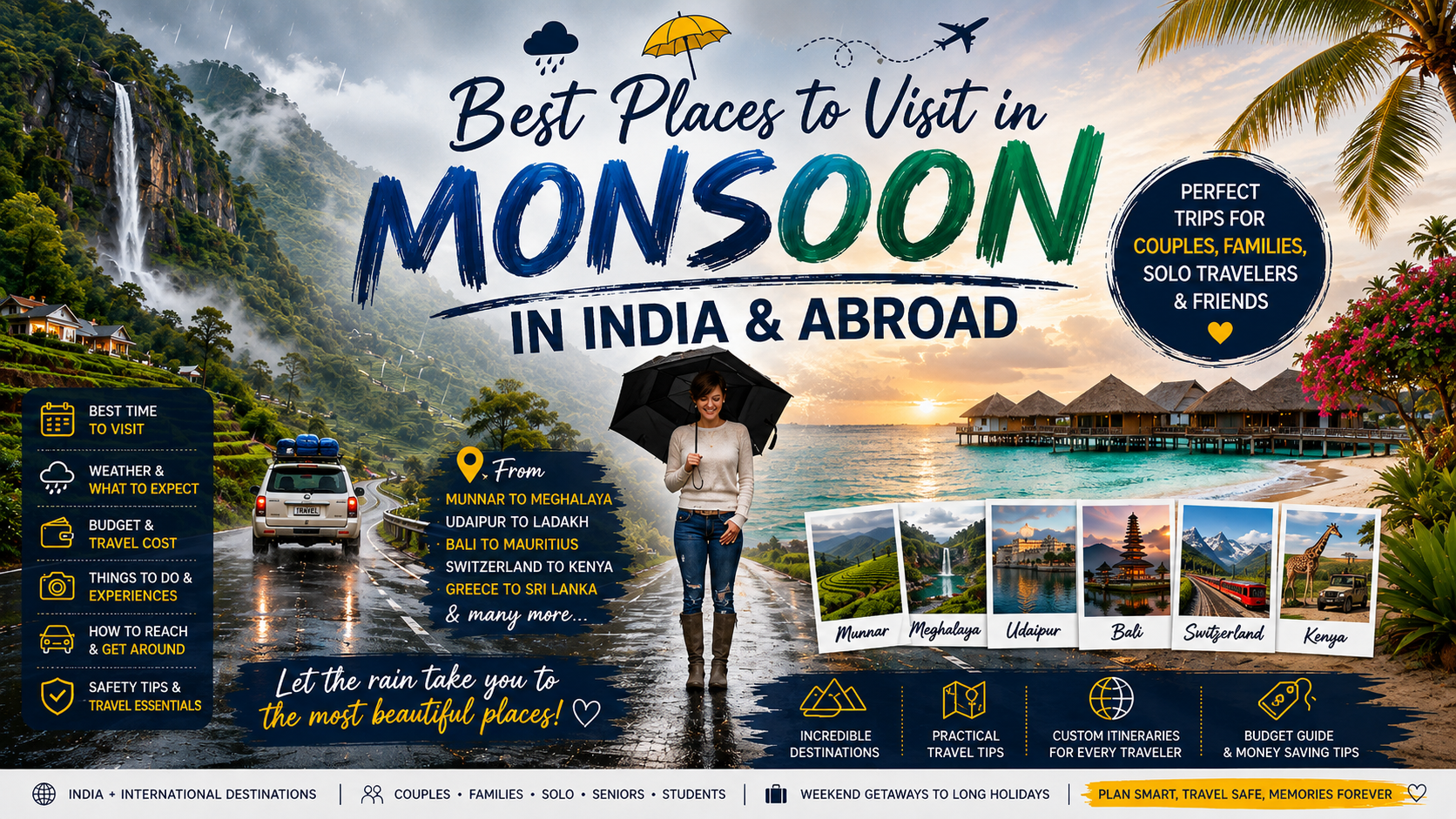
🌧️ Best Places to Visit in India & Abroad During Monsoon – Complete Rainy-Season Travel Guide
🌍 Introduction – This Monsoon, Don’t Just Watch the Rain—Travel With It
There is something magical about the first serious monsoon rain.
The air suddenly smells different. Dust disappears from the trees. Dry hills slowly begin turning green. Rivers grow louder, clouds sink lower over the mountains, and roads that looked ordinary a few weeks earlier begin leading towards waterfalls, mist and completely changed landscapes.
For many travellers, rain means cancelling a trip.
But sometimes rain is exactly the reason to travel.
Imagine waking up in Munnar while clouds drift across endless tea gardens.
Imagine driving through Coorg while coffee plantations shine after an overnight shower.
Imagine standing in Meghalaya while enormous waterfalls descend from cloud-covered cliffs.
Picture Udaipur under dark monsoon skies, when palaces and lakes reflect a softer, more romantic Rajasthan.
Or take the opposite journey.
While much of India is green and rain-soaked, you could travel towards Ladakh or Spiti and enter a high-altitude landscape of barren mountains, monasteries and enormous open skies.
And perhaps this year you want to travel even farther.
Your monsoon holiday does not need to remain inside India.
When rain reaches much of the Indian subcontinent, other parts of the world are experiencing completely different seasons.
You could leave India’s wet summer behind and arrive among Switzerland’s alpine lakes.
You could spend your days exploring Bali’s temples and rice landscapes.
You might celebrate a honeymoon beside the turquoise waters of Mauritius or Seychelles.
You could watch elephants crossing the African landscape in Kenya or Tanzania.
You could wander through Rome, Florence and Venice during the European summer, relax beside the Greek islands, explore Singapore’s food and attractions, or build an affordable Southeast Asian journey through Thailand, Vietnam, Malaysia or Sri Lanka.
That is what makes travelling between June and September so interesting.
There is no single “best monsoon destination.”
There is only the destination that best matches the experience you want.
Do you want to chase the rain?
Escape it?
Stand beside waterfalls?
Drink coffee beneath mist-covered mountains?
Explore ancient palaces?
Take your children on an international family holiday?
Plan a romantic honeymoon?
Go on a wildlife safari?
Travel cheaply with friends?
Spend a week surrounded by European mountains?
Or simply find somewhere peaceful where you can watch the weather change outside your window?
This guide has been created to help you make that decision.
Rather than giving you a meaningless list of destinations, we will travel through India and around the world according to the kind of experience each place genuinely offers during the Indian monsoon months.
You will discover lush monsoon escapes, rainy hill stations, waterfall destinations, romantic retreats, family-friendly places, heritage towns, high-altitude rain-shadow regions, international beach holidays, safari destinations, European summer escapes and practical short-haul foreign trips.
Each destination is described in invitation mode so that you can understand not only what is there, but what it may actually feel like to arrive.
You will also find practical guidance on the best months to travel, who each destination suits, how long to stay, likely weather conditions, transport planning, approximate budgets, photography opportunities, responsible travel and the safety considerations that become especially important during the rainy season.
Because a good monsoon guide must do more than inspire you.
It must also help you make safer and smarter decisions.
Heavy rain can transform a destination beautifully, but it can also affect roads, trekking trails, rivers, waterfalls, beaches and transport schedules.
Mountain conditions may change quickly.
A waterfall that looked peaceful yesterday may become dangerous after intense rain.
An international destination that is perfect in July may experience very different conditions in September.
That is why this guide separates evergreen destination advice from information that should always be checked shortly before departure.
Weather warnings, road closures, attraction timings, entry fees, visas, permits, transport schedules and local regulations can change.
The destination may remain timeless.
The practical details may not.
So keep your itinerary flexible.
Leave room for weather.
Travel slowly when conditions demand it.
And never measure the success of a monsoon holiday only by the number of attractions you managed to tick off.
Some journeys are remembered for completely different reasons.
The smell of wet soil.
A cup of hot tea while clouds cover the valley.
The sound of rain on the roof of a plantation bungalow.
The first glimpse of a giant waterfall through mist.
A quiet evening beside a lake.
A road disappearing into mountains.
Or the excitement of boarding an international flight and knowing that while your hometown is under grey monsoon clouds, another season is waiting for you somewhere else in the world.
So open the map.
Choose the experience you want.
And allow this monsoon to take you somewhere memorable.
🇮🇳 Best Monsoon Destinations in India
🍃 1. Munnar, Kerala – Come Walk Through Tea Gardens Wrapped in Monsoon Clouds
If you have ever wished to wake up somewhere where the clouds seem close enough to touch, let Munnar invite you into the Western Ghats during the rains.
Imagine opening your hotel window early in the morning and finding layer after layer of tea-covered hills slowly appearing from behind white mist. The road outside is wet, the leaves shine after the night’s rain, and somewhere below the valley you can hear water rushing through a seasonal stream. There is no need to hurry here. Munnar during monsoon rewards travellers who are willing to slow down.
Located in Kerala’s Idukki district, Munnar is famous for its rolling tea plantations, cool mountain environment and landscapes shaped by the Western Ghats. Official tourism information notes that the region receives heavy rainfall during the June–September monsoon period. That rain is precisely what gives Munnar its intense green appearance at this time of year.
Start your day with a warm cup of locally produced tea while mist moves across the plantations. If the weather allows, drive towards Mattupetty, Echo Point or other scenic areas around Munnar. On another day, learn how tea travels from leaf to cup, walk through plantation surroundings where permitted, or simply spend an hour watching clouds move between the hills.
This is one destination where a rainy afternoon does not automatically mean a wasted day. In fact, sitting beside a large window with hot tea while rain moves across the mountains can become one of the most memorable moments of the entire journey.
Couples will find Munnar naturally romantic without needing artificial candle-light setups. Families can enjoy the scenery at an easy pace. Photographers will discover changing light every few minutes. Senior travellers can also enjoy the destination by choosing centrally located accommodation and avoiding difficult walks during heavy rainfall.
Come to Munnar if you are looking for green mountains, tea country, mist, quiet roads and a holiday that encourages you to breathe a little more slowly.
Ideal stay: 3–4 days
Best for: Couples, families, photographers, nature lovers and slow travellers
Monsoon character: Misty, green and frequently wet
Do not miss: Tea-estate scenery, mountain drives, local tea experiences and misty viewpoints
Travel caution: Avoid swollen streams, slippery unofficial trails and unnecessary driving during very poor visibility.
☕ 2. Coorg, Karnataka – Let the Rain Lead You Into India’s Coffee Country
Come to Coorg when you want the monsoon to smell of wet earth, coffee leaves and forest.
Kodagu, commonly called Coorg, changes character once the rain arrives. Plantation roads become darker beneath the trees. Clouds gather over the hills. Water begins moving more strongly through streams and waterfalls, and the entire landscape develops the deep-green appearance for which the Western Ghats are loved.
This is not a destination you need to conquer with a checklist.
Choose a comfortable plantation stay. Wake to the sound of rain outside. Drink freshly brewed coffee. Watch fog move beyond the verandah and allow the weather to decide whether the morning becomes a sightseeing drive or a quiet plantation experience.
Madikeri makes a practical base for first-time visitors. From here, travellers can explore the wider coffee-growing region, viewpoints, cultural sites and waterfalls when local conditions are safe.
For couples, Coorg offers privacy without isolation. For families, it provides the chance to combine comfortable accommodation with short scenic outings. Food lovers can explore Kodava culinary traditions. Photographers can focus on plantation textures, rain-darkened roads, mist and forest scenery.
One of the greatest mistakes visitors make during monsoon is assuming every powerful waterfall must also be a swimming destination. Water can rise quickly, rocks become extremely slippery and currents may be stronger than they appear.
Come for the atmosphere rather than risky adventure.
Ideal stay: 3 days
Best for: Couples, families, coffee lovers and nature travellers
Special experience: Plantation stay during rain
Travel tip: Build your itinerary around weather windows rather than fixed hourly sightseeing.
🌿 3. Wayanad, Kerala – Enter a Landscape Where Forest, Farms and Rain Meet
If your idea of a monsoon holiday is less about crowded hill-station streets and more about forests, plantations, rural landscapes and quiet mornings, Wayanad deserves your attention.
The district sits amid the Western Ghats environment of northern Kerala and offers a mixture of forested hills, agricultural landscapes, waterfalls and small settlements.
When rain arrives, every layer of the scenery seems to become richer.
Banana leaves hold giant drops of water. Coffee plants glisten. Clouds sit low over the hills. Small streams become louder. Roads pass through landscapes that seem freshly painted overnight.
Rather than trying to rush from attraction to attraction, stay somewhere that allows you to enjoy the landscape itself. A plantation homestay or nature-oriented property can become part of the travel experience rather than simply a place to sleep.
Families can combine relaxed sightseeing with plantation surroundings. Couples may prefer quieter stays outside busy centres. Nature lovers can explore approved forest and wildlife experiences according to current access conditions.
Wayanad also requires greater monsoon awareness than many casual travel articles admit. Hilly terrain can become vulnerable during prolonged heavy rainfall. Local authority warnings, road restrictions and weather advisories must always override an itinerary.
Come here for nature—but travel with respect for it.
Ideal stay: 3–4 days
Best for: Nature travellers, couples and families
Monsoon mood: Deep green, misty and rural
Travel caution: Check current road and local administration advisories before travelling.
🌄 4. Chikmagalur, Karnataka – Follow the Monsoon Into the Mountains of Coffee
There are mornings in Chikmagalur when a mountain you could clearly see ten minutes earlier simply disappears behind cloud.
That is part of its charm.
Come here if you love coffee estates, winding roads, mountain air and weather that refuses to behave predictably.
The hills around Chikmagalur become dramatically greener during the rains. Coffee plantations spread across slopes beneath tall shade trees, while mist drifts across higher areas such as the Mullayanagiri region.
On clear weather breaks, viewpoints can become spectacular. During dense cloud, however, visibility may shrink rapidly.
Instead of being disappointed, change the plan.
Visit a coffee estate. Sit somewhere warm with local coffee. Explore lower-elevation surroundings. Wait for the clouds to open.
Monsoon travel becomes far more enjoyable when you stop demanding sunshine from a rainy-season destination.
Ideal stay: 2–3 days
Best for: Coffee lovers, couples, road-trippers and photographers
Do not miss: Plantation landscapes and safe mountain drives
Caution: Verify hill-road and trekking access locally after heavy rain.
🌧️ 5. Agumbe, Karnataka – Come Here If You Truly Love Rain
Agumbe is not for travellers who want guaranteed blue skies.
It is for travellers who want to hear rain falling through a Western Ghats forest.
Come here prepared for wet shoes, humid air, misted windows and sudden downpours. In return, you enter a landscape where rain supports extraordinary biodiversity and gives the forest an almost primeval atmosphere.
Agumbe is particularly interesting for nature enthusiasts and photographers interested in the ecology of the Western Ghats.
Rather than chasing wildlife for photographs, slow down. Listen. Look carefully along forest edges and travel with knowledgeable local naturalists where appropriate.
Never handle reptiles, amphibians or other wildlife for photographs.
This is one of those destinations where the journey becomes richer when humans occupy less space.
Ideal stay: 1–2 days
Best for: Naturalists, serious rain lovers and forest photographers
Not ideal for: Travellers uncomfortable with persistent rain or basic rural conditions.
💦 Best Monsoon Trips in Maharashtra
🌄 6. Lonavala & Khandala – Mumbai and Pune’s Green Weekend Escape
Imagine leaving behind a grey city morning and, a few hours later, finding yourself surrounded by green Sahyadri slopes, low clouds and waterfalls appearing beside the road.
That transformation explains why Lonavala and Khandala become so popular when Maharashtra’s monsoon arrives.
Come here for a short escape rather than a complicated expedition.
The journey itself can be beautiful. Dark clouds sit above the Western Ghats. Seasonal water flows down rock faces. Valleys disappear beneath mist and then suddenly reveal themselves when the clouds move.
Couples come for the weather and viewpoints. Families come for an easy weekend break. Friends arrive for drives and food. Photographers arrive for the enormous contrast between dark rock, green hills and white waterfalls.
But popularity creates its own problems.
Rainy weekends can bring severe congestion and risky roadside behaviour. Never stop on blind bends or stand in active traffic lanes simply for a photograph.
Waterfalls can also become dangerous quickly after heavy rain.
Visit responsibly and you will understand why generations of Mumbai and Pune residents associate the first strong monsoon clouds with a drive towards Lonavala.
Ideal stay: 1–2 days
Best for: Weekend travellers, couples, students and families
Smartest time: Weekdays or early starts during busy weekends
Avoid: Unsafe waterfall entry and roadside parking.
🌫️ 7. Mahabaleshwar & Panchgani – Let the Fog Become Part of Your Holiday
Come to Mahabaleshwar without demanding a perfect valley view.
Some days the view will disappear entirely.
That is exactly when the hill station becomes most atmospheric.
Roads pass through wet forest. Fog moves over ridges. Small cafés become warm refuges from the rain. Strawberry farms, viewpoints and surrounding countryside take on a very different personality from the clearer winter months.
For couples, it creates an intimate hill-station atmosphere. Families can enjoy resort time between sightseeing breaks. Senior travellers can experience the season without strenuous trekking if accommodation and transport are selected carefully.
Nearby Panchgani adds another landscape of hills and plateau scenery.
The secret is simple: keep the schedule loose.
When visibility improves, go sightseeing.
When clouds close in, stop somewhere warm, order tea or a local snack, and enjoy the fact that you came here specifically to meet the monsoon.
Ideal stay: 2–3 days
Best for: Couples, families and leisurely road trips.
🚂 8. Matheran – Walk Into a Quieter Monsoon World
Matheran asks you to slow down before the holiday even begins.
That is precisely why it feels different.
Come here when you want wet forest paths, red earth, misty viewpoints and a hill-station experience where walking remains part of the journey.
During the monsoon, the surrounding vegetation becomes lush and clouds move through the trees.
The pace is naturally slower than a destination built around continuous car sightseeing.
Wear footwear with reliable grip.
Carry only what you need.
Protect phones and cameras from rain.
And walk carefully—the same wet surfaces that make Matheran beautiful can also become slippery.
This is a particularly charming choice for couples, friends, students and travellers who enjoy walking rather than rushing between attractions.
🌧️ Meghalaya – Come Meet the Rain Itself
💦 9. Sohra/Cherrapunji – Where Clouds Become Part of the Landscape
There are destinations you visit despite the rain.
Sohra is a destination you visit because of it.
Come here and watch clouds move across a high plateau before dropping into deep valleys. Waterfalls descend from dramatic cliffs. Forests become intensely green, and the sound of running water accompanies much of the journey.
The experience is elemental.
Rain hits roofs.
Clouds arrive without invitation.
Visibility changes within minutes.
And when the weather clears, the valleys appear with extraordinary drama.
Sohra is particularly rewarding for photographers, couples, nature lovers and travellers fascinated by Meghalaya’s living-root-bridge traditions.
But do not mistake beautiful social-media photographs for effortless access.
Some root-bridge routes involve long stairways and demanding walks. Wet conditions increase difficulty considerably.
Come prepared to experience the rain rather than fight it.
Ideal stay: 2–3 days
Best for: Rain lovers, photographers, hikers with suitable fitness and couples.
🌧️ 10. Mawsynram – Visit a Place Where Rain Has Shaped Everyday Life
If you want to understand monsoon not just as weather but as a way of life, travel deeper into Meghalaya towards Mawsynram.
The appeal here is not a giant amusement-style attraction list.
It is the relationship between rain, settlement, agriculture, landscape and everyday routines.
Clouds can sit low over the road. Villages appear through mist. Water seems present everywhere.
Travel gently.
Ask before photographing residents.
Do not treat homes, farms or village roads like movie sets.
The best memory may be something very simple: standing under shelter, listening to intense rain and realizing how differently people live in a landscape where rainfall is such a defining force.
☁️ 11. Shillong – Your Comfortable Gateway to Meghalaya’s Monsoon
Shillong gives travellers a softer introduction to Meghalaya.
Come for cafés, local food, markets and cultural life, then use the city as a base for exploring surrounding landscapes.
The great advantage is balance.
When heavy rain makes a nature excursion impractical, the day does not necessarily collapse. You still have restaurants, urban attractions and cultural experiences.
Families and first-time visitors may therefore find Shillong easier than shifting hotels every night across Meghalaya.
Allow extra road time during wet weather.
The mountains determine the pace here—not your spreadsheet.
🌸 Himalayan Monsoon Adventures
🌺 12. Valley of Flowers, Uttarakhand – Walk Into a Himalayan Meadow in Bloom
There are journeys where the destination appears almost unreal after the effort required to reach it.
Valley of Flowers is one of them.
Come during the seasonal flowering period and the high Himalayan landscape can open into meadows filled with alpine flowers, framed by mountains, streams and waterfalls.
Uttarakhand Tourism describes the UNESCO World Heritage Site in Chamoli district as an 87-square-kilometre valley with maximum flower abundance generally during July–September.
But this beauty must be earned responsibly.
You are travelling into mountain terrain at significant altitude. Rain can affect roads and trekking routes. Weather may change quickly.
Do not approach this as an ordinary picnic destination.
Come prepared to walk, respect official access rules, keep buffer time and turn back if local conditions demand it.
For photographers, botanically curious travellers and experienced walkers, few Indian monsoon journeys offer the same combination of seasonal timing and landscape.
Ideal trip: 3–5+ days depending on approach
Best for: Trekkers, nature enthusiasts and photographers
Not suitable for: Anyone treating the trek casually without fitness or weather preparation.
🏔️ 13. Ladakh – Escape the Green Monsoon and Enter a High-Altitude Desert
Now imagine the opposite of Munnar.
No endless tea plantations.
No humid forest.
Instead, giant bare mountains rise around broad valleys under enormous skies.
That is why Ladakh belongs in this guide.
Come here during India’s wider monsoon months when you want to exchange the wet landscapes of much of the country for a high-altitude Himalayan environment.
Base yourself first in Leh and give your body time to acclimatize.
Then, depending on current road conditions and permits, the journey may open towards Nubra Valley, Pangong Lake, monasteries and dramatic mountain passes. Ladakh’s administration lists Nubra, Pangong and Tso Moriri among its major tourism attractions.
The mistake is rushing.
Ladakh rewards patience from the first day.
Give yourself acclimatization time. Keep buffer days. Check official road status.
Come for silence, scale, monasteries, mountain culture and landscapes unlike almost anywhere else in India.
Ideal stay: 6–9 days or longer
Best for: Adventure travellers, photographers and couples comfortable with altitude
Major caution: Altitude and changing road conditions.
🏜️ 14. Spiti Valley – Follow the Road Into India’s Stark Mountain Silence
Spiti does not invite you with waterfalls.
It invites you with emptiness.
Imagine a road carved through huge barren mountains, tiny villages clinging to high valleys and monasteries appearing against landscapes that seem almost lunar.
During the broader Indian monsoon season, Spiti’s high-altitude rain-shadow geography makes it attractive to travellers seeking something different from wet tropical India.
But reaching Spiti still requires respect for mountain conditions.
Approach roads can be disrupted even when the valley itself is comparatively dry.
Come with time.
Stay in local villages.
Listen to silence.
Watch the evening light move across bare mountains.
And do not try to convert a slow Himalayan journey into a high-speed checklist.
🏰 Heritage Monsoon India
🌊 15. Udaipur, Rajasthan – Watch Rajasthan Turn Romantic Under Rain Clouds
If you think Rajasthan belongs only to winter, come to Udaipur when monsoon clouds gather over the Aravalli hills.
The city changes mood.
Lake waters reflect dark skies. Palace walls become softer beneath overcast light. The hills around Sajjangarh rise into mist, and the evenings can feel completely different from Rajasthan’s dry-season image.
Official tourism information specifically highlights the Monsoon Palace overlooking the Aravalli landscape.
Spend the morning exploring palace architecture and old-city lanes.
Allow the afternoon to slow down beside a lake.
If rain arrives, move indoors to a museum, café or heritage property rather than treating it as an interruption.
Udaipur works particularly well for couples because the city combines scenery with architecture, food and comfortable accommodation.
It is equally useful for families and senior travellers because the itinerary does not depend entirely on outdoor adventure.
Come for a Rajasthan you may not have imagined—green hills, grey skies and palaces reflected in water.
⛰️ 16. Mount Abu – Rajasthan’s Green Monsoon Hill Escape
Come to Mount Abu when you want to see Rajasthan behaving differently.
The Aravalli hills become greener, clouds descend and the hill-station atmosphere creates an escape from the surrounding plains.
Spend time around Nakki Lake, heritage and religious sites, forested roads and viewpoints when visibility permits.
Families may appreciate its manageable scale.
Couples can enjoy foggy evenings and slow sightseeing.
The rain, however, makes mountain roads and viewpoints slippery.
Arrive during daylight whenever possible during poor weather.
🏛️ 17. Mandu, Madhya Pradesh – Let Ancient Stone Rise From a Green Plateau
Mandu in monsoon can feel as though history has been waiting for the rain.
Come across the plateau when the surrounding landscape has turned green and old stone structures stand beneath dramatic grey skies.
Palaces, pavilions, water structures and ruins acquire a different visual power in wet weather.
For heritage photographers, the contrast between dark stone and bright monsoon vegetation is exceptional.
For couples and history lovers, Mandu offers a quieter kind of romance—one built from architecture, stories and enormous skies.
Walk slowly.
Ancient stone becomes slippery when wet.
Give each monument time instead of rushing through the archaeological landscape.
🛕 18. Orchha, Madhya Pradesh – Slow Down Beside Palaces, Temples and the Betwa
Come to Orchha if you want a monsoon trip where heritage does most of the storytelling.
The old palaces, temples and cenotaphs already create a remarkable skyline.
Add green surroundings, moving clouds and the Betwa River, and the setting becomes even more atmospheric.
This is ideal for travellers who prefer history and photography to crowded hill stations.
Spend the morning inside heritage structures. Walk through the town when conditions allow. Watch the light change across the cenotaphs.
Respect the river during high-flow periods.
A peaceful-looking bank can become dangerous quickly after heavy upstream rain.
🌍 Best International Trips During India’s Monsoon
🇮🇩 19. Bali, Indonesia – Leave the Indian Rains Behind for Temples, Rice Fields and Island Evenings
If your monsoon holiday dream involves leaving India for somewhere tropical yet culturally rich, Bali can feel like an easy invitation to slow down.
Imagine waking in Ubud beside rice fields, spending the morning visiting temples, stopping at a café overlooking green countryside and finishing the day watching the sun lower over the coast.
Bali offers several holidays inside one island.
Come as a couple and build a romantic Ubud-and-coast itinerary.
Come with friends and mix beaches, cafés and nightlife.
Come with family and focus on culture, landscapes and relaxed resort time.
Do not reduce Bali to Instagram swings and beach clubs.
Its real depth lies in Balinese Hindu culture, temple landscapes, agriculture, food and community life.
Stay long enough to experience more than one region.
Ideal stay: 5–8 days
Best for: Couples, honeymooners, families and first-time Southeast Asia travellers.
🇲🇺 20. Mauritius – Trade Grey Monsoon Skies for an Indian Ocean Island
Picture yourself looking out over turquoise water while mountains rise dramatically behind the coast.
Mauritius is not simply a place to stay inside a resort.
Come here and drive through landscapes of sugarcane, mountains and villages. Spend time on the coast. Explore local food shaped by Indian, African, Chinese and European influences.
Couples can find privacy and beautiful beaches.
Families benefit from resort infrastructure and manageable distances.
Nature travellers can combine coastlines with inland landscapes rather than spending the entire holiday beside one swimming pool.
The greatest luxury here may be space.
Give yourself enough days to see the island rather than treating your hotel as Mauritius itself.
Ideal stay: 5–7 days
Best for: Honeymooners, families and beach-and-nature travellers.
🇸🇨 21. Seychelles – Come to an Island Landscape That Looks Almost Impossible
There are beaches that are beautiful.
Then there are beaches where giant granite boulders, forested hills and clear Indian Ocean water come together so perfectly that the landscape seems designed.
That is the invitation of Seychelles.
Do not hurry.
Move between islands only when your itinerary genuinely benefits from it.
Spend time walking beaches early in the morning. Explore forest trails where appropriate. Swim only according to local sea conditions.
This is particularly suited to couples and honeymooners, but photographers and nature travellers may appreciate it just as much.
The cost can be higher than many Asian trips, so plan carefully rather than treating Seychelles as a spontaneous low-budget escape.
🇨🇭 22. Switzerland – Exchange India’s Monsoon for Alpine Summer
Imagine leaving a humid Indian airport and, hours later, looking through a train window at lakes, green meadows and mountains.
That contrast is part of Switzerland’s appeal during the Indian monsoon months.
Come for rail journeys that become attractions in themselves.
Stay beside a lake.
Ride into mountain regions when conditions are suitable.
Walk through villages where flower-covered balconies face giant peaks.
Interlaken can become a base for the Bernese Oberland. Lucerne mixes lake and mountain scenery. Zermatt brings dramatic alpine landscapes. Larger cities add museums, restaurants and urban comfort.
Families appreciate the efficient transport network.
Couples find natural romance without needing staged experiences.
Senior travellers can see remarkable landscapes using trains, boats and cable transport without undertaking difficult hikes.
Switzerland is expensive, but good planning can prevent unnecessary spending.
Ideal stay: 7–10 days
Best for: Couples, families, seniors, rail lovers and photographers.
🇮🇹 23. Italy – Spend India’s Rainy Season Among Ancient Cities and Summer Landscapes
Come to Italy when you want every day to feel different.
Wake near the ruins of Rome.
Spend another evening beside a canal in Venice.
Walk through Florence surrounded by Renaissance architecture.
Continue into Tuscany or the Dolomites if your schedule allows.
Italy works because culture, food, architecture and scenery sit unusually close together.
Couples can build a romantic city-and-countryside journey.
Families can turn history into an experience rather than a textbook.
Food lovers may find that even simple meals become travel memories.
Summer can also mean heat, crowds and higher prices in major destinations.
Start sightseeing early, pre-book high-demand attractions and resist trying to visit five cities in six days.
Italy is better slowly.
🇬🇷 24. Greece – Let the Indian Monsoon Become Your Mediterranean Summer
If June through September in India makes you dream about bright skies and blue water, Greece presents a radically different seasonal mood.
Start with Athens if history matters.
Then move towards an island that matches your personality rather than simply following the most famous Instagram location.
Santorini suits dramatic scenery and couples.
Crete offers greater scale, history and beaches.
Naxos or Paros can appeal to travellers seeking a more relaxed island rhythm.
Come for long evenings, Mediterranean food, archaeological landscapes and coastal views.
Peak summer can be hot and busy, particularly in July and August.
June and September may offer a more comfortable balance for some travellers.
🇰🇪 25. Kenya – Let Your Monsoon Holiday Become a Safari
Imagine replacing the sound of rain outside your window with the early-morning silence of an African savannah.
Kenya invites travellers into an entirely different kind of journey.
Wake before sunrise.
Drive into the landscape with an experienced guide.
Watch light spread across grasslands.
Look for elephants, big cats, giraffes and countless other species without treating any sighting as guaranteed.
The Maasai Mara is internationally famous, but Kenya is far larger than one reserve.
Amboseli offers dramatic landscapes associated with elephants and views towards Kilimanjaro when conditions allow. Other parks and conservation areas create different ecosystems and experiences.
Come with patience.
Safari is not a zoo.
The animal you most want to see may never appear—and another unexpected encounter may become the highlight of the trip.
🇹🇿 26. Tanzania – Follow the Wild Landscape From Serengeti to Ngorongoro
Tanzania is a destination for travellers who want their international holiday to feel truly expansive.
Come to the Serengeti and watch grasslands stretch far beyond the horizon.
Descend towards the Ngorongoro landscape.
Add Zanzibar if you want to finish the journey beside the Indian Ocean.
A safari here can become one of those rare trips where mornings begin before sunrise because nobody wants to miss the first light.
Do not plan the entire holiday around a guaranteed migration crossing or one particular animal.
Nature does not follow tour-company advertising schedules.
Travel for the ecosystem, landscapes, guides, cultures and complete experience.
🇿🇦 27. South Africa – One Country, Several Completely Different Journeys
South Africa invites you to choose.
Do you want safari?
Wine country?
Cape landscapes?
Urban culture?
Road trips?
You can build a trip around one of these or carefully combine several.
The country is geographically large and weather varies considerably by region, so avoid assuming one nationwide climate.
Wildlife travellers can focus on major reserves.
Food-and-wine travellers may gravitate towards the Cape region.
Road-trippers can construct scenic journeys with enough time to avoid constantly changing hotels.
Come with curiosity rather than trying to “cover South Africa” in a week.
🇸🇬 28. Singapore – A Rain-Friendly International City Break
Singapore is a useful choice when you want your first international monsoon-period holiday to feel manageable.
Rain may arrive, but the city has enough indoor infrastructure that the day does not necessarily stop.
Spend a morning among futuristic gardens.
Move into museums, shopping areas or food centres when showers begin.
Take children to family attractions.
Stay out later for illuminated city views.
Food is one of the greatest reasons to come.
Hawker centres provide a journey through Chinese, Malay, Indian and many other culinary traditions without requiring a luxury restaurant budget.
For families and first-time international travellers, Singapore combines convenience with cultural variety.
🇲🇾 29. Malaysia – Choose Between Food, Cities, Islands and Rainforest
Malaysia does not ask you to choose only one kind of holiday.
Come to Kuala Lumpur for city energy and food.
Add Penang for heritage streets and another extraordinary culinary scene.
Choose Langkawi when island relaxation fits the weather pattern for your dates.
Explore rainforest environments if nature is the priority.
Because Malaysia’s seasonal conditions vary by coast and region, choose the destination after checking the weather for the exact month rather than relying on the word “monsoon” alone.
🇹🇭 30. Thailand – Come for Food, Temples and a Holiday That Can Handle a Little Rain
Thailand remains appealing even when parts of the country are experiencing seasonal rain because the holiday does not need to revolve entirely around beaches.
Begin in Bangkok with temples, markets and food.
Move north if culture and mountains interest you.
Choose islands only after checking which coast offers the better seasonal conditions for your dates.
A sudden tropical shower can sometimes become an excuse to stop for coffee, massage, shopping or another meal rather than a ruined day.
That flexibility is the secret to enjoying Thailand during wetter months.
🇻🇳 31. Vietnam – Travel Through a Country With Several Seasons at Once
Vietnam is long enough that the weather can change considerably from one region to another.
That creates an opportunity.
Come for Hanoi’s street life and food.
Explore central heritage cities when conditions suit the month.
Continue to Ho Chi Minh City for another entirely different urban rhythm.
Vietnam rewards travellers who enjoy food, culture, history and movement.
Do not choose a national itinerary from a single weather forecast.
Check each region separately.
🇱🇰 32. Sri Lanka – Cross the Sea for Culture, Hills and Coastlines Close to India
Sri Lanka feels international without feeling impossibly far away.
Come for ancient cities, tea-covered highlands, wildlife, beaches and food.
Ride through the hills around the central part of the island.
Explore cultural sites.
Choose your coast according to the seasonal rainfall pattern rather than assuming the entire island experiences identical weather.
For Indian travellers with limited vacation time, Sri Lanka can provide a surprisingly varied journey within a relatively compact country.
🇫🇷 33. France – Replace Monsoon Grey With European Summer Evenings
Paris may be the beginning, but it does not need to be the entire French holiday.
Come for museums and neighbourhood walks.
Then decide whether your journey should continue towards Provence, the Alps, vineyards, historic towns or the Mediterranean coast.
France suits couples, culture travellers, food enthusiasts and families prepared to travel at a relaxed pace.
Do fewer regions and experience them properly.
That approach almost always creates a richer journey than spending the entire holiday transferring between train stations.
🇦🇹 34. Austria – Let the Alps Slow the Journey Down
Austria is an excellent alternative for travellers attracted to Switzerland but also interested in imperial cities, music and relatively compact travel distances.
Start in Vienna for architecture and café culture.
Continue towards Salzburg.
Then enter lake and mountain country.
The combination makes Austria particularly attractive to couples, senior travellers and families seeking a calm European summer itinerary.
Do not rush through Hallstatt simply for one photograph.
Stay longer in the surrounding region and let the lakes and mountains become part of the journey.
🇮🇸 35. Iceland – Trade the Indian Monsoon for Waterfalls, Volcanoes and Midnight Light
If you want the most dramatic contrast possible, fly from India’s rainy season towards Icelandic summer.
Here the water comes not from tropical monsoon clouds but from glaciers, rivers and enormous waterfalls.
Drive past lava landscapes.
Stand at safe viewpoints beside waterfalls.
See black-sand coastlines, geothermal areas and enormous open spaces.
Summer daylight can stretch late into the evening, allowing an unusual rhythm of travel.
But Iceland demands respect.
Weather can change rapidly. Coastal winds can become dangerous. Driving distances often look easier on a map than they feel on the ground.
Come prepared, drive conservatively and never cross safety barriers simply because the landscape looks irresistible.
🌧️ The Invitation
You do not have to escape the monsoon.
Sometimes you should follow it.
Come to Munnar and drink tea while clouds swallow the hills.
Come to Meghalaya and hear rainfall become the soundtrack of the journey.
Come to Udaipur and watch Rajasthan soften beneath dark skies.
Come to Ladakh and discover that India’s rainy months can also lead you into a high-altitude desert.
Or open the map wider.
Let July take you towards Switzerland’s mountains.
Let August lead you to Bali or an African safari.
Let September become the month you finally see the Mediterranean.
The question is no longer simply:
“Where should I go in monsoon?”
Ask instead:
“What do I want this monsoon to feel like?”
Green?
Wild?
Romantic?
Quiet?
Rain-soaked?
Sunlit?
Mountainous?
Tropical?
International?
Or completely different from home?
Choose that feeling first.
The destination will follow.
🌦️ Monsoon Travel Guide Summary – Choose the Weather, Mood and Journey You Want
The best monsoon holiday is not automatically the place receiving the most rainfall.
It is the destination where the season matches your travel personality.
If you want deep green mountains, plantations, mist and waterfalls, the Western Ghats offer some of India’s most memorable rainy-season landscapes.
Munnar welcomes you with tea-covered hills.
Coorg and Chikmagalur bring coffee estates and forest roads.
Wayanad offers plantation country and nature.
Lonavala, Mahabaleshwar, Matheran and the Maharashtra Ghats turn weekend journeys into green escapes.
If rain itself is the attraction, Meghalaya belongs near the top of the list.
Sohra, Mawsynram and the surrounding landscapes show how dramatically water, cloud, village life and geography can come together.
For travellers interested in history, architecture and culture rather than constant outdoor adventure, Udaipur, Mandu, Mount Abu and Orchha offer another version of monsoon India.
Rain softens their landscapes and often makes their heritage architecture even more atmospheric.
Travellers seeking a different kind of Indian journey can head towards Ladakh and Spiti.
These high-altitude regions offer stark mountains and comparatively dry landscapes during much of the period when other parts of India are experiencing the southwest monsoon.
International travel opens the choice even further.
Bali offers culture, rice landscapes and tropical holidays.
Mauritius and Seychelles invite travellers towards Indian Ocean beaches.
Switzerland, Austria, Italy, France and Greece turn India’s monsoon months into a European summer holiday.
Kenya, Tanzania and South Africa offer wildlife and enormous landscapes.
Thailand, Vietnam, Malaysia, Singapore and Sri Lanka provide relatively accessible international choices for Indian travellers, although weather needs to be checked region by region.
The right destination therefore depends on five simple questions:
| Question | What it helps you decide |
|---|---|
| Do I want rain or sunshine? | Wet monsoon destination vs drier escape |
| How many days do I have? | Weekend India trip vs longer international journey |
| Who is travelling? | Couple, family, senior, students, solo or group |
| What experience matters most? | Nature, heritage, beach, safari, adventure or relaxation |
| How flexible is my itinerary? | Mountain/rain trip vs predictable city holiday |
A two-day monsoon weekend from Mumbai is not the same decision as a seven-day honeymoon.
A family travelling with children will plan differently from a solo trekker.
A senior traveller may value comfortable transport and indoor alternatives more than a dramatic waterfall trail.
A photographer may actively choose fog and rain that another traveller would prefer to avoid.
That is why this guide does not try to declare one destination the winner.
Instead, it helps you find your own.
❤️ Conclusion – Somewhere, the Monsoon Is Already Calling You
Perhaps you began reading this guide thinking you simply needed a list of places to visit during monsoon.
But travel decisions are rarely that simple.
You are not really choosing between Munnar and Meghalaya.
Or between Ladakh and Switzerland.
Or between Mauritius and Bali.
You are choosing how you want the next journey to feel.
Maybe you want to stand beside a window in Munnar with a cup of tea while mist slowly hides the plantation hills.
Maybe you want to drive through Coorg as rain moves across coffee estates.
Maybe you want to hear the enormous sound of water falling from the cliffs of Meghalaya.
Maybe your idea of romance is watching Udaipur’s lake landscape under grey clouds.
Perhaps you would rather leave the rain entirely and follow a mountain road through Ladakh.
Or perhaps this is the year when your monsoon holiday becomes an international journey.
You might walk beside a Swiss lake while the Alps rise ahead of you.
Watch an African sunrise during a safari.
Spend a quiet afternoon beside the Indian Ocean in Mauritius.
Explore a Balinese temple.
Eat dinner beside a Greek island harbour.
Ride a train through Italy.
Discover Singapore with your children.
Or simply sit somewhere far from home and realise that travelling during the rainy season opened a part of the world you had never previously considered.
There is no wrong choice if the destination genuinely matches you.
Just remember that monsoon travel demands respect.
Respect the weather.
Respect rivers and waterfalls.
Respect mountains.
Respect local warnings.
Respect wildlife.
Respect village communities.
Respect fragile landscapes.
And respect your own limits.
If authorities close a road or trail, turn back.
If the sea is unsafe, stay out of it.
If visibility becomes poor, slow down.
If weather destroys today’s sightseeing plan, allow tomorrow to take its place.
A good traveller does not fight a destination.
A good traveller listens to it.
And perhaps that is the greatest lesson monsoon travel can teach us.
Not every journey needs perfect blue skies.
Sometimes the clouds create the story.
Sometimes the rain makes the landscape beautiful.
Sometimes the road you almost cancelled becomes the road you remember for years.
So when the next monsoon clouds gather above your city, do not automatically look through the window and think:
“Travel season is over.”
Look at the map instead.
Somewhere in India, a waterfall is returning to life.
Somewhere in the Western Ghats, a dry hill is turning green.
Somewhere in Ladakh, a mountain road is opening towards an extraordinary landscape.
Somewhere in Europe, summer is beginning.
Somewhere beside the Indian Ocean, a beach is waiting.
Somewhere on the African savannah, the sun is rising.
And somewhere among all those possibilities is the journey meant for you.
Pack wisely. Check the weather. Travel responsibly. Keep your plans flexible—and let this monsoon become part of your travel story.
❓ FAQs

1. 🌧️ Which are the best places to visit in monsoon in India?
Some of the best monsoon destinations in India include Munnar, Wayanad, Coorg, Chikmagalur, Lonavala, Mahabaleshwar, Matheran, Meghalaya, Udaipur, Mandu and the Valley of Flowers. Travellers seeking comparatively drier high-altitude landscapes during India’s monsoon months can also consider Ladakh and Spiti Valley, subject to current road and weather conditions.
2. 🌍 Which international destinations are best to visit during India’s monsoon season?
Depending on the exact month and desired experience, travellers from India can consider Bali, Mauritius, Seychelles, Switzerland, Italy, Greece, Austria, Kenya, Tanzania and South Africa. Thailand, Vietnam, Malaysia, Singapore and Sri Lanka can also work, but their rainfall varies significantly by region, so check destination-specific weather before booking.
3. 🗓️ Where should I travel in June, July, August and September?
June is excellent for early Western Ghats greenery and European summer trips. July and August bring dramatic monsoon scenery to destinations such as Munnar, Coorg, Maharashtra and Meghalaya, while Ladakh and Spiti offer contrasting high-altitude landscapes. September can be attractive for late-monsoon India and international destinations such as Bali, Greece and parts of Europe. Always check current forecasts.
4. 💑 What are the best monsoon destinations for couples and honeymooners?
For romantic trips in India, consider Munnar, Coorg, Udaipur, Mahabaleshwar and Meghalaya. International honeymoon options include Bali, Mauritius, Seychelles, Switzerland and Greece. Choose according to budget, rainfall preference, flight time and whether you prefer mountains, beaches, culture or luxury resorts.
5. 👨👩👧👦 Which monsoon destinations are best for families with children?
Families can consider Munnar, Udaipur, Mahabaleshwar, Coorg and Shillong because these destinations can combine sightseeing with comfortable stays. For international family holidays, Singapore, Mauritius, Switzerland and selected Malaysian destinations are worth considering. Families should prioritize safe transport, indoor alternatives and flexible itineraries during unpredictable weather.
6. ☀️ Where can I travel to escape heavy monsoon rain?
Within India, Ladakh and Spiti Valley are well-known high-altitude rain-shadow choices, although mountain-road disruptions can still occur. Internationally, parts of Europe, Mauritius and selected African destinations may offer a different seasonal experience during June–September. No destination is guaranteed to be rain-free, so check forecasts for your exact dates.
7. 💰 Is travelling during monsoon cheaper?
It can be, but not everywhere. Some Indian hill stations, beach destinations and resorts may offer attractive rainy-season rates, while popular weekend destinations can remain expensive. International prices depend heavily on airfare, school holidays, European summer demand, visas and hotel occupancy. Compare the total trip cost, not just hotel discounts.
8. ⚠️ Is it safe to visit hill stations and waterfalls during monsoon?
Yes, when weather and local authorities indicate conditions are safe. Avoid swollen rivers, flooded roads, unstable slopes, closed trekking trails and waterfalls during intense rainfall. Never enter fast-moving water for photographs or social-media videos. Check official weather, district administration, forest and road advisories immediately before travelling.
9. 🎒 What should I pack for a monsoon trip?
Carry a lightweight rain jacket, umbrella, quick-dry clothes, footwear with strong wet-surface grip, spare socks, waterproof phone protection, backpack rain cover, personal medicines, basic first aid and a power bank. For international trips, also keep your passport, insurance documents and important travel records protected from water.
10. ✈️ Should I choose an India trip or an international trip during monsoon?
Choose India when you want waterfalls, misty mountains, green landscapes, heritage trips, short getaways and generally lower travel costs. Choose international travel when you want a different season or experience—such as European summer, an Indian Ocean island, Southeast Asian culture or an African safari. The best choice depends on your dates, budget, trip duration, companions and preferred weather.