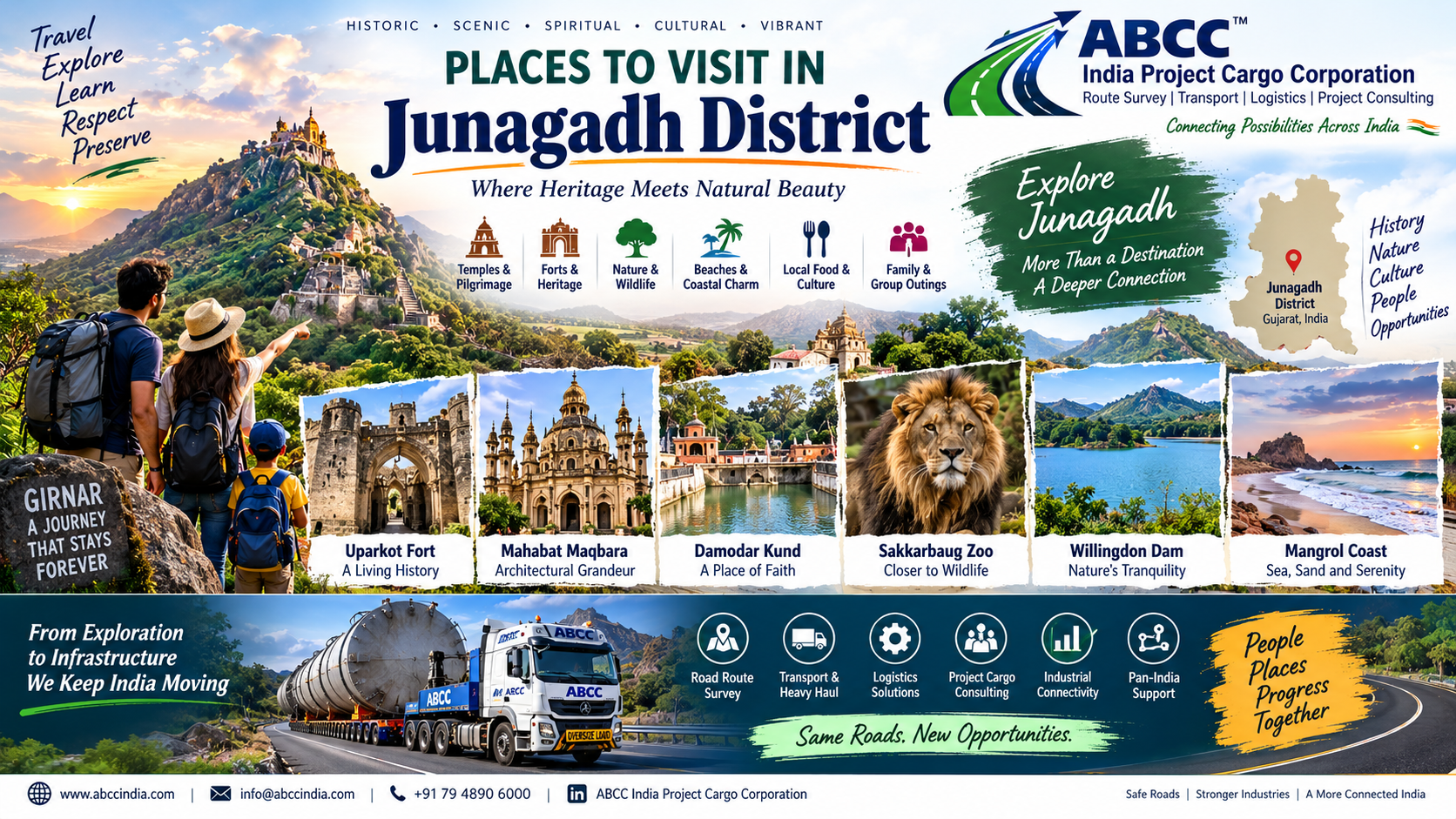
🦁 Places to Visit in Junagadh District, Gujarat – The Ultimate Travel & Tourism Guide
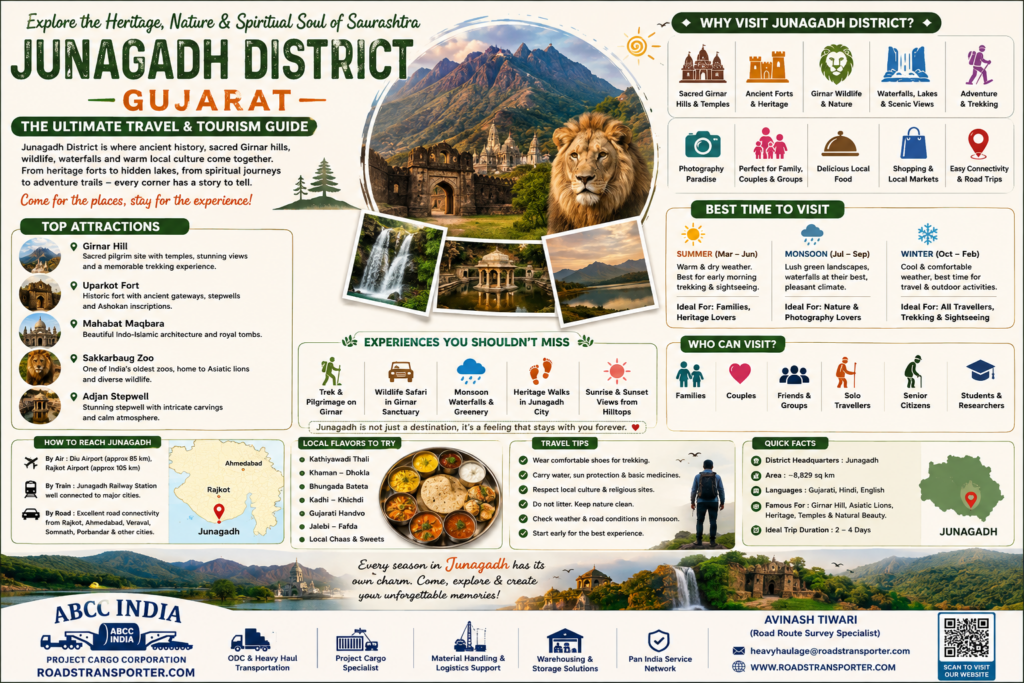
🌄 Introduction – Where Gujarat’s Wild Heart Meets Sacred Hills
Some destinations impress you with monuments. Some stay in memory because of landscapes. Junagadh District does something different—it slowly reveals layers of Gujarat that you may not expect to find in one journey. Here, an ancient fort rises above a busy historic city, temple bells travel across the slopes of Girnar, old stone inscriptions speak of empires long gone, and the road can suddenly open toward forests where the presence of the Asiatic lion has shaped an entire region’s identity.
My invitation to Junagadh is simple: do not come here only to tick tourist places off a list. Come prepared to explore.
At first glance, Junagadh can appear to be a heritage and pilgrimage destination centred around Junagadh city and Girnar Hill. Spend more time here, however, and the district begins to feel much larger in character. You encounter stepwells, caves, palaces, museums, reservoirs, forest landscapes, village roads, religious sites and viewpoints that change dramatically with the season. For a first-time visitor searching for the best places to visit in Junagadh District, this variety is precisely what makes planning both exciting and slightly confusing.
The good news is that Junagadh works for many different kinds of travellers.
A family can combine history, spirituality and relaxed sightseeing. Friends can plan an energetic weekend around Girnar and nearby outdoor experiences. Couples can look beyond crowded attractions for quieter viewpoints and scenic drives. Students can turn the district into an open-air lesson in archaeology, geology, religion, architecture and conservation. Senior travellers can enjoy selected heritage and devotional attractions without attempting demanding climbs. And if you enjoy solo travel, Junagadh gives you something particularly valuable: enough famous landmarks to provide structure, but enough side roads and lesser-known stories to keep curiosity alive.
🏰 A Journey Through Thousands of Years
Junagadh literally carries history in its landscape.
Walk around Uparkot Fort, and you are not simply visiting another old fort. The massive defensive setting, ancient water structures, rock-cut spaces and commanding position make it easier to understand why this part of Saurashtra remained strategically important across changing dynasties and political eras. Nearby archaeological remains add another layer, while the celebrated inscriptions associated with Emperor Ashoka connect the region with a much wider chapter of Indian history.
Then there is Girnar.
The mountain dominates the visual and spiritual identity of Junagadh. From the plains, its dark outline seems to follow you around the city. Up close, it becomes an entirely different world—a landscape of pilgrimage routes, Jain and Hindu sacred sites, stone steps, forests, viewpoints and centuries of devotion.
For some travellers, climbing Girnar is an act of faith. For others, it is adventure travel. For photographers, the changing light, rocky ridges and vast views are reason enough to arrive early. Even visitors who do not undertake the traditional climb can experience the mountain environment and appreciate why Girnar occupies such a powerful place in local consciousness.
This combination of spirituality and physical landscape is one of Junagadh’s greatest strengths. You rarely feel that history, nature and faith exist separately here.
🌿 Beyond the Famous Tourist Circuit
The most rewarding Junagadh trip begins when you stop asking only, “What are the famous tourist places?” and start asking, “What lies beyond them?”
That question can lead you toward reservoirs, forest edges, rural landscapes, seasonal greenery and smaller heritage or devotional sites that many rushed itineraries overlook. During and after a healthy monsoon, the countryside can become remarkably green, while seasonal streams and small cascades may appear in suitable terrain. In drier months, the same landscape reveals its rocky character more clearly.
Travellers searching online for natural places, waterfalls, lakes, hills, hidden gems, offbeat attractions, unexplored places and unknown places in Junagadh District should keep one important rule in mind: not everything appearing on social media is a developed tourist attraction.
A beautiful seasonal water spot may have no lifeguard, railing, marked trail or reliable mobile signal. A forest road may have access restrictions. A photograph tagged “Junagadh” may actually have been taken outside the present district boundary. Weather can also completely change the experience of a seasonal attraction.
That distinction matters in this guide. We will separate genuinely useful travel possibilities from places that merely sound attractive online.
🦁 Nature Here Is Not an Amusement Park
Junagadh’s connection with the Girnar Wildlife Sanctuary gives the district a wild dimension that few heritage cities can match. The broader Saurashtra landscape is internationally associated with the Asiatic lion, but responsible wildlife travel requires patience and respect.
Wild animals should never be approached, surrounded for photographs, fed or treated as roadside entertainment. Forest regulations, official access conditions and local instructions always come before a travel itinerary.
That philosophy applies to nature tourism throughout the district.
If you discover a quiet lake, hill trail or monsoon picnic location, leave it as you found it. Carry drinking water, take your waste back, avoid loud music near wildlife habitats and never enter unfamiliar water simply because locals or social-media videos make it look safe.
The best picnic spots in Junagadh District are not necessarily the places with the biggest crowds. Sometimes the memorable moment is much simpler: hot tea after rain, a green hillside appearing through low clouds, a village road glowing in late-afternoon sunlight, or a silent view of Girnar after the day’s visitors have begun returning home.
🚶 One District, Many Ways to Travel
That flexibility makes Junagadh particularly useful for family trips, couple destinations, group tours, vacations and weekend getaways.
If you have only a day, focus on a compact Junagadh city and Girnar-area sightseeing circuit rather than spending half your trip rushing between distant points. With two days, you can slow down, add heritage sites and experience the mountain landscape properly. A longer stay gives you room for lesser-known attractions, nature, local food, photography and excursions selected according to the season.
Do not underestimate the value of slowing down here.
Junagadh is at its best in the early morning and late afternoon. Markets begin stirring, temples become active, birds are easier to notice, temperatures are often more comfortable, and the stone surfaces of old buildings acquire warmer colours. Midday can be better reserved for museums, meals, rest or shorter transfers, particularly during hotter months.
Food should also be part of the journey rather than an interruption between attractions. Gujarati snacks, Kathiyawadi flavours, simple local meals, tea stops and regional sweets can turn an ordinary sightseeing day into a more personal experience. Ask local people where they actually eat instead of automatically choosing the restaurant with the largest roadside sign.
And keep space in your schedule for accidents of discovery.
A good travel itinerary tells you where to go. A great one gives you enough time to notice what you did not plan.
📸 Come to Junagadh With Curiosity, Not a Checklist
Perhaps that is the best advice I can give a first-time visitor.
Come for Girnar, but look at the landscape around it. Come for Uparkot, but pay attention to the engineering hidden within its old walls and water systems. Come searching for famous Junagadh sightseeing locations, but leave enough time for an overlooked street, an unexpected viewpoint, a quiet religious site or a conversation over tea.
Bring comfortable footwear. Start early when exploring outdoor attractions. Respect religious dress and photography rules. Check current forest, ropeway, monument and weather conditions before departure rather than relying entirely on an old itinerary. During the monsoon, treat slippery rocks, overflowing streams and unfamiliar water bodies seriously. If travelling with children or elderly family members, plan around their comfort instead of trying to cover the maximum number of attractions.
Most importantly, allow Junagadh to unfold at its own pace.
This is not simply another collection of Gujarat tourist places. It is a meeting point of mountains and monuments, pilgrimage and adventure, archaeology and wildlife, busy bazaars and surprisingly quiet corners. Whether you are planning your first family vacation, a romantic escape, a solo exploration, a photography trip, a student tour or a spontaneous weekend journey with friends, Junagadh can become a very different destination depending on how deeply you choose to explore it.
So consider this introduction your invitation rather than your itinerary.
In the complete Places to Visit in Junagadh District travel guide, we will move from celebrated landmarks to genuine hidden gems, compare attractions for different travellers and seasons, work out realistic budgets, discover local food, build practical itineraries, identify memorable photography spots, understand transport options and share travel tips that can save both time and money.
Pack curiosity before you pack your luggage. Junagadh’s famous places will welcome you—but its quieter stories may be the ones you carry home.
Follow Our Facebook Page For Regular Travel Industry Updates :- CLICK HERE
Follow Our Whatsapp Channel For Regular Travel Industry Updates :- CLICK HERE
🌿🦁 25 Genuinely Available Best Places to Visit in Junagadh District, Gujarat
Junagadh is unusually diverse: within one district you can combine Girnar hill climbing, ropeway rides, Asiatic-lion country, temples, Jain pilgrimage, Islamic architecture, Buddhist remains, museums, gardens, dams, beaches and a working coastal-port landscape. The district administration itself highlights Girnar, Mahabat Maqbara, Damodar Kund, Willingdon Dam, Sakkarbaug Zoo, ancient stepwells and Ashokan inscriptions among its key attractions.
| Place | Best Season | When to Visit | Why to Visit | Ideal For (Family/Couple/Friends/Old Age/Students) | Approx Budget* | Travel Tip |
|---|---|---|---|---|---|---|
| 🏔️ Girnar Hill | Oct–Feb; lush after monsoon | Early morning; full day for serious climbing | Junagadh’s signature mountain; pilgrimage, trekking, panoramic views, photography and spiritual atmosphere | Friends, Students, Couples, Fit Families, Solo Travellers | ₹300–₹1,500 | Start before sunrise if climbing; carry water and wear proper shoes |
| 🚡 Girnar Ropeway | Oct–Mar | 8 AM onward; avoid peak holiday rush | Spectacular aerial views and much easier access toward Ambaji; excellent for multigenerational trips | Family, Couples, Senior Citizens, Gen Alpha–Boomers | ₹700–₹1,500 | Book/check operations before travelling; weather may affect service |
| 🙏 Ambaji Temple, Girnar | Oct–Mar | Morning | Major sacred stop on Girnar and accessible comparatively easily using the ropeway | Family, Couples, Devotees, Seniors with suitable mobility | ₹500–₹1,500 | Combine with ropeway rather than attempting the entire climb if mobility is limited |
| 🚩 Guru Dattatreya Peak | Nov–Feb | Very early morning | One of Girnar’s highest and most spiritually important destinations; challenging climb and exceptional mountain experience | Fit Adults, Friends, Students, Solo Pilgrims | ₹400–₹1,500 | Requires significant stair climbing; unsuitable for anyone with serious mobility limitations |
| 🛕 Girnar Jain Temple Complex | Oct–Mar | Early morning | Historic Jain pilgrimage, intricate temple architecture and mountain setting | Family, Couples, Students, Spiritual Travellers | ₹400–₹1,200 | Dress modestly and respect temple photography rules |
| 🔱 Bhavnath Mahadev Temple | Oct–Mar; Mahashivratri special | Morning/evening | Famous Shiva pilgrimage centre at Girnar foothills and starting zone for Girnar religious journeys | All Ages, Families, Seniors, Devotees | ₹200–₹700 | Festival periods are atmospheric but extremely crowded |
| 💧 Damodar Kund | Oct–Feb | Sunrise–morning | Sacred kund at Girnar foothills; religious rituals, heritage and quiet spiritual atmosphere | Family, Seniors, Pilgrims, Students | ₹100–₹500 | Treat it as a sacred bathing/ritual site, not a recreational swimming pool. |
| 🦁 Girnar Nature Safari / Girnar Wildlife Sanctuary | 16 Oct–15 Jun | Morning safari best | Genuine wildlife experience near Junagadh with Asiatic lions, leopards, deer, birds and forested hills | Family, Wildlife Lovers, Photographers, Corporate Small Groups | About ₹600–₹3,500+ pp depending on group | Use only the official permit system; sanctuary safari is closed 16 Jun–15 Oct. |
| 🐯 Sakkarbaug Zoological Garden | Oct–Mar | Morning–late afternoon | Historic zoo, Asiatic-lion conservation, wildlife education, greenery and an easy family outing | Children, Families, Students, Seniors | ₹100–₹500 | Closed Wednesday according to district tourism information; allow 2–3 hours. |
| 🏰 Uparkot Fort | Oct–Mar | Morning–4 PM | Fortifications, archaeology, stepwells, caves and elevated views—the strongest heritage stop in Junagadh | Family, Couples, Friends, Students, History Lovers | ₹200–₹700 | Keep 2–3 hours because several attractions sit within the complex |
| 💦 Adi Kadi Vav | Oct–Mar | Daytime | Remarkable rock-cut stepwell inside Uparkot; architecture and engineering history | Students, Families, Photographers | Included/₹100–₹500 | Numerous steps; watch children and seniors carefully |
| 🕳️ Navghan Kuvo | Oct–Mar | Daytime | Nearly millennium-old historic water structure carved deep into rock | History Lovers, Families, Students | Included/₹100–₹500 | Best paired with Adi Kadi Vav and Uparkot |
| 🪨 Uparkot Buddhist Caves | Oct–Mar | Morning/afternoon | Ancient rock-cut Buddhist architectural remains and archaeological interest | Students, History Lovers, Solo Travellers, Couples | ₹100–₹500 | Study the site before visiting—it is historically richer than its modest appearance suggests |
| 🧘 Bava Pyara Caves | Oct–Mar | Morning | Lesser-known Buddhist/Jain-associated rock-cut heritage, good for an offbeat historical circuit | Students, Researchers, Friends, Solo Travellers | ₹100–₹400 | Better for history enthusiasts than casual entertainment seekers |
| 📜 Ashoka Rock Edicts | Oct–Mar | 8 AM–5 PM | Major Mauryan-era inscriptions connected with Emperor Ashoka; outstanding educational stop | Students, Families, History Lovers, Researchers | ₹50–₹400 | Combine with Girnar foothill sightseeing; district authorities date the edicts to around 250 BC. |
| 🕌 Mahabat Maqbara | Oct–Mar | Morning/late afternoon | One of Junagadh’s most photographed landmarks, famous for elaborate Indo-Islamic architecture and spiral minarets | Couples, Families, Photographers, Students | ₹100–₹500 | Late-afternoon light is excellent for exterior photography |
| 🏛️ Darbar Hall Museum | Oct–Mar | Daytime | Nawabi-era objects, paintings, arms, royal history and cultural context | Students, Families, Seniors, History Lovers | ₹100–₹500 | Check same-day opening hours before going |
| 🎶 Narsinh Mehta Choro | Year-round; Oct–Feb best | Morning/evening | Historic devotional site associated with Gujarat’s celebrated bhakti poet Narsinh Mehta | Family, Students, Seniors, Cultural Travellers | ₹50–₹300 | A short but meaningful stop; combine with old Junagadh heritage |
| 🌊 Willingdon Dam | Jul–Feb | Morning/sunset | Reservoir, hills, monsoon scenery, photography and relaxed local picnic atmosphere | Family, Couples, Friends, Corporate Small Groups | ₹100–₹500 | Enjoy viewpoints rather than attempting unsafe swimming; the dam sits on the Kalwa River. |
| 🕌⛰️ Datar Hill / Jamiyal Shah Datar Shrine | Oct–Feb | Early morning | Hill climb, shared spiritual traditions and broad views over Junagadh | Friends, Fit Families, Devotees, Solo Travellers | ₹200–₹600 | Many steps; begin early and carry drinking water |
| 🌳 Girnar Taleti–Bhavnath Pilgrim Belt | Jul–Feb | Morning/evening | Ashrams, temples, food stalls, hill scenery and relaxed walking; useful for groups unable to climb Girnar | Family, Seniors, Couples, Corporate Groups | ₹200–₹800 | Good alternative for elderly visitors who want the Girnar experience without a strenuous ascent |
| 🌴🌊 Chorwad Beach | Oct–Feb | Late afternoon–sunset | Rocky Arabian Sea coast, sea breeze, photography and peaceful picnic/vacation atmosphere | Family, Couples, Friends, Solo Travellers | ₹300–₹1,000 | Do not swim—Gujarat Tourism specifically describes Chorwad Beach as unsafe for swimming. |
| 🏚️🌊 Chorwad Palace & Coastal Heritage Area | Oct–Feb | Late afternoon | Ruins linked with the former Nawabs of Junagadh plus coastal photography and historic ambience | History Lovers, Couples, Photographers, Friends | ₹300–₹800 | View only from permitted/safe areas; do not enter unstable structures |
| ⚓🌊 Mangrol Coast & Fishing Harbour/Port Area | Oct–Feb | Sunrise or evening | Genuine working Arabian Sea coast; boats, fishing culture, seafood economy and coastal photography | Friends, Students, Photographers, Business/Logistics Visitors | ₹300–₹900 | This is a working port area, not a polished resort beach; obey access restrictions |
| 🔦⚓ Mangrol Lighthouse Area | Oct–Feb | Daylight | Maritime history, sea-port landscape and unusual offbeat coastal experience | Families, Students, Photographers, Friends | ₹200–₹700 | Public entry inside lighthouse premises may vary; the lighthouse is officially recorded in Mangrol, Junagadh district. |
Approximate budgets are per person for a local day visit, generally covering local transport/basic food/ordinary entry costs; hotels, long-distance travel, shopping and premium activities are excluded.
🦁 Important Geography Correction: Sasan Gir vs Junagadh
This is where many Junagadh travel blogs become geographically confusing. The Junagadh district administration promotes Gir/Sasan Gir as a major regional attraction, but for a page promising only geographically present-day Junagadh-district destinations, I would make Girnar Wildlife Sanctuary/Girnar Nature Safari the primary wildlife listing rather than casually placing every Sasan Gir safari location inside Junagadh. The district itself extends along the Arabian Sea and includes Mangrol and Maliya Hatina, while Girnar is unquestionably within Junagadh.
For wildlife specifically, the official Gir permit authority confirms that Girnar Wildlife Sanctuary lies beside Junagadh and supports more than 50 free-ranging Asiatic lions, along with leopard, spotted deer, sambar, hyena and hundreds of bird species.
🎯 Requested Activities: What Junagadh Actually Has—and What Should NOT Be Fabricated
| Requested Keyword / Activity | Genuine Junagadh Match | Accuracy Note |
|---|---|---|
| 🦁 Wildlife | Girnar Wildlife Sanctuary/Nature Safari, Sakkarbaug Zoo | Excellent genuine match |
| 👨💼 Corporate office team outing | Girnar foothills, Willingdon Dam, Chorwad coast, heritage circuit | Best for small/medium teams; permissions may be needed for organised events |
| 🌳 Gardens | Sakkarbaug’s landscaped/zoo environment and urban parks | Do not market Junagadh primarily as a garden destination |
| 🏛️ Museum | Darbar Hall Museum | Genuine heritage category |
| ⛰️ Hill Station | Girnar Hills | Mountain destination, but technically not a conventional hill station like Saputara |
| ⚓ Sea Port | Mangrol | Genuine coastal port town in Junagadh district |
| 🏖️ Beaches | Chorwad; Mangrol coast | Genuine Arabian Sea coastline |
| 🌊 Swimming | No major natural attraction should be promoted as a guaranteed safe swimming location | Chorwad is explicitly unsafe for swimming. (Gujarat Tourism) |
| 🚡 Cable Car / Ropeway | Girnar Ropeway | Genuine major attraction |
| 🥾 Climbing | Girnar, Datar Hill | Among the district’s strongest adventure activities |
| 🙏 “Miraculous Temples” | Girnar, Bhavnath, Ambaji, Dattatreya | Better SEO wording: “revered/sacred temples associated with local faith and legends”; do not claim scientifically proven miracles |
| 🧘 Ayurvedic massage | Private wellness/Ayurveda facilities may exist | Not strong enough to invent a tourist attraction without verifying a specific licensed facility |
| 🎢 Bumper Cars / Dodgems | Some private amusement operators may offer them | Do not promise these as permanent Junagadh attractions unless individually verified before publication |
| 💦 Waterpark | Private seasonal water/amusement facilities exist in the wider local market | Verify current licence, address and operating status before naming one |
| ✝️ Christian Church | Christian worship sites exist in Junagadh city | Better included in a dedicated religious-diversity section after verifying visitor access, not padded into a “Top Places” list |
| 🍛 Foodies/Dhabas/Hotels | Junagadh city, Girnar Taleti, Keshod, Mangrol/Chorwad corridors | Strong category; best handled in a separate food table |
| 🌾 Agriculture tourism | Keshod–Vanthali–Mendarda rural belts offer agricultural landscapes | Avoid describing ordinary farms as tourist farms unless visitor access is confirmed |
| 🍷 Wine party | Not a genuine general-tourism selling point | Gujarat has alcohol restrictions; never promote an ordinary public “wine party” as a standard Junagadh attraction |
| 🌙 Night picnic | Selected city/resort venues only | Forests, hills, dams and isolated beaches should not automatically be promoted for late-night outings |
👨👩👧👦 Best Junagadh Places by Age, Mood and Travel Style
For Gen Alpha and families with children, Sakkarbaug Zoo, Uparkot Fort, Girnar Ropeway and the heritage circuit are easiest. Gen Z and Millennials will probably enjoy Girnar climbing, Girnar Nature Safari, Uparkot photography, Chorwad sunsets and Mangrol’s coastal landscape most. Gen X and Boomers can combine Girnar Ropeway, temples, Damodar Kund, Mahabat Maqbara, Darbar Hall Museum and Chorwad. Senior citizens are better suited to the ropeway-assisted Girnar visit, Bhavnath, Damodar Kund, Mahabat Maqbara, museum and short city sightseeing rather than Dattatreya Peak or strenuous Datar/Girnar climbing.
Solo or lonely travellers have particularly good choices here: Girnar at sunrise, Narsinh Mehta Choro, Uparkot, Ashokan Edicts, Mahabat Maqbara and Chorwad at sunset all work without needing a large group. Wildlife safaris are more economical when vehicle costs are shared.
🌦️ Best Time to Visit Junagadh District and Seasonal Weather Conditions
Junagadh District can be visited throughout the year, but October to February is the most comfortable period for general sightseeing, heritage walks, pilgrimage and outdoor travel. Summer is hotter and better suited to short urban sightseeing, museums and early-morning visits, while the monsoon transforms the Girnar foothills, reservoirs and rural landscape into their greenest form. Gujarat Tourism broadly describes the state’s summer as March–May, monsoon as June–October and winter as November–February; local conditions around Junagadh vary with elevation, cloud cover, rainfall and proximity to the Arabian Sea.
For travellers planning a family vacation, romantic break, solo trip, student tour, corporate outing or weekend getaway, there is no single “perfect” Junagadh itinerary for every month. The smarter approach is to match each attraction with the season in which it performs best. The following guide therefore recommends different destinations for summer, monsoon and winter without repeating the same place.
☀️ Summer in Junagadh District – March to June
Summer in Junagadh is generally hot, increasingly so from April into May. Daytime travel requires planning, hydration and shade, but summer does have advantages: heritage sites can be quieter, accommodation may be easier to find outside holiday periods, and early mornings can still be rewarding.
A practical summer pattern is outdoor sightseeing from sunrise to around 10:30 AM, indoor or shaded attractions around midday, and another short outing after 5 PM. Avoid demanding hill climbs during peak afternoon heat.
🏛️ Uparkot Fort – Best Summer Heritage Experience
Typical summer conditions: roughly 27°C–40°C, with hotter afternoons possible in April and May
Ideal time: 7:30 AM–10:30 AM
Recommended duration: 2–3 hours
Indicative budget: ₹200–₹800 per person excluding hotel
Uparkot Fort is one of the best places to visit in Junagadh District when you want history without committing to a full-day outdoor expedition. The vast fortified complex contains ramparts, old gateways, archaeological remains, rock-cut water systems and Buddhist-era structures. Gujarat Tourism notes that the fort includes Buddhist caves and the remarkable Adi Kadi Vav and Navghan Kuvo, while elevated sections offer views toward Girnar.
Summer works surprisingly well here if you arrive early. The fort’s stone surfaces become harsh under the midday sun, but morning light gives the walls, arches and weathered masonry excellent texture for photography. History students can spend much longer examining the water-management engineering and architectural layers, while families can turn the visit into an educational outing rather than a simple photo stop.
The most enjoyable activity is a slow heritage walk. Carry water and move through the complex in sections instead of racing from one monument to another. The stepwells are fascinating, but visitors with toddlers, elderly relatives or mobility limitations should be cautious around steep stairs and uneven surfaces.
Junagadh city has the widest range of accommodation in the district, from basic lodges and dharamshalas to mid-range hotels. For food, this is one of the easiest attractions to combine with a Gujarati or Kathiyawadi lunch in the city after the visit. Auto-rickshaws, taxis and private vehicles provide straightforward access.
For couples and photographers, the fort offers architectural frames rather than conventional romantic scenery. Friends and student groups will find it more engaging when one member reads a little history beforehand. Corporate groups can use it as a short cultural excursion, although it is not suitable for formal team-building games.
Solo travellers should feel comfortable during normal visitor hours but should avoid isolated corners near closing time. Families with children should keep them close around walls and wells.
Pack: hat, sunglasses, water, sunscreen, breathable clothes and shoes with grip.
Best suited to: families, students, solo heritage travellers, couples, friends and educational groups. It can work for seniors who can manage moderate walking.
🦁 Sakkarbaug Zoological Garden – Summer Family & Student Outing
Typical summer conditions: about 27°C–39°C
Ideal time: soon after opening
Recommended duration: 2–4 hours
Indicative budget: ₹200–₹800 per person including snacks and local transport
Sakkarbaug Zoological Garden is one of Junagadh city’s most accessible wildlife-oriented attractions and is particularly useful for families who do not want a strenuous summer journey. The district administration describes it as a historic zoological garden established in 1863 and notes its role in the conservation breeding of Asiatic lions. The official district listing currently shows regular opening except Wednesday.
This should not be confused with a wild-lion safari. Sakkarbaug is a zoo, and the experience is educational rather than adventurous. That distinction actually makes it suitable for younger children, school groups and visitors with limited time.
Summer visitors should enter early because animals and people are usually more comfortable before the afternoon heat builds. Move slowly through shaded sections and allow children frequent water breaks. Trying to see every enclosure in the hottest hours can turn a pleasant outing into an exhausting one.
Photography opportunities include animal portraits, landscaped sections, family travel moments and educational images, but never disturb animals for a photograph. A telephoto lens or zoom is more useful than trying to approach barriers closely.
Junagadh city hotels are convenient for families planning an overnight stay. Local restaurants, farsan shops and Kathiyawadi dining options are readily available nearby, though carrying drinking water is sensible.
The zoo is accessible by auto-rickshaw, taxi and private vehicle. For seniors, the amount of walking should be considered before planning a full circuit. Families with strollers should confirm current pathway conditions on arrival.
This is a strong Gen Alpha and student destination because wildlife conservation can be explained in an age-appropriate way. Couples may enjoy a relaxed morning, but travellers seeking wilderness should choose a different experience.
Safety: never feed animals, cross railings or allow children to run ahead. Heat exhaustion is the bigger summer risk, so hydration matters.
Pack: refillable water bottle, cap, sunscreen, comfortable shoes and light cotton clothing.
Best suited to: children, families, school groups, students, casual wildlife learners and multi-generation trips.
🕌 Mahabat Maqbara – Short Summer Architectural Escape
Typical summer conditions: around 28°C–40°C
Ideal time: 7:30–9:30 AM or near sunset
Recommended duration: 45–90 minutes
Indicative budget: ₹100–₹500 per person
Mahabat Maqbara is one of the most photogenic heritage landmarks in Junagadh city. Its ornate architectural character provides a striking contrast to the rocky landscape of Girnar and the military mass of Uparkot Fort. The district administration identifies it among Junagadh’s major historic monuments associated with the Nawabi period.
Summer suits Mahabat Maqbara because the visit can be short. Rather than spending an entire hot day outdoors, travellers can schedule the monument early, have breakfast or lunch in the city and continue with an indoor or shaded attraction.
Photographers should pay attention to changing light on the façade, minarets, arches and intricate details. Morning light tends to be cleaner, while late afternoon can create warmer architectural tones. A wide-angle phone camera is often enough for impressive frames because the attraction is visually dramatic even without professional equipment.
For couples, this is a good heritage stop on a relaxed city itinerary. Families can visit without requiring children to walk for hours. Seniors may find it easier than hill destinations, though uneven approaches and parking arrangements can vary.
Food is one of the advantages of staying within Junagadh city. Travellers can combine the visit with local snacks, Gujarati meals or Kathiyawadi dishes without needing to carry a picnic.
Public and private local transport is readily available. A compact city circuit can combine Mahabat Maqbara with Uparkot or nearby cultural attractions, but avoid overscheduling during peak summer heat.
Evening visits should remain within active visitor areas; do not wander into poorly lit or isolated lanes simply to recreate a social-media photograph.
Pack: minimal gear, drinking water, sun protection and a lens cloth because summer dust can affect photography.
Best suited to: couples, architecture enthusiasts, families, seniors, students, solo photographers and short city breaks.
🏛️ Darbar Hall Museum – Best Midday Summer Attraction
Typical summer conditions outside: about 29°C–40°C
Ideal time: late morning to afternoon
Recommended duration: 1–2 hours
Indicative budget: ₹100–₹500 per person
When the Junagadh sun becomes too intense for forts, hills and long walks, a museum is one of the most sensible places to visit. Darbar Hall Museum is associated with Junagadh’s princely history and offers an opportunity to understand the former state through historic objects and collections.
Its greatest summer advantage is simple: it gives your itinerary a meaningful cultural activity during the hours when outdoor sightseeing becomes least comfortable.
Students and history-minded travellers can use the museum to connect objects, royal history and local political heritage with the monuments they see outside. Families with older children can also benefit, especially if parents turn the visit into storytelling rather than expecting young visitors to read every display label.
Photography rules can vary in museums, so ask before taking pictures. Even when photography is restricted, the visit adds contextual depth to later sightseeing.
Accommodation and food are easy because the museum sits within the urban tourism zone of Junagadh. Travellers staying centrally can often reduce transfer time and avoid unnecessary afternoon exposure.
Seniors may prefer this over Girnar trekking or large outdoor sites, though accessibility should still be checked at the entrance. Corporate or educational groups can include it as part of a history-oriented half day.
Because museums may have weekly closures, holiday schedules or revised entry hours, confirm current timings locally before travelling.
Pack: light clothes and water for the transfer; avoid carrying bulky camera equipment unless photography is known to be permitted.
Best suited to: senior citizens, families, students, history enthusiasts, solo travellers and groups seeking a comfortable summer activity.
🌆 Narsinh Mehta Lake & Evening Junagadh City Circuit
Typical summer conditions: approximately 29°C–39°C by day, becoming more comfortable after sunset
Ideal time: 6 PM onward
Recommended duration: 1–2 hours
Indicative budget: ₹100–₹500 per person
A summer holiday in Junagadh does not have to end when the monuments close. An evening around Narsinh Mehta Lake and the surrounding active city areas provides a slower, more local experience after the day’s heat begins to ease.
This is not a major adventure destination. Its value comes from ordinary travel pleasures: walking, sitting near the water where public access is appropriate, watching local life and ending the day with snacks or dinner.
Couples can use the lake as a low-cost evening stop after heritage sightseeing. Families with children benefit from not having another physically demanding attraction. Solo travellers who prefer populated public places over isolated viewpoints may find it an easier evening option.
Summer photography works best during the blue hour after sunset, when ambient city light reflects from the surroundings. Phone photographers can produce attractive travel photographs without carrying heavy gear.
Accommodation is available throughout Junagadh city, and food choices range from street snacks to sit-down restaurants. Use reputable establishments and drink safe water.
As with any city lake or public space, do not assume that water access means swimming is permitted or safe. Stay in visible, active areas at night and use known transport rather than walking long distances through unfamiliar neighbourhoods after dark.
Pack: light clothing, mosquito repellent if needed and a small bottle of water.
Best suited to: couples, families, seniors, solo travellers and relaxed evening vacations.
🌧️ Monsoon in Junagadh District – July to September
Monsoon is when Junagadh’s natural personality changes most dramatically. Girnar turns greener, seasonal water channels become active, clouds lower over the hills and reservoirs become visually impressive. Typical temperatures often settle into the mid-20s to low-30s Celsius, but humidity can be high.
The attraction is obvious; so is the risk. Do not treat monsoon waterfalls, streams or reservoirs as swimming pools. Flash runoff, slippery stone, poor visibility and changing road conditions require conservative travel decisions.
💦 Willingdon Dam – Junagadh’s Classic Monsoon Picnic Landscape
Typical monsoon conditions: around 24°C–32°C
Ideal time: 7–10 AM or 4–6 PM when conditions are stable
Recommended duration: 1–2 hours
Indicative budget: ₹100–₹700 per person
Willingdon Dam becomes one of Junagadh’s most attractive monsoon sightseeing locations because rainfall brings life back to the hills around the reservoir. The district administration states that the dam was built on the Kalwa River near the foot of the hills as a drinking-water reservoir.
The visual appeal is strongest when clouds gather over the surrounding slopes and the landscape turns fresh green. Photographers can work with reflections, mist, rain-darkened rock and dramatic skies. Couples often enjoy the atmosphere, while families may treat it as a short picnic stop.
This is not, however, a place to take unnecessary risks near water. Heavy rainfall can cause rapid changes in water level and runoff. Incredible India notes that during heavy rain the water level may rise and overflow.
Bring your own snacks only if you can dispose of waste responsibly. Junagadh city is close enough that there is no reason to depend on an elaborate picnic setup.
Access is straightforward by road, but heavy rain may make individual approach roads muddy or congested. Avoid arriving during thunderstorms or immediately after severe rainfall warnings.
Accommodation is best kept in Junagadh city, allowing travellers to change plans if conditions worsen.
For corporate teams, the location can work for a scenic group outing, but structured games should be held only in safe dry areas away from slopes and water. Families with children must supervise them continuously.
Pack: light raincoat, waterproof phone pouch, quick-dry clothing, shoes with grip and mosquito repellent.
Best suited to: couples, families, friends, photographers, weekend travellers and small corporate groups.
🌳 Moti Baug & Agricultural Green Belt – Monsoon Garden Escape
Typical monsoon conditions: about 24°C–32°C
Ideal time: morning after light rain
Recommended duration: 1–2 hours
Indicative budget: ₹100–₹600 per person
Monsoon makes green spaces around Junagadh more attractive, and the Moti Baug/agricultural university area offers a quieter alternative to mountain trekking or reservoir viewpoints.
This is particularly useful for travellers interested in gardens, plant life, agricultural education and relaxed walking. After seasonal rain, vegetation appears fresher and photography gains richer colour.
Students studying agriculture, botany or environmental science may find the area more meaningful than an ordinary tourist garden. Families and senior travellers can appreciate the comparatively gentle pace, while couples looking for a calm stop can add it to a city itinerary.
Because this is associated with an educational and institutional environment, visitors should respect access rules and avoid treating restricted university areas as unrestricted recreational grounds.
Food is easy to arrange in Junagadh city. Instead of carrying an elaborate picnic, consider a short visit followed by local breakfast or lunch.
Rain changes the practicality of garden travel quickly. Wet grass, puddles, mosquitoes and slippery paths are common. Children need supervision, and seniors should avoid walking during active downpours.
Corporate groups can use publicly accessible areas for a quiet nature break, but this is not an amusement park or commercial resort.
Photography works well for foliage, macro plant shots, rain droplets and environmental portraits.
Pack: umbrella, breathable rain jacket, insect repellent and water-resistant shoes.
Best suited to: families, students, seniors, couples, photographers and relaxed group outings.
🌊 Mangrol Coast – Monsoon Seascape, With Caution
Typical monsoon conditions: roughly 25°C–32°C with strong humidity and potentially rough seas
Ideal time: daylight during stable weather
Recommended duration: 2–4 hours
Indicative budget: ₹400–₹1,500 per person depending on transport and meals
Junagadh District reaches the Arabian Sea, and Mangrol provides a genuine coastal dimension to the district. The district administration confirms Mangrol as one of Junagadh’s major talukas and identifies the Arabian Sea along the district’s geography.
During the monsoon, the coast can be magnificent but demanding. Dark cloud banks, fishing activity and rough sea conditions create powerful photography, yet these are precisely the conditions in which casual swimming becomes dangerous.
Come here to watch the monsoon coast, not challenge it.
Fishing-town life gives Mangrol a different cultural rhythm from Junagadh city. Travellers can observe the harbour environment from appropriate public areas, explore local markets and sample regional food. Seafood eaters may find local options, while vegetarians will still have Gujarati choices.
Couples and friends may enjoy the coastal atmosphere, but romantic solitude should not mean entering isolated beaches after dark. Stay in populated areas and return before late night unless using a known hotel or local guide.
Families with children should remain well back from rough water. Seniors may prefer a vehicle-based coastal drive with short stops.
Accommodation options in Mangrol are more limited than in Junagadh city, so many travellers may prefer a day trip unless they have verified a suitable local stay.
Monsoon road conditions can vary, and coastal storms can change plans suddenly. Check weather advisories before departure.
Pack: waterproof footwear, raincoat, sealed bag for electronics and extra dry clothes.
Best suited to: photographers, couples, friends, coastal-road-trip travellers and culturally curious visitors; less suitable for recreational swimming during monsoon.
🏞️ Datar Hill & Jamiyal Shah Datar Shrine – Green Monsoon Pilgrimage
Typical monsoon conditions: around 23°C–31°C
Ideal time: early morning on a dry or lightly cloudy day
Recommended duration: 3–5 hours depending on fitness
Indicative budget: ₹200–₹800 per person
Datar Hill rises near Willingdon Dam and offers a combination of pilgrimage, climbing and seasonal greenery. The district administration notes that steps near the dam lead toward the shrine of Jamiyal Shah Datar and highlights its significance to both Hindu and Muslim devotees.
Monsoon makes the hill visually beautiful, but it also makes the climb more demanding. Stone steps can become slippery, humidity increases fatigue and cloud cover can reduce visibility.
For fit solo travellers and friends, this can be a memorable spiritual hike. Families with older children may enjoy it if weather and fitness are suitable. Senior citizens should assess the climb realistically rather than treating it as a casual temple visit.
The best photographs combine pilgrims, green hills and mist, but protect cameras from moisture. A small camera or waterproof phone may be more practical than a heavy kit.
Carry sufficient drinking water and light snacks. Do not depend on every stall being open during poor weather. Junagadh city remains the best accommodation base.
Avoid climbing during lightning, very heavy rainfall or when authorities advise against hill travel.
Pack: high-grip footwear, rain shell, walking support if needed, water and a small first-aid kit.
Best suited to: devotees, fit couples, solo travellers, friends and students interested in shared religious heritage.
🌊 Maktupur–Shil Coastal Belt – Offbeat Monsoon Road Trip
Typical monsoon conditions: about 25°C–32°C
Ideal time: late morning to early evening in stable weather
Recommended duration: half day
Indicative budget: ₹500–₹1,500 per person
Travellers searching for unexplored places in Junagadh District often imagine a secret waterfall or hidden hill. The district’s coast provides a more realistic offbeat alternative. Rural coastal stretches around Mangrol taluka offer open sea views, fishing landscapes and fewer conventional tourism facilities than Gujarat’s famous beaches.
Monsoon makes these places dramatic rather than recreational. Waves may be rough, access tracks can become muddy, and there may be no lifeguards, changing rooms or food stalls. That lack of infrastructure is exactly why the destination should be treated as an exploration drive rather than a beach-resort outing.
Friends, photographers and experienced solo road-trippers are the best audience. Couples can enjoy the scenery if using reliable transport and returning before dark. It is less suitable for families seeking organised recreation.
Carry your own water and emergency snacks, and refuel before leaving larger towns. Mobile coverage may vary on isolated stretches.
Photography opportunities include monsoon skies, shoreline textures, fishing boats and rural coastal life. Ask permission before photographing local people closely.
Never swim during rough conditions or walk onto slippery rocks for social-media photographs.
Pack: waterproof footwear, power bank, rain protection, dry towel and emergency snacks.
Best suited to: offbeat travellers, photographers, couples and friend groups; not recommended as a casual swimming picnic during monsoon.
❄️ Winter in Junagadh District – October/November to February
Winter is the best overall season to visit Junagadh District. Mornings and evenings become more comfortable, hill walking is easier and long heritage days require less recovery time. Gujarat Tourism broadly identifies November to February as the state’s prime tourism season.
This is when pilgrimage, trekking, architecture, archaeology and outdoor photography can be combined most effectively.
🏔️ Girnar Hill – The Essential Winter Experience
Typical winter conditions: roughly 13°C–29°C, cooler before sunrise and at elevation
Ideal time: pre-dawn to late morning
Recommended duration: half day to full day
Indicative budget: ₹300–₹1,500+ depending on ropeway and transport choices
Girnar is the defining natural and spiritual landmark of Junagadh. The district administration describes it as a sacred mountain complex important to Hindu and Jain traditions, with numerous temples and pilgrimage sites across its range.
Winter is unquestionably the most comfortable season for experiencing it.
Fit travellers can undertake a traditional stair climb, while others may use the ropeway for part of the experience subject to operating conditions and ticket availability. The atmosphere before sunrise is especially memorable: pilgrims move upward in the darkness, tea stalls begin stirring and the first light gradually reveals the rugged contours of the mountain.
The experience works differently for different travellers. For a solo visitor, it can be meditative. Couples may enjoy the shared physical challenge. Friends often turn the climb into an adventure. Families should adapt the route to the youngest and oldest members rather than insisting everyone reach the highest point.
Photography opportunities are outstanding: dawn, rocky ridges, temple architecture, pilgrims, distant plains and changing cloud formations.
Food options are simple around the foothill and pilgrimage route, but carry water and some energy snacks. Junagadh city is the most convenient accommodation base.
Senior citizens and travellers with mobility or heart-related limitations should seek medical guidance before strenuous climbing and investigate the current ropeway arrangement.
Pack: layered clothing, supportive shoes, water, sun protection and a light backpack.
Best suited to: pilgrims, adventurers, couples, friends, solo travellers, students and fit families.
🛕 Neminath Jain Temple Complex – Winter Architecture & Pilgrimage
Typical winter conditions: around 13°C–27°C at lower levels, cooler on the mountain
Ideal time: morning
Recommended duration: 2–4 hours depending on access route
Indicative budget: ₹300–₹1,500
The Jain temple complex on Girnar is among the mountain’s most important religious and architectural attractions. Winter’s mild temperatures make the ascent and exploration far more comfortable than in summer.
The experience is defined by stone, silence, devotion and elevation. Even travellers who are not religious can appreciate the temple architecture and the extraordinary effort involved in building sacred spaces on a mountain.
Couples and families should respect temple etiquette and dress modestly. Photography restrictions may apply in sacred interiors; always ask rather than assuming.
Students of architecture, religion and history will find considerable interpretive value here. For senior travellers, the physical difficulty depends heavily on the chosen access route and current ropeway logistics.
Allow enough time to avoid turning a pilgrimage site into a rushed tourist photo stop. Food is generally simple around pilgrimage areas, so travellers with dietary requirements should plan ahead.
Winter morning photography produces beautiful light on stone surfaces, but religious activity should always take priority over getting the perfect image.
Pack: modest layered clothing, water, comfortable shoes and a small snack.
Best suited to: pilgrims, families, couples, students, photographers and cultural travellers.
🔱 Bhavnath Mahadev Temple – Winter Spiritual & Cultural Visit
Typical winter conditions: around 14°C–29°C
Ideal time: early morning or evening
Recommended duration: 1–2 hours outside major festivals
Indicative budget: ₹100–₹600
At the foothills of Girnar, Bhavnath Mahadev Temple offers a less physically demanding way to experience the spiritual atmosphere of the mountain. The area becomes especially significant around the Mahashivratri fair, when large numbers of devotees gather.
For ordinary winter days, the attraction is calmer and well suited to families, seniors and travellers who want devotional atmosphere without a demanding climb.
Morning is best for observing temple activity respectfully, while evening can offer a pleasant transition into Junagadh’s night atmosphere. Couples interested in culture may enjoy combining Bhavnath with a foothill meal or short drive.
Festival periods are dramatically different from normal days. Crowds, traffic and accommodation demand rise sharply, so families with very young children or frail seniors may prefer a quieter date.
Photography should remain discreet, especially during worship. Ask before photographing ascetics, pilgrims or rituals closely.
Food stalls may be available around busy periods, though visitors should use clean, reputable vendors and safe drinking water.
Pack: modest clothing, a light winter layer and easy-to-remove footwear for temple areas.
Best suited to: families, devotees, seniors, students and cultural travellers.
🪨 Ashoka Rock Edicts – Winter Archaeology Stop
Typical winter conditions: around 15°C–29°C
Ideal time: 9–11 AM
Recommended duration: 30–60 minutes
Indicative budget: ₹100–₹500
Junagadh’s Ashokan inscriptions are among the district’s most important historical links with ancient India. They are especially valuable for students and travellers who prefer meaningful heritage over entertainment-driven sightseeing.
Winter allows visitors to spend time reading interpretive information without battling summer heat. This is a compact stop, so it fits neatly between longer attractions.
The best experience comes from learning a little about Ashoka and the historical significance of rock edicts before arrival. Children may initially see “writing on a rock”; context transforms the stop into a lesson about governance, communication and ancient Indian history.
Couples and solo travellers can combine it with Girnar foothill sightseeing. Seniors usually find the shorter duration manageable.
Photography is documentary rather than scenic, but close details of rock surfaces and inscriptions can create strong educational images where permitted.
Food and accommodation are readily available in Junagadh city.
Pack: water, notebook if studying the site, sun hat and comfortable footwear.
Best suited to: students, families, solo travellers, heritage enthusiasts, researchers and senior visitors.
🪨 Buddhist Cave Circuit – Baba Pyare, Khapra Kodia & Uparkot Heritage
Typical winter conditions: around 14°C–29°C
Ideal time: 8 AM–12 PM
Recommended duration: 2–4 hours
Indicative budget: ₹200–₹800
Junagadh’s Buddhist cave heritage is one of the district’s most underrated reasons to visit. Rather than functioning as a single spectacular monument, the cave sites reward travellers who enjoy archaeology, rock-cut architecture and the quieter layers of Indian history.
Winter provides comfortable conditions for walking between exposed archaeological sections and studying details in natural light.
Solo travellers and students may appreciate the caves most because the experience is contemplative rather than entertainment-heavy. Couples looking for an offbeat heritage morning can also enjoy the circuit.
Families with young children should supervise them around steps and stone edges. Senior citizens may need help on uneven surfaces.
The caves offer atmospheric photography through geometric openings, pillars, shadow and rock textures. A phone with good low-light capability can work well.
Base yourself in Junagadh city and combine the caves with a later museum or local lunch.
Avoid scratching walls, touching fragile surfaces unnecessarily or leaving litter.
Pack: walking shoes, water and a compact camera.
Best suited to: students, solo explorers, couples, photographers, archaeology enthusiasts and educational groups.
💧 Damodar Kund – Cool-Season Devotional Morning
Typical winter conditions: around 14°C–28°C
Ideal time: sunrise to 9 AM
Recommended duration: 45–90 minutes
Indicative budget: ₹100–₹500
Damodar Kund lies at the foothills of Girnar and holds religious significance for Hindu pilgrims. The district administration describes it as a sacred kund associated with ritual practices and notes its proximity to the beginning of routes toward Girnar. (Junagadh District)
Winter mornings suit the place beautifully. Cool air, devotional activity and the surrounding mountain setting produce a peaceful atmosphere before the wider tourist day begins.
This is not a swimming or entertainment spot. Visitors should respect ceremonies and avoid intrusive photography, particularly where families are performing personal religious rites.
Senior citizens, families and devotional travellers can visit without committing to a full Girnar climb. Couples and photographers may appreciate the setting but should remain sensitive to its purpose.
Accommodation and food are easy to arrange in Junagadh. Tea and breakfast after an early visit can become part of the experience.
Pack: modest clothing, light winter layer and footwear that can handle damp steps.
Best suited to: pilgrims, senior citizens, families, couples and cultural travellers.
📊 Junagadh Seasonal Travel Planner at a Glance
| Season | Approx Climate | Best For | Recommended Places | Main Advantage | Main Caution |
|---|---|---|---|---|---|
| ☀️ Summer | Hot, often about 27–40°C | Museums, short heritage stops, family attractions, evening outings | Uparkot Fort, Sakkarbaug Zoo, Mahabat Maqbara, Darbar Hall Museum, Narsinh Mehta Lake | Lower crowd potential and easy city touring when timed well | Heat, dehydration and harsh midday sun |
| 🌧️ Monsoon | Humid, broadly about 24–32°C | Green scenery, reservoirs, road trips, photography, short nature outings | Willingdon Dam, Moti Baug, Mangrol Coast, Datar Hill, Maktupur–Shil coast | Greenest landscapes and dramatic skies | Slippery paths, rough sea, flash runoff and road disruption |
| ❄️ Winter | Mild, broadly about 13–29°C | Pilgrimage, trekking, archaeology, long sightseeing days | Girnar Hill, Neminath Jain Temple, Bhavnath, Ashoka Edicts, Buddhist Caves, Damodar Kund | Best overall comfort for outdoor travel | Festival crowds and cold early starts at elevation |
👨👩👧👦 Which Junagadh Season Is Best for Different Travellers?
| Traveller Type | Best Season | Why |
|---|---|---|
| 👨👩👧 Families with children | Winter | Comfortable weather and easier long sightseeing days |
| 💑 Couples / spouses | Winter or monsoon | Winter for sightseeing; monsoon for scenery and romantic drives |
| 🎒 Solo travellers | Winter | Better conditions for walking, photography and independent exploration |
| 👴 Senior citizens | Winter | Lower heat stress; focus on accessible temples, museums and heritage |
| 🎓 Students | Winter or summer | Winter for field visits; museums and city heritage remain useful in summer |
| 👨💼 Corporate groups | Winter | Better for outdoor team outings and heritage circuits |
| 🧗 Adventure travellers | Winter | Girnar climbing and hill travel are far safer and more comfortable |
| 📸 Photographers | Monsoon + winter | Monsoon for greenery and clouds; winter for clear architecture and sunrise |
| 🌧️ Nature lovers | Monsoon | Best green landscapes, reservoirs and seasonal scenery |
| 👫 Weekend groups | Winter | Easy two-day combination of heritage, food and Girnar |
⚠️ Seasonal Safety Tips for Junagadh District
Summer travellers should treat hydration as part of the itinerary rather than an afterthought. Avoid serious climbing in the hottest afternoon hours, wear breathable clothing and build indoor stops into your day.
During monsoon, never enter waterfalls, streams, reservoirs or coastal water just because other visitors are doing so. Heavy rain can alter water depth and current within minutes. Hill steps become slippery, and the Arabian Sea can be rough.
Winter is comparatively comfortable, but Girnar’s early-morning conditions can feel much cooler than Junagadh city. Carry a light layer and do not underestimate the physical effort of climbing.
For any season, confirm current ropeway operation, forest restrictions, museum timings, festival traffic and local weather warnings immediately before travel.
🌟 What Is the Best Month to Visit Junagadh District?
For a first-time visitor who wants Girnar, heritage sites, pilgrimage, photography, family sightseeing and comfortable outdoor travel in one trip, November to February is the strongest window. Gujarat Tourism also identifies November–February as the state’s principal tourism season.
October can be attractive after the rains, particularly when greenery remains, although humidity may linger. March is manageable if sightseeing starts early. July to September suits travellers specifically looking for monsoon scenery, provided they are flexible about rain and safety.
A 2–3 day winter trip is enough for Junagadh city’s principal attractions and Girnar, while 3–4 days allows a much slower itinerary with archaeology, local food, coastal or rural excursions and photography.
Junagadh rewards travellers who choose the season according to the experience they want rather than simply chasing a long list of attractions. Come in winter for the most complete journey, in monsoon for Junagadh at its greenest and most cinematic, and in summer for quieter, carefully timed heritage exploration.
🍽️ Best Highway Dhabas, Restaurants & Food Stops in Junagadh District
Best restaurants in Junagadh District, highway dhabas near Junagadh, Gujarati thali, Kathiyawadi food, Jain meals, Farali/Upvas food, South Indian breakfast, Punjabi food, cafés, sweets and family restaurants, the strongest food clusters are around Junagadh city, Zanzarda Road, Junagadh Bypass, Junagadh–Somnath Highway, Jetpur–Junagadh Highway, Bhavnath/Girnar and Keshod.
Phone numbers are intentionally privacy/safety-masked according to your publishing standard.
| Name | Category | Address | Nearby Highway/Location | Famous Dishes | Meal Type | Cuisine | Veg/Non-Veg/Jain/Vegan Availability | Approx Budget | Family Friendly | Parking | Contact Number | Google Rating* | Why Visit | Travel Tip |
|---|---|---|---|---|---|---|---|---|---|---|---|---|---|---|
| Vishat Maa Ni Zupadi Family Restaurant | Highway family restaurant | Near Alpha Girls Sankul, Vadal, Junagadh | Jetpur–Junagadh Highway | Kathiyawadi/local Gujarati preparations; verify daily specials | Breakfast, Lunch, Dinner | Gujarati, Kathiyawadi | Veg-focused options; ask about Jain | ₹200–400 approx. | Yes | Highway-side parking; confirm for buses/trucks | 9…..2 | 4.7 | Strong choice for road travelers entering Junagadh from Jetpur/Rajkot side | Useful family meal halt before entering congested city roads |
| Desi Chulla Garden Restaurant | Highway garden restaurant | Opp. Bharad Vidya Mandir, Madhuram | Junagadh–Somnath Highway | Desi/Kathiyawadi and North Indian-style dinner dishes | Dinner | Gujarati, Kathiyawadi, North Indian | Primarily veg choices; confirm Jain | ₹200–400 | Yes | Better road access than central-city eateries; confirm large-vehicle space | 9…..1 | 4.2 | Convenient highway-side dinner stop with garden-restaurant format | Arrive before peak dinner period if traveling with a large group |
| Shyam Rajasthani Dal-Bati & Panjabi | Rajasthani/Punjabi food court | Chandan Infinity, Vanthali Road, Vadal | Near Junagadh–Somnath Highway | Dal-Bati and Punjabi dishes | Breakfast on selected days, Lunch, Dinner | Rajasthani, Punjabi | Veg; ask for Jain preparation | ₹1–200 | Yes | Complex/roadside parking; confirm | 9…..8 | 4.8 | One of the clearest local options for travelers specifically searching for Dal Bati in Junagadh | Ask whether dal-bati-churma is available before making a special trip |
| Mahadev Desi Dhaba | Roadside dhaba | Junagadh–Somnath Highway | Highway corridor | Simple desi roadside meals; menu varies | Breakfast, Lunch, Early Dinner | Gujarati/Indian roadside food | Ask at outlet | ₹1–200 | Basic family stop | Roadside; verify heavy-vehicle suitability | Not reliably listed | 4.3 | Budget-oriented road stop suitable for drivers and highway travelers | Better for a practical meal halt than luxury dining |
| KANAIYA DHABA | Budget dhaba | Zanzarda Road, Monalisa Township | Zanzarda Road | Gujarati/Kathiyawadi-style everyday food; verify menu | Breakfast, Lunch, Dinner | Local Indian | Veg options; confirm Jain | ₹1–200 | Yes | Local roadside parking; confirm | 9…..0 | 4.6 | Affordable dhaba-style dining within Junagadh | Good budget alternative when highway eateries are crowded |
| Ramdev Dining Hall – Best Gujrati Restaurant in Junagadh | Best Dining Hall in Junagadh | Best Gujrati Thali in Junagadh | Gujarati dining hall | Pramukh Swami Gate, near Bypass Chowkdi, Madhuram | Junagadh Bypass | Gujarati thali | Lunch, Dinner | Gujarati | Vegetarian; ask for Jain thali | ₹1–200 | Yes | Bypass-side access; confirm | 9…..6 | 4.7 | Strong budget choice for a traditional Gujarati dining-hall experience | Ideal when you want a full meal rather than snacks |
| Shree Annapurna dining hall | 24×7 Gujarati dining hall | Madhuram, Timbavadi | Near bypass/Madhuram | Gujarati home-style meals | Breakfast, Lunch, Dinner, Late-night | Gujarati | Vegetarian-oriented; confirm Jain/Farali | ₹1–200 | Yes | Confirm locally | 7…..9 | 4.8 | Notable because the current listing reports 24-hour operation | Reconfirm late-night service before depending on it during a long road trip |
| The Grand Thakar Restaurant | Restaurant | Junagadh–Somnath Highway, Sri Nagar Society | Somnath Highway | Gujarati/North Indian-style restaurant meals; verify menu | Dinner | Indian | Ask for Jain/vegan customization | Moderate | Yes | Highway-side location; confirm | Not reliably listed | 4.8 | Convenient evening dining option on the Somnath road corridor | Check current thali availability rather than assuming an unlimited meal |
| Ramanam Junagadh | South Indian restaurant | Akshar Icon, Ganga Park, Zanzarda Bypass | Zanzarda Bypass | Dosa, idli and other South Indian staples; verify current menu | Lunch, Evening Snacks, Dinner | South Indian | Strong vegetarian suitability; ask for Jain | ₹200–400 | Yes | Commercial-complex parking; confirm | 8…..2 | 4.8 | One of the strongest current choices for South Indian food in Junagadh, backed by a large review count | Useful for travelers wanting a lighter alternative to Gujarati thali |
| Sankalp Saffron & Sam’s Pizza Quick Pick | Famous food-chain / South Indian | Dasaram Prime-2, near Zanzarda Chowkdi | Zanzarda Chowkdi | Dosa and South Indian dishes; pizza options through co-located format | Lunch, Snacks, Dinner | South Indian, Pizza | Vegetarian options; Jain availability should be confirmed | ₹200–400 | Yes | Complex parking; confirm | 8…..0 | 4.0 | Familiar branded option for families wanting predictable South Indian food | Useful for mixed-age groups where cuisine preferences differ |
| Honest Restaurant Junagadh | Famous Gujarati food chain | Dolatpara, Junagadh | Northern Junagadh/Jetpur side | Pav bhaji and Indian fast-food/restaurant staples; outlet menu may vary | Breakfast, Lunch, Snacks, Dinner | Indian, Gujarati fast food, Punjabi-style dishes | Veg; ask about Jain | ₹200–400 | Yes | Confirm locally | 9…..4 | 4.2 | Convenient branded option with service from early morning to late evening | A practical choice for families unfamiliar with local independent eateries |
| Domino’s Pizza | Marrygold Complex Junagadh | National food chain | Marrygold-2, College Road, Moti Bagh | Central Junagadh | Pizza, garlic bread and chain menu | Lunch, Evening Snacks, Dinner | Veg & non-veg menu; some Jain availability may vary | ₹200–400 | Yes | Commercial-area parking; confirm | 1…..4 | 3.9 | Familiar fast-food choice for students, children and quick meals | Not a local-food experience; use it mainly for convenience | |
| Amritsara Restaurant – Junagadh | Punjabi restaurant | Dasaram Prime-5, near Chobari Road Fatak | Green City/Chobari Road | Punjabi-style meals and breads | Breakfast, Lunch, Dinner | Punjabi, North Indian | Veg options; confirm Jain | ₹200–400 | Yes | Complex/road parking; confirm | 8…..8 | 4.6 | High-rated option for travelers searching for Punjabi food in Junagadh | Suitable for a substantial meal after Girnar sightseeing |
| The Grand Kesar | Punjabi family restaurant | Zanzarda Road, Moti Palace Township | Zanzarda Road | Paneer and Punjabi/North Indian restaurant dishes; current menu should be checked | Lunch, Dinner | Punjabi, North Indian | Veg-oriented choices; ask for Jain | ₹200–400 | Yes | Confirm | 8…..9 | 4.6 | Popular choice for families and small corporate dining groups | Reserve/check seating for larger groups |
| Geeta punjabi – Best Restaurant in Junagadh | Punjabi restaurant | Kanariya Shopping Center, Moti Baug Circle | Moti Baug | Punjabi vegetarian meals | Lunch, Dinner | Punjabi | Veg; Jain on request should be verified | ₹1–200 | Yes | Limited urban parking possible | 9…..1 | 4.3 | Budget-friendly Punjabi option in central Junagadh | Two-wheelers/cabs may be easier than large vehicles |
| Raj Dining Hall – Best Gujrati Restaurant in Junagadh | Best Chinese and Punjabi Restaurant in Junagadh | Gujarati dining hall | Kalva Chowk, Shreenath Nagar | Central Junagadh | Gujarati thali and Indian restaurant dishes | Lunch, Dinner | Gujarati, Punjabi, Chinese | Vegetarian-focused; confirm Jain | ₹1–200 | Yes | Urban parking may be limited | 9…..5 | 3.9 | Useful traditional dining-hall choice close to the city center | Avoid bringing a truck or large coach into the central area without checking parking |
| Maldhari Restaurant | Local Gujarati restaurant | Rupayatan Road, behind Ambabhagat ni Vadi | Bhavnath/Girnar zone | Traditional Gujarati/Kathiyawadi-style dinner; check day’s menu | Dinner | Gujarati, Kathiyawadi | Veg-oriented; confirm Jain | ₹1–200 | Yes | Local parking; confirm during fairs | 7…..9 | 4.6 | Particularly useful after evening sightseeing around Bhavnath and Girnar | During Bhavnath fairs or pilgrimage peaks, expect much heavier traffic |
| Flavours 9 – A resturaunt by Sarovar | Premium/luxury vegetarian dining | Bellevue Sarovar Premiere, Railway Station Road | Railway Station area | Multi-cuisine vegetarian hotel dining | Breakfast, Lunch, Dinner, Late Night | Indian & multi-cuisine | Vegetarian; ask specifically for Jain/vegan meals | ₹400–1,000 | Yes; good for corporate dining | Hotel parking expected; confirm event capacity | 7…..1 | 4.3 | Better fit for business travelers, meetings and guests seeking an upscale setting; current listing reports 24-hour operation | Inform the kitchen in advance about strict Jain, vegan or allergy requirements |
| Farm Fresh – Junagadh | Vegetarian hotel restaurant | The Byke Suraj Club, Bahauddin College Road | Near Suraj Cineplex | Vegetarian multi-cuisine dishes | Breakfast, Lunch, Dinner | Vegetarian multi-cuisine | Vegetarian; ask for Jain/vegan | ₹400–600 | Yes | Hotel/club parking; confirm | 8…..9 | 3.5 | Useful for travelers specifically wanting vegetarian hotel dining | Compare recent reviews before choosing it over higher-rated local options |
| Hot N Spice | Popular fast-food restaurant | Astha Complex, Vanzari Chowk | Central Junagadh | Fast food and casual Indian snacks; menu varies | Lunch, Evening Snacks, Dinner | Fast food | Veg/non-veg status varies by menu; verify dietary restrictions | ₹1–200 | Yes | Urban parking; confirm | 9…..3 | 4.5 | Large review volume makes it one of the more visible casual-food stops in the city | Best for quick eating rather than a traditional Junagadh meal |
| VRAJ FASTFOOD LIVE ALOOPURI | Street-food/food court | Viral-2, Bypass Madhuram | Junagadh Bypass | Aloo puri | Evening Snacks | Gujarati street food | Veg | ₹1–200 | Casual family stop | Road/complex parking; confirm | 9…..9 | 5.0 | Relevant for travelers searching for local evening street-food flavors | Rating is based on a relatively small review count, so treat it as an emerging rather than established landmark |
| Somnath panipuri Food Court – Zanzarada Road | Street-food hub | Umiyaji Marg, Vishnu Colony | Zanzarda Road | Pani puri and snack foods | Evening Snacks | Indian/Gujarati street food | Primarily vegetarian snacks | ₹1–200 | Yes for casual outing | Street-side; limited at busy hours | 7…..9 | 4.1 | Good fit for evening snack crawls around Zanzarda Road | Prefer freshly prepared food and busy counters with good turnover |
| POOJABEN THEPLA WALA | Breakfast food court | Madhuram, Junagadh Bypass Road | Bypass | Thepla | Breakfast | Gujarati | Veg; Jain variation should be checked | ₹1–200 | Yes | Bypass-side; confirm | 9…..4 | 4.8 | Excellent road-trip category match for an early Gujarati breakfast | Current hours begin very early, making it useful before Girnar or onward highway travel |
| Tea Chat Cafe | Café | Empire Complex, opposite Motibag Gate | Kalva Chowk/Moti Baug | Tea, café snacks; check menu | Breakfast, Evening Snacks | Café/Fast food | Veg options; vegan milk availability not verified | ₹1–200 | Yes | Urban parking | 7…..8 | 4.6 | Casual youth/student stop for tea and light snacks | Do not assume a café labeled “veg-friendly” is fully vegan—ask about milk, butter and cheese |
| Gigil Cafe | Modern café | Kalpvruksh Complex, Zanzarda Road | Zanzarda Road | Café beverages and fast-food-style snacks | Lunch, Evening Snacks, Late Evening | Café | Veg options; vegan dishes must be confirmed | ₹200–400 | Yes | Complex parking; confirm | 6…..3 | 4.5 | Late-opening café option suited to younger travelers and casual meetings | Ask specifically for dairy-free preparation if following a vegan diet |
| Zeppoli Bakers | Bakery | Jayshree Road, beside Rangoli Ice Cream | Central Junagadh | Bakery products, cakes and snacks | Breakfast, Evening Snacks | Bakery | Veg status varies by product; verify eggless/vegan requirements | ₹1–1,000 depending order | Yes | Urban parking | 8…..6 | 4.7 | Strong bakery option for takeaway snacks, celebration cakes or travel provisions | Confirm eggless and dairy-free status individually rather than assuming |
| Kalyan Sweet | Sweet shop | Jalopara Road, New Ghanchi Wada | Mullawada | Gujarati/Indian sweets; selection varies seasonally | Breakfast, Snacks, Dessert | Sweets | Mostly vegetarian; ask about ingredients for fasting/Jain diets | ₹1–400 approx. | Yes | Urban parking | 9…..5 | 4.3 | Useful stop for sweets and edible gifts | Ask for freshly prepared items if carrying sweets on a long road journey |
| Havmor icecream | Famous dessert chain | Zanzarda Road near Smart Bazaar | Zanzarda Road | Ice cream and desserts | Evening Snacks, Dessert | Ice cream | Vegetarian products dominate; vegan range not guaranteed | ₹100–300 approx. | Yes | Commercial-area parking | 9…..1 | 4.4 | Familiar dessert stop after dinner or shopping | Check seasonal operating hours before a late-night visit |
| Open Sky Restaurant Keshod | Family restaurant | Maharaja Farm, Junagadh Road, Keshod | Keshod–Junagadh Road | Indian family-dining menu; specialties should be checked locally | Dinner | Indian | Ask restaurant for veg/Jain details | ₹200–400 | Yes | Farm/highway-side setting; confirm | 9…..1 | 4.6 | Useful inclusion for travelers exploring Junagadh District beyond Junagadh city | Helpful dinner halt when traveling through Keshod rather than returning to Junagadh city |
| UNIQUE PIZZA & RESTAURANT | Casual restaurant | Mangrol Road, Fisheries Colony, Mangrol | Mangrol/coastal Junagadh District | Pizza and casual restaurant dishes | Lunch, Snacks, Dinner | Fast food/multi-cuisine | Ask for veg/non-veg separation and Jain options | Moderate | Yes | Local parking; confirm | 8…..0 | 4.2 | Convenient casual option when visiting Mangrol | For authentic coastal seafood, ask trusted locals for a currently licensed restaurant rather than assuming every Mangrol eatery serves seafood |
| Oh! Lucky Food | Family restaurant | Santoshi Nagar, Gayatri Nagar Society, Mangrol | Mangrol | Family-dining menu; verify current specialties | Dinner, Late Evening | Indian/Casual | Verify veg/non-veg/Jain | ₹200–400 | Yes | Confirm locally | 9…..4 | 4.5 | One of the better-rated structured listings found in Mangrol | Call ahead if traveling specifically for a dietary preference |
| Hayat Resturant (Non.veg N veg) | Non-vegetarian & mixed restaurant | MG Road near Old Civil Hospital, Talav Gate | Central Junagadh | Non-veg and Indian restaurant dishes; verify seafood availability | Lunch, Dinner, Late Evening | Indian, Non-vegetarian | Veg + Non-Veg; Jain/vegan separation not established | Moderate | Family suitability depends on preference | Urban parking; confirm | 9…..8 | 4.1 | Relevant option for travelers specifically looking beyond Junagadh’s predominantly vegetarian dining scene | Ask about separate preparation if dietary segregation matters |
🌿 Jain, Vegan & Upvas/Fasting Food in Junagadh
Two particularly useful menu-based findings deserve separate attention because dietary labels can be misleading.
The Farali Zone is specifically focused on fasting food. Its current online menu lists Farali Dahi Chevdo, Farali Ras Chevdo, Farali Dahi Vada, sabudana preparations, lassi and other Farali items, with an indicated online budget of roughly ₹120 for two at the time indexed.
Utsav Restaurant is valuable for mixed dietary groups because its indexed menu includes a dedicated Farali Special section with dishes such as rajgira-puri combinations, farali potato preparations and sabudana vada. It also carries Punjabi thalis, North Indian dishes, snacks, Chinese-style dishes, pizza/pasta and salads.
For Jain travelers, Raivat Kitchen is noteworthy as a Junagadh food-delivery/cloud-kitchen option rather than a conventional highway dhaba. Its own current menu marks multiple Gujarati platters as Jain-compatible and also lists Rajasthani dishes such as Dal-Batti Churma and Khoba Bhakhri with Panchratna Dal.
Tripadvisor currently categorizes several Junagadh restaurants—including Geeta Lodge, Petals, Utsav, The Banyan Tree, Patel Restaurant & Banquet and Rajbhog—as offering vegan-friendly choices. That should be interpreted as vegan options available, not proof that the entire establishment is vegan.
🚛 Best Junagadh Food Stops by Traveler Type
| Traveler/Search Intent | Practical Picks | Why |
|---|---|---|
| Highway dhaba near Junagadh | Vishat Maa Ni Zupadi, Desi Chulla, Mahadev Desi Dhaba | Convenient road-oriented locations |
| Truck driver/budget meal | Mahadev Desi Dhaba, Ramdev Dining Hall, Kanaiya Dhaba | Affordable and practical |
| 24×7 food | Shree Annapurna Dining Hall, Flavours 9 | Current listings report 24-hour operation |
| Gujarati thali | Ramdev Dining Hall, Raj Dining Hall, Utsav | Traditional/full-meal choices |
| Kathiyawadi food | Maldhari Restaurant, Desi Chulla | Strong local-food context |
| Rajasthani Dal Bati | Shyam Rajasthani Dal-Bati; Raivat Kitchen | Specific Dal-Bati/Rajasthani positioning |
| Farali/Upvas food | The Farali Zone, Utsav | Dedicated fasting-food menu evidence |
| Jain food | Raivat Kitchen; ask Utsav/major veg restaurants | Explicit Jain-labelled dishes are available at Raivat |
| Vegan-friendly dining | Geeta Lodge, Petals, Utsav, Banyan Tree, Patel Restaurant | Listed as vegan-friendly by Tripadvisor |
| South Indian food | Ramanam, Sankalp | Dedicated South Indian positioning |
| Punjabi/North Indian | Amritsara, Grand Kesar, Geeta Punjabi | Punjabi-focused restaurants |
| Premium/corporate dining | Flavours 9 | Hotel setting and higher budget |
| Early breakfast | Poojaben Thepla Wala, Honest | Early opening hours |
| Evening street food | Somnath Panipuri Food Court, Vraj Aloopuri | Snack-focused local choices |
| Café/young travelers | Gigil Cafe, Tea Chat Cafe | Casual café environment |
| Bakery & sweets | Zeppoli Bakers, Kalyan Sweet | Travel snacks, bakery and sweets |
| Keshod food stop | Open Sky Restaurant Keshod | District-wide road-trip coverage |
| Mangrol dining | Oh! Lucky Food, Unique Pizza | Useful coastal-district stops |
🏭 Industrial Evolution & Economic Landscape of Junagadh District, Gujarat
Junagadh District’s economy is best understood not as a giant heavy-industry belt, but as an agriculture-led regional economy gradually moving toward value-added food processing, edible oils, spices, agricultural machinery, engineering, packaging, logistics, tourism and agri-technology.
This distinction matters. Junagadh should not be portrayed as another Ahmedabad, Surat, Vadodara or Jamnagar. Its industrial advantage comes from what surrounds it: productive agricultural land, groundnut and spice supply chains, horticulture, a long trading tradition, agricultural research, MSME engineering capability and access to the wider Saurashtra industrial and port economy.
Current official planning documents identify groundnut, garlic, mango, onion, wheat, oilseeds, cotton and other agricultural produce among important components of the district economy. The District Export Promotion Plan says Junagadh is Gujarat’s largest producer of groundnut and garlic, attributing about 26% and 34% respectively of state production to the district in the data used for that plan.
📊 Junagadh Economy at a Glance
| Economic Area | Junagadh’s Position & Opportunity |
|---|---|
| Core economic foundation | Agriculture and agricultural trade |
| Major agricultural strengths | Groundnut, garlic, coriander/spices, mango, onion, oilseeds, wheat and cotton |
| ODOP product | Coriander-based products |
| GI-linked opportunity | Gir Kesar Mango |
| Important manufacturing | Agro-processing, edible oil, food processing, agricultural machinery, engineering and packaging |
| Traditional MSME strength | Oil mills, grain/spice processing, fabrication, machinery and trading |
| Emerging sectors | Agri-tech, precision agriculture, food brands, cold chain, packaging, renewable-energy applications and digital commerce |
| Export potential | Groundnut/oil products, spices, processed foods, agricultural commodities and machinery |
| Industrial backbone | GIDC estates and independent MSME clusters |
| Knowledge advantage | Junagadh Agricultural University and emerging agri-startup ecosystem |
| Logistics advantage | Road connectivity with Rajkot and Saurashtra markets plus access to regional ports |
| Tourism economy | Girnar, Junagadh heritage, pilgrimage, hospitality, restaurants, retail and transport |
| Major future opportunity | Moving from raw agricultural commodities to branded, processed and export-ready products |
🌾 From Farms and Mandis to Modern Industry
Junagadh’s industrial history cannot be separated from agriculture.
Long before industrial estates appeared, the area’s economic system revolved around farmers, village markets, merchants, oilseed traders, grain dealers, cattle owners, craftsmen and transporters. Groundnut was particularly important because a harvested nut could support several economic activities: cleaning, grading, shelling, crushing, edible-oil production, oil-cake production, packaging, trading and transportation.
That created a natural agro-industrial chain.
As mechanisation increased, demand developed for pumps, engines, irrigation equipment, oil expellers, grain cleaners, farm implements, spare parts, fabrication and repair workshops. Local engineering consequently became closely connected with farming rather than developing independently of it.
An older Government of India district industrial profile recorded thousands of registered industrial units and substantial employment in small-scale industry. Those figures belong to the historical district configuration and should not be presented as today’s statistics, particularly because district boundaries subsequently changed. They remain useful evidence of the longstanding importance of MSMEs to the regional industrial structure.
📈 Industrial Evolution of Junagadh
| Economic Phase | Major Change | Economic Effect |
|---|---|---|
| Traditional economy | Farming, livestock, local crafts and periodic markets | Village-centered production and exchange |
| Commercial agriculture | Expansion of groundnut, cotton, spices and horticulture | Larger agricultural trading network |
| Oil-mill era | Groundnut crushing and edible-oil businesses expanded | Agricultural produce gained industrial value |
| Mechanisation phase | Pumps, implements, machinery and workshops grew | Created engineering and fabrication MSMEs |
| GIDC development | Planned industrial plots and infrastructure | Manufacturing became more organised |
| Modern food-processing phase | Cleaning, grading, packaging and branded foods increased | Higher value addition |
| Export-oriented phase | Agricultural commodities and processed products entered global markets | Junagadh firms connected with international supply chains |
| Digital/MSME phase | Online B2B sales, automation and modern packaging expanded | Smaller manufacturers gained wider markets |
| Emerging Industry 4.0 phase | Automation, sensors, traceability and agri-tech | Opportunity for higher productivity and quality control |
The district export strategy itself discusses preparing Junagadh’s businesses for Industry 4.0 and export-centric economic development.
🏗️ Major Industries Shaping Junagadh District
🌱 Agro & Food Processing
Agricultural processing is arguably Junagadh’s most natural industrial specialization.
The chain can include:
Farm → procurement → cleaning → grading → processing → quality testing → packaging → warehousing → wholesale → domestic distribution/export.
Groundnut provides perhaps the clearest example. Rather than earning only from raw groundnut, businesses can participate in kernels, edible oil, cold-pressed oil, peanut products, animal feed/oil cake, packaging and export-grade processing.
Garlic, coriander, mango, onion and other produce offer similar possibilities in dehydration, powder, paste, sorting, grading, cold storage, retail packaging and branded foods.
🥜 Groundnut & Edible-Oil Industry
Junagadh’s groundnut economy has encouraged oil mills, seed processors, traders, exporters and machinery manufacturers.
One significant home-grown example is Vinay Industries Ltd.. The company states that its origins in Junagadh date to 1960 and that its activities have expanded into agro-processing and international trading of edible oil, castor oil, animal feed, oilseeds, grains, spices and cotton. It reports exports to markets across Asia, Europe and elsewhere. This is a useful illustration of how a locally rooted agricultural enterprise can move from commodity processing toward international trade.
⚙️ Agricultural Machinery & Engineering
A less obvious but important Junagadh industrial story is agricultural engineering.
Local businesses manufacture or service equipment associated with:
| Machinery Segment | Economic Application |
|---|---|
| Oil expellers | Groundnut and edible-oil processing |
| Decorticators | Groundnut processing |
| Grain cleaners | Food and seed processing |
| Destoners | Grain cleaning |
| Gravity separators | Seed/grain grading |
| Flour mills | Food processing |
| Rice/grain graders | Commodity processing |
| Pumps | Irrigation |
| Farm implements | Cultivation |
| Fabricated equipment | Farms and factories |
| Packaging machinery | Food and industrial products |
Ekta Agrotech, for example, describes itself as a Junagadh-based manufacturer and exporter of grain and agro-processing machinery including cleaning machines, gravity separators, destoners, mills and graders.
Keshod also participates in this ecosystem. Om Engineering Works markets groundnut oil plants, expellers, filter presses, decorticators and related oil-processing machinery from its Keshod operation.
This illustrates an important economic multiplier: Junagadh does not merely grow agricultural products; local businesses can also manufacture the machines used to process them.
📦 Plastics, Packaging & Agricultural Materials
Agriculture creates demand for packaging films, bags, protective agricultural materials and industrial packaging.
Parth Poly Woven describes its Junagadh manufacturing activities as including polyethylene films and agricultural products such as mulching film, crop covers, grow bags and agricultural plastic wire.
Packaging is strategically important because practically every expansion in processed foods and agricultural exports creates additional demand for food-safe bags, cartons, films, labels, pallets and traceability systems.
🏭 GIDC Industrial Estates in Junagadh
Gujarat Industrial Development Corporation is the state’s industrial-infrastructure agency. GIDC currently reports 239 industrial estates across Gujarat.
For FY 2026–27, GIDC’s current Junagadh-district search identifies:
| GIDC Estate | FY 2026–27 Industrial Plot Allotment Price* | Investment Character |
|---|---|---|
| Junagadh–I | ₹2,640/sq m | Established industrial location |
| Junagadh–II | ₹2,200/sq m | Manufacturing/MSME base |
| Sheel | ₹870/sq m | Lower-cost industrial-location potential |
| Visavadar (RIDC) | ₹200/sq m | Small/rural industrial potential |
Current GIDC listing; rates and availability can change. Investors should verify actual plot availability, zoning, infrastructure and the applicable GIDC circular before making financial decisions.
GIDC also lists Junagadh-I and Junagadh-II among its saturated estates, an important indicator for anyone assuming inexpensive industrial land automatically means readily available plots.
One current GIDC search page also associates Veraval with “Junagadh District”; however, Veraval is geographically in today’s Gir Somnath District. This appears to reflect administrative/legacy GIDC classification and should not be used in an SEO travel article to claim Veraval is physically inside present-day Junagadh District.
GIDC estates can reduce some establishment friction because the corporation provides planned industrial land and, depending on the estate, infrastructure such as roads, water, drainage, electricity and other common facilities.
🌿 ODOP Junagadh: Coriander-Based Products
Under the PMFME One District One Product framework, Junagadh’s designated product is coriander-based products.
The Junagadh district administration also maintains a dedicated ODOP section covering the district committee, product details, grievance mechanism and export information.
This opens a much broader opportunity than simply selling coriander seed.
| Value Chain | Potential Business |
|---|---|
| Farming | Quality coriander cultivation |
| Procurement | Farmer aggregation |
| Cleaning | Industrial cleaning |
| Sorting | Quality grading |
| Processing | Coriander powder |
| Blending | Masala products |
| Packaging | Retail packs |
| Branding | Local/regional spice brand |
| B2B | Hotels, restaurants and food factories |
| E-commerce | Direct consumer sales |
| Export | Whole/processed spice products |
| By-products | Further food-processing applications |
For entrepreneurs, the key lesson is simple: the larger margin is often created after the farm gate.
🥭 GI-Tagged Gir Kesar Mango
The Gir Kesar Mango is a registered Geographical Indication. Intellectual Property India’s official record shows GI application No. 185, filed in 2009, registered under agricultural goods, with the current registration valid until August 2029.
The commercial opportunity extends beyond fresh mangoes:
| Kesar Mango Opportunity | Potential Market |
|---|---|
| Premium fresh fruit | Domestic consumers |
| Export-grade mango | International market |
| Pulp | Food manufacturers |
| Juice | Beverage market |
| Aamras | Retail/HORECA |
| Frozen pulp | Year-round supply |
| Dried mango | Healthy-snack market |
| Pickle/chutney | Processed-food market |
| Gift boxes | Premium seasonal market |
| Farm tourism | Travelers |
| Traceable GI products | Premium e-commerce |
However, Gir Kesar is a regional GI rather than something that should be represented as exclusively produced within today’s Junagadh District. The Gir/Kesar production geography extends into the surrounding Saurashtra region.
🚚 Logistics: The Hidden Industry Behind Junagadh’s Economy
Every tonne of groundnut, coriander, garlic, edible oil, packaging material or machinery eventually becomes a logistics requirement.
Junagadh’s economic chain depends on:
Farm pickup → mandi/processor → factory → warehouse → wholesaler → regional distribution centre/port → buyer.
This generates demand for small goods vehicles, LCVs, trucks, container movement, FTL and part-load transport, warehousing, cold chain and specialized machinery transportation.
Road connections toward Rajkot and the wider Saurashtra network are therefore commercially important. For exporters, the broader regional port ecosystem also matters, even where the port itself lies outside Junagadh District.
🛒 Wholesale, Traditional & Offline Markets
Junagadh’s economy cannot be measured only through registered factories.
Agricultural mandis, grain and spice traders, vegetable markets, wholesale merchants, machinery dealers, hardware suppliers, fabricators and traditional retail businesses form an important commercial layer.
For a business traveler, these markets can reveal more about the local economy than a shopping mall.
| Market Type | What Business Visitors Can Study/Buy |
|---|---|
| APMC/agricultural trading ecosystem | Groundnut, grains, spices and farm produce |
| Grain & spice wholesale trade | Coriander and other commodities |
| Agricultural machinery dealers | Farm and processing equipment |
| GIDC supplier network | Industrial components and services |
| Hardware markets | Tools and fabrication supplies |
| Food wholesale | Restaurant/retail supply |
| Traditional city bazaars | Local retail and household trade |
| Mango seasonal trade | Fresh Kesar mango supply chain |
| Rural markets | Farm inputs and local produce |
Buyers should verify licenses, GST invoices, grading, moisture specifications, food certifications and commodity quality before making wholesale purchases.
🎓 Junagadh Agricultural University: Knowledge as Economic Infrastructure
One of Junagadh’s strongest long-term advantages is something many industrial profiles overlook: agricultural knowledge.
Junagadh Agricultural University provides an ecosystem in which agricultural research, engineering, crop science and practical farming can interact with local industry.
More recently, the JAU Incubation Foundation has been described as an agri-incubation initiative designed to support early-stage agricultural startups through incubation, mentorship and access to funding opportunities.
That creates an interesting economic bridge:
Farmer → University → Research → Startup → Manufacturer → Market
This could become increasingly valuable in precision farming, agricultural drones, irrigation technology, farm automation, food processing, biotechnology, post-harvest management and supply-chain traceability.
👨💼 Corporate Houses, Entrepreneurs & Business Leadership
The strongest verifiable Junagadh business story is primarily one of local promoters, family enterprises, agricultural traders and MSME entrepreneurs, rather than a concentration of multinational corporate headquarters.
| Business/Institution | Junagadh Connection | Contribution |
|---|---|---|
| Vinay Industries Ltd. | Roots in Junagadh dating to 1960 according to company history | Agro-processing, commodity trading and exports |
| Ekta Agrotech | Junagadh manufacturer | Agro-processing machinery and engineering |
| Parth Poly Woven Pvt. Ltd. | Junagadh manufacturing | Packaging/agricultural films and cultivation products |
| Om Engineering Works | Keshod | Oil-mill and groundnut-processing machinery |
| Junagadh Agricultural University | Junagadh | Agricultural research, education and skills |
| JAU Incubation Foundation | JAU ecosystem | Emerging agri-startup support |
| GIDC | Junagadh estates | Industrial land and infrastructure |
| Local oil mills/processors | District-wide ecosystem | Farm value addition and employment |
| Agricultural traders | Junagadh market network | Farmer-to-market linkage |
| Machinery/fabrication MSMEs | GIDC/local clusters | Manufacturing, repair and technical employment |
A current corporate database also identifies companies such as Renown Irrigation Systems and Solar Pumps Pvt. Ltd. in the wider Junagadh industrial ecosystem, reinforcing the district’s agricultural-engineering orientation.
For businesswomen, notable entrepreneurs and individual industrialists, names should only be added when reliable primary or authoritative evidence establishes both their connection with present-day Junagadh District and their measurable economic contribution. Gender or fame alone is not evidence of industrial impact.
💼 Employment: Where Junagadh Creates Jobs
Junagadh’s economy produces employment across much more than factory floors.
| Sector | Typical Employment |
|---|---|
| Agriculture | Farmers, laborers, equipment operators |
| Agricultural trading | Traders, graders, loaders |
| Food processing | Operators, technicians, quality staff |
| Edible oil | Processing, packaging, sales |
| Engineering | Welders, machinists, fitters |
| Farm machinery | Engineers, technicians, dealers |
| Packaging | Machine operators and sales |
| Logistics | Drivers, brokers, loaders, warehouse workers |
| Tourism | Hotels, guides, restaurants, taxis |
| Retail | Sales and distribution |
| Education/research | Scientists, faculty, technicians |
| Digital economy | Marketing, e-commerce, software support |
| Startups | Founders and specialized technical staff |
The most promising employment transition is from low-value handling toward skilled processing, engineering, quality control, branding and technology.
💰 Future Investment Opportunities in Junagadh
The next phase of economic growth need not depend on attracting a giant automobile or petrochemical plant.
Junagadh already has raw material. The larger opportunity is extracting more value from it locally.
| Investment Opportunity | Why Junagadh Makes Sense | Potential |
|---|---|---|
| Groundnut processing | Strong production ecosystem | Very High |
| Premium peanut products | Existing raw material | High |
| Cold-pressed edible oils | Consumer health/traceability market | High |
| Coriander processing | ODOP alignment | Very High |
| Spice cleaning & packaging | Agricultural supply | High |
| Garlic processing | Strong crop base | High |
| Dehydrated foods | Longer shelf life/export | High |
| Mango processing | Kesar ecosystem | High |
| Cold storage | Horticulture requirements | High |
| Pack houses | Quality/export grading | High |
| Agro machinery | Existing engineering skills | High |
| Smart irrigation | Agricultural customer base | High |
| Agri-tech | JAU ecosystem | Emerging High |
| Food testing laboratory | Export/quality compliance | Strategic |
| Packaging manufacturing | Agro/food demand | High |
| Warehousing | Agricultural trade | High |
| Reefer logistics | Fruits/processed food | Growing |
| Solar-powered farm systems | Agriculture + renewable energy | Growing |
| Farm tourism | Agriculture + tourism | Emerging |
| GI/ODOP e-commerce | Brandable local products | High |
| B2B logistics technology | Fragmented freight market | Emerging |
⚠️ Challenges Facing Junagadh’s Industrial Economy
Junagadh has substantial resources but also structural constraints.
First is value leakage. Selling raw produce means part of the processing, packaging, branding and retail margin is captured elsewhere.
Second is scale. Thousands of small firms can generate employment, but small businesses often struggle with finance, automation, export compliance, quality certification and professional marketing.
Third is logistics. Agricultural products are time-sensitive and price-sensitive. Empty return trips, fragmented loads, inadequate cold-chain capacity and inefficient warehousing can reduce margins.
Fourth is branding. A consumer in another Indian city may recognize “Kesar mango” but may know little about Junagadh as a source of processed foods, spices or agricultural machinery.
Fifth is sustainability. Groundwater, energy use, packaging waste and climate variability will increasingly influence agricultural competitiveness.
The solution is therefore not industrialisation at any cost. It is higher-value, cleaner and more technologically capable industrialisation based on Junagadh’s existing strengths.
🌍 Junagadh’s Role in Gujarat and India’s Economy
Junagadh will probably never compete with Jamnagar in petroleum refining, Surat in diamonds and textiles, Ahmedabad in diversified manufacturing or Morbi in ceramics.
It does not need to.
Its strategic role can be different:
Junagadh can become one of Saurashtra’s strongest farm-to-factory-to-market economies.
Agriculture provides raw materials. Local engineering provides machinery. Food processors create value. Packaging protects the product. Logistics moves it. Universities provide knowledge. Entrepreneurs create brands. Exporters connect those brands to the world.
That economic cycle is considerably more durable than attempting to imitate an industrial model for which the district has no natural advantage.
🚀 Practical Business Outlook for Entrepreneurs & Investors
A new entrepreneur should begin with the district’s existing value chains rather than asking, “Which fashionable industry should I start?”
Ask instead:
What does Junagadh already produce in quantity, and what additional value can I create before that product leaves the district?
For coriander, that could mean cleaning, grading, powder, blended spices, branded packs and exports.
For groundnut, it could mean premium kernels, peanut butter, cold-pressed oil, protein products, snacks and export packaging.
For Kesar mango, it could mean pulp, frozen products, premium gift packaging and farm experiences.
For agriculture itself, it could mean machinery, sensors, irrigation, drones, soil technology, post-harvest equipment and digital marketplaces.
For logistics, it could mean organized aggregation, cold storage, reefer transport, warehouse management and digitally matched return loads.
This is where Junagadh’s next industrial evolution is most likely to happen—not by abandoning agriculture, but by industrializing the value created around agriculture.
🌱 From Agricultural Strength to Value-Added Growth
Junagadh’s economic identity has evolved from farms, traditional markets and commodity trading into a broader network of food processors, edible-oil businesses, engineering workshops, machinery manufacturers, packaging companies, GIDC estates, exporters, logistics operators, research institutions and emerging agri-startups.
Its future competitive advantage lies in connecting those pieces.
More processing close to farms can increase local value addition. Better cold chains can reduce losses. Modern machinery can improve productivity. ODOP-focused coriander products can support branding. GI-linked Gir Kesar can strengthen premium food and tourism experiences. Agricultural research can produce startups, while better warehousing and logistics can connect rural producers with national and international markets.
For investors and manufacturers, Junagadh deserves attention particularly in agro-processing, spices, groundnut products, agricultural engineering, food technology, packaging, cold chain, warehousing and agri-tech. For travelers, visiting its markets, farms and industrial areas provides another way to understand Junagadh beyond Girnar and its celebrated heritage.
The district’s most promising economic story can therefore be summarized in four words:
Grow locally. Process locally. Brand globally.
🛍️ Economic Shopping & Business Growth Guide for Junagadh District, Gujarat
Junagadh District is one of those places where shopping and business are closely tied to the land. A visitor may first notice Girnar, historic monuments and pilgrimage traffic, but behind the tourism economy lies a dense network of agricultural markets, wholesalers, food processors, engineering workshops, transporters, retail bazaars and small manufacturers.
For shoppers, Junagadh offers a mix of traditional markets, agricultural produce, spices, groundnut products, seasonal mangoes, sweets, clothing, religious items and everyday retail. For entrepreneurs and investors, the stronger opportunity lies in agro-processing, coriander products, food packaging, agricultural machinery, cold storage, warehousing, logistics, retail distribution, tourism services and agri-tech.
Official sources identify coriander-based products as Junagadh’s One District One Product (ODOP), while the district’s agricultural marketing system handles commodities such as coriander, groundnut, castor, sesame, pulses, wheat, vegetables and fruits.
📌 Quick Answer: What Should You Buy or Invest in Junagadh?
| Search Question | Practical Answer |
|---|---|
| What is Junagadh best known for economically? | Agriculture, agricultural trade, agro-processing, food products and agricultural engineering |
| Best product for an ODOP-linked business? | Coriander-based products |
| Best wholesale buying zone? | Junagadh APMC and Dolatpara agricultural market area |
| Best opportunities for MSMEs? | Food processing, spices, edible oils, machinery, packaging and logistics |
| Best modern retail opportunity? | Organized neighborhood retail, food brands, tourism-linked shopping and e-commerce |
| Best logistics opportunity? | Agricultural aggregation, warehouses, reefer transport and FTL/LTL distribution |
| Major industrial locations | Junagadh-I, Junagadh-II, Sheel and Visavadar RIDC |
| Is Junagadh a major SEZ district? | No major operational SEZ specific to present-day Junagadh District surfaced in current official district/GIDC sources |
| Best long-term investment theme | Farm-to-processing-to-brand-to-market value addition |
🏪 Major Shopping Markets and Commercial Areas
Junagadh does not depend on a single shopping district. Its retail economy is distributed between traditional bazaar streets, neighborhood shopping centres, agricultural markets and newer commercial complexes.
For travelers, the most interesting experience remains the traditional market environment where food, fabrics, household goods, religious items and local snacks are sold alongside modern retail.
Junagadh Shopping & Market Comparison
| Market / Commercial Area | Type | Best For | Buyer Type | Price Position | Business Potential | Expert Tip |
|---|---|---|---|---|---|---|
| APMC Junagadh | Agricultural mandi | Bulk farm produce | Traders, processors, wholesalers | Wholesale | Very High | Check auction days, quality grade and prevailing mandi rates |
| Sardar Patel Market Yard | Vegetable wholesale market | Fruits and vegetables | Retailers, caterers, traders | Wholesale | High | Early morning is usually more relevant for commercial buying |
| Manish Market | Traditional market | General shopping | Local residents and travelers | Budget–Mid | Moderate | Compare prices between multiple shops |
| Kadiyavad Vegetable Market | Vegetable market | Fresh produce | Households and small food businesses | Budget | Moderate | Best for fresh local buying rather than packaged gifts |
| Crystal Mall | Shopping mall | Fashion and general retail | Families and urban shoppers | Mid-range | Moderate | Useful during hot afternoons or monsoon weather |
| Jenili Shopping Centre | Shopping centre | Clothing and general retail | Families, students | Budget–Mid | Moderate | Suitable for combined city shopping |
| Kaneriya Shopping Center | Commercial centre | Local retail and services | Residents, travelers | Budget–Mid | Moderate | Convenient around the Moti Baug/Kalva Chowk belt |
| City Center | Shopping complex | Modern neighborhood shopping | Families | Mid-range | Moderate | Better for convenience than traditional local-product hunting |
The official Junagadh APMC says its market committee was established in 1979, construction of the market yard began in 1982, and auctions started in October 1986. Its jurisdiction covers Junagadh city and 70 villages; it reports a 40-vigha grain/pulses marketing yard and a separate nine-vigha vegetable and fruit sub-yard.
🌾 Junagadh APMC: The District’s Commercial Heartbeat
If you want to understand Junagadh’s real economy, spend more time studying the mandi than the mall.
The market yard connects:
Farmer → Commission Agent → Trader → Processor → Warehouse → Transporter → Retailer/Exporter
The official APMC portal currently publishes indicative auction prices for commodities such as coriander, wheat, tur, chickpea, sesame, castor, garlic and multiple fruit and vegetable categories. These prices change frequently and should never be copied into an evergreen article as permanent rates.
Important Commodity Categories
| Commodity | Commercial Opportunity |
|---|---|
| Coriander | ODOP processing, cleaning, powder and packaging |
| Groundnut | Kernel trading, edible oil, peanut snacks |
| Sesame | Cleaning, grading and food processing |
| Castor | Commodity trading and industrial processing |
| Garlic | Fresh trade, dehydration, powder and paste |
| Wheat | Milling and packaged flour |
| Pulses | Cleaning, grading and retail packing |
| Vegetables | Wholesale, cold chain and hospitality supply |
| Fruits | Wholesale trade, processing and retail |
| Mango | Seasonal premium trade and processing |
For a trader, mandi price is only one part of profitability. Moisture content, grade, sorting, loading, wastage, transport cost, GST treatment, payment terms and destination-market demand can matter just as much.
🌿 What to Buy in Junagadh
Junagadh’s strongest shopping identity is not luxury merchandise. It is locally produced, agricultural and culturally connected products.
Local Product Shopping Guide
| Product | Why Buy | Best Buyer | Buying Format | Check Before Purchase |
|---|---|---|---|---|
| Coriander | Junagadh ODOP product | Household, food business, trader | Whole seed/powder | Aroma, moisture, cleaning grade |
| Groundnut | Major Saurashtra crop | Travelers, traders | Raw, roasted, processed | Freshness and grade |
| Groundnut oil | Strong regional food culture | Household buyers | Bottled/filtered | FSSAI details and packaging |
| Gir Kesar mango | Premium regional fruit | Travelers and gift buyers | Seasonal boxes | Ripeness, origin and season |
| Garlic | Important local crop | Traders and kitchens | Fresh/bulk | Size, dryness and storage |
| Spices | Agricultural linkage | Tourists and retailers | Packs/bulk | Ingredients and manufacturing date |
| Gujarati snacks | Easy travel purchase | Tourists | Packaged | Shelf life |
| Sweets | Popular gift purchase | Families | Boxed | Freshness and storage |
| Religious products | Girnar/Bhavnath pilgrimage demand | Pilgrims | Retail | Compare prices away from peak points |
| Agricultural machinery | Strong local engineering ecosystem | Farmers/businesses | B2B | Warranty, service and specifications |
Under the PMFME ODOP framework, Junagadh is officially assigned coriander-based products, making coriander processing one of the clearest government-recognized value-addition themes for the district.
🏭 GIDC, Industrial Estates and Business Locations
For industrial investment, Gujarat Industrial Development Corporation remains one of the most important institutions to understand.
GIDC says it operates 239 industrial estates across Gujarat and serves as the state’s nodal industrial-infrastructure organization.
Current GIDC Industrial Locations Associated with Junagadh
| Industrial Estate | FY 2026–27 Official Allotment Price | Best-Suited Business Theme | Investor Note |
|---|---|---|---|
| Junagadh-I | ₹2,640/sq m | Established MSMEs, engineering, processing | Listed as saturated |
| Junagadh-II | ₹2,200/sq m | Manufacturing and support industries | Listed as saturated |
| Sheel | ₹870/sq m | Newer/lower-cost industrial opportunity | Verify plot availability |
| Visavadar RIDC | ₹200/sq m | Rural and small-industry development | Check infrastructure and permitted use |
GIDC’s FY 2026–27 table currently also places Veraval under “Junagadh District,” but Veraval is geographically part of today’s Gir Somnath District. For an accurate Junagadh article, it should not be presented as physically located within current Junagadh District.
GIDC separately lists Junagadh-I and Junagadh-II as saturated estates, which means an investor should never assume that seeing an official allotment price guarantees immediate plot availability.
Important Investor Warning
GIDC states that it has not authorized or empanelled private individuals or agencies to promise industrial-plot allotment, and warns that advertisements claiming such authority may be misleading. Investors should deal through official GIDC channels.
🏗️ Industrial Parks, Private Industrial Space and Warehousing
Outside formal GIDC estates, privately developed industrial and warehouse locations can support small manufacturers, distributors and logistics businesses.
Current local listings include Jay Industrial park and WellSpan – The Industrial & Logistic park along the broader Junagadh industrial/highway landscape.
Warehousing listings also include facilities such as Sanket India Pvt Ltd Warehouse Junagadh and Gayatri Warehouse.
These listings confirm commercial activity, but they should not automatically be described as government-approved logistics parks, Grade-A warehouses or large integrated industrial parks unless such status is independently verified.
🚚 Logistics & Transport Infrastructure
Junagadh’s logistics demand is driven by both agriculture and consumption.
Groundnut, coriander, garlic, vegetables, edible oil, machinery, packaging materials and retail goods all require road transport.
Main Logistics Flows
| Logistics Flow | Typical Requirement |
|---|---|
| Village → APMC | Tractor, pickup, LCV |
| APMC → processor | Small/medium truck |
| Factory → Gujarat market | LTL/FTL |
| Machinery dispatch | Flatbed/body truck |
| Food products | Covered vehicle |
| Fruit and vegetables | Reefer/temperature-sensitive transport where needed |
| Retail distribution | LCV and city delivery |
| Export cargo | Truck/container to regional port/logistics hub |
| E-commerce | Parcel and last-mile network |
Junagadh’s wider road network connects it with Rajkot and other Saurashtra commercial centres, while exporters can connect onward to Gujarat’s maritime logistics ecosystem.
Passenger connectivity also matters to business travel. GSRTC Junagadh Bus Station is a major public-transport node serving the city.
For freight, the district would benefit from continued development of consolidated warehousing, truck parking, cold chain, weighbridge services and digital freight matching.
📦 Where the Warehousing Opportunity Lies
Junagadh has a classic agricultural logistics problem: produce is harvested seasonally, while market demand continues throughout the year.
That makes storage commercially valuable.
Warehousing Opportunities
| Warehouse Type | Potential Demand |
|---|---|
| Dry agricultural warehouse | Groundnut, coriander, wheat, pulses |
| Cold storage | Fruits, vegetables and selected perishables |
| Pack house | Mangoes and horticulture |
| Food-grade warehouse | Processed products |
| Packaging warehouse | Bags, cartons and films |
| Machinery warehouse | Agricultural equipment |
| Distributor warehouse | FMCG and retail supply |
| E-commerce fulfillment | Regional parcel distribution |
| Shared MSME warehouse | Small manufacturers |
| Export consolidation centre | Commodity exporters |
The strongest new projects will likely combine storage + grading + packaging + inventory management + transportation, rather than operating only as basic godowns.
⚙️ MSME Manufacturing Clusters
Junagadh’s industrial structure is particularly suited to MSMEs.
Strong and Emerging Clusters
| MSME Cluster | Existing Logic | Future Potential |
|---|---|---|
| Agro-processing | Local agricultural production | Very High |
| Spice processing | Coriander and other crops | Very High |
| Edible oil | Groundnut ecosystem | High |
| Agricultural machinery | Local engineering know-how | High |
| Fabrication | Industrial/agricultural demand | High |
| Pumps and irrigation | Farming customer base | High |
| Packaging | Food-processing demand | High |
| Food brands | Local raw material | High |
| Cold chain | Horticulture | High |
| Tourism supply | Girnar/heritage visitors | High |
| Retail distribution | Growing urban consumption | Moderate–High |
| Renewable farm technology | Irrigation and energy needs | Emerging |
🚀 Startup & Innovation Ecosystem
Junagadh’s startup opportunity is most convincing where technology solves agricultural problems.
Junagadh Agricultural University is an important institutional asset. Its current official material confirms the presence of the JAU Incubation Foundation, including ongoing administrative and professional activity around the foundation.
Best Startup Themes for Junagadh
| Startup Idea | Local Problem Solved |
|---|---|
| Farm-to-market platform | Fragmented agricultural selling |
| Commodity quality testing | Buyer confidence |
| Smart irrigation | Water efficiency |
| Drone services | Crop monitoring/spraying |
| AI crop advisory | Farm decision support |
| Digital mandi analytics | Price transparency |
| Cold-chain technology | Post-harvest losses |
| Food-processing startup | Low local value addition |
| Traceability platform | Export compliance |
| Farm machinery rental | High equipment cost |
| Logistics aggregator | Empty return trucks and fragmented freight |
| Tourism marketplace | Local guide/activity discovery |
| GI/ODOP e-commerce | Local product branding |
🤝 Business Associations and Networking
Businesses entering Junagadh should not operate in isolation.
The Gujarat Chamber of Commerce & Industry currently lists the Junagadh Chamber of Commerce & Industry among its regional representatives, with its Chamber Building at Balia Bhavan on Maharshi Marg/Jayshree Talkies Road.
An older Government of India MSME district profile also documented Junagadh GIDC industrial associations and factory-owner groups. Because that profile is historical, their present status and contact details should be verified before publication or outreach.
For practical business development, useful networks may include:
local chamber members, APMC traders, commission agents, GIDC manufacturers, Chartered Accountants, banks, transport brokers, agricultural processors, exporters and university-linked entrepreneurs.
🏢 Government Support and Business Schemes
Relevant Government Support Channels
| Scheme/Institution | Potential Use |
|---|---|
| PMFME | Micro food-processing businesses |
| ODOP | Coriander value-chain development |
| GIDC | Industrial infrastructure |
| District Industries Centre | MSME guidance |
| Udyam Registration | Formal MSME recognition |
| PMEGP | Eligible micro-enterprise financing |
| CGTMSE | Credit-guarantee support through lenders |
| Startup Gujarat | Startup ecosystem support subject to current rules |
| Agricultural schemes | Farm and agri-infrastructure projects |
| Export promotion mechanisms | Export-readiness support |
District Industries Center is the relevant local government-office category for entrepreneurs seeking industrial guidance.
The PMFME portal currently describes credit-linked capital subsidy provisions for eligible individual micro-food-processing units and separate support for eligible common infrastructure projects. Scheme limits and eligibility must be checked on the live portal before making an investment decision.
Gujarat’s Industrial Policy framework has also emphasized MSME support, including capital/interest-related incentives and facilitation measures, although businesses should verify which schemes or successor policies are currently open before applying.
💹 Best Investment Opportunities in Junagadh District
The most attractive investments are those connected to existing supply rather than speculative industrial themes.
Investment Opportunity Ranking
| Opportunity | Raw-Material Advantage | Capital Intensity | Market Potential | Overall Outlook |
|---|---|---|---|---|
| Coriander processing | Very High | Medium | National/Export | Excellent |
| Groundnut products | Very High | Medium | National/Export | Excellent |
| Cold-pressed oil brand | High | Medium | Consumer | Very Good |
| Garlic dehydration | High | Medium–High | B2B/Export | Very Good |
| Spice packaging | High | Low–Medium | Retail/E-commerce | Excellent |
| Mango pack house | Seasonal High | Medium | Premium domestic/export | Very Good |
| Cold storage | High | High | B2B | Very Good |
| Food-testing lab | High | Medium | B2B | Good |
| Agricultural machinery | High | Medium | Regional/National | Very Good |
| Packaging | High | Medium | Industrial | Very Good |
| Farm-tech SaaS | High | Low–Medium | Scalable | Emerging |
| Logistics aggregation | High | Medium | B2B | Very Good |
| Warehouse park | High | High | Industrial/agri | Good |
| Tourism retail | Medium | Low–Medium | Visitor market | Good |
| Farm tourism | Medium | Medium | Leisure/education | Emerging |
🥜 ODOP Business Opportunity: Coriander
Junagadh’s official ODOP designation gives coriander-based businesses a particularly strong thematic fit.
A traditional trader sells whole coriander.
A higher-value business can create:
cleaned coriander → graded seed → powdered coriander → blended masala → retail pouch → private label → institutional supply → e-commerce → export.
That is where economic growth occurs.
Coriander Business Ladder
| Level | Business Model | Value Addition |
|---|---|---|
| 1 | Raw trading | Low |
| 2 | Cleaning/grading | Low–Medium |
| 3 | Bulk packaging | Medium |
| 4 | Powder manufacturing | Medium |
| 5 | Branded retail | High |
| 6 | Blended spices | High |
| 7 | Private-label manufacturing | High |
| 8 | Export | Potentially Very High |
🥭 Seasonal Mango Economy
The greater Junagadh-Gir region is closely associated with Kesar mango, creating seasonal opportunities in fruit trading, packaging, tourism and processed products.
Investors should distinguish between fresh-fruit speculation and a structured mango business.
Better models include pre-cooling, grading, packaging, pulp, frozen products, gift boxes, direct farm sales and traceability.
Travelers buying mangoes should check origin, maturity, packaging and transport conditions instead of selecting only by appearance.
🛒 Retail Growth: Where New Businesses Can Still Win
Modern retail does not eliminate Junagadh’s traditional markets. The two serve different customer needs.
Traditional markets compete on price, local relationships and specialization.
Modern retail competes on convenience, parking, organized display, digital payments and customer experience.
The best future model may combine both.
For example, a local spice company can procure through agricultural markets, process locally, package professionally and sell through supermarkets, its own outlet, marketplaces and direct-to-consumer channels.
📱 Digital Commerce Opportunity
Many traditional Junagadh businesses still have room to improve their digital presence.
That creates opportunity in:
Google Business Profile management, multilingual websites, WhatsApp ordering, B2B catalogs, online payments, inventory systems, e-commerce, digital advertising and logistics tracking.
A ₹500 product that previously reached only local customers can potentially reach Ahmedabad, Mumbai, Delhi or overseas buyers once packaging, compliance and digital distribution are solved.
🎪 Business Events & Trade Opportunities
Junagadh does not have the same large exhibition ecosystem as Ahmedabad or Gandhinagar, so businesses should avoid expecting a constant schedule of mega trade fairs.
More relevant commercial networking may happen through:
agricultural exhibitions, university programs, commodity-market meetings, chamber events, machinery demonstrations, government MSME programs, religious-season retail activity and regional Gujarat trade exhibitions.
Junagadh Agricultural University’s active tender and institutional ecosystem also shows how the university creates recurring interaction between agriculture, engineering, professional services and commercial suppliers.
For time-sensitive event information, always check current schedules rather than embedding annual dates into an evergreen guide.
💎 Hidden Business Opportunities
Some of Junagadh’s best opportunities are easy to overlook.
Hidden-Gem Business Ideas
| Opportunity | Why It Is Interesting |
|---|---|
| Farmer packaging service | Many small producers cannot package professionally |
| Mobile grading unit | Takes processing closer to farms |
| Shared cold room | Reduces capital burden for small growers |
| Truck-load consolidation | Matches small consignments into full loads |
| Pallet and crate rental | Useful for professional produce handling |
| Commodity sampling lab | Helps traders establish quality |
| Farm experience tourism | Connects agriculture with visitors |
| Pilgrim luggage service | Girnar-focused traveler need |
| Healthy groundnut snacks | Uses local raw material |
| Premium spice gift packs | Combines ODOP and tourism |
| Regional B2B marketplace | Connects manufacturers and buyers |
| Solar cold room | Agriculture + renewable energy |
| Machinery AMC business | Recurring income from installed equipment |
| Women-led food processing | Strong fit for micro-enterprise models |
| Rural fulfillment hub | Supports e-commerce beyond the city |
🧭 Shopping Tips for Travelers
Travelers should think of Junagadh shopping in three layers.
For local experience, explore traditional markets.
For food souvenirs, choose sealed products with clear manufacturing date, ingredients, FSSAI details and shelf life.
For high-value agricultural purchases, do not rely solely on a retailer’s claim about origin or quality.
When buying seasonal mangoes for a long journey, use ventilated packaging rather than sealed plastic.
When shopping near pilgrimage sites, compare prices a short distance away from the busiest visitor zones.
🧾 Wholesale Buying Tips for Businesses
Never make a large commodity purchase based solely on a verbal quote.
Before paying, confirm:
| Check | Why It Matters |
|---|---|
| Commodity grade | Determines market value |
| Moisture level | Affects weight/storage |
| Sample | Confirms actual quality |
| Lot consistency | Sample may differ from bulk |
| Weighbridge | Confirms quantity |
| GST invoice | Commercial compliance |
| FSSAI | Relevant for food businesses |
| Packaging | Reduces transit loss |
| Loading charge | Changes landed cost |
| Transport freight | Can erase price advantage |
| Payment terms | Working-capital impact |
| Return/rejection policy | Important for B2B |
🚛 Logistics Advice for Manufacturers and Traders
A Junagadh factory should calculate landed logistics cost, not simply trucking rate.
A cheaper transporter can become expensive if the vehicle arrives late, cargo gets wet, loading is poorly handled or a return truck is unavailable.
For regular freight, businesses should benchmark:
vehicle type, payload, transit time, loading waiting time, unloading detention, insurance, POD process, GPS visibility, damage claims and return-load possibilities.
Agricultural products may also require tarpaulin protection, clean vehicle bodies, fumigation compliance or temperature control depending on commodity and destination.
⚠️ Investment Risks to Check Before Buying Industrial Property
Industrial land advertisements can create a false sense of simplicity.
Before purchasing or leasing, verify:
zoning, title, GIDC status, approach road, power load, water availability, drainage, pollution category, fire requirements, factory permission, truck turning radius, flood history and expansion potential.
An industrial plot may look inexpensive but become costly if a 40-foot truck cannot reach it or sufficient electrical load is unavailable.
Official GIDC guidance should take priority over brokers’ claims, particularly because GIDC explicitly warns that unauthorized third parties cannot promise plot allotments.
🌐 SEZ Reality Check
Current official GIDC and district sources reviewed for this guide do not establish a major operational SEZ within present-day Junagadh District comparable to Gujarat’s major port or metropolitan SEZ clusters.
That does not prevent Junagadh firms from exporting.
A spice processor, machinery manufacturer or food business can operate from Junagadh and connect through Gujarat’s larger freight, ICD, airport and seaport network.
The district’s economic model is therefore better described as MSME- and agriculture-driven industrialisation, not SEZ-led industrialisation.
📈 Future Growth Outlook
Junagadh’s future is likely to depend less on producing more raw material and more on extracting greater value from what is already produced.
The strongest transformation could look like this:
Commodity agriculture → scientific grading → processing → branded products → organized warehouses → digital sales → national distribution → exports.
Automation and quality control can improve food processing.
Cold chain can reduce horticultural losses.
Digital freight platforms can improve vehicle utilization.
Professional packaging can allow local products to travel farther.
University-backed innovation can turn farming problems into startup opportunities.
And tourism can create a parallel market for local food, crafts and experiences.
⭐ Expert Business Opportunity Matrix
| Investor Profile | Best Junagadh Opportunity |
|---|---|
| First-time entrepreneur | Spice packing / local food brand |
| Farmer/FPO | Cleaning, grading and direct marketing |
| Existing trader | Processing and private-label products |
| Manufacturer | Agricultural machinery or packaging |
| Logistics operator | Agricultural FTL/LTL aggregation |
| Warehouse investor | Dry warehouse + value-added services |
| Cold-chain investor | Horticulture and food logistics |
| Startup founder | Agri-tech or supply-chain technology |
| Woman entrepreneur | Food processing, spice products, D2C |
| Exporter | Groundnut/spice/processed-food value chains |
| Hotel/travel investor | Tourism-linked retail and food |
| Property investor | Verified industrial/warehouse property |
🌱 Shop Local, Add Value and Invest Around Junagadh’s Strengths
Junagadh’s economic opportunity is easy to misunderstand if viewed only through malls, factories or tourist attractions.
Its real strength is the connection between farms, mandis, processors, manufacturers, wholesalers, transporters, retailers and consumers.
For travelers, that creates opportunities to buy local spices, agricultural products, food items and seasonal specialties while experiencing traditional bazaars.
For traders, Junagadh APMC and its agricultural network offer direct exposure to a major farm-based economy.
For manufacturers, GIDC estates and existing engineering skills provide an industrial base.
For startups, Junagadh Agricultural University and the wider farm economy provide real problems worth solving.
For logistics businesses, every step from farm gate to processing plant and national market creates freight and warehousing demand.
And for long-term investors, the central opportunity is not simply buying cheap land. It is building businesses that turn Junagadh’s agricultural abundance into higher-value products, stronger brands and more efficient supply chains.
The smartest investment principle for the district is therefore:
Buy where Junagadh is strong, process where value is created, and sell far beyond Junagadh.
💼 Best Business Ideas & Corporate Team Outing Places in Junagadh District, Gujarat
Junagadh District has an unusually diverse business base for a Saurashtra district: agriculture and agro-processing, pilgrimage tourism, Girnar-based outdoor tourism, heritage attractions, wildlife-linked tourism, rural markets, hospitality, food services and the Arabian Sea coast around Mangrol. The district administration lists 10 talukas, 547 villages, an area of about 5,093 sq km and a population of about 15.27 lakh; Junagadh city sits below Girnar, while the district extends toward forest landscapes and the Arabian Sea.
Tourism is especially important because the official tourism ecosystem promotes Girnar, Damodar Kund, Uparkot, Buddhist heritage, stepwells and other cultural attractions. Girnar is both a major Hindu and Jain pilgrimage landscape and an established trekking destination.
For investors, this creates opportunities not only in conventional shops and factories, but also in farm-to-market services, food processing, accommodation, pilgrimage services, experiential tourism, logistics, digital businesses and corporate offsite services.
Investment and profit figures below are planning ranges, not guaranteed returns. Land prices, licences, machinery specifications, working capital, GST, food/FSSAI compliance, pollution approvals and eligibility for government assistance must be checked before investment.
🌱 1. Best Business Ideas in Junagadh District
| Business Idea | Why Suitable for Junagadh District | Target Customers | Estimated Investment | Profit Potential | Skills Required | Government Schemes & Subsidies to Explore | Main Risks | Success Tips | Future Growth Potential |
|---|---|---|---|---|---|---|---|---|---|
| 🥜 Groundnut Cleaning, Grading & Packaging | Strong Saurashtra agricultural ecosystem creates scope for value addition instead of selling loose produce | Farmers, wholesalers, retailers, food brands | ₹8–30 lakh | Medium–High | Procurement, grading, food safety, sales | PMFME, PMEGP, MUDRA, MSME/Udyam, bank agri-finance | Commodity-price fluctuations | Build farmer/FPO sourcing network and branded retail packs | ⭐⭐⭐⭐⭐ |
| 🥜 Groundnut Oil / Cold-Pressed Oil Unit | Local raw-material ecosystem plus growing demand for traceable edible oils | Households, restaurants, retailers, online buyers | ₹10 lakh–₹1 crore+ | High if utilization is strong | Processing, quality control, branding | PMFME, PMEGP, MSME finance; MoFPI programmes where eligible | Raw-material cost, adulteration competition | Lab testing, transparent sourcing and premium packaging | ⭐⭐⭐⭐⭐ |
| 🌾 Flour, Millet & Grain Processing | Rural demand plus increasing interest in millet and minimally processed foods | Households, hostels, restaurants, supermarkets | ₹5–25 lakh | Medium | Milling, sourcing, packaging | PMFME, PMEGP, MUDRA | Low margins in commodity products | Sell differentiated multi-grain/local products | ⭐⭐⭐⭐ |
| 🥭 Mango Processing & Pulp Products | Regional mango economy supports juice, pulp, pickle, chutney and dried products | Retail, hotels, food processors, exporters | ₹15 lakh–₹2 crore+ | High but seasonal | Food processing, cold chain, procurement | PMFME, MoFPI/PMKSY components where applicable, NABARD-linked finance | Seasonality, perishability | Contract sourcing + cold storage + multiple SKUs | ⭐⭐⭐⭐⭐ |
| 🥭 Mango Pickle, Chutney & Home-Scale Foods | Lower-entry route for SHGs and micro entrepreneurs | Local households, tourists, e-commerce buyers | ₹1–8 lakh | Medium–High | Recipes, hygiene, packaging, digital sales | PMFME, SHG programmes, MUDRA, PMEGP | Brand differentiation | Create regional-origin story and sample packs | ⭐⭐⭐⭐⭐ |
| 🥛 Dairy & Value-Added Milk Products | Large rural catchment supports milk procurement and consumption | Retailers, sweet shops, restaurants, households | ₹10–75 lakh | Medium–High | Dairy technology, refrigeration | NABARD-related credit, AHIDF where eligible, MSME credit | Cold-chain failure | Focus on curd, paneer, buttermilk and institutional contracts | ⭐⭐⭐⭐ |
| 🐄 Cattle Feed & Mineral-Mixture Distribution | Agriculture and livestock economy creates recurring demand | Dairy farmers, livestock owners | ₹5–25 lakh | Medium | Rural marketing, inventory | MUDRA, PMEGP, MSME credit | Credit sales, price competition | Taluka-level dealer network and veterinarian referrals | ⭐⭐⭐⭐ |
| 🌱 Organic Fertilizer / Vermicompost Unit | Agricultural villages provide biomass and manure inputs | Farmers, nurseries, organic growers | ₹3–15 lakh | Medium | Composting, quality control, agronomy | Agriculture department programmes, PMEGP/MUDRA where eligible | Quality inconsistency | Soil-test-linked advisory improves repeat sales | ⭐⭐⭐⭐ |
| 🚜 Farm Equipment Rental Centre | Small farmers may prefer renting costly machinery | Farmers, FPOs, contractors | ₹15 lakh–₹1 crore+ | Medium–High | Machinery operation, maintenance | Agriculture mechanization schemes, bank/NABARD-linked finance | Seasonal utilization | GPS scheduling and multi-village booking network | ⭐⭐⭐⭐⭐ |
| 🚁 Drone-Based Farm Services | Crop monitoring, spraying and mapping can reduce labour/time requirements | Farmers, FPOs, agri-companies | ₹8–25 lakh+ | High where demand density exists | DGCA-compliant drone operations, agronomy | Agriculture-drone programmes where currently eligible; Startup India | Regulation, weather, operator certification | Sell per-acre service rather than only equipment | ⭐⭐⭐⭐⭐ |
| 🧊 Pack House & Cold Storage | Fruits, vegetables and processed foods need post-harvest infrastructure | Farmers, traders, processors | ₹50 lakh–₹5 crore+ | High with sufficient occupancy | Refrigeration, warehousing, procurement | MoFPI cold-chain programmes, NABARD/bank finance; NHB subject to current application status | Capital intensive, power cost | Pre-book capacity with FPOs/processors | ⭐⭐⭐⭐⭐ |
| 🚚 Agricultural Logistics & Mini-Truck Service | 547 villages create repeated farm-to-market movement needs | Farmers, traders, processors, retailers | ₹8–35 lakh per vehicle/business scale | Medium–High | Transport operations, route planning | MUDRA, PMEGP/MSME finance where eligible | Empty returns, fuel costs | Develop mandi + processor + return-load network | ⭐⭐⭐⭐⭐ |
| 📦 Rural Warehousing & Distribution Hub | Taluka-level retail and agricultural supply chains need inventory closer to customers | FMCG, agri-input, e-commerce, distributors | ₹20 lakh–₹2 crore+ | Medium–High | Inventory management, B2B sales | MSME credit, warehouse/agri infrastructure finance as eligible | Low occupancy | Locate near strong highway/market catchments | ⭐⭐⭐⭐⭐ |
| 🏍️ Rural Last-Mile Delivery Service | Village commerce and online buying are expanding | E-commerce sellers, pharmacies, retailers | ₹3–15 lakh | Medium | Routing, customer service, digital operations | MUDRA, PMEGP | Thin rural delivery density | Cluster villages and combine B2B + B2C deliveries | ⭐⭐⭐⭐ |
| 🛕 Pilgrimage Guest House / Budget Stay | Girnar and Bhavnath generate religious and trekking travel | Pilgrims, families, groups, trekkers | ₹20 lakh–₹3 crore+ depending on property | Medium–High | Hospitality, housekeeping, booking management | Tourism/ MSME finance, PMEGP for eligible micro projects | Seasonal peaks | Clean rooms, group packages and early-morning transport | ⭐⭐⭐⭐⭐ |
| 🎒 Girnar Trekking Support Service | Girnar has established pilgrimage and trekking demand. (Junagadh District) | Youth, trekking groups, corporate teams | ₹2–10 lakh | Medium–High | Trek leadership, first aid, logistics | MUDRA, PMEGP, Startup India if innovative/scalable | Safety, weather, permissions | Certified guides, emergency SOP and insurance | ⭐⭐⭐⭐⭐ |
| 🧘 Wellness / Yoga Retreat | Girnar foothill environment fits wellness-oriented short stays | Professionals, seniors, couples, corporate groups | ₹10 lakh–₹1 crore+ | Medium–High | Yoga/wellness management, hospitality | MSME/Startup India/MUDRA depending structure | Customer acquisition | Combine yoga, satvik food, guided walks | ⭐⭐⭐⭐⭐ |
| 🏕️ Eco-Camping Operator | Forest-edge and rural landscapes create experiential-tourism potential | Gen Z, families, corporate teams | ₹10–40 lakh | Medium–High | Outdoor safety, hospitality | Tourism/MSME/Startup India where eligible | Permissions, monsoon, wildlife sensitivity | Use legally permitted private land; no disturbance to protected habitat | ⭐⭐⭐⭐ |
| 🌾 Farm Stay & Agro-Tourism | Rural Junagadh can turn orchards/farms into visitor experiences | Families, schools, corporate teams | ₹10 lakh–₹1 crore | Medium–High | Hospitality, farming, activities | Rural tourism/agri financing/MSME credit where eligible | Seasonality | Harvest activities, local meals and educational farm tours | ⭐⭐⭐⭐⭐ |
| 🏛️ Heritage Walking Tours | Junagadh has Uparkot, stepwells, Buddhist heritage, mausoleum architecture and old-city history | Tourists, students, photographers | ₹1–5 lakh | Medium | History, guiding, languages | MUDRA/PMEGP; tourism entrepreneurship support where available | Low awareness | Offer 2-hour themed walks with online booking | ⭐⭐⭐⭐⭐ |
| 📸 Travel Photography & Pre-Wedding Services | Girnar, heritage architecture and rural landscapes provide varied locations | Couples, tourists, hotels, brands | ₹2–15 lakh | High for skilled operators | Photography, editing, marketing | MUDRA, PMEGP | Competition | Obtain location permissions and sell packages | ⭐⭐⭐⭐ |
| 🎥 Junagadh Travel Content / Digital Media Studio | Heritage, food, pilgrimage and agriculture produce evergreen content themes | Hotels, tourism operators, SMEs, government contractors | ₹1–10 lakh | High-margin service | Video, SEO, social media, storytelling | Startup India if scalable; MUDRA/PMEGP | Platform dependence | Specialize in Gujarati + Hindi + English local content | ⭐⭐⭐⭐⭐ |
| 🛒 Local Products E-Commerce Brand | Enables farmers and food producers to sell beyond Junagadh | Urban buyers, NRIs, gift buyers | ₹2–15 lakh | Medium–High | E-commerce, procurement, branding | Startup India, MSME, ONDC-related ecosystem | Logistics and returns | Start asset-light with 10–20 verified products | ⭐⭐⭐⭐⭐ |
| 🎁 Junagadh Souvenir & Pilgrimage Products | Tourist economy creates demand for portable, locally themed gifts | Pilgrims, domestic tourists | ₹2–10 lakh | Medium–High | Retail, sourcing, design | MUDRA, PMEGP | Copycat products | Avoid wildlife-derived materials; build authentic local designs | ⭐⭐⭐⭐ |
| 🍛 Gujarati/Sorathi Food Outlet | Pilgrims, students, residents and visitors create year-round eating demand | Local families, tourists, offices | ₹5–40 lakh | Medium–High | Kitchen management, FSSAI compliance | PMFME, PMEGP, MUDRA | Food waste, rent | Fast breakfast + thali + takeaway model | ⭐⭐⭐⭐⭐ |
| 🥗 Healthy Millet & Farm-to-Table Café | Appeals to younger residents, tourists and health-conscious visitors | Students, professionals, tourists | ₹8–35 lakh | Medium–High | Food, branding, nutrition awareness | PMFME, MUDRA | Niche demand | Local sourcing plus familiar Gujarati flavours | ⭐⭐⭐⭐ |
| 🍱 Corporate Catering Service | Hotels, institutions, meetings and industrial customers need organized catering | Offices, colleges, hospitals, functions | ₹5–30 lakh | Medium–High | Food production, logistics | PMFME, PMEGP, MUDRA | Food safety, payment cycles | Recurring institutional contracts beat event-only model | ⭐⭐⭐⭐⭐ |
| 🎪 Corporate Event & Team-Building Agency | Junagadh has hotels, resorts, Girnar and outdoor destinations but many firms need packaged execution | Companies, banks, pharma, distributors | ₹3–15 lakh | High-margin service | Events, HR activities, vendor management | MUDRA, Startup India if tech/scalable | Seasonal booking | Combine venue + transport + food + activities | ⭐⭐⭐⭐⭐ |
| 🏨 Corporate Conference & MICE Support | Local hotels already market conference and banquet facilities. | Corporates, associations, government meetings | ₹3–20 lakh | Medium–High | Event management, AV, hospitality | MSME, MUDRA | Variable corporate demand | Sell turnkey meeting packages | ⭐⭐⭐⭐ |
| 🚕 Tourist Taxi & Group Transport | Girnar, heritage and pilgrimage circuits require transfers | Tourists, pilgrims, hotels, corporate groups | ₹8–50 lakh | Medium–High | Driving, scheduling, tourism knowledge | MUDRA, vehicle loans, PMEGP subject to eligibility | Fuel cost, seasonal demand | Hotel tie-ups and fixed circuit rates | ⭐⭐⭐⭐⭐ |
| 🚌 Corporate Staff Transport | Educational, institutional and business employers need dependable movement | Offices, factories, hospitals, institutions | ₹15 lakh–₹1 crore+ | Medium | Fleet management, compliance | MSME finance / vehicle finance | Utilization and payment delays | Long-term contracts before fleet expansion | ⭐⭐⭐⭐ |
| 🔧 Agricultural Machinery Repair Workshop | Farm equipment generates recurring repair demand | Farmers, tractor owners, contractors | ₹5–25 lakh | Medium–High | Mechanical skills | PMEGP, MUDRA, MSME | Technician availability | Mobile breakdown service adds advantage | ⭐⭐⭐⭐⭐ |
| ☀️ Solar Pump & Rooftop Solar Services | Farms, homes and commercial properties offer distributed-energy demand | Farmers, hotels, SMEs, households | ₹5–30 lakh | High | Electrical/solar installation | Current MNRE/state programmes; MSME credit | Policy/product changes | Become authorised installer and offer AMC | ⭐⭐⭐⭐⭐ |
| 💧 Drip Irrigation Installation & Maintenance | Water-efficient agriculture is valuable in semi-arid Gujarat | Farmers, orchards, nurseries | ₹5–20 lakh | Medium–High | Irrigation design, sales | PMKSY/micro-irrigation assistance subject to eligibility | Subsidy/payment delays | Sell maintenance contracts too | ⭐⭐⭐⭐⭐ |
| 🌿 Nursery & Landscaping Business | Hotels, homes, institutions and farms need plants and landscaping | Resorts, households, developers | ₹3–20 lakh | Medium | Horticulture, landscaping | Horticulture programmes, MUDRA | Heat, plant mortality | Native/drought-tolerant plants reduce loss | ⭐⭐⭐⭐ |
| ♻️ Agricultural Waste / Biomass Products | Crop residue can become briquettes, compost or packaging inputs | Boilers, farms, industrial buyers | ₹20 lakh–₹2 crore+ | High if feedstock secured | Engineering, supply chain | MSME, renewable-energy programmes where eligible | Feedstock consistency | Secure multi-year sourcing agreements | ⭐⭐⭐⭐⭐ |
| 🐟 Fish Handling, Ice & Cold-Chain Services – Mangrol belt | Coastal Mangrol creates opportunities around fish handling, icing and transport | Fishermen, traders, processors | ₹10 lakh–₹2 crore+ | High | Cold-chain and fisheries operations | PMMSY/fisheries schemes, bank/NABARD finance where eligible | Spoilage and regulation | Focus on traceability and rapid chilled transport | ⭐⭐⭐⭐⭐ |
| 🧊 Commercial Ice Plant near Fishing Market | Daily fisheries handling can create reliable demand | Fishing boats, traders, food businesses | ₹25 lakh–₹1 crore+ | Medium–High | Refrigeration, maintenance | Fisheries/MSME finance | Power cost | Locate close to landing/market demand | ⭐⭐⭐⭐ |
| 🏖️ Mangrol Coastal Food & Tourism Services | Junagadh District reaches the Arabian Sea and Mangrol is one of its official talukas. | Day visitors, families, local groups | ₹3–25 lakh | Medium | Food/hospitality, safety | PMEGP/MUDRA/MSME | Coastal weather, seasonality | Focus on hygienic food and legal locations | ⭐⭐⭐⭐ |
| 💻 Digital Marketing Agency for Local SMEs | Hotels, food brands, doctors, farms and traders increasingly need digital discovery | SMEs and professionals | ₹1–5 lakh | High-margin | SEO, ads, design, analytics | MUDRA; Startup India for scalable product models | Skill competition | Specialize in local-language SEO and Google Business Profile | ⭐⭐⭐⭐⭐ |
| 🧑💻 Rural BPO / Back-Office Centre | Educated youth and relatively lower operating costs can support service businesses | SMEs, accounting firms, online companies | ₹10–50 lakh | Medium–High | Hiring, IT, process management | Startup India/MSME schemes | Training and client acquisition | Begin with one niche—data, bookkeeping or customer support | ⭐⭐⭐⭐⭐ |
| 🎓 Skill Training Centre | Transport, hospitality, digital and agricultural businesses require trained manpower | Youth, workers, entrepreneurs | ₹5–30 lakh | Medium | Training, placement partnerships | Skill India/state skill programmes | Placement outcomes | Tie courses directly to employers | ⭐⭐⭐⭐⭐ |
🏆 Best High-Potential Junagadh Business Clusters
For a small entrepreneur, some of the strongest entry points are food processing, branded local foods, farm services, tourism guiding, digital marketing, catering and tourist transport. For a ₹20 lakh–₹1 crore investor, agro-processing, farm stays, warehouses, machinery rental, packaged foods, conference/event businesses and cold-chain support become more viable. For larger investors, food processing, cold storage, agricultural logistics, hospitality and fisheries-linked infrastructure have stronger scalability but require considerably more due diligence.
The Ministry of Food Processing Industries currently lists PMFME support areas including individual micro-food units, FPOs/SHGs/producer cooperatives, common infrastructure, branding, marketing and training, while PMKSY includes cold-chain and processing infrastructure components.
Startup India benefits depend on DPIIT recognition and the specific eligibility test; current recognised-startup benefits include areas such as easier compliance, IPR facilitation and public-procurement support. Entrepreneurs should therefore not assume that every new shop or conventional trading business automatically qualifies as a Startup India startup.
🏢 2. Best Corporate Team Outing, Offsite & Get-Together Places in Junagadh District
For Junagadh, corporate planners should think in three formats:
Business Offsite: conference hall + rooms + meals + evening recreation
Team-Building Day: resort/farm/waterpark + games + lunch
Experience Offsite: Girnar trekking, heritage exploration, coastal visit or nature programme
The following selection is deliberately focused on locations in Junagadh District, rather than casually adding well-known Sasan/Talala resorts that fall outside the present district boundary.
| Place | Category | Best Season | Ideal Duration | Recommended Team Activities | Capacity* | Approx Budget* | Facilities / Format | Why Choose It | Travel Tip |
|---|---|---|---|---|---|---|---|---|---|
| 🏨 Bellevue Sarovar Premiere, Junagadh | Luxury Hotel / Conference Venue | Year-round | 1–2 days | Conference, presentations, awards, dinner, heritage excursion | Small to large corporate groups; confirm hall configuration | ₹1,500–₹5,000+ pp depending on meals/stay | Rooms, dining, Wi-Fi, fitness centre, banquet hall, conference rooms | One of the strongest structured business-offsite options in Junagadh; its own site advertises a banquet hall and two conference rooms. | Reserve AV, meal plan and breakout rooms together |
| 🌴 The Fern Leo Resort & Club, Junagadh, Gujarat | Resort / Wellness / Recreation | Oct–Mar; also year-round indoor | Full day or overnight | Cricket, games, swimming, gym, spa, informal networking | Medium/large groups; confirm event capacity | ₹1,500–₹5,000+ pp | Pool, gym, sports, game zone, billiards, pickleball, spa, banquet options | Useful when HR wants recreation plus accommodation; official resort information lists extensive sports and leisure amenities. | Pre-book exclusive sports slots for large teams |
| 🌳 Raghav Farm | Resort / Farm Retreat | Oct–Feb; monsoon for greenery | Full day / overnight | Outdoor games, team lunch, informal meetings, photography | Small–medium/large depending package; confirm | ₹800–₹3,000+ pp | Farm-resort format; accommodation subject to package | Relaxed alternative to city conference hotels | Ask about exclusive group-use areas before paying deposit |
| 🌾 The Sham Farm & Resort | Farm Stay / Nature Retreat | Oct–Mar | Day / overnight | Rural games, bonding, meals, relaxation | Best for small–medium teams; confirm | ₹800–₹2,500+ pp | Homestay/farm-style accommodation | Works for quieter team gatherings | Check bus access and meal arrangements |
| 🏨 Luxuria Inn by Chandan | Resort Hotel / Offsite | Year-round | Overnight | Strategy meeting, group dining, local sightseeing | Small–medium teams; verify | ₹1,500–₹4,000+ pp | Accommodation-focused resort format | Suitable where accommodation is more important than adventure activities | Confirm meeting-room availability separately |
| 🌿 Sorath resort and party lawn | Resort / Party Lawn | Oct–Mar | Half/full day | Team lunch, rewards event, lawn games, celebration | Medium–large gatherings; confirm | ₹800–₹2,500+ pp | Resort + event lawn | Good format for annual meets and less formal celebrations | Avoid midday outdoor sessions in peak summer |
| 🏡 Pandya Farmhouse | Farm Stay | Oct–Feb / monsoon | Day / overnight | Small-team retreat, games, cooking, informal discussion | Small groups; confirm | ₹600–₹2,000+ pp | Farm-stay environment | Better for intimate teams than large conferences | Inspect facilities before corporate booking |
| 🌊 Girnar Waterpark & Resort | Waterpark / Resort | Mar–Jun | Full day | Water activities, fun contests, team lunch | Medium–large; verify group booking | ₹700–₹2,000+ pp | Waterpark and leisure facilities | Summer employee-family day option | Verify operational rides, lifeguards and inclusions before visit |
| 🎢 Vanraj Theme Water Park | Waterpark | Mar–Jun | Half/full day | Water play, group challenges, informal bonding | Medium–large; verify | ₹500–₹1,500+ pp | Water recreation | Budget-oriented summer outing | Confirm same-day operating hours and maintenance status |
| 🎡 Suraj Fun World | Amusement Park | Oct–Mar / evenings | 3–5 hrs | Rides, fun challenges, employee-family day | Medium–large | ₹400–₹1,200+ pp depending rides/food | Amusement rides and recreation | Easy city-based outing where overnight stay is unnecessary | Evening is more comfortable in warm months |
| ⛰️ Girnar Hill & Bhavnath Taleti | Hill / Trekking / Pilgrimage / Eco-Tourism | Nov–Feb | 5–10 hrs | Trekking, endurance challenge, photography, mindfulness, cultural walk | Best divided into small supervised teams | ₹300–₹2,000 pp excluding premium extras | Public tourism infrastructure, food/shops near foothills | Junagadh’s strongest outdoor identity; Girnar combines trekking, landscape and pilgrimage. | Never turn a trek into an unsupervised race; screen fitness levels |
| 🚡 Girnar Ropeway & Foothill Experience | Ropeway / Mountain Experience | Oct–Mar | 4–6 hrs | Ropeway experience, team photography, temple/cultural tour | Groups subject to ticketing and operating rules | ₹1,000–₹2,500 pp approx. with meals/local transport | Ropeway + foothill tourism ecosystem | Allows mixed-age corporate groups to enjoy Girnar without a full climb | Check current ticketing, weather and operating status before departure |
| 🏰 Uparkot Fort | Heritage / Team Learning | Oct–Mar | 2–4 hrs | Heritage walk, photo challenge, history quiz | Small–large groups in sub-teams | ₹300–₹1,000 pp with guide/transport | Heritage attraction | Strong low-cost corporate cultural outing | Use a trained guide instead of only free roaming |
| 🕌 Mahabat Maqbara Precinct | Heritage / Photography | Oct–Mar; early morning/evening | 1–2 hrs | Architecture walk, photography challenge | Small/medium teams | ₹200–₹700 pp | Urban heritage visit | Visually distinctive and easily combined with Uparkot | Combine several city heritage points into one circuit |
| 🦁 Sakkarbaug Zoological Park | Wildlife Education / Team Day | Oct–Feb | 2–4 hrs | Wildlife awareness, photography, quiz | Small–large groups | ₹300–₹1,000 pp with transport/food | Zoological attraction | Accessible option for employee-family and educational groups | Keep wildlife welfare central; avoid noisy team games inside zoo areas |
| 🏛️ Darbar Hall Museum / Junagadh Museum | Museum / Culture | Oct–Mar; summer indoor option | 1–2 hrs | Culture quiz, guided museum tour | Small–medium groups | ₹200–₹600 pp | Museum visit | Useful as a short educational element in a city offsite | Verify opening day before scheduling |
| 🌊 Damodar Kund–Girnar Foothill Circuit | Spiritual / Heritage / Leisure | Oct–Feb | 2–4 hrs | Quiet walk, photography, cultural interpretation | Small–medium teams | ₹200–₹800 pp | Public pilgrimage infrastructure | Calm alternative to an adventure outing; Damodar Kund sits at Girnar’s foothills. | Respect religious rituals; do not organise loud games at the kund |
| 🌧️ Willingdon Dam Area / Girnar Landscape | Nature / Picnic Landscape | Monsoon & post-monsoon | 3–5 hrs | Photography, nature observation, picnic where legally permitted | Small–medium | ₹300–₹1,000 pp | Primarily outdoor/public environment | Green-season outing close to Junagadh | Do not enter restricted or unsafe water/embankment areas |
| 🌲 Girnar Nature Interpretation–Style Outing | Eco-Tourism / Nature Education | Nov–Feb | Half/full day | Birding, ecology sessions, nature photography | Small supervised groups | ₹500–₹2,000 pp | Guide-led outdoor format | Better for ESG, sustainability and leadership-themed outings | Use authorized routes/guides where required |
| 🏖️ Mangrol Coast | Beach / Coastal Team Outing | Nov–Feb | Full day | Beach walk, photography, seafood/local-food exploration, team picnic in permitted area | Small–medium groups | ₹700–₹2,000 pp from Junagadh depending vehicle/food | Coastal public destination | Adds a completely different coastal landscape to a Junagadh programme | Check sea conditions; avoid swimming unless officially safe and supervised |
| 🌾 Rural Agro-Tourism around Junagadh/Vanthali–Manavadar belt | Farm / Agro-Tourism | Harvest/cool season | Full day | Farm tour, harvesting demo, local cooking, rural games | 15–60 typically depending host | ₹600–₹1,800 pp | Depends on private farm operator | Excellent CSR/agriculture-oriented outing | Book only a verified farm with toilets, hygiene, parking and liability arrangements |
| 🏨 Hotel Asopalav, Bhavnath | Hotel / Banquet / Girnar Offsite | Year-round | Full day / overnight | Conference, presentations, dinner, Girnar excursion | Medium–large subject to venue layout | ₹1,000–₹3,500+ pp | Rooms, restaurant, banquet/event areas, parking | Convenient for teams combining a meeting with Girnar/Bhavnath; its venue information specifically markets corporate gatherings and conferences. | Ask for projector, sound, seating and meal quote as one package |
| 🌿 Bhavnath–Girnar Corporate Wellness Day | Wellness / Spiritual Nature Retreat | Oct–Feb | Full day | Yoga, mindful walk, vegetarian lunch, light trekking | 15–50 recommended | ₹700–₹2,500 pp | Delivered through hotel/yoga/activity partners | Low-risk alternative for teams that do not want extreme adventure | Keep activities optional for senior staff |
Capacity and budget are indicative planning categories/ranges, not published guarantees. Corporate rates can change significantly with date, group size, meals, room category, transport, AV equipment, exclusive-use requirements and GST. Always obtain a written quotation.
🎯 Best Junagadh Corporate Outing Place by Team Requirement
| Corporate Requirement | Best Junagadh Choice |
|---|---|
| 🏆 Premium annual corporate offsite | Bellevue Sarovar Premiere / The Fern Leo Resort & Club |
| 👨💼 Conference + overnight accommodation | Bellevue Sarovar Premiere |
| 🧘 Wellness + relaxed luxury | The Fern Leo Resort & Club / Girnar-Bhavnath programme |
| 🥾 Adventure & leadership development | Girnar trekking |
| 🚡 Mixed-age employee group | Girnar Ropeway + Bhavnath |
| 💦 Summer team fun | Local waterpark outing |
| 👨👩👧👦 Employee-family day | Resort/waterpark/amusement venue |
| 🌾 Rural team bonding | Verified Junagadh farm stay/agro-tourism property |
| 🏛️ Educational corporate outing | Uparkot + museum + Mahabat Maqbara circuit |
| 📸 Creative/media-team outing | Girnar + Junagadh heritage circuit |
| 🌿 Sustainability/ESG programme | Guided Girnar nature programme + rural farm visit |
| 🏖️ Unusual day trip | Mangrol coastal circuit |
| 💰 Low-budget outing | Junagadh heritage circuit |
| 🎉 Celebration & awards evening | Resort/party lawn or city banquet hotel |
| 🧑💼 Senior-management strategy retreat | Premium hotel with meeting room + Girnar leisure programme |
🗓️ Best Season for a Corporate Offsite in Junagadh
| Season | Best Team-Outing Style | Main Advantage | Caution |
|---|---|---|---|
| 🌼 October–February | Girnar, heritage, farm stay, coastal outing, resort | Coolest and most comfortable outdoor period | Peak tourism/pilgrimage dates may be crowded |
| 🌸 February–March | Conference + outdoor activities | Pleasant mornings and evenings | Afternoon heat starts increasing |
| ☀️ April–June | Hotel, resort, pool, waterpark, indoor conference | Better for recreation-oriented events | Outdoor trekking in strong heat should be avoided |
| 🌧️ July–September | Green landscapes, selected resort/farm programmes | Girnar region becomes visually attractive | Slippery trails, heavy rain and water hazards |
| 🪔 Festival/Pilgrimage Periods | Cultural experience | Strong local atmosphere | Accommodation, roads and pilgrimage zones may become crowded |
💡 Junagadh Corporate Offsite Itinerary — 2 Days
Day 1 — Business + Bonding
08:30 AM: Arrival and breakfast
10:00 AM–1:00 PM: Conference / strategy meeting
01:00 PM: Gujarati lunch
03:00 PM: Resort team-building activities
05:30 PM: Tea + informal networking
07:00 PM: Awards / employee recognition
08:30 PM: Group dinner
10:00 PM: Overnight stay
Day 2 — Junagadh Experience
06:30 AM: Girnar/Bhavnath outing
09:30 AM: Breakfast
11:00 AM: Uparkot heritage exploration
01:30 PM: Lunch
03:00 PM: Mahabat Maqbara / museum / city sightseeing
05:00 PM: Team reflection and departure
This combination is particularly useful because it gives employees one structured workday and one destination-experience day, rather than turning an offsite into either a long meeting or an unstructured picnic.
🚀 Which Business Sectors Have the Best Future in Junagadh?
Based on the district’s physical geography, rural base and tourism demand, the strongest long-term themes are:
Agro-processing → Cold chain → Branded food → Farm services → Agricultural logistics → Tourism & hospitality → Pilgrimage services → Experience tourism → Rural e-commerce → Renewable energy.
Junagadh also maintains a district-level One District One Product (ODOP) mechanism with information covering its ODOP committee and export procedures/support, reinforcing the relevance of value addition and market linkage rather than raw-product trading alone.
For larger projects, the opportunity is increasingly in integrating several parts of the value chain. For example, instead of starting only a mango-trading business, a stronger model may combine farmer sourcing → grading → pre-cooling → processing → branded packaging → B2B distribution → online sales.
Likewise, tourism entrepreneurship does not have to mean opening another hotel. There is room for guided heritage experiences, corporate offsite management, trekking logistics, transport, local-food experiences, photography, wellness programmes and farm tourism around Junagadh’s existing attraction base. Gujarat Tourism currently highlights Girnar, Damodar Kund, Buddhist sites, Adi Kadi Vav, Uparkot and other Junagadh heritage/nature experiences.
⚠️ Important Investment & Scheme Note
Government scheme names should never be presented as an automatic subsidy entitlement. Eligibility can depend on applicant category, business activity, project cost, location, bank appraisal, contribution, incorporation type and whether applications are open.
For food businesses, MoFPI currently lists PMFME and several PMKSY components. For innovative/scalable ventures, DPIIT Startup recognition can unlock selected Startup India benefits. NABARD and banks support several agriculture/rural-finance channels, but the exact current product should be checked for the proposed project.
🎉 Famous Festivals & Cultural Events in Junagadh District, Gujarat
Junagadh’s cultural calendar is shaped by Girnar pilgrimage traditions, Shaivism, Jain heritage, folk culture, Garba, local fairs and major Gujarati festivals. The two most distinctive events with the strongest Junagadh identity are the Bhavnath Mahashivratri Mela and the Girnar Lili Parikrama. Official tourism sources describe Girnar as an important pilgrimage centre for both Hindus and Jains and specifically associate it with the Girnar Parikrama and Mahashivratri fair.
| Festival / Cultural Event | Usual Time | Main Location | Category | Main Attractions & Traditions | Ideal For | Crowd Level | Approx Budget | Why Famous | Travel Tip |
|---|---|---|---|---|---|---|---|---|---|
| Bhavnath Mahashivratri Mela | Feb–Mar, around Maha Shivratri | Bhavnath Mahadev Temple, Girnar Taleti | Religious Fair / Folk Culture | Naga Sadhu procession, midnight rituals, Mahapuja, folk music, Bhavai, devotional gatherings, stalls and community meals | Pilgrims, photographers, cultural travelers, families | Very High | ₹500–₹3,000+ excluding hotel | Junagadh’s most iconic annual religious fair; traditionally runs for about five days and culminates on Maha Shivratri. | Book accommodation well ahead; traffic and pedestrian movement around Bhavnath become extremely heavy |
| Girnar Lili Parikrama | Kartik Sud Agyaras to Poonam, generally Nov | Girnar foothills / Bhavnath | Pilgrimage / Nature / Seasonal Festival | Multi-day circumambulation, bhajans, Garba/Raas, sadhu camps and devotional walking through the Girnar landscape | Pilgrims, trekkers, spiritual travelers | Very High | ₹500–₹3,000+ | One of Junagadh’s signature pilgrimage traditions; the Ministry of Tourism describes it as a five-day Girnar circumambulation beginning from Bhavnath. | Requires substantial walking; carry only essentials and follow official route/safety advisories |
| Maha Shivratri at Girnar Temples | Feb–Mar | Girnar, Bhavnath and Shiva shrines | Religious | Temple worship, night vigil, devotional chanting and pilgrimages | Shiva devotees, spiritual travelers | Very High | Low–Moderate | Girnar is especially significant to Shiva traditions and ascetic orders. | Expect queues and traffic restrictions during peak hours |
| Navratri & Garba | Sep–Oct | Junagadh city, community grounds, societies and temples | Folk Dance / Religious / Social | Garba, Dandiya Raas, devotional music, traditional dress and community gatherings | Families, youth, students, photographers | High | ₹200–₹2,500+ | One of Gujarat’s strongest cultural traditions and widely celebrated in Junagadh | Check entry rules for private Garba venues; traditional community Garba can offer a more local experience |
| Janmashtami | Aug–Sep | Krishna temples and community venues across Junagadh | Religious / Community | Krishna worship, bhajans, decorations, fasting and devotional programs | Families, pilgrims | Moderate–High | Low | A widely celebrated Gujarati religious festival with strong community participation | Temple crowds typically increase in the evening and around midnight |
| Diwali & Gujarati New Year | Oct–Nov | Across Junagadh District | Religious / Family / Commercial | Lakshmi Puja, lamps, rangoli, sweets, shopping, family gatherings and New Year visits | Everyone | High | ₹500–₹5,000+ depending shopping | One of the district’s biggest family and shopping seasons | Traditional markets become crowded; buy sweets and gifts earlier in the day |
| Holi & Dhuleti | Feb–Mar | Towns and villages across district | Folk / Seasonal | Holika Dahan, colors, community celebration and festive food | Families, youth | Moderate–High | ₹200–₹1,000 | Major spring festival celebrated across Gujarat | Protect electronics and ask before applying colors to strangers |
| Uttarayan / Makar Sankranti | 14 Jan, sometimes continuing 15 Jan | Junagadh rooftops and open areas | Seasonal / Community | Kite flying, festive foods and neighborhood gatherings | Families, children, photographers | High | ₹300–₹1,500 | A classic Gujarati cultural experience | Be careful around rooftops, traffic and kite strings |
| Ganesh Chaturthi | Aug–Sep | Junagadh city and local neighborhoods | Religious / Community | Ganesh installations, aarti, cultural programs and processions | Families, local visitors | Moderate | ₹200–₹1,000 | Increasingly visible urban community celebration | Processions may temporarily affect local traffic |
| Dussehra / Vijayadashami | Sep–Oct | Junagadh city and community grounds | Religious / Cultural | Religious programs, festive gatherings and symbolic victory-of-good celebrations | Families | Moderate | Low–Moderate | Closely connected with the Navratri season | Combine with local Garba celebrations if visiting during this period |
| Sharad Purnima Celebrations | Sep–Oct | Temples and community venues | Religious / Seasonal | Moonlight gatherings, devotional programs and traditional food | Families, couples, spiritual visitors | Moderate | Low | Important autumn religious-cultural observance | Confirm local temple timings because programs vary |
| Jain Paryushan / Das Lakshan Observances | Aug–Sep, dates vary | Jain temples in Junagadh and Girnar pilgrimage circuit | Jain Religious Festival | Fasting, prayers, spiritual discourses, forgiveness rituals and temple visits | Jain pilgrims, spiritual travelers | Moderate–High at major temples | Low–Moderate | Girnar is one of Jainism’s important pilgrimage landscapes, associated particularly with Tirthankara Neminath. | Dress modestly and respect fasting and temple rules |
| Kartik Purnima Pilgrimage Period | Oct–Nov | Girnar–Bhavnath region | Religious / Pilgrimage | Temple visits, devotional walks and Parikrama-related activity | Pilgrims | High | Low–Moderate | Closely connected with Girnar’s annual pilgrimage season | Reserve transport and accommodation in advance |
| Muharram Observances | Islamic calendar; date changes yearly | Muslim localities and religious sites in Junagadh | Religious / Community | Processions, remembrance and community observances | Cultural observers, local community | Moderate | Low | Reflects Junagadh’s diverse religious heritage | Observe respectfully and avoid obstructing processions |
| Eid-ul-Fitr & Eid-ul-Adha | Islamic calendar; dates vary | Mosques and neighborhoods | Religious / Community | Prayers, family gatherings, charity and festive meals | Families, cultural travelers | Moderate | Variable | Important celebrations among the district’s Muslim communities | Some markets and food areas may be especially active around evening celebrations |
| Christmas | 25 Dec | Churches and Christian communities | Religious / Community | Church services, decorations and family celebrations | Families, cultural travelers | Low–Moderate | Low | Part of Junagadh’s multi-faith cultural calendar | Check individual church service timings before visiting |
| Local Temple Melas & Village Fairs | Throughout year | Villages and taluka towns | Rural Fair / Folk Culture | Temple rituals, folk performances, food stalls, local trading and social gatherings | Rural-tourism travelers, photographers | Variable | ₹200–₹1,500 | Often provide a more authentic glimpse of rural Saurashtra culture than large city events | Dates can be highly local; verify with district/taluka authorities or the temple before travel |
| Agricultural & University Events | Various dates | Junagadh Agricultural University and agricultural institutions | Agriculture / Cultural / Educational | Farmer fairs, exhibitions, technology demonstrations and agricultural outreach | Farmers, students, entrepreneurs, agri-business visitors | Moderate | Usually Low | Connect Junagadh’s farming culture with modern agricultural science | Event calendars change annually; verify directly with JAU |
| Independence Day & Republic Day Cultural Programs | 15 Aug / 26 Jan | Schools, government grounds and public institutions | Civic / Cultural | Flag ceremonies, folk performances, student programs | Families, students | Moderate | Free/Low | Public celebration combining patriotism and local cultural presentation | Government venues may have controlled access |
⭐ Most Important Festivals for Tourists
For a traveler wanting the most distinctive Junagadh cultural experience, Bhavnath Mahashivratri Mela should rank first. Official tourism material describes its Naga Sadhu procession, midnight worship, folk performances and traditional Bhavai as central attractions.
The second signature experience is Girnar Lili Parikrama, a spiritual and physical journey around Girnar held during the Kartik period. The Ministry of Tourism describes the event as attracting pilgrims and visitors for devotional walking, Raas-Garba, bhajans and associated festivities.
For travelers interested more in dance and everyday Gujarati culture, Navratri offers the easiest introduction through Garba and Dandiya celebrations across Junagadh city.
📅 Best Festival Season to Visit Junagadh
| Travel Period | Major Festival Experience | Overall Travel Value |
|---|---|---|
| January | Uttarayan | Excellent for Gujarati lifestyle and food |
| February–March | Bhavnath Mahashivratri Mela, Holi | Best for Junagadh’s signature religious culture |
| August–September | Janmashtami, Paryushan, Ganesh Chaturthi | Strong religious and community atmosphere |
| September–October | Navratri, Dussehra, Sharad Purnima | Best for Garba and folk culture |
| October–November | Diwali, Gujarati New Year, Girnar Lili Parikrama | Excellent for pilgrimage + festive shopping |
| December | Christmas and winter cultural visits | Pleasant weather but fewer uniquely Junagadh-specific major festivals |
💍 Complete Wedding, Pre-Wedding & Honeymoon Guide for Junagadh District, Gujarat, India
Junagadh can work surprisingly well for couples who want heritage architecture, Girnar landscapes, spiritual blessings, luxury hotel stays, nature, traditional Gujarati shopping and comparatively manageable wedding costs in one destination.
For photography, the district’s strongest visual themes are Girnar, Uparkot, Mahabat Maqbara and the Bhavnath landscape. For wedding functions and staycations, premium properties such as The Fern Leo Resort & Club and Bellevue Sarovar Premiere provide a more organized hospitality environment. Junagadh’s official tourism portal confirms Girnar and Mahabat Maqbara among its major attractions.
📸 Best Pre-Wedding Photoshoot Places in Junagadh District
| Place | Category / Visual Theme | Best Time | Why Choose | Suggested Photography Style | Approx Shoot Budget* | Ideal For | Important Travel / Permission Tip |
|---|---|---|---|---|---|---|---|
| Mahabat Maqbara Palace | Heritage / Indo-Islamic architecture | Early morning; Oct–Feb | Ornate arches, towers and historic atmosphere | Royal, ethnic, editorial | ₹10,000–₹40,000 | Traditional outfits, cinematic portraits | Photography rules can change; verify commercial-shoot permission before bringing lights, tripods or crew |
| Uparkot Fort | Fort / Heritage | Morning or late afternoon | Stone architecture, gateways and historic textures | Regal, documentary, vintage | ₹10,000–₹40,000 | Heritage couples | Entry and commercial photography permission should be checked in advance |
| Girnar | Mountain / Nature | Sunrise; Oct–Feb | Dramatic mountain landscape and changing light | Adventure, candid, silhouette | ₹12,000–₹45,000 | Active couples | Avoid blocking pilgrimage routes; use small crews and lightweight equipment |
| Girnar Taleti | Foothill / Spiritual landscape | Sunrise | Mountain backdrop without a strenuous summit climb | Traditional, spiritual, candid | ₹8,000–₹30,000 | Couples wanting Girnar scenery with easier access | Respect temple activity and worshippers |
| Bhavnath–Girnar foothill landscape | Nature / Spiritual | Early morning | Green surroundings, mountain views and rural atmosphere | Gujarati traditional, natural | ₹8,000–₹30,000 | Save-the-date shoots | Scout exact location a day before; avoid major mela/parikrama crowds |
| Willingdon Dam surroundings | Nature / Water landscape | Monsoon–winter, late afternoon | Water, greenery and open scenery | Casual, romantic, lifestyle | ₹8,000–₹25,000 | Budget outdoor shoots | Check access conditions after heavy rain and avoid unsafe edges |
| The Fern Leo Resort setting | Resort / Luxury | Morning or golden hour | Landscaped resort, premium architecture and indoor backup | Luxury, western wear, evening glamour | ₹15,000–₹50,000+ | Premium couples | Venue explicitly promotes pre-wedding shoots; confirm current shoot fee and areas included |
| Rural farms around Junagadh | Agriculture / Rustic | Winter; sunrise/sunset | Fields and authentic Saurashtra countryside | Rustic, earthy, Gujarati folk | ₹10,000–₹35,000 | Natural storytelling | Take landowner permission; never enter standing crops without consent |
The Fern Leo Resort & Club specifically lists pre-wedding shoot privileges/discounts among its services, supporting its suitability as a controlled private-location option.
💑 Best Post-Wedding & Anniversary Photoshoot Locations
| Location | Best Time | Why Visit | Best Outfit / Mood | Approx Couple Shoot | Best For | Tip |
|---|---|---|---|---|---|---|
| Girnar Taleti | Sunrise | Spiritual beginning and natural mountain backdrop | Traditional Indian | ₹8,000–₹25,000 | Newlyweds | Keep photography discreet around worship |
| Mahabat Maqbara area | Morning | Grand heritage portraits | Saree, sherwani, Indo-western | ₹10,000–₹30,000 | Wedding-anniversary albums | Confirm current access and professional-shoot rules |
| Uparkot Fort | Morning | Historic and cinematic setting | Royal/traditional | ₹10,000–₹35,000 | Post-wedding portraits | Avoid midday heat |
| Bhavnath area | Sunrise | Sacred + natural environment | Traditional | ₹8,000–₹20,000 | Blessing-day portraits | Avoid staged romance inside sacred spaces |
| The Fern Leo Resort | Evening | Controlled luxury setting | Cocktail/evening wear | ₹15,000–₹50,000+ | Anniversary/luxury shoot | Ask for room + shoot package |
| Bellevue Sarovar Premiere | Evening / indoor | Urban luxury and convenient stay | Formal/cocktail | ₹15,000–₹40,000+ | Staycation photography | Obtain hotel permission for professional equipment |
🎥 Professional Wedding Photographers & Videographers in/near Junagadh
| Vendor | Service | Location | Public Rating at Research Time | Contact* | Approx Planning Budget | Best For | Booking Tip |
|---|---|---|---|---|---|---|---|
| CS THE ART OFFICE | Wedding photography / cinematography | Talav Gate Road, Junagadh | 4.9/5 | 9…..0 | ₹35,000–₹2 lakh+ | Cinematic weddings, couple films | Ask for one complete recent wedding gallery, not only Instagram highlights |
| Yogi Studio ® | Wedding photography | College Road, Junagadh | 4.9/5 | 9…..8 | ₹30,000–₹1.5 lakh+ | Traditional + contemporary wedding coverage | Confirm album size, edited-photo count and delivery time |
| DRV FILMS | Wedding photography | Mendarda, Junagadh District | 4.9/5 | 9…..0 | ₹30,000–₹1.5 lakh+ | Cinematic video and destination functions | Add vendor travel cost when venue is outside Mendarda |
| Satyam Studio | Video production / photography services | College Road, Junagadh | 4.9/5 | 6…..8 | ₹25,000–₹1 lakh+ | Smaller weddings and video requirements | Confirm whether candid photographer and cinematographer are separate crew members |
Contact numbers are intentionally privacy-masked. Business details and ratings can change.
📷 Wedding Photography Budget Planner
| Photography Package | Typical Coverage | Approx Budget |
|---|---|---|
| Simple couple pre-wedding session | 2–4 hours, one location | ₹8,000–₹20,000 |
| Standard pre-wedding | Full/half day, 2 locations, edited photos | ₹15,000–₹35,000 |
| Cinematic pre-wedding | Photo + highlight film + multiple looks | ₹25,000–₹60,000 |
| Premium pre-wedding | Multiple locations, drone where legally permitted, styling | ₹50,000–₹1 lakh+ |
| Basic wedding photography | Traditional photo/video | ₹25,000–₹50,000 |
| Standard wedding | Traditional + candid + video | ₹50,000–₹1 lakh |
| Premium wedding | Multiple photographers + cinematography + album | ₹1–₹2.5 lakh |
| Multi-day luxury wedding | Pre-functions + wedding + reception + films | ₹2–₹6 lakh+ |
Never assume a drone is included. Drone operations depend on DGCA rules, airspace, property permission and local restrictions.
👰 Bridal Makeup Artists, Beauty & Grooming
| Vendor | Category | Location | Contact* | Public Rating | Approx Bridal Budget | Why Choose | Tip |
|---|---|---|---|---|---|---|---|
| Lookwell a luxurious Salon | Bridal makeup / hair / beauty | Zanzarda Road | 7…..5 | 4.8 | ₹7,000–₹25,000+ | Large local review base and full salon services | Book trial makeup before finalizing |
| Akash Beauty Salon | Makeup artist / salon | Joshipura | 9…..1 | 4.8 | ₹5,000–₹20,000+ | Bridal and occasion makeup | Confirm lashes, hairstyle, draping and travel charges separately |
Makeup pricing varies substantially by artist, products, HD/airbrush technique, hairstyle, dupatta draping, false lashes and whether the artist travels to the venue.
🌸 Wedding Planners, Decoration & Event Services
| Vendor | Service | Location | Contact* | Public Rating | Approx Planning Budget | Ideal For | Tip |
|---|---|---|---|---|---|---|---|
| Maruti Mandap Service | Wedding planning / mandap | Joshipura | 9…..0 | 4.9 | ₹50,000–₹5 lakh+ depending décor | Traditional weddings | Get an itemized décor proposal with dimensions and flower types |
| Mali Hira Kana Flower & Decoration | Event planning / floral decoration | Talav Gate | 9…..7 | 5.0 | ₹30,000–₹4 lakh+ | Floral décor, stage and functions | Ask which flowers are fresh, artificial or mixed |
| SIDDHIVINAYAK EVENTS AND WEDDING FIREWORKS | Wedding/event services | Mullawada | 9…..5 | 5.0 | Quote-based | Entry concepts and celebration production | Fireworks require venue/local permission and should only be used through licensed operators |
| Gajanan Decoration | Balloon / event decoration | Gandhi Gram | 9…..2 | 5.0 | ₹5,000–₹50,000+ | Engagement, proposal, room décor | Good fit for smaller personalized functions |
🏨 Couple Staycations, Luxury Hotels & Honeymoon Stays
| Hotel / Retreat | Category | Best Time | Why Choose | Couple Facilities | Approx Room Budget/night | Ideal For | Contact / Tip |
|---|---|---|---|---|---|---|---|
| Bellevue Sarovar Premiere, Junagadh | Luxury hotel / spa stay | Year-round | Rooftop pool, spa, fitness centre and polished hospitality | Spa, pool, restaurants | Approx ₹5,000–₹8,000+ | First-night staycation, anniversary | 0…..0; current prices fluctuate |
| The Fern Leo Resort & Club | Luxury resort / nature-side stay | Oct–Mar; year-round | Girnar foothill location, spa, indoor pool, sports and dining | Spa, swimming, tennis, dining, leisure | Approx ₹5,000–₹9,000+ | Romantic staycation, mini-moon | 6…..6; booking listings recently showed rooms near ₹5,399 before taxes |
| Raghav Farm | Resort hotel / rural retreat | Oct–Feb | Quieter farm-style environment | Resort stay; confirm current couple facilities | Approx ₹3,000–₹6,000+ | Relaxed rural stay | 8…..7; confirm meals/pool before booking |
| Luxuria Inn by Chandan | Destination wedding hotel | Oct–Mar | 51 premium rooms plus larger room categories and banquet/lawn infrastructure | Rooms, banquets, event lawns | Quote-based | Wedding party accommodation | Official contact 9…..0 / 9…..2; positioned specifically for destination weddings |
| Hotel The Grand Heritage | Upscale hotel | Year-round | Restaurant, terrace and romantic dining setting noted by booking platform | Rooms, dining, car hire | Approx ₹2,500–₹6,000+ | Short honeymoon stay | Compare current couple offers before payment |
Bellevue Sarovar Premiere is described as a 5-star property with rooftop pool, spa, massage and fitness facilities. The Fern Leo Resort additionally lists spa/wellness, indoor pool, tennis and fitness facilities, and current booking data indicates strong couple-location ratings. Luxuria Inn specifically markets itself as a premium destination wedding hotel on the Junagadh–Somnath Highway.
❤️ Best First Honeymoon Destinations from Junagadh
For a first honeymoon, I would prioritize privacy, comfortable accommodation and enough activities to avoid turning the trip into continuous road travel.
| Destination | Approx Travel Theme | Best Season | Recommended Stay | Approx Couple Budget | Why for First Honeymoon |
|---|---|---|---|---|---|
| Gir–Junagadh luxury stay | Wildlife + resort + heritage | Oct–Mar | 2–3 nights | ₹15,000–₹45,000+ | Minimal travel after wedding; luxury + nature |
| Diu | Beach / relaxed coastal honeymoon | Oct–Mar | 2–4 nights | ₹15,000–₹40,000 | Beaches, sunsets and relaxed pace |
| Dwarka | Spiritual + coastal | Oct–Mar | 2–3 nights | ₹12,000–₹30,000 | Ideal for couples preferring pilgrimage plus seaside |
| Somnath | Temple + coast | Oct–Mar | 1–2 nights | ₹8,000–₹20,000 | Easy spiritual post-wedding trip |
| Mount Abu | Hill-station romance | Oct–Mar; monsoon also scenic | 3–4 nights | ₹20,000–₹50,000 | Classic hill honeymoon |
| Udaipur | Luxury / lakes / heritage | Oct–Mar | 3–4 nights | ₹25,000–₹80,000+ | Strong luxury and romantic-hotel options |
| Goa | Beach + nightlife + resort | Nov–Feb | 4–5 nights | ₹30,000–₹1 lakh+ | Best for leisure and nightlife |
| Kerala | Nature + backwaters + wellness | Oct–Mar | 5–7 nights | ₹50,000–₹1.5 lakh+ | Strong destination honeymoon experience |
💞 Romantic Second Honeymoon & Anniversary Ideas
| Destination / Experience | Ideal Duration | Couple Mood | Approx Budget | Why Choose |
|---|---|---|---|---|
| Girnar luxury staycation | 1–2 nights | Quiet reconnect | ₹10,000–₹25,000 | Minimal travel, spa and nature |
| Diu beach break | 2–3 nights | Relaxed romance | ₹15,000–₹35,000 | Sunset-focused short escape |
| Udaipur | 3 nights | Luxury anniversary | ₹30,000–₹80,000+ | Heritage hotels and lakes |
| Kutch | 3–5 nights | Photographic adventure | ₹25,000–₹70,000 | Distinct landscape and culture |
| Saputara | 2–3 nights | Monsoon/winter hill getaway | ₹15,000–₹35,000 | Quiet hill experience |
| Ahmedabad luxury weekend | 2 nights | Food + spa + shopping | ₹20,000–₹50,000 | Easy urban anniversary break |
🍽️ Romantic Cafés & Couple Dining
| Venue | Category | Approx Budget for Two | Why Choose | Best Time | Tip |
|---|---|---|---|---|---|
| Gigil Cafe | Café | ₹400–₹800 | Late opening hours and casual modern setting | Evening | Good for informal dates; contact 6…..3 |
| Kesar at The Fern Leo Resort | Premium resort dining | ₹1,000–₹2,500+ | Resort ambiance; official site mentions poolside/terrace dining options | Dinner | Ask whether a private/candle-light setup can be arranged |
| Bellevue Sarovar dining | Luxury hotel dining | ₹1,200–₹3,000+ | Convenient for honeymoon/staycation couples | Dinner | Request a quiet table when reserving |
| Hotel The Grand Heritage restaurant | Hotel restaurant | ₹800–₹2,000 approx. | Booking platform identifies a romantic dining ambience | Evening | Call before planning a special proposal setup |
The Fern’s Kesar restaurant officially advertises restaurant, poolside and terrace dining settings.
Candle-light dinner availability should always be confirmed directly. A romantic restaurant does not automatically mean it offers private candle-light packages every night.
💆 Spa, Ayurveda & Wellness for Couples
| Centre | Category | Location | Contact* | Public Rating | Typical Planning Budget | Suitable For | Important Note |
|---|---|---|---|---|---|---|---|
| The Fern Leo Resort Spa | Resort spa | Girnar Taleti Road | 6…..6 | — | ₹1,500–₹5,000+ per treatment | Honeymoon relaxation | Confirm couple-room availability |
| Bellevue Sarovar Premiere Spa | Hotel spa | Railway Station Road | 0…..0 | Hotel 4.4 | ₹1,500–₹5,000+ | Luxury staycation | Spa facility independently confirmed by hotel listings |
| Cloud wellness family spa – Best Spa in Moti Baug Junagadh | Spa | Moti Baug | 8…..4 | 4.6 | ₹1,000–₹4,000+ | Relaxation | Ask for treatment menu, therapist policy and hygiene standards |
| Namaha Ayurveda & Panchkarma Center | Ayurvedic clinic | Madhuram | 9…..6 | 4.9 | Consultation/treatment based | Ayurveda-focused wellness | Panchakarma is treatment-oriented, not merely a couples spa |
| Kaivalya Ayurvedam | Wellness centre | Joshipura | 7…..0 | 5.0 | Quote-based | Ayurvedic wellness | Consult practitioners for therapies rather than choosing solely for romantic ambience |
🥾 Adventure Activities for Couples
| Activity | Place | Best Season | Approx Couple Budget | Romance / Adventure Level | Safety Tip |
|---|---|---|---|---|---|
| Girnar trek | Girnar | Oct–Feb | ₹500–₹2,000+ | High adventure | Choose route according to fitness |
| Girnar ropeway experience | Girnar | Oct–Mar | Current tariff—verify before travel | Moderate | Weather can affect operations |
| Sunrise walk | Girnar Taleti/Bhavnath | Oct–Mar | Low | High romance | Start only in safe, active public areas |
| Heritage walk | Uparkot + Mahabat Maqbara | Oct–Mar | ₹500–₹2,500 incl. guide/transport | Moderate | Hire a knowledgeable guide |
| Couple photography challenge | Old Junagadh | Winter | ₹500–₹2,000 | Fun | Respect people before photographing them |
| Wildlife excursion toward Gir landscape | Regional excursion | Season subject to forest rules | ₹3,000–₹10,000+ couple | High | Use only official/authorized safari booking channels |
🙏 Religious Blessing Places for Newly Married Couples
These are places for prayer and blessings, not photoshoot props.
| Sacred Place | Faith / Category | Why Couples Visit | Best Time | Budget | Etiquette |
|---|---|---|---|---|---|
| Shri Bhavnath Mahadev Mandir | Hindu / Shiva | Blessings near sacred Girnar | Morning | Donation-based | Dress modestly and avoid staged romantic photography |
| Shree Swaminarayan Mukhya Temple & Shree Siddheshwar Mahadev | Hindu | Family prayer and blessings | Morning/evening | Donation-based | Observe temple rules |
| BAPS Shree Swaminarayan Mandir, Junagadh | Hindu | Peaceful newlywed visit | Published temple hours | Donation-based | Photography restrictions may apply |
| SHREE NEMINATH BHAGWAN, GIRNAR JAIN MAHATIRTH | Jain | Important Jain pilgrimage site on Girnar | Morning | Donation + travel | Strictly respect Jain temple customs |
| Saint Ann’s Church | Catholic Church | Prayer/blessing for Christian couples and visitors | Service/open hours | Donation-based | Contact church before requesting any formal blessing |
| Anughrah ASSEMBLY OF GOD CHURCH | Christian / Pentecostal | Prayer and community worship | Verify ahead | Donation-based | Arrange pastoral services in advance |
Girnar is officially recognized as sacred to both Hindu and Jain traditions.
👗 Wedding & Honeymoon Shopping in Junagadh
| Store / Market | Category | What to Buy | Contact* | Approx Budget | Why Choose | Shopping Tip |
|---|---|---|---|---|---|---|
| Gj5 Fashion By Jeeja Fashion Junagadh | Wedding attire rental | Sherwani, bridal choli and wedding outfits on rent | 9…..4 | ₹2,000–₹20,000+ rental | Useful for budget-conscious wedding/pre-wedding looks | Check deposit, alteration and damage terms |
| Afsha Bridal Costume – Rental Lehenga, Choli… | Bridal costume/rental | Lehenga, choli and occasion wear | 9…..3 | ₹2,000–₹15,000+ | Rental alternative to purchasing | Photograph outfit condition before collection |
| Wedding Collection Junagadh | Wedding store | Wedding apparel/accessories | 7…..0 | Varies | Dedicated wedding retail | Compare tailoring timeline before ordering |
| The House of Jyoti | Women’s bridal/festive fashion | Lehenga, chaniya choli, Bandhani and multi-brand womenswear | 7…..0 / 8…..0 | ₹3,000–₹50,000+ | Official site specifically promotes bridal lehenga and Bandhani | Begin bridal fitting several weeks ahead |
| Crystal Mall | Mall | General clothing, accessories and modern retail | 8…..3 | Variable | One-stop convenience | Better for general shopping than specialized traditional sourcing |
| Traditional Junagadh city markets | Bazaar | Sarees, fabrics, jewelry accessories, gifts | — | Budget–Premium | Local price comparison | Compare at several shops and insist on itemized bills for expensive purchases |
The House of Jyoti’s official site identifies lehenga, Chaniya Choli and Bandhani dress materials among its specialties and provides its Junagadh store details.
🚘 Rental Cars, Wedding Cars & Couple Transport
| Vendor | Service | Contact* | Rating | Approx Budget | Ideal For | Tip |
|---|---|---|---|---|---|---|
| MODERN SELFDRIVE CAR | Self-drive, driver car, airport pickup/drop, bike rental | 9…..4 | 5.0 | ₹1,500–₹5,000+/day depending vehicle | Honeymoon/local travel | Confirm insurance, fuel policy and deposit |
| MadhavMiles Self Car | Tours & Travels | Car rental / tours | 9…..5 | 5.0 | ₹1,500–₹5,000+/day | Couple sightseeing | Get kilometer and driver-allowance terms in writing |
For Mercedes, BMW, Audi, vintage cars or decorated wedding cars, availability in Junagadh can change substantially. Ask rental vendors for current vehicle photographs and registration details rather than booking from catalog images alone.
Avoid RK Car Rent Tours Travels & Transport Company for advance planning unless its status changes; the current local-business listing shows it as temporarily closed.
🎶 Wedding Entertainment & Function Planning
| Requirement | Typical Junagadh Budget | What to Confirm |
|---|---|---|
| DJ | ₹8,000–₹30,000 | Sound limits, venue cut-off time |
| Dhol / traditional musicians | ₹5,000–₹20,000 | Number of artists and duration |
| Anchor / MC | ₹5,000–₹25,000 | Language and event format |
| Live singer/band | ₹15,000–₹1 lakh+ | Travel, sound and rider |
| Garba artists | ₹15,000–₹75,000+ | Artist count and live instruments |
| Bride/groom entry concept | ₹10,000–₹1 lakh+ | Safety and venue approval |
| LED wall | ₹10,000–₹50,000+ | Size, processor and technician |
| Cold pyrotechnics | ₹10,000–₹50,000+ | Venue and safety permission |
| Fireworks | Quote based | Legal permission, licensed operator and fire safety |
🎊 Wedding Venue Planning
For larger destination weddings, private hotels are considerably easier than public tourist locations because accommodation, food, parking and event infrastructure can be coordinated together.
| Venue Type | Suitable Guest Count | Approx Event Positioning | Best For |
|---|---|---|---|
| Fern Leo banquet / lawn | Medium–large | Premium | Destination wedding, reception, cocktail |
| Luxuria Inn banquet/lawn | Medium–large | Premium | Multi-day destination wedding |
| Bellevue Sarovar | Small–medium premium functions; verify hall setup | Premium | Engagement, intimate reception |
| Local banquet halls | 100–500+ | Budget–Mid | Traditional family wedding |
| Party plots | 300–1,000+ depending property | Budget–Premium | Outdoor reception |
| Farm/resort venue | Small–medium | Mid–Premium | Mehendi, haldi, intimate functions |
✅ Complete Before-Wedding & After-Wedding Activities Checklist
| Timeline | Activity | Why It Matters |
|---|---|---|
| 9–12 months before | Decide total wedding budget | Prevents uncontrolled spending |
| 9–12 months | Prepare approximate guest list | Determines venue size |
| 8–10 months | Shortlist venue and accommodation | High-demand dates fill early |
| 7–9 months | Book photographer/videographer | Top teams may be unavailable later |
| 6–8 months | Confirm planner/decorator | Allows coherent theme planning |
| 5–7 months | Start bridal/groom shopping | Allows alterations |
| 4–6 months | Plan pre-wedding shoot | Avoid rushed location permissions |
| 3–5 months | Book makeup artist | Trial before wedding |
| 3–4 months | Finalize menu | Include Jain/vegan/allergy needs |
| 2–4 months | Book transport and guest vehicles | Essential for outstation guests |
| 2–3 months | Confirm entertainment | Check sound/venue rules |
| 1–2 months | Prepare final event itinerary | Vendors need synchronized timings |
| 2–4 weeks | Reconfirm photographer, makeup, décor and vehicles | Reduces last-minute failure |
| 1 week | Prepare emergency kit and vendor payment plan | Keeps event day smoother |
| Wedding day | Assign one family/vendor coordinator | Couple should not manage logistics |
| 1–3 days after | Back up guest/mobile photos | Prevent accidental loss |
| First week | Visit family/religious blessing places as desired | Cultural/family continuity |
| First 1–4 weeks | Take honeymoon when energy and schedule permit | Avoid forcing immediate travel after exhausting functions |
| 2–6 weeks | Select album photographs | Keeps delivery moving |
| 1–3 months | Verify final photo/video deliverables | Ensure contractual completion |
| Anniversary | Couple staycation or post-wedding shoot | Creates a second, less stressful memory set |
💰 Sample Junagadh Wedding Budget by Scale
| Wedding Style | Approx Overall Budget* | Typical Profile |
|---|---|---|
| Intimate / simple wedding | ₹3–₹7 lakh | 50–150 guests, local banquet, simple décor |
| Comfortable mid-range wedding | ₹7–₹15 lakh | 150–300 guests, professional photo/video, stronger décor |
| Premium wedding | ₹15–₹30 lakh | Resort/hotel, multiple functions, premium décor |
| Destination-style Junagadh wedding | ₹25–₹60 lakh+ | Multi-day resort, rooms, entertainment and cinematic production |
| Luxury customized celebration | ₹60 lakh–₹1 crore+ | High guest count, premium hospitality, elaborate décor/production |
These are planning estimates, not local market quotations. Food cost per plate, guest count and accommodation usually create a bigger change in total wedding expenditure than photography alone.
🌹 Best Junagadh Wedding + Honeymoon Combination
For couples who want to minimize travel stress, a particularly strong plan is:
Wedding in Junagadh → blessing at Bhavnath/Girnar → luxury night at The Fern Leo or Bellevue → heritage couple shoot → 2–3-night mini-honeymoon in Gir/Diu/Somnath → longer honeymoon later.
This works because Junagadh combines heritage, spirituality and nature without requiring newlyweds to spend the first days after the wedding continuously moving between airports and long-distance destinations.
For a premium destination-wedding setup, The Fern Leo Resort & Club has the strongest documented combination here of resort rooms, dining, recreation, spa and explicit pre-wedding-shoot offerings, while Luxuria Inn by Chandan is specifically positioned as a destination-wedding property with dozens of rooms plus banquet and lawn space.
For photography, Junagadh’s most distinctive visual identity comes from Girnar + Uparkot + Mahabat Maqbara, rather than trying to imitate generic studio sets. Those places give a Junagadh wedding article a genuine local identity while keeping the guide useful for Google Discover, AI Overviews and couples actually planning their celebration.
🌄 I Am Junagadh
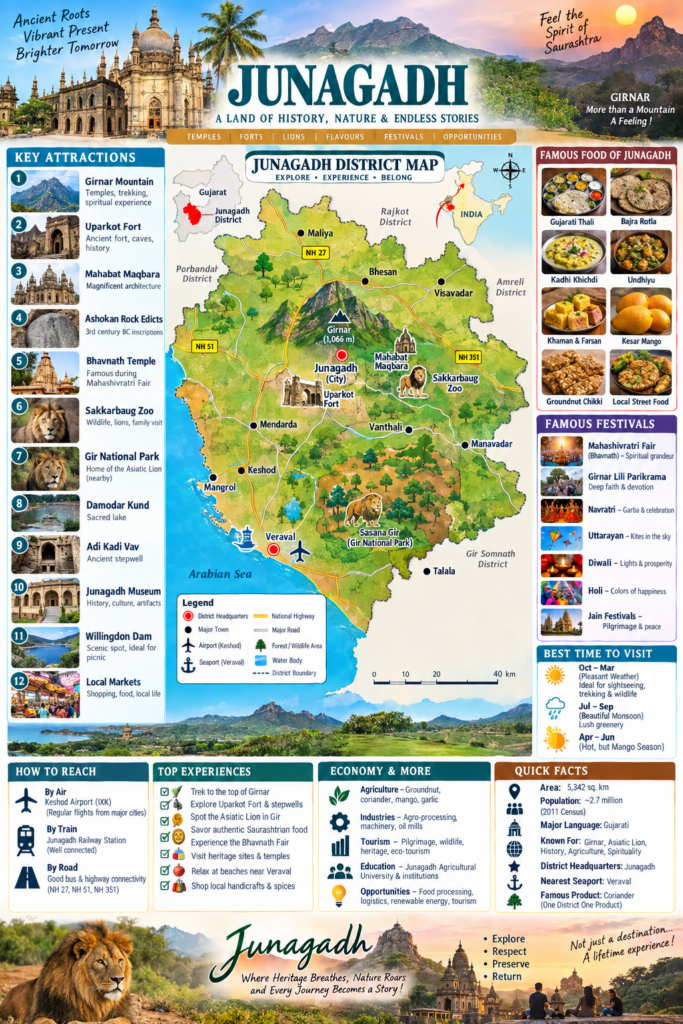
I am Junagadh.
I do not remember my beginning as a single date carved neatly into a stone. My memory is much older than that. It lives in the dark rock of Girnar, in ancient inscriptions, in temple bells before sunrise, in old city gates, in the calls of traders opening their shops, and in the smell of food rising from busy streets at dusk.
For thousands of years, people have crossed me, ruled me, prayed on me, fought over me, traded through me, studied me and fallen in love with me.
I have watched kingdoms disappear.
I have watched roads become highways.
I have watched bullock carts give way to trucks, buses, motorcycles and modern cars.
Yet every morning, when the first light falls on Girnar, I still feel ancient.
⛰️ Girnar Is My Heart
If you want to understand me, begin with Girnar.
Girnar is not simply a mountain standing beside my city. It is my oldest companion.
Long before my modern roads, markets and buildings appeared, pilgrims climbed its slopes. Hindus came seeking Shiva and sacred shrines. Jain pilgrims climbed toward the temples associated with Lord Neminath. Ascetics meditated here. Families arrived with prayers. Travelers stopped to watch the sunrise.
Generation after generation has walked the same difficult stone steps.
I have heard people complain of tired legs, then grow silent as they look down from the mountain.
That silence tells me Girnar is doing what it has always done: making human worries feel smaller.
At my foothills lies Bhavnath, where faith becomes especially visible during the Mahashivratri period. During the famous Bhavnath fair, my normally quiet spiritual landscape changes completely. Pilgrims, sadhus, devotees, vendors, musicians and visitors gather beneath Girnar.
Then comes another remarkable moment in my year—the Girnar Lili Parikrama.
Thousands walk around the sacred mountain landscape, carrying little more than faith, food, water and determination.
These events are not simply tourist festivals to me.
They are part of my heartbeat.
🪨 I Remember Emperor Ashoka
My memory reaches deep into Indian history.
Near Girnar are ancient rock inscriptions associated with Emperor Ashoka.
Imagine what that means.
Centuries before modern India existed, before railways, electricity, smartphones or automobiles, messages about governance and moral conduct were being carved into stone here.
Those rocks have stood while dynasties changed around them.
People sometimes walk past ancient monuments quickly because they appear silent.
But stone can speak if you know how to listen.
My rocks speak of Mauryan India.
They speak of rulers attempting to communicate ideas across enormous territories.
They remind me that Junagadh was never isolated from the larger history of the Indian subcontinent.
🏰 Uparkot Has Watched Me for Centuries
Then there is Uparkot.
My old fort has seen soldiers, rulers, sieges, prosperity and abandonment.
Walk through its gateways and you can feel layers of history beneath your feet.
Within and around this historic landscape are ancient structures, stepwells, reservoirs and architectural remains that tell stories no modern building could reproduce.
Adi Kadi Vav and Navghan Kuvo are among the places that make visitors stop and wonder how earlier communities solved problems of water and survival.
People today admire them as heritage.
For earlier generations, structures like these were also infrastructure.
They teach an important lesson about me: Junagadh’s history was never only about kings.
It was also about ordinary people learning how to live in a dry and demanding landscape.
🕌 I Grew Under Many Rulers
My identity was shaped by many political eras.
Mauryan influence touched me.
Later regional dynasties ruled here.
The Chudasamas became strongly associated with Junagadh.
Centuries later, I came under the rule of the Babi Nawabs.
Each period left something behind.
Some left forts.
Some left temples.
Some left mosques.
Some left administrative systems.
Some left architecture.
Some left memories that survive only in local stories.
My most visually striking reminders of the Nawabi era include the Mahabat Maqbara complex.
Its ornate architecture surprises many first-time visitors.
Domes, arches, minarets, delicate details and dramatic stairways rise from the middle of the modern city.
Visitors often expect architecture like this somewhere far away.
Then they turn a corner in Junagadh and suddenly find it.
I enjoy that moment of surprise.
🇮🇳 I Remember the Difficult Days of 1947
Independence brought celebration across India, but my own political transition was complicated.
When British rule ended, princely states had to determine their future.
Junagadh’s accession became a serious political dispute.
The events that followed eventually resulted in Junagadh becoming part of India.
For me, this was not simply a chapter in a textbook.
It changed administration, borders, identity and everyday life.
People sometimes discuss history as though entire populations smoothly move from one political era to another.
They do not.
Transitions create uncertainty.
Families worry about the future.
Markets hesitate.
Officials change.
New systems arrive.
But life continues.
Shops open again.
Children return to school.
Farmers return to their fields.
That is how history eventually becomes normal life.
🌾 My Villages Feed My Cities
People often know me first as a tourism destination.
But agriculture has always been one of my strongest foundations.
Travel away from my city streets and you encounter farms, villages and agricultural markets that power much of my economy.
Groundnut has long been important across this part of Saurashtra.
Coriander, wheat, pulses, sesame, castor, garlic, vegetables and fruits move through local agricultural networks.
In official food-processing planning, coriander-based products have been identified with Junagadh under the One District One Product approach.
That makes sense to me.
Agriculture here is not simply cultivation.
It creates transport.
Storage.
Processing.
Packaging.
Trading.
Machinery.
Employment.
Markets.
Food businesses.
My rural economy and urban economy are far more connected than they appear.
Every loaded truck leaving a mandi carries part of my countryside into another market.
🛒 My Markets Tell You Who I Really Am
If monuments explain my past, my markets explain my present.
Walk through my commercial areas and you will see the real rhythm of Junagadh.
Vegetable sellers arrange fresh produce.
Spice merchants open sacks filled with fragrance.
Groundnuts are traded in bulk.
Clothing stores prepare for wedding seasons.
Sweet shops fill their counters before festivals.
Pilgrimage shops sell religious items.
Motorcycle mechanics begin work early.
Transport offices discuss freight rates.
Farmers arrive at market yards.
Wholesalers calculate margins.
Retailers bargain.
Consumers compare.
This is my everyday economy.
It is noisy, practical and deeply human.
You can understand more about my society in one crowded market morning than from many formal reports.
🍲 My Food Is Simple, Generous and Saurashtrian
I express affection through food.
My cuisine reflects Gujarat, Saurashtra, agriculture and household traditions.
You may encounter Gujarati thalis filled with dal, vegetables, rotli, rice, farsan and sweets.
You may find bajra rotla accompanied by rustic preparations.
Khichdi and kadhi remain comforting staples.
Groundnut appears in snacks and cooking.
Seasonal produce shapes meals.
Street stalls serve quick bites to students, workers, pilgrims and travelers.
There are restaurants serving Punjabi, South Indian and other cuisines too, because modern Junagadh is not frozen in tradition.
But the meals visitors remember most are often the simplest.
A hot rotla.
A bowl of dal.
Fresh chaas.
Homemade pickle.
Food served without ceremony.
That is often where I feel most like myself.
🥭 When Kesar Mango Season Comes, I Become Sweeter
Summer brings heat.
But it also brings anticipation.
The wider Gir-Junagadh region is closely associated with Kesar mango.
During mango season, boxes move through markets and roads.
Families discuss quality.
Traders inspect fruit carefully.
Gift boxes travel to distant cities.
Mango becomes commerce, memory and celebration at the same time.
There is something beautiful about an economy that can be tasted.
🦁 The Lion Lives Close to My Story
The Asiatic lion is one of the most powerful symbols associated with this region.
The Gir landscape nearby is globally important because it is the last wild home of the Asiatic lion.
Tourists arrive hoping to see one.
But the lion’s story is bigger than tourism.
Its survival represents decades of conservation effort and a complicated relationship among forests, wildlife, villages, pastoral communities, government agencies and visitors.
I have learned that wildlife tourism only has value when wildlife remains protected.
A safari without conservation becomes entertainment.
A safari with conservation becomes education.
That distinction matters.
🐾 Sakkarbaug Carries Another Part of My Wildlife Identity
Within Junagadh city stands Sakkarbaug Zoological Garden.
For generations, families and students have visited it.
Children come curious.
Adults come nostalgic.
Researchers and conservation professionals see it differently, as part of a broader wildlife-management story.
Not every visitor understands conservation science.
That is fine.
Sometimes awareness begins with wonder.
🎉 My Festivals Transform Me
I change dramatically during festivals.
During Navratri, Garba music fills neighborhoods.
Young people dress in colorful traditional clothing.
Families gather.
Courtyards and grounds become dance spaces.
During Diwali, shops glow late into the evening.
Families buy sweets.
Homes brighten.
Businesses prepare for the Gujarati New Year.
During Uttarayan, rooftops become social spaces and the sky fills with kites.
During Holi, colors take over streets.
But the celebrations most deeply connected with my own geography are those linked to Girnar and Bhavnath.
Mahashivratri near Bhavnath feels unlike an ordinary festival.
It blends devotion, ascetic traditions, crowds, commerce and spectacle.
The Lili Parikrama has a different energy.
It is less about watching and more about walking.
Thousands move through the landscape together.
For a few days, my mountain paths become rivers of people.
🧘 I Have Always Been a Place of Faith
Visitors sometimes ask whether I am a Hindu pilgrimage centre, a Jain pilgrimage centre, an Islamic heritage city or something else.
I smile at that question.
I have been all of these things.
Girnar holds sacred importance for Hindus and Jains.
Bhavnath draws Shaivite devotees.
Jain temples high on Girnar attract pilgrims from across India.
Mosques and Islamic architecture reflect centuries of Muslim presence.
Christian communities have their churches.
My identity was never created by one monument or one community.
It was created by people living beside one another across long stretches of history.
🏭 Then Industry Began Changing Me
For centuries, agriculture and trade dominated much of my economy.
Gradually, industrialization added another layer.
Industrial estates developed.
Oil mills expanded.
Agro-processing became more organized.
Agricultural machinery manufacturing grew.
Engineering workshops appeared.
Plastic packaging and supporting industries developed.
Modern factories now operate beside an economy that is still closely connected to farms.
This gives me an unusual industrial character.
I am not a giant metropolitan manufacturing centre.
I am something different.
I am an agricultural district learning how to add more value before its products leave home.
A groundnut can leave as a raw commodity.
Or it can leave as edible oil.
A spice can leave as seed.
Or it can leave cleaned, processed, branded and packaged.
A mango can leave fresh.
Or it can become pulp, frozen product or premium gift packaging.
That difference is where much of my future lies.
⚙️ My Engineers Understand Agriculture
One of my quieter strengths is agricultural machinery.
Factories and workshops here manufacture equipment for cleaning, grading, milling, oil extraction and agricultural processing.
This relationship between farming and engineering makes sense.
When farmers face repetitive problems, engineers build machines.
When processors need greater capacity, manufacturers respond.
When labor becomes expensive, mechanization grows.
My industrial future does not need to copy Ahmedabad, Surat or Vadodara.
It can grow from problems that belong specifically to this region.
🎓 Education Is Changing My Future Too
Junagadh Agricultural University plays an important role in this transformation.
Agricultural universities are not simply places where students earn degrees.
They connect science with fields.
Research with farmers.
Technology with businesses.
Incubation with startups.
Tomorrow’s Junagadh may create companies in precision agriculture, food technology, farm machinery, drones, irrigation, logistics and agri-data.
Young people born here no longer have to choose only between farming and leaving home.
Increasingly, they can build businesses around agriculture itself.
That possibility excites me.
🚚 Trucks Are My Moving Arteries
You may not think of trucks when you imagine Junagadh.
But I do.
Every agricultural district depends on transportation.
Trucks bring fertilizer, machinery, packaging and consumer goods into my markets.
They carry groundnut, coriander, garlic, oil, food products and industrial goods outward.
Smaller vehicles connect villages with markets.
Larger trucks connect processors with other parts of Gujarat and India.
Warehouses hold goods between harvest and sale.
Cold chains protect perishables.
Transporters coordinate hundreds of journeys most travelers never notice.
A tourist may see a truck as traffic.
I see it as economic circulation.
🛣️ Roads Brought the World Closer
For generations, distance shaped life strongly.
A village that was difficult to reach remained economically isolated.
Improved roads changed that.
Better highway connectivity linked me more easily with Rajkot and the wider Saurashtra region.
Railways connect passengers and goods.
Bus services connect towns and villages.
Digital connectivity changed things even faster.
A local business that once served one neighborhood can now receive inquiries from another state.
A hotel can accept bookings from overseas.
A farmer can check prices online.
A restaurant can receive app orders.
A photographer can show work to thousands of people without owning a large studio.
Physical roads built one Junagadh.
Digital roads are building another.
🧳 Tourism Changed How Outsiders Saw Me
There was a time when many visitors came primarily for pilgrimage.
Today, travelers arrive for many reasons.
Some come for Girnar.
Some for history.
Some for wildlife.
Some for photography.
Some for architecture.
Some for family vacations.
Some for trekking.
Some for food.
Some simply use me as a base while exploring Saurashtra.
Tourism made me look at myself differently.
When visitors photograph Mahabat Maqbara, I am reminded that architecture locals pass every day may appear extraordinary to outsiders.
When travelers wake before sunrise to see Girnar, I remember how fortunate I am to live beside it.
Sometimes residents stop noticing beauty because they see it every day.
Travelers help us notice again.
📸 I Have Learned to Pose for Cameras
Photography has changed tourism.
Mahabat Maqbara has become one of my most photographed architectural landmarks.
Girnar appears in sunrise images, trekking videos and drone-style visual storytelling where permitted.
Uparkot attracts heritage photographers.
Old streets attract documentary photographers.
Food attracts social-media creators.
Couples search for pre-wedding locations.
Travelers create short videos.
I sometimes wonder what my old rulers would think if they knew their forts and mausoleums would one day appear on phones carried around the world.
History has strange ways of surviving.
💑 Couples Discover a Softer Side of Me
I am known for pilgrimage and history, but couples increasingly discover another side.
They walk near Girnar at sunrise.
They stay at resorts beneath the hills.
They photograph heritage architecture.
They eat quietly together after long days of sightseeing.
Some newlyweds begin married life by visiting temples.
Others combine Junagadh with Gir, Somnath or Diu.
Romance here is rarely about nightlife and neon lights.
It is about landscapes, heritage, slow mornings and shared journeys.
👨👩👧 Families Have Always Been Part of Me
Children arrive at my zoo.
Parents bring them to forts.
Grandparents visit temples.
Students climb Girnar.
Families stop for Gujarati meals.
Wedding groups fill hotels.
Pilgrims travel together.
My tourism economy succeeds because I can offer something to several generations at the same time.
A teenager may want adventure.
A parent may want history.
A grandparent may want pilgrimage.
A child may want animals.
Sometimes one destination can satisfy all four.
That is one of my greatest strengths.
🌧️ Monsoon Changes My Personality
Most people imagine Gujarat as dry.
Then monsoon reaches me.
Girnar becomes greener.
Clouds gather around the hills.
Small seasonal streams appear.
The landscape suddenly feels softer.
Willingdon Dam and surrounding countryside become more scenic.
Photographers become excited.
Trekkers become adventurous.
But rain also brings responsibility.
Slippery stones are dangerous.
Water levels can rise.
Road conditions can change.
The mountains deserve respect.
Nature is beautiful partly because humans do not control it.
☀️ Summer Tests Me
My summers can be demanding.
Afternoons become hot.
Markets slow temporarily.
Travelers learn to wake early.
Locals adapt.
Then mango season gives summer its reward.
Even difficult seasons bring something valuable.
That has always been true here.
❄️ Winter Is When I Welcome the Most Travelers
Winter suits me beautifully.
Mornings are cooler.
Girnar trekking becomes more comfortable.
Heritage walks last longer.
Outdoor sightseeing improves.
Pilgrimage journeys become easier.
Wildlife travel becomes more attractive.
Hotels get busier.
Families arrive.
This is when many travelers meet the version of Junagadh they remember most fondly.
🧱 I Carry Scars Too
An autobiography that only tells beautiful stories is not truthful.
I have problems.
Urban growth creates pressure.
Traffic increases.
Historic structures require maintenance.
Water must be managed carefully.
Waste from tourism must be controlled.
Industrialization can create environmental challenges.
Young people need better-quality jobs.
Farm incomes can fluctuate.
Commodity prices can hurt families.
Tourism sometimes becomes careless.
Pilgrimage crowds can strain fragile locations.
Development creates opportunity, but it also creates responsibility.
I have learned that growth is not successful simply because buildings become taller or traffic becomes heavier.
Real development should make life better without destroying what made the place valuable.
🌱 I Am Learning to Grow Differently
My next chapter may not be about becoming a huge industrial metropolis.
Perhaps it should not be.
My best future may come from combining what I already have:
agriculture + technology + processing + logistics + education + heritage + tourism + conservation.
I can build stronger food brands.
I can improve warehouses.
I can reduce post-harvest losses.
I can support agri-startups.
I can modernize machinery manufacturing.
I can create responsible tourism.
I can restore heritage more carefully.
I can improve public spaces.
I can create employment without erasing local character.
That future feels more natural to me.
❤️ When You Visit Me, Do Not Rush
Many travelers arrive with a checklist.
Girnar.
Mahabat Maqbara.
Uparkot.
Zoo.
Temple.
Photograph.
Next destination.
But I wish they would stay a little longer.
Wake before sunrise.
Drink tea near a market.
Watch traders beginning their day.
Speak with someone who has lived here for decades.
Eat a simple Gujarati lunch.
Listen to temple bells around Girnar.
Walk through an old neighborhood without trying to photograph everything.
Stand quietly inside Uparkot.
Look at the Ashokan rock inscriptions and imagine how many human generations have disappeared since those words were carved.
Then you may begin to understand me.
🌄 I Am Not Only My Past
People often call me historic.
They are correct.
But sometimes that word makes me sound finished.
I am not finished.
Students are studying.
Entrepreneurs are starting businesses.
Farmers are experimenting.
Factories are modernizing.
Hotels are expanding.
Roads are improving.
Young photographers are showing my landscapes to the world.
Women are building enterprises.
Startups are exploring agricultural technology.
Families are investing in education.
Travelers are discovering places their parents barely knew.
History continues every morning.
🌍 This Is Who I Am
I am Junagadh.
I am stone inscriptions and smartphone screens.
I am Girnar’s ancient steps and highways carrying modern freight.
I am temple bells and factory machinery.
I am coriander in an agricultural market and coffee in a new café.
I am a lion moving quietly through the Gir landscape and a child staring at wildlife with wonder.
I am Mahabat Maqbara glowing in evening light.
I am farmers waiting for rain.
I am traders bargaining before breakfast.
I am pilgrims climbing while the city sleeps.
I am students imagining futures their grandparents never had.
I have belonged to emperors, dynasties, nawabs and governments.
But none of them truly owned me.
The people who farm my soil, protect my forests, run my shops, teach my children, repair my roads, pray in my sacred places and welcome strangers are the ones who keep me alive.
Come to see my monuments if you wish.
Come for Girnar.
Come for lions.
Come for food.
Come for pilgrimage.
Come for photography.
But when you leave, I hope you carry something deeper.
I hope you understand that I am not merely a destination printed on a map of Gujarat.
I am thousands of years of memory still learning how to live in tomorrow.
📍 Where Is Junagadh District? Geography, History, Tourism & Travel Guide
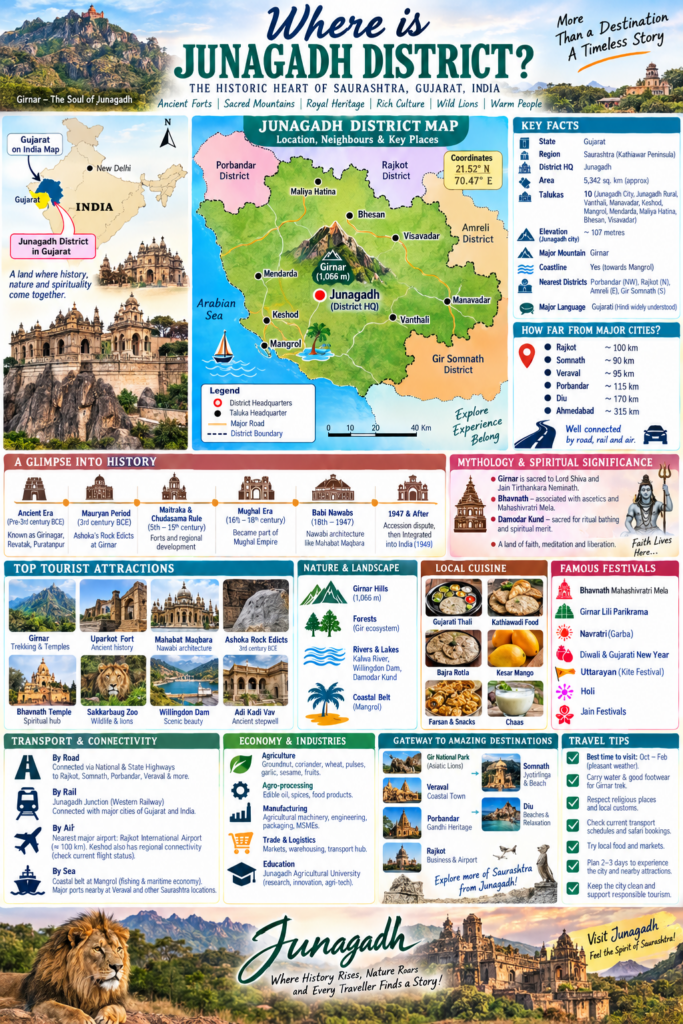
Junagadh District is in the Saurashtra region of western Gujarat, India, on the Kathiawar Peninsula. Junagadh city, the district headquarters, sits at the foot of the Girnar Hills at about 21.52°N, 70.47°E and an average elevation of roughly 107 metres. The district administration describes Junagadh as lying in western Gujarat, with the Arabian Sea toward its southwest, Porbandar toward the northwest/north, Rajkot toward the north and Amreli toward the east; the present district also meets Gir Somnath along its southern side after the 2013 reorganization.
What makes Junagadh unusual is the way several landscapes meet here: Girnar’s volcanic-looking mountain mass, agricultural plains, patches of forest, pilgrimage routes, historic urban architecture and the coastal belt around Mangrol. It is a place where a traveler can begin the morning under an ancient fort, climb toward sacred mountains, eat a rustic Saurashtra meal and end the day moving toward the Arabian Sea.
🗺️ Junagadh District at a Glance
| Geographic Feature | Junagadh District |
|---|---|
| State | Gujarat |
| Region | Saurashtra / Kathiawar Peninsula |
| Country | India |
| District Headquarters | Junagadh city |
| Approx. city coordinates | 21.52°N, 70.47°E |
| Average elevation of Junagadh city | About 107 metres |
| Major mountain landscape | Girnar |
| Important forest landscape | Gir/Girnar forest ecosystem |
| Coastal connection | Arabian Sea side of the district, notably toward Mangrol |
| Major cultural identity | Saurashtra / Kathiawadi |
| Major languages | Gujarati; Hindi commonly understood in travel and commerce |
| Major economic base | Agriculture, agro-processing, agricultural machinery, MSMEs, trade, tourism and transport |
| Signature tourism themes | Girnar, heritage, pilgrimage, archaeology, wildlife, Jain and Hindu sacred sites |
| District headquarters city | Junagadh |
The district government’s map page places Junagadh in western Gujarat and gives a broad geographic span of approximately 20.47°–21.45° N and 70.15°–70.55° E.
🧭 Where Does Junagadh Sit on the Gujarat Map?
When I explain Junagadh to a first-time traveler, I usually describe it as a meeting point between interior Saurashtra and the southern-western landscapes leading toward Gir and the Arabian Sea.
Rajkot lies to the north and acts as a major commercial and transport gateway. Porbandar lies toward the northwest and connects Junagadh with Gujarat’s western coast and Gandhi heritage circuit. Amreli lies to the east. Gir Somnath begins to the south and southeast, opening the route toward Sasan Gir, Veraval and Somnath.
That position gives Junagadh a natural role as a tourism and transport junction rather than an isolated heritage city.
🧭 Neighbouring Districts and Regional Gateways
| Direction | Neighbour / Landscape | Why It Matters |
|---|---|---|
| North | Rajkot District | Major commercial, airport and highway gateway |
| Northwest / West | Porbandar District | Coastal tourism and Gandhi heritage circuit |
| East | Amreli District | Agricultural and Gir-fringe connections |
| South / Southeast | Gir Somnath District | Sasan Gir, Somnath and Veraval tourism corridor |
| Southwest | Arabian Sea-facing belt | Coastal economy, fishing and beach landscapes around Mangrol |
One important historical distinction is that Gir Somnath District was carved out of the old Junagadh District in August 2013. This means older books, reports and websites may still describe Veraval, Somnath, Talala or other present-day Gir Somnath locations as part of Junagadh. Current travel writing should not repeat those older boundaries without explanation.
🏛️ Administrative Division of Junagadh District
Junagadh District currently has 10 talukas. They are Junagadh City, Junagadh Rural, Vanthali, Manavadar, Keshod, Mangrol, Mendarda, Maliya Hatina, Bhesan and Visavadar.
| Taluka | Headquarters / Character |
|---|---|
| Junagadh City | District administrative and commercial centre |
| Junagadh Rural | Rural belt surrounding the city |
| Vanthali | Agricultural and regional road-linked area |
| Manavadar | Agriculture and local trade |
| Keshod | Important town and transport node |
| Mangrol | Coastal town and fishing-linked economy |
| Mendarda | Gateway toward the Gir landscape |
| Maliya Hatina | Agricultural and rural belt |
| Bhesan | Agriculture and low-hill landscape |
| Visavadar | Rural, agricultural and Gir-fringe character |
The district is organized into five subdivisions: Junagadh, Vanthali, Keshod, Visavadar and Mendarda. (Junagadh District)
⛰️ Girnar: The Geographic Soul of Junagadh
If Junagadh were a body, Girnar would be its spine.
The mountain rises immediately beside the city and controls the visual identity of the entire landscape. Girnar is also known traditionally as Girinagar or Revatak Parvata and is sacred to both Hindu and Jain communities. The district administration describes it as one of the region’s most important pilgrimage landscapes, associated with Hindu ascetics, Jain Tirthankaras and major religious gatherings such as the Girnar Parikrama and Mahashivratri fair.
Unlike many destinations where the mountains are several hours outside town, in Junagadh the mountain is part of everyday city life.
You can be drinking tea near a crowded road and still see Girnar rising beyond the buildings.
That intimacy between city and mountain is what gives Junagadh its character.
🌄 Landscape of Junagadh District
| Landscape | Where / Character | Travel Importance |
|---|---|---|
| Girnar Hills | Beside Junagadh city | Trekking, pilgrimage, temples, sunrise views |
| Agricultural Plains | Across Vanthali, Manavadar, Bhesan and other talukas | Groundnut, coriander, cereals and rural tourism |
| Gir-fringe Forests | Toward Mendarda, Visavadar and adjoining landscape | Biodiversity and wildlife tourism |
| Coastal Belt | Toward Mangrol | Fishing economy, sea views and coastal travel |
| Low Hills | Bhesan and surrounding terrain | Rural scenery and seasonal greenery |
| Urban Heritage Landscape | Junagadh city | Forts, maqbaras, markets, museums and historic streets |
💧 Rivers, Lakes, Dams and Water Landscapes
Water is an underrated part of Junagadh’s geography.
One of the best-known examples is Willingdon Dam, built on the Kalwa River at the foot of the hill. The district administration notes that it was constructed as a drinking-water reservoir for Junagadh and named after Lord Willingdon.
Damodar Kund, at the foot of Girnar, has a very different meaning. It is not simply a water body but a sacred Hindu pilgrimage site associated with ritual bathing and asthi-visarjan.
| Water Feature | Type | Importance |
|---|---|---|
| Kalwa River | River | Local drainage and source associated with Willingdon Dam |
| Willingdon Dam | Reservoir | Water supply, scenery and hill landscape |
| Damodar Kund | Sacred kund | Pilgrimage and ritual significance |
| Seasonal streams around Girnar | Mountain drainage | Most visible during monsoon |
| Coastal waters near Mangrol | Arabian Sea | Fishing, marine economy and coastal travel |
🌳 Forests and Wildlife Landscape
The Gir ecosystem is inseparable from Junagadh’s identity.
The wider Gir landscape is internationally famous as the last natural home of the Asiatic lion. Official Junagadh tourism material highlights Sasan Gir as one of India’s oldest wildlife sanctuaries and places the lion at the heart of the region’s conservation identity.
However, travelers should understand the modern administrative geography carefully. Parts of the best-known Gir safari infrastructure now lie in neighbouring Gir Somnath District, even though Junagadh remains historically and geographically connected with the broader Gir landscape.
Within Junagadh city itself, Sakkarbaug Zoological Garden, established in 1863, is another long-standing wildlife institution.
🌦️ What Is the Climate of Junagadh?
Junagadh belongs to the semi-arid Saurashtra region, but Girnar, monsoon rainfall and proximity to the Arabian Sea create noticeable local variation. Junagadh Agricultural University describes the wider Saurashtra region as predominantly arid to semi-arid, with erratic rainfall and drought among important agricultural constraints.
🌤️ Seasonal Travel Character
| Season | Approx Period | What Junagadh Feels Like | Best For |
|---|---|---|---|
| Winter | Oct–Feb | Cooler and generally comfortable | Girnar climbing, heritage walks, pilgrimage |
| Summer | Mar–Jun | Hot, especially afternoons | Mango season, early-morning sightseeing |
| Monsoon | Jul–Sep | Greener hills, cloudy Girnar landscape | Photography, scenic drives, nature |
| Post-Monsoon | Sep–Nov | Green-to-pleasant transition | Festivals, trekking and rural travel |
Winter is the easiest season for a first visit. Monsoon is visually beautiful but requires caution around slippery hills, streams and damaged roads.
🪨 Junagadh Before Junagadh: Ancient Names and Archaeological Memory
The story of Junagadh begins long before its modern name.
The district’s own history page records several ancient or traditional names associated with the place, including Girinagar, Revatak and Puratanpur, among others.
The meaning of the modern name is closely associated with the “old fort”—Uparkot.
Walk around Junagadh today and archaeology does not feel like something locked inside one museum. It appears repeatedly in the landscape.
The most important archaeological landmark is the rock bearing Ashoka’s edicts, generally dated to around the 3rd century BCE. Official district information describes approximately fourteen edicts carved in Brahmi script on a large rock on the route toward Girnar.
That single monument connects Junagadh directly with the Mauryan world.
👑 Mauryas, Maitrakas, Chudasamas, Mughals and Nawabs
Junagadh’s history is not the story of one dynasty.
It is a succession of political cultures.
The district’s heritage page associates the early fort tradition with the Mauryan period and notes Ashoka’s inscriptions near Girnar. It subsequently records Maitraka rule, later incorporation into the Mughal Empire after 1573, and the rise of the Babi Nawabs from the 18th century.
🏰 Historical Timeline
| Period | Rulers / Development | Junagadh Legacy |
|---|---|---|
| Mauryan era | Chandragupta Maurya / Ashoka | Early fort traditions, Ashokan edicts |
| Post-Mauryan centuries | Regional dynasties | Changing political control |
| Maitraka period | c. 5th–8th centuries | Regional political influence |
| Chudasama period | Medieval Saurashtra | Uparkot and strong local dynastic identity |
| Gujarat Sultanate / Mughal era | Medieval–early modern | Integration with wider western Indian kingdoms |
| Babi Nawabs | 18th century–1947 | Palaces, maqbaras, administration and urban architecture |
| British paramountcy | 19th–20th centuries | Junagadh remained a princely state under indirect British rule |
| Post-1947 | Integration with India | Transition to modern Gujarat administration |
The district’s historical record says Junagadh under the Nawabs became a tributary state of the British in 1807.
🇮🇳 Junagadh and the Political Drama of 1947
Junagadh occupies a distinctive chapter in the history of India’s princely-state integration.
At Independence, the princely state of Junagadh became the subject of a political dispute over accession. The last Nawab left for Karachi in November 1947, and Junagadh was later integrated into the Indian administrative system; the former state became part of Saurashtra in 1949.
This history matters because it explains why Junagadh has a remarkably layered identity.
It was not simply an ancient Hindu pilgrimage centre.
It was not simply a medieval fort town.
It was not simply a Nawabi capital.
It has been all of those things.
🕉️ Mythology and Sacred Geography
Girnar is one of those Indian landscapes where geography and mythology are difficult to separate.
Hindu traditions associate the mountain with Shiva, Dattatreya, Bhavnath and generations of ascetics. Jain tradition gives Girnar immense importance because of its association with Tirthankara Neminath and the temples established on the mountain.
The district administration describes Girnar as sacred to both traditions and as a site visited by Jain Tirthankaras, monks, Shaivite ascetics and Nath practitioners.
Damodar Kund carries another layer of sacred geography. Hindu belief connects it with ritual purification and moksha-related rites.
For a responsible travel article, these should be described as religious traditions and beliefs, not presented as scientifically proven historical events.
🏯 Uparkot: The Fort That Explains the City’s Name
Uparkot is one of the best places to understand Junagadh’s depth.
The fort has been rebuilt and reused over many centuries. Inside and around the fort complex, travelers encounter ancient defensive architecture, Buddhist cave remains, stepwells and water systems.
Two particularly memorable structures are Adi Kadi Vav and Navghan Kuvo. The district tourism portal describes Adi Kadi Vav as a rock-cut stepwell and Navghan Kuvo as a structure approaching a thousand years in age.
This is why Junagadh rewards slow travel.
A tourist looking only for a “fort” may miss the engineering history hiding inside it.
🕌 Mahabat Maqbara and Junagadh’s Nawabi Elegance
Mahabat Maqbara is one of the most instantly recognizable structures in Junagadh.
Its elaborate domes, arches, minarets and ornamental details create a visual contrast with the rough stone of Uparkot and the dark mass of Girnar.
Official district information identifies it as a Nawabi-era mausoleum and notes the presence of other 18th-century mausoleums around Chitkana Chowk.
For photographers, this is where Junagadh’s architectural personality becomes particularly dramatic.
🎭 How Junagadh’s Culture Evolved
Junagadh’s culture is Saurashtrian at its core, but centuries of Hindu, Jain, Muslim and later modern urban influences have layered the city.
You see this mixture in:
Gujarati language and Kathiawadi speech.
Temple traditions.
Jain pilgrimage.
Nawabi architecture.
Old bazaars.
Garba during Navratri.
Bhavnath’s ascetic traditions.
Muslim neighborhoods and historic maqbaras.
Modern cafés, hotels and shopping centres.
Junagadh is one of those places where cultural diversity is not confined to a museum.
It is visible in the street plan.
🎉 Festivals That Define Junagadh
Major Cultural Events
| Festival / Event | Location | Cultural Importance |
|---|---|---|
| Bhavnath Mahashivratri Mela | Bhavnath Taleti | Junagadh’s signature Shaivite fair |
| Girnar Lili Parikrama | Girnar landscape | Major pilgrimage walk |
| Navratri | Across city/district | Garba and Gujarati cultural celebration |
| Diwali & Gujarati New Year | District-wide | Family, religious and commercial festival |
| Uttarayan | Urban and village rooftops | Kite-flying tradition |
| Jain festivals | Girnar temples and Jain communities | Spiritual pilgrimage |
| Holi | District-wide | Spring celebration |
Girnar’s official tourism description specifically associates the mountain with the Girnar Parikrama and Mahashivratri gatherings.
🌾 Why Junagadh Is Economically Important
Tourists see temples and forts.
Economists see farms, markets and supply chains.
Junagadh sits inside one of Gujarat’s major agricultural belts. Groundnut, coriander, wheat, pulses, sesame, castor, garlic, fruits and vegetables support a wide network of farmers, commission agents, processors, oil mills, packaging companies, machinery manufacturers, warehouses and transport businesses.
Junagadh’s modern economy therefore functions as a chain:
Farm → mandi → processor → manufacturer → warehouse → transporter → wholesaler → retail/export market.
This explains why agriculture remains important even to people who never work on farms.
⚙️ Industry and MSME Landscape
Junagadh is not an industrial giant on the scale of Ahmedabad, Surat or Vadodara.
Its industrial identity is more closely connected to agriculture and regional demand.
Important business activities include agro-processing, edible oil, grain and spice handling, agricultural machinery, fabrication, food packaging, plastics, small engineering workshops, construction-linked enterprises and logistics.
This is an important distinction for investors.
Junagadh’s advantage is not necessarily mega-scale heavy industry.
Its advantage is value addition close to the agricultural source.
🎓 Junagadh Agricultural University: A Strategic Economic Asset
Junagadh Agricultural University gives the district an academic and research role extending far beyond city limits.
The university traces its roots to the College of Agriculture established in 1960, the first government agricultural college in Gujarat. Junagadh Agricultural University itself came into existence in 2004 after the restructuring of Gujarat Agricultural University. Its work covers agricultural education, research and extension across the Saurashtra region.
This creates opportunities in:
agri-tech,
seed science,
farm machinery,
food processing,
horticulture,
soil science,
biotechnology,
irrigation,
agricultural startups,
and rural entrepreneurship.
🚚 Junagadh’s Transport and Logistics Significance
Junagadh’s transport importance comes from geography.
It sits between productive agricultural areas, Rajkot’s industrial-commercial ecosystem, coastal towns, the Gir tourism belt and major pilgrimage destinations.
That generates two simultaneous traffic flows:
Tourists and pilgrims moving inward.
Agricultural and manufactured goods moving outward.
For logistics operators, Junagadh can function as a collection and distribution centre for agricultural produce, processed food, machinery, consumer goods and regional freight.
🛣️ Road Connectivity
Junagadh has established road connections with Rajkot, Porbandar, Somnath, Veraval and other major Saurashtra destinations. The district tourism portal notes that National and State Highways connect Junagadh with major cities and towns of Gujarat.
Key Road Travel Corridors
| Route | Travel Significance |
|---|---|
| Junagadh–Rajkot | Primary commercial and airport corridor |
| Junagadh–Jetpur–Rajkot | Regional industrial/business connectivity |
| Junagadh–Keshod–Somnath | Pilgrimage and coastal tourism |
| Junagadh–Mendarda–Gir landscape | Wildlife/nature access |
| Junagadh–Porbandar | Coastal and Gandhi tourism |
| Junagadh–Mangrol | Coastal/fishing corridor |
Road numbers and alignments can change after highway renumbering or upgrades, so route planners should rely on current navigation and government road advisories rather than old highway numbers.
🚆 Rail Connectivity
Junagadh Junction is part of the Western Railway network.
The district tourism portal states that Junagadh is connected with the wider Indian rail system through express and local services, particularly toward Rajkot and other Gujarat cities.
Rail is particularly useful for:
budget travelers,
pilgrims,
students,
families,
long-distance passengers,
and travelers connecting through Rajkot/Ahmedabad.
Always verify the live timetable before travel because routes, frequency and train numbers change.
✈️ Air Connectivity
Airport guidance around Junagadh needs careful treatment because air services can change.
The district tourism site traditionally identifies Rajkot as the major airport connection for Junagadh, while Keshod has also had regional air connectivity at different times.
For an evergreen travel article, the safest advice is:
Check current commercial flights at Rajkot International Airport and Keshod Airport before booking.
Rajkot generally offers the broader network.
⚓ Water and Coastal Connectivity
Junagadh is not primarily a passenger-seaport destination.
Its coastal importance is more closely associated with the Mangrol fishing belt and maritime economy.
For large industrial logistics, nearby western Gujarat ports and the broader Saurashtra port network matter more than Junagadh city itself.
Travelers should also avoid an older geographic error: Veraval Port is now in Gir Somnath District, not present-day Junagadh.
🚛 Why Junagadh Matters to Goods Transportation
Junagadh generates several types of freight:
| Freight Type | Typical Origin / Destination |
|---|---|
| Groundnut and oilseeds | Farms → mandi → oil processors |
| Coriander and spices | Farms → traders → processors |
| Fruits and vegetables | Farms → wholesale markets → city markets |
| Agricultural machinery | Workshops → Gujarat/India farmers |
| Packaged foods | Processing units → distributors |
| Fertilizer and inputs | Regional warehouses → villages |
| Retail goods | Rajkot/Ahmedabad → Junagadh markets |
| Tourism supplies | Hotels/restaurants → Girnar and regional tourism circuit |
This is why warehousing, cold-chain, FTL, LTL and return-load networks have long-term potential here.
🧳 Why Is Junagadh Important for Tourism?
Few Gujarat districts offer the same combination of:
mountain pilgrimage + archaeology + Nawabi architecture + wildlife context + local food + rural landscapes + coastal access.
The district tourism portal lists Girnar, Sasan Gir, Mahabat Maqbara, Damodar Kund, Willingdon Dam, Sakkarbaug Zoo, Adi Kadi Vav, Navghan Kuvo and Ashoka’s Rock Edicts among its principal visitor attractions.
⭐ Major Places to Visit
| Attraction | Why Visit |
|---|---|
| Girnar | Pilgrimage, trekking, Jain temples, mountain views |
| Uparkot Fort | Ancient fortification and archaeology |
| Mahabat Maqbara | Nawabi architecture |
| Ashoka Rock Edicts | Mauryan-era archaeological importance |
| Damodar Kund | Sacred Hindu water body |
| Bhavnath Mahadev | Pilgrimage and Mahashivratri |
| Sakkarbaug Zoo | Wildlife education |
| Willingdon Dam | Scenic reservoir |
| Adi Kadi Vav | Rock-cut water architecture |
| Navghan Kuvo | Medieval engineering |
| Datar Hill | Shared-faith pilgrimage landscape |
| Old Junagadh markets | Food, shopping and daily life |
🔎 Hidden and Slow-Travel Experiences
The most memorable Junagadh experiences are not always the biggest monuments.
Walk around the older neighborhoods near sunrise.
Watch Girnar change color from the city.
Visit a local agricultural market when trading begins.
Explore the less-photographed corners of Uparkot.
Take a rural road toward Vanthali or Bhesan after monsoon.
Visit Mangrol for an entirely different coastal face of the district.
Spend an evening near Bhavnath after the main pilgrimage crowds have eased.
These experiences reveal Junagadh as a living district rather than a checklist of monuments.
🍲 What Should You Eat in Junagadh?
Junagadh belongs firmly to the Saurashtra food landscape.
Look for meals built around simple, filling flavors rather than overly elaborate presentation.
Famous Food Experiences
| Food | Why Try It |
|---|---|
| Gujarati Thali | Broad introduction to local vegetarian food |
| Bajra Rotla | Classic rustic Saurashtra staple |
| Ringan no Olo | Smoky brinjal preparation |
| Khichdi-Kadhi | Comfort food |
| Kathiawadi vegetables | Spicy, bold regional flavors |
| Farsan | Everyday Gujarati snacks |
| Groundnut-based snacks | Reflect local agricultural economy |
| Chaas | Especially refreshing in hot weather |
| Kesar mango | Seasonal regional specialty |
| Local sweets | Festival and family-food culture |
The most authentic food experience is often not in the most expensive restaurant.
Sometimes it is a simple thali served quickly to workers, traders and families.
🛍️ What Is Junagadh Famous for Buying?
Travelers can look for:
local spices,
coriander products,
groundnut and groundnut oil,
Gujarati snacks,
Bandhani and Gujarati clothing,
wedding textiles,
religious products,
local sweets,
and seasonal Kesar mango products.
For expensive or branded products, ask for a bill and compare quality rather than buying only on the basis of the phrase “local speciality.”
🚪 Junagadh as a Gateway Destination
Junagadh becomes even more useful when treated as a base rather than an isolated stop.
Major Destinations Accessible from Junagadh
| Destination | Why Combine It |
|---|---|
| Sasan Gir / Gir region | Wildlife |
| Somnath | Jyotirlinga pilgrimage and coast |
| Veraval | Coastal town and onward Somnath access |
| Diu | Beaches and relaxed coastal holiday |
| Porbandar | Gandhi heritage |
| Rajkot | Business, airport and shopping |
| Gondal | Palace heritage |
| Mangrol | Fishing coast |
| Girnar | Trekking and pilgrimage directly beside the city |
A strong first-time Saurashtra circuit can therefore become:
Rajkot → Junagadh → Gir → Somnath → Diu
or
Porbandar → Junagadh → Girnar → Gir → Somnath.
🏭 Gateway to Industrial and Agricultural Corridors
Junagadh also sits within a wider economic network connecting:
Rajkot’s engineering industry,
Saurashtra’s agricultural belt,
groundnut and edible-oil processing,
food-processing businesses,
coastal fisheries,
packaging,
warehousing,
and Gujarat’s western port network.
For businesses, this means Junagadh can act as a secondary distribution and sourcing centre instead of only a consumption market.
📸 Best Photography Experiences
Photography Spots
| Spot | Best Light | Best Subject |
|---|---|---|
| Girnar | Sunrise | Mountains, pilgrimage |
| Mahabat Maqbara | Early morning / golden hour | Architecture |
| Uparkot | Morning | Stone textures, heritage |
| Bhavnath | Dawn | Pilgrimage atmosphere |
| Willingdon Dam | Monsoon / evening | Landscape |
| Old markets | Morning | Street life |
| Rural Junagadh | Post-monsoon | Agriculture |
| Mangrol coast | Sunset | Fishing/coastal life |
Commercial photography, drones and professional productions may require permission. Sacred spaces should never be treated merely as photoshoot sets.
👨👩👧👦 Who Should Visit Junagadh?
| Traveler | Why Junagadh Works |
|---|---|
| Families | Zoo, heritage, pilgrimage and easy regional excursions |
| Couples | Heritage photography, resorts, Girnar sunrises |
| Solo Travelers | History, trekking and street exploration |
| Students | Archaeology, history, agriculture and wildlife learning |
| Seniors | Pilgrimage and accessible city heritage |
| Photographers | Architecture, landscape, festivals and street life |
| Pilgrims | Hindu and Jain sacred sites |
| Wildlife Travelers | Access to the wider Gir landscape |
| Business Travelers | Agriculture, MSMEs, machinery and trade |
| Corporate Groups | Resorts, heritage outings and Girnar-based team activities |
💰 Practical Junagadh Travel Budget
| Travel Style | Approx Daily Budget per Person |
|---|---|
| Budget | ₹1,000–₹2,000 |
| Comfortable | ₹2,000–₹4,500 |
| Premium | ₹5,000–₹10,000+ |
These are planning estimates. Festival periods, safari bookings, premium resorts and holiday weekends can substantially raise costs.
⚠️ Practical Visitor Advice
Junagadh is generally easiest to explore by combining city sightseeing with early starts. Girnar and Bhavnath deserve a separate morning rather than being squeezed between monuments.
During summer, avoid long outdoor walks in the hottest afternoon hours.
During monsoon, expect slippery terrain near hills and check weather advisories.
During Bhavnath Mahashivratri Mela and Girnar Lili Parikrama, accommodation and roads can become extremely crowded.
For Gir wildlife travel, use authorized booking channels and verify which safari gate lies in Junagadh versus neighbouring Gir Somnath.
For heritage sites, check current entry hours and professional photography rules.
For rail and air travel, verify live schedules immediately before booking.
🌄 So, Where Is Junagadh Really?
On a map, Junagadh is a district in western Gujarat.
Geographically, it lies where the Saurashtra plains rise into Girnar, forests approach farms and the interior gradually opens toward the Arabian Sea.
Historically, it stands where Mauryan inscriptions, medieval fortifications, Jain pilgrimage, Shaivite traditions, Nawabi architecture and modern India overlap.
Economically, it sits between farms, mandis, processors, workshops and transport networks.
Spiritually, it lives beneath Girnar.
And for travelers, that is why Junagadh deserves more than a hurried overnight stop.
Come early enough to see sunlight touch Girnar.
Walk through a fort older than the modern city around it.
Stand before Ashoka’s rock and think about how many centuries have passed.
Taste a simple Kathiawadi meal.
Listen to the evening sounds around Bhavnath.
And before leaving for Gir, Somnath, Diu, Porbandar or Rajkot, give Junagadh itself enough time to tell you its story.
Because Junagadh is not merely a gateway to Saurashtra’s attractions—it is one of the places that explains why Saurashtra is worth exploring at all.
🚆✈️ How to Reach Junagadh District, Gujarat
Junagadh is one of western Gujarat’s easiest heritage-and-pilgrimage cities to build into a wider Saurashtra itinerary. Junagadh Junction sits inside the city, the GSRTC bus station serves regional and long-distance routes, Keshod Airport lies within Junagadh District, and Rajkot International Airport provides the broader air gateway. The district administration confirms that Junagadh is connected by Western Railway and by National and State Highway networks, with state buses linking it to major cities and towns.
For someone visiting Junagadh for the first time, the simplest rule is: use the train if a convenient direct service exists; use Rajkot or Keshod for flights; use GSRTC/private buses for economical Gujarat travel; and keep a taxi or auto for the final few kilometres to Girnar, Bhavnath, Uparkot or your hotel.
📍 What Is the Best Way to Reach Junagadh?
| Traveller Situation | Best Option | Why |
|---|---|---|
| Coming from Rajkot | Train, GSRTC bus or taxi | Frequent regional connectivity |
| Coming from Ahmedabad | Overnight/day train or bus | Usually cheaper than flying and transferring |
| Coming from Mumbai | Train, bus, or flight via Keshod/Rajkot depending schedule | Choice depends on live flight/train availability |
| Coming from Delhi/North India | Flight to Rajkot + road/rail transfer, or long-distance train | Rajkot has a much broader air network |
| Coming from Somnath/Veraval | Bus, taxi or regional rail where scheduled | Straightforward Saurashtra circuit |
| Coming from Porbandar | Bus/taxi | Practical road connection |
| Visiting Girnar only | Train/bus to Junagadh + auto/taxi to Taleti | Junagadh city is the natural base |
| Senior citizens | Train or private cab | Easier boarding and lower last-mile stress |
| Family with luggage | Train + pre-arranged taxi | Convenient city-centre arrival |
| Backpacker/student | Train or GSRTC bus | Lowest practical cost |
| Self-drive traveller | Car | Best for Junagadh + Gir + Somnath + Diu circuit |
✈️ How to Reach Junagadh District by Air
Is Keshod or Rajkot the Nearest Airport to Junagadh?
This needs a little clarification because many older Junagadh travel pages simply say “Rajkot Airport.”
Keshod Airport (IXK) is physically inside Junagadh District and the Airports Authority of India maintains an official flight-schedule page for it. However, its scheduled services are limited and can change by season or airline.
The Junagadh district administration continues to describe Rajkot as the main/nearest airport gateway, about 100 km from Junagadh, reflecting its more dependable and extensive air connectivity.
For practical trip planning:
| Airport | Approx Relationship to Junagadh | Best For | Typical Transfer | Planning Advice |
|---|---|---|---|---|
| Keshod Airport (IXK) | Roughly 40–45 km by road from Junagadh city | Travellers finding a convenient operating regional flight | Taxi/private car | Check the exact airline schedule before choosing it |
| Rajkot International Airport (HSR) | Roughly 100+ km road transfer depending route | Most domestic air travellers | Taxi, bus + city transfer | Usually the safer choice for broader flight availability |
| Ahmedabad Airport | Much farther away | International arrivals or flights unavailable at Rajkot | Train/bus/taxi onward | Best combined with direct train/bus to Junagadh |
AAI specifically warns that published airport schedules are tentative and passengers should confirm actual timings with the airline.
Approximate Airport-to-Junagadh Transfer Cost
| Transfer | Approx Time | Approx One-Way Cost* |
|---|---|---|
| Keshod Airport → Junagadh | 1–1.25 hr | ₹800–₹1,500 taxi |
| Rajkot Airport area → Junagadh | 2.5–3.5 hr | ₹2,500–₹4,500 private cab |
| Rajkot → Junagadh by bus | 2.5–4 hr | ₹150–₹400+ |
| Rajkot → Junagadh by train | About 2.5–4 hr depending service | ₹100–₹600+ depending class |
Planning estimates only. Toll, vehicle class, night charges and demand can alter taxi fares.
Online Flight Booking
Use the airline’s official website/app or established booking platforms, but always recheck the airport code before payment:
IXK = Keshod
HSR = Rajkot International Airport
Do not accidentally book for the old Rajkot city airport based on an outdated blog or saved itinerary.
🚆 How to Reach Junagadh by Train
For many travellers, rail is the best overall way to reach Junagadh.
Junagadh lies on the Western Railway network, and the district administration confirms express as well as regional/local train connectivity, particularly toward Rajkot.
Main Railway Station
Junagadh Junction is the principal rail arrival point for the city.
Because it is already within the urban area, arriving by train usually produces a much easier last mile than arriving at an airport.
Train Travel Works Especially Well For
| Traveller | Why Train Is Good |
|---|---|
| Families | Less luggage handling than multiple air-road transfers |
| Senior citizens | More space and sleeping options on longer journeys |
| Pilgrims | Convenient access to Girnar/Bhavnath after arrival |
| Students | Lower fares |
| Solo travellers | Railway station is close to city hotels |
| Long-distance tourists | Sleeper/AC options reduce hotel-night cost |
Online Train Booking for Junagadh
Train tickets can be booked through IRCTC, whose official e-ticketing system allows travellers to search trains, view availability, compare classes and fares, and make online reservations.
For live platforms, delays and train running information, check Indian Railways/NTES close to departure rather than relying on old travel articles.
🚌 How to Reach Junagadh by GSRTC Bus
For budget travellers moving around Gujarat, GSRTC is extremely useful.
The Junagadh district administration confirms that State Transport buses link the city with major cities and towns, while GSRTC provides online journey search and reservation.
Junagadh GSRTC Bus Station
The official GSRTC enquiry listing gives Junagadh Bus Station enquiry: 0285-2630303.
You can typically use Junagadh as a bus hub for routes toward:
| Direction | Common Travel Market |
|---|---|
| Rajkot | Business, airport transfer, onward Gujarat |
| Ahmedabad | Long-distance state travel |
| Porbandar | Coastal/Gandhi circuit |
| Somnath–Veraval | Pilgrimage/coastal circuit |
| Keshod | Airport/taluka connection |
| Mendarda | Gir-side regional movement |
| Visavadar | Rural/Gir-fringe connectivity |
| Other Saurashtra cities | Intercity travel |
Online GSRTC Ticket Booking
GSRTC’s official booking system supports online journey searches and reservations, and its current site provides ticket viewing, cancellation, transaction enquiry and other passenger functions.
For first-time visitors, save the ticket/PDF or screenshot it before leaving an area with reliable data coverage.
🚌 Private Buses to Junagadh
Private sleeper, seater and AC coaches can supplement GSRTC, particularly on longer routes.
They are often useful for:
Ahmedabad–Junagadh,
Surat–Junagadh,
Vadodara–Junagadh,
Mumbai–Junagadh,
and other overnight sectors when scheduled.
Private Bus Booking Advice
| Check Before Booking | Why |
|---|---|
| Exact boarding point | “Junagadh” may refer to different pickup/drop points |
| Bus type | Sleeper, semi-sleeper and seater are very different |
| AC/non-AC | Important in warmer months |
| Operator review history | More useful than one isolated rating |
| Luggage rules | Especially for families/wedding groups |
| Drop location | A highway drop can create an expensive last mile |
| Live tracking | Useful for nighttime arrivals |
🚗 How to Reach Junagadh by Road
Junagadh has strong road connectivity across Saurashtra. Official district information confirms National and State Highway access linking the city to wider Gujarat.
Major Road Corridors
| Route | Approx Travel Character | Typical Road Time* |
|---|---|---|
| Rajkot → Junagadh | Main regional gateway | 2.5–3 hr |
| Ahmedabad → Junagadh | Long intercity drive | 7–8.5 hr |
| Porbandar → Junagadh | Coastal/heritage connection | 2–3 hr |
| Somnath → Junagadh | Pilgrimage circuit | 2–2.5 hr |
| Veraval → Junagadh | Coastal connection | About 2 hr |
| Keshod → Junagadh | Regional connection | About 1 hr |
| Diu → Junagadh | Beach-to-heritage circuit | 3.5–4.5 hr |
Traffic, roadworks, weather and stops can materially change these estimates.
🚕 Taxi and Private Cab Travel
A private taxi is the easiest option when:
you have senior citizens,
small children,
heavy luggage,
an early-morning Girnar plan,
multiple sightseeing locations,
or a Junagadh–Gir–Somnath itinerary.
Approx Local/Outstation Taxi Planning Costs
| Service | Approx Cost |
|---|---|
| Short city taxi trip | ₹150–₹500+ |
| Half-day local cab | ₹1,200–₹2,000+ |
| Full-day local sightseeing | ₹2,000–₹3,500+ |
| Sedan outstation | Roughly ₹11–₹16/km + possible driver/toll charges |
| SUV/MPV | Roughly ₹15–₹22/km+ |
These are planning bands, not regulated Junagadh tariffs.
Before boarding, confirm whether parking, toll, night allowance and waiting are included.
🛺 Auto-Rickshaws in Junagadh
Auto-rickshaws are one of the most useful forms of last-mile public transport in Junagadh city.
They are convenient for:
railway station → hotel,
bus station → hotel,
city centre → Uparkot,
city → Mahabat Maqbara,
city → Girnar Taleti/Bhavnath,
short market trips.
Approx Auto Budget
| Trip Type | Planning Range |
|---|---|
| Very short city ride | ₹50–₹100 |
| Medium city ride | ₹100–₹200 |
| Longer city/Taleti-type journey | ₹150–₹350+ |
Meter use and negotiated fares may vary. Ask the price before departure if no meter is being used.
📱 Ola, Uber, App Cabs and Bike Taxis
App-based transport in a smaller city should never be treated as guaranteed merely because the app lists the city.
An older Ola availability page included Junagadh for cab/auto/bike services, but that is not sufficient evidence of reliable real-time 2026 supply.
Therefore, an evergreen Junagadh travel guide should say:
Open your preferred cab/bike-taxi app after arrival and check live vehicle availability. Keep auto-rickshaws and local taxis as backup.
This is particularly important for:
early-morning Girnar departures,
late-night train arrivals,
festival dates,
remote resort stays,
and rural taluka travel.
🏍️ Bike Taxi
Bike taxi availability should be considered conditional, not guaranteed.
For solo travellers carrying little luggage, it may be economical if an authorized app shows active service at that moment. For senior citizens, families, large bags or long-distance rural roads, a bike taxi is generally not the preferred mode.
🚙 Self-Drive and Rental Vehicles
A rental car is particularly useful if Junagadh is only one stop in a Saurashtra road trip.
Best Self-Drive Circuits
Rajkot → Junagadh → Gir → Somnath → Diu
Porbandar → Junagadh → Girnar → Somnath
Junagadh → Keshod → coastal belt → Mangrol
Before accepting a rental vehicle, check:
RC,
insurance,
PUC,
FASTag balance,
fuel policy,
tyre condition,
spare wheel,
night-emergency contact,
and kilometre limitations.
🚇 Can You Reach Junagadh by Metro?
No. Junagadh currently has no metro railway system.
The Gujarat Metro Rail Corporation’s current project network covers Ahmedabad–Gandhinagar and Surat-related metro development; Junagadh does not form part of an operational metro network.
Therefore:
| Question | Answer |
|---|---|
| Nearest Junagadh metro station | None |
| Metro from Rajkot to Junagadh | No |
| Metro from Ahmedabad to Junagadh | No |
| Best replacement | Intercity train, bus or road |
⛴️ Can Junagadh Be Reached by Waterway?
Not as a normal passenger transport option.
Junagadh District has an Arabian Sea-facing coastal side around Mangrol, but there is no regular passenger ferry or urban water-transport system that should be marketed as a practical way to reach Junagadh city.
The coast is economically important for fishing and maritime activity, not routine tourist arrival into Junagadh.
🚉 Complete Transport Comparison Chart
| Mode | Best For | Approx Cost | Speed | Comfort | Online Booking | Last-Mile Need | Main Limitation |
|---|---|---|---|---|---|---|---|
| Flight via Keshod | Selected regional routes | Variable | Fast | High | Yes | Taxi needed | Limited schedules |
| Flight via Rajkot | National connectivity | Variable | Fast | High | Yes | 100+ km road/rail transfer | Long airport transfer |
| Train | Most visitors | ₹100–₹2,000+ | Medium | Medium–High | IRCTC | Auto/taxi | Availability on popular dates |
| GSRTC bus | Budget/intercity | ₹100–₹1,000+ | Medium | Basic–Good | Yes | Auto/taxi | Road delays |
| Private sleeper bus | Overnight intercity | ₹500–₹2,000+ | Medium | Medium–High | Yes | Depends on drop | Operator quality varies |
| Private taxi | Families/seniors | ₹2,000+ | Flexible | High | Phone/app/vendor | Door-to-door | Cost |
| Self-drive | Multi-city tour | Rental + fuel | Flexible | High | Rental platform | None | Driving fatigue |
| Auto-rickshaw | City last mile | ₹50–₹350+ | Good locally | Basic | Usually no | Door-to-door | Not suitable for long routes |
| App cab | Local travel when available | Dynamic | Good | Medium–High | App | Door-to-door | Supply not guaranteed |
| Bike taxi | Solo short trip | Dynamic | Good | Low | App if available | Door-to-door | Luggage/weather |
| Metro | — | — | — | — | — | — | Not available |
| Passenger waterway | — | — | — | — | — | — | Not available |
🧭 Last-Mile Connectivity in Junagadh
Once you arrive at Junagadh Junction or the bus station, most major city attractions are accessible by auto, taxi or private vehicle.
Approximate Last-Mile Plan
| Arrival Point | Destination | Best Last-Mile Mode |
|---|---|---|
| Junagadh Junction | City hotels | Auto/taxi |
| Junagadh Junction | Girnar Taleti | Auto/taxi |
| Junagadh Bus Station | Railway Station | Auto |
| Bus Station | Uparkot | Auto/taxi |
| Railway Station | Mahabat Maqbara | Auto |
| City centre | Bhavnath | Auto/taxi |
| Junagadh | Willingdon Dam | Taxi/auto |
| Junagadh | Rural/forest-fringe destinations | Private taxi |
🅿️ Parking in Junagadh
Parking conditions vary sharply between ordinary weekdays and pilgrimage/festival periods.
Near transport hubs, current listings include:
Junagadh Bus Stand Paid Parking
Junagadh Bus Stand Paid Parking Address: 2, Nehru Park Society, Rani Sati Colony, Joshipura, Junagadh, Gujarat 362001, India
This paid-parking facility is listed near the Junagadh bus stand and is shown as 24-hour at the time of research.
Railway Station Junagadh – Parking Lot
Railway Station Junagadh – Parking Lot Address: GFH5+R6G, Saibaba Society, Junagadh, Gujarat 362001, India
This is listed as a motorcycle parking facility around Junagadh Railway Station.
Other public parking options exist around parts of the city, but for Girnar/Bhavnath, Mahashivratri and Lili Parikrama periods, temporary traffic controls can be much more important than the normal parking map.
Never assume you can drive to the closest possible point during a major pilgrimage event.
⚡ EV Charging in Junagadh
Electric-car travel to Junagadh is increasingly practical, but route planning remains essential.
A June 2026 charging directory reported multiple EV charging points around Junagadh and several DC fast-charging options.
Examples found in current local listings include:
GLIDA Charging Station
GLIDA Charging Station Web Address: Girnar Darwaja, Near, Taleti Rd, Mullawada, Junagadh, Gujarat 362001, India
This charging location is listed near Girnar Darwaja/Taleti Road and was shown as open 24 hours when checked.
Tata Power Charging Station
Tata Power Charging Station Web Address: 44Regional Transport Office, AreaJunagad, Junagadh, Gujarat 362001, India Phone: +9118008332233
This is another listed 24-hour charging point in Junagadh.
BPCL Charging Station
BPCL Charging Station Web Address: GCJM+4H5, Zanzarda, Junagadh, Gujarat 362002, India Phone: +911800224344
A further charging option is listed around Zanzarda.
For an EV road trip, check connector type, charger status and availability in the operator’s live app immediately before arrival. Never plan a long itinerary solely from an old static charging directory.
♿ Junagadh Travel for Senior Citizens and Differently Abled Travellers
Junagadh can be comfortable for senior travellers if the trip is designed around door-to-door transfers and selective sightseeing rather than continuous walking.
Indian Railways reported in late 2025 that wheelchairs were available at thousands of stations nationwide and that they are provided for senior citizens and Divyangjan passengers; licensed Sahayaks can also assist when required.
However, a nationwide policy does not prove that every facility is available at Junagadh Junction at every hour.
Practical Accessibility Plan
| Need | Recommended Approach |
|---|---|
| Wheelchair at railway station | Contact station/Railways before journey |
| Lower berth | Select preference during IRCTC booking; subject to allocation |
| Heavy luggage | Use Sahayak/porter or pre-arranged pickup |
| Airport assistance | Request wheelchair service from airline before flight |
| Bus travel | Ask about boarding steps and seat location before booking |
| Hotel | Confirm lift, step-free entry and accessible bathroom directly |
| Girnar | Ropeway can reduce climbing for some visitors, but access still needs individual assessment |
| Uparkot/heritage sites | Expect uneven surfaces and walking |
| Private sightseeing | Hire a dedicated car rather than changing autos repeatedly |
Indian Railways also provides online Divyangjan card/concession services for eligible passengers.
🏨 Where to Stay in Junagadh: Budget, Mid-Range & Luxury Accommodation
The Junagadh administration confirms that private hotels, resorts, guest houses and dharamshalas are available in and around Junagadh, with varying tariffs.
Room rates below are planning ranges. Festival periods, weekends, Gir safari demand, weddings and holidays can change prices significantly.
💰 Budget Hotels Near Bus Stand & City Centre
| Hotel | Location Advantage | Approx Price/Night* | Amenities to Verify | Best For | Booking Tip |
|---|---|---|---|---|---|
| Hotel Sapphire | Opp. ST Stand | ₹900–₹1,800 | AC, Wi-Fi, hot water, parking | Bus travellers, backpackers | Good location if arriving late by bus |
| Hotel Vishala | Junagadh Bus Stand Road | ₹1,000–₹2,000 | AC rooms, parking, lift | Families on budget | Confirm elevator if travelling with seniors |
| HOTEL CITY JUNAGADH | Near bus-stand road | ₹1,200–₹2,500 | AC, Wi-Fi, family rooms | Budget families | Ask whether roadside rooms are noisy |
| Hotel Madhuvanti | Kalva Chowk / central Junagadh | ₹1,000–₹2,500 | Central location, basic stay | Market/heritage visitors | Useful if city sightseeing is the priority |
🛏️ Mid-Range Hotels Near Railway Station & City
| Hotel | Location Advantage | Approx Price/Night* | Main Amenities | Ideal For | Booking Tip |
|---|---|---|---|---|---|
| LEELA BIZOTEL | Near Railway Station | ₹1,500–₹3,500 | Rooms, restaurant/event facilities | Rail travellers/business visitors | Useful for very early/late trains |
| Hotel Harmony | ST Road | ₹1,500–₹3,500 | Hotel basics, central access | Families/business travellers | Compare room categories before payment |
| Click Hotel, Junagadh | Railway Station compound/road | ₹2,500–₹5,500+ | Modern rooms, restaurant; verify parking | Families and rail arrivals | Strong choice when station proximity matters |
🌟 Premium & Luxury Stays
| Hotel / Resort | Best Location Advantage | Approx Price/Night* | Amenities | Ideal For | Travel Tip |
|---|---|---|---|---|---|
| Bellevue Sarovar Premiere, Junagadh | Railway Station Road / city | ₹4,000–₹8,000+ | Premium rooms, dining, pool/spa-type facilities depending current inventory | Couples, business, premium families | Convenient combination of city location and upscale stay |
| Luxuria Inn by Chandan | Moti Palace Township | ₹4,000–₹8,000+ | Resort-style stay/event facilities | Weddings, groups, couples | Check transport requirement to city attractions |
Approximate planning range, not a guaranteed tariff.
🛕 Staying Near Girnar and Bhavnath
If your main purpose is Girnar pilgrimage, ropeway, trekking or Bhavnath, staying toward Taleti can save substantial early-morning travel time.
The Ministry of Tourism’s NIDHI hospitality directory includes Leo Resorts in the Taleti Road/Girnar Darwaja area, confirming formal hospitality inventory in this zone.
This area is best for:
pilgrims,
trekkers,
families attending Bhavnath,
and travellers who want sunrise access to Girnar.
City-centre hotels are better if your priority is:
Uparkot,
Mahabat Maqbara,
markets,
railway access,
or business meetings.
🏨 Accommodation Selection by Arrival Point
| Arrival / Main Purpose | Best Area to Stay |
|---|---|
| Arriving by train | Railway Station Road |
| Arriving by GSRTC bus | ST Road / Joshipura / central area |
| Girnar trek | Taleti / Bhavnath side |
| Uparkot & heritage sightseeing | Central Junagadh |
| Business visit | Railway Road / city-centre premium hotels |
| Wedding / group event | Resort or banquet property |
| Senior-citizen pilgrimage | Taleti property with lift/vehicle access where possible |
| Budget trip | Bus-stand/central hotel |
| Couple staycation | Premium city hotel or Girnar-side resort |
💳 Approximate Junagadh Transport Budget for First-Time Visitors
| Travel Style | Arrival + Local Transport Budget |
|---|---|
| Backpacker | ₹300–₹800/day |
| Budget couple | ₹500–₹1,200/day |
| Family using autos | ₹700–₹1,800/day |
| Family using private cab | ₹2,000–₹4,000/day |
| Multi-city private taxi | ₹3,000–₹6,000+/day depending kilometres |
| Self-drive EV | Electricity + toll + parking; route dependent |
These exclude intercity train/flight fares.
🧳 Best Arrival Strategy for Someone Who Has Never Visited Junagadh
For a completely new visitor, avoid building an itinerary with several uncertain transfers.
If arriving by train, book a hotel near the station or arrange pickup and go directly to your accommodation.
If arriving by GSRTC/private bus, confirm the exact drop point before departure.
If flying to Keshod, pre-book a taxi because regional-airport ground transport can be more limited than in a large metropolitan airport.
If flying to Rajkot, treat Junagadh as a separate 2.5–3.5-hour ground journey and do not schedule Girnar climbing immediately after landing.
If driving, arrive before dark on the first visit if possible. It makes hotel check-in, parking and navigation much simpler.
🥾 Reaching Major Junagadh Attractions After Arrival
| Attraction | Best Transport from City | Practical Advice |
|---|---|---|
| Girnar Taleti | Auto/taxi | Go before sunrise for trekking |
| Bhavnath Mahadev | Auto/taxi | Heavy crowd during major festivals |
| Uparkot Fort | Auto/taxi | Walking required inside |
| Mahabat Maqbara | Auto | Easy city sightseeing stop |
| Ashokan Rock Edicts | Auto/taxi | Combine with Girnar side |
| Willingdon Dam | Auto/taxi | Better with private vehicle |
| Sakkarbaug Zoo | Auto | Family-friendly city trip |
| Damodar Kund | Auto/taxi | Respect pilgrimage activity |
| Mangrol coast | Bus/private car | Better as separate half/full-day trip |
| Rural Junagadh | Private car/taxi | Public transport can require changes |
⚠️ Common Transport Mistakes to Avoid
Do not assume Junagadh has a metro.
Do not assume every app-based cab or bike taxi will be available.
Do not rely on an old article saying Rajkot is the only airport option; check Keshod’s live schedule too.
Do not confuse Veraval and Somnath with present-day Junagadh District—they are now in Gir Somnath District.
Do not arrive for Bhavnath Mahashivratri or Girnar Lili Parikrama expecting normal traffic and parking conditions.
Do not book a remote hotel solely because the room looks cheap; calculate the repeated taxi cost to your attractions first.
⭐ Which Transport Mode Is Best for Junagadh?
For most first-time tourists, train + local auto/taxi offers the best balance of price, simplicity and city-centre arrival.
For long-distance air travellers, Rajkot International Airport + pre-arranged road transfer remains the most dependable broad-network strategy, while Keshod Airport should be checked first whenever its live flight schedule matches your origin.
For a wider Saurashtra holiday, a private or self-drive car becomes much more attractive because one vehicle can connect:
Junagadh → Girnar → Gir landscape → Somnath → Diu → Porbandar → Rajkot.
And that is the real advantage of Junagadh: it is not difficult to reach, but once you arrive, it can become the centre of a much bigger journey through Saurashtra.
Whether you step off a train with a backpack, arrive by bus with your family, drive an EV across Gujarat or fly in from another part of India, give Junagadh enough time to be more than a transit stop. Begin beneath Girnar, explore its centuries of history, eat slowly, travel locally, and let the road beyond Junagadh lead you deeper into western Gujarat.
⭐ What Is Junagadh District Famous For?
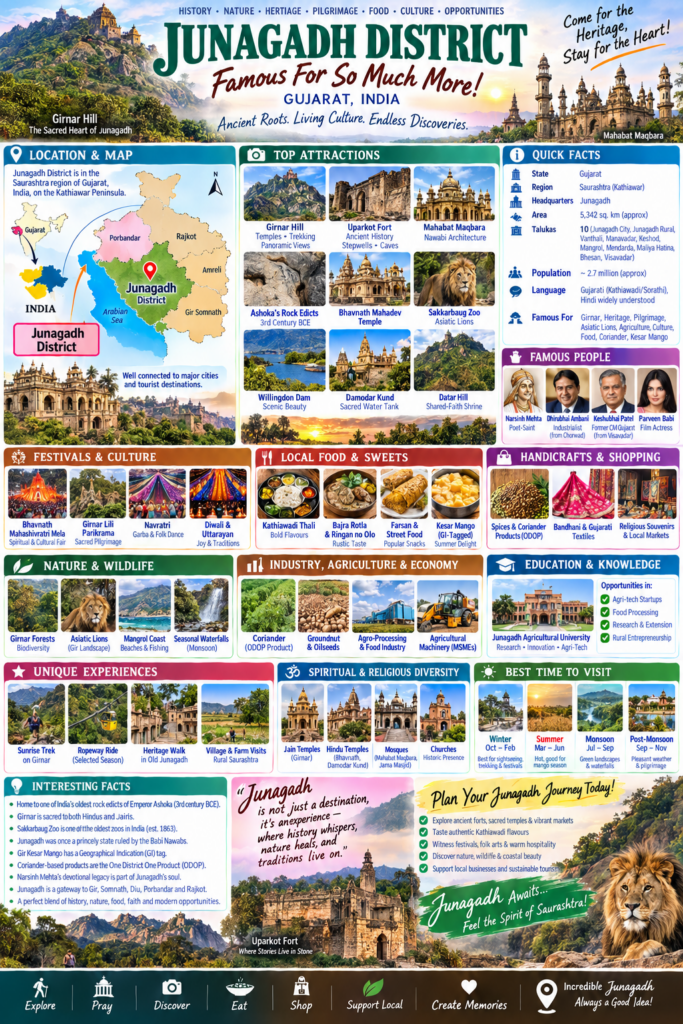
Junagadh District is famous for Girnar Hill, ancient Mauryan history, Ashoka’s Rock Edicts, Uparkot Fort, Jain and Hindu pilgrimage, Nawabi architecture, Sakkarbaug Zoo, the Bhavnath Mahashivratri Mela, Girnar Lili Parikrama, Kathiawadi food, coriander-based agriculture, Kesar mango traditions, agro-processing, agricultural machinery and its role as a gateway to the Gir–Somnath–Saurashtra travel circuit. The district’s heritage stretches back more than two millennia, while its modern identity combines pilgrimage, farming, MSMEs, education and tourism.
| Category | Famous Attraction / Thing | Why It Is Famous | Historical / Cultural Significance | Best Time to Experience | Interesting Facts | Travel Tip |
|---|---|---|---|---|---|---|
| Mountain & Pilgrimage | Girnar Hill | Junagadh’s defining mountain, famous for trekking, temples and pilgrimage | Sacred to Hindu and Jain traditions; known historically as Girinagar/Revatak | Oct–Feb; post-monsoon for greenery | Girnar is one of Gujarat’s most important sacred mountain landscapes. | Start before sunrise; choose the climb according to fitness |
| Jain Pilgrimage | Neminath Temple complex, Girnar | Major Jain tirtha | Associated with Tirthankara Neminath and centuries of Jain pilgrimage | Oct–Mar | Girnar is counted among major Jain pilgrimage mountains. | Wear modest clothing and observe temple rules |
| Hindu Pilgrimage | Bhavnath Mahadev Temple | Strong Shaivite identity and festival culture | Central to Girnar’s religious landscape | Mahashivratri and Oct–Mar | Bhavnath is the starting point of major Girnar pilgrimage traditions | Avoid festival days if you dislike very large crowds |
| Festival | Bhavnath Mahashivratri Mela | One of Junagadh’s signature religious fairs | Combines Shaivite devotion, ascetic traditions, folk culture and pilgrimage | Feb–Mar | Naga Sadhus and night-time rituals are among its distinctive features | Book accommodation far in advance |
| Festival | Girnar Lili Parikrama | Major multi-day circumambulation of Girnar | Deeply rooted in sacred geography and community devotion | Usually Nov | The Ministry of Tourism describes it as beginning at Bhavnath during Kartik and attracting large pilgrim crowds. | Prepare for long walking and temporary traffic controls |
| Heritage | Uparkot Fort | Ancient fortified citadel | Connected with Junagadh’s Mauryan and later dynastic history | Oct–Mar | The fort contains rock-cut caves and historic water structures. | Keep at least 2–3 hours for the complex |
| Archaeology | Ashoka’s Rock Edicts | Rare surviving Mauryan inscriptions | Around 14 edicts dated to about 250 BCE, carved in Brahmi script | Oct–Mar | They link Junagadh directly with Emperor Ashoka’s administrative and ethical legacy. | Visit with a guide or background reading for better understanding |
| Stepwell | Adi Kadi Vav | Unusual rock-cut water architecture | Reflects historic water engineering inside Uparkot | Oct–Mar | Official district tourism describes it as carved from hard rock. | Wear footwear with good grip |
| Historic Well | Navghan Kuvo | Ancient engineering landmark | Part of Uparkot’s long occupation history | Oct–Mar | District tourism describes it as approaching a thousand years in age. | Combine with Adi Kadi Vav |
| Buddhist Heritage | Khapra Kodia Buddhist Caves | Early rock-cut Buddhist remains | Evidence of Buddhism in ancient Junagadh | Oct–Mar | Gujarat Tourism identifies them as an important Junagadh Buddhist-cave site. | Check current ASI ticket/access rules |
| Nawabi Heritage | Mahabat Maqbara | Ornate domes, minarets and spiral stairways | Major architectural legacy of Junagadh’s Babi Nawabs | Sunrise / sunset; Oct–Mar | Its architecture combines Indo-Islamic and Gothic influences. | Golden-hour photography works best |
| Islamic Heritage | Jama Masjid near Mahabat Maqbara | Historic religious architecture | Part of Junagadh’s layered Muslim/Nawabi heritage | Oct–Mar | Located close to the Mahabat Maqbara complex. | Dress respectfully; check prayer-time access |
| Shared-Faith Pilgrimage | Datar Hill / Jamiyal Shah Datar Shrine | Revered by both Hindu and Muslim devotees | Represents Junagadh’s syncretic religious culture | Oct–Feb | Official district information specifically notes shared Hindu-Muslim faith at the shrine. | Climb according to health and weather |
| Sacred Water | Damodar Kund | Ritual bathing and ancestral rites | Important Hindu sacred water body at Girnar foothills | Oct–Mar | Considered holy in Hindu tradition. | Avoid intrusive photography during rituals |
| Dam & Landscape | Willingdon Dam | Scenic reservoir at Girnar foothills | Built to supply drinking water to Junagadh | Monsoon–winter | It is built on the Kalwa River. | Best after rains, subject to safe access |
| Wildlife | Sakkarbaug Zoological Garden | Asiatic lion conservation and family tourism | Opened in 1863 | Oct–Mar; mornings | Official sources describe it as a major breeding centre for Asiatic lions. | It is generally closed on Wednesday; recheck before visiting |
| Wildlife Region | Asiatic Lion / Gir landscape | Globally famous last wild stronghold of the Asiatic lion | Central to Saurashtra’s conservation identity | Dec–Mar | Gir tourism is strongly associated with Junagadh historically, although major safari infrastructure today also lies in neighboring Gir Somnath. | Verify the actual safari gate and district before booking |
| Eco-Tourism | Girnar forest landscape | Forested hills, biodiversity and pilgrimage-nature combination | Spiritual and natural significance overlap here | Monsoon–winter | Girnar combines sacred geography with forest habitat | Avoid littering and stay on permitted trails |
| Coast | Mangrol coastal belt | Fishing culture and Arabian Sea landscape | Gives present-day Junagadh District a coastal identity | Oct–Feb | Mangrol is one of the district’s key coastal towns | Treat it as a working coastal community, not only a beach stop |
| Beach Tourism | Mangrol-area coast | Sea views and fishing-town atmosphere | Reflects Junagadh’s maritime side | Winter / sunset | Less commercialized than major Gujarat beach destinations | Check sea conditions; facilities can be limited |
| Waterfalls | Seasonal Girnar cascades | Monsoon scenery | Seasonal rather than a major permanent waterfall attraction | Jul–Sep | Junagadh is not primarily known for a large perennial waterfall | Never enter fast-flowing seasonal water without local safety confirmation |
| Adventure | Girnar Trek | Endurance, sunrise views and pilgrimage | Combines physical challenge with spirituality | Oct–Feb | One of Gujarat’s best-known pilgrimage climbs | Carry water and do not force elderly members to complete the full climb |
| Ropeway | Girnar Ropeway | Easier mountain access and scenic views | Modern infrastructure serving an ancient pilgrimage landscape | Oct–Mar | Has made upper Girnar more accessible to many visitors | Check weather and live operating status |
| Literature | Narsinh Mehta | One of Gujarat’s most revered poet-saints | Junagadh is strongly associated with his devotional life and poetry | Year-round | “Vaishnav Jan To” is attributed to Narsinh Mehta and later became closely associated with Mahatma Gandhi. | Visit Narsinh Mehta-related sites with cultural context |
| Literary Heritage | Narsinh Mehta No Choro | Associated with devotional gatherings of Narsinh Mehta | Important Gujarati Bhakti-literature landmark | Oct–Mar | Ministry of Tourism highlights his shrine as a major Junagadh attraction. | Visit quietly; it is a cultural-religious place, not a photo prop |
| Freedom Movement / Politics | Samaldas Gandhi & Aarzi Hukumat | Linked with Junagadh’s 1947 accession struggle | Samaldas Gandhi led the provisional government opposing the Nawab’s accession decision | Best experienced through historical study | Government material identifies him as an independence activist and head of the Aarzi Hakumat. | Treat the subject as political history, not tourism folklore |
| Famous Entrepreneur | Dhirubhai Ambani | Founder of Reliance and one of India’s most influential business figures | Born in Chorwad in the Junagadh region | Year-round | Chorwad remains associated with his early life | Verify access before visiting any private/family property |
| Famous Political Personality | Keshubhai Patel | Former Chief Minister of Gujarat | Born in Visavadar | Year-round | Visavadar forms part of present-day Junagadh District | Best approached as modern political history |
| Cinema | Parveen Babi | Major Hindi-film actress | Born in Junagadh city | Year-round | One of the most internationally recognized film personalities associated with Junagadh | Do not turn private family history into intrusive tourism |
| Gujarati Literature | Rajendra Shukla and other Junagadh-region poets | Contribution to modern Gujarati literature | Junagadh district has produced and nurtured several literary figures | Year-round | Regional cultural sources associate Bantwa-born Rajendra Shukla and several writers with the district. | Useful angle for literary-tourism content |
| Folk Music | Saurashtra folk traditions | Bhajans, devotional music and regional folk styles | Strongly linked to fairs, village culture and religious gatherings | Festivals / winter | Girnar events include bhajans and Raas-Garba. | Seek live community performances rather than staged “folk” claims |
| Folk Dance | Garba and Raas | Core Gujarati celebration culture | Integral to Navratri and festival gatherings | Sep–Oct | Also appears at some Girnar pilgrimage festivities. | Join only where visitor participation is welcomed |
| Language | Gujarati / Kathiawadi-Sorathi speech | Local identity and everyday communication | Reflects Saurashtra’s linguistic culture | Year-round | Local speech can sound distinctly different from standard urban Gujarati | Learn a few Gujarati greetings |
| Food | Kathiawadi Thali | Bold, rustic Saurashtra flavors | Represents agrarian food culture | Year-round; winter especially enjoyable | Commonly includes rotla, vegetables, dal, kadhi, pickles and chaas | Ask about spice level |
| Food | Bajra Rotla & Ringan no Olo | Classic rural Saurashtra pairing | Deeply linked with regional agricultural life | Winter | Simple food often provides the most authentic local meal | Try with chaas and jaggery if offered |
| Comfort Food | Khichdi-Kadhi | Familiar Gujarati staple | Household and everyday food tradition | Year-round | Often lighter than heavier restaurant meals | Good choice after trekking or pilgrimage |
| Street Food | Farsan, bhajiya, ganthiya and local snacks | Popular with residents, students and travellers | Everyday Gujarati snack culture | Morning/evening | Incredible India specifically notes Junagadh’s street food and Gujarati cuisine. | Choose busy stalls with fresh turnover |
| Sweet Food | Gujarati sweets / seasonal local mithai | Festival and family celebrations | Strong part of Gujarati hospitality | Festivals | Exact “signature sweet” varies by shop and family tradition | Buy from established high-turnover sweet shops |
| Seasonal Fruit | Kesar Mango | Regional Saurashtra-Gir specialty | Strong horticultural and trade identity | Apr–Jun | “Gir Kesar Mango” is a registered GI. | Remember that the GI is regional, not exclusive to Junagadh District |
| GI-Tagged Product | Gir Kesar Mango | Protected geographical reputation | Associated with the Gir-Saurashtra mango belt | Mango season | GI Application No. 185 is registered in India. | Buy labeled fruit from reliable growers/traders |
| Agriculture | Coriander | Important commercial crop and processing opportunity | Official ODOP focus for Junagadh | Harvest/trade season | Under PMFME, Junagadh’s ODOP is coriander-based products. | Do not incorrectly label Junagadh ODOP as mango or groundnut |
| Agriculture | Groundnut | Major Saurashtra crop and edible-oil value chain | Supports farmers, mills, traders and transport | Harvest season | Strong regional economic importance even though Junagadh ODOP is coriander | Wholesale prices fluctuate; avoid publishing static rates |
| Agriculture | Garlic, wheat, sesame, castor and horticulture | Diversifies the rural economy | Supports mandi, processing and logistics activity | Seasonal | Junagadh’s economy is strongly agriculture-linked | APMC visits are best early in the trading day |
| Industry | Agro-processing | Natural value addition close to farms | Includes oils, spices, grain and food processing | Business activity year-round | One of the district’s most logical MSME sectors | Verify FSSAI and local industrial approvals before investing |
| Industry | Agricultural machinery | Farm and food-processing demand | Junagadh has local engineering manufacturers serving agricultural markets | Year-round | JAU also has strong farm-engineering academic capacity. | Best explored as a B2B industrial visit |
| MSME | Junagadh I & II / local industrial estates | Concentration of smaller manufacturing and processing units | Represents organized industrial development in the district | Year-round | MSME activity is more agro-linked than mega-heavy-industrial | Use current GIDC data before quoting land availability |
| Startup Ecosystem | Agri-tech & food-tech opportunities | Agriculture + university research creates startup potential | Linked to JAU, food processing and rural innovation | Year-round | JAU was constituted in 2004 and traces its agricultural-college roots to 1960. | Validate incubator programs and open calls before applying |
| Education | Junagadh Agricultural University | Major agriculture, research and extension institution | Its College of Agriculture began in 1960, the first Government Agricultural College in Gujarat | Academic year | University departments cover agronomy, biotech, horticulture, engineering and more. | Useful for agri-business, students and research visitors |
| Local Market | APMC / agricultural market trade | Farm produce trading and price discovery | Connects villages with processors and wholesalers | Early morning / harvest periods | Coriander, oilseeds and other crops form part of the wider market economy | Markets are working business spaces; ask before photographing people |
| Shopping | Spices and coriander products | Direct connection with local agriculture | Supports household retail and food-processing identity | Year-round | Strongest relevant local-product story because of ODOP status | Check packaging date and FSSAI labeling |
| Shopping | Groundnut oil and snacks | Regional crop-to-consumer product | Reflects Saurashtra’s edible-oil economy | Year-round | Local producers vary widely in scale and quality | Prefer sealed, properly labeled products |
| Shopping | Bandhani / Gujarati festive clothing | Popular regional wedding and festival fashion | Part of wider Saurashtra-Gujarat textile culture | Before Navratri / wedding season | Not a Junagadh-exclusive GI craft | Avoid claiming locally sold Bandhani was made in Junagadh unless seller can confirm origin |
| Handicrafts | Religious souvenirs and local decorative items | Strong pilgrimage demand | Linked with Girnar and Bhavnath visitor economy | Festival season | Many products may be sourced from elsewhere in Gujarat | Ask origin if authentic local craft matters |
| Culture | Sorathi / Saurashtrian traditions | Junagadh historically belonged to the Sorath region | Influences speech, food, folk memory and identity | Year-round | “Sorath” remains culturally important even beyond modern boundaries | Use the term culturally, not as a present administrative district |
| Market Experience | Old Junagadh bazaars | Food, clothing, pilgrimage goods and everyday city life | Reveal the living commercial culture behind heritage monuments | Morning/evening | Often more revealing than modern malls for first-time visitors | Walk rather than drive through congested sections |
| Devotional Tourism | Girnar–Bhavnath–Damodar Kund circuit | Dense concentration of sacred sites | Hindu, Jain and ascetic traditions overlap | Oct–Mar | One of Junagadh’s strongest pilgrimage circuits | Allocate a full morning rather than rushing |
| Heritage Tourism | Uparkot–Ashoka Edicts–Mahabat Maqbara circuit | Shows several distinct historical eras in one city | Mauryan, medieval and Nawabi layers | Oct–Mar | Few Gujarat cities offer this compact a historical sequence | Hire a knowledgeable guide |
| Eco-Tourism | Girnar monsoon landscape | Green hills, clouds and seasonal streams | Combines nature with sacred geography | Jul–Sep | Looks dramatically different from dry-season Saurashtra | Check rain and trail conditions |
| Hidden Gem | Bawa Pyara / Khapra Kodia cave heritage | Less visited than Uparkot and Girnar | Important Buddhist archaeological layer | Oct–Mar | Junagadh’s Buddhist story is often overlooked by casual tourists. | Check exact site access before travel |
| Hidden Gem | Datar Hill | Scenic climb and shared-faith shrine | Important example of syncretic devotion | Oct–Feb | Reaches about 847 m according to district tourism. | Carry water and start early |
| Museum / Learning | Junagadh heritage collections and museums | Preserve princely-state, archaeological and cultural material | Help explain Junagadh beyond monuments | Year-round | Museum names/openings can change during renovation | Verify same-day opening hours |
| Logistics | Agricultural freight hub | Moves crops, food products and machinery | Connects rural production with Rajkot and wider Gujarat markets | Year-round | Freight demand follows harvest and processing cycles | Return-load planning can reduce transport costs |
| Exports | Processed foods, oilseeds, spices and machinery potential | Products have wider domestic and export markets | Represents value addition beyond raw agriculture | Year-round | Export potential varies by company and certification | Do not label every local manufacturer an exporter without verification |
| Local Business | Food processing, packaging, farm machinery, warehousing | Strongest sectors match local raw materials and demand | Supports MSME-led growth | Year-round | Junagadh’s opportunity lies in farm-to-market value addition | B2B buyers should verify GST, quality certifications and capacity |
| Gateway Tourism | Junagadh → Gir → Somnath → Diu | One of Saurashtra’s strongest multi-destination circuits | Links heritage, wildlife, pilgrimage and coast | Oct–Mar | Junagadh itself is often the historical anchor of the route | Spend at least 1–2 nights in Junagadh rather than only passing through |
| Gateway City | Rajkot connection | Major business, airport and onward transport gateway | Connects Junagadh with wider Gujarat | Year-round | Road and rail links make Junagadh practical in Saurashtra itineraries | Check current air schedules before fixing the first day’s itinerary |
👤 Famous People Associated with Junagadh District
Junagadh is particularly strong in literature, politics, business and cinema. Narsinh Mehta is its most culturally significant literary association; the Ministry of Tourism highlights his Junagadh shrine and his enduring Gujarati devotional legacy. Samaldas Gandhi is important to the district’s 1947 political history because he led the Aarzi Hukumat.
Among better-known modern personalities associated by birth or strong regional connection are Dhirubhai Ambani from Chorwad, former Gujarat Chief Minister Keshubhai Patel from Visavadar, actress Parveen Babi from Junagadh, and Gujarati literary figures linked with Junagadh and Bantwa. For sports, Junagadh has active local sporting culture, but I would avoid inventing a “district-defining sports icon” unless a reliable biographical source specifically connects that person to present-day Junagadh District.
✅ Why Junagadh Is Truly Different
- Girnar is not just a hill: it combines Hindu pilgrimage, Jain sacred heritage, trekking, festivals and forest scenery in a single landscape.
- Junagadh compresses more than 2,000 years of history into a small area: Ashokan inscriptions, Uparkot, Buddhist caves and Nawabi monuments can be explored in the same trip.
- Its two signature events are unmistakably local: Bhavnath Mahashivratri Mela and Girnar Lili Parikrama are more distinctive to Junagadh than generic statewide festivals.
- Its economy and food are connected: coriander, groundnut, garlic, edible oil, spices and food processing link fields, mandis, factories, restaurants and freight networks.
- Coriander is the correct ODOP identity for Junagadh: official PMFME documentation lists coriander-based products for the district.
- Gir Kesar Mango is a genuine GI-tagged regional product, but the GI should not be described as exclusively belonging to Junagadh District.
- The Asiatic lion is central to Junagadh’s tourism story, but modern bloggers should distinguish the historic Junagadh–Gir identity from present-day administrative boundaries; Gujarat Tourism currently lists Gir National Park under Gir Somnath while Girnar and Adi Kadi Vav are listed under Junagadh.
- Junagadh is not famous for a major hill station or large perennial waterfall. Girnar is a mountain/pilgrimage destination, and its small cascades are seasonal; adding a fictional “Junagadh hill station” or major waterfall for SEO would reduce EEAT.
- Junagadh’s strongest business story is value addition: agriculture → cleaning/grading → processing → packaging → warehousing → logistics → retail/export.
- The best first-time experience is a combination: sunrise at Girnar, Bhavnath, Uparkot, Ashoka’s Edicts, Mahabat Maqbara, a Kathiawadi meal and an evening in the old city.
🌄 In One Sentence: What Is Junagadh District Famous For?
Junagadh District is famous for Girnar’s sacred mountains, ancient Ashokan and Uparkot heritage, Nawabi architecture, Jain and Hindu pilgrimage, Asiatic-lion-linked tourism, vibrant Girnar festivals, Kathiawadi food, coriander and groundnut agriculture, Kesar mango traditions, agricultural education and an unusually rich blend of history, spirituality, nature and living Saurashtra culture.
For a first visit, do not treat Junagadh merely as a stop on the way to Gir or Somnath. Give the district enough time for Girnar at dawn, its archaeological monuments in daylight, its markets at working hours and its food in the evening—that combination is where Junagadh’s real identity becomes clear.
⚠️ Common Travel Myths, Tourist Scams, Safety Issues & Practical Solutions in Junagadh District
Junagadh is a major pilgrimage, heritage and nature destination, and there is no sound basis for portraying it as unusually unsafe for tourists. A useful safety guide should instead prepare visitors for ordinary travel risks—unverified guides, payment fraud, price misunderstandings, crowded pilgrimage events, heat, monsoon conditions, transport disruptions and online-booking fraud.
For emergencies, 112 is the national emergency/police number. Junagadh District lists 108 for ambulance, 101 for fire and rescue, 1091/181 for women, 1098 for children, and 1077 for the District Emergency Operation Centre. The district’s disaster-control room operates 24×7.
📊 Junagadh Tourist Safety, Scams, Myths & Solutions Chart
| Myth / Scam / Problem | Reality | Common Target | Warning Signs | Prevention Tips | Recommended Solution | Emergency Helpline / Authority |
|---|---|---|---|---|---|---|
| Myth: Junagadh is unsafe for tourists | Ordinary precautions are more appropriate than treating the district as inherently dangerous | First-time/solo travellers | Sensational social-media claims without evidence | Use official advisories and normal city precautions | Plan transport and accommodation in advance | Emergency: 112 |
| Taxi/auto overcharging | Fare disagreements can occur anywhere, especially when no fare is agreed beforehand | New visitors, families, pilgrims | Driver avoids quoting fare or changes it after arrival | Confirm fare before starting; use map navigation | Politely dispute before paying; record vehicle details if serious | Police: 112 |
| “Hotel is closed—I know a better one” claim | An unsolicited driver/vendor may sometimes steer travellers toward another property | First-time tourists | Pressure to cancel a confirmed hotel | Call the booked hotel yourself | Go to the confirmed address unless the hotel verifies otherwise | Police if coercion: 112 |
| Fake/unofficial tourist guide | Not everyone offering guide services is officially registered | Uparkot/Girnar/heritage visitors | No ID, vague fee, exaggerated historical claims | Prefer recognized/registered guides | Agree price, language, duration and itinerary first | Gujarat Tourism maintains a registered-guide search facility. |
| Guide says an attraction is “closed” | Opening times can change, but don’t rely solely on a stranger | Heritage tourists | Immediate attempt to redirect you to a shop/other attraction | Verify at ticket office or official tourism source | Check directly before changing plans | Gujarat Tourism |
| Counterfeit attraction ticket | Tickets should be purchased through the authorized counter/platform for that attraction | Tourists at busy sites | Seller outside official system; unusual discount | Avoid unofficial resellers | Purchase again only through authorized channel if authenticity is doubtful | Site authority / Police |
| Fake Girnar Ropeway ticket/site | Online search results and forwarded links should not automatically be trusted | Pilgrims, families | WhatsApp-only booking, personal UPI request, unrealistic discount | Start from the official operator/recognized tourism channel | Contact bank immediately if payment fraud occurs | Cyber fraud: 1930 |
| Fake hotel website/booking page | Impersonation and manipulated search listings are broader online-travel risks | Families, wedding groups | Payment to personal account; pressure for full advance | Cross-check hotel phone/address independently | Preserve screenshots, transaction ID and chats | 1930 / Cyber Crime Portal |
| WhatsApp accommodation scam | A photograph and WhatsApp profile do not prove ownership of a hotel/homestay | Festival visitors | Huge discount + immediate advance-payment demand | Verify property independently | Contact payment provider/bank immediately after suspected fraud | 1930 |
| UPI QR-code scam | Scanning a QR or entering a UPI PIN is generally for authorizing payment, not “receiving a refund” | All digital-payment users | “Enter PIN to receive money” | Read every UPI confirmation screen | Freeze/report transaction quickly | 1930 |
| Fake UPI payment request | Fraudsters may send collect requests unrelated to your purchase | Tourists shopping/dining | Merchant name/account does not match | Verify receiver name and amount | Reject unfamiliar requests | 1930 |
| ATM card-help scam | Never let a stranger handle your card or observe PIN | Seniors, unfamiliar travellers | Stranger insists ATM is malfunctioning and offers help | Shield PIN; use bank ATM where practical | Block card immediately if compromised | Bank + 1930 |
| Fake police/cyber “digital arrest” demand | Indian cyber authorities warn about impersonators demanding money | Any traveller | Video call, secrecy, threats and money-transfer demand | Independently verify authorities; don’t transfer money under pressure | End call and report | 112 / 1930; I4C specifically warns about impersonation fraud. |
| Pickpocketing in crowds | Crowded fairs, stations and pilgrimage queues naturally require greater care | Festival visitors | Unusual crowding/pushing | Keep phone/wallet secured; avoid exposed back pockets | Block cards/SIM and report theft | 112 |
| Unattended luggage at station/bus stand | Busy transport hubs require standard baggage precautions | Rail/bus travellers | Distraction by strangers | Keep valuables on your person | Inform station/security staff | 112 / station authority |
| Shopping overcharging | Different stores may quote different prices; that alone is not necessarily fraud | Tourists buying souvenirs | No displayed price/bill; aggressive pressure | Compare shops and request invoice | Decline purchase if uncomfortable | Consumer/police channels as applicable |
| “Authentic local handicraft” claim | Products sold in Junagadh may originate elsewhere in Gujarat/India | Souvenir buyers | Seller refuses to explain origin | Ask where/how item was made | Buy for quality, not unsupported provenance claims | Consumer authority if actual fraud |
| Fake GI-tag claim | Gir Kesar Mango is GI-registered, but not every mango automatically qualifies as authentic GI-origin produce | Mango buyers | Generic fruit marketed at premium solely using “GI” | Use reputable sellers and labeling/traceability where available | Avoid paying premium without evidence | Consumer authority |
| Adulterated/poor-quality food concern | Busy, hygienic outlets with good food turnover are usually a more sensible choice | Street-food tourists | Stale food, poor storage, dirty water/utensils | Prefer freshly cooked hot food | Stop eating if food seems unsafe; hydrate appropriately | Ambulance 108 if serious |
| Extremely spicy food underestimated | Kathiawadi cuisine can be spicy, but recipes vary | Children, seniors, unfamiliar visitors | No discussion of spice preference | Ask for mild preparation | Keep water/appropriate food alongside meal | 108 for medical emergency |
| Unsafe drinking water | Visitors may be less accustomed to local water sources | All tourists | Unsealed bottle/questionable refill | Use sealed/reliable drinking water | Rehydrate and seek care for severe symptoms | 108 |
| Summer heat/dehydration | Junagadh can become very hot; Girnar climbing increases exertion | Trekkers, seniors, children | Dizziness, headache, unusual fatigue | Start early, carry water, avoid peak heat | Stop activity, cool down and seek medical help if severe | 108 |
| “Anyone can climb Girnar easily” | The traditional climb can be physically demanding | Unprepared pilgrims | Fatigue early in climb | Assess fitness realistically; use ropeway where suitable and operating | Turn back rather than forcing completion | 108 / local authorities |
| Monsoon trekking is always safe | Wet Girnar terrain can become slippery and local restrictions may apply | Trekkers/photographers | Heavy rain, slippery steps, warnings/barriers | Check weather and local instructions | Postpone during severe weather | 1077 |
| Flash water/seasonal-stream risk | Monsoon runoff can change quickly around hills and low areas | Monsoon visitors | Fast-rising/muddy water, intense rainfall | Never cross flowing water casually | Move to safe higher ground | 1077 / 112 |
| Cyclone/heavy-rain disruption | Coastal Gujarat and Junagadh’s Mangrol side can face severe-weather disruption | Coastal travellers | Government weather alerts, cancelled transport | Follow official alerts | Delay coastal journey if advised | District DEOC 1077 |
| Swimming anywhere on the coast is safe | Sea conditions vary; an attractive shoreline is not proof of safe swimming | Mangrol/coastal visitors | Rough surf, fishing activity, absence of lifeguards | Swim only where locally permitted and conditions are known safe | Leave water during rough conditions | 112 / 108 |
| Wildlife selfie / approaching animals | Wildlife should never be approached or fed | Wildlife tourists | People leaving safe areas for photographs | Maintain prescribed distance | Follow forest/zoo staff directions | Forest/site authority |
| Wildlife safari sold informally | Gir-related bookings should be verified through authorized systems | Wildlife visitors | Guaranteed lion sighting, inflated “VIP” promise | Use official booking channels | Do not pay for guaranteed sightings | Forest/tourism authority |
| Guaranteed lion sighting | Wildlife sightings can never ethically be guaranteed | First-time safari tourists | “100% lion guaranteed” sales pitch | Treat sightings as dependent on wildlife movement | Choose authorized safari experience, not guarantees | Forest authority |
| Parking fee without receipt | Some parking is paid, some managed temporarily, particularly during events | Self-drive visitors | Informal collector/no board/no receipt | Use designated parking and ask for receipt | Move to official parking if uncertain | Local authority/police |
| Vehicle towed/blocked during festivals | Temporary traffic controls can apply around Bhavnath/Girnar during major gatherings | Drivers | Barricades, temporary signs, police diversions | Follow event-day traffic instructions | Use designated remote parking/shuttle where provided | 112 / local traffic police |
| Train/bus delay ruins connection | Weather, traffic and operational changes can affect services | Tight-itinerary travellers | Delay alerts | Keep transfer buffer | Rebook through authorized channel | Rail/GSRTC authority |
| Fake bus/train ticket agent | Official digital/counter booking is safer than unknown agents | Outstation visitors | Cash-only agent, no valid booking reference | Use authorized rail/bus channels | Verify PNR/ticket before travel | Transport authority / 112 for fraud |
| App cab is always available | Supply can be limited compared with large metros | Late-night arrivals | No drivers accepting ride | Keep local taxi/auto backup | Ask hotel/station for legitimate transport alternatives | 112 only for actual safety emergency |
| Night arrival without onward transport | It is manageable, but preplanning reduces inconvenience | Solo travellers, women, seniors | Remote drop point, no transport | Confirm drop point and pickup beforehand | Wait in a staffed, well-lit area | 112 |
| Women must avoid Junagadh altogether | Such blanket advice is unsupported; standard solo-travel precautions are more useful | Women travellers | Isolated route, unwanted attention, unverified transport | Share trip details, use verified accommodation/transport | Move to a populated area and seek assistance when uncomfortable | 181 / 1091 / 112 |
| Senior citizens should attempt every pilgrimage climb | Fitness and accessibility differ greatly between individuals | Seniors | Breathlessness, fatigue, balance problems | Plan around ability; investigate ropeway/vehicle access | Modify itinerary instead of forcing climb | 108 |
| Drone photography is automatically allowed | Heritage, wildlife, religious and security-sensitive areas may impose restrictions | Photographers/content creators | Signage/security objection | Check current permissions before flying | Do not launch until authorization is clear | Site/aviation authority |
| Photography is allowed everywhere | Temples, shrines, museums and sensitive sites may restrict it | Photographers | No-photo signs or staff instruction | Ask before shooting | Respect the restriction | Site authority |
| Religious site = tourist photo set | Girnar, Bhavnath, Jain temples, Damodar Kund and Datar are living sacred spaces | Influencers/photoshoot groups | Worship/ritual occurring nearby | Dress respectfully; avoid obstructing devotees | Ask permission where appropriate | Temple/shrine management |
| Every old blog has current district boundaries | Gir Somnath was separated from the former Junagadh District; old information can misclassify places | Trip planners | Somnath/Veraval presented as current Junagadh locations | Verify present administrative boundaries | Correct itinerary before booking | District tourism authority |
🚨 Junagadh Emergency Numbers Travellers Should Save
| Situation | Number / Authority | When to Use |
|---|---|---|
| National Emergency / Police | 112 | Immediate personal-safety or police emergency |
| Ambulance | 108 | Medical emergency |
| Fire & Rescue | 101 | Fire/rescue emergency |
| Women Helpline | 1091 / 181 | Women’s safety/support |
| Child Helpline | 1098 | Child in distress |
| Junagadh District Emergency Operations Centre | 1077 | Heavy rain, cyclone, flood or district disaster |
| Junagadh District Control Room | 0285-2633446 | District-level emergency assistance |
| Relief & Rescue | 1070 | Disaster relief/rescue |
| Cyber Financial Fraud | 1930 | UPI, card, online-booking or other cyber financial fraud |
| Gujarat Tourism | 1800 203 1111 | Tourism information/registered-guide support |
Junagadh District’s current official portal confirms the district emergency, women, child, ambulance and fire contacts, while the Ministry of Home Affairs’ cybercrime portal confirms 112, 181 and 1930 for police emergencies, women’s assistance and cyber financial fraud respectively.
🛡️ Practical Safety Checklist for First-Time Junagadh Visitors
- Book from the source: use recognized hotel, railway, bus, attraction and tourism booking channels rather than payment links forwarded by unknown people.
- Verify before paying: confirm the receiver’s name on UPI, total taxi/auto fare, hotel identity, ticket date and attraction before authorizing payment.
- Protect the phone that protects your trip: use screen lock, avoid displaying OTPs/PINs, and keep copies of essential bookings somewhere accessible.
- Treat Girnar as a mountain, not simply an attraction: footwear, hydration, weather, fitness and early timing matter.
- Expect exceptional crowds during Bhavnath Mahashivratri and Girnar Lili Parikrama: transport, accommodation and parking can operate differently from ordinary days.
- Respect sacred places: modest clothing, photography restrictions, queues and local religious practices matter at Hindu, Jain and Muslim sites.
- Use extra care during monsoon: Junagadh’s District Emergency Operation Centre provides the 24×7 1077 disaster helpline and taluka-level control rooms.
- Act quickly after online financial fraud: contact 1930 immediately, preserve screenshots, transaction IDs, phone numbers and messages, and file a report through the National Cyber Crime Reporting Portal.
⭐ Is Junagadh Safe for Tourists?
Junagadh should not be presented as a scam-heavy or unusually dangerous destination without evidence. Most visitors are better served by normal Indian travel precautions: use authorized bookings, agree transport prices, safeguard valuables in crowded places, verify digital payments, respect religious sites, prepare properly for Girnar, and take official monsoon or disaster warnings seriously.
🛣️ Major National Highways, State Highways, Road Safety & Travel Advisory for Junagadh District, Gujarat
Junagadh District has strong road connectivity because it sits between Rajkot and the NH-27 corridor, the Gir–Somnath tourism belt, Porbandar, Amreli and the Arabian Sea coast around Mangrol. For most visitors and freight operators, NH-151 is the principal north–south highway spine through Junagadh city, while NH-51 serves the coastal side of the district around Mangrol. The Ministry of Road Transport & Highways defines NH-151 as the route from NH-51 near Gadu through Vanthali and Junagadh to NH-27 near Jetpur.
🗺️ Major National Highways Connecting Junagadh District
| Highway / Road | Major Route Through or Near Junagadh | Main Destinations Connected | Importance for Travellers | Freight / Logistics Importance | Main Caution |
|---|---|---|---|---|---|
| NH-151 | Gadu → Vanthali → Junagadh → Jetpur side | Junagadh, Vanthali, Jetpur; onward NH-27 toward Rajkot/Ahmedabad | Primary road gateway to Junagadh city | Agro-products, machinery, food, retail freight | Junction traffic, trucks, monsoon road conditions |
| NH-51 | Coastal Saurashtra corridor through/near Mangrol side | Porbandar → Mangrol → Somnath → Una → Bhavnagar and onward | Major coastal and tourism corridor | Fisheries, agricultural freight, coastal commerce | Heavy rain can damage low/coastal sections |
| NH-27 via Jetpur connection | Reached from NH-151 near Jetpur | Rajkot, Ahmedabad and national east-west highway network | Major onward long-distance connection | Critical long-haul freight corridor | High-speed mixed traffic |
| Junagadh–Somnath corridor | Junagadh → Vanthali/Keshod/Gadu → Somnath side | Keshod, Veraval, Somnath | Major pilgrimage/tourism route | Food, tourism supplies, regional freight | Weekend/pilgrimage traffic |
| Junagadh–Rajkot corridor | NH-151 → Jetpur → NH-27 / Rajkot direction | Jetpur, Gondal/Rajkot connections | Main business and airport corridor | Important industrial and distribution link | Allow time around Jetpur and urban approaches |
The Government of India’s current NH description explicitly lists NH-151 as NH-51 near Gadu–Vanthali–Junagadh–NH-27 near Jetpur. NH-51, meanwhile, follows the long western Gujarat coastal corridor through places including Porbandar, Mangrol and Somnath.
🌊 Important 2026 NH-51 Monsoon Case Study
Junagadh travellers should take monsoon warnings seriously rather than assuming a National Highway can never close.
On 4 July 2026, the Ministry of Road Transport & Highways reported that a section of NH-51 near Hussainabad village in Mangrol taluka had been temporarily closed after heavy rain damaged the road. NHAI and the district administration restored traffic within hours, although strengthening work continued afterward. The government specifically asked motorists to drive cautiously during the ongoing monsoon and follow official advisories.
That is a useful real-world example of why an evergreen Junagadh traveller should recommend live road-condition checks during July–September.
🛤️ Major State Highways & Regional Roads
State-road numbering can be reclassified when roads are upgraded to National Highways. Therefore these numbers should be treated as regional road references, while current roadside signage/navigation should control the actual journey.
| State Highway / Corridor | Broad Route | Junagadh Role | Best For | Road-Safety Note |
|---|---|---|---|---|
| SH-26 | Jamnagar/Kalavad–Dhoraji–Junagadh–Mendarda–Sasan side | Connects Junagadh with interior Saurashtra and Gir-side roads | Gir travel, regional trade | Rural traffic, livestock and slower vehicles possible |
| SH-30 | Junagadh–Bilkha–Bagasara–Amreli | Important eastern connection | Amreli and agricultural belt | Narrower sections and village crossings may reduce speed |
| SH-31 | Keshod–Vanthali–Junagadh–Jetpur and onward | Major historic regional arterial route | Keshod, Junagadh, Jetpur | Some portions overlap/upgraded routes; follow live signage |
| SH-32 corridor | Vanthali–Manavadar–Bantwa–Kutiyana | Western rural connectivity | Manavadar, rural markets, Porbandar-side travel | Expect mixed local traffic |
| Junagadh–Mendarda road | Junagadh → Mendarda → Gir-side landscape | Nature and tourism approach | Eco-tourism / Gir region | Nighttime animal movement possible on rural sections |
| Keshod–Mangrol road | Keshod → Mangrol | Connects airport-side interior with coast | Coastal trips, fisheries, local business | Monsoon waterlogging/local damage possible |
| Bilkha–Visavadar corridor | Interior Junagadh | Rural/agricultural connectivity | Villages and Gir-fringe travel | Avoid excessive night speed |
Published Gujarat highway listings identify SH-26, SH-30 and SH-31 as major routes serving Junagadh, although portions may have been reclassified over time.
🏙️ Important Arterial Roads in Junagadh City
| Road / Area | Importance | Typical Traffic | Main Risk | Best Advice |
|---|---|---|---|---|
| Zanzarda Bypass / Zanzarda Chowkdi | Helps distribute highway and city traffic | Cars, buses, trucks | Junction conflicts, turning vehicles | Reduce speed approaching chowkdis |
| Vanthali Road | Main western approach | Buses, freight, commuter traffic | Mixed-speed traffic | Avoid sudden overtaking |
| Girnar Taleti Road | Main visitor approach toward Girnar/Bhavnath | Pilgrim vehicles, autos, buses | Festival congestion and pedestrians | Start early; follow temporary diversions |
| M.G. Road | Central Junagadh commercial corridor | Dense local traffic | Congestion, parking, pedestrians | Park legally and explore central areas on foot |
| Kalwa Chowk area | Major urban activity zone | Autos, bikes, buses, pedestrians | Peak-hour congestion | Use extra caution at junctions |
| Talav Gate / old-city approaches | Shopping and heritage access | Pedestrians, bikes, autos | Narrow roads/crowding | Avoid taking large vehicles deep into old commercial streets |
| Railway Station Road | Station access | Autos, taxis, buses | Arrival/departure congestion | Pre-arrange pickup at busy hours |
| Bus Station/Joshipura approaches | Regional-bus traffic | Buses, autos, pedestrians | Bus movements and roadside pickups | Use designated pickup/parking points |
The district administration identifies M.G. Road, Kalwa Chowk, Zanzarda Road, Talav Darwaja, bus-stand, Joshipara and Girnar Taleti among Junagadh city’s important urban areas.
🚫 No-Entry Roads, Truck Restrictions & Traffic Timings
Is There a Fixed Junagadh Truck No-Entry Time?
That matters because many travel websites copy old truck restrictions without checking whether the notification is still valid.
| Situation | Likely Restriction Type | Evergreen Advice |
|---|---|---|
| Central Junagadh commercial roads | Heavy-vehicle control may apply under local traffic orders | Obey current signs/police instructions |
| Girnar/Bhavnath during Mahashivratri | Temporary vehicle diversions/no-entry zones | Expect remote parking, walking and diversions |
| Girnar Lili Parikrama | Temporary traffic management | Do not assume normal Taleti access |
| VIP/government events | Short-term closures/diversions | Follow police barricades |
| Road construction | Lane or complete closure | Follow signed diversion |
| Cyclone/heavy rain | Emergency restrictions | Check district control room |
| Oversized/ODC cargo | Special movement permission may be required | Conduct route survey and obtain authority clearance |
| Heavy trucks in dense urban area | Local time/restriction dependent | Verify with traffic police on travel date |
For truckers and ODC operators, never build a movement plan around an old blog’s no-entry timing. Confirm the current order with local traffic police/road authorities before dispatch.
⚠️ Road Safety & Traveller Awareness Chart
| Location / Issue | Risk Type | What Is Verified | Risk Level | Traveller Recommendation | Alternate / Solution |
|---|---|---|---|---|---|
| NH-151 Junagadh–Vanthali–Jetpur | Fast + mixed traffic | Principal NH connection | Moderate | Maintain lane discipline; avoid risky overtaking | Travel in daylight where possible |
| NH-51 near Mangrol/Hussainabad | Heavy-rain damage | Highway temporarily closed and restored in Jul 2026 | Higher during monsoon | Check rainfall/road advisory before coastal travel | Delay or use authority-directed diversion |
| Girnar Taleti/Bhavnath | Pilgrim congestion | Major pilgrimage destination | High during festivals | Park only where directed | Walk/shuttle where provided |
| Girnar approach | Pedestrians | Large pilgrim movement | Moderate–High | Drive very slowly near Taleti | Avoid peak festival dates |
| M.G. Road/Kalwa Chowk | Urban congestion | Major central commercial zone | Moderate | Avoid unnecessary car movement in busiest periods | Auto/walk |
| Railway/bus station approaches | Pedestrian conflicts | Major transport nodes | Moderate | Slow down near entrances | Use designated pickup point |
| Keshod/Mangrol rural roads | Agricultural traffic | Rural connection | Moderate | Watch for tractors, livestock, bikes | Daylight driving |
| Gir-fringe rural roads | Wildlife/low visibility | Forest influence in regional landscape | Moderate at night | Avoid speeding after dark | Travel earlier |
| Coastal Mangrol belt | Rain/wind | Coastal + recent rain-damage history | Seasonal High | Avoid unnecessary travel during severe weather | Follow district advisory |
| Low-lying village roads | Flood/waterlogging | Monsoon risk varies annually | Seasonal | Never drive through unknown floodwater | Turn around/use official diversion |
| Hill/Girnar access | Steep/curved roads & walking terrain | Mountain setting | Moderate | Use low speed, good brakes, proper footwear when walking | Avoid severe weather |
| Unfamiliar rural roads at night | Limited visibility/services | Common rural-travel issue | Moderate | Keep fuel, phone charge and offline map | Use main highway route |
Practical High-Risk Road Situations
| Situation | Why Accidents Can Occur | Defensive Driving |
|---|---|---|
| Highway median openings | Sudden U-turns/crossing traffic | Reduce speed before gaps |
| Chowkdis/junctions | Conflicting traffic streams | Expect vehicles from every side |
| Village highway crossings | Pedestrians, bikes, tractors | Lift off accelerator early |
| Night rural sections | Poor visibility, animals | Use controlled speed |
| Rain-soaked highway | Hydroplaning/braking-distance increase | Increase following distance |
| Festival traffic | Pedestrians and irregular parking | Crawl speed |
| Bus/truck overtaking | Large blind zones | Never squeeze beside heavy vehicle |
| Two-wheeler-heavy streets | Unpredictable lane movement | Leave lateral space |
🌧️ Flood-Prone & Monsoon-Sensitive Travel
Junagadh District maintains a 24×7 District Emergency Operation Centre, reflecting the district’s need to manage severe-weather and other disaster situations. The current helpline is 1077, with district control-room numbers also published officially.
Monsoon Road Risk Chart
| Zone | Potential Problem | Jul–Sep Advice |
|---|---|---|
| Mangrol/NH-51 coastal side | Road erosion/heavy rainfall | Check NHAI/district alerts |
| Girnar foothills | Intense runoff/slippery roads | Avoid unnecessary hill driving in severe rain |
| Underpasses/low roads | Waterlogging | Never enter water without knowing depth |
| Village causeways | Overflow | Wait for official reopening |
| Agricultural roads | Mud/edge erosion | Prefer main surfaced roads |
| Coastal roads | Wind + rain + visibility | Avoid cyclone/severe-weather travel |
| Girnar walking approaches | Slippery stone surfaces | Proper footwear; postpone in extreme rain |
The July 2026 NH-51 disruption near Hussainabad proves that even strategic highways can be temporarily affected by intense rainfall.
⛰️ Landslides, Ghats & Mountain Road Risk
Junagadh does not have a long Himalayan-style ghat highway system.
Girnar is mountainous, but most tourist climbing is on foot or via ropeway rather than by driving a vehicle over a high mountain pass.
The main practical hazards are:
| Hazard | Relevance |
|---|---|
| Major high-altitude ghat road | Not characteristic of Junagadh |
| Rain-triggered slope debris | Possible around hilly terrain |
| Slippery approach roads/steps | Important during monsoon |
| Fog/cloud | Can reduce hill visibility during wet weather |
| Hairpin-heavy long highway | Not the district’s dominant road type |
| Falling rocks | Treat warning signs seriously around cut slopes |
Girnar sits immediately beside Junagadh and is a major mountain pilgrimage landscape.
💳 Toll Plazas Affecting Junagadh Travel
Gadoi Toll Plaza – NH-151
The key toll facility on the Jetpur–Somnath/NH-151 corridor is Gadoi Toll Plaza, located at km 51.250 on NH-151. NHAI identifies the stretch as Jetpur–Somnath and lists 1033 as the highway emergency number. NHAI also lists static weighbridges at this location and identifies Vanthali and Keshod as nearby police/medical support points.
| Toll Plaza | Highway | Relevant Journey | Facilities / Notes |
|---|---|---|---|
| Gadoi | NH-151 | Junagadh–Keshod/Somnath corridor | FASTag/toll facility; weighbridges; NHAI 1033 support |
| Dhumiyani | NH-27/old NH-8B corridor | Some Porbandar/Jetpur regional movements | Relevant depending route |
| Other NH-51 plazas | Coastal Saurashtra | Route dependent | Check live NHTIS before travel |
Toll rates change annually. Do not hard-code an old fee into an evergreen travel page; use NHAI’s live toll-information system instead.
⚡ EV Charging Stations in Junagadh
EV charging availability is improving, but chargers can be occupied, offline or incompatible with a specific vehicle. Always check the operator’s live app.
GLIDA Charging Station is listed near Girnar Darwaja/Taleti Road and is currently shown as operating 24 hours.
Tata Power Charging Station is listed in the RTO-area side of Junagadh and is also currently shown as 24-hour.
BPCL Charging Station is listed at Zanzarda and provides another city charging option.
HPeCharge Charging Station is located on the Junagadh–Somnath/NH-151 corridor near Vanthali, which can be useful for intercity EV travel.
| EV Journey | Charging Strategy |
|---|---|
| Rajkot → Junagadh | Start with comfortable reserve; identify Junagadh charger before leaving |
| Junagadh → Somnath | Top up in Junagadh or Vanthali corridor |
| Junagadh → Mangrol | Charge before entering coastal/rural route |
| Junagadh sightseeing | Taleti/Zanzarda chargers useful depending itinerary |
| Long Saurashtra circuit | Keep two alternative charging points for every major stop |
🅿️ Parking Availability
Central Junagadh and Girnar require different parking strategies.
Railway Station Junagadh – Parking Lot is listed for motorcycle parking around Junagadh Junction.
Public Parking Narsinh Talav is a listed public parking option around Talav Gate.
| Area | Parking Situation | Advice |
|---|---|---|
| Railway station | Formal/local parking available | Check overnight rules |
| Bus station | Paid/local facilities typically available | Use authorized parking |
| Old city/M.G. Road | Limited/traffic-heavy | Park outside busiest lanes |
| Uparkot | Tourist parking subject to local arrangement | Arrive early |
| Girnar Taleti | Parking available under normal conditions | Festival arrangements may replace normal parking |
| Bhavnath festival days | Very high demand | Follow police-designated remote parking |
| Mahabat Maqbara/central heritage | Urban constraints | Use auto/walk from legal parking |
🚛 Truck & Heavy-Vehicle Awareness
Junagadh’s agriculture and processing economy produces substantial truck movement, especially around market yards, industrial areas and highway approaches.
| Freight Issue | Advice |
|---|---|
| City no-entry | Verify current local notification before entering |
| APMC arrivals | Avoid peak trader/produce movement where possible |
| Over-dimensional cargo | Conduct professional route survey |
| Girnar festival periods | Keep freight away from pilgrim approach roads |
| Coastal NH-51 monsoon | Reconfirm bridge/road conditions |
| Toll/weighbridge | Ensure FASTag, axle/load compliance |
| Night parking | Use safe truck parking/industrial premises rather than roadside shoulder |
| Hazardous cargo | Follow Motor Vehicles/Central Motor Vehicle and relevant hazardous-goods rules |
For National Highway incidents, 1033 is NHAI’s highway helpline. Gadoi’s official toll information confirms this emergency facility.
🚨 Emergency Services for Road Travellers
| Emergency | Number / Authority |
|---|---|
| Police / national emergency | 112 |
| Ambulance | 108 |
| Fire | 101 |
| NHAI highway assistance | 1033 |
| Junagadh District disaster control | 1077 |
| District control room | 0285-2633446 |
| Women helpline | 1091 |
| Child helpline | 1098 |
Junagadh District officially lists 1077 for emergencies/disaster management, 108 for ambulance and 101 for fire services.
For immediate urban police assistance, A-Division Police station is one of Junagadh city’s 24-hour police facilities.
🏥 Medical Backup for Road Emergencies
Travellers should normally call 108 rather than attempting to diagnose which hospital is best during a true emergency.
For route-planning awareness, K J MULTISPECIALITY HOSPITAL – Best Hospital, Multispeciality Hospital, Emergency Hospital is listed as a 24-hour hospital near Zanzarda Cross Road/bypass.
Aayush Hospital – Junagadh is another 24-hour facility around Zanzarda Chowkdi.
NHAI’s Gadoi-toll information also identifies government hospitals at Vanthali and Keshod as nearby medical support for the NH-151 corridor.
🔐 Crime Zones & Personal Safety on Junagadh Roads
Calling a neighbourhood a crime zone without verified data would be misleading and potentially unfair to residents.
Instead, travellers should distinguish crime zones from situations where extra vigilance is sensible.
| Situation / Area Type | Actual Concern | Recommended Precaution |
|---|---|---|
| Railway/bus station crowds | Opportunistic theft can occur in crowded settings anywhere | Secure phone/wallet/luggage |
| Bhavnath/Parikrama crowds | Very dense pedestrian movement | Keep valuables zipped and children close |
| Busy old-city markets | Crowds/traffic rather than a verified crime problem | Avoid displaying large amounts of cash |
| Isolated rural roads after dark | Breakdown/help availability | Prefer main roads and daylight |
| Quiet coastal areas at night | Limited public activity/services | Avoid isolated stops without local knowledge |
| ATM/UPI payments | Cyber/payment fraud | Verify recipient; never disclose OTP/PIN |
| Highway breakdown | Unsolicited assistance | Call 1033/112/insurer rather than trusting unknown persons |
| Unofficial parking collector | Possible overcharging | Use designated parking and ask for receipt |
For women travelling alone, seniors or first-time outstation travellers, well-lit arrival points, pre-confirmed hotels and known transport arrangements are more useful than trying to memorize unsupported “danger areas.”
🛣️ Recommended Alternate Route Logic
| Problem | Main Route | Better Response |
|---|---|---|
| NH-151 incident north of Junagadh | Junagadh–Jetpur | Follow police/NHAI-directed diversion; don’t improvise rural shortcut |
| Coastal NH-51 rain damage | Mangrol–Somnath/Porbandar corridor | Wait for official reopening or use district-approved inland route |
| Girnar festival congestion | City–Taleti/Bhavnath | Park remotely and use authorized shuttle/walk |
| Central-city congestion | M.G. Road/Kalwa Chowk | Use bypass/outer road where destination permits |
| Heavy rain | Rural shortcut | Stay on major highway |
| Night travel | Minor village road | Use NH/SH even if slightly longer |
| EV charger unavailable | Planned charger | Maintain backup charger within comfortable battery range |
🚦 15 Safe-Driving Rules for Junagadh District
- Use NH-151 as the primary Junagadh–Jetpur/Somnath spine where it fits your itinerary rather than choosing unknown rural shortcuts.
- During July–September, check rainfall and road advisories before coastal or Girnar-side travel.
- Never enter floodwater simply because another vehicle crossed it.
- Slow down at village crossings, median openings and chowkdis.
- Assume tractors, motorcycles, pedestrians and livestock may enter rural highways.
- Avoid high-speed night driving on Gir-fringe and agricultural roads.
- Maintain greater braking distance in monsoon.
- Do not park on highway shoulders except emergencies.
- Use FASTag and check live toll information before a long highway journey.
- Check tyre pressure, spare wheel, brakes and lights before Junagadh–Gir–Somnath road trips.
- Do not blindly follow navigation onto extremely narrow village roads.
- During Mahashivratri and Lili Parikrama, obey temporary police traffic plans even when navigation shows a shorter route.
- EV drivers should begin rural/coastal journeys with adequate reserve and a backup charging plan.
- Heavy commercial and ODC vehicles should verify local entry restrictions before dispatch.
- Save 112, 108, 1033 and 1077 before starting a long road journey.
⭐ Best Road Routes for Tourists
| Journey | Recommended Main Corridor | Typical Purpose |
|---|---|---|
| Rajkot → Junagadh | Rajkot/Jetpur → NH-151 → Junagadh | Airport/business gateway |
| Ahmedabad → Junagadh | Ahmedabad → Rajkot/Jetpur corridor → NH-151 | Long-distance arrival |
| Junagadh → Somnath | NH-151 / current designated route via Vanthali–Keshod/Gadu side | Pilgrimage |
| Junagadh → Gir region | Mendarda/Sasan-side road according to destination | Wildlife |
| Junagadh → Porbandar | Via appropriate NH/regional corridor | Coastal/Gandhi circuit |
| Junagadh → Mangrol | Keshod/Mangrol regional route or live-navigation alternative | Coast |
| Junagadh → Amreli | Bilkha/Bagasara–Amreli corridor | Business/agriculture |
| Junagadh → Diu | Somnath/Kodinar/Una corridor | Beach holiday |
📌 Junagadh Road Connectivity: Final Travel Advisory
For most travellers, Junagadh is well connected rather than difficult to reach. NH-151 gives the city a direct connection toward the national NH-27 network at Jetpur, while NH-51 strengthens the district’s coastal connectivity. Official tourism information likewise describes Junagadh as having good National and State Highway access.
The risks that deserve the greatest practical attention are not sensational “danger roads.” They are monsoon damage, pedestrian-heavy pilgrimage traffic, mixed rural traffic, highway junctions, temporary festival diversions, night driving and outdated navigation or no-entry information.
For an evergreen Junagadh travel page, three facts should always remain prominent:
Check live road conditions in the monsoon.
Never publish unverified truck no-entry or black-spot timings.
And do not label neighbourhoods as crime zones without police evidence.
That approach gives travellers something much more valuable than fear: accurate road awareness, realistic alternatives and the confidence to explore Junagadh, Girnar and the wider Saurashtra region safely.
🧳 Junagadh District Travel Planning, Booking, Safety & Tourist Assistance Guide
Junagadh is an unusually practical base for exploring Girnar, Uparkot Fort, Mahabat Maqbara, Bhavnath, Junagadh’s archaeological sites, the broader Gir landscape and onward Saurashtra destinations such as Somnath, Porbandar and Diu. For a newcomer, however, a smooth trip depends less on finding the cheapest package and more on verifying the travel agency, hotel, ticket, guide, vehicle, payment recipient and cancellation rules before paying.
For official assistance, Gujarat Tourism currently operates the toll-free 1800 203 1111, publishes registered-tour-guide information and provides visitor feedback channels. Junagadh District officially lists emergency contacts including 108 for ambulance, 1091/181 for women and 1098 for children, while India’s National Cyber Crime Reporting Portal uses 1930 for financial cyber fraud and 112 for police emergencies.
📍 Verified Physical Travel Agencies & Tour Operators in Junagadh
Phone numbers in the table are partially masked; contact the agency through its current business listing or official website before making payment.
| Agency Name | Address | Contact | Services | Domestic / International | Road | Rail | Air | Cruise | Visa & Passport | Hotel Booking | Travel Insurance | Google Rating* | Best For | Why Choose | Travel Tips |
|---|---|---|---|---|---|---|---|---|---|---|---|---|---|---|---|
| Vision Travel Hub – Junagadh | Applewood City Mall, Madhuram Bus Stop, Junagadh | +91 9…..789 | Domestic/international packages, flights, honeymoon, family, corporate and customized itineraries | Both | Confirm | Confirm | ✓ | Confirm | No visa service stated | Package-dependent | Confirm | 4.9/5 (374) | Families, couples, corporate trips | Official site confirms customized domestic/international planning and corporate travel | Their site explicitly says they do not provide visa assistance; don’t let a third party claim otherwise. |
| Raivat Tourism | F-11, Moti Palace Plus, Vanthali Road, Timbavadi | +91 9…..226 | Holiday packages, group tours, adventure, jungle safari, flights, trains, car rental, tours | Both | ✓ | ✓ | ✓ | ✓* | Passport assistance listed by third-party business directory | ✓ | Confirm | 4.9/5 (150) | Families, groups, Gir/Saurashtra + longer holidays | Physical Junagadh office and domestic/world packages | Cruise and passport services are listed by a business directory; reconfirm current scope directly before payment. |
| Global Tourism, 310 3rd Floor , punit Shopping Center Ranavav Chowk Junagadh. | 310, 3rd Floor, Punit Shopping Center, Ranavav Chowk, M.G. Road | 0…..277 | Travel planning and personalized itineraries | Domestic listed; international scope should be confirmed | Confirm | Confirm | Confirm | Confirm | Confirm | Confirm | Confirm | 5.0/5 (72) | Offline consultation | Long-established central physical-office listing | Ask for a written quotation showing hotels, transport, GST/taxes and cancellation conditions. |
| Namaste Tours & Travels | Geeta Lodge, near Railway Station Road, Mullawada | +91 7…..320 | Travel-agency services; exact current package mix requires confirmation | Confirm | Confirm | Confirm | Confirm | Confirm | Confirm | Confirm | Confirm | 5.0/5 (42) | Railway-station arrivals and offline planning | Convenient physical location near Junagadh Railway Station | Confirm exact ticketing/package services before travelling specifically to the office. |
| Patel Tourist Junagadh | Shop 2, Jayshree Road, near Railway Crossing/Talav Gate | Via current listing | Bus hire, sleeper/mini buses, packaged bus tours, stay/meals on some tours | Mainly domestic | ✓ | — | — | — | — | Package-dependent | Confirm | 5.0/5 (14) | Group road trips, pilgrimages, school/corporate bus requirements | Official site describes more than 30 years’ experience and packaged bus tours | Confirm vehicle registration, permit, insurance, driver arrangements, inclusions and breakdown policy in writing. |
| MODERN SELFDRIVE CAR | Self Drive | Airport Pickup Drop | With driver and without | Car Rental | Bike Rental in Junagadh | GIDC-1/Joshipura, Junagadh | +91 9…..634 | Self-drive cars, cars with driver, airport pickup/drop, bike rental | Local/domestic transport | ✓ | Transfer | Transfer | — | — | — | — | 5.0/5 (476) | Independent road trips | Broad vehicle-rental offering and airport-transfer listing | Photograph vehicle condition; verify insurance, fuel policy, kilometre cap, FASTag and deposit. |
| MadhavMiles Self Car | Tours & Travels | Vadla-to-Highway Road, Moti Palace Township | +91 9…..455 | Car rental/self-drive and tours/travel | Domestic | ✓ | Transfer | Transfer | — | — | Confirm | — | 5.0/5 (110) | Junagadh–Gir–Somnath road circuit | Useful for travellers wanting one vehicle for a multi-destination trip | Confirm interstate rules if continuing beyond Gujarat and all deposit/refund terms. |
| Gir Gujarat Tours | Near Majevadi Gate, Khwaja Nagar/Joshipura | Via current listing | Tour-operator services | Primarily local/domestic unless confirmed otherwise | ✓ | Confirm | Transfer | — | — | Confirm | — | 5.0/5 (6) | Junagadh/Gir regional planning | Local tour-operator presence | Never accept a “guaranteed lion sighting”; wildlife sightings cannot ethically be guaranteed. |
| VIEC the student visa consultant | IELTS | German | French | Dependent visa | 205 Raijibaug Shopping Complex, Rayjibaug/Moti Baug | +91 9…..755 | Student/dependent visa and overseas-education consulting | International | — | — | Confirm | — | ✓ | Confirm | Confirm | 4.2/5 (137) | Students/study-abroad travellers | Specialist visa/education consultancy rather than a general holiday agency | Visa approval is always decided by the relevant government/consulate; avoid anyone promising guaranteed approval. |
| Patel International | Mangnath Road, Junagadh | Via current directory | Flights, hotels, passport/visa and travel insurance | International-oriented services listed | Confirm | Confirm | ✓ | Confirm | ✓ | ✓ | ✓ | Verify live | Visa + insurance + flight assistance | One of the few Junagadh listings specifically mentioning travel insurance | Third-party listing evidence is available, but independently reconfirm office status and insurer/product before paying. |
| Aaftab Tourism | Opp. Lal Bakhte Masjid, near B-Division Police Station, M.G. Road | +91 9…..665 | Umrah, Ziyarat, visa, hotels, meals, transport, airport transfers, sightseeing | International pilgrimage | ✓ | Confirm | ✓/transfer | Confirm | ✓ Umrah visa | ✓ | Confirm | Verify live | Hajj/Umrah-related pilgrimage planning | Official site clearly describes pilgrimage-specific services | Ask for visa category, airline, hotel names, distance from holy sites and refund terms in writing. |
📝 Other Offline Agencies Worth Verifying
Older/current directory evidence also lists Travel World at Deep Mandir Complex, Vanzari Chowk for air/rail/hotel/car/passport-and-visa services, Jasani Tourism on Zanzarda Road for air, rail, bus, hotel, car and visa-related services, and Vinayak Travel World at Samvad Complex, Talav Gate for flights, hotels, buses and passport/visa support. Their directory presence does not by itself guarantee that every service remains active, so call or visit before sending money.
✅ How to Choose a Genuine Junagadh Travel Agency
| Verification Step | What a Careful Traveller Should Check | Warning Sign |
|---|---|---|
| Physical office | Address, signage and operating business | Refuses to reveal location |
| Business identity | Invoice name matches payment receiver | Personal UPI with unrelated name |
| Written quotation | Hotels, dates, rooms, vehicle, meals, taxes and exclusions | Only verbal promises |
| Airline ticket | Valid airline PNR after issue | Screenshot without verifiable PNR |
| Train ticket | IRCTC-valid booking/PNR | “Guaranteed confirmed berth” through unofficial method |
| Hotel reservation | Call hotel independently | Hotel cannot find reservation |
| Visa service | Consultant only assists; government grants visa | “100% guaranteed visa” |
| Travel insurance | Insurer, policy number, limits and exclusions | No actual policy document |
| Cruise booking | Cruise line, cabin category, port taxes and visa needs | Vague “international cruise package” |
| Wildlife package | Authorized safari booking | Guaranteed wildlife sighting |
| Refund policy | Written cancellation schedule | “Non-refundable” disclosed only after payment |
| Payment | Agency/company account preferred | Pressure for immediate transfer to stranger |
| GST/invoice | Proper receipt where applicable | Refusal to issue receipt |
Gujarat Tourism provides searchable registered tourist guides, which is preferable to accepting an unsolicited guide simply because someone approaches you outside a monument.
🗓️ Best Time to Plan a Junagadh Trip
| Season | Travel Character | Best For | Main Precaution |
|---|---|---|---|
| October–February | Generally most comfortable | Girnar, heritage, city sightseeing, pilgrimage | Popular weekends/festivals can be busy |
| March–June | Hot, especially afternoons | Short city trips, seasonal mango experiences | Heat and dehydration |
| July–September | Green Girnar and dramatic landscapes | Monsoon photography/nature | Rain, slippery terrain, waterlogging/road disruption |
| Mahashivratri period | Major Bhavnath pilgrimage atmosphere | Religious/cultural travellers | Very large crowds, altered traffic/parking |
| Girnar Lili Parikrama period | Major walking pilgrimage | Devotional travellers | Accommodation, transport and route restrictions |
💰 Practical Junagadh Trip Budget
| Travel Style | Stay | Food | Local Transport | Sightseeing | Approx Daily Planning Budget / Person |
|---|---|---|---|---|---|
| Backpacker | Dorm/basic room | Local thali/snacks | Bus/auto | Mostly city heritage | ₹1,000–₹2,000 |
| Budget | Basic AC hotel | Local restaurants | Auto/shared transport | Standard attractions | ₹1,800–₹3,000 |
| Mid-range | Good hotel | Mixed restaurants | Auto/cab | Heritage + day excursions | ₹3,000–₹6,000 |
| Premium | Premium hotel/resort | Premium dining | Dedicated cab | Private sightseeing | ₹6,000–₹12,000+ |
| Family/corporate | Hotel/resort | Pre-arranged meals | Dedicated vehicle | Customized itinerary | Quote-based |
These are trip-planning estimates, not guaranteed tariffs. Safari, festivals, premium resorts, long-distance taxis and holiday weekends can increase the total substantially.
🎒 Packing Checklist
| Item | Why It Matters in Junagadh |
|---|---|
| Comfortable walking shoes | Girnar, Uparkot and heritage walking |
| Water bottle | Hot/dry conditions and pilgrimage walks |
| Sun hat / sunscreen | Strong daytime sun |
| Light cotton clothing | Much of the year |
| Light layer | Winter mornings |
| Rain protection | Monsoon |
| Power bank | Navigation/tickets/payments |
| Offline booking copies | Useful when network is poor |
| Basic medicines | Familiar medication while travelling |
| ID documents | Hotels, transport and bookings |
| Modest clothing | Temples, Jain sites, mosques/shrines |
| Small cash reserve | Some local vendors may prefer cash |
| Reusable bag/bottle | Reduces plastic waste |
🚆 Public Transport & Local Travel Planning
| Need | Best Practical Option | Traveller Advice |
|---|---|---|
| Arriving by rail | Junagadh Junction | Auto/taxi for last mile |
| Intercity Gujarat travel | GSRTC | Book through authorized GSRTC channels |
| Overnight city-to-city travel | Private coach | Verify boarding/drop point |
| Girnar/Bhavnath | Auto/taxi | Start early |
| Uparkot/Mahabat Maqbara | Auto + walking | Central roads can be busy |
| Family sightseeing | Full-day cab | Confirm kilometre/waiting charges |
| Senior traveller | Dedicated cab | Minimize vehicle changes |
| Gir/other regional excursion | Pre-booked vehicle | Confirm correct safari/destination district |
| Self-drive | Car | Check parking, fuel/EV charge and night route |
| Bike | Rental where legally available | Helmet, licence and rental documentation essential |
🚨 Essential Emergency & Tourist Assistance Contacts
| Situation | Contact / Authority | What It Is For |
|---|---|---|
| National Emergency / Police | 112 | Immediate police or personal-safety emergency |
| Ambulance | 108 | Medical emergency |
| Ambulance / health support | 102 | Listed district/state ambulance contact |
| Fire | 101 | Fire/rescue |
| Women Helpline | 181 / 1091 | Women in distress |
| Child Helpline | 1098 | Child protection/emergency |
| Cyber Financial Fraud | 1930 | UPI/card/booking/payment fraud |
| Rescue & relief | 1070 | Disaster relief |
| District emergency/disaster | 1077 | District-level disaster assistance |
| Gujarat Tourism | 1800 203 1111 | Tourism information/guide support |
| Citizen Call Centre | 155300 | Government citizen assistance |
| GMERS Medical College & Hospital | 0…..503 | Major government medical facility near Majevadi Gate |
Junagadh District currently lists GMERS Medical College & Hospital near Majevadi Gate as its official hospital entry. The district portal also confirms the local helplines above, while Gujarat Tourism provides the statewide tourism-support number.
👮 Tourist Police, Complaints & Problems
| Problem | First Action | Escalation |
|---|---|---|
| Theft/threat/harassment | Move to a safe populated area | 112 / local police |
| Tourist guide problem | Stop the service/payment dispute calmly | Gujarat Tourism 1800 203 1111 |
| Tourism-service complaint | Keep receipt/photos/messages | Gujarat Tourism feedback/grievance channel |
| Cyber/UPI fraud | Call bank/payment provider immediately | 1930 + National Cyber Crime Reporting Portal |
| Hotel booking fraud | Call hotel and platform | Police/cybercrime if fraudulent |
| Taxi dispute | Preserve vehicle details | Police if fraud/coercion becomes serious |
| Lost passport | Police report + embassy/FRRO process as applicable | Contact embassy/consulate |
| Medical emergency | 108 | Hospital |
| Severe rain/flood/cyclone | Move away from unsafe area | 1077 / 1070 / 112 |
Gujarat Tourism currently operates an online visitor-feedback form covering cleanliness, helpfulness, information, signage and safety/security, providing an official route for non-emergency tourism feedback.
🏥 Medical & Health Safety
GMERS Medical College & Hospital
The district administration lists GMERS Medical College & Hospital, near Majevadi Gate, Junagadh 362001, with contact 0285-2654503.
For a serious emergency, calling 108 is preferable to spending time comparing hospitals yourself.
| Health Risk | Prevention | What to Do |
|---|---|---|
| Heat exhaustion | Water, shade, early sightseeing | Rest/cool down; seek help if symptoms persist |
| Dehydration on Girnar | Start hydrated; carry water | Stop climbing if dizzy/weak |
| Food illness | Fresh hot food, hygienic outlets | Rehydrate; seek medical care if severe |
| Unsafe drinking water | Sealed/reliable water | Avoid questionable refills |
| Monsoon slips | Good shoes, avoid rushing | Stop trek if trail is unsafe |
| Chronic medical condition | Carry prescription and medication | Keep doctor’s details accessible |
| Animal bite | Never approach stray/wild animals | Seek medical treatment immediately |
👩 Women Travellers’ Safety
Junagadh should not be labelled inherently unsafe for women without evidence. More useful precautions are practical: confirm late-night pickups, use identifiable transport, share itinerary/location with a trusted person, avoid isolated unknown roads at night and choose established accommodation.
If harassment, stalking or immediate danger occurs, use 112, 181 or 1091. Junagadh also has an official 181 Women Helpline presence listed at the SP Office near Shashikunj/Sardar Baug.
🚶 Solo Traveller Safety
| Situation | Recommended Practice |
|---|---|
| Late train/bus | Pre-arrange hotel transfer |
| Trekking | Tell someone the plan; don’t attempt unsafe isolated routes |
| Strangers offering package | Verify agency first |
| Cash | Split emergency cash rather than carrying everything together |
| Documents | Keep digital + separate physical copies |
| Night photography | Stay in populated/known areas |
| Rural/coastal excursion | Prefer daylight or known driver |
👴 Senior Citizen Safety
Junagadh’s pilgrimage appeal attracts many older travellers, but Girnar should be treated as a mountain journey, not merely a temple visit.
| Need | Better Approach |
|---|---|
| Girnar pilgrimage | Assess fitness; check ropeway operating status |
| Long city day | Break sightseeing into morning/evening |
| Luggage | Taxi or pre-arranged transfer |
| Hotel | Confirm lift, western toilet, grab support if needed |
| Medication | Carry enough for delays |
| Crowded festivals | Consider quieter dates |
| Emergency | Keep 108 and hotel/driver number easily accessible |
👶 Children & Family Safety
Keep children close at Bhavnath fairs, railway/bus stations, markets and pilgrimage queues. Write a parent’s phone number on a card for younger children, do not allow them near unguarded water or steep edges, and avoid forcing long Girnar climbs in heat.
1098 is the official Child Helpline listed by Junagadh District.
♿ Differently Abled Traveller & Accessibility Planning
Accessibility varies substantially because Junagadh combines modern hotels with old forts, uneven historic surfaces and mountainous pilgrimage terrain.
| Place / Service | Accessibility Planning |
|---|---|
| Railway arrival | Request railway assistance in advance |
| Hotel | Confirm ramp/lift/accessible bathroom directly |
| Dedicated cab | Usually simplest local option |
| Girnar | Check ropeway access and remaining walking requirement |
| Uparkot | Expect uneven historic areas |
| Mahabat Maqbara | Ask current access conditions |
| Bhavnath | Festival crowding can reduce accessibility |
| Restaurant | Call ahead for step-free entry if essential |
Never interpret “lift available” or “wheelchair available” as meaning the entire attraction is fully accessible.
💳 UPI, Card, ATM & Cashless Payment Safety
| Scam / Risk | Prevention |
|---|---|
| Wrong UPI recipient | Read recipient name before entering PIN |
| “Scan this QR to receive refund” | A QR/PIN normally authorizes payment; stop |
| Fake booking-payment link | Open official site/app independently |
| Remote-access app request | Never install for a travel-agent “refund” |
| OTP request | Never disclose OTP/PIN |
| ATM stranger offering help | Refuse; use another ATM |
| Card skimming suspicion | Use bank/secure well-lit ATM |
| Duplicate debit | Check bank app before paying again |
| Fraudulent travel payment | Call bank + 1930 immediately |
The National Cyber Crime Reporting Portal explicitly lists 1930 for cyber financial fraud.
⚠️ Common Junagadh Tourist Scams & Prevention
These are risk scenarios to guard against, not claims that Junagadh has unusually high scam levels.
| Scam / Problem | Warning Sign | Prevention | Solution |
|---|---|---|---|
| Fake travel agent | Only WhatsApp, no verifiable office | Verify address/invoice | Stop payment; 1930 if cyber fraud |
| Fake guide | No ID/authorization | Use registered-guide resources | Decline service |
| Fake hotel | Huge discount + personal UPI | Call hotel independently | Platform/bank/1930 |
| Taxi overcharging | Fare not agreed | Fix fare before departure | Negotiate before starting |
| Counterfeit ticket | Third-party screenshot | Verify PNR/booking reference | Contact official operator |
| Guaranteed lion sighting | “100% guaranteed” | Use authorized safari | Do not pay for guarantee |
| Fake charity | Pressure at religious site | Donate only if you choose through credible channel | Walk away |
| Shopping scam | “Only today” pressure | Compare stores | Decline purchase |
| Fake GI/local product | Premium based only on claim | Ask origin/label | Buy from reliable retailer |
| Pickpocketing | Crowd/pushing/distraction | Secure wallet/phone | Police + block cards |
| Parking overcharge | No board/receipt | Use designated parking | Ask for receipt |
| Visa guarantee | Guaranteed approval | Remember embassy/government decides | Use established consultant |
🍲 Food & Drinking-Water Safety
Junagadh’s Kathiawadi food is an important part of the trip, but travellers with sensitive digestion should build up gradually rather than ordering the hottest preparation immediately.
Choose freshly cooked food, busy restaurants/stalls with good turnover and sealed/reliable drinking water. Gujarat Tourism itself advises travellers to plan accommodation/transport in advance and use practical health and financial precautions while visiting the state.
🌧️ Weather & Monsoon Safety
Monsoon can make Girnar visually spectacular, but wet stone, sudden runoff, reduced visibility and road disruption require more caution.
| Weather Situation | Action |
|---|---|
| Heavy rain before Girnar | Delay climb if authorities/weather advise |
| Water across road | Do not guess depth |
| Lightning | Avoid exposed high points |
| Coastal severe weather | Follow district/IMD advisories |
| Very hot summer | Sightsee early morning/evening |
| Festival + heat | Carry water and schedule rest |
| Severe weather emergency | 1077 / 1070 / 112 |
🦁 Wildlife & Adventure Safety
Never feed, approach, chase or attempt selfies with wildlife. Book forest activities through authorized channels and remember that no legitimate operator can guarantee a wild-animal sighting.
For Girnar trekking, wear proper footwear, carry water, assess fitness and follow local/ropeway/temple-authority instructions. A pilgrimage objective is not worth continuing when heat, exhaustion, severe rain or a medical condition makes the route unsafe.
🛕 Local Laws, Culture & Etiquette
| Do | Don’t |
|---|---|
| Dress respectfully at religious places | Treat shrines as photo studios |
| Ask before photographing worshippers | Photograph private rituals intrusively |
| Follow temple/Jain/mosque rules | Carry prohibited items inside |
| Remove footwear where instructed | Ignore signs |
| Use bins/reusable bottles | Leave plastic on Girnar |
| Follow wildlife regulations | Feed wild animals |
| Carry valid driving licence | Drive a rental illegally |
| Wear helmet/seat belt | Assume short trips are exempt |
| Obtain drone permissions | Fly drones merely because an area is scenic |
| Request a bill | Encourage unrecorded high-value transactions |
Gujarat Tourism notes that smoking is not allowed in public places and advises travellers to keep copies of travel documents and make advance reservations for hotels and transport.
🛡️ Is Travel Insurance Worth Buying?
For a simple Junagadh weekend, insurance may be optional depending on your broader circumstances. It becomes more useful for expensive, international or multi-leg trips.
| Insurance Benefit | Why It Can Matter |
|---|---|
| Emergency hospitalization | Unexpected medical expense |
| Trip cancellation | Covered event prevents travel |
| Flight delay/cancellation | Long-distance connection disruption |
| Baggage loss/delay | Air/rail journey |
| Passport loss | International traveller |
| Emergency evacuation | Adventure/remote travel subject to policy |
| Personal accident | Serious accident |
| Overseas medical costs | International travel |
| Cruise interruption | Cruise-specific cover where included |
Read exclusions carefully—pre-existing illnesses, adventure activities, alcohol-related incidents and trip cancellations are not automatically covered by every policy.
🌱 Eco-Friendly & Responsible Tourism
Junagadh’s tourism depends heavily on places that are culturally or ecologically sensitive. Carry reusable water containers where practical, avoid single-use plastics, do not carve/write on heritage structures, never feed animals, keep noise low in forests, respect pilgrimage queues and support genuinely local food, guides and businesses.
Girnar deserves particular care because it is simultaneously a mountain ecosystem and living Hindu/Jain sacred landscape.
👍 Advantages & 👎 Disadvantages of Visiting Junagadh
| Advantages | Limitations / Challenges |
|---|---|
| Outstanding combination of heritage and pilgrimage | Summer can be very hot |
| Girnar directly beside the city | Girnar requires physical planning |
| Ancient Ashokan, fort and Nawabi heritage | Some old sites have uneven accessibility |
| Good train/bus/road connectivity | No metro |
| Lower costs than many major tourist cities | App-cab availability may be less predictable |
| Strong regional cuisine | Spice level may surprise some visitors |
| Gateway to wider Saurashtra | Many famous “Gir/Somnath” places are outside current Junagadh District |
| Excellent winter travel | Major festivals bring intense crowds |
| Monsoon greenery | Rain can disrupt outdoor plans |
| Good mix for family, solo, spiritual and history travel | Premium/high-end inventory is smaller than major metros |
⭐ Best Booking Strategy for a First-Time Outstation Visitor
For most newcomers, the lowest-friction plan is:
Book your train/flight/bus directly through the official operator → reserve a verified Junagadh hotel → pre-arrange station/airport transfer when arriving late → use a local taxi/auto for city sightseeing → book any Gir, ropeway or special tourism activity only through recognized channels → keep one flexible day if travelling during monsoon or a major festival.
Do not try to prepay every small service weeks in advance. Keep hotel, major transport and time-sensitive attraction bookings confirmed, while leaving enough flexibility for weather, local conditions and personal energy levels.
Junagadh works best when it is not rushed. Give yourself time for Girnar at sunrise, Junagadh’s archaeological layers during the day, a Kathiawadi meal without hurry and enough flexibility to continue toward Gir, Somnath, Porbandar or the Saurashtra coast safely.
📚 Junagadh District Movies, Books, News, YouTube, Museums, Archives & Trusted Research Resources
Junagadh District has an unusually rich information ecosystem because its identity overlaps archaeology, Girnar pilgrimage, Nawabi history, Jain and Hindu sacred traditions, wildlife, agriculture, colonial-era records, Gujarati literature and modern tourism. For reliable home study or travel planning, the best approach is to combine official district sources, Gujarat Tourism, Incredible India, academic libraries, government datasets, museum/heritage resources and carefully selected documentaries or newspapers rather than relying on a single blog or social-media video.
Use government or academic sources for facts, books and archives for historical depth, local newspapers for current conditions, and YouTube/travel creators mainly for visual context—not as the only evidence for important historical claims.
📊 Complete Junagadh District Media, Research, Tourism & Public Information Resource Chart
| Resource Name | Category | Description | Why It Is Important | Best For | Official Website / Source | Travel & Learning Tip |
|---|---|---|---|---|---|---|
| Junagadh District Administration Portal | Government Portal | Official NIC-hosted district website covering administration, tourism, public utilities, history, accommodation, helplines and citizen information | Best first-party district reference | Tourists, Students, Researchers, Families, Business Travelers | District Administration, Junagadh | Use it first for district boundaries, administrative information, emergency numbers and official tourism pages. |
| Junagadh District Tourism Portal | Official Tourism Resource | Dedicated district tourism section with places of interest, accommodation, transport and heritage information | Strong evergreen reference for location-specific facts | Tourists, Families, Pilgrims, Content Creators | District Administration | Cross-check attraction timings because operational details may change. |
| Junagadh Culture & Heritage – District Portal | Heritage / History | Covers dynasties, architecture, caves, stepwells, Nawabi monuments, crafts and cultural evolution | Useful for historical context and heritage writing | Historians, Students, Content Creators | District Administration | Use this for factual chronology, then supplement with academic works for disputed historical details. |
| Junagadh History – District Portal | Historical Reference | Official summary of ancient names, dynasties, Nawabs and accession-era history | Good introductory chronology | Students, Tourists, Researchers | District Administration | Older official summaries can simplify complex history; verify controversial political events with scholarly sources. |
| Gujarat Tourism – Junagadh | State Tourism Website | Current state tourism page covering Girnar, heritage, Buddhist sites and local attractions | One of the strongest official tourism references | Tourists, Families, Pilgrims, Content Creators | Gujarat Tourism | Use it for attraction discovery, not as your only historical source. |
| Incredible India – Junagadh | National Tourism Website | Ministry of Tourism destination guide covering heritage, culture, climate, connectivity and nearby attractions | High-authority national tourism source | International Tourists, Families, Content Creators | Ministry of Tourism, Government of India | Particularly useful for broad destination summaries and international-facing content. |
| Junagadh Heritage Walk | Official Travel Guide | Gujarat Tourism heritage-walk material focused on the old city, Babi-era structures, wells and historic streets | Excellent for walking-tour research | Tourists, Historians, Students, Content Creators | Gujarat Tourism | Follow the route slowly and compare buildings with historical maps where available. |
| Uparkot Fort – Gujarat Tourism | Heritage Website | Official detailed guide to Junagadh’s major fort, stepwells, caves and city views | Core resource for Uparkot research | Tourists, Students, Historians | Gujarat Tourism | Read before visiting so Adi Kadi Vav and Navghan Kuvo make more sense on site. |
| Uparkot Fort Official Visitor Portal | Attraction / Booking Resource | Operational portal with tickets, guide charges, accessibility information, e-vehicle rides and filming services | Useful for practical visitor planning | Tourists, Families, Schools, Content Creators | Uparkot Fort portal | Check live prices and timings immediately before travel because these change. |
| Ashoka Rock Edicts – District Portal | Archaeology Resource | Official information on the Girnar Ashokan inscriptions | Essential for understanding Junagadh’s Mauryan importance | Historians, Students, Researchers | Junagadh District | Pair with ASI scholarship for epigraphic interpretation. |
| India Cine Hub – Junagadh | Film / Location Database | Government film-facilitation listing presenting Junagadh as a shooting location | Confirms the city is actively promoted for films, TV and web productions | Filmmakers, Content Creators, Researchers | India Cine Hub / NFDC | Valuable for production research and location permissions. |
| India Cine Hub – Uparkot Heritage Site | Film Location Resource | Dedicated government shooting-location entry for Uparkot | Useful evidence that Uparkot is an officially recognized film location | Filmmakers, Travel Creators | India Cine Hub | Do not claim a particular movie was shot here unless separately verified. |
| India Cine Hub – Mahabat Khan’s Tomb | Film Location Resource | Government film-location listing for Junagadh’s Nawabi architectural landmark | Useful for production scouting and visual storytelling | Filmmakers, Photographers, Creators | India Cine Hub | Check professional shoot permissions before carrying production equipment. |
| India Cine Hub Shooting Permission System | Government Film Portal | Official process for film, TV and web-series shooting permissions | Important for legal filming | Production Houses, Creators | India Cine Hub | Commercial creators should not assume tourism photography rules also cover film shoots. |
| Hill Temples of Gujarat (1964) | Documentary Film | Films Division-era documentary surveying Girnar, Palitana, Taranga and Pavagadh temples | One of the clearest historically verified films featuring Girnar | Students, Historians, Pilgrims, Film Researchers | Films Division catalogue / Indiancine.ma | Excellent archival visual comparison with modern Girnar. |
| Explore Junagadh – Gujarat Tourism | Official YouTube Video | 2026 Gujarat Tourism video featuring Girnar Ropeway, Damodar Kund, Ashoka Edicts and other attractions | Reliable recent visual overview | Tourists, Families, Content Creators | Gujarat Tourism YouTube | A good starting video before building an itinerary. |
| Junagadh District Video Gallery | Government Video Archive | District Administration video gallery includes Mahabat Maqbara and Gir-related content | First-party visual material | Tourists, Students, Creators | Junagadh District | Prefer this over random uploads for official promotional visuals. |
| The Mysterious Land of Junagadh – Desi Traveling | YouTube Documentary | Long-form independent documentary exploring heritage, temples, caves and local stories | Useful for visual orientation and local interviews | Tourists, Creators, General Viewers | Desi Traveling YouTube | Treat legends or unsourced historical claims as storytelling until independently verified. |
| Laalo – Krishna Sada Sahaayate | Gujarati Film | Gujarati production reported to have been shot in Junagadh | Contemporary example of Junagadh’s use as a film location | Film Fans, Creators | Film coverage / entertainment press | Useful as a verified modern filming reference, but research exact locations separately. |
| Ranakdevi (1973) | Gujarati Historical Film | Gujarati historical drama based on the Ranakdevi legend associated with Majevadi near Junagadh | Important cultural representation of Junagadh-linked medieval legend | Historians, Film Students, Cultural Researchers | Film reference sources | Treat the film as historical drama, not documentary evidence. |
| Prem Ki Jung – Junagadh Shoot Coverage | Film Production Reference | News footage documents Gujarati-film shooting at Patra village in Junagadh | Confirms modern rural Junagadh as a shooting landscape | Content Creators, Film Researchers | News video coverage | Useful for location-production research rather than destination facts. |
| Gujarati Film “Kari” – Dungarpur Shoot | Current Film Production Reference | Local coverage reported filming in Dungarpur, Junagadh District in September 2026 | Very recent example of district film activity | Film Researchers, Local Media | Local news report | Verify final film title/release before treating production coverage as completed filmography. |
| Girinagar: Junagadh and Mount Girnar | Multi-volume Research Series | Extensive multi-volume work on Junagadh and Girnar history, people, literature, food, geography, religion, archaeology and wildlife | One of the most comprehensive specialist compilations available | Researchers, Historians, Pilgrims, Content Creators | JunagadhGirnar.com | Especially useful for discovering references; verify primary sources where the author cites them. |
| Junagadh and Girnar – Shambhuprasad H. Desai | Book / Historical Travel Guide | 1972 Sorath Research Society book on Junagadh and Girnar | Important older local-history/travel reference | Historians, Researchers, Pilgrims | Google Books | Remember that geography and administration have changed since publication. |
| Junagadh – K. V. Soundara Rajan | Archaeology Book | Archaeological Survey of India publication covering caves, inscriptions and monuments | Strong specialist archaeological source | Historians, Archaeology Students, Researchers | Google Books / ASI publication record | Prefer this over casual blogs when discussing archaeological chronology. |
| Gujarat State Gazetteers: Junagadh District | Government Gazetteer | Detailed government reference covering geography, people, history, agriculture, administration and economy | Essential historical baseline for district research | Researchers, Students, Historians | Gujarat State Gazetteer / Google Books | The 1970s district included areas now outside present Junagadh; always adjust for current boundaries. |
| Tarikh-i-Sorath | Historical Book | Classic historical account of Sorath/Halar, translated from Persian | Major source for regional political history | Historians, Researchers | Digitized editions via Google Books / Internet Archive | Compare editions and editorial notes because transliteration varies. |
| Junagadh Nawabi Rule / Aarzi Hukumat Studies | Historical Literature | Gujarati scholarly works on the end of Nawabi rule and accession period | Important for understanding 1947–48 political history | Researchers, Historians | Bibliographies / university theses | Use multiple perspectives because accession history is politically sensitive. |
| Shodhganga | Digital Thesis Repository | National INFLIBNET repository containing doctoral research including Junagadh’s Babi dynasty, state gazette and regional history | Excellent for deep academic research | Researchers, Postgraduates, Historians | INFLIBNET Shodhganga | Search both “Junagadh,” “Sorath,” “Girnar” and “Babi” for better results. |
| Open Library – Junagadh Subject Collection | Digital Library | Catalog of books on Junagadh history, sacred spaces, archaeology, travel and museums | Useful bibliography discovery tool | Students, Researchers | Open Library | Treat catalog records as discovery aids; consult the actual book before citing facts. |
| Google Books | Digital Library | Provides digitized and snippet access to major Junagadh books and gazetteers | Excellent for bibliography and historical verification | Researchers, Content Creators | Google Books | Search old spellings such as “Junagadh,” “Junaghur,” “Joonagudh,” “Sorath” and “Girinagar.” |
| Internet Archive | Digital Archive | Hosts scans of historical books, gazetteers and regional works | Excellent for out-of-print research material | Researchers, Historians | Internet Archive | Check scan provenance and publication date before using quotations. |
| Junagadh Agricultural University Library | Academic Library | University library with nearly 60,000 books plus theses, research resources and academic databases | Best district-based resource for agriculture, rural economy and science | Students, Researchers, Agribusiness Visitors | JAU | Access may be restricted mainly to university users; check eligibility before visiting. |
| JAU Digital / Research Resources | Educational Research Platform | Provides access to AGRIS, AGRICOLA, CAB, CeRA, J-Gate and related databases | Strong for agriculture, crops, horticulture and rural economy | Students, Researchers, Business Travelers | Junagadh Agricultural University | Especially useful for fact-checking agriculture-related tourism/business content. |
| KrishiKosh | Agricultural Digital Repository | National repository for agricultural theses and research | Valuable for Junagadh crop, farm and agri-tech research | Researchers, Students, Agri-business | ICAR/NAHEP ecosystem | Search crop + “Junagadh” rather than just district name. |
| Data.gov.in – Gujarat | Open Government Data | Government datasets covering crops, rainfall, census, banking, industry and other statistics | Best platform for data-driven EEAT content | Researchers, Businesses, Content Creators | Government of India OGD Platform | Always note dataset year; many district statistics lag real time. |
| Gujarat Crop Production Dataset | Government Data | District-wise crop area, production and yield statistics | Useful for verifying groundnut, coriander and other agricultural claims | Researchers, Business Travelers, Writers | Data.gov.in | Cite year and crop season rather than calling an old figure “current.” |
| Gujarat Rainfall Dataset | Government Data | District-wise historical rainfall data | Useful for climate and monsoon analysis | Tourists, Researchers, Content Creators | Data.gov.in | Historical rainfall is not a weather forecast. |
| Census / District Figures Data | Government Statistics | Population, literacy, urbanization and demographic data | Essential for district profiles | Researchers, Students, Businesses | Data.gov.in / Census-linked datasets | Current district boundaries must be considered when comparing old censuses. |
| Junagadh District Profile | Government PDF / Statistical Resource | District Administration profile document | Useful structured background reference | Students, Researchers, Businesses | Junagadh District | Check its publication year before using statistics as current data. |
| Gujarat Government NRI / History Portal – Junagadh | Government History Resource | State-government summary of Junagadh’s dynasties and historic names | Helpful secondary official chronology | Students, Historians | Government of Gujarat | Use alongside district and scholarly history for cross-checking. |
| DD Girnar | Public TV Channel | Gujarat’s Doordarshan regional service covering culture, agriculture, news and public affairs | High-authority public broadcasting source | Families, Students, General Viewers | Prasar Bharati | Despite the name, DD Girnar serves Gujarat broadly and is not a Junagadh-only local channel. |
| Divya Bhaskar – Junagadh Local | Newspaper / Local News | Gujarati-language local reporting on Junagadh weather, administration, roads, politics and civic issues | Useful for very current ground conditions | Tourists, Locals, Content Creators | Divya Bhaskar Junagadh edition | Cross-check major safety claims with government authorities before acting. |
| Junagadh Today | Registered Newspaper | Gujarati daily registered in Junagadh | Demonstrates active district-level print journalism | Locals, Researchers | Press Registrar General of India | Registration proves publication status, not necessarily online availability or editorial quality. |
| Junagadh Vikas | Registered Newspaper | Gujarati weekly registered in Junagadh | Local civic and district-publication resource | Local Readers, Researchers | Press Registrar General of India | Confirm whether print/digital issues are currently available. |
| Junagadh Parivar | Registered Newspaper | Gujarati weekly publication registered in Junagadh | Useful for studying local print-media ecosystem | Researchers, Local Readers | Press Registrar General of India | For archival work, contact publisher/library because online archives may be incomplete. |
| Vishv Sankalp | Registered Magazine / Periodical | Gujarati monthly registered in Junagadh | Historical/local periodical reference | Researchers, Local Culture Readers | Press Registrar General of India | Verify present publication frequency before describing it as actively circulating. |
| Gujarat First – Girnar Coverage | TV / Digital News | Gujarati digital-news coverage including Girnar weather, ropeway and local events | Useful for visual current-event context | Tourists, Content Creators | Gujarat First | Use for timely updates, then verify safety-related changes with authorities. |
| Local Gujarati News YouTube Channels | Digital News | Multiple regional channels cover Junagadh, Girnar, weather, accidents and civic developments | Fast visual updates | Tourists, Residents, Creators | Individual verified channel pages | Avoid relying on sensational thumbnails; identify date and source of footage. |
| Prasar Bharati / DD News Gujarati Ecosystem | Public Broadcasting | Public-service news and cultural programming | Stronger institutional verification than many anonymous social channels | Families, Students | Prasar Bharati | Useful during major weather or government-event coverage. |
| Sakkarbaug Zoological Garden – District Page | Wildlife Education Resource | Official tourism information about Junagadh Zoo and Asiatic lion conservation | Useful for family/wildlife education | Families, Students, Wildlife Tourists | Junagadh District | Check current opening day/timing before travel. |
| Darbar Hall Museum / Junagadh Museum references | Museum / Heritage | Historic collections relating to Junagadh’s princely-state heritage, arms, portraits, artifacts and numismatics are documented in books and catalogs | Important for Nawabi and princely-state research | Historians, Students | Gujarat museum/heritage references; Open Library catalogs | Operational status, location and galleries can change—verify before planning a visit. |
| Bahauddin College Heritage Resources | Educational / Historical | Historic Junagadh educational institution with published local history | Important for education and colonial/princely-era institutional history | Students, Historians | Institutional / historical literature | Useful theme for an education-and-heritage walking itinerary. |
| Junagadh Municipal Corporation | Civic Information Source | City-level source for municipal services, roads, civic notices and local facilities | Important for current city travel conditions | Residents, Tourists, Business Travelers | Municipal Corporation | Use for parking, road works, municipal alerts where published. |
| IMD | Weather / Safety | Official Indian Meteorological Department forecasts and warnings | Critical for Girnar trekking and monsoon travel | Tourists, Families, Pilgrims | IMD | Check same-day rain, wind and heat alerts rather than relying on climate averages. |
| District Disaster Management / DEOC | Emergency Resource | Junagadh’s official disaster-management framework and control-room information | Essential during heavy rain, cyclone, flooding or other emergencies | All Travelers | Junagadh District Administration | Save 1077 before a monsoon or coastal trip. |
| NHAI / Rajmargyatra / 1033 | Highway Information | National Highway assistance, toll and road-emergency ecosystem | Important for road trips and freight travel | Road Tourists, Business Travelers | NHAI | Better than random map comments for major NH incidents. |
| Indian Railways / IRCTC / NTES | Rail Information | Official rail booking and running-status ecosystem | Essential for Junagadh Junction travellers | Tourists, Students, Families | Indian Railways | Use NTES/live railway tools on travel day; don’t depend on static blogs. |
| GSRTC | State Bus Information | Gujarat state-bus schedules and booking | Important for economical intercity travel | Tourists, Pilgrims, Students | GSRTC | Verify boarding point because Junagadh city has multiple pickup areas. |
| ASI Resources | Archaeology / Heritage | Archaeological Survey of India scholarship and protected-monument information | Highest-value source for archaeological interpretation | Historians, Students, Researchers | Archaeological Survey of India | Use ASI sources before making precise archaeological dating claims. |
| Survey of India / Government GIS Platforms | GIS / Maps | Official geospatial and topographic information | Useful for geography, district mapping and route research | Researchers, Geographers, Content Creators | Survey of India / Government GIS | Administrative boundaries differ from tourism regions; always check map date. |
| Google Maps / OpenStreetMap | Mapping Resource | Practical navigation and POI discovery | Excellent for route planning and street-level orientation | Tourists, Families | Map platforms | Never treat user-edited map labels as legal/administrative proof without verification. |
| Press Registrar General of India | Media Verification Platform | Government database of registered newspapers and periodicals | Useful for verifying whether a local publication is officially registered | Researchers, Content Creators | PRGI | Registration is different from current circulation, readership or credibility. |
🎬 Movies, TV Shows & Web Series Connected With Junagadh: What Is Actually Verifiable?
Junagadh clearly has a film-location identity: the Government of India’s India Cine Hub separately lists Junagadh city, Uparkot Heritage Site and Mahabat Khan’s Tomb as filmable locations and provides an official shooting-permission workflow.
Hill Temples of Gujarat (1964) featuring Girnar; the Gujarati historical film Ranakdevi (1973) based on the Junagadh-linked legend; Laalo – Krishna Sada Sahaayate, whose production was reported in Junagadh; Prem Ki Jung, reported shooting in Patra village; and a 2026 production titled Kari reported filming in Dungarpur.
That is safer than repeating unsourced internet claims such as “X Bollywood movie was shot at Uparkot” without production records.
📖 Best Books for Serious Junagadh Research
For a beginner, Junagadh and Girnar by Shambhuprasad H. Desai is a manageable historical travel reference.
For archaeology, Junagadh by K. V. Soundara Rajan, published by the Archaeological Survey of India, is considerably stronger.
For district-level depth, the Gujarat State Gazetteers: Junagadh District is invaluable, but readers must remember that the historical district boundaries included territories that are now in other districts.
For very deep specialist study, the multi-volume Girinagar: Junagadh and Mount Girnar project is unusually broad, covering history, inscriptions, literature, temples, wildlife, geology, food, festivals and people.
Researchers interested in Nawabi rule, the Aarzi Hukumat and the 1947–48 transition should also search Shodhganga and the bibliographies assembled in the Girinagar project, which point to Gujarati, Urdu, Persian and English scholarship.
📰 Best News & Current Information Sources for Travellers
For breaking local weather, roads, ropeway shutdowns, civic disruptions and festival traffic, local Gujarati news editions can be extremely useful. Divya Bhaskar, for example, maintains Junagadh-specific local reporting and has covered rainfall, road disruption and Girnar-related developments.
But a travel-safety rule matters here:
Local news tells you something happened; the responsible authority tells you what you should do next.
So if a news report says Girnar Ropeway is suspended because of wind, confirm live status with the operator. If it reports flooding, use district/IMD advisories before driving.
🎥 Best YouTube Resources for Junagadh
For a longer independent visual journey, Desi Traveling’s one-hour Junagadh documentary gives a useful sense of street-level heritage and local storytelling, though historical claims should still be checked against scholarly sources.
🏛️ Museums, Libraries & Archives: Best Research Strategy
For agriculture, rural economy, horticulture and science, Junagadh Agricultural University Library is the strongest local research institution. Its current library page reports nearly 60,000 books, extensive research services and access to multiple academic databases.
For princely-state and archaeological research, use older Darbar Hall Museum catalogues, Gazetteers, ASI publications, Google Books, Open Library and Internet Archive together. Open Library’s Junagadh subject collection specifically includes archaeology, numismatics, temples, history, travel and Darbar Hall Museum-related works.
🔎 Best Research Resource by User Type
| User | Best Starting Sources |
|---|---|
| First-time tourist | Junagadh District Tourism + Gujarat Tourism + Incredible India |
| History student | District History + ASI book + Gazetteer + Shodhganga |
| Archaeology student | ASI publication + Ashoka Edicts + Uparkot + India Cine Hub location records |
| Pilgrim | Gujarat Tourism + District Tourism + current temple/ropeway information |
| Family traveller | Official tourism + GSRTC/IRCTC + weather + district helplines |
| Travel blogger | Government tourism + local news + government data + own field observation |
| YouTube creator | India Cine Hub + official attraction rules + Gujarat Tourism |
| Agriculture researcher | JAU Library + KrishiKosh + Data.gov.in |
| Business traveller | District profile + OGD + JAU + GIDC/industry sources |
| Historian | Gazetteers + Tarikh-i-Sorath + ASI + Shodhganga + archival books |
| Filmmaker | India Cine Hub + Gujarat Tourism film cell + local permission authorities |
🌄 Final Travel & Learning Tip
If you want to understand Junagadh rather than merely photograph it, study it in this order:
Girnar → Ashoka’s Edicts → Uparkot → Buddhist caves → Mahabat Maqbara → old city → Narsinh Mehta traditions → Junagadh Agricultural University → local markets → archival books.
The result is a much richer picture: Junagadh stops being simply “the city near Gir” and becomes a living archive of Mauryan India, medieval Saurashtra, Jain and Hindu pilgrimage, Islamic and Nawabi culture, colonial-era politics, Gujarati literature, agriculture, wildlife conservation and modern western Gujarat.
🌍 People Who Raised Junagadh District’s Name, Government Projects Shaping Its Future & Investor/CSR Opportunity Guide
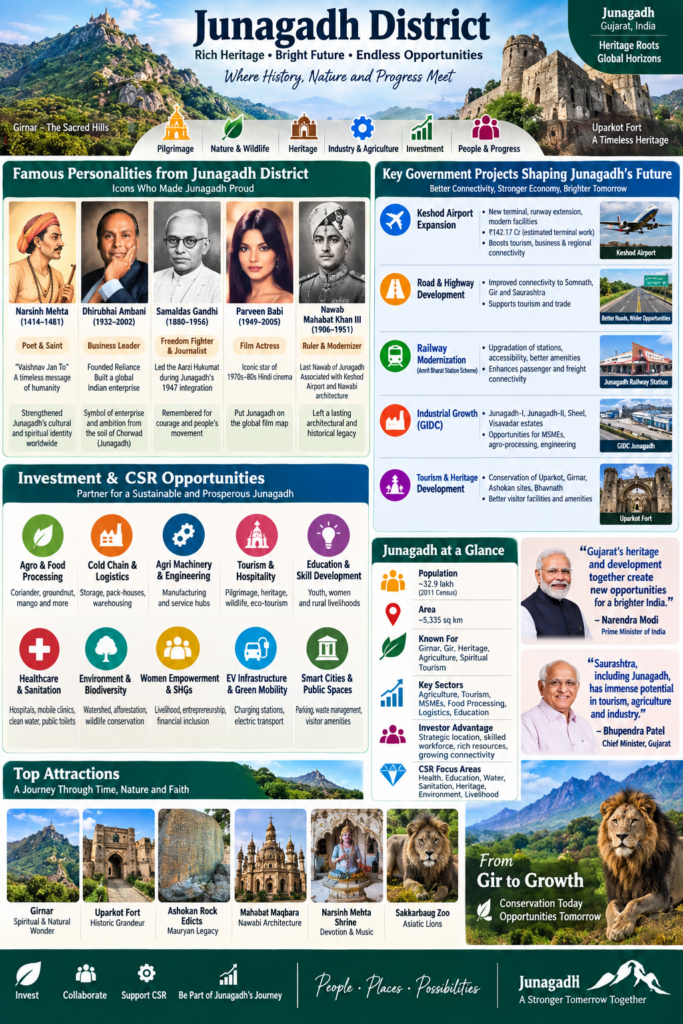
Junagadh District has three powerful development identities working at the same time: heritage and pilgrimage centred on Girnar and historic Junagadh city; agriculture and agro-industry built around crops, food processing and farm machinery; and connectivity infrastructure linking Keshod, Junagadh, Jetpur, Gir, Somnath and the wider Saurashtra economy.
For investors and CSR teams, the most important distinction is between an officially sanctioned project, a commercially investible business opportunity, a PPP opportunity requiring government procurement, and a socially useful CSR concept that is not yet an approved government project. This guide keeps those categories separate and does not present speculative ideas as sanctioned schemes.
👤 Famous Personalities Who Raised the Name and Fame of Junagadh
| Name | Field | Junagadh Connection | Major Contribution | National / Global Recognition | Legacy | Cultural / Tourism / Economic Impact |
|---|---|---|---|---|---|---|
| Narsinh Mehta | Poetry, Bhakti, spirituality | Strongly associated with Junagadh; his shrine and devotional traditions remain part of the city’s cultural landscape | One of Gujarat’s most influential saint-poets; composed devotional poetry centred on Krishna and social compassion | His bhajan Vaishnav Jan To became nationally known through its association with Mahatma Gandhi | Foundational figure in Gujarati Bhakti literature | Strengthens Junagadh’s literary, devotional and heritage-tourism identity. Incredible India recognizes his Junagadh shrine. |
| Dhirubhai Ambani | Business and entrepreneurship | Born in Chorwad, historically associated with the Junagadh/Saurashtra region | Founded Reliance and helped transform Indian private-sector scale, capital-market participation and industrial ambition | Recognized as one of India’s most influential entrepreneurs | Symbol of enterprise, risk-taking and business aspiration | Gives the Junagadh–Chorwad region a globally recognizable entrepreneurial story; useful for enterprise and business-tourism narratives. Reliance confirms his Chorwad birth and founding role. |
| Samaldas Gandhi | Journalism, politics, freedom-era public life | Headed the Aarzi Hukumat connected with the 1947 Junagadh accession struggle | Led the provisional government opposing the Nawab’s accession decision | Important figure in the political integration history of Junagadh | Part of Junagadh’s modern political memory | Adds a major constitutional/political-history layer to heritage interpretation; should be presented with balanced historical sourcing. |
| Parveen Babi | Cinema | Born in Junagadh | Became one of the best-known Hindi film actresses of the 1970s–80s | Nationally recognized film personality | Remains strongly associated with a major era of Hindi cinema | Creates a film-history and celebrity connection for Junagadh; biographical claims should be sourced carefully. |
| Nawab Mahabat Khan III | Princely-state history | Last ruling Nawab of Junagadh before 1947 | Associated with the late princely-state period; Keshod Airport also traces its origins to the Nawabi era | Known in South Asian princely-state history | Architectural, administrative and political legacy remains visible | Nawabi architecture, state history and aviation heritage continue to influence Junagadh’s tourism narrative. AAI says Keshod Airport was built by the Nawab of Junagadh in the early 1930s. |
Junagadh’s strongest globally marketable personality narratives are therefore Narsinh Mehta for culture and spirituality, Dhirubhai Ambani for entrepreneurship, and its Nawabi/1947 figures for historical interpretation.
🏛️ Government Authorities & Development Projects Shaping Junagadh’s Future
📊 Verified Public Projects and Authorities
| Department / Authority | Role | Major Public, Transport, Tourism, Heritage, Industrial or Infrastructure Project | Location | Status | Latest Verifiable Update | Budget / Funding Source if Officially Available | Challenges | Expected Completion | Traveller / Business / Community Impact | Official Source |
|---|---|---|---|---|---|---|---|---|---|---|
| Airports Authority of India (AAI) | Airport development and operations | New Domestic Terminal Building, parking, ATC tower-cum-technical block, fire station, electrical substation, approach roads, airport systems and allied works | Keshod Airport | Procurement / development stage | AAI issued 2025 EPC tender and a fresh construction-supervision tender in Apr 2026 | EPC tender estimated cost ₹142.17 crore; supervision tender separately issued | Construction sequencing, aviation operations, statutory compliance, systems integration | Not responsibly stated until AAI publishes a firm completion milestone | Could improve regional air access, pilgrimage tourism, business mobility and investment attractiveness | AAI. |
| Airports Authority of India | Airside capacity and safety | Runway 05/23 extension and strengthening, taxiway, PTT, apron, isolation bay, perimeter road, drainage and boundary works | Keshod Airport | Development/procurement stage | AAI published project and PMC tenders | Main work estimated at ₹161.49 crore; PMC tender separately valued | Airside engineering, drainage, operational safety and phased construction | Verify latest AAI milestone before publication | Larger and more resilient airside infrastructure could support future aircraft operations and regional connectivity | AAI. |
| AAI / Ministry of Civil Aviation | Regional air connectivity | RCS-UDAN-linked commercial operations | Keshod | Operational | Commercial flights restarted on 17 April 2022 after infrastructure upgrades and DGCA licensing | Central aviation / AAI framework | Route viability and airline frequency | Operational; schedules remain dynamic | Improves access to Junagadh, Girnar, Gir and Somnath region | AAI. |
| Gujarat Industrial Development Corporation (GIDC) | Industrial-estate infrastructure | Junagadh-I, Junagadh-II, Sheel and Visavadar industrial-estate ecosystem | Junagadh District | Existing industrial infrastructure | GIDC published FY 2026–27 allotment prices; Junagadh-I ₹2,640/sq m, Junagadh-II ₹2,200, Sheel ₹870, Visavadar RIDC ₹200 | GIDC land-development/allotment framework | Land availability, utilities, sector suitability and estate saturation | Ongoing industrial-estate administration | Supports agro-processing, machinery, packaging, engineering, warehousing and MSME expansion | GIDC. |
| District Planning Office, Junagadh | Local development approvals, grant allocation and monitoring | District-level development under discretionary, ATVT, MLA and tourism/pilgrimage-related planning heads | District-wide | Continuous | Official page confirms approval, grant allocation, accounting and completion-certificate functions | Scheme-specific district/state allocations | Fragmented implementing agencies, technical sanction and project monitoring | Scheme-specific | Direct impact on local roads, civic amenities, pilgrimage and taluka development | District Planning Office. |
| Junagadh District Administration | District governance and coordination | Tourism, public utilities, emergency management and development coordination | District-wide | Continuous | District portal updated Aug 2026 | Department/scheme-specific | Multi-agency coordination, monsoon resilience, heritage conservation | Ongoing | Important for residents, visitors, businesses and project clearances | District Administration. |
| Western Railway / Ministry of Railways | Passenger and freight rail connectivity | Railway modernization under wider Amrit Bharat framework | Saurashtra rail network | Scheme active nationally and in Gujarat | Railway Ministry says ABSS is being implemented in phases with accessibility, multimodal integration, station amenities and OSOP kiosks | Railway budget / station-specific allocations | Operational continuity, land, utilities, passenger management | Station-specific | Potential to improve tourism and commerce where stations are selected and works sanctioned | Ministry of Railways. |
| Junagadh city / local urban authorities | Urban roads, sanitation, water, public spaces and municipal services | Routine municipal and urban-development works | Junagadh city | Ongoing, project-specific | No single current official mega-project list sufficient to responsibly quote budgets here | Municipal/state grants | Traffic, drainage, old-city constraints, heritage interface | Project-specific | Improves visitor experience and business environment | Verify through current municipal tenders/budgets before citing project details |
| Gujarat Tourism / District Administration | Tourism development and heritage promotion | Girnar, Uparkot, Ashokan heritage, Bhavnath and tourism facilities | Junagadh city/Girnar | Mix of completed and ongoing management | Official district portal actively promotes and manages heritage/tourism assets | State tourism / site-specific funds where sanctioned | Conservation vs footfall, visitor capacity, accessibility | Continuous | Increases tourism spending, guides, hospitality and local employment | District Tourism. |
🚇 Metro and BRTS Reality Check
There is no verified operational metro or BRTS system in Junagadh District, and I found no authoritative current source confirming a sanctioned Junagadh metro project. It would therefore be misleading to list “Junagadh Metro” as an investment opportunity.
For a city of Junagadh’s size, more realistic mobility opportunities are electric city buses, organized feeder services, station–bus stand integration, smart parking, EV charging, pedestrian heritage routes and accessible pilgrimage transport—but these should be described as opportunity concepts unless and until officially tendered.
🏭 Why Junagadh Is Investible
Junagadh’s strongest economic proposition is not mega-heavy industry. It is farm-to-market value addition.
The most defensible investment chain is:
agriculture → cleaning/grading → processing → packaging → cold chain → warehousing → logistics → domestic distribution/export.
💼 Investor, Corporate & CSR Opportunity Mapping
The following table deliberately distinguishes commercial investment, PPP, philanthropy/CSR, and government-grant possibilities. Unless a project is identified above as officially tendered or sanctioned, treat it as an opportunity concept requiring DPR, authority approval, land/title due diligence and procurement compliance.
| Project / Development Need | Sector | Location | Investment Potential | Suitable Investor / Corporate Profile | CSR Eligibility / Schedule VII Theme | CSR Funding Opportunity | PPP / Corporate Partnership Potential | Government Scheme / Institutional Funding Possibility | Expected Social / Economic / Employment / Tourism Impact | Beneficiary Group | Implementing Agency / NGO / Authority | Fund Utilisation & Management Framework | Governance / Due-Diligence / Monitoring / Audit Requirements | Risk Factors | Investor / CSR Value Proposition | Official Contact / Source |
|---|---|---|---|---|---|---|---|---|---|---|---|---|---|---|---|---|
| Agro-processing cluster | Food processing | GIDC / agricultural belt | High commercial | Food processors, FMCG, spice companies, edible-oil firms | CSR generally not applicable to core commercial plant | CSR may support farmer training/livelihood components separately | Possible common facilities if government structures PPP | PMFME/state industry/GIDC schemes subject to eligibility | Farmer realization, jobs, value addition, tax base | Farmers, MSMEs, youth | GIDC / DIC / eligible private SPV | Separate commercial CAPEX from any CSR-funded community component | Land, FSSAI, pollution control, utilities, off-take, audited accounts | Commodity volatility, water, power, procurement cycles | Close to raw material; scalable B2B market | GIDC / DIC |
| Coriander cleaning, grading, grinding and branding | ODOP / food | Junagadh | High | Spice companies, exporters, FPOs | Livelihood enhancement/skills may qualify | Training, women SHGs, farmer capacity | Commercial JV/FPO partnership | PMFME and food-processing support subject to current rules | Higher local value capture and brand identity | Farmers, SHGs, small processors | FPO / eligible CSR agency / processors | Ring-fenced CSR funds for training, not commercial inventory | Procurement policy, food safety, traceability, outcome metrics | Price volatility, quality variation | Strong local ODOP story and export potential | District/DIC/PMFME channels |
| Cold chain and pack-house network | Logistics / horticulture | Farm belts / Keshod–Junagadh corridor | High | Cold-chain operators, 3PLs, agri-logistics firms | CSR only if structured as community livelihood/public-benefit component | Farmer training, smallholder access subsidy may qualify | Strong PPP possibility where government assets/schemes exist | MoFPI/NHB/state programs subject to live eligibility | Reduced post-harvest loss, better prices, jobs | Farmers, traders, retailers | Private SPV / FPO / government agency | Commercial asset ring-fenced from CSR-funded beneficiary support | Utilization audit, energy efficiency, tariff transparency | Low utilization, power cost, seasonality | Revenue-generating infrastructure with rural impact | DIC/GIDC/agriculture agencies |
| Agricultural machinery and service centres | Engineering/agri-tech | GIDC / rural talukas | High | Machinery OEMs, farm-tech startups | Skill/livelihood themes possible | Training centres, youth skills | Corporate dealer/service partnerships | MSME/agri mechanisation schemes | Mechanisation, repair jobs, productivity | Farmers, mechanics, youth | Private firms / JAU / skill partners | CSR supports training; commercial sales separate | Certification, placement tracking, conflict-of-interest controls | Low adoption, financing constraints | Local manufacturing/service demand | JAU/GIDC/DIC |
| JAU-linked agri innovation and incubation | Education / startup | Junagadh | Medium–High | Agri-tech firms, foundations, VCs | Education, skill development; qualifying research/incubator support depending structure | Labs, entrepreneurship, student innovation | Corporate-academic partnership | Academic/incubator schemes | Startup pipeline, patents, local jobs | Students, founders, farmers | JAU / eligible Section 8 or statutory entity | Milestone-based grants and research agreements | IP policy, conflict management, impact reporting | Commercialization risk | Talent + local agri problem statements | JAU |
| Heritage conservation and interpretation | Tourism / culture | Uparkot, old city, heritage precincts | Medium economic; strong CSR | Hospitality groups, banks, foundations | Yes: protection of national heritage, art and culture | Conservation, interpretation, signage, public libraries where approved | Adopt-a-heritage style partnerships only under authorized frameworks | Tourism/culture grants | Longer stays, jobs, heritage preservation | Residents, tourists, guides | Government heritage/tourism authority + eligible CSR agency | Conservation plan, approved BOQ, no unauthorized branding | ASI/state permissions, conservation architect, third-party audit | Over-commercialization, damage, permissions | High visibility + cultural legacy | District/Gujarat Tourism; Schedule VII basis. |
| Girnar pilgrim accessibility | Tourism / accessibility | Girnar Taleti/Bhavnath | Medium | Mobility firms, foundations, hospitality companies | Education/health/disability support may qualify depending project | Wheelchairs, accessible toilets, rest areas, assistive information | PPP for visitor services if officially procured | Tourism/social-justice schemes | Inclusive pilgrimage and senior tourism | Seniors, Divyangjan, families | Tourism/local authority + eligible agency | Needs assessment, accessibility audit, O&M funding | Universal-design compliance, user testing, asset register | Crowd pressure, difficult terrain | High social impact and visible inclusion | District Planning / Tourism |
| Public toilets, drinking water and sanitation at tourism nodes | Sanitation | Girnar, bus/rail/heritage nodes | Medium service PPP | FMCG, banks, infrastructure firms | Yes: sanitation and safe drinking water | Strong | O&M concession/CSR hybrid possible if legally structured | SBM/tourism/local grants | Public health, tourist satisfaction | Residents and visitors | Municipality/tourism/eligible CSR agency | Separate CAPEX/O&M budgets, uptime KPIs | Water quality tests, cleanliness audits, grievance system | Poor O&M after launch | Tangible, measurable CSR outcomes | MCA Schedule VII. |
| Highway trauma and first-response support | Healthcare / road safety | NH corridors | Medium social | Auto, logistics, insurance, healthcare companies | Yes: healthcare; MCA has clarified highway trauma care can qualify | Ambulance/trauma equipment/training | Partnership with health/highway authority | Health/NHAI/state support | Faster emergency response, lives saved | Motorists, truckers, tourists | Health dept / eligible agency / authority | GIS-based deployment, SLA, medical protocols | Response-time data, independent audit, no duplicate funding | Recurrent O&M cost | High-impact measurable road-safety CSR | MCA clarification. |
| Rural drinking-water resilience | Water | Water-stressed villages | High social | Utilities, FMCG, manufacturing, foundations | Yes: safe drinking water | Strong | Limited commercial; O&M partnerships possible | Jal Jeevan/state schemes subject to live status | Health and time savings | Rural households | Gram panchayat / water authority / eligible agency | Source sustainability + O&M reserve | Water-quality testing, community committee, asset audit | Groundwater stress | Clear SDG/CSR outcomes | MCA Schedule VII |
| Watershed, biodiversity and agro-forestry | Environment | Girnar/Gir-fringe and rural zones | Medium–High social | ESG-focused corporates, foundations | Yes: environmental sustainability, flora/fauna, natural resources, agro-forestry | Strong | Limited commercial; carbon/ecosystem partnerships require care | Forest/watershed schemes | Water retention, soil, biodiversity, farm resilience | Farmers, communities, wildlife landscapes | Forest/rural authority + eligible agency | GIS baseline, survival-based payments | Biodiversity assessment, survival audit, land rights | Monsoon variability, survival rates | Strong ESG narrative with measurable ecology | MCA Schedule VII. |
| Women SHG food-processing and retail | Women/livelihood | Rural and urban Junagadh | Medium | FMCG, banks, retail companies | Yes: gender equality, women empowerment, livelihood | Strong | Procurement/offtake partnerships | NRLM/PMFME and state livelihood schemes | Income generation and enterprise ownership | Women SHGs | NRLM-linked federation / eligible agency | Revolving capital must be legally structured; CSR use tracked | Beneficiary selection, sales data, bank linkage audit | Market saturation, quality consistency | Inclusive supply-chain development | MCA Schedule VII |
| Youth logistics and technical-skills academy | Skill development | Junagadh/GIDC | Medium–High | Logistics, auto, warehouse, EV firms | Yes: employment-enhancing vocational skills | Strong | Corporate academy/placement partnership | Skill India/state skill schemes | Drivers, technicians, warehouse operators, EV technicians | Youth | Skill provider / eligible CSR agency | Cost-per-trainee and placement-linked milestones | Attendance, certification, 3/6/12-month placement tracking | Low placement quality | Direct workforce pipeline | MCA Schedule VII |
| EV charging network | Mobility / energy | Junagadh–Keshod–Girnar corridors | High commercial | Charge-point operators, oil marketing companies, hotels | Normally commercial investment, not CSR | CSR only for specific public-benefit pilots if legally justified | PPP/site-host models | EV policy/state incentives if open | Cleaner mobility and tourism confidence | EV users, businesses | Private CPO + land/site owner | Commercial concession/PPA structure | Utilization, power connection, safety, uptime | Low utilization initially | First-mover network effects | State EV/utility authorities |
| Accessible electric tourist shuttle | Public transport | Heritage/Girnar zones | Medium | EV bus/OEM/mobility operators | CSR may fund accessibility/public-benefit elements; core operations need legal structure | Potential | Strong if authority tenders concession | Urban/tourism/e-mobility programs | Reduces congestion and improves access | Tourists, seniors, residents | Municipality/tourism authority | Fare policy + operating subsidy/CSR separation | Route study, ridership KPIs, accessibility and battery audits | Low ridership, O&M | Tourism + ESG + public mobility | Requires official procurement |
| Smart parking and visitor management | Urban tech | Old city/Girnar/transport hubs | Medium commercial | Parking-tech, ITS, infrastructure operators | Normally not CSR if revenue-generating core business | Small public-safety/accessible components only | Strong PPP potential | Urban local-body funding | Congestion relief, visitor convenience | Drivers, residents, businesses | Municipality | Concession fee/revenue-share | Procurement, tariff disclosure, data privacy | Public resistance, land constraints | Predictable user-fee model | Municipal authority |
| Affordable tourist information and multilingual digital interpretation | Tourism/education | District-wide | Medium | Travel-tech, telecom, media firms | Education/culture may qualify where non-commercial public-benefit | Strong for open-access content | Corporate content partnership possible | Tourism/culture grants | Better visitor understanding, longer stays | Tourists, students, pilgrims | Tourism authority / eligible nonprofit | Open-content licensing and maintenance plan | Accuracy review, accessibility, no hidden advertising | Content becoming outdated | High Discoverability and cultural outreach | District/Gujarat Tourism |
| Public libraries / digital heritage archive | Education/culture | Junagadh city | Medium social | Foundations, publishers, tech companies | Explicitly covered under heritage/art/culture; public libraries | Strong | University/archive partnerships | Culture/education grants | Research access, tourism content quality, preservation | Students, historians, creators | Library/university/eligible agency | Digitisation standards, metadata, preservation plan | Copyright, archival rights, cybersecurity | Rights clearance | Long-term knowledge infrastructure | MCA Schedule VII. |
| Rural sports infrastructure | Youth/sports | Talukas/villages | Medium social | Sports brands, PSUs, foundations | Schedule VII covers training to promote rural, national, Paralympic and Olympic sports | Strong | Academy partnerships | Khelo India/state sports schemes | Youth health and talent development | Students/youth | Sports authority / eligible agency | Coach, equipment and maintenance budget | Participation, gender inclusion, achievement tracking | Facility underuse | Youth engagement + measurable impact | MCA Schedule VII |
| Healthcare screening and preventive care | Health | Rural/underserved pockets | High social | Hospitals, pharma, diagnostics, insurers | Yes: preventive healthcare | Strong | Mobile clinic/telemedicine partnership | NHM/state health programs | Early diagnosis, reduced treatment burden | Rural families, women, seniors | Health dept / eligible agency | Referral-linked model, not one-off camps only | Clinical protocols, consent, outcome tracking | Follow-up failure | High measurable health impact | MCA Schedule VII |
| Tourism waste management | Environment/sanitation | Girnar/Bhavnath/heritage sites | Medium | Waste-management firms, FMCG, hospitality | Sanitation/environment themes | Strong | O&M or recycling partnership | SBM/local-body/tourism funding | Cleaner destinations, recycling jobs | Tourists, vendors, residents | Municipality/tourism/eligible agency | Segregation contracts, material-recovery tracking | Weighment, disposal audit, worker safety | Behaviour change | Visible tourism + ESG benefit | Local authority |
| Rural roads/bridges | Infrastructure | Villages | High public need, but project-specific | EPC/infrastructure investors | Routine government infrastructure is not automatically CSR | Limited unless a legally eligible Schedule VII public-benefit component is clearly established | EPC/PPP only where government tenders it | PMGSY/state roads schemes | Access to markets, schools, health | Rural population | Roads authority | Government contract/grant framework | DPR, tender, quality audit | Land, monsoon, cost escalation | Public-development impact | Roads department |
| Metro / BRTS | Mass transit | Junagadh | No verified sanctioned project | — | — | — | — | — | — | — | — | Do not solicit investment until government sanctions and tenders a project | Speculation risk | Not an investible project at present | No verified official sanction found |
⚖️ Commercial Investment vs PPP vs CSR vs Philanthropy
| Funding Type | What It Means | Can It Earn Commercial Return? | Typical Junagadh Example |
|---|---|---|---|
| Commercial investment | Private capital invested in a revenue-generating business | Yes | Cold storage, food-processing plant, hotel, EV charging |
| PPP | Private partner works with government under tender/concession/contract | Yes, according to contract | Parking, visitor shuttle, tourism facility, infrastructure O&M |
| CSR | Eligible company expenditure under Section 135 and Schedule VII rules | Not designed as ordinary commercial business expenditure | Skills, sanitation, healthcare, heritage conservation, women empowerment |
| Philanthropy | Voluntary donation/grant outside mandatory CSR framework | No commercial return expected | Scholarships, cultural archives, community welfare |
| Government grant | Public scheme funding subject to eligibility and approval | Not an equity return | Water, skills, food processing, rural development |
| Blended model | Separate public, private and CSR components under clear accounting | Depends on each component | Commercial cold chain + CSR farmer training |
🧾 CSR Governance & Due-Diligence Framework
| Stage | Minimum Good Practice |
|---|---|
| Need assessment | Baseline data, beneficiary consultation, existing-government-scheme mapping |
| Legal eligibility | Schedule VII fit + CSR-1 + 12A/80G/eligible statutory status where applicable |
| Partner due diligence | Governance, audited accounts, board/trustees, litigation, sanctions, conflicts |
| DPR | Problem, location, beneficiaries, outputs, outcomes, budget, timeline |
| Funding agreement | Milestone releases, permitted expenditure, procurement, asset ownership |
| Procurement | Competitive/vendor due diligence where appropriate |
| Financial controls | Dedicated ledger/bank tracking, invoices, utilization certificates |
| Monitoring | Monthly/quarterly dashboard with physical + financial progress |
| Outcome measurement | Jobs placed, water quality, tourist usage, hospital outcomes, heritage condition etc. |
| Independent audit | Financial + programmatic/technical audit depending project size |
| Impact assessment | Apply MCA requirements where legally triggered; otherwise voluntary independent evaluation is still good practice |
| Disclosure | Board/CSR reports and public project summary where appropriate |
| Exit/O&M | Maintenance funding and responsible asset handover |
🌐 Global and Domestic Investor Attraction Themes
For domestic and global investors, Junagadh is strongest when pitched around specific economic ecosystems rather than generic “invest in Junagadh” messaging.
📈 Highest-Potential Themes
| Theme | Investor Story |
|---|---|
| Agri & food processing | Source crops locally, process locally, distribute nationally |
| Cold chain | Reduce post-harvest loss while building recurring logistics revenue |
| Farm machinery | Manufacture/service close to a large agricultural customer base |
| Hospitality & pilgrimage tourism | Girnar + heritage + wider Gir/Somnath circuit creates multi-segment demand |
| Keshod aviation ecosystem | Airport expansion may improve regional business and visitor access |
| Warehousing and logistics | Connect Junagadh agriculture/MSMEs with Rajkot, ports and western India |
| EV mobility | Tourist and intercity corridors can support charging and fleet transition |
| Digital tourism | Multilingual heritage interpretation, booking and visitor-management technology |
| Education/agri-tech | JAU offers research and talent linkages |
| ESG/CSR | Heritage, water, sanitation, health, skills, women and environment align strongly with Schedule VII |
📞 Official Starting Points for Investors and CSR Teams
| Requirement | Official Starting Point |
|---|---|
| Industrial land/estate information | GIDC |
| District-level development coordination | District Planning Office, Junagadh |
| Airport projects/tenders | Airports Authority of India – Keshod Airport |
| Tourism/heritage projects | Junagadh District Administration / Gujarat Tourism |
| Agriculture/research partnership | Junagadh Agricultural University |
| CSR law/implementing-agency compliance | Ministry of Corporate Affairs / MCA21 |
| Local NGOs listed by district | District Administration currently lists organizations including Jagruti Charitable Trust and Kasturba Sarvajanik Shikshan Mandal; listing alone does not establish CSR eligibility. |
| District grants/planning | District Planning Office, Jilla Seva Sadan; official page provides phone/email contact. |
⭐ Investor & CSR Takeaway
Junagadh’s future development story is strongest where heritage, agriculture, tourism and connectivity meet.
For commercial investors, the clearest opportunities are agro-processing, machinery, cold chain, warehousing, hospitality, logistics and EV infrastructure.
That is how Junagadh can be promoted responsibly to corporates and institutions: not by promising imaginary mega-projects, but by connecting real infrastructure, local economic strengths and carefully structured social-impact opportunities with transparent governance.
We and Junagadh
The sodium-vapour streetlights of Junagadh were still burning when I parked our survey vehicle beside GIDC-II and opened the route book across the bonnet.
The cargo existed only on paper that morning: a fabricated process module for an agro-processing plant, approximately 31 metres long, 5.4 metres wide and 5.1 metres high on a hydraulic modular trailer. Its final dimensions, axle load and gross combination weight would still require approval from the transporter, vehicle engineer and competent road authorities before movement. But my job had already begun. Before steel could move, every metre of road had to be questioned.
Junagadh-I and Junagadh-II are real GIDC industrial estates, and GIDC continues to list both in its current industrial-estate system.
I wrote one sentence at the top of the survey sheet:
“A road that looks wide enough from a car can become impossibly narrow when the cargo cannot bend.”
🚛 05:45 — The Factory Gate Was Our First Obstacle
The client expected the difficult part to be the highway.
It was not.
The first problem was the factory gate.
A normal truck entered through it every day, but our swept-path sketch showed the rear hydraulic lines of the modular trailer passing dangerously close to the boundary wall during the first turn.
“Sir, trailer toh nikal jayega,” the factory supervisor said confidently.
I asked him to stand where the rear corner of the cargo would swing.
He moved two steps backward.
Then another two.
That small demonstration changed the meeting.
We measured the gate diagonally, checked the compound-road width, wall setback, overhead cable, drainage edge and available space for trailer steering. My colleague Mehul walked the turning radius with a measuring wheel while I marked reference points with chalk.
The solution was not demolition. We redesigned the departure manoeuvre: reverse positioning inside the factory, temporary removal of one gate leaf, a steel plate over the shallow drain and a pre-positioned spotter at the blind corner.
Heavy-haul engineering is often like this. The best solution is rarely the biggest one. It is the one that removes the risk with the least disturbance.
🛣️ 07:10 — We Turned Toward NH-151
Our proposed route aimed toward the Junagadh–Vanthali corridor and NH-151, the important highway connection linking Junagadh with the wider Saurashtra road network.
For a conventional vehicle, it was an ordinary highway.
For us, every object became an engineering coordinate.
The median opening.
The radius of a junction.
A tree branch projecting over the carriageway.
A signboard support.
A transformer pole.
A raised traffic island.
A culvert parapet.
A bus shelter sitting exactly where a trailer might need additional swing.
We stopped repeatedly.
I measured vertical clearances with a laser meter and cross-checked doubtful points manually. Our surveyor photographed each obstruction with GPS reference and direction of travel.
At one junction near the city edge, a tea seller watched us circle the same road three times.
“You are lost?” he asked.
“No,” I said. “We are trying to find out whether something longer than this shop can turn here.”
He laughed, then pointed toward a narrower road.
“Big truck mat le jana udhar. Tractor bhi jam hota hai.”
That sentence was not engineering evidence.
But it was excellent local intelligence.
We inspected the road he mentioned anyway. Within seven minutes, we found a sharp village-side bend with an open drain on one side and a utility pole on the other.
The shortcut disappeared from our route book.
🌉 09:05 — The Bridge That Looked Perfect
The next structure looked reassuring from the approach.
Straight alignment.
Reasonable width.
Strong-looking parapets.
Good pavement.
This is exactly the kind of bridge that can tempt an inexperienced team into writing “OK” too quickly.
We did not.
We stopped before the structure and recorded the bridge identification available at site, carriageway width, shoulder condition, approach gradient and visible distress. Then I photographed bearings, deck edges and approach settlement from safe accessible positions.
A route survey does not certify structural load capacity by appearance.
For an actual heavy ODC movement, bridge capacity has to be checked against vehicle configuration, axle loads, load distribution and the competent road/bridge authority’s records or structural assessment.
So I wrote:
“Geometrically suitable. Structural acceptance pending.”
Those four words can prevent a very expensive mistake.
The younger engineer with me asked, “Why don’t we just write bridge OK after getting permission?”
“Because permission and engineering are two different questions,” I told him. “One asks whether we may move. The other asks whether we can move safely.”
🏘️ 10:40 — A Village Became the Most Important Part of the Survey
Beyond the wider highway section, our proposed diversion entered an agricultural belt.
Cotton, groundnut fields and small roadside workshops replaced city traffic.
The carriageway narrowed.
There were no dramatic mountains, no famous monument and nothing that would attract a tourist photograph.
Yet this was the most sensitive part of the entire route.
Two houses stood close to the road. A small temple platform projected slightly toward the shoulder. Several motorcycles were parked outside a welding shop. A neem tree shaded the bend.
According to the drawing, the trailer could pass.
According to real life, it could not pass without coordination.
We met the shop owner and explained that on movement night his parked motorcycles would have to be relocated for perhaps twenty minutes.
He looked suspiciously at us.
Then our driver opened the trailer steering diagram and showed him the rear swing.
His expression changed.
“How much time?”
“Only during passage. We will inform you beforehand.”
“Then call me. Don’t move anything without asking.”
That became a note in the route plan:
Local stakeholder coordination mandatory before passage.
The road belonged to everyone long before our cargo arrived.
⚡ 12:15 — The Wire We Almost Missed
Midday light can make overhead cables difficult to judge.
At one crossing, the first visual inspection suggested adequate clearance. But when we measured from the highest projected cargo elevation, the safety margin looked too small.
The wire was not something our team could simply lift.
There are electricity-distribution permissions, shutdown procedures, qualified personnel and safety distances to consider. An ODC crew should never treat live electrical infrastructure as a roadside inconvenience.
I marked the crossing in red:
Utility verification required. No movement until written coordination and safe clearance procedure are confirmed.
One of the escorts asked whether we could reduce trailer height.
Possibly.
With hydraulic suspension, deck height can sometimes be adjusted within engineering limits.
That gave us a better option.
Instead of immediately proposing wire modification, we calculated whether a controlled trailer-height reduction at the crossing could provide adequate clearance while still maintaining ground clearance over the road crown.
This was precisely why the survey team included both route people and trailer people.
One sees the obstacle.
The other changes the machine.
🌧️ 14:30 — The Dry Culvert That Frightened Me More Than the Bridge
We reached a low agricultural drainage crossing in the afternoon.
There was almost no water.
A local farmer stood nearby with two cattle.
I asked him what happened here during heavy monsoon rain.
He pointed nearly halfway up a roadside embankment.
“Paani yahan tak.”
That changed everything.
A dry route survey is only a photograph of one day.
Junagadh and Saurashtra can experience intense monsoon conditions, and our earlier highway research had already shown how heavy rain can disrupt regional roads. For a project scheduled in the wet season, drainage crossings, low approaches and temporary diversions need weather-based go/no-go criteria.
We measured the approach and photographed erosion on the shoulder.
Then I added a movement restriction:
No passage during heavy-rain alert or standing/flowing water. Day-of-movement inspection mandatory.
The farmer watched me write.
“Ab truck niklega?”
“Today? No.”
He smiled.
“Good. Today buffalo only.”
🏔️ 16:20 — Girnar Appeared Behind the City
When we turned back toward Junagadh, Girnar rose behind the city.
From the road, it looked completely separate from our industrial assignment.
It wasn’t.
Girnar and Bhavnath influence pilgrimage traffic, temporary road controls and visitor flows around Junagadh. A transport plan that ignores local religious events can fail even when every bridge and wire is technically perfect.
We checked the calendar for major pilgrimage periods and identified road sections where traffic coordination might become essential.
An ODC transporter thinks in dimensions.
A route engineer must also think in time.
A 5.4-metre-wide cargo can fit through an empty road at 2:00 a.m. and become impossible on the same road during a pilgrimage surge.
So another line entered the method statement:
Movement window subject to police/traffic authority approval and local event calendar.
🚧 17:45 — The Turn Nobody Had Put on the Map
The last major junction had been marked green in the desktop study.
Satellite imagery showed ample road width.
The ground survey showed something completely different.
Recent roadside development had changed the usable geometry. Temporary stalls, a concrete edge and a new sign support reduced the space.
I asked the pilot-car driver to trace the centreline slowly while we stood at the projected trailer-pivot points.
It failed.
The rear would climb the kerb.
Our first possible solution was temporary removal of street furniture, but that required authority permission.
Our second option was more elegant: approach from the opposite direction, use a wider downstream intersection, reverse the final segment under controlled closure and re-enter the route.
It added kilometres.
It reduced risk.
We chose the longer route.
In heavy haulage, the shortest road is often the most expensive road.
📋 19:10 — The Permission Table Covered the Hotel Room Floor
By night, our hotel room looked like an engineering control centre.
Laptop.
Maps.
Photographs.
Turning drawings.
Bridge notes.
Utility-crossing list.
Traffic-control points.
Village-contact sheet.
Emergency plan.
Possible holding areas.
We divided the proposed approvals into categories rather than pretending there was one universal “ODC permission.”
Depending on the final configuration and route, movement could require coordination with the competent National/State Highway road authority, local police/traffic authority, RTO/transport authorities, utility owners, GIDC or industrial-estate management, municipal/local bodies and bridge-owning authorities, among others.
Nothing would move merely because a transporter had promised the customer a date.
A project cargo schedule has to come after the route proves itself.
🛞 21:35 — Then We Found the Real Problem
I was reviewing the longitudinal profile when Mehul noticed something strange.
One railway-side approach did not look severe in photographs, but the levels showed a crest.
A low-bed trailer carrying a long rigid module can ground out even when the road looks perfectly driveable.
We modelled the trailer.
At nominal ride height, the underside clearance at the breakover point was unacceptable.
Nobody spoke for a moment.
If we abandoned the route, the alternative added a significant detour.
Then the trailer engineer pulled his notebook closer.
“What if we enter raised, cross the first break, lower the front axle group and steer slightly off centre?”
We modelled it again.
Better, but still too close for an operating margin.
Finally we designed a temporary engineered ramping arrangement using certified road plates and compacted transition material, subject to road-authority approval and a pre-movement trial with the empty trailer.
That was the moment the route became viable again.
Not because someone said “ho jayega.”
Because numbers said it could be engineered.
🌙 00:20 — The Empty Trailer Went First
Weeks later, after engineering reviews and required coordination, we returned for the controlled trial.
No cargo.
Only the modular trailer.
This is one of the most valuable tools in complicated heavy transport: let the vehicle prove the geometry before the expensive cargo arrives.
Pilot vehicle first.
Trailer second.
Survey team on critical corners.
Traffic marshals at conflict points.
Radio communication continuously open.
At the difficult crest, we stopped.
The hydraulic operator adjusted suspension according to the approved sequence.
The trailer moved centimetre by centimetre.
Clear.
At the village bend, the welding-shop owner had already moved his motorcycles.
He stood outside holding tea for our crew.
“Your long truck coming today?”
“Trial only.”
He looked disappointed.
🚚 02:48 — The Night Junagadh Became a Moving Drawing
The actual cargo movement came several days later.
I stood at the first critical junction with a radio in one hand and the route drawing folded inside my reflective jacket.
The convoy emerged slowly from the industrial area.
Pilot car.
Traffic marshal.
Prime mover.
Hydraulic modular trailer.
The process module seemed enormous under the road lights.
What had been coloured lines on my laptop was now steel moving through a living city.
“Rear clear?”
“Rear clear.”
“Overhead clearance?”
“Confirmed.”
“Hold civilian traffic.”
“Held.”
“Trailer steering seven degrees left.”
“Seven left.”
At every obstacle, the convoy recreated the calculations we had made weeks earlier.
There was no dramatic racing.
No shouting.
No heroic shortcut.
Heavy haulage at its best is almost boring.
That is the achievement.
🌄 04:56 — We Stopped Before Sunrise
Near the final holding point, the horizon behind Junagadh had begun to lighten.
Girnar was only a dark outline.
The driver switched off the engine.
For several seconds, the convoy became completely silent.
The factory engineer shook my hand.
“Cargo reached.”
I looked at the trailer and said, “Not yet.”
He looked confused.
We still had to complete final positioning, check site entry, release road-control points, confirm that temporary protection works were removed safely, close utility coordination and document any roadside damage.
A route survey is not finished when the cargo passes you.
It is finished when the road is returned responsibly.
🌅 06:12 — What Junagadh Taught Me
On the drive back, I passed the same tea stall where the man had once asked whether we were lost.
This time he recognized our vehicle.
“Big truck gone?”
“Yes.”
“Any problem?”
I thought about the gate that almost trapped us.
The bridge that required more than a visual judgment.
The farmer who told us where monsoon water really reached.
The electrical crossing.
The village motorcycles.
The invisible road crest.
The police coordination.
The hydraulic calculations.
The empty-trailer trial.
Then I gave him the only answer that made sense.
“No problem.”
He nodded casually and went back to making tea.
He could not know that those two words represented weeks of measurement, permissions, modelling, teamwork and doubt.
And perhaps that is the real beauty of an ODC road route survey.
When everyone has done their job properly, the public sees only a strange oversized load moving quietly through the night.
They never see the hundreds of problems that were solved before the engine was started.
As Girnar disappeared in my rear-view mirror, I wrote the final line in that project’s survey diary:
“We did not conquer the road. We understood it well enough to ask its permission.”
🌄 Junagadh District Travel Guide Recap
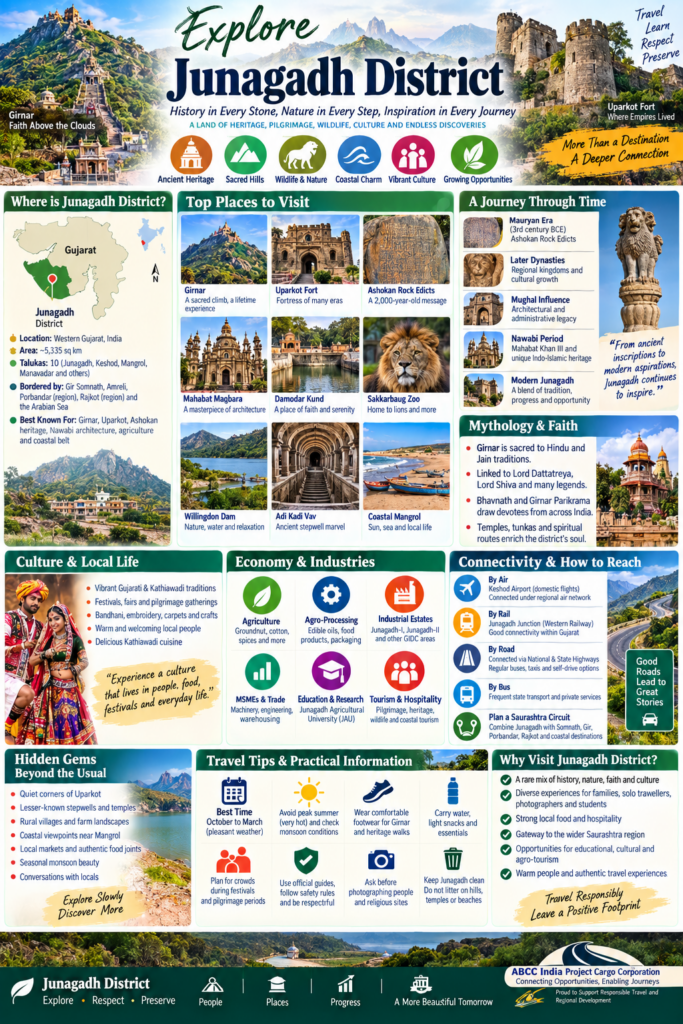
After travelling through the many layers of Junagadh District, one thing becomes clear: this is not a destination that can be understood through a single monument, temple or viewpoint. Junagadh is a meeting point of Girnar’s sacred landscape, ancient inscriptions, forts and stepwells, Nawabi architecture, pilgrimage traditions, Kathiawadi culture, agriculture, coastal communities and modern Saurashtra life.
Geographically, Junagadh lies in western Gujarat, where the landscape stretches from the Girnar hills and forest-influenced interior toward the Arabian Sea side of the district. The current district administration records 10 talukas, including Junagadh, Keshod, Mangrol and Manavadar.
For travellers, this variety means that a single district can offer a mountain pilgrimage, archaeological exploration, heritage photography, local-food experiences, rural landscapes and coastal journeys.
🏛️ More Than 2,000 Years of History in One Destination
Junagadh’s greatest strength is the extraordinary number of historical periods visible within a relatively compact travel landscape.
The Ashokan Rock Edicts near Girnar, dating to around the 3rd century BCE, provide direct evidence of the region’s Mauryan-era importance. Junagadh’s official heritage records also trace the region through subsequent dynasties, Mughal influence and the period of the Nawabs.
Then comes Uparkot Fort, where fortifications, rock-cut water systems, archaeological remains and centuries of occupation overlap. Within and around this heritage landscape, Adi Kadi Vav, Navghan Kuvo and Buddhist caves help visitors understand that Junagadh was not simply a royal city—it was also an engineering, religious and strategic centre.
The architectural story changes again at Mahabat Maqbara, where ornate 19th-century mausoleums reflect the city’s Nawabi chapter through Indo-Islamic architecture combined with European and Gothic influences.
This makes Junagadh particularly rewarding for travellers who prefer destinations where the past remains physically visible.
🛕 Girnar Gives Junagadh Its Spiritual Identity
If history gives Junagadh depth, Girnar gives it a soul.
Girnar is sacred to both Hindu and Jain traditions and remains associated with temples, ascetic traditions, pilgrimage and major gatherings including the Girnar Parikrama and the Mahashivratri period.
At its foothills, places such as Bhavnath and Damodar Kund extend that spiritual landscape beyond the mountain climb itself. Damodar Kund is regarded as sacred in Hindu tradition, while the wider Girnar landscape contains important Jain and Hindu pilgrimage sites.
Travellers should therefore approach Girnar differently from an ordinary hill attraction. It is simultaneously a natural landscape, strenuous mountain journey and active sacred space.
Respect religious customs, dress appropriately, avoid intrusive photography, keep noise under control and never leave waste along pilgrimage routes.
🌿 Beyond the Famous Places — Junagadh Rewards Slow Travellers
The most memorable Junagadh itinerary does not need to consist entirely of headline attractions.
Beyond Girnar, Uparkot and Mahabat Maqbara, travellers can explore Willingdon Dam, Sakkarbaug Zoological Garden, Adi Kadi Vav, Navghan Kuvo, Ashokan heritage, old-city streets, local markets, religious precincts and the lesser-observed architectural details scattered across Junagadh city. The district’s official tourism directory identifies many of these as significant places of interest.
Mangrol and other western parts of the present district add another dimension through the Arabian Sea coast, fishing economy and coastal landscape.
This distinction matters when researching Junagadh online. Older books and websites sometimes use the boundaries of the historical, larger Junagadh district. Modern travellers should check present administrative boundaries before assuming that every attraction historically labelled “Junagadh” remains inside today’s Junagadh District.
🦁 Understanding the Gir Connection Correctly
Junagadh is strongly associated with Gir and the Asiatic lion, and both the district administration and national tourism material present the city as an important gateway to the wider Gir tourism landscape.
However, travellers planning wildlife safaris should verify the actual safari gate, forest zone and current administrative district rather than assuming every Gir facility lies within Junagadh District.
That small geographical check prevents hotel, safari and transport-planning mistakes.
Wildlife tourism should also remain wildlife tourism—not wildlife chasing. Never pressure drivers or guides for unsafe encounters, feed animals, leave vehicles where prohibited or trust anyone promising a guaranteed lion sighting.
🎭 Culture Is Part of the Journey
Junagadh’s culture reflects the long interaction of Gujarati and Saurashtrian traditions, Hindu and Jain pilgrimage, Islamic/Nawabi heritage, folk practices, fairs, textiles, crafts and local food.
The district’s heritage documentation notes traditions associated with Bandhani, embroidery, carpets, beadwork and wood and marble craftsmanship.
Major religious gatherings give the destination a completely different personality. During pilgrimage periods around Girnar and Bhavnath, what may normally feel like a quiet heritage city can become an intense landscape of devotees, sadhus, temporary stalls, processions and community activity.
For cultural travellers, these periods can be extraordinary. For families, seniors and travellers seeking quiet sightseeing, they require more careful accommodation, traffic and crowd planning.
🍛 Junagadh Should Also Be Tasted
A Junagadh trip feels incomplete without exploring Kathiawadi and Gujarati food traditions.
Bajra rotla, ringan no olo, Gujarati/Kathiawadi thalis, dal, kadhi, khichdi, farsan, ganthiya, bhajiya and chaas provide an accessible introduction to the region’s everyday food culture.
The better experience is often not finding the most expensive restaurant, but eating where food is freshly prepared and understanding what locals actually order.
Visitors unfamiliar with spicy Kathiawadi food should ask for a milder preparation. During summer and long Girnar outings, hydration matters as much as sightseeing.
🌾 Agriculture & Industry Explain Modern Junagadh
Tourism is only one part of Junagadh’s economy.
The district’s wider economic identity is deeply linked to agriculture, agricultural trade, food processing, edible oils, spices, farm machinery, packaging, MSMEs, warehousing and road transport.
For a traveller interested in understanding how a destination actually functions, local markets and agricultural landscapes can be just as educational as monuments.
Junagadh also has established GIDC industrial areas, while Junagadh Agricultural University strengthens the region’s connection with agricultural education, research and innovation.
This gives Junagadh an interesting economic equation:
Farm → Market → Processing → Packaging → Warehousing → Transport → Consumer
It also explains why future opportunities around food processing, cold chain, agricultural machinery, logistics, skills and rural entrepreneurship deserve attention alongside tourism.
🚆 Junagadh Is Well Positioned for a Saurashtra Journey
Junagadh has useful road and rail connectivity. Official tourism information confirms that Junagadh is on the Western Railway network and is connected by National and State Highways, with state buses linking it to other Gujarat destinations.
For road travellers, the wider Saurashtra network makes Junagadh useful as part of a larger circuit.
A well-designed journey can combine Junagadh with destinations toward Rajkot, Porbandar, the wider Gir landscape, Somnath and other parts of coastal Saurashtra without pretending those places all belong to Junagadh District.
For first-time visitors, keep one distinction clear:
Junagadh District is the destination; Junagadh city is its principal urban and heritage centre; the wider Saurashtra circuit extends far beyond both.
🌦️ When Should You Visit Junagadh?
For general sightseeing, the national tourism portal recommends October to March, when conditions are typically more comfortable. Summers can become very hot, while monsoon rain can make hill paths slippery.
| Travel Goal | Better Period | Main Consideration |
|---|---|---|
| Heritage sightseeing | October–March | Comfortable walking weather |
| Girnar pilgrimage | Cooler months | Fitness and crowd planning |
| Photography | Winter / selected monsoon days | Weather and visibility |
| Green landscapes | Monsoon | Slippery paths and road disruption |
| Family holiday | October–February | Easier outdoor sightseeing |
| Senior travellers | Cooler, non-festival weekdays | Reduce heat and crowds |
| Cultural pilgrimage | Festival periods | Book early and expect congestion |
| Budget travel | Non-holiday weekdays | Often easier availability |
| Coastal exploration | Cooler, stable-weather days | Check marine/weather conditions |
🧭 Practical Lessons Before You Visit
A successful Junagadh trip depends more on preparation than expensive bookings.
Confirm hotel reservations directly, use official channels for major tickets, agree on taxi or auto fares before departure where meters/app fares are unavailable, and be cautious of unsolicited guides. Never share OTPs or UPI PINs, and never scan an unknown QR code because someone claims it is necessary to “receive” money.
For Girnar, carry water, wear suitable footwear and judge the climb according to your health rather than enthusiasm. Senior citizens and travellers with mobility limitations should investigate current accessibility and ropeway conditions before setting out.
During monsoon, check weather and local advisories before hill, rural or coastal journeys. During major religious gatherings, allow extra time for traffic, parking and queues.
Most importantly, do not treat ancient monuments, sacred water bodies, temples, Jain sites, shrines or wildlife landscapes merely as social-media backgrounds.
📌 Junagadh District at a Glance
| Travel Question | Quick Answer |
|---|---|
| What is Junagadh best known for? | Girnar, ancient history, pilgrimage, Uparkot, Ashokan heritage and Nawabi architecture |
| Best historical experiences? | Uparkot, Ashokan Rock Edicts, stepwells, caves and Mahabat Maqbara |
| Best spiritual experience? | Girnar–Bhavnath landscape |
| Good for families? | Yes, with sensible seasonal planning |
| Good for senior citizens? | Yes, but Girnar requires accessibility/fitness planning |
| Good for photographers? | Excellent for architecture, streets, pilgrimage and landscapes |
| Good for students? | Particularly strong for history, archaeology, religion, agriculture and geography |
| Main economic strengths? | Agriculture, agro-processing, MSMEs, machinery, trade and logistics |
| Best general season? | October–March |
| Rail access? | Junagadh Junction / Western Railway network |
| Road access? | Strong state and national-highway connectivity |
| Can it fit a longer Gujarat itinerary? | Yes—especially a wider Saurashtra circuit |
| Ideal travel style? | Slow, curious and culturally respectful |
🌟 Summary — Why Junagadh Deserves More Than a One-Day Stop
Junagadh is one of those destinations where geography, history and belief occupy the same landscape.
Girnar rises above a city carrying evidence of ancient empires. Ashoka’s words survive near a modern highway. Deep rock-cut wells remain inside an old fortress. Nawabi mausoleums stand amid the everyday movement of the city. Pilgrims, students, farmers, traders, tourists and industrial workers continue to use the same district for entirely different reasons.
That is Junagadh’s real attraction.
It can be a pilgrimage for one traveller, an archaeological classroom for another, a photography journey for a third, a family holiday for someone else and an agricultural or business study tour for another visitor.
Do not rush through it simply to tick off Girnar and continue onward.
Walk through Uparkot.
Study the Ashokan inscriptions.
Look closely at Mahabat Maqbara.
Listen to the stories surrounding Girnar.
Taste Kathiawadi food.
Watch how agricultural produce moves through the local economy.
Explore places beyond the most photographed landmarks.
And allow enough time to understand why Junagadh has remained important through radically different periods of Indian history.
🌅 The Road Continues Beyond the Guide
There is one final part of Junagadh that no travel article can completely document.
It is the quiet moment before sunrise at Girnar.
The conversation with a shopkeeper who tells you something that never appeared on Google Maps.
The craftsmanship hidden behind an old doorway.
The farmer working beside the highway.
The pilgrim who has climbed the mountain many times but still treats the next journey as special.
The old stone carrying a message written more than two millennia ago.
These are not simply “tourist attractions.” They are reminders that a destination belongs first to the people who live there.
That principle also guides the small transport perspective behind ABCC India Project Cargo Corporation. Roads across Junagadh and Saurashtra are more than lines between industrial sites: they connect farms with markets, factories with customers, villages with cities and travellers with places they may remember for the rest of their lives.
So when you finally visit Junagadh, travel slowly enough to notice what lies between the famous places.
Spend locally where possible. Respect religious traditions. Protect heritage. Keep the hills and roads clean. Follow wildlife rules. Ask before photographing people. Drive patiently. Leave ancient stones untouched.
Take photographs, but leave no scars.
Collect stories, but respect the people who own them.
Climb the mountain, but protect the path for the traveller who comes after you.
Junagadh does not need to be conquered in a weekend.
It needs to be understood.
🌄 Conclusion
Exploring the places to visit in Junagadh District is not simply about moving from one tourist attraction to another. It is a journey through different chapters of Gujarat—where ancient inscriptions, sacred mountains, medieval fortifications, Nawabi architecture, traditional markets, agricultural landscapes and coastal communities continue to exist alongside modern life.
From the spiritual heights of Girnar and the atmosphere of Bhavnath to the archaeological layers of Uparkot Fort, Adi Kadi Vav, Navghan Kuvo and the Ashokan Rock Edicts, Junagadh rewards travellers who are curious about more than photographs. Mahabat Maqbara adds another architectural chapter, while Damodar Kund, Willingdon Dam, Sakkarbaug Zoological Garden, old-city neighbourhoods and the Mangrol side of the district broaden the journey beyond the most familiar tourist circuit.
What makes Junagadh particularly valuable is its diversity. Families can combine heritage with nature; pilgrims can explore centuries-old sacred traditions; students can study archaeology, history, agriculture and geography; photographers can discover architecture and changing landscapes; solo travellers can experience everyday Saurashtra life; and food lovers can explore the flavours of Kathiawadi cuisine.
The district also deserves to be understood economically. Agriculture, agro-processing, food products, engineering, farm machinery, MSMEs, trade, warehousing and road transport support everyday livelihoods beyond tourism. Junagadh’s connections by road and rail also make it a practical base for exploring the wider Saurashtra region.
Travellers should remember, however, that the historical Junagadh region and today’s administrative Junagadh District are not identical. Famous destinations elsewhere in Saurashtra should not automatically be described as being inside the present district. Checking current boundaries, attraction timings, weather conditions and official travel information makes an itinerary more accurate and considerably easier to manage.
🌿 Travel Junagadh Responsibly
The best Junagadh journey is often the slower one.
Visit major landmarks, but also notice the old streets between them. Taste local food. Speak respectfully with residents. Support genuine local businesses and guides. Dress appropriately at religious places, ask before photographing people, follow wildlife regulations and avoid leaving plastic or other waste on Girnar, around heritage monuments or along the coast.
During summer, plan outdoor sightseeing around the cooler hours. During monsoon, check weather and road conditions before hill or rural journeys. During major pilgrimage periods, expect heavier crowds and temporary traffic arrangements. Seniors, children and travellers with mobility limitations should plan Girnar and other physically demanding experiences according to their individual abilities.
Responsible tourism does not mean seeing less. It often means understanding more.
🚛 A Small Connection Between Travel, Roads & ABCC India
Behind every successful journey—whether undertaken by a tourist, a local business or a large industrial project—is a dependable transport network.
ABCC India Project Cargo Corporation works in this less-visible side of connectivity as a road route survey, transport, logistics and project-cargo consulting company. Its work focuses on areas such as geographical route planning, industrial connectivity, ODC and heavy-haul transportation studies, logistics coordination and road-based movement planning across India.
For oversized industrial cargo in particular, understanding bridges, road geometry, overhead restrictions, highway conditions, turning space and route feasibility can be as important as the vehicle carrying the load. That engineering perspective also provides a useful reminder for ordinary travellers: roads are not merely routes on a map—they connect people, pilgrimage centres, farms, industries, markets and destinations.
Junagadh demonstrates that connection beautifully.
Come for Girnar, Uparkot and Junagadh’s celebrated monuments, but leave enough time for its lesser-known places, food, villages, landscapes and people.
Explore Junagadh with curiosity. Travel with patience. Respect its sacred places, protect its natural environment and preserve its heritage for the traveller who arrives after you.
Because the finest places to visit in Junagadh District are not simply places to see—they are places that help you understand the many layers of Gujarat.
❓ FAQs
⭐ What are the best places to visit in Junagadh District?
The best-known places include Girnar, Uparkot Fort, Mahabat Maqbara, Ashokan Rock Edicts, Damodar Kund, Bhavnath Mahadev, Sakkarbaug Zoological Garden, Willingdon Dam, Adi Kadi Vav and Navghan Kuvo. Travellers can combine heritage, pilgrimage, nature, photography and local food in one trip.
🚗 What are the best places to visit near Junagadh within 100 km for a one-day trip?
Depending on your starting point and route, day-trip possibilities include Girnar–Bhavnath, Uparkot and old Junagadh, Willingdon Dam, Vanthali, Keshod, Chorwad, Mangrol and parts of the wider Gir region. Some attractions outside present Junagadh District can also fall within roughly a 100-km driving radius, so check actual road distance before departure.
👨👩👧👦 Which are the best picnic places near Junagadh for families with children?
Families can consider Sakkarbaug Zoological Garden, Willingdon Dam, Uparkot Fort, Girnar Taleti, Damodar Kund and selected coastal or countryside outings. Choose attractions according to children’s ages, weather and walking ability rather than trying to cover too many places in one day.
🌿 What are some hidden and offbeat places to visit in Junagadh?
Beyond the headline attractions, explore less-crowded corners of Uparkot, old-city heritage streets, historic stepwells, smaller religious sites, rural landscapes, local markets and the Mangrol coastal side. Some of Junagadh’s best experiences come from slowing down rather than searching for a single “secret” attraction.
🌧️ Which places near Junagadh are best to visit during monsoon?
Girnar’s foothills, Willingdon Dam and the green countryside around Junagadh become especially scenic during the monsoon. Heavy rain can also make stone steps, hill paths and roads slippery or temporarily unsafe, so check current weather and local advisories before travelling.
🙏 Why is Girnar one of the most famous tourist places in Junagadh?
Girnar is both a major natural landmark and a sacred pilgrimage landscape associated with Hindu and Jain traditions. Travellers visit for temples, pilgrimage, mountain scenery, spiritual experiences and the challenging climb. Visitors should check current ropeway operations, weather and their physical fitness before ascending.
💑 Is Junagadh good for couples, friends and weekend trips?
Yes. Couples and friends can combine heritage photography, Girnar views, local food, old-city exploration, scenic drives and nearby nature experiences. Junagadh works particularly well for travellers who prefer history and authentic regional experiences over nightlife-focused tourism.
🧑💼 What are the best corporate outing and group-trip options near Junagadh?
Corporate groups can consider heritage walks, Girnar-area nature experiences, countryside excursions, resort-based activities and customized Saurashtra day trips. For large groups, pre-arrange buses, meals, parking, activity permissions and an alternative plan for extreme heat or heavy rain.
🚆 How many days are enough to explore Junagadh?
Allow 2–3 days for a comfortable first visit. One day can cover selected city attractions, while additional days allow time for Girnar, Bhavnath, heritage sites, local cuisine and nearby excursions. Travellers combining Junagadh with the wider Gir–Somnath–Saurashtra circuit should plan additional days.
📅 What is the best time to visit Junagadh District?
October to March is generally the most comfortable period for sightseeing, heritage walks and outdoor activities. Summer can be very hot, while monsoon brings greener scenery but also rain-related travel risks. Major pilgrimage festivals offer exceptional cultural experiences but can bring substantial crowds.


