Trailer Transport Service in India: Complete Guide to Industrial, Heavy Machinery and ODC Cargo Transportation
India’s industrial economy depends on the movement of machinery, raw materials, manufactured equipment, infrastructure components and oversized project cargo. From manufacturing plants in Gujarat and Maharashtra to steel facilities in Odisha and Jharkhand, specialized trailer trucks connect factories, ports, warehouses, construction sites and major industrial projects.
A trailer transport service in India is not simply a vehicle hired to move goods from one city to another. It is a logistics solution that combines the right trailer, suitable pulling vehicle, trained driver, loading arrangements, cargo securing methods, route planning, documentation and delivery coordination.
For an industrial customer, choosing the wrong trailer can create serious problems. A vehicle may arrive with insufficient loading space, unsuitable deck height, inadequate axle configuration or an inability to enter the loading premises. These problems can increase transportation costs and delay important projects.
A properly planned trailer transportation service helps avoid such difficulties.
ABCC India Project Cargo Corporation works in the field of industrial goods transportation, trailer sourcing and project cargo logistics coordination. This guide explains the different types of trailer trucks, their applications, advantages, limitations, transportation costs, regulatory requirements and practical considerations for selecting the right vehicle.
Whether you are a factory owner, machinery manufacturer, engineering contractor, EPC company, project manager, procurement executive or transport commission agent, this guide will help you understand trailer transportation in India.
What Is a Trailer Transport Service?

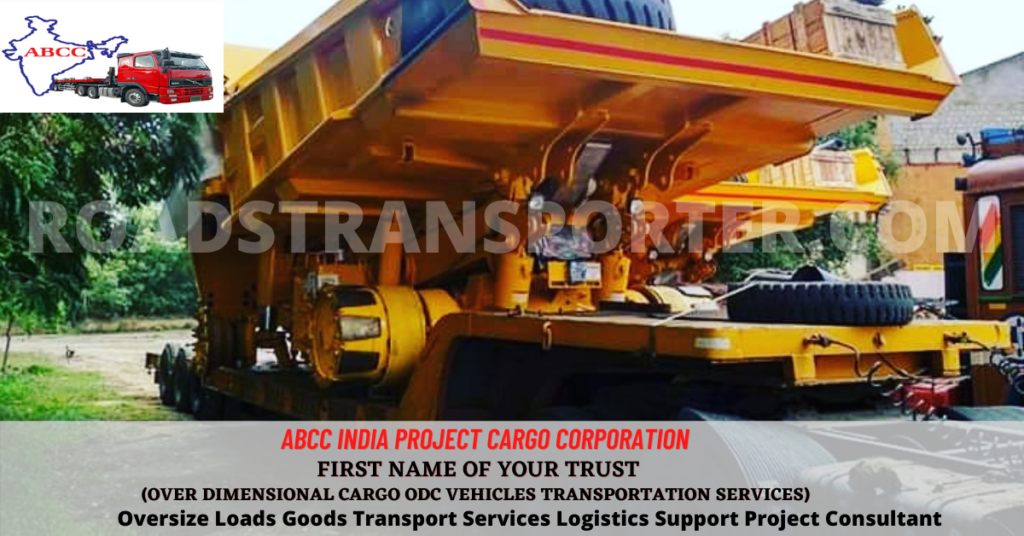
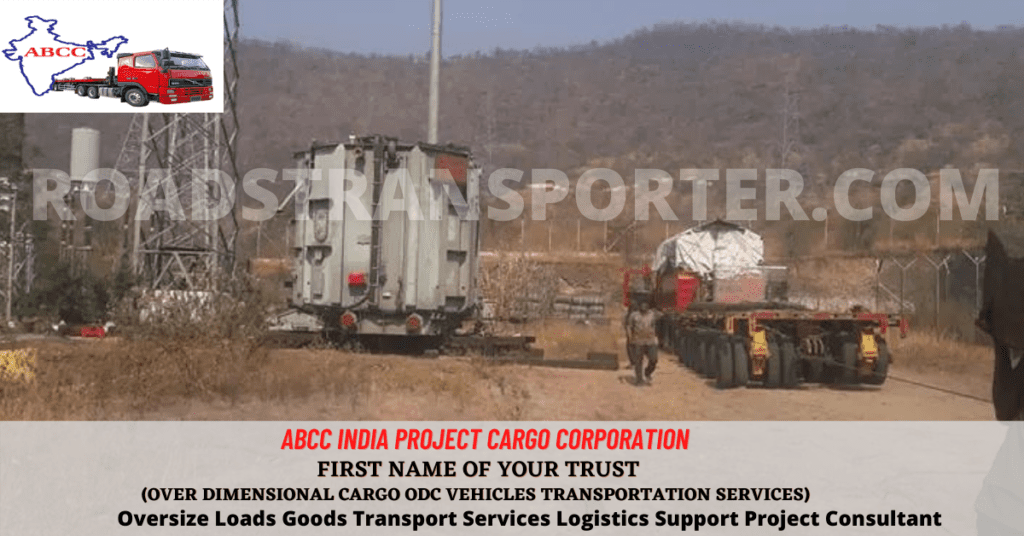
A trailer transport service involves moving cargo using a trailer unit that is pulled by a suitable road tractor or another approved towing arrangement.
Unlike a conventional rigid-body truck, a tractor-trailer combination separates the cargo-carrying unit from the powered vehicle. This arrangement provides flexibility in carrying long, heavy, bulky or specialized consignments.
Trailers are commonly used for:
- Industrial machinery and manufacturing equipment.
- Transformers, generators and power equipment.
- Steel plates, beams, pipes and structural components.
- Construction and earthmoving machinery.
- Heavy fabricated structures and engineering assemblies.
- ISO shipping containers and containerized cargo.
- Wind energy equipment and renewable-energy components.
- Boilers, pressure vessels and process plant machinery.
- Oversized, over-dimensional and overweight cargo.
- Prefabricated industrial and infrastructure components.
The most suitable trailer depends on the actual cargo dimensions, gross weight, center of gravity, loading method, delivery location and road conditions.
Why Trailer Transportation Matters to Indian Industry
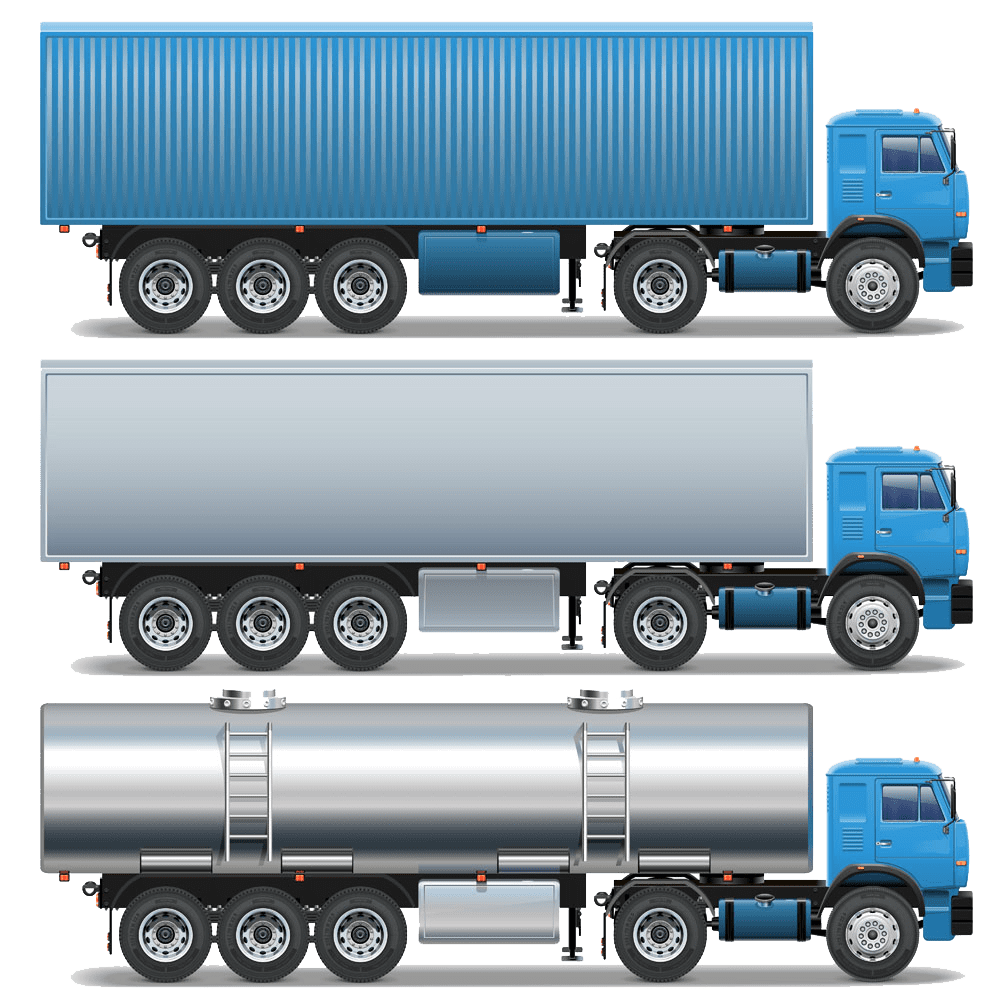
Trailer transportation supports the movement of industrial equipment that cannot be transported efficiently or safely on ordinary goods vehicles.
For example, a manufacturer may need to dispatch a large industrial machine from Pune to a customer in Odisha. The machine could be relatively compact but unusually heavy. In such a case, a lowbed or multi-axle trailer may be more appropriate than a long flatbed.
Another manufacturer may need to move a lightweight but extremely long fabricated structure. Here, deck length and load support may matter more than the total cargo weight.
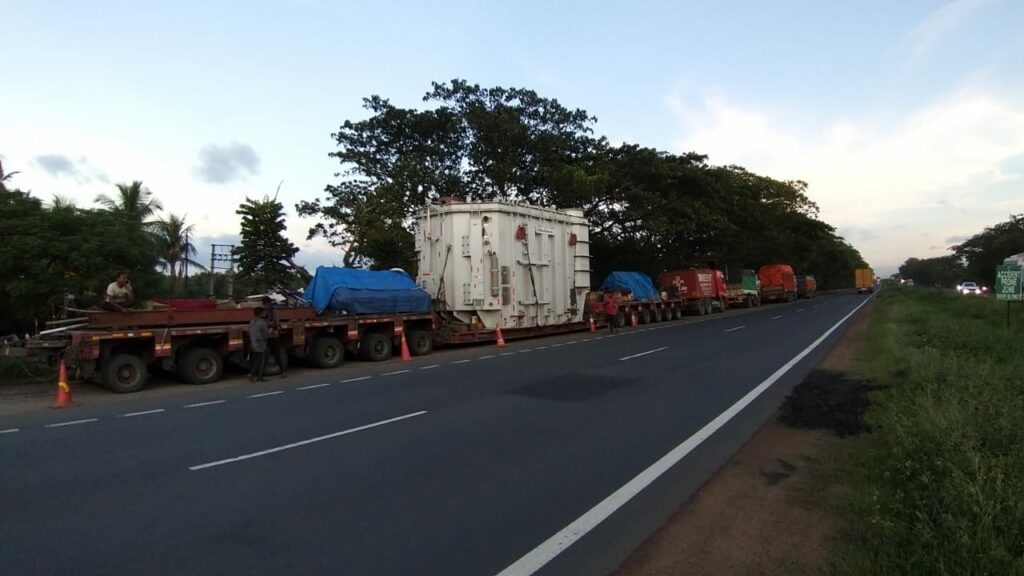
A project contractor transporting a transformer may face a different challenge altogether. The load could require specialized hydraulic equipment, engineering studies, bridge assessments and movement permissions.
These examples show why trailer selection should begin with the cargo rather than the availability of the cheapest vehicle.
Trailer Transport Booking Services Across India

Booking a trailer should be a structured process rather than a last-minute search for an available vehicle.
A customer should ideally share the complete cargo information before requesting a freight quotation.
Information Required to Book a Trailer Truck
| Information | Why It Matters |
|---|---|
| Loading location | Determines vehicle positioning and access |
| Delivery location | Determines route and destination accessibility |
| Cargo description | Identifies handling and securing requirements |
| Cargo weight | Helps establish load and axle requirements |
| Length, width and height | Determines trailer type and overall loaded dimensions |
| Number of packages | Helps plan loading arrangement |
| Center of gravity | Important for stability and heavy lifting |
| Loading equipment | Confirms crane, forklift or other arrangements |
| Unloading equipment | Prevents delays at destination |
| Required dispatch date | Supports vehicle scheduling |
| Cargo value | Relevant to insurance and risk assessment |
| Technical drawings | Essential for complex or oversized cargo |
| Special restrictions | Identifies site, road and permit issues |
For normal industrial cargo, the transport provider may be able to prepare a quotation using the cargo description, dimensions, weight and route.
For complicated heavy-lift or ODC cargo, additional engineering and route information may be required.
How to Book a Trailer Transport Service in India
- Share cargo details. Provide the exact loading and unloading locations, weight, dimensions, cargo photographs and dispatch requirements.
- Select a suitable trailer. Identify the vehicle configuration that can safely and legally carry the cargo.
- Evaluate the route. Check road restrictions, access roads, bridges, overhead obstructions and site conditions where relevant.
- Receive a written quotation. Confirm the freight amount, inclusions, exclusions, detention conditions and payment terms.
- Verify documentation. Confirm vehicle and driver documents, cargo paperwork and applicable permissions.
- Arrange loading and securing. Coordinate lifting equipment, competent personnel, dunnage and suitable cargo restraints.
- Dispatch and monitor. Record the vehicle details, loading completion, departure and expected delivery arrangements.
- Complete delivery. Inspect the cargo, document any exceptions and obtain proof of delivery.
Trailer Booking Checklist for Procurement Managers
Before approving a trailer booking, procurement teams should confirm whether the quotation includes tolls, applicable taxes, positioning charges, permits, escort vehicles, detention, loading and unloading support, route surveys and other special expenses.
A low initial freight quotation does not always represent the lowest total project cost.
The better comparison is the complete transportation cost under clearly defined service conditions.
Types of Trailer Trucks Used in India
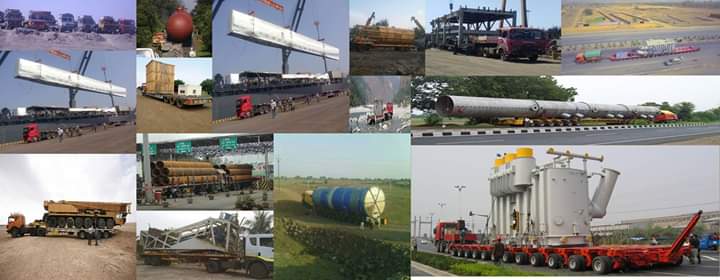
India’s trailer transportation industry uses different equipment configurations to handle ordinary industrial cargo, long structures, heavy machinery and complex project consignments.
Trailer terminology varies between manufacturers, fleet owners, regions and transport markets. For example, the terms highbed, flatbed and semi-lowbed may sometimes be used differently by individual operators.
Therefore, customers should confirm the actual technical specifications rather than relying only on the vehicle’s trade name.
Major Trailer Categories
| Trailer Type | Common Applications | Main Advantage | Main Limitation |
|---|---|---|---|
| Flatbed Trailer | Steel, machinery, fabricated goods | Open and flexible loading | Exposed cargo |
| Highbed Trailer | Industrial equipment, structures | General industrial versatility | Greater loaded height |
| Semi Lowbed Trailer | Machinery and tall equipment | Reduced loading height | Ground-clearance limitations |
| Lowbed Trailer | Heavy machinery, ODC | Lower cargo position | Route and ramp constraints |
| Lowboy Trailer | Tall industrial equipment | Low deck arrangement | Specialized availability |
| Step Deck Trailer | Mixed-height machinery | Different deck levels | Limited uniform deck space |
| Extendable Trailer | Long beams and equipment | Adjustable deck length | Turning and route restrictions |
| Telescopic Trailer | Wind blades, long structures | Long-load capability | Specialized engineering |
| Hydraulic Modular Trailer | Extremely heavy cargo | Configurable axle distribution | High operational complexity |
| Girder Bridge Trailer | Concentrated heavy loads | Specialized load support | Engineering-intensive |
| Bolster Trailer | Long structural cargo | Supports long cargo ends | Requires suitable load rigidity |
| Container Trailer | ISO containers | Container handling compatibility | Limited to approved configurations |
| Skeletal Trailer | Containerized freight | Lower tare-weight potential | Limited general-cargo flexibility |
| Sidewall Trailer | Packaged industrial goods | Side containment | Height and loading restrictions |
| Refrigerated Trailer | Temperature-sensitive cargo | Temperature control | Higher operating costs |
| Tipper Trailer | Suitable bulk materials | Mechanical unloading | Stability and site requirements |
| Tank Trailer | Liquid or gas cargo | Specialized containment | Product-specific regulations |
| SPMT | Heavy modules and plant equipment | Precision movement | Primarily specialized site operations |
The table describes broad equipment categories, not guaranteed capacities or availability. Each vehicle must be checked against its actual approved specifications.
Flatbed Trailer Transportation
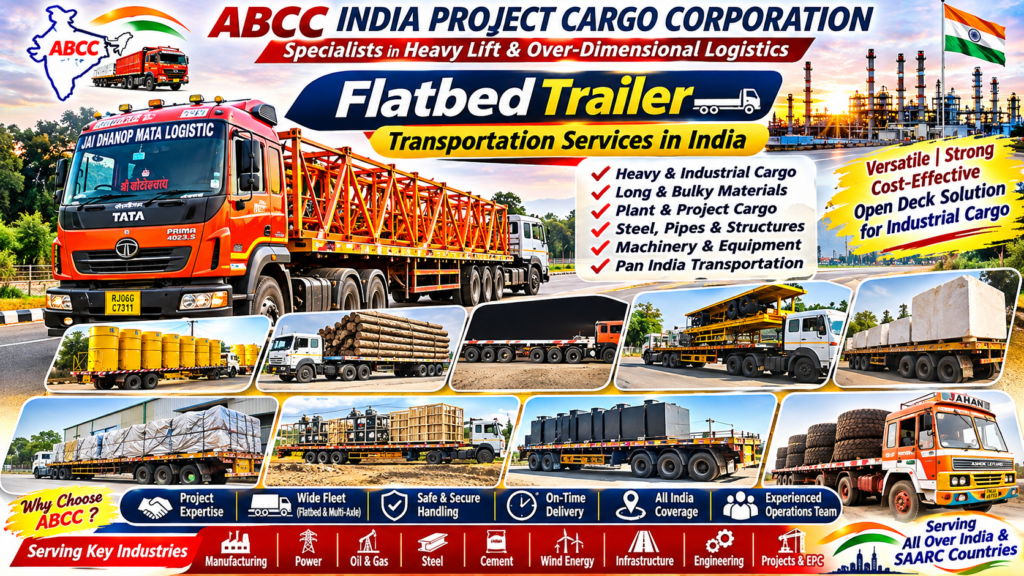
A flatbed trailer has an open cargo deck without a permanent enclosed body. It is one of the most versatile equipment types for industrial transportation.
Flatbed trailers are frequently considered for steel products, fabricated structures, packaged machinery, industrial components and other goods that can be loaded from above or from the sides.
Advantages
Flatbed trailers provide flexibility during loading and unloading. Cranes and forklifts may be used where the site and cargo permit. The open deck also accommodates many irregularly shaped consignments.
Disadvantages
Cargo remains exposed to weather, dust and road conditions unless suitable protection is arranged. Loads require appropriate restraint, and oversized cargo may need special planning.
Best suited for: Industrial goods with manageable height and weight that can be safely secured on an open deck.
Highbed Trailer Transportation
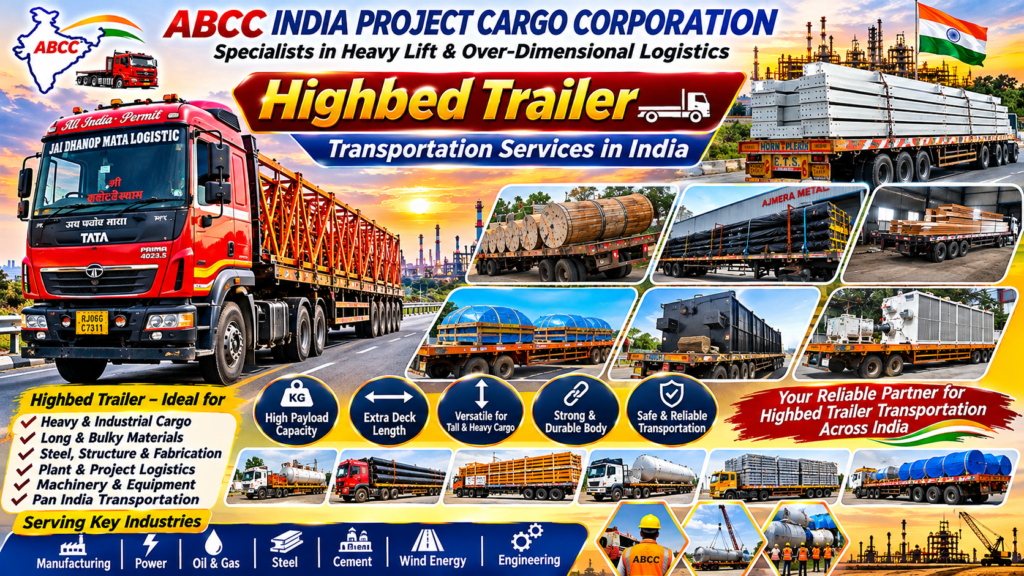
Highbed is a commonly used commercial term in the Indian transport market for certain elevated-deck trailer configurations.
These trailers are often requested for machinery, fabricated structures and industrial equipment.
However, the term does not establish a universal deck height or carrying capacity.
Advantages
Highbed trailers can provide practical transportation solutions for many conventional industrial consignments. Their suitability depends on the available deck dimensions and approved configuration.
Disadvantages
The combined height of the trailer and cargo may create clearance problems at bridges, overhead cables, gates and other structures.
Best suited for: Cargo that fits the available deck and route-clearance envelope without requiring a lower loading position.
Semi Lowbed Trailer Transportation
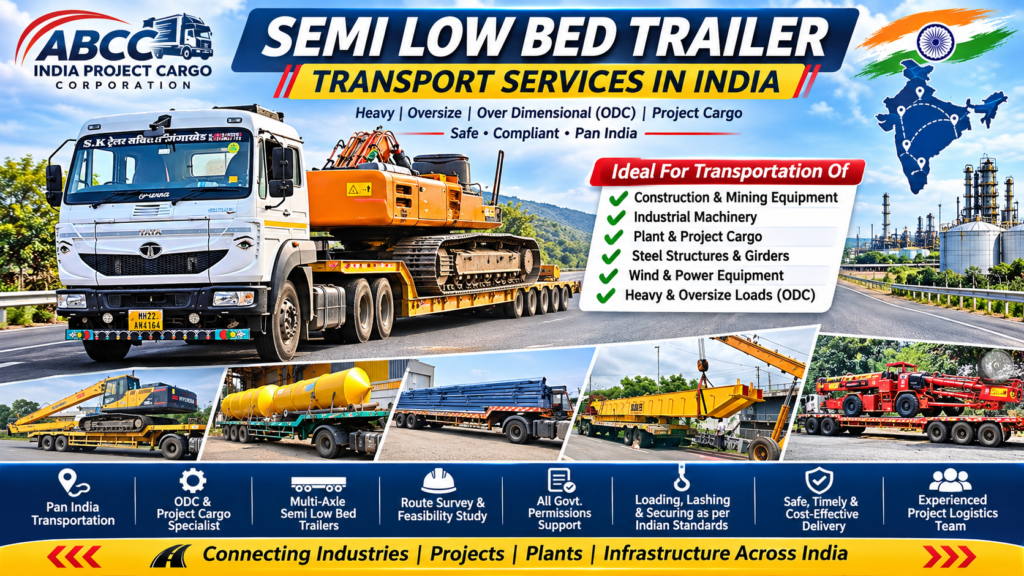
A semi lowbed trailer is generally selected when cargo needs a lower deck position than a conventional flatbed or highbed arrangement.
It is useful for machinery and equipment where loaded height is an important consideration.
Typical applications include industrial machines, construction equipment, heavy fabricated assemblies and certain types of project cargo.
Advantages
- Lower loading position for suitable configurations.
- Improved clearance possibilities compared with higher-deck alternatives.
- Useful for many heavy industrial consignments.
- May provide suitable loading arrangements for specific machinery.
Disadvantages
- Reduced ground clearance in some configurations.
- Greater risk of grounding on unsuitable road profiles.
- Vehicle selection requires careful weight and dimension assessment.
- Some configurations may be harder to source.
Best suited for: Machinery requiring a lower deck while remaining within the vehicle’s approved loading and route limits.
Lowbed Trailer Transportation
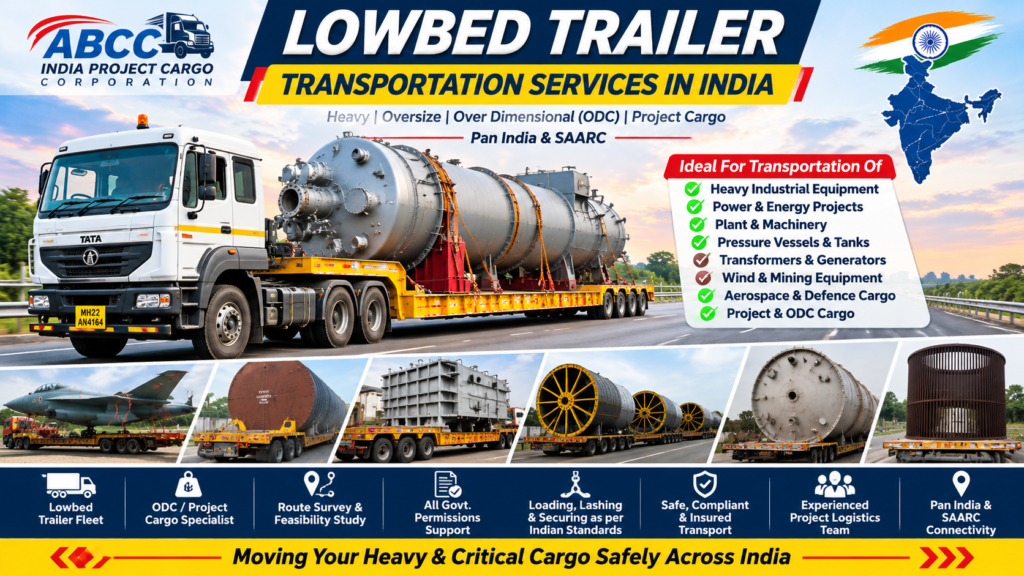
Lowbed trailers are designed with a low cargo-carrying deck, making them suitable for certain heavy and tall equipment.
The lower deck can help reduce the overall transport height. This is particularly valuable when the cargo is already tall.
Common applications include earthmoving machinery, large industrial machines, generators and other heavy equipment.
Advantages
A lowbed arrangement can reduce overall loaded height and may provide a favorable loading position for heavy equipment.
Some models incorporate detachable goosenecks or specialized ramps, depending on the manufacturer and configuration.
Disadvantages
Low ground clearance may create difficulties at railway crossings, road humps, ramps and uneven site entrances. The equipment may also require careful loading arrangements.
Best suited for: Heavy or tall machinery requiring a verified low-deck configuration.
Lowboy Trailer Transportation

The term lowboy is widely used internationally for trailers with a low loading deck.
In India, the term may overlap with lowbed terminology, although actual designs differ.
A lowboy can be suitable for transporting tall machinery, construction equipment and specialized industrial loads.
The principal benefit is the ability to position cargo relatively low.
However, the operator must verify the deck height, loading method, axle configuration and route conditions before dispatch.
Step Deck Trailer Transportation
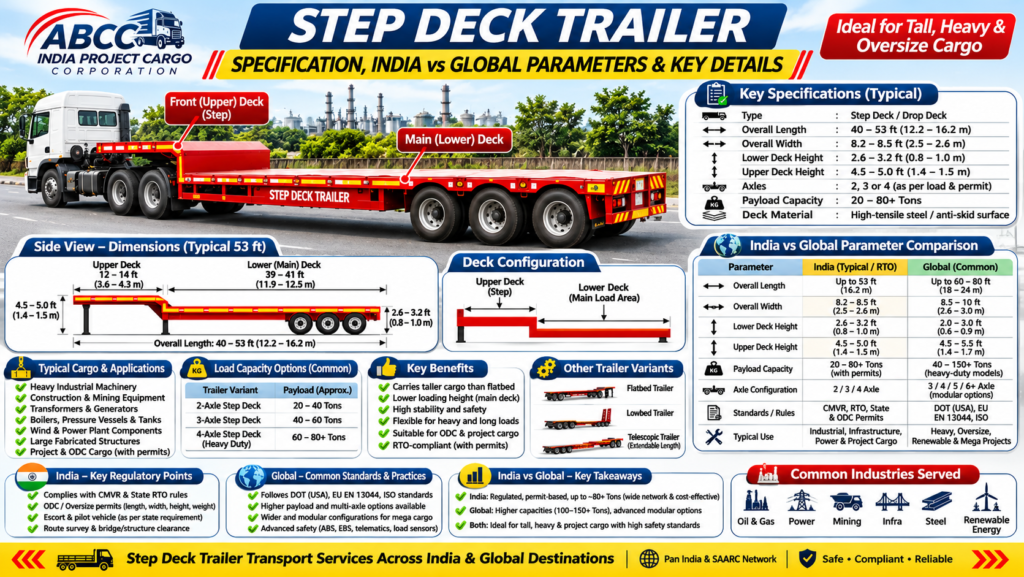
A step deck trailer has cargo-carrying surfaces at different heights.
The stepped arrangement allows certain cargo to be placed on a lower deck section while retaining another loading area at a higher level.
This design can be useful when transporting equipment with varying height requirements.
Advantages
The stepped arrangement provides flexibility for selected cargo profiles.
Disadvantages
The available continuous deck length at each height may be limited.
Best suited for: Machinery and fabricated equipment that benefit from different loading heights.
Extendable Flatbed Trailer
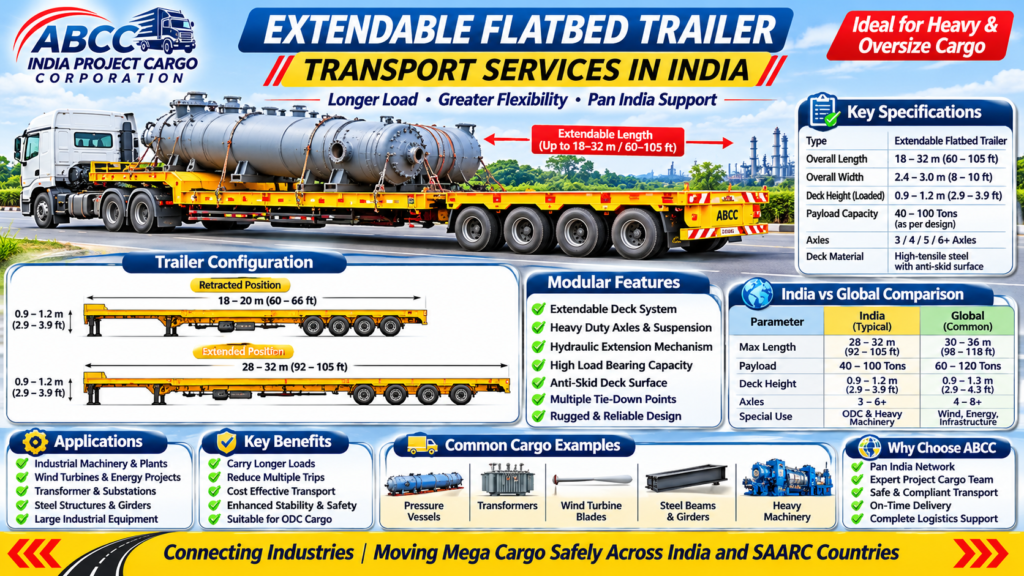
An extendable flatbed trailer is designed to increase its usable deck length within the limits of its engineered configuration.
It may be considered for long steel structures, industrial beams, pipes and fabricated components.
Advantages
An adjustable deck can accommodate different cargo lengths, potentially reducing the need for several fixed-length trailer designs.
Disadvantages
Long vehicles can create turning difficulties, especially at narrow intersections, factory entrances and congested industrial roads.
The trailer’s allowable load distribution must also be assessed in the extended configuration.
Telescopic Trailer Transportation
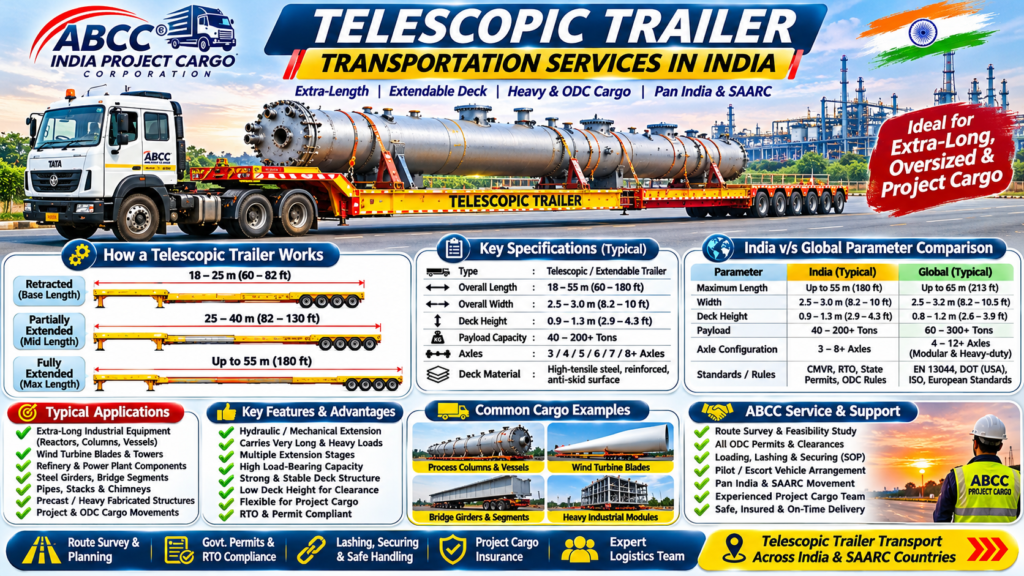
Telescopic trailers are specialized extendable vehicles used for exceptionally long cargo.
They are often associated with wind energy components, long fabricated structures and other industrial consignments that cannot fit on ordinary trailers.
A telescopic trailer may require substantial route planning because of its turning radius, rear overhang, load-support arrangement and road-clearance requirements.
Advantages
The trailer can be configured for long cargo, subject to its approved technical limits.
Disadvantages
Vehicle maneuvering becomes more complex as the overall length increases. Additional steering arrangements, escorts or route modifications may be necessary.
Best suited for: Long industrial cargo requiring engineered support and route feasibility checks.
Hydraulic Modular Multi-Axle Trailer


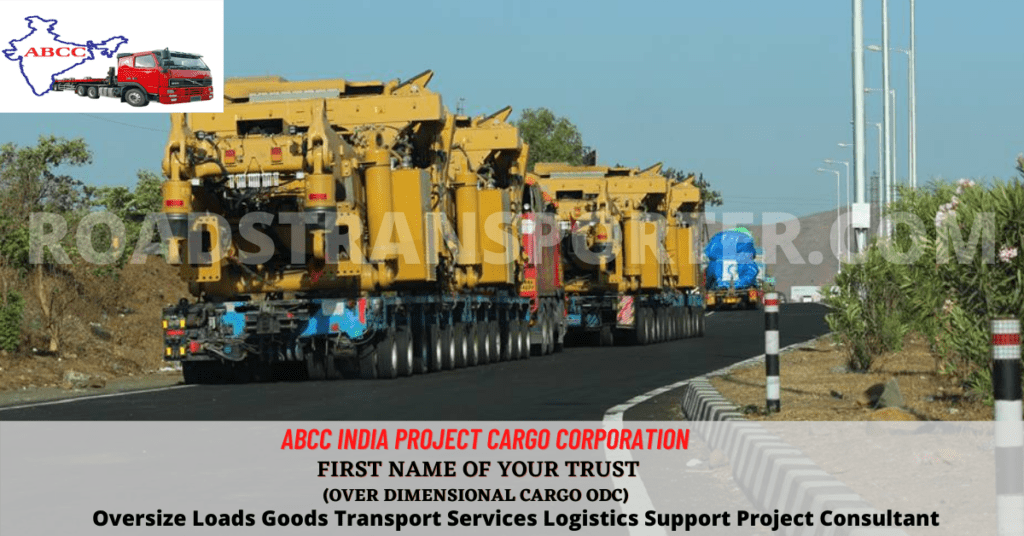
A hydraulic modular trailer is specialized heavy-haulage equipment used for extremely heavy or unusually configured loads.
Modular axle rows can be arranged to distribute cargo weight according to the approved equipment configuration and engineering requirements.
These trailers are used in selected power, energy, infrastructure and heavy industrial projects.
Examples of cargo that may require modular transportation include large transformers, heavy industrial vessels, major plant equipment and other indivisible loads.
Advantages
- Configurable axle arrangements.
- Load distribution across multiple axle rows.
- Hydraulic suspension and leveling capabilities in suitable equipment.
- Potential for transporting exceptionally heavy industrial cargo.
Disadvantages
- Specialized equipment and trained operating personnel.
- Extensive engineering and route planning.
- High mobilization and operating costs.
- Restrictions imposed by road and bridge conditions.
- Special approvals for applicable movements.
The Ministry of Road Transport and Highways has issued guidance recognizing modular hydraulic trailer configurations for certain indivisible loads, subject to conditions including appropriate axle arrangements and route permissions. Ministry of Road Transport and Highways+1
Important: The number of axle rows alone does not determine legal payload capacity. The complete vehicle configuration, manufacturer approvals, road conditions and applicable permissions must be considered.
Girder Bridge Trailer Transportation
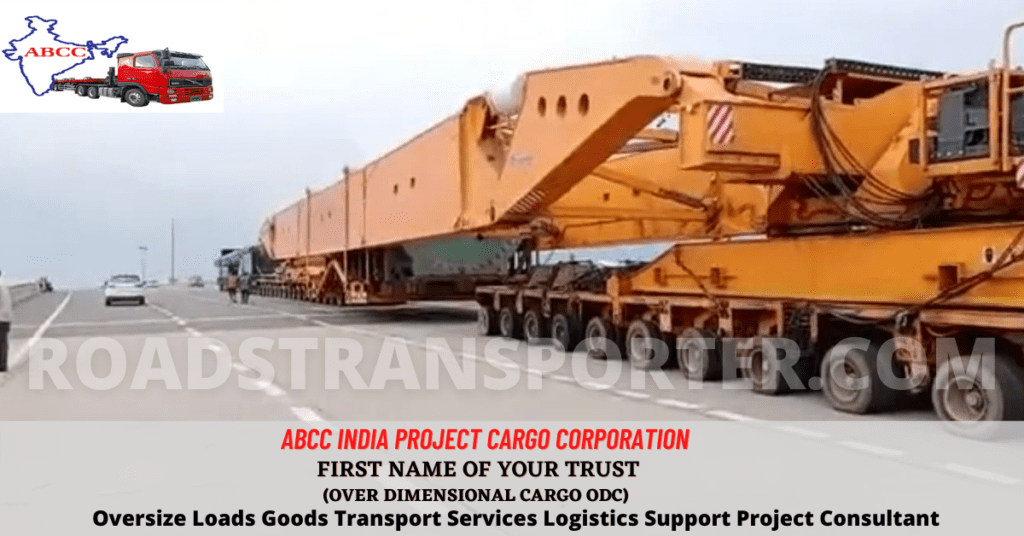
Girder bridge trailers are highly specialized heavy-transport systems designed for certain concentrated loads.
Their engineered structure supports the cargo in a manner intended to distribute forces through the transport system.
They may be considered for exceptionally heavy transformers and other major industrial equipment.
Advantages
A properly engineered girder bridge arrangement can offer a specialized solution for loads that are difficult to transport using conventional deck trailers.
Disadvantages
The equipment is expensive, technically complex and dependent on detailed engineering assessments.
The transport plan may require bridge analysis, route surveys, special permits, lifting arrangements and extensive coordination.
Best suited for: Exceptional heavy-lift projects where engineering studies establish the suitability of a girder bridge arrangement.
Bolster Trailer Transportation
Bolster trailers are used for certain long structural loads that can be supported at designated points.
Applications may include long beams, pipes and other engineered structures.
The suitability of this arrangement depends on the cargo’s structural characteristics and approved support points.
Advantages
Bolster arrangements may provide an efficient solution for long cargo where conventional full-deck support is unnecessary.
Disadvantages
Cargo bending, torsion, support reactions and turning behavior must be evaluated.
Not every long load is suitable for bolster transportation.
Self-Propelled Modular Transporter – SPMT
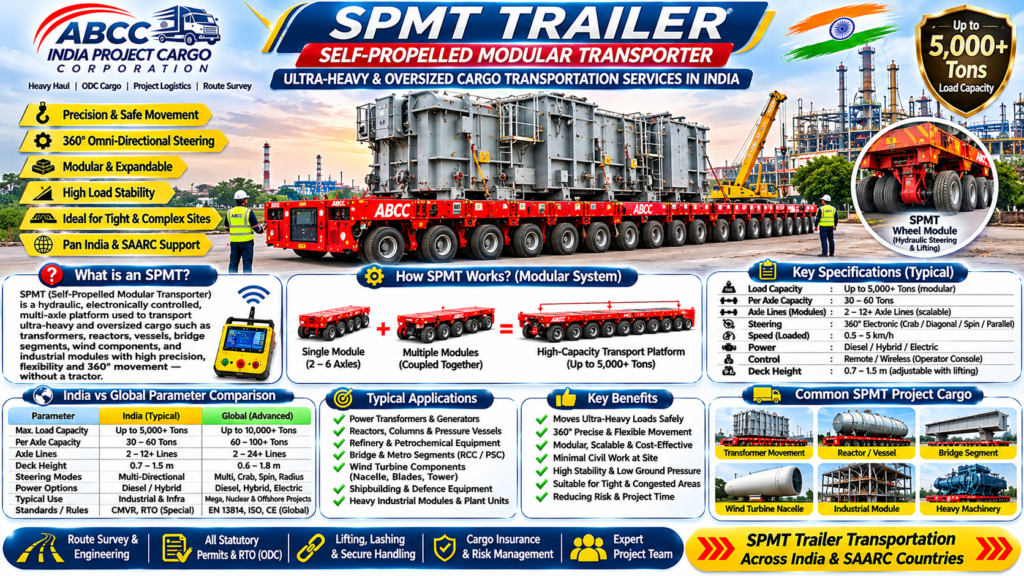
A Self-Propelled Modular Transporter, commonly called an SPMT, is specialized equipment designed to move extremely heavy structures using powered modular platforms.
Unlike a conventional road trailer, an SPMT does not necessarily require a separate road tractor for propulsion.
SPMTs are frequently used in industrial yards, ports, fabrication facilities and major project sites.
Applications may include movement of large modules, shipbuilding sections, industrial assemblies and heavy equipment.
Advantages
SPMT systems can provide precise maneuvering and controlled movement of extremely heavy loads under suitable operating conditions.
Disadvantages
They require specialized personnel, engineering, suitable ground-bearing conditions and substantial project preparation.
An SPMT should not automatically be treated as an ordinary public-road trailer. Public-road movement requires separate technical and legal assessment.
Container Trailer Transportation
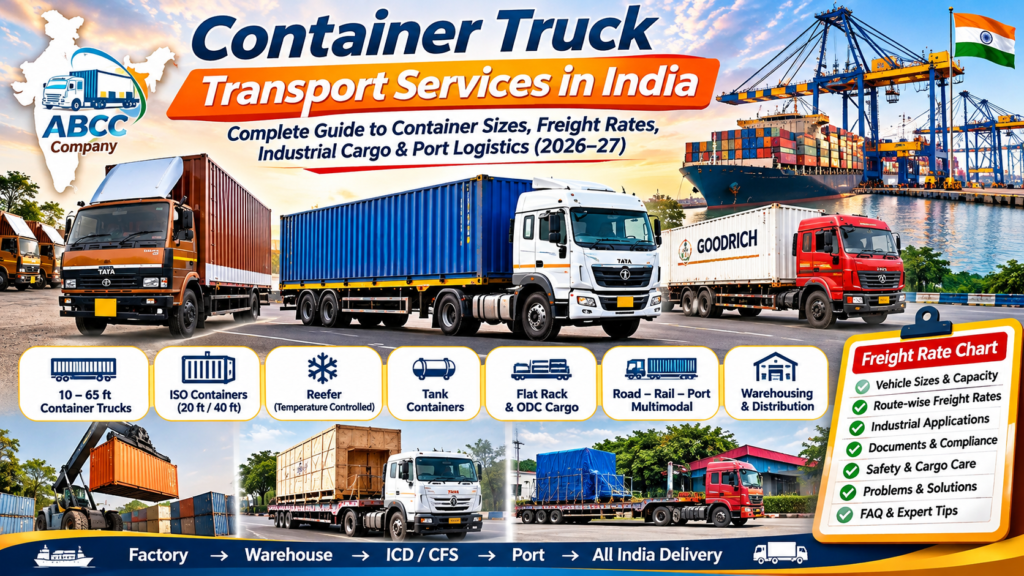
Container trailers are designed to transport approved shipping containers.
They are widely used in port logistics, inland container depots, manufacturing supply chains and multimodal freight operations.
Container trailers may use skeletal chassis designs or other approved configurations.
Advantages
Container transportation supports standardized cargo handling and transfer between road, rail and maritime systems.
Disadvantages
Container compatibility, locking arrangements, gross weight and handling infrastructure must be verified.
Best suited for: Containerized cargo moving between ports, ICDs, CFS facilities, factories and warehouses.
Sidewall Trailer Transportation
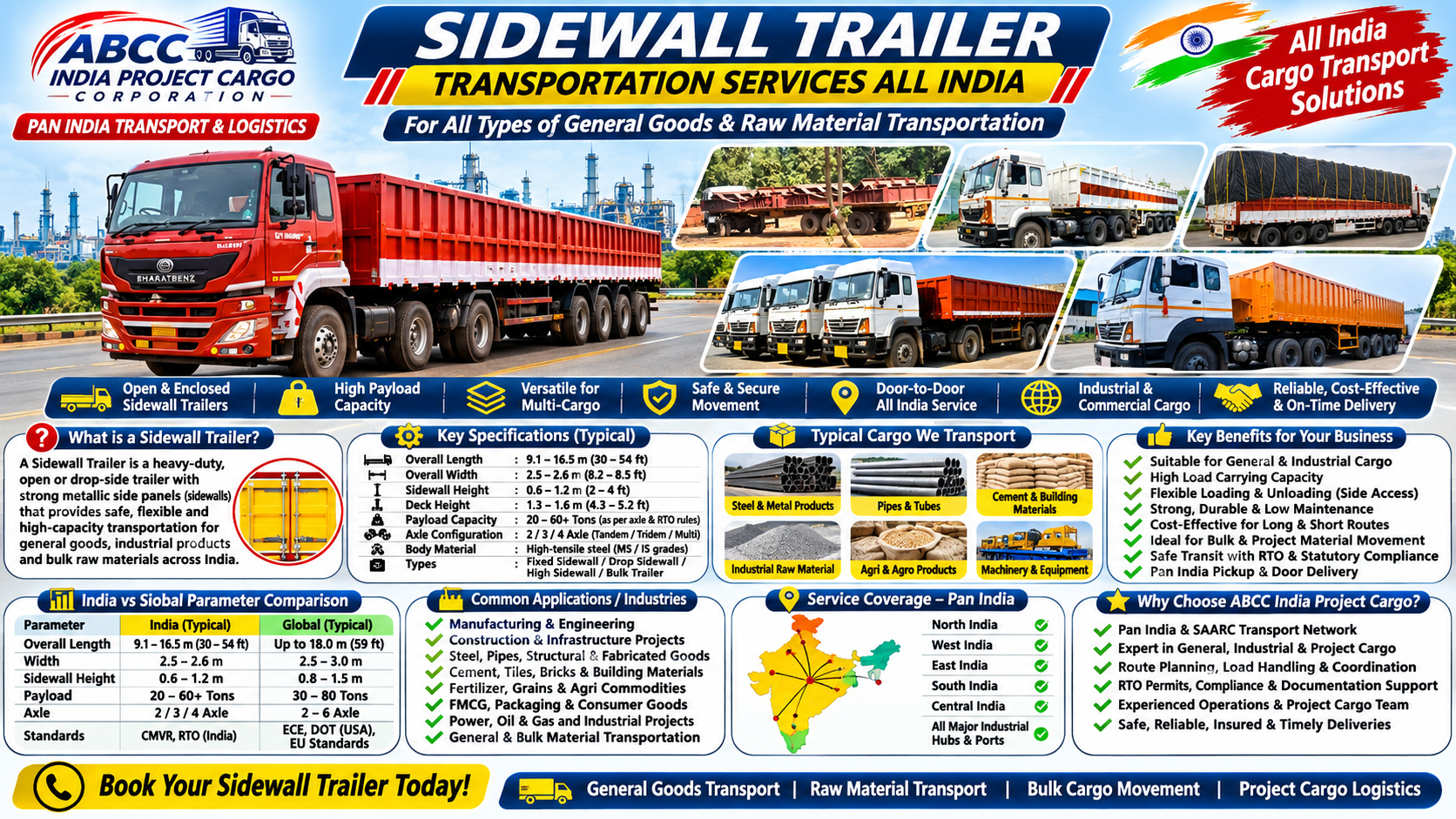
Sidewall trailers combine an open or partially enclosed loading arrangement with side structures intended to help contain suitable cargo.
They may be considered for packaged industrial goods, certain building materials and other compatible consignments.
Sidewalls are not a substitute for appropriate load restraint.
Advantages
They offer a degree of side containment and can be practical for selected cargo.
Disadvantages
Loading flexibility may be reduced, and unsuitable cargo can damage the side structures.
Refrigerated Trailer Transportation
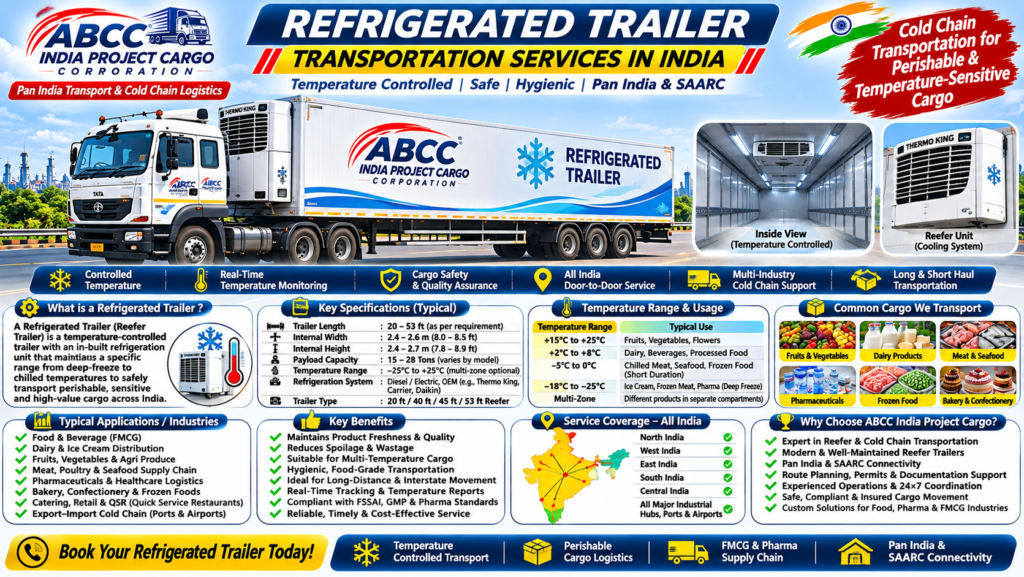
Refrigerated trailers, also called reefer trailers, are used for temperature-sensitive cargo.
They may transport food products, pharmaceuticals and other commodities requiring controlled temperature conditions.
The required temperature range, refrigeration capacity, monitoring system and cargo-handling procedures depend on the commodity.
Advantages
Temperature control helps protect suitable goods during transportation.
Disadvantages
Refrigeration equipment increases operating costs and requires maintenance, monitoring and reliable power arrangements.
Tank Trailer Transportation
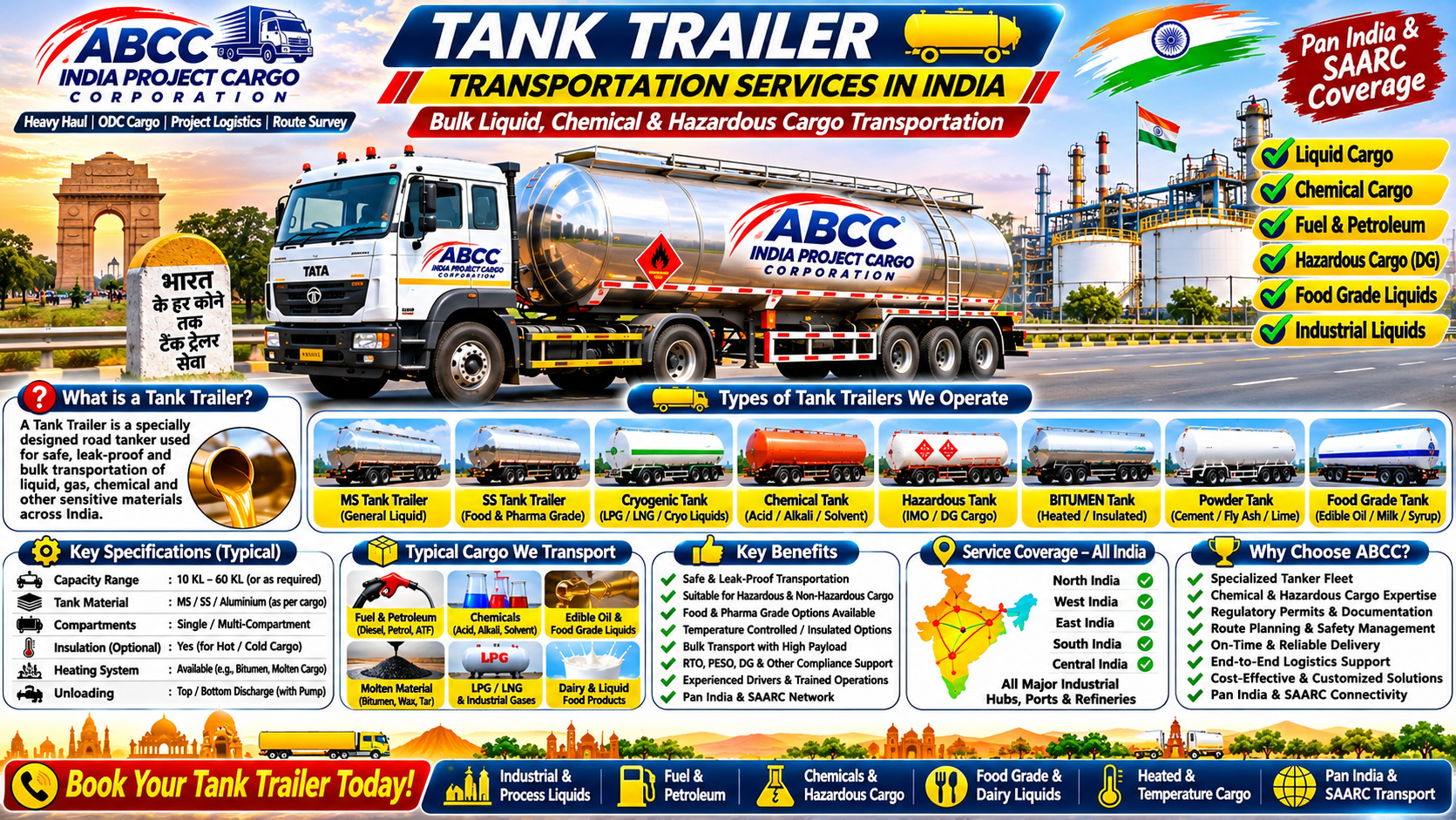
Tank trailers are used to transport compatible liquid, gas or other bulk commodities in purpose-built containment systems.
The equipment must be appropriate for the material being carried.
Advantages
Purpose-designed tank systems provide a specialized bulk transport solution.
Disadvantages
Certain commodities require additional safety systems, approvals, driver qualifications, placarding and regulatory compliance.
Hazardous materials must never be transported using an unsuitable tank or without applicable safety arrangements.
Tipper Trailer Transportation

Tipper trailers are designed to unload suitable bulk cargo through a tipping mechanism.
They may be used for approved bulk commodities in mining, construction and industrial operations.
Advantages
Mechanical tipping can reduce unloading time at suitable facilities.
Disadvantages
Tipping introduces stability risks, especially on uneven or unsuitable ground.
The unloading site must be assessed before operation.
Other Specialized Trailer Configurations
Depending on cargo characteristics, the Indian transport market may also use specialized equipment such as:
| Equipment | Typical Purpose |
|---|---|
| Detachable Gooseneck Trailer | Loading certain heavy machinery |
| Rear-Loading Ramp Trailer | Equipment that can be safely driven or winched aboard |
| Multi-Axle Semi Trailer | Industrial loads requiring suitable axle distribution |
| Pole Trailer | Certain long structural cargo |
| Pipe Carrier Trailer | Long pipes and cylindrical products |
| Coil Carrier Trailer | Steel coils with suitable restraints |
| Vehicle Carrier Trailer | Automobiles and other approved vehicles |
| Machinery Carrier Trailer | Industrial and construction equipment |
| Platform Trailer | Heavy or bulky industrial components |
| Hydraulic Steering Trailer | Cargo requiring specialized maneuverability |
| Wind Blade Trailer | Long wind turbine blades |
| Wind Tower Section Trailer | Large cylindrical tower sections |
| Transformer Transport System | Specialized heavy electrical equipment |
| Vessel Carrier Trailer | Large industrial vessels |
| Extendable Lowbed Trailer | Long machinery requiring a low deck |
| Multi-Line Modular Trailer | Exceptional loads requiring engineered axle arrangements |
These names describe market categories and specialized designs. Some overlap with the main trailer types rather than representing completely separate vehicle classes.
Selection rule: Never choose a trailer solely from its advertised length or tonnage. Confirm the manufacturer’s specifications, registration details, approved loading limits, cargo distribution and route feasibility.
How to Select the Right Trailer for Industrial Cargo
Selecting the correct trailer is one of the most important decisions in industrial transportation.
A trailer that is suitable for a 20-tonne machine may not be suitable for another machine of the same weight if its dimensions, center of gravity or loading points are different.
The decision must consider the complete transport arrangement.
Cargo-Based Trailer Selection Chart
| Cargo Type | Trailer to Evaluate | Special Consideration |
|---|---|---|
| Industrial machine | Flatbed / Semi Lowbed | Dimensions and lifting points |
| Excavator | Lowbed / Equipment Trailer | Loading method and ground clearance |
| Heavy transformer | Hydraulic Modular / Specialized Heavy Haul | Weight distribution and route engineering |
| Steel beams | Flatbed / Extendable Trailer | Length and support points |
| Wind turbine blade | Telescopic / Blade Trailer | Turning geometry |
| Wind tower section | Specialized Lowbed / Tower Trailer | Diameter and loaded height |
| ISO container | Container Chassis | Container compatibility and locking |
| Large pressure vessel | Lowbed / Modular Trailer | Diameter, weight and center of gravity |
| Prefabricated industrial module | Modular Trailer / SPMT | Engineering and ground conditions |
| Long industrial pipe | Extendable / Bolster Trailer | Support and restraint |
| Packaged industrial goods | Flatbed / Sidewall Trailer | Weather protection and securing |
| Bulk liquid | Suitable Tank Trailer | Commodity compatibility |
| Bulk construction material | Approved Tipper Trailer | Unloading stability |
These are preliminary equipment choices, not final engineering approvals.
Five Questions Every Transport Buyer Should Ask
What is the exact cargo weight?
The declared weight should include relevant attachments, packaging and lifting accessories where applicable. Uncertain weights can create serious risks.
What are the actual cargo dimensions?
The loaded transport height is different from the cargo height alone. Trailer deck height, supports and other arrangements must also be considered.
Can the trailer enter both premises?
Factory gates, internal roads, loading bays, overhead structures and turning areas must be assessed.
How will the cargo be loaded and unloaded?
A suitable trailer is only one part of the transport solution. The required cranes, lifting beams, forklifts, ramps or other equipment must also be available.
Does the cargo require special permission?
An oversized or overweight movement may require additional approvals, route assessment and operating restrictions.India’s Ministry of Road Transport and Highways has published specific guidance for over-dimensional and overweight consignments, including route-related precautions and approvals.
Trailer Selection: Practical Example
Consider an industrial machine weighing 28 tonnes.
The machine’s weight alone does not establish the appropriate trailer.
If the equipment is tall, a lower-deck trailer may be preferable. If it has a wide base, the deck width and load support become important. If the machine has a concentrated center of gravity, axle loading and stability require additional attention.
A suitable transport plan would examine:
- Certified cargo weight and dimensions.
- Manufacturer-recommended support and lifting points.
- Available trailer deck dimensions.
- Permitted gross and axle loads.
- Overall loaded height and width.
- Loading and unloading arrangements.
- Origin and destination access.
- Route restrictions and necessary permissions.
Only after these details are assessed should the final vehicle configuration be approved.
Trailer Dimensions, Length, Width, Height and Payload Capacity in India
Trailer dimensions are among the most frequently requested details in industrial transportation.
Customers often search for terms such as:
- 40 feet trailer dimensions in India
- 50 feet trailer truck capacity
- 60 feet trailer transportation
- Lowbed trailer height and payload
- Semi lowbed trailer dimensions
- Hydraulic modular trailer capacity
- 20 ton, 30 ton, 40 ton and 50 ton trailer booking
- Multi-axle trailer transport service
However, trailer dimensions and carrying capacities are not standardized across every vehicle sold or operated under the same commercial name.
Two trailers described as 40-foot flatbeds may have different axle configurations, deck heights, tare weights and legally permissible loading limits.
Therefore, the advertised length of a trailer should never be treated as proof of its payload capacity.
Common Trailer Length Categories in the Indian Transport Market
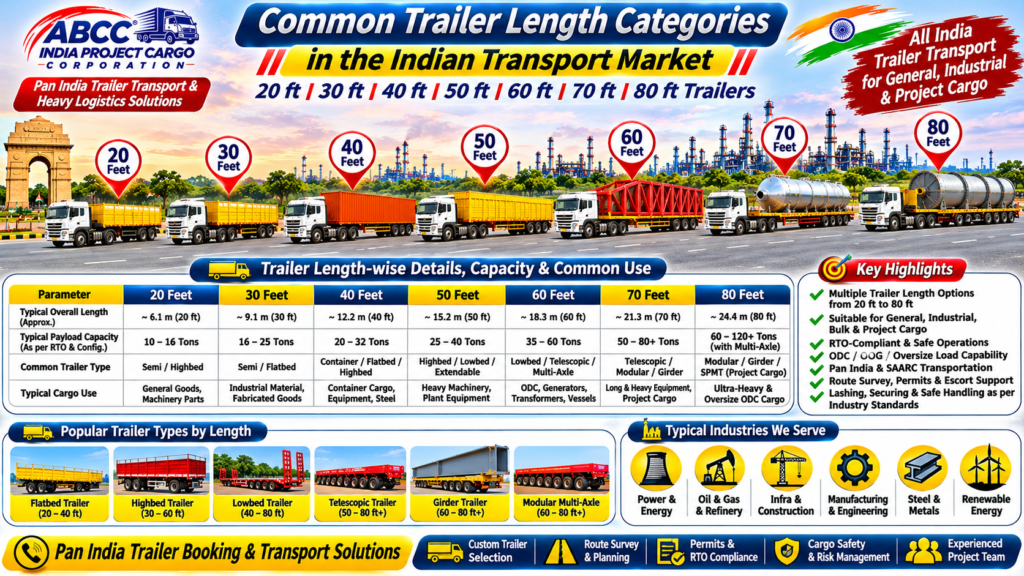
The following chart describes common commercial size requests. These are market descriptions, not statutory vehicle dimensions or guarantees of availability.
| Marketed Trailer Length | Commonly Requested Cargo | Vehicle Configuration to Evaluate |
|---|---|---|
| 20–25 feet | Compact industrial machinery | Suitable short-deck equipment |
| 26–30 feet | Machinery and fabricated assemblies | Flatbed or low-deck equipment |
| 31–35 feet | Medium-length industrial goods | Flatbed / Semi Lowbed |
| 36–40 feet | Steel, machinery and industrial cargo | Flatbed / Highbed |
| 41–45 feet | Long fabricated structures | Suitable long-deck trailer |
| 46–50 feet | Long machinery and structural goods | Flatbed / Extendable |
| 51–55 feet | Long industrial equipment | Extendable / Specialized Trailer |
| 56–60 feet | Long beams and project cargo | Extendable / Telescopic |
| Above 60 feet | Exceptional-length cargo | Specialized engineered transport |
The actual usable deck length must be verified from the vehicle’s technical specifications.
Trailer Width and Cargo Width
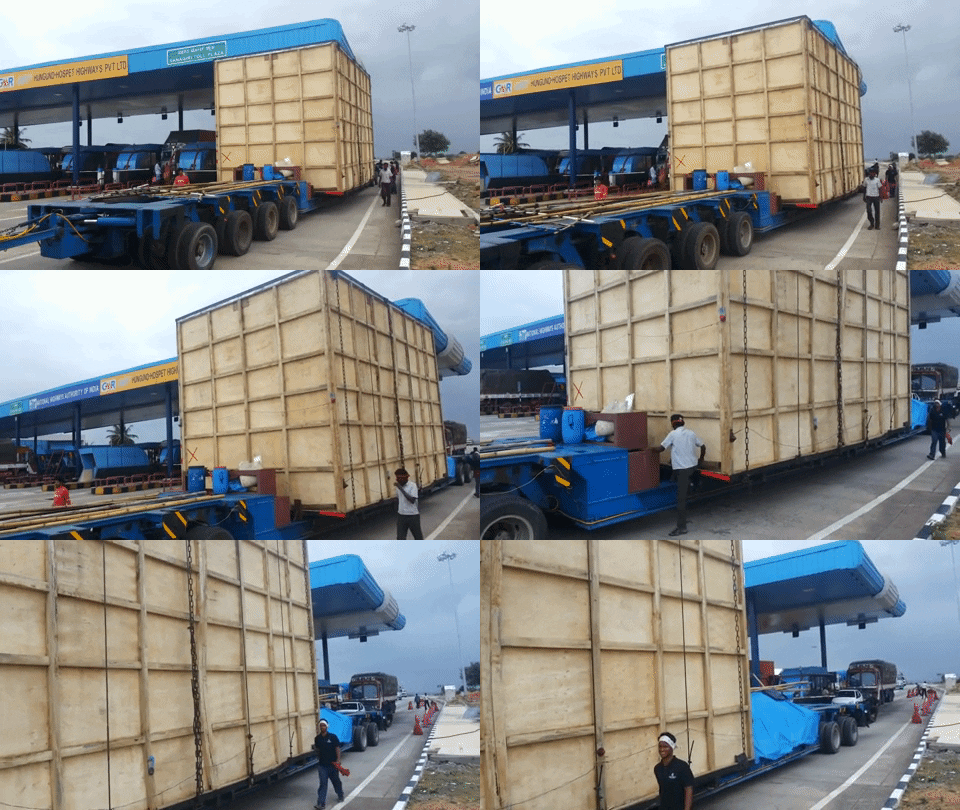
Cargo width is a critical consideration because a consignment may extend beyond the trailer’s standard loading platform.
The overall loaded width must be evaluated against applicable legal limits, road geometry, traffic conditions and the requirements of the relevant authorities.
A wide cargo load can create problems at:
- Narrow bridges.
- Toll-plaza lanes.
- Industrial estate entrances.
- Roadside utility installations.
- Urban intersections.
- Construction diversions.
- Mountain roads.
- Restricted factory gates.
A wider trailer is not automatically a safer solution. Stability, load distribution, approved dimensions and cargo restraint must also be evaluated.
Trailer Deck Height and Loaded Transport Height
The total loaded transport height can be calculated conceptually as:
{loaded}}={deck}}+{support}}+{cargo}
This simplified calculation assumes that the cargo is positioned above the deck and does not account for every specialized arrangement.
For example, consider a hypothetical machine with:
| Component | Illustrative Measurement |
|---|---|
| Trailer deck height | 1.20 m |
| Cargo support arrangement | 0.15 m |
| Machinery height | 3.20 m |
| Calculated loaded height | 4.55 m |
This is an illustration, not a permitted road height or approved loading plan.
A lower-deck trailer may reduce the loaded height, but the final movement must still satisfy applicable regulations and route clearances.
Trailer Payload Capacity: Why Gross Weight Matters
Payload refers to the weight of cargo carried by the vehicle.
Gross combination weight includes the relevant vehicle and cargo weights in the complete transport combination.
The distinction matters because a trailer advertised as suitable for a particular cargo weight may not be permitted to carry that load under every operating condition.
The following must be checked:
- Tractor and trailer registration specifications.
- Manufacturer-rated capacities.
- Permissible gross and axle loads.
- Actual vehicle tare weights.
- Cargo weight and distribution.
- Tyre and suspension ratings.
- Coupling and fifth-wheel limitations.
- Route restrictions and special permissions.
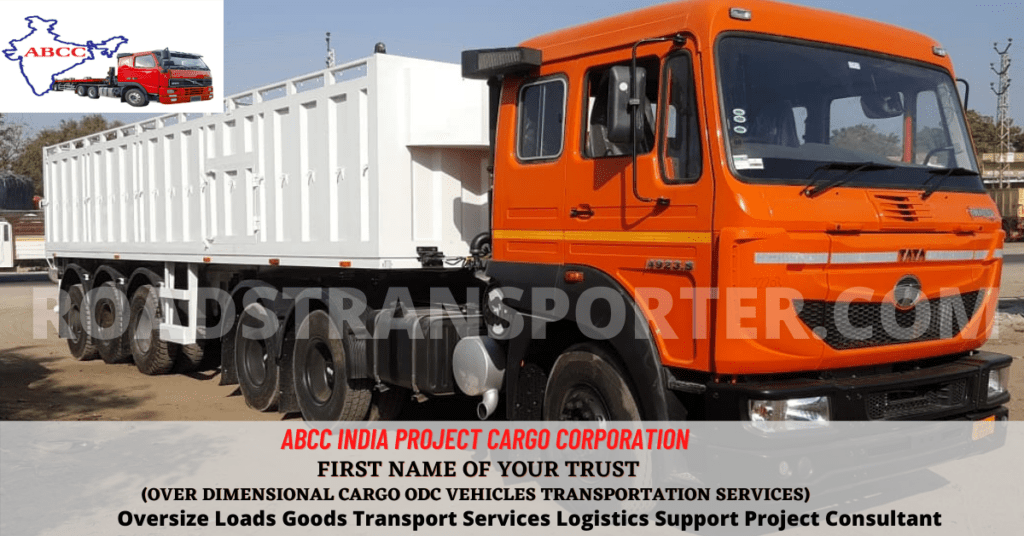
Cargo Weight Categories for Trailer Booking
| Cargo Weight | Initial Transport Planning Considerations |
|---|---|
| Up to 10 tonnes | Dimensions, handling and suitable equipment |
| 10–20 tonnes | Trailer selection and axle distribution |
| 20–30 tonnes | Verified configuration and loading conditions |
| 30–40 tonnes | Multi-axle suitability and legal load limits |
| 40–60 tonnes | Specialized configuration may be necessary |
| 60–100 tonnes | Heavy-haul engineering and route feasibility |
| 100–200 tonnes | Specialized modular or other engineered systems |
| Above 200 tonnes | Project-specific heavy transport engineering |
These are planning bands only. They are not official payload classifications or permissions to carry the stated weights.
Trailer Axle Configurations and Their Importance
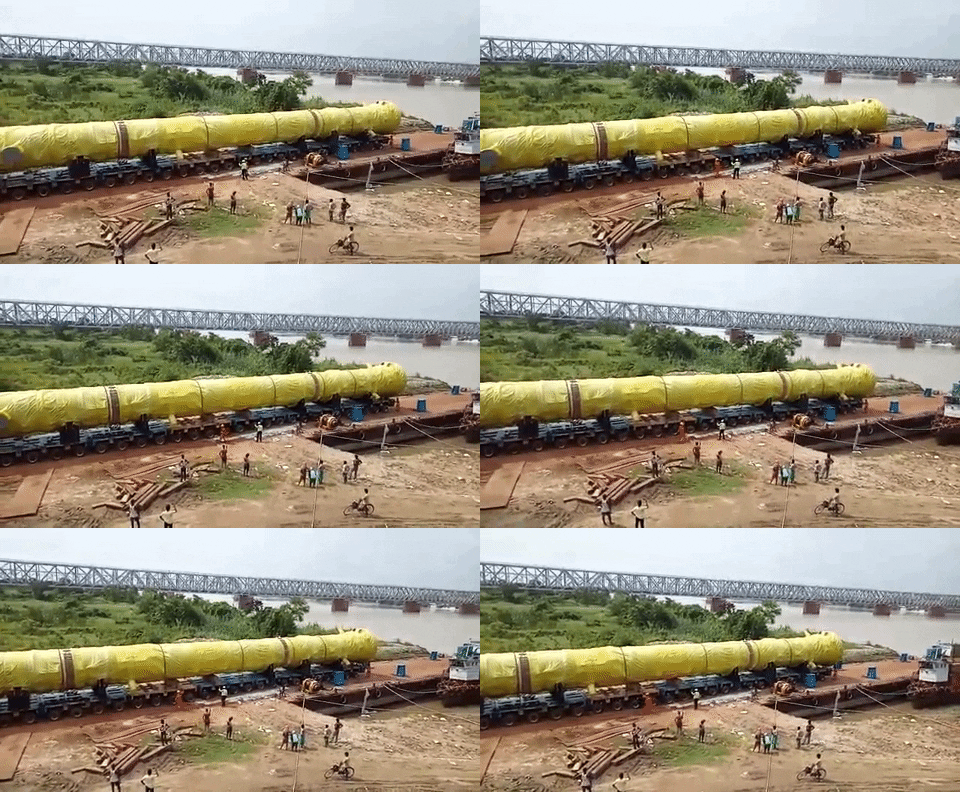
The number and arrangement of axles influence the distribution of vehicle and cargo weight.
However, adding more axles does not automatically make a transport movement legal or safe.
The complete combination must satisfy manufacturer limitations, statutory requirements and route conditions.
Common Axle-Related Terminology
| Term | Meaning | Why It Matters |
|---|---|---|
| Single Axle | One axle assembly | Load distribution |
| Tandem Axle | Two axles in a group | Weight distribution |
| Tridem Axle | Three axles in a group | Multi-axle configuration |
| Steerable Axle | Axle capable of steering | Maneuverability |
| Hydraulic Suspension | Suspension using hydraulic systems | Load leveling and distribution |
| Modular Axle Line | Configurable axle-row arrangement | Exceptional heavy transport |
| Fifth Wheel | Tractor-trailer coupling interface | Coupling and load transfer |
| Kingpin | Trailer coupling component | Connection integrity |
| Gooseneck | Specialized trailer front connection | Trailer geometry and loading |
Why Axle Distribution Matters
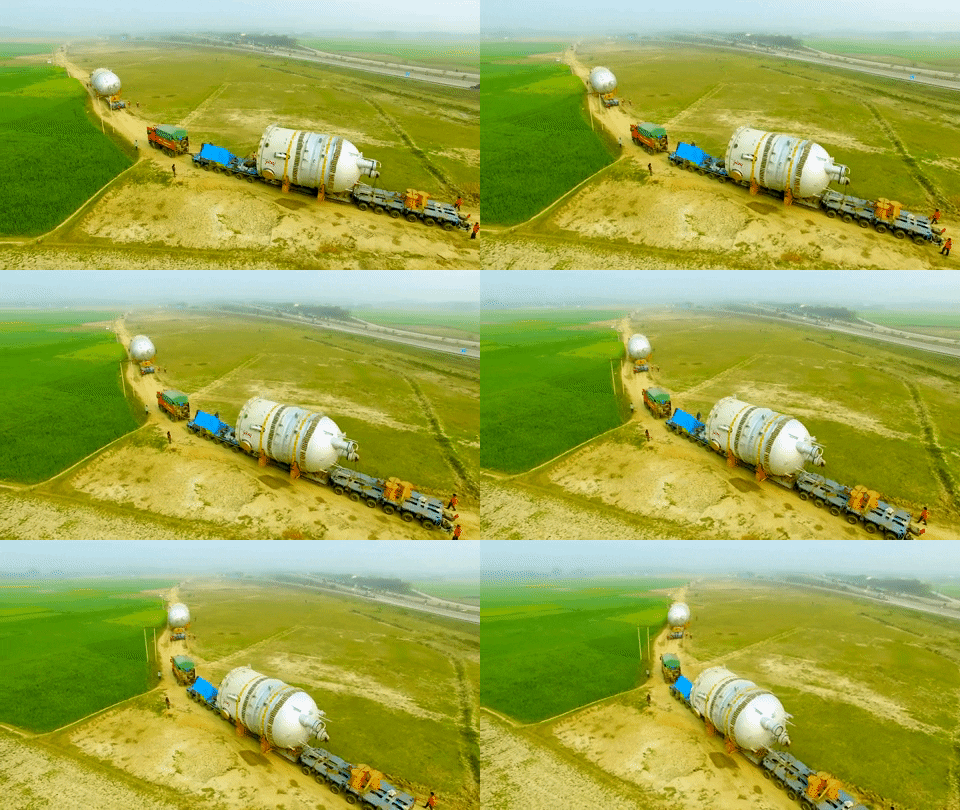
A heavy industrial machine may have a concentrated center of gravity.
Even when the total cargo weight is within a vehicle’s overall rated capacity, individual axle groups or structural components may become overloaded.
This is why professional transport planning considers both total weight and the distribution of forces throughout the transport combination.
For specialized loads, engineering calculations may be required to establish the appropriate trailer configuration.
Tractor Selection for Heavy Trailer Transportation

The tractor unit must be compatible with the trailer and intended cargo.
Important factors include engine performance, transmission, traction, braking capacity, coupling ratings and approved operating specifications.
For demanding heavy-haul movements, route gradients and traction conditions may influence the need for specialized tractor configurations or additional engineered assistance.
A powerful tractor alone does not establish that a combination is suitable for a heavy load.
Trailer Transport Freight Rates in India – Complete Pricing Guide
Trailer freight rates in India depend on much more than distance.
Unlike standardized parcel delivery, industrial trailer transportation frequently involves individual quotations.
The same origin and destination can produce substantially different freight prices depending on the cargo, trailer, timing and route requirements.
Major Factors Affecting Trailer Transportation Cost
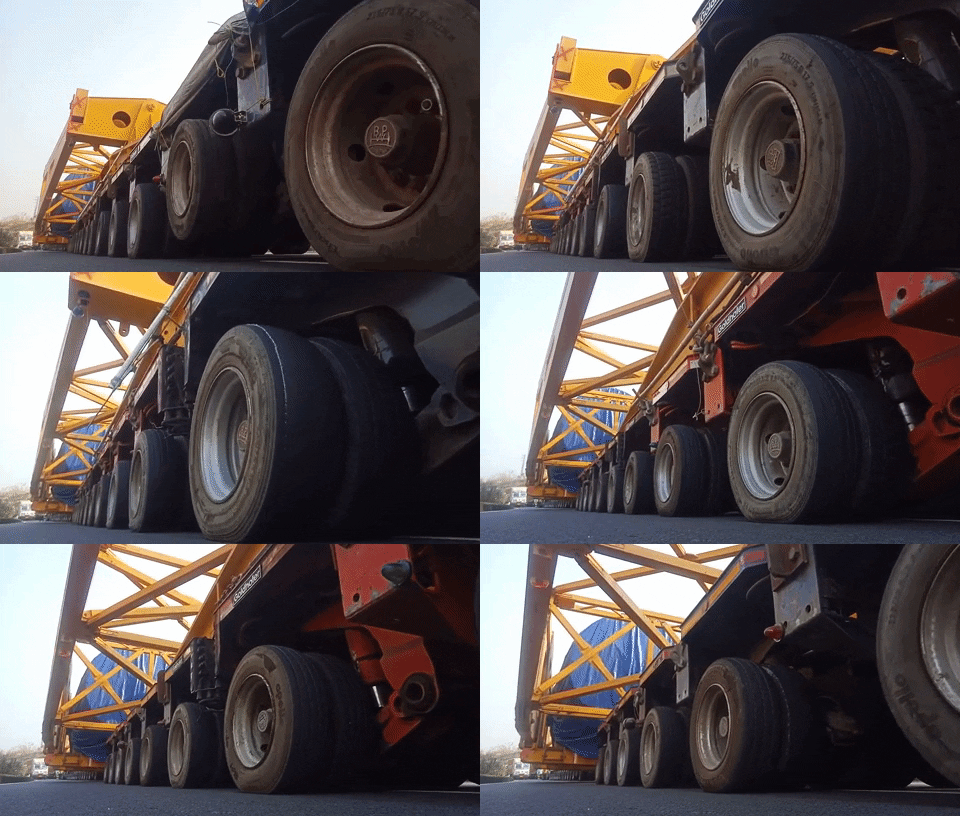
| Cost Factor | Effect on Freight |
|---|---|
| Distance | Fuel, driving time and vehicle utilization |
| Trailer type | Specialized equipment may cost more |
| Cargo weight | Vehicle and axle configuration requirements |
| Cargo dimensions | ODC planning and possible restrictions |
| Vehicle availability | Positioning and empty-running costs |
| Return-load opportunity | Can influence commercial pricing |
| Road conditions | Speed, accessibility and route choice |
| Toll charges | Route-dependent operating expenses |
| State-specific requirements | Applicable compliance costs |
| Loading and unloading | Equipment, manpower and waiting time |
| Detention | Charges for delays |
| Insurance | Coverage and commercial arrangements |
| Escorts and route survey | Special project requirements |
| Fuel prices | Operating-cost changes |
| Delivery schedule | Urgency and vehicle allocation |
How Trailer Freight Quotations Are Calculated
A practical quotation may be built from several components:
Total Quote} = {Base Freight}+ {Additional Services}+ {Applicable Charges}
The base freight may account for vehicle movement, equipment utilization and operating expenses.
Additional services may include loading support, special permits, route surveys, escorts, positioning, detention or other agreed requirements.
Applicable taxes and charges should be stated separately or clearly included in the quotation.
Important: A rate quoted per kilometre should not automatically be multiplied by the road distance and treated as the final freight.
Minimum trip charges, equipment mobilization, empty return distance and special handling can materially change the quotation.
Trailer Freight Rate Categories
| Trailer Category | Usual Quotation Approach |
|---|---|
| Flatbed Trailer | Trip-based or distance-informed quotation |
| Highbed Trailer | Cargo and route-specific quotation |
| Semi Lowbed Trailer | Equipment and cargo-specific quotation |
| Lowbed Trailer | Heavy equipment and route assessment |
| Extendable Trailer | Cargo length and maneuverability assessment |
| Telescopic Trailer | Project-specific quotation |
| Hydraulic Modular Trailer | Engineering and mobilization-based quotation |
| Girder Bridge Trailer | Exceptional-load project quotation |
| Bolster Trailer | Cargo support and route-based quotation |
| SPMT | Project scope, equipment and operating duration |
A universal freight rate cannot reliably represent all these categories.
Why Trailer Freight Rates Change
Trailer freight rates may change due to seasonal demand, fuel costs, equipment shortages, project schedules, weather conditions and the availability of suitable return loads.
For example, a trailer moving from an industrial hub to a remote project site may need to travel a considerable distance without a return consignment.
That empty return journey can affect the original freight quotation.
Similarly, a specialized lowbed trailer may need to travel from another city to the loading point.
The resulting positioning cost may be included in the quoted amount.
Freight Rate Transparency: What Customers Should Demand
Before accepting a quotation, customers should request a clear statement covering:
- Vehicle and trailer configuration.
- Cargo weight and dimensions accepted for the quotation.
- Loading and unloading locations.
- Total agreed freight.
- Toll and applicable tax treatment.
- Vehicle positioning charges.
- Loading and unloading responsibilities.
- Free waiting period and detention terms.
- Permit and escort responsibilities.
- Insurance arrangements.
- Payment terms.
- Cancellation conditions.
- Expected dispatch and delivery arrangements.
This reduces the risk of disagreements after the vehicle reaches the loading point.
Trailer Freight Rate Planning for Major Indian Cities
India’s industrial transportation market connects manufacturing centers, ports, steel plants, engineering clusters and infrastructure projects.
Customers frequently search for trailer transportation between specific cities.
Examples include Mumbai to Delhi trailer transport, Pune to Chennai lowbed trailer services, Ahmedabad to Kolkata flatbed transport and Gujarat to Odisha heavy machinery transportation.
However, route-specific prices should be published only when supported by genuine quotations or verified commercial data.
Major Origin Cities for Trailer Transportation

| Region | Major Industrial Origins | Common Cargo Categories |
|---|---|---|
| Western India | Mumbai, Pune, Ahmedabad, Vadodara, Surat | Machinery, fabricated equipment, chemicals-related plant equipment |
| Northern India | Delhi NCR, Faridabad, Gurugram, Panipat | Engineering equipment, industrial components |
| Central India | Indore, Pithampur, Bhopal, Nagpur | Machinery, manufacturing cargo |
| Eastern India | Kolkata, Durgapur, Jamshedpur, Bokaro | Steel, machinery, fabricated structures |
| Odisha Industrial Belt | Angul, Jharsuguda, Jajpur, Paradip | Steel, power and project cargo |
| Southern India | Chennai, Bengaluru, Hyderabad, Coimbatore | Industrial machinery, engineering products |
| Andhra Pradesh | Visakhapatnam, Kakinada, Krishnapatnam area | Port-related and industrial cargo |
| Northeast India | Guwahati and selected industrial locations | Machinery, infrastructure and project cargo |
Mumbai Trailer Transportation Services
Mumbai and its surrounding industrial region form an important logistics market because of manufacturing activity, warehousing, commercial trade and access to major ports.
Trailer transportation demand may arise from factories, industrial contractors, engineering companies, importers and exporters.
Common service requirements include:
- Flatbed transportation for industrial goods.
- Lowbed transportation for machinery.
- Container trailer movement.
- Heavy equipment dispatch.
- Specialized project cargo movement.
Transport planning must account for the exact loading point, urban traffic conditions, port or industrial access and the final destination.
Pune Trailer Transportation Services
Pune is a major manufacturing and engineering region.
Industrial areas around Pimpri-Chinchwad, Chakan, Talegaon and Ranjangaon generate demand for specialized machinery and equipment transportation.
Typical trailer cargo may include:
- Manufacturing equipment.
- Industrial presses and fabricated assemblies.
- Automotive production machinery.
- Construction equipment.
- Power generation equipment.
- Industrial structures.
The correct trailer depends on cargo specifications and the actual loading location.
Ahmedabad and Vadodara Trailer Transportation
Ahmedabad and Vadodara are important industrial and logistics centers in Gujarat.
Trailer transportation may support engineering companies, process industries, machinery manufacturers and industrial construction projects.
Heavy industrial cargo may require specialized equipment depending on its size and weight.
For oversized loads, road geometry, industrial access and applicable permissions must be assessed before movement.
Surat, Hazira and Dahej Industrial Transportation
Surat, Hazira and Dahej are important industrial locations associated with manufacturing, engineering, port-related activity and major industrial facilities.
Trailer transport demand may include fabricated equipment, heavy machinery, plant components and project cargo.
For cargo moving through port or industrial zones, site-specific procedures and entry restrictions should be checked.
Delhi NCR Trailer Transportation
The National Capital Region includes major industrial and commercial locations such as Faridabad, Gurugram, Noida and Ghaziabad.
Trailer transportation supports machinery movement, engineering goods, manufacturing equipment and project cargo.
Vehicle movement through the NCR requires attention to applicable traffic restrictions, vehicle compliance and route conditions.
Chennai Trailer Transportation
Chennai is an important manufacturing, automotive, engineering and port logistics center.
Trailer services may be required for machinery, automotive manufacturing equipment, fabricated structures and containerized cargo.
The choice of equipment depends on the cargo and whether the movement involves an industrial facility, port, warehouse or construction site.
Bengaluru Trailer Transportation
Bengaluru and its surrounding industrial areas generate demand for machinery, electrical equipment and manufacturing-related transportation.
Large trailer movements may require special attention to urban access, turning space and the suitability of the delivery route.
Hyderabad Trailer Transportation
Hyderabad is a major industrial and manufacturing center.
Trailer transportation requirements may arise from engineering, pharmaceutical manufacturing, infrastructure and other industrial sectors.
For specialized equipment, loading and unloading arrangements should be confirmed before vehicle dispatch.
Kolkata, Durgapur and Eastern India
Kolkata and Durgapur connect important industrial and commercial activity in eastern India.
Trailer transport may support machinery, steel products, industrial structures and project cargo.
For movements toward Jharkhand, Odisha, Bihar or northeastern India, route selection and destination accessibility are important planning factors.
India-Wide Trailer Transportation Route Matrix

The following matrix is designed for industrial freight enquiry and quotation planning.
It identifies potential commercial corridors rather than guaranteed direct services, vehicle availability or fixed freight rates.
| Origin | Destination | Trailer Services to Evaluate |
|---|---|---|
| Mumbai | Delhi NCR | Flatbed, Lowbed, Semi Lowbed |
| Mumbai | Ahmedabad | Flatbed, Highbed, Lowbed |
| Mumbai | Chennai | Flatbed, Semi Lowbed |
| Mumbai | Kolkata | Flatbed, Lowbed, Project Cargo |
| Pune | Delhi NCR | Flatbed, Highbed, Lowbed |
| Pune | Hyderabad | Flatbed, Semi Lowbed |
| Pune | Bengaluru | Flatbed, Machinery Trailer |
| Pune | Chennai | Lowbed, Flatbed |
| Pune | Ahmedabad | Highbed, Flatbed |
| Ahmedabad | Mumbai | Flatbed, Lowbed |
| Ahmedabad | Pune | Flatbed, Semi Lowbed |
| Ahmedabad | Kolkata | Flatbed, Heavy Machinery Trailer |
| Vadodara | Chennai | Industrial Trailer, Lowbed |
| Dahej | Odisha Industrial Belt | Heavy Machinery, Project Cargo |
| Hazira | Pune | Flatbed, Lowbed |
| Delhi NCR | Mumbai | Flatbed, Semi Lowbed |
| Delhi NCR | Chennai | Flatbed, Industrial Trailer |
| Delhi NCR | Kolkata | Flatbed, Machinery Trailer |
| Chennai | Bengaluru | Flatbed, Lowbed |
| Chennai | Hyderabad | Flatbed, Machinery Trailer |
| Hyderabad | Pune | Flatbed, Semi Lowbed |
| Hyderabad | Visakhapatnam | Industrial Trailer |
| Bengaluru | Chennai | Flatbed, Lowbed |
| Kolkata | Jamshedpur | Flatbed, Heavy Machinery |
| Jamshedpur | Mumbai | Steel and Industrial Trailer |
| Angul | Pune | Heavy Machinery, Project Cargo |
| Jharsuguda | Gujarat Industrial Belt | Flatbed, Heavy Haul |
| Paradip | Hyderabad | Industrial and Project Cargo |
| Guwahati | Kolkata | Industrial Trailer |
| Guwahati | Delhi NCR | Industrial and Machinery Trailer |
Trailer Transport Services Across Indian Industrial Corridors
India’s industrial geography influences the demand for trailer transportation.
Large manufacturing plants, steel complexes, refineries, power projects, renewable-energy installations and infrastructure construction sites often require specialized transport solutions.
Western Industrial Corridors
Western India includes major industrial regions in Gujarat and Maharashtra.
Important locations include:
- Ahmedabad and Sanand.
- Vadodara and surrounding industrial areas.
- Bharuch, Ankleshwar and Dahej.
- Surat and Hazira.
- Vapi and Valsad.
- Mumbai Metropolitan Region.
- Pune, Chakan and Talegaon.
- Nashik and Aurangabad/Chhatrapati Sambhajinagar industrial areas.
These locations may generate demand for flatbed trailers, machinery trailers, lowbed equipment and specialized heavy-haul solutions.
Northern Industrial Corridors
Northern India includes manufacturing and infrastructure activity around:
- Delhi NCR.
- Faridabad.
- Gurugram.
- Noida and Greater Noida.
- Ghaziabad.
- Panipat.
- Ludhiana.
- Bhiwadi.
- Neemrana.
- Rudrapur and Pantnagar.
Cargo requirements vary from conventional industrial equipment to specialized machinery and infrastructure components.
Eastern Industrial Corridors
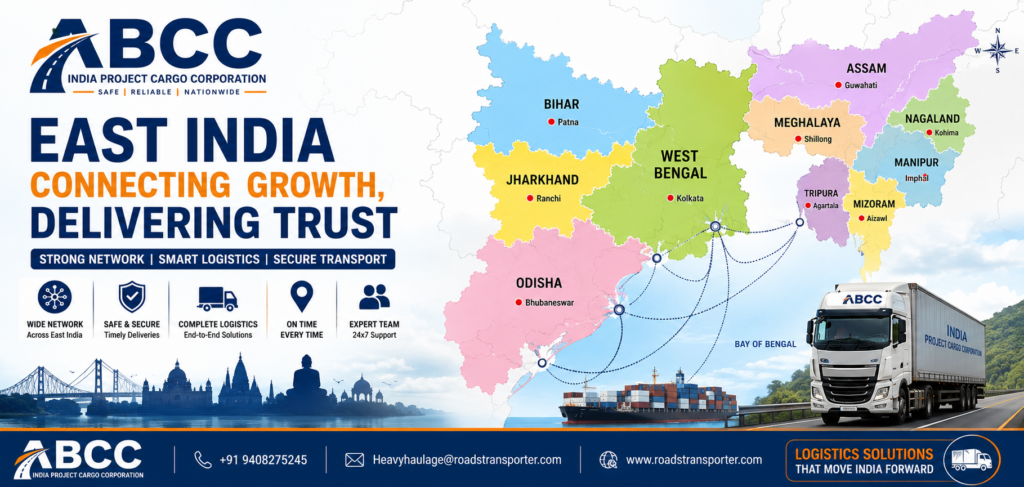
Eastern India contains important steel, mining, power and industrial manufacturing locations.
These include:
- Jamshedpur.
- Bokaro.
- Dhanbad.
- Durgapur.
- Asansol.
- Kalinganagar.
- Angul.
- Jharsuguda.
- Rourkela.
- Paradip.
Heavy machinery and project cargo movements in these regions may require special route planning and equipment selection.
Southern Industrial Corridors
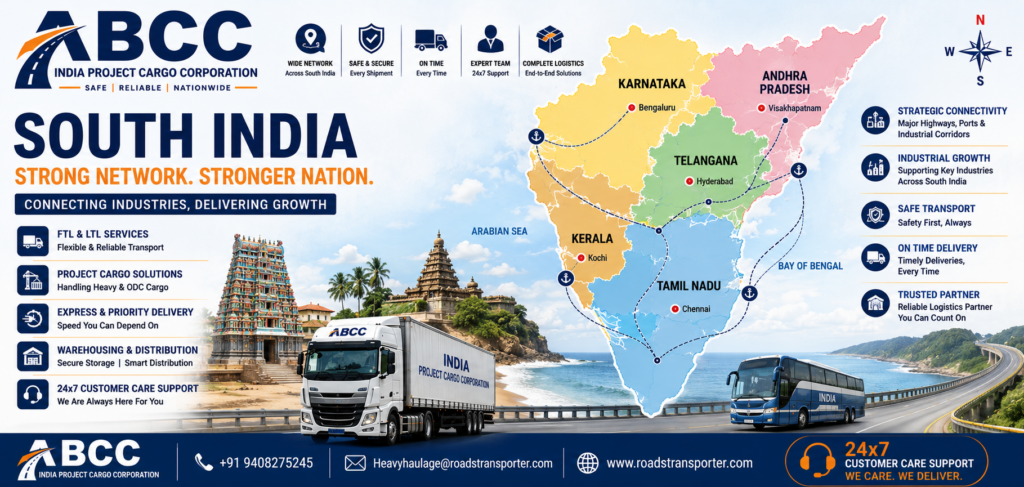
Southern India includes major industrial centers such as:
- Chennai.
- Sriperumbudur.
- Hosur.
- Bengaluru.
- Hyderabad.
- Coimbatore.
- Tiruchirappalli.
- Visakhapatnam.
- Kakinada.
- Krishnapatnam industrial region.
The region supports diverse industries, including engineering, manufacturing, automotive, energy and infrastructure.
Central Indian Industrial Corridors
Central India connects manufacturing and industrial activity around:
- Indore.
- Pithampur.
- Bhopal.
- Mandideep.
- Nagpur.
- Raipur.
- Bhilai.
- Korba.
- Singrauli industrial region.
Trailer transportation in these areas may support steel, power, mining equipment, manufacturing machinery and project construction.
Northeastern Industrial and Infrastructure Transportation
Northeastern India presents distinct transportation challenges due to terrain, road geometry, weather conditions and the location of some project sites.
Important logistics locations include Guwahati and selected industrial or infrastructure sites across Assam and neighboring states.
Specialized trailer transportation may require careful assessment of bridges, gradients, turning radii and seasonal accessibility.
No route should be assumed suitable for oversized cargo without appropriate verification.
Trailer Availability and Return-Load Management
Trailer availability is a major commercial factor in industrial transportation.
A customer may require a specific vehicle at a factory, while the nearest suitable trailer is located in another industrial city.
This creates positioning costs and can affect the dispatch schedule.
Why Return Loads Matter
A return load is cargo carried on a vehicle’s return journey or subsequent repositioning movement.
Return-load opportunities may help reduce empty running and improve equipment utilization.
For example, a trailer delivering machinery from Pune to Gujarat may seek a suitable consignment for its next movement.
However, return-load matching is not guaranteed.
The availability of cargo depends on vehicle suitability, timing, route compatibility, loading conditions and commercial agreement.
Benefits of Better Trailer Utilization
| Stakeholder | Potential Benefit |
|---|---|
| Vehicle Owner | Reduced empty running |
| Trailer Supplier | Better fleet utilization |
| Transport Broker | More matching opportunities |
| Industrial Customer | Potentially more competitive quotations |
| Driver | More predictable trip planning |
| Logistics Coordinator | Improved equipment allocation |
Why the Cheapest Return Trailer May Not Be Suitable
A return trailer may be commercially attractive, but the vehicle must still meet all technical and legal requirements.
A low freight quote should not override cargo safety, axle loading, route restrictions or equipment compatibility.
Customers should verify the actual trailer configuration before approving a return-load arrangement.
Trailer Supplier and Commission Agent Networks
Trailer suppliers and transport commission agents play an important role in connecting industrial customers with suitable equipment.
Their responsibilities may include:
- Locating available vehicles.
- Checking equipment specifications.
- Coordinating loading schedules.
- Communicating freight quotations.
- Verifying essential documentation.
- Supporting dispatch coordination.
- Helping resolve transportation issues.
Professional networks should clearly define commercial responsibilities, commissions, payment terms and service obligations.
A transparent agreement helps protect customers, fleet owners and intermediaries.
Trailer Transport Cost Reduction Without Compromising Safety
Industrial customers often want to reduce transportation expenses.
The best cost-reduction opportunities usually come from better planning rather than choosing an unsuitable vehicle.
Plan Cargo Dispatch Early
Early planning provides more time to identify suitable equipment, evaluate routes and coordinate loading arrangements.
Last-minute requirements may limit vehicle choices and increase positioning costs.
Share Accurate Cargo Dimensions
Incorrect dimensions can lead to the wrong trailer being dispatched.
Accurate drawings and measurements reduce the risk of additional charges, delays and equipment changes.
Coordinate Loading and Unloading
A trailer waiting for a crane or unloading team may incur detention charges.
Confirming equipment availability before vehicle arrival can reduce avoidable delays.
Compare Complete Quotations
Two transport quotations should be compared on the same basis.
A lower freight amount may exclude costs that another quotation includes.
Customers should compare the complete scope, including positioning, tolls, permits, escorts and detention conditions.
Evaluate Return-Load Opportunities
A suitable return-load vehicle may provide a commercial advantage when timing and technical requirements align.
However, equipment suitability must remain the first priority.
Avoid Unnecessary Cargo Handling
Each additional handling operation introduces time, cost and potential damage risk.
Where practical, direct loading and delivery can simplify the transportation process.
Use the Correct Trailer Configuration
Selecting equipment that is excessively specialized may increase costs unnecessarily.
Conversely, selecting inadequate equipment can create much greater financial and safety risks.
The correct objective is to identify the most suitable compliant transport solution.
Establish Clear Detention Terms
Loading delays, unloading delays and site-access problems can result in disputes.
Written detention conditions help establish expectations before dispatch.
Improve Communication
Customers, suppliers, drivers and site personnel should share accurate information about loading readiness, route requirements and delivery arrangements.
Poor communication can create avoidable vehicle waiting time.
Maintain Transportation Records
Consignment records, quotations, vehicle details, loading photographs, delivery documents and exception reports support accountability and dispute resolution.
Trailer Transport vs Conventional Truck Transportation
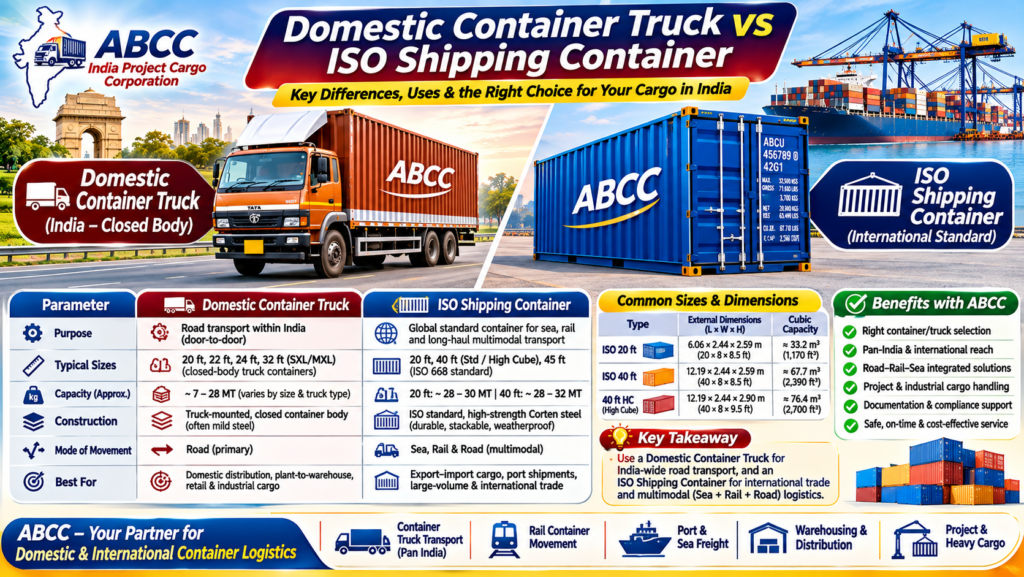
A conventional rigid-body truck and a tractor-trailer combination serve different transportation requirements.
Neither is universally better.
| Comparison | Conventional Truck | Trailer Transportation |
|---|---|---|
| Vehicle design | Integrated cargo body and chassis | Separate tractor and trailer arrangement |
| Cargo suitability | General goods and suitable machinery | Long, heavy or specialized industrial cargo |
| Loading flexibility | Depends on body type | Often greater for open-deck configurations |
| Maneuverability | Often easier for shorter vehicles | Can require more turning space |
| Equipment variety | Multiple truck-body types | Wide range of specialized trailers |
| Heavy cargo | Limited by approved configuration | Specialized configurations available |
| ODC suitability | Possible for certain approved loads | Often preferred for specialized ODC |
| Operating cost | Depends on truck and route | Depends on trailer, cargo and route |
| Site access | May be easier for smaller vehicles | Requires detailed access checks for long combinations |
When Should a Customer Choose a Trailer?
A trailer may be appropriate when cargo is unusually long, heavy, tall or difficult to accommodate on a conventional truck.
However, the final choice should be based on the actual cargo and route requirements.
When Is a Conventional Truck Better?
A conventional truck may be more economical for suitable general cargo that fits within its approved loading limits.
It may also offer better accessibility at certain urban or industrial locations.
The right decision depends on total cost, safety, vehicle availability and delivery requirements.
Trailer Dimensions, Length, Width, Height and Payload Capacity in India

Trailer dimensions are among the most frequently requested details in industrial transportation.
Customers often search for terms such as:
- 40 feet trailer dimensions in India
- 50 feet trailer truck capacity
- 60 feet trailer transportation
- Lowbed trailer height and payload
- Semi lowbed trailer dimensions
- Hydraulic modular trailer capacity
- 20 ton, 30 ton, 40 ton and 50 ton trailer booking
- Multi-axle trailer transport service
However, trailer dimensions and carrying capacities are not standardized across every vehicle sold or operated under the same commercial name.
Two trailers described as 40-foot flatbeds may have different axle configurations, deck heights, tare weights and legally permissible loading limits.
Therefore, the advertised length of a trailer should never be treated as proof of its payload capacity.
Common Trailer Length Categories in the Indian Transport Market
The following chart describes common commercial size requests. These are market descriptions, not statutory vehicle dimensions or guarantees of availability.
| Marketed Trailer Length | Commonly Requested Cargo | Vehicle Configuration to Evaluate |
|---|---|---|
| 20–25 feet | Compact industrial machinery | Suitable short-deck equipment |
| 26–30 feet | Machinery and fabricated assemblies | Flatbed or low-deck equipment |
| 31–35 feet | Medium-length industrial goods | Flatbed / Semi Lowbed |
| 36–40 feet | Steel, machinery and industrial cargo | Flatbed / Highbed |
| 41–45 feet | Long fabricated structures | Suitable long-deck trailer |
| 46–50 feet | Long machinery and structural goods | Flatbed / Extendable |
| 51–55 feet | Long industrial equipment | Extendable / Specialized Trailer |
| 56–60 feet | Long beams and project cargo | Extendable / Telescopic |
| Above 60 feet | Exceptional-length cargo | Specialized engineered transport |
The actual usable deck length must be verified from the vehicle’s technical specifications.
Trailer Width and Cargo Width
Cargo width is a critical consideration because a consignment may extend beyond the trailer’s standard loading platform.
The overall loaded width must be evaluated against applicable legal limits, road geometry, traffic conditions and the requirements of the relevant authorities.
A wide cargo load can create problems at:
- Narrow bridges.
- Toll-plaza lanes.
- Industrial estate entrances.
- Roadside utility installations.
- Urban intersections.
- Construction diversions.
- Mountain roads.
- Restricted factory gates.
A wider trailer is not automatically a safer solution. Stability, load distribution, approved dimensions and cargo restraint must also be evaluated.
Trailer Deck Height and Loaded Transport Height
The total loaded transport height can be calculated conceptually as:
{loaded}}={deck}}{support}}{cargo}
This simplified calculation assumes that the cargo is positioned above the deck and does not account for every specialized arrangement.
For example, consider a hypothetical machine with:
| Component | Illustrative Measurement |
|---|---|
| Trailer deck height | 1.20 m |
| Cargo support arrangement | 0.15 m |
| Machinery height | 3.20 m |
| Calculated loaded height | 4.55 m |
This is an illustration, not a permitted road height or approved loading plan.
A lower-deck trailer may reduce the loaded height, but the final movement must still satisfy applicable regulations and route clearances.
Trailer Payload Capacity: Why Gross Weight Matters
Payload refers to the weight of cargo carried by the vehicle.
Gross combination weight includes the relevant vehicle and cargo weights in the complete transport combination.
The distinction matters because a trailer advertised as suitable for a particular cargo weight may not be permitted to carry that load under every operating condition.
The following must be checked:
- Tractor and trailer registration specifications.
- Manufacturer-rated capacities.
- Permissible gross and axle loads.
- Actual vehicle tare weights.
- Cargo weight and distribution.
- Tyre and suspension ratings.
- Coupling and fifth-wheel limitations.
- Route restrictions and special permissions.
Cargo Weight Categories for Trailer Booking
| Cargo Weight | Initial Transport Planning Considerations |
|---|---|
| Up to 10 tonnes | Dimensions, handling and suitable equipment |
| 10–20 tonnes | Trailer selection and axle distribution |
| 20–30 tonnes | Verified configuration and loading conditions |
| 30–40 tonnes | Multi-axle suitability and legal load limits |
| 40–60 tonnes | Specialized configuration may be necessary |
| 60–100 tonnes | Heavy-haul engineering and route feasibility |
| 100–200 tonnes | Specialized modular or other engineered systems |
| Above 200 tonnes | Project-specific heavy transport engineering |
These are planning bands only. They are not official payload classifications or permissions to carry the stated weights.
Trailer Axle Configurations and Their Importance
The number and arrangement of axles influence the distribution of vehicle and cargo weight.
However, adding more axles does not automatically make a transport movement legal or safe.
The complete combination must satisfy manufacturer limitations, statutory requirements and route conditions.
Common Axle-Related Terminology
| Term | Meaning | Why It Matters |
|---|---|---|
| Single Axle | One axle assembly | Load distribution |
| Tandem Axle | Two axles in a group | Weight distribution |
| Tridem Axle | Three axles in a group | Multi-axle configuration |
| Steerable Axle | Axle capable of steering | Maneuverability |
| Hydraulic Suspension | Suspension using hydraulic systems | Load leveling and distribution |
| Modular Axle Line | Configurable axle-row arrangement | Exceptional heavy transport |
| Fifth Wheel | Tractor-trailer coupling interface | Coupling and load transfer |
| Kingpin | Trailer coupling component | Connection integrity |
| Gooseneck | Specialized trailer front connection | Trailer geometry and loading |
Why Axle Distribution Matters
A heavy industrial machine may have a concentrated center of gravity.
Even when the total cargo weight is within a vehicle’s overall rated capacity, individual axle groups or structural components may become overloaded.
This is why professional transport planning considers both total weight and the distribution of forces throughout the transport combination.
For specialized loads, engineering calculations may be required to establish the appropriate trailer configuration.
Tractor Selection for Heavy Trailer Transportation
The tractor unit must be compatible with the trailer and intended cargo.
Important factors include engine performance, transmission, traction, braking capacity, coupling ratings and approved operating specifications.
For demanding heavy-haul movements, route gradients and traction conditions may influence the need for specialized tractor configurations or additional engineered assistance.
A powerful tractor alone does not establish that a combination is suitable for a heavy load.
🚛 Trailer Transport Freight Enquiry Form – Customer Information
For an accurate trailer transport freight quotation in India, customers should provide complete cargo information before contacting a trailer transport company or supplier.
Whether you need a flatbed trailer, highbed trailer, semi lowbed trailer, lowbed trailer, telescopic trailer or hydraulic modular trailer, the following information helps transport professionals recommend suitable equipment and prepare a freight quotation.
📋 Trailer Transport Booking & Freight Enquiry Details
| Required Information | Customer Details |
|---|---|
| Customer / Company Name | __________________ |
| Contact Person | __________________ |
| Mobile / WhatsApp Number | __________________ |
| Email Address | __________________ |
| Loading City / Location | __________________ |
| Loading Site / Industrial Area | __________________ |
| Delivery City / Location | __________________ |
| Delivery Site / Industrial Area | __________________ |
| Cargo / Machinery Description | __________________ |
| Total Cargo Weight (MT) | __________________ |
| Cargo Length (Feet / Metres) | __________________ |
| Cargo Width (Feet / Metres) | __________________ |
| Cargo Height (Feet / Metres) | __________________ |
| Number of Packages | __________________ |
| Required Trailer Type | __________________ |
| Loading Equipment Available | Yes / No |
| Unloading Equipment Available | Yes / No |
| Expected Dispatch Date | __________________ |
| Special ODC / Heavy Cargo Requirements | __________________ |
| Cargo Insurance Requirements | __________________ |
| Additional Instructions | __________________ |
🚚 Available Trailer Categories for Freight Enquiry
| Trailer Type | Typical Transportation Requirement |
|---|---|
| Flatbed Trailer | Steel, machinery and fabricated structures |
| Highbed Trailer | General industrial machinery and equipment |
| Semi Lowbed Trailer | Machinery requiring a lower loading deck |
| Lowbed Trailer | Heavy and tall industrial equipment |
| Extendable Trailer | Long industrial structures |
| Telescopic Trailer | Wind turbine blades and exceptionally long cargo |
| Hydraulic Modular Trailer | Exceptional heavy-lift transportation |
| Girder Bridge Trailer | Specialized concentrated heavy loads |
| Bolster Trailer | Long structural cargo |
| Container Trailer | ISO shipping containers |
| SPMT | Heavy modules and specialized site movements |
Important: Final trailer selection depends on cargo weight, dimensions, center of gravity, vehicle specifications, route feasibility and applicable legal permissions.
📲 How to Request a Trailer Transport Freight Quotation
Customers should share their cargo details, loading and unloading locations, preferred dispatch date and available technical drawings or photographs.
The transportation provider can then evaluate the required trailer configuration, vehicle availability, route conditions, applicable permissions and estimated transportation cost.
A written quotation should clarify the agreed freight, additional charges, responsibilities, payment terms and expected delivery arrangements.
🤝 ABCC India Project Cargo Corporation – Trailer Transportation Assistance
ABCC India Project Cargo Corporation provides a point of contact for customers seeking industrial trailer transportation and project cargo logistics coordination across India.
Customers may enquire about:
- 🚛 Flatbed, Highbed and Semi Lowbed Trailer Transportation
- ⛓️ Lowbed and Heavy Machinery Transportation
- 🏗️ Hydraulic Modular and Specialized Heavy Haulage
- 📦 Industrial Machinery and Project Cargo Movement
- 🛣️ ODC Route Survey and Transportation Planning
- 📍 Trailer Sourcing and Vehicle Availability
- 💰 Trailer Freight Quotation and Cost Planning
- 🤝 Transport Supplier and Commission Agent Coordination
Service availability, equipment suitability and commercial terms should be confirmed for each consignment.
ODC, OOG & OWC Cargo Transportation, Government Permissions, Route Survey, Loading, Lashing and Safety
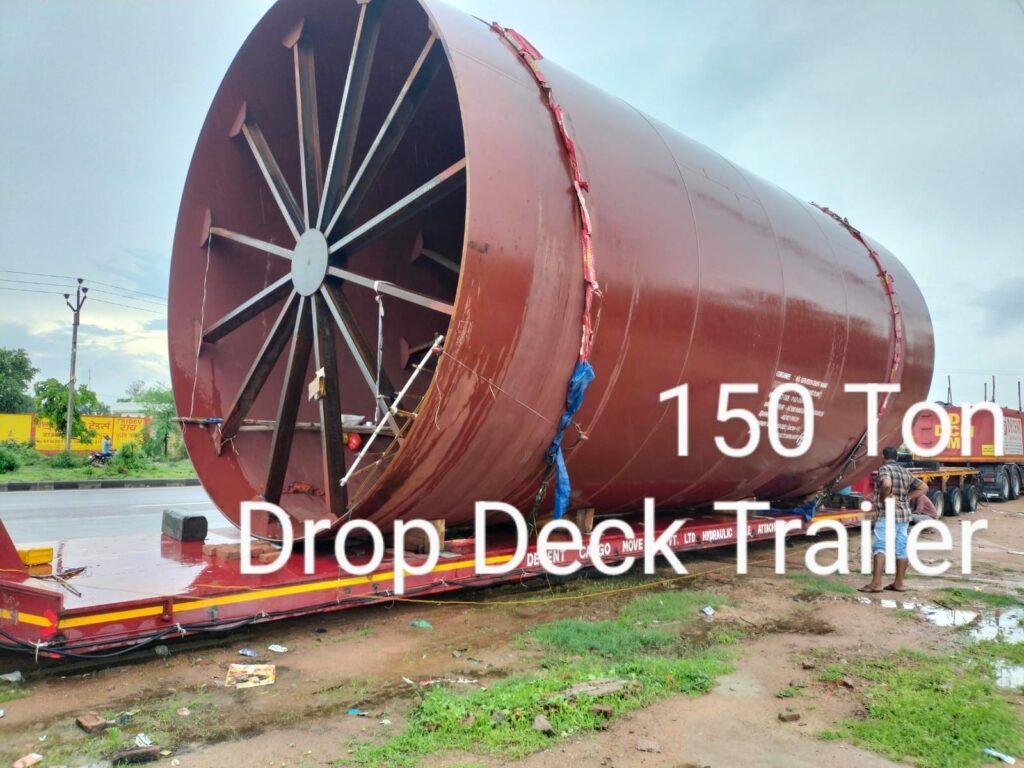
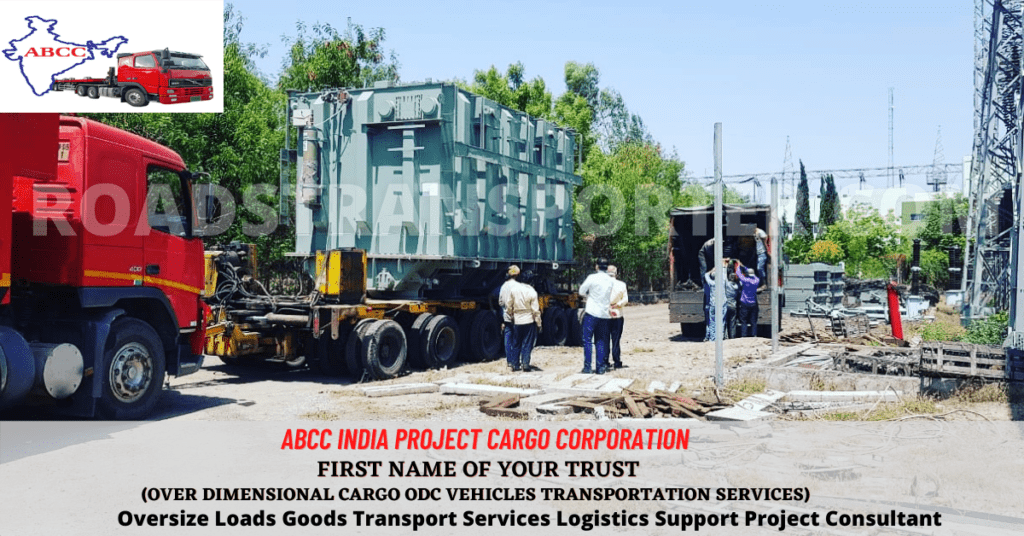

This section explains how oversized, overweight and specialized industrial cargo is transported by trailers in India. It covers the difference between ODC, OOG and OWC cargo, vehicle selection, government permissions, route feasibility, cargo loading, lashing, insurance, documentation and emergency management.
For industrial customers, understanding these requirements is essential because heavy cargo transportation is not simply a matter of finding a trailer with sufficient carrying capacity.
Every movement must be evaluated according to its actual cargo characteristics, vehicle configuration, legal requirements and operating conditions.
🚛 What Is ODC Cargo Transportation in India?
Over Dimensional Cargo (ODC) refers to cargo that exceeds applicable dimensional limits when transported on a vehicle.
In practical industrial logistics, the term is commonly associated with unusually long, wide or tall consignments requiring special transport planning.
ODC cargo is frequently transported using lowbed trailers, semi lowbed trailers, extendable trailers, hydraulic modular trailers and other specialized equipment.
Common Examples of ODC Cargo
| Industrial Cargo | Typical Transportation Challenge | Trailer to Evaluate |
|---|---|---|
| Industrial Boiler | Height, weight and lifting requirements | Lowbed / Modular Trailer |
| Power Transformer | Concentrated weight and stability | Hydraulic Modular / Specialized Trailer |
| Wind Turbine Blade | Exceptional length and turning radius | Telescopic / Blade Trailer |
| Wind Tower Section | Diameter and loaded height | Specialized Lowbed |
| Large Pressure Vessel | Width, height and center of gravity | Lowbed / Modular Trailer |
| Steel Fabricated Structure | Length, width and support points | Flatbed / Extendable Trailer |
| Industrial Reactor | Weight and overall dimensions | Lowbed / Hydraulic Modular |
| Heavy Generator | Concentrated weight | Lowbed / Multi-Axle Trailer |
| Bridge Girder | Length and structural support | Extendable / Specialized Trailer |
| Prefabricated Industrial Module | Combined weight and dimensions | Modular Trailer / SPMT |
These are preliminary equipment choices. The final trailer must be selected using verified engineering and legal information.
Why ODC Transportation Requires Special Planning
ODC transportation creates challenges that may not arise during ordinary truck transportation.
A wide consignment may be unable to pass through a narrow bridge or factory gate.
A tall load may encounter overhead electrical lines, railway structures or road overbridges.
An exceptionally long load may be unable to negotiate a sharp turn without special arrangements.
Heavy cargo can also impose significant forces on bridges, pavement, trailer components and lifting equipment.
Therefore, ODC transportation requires coordination between the cargo owner, transport contractor, vehicle operator, engineering team and relevant authorities.
Difference Between ODC and Ordinary Industrial Cargo
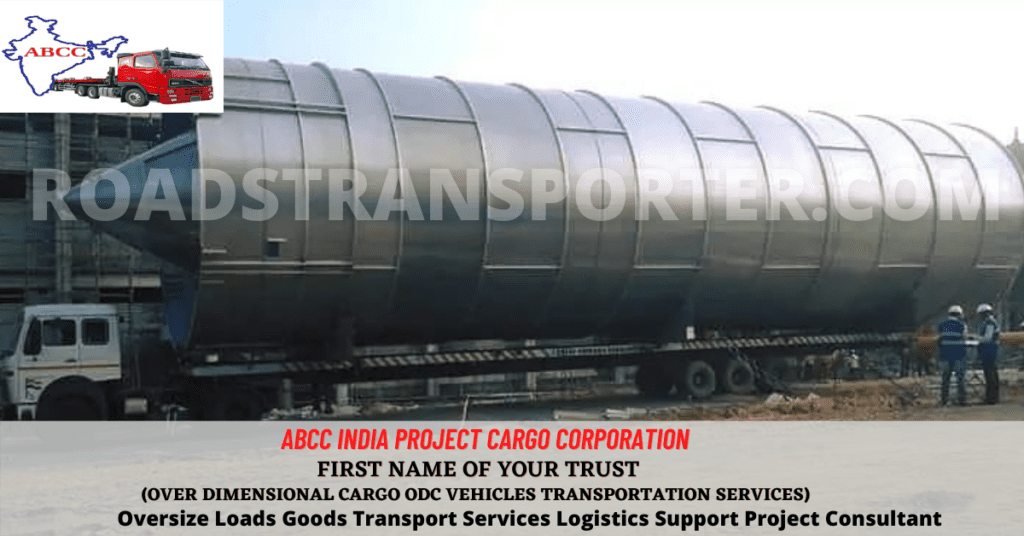


| Factor | Ordinary Industrial Cargo | ODC Cargo |
|---|---|---|
| Dimensions | Within applicable limits | Exceeds one or more applicable limits |
| Vehicle | Suitable approved goods vehicle | Suitable specialized vehicle may be needed |
| Route Survey | Depends on cargo and route | Often essential |
| Government Permissions | Normal applicable compliance | Additional approvals may be required |
| Escorts | Generally not required solely due to dimensions | May be required |
| Loading Plan | Cargo-specific | Often more complex |
| Delivery Planning | Standard site coordination | Detailed access and route coordination |
| Transportation Risk | Depends on cargo | Additional dimensional and operational risks |
Important: ODC classification is determined by applicable legal limits and the actual loaded vehicle configuration, not simply by whether a consignment looks unusually large.
⛓️ ODC vs OOG vs OWC Cargo – Meaning and Differences
The terms ODC, OOG and OWC are commonly used in project logistics, but they do not all have identical meanings.
ODC – Over Dimensional Cargo
ODC describes cargo that exceeds applicable dimensional limits in its transport configuration.
It may involve excess length, width or height.
OOG – Out of Gauge Cargo
Out of Gauge (OOG) is widely used in container shipping and multimodal logistics.
It commonly describes cargo that extends beyond the standard dimensions of a container or transport unit.
Examples include machinery extending beyond a flat-rack container’s normal envelope.
OWC – Overweight Cargo
Overweight Cargo (OWC) is a descriptive logistics term for cargo whose weight creates loading or transport-limit issues.
Whether a road movement is legally overweight depends on the relevant vehicle, axle, gross-weight and route restrictions.
ODC, OOG and OWC Comparison Chart
| Feature | ODC | OOG | OWC |
|---|---|---|---|
| Full Form | Over Dimensional Cargo | Out of Gauge | Overweight Cargo |
| Primary Concern | Cargo dimensions | Exceeding a transport unit’s gauge | Cargo weight |
| Common Industry | Road/project logistics | Shipping and multimodal logistics | Heavy haulage |
| Typical Equipment | Lowbed, Extendable, Modular | Flat Rack, Open Top, Specialized Transport | Multi-Axle, Modular, Heavy Haul |
| Main Challenge | Clearance and maneuverability | Transport-unit compatibility | Weight distribution and infrastructure capacity |
| Route Assessment | Frequently required | Depends on transport mode | Frequently required |
| Special Permission | As applicable | As applicable to each transport mode | As applicable |
These terms are operational descriptions. Their use does not replace the legal classification required by the relevant transport authority.
Can Cargo Be Both ODC and OWC?
Yes.
A large industrial transformer, for example, may exceed applicable dimensional limits and also require special consideration because of its weight.
Such cargo needs a combined dimensional, structural and route assessment.
It is incorrect to assume that obtaining permission for excess dimensions automatically authorizes excess weight.
🏛️ Government Rules and Permissions for Trailer Transportation in India
Trailer transportation in India is regulated through a combination of central motor vehicle legislation, vehicle construction requirements, weight and dimension limits, state-level administration and route-specific conditions.
The principal legal framework includes the Motor Vehicles Act, 1988, and the Central Motor Vehicles Rules, 1989, as amended.
Applicable requirements may also arise from notifications, permit conditions, road-owning authorities, police directions and rules governing particular cargo.
Important Legal and Regulatory Areas
| Regulatory Area | Relevance to Trailer Transportation |
|---|---|
| Motor Vehicles Act, 1988 | Vehicle operation and statutory obligations |
| Central Motor Vehicles Rules, 1989 | Vehicle standards and related requirements |
| Rule 93 and applicable amendments | Vehicle dimensions |
| Rule 95 and applicable amendments | Size and ply rating of tyres |
| Rule 96 and applicable amendments | Brakes |
| Rule 100 and applicable amendments | Safety glass requirements where applicable |
| Rule 102 and applicable amendments | Signalling devices and reflectors |
| Rule 125 and applicable amendments | Safety standards for vehicle bodies and related equipment |
| Rule 138 and applicable amendments | Additional safety measures |
| Section 113 of the Motor Vehicles Act | Weight-related restrictions |
| Section 114 of the Motor Vehicles Act | Vehicle weighing powers |
| Section 115 of the Motor Vehicles Act | Restrictions on vehicle use |
| GST and E-Way Bill Rules | Goods movement documentation |
| Applicable Dangerous Goods Rules | Specialized hazardous-cargo transportation |
The precise applicability of each provision depends on the vehicle and cargo. Operators should consult the current official text rather than relying solely on this overview.
Are Special Permits Required for ODC Transportation?
Special permissions may be required when the proposed vehicle movement exceeds applicable limits or is subject to route-specific restrictions.
Requirements can depend on:
- Actual loaded vehicle dimensions.
- Gross and axle weights.
- Vehicle category and registration.
- Origin, destination and proposed route.
- Bridge and road infrastructure.
- State boundaries.
- Applicable central and state permissions.
- Conditions imposed by road-owning authorities.
A normal goods carriage permit should not be assumed to authorize every oversized or overweight movement.
Government Departments That May Be Involved
| Authority or Organization | Possible Role |
|---|---|
| State Transport Department / RTO | Applicable vehicle and transport permissions |
| Ministry of Road Transport and Highways | Central regulatory framework |
| National Highways Authority of India | Relevant national-highway infrastructure coordination |
| State Public Works Department | State road and bridge matters |
| Traffic Police | Traffic management and movement restrictions |
| Local Administration | Local road and access coordination |
| Electricity Distribution Utility | Electrical-clearance coordination |
| Railway Authorities | Railway crossing or infrastructure permissions where applicable |
| Port Authority | Port-entry and cargo movement requirements |
| Industrial Estate Authority | Industrial area access restrictions |
Not every authority is involved in every movement. The applicable approvals must be identified for the actual route.
ODC Permission Application – Practical Document Checklist
| Document / Information | Purpose |
|---|---|
| Vehicle Registration Certificate | Identifies vehicle details |
| Valid Insurance | Vehicle insurance compliance |
| Fitness Certificate | Applicable vehicle fitness compliance |
| Goods Carriage Permit | Applicable transport authorization |
| Driver Licence | Driver qualification |
| Cargo Weight Certificate | Weight verification |
| Cargo Dimensions / Drawings | Dimensional assessment |
| Trailer Technical Specifications | Equipment suitability |
| Axle Load Distribution | Load and infrastructure assessment |
| Proposed Route Map | Route identification |
| Route Survey Report | Feasibility assessment |
| Loading Arrangement Drawing | Cargo positioning |
| Lashing / Securing Plan | Cargo restraint |
| Bridge Assessment | Infrastructure evaluation where required |
| Movement Schedule | Operational planning |
| Escort Plan | Required traffic and safety arrangements |
| Emergency Response Plan | Incident preparedness |
The list is a planning checklist, not a universal government application form.
Interstate ODC Transportation
An ODC consignment moving between two Indian states may encounter different administrative procedures and road restrictions.
Before dispatch, the transport contractor should confirm that the proposed movement is authorized throughout the complete route.
This includes any required permissions for national highways, state highways, urban roads and restricted infrastructure.
A permission issued for one road segment should not be assumed to cover every other road segment.
ODC Transport Movement Timing
Some special movements may be restricted to approved hours or require particular traffic-control arrangements.
Movement timing should follow the actual permit conditions and directions issued by the competent authorities.
There is no single universal night-movement rule that can safely be applied to every ODC consignment across India.
📦 GST, E-Way Bill and Documentation for Trailer Transportation
Trailer transportation companies must understand the difference between transport permissions and GST documentation.
An E-Way Bill supports compliance with applicable goods-movement requirements. It does not replace an ODC road movement permit, vehicle fitness certificate or other statutory approval.
When Is an E-Way Bill Required?
Under the general provisions of Rule 138 of the CGST Rules, an E-Way Bill is normally required for applicable movements of goods where the consignment value exceeds ₹50,000, subject to exemptions and special provisions.
The rules also cover certain movements that require documentation regardless of the ordinary threshold.
E-Way Bill Validity for ODC Cargo
The applicable distance-based validity rules distinguish ordinary cargo from qualifying ODC movements.
| Transport Category | Distance | General Validity |
|---|---|---|
| Ordinary goods movement | Up to 200 km | 1 day |
| Ordinary goods movement | Each additional 200 km or part | 1 additional day |
| Qualifying ODC movement | Up to 20 km | 1 day |
| Qualifying ODC movement | Each additional 20 km or part | 1 additional day |
For E-Way Bill purposes, ODC has a specific definition involving a single indivisible unit exceeding the dimensional limits prescribed under Rule 93 of the Central Motor Vehicles Rules. Not every heavy consignment qualifies for the ODC validity calculation.
ODC E-Way Bill Calculation Examples
| Approximate Distance | Illustrative ODC Validity |
|---|---|
| 20 km | 1 day |
| 40 km | 2 days |
| 100 km | 5 days |
| 200 km | 10 days |
| 500 km | 25 days |
| 1,000 km | 50 days |
These examples illustrate the distance-based calculation. The actual validity period and expiry must be checked on the generated E-Way Bill.
E-Way Bill Extension for Delayed ODC Cargo
ODC transportation can face delays due to road closures, weather, mechanical problems or permit-related restrictions.
Rule 138 provides for extension of E-Way Bill validity in exceptional circumstances, subject to the applicable conditions and portal procedure.
The rules provide an extension window around expiry, including the eight-hour period after expiry. Transporters should verify the current portal procedure before relying on an extension. CBIC
Documents to Carry During Trailer Transportation
| Document | Purpose |
|---|---|
| Tax Invoice / Applicable Goods Document | Commercial goods documentation |
| E-Way Bill | GST goods-movement compliance where required |
| Lorry Receipt / Consignment Note | Transportation record |
| Vehicle Registration Certificate | Vehicle identification |
| Valid Vehicle Insurance | Statutory vehicle insurance |
| Fitness Certificate | Applicable vehicle fitness compliance |
| Goods Carriage Permit | Applicable transport authorization |
| Driver Licence | Driver qualification |
| Cargo Packing List | Package identification |
| Cargo Drawings | Technical cargo information |
| Special ODC/OWC Permissions | Applicable movement authorization |
| Route Survey Report | Route planning and feasibility |
| Loading and Securing Plan | Cargo handling and restraint |
A separate checklist should be prepared for each project because documentation requirements vary.
🛣️ What Is an ODC Trailer Route Survey?
An ODC route survey is a technical assessment of the proposed transportation route to determine whether a particular loaded vehicle can travel through it safely and in accordance with applicable requirements.
For ordinary cargo, a standard route may be sufficient.
For unusually long, wide, tall or heavy cargo, a route survey can become one of the most important stages of project planning.
Why Route Surveys Are Necessary
A route that is suitable for a conventional truck may be unsuitable for a lowbed trailer carrying a large industrial machine.
Problems can arise from:
- Narrow roads and bridges.
- Insufficient turning space.
- Low overhead structures.
- Railway crossings.
- Road gradients.
- Uneven pavement.
- Weak shoulders.
- Temporary construction restrictions.
- Restricted industrial access.
- Inadequate ground-bearing capacity.
A route survey helps identify these problems before the cargo begins its journey.
ODC Route Survey Checklist
| Survey Parameter | What Must Be Evaluated |
|---|---|
| Route Distance | Proposed movement distance |
| Road Width | Available travel width |
| Bridge Width | Usable passage |
| Bridge Load Capacity | Structural suitability |
| Overhead Clearance | Available vertical space |
| Turning Radius | Ability to negotiate bends |
| Road Gradient | Tractor and trailer capability |
| Railway Crossing | Geometry and authorization |
| Toll Plaza | Suitable lane and clearance |
| Road Surface | Pavement condition |
| Factory Gate | Entry and exit feasibility |
| Loading Site | Equipment positioning |
| Unloading Site | Access and handling arrangements |
| Emergency Parking | Safe stopping options |
| Alternate Route | Feasible contingency route |
Desktop Route Survey vs Physical Route Survey
A desktop route survey uses available maps, drawings, infrastructure information and other records to identify potential route constraints.
A physical route survey involves inspecting relevant road sections and critical locations.
Both methods can contribute to route planning, but neither should be treated as a substitute for necessary engineering assessments or authority approvals.
Bridge Assessment for Heavy Cargo
Bridge suitability is particularly important for overweight cargo.
A bridge assessment may need to consider the loaded vehicle’s total weight, axle spacing, axle loads, wheel loads and the structural characteristics of the bridge.
For exceptional loads, a qualified bridge engineer and the relevant road authority may need to evaluate the proposed movement.
Never assume that a bridge is suitable merely because ordinary commercial trucks use it regularly.
Overhead Clearance and Electrical Infrastructure
Tall loads may encounter overhead electrical lines, bridges, signboards and other infrastructure.
The transport plan must identify relevant clearance restrictions.
Where electrical infrastructure is involved, only the authorized utility and appropriately qualified personnel should assess or perform any required work.
Drivers and transport crews should never attempt to lift, move or handle energized overhead lines.
Turning Radius and Long Trailer Movement
Long trailers can require substantial turning space.
An extendable or telescopic trailer may encounter difficulties at intersections that are easily negotiated by ordinary trucks.
Turning feasibility may require a swept-path assessment based on the actual loaded vehicle geometry.
Route Survey Report Format
A professional route survey report may contain:
| Report Section | Information |
|---|---|
| Project Details | Customer, cargo and movement scope |
| Cargo Details | Weight, dimensions and center of gravity |
| Vehicle Configuration | Tractor and trailer specifications |
| Proposed Route | Origin, destination and route map |
| Critical Locations | Bridges, turns and restrictions |
| Clearance Assessment | Vertical and horizontal constraints |
| Structural Assessment | Required bridge and road checks |
| Site Access | Loading and unloading access |
| Required Permissions | Applicable authority approvals |
| Risk Register | Identified hazards and controls |
| Contingency Planning | Alternate arrangements |
| Engineering Recommendations | Technical requirements |
| Final Feasibility Status | Conditional assessment and approvals |
A route survey report should clearly distinguish verified measurements from assumptions and information requiring further confirmation.
Trailer Loading and Unloading Safety
Loading and unloading are critical stages of industrial cargo transportation.
Many transportation incidents can occur before a vehicle begins moving or after it reaches the destination.
The lifting method, ground conditions, personnel competence and equipment suitability must be established before operations begin.
Common Loading Methods
| Loading Method | Typical Application |
|---|---|
| Mobile Crane | Machinery and fabricated equipment |
| Crawler Crane | Heavy industrial lifting |
| Gantry Crane | Factory and project-site handling |
| Forklift | Suitable packaged industrial cargo |
| Hydraulic Jacking | Specialized heavy equipment |
| Skidding System | Controlled movement of heavy equipment |
| Loading Ramp | Suitable mobile machinery |
| SPMT | Exceptional heavy modules |
| Engineered Lifting System | Specialized industrial equipment |
Each method must be evaluated against the cargo and site conditions.
Pre-Loading Safety Checklist
Before loading begins, the responsible team should confirm:
- Cargo weight and dimensions are verified.
- Lifting points are identified and suitable.
- Lifting equipment has appropriate certification and capacity.
- The ground and supporting surfaces are suitable.
- The trailer is correctly positioned and secured.
- The lifting plan has been reviewed.
- Qualified personnel are assigned.
- Communication arrangements are established.
- The lifting area is controlled.
- Emergency procedures are understood.
Center of Gravity and Trailer Stability
The center of gravity influences how cargo weight is distributed and how the loaded vehicle behaves.
Incorrect cargo positioning can create excessive loads on certain axles or increase instability.
For heavy or unusually shaped cargo, the loading arrangement should be established through appropriate engineering assessment.
Common Loading Problems and Solutions
| Problem | Appropriate Response |
|---|---|
| Incorrect cargo weight | Verify weight before lifting |
| Unsuitable lifting points | Obtain an approved lifting arrangement |
| Weak loading surface | Assess and prepare the ground |
| Trailer instability | Review positioning and support |
| Inadequate crane capacity | Select suitable lifting equipment |
| Poor communication | Establish a lifting supervisor and communication protocol |
| Insufficient clearance | Reassess the operation |
| Unexpected cargo movement | Stop work and reassess the lifting plan |
⛓️ Cargo Lashing, Securing and Restraint for Trailer Transportation
Cargo securing is essential for protecting the load, vehicle, road users and transport personnel.
A cargo item that is heavy does not automatically remain stable during transportation.
Acceleration, braking, turning, vibration and road irregularities can create forces that cause cargo movement.
Common Cargo Securing Equipment
| Equipment | General Purpose |
|---|---|
| Rated Chains | Restraining suitable heavy cargo |
| Rated Webbing Lashings | Securing compatible cargo |
| Ratchet Tensioners | Applying controlled restraint tension |
| Chain Binders | Tensioning suitable chain systems |
| Engineered Anchor Points | Providing restraint connections |
| Timber or Engineered Dunnage | Supporting and separating cargo |
| Anti-Slip Materials | Increasing friction where appropriate |
| Chocks | Restricting movement of suitable equipment |
| Edge Protectors | Protecting restraints and cargo edges |
| Engineered Support Frames | Supporting specialized cargo |
The equipment must be compatible with the cargo and transport arrangement.
How Cargo Securing Plans Are Prepared
A cargo securing plan should consider:
- Cargo weight.
- Center of gravity.
- Contact surfaces.
- Trailer structure.
- Available anchor points.
- Expected transport forces.
- Lashing equipment ratings.
- Cargo geometry.
- Support and blocking arrangements.
- Inspection requirements.
The final restraint system should be designed or approved by competent personnel using applicable engineering standards and manufacturer instructions.
Why Ordinary Rope Is Not Suitable for Every Load
Ordinary rope should not be assumed adequate for restraining heavy industrial machinery.
The appropriate restraint method depends on the load and the forces that may occur during transportation.
Heavy machinery may require engineered chain restraints, blocking arrangements or other suitable systems.
Cargo Lashing Inspection Checklist
| Inspection Item | What to Check |
|---|---|
| Chains and Straps | Condition and ratings |
| Anchor Points | Suitability and integrity |
| Tensioning Devices | Correct installation |
| Dunnage | Stability and condition |
| Cargo Position | Correct support and alignment |
| Sharp Edges | Protection against restraint damage |
| Moving Components | Secured according to instructions |
| Loose Accessories | Properly restrained |
| Overall Loaded Dimensions | Consistency with approved plan |
| Final Approval | Competent-person inspection |
Common Cargo Securing Mistakes
Common mistakes include using damaged restraints, attaching lashings to unsuitable points, failing to secure movable components and relying on the cargo’s weight alone.
Another serious error is changing the cargo position without reviewing the original securing plan.
For heavy project cargo, loading and restraint arrangements should not be modified casually during transit.
🛡️ Insurance and Risk Management for Trailer Transportation

Industrial cargo may represent a substantial financial investment.
Transportation insurance and risk management should therefore be considered before dispatch.
Types of Insurance to Evaluate
| Insurance Category | General Purpose |
|---|---|
| Motor Vehicle Insurance | Applicable vehicle insurance coverage |
| Goods in Transit Insurance | Cargo-related transit risks, subject to policy |
| Marine Cargo Insurance | May cover qualifying inland or multimodal transit |
| Carrier’s Legal Liability | Certain liabilities of the carrier, subject to policy |
| Project Cargo Insurance | Specialized project cargo exposures |
| Erection All Risks / Project Policies | Project-specific risks, depending on coverage |
| Third-Party Liability | Applicable third-party exposures |
Insurance coverage varies by insurer and policy wording.
What Customers Should Confirm
Before dispatch, confirm:
- Who is responsible for arranging cargo insurance?
- What is the insured value?
- Does the policy cover the proposed route?
- Are loading and unloading covered?
- Are special cargo characteristics declared?
- Are transshipment and temporary storage covered?
- What exclusions and deductibles apply?
- What is the claims notification procedure?
A transporter’s vehicle insurance should never be assumed to provide full insurance coverage for the customer’s cargo.
Common Trailer Transportation Risks
| Risk | Preventive Measure |
|---|---|
| Cargo Damage | Suitable handling and securing |
| Vehicle Breakdown | Preventive maintenance and contingency planning |
| Route Obstruction | Route survey and monitoring |
| Weather Disruption | Schedule and risk assessment |
| Theft | Secure parking and appropriate monitoring |
| Loading Accident | Approved lifting plan |
| Permit Non-Compliance | Pre-dispatch documentation verification |
| Cargo Instability | Engineered loading and restraint |
| Delivery Delay | Communication and contingency planning |
🚨 Trailer Breakdown and Emergency Response Management
A breakdown involving a heavy trailer can create operational and safety challenges.
The response must prioritize human safety, traffic protection, cargo stability and coordination with the relevant authorities.
Emergency Response Priorities
The immediate response should focus on protecting people and preventing further hazards.
The driver or responsible supervisor should contact the designated transport coordinator and emergency services when necessary.
The vehicle should not be moved, lifted or repaired in a manner that creates additional risks.
For exceptional heavy loads, specialist recovery equipment and engineering support may be necessary.
Common Emergency Situations
| Emergency | Response Priority |
|---|---|
| Tyre Failure | Safe stopping and specialist assistance |
| Brake Problem | Prevent further movement until assessed |
| Cargo Shift | Secure area and obtain technical assessment |
| Mechanical Breakdown | Qualified maintenance support |
| Road Accident | Emergency services and site protection |
| Bridge or Route Obstruction | Stop movement and coordinate with authorities |
| Severe Weather | Reassess conditions and movement permission |
| Hydraulic System Failure | Specialist technical assessment |
| Fire | Emergency response and evacuation as appropriate |
Emergency Contact Planning
A project transport plan should identify the relevant emergency contacts before dispatch.
These may include the vehicle operator, transport coordinator, cargo owner, emergency services, recovery contractor, insurer and project-site representative.
The contact list should be current and available to the responsible personnel.
👨✈️ Trailer Driver Safety, Welfare and Professional Responsibilities
Trailer drivers play a central role in industrial cargo transportation.
Their responsibilities extend beyond operating the vehicle.
They may need to understand the approved route, vehicle restrictions, cargo characteristics, communication procedures and emergency arrangements.
Driver Responsibilities
A professional trailer driver should:
- Hold the appropriate valid driving licence.
- Follow applicable traffic and transport regulations.
- Conduct required vehicle checks.
- Understand the approved movement plan.
- Report mechanical defects.
- Follow safe parking procedures.
- Maintain communication with the transport coordinator.
- Observe applicable driving and rest requirements.
- Avoid unauthorized route changes.
- Report cargo or vehicle abnormalities.
Driver Welfare and Safe Transportation
Driver welfare contributes to reliable transportation.
Important considerations include access to safe parking, rest facilities, drinking water, sanitation, medical assistance and suitable emergency support.
Long-distance heavy-haul movements should be planned to avoid unreasonable pressure on drivers.
Delivery commitments must never require unsafe driving or violation of applicable rules.
Safe Parking for Loaded Trailers
Safe parking locations should be selected according to vehicle dimensions, cargo characteristics and security requirements.
Oversized loads may need specially planned stopping locations.
A conventional truck parking area may not have sufficient space or ground capacity for an exceptional heavy-haul combination.
📊 ODC Trailer Transportation Risk Assessment Chart
A structured risk assessment helps transport planners identify potential problems before dispatch.
| Activity | Main Risk | Recommended Control |
|---|---|---|
| Cargo Measurement | Incorrect dimensions | Verified measurements and drawings |
| Trailer Selection | Unsuitable vehicle | Technical review |
| Route Planning | Clearance obstruction | Route survey |
| Bridge Crossing | Excessive structural loading | Engineering and authority assessment |
| Loading | Lifting failure | Approved lifting plan |
| Cargo Securing | Cargo movement | Engineered restraint plan |
| Road Movement | Vehicle instability | Approved operating procedure |
| Turning | Insufficient maneuvering space | Swept-path assessment |
| Parking | Security or stability issues | Suitable approved stopping location |
| Unloading | Handling accident | Site-specific unloading plan |
| Documentation | Missing permission | Compliance verification |
| Emergency | Delayed response | Emergency preparedness |
The Importance of a Project-Specific Risk Register
Every exceptional-load movement should be assessed according to its actual conditions.
A risk register may identify the hazard, potential consequences, likelihood, severity, required controls, responsible person and verification status.
The risk assessment should be reviewed whenever important project conditions change.
Examples include a change in cargo weight, trailer configuration, proposed route or loading method.
🏗️ Complete ODC Trailer Transportation Planning Workflow
A well-organized heavy-haulage project follows a sequence of technical, commercial and operational activities.
Step 1 – Cargo Technical Assessment
Collect cargo drawings, verified dimensions, weight, center of gravity and handling requirements.
Step 2 – Trailer Configuration Selection
Evaluate suitable trailer options based on cargo requirements and approved equipment specifications.
Step 3 – Preliminary Route Assessment
Identify potential routes and major restrictions.
Step 4 – Detailed Route Survey
Inspect critical locations and obtain necessary engineering information.
Step 5 – Legal and Regulatory Review
Identify applicable vehicle requirements, permits, road-authority approvals and movement restrictions.
Step 6 – Commercial Quotation
Prepare a quotation covering equipment, mobilization, transport, surveys, permissions and other agreed services.
Step 7 – Loading and Securing Plan
Establish the approved lifting, cargo support and restraint arrangements.
Step 8 – Pre-Dispatch Inspection
Verify equipment, documentation, cargo securing and movement readiness.
Step 9 – Controlled Transportation
Operate according to the approved movement plan and permit conditions.
Step 10 – Delivery and Unloading
Coordinate safe arrival, site access, unloading and cargo handover.
Step 11 – Documentation and Project Closure
Complete delivery records, document exceptions and reconcile the agreed commercial terms.
ODC Project Execution Responsibility Matrix
| Project Activity | Typical Responsible Party |
|---|---|
| Cargo Drawings and Technical Information | Cargo Owner / Manufacturer |
| Trailer Selection | Transport Contractor / Technical Team |
| Route Survey | Qualified Survey Team |
| Bridge Assessment | Competent Engineer / Relevant Authority |
| Movement Permissions | Authorized Applicant / Transport Coordinator |
| Loading Plan | Appointed Lifting / Engineering Team |
| Cargo Securing | Competent Securing Team |
| Vehicle Inspection | Fleet Operator |
| Driver Briefing | Transport Supervisor |
| Journey Coordination | Transport Control Team |
| Unloading | Appointed Site Team |
| Proof of Delivery | Receiving Party / Transport Coordinator |
🚧 Major Problems in Trailer Transportation in India and Their Solutions
Industrial trailer transportation faces several operational and commercial challenges. Some arise from inadequate planning, while others result from infrastructure limitations, equipment availability, communication failures or unexpected site conditions.
Understanding these problems helps cargo owners reduce delays, improve safety and control transportation costs.
Common Trailer Transportation Problems and Solutions
| Transportation Problem | Possible Cause | Recommended Solution |
|---|---|---|
| Trailer not available | Specialized equipment shortage | Plan vehicle requirements early |
| High freight quotation | Empty positioning or special equipment | Compare complete quotations |
| Wrong trailer dispatched | Incomplete cargo information | Verify dimensions and weight |
| Loading delay | Crane or cargo not ready | Confirm loading readiness |
| Unloading delay | Site equipment unavailable | Prepare unloading plan |
| Road obstruction | Inadequate route assessment | Conduct route survey |
| Bridge restriction | Structural or dimensional limits | Obtain engineering and authority assessment |
| Cargo damage | Improper handling or restraint | Use approved loading and securing plans |
| Vehicle breakdown | Mechanical problems | Pre-dispatch inspection and contingency planning |
| Payment dispute | Unclear commercial agreement | Written freight and payment terms |
| Detention dispute | Unclear waiting-time conditions | Agree on detention provisions |
| Driver parking problem | Unsuitable parking infrastructure | Identify suitable stopping locations |
| Permit delay | Incomplete documentation | Begin compliance planning early |
| Cargo insurance dispute | Unclear policy coverage | Verify insurance responsibilities |
| Delivery delay | Traffic, weather or route restrictions | Realistic scheduling and communication |
Problem: Trailer Freight Rates Are Not Transparent
Trailer transportation quotations can vary significantly between suppliers.
The variation may result from differences in vehicle configuration, equipment positioning, return-load opportunities, route conditions and the services included in the quotation.
A customer may receive a lower quotation that excludes special permissions, loading support or detention charges.
Solution: Compare quotations using a common scope of work.
A useful freight comparison should include the trailer type, cargo specifications, route, vehicle positioning, toll treatment, applicable taxes, detention conditions and any special services.
The lowest initial price is not necessarily the lowest total transportation cost.
Problem: Vehicle Owners Cannot Find Suitable Return Loads
Empty running is a commercial challenge for trailer operators.
A vehicle that delivers cargo to a remote industrial site may not immediately find a suitable return consignment.
This can increase operating costs and reduce vehicle utilization.
Solution: Improve cargo matching through verified transport networks, advance dispatch planning and communication between industrial customers, fleet operators and commission agents.
Return-load planning should consider cargo compatibility, timing and the next required movement.
A return load should never be accepted if the vehicle is technically unsuitable.
Problem: Industrial Cargo Dimensions Are Incorrect
Incorrect cargo dimensions can cause serious operational problems.
A trailer may reach the loading point only to discover that the machine is taller, wider or heavier than declared.
The transport plan may then require a different vehicle, revised route or additional permissions.
Solution: Request verified cargo dimensions and technical drawings before finalizing the trailer.
For complex cargo, measurements should be checked against the manufacturer’s documentation and the actual transport configuration.
Problem: Loading and Unloading Facilities Are Inadequate
A suitable trailer cannot complete a movement if the cargo cannot be safely loaded or unloaded.
Problems may include inadequate crane capacity, insufficient working space, unsuitable ground conditions or lack of trained personnel.
Solution: Confirm loading and unloading arrangements before dispatch.
Where necessary, prepare a site-specific lifting plan and verify equipment availability.
Problem: Payment Delays Affect Vehicle Owners
Payment delays can create financial pressure for fleet owners and transport suppliers.
The problem becomes more serious when equipment mobilization, fuel, tolls and other expenses must be paid before the customer settles the freight.
Solution: Establish written payment terms, invoicing requirements, detention provisions and dispute-resolution procedures.
Transport brokers should communicate clearly about their role and responsibilities.
Problem: Oversized Cargo Encounters Unexpected Road Restrictions
An oversized consignment may face restrictions involving bridges, narrow roads, overhead infrastructure or construction diversions.
These problems can delay delivery and create additional costs.
Solution: Conduct an appropriate route assessment before dispatch, obtain necessary approvals and monitor changes affecting the approved route.
For exceptional loads, a physical route survey and engineering assessments may be essential.
Problem: Trailer Drivers Lack Suitable Rest Facilities
Long-distance industrial transportation requires careful attention to driver welfare.
Drivers may face difficulty finding secure parking, sanitation, drinking water and rest facilities.
Solution: Include driver welfare in transportation planning.
Suitable stopping locations, realistic schedules and emergency support can improve operating conditions and reduce avoidable risks.
👩🏻💻 Trailer Transport Supplier and Commission Agent Network in India
Trailer transport suppliers, fleet owners, freight brokers and commission agents play an important role in India’s industrial logistics market.
A commission agent may help connect a cargo owner requiring a particular trailer with a vehicle operator who has suitable equipment.
The agent’s role can involve identifying vehicles, communicating cargo requirements, coordinating freight negotiations and supporting dispatch arrangements.
Role of Different Participants
| Participant | Primary Responsibility |
|---|---|
| Industrial Customer | Provides accurate cargo and delivery requirements |
| Trailer Owner | Supplies suitable, compliant equipment |
| Transport Company | Coordinates contracted transportation |
| Commission Agent | Facilitates cargo and vehicle matching |
| Driver | Operates the vehicle according to applicable requirements |
| Logistics Coordinator | Manages communication and scheduling |
| Route Survey Specialist | Evaluates route feasibility |
| Lifting Contractor | Performs agreed loading or unloading work |
| Insurance Provider | Provides coverage under policy terms |
| Receiving Customer | Coordinates delivery and unloading |
Benefits of a Professional Trailer Supplier Network
A well-managed supplier network may improve vehicle sourcing, commercial coordination and equipment utilization.
For industrial customers, it can simplify the process of identifying suitable equipment.
For vehicle owners, it can create opportunities to receive cargo enquiries and reduce unnecessary empty running.
For commission agents, a structured network can support transparent business relationships.
What Makes a Reliable Trailer Commission Agent?
A professional commission agent should prioritize accurate communication and transparent commercial terms.
Important practices include:
- Verifying vehicle and supplier details.
- Communicating correct cargo specifications.
- Avoiding unsupported capacity claims.
- Clarifying commission arrangements.
- Maintaining written freight agreements.
- Supporting timely documentation.
- Avoiding duplicate or misleading vehicle availability claims.
- Protecting confidential customer information.
- Communicating promptly when problems arise.
Trailer Supplier Verification Checklist
| Verification Item | Why It Matters |
|---|---|
| Owner / Operator Identity | Commercial accountability |
| Vehicle Registration | Vehicle identification |
| Trailer Specifications | Cargo compatibility |
| Insurance | Applicable coverage |
| Fitness and Permit Documents | Statutory compliance |
| Driver Qualification | Operational compliance |
| Equipment Photographs | Preliminary equipment verification |
| Previous Relevant Experience | Capability assessment |
| Written Freight Agreement | Commercial clarity |
| Emergency Contact | Operational coordination |
A photograph or verbal assurance alone is not sufficient evidence of legal carrying capacity.
🏭 Trailer Transportation for Major Indian Industries



Different industries require different trailer transportation solutions.
The selection of equipment depends on the cargo, manufacturing process, project location and handling requirements.
Steel Industry
Steel plants and fabrication companies frequently require transportation of beams, plates, structures, machinery and industrial components.
Flatbed and extendable trailers may be appropriate for certain long steel products.
Heavy fabricated equipment may require lowbed or specialized multi-axle configurations.
Power Generation Industry
Power projects may require transportation of transformers, generators, turbines, boilers and other equipment.
Some consignments are exceptionally heavy or oversized.
These movements may require specialized engineering, route surveys and heavy-haulage equipment.
Renewable Energy Industry
Wind energy projects involve transportation of long blades, tower sections and heavy equipment.
Specialized trailers may be required because of the unusual cargo dimensions.
Solar power projects may require transportation of electrical equipment, mounting structures and other industrial components.
Oil, Gas and Petrochemical Industry
Refineries and petrochemical plants may require transportation of pressure vessels, reactors, columns, heat exchangers and fabricated modules.
The cargo’s dimensions, weight and center of gravity determine the transport requirements.
Some equipment may need specialized loading and route arrangements.
Cement Industry
Cement plants require transportation of machinery, kiln components, mills, fabricated structures and other industrial equipment.
The correct trailer depends on the cargo configuration and the loading facilities.
Construction and Infrastructure Industry
Infrastructure projects may require movement of earthmoving machinery, bridge components, prefabricated structures and construction equipment.
Lowbed trailers and specialized equipment carriers are often evaluated for heavy construction machinery.
Automotive Manufacturing Industry
Automotive manufacturers and suppliers may require movement of production machinery, presses, dies, fabricated equipment and industrial components.
Transportation planning should consider machinery dimensions, lifting points and delivery-site requirements.
Engineering and Capital Goods Industry
Engineering manufacturers produce a wide range of machinery and industrial equipment.
Trailer requirements may vary significantly between individual consignments.
Accurate technical information is essential for vehicle selection.
Mining and Metals Industry
Mining and metals projects may require transportation of heavy machinery, plant equipment and structural components.
Remote locations can introduce additional route and access challenges.
Industrial Transportation Sector Comparison
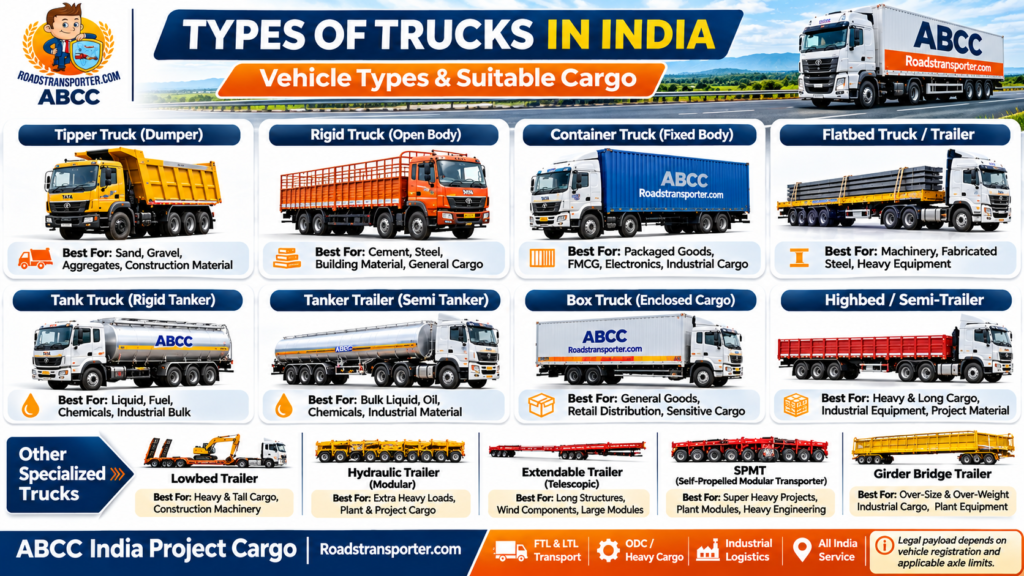
| Industry | Common Cargo | Trailer Options to Evaluate |
|---|---|---|
| Steel | Beams, plates, machinery | Flatbed, Extendable, Lowbed |
| Power | Transformers, generators | Lowbed, Modular, Specialized Heavy Haul |
| Wind Energy | Blades, towers, nacelles | Telescopic, Specialized Lowbed |
| Oil and Gas | Vessels, reactors | Lowbed, Modular |
| Cement | Plant machinery | Flatbed, Lowbed |
| Construction | Excavators, heavy equipment | Lowbed, Equipment Trailer |
| Automotive | Industrial presses and machinery | Flatbed, Semi Lowbed |
| Engineering | Fabricated equipment | Flatbed, Highbed, Lowbed |
| Mining | Heavy industrial machinery | Lowbed, Modular |
| Port Logistics | Containers and project cargo | Container Trailer, Specialized Trailer |
🎬 Real Trailer Transportation Project Case Studies – Experience and Lessons
Real transportation case studies can help industrial customers understand the complexity of trailer selection, route planning and project execution.
However, a genuine case study must be supported by actual project information.
The following are illustrative planning scenarios, not claims that ABCC India Project Cargo Corporation executed these specific projects.
Case Study Scenario 1: Heavy Industrial Machinery Transportation from Pune to Gujarat
Project type: Industrial machinery movement
Illustrative origin: Pune industrial region
Illustrative destination: Gujarat industrial region
Cargo: Heavy manufacturing machine
Primary challenge: Cargo weight, height and factory access
Transportation Planning
The first stage would involve collecting verified machinery drawings, weight details and lifting instructions.
The transport planner would evaluate whether a flatbed, semi lowbed or lowbed trailer was appropriate.
The loading site would need sufficient space for the selected equipment and lifting arrangements.
The proposed route would be reviewed for any relevant restrictions.
Main Lessons
A successful plan depends on accurate cargo information and equipment compatibility.
The trailer should be selected after evaluating the cargo, not simply because it is available nearby.
Case Study Scenario 2: Long Fabricated Structure Transportation from Gujarat to Maharashtra
Project type: Long industrial structure
Illustrative origin: Gujarat manufacturing facility
Illustrative destination: Maharashtra project site
Cargo: Long fabricated component
Primary challenge: Overall length and turning geometry
Transportation Planning
The planner would first determine the cargo’s support requirements and transport dimensions.
An extendable or other specialized trailer might be considered.
Critical road turns, factory gates and delivery-site access would need assessment.
The cargo securing plan would need to account for the structure’s approved support points.
Main Lessons
Long cargo transportation requires attention to maneuverability and structural support.
A trailer with sufficient deck length is not necessarily suitable for every route.
Case Study Scenario 3: Heavy Transformer Transportation to a Power Project
Project type: Exceptional heavy industrial cargo
Illustrative cargo: Large power transformer
Primary challenge: Concentrated weight and infrastructure suitability
Transportation Planning
A transformer movement may require detailed engineering, specialized transport equipment and a comprehensive route assessment.
The planning process could involve evaluating axle distribution, bridge restrictions, loading arrangements and applicable permissions.
Hydraulic modular or other engineered heavy-haulage equipment may be considered depending on the transformer and route.
Main Lessons
Exceptional heavy cargo requires coordinated technical and regulatory planning.
Commercial vehicle availability alone is insufficient to establish feasibility.
❓ Frequently Asked Questions About Trailer Transport Services in India
Q1. What is a trailer transport service in India?
A trailer transport service involves moving industrial goods, machinery, heavy equipment and specialized cargo using suitable trailer equipment.
The transport arrangement may include a road tractor, trailer, loading equipment, route planning and documentation.
Q2. Which trailer is best for heavy machinery transportation?
The appropriate trailer depends on the machinery’s weight, dimensions, center of gravity and handling requirements.
Lowbed, semi lowbed and specialized multi-axle trailers may be evaluated for heavy machinery.
Q3. What is the difference between a flatbed and a lowbed trailer?
A flatbed generally provides an open cargo deck suitable for many industrial goods.
A lowbed uses a lower loading deck, which can help reduce overall transport height for suitable cargo.
Q4. How much does trailer transportation cost per kilometre in India?
There is no single reliable rate for every trailer movement.
The quotation depends on trailer type, cargo characteristics, route, vehicle positioning, equipment availability and additional services.
Q5. Can I book a 40-foot trailer in India?
Customers can enquire about trailers marketed in the 40-foot category.
The actual deck length, payload and approved specifications must be confirmed with the supplier.
Q6. Are 50-foot and 60-foot trailers available in India?
Long-deck and specialized extendable trailers are used in the Indian transport market.
Availability depends on the required configuration, location and operator.
Q7. What is the maximum load capacity of a trailer in India?
There is no universal maximum payload applicable to every trailer.
The legal and technical limits depend on the vehicle configuration, registration, manufacturer ratings, axle loads and applicable permissions.
Q8. What is a semi lowbed trailer?
A semi lowbed is a trailer configuration with a relatively lower cargo deck than certain conventional high-deck designs.
It may be suitable for machinery requiring reduced loaded height.
Q9. What is a hydraulic modular trailer?
A hydraulic modular trailer is specialized equipment using configurable axle arrangements and hydraulic systems for certain exceptional heavy loads.
Q10. What is an SPMT?
An SPMT is a Self-Propelled Modular Transporter used for specialized movement of extremely heavy structures and equipment.
It is commonly associated with industrial yards, ports and major project sites.
Q11. What is ODC cargo?
ODC means Over Dimensional Cargo.
In road transportation, the term refers to cargo exceeding applicable dimensional limits in its transport configuration.
Q12. What is OOG cargo?
OOG means Out of Gauge.
The term is commonly used in shipping and multimodal logistics for cargo extending beyond the normal dimensions of a transport unit.
Q13. What is OWC cargo?
OWC means Overweight Cargo.
It describes cargo whose weight requires special consideration. The legal classification depends on applicable vehicle and road restrictions.
Q14. Is government permission required for ODC transportation?
Special permission may be required depending on the loaded vehicle dimensions, weight, route and applicable regulations.
The transport contractor must verify the requirements for the actual movement.
Q15. Is an E-Way Bill required for trailer transportation?
An E-Way Bill is required for applicable goods movements under GST rules, subject to thresholds, exemptions and special provisions.
It does not replace road transport permissions.
Q16. What is an ODC route survey?
An ODC route survey evaluates whether a proposed loaded vehicle can travel along a particular route.
It may examine bridges, road widths, overhead clearances, turning areas and other restrictions.
Q17. Can heavy transformers be transported by trailers?
Yes, suitable specialized equipment may be used for transformer transportation.
The required configuration depends on the transformer and the approved transport plan.
Q18. Which trailer is used for wind turbine blades?
Specialized extendable, telescopic or blade transport systems may be used, depending on the blade and route requirements.
Q19. Who arranges loading and unloading?
Responsibility depends on the transport contract.
Customers should confirm whether loading, unloading, lifting equipment and associated costs are included in the quotation.
Q20. Does trailer freight include toll charges?
This depends on the quotation.
Toll charges should be clearly identified as included or excluded.
Q21. What is trailer detention?
Detention refers to vehicle waiting time beyond the agreed free period, where applicable.
The conditions and charges should be specified before dispatch.
Q22. What is a trailer return load?
A return load is cargo carried during a vehicle’s return or subsequent repositioning movement.
It may improve utilization and sometimes influence freight pricing.
Q23. Can a trailer transport company provide cargo insurance?
Insurance arrangements depend on the provider and contract.
Customers should verify the policy, insured value, coverage and responsibilities before dispatch.
Q24. Can trailers transport machinery across Indian states?
Yes, interstate trailer transportation is possible subject to applicable vehicle, cargo, route and regulatory requirements.
Q25. What documents are needed for trailer transportation?
Documents may include a commercial invoice, E-Way Bill where applicable, consignment note, vehicle documents, driver licence and any required special permissions.
Q26. How can I find a trailer supplier near my factory?
Customers can contact transport companies or verified trailer supplier networks.
The vehicle’s actual location, specifications and availability should be confirmed before booking.
Q27. What is the difference between a trailer owner and a commission agent?
A trailer owner owns or operates the equipment.
A commission agent generally helps connect cargo owners with suitable transport providers under an agreed commercial arrangement.
Q28. Can a lowbed trailer carry an excavator?
A suitable lowbed or equipment trailer may be used for an excavator when its specifications, loading method and legal limits are compatible.
Q29. Why is a route survey important for oversized cargo?
A route survey helps identify physical restrictions and potential risks before transportation begins.
It supports route selection, planning and necessary approvals.
Q30. How do I request a trailer freight quotation?
Provide the loading and delivery locations, cargo description, verified weight, dimensions, dispatch date and handling requirements.
For exceptional cargo, technical drawings and additional engineering information may be necessary.
🏢 ABCC India Project Cargo Corporation – Trailer Transportation and Logistics Coordination
ABCC India Project Cargo Corporation focuses on industrial goods transportation, trailer sourcing and project cargo logistics coordination.
Industrial transportation requires communication between cargo owners, vehicle suppliers, drivers, handling contractors and other participants.
A coordinated approach can help customers evaluate suitable transportation options and understand the practical requirements of moving heavy or specialized cargo.
Trailer Transportation Enquiry Categories
Customers may contact ABCC India Project Cargo Corporation regarding the following service requirements, subject to confirmation of equipment availability and service scope.
| Service Category | Transportation Requirement |
|---|---|
| Flatbed Trailer Transportation | Industrial goods and fabricated structures |
| Highbed Trailer Transportation | Suitable general industrial machinery |
| Semi Lowbed Trailer Transportation | Machinery requiring a lower deck |
| Lowbed Trailer Transportation | Heavy and tall industrial equipment |
| Extendable Trailer Transportation | Long industrial cargo |
| Telescopic Trailer Transportation | Exceptional-length cargo |
| Hydraulic Modular Trailer Transportation | Specialized heavy-haul requirements |
| ODC Cargo Transportation | Oversized industrial consignments |
| Heavy Machinery Transportation | Industrial and construction machinery |
| Project Cargo Coordination | Complex industrial movements |
| Trailer Sourcing | Suitable vehicle identification |
| Freight Quotation Assistance | Transportation cost evaluation |
| Route Survey Coordination | Route feasibility requirements |
| Return-Load Coordination | Suitable cargo and vehicle matching |
Why Consider ABCC India for Trailer Transport Enquiries?
Industrial customers often need assistance identifying a suitable trailer rather than simply locating the nearest available truck.
ABCC India Project Cargo Corporation aims to support the connection between industrial transportation requirements and appropriate logistics resources.
Potential benefits of professional coordination include clearer cargo communication, equipment sourcing, freight comparison and transportation planning.
Actual service commitments, commercial terms and responsibilities should be confirmed in writing for each movement.
Trailer Transport Supplier and Business Network
A professional transport network can create opportunities for vehicle owners, suppliers, transport brokers and industrial customers.
Transparent business relationships help improve equipment matching and communication.
Fleet owners and commission agents interested in participating should verify membership conditions, commission arrangements, payment terms and the actual benefits offered.
Request a Trailer Transportation Quotation
Customers seeking trailer transportation assistance should provide:
- Loading and unloading locations.
- Cargo description.
- Verified cargo weight.
- Length, width and height.
- Preferred dispatch date.
- Required loading and unloading arrangements.
- Technical drawings or photographs where necessary.
- Any special route or handling requirements.
These details help determine whether a suitable transportation arrangement can be proposed.
👩🏻💻 How This Trailer Transportation Guide Was Prepared
This guide has been organized to explain the practical and technical aspects of trailer transportation in India.
It covers conventional industrial trailers, specialized heavy-haulage equipment, cargo selection, freight planning, regulatory considerations, route surveys, loading, securing and transportation risk management.
The objective is to provide useful information for both experienced logistics professionals and customers arranging industrial transportation for the first time.
Topics Covered in This Guide
| Topic | Information Provided |
|---|---|
| Trailer Transportation | Service overview and booking |
| Trailer Types | Applications, advantages and limitations |
| Trailer Dimensions | Deck length, width, height and payload considerations |
| Freight Rates | Cost factors and quotation planning |
| Industrial Corridors | Major Indian industrial locations |
| Trailer Availability | Vehicle sourcing and return-load management |
| ODC Transportation | Oversized cargo planning |
| OOG and OWC | Terminology and transport considerations |
| Government Regulations | General legal framework |
| GST and E-Way Bill | Applicable goods-movement documentation |
| Route Survey | Infrastructure and route feasibility |
| Loading and Unloading | Handling and lifting considerations |
| Cargo Lashing | Restraint and securing principles |
| Insurance | Risk and coverage considerations |
| Driver Welfare | Safe and responsible operations |
| Transport Agents | Supplier and commission-agent coordination |
| FAQs | Common customer questions |
Author and Editorial Responsibility
Author: R. K. Savarn
Author profile: https://travel.roadstransporter.com/author/admin/
The published author biography should accurately describe the author’s verified experience and responsibilities.
Technical and regulatory information should be reviewed periodically because transport rules, equipment standards and operating procedures may change.
Important Information Disclaimer
This guide is intended for general education and preliminary transportation planning.
It does not replace a certified engineering assessment, statutory permission, approved lifting plan, insurance policy or contractual agreement.
For complex and exceptional cargo, consult qualified professionals and the relevant authorities.
🔗 Useful Trailer Transportation and Logistics Resources
The following resources may help readers understand transport regulations and related logistics services.
Government and Regulatory References
| Organization | Official Website |
|---|---|
| Ministry of Road Transport and Highways | https://morth.nic.in/ |
| Parivahan | https://parivahan.gov.in/ |
| National Highways Authority of India | https://nhai.gov.in/ |
| India Code | https://www.indiacode.nic.in/ |
| Central Board of Indirect Taxes and Customs | https://cbic-gst.gov.in/ |
| GST Portal | https://www.gst.gov.in/ |
| E-Way Bill Portal | https://ewaybillgst.gov.in/ |
Related Transportation Guides
| Related Topic | Internal Resource |
|---|---|
| Truck Transport Service in India | https://travel.roadstransporter.com/truck-transport-service-in-india/ |
| Container Transport Service | https://travel.roadstransporter.com/container-transport-service-company-in-india/ |
| Over Dimensional Cargo Transportation | https://travel.roadstransporter.com/over-dimensional-cargo/ |
| ODC Transportation in India and SAARC Countries | https://travel.roadstransporter.com/over-dimensional-cargo-transportation-india-and-saarc-countries/ |
| ODC Road Route Survey | https://travel.roadstransporter.com/road-route-survey-for-over-dimensional-cargo-oversize-load-transportation/ |
| Return Load Problems in India | https://travel.roadstransporter.com/return-load-problem-india-trucks-trailers/ |
| Truck Transportation Rates | https://travel.roadstransporter.com/truck-transportation-services-rates-online/ |
| Trailer Transportation Guide | https://travel.roadstransporter.com/trailer-transport-service-in-india/ |
Before publishing, verify that each internal URL resolves correctly and that its target page is relevant to the anchor text.
Conclusion – The Future of Trailer Transport Services in India

Trailer transportation is an essential part of India’s industrial supply chain.
From manufacturing machinery and fabricated steel structures to heavy transformers, renewable-energy equipment and oversized infrastructure components, specialized trailers help connect industrial production with project execution.
The industry’s importance extends beyond the vehicles themselves.
Successful transportation requires accurate cargo information, suitable equipment, trained personnel, reliable communication, commercial transparency, regulatory compliance and careful risk management.
For ordinary industrial cargo, the main objective may be to identify a suitable trailer at a competitive total freight cost.
For exceptional heavy or oversized cargo, transportation becomes a technical project requiring engineering, route assessment, permissions and specialized execution.
The future of trailer transportation in India will increasingly depend on improved equipment utilization, digital coordination, safer operations, infrastructure development and professional logistics planning.
A Message to Industrial Customers
Before booking a trailer, verify the cargo weight, dimensions, loading requirements and delivery-site conditions.
Compare transport quotations based on the complete service scope rather than freight alone.
For complex cargo, prioritize engineering suitability and regulatory compliance.
A Message to Trailer Owners and Drivers
Trailer owners and drivers are important participants in India’s industrial economy.
Better vehicle utilization, transparent commercial arrangements, preventive maintenance, safe operating practices and driver welfare can support more reliable transportation.
A Message to Transport Commission Agents
Transport commission agents can contribute to the industry by building verified supplier networks, communicating accurate cargo information and maintaining transparent business relationships.
Professional conduct and reliable coordination help strengthen trust between customers and vehicle operators.
ABCC India Project Cargo Corporation – Connecting Industrial Cargo with Transportation Solutions
Every industrial consignment begins with a requirement. Every successful delivery begins with the right transportation plan.
ABCC India Project Cargo Corporation seeks to support industrial customers, trailer suppliers and logistics professionals through transportation enquiries, equipment sourcing and project cargo coordination.
Whether the requirement involves a flatbed trailer, semi lowbed, lowbed, extendable trailer or specialized heavy-haulage arrangement, the first step is understanding the cargo and its transportation needs.
🚛 The right trailer. The right planning. The right transportation approach.
ABCC India Project Cargo Corporation – Supporting India’s Industrial Transportation Network.