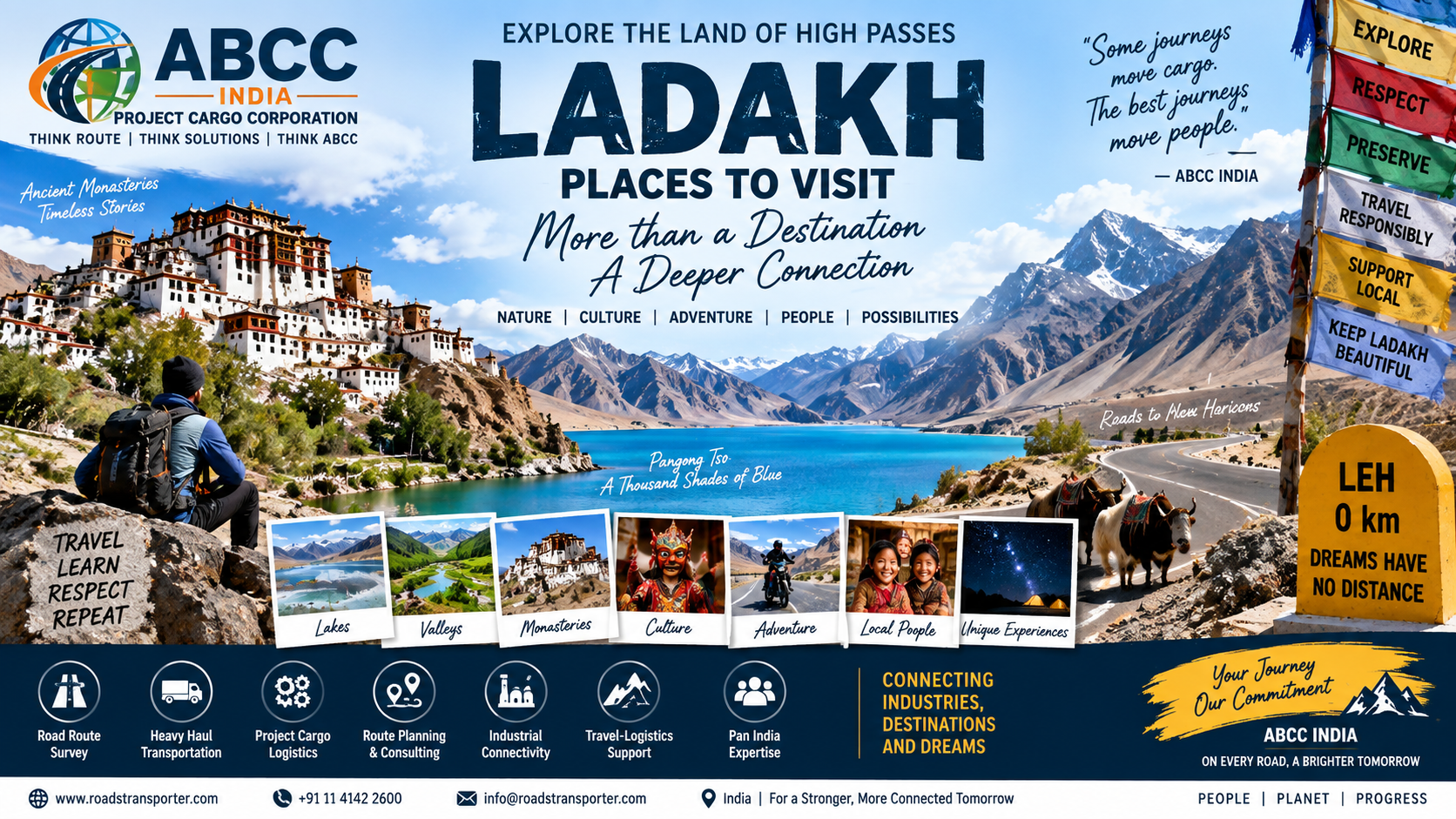
🌄 Introduction – An Invitation to Journey Beyond the Ordinary
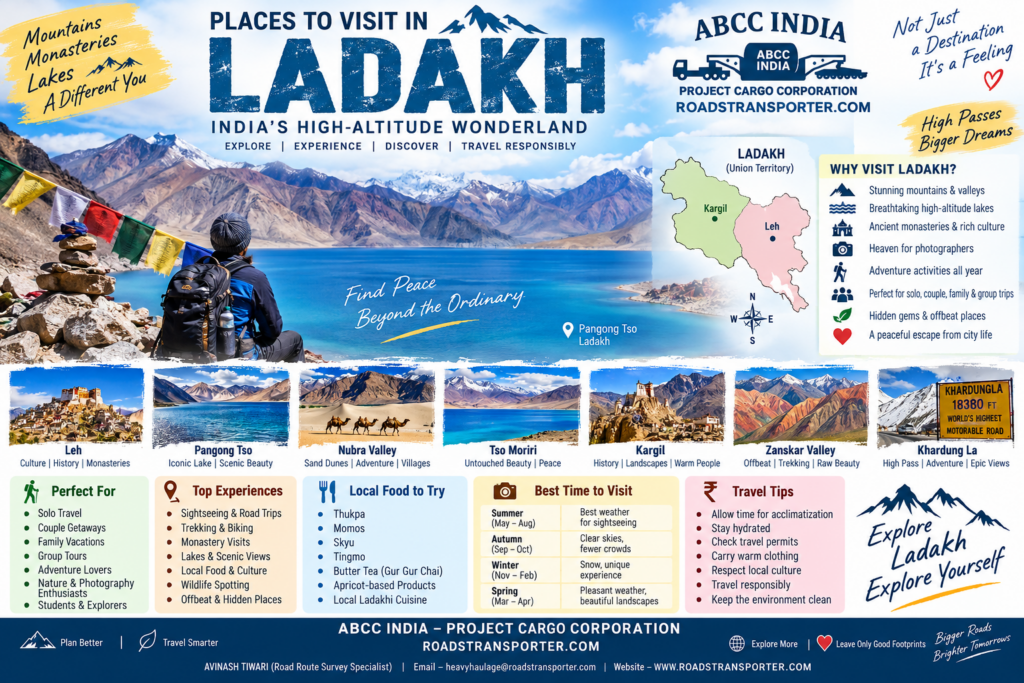
There are journeys you remember through photographs, and then there are journeys that quietly change the way you see the world. Ladakh belongs to the second kind.
High in the Indian Himalayas, surrounded by immense mountains, stark valleys, ancient monasteries and extraordinarily clear skies, Ladakh feels dramatically different from the landscapes most travelers know. The journey is not simply about ticking famous tourist places off a list. It is about slowing down enough to notice the silence of a mountain pass, the changing colours of a high-altitude lake, prayer flags moving in the wind and tiny settlements appearing unexpectedly between seemingly endless walls of rock.
And before planning the trip, one geographical detail is worth getting right: although travelers frequently search online for “places to visit in Ladakh State,” Ladakh is officially a Union Territory of India, not a state. It comprises the districts of Leh and Kargil. That distinction may sound administrative, but understanding Ladakh’s geography makes planning a journey here much easier.
For a first-time visitor, Leh is usually the natural introduction. The town is more than a base for sightseeing. Its old lanes, hilltop monuments, markets, cafés and surrounding monasteries provide a gentler way to understand Ladakh before travelling deeper into the mountains. More importantly, spending time around Leh gives your body an opportunity to adjust to the high altitude rather than rushing immediately towards even higher destinations.
Beyond Leh, the scale of Ladakh begins to reveal itself.
Drive towards Nubra Valley, and the landscape shifts between mountain passes, broad river valleys, villages and cold-desert terrain. Travel southeast and Pangong Tso introduces another side of Ladakh: a vast high-altitude lake surrounded by barren mountains, where changing light can make the water appear remarkably different from one hour to the next. Tso Moriri, in the Changthang region, offers a more remote high-altitude lake experience for travelers whose itinerary and acclimatization allow the longer journey.
Move westward and Ladakh tells a different story again. The route towards Kargil passes through landscapes associated with monasteries, villages, dramatic geology and important historical connections. Continue into the wider Kargil region and places such as the Suru Valley reveal greener mountain scenery beneath enormous Himalayan and trans-Himalayan peaks.
That diversity is why a list of the best places to visit in Ladakh cannot be reduced to lakes and mountain passes.
For adventure travelers, Ladakh offers trekking, cycling, rafting opportunities and demanding road journeys through high-altitude terrain. For photographers, almost every change in elevation brings a new composition—whitewashed monasteries against brown mountains, blue water beneath enormous skies, village fields contrasting with arid slopes, and stars appearing above landscapes with very little artificial light.
For solo travelers, Ladakh can provide both solitude and easy opportunities to meet other travelers around Leh and established routes. Couples looking beyond conventional romantic destinations may find something special in quiet landscapes and slow evenings rather than crowded entertainment districts. Families can experience monasteries, villages, museums and accessible sightseeing around Leh, although itineraries involving children or older travelers deserve particularly careful altitude planning.
Groups can turn the journey into an unforgettable road adventure, while students may find Ladakh almost like an open-air classroom for geography, Buddhism, Himalayan ecology, borderland history, architecture and climate adaptation.
Even travelers searching for picnic spots, weekend getaways and natural places in Ladakh need to approach the destination differently. Ladakh is not a conventional weekend destination where dozens of attractions can comfortably be rushed through in two days. Distances that look manageable on a map can involve high passes, mountain roads, changing weather and considerable elevation.
Here, slow travel is smart travel.
The same principle applies to travelers searching for waterfalls. Ladakh is primarily a high-altitude cold-desert landscape, so waterfalls are not its defining attraction in the way they are in wetter Himalayan regions. Its strongest natural experiences come instead from lakes, rivers, valleys, mountains, wetlands and unusual geological formations. Seasonal streams and cascades may appear, but planning a Ladakh holiday around supposedly famous waterfalls can lead visitors towards exaggerated or poorly verified online claims.
That is precisely why the region rewards curiosity more than checklist tourism.
Away from the most photographed viewpoints are smaller villages, less-discussed monasteries, remote valleys, traditional homes, agricultural landscapes and quiet stretches of road that reveal everyday Ladakh. These hidden gems, offbeat attractions and comparatively unexplored places in Ladakh can be deeply rewarding, but “unknown” should never be mistaken for unrestricted. Some areas are environmentally sensitive, strategically important or subject to travel regulations, so current access requirements should always be checked through official sources before departure.
Ladakh also asks visitors to travel responsibly.
This is a fragile high-altitude environment where water is precious and waste can remain long after a tourist has left. A beautiful lake is not merely a backdrop for a photograph. A monastery is not a film set. A village is somebody’s home. Wildlife habitats are not places to chase animals for a closer picture.
Respecting local customs, carrying reusable essentials, minimizing plastic waste, staying on permitted routes and avoiding disturbance to wildlife make the journey better not only for Ladakh but also for the people who will visit after you.
There is another practical reality every first-time traveler should understand: altitude deserves respect. Leh itself sits at a high elevation, and several popular travel routes climb considerably higher. A packed itinerary that looks efficient on paper may be uncomfortable—or unsafe—if it ignores acclimatization. Hydration, rest, gradual ascent and attention to symptoms matter more here than squeezing another attraction into the day. Anyone with relevant medical concerns should seek appropriate medical advice before undertaking high-altitude travel.
Once you stop trying to race through Ladakh, however, something wonderful happens.
You begin noticing details.
The morning light slowly touching a monastery wall. A distant patch of cultivated green surrounded by brown mountains. The warmth of a simple meal after hours on a cold road. The enormous silence beside a lake. The sudden realization that a place that appeared empty from a distance is actually full of geology, wildlife, history, faith and human adaptation.
That is the Ladakh worth discovering.
This ultimate Ladakh travel and tourism guide is designed to help you explore it with curiosity rather than confusion. Whether you are planning your first family vacation, a solo journey, a couple’s escape, a group road trip, an adventure holiday or a slower cultural experience, the sections ahead will take you through the major attractions and lesser-known destinations while helping you decide what genuinely belongs in your itinerary.
Continue through the complete guide to discover Ladakh’s best places to visit, realistic budget planning, local food, suggested itineraries, photography spots, transport guidance, seasonal planning, safety advice and practical travel tips—so that when the mountains finally appear ahead of you, you are prepared not merely to visit Ladakh, but to experience it responsibly and meaningfully.
🏔️ Best Places to Visit in Ladakh, India – Genuine Tourist Places Chart
Official Ladakh and Kargil tourism sources confirm major circuits including Pangong Tso, Tso Moriri, Nubra, Lamayuru, Drass, Suru and Zanskar, along with monasteries, adventure areas and village destinations.
The budgets below are approximate local sightseeing/trip budgets per person, excluding travel to Ladakh from your home city. Actual costs vary significantly with shared/private transport, accommodation category, season and route.
| No | Place | Best Season | When to Visit | Why to Visit | Ideal For | Approx Budget | Travel Tip |
|---|---|---|---|---|---|---|---|
| 1 | Leh | Apr–Oct | 2–3 days | Heritage, markets, food, monasteries and base for Ladakh sightseeing | Family, Couple, Friends, Students, Seniors | ₹2,000–5,000/day | Keep the first days easy for acclimatization |
| 2 | Pangong Tso | May–Sep | 1–2 days | Iconic high-altitude lake, mountains, landscapes and photography | Family, Couple, Friends, Gen Z | ₹4,000–9,000 | Prepare for cold and high altitude |
| 3 | Nubra Valley | May–Sep | 2–3 days | Desert landscape, villages, monasteries, orchards and adventure | Family, Couple, Friends, Groups | ₹5,000–10,000 | Stay overnight rather than rushing |
| 4 | Hunder Sand Dunes | May–Sep | Afternoon–sunset | Cold desert, dunes and double-humped Bactrian camels | Family, Kids, Couple, Friends | ₹500–2,000 | Avoid disturbing fragile dune areas |
| 5 | Diskit Monastery | May–Sep | Morning | Buddhist culture, monastery and Nubra views | Family, Seniors, Students | ₹500–1,500 | Combine with Hunder |
| 6 | Panamik | May–Sep | Half/full day | Genuine hot springs and Nubra scenery | Family, Couple, Friends | ₹1,500–4,000 | Check local bathing arrangements |
| 7 | Sumur & Samstanling Monastery | May–Sep | Half day | Village atmosphere, monastery and quieter Nubra experience | Family, Couple, Seniors | ₹1,000–3,000 | Excellent for slow travelers |
| 8 | Turtuk | May–Sep | Full day/overnight | Balti heritage, orchards, village culture and mountain scenery | Family, Couple, Students, Explorers | ₹2,500–6,000 | Respect homes and ask before portraits |
| 9 | Tso Moriri & Korzok | Jun–Sep | 1–2 days | Remote high-altitude lake, wetlands, wildlife habitat and Changthang culture | Couple, Friends, Nature lovers | ₹5,000–10,000 | Visit only after adequate acclimatization |
| 10 | Hanle | May–Sep | 1–2 days | Remote landscapes, exceptional night skies and astronomy | Couple, Students, Photographers | ₹3,000–7,000 | Check current access requirements |
| 11 | Changthang | Jun–Sep | 2–3 days | Wildlife habitat, vast plateau and pastoral landscapes | Wildlife lovers, Photographers, Students | ₹6,000–15,000 | Never chase wildlife for photographs |
| 12 | Hemis Monastery | May–Sep | Morning | Important Buddhist monastery, festival heritage and museum | Family, Students, Culture lovers | ₹1,000–2,500 | Follow monastery etiquette |
| 13 | Thiksey Monastery | Apr–Oct | Morning | Spectacular monastery architecture and Indus Valley views | Family, Couple, Seniors, Students | ₹700–2,000 | Morning gives a peaceful experience |
| 14 | Shey Palace & Monastery | Apr–Oct | Morning | Royal heritage, Buddhist culture and scenic landscape | Family, Seniors, Students | ₹500–1,500 | Combine with Thiksey/Hemis |
| 15 | Shanti Stupa | Apr–Oct | Sunrise/sunset | Panoramic Leh views and peaceful Buddhist setting | Family, Couple, Solo, Seniors | ₹200–800 | Sunset is beautiful but busier |
| 16 | Leh Palace | Apr–Oct | Morning | Ladakhi royal history, architecture and Old Leh views | Family, Students, History lovers | ₹500–1,500 | Combine with Leh Old Town |
| 17 | Alchi Monastery Complex | Apr–Oct | Morning | Exceptional historic Buddhist paintings and architecture | Family, Seniors, Students | ₹1,000–3,000 | Don’t rush through the temples |
| 18 | Lamayuru | May–Oct | Day/overnight | Ancient monastery and extraordinary moonscape-like terrain | Couple, Family, Photographers | ₹2,000–5,000 | Overnight stay allows quieter exploration |
| 19 | Magnetic Hill–Sangam Circuit | May–Oct | Half/full day | Optical-illusion stop plus Indus–Zanskar confluence | Family, Friends, Students | ₹1,000–3,000 | Combine several west-Leh attractions |
| 20 | Hall of Fame,Leh | Apr–Oct | 1–2 hours | Military-history museum and educational exhibits | Family, Students, Seniors | ₹500–1,500 | Useful educational stop near Leh |
| 21 | Stok Museum & Stok | Apr–Oct | Half day | Royal heritage, museum collections and village landscape | Family, Students, History lovers | ₹1,000–3,000 | Confirm museum access before departure |
| 22 | Drass | May–Oct | 1–2 days | Mountain scenery, history and local culture | Family, Friends, History travelers | ₹2,000–5,000/day | Nights can become very cold |
| 23 | Kargil War Memorial, Drass | May–Oct | 1–2 hours | Important military-history and remembrance site | Family, Students, Seniors | ₹1,000–3,000 | Maintain respectful behavior |
| 24 | Goashan, Drass | May–Oct | Half day | Genuine picnic area and polo-ground setting | Family, Friends, Groups | ₹500–2,000 | Good relaxed addition to Drass |
| 25 | Suru Valley | Jun–Sep | 2–3 days | Green valleys, villages and Nun–Kun mountain scenery | Family, Couple, Friends, Photographers | ₹4,000–8,000 | Excellent alternative to busier circuits |
| 26 | Damsna | Jun–Sep | Half/full day | Officially identified picnic spot and rafting take-off area | Family, Friends, Corporate Groups | ₹1,000–3,000 | Verify rafting operations locally |
| 27 | Panikhar | Jun–Sep | Full day/overnight | Trekking, mountaineering, rock climbing and Suru scenery | Friends, Adventure Groups, Gen Z | ₹2,000–5,000 | Use qualified support for technical activities |
| 28 | Parkachik | Jun–Sep | Full day | Glacier landscape, picnic spot, climbing and trekking | Friends, Couple, Adventure travelers | ₹2,500–6,000 | Observe glaciers from safe locations |
| 29 | Rangdum | Jun–Sep | Overnight | Remote Himalayan wilderness and historic monastery | Couple, Friends, Solo Explorers | ₹3,000–7,000 | Expect limited facilities |
| 30 | Zanskar Valley | Jun–Sep | 3–7 days | Remote villages, monasteries, trekking and extraordinary mountain scenery | Adventure, Couple, Friends, Groups | ₹8,000–25,000+ | Keep buffer days for mountain travel |
Official Kargil tourism specifically identifies Damsna as a picnic spot, Panikhar for mountaineering, rock climbing, rafting and trekking, and Parkachik for its glacier, picnic setting and adventure activities. This makes them much better keyword matches than inventing artificial attractions. (Kargil) Drass tourism information also verifies Goashan as a picnic spot and describes rafting, polo and historic landscapes in the valley.
🌤️ Best Time to Visit Ladakh – Seasonal Weather & Travel Guide
For most first-time tourists, May to September is the easiest period to visit Ladakh. Official Ladakh Tourism identifies summer as the season for lake excursions, trekking, biking and monastery festivals; spring brings apricot blossom and melting snow, autumn offers clear skies and golden landscapes, while November to February is the specialist winter season.
One important difference from many Indian destinations is that Ladakh does not experience a conventional wet monsoon season. Its high-altitude, cold-desert geography means summer can remain comparatively dry, although rain, snowfall, cloudbursts, landslides and road disruptions can still affect Himalayan approach routes and individual valleys.
| Travel Season | Approx Period | Typical Experience | Best For | Main Concern |
|---|---|---|---|---|
| Summer | May–June | Pleasant days, cold nights, accessible sightseeing | First-timers, families, couples, groups | Altitude + strong UV |
| Monsoon/Summer | July–September | Green pockets, lakes, trekking, cultural travel | Adventure, photography, students | Road/weather disruptions |
| Autumn | September–October | Clear skies, golden landscape, fewer crowds | Couples, photographers | Colder nights |
| Winter | November–February | Snow, frozen landscapes, winter culture | Experienced travelers, wildlife enthusiasts | Extreme cold + limited accessibility |
Temperature figures below are planning ranges rather than forecasts. Conditions vary sharply with altitude, wind, sunshine, valley and weather system. Ladakh Tourism warns that winter temperatures can fall to around −30°C in parts of the region.
☀️ Summer in Ladakh – May to June
Summer is the easiest introduction to Ladakh for most travelers. Sunshine makes sightseeing comfortable, accommodation choices increase and the classic circuits gradually become practical. Yet “summer” in Ladakh should never be confused with summer on the plains: mornings and evenings can remain distinctly cold, particularly around high lakes and passes.
1. Leh – The Best First Stop for a Summer Ladakh Journey
Leh is where a sensible Ladakh itinerary should begin rather than merely the town through which visitors hurry towards Pangong or Nubra.
At roughly 3,500 metres above sea level, Leh already places visitors in a genuinely high-altitude environment. Official Ladakh Tourism currently advises tourists arriving in Leh to take at least 48 hours of rest for acclimatization before travelling to higher-altitude areas.
During May and June, daytime conditions can feel pleasantly sunny, while mornings, evenings and shaded areas remain cool. As a practical planning range, expect roughly 5–25°C, with considerable variation during the season. Strong sunshine can make the afternoon feel warmer than the thermometer suggests.
Spend 2–3 days here before a demanding high-altitude circuit. Explore Leh Palace, Shanti Stupa, the old town, market and nearby cultural attractions at an unhurried pace. Families and students can use this time to understand Ladakhi history, while couples can enjoy sunset viewpoints and cafés without undertaking an exhausting road journey.
Leh also offers Ladakh’s widest selection of accommodation—from economical guesthouses and homestays to comfortable hotels. A practical local budget can start around ₹2,000–₹3,500 per person per day with simple accommodation and meals and rise considerably for premium hotels and private vehicles.
Try thukpa, momos, skyu and other Ladakhi dishes alongside familiar Indian food. Leh is also the easiest place to adjust your diet and hydration before travelling into remote areas.
Photography is particularly rewarding around sunrise and sunset when the surrounding mountains catch softer light. For night outings, the central market and established populated areas are much more practical than wandering onto isolated roads.
Families, solo travelers, students, couples and corporate groups can all use Leh effectively. Senior citizens and travelers with medical conditions, however, should obtain individual medical advice about high-altitude travel rather than assuming a gentle sightseeing itinerary eliminates altitude risk.
Pack sunglasses, high-SPF sunscreen, lip balm, layers, a warm jacket, reusable water bottle and comfortable walking shoes. The biggest mistake is arriving by air and immediately trying to “make the most of the day.” In Ladakh, the smarter first day is often the least ambitious one.
2. Nubra Valley – Summer Desert, Villages and Mountain Drama
Nubra gives travelers one of Ladakh’s great visual contrasts: enormous mountains surrounding river valleys, cultivated settlements and the remarkable cold-desert landscape around Hunder.
Official Ladakh Tourism recognizes Nubra among Ladakh’s principal valleys and specifically highlights Hunder’s cold-desert sand dunes and double-humped Bactrian camels.
May and June are excellent months once road access is stable. Valley daytime temperatures may broadly range around 8–25°C, but conditions become substantially colder at high passes and after sunset.
Allow 2–3 days. Diskit Monastery, Hunder, Sumur and the wider village landscapes reward travelers who resist converting Nubra into an exhausting touch-and-return excursion.
Families can combine cultural sightseeing with open landscapes; couples get excellent sunrise and sunset photography; groups have enough variety for a relaxed road trip; students can observe cold-desert geography and high-altitude agriculture. Turtuk can be incorporated when time and current access conditions allow.
Guesthouses, camps, hotels and homestays are available across established tourist settlements, although facilities should not be expected to match metropolitan standards everywhere. Depending heavily on vehicle sharing and accommodation choice, a practical Leh–Nubra trip may cost roughly ₹5,000–₹12,000+ per person.
Local meals are often the most satisfying choice. Homestays also provide an opportunity to understand village food and agriculture rather than treating Nubra simply as a photograph.
For photographers, the best moments frequently arrive early or late: dunes against mountains, monastery architecture, village fields and long evening shadows. Avoid climbing unstable slopes or trampling cultivated land merely for a different angle.
Corporate teams can enjoy Nubra, but it works better as a scenic retreat than a formal urban-style conference destination. Senior travelers should consider road duration and altitude before committing.
Carry warm layers even when Leh feels hot. Dust protection, sunscreen and drinking water are useful. Avoid isolated night drives unless genuinely necessary; daylight travel offers both better scenery and easier management of unexpected road conditions.
3. Pangong Tso – Ladakh’s Famous Blue High-Altitude Lake
Few landscapes explain Ladakh’s international appeal as immediately as Pangong Tso.
Official Ladakh Tourism places the lake at approximately 4,350 metres and describes its changing blue, green and golden hues. The lake is also an important bird habitat.
May and June bring increasing accessibility, although weather can remain surprisingly severe. A sunny afternoon can be followed by a bitterly cold, windy evening. A reasonable seasonal planning range is approximately 0–15°C around the lake, with colder conditions entirely possible.
Spend one night if properly acclimatized rather than attempting an unnecessarily exhausting dash from Leh. The journey itself—high mountains, Chang La and changing terrain—is part of the experience.
Pangong is outstanding for couples, friends and photographers. Families can visit with careful planning, but parents should treat children’s altitude response seriously. It is not an appropriate place to assume that every elderly traveler will be comfortable simply because vehicle access exists.
Accommodation is primarily seasonal guesthouse, homestay and camp-style lodging around established settlements. Facilities can be basic compared with Leh. Depending on shared/private transport and lodging, budget roughly ₹4,000–₹10,000+ per person for the excursion.
Simple meals such as dal-rice, noodles, momos and tea are more realistic expectations than elaborate dining.
Photography peaks around sunrise, sunset and changing cloud patterns, but do not enter sensitive shoreline habitat or disturb birds to obtain photographs. Despite photographs that make the water look inviting, this is not a recreational swimming destination.
Pack thermal layers, windproof outerwear, gloves, sunscreen and sufficient water. Most importantly, Pangong should come after acclimatization, not immediately after landing in Leh.
4. Lamayuru – Summer Heritage Beneath a Lunar Landscape
Lamayuru provides an entirely different summer experience from Ladakh’s famous lakes.
Here, the attraction is the meeting of geology and Buddhist heritage. The monastery rises amid dramatically eroded terrain commonly described as Ladakh’s “moonscape.”
Official Ladakh Tourism includes Lamayuru among its prominent monastery landscapes and identifies May–October as the broader period for outdoor landscape and heritage experiences.
Expect broadly 5–22°C through the early-summer travel period, although wind and altitude can make mornings and nights colder.
A full day is possible, but one overnight stay gives photographers much better access to early and late light. Lamayuru can form part of a Leh–Kargil road itinerary rather than becoming an isolated return journey.
Budget travelers will find guesthouses and modest local stays; comfort expectations should remain realistic. Allow roughly ₹2,000–₹5,000 per person depending on transport arrangement.
The destination suits couples, solo travelers, families, students and older travelers who prefer heritage and scenery to strenuous adventure. It can also work for small corporate or educational groups interested in culture and geology.
Visit the monastery respectfully. Religious spaces are living institutions rather than photo sets. Ask before photographing people and follow any photography restrictions inside sacred areas.
Summer photography is superb when low-angle light emphasizes the ridges and folds of the surrounding terrain. Wide landscape frames, monastery architecture and road-trip compositions all work well.
Carry sun protection and a warm layer. If staying overnight, do not underestimate the temperature drop after sunset.
5. Suru Valley – Ladakh’s Greener Summer Face
Travelers who think Ladakh means nothing but brown mountains should see Suru Valley.
Official Kargil tourism describes Suru around Sankoo as a landscape of green vegetation and dense plantation, while the wider valley presents dramatic views towards the Nun-Kun massif.
June is particularly attractive as warmer conditions return to western Ladakh. Depending on location and elevation, expect roughly 8–25°C by day, with considerably cooler nights.
Plan 2–3 days rather than driving through. Sankoo, Panikhar and Parkachik can form part of a slow exploration of the valley.
Suru is particularly rewarding for families, friends, couples, students and corporate groups looking for a quieter nature-oriented outing. Its green spaces also make it more convincing as a genuine picnic landscape than many barren high-altitude destinations.
Accommodation includes guesthouses and limited tourism facilities around settlements, with eco-log-hut facilities documented around Panikhar. (Kargil) Expect a simpler hospitality environment than Leh and budget around ₹3,000–₹7,000 per person per day including local travel, depending heavily on vehicle arrangements.
Local food and basic North Indian meals are more realistic than a large restaurant scene.
Landscape photographers should look for combinations of cultivated fields, rivers, villages and snow-covered mountains. Avoid entering fields without permission.
The valley also connects with serious trekking and mountaineering country. Casual visitors should not confuse seeing the Nun-Kun massif with being equipped to climb it.
Pack rain/wind protection despite Ladakh’s dry reputation, plus good footwear and warm evening clothing. Road conditions should be checked before departure.
🌦️ Monsoon-Period Ladakh – July to September
July to September is one of Ladakh’s most active travel periods. Because the region lies in a rain-shadow environment, the monsoon experience is very different from much of India. Nevertheless, rainfall elsewhere in the Himalayas can disrupt approach highways, while localized storms and landslides remain real possibilities.
This is an excellent season for trekking, wildlife, remote valleys and high-altitude lakes. Official Ladakh Tourism identifies May–September for the major lakes and June–September for adventure travel.
6. Tso Moriri – Quiet Water and Changthang Wilderness
Tso Moriri is the choice for travelers who want a high-altitude lake experience with a stronger sense of remoteness.
Official tourism information places it at approximately 4,522 metres on the Changthang plateau and identifies May–September as its main visiting period. Korzok village and monastery provide the principal cultural connection beside the lake.
July through September can bring daytime temperatures around 5–18°C, but wind chill and nighttime cold make warm clothing essential.
Allow 1–2 nights after proper acclimatization. Walking quietly around permitted areas, observing the landscape, visiting Korzok and watching changing light are the principal pleasures.
Accommodation is comparatively basic—homestays, guesthouses and seasonal tourist facilities. Allow approximately ₹5,000–₹12,000+ per person depending on vehicle sharing and length of stay.
Food is straightforward and warming rather than elaborate. Carry personal snacks if you have specific dietary needs.
Tso Moriri is excellent for couples, photographers, wildlife enthusiasts and small groups. It is less suitable for an impulsive weekend trip from Leh, and altitude makes it inappropriate to describe as universally senior- or child-friendly.
Photography is exceptional, particularly with reflections, clouds and enormous open landscapes. Wildlife and birds must be photographed from a responsible distance.
Night skies can be impressive, but stay near your accommodation rather than walking blindly across isolated terrain. Carry thermals, gloves, wind protection and sun protection.
7. Tso Kar – Birdwatching and Salt-White Landscapes
Tso Kar is one of Ladakh’s strongest choices for travelers interested in ecology rather than crowds.
At around 4,500 metres, it combines turquoise water, white salt flats and Changthang’s immense mountain scenery. Ladakh Tourism identifies it as a Ramsar site and an important birdwatching destination, with May–September the recommended season.
July to September generally offers workable road access and birdwatching opportunities. Plan for approximately 5–18°C by day with much colder evenings.
A day trip can work within a larger Changthang itinerary, but an overnight stop allows better wildlife observation and photography.
Budget approximately ₹3,000–₹8,000+ per person, with transport representing the major expense. Accommodation and food choices are limited compared with Leh.
This is especially good for students, birdwatchers, photographers, environmentally minded couples and small groups. Families can visit if everyone is well acclimatized.
Carry binoculars rather than attempting to approach birds. Never drive off-road across wetlands or nesting habitat.
Wide-angle landscape photography works beautifully here, while telephoto lenses are preferable for wildlife.
The biggest safety consideration remains altitude. Tso Kar is not an ordinary roadside picnic lake, despite its visual accessibility.
8. Zanskar Valley – The Monsoon-Season Adventure Journey
Zanskar is where a Ladakh vacation begins feeling like an expedition.
Official Ladakh Tourism lists Zanskar among its principal valleys and identifies June–September as the main adventure season.
July to September is well suited to road trips, trekking and cultural exploration, though road conditions can change. Valley temperatures may broadly range from 5–22°C, depending heavily on altitude and weather.
Give Zanskar at least 4–6 days, preferably more. Padum provides a practical base for surrounding monasteries, villages and valleys, while serious trekkers can build longer itineraries.
Budget approximately ₹10,000–₹25,000+ per person for a multi-day visit, depending primarily on transport, trekking support and accommodation.
Homestays and guesthouses provide some of the most meaningful accommodation because they connect visitors with local life. Food tends toward straightforward Ladakhi and Indian meals.
Zanskar is outstanding for friends, adventurous couples, solo travelers with experience, students and small corporate adventure groups. It is not an easy “weekend getaway” simply because modern road connectivity has improved.
Photography ranges from monasteries and villages to rivers, enormous cliffs and mountain roads. Carry multiple layers, rain protection, sturdy shoes, basic medicines and backup power.
Remote travel requires flexibility. A buffer day is often more useful than an overfilled itinerary.
9. Markha Valley – Ladakh on Foot
For trekkers, Markha Valley transforms Ladakh from something seen through a vehicle window into something physically experienced.
Official Ladakh Tourism lists the Markha Valley Trek among Ladakh’s recognized trekking experiences and places the broader adventure season in June–September.
July to September generally offers the most practical trekking window. Daytime temperatures can range roughly 5–20°C, but high camps and passes can be significantly colder.
Depending on route, allow approximately 5–8 days. This is not conventional sightseeing: walking, village encounters, high-altitude scenery and changing ecosystems are the attraction.
A supported trek might cost approximately ₹15,000–₹35,000+ per person, depending on route, group size, guide/support arrangements and accommodation.
Homestays can form part of some itineraries, making Markha particularly appealing to travelers interested in community-based tourism.
It suits fit solo travelers, friends, couples and student/adventure groups far better than very young children or travelers with limited mobility. Corporate groups should attempt it only when participants have appropriate fitness and preparation.
Photographers should travel light enough to trek safely. A phone or lightweight mirrorless system can be more practical than excessive equipment.
Proper footwear, layers, sun protection, water management and altitude preparation are essential. Do not turn a trek into a competition.
10. Aryan/Dha-Hanu Valley – Orchards, Villages and Cultural Travel
The lower Indus settlements around Dha and Hanu offer a different visual and cultural experience from the high lakes.
Official Ladakh Tourism recognizes Aryan Valley among Ladakh’s principal valley experiences.
July to September brings relatively comfortable conditions, agricultural activity and greenery. Lower elevations can feel considerably warmer than Changthang, with an approximate daytime planning range of 12–28°C.
One or two days work well. The appeal lies in village landscapes, orchards, local culture and slower travel rather than a list of amusement-style attractions.
Budget roughly ₹2,500–₹6,000 per person, depending on transport and overnight arrangements. Homestays can provide a more culturally meaningful experience than rushing back to Leh.
This area suits couples, families, photographers, solo cultural travelers, students and senior visitors who tolerate the journey comfortably.
Photography needs particular sensitivity. Residents are people, not tourist exhibits; always seek consent for close portraits.
Pack sun protection, a light jacket and modest clothing suitable for village environments.
Evenings are best spent around your accommodation rather than roaming isolated roads.
❄️ Winter in Ladakh – November to February
Winter changes Ladakh completely. Official tourism material describes December–February as the season of frozen rivers, snowy valleys and winter adventures, and identifies October–March as an important period for snow-leopard tourism.
This is not the easiest season. Ladakh Tourism warns temperatures can reach around −30°C, remote medical facilities are limited, and serious cold-weather preparation is necessary.
11. Leh in Winter – Silence, Snow and Local Life
Winter Leh is almost another destination.
The busy summer streets become quieter, mountains turn white and travelers gain a closer look at how life continues through Ladakh’s harshest season.
Typical winter conditions may range roughly from −15°C to 5°C around Leh, with colder spells possible.
Spend 3–4 days before undertaking additional winter travel. Explore accessible monasteries, markets, heritage areas and viewpoints according to weather.
Heated guesthouses and hotels are particularly valuable. Winter accommodation should be chosen for reliable heating and water arrangements, not simply the lowest price. Allow approximately ₹2,500–₹7,000 per person daily.
Winter is attractive to photographers, couples seeking quiet, solo travelers and culturally curious visitors. Families with small children and senior travelers require more cautious medical and comfort planning.
Photograph snow-covered mountains, winter streets and monasteries, but remember that batteries discharge rapidly in severe cold.
Pack insulated boots, thermal base layers, fleece, down jacket, gloves, warm socks, neck protection and sunglasses.
After dark, stay around established populated areas. Ice, extreme cold and reduced visibility make casual night wandering far less sensible than during summer.
12. Hemis National Park – Winter Wildlife Country
Winter brings a completely different reason to visit the Hemis landscape: wildlife.
Official Ladakh Tourism identifies October–March as the snow-leopard wildlife season and recognizes Hemis National Park among Ladakh’s major sanctuaries.
Temperatures can remain well below freezing, particularly early and late in the day. Depending on altitude and weather, travelers should prepare for approximately −20°C to 5°C, potentially colder.
A serious wildlife itinerary usually deserves 4–7 days or more. Snow leopard sightings are never guaranteed; the value lies equally in tracking signs, mountain ecology, ibex and the winter landscape.
Specialist trips can easily cost ₹25,000–₹70,000+ per person, depending on guides, duration, transport and accommodation.
This is best for committed wildlife photographers, naturalists, fit solo travelers and small groups. It is not a casual family picnic.
Long telephoto lenses are useful, but ethical distance matters more than a photograph. Never pressure guides to approach animals too closely.
Thermal layering, insulated boots, hand protection and cold-rated sleeping equipment where required are fundamental.
13. Chadar Trek / Zanskar Winter Route – For Experienced Adventure Travelers
The Chadar Trek is among Ladakh’s most famous winter adventure concepts, following the frozen Zanskar River environment.
Official Ladakh Tourism lists Chadar Trek among its recognized trekking experiences and winter imagery.
Conditions can fall far below freezing, potentially around −10°C to −30°C. Ice conditions vary and safety can change rapidly.
This is not a sightseeing outing, romantic picnic or ordinary family vacation. It is a specialist winter expedition requiring current local verification, qualified organization, proper equipment, acclimatization and fitness.
Allow roughly 7–10 days or more, including acclimatization and contingencies. Commercial expedition costs can vary enormously; approximately ₹20,000–₹40,000+ should be treated only as a broad planning figure.
Photography can be extraordinary—ice formations, canyon walls and winter landscapes—but cameras should never distract from footing or group instructions.
No traveler should assume the route is available merely because it appears in an old blog. Ice stability and official operating conditions must be checked for the intended trip.
14. Alchi Monastery – A Gentler Winter Cultural Escape
Not every winter visitor needs an expedition.
Official Ladakh Tourism lists Alchi Monastery as a year-round heritage destination, renowned for its early Buddhist art, wall paintings, wood carving and sculptures.
Winter temperatures can be below freezing, but a road-based cultural outing can be considerably less demanding than trekking or remote lake travel when conditions permit.
Allow a half or full day from an appropriate base, while checking current roads. Budget approximately ₹1,000–₹3,000 per person depending on vehicle sharing.
Alchi suits families, couples, students, history enthusiasts and some senior travelers much better than extreme winter adventures, although altitude and cold still require individual assessment.
The monastery’s artistic importance rewards slow observation. Photography restrictions should be respected, particularly around historic interiors.
Nearby accommodation can be limited in deep winter, so Leh may remain the more practical base.
Pack thermals and insulated footwear even for a simple sightseeing day.
15. Thiksey Monastery – Winter Spirituality in the Indus Valley
Thiksey is another strong cultural choice for travelers who want to see Ladakh beyond summer adventure tourism.
Official Ladakh Tourism describes the 15th-century monastery as an active religious centre about 19 km east of Leh, with prayer halls, monastic education and a major Maitreya Buddha statue; it is listed as a year-round attraction.
Winter mornings can be extremely cold, commonly well below freezing, so a visit should be timed around weather and road conditions.
A half-day is usually sufficient. Combine the monastery with other accessible Indus Valley heritage only if conditions allow.
Local excursion costs can remain around ₹700–₹2,000 per person when transport is shared, though private winter vehicles cost more.
Students, photographers, couples, families and spiritually interested travelers will find the monastery rewarding. Older visitors should remember that stairs and cold can make even apparently easy sightseeing tiring.
Winter photography is especially striking when snow surrounds the monastery architecture.
Dress modestly, keep voices low and never treat ceremonies as performances staged for tourists.
🧭 Which Season Is Best for You?
| Traveler | Best Period | Strong Choices |
|---|---|---|
| First-time visitor | May–Sep | Leh, Nubra, Pangong |
| Family vacation | May–Sep | Leh, Nubra, Lamayuru |
| Couple / honeymoon-style trip | Jun–Sep | Pangong, Tso Moriri, Nubra |
| Solo traveler | May–Oct | Leh, Zanskar, cultural circuits |
| Children | Summer | Leh + carefully paced lower-stress circuits |
| Senior citizens | Warmer months | Leh and accessible heritage, subject to medical suitability |
| Students | May–Sep | Leh, monasteries, Tso Kar, Suru |
| Corporate group | Jun–Sep | Leh, Nubra, Suru |
| Wildlife enthusiast | May–Sep birds; winter specialist wildlife | Tso Kar / Hemis landscape |
| Trekker | Jun–Sep | Markha, Zanskar |
| Photographer | May–Oct; winter for specialists | Almost every region |
| Budget traveler | Shoulder season | Leh + shared-road circuits |
| Winter adventure traveler | Dec–Feb | Winter Leh, specialist treks/wildlife |
⚠️ Ladakh Seasonal Safety Rule That Matters More Than Your Itinerary
The best time to visit Ladakh is not simply the month with the nicest weather. Acclimatization determines what you can safely enjoy.
Current official Ladakh Tourism guidance states that tourists arriving in Leh should undergo at least 48 hours of complete rest for acclimatization before proceeding to higher-altitude areas and warns that rapid ascent above 3,500 metres can create serious altitude-related risk. Medical facilities are also much more limited in remote areas than in Leh.
That means Pangong, Tso Moriri, high passes and strenuous trekking should never be squeezed into the first day merely to save time.
For the majority of first-time visitors, June to September offers the broadest combination of accessible lakes, valleys, monasteries, trekking and road-trip experiences. Travelers seeking fewer crowds and strong photography conditions can consider September–October, while winter should be approached as a completely different, specialist Ladakh experience rather than a cheaper version of the summer holiday.
The mountains set the pace here. Build spare time into the itinerary, check weather and road conditions immediately before long journeys, respect local communities and wildlife, and choose fewer places with enough time to experience them properly.
🍽️ Best Highway Dhabas, Restaurants, Pure Veg Food & Cafés in Ladakh
Ladakh is officially a Union Territory, not a state. Its food scene is strongest in Leh and Kargil, while Nubra, Zanskar, Changthang and other remote circuits rely much more on seasonal cafés, guesthouses, homestays and simple roadside food stops. Ladakh Tourism itself promotes local cuisine as a core visitor experience, particularly thukpa, hand-rolled momos and apricot-based foods.
🥟 Best Restaurants, Dhabas, Pure Veg Food, Cafés & Bakeries in Leh–Ladakh
| 🍴 Name | 🏷️ Category | 📍 Address | 🛣️ Nearby Highway / Location | 🍲 Famous Dishes / Best For | ⏰ Meal Type | 🌶️ Cuisine | 🥗 Veg/Non-Veg/Jain/Vegan | 💰 Approx Budget | 👨👩👧👦 Family Friendly | 🚗 Parking | ☎️ Contact | ⭐ Google Rating* | 🌟 Why Visit | 🧭 Travel Tip |
|---|---|---|---|---|---|---|---|---|---|---|---|---|---|---|
| The Tibetan Kitchen | 🥟 Local Restaurant | Fort Rd, Leh | Fort Road | Tibetan/Himalayan meals, momos, noodles, soups | Lunch, Dinner | Tibetan, Himalayan | 🟢 Veg + 🔴 Non-Veg; ask for vegan | ₹400–1,000 | ✅ | ⚠️ Limited | +91 84…..40 | ⭐ 4.4 | Established choice for Tibetan-style dining | Dinner can be busy in peak season |
| Nathu’s( Pure Vegetarian Restaurant) | 🥬 Pure Vegetarian | Himalayan Complex, Main Market | Leh Main Market | Vegetarian Indian meals, snacks | Breakfast, Lunch, Dinner | Indian | 🟢 Pure Veg; Jain must be confirmed | ₹200–600 | ✅ | ⚠️ Market parking | +91 95…..56 | ⭐ 4.3 | Strong central option for vegetarian families | Ask separately for no-onion/no-garlic food |
| Punjabi Rasoi | 🫓 Punjabi Restaurant | Main Bazaar Rd, Leh | Main Bazaar | Punjabi comfort food | Breakfast, Lunch, Dinner | Punjabi, North Indian | 🟢 Veg options | ₹200–400 | ✅ | ⚠️ Limited | +91 98…..70 | ⭐ 4.8 | Familiar North Indian meals for families | Useful after returning from remote circuits |
| Punjabi Tadka Veg Restaurant | 🥬 Punjabi Veg | Main Market, Leh | Main Market | Dal, roti, sabzi, Punjabi meals | Breakfast, Lunch, Dinner | Punjabi | 🟢 Vegetarian | ₹200–500 | ✅ | ⚠️ Limited | +91 70…..06 | ⭐ 4.5 | Convenient vegetarian Punjabi food | Check Jain preparation separately |
| New Punjabi Dhaba | 🚚 Dhaba / Budget Restaurant | Manaykhang, Leh | Central Leh | Everyday Indian/Punjabi meals | Breakfast–Dinner | Indian, Punjabi | 🟢/🔴 Ask restaurant | ₹150–400 | ✅ | ⚠️ | Not listed | ⭐ 4.7 | Dhaba-style budget choice | Listed from early morning to late evening, but not 24×7 |
| SINGH PUNJABI DHABA | 🚛 Punjabi Dhaba | Gurudwara Datun Sahib Street | Leh | Punjabi/dhaba meals | Breakfast, Lunch, Dinner | Punjabi | 🟢/🔴 Confirm | ₹150–500 | ✅ | ⚠️ | Not listed | ⭐ 4.6 | Useful dhaba-style alternative | Better SEO match for “Punjabi dhaba in Leh” than inventing highway outlets |
| Amritsar Haveli Leh Ladakh | 🍛 Punjabi Restaurant | Tsaskan Complex, Main Market | Main Market | Punjabi and North Indian meals | Lunch, Dinner | Punjabi | 🟢 Veg options | ₹400–600 | ✅ | ⚠️ Limited | +91 88…..08 | ⭐ 4.1 | Familiar flavours in tourist centre | Suitable for groups |
| Radhey dosa corner | 🥞 South Indian | Changspa Rd | Changspa | Dosa and South Indian food | Late Breakfast, Lunch, Dinner | South Indian | 🟢 Veg-oriented | ₹100–300 | ✅ | ⚠️ Limited | +91 91…..46 | ⭐ 5.0 | Useful South Indian alternative | Rating has relatively few reviews |
| Tsaa™️ (Multi Cuisine Restaurant) | 🍽️ Multi-Cuisine | Spituk Gonpa Complex, Shagaran Main Market | Central Leh | Indian and multi-cuisine dining | Lunch, Dinner | Indian, Multi-Cuisine | 🟢 + 🔴 | ₹300–800 | ✅ | ⚠️ | +91 97…..46 | ⭐ 4.7 | Useful for families/groups wanting variety | Strong group-dining option |
| Himsagar | 🍛 Family Restaurant | Karzoo Complex, opposite CMO Office | Leh | Everyday restaurant meals | Breakfast, Lunch, Dinner | Indian | 🟢 + 🔴/confirm | ₹200–400 | ✅ | ⚠️ | Not listed | ⭐ 4.5 | Budget-friendly family dining | Practical for mixed-age groups |
| Ri-yul restaurant | 🍽️ Restaurant | Main Market | Leh Main Market | Sit-down dining | Lunch, Dinner | Multi-cuisine | Ask | ₹200–600+ | ✅ | ⚠️ | Not listed | ⭐ 4.5 | Convenient central dining | Combine with Main Market evening walk |
| The Cafe Garden | ☕ Café | 2nd Floor, Main Market | Main Market | Café meals, drinks, snacks | Breakfast, Snacks, Dinner | Café | 🟢 Veg choices | ₹200–400 | ✅ | ❌/Limited | Not listed | ⭐ 5.0 | Affordable central café | Rating is based on a smaller review count |
| Crafty Beanz cafe and roastery | ☕ Coffee Roastery | Old Road, Leh | Old Road | Specialty coffee, café snacks | Breakfast, Evening Snacks | Café | 🟢 Vegan options should be confirmed | ₹200–400 | ✅ | ⚠️ | +91 88…..96 | ⭐ 4.8 | Good choice for coffee lovers | Ask about plant milk before ordering |
| Ladakh Royal Bakery and cafe | 🥐 Bakery & Café | GH Road, Skara Rd | Skara / Leh | Baked items, coffee, snacks | Breakfast, Evening Snacks | Bakery/Café | 🟢 Options | ₹200–500 | ✅ | ⚠️ | +91 94…..98 | ⭐ 4.8 | Convenient bakery away from Main Market | Useful for breakfast supplies |
| Sugar House™ Live Bakery & Cafe DB2 Zangsti | 🧁 Bakery & Café | DB2 Zangsti | Zangsti | Bakery, cakes, café snacks | Breakfast, Snacks | Bakery/Café | 🟢 Options | ₹200–500 | ✅ | ⚠️ | +91 94…..77 | ⭐ 4.8 | Good sweets/bakery stop | Useful for families and evening snacks |
| Rilam Utopia cafe cum Restaurant | 🍽️ Café-Restaurant | Gonpa Village, Leh | Leh | Café and restaurant dining | Breakfast, Lunch, Dinner | Multi-cuisine | Ask | ₹800–1,000 | ✅ | Check locally | +91 88…..43 | ⭐ 4.5 | Higher-budget dining option | Better for leisurely meals than a quick highway stop |
🍲 Kargil Restaurants & Road-Trip Food Stops
| 🍴 Name | 🏷️ Category | 📍 Address | 🛣️ Location | 🍽️ Best For | ⏰ Meal | 🌶️ Cuisine | 🥗 Dietary Choice | 💰 Budget | 👨👩👧👦 Family | 🚗 Parking | ☎️ Contact | ⭐ Rating* | 🌟 Why Visit | 🧭 Tip |
|---|---|---|---|---|---|---|---|---|---|---|---|---|---|---|
| Rego Cafe & Restaurant | 🍽️ Restaurant | Bemathang, Baroo | Kargil | Road-trip meal | Breakfast–Dinner | Restaurant / Multi-cuisine | Ask | ₹200–600 | ✅ | Check locally | Not listed | ⭐ 3.9 | Established Kargil dining stop | Useful before/after remote road journeys |
| Krishna Hotel and Restaurant | 🍛 Indian Restaurant | Khurba Thang | Kargil | Indian meals | Breakfast–Dinner | Indian | Ask | ₹200–400 | ✅ | Check locally | Not listed | ⭐ 4.0 | Economical Kargil meal | Confirm current menu |
| Suru Adventure Hub & Food Corner | 🍔 Fast Food | Kargil | Kargil/Suru side | Quick food | Snacks, Meals | Fast Food | Ask | ₹150–500 | ✅ | Check | Not listed | ⭐ 4.8 | Convenient casual stop | Rating comes from a modest review base |
| LALA AMIR RESTAURANT | 🍔 Fast Food | Near Jamia Masjid, Subzimandi | Kargil | Quick local stop | Snacks/Meals | Fast Food | Ask | ₹150–400 | ✅ | Limited | +91 84…..74 | ⭐ 4.5 | Central Kargil option | Verify opening time before relying on it |
🛣️ Popular Food Streets & Roadside Food Zones in Ladakh
| 📍 Food Zone | 🍴 What You Can Find | 🥘 Best Food Intent | 👥 Best For | 💰 Typical Spend | 🚗 Road-Trip Advice |
|---|---|---|---|---|---|
| 🏙️ Leh Main Market | Restaurants, Punjabi food, vegetarian meals, cafés, bakeries | Dinner + evening snacks | Family, Couple, Friends, Seniors | ₹150–1,000+ | Best overall choice for mixed groups |
| 🛣️ Fort Road | Tibetan restaurants, Indian food, dhaba-style dining | Lunch + Dinner | Families, Students | ₹200–1,000 | Convenient central restaurant corridor |
| ☕ Changspa | Cafés, dosa, traveler food, coffee | Breakfast + café hopping | Solo, Gen Z, Millennials | ₹150–700 | Good walking area |
| 🥐 Zangsti | Bakeries, cafés, snacks | Breakfast + sweets | Families, Couples | ₹150–500 | Useful for takeaway road snacks |
| 🌄 Nubra–Diskit–Hunder | Guesthouse restaurants, momos, thukpa, noodles, Indian meals | Lunch + Dinner | Family, Couple, Groups | ₹150–700 | Eat before entering remote stretches |
| 🌳 Turtuk | Homestay meals, Balti/Ladakhi influences, apricot products | Local food experience | Cultural Travelers | ₹150–600 | Local/home-style food is part of the experience |
| 🏔️ Kargil | Indian restaurants, cafés and everyday local dining | Breakfast–Dinner | Road Travelers, Families | ₹150–700 | Useful supply stop before remote circuits |
| 🚚 Leh–Kargil Road | Seasonal roadside eateries/tea points | Tea + simple meals | Drivers, Bikers, Groups | ₹100–400 | Never rely on one specific seasonal dhaba |
| 🏞️ Suru Valley | Homestays, guesthouses, simple local meals | Basic meals | Adventure Groups | ₹150–500 | Carry backup food and water |
| ⛰️ Zanskar Routes | Homestay/guesthouse meals and seasonal food points | Simple meals | Trekkers, Bikers | ₹150–600 | Food choices become progressively limited |
| 💙 Pangong Circuit | Seasonal camps, homestays and simple restaurants | Dinner + Breakfast | Couples, Groups | ₹200–700 | Eat where you stay when possible |
| 🐦 Changthang/Tso Moriri | Homestays and limited seasonal eateries | Simple local meals | Adventure Travelers | ₹200–700 | Carry emergency snacks and drinking water |
Leh has a substantial tourism and hospitality economy, and the UT administration specifically notes the concentration of hotels, guesthouses, taxis and catering activity there. Remote Ladakh is a very different food environment, so travelers should not assume metro-style restaurant density throughout the Union Territory.
🥗 Jain, Vegan, Upvas, Rajasthani, Marathi & Special Diet Reality Check
| 🔎 Requested Keyword | ✅ Genuine Ladakh Situation | 🧭 Traveler Recommendation |
|---|---|---|
| 🥬 Pure Vegetarian | Available, particularly in Leh | Use verified pure-veg businesses such as Nathu’s |
| 🪷 Jain Food | Some restaurants may prepare it on request | Never label an establishment “Jain restaurant” without confirmation |
| 🌱 Vegan Food | Increasingly available in cafés/modern restaurants | Confirm dairy, butter, curd and ghee separately |
| 🥔 Upvas / Fasting Food | Not a major documented restaurant category | Call ahead for vrat-specific preparation |
| 🍛 Rajasthani Thali | Not a defining Ladakh food category | Do not invent a dedicated restaurant |
| 🟤 Dal Baati | Rajasthan speciality | Include only where a current menu verifies it |
| 🌾 Litti Chokha | Bihar/Jharkhand speciality | Not Ladakhi cuisine |
| 🌶️ Marathi Food | Maharashtra cuisine | No reason to describe it as “local Ladakh cuisine” |
| 🥞 South Indian Breakfast | Available in Leh | |
| 🫓 Punjabi Dhaba | Available in Leh | Genuine Punjabi/dhaba businesses can be covered |
| 🍜 Chinese/Tibetan | Widely relevant to tourist dining | Momos, noodles and soups naturally fit |
| 🐟 Seafood | Ladakh is landlocked | Seafood is not local Ladakhi cuisine |
| 🍔 Fast Food | Available in Leh/Kargil | Useful for family and student intent |
| ☕ Cafés | Strongest in Leh | Excellent Discover/Gen Z keyword cluster |
| 🥐 Bakeries & Sweets | Available in Leh | Good breakfast/evening-snack intent |
| 🥗 Healthy Food | Café and contemporary dining options | Verify menu rather than making health claims |
| 🚛 Truckers’ Stops | Simple roadside food exists | Avoid calling a place a truckers’ hub without evidence |
| 🌙 24×7 Restaurants | No verified establishment above is 24×7 | |
| 👨💼 Corporate Dining | Best handled in Leh | Multi-cuisine restaurants/hotel dining are more practical |
| 🍷 Luxury Dining | Primarily Leh/hotel-based | Separate premium dining from authentic local-food recommendations |
⚠️ Food & Highway Travel Tips in Ladakh
🍲 Eat local where possible: try Ladakhi food alongside familiar Indian meals instead of spending the entire trip searching for mainland chains.
🥬 Jain/Vegan travelers: explicitly explain your restrictions while ordering. “Vegetarian” does not automatically mean vegan or Jain.
🚗 Remote-road rule: carry water and non-perishable backup snacks when travelling toward Pangong, Changthang, Zanskar, Suru or isolated mountain roads.
🌙 Night dining: Leh and Kargil are more practical for evening meals. Avoid planning unnecessary late-night driving between remote settlements.
📱 Call before travelling specifically for food: opening hours, seasonal closures, menus, prices and phone numbers can change quickly.
🏭 Industrial Evolution & Economic Landscape of Ladakh, India
Ladakh’s economy is unusual by Indian standards. It is not a conventional manufacturing belt dominated by large factories, automobile plants, petrochemicals or giant industrial corridors. Its competitive advantage comes instead from tourism, horticulture, pashmina, handicrafts, food processing, renewable energy potential, government and defence-linked demand, construction, transport, hospitality and a growing MSME/startup ecosystem.
For geographical accuracy, Ladakh is a Union Territory, not a state. Its industrial strategy therefore needs to be understood through the realities of high altitude, fragile ecology, a small and dispersed population, long logistics chains and extraordinary local products. The UT Industries & Commerce Department explicitly frames industrial development around sustainability, local resources, employment, exports, food processing, MSMEs, startups and digitized ease of doing business.
📊 Ladakh Economy at a Glance
| 🏷️ Economic Area | 📌 Ladakh’s Position | 💼 Business Importance | 🚀 Future Potential |
|---|---|---|---|
| 🏔️ Tourism & Hospitality | Major economic engine | Hotels, homestays, taxis, guides, restaurants, adventure services | ⭐⭐⭐⭐⭐ |
| 🍑 Apricot | Signature horticultural product | Fresh fruit, dried fruit, kernel oil, jam, juice, exports | ⭐⭐⭐⭐⭐ |
| 🐐 Pashmina | Premium traditional value chain | Raw fibre, spinning, weaving, apparel and luxury products | ⭐⭐⭐⭐⭐ |
| 🌿 Seabuckthorn | High-altitude crop/resource | Juice, oil, nutraceutical and processed products | ⭐⭐⭐⭐⭐ |
| 🧶 Handloom & Handicrafts | Traditional livelihood | Weaving, carpets, wool products, crafts | ⭐⭐⭐⭐ |
| 🪵 Wood Carving | Traditional MSME activity | Furniture, decorative products, artisan businesses | ⭐⭐⭐ |
| 🥫 Food Processing | Developing sector | Apricot, seabuckthorn, vegetables and other local produce | ⭐⭐⭐⭐⭐ |
| 🐄 Dairy & Allied Agriculture | Local-demand sector | Milk products, livestock-based enterprises | ⭐⭐⭐ |
| 🍄 Mushroom/Fish Farming | Emerging entrepreneurship | Local food supply and livelihood diversification | ⭐⭐⭐ |
| ☀️ Renewable Energy | Exceptional natural potential | Solar, storage and supporting infrastructure | ⭐⭐⭐⭐⭐ |
| 🚚 Transport & Logistics | Essential enabling industry | Freight, passenger transport, warehousing and cold chain | ⭐⭐⭐⭐⭐ |
| 🏗️ Construction | Strong infrastructure-linked demand | Building materials, fabrication and services | ⭐⭐⭐⭐ |
| 💻 Digital Businesses | Emerging | E-commerce, tourism tech, online food, professional services | ⭐⭐⭐⭐ |
| 🔭 Astro-tourism | Emerging niche | Accommodation, guides, observatories, experiences | ⭐⭐⭐⭐ |
| ❄️ Winter Economy | Underdeveloped opportunity | Winter tourism, equipment, accommodation and experiences | ⭐⭐⭐⭐ |
Current development discussions with NITI Aayog identify tourism diversification, renewable energy, infrastructure, connectivity and value addition in seabuckthorn, apricot and pashmina among Ladakh’s major economic opportunities.
🕰️ Industrial Evolution of Ladakh
🐑 Phase 1 – Traditional Trade, Agriculture & Pastoral Economy
Long before modern industrial policy arrived, Ladakh’s economy depended on its geography.
Agriculture supported settlements in short growing seasons. Livestock provided wool, meat, dairy products and transport. Changthang’s pastoral communities developed an economy around goats and high-value pashmina fibre.
Caravan trade connected Ladakh with Central Asia, Tibet, Kashmir and other Himalayan regions. Leh’s position on historic trade routes made commerce an important part of regional life.
This was not industrialization in the modern factory sense. It was a resource-based mountain economy built around agriculture, animals, trade, craftsmanship and community production.
🧶 Phase 2 – Handicrafts, Pashmina & Cottage Industries
Weaving, wool processing, carpets, traditional clothing, woodwork and other artisan skills became important non-farm livelihood activities.
Even today this historical foundation matters because Ladakh’s strongest premium products are often those that cannot be cheaply replicated elsewhere without losing their geographical identity.
Pashmina illustrates the model perfectly: the commercial opportunity is not merely producing raw fibre but creating more value inside Ladakh through grading, storage, processing, design, weaving, branding and premium marketing.
In September 2026, the UT administration reviewed improvements to scientific storage, grading, processing and quality management for raw pashmina and progress on a proposed Pashmina Centre—evidence that the policy direction is moving toward greater local value addition.
🚧 Phase 3 – Roads, Government Spending & Modern Services
Road connectivity, defence requirements, public infrastructure and the growth of Leh and Kargil changed the economic structure.
Construction, transport, workshops, retail, hospitality and service enterprises expanded alongside the public sector.
For a geographically isolated region, every new road or telecommunications link has an unusually large economic multiplier: it can reduce freight constraints while simultaneously expanding tourism, market access and mobility.
🏨 Phase 4 – Tourism-Led Transformation
Modern Ladakh’s most visible economic transformation came through tourism.
Hotels, guesthouses, restaurants, cafés, taxis, motorcycle rentals, trekking operators, guides, camping businesses, handicraft sellers, bakeries, photographers and travel companies emerged around visitor demand.
Tourism also created secondary demand for construction materials, fuel, food, laundry, vehicle maintenance, telecommunications and freight.
The challenge is now to diversify beyond an extremely seasonal tourism model. Current policy discussions include winter, astro, Buddhist and cultural tourism as avenues for broader economic activity.
🚀 Phase 5 – MSMEs, Startups, Processing & Digital Commerce
The newest stage is less about heavy industrialization and more about small-scale value addition and entrepreneurship.
A 2026 Kargil review documented businesses spanning apricot processing, oyster mushrooms, wood carving and furniture, dairy products, bakeries, digital food delivery, clothing design, handloom and handicrafts, cement bricks and other emerging activities.
The transition is important: instead of exporting a raw apricot, wool fibre or local crop at a low value, entrepreneurs can potentially process, package, brand and sell the finished product to national or international consumers.
🏭 Industrial Estates, Industrial Parks, SEZs Reality Check
Ladakh’s relevant institutional framework includes the Industries & Commerce Department, District Industries Centres and Sindhu Infrastructure Development Corporation (SIDCO).
| 🏭 Infrastructure Type | 📍 Ladakh Status | 🎯 Role |
|---|---|---|
| SIDCO-supported industrial estates | ✅ Relevant | Industrial plots, infrastructure and MSME development |
| Mini Industrial Estate, Diskit | ✅ Confirmed | Planned MSME industrial development in Nubra |
| District Industries Centre, Leh | ✅ | MSME/entrepreneur support |
| District Industries Centre, Kargil | ✅ | MSME/entrepreneur support |
| Incubation / co-working infrastructure | ✅ Developing | Startups, students, entrepreneurs |
| Common Facility Centres | 🚧 Development opportunity | Shared processing/finishing/equipment |
| Specialized agro-processing clusters | 🚧 Strong policy opportunity | Apricot, seabuckthorn and horticulture |
| Pashmina/weaving clusters | 🚧 Strong opportunity | Processing and value addition |
| GIDC | ❌ Not Ladakh system | Gujarat-specific |
| MIDC | ❌ Not Ladakh system | Maharashtra-specific |
| Large conventional SEZ ecosystem | ❌ Not defining current industrial model | Ladakh requires smaller sustainable clusters |
The Mini Industrial Estate at Diskit in Nubra was being mapped and planned for future MSME allotment in 2026. SIDCO is also reviewing its wider industrial-estate portfolio and examining specialized clusters in horticulture, agro-processing and weaving, supported by Common Facility Centres.
🏪 MSMEs – The Real Industrial Backbone
For Ladakh, MSMEs are more economically realistic than mass industrialization.
The MSME ecosystem includes food processors, cafés, hotels, tailoring businesses, woodworkers, handicraft producers, transporters, repair workshops, bakeries, digital services and agriculture-linked enterprises.
The central and UT policy environment includes PMEGP, PMFME, PM Vishwakarma, Weaver Mudra, RAMP, the Ladakh Sustainable Industrial Policy 2022–27, Industrial Land Allotment Policy 2022–27 and procurement measures for micro and small enterprises.
SIDCO reported in November 2025 that financial assistance had been sanctioned to 137 beneficiaries—89 in Leh and 48 in Kargil—with ₹16.17 crore of total project outlay. Supported activities included knitting, tailoring, cleaning services, fish farming, wood carving, cafés, mushroom cultivation, laboratory testing and CCTV businesses.
That illustrates Ladakh’s likely industrial future: thousands of specialized local businesses rather than a handful of giant factories.
🍑 ODOP – One District One Product Opportunities
The correct programme terminology is generally One District One Product (ODOP) rather than “One State One Product.”
Official ODOP documentation has identified products/opportunities for Ladakh districts, although product designations can be revised over time and should therefore be checked before making investment decisions.
| 📍 District | 🌿 ODOP / Priority Product Evidence | 🏭 Value-Addition Opportunities |
|---|---|---|
| Leh | 🍑 Apricot | Drying, juice, jam, kernel oil, packaging, branding |
| Leh | 🏨 Tourism appears in broader ODOP/export-hub listings | Experiences, hospitality, handicrafts |
| Kargil | 🌿 Seabuckthorn appears in ODOP/export-hub documentation | Juice, oil, tea, nutraceutical ingredients |
| Kargil | 🧶 Pashmina appears in broader product listings | Fibre processing, weaving, finished goods |
Invest India’s district export-hub product list identifies apricot and tourism for Leh and seabuckthorn and pashmina for Kargil. Earlier government reporting also discussed ODOP treatment of apricot and seabuckthorn, demonstrating why publication should specify the source/version rather than implying that ODOP designations never change.
🏷️ GI-Linked Products & Premium Branding
🍑 Raktsey Karpo Apricot
Ladakh’s apricot economy has moved beyond local fruit markets into premium branding and international export ambitions.
The UT Administration identifies Raktsey Karpo as a GI-tagged Ladakhi apricot variety. In 2026, the administration signed an agreement with UAE-based Lulu Retail aimed at exporting 1,000 metric tonnes of Ladakhi apricots during the season, including Raktsey Karpo and the region-specific Halman variety.
That development illustrates the potential economic progression:
Farm → grading → processing → packaging → branding → cold-chain/logistics → retail → international consumer.
Every step retained inside Ladakh potentially creates more local income than simply selling ungraded raw produce.
🐐 Pashmina
Pashmina is another premium value chain with scope for better grading, dehairing, processing, weaving, design, certification and branding.
Rather than competing on volume, Ladakh can compete on origin, quality, authenticity and craftsmanship.
🌿 Seabuckthorn – Ladakh’s Emerging High-Value Resource
Seabuckthorn has considerable potential in juice, pulp, seed oil, herbal beverages, wellness and food-product development.
Government reporting has documented product samples including juice, pulp, seed oil and herbal fusion tea being supplied for commercial product development.
The bigger opportunity is not simply harvesting berries. It is building an integrated ecosystem involving cultivation/collection, processing, quality control, R&D, packaging, cold storage, branding and national distribution.
🚢 Exports – From Mountain Economy to Global Market
Ladakh has no seaport. Export cargo must therefore travel overland or by air before connecting to national and international gateways.
Promising export categories include:
| 📦 Product | 🌍 Market Potential | 🔧 Missing/Needed Value Addition |
|---|---|---|
| 🍑 Fresh Apricot | High | Cold chain, grading, rapid logistics |
| 🍑 Dried Apricot | High | Hygienic drying, premium packaging |
| 🌿 Seabuckthorn | High | Processing, certification, product development |
| 🐐 Pashmina | Very High | Local processing, design, authenticity |
| 🧶 Handloom | High niche value | Branding and e-commerce |
| 🪵 Handicrafts | Niche/export | Standardization, packaging |
| 🍎 Apples | Regional/export | Grading and cold chain |
| 🫙 Processed Foods | Growing | FSSAI compliance, branding and distribution |
| 🏔️ Tourism | Service export | Longer season, premium experiences |
| 🔭 Astro-tourism | Emerging | Specialized infrastructure |
APEDA has previously facilitated trial exports of Kargil apples to Middle Eastern markets and solar-dried apricots to Singapore.
🚚 Logistics Infrastructure – Ladakh’s Biggest Industrial Constraint and Opportunity
Logistics determines whether many Ladakhi businesses can compete.
Ladakh’s mountain geography creates high transport costs, seasonal risks, long distances and difficult last-mile delivery. Fresh horticultural products face an additional challenge: their value deteriorates rapidly if grading, cooling and transportation are slow.
This creates commercial opportunities in:
| 🚚 Logistics Business | 💡 Why Ladakh Needs It |
|---|---|
| ❄️ Cold-chain vehicles | Fresh apricot, vegetables, dairy |
| 🧊 Packhouses | Sorting, grading and pre-cooling |
| 🏬 Cold storage | Reduce post-harvest losses |
| 📦 Warehousing | Build winter inventory and stabilize supplies |
| 🚛 Small freight vehicles | Village-to-market aggregation |
| 🏔️ Specialized mountain logistics | Remote project and construction cargo |
| 📲 Digital freight aggregation | Match small businesses with transport |
| 📦 E-commerce fulfilment | Ship local products nationwide |
| ✈️ Air-cargo consolidation | High-value/time-sensitive products |
| 🔋 EV charging/wayside amenities | Future road mobility |
| ⛽ Fuel infrastructure | Remote-route resilience |
SIDCO is currently examining new petrol pumps with wayside amenities and EV charging facilities at Zanskar, Nyoma, Kargil and Leh, alongside its transport operations.
Connectivity remains a policy priority: current UT/NITI Aayog discussions include road connectivity, power transmission, 4G connectivity and airport infrastructure.
☀️ Renewable Energy – A Major Future Industrial Opportunity
Ladakh’s high solar exposure and open landscape create exceptional renewable-energy potential, although projects must be balanced against ecology, wildlife, land use, grid evacuation and community interests.
The business ecosystem can extend beyond power generation itself into:
☀️ solar installation and maintenance; 🔋 battery/storage systems; 🏨 solar heating for hotels; 🌡️ energy-efficient buildings; 🚗 EV charging; 🥶 renewable-powered cold storage; 💧 water pumping; 🍑 solar food drying; and 🏭 energy systems for remote processing units.
Current official development discussions continue to identify Ladakh’s solar and renewable-energy potential while simultaneously noting energy and connectivity infrastructure gaps.
🚀 Startups, Incubation & Digital Commerce
A mountain business no longer needs to depend exclusively on tourists walking into a shop in Leh.
E-commerce allows a producer of apricot products, handicrafts or clothing to reach customers in Delhi, Mumbai, Bengaluru or potentially overseas.
In 2026, DIC Kargil was actively training MSMEs, startups, artisans, SHGs and producer groups in e-commerce, GST compliance, ONDC onboarding, digital payments, product cataloguing, logistics and online branding.
Kargil also has an Incubation Centre/co-working space, where students are receiving exposure to startups, MSMEs, self-employment and government support programmes.
This is a meaningful industrial transition:
Traditional artisan → registered MSME → branded product → digital catalogue → online marketplace → national customer.
👩🔧 Women, Youth & Artisan Entrepreneurship
One of Ladakh’s strongest opportunities is inclusive entrepreneurship rather than employment growth concentrated in a few large employers.
Women can participate across weaving, food processing, tailoring, tourism, cafés, digital commerce, handicrafts and horticulture. Youth can build businesses around technology, adventure tourism, transport, photography, renewable energy, equipment servicing and e-commerce.
PM Vishwakarma implementation in Ladakh now includes efforts to improve artisans’ entrepreneurial, financial, digital-marketing, e-commerce, bookkeeping and business-management skills, alongside cluster development.
🏢 Corporate Houses, MNCs, PSUs & Business Leaders – Reality Check
Ladakh should not be written about as though it has the corporate landscape of Maharashtra, Gujarat or Karnataka.
There is currently much stronger evidence of government corporations, local MSMEs, entrepreneurs, cooperatives, artisans, producer organizations and national/international market partners than of large private manufacturing conglomerates headquartered in Ladakh.
| 🏢 Institution / Business Type | 🤝 Contribution |
|---|---|
| SIDCO Ladakh | Industrial infrastructure, entrepreneurship finance, transport and economic development |
| DIC Leh & Kargil | MSME registration/support and entrepreneurship facilitation |
| NABARD | Credit planning, FPOs, natural-resource projects, pashmina/handicraft/value-chain support |
| APEDA | Agricultural export development and market linkage |
| Lulu Retail | International market linkage for Ladakhi apricot |
| Cooperatives | Producer aggregation, artisan and agricultural livelihoods |
| FPOs | Farmer aggregation and market access |
| Local MSMEs | Jobs, processing, tourism and services |
| Startups | Digital commerce, food, technology and new services |
| Artisans | Preservation and commercialization of traditional skills |
NABARD’s 2026–27 focus paper estimates ₹1,427.84 crore of priority-sector credit potential for Ladakh, with emphasis on agriculture, rural tourism, farm/non-farm activity, MSMEs, FPOs, horticulture, handloom, handicrafts and value addition.
Named individual entrepreneurs should be added only where their businesses and contributions can be reliably documented.
👨💼 Employment Generation – Where Future Jobs Can Come From
Ladakh’s employment opportunity is distributed across interconnected sectors rather than a single dominant factory industry.
🏨 Tourism creates guides, hotel staff, cooks, drivers and travel entrepreneurs.
🍑 Food processing creates grading, processing, packaging, laboratory and marketing jobs.
🐐 Pashmina supports herders, collectors, processors, spinners, weavers and retailers.
☀️ Renewable energy can create installation, electrical, engineering and maintenance work.
🚚 Logistics requires drivers, warehouse operators, freight coordinators and cold-chain technicians.
💻 Digital commerce needs designers, photographers, marketers, accountants and logistics coordinators.
🧶 Handicrafts create home-based and village-level employment while preserving traditional skills.
💰 Investment Trends & Government Support
Ladakh’s policy framework is increasingly oriented toward sustainable, locally anchored investment rather than indiscriminate industrial expansion.
Important mechanisms include:
| 🏛️ Initiative | 🎯 Business Relevance |
|---|---|
| Ladakh Sustainable Industrial Policy 2022–27 | Sustainable industrial development |
| Industrial Land Allotment Policy 2022–27 | Industrial land framework |
| PMEGP | Micro-enterprise creation |
| PMFME | Micro food-processing formalization |
| PM Vishwakarma | Artisan skills/business support |
| RAMP | MSME competitiveness |
| Weaver Mudra | Weaver finance |
| SIDCO finance | Entrepreneurship and self-employment |
| ODOP | Product-based value chains |
| ONDC initiatives | Digital market access |
| Incubation Centres | Startup support |
| FPO development | Farmer aggregation |
These policies and programmes have been explicitly included in official MSME reviews for Ladakh.
🛍️ Economic Shopping in Ladakh – What to Buy & Where
For travelers, shopping is not merely souvenir consumption. Buying genuinely local products can move tourism spending directly toward farmers, artisans, weavers, processors and small businesses.
| 🛍️ Product | 📍 Where to Explore | 💰 Price Character | 🔍 What to Check | 🌱 Economic Benefit |
|---|---|---|---|---|
| 🧣 Pashmina products | Leh markets / verified sellers | Premium | Fibre authenticity, labelling, invoice | Herders + weaving value chain |
| 🍑 Dried apricots | Leh, Kargil, producer outlets | Budget–Premium | Origin, cleanliness, packaging | Orchard farmers |
| 🫙 Apricot jam/products | Leh/Kargil | Mid-range | Ingredients, FSSAI details | Food processors |
| 🌿 Seabuckthorn products | Leh/Kargil | Mid-range | Ingredients and manufacturer | Farmers/processors |
| 🧶 Woollen products | Leh markets | Mid–Premium | Material composition | Weavers/artisans |
| 🪵 Wood carving | Kargil/local artisan outlets | Mid–Premium | Handmade origin | Craftspeople |
| 🏺 Handicrafts | Leh/Kargil | Wide range | Handmade vs mass-produced | Artisan economy |
| 🧺 Handloom | Government/cooperative/local stores | Mid–Premium | Origin and weave | Local producers |
| 💍 Traditional jewellery | Leh markets | Mid–Premium | Material/authenticity | Crafts/retail |
| 🍎 Local produce | Seasonal markets | Budget | Freshness and season | Farmers |
| 🥫 Packaged local food | Leh/Kargil | Budget–Mid | Label, expiry, manufacturer | MSMEs |
| 🎁 Locally branded gift packs | Tourist markets | Mid-range | Actual local manufacturing | Multiple local value chains |
🏪 Famous Local Shopping Areas
🛍️ Leh Main Market is the most accessible shopping centre for travelers, combining handicrafts, clothing, food products, cafés and tourism businesses.
🏘️ Leh Old Town provides a more heritage-oriented shopping and walking experience.
🛒 Kargil’s commercial markets serve both residents and travelers and are particularly relevant when exploring western Ladakh products.
🌳 Village and producer outlets can sometimes provide the strongest direct economic benefit because fewer intermediaries stand between buyer and producer.
🤝 Cooperatives, SHGs and artisan outlets deserve special attention when provenance can be verified.
A useful traveler rule is simple: ask who made the product and where it was made. A souvenir sold in Ladakh is not automatically manufactured in Ladakh.
📦 Wholesale & Offline Purchasing Opportunities
Business buyers should approach Ladakh differently from a conventional wholesale market.
The most commercially interesting sourcing categories are:
🍑 apricots and processed apricot products; 🌿 seabuckthorn; 🐐 pashmina; 🧶 handloom and wool products; 🪵 wood carving; 🥫 processed foods; 🍎 horticultural produce; and 🎁 locally designed handicrafts.
Large orders should ideally be negotiated with registered producers, cooperatives, FPOs, processors or verified MSMEs rather than assuming tourist-market retailers are wholesalers.
🚧 Major Industrial Challenges
| ⚠️ Challenge | 📉 Economic Effect | 💡 Opportunity Hidden Inside |
|---|---|---|
| Extreme terrain | High freight cost | Specialized logistics |
| Long winters | Seasonal disruption | Warehousing and winter inventory |
| Short growing season | Limited agricultural output | Premium high-value crops |
| Small population | Limited local demand | E-commerce/export |
| Remote villages | High last-mile cost | Digital freight aggregation |
| Limited processing | Raw products leave value behind | Local food-processing units |
| Cold-chain gaps | Post-harvest losses | Packhouses/refrigerated logistics |
| Tourism seasonality | Uneven cash flow | Winter/astro/wellness tourism |
| Fragile ecology | Limits heavy industry | Green/low-impact industry |
| Skill gaps | Difficult expansion | Vocational and technical training |
| Power/connectivity gaps | Higher operating costs | Renewable energy + digital infrastructure |
| High construction costs | Expensive projects | Local materials/services innovation |
🚀 Future Business & Investment Opportunities in Ladakh
The strongest investment opportunities are those that solve a local constraint while adding value to a local resource.
| 🚀 Opportunity | 💰 Investment Level | 📈 Potential | 🎯 Target Market |
|---|---|---|---|
| 🍑 Apricot processing | Low–Medium | ⭐⭐⭐⭐⭐ | India + export |
| 🌿 Seabuckthorn products | Medium | ⭐⭐⭐⭐⭐ | Wellness/export |
| 🐐 Pashmina processing | Medium–High | ⭐⭐⭐⭐⭐ | Luxury market |
| ❄️ Cold storage | High | ⭐⭐⭐⭐⭐ | Farmers/processors |
| 🚚 Refrigerated logistics | High | ⭐⭐⭐⭐⭐ | Horticulture/dairy |
| ☀️ Solar food drying | Low–Medium | ⭐⭐⭐⭐⭐ | Fruit processors |
| 📦 E-commerce fulfilment | Medium | ⭐⭐⭐⭐ | MSMEs/artisans |
| 🏨 Eco-hospitality | Medium–High | ⭐⭐⭐⭐ | Tourism |
| 🔭 Astro-tourism | Medium | ⭐⭐⭐⭐⭐ | Premium tourism |
| ❄️ Winter tourism | Medium | ⭐⭐⭐⭐ | Domestic/international |
| 🧶 Handloom branding | Low–Medium | ⭐⭐⭐⭐ | Premium retail |
| 🎁 Local-product gift brands | Low | ⭐⭐⭐⭐ | Tourism/e-commerce |
| 🔋 Solar & storage services | Medium–High | ⭐⭐⭐⭐⭐ | Homes/businesses |
| 🚗 EV charging | Medium | ⭐⭐⭐⭐ | Future mobility |
| 🏬 Warehousing | High | ⭐⭐⭐⭐ | Wholesale/retail |
| 🧪 Food testing/quality services | Medium | ⭐⭐⭐⭐ | MSMEs/exporters |
| 📲 Tourism technology | Low | ⭐⭐⭐⭐ | Visitors/operators |
| 🥬 Greenhouses/hydroponics | Medium | ⭐⭐⭐⭐ | Local food market |
| ♻️ Waste-management businesses | Medium | ⭐⭐⭐⭐⭐ | Tourism/towns |
| 💧 Water-efficiency technology | Medium | ⭐⭐⭐⭐⭐ | Agriculture/hospitality |
🌄 Ladakh’s Economy Should Grow Differently
Ladakh does not need to become another conventional heavy-industrial region to create prosperity.
Its greatest economic assets are precisely the things that make it different: high-altitude agriculture, apricots, seabuckthorn, pashmina, craftsmanship, extraordinary landscapes, renewable-energy potential and a globally recognizable tourism identity.
The next economic leap is therefore likely to come from value addition.
🍑 Don’t merely grow apricots—grade, process, package and export them.
🐐 Don’t merely produce raw pashmina—process, weave, design, certify and brand it.
🌿 Don’t merely harvest seabuckthorn—develop finished consumer products.
🧶 Don’t allow craftsmanship to remain invisible—connect artisans directly to national and international buyers.
🏔️ Don’t depend only on peak-summer sightseeing—develop responsible winter, cultural, wellness, rural and astro-tourism.
🚚 And don’t treat logistics as an afterthought. Cold chain, storage, reliable freight, digital commerce and better market connectivity determine whether many of these ideas can become scalable businesses.
That direction is already visible in current policy: industrial estates are being reassessed for specialized clusters; SIDCO is expanding entrepreneurship support; MSMEs are being trained for ONDC and e-commerce; pashmina processing is receiving renewed attention; and Ladakhi apricots are moving toward substantially larger international-market linkages.
For an entrepreneur or investor, the most promising question is therefore not “Which giant factory can be built in Ladakh?” It is “Which local resource or mountain-economy problem can be converted into a sustainable, high-value business while protecting the ecology and keeping more income within Ladakh?”
🛍️ Economic Shopping & Business Growth Guide for Ladakh, India
Ladakh’s commercial economy is unlike the factory-and-mall economies of Maharashtra, Gujarat or NCR. Leh is the principal tourism, retail and service centre, while Kargil is the second major commercial hub and an important gateway for agriculture, horticulture, transport and western Ladakh trade. Beyond these towns, village markets, producer groups, cooperatives, homestays and seasonal roadside commerce become increasingly important.
For entrepreneurs, Ladakh’s strongest opportunities lie less in mass manufacturing and more in apricot and seabuckthorn processing, pashmina and handicrafts, tourism, renewable energy, cold-chain logistics, warehousing, construction support, e-commerce and sustainable MSMEs. Current UT policy is also emphasizing specialized industrial clusters in horticulture, agro-processing and weaving.
📊 Ladakh Economic Shopping & Business Snapshot
| 🔎 Area | 📍 Main Centres | 💼 Economic Role | 🚀 Growth Outlook |
|---|---|---|---|
| 🛍️ Retail Shopping | Leh, Kargil | Consumer + tourist trade | ⭐⭐⭐⭐ |
| 🧣 Pashmina & Wool | Leh, Changthang-linked supply chain | Premium traditional product | ⭐⭐⭐⭐⭐ |
| 🍑 Apricot | Kargil, Leh and producing valleys | Fresh + processed horticulture | ⭐⭐⭐⭐⭐ |
| 🌿 Seabuckthorn | Ladakh | Processing/value addition | ⭐⭐⭐⭐⭐ |
| 🎨 Handicrafts | Leh, Kargil | Tourism + artisan economy | ⭐⭐⭐⭐ |
| 🥫 Food Processing | Leh/Kargil | MSME opportunity | ⭐⭐⭐⭐⭐ |
| 🏨 Tourism | Leh, Nubra, Kargil, Zanskar etc. | Major service economy | ⭐⭐⭐⭐⭐ |
| 🚚 Logistics | Leh–Kargil + regional routes | Essential supply infrastructure | ⭐⭐⭐⭐⭐ |
| ❄️ Cold Chain | Horticulture belts | Major infrastructure gap/opportunity | ⭐⭐⭐⭐⭐ |
| ☀️ Renewable Energy | UT-wide | Long-term investment opportunity | ⭐⭐⭐⭐⭐ |
| 📲 E-commerce | Leh/Kargil MSMEs | National market access | ⭐⭐⭐⭐ |
| 🏭 Industrial Estates | Existing/developing sites | MSME clustering | ⭐⭐⭐⭐ |
🏪 Best Shopping Markets in Ladakh
For travelers, the strongest shopping experience is concentrated in Leh, with Kargil offering a more locally oriented commercial environment.
| 🛍️ Market | 📍 Location | 🎁 Best For | 💰 Price Character | 👥 Best Buyer | 🚗 Access | 💡 Shopping Tip |
|---|---|---|---|---|---|---|
| Leh Main Market | Leh | Handicrafts, clothing, food products, souvenirs, everyday retail | Budget–Premium | Tourists + locals | Central; parking limited | Compare several shops before premium purchases |
| Tibetan Market Main Bazaar | Leh | Tibetan-style handicrafts, jewellery, souvenirs | Budget–Mid | Travelers | Walkable from central Leh | Bargain respectfully |
| Moti Market Leh | Leh | Mixed local retail | Budget–Mid | Locals + travelers | Central | Useful for price comparison beyond tourist-focused stores |
| Leh City Market , Ladakh | Balkhang Chowk | Mixed retail and local shopping | Budget–Mid | General shoppers | Central | Explore alongside Main Market |
| Tibet Mall | Leh | Small shopping complex | Mid | Tourists | Central | Don’t expect a metropolitan-scale mall |
| Kargil Main Market | Kargil | Everyday goods, local retail and supplies | Budget–Mid | Residents + road travelers | Good town access | Important western-Ladakh shopping stop |
| Apo Bazar آپو بازار | Kargil | Local-market shopping | Budget–Mid | Locals + travelers | Town access | Useful for observing local rather than tourist-only commerce |
| Drass Market | Drass | Everyday supplies, food and road-trip purchases | Budget | Road travelers + locals | Roadside town | Stock essential supplies before remote journeys |
Leh Main Market remains the most obvious tourist shopping hub, but a traveler who wants to support the local economy should also explore artisan outlets, SHG stalls, producer groups and genuine Ladakh-made products rather than assuming everything sold in Leh was produced locally.
🧣 What to Buy in Ladakh – Economic Shopping Comparison
| 🎁 Product | 🌍 Ladakh Connection | 💰 Price Level | 🛒 Best Buying Channel | 🔍 Check Before Buying | 💼 Economic Opportunity |
|---|---|---|---|---|---|
| 🧣 Pashmina | Strong traditional value chain | Premium | Verified artisan/cooperative/specialist seller | Fibre authenticity | Finished luxury products |
| 🍑 Fresh Apricots | Major horticulture product | ₹ | Farmers/seasonal markets | Season, freshness | Grading + cold chain |
| 🍑 Dried Apricots | Strong local product | ₹–₹₹ | Producer/market | Origin + packaging | E-commerce/export |
| 🫙 Apricot Jam | Value-added | ₹₹ | Local processor | Manufacturer + ingredients | Food processing |
| 🧴 Apricot Kernel Oil | Value-added | ₹₹₹ | Verified processor | Purity + labelling | Wellness/cosmetics |
| 🌿 Seabuckthorn Products | High-altitude resource | ₹₹ | Processors | Ingredients | Beverage/wellness sector |
| 🧶 Woollens | Traditional | ₹₹–₹₹₹ | Artisan outlets | Fibre/material | Handloom |
| 🏺 Handicrafts | Traditional | ₹₹–₹₹₹ | Artisan/cooperative | Handmade origin | Tourism/export |
| 🪵 Woodwork | Traditional MSME | ₹₹–₹₹₹ | Direct artisan | Actual local production | Furniture/craft |
| 💍 Jewellery | Cultural/tourist product | ₹₹–₹₹₹ | Specialist sellers | Material authenticity | Craft retail |
| 🥫 Packaged Ladakhi Food | Emerging | ₹–₹₹ | MSMEs | FSSAI label/expiry | National e-commerce |
| 🎁 Local Gift Hampers | Emerging | ₹₹ | SHGs/MSMEs | Product origin | Corporate gifting |
A useful rule for responsible economic shopping in Ladakh is to ask three questions: Who made it? Where was it made? Can the seller provide an invoice or product information? This matters particularly for expensive pashmina and supposedly “local” souvenirs.
👩🌾 SHG Markets, Melas & Hidden Shopping Opportunities
Women-led Self Help Groups are becoming an increasingly important part of Ladakh’s retail ecosystem. In September 2026, the LRLM-SARAS Mela in Leh Main Market provided SHGs with direct market access while emphasizing branding, packaging, enterprise development and buyer interaction.
These events can be economically more interesting than conventional souvenir shopping because visitors may encounter food products, textiles, handicrafts and household goods closer to their producer.
For travelers, seasonal fairs, craft exhibitions and SHG melas are therefore worth checking alongside permanent markets.
🥬 APMC, Mandi & Agricultural Trading Reality
Ladakh should not be described as though it has the huge APMC-yard network of Maharashtra, Gujarat, Punjab or Haryana.
Agricultural commerce operates at a much smaller scale and revolves around dispersed mountain production, local markets, aggregation, cooperatives, FPO-type structures, government-supported channels and private buyers.
This creates a particularly strong business case for collection centres, grading, sorting, packaging, packhouses, refrigerated transportation and digital farm-to-market aggregation.
For business content, it is safer to use terms such as horticultural aggregation centre, local produce market, farmer/producer outlet and agricultural supply chain unless a specific facility’s APMC/regulated-market legal status has been verified.
🏬 Malls & Modern Retail – Keep Expectations Realistic
Ladakh does not currently have the large mall ecosystem familiar in Delhi, Mumbai, Pune or Bengaluru.
Its retail structure is much more heavily based on:
🏪 independent shops; 🛍️ traditional markets; 🧣 handicraft outlets; 🥫 local-product sellers; 🏨 tourism retail; 🛒 grocery/supermarkets; 🎁 souvenir shops; and 📲 emerging digital commerce.
That is not necessarily an economic weakness. It leaves room for organized retail, local-brand distribution, e-commerce fulfilment, B2B supply and modern inventory systems without needing to reproduce metropolitan mall formats.
🏭 MIDC, GIDC & SEZ Reality Check
This distinction is important for SEO accuracy.
| 🏭 Term | ❓ Does It Apply to Ladakh? | 📌 Correct Context |
|---|---|---|
| MIDC | ❌ No | Maharashtra Industrial Development Corporation |
| GIDC | ❌ No | Gujarat Industrial Development Corporation |
| Large established SEZ ecosystem | ⚠️ Not Ladakh’s defining model | Do not invent SEZs |
| SIDCO | ✅ Yes | Sindhu Infrastructure Development Corporation |
| Industrial Estates | ✅ Yes | MSME/industrial infrastructure |
| Mini Industrial Estates | ✅ Yes | Smaller industrial development |
| DIC Leh | ✅ Yes | District-level industrial/MSME support |
| DIC Kargil | ✅ Yes | District-level industrial/MSME support |
| Specialized clusters | 🚧 Developing direction | Horticulture, agro-processing, weaving |
| Common Facility Centres | 🚧 Development direction | Shared machinery/infrastructure |
The UT administration is actively examining better use of existing and upcoming industrial clusters, simplified approvals and MSME facilitation.
🏗️ Industrial Estates & Future Business Clusters
A concrete example is the Mini Industrial Estate at Diskit, Nubra. In May 2026, SIDCO inspected the under-developed estate to assess mapping, infrastructure and future industrial plot allotment.
More broadly, SIDCO’s August 2026 review called for industrial estates to be examined for specialized clusters in horticulture, agro-processing and weaving, supported where appropriate by Common Facility Centres offering shared machinery, finishing and infrastructure.
This model fits Ladakh much better than attempting to create pollution-intensive mega-industrial zones.
🏪 MSME Clusters With Strong Potential
| 🏭 Cluster | 📍 Suitable Economic Geography | 📦 Products/Services | 🚀 Potential |
|---|---|---|---|
| 🍑 Apricot Processing | Leh/Kargil production belts | Dried fruit, jam, juice, kernel oil | ⭐⭐⭐⭐⭐ |
| 🌿 Seabuckthorn | Producing areas + processing hubs | Juice, oil, food/wellness products | ⭐⭐⭐⭐⭐ |
| 🧣 Pashmina | Changthang–Leh value chain | Fibre, yarn, shawls, apparel | ⭐⭐⭐⭐⭐ |
| 🧶 Handloom | Leh/Kargil | Woollens, textiles | ⭐⭐⭐⭐ |
| 🎨 Handicraft | Leh/Kargil | Souvenirs, craft, décor | ⭐⭐⭐⭐ |
| 🥫 Food Processing | Leh/Kargil | Packaged local foods | ⭐⭐⭐⭐⭐ |
| 🪵 Woodwork | Kargil/other centres | Furniture, carving | ⭐⭐⭐ |
| 🏨 Tourism Services | UT-wide | Hospitality, tours, experiences | ⭐⭐⭐⭐⭐ |
| 🚚 Logistics | Leh/Kargil | Freight, storage, distribution | ⭐⭐⭐⭐⭐ |
| ☀️ Solar Services | UT-wide | Installation, maintenance | ⭐⭐⭐⭐⭐ |
| ♻️ Waste Management | Tourism centres | Collection, recycling | ⭐⭐⭐⭐⭐ |
| 💻 Digital Commerce | Leh/Kargil | Marketplace and marketing | ⭐⭐⭐⭐ |
🚀 Startup Ecosystem & Digital Business
Ladakh’s startup opportunity is increasingly connected to market access rather than physical industrial scale.
In June 2026, DIC Kargil ran training for MSMEs, entrepreneurs, SHGs, startups, artisans and producer groups covering e-commerce, GST compliance, ONDC onboarding, digital payments, product cataloguing, logistics and online branding.
That opens an important economic pathway:
🏡 Village producer → 🏭 micro-enterprise → 📦 branded product → 📱 online catalogue → 🚚 logistics network → 🇮🇳 national customer
A Ladakhi entrepreneur selling dried apricots, wool products or handicrafts no longer needs to depend entirely on tourists physically arriving during summer.
💰 Government Schemes & Entrepreneur Support
The official MSME ecosystem includes PMEGP, PMFME, PM Vishwakarma, Weaver Mudra, RAMP, Industrial Development Scheme 2017, Ladakh Sustainable Industrial Policy 2022–27, Ladakh Industrial Land Allotment Policy 2022–27 and the Ladakh procurement framework for micro and small enterprises.
The SIDCO Ladakh portal also brings together credit-linked schemes aimed at self-employment and entrepreneurship across areas such as transport, tourism, small industries, services, agriculture and horticulture.
Scheme eligibility, subsidy levels and application windows can change, so entrepreneurs should verify the current notification rather than relying on an old blog.
🚚 Logistics, Transport & Warehousing – One of Ladakh’s Biggest Opportunities
Ladakh’s geography turns logistics from a supporting service into a strategic industry.
| 🚚 Opportunity | 📦 Main Customers | 🎯 Problem Solved | 📈 Potential |
|---|---|---|---|
| 🏬 Warehousing | Retailers, hotels, contractors | Seasonal inventory | ⭐⭐⭐⭐⭐ |
| ❄️ Cold Storage | Farmers/processors | Perishable produce | ⭐⭐⭐⭐⭐ |
| 🚛 Refrigerated Transport | Horticulture/dairy | Market access | ⭐⭐⭐⭐⭐ |
| 📦 Packhouses | Apricot/apple growers | Sorting/grading | ⭐⭐⭐⭐⭐ |
| 🚐 Small Cargo Vehicles | Villages/MSMEs | Last-mile freight | ⭐⭐⭐⭐⭐ |
| 🏗️ Project Logistics | Infrastructure sector | Heavy/special cargo | ⭐⭐⭐⭐ |
| ✈️ Air-Cargo Consolidation | Premium perishables | Speed to market | ⭐⭐⭐⭐ |
| 📲 Freight Aggregation | MSMEs/transporters | Vehicle utilization | ⭐⭐⭐⭐ |
| 🛒 E-commerce Fulfilment | Artisans/startups | National delivery | ⭐⭐⭐⭐⭐ |
| ⛽ Wayside Services | Drivers/tourists | Remote-route support | ⭐⭐⭐⭐ |
| 🔌 EV Charging | Future road traffic | Mobility transition | ⭐⭐⭐⭐ |
SIDCO’s current plans include examining petrol pumps with wayside amenities and EV charging facilities at Zanskar, Nyoma, Kargil and Leh, illustrating how transport infrastructure itself can become a business-development platform.
🤝 Business Associations, Cooperatives & Commercial Networks
Ladakh’s economic network extends beyond conventional chambers of commerce. Entrepreneurs should consider relationships with DIC Leh, DIC Kargil, SIDCO, Industries & Commerce Department, banks, NABARD-linked programmes, SHGs, cooperatives, producer groups, artisan organizations, tourism bodies and sector-specific business associations.
The Industries & Commerce Department says its development role includes DICs, handicrafts, handloom, cooperative formation, craft markets, skill upgrading and participation by weavers in district, national and international exhibitions and melas.
For a small entrepreneur, these networks can be more useful than merely joining a generic business directory.
📅 Business Events & Market-Access Opportunities
Ladakh’s entrepreneurs should watch for:
🏪 SARAS melas; 🎨 handicraft exhibitions; 🧶 handloom fairs; 🍑 horticulture exhibitions; 👩💼 SHG bazaars; 🏭 MSME workshops; 📲 ONDC/e-commerce programmes; 🚀 startup/incubation events; 🏨 tourism fairs; and 🤝 buyer-seller meetings.
The September 2026 SARAS Mela is a good example: it was explicitly designed not just for sales but for market access, branding, enterprise development, packaging and interaction with buyers.
💡 Future Investment Opportunities
| 🚀 Business Idea | 💰 Investment | 📈 Potential | ⚠️ Main Risk | 🎯 Best Strategy |
|---|---|---|---|---|
| 🍑 Apricot processing | Low–Medium | ⭐⭐⭐⭐⭐ | Seasonal supply | Multiple processed products |
| 🌿 Seabuckthorn processing | Medium | ⭐⭐⭐⭐⭐ | Processing/market development | Branded finished products |
| 🧣 Pashmina value addition | Medium | ⭐⭐⭐⭐⭐ | Authenticity/skills | Premium traceable brand |
| ❄️ Cold storage | High | ⭐⭐⭐⭐⭐ | Utilization + power | Multi-product facility |
| 📦 Packhouse | Medium | ⭐⭐⭐⭐⭐ | Seasonal throughput | Farmer/FPO contracts |
| 🚚 Refrigerated logistics | High | ⭐⭐⭐⭐⭐ | Terrain/utilization | Aggregate multiple producers |
| 🏬 Warehouse | High | ⭐⭐⭐⭐ | Seasonal demand | B2B contracts |
| ☀️ Solar services | Medium | ⭐⭐⭐⭐⭐ | Technical capability | Installation + maintenance |
| 🔋 Energy storage | High | ⭐⭐⭐⭐⭐ | Capital cost | Commercial/institutional clients |
| 🏨 Eco-hospitality | Medium–High | ⭐⭐⭐⭐ | Tourism seasonality | Extend season |
| 🔭 Astro-tourism | Medium | ⭐⭐⭐⭐⭐ | Infrastructure | Premium small-group experiences |
| ♻️ Waste management | Medium | ⭐⭐⭐⭐⭐ | Collection economics | Hotel/municipal partnerships |
| 🛒 Local-product e-commerce | Low–Medium | ⭐⭐⭐⭐⭐ | Logistics | Curated Ladakh marketplace |
| 🎁 Corporate gifting | Low | ⭐⭐⭐⭐ | Seasonal sales | Apricot/pashmina/craft hampers |
| 🥬 Controlled farming | Medium–High | ⭐⭐⭐⭐ | Energy/water | Premium local produce |
| 🧪 Quality/testing services | Medium | ⭐⭐⭐⭐ | Market size | Serve exporters/processors |
⚠️ Key Business Challenges
The same geography that gives Ladakh premium products creates serious constraints. Freight costs are high, winters disrupt movement, markets are small, construction is expensive and remote settlements increase last-mile costs.
That means a successful Ladakh investment should generally satisfy at least one of four conditions: reduce imports, add value to local resources, extend the tourism/business season, or connect Ladakhi producers with larger external markets.
Heavy, water-intensive or pollution-intensive industry requires especially careful scrutiny because Ladakh’s ecological carrying capacity is fundamentally different from India’s established industrial belts.
🧭 Practical Shopping Tips for Travelers
🧣 Verify expensive pashmina: “Pashmina” written on a shop sign is not itself proof of fibre quality.
🍑 Prefer genuine Ladakh produce: dried apricots and locally processed products can put tourist spending deeper into the regional economy.
🧶 Buy closer to the maker: cooperatives, artisan groups, SHGs and producer outlets can offer better traceability.
🧾 Take an invoice: especially for expensive textiles, jewellery and bulk purchases.
📦 Check packaging: food products should carry appropriate manufacturer, ingredient and expiry information.
🤝 Bargain respectfully: a handmade product is not comparable to a mass-produced souvenir.
👨💼 Practical Investment Checklist
Before investing, verify land eligibility and allotment rules, environmental requirements, power and water availability, winter accessibility, labour/skill availability, inbound freight cost, outbound logistics, storage requirements, seasonality, current incentives, local demand and the feasibility of selling outside Ladakh.
For manufacturing, processing or warehousing, the first conversations should normally involve the Industries & Commerce Department/DIC and SIDCO, rather than assuming the regulatory and industrial-land model used by another state applies here. The government is currently working on MSME facilitation, industrial-cluster land use and simplified compliance.
🌄 Economic Shopping + Business Growth: The Ladakh Opportunity
The strongest economic model for Ladakh is not simply “sell more things to tourists.”
It is:
🍑 Local Resource → 🏭 Local Processing → 🎨 Better Design → 📦 Professional Packaging → 🏷️ Ladakh Branding → ❄️ Efficient Storage → 🚚 Reliable Logistics → 📲 Digital Commerce → 🇮🇳 National Market → 🌍 Export Market
That approach keeps a larger share of each product’s final value inside the region.
For travelers, economic shopping means choosing authentic local products, artisan work, SHG products and genuinely Ladakh-made food rather than generic souvenirs.
For entrepreneurs, the strongest opportunities are likely to emerge where Ladakh currently has a bottleneck: cold chain, storage, processing, sustainable packaging, logistics, renewable energy, digital distribution, waste management and year-round tourism.
And for investors, Ladakh should be evaluated on value rather than volume. A geographically authentic premium apricot product, traceable pashmina garment, efficiently distributed horticultural product or low-impact tourism experience can make more economic sense than trying to reproduce the large-scale industrial model of Maharashtra or Gujarat in a fragile Himalayan economy. Current government direction toward specialized industrial clusters, Common Facility Centres, MSME digitization and infrastructure development broadly supports that value-added approach.
💼 Best Business Ideas & 🏔️ Corporate Team Outing Places in Ladakh, India
Ladakh offers an unusual combination of high-altitude tourism, horticulture, pashmina, handicrafts, renewable-energy potential, defence/infrastructure-linked demand, hospitality and an emerging MSME/startup ecosystem. For businesses, the strongest opportunities generally come from solving Ladakh-specific problems—seasonality, expensive logistics, cold-chain gaps, limited processing and remote-market access—rather than copying large-city business models.
For corporate outings, Ladakh is particularly strong for nature retreats, trekking, camping, cultural immersion, photography, wellness-style slow travel and leadership/team-bonding journeys. Official Ladakh Tourism currently lists Nubra, Pangong, Tso Moriri, Tso Kar, Zanskar, Sham Valley, Markha Valley and other landscapes among its tourism experiences.
1️⃣ 💡 Best Business Ideas in Ladakh
Investment figures below are broad planning estimates, not quotations. Land, freight, equipment, construction, power, licensing and working-capital requirements can change costs substantially.
| 💡 Business Idea | 🏔️ Why Suitable for Ladakh | 🎯 Target Customers | 💰 Estimated Investment | 📈 Profit Potential | 🧠 Skills Required | 🏛️ Possible Schemes / Support* | ⚠️ Main Risks | ✅ Success Tips | 🚀 Future Growth |
|---|---|---|---|---|---|---|---|---|---|
| 🍑 Apricot Drying & Processing | Signature horticultural value chain | Retailers, tourists, e-commerce, exporters | ₹5–25 lakh | High | Food processing, QA, marketing | PMFME, PMEGP, MSME/NABARD-linked support | Seasonal supply | Build farmer contracts + premium packaging | ⭐⭐⭐⭐⭐ |
| 🫙 Apricot Jam/Juice/Oil Brand | Converts fruit into higher-value products | Urban consumers, hotels, gifting | ₹8–40 lakh | High | Food tech, branding | PMFME, PMEGP | Quality consistency | Sell multiple products from same crop | ⭐⭐⭐⭐⭐ |
| 🌿 Seabuckthorn Processing | High-altitude resource with value-add potential | Wellness, food and cosmetic markets | ₹10–50 lakh | High | Processing, formulation | MSME, PMFME, NABARD-linked programmes | Market development | Focus on traceability and tested products | ⭐⭐⭐⭐⭐ |
| 🐐 Pashmina Processing & Brand | Premium Ladakh-linked value chain | Luxury buyers, tourists, export market | ₹10 lakh–₹1 crore+ | High | Fibre grading, textile/design | Weaver Mudra, MSME programmes | Counterfeits, skill constraints | Traceable fibre + premium design | ⭐⭐⭐⭐⭐ |
| 🧶 Handloom & Handicraft E-commerce | Strong artisan base | India/global buyers | ₹3–15 lakh | Medium–High | Digital marketing, sourcing | PM Vishwakarma, MSME | Logistics, imitation products | Work directly with artisans | ⭐⭐⭐⭐ |
| 🎁 Ladakh Corporate Gift Hampers | Combines apricot, craft and local brands | Companies, weddings, premium gifting | ₹3–12 lakh | Medium–High | Procurement, packaging, B2B sales | PMEGP/MUDRA subject to eligibility | Seasonal orders | Create premium traceable gift boxes | ⭐⭐⭐⭐ |
| ❄️ Cold Storage | Addresses horticulture bottleneck | Farmers, processors, traders | ₹50 lakh–₹5 crore+ | High | Refrigeration, operations | NABARD/agri-infra routes subject to eligibility | High capex, utilization | Aggregate several crops/customers | ⭐⭐⭐⭐⭐ |
| 📦 Packhouse & Grading Centre | Needed for quality horticultural marketing | FPOs, growers, exporters | ₹20 lakh–₹1 crore+ | High | Post-harvest management | NABARD/agri schemes | Seasonal throughput | Add sorting + packing + pre-cooling | ⭐⭐⭐⭐⭐ |
| 🚛 Refrigerated Transport | Connects perishables with external markets | Farmers, hotels, processors | ₹20–60 lakh/vehicle | High | Transport, cold-chain operations | Commercial vehicle/MSME finance | Terrain, fuel, seasonality | Secure contracts before fleet expansion | ⭐⭐⭐⭐⭐ |
| 🏬 Warehouse & B2B Distribution | Remote geography rewards inventory planning | Hotels, shops, contractors | ₹25 lakh–₹2 crore+ | Medium–High | Inventory/logistics | MSME/institutional credit | Land + construction cost | Multi-client model | ⭐⭐⭐⭐⭐ |
| 📲 Digital Freight Aggregator | Fragmented freight creates coordination need | MSMEs, retailers, transporters | ₹10–50 lakh | Medium–High | Technology, logistics | Startup/MSME ecosystem | Adoption, connectivity | Start with Leh–Kargil freight | ⭐⭐⭐⭐ |
| 🏨 Eco-Homestay / Boutique Stay | Tourism demand + community experiences | Couples, families, international visitors | ₹15 lakh–₹1 crore+ | High but seasonal | Hospitality | Tourism/MSME finance subject to rules | Seasonality | Sell culture, food and experiences | ⭐⭐⭐⭐⭐ |
| 🔭 Astro-Tourism Experience | Dark skies + high-altitude landscape | Premium travelers, students | ₹10–50 lakh | High niche | Astronomy, guiding | Startup/tourism support | Weather, specialized skills | Small premium groups | ⭐⭐⭐⭐⭐ |
| ❄️ Winter Tourism Company | Helps diversify summer dependence | Adventure/wildlife travelers | ₹10–40 lakh | High niche | Safety, guiding | Tourism/startup ecosystem | Severe weather | Specialist rather than mass-market model | ⭐⭐⭐⭐⭐ |
| 🥾 Trekking & Expedition Operator | Ladakh has established trekking circuits | Adventure travelers, corporates | ₹5–25 lakh | High seasonal | Mountain safety, logistics | PMEGP/MUDRA/MSME subject to eligibility | Weather, safety | Certified guides + small groups | ⭐⭐⭐⭐ |
| 👨💼 Corporate Offsite Planner | Unique landscape for premium teams | Companies, startups, institutions | ₹5–20 lakh | High | Events, logistics | Startup/MSME routes | Altitude, cancellations | Sell acclimatized 4–6 day programmes | ⭐⭐⭐⭐ |
| ☀️ Solar Installation & Maintenance | High solar potential + remote energy needs | Hotels, homes, institutions | ₹10–50 lakh | High | Electrical/solar engineering | Renewable/MSME finance as applicable | Technical maintenance | Build annual-maintenance revenue | ⭐⭐⭐⭐⭐ |
| 🔋 Battery/Energy Storage Services | Complements distributed renewable energy | Businesses/institutions | ₹20 lakh–₹1 crore+ | High | Electrical engineering | Renewable/startup financing | Capital/technology | Focus on remote commercial clients | ⭐⭐⭐⭐⭐ |
| 🌱 Greenhouse / Protected Farming | Extends limited growing season | Hotels, residents, institutions | ₹5–30 lakh | Medium–High | Horticulture | Agriculture/NABARD routes | Water, heating | Target high-value fresh produce | ⭐⭐⭐⭐⭐ |
| 🍄 Mushroom Farming | Indoor production fits small enterprise | Hotels, restaurants, retailers | ₹3–15 lakh | Medium–High | Cultivation | PMFME/PMEGP/agri finance | Temperature control | Contract restaurant buyers | ⭐⭐⭐⭐ |
| 🥛 Dairy Processing | Local food demand | Households, hotels, cafés | ₹10–50 lakh | Medium | Food safety, cold chain | Dairy/agri/MSME programmes | Feed + cold chain | Focus on fresh premium products | ⭐⭐⭐⭐ |
| ♻️ Tourism Waste Management | Visitor centres generate waste pressure | Hotels, camps, institutions | ₹10–75 lakh | Medium–High | Recycling, operations | Startup/MSME/urban programmes | Collection economics | Hotel contracts + segregation | ⭐⭐⭐⭐⭐ |
| 💧 Water-Efficiency Solutions | Water is a critical mountain constraint | Hotels, farms, institutions | ₹10–50 lakh | High future | Engineering | Startup/green-finance routes | Adoption cost | Combine monitoring + reuse systems | ⭐⭐⭐⭐⭐ |
| ☕ Local-Produce Café | Tourism + Ladakhi food storytelling | Tourists, youth, remote workers | ₹8–30 lakh | Medium–High | Hospitality | PMEGP/MUDRA | Seasonality | Local menu + retail products | ⭐⭐⭐⭐ |
| 📸 Photography / Content Studio | Highly visual tourism destination | Hotels, brands, travelers | ₹3–12 lakh | Medium | Photo/video/marketing | MUDRA/PMEGP where eligible | Seasonal demand | Add destination marketing services | ⭐⭐⭐⭐ |
| 🛒 Ladakh Product Marketplace | Solves fragmented artisan distribution | Artisans, processors, national buyers | ₹10–40 lakh | High | E-commerce, logistics | Startup/MSME ecosystem | Fulfilment cost | Curate verified Ladakh-made products | ⭐⭐⭐⭐⭐ |
Scheme eligibility is not automatic. Ladakh’s Industries & Commerce Department currently lists the Ladakh Sustainable Industrial Policy, Industrial Land Allotment Policy, PM Vishwakarma, PMEGP, PMFME, Weaver Mudra and other programmes. Ladakh’s Startup Policy support framework was also under revision in August 2026. Applicants should verify the latest eligibility, subsidy, loan and application conditions before preparing a DPR.
NABARD’s FY 2026–27 focus paper estimates ₹1,427.84 crore in priority-sector credit potential for Ladakh and specifically highlights agriculture, rural tourism, MSMEs, FPOs, apricot, seabuckthorn, handloom and handicrafts.
🏆 Business Opportunities With Particularly Strong Ladakh Fit
For a small entrepreneur, food processing, handicraft/pashmina value addition, tourism services and digital commerce avoid some of the capital burden of heavy industry. For larger investors, cold chain, warehouses, renewable energy, packhouses and specialized logistics address structural gaps.
Ladakh is also simplifying its business environment: an integrated Ease of Doing Business portal launched in May 2026 to provide businesses, startups, MSMEs and investors with a unified interface for government services and approvals.
2️⃣ 🏔️ Best Corporate Team Outing, Offsite & Get-Together Places in Ladakh
The budgets below are approximate per-person ground costs from Leh, generally excluding flights to Ladakh. Actual corporate packages vary substantially with hotel class, vehicles, activities, group size and season.
| 🏔️ Place | 🏷️ Category | 🌤️ Best Season | ⏱️ Ideal Duration | 🤝 Team Activities | 👥 Practical Group Size* | 💰 Approx Budget / Person | 🏨 Facilities | ⭐ Why Choose | 🧭 Travel Tip |
|---|---|---|---|---|---|---|---|---|---|
| 🏙️ Leh | Luxury Stay / Conference Base | May–Sep; some year-round stays | 2–3 days | Meetings, heritage walk, market challenge, dinners | 10–100+ | ₹5,000–20,000+/day | Widest hotel, restaurant and meeting choice | Best logistical base | Keep first 48 hours light for acclimatization |
| 🌳 Sham Valley | Nature / Cultural Retreat | May–Oct | 1 day | Village exploration, monastery visit, photography | 10–40 | ₹2,000–5,000 | Homestays/basic tourism facilities | Easier-paced outing from Leh | Excellent early-trip excursion after acclimatization |
| 🏜️ Nubra Valley | Nature Retreat / Eco-Tourism | May–Sep | 2–3 days | Team games, village visits, photography | 10–50 | ₹6,000–15,000 | Hotels, camps, homestays | Landscape + culture | Avoid overloading itinerary |
| 🐪 Hunder | Camping / Picnic-style Retreat | May–Sep | 1–2 days | Dune walk, photography, group activities | 10–40 | ₹4,000–10,000 | Camps/hotels/food | Memorable cold-desert setting | Protect dunes; avoid littering |
| 🌳 Turtuk | Rural / Cultural Retreat | May–Sep | 1–2 days | Village walk, orchard experience, storytelling | 8–30 | ₹4,000–9,000 | Homestays/guesthouses | Balti culture + apricot landscape | Better for small teams than huge events |
| 💙 Pangong Tso | Lake / Nature Retreat | May–Sep | 1 night | Photography, reflection sessions, small-group bonding | 8–30 | ₹5,000–12,000 | Seasonal stays/basic facilities | Iconic scenery | Not ideal for intensive physical team games |
| 🐦 Tso Moriri | Eco-Tourism / Nature Retreat | May–Sep | 2 days | Birding, photography, quiet team sessions | 6–25 | ₹7,000–15,000 | Limited guesthouses/homestays | Remote, low-distraction retreat | Best for acclimatized teams |
| 🦅 Tso Kar | Eco-Tourism / Birding | May–Sep | Day/1 night | Birdwatching, photography, nature interpretation | 6–20 | ₹5,000–12,000 | Limited | Quiet alternative to mainstream circuits | Keep group impact low |
| 🥾 Markha Valley | Trekking / Adventure | Warmer trekking season | 4–7 days | Trekking, leadership exercises, team resilience | 6–20 | ₹15,000–35,000+ | Trek/homestay infrastructure | Strong adventure-team bonding | Requires fitness screening and guides |
| 🥾 Sham Valley Trek | Soft Adventure | May–Oct | 2–4 days | Trekking, communication exercises | 6–25 | ₹8,000–20,000 | Homestays | Better introductory trek | More suitable than harder treks for mixed teams |
| 🏔️ Zanskar Valley | Adventure / Nature Retreat | Summer–early autumn | 3–6 days | Road expedition, trekking, cultural activities | 8–30 | ₹12,000–30,000+ | Growing but dispersed tourism facilities | Remote expedition feel | Build buffer days into itinerary |
| 🏞️ Suru Valley | Nature / Picnic / Camping | May–Sep | 1–3 days | Photography, walks, outdoor bonding | 8–30 | ₹5,000–12,000 | Kargil + local guesthouses/camps | Green mountain scenery | Strong western-Ladakh alternative |
| 🌾 Aryan Valley | Rural / Cultural Tourism | May–Sep | 1–2 days | Cultural learning, village walk, local food | 8–25 | ₹4,000–9,000 | Homestay-oriented | Community/cultural immersion | Respect photography and local customs |
| 🏯 Alchi–Indus Belt | Heritage Retreat | Apr–Oct | 1 day | Heritage walk, art observation, team lunch | 10–40 | ₹2,000–5,000 | Restaurants/guesthouses around circuit | Low-intensity cultural outing | Suitable for mixed-age corporate groups |
| 🧘 Thiksey–Shey Belt | Heritage / Wellness-style Day Outing | Apr–Oct | Half–1 day | Monastery visit, photography, reflection | 10–40 | ₹1,500–4,000 | Easy Leh-based access | Short cultural offsite | Keep activities respectful near monasteries |
| 🐆 Hemis National Park | Eco-Tourism / Wildlife | Season depends on activity | 1–4 days | Wildlife interpretation, hiking, conservation learning | 6–20 | ₹5,000–20,000+ | Limited/guide-dependent | Excellent specialist eco-retreat | Use experienced local guides |
| 🔭 Hanle | Astro / Remote Retreat | Clear-weather periods | 2–3 days | Stargazing, astrophotography, science session | 6–20 | ₹7,000–16,000 | Limited homestay-style capacity | Exceptional low-distraction experience | Verify current permissions/access |
| 🏘️ Kargil | Hotel / Conference Base | May–Oct | 1–2 days | Meetings, local excursions, team dinner | 10–60+ | ₹3,000–9,000/day | Hotels, restaurants, transport | Best western-Ladakh corporate base | Useful for Suru/Drass extensions |
| 🌿 Drass | Nature / Historical Outing | May–Sep | 1 day | Landscape photography, historical learning | 8–40 | ₹2,000–6,000 | Town facilities | Distinct western-Ladakh experience | Weather can change rapidly |
Group-size figures are planning guidance, not venue capacities. Confirm accommodation inventory, conference halls, transport and permissions directly with operators before contracting a corporate event.
Official Ladakh Tourism describes Tso Kar as particularly suitable for eco-tourism, birdwatching, trekking and photography, while Pangong is promoted for its high-altitude lake landscape and bird habitat. Markha, Sham Valley and other trekking circuits are also listed by the official tourism portal.
🏨 Which Ladakh Destination Fits Which Corporate Outing?
| 👨💼 Corporate Requirement | 🏆 Suitable Areas | 💡 Best Format |
|---|---|---|
| 🏢 Conference + sightseeing | Leh | Hotel conference + cultural excursions |
| 💎 Luxury incentive trip | Leh + Nubra | Premium hotels + curated experiences |
| 🤝 Leadership development | Sham/Markha trekking | Guided trek |
| 🧘 Wellness & slow retreat | Sham Valley / Alchi belt | Small-group retreat |
| 🌿 Eco-tourism | Tso Kar / Hemis NP | Conservation-focused outing |
| 📸 Creative team | Nubra / Pangong | Photography/storytelling challenge |
| 🔭 Technology/science team | Hanle | Astro-tourism experience |
| 🏕️ Camping experience | Nubra / Suru | Managed campsite |
| 🌾 Rural immersion | Turtuk / Aryan Valley | Homestay + local experience |
| 🥾 Adventure team building | Markha / Zanskar | Multi-day guided expedition |
| 👴 Mixed-age executive group | Leh + Sham Valley | Comfortable hotel + day trips |
| 🎓 Student/institutional group | Leh + monasteries + Sham | Educational itinerary |
| 🏔️ Remote executive retreat | Tso Moriri | Small premium group |
| 🚌 Large corporate group | Leh-based circuit | Split into smaller excursion groups |
⚠️ Corporate Offsite Safety in Ladakh
The biggest difference between a Goa-style corporate outing and a Ladakh offsite is altitude.
Current official Ladakh Tourism guidance states that tourists arriving in Leh should undergo at least 48 hours of complete rest for acclimatization before travelling to higher-altitude areas. It also warns that medical facilities are more limited in remote areas.
Therefore, a corporate group should not land in Leh in the morning and immediately schedule strenuous games, Pangong, Khardung La or a hard trek.
A better structure is:
✈️ Arrival → 😴 Acclimatization → 🏙️ Gentle Leh programme → 🤝 Team activities → 🏔️ Higher-altitude excursion → 🎉 Closing session
Companies should also collect relevant medical/travel information through appropriate confidential channels, use experienced local operators, arrange adequate vehicles, keep hydration/rest stops, carry contingency supplies and maintain flexible itineraries for weather or road disruptions.
📈 Why Both Markets Have Future Potential
The business and corporate-tourism opportunities reinforce each other.
A larger year-round tourism economy generates demand for local food, handicrafts, guides, transport, hotels, renewable energy, waste management, warehouses and digital services. Meanwhile, stronger local businesses improve the visitor experience.
Ladakh is explicitly working toward becoming a 365-day high-altitude destination, highlighting winter sports, wildlife, adventure, cultural festivals, wellness, community tourism and astro-tourism rather than depending only on the traditional summer season.
At the same time, Ladakh’s MSME/startup ecosystem is receiving new institutional support through SIDCO financing, Startup Policy revisions, MSME programmes and easier digital approvals. In August 2026, SIDCO also added a ₹20 crore government revolving guarantee with NMDFC to expand concessional/interest-subsidized finance for eligible beneficiaries across transport, tourism, agriculture, services and small businesses.
🚀 Practical Opportunity Formula
For entrepreneurs, the strongest model is:
🌿 Local Resource → 🏭 Value Addition → 📦 Packaging → 🏷️ Ladakh Brand → 🚚 Logistics → 📲 E-commerce → 🇮🇳 National Market → 🌍 Export
For corporate travelers, the strongest model is:
✈️ Leh Arrival → 😴 Acclimatization → 🤝 Team Building → 🏔️ Nature/Culture → 🥾 Shared Experience → 🌱 Responsible Tourism
This keeps the business guide commercially useful without turning Ladakh into something it is not—and gives the page strong semantic coverage for searches around business opportunities in Ladakh, MSME ideas, Ladakh startups, corporate offsites in Ladakh, team outings near Leh, eco-tourism retreats, corporate trekking trips and investment opportunities in Ladakh.
🎉 Famous Festivals & Cultural Events in Ladakh, India
Ladakh’s festival calendar combines Buddhist monastic celebrations, masked Cham dances, village traditions, nomadic culture, agricultural celebrations, music, food, sports and modern tourism events. Ladakh Tourism says the UT hosts monastic festivals throughout the year, while the administration has also designated nine major UT-level tourism festivals to strengthen year-round cultural tourism.
🪷 Famous Festivals & Cultural Events of Ladakh – Complete Chart
| 🎊 Festival / Event | 📍 Main Location | 📅 Usual Period | 🏷️ Type | 🌟 Famous For | 🎭 Major Experiences | 👨👩👧👦 Best For | ⏱️ Ideal Visit | 📸 Photography | 💰 Budget Level | 🧭 Travel Tip |
|---|---|---|---|---|---|---|---|---|---|---|
| 🎭 Hemis Tsechu / Hemis Festival | Hemis Monastery | Usually Jun–Jul | 🪷 Buddhist / Monastic | Sacred Cham masked dances and monastery traditions | Rituals, music, masks, Buddhist culture | Families, couples, photographers, cultural travelers | 1–2 days | ⭐⭐⭐⭐⭐ | ₹₹ | Arrive early; respect monastery rules |
| 🎆 Losar Festival | Across Ladakh | Usually Dec–Jan; date varies | 🪷 Religious / New Year | Ladakhi/Tibetan New Year traditions | Prayers, family celebrations, cultural customs | Cultural travelers, winter visitors | 2–3 days | ⭐⭐⭐⭐ | ₹₹ | Expect severe winter conditions |
| 🎭 Dosmoche Festival | Leh and monasteries | Usually Feb | 🪷 Buddhist / Winter | Ritual ceremonies and masked dances | Cham, prayers, traditional music | Culture lovers, photographers | 1–2 days | ⭐⭐⭐⭐⭐ | ₹₹ | Excellent winter-cultural experience |
| 🎭 Spituk Gustor | Spituk Monastery | Usually Jan | 🪷 Monastic | Masked dances and Buddhist rituals | Cham performances, ceremonies | Photographers, spiritual travelers | 1–2 days | ⭐⭐⭐⭐⭐ | ₹₹ | Dress for extreme winter cold |
| 🙏 Matho Nagrang | Matho Monastery | Usually Feb–Mar | 🪷 Monastic | Important monastery ceremonies and oracle tradition | Rituals, masks, spiritual traditions | Culture/religion researchers, travelers | 1–2 days | ⭐⭐⭐⭐⭐ | ₹₹ | Observe ceremonies respectfully |
| 🏯 Stok Guru Tsechu | Stok | Usually Feb–Mar | 🪷 Monastic | Sacred dances and Buddhist traditions | Rituals, Cham, village culture | Families, culture enthusiasts | 1–2 days | ⭐⭐⭐⭐ | ₹₹ | Combine with Stok heritage attractions |
| 🎭 Thiksey Gustor | Thiksey Monastery | Usually Oct–Nov | 🪷 Monastic | Sacred masked dances | Buddhist rituals, music, monastery culture | Families, photographers | 1–2 days | ⭐⭐⭐⭐⭐ | ₹₹ | Excellent cultural addition to an autumn trip |
| 🪷 Chemrey Angchok | Chemrey Monastery | Usually Nov | 🪷 Monastic | Religious ceremonies and masked dances | Cham and monastery rituals | Spiritual/cultural travelers | 1 day | ⭐⭐⭐⭐ | ₹₹ | Verify annual date before planning |
| 🏯 Takthok Tsechu | Takthok Monastery | Usually Jul–Aug | 🪷 Monastic | Buddhist festival in a distinctive monastery setting | Mask dances, prayers, music | Culture lovers, families | 1 day | ⭐⭐⭐⭐ | ₹₹ | Combine with a monastery circuit |
| 🏯 Phyang Tsedup | Phyang Monastery | Usually Jul–Aug | 🪷 Monastic | Cham dances and Buddhist ceremonies | Ritual dances, monastery experience | Families, students, photographers | 1 day | ⭐⭐⭐⭐⭐ | ₹₹ | Reach before ceremonies begin |
| 🪷 Yuru Kabgyat | Lamayuru Monastery | Usually Jun–Jul | 🪷 Monastic | Sacred masked dances amid Lamayuru’s dramatic landscape | Rituals, culture, photography | Couples, photographers, cultural travelers | 1–2 days | ⭐⭐⭐⭐⭐ | ₹₹ | Combine with Lamayuru overnight stay |
| 🎭 Karsha Gustor | Karsha Monastery, Zanskar | Usually Jul | 🪷 Monastic | Zanskar’s Buddhist heritage | Cham dances, ceremonies, village culture | Adventure + culture travelers | 1–2 days | ⭐⭐⭐⭐⭐ | ₹₹₹ | Allow extra travel days for Zanskar |
| 🍑 Apricot Blossom Festival – Chuli Mentok | Apricot villages across Leh & Kargil | 🌸 April | 🌸 Nature / Culture | Blooming apricot orchards | Village walks, folk performances, food, handicrafts, photography | Families, couples, photographers | 2–4 days | ⭐⭐⭐⭐⭐ | ₹₹ | One of Ladakh’s strongest spring experiences |
| 🌌 Ladakh Astro Week | Across Ladakh | Usually May | 🔭 Astro / Science | Dark skies and astronomy | Stargazing, astronomy, astrophotography | Students, photographers, science lovers | 2–5 days | ⭐⭐⭐⭐⭐ | ₹₹₹ | Moon phase and weather affect stargazing |
| 🐐 Changthang Nomadic Festival | Changthang | Usually Aug | 🐐 Nomadic / Cultural | Changpa lifestyle and livestock heritage | Rebo tents, pashmina culture, folk traditions | Families, students, cultural travelers | 1–2 days | ⭐⭐⭐⭐⭐ | ₹₹₹ | Acclimatize before visiting high-altitude Changthang |
| 🏔️ Suru Summer Festival | Suru Valley / Kargil region | Summer | 🎶 Culture / Tourism | Suru Valley culture and landscapes | Folk culture, local food, tourism activities | Families, groups, photographers | 2–3 days | ⭐⭐⭐⭐⭐ | ₹₹ | Excellent alternative to the Leh-centric circuit |
| 🎶 Zanskar Festival | Sani / Zanskar | Usually Sep | 🎭 Culture / Heritage | Zanskari music, dance, crafts and heritage | Folk performances, cuisine, handicrafts, monastery culture | Families, students, photographers | 2–4 days | ⭐⭐⭐⭐⭐ | ₹₹₹ | Keep buffer time for long road travel |
| 🎊 Ladakh Festival | Leh | Usually Sep | 🎭 Grand Cultural Festival | Ladakh-wide cultural showcase | Processions, traditional dress, music, dance, sports and cultural performances | Everyone | 2–4 days | ⭐⭐⭐⭐⭐ | ₹₹ | Excellent choice for first-time cultural visitors |
| 🎬 Himalayan Film Festival | Ladakh | Usually Sep–Oct | 🎥 Film / Culture | Himalayan cinema and storytelling | Screenings, discussions, filmmakers, mountain narratives | Students, filmmakers, Gen Z, culture lovers | 2–3 days | ⭐⭐⭐⭐ | ₹₹ | Good for cultural travelers beyond sightseeing |
| 🏍️ Ladakh Bike Week | Ladakh | Event-calendar based | 🏍️ Adventure / Lifestyle | Motorcycle and road-travel culture | Riding community, travel and adventure activities | Bikers, friends, corporate groups | 2–4 days | ⭐⭐⭐⭐⭐ | ₹₹₹ | Verify current route/event programme |
| 🍲 Ethnic Food Festival | Ladakh | Event-calendar based | 🍲 Food / Culture | Regional Ladakhi cuisines | Traditional dishes, local produce, culinary heritage | Foodies, families, students | 1–2 days | ⭐⭐⭐⭐ | ₹₹ | Excellent for discovering food beyond tourist menus |
| 🏹 Traditional Archery Events | Villages / festival venues | Varies | 🏹 Sport / Culture | Traditional Ladakhi archery | Competition, music, community gathering | Families, students, photographers | Half–1 day | ⭐⭐⭐⭐ | ₹ | Treat village events as community occasions |
| 🐎 Traditional Polo Events | Leh and festival venues | Mainly warmer season | 🐎 Sport / Heritage | Ladakh’s polo tradition | Matches, cultural atmosphere | Families, groups, photographers | Half–1 day | ⭐⭐⭐⭐⭐ | ₹–₹₹ | Festival programmes determine schedules |
| 🎶 Kargil Cultural Festival | Kargil | Schedule varies | 🎭 Culture / Tourism | Kargil district’s diverse cultural traditions | Folk dance, music, food and regional heritage | Families, students, travelers | 1–2 days | ⭐⭐⭐⭐ | ₹₹ | Check Tourism Department’s current calendar |
The Kargil district administration confirms that tourism authorities organize Kargil and Zanskar festivals to showcase the district’s cultural heritage.
🌸 Best Ladakh Festivals by Season
| 🌤️ Season | 🎉 Best Festival Experiences | 📸 Why Visit |
|---|---|---|
| ❄️ Winter – Nov to Feb | Losar, Spituk Gustor, Dosmoche, winter monastery festivals | Snow + intimate cultural atmosphere |
| 🌸 Spring – Mar to Apr | Apricot Blossom Festival, monastery celebrations | Blossoming orchards + village culture |
| ☀️ Early Summer – May to Jun | Ladakh Astro Week, Hemis Tsechu, Yuru Kabgyat | Clear landscapes + major cultural events |
| 🌿 Summer – Jul to Aug | Phyang Tsedup, Takthok Tsechu, Karsha Gustor, Changthang Nomadic Festival, Suru events | Accessible valleys + festivals + outdoor travel |
| 🍂 Autumn – Sep to Oct | Zanskar Festival, Ladakh Festival, Himalayan Film Festival | Culture + photography + generally clearer autumn landscapes |
For 2026 specifically, the official tourism calendar lists Apricot Blossom Festival on April 8–16, Hemis Tsechu on June 24–25, Changthang Nomadic Festival on August 9–10, Zanskar Festival on September 15–16 and Ladakh Festival beginning September 21. These dates are useful examples, but they should not be hard-coded as permanent annual dates.
🍑 Apricot Blossom Festival – Ladakh’s Spring Cultural Highlight
The Apricot Blossom Festival, locally associated with Chuli Mentok/Chuli Mendok, is particularly valuable for a travel guide because it combines nature, agriculture, culture and village tourism.
The 2026 programme spread across apricot-growing communities in Leh and Kargil. In Kargil, activities included orchard walks, heritage trails, cycling, handicraft and handloom stalls, local foods, storytelling, traditional cooking, nature hikes and blossom photography.
Rather than being only a flower-viewing event, it helps travelers understand the economic and cultural importance of Ladakh’s apricot-growing communities. The Garkone celebration, for example, highlighted local folk music, dance, handicrafts and apricot products while promoting community-based tourism.
🎭 Ladakh Festival – Best All-in-One Cultural Experience
For travelers who cannot coordinate their itinerary with several monastery festivals, the Ladakh Festival in Leh provides one of the broadest introductions to the region’s culture.
The official tourism programme describes traditional-costume processions through Leh Market, music and dance, archery, polo, mask dances and cultural concerts, bringing traditions from different parts of Ladakh together in one celebration.
It is particularly suitable for first-time visitors, families, students, international tourists, photographers and travelers interested in traditional clothing, music and performing arts.
🐐 Changthang Nomadic Festival – Best for Living Heritage
The Changthang Nomadic Festival focuses on the culture of the Changpa pastoral communities.
Visitors can gain insight into nomadic lifestyles, livestock traditions, Rebo tent culture and pashmina-linked heritage rather than experiencing culture only inside museums or tourist markets. The official tourism calendar identifies it as one of Ladakh’s major cultural events.
Because Changthang lies at considerable altitude, this festival is better placed later in an itinerary after appropriate acclimatization.
🎶 Zanskar Festival – Best for Remote Himalayan Culture
The Zanskar Festival combines one of Ladakh’s most dramatic landscapes with traditional music, dance, food, handicrafts and monastic heritage.
Official tourism information describes displays of woollen textiles, metal crafts and wooden artifacts, alongside cultural performances and indigenous products.
For photographers and cultural travelers, the journey itself becomes part of the experience—but visitors should allow additional travel time rather than treating Zanskar as a quick excursion from Leh.
🗓️ Nine Major UT-Level Tourism Festivals
Ladakh’s administration announced nine major UT-level festivals for structured tourism promotion: 🌸 Apricot Blossom Festival, 🔭 Ladakh Astro Week, 🐐 Changthang Nomadic Festival, 🏔️ Suru Summer Festival, 🎶 Zanskar Festival, 🎊 Ladakh Festival, 🎬 Himalayan Film Festival, 🏍️ Ladakh Bike Week and 🍲 Ethnic Food Festival. The initiative was designed to improve predictable event planning and promote Ladakh beyond the traditional short summer season.
📸 Festival Travel Tips
🎭 Respect sacred ceremonies: Cham dances are part of living Buddhist religious traditions, not simply entertainment staged for photographs. Follow monastery instructions and avoid obstructing rituals.
📅 Verify dates before booking: monastery festivals frequently follow religious calendars, while modern tourism events may be rescheduled.
🏨 Book early for major events: Hemis and large tourism festivals can increase demand for accommodation and vehicles.
📷 Ask before photographing people: particularly monks, local residents and ceremonies where photography restrictions may apply.
🧣 Dress appropriately: even summer mornings and evenings can be cold, while winter festival travel requires serious cold-weather clothing.
🌿 Support the local economy: buy genuine handicrafts, food and agricultural products from local artisans, SHGs and producers where possible.
🏔️ Plan for altitude: festival excitement should not replace acclimatization, particularly when traveling from Leh toward Changthang, Zanskar or other high-altitude areas.
💍 Complete Wedding, Pre-Wedding & Honeymoon Guide for Ladakh, India
Ladakh can create an extraordinary wedding journey for couples who value mountains, Buddhist heritage, cold-desert landscapes, luxury retreats, starry skies, road trips and intimate celebrations. It is especially strong for destination pre-wedding photography and honeymoons, but it is not a conventional large-scale wedding destination like Jaipur, Goa or Udaipur.
For geographical accuracy, Ladakh is a Union Territory of India, not a state. Couples should also treat its lakes, monasteries and villages as sensitive natural or cultural spaces rather than outdoor film studios. Current permit rules remain particularly relevant in northern and eastern Ladakh, and the administration was reviewing the PAP/RAP framework in August 2026.
📌 Budget note: All photography, hotel, transport and honeymoon prices below are approximate planning ranges, not vendor quotations. Season, crew size, drone requirements, accommodation, travel, editing, number of shoot days and location permissions can dramatically change the final price.
📸 Best Pre-Wedding Photoshoot Places in Ladakh
| 📍 Place | 🏷️ Category | 🌤️ Best Time | ❤️ Why Choose | 📷 Photographer Base | 💰 Approx Shoot-Trip Budget* | 💑 Ideal For | 🧭 Travel Tip |
|---|---|---|---|---|---|---|---|
| 🏔️ Leh | Heritage + Mountain | May–Sep | Ladakhi architecture and mountain backgrounds | Leh | ₹25,000–₹1 lakh+ | First shoot | Begin only after acclimatization |
| ☮️ Shanti Stupa surroundings | Heritage/Viewpoint | May–Sep | Leh panorama and dramatic evening light | Leh | ₹20,000–₹60,000+ | Minimalist portraits | Religious-site etiquette comes first |
| 🏯 Leh Old Town | Heritage | May–Oct | Earthen architecture and lanes | Leh | ₹20,000–₹60,000+ | Traditional outfits | Avoid obstructing residents |
| 🏯 Thiksey area | Monastery landscape | May–Oct | Iconic monastery and mountain setting | Leh | ₹25,000–₹75,000+ | Cultural portraits | Obtain permission where required |
| 🌿 Sham Valley | Nature/Cultural | May–Oct | Villages, mountains and Indus landscape | Leh | ₹30,000–₹90,000+ | Relaxed couples | Good early-trip shoot circuit |
| 🏜️ Hunder | Cold Desert | May–Sep | Dunes + mountains | Leh/Nubra | ₹40,000–₹1.2 lakh+ | Cinematic shoot | Don’t damage dune vegetation |
| 🌳 Turtuk | Village/Orchard | May–Sep | Apricot landscape and Balti village atmosphere | Leh/Nubra | ₹45,000–₹1.3 lakh+ | Natural storytelling | Ask before photographing homes/people |
| 💙 Pangong Tso | High-Altitude Lake | May–Sep broadly | Blue lake and barren mountains | Leh | ₹45,000–₹1.5 lakh+ | Cinematic couples | No intrusive setups near sensitive shore |
| 🩵 Tso Moriri | Nature/Wetland | May–Sep broadly | Remote, quieter lake landscape | Leh | ₹50,000–₹1.6 lakh+ | Premium editorial shoot | Protected wetland; minimize impact |
| 🌕 Lamayuru | Heritage/Landscape | May–Oct | Monastery + moonland terrain | Leh | ₹35,000–₹1 lakh+ | Editorial photography | Consider an overnight shoot |
| 🌄 Suru Valley | Mountain Valley | May–Sep | Greener western-Ladakh scenery | Kargil | ₹40,000–₹1.2 lakh+ | Nature-loving couples | Useful alternative to mainstream Leh circuit |
| 🌸 Apricot Villages | Orchard/Rural | Blossom period | Spring blossoms and village landscape | Leh/Kargil | ₹30,000–₹1 lakh+ | Soft romantic imagery | Blossom timing changes annually |
| 🔭 Hanle | Astro/Landscape | Clear-weather period | Dark skies and astrophotography potential | Leh | ₹50,000–₹1.5 lakh+ | Astro-themed couples | Verify current access/permissions |
Takes the broad concept of photographer + local shoot logistics into account, but not necessarily flights, luxury hotels or elaborate styling.
Tso Moriri requires particularly careful behavior: Incredible India describes it as the Tso Moriri Wetland Conservation Reserve/Ramsar site and notes restrictions on structures close to the lake.
🎞️ Post-Wedding & Anniversary Photoshoot Locations
| 📍 Location | 📷 Best Shoot Style | 👗 Outfit Idea | 🌅 Best Light | 💰 Planning Budget | ❤️ Best For |
|---|---|---|---|---|---|
| Leh Old Town | Heritage portraits | Traditional/Ethnic | Morning | ₹20k–₹60k+ | Post-wedding |
| Sham Valley | Road-trip story | Casual/Ethnic | Morning/Evening | ₹30k–₹90k+ | Newlyweds |
| Nubra | Cinematic desert | Flowing/formal | Evening | ₹40k–₹1.2L+ | Anniversary |
| Turtuk | Documentary romance | Casual/Ethnic | Morning | ₹40k–₹1L+ | Natural photography |
| Pangong | Epic landscape | Minimal solid colours | Morning/Evening | ₹45k–₹1.5L+ | Honeymoon |
| Lamayuru | Editorial | Formal/Ethnic | Golden hour | ₹35k–₹1L+ | Anniversary |
| Suru Valley | Nature | Casual/Formal | Morning | ₹40k–₹1.2L+ | Second honeymoon |
| Hanle | Astro couple shoot | Warm dark clothing | Night | ₹50k–₹1.5L+ | Anniversary |
📷 Wedding Photographer & Videographer Budget Guide
Unlike hotels, photographer pricing and availability are highly dynamic and many local professionals operate primarily through social media/referrals. I would not publish invented phone numbers or packages as verified vendors.
A stronger evergreen page separates current vendor quotations from realistic planning ranges.
| 📸 Service | 💰 Typical Planning Range | 📦 Usually Expected | 🧭 Booking Advice |
|---|---|---|---|
| Couple portrait session | ₹10,000–₹30,000+ | Photographer + edited photos | Ask number of final images |
| Half-day pre-wedding | ₹20,000–₹50,000+ | Photography | Clarify travel separately |
| Full-day pre-wedding | ₹30,000–₹80,000+ | Photography + edits | Check location costs |
| Photo + cinematic video | ₹50,000–₹1.5 lakh+ | Photo + highlight film | Ask about crew size |
| 2–3 day Ladakh shoot | ₹75,000–₹2.5 lakh+ | Multiple locations | Hotel/vehicle may be extra |
| Wedding-day photography | ₹40,000–₹1.5 lakh+ | Traditional + candid | Deliverables matter more than headline price |
| Premium wedding team | ₹1.5–₹5 lakh+ | Multiple photographers/video crew | Obtain written contract |
| Drone add-on | ₹10,000–₹40,000+ | Aerial footage | Only where legally permitted |
| Album | ₹10,000–₹40,000+ | Printed album | Check pages/material |
| Reels/social edits | ₹5,000–₹25,000+ | Vertical short videos | Specify quantity beforehand |
⚠️ Drone warning: do not assume a photographer can legally fly a drone merely because the location looks spectacular. Ladakh contains sensitive border, military, protected and environmentally restricted areas. Verify the current aviation/security/location rules for the exact site.
🏨 Romantic Hotels, Resorts & Couple Staycations
Rather than inventing “honeymoon resorts,” these are identifiable properties that can be contacted directly about honeymoon arrangements.
| 🏨 Property | 📍 Location | 🏷️ Style | ❤️ Couple Appeal | 🍽️ Dining / Wellness | 💰 Indicative Positioning | ☎️ Verified Contact | 🧭 Tip |
|---|---|---|---|---|---|---|---|
| The Zen Ladakh | Fort Road, Leh | Luxury hotel | Views, upscale stay, private functions | Multiple restaurants | ₹₹₹–₹₹₹ | 01982-253336; +91-8493898993 | Ask for current honeymoon package |
| Chospa Hotel | Old Road, Leh | Boutique luxury | Contemporary Ladakhi design | Juniper + café/bakery | ₹₹₹ | +91-1982258903/904; +91-8494013328 | Good central stay |
| Saboo Resorts | Saboo | Resort | Cottages, mountain views, quieter setting | Restaurant + spa advertised | ₹₹₹ | Verify current number on official booking page | Good staycation format |
| AYUM Ladakh | Sabu | Boutique nature retreat | Apple orchard, private balconies | Outdoor dining + spa treatments advertised | ₹₹₹–₹₹₹ | Verify with property | Romantic quiet retreat |
| The Mogol | Changspa, Leh | Family-run boutique | Stok-range views, quieter setting | Restaurant | ₹₹ | +91-9999119435; +91-6006200015 | Near Leh attractions |
| Panah The Earthen Retreat | Hunder, Nubra | Nature retreat | Orchard dining, private setting | Candlelit Machaan/garden dining | ₹₹₹–₹₹₹ | +91-9149811139 | Reserve private dinner in advance |
| The Legacy Alchi | Alchi | Boutique retreat | Indus Valley setting | Dining Under the Sky | ₹₹₹ | +91-7780993371 | Strong anniversary option |
The Zen publishes several dining venues and explicitly describes one restaurant as suitable for private parties and family functions. (The Zen Ladakh) Chospa confirms its Old Road location and current reservation contacts.
🕯️ Romantic Candle-Light Dinner & Couple Dining
| 🍽️ Venue | 📍 Location | ❤️ Experience | 💰 Budget Expectation* | ☎️ Contact | 💡 Why Choose |
|---|---|---|---|---|---|
| Panah The Earthen Retreat | Hunder | Private garden/Machaan candlelight dining | ₹₹₹ | +91-9149811139 | Explicitly offers romantic candlelit setups |
| The Legacy Alchi | Alchi | Open-air dinner under stars | ₹₹₹ | +91-7780993371 | Himalaya/Indus Valley setting |
| Cafe Cloud at Chamba Camp | Thiksey | Private candlelight dining | ₹₹₹–₹₹₹ | +91-9717815544 | Farm-to-table + private dining |
| The Zen Ladakh Dining | Leh | Luxury multi-cuisine dining | ₹₹₹ | 01982-253336 | Convenient upscale Leh option |
| Chospa – Juniper | Leh | Chef-led boutique hotel dining | ₹₹₹ | +91-8494013328 | Central and contemporary |
Ask for the current menu/setup charge; do not assume candlelight arrangements are included with a room.
Panah specifically advertises its Upper Machaan for couples and a private garden with candle lights and bonfire, subject to advance booking and availability. (Panah The Earthen Retreat) Cafe Cloud similarly advertises private dining by candlelight.
🧘 Spa, Wellness & Romantic Relaxation
| 🌿 Option | 📍 Area | 🏷️ Category | ❤️ Couple Use | 💰 Planning Level | 🧭 Verification |
|---|---|---|---|---|---|
| Saboo Resorts | Saboo | Resort spa | Relaxation day | ₹₹₹ | Confirm treatments directly |
| AYUM | Sabu | Boutique wellness stay | Spa + retreat | ₹₹₹ | Property advertises spa treatments |
| Luxury hotels in Leh | Leh | Hotel wellness | Recovery/rest day | ₹₹–₹₹₹ | Ask current spa menu |
| Yoga/meditation retreats | Leh surroundings | Wellness | Slow honeymoon | Varies | Verify instructor/program |
| Monastery-area slow travel | Indus Valley | Mindful travel | Reflection | Low–Mid | Not a commercial spa |
❤️ First Honeymoon Destinations in Ladakh
| 💑 Destination | ❤️ Romance | 🌤️ Best Broad Season | ⏱️ Stay | 💰 Couple Ground Budget* | 🌟 Honeymoon Highlight |
|---|---|---|---|---|---|
| 🏙️ Leh | ⭐⭐⭐⭐ | May–Sep | 2–3 nights | ₹12k–₹50k+ | Luxury + cafés + heritage |
| 🏜️ Nubra | ⭐⭐⭐⭐⭐ | May–Sep | 2 nights | ₹15k–₹40k+ | Desert + mountains |
| 🌳 Turtuk | ⭐⭐⭐⭐⭐ | May–Sep | 1–2 nights | ₹10k–₹25k+ | Orchard/village romance |
| 💙 Pangong | ⭐⭐⭐⭐⭐ | May–Sep | 1 night | ₹10k–₹30k+ | Iconic lake landscape |
| 🏯 Alchi | ⭐⭐⭐⭐ | Apr–Oct | 1–2 nights | ₹8k–₹25k+ | Quiet heritage retreat |
| 🌕 Lamayuru | ⭐⭐⭐⭐ | May–Oct | 1 night | ₹8k–₹20k+ | Moonland landscape |
| 🌄 Suru | ⭐⭐⭐⭐⭐ | May–Sep | 2 nights | ₹12k–₹30k+ | Less-crowded mountain valley |
Approximate accommodation + local meals + local travel allocation; flights excluded.
💕 Romantic Second Honeymoon & Anniversary Places
For couples returning to Ladakh, skip simply repeating Leh–Nubra–Pangong. A more distinctive second honeymoon can combine Alchi and Sham Valley for slow heritage travel, Suru Valley for nature, Turtuk for village immersion, or Hanle for astronomy.
Tso Moriri can be spectacular for an acclimatized couple seeking remoteness, but its protected wetland status makes low-impact tourism especially important.
☕ Romantic Cafés & Relaxed Couple Stops
| ☕ Place | 📍 Area | ❤️ Best For | 💰 Spend | 🧭 Tip |
|---|---|---|---|---|
| Old Road Café & Bakery at Chospa | Leh | Coffee + casual date | ₹₹ | Combine with Main Market |
| Cafe Cloud | Thiksey | Special meal | ₹₹₹ | Reserve private dining |
| Panah dining | Hunder | Honeymoon dinner | ₹₹₹ | Advance reservation |
| Leh Main Market cafés | Leh | Café hopping | ₹–₹₹ | Ideal acclimatization-day activity |
| Changspa cafés | Leh | Relaxed evenings | ₹–₹₹ | Walk rather than drive where practical |
🥾 Best Adventure Activities for Couples
| 🧗 Activity | 📍 Best Area | 💑 Couple Type | 💰 Approx Budget | ⚠️ Important Consideration |
|---|---|---|---|---|
| 🥾 Trekking | Sham/Markha | Active couples | ₹₹–₹₹₹ | Acclimatization + guide |
| 🚴 Cycling | Leh/Sham routes | Fitness-oriented | ₹₹ | Altitude changes effort dramatically |
| 🏕️ Camping | Managed camps | Nature lovers | ₹₹–₹₹₹ | Use legal established camps |
| 🌌 Stargazing | Hanle/remote stays | Quiet/photography couples | ₹₹₹ | Weather/moon phase |
| 📸 Photography road trip | Ladakh circuits | Creative couples | ₹₹₹ | Don’t stop unsafely on roads |
| 🏞️ Village walks | Turtuk/Sham | Slow travelers | ₹ | Respect private property |
| 🐦 Birdwatching | Changthang | Nature couples | ₹₹₹ | Maintain wildlife distance |
| 🛣️ Scenic road journey | Nubra/Sham/Kargil | Road-trip couples | ₹₹₹ | Use experienced local transport |
🙏 Religious Blessings After Marriage
| 🙏 Religious Site | 📍 Location | 🕊️ Tradition | 💑 Couple Experience | 🧭 Etiquette |
|---|---|---|---|---|
| Hemis Monastery | Hemis | Buddhist | Prayer/cultural visit | Dress respectfully |
| Thiksey Monastery | Thiksey | Buddhist | Prayer + heritage | Observe silence/rules |
| Alchi Monastery complex | Alchi | Buddhist | Heritage/spiritual visit | Photography restrictions may apply |
| Spituk Monastery | Spituk | Buddhist | Prayer/monastery visit | Avoid interrupting rituals |
| Lamayuru Monastery | Lamayuru | Buddhist | Spiritual road-trip stop | Respect sacred spaces |
| Leh Moravian Church | Leh | Christian | Church visit/prayer | Check service/access |
| Moravian Church | Shey | Christian | Church visit | Contact congregation if requesting ceremony/blessing |
The Moravian community documents churches in Leh, Shey and Khalatse, with the historic Leh congregation dating to the nineteenth century.
🛍️ Wedding & Honeymoon Shopping
| 🛍️ Item | 📍 Where to Look | 💰 Budget | ❤️ Couple Idea | 🔍 Check |
|---|---|---|---|---|
| 🧣 Pashmina | Leh specialist/artisan stores | ₹₹₹–₹₹₹ | Anniversary gift | Fibre authenticity |
| 💍 Ladakhi-style jewellery | Leh markets | ₹₹–₹₹₹ | Couple keepsake | Material |
| 🧶 Handloom | Cooperatives/artisans | ₹₹–₹₹₹ | Wedding gift | Local origin |
| 🍑 Apricot products | Leh/Kargil | ₹–₹₹ | Return gift | Producer/expiry |
| 🌿 Seabuckthorn products | Local processors | ₹₹ | Gift hamper | Ingredients |
| 🎨 Handicrafts | Leh/Kargil | ₹₹ | Home décor | Handmade origin |
| 🎁 Local gift hamper | MSME/SHG sellers | ₹₹–₹₹ | Wedding favors | Genuine Ladakh products |
🚗 Wedding Cars, Couple Taxis & Luxury Vehicle Hire
For Ladakh, a reliable mountain vehicle and experienced local driver are generally more useful than a decorative metropolitan-style wedding limousine.
| 🚙 Requirement | 💰 Planning Range | 💑 Best Use | 🧭 Advice |
|---|---|---|---|
| Airport transfer | ₹₹ | Arrival/departure | Pre-book with hotel/operator |
| Leh local sightseeing vehicle | ₹₹ | Photoshoot/day outing | Agree hours and route |
| Nubra/Pangong private vehicle | ₹₹₹ | Honeymoon circuit | Verify current route requirements |
| Premium SUV | ₹₹₹ | Couple/photographer crew | Confirm luggage capacity |
| Multi-vehicle wedding movement | ₹₹₹₹ | Destination event | Use written movement plan |
| Vintage/decorative wedding car | Highly variable | Ceremony/photo prop | Availability limited; don’t assume |
| Self-drive | Route/rule dependent | Road trip | Verify current local rules before planning |
💄 Bridal Makeup, Decorators & Wedding Planners
These services exist in Leh, but the local vendor market is considerably smaller than major Indian destination-wedding cities. Because phone numbers, social-media businesses and seasonal availability change frequently, vendor names should only be published after direct verification.
| 👰 Service | 💰 Approx Planning Range | 📋 What to Confirm |
|---|---|---|
| Bridal makeup | ₹10k–₹30k+ | Trial, products, hair, lashes |
| Groom styling | ₹3k–₹10k+ | Hair/grooming |
| Couple shoot makeup | ₹5k–₹15k/day | Touch-ups + travel |
| Basic wedding décor | ₹30k–₹1 lakh+ | Flowers/material/transport |
| Premium décor | ₹1–₹5 lakh+ | Production + freight |
| Intimate wedding planner | ₹50k–₹2 lakh+ fee | Vendor coordination |
| Full destination planning | ₹1.5–₹5 lakh+ fee | Logistics, hospitality, production |
| DJ/entertainment | ₹15k–₹75k+ | Equipment + venue rules |
| Live local cultural programme | Quote based | Authentic performers + permissions |
💡 Ladakh-specific issue: importing elaborate flowers, décor, lighting and production equipment from outside Ladakh can sharply increase logistics costs. A locally inspired minimalist wedding using textiles, reusable décor and regional craftsmanship can be both more distinctive and easier on the environment.
🎉 Intimate Wedding & Celebration Venues
For a legal wedding reception or private event, hotel banquet/private-event space in Leh is generally more practical than attempting to stage a ceremony beside Pangong or another ecologically sensitive destination.
The Zen Ladakh specifically promotes its restaurant for private parties and family functions. (The Zen Ladakh) Luxury/boutique properties such as Chospa, Saboo and other established hotels can be contacted for current event policies rather than assuming wedding permission from ordinary room availability.
📋 Complete Before-Wedding & After-Wedding Checklist
| ⏳ Stage | ✅ Activity | 📅 Suggested Timing | ⚠️ Ladakh-Specific Check |
|---|---|---|---|
| 💍 Before | Decide wedding vs pre-wedding vs honeymoon | 6–12 months | Ladakh works best for smaller events |
| 💰 Before | Set total budget | 6–12 months | Add freight/logistics contingency |
| 📅 Before | Select season | 4–8 months | Road/weather conditions |
| 🏨 Before | Shortlist hotel/venue | 4–8 months | Event permission/capacity |
| 📷 Before | Hire photographer | 3–6 months | Travel/accommodation included? |
| 🎥 Before | Book videographer | 3–6 months | Drone not automatically permitted |
| 💄 Before | Book makeup artist | 2–4 months | Trial + location travel |
| 🎨 Before | Finalize décor | 2–4 months | Prefer reusable/local materials |
| 🚗 Before | Arrange transport | 1–3 months | Mountain-capable vehicles |
| 📑 Before | Check permits | Before trip | Rules vary by nationality/location |
| 👗 Before | Plan outfits | 1–2 months | Layer for cold/wind |
| 🧴 Before | Pack skincare | Before trip | Dry air + strong sun |
| 😴 Arrival | Acclimatize | First 48 hours | Avoid demanding shoots |
| 📸 During | Pre/post-wedding shoot | After acclimatization | Respect local communities |
| 🙏 During | Blessing/spiritual visit | Flexible | Ask religious institution first |
| 🕯️ During | Private dinner | Reserve early | Weather affects outdoor dining |
| 🏔️ After | Honeymoon circuit | 4–8 days+ | Don’t rush high-altitude itinerary |
| 🛍️ After | Local shopping | Leh/Kargil days | Support verified local producers |
| 🎞️ After | Select photo/video edits | After trip | Cloud backup originals |
| 📖 After | Album design | 1–3 months | Confirm revision policy |
| ❤️ Anniversary | Second-honeymoon return | Future | Explore a different Ladakh region |
💰 Sample Ladakh Honeymoon Budget
| 💑 Style | ⏱️ Duration | 🏨 Stay | 🚗 Transport | 🍽️ Food | 📸 Shoot | 💰 Broad Total* |
|---|---|---|---|---|---|---|
| 🎒 Budget | 5–6 days | Guesthouse | Shared/private mix | Local | Simple shoot | ₹50k–₹90k |
| ❤️ Comfortable | 6–7 days | Good hotels | Private taxi | Mixed | Professional shoot | ₹90k–₹1.6L |
| 💎 Premium | 7–8 days | Boutique/luxury | Premium private vehicle | Fine dining | Photo + film | ₹1.6L–₹3L+ |
| 👑 Luxury | 7–10 days | Luxury retreats | Fully private | Premium/private dining | Multi-day cinematic | ₹3L–₹6L+ |
Indicative couple ground-trip planning only; airfare, shopping, wedding ceremony, major décor and extraordinary event production are excluded.
⚠️ Essential Ladakh Wedding & Honeymoon Planning Advice
The most important honeymoon decision is not which hotel has the best flower decoration—it is building the itinerary around altitude. A couple arriving from the plains should not schedule an exhausting pre-wedding shoot or rush directly to a remote high-altitude lake.
Permit rules also deserve a fresh check immediately before travel. The Ladakh administration was reviewing the PAP/RAP framework in August 2026, particularly for foreign tourists and restricted northern/eastern areas.
For romantic dining, book the experience rather than assuming it: Panah explicitly requires advance booking for its Machaan dining. (Panah The Earthen Retreat) Likewise, hotel rooms, spas, photographers, decorators and vehicles should be confirmed with written current quotations because seasonal pricing in Ladakh can change substantially.
❤️ Best Ladakh Wedding & Honeymoon Strategy
For most couples, the strongest combination is:
✈️ Leh Arrival → 😴 Acclimatization → 📸 Leh/Sham Pre-Wedding Shoot → 💍 Intimate Celebration → 🙏 Cultural/Spiritual Visit → 🏜️ Nubra Romantic Stay → 💙 Pangong Landscape Experience → 🕯️ Private Dinner → 🛍️ Local Shopping → ❤️ Return Home
For a quieter premium honeymoon, consider:
🏙️ Leh → 🏯 Alchi/Sham → 🌳 Turtuk/Nubra → 🔭 Hanle or another suitable remote retreat, subject to current access conditions.
The result is a more authentic Ladakh wedding or honeymoon than trying to reproduce a Goa beach wedding or Rajasthan palace wedding in the Himalayas. Ladakh’s romance comes from its mountains, silence, monasteries, orchards, extraordinary light, local culture and shared journey—and those are precisely the elements worth preserving in wedding photography and honeymoon planning.
🌄 “My Name Is Ladakh”
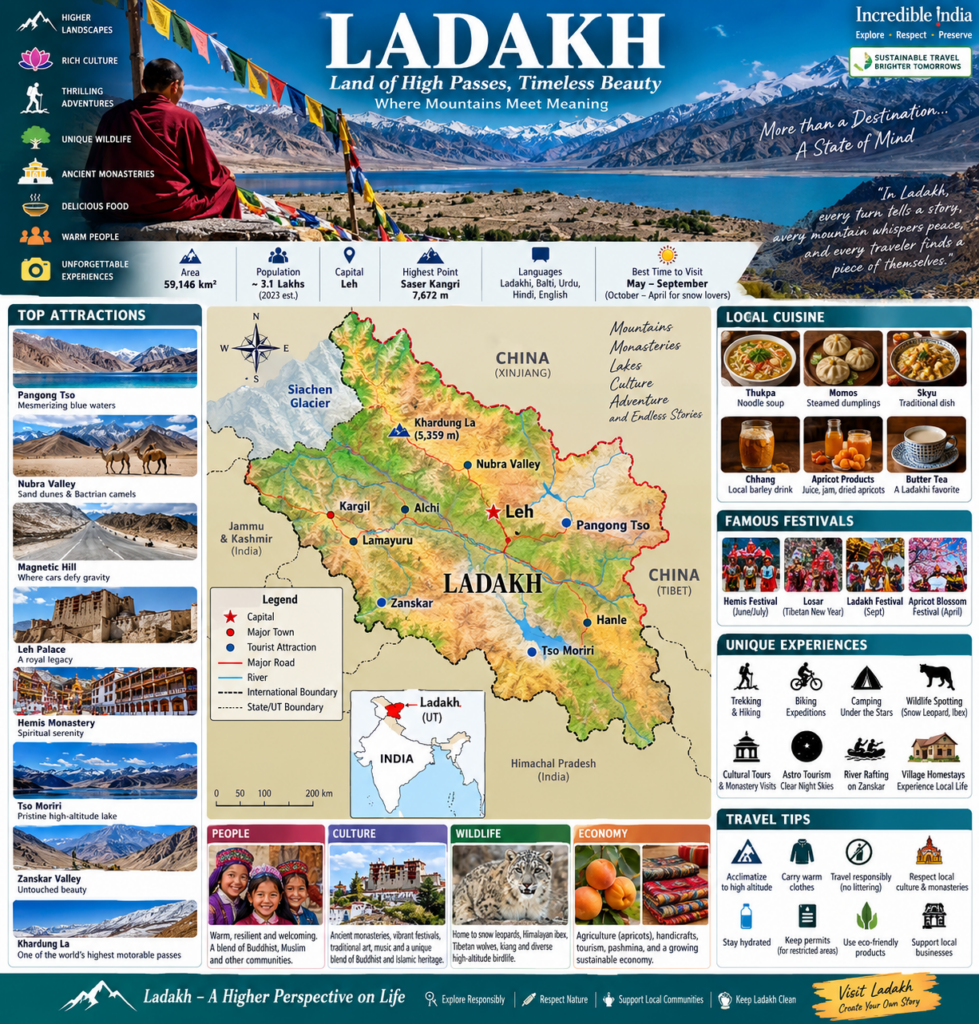
I am Ladakh.
Please do not call me merely a city. I am much larger than that—a vast Union Territory of India, a high-altitude land where the Himalaya and Karakoram shape my horizons, where the Indus has carried life through an otherwise austere landscape, and where human settlements have learned for centuries to live with altitude, cold, distance and silence.
People often introduce me through photographs: blue water at Pangong Tso, the sand dunes of Nubra, monasteries clinging to mountainsides, motorcycles crossing high passes and prayer flags moving in the wind.
Those photographs are beautiful.
But they are only my face.
If you want to know me, sit beside the Indus for a while. Walk through an old village. Listen to conversations in Leh or Kargil. Watch farmers tending small fields against enormous mountains. Enter an ancient monastery without hurrying. Taste food made for a cold, high-altitude climate.
Then you may begin to hear my story.
Official tourism descriptions today present me as a meeting place of culture, nature and adventure, shaped by monasteries, historic trade routes, high-altitude lakes, wildlife, traditional communities and extraordinary mountain landscapes.
🏺 “My Story Began Long Before Tourism”
My memory is much older than the hotels and cafés of modern Leh.
Across my mountains and valleys are traces of early human presence, including petroglyphs and rock art. They remind visitors that people crossed, inhabited and understood this difficult landscape long before modern roads existed. Ladakh Tourism now recognizes this rock-art heritage as part of my archaeological identity.
Over centuries, different communities, rulers, traders, monks, farmers and pastoralists added new chapters to my life.
Buddhism became one of the strongest threads in my cultural fabric. Monasteries rose above villages and valleys. Their walls preserved paintings, scriptures and religious traditions. Their courtyards became places where generations gathered for ceremonies and festivals.
But my identity has never been only one-dimensional.
Buddhist, Muslim and other communities have contributed to my social and cultural landscape. Leh’s sacred geography itself tells part of that story through monasteries, the Jama Masjid, Gurudwara Pathar Sahib and other religious places.
My culture developed through coexistence—with different communities, but also with mountains, animals, water and a difficult climate. Ladakh’s Culture Department describes this heritage through its languages, literature, folklore, folk songs, dance, drama, architecture, carving and painting.
🐫 “Once, Caravans Passed Through My Heart”
There was a time when the sound of commerce in Leh was not a taxi horn or motorcycle engine.
It was the movement of caravan animals.
My location placed me on important historic trading routes connecting regions including Kashmir, Tibet, Punjab and Central Asia.
Leh grew as a caravan-trading centre. Incredible India’s account of the town notes that from the seventeenth century until 1949, Leh served as an important hub for trade between Punjab and Central Asia and between Kashmir and Tibet. Even the broad Main Bazaar accommodated horses, donkeys and camels carrying merchandise.
Imagine my market then.
Traders arriving after exhausting mountain journeys.
Bundles being opened.
Goods changing hands.
Languages from distant regions mixing in the same bazaar.
Stories traveling alongside merchandise.
My mountains looked like barriers on a map, but people repeatedly turned them into bridges.
👑 “I Remember My Kings and Palaces”
Above modern Leh stands one of the great reminders of my royal past—Leh Palace.
The nine-storey palace was constructed under King Sengge Namgyal in the seventeenth century and remains one of the defining monuments of my historic capital.
I have watched centuries pass beneath its walls.
Royal authority changed.
Trade routes changed.
Political boundaries changed.
Modern roads appeared.
Tourists arrived.
Phones replaced letters.
Yet when evening light falls across the old town and palace, different centuries can seem strangely close together.
My heritage also survives at Stok, Alchi, Lamayuru, Hemis, Thiksey and numerous other settlements and monasteries. In 2026, the UT administration continued formal heritage-conservation work, including notifications concerning protected monuments and new heritage-preservation rules.
My past is not decoration.
It is inheritance.
🪷 “My Monasteries Carry My Memory”
If you want to understand my spiritual character, do not merely photograph my monasteries from the road.
Enter quietly.
Hemis, Thiksey, Alchi, Lamayuru, Spituk and many other monasteries preserve traditions that are still alive rather than existing simply as historical attractions. Official tourism material describes my Buddhist heritage through ancient monasteries, festivals and rituals, some connected with traditions around a thousand years old.
During monastic festivals, courtyards can fill with colour.
Monks perform Cham masked dances.
Music echoes between the walls.
Families gather.
Visitors watch.
For a traveler, it may be an unforgettable spectacle. For me, however, these ceremonies are part of living religious traditions.
That distinction matters.
Come with your camera, but bring respect with it.
🎭 “My Culture Is Alive”
You may see me dancing during a festival.
You may hear folk songs.
You may watch polo or traditional archery.
You may see artisans working with wool, textiles, metal, wood or religious art.
And when winter comes, do not imagine that my culture disappears because the tourist season becomes quieter.
Losar and winter traditions remind me that my calendar was never designed around tourism.
Today, visitors can encounter my heritage through monastic festivals as well as events celebrating apricot blossoms, Changthang’s nomadic traditions, Zanskar, Ladakh-wide culture, food, cinema and other aspects of contemporary life. Official tourism promotion explicitly presents festivals, crafts, traditional communities and monastery culture as central parts of the Ladakh experience. (Ladakh Tourism)
I am not a museum frozen in the mountains.
I am changing while trying to remember who I am.
🐐 “In Changthang, My Nomadic Heart Still Beats”
Travel east and another side of my personality appears.
In Changthang, pastoral life has been shaped by altitude, livestock, mobility and an environment that demands resilience.
The Changpa communities and their livestock heritage are inseparable from the story of Ladakh’s famous pashmina.
A pashmina shawl displayed in an elegant shop has a much longer story behind it.
Before the boutique comes the mountain.
Before the finished garment comes fibre.
Before the fibre comes pastoral knowledge and animals surviving one of India’s harshest inhabited landscapes.
That is why I ask travelers not merely to buy my products.
Learn their stories.
🍑 “When My Apricot Trees Blossom, I Become Soft”
People imagine me in shades of brown, white and blue.
Then spring arrives.
In my apricot-growing villages, branches begin to bloom.
Suddenly the cold-desert image changes.
Pink and white blossoms stand against barren mountains and clear skies.
The apricot is more than something I offer visitors to eat. It is connected to farming, village livelihoods, food traditions and an emerging value-added economy.
My annual Apricot Blossom celebrations now invite travelers into these landscapes, while official tourism promotion recognizes spring as a season of apricot blossoms, melting snow and scenic photography.
For photographers, it is beautiful.
For farming families, it is livelihood.
The best traveler understands both.
🍲 “Come, Sit in My Kitchen”
If you truly want to know me, eventually I will invite you to eat.
My food grew from necessity.
High altitude, cold winters, limited agricultural seasons and centuries of cultural exchange shaped what people cooked.
Taste thukpa, warming noodle soup.
Try momos, now familiar far beyond the Himalayas.
Discover skyu, a hearty Ladakhi dish.
Learn about ngamphe, roasted barley flour.
Then explore apricot products and other foods whose meaning becomes clearer when eaten close to where their ingredients originate.
Official tourism material highlights thukpa, momos and apricot foods as part of Ladakh’s culinary identity, while Incredible India also documents dishes such as skyu and tsampa/ngamphe.
My cuisine does not need to shout.
It was designed to nourish people living where winter is serious.
🕌 “I Am More Diverse Than the Postcard Suggests”
Sometimes visitors arrive believing they already understand me.
They have seen Buddhist monasteries in travel advertisements, so they assume that is my entire cultural identity.
Travel farther west.
Listen to Kargil.
Explore Suru.
Understand Drass.
Meet Balti and other communities.
My cultural geography becomes richer and more complicated.
My story contains Buddhist monasteries and Islamic traditions, pastoral communities and agricultural villages, Leh’s historic trading character and Kargil’s distinctive social landscape.
My greatest strength is not that everyone here is identical.
It is that different histories have found homes within the same extraordinary mountain region.
🛣️ “Then Roads Changed Me”
For centuries, distance protected me and constrained me at the same time.
Modern connectivity transformed my economy.
Roads brought construction materials, fuel, food and consumer products.
They carried students, workers and entrepreneurs.
And increasingly, they carried travelers.
Cars replaced caravans.
Motorcycles became part of my tourism imagery.
Hotels and guesthouses expanded.
Restaurants and cafés appeared.
Taxi businesses grew.
Travel agencies, trekking companies and rental services developed.
Tourism became deeply connected to livelihoods in transport, accommodation, catering and cottage industries. The UT administration explicitly identifies tourism as an important source of employment and income with economic effects extending into remote areas. (Ladakh)
I welcomed this opportunity.
But growth brought new questions too.
🗓️ “In 1974, Another Door Opened”
One date changed my modern tourism story dramatically.
1974.
That was when Ladakh opened to tourism, and Leh subsequently saw increasing visitor numbers drawn by landscape, culture and adventure.
At first they came looking for somewhere remote.
Then more followed.
Trekkers came.
Mountaineers came.
Photographers came.
Motorcyclists came.
Families came.
Couples came.
Filmmakers came.
Students came.
People searching for monasteries came.
People searching for silence came.
Eventually, social media introduced me to millions who had never crossed the Himalaya.
My remoteness became part of my attraction.
🇮🇳 “Then My Administrative Identity Changed”
Another major transition arrived in 2019, when I became a separate Union Territory of India following the reorganization of the former state of Jammu and Kashmir.
My Tourism Department’s present institutional structure developed following that reorganization, with tourism offices and development authorities serving Leh, Kargil and Zanskar.
So when someone searches for “Ladakh State,” I understand what they are looking for.
But my correct present identity is:
Union Territory of Ladakh, India.
💙 “Pangong Made Millions Dream About Me”
Some landscapes become ambassadors.
For me, Pangong Tso became one of them.
Its shifting blues against enormous bare mountains created an image that traveled across cinema, television, websites and social media.
But I want visitors to remember something.
Pangong is not a movie set.
It is a high-altitude ecosystem.
Likewise, Tso Moriri and Tso Kar are not merely backgrounds for selfies.
My lakes, wetlands, wildlife habitats and remote landscapes deserve restraint.
Take your photograph.
Then take your litter back too.
🏜️ “Nubra Shows You Another Face”
Cross into Nubra and I change again.
There are mountains, settlements, monasteries, orchards and the famous cold-desert dunes of Hunder, associated with Bactrian camels.
Travel farther and you may reach Turtuk, where Balti culture and apricot orchards reveal yet another cultural landscape. These places are among the signature destinations promoted by Ladakh Tourism today.
That is something I wish travelers understood:
I am not one landscape.
I am many Ladakhs within one Ladakh.
🌿 “Suru Is My Green Surprise”
If Pangong represents my blue and Nubra my desert gold, Suru Valley reveals green.
Its villages, cultivated landscapes and the great Nun-Kun mountain backdrop remind visitors that the phrase “cold desert” cannot explain every corner of me.
And beyond familiar circuits, Zanskar carries another dimension—remote settlements, monasteries, trekking landscapes and a powerful cultural identity of its own.
You could visit me several times and still meet a different version of me each journey.
🐆 “Some of My Residents Walk Without Roads”
Humans are not my only inhabitants.
My mountains support extraordinary high-altitude wildlife.
Snow leopards move through landscapes most visitors would find almost impossible.
Ibex negotiate cliffs.
Birds migrate through high-altitude wetlands.
Official tourism promotion now presents wildlife and ecological travel as fundamental parts of my identity alongside culture and adventure.
If you are lucky enough to see wildlife, remember:
You are the visitor.
They live here.
🥾 “Adventure Travelers Test Themselves Against Me”
People come to trek my valleys.
They cycle my roads.
They camp.
They climb.
They photograph the Milky Way.
They cross passes.
Some arrive believing they have come to conquer Ladakh.
I smile at that word.
No traveler conquers a mountain.
At best, the mountain allows safe passage.
My altitude demands patience. My weather can change quickly. My distances can deceive. Roads that look short on a map may consume hours.
Adventure here becomes meaningful when confidence is accompanied by humility.
🌌 “At Night, I Show You Another Universe”
When artificial lights fade, my darkness becomes an attraction of its own.
My clear high-altitude skies have helped astro-tourism emerge alongside trekking, culture, wildlife, wellness and eco-tourism. Ladakh Tourism now officially presents astro-tourism as one of the region’s distinctive visitor experiences.
Travelers look upward and suddenly become quiet.
Sometimes I think that is one of my greatest gifts.
I remind people how small they are.
🏨 “Tourism Gave Me Opportunity—and Responsibility”
Tourism brought livelihoods.
A farmer could operate a homestay.
A driver could build a taxi business.
A young person could become a guide.
A family could open a guesthouse.
An artisan could reach customers from across India and abroad.
Restaurants, cafés, adventure companies, photographers, mechanics and transport businesses benefited indirectly.
But growth also brought pressure.
More vehicles.
More construction.
More waste.
Greater water demand.
Pressure on fragile places.
Cultural commercialization.
My challenge now is not simply attracting more tourists.
It is learning how tourism can support livelihoods without consuming the very environment and culture people travel here to experience.
That is why official tourism planning increasingly emphasizes eco-tourism, homestays, conservation and responsible travel.
🌱 “My Future Cannot Be Built by Copying the Plains”
Please do not measure my progress only by shopping malls, factories or concrete.
I am a high-altitude ecosystem.
My future must be different.
I can grow through sustainable tourism.
Through local agriculture.
Through apricot and seabuckthorn products.
Through pashmina and handicrafts.
Through renewable energy.
Through responsible hospitality.
Through local entrepreneurship.
Through better transport and digital connectivity.
Through science, education and conservation.
Through businesses that create livelihoods without destroying landscapes.
Development and preservation are not enemies if people plan carefully.
❤️ “When You Visit Me, Do Not Rush”
Do not land in Leh and immediately race toward the highest road you can find.
Your body needs time.
Your mind probably does too.
Walk slowly.
Drink water.
Sit somewhere without photographing it.
Visit a monastery without treating it as a checklist.
Eat something local.
Talk to someone whose family lives here.
Shop from an artisan.
Spend a night in a village.
Look at the sky.
Listen to the silence.
Then you will discover that the most memorable thing about Ladakh may not be a single tourist attraction.
It may be the feeling of space.
🌍 “I Am Ladakh—and This Is What I Ask of You”
I have survived harsh winters, political change, shifting trade routes and generations of human movement.
I remember caravans crossing my mountains.
I remember kings watching over Leh.
I remember markets before tourism.
My monasteries remember prayers older than modern roads.
My villages remember farming before Instagram discovered my landscapes.
My elders remember a quieter Ladakh.
My young people are building a different future.
Today, motorcycles cross roads once traveled by caravans. Smartphones photograph mountains once known to outsiders mainly through maps and stories. Boutique hotels stand not far from old settlements. Travelers arrive from across India and the world.
I do not reject change.
Change has always been part of my autobiography.
But I ask one thing:
Do not love me so much that you destroy what you came to love.
Come for Pangong’s blue.
Come for Nubra’s dunes.
Come for Zanskar’s remoteness.
Come for Suru’s mountains.
Come for Hemis, Thiksey, Alchi and Lamayuru.
Come for apricot blossoms.
Come for pashmina and handicrafts.
Come for thukpa, skyu and momos.
Come for trekking, photography, wildlife and stars.
But also come to understand the people who have made a life here despite cold, altitude and isolation.
Travel gently.
Respect my monasteries.
Protect my lakes.
Leave my wildlife undisturbed.
Support my local communities.
Carry your waste back.
And when your journey ends, do not remember me only as a destination you crossed off a list.
Remember me as a living land.
A land that taught traders to cross mountains.
A land that taught farmers to grow life in a cold desert.
A land where prayer flags still move with the Himalayan wind.
A land where ancient heritage and modern ambition now stand beside each other.
I am Ladakh. 🏔️
I am not simply a place you visit.
I am a journey that asks you to slow down—and listen.
📍 Where Is Ladakh in India? Geography, History, Culture, Connectivity & Travel Guide
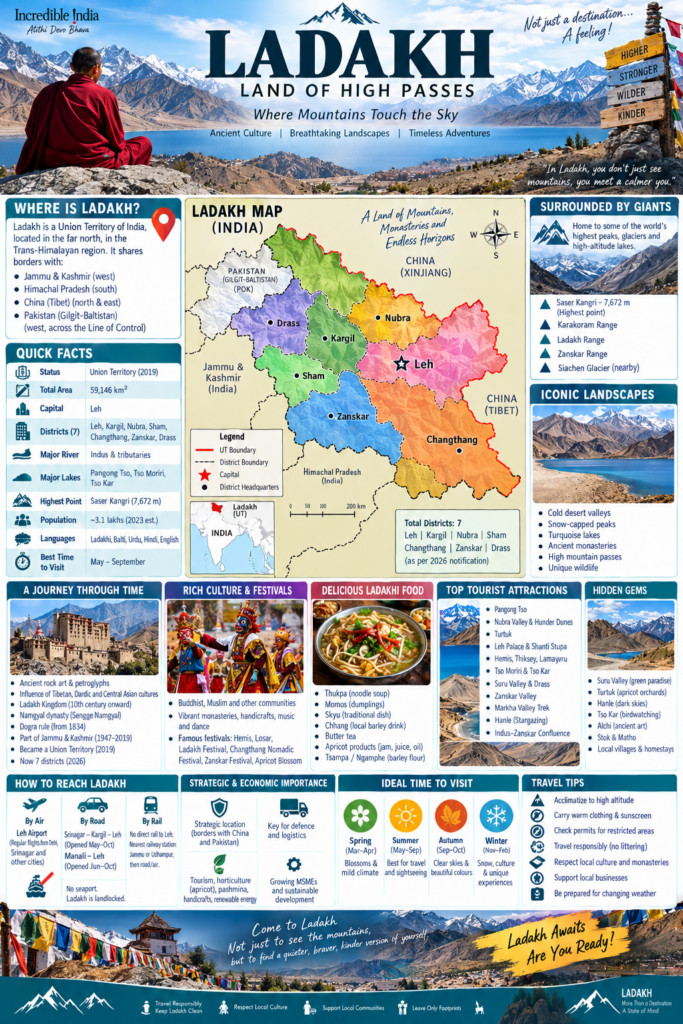
There is a moment on the journey toward Ladakh when the landscape seems to rewrite the rules of India. Dense vegetation becomes sparse, settlements grow smaller, mountains become enormous, and rivers appear like ribbons cut through stone. The road no longer feels like a route between two cities; it feels like an entrance into another geographical world.
That world is Ladakh.
And one factual correction is important at the beginning: Ladakh is not a state or a city. It is a Union Territory of India. Since 2019, it has existed as a separate Union Territory, and in April 2026 its administrative map expanded from two districts to seven districts—Leh, Kargil, Nubra, Sham, Changthang, Zanskar and Drass.
🧭 Where Is Ladakh? Quick Answer
Ladakh is located in the far north of India, in the high-altitude Trans-Himalayan region. It lies between major mountain systems and contains the upper Indus landscape, spectacular valleys, high passes, cold deserts, glaciers and high-altitude lakes.
Its geography places it close to Jammu & Kashmir to the west/southwest, Himachal Pradesh toward the south, Pakistan-administered territories toward the west/northwest, and China-controlled territories toward the north and east. Because several international boundary sectors in the wider region are disputed, maps intended for publication should follow the official Government of India map.
Leh is the principal urban, administrative and tourism centre, while Kargil is the major western commercial and transport centre.
🗺️ Ladakh Location & Map Position – Quick Facts
| 🧭 Geographic Question | 📌 Answer |
|---|---|
| 🇮🇳 Country | India |
| 🏛️ Administrative status | Union Territory |
| 🏙️ Principal urban centre | Leh |
| 🏘️ Other major centre | Kargil |
| 🗺️ Current districts | Leh, Kargil, Nubra, Sham, Changthang, Zanskar, Drass |
| 🏔️ Physical region | Trans-Himalayan / high-altitude mountain region |
| 🌊 Major river system | Indus and tributaries |
| 💙 Famous lakes | Pangong Tso, Tso Moriri, Tso Kar |
| 🏜️ Landscape | Cold desert, valleys, mountains, glaciers, wetlands |
| ✈️ Main commercial air gateway | Leh |
| 🚆 Direct railway station | No operational conventional railway into Leh |
| 🛣️ Major road gateways | Kashmir–Kargil–Leh and Manali–Ladakh approaches |
| ⚓ Seaport | None—Ladakh is landlocked |
| 🌤️ Main leisure-travel season | Broadly May–September |
| ❄️ Winter appeal | Snow, culture, wildlife, specialized winter tourism |
Official Ladakh Tourism identifies summer broadly as May–September, spring as March–April, autumn as September–October and winter as November–February, although actual road and attraction access varies with weather and location.
🏛️ Ladakh’s New Administrative Map: An Important Update
Many older travel articles still say that Ladakh consists of only Leh and Kargil districts. That information is now outdated.
On 27 April 2026, five additional districts were formally created. Ladakh now has:
| 🏛️ District | 📍 Headquarters |
|---|---|
| Leh | Leh |
| Kargil | Kargil |
| Nubra | Diskit |
| Sham | Khaltse |
| Changthang | Nyoma |
| Zanskar | Padum |
| Drass | Drass-Ranbirpura |
The reorganization was followed by the creation of 17 additional tehsils, bringing Ladakh’s total to 32 tehsils.
🏔️ Understanding Ladakh’s Geography
Ladakh makes sense only when you understand its mountains.
This is not a conventional green Himalayan hill station. Much of the region is a high-altitude cold desert, where great mountain barriers limit moisture and create stark, treeless landscapes.
Yet calling Ladakh “barren” misses its extraordinary diversity.
Follow the Indus and you encounter cultivated settlements.
Travel toward Nubra and the landscape opens into a remarkable valley associated with the Shyok and Nubra river systems, villages, monasteries, orchards and the cold-desert dunes around Hunder.
Move toward Changthang and the world becomes higher and more austere—wetlands, grazing landscapes and great lakes.
Travel west toward Kargil and you meet a different transition. The official Kargil district description divides its geography into major natural valleys and emphasizes the Suru and Drass river landscapes.
Then enter Suru Valley and the stereotypical brown Ladakh postcard changes again: cultivated land and mountain scenery appear beneath the great Nun-Kun massif.
This is why Ladakh should never be described as one uniform desert.
🌊 Rivers – The Lifelines of the Cold Desert
The Indus River is fundamental to Ladakh’s geography and human history.
Settlements, fields and historic routes developed around river valleys because water determines where sustained human life is possible in this dry environment.
Other important river systems include the Zanskar, Shyok, Nubra, Suru and Drass.
One of the most photographed river landscapes is the confluence of the Indus and Zanskar near Nimmu, west of Leh.
For a traveler, these rivers create viewpoints.
For a geographer, they carve valleys.
For villages, they are connected with agriculture and settlement.
For logistics planners, their valleys have historically influenced movement corridors.
The same river can therefore be a tourist attraction, geographical force and economic lifeline.
💙 Lakes of Ladakh
Few places have shaped Ladakh’s modern tourism image as powerfully as its high-altitude lakes.
Pangong Tso is the most internationally recognizable. Official Ladakh Tourism describes it as a high-altitude lake extending across India and China and famous for its changing blue appearance.
Tso Moriri, in the Changthang region, offers a different experience—more remote, quieter and ecologically sensitive.
Tso Kar is especially interesting for nature-oriented travel and birdlife.
These are not conventional recreational lakes or “beaches.” Visitors should not treat their shores as amusement zones. Their high-altitude ecology is part of their attraction and part of what must be protected.
🏔️ Mountains, Passes & Glaciers
Ladakh sits among some of the world’s most dramatic mountain landscapes.
The wider geography is shaped by major systems including the Karakoram, Ladakh and Zanskar ranges. High passes historically connected valleys that otherwise appear isolated from one another.
In the west, Zoji La has long been one of the crucial gateways between Kashmir and the Ladakh region. Kargil’s official geographical account describes Zoji La and Fotu La as important gateways in this mountain system.
The region also includes major glacier landscapes. In the far north lies the Siachen Glacier region, while western Ladakh contains spectacular glacier-and-peak landscapes around Suru and the Nun-Kun massif.
These are not merely scenic features. Mountains determine Ladakh’s roads, military logistics, climate, settlement, agriculture and economy.
🌳 Does Ladakh Have Forests?
Not in the way travelers may imagine forests in Himachal Pradesh, Uttarakhand or Kashmir.
Ladakh’s aridity and altitude mean extensive dense forests are not its defining natural feature. Vegetation tends to concentrate around river valleys, villages, irrigated fields, wetlands and comparatively favorable microclimates.
You may find willow and poplar plantations, orchards, shrubs, alpine vegetation and cultivated green belts around settlements.
This contrast is precisely what makes a Ladakhi village so striking: a ribbon of green can appear almost suddenly against immense brown mountains.
🌤️ Climate – Why Ladakh Feels Like Another World
Ladakh’s climate is defined by altitude, dryness, intense sunlight, low humidity, large temperature variations and severe winters.
Summer brings the easiest access to many famous tourism circuits. Autumn offers crisp landscapes and changing agricultural colours. Winter can transform valleys and settlements into snowbound environments and is increasingly relevant for specialized cultural, wildlife and winter travel. Official tourism promotion now presents Ladakh across all four seasons rather than exclusively as a summer destination.
Altitude, however, is not a marketing detail.
It changes how visitors should travel.
A sensible Ladakh itinerary begins slowly rather than racing from the airport toward high passes and remote lakes.
🪨 Before the Kingdoms – Archaeology & Rock Art
Long before Leh Palace, monasteries, highways or tourism, people were leaving marks on Ladakh’s rocks.
Petroglyphs and rock art across the region provide important evidence of Ladakh’s ancient human landscape. Ladakh Tourism now specifically identifies petroglyphs and rock art among the region’s heritage attractions.
Kargil district likewise documents ancient rock carvings, forts, palaces, Buddhist statues, mosques, monasteries and other heritage remains across its landscape.
These traces are particularly valuable because Ladakh’s earliest history cannot always be reconstructed neatly from written records.
📜 Ancient History – A Crossroads Rather Than an Isolated Desert
It is tempting to imagine ancient Ladakh as cut off from the world.
Its history suggests almost the opposite.
Its difficult passes connected cultural and commercial worlds stretching toward Kashmir, Tibet, Central Asia and the Indian subcontinent.
Official Leh district history records traditions of Dard, Mon and Tibetan settlement and describes Buddhism spreading through Ladakh on routes linking India and Tibet. It also records references to the wider region in Chinese and other historical traditions.
The western region around modern Kargil developed its own complex history. Much of it was historically known as Purig, with Dardic, Tibetan and later Islamic cultural influences interacting across its valleys.
That helps explain modern Ladakh’s remarkable cultural diversity.
🪷 Mythology, Sacred Geography & Historical Tradition
Ladakh contains many sacred narratives, monastery traditions, local legends and oral histories.
These deserve careful treatment.
A local sacred story is not automatically the same thing as archaeologically verified history.
Buddhist traditions connect numerous monasteries, caves, mountains and landscapes with teachers, saints and religious events. Local oral histories also preserve accounts of migration, rulers, battles and supernatural events.
The best travel writing does not flatten these traditions into “facts.” Instead, it says clearly:
Tradition says…
Local belief associates…
Historical evidence indicates…
That distinction protects both cultural respect and editorial trust.
👑 The Rise of the Ladakhi Kingdom
One of the major transitions came around the 10th century, when Nyima Gon/Nyimagon established political authority in the region. Official Leh district history describes a kingdom centred initially at Shey.
Centuries later, the Namgyal dynasty became central to Ladakh’s political history.
Its most celebrated ruler is Sengge Namgyal, remembered as a major monarch, builder and consolidator. Leh district’s official history credits him with strengthening the Ladakhi kingdom and building the historic nine-storey Leh Palace.
The palace still dominates the old city landscape.
Stand beneath it today and modern Leh spreads below—hotels, cafés, taxis, markets and smartphones—while the palace silently represents an earlier political world.
⚔️ Dogra Conquest & the Nineteenth Century
The next great political shift came from the south.
In 1834, forces led by General Zorawar Singh, acting for Gulab Singh of Jammu, entered Ladakh. Kargil’s official historical account describes the campaign through Kishtwar and Zanskar and the resistance encountered in the region.
Ladakh eventually became incorporated into the Dogra-ruled political structure that developed into the princely state of Jammu and Kashmir.
This changed the region’s political relationship with the wider subcontinent and formed an important bridge between the kingdom era and modern administration.
🇬🇧 Was Ladakh a British Colony?
The answer requires nuance.
Ladakh was not administered like a conventional directly ruled British Indian province. Following the Dogra conquest, it became part of the princely state of Jammu and Kashmir, which existed under British paramountcy.
European influence nevertheless arrived through explorers, scholars, missionaries and wider imperial-era politics.
Official Leh history specifically records the presence of German Moravian missionaries, adding another layer to Ladakh’s nineteenth-century cultural encounters.
🏛️ From Jammu & Kashmir to Union Territory
After Indian independence and the political transformations surrounding Jammu and Kashmir, Ladakh remained administratively within the former state of Jammu and Kashmir for decades.
Leh and Kargil emerged as separate districts in 1979.
Then came another historic change.
On 31 October 2019, Ladakh became a separate Union Territory of India.
And in 2026, the five new districts of Nubra, Sham, Changthang, Zanskar and Drass were added, creating today’s seven-district structure.
🛡️ Why Ladakh Is Strategically Important
Look at a map and Ladakh’s strategic importance becomes immediately apparent.
It lies beside sensitive international boundary regions involving China and Pakistan, while mountain corridors connect Kashmir, Himachal, the Indus Valley, Nubra and remote border areas.
Consequently, roads, bridges, tunnels, air connectivity and logistics here have significance beyond tourism.
They support civilian communities, government services, disaster response, infrastructure projects and national defence.
Kargil’s strategic importance became internationally visible during the 1999 India–Pakistan conflict, particularly around places such as Drass, Tiger Hill and Tololing.
For travel writing, these landscapes should be approached respectfully—they are not merely selfie locations.
🐫 Ladakh Was a Logistics Hub Long Before Trucks
Before modern highways, Ladakh already understood logistics.
Kargil’s official district history describes it as an important historical meeting point where traders from Central Asia, China and different parts of India exchanged tea, wool, carpets, silk and precious stones.
Leh likewise developed through caravan commerce.
Imagine today’s logistics chain without trucks, warehouses or GPS:
🐫 pack animals → 🏔️ mountain passes → 🏘️ caravan settlements → 🛍️ bazaars → 🌏 regional trading networks.
Modern freight has changed the technology, but not the underlying geographical challenge.
🚚 Modern Transport & Logistics Importance
Almost everything required by a modern mountain economy—fuel, construction material, machinery, packaged goods, hotel supplies and industrial equipment—faces significant transport costs.
This creates opportunities in:
🚛 freight transportation, 📦 warehousing, ❄️ cold-chain logistics, 🍑 horticultural transport, 🏗️ project cargo, 🛒 e-commerce fulfilment, ⛽ wayside services and 📲 digital freight aggregation.
The same roads supporting tourists also carry food, building materials and essential supplies.
In Ladakh, logistics is therefore not merely another industry.
It is infrastructure for almost every other industry.
🛣️ How to Reach Ladakh by Road
Two classic overland approaches dominate travel planning.
The western approach links Srinagar–Sonamarg–Zoji La–Drass–Kargil–Leh.
The southern approach links Manali toward the Ladakh region, crossing a spectacular high-mountain environment.
Kargil sits strategically on the western corridor. Official district information places it roughly between Srinagar and Leh and emphasizes its historic role as a meeting and trading point.
For travelers, these are road trips.
For transport companies, they are supply corridors.
For local communities, they are lifelines.
Road opening and closure conditions are dynamic, however, so a travel article should never hard-code seasonal road availability without checking current official advisories.
✈️ How to Reach Ladakh by Air
For most travelers, flying into Leh is the fastest practical route.
But the ease of a flight creates an unusual problem: an aircraft can move a traveler from the plains to high altitude much faster than the human body can adjust.
Therefore, arrival day should not be treated like a normal city-break arrival.
Keep the initial itinerary light and allow time for acclimatization before moving toward substantially higher or more remote destinations.
🚆 Can You Reach Ladakh Directly by Train?
Not currently by a conventional passenger railway into Leh.
Travelers using rail normally combine a railway journey to a suitable gateway outside Ladakh with onward road or air travel.
That makes road freight and aviation disproportionately important to Ladakh compared with many other Indian destinations.
Future infrastructure can change this, so an evergreen travel article should verify operational railway status before claiming a direct service.
🛳️ Can You Reach Ladakh by Water?
No.
Ladakh is landlocked and has no seaport.
Its rivers may support localized adventure activities in suitable conditions, but they do not form a passenger or freight waterway comparable to coastal or major navigable-river transport systems.
That distinction prevents a common SEO mistake: inserting “water connectivity” into every destination template even where it does not geographically exist.
💼 Economy – How Do People Make a Living Here?
Ladakh’s economy has historically adapted to limited agricultural land, harsh winters and long distances.
Today important sectors include:
🏨 tourism and hospitality, 🍑 horticulture, 🐐 pashmina, 🧶 handloom and handicrafts, 🥫 food processing, 🚚 transport and logistics, 🏗️ construction and infrastructure, ☀️ renewable-energy-related activity, 🛍️ retail and services, and growing MSME/startup activity.
Agriculture remains culturally and economically important despite the short growing season.
Apricot is particularly significant in parts of Leh and Kargil, while Changthang’s pastoral economy is closely associated with pashmina.
This creates a distinctive economic opportunity: instead of competing through mass production, Ladakh can create value through origin, quality, craftsmanship, processing and premium branding.
🏭 What Kind of Industry Fits Ladakh?
Ladakh is not Maharashtra’s MIDC belt or Gujarat’s large manufacturing corridor.
Its industrial future is more naturally suited to smaller, higher-value and lower-impact activities such as:
🍑 apricot processing, 🌿 seabuckthorn products, 🧣 pashmina value addition, 🧶 textiles and handicrafts, 🥫 packaged foods, ☀️ solar services, ❄️ cold storage, 📦 packhouses, 🚚 logistics, ♻️ waste management and 📲 digital commerce.
Heavy industry must be considered against Ladakh’s fragile environment, water constraints, freight economics and small population.
In other words, Ladakh’s competitive advantage is often value rather than volume.
🪷 Culture – Where Different Himalayan Worlds Meet
One of the greatest mistakes a traveler can make is reducing Ladakh to “Buddhist monasteries.”
Buddhist heritage is enormously important, particularly across Leh, Sham, Nubra, Changthang and Zanskar.
But western Ladakh adds strong Shia Muslim, Balti, Purig, Shina and other cultural traditions.
Official Kargil history documents the region’s multi-ethnic and multilingual character and the historical spread of Islam beginning centuries ago, alongside surviving Buddhist communities and heritage.
Ladakh is therefore best understood as a cultural meeting ground rather than a single cultural block.
🎉 Festivals – When the Landscape Becomes a Stage
Monastery courtyards come alive during festivals with masks, robes, horns, drums and ritual dances.
Hemis Tsechu is among the best-known.
Losar marks the traditional New Year period.
Other monastery festivals preserve religious traditions across the region.
Contemporary cultural tourism has expanded the calendar further. Official Ladakh Tourism currently highlights events including the Changthang Nomadic Festival and Zanskar Festival, alongside monastery festivals such as Hemis Tsechu.
Kargil authorities likewise organize Kargil and Zanskar festivals to showcase local cultural heritage.
🍲 What Does Ladakh Taste Like?
Cold places often produce comforting food.
Ladakh is associated with warming dishes such as thukpa, momos and skyu, alongside barley-based foods, breads, butter tea and regional variations shaped by local communities.
Apricot products provide another flavour of the landscape.
A meaningful food journey should go beyond ordering the same North Indian restaurant menu every evening. Local food reveals how generations adapted cooking to altitude, climate, agriculture and available ingredients.
Official Ladakh Tourism now treats Ladakhi cuisine itself as a tourism experience, alongside culture, wellness and nature.
📸 Major Tourist Attractions
| 🌟 Attraction | 📍 Region | ❤️ Why Visit |
|---|---|---|
| 💙 Pangong Tso | Eastern Ladakh | Extraordinary high-altitude lake landscape |
| 🏜️ Nubra Valley | Nubra | Cold desert, villages and monasteries |
| 🐫 Hunder | Nubra | Dunes and Bactrian-camel landscape |
| 🌳 Turtuk | Nubra | Balti culture and apricot orchards |
| 🏯 Hemis Monastery | Near Leh | Major Buddhist monastery and festival |
| 🏯 Thiksey Monastery | Indus Valley | Architecture and valley views |
| 👑 Leh Palace | Leh | Royal history |
| ☮️ Shanti Stupa | Leh | Panorama and spiritual atmosphere |
| 🌕 Lamayuru | Sham | Monastery and dramatic terrain |
| 💧 Tso Moriri | Changthang | Remote lake and wetland landscape |
| 🐦 Tso Kar | Changthang | High-altitude ecology and birdlife |
| 🔭 Hanle | Changthang | Dark skies and remote landscape |
| 🥾 Markha Valley | Leh region | Trekking |
| 🏔️ Zanskar | Zanskar | Remote mountain culture and adventure |
| 🌿 Suru Valley | Kargil region | Green valley and Nun-Kun scenery |
| 🇮🇳 Drass | Drass | Mountain landscape and war-history context |
Official Ladakh Tourism currently highlights Pangong, Hunder’s sand dunes, Turtuk, Hemis, Thiksey and Zanskar’s Gonbo Rangjon among its signature destinations.
🌿 Hidden & Less-Rushed Ladakh
Ladakh becomes even more interesting when you move beyond the famous circuit.
Suru Valley deserves far more attention from landscape travelers. Kargil district identifies places including Sankoo, Panikhar, Tangole and Parkachik as bases for scenery, trekking, climbing, rafting and mountaineering.
Sham’s villages offer slower cultural journeys.
Apricot-growing villages add agricultural tourism.
Turtuk offers Balti cultural landscapes.
Zanskar rewards travelers who can give the journey time.
And Changthang provides wildlife, pastoral and astronomical experiences that should be approached carefully rather than consumed as rushed sightseeing.
🚪 Ladakh as a Gateway
Ladakh sits at the meeting point of several extraordinary travel regions.
| 🚪 Direction | 🛣️ Gateway / Corridor | 🌄 What It Connects |
|---|---|---|
| West | Kargil–Drass–Zoji La | Kashmir Valley / Srinagar side |
| South | High-Himalayan road corridor | Himachal / Manali side |
| North | Nubra | Shyok/Nubra high-altitude landscapes |
| East | Changthang | Pangong, Tso Moriri, Hanle landscapes |
| Southwest | Kargil–Suru | Nun-Kun / Suru landscapes |
| Southwest/Interior | Zanskar corridors | Padum and remote Zanskar |
| West of Leh | Sham | Alchi, Lamayuru, Khaltse and heritage circuit |
Kargil’s geographical position has historically made it especially important: official district material describes it as a historical meeting point and roughly equidistant from several major regional centres.
⚠️ Practical Visitor Insights
Do not plan Ladakh like an ordinary hill-station weekend.
Altitude comes first. Give your body time before strenuous activity or rapid movement to higher locations.
Road conditions come second. Weather, snow, landslides and construction can alter mountain journeys; check current official advisories.
Permissions matter. Border and protected-area rules can change, particularly for certain remote areas and foreign nationals.
Distances deceive. A route that looks short on a map can take many hours because of altitude, road geometry and stops.
Carry responsibly. Avoid disposable waste wherever possible and never leave rubbish beside lakes, passes or camps.
Respect religious sites. Monasteries, mosques, churches and sacred landscapes are living places of worship.
Buy locally. Authentic handicrafts, pashmina-related products, apricot products and locally produced foods can keep more tourism income within local communities.
🌄 So, Where Is Ladakh Really?
On a map, Ladakh is in northern India.
Geographically, it is a high-altitude meeting place of mountains, rivers, deserts, glaciers and lakes.
Historically, it is a crossroads where Dardic, Tibetan, Central Asian, Kashmiri and other influences met; where kingdoms rose; where Buddhism developed deep roots; where Islam shaped western Ladakh; where caravan traders crossed mountains; and where Dogra expansion later changed political history.
Administratively, it is now a seven-district Union Territory.
Economically, it is moving from isolation toward an increasingly connected system of tourism, horticulture, handicrafts, logistics, infrastructure, renewable energy and small enterprise.
Strategically, its border geography gives roads, bridges, airports and logistics national significance.
And emotionally?
Ladakh is one of those rare destinations where the journey itself becomes part of the answer.
Come slowly. Let Leh introduce you to the altitude. Follow the Indus west toward monasteries and old villages. Watch the landscape change in Nubra. Stand quietly beside a high-altitude lake without treating it as a film set. Taste local food. Meet people outside the tourism bubble. Give Kargil, Suru, Drass and Zanskar the time they deserve.
✈️ How to Reach Ladakh, India – Complete Air, Road, Rail, Bus, Taxi & Public Transport Guide
For an outstation traveler visiting for the first time, Ladakh is easier to understand if you remember one rule: you can enter the main Ladakh tourism network by air or road; there is currently no direct passenger railway, metro or navigable waterway into Leh.
Also, Ladakh is a Union Territory, not a state. Leh is its main aviation and tourism gateway, while Kargil is an important western road hub.
The District Leh administration currently identifies three principal road approaches: Srinagar–Drass–Kargil–Leh, the traditional Manali–Leh route, and the newer Manali–Darcha–Zanskar–Nimmu–Leh approach. It also confirms bus and taxi connectivity from the Srinagar and Manali sides.
📌 First-time visitor answer: Flying to Kushok Bakula Rimpochee Airport, Leh is generally the fastest way to reach Ladakh. For a scenic overland journey, enter via Srinagar–Kargil or Manali. If arriving by train, continue from a railhead outside Ladakh by road or connect to a flight.
🚗 How to Reach Ladakh – All Transport Modes Compared
| 🚦 Mode | 📍 Main Gateway | ⏱️ Typical Journey | 💰 Approx Cost* | 🎟️ Booking | 👍 Best For | ⚠️ Key Limitation |
|---|---|---|---|---|---|---|
| ✈️ Flight | Leh Airport | Delhi–Leh roughly 1.5 hr airborne | ₹3,000–₹15,000+ | Airline websites/apps | First-time, family, senior travelers | Rapid altitude gain |
| 🚌 Public/State Bus | Srinagar/Manali → Leh | About 1–2 days depending service/route | ₹800–₹3,000+ | Operator/counter; verify current service | Budget travelers | Seasonal/limited |
| 🚐 Private Bus | Srinagar/Manali | 1–2 days | ₹1,500–₹4,000+ | Operator/OTA where listed | Backpackers | Availability varies |
| 🚕 Private Taxi | Srinagar/Manali/Kargil | 1–2 days | ₹15,000–₹40,000+ vehicle | Taxi operator/union | Family/groups | Expensive solo |
| 🚙 Private Car | Srinagar/Manali | 1–3 days recommended | Fuel + toll/parking | N/A | Road-trip travelers | Mountain-driving experience needed |
| 🏍️ Motorcycle | Manali/Srinagar | 2+ days sensible | ₹₹–₹₹₹ | Rental/operator | Experienced riders | Weather, altitude, road risk |
| 🚆 Train + Road | Railhead outside Ladakh | 2+ stages | ₹₹ | IRCTC + onward vehicle | Rail-preferring travelers | No direct train to Leh |
| 🚇 Metro | None | — | — | — | — | Ladakh has no metro |
| 🚂 Local Train | None | — | — | — | — | No local rail network |
| 🛺 Auto-rickshaw | Not a primary Ladakh transport mode | — | — | — | — | Do not rely on it |
| 🏍️ Bike Taxi | Not a dependable UT-wide network | — | — | — | — | Do not plan around it |
| 📱 App Cab | Limited/not dependable like metros | — | — | Check locally | Opportunistic use | Local taxis dominate |
| 🛳️ Waterway | None | — | — | — | — | Ladakh is landlocked |
Prices are planning ranges rather than official fares. Airfare, taxis, buses and rental prices vary by season, route, vehicle and demand.
✈️ Reaching Ladakh by Air
🛫 Nearest Airport to Leh
The principal airport is:
Kushok Bakula Rimpochee Airport (IXL), Leh
AAI – Leh Airport
The airport sits at very high altitude—AAI documentation places it at approximately 3,256 metres above mean sea level.
Leh district’s tourism information identifies air connectivity with Delhi and services associated with other Indian cities/routes, although individual airline networks change frequently. Current flights should therefore be checked rather than relying on an old airline list.
✈️ Flight Planning Chart
| 🛫 Origin | 📍 Arrival | ⏱️ Broad Air Time | 💰 Indicative One-Way Fare | 👍 Suitable For |
|---|---|---|---|---|
| Delhi | Leh | ~1.5 hr | ₹3,000–₹12,000+ | Most travelers |
| Srinagar | Leh | ~1 hr | ₹3,000–₹10,000+ | Kashmir + Ladakh trip |
| Jammu | Leh | ~1–1.5 hr where scheduled | ₹4,000–₹12,000+ | Jammu travelers |
| Chandigarh | Leh | ~1.5 hr where scheduled | ₹4,000–₹12,000+ | Punjab/Haryana region |
| Other Indian cities | Leh via connection | 4–10+ hr total | ₹6,000–₹20,000+ | Outstation travelers |
AAI provides a current Leh flight-schedule page but explicitly warns that published schedules are tentative and passengers should confirm actual timings with their airline.
🎟️ Online Flight Booking
Use the airline’s official website/app or a reputable travel-booking platform. For schedule verification, the airline itself should be the final source.
Do not build a Ladakh article around permanently naming airlines because routes change.
🚕 Leh Airport to Leh City – Last-Mile Connectivity
Leh Airport is close to the urban area, making the final transfer comparatively simple.
The most dependable options are usually pre-arranged hotel transfers and local taxis. For first-time travelers, pre-booking an airport pickup through a registered hotel or travel operator can remove considerable uncertainty.
Do not assume Uber/Ola-style service will function in exactly the same way it does in Delhi, Mumbai or Bengaluru.
😴 Critical Advice After Flying to Leh
This is arguably more important than saving ₹500 on your airport transfer.
The Leh administration advises travelers arriving by air to take two days of complete rest for acclimatization, because of the sudden altitude gain.
Therefore, a sensible first-time itinerary is:
✈️ Airport → 🚕 Leh Hotel → 😴 Acclimatization → 🚶 Gentle Leh exploration → 🏔️ Higher-altitude journeys later
Do not schedule Pangong, Tso Moriri, a strenuous trek or a demanding pre-wedding photoshoot immediately after landing.
🛣️ How to Reach Ladakh by Road
For many travelers, the road itself is one of Ladakh’s greatest experiences.
🚘 Major Road Routes to Leh
| 🛣️ Route | 📏 Official Leh District Distance | 🏔️ Major Stops/Regions | ⏱️ Practical Style | ❤️ Best For |
|---|---|---|---|---|
| Srinagar → Drass → Kargil → Leh | ~434 km | Zoji La, Drass, Kargil, Lamayuru side | 2 days recommended | First road trip |
| Manali → Keylong → Leh | ~473 km on traditional route | High Himalayan passes | 2 days+ | Adventure road trip |
| Manali → Darcha → Zanskar → Nimmu → Leh | Route dependent | Zanskar landscapes | Multi-day | Slow/adventure travelers |
These route distances and corridors are identified by the Leh district administration.
🌄 Srinagar–Kargil–Leh Route
This is particularly attractive to travelers who want the landscape to evolve gradually.
A typical journey becomes:
Srinagar → Sonamarg → Zoji La → Drass → Kargil → Lamayuru region → Leh
Instead of treating Kargil merely as a night halt, consider adding time for Drass, Suru Valley or western Ladakh.
🏔️ Manali–Leh Route
The classic Manali approach is more demanding because it travels through a succession of high mountain environments.
It is spectacular, but it should not be treated like an ordinary interstate highway journey.
Weather, snow, road work and local restrictions can alter travel times substantially.
The Leh district page gives broad historical opening windows for these highways, but because mountain-road conditions change, check current official road status before departure rather than assuming a fixed annual opening date.
🚌 Public Transport in Ladakh
Public transport exists, but travelers accustomed to major Indian cities should adjust expectations.
Ladakh does not have a dense high-frequency metropolitan bus network covering every tourist attraction.
Government documentation identifies Leh–Manali and Leh–Srinagar as interstate public-transport routes, alongside intra-Ladakh operations.
Public transport is improving. In April 2026, the Government of India sanctioned 33 seven-metre electric buses for Ladakh under PM-eBus Sewa, specifically selected for the region’s terrain and road conditions.
🚌 Bus Connectivity Guide
| 🚌 Journey | 🚏 Public Transport Potential | 💰 Broad Budget | 🎒 Suitable For | ⚠️ Advice |
|---|---|---|---|---|
| Srinagar → Kargil | Good when services operate | ₹–₹₹ | Budget travelers | Check same-season schedule |
| Kargil → Leh | Important intercity corridor | ₹–₹₹ | Backpackers | Departures may be limited |
| Manali → Leh | Seasonal | ₹₹ | Adventure/budget | Road must be open |
| Leh → nearby settlements | Selected routes | ₹ | Slow travelers | Timetable matters |
| Leh → Nubra | Limited compared with taxi | ₹–₹₹ | Flexible backpackers | Verify day/frequency |
| Leh → Pangong | Limited | ₹–₹₹ | Budget traveler | Return timing can be restrictive |
| Leh → remote Changthang | Limited | ₹–₹₹ | Experienced independent travelers | Do not assume daily service |
| Kargil → Zanskar | Route/service dependent | ₹₹ | Slow travelers | Check locally |
For a first-time traveler with only five or six days, buses can save money but may cost flexibility.
🚕 Taxis – The Most Practical Ladakh Ground Transport
Once in Ladakh, taxis remain one of the most practical ways to visit dispersed attractions.
A private taxi is particularly useful for:
👨👩👧 families • 👴 seniors • 💑 couples • 📸 photographers • 🧳 travelers with luggage • 👥 small groups
Typical taxi journeys include Leh local sightseeing, Sham Valley, Nubra, Pangong, airport transfers and multi-day circuits.
🚖 Taxi Budget Planning
| 🚕 Trip Type | 💰 Broad Vehicle Budget | 🧭 Note |
|---|---|---|
| Airport → Leh | ₹500–₹1,500+ | Location/vehicle dependent |
| Leh local half/full day | ₹2,000–₹5,000+ | Stops and vehicle matter |
| Sham Valley | ₹3,500–₹7,000+ | Route dependent |
| Nubra multi-day | ₹10,000–₹20,000+ | Vehicle/route dependent |
| Pangong circuit | ₹10,000–₹20,000+ | Route dependent |
| Nubra + Pangong | ₹15,000–₹30,000+ | Common private circuit |
| Tso Moriri circuit | ₹15,000–₹30,000+ | Longer remote travel |
| Multi-day custom Ladakh | ₹20,000–₹60,000+ | Distance/days/vehicle |
These are planning estimates only—not taxi-union tariffs. Always obtain the current applicable rate before publication or booking.
📱 Are Ola, Uber & App-Based Cabs Available?
Do not plan a Ladakh trip on the assumption that metropolitan app-cab availability will be waiting everywhere.
The more reliable planning model is:
local taxi + hotel transfer + registered tour operator + public bus where practical.
If an app-based service becomes available for a particular journey, treat it as an additional option rather than your only transport plan.
🛺 Auto-Rickshaws & 🏍️ Bike Taxis
Conventional auto-rickshaws are not a defining component of Leh’s transport system in the way they are in Delhi, Pune, Jaipur or Bengaluru.
Likewise, do not promise tourists a Rapido-style bike taxi network.
🏍️ Reaching Ladakh by Motorcycle
For experienced riders, Ladakh remains one of India’s iconic motorcycle journeys.
But the Instagram version of the ride often hides the difficult part: altitude, fatigue, cold, unpredictable weather, rough sections, long distances, fuel planning and mechanical problems.
A motorcycle itinerary should therefore include:
🪖 certified protective gear • 🧤 cold-weather gloves • 🧰 basic repair kit • ⛽ fuel planning • 📑 vehicle documents • 🧴 sunscreen • 💧 hydration • 📱 offline maps • 🛌 realistic daily distances
Rental rules and vehicle restrictions can change. Verify the current requirements governing rented vehicles and particular tourist circuits before departure.
🚙 Rental Cars & Self-Drive Vehicles
Rental cars may work for reaching the wider region depending on the rental contract and current local rules, but do not assume that an outside rental vehicle can automatically be used for every sightseeing circuit.
Before booking, ask the rental company—in writing—about:
Ladakh use, high-altitude routes, restricted circuits, insurance, breakdown assistance, recovery charges and local vehicle rules.
For many first-time families, hiring an experienced local driver is less stressful than self-driving.
🚆 How to Reach Ladakh by Train
❌ Is There a Railway Station in Leh?
No operational conventional passenger railway currently reaches Leh.
Therefore, searches for “Leh railway station” should not be answered with a fictitious station.
Travelers must combine rail with road or air.
🚆 Rail + Ladakh Strategy
| 🚆 Rail Approach | ➡️ Continue By | 👍 Suitable For |
|---|---|---|
| Jammu-side rail gateway | Road toward Srinagar/Kargil/Ladakh or onward air connection | North/West India |
| Chandigarh-region rail | Road/flight connection | Punjab/Haryana |
| Delhi rail hub | Direct flight or road via northern gateways | All-India travelers |
For western Ladakh, Kargil district’s Drass information identifies Jammu Tawi as a rail gateway, although onward road travel remains substantial.
🎟️ Online Train Booking
Use:
IRCTC official railway booking
Book the train only to your chosen gateway. The onward Ladakh journey must be arranged separately.
🚇 Metro Connectivity
❌ Does Ladakh Have a Metro?
No.
There is currently no metro railway in Leh, Kargil or elsewhere in Ladakh.
Therefore:
| Query | Correct Answer |
|---|---|
| Nearest Leh Metro Station | ❌ None |
| Ladakh Metro | ❌ None |
| Airport Metro to Leh city | ❌ None |
| Metro to Pangong | ❌ None |
| Metro to Nubra | ❌ None |
A taxi/hotel transfer is the practical airport last-mile alternative.
🚂 Local Trains
Ladakh has no suburban or local train network.
For local movement, travelers rely primarily on:
🚌 buses + 🚕 taxis + 🚙 private vehicles + 🏍️ motorcycles + 🚶 walking within compact town areas.
🛳️ Water Connectivity
Ladakh is landlocked.
There is:
❌ no seaport
❌ no passenger ferry gateway
❌ no cruise terminal
❌ no navigable tourist transport system connecting Leh
Rivers may support regulated recreational activities in suitable locations and seasons, but river rafting is an adventure activity, not a practical transport network.
🎟️ Online Ticket Booking for Ladakh
| 🎫 Requirement | 🌐 Best Booking Method | 💡 Advice |
|---|---|---|
| ✈️ Flight | Airline official website/app | Compare, then verify directly |
| 🚆 Train to gateway | IRCTC | Book early in peak periods |
| 🚌 Interstate bus | Government/operator portal where offered | Verify route actually operating |
| 🚐 Private bus | Reputable operator/OTA | Confirm boarding point |
| 🚕 Taxi | Registered operator/hotel/local taxi provider | Get written itinerary and price |
| 🏨 Hotel | Hotel website/reputable OTA | Check cancellation |
| 🏡 Homestay | Registered property/platform | Verify location/access |
| 🏍️ Rental | Local registered operator | Check documents/rules |
| 📑 Restricted-area requirements | Official government portal/authority | Never rely solely on old blogs |
Leh district maintains current lists of approved travel agencies and registered hotels, guest houses and homestays, making these useful verification resources.
🅿️ Parking in Leh & Tourist Areas
Parking is more constrained in compact central Leh than many first-time road travelers expect.
Do not assume that a hotel, café or attraction automatically includes free vehicle parking.
Ask:
🅿️ Is on-site parking available?
💳 Is parking paid?
🚙 Is SUV parking possible?
🏍️ Is motorcycle parking secure?
🌙 Is overnight parking allowed?
🔌 Does the site have EV charging?
The administration has previously planned integrated parking/transport-terminal infrastructure in Leh and Kargil incorporating automated entry/exit, public amenities, accessibility features and EV charging.
Because parking charges and operating arrangements are dynamic, avoid publishing invented ₹20/₹50/₹100 fees unless verified for the specific parking facility.
🔌 EV Charging in Ladakh – Major 2026 Update
Electric mobility infrastructure has taken a significant step forward.
In July 2026, Ladakh inaugurated its first five EV charging stations, located at:
| 🔌 EV Charging Location | 📍 Area |
|---|---|
| Main Bus Stand | Leh |
| Tia Rong | Ladakh |
| Solar Colony | Leh |
| Chuchot Shamma | Leh region |
| Khaltsi | Sham corridor |
| Magnetic Hill | Sixth station was nearing completion when announced |
The administration described these as Ladakh’s first EV charging stations.
However, this does not yet make Ladakh equivalent to a metropolitan EV-charging network.
EV road trippers should still plan conservatively around range, cold-weather battery performance, altitude, charger functionality and long gaps between settlements.
♿ Senior Citizens & Differently Abled Travelers
Ladakh can be rewarding for seniors and travelers with reduced mobility, but altitude and terrain make advance planning particularly important.
♿ Accessibility Planning Chart
| 👤 Traveler | 🚗 Recommended Transport | 🏨 Stay Strategy | ⚠️ Main Consideration |
|---|---|---|---|
| 👴 Senior citizen | Private taxi | Leh hotel with lift/heating | Altitude |
| ♿ Wheelchair user | Pre-arranged accessible vehicle | Confirm step-free room/bathroom | Many older buildings have stairs |
| 🦯 Reduced mobility | Door-to-door taxi | Central hotel | Uneven surfaces |
| 👨👩👧 Family with children | Private taxi | Family hotel/homestay | Acclimatization |
| 🤰 Pregnant traveler | Medical advice before high-altitude trip | Avoid rushed itinerary | High-altitude risk requires professional guidance |
| 👶 Infant/toddler family | Medical advice + private vehicle | Strong facilities | Altitude/environment |
New transport-terminal infrastructure planned by the administration has specifically included disabled-friendly design.
🏨 Accommodation in Ladakh – Budget to Luxury
Leh has a very large tourism-accommodation ecosystem. The district administration maintains official lists of registered hotels, guest houses and homestays.
Kargil’s official accommodation inventory records 34 hotels, 82 guest/paying guest houses and several tourism accommodation units, including facilities in Drass, Kargil, Mulbek, Sankoo, Panikhar, Rangdum and Padum.
Rather than inventing hotel prices—which can swing dramatically between winter, shoulder season and summer—the following is the safer planning chart.
🛏️ Ladakh Accommodation Budget Chart
| 📍 Area | 🏨 Category | 💰 Approx Room/Night | 📌 Best Nearby Access | 🛎️ Typical Amenities | 👍 Ideal For | 💡 Booking Tip |
|---|---|---|---|---|---|---|
| Leh | 🎒 Budget guesthouse | ₹800–₹2,000 | City/market | Basic room, Wi-Fi varies | Solo/backpacker | Check hot water |
| Leh | 🏡 Homestay | ₹1,000–₹3,000 | Local neighbourhoods | Local hospitality | Culture travelers | Ask meal inclusion |
| Leh | 🏨 Mid-range hotel | ₹2,500–₹6,000 | Market/airport access | Heating, restaurant, Wi-Fi | Families/couples | Check lift |
| Leh | 💎 Premium boutique | ₹6,000–₹15,000 | Leh/quiet outskirts | Better rooms/dining | Couples | Book early |
| Leh | 👑 Luxury | ₹10,000–₹30,000+ | Premium city/resort setting | Premium dining/wellness varies | Luxury travelers | Compare direct package |
| Kargil | 🎒 Budget | ₹1,000–₹2,500 | Town/bus route | Basic amenities | Road travelers | Good transit stop |
| Kargil | 🏨 Mid-range | ₹2,500–₹6,000 | Town centre | Restaurant/parking often available | Families | Ask parking |
| Drass | 🏡 Budget/mid | ₹1,000–₹4,000 | Srinagar–Kargil corridor | Basic stay | Road trippers | Reserve in season |
| Nubra | 🏡 Homestay | ₹1,500–₹4,000 | Villages/attractions | Meals/local stay | Culture travelers | Ask exact village |
| Nubra | ⛺ Camp/resort | ₹3,000–₹10,000+ | Hunder/Diskit region | Meals/garden/camp facilities | Couples/families | Check night temperature |
| Pangong circuit | 🏡 Homestay/camp | ₹1,500–₹6,000+ | Lake region | Basic–comfortable | Scenic stay | Expect simpler facilities |
| Tso Moriri/Korzok | 🏡 Homestay/guesthouse | ₹1,500–₹5,000+ | Lake region | Basic | Nature travelers | Book conservatively |
| Zanskar/Padum | 🏡 Guesthouse/homestay | ₹1,000–₹4,000+ | Padum | Basic/mid | Adventure travelers | Carry cash backup |
| Suru | 🏡 Guesthouse/tourist stay | ₹1,000–₹4,000+ | Panikhar/Sankoo | Basic | Nature travelers | Verify meal availability |
These are indicative planning bands, not live hotel quotations.
🏨 Where Should a First-Time Traveler Stay?
| 🎯 Priority | 📍 Best Base | ❤️ Why |
|---|---|---|
| ✈️ Close to airport | Leh | Easy arrival |
| 🛍️ Market/cafés | Central Leh | Walkability |
| 😴 Quiet acclimatization | Leh outskirts | Less traffic/noise |
| 🏜️ Nubra sightseeing | Diskit/Hunder | Convenient valley base |
| 🌳 Village experience | Turtuk | Cultural landscape |
| 💙 Pangong | Established settlement/stay zone | Sunrise/evening experience |
| 🌿 Western Ladakh | Kargil | Transport/services hub |
| 🇮🇳 Drass visit | Drass | Road journey stop |
| 🏔️ Suru Valley | Sankoo/Panikhar | Mountain exploration |
| 🥾 Zanskar | Padum | Main regional base |
🧭 Best Transport Strategy for Someone New to Ladakh
A first-time visitor should prioritize simplicity, acclimatization and reliable transport, rather than trying to use the cheapest possible mode for every leg.
A practical 7-day structure is:
Day 1 ✈️ Fly to Leh → 🚕 pre-arranged airport transfer → 😴 rest
Day 2 🏙️ Leh acclimatization + gentle local sightseeing
Day 3–4 🚕 Private/shared vehicle → Nubra Valley
Day 5 💙 Pangong circuit where current route/access permits
Day 6 🏯 Return toward Leh / local heritage
Day 7 ✈️ Airport departure
Travelers entering by road can instead use Srinagar → Drass → Kargil → Leh, turning transportation itself into part of the itinerary.
💰 Approximate Transport Budget for a First-Time Traveler
| 💰 Travel Style | ✈️ Arrival | 🚗 Local Transport | 🏨 Accommodation | 👤 Broad Ground Budget |
|---|---|---|---|---|
| 🎒 Backpacker | Flight/Bus | Public/shared | Hostel/homestay | ₹15k–₹30k+ |
| 💼 Budget | Flight | Shared taxi/bus | Budget hotel | ₹25k–₹45k+ |
| 👨👩👧 Comfortable | Flight | Private taxi | Mid-range hotel | ₹45k–₹80k+ |
| ❤️ Premium Couple | Flight | Private SUV | Boutique hotel | ₹70k–₹1.3L+ |
| 👑 Luxury | Flight | Premium private vehicle | Luxury stay | ₹1.2L–₹3L+ |
Airfare is best calculated separately because it can fluctuate substantially.
🚦 Which Is the Best Way to Reach Ladakh?
For first-time visitors, families and seniors, flying to Leh and using a private/local taxi is usually the simplest logistical combination.
For budget travelers, flight or rail to a gateway followed by buses/shared transport can reduce costs.
For road-trip lovers, Srinagar–Kargil–Leh provides a spectacular journey with worthwhile stops along the way.
For motorcyclists, Ladakh can be exceptional, but route, weather, altitude and vehicle preparation matter far more than social-media itineraries suggest.
For luxury travelers, fly into Leh, arrange airport pickup and use a private vehicle throughout the trip.
And for rail, metro and waterway searches, the accurate answer remains straightforward: there is currently no direct passenger railway to Leh, no Ladakh metro system and no water transport gateway.
🌄 Final Travel Advice
The easiest route is not automatically the best Ladakh journey.
Flying saves time; driving reveals geography. A bus saves money; a private taxi gives flexibility. A motorcycle creates freedom; it also increases exposure to weather, fatigue and mechanical problems.
Whatever route you choose, do not let speed become the objective.
Ladakh rewards slow travel.
Check the latest road status, flight schedule, public-bus timetable, accommodation availability and access requirements immediately before departure. Build spare time into long road journeys, pre-arrange essential transport if traveling with children or seniors, and give your body enough time to adjust after flying into Leh.
That turns the question “How to Reach Ladakh?” into something more useful:
How do I reach Ladakh safely, comfortably, affordably—and still enjoy the journey?
For most first-time travelers, that is the question worth planning around.
🌟 What Is Ladakh Famous For?
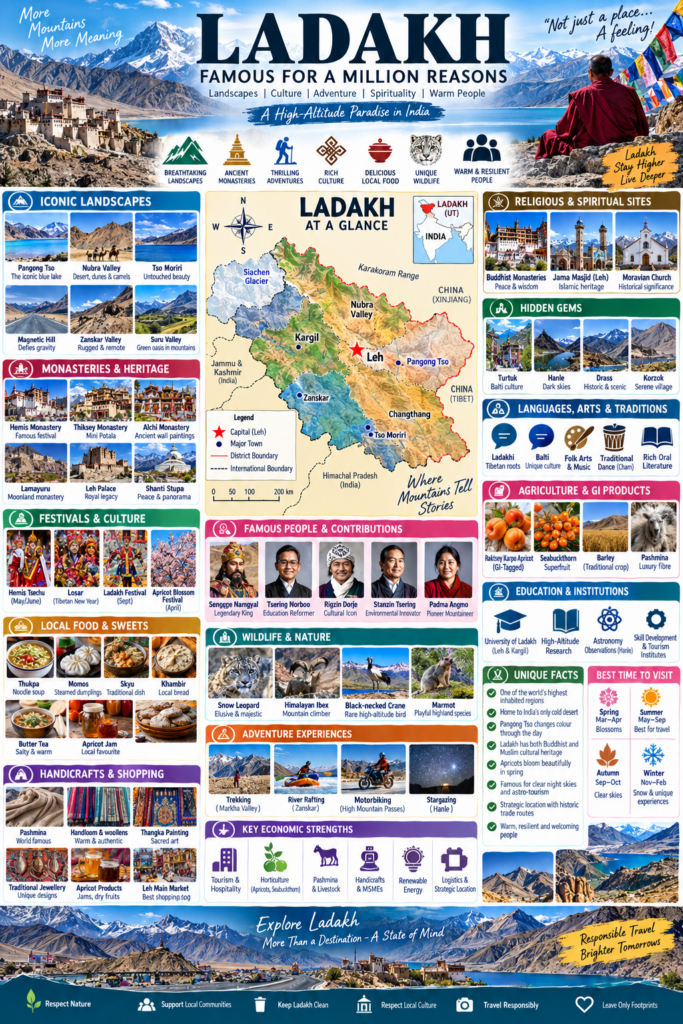
Ladakh is famous worldwide for its dramatic high-altitude landscapes, Buddhist monasteries, Pangong Tso, Nubra Valley, cold deserts, ancient trade routes, Tibetan-influenced culture, pashmina, apricots, wildlife, trekking, mountain roads and distinctive Buddhist-Muslim cultural heritage.
Its identity is much broader than the familiar Leh–Pangong–Nubra tourist circuit: western Ladakh adds Kargil, Drass and Suru landscapes; Zanskar brings remote monasteries and mountain culture; Changthang contributes wetlands, pastoral traditions, wildlife and pashmina.
🏔️ What Ladakh Is Famous For – Comprehensive Chart
| Category | 🌟 Famous Attraction / Thing | Why It Is Famous | Historical / Cultural Significance | Best Time to Experience | Interesting Facts | 🧭 Travel Tip |
|---|---|---|---|---|---|---|
| 🏔️ Geography | High-altitude cold desert | Extraordinary treeless mountain landscapes | Geography shaped settlement, agriculture and trade | May–Sep broadly | Ladakh is very different from a conventional green hill station | Acclimatize before strenuous travel |
| 💙 Lake | Pangong Tso | Brilliant blue high-altitude scenery | Important trans-Himalayan landscape | May–Sep broadly | The lake extends across the India-China boundary region | Protect shoreline; don’t enter restricted zones |
| 🩵 Wetland/Lake | Tso Moriri | Remote lake, wildlife and scenery | Important Changthang wetland landscape | May–Sep broadly | A Ramsar-designated wetland | Low-impact travel is essential |
| 🐦 Lake/Eco-tourism | Tso Kar | Birdlife and stark landscapes | Important high-altitude wetland ecosystem | Summer | Known for saline/wetland environment | Carry binoculars; don’t disturb birds |
| 🏜️ Cold Desert | Hunder Sand Dunes | Sand dunes surrounded by mountains | Part of Nubra’s distinctive landscape | May–Sep | Associated with double-humped Bactrian camels | Avoid damaging dune vegetation |
| 🐫 Heritage | Bactrian Camels | Iconic Nubra experience | Echo Ladakh’s historical connections with caravan trade | Warmer months | Double-humped rather than single-humped | Choose responsible animal-tourism operators |
| 🌳 Village | Turtuk | Balti culture, orchards and mountain scenery | Distinctive cultural landscape of northern Ladakh | May–Sep | One of India’s northern inhabited tourism areas | Respect homes and private orchards |
| 🏔️ Valley | Nubra Valley | Desert, villages, monasteries and mountains | Historically connected with trans-Karakoram trade | May–Sep | Shyok and Nubra shape the valley | Spend at least 1–2 nights |
| 🌿 Valley | Suru Valley | Greener landscapes and Nun-Kun views | Important Kargil-region agricultural/cultural valley | May–Sep | Visually contrasts with eastern Ladakh | Base around Sankoo/Panikhar as appropriate |
| 🏔️ Remote Region | Zanskar | Monasteries, trekking and remoteness | Strong Buddhist cultural heritage | Summer–early autumn | Historically isolated by severe geography | Allow buffer days |
| 🌕 Landscape | Lamayuru “Moonland” | Eroded terrain and monastery | One of Ladakh’s historic Buddhist centres | May–Oct | Landscape resembles an otherworldly moonscape | Consider overnighting rather than rushing through |
| 🪷 Monastery | Hemis Monastery | Hemis Tsechu and Buddhist heritage | Major Drukpa Buddhist institution | Festival period / summer | Famous for elaborate religious festival | Treat Cham as religious ritual |
| 🏯 Monastery | Thiksey Monastery | Dramatic architecture and views | Important Buddhist religious centre | Most accessible seasons | Multi-level monastery complex | Visit respectfully in quieter morning hours |
| 🎨 Heritage | Alchi Monastery Complex | Ancient Buddhist art | Exceptional early Buddhist artistic heritage | Apr–Oct broadly | Particularly important for old wall paintings | Follow photography restrictions |
| 🏯 Monastery | Lamayuru Monastery | Heritage + spectacular setting | One of the region’s renowned monasteries | May–Oct | Creates one of Ladakh’s signature road-trip scenes | Combine with western Ladakh |
| 👑 Palace | Leh Palace | Royal history and architecture | Associated with the Namgyal dynasty | Apr–Oct | Nine-storey historic palace dominates Old Leh | Combine with Old Town |
| 🏘️ Heritage | Leh Old Town | Historic urban fabric | Reflects Leh’s royal and trading past | Apr–Oct | Once linked to caravan commerce | Explore on foot |
| ☮️ Landmark | Shanti Stupa | Panorama and Buddhist symbolism | Modern Buddhist peace monument | Apr–Oct | Excellent Leh viewpoint | Sunrise/evening light is attractive |
| 🌊 River | Indus | Geographic lifeline | Central to settlements and historic movement | Year-round where accessible | One of Asia’s great river systems | Explore established viewpoints |
| 🌊 River Landscape | Indus–Zanskar Sangam | Dramatic confluence | Illustrates Ladakh’s river geography | Warmer months | Contrasting river colours may vary by season | Don’t judge it by edited social-media images |
| 🧊 Glacier | Siachen region | Extreme glacier geography and strategic significance | Closely associated with India’s military history | Access highly restricted | Not an ordinary sightseeing destination | Never imply unrestricted tourist access |
| 🏔️ Mountains | Karakoram & Ladakh ranges | Huge peaks and passes | Shaped trade, defence and settlement | Depends on route | Central to Ladakh’s identity | Mountain conditions override itineraries |
| 🏔️ Peaks | Nun–Kun Massif | Mountaineering and dramatic scenery | Landmark of Suru landscape | Climbing season varies | Among western Ladakh’s defining mountain sights | Climbing requires specialist planning |
| 🛣️ Road Travel | High mountain passes | Iconic road journeys | Historic barriers and connectors | Road-open season | Pass status changes with weather | Check official road conditions |
| 🇮🇳 History | Kargil–Drass region | 1999 conflict history | Important part of modern Indian military history | Summer–autumn broadly | Drass became globally recognized through the conflict | Visit memorials respectfully |
| 🪖 Museum/Memorial | Kargil War Memorial | Remembrance and military history | Commemorates Indian soldiers of the 1999 conflict | Accessible road season | Located in Drass sector | Avoid entertainment-style photography |
| 🪨 Archaeology | Petroglyphs / rock art | Evidence of ancient human presence | Helps trace early movement and settlement | Depends on site | Rock art occurs at multiple Ladakh locations | Never touch or mark rock surfaces |
| 🐫 Ancient Trade | Caravan routes | Linked regional trading worlds | Connected Kashmir, Tibet and Central Asia | Historical experience | Leh was an important caravan centre | Explore through Old Leh and museums |
| 👑 History | Namgyal Dynasty | Shaped Ladakhi kingdom | Sengge Namgyal is especially prominent | Year-round via heritage sites | Associated with Leh Palace and major building activity | Pair palace with historical interpretation |
| 🎭 Festival | Hemis Tsechu | Masked Cham dances | Living Buddhist religious tradition | Lunar-calendar date | One of Ladakh’s most famous festivals | Verify annual dates |
| 🎆 Festival | Losar | Ladakhi/Tibetan New Year | Important religious and community celebration | Winter | Offers a very different Ladakh experience | Prepare for severe cold |
| 🌸 Festival | Apricot Blossom Festival | Blooming orchards and village culture | Connects agriculture with cultural tourism | Spring | Celebrated across apricot-growing communities | Blossom dates vary with weather |
| 🐐 Culture | Changthang Nomadic traditions | Pastoral high-altitude life | Closely linked with pashmina production | Summer | Changpa livelihoods depend heavily on livestock | Don’t treat communities as photo props |
| 🧣 Textile | Ladakh Pashmina | Fine fibre and luxury textiles | Pastoralism and craftsmanship have deep regional roots | Year-round shopping | Raw material originates from high-altitude goats | Ask about fibre origin/authenticity |
| 🍑 Agriculture | Ladakh Apricot | Flavor, fresh/dried fruit and processing | Important horticultural livelihood | Blossom in spring; fruit later | Ladakh has distinctive apricot varieties | Buy from producers/SHGs where possible |
| 🏷️ GI Product | Raktsey Karpo Apricot | Distinctive Ladakhi apricot | Important regional horticultural identity | Fruit season | GI-recognized product | Check genuine origin when purchasing |
| 🌿 Agriculture | Seabuckthorn | Hardy high-altitude berry | Increasing value-added-product potential | Seasonal | Used for juices and processed products | Check ingredients and producer |
| 🌾 Traditional Food | Barley / Ngamphe | Climate-adapted staple | Long associated with high-altitude food culture | Year-round | Roasted barley has deep Himalayan importance | Try traditional preparations |
| 🍜 Food | Thukpa | Warming noodle soup | Himalayan/Tibetan culinary influence | Especially cold weather | Many local variations exist | Try a locally focused kitchen |
| 🥟 Food | Momos | Popular dumplings | Shared Himalayan culinary tradition | Year-round | Not unique only to Ladakh | Explore local fillings |
| 🍲 Food | Skyu | Distinctive Ladakhi comfort food | Reflects local household cuisine | Especially colder weather | Hearty wheat-based dish | Better cultural choice than generic fast food |
| 🫖 Drink | Butter Tea | High-altitude traditional beverage | Part of Himalayan/Tibetan food culture | Cold weather | Salty rather than sweet | Try before judging |
| 🍞 Food | Khambir | Traditional bread | Common Ladakhi food tradition | Year-round | Often paired with tea or local dishes | Good breakfast experience |
| 🍬 Sweets | Local apricot preparations | Natural sweetness from local fruit | Linked to horticulture | Seasonal/year-round processed | Jam, dried fruit and preserves are common | Good edible souvenir |
| 🍢 Street Food | Leh Market snacks & momos | Accessible food scene | Mixes local and wider Himalayan/Indian influences | Main travel season | Leh has the widest food variety | Prioritize busy hygienic outlets |
| 🛍️ Market | Leh Main Market | Shopping, cafés and urban culture | Modern descendant of Leh’s trading identity | Apr–Oct busiest | Pedestrian-friendly central experience | Compare quality before buying |
| 🛍️ Market | Kargil markets | Regional commerce | Important western Ladakh trading centre | Year-round | Less tourism-centric than Leh | Good place to observe everyday commerce |
| 🧶 Handicraft | Woollens & weaving | Traditional craftsmanship | Connected with pastoral and household economy | Year-round | Local production varies by item | Ask where the item was made |
| 💍 Craft | Traditional jewellery | Distinctive designs and cultural identity | Dress and ornament traditions vary by community | Year-round | Turquoise-style ornamentation is visually prominent | Verify materials before premium purchase |
| 🪵 Craft | Wood carving | Traditional artisanal skill | Used in architecture and craft | Year-round | Supported under artisan/MSME initiatives | Prefer genuine local artisan work |
| 🎨 Folk Art | Thangka painting | Buddhist religious art | Sacred artistic tradition | Year-round | Not merely decorative artwork | Buy ethically from genuine artists |
| 🎶 Music | Ladakhi folk music | Festivals and community life | Preserves oral and cultural traditions | Festivals | Varies between communities | Cultural festivals offer best context |
| 💃 Dance | Folk & Cham dances | Colourful visual identity | Cham is religious; folk dance is social/cultural | Festivals | The two should not be treated as identical | Ask before close-up filming |
| 🗣️ Languages | Ladakhi, Balti, Purig, Shina and others | Linguistic diversity | Reflects centuries of cultural interaction | Year-round | Hindi and English are also widely useful in tourism | Learn simple greetings |
| 🕌 Mosque | Jama Masjid, Leh | Religious and urban landmark | Reflects Leh’s Muslim heritage and historic cultural interaction | Year-round | Located near central Leh | Dress respectfully |
| ✝️ Christianity | Moravian heritage | Missionary-era history | Moravian missions became part of nineteenth-century Ladakh history | Year-round | Churches/congregations exist in Ladakh | Check access/service times |
| 🪷 Devotional Tourism | Monastery circuit | Spiritual travel | Buddhism is central to much of Ladakh’s heritage | Year-round depending access | Hemis, Thiksey, Alchi, Lamayuru and others differ greatly | Avoid turning prayer halls into photo studios |
| 🐆 Wildlife | Snow Leopard | Flagship Himalayan predator | Symbol of high-altitude ecology | Winter often important for specialist tracking | Extremely elusive | Use ethical wildlife guides |
| 🐐 Wildlife | Himalayan Ibex | Dramatic mountain wildlife | Adapted to steep terrain | Varies | Excellent climber | Use binoculars |
| 🐦 Wildlife | Black-necked Crane | Rare high-altitude bird | Closely associated with Changthang wetlands | Breeding/seasonal period | Culturally and ecologically significant | Keep substantial distance |
| 🌿 Eco-tourism | Changthang | Wetlands, wildlife and pastoral landscapes | Sensitive high-altitude ecosystem | Summer | Combines culture and ecology | Low-impact travel essential |
| 🥾 Adventure | Markha Valley Trek | Classic trekking route | Connects settlements and mountain landscapes | Trekking season | One of Ladakh’s best-known treks | Acclimatize properly |
| 🧗 Adventure | Zanskar trekking | Remote expedition feel | Old routes connect isolated settlements | Summer | Landscape and culture are equally important | Use experienced operators |
| 🚴 Adventure | High-altitude cycling | Challenging terrain | Modern adventure-tourism identity | Warmer months | Altitude makes distances harder | Train beforehand |
| 🌌 Experience | Hanle Stargazing | Dark skies | Supports Ladakh’s emerging astro-tourism identity | Clear nights | High altitude and low light pollution aid observation | Consider moon phase |
| 📸 Photography | Ladakh landscapes | Exceptional scale, colour and light | Modern tourism imagery helped global recognition | All seasons | Each season creates different imagery | Don’t photograph people without permission |
| 🏡 Experience | Village Homestays | Community-based tourism | Keeps tourism income closer to residents | Seasonal | Offers insight beyond hotels | Respect household customs |
| ☀️ Industry | Renewable Energy | Strong solar potential | Important to future sustainable development | Year-round sector | High solar radiation creates opportunity | Distinguish potential from commissioned capacity |
| 🥫 MSME | Food Processing | Apricot/seabuckthorn value addition | Can increase farmer income | Year-round business | Local processing reduces raw-product dependence | Look for registered producers |
| 🧶 MSME | Handloom & Handicrafts | Local employment | Preserves skills while creating income | Year-round | Strong fit for e-commerce | Authenticity adds value |
| 📲 Startup | Tourism & Digital Commerce | Helps remote businesses reach customers | Part of evolving post-isolation economy | Year-round | ONDC/e-commerce capacity building has been promoted | Connectivity can still vary |
| 🚚 Logistics | Mountain Freight | Essential supply-chain function | Remoteness makes transport strategically important | Year-round with route constraints | Tourism itself depends heavily on freight | Build weather buffers |
| ❄️ Logistics | Cold Chain | Important for horticulture | Can reduce losses and improve market access | Business activity | Apricot and perishables create demand | Power reliability matters |
| 📦 Export Potential | Apricot products | Premium regional identity | Emerging value-added/export opportunity | Seasonal + processed year-round | Ladakh has pursued overseas apricot markets | Quality, packaging and cold chain matter |
| 🏨 Industry | Tourism & Hospitality | Major livelihood generator | Tourism expanded strongly after Ladakh opened to visitors | Peak warmer season | Benefits taxis, hotels, guides, cafés and artisans | Spend locally |
| 🎓 Education | University of Ladakh | Higher education | Important institution for the UT | Academic calendar | Has campuses in Leh and Kargil | Check campus visitor policies |
| 🏥 Education/Research | High-altitude research | Unique environment | Ladakh supports research in ecology, astronomy and mountain systems | Varies | Geography itself creates research opportunities | Institutional access may require permission |
| 🏭 Industrial Reality | Small-scale/value-added economy | Geography limits mass industry | MSMEs suit Ladakh better than pollution-intensive mega industry | Year-round | GIDC/MIDC are not Ladakh systems | Use SIDCO/DIC terminology |
| 🏝️ Beaches | None | Ladakh is landlocked | Not part of its geography | — | Lake shores are not sea beaches | |
| 🌊 Waterfalls | Minor/seasonal natural flows | Not a defining tourism category | Mountain hydrology varies | Seasonal | Ladakh is not famous for large waterfall tourism | Don’t invent named waterfalls |
| 🌲 Hill Stations | Not conventional | Ladakh itself is a high-altitude region | Different geography from Shimla/Mussoorie | — | Leh should not be falsely called a typical hill station | Describe it as a high-altitude mountain destination |
| 🎢 Theme/Water Parks | Not defining | Climate and geography differ | Not part of authentic tourism identity | — | Nature is Ladakh’s primary attraction | Don’t manufacture attractions for keyword coverage |
🌟 Why Is Ladakh So Famous Among Travelers?
- 🏔️ Landscape unlike most of India: Ladakh combines enormous mountains, cold deserts, river valleys, glaciers, wetlands and high-altitude lakes in one region.
- 💙 Pangong Tso: The lake became one of India’s most recognizable travel images, but its appeal goes beyond cinema and social media—it is part of a fragile high-altitude landscape.
- 🏜️ Nubra Valley: Travelers can experience monasteries, villages, orchards, cold-desert dunes and Bactrian camels within the same wider valley.
- 🪷 Ancient Buddhist heritage: Hemis, Thiksey, Alchi, Lamayuru, Spituk and many other monasteries make Ladakh one of India’s most significant Buddhist tourism regions.
- 🕌 Cultural diversity: Ladakh is not culturally uniform. Buddhist, Muslim, Balti, Purig, Shina and other communities contribute to its languages, cuisine, architecture, music and traditions.
- 👑 Royal and caravan history: Leh Palace and Old Leh recall the Namgyal kingdom, while old bazaars preserve memories of the trade routes that once linked the Indian subcontinent with Tibet and Central Asia.
- 🍑 Apricots: Apricot cultivation is particularly important to Ladakh’s horticultural economy. Fresh fruit, dried apricots, jams, juices, kernel products and gift packs also create opportunities for local processing businesses.
- 🧣 Pashmina: Ladakh’s Changthang landscape is closely connected with the high-altitude pastoral system behind fine pashmina fibre. Buying genuine products supports a much longer economic chain than the final shawl suggests.
- 🐆 Rare wildlife: Snow leopard, Himalayan ibex, blue sheep and high-altitude birdlife make Ladakh important for wildlife enthusiasts and conservation-oriented travelers.
- 🌌 Dark skies: Hanle and the wider high-altitude landscape have helped make astronomy and astrophotography an emerging reason to visit.
- 🥾 Adventure: Trekking, mountaineering, cycling, road trips and carefully managed rafting give Ladakh a powerful adventure-tourism identity.
- 🎭 Festivals: Hemis Tsechu, Losar, monastery festivals, the Apricot Blossom Festival, Changthang cultural celebrations and Zanskar events give travelers reasons to understand Ladakh beyond landscapes.
- 🍲 Food: Thukpa, skyu, momos, khambir, butter tea, barley foods and apricot products tell the story of adaptation to climate, altitude and cultural exchange.
- 🛍️ Shopping: Pashmina, handloom, handicrafts, jewellery, apricot products and other locally made goods make Leh and Kargil interesting shopping destinations—but buyers should distinguish genuine local production from generic souvenirs.
- 🚚 Strategic logistics: Ladakh’s remoteness means roads, freight transport, warehousing, cold chain, aviation and project logistics are disproportionately important to daily life and economic development.
👤 Famous People, Personalities & Historical Figures Connected With Ladakh
The region’s best-known historical personalities include King Sengge Namgyal, the major seventeenth-century Ladakhi ruler associated with Leh Palace and the Namgyal period. Buddhist scholars, monks and religious figures have also played major roles in Ladakh’s cultural history.
Modern Ladakh has produced or been associated with notable figures in education, environmental innovation, mountaineering, public service, literature, sport, Buddhist scholarship and social development. For an evergreen SEO page, individual contemporary biographies should be separately fact-checked rather than inserting loosely connected celebrity names simply to cover the keyword.
The same applies to “freedom fighters of Ladakh.” The region’s political and military history does not fit neatly into a generic state-blog template, so verified biographies and documented contributions should be used instead of inventing a list.
🏷️ What GI-Tagged Product Is Ladakh Famous For?
One especially important regional product is Ladakh Raktsey Karpo Apricot, which has received Geographical Indication recognition. Ladakh’s administration has also been actively promoting the region’s horticultural and value-added products.
For travelers, GI recognition matters because it turns shopping into more than souvenir buying: the geographical origin, traditional production and regional identity of a product become part of its value.
For producers and entrepreneurs, it creates opportunities in:
🍑 premium fresh fruit → ☀️ dried apricot → 🥫 preserves → 🧴 kernel-based products → 🎁 gift packaging → 📦 e-commerce → ✈️ export markets.
🏭 What Is Ladakh Famous For Economically?
Ladakh is not famous for giant factories or metropolitan industrial corridors, and that is an important factual distinction.
Its stronger economic opportunities lie in:
🏨 tourism and hospitality
🍑 horticulture and food processing
🐐 pashmina and livestock-linked value chains
🧶 handloom and handicrafts
🚚 transport and logistics
☀️ renewable energy
❄️ cold-chain infrastructure
🏡 homestays and community tourism
📲 e-commerce and digital businesses
♻️ environmentally appropriate services
Ladakh’s industrial-development ecosystem instead involves its own Industries & Commerce institutions, District Industries Centres and SIDCO-related initiatives.
🛍️ What Should You Buy in Ladakh?
The most meaningful Ladakh shopping is not necessarily the souvenir with the biggest “LADAKH” printed across it.
Look instead for genuine pashmina and wool products, local handloom, handicrafts, traditional jewellery, dried apricots, apricot preserves, seabuckthorn products and locally produced gift items.
Before paying a premium price, ask a simple question:
“Where was this actually made?”
A product sold in Ladakh is not automatically a Ladakhi product.
❤️ What Makes Ladakh Truly Unique?
Ladakh is famous because seemingly contradictory worlds exist beside one another.
A cold desert contains intensely green villages.
Sand dunes appear below snow-covered mountains.
Ancient monasteries overlook modern highways.
Pashmina from remote pastoral landscapes reaches luxury markets.
Apricot orchards bloom against bare mountains.
A town once shaped by caravans now receives travelers by aircraft.
Buddhist monastery bells and Muslim calls to prayer belong to the same wider cultural landscape.
And beyond Leh’s famous tourist circuit lie Kargil, Drass, Suru, Sham, Nubra, Changthang and Zanskar, each telling a different part of the Ladakh story.
That is the strongest answer to “What is Ladakh famous for?”
It is famous for Pangong Tso and Nubra Valley, monasteries and mountain passes, pashmina and apricots, snow leopards and dark skies, trekking and road journeys, royal history and caravan trade—but above all, for a high-altitude culture that learned to create communities, agriculture, commerce, faith and art in one of India’s most demanding landscapes.
🛡️ Common Travel Myths, Tourist Scams, Safety Issues & Practical Solutions in Ladakh
Ladakh is generally approached by visitors as a mountain destination rather than a place where scams should dominate trip planning. A useful safety guide should therefore not imply that every listed scam is common in Ladakh. Several items below—UPI fraud, fake booking links, counterfeit listings and phishing—are general travel risks that can affect visitors anywhere in India. Ladakh-specific risks are often more practical: high altitude, rapidly changing mountain weather, road disruption, remote connectivity, limited services and unverified tourism operators.
Official Ladakh Tourism currently identifies Acute Mountain Sickness (AMS) as a major visitor-safety issue and provides acclimatization and emergency guidance. Ladakh Police lists 112 for emergencies and 1930 for cyber-fraud reporting.
🚨 Ladakh Tourist Safety, Scams, Problems & Solutions Chart
| ⚠️ Myth / Scam / Problem | ✅ Reality | 🎯 Common Target | 🚩 Warning Signs | 🛡️ Prevention Tips | 🔧 Recommended Solution | ☎️ Emergency Helpline / Authority |
|---|---|---|---|---|---|---|
| 🚕 “Every taxi overcharges tourists” | Do not assume this. Fare disputes can occur, but that does not make overcharging universal | First-time tourists | Driver avoids stating total fare; unclear inclusions | Confirm route, vehicle, waiting and total price before departure | Ask for written/WhatsApp quotation and receipt where available | Police: 112 |
| 🚕 Taxi fare misunderstanding | Long Ladakh circuits can involve route, vehicle and waiting differences | Families, couples, groups | Quote does not specify destinations/nights | Compare quotations; confirm current applicable tariff locally | Resolve price before starting trip | 112 if dispute becomes threatening |
| 🛺 Auto-rickshaw scam | Autos are not a defining Ladakh transport mode like many Indian cities | Travelers expecting metro-city transport | Someone aggressively claiming to be the “only” available option | Plan around registered/local taxis and buses | Ask hotel/tourist office for legitimate transport | 112 |
| 📱 Fake taxi booking | A general online-travel fraud risk rather than a uniquely Ladakhi scam | Online planners | Personal payment account, urgency, no business identity | Verify operator independently before paying | Contact hotel/operator through independently sourced details | 1930 for cyber fraud |
| 🧑🏫 Fake/unverified guide | Independent individuals may claim expertise without recognized credentials | Foreign tourists, trekkers | No ID, vague company details, unusually cheap expedition | Use established/registered operators where appropriate | Verify identity/operator before remote travel | Tourism authority / 112 |
| 🏔️ Unqualified trekking operator | Remote mountain trips need substantially more competence than ordinary sightseeing | Trekkers | No emergency plan, equipment list or itinerary | Ask about guide experience, rescue procedure and insurance | Change operator if safety answers are inadequate | 112 / nearest police post |
| 🎟️ Fake permit/ticket | Some restricted-area requirements vary by nationality/location | First-time/foreign visitors | “Special permit” sold without official process or documentation | Check current requirements through official tourism/administration sources | Never pay solely because someone says a permit is compulsory | Tourism authority / Police |
| 🏨 Fake hotel listing | Possible through fraudulent websites/social accounts anywhere | Peak-season visitors | Huge discount, copied photos, payment to unrelated person | Verify property through official website/known platform/direct call | Save confirmation, invoice and correspondence | 1930 if online fraud |
| 🏡 Fake homestay booking | Registration/identity matters increasingly under Ladakh’s tourism framework | Budget travelers | No verifiable address/registration/business identity | Prefer verifiable registered properties | Confirm directly before advance payment | Tourism Department |
| 💳 Full advance-payment pressure | Some genuine properties request deposits, but unusual payment pressure warrants checking | Everyone | “Pay in 10 minutes or booking cancelled” | Independently verify recipient | Use traceable payment method | 1930 |
| 🔗 Fake booking website | Phishing sites can imitate travel brands | Online travelers | Misspelled URL, unusual domain, unrealistic discount | Type official site manually/book through known platforms | Stop payment and report quickly | 1930 |
| 📲 UPI QR-code fraud | You do not need to enter a UPI PIN to receive money | Shoppers/tourists | Person says scan QR/enter PIN to receive refund | Never authorize an unknown collect request | Contact bank/payment provider immediately | 1930 |
| 💸 “Refund” scam | Fraudster may impersonate hotel/airline/tour operator | Cancelled-booking travelers | Requests OTP, PIN or screen sharing | Never share OTP/UPI PIN/card credentials | Contact business via independently verified channel | 1930 |
| 📱 Screen-sharing scam | Remote-access apps can expose banking information | Smartphone users | Caller asks to install remote-control app | Never give unknown callers device access | Disconnect internet/contact bank if compromised | 1930 |
| 🏧 ATM card fraud | General banking risk, especially relevant when carrying limited cash | Travelers | Loose keypad/card slot, strangers offering help | Prefer established bank ATMs; shield PIN | Block card immediately if suspicious | Bank + 1930 |
| 💵 Cash shortage | Remote areas may have limited ATM/payment reliability | Nubra/Changthang/Zanskar travelers | Depending entirely on one card/UPI | Carry reasonable backup cash | Withdraw before remote circuits | Bank if card issue |
| 📶 “UPI works everywhere” | Connectivity can be inconsistent in remote mountains | Cashless travelers | No network/data | Carry cash + more than one payment option | Settle major payments before remote stretches | — |
| 🛍️ “Everything sold in Leh is locally made” | A souvenir sold in Ladakh is not automatically produced there | Shoppers | Seller makes vague origin claims | Ask where/who made the item | Prefer identifiable artisans/cooperatives/producers | Consumer authority where applicable |
| 🧣 Fake pashmina claim | Fibre quality and origin can be difficult for tourists to judge | Premium shoppers | Extraordinary luxury claims at implausibly low price | Ask for bill, fibre composition and provenance | Buy from credible sellers | Consumer grievance route |
| 🍑 “Every apricot product is Ladakhi” | Packaging should be checked for origin/manufacturer | Food shoppers | No producer/address/label | Read packaging carefully | Prefer traceable local producer | Food/consumer authority if needed |
| 🍽️ Food overcharging | Prices can legitimately be higher because of transport costs | Budget travelers | No visible menu/price | Ask price before ordering where unclear | Request itemized bill | Consumer grievance/police only if appropriate |
| 🥤 Unsafe food/water assumption | Mountain location does not automatically make all water safe to drink | Everyone | Questionable source/storage/hygiene | Use safe drinking water and hygienic food outlets | Rehydrate and seek care for significant illness | Medical: 102 / 112 |
| 🅿️ Unofficial parking charge | Parking arrangements differ by location | Self-drive tourists | No signage/receipt/authority | Use designated parking and check displayed fee | Ask who manages parking | Police 112 if coercive |
| 🚫 Illegal parking | Leh Police has been enforcing against illegal parking amid tourist traffic | Drivers | Parking outside designated area | Follow local signs and traffic directions | Move vehicle when instructed | Ladakh Traffic Police / 112 |
| 🌨️ “Road open today means it will remain open” | Mountain weather and road conditions can change rapidly | Road trippers | Snowfall, rain, landslide warnings, traffic hold | Check official road/traffic information close to departure | Keep buffer day, food, water and fuel | Police/road authorities |
| 🚌 Fixed bus timetable assumption | Remote/seasonal services can change | Backpackers | Old blog timetable | Reconfirm locally/currently | Have alternate transport plan | Bus operator/tourism office |
| ✈️ Tight same-day connection | Weather/operational disruption can affect mountain travel | Air travelers | No buffer between flight and onward booking | Avoid fragile connections | Keep flexible/cancellable bookings | Airline |
| ⛽ “Fuel is available everywhere” | Remote routes can have long service gaps | Drivers/riders | Long route between settlements | Plan range before departure | Refuel whenever sensible | Roadside assistance/operator |
| 📱 “Mobile network works everywhere” | Coverage can weaken or disappear on remote circuits | Solo travelers | Moving beyond settlements | Download offline maps and share itinerary | Establish check-in plan | 112 when reachable |
| 🗺️ Blind dependence on Google Maps | A mapped road is not proof of current access or suitability | Self-drivers | App suggests remote shortcut | Verify route locally/currently | Stay on recognized routes | Police/road authority |
| 🚧 Entering restricted/border areas | Some zones have security/access restrictions | Photographers/adventure travelers | Signs, barriers, military instructions | Follow current access rules | Turn back when directed | Police/security authority |
| 📸 Photographing sensitive installations | Ladakh has strategically sensitive areas | Photographers | “No Photography” signs/security presence | Never photograph where prohibited | Delete/stop if lawfully instructed | Police/security authorities |
| 🏯 “Monastery = tourist photo studio” | Monasteries are living religious institutions | Content creators | Photography prohibition inside halls | Ask permission and obey signage | Put camera away during restricted rituals | Monastery management |
| 👥 Photographing residents without consent | Cultural respect matters | Photographers | Subject appears uncomfortable/refuses | Ask before portraits | Accept “no” immediately | — |
| 🐫 Animal-photo pressure | Animal tourism should be approached responsibly | Families/social-media travelers | Rough handling/pressure to ride | Choose responsible operators | Walk away from poor welfare practices | Local authority/operator |
| 💙 Swimming in high-altitude lakes | Pangong/Tso Moriri should not be treated like recreational beach resorts | Social-media travelers | Visitors entering sensitive lake areas | Stay within permitted visitor zones | Observe from shore/designated areas | Local authority |
| 🗑️ Leaving litter | Fragile high-altitude environments have limited waste capacity | Everyone | Remote campsite without disposal | Carry reusable items/waste bag | Bring waste back to proper disposal point | Local civic/tourism authority |
| 🔥 Unsafe campfire | Dry/high-altitude environments require care | Campers | Fire outside approved setup | Follow operator/local rules | Extinguish completely; avoid unauthorized fires | 101 / 112 |
| 🏔️ “I am fit, so altitude won’t affect me” | Physical fitness does not guarantee protection from AMS | Young/athletic travelers | Headache, nausea, dizziness, breathlessness | Acclimatize and ascend gradually | Stop ascending; seek help if symptoms worsen | 102 / 112 |
| ✈️ Pangong immediately after landing | Rapid ascent after flying to Leh increases altitude concerns | Short-trip tourists | “Airport → lake same day” itinerary | Build acclimatization time into itinerary | Stay lower/rest first | Medical 102/112 |
| 💊 Self-medicating AMS | Medication decisions should not substitute for acclimatization or medical care | Travelers | Ignoring worsening symptoms because medicine was taken | Discuss preventive medicine with clinician beforehand | Descend/seek medical attention if worsening | SNM Hospital / 112 |
| 🫁 Severe altitude illness | HAPE/HACE can be life-threatening | Any high-altitude visitor | Worsening breathlessness, confusion, severe symptoms | Never continue ascending with worsening illness | Descend urgently and seek emergency medical help | 112 / 102 |
| 🍺 Alcohol during acclimatization | Can complicate hydration/rest at altitude | Party travelers | Drinking heavily immediately after arrival | Avoid alcohol during initial adjustment | Rest, hydrate appropriately | Medical help if unwell |
| ☀️ Sun/UV exposure | High altitude can mean strong UV exposure even in cool weather | Everyone | Sunburn, eye discomfort | Sunscreen, sunglasses, hat | Seek medical care for serious symptoms | 102 if needed |
| ❄️ Hypothermia/cold exposure | Temperatures can fall sharply, especially at night/high passes | Riders/campers | Shivering, confusion, numbness | Layered clothing and weatherproof gear | Get warm/dry; seek care if severe | 112 |
| 💧 Dehydration | Dry climate and altitude increase hydration needs | Everyone | Dark urine, headache, fatigue | Drink regularly; don’t rely on thirst alone | Rest/rehydrate appropriately | Medical help if serious |
| 🐕 Feral/free-ranging dogs | Local tourism stakeholders have raised concerns about increasing feral-dog populations | Walkers, cyclists | Packs of dogs, especially isolated/night areas | Avoid provoking/feeding unknown packs; use caution after dark | Move calmly to safe populated area | 112 for immediate danger |
| 👩 “Women cannot travel Ladakh safely” | Such a blanket claim is unsupported; normal solo-travel precautions still apply | Women travelers | Isolated late-night situations/unverified transport | Share itinerary, use verifiable stays/transport | Use 112 if threatened | 112 / Women Helpline 1091 |
| 👩 Unverified driver late at night | Risk-management issue anywhere | Solo travelers | Vehicle/driver differs from booking | Record/share vehicle details | Contact accommodation/registered operator | 112 / 1091 |
| 👴 “All seniors should avoid Ladakh” | Age alone is not a blanket prohibition, but altitude can be demanding | Senior travelers | Rushed itinerary, significant symptoms | Discuss relevant medical conditions with clinician; travel slowly | Seek care promptly if symptoms appear | 102 / 112 |
| ♿ Assuming every hotel is accessible | Older mountain properties may have stairs/uneven access | Mobility-impaired travelers | “Accessible” without details | Confirm ramp, lift, bathroom and vehicle access | Get requirements confirmed in writing | Property/tourism authority |
| 🏍️ Inexperienced high-pass riding | Ladakh roads can involve altitude, weather and remote stretches | New riders | Long ambitious itinerary/no gear | Ride conservatively with proper equipment | Stop if weather/fatigue deteriorates | 112 |
| 🚗 Driving at night unnecessarily | Mountain roads are less forgiving than urban roads | Self-drivers | Fatigue, poor visibility | Prefer daylight journeys | Stop safely rather than pushing schedule | 112 |
| 🏨 “Cheapest room online must be best deal” | Extremely low prices may omit facilities or occasionally indicate suspicious listings | Budget travelers | No reviews/address/phone verification | Cross-check property | Pay only after verification | 1930 for cyber fraud |
| 🧾 No receipt for major purchase | Makes later dispute harder | Shoppers | Seller refuses documentation | Request bill for expensive items | Preserve payment record | Consumer authority |
| 🎫 Social-media “VIP access” | Special access claims around restricted/sensitive sites require skepticism | Influencers/photographers | Cash-only secret access | Verify through official authority | Refuse unauthorized entry | Police 112 |
| 🚁 “Emergency evacuation is always immediate” | Weather, terrain and remoteness can complicate rescue | Trekkers/remote travelers | No evacuation/insurance plan | Carry suitable insurance and itinerary | Follow rescue authority instructions | 112 |
| 🗓️ Old travel blog information | Ladakh access, permits, roads, prices and services change | Everyone | Article several years old with fixed fees/timings | Cross-check dynamic information | Prefer official current source | Ladakh Tourism |
Official Ladakh Tourism’s current medical guidance says that if altitude symptoms worsen, a traveler should stop ascending, descend when necessary and seek medical help; it lists SNM Hospital Leh among emergency medical resources.
🏔️ The Biggest Ladakh Safety Myth: “Fitness Prevents Altitude Sickness”
This deserves more attention than many supposed tourist scams. Ladakh Police’s tourist-safety guidance identifies high-altitude sickness as a major challenge for visitors and advises an acclimatization period before proceeding higher.
A traveler can be young, athletic and experienced and still develop altitude illness. If symptoms worsen, the correct response is not to continue toward Pangong, Nubra, Tso Moriri or a high pass simply because accommodation has already been booked. Official tourism guidance advises stopping further ascent and seeking medical assistance when necessary.
💳 ATM, UPI & Online Booking Fraud in Ladakh
Digital fraud should be described as an India-wide traveler risk, not falsely branded as a “Ladakh scam.” The safest approach is to independently verify a hotel, travel agency or taxi operator before transferring a large advance.
A genuine-looking WhatsApp profile, Instagram page, Google result or QR code by itself does not prove that the recipient controls the business being represented.
If money has been lost through online financial fraud, Ladakh Police currently lists 1930 as the Cyber Crime Helpline.
Report quickly rather than spending hours arguing with the suspected fraudster.
🏨 How to Avoid Fake Hotels, Homestays & Travel Agencies
Ladakh strengthened tourism-unit regulation in 2026 through the Ladakh Tourist Unit Unified Registration Order. The Tourism Department says hotels, guest houses, homestays and travel agencies are among the tourism establishments covered by registration requirements, with registration handled through the official Ladakh Tourism system.
For an unfamiliar property or operator, verify the business through more than one independent channel before sending substantial advance payment. Matching property name, location, telephone number, recent reviews, payment beneficiary and registration/business information greatly reduces risk.
👩 Women, Solo Travelers & Senior Citizens
Women traveling alone can reduce ordinary travel risks by using verifiable accommodation and transport, sharing vehicle and itinerary information with someone trusted, avoiding unnecessarily isolated situations late at night, and keeping emergency contacts available offline. India’s integrated emergency response number 112 operates in Ladakh; the UT administration also publishes 1091 as the Women Helpline.
For older visitors, the distinctive issue is usually not crime but altitude, mobility and long road journeys. A slower itinerary and suitable medical advice for relevant pre-existing conditions are more useful than arbitrary age cutoffs.
🌨️ Weather, Road Closures & Transport Problems
One of the easiest Ladakh travel mistakes is treating a mountain itinerary like a fixed urban timetable.
Snow, rainfall, landslides, road work, traffic controls, flight disruption and changing mountain conditions can alter journeys. A hotel reservation at the next destination does not guarantee that the road will remain usable.
Keep at least one buffer day in itineraries involving remote areas or an important onward flight. Download maps before leaving reliable connectivity, carry basic food and water during long road sectors, and obtain current road information rather than depending on a months-old YouTube video or blog.
🚨 Verified Ladakh Emergency Numbers
| 🚨 Situation | ☎️ Official Contact | When to Use |
|---|---|---|
| 🆘 Integrated emergency | 112 | Police/emergency/distress |
| 👮 Police Control Room | 100 | Police assistance |
| 🚑 Medical | 102 | Medical emergency |
| 🔥 Fire | 101 | Fire emergency |
| 👩 Women Helpline | 1091 | Women requiring assistance |
| 💳 Cyber/financial fraud | 1930 | UPI, banking and online fraud |
| 👮 Leh Police Control Room | 01982-258880 | District Leh police assistance |
| 👮 Kargil Police Control Room | 01985-232275 | District Kargil police assistance |
| 🏥 SNM Hospital Leh | 01982-252014 | Medical assistance |
| 🧳 Tourism assistance | ladakhtouristhelpline@gmail.com | Tourism-related assistance |
These numbers are published by Ladakh Police, the UT Administration and Ladakh Tourism; travelers should still re-check emergency details immediately before publication or travel because departmental contacts can change.
✅ Ladakh Safe-Travel Checklist
Before leaving for Ladakh, verify your accommodation and transport independently; save 112, 102 and 1930 offline; keep some backup cash; download offline maps; share remote-route plans with a trusted person; check current weather, road and access conditions; allow proper acclimatization; avoid unauthorized shortcuts and restricted areas; obtain bills for expensive shopping; never share an OTP or UPI PIN; respect photography restrictions; carry waste back from remote landscapes; and keep at least one contingency day where the itinerary depends on mountain roads or flights.
The most useful Ladakh safety principle is simple: prepare for the mountains rather than fear the destination. High altitude, distance, weather and limited remote infrastructure are often more relevant to a visitor’s safety than sensational “tourist scam” stories. Use registered or independently verifiable tourism services, verify dynamic information shortly before travel, and contact official authorities rather than relying on social-media advice when something genuinely goes wrong.
🛣️ Major National Highways, Important Roads, Traffic Restrictions & Road-Safety Guide for Ladakh
Ladakh’s road network is not comparable with a plains state. Ladakh is a Union Territory, and its roads cross high-altitude deserts, narrow river valleys, exposed mountain slopes, strategic border regions and passes where snow, flash floods, landslides, rockfall and construction can change conditions quickly.
For travelers, truck operators and self-drive tourists, the most important rule is simple: do not treat a Ladakh road as “open” merely because an old blog or map shows it. Traffic directions, convoy arrangements, pass conditions and temporary restrictions can change at short notice.
As of June 2026, the UT administration said six accident blackspots had been identified on Ladakh’s National Highways and ordered scientific assessment and mitigation. The official release did not publicly name all six locations, so an EEAT-focused travel page should not invent a “top six black spots” list.
🗺️ Major National Highways & Strategic Road Corridors in Ladakh
| 🛣️ Highway / Road | 📍 Major Corridor | 🚗 Importance | ⚠️ Main Road Challenges | 🚚 Freight Importance | 🧭 Traveler Advice |
|---|---|---|---|---|---|
| NH-1 | Srinagar–Sonamarg–Zoji La–Drass–Kargil–Leh corridor | Principal western gateway to Ladakh | Snow, rockfall, landslide risk, traffic regulation around mountain sections | ⭐⭐⭐⭐⭐ Critical supply corridor | Check same-day traffic status |
| NH-3 / Manali–Leh corridor | Manali side–high Himalayan approach–Leh | Major southern tourism and logistics gateway | Very high altitude, weather, snow, long isolated stretches | ⭐⭐⭐⭐ | Avoid unrealistic single-day plans |
| NH-301 | Kargil–Suru–Zanskar/Padum | Strategic Zanskar connectivity | Construction, narrow sections, seasonal/weather vulnerability | ⭐⭐⭐⭐ Growing importance | Expect changing road conditions |
| Leh–Nubra corridor | Leh–Khardung side–Nubra | Major tourism/strategic road | Altitude, snow/ice, curves, tourist traffic | ⭐⭐⭐⭐ | Start acclimatized and early |
| Leh–Changthang/Pangong corridor | Leh–eastern Ladakh | Tourism and strategic connectivity | Altitude, remote stretches, limited services | ⭐⭐⭐⭐ | Fuel and range planning essential |
| Leh–Tso Moriri/Nyoma corridor | Leh–Upshi side–Changthang | Remote tourism/strategic route | Sparse services, altitude, weather | ⭐⭐⭐⭐ | Carry contingency supplies |
| Nimmu–Padum–Darcha corridor | Leh/Nimmu–Zanskar–Darcha–Manali side | Emerging alternative strategic connection | Remote terrain and ongoing infrastructure development | ⭐⭐⭐⭐⭐ Future significance | Verify entire route before departure |
| Kargil–Suru Valley road | Kargil–Sankoo–Panikhar–Suru | Tourism/agriculture/local access | Landslide/weather-sensitive stretches | ⭐⭐⭐ | Build weather buffer |
| Leh–Sham/Lamayuru corridor | Leh–Nimmu–Khaltsi–Lamayuru | Heritage tourism + NH-1 connectivity | Curves, mixed tourist/commercial traffic | ⭐⭐⭐⭐ | Avoid unsafe overtaking |
| Kargil–Drass corridor | Kargil–Drass–Zoji La side | Western access and strategic highway | Winter weather, mountain traffic | ⭐⭐⭐⭐⭐ | Check Zoji La-side advisory |
MoRTH’s National Highway schedule identifies NH-1 as the Srinagar–Kargil–Leh highway and NH-301 as the Kargil–Zanskar highway. NHIDCL currently lists multiple packages of NH-301 as either completed or under construction, so road quality can vary significantly by section.
🏗️ NH-301 Kargil–Zanskar: A Road Travelers Should Watch Closely
The Kargil–Zanskar highway is one of Ladakh’s most important developing road corridors.
NHIDCL describes the corridor at roughly 230 km and says it is intended to improve local, tourism and strategic connectivity. Multiple highway packages remain under development.
That means a traveler should not translate the words “National Highway” into “uniform four-lane paved road.”
| 🚧 NH-301 Factor | Traveler Meaning |
|---|---|
| Construction packages | Road quality may change from section to section |
| Mountain terrain | Average speed can be low |
| Bridge/road works | Temporary holds or diversions possible |
| Weather | Can rapidly alter conditions |
| Remote settlements | Fuel/repair/medical options may be widely spaced |
| Heavy vehicles | Construction/logistics traffic may share narrow stretches |
| Mobile network | Do not assume continuous coverage |
| Estimated time | Use generous buffer rather than map ETA |
Kargil district’s official travel guidance specifically notes seasonal landslide susceptibility beyond Sangra and historical seasonal closure on the traditional Kargil–Zanskar approach. Conditions are changing as new infrastructure develops, so travelers should verify current status rather than treating those historic closure periods as permanent.
🏎️ Does Ladakh Have Expressways?
Ladakh does not currently have a metropolitan-style access-controlled expressway network comparable with the Delhi–Mumbai Expressway, Yamuna Expressway or Mumbai–Nagpur Samruddhi Mahamarg.
The more relevant infrastructure vocabulary for Ladakh is:
National Highways + strategic roads + border roads + tunnels + mountain passes + district roads + urban arterial roads.
🛣️ State Highways in Ladakh – Important Clarification
Because Ladakh is a Union Territory rather than a state, travelers should not assume it has a state-highway system identical to Maharashtra, Gujarat or Rajasthan.
Roads may instead fall under different authorities or classifications involving:
MoRTH, NHIDCL, BRO, UT Public Works/R&B agencies, local authorities and other strategic-road organizations.
For practical travel planning, knowing which corridor you are using and its current condition is more useful than simply knowing whether a road has an SH label.
🚦 Ladakh Traffic Restrictions, No-Entry Roads & Traveler Awareness Chart
Police can impose temporary diversions, HMV restrictions, one-way movement, parking bans and event-specific traffic arrangements.
For example, an older Leh event advisory temporarily prohibited HMVs from entering parts of Leh Market until 16:00 and imposed special parking/entry arrangements. That demonstrates the type of regulation authorities can introduce, but it should not be republished as today’s permanent Leh rule.
| 🚦 Issue | 📍 Likely Area | ⏰ Timing / Status | 🚛 Vehicle Concern | ⚠️ Traveler Action |
|---|---|---|---|---|
| 🚫 Temporary no-entry | Leh central/market areas | Dynamic | Cars/HMVs | Follow current police signs |
| 🚚 HMV restriction | Congested urban sections | Can be time/event-specific | Trucks/buses | Check Traffic Police before entry |
| ↔️ One-way traffic | Mountain bottlenecks/passes | Dynamic | All vehicles | Never assume yesterday’s arrangement |
| 🚧 Construction hold | NH/strategic roads | Dynamic | All vehicles | Allow waiting time |
| ❄️ Snow closure | High passes | Weather-dependent | All vehicles | Check road status before departure |
| 🪨 Landslide/rockfall closure | Mountain sections | Weather-dependent | All vehicles | Do not bypass barricades |
| 🌊 Flash-flood closure | Nallah/river sections | Rain-dependent | All vehicles | Never cross flowing floodwater |
| 🅿️ No parking | Leh/Kargil congested zones | Signposted/dynamic | All vehicles | Use designated parking |
| 🪖 Restricted security zone | Border/sensitive areas | Permanent/dynamic | Tourist vehicles | Follow police/security instructions |
| 📸 Photography restriction | Sensitive installations | Site-specific | Travelers | Obey “No Photography” signs |
| 🏍️ Vehicle/access rule | Tourist circuits | Can change | Rental/self-drive | Verify before starting |
| 🚛 Commercial vehicle enforcement | National Highways | Ongoing | Trucks/HMVs | Keep permits/fitness/docs valid |
In June 2026, the administration specifically reviewed enforcement concerning heavy commercial vehicles, unauthorized highway parking, challans and traffic discipline.
⚠️ Accident-Prone Roads & Official Blackspots
This is a section where travel websites frequently overstate the evidence.
The current verified fact is that six National Highway blackspots had been identified across Ladakh by June 2026. The administration directed highway agencies to scientifically assess them and introduce engineering, signage, traffic-calming and monitoring measures. The public announcement does not identify all six by name.
Instead, travelers should apply extra caution to road types that inherently demand more attention:
| ⚠️ Road Situation | 🚗 Main Risk | 🛡️ Safer Approach |
|---|---|---|
| Blind mountain bend | Head-on collision | Slow before curve; stay in lane |
| Narrow bridge | Limited passing width | Give priority; don’t overtake |
| Cliff-side road | Small recovery margin | Avoid speed |
| Loose gravel | Loss of traction | Smooth braking/steering |
| Wet road | Skidding | Increase following distance |
| Ice/snow | Very low grip | Avoid abrupt inputs |
| Roadworks | Machinery/loose surface | Follow flagman/signage |
| Rockfall section | Falling debris | Don’t stop unnecessarily |
| Tourist viewpoint | Vehicles/pedestrians entering road | Reduce speed |
| Village | Pedestrians/animals | Slow down |
| Night mountain road | Limited visibility | Prefer daylight travel |
| Long descent | Brake overheating | Use suitable gear/engine braking |
Ladakh Police explicitly advises drivers not to overtake on narrow roads, bridges, hill roads, curves and other locations where visibility is inadequate.
🌊 Flood, Cloudburst, Landslide & Nallah Risk
The image of Ladakh as a cold desert sometimes creates a dangerous myth:
“It hardly rains, so flooding isn’t a serious road issue.”
That is incorrect.
In July 2026, Ladakh’s disaster-management authorities warned that heavy rainfall could cause flash floods, landslides and disruption of essential services. The advisory specifically told people to stay away from nallahs, riverbanks, flood-prone areas and landslide-prone slopes, and not to cross swollen streams, damaged roads or unstable bridges.
🌧️ Rain & Flash-Flood Road Safety Chart
| 🌧️ Situation | 🚨 Risk | ❌ Never Do | ✅ Safer Response |
|---|---|---|---|
| Heavy rain | Rockfall/landslide | Continue merely to meet hotel booking | Wait for official clearance |
| Nallah swelling | Flash flood | Attempt crossing | Turn back/wait |
| Mud across road | Hidden road damage | Accelerate through | Stop and assess safely |
| Damaged bridge | Structural failure | Follow another vehicle blindly | Wait for authority |
| Riverbank road | Erosion | Park beside rising water | Move to safe higher area |
| Rockfall | Vehicle impact | Stop beneath unstable slope | Clear area when safe |
| Landslide | Burial/road collapse | Walk over active slide | Stay away |
| Cloudburst warning | Rapid flooding | Camp in drainage channel | Relocate to safer ground |
🏔️ High Pass & Mountain-Road Risk
Ladakh does have the equivalent of what plains travelers may loosely call ghat-road driving, but “high mountain pass” is the more geographically appropriate description.
The risks include steep gradients, hairpin bends, snow, black ice, altitude, rockfall, narrow carriageways, low visibility and long distances between services.
The biggest mistake is chasing a famous pass as soon as you land in Leh.
Ladakh Police advises tourists to spend approximately 24–48 hours acclimatizing in Leh before traveling higher.
🚛 Truck & Heavy Commercial Vehicle Awareness
Ladakh’s highways are simultaneously tourist roads and strategic freight corridors.
Trucks carry:
⛽ fuel • 🥦 food • 🏗️ construction material • ⚙️ machinery • 📦 consumer goods • 🏨 hotel supplies • 🪖 strategic cargo
Consequently, tourists may encounter slow-moving commercial vehicles on mountain sections.
| 🚚 Situation | 🚗 Tourist Driver Advice |
|---|---|
| Truck climbing slowly | Wait for genuinely safe overtaking zone |
| Truck descending | Leave greater following distance |
| Convoy movement | Follow police/security instructions |
| Narrow bridge | Do not force simultaneous passage |
| Hairpin bend | Never overtake |
| Parked truck | Expect pedestrian/driver movement |
| Construction vehicle | Watch for dust and loose material |
| Long queue | Don’t drive wrong-side to jump traffic |
Commercial drivers must also carry the applicable permit and fitness documentation, in addition to normal vehicle documents.
🚧 Poor Road Infrastructure & Remote-Road Awareness
Not every Ladakh road is poor, and major infrastructure investment continues. But travelers should expect road quality to vary dramatically.
A single journey can move from excellent pavement to construction, gravel, damaged edges or narrow village roads.
The UT itself acknowledged in 2026 that many remote and high-footfall locations still have limited toilets, cafeterias, parking and seating facilities, prompting planning for additional wayside amenities.
That makes this road-trip kit sensible:
💧 drinking water • 🍫 emergency food • 🧥 warm layer • 🔦 torch • 🔋 power bank • 🛞 usable spare tyre • 🧰 basic tools • 📱 offline map • 💵 backup cash • 💊 personal medicines • 📄 vehicle documents
🅿️ Parking & Congestion Hotspots
Traffic pressure is most relevant around urban and high-footfall areas rather than open remote highways.
Ladakh Police reported a joint enforcement drive against illegal parking in June 2026 because of increasing tourist traffic and commercial activity.
| 🅿️ Area Type | 🚦 Likely Issue | 🚗 Recommendation |
|---|---|---|
| Leh central market | Congestion/parking limits | Park only in designated area |
| Tourist attractions | Peak-hour vehicle accumulation | Visit early |
| Monasteries during festivals | Event traffic | Follow temporary arrangements |
| Airport approach | Pickup/drop-off traffic | Use authorized zone |
| Bus stand | Bus/taxi movements | Don’t block entrance |
| Popular viewpoints | Roadside parking | Keep carriageway clear |
| Kargil centre | Mixed local/commercial traffic | Follow signs |
| Festival venues | Temporary closures/diversions | Prefer public/shared transport where advised |
🔌 EV Charging Stations in Ladakh
This changed significantly in July 2026.
The UT administration inaugurated Ladakh’s first five public EV charging stations at:
| 🔌 EV Charging Station | 📍 Location | ⚡ Official 2026 Status |
|---|---|---|
| Main Bus Stand | Leh | Operational/inaugurated |
| Tia Rong | Ladakh | Operational/inaugurated |
| Solar Colony | Leh | Operational/inaugurated |
| Chuchot Shamma | Leh region | Operational/inaugurated |
| Khaltsi | Western/Sham corridor | Operational/inaugurated |
| Magnetic Hill | Leh region | Nearing completion when announced |
Each of the first five stations was reported to have two fast-charging guns, with an indicated 80% charge taking roughly 30–60 minutes depending on the vehicle/battery conditions.
This does not mean an EV driver can travel through every remote Ladakh circuit without range planning.
Cold weather, climbing, heater use, long distances and charger availability can materially affect range.
The administration is also considering additional petrol pumps with wayside amenities and EV charging facilities at Zanskar, Nyoma, Kargil and Leh, but proposals should not be presented as already operational.
💳 Toll Plazas & FASTag
Do not automatically copy the plains-highway assumption of frequent toll plazas into a Ladakh guide.
Many Ladakh road journeys do not resemble India’s dense access-controlled toll-road network. Tolling arrangements can also change as highway projects develop.
Therefore, rather than publishing an evergreen list of supposed toll booths and fees, travelers should:
keep FASTag active + maintain sufficient balance + carry backup payment + check the current route before departure.
A toll or fee should only be listed with an exact amount when its current official notification can be verified.
🛡️ Crime Zones & Roadside Personal Safety
This section should be handled carefully.
A better safety classification is based on situations rather than labeling places dangerous:
| 🛡️ Situation | ⚠️ Potential Problem | ✅ Practical Precaution |
|---|---|---|
| Isolated road at night | Breakdown/no immediate assistance | Prefer daylight travel |
| Remote viewpoint | Weak/no mobile signal | Share itinerary beforehand |
| Unverified roadside guide | Fraud/misinformation | Use verifiable operator |
| Unknown taxi | Fare/service dispute | Confirm identity and price |
| ATM/UPI transaction | Cyber fraud | Never disclose PIN/OTP |
| Unattended vehicle | Theft opportunity | Lock valuables out of sight |
| Crowded market/festival | Lost belongings | Secure wallet/phone |
| Remote campsite | Delayed emergency response | Use established camp/operator |
| Sensitive border road | Security issue | Obey access/photography rules |
| Unauthorized shortcut | Stranding/security issue | Remain on permitted route |
For immediate danger or suspected crime, use 112 rather than relying on social-media advice. Ladakh Police lists 1930 for cybercrime, Leh PCR at 01982-258880, and Kargil PCR at 01985-232275.
🚨 Ladakh Road Emergency Contacts
| 🚨 Emergency | ☎️ Contact |
|---|---|
| 🆘 Integrated Emergency Response | 112 |
| 👮 Police | 100 / 112 |
| 🔥 Fire | 101 / 112 |
| 🚑 Health emergency | 102 / 112 |
| 💳 Cyber fraud | 1930 |
| 👮 Leh Police Control Room | 01982-258880 |
| 👮 Kargil Police Control Room | 01985-232275 |
| 🚦 Traffic Police Leh | 01982-255388 |
| 🚦 Traffic Police Kargil | 01985-295196 |
| 🌧️ State Emergency Operations Centre | 1070 |
| 🌧️ Kargil DEOC | 01985-259052 / 8082743220 |
Police contacts are published by Ladakh Police, while the disaster-management contacts were reiterated by the UT administration during its July 2026 heavy-rain advisory.
🚗 Ladakh Road-Safety & Driving Checklist
| Before Starting | While Driving | Remote Road |
|---|---|---|
| 🌦️ Check weather | 🪖 Wear helmet on two-wheeler | ⛽ Don’t run fuel critically low |
| 🚧 Check road status | 💺 Wear seat belt | 💧 Carry water |
| 🛞 Inspect tyres/spare | 📵 No phone driving | 🍫 Carry food |
| 🛑 Check brakes | 🚫 No blind overtaking | 🧥 Carry warm clothing |
| ⛽ Fill fuel | ↔️ Maintain safe distance | 🔋 Power bank |
| 📄 Carry DL/RC/insurance | 🐄 Slow for animals/villages | 📱 Offline maps |
| 💵 Carry backup cash | 🌙 Prefer daylight | 🧰 Basic repair kit |
| 🔦 Carry torch | 🚚 Give trucks space | 📍 Share route |
| 💊 Carry medicines | 🌊 Never cross floodwater | ⏱️ Keep buffer time |
| 📞 Save 112 | 🪨 Respect barricades | 🚫 Don’t take unknown shortcuts |
Ladakh Police’s highway guidance emphasizes vehicle inspection, valid documents, helmets, avoiding unsafe overtaking and never mixing alcohol with driving.
🧭 Alternate Routes – Use Them Carefully
“Alternate road” does not automatically mean “safer road.”
| Main Journey | Possible Alternative Concept | ⚠️ Important Qualification |
|---|---|---|
| Srinagar → Leh | Manali-side approach | Very different geography/weather |
| Manali → Leh | Darcha–Zanskar–Nimmu corridor | Verify complete operational status |
| Kargil → Zanskar | Emerging alternative connectivity via wider Zanskar network | Construction/access changes |
| Leh → eastern Ladakh | Different permitted circuits may exist | Access rules can change |
| Blocked pass | Wait/divert as authorities advise | Never invent your own bypass |
| Urban Leh congestion | Police-designated diversion | Follow current signs |
Google Maps is useful for navigation, but in Ladakh it should not overrule a police barricade, BRO/NHIDCL restriction, local road closure or security instruction.
🚦 Quick Answer: Are Ladakh Roads Safe?
Ladakh’s main highways and tourist corridors carry substantial civilian, tourism, freight and strategic traffic, but road travel requires more preparation than in an ordinary city or plains destination.
The UT administration is actively addressing road safety: in 2026 it reviewed the six identified NH blackspots, commercial-vehicle enforcement, unauthorized parking and highway engineering interventions; in August it also formally created the Ladakh Road Safety Council and Road Safety Fund framework.
The greatest practical hazards are usually not a sensationalized “dangerous road” label. They are combinations of speed, blind overtaking, altitude, fatigue, snow or ice, flash floods, landslides, falling rocks, construction, poor visibility, long service gaps and ignoring official traffic controls.
For tourists, bikers, families and truck drivers, the safest Ladakh road-trip strategy is therefore:
Check the road → check the weather → check the vehicle → start early → drive slowly → obey local restrictions → never force a flooded/blocked road → keep emergency supplies → save 112.
🏔️ Ladakh Travel Planning, Booking, Safety & Tourist Assistance Guide
For first-time travelers, a safe planning sequence is simple: verify the operator → book transport and registered accommodation → allow 48 hours in Leh for acclimatization → confirm current road/access conditions → travel gradually → keep emergency contacts offline. Ladakh Tourism currently requires at least 48 hours of acclimatization/rest after arrival in Leh before proceeding to higher-altitude areas.
🧳 Verified Physical Travel Agencies & Tour Operators in Leh
Leh district maintains an official approved travel-agency list, making it a valuable final verification point before paying a local operator. (District Leh) The businesses below also have identifiable physical locations and current business listings. Ratings and review counts are dynamic and should be rechecked before publication or booking.
| Agency | 📍 Physical Address | ☎️ Contact | 🧳 Main Services / Best For | 🇮🇳/🌍 | 🚗 Road | 🚆 Rail | ✈️ Air | 🛳️ Cruise | 🛂 Visa/Passport | 🏨 Hotel | 🛡️ Insurance | ⭐ Current Rating* |
|---|---|---|---|---|---|---|---|---|---|---|---|---|
| Ladakh Mountain Tour & Travels | P. Namgyal Rd, Sheynam, Leh 194101 | +91 99069 77774 | Ladakh tours, local itineraries | Mainly domestic; confirm international | ✓ | Confirm | Confirm | — | Confirm | Confirm | Confirm | 4.6/5 |
| Ladakh Vacation | D Manzil, Zangsti, Main Bazaar Rd, Leh | +91 96229 55386 | Holiday planning, Ladakh packages | Confirm | ✓ | Confirm | Confirm | — | Confirm | Confirm | Confirm | 4.4/5 |
| Western Ladakh Travel Agent Company Leh Ladakh Tour | Shanti Stupa/Changspa Rd, Leh | +91 70066 15123 | Local tours, customized trips | Confirm | ✓ | Confirm | Confirm | — | Confirm | Confirm | Confirm | 4.9/5 |
| Ladakh Travel Hub | Murtsey Colony, near FRL Gate, Leh | +91 97973 08600 | Local holiday/tour planning | Confirm | ✓ | Confirm | Confirm | — | Confirm | Confirm | Confirm | 5.0/5 |
| Exotic Asia Travels | H-59 Exotic Asia Complex, Leh | +91 99069 83313 | Touring and customized travel | Confirm | ✓ | Confirm | Confirm | — | Confirm | Confirm | Confirm | 4.9/5 |
| Active Adventures | Hemis Complex, Zangsti/Upper Tukcha Rd, Leh | +91 97977 96483 | Adventure-oriented travel | Confirm | ✓ | — | Confirm | — | — | Confirm | Confirm | 4.8/5 |
| Ladakh Bike Tour and Travel Agency | Upper Tukcha Rd, Leh | +91 80823 59135 | Bike and road-trip travelers | Mainly domestic | ✓ | — | Confirm | — | — | Confirm | Confirm | 4.9/5 |
| Make My Travel Ladakh | New Bus Stand/Seyanam Complex Rd, Leh | +91 99069 85353 | Local packages, road trips | Confirm | ✓ | Confirm | Confirm | — | Confirm | Confirm | Confirm | 4.9/5 |
| Tour De Ladakh Travel Agency | LBA Complex, Zangsti Rd, Leh | +91 99069 96420 | Ladakh itineraries/local touring | Confirm | ✓ | — | Confirm | — | — | Confirm | Confirm | 5.0/5 |
| Geographic Tours ( The road to adventure ) | Chubi Rd, near Chubi Petrol Pump, Leh | +91 96229 79799 | Adventure/road travel | Confirm | ✓ | — | Confirm | — | — | Confirm | Confirm | 4.9/5 |
| Ladakh My Trip | Phu Dho Complex, DC Office Rd, Leh | +91 99069 91233 | Local tour planning | Confirm | ✓ | Confirm | Confirm | — | Confirm | Confirm | Confirm | 4.7/5 |
| Ladakh Network Tours | P. Namgyal Rd, Shaynam, Leh | +91 96222 55508 | Local touring | Confirm | ✓ | Confirm | Confirm | — | Confirm | Confirm | Confirm | 4.6/5 |
| Wanderlust Ladakh | Ganjor Complex, Changspa Rd, Leh | +91 94699 29326 | Customized Ladakh trips | Confirm | ✓ | — | Confirm | — | — | Confirm | Confirm | 5.0/5 |
| Travlocale | Phudho Complex, near DC Office, Leh | +91 96227 31866 | Customized local tours | Confirm | ✓ | Confirm | Confirm | — | Confirm | Confirm | Confirm | 4.9/5 |
| Leh Ladakh Tours | Raku Complex, Fort Rd, Leh | +91 92125 53109 | Leh/Ladakh tour packages | Confirm | ✓ | Confirm | Confirm | — | Confirm | Confirm | Confirm | 4.4/5 |
| Travel Leh | Fort Rd, Leh | Contact at office | Local tour operation | Confirm | ✓ | — | Confirm | — | — | Confirm | Confirm | 4.9/5 |
Ratings are current search-result snapshots, not endorsements or permanent scores.
🔎 What Should Be Verified Before Paying an Agency?
Ask the agency for its current registration details, complete itinerary, hotel names, exact vehicle type, airport transfers, meals, permit assistance where applicable, cancellation/refund terms, GST/invoice details, emergency contact and what happens after a road or flight cancellation. For trekking, rafting, mountaineering or remote expeditions, also ask about guide qualifications, first aid, oxygen/emergency arrangements, evacuation procedures and insurance requirements.
🧭 Which Travel Service Should You Book Where?
| 🎫 Requirement | Recommended Booking Channel | ⚠️ Verification |
|---|---|---|
| ✈️ Flight to Leh | Airline’s official website/app | Verify schedule directly with airline |
| 🚆 Train to gateway city | IRCTC | There is no direct train to Leh |
| 🚌 Interstate bus | Government/operator channel where available | Confirm current operation |
| 🚕 Ladakh taxi | Local taxi/operator/hotel | Obtain route + total price in writing |
| 🏍️ Motorcycle rental | Physical registered/local operator | Inspect bike and documents |
| 🚙 Rental vehicle | Established rental/operator | Confirm Ladakh circuit restrictions |
| 🏨 Hotel/homestay | Registered property/direct/major OTA | Cross-check address and phone |
| 🥾 Trek/adventure | Registered adventure operator | Check rescue plan |
| 💑 Honeymoon | Local specialist/hotel + operator | Confirm room/decor/dinner individually |
| 👥 Group/MICE | Experienced operator + hotel | Get capacity and transport plan |
| 🎓 Student tour | Institution + verified operator | Teacher/guardian/emergency protocol |
| 🛂 Visa/passport | Official government process/authorized provider | Never hand passport to an unknown agent |
| 🛡️ Travel insurance | Insurer/authorized intermediary | Check high-altitude/adventure exclusions |
| 🛳️ Cruise | Not a Ladakh ground-tour product | Ladakh is landlocked |
🌤️ Best Time to Visit & Seasonal Planning
| 🌦️ Period | ❤️ Best For | ⚠️ Main Issue | 🧳 Planning Advice |
|---|---|---|---|
| 🌸 Spring | Apricot blossoms, culture, photography | Some remote access may remain limited | Check roads individually |
| ☀️ Summer | Broadest sightseeing/road-trip possibilities | Peak demand | Book early |
| 🍂 Autumn | Photography, culture, fewer crowds | Nights become colder | Carry layers |
| ❄️ Winter | Snow, wildlife, festivals, specialist trips | Severe cold, limited remote services | Use experienced local support |
Do not publish permanent road-opening dates. Snowfall, construction and weather make annual opening and closure dates dynamic.
💰 Ladakh Trip Budget Planning
| Travel Style | 🏨 Stay | 🚕 Ground Transport | 🍲 Food | 🎫 Activities | Approx Ground Budget/Person* |
|---|---|---|---|---|---|
| 🎒 Backpacker | Hostel/homestay | Bus/shared vehicle | Local | Limited | ₹15,000–₹30,000+ |
| 💼 Budget | Guesthouse/budget hotel | Shared/private mix | Local + café | Standard | ₹25,000–₹50,000+ |
| 👨👩👧 Comfortable | Mid-range hotel | Private taxi | Mixed | Major attractions | ₹45,000–₹90,000+ |
| ❤️ Premium Couple | Boutique stay | Private SUV | Premium | Experiences | ₹75,000–₹1.5 lakh+ |
| 👑 Luxury | Luxury/boutique | Dedicated premium vehicle | Premium/private dining | Customized | ₹1.5 lakh+ |
Planning estimates only; flights, shopping and specialized expeditions can change totals substantially.
🎒 Essential Packing Checklist
| Category | What to Carry | Why |
|---|---|---|
| 🪪 Documents | ID, tickets, hotel confirmations, insurance | Verification/emergencies |
| 🧥 Clothing | Thermal layers, fleece, wind/water-resistant outer layer | Rapid temperature changes |
| 👟 Footwear | Comfortable walking shoes | Uneven terrain |
| 🧴 Sun protection | Sunscreen, sunglasses, hat, lip balm | Strong high-altitude UV/dryness |
| 💊 Medicines | Regular prescriptions + personal first-aid kit | Remote medical services limited |
| 💧 Hydration | Reusable bottle | Dry high-altitude environment |
| 🔋 Electronics | Power bank, charging cables | Remote power/connectivity gaps |
| 📱 Navigation | Offline maps | Network can disappear |
| 💵 Money | Cash + card + UPI | Digital payment isn’t reliable everywhere |
| 🍫 Road kit | Water + snacks | Long journeys/delays |
| 🔦 Emergency | Torch/headlamp | Road/power emergencies |
| ♻️ Waste | Reusable bag | Carry waste out of remote areas |
🏔️ Altitude Safety – The Most Important Ladakh Travel Rule
Official Ladakh Tourism currently states that all tourists arriving in Leh should undergo at least 48 hours of rest/acclimatization before proceeding to higher-altitude areas. It also warns that medical facilities are limited in remote regions such as Zanskar, Hanle and Changthang.
| 🚨 Situation | Warning | Recommended Response |
|---|---|---|
| 🤕 Headache/nausea after ascent | Possible altitude illness | Stop further ascent; rest and monitor |
| 😵 Worsening symptoms | More serious altitude problem possible | Seek medical help |
| 🫁 Severe breathlessness | Medical emergency | Descend safely and obtain urgent care |
| 🧠 Confusion/loss of coordination | Serious warning sign | Emergency medical assistance |
| ✈️ Just landed in Leh | Rapid altitude gain | Rest/acclimatize |
| 🏔️ Higher lake/pass planned immediately | Unsafe itinerary design | Reschedule after acclimatization |
Ladakh Tourism’s advisory says worsening altitude illness requires stopping ascent and, when necessary, descending and obtaining medical help.
🚑 Hospitals, Police & Tourist Assistance
| 🆘 Need | 📍 Authority / Facility | ☎️ Contact |
|---|---|---|
| 🆘 All-in-one emergency | ERSS | 112 |
| 👮 Police | Police Control | 100 / 112 |
| 🔥 Fire | Fire Service | 101 |
| 🚑 Medical | Medical Helpline | 102 |
| 👩 Women’s assistance | Women Helpline | 1091 / 112 |
| 💳 Cyber/UPI fraud | Cyber Crime | 1930 |
| 👮 Ladakh Police HQ | Leh | 01982-260887 |
| 👮 Leh Police Control Room | Leh | 01982-258880 |
| 👮 Kargil Police Control Room | Kargil | 01985-232275 |
| 🏥 SNM Hospital | Leh | 01982-252014 |
| 🏥 District Hospital | Kargil | 102 |
| ℹ️ Tourist Information Centre | Leh | 01982-257788 |
| 🧳 Tourist assistance | UT Ladakh | ladakhtouristhelpline@gmail.com |
These contacts are currently published by Ladakh Police and the district/UT administrations.
💳 ATM, UPI, QR-Code & Online Booking Safety
Digital-payment fraud is an India-wide travel risk rather than something uniquely associated with Ladakh. The most important rule is that your UPI PIN authorizes a payment; you do not need to enter it merely to receive money.
| ⚠️ Problem | 🚩 Warning Sign | 🛡️ Prevention | 🚨 If It Happens |
|---|---|---|---|
| Fake hotel | Huge discount + immediate advance | Independently call property | Bank + 1930 |
| Fake agent | No registration/address/invoice | Cross-check approved operator | Police/cybercrime |
| QR scam | Asked to scan/pay for a “refund” | Verify transaction purpose | 1930 |
| UPI collect request | Unexpected payment request | Reject it | Bank + 1930 |
| OTP scam | Agent asks for OTP | Never share OTP | Block account/card |
| Fake ticket | Screenshot/PDF only | Verify booking reference with provider | Contact provider |
| Fake taxi | Different driver/vehicle | Confirm before boarding | Hotel/operator/112 |
| Shopping fraud | Premium claim without provenance/bill | Request invoice | Consumer remedy |
| ATM tampering | Suspicious card slot/keypad | Use established bank ATM | Block card + bank |
| Screen-sharing fraud | “Support” asks to install remote app | Refuse | Disconnect + 1930 |
Ladakh Police currently publishes 1930 as its cybercrime helpline.
👩 Solo Women, 👴 Seniors, 👶 Children & ♿ Accessible Travel
| Traveler | Main Consideration | Safer Planning |
|---|---|---|
| 👩 Solo woman | Verified transport/accommodation | Share itinerary and vehicle details; save 112 |
| 👤 Solo traveler | Remote connectivity | Scheduled check-ins + offline maps |
| 👴 Senior | Altitude + long road journeys | Slow itinerary; private transport can help |
| 👶 Child | Altitude/cold/dehydration | Discuss suitability with pediatric clinician where appropriate |
| ♿ Wheelchair user | Stairs/uneven terrain | Confirm actual step-free access before booking |
| 🦯 Limited mobility | Long walking distances | Door-to-door vehicle + central accommodation |
| 👨👩👧 Family | Fatigue/rushed itinerary | Reduce daily driving |
Leh has a dedicated Women Police Station; the official police directory currently lists it alongside police stations/posts in Leh, Nubra, Nyoma and other areas.
🌧️ Weather, Monsoon, Flash-Flood & Road Safety
Never drive through fast-moving floodwater, cross an officially closed road, park below an obviously unstable slope or rely solely on a navigation app when police/road authorities have stopped traffic. Keep a buffer day before an important return flight when traveling from remote regions.
🐆 Wildlife & Adventure Safety
| Activity | ⚠️ Risk | ✅ Good Practice |
|---|---|---|
| 🥾 Trekking | Altitude/weather/getting lost | Registered operator/guide where appropriate |
| 🧗 Mountaineering | Technical + altitude hazards | Specialist expedition support |
| 🚴 Cycling | Traffic, altitude, exhaustion | Helmet + realistic distances |
| 🏍️ Motorcycling | Cold, fatigue, road conditions | Protective gear + inspected bike |
| 🏕️ Camping | Weather/waste/fire | Use established legal sites |
| 🐆 Wildlife watching | Disturbance/unsafe approach | Maintain distance |
| 🐦 Birdwatching | Wetland disturbance | Stay away from nests |
| 🌊 Rafting | Cold water/river hazards | Qualified operator + safety equipment |
| 🌌 Astro-tourism | Cold/remoteness | Warm gear + known location/guide |
Adventure-tour operators in Ladakh are subject to tourism registration and activity guidelines, so verification is especially worthwhile for higher-risk activities.
🍲 Food & Drinking-Water Safety
High altitude can reduce appetite, while dry air increases the importance of hydration. Choose hygienic establishments, eat lighter meals during initial acclimatization and use safe drinking water.
Remote circuits may have limited menu choices, so people with allergies, diabetes, strict dietary requirements or other food constraints should carry appropriate backup food rather than assuming every village can accommodate specialist diets.
🛕 Local Etiquette & Laws
| 👍 Do | 👎 Don’t |
|---|---|
| 🙏 Respect monasteries, mosques and churches | 📸 Photograph people without permission |
| 🪧 Follow photography signs | 🪖 Photograph sensitive security installations |
| ♻️ Carry waste back | 🗑️ Leave rubbish near lakes/passes |
| 🛍️ Support genuine local producers | 🧣 Assume every souvenir is locally made |
| 🚗 Follow police road instructions | 🚧 Bypass barricades |
| 🐆 Maintain wildlife distance | 🍖 Feed/chase wildlife |
| 💧 Conserve water | 🚿 Waste scarce water |
| 🏡 Respect village privacy | 🚶 Enter private land without permission |
| 📑 Carry required documents | 🗺️ Enter restricted areas casually |
| 🤝 Ask before cultural photography | 🎭 Treat religious rituals as staged entertainment |
🛡️ Travel Insurance – Is It Worth Having?
For Ladakh, insurance deserves more attention than on an ordinary urban holiday because a trip may involve high altitude, flight disruption, long road journeys, trekking, motorcycling and remote areas.
⚖️ Advantages & Disadvantages of Visiting Ladakh
| ❤️ Advantages | ⚠️ Limitations |
|---|---|
| Extraordinary mountain scenery | High altitude |
| Pangong, Nubra, Zanskar and Changthang | Long road journeys |
| Buddhist and multi-community cultural heritage | Remote medical facilities |
| Trekking and adventure | Weather-dependent access |
| Wildlife and wetlands | Limited network in remote areas |
| Dark-sky/astro experiences | Cold nights |
| Village homestays | Limited public transport on some routes |
| Distinctive food and crafts | Higher freight-driven costs |
| Photography | Sensitive border/restricted areas |
| Strong road-trip appeal | Requires more contingency planning |
🧭 Practical First-Time Ladakh Plan
A new visitor should resist the temptation to cover every famous attraction in five days. A safer pattern is Leh arrival → 48-hour acclimatization → nearby lower-intensity sightseeing → Nubra/Sham or another suitable circuit → higher/remote destinations only after adjustment → buffer before departure.
Book the first nights in Leh before arrival, use verifiable accommodation, obtain written taxi/tour quotations, keep emergency numbers and hotel details available offline, carry some cash, and confirm weather and road conditions again before each remote leg.
The official Tourism Reception Centre in Leh is another useful point of assistance, and the district administration currently lists a Tourist Information Centre number of 01982-257788.
🌄 Final Travel Advice
A good Ladakh travel agency can simplify hotels, taxis, sightseeing, remote logistics and adventure arrangements—but no rating, Instagram page or cheap package should replace verification. Use the government’s approved/registered tourism resources, obtain written inclusions and cancellation conditions, and use official booking channels for flights, rail tickets and government services.
Above all, plan Ladakh around its geography rather than a checklist. Give yourself time to acclimatize, keep itineraries flexible, travel with experienced operators when entering remote or technical terrain, respect local communities and sensitive ecosystems, and keep 112, 102 and 1930 saved offline.
That approach makes Ladakh not only easier to book, but considerably safer and more rewarding to experience.
🎬📚 Ladakh Movies, Books, News, YouTube, Museums, Archives & Trusted Research Resources
For travelers, students, historians, researchers and content creators, the strongest Ladakh research usually comes from combining three kinds of material: official government sources for current rules and tourism information, academic/cultural institutions for history and research, and carefully selected films, books and local media for cultural context.
The official Ladakh Tourism portal itself is relatively new: the UT Administration launched it in April 2026 as a dedicated tourism and cultural-information platform.
🌟 Ladakh Related Movies, Books, Media, Museums & Official Resources Chart
| Resource Name | Category | Description | Why It Is Important | Best For | Official Website / Source | 💡 Travel & Learning Tip |
|---|---|---|---|---|---|---|
| 🎬 3 Idiots | Movie | Popular Hindi film strongly associated with Pangong Tso through its climax | Helped make Pangong one of India’s most recognizable screen-tourism locations | Tourists, Families, Content Creators | Incredible India confirms Pangong as a cinematic backdrop | Visit for the landscape, not merely movie props |
| 🎬 Dil Se.. | Movie | Parts were filmed in Ladakh, including scenes around Alchi, Thiksey/Basgo and Pangong | Useful example of Ladakh’s long relationship with Indian cinema | Film lovers, Content Creators | Filming records identify Ladakh locations | Do not confuse Chaiyya Chaiyya with Ladakh—it was filmed in the Nilgiris |
| 🎬 Jab Tak Hai Jaan | Movie | Yash Chopra film whose production included Ladakh | Shows Ladakh’s dramatic potential for large-scale cinema | Film lovers, Tourists | Yash Raj Films has an official Ladakh making-of feature | Treat film sites as real communities/landscapes, not sets |
| 🎥 Ancient Futures | Documentary / Film | Film adaptation associated with Helena Norberg-Hodge’s influential work on Ladakh | Explores traditional society, modernization and sustainability | Students, Researchers, Eco-travelers | OUP documents the book and film connection | Compare its arguments with newer research |
| 🎥 The Song Collector | Documentary | Documentary centred on Ladakhi folk artist Morup Namgyal and preservation of traditional songs | Valuable introduction to music, oral heritage and cultural change | Students, Historians, Musicians | The Song Collector official site | Excellent companion before attending cultural events |
| 📕 Ancient Futures: Learning from Ladakh | Book | Helena Norberg-Hodge’s influential study/critique of modernization | Major work in discussions of development, ecology and Ladakhi society | Students, Researchers, Eco-tourists | Oxford University Press – Ancient Futures | Read critically: it presents an author’s interpretation, not the only view of Ladakh |
| 📘 Ladakh: Crossroads of High Asia | Book | Scholarly historical/cultural introduction to Ladakh | Useful foundation for understanding Ladakh beyond tourism | Historians, Researchers, Students | Oxford University Press | Read before researching kingdoms and caravan trade |
| 📚 Ladakh Studies | Academic Journal | Official journal of the International Association for Ladakh Studies | Dedicated scholarly resource covering history, society, ecology, culture and contemporary research | Researchers, Students, Historians | Ladakh Studies Journal | Older issues are downloadable; use them alongside recent scholarship |
| 🎓 International Association for Ladakh Studies | Research Network | International interdisciplinary Ladakh-research organization | Connects scholarship on art, history, languages, environment and society | Researchers, Historians, Students | IALS | Excellent starting point for bibliography building |
| 🏛️ UT Ladakh Administration | Government Portal | Main official UT government portal | Primary source for government notifications, departments, policies and current administrative information | Everyone | UT Ladakh Administration | Prefer this over blogs for changing government rules |
| 🧳 Ladakh Tourism | Official Tourism Portal | Official UT tourism portal for destinations and visitor information | Primary tourism reference | Tourists, Families, Pilgrims, Creators | Official Ladakh Tourism | Recheck advisories shortly before traveling |
| 🏔️ District Leh | Government Portal | Leh district administration information | Useful for tourism, public services and district-level notices | Tourists, Researchers, Business Travelers | District Leh | Useful for local verification |
| 🏔️ District Kargil | Government Portal | Kargil district administration portal | Essential for Kargil, Drass, Suru and Zanskar-side research | Tourists, Researchers, Historians | District Kargil | Don’t research Ladakh only through Leh sources |
| 🏛️ LAHDC Leh | Local Governance | Autonomous Hill Development Council | Important source for decentralized governance and development | Researchers, Students, Business Travelers | District portal explains the council | Useful for understanding local governance |
| 🏛️ LAHDC Kargil | Local Governance | Kargil’s Autonomous Hill Development Council | Important for western Ladakh governance and development | Researchers, Students | LAHDC Kargil | Useful for district-development research |
| ⚖️ Ladakh eGazette | Legal/Public Records | Authorized electronic Gazette of UT Ladakh | Primary source for official regulations, notifications and orders | Researchers, Businesses, Journalists | Ladakh eGazette | Use this for legal claims instead of travel blogs |
| 📜 Archives Repository, Leh | Government Archive | Holds historical administrative and land-related records | Important primary-source archive for Ladakh history | Historians, Researchers | Archives Department | Contact department before specialist research visits |
| 🪨 Archives, Archaeology & Museum Department | Heritage Authority | Responsible for archives, archaeology and museum functions | Official authority for protected heritage and historical records | Historians, Students, Creators | Official Department page | Check protected-monument notifications here |
| 💻 Ladakh Digital Archives Initiative | Digital Archive | Government is digitizing historic records | Improves long-term preservation and research accessibility | Researchers, Historians | Department reports about 100,000 pages digitized | Ask what collections are currently publicly accessible |
| 🏺 Munshi Aziz Bhat Museum | Museum | Kargil museum preserving Central Asian/Silk Route trade artifacts | Exceptional resource for understanding Ladakh’s historic trading networks | Families, Historians, Researchers | Kargil District Museum information | Particularly valuable before writing about caravan trade |
| 🏺 Himalayan Museum, Garkone | Community Museum | Museum focused on local cultural heritage in the Garkone area | Adds community-level perspective beyond Leh | Cultural Tourists, Students | Listed by District Kargil (Kargil District Website) | Verify visiting arrangements beforehand |
| 🎨 Ladakh Arts and Media Organisation | Art/Culture/Archive | Leh-based cultural organization with exhibitions, research, visual archives and heritage work | One of the strongest cultural-learning resources in Leh | Creators, Historians, Students, Families | LAMO | Combine a visit with an Old Leh heritage walk |
| 🖼️ LAMO Visual Archives | Digital/Cultural Archive | Visual and cultural documentation related to Ladakh | Useful for art, architecture and cultural research | Researchers, Creators | LAMO Explore & Visual Archives | Seek permission before republishing archival images |
| 🏘️ LAMO Walks in Ladakh | Heritage Resource | Heritage walks and cultural mapping material | Helps interpret settlements as living cultural landscapes | Tourists, Students, Creators | LAMO (LAMO) | Better for slow travel than checklist sightseeing |
| 🎭 Ladakh Academy of Art, Culture & Languages | Cultural Institution | Government cultural institution supporting languages, literature, folklore, music, dance and arts | Important authority for Ladakh’s intangible heritage | Students, Artists, Historians | UT Culture Department (Ladakh) | Strong source for researching folk culture |
| 🎓 University of Ladakh | University/Research | Ladakh’s multidisciplinary university with Leh and Kargil hubs | Major higher-education and research resource | Students, Researchers | University of Ladakh | Look for research tied to Trans-Himalayan environments and society |
| ☸️ Central Institute of Buddhist Studies | Education/Research | Deemed-to-be university in Choglamsar focused on Buddhist studies and related knowledge | Important academic reference for Buddhist philosophy, language and Himalayan heritage | Students, Pilgrims, Researchers | CIBS | Better source than generic blogs for Buddhist-study context |
| 📚 Libraries & Research Department | Public Libraries | Government public-library and reading-room system | Useful local learning infrastructure | Students, Families, Researchers | UT Libraries & Research Department | Ask district library about local-history holdings |
| 🌱 SECMOL | Educational Resource | Alternative educational movement/campus founded in 1988 | Important for studying education reform, sustainability and youth development | Students, Educators, Researchers | SECMOL | Don’t treat it merely as a movie-tourism attraction |
| 🌱 LEDeG | Sustainability Research | Ladakh Ecological Development Group | Useful for renewable energy, sustainable agriculture, water, waste and ecological development | Researchers, Eco-tourists, Students | LEDeG | Excellent counterpoint to conventional tourism literature |
| 🗺️ Ladakh Land Records Web GIS | GIS/Public Data | Web-GIS system launched for digitized land records | Useful example of Ladakh’s growing geospatial governance | Researchers, Businesses | UT Administration announcement (Ladakh) | Do not substitute land GIS for navigation maps |
| 📰 Reach Ladakh Bulletin | Newspaper / News Portal | Regional English news and tourism publication | Useful local reporting on society, development, tourism and culture | Tourists, Researchers, Creators | Reach Ladakh Bulletin | Cross-check breaking or contested claims with primary sources |
| 📖 Reach Ladakh Guidebook | Travel Guide | Periodic Ladakh tourism guide from Reach Ladakh | Local travel-oriented background resource | Tourists, Families | Reach Ladakh says its guidebook is published biannually (Reachladakh) | Verify prices, permits and road details separately |
| 📰 Voice of Ladakh | Newspaper / Digital News | Bilingual weekly newspaper with a strong Kargil focus | Adds western-Ladakh perspective often missing from Leh-centric coverage | Researchers, Residents, Creators | Voice of Ladakh | Useful for local Kargil issues; distinguish news from opinion |
| 📻 Akashvani Leh / AIR News Leh | Radio/News/YouTube | Public broadcaster’s Leh regional news unit | Valuable local-language and official public-service news source | Residents, Tourists, Students | Akashvani News Leh | Useful when internet news is noisy or fragmented |
| ▶️ AIR News Leh | YouTube/News | Akashvani Leh’s official video-news presence | Local Ladakhi-language/current-affairs material | Students, Locals, Researchers | Official unit lists YouTube handle @airnewsleh (Akashvani News) | Useful for listening to Ladakhi and following regional news |
| 🎙️ Akashvani Ladakhi Bulletins | Audio Archive | Regional Ladakhi news bulletins available online | Valuable current-language and media resource | Language Learners, Researchers | Current Leh bulletins | Excellent supplementary Ladakhi-language exposure |
| 👮 Ladakh Police | Safety/Public Information | Official police, emergency and traffic information | Essential travel-safety reference | All Travelers | Ladakh Police | Save 112 offline |
| 🚨 Ladakh Police Emergency Portal | Emergency Resource | Police control rooms and cybercrime contacts | Primary emergency reference | Everyone | Emergency contacts | Current cyber-fraud helpline is 1930 |
| 🆘 ERSS 112 Ladakh | Emergency Platform | Integrated emergency response system | One number for urgent assistance | Everyone | ERSS Ladakh | Save 112 before remote travel |
| 🏛️ Tourism & Culture Documents | Public Documents | Government orders, heritage rules, tourism registration and policy documents | Strong primary source for regulatory research | Researchers, Businesses, Creators | Tourism & Culture document repository | Check publication date before quoting a rule |
| 🪨 Protected Monument Notifications | Heritage Reference | Official notifications identifying protected heritage sites | Prevents creators from inventing or misclassifying heritage status | Historians, Creators, Tourists | Tourism & Culture repository (Ladakh) | “Historic” and “officially protected” are not interchangeable |
| 🎶 Cultural Repository Initiatives | Digital Heritage | UT/IGNCA work concerning documentation of music, folklore, dance, literature and manuscripts | Important long-term preservation initiative | Researchers, Historians | UT Administration/IGNCA collaboration (Ladakh) | Check which collections are actually online before promising access |
🎬 Ladakh Through Cinema – Use Films as Inspiration, Not Geography Textbooks
Cinema has contributed enormously to Ladakh’s travel image. Pangong Tso’s association with 3 Idiots is even acknowledged by official Indian tourism material. Jab Tak Hai Jaan used Ladakh for part of its production, while Yash Raj Films maintains an official making-of video showing the Ladakh shoot.
Dil Se.. also used Ladakh locations, with production records identifying the region among its filming areas.
But a film should never become the source for road access, geography, cultural interpretation or historical facts. Locations may be edited together, fictionalized or presented outside their real spatial context.
📚 Best Ladakh Resources for Serious Home Study
For someone who wants to progress from “tourist information” to genuine Ladakh studies, a strong research sequence is Ladakh: Crossroads of High Asia → Ancient Futures → Ladakh Studies journal → LAMO archives → government Archives/Archaeology resources → University of Ladakh/CIBS material.
The International Association for Ladakh Studies is particularly valuable because its journal accepts and publishes work across historical, social, cultural, ecological and scientific themes, and older issues are available as downloadable PDFs. (Ladakh Studies Association)
For sustainability, compare Ancient Futures with contemporary sources rather than treating it as a final description of present-day Ladakh. Oxford University Press describes the book as both a portrait of traditional Ladakhi culture and a critique of modernization.
🏺 Museums & Archives – Where Ladakh’s History Becomes Tangible
One of the most interesting specialist resources is the Munshi Aziz Bhat Museum of Central Asian and Kargil Trade Artifacts. District Kargil describes its collection as including coins, currencies, jewellery, carpets, clothing, utensils, paintings, manuscripts and other objects associated with the nineteenth- and early-twentieth-century Silk Route trading world.
For primary documentary research, the government’s Archives Repository at Leh is even more important. The Archives, Archaeology and Museum Department says its holdings include revenue records dating to 1908, land maps and other historical administrative records. It also reports that approximately 100,000 pages have been digitized, although “digitized” should not automatically be interpreted as freely downloadable online.
📰 Local Ladakh News – Why You Should Read Both Leh and Kargil Sources
A common research mistake is to understand the entire Union Territory through Leh alone.
Reach Ladakh Bulletin is an English regional publication covering local affairs, development, sports, tourism and culture; its registered title is listed by India’s Press Registrar as a fortnightly publication.
Voice of Ladakh describes itself as a bilingual weekly with its core readership particularly in Kargil, giving researchers another regional perspective.
For public broadcasting, Akashvani Leh is especially useful. Its Regional News Unit currently carries Ladakhi-language regional bulletins alongside national programming and identifies its official YouTube presence as @airnewsleh.
▶️ YouTube Channels – What Should Travelers Trust?
Instead, use YouTube in layers: watch official Ladakh Tourism/government material for public information; AIR News Leh for regional updates; local media such as Reach Ladakh and Voice of Ladakh for current context; cultural organizations such as LAMO for heritage; and independent travel creators mainly for visual inspiration and personal experience.
Never use a YouTube vlog as the sole authority for permits, border access, road openings, medical advice, entry fees, traffic restrictions or safety rules.
🗺️ GIS, Maps & Digital Research
Ladakh’s digital-government resources are expanding. The UT launched a Land Records Web GIS Portal in December 2025 as part of its land-record modernization program.
However, researchers should distinguish between different types of maps:
| 🗺️ Map Type | Best Use | ⚠️ Limitation |
|---|---|---|
| Government Web GIS | Land/governance research | Not a tourist navigation substitute |
| Survey/topographic data | Geographic research | Sensitive areas/data restrictions may apply |
| Satellite imagery | Landscape understanding | Image date matters |
| Google Maps | General navigation | Doesn’t prove road is currently open |
| Offline maps | Remote backup | Can become outdated |
| Tourism maps | Attraction planning | Often schematic, not survey-grade |
| Historic maps | Trade/history research | Boundaries/routes may no longer apply |
⚖️ Which Ladakh Sources Should You Trust Most?
| Research Question | 🥇 First Source | 🥈 Supporting Source |
|---|---|---|
| 🛂 Permits/access | Government/Tourism authority | Registered operator |
| 🚧 Road restrictions | Police/road authority | Local administration |
| 🚨 Emergency | Ladakh Police/112 | Hotel/operator |
| 🏛️ Government rule | eGazette/department | District administration |
| 🏯 Protected monument status | Archives/Archaeology/Gazette | Academic literature |
| 📜 History | Archives + scholarly publications | Museum |
| 🎭 Culture | Culture Department/Ladakh Academy | LAMO/local scholarship |
| ☸️ Buddhism | CIBS + scholarly research | Monastery sources |
| 🌱 Sustainability | Academic studies/LEDeG | NGOs/local case studies |
| 🎓 Education | University/CIBS/official institution | Research papers |
| 📰 Current local news | Local media + government source | National media |
| 🌦️ Travel conditions | Current official advisory | Recent local reports |
| 🎬 Film location | Studio/production source | Reliable film database |
| 📱 Social media claim | Trace claim to primary source | Never rely on virality |
🌄 Final Travel & Learning Tip
The best way to understand Ladakh is not through a single movie, book, YouTube channel or government page.
Watch 3 Idiots for the cinematic landscape, but learn Pangong’s ecology from reliable tourism and scientific sources. Read Ancient Futures, but compare its interpretation with newer Ladakhi scholarship. Visit Leh Palace and monasteries, but add LAMO and local archives to understand what lies behind the architecture. Explore Leh, but read Kargil-based media so western Ladakh does not disappear from the story. And when a rule, road condition or permit determines whether you can actually travel somewhere, move away from entertainment sources altogether and check the current official authority.
That combination—cinema for inspiration, books for depth, museums for objects, archives for evidence, local media for contemporary voices, universities for scholarship and government portals for current facts—creates a much richer and more trustworthy understanding of Ladakh.
🌟 People Who Raised Ladakh’s Name Worldwide, Government Development Projects & Investment–CSR Opportunities
The region needs stronger roads, aviation, healthcare, water systems, renewable energy, tourism infrastructure, digital connectivity, logistics and employment, but these investments must work within an ecologically fragile, high-altitude and strategically sensitive landscape.
This guide separates three things that are often mixed together online: projects officially approved or underway; development needs that may offer future commercial/PPP opportunities; and social-development themes that may qualify for CSR only when they satisfy Section 135, Schedule VII and the CSR Rules. A development need listed here should never be interpreted as an open government tender, investment invitation or approved CSR project unless the competent authority has formally issued one.
As of September 2026, Ladakh has also taken a notable institutional step: UT Government Order No. 405-LA(GAD) of 2026 designates a nodal department for CSR projects. Separately, projects costing ₹25 crore or more are required to be mapped on the PM Gati Shakti National Master Plan portal.
👑 1. Famous Personalities Who Raised the Name of Ladakh
The table deliberately uses people whose Ladakh connection and contribution can be documented. It avoids the common SEO mistake of padding a list with celebrities who merely visited or filmed in Ladakh.
| 👤 Name | Field | 🏔️ Ladakh Connection | Major Contribution | 🏆 Recognition | Legacy | 🌍 Cultural / Tourism / Economic Impact |
|---|---|---|---|---|---|---|
| 👑 Sengge Namgyal | History / Kingship | Major ruler of the Namgyal dynasty | Associated with expansion, architecture and royal Ladakh | One of Ladakh’s best-known historical rulers | Leh Palace and the Namgyal era remain central to Ladakh history | Strengthens heritage-tourism storytelling |
| 🎵 Morup Namgyal | Folk music / Culture | Ladakhi musician, composer and cultural figure | Preserved and promoted Ladakhi folk music and performance traditions | Padma Shri; UT sources continue to identify him as a Padma Shri cultural figure | Important figure in preservation of Ladakhi musical heritage | Music, festivals, cultural tourism and heritage education |
| 🧊 Chewang Norphel | Engineering / Water conservation | Engineer associated with Ladakh | Known for artificial-glacier/water-conservation work | Padma Shri | Popularized locally adapted approaches to high-altitude water scarcity | Water-security and sustainability awareness |
| 🩺 Dr. Tsering Norbu | Medicine | Ladakhi physician | Long medical/public-service contribution | Padma Shri; identified as such by UT administration | Medical-service legacy | Strengthened recognition of Ladakhi public service |
| 🏛️ Chewang Phuntsog | Public administration | Ladakh-born senior administrator | Served in senior administrative roles including former Chief Secretary of erstwhile J&K | Padma Shri; identified by UT administration | Administrative/public-service contribution | Institutional representation of Ladakh |
| 🎓 Sonam Wangchuk | Education / Innovation | Founder associated with SECMOL and HIAL in Ladakh | Alternative education and sustainability-oriented experimentation | National/international public recognition for education/innovation | Helped put Ladakh’s educational experimentation into global discussion | Education tourism, sustainability discourse and innovation interest; UT sources document his SECMOL/HIAL role |
| ✍️ Akhone Asgar Ali Basharat | Literature / Poetry | Kargil/Ladakh literary tradition | Balti writing and poetry | Padma Shri; described by UT sources as a renowned Balti writer and poet | Preservation and promotion of Balti literary culture | Expands Ladakh’s cultural identity beyond the Leh-centric narrative |
| 🎭 Mipham Otsal | Theatre | Ladakhi theatre and storytelling | Theatre, story-making and cultural education | Sangeet Natak Akademi awardee according to UT cultural documentation | Contemporary performing-arts legacy | Supports theatre, cultural education and creative tourism |
🏗️ 2. Government Authorities & Major Projects Shaping Ladakh’s Future
Current development is being coordinated across the UT Administration, LAHDCs, BRO, NHIDCL, AAI, POWERGRID, tourism agencies, PWD, PHE, Health, Education, SIDCO and Union ministries. At an August 2026 NITI Aayog review, Ladakh identified infrastructure, connectivity, education, tourism, energy, water and employment among its major development priorities.
🚧 Infrastructure, Transport, Tourism, Energy, Health & Water Projects
| 🏛️ Authority / Department | 🚧 Major Project / Programme | 📍 Location | 📊 Verified Status | 💰 Official Funding/Budget Where Available | ⚠️ Challenges | 📅 Completion / Latest Update | 👥 Traveller / Business / Community Impact | Official Source |
|---|---|---|---|---|---|---|---|---|
| NHIDCL / UT Administration | 🛣️ Kargil–Zanskar NH-301 | Kargil–Zanskar | Ongoing packages | Project/package-specific | Terrain, clearances, construction logistics | Reviewed Aug 2026 | Major tourism, freight and community connectivity improvement | UT review (Ladakh) |
| NHIDCL / Union Govt | 🚇 Zojila Tunnel | Srinagar–Kargil–Ladakh gateway | Ongoing | Use current sanctioned project records for exact cost | Extreme geology, weather and execution complexity | Reviewed Aug 2026 | More resilient western access to Ladakh | UT review (Ladakh) |
| BRO / UT Administration | 🛣️ Hanuthang–Turtuk Road DPR | Northern Ladakh | DPR preparation discussed | Not stated in reviewed release | Land, environment/wildlife, terrain | Under planning/review Aug 2026 | Connectivity, tourism and strategic mobility | (Ladakh) |
| BRO / UT Administration | 🚇 Hamboting La Tunnel DPR | Kargil region | DPR preparation | Not stated | Terrain, DPR/clearances/funding | Reviewed Aug 2026 | Potential all-weather connectivity benefits | (Ladakh) |
| BRO | 🛣️ Khaltse–Batalik Road widening | Western Ladakh | Proposal/work reviewed | Project-specific | Land/wildlife clearances | Aug 2026 review | Tourism, community and strategic connectivity | (Ladakh) |
| NHIDCL / local authorities | 🚚 Truck Terminal | Kargil | Under project review | Verify current DPR/tender | Operationalisation, execution | Reviewed Aug 2026 | Freight organization, reduced roadside truck pressure | (Ladakh) |
| AAI / Civil Aviation | ✈️ New terminal building, Kushok Bakula Rinpochee Airport | Leh | Under construction | Use AAI sanctioned cost rather than estimates | High-altitude construction and operational constraints | Physical progress reviewed June 2026 | Greater passenger handling and tourism gateway capacity | (Ladakh) |
| POWERGRID / GoI | ☀️ Green Energy Corridor Phase-II for 13-GW RE project | Ladakh → national grid | Approved / implementation framework | ₹20,773.70 crore estimated; ₹8,309.48 crore CFA | Terrain, climate, defence sensitivities | Target FY 2029–30 in Cabinet approval | Transformational transmission infrastructure and renewable-energy potential | PIB/CCEA |
| UT Power / MNRE ecosystem | ☀️ Rooftop Solar City Accelerator | Leh | Launched May 2026 | Programme-specific | Adoption, technical capacity, economics | Implementation underway | Household/commercial solar ecosystem | (Ladakh) |
| UT Administration | ☀️ 500-kWp NDS Ice Hockey Rink solar plant | Leh | Approved | ₹2.38 crore estimated | High-altitude installation/O&M | Approved May 2026 | Green sports infrastructure and lower conventional-energy dependence | (Ladakh) |
| Health/PWD | 🏥 Green Office Complex for Health & AYUSH | Choglamsar | Under construction | ₹19.83 crore under SDP | Timely finishing/landscaping | Inspected July 2026 | Better health administration infrastructure | (Ladakh) |
| Health & Medical Education | 🏥 Medical College | Leh | Sanctioned/development programme | Verify latest DPR | High-altitude staffing and construction | Official department lists 50 seats, expandable to 100 | Medical education, specialists and local healthcare | (Ladakh) |
| Health Department | 🏥 SNM Hospital expansion | Leh | Infrastructure programme | Department lists expansion to 350 beds | Staffing, equipment, operating costs | Current departmental programme | Greater tertiary-care capacity | (Ladakh) |
| Health | 👩⚕️ Nursing College | Ladakh | Infrastructure programme | ₹19.75 crore listed by Health Department | Faculty/staffing/operations | Current department portfolio | Healthcare skills and local employment | (Ladakh) |
| PHE/Jal Shakti | 💧 JJM 2.0 | Rural Ladakh | Ongoing | MoU provides 100% Central funding for household water connections under stated arrangement | Freezing, source sustainability, O&M | MoU May 2026; review Sept 2026 | Drinking-water security | (Lok Niwas Ladakh) |
| UT / Ministry of Jal Shakti | 💧 36 check-dam proposal | 7 Leh + 29 Kargil | Proposed to Centre — not approved project | Over ₹56 crore estimated proposal | Approval, hydrology, construction and O&M | Submitted Aug 2026 | Irrigation, agriculture and water resilience if sanctioned | (Ladakh) |
| PHE / Kargil administration | 🚰 24×7 Kargil Town water supply | Kargil | Proposed/review stage | Not stated in cited update | Water source, distribution/O&M | Reviewed May 2026 | Urban quality of life and tourism services | (Ladakh) |
| Tourism / PD&MD | 🏨 SDP tourism infrastructure portfolio | Across Ladakh | Ongoing | ₹5,825.63 lakh FY 2026–27 SDP outlay; ₹2,043.68 lakh spent by July review | Short working season, execution and utilisation | Q1 review July 2026 | Visitor amenities and destination development | (Ladakh) |
| Tourism / PD&MD | 🚻 Wayside Amenities Programme | Strategic highways/tourist areas | Proposal being developed | Not stated | Land, utilities, maintenance/business model | Reviewed Aug 2026 | Toilets, parking, seating and cafés along road network | (Ladakh) |
| Tourism / ITDC / Ministry of Tourism | 🏯 Leh Palace Sound & Light Show | Leh | Completed/inaugurated | ₹8.57 crore | Long-term O&M and heritage sensitivity | Inaugurated Apr 2026 | Night tourism, heritage interpretation, visitor spend | (Ladakh) |
| Tourism / UT | 🧳 Ladakh Tourism Development Society | UT-wide | Approved institutional mechanism | Not stated | Stakeholder coordination | Approved June 2026 | Government-private tourism coordination | (Lok Niwas Ladakh) |
| Tourism/Culture | 🏛️ Heritage protection framework | Across Ladakh | Rules notified; sites protected | Programme-specific | Conservation expertise and climate | Heritage Rules 2026; 23 sites declared protected in July | Conservation and cultural tourism | (Ladakh) |
| Rural Development / line departments | 🏘️ Vibrant Village Programme | Border villages | Approved works + proposals under review | Scheme/convergence based | Remoteness, winter logistics, service delivery | Reviewed Jan/Sep 2026 | Livelihoods, education, health and village infrastructure | (Ladakh) |
| SIDCO / NMDFC | 💼 Minority entrepreneurship finance | UT-wide | Expanded | Additional ₹20 crore government revolving guarantee | Credit delivery and viable enterprises | Signed Aug 2026 | Transport, tourism, agriculture, services and self-employment | (Ladakh) |
💼 Investor, Corporate Partnership & CSR Opportunity Mapping
This is an opportunity/need map, not an investment solicitation or list of government-approved projects.
A company cannot simply call a commercial project “CSR.” Under Schedule VII, eligible themes include health and sanitation, safe drinking water, education and vocational skills, gender equality, environmental sustainability, heritage/art/culture, sports and rural development, among other specified areas. MCA rules also exclude activities carried out in the normal course of business in applicable circumstances, employee-only benefits, statutory obligations and sponsorship primarily designed to generate marketing benefits.
🌱 High-Impact Investment & CSR Opportunity Chart
| 💡 Development Need | Sector / Location | 💰 Investment Potential & Suitable Partner | ⚖️ CSR Theme Where Potentially Applicable | 🤝 CSR / PPP / Commercial Route | 🏛️ Scheme / Institutional Possibility | 📈 Potential Impact | 👥 Beneficiaries | Implementing Route | 🔍 Governance & Impact Requirements | ⚠️ Key Risks | 💎 Value Proposition | Official Starting Point |
|---|---|---|---|---|---|---|---|---|---|---|---|---|
| ☀️ Distributed solar + storage | Villages, hotels, institutions | Solar EPCs, storage firms, climate funds | Environmental sustainability | Commercial/PPP; CSR only for eligible community-benefit components | PM Surya Ghar, UT/MNRE programmes | Energy resilience, green jobs | Residents/MSMEs/institutions | LPDD/LREDA/eligible entity | Baseline, generation monitoring, O&M | Winter performance, logistics | High solar-resource context | UT Energy / CAP (Ladakh) |
| 🔌 EV charging | Leh/Kargil/highway nodes | OEMs, charging CPOs, energy firms | CSR eligibility must be separately established; ordinary commercial charging is not automatically CSR | Primarily commercial/PPP | Transport/energy programmes | Cleaner mobility | Residents/tourists/fleets | Competent authority/private operator | Utilisation, uptime, tariff transparency | Low early utilisation, cold | First-mover mountain-mobility ecosystem | UT Administration |
| 🚻 Wayside amenities | Highways/tourist corridors | Hospitality, fuel, sanitation, mobility firms | Sanitation/rural development components may qualify | Strong PPP/commercial possibility; eligible public toilets may suit CSR | Tourism/PD&MD | Safer road travel, jobs, longer stays | Tourists/drivers/communities | Tourism/PWD/local bodies | O&M contract, footfall, cleanliness KPIs | Seasonal revenue | Clear unmet traveler need | (Ladakh) |
| ❄️ Cold storage & packhouses | Apricot/horticulture belts | Cold-chain/logistics/agri companies | Livelihood/rural-development elements may qualify; commercial asset ≠ automatically CSR | Commercial/PPP/cooperative | Agriculture, horticulture, food-processing schemes | Lower losses, higher farmer value | Farmers/FPOs/MSMEs | Agriculture/coops/FPOs/private | Throughput, farmer-price, energy KPI | Seasonality, power | Converts remote produce into higher-value supply chains | UT Industries/Agriculture |
| 🍑 Apricot processing | Leh/Kargil | Food processors/exporters | Livelihood/vocational/rural components possible | Mainly commercial | PMFME/MSME/ODOP-type support where eligible | Jobs, value addition, exports | Farmers/women/SHGs | MSMEs/FPOs/coops | Traceability, food safety, farmer share | Scale/logistics | Premium regional provenance | Industries & Commerce |
| 🧣 Pashmina value chain | Changthang/Ladakh | Textile/luxury/ethical-fashion companies | Traditional arts/livelihood skills may fit | Commercial + eligible livelihood CSR | Handloom/MSME schemes | Local processing, artisan income | Nomads/artisans/women | Coops/producer groups/eligible NGOs | Fibre traceability, artisan-income metrics | Counterfeit/provenance | Global premium product story | UT Industries |
| 💧 Community water resilience | Rural/border Ladakh | Water-tech, engineering, foundations | Safe drinking water / sanitation / environment / rural development | Strong CSR potential where compliant; public schemes remain govt-led | JJM/convergence | Reliable safe water | Villages/schools/health centres | PHE/VWSC/eligible CSR partner | Water-quality testing, uptime, source sustainability | Freezing/source scarcity | Measurable social outcomes | (Ladakh) |
| 🌊 Watershed/check-dam support | Suitable scientifically assessed catchments | Water/engineering/climate foundations | Environment/rural development | CSR only after technical approval; never independently build structures | Jal Shakti/approved schemes | Irrigation and climate resilience | Farmers/villages | PHE/I&FC/competent authority | Hydrology, EIA/clearances, water outcomes | Ecological/geotechnical | High climate-adaptation relevance | Proposed 36-project programme (Ladakh) |
| 🏥 Telemedicine & remote diagnostics | Zanskar/Changthang/border villages | Health-tech, hospitals, med-tech | Healthcare | Strong CSR/institutional partnership potential | NHM/Health convergence | Faster diagnosis, reduced travel | Remote communities | Health Dept + eligible partner | Clinical governance, privacy, uptime | Connectivity/staff | High measurable access impact | Health Department (Ladakh) |
| 🚑 High-altitude emergency care | Remote tourism corridors | Hospitals, med-tech, emergency firms | Healthcare | CSR equipment/training possible if compliant | Health/NHM | Faster emergency response | Residents/tourists | Health Dept | Deployment, trained staff, response-time KPIs | Maintenance | Life-safety visibility and impact | Health Dept |
| ♿ Inclusive education | Kargil/Leh/remote districts | Education foundations, assistive-tech companies | Special education / differently abled | Strong CSR potential | Samagra Shiksha/convergence | Better educational inclusion | Children with disabilities | Education/Social Welfare | Accessibility audit, learning outcomes | Specialist staffing | Direct measurable inclusion | Kargil initiative example (Ladakh) |
| 📚 Foundational learning | Government schools | Ed-tech/publishers/foundations | Education | CSR partnership | NIPUN/Samagra | Literacy/numeracy outcomes | Children/teachers | Education Dept/eligible partners | Pre/post learning assessments | Remote delivery | Scalable across dispersed schools | Existing 17000ft partnership (Ladakh) |
| 🌱 Green-school education | UT government schools | Environmental foundations/ESG programmes | Education + environmental sustainability | CSR/institutional partnership | School programmes | Youth climate literacy | Students/teachers | Education Dept + partner | School sustainability indicators | Continuity | Existing partnership model | WWF Mission Khoryug (Ladakh) |
| 🛠️ Solar/EV/advanced skills | ITIs | Auto, energy, manufacturing companies | Vocational skills / livelihood | Strong CSR | PMKVY/ITI upgrading | Employability | Youth/women | ITI/Skill Dept + eligible partner | Placement/certification outcomes | Skills-job mismatch | Industry-ready workforce | KSSL/Bharat Forge precedent (Ladakh) |
| 👩 Women SHG enterprises | Rural/border villages | Banks, FMCG, e-commerce, foundations | Women empowerment + livelihood/rural development | Strong CSR + market linkage | NRLM/VVP | Income and entrepreneurship | Women/SHGs | Rural Development/SHGs | Income, sales, retention metrics | Market access | Strong livelihood impact | VVP craft-centre framework (Ladakh) |
| 🏛️ Heritage conservation | Protected monuments/old settlements | Heritage foundations, hospitality companies | Protection of national heritage, art & culture | CSR/technical partnership where formally approved | Tourism/Culture/ASI-type programmes | Conservation + cultural tourism | Communities/artisans/visitors | Culture Dept/competent heritage authority | Conservation plan, expert supervision, audit | Inappropriate restoration | High cultural value and visitor impact | 2026 heritage framework (Ladakh) |
| 🎨 Traditional crafts | Leh/Kargil/villages | Luxury brands, design houses, marketplaces | Traditional arts/handicrafts + livelihoods | CSR training + commercial sourcing can be separated | MSME/handloom/handicraft | Artisan income and heritage preservation | Artisans/women/youth | Industries/LAACL/coops | Artisan attribution, income metrics | Cultural appropriation | ESG + authentic supply chain | Industries/Culture |
| ♻️ Tourism waste systems | Leh, Pangong/Nubra/Zanskar gateways | Waste-tech, hospitality, beverage companies | Environmental sustainability / sanitation | CSR + municipal contracts/PPP depending model | SBM/ULB/tourism | Cleaner destinations | Residents/tourists | ULB/RDD/Tourism | Waste audit, segregation/recovery KPIs | Transport/disposal | Highly visible environmental benefit | UT Administration |
| 🌌 Responsible astro-tourism | Hanle/Changthang | Astronomy, optics, hospitality, science foundations | Science education/environmental education components may qualify; tourism business is commercial | Commercial tourism + separate eligible education CSR | Tourism/science institutions | Year-round niche tourism, STEM learning | Youth/visitors/local enterprises | Tourism/education/science partners | Dark-sky protection, local benefit | Light pollution/ecology | Globally differentiated tourism product | Ladakh Tourism (Ladakh Tourism) |
| 🏒 Winter sports ecosystem | Leh/Kargil | Sports brands, energy companies, foundations | Promotion of sports where Schedule VII conditions fit | CSR sports training/equipment; commercial events separate | Sports/Youth programmes | Youth training + winter tourism | Youth/athletes/tourism sector | Sports Dept/associations | Participation, coaching, athlete outcomes | Seasonal operation | Extends winter economy | NDS solar project context (Ladakh) |
| 🚚 Logistics & warehousing | Leh/Kargil gateways | 3PL, warehousing, cold-chain firms | Usually commercial investment, not ordinary CSR | Commercial/PPP | SIDCO/industry/logistics policies | Supply resilience, lower logistics friction | MSMEs/retail/tourism/agriculture | SIDCO/private | Business case, land/clearances | Low scale, seasonality | Essential mountain supply-chain gap | SIDCO / Industries |
| 🏡 Community eco-tourism | Villages | Responsible hospitality, impact investors | Livelihood/rural-development training may qualify; hotel capex generally commercial | Commercial/community enterprise + eligible CSR training | Tourism/VVP/rural livelihood schemes | Local income, dispersal of tourism | Village households/youth/women | LTDS/Tourism/community institutions | Carrying capacity, local income, waste/water KPIs | Overtourism/cultural pressure | Keeps visitor spend locally | LTDS (Lok Niwas Ladakh) |
💰 Commercial Investment vs PPP vs CSR vs Philanthropy
This distinction is critical for companies approaching Ladakh.
| Funding Route | 💼 Appropriate Example | ❌ Should Not Be Misrepresented As |
|---|---|---|
| Commercial Investment | Hotel, warehouse, cold store, food-processing plant, EV charging business | CSR merely because it creates jobs |
| PPP | Government-authorized wayside facility, parking, tourism amenity or infrastructure concession | Private ownership of a public project without procurement/approval |
| CSR | Eligible education, healthcare, sanitation, drinking water, environment, heritage, skills, women empowerment or rural-development programme | Advertising/sponsorship or ordinary business expansion |
| Philanthropy | Donation/programme beyond statutory CSR framework | Automatically deductible/statutory CSR |
| Government Scheme | JJM, NHM, Samagra Shiksha, VVP, centrally/UT funded infrastructure | “Corporate investment opportunity” without invitation |
| Convergence | Government scheme + eligible CSR intervention filling a documented gap | Double-funding the same expenditure |
| Impact/Development Finance | Revenue-generating social infrastructure under appropriate financing structure | CSR unless it independently meets CSR law |
The MCA framework places responsibility on the company’s Board/CSR governance structure to monitor CSR activities and utilization of funds.
🧾 CSR Due-Diligence & Fund-Management Framework for Ladakh
A serious corporate proposal should not begin with “How much CSR money is available?” It should begin with a verified needs assessment.
A robust project pathway is:
📍 Baseline survey → 🏛️ authority concurrence → ⚖️ Schedule VII eligibility check → 🤝 eligible implementing partner → 📑 DPR and measurable outcomes → 💰 approved budget → 🔍 procurement controls → 📊 milestone monitoring → 🧾 utilisation certificates/audit → 📈 outcome measurement → 🔄 O&M/sustainability plan → 🌐 transparent reporting.
For applicable projects, companies should verify the implementing agency’s eligibility under the current CSR Rules, including CSR registration requirements, rather than assuming every NGO, trust, association or local group can receive statutory CSR funds.
Impact indicators should be concrete. A drinking-water project can track water-quality compliance, functional days and households served; a skills programme can track certification, placement and income; heritage conservation can track fabric stabilized/restored and conservation compliance; waste programmes can measure tonnes collected, segregated and recovered; healthcare can track patients served and referral-time reduction.
🏢 Evidence That Corporate Partnerships Can Work in Ladakh
Ladakh already has useful partnership precedents.
In July 2026, the Centre of Excellence on Integrated Technologies – Srujan opened at Government ITI Leh under the CSR initiative of Kalyani Strategic Systems Limited, a Bharat Forge subsidiary, with Scientech Technologies involved; the first batch comprised 22 students and included hands-on solar training.
Education has another model: in May 2026, the School Education Department and 17000ft Foundation launched foundational-learning initiatives across government and government-aided schools. (Ladakh) Environmental education has a partnership model too, with the School Education Department and WWF-India running Mission Khoryug for government schools.
The UT has also previously discussed CSR activity with banks, foundations and implementation partners in sectors including education, healthcare, rural infrastructure, environment and skill development.
These are precedents, not evidence that a company can automatically join or fund the same projects.
🏭 Where Commercial Investors Have the Clearest Economic Logic
Ladakh’s strongest investment proposition is not conventional mass manufacturing. Distance, climate, ecological sensitivity, a relatively small local market and expensive logistics make that model difficult.
More natural commercial opportunities exist around high-value, low-volume products and infrastructure that solves geographic bottlenecks: renewable energy, cold chain, apricot processing, pashmina value addition, tourism technology, sustainable accommodation, warehousing, mountain logistics, EV services, water-efficient technology, controlled-environment agriculture and digital commerce.
SIDCO’s August 2026 agreement with NMDFC is relevant to this entrepreneurial ecosystem: an additional ₹20 crore government revolving guarantee was signed to expand concessional financial assistance for eligible minority beneficiaries in activities including transport/commercial vehicles, tourism, agriculture, services, small businesses and education.
🌿 Where CSR Can Potentially Create the Strongest Social Value
For Ladakh, high-impact CSR is particularly suited to gaps where geography makes ordinary service delivery expensive: remote healthcare, special education, vocational skills, drinking-water resilience, sanitation, women’s livelihoods, traditional arts, environmental conservation, rural development and eligible sports programmes.
CSR should be used to supplement—not replace—government responsibility or finance a company’s normal commercial expansion. The distinction is particularly important where the same region already has substantial government-funded infrastructure.
⚠️ Investor & CSR Risk Matrix
| Risk | Why It Matters in Ladakh | 🛡️ Mitigation |
|---|---|---|
| 🌨️ Short construction season | Delays physical projects | Seasonal execution plan |
| 🏔️ Extreme altitude | Labour/equipment performance | High-altitude engineering standards |
| 🚚 Expensive logistics | Raises capex/O&M | Local sourcing + realistic contingency |
| 🌿 Fragile ecology | Poor projects can damage destination | Carrying-capacity/environmental assessment |
| 💧 Water scarcity | Tourism/business can compete with communities | Water budget + reuse |
| ❄️ Winter freezing | Water/energy infrastructure can fail | Freeze-resistant engineering |
| 📶 Remote connectivity | Digital solutions may lose uptime | Offline/resilient systems |
| 👥 Small population | Limits conventional market size | Focus on value, not volume |
| 📑 Multiple approvals | Sensitive geography/land/heritage | Obtain competent approvals first |
| 🪖 Strategic sensitivity | Some areas have access/data constraints | Respect security regulations |
| 💰 CSR misclassification | Can create compliance problems | Legal/CS/CSR eligibility review |
| 🏗️ O&M failure | Donated asset becomes unusable | Ring-fenced O&M model |
| 📊 Weak impact measurement | Funding produces outputs, not outcomes | Independent baseline/KPIs/audit |
| 🤝 Community exclusion | Reduces acceptance and sustainability | Local consultation/co-design |
📞 Where Investors, Companies & CSR Teams Should Start
For a genuine proposal, the safest entry point is the competent UT department rather than an intermediary claiming to “arrange government approval.”
UT Administration of Ladakh — government departments, policies, orders, tenders and official updates.
Ladakh Government Orders – including CSR Nodal Order No. 405 of 2026 — particularly important for companies seeking the current institutional CSR route.
Ladakh Tourism — tourism development, visitor infrastructure and destination information.
Industries & Commerce / UT Administration — MSMEs, industrial policy, handicrafts and enterprise ecosystem.
Ladakh e-Procurement Portal — use formal tenders rather than informal claims when government procurement is involved.
🌄 Investor & CSR Outlook for Ladakh
The strongest case for investing in Ladakh is not to make the Himalayan region imitate an industrialized plains state.
Its opportunity is different.
A cold-chain facility can make an apricot farmer’s harvest more valuable. A solar installation can reduce dependence on difficult mountain energy logistics. A telemedicine network can bring specialist care closer to a remote village. A skills centre can connect Ladakhi youth with renewable-energy, EV and advanced-technology employment. A carefully designed wayside facility can simultaneously improve road safety, sanitation, tourism and local livelihoods. Heritage conservation can preserve a historic structure while supporting guides, craftspeople and cultural tourism.
The current development agenda supports that direction: Ladakh’s 2026 government reviews are explicitly focusing on connectivity, tourism, renewable energy, water, education, healthcare, employment and sustainable infrastructure, while a formal CSR nodal mechanism has now been designated.
For investors, the opportunity is therefore best framed as high-value, climate-appropriate and logistics-solving enterprise. For CSR teams, it is measurable social impact in underserved high-altitude communities. For government and communities, the test should be whether the project remains useful after the ribbon-cutting—financially maintainable, environmentally appropriate, locally beneficial and independently measurable.
🚛 Gujarat to Ladakh: The Night Our 96-Tonne ODC Cargo Met the Zanskar Road
The first measurement I wrote in my survey diary was not a highway number. It was the loaded transport envelope of a massive process vessel waiting in a fabrication yard outside Vadodara, Gujarat.
The assignment was a fictionalized heavy-haul case built around real roads and genuine ODC engineering constraints. The vessel itself weighed roughly 96 tonnes before adding the trailer and transport accessories, and its destination lay in the Zanskar region of Ladakh.
Before anyone discussed dispatch dates, I had to answer a much harder question:
Could this abnormal load actually travel from one state to another and finally climb into Ladakh—without exceeding the physical, structural or legal limits of the route?
I already knew one thing.
A navigation app could suggest a road.
It could not certify an ODC route.
📐 I Surveyed the Machine Before Surveying India
I began at the cargo itself.
My team recorded the loaded height and width, overall combination length, gross combination weight, trailer configuration, axle spacing, individual axle loads, tractor specifications, steering arrangement, suspension travel, minimum ground clearance and the vessel’s centre of gravity.
Only after understanding those numbers did I sketch the interstate corridor:
Gujarat → Rajasthan → Haryana → Punjab → Jammu & Kashmir → Kargil → Ladakh/Zanskar.
That line crossed several jurisdictions, but on an ODC drawing it was still only an idea.
Between Vadodara and Zanskar were bridges, flyovers, toll plazas, railway crossings, electrical lines, median openings, village gates, roundabouts, culverts, retaining walls, construction diversions and Himalayan hairpins.
Any one of them could stop the project.
⚡ Rajasthan Gave Me the First Red Mark
The mountains were still hundreds of kilometres away when our first serious obstruction appeared.
Several electrical distribution lines crossed the proposed route near a settlement.
From road level, somebody could easily have said, “It looks high enough.”
That phrase has no place in my final survey report.
I measured the available envelope and documented the crossing from both approaches. Wire sag, road camber, trailer suspension movement and changing gradient all mattered.
My report did not say “clear.”
It said:
UTILITY INTERVENTION REQUIRED — SUBJECT TO OWNER APPROVAL AND AUTHORIZED SHUTDOWN/LIFTING PROCEDURE.
No helper, driver or transport contractor should improvise around an energized electrical line using rope, bamboo or another makeshift method.
The schedule could wait.
Electricity would not forgive us.
🌉 A Bridge Is More Than Its Width
Soon my notebook began filling with bridge observations.
For every questionable structure, I looked at approach alignment, carriageway width, parapet clearance, visible condition, expansion joints, gradients, span arrangement and nearby holding space.
But I deliberately avoided writing one dangerous phrase:
“Bridge is safe.”
A visual road survey cannot establish structural capacity for a specific abnormal load.
The actual transport combination—gross weight, axle spacing, axle loads, tyre configuration and proposed crossing arrangement—would need to be considered by the competent authority.
Published MoRTH ODC/OWC permission conditions show how controlled such movements can be. They can require a pilot vehicle, exclusion of other traffic during the crossing, a maximum speed of 5 km/h and prescribed positioning on the bridge deck.
So my field note always ended the same way:
Subject to structural verification and written clearance by the competent authority.
🔄 The Junction Where Length Became More Dangerous Than Weight
At one urban roundabout, the tractor had plenty of room.
The trailer did not.
As the tractor turned, the rear modules cut toward the centre island while the forward portion of the cargo swept outward. A streetlight occupied one side of the swept envelope. A traffic sign occupied the other. The divider nose reduced the usable entry angle.
We measured a possible controlled manoeuvre using part of the opposing carriageway.
It was physically conceivable—but only with the required approvals and traffic control.
Three items went into my obstruction register:
temporary traffic management; removable street furniture subject to permission; low-traffic or night movement window subject to police approval.
An ODC contractor cannot dismantle public infrastructure simply because the cargo needs another metre.
🚧 The Toll Plaza Looked Wide Until I Measured It
Passenger vehicles distort your sense of road space.
From inside a car, a toll plaza appears enormous.
With an oversized vessel behind a modular trailer, it becomes a tunnel of concrete islands, booths, kerbs and steel canopy.
I measured the widest possible passage, overhead clearance, booth projection, entry angle and the space available for the combination to straighten before entering.
Again the lesson was simple:
ODC clearance is three-dimensional.
Width alone tells me nothing about turning.
Height alone tells me nothing about vertical curvature.
Gross weight alone tells me nothing about axle loading.
🌾 Across the Plains, Traffic Became an Obstruction Too
Punjab offered easier terrain, but easier terrain did not mean easier transportation.
Dense traffic introduced a different risk.
By then our obstruction register was becoming a complete movement-control document.
| 🚧 Obstruction | 🔍 My Survey Check | 🛠️ Likely Engineering / Operational Control |
|---|---|---|
| ⚡ Electrical lines | Height, sag, ownership | Authorized utility intervention if required |
| 🌉 Bridges | Geometry + structural-clearance requirement | Authority assessment/approval |
| 🔄 Hairpins & junctions | Swept path | Steering study and controlled manoeuvre |
| 🛣️ Medians | Trailer turning envelope | Authorized temporary intervention if required |
| 🏗️ Flyovers | Loaded vertical envelope | Measure or bypass |
| 🚆 Railway crossings | Geometry and overhead restrictions | Railway coordination where applicable |
| 🚧 Construction zones | Temporary usable carriageway | Re-survey before movement |
| 🌳 Trees | Branch intrusion | Authorized pruning only |
| 🪧 Gantries/signboards | Height and width | Approved intervention or bypass |
| 🚗 Parked vehicles | Effective road width | Local/police coordination |
| 🚶 Settlements | Pedestrian exposure | Escort and controlled movement |
| 🐄 Animals | Unpredictable crossing | Controlled passage |
| ⛰️ Gradients | Traction/braking requirement | Puller/pusher assessment |
| 🪨 Rock overhangs | Upper cargo envelope | Precision survey |
| 🌊 Nallahs | Flooding and approach condition | Weather contingency |
| ❄️ Snow/ice | Access and traction | Seasonal movement planning |
| 📡 Network gaps | Communication reliability | Radio/satellite contingency where justified |
🏔️ The Himalaya Changed the Meaning of “Clear Road”
Once we began climbing toward the Jammu & Kashmir–Ladakh approach, the road stopped giving us generous recovery space.
There could be mountain on one side and river or drop on the other.
Shoulders narrowed.
Curves tightened.
Stopping places became scarce.
At that point, my survey question changed.
It was no longer merely:
Will the trailer fit?
It became:
If the combination develops a mechanical problem here, where can more than 150 tonnes of loaded transport safely stop?
From then onward we marked possible emergency holding locations, recovery points, tractor-change areas and places where the convoy should never be allowed to stop.
🪨 Then I Found an Obstruction Above the Road
One bend appeared acceptable at wheel level.
I almost walked past it.
Then I looked upward.
The rock face projected toward the road several metres above the pavement.
Our tyres had clearance.
The vessel did not.
This is why road width by itself is a poor ODC metric.
The entire cargo envelope must pass through the corridor.
I measured the rock projection and marked the location red.
Any rock cutting or modification would require appropriate engineering assessment and road-owner approval. Until that happened, the route remained conditional.
🌧️ Yesterday’s Survey Could Become Wrong Tomorrow
Mountain roads introduced another variable that no spreadsheet could freeze:
weather.
A dry drainage channel could become dangerous after intense rain. A temporary diversion could wash out. Rockfall could reduce the usable carriageway. A shoulder that appeared firm during the survey could later erode.
That is why I added one compulsory instruction to the report:
Final route reconnaissance immediately before mobilization.
A route survey records conditions at a particular time.
It is not permanent permission to transport an abnormal load.
🇮🇳 Drass and Kargil Changed the Mood of the Survey
By the time we entered the Drass–Kargil region, this no longer felt like an industrial transport corridor.
The same roads served residents, ordinary freight, tourists and strategically important traffic.
I reminded the team of the movement principle that mattered most:
Our cargo never outranks public safety.
An ambulance would get priority.
A security instruction would be obeyed.
Bad weather would stop us.
A bridge rejection would trigger engineering reassessment—not roadside argument.
🌉 At Kargil, NH-301 Became the Critical Corridor
The proposed approach toward Zanskar brought us onto NH-301.
This was precisely where relying on an old travel article or an old route survey could become dangerous.
NHIDCL’s current project information shows that the Kargil–Zanskar NH-301 corridor contains both completed and ongoing packages.
Near the Kargil end, official NHIDCL information also records an ongoing short-term maintenance contract from Km 0 at Iqbal Bridge to Km 6 at Chutuk. A March 2026 Gazette notification separately concerns land on the NH-301 Km 0–6 section in Kargil for highway widening/development, maintenance, management and operation.
For a tourist, road improvement is generally good news.
For my abnormal-load survey, active change meant I needed new measurements.
A newly installed crash barrier could remove usable width.
A temporary diversion could destroy the turning geometry calculated months earlier.
A new road level could change vertical clearance.
A replacement structure could require an entirely different bridge assessment.
🏗️ Every Construction Package Forced Me to Survey Again
The deeper we went, the more NH-301 behaved like a changing engineering drawing.
NHIDCL’s current records show ongoing two-lane-with-paved-shoulder works on portions of the Kargil–Zanskar highway, while several other packages and dedicated bridge works have been completed.
I therefore documented temporary road width, bridge approaches, culvert transitions, loose shoulders, excavation edges, barriers, stockpiled construction material, retaining structures, machinery positions and potential night holding areas.
A better highway does not automatically equal an ODC-approved highway.
Sometimes construction temporarily makes abnormal-load movement harder before the permanent road makes it easier.
🌉 One Bridge Reduced the Entire Project to a Single Question
Late in the survey, we reached a bridge approach that made the team unusually quiet.
I walked across.
Then I came back.
I measured the approach again.
The deck, parapets and turning geometry were all recorded.
NHIDCL documents show that bridge construction has formed part of the NH-301 improvement programme, including completed bridge works on this corridor.
But nothing I could see with my eyes answered the decisive question for our hypothetical 96-tonne vessel.
Could the structure accept the actual loaded transport configuration?
That required the authorities to consider the complete data: axle spacing, axle loads, axle-line count, tyre configuration, gross vehicle weight, trailer arrangement and proposed crossing method.
Across the top of the page I wrote:
BRIDGE CONTROLS THE PROJECT.
❄️ Zanskar Introduced an Obstruction No Engineering Crew Could Move
Snow.
The Padum–Darcha route has historically undergone winter closure and seasonal reopening. When the UT Administration announced its reopening in April 2025, it explicitly stated that traffic remained subject to the issued advisory and prevailing weather conditions.
The regional network is also continuing to evolve. BRO has highlighted the Nimmu–Padum–Darcha axis and the upcoming 4.1-km Shinku La Tunnel, which is expected after completion to strengthen a third all-weather route to Ladakh through Zanskar.
That future route matters enormously for logistics planning.
But I cannot move today’s ODC on tomorrow’s tunnel.
My survey has to work with infrastructure that is physically available and legally usable on the actual movement date.
🚧 By Then My Obstruction Register Had 137 Entries
The mountains were only part of the problem.
By the end of reconnaissance I had recorded 137 separate observations or interventions involving utility crossings, village turns, bridge approaches, rock projections, culverts, retaining walls, parapets, drainage channels, steep gradients, hairpins, soft shoulders, construction zones, traffic conflicts, sign structures, trees and inadequate emergency holding areas.
The number did not disappoint me.
Finding problems is the purpose of a route survey.
A survey engineer who goes into the field determined to prove that the selected route works is already asking the wrong question.
I go looking for the point where it fails.
🧮 At Night, Geography Turned Into Engineering
Back at the hotel in Kargil, the dining table became our temporary engineering office.
One colleague worked through turning envelopes.
Another organized the bridge coordinates.
The transport supervisor reconsidered tractor requirements.
I divided the route into three categories:
Green: passable without intervention.
Amber: movement possible only with operational control.
Red: engineering intervention, competent-authority clearance or another route required.
Then we asked a question that can save both money and infrastructure:
Could we alter the transport configuration instead of altering the road?
Additional axle lines might reduce axle loading.
Another modular arrangement might improve steering.
A lower deck could solve a vertical-clearance conflict.
A push-pull configuration might provide better gradient control.
Sometimes the smartest road modification is no road modification at all.
📑 The Actual Movement Would Begin With Paper, Not Diesel
An interstate ODC journey of this kind would require far more than a route map.
Depending on the actual dimensions, weights, jurisdictions and road ownership, coordination could involve highway authorities, transport departments, traffic/police authorities, bridge owners, utility owners and other competent agencies.
Our hypothetical movement file contained cargo dimensions, route drawings, trailer configuration, axle-load data, obstruction register, bridge inventory, turning studies, utility schedule, escort plan, emergency procedures and communications matrix.
The survey itself granted us nothing.
It supported the process of obtaining the permissions and engineering clearances actually required.
🚨 On Movement Day, Everyone Had One Job: Control
In my mind, the execution began from the front pilot vehicle.
The convoy was not organized for spectacle. It was organized so that information could reach the tractor before the tractor reached the hazard.
Critical bridge passages would follow whatever conditions the competent authority imposed. Published MoRTH ODC permission conditions demonstrate how strict those controls can be, including pilot-vehicle requirements, exclusion of other traffic and a 5 km/h maximum bridge-crossing speed in the specified conditions.
If ordinary traffic accumulated behind us, we would not rush a critical crossing to clear the queue.
Traffic can recover from a delay.
A damaged bridge may not.
🏘️ In the Villages, Engineering Became Courtesy
People stepped outside when the enormous combination approached.
Shopkeepers watched from doorways.
Children stared at the modular trailer.
Local drivers waited while marshals controlled a difficult turn.
Some residents knew the behaviour of their road better than any drawing could show us, and their observations could help us understand where ordinary traffic normally squeezed through or where the surface regularly deteriorated.
But the convoy could never behave as if buying transport permission meant buying ownership of the road.
The road still belonged to everyone.
Our marshals protected people first.
The cargo came second.
⛰️ Five Metres from the Final Climb, We Stopped
Near the destination, the scenery had become almost silent.
There was no toll plaza, industrial estate or city traffic now. Only cold air, mountains, radio communication and the low mechanical sound of the tractor.
The driver called:
“Gradient clear?”
Our engineer answered:
“Hold.”
A small patch of loose material had appeared in the inside wheel path.
An SUV might cross it without noticing.
A concentrated heavy-haul combination deserved a different decision.
The immediate hazard was dealt with through the appropriate site arrangement, the surface was inspected, and the approach was reassessed.
Only then did the radio call come.
“Proceed.”
The tractor pulled.
The trailer advanced one metre.
Then another.
The rear steering operator corrected the modules while the puller maintained controlled traction.
Almost everyone watched the tyres rather than the giant vessel above them.
That is where the road tells you what the load is doing.
🌄 At Zanskar, I Changed the Last Line of My Report
Against the mountains, the vessel finally looked strangely small.
Someone called everyone together for a photograph.
I stayed with my notebook for another few minutes.
On its first page were three simple entries:
Origin: Gujarat.
Destination: Ladakh.
Cargo: ODC process equipment.
Between those lines had been thousands of kilometres of India: industrial plains, cities, rivers, highways, bridges, construction corridors, settlements, tunnels, mountain approaches and high-altitude valleys.
There had also been engineers, drivers, helpers, bridge specialists, utility personnel, highway authorities, police, contractors and communities—people whose work would barely appear in the delivery photograph.
I closed the report without writing:
“Cargo delivered successfully.”
Instead, the final entry in my fictional survey diary read:
“The route was never ours. For a few days, thousands of people allowed us to share it.”
That journey changed what success meant to me.
ODC transportation is not a contest to see who can move the biggest machine. It is the discipline of making hundreds of small engineering and human decisions correctly enough that an abnormal load can travel through ordinary public space without turning someone else’s ordinary journey into an unsafe one.
From Gujarat’s industrial landscape to the cold roads of Ladakh, the 96-tonne vessel left me with one rule worth carrying into every future survey:
A heavy-haul engineer does not conquer a road.
He earns permission to pass through it.
🏔️ Ladakh Travel Guide Recap: Where Mountains, Culture and Adventure Meet
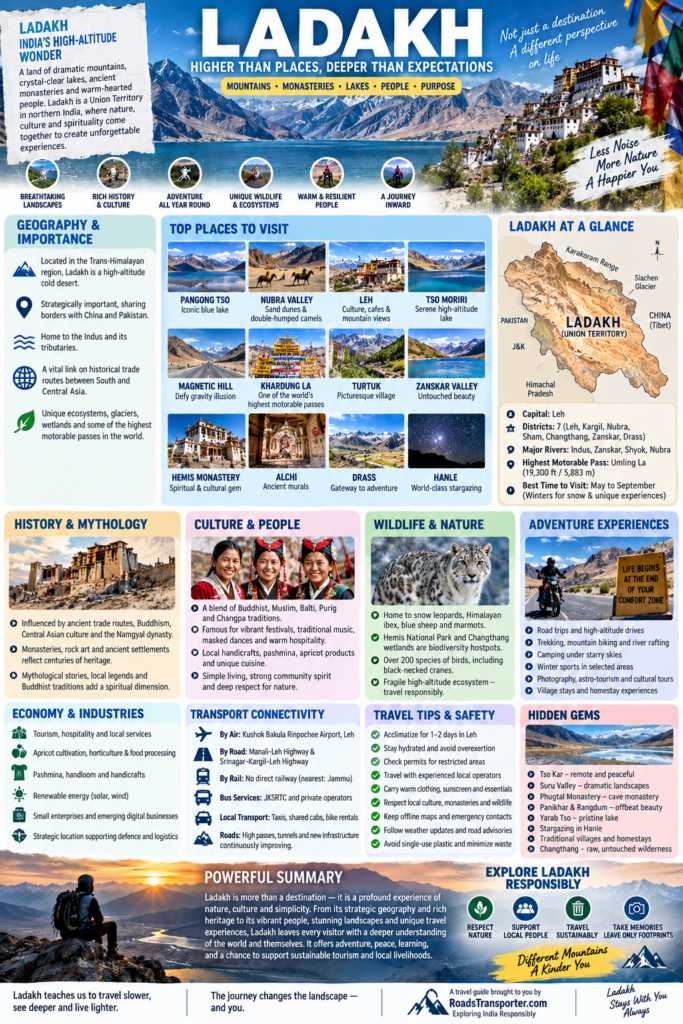
Ladakh is not simply a collection of famous sightseeing spots. It is a vast high-altitude cold-desert region and Union Territory of India, shaped by the Himalaya and Karakoram, river valleys, remote settlements, high passes, wetlands and centuries of movement between South and Central Asia. Its administrative geography also changed significantly in 2026: Ladakh now has seven districts—Leh, Kargil, Nubra, Sham, Changthang, Zanskar and Drass.
For travelers, its geographical diversity is the beginning of the experience. Pangong Tso, Tso Moriri and Tso Kar reveal Ladakh’s high-altitude lake landscapes; Nubra and Hunder combine mountain scenery with cold-desert dunes; Suru and Zanskar offer a very different world of valleys, villages and dramatic peaks; while Changthang introduces travelers to wetlands, wildlife, pastoral landscapes and Changpa traditions. Official Ladakh Tourism now promotes not only landscape sightseeing but also cultural, wildlife, eco, wellness and astro-tourism experiences.
🏯 History, Heritage & Spiritual Identity
Ladakh’s appeal becomes much deeper when a journey goes beyond photographs. Ancient trade routes, royal history, petroglyphs, traditional settlements, monasteries and religious institutions preserve layers of its past. Leh Palace, Alchi, Hemis, Thiksey, Lamayuru and other historic sites help explain how religion, architecture, art and trans-Himalayan cultural exchange shaped the region.
The heritage story is also being formally strengthened. In 2026 the UT notified the Ladakh Heritage Conservation and Preservation Rules and issued notifications concerning protected monuments, giving travelers and content creators another reason to distinguish genuine protected heritage from loosely labelled social-media attractions.
Mythology and oral traditions remain part of Ladakh’s cultural landscape, but travelers should distinguish faith, folklore and community tradition from documented history. Sacred landscapes deserve respect even where their spiritual significance cannot be treated as a historical fact.
🙏 Culture Is the Real Heart of Ladakh
Ladakh cannot be understood through mountains alone. Buddhist monastic traditions, Muslim communities of Kargil and other western areas, Balti and Purig heritage, Changpa pastoral culture, traditional music, masked dances, polo, archery, handicrafts, pashmina, apricot cultivation and village hospitality all contribute to its identity.
Food adds another layer. Instead of travelling only for familiar restaurant meals, visitors can explore local dishes and ingredients such as thukpa, momos, skyu, khambir, barley preparations, butter tea and apricot products, while recognizing that cuisines and food traditions vary across communities and districts.
The best cultural traveler does not treat a monastery, festival or village as a photo set. Ask before photographing people, observe religious etiquette, buy genuinely local products where possible and allow communities to tell their own stories.
🌊 Famous Places—and the Ladakh Beyond the Famous Places
Pangong Tso, Nubra Valley, Hunder, Leh, Shanti Stupa and the major monasteries deserve their popularity, but they represent only one layer of Ladakh.
Travelers willing to slow down can explore places and experiences such as Turtuk, Sham Valley, Suru Valley, Zanskar, Hanle, Tso Kar, traditional villages, apricot-growing settlements, rock-art sites and quieter monastery circuits. Official tourism material increasingly highlights rock art, trekking, sanctuaries, remote valleys and community experiences alongside the headline attractions.
A better Ladakh itinerary therefore asks not “How many famous places can I cover?” but “How much of Ladakh can I understand without rushing through it?”
🐆 Wildlife, Adventure & Photography
For nature travelers, Ladakh offers ecosystems associated with snow leopard, Himalayan ibex, high-altitude birds and the Changthang wetlands, while Hemis National Park and the Tso Kar landscape are important nature-oriented destinations. Adventure possibilities range from trekking and cycling to carefully planned road expeditions and specialist winter experiences.
Photographers can move from the blue-water landscapes of Pangong to Nubra’s dunes, monastery interiors where photography is permitted, apricot blossoms, village architecture, Suru’s mountain scenery and some of India’s clearest high-altitude night skies.
But responsible photography matters: wildlife should never be chased, nesting birds should not be disturbed, drones should not be flown without checking applicable rules, and sensitive/security installations should never be photographed casually.
💼 Tourism, Economy & Local Livelihoods
Tourism is economically important because visitor spending supports accommodation, taxis, restaurants, guides, handicrafts and other local services; the administration itself describes tourism as an important source of employment and income.
Yet Ladakh’s economy is broader than tourism. Apricot and other horticulture, pashmina, handloom and handicrafts, livestock, food processing, construction, renewable energy, transport and logistics, small enterprises and emerging digital businesses all have roles.
That connection gives travelers economic power. Choosing a locally operated homestay, buying authentic crafts, hiring legitimate local services and eating local food can keep a larger share of tourism expenditure within the destination.
✈️ Road, Air & Transport Connectivity
Leh remains Ladakh’s principal aviation gateway, while major road corridors connect the region through the Srinagar–Kargil and Manali sides, with the broader road network continuing to develop. The administration is also promoting Ladakh as a more accessible, year-round destination while infrastructure continues to evolve.
Travelers should nevertheless avoid treating a map as a road-status report. Snow, construction, landslides, flooding, security requirements and temporary traffic controls can change mountain-road conditions rapidly.
There is no conventional passenger railway directly into Leh, no metro system and no seaport. Ladakh is landlocked, so references to cruises or sea beaches do not belong in an accurate Ladakh travel guide.
🩺 Safety Can Decide Whether Ladakh Becomes a Beautiful Memory
The greatest mistake a first-time visitor can make is treating altitude as an inconvenience rather than a genuine physiological challenge.
Keep the beginning of the itinerary slow, hydrate sensibly, avoid unnecessarily strenuous activity immediately after arrival, recognize symptoms of altitude illness and seek medical help if symptoms become serious or worsen. People with relevant health concerns should obtain individualized medical advice before undertaking high-altitude travel.
Road journeys deserve similar caution. Avoid racing on mountain roads, driving while exhausted, approaching unstable edges for photographs or attempting water crossings merely because another vehicle succeeded.
Remote travel also requires offline maps, identification, emergency contacts, backup cash, essential medication, warm layers, sun protection, drinking water and schedule flexibility.
Access regulations can change too. The UT Administration reviewed the Protected Area Permit/Restricted Area Permit framework in August 2026, particularly in relation to restricted northern and eastern areas, illustrating why travelers should verify current requirements instead of copying an old blog or video.
📌 Ladakh at a Glance
| 🧭 Travel Question | Quick Recap |
|---|---|
| 🗺️ What is Ladakh? | Union Territory and high-altitude Trans-Himalayan region |
| 🏔️ Famous for | Mountains, lakes, valleys, monasteries, culture, wildlife and adventure |
| 🌊 Iconic landscapes | Pangong, Tso Moriri, Tso Kar, Nubra, Zanskar, Suru |
| 🏯 Heritage | Monasteries, Leh Palace, historic settlements, rock art and trade-route history |
| 🙏 Culture | Buddhist, Muslim, Balti, Purig, Changpa and other local traditions |
| 🐆 Nature | Cold-desert ecosystems, wetlands and high-altitude wildlife |
| 🍲 Food | Ladakhi/Tibetan-influenced dishes, barley foods, breads and apricot products |
| 🧣 Shopping | Pashmina, textiles, handicrafts, jewellery and apricot products |
| 🥾 Experiences | Trekking, culture, road trips, wildlife, photography and astro-tourism |
| 👨👩👧 Family | Possible with sensible altitude and road planning |
| ❤️ Couples | Landscapes, boutique stays, villages and slow travel |
| 🎒 Solo travelers | Excellent but remote routes require extra preparation |
| 👴 Seniors | Slower itineraries and medical planning are particularly important |
| ✈️ Main gateway | Leh by air; road approaches provide alternatives |
| 🚆 Direct railway to Leh | No |
| 🛳️ Sea/cruise tourism | No—Ladakh is landlocked |
| 💰 Economy | Tourism plus horticulture, pashmina, crafts, services, logistics and emerging sectors |
| 📅 Trip style | Keep buffer days and avoid overpacking the itinerary |
| 🪪 Permits | Check current official requirements for your nationality and intended route |
| 🚨 Biggest planning issues | Altitude, weather, distance and changing road/access conditions |
| ♻️ Responsible rule | Leave less waste, use less water and respect communities |
🌱 Responsible Tourism Is No Longer Optional
Ladakh’s popularity brings both opportunity and pressure. More visitors can create income, but concentrated tourism also increases demand for water, waste disposal, transport, accommodation and fragile natural spaces.
The region is actively broadening tourism beyond conventional summer sightseeing into community tourism, wildlife, winter sports, cultural experiences, wellness and astro-tourism. (Ladakh) That makes responsible visitor behaviour even more important.
Carry reusable bottles where practical, minimize single-use plastic, never leave waste around lakes or passes, avoid unnecessary water consumption, stay on appropriate trails, respect wildlife habitats and support local businesses.
⭐ Powerful Summary: Why Ladakh Stays With You
Ladakh is simultaneously a geographical classroom, cultural landscape, spiritual destination, adventure region and living mountain economy.
Its lakes may attract you first.
Its mountains may dominate your photographs.
Its monasteries may introduce you to centuries of art and belief.
Its roads may test your patience.
Its altitude may force you to slow down.
But slowing down is precisely how Ladakh becomes more meaningful.
The traveler who spends time speaking with a homestay family, understanding a monastery before photographing it, tasting regional food, buying from an artisan, learning why a wetland matters or simply watching evening light move across a silent valley will leave with something a checklist itinerary cannot provide.
Official tourism policy is increasingly emphasizing sustainable, inclusive and year-round tourism, while visitor numbers continue to demonstrate the region’s growing appeal. (Ladakh) The challenge is therefore not merely bringing more people to Ladakh—it is helping people experience Ladakh without diminishing what made them want to visit.
🌄 Before You Leave Ladakh…
There is one final destination that will never appear on your map.
It is the point where you stop behaving like a tourist and begin travelling like a guest.
When that happens, Pangong is no longer merely a photograph. A monastery is no longer another pin on Google Maps. A village is no longer a roadside attraction. The silence of Changthang, the orchards of Turtuk, the streets of Leh, the valleys of Suru and Zanskar, and the communities that call these landscapes home begin to feel connected.
For travelers researching long Himalayan road journeys, difficult terrain or specialized cargo movement, ABCC India Project Cargo Corporation / Roadstransporter.com also brings a transporter’s perspective to road connectivity, route surveys and heavy-haul logistics. That commercial perspective should remain secondary to the purpose of this guide: helping people understand and respect the destination.
So when you finally plan your journey, do not go to Ladakh simply to say:
“I have been there.”
Travel slowly enough, responsibly enough and curiously enough to return saying:
“I understand why this place deserves to be protected.”
🏔️ Explore Ladakh. Learn from Ladakh. Support Ladakh. Leave it better than you found it.
🌄 Conclusion: Places to Visit in Ladakh – A Journey Worth Taking Responsibly
The best places to visit in Ladakh are not limited to the blue waters of Pangong Tso, the sand dunes of Nubra Valley or the monasteries surrounding Leh. Ladakh rewards travelers who look deeper—toward the remote landscapes of Zanskar and Suru, the wetlands of Changthang, the night skies of Hanle, the villages of Sham Valley, traditional markets, ancient monasteries and communities whose lives have been shaped by this extraordinary high-altitude environment.
Every journey here should be planned around the realities of the mountains. Allow enough time for acclimatization, keep buffer days for changing road and weather conditions, verify current access requirements through official sources, respect wildlife and religious places, minimize plastic and water waste, and support local guides, homestays, drivers, artisans and food businesses wherever practical. Ladakh is a fragile destination where responsible travel directly contributes to protecting the landscapes and livelihoods visitors come to experience.
What makes Ladakh unforgettable is the combination of geography, history, spirituality, culture, adventure and human resilience. A photograph may capture Pangong’s colours or a Himalayan sunset, but the deeper memories often come from a quiet village, a conversation with a local family, the sound of a monastery courtyard, an apricot orchard, a difficult mountain road or simply the immense silence between two valleys.
For travelers researching places to visit in Ladakh, the most rewarding itinerary is therefore not necessarily the one containing the greatest number of destinations. Travel slowly enough to understand where you are. Respect local customs, allow the altitude to determine your pace and leave enough flexibility to discover places that were never part of the original checklist.
🚛 Road connectivity is also an important part of Ladakh’s story. ABCC India Project Cargo Corporation works in road route surveys, transport and logistics planning, project-cargo consulting, geographical route assessment, industrial connectivity and heavy-haul transportation across India. Its route-planning perspective is particularly relevant to challenging regions where terrain, bridges, gradients, road geometry and logistics infrastructure influence the movement of both people and cargo.
Ultimately, Ladakh should not be remembered as a destination that was simply “covered.”
It should be experienced as a place that taught you to travel slower, observe more carefully, respect nature, understand local culture and value the road as much as the destination.
🏔️ Explore Ladakh responsibly. Support its communities. Protect its mountains, lakes and wildlife—and allow this remarkable Himalayan journey to remain meaningful for the travelers who come after you.
❓ Real Traveller Questions
🏔️ What are the best places to visit in Ladakh?
The best places to visit in Ladakh include Leh, Pangong Tso, Nubra Valley, Tso Moriri, Tso Kar, Zanskar Valley, Suru Valley, Hanle, Turtuk, Lamayuru, Alchi, Thiksey and Hemis. The right choices depend on season, altitude tolerance, available days and current road/access conditions.
📅 What is the best time to visit Ladakh?
For most first-time travelers, the warmer months are generally the easiest period for sightseeing and road trips because more high-altitude routes and destinations tend to be accessible. Winter offers snow landscapes and specialized experiences but requires significantly more preparation. Always verify current weather and road conditions before departure.
🚗 Which places can I visit near Leh within 100 km?
Popular day-trip possibilities around Leh include Shey, Thiksey, Hemis, Stok, Spituk, Magnetic Hill, the Indus–Zanskar Sangam, Basgo, Likir and Alchi. Distances vary according to the exact starting point and road route, so travelers should check current navigation and road conditions.
👨👩👧👦 Is Ladakh suitable for a family trip with children and senior citizens?
Ladakh can be visited by families, but its high altitude requires careful acclimatization and a slower itinerary. Children, seniors and travelers with relevant medical conditions may need additional planning and individualized medical advice. Avoid rushing directly from Leh toward very high passes or remote lakes immediately after arrival.
❤️ What are the best places to visit in Ladakh for couples?
Couples often choose Pangong Tso, Nubra Valley, Turtuk, Sham Valley, Tso Moriri, Hanle and quieter villages around Leh for scenery, photography and slow travel. Rather than packing many distant destinations into a short honeymoon, allow enough time for acclimatization and relaxed exploration.
🌿 What are some hidden and unique places to visit in Ladakh?
Beyond the most famous attractions, travelers can explore Tso Kar, Suru Valley, Hanle, lesser-visited Zanskar landscapes, Sham Valley villages, apricot-growing settlements and quieter cultural circuits. Some remote locations may have seasonal, environmental or access restrictions, so current official information should be checked.
✈️ How many days are enough for a Ladakh trip?
Around 7–10 days gives many first-time visitors a more practical framework for acclimatization plus Leh and selected surrounding circuits. Longer trips are better for travelers adding distant areas such as Zanskar or Suru. Avoid designing an itinerary based only on kilometres—mountain travel can take considerably longer than plains travel.
💳 How much does a Ladakh trip cost?
There is no single fixed Ladakh trip cost. Expenses depend on flights or road travel, season, accommodation, shared versus private taxis, meals, activities, permits where applicable and itinerary length. Shared transportation, modest accommodation and fewer long-distance circuits can reduce costs considerably.
🏥 What safety precautions should first-time Ladakh travelers follow?
Give your body adequate time to acclimatize, avoid strenuous activity immediately after reaching high altitude, stay appropriately hydrated, protect yourself from strong sun and cold, carry essential medication and recognize symptoms of altitude illness. Also keep buffer time for weather and road disruptions and verify current access requirements before remote journeys.
🌟 Why is Ladakh famous and worth visiting?
Ladakh is famous for its extraordinary high-altitude landscapes, lakes, valleys, monasteries, Buddhist heritage, diverse communities, wildlife, trekking, road journeys, traditional villages and night skies. What makes it especially rewarding is the combination of dramatic geography with living culture. Travel responsibly by respecting local customs, conserving water, minimizing waste and supporting local communities.