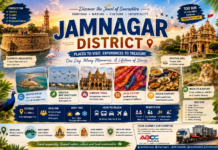
🏔️ Places to Visit in Jammu and Kashmir, India – The Ultimate Travel & Tourism Guide
🌿 Introduction – A Journey Where Every Road Reveals a Different Kashmir
There are journeys you remember through photographs, and then there are journeys that stay with you as feelings. Jammu and Kashmir belongs to the second kind.
Imagine beginning your morning beside a quiet Himalayan lake, watching mountains appear in its reflection as the first light touches the water. A few hours later, you may be walking through a busy old market filled with the fragrance of spices and freshly prepared food. Continue towards the mountains and the landscape changes again—pine forests replace city streets, rivers run beside winding roads, green meadows open beneath enormous peaks, and small villages appear where life seems to move at its own peaceful rhythm.
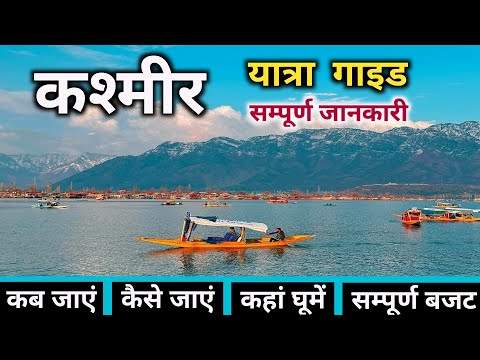
That extraordinary variety is what makes the places to visit in Jammu and Kashmir so fascinating.
One important detail should be clear for first-time visitors: Jammu and Kashmir is currently a Union Territory of India, not a state, although travelers still commonly search online for phrases such as “Jammu and Kashmir State tourist places.” This guide uses those familiar travel-search terms where helpful while keeping the geography accurate.
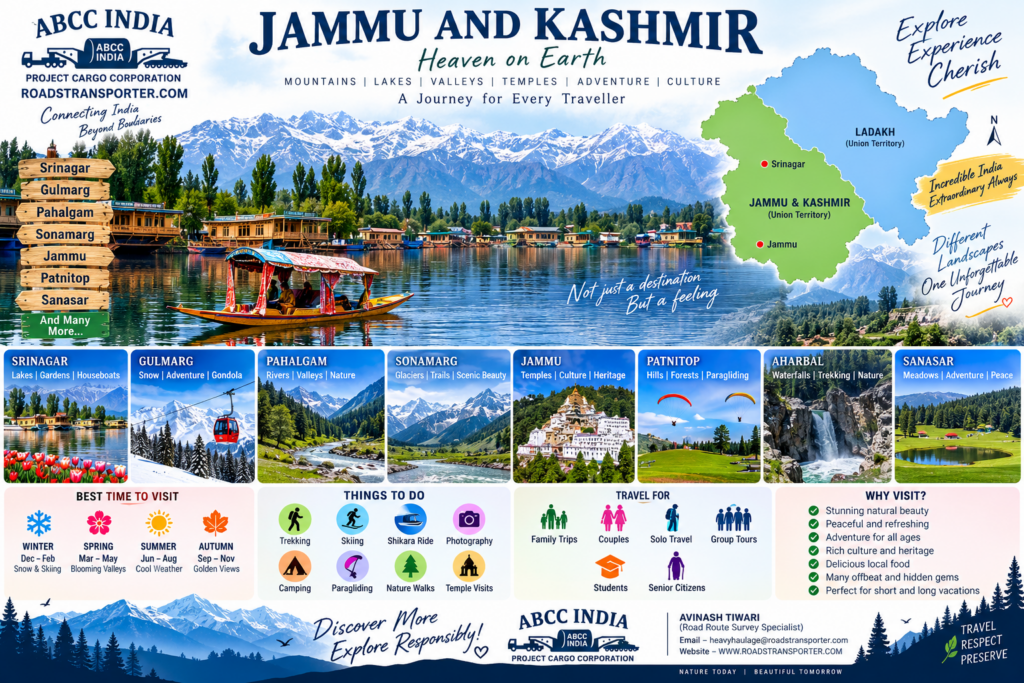
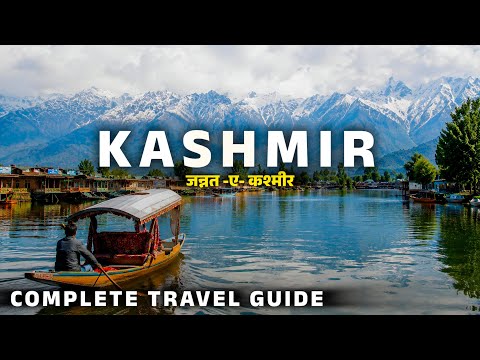
For many travelers, the first picture of Kashmir is Srinagar’s famous Dal Lake—shikaras moving across the water, houseboats resting near the shore and mountains forming a dramatic backdrop. Dal Lake is indeed one of the icons of Kashmir tourism, surrounded by gardens and deeply connected with Srinagar’s visitor experience. But treating Jammu and Kashmir as only Dal Lake would be like reading the first page of a beautiful book and assuming you know the entire story.
The journey becomes much richer when you travel beyond that familiar postcard.
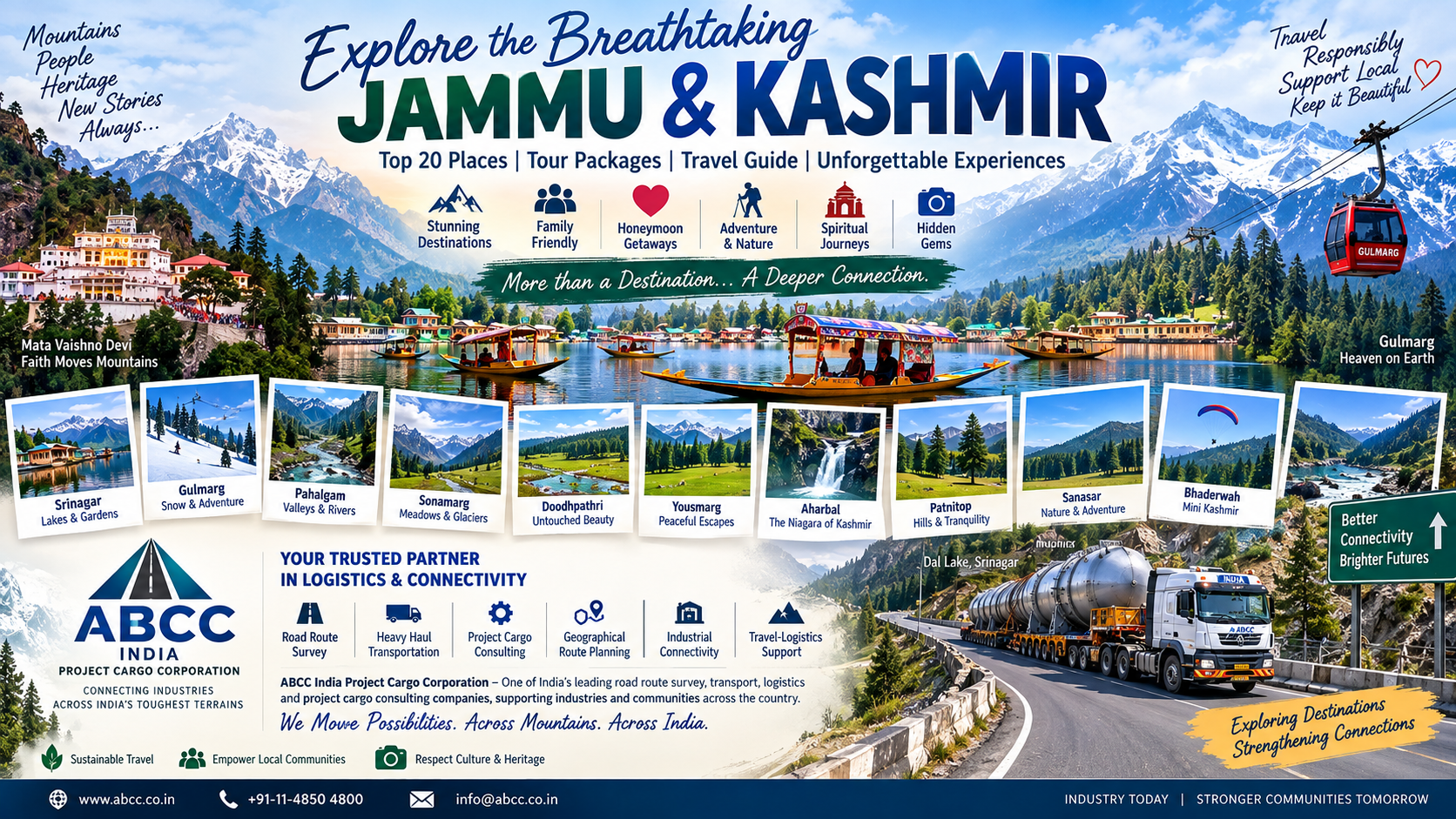
There is Gulmarg, associated with mountain scenery and outdoor experiences; Pahalgam, where valleys, forests and rivers create an entirely different Himalayan mood; Sonamarg, opening towards high mountain landscapes; and quieter destinations such as Yousmarg, Daksum and Gurez that invite travelers to slow down rather than rush from one famous viewpoint to another. These destinations are also represented within the official J&K tourism network.
And then there is Jammu—a side of the destination that deserves far more attention in a complete travel guide.

Travel towards Patnitop, and the experience shifts to wooded hills and mountain views. Official tourism information places Patnitop in the Lower Himalayan region near the Pir Panjal range and highlights its pine forests, walks and surrounding attractions. Nearby Sanasar, surrounded by conifers and mountain scenery, has developed a reputation for outdoor recreation and adventure activities such as paragliding.
For families searching for peaceful picnic spots in Jammu and Kashmir, lakes such as Mansar and Surinsar offer another kind of escape. They combine nature with local cultural and religious associations, making them particularly interesting when you want a slower day away from crowded sightseeing circuits.
The real surprise, however, often begins when you stop searching only for famous tourist places.
Jammu and Kashmir contains lakes, waterfalls, alpine landscapes, forests, meadows, pilgrimage destinations, historic sites and trekking country scattered far beyond the most photographed routes. Aharbal, for example, is associated with its waterfall landscape and also serves as a base for outdoor activities and trekking towards higher alpine country. Naranag is connected with ancient temples and the beautiful trekking route towards Gangabal Lake.
Even among the lakes, every experience is different. Manasbal Lake in Ganderbal district is known for clear water, lotus growth and aquatic birdlife, providing a quieter contrast to the energy surrounding Dal Lake.
These are the kinds of hidden gems, offbeat attractions and lesser-explored places in Jammu and Kashmir that can transform a sightseeing holiday into a genuine journey of discovery.
Adventure travelers have another Jammu and Kashmir waiting for them altogether. Mountain trails, trekking routes, skiing areas, paragliding locations and high-altitude lakes create possibilities far beyond conventional sightseeing. Official tourism material itself identifies trekking, skiing and river rafting among activities promoted in the region. The important lesson is not to treat these mountains casually: weather, road conditions, permits and local restrictions can change, so adventure plans should always be checked with current official information before departure.
But you do not need to be an adventurer to fall in love with this region.
For a couple, the memorable moment might be an unhurried shikara ride or a quiet mountain evening. For a family trip, it may be children seeing snow or enormous Himalayan landscapes for the first time. Students and groups can combine nature with history, geography and culture. Senior citizens can build a slower itinerary around accessible sightseeing and pilgrimage destinations. And for a solo traveler, perhaps the greatest pleasure is simply having enough time to observe—the sound of water, conversations in a market, changing mountain light and everyday life beyond tourist viewpoints.
That is also why there is no single answer to the question, “What are the best places to visit in Jammu and Kashmir?”
The right destination depends on your season, interests, budget, physical comfort and available time.
If you love lakes and gardens, Srinagar can become a natural starting point. If snow landscapes and mountain recreation attract you, your route will look different. If you prefer waterfalls, forests, quiet picnic spots or photography, lesser-known destinations may deserve more days than famous attractions. And if your idea of a vacation is escaping crowds, the most rewarding experience may come from choosing one peaceful valley rather than trying to cover ten places quickly.
Food deserves space in that journey too. Jammu and Kashmir cannot be understood only through viewpoints. Its regional cuisines, breads, rice dishes, local produce, traditional sweets and tea culture add another layer to travel. Even simple roadside stops can reveal how dramatically food traditions change as you move between Jammu and the Kashmir Valley.
The same is true of people and culture. Languages, architecture, religious traditions, crafts, clothing, music and everyday customs vary across the region. Travel here becomes more meaningful when visitors approach communities with curiosity rather than treating villages and markets merely as photography backgrounds.
And photography? You may arrive thinking that the snow mountains will produce your best photograph. Sometimes they will. But another frame may surprise you more—a wooden boat crossing still water, mist moving through pine trees, a roadside tea stop, autumn foliage, an old doorway, a shepherd trail, or the final sunlight disappearing behind a ridge.
That is the Jammu and Kashmir this guide invites you to discover: not merely a checklist of tourist places, but a collection of landscapes, cultures and journeys that deserve time and respect.
![Jammu Kashmir - The Crown of India – [Hindi] – Infinity Stream](https://i.ytimg.com/vi/naA2iOIQ6hk/hqdefault.jpg)
Whether you are planning your first Kashmir vacation, a Jammu family trip, a romantic couple getaway, a solo journey, an adventure holiday, a group tour, a weekend escape or a search for natural places, lakes, waterfalls, hills, hidden gems, unexplored corners and lesser-known attractions, start with one principle—travel slowly enough to notice where you are.
Continue through this complete Jammu and Kashmir travel and tourism guide to discover verified attractions, famous and offbeat destinations, seasonal choices, realistic budget planning, local food experiences, suggested itineraries, photography spots, transport guidance, safety considerations and practical travel tips—so that your trip becomes more than a vacation and turns into a Himalayan story worth remembering.
🏔️ Best Places to Visit in Jammu and Kashmir – 30 Genuine Tourist Destinations

I have deliberately limited the list to 30 genuinely identifiable destinations within present-day Jammu & Kashmir and excluded Ladakh destinations such as Leh, Pangong and Kargil. Official JKTDC listings confirm many of the destinations below, including Gulmarg, Aharbal, Aru, Daksum, Kokernag, Sonamarg, Verinag, Yousmarg, Gurez, Katra, Patnitop, Mansar and Sanasar.
Approximate budgets below are planning estimates per person, generally excluding travel to/from Jammu & Kashmir, premium hotels, shopping and major adventure packages. Actual costs vary considerably with season, transport and accommodation.
🌿 30 Genuinely Available Places to Visit in Jammu and Kashmir
| Place | Best Season | When to Visit | Why to Visit | Ideal For | Approx Budget | Travel Tip |
|---|---|---|---|---|---|---|
| 1. Srinagar & Dal Lake | Spring–Autumn | 2–3 days | Shikara rides, houseboats, lake scenery, old-city culture and food | Family, Couple, Friends, Seniors, Students, Solo | ₹2,000–6,000/day | Stay at least one night near the lake; compare shikara prices before riding |
| 2. Nishat Garden | Spring–Autumn | 1–2 hrs | Historic Mughal garden overlooking Dal Lake | Family, Couple, Seniors, Students | ₹300–1,000 | Combine with other Srinagar gardens |
| 3. Shalimar Garden | Spring–Autumn | 1–2 hrs | Mughal garden architecture, chinars and landscaped terraces | Family, Couple, Seniors, Students | ₹300–1,000 | Morning/evening light is better for photography |
| 4. Chashme Shahi Garden | Spring–Autumn | 1–2 hrs | Compact Mughal garden, spring and mountain backdrop | Family, Couple, Seniors | ₹300–1,000 | Easy addition to a Srinagar sightseeing day |
| 5. Tulip Garden Srinagar | Spring | Seasonal visit | Famous seasonal tulip display beneath the Zabarwan Hills | Family, Couple, Friends, Photographers | ₹500–1,500 | Tulip flowering is seasonal; verify opening before planning |
| 6. Gulmarg | Year-round | 1–3 days | Snow, skiing, mountain scenery, meadows and Gondola cable-car experience | Family, Couple, Friends, Adventure, Corporate Groups | ₹2,500–8,000/day | Book authorized activities; winter conditions can alter access |
| 7. Strawberry Valley | Spring–Summer | 2–4 hrs | Meadow scenery and quieter Gulmarg countryside | Couple, Friends, Family, Solo | ₹500–2,000 | Combine with Gulmarg rather than making a separate overnight trip |
| 8. Pahalgam | Spring–Autumn | 2–3 days | Lidder Valley, rivers, pine landscapes and access to surrounding valleys | Family, Couple, Friends, Seniors, Solo | ₹2,000–6,000/day | Local sightseeing transport arrangements can differ from through-taxis |
| 9. Aru Valley | Spring–Autumn | Half/full day | Meadow scenery, trekking gateway and peaceful mountain environment | Couple, Friends, Students, Trekkers | ₹1,000–3,000 | Carry layers even in warmer months |
| 10. Betaab Valley | Spring–Autumn | 2–4 hrs | River, mountain and meadow landscapes near Pahalgam | Family, Couple, Friends | ₹800–2,500 | Visit early during peak holiday periods |
| 11. Sonamarg | Late spring–Autumn | 1–2 days | Dramatic mountain valley, glaciers and trekking country | Family, Couple, Friends, Adventure | ₹2,000–5,000/day | High-altitude weather changes rapidly |
| 12. Thajiwas Glacier Area | Warmer accessible months | Half/full day | Glacier landscape and high-mountain experience near Sonamarg | Friends, Couple, Adventure Travelers | ₹1,500–4,000 | Check local access/weather before starting |
| 13. Yousmarg | Spring–Autumn | 1 day | Meadows, forests, picnic atmosphere and quieter scenery | Family, Couple, Friends, Corporate Groups, Solo | ₹1,000–3,000 | Excellent alternative for travelers seeking fewer urban attractions |
| 14. Doodhpathri | Spring–Autumn | 1 day | Rolling meadows, streams and picnic landscapes | Family, Couple, Friends, Corporate Outing | ₹1,000–3,000 | Carry food/water and return before poor visibility or darkness |
| 15. Gurez Valley | Warmer accessible months | 2–4 days | Remote valley landscapes, villages and Kishanganga River | Friends, Couple, Solo, Photographers | ₹2,000–5,000/day | Check current road and permission requirements before departure |
| 16. Manasbal Lake | Spring–Autumn | Half day | Lake scenery, lotus landscapes and birdlife | Family, Couple, Seniors, Photographers | ₹500–2,000 | Particularly attractive for slow nature-oriented travel |
| 17. Wular Lake | Spring–Autumn | Half/full day | Vast freshwater landscape, birdlife and rural Kashmir scenery | Family, Friends, Students, Nature Lovers | ₹500–2,000 | Choose viewpoints/access areas locally rather than assuming the entire shoreline is tourist-ready |
| 18. Verinag Spring & Mughal Garden | Spring–Autumn | 2–4 hrs | Historic spring, Mughal architecture and landscaped surroundings | Family, Couple, Seniors, Students | ₹500–1,500 | Combine with an Anantnag-region itinerary |
| 19. Botanical Garden, Kokernag | Spring–Autumn | Half day | Gardens, springs, greenery and relaxed picnic environment | Family, Couple, Seniors, Students | ₹500–1,500 | Good slower-paced stop for mixed-age families |
| 20. Aharbal Waterfall | Spring–Autumn | Half/full day | Powerful waterfall, forest scenery and trekking opportunities | Family, Friends, Couple, Photographers | ₹800–2,500 | Keep away from slippery edges and strong currents |
| 21. Daksum | Spring–Autumn | Half/full day | Forests, streams, mountain scenery and offbeat nature | Couple, Friends, Solo, Nature Lovers | ₹1,000–3,000 | Limited facilities compared with major resorts; plan essentials beforehand |
| 22. SinthanTop Daksum Kashmir | Warmer accessible months | Half/full day | High mountain pass scenery and panoramic photography | Friends, Couple, Road-Trippers | ₹1,000–3,500 | Confirm road/weather conditions before leaving |
| 23. Dachigam National Park | Season/access dependent | Half/full day | Protected Himalayan ecosystem and Hangul habitat | Wildlife Lovers, Students, Photographers | ₹1,000–3,000 | Entry/access rules should be verified with the Wildlife Department |
| 24. Patnitop | Year-round | 1–2 days | Hill landscapes, forests, walks and mountain recreation | Family, Couple, Friends, Corporate Groups, Seniors | ₹1,500–4,500/day | Winter driving may require additional preparation |
| 25. Sanasar | Spring–Autumn | 1 day | Meadows, adventure activities and peaceful mountain scenery | Friends, Couple, Family, Corporate Outing | ₹1,000–3,500 | Verify adventure operators and weather locally |
| 26. Mansar Lake | Most of year | Half/full day | Lake, picnic setting, religious associations and nearby wildlife landscape | Family, Couple, Seniors, Students | ₹500–2,000 | Combine with Surinsar if your route permits |
| 27. Surinsar Lake | Most of year | Half day | Quiet lake, nature and picnic outing | Family, Couple, Seniors, Students | ₹500–1,500 | Better for relaxed sightseeing than a packed activity day |
| 28. Katra & Shri Mata Vaishno Devi | Most of year | 1–3 days | Major devotional pilgrimage in the Trikuta Hills | Family, Devotees, Friends, Seniors* | ₹1,500–5,000/day | *Senior travelers should choose transport/assistance according to health and current official arrangements |
| 29. Amar Mahal Museum and Library | Most of year | 1–2 hrs | Dogra heritage, museum collections and Jammu history | Family, Seniors, Students, History Lovers | ₹300–1,000 | Combine with Jammu city heritage sightseeing |
| 30. Akhnoor Fort | Autumn–Spring | Half day | Fort heritage, Chenab-side landscape and historic Akhnoor | Family, Friends, Students, History Lovers | ₹500–1,500 | Best incorporated into a Jammu-region road trip |
Government tourism records independently identify places such as Cheshmashahi, Nishat, Shalimar, Verinag, Achabal and Martand in Kashmir, and Akhnoor Fort and Mubarak Mandi in Jammu. Wildlife records also confirm Dachigam National Park and protected areas including Overa-Aru and Surinsar–Mansar. Dachigam is particularly important as habitat for the Hangul (Kashmir stag).

| Travel Interest | Genuine Option in Jammu & Kashmir | Practical Note |
|---|---|---|
| 🐾 Wildlife | Dachigam, Overa-Aru, Surinsar–Mansar landscape | Wildlife sightings are never guaranteed |
| 🌷 Gardens | Nishat, Shalimar, Chashme Shahi, Tulip Garden, Kokernag | Excellent family/senior options |
| 🏛️ Museum | Dogra Art Museum, Amar Mahal Museum and Library | Strong Jammu heritage options |
| 🏔️ Hill destinations | Gulmarg, Pahalgam, Patnitop, Sonamarg, Yousmarg | Among the region’s strongest tourism themes |
| 💦 Waterfalls | Aharbal Waterfall | Genuine major waterfall attraction |
| 🏞️ Lakes | Dal, Wular, Manasbal, Mansar, Surinsar | Excellent nature/picnic tourism |
| 🚠 Cable car / Gondola | Gulmarg Gondola | Verify tickets and operations before visiting |
| 🥾 Trekking / Climbing | Aru, Sonamarg region, Gurez and mountain trails | Use appropriate guides/permissions for serious routes |
| 🎿 Snow Adventure | Gulmarg | Skiing depends on snow/weather |
| 🪂 Paragliding | Sanasar and other authorized seasonal operations | Availability/weather dependent |
| 🧺 Picnic | Yousmarg, Doodhpathri, Mansar, Surinsar, Kokernag | Suitable for family/group outings |
| 👨💼 Corporate Team Outing | Patnitop, Sanasar, Yousmarg, Pahalgam | Accommodation/capacity should be confirmed directly |
| 🙏 Devotional Tourism | Vaishno Devi, Jammu temples and Kashmir shrines | Respect religious rules and local customs |
| 🌾 Agriculture/Rural Tourism | Orchard and village landscapes | Prefer genuine locally organized experiences rather than entering farms without permission |
| 🍛 Food Tourism | Srinagar and Jammu | Explore regional Kashmiri and Dogra cuisine |
| 💆 Ayurveda/Wellness | Available commercially in some hotels/wellness businesses | I would verify individual centers before naming them |
| 💦 Waterpark/Swimming | Commercial facilities exist around Jammu | Not a defining J&K tourism attraction; verify operation before visiting |
| 🎢 Bumper Cars/Dodgems | May exist at individual amusement facilities | Not appropriate to claim as a major regional attraction without current verification |
| 🍷 Wine Party | Not presented as a J&K tourism attraction | Do not confuse nightlife keywords with established destination features |
| 🏖️ Sea Beach | None | Jammu & Kashmir is landlocked; lake/river shores are not sea beaches |
| ⚓ Sea Port | None | There is no seacoast or sea port in Jammu & Kashmir |
For first-time visitors, a practical mix is Srinagar + Gulmarg + Pahalgam + Sonamarg for the classic Kashmir experience, while Jammu + Katra + Patnitop + Sanasar/Mansar creates a contrasting Jammu-region journey. Travelers looking specifically for lesser-known natural places can investigate Gurez, Daksum, Aharbal, Yousmarg and Doodhpathri, subject to current road, weather and local access conditions.
Important: Weather, road access, security arrangements, pilgrimage procedures, permits, Gondola operations and adventure activities can change. Verify them shortly before travel rather than treating any evergreen blog as a live operational advisory.
🌦️ Best Time to Visit Jammu and Kashmir: Seasonal Weather & Travel Guide
Jammu and Kashmir does not have one universal “best month.” The right season depends on whether you want green valleys, alpine meadows, waterfalls, pilgrimage, snow, skiing, photography, family sightseeing or a quiet romantic holiday. The region also has major altitude differences, so weather in Jammu, Srinagar, Gulmarg and Pahalgam can be dramatically different on the same day.
For accuracy, this guide treats Jammu and Kashmir as a Union Territory, despite the frequently searched phrase “Jammu and Kashmir State.” JKTDC’s destination directory confirms the destinations used below across both Kashmir and Jammu divisions.
🌡️ Jammu and Kashmir Seasonal Travel at a Glance

| Season | Broad Period | Typical Experience | Best For | Main Caution |
|---|---|---|---|---|
| ☀️ Summer | April–June | Gardens, green valleys, lakes, trekking, picnics | Families, couples, students, seniors, groups | Jammu plains can become very hot |
| 🌧️ Monsoon | July–September | Waterfalls, forests, lakes, greener Jammu hills | Slow travel, photography, couples, nature trips | Heavy rain can disrupt roads, especially Jammu-side hill routes |
| ❄️ Winter | December–February | Snow, skiing, winter landscapes, pilgrimage and city breaks | Couples, snow lovers, photographers, families | Snow, ice, cold and road/flight disruption |
| 🍂 Autumn* | October–November | Clearer landscapes, changing foliage, photography | Couples, seniors, photographers | Cold increases rapidly at altitude |
Autumn is worth mentioning even though your requested detailed sections are summer, monsoon and winter.
The difference between Jammu and the Kashmir Valley is important. IMD’s 1991–2020 climate normals for Jammu show average July rainfall of about 416.5 mm and August rainfall of about 403.1 mm, demonstrating how significant the summer monsoon can be there.
Temperatures below are practical planning ranges rather than guaranteed forecasts. Mountain weather varies by altitude and year, so travelers should check IMD forecasts immediately before departure.
☀️ Best Places to Visit Jammu and Kashmir in Summer
Summer is one of the easiest seasons for a first trip. The Kashmir Valley turns green, many higher routes become more practical, daylight is long, and families can combine lakes, gardens, valleys and outdoor activities.
🌷 Srinagar – Lakes, Gardens and Easy Family Sightseeing

Summer brings Srinagar into its classic holiday mood. Dal Lake reflects green hills, gardens are active with visitors, and long daylight hours allow sightseeing without turning every day into a race.
For practical planning, expect broadly mild-to-warm days and cooler evenings, often around 12–30°C across the wider summer period, although hot spells are possible. The most comfortable sightseeing hours are usually morning and late afternoon.
Allow 2–3 days. Spend one morning around Dal Lake, combine Nishat, Shalimar and other garden attractions on another day, and reserve time for Srinagar’s older neighbourhoods, food and local shopping. A shikara ride is more enjoyable when treated as an experience rather than a hurried photo stop.
Srinagar works particularly well for first-time families because accommodation ranges from houseboats and guesthouses to conventional hotels. Kashmiri dishes, breads and tea culture add another dimension to the visit. Vegetarian food is also readily obtainable in tourist areas.
For photography, try early lake reflections, shikaras, gardens, wooden architecture, markets and the evening mountain light. Couples can enjoy a relaxed lakefront itinerary, while senior citizens can build a comfortable holiday around short drives and gardens rather than strenuous walks.
A realistic mid-range planning allowance is roughly ₹2,000–₹6,000 per person per day, excluding flights, major shopping and premium accommodation.
Families, children, couples, solo travelers, students and groups can all use Srinagar effectively as a base. Corporate groups should choose properties with appropriate meeting and transport arrangements rather than assuming every houseboat or small hotel can accommodate a large team.
Evenings around established tourist areas can be enjoyable, but “safe at night” should never be treated as a permanent guarantee. Follow current local advisories, ask your hotel about local conditions and arrange transport for unfamiliar areas.
Pack comfortable shoes, sun protection, a light jacket and rain protection. Even during summer, mountain weather can change quickly.
🏔️ Sonamarg – A Summer Gateway to High Mountain Country

Sonamarg is where a conventional sightseeing holiday begins to feel distinctly Himalayan.
The journey itself is part of the attraction: valleys narrow, peaks rise higher and the landscape gradually becomes more dramatic. Summer is especially valuable because winter snow can make the wider high-altitude region much more restrictive.
Typical summer conditions can range roughly from single-digit temperatures on cold mornings to the low or mid-20s°C on pleasant afternoons, depending on altitude and weather.
Stay one night, or preferably two if you want something more meaningful than a day trip. Walk through the valley, enjoy riverside landscapes, investigate locally accessible trekking options and use clear mornings for mountain photography.
Accommodation includes hotels and guesthouses, though the choice is smaller than Srinagar. Simple North Indian and Kashmiri-style meals are generally available in tourist areas. Carry snacks and drinking water when heading away from established facilities.
Budget approximately ₹2,000–₹5,000 per person per day, with trekking, pony rides, private vehicles or guided activities adding to the cost.
Sonamarg particularly suits couples, photographers, friends, students and active families. Small children and senior citizens can enjoy the main valley without attempting strenuous high-altitude excursions.
Pack layered clothing, sunscreen, sunglasses, sturdy footwear and a waterproof outer layer. Do not underestimate UV exposure or sudden temperature changes.
For photographs, morning light over the peaks, rivers, meadows and layered mountain ridges are more rewarding than simply taking portraits at busy viewpoints.
High-altitude excursions require greater caution. Weather, road conditions and access can change; check locally before leaving the main tourism zone.
🌲 Aru Valley – Meadows, Walks and a Quieter Side of Pahalgam

Aru feels particularly rewarding when Pahalgam itself seems busy.
This mountain settlement and surrounding valley provide access to meadow landscapes, walks and trekking country. JKTDC includes Aru among its established Kashmir tourism destinations.
Summer days are generally pleasant, while mornings and evenings remain cool. A sensible planning range is roughly 8–24°C, with considerable variation caused by altitude and weather.
A full day works for casual visitors; 1–2 nights are better for travelers who genuinely want nature rather than another sightseeing stop.
Walk instead of rushing between photo points. Sit beside open landscapes, explore only appropriate local trails, and allow the silence to become part of the experience. Serious trekkers should use reliable local guidance and confirm route conditions.
Accommodation tends toward guesthouses, hotels and smaller properties in the wider Pahalgam-Aru area. Food choices become simpler as you move away from Pahalgam, so travelers with children or dietary requirements should plan accordingly.
Allow approximately ₹1,500–₹4,000 per person per day, excluding specialist trekking.
Aru is excellent for couples, friends, solo travelers, photographers and students. Active families can enjoy it too. Seniors should choose easy walks and avoid uneven trails if mobility is limited.
Photography works beautifully during early morning and late afternoon when meadow textures and mountain layers become more pronounced.
Pack walking shoes, warm layers, rain protection, medicines and some cash. Avoid wandering onto unfamiliar trails late in the day.
For a romantic trip, Aru’s appeal is not nightlife—it is the opposite: quiet landscapes and time together.
🪂 Sanasar – Summer Adventure and Corporate Outings

Sanasar offers a completely different summer from Kashmir’s famous lake circuit.
Located around 2,050 metres, it is known for its meadow setting and adventure activities. JKTDC describes it as an adventure hub and notes walks in the surrounding hills. Official tourism information specifically identifies May–June and September–October as suitable periods for paragliding, subject to operating and weather conditions.
Summer weather is generally cooler than Jammu city, making the area attractive when the plains become hot. Expect broadly 10–25°C, while remembering that mountain conditions can change rapidly.
One full day is enough for a Patnitop-based excursion; one night provides a slower experience.
Activities can include meadow walks, photography, picnics, camping where properly organized and authorized adventure sports when operational. JKTDC also mentions paragliding, rappelling, rock climbing and camping in the Sanasar area.
Budget approximately ₹1,500–₹4,000 per person, with adventure activities extra.
This is one of the stronger choices for friends, students and corporate team outings because open landscapes lend themselves to group activities. Families and couples can enjoy it without participating in adventure sports.
Use recognized operators for technical activities. Weather determines whether flying is possible, so never build an entire trip around guaranteed paragliding.
Carry sun protection, walking shoes, layers and rain protection.
🌾 Gurez Valley – Summer for Slow and Offbeat Travel

Gurez is for travelers who want the journey to feel like exploration again.
It offers a remote valley experience, mountain villages, river scenery and landscapes far removed from Srinagar’s urban tourism environment. JKTDC lists Gurez among its Kashmir destinations.
The practical travel season is strongly influenced by snow and road accessibility, making warmer months especially important. Summer temperatures can broadly range around 8–25°C, with colder nights and substantial local variation.
Give Gurez 2–4 days. Trying to squeeze a remote valley into a rushed day trip defeats its greatest advantage.
The experience is about landscapes, villages, walking, photography and observing a less commercial side of mountain life. Accommodation is more limited than in Srinagar or Pahalgam, so advance planning is wise.
Budget around ₹2,000–₹5,000 per person per day, depending heavily on private transport and accommodation.
Gurez suits photographers, friends, couples, experienced solo travelers and students interested in geography and culture. It is less convenient for travelers who require extensive urban facilities.
Pack warm layers even in summer, basic medicines, power backup and sufficient essentials. Mobile connectivity and services should not be assumed to match major cities.
Most importantly, check current road status and any applicable entry/document requirements before setting out.
For photography, resist photographing local residents as if they are scenery. Ask permission and respect homes, farms and community spaces.
🌧️ Best Places to Visit Jammu and Kashmir During Monsoon
Monsoon travel requires more judgment. Jammu receives substantial seasonal rain, while rainfall patterns in the Kashmir Valley differ. The reward is greener landscapes, stronger waterfalls and atmospheric photography; the trade-off is possible road disruption, slippery trails and thunderstorms.
💦 Aharbal Waterfall – Monsoon Nature at Its Most Dramatic

Aharbal offers something different from Kashmir’s famous lakes and meadows: moving water with genuine force.
During the wetter part of the year, the surrounding landscape can become especially green. Temperatures may broadly sit around 12–27°C, but conditions vary.
A half-day visit is possible, although a relaxed full day allows time for forest scenery and photography.
Budget around ₹800–₹2,500 per person, depending primarily on transport and food. Accommodation choices are more limited than Srinagar, so many travelers visit as an excursion.
Families, couples, friends, students and photographers can enjoy Aharbal. Corporate groups can consider it for a nature outing only after confirming transport, facilities and weather.
The waterfall is most impressive when viewed responsibly. Wet rocks and strong water are not places for risky selfies. Stay behind barriers and away from slippery edges.
A waterproof jacket, grippy shoes and a protected camera bag are far more useful here than fashionable footwear.
For photography, use wider landscape compositions that include forest and rock rather than concentrating solely on the falling water.
🌲 Daksum – Forests, Streams and Rain-Washed Landscapes

Daksum is one of those destinations that rewards travelers who do not need entertainment infrastructure.
Forested landscapes, mountain water and a quieter atmosphere make it appealing during the greener months. JKTDC recognizes Daksum as a tourism destination.
Expect roughly 10–25°C during much of the wetter summer period, with cooler conditions after rain.
One day works; an overnight stay makes sense for nature-focused travelers.
This is best approached as a walking, photography and relaxation destination rather than an attraction checklist. Food and accommodation are comparatively limited, so carry essentials and confirm lodging before arrival.
A planning budget of ₹1,000–₹3,000 per person per day is reasonable before specialist activities.
Daksum suits couples, friends, solo travelers and nature-oriented students. Families can visit, but parents should supervise children carefully around streams and slippery ground. It is less suitable for seniors needing highly developed tourist infrastructure.
Pack waterproof footwear, a light rain jacket, warm layers, insect protection and essential medicines.
Avoid isolated forest walks after dark. Monsoon conditions can affect roads and trails, so local advice should override a pre-written itinerary.
🌊 Manasbal Lake – A Slower Monsoon Lake Escape
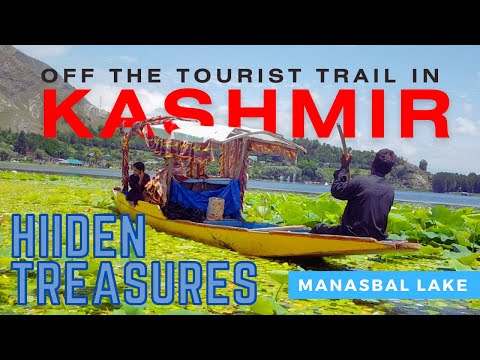
Manasbal is an attractive alternative for travelers who want a quieter lake experience.
During the warmer wet season, surrounding vegetation and lake landscapes can produce beautiful photography. Expect roughly 15–30°C depending on the month.
Allow half a day or combine it with nearby sightseeing.
Nature observation, lake views, bird photography and relaxed family time are the main attractions. It is more suited to slow travel than adventure tourism.
Budget around ₹500–₹2,000 per person for a day excursion from a nearby base.
Families, couples, seniors, solo travelers and students can all enjoy it. It is especially useful when a group contains different ages because no strenuous mountain trek is necessary.
Carry rain protection and mosquito/insect protection where appropriate. Do not assume every shoreline section is suitable for swimming; local water safety guidance matters.
For photography, lotus vegetation, reflections, birdlife and changing skies can produce stronger images than midday landscapes.
🌿 Kokernag – Springs, Gardens and a Relaxed Rainy-Season Break
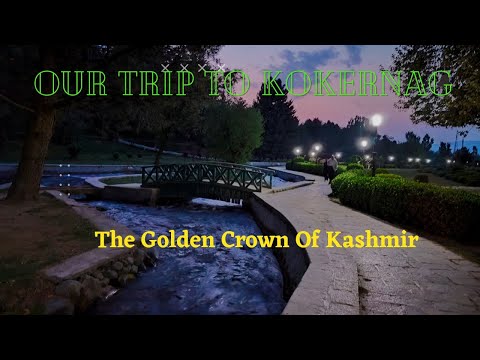
Kokernag works well for travelers who prefer gardens and flowing water to strenuous adventure.
JKTDC lists Kokernag among its established Kashmir destinations.
During the green season, expect broadly 13–28°C, with cooler periods after rainfall.
Allow half a day to one full day. Garden walks, spring landscapes, picnicking and photography make up the experience.
A budget of approximately ₹500–₹2,000 per person works for a straightforward excursion. Accommodation is available in the wider region, but travelers seeking a large choice may prefer a bigger nearby base.
Families, children, couples, seniors and student groups are particularly well suited. The destination’s relatively gentle character makes it easier for mixed-age parties than high-altitude trekking areas.
Pack an umbrella or rain jacket and non-slip footwear.
Wet pathways deserve more attention than dramatic travel photographs suggest. Senior travelers should avoid rushing over damp steps.
🏞️ Mansar Lake – Monsoon Picnic and Cultural Landscape

Mansar combines a lake outing with cultural and religious associations.
JKTDC notes temples beside Mansar and describes it as a significant religious site. Its official itineraries combine Mansar and Surinsar in short Jammu-region tours.
Monsoon weather in the Jammu region is warm and humid, commonly around 22–34°C, but rainfall can be heavy. IMD climate normals show July and August as particularly wet months in Jammu.
Allow half a day or a relaxed full day.
Budget around ₹500–₹2,000 per person. Lake views, family picnics, cultural sightseeing and photography are the principal experiences.
It works well for families, students, couples and seniors. Corporate groups can consider a day outing if road and weather conditions are favorable.
Carry an umbrella, hydration, quick-drying clothing and anti-slip footwear. Never enter lake water simply because it appears calm.
Heavy-rain days should be reconsidered rather than treated as an adventure challenge.
❄️ Best Places to Visit Jammu and Kashmir in Winter
Winter completely changes the region. High meadows become snow landscapes, road journeys require more flexibility, daylight shortens and warm clothing becomes essential. The reward is an experience unavailable in summer.
🎿 Gulmarg – The Classic Snow and Skiing Destination

Gulmarg is one of Jammu and Kashmir’s defining winter experiences.
Snow transforms the meadows and surrounding mountains into a major winter recreation landscape. Temperatures can remain around or below freezing, with practical winter ranges often roughly -10 to 7°C, depending on weather and elevation.
Stay 2–3 days if skiing or snow activities matter; one rushed day from Srinagar gives little margin for weather disruption.
Activities include snow play, skiing where conditions permit, winter photography and the famous Gondola experience when operational.
Budget approximately ₹3,000–₹10,000+ per person per day, because winter hotels, equipment, instructors, cable-car tickets and private transport can significantly increase costs.
Gulmarg suits couples, friends, photographers, active families and adventure travelers. Children can enjoy snow with close supervision. Seniors should consider cold tolerance, altitude, icy surfaces and mobility before planning extensive outdoor activity.
Carry thermals, waterproof insulated shoes, gloves, warm socks, sunglasses and multiple layers. Ordinary sneakers are inadequate in deep snow.
Never use unqualified ski instructors or walk onto unfamiliar snow slopes simply for photographs.
Cable-car operation and road access are weather dependent; check official information rather than assuming normal operation.
🌨️ Pahalgam – A Quiet Winter Valley

Pahalgam in winter feels very different from its busy summer personality.
Snow can soften the landscape, tourist numbers may be lower and the Lidder Valley takes on a quieter mood.
Expect broadly -5 to 10°C, with colder nights and weather-dependent snow.
Two nights allow enough time to enjoy the valley without rushing. Walk where conditions are safe, photograph snow-covered forests and spend time enjoying the slower pace.
Hotels remain available, though the choice of fully operating properties can vary seasonally. Confirm heating before booking—“room available” and “comfortably heated room” are not the same thing.
Allow roughly ₹2,500–₹6,000 per person per day.
Couples and romantic partners will appreciate the atmosphere, while families can enjoy snow experiences without making skiing the focus. Friends and photographers also have plenty to do.
Senior citizens should minimize walking on ice. Families with small children need waterproof gloves and spare socks because wet clothing becomes uncomfortable quickly.
Road conditions can change after snowfall, so keep itinerary buffers.
🌲 Patnitop – Accessible Jammu-Side Winter Hills

Patnitop provides a winter hill experience without requiring every traveler to build the entire trip around the Kashmir Valley.
The resort sits at about 2,024 metres in the Lower Himalayan region; JKTDC highlights its pine forests, mountain scenery and walking opportunities.
Winter temperatures can broadly range around -2 to 12°C, with snow possible depending on weather.
Stay 1–2 nights.
Enjoy forest landscapes, viewpoints, short walks where safe and winter photography. Nearby Kud is associated with Patisa sweets, while Batote is known for rajma in JKTDC’s tourism description.
Budget approximately ₹1,500–₹4,500 per person per day.
Patnitop suits couples, families, friends, students and corporate groups. It can also work for seniors when roads are clear and the itinerary minimizes slippery walks.
Accommodation includes hotels, huts and tourist facilities. JKTDC lists accommodation options at Patnitop itself.
Pack thermals, waterproof footwear and gloves. Drivers should check road conditions before climbing into the hills after snowfall.
🙏 Katra and Shri Mata Vaishno Devi – Winter Pilgrimage

Winter can provide a very different pilgrimage experience at Katra and Vaishno Devi.
The shrine lies in the Trikuta hills, and JKTDC describes the traditional climb from Katra as roughly 12 km, with the journey time varying according to weather, crowd levels and walking speed.
Katra itself is milder than high Kashmir destinations, but the pilgrimage route becomes colder with elevation. Conditions can broadly range from 5–20°C around the lower town, with significantly colder conditions higher up.
Plan 1–2 days, or longer if traveling with children or senior relatives.
Budget approximately ₹1,500–₹5,000 per person, excluding premium accommodation and optional services.
Hotels and vegetarian food are widely central to Katra’s pilgrimage economy. Transport links through Jammu make it one of the more straightforward major destinations in the region.
Families, devotional groups, friends, students and solo pilgrims visit, but suitability depends more on individual fitness than age labels.
Wear supportive walking shoes and layered winter clothing. Senior citizens, children and travelers with medical conditions should plan conservatively and consult relevant professional advice when needed.

Always verify current Shri Mata Vaishno Devi Shrine Board registration, route and service arrangements before travel rather than relying on an evergreen blog.
🏛️ Jammu City – Winter Heritage, Food and Family Travel

Jammu is sometimes treated merely as a transport gateway, but winter is an excellent season to slow down and explore it.
Unlike high-altitude Kashmir, Jammu generally experiences comparatively mild winter weather. IMD’s 1991–2020 climate normals show mean January minimum and maximum temperatures of approximately 7.3°C and 18.1°C respectively.
That makes daytime heritage sightseeing much easier than during the hottest months.
Spend 1–2 days exploring temples, heritage areas, museums, markets and local food before continuing towards Katra, Patnitop or other Jammu-region destinations.
Budget around ₹1,500–₹4,000 per person per day, depending on hotel category and transport.
Jammu is particularly suitable for families, children, seniors, students, solo travelers and groups because accommodation, restaurants, rail connections and urban facilities are easier to access than in remote mountain valleys.
Photographers should look beyond monuments: bazaars, Dogra architectural details, winter morning light and food markets can create a stronger visual story.
A light-to-medium jacket may suffice during many days, but nights require warmer clothing.
Normal urban precautions still apply. Use established transport at night and ask your accommodation about current local conditions rather than assuming that any neighborhood is universally safe after dark.
🧳 Which Season Should You Choose?
| Traveller Type | Best Choice | Why |
|---|---|---|
| 👨👩👧👦 First family trip | Summer | Easier sightseeing and wider outdoor options |
| 💑 Couple/Honeymoon | Summer or Winter | Green valleys versus snow landscapes |
| 🎿 Snow lover | Winter | Gulmarg and snow-oriented hill experiences |
| 🥾 Trekker | Summer | Better access to many mountain routes |
| 📸 Photographer | All seasons | Each season creates a different landscape |
| 👴 Senior citizen | Summer/early autumn | Generally easier temperatures and walking conditions |
| 🎓 Students | Summer | Nature, geography, history and group travel combine well |
| 👨💼 Corporate group | Summer | More practical outdoor team activities |
| 🌧️ Waterfall lover | Monsoon/green season | Aharbal and lush landscapes |
| 🚶 Solo traveler | Summer/Autumn | Easier mobility and broader accommodation choices |
| 💰 Budget traveler | Shoulder periods | Potentially better value, but compare live rates |
| 🧺 Picnic traveler | Summer/green season | Meadows, lakes and forests are more practical |
⚠️ Seasonal Safety and Packing Guide

| Season | Pack | Watch For |
|---|---|---|
| ☀️ Summer | Light layers, jacket, sunscreen, walking shoes, water bottle | UV exposure, sudden mountain rain, altitude |
| 🌧️ Monsoon | Raincoat, umbrella, waterproof bag, grippy footwear | Slippery paths, thunderstorms, landslides/road disruption |
| ❄️ Winter | Thermals, insulated waterproof footwear, gloves, cap, warm socks | Snowfall, black ice, flight/road delays, extreme cold |
| 🏔️ High Altitude | Layers, sunglasses, sun protection, water | Rapid weather changes and altitude-related discomfort |
No evergreen guide can reliably label a mountain destination “safe for night travel” throughout the year. Weather, road conditions and local circumstances change. For evenings, prefer populated tourism zones, pre-arranged transport and guidance from your accommodation. For intercity or mountain driving, check current weather and road advisories shortly before departure.
🌤️ So, What Is the Best Time to Visit Jammu and Kashmir?

For the broadest combination of green valleys, gardens, lakes, sightseeing, family holidays and accessible mountain landscapes, late spring through early summer is one of the easiest periods for a first visit. Winter is the stronger choice when snow and skiing are the purpose of the journey. Monsoon travel can be beautiful for waterfalls, forests and photography, but requires substantially greater flexibility—particularly in the Jammu hills, where climatological rainfall is much heavier in July and August.
The most useful rule is simple: choose the season according to the experience you want, not merely the cheapest package or the most popular photograph. Jammu and Kashmir changes character dramatically with weather and altitude. Giving each season its own itinerary produces a safer, slower and far more memorable journey.
🍽️ Best Dhabas, Restaurants & Food Places in Jammu and Kashmir
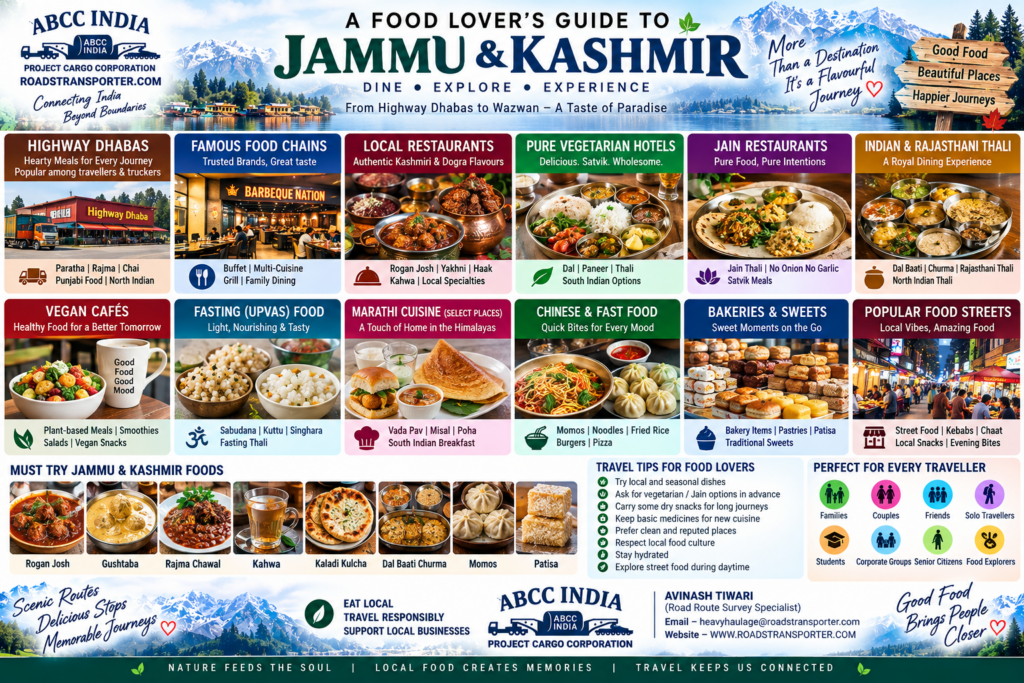
Jammu and Kashmir’s food scene is much broader than Wazwan alone. Jammu is strongly associated with Dogra dishes such as rajma, ambal, khatta meat, kaladi, madra and local sweets, while Kashmir’s culinary identity includes rogan josh, yakhni, dum olav, goshtaba, modur pulao and other traditional preparations. Official J&K tourism information documents these regional differences.
For an evergreen travel article, restaurant ratings, telephone numbers, opening hours, menus and prices should be treated as dynamic information. The Google ratings below are current search snapshots, not permanent scores. As requested, telephone numbers are partially masked.
🛣️ Verified Highway Dhabas, Local Restaurants, Pure-Veg & Famous Food Stops

| Name | Category | Address | Nearby Highway / Location | Famous Dishes / Best For | Meal Type | Cuisine | Veg / Non-Veg / Jain / Vegan | Approx Budget | Family Friendly | Parking | Contact* | Google Rating* | Why Visit | Travel Tip |
|---|---|---|---|---|---|---|---|---|---|---|---|---|---|---|
| The North Wok | Highway-side restaurant | National Highway, Channi Bypass, Jammu | National Highway / Channi Bypass | Kashmiri & multi-cuisine meals | Lunch, Dinner | Kashmiri / Indian | Veg + Non-Veg | ₹400–1,200 | Yes | Check onsite | +91 9•••••6606 | 4.6 | Convenient higher-end highway meal stop | Useful before/after Jammu road journeys |
| Lambad Da Dhaba | Traditional Dhaba | Ratnuchak, Sanjay Nagar, Jammu | Jammu outskirts | Dhaba-style Indian meals | Lunch, Dinner | North Indian / Dhaba | Veg + Non-Veg | ₹200–700 | Yes | Check onsite | Not listed | 4.0 | Casual local dhaba experience | Ask about day’s freshest preparations |
| Pooja Vaishno Dhaba | Pilgrim Dhaba | Ban Ganga Road, Main Bazaar, Katra | Vaishno Devi pilgrimage area | Vegetarian North Indian meals | Breakfast–Dinner | Indian | Vegetarian | ₹100–300 | Yes | Limited/local | 01991-2•••98 | 4.6 | Budget food near pilgrimage route | Good for simple pre/post-yatra meals |
| Peerah Wale (Sharma Vaishno Dhaba) | Vegetarian Dhaba | Hari Singh Chowk, Katra | Katra | Vegetarian dhaba meals | Breakfast–Late Dinner | North Indian | Vegetarian | ₹100–300 | Yes | Check onsite | +91 9•••••6800 | 4.9 | Long operating window and economical food | Verify current late-night service |
| Laajawaab Food court | 24-hour Food Court | Purana Droorh, Katra | Katra | Indian fast meals | All-day / Late Night | Indian | Options vary | ₹100–300 | Yes | Check onsite | +91 8•••••1042 | 4.8 | Current listing reports 24-hour operation | Reconfirm hours before relying on it overnight |
| TULSI khana khazana | Family Restaurant | Jammu Road, Katra | Jammu–Katra corridor | Indian family meals | Breakfast–Dinner | Indian | Veg options | ₹200–1,000 | Yes | Check onsite | +91 7•••••8023 | 4.5 | Convenient for families entering/leaving Katra | Highway traffic can affect arrival time |
| Khaana Khazana | Local Restaurant | B.C. Road, near Bus Stand, Jammu | Jammu Bus Stand | North Indian meals | Lunch, Dinner | North Indian | Veg + Non-Veg | ₹250–800 | Yes | Limited/nearby | +91 9•••••2361 | 4.0 | Central location for travelers | Convenient around bus connections |
| Kake Di Hatti (Pure Veg Restaurant) Jewel Chowk | Pure-Veg Restaurant | Jewel Chowk, Jammu | Central Jammu | Dal, paneer, breads, North Indian meals | Lunch, Dinner | North Indian | Pure Veg | ₹250–700 | Yes | Nearby | +91 9•••••5254 | 4.5 | Strong option for vegetarian families | Portions can be substantial |
| Kesar home stay and pure veg.restaurant | Pure-Veg Restaurant | Gumat Chowk, Jammu | Central Jammu | Vegetarian Indian meals | Breakfast–Dinner | Indian | Pure Veg | ₹200–700 | Yes | Check onsite | +91 9•••••1652 | 4.5 | Central vegetarian option | Useful for mixed-age family groups |
| Satgur Kitchen | Vegetarian Restaurant | Vasant Vihar, Trikuta Nagar, Jammu | Trikuta Nagar | Vegetarian meals | Breakfast–Dinner | Indian | Vegetarian | ₹200–600 | Yes | Check onsite | +91 9•••••6949 | 4.7 | Useful vegetarian neighborhood restaurant | Confirm special dietary requests beforehand |
| Barbeque Nation – Jammu | Premium Chain / Corporate Dining | Greater Kailash, Jammu | Jammu city | Buffet / grills | Lunch, Dinner | Indian / Barbecue | Veg + Non-Veg | ₹800–1,500+ | Yes | Check property | 080-6•••••31 | 4.4 | Groups, celebrations and corporate dining | Reserve for large groups |
| Stream Restaurant | Famous Local Restaurant | Boulevard Road, opposite Ghat 2, Srinagar | Dal Lake / Dalgate | Kashmiri dishes & Indian meals | Lunch, Dinner | Kashmiri | Veg + Non-Veg | ₹400–1,200 | Yes | Limited area | 0194-2•••44 | 4.7 | Popular location beside Dal Lake tourism zone | Peak dinner hours can be busy |
| Ahdoos Restaurant | Heritage-style Famous Restaurant | Residency Road, Srinagar | Lal Chowk / Residency Road | Traditional Kashmiri cuisine | Lunch, Dinner | Kashmiri | Veg + Non-Veg | ₹500–1,500 | Yes | Nearby/limited | +91 7•••••0634 | 4.1 | Established name for Kashmiri dining | Try regional food rather than generic dishes |
| Wah Kabab | Mughlai / Kebab Restaurant | Court Road, Lal Chowk, Srinagar | Lal Chowk | Kebabs & Mughlai food | Lunch, Dinner, Late Evening | Mughlai | Primarily Non-Veg + options | ₹300–900 | Yes | Limited | 0194-2•••55 | 4.8 | Strong choice for meat and kebab lovers | Vegetarians have better specialist options elsewhere |
| Kake Di Hatti Srinagar | Vegetarian Restaurant | Khon Khan Chowk, Khayam, Srinagar | Khayam | Dal, paneer, breads | Lunch, Dinner | North Indian | Vegetarian | ₹250–700 | Yes | Limited | +91 8•••••1213 | 4.6 | Familiar North Indian vegetarian food | Useful for travelers wanting a break from Kashmiri cuisine |
| Winterfell Café | Café | Boulevard Road, opposite Ghat 5, Srinagar | Dal Lake | Café meals, beverages, snacks | Breakfast, Snacks, Dinner | Café / Continental-style | Veg + Non-Veg | ₹300–900 | Yes | Limited | +91 9•••••2389 | 4.3 | Café break near Dal Lake | Attractive stop between lake sightseeing |
| Punjabi Rasoi | Punjabi Restaurant | Bus Stand, Pahalgam | Pahalgam Market | Punjabi / North Indian comfort food | Breakfast–Dinner | Punjabi | Veg + options | ₹250–700 | Yes | Nearby | +91 9•••••5555 | 4.7 | Familiar meals for families in Pahalgam | Convenient for market sightseeing |
| Khaasiyat | Vegetarian Restaurant | Main Market, KP Road, Pahalgam | Main Market | Vegetarian Indian meals | Breakfast–Dinner | Indian | Vegetarian | ₹250–700 | Yes | Nearby | +91 9•••••8985 | 4.9 | Highly rated current vegetarian option | Good choice for vegetarian family groups |
| Cafe Wilo | Café / Restaurant | Near Amusement Park, Pahalgam | Pahalgam | Café meals & snacks | Lunch, Snacks, Dinner | Multi-cuisine | Veg + Non-Veg | ₹300–900 | Yes | Check onsite | Not listed | 4.3 | Relaxed café stop during Pahalgam sightseeing | Better suited to leisure dining than a quick highway meal |
| Sifar Pahalgam | Restaurant | Hotel Raj Palace, Main Market, Pahalgam | Pahalgam Market | Multi-cuisine meals | Lunch, Dinner | Indian / Multi-cuisine | Veg + Non-Veg | ₹400–1,000 | Yes | Check hotel | +91 9•••••2829 | 4.5 | Central market dining | Ask about seasonal specialties |

Ratings, hours and contact information can change. Verify immediately before publication or travel.
🥗 Verified Pure Vegetarian & Jain Food in Srinagar

Two establishments deserve separate attention because their own websites explicitly document dietary facilities rather than requiring us to infer them.
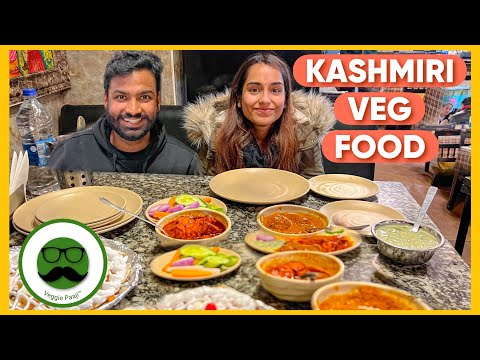
Pushpa Pure Vegetarian Restaurant, Dalgate Bridge opposite Durga Nag Mandir, describes itself as a 100% vegetarian kitchen and explicitly advertises Jain meals prepared without onion, garlic or root vegetables. Its menu covers Kashmiri vegetarian specialties, North Indian and South Indian food, and its current website lists a 4.5/5 Google rating.
Hotel New Mamta Restaurant, below Dalgate, states that its restaurant is 100% vegetarian and offers North Indian, Punjabi, South Indian, Indo-Chinese and a specialized Jain selection without onion, garlic or root vegetables.
These are substantially safer recommendations for an article promising Jain food in Srinagar than assuming an ordinary vegetarian restaurant can meet strict Jain preparation requirements.
🍛 What Food Should Travelers Actually Try?

| Region / Style | Foods Worth Looking For | Suitable For |
|---|---|---|
| Jammu / Dogra | Rajma-Chawal, Kaladi/Kalari, Ambal, Madra, Khatta Meat, Auriya | Local-food explorers |
| Kashmir | Rogan Josh, Yakhni, Gushtaba, Dum Olav, Modur Pulao, Lyodur Tschaman | Traditional cuisine |
| Wazwan | Multi-dish Kashmiri feast | Groups & serious food travelers |
| Vegetarian Kashmir | Dum Olav, Haak, Nadru dishes, paneer preparations | Vegetarians |
| Katra | Sattvik vegetarian meals, North Indian thali | Pilgrims & families |
| Jammu Street Food | Kaladi Kulcha, Gol Gappe, Kachaalu, Rajma Kulcha | Budget travelers |
| Sweets | Patisa, chocolate barfi, phirni and regional sweets | Families / food souvenirs |
| Drinks | Kahwa | Almost every traveler |
J&K Tourism specifically identifies Jammu with rajma, aloo dum, Kashmiri pulao, patisa, chocolate barfi and kaladi, while also documenting Dogra dishes such as ambal, khatta meat and madra. Its Kashmir cuisine guide identifies dishes including rogan josh, yakhni, dum olav, goshtaba and modur pulao.
🌮 Popular Food Areas Rather Than Invented “Food Streets”

For Srinagar, Lal Chowk–Residency Road, Khayam and the Boulevard/Dalgate tourism belt provide useful concentrations of restaurants and cafés. For Jammu, Residency Road, Raghunath Bazaar/Gumat, Jewel Chowk and central-city markets are practical food-hunting areas. Katra Main Bazaar and Ban Ganga Road naturally cater heavily to pilgrims, particularly vegetarian travelers.

⚠️ Requested Foods That Need Careful Treatment

Rajasthani thali, dal baati, litti chokha, Marathi cuisine and dedicated vegan cafés are not defining cuisines of Jammu and Kashmir. Individual restaurants may offer them, but I would not advertise specific establishments as specialist destinations without current menu verification.
Likewise, a restaurant being vegetarian does not automatically make it Jain or vegan. Vegan travelers should specifically ask about milk, paneer, curd, butter and ghee; Jain travelers should confirm onion, garlic, root vegetables and preparation practices.

There is also no local sea coast, so seafood should not be marketed as a regional Jammu and Kashmir specialty. Fish dishes do exist in Kashmiri cuisine—the official tourism cuisine guide, for example, identifies Kashmiri Muji Gaad—but that is very different from coastal seafood tourism.
For Upvas/fasting food, Katra is the logical place to look because of its pilgrimage economy, but menus change around religious periods. Rather than claiming permanent sabudana khichdi, kuttu, singhara or vrat-thali availability at a particular restaurant, call ahead and confirm the day’s fasting menu.
Finally, 24×7 claims are especially dynamic. The current listing for Laajawaab Food court reports 24-hour operation, but travelers and publishers should recheck this rather than turning a live business listing into a permanent evergreen claim.

🏭 Industrial Evolution & Economic Landscape of Jammu and Kashmir
Jammu and Kashmir’s economy is unusual because its industrial identity was never built around one giant manufacturing belt. It developed through agriculture and horticulture, handicrafts and handloom, tourism, food processing, forest-based livelihoods, sericulture, small manufacturing, construction and services, while modern industrial estates around Jammu and Kashmir have gradually added pharmaceuticals, packaging, engineering, food processing and other organized industries.

Today, Jammu and Kashmir is a Union Territory, not a state. For search relevance, phrases such as “Jammu and Kashmir State industries” may still appear naturally, but investors should use the current administrative structure when dealing with policies, land or approvals.
The latest official Economic Survey shows just how service-oriented the economy has become. Services are estimated to account for 61.02% of GSVA, the primary sector 20.45%, and the secondary sector 18.52% in 2025–26. Agriculture and allied activities nevertheless remain exceptionally important for employment, accounting for 42.99% of the workforce in the referenced PLFS data.

📊 Jammu and Kashmir Economy at a Glance

| Economic Area | Importance | Major Activities | Business Opportunity |
|---|---|---|---|
| Horticulture | Very High | Apples, walnuts, saffron, cherries, dry fruits | CA storage, grading, packaging, processing |
| Agriculture | High | Rice, maize, vegetables, mushrooms, garlic | Food processing, farm logistics |
| Handicrafts | Globally distinctive | Pashmina, carpets, papier-mâché, woodwork, embroidery | Premium exports, e-commerce |
| Tourism | Major service sector | Leisure, pilgrimage, adventure, hospitality | Hotels, transport, experiences, food |
| Food Processing | Growing | Fruits, honey, spices, dairy, mushrooms | MSMEs, branded foods |
| Pharmaceuticals | Expanding organized industry | Formulations and related manufacturing | Manufacturing and supply chain |
| Handloom/Textiles | Traditional + export oriented | Shawls, tweed, wool products | Design, branding, exports |
| Sports Goods | Specialized cluster | Kashmir willow cricket bats | Manufacturing, sports exports |
| Sericulture | Traditional rural industry | Silk and cocoons | Value-added textiles |
| Construction | Important secondary activity | Roads, tunnels, housing, infrastructure | Materials, machinery, logistics |
| IT/ITeS | Emerging | Digital services and startups | Software, BPO, digital commerce |
| Renewable Energy | Long-term potential | Hydropower and clean-energy ecosystem | Equipment and services |
| Logistics | Strategic growth sector | Road, rail, air, warehousing | Cold chain, trucking, distribution |
Tourism alone is estimated by the 2025–26 Economic Survey to contribute nearly 7% of J&K’s GSDP and support around five lakh direct and indirect livelihoods, illustrating why hospitality, transport, retail and handicrafts need to be considered part of the economic story rather than merely tourism activities.
🕰️ From Artisan Economy to Modern Industrialization

For centuries, Kashmir’s economic reputation travelled far beyond the Himalayas through skilled craftsmanship rather than factories. Shawls, carpets, wood carving, papier-mâché and other handmade products created decentralized production networks in which skills were frequently transmitted within families and communities.
Jammu developed a somewhat different economic base, drawing on agriculture, trade, pilgrimage, food products and its position as a gateway connecting the plains with mountain districts.
Modern institutional industrialization became more structured after independence. The J&K Industries and Commerce Department states that the department was established in 1970, with directorates and public-sector organizations covering industries, handicrafts, handloom, minerals, cement, entrepreneurship and village industries. The department says the industrial network subsequently expanded across numerous industrial estates.
The next major transition was from protected small-scale manufacturing towards industrial estates, private investment, food processing, pharmaceuticals and service industries.
A new phase followed the 2019 administrative reorganization. The New Central Sector Scheme for Industrial Development of Jammu & Kashmir, introduced in 2021, carries an overall outlay of ₹28,400 crore and was designed to encourage industrial and service-sector investment and employment.
Rather than describing this as one conventional “industrial revolution,” it is more accurate to view Jammu and Kashmir as undergoing several overlapping transformations: traditional craft commercialization, horticultural modernization, industrial-estate development, tourism expansion, infrastructure integration and digital entrepreneurship.
🏗️ Major Industrial Estates & Manufacturing Clusters

Industrial development has historically involved organizations such as SIDCO and SICOP alongside the Industries & Commerce Department. The department’s own institutional history identifies SIDCO and SICOP among its industrial organizations.

| Industrial Area / Cluster | Region | Broad Industrial Character |
|---|---|---|
| Bari Brahmana | Samba/Jammu belt | Manufacturing, pharmaceuticals, engineering, consumer products |
| Samba Industrial Area | Samba | Manufacturing and processing |
| Kathua Industrial Belt | Kathua | Manufacturing, pharmaceuticals, processing |
| Gangyal | Jammu | Small and medium manufacturing |
| Digiana | Jammu | Industrial/commercial activity |
| Birpur | Jammu region | Industrial development |
| Lassipora | Pulwama | Industrial estate and manufacturing |
| Khonmoh | Srinagar | Manufacturing and industrial units |
| Rangreth | Srinagar/Budgam area | Electronics/IT and industrial activity |
| Zainakote | Srinagar | Industrial estate |
| Zakura | Srinagar | Small industrial activity |
| Sopore/Baramulla belt | North Kashmir | Horticulture, processing and trading |
| Pampore–Pulwama | South Kashmir | Saffron, horticulture and processing |
| Anantnag/Bijbehara belt | South Kashmir | Food/horticulture and willow-based activity |
Because individual estate boundaries, land availability and allotment status change, investors should confirm a proposed plot through the J&K Industries & Commerce Department / InvestJK single-window system, rather than relying on an evergreen tourism article. The Private Industrial Estate Development Policy provides for private industrial estates and IT/ITeS parks through the single-window framework.
🍎 Horticulture – The Economic Bridge Between Farm and Factory

If there is one sector where Jammu and Kashmir can create enormous additional value without losing its regional identity, it is horticulture.
Apples are the obvious example, but the opportunity extends to walnuts, cherries, saffron, vegetables, honey, mushrooms, aromatic plants and other specialized produce.

The old economic model was largely:
Farm → trader → wholesale market → consumer
The higher-value model is:
Farm → grading → sorting → controlled storage → processing → branded packaging → domestic/export distribution
That transformation creates opportunities for reefer transport, controlled-atmosphere warehouses, crates, packaging, juice and concentrate production, dehydrated foods, quality laboratories, traceability technology and e-commerce.

The government’s Holistic Agriculture Development Plan has been designed around 29 projects with planned investment of ₹5,013 crore, according to the Economic Survey.
🧶 Handicrafts – Jammu and Kashmir’s Original Global Industry

Long before “Make in India” became modern industrial vocabulary, Kashmir’s artisans were producing internationally recognizable goods.
The craft economy remains particularly important because manufacturing happens not only in factories but in homes, workshops and artisan clusters.
Official GI records provide unusually strong protection for this identity.
🏷️ Important GI-Registered Products of Jammu and Kashmir

| GI Product | Category | Economic Value |
|---|---|---|
| Kashmir Pashmina | Handicraft | Premium shawls/textiles |
| Kashmir Sozani Craft | Handicraft | Fine embroidery |
| Kani Shawl | Handicraft | Luxury woven textiles |
| Kashmir Paper Machie | Handicraft | Decorative products |
| Kashmir Walnut Wood Carving | Handicraft | Furniture/decor |
| Khatamband | Handicraft | Architectural wood craft |
| Kashmiri Hand Knotted Carpet | Handicraft | Premium carpets |
| Basohli Painting | Handicraft | Traditional art |
| Rajouri Chikri Wood Craft | Handicraft | Wood craft |
| Basohli Pashmina Woollen Products | Handicraft | Wool products |
| Kashmir Namda | Handicraft | Felted floor covering |
| Kashmir Wagguv | Handicraft | Traditional matting |
| Shikara | Handicraft | Traditional craftsmanship |
| Gabba | Handicraft | Textile floor covering |
| Kashmir Willow Bat | Handicraft | Cricket/sports goods |
| Kashmir Chain Stitch | Handicraft | Embroidery |
| Kashmir Crewel | Handicraft | Embroidered textiles |
| Kashmir Tweed | Handicraft | Wool textile |
| Mushqbudji Rice | Agricultural | Premium aromatic rice |
| Bhaderwah Rajmash | Agricultural | Specialty beans |
| Ramban Anardana | Agricultural | Specialty food product |
| Ramban Sulai Honey | Foodstuff | Premium honey |
| Udhampur Kaladi | Foodstuff | Traditional dairy product |
These products appear on the official Indian GI registry; newer records include Kashmir Namda, Wagguv, Gabba, Chain Stitch and Crewel.
A useful publishing precaution is to distinguish registered GI products from pending applications. For example, the official database currently shows Kashmiri Kala Zeera and Paddar/Kishtwar Blue Sapphire at pre-examination stages rather than as registered GIs.
🏏 Kashmir Willow Cricket Bat Industry

One of the most interesting specialized manufacturing stories is the Kashmir willow bat industry.
The sector links forestry/raw material, skilled shaping, seasoning, sports manufacturing, branding and domestic distribution. Kashmir Willow Bat itself appears in India’s registered GI list.
For entrepreneurs, the future opportunity is not simply selling more unfinished bats. It lies in better seasoning technology, standardized quality, branded finished products, sports retail partnerships, traceability and export positioning.
💊 Pharmaceuticals and Modern Manufacturing
The Jammu–Samba–Kathua industrial corridor has become important for organized manufacturing, including pharmaceuticals.
Current central-government data shows that 29 pharmaceutical units had received registration under NCSS 2021, with 24 having commenced operations. Separate pharmaceutical PLI investments were also reported in the UT.
This creates secondary demand for packaging, temperature-sensitive transport, warehousing, laboratory services, engineering maintenance, industrial safety, employee transport and B2B distribution.
📦 ODOP – One District One Product

Technically, the relevant program is One District One Product (ODOP) rather than “One State One Product.”
JKTPO’s published list identifies 21 products across J&K’s 20 districts.
| District | ODOP Product |
|---|---|
| Jammu | Basmati Rice |
| Samba | Mushroom |
| Ramban | Honey |
| Reasi | Aromatic Plants |
| Doda | Natural Oils / Lavender |
| Udhampur | Garlic |
| Poonch | Pecan Nut |
| Rajouri | Walnut |
| Kishtwar | Saffron |
| Kathua | Basohli Painting + Basohli Pashmina |
| Anantnag | Trout Fish |
| Bandipora | Crewel |
| Baramulla | Apple |
| Budgam | Kani Shawl |
| Ganderbal | Willow Wicker |
| Kulgam | Garlic |
| Kupwara | Walnut |
| Pulwama | Saffron |
| Shopian | Apple |
| Srinagar | Silk Carpet |
![कश्मीर में केसर की खेती बचाने की कोशिशें [Safeguarding the future of saffron production]](https://i.ytimg.com/vi/l1j20aIed5M/hqdefault.jpg)
This is more than a tourism-shopping list. ODOP can connect farmers and artisans with processing, branding, packaging, logistics, e-commerce and export markets.
🚚 Logistics Infrastructure – The Hidden Engine of Growth
Geography has historically been one of Jammu and Kashmir’s greatest economic constraints.
Mountain roads, snow, landslide exposure, long freight routes and the absence of a seaport increase logistics complexity. This makes transport infrastructure disproportionately important.
Jammu functions as a major gateway for road and rail freight. National highways connect the region with Punjab and the rest of India, while improvements in tunnels, highways, bridges, railways and airports are progressively reducing logistical isolation.
The economic importance is easy to understand with apples. A fruit can be excellent when harvested but lose value through poor handling, temperature fluctuation, delayed trucking or inadequate storage. Therefore, cold-chain logistics is effectively part of horticultural manufacturing.
High-potential logistics businesses include reefer trucks, controlled-atmosphere storage, consolidation centers, palletization, packaging, last-mile distribution, warehouse management, e-commerce fulfillment and specialized project-cargo movement.
🚆 Rail, Road and Air Connectivity
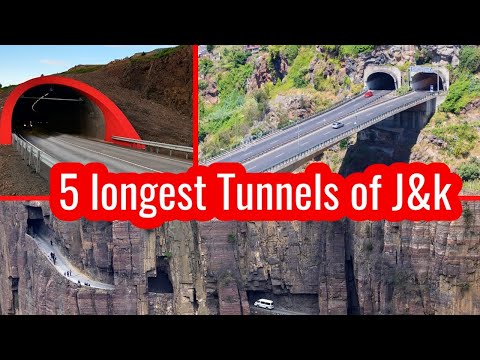
The Economic Survey records continued expansion of railway connectivity into Kashmir, alongside electrification, airport improvements and highway projects.
For industrial investors, better connectivity potentially changes the economics of locating production inside the UT. Reduced transit uncertainty can help manufacturers carry lower inventories, improve delivery reliability and reach national markets more efficiently.
But mountain logistics will remain different from plains logistics. Businesses should budget for seasonal buffers, route restrictions, weather disruption and higher last-mile costs rather than building projections around ideal travel times.
💼 MSMEs, Startups and Entrepreneurship
Jammu and Kashmir’s strongest entrepreneurship opportunity may not be a landscape of enormous factories. It may instead be thousands of small, specialized enterprises built around local competitive advantages.
Potential businesses include apple grading, dry-fruit packaging, saffron branding, spice processing, honey bottling, wool products, craft e-commerce, tourism technology, homestay services, logistics, adventure equipment, digital marketing, waste management and renewable energy.
Food-processing formalization is already visible. Central-government figures show 389 J&K micro food-processing enterprises formalized under PMFME through the end of 2025, with ₹126.71 crore of investment mobilized under the scheme in the UT.
For startups, the biggest opportunity is often to solve an existing local problem rather than copy a metropolitan app: orchard traceability, tourist mobility, craft authenticity, rural logistics, cold storage utilization and market access are examples.
🏢 Government Policies and Investment Push
The modern investment framework includes the J&K Industrial Policy 2021–30, Industrial Land Allotment Policy, Private Industrial Estate Development Policy, Single Window Rules and other sector-support measures.
The flagship central industrial-development scheme carries an outlay of ₹28,400 crore. Its incentive framework includes capital investment support, capital-interest support, GST-linked incentives and working-capital support subject to eligibility conditions.
Government figures reported nearly ₹18,000 crore of investment between 2016–17 and 2025–26, although investment statistics should always be read carefully because proposals, approvals, committed investment and actually grounded investment are different measurements.
That distinction is particularly important for responsible business reporting.
👷 Employment – Where the Jobs Come From
Jammu and Kashmir’s employment structure demonstrates why development cannot be judged solely by factory construction.
Agriculture and allied sectors account for a large workforce share, while services dominate value addition. Construction, tourism, retail, transport and small businesses therefore matter alongside formal manufacturing.
Future employment can increasingly come from:
farmer → processor → packer → warehouse → transporter → exporter → retailer
and
artisan → designer → certifier → brand → e-commerce platform → exporter
The more stages retained locally, the more economic value can remain within Jammu and Kashmir.
👩💼 Companies, Corporate Houses, Entrepreneurs and Cooperatives

This subject requires care. Jammu and Kashmir’s industrial story should not be rewritten around famous personalities merely because their names attract search traffic.
A more defensible way to understand business leadership is through four groups:
| Business Actor | Contribution |
|---|---|
| Local MSME owners | Manufacturing, services and local employment |
| Artisan families/cooperatives | Preserve craft knowledge and production |
| Farmer/FPO/cooperative networks | Aggregate horticulture and agricultural output |
| Larger Indian corporate investors | Bring capital, technology, supply chains and organized employment |
| Hotel/hospitality businesses | Tourism employment and destination infrastructure |
| Pharmaceutical manufacturers | Industrial employment and supply-chain demand |
| Startups | Digitization, market access and innovation |
| Women-led SHGs/enterprises | Food processing, handicrafts and rural livelihoods |
| Public institutions/PSUs | Industrial infrastructure, finance and market development |
Organizations such as J&K SIDCO, SICOP, J&K Industries, J&K Handicrafts Corporation, J&K Handloom Development Corporation and J&K Khadi & Village Industries Board have historically formed part of the institutional industrial ecosystem.
🛍️ Economic Shopping in Jammu and Kashmir
Travel spending can become a form of local economic participation when visitors purchase authentic products directly from legitimate artisans, cooperatives and established merchants.
🛒 What to Buy and Where to Look
| Product | Strong Shopping Area | What to Check | Best Buyer |
|---|---|---|---|
| Pashmina | Srinagar | Authenticity/GI information | Premium shoppers |
| Carpets | Srinagar | Material, knotting, provenance | Home/interior buyers |
| Papier-mâché | Srinagar | Hand-painted workmanship | Souvenir buyers |
| Walnut wood carving | Kashmir markets | Wood/workmanship | Decor buyers |
| Kani/Sozani work | Srinagar/Budgam | Handwork authenticity | Textile collectors |
| Saffron | Pampore/Srinagar | Source, labeling, authenticity | Food/gift buyers |
| Apples | Shopian/Baramulla markets | Grade/season | Food buyers |
| Walnuts | Kashmir/Jammu markets | Quality and kernel condition | Retail/wholesale |
| Kaladi | Jammu/Udhampur | Freshness/cold handling | Food travelers |
| Basohli art | Kathua/Basohli | Artist/provenance | Art collectors |
| Basohli Pashmina | Kathua region | Authentic product identity | Textile buyers |
| Rajma | Bhaderwah/Jammu markets | Variety/source | Food shoppers |
| Honey | Ramban/Jammu markets | Producer and labeling | Food/wellness buyers |
| Willow cricket bats | South Kashmir | Willow grade/workmanship | Sports buyers |
🏪 Famous Traditional Shopping Areas
For travelers rather than bulk industrial buyers, Lal Chowk, Residency Road and older Srinagar market areas are useful starting points for Kashmiri products. Jammu’s Raghunath Bazaar and central commercial markets offer textiles, dry foods, religious goods and everyday retail.
However, wholesale buyers should not treat a tourist bazaar as a procurement strategy.
A manufacturer or exporter purchasing carpets, fruit, saffron, walnuts or handicrafts in volume should work through verified producers, cooperatives, FPOs, registered traders or industry bodies and request invoices, specifications and certification where relevant.
⚠️ Economic Challenges
Jammu and Kashmir has considerable potential, but investors need to model the difficult parts as seriously as the opportunities.
| Challenge | Business Impact | Possible Response |
|---|---|---|
| Mountain geography | Higher freight costs | Regional warehousing |
| Weather disruption | Delivery uncertainty | Inventory and route buffers |
| Small land holdings | Fragmented supply | FPO/cooperative aggregation |
| Perishable horticulture | Post-harvest losses | Cold chain and processing |
| Craft imitation | Damages premium value | GI/authenticity systems |
| Seasonal tourism | Uneven cash flow | Year-round tourism products |
| Skill gaps | Recruitment difficulty | Industry-linked training |
| Limited local scale | Higher unit costs | Cluster/shared infrastructure |
| Environmental sensitivity | Limits unsuitable industry | Low-impact, circular manufacturing |
| Remote districts | Market-access difficulty | Digital commerce + logistics |
The goal should not be industrialization at any environmental cost. The region’s natural landscape is itself an economic asset supporting tourism, agriculture and quality of life.
🚀 Future Business Opportunities
The strongest future opportunities sit where Jammu and Kashmir already has a natural or cultural advantage.
Food processing and cold chain can capture more value from apples, walnuts, saffron, honey, mushrooms, vegetables and dairy.
GI-based premium brands can transform craft authenticity into stronger pricing rather than competing with mass-produced imitations.
Tourism technology and experience businesses can serve the substantial hospitality economy.
Pharmaceutical and healthcare supply chains can grow around established industrial activity.
Warehousing, reefer transport and freight consolidation can address structural logistics constraints.
IT/ITeS and remote digital services are less dependent on mountain freight.
Renewable energy, waste management and sustainable packaging fit a region where environmental quality is economically valuable.
Lavender and aromatic-plant processing, food brands, sports goods, rural experiences and craft-tech platforms also provide opportunities for smaller entrepreneurs.
📈 Practical Takeaway for Investors, Manufacturers and Entrepreneurs

Jammu and Kashmir should not be approached as a cheaper imitation of an established industrial state such as Maharashtra, Gujarat or Tamil Nadu.
Its competitive advantage is different.
The region has high-value horticulture, internationally recognized crafts, pilgrimage and leisure tourism, specialty foods, pharmaceuticals, sports goods, human skills and increasingly stronger physical connectivity.
A sensible investor begins by asking:
What does Jammu and Kashmir produce unusually well, and what value is currently leaving the region because processing, branding, storage, technology or logistics are missing?
That question leads naturally toward cold chains, fruit processing, branded saffron and walnuts, GI-certified handicrafts, sports goods, tourism services, digital businesses, pharmaceuticals and specialized logistics.
The official economic structure reinforces this approach: services currently dominate GSVA, agriculture remains a major source of livelihoods, while manufacturing and construction form part of a smaller but developing secondary economy.
For travelers, economic shopping means buying thoughtfully—choosing authentic crafts, locally produced food, regional art and legitimate small businesses rather than merely hunting for the cheapest souvenir. For entrepreneurs, the same principle scales upward: Jammu and Kashmir’s strongest long-term opportunity is not replacing its traditional economy, but connecting its distinctive products and skills to modern processing, technology, branding, finance, logistics and national and global markets.
🛍️ Economic Shopping & Business Growth Guide for Jammu and Kashmir, India
Jammu and Kashmir’s commercial strength lies in the unusual way tourism, horticulture, handicrafts, agriculture, pilgrimage, manufacturing and logistics meet in one economy. Srinagar is a major consumption, handicraft and horticultural-trade centre; Jammu acts as a powerful wholesale, transport and distribution gateway to northern India; while districts such as Pulwama, Shopian, Baramulla, Budgam, Kathua, Samba and Udhampur contribute specialized agricultural or industrial activity.
For investors, an important correction is necessary: Jammu and Kashmir is a Union Territory, and it does not have Maharashtra-style “MIDCs.” The correct terms are industrial estates, industrial zones and private industrial estates. The J&K Industries & Commerce Department maintains the industrial policy and single-window framework.
📊 Economic Shopping & Business Landscape at a Glance
| Sector | Important Locations | Major Products/Activity | Buyer/Investor Opportunity |
|---|---|---|---|
| Handicrafts | Srinagar, Budgam | Pashmina, carpets, embroidery, papier-mâché | Retail, exports, e-commerce |
| Horticulture | Shopian, Baramulla, Sopore, Pulwama | Apples, walnuts, cherries | Grading, cold storage, processing |
| Saffron | Pampore/Pulwama | Saffron | Premium branding/export |
| Agriculture | Jammu, Kathua, Samba, Udhampur | Basmati, vegetables, mushrooms, garlic | Processing/distribution |
| Dry Fruits | Kashmir + Jammu markets | Walnuts, almonds, dried fruit | Wholesale/retail |
| Tourism Retail | Srinagar, Gulmarg, Pahalgam, Katra | Crafts, foods, souvenirs | Retail/hospitality |
| Pilgrimage Economy | Katra–Jammu | Hotels, food, transport, retail | Tourism services |
| Manufacturing | Bari Brahmana, Samba, Kathua | Pharma, engineering, packaging, consumer goods | B2B manufacturing |
| Food Processing | Jammu and Kashmir industrial clusters | Fruit, spices, honey, dairy | MSME investment |
| Logistics | Jammu–Samba–Kathua corridor | Freight, warehousing, distribution | 3PL, trucking, warehouses |
| Startups | Jammu, Srinagar, Pampore | Technology and services | Incubation/digital businesses |
🏪 Famous Shopping Markets & Retail Hubs
For travelers, local shopping is one of the easiest ways to connect tourism expenditure with the regional economy. However, souvenir shopping and commercial procurement should be treated differently.
Srinagar Shopping
POLO VIEW MARKET is one of the most convenient central shopping areas around Regal Chowk. It is useful for visitors comparing handicrafts, garments and other retail products without traveling deep into wholesale areas.
Aftab Market in Lal Chowk represents the busier everyday commercial character of central Srinagar, while Sonwar Main Market serves another active local shopping district.
For visitors specifically interested in regional craftsmanship, JAMMU & KASHMIR GOVERNMENT ARTS EMPORIUM on Residency Road is particularly relevant because it focuses on the handicraft economy.
Modern retail is represented by locations including City Mall and Sangar Mall.
Srinagar Shopping Comparison
| Area | Best For | Buyer Type | Main Advantage |
|---|---|---|---|
| Lal Chowk | General retail, garments, everyday shopping | Tourist + Local | Central location |
| Polo View | Crafts, clothing, relaxed shopping | Tourist | Walkable retail environment |
| Residency Road | Crafts and established shops | Tourist + Premium Buyer | Convenient central area |
| Dalgate | Tourism-oriented products | Travelers | Close to Dal Lake |
| Downtown Srinagar | Traditional commerce | Experienced shopper | Local market character |
| Pampore | Saffron sourcing | Food buyer | Close to producing region |
| Sopore | Fruit trade | Wholesale buyer | Horticultural importance |
For valuable Pashmina, carpets, saffron or handcrafted goods, an invoice, product description and applicable authenticity documentation are more useful than bargaining alone.
🛒 Jammu – Wholesale Gateway and Distribution Market
Jammu has a different commercial personality. Its position on the road and rail network makes it important not only for local consumption but also for moving goods toward Kashmir and the hill districts.
Sabzi Mandi, Narwal at Transport Nagar is a genuine vegetable wholesale market and illustrates the connection between agricultural trading and Jammu’s transport ecosystem.
Kanak Mandi, City Chowk, Raghunath Bazaar and adjoining old-city commercial areas are important for various forms of traditional retail and wholesale commerce. Search results also confirm wholesale activity around Lakhdatta Bazaar and Pakki Dhaki.
| Jammu Commercial Zone | Broad Character | Suitable For |
|---|---|---|
| Narwal | Fruit/vegetable trade + transport | Produce buyers, logistics |
| Transport Nagar | Trucking and freight activity | Transport businesses |
| Kanak Mandi | Traditional wholesale/retail commerce | Traders |
| Raghunath Bazaar | Tourism and traditional retail | Travelers |
| City Chowk | Dense city commerce | Retail/wholesale buyers |
| Jewel Chowk | Commercial services and retail | General buyers |
| Bari Brahmana | Industrial manufacturing | B2B procurement |
| Samba | Manufacturing/industrial activity | Investors |
| Kathua belt | Manufacturing and logistics | Industry |
A wholesale buyer should negotiate on delivered cost, not simply the market price. Loading, packaging, wastage, GST treatment, freight, insurance and seasonal road risk can materially change the economics.
🍎 APMCs, Mandis & Agricultural Procurement
Agricultural markets are particularly important because J&K produces high-value but often perishable goods.
Rather than thinking of the region as one giant mandi, business buyers should understand its commodity geography.
| Commodity | Important Production/Trade Belt | Business Opportunity |
|---|---|---|
| Apples | Shopian, Baramulla/Sopore, Pulwama, Kulgam | CA storage, grading, juice |
| Walnuts | Kupwara, Kashmir districts, Rajouri | Processing and packaging |
| Saffron | Pampore/Pulwama | Premium packaging |
| Basmati | Jammu region | Milling and branding |
| Mushrooms | Samba and other production areas | Processing/cold chain |
| Honey | Ramban and other districts | Testing, packaging |
| Garlic | Udhampur/Kulgam | Grading/processing |
| Aromatic plants | Reasi/Doda belts | Essential oils |
| Vegetables | Multiple districts | Reefer distribution |
| Trout | Kashmir | Cold-chain food business |
For bulk procurement, verify the current notified mandi/APMC, trader licensing and applicable market rules with the relevant agriculture/horticulture authorities. These are regulatory details that can change and should not be frozen into an evergreen article.
🧶 What Should Travelers and Business Buyers Purchase?
| Product | Where to Explore | Retail Potential | Wholesale/Export Potential |
|---|---|---|---|
| Kashmir Pashmina | Srinagar | ★★★★★ | ★★★★★ |
| Hand-knotted carpets | Srinagar | ★★★★★ | ★★★★★ |
| Kani/Sozani products | Srinagar/Budgam | ★★★★★ | ★★★★☆ |
| Papier-mâché | Srinagar | ★★★★☆ | ★★★★☆ |
| Walnut wood craft | Kashmir | ★★★★☆ | ★★★★☆ |
| Saffron | Pampore/Srinagar | ★★★★★ | ★★★★★ |
| Apples | Shopian/Sopore | ★★★☆☆ | ★★★★★ |
| Walnuts | Kashmir/Jammu | ★★★★☆ | ★★★★★ |
| Basohli painting | Kathua/Basohli | ★★★★☆ | ★★★☆☆ |
| Kaladi | Jammu/Udhampur | ★★★★★ | ★★★☆☆ |
| Honey | Ramban/Jammu | ★★★★☆ | ★★★★☆ |
| Kashmir willow bats | South Kashmir | ★★★★☆ | ★★★★☆ |
The stars here indicate commercial use-case strength, not a ranking of individual sellers.
🏭 Industrial Estates, Parks & Manufacturing Corridors
Jammu and Kashmir’s industrial geography is increasingly divided between the Jammu–Samba–Kathua belt and industrial estates within the Kashmir Valley.
| Industrial Area | Region | Business Character |
|---|---|---|
| Bari Brahmana | Jammu/Samba belt | Major established industrial concentration |
| Gangyal | Jammu | MSME/manufacturing |
| Samba industrial belt | Samba | Manufacturing and processing |
| Kathua industrial belt | Kathua | Manufacturing/logistics |
| Birpur | Jammu region | Industrial activity |
| Lassipora | Pulwama | Major Kashmir industrial estate |
| Khonmoh | Srinagar | Manufacturing |
| Rangreth | Srinagar/Budgam side | Industry/technology |
| Zainakote | Srinagar | Industrial units |
| Zakura | Srinagar | Industrial activity |
The government currently operates an industrial single-window system, while the Industrial Land Allotment Policy 2021–30 and Private Industrial Estate Development Policy 2021–30 form part of the investment framework. The private-estate policy was subsequently amended in 2024.
Prospective investors should therefore check current plot availability rather than assuming that land shown in an older article remains available.
📦 Logistics, Warehousing & Transport Hubs
Jammu is strategically important because a large share of road freight entering the UT approaches from the plains through the Kathua–Samba–Jammu corridor.
From there, cargo can move toward Kashmir and other districts through mountain road networks.
High-Potential Logistics Model
National supplier → Kathua/Samba/Jammu warehouse → regional consolidation → Kashmir/Jammu districts → retailer/industry/customer
For horticulture:
Orchard → collection centre → grading → pre-cooling → CA/cold storage → reefer/appropriate truck → wholesale market/processor/export channel
This creates opportunities in:
- cold storage and controlled-atmosphere warehousing;
- reefer transport;
- general warehousing and 3PL;
- fruit crates and packaging;
- truck terminals and driver facilities;
- e-commerce fulfillment;
- pharmaceutical distribution;
- industrial project cargo;
- reverse logistics and recycling.
Road, rail and air infrastructure improvements can progressively reduce isolation, but investors should still budget for mountain weather, seasonal road disruption and longer safety buffers.
🚛 Jammu–Samba–Kathua: Why Businesses Should Watch This Corridor
For manufacturing and logistics, this southern corridor has a structural advantage: it is closer to Punjab and India’s broader highway and rail network than the Kashmir Valley.
That makes it particularly interesting for:
manufacturing + warehousing + regional distribution + trucking + industrial services.
Kashmir, by contrast, offers stronger location-specific advantages in horticulture, crafts, tourism, food processing and products whose identity depends on origin.
The two regions therefore complement rather than duplicate one another.
🚀 MSMEs and Startup Ecosystem
The current Jammu & Kashmir Startup Policy 2024–2027 identifies JKEDI as the nodal agency. The policy provides for incubation/co-working support and includes measures around public procurement and other startup assistance.
The policy specifically references incubation facilities at Pampore and Bari-Brahmana, demonstrating why entrepreneurship is developing on both sides of the UT.
Promising startup themes include:
| Startup Idea | Why J&K Fits |
|---|---|
| Orchard traceability | Large horticulture economy |
| Cold-chain marketplace | Fragmented perishable logistics |
| Authentic craft marketplace | GI/craft heritage |
| Tourism technology | Large visitor economy |
| Homestay management | Rural tourism potential |
| Saffron authenticity technology | High-value specialty product |
| Food processing | Strong agricultural base |
| Logistics technology | Difficult mountain supply chains |
| Waste/recycling | Tourism + urban growth |
| Adventure-tech | Outdoor tourism |
| BPO/KPO | Lower freight dependence |
| Renewable-energy services | Mountain/energy opportunity |
💰 Government Schemes Entrepreneurs Should Investigate
Do not assume eligibility merely because a scheme appears online. Business structure, sector, investment date, location and applicant profile matter.
| Scheme/Framework | Potential Relevance |
|---|---|
| New Central Sector Scheme | Industrial investment incentives |
| J&K Industrial Policy | Manufacturing/service investment |
| Industrial Land Allotment Policy | Industrial land |
| Private Industrial Estate Policy | Private estate development |
| J&K Startup Policy | Startup/incubation support |
| Startup India | Recognition/startup ecosystem |
| PMEGP | Microenterprise |
| PMFME | Micro food processing |
| MUDRA | Small-business credit |
| CGTMSE | Credit guarantee |
| ODOP | District-specialty development |
| Agriculture/Horticulture schemes | Farm and post-harvest businesses |
| MSME schemes | Technology, quality and enterprise support |
The official Industries & Commerce portal and J&K Single Window should be the starting points for current industrial rules. J&K Industries & Commerce Department J&K Single Window System
🤝 Business Associations & Institutional Network
Entrepreneurs should build relationships beyond government offices. Relevant networks can include chambers of commerce, industrial associations, exporters’ organizations, artisan bodies, farmer organizations, hotel associations and sector-specific trade groups.
The practical benefit is considerable: local associations often help investors understand supplier reliability, freight patterns, labor availability, seasonal demand, local operating conditions and genuine market prices better than a generic investment brochure.
For export-oriented companies, institutions such as JKTPO and national export-promotion bodies become particularly relevant.
🎪 Trade Fairs, Exhibitions & Business Events
Events can be valuable for handicrafts, food, horticulture, tourism and B2B networking, but schedules are inherently non-evergreen.
Instead of publishing permanent event dates, maintain a small dynamically updated section covering:
buyer-seller meets → handicraft exhibitions → tourism marts → food-processing events → horticultural fairs → startup events → investor meetings → export workshops.
Check the organizer immediately before publication or travel.
💎 Hidden Economic Gems
Some of Jammu and Kashmir’s most interesting investment opportunities are not giant factories.
Lavender and Aromatic Plants
Value can be created through cultivation support, distillation, essential oils, cosmetics, branded wellness products and packaging.
Premium Honey
Testing, traceability and branding can turn commodity honey into a specialty regional product.
Kashmir Willow
Instead of exporting low-value semi-finished material, manufacturers can capture additional value through finished bats, branding and sports distribution.
Craft Authentication
Digital certificates, GI awareness and traceability could help genuine artisans distinguish their work from mass-produced imitation products.
Rural Cold Chain
A strategically located pre-cooling or aggregation facility can sometimes solve a bigger commercial problem than a large urban warehouse.
Food Souvenirs
Saffron, walnuts, honey, rajma, spices and other products can be developed into well-designed travel-friendly gift packs.
📈 Business Opportunity Comparison
| Opportunity | Capital Requirement | Local Advantage | Logistics Need | Growth Potential |
|---|---|---|---|---|
| Craft e-commerce | Low–Medium | Very High | Medium | High |
| Saffron branding | Medium | Very High | Low | High |
| Apple processing | High | Very High | Very High | Very High |
| CA cold storage | High | Very High | Very High | Very High |
| Reefer logistics | High | High | Core Business | High |
| Tourism services | Low–High | Very High | Medium | High |
| Warehouse/3PL | High | High | Core Business | High |
| Honey brand | Low–Medium | High | Medium | High |
| Food processing | Medium–High | High | High | High |
| IT/BPO | Medium | Human capital | Low physical freight | High |
| Handicraft export | Medium | Very High | Medium | High |
| Pharmaceutical support | Medium–High | Industrial ecosystem | High | High |
These are qualitative opportunity assessments, not investment-return guarantees.
⚠️ Practical Shopping Tips for Travelers
For expensive handicrafts, do not buy solely because a salesperson says “original Kashmiri.” Ask about material, manufacturing method, origin, GI/authenticity information where applicable and obtain a proper invoice.
Saffron deserves similar care. Extremely cheap “premium saffron” should trigger questions rather than excitement.
For carpets, understand dimensions, fiber, knotting and return/shipping terms before payment.
Food products should have appropriate labeling and packaging, especially when being carried long distances.
Buying directly from genuine artisans or legitimate cooperatives can also keep a greater share of tourism expenditure within local communities.
🧭 Practical Investment Checklist
Before investing, verify land title/allotment, zoning, electricity availability, water requirement, environmental approvals, road access, labor availability, raw-material seasonality, GST implications, incentives, freight costs and realistic customer demand.
For horticulture projects, model annual capacity against the actual harvest window rather than assuming uniform monthly throughput.
For warehouses, study truck movement before selecting the property.
For tourism, calculate occupancy across the entire year—not only peak months.
For handicrafts, establish authenticity and artisan relationships before building an expensive brand.
And for every government incentive, obtain written confirmation of eligibility before treating the subsidy as part of project finance.
🌟 Future Growth Outlook
Jammu and Kashmir’s next economic phase is likely to be shaped less by simply producing more and more by capturing more value from what the region already produces exceptionally well.
An apple that leaves an orchard as an ungraded commodity creates one level of income. The same apple passing through scientific grading, controlled storage, processing, branding and organized national distribution creates an entire chain of businesses.
The same principle applies to saffron, walnuts, honey, carpets, Pashmina, willow bats and tourism.
For travelers, economic shopping means seeking authentic regional products and supporting genuine local businesses. For traders, Jammu offers powerful gateway and distribution advantages, while Kashmir provides distinctive high-value products. For manufacturers, the Jammu–Samba–Kathua belt and established Kashmir industrial estates deserve detailed feasibility studies. For startups, the greatest opportunities may lie in fixing the gaps between producer and market—traceability, cold chain, digital commerce, tourism technology and logistics.
The strongest investment question is therefore not simply “What business can I open in Jammu and Kashmir?” It is “Which existing Jammu and Kashmir product, skill or customer need can I move one step higher in the value chain?”
That is where economic shopping becomes economic growth.
💼 Best Business Ideas & Corporate Team Outing Places in Jammu and Kashmir
Jammu and Kashmir’s strongest business opportunities come from sectors where the region already has a natural advantage: horticulture, food processing, handicrafts, tourism, pilgrimage, logistics, cold chain, pharmaceuticals, digital services and specialty agricultural products. Services account for the majority of regional value addition, while agriculture and allied activities remain a major source of employment, making businesses that connect farms, tourism and markets particularly relevant.
The investment figures below are indicative planning ranges, not quotations or guaranteed capital requirements. Likewise, “profit potential” and “future growth” describe the business model qualitatively—they are not promises of returns.
📊 1. Best Business Ideas in Jammu and Kashmir
| Business Idea | Why Suitable | Target Customers | Estimated Investment | Profit Potential | Skills Required | Government Schemes / Support to Investigate | Main Risks | Success Tips | Future Growth Potential |
|---|---|---|---|---|---|---|---|---|---|
| 🍎 Apple Grading & Packaging | Large horticulture ecosystem needs value addition | Orchards, traders, retailers, exporters | ₹10L–₹1Cr+ | High at scale | Food handling, procurement, QC | MSME, PMFME, horticulture schemes, bank/NABARD-linked finance | Seasonal utilization, price swings | Locate close to producing clusters | Very High |
| ❄️ CA/Cold Storage | Apples and other perishables require temperature-controlled storage | Growers, FPOs, traders | ₹1Cr–₹10Cr+ | High but capital intensive | Refrigeration, warehouse operations | Agriculture/horticulture support, bank/NABARD finance | Power cost, utilization, technical failure | Secure supply agreements before construction | Very High |
| 🚛 Reefer Truck Logistics | Perishable produce needs reliable movement | Growers, processors, pharma, distributors | ₹25L–₹60L+ per vehicle | Medium–High | Fleet management, cold-chain compliance | MSME/Mudra where eligible, commercial finance | Seasonality, fuel, empty return | Build multi-commodity return loads | High |
| 📦 General Warehousing & 3PL | Jammu is a gateway for regional distribution | FMCG, pharma, e-commerce, industry | ₹25L–₹5Cr+ | Medium–High | Logistics, WMS, sales | MSME/industrial incentives subject to eligibility | Low occupancy, land cost | Choose corridor after studying freight flows | High |
| 🍏 Apple Juice / Jam / Dehydration | Converts lower-grade fruit into value-added products | Retailers, hotels, food brands | ₹15L–₹2Cr+ | Medium–High | Food technology, branding | PMFME, MSME, food-processing schemes | Raw-material variability | Avoid depending on premium fruit grades | High |
| 🌸 Saffron Packaging & Brand | High-value Pampore-region product suits premium retail | Tourists, gifting, gourmet/e-commerce buyers | ₹5L–₹30L | High potential per unit | Procurement, authenticity, branding | MSME, Startup India, PMFME where eligible | Adulteration, fake sourcing | Traceable procurement and quality testing | High |
| 🌰 Walnut/Dry-Fruit Processing | Strong regional product with national demand | Retail, gifting, hotels, e-commerce | ₹5L–₹50L | Medium–High | Grading, packaging, marketing | PMFME/MSME/Mudra where eligible | Commodity prices, storage | Premium grading + attractive packaging | High |
| 🍯 Honey Processing & Branding | Specialty honey and ODOP potential | Health retail, gifting, tourists | ₹5L–₹25L | Medium–High | Testing, packaging, digital marketing | PMFME, MSME, Mudra, agriculture support | Adulteration perception | Laboratory testing and traceability | High |
| 🪻 Lavender / Essential Oils | Aromatic crops create high-value low-volume products | Cosmetics, wellness, fragrance companies | ₹10L–₹1Cr | Medium–High | Distillation, agriculture, B2B sales | Agriculture, MSME, startup support | Crop variability, buyer access | Contract buyers before expansion | High |
| 🧶 Authentic Handicraft E-Commerce | Pashmina, carpets and crafts have global identity | Indian/global premium consumers | ₹3L–₹20L | Medium–High | E-commerce, photography, authentication | Startup India, MSME, export support | Counterfeits, returns | Build artisan provenance into every listing | Very High |
| 🧣 Pashmina / GI Craft Brand | Premium identity supports higher-value retail | Luxury buyers, tourists, exporters | ₹10L–₹1Cr+ | High potential | Textile knowledge, sourcing, branding | MSME, handicraft/export programs | Imitation goods | Authenticity over discounting | High |
| 🏏 Kashmir Willow Bat Brand | Regional raw material + specialized craftsmanship | Sports stores, academies, e-commerce | ₹15L–₹1Cr+ | Medium–High | Wood seasoning, sports manufacturing | MSME, export/industrial schemes | Raw-material quality | Sell finished branded products, not only low-value blanks | High |
| 🏨 Homestay / Boutique Stay | Tourism supports experiential accommodation | Couples, families, solo travelers | ₹10L–₹1Cr+ | Seasonal Medium–High | Hospitality, digital marketing | Tourism/MSME/credit programs as eligible | Seasonality, occupancy | Sell local experiences, not only rooms | High |
| 🏕️ Eco-Camping Business | Mountains support controlled outdoor experiences | Gen Z, groups, corporates | ₹10L–₹50L+ | Medium–High | Outdoor safety, hospitality | Tourism/startup/MSME schemes | Weather, permissions, environmental impact | Operate only in permitted locations | High |
| 🥾 Trekking & Adventure Company | Strong Himalayan geography | Young travelers, corporate teams | ₹5L–₹25L | Medium | Guiding, rescue planning, sales | Startup/MSME/tourism support | Weather and safety liability | Certified staff + documented SOPs | High |
| 🚐 Tourist Transport Fleet | Multi-destination tourism creates mobility demand | Families, hotels, tour operators | ₹10L–₹1Cr+ | Medium | Fleet operations, customer service | Mudra/MSME/commercial vehicle finance as eligible | Seasonal demand, fuel | Build hotel/B2B contracts | High |
| 🍽️ Regional Food Restaurant | Dogra and Kashmiri cuisine has tourism value | Travelers, locals, groups | ₹10L–₹75L+ | Medium–High | Culinary operations, FSSAI compliance | PMFME/MSME/Mudra where applicable | Food waste, competition | Make regional cuisine the differentiator | High |
| ☕ Highway Café / Dhaba | Jammu–Samba–Kathua and tourism routes carry road traffic | Truckers, tourists, families | ₹10L–₹50L+ | Medium | Food service, location analysis | PMEGP/Mudra/MSME where eligible | Poor location, seasonality | Parking + toilets + hygiene are critical | High |
| 🎁 Local Food & Craft Gift Boxes | Combines tourism with e-commerce | Corporate gifting, tourists | ₹3L–₹15L | Medium–High | Sourcing, packaging, digital sales | MSME, Startup India | Product authenticity | Mix shelf-stable verified regional products | High |
| 💻 Tourism-Tech Platform | Fragmented stays, guides and experiences create digital opportunity | Travelers, hotels, operators | ₹5L–₹50L | Scalable but uncertain | Software, product, sales | J&K Startup Policy, Startup India | Customer acquisition | Solve one genuine booking/logistics problem first | Very High |
| 📱 Craft Traceability Technology | Authenticity is important for premium handicrafts | Artisans, exporters, premium buyers | ₹10L–₹50L | Scalable | Software, supply chain, certification | J&K Startup Policy / Startup India | Adoption | Partner with craft institutions | High |
| 🧑💻 BPO / Remote Services | Little physical freight dependency | Indian/global businesses | ₹10L–₹1Cr+ | Medium–High | IT, HR, client acquisition | Startup Policy, MSME | Talent retention, connectivity | Specialize by industry rather than generic calling | High |
| ♻️ Tourism Waste Management | Visitor destinations generate seasonal waste pressure | Hotels, municipalities, resorts | ₹10L–₹1Cr+ | Medium | Recycling, operations, compliance | Startup/MSME/green finance subject to eligibility | Segregation and collection economics | Secure institutional contracts | Very High |
| ☀️ Solar Installation & Maintenance | Commercial and rural users need energy solutions | Hotels, warehouses, businesses | ₹5L–₹50L | Medium | Electrical/solar technical skills | Renewable-energy/MSME finance | Policy/equipment changes | Focus on after-sales service | High |
| 🏭 Pharmaceutical Logistics | Existing manufacturing creates B2B demand | Pharma manufacturers/distributors | ₹25L–₹2Cr+ | Medium–High | GDP/cold-chain compliance, logistics | Industrial/MSME support as applicable | Compliance failure | Temperature monitoring and documentation | High |
| 🚜 Farm Equipment Rental | Small producers may not justify machinery ownership | Farmers/FPOs | ₹10L–₹1Cr | Medium | Machinery operation/maintenance | Agriculture mechanization/NABARD-linked finance where eligible | Seasonal demand | Cluster-based booking model | High |
J&K currently has a Startup Policy 2024–2027, with JKEDI as nodal agency. It provides for measures including subsidized co-working/incubation support and, subject to eligibility and approval, seed assistance of up to ₹20 lakh in installments. Entrepreneurs should use the current policy rather than the superseded 2018 framework.
Government support in the table means “investigate eligibility,” not “automatic subsidy.” PMEGP, Mudra, NABARD-linked finance, MSME programs, Startup India and sector schemes have separate applicant, activity, project-cost and lending requirements.
💡 Which Business Model Fits Which Investor?
| Entrepreneur Profile | Practical Business Direction |
|---|---|
| ₹5–10 lakh beginner | Food/craft e-commerce, honey/saffron packaging, tourism services |
| Farmer/FPO | Grading, aggregation, processing, farm machinery |
| Transport operator | Reefer vehicles, tourist vehicles, regional freight |
| ₹25 lakh–₹1 crore investor | Processing, logistics, restaurants, adventure tourism |
| Large investor | CA storage, warehousing, manufacturing, hospitality |
| Tech founder | Tourism-tech, traceability, BPO, logistics software |
| Woman entrepreneur/SHG | Food products, crafts, packaging, rural tourism |
| Existing hotelier | Experiences, events, corporate offsites, wellness |
| Exporter | Pashmina, carpets, handicrafts, processed foods, sports goods |
The crucial business principle is value addition. An apple sold as a commodity captures one margin; grading, controlled storage, processing, branded packaging and organized distribution can create several businesses around the same crop.
🏔️ 2. Best Corporate Team Outing, Offsite & Get-Together Places in Jammu and Kashmir
The destinations below are genuine locations. However, capacity is not a fixed destination-wide number. It depends on the hotel, campsite, conference property, transport and permissions selected. For that reason, the chart gives practical group-size guidance rather than inventing venue capacities.
Budgets are indicative per-person ground costs, normally excluding travel to Jammu and Kashmir and luxury upgrades.
| Place | Category | Best Season | Ideal Duration | Team Activities | Practical Group Size | Approx Budget / Person | Facilities | Why Choose | Travel Tip |
|---|---|---|---|---|---|---|---|---|---|
| 🏔️ Gulmarg | Hill Station / Adventure / Luxury Offsite | Spring–Autumn; winter for snow | 2–3 days | Gondola, snow activities, walks, photography, indoor sessions | Small–Large* | ₹5,000–₹20,000+ | Hotels, restaurants, premium stays | Iconic scenery + adventure | Reserve Gondola separately and maintain weather buffer |
| 🌲 Pahalgam | Nature Retreat / Resort Offsite | Spring–Autumn | 2–3 days | Riverside walks, group games, valley excursions, photography | Small–Large* | ₹4,000–₹15,000+ | Broad hotel/resort choice | Excellent balance of comfort and nature | Book conference requirements directly with property |
| 🏞️ Sonamarg | Nature / Adventure Retreat | Late spring–Autumn | 1–2 days | Walks, mountain photography, trekking-oriented activities | Small–Medium | ₹3,500–₹10,000+ | Hotels/restaurants seasonal | Dramatic Himalayan setting | Avoid tight schedules because weather affects roads |
| 🌿 Yousmarg | Picnic / Eco-Nature Retreat | Spring–Autumn | Day trip–1 night | Meadow games, picnic, nature walk, photography | Small–Medium | ₹1,500–₹4,000 | Basic tourist facilities | Quiet alternative to major resorts | Carry essentials for large groups |
| 🌾 Doodhpathri | Picnic / Nature Retreat | Late spring–Autumn | Day trip | Team games, picnic, walking, photography | Small–Medium | ₹1,500–₹4,000 | Limited compared with major resorts | Large meadow landscapes | Better as daytime outing than conference destination |
| 🌲 Aru Valley | Nature / Trekking Retreat | Spring–Autumn | 1–2 days | Trekking, nature walks, team challenges | Small–Medium | ₹2,500–₹6,000 | Guesthouses/small hotels | Less commercial mountain setting | Stronger for active teams than formal meetings |
| 💦 Aharbal | Waterfall / Eco-Tourism / Picnic | Spring–Autumn | Day trip | Photography, walking, picnic | Small–Medium | ₹1,500–₹4,000 | Limited tourist infrastructure | Different from standard meadow outing | Keep groups away from slippery water edges |
| 🌊 Manasbal Lake | Lake / Picnic / Nature Retreat | Spring–Autumn | Half/full day | Nature observation, photography, group picnic | Small–Medium | ₹1,000–₹3,000 | Basic local facilities | Relaxed low-intensity outing | Better for mixed-age groups |
| 🏕️ Gurez Valley | Remote Eco-Tourism / Adventure | Accessible warmer months | 3–4 days | Hiking, cultural interaction, photography | Small groups preferred | ₹6,000–₹15,000+ | Limited compared with Srinagar | Immersive remote offsite | Verify current road/access requirements |
| 🌲 Patnitop | Hill Station / Resort / Corporate Offsite | Most of year | 1–2 days | Forest walks, team games, sightseeing, meetings | Small–Large* | ₹3,000–₹10,000+ | Hotels and tourism accommodation | Convenient Jammu-side mountain offsite | Excellent option for teams arriving via Jammu |
| 🪂 Sanasar | Adventure / Camping / Picnic | Spring–Autumn | 1–2 days | Paragliding when operational, camping, walks, group activities | Small–Medium | ₹2,500–₹7,000+ | Tourism/adventure facilities vary | Adventure-oriented team building | Use authorized operators; activities are weather dependent |
| 🌊 Mansar Lake | Picnic / Eco-Tourism | Most of year | Day trip | Picnic, nature walk, photography | Small–Large day groups | ₹1,000–₹3,000 | Tourism facilities | Easy Jammu-region group outing | Avoid assuming lake swimming is permitted/safe |
| 🌿 Surinsar Lake | Nature / Picnic | Most of year | Half/full day | Group picnic, nature photography | Small–Medium | ₹1,000–₹2,500 | Basic facilities | Peaceful short outing | Combine with another Jammu-region activity |
| 🏙️ Srinagar | Luxury Stay / Conference / Urban Offsite | Spring–Autumn | 2–3 days | Conference, shikara experience, gardens, dining | Small–Very Large* | ₹5,000–₹20,000+ | Broadest Kashmir hotel/conference ecosystem | Best for formal corporate events + tourism | Select hotel according to actual ballroom capacity |
| 🛕 Jammu City | Conference / Business Offsite | Autumn–Spring | 1–2 days | Meetings, heritage visits, dining | Small–Very Large* | ₹3,000–₹10,000+ | Hotels, rail/air access, urban services | Logistically easiest formal event base | Useful for teams coming from North Indian cities |
| 🌲 Bhaderwah | Hill / Nature / Adventure | Spring–Autumn | 2–3 days | Meadows, walking, photography, outdoor team activities | Small–Medium | ₹3,000–₹8,000+ | Hotels/guesthouses, more limited than Jammu | Strong offbeat Jammu-region experience | Build generous road-travel time into itinerary |
Large corporate groups should obtain written venue capacity, room inventory, meal capacity, parking and conference-hall specifications from the chosen hotel. Destination popularity does not prove that a particular venue can accommodate 100, 300 or 500 people.
🎯 Best Corporate Destination by Outing Style
| Corporate Requirement | Suitable Choices | Why |
|---|---|---|
| Formal conference + sightseeing | Srinagar, Jammu | Stronger urban hotel infrastructure |
| Luxury incentive trip | Gulmarg, Srinagar, Pahalgam | Premium accommodation + memorable setting |
| Adventure team building | Sanasar, Gulmarg, Aru | Outdoor activities |
| One-day picnic | Mansar, Surinsar, Yousmarg, Doodhpathri | Nature without long multi-day program |
| Small leadership retreat | Pahalgam, Aru, Gurez | Quiet setting |
| Photography/creative retreat | Sonamarg, Gurez, Pahalgam | Strong landscape value |
| Student/young workforce outing | Sanasar, Patnitop, Yousmarg | Active, comparatively flexible formats |
| Mixed-age corporate family day | Mansar, Srinagar, Patnitop | Easier activity levels |
| Winter incentive trip | Gulmarg | Snow-oriented experience |
| Wellness-style slow retreat | Pahalgam, Patnitop | Nature + comfortable stays |
| Style | Approx Ground Budget / Person | Typically Includes |
|---|---|---|
| Local day picnic | ₹1,000–₹3,000 | Local transport, basic food/activity |
| Premium day outing | ₹2,500–₹5,000 | Better meals, private vehicle, activities |
| 1-night offsite | ₹4,000–₹10,000 | Hotel, meals, local transport/activity |
| 2-night resort offsite | ₹8,000–₹20,000 | Stay, meals, sightseeing/team program |
| Luxury incentive trip | ₹15,000–₹40,000+ | Premium hotel, private transfers, curated experiences |
| Adventure retreat | ₹6,000–₹20,000+ | Accommodation + guided activities/equipment |
Actual prices can be substantially higher during peak periods.
🧭 How to Plan a Jammu and Kashmir Corporate Offsite
Do not choose the destination from photographs alone. Start with the objective: conference, reward trip, team building, picnic, adventure, leadership retreat or employee-family gathering. Then match the location to the group’s fitness, age profile, room requirement and transport tolerance.
For a 100-person team, obtain written confirmation of rooms, conference seating, dining capacity, heating/air-conditioning, generator backup, parking and audiovisual equipment. For adventure programs, ask who operates the activity, what qualifications they hold, what insurance applies and what the bad-weather cancellation procedure is.
Mountain itineraries also need buffer time. A corporate group should not schedule an important flight immediately after a weather-sensitive mountain transfer.
For evening activities, use established hotel/resort premises rather than promising that remote outdoor destinations are universally “safe at night.” Weather, road conditions and local circumstances are dynamic.
📈 Business + Corporate Tourism Opportunity
The two charts actually reveal the same economic opportunity.
A growing corporate-offsite economy requires hotels, conference spaces, caterers, coaches, taxis, adventure operators, photographers, event managers, local-food suppliers, guides, equipment rental, waste management and logistics.
That means an entrepreneur does not necessarily need to build a resort.
A small company providing professional team-building programs, corporate transport, locally sourced gift hampers, outdoor safety services, event photography, conference technology or sustainable catering can participate in the same market with far less capital.
Jammu and Kashmir’s current startup framework reinforces this broader innovation opportunity. The J&K Startup Policy 2024–2027 is administered by JKEDI and includes incubation/co-working support and potential seed assistance for qualifying recognized startups.
For investors, the strongest principle remains simple: build around a genuine regional advantage or an identifiable local problem. In Jammu and Kashmir that means horticulture, authentic crafts, tourism, food, mountain logistics, industrial supply chains and technology that helps these sectors reach customers more efficiently.
🎉 Famous Festivals & Cultural Events in Jammu and Kashmir
Jammu and Kashmir’s festival calendar reflects its Kashmiri, Dogra, Gujjar-Bakarwal, Pahari, Sikh, Buddhist and other local cultural traditions, alongside major religious celebrations. Festival dates based on lunar or religious calendars change each year, while tourism festivals may also change or be paused; travelers should verify dates before planning a trip.
| Festival / Cultural Event | Main Location / Region | Usual Period* | Type | Major Highlights | Best For | Travel Experience / Tip |
|---|---|---|---|---|---|---|
| 🌷 Tulip Festival / Tulip Season | Srinagar | Spring | Tourism / Flowers | Tulip displays, gardens, photography, cultural programs when scheduled | Families, Couples, Photographers | Visit early in the flowering window; opening depends on bloom conditions |
| 🕌 Eid-ul-Fitr | Across J&K | Islamic calendar | Religious / Cultural | Prayers, family gatherings, festive meals and markets | Cultural Travelers, Families | Respect prayer times and local customs |
| 🕌 Eid-ul-Adha | Across J&K | Islamic calendar | Religious | Prayers, community gatherings and family traditions | Cultural Travelers | Expect changes to business hours |
| 🌙 Shab-e-Meraj | Kashmir and other Muslim communities | Islamic calendar | Religious | Mosque gatherings and prayers | Spiritual Travelers | Observe respectfully rather than treating worship as entertainment |
| 🕌 Urs Celebrations | Various Sufi shrines | Varies by shrine | Spiritual / Cultural | Devotional gatherings and local traditions | Pilgrims, Cultural Travelers | Dates differ between shrines |
| 🕉️ Herath (Maha Shivratri) | Kashmir, especially Kashmiri Pandit communities | Feb–Mar, varies | Religious / Cultural | Distinctive Kashmiri Pandit Shivratri traditions and family observances | Heritage & Cultural Travelers | Herath traditions differ from many other Indian Shivratri celebrations |
| 🔱 Maha Shivratri | Jammu region and temples across J&K | Feb–Mar, varies | Religious | Temple worship and devotional activities | Families, Pilgrims | Popular temples may become crowded |
| 🚩 Navratri Festival | Katra & Jammu | Mar–Apr / Sep–Oct, varies | Religious / Tourism | Devotional atmosphere, cultural programs and pilgrimage activity | Families, Pilgrims, Groups | Accommodation around Katra can become busy |
| 🙏 Shri Mata Vaishno Devi Pilgrimage | Katra–Trikuta Hills | Year-round | Pilgrimage | One of India’s major pilgrimage journeys | Families, Groups, Devotees | Not technically a festival; verify Shrine Board procedures before travel |
| 🏔️ Amarnath Yatra | Kashmir Himalayas | Seasonal, officially announced | Pilgrimage | High-altitude pilgrimage to the Amarnath cave shrine | Pilgrims | Registration, routes, health requirements and dates must be checked officially each season |
| 🔥 Lohri | Jammu region | January | Seasonal / Folk | Bonfires, songs, community celebration | Families, Students, Cultural Travelers | Particularly relevant to Jammu’s cultural landscape |
| 🌾 Baisakhi / Vaisakhi | Jammu region, Sikh communities | April | Harvest / Religious | Gurdwara observances, fairs and community gatherings | Families, Cultural Travelers | Excellent time to observe regional spring traditions respectfully |
| 🌾 Bahu Mela | Bahu Fort/Bawe Wali Mata, Jammu | Navratri periods | Religious / Fair | Pilgrimage, stalls and fair atmosphere | Families, Pilgrims | Expect crowds and traffic around the temple |
| 🛕 Jhiri Mela | Jhiri, Jammu district | Usually autumn | Rural / Religious Fair | Baba Jitto tradition, rural fair and agricultural-community participation | Families, Students, Culture Researchers | One of the most interesting Jammu-region folk fairs |
| 🏞️ Sudh Mahadev Mela | Sudh Mahadev, Udhampur district | Usually summer | Religious / Traditional Fair | Pilgrimage and local fair | Pilgrims, Families | Road and event arrangements should be checked locally |
| 🔱 Mela Pat | Bhaderwah, Doda district | Usually late summer | Cultural / Religious | Traditional procession and local cultural heritage | Culture Lovers, Photographers | Particularly valuable for understanding Bhaderwah traditions |
| 🌾 Mansar Mela | Mansar, Jammu region | Schedule varies | Cultural / Tourism | Folk culture, lake setting and community activities when organized | Families, Groups | Combine with Mansar Lake sightseeing |
| 🐎 Baba Jitto Mela / Jhiri Fair | Jhiri | Autumn | Folk / Agrarian | Tribute to Baba Jitto and rural traditions | Students, Families | Useful for agricultural and folk-culture tourism |
| 🪯 Gurpurab / Guru Nanak Gurpurab | Jammu, Srinagar & Sikh communities | Sikh calendar | Religious / Cultural | Gurdwara prayers, kirtan and langar | Families, Spiritual Travelers | Cover head and follow gurdwara etiquette |
| 🪔 Diwali | Jammu and communities across J&K | Oct–Nov, varies | Religious / Cultural | Lamps, worship, sweets and markets | Families, Shoppers | Jammu markets become especially lively |
| 🎨 Holi | Primarily Jammu and participating communities | Feb–Mar | Seasonal / Religious | Colours and social celebration | Friends, Families, Youth | Participation varies considerably by locality |
| 🌙 Ramadan / Ramzan | Kashmir and Muslim communities across J&K | Islamic calendar | Religious / Cultural Season | Fasting, evening meals, markets and worship | Food & Culture Travelers | Ramadan is a month, not a festival; respect fasting customs |
| 🍲 Wazwan Cultural/Food Events | Srinagar & tourism events | Event-dependent | Food Heritage | Kashmiri culinary traditions | Foodies, Groups, Corporate Visitors | Choose established restaurants/events rather than expecting a fixed annual festival |
| 🧶 Handicraft & Handloom Exhibitions | Srinagar/Jammu | Varies | Art / Commerce | Pashmina, carpets, embroidery, woodwork and artisan demonstrations | Shoppers, Designers, Students | Good opportunity to learn about authentic craftsmanship |
| 🍎 Apple / Horticulture Events | Kashmir horticulture belt | Harvest/event-dependent | Agriculture | Apples, growers, horticultural products and trade promotion | Agritourists, Business Visitors | Individual events are not necessarily annual |
| 🪻 Lavender Events / Festivals | Bhaderwah and Doda region | Flowering/event-dependent | Agriculture / Tourism | Lavender fields, aromatic crops and agritourism | Couples, Photographers, Entrepreneurs | Confirm flowering and event schedule before traveling |
| 🏂 Winter Tourism Events | Gulmarg | Winter | Sports / Tourism | Skiing, snow activities and cultural programs when organized | Friends, Corporate Groups, Adventure Travelers | Do not assume a festival is held on identical dates every year |
| 🏔️ Adventure & Tourism Events | Patnitop / Sanasar | Event-dependent | Adventure / Tourism | Paragliding, outdoor activities and cultural programs when scheduled | Youth, Corporate Teams | Adventure activities remain weather dependent |
| 🎭 Dogri Cultural Programs | Jammu region | Various | Language / Folk Culture | Dogri music, dance, theatre and literature | Students, Researchers, Families | Check cultural-academy schedules for current performances |
| 🎶 Kashmiri Folk & Sufi Cultural Programs | Kashmir Valley | Various | Music / Heritage | Folk music, Sufi traditions and regional arts | Cultural Travelers | Prefer officially announced programs rather than assuming regular performances |
Exact dates should be checked for the intended travel year.
🌸 Best Festival Experiences by Traveller Type
| Traveller | Recommended Cultural Experiences |
|---|---|
| 👨👩👧👦 Family | Tulip season, Lohri, Baisakhi, Jhiri Mela, Mansar events |
| 💑 Couple | Tulip season, lavender flowering/events, winter Gulmarg |
| 📸 Photographer | Tulips, Mela Pat, Jhiri Mela, lavender landscapes |
| 🙏 Pilgrim | Navratri/Katra, Amarnath Yatra, Herath, Urs, Gurpurab |
| 🎓 Student | Jhiri Mela, Dogri cultural programs, craft exhibitions |
| 🍛 Food Lover | Ramadan evening food culture, Wazwan-related events |
| 🧶 Art Lover | Handicraft and handloom exhibitions |
| 🌾 Agritourist | Apple harvest-related events, lavender activities |
| 👨💼 Corporate Group | Tulip season, winter tourism programs, Patnitop/Sanasar events |
| 👴 Senior Citizen | Tulip gardens, cultural exhibitions and accessible city events |
For an evergreen travel blog, it is better to distinguish established religious festivals such as Eid, Herath, Navratri, Lohri and Baisakhi from government-organized tourism events. Tourism festivals, winter carnivals, food festivals and exhibitions may change their dates, format, location or even skip a year, so they should always be verified shortly before publication or travel.
💍 Complete Wedding, Pre-Wedding & Honeymoon Guide for Jammu and Kashmir
Jammu and Kashmir can combine a destination wedding, Himalayan pre-wedding photoshoot, honeymoon, pilgrimage blessing, luxury stay and adventure trip within one journey. Srinagar and Jammu offer the strongest vendor and hotel ecosystems, while Gulmarg, Pahalgam, Sonamarg, Patnitop and Sanasar provide dramatic outdoor settings.
For couples planning commercial photography, drone filming, elaborate décor or shoots at protected/religious properties, permission should be checked beforehand. Vendor prices and phone numbers are inherently dynamic; the budgets below are planning ranges rather than quotations.
📸 Best Pre-Wedding Photoshoot Places
| Place | Category / Best Time | Why Choose | Approx Shoot Budget* | Ideal For | Travel Tip |
|---|---|---|---|---|---|
| 🌷 Indira Gandhi Memorial Tulip Garden, Srinagar | Floral / spring bloom | Tulips + mountain backdrop | ₹20,000–₹80,000+ | Colourful romantic shoot | Commercial-shoot permissions should be confirmed |
| 🚤 Dal Lake, Srinagar | Lake / spring–autumn | Shikara, reflections, mountains | ₹20,000–₹75,000+ | Classic Kashmir imagery | Sunrise generally gives softer light |
| 🌳 Nishat Garden | Mughal garden / spring–autumn | Terraces, fountains, Dal landscape | ₹20,000–₹60,000+ | Traditional outfits | Confirm professional photography rules |
| 🌿 Shalimar Garden | Heritage garden / spring–autumn | Mughal landscape architecture | ₹20,000–₹60,000+ | Heritage romance | Avoid blocking visitors |
| 🏔️ Gulmarg | Snow/meadow / season dependent | Snow, mountains and meadows | ₹30,000–₹1.25L+ | Cinematic couples | Build weather buffer into shoot |
| 🌲 Pahalgam | Valley / spring–autumn | River, forest and mountain scenery | ₹30,000–₹1L+ | Natural romantic shoot | Use locally permitted locations |
| 🌾 Aru Valley | Meadow / warmer months | Quieter landscapes | ₹30,000–₹90,000+ | Minimalist/outdoor shoot | Carry footwear suitable for uneven ground |
| 🏞️ Betaab Valley area | Valley / spring–autumn | Green valley and mountain backdrop | ₹25,000–₹80,000+ | Bollywood-style imagery | Check current photography rules/fees |
| 🏔️ Sonamarg | Alpine / accessible months | Dramatic mountain scenery | ₹35,000–₹1.2L+ | Adventure couples | Road/weather conditions can alter schedule |
| 🌲 Yousmarg | Meadow / spring–autumn | Less-commercial nature setting | ₹25,000–₹75,000+ | Quiet couple portraits | Daylight shoot is preferable |
| 🌾 Doodhpathri | Meadow / warmer months | Streams and broad grasslands | ₹25,000–₹75,000+ | Nature photography | Facilities are more limited than Srinagar |
| 🌊 Manasbal Lake | Lake / spring–autumn | Water, lotus season, mountains | ₹20,000–₹60,000+ | Peaceful romantic imagery | Sunrise/evening light can work well |
| 🌲 Patnitop | Forest/hill / much of year | Pines and mountain atmosphere | ₹20,000–₹70,000+ | Jammu-side couples | Winter access depends on weather |
| 🪂 Sanasar | Meadow/adventure / spring–autumn | Meadows + adventure character | ₹20,000–₹70,000+ | Young/adventure couples | Activities depend on operator/weather |
| 🌊 Mansar Lake | Lake / autumn–spring | Lake and wooded surroundings | ₹15,000–₹50,000+ | Budget-friendly Jammu shoot | Combine with nearby Jammu itinerary |
Includes a broad photographer/travel/shoot planning estimate, not venue-specific fees.
💑 Post-Wedding Photography & First-Look Locations
| Location | Best Style | Suggested Duration | Approx Couple Shoot | Special Advantage |
|---|---|---|---|---|
| Dal Lake + Boulevard | Romantic/editorial | 3–5 hrs | ₹20K–₹60K | Iconic Srinagar setting |
| Old Srinagar | Heritage/documentary | 3–4 hrs | ₹20K–₹60K | Architecture and street character |
| Gulmarg | Cinematic/snow | Full day | ₹30K–₹1L+ | Mountain scale |
| Pahalgam | Natural/candid | Full day | ₹30K–₹90K | Forest + river landscapes |
| Sonamarg | Adventure/editorial | Full day | ₹35K–₹1L+ | Alpine background |
| Patnitop | Forest romance | Half/full day | ₹20K–₹60K | Easier from Jammu |
| Jammu heritage locations | Traditional/heritage | Half day | ₹15K–₹50K | Works well with ethnic wedding clothing |
🎥 Wedding Photographers & Videographers
| Vendor / Market | Base | Services to Request | Indicative Package | Contact Strategy |
|---|---|---|---|---|
| Srinagar professional wedding studios | Srinagar | Candid + traditional photography | ₹40K–₹1.5L/day | Verify current Google/Instagram/business listing |
| Kashmir destination-wedding teams | Srinagar | Photo + cinematic video + drone where permitted | ₹75K–₹3L+ | Request written portfolio/quotation |
| Jammu wedding studios | Jammu | Traditional + candid + videography | ₹30K–₹1.5L/day | Compare 3 recent full wedding albums |
| Destination photography team | Jammu/Srinagar | Multi-day wedding coverage | ₹1.5L–₹6L+ | Obtain travel/stay charges separately |
| Premium cinematic team | Regional/outstation | Films, teasers, reels, drone | ₹2L–₹10L+ | Check deliverables and copyright terms |
💰 Photography Budget Planner
| Service | Budget Range |
|---|---|
| Basic couple photoshoot | ₹15,000–₹30,000 |
| Premium pre-wedding shoot | ₹30,000–₹75,000 |
| Cinematic destination pre-wedding | ₹75,000–₹2,00,000+ |
| Basic wedding photography | ₹30,000–₹60,000/day |
| Photo + video team | ₹60,000–₹1,50,000/day |
| Premium cinematic wedding | ₹1,50,000–₹5,00,000+ |
| Multi-day destination wedding coverage | ₹2,00,000–₹10,00,000+ |
| Drone add-on | ₹10,000–₹40,000+ where legally permitted |
| Albums | ₹10,000–₹50,000+ |
| Same-day/reel editing | ₹10,000–₹40,000+ |
Always ask whether GST, travel, accommodation, drone permissions, raw footage, albums, editing revisions and delivery storage are included.
❤️ Best First Honeymoon Destinations
| Destination | Best Time | Romantic Experiences | Suggested Stay | Couple Budget* | Ideal For |
|---|---|---|---|---|---|
| 🚤 Srinagar | Spring–autumn | Shikara, gardens, houseboat, cafés | 2–3 nights | ₹10K–₹40K+ | First-time couples |
| ❄️ Gulmarg | Winter for snow; warmer months for meadows | Gondola, snow, walks, luxury stays | 2 nights | ₹12K–₹50K+ | Luxury/adventure |
| 🌲 Pahalgam | Spring–autumn | River walks, valleys, quiet stays | 2–3 nights | ₹10K–₹40K+ | Slow romance |
| 🏔️ Sonamarg | Accessible warmer season | Alpine landscapes, walks | 1–2 nights | ₹8K–₹30K+ | Nature couples |
| 🌾 Aru | Spring–autumn | Meadows, village landscapes, trekking | 1–2 nights | ₹6K–₹20K+ | Peace seekers |
| 🌲 Patnitop | Most seasons | Forest walks, mountain stay | 1–2 nights | ₹6K–₹25K+ | Short honeymoon |
| 🪂 Sanasar | Spring–autumn | Adventure + meadow experience | 1 night | ₹5K–₹20K+ | Active couples |
Approximate couple ground budget excluding travel to J&K.
💕 Romantic Second Honeymoon & Anniversary Escapes
Couples who have already experienced Srinagar–Gulmarg–Pahalgam can make a second trip deliberately slower.
| Place | Romantic Character | Recommended Experience | Duration |
|---|---|---|---|
| Gurez | Remote & scenic | Village landscapes + photography | 2–3 nights |
| Yousmarg | Quiet meadow | Picnic + nature walk | Day/1 night |
| Doodhpathri | Rustic nature | Meadow picnic | Day trip |
| Manasbal | Lakeside | Slow afternoon + photography | Day trip |
| Bhaderwah | Mountain retreat | Meadows + road journey | 2 nights |
| Patnitop | Forest retreat | Relaxed resort stay | 2 nights |
🏨 Luxury Hotels, Staycations & Couple Resorts
Some established premium properties include The Khyber Himalayan Resort & Spa, The Lalit Grand Palace Srinagar and Vivanta Dal View.
| Destination | Accommodation Style | Typical Couple/Night | Best For |
|---|---|---|---|
| Srinagar | Luxury hotel | ₹12K–₹40K+ | Honeymoon/staycation |
| Srinagar | Premium houseboat | ₹5K–₹20K+ | Kashmir experience |
| Gulmarg | Luxury resort | ₹15K–₹60K+ | Premium honeymoon |
| Pahalgam | Resort/boutique hotel | ₹6K–₹30K+ | Nature retreat |
| Patnitop | Resort/hotel | ₹4K–₹15K+ | Weekend couple trip |
| Sonamarg | Hotel/resort | ₹5K–₹20K+ | Mountain getaway |
Room rates can multiply during peak periods; current hotel pricing should be checked before publication.
🕯️ Candle-Light Dinner, Romantic Cafés & Couple Dining
Rather than promising a particular restaurant permanently offers “candle-light dinner,” couples should ask their hotel or resort for a private dinner setup. That is generally easier to customize with flowers, cake, dietary preferences and weather backup.
| Area | Experience | Approx Couple Budget | Best For |
|---|---|---|---|
| Dal Lake/Srinagar hotel | Private romantic dinner | ₹2K–₹10K+ | Honeymoon |
| Gulmarg resort | Indoor/fireplace-style premium dinner | ₹3K–₹15K+ | Winter couples |
| Pahalgam resort | Garden/riverside-style setup where available | ₹2.5K–₹10K+ | Anniversary |
| Boulevard Road | Café date | ₹800–₹2.5K | Casual couples |
| Srinagar premium restaurant | Kashmiri dinner | ₹1.5K–₹5K | Food-loving couples |
| Jammu premium hotel | Celebration dinner | ₹1.5K–₹6K | Staycation |
🧘 Spa, Wellness & Ayurvedic Experiences
Luxury hotels in Srinagar, Gulmarg and Pahalgam may provide spa/wellness treatments, but menus and therapists change. Ayurvedic treatment should not be assumed merely because a hotel advertises a spa.
| Wellness Experience | Typical Location | Approx Couple Budget | Advice |
|---|---|---|---|
| Luxury hotel spa | Gulmarg/Srinagar | ₹5K–₹20K+ | Pre-book |
| Couple massage | Premium resort | ₹6K–₹20K+ | Verify therapist/facility |
| Sauna/steam | Selected luxury properties | Often hotel-specific | Check inclusions |
| Yoga/wellness session | Resorts/retreats | ₹1K–₹5K+ | Arrange privately |
| Ayurveda | Specialist facility only | Varies | Verify qualified provider |
🧗 Romantic Adventure Activities
| Activity | Destination | Couple Cost | Best Season | Important Tip |
|---|---|---|---|---|
| 🚠 Gondola | Gulmarg | Variable official tariff | Season dependent | Buy through authorized channels |
| 🎿 Skiing | Gulmarg | ₹3K–₹15K+ | Winter | Use qualified instructors |
| 🥾 Trekking | Aru/Sonamarg etc. | ₹2K–₹10K+ | Warmer months | Guide needed for appropriate routes |
| 🪂 Paragliding | Sanasar/authorized sites | Variable | Weather dependent | Confirm current operation |
| 🚤 Shikara ride | Dal Lake | Current local tariff | Most tourist seasons | Agree fare/route first |
| 🏕️ Camping | Authorized locations | ₹2K–₹8K+ | Warmer months | Never camp merely because land appears empty |
| 📸 Couple photography | Multiple valleys | ₹15K–₹1L+ | All seasons | Obtain permissions when needed |
🙏 Religious Blessings After Marriage
| Place | Faith / Category | Location | Couple Experience | Travel Tip |
|---|---|---|---|---|
| Shri Mata Vaishno Devi | Hindu | Katra | Post-wedding pilgrimage/blessing | Use official Shrine Board information |
| Raghunath Temple | Hindu | Jammu | Temple visit | Dress respectfully |
| Shankaracharya Temple | Hindu | Srinagar | Spiritual visit + elevated setting | Security/access rules may apply |
| Kheer Bhawani | Hindu | Tulmulla | Kashmiri Pandit pilgrimage | Maintain religious etiquette |
| Hazratbal Shrine | Muslim | Srinagar | Important spiritual site | Follow shrine dress/photography rules |
| Charar-e-Sharief | Sufi/Islamic | Budgam | Spiritual visit | Respect worship activities |
| St. Mary’s Church | Christian heritage | Gulmarg | Historic church setting | Confirm opening/access before visit |
Religious sites should be treated as places of worship first and photo locations second. Wedding photography may be restricted even when ordinary visitors are admitted.
🛍️ Wedding & Honeymoon Shopping
| Shopping | Best Area | Buy | Budget |
|---|---|---|---|
| Pashmina | Srinagar | Shawls/gifts | ₹3K–₹1L+ depending on authenticity/quality |
| Kani/Sozani work | Srinagar/Budgam | Bridal textiles | ₹5K–₹1L+ |
| Carpets | Srinagar | New-home purchase | ₹10K–several lakh |
| Walnut wood craft | Kashmir | Home décor | ₹1K–₹1L+ |
| Papier-mâché | Srinagar | Wedding favors | ₹300–₹10K+ |
| Saffron | Pampore/verified retailers | Wedding gifting | Quality dependent |
| Dry fruits | Srinagar/Jammu | Gift boxes | ₹1K–₹10K+ |
| Bridal fashion | Jammu/Srinagar commercial markets | Wedding clothing/accessories | Wide range |
| Kaladi/local foods | Jammu/Udhampur | Food experience | Budget |
For Pashmina, carpets and saffron, prioritize authenticity, invoice and provenance over an unusually cheap price.
👰 Wedding Planner, Makeup, Decorator & Vendor Budget
Individual vendors and telephone numbers change too quickly for an evergreen page to safely present as permanent facts. A useful vendor directory should be refreshed periodically from current business listings.
| Vendor | Typical Budget | What to Verify |
|---|---|---|
| Wedding planner | ₹50K–₹5L+ | Portfolio, coordination scope |
| Destination wedding planner | ₹1.5L–₹10L+ | Hotel/vendor relationships |
| Bridal makeup artist | ₹8K–₹40K+ | Trial, products, hairstyling |
| Premium bridal makeup | ₹25K–₹75K+ | Travel + assistant charges |
| Decorator | ₹50K–₹10L+ | Flowers, lighting, stage |
| Mehendi artist | ₹3K–₹25K+ | Bridal vs guest pricing |
| DJ | ₹15K–₹75K+ | Sound equipment and permissions |
| Live musicians | ₹20K–₹1L+ | Performance duration |
| Wedding anchor | ₹10K–₹50K+ | Language/event style |
| Photographer | ₹30K–₹3L+/day | Team size + deliverables |
| Cinematic video team | ₹50K–₹5L+ | Teaser/full film/raw footage |
🚘 Wedding Cars & Luxury Vehicle Hire
| Vehicle Type | Typical Use | Indicative Cost |
|---|---|---|
| Sedan | Couple/local transfer | ₹3K–₹6K/day+ |
| SUV | Mountain honeymoon | ₹5K–₹10K/day+ |
| Premium SUV | Wedding/VIP transport | ₹8K–₹20K/day+ |
| Luxury sedan | Bride/groom entry | ₹10K–₹40K+ |
| Decorated wedding car | Wedding day | ₹8K–₹30K+ |
| Tempo Traveller | Family/group | ₹6K–₹15K/day+ |
| Coach | Destination wedding guests | Quote-based |
Confirm commercial permit, driver, fuel/km allowance, waiting charges, interstate conditions, mountain-route suitability and decoration policy before paying.
🎊 Before & After Wedding Complete Checklist
| Stage | Activity | Recommended Timing | Key Action |
|---|---|---|---|
| 💍 Before | Set total wedding budget | Early planning | Keep contingency fund |
| 🏨 Before | Select destination/venue | Early | Compare capacity + accessibility |
| 📅 Before | Fix wedding dates | Early | Consider weather/peak tourism |
| 📸 Before | Book photographer | Early | Sign deliverables contract |
| 🎬 Before | Plan pre-wedding shoot | Early | Check location permissions |
| 👗 Before | Wedding shopping | Early | Keep alteration time |
| 💄 Before | Makeup trial | Weeks ahead | Photograph trial in daylight |
| 🎨 Before | Finalize décor | Weeks ahead | Obtain visual mock-up |
| 🍽️ Before | Menu tasting | Weeks ahead | Include dietary needs |
| 🚘 Before | Guest transport | Weeks ahead | Prepare arrival manifest |
| 🏨 Before | Room allocation | Weeks ahead | Family-wise rooming list |
| 🎵 Before | Entertainment | Weeks ahead | Check sound restrictions |
| 🩺 Before | Health preparation | Before mountain trip | Consider altitude/cold needs |
| 💒 Wedding | Ceremony | Wedding day | Keep timeline coordinator |
| 📷 Wedding | Family portraits | Wedding day | Prepare group list |
| 🎥 Wedding | Video coverage | Wedding day | Confirm key moments |
| 🎁 After | Vendor settlements | Immediately after | Check contract first |
| 🙏 After | Blessing visit | Optional | Respect religious procedures |
| ❤️ After | Honeymoon | After adequate rest | Avoid overpacked itinerary |
| 📸 After | Couple/post-wedding shoot | Honeymoon | Keep one relaxed shoot |
| 🧘 After | Spa/wellness | Mid-honeymoon | Reserve downtime |
| 🛍️ After | Local shopping | Final days | Keep baggage allowance in mind |
| 💾 After | Photo backup | Immediately | Maintain multiple copies |
| 📖 After | Album selection | After delivery | Select without rushing |
💰 Complete Jammu and Kashmir Destination Wedding Planning Range
A modest destination celebration and a five-star wedding are fundamentally different products. As a broad planning framework, a small intimate event may begin around ₹5–15 lakh, a more elaborate destination wedding may run roughly ₹15–50 lakh, while luxury multi-event celebrations can move well beyond ₹50 lakh or ₹1 crore depending on hotel inventory, guest count, décor, entertainment, transport and season.
These figures should never be presented as guaranteed wedding packages.
For honeymooners, a practical 5–7 day trip can range from approximately ₹35,000–₹70,000 per couple at a comfortable level, while premium hotels, private transfers, upgraded rooms, professional photography and luxury experiences can push the trip beyond ₹1 lakh–₹2 lakh.
🌹 Best Combination for a First Jammu and Kashmir Honeymoon
A particularly balanced first journey is Srinagar → Gulmarg → Pahalgam, with Sonamarg added when season, road conditions and trip length permit. It combines lake scenery, luxury accommodation, mountain landscapes, adventure and quiet couple time without forcing couples to change hotels every day.
For a wedding or honeymoon article designed to remain trustworthy for years, keep the destinations and planning advice evergreen, but maintain vendor names, mobile numbers, hotel prices, photography packages, opening hours and permissions as a periodically refreshed block. Those are precisely the details most likely to become outdated.
❤️ I Am Jammu and Kashmir
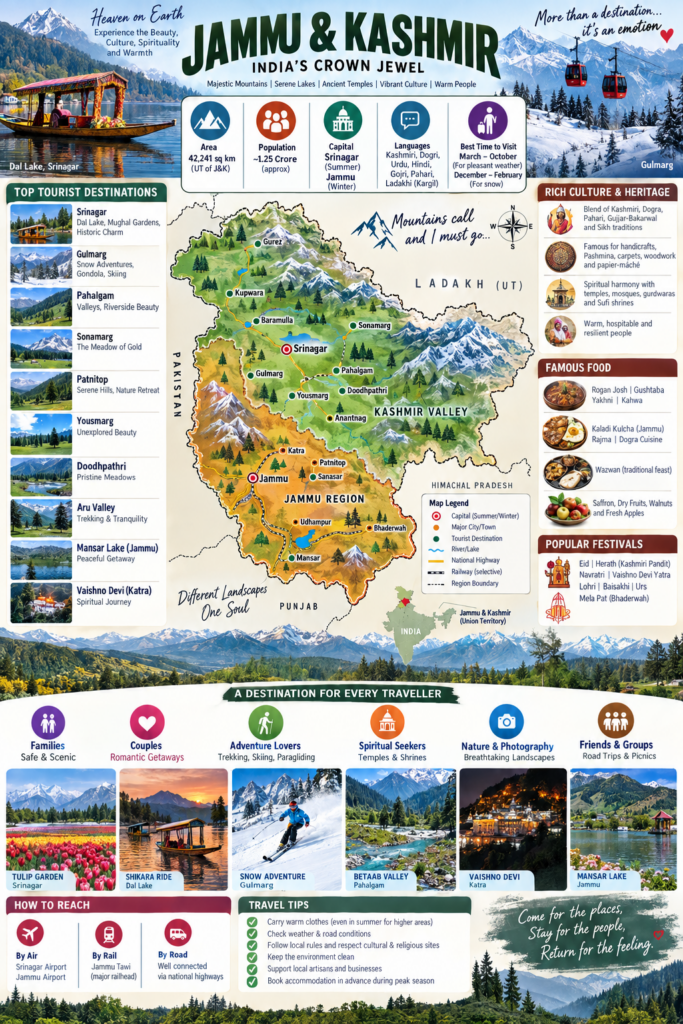
🏔️ If I Could Speak, I Would Tell You This…
I am Jammu and Kashmir.
Do not know me only through photographs of snow-covered mountains, shikaras floating on Dal Lake, flowering gardens or winding Himalayan roads. Come closer. Listen to the rivers, old temples, shrines, markets, orchards and villages. They carry pieces of my story.
Today I am officially the Union Territory of Jammu and Kashmir, although generations of people still remember and search for me as Jammu and Kashmir State.
My story is not the story of one city. I am a land of many landscapes and communities—Jammu’s plains and hills, the Kashmir Valley, mountain settlements, forests, lakes, rivers, farms, orchards and pilgrimage routes.
If you travel through me slowly, you will discover that my greatest attraction is not any single destination.
It is the way my landscape keeps changing while my memories travel with you.
📜 My Childhood Is Older Than Your Travel Maps
My memories stretch back centuries.
Long before modern highways, airports and hotels, people crossed my mountains for faith, trade, learning and survival. Kingdoms rose and disappeared. Religious traditions met one another. Languages and artistic traditions developed across valleys and hills.
Kashmir became renowned for scholarship, literature, spirituality and craftsmanship. Hindu and Buddhist traditions form important parts of its early cultural history; Islam later became deeply rooted in the Valley, including through Sufi traditions and interactions often associated with Kashmir’s distinctive spiritual culture.
Jammu developed its own powerful cultural personality, shaped by Dogra history, hill kingdoms, temples, forts, agriculture and trade.
The nineteenth century brought the Dogra monarchy and the princely state of Jammu and Kashmir. The twentieth century brought enormous political and social change.
I have witnessed moments of beauty, progress and coexistence, but also conflict, displacement and grief. These parts of my past deserve careful history, not romantic exaggeration.
My administrative identity changed again in 2019, when the former state was reorganized into the Union Territories of Jammu and Kashmir and Ladakh.
So when you hear someone casually call Ladakh part of today’s Jammu and Kashmir, remember: we are now separate Union Territories.
🌊 Dal Lake Is One of My Mirrors
Come to Srinagar early in the morning.
Before traffic fills the streets, Dal Lake can feel like another world.
A shikara cuts through the water. Mountains rise beyond the city. Houseboats sit quietly along the lake. Vendors begin their day. In the distance are gardens that carry memories of Kashmir’s Mughal period.
You may arrive because you searched for the best places to visit in Jammu and Kashmir, but Dal Lake teaches an important lesson.
A destination is not merely scenery.
It is also somebody’s workplace, neighborhood and home.
When you photograph my lakes, keep them clean. When you ride in a shikara, remember that tourism supports real families.
🌷 Every Spring, I Change My Clothes
Winter does not leave me all at once.
Snow retreats from lower elevations. Trees awaken. Gardens regain colour. Srinagar’s tulips become one of spring’s most photographed attractions.
Then summer opens more of my mountain landscapes.
Pahalgam becomes green and inviting. Sonamarg reveals dramatic alpine scenery. Gulmarg exchanges much of its winter-white personality for meadows. Yousmarg, Doodhpathri and Aru offer quieter encounters with nature.
Autumn changes my colours again.
And then winter returns.
Gulmarg becomes one of my great snow destinations, while many higher landscapes become colder and more difficult to reach.
I therefore have no single “best” season.
I have different personalities for different travelers.
❄️ Gulmarg Is My Winter Smile
When snow covers Gulmarg, I understand why people travel such long distances to see me.
Some come to ski. Some want the Gondola experience. Some have never touched snow before.
Children throw snowballs. Couples stand silently before the mountains. Photographers wait for light to break through the clouds.
But I ask my visitors to remember something.
Mountains are beautiful because they are powerful.
Weather can change. Roads can become difficult. Visibility can fall. Outdoor activities can stop.
Do not challenge my mountains merely for a photograph.
Respect them, and they will give you memories far more valuable than a reckless adventure.
🌲 Pahalgam Is Where I Slow Down
If Srinagar shows you my urban and lake-side personality, Pahalgam asks you to slow your pace.
Listen to flowing water.
Look toward the forests and mountain slopes.
Travel onward toward Aru and other nearby landscapes when conditions permit.
You do not need to fill every hour with sightseeing.
Sometimes the most meaningful part of traveling through me is sitting quietly beside a landscape without trying to turn it into a checklist.
💦 I Hide Beauty Beyond My Famous Names
I know most visitors recognize Srinagar, Gulmarg and Pahalgam.
But I have other stories.
At Aharbal, water falls dramatically through a rugged landscape.
At Manasbal, the lake creates a gentler experience.
At Yousmarg and Doodhpathri, meadows offer peaceful day trips.
Farther away, Gurez Valley presents a more remote side of Kashmir.
In the Jammu region, Patnitop brings forests and mountain air, while Sanasar is associated with outdoor recreation and adventure. Mansar and Surinsar lakes provide quieter picnic and nature experiences.
And Bhaderwah reminds travelers that Jammu’s mountain districts should never be reduced to transit routes.
These are not substitutes for my famous destinations.
They are different chapters of me.
🙏 Faith Has Walked My Roads for Generations
Some visitors come to me not for sightseeing, but because they believe a journey here has spiritual meaning.
From Shri Mata Vaishno Devi near Katra to the seasonal Amarnath Yatra, pilgrimage is deeply woven into my travel economy and cultural landscape.
There are historic temples, mosques, Sufi shrines, gurdwaras and churches across my towns and countryside.
You may practice a different faith—or none at all.
That is fine.
When you enter these places, simply arrive with respect.
Lower your camera when photography is inappropriate. Dress according to local expectations. Do not turn prayer into a tourist performance.
A sacred place does not exist merely because it makes a beautiful photograph.
🧶 My Hands Tell Stories Too
Look closely at a Kashmiri carpet.
Touch a genuine Pashmina carefully.
Observe Sozani embroidery, Kani weaving, papier-mâché or walnut-wood carving.
You are looking at skills that have traveled through generations.
My artisans created economic connections with the wider world long before modern e-commerce existed.
Today those traditions face new challenges: mass-produced imitation, misleading claims of authenticity, changing consumer tastes and pressure on artisan livelihoods.
So when you shop in Srinagar or elsewhere, do not ask only:
“How cheaply can I buy this?”
Ask:
“Who made it?”
That question can change the meaning of your purchase.
🍎 My Orchards Are Also My Factories
When you see apple orchards stretching across parts of Kashmir, you are looking at more than beautiful countryside.
You are looking at livelihoods.
Apples, walnuts, saffron and other agricultural and horticultural products connect farmers with traders, packers, warehouses, truck operators, processors and markets across India.
Around Pampore, saffron carries extraordinary cultural and commercial importance.
In Jammu and surrounding regions, agriculture and specialty foods tell another economic story.
Modern cold storage, grading, packaging, food processing and logistics are gradually changing the journey between my farms and consumers.
My future is not only tourism.
It is also about adding more value to what my farmers and artisans already know how to create.
🚚 I Have Learned That Roads Can Change Economies
For a mountain region, a road is never just a strip of asphalt.
It can determine whether fruit reaches a market on time.
Whether tourists reach a hotel.
Whether medicines arrive.
Whether a factory can receive raw material.
Whether a village business can reach customers outside its district.
Jammu has long played an important gateway role. The Jammu–Samba–Kathua side has developed important manufacturing and logistics activity, while industrial estates in the Kashmir Valley support additional manufacturing and processing.
Railways, highways, tunnels, bridges and airports continue to change the way people and goods move through me.
Yet my geography still demands patience.
Snow, rain, landslides and mountain conditions do not follow a business timetable.
🏭 I Am More Than Tourism
People often look at my mountains and assume tourism is my entire economy.
It is not.
Agriculture and horticulture matter enormously. So do handicrafts, handloom, food processing, construction, retail, transport, hospitality, pharmaceuticals, MSMEs and other services and industries.
Industrial areas around Bari Brahmana, Samba and Kathua contribute to the Jammu-side manufacturing economy. Estates such as Lassipora and Khonmoh, among others, form parts of Kashmir’s modern industrial landscape.
Entrepreneurs are experimenting with technology, food brands, tourism services, e-commerce, logistics and value-added agriculture.
My economic evolution therefore has two faces.
One is ancient—artisan, farmer, orchard and market.
The other is modern—startup, warehouse, processing plant, hotel, pharmaceutical unit and digital marketplace.
My future depends on connecting the two.
🍲 Sit With Me for Dinner
If you want to understand me, eat with curiosity.
Kashmiri cuisine includes a rich tradition of meat and vegetarian preparations. Wazwan is perhaps the best-known ceremonial culinary tradition, with dishes that may include rogan josh, rista, goshtaba and other preparations depending on the feast.
There are also vegetarian dishes and ingredients deeply embedded in regional cooking.
Drink kahwa slowly.
Then travel toward Jammu and discover another food personality.
Taste rajma, kaladi/kulcha, local sweets and Dogra culinary traditions.
Food changes across my geography because I am not culturally uniform.
Please do not come looking for one dish that “represents all Jammu and Kashmir.”
No single plate can tell my entire story.
🎉 Celebrate With Me, But Understand Me
I celebrate in many ways.
There is Herath, the distinctive Kashmiri Pandit observance of Shivratri.
There are Eid celebrations, Gurpurabs, Navratri, Lohri and Baisakhi.
There are traditional fairs such as Jhiri Mela, and regional cultural traditions in areas such as Bhaderwah.
Spring flowers, harvests, crafts, food and winter tourism may also become the subjects of organized cultural and tourism events.
But not every tourism festival occurs on exactly the same date—or even necessarily every year.
My religious calendar follows multiple traditions.
That diversity is part of who I am.
❤️ Lovers Come to Me With Dreams
Some arrive before marriage carrying cameras and carefully chosen clothes.
They want their pre-wedding photographs beside Dal Lake, among gardens, under snow-covered mountains or in Pahalgam’s landscapes.
Others arrive immediately after marriage.
They call me their honeymoon.
Srinagar gives them quiet lake mornings.
Gulmarg gives them snow and mountain grandeur.
Pahalgam gives them forest and river landscapes.
Sonamarg offers alpine drama when accessible.
Patnitop gives couples from the Jammu side a convenient mountain retreat.
I enjoy being part of their happiest memories.
But I hope they remember that romance does not require rushing through ten destinations in five days.
Sometimes two people need only one beautiful place and enough time to actually experience it.
📸 I Have Been Photographed Millions of Times—Yet I Am Still Misunderstood
You may have seen photographs of me before you ever considered visiting.
Snow.
Shikaras.
Tulips.
Chinar trees.
Houseboats.
Mountains.
Those images are real, but incomplete.
Turn your camera toward my craftspeople.
My farmers.
My old bazaars.
My food.
My villages.
My architecture.
My everyday streets.
My lesser-known lakes and forests.
Travel photography becomes more meaningful when it records a place rather than merely proving that the photographer visited it.
🌱 I Want Tourism, But I Also Want Respect
Yes, visitors support hotels, restaurants, drivers, guides, photographers, artisans, shopkeepers and many other livelihoods.
I welcome responsible tourism.
But tourism also creates pressure.
Plastic waste does not disappear because mountains make a photograph beautiful.
Noise does not become harmless because people are on vacation.
A meadow is not an unlimited parking lot.
A lake is not a dustbin.
A forest is not an amusement park.
If you come to admire my beauty, help me keep it.
🧭 To the Solo Traveler, I Say: Prepare
Come.
But research your route.
Keep your family informed. Use established accommodation and reliable transportation. Check weather and road conditions. Avoid treating remote mountain areas like city neighborhoods after dark.
👨👩👧👦 To Families, I Say: Travel Slowly
Children do not need twenty attractions.
Parents do not need exhaustion.
Grandparents do not need an itinerary designed for Instagram.
Choose fewer destinations, comfortable accommodation and realistic road journeys.
💑 To Couples, I Say: Leave Empty Space in Your Itinerary
Do not schedule every sunrise.
Sit beside a lake.
Drink tea.
Walk.
Talk.
Let me become part of your memory naturally.
👴 To Senior Travelers, I Say: Comfort Is Not a Weakness
Choose accessible locations.
Allow rest days.
Prepare for temperature changes.
Discuss altitude and strenuous activities with an appropriate medical professional when relevant.
Seeing fewer places comfortably is better than seeing more places painfully.
🌏 And to Every Traveler, I Say: Do Not Judge Me From a Headline
My history and contemporary circumstances are complex.
I cannot be understood through a viral photograph, political slogan, movie scene or a single day’s news.
Meet my people.
Taste my food.
Study my history.
Talk respectfully with artisans and shopkeepers.
Watch an orchard worker sort fruit.
Listen to a guide explain a landscape.
Walk through a market without rushing.
Then form your own memories.
🌄 My Story Is Still Being Written
I have changed through kingdoms, trade routes, religious movements, political transformations, roads, railways, tourism and technology.
I am changing again.
My orchards are meeting cold-chain technology.
My artisans are meeting e-commerce.
My young entrepreneurs are meeting digital markets.
My remote destinations are meeting travelers who once knew only Srinagar and Gulmarg.
My industrial areas are connecting with wider supply chains.
And my roads are carrying not just travelers, but apples, medicines, handicrafts, machinery, dreams and livelihoods.
Yet development brings responsibility.
I need investment without destroying the landscapes that make me valuable.
I need tourism without turning culture into a commodity.
I need modern infrastructure without forgetting communities.
I need economic opportunity that reaches beyond famous destinations.
❤️ My Invitation to You
I am Jammu and Kashmir.
Come for Dal Lake if that is what first captured your imagination.
Come for Gulmarg’s snow.
Come for Pahalgam’s forests, Sonamarg’s mountains, Patnitop’s hills or the quiet beauty of Gurez, Yousmarg, Doodhpathri, Mansar and Bhaderwah.
Come for pilgrimage.
Come for food.
Come for photography.
Come to understand my handicrafts, orchards, businesses and history.
But when you arrive, do not simply ask:
“What are the best places to visit in Jammu and Kashmir?”
Ask something deeper:
“What is this land trying to tell me?”
Perhaps you will hear my answer in the sound of a shikara moving across still water.
Perhaps in the hands of an artisan.
Perhaps beside an orchard.
Perhaps on a mountain road when the clouds suddenly open and sunlight touches the valley below.
And when it is finally time for you to leave, I hope you carry more than photographs.
Carry respect for my people.
Carry curiosity about my history.
Carry the taste of my food.
Carry responsibility toward my mountains, forests and lakes.
And leave a little space in your heart for the possibility that someday, when the mountains call again, you will return.
I will still be here—Jammu and Kashmir—writing the next chapter of my autobiography.
📍 Where Is Jammu and Kashmir? — Where the Plains Rise Into the Himalayas
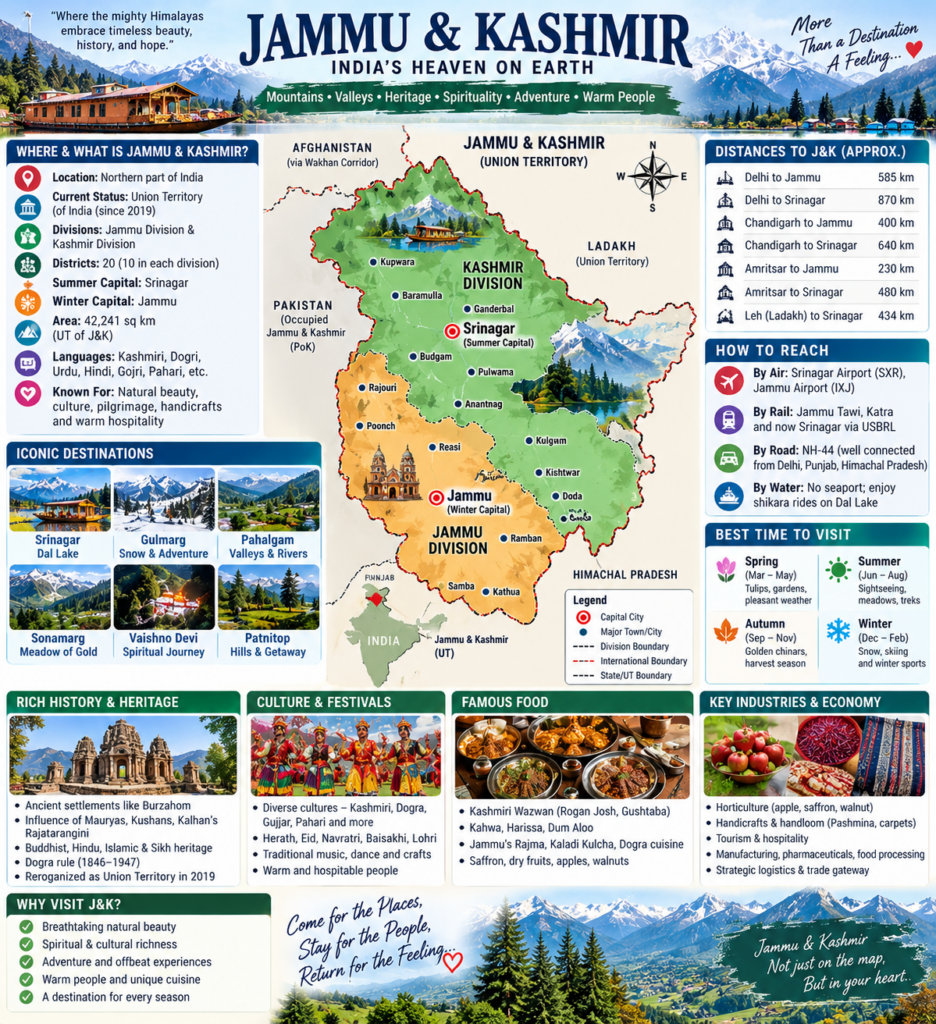
If you travel north from India’s plains and watch the landscape slowly change—fields giving way to foothills, foothills becoming forested mountains, and mountain roads opening into valleys—you begin to understand Jammu and Kashmir.
But before beginning the journey, one geographical correction matters: Jammu and Kashmir is no longer a state. It is a Union Territory of India. The former State of Jammu and Kashmir was reorganized on 31 October 2019, creating the separate Union Territories of Jammu and Kashmir and Ladakh. So although travelers still commonly search for “Jammu and Kashmir State,” Ladakh should not be included in a present-day J&K travel guide.
🗺️ Where Exactly Is Jammu and Kashmir in India?
Jammu and Kashmir lies in the northernmost part of India, in the western Himalayan region. To its south are Punjab and Himachal Pradesh; Ladakh lies to its east/northeast, while its western and northwestern side includes the Line of Control and international-border geography associated with Pakistan.
Its landscape broadly falls into two administrative and cultural divisions: Jammu Division and Kashmir Division.
| Quick Geographic Guide | Jammu and Kashmir |
|---|---|
| Country | India |
| Current Status | Union Territory |
| Administrative Divisions | Jammu Division + Kashmir Division |
| Number of Districts | 20 |
| Summer Capital | Srinagar |
| Winter Capital | Jammu |
| Southern Neighbours | Punjab and Himachal Pradesh |
| Eastern/Northeastern Neighbour | Ladakh UT |
| Major Mountain Systems | Himalaya, Pir Panjal and Shivalik landscapes |
| Major Rivers | Jhelum, Chenab, Tawi, Ravi and tributaries |
| Famous Lakes | Dal, Wular, Manasbal, Mansar, Surinsar |
| Main Tourism Gateways | Srinagar, Jammu, Katra |
| Major Road Spine | NH-44 |
| Major Airports | Srinagar and Jammu |
| Important Rail Gateway/Route | Jammu–Katra–Kashmir rail corridor |
The UT has 20 districts—10 in Jammu Division and 10 in Kashmir Division. Government listings confirm the Jammu-side districts as Jammu, Samba, Kathua, Udhampur, Reasi, Ramban, Doda, Kishtwar, Rajouri and Poonch, while Kashmir Division comprises Srinagar, Ganderbal, Budgam, Pulwama, Shopian, Kulgam, Anantnag, Baramulla, Bandipora and Kupwara.
🏔️ Geography: One Territory, Many Landscapes
Jammu and Kashmir cannot be understood as a single mountain landscape.
In the south, Jammu approaches the Himalayan foothills from the northern plains. Jammu city itself stands beside the Tawi River, where the Shivalik environment begins rising from the plains.
Travel north and the terrain becomes increasingly mountainous.
Beyond the Pir Panjal lies the Kashmir Valley—an elongated mountain basin surrounded by high ranges, containing wetlands, lakes, agricultural land, settlements and distinctive elevated deposits known as karewas.
These karewa formations are especially important because they preserve evidence of the Valley’s geological past. The Archaeological Survey of India’s Burzahom report notes that the Valley’s physiography indicates the long existence of a large ancient lake.
This helps explain why Kashmir’s mythology and its physical geography sometimes seem to speak to each other.
🌊 Rivers That Built Settlements and Economies
Water is one of Jammu and Kashmir’s defining geographical forces.
The Jhelum is the great river of the Kashmir Valley, flowing through Srinagar and connecting a wider system of wetlands and water landscapes.
The Chenab cuts through dramatic mountain country in the Jammu region.
The Tawi passes through Jammu city before ultimately joining the Chenab system; official planning documents describe it as a major tributary of the Chenab.
Then there are lakes.
Dal Lake is inseparable from Srinagar’s tourism identity.
Wular Lake is one of Kashmir’s great natural water bodies.
Manasbal offers another quieter lake landscape.
Farther south, Mansar and Surinsar create a very different lake-tourism experience in the Jammu region.
These waters are not merely attractions. They intersect with ecology, fisheries, agriculture, livelihoods and settlement history.
🌲 Forests, Meadows and High Mountains
Climb away from the populated valleys and another Jammu and Kashmir appears.
Forests spread across substantial hill and mountain terrain. Higher elevations lead toward alpine meadows and seasonal snow landscapes.
That transition creates destinations as different as Gulmarg, Sonamarg, Pahalgam, Aru, Yousmarg, Doodhpathri, Patnitop, Sanasar and Bhaderwah.
Official J&K Tourism listings also identify less-publicized destinations such as Chatpal, Daksum, Sinthan Top, Keran Valley, Tosamaidan, Pancheri, Bani, Sarthal, Pogal-Paristan and several Rajouri–Poonch landscapes.
That is why a serious Jammu and Kashmir itinerary should look beyond the familiar Srinagar–Gulmarg–Pahalgam triangle.
🌦️ What Is the Climate Like?
There is no single “Jammu and Kashmir climate.”
Jammu’s lower elevations can experience very hot summers.
The Kashmir Valley is generally cooler, with four strongly recognizable seasons.
Higher mountain areas can remain cold even when the plains are experiencing summer, while heavy snowfall can transform accessibility in winter.
That means the best season depends on what you want to experience.
Spring brings blossoms and gardens. Summer opens many mountain landscapes. Autumn produces distinctive foliage and harvest scenery. Winter transforms Gulmarg and other higher areas into snow destinations.
The practical rule is simple: check destination-specific weather and road conditions rather than relying on Srinagar’s forecast for the entire UT.
📜 Myths, Memory and the Ancient Story of Kashmir
Kashmir’s origin story is one of the most fascinating examples of mythology meeting landscape.
A traditional account says the Valley was once occupied by a great body of water and associates its drainage with the sage Kashyapa. JKTDC’s historical account records the tradition that Kashmir was originally a lake drained by Kashyapa.
This is a traditional/mythological narrative, not something that should be presented as literal geological history.
Yet archaeology demonstrates that Kashmir’s human past is genuinely ancient.
At Burzahom, northeast of Srinagar, Archaeological Survey of India excavations revealed a cultural sequence extending from the Aceramic Neolithic through Ceramic Neolithic and Megalithic phases into the historical period. ASI also records other Neolithic settlements across the Valley.
So beneath the modern tourism landscape lies evidence of human communities stretching far back into prehistory.
👑 Kingdoms, Dynasties and Kashmir’s Historical Layers
Kashmir possesses an unusually rich written historical tradition.
The Sanskrit chronicle Rajatarangini, written by Kalhana, is central to reconstructing Kashmir’s historical memory. JKTDC’s historical account also notes Kashmir’s association with the Mauryan period and the spread of Buddhism, followed by subsequent dynasties and religious-cultural transformations.
Over centuries the region experienced Hindu and Buddhist traditions, powerful local dynasties, the Kashmir Sultanate, Mughal authority, Afghan rule, Sikh control and eventually Dogra rule.
Jammu developed its own political and cultural traditions.
A popular Jammu legend tells of Raja Jambu Lochan, who supposedly saw natural enemies drinking peacefully from the same place beside the Tawi and chose the site for a settlement that eventually became Jammu. Government tourism sources preserve this as a local tradition; it should be understood as legend rather than securely dated archaeological history.
🏰 The Dogra Period and the Making of the Princely State
A major political turning point came in the nineteenth century.
Following the Treaty of Amritsar of 1846, Gulab Singh became Maharaja of the princely state of Jammu and Kashmir, establishing the Dogra dynasty’s rule over the state. Dogra rule continued until the upheavals surrounding the end of British paramountcy and Indian independence in 1947.
The events of 1947 and the region’s subsequent political history remain complex and contested. For a tourism guide, the useful historical point is that today’s administrative geography should not be confused with either the nineteenth-century princely state or the pre-2019 Indian state.
🛕 A Landscape Where Cultures Meet
Geography has made Jammu and Kashmir a cultural crossroads.
Jammu has strong Dogra cultural traditions, alongside Pahari, Gujjar-Bakarwal, Sikh and other communities.
Kashmir has distinctive Kashmiri language, literature, crafts, music, architecture and culinary traditions, shaped over centuries by Hindu, Buddhist, Islamic and Sufi influences.
Across the UT, travelers encounter temples, mosques, Sufi shrines, gurdwaras and churches.
That cultural diversity also appears in celebrations including Herath, Eid, Navratri, Lohri, Baisakhi, Gurpurabs and local fairs and pilgrimages.
🍲 Geography You Can Taste
The food changes as you move through the territory.
In Kashmir, travelers encounter dishes associated with the celebrated Wazwan tradition, alongside foods such as rogan josh, yakhni and dum olav, as well as breads, rice dishes and kahwa.
Move toward Jammu and another culinary identity emerges.
Rajma, kaladi, Dogra dishes, pickles and sweets become part of the experience.
Agriculture adds another layer: Kashmir is strongly associated with apples, walnuts and saffron, while different Jammu districts produce their own agricultural specialties.
Food here is not merely something to eat between sightseeing stops.
It is geography served on a plate.
🍎 Economy: Orchards, Artisans, Tourism and Modern Industry
The romantic image of Jammu and Kashmir can obscure the complexity of its economy.
The official Economic Survey 2025–26 estimates services at 61.02% of GSVA, the primary sector at 20.45%, and the secondary sector at 18.52%. Agriculture and allied activities remain especially important for livelihoods; the survey cites a 42.99% workforce share for the primary sector using PLFS 2023–24.
Horticulture links orchards with grading, packaging, controlled-atmosphere storage, trucking and markets across India.
Handicrafts connect Pashmina, carpets, embroidery, papier-mâché and walnut-wood carving with domestic and international consumers.
Tourism supports hotels, houseboats, restaurants, taxis, guides, photographers, shops and adventure businesses.
Modern industrial estates add manufacturing, food processing, engineering, pharmaceutical and other enterprises. The Industries & Commerce Department maintains estates in both Jammu and Kashmir divisions.
🚛 Why Jammu and Kashmir Matters for Logistics
To a traveler, NH-44 is a road.
To a logistics planner, it is an economic artery.
The Kathua–Samba–Jammu corridor connects the UT with Punjab and the wider Indian highway and rail network. Jammu therefore functions as a major distribution and transport gateway.
Northward movement becomes progressively more constrained by Himalayan terrain.
That makes tunnels, bridges, railways, warehouses, cold storage and reliable truck operations economically important.
For apples, vegetables, pharmaceuticals and other time-sensitive cargo, connectivity directly affects cost and quality.
Mountain weather also means logistics planning requires realistic buffers for road disruption rather than ordinary plains-style transit assumptions.
🚆 A Historic Change: Kashmir Is Now Connected by Rail
One of the biggest connectivity changes in the region’s modern history occurred recently.
The 272-km Udhampur–Srinagar–Baramulla Rail Link (USBRL) was commissioned in 2025. The project includes major tunnels and hundreds of bridges, including the Chenab Railway Bridge and Anji Bridge.
The connection is no longer merely a future project.
By April 2026, direct Jammu–Srinagar passenger rail service was operating, while official railway reporting in August 2026 described USBRL as commissioned and emphasized its role in moving apples, dry fruits, Pashmina and handicrafts to wider markets.
For tourism, agriculture and freight, this is a structural change.
✈️ How to Reach Jammu and Kashmir
By Air
Srinagar Airport is the principal aviation gateway for the Kashmir Valley.
Jammu Airport serves Jammu and is convenient for Jammu city, Katra and surrounding destinations.
Flight schedules and direct-city connections change seasonally, so they should be checked for actual travel dates.
By Rail
Jammu Tawi remains a major gateway from India’s national rail network, while the completed USBRL now provides rail connectivity onward into Kashmir.
By Road
NH-44 is the principal road connection between the Jammu side and Kashmir Valley.
Other roads lead toward Rajouri, Poonch, Kishtwar, Doda, Bhaderwah and numerous mountain destinations.
Always check current road conditions before long mountain transfers.
By Water
Jammu and Kashmir has no seaport and no navigable sea connection.
Water transport here is principally local and tourism-oriented—most famously the shikaras and other boats of Dal Lake—rather than an interstate passenger or freight gateway.
🛣️ Jammu: The Gateway From the Plains
For travelers arriving overland from Delhi, Punjab or Himachal Pradesh, Jammu often feels like the doorway where plains travel begins turning into Himalayan travel.
Jammu city itself sits on the Tawi and on the larger northbound transport corridor.
From here, routes branch toward Katra and Vaishno Devi, Udhampur, Patnitop, Sanasar, Doda, Bhaderwah, Kishtwar, Rajouri and Poonch, while the principal corridor continues toward Kashmir.
Economically, Jammu also connects travelers and freight with the industrial belt around Bari Brahmana, Samba and Kathua.
This combination of pilgrimage, manufacturing, wholesale trade, road transport and rail connectivity explains why Jammu is much more than a stopover.
🕌 Srinagar: The Gateway to the Kashmir Valley
Srinagar performs a different role.
It is an administrative, commercial, cultural and tourism centre as well as the principal base from which many travelers explore the Valley.
From Srinagar, journeys spread outward toward:
Gulmarg → west
Sonamarg → northeast
Pahalgam → southeast
Yousmarg and Doodhpathri → southwest/central Kashmir
Manasbal and Ganderbal → north/northeast
Baramulla and Sopore → northwest
Gurez → farther north via Bandipora
The city therefore works beautifully as the centre of a multi-day Kashmir itinerary.
📸 Famous Places Every First-Time Visitor Knows
For a first journey, the classic attractions remain compelling:
Srinagar and Dal Lake for shikaras, houseboats and Mughal gardens.
Gulmarg for mountains, meadows, snow sports and Gondola experiences.
Pahalgam for river-and-forest landscapes.
Sonamarg for high Himalayan scenery.
Katra and Shri Mata Vaishno Devi for pilgrimage.
Patnitop and Sanasar for Jammu-region mountain tourism.
But stopping there would reveal only the most famous face of the territory.
💎 Hidden and Less-Explored Jammu and Kashmir
The government’s own tourism promotion lists reveal just how much exists beyond the conventional circuit.
Consider Chatpal, Daksum, Sinthan Top, Tosamaidan, Keran Valley, Doodhpathri, Yousmarg, Bani, Pancheri, Sudh Mahadev–Mantalai, Budhal, Darhal, Pogal-Paristan and Bhaderwah-area landscapes.
Some require longer road journeys, seasonal planning or additional local checks.
That inconvenience is often precisely why they retain a different character.
🧭 Why Jammu and Kashmir Is Strategically Important
Look at a physical map and the answer becomes apparent.
Jammu and Kashmir occupies difficult Himalayan and border terrain. Its roads, bridges, tunnels, airports and railways therefore carry significance far beyond tourism.
Infrastructure affects civilian mobility, freight, agriculture, disaster response, border-region accessibility and economic integration.
The engineering difficulty of the new railway demonstrates this geography particularly clearly: the 272-km USBRL required 36 major tunnels and 943 bridges, according to official reporting.
Geography here does not sit quietly in the background.
It shapes almost everything.
🌄 So, Where Is Jammu and Kashmir Really?
The simple answer is:
Jammu and Kashmir is a Union Territory in northern India, stretching from the plains-facing Jammu region into the western Himalayas and the Kashmir Valley, with Jammu and Srinagar serving as its winter and summer capitals respectively.
But that answer is too small for the place.
Jammu and Kashmir exists where the plains begin climbing toward the Himalayas.
It exists beside the Tawi and Jhelum.
It exists in Dal’s morning reflections and Gulmarg’s winter snow.
It exists in a saffron field near Pampore, an apple orchard in Shopian, a carpet workshop in Srinagar, a market in Jammu and a truck climbing a mountain highway with fruit destined for cities hundreds of kilometres away.
It exists in Neolithic remains at Burzahom and historical memories preserved in the Rajatarangini. (ASI)
And today it exists in a landscape where an ancient geography is being connected by new highways, tunnels and a railway that finally crosses the Himalayan barrier into Kashmir.
❤️ A Practical Invitation to the Traveler
Do not try to “finish” Jammu and Kashmir in three days.
For a first trip, build your journey around Srinagar, Gulmarg and Pahalgam, adding Sonamarg when season and time permit. If approaching from Jammu, consider Jammu–Katra–Patnitop before continuing north. On a second journey, explore places such as Yousmarg, Doodhpathri, Gurez, Bhaderwah, Daksum or the quieter Jammu hills.
Keep spare time for mountain-weather disruptions. Check official road, rail, pilgrimage and attraction information close to departure. Carry appropriate clothing even when the plains are warm, and never assume that a remote mountain road is suitable for an unplanned late-night journey.
Most importantly, travel beyond the photograph.
Taste the food. Talk to an artisan. Walk through an old market. Watch the orchards change with the season. Learn why a road, river or mountain pass matters to the people who live beside it.
Then the question “Where is Jammu and Kashmir?” stops being something you answer with coordinates.
It becomes somewhere you remember.
🚗 How to Reach Jammu and Kashmir – Complete Air, Train, Bus, Road & Local Transport Guide
For an outstation traveler visiting for the first time, the easiest way to understand Jammu and Kashmir is to think of it as having two major gateways: Jammu for the Jammu region, Katra and many pilgrimage journeys; and Srinagar for the Kashmir Valley, Gulmarg, Pahalgam and Sonamarg.
A major update makes older travel guides obsolete: the 272-km Udhampur–Srinagar–Baramulla Rail Link (USBRL) has been commissioned, and direct Jammu–Srinagar passenger rail connectivity began in 2026.
🧭 Quick Answer: What Is the Best Way to Reach Jammu and Kashmir?
| Transport | Main Gateway | Best For | Typical Travel Cost | Major Advantage | Limitation |
|---|---|---|---|---|---|
| ✈️ Flight | Srinagar Airport | Kashmir tourists | ₹3,000–₹15,000+ | Fastest from major cities | Fares fluctuate |
| ✈️ Flight | Jammu Airport | Jammu/Katra travelers | ₹3,000–₹15,000+ | Fast access to Jammu region | Katra needs road transfer |
| 🚆 Train | Jammu Tawi | Jammu + onward Kashmir | ₹300–₹3,000+ | Economical long-distance travel | Journey length varies |
| 🚆 USBRL Train | Jammu–Srinagar corridor | Jammu ↔ Kashmir | Train-specific | All-weather rail connection | Timetable must be checked |
| 🚆 Train | Shri Mata Vaishno Devi Katra | Vaishno Devi pilgrims | ₹300–₹3,000+ | Convenient for Katra | Not ideal for every Kashmir itinerary |
| 🚌 JKRTC Bus | Jammu/Srinagar | Budget travelers | Route-specific | Affordable | Longer journey |
| 🚌 Private Bus | Major towns | Budget/intercity | ₹300–₹2,000+ | Multiple operators/routes | Comfort varies |
| 🚕 Taxi | Jammu/Srinagar | Families/groups | ₹2,000–₹8,000+/day | Door-to-door | Costly for solo travelers |
| 🚗 Self-drive/Rental | Selected operators | Flexible road trip | ₹2,500–₹8,000+/day | Independence | Local rules/route suitability matter |
| 🏍️ Motorcycle | Road routes | Experienced riders | Variable | Adventure/flexibility | Weather + mountain-road risk |
| 🚤 Water | Dal Lake/local lakes | Tourism only | Local tariff | Unique experience | Not an interstate arrival mode |
Costs are planning ranges rather than fixed fares.
✈️ How to Reach Jammu and Kashmir by Air
Srinagar International Airport – Best for Kashmir Valley
If your itinerary is primarily Srinagar → Gulmarg → Pahalgam → Sonamarg, flying into Srinagar is usually the simplest option.
From the airport, travelers can continue by prepaid/authorized taxi, hotel transfer or other currently available local transport.
Approximate road planning distances vary by exact route:
| From Srinagar Airport | Approx Journey |
|---|---|
| Srinagar central tourist areas | ~30–45 minutes |
| Dal Lake/Boulevard | ~35–50 minutes |
| Gulmarg | ~2–3 hours |
| Pahalgam | ~2.5–3.5 hours |
| Sonamarg | ~2.5–3.5 hours |
Traffic, weather, roadwork and security arrangements can substantially change mountain travel times.
AAI documentation confirms organized vehicle parking infrastructure at Srinagar Airport.
Jammu Airport – Best for Jammu & Katra
Choose Jammu Airport if your main destinations include:
Jammu City → Katra/Vaishno Devi → Patnitop → Sanasar → Udhampur, or if you plan to continue toward Kashmir afterward.
For first-time pilgrims, flying to Jammu and taking a taxi/bus onward to Katra is straightforward.
✈️ Online Flight Booking
Flights can be booked directly through airline websites/apps or established travel-booking platforms. For airport information, use the Airports Authority of India.
Book early for peak spring/summer, festival periods and popular winter dates, but always compare the airline’s direct fare with aggregator prices.
🚆 How to Reach Jammu and Kashmir by Train
This section needs special attention because many older websites still describe Katra as the effective end of national rail access toward Kashmir.
That information is outdated.
The USBRL has been commissioned, covering 272 km through Udhampur, Reasi, Ramban, Srinagar, Anantnag, Pulwama, Budgam and Baramulla districts.
On 30 April 2026, the Srinagar–Katra Vande Bharat service was extended to Jammu Tawi, creating direct Jammu–Srinagar passenger rail connectivity. Regular service began on 2 May 2026.
🚉 Important Railway Stations
| Station | Best For |
|---|---|
| Jammu Tawi | Jammu city + national rail connections |
| Shri Mata Vaishno Devi Katra | Vaishno Devi/Katra |
| Udhampur | Udhampur/Patnitop-side connections |
| Srinagar | Srinagar and central Kashmir |
| Budgam | Central Kashmir |
| Anantnag | Pahalgam/south Kashmir approach |
| Qazigund | South Kashmir |
| Baramulla | North Kashmir |
| Banihal | Mountain corridor |
For actual train numbers, days and seat availability, use IRCTC official booking or Indian Railways enquiry systems rather than an old blog timetable.
🚆 First-Time Traveler Tip
If coming from Delhi, Mumbai, Pune, Ahmedabad, Kolkata or another distant city, search both:
Your City → Jammu Tawi
and
Your City → Shri Mata Vaishno Devi Katra
Then separately check current Jammu/Katra–Srinagar rail services.
This can reveal combinations that a simple destination search may miss.
🚌 How to Reach by JKRTC Government Bus
The Jammu & Kashmir Road Transport Corporation (JKRTC) operates passenger services and provides official online booking, timetables and fare information. Its website currently directs online passengers to its StarBus booking system.
A useful benchmark from the current JKRTC fare page is Jammu–Srinagar: listed fares range from ₹397 for semi-deluxe to ₹675 for certain larger classes, with ₹550 listed for Deluxe A-Class. These are current published figures and should be rechecked before travel.
🚌 Important Bus/Transport Points
| City | Important Transport Area | Useful For |
|---|---|---|
| Jammu | General Bus Stand / BC Road area | Regional buses |
| Jammu | Rail Head / JKRTC complex | JKRTC connections |
| Jammu | Narwal / Transport Nagar | Transport connections; verify passenger departure point |
| Srinagar | TRC / central transport areas | Tourist/intercity transport |
| Srinagar | Parimpora | Regional bus/shared transport |
| Katra | Katra bus stand | Pilgrims/local transfers |
Always confirm the actual boarding point printed on your ticket; operators may use different terminals.
🚌 Private Buses & Shared Transport
Private buses and shared passenger vehicles supplement JKRTC services across the region.
They can be economical for travelers moving between major towns, but comfort, luggage space, stops and departure locations vary.
For a first-time traveler carrying large luggage, an official bus or pre-arranged taxi is generally easier than trying to identify informal shared transport immediately after arrival.
🚗 How to Reach Jammu and Kashmir by Road
The main highway connection is NH-44, linking the region toward Punjab and the rest of India’s national road system.
A typical northbound approach is:
Delhi → Punjab → Pathankot/Kathua → Samba → Jammu → Udhampur → Ramban/Banihal corridor → Kashmir Valley → Srinagar
For tourism, this road is far more than a highway. It is the principal road artery between Jammu and Kashmir Valley.
Approximate Road Journey Planning
| Route | Approx Travel Time Under Normal Conditions |
|---|---|
| Jammu → Katra | 1.5–2 hrs |
| Jammu → Patnitop | 2.5–3.5 hrs |
| Jammu → Srinagar | ~6–9 hrs |
| Srinagar → Gulmarg | ~2–3 hrs |
| Srinagar → Pahalgam | ~2.5–3.5 hrs |
| Srinagar → Sonamarg | ~2.5–3.5 hrs |
| Srinagar → Doodhpathri | ~1.5–2.5 hrs |
| Srinagar → Yousmarg | ~2–3 hrs |
These should never be treated as guaranteed arrival times. Mountain weather, traffic regulation, landslides, road maintenance and seasonal conditions can change journeys substantially.
🚕 Taxis: Often the Simplest Local Transport
For families, senior citizens and first-time visitors, taxis remain one of the easiest ways to move between airport, hotel and tourist destinations.
Indicative full-day vehicle planning:
| Vehicle | Approx Daily Planning Range |
|---|---|
| Sedan | ₹2,500–₹4,500+ |
| SUV | ₹3,500–₹6,500+ |
| Premium SUV | ₹5,000–₹9,000+ |
| Tempo Traveller | ₹6,000–₹12,000+ |
Always clarify whether the quotation includes driver allowance, fuel, parking, tolls, waiting time, night charges and destination-specific local transport restrictions.
Some tourist destinations may have local taxi arrangements for onward sightseeing. Do not assume an outstation vehicle can perform every local sightseeing circuit.
📱 App-Based Cabs, Auto-Rickshaws & Bike Taxis
This is one area where an evergreen article should avoid overpromising.
App-cab availability can change by city, operator and regulation. Autos and local shared transport are easier to find in some urban areas than remote tourist locations.
For an outstation visitor:
Airport/railway station → hotel: pre-booked taxi is safest operationally.
Inside Jammu/Srinagar: compare current local taxi, auto and app-based options.
Gulmarg/Pahalgam/Sonamarg: expect destination-specific taxi arrangements rather than metropolitan-style app coverage.
Bike taxis: verify legal/current availability locally; do not design an essential airport or late-night connection around them.
🚇 Is There a Metro in Jammu and Kashmir?
There is no operational metro system that a tourist should currently rely upon for Jammu or Srinagar travel.
Therefore:
Nearest metro station: Not applicable.
Do not confuse proposals for urban mass transit with an operating metro.
For city travel, use buses, taxis, autos and other currently operating road transport.
🚆 What About Local Trains?
The Kashmir rail network is now part of the commissioned USBRL corridor and can be useful for movement between rail-served locations.
However, trains do not directly reach major mountain tourist destinations such as Gulmarg, Pahalgam or Sonamarg.
A traveler still needs last-mile road transport.
For example:
Train → Srinagar → taxi → Gulmarg
or
Train → Anantnag/suitable station → road transfer → Pahalgam
Always compare the actual timetable with a direct taxi or bus before deciding.
🚤 Can You Reach Jammu and Kashmir by Water?
No.
Jammu and Kashmir is landlocked and has no seaport.
There is therefore no interstate ferry, cruise or sea route by which a traveler can arrive from another Indian state.
Water transport is a local tourism experience, especially shikara rides on Dal Lake.
JKTDC also currently lists cruise-related services, but these should be understood as local tourism products—not transport into Jammu and Kashmir.
🅿️ Paid Parking & Self-Drive Travelers
Major airports, railway facilities, hotels and commercial areas generally have designated or paid parking arrangements, but parking fees are dynamic.
Srinagar Airport has an organized paid vehicle-parking system, while current AAI procurement documentation for Jammu Airport specifically covers vehicle parking and an EV charging station within the designated parking area.
At tourist destinations, do not park simply because a roadside shoulder appears empty.
Use designated parking and follow police/local authority instructions.
During pilgrimage, snow season and peak tourism, parking can be separated from the actual attraction, requiring shuttle or local transport.
⚡ EV Charging in Jammu and Kashmir
Electric-road travel is increasingly feasible, particularly around cities and major corridors, but a Himalayan EV journey requires more planning than a metropolitan commute.
A useful strategy is:
Charge in major urban/corridor locations → maintain generous battery reserve → confirm the next charger before entering a remote mountain route.
AAI’s 2026 Jammu Airport documentation explicitly provides for EV charging within airport parking, which is a useful sign of expanding infrastructure.
For a long-distance EV trip, check a live charging network immediately before departure because individual chargers can be unavailable, occupied or incompatible.
♿ Senior Citizens & Differently Abled Travelers
For senior citizens, wheelchair users and travelers with reduced mobility, the most comfortable gateway is usually:
Flight/train → pre-arranged accessible taxi → centrally located hotel → shorter sightseeing days.
When booking, ask specifically for:
- step-free or lift access;
- accessible bathroom;
- wheelchair availability;
- ground-floor room if needed;
- vehicle capable of carrying mobility equipment;
- minimum walking distance from drop-off to attraction.
Do not assume “wheelchair friendly” from photographs.
High-altitude snow areas, meadows, trekking routes and old religious sites can have uneven terrain even when the hotel itself is accessible.
🧳 Last-Mile Connectivity for First-Time Visitors
| Arrival Point | Best Last-Mile Option | Typical Destination |
|---|---|---|
| Srinagar Airport | Taxi/hotel transfer | Dal Lake, Srinagar hotels |
| Jammu Airport | Taxi | Jammu city |
| Jammu Airport | Taxi/bus connection | Katra |
| Jammu Tawi Station | Taxi/auto/bus | Jammu hotels |
| Jammu Tawi Station | Train/bus/taxi | Srinagar |
| Katra Station | Taxi/auto/local transport | Katra |
| Srinagar Station | Taxi/local road transport | Srinagar tourist areas |
| Srinagar | Taxi | Gulmarg |
| Srinagar | Taxi/bus where available | Pahalgam |
| Srinagar | Taxi/bus where available | Sonamarg |
| Udhampur | Taxi/bus | Patnitop |
🎫 Online Ticket Booking for Jammu and Kashmir
For reliable bookings, prefer official platforms.
JKRTC – government bus information and booking
JKTDC – government tourism accommodation and tourism services
JKRTC’s current website specifically directs online bus bookings to its StarBus system.
🏨 Where to Stay – Budget, Mid-Range & Luxury Accommodation Planner
Hotel rates change sharply with season, weekends, snowfall, tulip season, pilgrimage periods and major holidays. The figures below are therefore planning ranges per room/night, not current quotations.
| Location | Best For | Budget | Mid-Range | Luxury | Approx Access Advantage | Booking Tip |
|---|---|---|---|---|---|---|
| Srinagar – Dal/Boulevard | Sightseeing/couples | ₹1,500–₹3,500 | ₹3,500–₹8,000 | ₹10,000–₹40,000+ | Dal Lake/gardens | Lake-view rooms cost more |
| Srinagar – City Centre | Business/budget | ₹1,200–₹3,000 | ₹3,000–₹7,000 | ₹8,000+ | Markets/transport | Better for practical city access |
| Srinagar – Airport side | Early flights | ₹1,500–₹3,500 | ₹3,500–₹8,000 | ₹8,000+ | Airport access | Check transfer availability |
| Gulmarg | Snow/luxury | ₹2,500–₹5,000 | ₹5,000–₹12,000 | ₹15,000–₹60,000+ | Gondola/snow tourism | Winter prices can surge |
| Pahalgam | Nature/honeymoon | ₹1,500–₹4,000 | ₹4,000–₹10,000 | ₹12,000–₹35,000+ | Valleys/river scenery | Compare location with market |
| Sonamarg | Alpine tourism | ₹2,000–₹4,500 | ₹4,500–₹10,000 | ₹10,000–₹25,000+ | Mountain access | Seasonality is important |
| Jammu City | Transit/business | ₹1,000–₹2,500 | ₹2,500–₹6,000 | ₹7,000–₹15,000+ | Rail/airport/markets | Rail-head area is convenient |
| Katra | Vaishno Devi | ₹800–₹2,500 | ₹2,500–₹6,000 | ₹7,000–₹15,000+ | Pilgrimage access | Check Ban Ganga/shuttle access |
| Patnitop | Hill getaway | ₹1,500–₹3,500 | ₹3,500–₹7,000 | ₹7,000–₹15,000+ | Nature/road trip | Winter access needs checking |
JKTDC currently provides government accommodation across Jammu and Kashmir; its booking site shows accommodation starting from roughly ₹2,000–₹4,900 in examples, though actual property/date rates vary.
For Pahalgam, its current portfolio includes the Pahalgam Club & Convention Centre, Hotel Alpine, Pahalgam Resort, Yatri Niwas and Aru Resort. JKTDC also lists hutments and tourism accommodation in Gulmarg and Patnitop.
💰 Transport Comparison for Budget Planning
| Mode | Budget Level | Speed | Comfort | Flexibility | Best Traveler |
|---|---|---|---|---|---|
| ✈️ Flight | ₹₹₹ | ⭐⭐⭐⭐⭐ | ⭐⭐⭐⭐ | ⭐⭐ | Short trip |
| 🚆 Train | ₹ | ⭐⭐⭐ | ⭐⭐⭐⭐ | ⭐⭐ | Budget/family |
| 🚌 Government Bus | ₹ | ⭐⭐ | ⭐⭐ | ⭐⭐ | Backpacker/budget |
| 🚌 Private Bus | ₹–₹₹ | ⭐⭐ | ⭐⭐–⭐⭐⭐ | ⭐⭐ | Budget traveler |
| 🚕 Shared Taxi | ₹–₹₹ | ⭐⭐⭐ | ⭐⭐ | ⭐⭐⭐ | Solo traveler |
| 🚖 Private Taxi | ₹₹₹ | ⭐⭐⭐⭐ | ⭐⭐⭐⭐ | ⭐⭐⭐⭐⭐ | Family/couple |
| 🚗 Rental Vehicle | ₹₹₹ | ⭐⭐⭐⭐ | ⭐⭐⭐⭐ | ⭐⭐⭐⭐⭐ | Experienced road traveler |
| 🏍️ Motorcycle | ₹₹ | ⭐⭐⭐ | ⭐⭐ | ⭐⭐⭐⭐⭐ | Adventure rider |
🗺️ Which Gateway Should an Outstation Traveler Choose?
If you want Dal Lake, Gulmarg, Pahalgam and Sonamarg, choose Srinagar Airport or the rail connection into Kashmir.
If you want Vaishno Devi, choose Jammu or Katra.
For Patnitop and Sanasar, Jammu/Udhampur is usually the logical approach.
For a combined trip, a particularly efficient itinerary is:
Arrive Jammu → Katra/Vaishno Devi → train/road to Srinagar → Gulmarg → Pahalgam → Sonamarg → depart Srinagar.
Or reverse it.
This avoids unnecessary backtracking.
⚠️ Essential Advice for Someone Visiting Jammu and Kashmir for the First Time
Do not calculate a Himalayan itinerary using distance alone. A 100-km mountain journey can take much longer than 100 km on a plains expressway.
Keep at least some buffer before flights and important trains. Check road and weather conditions before moving between Jammu and Srinagar or toward higher tourist destinations. In winter, carry proper warm clothing even when your departure city is hot.
Download tickets and hotel confirmations before leaving your hotel; mobile connectivity can vary along mountain routes.
For taxis, agree on the total fare, sightseeing route, waiting time, parking/toll treatment and whether local taxi restrictions apply before starting.
And for senior citizens, children or first-time mountain travelers, resist the temptation to cover Srinagar, Gulmarg, Pahalgam and Sonamarg on consecutive rushed days.
The easiest Jammu and Kashmir trip is not necessarily the one with the cheapest ticket.
It is the one where your arrival gateway, hotel location and onward transport fit together.
With the USBRL now commissioned and direct Jammu–Srinagar passenger rail connectivity operating, travelers have more choices than ever before: fly for speed, take the train for comfort and scenery, use JKRTC for economy, and choose a private taxi when flexibility matters most.
🌄 What Is Jammu and Kashmir Famous For?
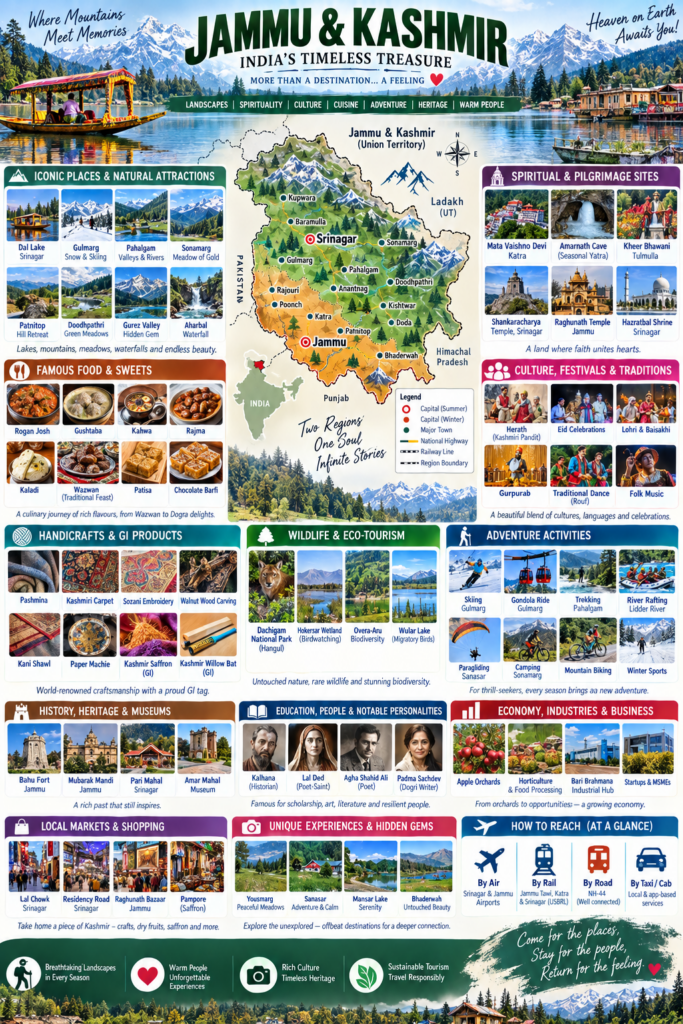
Jammu and Kashmir is famous worldwide for its Himalayan landscapes, Dal Lake and shikaras, Gulmarg’s snow, Pahalgam and Sonamarg, Vaishno Devi pilgrimage, Kashmiri cuisine, Wazwan, Pashmina, hand-knotted carpets, saffron, apples, walnuts, traditional crafts and extraordinary cultural diversity. Today it is officially a Union Territory of India, although “Jammu and Kashmir State” remains a common travel-search phrase.
Its appeal goes far beyond scenery. The J&K Economic Survey 2025–26 describes tourism as contributing nearly 7% of UT GSDP and supporting around five lakh direct and indirect livelihoods, illustrating how closely tourism is connected with hospitality, transport, handicrafts and adventure services.
🏔️ What Jammu and Kashmir Is Famous For – At a Glance
| Category | Famous Attraction / Thing | Why It Is Famous | Historical / Cultural Significance | Best Time to Experience | Interesting Fact | Travel Tip |
|---|---|---|---|---|---|---|
| 🌊 Lake Tourism | Dal Lake, Srinagar | Shikaras, houseboats, Himalayan scenery | Central to Srinagar’s tourism identity | Apr–Oct | Lake tourism supports many local livelihoods | Try an early-morning ride |
| 🚤 Traditional Craft | Shikara | Iconic wooden boat | Symbol of Kashmir’s lake culture | Apr–Oct | “Shikara” is also a registered J&K GI handicraft | Agree on route/fare before ride |
| ❄️ Hill Destination | Gulmarg | Snow, skiing, Gondola, meadows | Historic mountain resort | Dec–Mar snow; May–Oct greenery | Major winter-sports destination | Pre-book authorized activities |
| 🌲 Valley Tourism | Pahalgam | Forests, Lidder landscapes, valleys | Important tourism and pilgrimage region | Apr–Oct | Gateway to several scenic valleys | Stay 2 nights rather than rush |
| 🏔️ Alpine Tourism | Sonamarg | Dramatic high-mountain scenery | Historic mountain-route landscape | Late spring–autumn | Name is popularly translated as “Meadow of Gold” | Check road/weather conditions |
| 🌷 Garden Tourism | Tulip Garden, Srinagar | Huge seasonal tulip display | Modern icon of Kashmir spring tourism | Mar–Apr, bloom dependent | Opening depends on flowering | Check bloom status before booking |
| 🌳 Heritage Gardens | Mughal Gardens | Terraces, fountains and views | Mughal-era landscape heritage | Spring–autumn | Nishat and Shalimar are signature Srinagar experiences | Morning is quieter |
| 🛕 Pilgrimage | Shri Mata Vaishno Devi | Major Hindu pilgrimage | Centred on Trikuta Hills near Katra | Year-round | Katra is a major pilgrimage gateway | Use official Shrine Board information |
| 🕉️ Pilgrimage | Amarnath Cave | Seasonal Himalayan pilgrimage | Major Shaivite sacred tradition | Official yatra season | High-altitude pilgrimage | Registration/health rules change |
| 🌲 Jammu Hills | Patnitop | Pine forests and mountain getaway | Long-established Jammu hill resort | Most seasons | JKTDC places it at about 2,024 m altitude | Winter weather can affect travel |
| 🪂 Adventure | Sanasar | Paragliding and meadow landscapes | Jammu-region adventure destination | Spring–autumn | JKTDC identifies it as a paragliding location | Verify operations/weather |
| 💎 Hidden Gem | Gurez Valley | Remote mountain scenery | Distinctive northern Kashmir landscape | Accessible warmer months | Very different from mainstream resort tourism | Check current access conditions |
| 🌾 Hidden Gem | Doodhpathri | Meadows and streams | Emerging nature destination | May–Oct | Ideal for a slower day trip | Facilities are limited |
| 🌿 Hidden Gem | Yousmarg | Meadows, forest landscapes | Quieter Kashmir excursion | Apr–Oct | Alternative to heavily visited circuits | Prefer daylight travel |
| 💦 Waterfall | Aharbal | Powerful waterfall landscape | Important south Kashmir nature attraction | Spring–autumn | Often called a major Kashmir waterfall destination | Stay behind safety barriers |
| 🌊 Lake | Wular Lake | Vast freshwater/wetland landscape | Ecological and livelihood importance | Spring–autumn | One of the region’s major water bodies | Combine with north Kashmir |
| 🪷 Lake | Manasbal | Peaceful lake scenery | Recreation, ecology and local livelihoods | Spring–autumn | Known for seasonal lotus landscapes | Good for slow tourism |
| 🌊 Jammu Lakes | Mansar & Surinsar | Lake, picnic and devotional tourism | Strong cultural associations | Oct–Apr | Useful Jammu-side family excursion | Avoid assuming swimming is safe |
🍛 Famous Food, Sweets & Street-Food Traditions
Jammu and Kashmir does not have one cuisine. Kashmir Valley and Jammu possess distinct culinary identities. JKTDC highlights dishes such as rogan josh, yakhni, dum olav, muji gaad, goshtaba and modur pulao in Kashmiri cuisine, while Jammu is particularly associated with rajma, kaladi, ambal, khatta meat, madra, patisa and chocolate barfi.
| Category | Famous Food | Why Famous | Cultural Significance | Best Time | Interesting Fact | Travel Tip |
|---|---|---|---|---|---|---|
| 🍽️ Ceremonial Cuisine | Wazwan | Elaborate multi-dish Kashmiri feast | Strong association with weddings and celebrations | Year-round | Traditionally prepared by specialist cooks | Choose a reputable restaurant |
| 🍖 Kashmiri Dish | Rogan Josh | Aromatic meat preparation | Signature regional dish | Year-round | One of Kashmir’s internationally recognized dishes | Recipes differ by tradition |
| 🥛 Kashmiri Dish | Yakhni | Yogurt-based preparation | Part of Kashmir’s culinary repertoire | Year-round | Distinct from many North Indian gravies | Try in a traditional restaurant |
| 🧆 Kashmiri Dish | Goshtaba | Meatball preparation | Closely associated with Wazwan | Year-round | Important ceremonial dish | Rich meal—order thoughtfully |
| 🥔 Vegetarian | Dum Olav | Kashmiri potato preparation | Important vegetarian regional food | Year-round | Regional style differs from generic dum aloo | Ask for local preparation |
| ☕ Drink | Kahwa | Aromatic tea | Hospitality and everyday culture | Especially winter | Often associated with saffron/spices/nuts | Try without excessive sweetener |
| 🫘 Jammu Food | Rajma | Strong Jammu association | Part of Dogra-region food culture | Year-round | Batote is particularly associated with quality rajma by JKTDC | Try with rice |
| 🧀 Jammu Food | Kaladi | Traditional cheese | Strong Jammu/Udhampur identity | Year-round | Udhampur Kaladi is GI-registered | Try fresh preparation |
| 🍬 Sweet | Patisa | Flaky sweet | Famous in Jammu region | Year-round | Kud near Patnitop is known for fresh Patisa | Buy fresh |
| 🍫 Sweet | Chocolate Barfi | Jammu specialty | Popular local sweet | Year-round | Specifically highlighted by JKTDC | Buy from established sweet shops |
🧶 GI-Tagged Products Jammu and Kashmir Is Famous For
This is one of the strongest parts of J&K’s cultural economy. The official Intellectual Property India register documents a substantial portfolio of registered geographical indications.
| Category | Registered GI Product | Famous For | Main Identity |
|---|---|---|---|
| 🧣 Textile | Kashmir Pashmina | Fine luxury fibre/textiles | Kashmir |
| 🪡 Embroidery | Kashmir Sozani Craft | Intricate needlework | Kashmir |
| 🧣 Weaving | Kani Shawl | Elaborate woven designs | Kashmir |
| 🎨 Craft | Kashmir Paper Machie | Hand-painted decorative craft | Kashmir |
| 🪵 Woodcraft | Kashmir Walnut Wood Carving | Detailed carved wood | Kashmir |
| 🏠 Architecture/Craft | Khatamband | Decorative wooden ceiling work | Kashmir |
| 🧶 Carpet | Kashmiri Hand Knotted Carpet | Skilled knotting and design | Kashmir |
| 🎨 Painting | Basohli Painting | Distinctive miniature tradition | Kathua/Jammu region |
| 🪵 Craft | Rajouri Chikri Wood Craft | Local wood craftsmanship | Rajouri |
| 🧣 Textile | Basohli Pashmina Woollen Products | Traditional wool textiles | Basohli/Kathua |
| 🧶 Craft | Kashmir Namda | Felted floor covering | Kashmir |
| 🧵 Craft | Kashmir Wagguv | Traditional mat craft | Kashmir |
| 🚤 Craft | Shikara | Traditional boat craftsmanship | Kashmir |
| 🧶 Textile | Gabba | Traditional floor covering | Kashmir |
| 🏏 Sports Craft | Kashmir Willow Bat | Cricket-bat craftsmanship | Kashmir |
| 🪡 Textile | Kashmir Chain Stitch | Decorative embroidery | Kashmir |
| 🪡 Textile | Kashmir Crewel | Embroidery tradition | Kashmir |
| 🧥 Textile | Kashmir Tweed | Woven textile | Kashmir |
| 🌾 Agriculture | Kashmir Saffron | Premium saffron | Kashmir |
| 🍚 Agriculture | Mushqbudji Rice | Aromatic rice | Kashmir |
| 🫘 Agriculture | Bhaderwah Rajmash | Regional kidney beans | Doda/Bhaderwah |
| 🍎 Agriculture | Ramban Anardana | Dried pomegranate product | Ramban |
| 🍯 Food | Ramban Sulai Honey | Regional honey | Ramban |
| 🧀 Food | Udhampur Kaladi | Traditional cheese | Udhampur |
The current IP India registry confirms products including Kashmir Saffron, Mushqbudji Rice, Bhaderwah Rajmash, Ramban Anardana, Ramban Sulai Honey, Udhampur Kaladi and numerous craft GIs. Kashmir Willow Bat is also officially registered, with its current GI registration valid to 2032. Kashmir Saffron’s registration is documented through December 2028.
🍎 Agriculture & Horticulture
| Famous Product | Region/Association | Why Important | Best Experience | Traveler Tip |
|---|---|---|---|---|
| 🍎 Apples | Shopian, Baramulla and other Kashmir districts | Major horticulture value chain | Harvest season | Purchase from reliable sellers |
| 🌺 Saffron | Pampore belt | High-value specialty crop | Autumn flowering period | Look for authentic GI-labelled product |
| 🌰 Walnuts | Kashmir and Jammu districts | Food, trade and processing | Harvest/markets | Compare grade and freshness |
| 🍒 Cherries | Kashmir | Seasonal fruit | Late spring/early summer | Best eaten fresh |
| 🍯 Honey | Several districts | Rural enterprise | Year-round | Check source/label |
| 🌿 Lavender | Bhaderwah/Doda region | Aromatic-crop opportunity | Flowering season | Flowering dates vary |
| 🍚 Mushqbudji Rice | Kashmir | Aromatic GI rice | Food/shopping | Buy sealed, traceable packs |
| 🫘 Bhaderwah Rajmash | Bhaderwah | GI-recognized agricultural product | Food shopping | Excellent souvenir for food lovers |
🛍️ Handicrafts, Shopping & Famous Markets
| Market / Product | Location | Famous For | Ideal Buyer | Travel Tip |
|---|---|---|---|---|
| Lal Chowk | Srinagar | Central shopping/commercial district | General travelers | Compare before purchasing premium crafts |
| Residency Road | Srinagar | Shopping, food, crafts | Families | Useful central shopping stop |
| Old Srinagar markets | Srinagar | Traditional commercial atmosphere | Culture travelers | Explore respectfully |
| Raghunath Bazaar | Jammu | Shopping, pilgrimage goods, souvenirs | Families/pilgrims | Convenient near central Jammu |
| Jammu city markets | Jammu | Clothing, dry fruits, sweets | All travelers | Try regional products |
| Pampore | Pulwama area | Saffron association | Food/craft buyers | Authenticity matters |
| Craft retailers/cooperatives | Srinagar/Jammu | Pashmina, carpets, embroidery | Premium buyers | Ask for invoice/provenance |
For expensive Pashmina, carpets or saffron, an unusually cheap price should trigger questions rather than excitement. GI registration protects geographic identity, but buyers should still verify seller, product and documentation.
🎉 Culture, Languages, Festivals, Music & Traditions
| Category | Famous For | Why Important | Best Time |
|---|---|---|---|
| 🗣️ Language | Kashmiri | Major Valley language and literary tradition | Year-round |
| 🗣️ Language | Dogri | Major Jammu-region language/literary identity | Year-round |
| 🗣️ Communities | Gujjar-Bakarwal traditions | Pastoral and cultural heritage | Varies |
| 🗣️ Regional Culture | Pahari traditions | Important mountain cultural identity | Varies |
| 🪕 Folk Music | Chakri and regional folk forms | Kashmir’s musical heritage | Cultural events |
| 💃 Folk Culture | Rouf and regional dances | Traditional cultural expression | Festivals/events |
| 🔱 Festival | Herath | Kashmiri Pandit Shivratri tradition | Feb–Mar, varies |
| 🌙 Festival | Eid | Major Muslim celebration | Islamic calendar |
| 🔥 Festival | Lohri | Strong Jammu-region celebration | January |
| 🌾 Festival | Baisakhi | Spring/religious/agricultural significance | April |
| 🚩 Festival | Navratri | Strong Jammu/Katra pilgrimage atmosphere | Varies |
| 🪯 Festival | Gurpurabs | Sikh religious-cultural tradition | Sikh calendar |
| 🎪 Folk Fair | Jhiri Mela | Rural/agricultural and devotional tradition | Usually autumn |
| 🎭 Heritage | Mela Pat | Distinctive Bhaderwah tradition | Seasonal |
🛕 Temples, Mosques, Shrines & Churches
| Site | Category | Location | Famous For | Travel Tip |
|---|---|---|---|---|
| Mata Vaishno Devi | Hindu pilgrimage | Katra | Major pilgrimage | Follow Shrine Board procedures |
| Shankaracharya Temple | Hindu heritage | Srinagar | Spiritual/history + elevated location | Security rules may apply |
| Kheer Bhawani | Hindu pilgrimage | Tulmulla | Kashmiri Pandit tradition | Respect worship |
| Raghunath Temple | Hindu | Jammu | Major Jammu temple | Dress appropriately |
| Sudh Mahadev | Hindu | Udhampur district | Pilgrimage + mountain landscape | Combine with Patnitop region |
| Hazratbal Shrine | Muslim | Srinagar | Major sacred site | Observe religious etiquette |
| Charar-e-Sharief | Sufi/Islamic | Budgam | Spiritual heritage | Avoid intrusive photography |
| Jamia Masjid | Mosque/heritage | Srinagar | Architecture and religious importance | Check visitor access |
| St. Mary’s Church | Christian heritage | Gulmarg | Historic mountain church | Verify opening times |
🏰 Forts, Museums & Heritage
| Heritage Place | Location | Why Famous | Best For |
|---|---|---|---|
| Bahu Fort | Jammu | Jammu heritage + temple landscape | Families/history |
| Amar Mahal Museum | Jammu | Dogra heritage and museum collections | Students/history |
| Mubarak Mandi complex | Jammu | Historic Dogra palace complex | Architecture/history |
| Akhnoor Fort | Akhnoor | Historic fort landscape | Heritage travelers |
| Pari Mahal | Srinagar | Historic architecture + views | Photography/history |
| Mughal Gardens | Srinagar | Mughal landscape design | Families/couples |
| Burzahom | Srinagar region | Important prehistoric archaeological site | Archaeology enthusiasts |
🐻 Wildlife & Eco-Tourism
| Destination | Famous For | Experience | Best Time | Tip |
|---|---|---|---|---|
| Dachigam National Park | Hangul conservation | Wildlife/ecology | Season-dependent | Entry rules should be checked |
| Hokersar Wetland | Migratory birds | Birdwatching | Winter | Carry binoculars |
| Wular landscape | Wetland/lake ecology | Birding, landscape | Spring–autumn | Choose responsible operators |
| Overa-Aru landscape | Forest/wildlife environment | Nature tourism | Warmer months | Follow protected-area rules |
| Hirpora landscape | Mountain ecology | Nature/wildlife | Season-dependent | Access may require planning |
🧗 Adventure Tourism
J&K’s current Economic Survey highlights skiing, snowboarding, Gondola rides, trekking, mountaineering and river rafting among the activities supporting its growing adventure-tourism identity.
| Adventure | Famous Destination | Best Season | Ideal For | Safety Tip |
|---|---|---|---|---|
| 🎿 Skiing | Gulmarg | Winter | Adventure travelers | Use trained instructors |
| 🏂 Snowboarding | Gulmarg | Winter | Youth/adventure | Check avalanche/weather guidance |
| 🚠 Gondola | Gulmarg | Seasonal/year-round subject to operation | Families/couples | Use official ticket channels |
| 🥾 Trekking | Kashmir/Jammu mountains | Summer–autumn | Fit travelers | Route difficulty varies |
| 🧗 Mountaineering | High mountain areas | Season-specific | Experienced travelers | Specialist planning essential |
| 🪂 Paragliding | Sanasar when operational | Weather-dependent | Adventure couples/groups | Authorized operators only |
| ⛳ Golf | Srinagar/Jammu | Warmer months | Leisure/business travelers | Advance booking advisable |
🏭 Industries, MSMEs, Startups & Logistics
Jammu and Kashmir is famous to tourists for mountains, but its economic identity is broader. Tourism itself supports hospitality, transport, handicrafts and adventure services; the official 2025–26 survey estimates nearly 7% of GSDP from tourism.
| Economic Category | Important Hub / Activity | Why It Matters |
|---|---|---|
| 🍎 Horticulture | Kashmir districts | Apples, walnuts, cherries and value-added processing |
| 🌺 Saffron | Pampore/Pulwama | Premium agricultural branding |
| 🧶 Handicrafts | Srinagar/Kashmir | Pashmina, carpets, embroidery, woodcraft |
| 🏏 Sports Goods | South Kashmir | Kashmir willow cricket bats |
| 🏭 Manufacturing | Bari Brahmana–Samba–Kathua | Major Jammu-side industrial belt |
| 🏭 Industrial Estate | Lassipora | Manufacturing/processing in Kashmir |
| 🏭 Industrial Estate | Khonmoh | Industrial activity near Srinagar |
| 💊 Pharmaceuticals | Jammu/Samba industrial belt | Manufacturing and supply-chain activity |
| 🍏 Food Processing | Horticulture belts | Adds value and shelf life to produce |
| 🚚 Logistics | Jammu–Samba–Kathua corridor | Gateway to India’s plains and national markets |
| ❄️ Cold Chain | Horticultural districts | Critical for perishables |
| 💻 Startups | Jammu/Srinagar ecosystem | Tourism-tech, food, logistics, digital services and commerce |
| 🏡 Rural Enterprise | Across districts | Homestays, foods, crafts and agritourism |
🏏 Famous Sports Identity
One especially interesting connection between tourism, agriculture, craftsmanship and sport is the Kashmir willow cricket bat.
It is not merely a souvenir. Intellectual Property India’s GI database records Kashmir Willow Bat as a registered geographical indication, with the current certificate dated March 2025.
That makes a cricket-bat workshop or authentic sports-goods outlet an interesting experience for cricket enthusiasts visiting south Kashmir.
📚 Literature, Art & Famous Personalities
Jammu and Kashmir’s cultural influence includes Sanskrit historical writing, Kashmiri poetry, Dogri literature, Sufi traditions, modern literature, music, cinema and visual art.
Rather than turning personalities into a subjective ranking, some historically significant names worth researching include Kalhana, author of the Rajatarangini; poet-saint Lal Ded/Lalleshwari; mystic poet Sheikh Noor-ud-din Noorani/Nund Rishi; Kashmiri poet Habba Khatoon; Dogri literary figure Padma Sachdev; artist Ghulam Rasool Santosh; and poet Agha Shahid Ali. Their periods, genres and identities differ considerably, so a dedicated personalities section should explain each in historical context rather than treating them as one category.
🎓 Education & Knowledge Centres
Jammu and Kashmir is also home to major educational institutions including the University of Kashmir, University of Jammu, Shri Mata Vaishno Devi University, IIT Jammu, IIM Jammu, NIT Srinagar and AIIMS Jammu.
For students and educational travelers, these institutions show a side of the region that conventional “snow and honeymoon” tourism articles often overlook.
🏖️ Is Jammu and Kashmir Famous for Beaches?
No sea beaches.
Jammu and Kashmir is landlocked. It has spectacular lakes, rivers, reservoirs and lakefront landscapes, but they should not be misleadingly marketed as ocean beaches.
Travelers looking for waterside experiences should instead consider Dal Lake, Wular Lake, Manasbal Lake, Mansar Lake, Surinsar Lake and river landscapes around Pahalgam.
💡 What Makes Jammu and Kashmir Truly Unique?
- 🏔️ Four-season Himalayan tourism: spring blossoms, summer meadows, autumn colours and winter snow create entirely different journeys.
- 🚤 Shikara and houseboat culture: Srinagar offers one of India’s most recognizable lake-tourism experiences.
- 🧶 Living craft traditions: Pashmina, Kani weaving, Sozani, carpets, papier-mâché and walnut carving remain economic activities, not museum relics. Many have GI recognition.
- 🌺 Kashmir saffron: officially GI-registered and strongly associated with the Pampore landscape.
- 🏏 Kashmir willow: cricket connects a regional natural resource with skilled manufacturing and national sporting culture.
- 🍎 Orchard landscapes: apples, walnuts, cherries and other horticultural products connect rural life with cold storage, processing, trucking and markets throughout India.
- 🍛 Two strong culinary personalities: Kashmir’s Wazwan and other Valley dishes coexist with Jammu’s Dogra cuisine, rajma, Kaladi and sweets.
- 🙏 Major devotional tourism: Vaishno Devi and Amarnath coexist with historic temples, mosques, Sufi shrines, gurdwaras and churches.
- 🌲 Beyond the famous circuit: Doodhpathri, Yousmarg, Gurez, Aharbal, Bhaderwah, Sanasar, Mansar and other destinations make repeat visits worthwhile.
- 🚚 A strategic logistics gateway: Jammu connects the Himalayan economy with Punjab and India’s wider road and rail networks, while new transport infrastructure is reducing historic geographic isolation.
- 🌱 Eco-tourism potential: lakes, wetlands, forests, alpine environments and rural landscapes offer opportunities—but their long-term appeal depends on responsible tourism.
❤️ Why Is Jammu and Kashmir Famous? — The Short Answer for Travelers
Jammu and Kashmir is famous because very few destinations combine snow mountains, lakes, gardens, forests, pilgrimage, adventure, living handicrafts, saffron fields, apple orchards, historic architecture, distinctive cuisines and deeply layered cultural traditions within one relatively compact Himalayan region.
But its real character emerges when you go beyond the postcard.
Ride a shikara in Srinagar, but also meet an artisan.
See Gulmarg’s snow, but taste Jammu’s Kaladi.
Visit Pahalgam, but leave time for a quieter landscape such as Yousmarg or Doodhpathri.
Buy saffron, Pashmina or a cricket bat—but learn how to recognize authentic regional products.
And when planning your journey, remember that Jammu and Kashmir is not simply a summer hill station or winter snow destination. Its official Economic Survey describes it as a multi-dimensional destination spanning pilgrimage, leisure, heritage, adventure, eco-tourism and MICE tourism.
That diversity—not any single lake, mountain or monument—is what Jammu and Kashmir is truly famous for.
⚠️ Common Travel Myths, Tourist Scams, Safety Issues & Practical Solutions in Jammu and Kashmir
Jammu and Kashmir is a major tourism region, and most trips are completed without serious problems. A useful safety guide should therefore prepare travelers without portraying local people, taxi drivers, guides, shopkeepers or an entire destination as dishonest or unsafe.
The most practical risks are familiar travel problems—unverified bookings, unclear taxi pricing, online payment fraud, weather disruption, mountain-road delays, misleading shopping claims and inadequate preparation for altitude or cold.
For emergencies in India, 112 is the national emergency number; 181 is the women’s helpline and 1930 is the 24×7 cyber-financial-fraud helpline.
🛡️ Jammu and Kashmir Tourist Safety, Myths & Scam Prevention Chart
| Myth / Scam / Problem | Reality | Common Target | Warning Signs | Prevention Tips | Recommended Solution | Emergency Helpline / Authority |
|---|---|---|---|---|---|---|
| 🚕 Taxi fare confusion | Fares/routes can differ by vehicle, destination and local arrangements; a disagreement is not automatically a scam | First-time tourists | Driver avoids stating total fare | Confirm fare, route, waiting, parking and tolls before departure | Get written/WhatsApp quotation or authorized receipt | Police 112 for genuine threats/emergencies |
| 🚖 “Your taxi can sightseeing everywhere” | Some tourist areas can have destination-specific/local transport arrangements | Families, package tourists | Outstation driver promises unrestricted local sightseeing | Verify destination transport rules before booking | Ask hotel/JKTDC/tourism office about current system | JKTDC/tourism office |
| 🛺 Auto fare dispute | Urban fares can depend on local practice and route | Railway/bus passengers | No fare agreement | Confirm approximate fare before boarding | Use recognized stand/receipt where available | Local traffic/police if serious |
| 👤 Unverified guide | Genuine guides/operators exist, but unsolicited individuals may not be officially recognized | Foreign/first-time tourists | Pressure, no ID, vague rates | Ask for credentials and price | Use hotel/tourism-recommended or authorized guide | Tourism authority/police |
| 🎫 Fake attraction/Gondola ticket | High-demand attractions create opportunities for unofficial resale or fake links | Gulmarg visitors | “Guaranteed ticket” at inflated price; strange payment link | Purchase through official channels | Do not pay unknown social-media sellers | Attraction authority/police; 1930 if cyber fraud |
| 🏨 Fake hotel booking | Fraudsters can impersonate genuine properties online | Peak-season travelers | Personal UPI account, suspiciously cheap room, copied photos | Contact property through independently verified details | Preserve screenshots/payment proof | 1930 for financial cyber fraud |
| 📱 Fake travel-package website | A professional-looking website does not prove a company exists | Honeymoon/family groups | Huge advance, no legal/business details, urgency | Verify agency, reviews, address and cancellation terms independently | Pay traceable business channel | 1930 / cybercrime portal |
| 💳 UPI “refund” fraud | Receiving money does not require entering a UPI PIN | Everyone | Caller asks you to enter PIN/scan QR to receive refund | Never reveal OTP/PIN; read payment screen | Contact bank/payment provider immediately | 1930 immediately |
| 🏧 ATM card fraud | Standard ATM precautions apply | Travelers carrying cards | Stranger offers help, suspicious ATM attachment | Cover PIN; prefer bank ATMs | Block card immediately if compromised | Bank + 1930 |
| 📞 Fake police/digital-arrest call | Cybercriminals may impersonate authorities and demand transfers | All travelers | Threats, secrecy, video-call “investigation,” money demand | Verify independently; never transfer money under pressure | End call and contact police directly | 1930; emergency 112 |
| 📲 Fake QR code | QR codes can initiate payments rather than refunds | Shoppers/tourists | Seller/message claims scanning receives money | Check recipient and amount before PIN | Cancel if screen shows unexpected payment | 1930 |
| 👛 Pickpocketing/lost valuables | Crowded tourist/pilgrimage locations require normal precautions | Pilgrims, shoppers | Crowding/distraction | Use zipped bag; minimize cash | Report theft promptly | 112/local police |
| 💍 “Pure Pashmina” at impossible price | Genuine Pashmina is a premium craft; cheap products may be blends or different fibres | Souvenir shoppers | Extreme discount, no credible provenance | Ask composition, invoice and authenticity information | Buy from established/traceable seller | Consumer authorities for formal dispute |
| 🌺 Fake/low-quality saffron | Kashmir saffron is premium and GI-recognized; quality/substitution can vary in retail markets | Tourists | Unrealistically low price, no labeling | Prefer sealed, traceable seller/product | Keep invoice | Consumer grievance route |
| 🧶 Carpet sales pressure | Carpet quality and value vary greatly | International/premium tourists | “Today only,” forced shipping, investment-return promises | Never purchase expensive craft under pressure | Compare sellers and demand invoice/specifications | Consumer/police if fraud or coercion |
| 🏏 “Authentic Kashmir willow” claim | Kashmir Willow Bat has GI recognition, but retail authenticity still needs checking | Cricket fans | No maker/source details | Buy traceable product | Retain invoice | Consumer authority |
| 🍽️ Menu-price dispute | Prices vary greatly between local cafés and tourist hotels | Tourist-area diners | No visible menu/rate | Ask price before ordering expensive items | Check bill before payment | Consumer grievance if appropriate |
| 🥤 “Free tasting” becomes purchase pressure | Sampling does not obligate purchase | Market visitors | Aggressive selling afterward | Ask whether tasting is complimentary | Politely decline and leave | Police only if harassment/threat |
| 🅿️ Unofficial parking collection | Legitimate parking may be paid, but unofficial collection is possible anywhere | Self-drive tourists | No board/ticket/receipt | Prefer designated parking | Ask for receipt | Traffic/local authority |
| 🚗 “Road is definitely open” | Himalayan roads can change status quickly | Road-trippers | Advice based on yesterday’s conditions | Check same-day official advisory | Delay/reroute if advised | J&K Traffic Police |
| 🪨 Landslide/shooting-stone risk | Some mountain corridors can be disrupted by rain, rockfall or road works | Jammu–Srinagar travelers | Heavy rain, traffic hold, police restriction | Check official road status before departure | Obey closure/cut-off instructions | Traffic Control Units |
| ❄️ Snowfall disruption | Snow can stop roads, flights and outdoor activities | Winter visitors | Heavy-snow forecast | Keep buffer day and flexible booking | Follow official weather/traffic advice | Police/airline/railway/traffic authority |
| 🌧️ “100 km means two hours” | Mountain travel time depends on terrain and traffic | First-time road travelers | Overpacked itinerary | Plan by realistic travel time, not distance | Reduce daily destinations | Traffic Police advisories |
| 🌙 Unplanned night mountain drive | Some corridors have rockfall, weather and visibility risks | Self-drive tourists | Late start/poor weather | Prefer daylight on difficult mountain roads | Stop at suitable town/hotel | 112 in emergency |
| ⛽ Running low on fuel | Fuel/service availability is less predictable on remote routes | Road-trip travelers | Entering remote valley with low tank | Refuel before remote section | Carry reasonable reserve; never unsafe fuel containers | Roadside assistance/local police |
| 📶 Assuming continuous internet | Connectivity can vary in mountains | Digital travelers | Remote terrain | Download maps, tickets and hotel address | Keep offline copies | — |
| 🔋 Dead phone | Cold weather can reduce battery performance | Winter trekkers/tourists | Battery drains rapidly | Carry charged power bank | Preserve battery for navigation/emergency | 112 if stranded/emergency |
| 🏔️ Altitude discomfort | Higher destinations can affect some visitors | Elderly, children, travelers with health issues | Headache, nausea, dizziness, breathlessness | Ascend sensibly; hydrate; know personal health limitations | Stop exertion/descend and seek medical help if symptoms are significant | 112 / nearest medical facility |
| 🥶 Hypothermia/cold exposure | Snow tourism requires appropriate clothing | Visitors from warm climates | Shivering, numbness, confusion | Layers, waterproof footwear, gloves | Move to warmth; seek medical help if severe | 112 |
| ☀️ UV/snow glare | High elevation and snow increase sun exposure | Skiers/snow visitors | Eye/skin discomfort | Sunglasses, sunscreen, suitable clothing | Move indoors if symptomatic | Medical care if severe |
| 🥾 Trekking without preparation | Easy-looking mountain terrain can become hazardous | Young/adventure tourists | No guide, weather check or equipment | Use suitable route/operator/equipment | Turn back when conditions deteriorate | 112/local rescue authority |
| 🎿 Cheap unverified adventure operator | Price alone does not establish safety standards | Adventure tourists | Poor equipment, no briefing | Verify operator/instructor and safety gear | Decline unsafe activity | Police/tourism authority |
| 🚁 Drone assumption | Drone operation is regulated and can be restricted, especially in sensitive locations | Photographers | “Everyone flies here” claim | Check current aviation/local restrictions | Do not fly without required permission | Police/local administration |
| 📸 Photography everywhere | Religious, security and sensitive areas may restrict photography | Photographers/vloggers | Warning boards/security instructions | Ask before photographing | Delete/stop if instructed lawfully | Site authority |
| 🛕 Temple/shrine photography | Sacred sites may have specific rules | Pilgrims/content creators | No-photo signs | Treat worship as priority | Follow shrine instructions | Shrine/site management |
| 🏕️ “Empty meadow = free campsite” | Land may be protected, private or subject to local restrictions | Campers | No designated camping operation | Verify permission | Use authorized campsite/operator | Tourism/forest/local authority |
| 🌊 Swimming in any lake/river | Scenic water is not automatically safe for swimming | Families/youth | Cold/deep/fast water; no lifeguard | Never assume swimming is permitted | Use only specifically permitted areas | 112 if emergency |
| 👩 Woman traveling alone | Solo travel requires ordinary plus destination-specific planning; blanket “completely safe/unsafe” claims are misleading | Solo women | Isolated late-night transport, unverified driver | Share itinerary/vehicle details; established accommodation | Use recognized transport and seek police help if threatened | 112; Women Helpline 181 (Cyber Crime Portal) |
| 👴 Senior traveler overpacked itinerary | Long mountain transfers can be tiring | Seniors | Multiple valleys on consecutive days | Add rest time; select accessible hotel | Shorten itinerary | 112/medical facility |
| ♿ Accessibility assumed from “luxury” label | Premium hotel does not automatically mean step-free | Disabled travelers | No detailed accessibility information | Call hotel before payment | Confirm lift, bathroom, entrance and vehicle access | Hotel/tourism office |
| 🧾 No receipt for expensive purchase | Makes disputes and authenticity claims harder | Craft buyers | Cash-only expensive purchase | Demand itemized invoice | Preserve invoice/card record | Consumer grievance authority |
| 💵 Carrying excessive cash | Digital payments are common but connectivity can fail | All travelers | Large visible cash bundle | Split modest emergency cash/cards | Store valuables securely | Police if theft |
| 🎒 Unattended luggage | Airports, stations and pilgrimage areas require vigilance | All tourists | Stranger asks you to watch/carry unknown bag | Keep your own luggage with you | Alert security to suspicious baggage | Security/police |
| 🧳 Stranger asks you to carry package | Contents may be unknown | Air/rail travelers | “Small favour” from stranger | Never carry unknown goods | Inform security if suspicious | Police/security |
| 📦 Fake parcel/customs call | Common cyber-fraud pattern, not J&K-specific | Travelers | Threat + immediate payment demand | Verify independently | Do not transfer money | 1930 |
| 🚨 Rumours/social-media road alerts | Viral posts may be outdated | Everyone | No date/source | Check official traffic/police sources | Follow latest official advisory | Traffic Police/PCR |
| 🏨 “Sold out everywhere” pressure | Peak periods can be busy, but urgency is also a sales tactic | Last-minute visitors | Agent demands immediate transfer | Verify accommodation independently | Book through traceable platform/property | JKTDC for its own booking issues |
🚗 Mountain-Road Safety Deserves Special Attention
J&K Traffic Police advisories demonstrate why travelers should not treat a mountain highway like an ordinary city-to-city road. Advisories can include single-lane sections, vehicle breakdowns, shooting-stone risk, weather-dependent movement and cut-off timings. Traffic Police specifically advises travelers to confirm road status before starting when conditions warrant it.
For evergreen content, avoid publishing a fixed statement such as “NH-44 is open” or “Sonamarg road is closed.” That can become false within hours. Instead direct readers to the official source:
J&K Traffic Police – road advisories and traffic updates
💳 ATM, UPI & Online Booking Fraud: The 5-Minute Rule
If money has actually left your bank account because of suspected online fraud, speed matters. Call 1930 immediately and report the incident through India’s National Cyber Crime Reporting Portal. The government portal identifies 1930 as the national cyber-financial-fraud helpline and provides online reporting.
Save the transaction ID, UPI ID, phone number, website address, screenshots, chat history and bank message. Do not continue negotiating with the fraudster.
☎️ Essential Jammu and Kashmir Tourist Emergency Numbers
| Situation | Contact |
|---|---|
| 🚨 Police / National Emergency | 112 |
| 👩 Women Helpline | 181 |
| 💳 Cyber Financial Fraud | 1930 |
| 🚗 Traffic Control Jammu | 0191-2459048 / 0191-2740550 / 9419147732 / 103 |
| 🚗 Traffic Control Srinagar | 0194-2450022 / 2485396 / 18001807091 / 103 |
| 🚗 Traffic Control Ramban | 9419993745 / 1800-180-7043 |
| 🧳 JKTDC Tourist Reception Centre Srinagar | 0194-2502270 / 2502271 / 2502274 |
| 🧳 JKTDC Jammu Regional Office | 0191-2549065 / 2579554 |
The Traffic Control numbers above are published by J&K Traffic Police; travelers should verify them from the current advisory before relying on a saved copy months later. JKTDC currently publishes its Srinagar and Jammu Tourist Reception Centre contacts on its official website.
✅ 12 Practical Rules for a First-Time Jammu and Kashmir Traveler
- Keep screenshots/offline copies of flight, railway, hotel and attraction bookings.
- Verify accommodation using a second independent source before sending a large advance.
- Never disclose an OTP, UPI PIN, CVV or banking password.
- Never enter a UPI PIN merely to “receive” a refund.
- Confirm the complete taxi fare and sightseeing scope before departure.
- Obtain an invoice for expensive Pashmina, carpet, saffron or other premium purchases.
- Check J&K Traffic Police updates on the same day before a major mountain-road journey.
- Keep a buffer day before an important return flight during periods of difficult mountain weather.
- Do not fly drones, camp, trek or enter restricted locations merely because social media shows others doing it.
- Respect photography restrictions at religious, security and protected sites.
- Women, seniors and families should prioritize verified accommodation and known transport for late arrivals.
- Save 112 and 1930 before beginning the trip.
🛣️ Major National Highways, Road Connectivity, No-Entry Rules & Road Safety Guide for Jammu and Kashmir
For a road traveler, Jammu and Kashmir is one of India’s most spectacular—but operationally demanding—regions. Highways climb from the Punjab-facing plains through the Jammu belt into the Pir Panjal and Kashmir Valley, while other mountain corridors branch toward Akhnoor, Rajouri–Poonch, Kishtwar, Bhaderwah, Pahalgam, Gulmarg and Sonamarg.
🗺️ Major National Highways & Strategic Road Corridors
| Highway / Road | Important Route / Areas Connected | Importance | Terrain / Main Concern | Traveler Advice |
|---|---|---|---|---|
| NH-44 | Lakhanpur–Kathua–Samba–Jammu–Udhampur–Chenani–Nashri/Ramban–Banihal–Qazigund–Srinagar | Principal Jammu–Kashmir road artery | Mountain slopes, tunnels, construction, weather disruptions | Check same-day traffic advisory |
| NH-1 | Srinagar–Ganderbal–Sonamarg–Zoji La toward Kargil/Ladakh | Strategic tourism/inter-regional corridor | High altitude, snow, seasonal restrictions | Never assume Zoji La is open |
| NH-144A | Jammu–Akhnoor and onward toward Rajouri/Poonch corridor | Western Jammu connectivity | Construction/congestion on developing sections | Allow extra time |
| NH-244 | Chenani–Sudh Mahadev–Goha/Khellani–Doda/Kishtwar and onward corridor | Doda–Kishtwar connectivity; developing alternative Kashmir connection | Narrow mountain sections and major ongoing works | Daytime travel preferable |
| Mughal Road | Shopian–Peer Ki Gali–Bafliaz/Surankote–Poonch/Rajouri side | Historic alternative between Kashmir and Pir Panjal region | Snow, high pass, weather restrictions | Verify opening before departure |
| Srinagar–Gulmarg Road | Srinagar–Tangmarg–Gulmarg | Major tourist road | Snow/ice and peak-season congestion | Winter-ready vehicle planning |
| Srinagar–Pahalgam Road | Srinagar–Anantnag/Bijbehara–Pahalgam | Major tourist corridor | Town traffic and tourist peaks | Start early in high season |
| Srinagar–Sonamarg Road | Srinagar–Ganderbal–Kangan–Sonamarg | Alpine tourism corridor | Weather/snow/high-altitude onward section | Same-day conditions matter |
| Jammu–Katra corridor | Jammu–Domel–Katra | Vaishno Devi pilgrimage gateway | Heavy seasonal/pilgrimage traffic | Add peak-period buffer |
| Udhampur–Patnitop corridor | Udhampur–Chenani/Patnitop | Hill tourism | Mountain weather | Watch fog/snow in winter |
| Bhaderwah access roads | Doda region–Bhaderwah | Tourism/local connectivity | Mountain curves, seasonal conditions | Avoid rushed night driving |
| Gurez Road | Bandipora–Razdan Pass–Gurez | Remote tourism/strategic access | High pass, snow, limited services | Confirm access before leaving Bandipora |
NHIDCL’s current project register confirms substantial ongoing development on NH-244 and NH-144A, including tunnels, bridges, bypasses and widening works. The NH-244 programme is specifically intended to improve Doda–Kishtwar connectivity and develop alternative connectivity toward the Kashmir Valley.
🚧 Is There an Expressway in Jammu and Kashmir?
Travelers should not imagine the Jammu–Srinagar journey as a continuous plains-style access-controlled expressway.
The region’s principal connections are National Highways and strategic mountain roads, with extensive four-laning, tunnels, viaducts, bypasses and other improvements underway or completed on individual sections.
Road quality can therefore change dramatically within the same journey—from broad divided carriageway to constrained mountain sections.
🏔️ NH-44 Jammu–Srinagar Highway: The Road Every Traveler Should Understand
NH-44 is the most important road corridor for most overland visitors.
A simplified journey is:
Lakhanpur → Kathua → Samba → Jammu → Nagrota → Udhampur → Chenani → Nashri → Ramban → Banihal → Qazigund → Kashmir Valley → Srinagar
The most operationally sensitive part is the mountainous Ramban–Banihal corridor.
Traffic Police advisories have specifically warned of shooting stones and constrained sections around the Ramban–Banihal area and have advised passenger vehicles to undertake the Jammu–Srinagar highway journey during daylight when such risks exist.
That does not mean every location is permanently dangerous. It means conditions should be treated dynamically.
⚠️ Traveler Road-Awareness Chart
| Road / Area | Potential Issue | When Risk Increases | Warning Signs | Recommended Action | Alternative / Backup |
|---|---|---|---|---|---|
| NH-44 Ramban–Banihal | Rockfall/shooting stones, landslides, traffic holds | Heavy rain, unstable weather | Police hold, falling debris, queues | Follow TCU instructions; prefer daylight | Delay journey; rail may be practical |
| NH-44 Ramban sector | Construction/single-lane bottlenecks | Roadworks/incidents | Slow HMV queue | Maintain buffer | Wait for traffic release |
| Banihal/Qazigund approaches | Snow/poor visibility | Winter | Snowfall, fog | Winter driving precautions | Train where timetable suits |
| Chenani/Nashri corridor | Tunnel/highway traffic | Peak movement | Queue at approach/toll | Maintain lane discipline | No casual shortcut |
| NH-244 Doda/Kishtwar corridor | Construction + mountain road | Rain/construction periods | Machinery/narrow lane | Daylight, slower speed | Route depends on destination |
| NH-144A Jammu–Akhnoor | Ongoing/upgraded sections | Peak hours/construction | Diversions | Follow work-zone signage | City/local diversion if officially directed |
| Mughal Road/Peer Ki Gali | Snow/high pass | Winter/early spring | Closure/check post | Confirm opening before trip | NH-44 when operationally suitable |
| Sonamarg/Zoji La | Snow/high altitude | Winter/adverse weather | Convoy/restriction/closure | Follow authority schedule | Delay |
| Gulmarg/Tangmarg | Snow/ice + tourist congestion | Winter/peak season | Chain controls/local instructions | Use suitable vehicle | Local authorized transport where required |
| Pahalgam approaches | Tourist congestion | Summer/holidays | Long queues | Early departure | Adjust sightseeing time |
| Katra | Pilgrimage congestion | Navratri/weekends/holidays | Parking/full-road queues | Use designated parking | Hotel/shuttle arrangements |
| Gurez/Razdan Pass | Snow/remote road | Shoulder seasons | Check-post restriction | Verify access and fuel | Postpone if closed |
| Bhaderwah mountain roads | Curves/weather | Rain/snow/night | Poor visibility | Slow daylight travel | Stay overnight rather than force journey |
| Srinagar low-lying/Jhelum areas | Local inundation possible during serious flood conditions | Exceptional high water/heavy rainfall | Official flood warning | Avoid affected streets | Follow administration diversion |
Srinagar’s official master planning documents recognize flood exposure around the Jhelum system, including a flood-absorption area toward Lasjan. This is a flood-planning issue, not a claim that central Srinagar roads routinely flood.
🚛 No-Entry Roads, Truck Restrictions & Cut-Off Timings
This information should be treated differently from an ordinary tourism table because there is no trustworthy evergreen universal timetable for all J&K highways.
Traffic Police can regulate LMVs, passenger vehicles and HMVs independently depending on highway condition, convoy requirements, weather, pilgrimage traffic and construction.
For example, an official NH-44 advisory has previously used specific release windows from Nagrota, Jakheni and Qazigund and separate arrangements for HMVs/load carriers. Those timings applied to that traffic plan—not permanently.
| Vehicle / Situation | Possible Restriction | What Traveler/Operator Should Do |
|---|---|---|
| 🚗 LMV/private car | Cut-off/release window on NH-44 when notified | Check today’s advisory |
| 🚌 Passenger bus | Controlled movement possible | Confirm with operator/Traffic Police |
| 🚚 HMV/truck | Separate release schedule | Never enter mountain corridor based on yesterday’s timing |
| 🚛 Loaded commercial vehicle | Weight/fitness/traffic controls | Carry documents and adequate fuel |
| 🍎 Perishable-goods truck | Special traffic guidance may be issued | Follow current Traffic Police instructions |
| 🛢️ Tanker/hazardous vehicle | Additional operational/safety restrictions possible | Obtain current route requirements |
| 🏗️ ODC/heavy haul | Route/bridge/tunnel/height/weight clearances essential | Conduct engineering route survey and permissions |
| 🚗 Tourist car | Destination-local taxi/parking rules can apply | Verify before reaching attraction |
| 🕉️ Pilgrimage traffic | Special seasonal plan | Follow Yatra-specific advisory |
| ❄️ Snow route | Chains/vehicle type/local controls possible | Follow on-ground police instructions |
For current road movement, use Jammu & Kashmir Traffic Police.
🚚 Special Advice for Truck & Logistics Operators
The Jammu–Srinagar corridor is not simply a freight highway where an HMV can depart whenever convenient.
Traffic Police has advised HMV operators to avoid overloading, verify vehicle fitness and carry sufficient fuel before entering the Jammu–Srinagar highway. Perishable and livestock carriers can also receive specific movement instructions when road capacity is constrained.
For ODC/project cargo, the planning requirement is substantially higher. Tunnel envelopes, bridge capacities, turning radii, gradients, overhead utilities, construction diversions and temporary restrictions should be physically surveyed before dispatch.
🪨 Accident-Prone Roads & “Black Spots”: Use the Term Correctly
A dangerous-looking mountain curve is not automatically an official road-accident black spot.
MoRTH identifies National Highway black spots according to accident data involving fatalities and grievous injuries and uses engineering measures such as signs, markings, barriers, junction improvements, widening and underpasses to rectify them.
Therefore an evergreen travel article should not invent a list of black spots from online reviews or individual accidents.
Instead, distinguish:
| Classification | Meaning |
|---|---|
| Official NH black spot | Identified under government accident-data criteria |
| Landslide-prone section | Geological/weather hazard |
| Shooting-stone section | Falling-rock hazard |
| Congestion bottleneck | Traffic-capacity problem |
| Poor road/construction section | Infrastructure condition |
| Snow-sensitive route | Seasonal weather issue |
| Flood-sensitive area | Hydrological risk |
| Sharp mountain road | Terrain characteristic—not automatically a black spot |
🏗️ NH-244: One of the Most Important Developing Mountain Corridors
NHIDCL is undertaking substantial works along the Chenani–Sudh Mahadev–Goha–Khellani–Kishtwar–Vailoo–Ashajipora/Alstop corridor.
Projects include two-lane paved-shoulder upgrades, bridges, tunnels, viaducts and bypasses. NHIDCL says the programme is designed partly to address accident-prone areas and create more resilient alternative connectivity toward Kashmir.
As of September 2026, several packages remain under development; NHIDCL’s current register shows ongoing works around Goha–Khellani, Premnagar–New Thatri, Kishtwar and other sections.
For travelers, the practical consequence is simple: allow construction delays and never assume the entire NH-244 corridor has uniform road width or quality.
🛣️ Jammu–Akhnoor NH-144A
The Jammu–Akhnoor corridor is another major road-improvement zone.
NHIDCL’s current programme includes four-laning and an elevated flyover/service-road project from the 4th Tawi Bridge near Bhagwati Chowk toward Canal Head, specifically intended to relieve congestion and improve safety.
Travelers heading toward Akhnoor, Rajouri or Poonch should therefore allow for urban/construction-related delay rather than assuming highway speeds immediately after leaving Jammu.
🚦 Major Congestion Hotspots to Plan Around
These should be understood as traffic-pressure areas, not permanently congested roads.
| Area | Why Traffic Can Build | Practical Tip |
|---|---|---|
| Jammu city approaches | Urban + highway traffic | Avoid unnecessary peak-hour crossing |
| Nagrota | NH-44 gateway traffic | Check traffic release |
| Udhampur/Jakheni | Highway movement | Keep buffer |
| Ramban corridor | Terrain + incidents + HMVs | Never schedule tightly |
| Banihal/Qazigund | Corridor transition/weather | Check advisory |
| Jammu–Akhnoor urban stretch | Construction + commuters | Allow extra time |
| Katra | Pilgrimage vehicles | Pre-plan parking |
| Srinagar central areas | Urban/tourism traffic | Use hotel parking/taxi |
| Dal/Boulevard tourist belt | Peak visitor traffic | Walk where practical |
| Tangmarg/Gulmarg | Winter tourist traffic | Start early |
| Pahalgam | Seasonal tourism | Avoid late peak arrival |
💰 Toll Plazas
NHAI’s National Highways Toll Information System documents tolling on the Jammu approach and Chenani–Nashri corridor.
Examples include Lakhanpur–Rajbagh on the Jammu–Pathankot stretch and the Nashri/Mada tolling arrangement associated with the Chenani–Nashri section and tunnel.
Do not hard-code toll prices into an evergreen travel article. NHAI revises rates periodically.
Use NHAI National Highways Toll Information System for current plaza and tariff information.
🅿️ Parking in Jammu, Srinagar & Tourist Destinations
Parking should be planned rather than improvised.
Jammu’s urban planning includes multi-level parking projects associated with the General Bus Stand, City Chowk and other central areas. Srinagar’s Smart City planning likewise includes multi-level and distributed parking facilities.
At tourist destinations:
| Destination | Parking Strategy |
|---|---|
| Jammu | Use authorized city/hotel/multi-level parking |
| Srinagar | Hotel or designated public parking |
| Dal Lake | Use marked parking; avoid obstructing Boulevard |
| Katra | Use pilgrimage/designated parking |
| Gulmarg | Follow current traffic/local parking arrangement |
| Pahalgam | Use designated tourist parking |
| Sonamarg | Follow seasonal local parking directions |
| Patnitop | Hotel/designated tourism parking |
| Remote valleys | Ask accommodation/local authority rather than roadside parking |
A person asking for cash beside an empty roadside space does not automatically represent an authorized parking operator. Look for a rate board or receipt where applicable.
⚡ EV Charging & Electric Road Trips
EV infrastructure is expanding, but a Jammu–Kashmir mountain trip should not be planned like an urban EV commute.
The sensible strategy is:
charge fully at a major city/corridor location → verify the next working charger → maintain a large battery reserve before entering mountain/remote roads.
Cold weather, gradients, cabin heating and traffic holds can alter real-world range.
Because charger operation changes frequently, an evergreen guide should not promise that an individual charger will be functioning months later. Check a live charging-network application on the day of travel.
🚑 Emergency Services for Road Travelers
| Emergency | Number / Authority |
|---|---|
| 🚨 National emergency | 112 |
| 🛣️ National Highway assistance | 1033 |
| 🚓 J&K Traffic Police | Current Traffic Police control room |
| 🚑 Medical emergency | 112 / nearest hospital |
| 🔥 Fire/emergency | 112 |
| 🏔️ Road closure/traffic hold | J&K Traffic Police |
| 🚗 Highway incident | Police/Traffic Police/NHAI as applicable |
Save the numbers before entering areas with weak mobile connectivity.
🌧️ Landslide, Flood, Snow & Ghat-Style Mountain Sections
J&K does not normally use “ghat road” as its principal local terminology in the same way parts of western or southern India do, but it has many roads with ghat-like mountain characteristics: steep gradients, hairpins, cliffs, narrow valleys and high passes.
The major weather-related concerns are:
Monsoon/heavy rain: landslides, shooting stones, mud/debris and local flooding.
Winter: snow, ice, avalanches in relevant high-altitude terrain, poor visibility and road closures.
Spring: snowmelt and unstable high mountain conditions can persist.
Mountain thunderstorms/heavy rainfall: sudden deterioration can occur even when departure weather looked acceptable.
🚨 “Crime Zones” – What a Responsible Travel Guide Should Say

There is no sound basis for labeling entire Jammu or Kashmir neighborhoods as permanent “crime zones” for tourists without current, granular police data. Doing so can unfairly stigmatize residents and mislead travelers.
A more useful safety classification is:

| Situation | Sensible Precaution |
|---|---|
| Crowded market | Secure wallet/phone |
| Bus/railway station | Keep luggage attended |
| Isolated road late at night | Prefer planned daytime movement |
| Remote trekking route | Registered/experienced guide where appropriate |
| Unknown taxi | Use authorized/traceable service |
| Unknown accommodation | Verify before advance payment |
| Border/sensitive area | Follow police/administration instructions |
| Security installation | Do not photograph restricted infrastructure |
| Protest/temporary disturbance | Avoid gathering; follow administration/police advice |
| Woman traveling alone | Verified hotel/transport; share journey details |
| Senior citizens | Avoid exhausting night transfers |
| Cash/UPI transactions | Verify recipient before paying |

Crime patterns can change. For an immediate threat, use 112 rather than relying on a blog’s historical neighborhood ranking.
🧭 Alternate Routes: Never Treat Them as Automatic Diversions
| Main Journey | Potential Alternative | Important Limitation |
|---|---|---|
| Jammu ↔ Srinagar by NH-44 | Rail via USBRL | Check current train availability |
| Jammu region ↔ Kashmir | Mughal Road | Seasonal/weather-dependent |
| Future/strategic alternative | NH-244 corridor | Sections remain under development |
| Jammu ↔ Akhnoor | NH-144A/local official diversions | Construction conditions change |
| Srinagar ↔ Ladakh direction | Sonamarg–Zoji La | High-altitude seasonal restrictions |
NHIDCL specifically describes NH-244 development as providing alternative connectivity toward Kashmir, but ongoing works mean it should not simply be treated as a drop-in replacement for NH-44 today.
🚘 15 Road-Safety Rules for First-Time Travelers
- Check J&K Traffic Police on the morning of departure, not only the night before.
- Prefer daylight through difficult mountain sections when advisories recommend it.
- Never cross a police barricade or road-closure point because another vehicle did.
- Do not stop beneath unstable cliffs for photographs.
- Never overtake a queue waiting for an official traffic release.
- Keep adequate fuel before entering remote corridors.
- Check brakes, tyres, spare wheel, coolant and lights before a long mountain journey.
- Use low gears appropriately on long descents; do not continuously ride the brakes.
- Expect buses and trucks on mountain roads.
- Maintain substantially greater following distance in rain, snow or fog.
- Avoid parking on blind curves, bridges, tunnel approaches or narrow shoulders.
- Do not assume Google Maps knows a temporary closure or vehicle restriction.
- Keep water, warm clothing, medicines, food and a charged power bank in winter.
- Build a substantial time buffer before a flight or important train.
- If police stop traffic because of rockfall, snow or weather, waiting is part of safe Himalayan travel—not wasted travel time.
📱 Before Starting Any Long Road Journey
Check three things: weather, road status and vehicle condition.
For NH-44, Mughal Road, Sonamarg/Zoji La and other sensitive corridors, current J&K Traffic Police information should override an old itinerary, blog, taxi driver’s previous-day experience or map application’s estimated arrival time.
J&K Traffic Police – current road and traffic advisories
NHIDCL – current Jammu & Kashmir highway projects
NHAI Toll Information System
The central lesson for road connectivity in Jammu and Kashmir is not that the roads are inherently unsafe. It is that Himalayan roads are dynamic. A route that is smooth and unrestricted today can be regulated tomorrow because of snow, rainfall, construction, pilgrimage traffic or an incident. The traveler who checks conditions, respects traffic controls and keeps schedule flexibility will be far better prepared than one relying on a fixed “no-entry timing” copied months earlier.
🧳 Jammu and Kashmir Travel Planning, Booking, Safety & Tourist Assistance Guide
For a first-time visitor, Jammu and Kashmir rewards careful planning more than hurried planning. The region combines airports, the new Kashmir rail connection, mountain highways, local taxi systems, pilgrimage routes, houseboats, high-altitude destinations and weather-sensitive roads. A good travel plan therefore needs more than a hotel and flight—it needs verified bookings, realistic transfer times, emergency contacts and flexibility.
🏢 Verified Physical Travel Agencies & Tourist Booking Offices
| Agency / Office | Address & Contact | Verified Services | Dom./Intl. | Road | Rail | Air | Cruise | Visa / Passport | Hotel | Insurance | Google Rating* | Suitable For / Travel Tip |
|---|---|---|---|---|---|---|---|---|---|---|---|---|
| J&K Tourism Development Corporation (JKTDC) | Tourist Reception Centre, Srinagar; 0194-25…274 | Govt accommodation, packages, transport, tourist assistance, cruise booking | Domestic | ✓ | Ask | Ask | ✓ | Ask | ✓ | Ask | — | Government tourism bookings; verify package inclusions directly. JKTDC says it operates accommodation, transport and travel services. |
| JKTDC Regional Office | Tourist Reception Centre, Residency Road/Vir Marg, Jammu Tawi; 0191-25…065 | Tourism information, accommodation, packages/transport assistance | Domestic | ✓ | Ask | Ask | Ask | Ask | ✓ | Ask | — | Useful physical government contact for Jammu-side travelers. |
| Tripmore Tour And Travels | Munawar Link Road, opposite Bajaj Paris, Chinar Bagh, Srinagar; +91 705…9192 | Kashmir packages, taxis, airport transfer, hotels, houseboats, Shikara/Gondola and activities | Mainly domestic/local | ✓ | Ask | Ask | Ask | Ask | ✓ | Ask | 4.8/5 | Kashmir family, honeymoon, local sightseeing and customized trips. Its official site confirms the physical office and core services. |
| Satkar Travels Pvt. Ltd. | Sadha Bahaar Complex, 3rd Floor, Kurso Padshahi Bagh, Srinagar; +91 889…4110 | Domestic/international holidays, groups, corporate travel; IATA-accredited | Both | Ask | Ask | ✓/confirm itinerary | Ask | Ask | Package-linked | Ask | Verify live | Useful where international/air capability matters; official site identifies it as IATA-accredited and lists Bali, Bangkok and Dubai among international destinations. |
| hala travels | Boulevard Road, Srinagar; +91 914…0828 | Kashmir packages, houseboats, hotels/villas, experiences and trip planning | Mainly Kashmir; ask for wider services | ✓ | Ask | Flight assistance/search | Local experience | Ask | ✓ | Not included in packages checked | 4.9 claimed by agency | Boutique/customized Kashmir, honeymoon and slow travel. Agency says it is registered and affiliated with the J&K Tourism Department; independently verify registration before a large payment. |
| Kashmir Travels | The Bund, Polo View Road, near J&K Bank, Srinagar; +91 990…1122 | Tour/airline/boat/bus/sightseeing services listed | Ask | ✓ | Ask | Listed | Boat tours | Ask | Ask | Ask | 4.7/5 | Convenient central Srinagar physical location; obtain written inclusions before paying. |
| Kashmir Tour Operator Azm Tours & Travels | Meerakshah Complex, Karapura, Rainawari, Srinagar; +91 889…5958 | Tour operator; individual services require confirmation | Ask | Ask | Ask | Ask | Ask | Ask | Ask | Ask | 5.0/5 | Consider for locally planned itineraries after verifying exact services and registration. |
| BLINK AND TRAVEL | Usmania Complex, Shop 19 Ground Floor, Botakadal Lal Bazar, Srinagar; +91 871…2220 | Travel agency; individual services require confirmation | Ask | Ask | Ask | Ask | Ask | Ask | Ask | Ask | 4.9/5 | Physical Srinagar option; compare written quotations rather than rating alone. |
🏛️ Government Tourist Assistance Offices
The Directorate of Tourism publishes tourist offices at Jammu Airport, Jammu Railway Station, Katra Bus Stand, Patnitop, Batote and Srinagar, in addition to other offices.
This is particularly useful for a visitor who arrives without a tour operator.
J&K Police also states that Tourist Police are posted at important tourist locations and that the Tourism Department’s enforcement mechanism handles complaints involving cheating, overcharging, harassment, pestering and touting.
🗺️ First-Time Trip Planning Chart
| Traveler | Recommended Base Plan | Practical Approach |
|---|---|---|
| First visit | Srinagar + Gulmarg + Pahalgam + Sonamarg seasonally | 6–8 days |
| Pilgrimage | Jammu → Katra/Vaishno Devi | 2–4 days |
| Jammu + Kashmir | Jammu/Katra → Srinagar → Valley circuit | 7–10 days |
| Honeymoon | Srinagar + Gulmarg + Pahalgam | Avoid excessive hotel changes |
| Family with children | Srinagar + 2 major valleys | Keep rest periods |
| Senior citizens | Srinagar + accessible sightseeing + slower transfers | Avoid one valley every day |
| Adventure | Gulmarg/Pahalgam/selected trekking areas | Authorized operators + insurance |
| Luxury | Premium Srinagar + Gulmarg/Pahalgam | Pre-arranged transfers |
| Budget | Rail/bus + central accommodation + shared/local transport | Keep weather buffer |
| Solo | Central verified accommodation + planned transfers | Share itinerary |
| Corporate/MICE | Srinagar/Jammu + suitable resort/offsite | Verify meeting capacity directly |
🌷 Best Time to Visit
| Season | Approx Period | Best For | Main Concern |
|---|---|---|---|
| 🌷 Spring | Mar–May | Blossoms, gardens, sightseeing | Variable mountain weather |
| ☀️ Summer | Jun–Aug | Valleys, family holidays, trekking | Peak crowds; rain-related road disruption possible |
| 🍂 Autumn | Sep–Nov | Photography, harvest landscapes | Colder nights |
| ❄️ Winter | Dec–Feb | Gulmarg snow, skiing, winter scenery | Snow, ice, delays and cancellations |
💰 Realistic Budget Planning
Indicative per-person figures excluding long-distance airfare:
| Travel Style | Approx Daily Ground Budget | What It Can Cover |
|---|---|---|
| Backpack/budget | ₹1,500–₹3,000 | Basic stay, local food, shared transport |
| Comfortable | ₹3,000–₹7,000 | Better hotel, meals, mixed taxi/local transport |
| Premium | ₹7,000–₹15,000 | Quality hotels/private transfers |
| Luxury | ₹15,000–₹40,000+ | Premium resorts, private vehicles, experiences |
These are planning ranges, not quotations. Gulmarg winter, tulip season, holidays and pilgrimage periods can change prices sharply.
🎒 Jammu and Kashmir Packing Checklist
Carry government photo ID, tickets, hotel confirmations, medicines and prescriptions, power bank, charging cables, small emergency cash, water bottle, comfortable walking shoes, sunglasses, sunscreen and basic first aid.
For the mountains, add layered clothing even outside winter. For snow travel, use waterproof footwear, gloves and suitable outerwear rather than relying on ordinary city winter clothes.
Keep important bookings downloaded offline because network reliability can vary on mountain routes.
🚆 Public Transport & Local Travel
Rail connectivity has improved substantially, but Gulmarg, Pahalgam, Sonamarg, Doodhpathri and most mountain attractions still require road transport.
Government buses, private buses, shared vehicles and taxis operate in different corridors. Local taxi arrangements can apply at particular tourist destinations, so a vehicle hired in Srinagar should not automatically be assumed to include every local sightseeing circuit.
For airport arrivals, families, senior citizens and travelers landing after dark, a pre-arranged traceable transfer is usually the simplest arrangement.
🚨 Essential Emergency & Tourist Assistance Numbers
| Need | Contact / Authority |
|---|---|
| 🚨 Unified emergency | 112 |
| 👩 Women Helpline | 181 |
| 👶 Child Helpline | 1098 |
| 👴 Senior Citizen Helpline | 14567 |
| 💳 Cyber financial fraud | 1930 |
| 🧳 National Tourist Helpline | 1363 |
| 🚓 Tourist Police Srinagar/TRC | 0194-2502276 |
| 👮 Tourism Enforcement | 0194-2502277 |
| 🏥 SMHS Hospital, Srinagar | Official district hospital listing |
| 🏥 Other Srinagar government hospitals | District Srinagar hospital directory |
| 📝 J&K Police complaint | Online Citizen Portal |
The Srinagar district government currently publishes 181, 1098, 14567 and 1930 among its official helplines. India’s 112 system handles police, fire/rescue and health emergencies nationwide.
The national tourism portal also publishes 1363 as the tourist helpline.
For non-emergency police complaints, the J&K Police Citizen Portal provides an online complaint-registration service.
🏥 Medical Planning
Srinagar has multiple government medical facilities. The district administration lists SMHS Hospital, Super Speciality Hospital, Government Children Hospital, Bone & Joint Hospital, Chest Diseases Hospital and Lal Ded Hospital, among others.
For remote travel, however, “there is a hospital in Srinagar” is not enough. A traveler in Gurez, a high mountain area or on a trek may be hours from advanced care.
People with regular medication should carry enough for the entire trip plus a delay buffer.
🏔️ Weather & Mountain-Road Safety
The greatest routine planning mistake is treating Kashmir road travel like travel across the plains.
Rain, snowfall, rockfall, road works and traffic controls can change journey times dramatically. A weather forecast for Srinagar also does not describe conditions at Gulmarg, Sonamarg or a high mountain pass.
Before a major transfer:
check weather → check official traffic status → check vehicle → then leave.
Do not build a flight departure around a tight same-day mountain-road connection.
👩 Solo & Women Traveler Safety
Use centrally located, verifiable accommodation; send your vehicle number and itinerary to someone you trust; avoid unplanned isolated late-night transfers; keep your phone charged; and use traceable transport.
For an immediate emergency call 112; the government-listed Women Helpline is 181.
👴 Senior Citizens, Children & Accessible Travel
Senior travelers benefit most from fewer hotel changes, shorter sightseeing days and hotels with lifts or ground-floor rooms.
Parents should keep children away from unprotected riverbanks, frozen water, steep viewpoints and moving traffic at crowded tourist sites.
For differently abled travelers, never infer accessibility from a hotel’s star category. Before paying, ask specifically about step-free entrance, lift dimensions, accessible bathroom, wheelchair availability, parking-to-room distance and vehicle accessibility.
Mountain meadows and snow areas can remain difficult even when the hotel itself is accessible.
💳 UPI, ATM & Cashless Payment Safety
Digital payments are convenient, but retain modest emergency cash because connectivity can fail.
Remember one rule:
You do not enter your UPI PIN merely to receive money.
Never share OTP, CVV, card PIN, banking password or screen-sharing access. Before approving UPI payment, check both the recipient and amount.
If money is fraudulently transferred, contact 1930 immediately and preserve transaction IDs, screenshots, numbers and messages.
⚠️ Common Tourist Scams & Prevention
| Problem | Warning Sign | Prevention | What to Do |
|---|---|---|---|
| Fake travel agent | Huge discount + immediate advance | Verify office/registration/invoice | Stop payment; preserve evidence |
| Hotel impersonation | WhatsApp number demands personal UPI payment | Call hotel via independently found official contact | Bank + 1930 if defrauded |
| Taxi overcharging | No fare agreed beforehand | Fix total fare, route and inclusions | Tourism Enforcement for serious dispute |
| Fake guide | No ID/credentials | Use recognized/recommended guide | Tourist Police |
| Counterfeit attraction ticket | “Guaranteed” sold privately | Buy official ticket | Report fraud |
| QR-code scam | Asked to scan QR to “receive refund” | Read payment screen | 1930 if money lost |
| ATM assistance scam | Stranger offers help | Use bank ATM privately | Block card immediately |
| Shopping pressure | “Only today” + extraordinary discount | Compare products/sellers | Leave without paying |
| Fake Pashmina | Premium claim at implausibly low price | Invoice + provenance/authenticity | Consumer/tourism complaint if misrepresented |
| Saffron substitution | Very cheap loose product | Traceable sealed product | Retain invoice |
| Fake charity request | Pressure + emotional urgency | Donate only through independently verified organization | Decline |
| Pickpocketing | Crowd/distraction | Zipped front/secure bag | Police |
| Fake adventure operator | Poor equipment/no briefing | Verify operator and safety equipment | Do not participate |
Tourism enforcement is particularly relevant because J&K’s tourism framework specifically provides complaint mechanisms for issues including cheating, overcharging, harassment, pestering and touting.
📝 What to Do When a Travel Booking Goes Wrong
First collect evidence: invoice, booking confirmation, screenshots, transaction ID, advertisement, WhatsApp/email conversation and the service provider’s details.
For an ordinary service dispute, contact the provider first. For tourism-related cheating or overcharging, approach the Tourism Department/Tourist Police. For a police matter, use J&K Police or 112 when immediate assistance is required. For cyber-financial fraud, call 1930 immediately.
Do not delete chats after discovering fraud.
🎿 Adventure, Wildlife & Outdoor Safety
Never choose an adventure operator solely because it is cheapest.
For skiing, rafting, paragliding, trekking, camping or mountaineering, verify current operation, weather, guide competence, safety equipment and emergency arrangements.
Protected areas and wildlife locations may have entry restrictions. Do not feed wildlife, approach animals for photographs, leave marked trails where prohibited or assume an empty meadow is automatically a legal campsite.
Likewise, beautiful rivers and lakes are not automatically safe or permitted swimming areas.
🍛 Food & Drinking-Water Safety
Eat at busy, clean establishments where food turnover is good. Prefer freshly cooked hot food and properly sealed drinking water where water quality is uncertain.
Travelers with food allergies should explain the actual ingredient rather than only saying “allergy,” especially where language differences may cause confusion.
Vegetarian, vegan and Jain food are not interchangeable terms. Confirm ingredients separately.
🛕 Local Etiquette & Responsible Tourism
Jammu and Kashmir contains temples, mosques, Sufi shrines, gurdwaras, churches and communities with different customs.
Dress appropriately at religious sites, remove footwear where required and ask before photographing worshippers. Never assume photography or drone use is permitted merely because somebody posted similar footage online.
Avoid photographing security-sensitive infrastructure where prohibited and comply with lawful instructions from police and local authorities.
♻️ Eco-Friendly Travel
Carry a reusable water bottle where practical, avoid disposable plastics, bring rubbish back from remote landscapes, use established trails, do not disturb wildlife and support genuine local crafts and locally operated accommodation.
A mountain destination’s beauty does not make it infinitely capable of absorbing litter, traffic and construction.
🛡️ Is Travel Insurance Worth Considering?
Yes—particularly for a trip involving expensive flights, winter travel or adventure activities.
IRDAI maintains approved domestic and overseas travel-insurance products and advises travelers to understand the policy document rather than assuming every event is covered.
Before buying, compare:
| Cover | Why It Matters |
|---|---|
| Emergency medical treatment | Illness/injury |
| Accident cover | Road/outdoor incidents |
| Trip cancellation | Unexpected cancellation |
| Trip interruption | Journey ends early |
| Flight delay/cancellation | Weather/operational disruption |
| Baggage loss/delay | Air travel |
| Adventure-sport cover | Essential if participating—often excluded unless specifically covered |
| Emergency evacuation | Important for remote/high-altitude travel |
| Pre-existing conditions | Frequently limited/excluded |
| Deductible/excess | Determines what you actually pay |
Do not buy insurance merely because an agent says “everything is covered.” Read exclusions.
👍 Advantages & 👎 Limitations of Visiting Jammu and Kashmir
| Advantages | Practical Limitations |
|---|---|
| Exceptional Himalayan scenery | Mountain journeys take time |
| Four distinct tourism seasons | Weather can disrupt itineraries |
| Snow and winter sports | Winter requires preparation |
| Lakes, gardens and valleys | Popular places become crowded |
| Major pilgrimage destinations | Peak pilgrimage periods affect traffic |
| Distinctive food and crafts | Tourist-market authenticity varies |
| Luxury to budget accommodation | Peak-season prices rise sharply |
| Adventure tourism | Activities are weather-dependent |
| Rail, road and air access | Last-mile road transport remains important |
| Excellent photography | Photography/drone restrictions apply in some locations |
| Strong local cultural identity | Visitors should respect local customs |
| Many offbeat destinations | Remote areas have fewer facilities |
✅ 15 Rules for a Hassle-Free Jammu and Kashmir Trip
Book through traceable channels, obtain invoices, never send a large advance merely because a WhatsApp seller creates urgency, and verify expensive packages independently.
Keep at least one flexible day in a longer itinerary. Confirm mountain-road conditions before departure. Carry medicines and offline copies of documents. Fix taxi inclusions before boarding. Do not rely on app cabs in remote valleys. Buy high-value crafts only when you understand what you are buying.
Use authorized operators for adventure activities. Respect religious and security restrictions. Keep modest backup cash but avoid carrying excessive amounts. Never share an OTP or UPI PIN.
And save 112, 1363 and 1930 before the journey.
The best Jammu and Kashmir travel plan is not the itinerary that squeezes the most destinations into the fewest days. It is the one that leaves enough room for the mountains, weather, local culture—and the unexpected moments that make the journey worth remembering.
🎬📚 Jammu and Kashmir Movies, Books, News, Museums, Archives & Trusted Travel Research Resources
Jammu and Kashmir has been represented through cinema, literature, poetry, journalism, photography, archaeology and travel writing for generations. For travelers and researchers, however, the most useful approach is to separate entertainment from evidence: a Bollywood film can inspire a journey, while government tourism portals, museums, archives, Census publications, academic books and official advisories should be used to verify facts.
🎯 Complete Jammu and Kashmir Reference Resource Chart
| Resource Name | Category | Description | Why It Is Important | Best For | Official Website / Source | Travel & Learning Tip |
|---|---|---|---|---|---|---|
| Department of Tourism, J&K | 🏛️ Official Tourism | UT government’s principal tourism department | Destination, policy and tourism information | Tourists, families, researchers | J&K Tourism | Check before relying on commercial blogs |
| Directorate of Tourism Jammu | 🏛️ Official Tourism | Official Jammu-division tourism portal | Jammu, Patnitop, Bhaderwah, Kishtwar, heritage, pilgrimage and circuits | Tourists, pilgrims, creators | Jammu Tourism | Particularly useful for Jammu-side hidden destinations |
| JKTDC | 🏨 Tourism/Accommodation | Government tourism corporation | Accommodation and tourism services | Families, pilgrims, tourists | JKTDC | Verify current tariff and availability |
| J&K Government Portal | 🏛️ Administration | Central government-services gateway for the UT | Departments, notifications and public services | Researchers, residents, business travelers | J&K Government | Start here for administrative facts |
| J&K Police | 🚨 Safety | Police advisories and tourist-safety information | Tourist Police, public advisories, highway and safety guidance | Every traveler | J&K Police | Use official advisories for safety, not viral posts |
| J&K Traffic Police | 🚗 Road Information | Highway and traffic advisories | Essential for NH-44 and weather-sensitive journeys | Drivers, tourists, logistics | J&K Traffic Police | Check on the actual travel day |
| Tourist Police | 👮 Tourist Assistance | Tourist-focused police support at important destinations | Helps with cheating, harassment, overcharging and tourist problems | Tourists, women, solo travelers | Tourist Safety Guidance | Save contacts before travel |
| J&K Planning Department | 📊 Research/Data | Economic surveys and development information | Economy, tourism, agriculture, infrastructure and industry | Researchers, businesses, creators | J&K Planning Department | Excellent primary source for economic articles |
| Census of India – J&K District Handbooks | 📊 Public Data | Village, town, demographic and infrastructure data | One of the strongest district-level research resources | Students, researchers, SEO writers | Census of India | Useful for historical baseline data, but remember 2011 data are not current estimates |
| District Census Handbook – Jammu | 📚 Data Archive | Village/town and population reference | Detailed Jammu district research | Researchers, students | Jammu DCHB | Excellent for local-history/background research |
| Archaeological Survey of India | 🏺 Archaeology | National authority for protected monuments and archaeological research | Burzahom and other archaeological context | Historians, students, creators | ASI | Prefer ASI reports over copied mythology claims |
| IP India GI Registry | 🧶 Cultural/Economic Research | Official geographical-indication database | Verifies Pashmina, saffron and other GI registrations | Shoppers, researchers, businesses | IP India | Check registration rather than repeating “GI-tagged” claims from blogs |
| India-WRIS | 🗺️ Water/GIS | National water-resource information system | Rivers, basins and hydrological research | Geographers, researchers | India-WRIS | Useful for river/watershed research |
| Survey of India | 🗺️ Mapping | India’s national mapping agency | Authoritative geographic reference | Geographers, researchers | Survey of India | Better than decorative tourist maps for geographic research |
| Bhuvan | 🛰️ GIS/Satellite | ISRO geospatial platform | Satellite and thematic mapping | Researchers, students, map creators | ISRO Bhuvan | Useful for understanding terrain and landforms |
| India Meteorological Department | 🌦️ Weather | Official weather forecasts/warnings | Critical for mountain-trip planning | Every traveler | IMD | Check destination forecast close to travel |
Government tourism sources confirm that the Tourism Department is the principal developmental, promotional and regulatory tourism arm and operates provincial directorates and tourist offices across the UT.
🎥 Movies Connected With Jammu and Kashmir
Films are valuable for understanding how Kashmir has been imagined on screen, but they are not historical documents. Some were filmed extensively in the region; others use Kashmir primarily as a narrative setting.
| Movie | Category | J&K Connection | Why It Is Interesting | Best For | Research Tip |
|---|---|---|---|---|---|
| Kashmir Ki Kali | Classic Hindi Film | Kashmir scenery central to its visual identity | Helped popularize romantic Kashmir imagery | Film lovers, tourists | Compare old cinematic landscapes with modern Srinagar/Gulmarg |
| Junglee | Classic Cinema | Famous Kashmir-location imagery | Important to the history of Kashmir as a Bollywood destination | Film/history enthusiasts | Research individual shooting locations before visiting |
| Bobby | Hindi Film | Kashmir sequences | Part of the region’s long cinema-tourism association | Film tourists | Do not assume every remembered scene survives unchanged |
| Kabhi Kabhie | Romance | Kashmir landscapes | Strong romantic visual association | Couples, film lovers | Useful for cinema-location content |
| Mission Kashmir | Drama | Kashmir central to story | Presents conflict-related themes through commercial cinema | Film/media students | Treat as fiction, not a historical source |
| Yahaan | Drama/Romance | Kashmir setting | Combines romance with conflict backdrop | Film students | Compare narrative with factual sources |
| Haider | Drama | Kashmir setting; adaptation of Hamlet | Uses Kashmir as both physical and narrative landscape | Cinema/literature students | Analyze as artistic interpretation, not documentary evidence |
| Rockstar | Hindi Film | Kashmir sequences | Memorable scenic and cultural imagery | Young travelers, film fans | Verify exact locations separately |
| Jab Tak Hai Jaan | Romance | Kashmir sequences | Modern romantic tourism imagery | Couples, content creators | Useful inspiration for photography—not itinerary verification |
| Highway | Road Drama | Northern mountain landscapes including Kashmir-related sequences | Road-travel aesthetic | Road travelers | Verify locations before labeling them J&K |
| Bajrangi Bhaijaan | Drama | Kashmir-associated locations/story | Popular cinematic representation of the region | Families, cinema students | Separate shooting location from story geography |
| Fitoor | Romance/Drama | Kashmir strongly shapes visual world | Winter/heritage aesthetic | Photographers, couples | Strong visual inspiration |
| Raazi | Historical Spy Drama | Kashmir-linked story | Period/political narrative | Cinema/history students | Cross-check historical claims independently |
| Shikara | Drama | Kashmir and displacement central to narrative | Focuses on Kashmiri Pandit displacement through fictional characters | Students, film researchers | Pair with multiple historical sources |
Because films dealing with conflict, displacement or politics present a filmmaker’s narrative rather than a neutral historical record, they should be paired with primary documents and scholarship rather than used alone.
📺 TV, Documentary, OTT & Broadcast Resources
Instead of publishing a long list of streaming titles that may disappear from platforms, an evergreen guide is better served by reliable archives and broadcasters.
| Resource | Category | Why Important | Best For | Source |
|---|---|---|---|---|
| DD Kashir | 📺 Public Broadcasting | Kashmir-focused public broadcasting | Families, students, culture researchers | Prasar Bharati |
| Doordarshan Jammu | 📺 Regional Broadcasting | Jammu-region programming | Dogri culture, news, local events | Prasar Bharati |
| Akashvani Srinagar | 📻 Radio | Regional news, language and cultural broadcasting | Language/culture researchers | Akashvani |
| Akashvani Jammu | 📻 Radio | Jammu/Dogri regional broadcasting | Students, cultural researchers | Akashvani |
| Sansad TV Archives | 🎥 Public Affairs | Parliamentary discussions and documentaries | Policy researchers | Sansad TV |
| Films Division/NFDC resources | 🎞️ Documentary Archive | Historical documentary material | Historians, filmmakers | NFDC India |
📚 Essential Books for Understanding Kashmir
Books deserve special treatment because mythology, chronicles, colonial scholarship, modern academic history and memoir are different kinds of evidence.
| Book | Category | Description | Importance | Best For | Tip |
|---|---|---|---|---|---|
| Rajatarangini – Kalhana | Ancient/Medieval Chronicle | 12th-century Sanskrit chronicle of Kashmir’s kings | Foundational historical-literary source | Historians, students | Early portions mix tradition and history; read critically |
| Kalhana’s Rajatarangini – M. A. Stein translation | Scholarly Translation | Annotated English translation | Major scholarly access point to Kalhana | Researchers | Stein’s edition provides extensive historical apparatus |
| Nilamata Purana | Sacred/Cultural Text | Early text associated with Kashmir’s sacred geography and traditions | Important for mythology, ritual and cultural history | Mythology researchers | Do not treat mythological chronology as archaeology |
| The Making of Early Kashmir – Shonaleeka Kaul | Academic History | Examines landscape, identity and Rajatarangini | Modern scholarly interpretation | University students, researchers | Excellent companion to primary texts |
| Kashmir Under the Sultans – Mohibbul Hasan | History | Study of Kashmir’s Sultanate period | Important medieval-history reference | Researchers | Compare editions/scholarship |
| Culture and Political History of Kashmir – P. N. K. Bamzai | Historical Study | Broad historical/cultural treatment | Useful reference work | Historians | Cross-check contested claims with newer scholarship |
| The Valley of Kashmir – Walter R. Lawrence | Historical/Ethnographic | Colonial-period account | Detailed late-19th-century observations | Historians | Valuable but shaped by its colonial context |
| Kashur: The Kashmiri Speaking People – Mohini Qasba Raina | Cultural/Linguistic | Cultural study of Kashmiri-speaking communities | Language/culture research | Students | Useful alongside linguistic sources |
| Works of Lal Ded | Poetry/Spiritual Literature | Vakhs associated with the Kashmiri mystic poet | Central to Kashmir’s literary/spiritual heritage | Literature students | Compare translations |
| Poetry of Habba Khatoon | Poetry | Major Kashmiri poetic tradition | Cultural and literary importance | Literature/culture travelers | Explore with Kashmiri-language context |
| Works of Padma Sachdev | Dogri Literature | Major modern Dogri literary voice | Important for understanding Jammu’s literary identity | Literature students | Do not make Kashmir Valley literature stand for all J&K |
The Rajatarangini is a 12th-century chronicle by Kalhana, while modern scholarship such as Shonaleeka Kaul’s The Making of Early Kashmir re-examines it alongside material culture, language, art and sacred geography.
📰 Newspapers, Magazines & Local News Sources
For current information, use multiple outlets plus official sources, particularly for politics, security, road conditions and emergencies. Newspapers contain reporting, analysis and editorial viewpoints; they are not substitutes for government orders.
| Resource | Type | Focus | Best For | Website |
|---|---|---|---|---|
| Daily Excelsior | 📰 Newspaper | Jammu, Kashmir and regional news | Jammu-region/current affairs research | Daily Excelsior |
| Greater Kashmir | 📰 Newspaper | Kashmir news/current affairs | Kashmir local reporting | Greater Kashmir |
| Rising Kashmir | 📰 Newspaper | J&K current affairs | Local developments | Rising Kashmir |
| Kashmir Life | 📰 Magazine/News | Long-form reporting, society, culture, economy | Researchers/content creators | Kashmir Life |
| Daily Excelsior E-paper Archive | 🗄️ News Archive | Searchable older digital editions | Historians, researchers | Excelsior E-paper |
Daily Excelsior traces its publication history to 1965 and maintains Jammu and Srinagar news operations, while Kashmir Life describes itself as a weekly launched in 2009 with an emphasis on detailed narrative reporting.
🏛️ Museums & Heritage Learning
| Museum / Institution | Location | Main Value | Best For | Visitor Tip |
|---|---|---|---|---|
| SPS Museum | Srinagar | Archaeology, art and regional heritage | Historians, families, students | Verify current opening days/hours |
| Amar Mahal Museum & Library | Jammu | Dogra royal heritage, art and library collections | Families, historians | Combine with Jammu heritage circuit |
| Dogra Art Museum | Jammu | Dogra/Pahari miniature art and regional heritage | Art students | Allow time to study paintings, not just photograph them |
| Mubarak Mandi Heritage Complex | Jammu | Dogra-era palace architecture/history | Heritage travelers | Restoration/access can affect areas open to visitors |
| Burzahom archaeological landscape | Kashmir | Neolithic archaeology | Archaeology students | Archaeological significance matters more than conventional sightseeing |
Museum opening hours, ticket prices and gallery availability can change, so verify directly before travel.
🗄️ Libraries, Archives & Research Platforms
| Resource | Category | Why Important | Best For |
|---|---|---|---|
| National Archives of India | Digital/Physical Archive | Colonial and government historical records | Historians |
| National Digital Library of India | Digital Library | Books, academic material and learning resources | Students |
| Digital South Asia Library | Academic Digital Archive | Historical gazetteers/maps/reference works | Researchers |
| Internet Archive | Digital Library | Digitized historical editions of older Kashmir books | Home researchers |
| Google Books | Book Discovery | Searchable historical/modern book records | Students |
| Shodhganga | Thesis Repository | Indian doctoral theses | Advanced researchers |
| INFLIBNET | Academic Resource | University/research information infrastructure | Scholars |
| Census Digital Library | Government Data Archive | District handbooks, village/town information | Demographers, SEO researchers |
| Indian Culture Portal | Cultural Archive | Museums, manuscripts, heritage and cultural resources | Students, creators |
Useful starting points include National Archives of India, National Digital Library of India, Shodhganga and Indian Culture Portal.
The Census District Handbooks are particularly valuable because they combine demographic information with village/town directories and infrastructure information such as education, health, drinking water, communications, transport, electricity and banking.
🎭 Culture, Language & Arts Research
For serious work on Dogri, Kashmiri, Pahari, folk traditions, theatre, literature and visual arts, combine regional institutions with national cultural bodies.
Useful authorities include Sahitya Akademi for literature, Sangeet Natak Akademi for performing arts, and IGNCA for arts, heritage and cultural documentation.
For a travel writer, these are particularly useful when verifying claims about a folk dance, poet, language or tradition rather than copying descriptions from tourism blogs.
▶️ YouTube Channels & Video Research
For evergreen research, I would prioritize institutional channels over a fixed list of individual vloggers, because creator channels can change ownership, quality or activity.
| Channel Type | Recommended Source | Best For | Reliability Rule |
|---|---|---|---|
| Tourism videos | J&K Tourism / Jammu Tourism | Destination inspiration | Verify practical details separately |
| Government updates | DIPR J&K / official administration | Government announcements | Check upload date |
| Public broadcasting | Doordarshan / DD Kashir | Culture/news/documentaries | Separate news from cultural programming |
| Radio/video | Akashvani | Language, interviews, culture | Useful for local voices |
| Archaeology | ASI | Heritage/archaeology | Stronger factual authority |
| Weather | IMD | Forecasts/warnings | Use newest update |
| Railways | Indian Railways | Connectivity/infrastructure | Check timetable separately |
| Travel vloggers | Independent creators | Visual feel, road experience | Never use one vlog as proof of price, safety or current road status |
🚨 Public Information Sources Every Traveler Should Save
For live travel decisions, these resources matter more than films, blogs or guidebooks.
| Need | Best Source |
|---|---|
| Tourism information | J&K Tourism / Jammu Tourism |
| Government notices | J&K Government portal |
| Road condition | J&K Traffic Police |
| Tourist complaint/safety | Tourist Police / Tourism Enforcement |
| Weather warning | IMD |
| Train information | Indian Railways / IRCTC |
| Airport information | Airports Authority of India |
| Highway/tolls | NHAI |
| Emergency | 112 |
| Cyber financial fraud | 1930 |
| Tourist assistance | 1363 |
| Pilgrimage information | Respective official Shrine/Yatra authority |
J&K Police specifically states that Tourist Police are deployed at important tourist locations and directs visitors facing cheating, overcharging, harassment, pestering or touting toward tourism enforcement mechanisms.
🌍 Jammu & Kashmir: People of Distinction, Development Pipeline, Investment Potential & CSR Opportunity Map
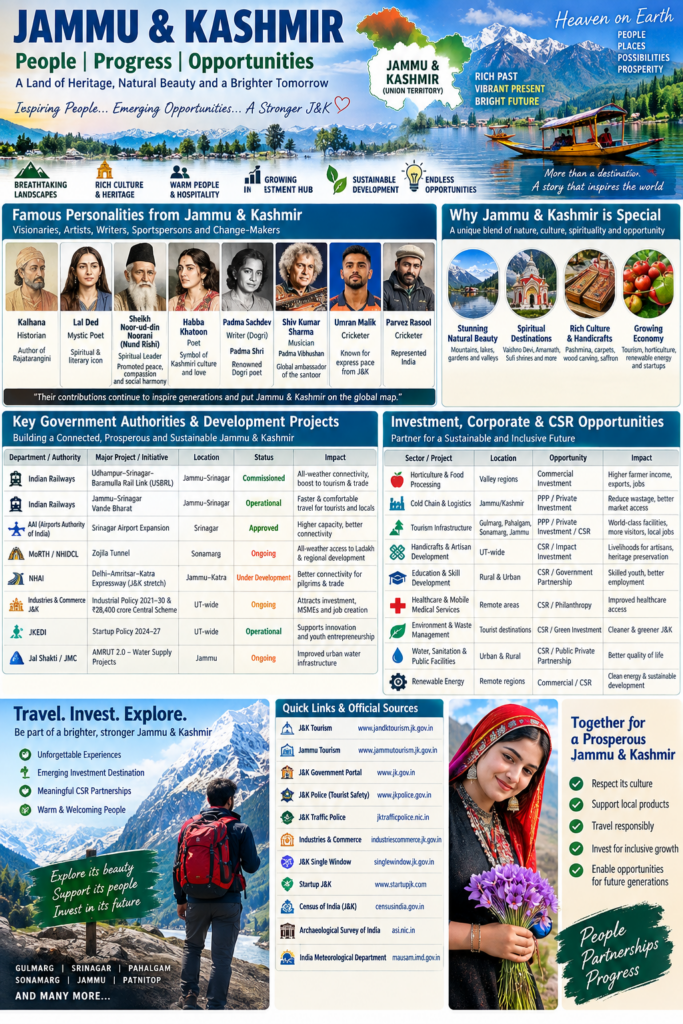
Jammu and Kashmir’s future is being shaped by two forces at once. One is its long-established cultural capital—literature, music, crafts, agriculture and sport. The other is a changing infrastructure and investment landscape built around railways, highways, tunnels, airports, industrial estates, startups, tourism and urban services.
For accuracy, Jammu and Kashmir is currently a Union Territory of India; “Jammu and Kashmir State” remains useful as a historical and commonly searched phrase.
For investors and CSR teams, an important distinction should run through this entire guide: a development need is not automatically a government-approved investment opportunity, and a socially beneficial project does not automatically qualify as CSR. Commercial investment, PPPs, philanthropy and statutory CSR follow different legal, financial and governance routes.
🌟 Famous Personalities Associated With Jammu & Kashmir
The following names represent different periods and fields. This is a representative reference table, not a ranking of their importance.
| Name | Field | J&K Connection | Major Contribution | National / Global Recognition | Legacy | Cultural / Tourism / Economic Impact |
|---|---|---|---|---|---|---|
| Kalhana | History & Sanskrit literature | Medieval Kashmir | Author of Rajatarangini | Internationally studied historical chronicle | Foundational source for Kashmir history | Strengthens heritage and academic tourism |
| Lal Ded / Lalleshwari | Poetry & spirituality | Kashmir | Mystical vakhs and philosophical poetry | Major figure of Kashmiri literary tradition | Enduring spiritual/literary influence | Literature, culture and heritage interest |
| Sheikh Noor-ud-din Noorani / Nund Rishi | Poetry & spirituality | Kashmir | Rishi spiritual-literary tradition | Major historical-cultural figure | Deep influence on Kashmiri culture | Shrine, spiritual and cultural tourism |
| Habba Khatoon | Poetry | Kashmir | Celebrated Kashmiri lyric poetry | Major name in Kashmiri literary history | Symbol of Kashmir’s poetic heritage | Literature, music and cultural storytelling |
| Maharaja Gulab Singh | Historical ruler | Founder of Dogra dynasty of princely J&K | Major role in 19th-century political history | Important figure in regional history | Dogra-period heritage | Heritage sites, museums and historical research |
| Maharaja Ranbir Singh | Historical ruler | Dogra J&K | Administration, scholarship and institutional development | Important Dogra-era ruler | Associated with institutional and cultural development | Jammu heritage tourism |
| Maharaja Pratap Singh | Historical ruler | Dogra J&K | Infrastructure and administrative modernization during his reign | Historical importance | Associated with modernization period | Heritage research |
| Maharaja Hari Singh | Historical ruler | Last ruling Maharaja of princely J&K | Central figure in 20th-century J&K history | Internationally studied historical figure | Major place in modern history | Museum/history tourism |
| Padma Sachdev | Dogri literature | Jammu | Poetry and writing in Dogri/Hindi | Padma Shri; Sahitya Akademi recognition | Major modern Dogri literary voice | Raised visibility of Dogri language |
| Dina Nath Nadim | Poetry/literature | Kashmir | Major contribution to modern Kashmiri literature | Widely studied literary figure | Modern Kashmiri literary heritage | Cultural/educational value |
| Agha Shahid Ali | Poetry | Srinagar-born | English-language poetry with Kashmir as a recurring cultural landscape | International literary recognition | Took Kashmir-linked poetry to global readers | Global cultural visibility |
| Shiv Kumar Sharma | Music | Born in Jammu | Popularized the santoor in Indian classical music | Padma Vibhushan | Internationally recognized instrumental legacy | Strong association between santoor and J&K culture |
| Ghulam Rasool Santosh | Visual art | Kashmir-born | Neo-Tantric modern art | National/international art recognition | Important modern Indian artist | Art and cultural identity |
| Ghulam Nabi Dar | Wood carving | Srinagar | Traditional walnut wood carving | Padma Shri 2024 | Preservation of heritage craftsmanship | Supports craft visibility and artisan economy |
| Romalo Ram | Dogri folk art | Jammu region | Revival/promotion of Geetru and Bhakh folk forms | Padma Shri | Trained and encouraged younger practitioners | Dogri cultural preservation |
| Farooq Ahmad Mir | Kani/Pashmina weaving | Srinagar | Innovations in Kani weaving and calligraphic designs | Padma Shri; Sant Kabir and National awards | Artisan livelihoods and craft transmission | Premium craft economy and cultural tourism |
| Parvez Rasool | Cricket | Kashmir | Prominent professional cricketer from J&K | Represented India | Inspired regional cricket participation | Sports visibility |
| Umran Malik | Cricket | Jammu | Fast bowler emerging through J&K cricket | Represented India | Increased visibility of regional cricket talent | Youth/sports inspiration |
| Chain Singh | Shooting | Jammu region | International competitive shooting | International-level Indian shooter | Sports achievement | Youth sporting aspiration |
🏗️ Government Authorities and Development Projects Shaping J&K
The following project picture uses official information verifiable through 2026. Infrastructure schedules can move, so proposed completion dates should always be checked again before republishing.
| Department / Authority | Major Project / Role | Location | Status | Latest Verifiable Update | Official Budget / Funding | Challenges | Expected Completion / Stage | Likely Community / Business / Traveler Impact | Official Source |
|---|---|---|---|---|---|---|---|---|---|
| Indian Railways | Udhampur–Srinagar–Baramulla Rail Link (USBRL), 272 km | Jammu–Kashmir corridor | Commissioned | Railways confirmed complete commissioning; Jammu–Srinagar passenger connectivity operational | Public railway investment | Himalayan geology/engineering | Commissioned | Tourism, passenger movement, freight and market access | (Press Information Bureau) |
| Indian Railways | Jammu–Srinagar Vande Bharat | Jammu–Kashmir | Operational | 20-coach extended service flagged off Apr 2026; regular service from May | Railway funding | Mountain operating environment | Operational | Faster passenger/pilgrimage/business movement | (Press Information Bureau) |
| Indian Railways | Qazigund–Srinagar–Budgam doubling | Kashmir Valley | DPR / development stage | Railways reported DPR prepared; later stated doubling work underway | Verify package-wise | Approvals/engineering | No single evergreen completion date quoted here | More rail capacity | (Press Information Bureau) |
| Indian Railways | Baramulla–Uri new line | North Kashmir | DPR/planning | DPR prepared; approval process requires stakeholder/NITI/Finance processes | Not treated here as sanctioned project budget | Approvals, terrain | Planning/DPR | Potential future regional connectivity | (Press Information Bureau) |
| Indian Railways | Jammu/Reasi–Poonch rail | Jammu/Pir Panjal | Survey/planning | Final Location Survey sanctioned for 190-km strategic line | Not an approved construction budget | Mountain engineering, approvals | Survey stage | Potential long-term connectivity | (Press Information Bureau) |
| Railways | Goods terminals | Samba; proposed/in-principle sites | Mixed | GCT commissioned in Samba; in-principle approvals reported for Kathua, Anantnag and Jammu | Project-specific | Land/logistics integration | Mixed | Freight, horticulture, MSME distribution | (Press Information Bureau) |
| AAI / Civil Aviation | Srinagar International Airport Civil Enclave expansion | Budgam/Srinagar | Approved | CCEA approved Feb 2026 | ₹1,677 crore | Construction within operational airbase environment | Project implementation ahead | Capacity designed for 10 MPPA; tourism/business connectivity | (Press Information Bureau) |
| MoRTH/NHIDCL | Zojila Tunnel + connecting road | Sonamarg toward Ladakh | Ongoing | Main-tunnel breakthrough achieved Jun 2026; NHIDCL reports project progress | NHIDCL TPC ₹6,808.69 crore | Extreme altitude/geology/weather | NHIDCL currently lists likely completion Feb 2028 | Strategic, tourism and trade connectivity | (Press Information Bureau) |
| NHIDCL | Kishtwar Bypass | Kishtwar | Ongoing | NHIDCL reports ~50% physical progress | ₹859.67 crore TPC | Mountain engineering | Likely Jun 2027 per current register | Reduced town traffic; improved freight/access | |
| NHIDCL | Goha–Khellani NH-244 package | Doda region | Ongoing | ~94% physical progress in current NHIDCL register | ₹225.37 crore TPC | Terrain/construction | Oct 2026 currently listed | Doda/Kishtwar connectivity | |
| MoRTH/NHAI | Delhi–Amritsar–Katra Expressway J&K packages | Jammu–Katra | Under development | Two 44.22-km packages were foundation-stoned as part of major connectivity programme | Package-specific | Land/construction | Verify current package schedule | Pilgrimage/logistics/road tourism | |
| MoRTH/NHAI | Srinagar Ring Road Phase II | Srinagar region | Development | Foundation stone laid for Phase II | Project-specific | Urban interfaces/land | Verify current package update | Bypass traffic, freight and urban mobility | |
| MoRTH | Srinagar–Baramulla–Uri NH-01 upgrading | Kashmir | Development | Five packages covering 161 km announced | Package-specific | Terrain/traffic | Verify package-wise | Trade, tourism and border-region connectivity | |
| MoRTH | Kulgam & Pulwama bypasses, NH-444 | South Kashmir | Development | Foundation stones announced | Package-specific | Land/construction | Verify current package stage | Less town congestion, horticulture logistics | |
| Industries & Commerce | Industrial estates, industrial land, investment facilitation | UT-wide | Ongoing programme | Industrial Policy, Land Allotment and Private Industrial Estate frameworks remain relevant | Scheme/investor-specific | Land, utilities, environmental clearance | Policy through 2030 subject to amendment | Manufacturing, jobs, logistics, MSMEs | (Industries Commerce) |
| GoI / J&K I&C | New Central Sector Scheme | UT-wide | Operational scheme | ₹28,400-crore scheme framework supports eligible industrial investment | ₹28,400 crore outlay | Eligibility/claim compliance | Scheme-specific | Manufacturing, services, employment | (Press Information Bureau) |
| JKEDI | J&K Startup Policy 2024–27 | UT-wide | Operational policy | JKEDI is nodal agency; incubation, startup support and seed-assistance mechanisms | Eligibility-based | Scale, market access, funding | Policy period 2024–27 | Entrepreneurship/youth employment | (Startup India) |
| JMC/Jal Shakti/HUDD | AMRUT 2.0 water augmentation | Jammu | Ongoing | 13 tube wells proposed; Feb 2026 update said works progressing | Centrally sponsored AMRUT 2.0 | Water availability/execution | Package-specific | Improved urban water security | (JMC) |
🚇 Metro and BRTS: distinguish proposals from operating infrastructure
Older plans and reports have discussed metro concepts for Jammu and Srinagar. That is not sufficient evidence to call either an operational or ongoing metro investment project.
For investor-facing publication, Jammu Metro, Srinagar Metro or any BRTS corridor should not be described as operational unless a current implementing authority confirms that status. The need for better urban public transport may be real, but a transport need is not the same thing as an approved PPP or procurement opportunity.
🏭 The investment-policy framework
Commercial investors have several formal policy routes to examine. The New Central Sector Scheme for Industrial Development of J&K has an official outlay of ₹28,400 crore and provides Capital Investment Incentive, Capital Interest Subvention, GST-Linked Incentive and Working Capital Interest Subvention, subject to applicable conditions.
The broader policy architecture also includes the J&K Industrial Policy 2021–30, Industrial Land Allotment Policy, Private Industrial Estate Development Policy, Foreign Investment Policy, Single Window Rules and Startup Policy.
💰 Investor, Corporate Partnership and CSR Opportunity Map
The following table deliberately labels possible development opportunities rather than presenting them as already approved projects. “Potential” means an area worth investigating; it does not mean a department is currently inviting investment or CSR funding for that exact proposal.
| Development Need / Opportunity | Sector & Location | Route | Investment / Funding Potential | Suitable Partner | CSR / Schedule VII Relevance* | Government / Institutional Route | Potential Impact | Implementing Route | Due Diligence / Monitoring | Key Risk | Investor / CSR Value |
|---|---|---|---|---|---|---|---|---|---|---|---|
| 🍎 Apple grading, sorting & packaging | Horticulture belts | Commercial | High | Food processors, FPO partners, agritech | Livelihood CSR only where structured as eligible non-business beneficiary project | Horticulture/MSME/food-processing schemes | Less wastage, higher farmer realization, jobs | Investor/FPO/private unit | DPR, procurement, food compliance, farmer metrics | Seasonality | Strong local raw-material base |
| ❄️ CA/cold storage | Shopian, Baramulla, Pulwama etc. | Commercial / eligible scheme support | High | Cold-chain/infrastructure investors | CSR generally inappropriate for investor-owned commercial asset | Relevant horticulture/food/MSME financing | Reduced post-harvest losses | Private/cooperative/FPO | Utilization, energy, tariff, capacity | Capex/power | Critical value-chain gap |
| 🚚 Reefer logistics | Horticulture corridors | Commercial | Medium–high | Logistics/3PL/fleet operators | Usually not CSR as ordinary commercial fleet | MSME/finance | Market access, less spoilage | Private operator | Fleet utilization/temperature tracking | Return-load economics | Links farms to national markets |
| 📦 Warehousing/GCT-linked logistics | Samba, Jammu, Kathua, Anantnag | Commercial/PPP where invited | High | 3PL, rail-logistics, warehousing funds | Limited CSR relevance | Railways/industrial/single-window route | Lower freight cost, MSME access | Tender/private development | Land, demand study, contracts | Utilization | USBRL opens new freight possibilities |
| 🌺 Saffron value addition | Pampore/Pulwama | Commercial/FPO | Medium | Food brands/exporters | Farmer livelihood/skills may qualify separately | Agriculture/MSME/export support | Branding, processing, farmer income | FPO/private | GI/authenticity, lab testing | Counterfeit/quality | Premium globally recognized product |
| 🧶 Pashmina/Kani/craft traceability | Srinagar/Budgam | Commercial + possible CSR component | Medium | Luxury brands, retail-tech, foundations | Heritage/artisan livelihood can potentially fit Schedule VII | Handicrafts/I&C schemes | Artisan incomes, authenticity | Artisan groups/qualified entity | Beneficiary baseline, provenance, sales metrics | Imitation goods | Heritage + premium branding |
| 🏏 Kashmir-willow sports cluster | South Kashmir | Commercial | Medium | Sports-goods manufacturers/exporters | Youth sports/skills may be separately CSR eligible | MSME/I&C | Jobs, exports, sport ecosystem | Manufacturers/cluster bodies | Supply chain, certification | Raw material/quality | Distinctive GI-linked manufacturing |
| 🍯 Honey processing | Ramban/rural J&K | Commercial/FPO | Low–medium | FMCG, food startups | Livelihood training may qualify | Agriculture/MSME | Rural income | FPO/private/SHG | Quality testing, traceability | Quality/market | Scalable rural enterprise |
| 🌿 Lavender/aromatic products | Bhaderwah/Doda | Commercial + research partnership | Medium | Cosmetics, wellness, essential-oil firms | Livelihood/skills/environment components may qualify | Agriculture/science/MSME | Diversification, rural employment | Farmer groups/private | Crop economics, distillation yields | Price volatility | High-value mountain crop |
| ♻️ Tourist waste segregation | Srinagar/Gulmarg/Pahalgam/pilgrimage hubs | Municipal contract / CSR / philanthropy depending structure | Medium | FMCG, hospitality, waste companies | Sanitation/environment themes potentially eligible | ULB/tourism/local authority | Cleaner destinations, recycling jobs | ULB + eligible implementing agency | Waste weighed/diverted, third-party audit | Operations/land | Highly visible measurable ESG outcome |
| 💧 Safe drinking-water facilities | Tourist/rural/public institutions | CSR/public programme | Medium | FMCG, banks, hospitality, foundations | Safe drinking water/sanitation | Jal Shakti/local bodies | Health/tourist service | Authority + eligible CSR entity | Water-quality testing, uptime | Maintenance | Clear measurable public benefit |
| 🏥 Rural/mobile health services | Remote districts | CSR/philanthropy/public partnership | Medium–high | Healthcare/pharma foundations | Healthcare explicitly relevant | Health Department/qualified entity | Access to diagnostics/care | Govt + eligible implementing entity | Patient/outcome data, clinical governance | Staffing/continuity | High social impact |
| 🎓 Digital/STEM labs | Rural schools | CSR | Low–medium | IT, telecom, banks | Education | Education Department/eligible entity | Digital skills | School authority + implementing partner | Attendance/learning outcomes/assets | Maintenance | Scalable, measurable |
| 🧑🔧 Hospitality/logistics skills | UT-wide | CSR / commercial training | Medium | Hotels, logistics, airlines, corporates | Vocational skills/livelihood | Skill-development/JKEDI partners | Employability | Training partner | Placement and retention metrics | Training-job mismatch | Builds local workforce |
| 👩 Women SHG enterprise | Rural J&K | CSR/social enterprise | Low–medium | Banks, FMCG, e-commerce | Women empowerment/livelihood | Rural livelihood institutions | Income, entrepreneurship | SHGs/eligible entities | Income baseline, sales, bank linkage | Market access | Inclusive local supply chains |
| ♿ Accessible tourism | Major tourism hubs | CSR / hospitality capex / public works | Medium | Hotels, travel firms, foundations | Disability inclusion can align with Schedule VII themes | Tourism/local bodies | Inclusive tourism | Property owner/authority/eligible partner | Accessibility audit | Terrain/building constraints | Expands visitor inclusion |
| 🏛️ Heritage conservation | Jammu/Srinagar/other heritage sites | CSR/philanthropy/public conservation partnership | Medium–high | Banks, heritage foundations, hospitality | Protection of national heritage/art/culture potentially relevant | ASI/Archives/Museums/heritage authority as applicable | Conservation + tourism | Competent conservation authority | Conservation plan, expert supervision | Poor restoration can damage heritage | Strong cultural legacy |
| 🌲 Wetland/ecosystem restoration | Lakes/wetlands | CSR/environment programme | Medium–high | ESG funds, hospitality, FMCG | Environmental sustainability | Forest/wetland/local competent authority | Biodiversity/water/ecotourism | Competent authority + eligible agency | Ecological baseline, water/biodiversity metrics | Ecological complexity | Strong measurable nature impact |
| 🏞️ Rural eco-tourism livelihoods | Suitable villages | Commercial/community/CSR components | Medium | Hospitality, tour operators, foundations | Rural livelihood/environment components may qualify | Tourism/rural development | Distributed tourism income | Community/private/eligible agency | Carrying capacity, household income | Overtourism | Spreads tourism beyond hotspots |
| 🚑 Highway emergency-response support | Mountain corridors | Public/CSR where approved | Medium | Auto, insurance, healthcare companies | Healthcare/public safety alignment requires legal review | Highway/health/police authority | Faster emergency response | Competent public authority | Response time/outcomes | Long-term O&M | Strong safety impact |
| ⚡ Renewable energy for public institutions | Remote schools/health facilities | CSR / public procurement | Medium | Energy firms, ESG funds | Environmental sustainability | Renewable/public department | Resilience, lower energy cost | Authority/eligible entity | Generation/uptime monitoring | Maintenance | Quantifiable carbon/social impact |
| 🚻 Tourist sanitation | Pilgrimage/tourism destinations | CSR/public concession where invited | Medium | Hospitality/FMCG/sanitation firms | Sanitation | Tourism/ULB/shrine authority | Hygiene and destination quality | Authority/eligible agency | Usage, cleanliness, water/O&M | Maintenance | Highly visible impact |
| 🚐 Accessible/public last-mile mobility | Cities/tourism nodes | Commercial/PPP only when invited; CSR in narrow eligible cases | Medium–high | Mobility/EV operators | CSR only if structured around eligible beneficiary/public-purpose programme | Transport/ULB tender | Better mobility | Authority/operator | Ridership, accessibility, economics | Demand/regulation | Tourism + resident benefit |
Schedule VII alignment is indicative. A theme matching Schedule VII does not by itself make a particular expenditure legally eligible CSR.
⚖️ Which funding route fits which project?
| Funding Route | Investor Gets Commercial Return? | Government Approval/Tender? | CSR Treatment | Good J&K Examples |
|---|---|---|---|---|
| 🏭 Private commercial investment | Yes | Licences/approvals required | No | Processing, hotel, warehouse, logistics, manufacturing |
| 🤝 PPP | Usually yes under contract | Yes—formal government process | Normally not simply CSR | Parking, tourism facilities, urban infrastructure when officially tendered |
| 🏢 Corporate CSR | No commercial return as ordinary business investment | Depends on project/partner | Must satisfy Companies Act/CSR Rules | Education, health, sanitation, skills, environment, heritage where eligible |
| ❤️ Philanthropy | No | Depends on recipient/project | May or may not qualify as CSR | Community welfare, culture, disaster support |
| 🌱 Impact/social enterprise investment | Potential financial + social return | Business/regulatory route | Investment itself not automatically CSR | Rural enterprise, waste, agritech |
| 🏛️ Government grant/scheme | Not investor return | Scheme eligibility | Separate from CSR | Startup/MSME/agriculture/industrial support |
Schedule VII includes areas such as healthcare and sanitation, education and vocational skills, gender equality, environmental sustainability, protection of heritage/art/culture, rural development and other notified categories.
🔍 A practical CSR governance framework
A company considering a J&K social project should establish legal eligibility first and funding second. The sequence should cover the implementing entity, local permissions, beneficiary need, baseline evidence, project budget, procurement controls, banking/payment controls, milestone-linked disbursement, utilization certificates, physical verification, outcome measurement, statutory disclosure and independent review where appropriate.
| Governance Layer | Minimum Good Practice |
|---|---|
| Legal | Companies Act/CSR Rules + Schedule VII mapping |
| Implementing partner | Eligibility, registrations, governance history, financial statements |
| Need assessment | District/community evidence |
| DPR | Scope, beneficiary count, milestones, capex/O&M |
| Procurement | Competitive/transparent purchasing |
| Finance | Dedicated tracking and documented approvals |
| Physical verification | Geo-tagged/dated evidence where appropriate |
| Outputs | Schools equipped, people trained, water points installed etc. |
| Outcomes | Learning, income, health, water quality, waste diverted etc. |
| Asset ownership | Written handover/O&M responsibility |
| Audit | Financial + programme audit appropriate to size/risk |
| Transparency | Board/CSR committee/statutory disclosure |
| Exit plan | Who maintains the asset after CSR funding ends? |
A worthwhile social objective alone is not enough reason to transfer CSR money to an informal organization.
🚀 Where commercial opportunities may be strongest
A useful way to think about J&K is not simply “What new industry can be brought here?” but “Where is value already being produced locally and then lost because processing, storage, logistics, packaging, technology or market access are insufficient?”
For horticulture, that chain can be:
Apple → grading → cold storage → reefer/rail → processing → national/export market
Cold-chain infrastructure, controlled-atmosphere storage, grading, dehydration, juice production, packaging, traceability and reefer logistics can potentially retain more of that value close to the production region.
For crafts:
Pashmina/crafts → artisan → authentication → design → digital commerce → premium market
Pashmina, Kani, Sozani, carpets, papier-mâché and walnut carving create opportunities at the intersection of traditional knowledge, provenance technology, premium design and international e-commerce.
For saffron:
Saffron → testing → traceability → premium packaging → global brand
For Kashmir willow:
Willow → manufacturing → quality control → sports brand → export
And for tourism:
Mountain landscape → responsible tourism → hospitality → local food → guides → transport → rural employment
🚆 What USBRL changes for logistics
The 272-km USBRL is commissioned. Railways says it is providing all-weather connectivity and creating market opportunities for commodities including apples and dry fruits as well as Pashmina shawls and handicrafts. Samba already has a commissioned Goods Cargo Terminal, while in-principle approvals have been reported for GCTs in Kathua, Anantnag and Jammu.
That can support investigation into rail-linked aggregation, warehousing, packaging, multimodal logistics and e-commerce fulfillment. Actual investment decisions still require freight-volume analysis and confirmation of terminal arrangements.
💻 Startup opportunities
Under the J&K Startup Policy 2024–27, JKEDI is the nodal agency. Startup India currently describes measures including subsidized co-working space and, for qualifying startups, one-time assistance of up to ₹20 lakh in four installments, subject to evaluation, approval and progress monitoring.
Relevant business models include agritech, tourism technology, logistics software, cold-chain technology, craft authentication, BPO/KPO, food brands and digital marketplaces.
🏭 Industrial investors: use J&K terminology
An investor should not search for a “Jammu Kashmir MIDC.” MIDC is Maharashtra terminology. Jammu and Kashmir uses industrial estates and its own industrial-development framework.
The Industries & Commerce Department lists industrial estates in both divisions and is responsible for industrial-development and investment functions.
Before building a financial model, investors should obtain current information on land availability, zoning, electricity, water, environmental clearance, incentive eligibility and logistics costs.
✈️ Srinagar Airport and downstream business demand
The Srinagar International Airport Civil Enclave expansion is one of the clearest recently approved infrastructure projects.
The CCEA approved it in February 2026 at an estimated ₹1,677 crore. The project covers 73.18 acres and includes a 71,500-square-metre terminal building area, including existing structure. The design capacity is approximately 2,900 peak-hour passengers and 10 million passengers per year.
This does not mean the airport expansion itself is an open investment proposition. Its significance for private business is the possible downstream demand it creates in hospitality, transfers, tourism services, food supply, destination management and logistics.
📈 Opportunity by investor profile
| Investor Profile | Areas Worth Investigating |
|---|---|
| ₹5–25 lakh entrepreneur | Saffron/honey/dry-fruit packaging, tourism services, craft e-commerce |
| ₹25 lakh–₹1 crore MSME | Food processing, tourist transport, sports goods, hospitality services |
| ₹1–10 crore investor | Cold chain, warehousing, processing, accommodation, logistics |
| Large infrastructure investor | Industrial estates, logistics parks, hospitality, energy—through appropriate official route |
| International investor | Eligible industrial sectors under India’s FDI framework and J&K policies |
| Startup founder | Agritech, travel-tech, logistics-tech, BPO/KPO, traceability |
| Hotel group | Premium/experiential hospitality and MICE |
| Logistics company | Reefer, aggregation, warehouse, rail-linked freight |
| FMCG company | Food processing, farmer value chains |
| Sports company | Kashmir-willow value chain |
| Luxury/fashion company | Pashmina/craft design and traceability |
| Foundation/CSR programme | Education, health, skills, sanitation, environment, heritage |
| ESG-focused company | Waste, water, renewable energy, wetlands/ecological restoration |
🌱 Making CSR impact measurable
CSR proposals become much more credible when they can demonstrate a clear chain:
Funding → intervention → beneficiary → measurable output → measurable outcome → independent evidence
A digital-education project can monitor student participation and learning. A drinking-water intervention can track water quality and uptime. Skill programmes can measure certification, placement and income. Waste programmes can report tonnes diverted. Artisan initiatives can track beneficiary income and verified sales. Ecological projects can monitor appropriate environmental indicators.
This gives corporate boards and CSR committees something stronger than a broad promise of “development.”
⚠️ Claims that require particular caution
Investor-facing content should not describe a project as a “government-approved CSR opportunity” without actual approval. A subsidy should never be described as guaranteed because eligibility and claim conditions apply. Industrial land is allocated through formal processes rather than guaranteed on request.
Likewise, a metro concept should not be marketed as an investment opportunity without current procurement; a proposal should not be called an approved PPP; and employment numbers should not be invented without a credible DPR.
The same discipline applies to investment statistics. Proposals, approvals, commitments, grounded projects and actual investment are different measures and should not be treated as interchangeable.
🧭 The larger development opportunity
Jammu and Kashmir increasingly has the physical ingredients for stronger value chains: USBRL is commissioned, the Jammu–Srinagar Vande Bharat is operational, the ₹1,677-crore Srinagar airport Civil Enclave expansion is approved, Zojila and other highway projects remain under construction, and the ₹28,400-crore NCSS framework supports eligible industrial development.
The practical investment process should therefore be:
Identify the real need → determine whether the route is commercial investment, PPP, CSR or philanthropy → verify land/government/regulatory status → prepare the DPR → establish financial or social baseline → conduct due diligence → contract transparently → fund against milestones → audit expenditure → measure results.
That framework allows J&K’s agriculture, craftsmanship, tourism, new connectivity and entrepreneurial ecosystem to be developed without confusing an attractive idea with a sanctioned project or an eligible investment opportunity.
🚛 The Morning the Mountain Changed Our Route

At 4:40 a.m., the headlights of our survey vehicle cut through the darkness outside Bari Brahmana, Samba. Behind the industrial sheds, the Pir Panjal was still invisible, but I knew that somewhere beyond those mountains lay the real question of the day:
Could an oversized industrial vessel actually be moved from the Jammu industrial belt toward the Kashmir Valley without forcing the mountain road to accept a load it was never designed to carry?
The cargo existed only on my drawings that morning—a long cylindrical process vessel planned for a future industrial movement. This is a documentary-style reconstruction inspired by real route-survey practice; the cargo movement, crew and incidents are fictional, while the geography and infrastructure are grounded in real locations.
Our proposed starting point was the Bari Brahmana–Samba industrial belt, an established industrial zone. Jammu & Kashmir’s Industries & Commerce records identify Bari Brahmana and IGC Samba among the Jammu Division’s industrial estates, while the government has also approved newer industrial-estate development around Kartholi and Karandi in Samba.
I closed the vehicle door, unfolded the route sheet and wrote the first line:
Origin: Bari Brahmana industrial belt
Proposed corridor: Jammu → Udhampur → Ramban → Banihal → Qazigund → Kashmir Valley
Primary highway: NH-44
Survey objective: ODC feasibility—not dispatch approval.
That last distinction mattered.
A route survey does not prove that a trailer may move tomorrow. It identifies what must be measured, engineered, permitted or changed before anyone should consider dispatch.
🌄 Before the Truck, I Sent a Small Vehicle
There is an old mistake in heavy haulage: people become fascinated by the cargo and forget about the road.
I do the opposite.
Before imagining a hydraulic modular trailer on the highway, I try to see the road as the trailer would see it.
A passenger car sees a bridge.
I see deck width, parapets, approach geometry, structural capacity and load distribution.
A tourist sees a tunnel.
I see portal clearance, internal envelope, lane width and whether the cargo’s swept path survives a curve inside it.
A driver sees an overhead sign.
I see an obstruction.
A traveler sees a hairpin.
I see tractor length, trailer wheelbase, steering angle, rear swing and the possibility of reversing several tonnes of machinery on a mountain road.
That morning our fictional survey team consisted of four people: I was responsible for route feasibility; Sameer handled measurements and photographs; Dev maintained the obstruction register; and our local driver, Rafiq, understood something no satellite image could teach us—the rhythm of mountain traffic.
We carried measuring equipment, a laser rangefinder, camera, GPS records, PPE, reflective jackets, route drawings and an empty spreadsheet that would eventually become far more valuable than the photographs.
🚧 Jammu Wasn’t the Mountain—but It Was Already Engineering
Leaving the industrial belt, my first concern wasn’t snow or landslides.
It was geometry.
Industrial cargo must first escape the factory.
We checked the gate width, internal turning area, roadside drains, utility poles, median openings and the point at which a long combination could merge onto the main road without blocking both directions.
“Everyone asks whether the highway is wide enough,” I told Sameer.
“Almost nobody asks whether the trailer can leave the factory.”
He laughed and wrote it into the obstruction sheet anyway.
The first kilometres also reminded us why a heavy-haul survey cannot be copied from an ordinary truck route. A 32-ton commercial truck and a long ODC combination may share a highway number, but they do not occupy the road in the same way.
A long trailer can clear the tractor around a corner while its rear still cuts toward the inside edge.
So every difficult junction received three questions:
Can we enter?
Can the trailer follow?
Can we recover if the movement stops?
🏔️ The Plains Slowly Became a Mountain Road
Beyond Jammu and Udhampur, the road began changing character.
The horizon tightened.
Valleys became deeper.
Cut slopes rose beside us.
The highway was no longer merely connecting points on a map; it was negotiating geology.
By the time we were studying the Ramban side of the corridor, our conversation had almost stopped.
Every few minutes one of us called out another observation.
“Retaining wall.”
“Restricted shoulder.”
“Rock face.”
“Bridge approach.”
“Curve.”
“Construction interface.”
“Stopping location—possible.”
“Stopping location—absolutely not.”
This is where the difference between route planning and route surveying becomes brutal.
On Google Maps, the line continues.
On the ground, a 45-metre combination may discover that there is nowhere safe to stop for kilometres.
🪨 Ramban Changed the Survey
At one location we stepped out beside a constrained mountain section and looked upward.
Loose rock sat above the road.
I didn’t need a dramatic incident to understand the risk.
J&K Traffic Police has specifically advised daylight travel on the Jammu–Srinagar NH-44 when there is apprehension of shooting stones between Ramban and Banihal. Its advisories have also documented single-lane conditions and difficult sections around Dalwas, Mehad, Marog and Kishtwari Pather.
For an ordinary vehicle, such an advisory means caution.
For ODC, it changes the engineering plan.
A normal vehicle can sometimes clear a vulnerable stretch quickly.
A heavy combination may travel slowly, require traffic regulation, occupy more lane width and become extremely difficult to recover after a mechanical failure.
I opened my notebook.
ODC RULE 01: Never create a planned stoppage beneath a shooting-stone or unstable cut-slope section.
Then another:
ODC RULE 02: Highway opening does not automatically mean ODC movement is acceptable.
Those two lines eventually became more important than half the measurements we collected.
🌉 The Bridge That Looked Wide Enough
Later, we reached a bridge approach that visually appeared comfortable.
Sameer looked at it and said, “This one should be easy.”
“Measure it.”
That phrase has saved more projects than optimism ever has.
We recorded the usable width, parapet relationship, approach curvature and the position where a long trailer would begin straightening.
But bridge width was only the first filter.
For the actual movement, the relevant bridge-owning authority and engineering team would need to establish whether the proposed axle configuration and gross load were permissible. A heavy-haul contractor should never convert visual inspection into structural certification.
Our route sheet therefore did not say:
Bridge OK.
It said:
Geometrically promising. Structural verification required against proposed axle-load configuration.
That wording matters.
An engineer’s uncertainty is not weakness.
Sometimes it is the most professional sentence on the page.
📐 I Drew the Trailer in the Dust
At a difficult curve, Rafiq stopped at a safe location.
There was a retaining structure on one side and a steep edge on the other. The curve looked manageable from the driver’s seat.
I walked it.
Then I walked it again.
I crouched beside the road and drew a crude tractor-trailer combination in the dust with a stone.
Rafiq watched.
“The tractor will go,” he said.
“Yes.”
“The trailer?”
“That is the problem.”
The inside rear portion could potentially encroach toward the edge depending on the eventual combination length and steering configuration.
So we photographed the geometry and marked it for a proper swept-path analysis.
No heroic driving.
No “experienced driver will manage.”
Engineering first.
Driving second.
🚦 Permissions Are Part of the Route
By midday, our obstruction register was becoming a permission register.
For a genuine ODC movement, depending on cargo dimensions, weight and route, coordination can involve the highway authority/road-owning agency, Traffic Police, local administration, utility owners, bridge/tunnel authorities and other competent bodies.
If a power or communication line interferes, the transporter’s driver cannot simply decide to lift it.
If a sign structure obstructs the cargo, it cannot simply be dismantled.
If temporary traffic control is required, the transporter does not own the highway.
And if a bridge requires structural evaluation, a verbal assurance at a tea shop has no engineering value.
Traffic Police’s published advisories themselves show how actively NH-44 movement can be regulated: vehicle categories, release windows and road conditions can all affect movement plans.
Our fictional ODC plan therefore had a simple hierarchy:
Survey → engineering analysis → authority coordination → permissions → traffic-management plan → final pre-dispatch inspection → movement.
Not:
Load first → solve problems later.
☕ The Tea Seller Who Gave Us a Better Question
Near a roadside settlement we stopped for tea.
The shopkeeper asked what we were measuring.
“A very long truck may come this way one day,” Rafiq explained.
The man smiled.
“Then don’t only check the road. Check where you will park it when the road closes.”
Nobody spoke for a second.
Dev opened the spreadsheet.
A new column appeared:
Emergency holding / parking location.
That is why I never underestimate local knowledge.
Local knowledge cannot replace engineering calculations, but it can tell an engineer where to look.
Truck drivers know where traffic queues form.
Shopkeepers know where rockfall commonly interrupts movement.
Residents know where snow remains after sunshine reaches the opposite slope.
Road workers know which drain repeatedly fills with debris.
A good survey engineer listens to all of them—and then verifies what can be verified.
🚛 The Problem Wasn’t Moving. It Was Stopping.
That afternoon I began thinking less about whether the cargo could travel and more about what would happen if it could not.
Suppose the prime mover overheated.
Suppose hydraulic pressure dropped.
Suppose traffic was stopped ahead.
Suppose weather deteriorated.
Suppose an obstruction that had been clear during survey changed before dispatch.
Where could a long combination stand without blocking the corridor?
Where could technicians reach it?
Where could another tractor assist?
Where could traffic safely pass?
Mountain heavy haulage is not just the science of forward movement.
It is the science of controlled failure.
A route becomes much safer when the team has already answered:
What do we do when the plan stops working?
🌧️ Then the Weather Gave Us a Warning
We did not need a landslide.
A short spell of rain was enough.
The rock darkened. Water began running through drains. Visibility softened.
Rafiq looked at the slope and said, “This is why you don’t make a timetable here like Delhi.”
That sentence stayed with me.
In the plains, planners often build schedules around kilometres.
In the Himalayas, I build them around risk windows.
Daylight.
Weather.
Traffic release.
Road condition.
Recovery locations.
Crew fatigue.
And the possibility that the correct decision is not to move at all.
For this corridor, current traffic status must be checked immediately before an actual journey; official advisories explicitly tell travelers and operators to confirm road status with Traffic Control Units.
🌌 Banihal Was Where I Stopped Thinking About Distance
By the time we approached the Banihal side, the kilometre count had become almost meaningless.
A transport quotation may calculate kilometres.
An ODC feasibility study calculates constraints per kilometre.
One kilometre of open highway may require almost no intervention.
Two hundred metres around a constrained curve, bridge approach or work zone may consume hours of planning.
We reviewed the proposed combination again:
cargo height;
trailer deck height;
overall height;
cargo width;
overall combination length;
axle spacing;
gross combination weight;
ground clearance;
hydraulic suspension travel;
prime-mover requirement;
push/pull assistance;
minimum turning radius.
Only after those numbers were frozen could we transform the reconnaissance into an engineering route plan.
🚇 A Tunnel Is Not Just a Height Measurement
At every tunnel interface, I mentally removed the passenger vehicles from the picture.
An ODC engineer needs more than a sign displaying clearance.
The critical envelope may depend on the crown, sidewalls, kerbs, ventilation/electrical installations, signs, emergency equipment, lane alignment and the way a long trailer enters a curved approach.
For an actual movement, verified as-built or authority-confirmed dimensions and a physical pre-movement check would be essential.
I wrote:
Never design a multimillion-rupee movement around an assumed tunnel clearance.
🌅 Qazigund Changed the Landscape
When we finally emerged toward the Kashmir side, the geography opened.
The mountain walls loosened their grip.
The valley stretched ahead.
For a few minutes nobody discussed axle loads.
Fields appeared beside the corridor, settlements became more frequent, and distant ridges sat beneath a changing sky.
Sameer lowered his camera.
“So we can move it?”
I shook my head.
“We have proved nothing yet.”
He looked disappointed.
“We have found the questions.”
That was the successful outcome.
🏭 The Last Kilometre Was Waiting for Us
Reaching the Kashmir Valley would not finish an industrial ODC movement.
The final destination could be harder than the entire highway.
Industrial access roads may contain narrow gates, drains, utility poles, sharp internal turns and weak shoulders.
The same principle we had used at Bari Brahmana applied again:
The national highway may carry the cargo for hundreds of kilometres, but the final 500 metres can stop the project.
So our destination survey would require another round of measurements:
gate opening;
internal road width;
pavement condition;
underground services;
turning space;
crane setup area;
trailer unloading orientation;
ground-bearing capacity;
temporary storage;
escape route;
night lighting;
emergency access.
The route survey was becoming a logistics plan.
🧮 That Night, the Road Became Data
In the hotel room, we did not celebrate.
We opened laptops.
Hundreds of photographs were renamed by chainage/location.
Measurements entered the obstruction register.
Every uncertain bridge was marked for structural confirmation.
Every questionable curve was marked for swept-path analysis.
Potential holding areas were separated into verified and provisional locations.
We divided obstacles into four categories:
Green — no special intervention identified during reconnaissance.
Amber — engineering verification required.
Red — intervention/permission or route modification potentially required.
Black — movement not to be considered until the fundamental constraint is resolved.
The map suddenly looked very different.
It was no longer a road from Jammu to Kashmir.
It was a sequence of engineering decisions.
🦺 The Most Important Vehicle Wasn’t the Trailer
People often photograph the enormous trailer.
They photograph the prime mover.
They photograph the cargo.
Almost nobody photographs the survey engineer standing beside a culvert with a measuring device.
Or the mechanic checking the hydraulic system.
Or the traffic team communicating around a blind bend.
Or the local driver explaining where trucks queue after rain.
Or the person who spends midnight renaming 600 photographs so that an engineer three days later knows exactly which bridge he is evaluating.
But those people move the cargo before the cargo ever moves.
Heavy haulage is spectacular only at the end.
Before that, it is mostly patience.
🌄 The Final Decision Came at Sunrise
The next morning I stood outside with the Pir Panjal behind us and opened the survey summary.
I expected myself to feel satisfied.
Instead I noticed how many cells still said:
VERIFY.
Years ago that word frustrated me.
Now it reassures me.
Because an unsafe survey report tries to sound certain.
A responsible one tells the next engineer exactly where certainty still has to be earned.
Our conclusion was not:
“Route cleared.”
It was:
“The proposed Jammu–Kashmir corridor may be taken forward for detailed ODC engineering assessment subject to final cargo/trailer configuration, structural verification, swept-path analysis, tunnel/overhead-clearance confirmation, authority permissions, traffic-management planning, weather and road-status review, and a final pre-dispatch route inspection.”
It was less dramatic than a photograph of a giant trailer beneath snow-covered mountains.
But that sentence was the real work.
I closed the laptop.
Rafiq was already drinking tea.
“Will your big truck come?” he asked.
I looked back toward the road.
“Only when the road says yes.”
He smiled.
And that was when I understood something I had missed on every previous survey.
We call ourselves road route survey engineers, but we are not really searching for a road.
The road is already there.
We are searching for the narrow line between what is physically possible and what is responsibly possible.
In the Himalayas, those are never the same thing.
And somewhere between the industrial sheds of Samba, the rock faces of Ramban, the approaches of Banihal and the opening landscape beyond Qazigund, our four-person team had found that line—not by conquering the mountain, but by respecting every place where the mountain told us to measure again.
🌄 Jammu and Kashmir Travel Guide Recap – Where Mountains, Heritage and Human Stories Meet
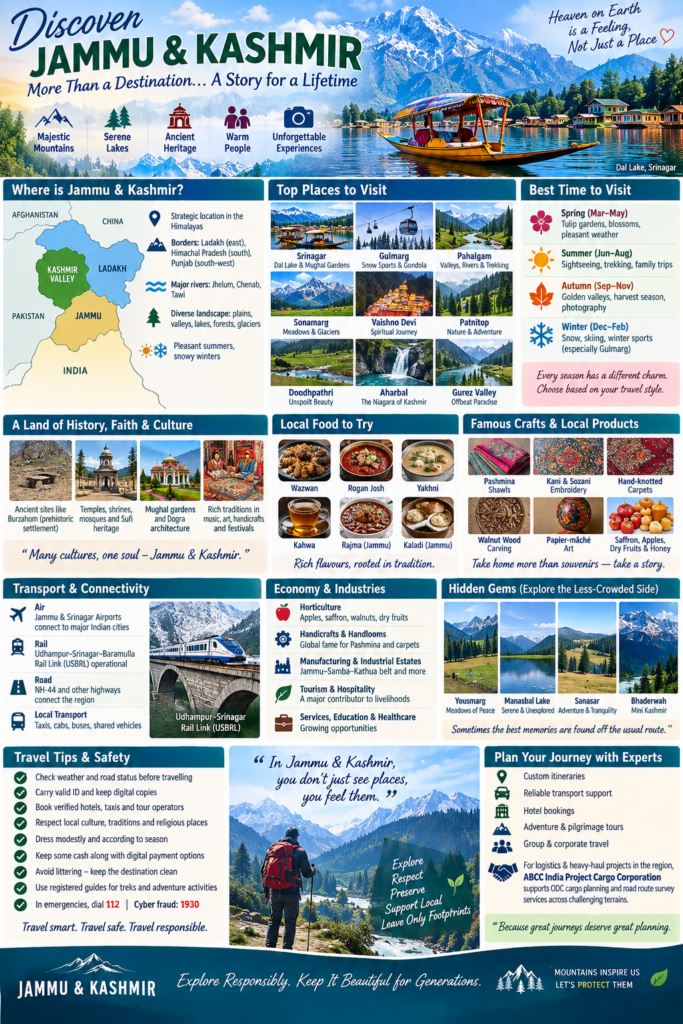
After exploring the best places to visit in Jammu and Kashmir, one thing becomes clear: this destination cannot be understood through Dal Lake, Gulmarg or Vaishno Devi alone. Jammu and Kashmir is a combination of Himalayan geography, centuries of history, sacred traditions, living crafts, distinctive cuisines, agriculture, pilgrimage, adventure and communities whose lives are closely connected with the mountains.
Today, Jammu and Kashmir is officially a Union Territory of India, although travelers frequently search online using the historical phrase “Jammu and Kashmir State.”
🗺️ Geography That Creates a Different Journey Every Few Hours
Jammu and Kashmir’s geography is one of the biggest reasons its travel experiences are so varied. The Jammu plains and Shivalik foothills gradually rise toward mountain country, while the Pir Panjal separates the Jammu region from the Kashmir Valley.
Rivers including the Jhelum, Chenab and Tawi, together with lakes such as Dal, Wular, Manasbal, Mansar and Surinsar, shape both landscapes and local livelihoods.
For travelers, this means one itinerary can include lakes, forests, alpine meadows, snow-covered mountains, pilgrimage towns, orchards and historic city neighborhoods.
The geography also demands patience. A short distance on a map can take much longer on a mountain road, particularly during snowfall, rain, roadworks or traffic restrictions.
🏛️ History, Mythology and Heritage Beyond Sightseeing
The region’s story reaches far beyond modern tourism.
Burzahom provides archaeological evidence of prehistoric human settlement in the Kashmir Valley, while Kalhana’s 12th-century Rajatarangini remains an essential literary source for studying Kashmir’s historical traditions.
Ancient religious traditions, Buddhist influences, Kashmir Shaivism, Sufi and Rishi traditions, Sultanate and Mughal periods, Sikh rule and the Dogra era all contributed layers to the region’s cultural landscape.
Traditional accounts associated with Kashyapa and the origins of the Kashmir Valley remain culturally important, but mythology should be distinguished from archaeological and geological evidence.
Historic gardens, temples, shrines, mosques, forts, palaces, archaeological sites and museums allow visitors to experience these different periods without reducing the destination to a single historical narrative.
🕌 Culture Lives Beyond Monuments
Jammu and Kashmir’s cultural identity survives through everyday life.
Kashmiri, Dogri, Pahari and other regional linguistic and cultural traditions appear in poetry, music, storytelling, clothing, architecture, cuisine and festivals.
The craftsmanship is particularly remarkable. Kashmir Pashmina, Kani shawls, Sozani embroidery, hand-knotted carpets, papier-mâché, walnut-wood carving, Namda, Crewel and other crafts represent knowledge transmitted across generations.
In Jammu, Dogra culture contributes its own distinctive cuisine, language, folk traditions, architecture and religious heritage.
Responsible tourism means seeing these crafts as livelihoods—not merely souvenirs.
🍛 A Destination You Should Also Explore Through Food
Food tells another part of the story.
Kashmir’s culinary traditions include dishes associated with Wazwan, alongside Rogan Josh, Yakhni, Goshtaba, Dum Olav and Kahwa. Jammu contributes regional favorites such as Rajma and Kaladi, along with a wider Dogra culinary tradition.
Vegetarian travelers can find substantial options, particularly in Jammu, Katra and major tourist centers, but vegetarian, vegan and Jain food should not be treated as identical. Travelers with dietary restrictions should confirm ingredients directly.
Eating locally, rather than limiting a trip to familiar national restaurant chains, can become one of the most memorable parts of the journey.
🏔️ Famous Places—and the Quieter Side of Jammu and Kashmir
First-time travelers understandably gravitate toward Srinagar, Dal Lake, Gulmarg, Pahalgam, Sonamarg, Katra and Vaishno Devi.
They deserve their popularity.
But travelers with additional time can discover another side of the region through places such as Yousmarg, Doodhpathri, Aharbal, Manasbal Lake, Gurez Valley, Daksum, Sinthan-area landscapes, Patnitop, Sanasar, Mansar, Surinsar and Bhaderwah.
These quieter destinations should not simply become the next overcrowded social-media locations. Their limited infrastructure and environmentally sensitive landscapes make responsible behavior even more important.
🌷 One Destination, Four Very Different Seasons
Spring brings blossoms, gardens and changing mountain colors.
Summer opens more valleys and outdoor experiences.
Autumn transforms orchards, forests and agricultural landscapes.
Winter changes destinations such as Gulmarg into snow-tourism centers while also introducing icy roads, closures and weather-related delays.
That is why there is no single “best time to visit Jammu and Kashmir.”
The right season depends on whether you want flowers, family sightseeing, trekking, pilgrimage, photography, autumn landscapes or snow.
🚆 Road, Rail and Air Connectivity Is Transforming Travel
Jammu and Srinagar remain the two principal gateways.
Jammu Airport and Srinagar Airport provide air access, while major road corridors connect Jammu, Kashmir and surrounding regions.
The commissioning of the Udhampur–Srinagar–Baramulla Rail Link (USBRL) has substantially changed rail connectivity between the Jammu region and Kashmir Valley.
NH-44 remains a crucial road artery, while other mountain corridors provide regional connectivity.
But better infrastructure does not eliminate Himalayan geography.
Weather, construction, rockfall, snowfall and traffic regulation can still affect road journeys. Visitors should check current traffic and weather advisories shortly before long transfers rather than relying on an itinerary prepared months earlier.
🍎 Tourism Is Only One Part of the Economy
The region’s economic identity also comes from horticulture, agriculture, handicrafts, food processing, livestock-related livelihoods, services, manufacturing and increasingly logistics and entrepreneurship.
Apples, walnuts, saffron, honey, dry fruits and other agricultural products connect rural landscapes with national markets.
Industrial areas around the Jammu–Samba–Kathua belt, together with industrial estates elsewhere in the Union Territory, contribute manufacturing and employment.
Improving highways, railways, cold chains, warehouses and freight connectivity can be especially important for perishable horticultural produce and small businesses.
For a curious traveler, understanding these economic landscapes adds depth to the trip: an apple orchard, saffron-growing area or artisan workshop can explain the region as meaningfully as a famous viewpoint.
🥾 Adventure Should Never Become Carelessness
Jammu and Kashmir offers skiing, trekking, hiking, Gondola experiences, camping and other outdoor activities depending on destination, season and current operations.
Mountain beauty, however, should never be confused with an absence of risk.
Travelers should use suitable operators, check weather, carry proper clothing and equipment, respect protected areas and avoid treating rivers, frozen lakes, cliffs or snow slopes as automatically safe recreation areas.
Remote trekking deserves considerably more preparation than an ordinary sightseeing excursion.
🛡️ Safety Is Mostly About Preparation
Avoid both extremes: describing the entire region as dangerous or promising that every traveler will always be perfectly safe.
Practical precautions work better.
Use verified accommodation and traceable transport. Agree taxi fares and inclusions beforehand. Keep invoices for expensive purchases. Never share an OTP, card PIN, CVV or UPI PIN. Check the recipient before digital payments.
Keep important tickets and documents available offline.
For mountain-road journeys, check weather and current road status on the day of travel.
Save 112 for emergencies and 1930 for cyber-financial fraud.
Women traveling alone, senior citizens, families with young children and differently abled travelers should plan accommodation, transfers and accessibility according to their individual needs rather than depending on generic “safe for everyone” claims.
💰 Practical Planning Makes the Journey Better
Do not try to cover Jammu, Katra, Srinagar, Gulmarg, Sonamarg and Pahalgam in a rushed sequence simply to increase the number of places visited.
Allow time for the destination.
Stay longer where possible.
Keep a weather-buffer day on longer itineraries.
Book major seasonal attractions and accommodation early, but verify cancellation conditions before paying large advances.
Carry some emergency cash alongside digital payment options. Pack layers even outside deep winter when visiting higher elevations. Keep essential medicines with you rather than inside inaccessible luggage.
Most importantly, remember that 100 mountain kilometres are not equivalent to 100 highway kilometres across the plains.
🌟 Powerful Summary – What Makes Jammu and Kashmir Worth Exploring?
Jammu and Kashmir is simultaneously a Himalayan landscape, pilgrimage destination, historical region, cultural homeland, agricultural economy, craft center and evolving tourism destination.
Come for Dal Lake and you may remember a conversation with a Shikara operator.
Come for Gulmarg’s mountains and you may leave fascinated by a craftsman’s work.
Visit Pahalgam for its scenery and you may begin understanding how rivers, forests and tourism shape mountain livelihoods.
Travel through Jammu and you discover that the region is much more culturally diverse than the popular image of Kashmir Valley alone.
Explore Bhaderwah, Gurez, Doodhpathri, Aharbal, Mansar or another less-commercialized landscape and you begin to understand why slower travel often creates stronger memories than checklist tourism.
The best Jammu and Kashmir itinerary therefore isn’t necessarily the one containing the largest number of destinations.
It is the journey that helps you understand the place.
🌿 Before You Leave Jammu and Kashmir…
Take photographs—but leave the landscape as you found it.
Buy crafts—but ask who made them.
Taste regional food—but respect the people who preserve those traditions.
Visit sacred places—but remember they are places of worship before they are tourist attractions.
Explore villages and hidden destinations—but don’t turn someone’s everyday home into a photography set.
Enjoy the mountains—but don’t underestimate them.
And when you travel by road, remember that every highway, tunnel, bridge and mountain pass represents the work of thousands of people who keep remote communities connected.
For specialized industrial movements, ABCC India Project Cargo Corporation works in heavy-haul logistics, ODC cargo planning and road-route survey support—an entirely different side of understanding the same mountains, bridges, tunnels and transport corridors that tourists experience from their car windows.
But for the traveler, the responsibility is simpler.
Travel slowly. Spend locally. Respect culture. Protect nature. Verify before you go.
Jammu and Kashmir does not need to be “conquered” in one holiday.
It deserves to be experienced—one valley, one road, one meal, one conversation and one unforgettable mountain morning at a time.
🌄 Conclusion: Let Jammu and Kashmir Stay With You Long After the Journey
Exploring the best places to visit in Jammu and Kashmir State is not simply about collecting photographs from Dal Lake, Gulmarg, Pahalgam, Sonamarg, Vaishno Devi or Patnitop. The real journey begins when travelers look beyond famous attractions and understand the geography, people, traditions and everyday life that give this Himalayan region its identity.
From the quiet waters of Dal and Manasbal lakes to the meadows of Yousmarg and Doodhpathri, the dramatic landscapes around Gurez and Bhaderwah, the pilgrimage atmosphere of Katra, and the snow-covered slopes of Gulmarg, every part of Jammu and Kashmir offers a different reason to slow down and explore.
Its appeal also extends far beyond scenery. Ancient archaeological heritage, Dogra and Kashmiri traditions, Sufi and spiritual heritage, historic gardens, regional cuisines, Pashmina and Kani craftsmanship, walnut wood carving, saffron cultivation, apple orchards and mountain communities make the destination equally rewarding for families, couples, solo travelers, photographers, pilgrims, students and cultural explorers.
Good travel planning remains essential. Mountain weather can change quickly, road journeys can take longer than expected, and conditions at higher elevations may differ significantly from Srinagar or Jammu. Check current weather and road information before departure, use verified accommodation and transport, respect local customs and religious places, support genuine local products, avoid littering, and never compromise safety simply to reach a viewpoint or complete an itinerary.
The best Jammu and Kashmir travel experience is therefore not necessarily the trip covering the greatest number of destinations. It is the journey that gives enough time to understand each place, meet local people, taste regional food, discover lesser-known landscapes and return home with more than photographs.
🚛 ABCC India Project Cargo Corporation – Understanding India Through Its Roads

Behind every tourism destination is another network that travelers rarely notice—highways, bridges, tunnels, industrial corridors and logistics routes that connect communities and businesses.
ABCC India Project Cargo Corporation works in road route surveys, transport and logistics planning, project-cargo consultancy and heavy-haul transportation support across India. Its work focuses on geographical route planning, industrial connectivity and evaluating road conditions and engineering constraints for specialized cargo movements.
This transport perspective also provides a practical understanding of how geography influences connectivity—especially in challenging mountain regions where route selection, bridges, tunnels, gradients, weather and road conditions matter to both logistics operations and everyday travel.
For ordinary visitors, however, Jammu and Kashmir asks for something much simpler:
Explore responsibly. Respect the mountains. Support local communities. Protect nature. Travel safely—and give yourself enough time to experience the destination rather than merely pass through it.
Because the most memorable places to visit in Jammu and Kashmir State are not always the places where you take the most photographs. Sometimes they are the quiet roads, unexpected conversations, mountain mornings and small local experiences that remain with you long after the journey ends.
❓ Real Traveller Questions

🏔️ What are the best places to visit in Jammu and Kashmir?
Some of the best places to visit in Jammu and Kashmir include Srinagar, Gulmarg, Pahalgam, Sonamarg, Katra–Vaishno Devi, Patnitop, Sanasar, Bhaderwah, Yousmarg, Doodhpathri, Gurez Valley, Aharbal Waterfall, Manasbal Lake, Wular Lake, Verinag, Kokernag, Mansar Lake and Surinsar Lake. The right destinations depend on your season, available days and interests.
🌷 What is the best time to visit Jammu and Kashmir?
For general sightseeing, spring through autumn offers very different experiences, while winter attracts travelers interested in snow. Spring is known for blossoms and gardens, summer for valleys and outdoor sightseeing, autumn for colorful landscapes and harvest scenery, and winter for snow experiences, particularly around Gulmarg. Always check current weather and road conditions.
👨👩👧👦 Which places in Jammu and Kashmir are best for a family trip?
Srinagar, Gulmarg, Pahalgam, Sonamarg, Katra, Patnitop, Mansar and Sanasar are popular choices for family holidays. Families traveling with small children or senior citizens should consider walking requirements, altitude, weather, road journey times and accommodation accessibility before finalizing the itinerary.
❤️ Which are the best places in Jammu and Kashmir for couples and honeymooners?
Couples commonly choose Srinagar, Gulmarg, Pahalgam and Sonamarg, while quieter destinations such as Yousmarg and Doodhpathri can add slower nature experiences. A honeymoon itinerary should include enough leisure time rather than trying to cover too many mountain destinations in a few days.
💳 How much does a Jammu and Kashmir tour package cost?
The cost of a Jammu and Kashmir tour package varies considerably according to trip duration, season, hotel category, number of travelers, vehicle type, sightseeing, activities and transport to the region. Instead of relying on a fixed online figure, compare current quotations and check exactly what is included or excluded before paying.
🗓️ How many days are enough for a Jammu and Kashmir trip?
Around 5–7 days can cover a classic Kashmir itinerary at a comfortable introductory pace, while 8–12 days or longer allows travelers to include additional destinations or combine Jammu, pilgrimage and Kashmir experiences. Keep some flexibility because mountain weather, traffic restrictions and road conditions can affect travel times.
🌿 What are some hidden and offbeat places to visit in Jammu and Kashmir?
Travelers looking beyond the most famous tourist circuit can research Gurez Valley, Yousmarg, Doodhpathri, Aharbal, Daksum, Manasbal Lake, Sanasar and Bhaderwah. Some lesser-visited destinations have limited infrastructure or seasonal accessibility, so verify current road, accommodation and local conditions before departure.
❄️ Where can tourists see snow in Jammu and Kashmir?
Gulmarg is one of the best-known winter snow destinations, while snow may also occur around Sonamarg, Pahalgam, Patnitop and other higher-altitude areas, depending on weather and seasonal accessibility. Snowfall cannot be guaranteed for a particular travel date, so check recent weather reports rather than depending solely on historical patterns.
🚆 How can tourists reach Jammu and Kashmir by flight, train and road?
Travelers can enter through Jammu and Srinagar airports, use expanding rail connectivity through the Udhampur–Srinagar–Baramulla Rail Link (USBRL), or travel by road using major corridors such as NH-44. Local journeys commonly use taxis, buses and other authorized transport. Mountain-road travel times should always include a reasonable buffer.
🛡️ Is Jammu and Kashmir safe for tourists, families and solo travelers?
Travel conditions can vary by location, weather and current circumstances, so travelers should check official tourism, weather and traffic advisories close to departure. Use verified hotels and transport, avoid restricted or closed areas, follow local authority instructions, protect payment credentials, keep essential documents available offline and use 112 for emergencies.