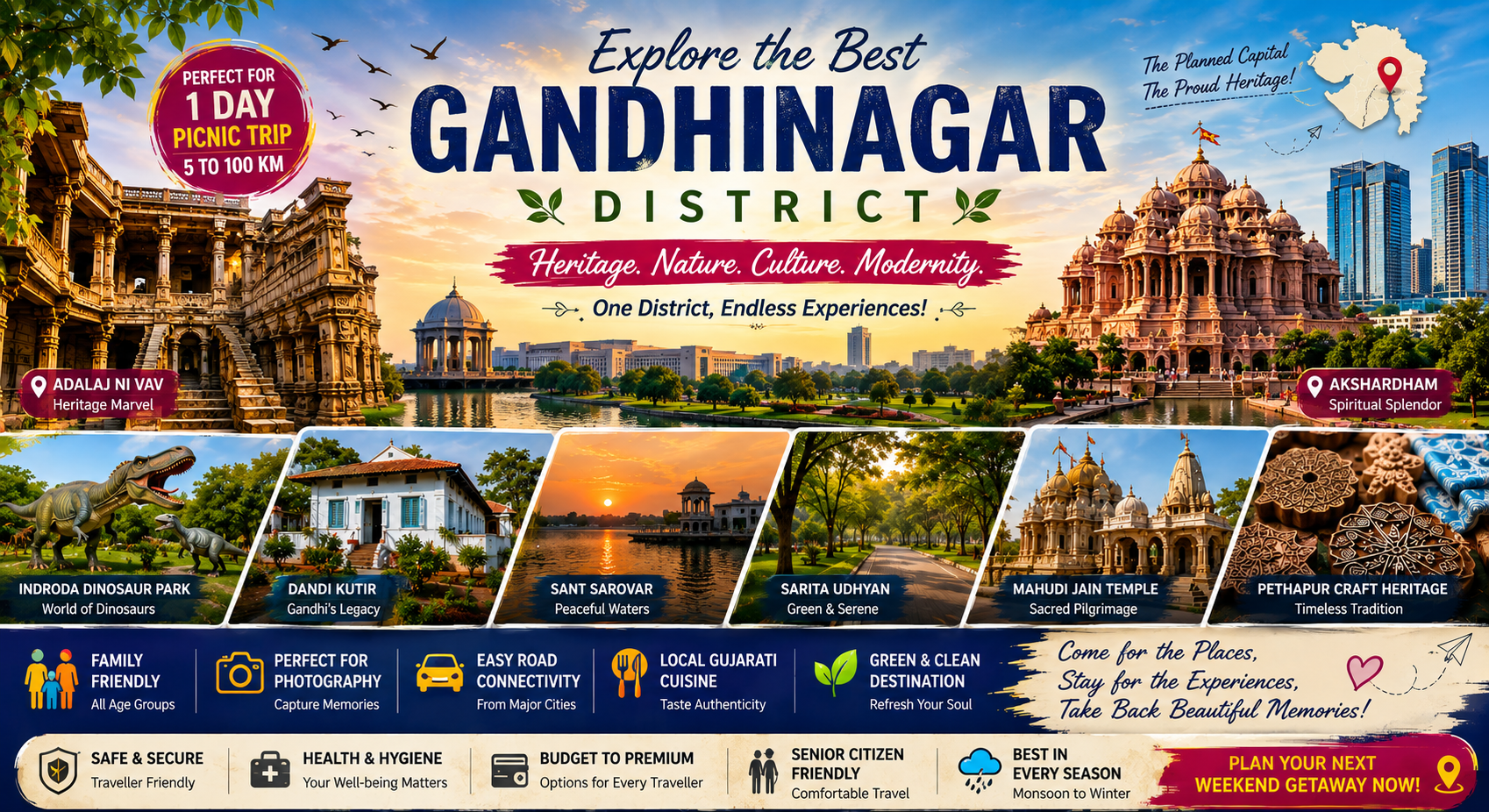
🌿 Places to Visit in Gandhinagar District, Gujarat – The Ultimate Travel & Tourism Guide
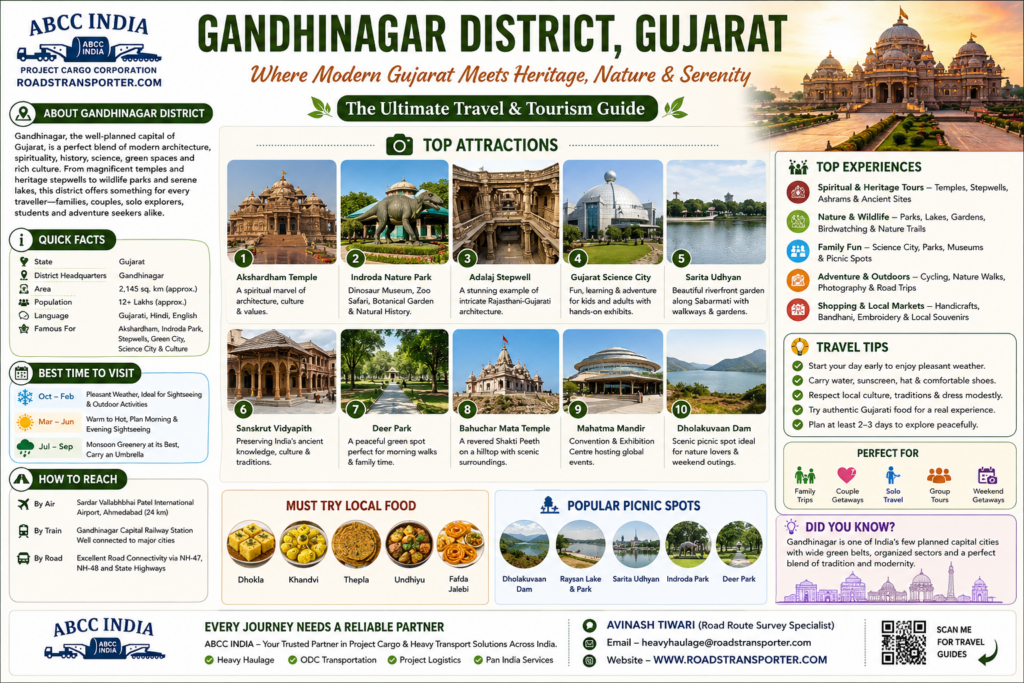
🌅 Introduction – Come, Discover the Greener and Quieter Side of Gujarat

There are some destinations that impress you the moment you arrive, and there are others that slowly reveal themselves as you travel deeper. Gandhinagar District belongs to the second kind.
When I first began exploring this part of Gujarat, I expected a well-planned capital city, broad roads, government buildings and neatly maintained public spaces. I found all of that—but Gandhinagar District had much more waiting beyond the obvious landmarks.
Drive away from the busiest urban stretches and the landscape begins to change. The traffic thins, trees become more noticeable, villages interrupt the modern cityscape, and the Sabarmati quietly reminds you that this district has a geographical identity much older than its status as Gujarat’s capital region.
That contrast is what makes travelling here interesting.
Gandhinagar is not a destination I would recommend only to travellers who want to tick famous monuments off a list. I would invite you here if you enjoy discovering how modern Gujarat, spirituality, history, science, nature and everyday local life can exist within a surprisingly compact travel circuit.
For a first-time visitor searching for the best places to visit in Gandhinagar District, the magnificent Akshardham complex is naturally one of the major attractions. Yet it should not become the beginning and end of your journey. The district and its immediate travel circuit reward travellers who give themselves time to look beyond the most photographed sights.
One of my favourite experiences here is simply moving between completely different worlds within the same day.
You can begin with a peaceful morning around the city’s greener avenues, spend hours exploring science and technology at Gujarat Science City, move into the atmosphere of historic Adalaj Stepwell, and later find yourself watching evening light soften the landscape around the Sabarmati.
And if wildlife fascinates you, Indroda Nature Park adds another dimension to the journey. Often described for its dinosaur and natural-history attractions, the park makes Gandhinagar particularly interesting for families and curious young travellers.
This variety is the district’s greatest travel strength.
🧭 What Is Gandhinagar District Famous For?

Gandhinagar District is best known for Gujarat’s capital city, Akshardham, Indroda Nature Park, green urban spaces, educational and government institutions, nearby heritage attractions, the Sabarmati landscape and convenient access to Ahmedabad’s wider tourism circuit.
But that quick answer does not tell the entire story.
Look beyond the headline attractions and you begin finding the smaller experiences that often become more memorable: a quiet road under mature trees, a local food stop that was never on your itinerary, village landscapes beyond the capital, temple bells in the morning, birds around water and green areas, and conversations with people who can point you towards places that rarely appear on standard tourist checklists.
These are the moments that turn sightseeing into travel.
If you are searching for tourist places, picnic spots, weekend getaways or family trips in Gandhinagar, you can create a comfortable journey without spending most of your day travelling between distant attractions. Families can combine educational attractions, parks, heritage and relaxed outings. Students can turn the trip into an exploration of science, ecology, architecture and civic planning.
Couples looking for quieter experiences can build an itinerary around heritage architecture, landscaped spaces and peaceful evening outings rather than crowded commercial attractions. Groups can comfortably combine Gandhinagar with Ahmedabad and nearby heritage destinations.
And for the solo traveller, Gandhinagar has a different appeal.
Travelling alone here gives you permission to slow down. You can spend longer studying the geometric beauty of a stepwell, walk through a nature-focused attraction without following someone else’s timetable, photograph architecture when the light feels right, or simply sit somewhere quiet and watch the rhythm of Gujarat’s capital unfold.
🌳 Beyond Monuments
Travellers frequently search for natural places, lakes, waterfalls, hills, hidden gems, offbeat attractions, unexplored places and unknown places near Gandhinagar. This is where expectations need to remain realistic.
Gandhinagar is not a Himalayan hill destination, nor should genuine travel information invent dramatic waterfalls or mountains merely to satisfy a search keyword.
Its natural appeal is subtler.
Think of river landscapes, tree-lined areas, parks, seasonal greenery, birdlife and countryside drives. During and after the monsoon, parts of the surrounding landscape can feel dramatically fresher, while winter brings the kind of pleasant weather that encourages longer days outdoors.
For travellers interested in adventure travel, Gandhinagar works better as a base for active exploration than as a conventional extreme-adventure destination. Cycling, nature observation, long heritage walks, photography outings and road trips into the wider region can add activity to an otherwise relaxed itinerary.
The district is also well positioned for travellers who like combining different experiences instead of dedicating an entire vacation to a single theme.
History lovers can explore architectural heritage. Spiritual travellers have important religious sites. Families have educational attractions and recreation. Photographers can work with stepwell geometry, temple architecture, greenery, street scenes, reflections, wildlife and changing evening light.
Food lovers, meanwhile, should leave room in the itinerary rather than treating meals as an afterthought.
Gujarat is a place where travel often continues at the dining table.
A simple breakfast, a traditional Gujarati thali, farsan, seasonal dishes or an evening snack can tell you as much about local life as a monument. Ask local residents where they actually eat instead of automatically choosing the most visible restaurant. Those conversations frequently produce the best discoveries.
🚗 Is Gandhinagar Worth Visiting?

Yes—especially if you enjoy heritage, spirituality, science, nature, architecture, photography and relaxed family-friendly sightseeing.
Its biggest advantage is accessibility.
Gandhinagar’s proximity to Ahmedabad means travellers can plan anything from a one-day sightseeing trip or weekend getaway to a broader Gujarat vacation. Road connectivity makes self-drive journeys and hired vehicles practical, while rail and air connections through the wider Ahmedabad–Gandhinagar region make the destination accessible to visitors arriving from other parts of India.
But I would resist rushing through Gandhinagar merely because it appears manageable on a map.
Give it time.
Wake up early enough to see the city before the working day gathers momentum. Notice how much greener some roads feel compared with the image many first-time travellers have of a state capital. Keep an hour free for an attraction you had not originally planned. Stop for local food. Talk to people. Carry a camera, but occasionally put it away.
And if you travel during summer, plan outdoor sightseeing carefully around the heat. Winter is generally more comfortable for extended exploration, while the monsoon can transform the visual character of the surrounding landscape. Always check current attraction timings, entry conditions and local weather before setting out because these can change.
❤️ Your Gandhinagar Journey Begins Here

Perhaps that is the best way to understand Gandhinagar District: do not arrive expecting one spectacular landscape to define your trip. Come prepared to discover layers.
Come for the celebrated landmarks, but stay curious about what lies between them.
Come with your family and turn a weekend into shared memories. Come as a couple and search for quieter corners away from rushed sightseeing. Come with friends and connect Gandhinagar with a longer Gujarat road trip. Come alone and experience the unusual pleasure of exploring a capital city at your own pace.
Most importantly, come without assuming that you already know Gandhinagar simply because you know it is the capital of Gujarat.
There are stories beneath the modern avenues, heritage beyond the administrative identity, nature beside the urban landscape and small discoveries waiting beyond the familiar tourist photographs.
In this complete Gandhinagar District travel and tourism guide, I will take you beyond a simple list of attractions. We will explore the best tourist places, picnic spots, hidden gems, heritage sites, natural escapes, family and couple destinations, food experiences, realistic travel budget, suggested itinerary, photography locations, transport options, seasonal planning and practical travel tips you need before setting out.
So keep your itinerary flexible, your camera ready and a little space in your journey for the unexpected.
Gandhinagar may be Gujarat’s planned capital—but the most rewarding parts of your trip do not always need to be planned.

🗺️ Useful Places to Visit in Gandhinagar District & Nearby Gujarat

For Gandhinagar District, the strongest travel mix is heritage, spirituality, museums, gardens, riverfront recreation, wildlife/nature, science, food and family entertainment. Gujarat Tourism itself highlights Akshardham, Indroda Dinosaur Park, Adalaj Trimandir, Dandi Kutir and Adalaj ni Vav among the area’s important experiences.
A useful accuracy note: Gandhinagar is not a beach, seaport, natural hill-station, major waterfall, cable-car or wine-tourism destination. I have therefore separated genuine Gandhinagar attractions from worthwhile nearby excursions, rather than inventing attractions merely to cover keywords. Budgets below are indicative per-person day-trip spending, normally excluding intercity airfare and luxury accommodation; tickets, transport and activity prices can change.
| No | Place | Best Season | When to Visit | Why to Visit | Ideal For | Approx Budget | Travel Tip |
|---|---|---|---|---|---|---|---|
| 1 | BAPS Shri Swaminarayan Akshardham, Gandhinagar | Oct–Mar | Afternoon–evening | Temple architecture, spirituality, gardens and cultural experience | Family, Couples, Seniors, Students | ₹300–1,200 | Keep enough time for security procedures and evening activities |
| 2 | Adalaj Ni Vav | Oct–Mar | 8–11 AM | Magnificent 15th-century stepwell, carvings and Indo-Islamic architecture | All ages, Photographers | ₹200–800 | Morning light is excellent for architectural photography |
| 3 | Indroda Dinosaur & Fossil Park | Oct–Feb | Morning | Dinosaurs, fossils, nature education and family exploration | Children, Gen Alpha, Students, Families | ₹300–800 | Allow several hours rather than treating it as a quick photo stop |
| 4 | Dandi Kutir Museum | Year-round | Afternoon | Gandhi-related history presented through a distinctive museum experience | Students, Families, Seniors | ₹200–700 | Check current opening schedule before travelling |
| 5 | Sarita Udhyan | Oct–Feb | Morning/evening | Green picnic atmosphere and relaxed outdoor time | Families, Couples, Seniors | ₹100–500 | Better for slow recreation than rushed sightseeing |
| 6 | Sant Sarovar Dam | Monsoon–winter | Sunrise/evening | Sabarmati scenery and seasonal waterside atmosphere | Friends, Couples, Photographers | ₹100–500 | Never enter unsafe water or restricted areas |
| 7 | Puneet Van | Oct–Mar | Morning | Themed greenery, walking and peaceful recreation | Families, Seniors, Students | ₹100–400 | Combine with other central Gandhinagar sights |
| 8 | Children’s Park | Oct–Feb | Evening | Casual family recreation and children’s outing | Gen Alpha, Families | ₹100–500 | Best included in a family-oriented itinerary |
| 9 | Garden of Gh – 4 Circle, Gandhinagar | Oct–Mar | Morning/evening | Urban garden, walking and local-life experience | All ages | ₹0–300 | Useful for a low-budget evening |
| 10 | Gandhinagar Riverfront | Oct–Mar | Sunset | River scenery, walking and photography | Couples, Families, Solo | ₹100–500 | Sunset generally offers the best atmosphere |
| 11 | Capital Complex Area | Oct–Feb | Daytime | Planned-capital architecture and civic landscape | Students, Architecture enthusiasts | ₹100–400 | Respect photography/security restrictions |
| 12 | Mahatma Mandir | Year-round | Event dependent | Major convention and exhibition venue | Corporate groups, Business travellers | ₹200–1,000 | Particularly relevant when a public exhibition/event is scheduled |
| 13 | Swarnim Park | Oct–Feb | Morning/evening | Landscaped capital-city greenery | Family, Couples, Seniors | ₹100–300 | Pair with the central administrative district |
| 14 | Garden (Sector -1) | Oct–Mar | Morning | Neighbourhood greenery and walking | Seniors, Solo, Families | ₹0–200 | Good for travellers wanting a non-touristy local break |
| 15 | Adalaj Trimandir | Oct–Mar | Morning/evening | Multi-faith temple concept with Krishna, Shiva and Mahavir shrines and landscaped surroundings | Families, Seniors, Spiritual travellers | ₹100–500 | Dress respectfully and maintain silence |
| 16 | Shree Panchdev Temple | Year-round | Morning/evening | Local devotional experience | Families, Seniors | ₹100–300 | Visit during quieter prayer periods |
| 17 | St. Xavier’s Church | Year-round | Service hours | Christian worship, community and quiet reflection | All ages | ₹0–300 | Respect Mass/service timings |
| 18 | Green City Bible Church (GCBC) | Year-round | Service/event time | Contemporary Christian community experience | Families, Solo travellers | ₹0–300 | Confirm service schedule beforehand |
| 19 | Mahudi Jain Temple | Oct–Mar | Morning | Important devotional excursion and Jain pilgrimage | Families, Seniors, Groups | ₹300–1,000 | Maintain temple etiquette |
| 20 | Mini Pawagadh, Mahudi-area circuit | Oct–Mar | Morning | Devotional outing and short regional road trip | Friends, Family | ₹300–1,000 | Verify local access before departure |
| 21 | Samrat Samprati Museum Koba (सम्राट संप्रति म्यूज़ियम) | Year-round | Daytime | Jain heritage and museum interest | Students, History lovers, Seniors | ₹100–500 | Check opening hours before visiting |
| 22 | Koba Jain Temple Area | Oct–Mar | Morning | Spiritual atmosphere and Jain architecture | Families, Seniors | ₹100–500 | Combine with nearby museum visits |
| 23 | Swapna Srushti Water Park | Mar–Jun | Daytime | Water rides, swimming-style recreation and group fun | Gen Alpha, Gen Z, Families, Friends | ₹800–1,800 | Carry appropriate swimwear and sun protection |
| 24 | Mar–Jun | Daytime | Artificial water recreation, dining and group outings | Families, Friends, Corporate groups | ₹600–1,500 | Do not confuse the artificial attraction with a natural waterfall | |
| 25 | Gift City View/Business District | Oct–Mar | Evening | Modern urban skyline and business-tourism perspective | Millennials, Gen Z, Corporate travellers | ₹200–800 | Public access differs by building/zone |
| 26 | Gujarat International Finance Tec-City business circuit | Year-round | Working hours | Corporate architecture and India’s international financial-services district | Professionals, MBA students, Corporate teams | ₹200–1,000 | Arrange business visits separately where permission is needed |
| 27 | Raysan Riverside/Green Belt | Monsoon–winter | Morning | Quiet local landscapes and photography | Solo, Couples, Cyclists | ₹100–400 | Prefer daylight and established public areas |
| 28 | Pethapur | Oct–Mar | Daytime | Traditional settlement and craft/cultural exploration | Culture lovers, Students | ₹200–700 | Local interaction is more rewarding with a knowledgeable guide |
| 29 | Pethapur Stepwell/Heritage Circuit | Oct–Mar | Morning | Lesser-known heritage exploration | Offbeat travellers, Photographers | ₹200–600 | Verify access and condition locally |
| 30 | Lekawada Countryside | Monsoon–winter | Morning | Rural scenery and agriculture-oriented travel | Families, Students, Photographers | ₹200–600 | Visit farms only with the owner’s permission |
| 31 | Rural Gandhinagar Agriculture Circuit | Nov–Feb | Morning | Crops, village landscapes and agricultural learning | Students, Families, Groups | ₹300–1,000 | Arrange farm visits in advance rather than entering private land |
| 32 | Rainbow Kathiyawadi Dhaba | Year-round | Lunch/dinner | Affordable Kathiyawadi-style food stop | Foodies, Families, Friends | ₹200–600 | Ask about spice level when ordering |
| 33 | Sargasan Food Circuit | Year-round | Evening | Gujarati, North Indian and contemporary dining | Gen Z, Millennials, Families | ₹300–1,200 | Explore several small dishes instead of one heavy meal |
| 34 | Kudasan Food & Café Circuit | Year-round | Evening | Cafés, snacks and modern Gandhinagar nightlife-lite experience | Gen Z, Couples, Friends | ₹300–1,000 | Weekends can be busier |
| 35 | Vedic Premium Spa – Gandhinagar | Year-round | Afternoon/evening | Spa and wellness break | Adults, Couples, Business travellers | ₹1,000–4,000+ | Confirm the exact treatment and price before booking |
| 36 | The Leela Gandhinagar Hotel | Year-round | Stay/dining | Premium stay, dining and business travel | Couples, Corporate, Luxury travellers | ₹2,000+ dining; stay extra | Suitable for a premium rather than budget itinerary |
| 37 | The Fern Residency Gandhinagar, Series by Marriott | Year-round | Stay/dining | Business and leisure accommodation | Families, Corporate travellers | ₹1,000+ dining; stay extra | Compare current room packages directly before booking |
| 38 | Gandhinagar Cycling Circuit | Oct–Feb | Sunrise | Broad roads, greenery and active exploration | Gen Z, Millennials, Solo | ₹100–700 | Use helmet, lights and low-traffic routes |
| 39 | Sabarmati Nature Photography Circuit | Oct–Feb | Sunrise | Birds, river landscape and seasonal photography | Solo, Students, Photographers | ₹100–500 | A telephoto lens/binoculars can improve the experience |
| 40 | Gandhinagar Heritage + Food Day Circuit | Oct–Mar | Full day | Stepwell, temples, museums and Gujarati food in one itinerary | Families, Friends, Couples | ₹800–2,500 | Start early to avoid backtracking |
🚗 10 High-Value Day Trips from Gandhinagar

The next ten are deliberately labelled nearby excursions rather than Gandhinagar District attractions. This is the more useful way to cover birding, hills, climbing, larger amusement parks and broader Gujarat experiences without misleading readers.
| No | Place | Best Season | When to Visit | Why to Visit | Ideal For | Approx Budget | Travel Tip |
|---|---|---|---|---|---|---|---|
| 41 | Thol Lake Bird Sanctuary | Nov–Feb | Sunrise | Wetland birdwatching and nature photography | Families, Birders, Seniors | ₹400–1,200 | Carry binoculars and keep noise low |
| 42 | Nalsarovar Bird Sanctuary | Nov–Feb | Early morning | Major wetland and migratory-bird experience; Gujarat Tourism includes it in regional touring circuits | Nature lovers, Couples, Photographers | ₹700–2,000 | Arrive early; verify boating conditions locally |
| 43 | Ahmedabad Science City | Year-round | 10 AM onward | Science, interactive learning and family entertainment | Gen Alpha, Students, Families | ₹500–1,500 | Reserve most of a day if exploring multiple attractions |
| 44 | Sabarmati Ashram | Oct–Mar | Morning | Gandhi history and national heritage | All generations | ₹200–700 | Give the museum exhibits time rather than rushing through |
| 45 | Kankaria Lake | Oct–Feb | Evening | Lakefront recreation and family outing | Children, Couples, Friends | ₹300–1,000 | Evening works well for families |
| 46 | Ahmedabad Heritage City Circuit | Oct–Mar | Morning | Pol houses, old-city architecture, mosques and heritage | Students, Couples, Photographers | ₹500–1,500 | A guided heritage walk adds context |
| 47 | Shree Ganesha Fun World | Oct–Mar / summer water activities | Full day | Water-park and amusement-style group outing | Kids, Gen Z, Friends, Families | ₹800–2,000 | Confirm operating rides before travelling |
| 48 | Polo Forest | Jul–Feb | Early morning/full day | Forest scenery, ruins, trekking and adventure-oriented road trip | Gen Z, Millennials, Groups | ₹1,200–3,000 | Avoid risky climbing during wet conditions |
| 49 | Taranga Hills | Oct–Feb | Morning | Hill landscape, temples, walking and regional adventure | Friends, Couples, Pilgrims | ₹1,000–2,500 | Wear proper walking footwear |
| 50 | Modhera Sun Temple | Oct–Mar | Morning–sunset | Exceptional temple architecture and photography | Families, Couples, Seniors, Students | ₹1,000–2,500 | Combine with another north-Gujarat heritage stop |
🎯 Which Gandhinagar Experience Fits Each Generation?
| Traveller | Best Choices | Why |
|---|---|---|
| Gen Alpha | Indroda Park, water parks, Science City | Dinosaurs, science, play and interactive learning |
| Gen Z | Riverfront, cycling, cafés, Polo Forest, water parks | Social outings, photography and active experiences |
| Millennials | Adalaj, Akshardham, food circuit, heritage, wellness | Culture + short-break convenience |
| Gen X | Akshardham, Dandi Kutir, Mahudi, Nalsarovar | Balanced cultural and family travel |
| Boomers | Temples, gardens, museums, stepwells | Slower, meaningful sightseeing |
| Senior Citizens | Akshardham, Trimandir, Mahudi, Sarita Udhyan | Spirituality and relaxed recreation |
| Couples | Adalaj, riverfront, Thol, cafés, heritage circuits | Photography and quieter shared experiences |
| Solo/Lonely Travellers | Museums, heritage walks, gardens, cycling, birding | Easy independent exploration |
| Corporate Teams | Mahatma Mandir/GIFT-area circuit, water parks, resorts | Business plus team recreation |
| Students | Indroda, Dandi Kutir, Adalaj, Science City | Science, ecology, history and architecture |

🌤️ Best Time to Visit Gandhinagar District and Seasonal Weather Conditions

The best time to visit Gandhinagar District is generally from November to February, when cooler and drier conditions make heritage walks, temples, nature parks, gardens, photography and day trips considerably more comfortable. Gujarat Tourism gives November–February as Gujarat’s principal travel season and broadly describes state-level seasonal temperatures as about 29–41°C in summer, 27–35°C during monsoon and 12–29°C in winter; actual Gandhinagar temperatures can move outside these ranges during individual heat waves, cold spells or rainy periods.
Gandhinagar, however, is not only a winter destination. Summer works surprisingly well for museums, temples, indoor attractions and carefully timed evening outings. Monsoon brings greener landscapes and a more photogenic Sabarmati-side environment, while winter is the easiest season for travellers who want long sightseeing days.

| Season | Approx. Period | Typical Travel Character | Best For | Overall Recommendation |
|---|---|---|---|---|
| ☀️ Summer | March–June | Hot, dry and increasingly intense by afternoon | Museums, temples, indoor attractions, evening outings | Good with heat planning |
| 🌧️ Monsoon | July–September | Humid, cloudy, greener, occasional heavy rain | Nature, gardens, countryside, photography | Very good for slow travel |
| ❄️ Winter | October/November–February | Pleasant days and cooler mornings/evenings | Heritage, wildlife, picnics, walking, family tours | Best overall season |
☀️ Summer in Gandhinagar – March to June
Summer changes the way you should travel rather than making Gandhinagar completely unsuitable. The golden rule is simple: explore early, move indoors around midday and return outdoors toward evening.
Light cotton clothing, sunglasses, sunscreen, a cap, ORS/electrolytes and a refillable water bottle belong in every summer day bag. Children, older adults and anyone unaccustomed to Gujarat’s heat should avoid unnecessary afternoon exposure.
The following summer recommendations are intentionally different from the monsoon and winter lists.
🛕 1. Akshardham – A Summer Evening of Architecture and Spirituality
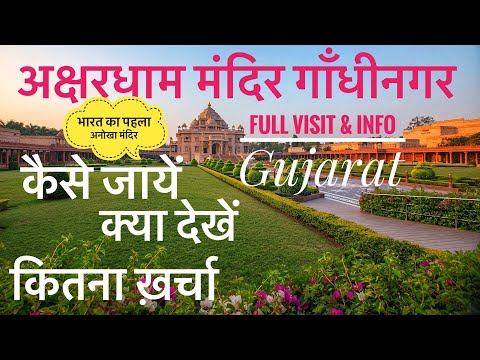
Akshardham is one of the easiest places to recommend to a first-time Gandhinagar traveller because it combines monumental architecture, spirituality and landscaped surroundings within a single destination. Gujarat Tourism describes the temple as an intricately carved pink-sandstone structure standing in a 23-acre complex.
Summer changes the ideal visiting strategy. Instead of arriving around noon, schedule your visit for later in the afternoon and remain into the cooler part of the evening, subject to current admission and programme timings. The sandstone takes on warmer colours as daylight softens, creating attractive opportunities for exterior architectural photography where photography is permitted.
Allow roughly 2–4 hours depending on the experiences you plan to include. Gujarat Tourism’s trip planner estimates about two hours for the core attraction, but a relaxed visitor can comfortably spend longer.
For families, the attraction provides a shared cultural experience without requiring a strenuous trek. Senior citizens can appreciate its spiritual atmosphere if the visit is paced carefully. Couples may enjoy the landscaped setting, although it should be approached primarily as a religious and cultural destination rather than a conventional romantic attraction. Students interested in architecture, religion and cultural tourism will find plenty to observe.
A practical per-person local outing budget might be ₹300–₹1,200, excluding accommodation and depending on transport, food and paid experiences. Gandhinagar offers accommodation from economical hotels to premium business properties, while Ahmedabad expands the choice considerably.
Vegetarian food is the natural choice around this religious circuit. Keep meals relatively light during extreme heat and drink water regularly.
Road access is straightforward, and Gandhinagar can also be reached through its railway connections; Ahmedabad’s Sardar Vallabhbhai Patel International Airport serves the wider region.
Summer packing should include breathable clothes and sun protection, but visitors must also respect temple dress and security requirements. Check current restrictions on cameras, bags, electronics and operating days before leaving your hotel.
For solo visitors, spouses, multigenerational families, students and organised groups, Akshardham offers something summer travellers particularly need: a meaningful destination that does not depend upon spending an entire day exposed to the sun.
Best time: Late afternoon to evening
Recommended duration: 2–4 hours
Estimated local budget: ₹300–₹1,200 per person
Best for: Families, couples, seniors, solo visitors, students, spiritual groups
Photography: Exterior architecture and gardens where permitted
Summer caution: Avoid unnecessary midday exposure and verify security rules
🏛️ 2. Dandi Kutir Museum – The Smart Midday Summer Choice

When Gandhinagar becomes uncomfortable outdoors, Dandi Kutir becomes one of the district’s most logical sightseeing choices.
The museum tells the story and teachings of Mahatma Gandhi through technology-assisted interpretation. Gujarat Tourism notes the use of audiovisual presentations, 3-D visuals and 360-degree experiences, and its trip planner suggests roughly 2.5 hours for exploration.
That makes it especially useful when constructing a summer itinerary. Spend the early morning outdoors, move to Dandi Kutir during the hotter portion of the day and return to outdoor sightseeing later.
History becomes more approachable here for younger visitors because it is presented through multimedia rather than solely through display cases and long labels. Students studying modern Indian history can gain context for Gandhi’s life and the independence movement, while parents can turn the visit into an educational family outing.
Allow approximately 2–3 hours.
A reasonable local budget is around ₹250–₹800 per person, allowing for transport, refreshments and any applicable admission charges. Always check the current official ticket price rather than treating planning estimates as fixed fees.
Photography opportunities centre more on the unusual exterior form and surrounding architecture because indoor photography rules can differ. Respect every displayed restriction.
Dandi Kutir is also accessible for corporate and educational groups looking for something more meaningful than conventional entertainment. For seniors, the museum format can be considerably easier than a long outdoor heritage walk during summer.
Nearby Gandhinagar hotels cover budget, mid-range and premium categories. The museum is around 3 km from the city’s main bus stand according to Gujarat Tourism, while Ahmedabad is approximately 30 km away.
Remember one particularly important planning detail: Gujarat Tourism currently lists Dandi Kutir as closed every Monday. Always reconfirm before visiting because schedules can change.
Best time: Late morning to afternoon
Recommended duration: 2–3 hours
Estimated local budget: ₹250–₹800
Best for: Families, students, seniors, solo travellers, corporate and school groups
Photography: Exterior architecture; follow indoor rules
Packing: Water, light clothing and a small notebook for students
Important: Check current hours; official tourism information lists Monday closure
🕉️ 3. Adalaj Trimandir – A Peaceful Morning or Evening Escape

Adalaj Trimandir is particularly suited to travellers who want a calmer summer experience.
The complex represents a multi-faith concept, with shrines associated with Krishna, Shiva and Mahavir, surrounded by manicured gardens. Gujarat Tourism describes its pink-and-white marble and sandstone architecture and the large hall reached by dramatic staircases.
In summer, arrive soon after opening or closer to evening rather than during peak afternoon heat.
Spend 1.5–2.5 hours here. Walk slowly, observe the architecture and allow time for quiet reflection. Families and seniors will appreciate the relatively peaceful environment, while solo travellers can enjoy the contemplative atmosphere without needing a packed itinerary.
For couples and spouses, this is better understood as a serene shared spiritual experience than a romantic attraction. Students of comparative religion and architecture can find the combination particularly interesting.
Budget approximately ₹150–₹600 per person for local transport, refreshments and incidental expenses.
Adalaj also has a practical sightseeing advantage: the Trimandir can be paired with other attractions around Adalaj on a broader itinerary, although this guide deliberately assigns those other major attractions to different seasons.
Gujarat Tourism states that Gandhinagar is about 12 km away and notes road connectivity through state transport services.
For photographs, concentrate on architectural symmetry, staircases, stonework and landscaped surroundings where permitted. Early morning gives gentler light and fewer heat-related problems.
Dress modestly, carry water and avoid turning religious spaces into staged social-media sets. That simple respect matters more than getting another photograph.
Best time: Early morning or evening
Duration: 1.5–2.5 hours
Budget: ₹150–₹600
Ideal for: Seniors, families, solo visitors, couples, spiritual groups, students
Safety: Hydrate and avoid hot afternoon garden walks
Photography: Architecture and landscaped surroundings where allowed
💼 4. Mahatma Mandir and Central Gandhinagar Urban Circuit

Summer is an excellent time to understand another identity of Gandhinagar: India’s purpose-built state capital and an important administrative and convention city.
Mahatma Mandir is most relevant when an exhibition, conference, public programme or professional event is taking place. Rather than promising unrestricted tourist access to every part of a working venue, travellers should check the current event calendar and entry conditions.
This is especially useful for corporate groups, architecture students, business travellers and visitors interested in urban planning.
Combine the venue area with a drive through Gandhinagar’s planned sectors and landscaped avenues. In summer, use an air-conditioned vehicle during the hotter hours and reserve walking for morning or evening.
Allow 2–4 hours, or considerably longer when attending an event.
Local spending may range from ₹300 to ₹1,500+ per person, excluding conference tickets and accommodation. Business travellers have access to several premium and mid-range hotels, while economical stays are available throughout the Gandhinagar–Ahmedabad region.
Photography should focus on urban geometry, public architecture and streetscape only where permitted. Government and security-sensitive areas deserve particular caution: never photograph restricted facilities simply because they look architecturally interesting.
This circuit works especially well for MBA students, architecture and planning students, conference delegates and corporate teams. Families may enjoy it when combined with a public exhibition, but young children will generally find Gandhinagar’s recreational attractions more engaging.
For an evening outing, choose established public areas, restaurants and organised events rather than wandering around isolated administrative zones after dark.
Best time: Event hours; outdoor exploration after 5 PM
Duration: 2–4 hours or event-dependent
Budget: ₹300–₹1,500+
Ideal for: Corporate groups, business travellers, students, Gen Z and Millennials
Photography: Modern architecture where permitted
Safety: Follow access controls around government buildings

🍽️ 5. Kudasan–Sargasan Food and Evening Circuit

Not every memorable travel experience needs a monument.
After a hot Gandhinagar day, an evening built around Gujarati food, cafés and local neighbourhood life can become one of the most enjoyable parts of the trip.
Kudasan and Sargasan provide convenient contemporary dining territory for travellers staying around Gandhinagar. Instead of chasing a single supposedly “famous” restaurant, use the evening to sample different flavours according to your appetite and dietary preferences.
Traditional Gujarati dishes and snacks worth looking for can include dhokla, khandvi, thepla, handvo, khaman, fafda and seasonal Gujarati preparations. Restaurant menus vary, so treat these as food ideas rather than promises that every establishment serves every dish.
Budget around ₹250–₹1,200 per person, depending on whether you choose street-style snacks, casual restaurants or premium dining.
For Gen Z and Millennials, café hopping provides an easy social evening. Couples can combine dinner with a relaxed drive. Families appreciate the flexibility of multiple cuisine choices, while senior citizens can select comfortable indoor restaurants and dine before peak crowds.
Food photographers will find colourful Gujarati snacks more interesting in natural light, but evening restaurant photography can also work if you avoid disturbing other diners.
Summer food safety is important. Choose busy, hygienic establishments, be cautious with food that has been sitting unrefrigerated and drink safe water.
This is also one of the easier safe-evening concepts for Gandhinagar because you can remain in populated commercial areas and use app-based taxis or a private vehicle. “Safe” never means risk-free, so retain ordinary urban precautions.
Best time: 6:30–10 PM
Duration: 2–4 hours
Budget: ₹250–₹1,200
Best for: Foodies, couples, families, friends, solo diners
Photography: Food and contemporary city life
Summer tip: Eat light, hydrate and choose hygienic establishments

🌧️ Monsoon in Gandhinagar – July to September
The monsoon gives Gandhinagar a completely different visual character. Cloud cover softens harsh sunlight, vegetation becomes richer and the Sabarmati landscape feels more alive.
It is also an unpredictable season. Short showers can become heavy rain, roads may temporarily waterlog and river or dam areas demand much greater caution.
Never enter flowing water, cross barriers or stand on slippery edges for photographs.
🌿 6. Sarita Udhyan – Gandhinagar’s Green Monsoon Picnic Mood

Sarita Udhyan is at its most atmospheric when the landscape has been refreshed by rain.
This is not a destination built around one monumental attraction. Its value lies in greenery, breathing space and the simple pleasure of slowing down beside Gandhinagar’s natural environment.
Visit on a rain-free morning or late afternoon. Allow 1–2 hours, longer if you are planning a family picnic.
Monsoon temperatures are generally less punishing than peak summer but humidity can be substantial. Gujarat Tourism’s broad state-level guide puts monsoon temperatures around 27–35°C, although actual daily conditions vary.
Families can bring children for an outdoor break; couples can enjoy a quiet walk; senior citizens should choose dry, stable pathways; solo travellers can use the park as a low-cost pause between major attractions.
Budget approximately ₹100–₹500 per person, mostly for transport, food and refreshments.
Pack a compact umbrella, light rain jacket, mosquito repellent, drinking water and footwear with reliable grip. Avoid spreading elaborate picnics when heavy rain is forecast.
Photography improves after showers. Wet leaves become richer in colour, cloud cover creates soft portraits and puddles can provide reflections. Protect cameras and phones with waterproof pouches.
Do not approach swollen riverbanks or isolated slippery areas simply for a dramatic photograph.
For accommodation, central Gandhinagar makes the most practical base because this is an urban outing rather than a destination requiring an overnight stay nearby.
Best time: 7–10 AM or 4–6:30 PM on a dry day
Duration: 1–2 hours
Budget: ₹100–₹500
Ideal for: Families, couples, solo travellers, seniors, picnics
Packing: Umbrella, mosquito repellent, waterproof pouch, grip footwear
Safety: Stay away from risky river edges after heavy rain
💧 7. Sant Sarovar Dam – Monsoon Water, Clouds and Caution

For travellers seeking a stronger monsoon landscape, Sant Sarovar attracts attention because water and dramatic skies can completely change the visual mood.
But this recommendation comes with a non-negotiable warning: a dam is infrastructure, not a swimming pool or adventure playground.
Visit only legal public-access areas, obey barriers and local instructions, and never enter water or approach spillways. Conditions can change rapidly during monsoon.
A sensible visit lasts 45–90 minutes, preferably in daylight and during stable weather.
The attraction is strongest for photographers, friends on a road trip and couples looking for scenery. Families can visit if children are closely supervised. It is less suitable for travellers with limited mobility when surfaces are muddy or slippery.
Budget roughly ₹150–₹600 per person, depending largely on transport.
Cloud formations, reflections and seasonal greenery offer good landscape photography. A wide-angle lens is useful, but a waterproof cover is more important.
Do not plan a late-night visit. Daylight gives better visibility and makes it easier to assess wet surfaces, traffic and water conditions.
Pack rain protection, drinking water and shoes with traction. Check the weather before departure and abandon the plan if heavy rainfall or official restrictions make conditions questionable.
Best time: Morning or late afternoon in stable weather
Duration: 45–90 minutes
Budget: ₹150–₹600
Ideal for: Photographers, couples, friends, road trippers
Not recommended for: Swimming or risky waterside activity
Safety: Obey every dam restriction and avoid visits during severe weather
🌳 8. Puneet Van – A Rain-Washed Urban Nature Break

Puneet Van suits travellers who enjoy nature without needing a remote wilderness journey.
During monsoon, tree cover, wet foliage and cloudy skies can make a simple walk feel surprisingly restorative. It works especially well between larger sightseeing stops because you do not need an entire day.
Plan 1–2 hours.
Morning is generally best for walking, while late afternoon can provide attractive soft light if rain has cleared.
Families can use the space for an inexpensive outing. Senior citizens can enjoy a gentle walk where surfaces are dry. Solo travellers may appreciate the quietness, and students interested in plants or urban ecology can turn the visit into an observational exercise.
An approximate budget of ₹100–₹400 covers local travel and refreshments for most visitors.
The monsoon photographer should look beyond grand landscapes. Raindrops on leaves, textured bark, reflections and close-up plant details can create stronger photographs than another wide garden shot.
Mosquito repellent becomes important. So does footwear.
Avoid stepping onto waterlogged grass or slippery surfaces merely because they create a shortcut. During thunderstorms, leave exposed outdoor areas and seek appropriate shelter.
Puneet Van is best regarded as a slow-travel attraction—somewhere to breathe rather than somewhere to race through a checklist.
Best time: Morning after light rain
Duration: 1–2 hours
Budget: ₹100–₹400
Best for: Families, solo travellers, students, seniors, couples
Photography: Macro nature, wet foliage, portraits
Packing: Repellent, umbrella and anti-slip footwear
🌾 9. Dehgam Countryside and Responsible Agriculture Tourism
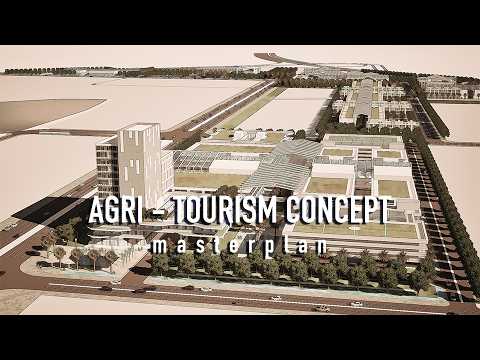
If urban Gandhinagar feels too orderly, a monsoon drive towards the district’s rural side reveals a different landscape.
The Dehgam area and surrounding countryside become more visually interesting when agricultural fields are green. This is where visitors can understand that Gandhinagar District extends beyond government buildings and planned sectors.
Agriculture tourism, however, needs to be responsible.
Fields are workplaces and private property. Do not enter crops for photographs, fly drones over farms without permission or turn villagers into unsolicited photo subjects.
A properly arranged rural experience can include farm observation, conversations about crops, village food and understanding seasonal agricultural routines. Arrange such experiences through a legitimate host or local contact rather than arriving unannounced.
Allow half a day.
Budget roughly ₹500–₹1,500 per person for transport, meals and an arranged local experience. Corporate or student groups may pay more for organised educational programmes.
This is particularly suitable for students, families with older children, photographers, corporate learning groups and travellers interested in rural Gujarat. Couples and friends can enjoy the drive, while seniors should avoid muddy farm paths.
Monsoon photography can be beautiful: green fields, clouds, rural roads and agricultural activity. Always request permission before photographing identifiable people at close range.
Carry water, rainwear, insect repellent and a basic first-aid kit. Rural roads can become muddy, so check local conditions.
Best time: Morning
Duration: Half day
Budget: ₹500–₹1,500
Ideal for: Students, families, photographers, corporate groups, friends
Photography: Fields and rural landscapes with permission
Safety: Never enter private farms or flooded roads without local guidance
🌲 10. Indroda Wilderness Landscape – Monsoon Nature Without Rushing

Indroda is so substantial that travellers often reduce it unfairly to “the dinosaur park.”
Gujarat Tourism describes the wider attraction as approximately 400 hectares on both banks of the Sabarmati, incorporating a zoo, botanical garden, interpretation facilities and wilderness habitat with birds, reptiles, nilgai, langurs and peafowl.
For this seasonal guide, the monsoon emphasis is on its ecology and green landscape, rather than its dinosaur exhibits.
Visit during a dry weather window and allow 2–4 hours. The official trip planner gives a shorter approximate exploration time, but nature enthusiasts can easily spend longer.
The park is excellent for students because ecology becomes visible rather than theoretical. Families can introduce children to natural history and wildlife, while solo photographers can work slowly without a group schedule.
Budget around ₹250–₹800 per person, allowing for transport, food and current admission charges.
For wildlife photography, patience matters more than chasing animals. Never feed wildlife or move beyond designated visitor zones.
Wear covered footwear and carry mosquito protection. Rain can make surfaces slippery, and humidity may be tiring for seniors or very young children.
Gujarat Tourism notes that Ahmedabad is around 30 km away, with Gandhinagar connected by rail and Ahmedabad’s international airport providing air access.
Best time: Morning during a dry spell
Duration: 2–4 hours
Budget: ₹250–₹800
Ideal for: Families, students, solo travellers, photographers, nature lovers
Photography: Birds, greenery, wildlife and botanical subjects
Safety: Remain on visitor routes; avoid outdoor exploration during thunderstorms

❄️ Winter in Gandhinagar – October/November to February
Winter is when Gandhinagar becomes easiest to recommend without qualifications.
Cooler mornings allow longer walks, midday heritage sightseeing becomes more comfortable and evenings encourage outdoor dining and relaxed exploration. It is the best season for first-time visitors who want to experience several attractions in one trip.
Carry a light layer for early mornings and evenings, especially in December and January, but retain sun protection for daytime sightseeing.
🏛️ 11. Adalaj Ni Vav – Winter’s Essential Heritage Experience
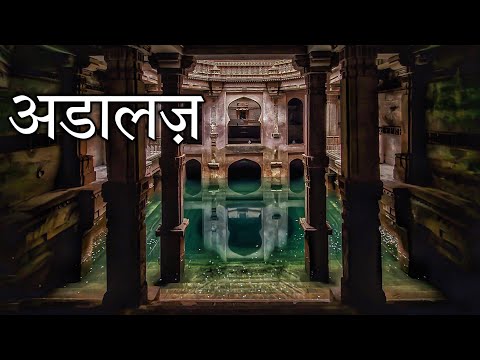
If I had to choose one winter morning for a first-time heritage traveller in Gandhinagar District, I would spend it descending into Adalaj Ni Vav.
The 15th-century stepwell is far more than an old water structure. Its pillars, carved surfaces, changing levels of light and Indo-Islamic architectural character make it one of the district’s most rewarding places for slow observation.
Gujarat Tourism describes the structure as five storeys deep and notes a fascinating climatic feature: its interior is said to remain about six degrees cooler than outside.
Winter removes the urgency created by summer heat, allowing you to study details instead of simply seeking shade.
Arrive early and allow 1–2 hours.
For photographers, this is one of Gandhinagar’s strongest architectural locations. Work with symmetry, staircases, carved pillars and shafts of light. Avoid blocking narrow passages while composing photographs.
Families can use the visit to introduce children to Gujarat’s traditional water architecture. Architecture and history students should allow extra time. Couples will find the setting visually memorable, while seniors can enjoy the monument if they are comfortable with stairs.
That last point matters: a stepwell naturally involves changes in level. Visitors with mobility limitations should assess accessibility before attempting deeper sections.
Budget approximately ₹150–₹600 per person, depending on transport and current entry conditions.
The site can be combined efficiently with other northern Ahmedabad–Gandhinagar attractions, but avoid packing so many stops into one day that heritage becomes a race.
Best time: 8–11 AM
Duration: 1–2 hours
Budget: ₹150–₹600
Ideal for: Couples, families, students, solo travellers, photographers
Photography: Exceptional architecture and geometric compositions
Safety: Watch steps and avoid rushing on crowded stairways
🦕 12. Indroda Dinosaur and Fossil Park – Winter Family Adventure

Winter is arguably the easiest season for exploring Indroda’s educational attractions because families can spend longer outdoors without the intensity of summer.
Gujarat Tourism describes Indroda as a large nature and natural-history complex with dinosaur displays, a zoo, botanical garden, interpretation centre and wilderness environment.
Children may arrive excited about dinosaurs, but a thoughtful visit can introduce them to fossils, biodiversity, birds, reptiles and conservation.
Allow 3–4 hours for a relaxed family experience.
The destination works exceptionally well for Gen Alpha, school students and multigenerational families. Gen Z photographers can explore nature subjects, while seniors who enjoy wildlife should pace the visit and use rest opportunities.
Budget approximately ₹300–₹900 per person, including local transport, refreshments and current entry fees.
Winter mornings provide better walking conditions and pleasant natural light. A moderate telephoto lens helps with wildlife, while a standard phone camera is enough for family photographs and dinosaur exhibits.
Do not feed or provoke animals. Children should remain supervised. Comfortable walking shoes are essential because the attraction is much more rewarding when explored on foot.
For school and corporate educational groups, plan transport and group permissions beforehand rather than arriving with a large party unexpectedly.
Best time: 9 AM–1 PM
Duration: 3–4 hours
Budget: ₹300–₹900
Ideal for: Children, families, students, wildlife lovers, seniors, groups
Photography: Wildlife, fossils, dinosaurs and vegetation
Packing: Walking shoes, water, light winter layer, binoculars
🌼 13. Sarita Udhyan and Sabarmati Morning Picnic Circuit

Winter mornings turn a simple garden outing into something genuinely enjoyable.
Instead of visiting Sarita Udhyan only as another attraction to tick off, bring breakfast or light picnic food, walk slowly and let the morning unfold.
Spend 1.5–3 hours.
This is among the easiest low-cost recommendations for families, couples, seniors and solo travellers. Children get open space; older visitors can enjoy a gentler outing; couples can share an uncomplicated morning away from commercial entertainment.
Budget around ₹100–₹500 per person.
Winter sunrise and early morning light can produce soft landscape photographs. Birdlife may add interest, although visitors should never disturb birds for closer photographs.
Carry a picnic mat, reusable water bottle and a small bag for your rubbish. Leave the area cleaner than you found it.
For safe evening use, stick to established public areas and normal visitor hours. Morning remains my preferred option because visibility, weather and photography are generally better.
Best time: 7–10 AM
Duration: 1.5–3 hours
Budget: ₹100–₹500
Ideal for: Family picnics, couples, seniors, solo travellers, friends
Photography: Morning light, greenery and candid family moments
Responsible-travel tip: Carry every piece of picnic waste back with you
🛕 14. Koba Jain Temple and Spiritual Circuit

Winter is particularly comfortable for travellers interested in Gandhinagar’s quieter spiritual side.
A Koba-area Jain visit offers an alternative to the district’s largest headline attractions. The experience is best approached slowly: observe religious etiquette, appreciate the architecture and allow space for worshippers.
Plan 1.5–2.5 hours, potentially longer when combining related religious or heritage stops.
The circuit works especially well for senior citizens, families, Jain pilgrims, solo spiritual travellers and students interested in religion and architecture. Couples can visit respectfully as part of a broader cultural itinerary.
Budget approximately ₹150–₹600 per person for local transportation and meals.
Winter mornings are comfortable for temple visits. Dress modestly and check rules relating to leather items, food, photography and access because individual religious institutions may apply specific requirements.
Photography should never interfere with worship. Ask before photographing interiors or people.
For accommodation, Gandhinagar remains the easiest base, giving travellers access to hotels across multiple budgets without needing to change lodging for every small excursion.
Best time: Morning
Duration: 1.5–2.5 hours
Budget: ₹150–₹600
Ideal for: Seniors, pilgrims, families, solo travellers, students
Photography: Exterior architecture where allowed
Travel etiquette: Confirm temple-specific rules before entering
🚲 15. Gandhinagar Green-Avenue Cycling and Urban Photography Tour

Winter gives active travellers something summer rarely does: the freedom to experience Gandhinagar at human speed.
A carefully planned cycling route through suitable green avenues and public areas can reveal why India’s planned capitals feel different from older cities. Straight roads, sector planning, trees and civic architecture create an unusual visual rhythm.
Start shortly after sunrise and ride for 1.5–3 hours.
This experience is best for fit solo travellers, friends, Gen Z, Millennials, students and corporate wellness groups. Couples who enjoy cycling can turn it into an active morning date.
Budget approximately ₹200–₹800 per person, depending on cycle rental and transport arrangements.
Wear a helmet. Use lights or reflective equipment when visibility is low. Follow traffic rules and avoid high-speed arterial roads where cycling conditions are unsuitable.
For photographers, stop only in safe places. Interesting subjects include avenue perspective, morning light, urban geometry, gardens and everyday street scenes.
Do not photograph sensitive government or security facilities.
Carry water, a basic puncture kit if independently cycling and a light jacket on colder mornings.
This is also a valuable solo-travel activity because it provides structure without requiring a guide, although first-time visitors should plan the route in advance.
Best time: 6:30–9:30 AM
Duration: 1.5–3 hours
Budget: ₹200–₹800
Ideal for: Solo travellers, couples, friends, students, corporate groups
Photography: Urban planning, green avenues and morning street scenes
Safety: Helmet compulsory in practice; choose low-risk routes
🌅 16. Gandhinagar–Adalaj Heritage Weekend Circuit

Winter is the season when I would recommend slowing the entire journey down and creating a two-day Gandhinagar weekend getaway rather than collecting attractions in a single rushed day.
Build the circuit around heritage, spirituality, gardens, local food and evening relaxation. Because Adalaj and Gandhinagar are close enough to combine efficiently, travellers can spend more time experiencing individual places instead of sitting in vehicles.
A comfortable local weekend budget might begin around ₹2,500–₹5,000 per person for economical travel and rise significantly for premium hotels, private vehicles and fine dining. These are planning estimates, not package prices.
Couples can choose a comfortable hotel and combine heritage photography with relaxed dinners. Families can alternate educational attractions with gardens. Friends can add cafés and cycling. Senior citizens can build a slower itinerary with fewer stops.
Corporate groups can use Gandhinagar’s business infrastructure for meetings and add cultural sightseeing around the programme.
Winter accommodation demand can be stronger around major events, conferences and holidays, so advance booking is sensible.
For food, try Gujarati dishes but do not force every meal into a “must-eat” checklist. A good trip should leave room for what locals recommend that day.
Photographers should reserve separate morning and evening windows instead of photographing everything under harsh midday light.
Most importantly, don’t confuse a longer itinerary with a better itinerary. Five places experienced properly can create stronger memories than fifteen attractions photographed through a car window.
Best time: November–February
Duration: 1 night/2 days
Budget: Approx. ₹2,500–₹5,000+ per person
Ideal for: Couples, families, friends, solo visitors, seniors, corporate groups
Accommodation: Budget to premium Gandhinagar hotels
Best approach: Fewer attractions, longer experiences
📊 Which Season Is Best for Your Gandhinagar Trip?
| Traveller Type | Best Season | Recommended Experience |
|---|---|---|
| Solo Traveller | Winter | Heritage, cycling, museums |
| Couple/Spouse | Winter or Monsoon | Heritage, gardens, food and photography |
| Family | Winter | Indroda, temples, parks and museums |
| Children | Winter/Summer with indoor planning | Dinosaurs, museums and family recreation |
| Senior Citizens | Winter | Temples, gardens and slow sightseeing |
| Students | Winter | History, ecology, architecture and museums |
| Friends | Monsoon/Winter | Road trips, nature and food circuits |
| Corporate Groups | Winter | Conferences + cultural outings |
| Photographers | Monsoon/Winter | Green landscapes, architecture, wildlife |
| Budget Travellers | Winter | Walking, parks, temples and public attractions |
| Weekend Travellers | Nov–Feb | 1-night/2-day Gandhinagar circuit |
| Summer Visitors | March–June | Indoor attractions + evening sightseeing |
🧳 Seasonal Packing Guide for Gandhinagar

| Season | What to Pack | Main Risk |
|---|---|---|
| Summer | Cotton clothes, cap, sunscreen, sunglasses, water, ORS | Heat and dehydration |
| Monsoon | Umbrella, rain jacket, waterproof pouch, mosquito repellent, grip shoes | Slippery surfaces, heavy rain, water hazards |
| Winter | Light jacket, walking shoes, moisturiser, water, sun protection | Cool early mornings and long outdoor days |
🌡️ Final Answer: When Should You Visit Gandhinagar?
For most first-time travellers, November to February is the best time to visit Gandhinagar District. The weather is more comfortable for long sightseeing days, heritage exploration, wildlife visits, picnics, cycling, temples and outdoor photography. Gujarat Tourism likewise identifies November–February as Gujarat’s principal visitor season.
Choose the monsoon if greenery, atmospheric photography and slower nature-based outings matter more to you than predictable weather. Choose summer if your dates are fixed and you are willing to organise the day around museums, temples, air-conditioned breaks and evening activities.
Whatever the season, check the current weather forecast, attraction opening hours, admission charges and local access conditions immediately before travelling. Official Gujarat Tourism currently identifies Gandhinagar’s visitor portfolio across flora and fauna, Gandhi-related heritage, museums and religious sites, including attractions such as Akshardham, Indroda, Adalaj Trimandir, Dandi Kutir and Adalaj Ni Vav.
That variety is precisely why Gandhinagar works across the calendar: winter makes it comfortable, monsoon makes it greener, and careful planning makes even summer worth exploring.
Follow Our Facebook Page For Regular Travel Industry Updates :- CLICK HERE
Follow Our Whatsapp Channel For Regular Travel Industry Updates :- CLICK HERE


🍽️ Best Highway Dhabas, Restaurants & Food Places in Gandhinagar District
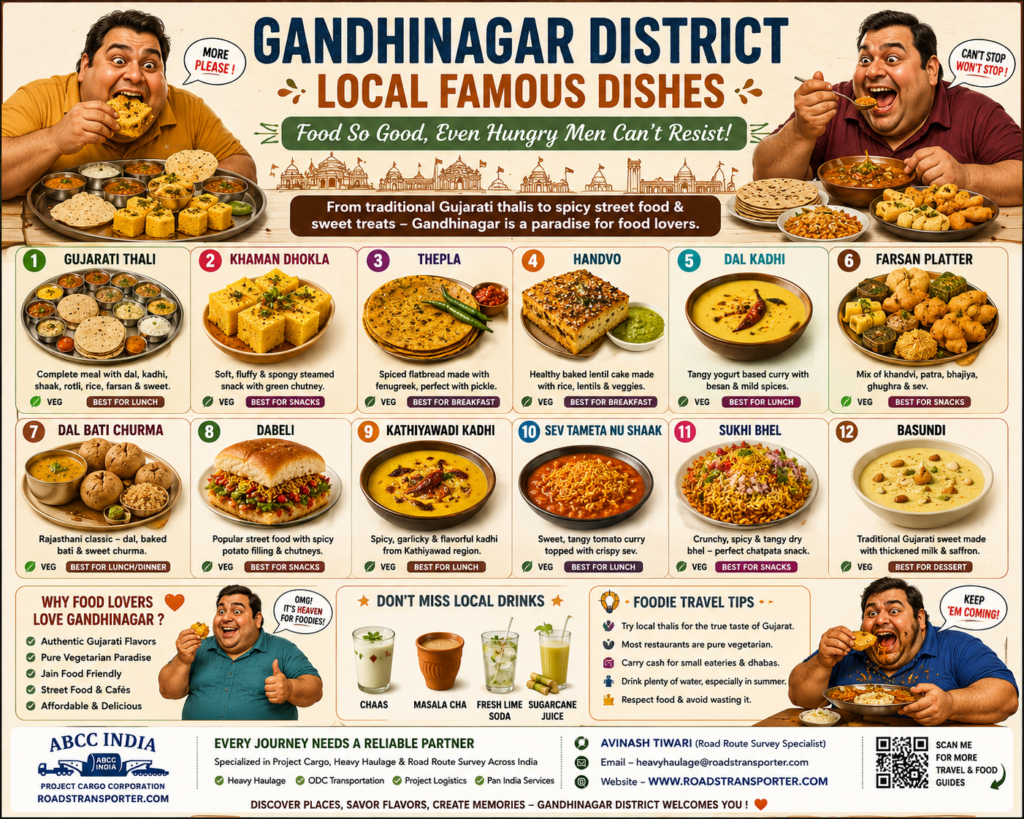
Gandhinagar’s strongest food identity is Gujarati vegetarian cuisine, thalis, farsan, North Indian/Punjabi food, Rajasthani dal-bati, South Indian breakfast, cafés, sweets and modern family dining. Dedicated seafood, Marathi-speciality and fully vegan restaurants are much less prominent than in coastal Gujarat, Mumbai or Ahmedabad, so these should not be artificially presented as signature Gandhinagar experiences.

The chart below uses currently discoverable restaurant/business information. Google ratings, opening hours, menus and prices can change, so travellers should reconfirm before making a special journey. Restaurant phone numbers are partially masked for privacy.
| Name | Category | Address | Nearby Highway / Location | Famous Dishes / Best Choice | Meal Type | Cuisine | Veg / Jain / Vegan Availability | Approx Budget | Family Friendly | Parking | Contact Number | Google Rating* | Why Visit | Travel Tip |
|---|---|---|---|---|---|---|---|---|---|---|---|---|---|---|
| Khetlaaapa Gujarati Thali | Gujarati Thali | Super Mall 1, Infocity Road | Infocity | Gujarati thali, dal, kadhi, rotli, seasonal vegetables | Breakfast/Lunch/Dinner | Gujarati | Veg; ask for Jain | ₹1–200 | Yes | Check locally | 9••••••••6 | 4.9 | Very economical option for traditional Gujarati-style meals | Go at lunch for the strongest thali experience |
| RIVAJ – Gujarati Rasthal | Gujarati Restaurant | Sarthak Pulse Mall, Kudasan | Kudasan/Bhaijipura | Gujarati thali, farsan, dal-kadhi, vegetables | Lunch/Dinner | Gujarati | Veg; ask about Jain | ₹200–400 | Yes | Mall/local parking | 9••••••••7 | 4.3 | Useful for travellers wanting a more restaurant-style Gujarati meal | Reach slightly before peak dinner time |
| Shree Radhe Thal | Gujarati Thali | Siddhraj Zavod, near GUDA Bhavan | Sarkhej–Gandhinagar Highway/Sargasan | Gujarati thali | Lunch/Dinner | Gujarati | Vegetarian; confirm Jain | ₹200–400 | Yes | Check locally | 8••••••••5 | 4.2 | Convenient traditional meal near the highway-side Sargasan belt | Good stop when combining Gandhinagar with Ahmedabad |
| Matarani Parathewale & Rajasthani Dal Bati | Rajasthani Restaurant | Shop 13, Reliance Cross Road, Kudasan | Kudasan | Dal bati, paratha, Rajasthani meals | Lunch/Dinner | Rajasthani/North Indian | Mostly veg; confirm Jain | ₹1–200 | Yes | Local parking | 7••••••••8 | 4.3 | One of the clearer choices for dal-bati in Gandhinagar | Dal-bati is filling; order conservatively |
| RAJASTHANI FAMOUS DALBATI | Highway/Rajasthani Food | Prayosha Complex, Randheja | Mansa–Gandhinagar Highway | Dal bati and Rajasthani staples | Lunch/Dinner/Late Meal | Rajasthani | Veg likely; verify Jain | Budget | Yes | Roadside/local | 9••••••••6 | 4.1 | Useful road-trip option on the Mansa side; listing shows 24-hour operation | Reconfirm 24×7 hours before relying on a late-night stop |
| Shree Atithi Dhaba | Highway Dhaba | Opp. Khodiyar Petrol Pump, Khoraj | SG Highway/Vaishnodevi Circle | Punjabi/North Indian dhaba-style dishes | Lunch/Dinner/Late Evening | North Indian | Ask restaurant | ₹200–400 | Yes | Highway-style parking likely; verify | 9••••••••5 | 4.0 | Convenient dhaba stop for Ahmedabad–Gandhinagar highway traffic | Particularly practical for road travellers and drivers |
| Shivshakti Dhaba, SG Highway, Khoraj | Punjabi Highway Dhaba | Near Vaishnodevi, Khoraj | Sarkhej–Gandhinagar Highway | Punjabi gravies, roti, dal and dhaba meals | Lunch/Dinner/Late Night | Punjabi/North Indian | Confirm locally | ₹200–400 | Yes | Suitable highway setting | 7••••••••1 | 3.4 | Long-standing highway-style option and convenient late meal stop | Listing currently shows service until around 2 AM; verify first |
| ATUL RESTAURANT (Saurashtra Dhaba) | Saurashtra Dhaba | Gandhinagar 382355 | Eastern Gandhinagar side | Kathiyawadi/Saurashtra-style meal options | Lunch/Dinner | Gujarati/Kathiyawadi | Ask about Jain | ₹200–400 | Yes | Check locally | 9••••••••5 | 4.2 | Better fit for travellers looking for rustic Gujarati/Saurashtra flavours | Ask for spice level before ordering |
| SambharSa | South Indian Restaurant | Siddharaj Z Square, Kudasan | Kudasan | Dosa, idli, uttapam, sambar | Breakfast/Lunch/Dinner | South Indian | Vegetarian; ask for Jain/vegan modifications | ₹200–400 | Yes | Complex parking | 7••••••••6 | 4.8 | One of the strongest current choices for South Indian breakfast in Gandhinagar | Morning is ideal for a lighter breakfast |
| Punjabi tadka family restaurant | Family Punjabi Restaurant | Near Hotel Siddharth Inn, Vavol | Vavol | Paneer, dal, breads and Punjabi mains | Lunch/Dinner | Punjabi/North Indian | Vegetarian options; confirm Jain | Moderate | Yes | Check locally | 9••••••••2 | 4.3 | Straightforward choice for family-style Punjabi dining | Good option for larger mixed-age groups |
| Greenz Restaurant | Vegetarian Family Restaurant | Kudasan | Kudasan | Indian, Asian and multi-cuisine vegetarian dishes | Lunch/Dinner | Indian/Asian | Vegetarian; ask Jain/vegan | ₹200–400 | Yes | Check locally | 9••••••••0 | 4.3 | Popular family restaurant with thousands of reviews | Weekends can be busy |
| Green Apple Restaurant | Pure Vegetarian Restaurant | GH-4 II, Sector 16 | Sector 16 | Multi-cuisine vegetarian meals | Lunch/Dinner | North Indian/Multi-cuisine | Veg; ask Jain | Moderate | Yes | Local parking | 9••••••••0 | 4.1 | Convenient central-city family dining option | Useful when sightseeing around Gandhinagar sectors |
| THE ROYAL ERA RESTAURANT & BANQUET | Pure Veg / Banquet | Sector 16, near HDFC Bank | GH-5/Sector 16 | Indian vegetarian restaurant dishes | Lunch/Dinner | Multi-cuisine Indian | Vegetarian; confirm Jain/vegan | ₹200–400 | Yes | Banquet-area parking likely | 8••••••••9 | 4.7 | Strong rating and suitable for family or group dining | Useful for celebrations and organised groups |
| swagatam family restaurant | Family Restaurant | Sarthak Mall, Sargasan Cross Road | Sargasan | Indian family dining | Lunch/Dinner | Multi-cuisine | Vegetarian choices; confirm Jain | ₹200–400 | Yes | Mall parking | 7••••••••7 | 4.8 | Good current rating for casual family meals | Reserve ahead for larger weekend groups |
| Cilantro’s Global Cuisine Restaurant | Premium Multi-Cuisine | The Urbania Complex, Kudasan | Kudasan | Indian and global restaurant dishes | Lunch/Dinner | Multi-cuisine | Vegetarian options; ask Jain/vegan | ₹400–800 | Yes | Complex parking | 9••••••••5 | 4.6 | Suitable for corporate dining and mixed-group preferences | Better suited to a sit-down meal than a quick highway stop |
| Yanki Sizzlerr – Pure Veg Restaurant in Gandhinagar | Premium Pure Veg | Radhe Infinity, Randesan | Raksha Shakti Circle | Sizzlers and contemporary vegetarian dishes | Lunch/Dinner | Continental/Indian | Pure Veg; confirm Jain/vegan | ₹600–1,600 | Yes | Complex parking | 8••••••••8 | 4.5 | Good for couples, families and celebratory meals | Budget more than for standard Gandhinagar thali restaurants |
| The House of Makeba – Pure Veg Family Dining Restaurant in Gandhinagar | Premium Pure Veg | Radhe Infinity, Randesan | Raksha Shakti Circle | Indian, Italian, Mexican-style vegetarian dishes | Lunch/Dinner | Global/Multi-cuisine | Pure Veg; ask for Jain/vegan | ₹400–1,200 | Yes | Complex parking | 8••••••••4 | 4.5 | Contemporary atmosphere suited to couples and family dinners | Better for leisurely dining than a low-budget meal |
| Si Nonna’s – The Original Sourdough Pizza | Swagat Mall | Gandhinagar | Pizza Chain | Swagat Holiday Mall Road, Sargasan | Sargasan | Sourdough pizza | Lunch/Dinner | Italian/Pizza | Vegetarian choices; vegan/Jain must be confirmed | ₹600–1,600 | Yes | Mall parking | 7••••••••9 | 4.8 | Popular modern option for Gen Z, families and casual groups | Ask about current vegetarian and vegan toppings |
| Roast and Toast | Café | Synergy Space, Sargasan | SG Highway/Sargasan | Coffee, café meals and snacks | Lunch/Evening/Dinner | Café/Continental | Veg options; confirm vegan | ₹400–600 | Yes | Complex parking | 8••••••••4 | 4.7 | Good café stop for young travellers, couples and informal meetings | Works well for evening coffee rather than traditional Gujarati food |
| SALAD BLUSH | Healthy Food / Salad Shop | Super Mall II, Infocity | Infocity | Salads and healthy bowls | Breakfast/Lunch/Light Dinner | Healthy/Contemporary | Veg choices; confirm full vegan preparation | ₹200–400 | Yes | Mall parking | 9••••••••0 | 4.9 | Useful for travellers seeking lighter, healthier meals | Confirm dressings if following a strict vegan diet |
| The Salad Spot | Healthy Food / Juice | Shree Rang Pearl, Randesan | Randesan | Salads, juices and light food | Breakfast/Lunch | Healthy | Ask about vegan options | ₹200–400 | Yes | Local parking | 9••••••••1 | 4.7 | Alternative to heavy thali and dhaba food | Best suited to daytime healthy eating |
| Shree Gokulesh Farali Center | Fasting / Farali Food | Pramukh Arcade, Kudasan | Reliance Cross Road | Farali/upvas dishes | Fasting Food/Lunch/Dinner | Farali Indian | Vegetarian; fasting-focused | ₹1–200 | Yes | Local parking | 9••••••••8 | 4.8 | Particularly relevant during religious fasting days | Ask whether dishes meet your specific vrat rules |
| Radhe Prem Ni Mithaas (Sector 11) | Sweets, Snacks & Bakery | Haveli Arcade, Sector 11 | CH Road | Gujarati snacks, sweets, fast food | Breakfast/Snacks/Light Meals | Gujarati/Indian | Veg; Jain/farali items available at some branches | Moderate | Yes | Check locally | 7••••••••2 | 4.3 | Convenient for sweets, snacks and takeaway during sightseeing | Farali menus can change by season/festival |
| THE CAPITAL STREET FOOD COURT | 24×7 Food Court | Near Kameshwar School, Sargasan | Sargasan | Mixed street food and quick bites | All-day/Late Night | Multi-cuisine street food | Vendor-dependent | ₹200–400 | Yes | Check locally | 8••••••••9 | 4.4 | One of the useful discoverable 24×7 food options in Gandhinagar | Late-night travellers should still reconfirm which individual counters are operating |
| La Crest Restaurant & Banquet | Premium Family / Corporate Dining | Opp. Sargasan, Gandhinagar Bypass Road | Gandhinagar Bypass | Multi-cuisine restaurant meals | Lunch/Dinner | Indian/Multi-cuisine | Vegetarian options; confirm Jain/vegan | ₹400–800 | Yes | Banquet parking | 9••••••••9 | 4.6 | Well suited to family celebrations and corporate groups | Large groups should book ahead |
| CANDLE LIGHT DATE N DINNER | Couple / Celebration Dining | Pramukh Square, Sargasan | Sargasan | Set-menu and celebration dining | Dinner | Multi-cuisine | Confirm dietary options | Premium | Couples primarily | Complex parking | 7••••••••9 | 4.8 | Special-occasion choice for couples rather than routine food tourism | Confirm package details and inclusions before booking |

🌮 Popular Food Streets & Eating Zones
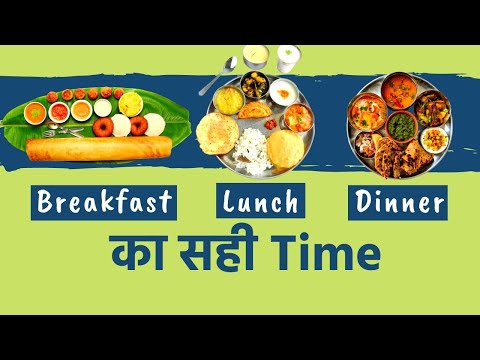
Gandhinagar does not have one universally recognised food street on the scale of Ahmedabad’s Manek Chowk. Instead, Kudasan, Sargasan, Infocity, Sector 11, Sector 16, Sector 21 and the Airport/SG Highway corridors function as its major eating clusters.
The Sargasan–Kudasan belt is currently the strongest area for cafés, vegetarian family restaurants, pizza, thalis and evening food outings. Zomato listings also show a concentration of street-food choices around Infocity and Airport–Gandhinagar Highway, including pani puri, vadapav, dhokla, frankies, sandwiches and fast food.
For a more organised street-food environment, The Spicy Street has been described as a food-park-style destination near Kudasan with Indian, Chinese, Thai, fast-food and street-food offerings. Tripadvisor currently shows a 4.8/5 rating from a small number of reviews, so it is attractive as an evening food stop but should not be treated as statistically equivalent to restaurants with thousands of reviews.
🥗 Jain, Vegan & Upvas Food in Gandhinagar

For fasting travellers, Radhe Prem Ni Mithaas has verifiable menu sections for Fasting/Upvas Specials, including items such as farali sabudana patties, farali potato preparations and other seasonal vrat foods. Its Sector 21 menu also lists Jain variants for some dishes.
Strict vegans should be more careful. Tripadvisor currently lists multiple Gandhinagar restaurants as vegan-friendly, but “vegan-friendly” usually means some vegan options, not a fully vegan kitchen. Ask whether butter, ghee, paneer, cheese, curd, milk powder or dairy-based sauces are used.

🚛 Best Food Choices for Highway Travellers & Truck Drivers

For commercial drivers, road travellers and transport crews, the most practical food corridor is the Sarkhej–Gandhinagar/SG Highway and Khoraj–Vaishnodevi side, where traditional dhabas and late-opening restaurants are easier to find. Shree Atithi Dhaba and Shivshakti Dhaba, SG Highway, Khoraj are directly positioned on this corridor and currently list extended evening hours.
Truckers should prioritise establishments with safe off-road parking, visible lighting, clean drinking water, toilets and freshly cooked food rather than choosing only by Google rating. Highway parking availability can change, especially around construction, events and traffic diversions.

🍛 What Food Should First-Time Visitors Try?

A first visit to Gandhinagar should prioritise Gujarati thali, dal-kadhi, rotli, seasonal shaak, khaman, dhokla, khandvi, handvo, fafda, thepla and local sweets. Travellers wanting regional variety can add Kathiyawadi food or Rajasthani dal-bati, while South Indian breakfast and contemporary cafés are widely accessible.

Litti chokha is not a signature Gandhinagar or Gujarati dish, Marathi-speciality restaurants are comparatively limited, and Gandhinagar is inland, so seafood should not be promoted as a local speciality. Those cuisines may occasionally be available at individual multi-cuisine restaurants, but they are better treated as optional menu choices rather than defining elements of Gandhinagar food tourism.


🏭 Industrial Evolution & Economic Landscape of Gandhinagar District, Gujarat
Gandhinagar District has evolved from an agriculture-linked regional economy into one of Gujarat’s most unusual combinations of manufacturing, MSMEs, engineering, pharmaceuticals, agro-processing, electronics, information technology, government administration and international financial services.
Its economic story is different from Ahmedabad, Surat or Rajkot. Gandhinagar was not built around an old textile city, a port or a centuries-old mercantile centre. Its modern transformation accelerated after Gandhinagar was developed as Gujarat’s planned capital. Government institutions attracted employees, housing, education, professional services and infrastructure; industrial estates subsequently strengthened manufacturing, while the Ahmedabad–Gandhinagar urban corridor increasingly connected the district with one of western India’s largest commercial ecosystems.
Today the district contains traditional manufacturing centres such as Chhatral, Kalol, Dehgam and Mansa, electronics and engineering estates in Gandhinagar, the Santej industrial belt, technology-oriented development and, most dramatically, Gujarat International Finance Tec-City (GIFT City).
That last development has changed the scale of Gandhinagar’s economic identity. GIFT City currently reports more than 1,000 operational entities, 20,000+ jobs, over 29 million sq ft allotted and more than US$100 billion in banking asset size as of September 2025.
In other words, modern Gandhinagar is no longer simply Gujarat’s administrative capital. It is increasingly part factory district, knowledge corridor, financial-services centre, startup ecosystem and globally connected business destination.
📈 How Gandhinagar’s Economy Evolved

| Economic Phase | Broad Transformation | Major Economic Drivers | Long-Term Impact |
|---|---|---|---|
| Pre-industrial economy | Agriculture, village trades and local commerce dominated | Farming, livestock, woodworking, crafts and local markets | Established rural production base |
| Capital-development era | Planned Gandhinagar expanded administrative activity | State government, construction, housing and public infrastructure | Created service-sector employment |
| Industrial-estate expansion | Organised manufacturing spread through GIDC and private clusters | Engineering, chemicals, plastics, pharmaceuticals, textiles | Created factory and MSME employment |
| Ahmedabad–Gandhinagar corridor growth | Urban and industrial economies became more interconnected | Roads, real estate, education, services and logistics | Larger labour and consumer market |
| IT & knowledge-economy phase | Technology and professional services expanded | Electronics, IT/ITES, education, Infocity-type development | Higher-skilled employment |
| GIFT City era | International finance and technology entered the district’s economic landscape | IFSC, banking, insurance, capital markets, fintech and global services | Internationalised Gandhinagar’s business profile |
| Emerging future | Finance, digital services, advanced manufacturing and sustainable infrastructure converge | Fintech, GCCs, data infrastructure, engineering, food processing, logistics | Greater potential for high-value investment |
GIDC remains a central institution in this story. It describes itself as Gujarat’s industrial-development nodal agency and currently reports 239 industrial estates across the state, while also developing sector-specific estates, industrial areas and Special Investment Regions.
🏗️ Major Industrial Estates and Manufacturing Clusters

One of the most important distinctions for investors is that Gandhinagar District is not a single industrial cluster. Different areas have developed different specialisations.
Gujarat’s MSME Strategic Investment Plan identifies Gandhinagar clusters including engineering, pharmaceuticals, plastics, textiles and chemicals at Chhatral; wood-based industries at Dehgam; electronics in the Gandhinagar Sector 25 area; seeds and agro-processing at Mansa; and engineering around Sector 28.
| Industrial Area / Cluster | Major Economic Character | Business Opportunities |
|---|---|---|
| Chhatral GIDC | Engineering, pharmaceuticals, chemicals, plastics, textiles | Manufacturing, industrial supplies, freight, packaging, maintenance |
| Kalol GIDC | Mixed manufacturing and engineering | Components, fabrication, industrial services, warehousing |
| Santej–Rakanpur Belt | Manufacturing and privately developed industrial activity | Engineering, packaging, printing, chemicals and logistics |
| Dehgam GIDC | Wood-related and mixed industries | Furniture inputs, woodworking, packaging and agro-linked enterprise |
| Mansa GIDC | Seeds and agro-processing | Seed processing, grading, packaging, cold-chain and food processing |
| Gandhinagar Engineering Estate | Engineering-oriented units | Fabrication, machinery and components |
| Gandhinagar Electronics Area | Electronics-oriented industry | Electronics, electrical products, repair and technology services |
| Bhat Industrial Estate | Mixed industrial development | MSMEs, distribution and industrial services |
| Sector 26 EHTP/IT/ITES–GIDC SEZ | Technology-oriented development | IT, electronics and business services |
| GIFT City | IFSC + domestic business district | Finance, fintech, insurance, funds, leasing, GCCs and IT |
The India Industrial Land Bank records industrial land assets in Gandhinagar including Bhat, Chhatral, Dehgam, the Sector-26 EHTP/IT/ITES development and Dharti Apollo Industrial Park. Its dataset lists Chhatral at about 199.84 hectares and the Sector-26 development at about 163.03 hectares.
GIDC’s current property documentation separately confirms Gandhinagar Engineering, Gandhinagar Electronics, Dehgam, Mansa, Chhatral and Kalol (N.G.) among its estate network.
⚙️ Why Chhatral Matters
Chhatral is one of the district’s most important conventional manufacturing centres.
Unlike GIFT City’s glass towers and financial-services offices, Chhatral represents the physical production side of Gandhinagar’s economy—factories, machinery, industrial raw materials, chemicals, engineering products, packaging and road freight.
Government environmental-clearance records, for example, document synthetic-organic-chemical manufacturing within Chhatral GIDC, illustrating the presence of process industries alongside the estate’s engineering and other manufacturing activities.
For logistics businesses, this creates demand for everything from small commercial vehicles and LCVs to multi-axle trucks, containers and specialised project-cargo transport.
💻 GIFT City – Gandhinagar’s New Economic Revolution

No discussion of Gandhinagar’s economy is complete without GIFT City.
GIFT City is positioned between Ahmedabad and Gandhinagar and combines a Multi-Services SEZ, India’s first International Financial Services Centre and a domestic business district.
Its target sectors now extend well beyond conventional banking.

| GIFT City Sector | Economic Opportunity |
|---|---|
| Banking | International and wholesale financial services |
| Capital Markets | Exchanges, brokers and market infrastructure |
| Fund Management | Alternative investment and global fund structures |
| Insurance | International insurance and reinsurance |
| Fintech | Financial technology and digital financial services |
| Aircraft Leasing | International leasing and financing |
| Ship Leasing | Maritime finance and leasing |
| Bullion | International bullion trading ecosystem |
| Global In-House Centres | International corporate operations |
| IT & ITES | Technology and business services |
| Finance Companies | Cross-border and specialised finance |
| Foreign Universities | International higher education |
| Maritime Cluster | Shipping and maritime-related services |
| Biotechnology | Knowledge-driven commercial opportunities |
| Pharmaceuticals | Corporate and service-sector activity |
| Engineering | Professional and commercial ecosystem |
GIFT City’s official business profile identifies banking, finance, IT/ITES, fintech, capital markets, biotech, maritime activity, insurance, engineering, automobiles and pharmaceuticals among its targeted sectors.
Its infrastructure is itself an economic experiment. The development highlights a utility tunnel, district cooling, smart water systems, power infrastructure, automated waste management and city command-and-control infrastructure.
This matters because Gandhinagar is effectively participating in two industrial revolutions simultaneously.
Chhatral and Kalol continue producing and moving physical goods.
GIFT City increasingly moves capital, data, financial products and professional services.
That combination gives the district an unusually diversified economic future.
🌍 Corporate Houses, Multinationals and Institutional Ecosystem

GIFT City’s official ecosystem currently identifies major names including HSBC, IBM, Bank of America, Standard Chartered, Oracle and Google among partners/occupants in its development ecosystem.
Its development listings also identify institutions and organisations such as State Bank of India and LIC alongside private real-estate and commercial developers.
The significance is larger than the brands themselves. International financial institutions create direct professional jobs but also stimulate legal services, accounting, cybersecurity, compliance, consulting, hospitality, housing, facility management, transport and education.
That multiplier effect is an important part of Gandhinagar’s emerging economy.
It would, however, be misleading to reduce regional development to famous corporations. Thousands of small manufacturers, traders, transport operators, contractors, family-owned businesses, workshops, service firms and professionals form the less visible economic foundation of the district.
🧰 MSMEs – The Industrial Backbone People Rarely See
A visitor travelling through Chhatral, Kalol or Santej encounters a very different Gandhinagar from the landscaped capital.
Here the economy is built around production schedules, raw-material deliveries, fabrication, packaging, dispatches, maintenance workshops and truck movements.
Historical establishment records show businesses in the Kalol/Santej belt engaged in areas including chemical production, engineering components, plastic printing and packaging.
MSMEs play several interconnected roles:
| MSME Activity | Wider Economic Contribution |
|---|---|
| Engineering fabrication | Supplies machinery and industrial components |
| Plastics | Supports packaging and manufacturing |
| Pharmaceuticals | Production and supply-chain employment |
| Chemicals | Inputs for multiple downstream industries |
| Textiles | Processing, manufacturing and trade |
| Printing & packaging | Supports virtually every manufactured product |
| Woodworking | Furniture, industrial and consumer products |
| Agro-processing | Converts farm production into higher-value goods |
| Electrical/electronics | Supports industrial and technology demand |
| Transport services | Connects factories to suppliers and markets |
| Repair & maintenance | Keeps industrial equipment operational |
| Warehousing | Supports inventory and distribution |
GIDC argues that industrial estates create cluster advantages through access to raw materials, markets, technology, common services and infrastructure.
That cluster effect explains why seemingly small businesses can become strategically important.
A packaging company may serve pharmaceutical manufacturers. A fabricator may supply machinery builders. A transporter may connect twenty MSMEs with customers across India. A warehouse can become the bridge between production and e-commerce distribution.
🌾 Agriculture, Agro-Processing and Gandhinagar’s ODOP Opportunity
Industrialisation has not erased agriculture.
The Government of India’s current One District One Product food-processing list identifies okra-based products as Gandhinagar’s ODOP.
This creates opportunities beyond selling fresh vegetables.
| Okra Value Chain | Potential Enterprise |
|---|---|
| Farming | Improved cultivation and contract farming |
| Collection | Farmer aggregation centres |
| Sorting | Quality grading |
| Packaging | Retail and export-ready packaging |
| Cold chain | Temperature-managed storage |
| Processing | Frozen/dehydrated okra |
| Logistics | Reefer and fast road transport |
| Quality control | Testing and traceability |
| Export | Processed and fresh produce markets |
| Waste utilisation | Biomass/by-product innovation |
Mansa’s recognised seed and agro-processing activity further strengthens the district’s agricultural-business potential.
For entrepreneurs, this is one of Gandhinagar’s most practical opportunities because it connects the rural economy with modern food processing, packaging, cold storage, logistics and organised retail.
🪵 Traditional Industry – Pethapur Wood Block Making

Before international finance and industrial parks, Gandhinagar’s economy had another kind of skilled technology: the artisan’s hand.
Pethapur became associated with carved wooden blocks used in textile printing. The Government of India’s ODOP portal now recognises woodwork/block making as a secondary Gandhinagar ODOP activity, describing the district’s woodworking and hand-carved printing-block tradition.
This traditional industry deserves attention because it connects Gandhinagar with Gujarat’s much larger textile heritage.
Its future does not have to be confined to souvenir sales.
Digital catalogues, designer collaborations, textile workshops, heritage tourism, e-commerce and export-oriented craft marketing can give traditional block makers access to customers far beyond Gujarat.
🧵 What About GI-Tagged Products?
GI status must not be invented merely to make a district appear culturally richer.
Gujarat has several important GI-registered textile and handicraft products, but they should not automatically be labelled “Gandhinagar GI products.”
For example, the official handloom GI listing associates Patan Patola with Patan, Rajkot Patola with Rajkot, Tangaliya with Surendranagar and Kachchh Shawls with Kutch.
Interestingly, the Gujarat State Handloom & Handicrafts Development Corporation—based in Gandhinagar—is listed in connection with the Gharchola Craft of Gujarat GI registration. That institutional association does not mean the entire craft geographically originates in Gandhinagar District.
This distinction is important for trustworthy travel and economic content.
🛍️ Wholesale, Offline Purchasing and Traditional Markets
Gandhinagar is not Gujarat’s biggest wholesale trading centre; Ahmedabad remains much stronger for massive textile, commodity and specialist wholesale markets.
Gandhinagar nevertheless has several useful purchasing ecosystems.
Sector markets serve residents and government employees. Kalol provides a more traditional commercial environment linked to its industrial and residential economy. Chhatral and Santej are more useful for B2B industrial sourcing than tourist shopping. Pethapur offers the potential for craft-oriented purchases, while Gandhinagar’s government-supported handicraft ecosystem provides access to Gujarat-made products.
The Gujarat State Handloom & Handicrafts Development Corporation’s Garvi Gurjari operation is headquartered near Mahatma Mandir in Sector 13 and markets products including Patola, Ajrakh, embroidery, handicrafts and home furnishings.
| Purchasing Need | Best Area/Approach |
|---|---|
| Industrial components | Chhatral–Kalol–Santej supplier ecosystem |
| Engineering supplies | Industrial estates and specialist dealers |
| Agricultural inputs | Mansa/Dehgam commercial areas |
| Everyday retail | Gandhinagar sector markets |
| Traditional handicrafts | Government-supported craft outlets |
| Wooden printing blocks | Pethapur, preferably directly from genuine artisans |
| Gujarati textiles | Gandhinagar outlets; Ahmedabad for much larger wholesale choice |
| Corporate procurement | Gandhinagar–Ahmedabad business corridor |
| Food/agricultural sourcing | Rural markets and regulated supply chains |
| Premium commercial services | GIFT City and central Gandhinagar |
🚚 Logistics Infrastructure – The Economy Behind the Economy
Manufacturing cannot grow if raw materials cannot arrive and finished goods cannot leave.
Gandhinagar benefits from proximity to Ahmedabad and northern Gujarat and from road connections that integrate it with wider state and national freight networks. Its industrial belts therefore support substantial demand for FTL, LTL, parcel movement, containers, machinery transport and project cargo.
A manufacturing shipment may move through several stages:
Supplier → Factory → Warehouse → Packaging → Truck → Distribution Centre → Retailer/Exporter.
Every stage creates economic activity.
Engineering and machinery manufacturers need open trucks, trailers and sometimes heavy-haul equipment. Pharmaceuticals and food products may require more controlled transport conditions. Plastics, textiles and packaged products generate regular FTL/LTL demand. Agriculture creates seasonal freight requirements.
GIFT City creates a different logistics category: movement of employees, documents, IT hardware, office equipment, high-value electronics, facility-management supplies and business travellers.
Gandhinagar therefore demonstrates how logistics itself is changing—from transporting tonnes of industrial cargo to supporting high-value service economies and digitally managed supply chains.
👷 Employment – From Factory Floor to Global Finance

The employment structure of Gandhinagar is becoming unusually diverse.
| Economic Segment | Typical Employment |
|---|---|
| Government | Administration, technical and public services |
| Manufacturing | Operators, engineers, supervisors |
| MSMEs | Skilled/semi-skilled workers, technicians |
| Pharmaceuticals | Production, quality, laboratory and regulatory roles |
| Chemicals | Plant operations, safety and engineering |
| Agro-processing | Processing, packaging and supply chain |
| Logistics | Drivers, dispatchers, warehouse teams, fleet managers |
| IT/ITES | Developers, support and digital operations |
| GIFT City | Banking, insurance, compliance, fintech and investment roles |
| Construction | Civil engineering and skilled trades |
| Hospitality | Hotels, restaurants and event services |
| Education | Faculty, research and administration |
| Crafts | Artisans, designers and traders |
GIFT City alone reports more than 20,000 jobs generated.
The larger employment effect extends further into residential development, taxis, restaurants, security, maintenance, housekeeping, education and retail.
🚀 Startups, Innovation and Knowledge Economy

Gandhinagar’s future competitive advantage is increasingly linked to knowledge.
The wider Ahmedabad–Gandhinagar ecosystem combines universities, research institutions, technology companies, government departments, financial institutions and investors. GIFT City adds a specialised environment for fintech and international financial innovation.
Potential startup categories include:
| Startup Opportunity | Why Gandhinagar Fits |
|---|---|
| Fintech | IFSC and financial ecosystem |
| RegTech | Complex international financial compliance |
| InsurTech | Insurance activity at GIFT IFSC |
| Cybersecurity | Banks, government and enterprise demand |
| AI/data analytics | IT and financial-services customers |
| AgriTech | Rural district + agro-processing |
| LogisticsTech | Manufacturing and freight corridors |
| CleanTech | Smart infrastructure and industrial demand |
| Food processing | ODOP okra opportunity |
| B2B marketplaces | Large MSME supplier ecosystem |
| HR/SkillTech | Growing demand for specialised talent |
| HospitalityTech | Business travel and convention market |
🏦 Government Initiatives and Institutional Advantage

Gandhinagar has an unusual advantage: many of Gujarat’s principal policy-making institutions are physically located in the capital.
GIDC itself is headquartered at Udyog Bhavan in Gandhinagar.
For investors, GIDC estates can reduce some land-development complexity. The corporation states that its industrial land is already classified as non-agricultural and that major estates can include supporting commercial and social infrastructure.
GIFT City similarly promotes single-window clearances and plug-and-play infrastructure as part of its investment proposition.
The combination does not eliminate business risk, but it creates an institutional framework for both manufacturing and service-sector investment.
👩💼 Entrepreneurs, Industrialists and Business Leadership

A trustworthy district profile should avoid producing a decorative list of “famous entrepreneurs” whose connection to Gandhinagar cannot be demonstrated.
The district’s economic transformation has instead been shaped by several overlapping groups: local MSME founders in Kalol, Chhatral and Santej; traditional Pethapur artisans; agricultural entrepreneurs; property and infrastructure developers; technology professionals; institutional leaders; women entrepreneurs; startup founders; and executives working within the expanding GIFT City ecosystem.
Their contribution is often less visible than that of nationally famous industrialists but economically significant.
A second-generation engineering business that employs 60 workers, a woman-led food-processing enterprise employing rural workers, an artisan family preserving block carving or a logistics operator connecting small factories to national markets can produce meaningful local impact without becoming a household name.
That is the industrial history that economic statistics often miss.
🌱 CSR, Sustainability and Infrastructure

Industrial growth creates responsibilities alongside opportunities.
Chemical and process industries need environmental controls. Manufacturing clusters require waste management, occupational safety and responsible groundwater use. Freight growth requires safer roads and cleaner vehicles.
GIDC notes that chemical estates can include environmental-management infrastructure and provisions for common effluent-treatment and waste-disposal facilities.
GIFT City represents another model, incorporating district cooling, automated waste management and smart infrastructure into its urban design.
Future industrial competitiveness will increasingly depend on:
energy efficiency → renewable power → water reuse → cleaner freight → waste recovery → ESG reporting → green buildings → responsible supply chains.
For entrepreneurs, sustainability is therefore becoming a business market rather than merely a compliance obligation.
⚠️ Challenges Facing Gandhinagar’s Industrial Economy

Growth brings difficult questions.
Industrial belts need better last-mile roads and organised truck parking. Manufacturing requires skilled labour. Chemical industries must maintain strict environmental compliance. Fast urbanisation raises land and housing costs. MSMEs face financing, technology-upgradation and export-certification challenges.
GIFT City faces a different challenge: it must compete for financial institutions, international capital and specialised professionals against established global financial centres.
| Challenge | Business Response Needed |
|---|---|
| Rising industrial costs | Automation and productivity |
| Skilled-labour gaps | Industry-linked training |
| MSME financing | Better formal credit access |
| Environmental pressure | Cleaner production technology |
| Traffic/freight congestion | Logistics planning and truck infrastructure |
| Global competition | Quality and certification |
| Export complexity | Digital compliance and trade support |
| Climate risk | Resilient infrastructure |
| Artisan decline | Design, tourism and e-commerce integration |
| Agricultural wastage | Processing and cold-chain investment |
💰 Future Investment Opportunities in Gandhinagar District

The most promising opportunities are not necessarily another giant factory.
Some of the strongest possibilities exist between existing industries.
| Opportunity | Potential | Target Investor |
|---|---|---|
| Fintech/RegTech | Very High | Startups, financial firms |
| Global Capability Centres | Very High | MNCs |
| Financial services | Very High | Banks, funds, insurers |
| Industrial warehousing | High | Logistics developers |
| 3PL/FTL/LTL services | High | Transport companies |
| Cold chain | High | Agro/logistics investors |
| Okra processing | High | Food processors |
| Engineering components | High | MSMEs |
| Industrial automation | High | Technology manufacturers |
| Packaging | High | MSMEs |
| Data/cybersecurity | Very High | Technology firms |
| Sustainable infrastructure | High | CleanTech investors |
| Corporate hotels | High | Hospitality companies |
| Business travel services | High | Tourism entrepreneurs |
| Skill development | High | Education providers |
| Artisan e-commerce | Medium–High | Social enterprises |
| EV logistics | Emerging | Fleet operators |
| Industrial recycling | High | Circular-economy businesses |
🧭 Practical Insights for Entrepreneurs, Investors and Business Travellers
Do not evaluate Gandhinagar only from central Gandhinagar.
If you are researching manufacturing, physically visit Chhatral, Kalol, Santej, Dehgam and relevant GIDC estates.
If you are evaluating finance, fintech, international services or GCC opportunities, spend time at GIFT City.
For agro-processing, study Mansa, Dehgam and the rural supply chain rather than only urban markets.
For traditional industry, speak directly with genuine Pethapur artisans.
And for logistics investment, map the actual movement of goods: factory gates, highways, loading points, warehouses, labour availability, truck restrictions, turnaround times and customer destinations.
Industrial land prices also change. For FY 2026–27, GIDC’s published allotment-price page currently lists Chhatral at ₹1,400 per sq m and Kalol (N.G.) at ₹1,720 per sq m; these are official allotment figures for the stated financial year, not general market-property valuations.
That distinction is crucial before making an investment model.

🌍 Why Gandhinagar Matters to Gujarat and India’s Future Economy
Gandhinagar’s economic importance is ultimately based on convergence.
The district combines government decision-making, conventional manufacturing, MSMEs, agriculture, crafts, technology, education and international financial services within the wider Ahmedabad–Gandhinagar metropolitan economy.
GIFT City now provides the most visible symbol of that transformation. Its official vision places Gandhinagar within a tri-city model where Ahmedabad contributes commercial depth, Gandhinagar provides the policy environment and GIFT City acts as an emerging economic and financial hub.
Yet the factory worker in Chhatral, seed processor in Mansa, engineer in Kalol, artisan in Pethapur and financial professional in GIFT City are all parts of the same economic story.
That is what makes Gandhinagar particularly interesting.
Its past was built around land, agriculture, craftsmanship and administration.
Its industrial phase added factories, engineering, chemicals, pharmaceuticals, plastics and MSMEs.
Its newest transformation is adding finance, technology, fintech, global services and smart infrastructure.
For manufacturers, Gandhinagar offers access to established industrial clusters. For entrepreneurs, it offers opportunities around food processing, logistics, technology and business services. For investors, GIFT City introduces an international dimension rarely associated with a district economy. For travellers, industrial and business tourism reveals an entirely different Gujarat beyond monuments and conventional sightseeing.
The strongest future opportunities will probably emerge where these worlds meet: AgriTech connecting farms with markets, LogisticsTech connecting factories with customers, fintech connecting businesses with capital, clean technology reducing industrial costs and skilled professionals connecting Gandhinagar with global markets.
Gandhinagar District’s next economic chapter, therefore, is unlikely to be defined by one industry.
It will be defined by how successfully the district connects manufacturing with technology, agriculture with processing, MSMEs with exports, finance with innovation, traditional skills with digital markets and economic growth with sustainability.

🛍️ Economic Shopping & Business Growth Guide for Gandhinagar District, Gujarat
Gandhinagar District is one of those places where a traveller can buy vegetables from a traditional sector market in the morning, inspect engineering suppliers around an industrial estate in the afternoon and end the day beside the towers of India’s first International Financial Services Centre.
That contrast explains the district’s economic character.
Gandhinagar is not Gujarat’s largest wholesale-shopping destination, and it should not be compared directly with Ahmedabad’s giant textile markets, Surat’s diamond ecosystem or Rajkot’s engineering bazaars. Its strength comes from a different combination: government administration, organised retail, traditional neighbourhood markets, agriculture, manufacturing, MSMEs, educational institutions, technology businesses and the rapidly expanding GIFT City financial ecosystem.
For shoppers, this means everything from fresh produce and economical household goods to branded retail, Gujarati handicrafts and industrial procurement. For entrepreneurs and investors, the district offers opportunities in manufacturing, fintech, IT/ITES, warehousing, food processing, logistics, hospitality, retail, professional services and agriculture-linked businesses.
A crucial terminology note for first-time investors: Gujarat primarily uses GIDC—Gujarat Industrial Development Corporation—not MIDC, which is Maharashtra’s industrial-development corporation. Official GIDC records list Gandhinagar-area estates including Gandhinagar Engineering, Gandhinagar Electronics, Dehgam, Mansa, Chhatral and Kalol.
📌 Gandhinagar Economic Shopping & Business Quick Answer

| Question | Practical Answer |
|---|---|
| Best traditional shopping area | Sector 21 and other sector-based shopping centres |
| Best budget local-market experience | Sector 21, Sector 24 and Meena Bazaar area |
| Best modern shopping zone | Sargasan–Kudasan |
| Major mall destination | Swagat Holiday Mall, Sargasan |
| Agricultural wholesale opportunity | Kalol APMC and other district agricultural-market networks |
| Best traditional craft purchase | Pethapur wood-printing blocks and Gujarat handicrafts |
| Main manufacturing belt | Chhatral–Kalol–Santej corridor |
| Important GIDC estates | Chhatral, Kalol, Dehgam, Mansa, Gandhinagar Engineering/Electronics |
| Major SEZ/financial hub | GIFT City |
| Best fintech/business-services opportunity | GIFT City |
| Strong MSME opportunities | Engineering, packaging, plastics, pharma support, agro-processing |
| Best logistics opportunities | Industrial freight, warehousing, cold chain and B2B distribution |
| Best area for corporate retail growth | Kudasan, Sargasan, Raysan–Randesan and GIFT-linked corridor |
| Best business-trip combination | GIFT City + Gandhinagar + Chhatral/Kalol according to industry |
🛒 Traditional Shopping Markets in Gandhinagar
The easiest mistake a visitor can make is to search only for malls.
Gandhinagar’s planned-sector system has created a network of neighbourhood commercial areas that often provide a more authentic view of everyday life. Sector-based markets sell groceries, fruit and vegetables, clothes, footwear, household goods, electrical supplies, snacks and daily essentials.
Municipal street-vendor records specifically document vendors around District Shopping Centre Sector 21, Meena Bazaar near Sachivalaya and other sector commercial areas, confirming that informal and semi-formal street trade remains part of Gandhinagar’s retail landscape.
🏪 Major Local Shopping Areas
| Market / Shopping Area | Best For | Buyer Type | Price Character | Why Visit | Practical Tip |
|---|---|---|---|---|---|
| Sector 21 Market | Vegetables, fruits, clothes, household goods, accessories | Residents, budget travellers | Budget–moderate | One of the city’s broadest everyday shopping areas | Visit in the morning for produce and evening for general shopping |
| Sector 24 Market | Daily-use products, vegetables, clothing, electronics | Local households | Budget–moderate | Strong neighbourhood-shopping character | Compare prices among small independent shops |
| Meena Bazaar, Sachivalaya area | Small goods, tools, electronics, utility items | Budget buyers, workers | Budget | Traditional market atmosphere near administrative district | Carry small-value digital/payment options |
| Sector 11 Area | Offices, food, services, government-related commercial activity | Employees, business visitors | Moderate | Central location close to institutional activity | Useful during working hours |
| Sector 16 Shopping Areas | Retail, restaurants, services | Families, professionals | Moderate | Central Gandhinagar commercial stop | Combine with nearby sightseeing |
| Sector 28 Commercial Area | Local shopping and industrial-estate linkage | Residents, industrial visitors | Budget–moderate | Useful for practical purchases | Not primarily a tourist-shopping destination |
| Infocity Commercial Zone | Restaurants, offices, retail and services | IT employees, students, visitors | Moderate | Good business-and-food combination | Weekday evenings can be active |
| Kudasan | Branded retail, cafés, restaurants, services | Gen Z, families, professionals | Moderate–premium | One of Gandhinagar’s fast-growing urban-commercial areas | Good for evening shopping |
| Sargasan | Malls, restaurants, supermarkets and corporate spaces | Families, professionals | Moderate–premium | Convenient SG Highway access | Useful for travellers driving between Ahmedabad and Gandhinagar |
| Kalol Town Market | Household goods, agriculture-linked commerce and local retail | Residents, traders | Budget–moderate | Traditional urban market serving northwestern district | Better for practical purchases than souvenir hunting |
| Dehgam Market | Rural/urban retail and agricultural goods | Farmers, families, traders | Budget | Useful gateway to eastern rural economy | Visit during daytime |
| Mansa Market | Agricultural and traditional town commerce | Rural customers, traders | Budget | Important service centre for surrounding villages | Combine with business visits to agro units |
Community discussions also repeatedly identify Sector 21, Sector 24 and Meena Bazaar as places residents use for affordable everyday shopping rather than premium showroom retail. That is useful local evidence, although individual vendor quality and availability naturally vary.
🏬 Malls and Modern Retail Growth

Modern Gandhinagar’s retail geography is moving toward Sargasan, Kudasan, Raysan, Randesan and the Gandhinagar–Ahmedabad corridor.
A Gandhinagar Municipal Corporation mall document records commercial properties including Shree Balaji Agora Mall, Swagat Holiday Mall, D-Mart Sector 26, b-Mart Sargasan, Osia Sector 21 and Vishal Super Market Kudasan.
Swagat Holiday Mall illustrates how Gandhinagar’s retail economy is changing. Its developer describes a mix of retail shops, branded showrooms, food court, multiplex, gaming, supermarket, spa and corporate offices, positioned near Sargasan on the GIFT City road corridor.
| Modern Retail Destination | Location | Character | Best For | Business Potential |
|---|---|---|---|---|
| Swagat Holiday Mall | Sargasan | Large lifestyle mall | Fashion, entertainment, food | High |
| Super Mall 1 / Infocity commercial zone | Infocity | Office-linked retail | Employees, cafés, everyday services | Medium–High |
| Sarthak Pulse Mall | Kudasan/Bhaijipura | Mixed retail/commercial | Restaurants, shops, offices | High |
| Pramukh Anand / Kudasan complexes | Kudasan | Newer commercial development | Professional services, retail | High |
| Sector 21 retail cluster | Sector 21 | Traditional + organised retail | Value shopping | Stable |
| D-Mart Sector 26 | Sector 26 | Mass-market supermarket | Groceries and household purchases | High-volume retail |
| Sargasan commercial corridor | Sargasan | Retail + restaurants + offices | Families, professionals | Very High |
| GIFT City retail ecosystem | GIFT City | Premium corporate-oriented retail | Professionals and international business visitors | Emerging–Very High |
Retail entrepreneurs should notice the distinction between these markets. A value-fashion store may work differently in Sector 21 than in Kudasan. A premium café may benefit more from proximity to offices, young professionals and GIFT-linked residential development than from a traditional neighbourhood market.
🌾 APMCs, Mandis and Agricultural Purchasing
Gandhinagar District still has a substantial agriculture-linked economy, making agricultural markets important for wholesalers, processors, traders, transporters and food businesses.
The e-NAM directory identifies Kalol APMC Main Market Yard in Kalol East, Gandhinagar District, handling commodities including bajra, paddy, castor seed, mustard and guar seed among its listed categories.
🚜 Agricultural Business Map

| Agricultural Hub | Main Opportunity | Typical Buyers | Logistics Need | Investment Opportunity |
|---|---|---|---|---|
| Kalol APMC | Grain, oilseeds and agricultural trading | Traders, processors | Bulk trucks, local pickup, storage | Warehousing, grading, agri logistics |
| Mansa region | Seeds and agro-linked commerce | Farmers, seed businesses | Bagged cargo and distribution | Seed processing and packaging |
| Dehgam rural belt | Agricultural produce and farm inputs | Farmers, wholesalers | Local collection transport | Collection centres and agro services |
| Gandhinagar rural villages | Vegetables and horticulture | Retailers, aggregators | Fast local delivery | Fresh-produce aggregation |
| Ahmedabad wholesale link | Larger downstream market | District traders | Intercity road freight | Distribution consolidation |
Anyone using a mandi for commercial purchasing should check the current day’s arrivals, commodity prices, auction timing and market rules rather than relying on a static blog figure. Agricultural prices are inherently variable.
For transport companies, APMC-linked business can create requirements for pickups, LCVs, open trucks, covered vehicles, warehousing and—in appropriate produce categories—cold-chain services.

🎁 What Should Travellers and Buyers Purchase?
Gandhinagar is not famous for one dominant consumer product in the way Kutch is associated with certain crafts or Surat with textiles. Its shopping advantage is access to Gujarat’s broader product ecosystem combined with a few locally meaningful purchases.
| Product | Where to Look | Why Buy | Buyer Tip |
|---|---|---|---|
| Pethapur wooden printing blocks | Pethapur artisans | Traditional craft connected to textile printing | Prefer genuine artisan-made pieces |
| Gujarati handicrafts | Government-supported craft outlets | Access to products from across Gujarat | Ask about production origin |
| Handloom textiles | Gandhinagar craft stores | Convenient regional shopping | Do not assume every textile is Gandhinagar-made |
| Gujarati snacks | Sector markets / sweet shops | Practical edible souvenir | Check packaging and expiry |
| Local agricultural products | Traditional markets | District-to-consumer connection | Purchase seasonal produce |
| Industrial components | Chhatral/Kalol suppliers | B2B procurement | Obtain specifications and GST invoice |
| Engineering materials | Industrial estates | Manufacturing supply chain | Inspect quality before bulk order |
| Seeds/agri inputs | Mansa/Dehgam commercial network | Agriculture business | Buy from licensed suppliers |
For authentic craft shopping, the Gujarat State Handloom & Handicrafts Development Corporation’s Garvi Gurjari ecosystem is particularly useful because it provides a more structured route to Gujarat handicrafts than random souvenir shops.
🏭 GIDC Industrial Estates: Where Manufacturing Business Happens
Gandhinagar’s business economy has two very different faces.
Central Gandhinagar and GIFT City are administration, finance and services.
Chhatral, Kalol, Dehgam, Mansa and other estates are where physical manufacturing and industrial supply chains become visible.
Official GIDC documentation confirms several relevant estates, while GIDC itself operates 239 industrial estates across Gujarat as the state’s industrial-development agency.
⚙️ Major Gandhinagar Industrial Areas
| Industrial Area | Typical Economic Role | Suitable Businesses | Logistics Requirement | Investment Character |
|---|---|---|---|---|
| Chhatral GIDC | Large conventional manufacturing cluster | Engineering, chemicals, plastics, pharma-linked units | HCV, FTL, containers, trailers | Mature industrial |
| Kalol GIDC | Manufacturing and support services | Engineering, fabrication, distribution | Trucking and warehousing | Mature |
| Gandhinagar Engineering Estate | Engineering MSMEs | Fabrication, components, repair | LCV/HCV | Urban industrial |
| Gandhinagar Electronics Estate | Electronics/electrical cluster | Electronics, electrical products, services | Secure small cargo | Technology-oriented |
| Dehgam GIDC | Smaller industrial base | Wood, agro and general MSMEs | Local/regional freight | Lower-cost expansion |
| Mansa GIDC | Agro-linked industrial activity | Seeds, processing, packaging | Agricultural and packaged freight | Emerging |
| Bhat industrial/commercial area | Ahmedabad–Gandhinagar corridor | Services, industry, commercial development | Strong road connectivity | Higher-value corridor |
| Santej–Rakanpur belt | Private industrial activity | Engineering, packaging and mixed manufacturing | Heavy road freight | Strong MSME ecosystem |
GIDC’s published FY 2025–26 allotment data illustrates how dramatically location affects industrial-land economics: the official table lists Bhat at ₹16,130 per sq m, Gandhinagar Electronics and Engineering at ₹9,290, Gandhinagar IT SEZ at ₹6,570, Gandhinagar SEZ at ₹4,510, while Dehgam and Mansa are listed at ₹970 per sq m for that financial year. These are GIDC allotment rates, not general private-market property valuations.
That difference is an important investor lesson: cheaper land may reduce entry cost, but connectivity, labour, suppliers, customer proximity and infrastructure can matter more than plot price alone.
🌐 GIFT City, SEZ and International Business Growth
GIFT City has changed the meaning of “business in Gandhinagar.”
Its official platform describes the development as a global financial and technology hub containing a Multi-Services SEZ and India’s first International Financial Services Centre. More than 1,000 entities are operational, 29 million+ sq ft has been allotted, employment exceeds 20,000 and banking assets exceed US$100 billion as of September 2025.
💼 GIFT City Business Opportunities

| Sector | Opportunity |
|---|---|
| Banking | International and wholesale financial services |
| Fund Management | Investment funds and asset management |
| Insurance | Cross-border insurance and reinsurance |
| Capital Markets | Exchanges, brokers and market services |
| Fintech | Payments, financial technology and innovation |
| Aircraft Leasing | Finance and leasing |
| Ship Leasing | Maritime finance |
| Bullion | Trading and related services |
| Global In-house Centres | International corporate operations |
| IT/ITES | Technology and business-process services |
| E-commerce | Corporate and support functions |
| Research & Development | Technology and financial innovation |
| BPO/KPO | Professional back-office services |
| Corporate Offices | Regional and global operations |
GIFT City’s official target-business list also includes biotechnology, engineering, automobiles and pharmaceuticals alongside finance and technology.
For small entrepreneurs, the opportunity is not limited to becoming a bank or fintech company. Every growing corporate district creates supporting demand:
business hotels → cafés → coworking → employee transport → recruitment → cybersecurity → housekeeping → facility management → office food → event production → corporate gifts → printing → housing → last-mile delivery.
That supporting economy may be more accessible to a local MSME than the regulated IFSC business itself.
📦 Logistics, Warehousing and Transport Infrastructure
A district that combines factories, agricultural markets and financial offices needs several different logistics systems.
Traditional industrial zones require raw-material inbound transport and finished-goods dispatch.
Agricultural markets need rapid collection, bulk movement and storage.
Retail businesses require distribution.
Corporate offices need secure movement of IT equipment, documents and high-value goods.
🚚 Major Logistics Corridors
| Corridor / Area | Typical Cargo | Vehicle Requirement | Business Potential |
|---|---|---|---|
| Chhatral–Kalol | Engineering, chemicals, manufactured goods | HCV, containers, trailers | Very High |
| Santej–Rakanpur | Industrial goods, packaging, components | LCV to HCV | High |
| Dehgam | Agro/wood/general goods | Pickup, LCV, medium trucks | Medium–High |
| Mansa | Seeds, agricultural cargo | LCV/HCV | Medium–High |
| Ahmedabad–Gandhinagar corridor | Retail, commercial and industrial goods | All vehicle categories | Very High |
| GIFT City | IT assets, office supplies, high-value cargo | Secure vans/LCV | High-value niche |
| Kalol APMC | Agricultural commodities | Open/covered trucks | Seasonal High |
Warehousing opportunities are strongest where land, truck access and customer concentration overlap. A warehouse too deep inside a congested urban area may be less useful than one positioned near an industrial corridor with efficient highway connectivity.
Manufacturers should calculate not merely rent per square foot, but:
factory-to-warehouse distance + truck waiting time + tolls + labour + loading equipment + delivery lead time + vehicle restrictions.
Those numbers determine the real logistics cost.
🧰 MSME Clusters and Small-Business Opportunities
Gandhinagar’s visible landmarks may be government offices and modern towers, but much of the district’s everyday economic activity comes from MSMEs.
NABARD’s district planning document shows significant projected MSME lending activity across Gandhinagar, Dehgam, Kalol and Mansa, reflecting the breadth of manufacturing and service-sector enterprise potential.
| MSME Sector | Why It Fits Gandhinagar | Potential Customer |
|---|---|---|
| Industrial fabrication | Existing engineering clusters | Factories |
| Packaging | Pharma, food, manufacturing | Industrial units |
| Transport | Multiple estates | Manufacturers |
| Warehousing | Industrial and retail growth | Distributors |
| Cold chain | Agriculture and food | Farmers/processors |
| Industrial maintenance | Mature factories | GIDC units |
| Electrical services | Manufacturing and commercial growth | Factories/offices |
| Cybersecurity | GIFT/IT ecosystem | Financial institutions |
| Recruitment | Finance, technology and industry | Corporates |
| Facility management | GIFT and commercial buildings | Offices |
| Food processing | Agriculture + ODOP potential | Retail/export markets |
| Corporate catering | GIFT/Infocity/business zones | Offices |
| Tourism transport | Business + leisure travel | Hotels/corporates |
🚀 Startup Ecosystem and Innovation Opportunities

Gandhinagar has a major advantage that traditional industrial towns often lack: institutions.
A government list of recognised nodal institutions includes innovation/incubation activity at IIT Gandhinagar, PDPU/PDEU, DA-IICT, Gujarat State Biotechnology Mission and EDII in Bhat, among others in the wider regional ecosystem.
This creates fertile ground for businesses that combine technology with established district industries.
💡 Startup Opportunities
| Startup Idea | Local Demand Driver |
|---|---|
| Fintech | GIFT City |
| RegTech | IFSC compliance |
| AI financial analytics | Banking/fund ecosystem |
| Cybersecurity | Finance + government |
| Logistics software | Chhatral/Kalol factories |
| Fleet management | Industrial freight |
| AgriTech | Rural Gandhinagar |
| Food processing | Agricultural value chain |
| Cold-chain tech | Fresh produce |
| B2B industrial marketplace | MSME suppliers |
| Waste recycling | Industrial estates |
| Clean-energy services | ESG requirements |
| HR tech | Corporate hiring |
| Corporate mobility | GIFT/Infocity |
| Tourism-tech | Business + leisure visitors |
Entrepreneurs should not assume an incubator automatically provides funding. Incubators differ in sector, eligibility, mentoring, laboratory access and funding programmes. Always review current admission requirements directly.
🤝 Business Associations and Local Networks

A newcomer can waste months trying to understand an industrial area independently.
Local industry associations, chambers, estate associations, transport networks, trader groups and professional bodies can shorten that learning curve significantly.
They help investors understand:
labour availability, local vendor reputation, freight practices, environmental requirements, utility issues, industry-specific challenges and government procedures.
In Chhatral and Kalol, estate-level networking is particularly valuable because manufacturing businesses depend heavily on supplier relationships and local industrial services.
At GIFT City, networking operates differently—through conferences, financial institutions, professional associations, fintech events and international-business programmes.
🏛️ Government Schemes Entrepreneurs Should Study

Instead of selecting a scheme simply because the subsidy percentage looks attractive, business owners should match schemes to their actual investment model.
| Support Area | Schemes / Institutions to Investigate |
|---|---|
| Industrial land | GIDC |
| MSME registration | Udyam |
| Credit guarantee | CGTMSE |
| Micro-enterprise finance | PMEGP / MUDRA as applicable |
| Food processing | PMFME and relevant MoFPI programmes |
| Startup support | Startup India / Startup Gujarat |
| Export development | DGFT / export-promotion councils |
| Technology upgrading | MSME and sector-specific programmes |
| Women entrepreneurs | Central/state entrepreneurship programmes |
| Agriculture | Agriculture department / NABARD-linked finance |
| GIFT City investment | GIFT City / IFSCA regulations and incentives |
| Skill development | State and central skilling programmes |
Eligibility, subsidy ceilings and scheme windows change. An investor should verify the latest guideline and obtain professional tax/legal advice before making a financial commitment.
🎪 Business Events, Exhibitions and Corporate Travel
Gandhinagar has developed an important business-event economy around Mahatma Mandir, Helipad Exhibition Centre and GIFT City’s professional ecosystem.
Trade exhibitions create temporary but substantial demand for:
hotels, taxis, catering, stall fabrication, warehousing, equipment transport, event labour, printing, security and corporate hospitality.
For an MSME owner, attending the right exhibition can sometimes be more valuable than months of cold sales calls because buyers, suppliers and policymakers gather in the same location.
Business travellers should book accommodation well ahead during major events because demand can rise quickly.
🔍 Hidden Business Opportunities Most Visitors Miss

The most promising ideas are often found between established sectors rather than inside them.
🌱 1. Farm-to-City Fresh Produce
Gandhinagar’s rural areas sit close to dense urban markets.
An entrepreneur who can organise aggregation, grading, packaging, traceability and rapid delivery can shorten the chain between farms and households, restaurants or institutional buyers.
📦 2. Shared Warehousing for MSMEs
Small manufacturers may not need an entire warehouse.
Multi-client warehousing with pallet storage, inventory software, packaging and dispatch can reduce their fixed costs.
🛠️ 3. Industrial Maintenance-on-Demand
Factories lose money when machines stop.
A digitally coordinated network of electricians, mechanics, welders and automation specialists can serve industrial estates faster than fragmented sourcing.
🍱 4. Corporate Meal and Healthy-Food Services
GIFT City’s employee population creates demand for reliable office lunches, healthy meals, subscription dining and late-working-hour catering.
🚐 5. Corporate Employee Transport
Professionals commuting between Ahmedabad, Gandhinagar and GIFT City create demand for predictable mobility solutions.
♻️ 6. Industrial Waste Recovery
Packaging material, metals, plastics and other recyclable streams can become inputs for circular-economy businesses when handled within regulatory requirements.
🧳 7. Business Tourism
Executives visiting GIFT City or industrial estates may have only half a free day.
Curated combinations such as business meeting + Adalaj Stepwell + Gujarati dinner + airport transfer can create a premium niche.

📈 Where Gandhinagar’s Future Growth Is Likely to Concentrate
The next phase of growth is likely to be multi-centred.
| Growth Zone | Likely Future Drivers |
|---|---|
| GIFT City | Finance, fintech, GCCs, international services |
| Kudasan–Raysan–Randesan | Housing, retail, food and professional services |
| Sargasan | Retail, hospitality, healthcare and commercial space |
| Chhatral | Manufacturing and industrial logistics |
| Kalol | Manufacturing, trade and warehousing |
| Dehgam | Lower-cost MSME/agro opportunities |
| Mansa | Agro-processing and rural enterprise |
| Ahmedabad–Gandhinagar corridor | Integrated urban-commercial expansion |
GIFT City currently reports more than 1,000 operational entities and 20,000+ employment generated, providing a measurable base for continued supporting-service demand rather than merely speculative future growth.
💰 Shopping Comparison: Where Should You Spend Your Money?

| Your Requirement | Recommended Area |
|---|---|
| Cheapest everyday shopping | Sector markets |
| Vegetables and household essentials | Sector 21 / local markets |
| Modern mall shopping | Sargasan |
| Cafés and lifestyle retail | Kudasan–Sargasan |
| Premium business environment | GIFT City |
| Agricultural commodities | Kalol APMC / relevant mandi |
| Traditional craft | Pethapur / recognised craft outlets |
| Industrial procurement | Chhatral–Kalol |
| Electronics/electrical B2B | Gandhinagar Electronics Estate |
| Agro inputs | Mansa/Dehgam |
| Corporate gifts | Gandhinagar/GIFT commercial vendors |
| Large wholesale selection | Consider Ahmedabad if Gandhinagar supply is insufficient |
🧮 Business Location Comparison
| Area | Property Cost Tendency | Customer Base | Industrial Access | Corporate Access | Best Business |
|---|---|---|---|---|---|
| GIFT City | Premium | High-value professionals | Medium | Excellent | Finance, fintech, services |
| Kudasan | Medium–Premium | Families/professionals | Medium | Excellent | Retail, café, office |
| Sargasan | Medium–Premium | Families/highway traffic | Medium | Very Good | Mall retail, hospitality |
| Central Gandhinagar | Medium | Govt employees/residents | Medium | Good | Services, retail |
| Chhatral | Industrial | Factories | Excellent | Moderate | Manufacturing/logistics |
| Kalol | Moderate | Industry + town population | Excellent | Moderate | Manufacturing/warehouse |
| Dehgam | Lower | Rural/industrial | Good | Lower | Agro/MSME |
| Mansa | Lower | Rural/trade | Good | Lower | Agro-processing |
These are relative market characteristics, not property-price quotations. Site-level rents and land values can differ dramatically.
🚨 Practical Shopping Tips

Carry digital payment options but also maintain a small amount of cash for traditional markets. Ask for a GST invoice when buying goods for business use. For expensive electronics or industrial products, verify warranty and seller credentials.
Never purchase a machine or industrial component merely because it is cheaper. Specification mismatch can cost far more than the saving.
When shopping at an APMC or agricultural market, understand quantity units, quality grades, commission structure and delivery responsibility before agreeing to a trade.
For crafts, ask who made the item and where it was produced. This helps support genuine artisans rather than mass-produced imitations.
🧑💼 Practical Investment Checklist

Before renting, purchasing or establishing any business in Gandhinagar District, investigate:
| Question | Why It Matters |
|---|---|
| Who is my actual customer? | Determines location |
| Is the property legally approved for my activity? | Prevents compliance problems |
| What is the power requirement? | Critical for manufacturing |
| How reliable is water supply? | Essential for process industries |
| What pollution approvals apply? | Major regulatory issue |
| Can large trucks enter comfortably? | Determines logistics efficiency |
| Is labour available nearby? | Affects production cost |
| Who are the closest suppliers? | Reduces inventory |
| Where is the nearest warehouse? | Controls dispatch speed |
| Is the area flood-prone? | Operational risk |
| What are local rents and deposits? | Cash-flow planning |
| Is public transport available? | Employee retention |
| What incentives genuinely apply? | Investment economics |
| Who are the competitors? | Market feasibility |
| What is the exit/resale scenario? | Investment risk |
⭐ Expert Recommendations

For a first-time shopper, begin with Sector 21 to understand everyday Gandhinagar and then visit Sargasan or Kudasan to see its newer retail economy.
For a manufacturer, do not choose an industrial plot until you have physically driven the Chhatral, Kalol, Dehgam and relevant GIDC corridors during actual working hours.
For an agriculture entrepreneur, study mandi arrivals and farm supply chains before investing in processing equipment.
For a startup founder, use Gandhinagar’s academic institutions and GIFT ecosystem as networks rather than treating the city only as a government centre.
For a warehouse investor, calculate truck turnaround time and customer density before chasing inexpensive land.
For a retail investor, pay attention to residential occupancy and daily footfall rather than only future project brochures.
For a business traveller, Gandhinagar is most revealing when you see both extremes: the traditional market and the emerging global financial district.
🌟 From Sector Market to Global Financial Hub
Gandhinagar District’s shopping and business story is ultimately a story of coexistence.
At one end are local vegetable vendors, sector markets, mandi traders, rural farmers, artisans and family-run shops.
At the other are industrial estates, technology campuses, premium malls and international financial institutions at GIFT City.
Between them lies the real opportunity.
Retailers can serve a growing professional population. Farmers can connect with organised urban demand. manufacturers can modernise supply chains. Logistics companies can link factories, agricultural markets and distribution centres. Startups can solve problems in finance, transport, agriculture and industrial efficiency.
GIFT City’s growth gives this transformation a global dimension. Officially, it already hosts more than 1,000 operational entities and targets banking, finance, fintech, insurance, IT/ITES, engineering and other advanced services.
But entrepreneurs should not assume every opportunity belongs inside a skyscraper.
Some of Gandhinagar’s most durable businesses may still be built around food, transportation, warehousing, maintenance, affordable retail, agriculture, packaging and services that solve everyday problems.
The best investment strategy is therefore not to chase whatever sector sounds fashionable.
Visit the market. Talk to customers. Walk through the industrial estate. Study freight movements. Compare rents. Understand government approvals. Observe where workers eat, shop and travel. Then calculate whether the business solves a genuine local need.
That practical approach is the real economic advantage of exploring Gandhinagar District—not merely seeing what has already been built, but recognising where the next layer of demand is beginning to appear.

💼 Best Business Ideas & Corporate Team Outing, Offsite & Get-Together Places in Gandhinagar District
Gandhinagar District provides an unusually diverse environment for both new business investment and corporate recreation. Within the same district, entrepreneurs can find conventional GIDC manufacturing estates, agricultural markets, universities, government institutions, rapidly expanding residential areas and India’s emerging international finance-and-technology hub at GIFT City.
For business planners, the strongest opportunities are increasingly appearing in fintech support, industrial services, logistics, warehousing, food processing, corporate mobility, cybersecurity, hospitality, healthy food, agriculture technology and MSME support services. GIFT City currently reports more than 1,000 operational entities and over 20,000 jobs, while its target industries include banking, finance, IT/ITES, fintech, insurance, engineering and pharmaceuticals.
Conventional industry remains equally important. GIDC provides organised industrial estates and sector-specific infrastructure, and Gandhinagar has recognised electronics, engineering and IT/ITES/SEZ development alongside Dehgam, Mansa and other manufacturing locations.
Government support should always be treated as eligibility-based rather than guaranteed money. PMEGP, MUDRA, CGTMSE, Startup India/Gujarat, NABARD-linked programmes and food-processing schemes have different conditions, limits, sectors and bank-appraisal requirements. NABARD’s current district planning work specifically points to opportunities in micro food processing, cold-chain-linked services, packaging, e-commerce enablement, tourism-linked accommodation and MSME credit convergence.

🚀 1. Best Business Ideas in Gandhinagar District

| Business Idea | Why Suitable | Target Customers | Estimated Investment | Profit Potential | Skills Required | Possible Schemes & Support* | Main Risks | Success Tips | Future Growth |
|---|---|---|---|---|---|---|---|---|---|
| Fintech Support & RegTech Services | GIFT City’s growing IFSC ecosystem creates compliance and technology demand | Banks, fund managers, fintech firms | ₹5–30 lakh+ | High | Finance, software, compliance | Startup India, Startup Gujarat, MSME, eligible credit schemes | Regulation, talent cost | Specialise in one regulated problem instead of offering generic IT | Very High |
| Cybersecurity & Data Protection | Finance, government and technology organisations require stronger digital security | Banks, corporates, universities, MSMEs | ₹5–25 lakh | High | Cybersecurity, networking | Startup/MSME support, CGTMSE-linked credit where eligible | Skills shortage, liability | Certifications and recurring security contracts build trust | Very High |
| Corporate Employee Transport | GIFT City, Infocity and institutional employment generate commuting demand | Corporates, BPOs, banks, hotels | ₹10 lakh–₹1 crore+ | Medium–High | Fleet management, GPS, compliance | MUDRA/MSME/vehicle finance as applicable | Fuel, maintenance, idle fleet | Start with contracted routes before buying a large fleet | Very High |
| Industrial FTL/LTL Transport | GIDC estates need raw-material and finished-goods movement | Manufacturers, distributors | ₹15 lakh–₹2 crore+ | Medium–High | Fleet operations, freight sales | MSME, bank vehicle finance, CGTMSE as eligible | Freight cycles, driver shortage | Build return-load networks and digital POD systems | High |
| ODC & Project-Cargo Support | Engineering and industrial machinery occasionally require specialist movement | Engineering firms, EPC contractors | ₹25 lakh–₹5 crore+ | High but project-based | Route survey, heavy haul, permits, safety | MSME/asset finance as applicable | High capital, specialised liability | Begin with consulting/aggregation before purchasing heavy assets | High |
| Multi-Client Warehousing | Chhatral/Kalol/urban distribution create inventory demand | MSMEs, e-commerce, distributors | ₹25 lakh–₹3 crore+ | Medium–High | Warehouse operations, WMS | MSME credit, industrial incentives where applicable | Vacancy and land cost | Locate near customers and truck corridors, not just cheap land | High |
| Cold Storage & Fresh-Produce Logistics | Rural agriculture and urban consumption need faster post-harvest movement | Farmers, FPOs, retailers, processors | ₹50 lakh–₹5 crore+ | High if utilisation is strong | Refrigeration, food logistics | NABARD, agriculture/food-processing programmes, bank credit | Energy cost, seasonality | Secure farmer and buyer contracts before construction | Very High |
| Okra & Vegetable Processing | Food processing can add value beyond raw produce | Farmers, supermarkets, exporters | ₹15 lakh–₹2 crore | Medium–High | Food technology, QA, sales | PMFME/MoFPI/NABARD as applicable | Raw-material fluctuations | Start with grading, freezing or dehydration based on confirmed buyers | High |
| Seed Processing & Packaging | Mansa and rural Gandhinagar support agriculture-linked activity | Farmers, seed companies | ₹20 lakh–₹1 crore+ | Medium–High | Agronomy, quality control | Agriculture/MSME/NABARD-linked programmes | Regulation, crop cycles | Work only with compliant certified seed channels | High |
| Industrial Packaging Unit | Engineering, pharma and food businesses consume packaging continuously | GIDC units, logistics companies | ₹10–75 lakh | Medium–High | Packaging design, manufacturing | PMEGP/MSME/MUDRA according to scale | Price competition | Offer customised and recyclable industrial packaging | High |
| Industrial Repair & Maintenance | Factories need fast mechanical/electrical support | Chhatral, Kalol and other GIDC units | ₹5–25 lakh | High | Electrical, mechanical, welding | PMEGP, MUDRA, MSME | Skilled manpower | 24-hour breakdown contracts can create recurring revenue | High |
| B2B Industrial Procurement Platform | MSMEs repeatedly purchase components, consumables and maintenance items | Factories, contractors | ₹5–30 lakh | High if scaled | Digital sales, procurement | Startup/MSME schemes | Supplier quality, working capital | Begin with one industrial category and verified vendors | Very High |
| Healthy Corporate Meal Subscription | Office workers increasingly need reliable weekday meals | GIFT/Infocity employees | ₹5–20 lakh | Medium–High | Food production, delivery | MUDRA, PMEGP, PMFME where eligible | Food safety, customer churn | Build weekly subscriptions and corporate contracts | High |
| Corporate Catering & Event Food | Conferences and business events create group demand | Corporates, exhibition organisers | ₹10–40 lakh | Medium–High | Catering, event management | MSME/MUDRA/PMEGP | Seasonal event demand | Develop institutional clients instead of relying only on weddings | High |
| Business Travel & Corporate Concierge | GIFT City and exhibitions bring national/international visitors | Executives, companies, delegates | ₹3–15 lakh | Medium–High | Travel planning, hospitality | Startup/MSME/MUDRA | Online competition | Combine airport transfer, hotel, local sightseeing and executive logistics | High |
| Conference & Exhibition Logistics | Gandhinagar hosts significant conferences and exhibitions | Exhibitors, event agencies | ₹10–75 lakh | High during event cycles | Transport, warehousing, event coordination | MSME credit | Seasonality, deadlines | Offer door-to-booth logistics and temporary storage | High |
| EV Fleet Charging & Services | Corporate fleets and urban mobility are gradually electrifying | Fleet owners, offices, residents | ₹10 lakh–₹1 crore+ | Emerging–High | Electrical systems, site operations | EV/state/central programmes where current and eligible | Utilisation and grid capacity | Choose sites using fleet commitments, not assumptions | Very High |
| Solar Rooftop & Energy-Efficiency Services | Factories and commercial buildings need to lower energy costs | GIDC units, warehouses, offices | ₹5–30 lakh | High | Electrical/solar engineering | Renewable-energy financing/support as applicable | Policy and price changes | Sell energy savings rather than equipment alone | Very High |
| Industrial Waste Recycling | Manufacturing creates recyclable packaging, plastics and metals | Factories, warehouses | ₹20 lakh–₹2 crore+ | Medium–High | Recycling, environmental compliance | MSME/green-finance programmes as eligible | Pollution approvals | Secure authorised collection and compliant processing | High |
| Rural Farm Experience & Agro-Tourism | Gandhinagar combines agriculture with proximity to an urban market | Families, schools, corporate groups | ₹10–75 lakh | Medium | Hospitality, agriculture | NABARD/rural tourism and MSME schemes where applicable | Seasonality, permissions | Keep real farming central instead of creating an artificial theme park | Medium–High |
| Pethapur Craft & Experience Studio | Traditional wooden block-making has cultural and tourism potential | Designers, tourists, students | ₹3–15 lakh | Medium | Craft marketing, workshops | Handicraft/MSME/PMEGP schemes where eligible | Artisan decline, limited awareness | Share revenue fairly with artisans and sell workshops + products | Medium–High |
| Professional Laundry & Linen Service | Hotels, hospitals and corporate accommodation need recurring laundering | Hotels, hospitals, serviced apartments | ₹15–60 lakh | Medium–High | Operations, hygiene | MSME/PMEGP/bank finance | Water and energy cost | Sign institutional contracts before scaling plant capacity | High |
| Corporate Coworking & Meeting Rooms | Consultants and growing service firms need flexible offices | Startups, finance firms, consultants | ₹20 lakh–₹1 crore+ | Medium–High | Real estate, hospitality | Startup/MSME finance | High rent and occupancy risk | Target specialised communities rather than generic desks | High |
| Recruitment & BFSI Skill Academy | GIFT City and industrial growth create talent demand | Students, banks, fintechs, manufacturers | ₹5–25 lakh | High | Training, HR, compliance | Skill-development/startup programmes | Placement credibility | Build courses around employer-verified roles | Very High |
Scheme availability, subsidy percentages, collateral rules and eligibility should be checked with the respective government department/bank before investment. GIDC has also introduced assistance initiatives for micro and small enterprises relating to sheds/plots and continues to develop MSME and women-focused industrial initiatives.

📈 Which Gandhinagar Business Sectors Have the Strongest Future?

| Opportunity Segment | Current Demand | Capital Requirement | Scalability | 5–10 Year Outlook |
|---|---|---|---|---|
| Fintech & RegTech | High | Medium | Excellent | ⭐⭐⭐⭐⭐ |
| Cybersecurity | High | Low–Medium | Excellent | ⭐⭐⭐⭐⭐ |
| GCC support services | Growing rapidly | Medium | Excellent | ⭐⭐⭐⭐⭐ |
| Logistics & warehousing | High | Medium–High | High | ⭐⭐⭐⭐⭐ |
| Industrial services | High | Medium | High | ⭐⭐⭐⭐ |
| Food processing | Moderate–High | Medium | High | ⭐⭐⭐⭐ |
| Cold chain | Growing | High | High | ⭐⭐⭐⭐⭐ |
| Corporate mobility | Growing | Medium–High | High | ⭐⭐⭐⭐ |
| Hospitality/events | High around business periods | Medium | High | ⭐⭐⭐⭐ |
| Agro-tourism | Emerging | Medium | Moderate | ⭐⭐⭐ |
| Artisan/craft tourism | Niche | Low | Moderate | ⭐⭐⭐ |
| EV/green-energy services | Emerging rapidly | Medium–High | Excellent | ⭐⭐⭐⭐⭐ |
GIFT City’s notified SEZ itself covers 261 acres within the wider 886-acre development, reinforcing the long-term service-business opportunity around the finance-and-technology ecosystem.

🏕️ 2. Best Corporate Team Outing, Offsite & Get-Together Places in Gandhinagar District

Gandhinagar does not have a genuine sea beach or natural hill station, so a trustworthy district guide should not manufacture those categories. Corporate outings here are strongest around resorts, water parks, luxury hotels, conference centres, camping, urban adventure, gardens, nature education and riverside picnic environments.
Budgets below are practical planning estimates per person and are not official venue quotations. Corporate pricing varies dramatically according to group size, meals, conference equipment, accommodation, weekday/weekend date and exclusive venue use.
| Place | Category | Best Season | Ideal Duration | Team Activities | Practical Group Size / Capacity | Approx Budget | Facilities | Why Choose | Travel Tip |
|---|---|---|---|---|---|---|---|---|---|
| Swapna Srushti Resort | Resort / Corporate Day Out | Oct–Mar; summer with water activities | Full day / 1 night | Team games, pool time, meals, informal bonding | Small to large corporate groups; confirm event capacity | ₹1,500–₹5,000+ | Resort stay, dining, leisure facilities | Strong all-in-one recreational outing outside central city | Request a corporate package based on exact headcount |
| Swapna Srushti Water Park | Waterpark | Mar–Jun | Full day | Water rides, group challenges, informal recreation | Suitable for larger groups; advance group booking advised | ₹1,000–₹2,000+ | Water rides, food, changing facilities | One of Gandhinagar’s clearest summer team-outing options | Confirm operating rides, locker and meal inclusions |
| Aarti Adventure Camp Site | Camping / Adventure | Oct–Feb | Full day / overnight | Camping, team games, outdoor learning | Small–medium groups; confirm site capacity | ₹800–₹2,500+ | Campsite and outdoor spaces | Better for team bonding than a formal boardroom meeting | Inspect sanitation and activity safety before large bookings |
| Adventure park | Adventure Park | Oct–Mar | 2–5 hours | Physical challenges, recreational activities | Medium groups | ₹300–₹1,200+ | Adventure/recreation facilities | Convenient option within Gandhinagar city | Confirm which activities are operating for corporate groups |
| Hotel Natraj & Resort | Resort / Get-Together | Oct–Mar | Full day / overnight | Meetings, meals, recreation, informal networking | Medium–large groups; capacity on request | ₹1,500–₹5,000+ | Accommodation, dining, resort environment | Useful for Mahudi-side corporate retreat or overnight outing | Get one bundled room-meal-meeting quotation |
| Gift City Club, a member of Radisson Individuals | Luxury Corporate Retreat | Year-round | Half day / 1–2 nights | Leadership meetings, networking, dining, wellness | Executive and corporate groups; venue-specific capacity | ₹3,000–₹10,000+ | Hotel, dining, premium hospitality, meeting/event environment | Excellent for senior management and GIFT City teams | Better for leadership retreats than low-budget mass outings |
| Grand Mercure Ahmedabad GIFT City | Business Hotel / Conference Offsite | Year-round | Half day / overnight | Strategy meetings, conference, team dinner | Small to large business groups depending on venue layout | ₹2,500–₹8,000+ | Rooms, dining, corporate hospitality | Convenient for IFSC businesses and visiting national teams | Ask for meeting-room + meals + rooms as one corporate package |
| The Leela Gandhinagar Hotel | Luxury Hotel / Conference Venue | Year-round | Half day / 1–2 nights | Leadership retreats, annual meetings, gala dinners | Executive groups to major events depending on venue | ₹4,000–₹12,000+ | Luxury rooms, event spaces, dining, railway-station integration | Premium choice for CXO meets and important clients | Reserve well ahead during exhibitions and government/business events |
| Skylon Hotel | Conference Centre / Budget Business Gathering | Year-round | Half/full day | Training, seminars, meetings, group meals | Small–medium groups | ₹800–₹2,500+ | Conference-oriented facilities and accommodation | Economical alternative near key Gandhinagar institutions | Inspect AV and seating configuration before final booking |
| Hotel Prominent Corporate Residency | Corporate Hotel | Year-round | Half day / overnight | Meetings, business stay, team dinner | Small–medium business groups | ₹1,000–₹3,500+ | Hotel, restaurant, accommodation | Convenient Kudasan base for smaller corporate teams | Suitable for functional offsites rather than adventure outings |
| Indroda Nature Park | Eco-Tourism / Educational Team Outing | Oct–Feb | 3–5 hours | Nature walk, ecology learning, photography, informal team bonding | Best for small–medium educational/corporate groups | ₹200–₹800 | Nature park, natural-history attractions | Strong CSR, environment and sustainability-themed outing | Keep activities quiet and conservation-friendly |
| Sarita Udhyan | Picnic Spot / Green Retreat | Oct–Feb | 2–4 hours | Picnic, informal discussions, light group activities | Small–medium teams | ₹100–₹500 | Public garden/open spaces | Very low-cost team recreation | Avoid amplified corporate events that disturb public users |
| Sant Sarovar Area | Scenic Picnic / Nature | Post-monsoon–winter | 1–2 hours | Photography, short informal outing | Small groups | ₹100–₹500 | Scenic environment; limited formal corporate facilities | Useful as an add-on rather than a full corporate offsite | Stay in legal public areas and away from dangerous water edges |
| Dandi Kutir + Mahatma Mandir Circuit | Museum / Conference & Cultural Outing | Oct–Mar | Half/full day | Conference, heritage learning, team sightseeing | Can accommodate organised groups depending on event | ₹300–₹2,000+ excluding event package | Museum + major convention infrastructure | Ideal for teams mixing business, history and civic culture | Check event access and museum opening day before planning |
| Akshardham Cultural Visit | Spiritual / Cultural Team Outing | Oct–Mar | 2–4 hours | Cultural visit, reflection, group experience | Suitable for organised groups subject to venue rules | ₹200–₹800+ | Temple complex, landscaped environment | Excellent for calm, values-oriented team gatherings | Not appropriate for loud games or commercial team-building exercises |

🏆 Best Corporate Outing by Team Objective

| Corporate Goal | Best Choice |
|---|---|
| Summer fun day | Swapna Srushti Water Park |
| Resort team bonding | Swapna Srushti Resort |
| Camping and outdoor bonding | Aarti Adventure Camp Site |
| CXO leadership retreat | Gift City Club, a member of Radisson Individuals |
| Luxury corporate conference | The Leela Gandhinagar Hotel |
| GIFT City business offsite | Grand Mercure Ahmedabad GIFT City |
| Low-budget training meeting | Skylon Hotel |
| Nature and sustainability outing | Indroda Nature Park |
| Low-cost team picnic | Sarita Udhyan |
| Heritage + business programme | Mahatma Mandir–Dandi Kutir |
| Spiritual/cultural outing | Akshardham |
| Small adventure outing | Adventure park |
🌳 What Gandhinagar Does—and Does Not Offer

| Requested Outing Category | Gandhinagar District Reality |
|---|---|
| Resorts | Yes |
| Adventure parks | Yes |
| Waterparks | Yes |
| Picnic spots | Yes |
| Nature retreats | Limited but available |
| Camping | Available through organised campsites |
| Eco-tourism | Nature/educational experiences available |
| Luxury corporate hotels | Strong |
| Conference venues | Very Strong |
| Wellness/spa retreats | Available mainly through hotels/spas |
| Farm stays | Emerging rather than a major tourism category |
| Trekking | Limited; Gandhinagar is not a major trekking district |
| Natural hill station | No genuine hill station within the district |
| Beach | None; Gandhinagar is landlocked |
| Sea resort | None |
| Major ropeway adventure | Not a defining Gandhinagar activity |
💰 Corporate Outing Budget Planner
| Outing Style | Approx Day Budget Per Person | Recommended Team Size | Typical Inclusion |
|---|---|---|---|
| Public picnic | ₹100–₹500 | 5–30 | Transport + snacks |
| Nature/educational outing | ₹300–₹1,000 | 10–50 | Entry + transport + meals |
| Adventure day | ₹800–₹2,000 | 10–100 | Activities + lunch |
| Waterpark outing | ₹1,000–₹2,500 | 20–200+ | Entry + food + transport |
| Resort day outing | ₹1,500–₹3,500 | 10–200+ | Activities + meals |
| Overnight resort offsite | ₹3,000–₹7,500 | 10–100+ | Rooms + meals + activities |
| Corporate hotel conference | ₹1,500–₹5,000 | 10–300+ | Hall + meals + AV |
| Premium leadership retreat | ₹5,000–₹15,000+ | 5–100 | Luxury stay + meeting + dining |
These are planning ranges, not official tariff quotations.
✅ Corporate Offsite Planning Checklist

Before paying an advance, confirm the exact number of rooms, conference-hall capacity, theatre/classroom seating, projector/LED screen, microphones, Wi-Fi, buffet inclusions, tea breaks, outdoor activity space, swimming-pool rules, changing rooms, parking for buses, driver meals, GST, overtime, cancellation policy and emergency arrangements.
For water or adventure activities, ask who operates the activity, what safety equipment is provided and whether trained supervisors are present.
For mixed-age corporate groups, avoid building the programme entirely around high-intensity activities. A good Gandhinagar offsite can combine team games, meals, a short business session, light recreation and unstructured conversation.
💡 Entrepreneur’s Final Strategy for Gandhinagar

The best business opportunity in Gandhinagar is not necessarily the one demanding the most capital.
A new entrepreneur should first decide which of the district’s three economic worlds they want to serve.
GIFT City and central Gandhinagar favour finance, technology, cybersecurity, corporate transport, food, accommodation and professional services. GIFT City’s current scale—more than 1,000 operational entities and 20,000+ jobs—makes supporting services a genuine economic opportunity rather than a purely speculative idea.
GIDC and manufacturing corridors favour freight, warehousing, packaging, industrial maintenance, equipment services and B2B procurement. GIDC’s estate model specifically emphasises infrastructure, cluster advantages, market linkages and sector-specific development.
Rural Gandhinagar offers another set of opportunities around agriculture, food processing, cold chain, farm services and responsible agro-tourism. NABARD’s current planning outlook identifies continued potential in food processing, packaging, tourism-linked microenterprise, credit mobilisation and rural enterprise development.
The strongest approach is to find an existing problem before choosing a business. Spend time at GIFT City if you want corporate customers, visit industrial estates if you plan to serve factories, and speak with farmers, traders and processors if your opportunity is agricultural.
For corporate teams, apply the same logic. Do not choose the venue only because photographs look impressive. Choose it according to the purpose—celebration, training, leadership strategy, adventure, relaxation, environmental learning or simple team bonding.

That combination of practical business thinking and purposeful recreation is what makes Gandhinagar District increasingly useful not only as Gujarat’s administrative capital, but as a place to build businesses, create employment, develop teams and participate in the region’s next phase of economic growth.

🎉 Famous Festivals & Cultural Events in Gandhinagar District, Gujarat

Gandhinagar District celebrates a mix of Gujarati folk traditions, Hindu and Jain religious festivals, national commemorations, heritage programmes, food events and modern cultural gatherings. Navratri is the biggest mass-participation cultural season, while Uttarayan, Diwali, Janmashtami, Holi and temple-linked celebrations add colour throughout the year. Gujarat Tourism also specifically features Gandhinagar attractions such as Akshardham, Mahudi Jain Temple and Adalaj heritage sites, which form important cultural and pilgrimage circuits.

| No | Festival / Cultural Event | Usually Held | Major Location / Area | Cultural Importance | Main Experiences | Best For | Approx Budget | Photography Highlights | Travel Tip |
|---|---|---|---|---|---|---|---|---|---|
| 1 | Navratri & Garba Mahotsav | Sep–Oct | Gandhinagar city, clubs, societies, party plots | Gujarat’s iconic nine-night celebration of Shakti | Garba, dandiya, traditional dress, music, devotional rituals | Families, Couples, Friends, Gen Z, Tourists | ₹200–₹2,500+ | Chaniya choli, kediyu, garba circles, night lights | Book popular garba venues early and wear comfortable footwear |
| 2 | Uttarayan / Makar Sankranti | 14 Jan, sometimes celebrations extend around the date | Rooftops and neighbourhoods across Gandhinagar | Gujarat’s famous kite-flying tradition | Kite flying, music, festive food, family gatherings | All ages | ₹200–₹1,000 | Colourful kites against winter skies | Protect eyes/skin from kite-string hazards; drive carefully |
| 3 | International Kite Festival – Gujarat circuit | January | Major state events; Gandhinagar travellers can combine with Ahmedabad | Major Gujarat tourism festival attracting kite enthusiasts | Giant kites, international designs, cultural performances | Families, Photographers, International visitors | ₹500–₹2,000+ | Giant decorative kites | Gujarat Tourism listed the 2026 International Kite Festival for 10–14 January; annual dates vary. |
| 4 | Diwali & Gujarati New Year | Oct–Nov | Entire district | Major family, religious and commercial festival | Lakshmi Puja, diyas, rangoli, sweets, shopping | Families, Couples, Seniors | ₹500–₹5,000+ | Diyas, rangoli, decorated markets | Expect crowds and some business closures around key holidays |
| 5 | Holi & Dhuleti | Feb–Mar | Residential areas, villages, organised venues | Spring festival symbolising renewal and good over evil | Holika Dahan, colours, community celebrations | Families, Friends, Students | ₹200–₹800 | Colour portraits and community celebrations | Protect cameras and avoid throwing colour on unwilling participants |
| 6 | Janmashtami | Aug–Sep | Temples throughout Gandhinagar | Celebration of Lord Krishna’s birth | Bhajans, temple decoration, midnight worship | Families, Devotees, Seniors | ₹100–₹700 | Decorated Krishna shrines | Visit major temples before peak-night crowding |
| 7 | Maha Shivratri | Feb–Mar | Shiva temples across the district | Important night of Shiva worship | Fasting, prayers, bhajans, temple visits | Devotees, Families, Seniors | ₹100–₹500 | Lamps and temple rituals | Religious sites may become crowded late at night |
| 8 | Ganesh Chaturthi | Aug–Sep | Societies and community mandals | Popular community celebration of Lord Ganesha | Puja, cultural programmes, immersion rituals | Families, Youth groups | ₹100–₹800 | Decorated Ganesh idols | Observe immersion activities from safe designated areas |
| 9 | Ram Navami | Mar–Apr | Hindu temples | Celebration of Lord Rama’s birth | Puja, bhajans, religious gatherings | Families, Seniors, Pilgrims | ₹100–₹500 | Temple decoration | Morning programmes can be more comfortable in hot weather |
| 10 | Hanuman Jayanti | Mar–Apr | Hanuman temples | Devotional celebration associated with Lord Hanuman | Recitations, prayers, prasad | Devotees, Families | ₹100–₹500 | Religious ceremonies | Respect queues and temple photography rules |
| 11 | Akshardham Festival & Special Religious Celebrations | Festival-dependent | BAPS Swaminarayan Akshardham, Gandhinagar | Major Swaminarayan spiritual and cultural centre | Darshan, devotional programmes, architecture, exhibitions | Families, Pilgrims, International visitors | ₹300–₹1,200 | Temple façade and landscaped complex where permitted | Check current festival programme and strict security rules before visiting; Gujarat Tourism identifies Akshardham as Gandhinagar’s signature religious attraction. |
| 12 | Annakut / Govardhan Puja | After Diwali | Swaminarayan and other temples | Elaborate devotional food offerings | Annakut displays, darshan, prayers | Families, Spiritual travellers | ₹100–₹500 | Decorative food offerings where photography is allowed | Expect heavy temple crowds |
| 13 | Mahudi Jain Religious Celebrations | Jain calendar dependent | Mahudi Jain Temple | Important Jain pilgrimage tradition associated with Ghantakarna Mahavir | Puja, pilgrimage, devotional food traditions | Jain pilgrims, Families, Seniors | ₹200–₹1,000 | Temple architecture and pilgrimage atmosphere | Follow Jain temple rules strictly; Gujarat Tourism includes Mahudi among Gandhinagar’s key visitor sites. |
| 14 | Paryushan Parva | Aug–Sep | Jain temples and communities | Jain festival focused on reflection, fasting and forgiveness | Prayers, fasting, discourses, Samvatsari | Jain families, Spiritual visitors | ₹100–₹500 | Primarily devotional rather than spectacle-oriented | Avoid treating solemn worship as entertainment |
| 15 | Mahavir Jayanti | Mar–Apr | Jain temples | Birth anniversary of Lord Mahavira | Processions, prayers, community programmes | Families, Pilgrims | ₹100–₹500 | Temple decorations and processions | Dress modestly |
| 16 | Rath Yatra | Jun–Jul | Local temple routes | Traditional Hindu procession festival | Decorated chariots, bhajans, community participation | Families, Devotees, Photographers | ₹100–₹500 | Processions and decorated chariots | Road diversions and crowds may affect transport |
| 17 | Raksha Bandhan | Aug | Homes and markets | Family celebration of sibling relationships | Rakhi shopping, sweets, family gatherings | Families | ₹100–₹1,000 | Colourful rakhi markets | Shop a few days early for better selection |
| 18 | Sharad Purnima | Sep–Oct | Temples, societies and community spaces | Moonlit autumn celebration | Garba in some communities, devotional gatherings, traditional milk-based food | Families, Couples | ₹100–₹700 | Moonlit cultural scenes | Outdoor evening weather is usually pleasant |
| 19 | Vasant Panchami | Jan–Feb | Schools, temples and educational institutions | Associated with learning and Goddess Saraswati | Puja, educational celebrations | Students, Families | ₹100–₹500 | Yellow clothing and flowers | Check institution access before visiting |
| 20 | Gandhi Jayanti | 2 Oct | Dandi Kutir and government/educational institutions | National commemoration especially relevant to Gandhinagar’s Gandhi-focused museum circuit | Exhibitions, talks, commemorative activities | Students, Families, History travellers | ₹100–₹500 | Museum architecture and official programmes | Check special programmes at Dandi Kutir in advance |
| 21 | Republic Day Celebrations | 26 Jan | Government institutions, schools, public grounds | National civic celebration in Gujarat’s capital | Flag ceremonies, cultural performances, official programmes | Families, Students | ₹0–₹500 | Ceremonial events | Security restrictions may apply around government areas |
| 22 | Independence Day | 15 Aug | Government and educational venues | Particularly prominent in the state capital | Flag hoisting, patriotic programmes, cultural performances | Students, Families | ₹0–₹500 | Flags and public ceremonies | Expect controlled access around official functions |
| 23 | Gujarat Foundation Day | 1 May | Gandhinagar government/cultural venues | Celebrates formation of Gujarat state | State programmes, cultural performances, exhibitions | Residents, Students, Cultural travellers | ₹0–₹800 | Gujarati cultural performances | Government-event access varies each year |
| 24 | National Mango Festival | Late May/season-dependent | Gandhinagar | Food/agriculture-focused public festival previously hosted in Gandhinagar | Mango varieties, displays, food stalls and agricultural interaction | Foodies, Families, Farmers | ₹100–₹800 | Mango displays and colourful stalls | Gujarat Tourism records a National Mango Festival in Gandhinagar; confirm whether it is scheduled in the year you travel. |
| 25 | Heritage Festival – Adalaj Circuit | Usually winter when organised | Adalaj | Celebration of architecture and Gujarat’s heritage | Cultural performances, heritage interpretation, stepwell visits | History lovers, Photographers, Couples | ₹200–₹1,000 | Adalaj Stepwell illuminated/cultural setting when programmed | Gujarat Tourism’s festival calendar has included heritage programming at Adalaj; dates are not necessarily annual. |
| 26 | Cultural Programmes at Mahatma Mandir | Event-dependent | Mahatma Mandir | Major convention venue in Gujarat’s capital | Exhibitions, cultural shows, government and corporate programmes | Corporate groups, Students, Visitors | Event-dependent | Stage shows and exhibitions | Check event calendar because Mahatma Mandir is not a continuously operating festival venue |
| 27 | Vibrant Gujarat–linked Business & Cultural Events | Periodic | Mahatma Mandir / Gandhinagar | International investment and business-event ecosystem | Exhibitions, networking, cultural hospitality | Corporate visitors, Entrepreneurs, Students | Event-dependent | Convention environment | Accreditation may be required for professional events |
| 28 | University Cultural Festivals | Academic calendar | IIT Gandhinagar and other campuses | Student-led music, technology, arts and cultural activity | Competitions, performances, talks | Gen Z, Students | ₹0–₹1,500 | Youth performances and campus culture | Public access and registration vary |
| 29 | Christmas Celebrations | 24–25 Dec | Churches and Christian communities | Christian religious and community festival | Mass, carols, decorations | Christian families, Visitors | ₹0–₹500 | Christmas lights and church decoration | Attend worship respectfully rather than as a photo-only visit |
| 30 | New Year Cultural & Hospitality Events | 31 Dec–1 Jan | Hotels, clubs, restaurants, GIFT-area venues | Modern leisure and hospitality celebration | Music, dinners, parties and hotel events | Couples, Friends, Corporate groups | ₹1,000–₹10,000+ | Night lighting and event décor | Pre-book reputable venues and arrange safe return transport |


💃 Best Gandhinagar Festivals for Different Travellers

| Traveller Type | Recommended Festival / Event | Why |
|---|---|---|
| First-Time Visitor | Navratri | Strongest immersion in Gujarati music, clothing and communal dance |
| Family with Children | Uttarayan | Colourful, interactive and deeply rooted in local life |
| Couple / Spouse | Navratri, Sharad Purnima, Diwali | Festive evenings, lights and cultural atmosphere |
| Solo Traveller | Navratri, Heritage Festival | Easy way to observe local culture and photography |
| Senior Citizens | Janmashtami, Mahudi celebrations, Annakut | Spiritual and community-oriented experiences |
| Students | Gandhi Jayanti, university festivals, Gujarat Foundation Day | History, civic identity and youth culture |
| Photographers | Uttarayan, Navratri, Holi, Heritage programmes | Strong colours, movement, architecture and human stories |
| Foodies | National Mango Festival, Diwali, Uttarayan | Seasonal food traditions and festival snacks |
| International Tourists | Navratri and Uttarayan | Two of Gujarat’s most recognisable cultural experiences |
| Corporate Visitors | Mahatma Mandir/GIFT cultural events | Combines business travel with Gujarati culture |
🗓️ Gandhinagar Festival Calendar at a Glance

| Period | Main Experiences |
|---|---|
| January | Uttarayan, Republic Day, winter cultural programmes |
| February–March | Maha Shivratri, Holi/Dhuleti |
| March–April | Ram Navami, Mahavir Jayanti, Hanuman Jayanti |
| May | Gujarat Foundation Day; mango-related events when scheduled |
| June–July | Rath Yatra and early monsoon religious observances |
| August | Independence Day, Raksha Bandhan, Janmashtami |
| September–October | Ganesh Chaturthi, Paryushan, Navratri, Gandhi Jayanti |
| October–November | Dussehra, Sharad Purnima, Diwali, Gujarati New Year, Annakut |
| December | Christmas and year-end cultural/hospitality events |
Gujarat Tourism describes Navratri as Gujarat’s celebrated nine-night dance festival, while its statewide festival calendar also highlights the International Kite Festival among Gujarat’s internationally recognised events.
⚠️ Festival Travel Tip

Festival dates based on the Hindu and Jain lunar calendars change every year. Temporary tourism festivals, heritage programmes, exhibitions and food festivals may also skip a year or change venue. Always verify the exact year’s dates, venue, ticket rules, parking arrangements and security restrictions before publishing an itinerary or making a special journey.


💍 Complete Wedding, Pre-Wedding & Honeymoon Guide for Gandhinagar District, Gujarat

Gandhinagar works particularly well for couples who want a wedding journey combining heritage architecture, greenery, modern luxury hotels, spiritual blessings, professional wedding services and easy access to Ahmedabad and wider Gujarat.
The strongest months for outdoor pre-wedding photography, weddings and romantic sightseeing are generally October to February. Summer shoots are better around sunrise, indoor studios and luxury properties, while monsoon gives gardens and countryside a greener look but requires backup plans.

Commercial photography, drones, tripods, elaborate costumes and professional crews may require permission at monuments, temples, gardens, hotels and government-controlled locations. Couples should never assume that normal visitor entry automatically permits a commercial pre-wedding shoot.

📸 Best Pre-Wedding Photoshoot Places in Gandhinagar
| Place | Category | Best Time | Why Choose | Recommended Shoot Style | Approx Local Shoot Expense* | Ideal For | Travel Tip |
|---|---|---|---|---|---|---|---|
| Adalaj Ni Vav | Heritage Stepwell | Oct–Feb, 8–10 AM | Carved pillars, dramatic geometry and filtered light | Royal, ethnic, heritage | ₹5,000–₹25,000+ excluding photographer | Traditional and editorial couples | Verify commercial-shoot permission before carrying professional gear |
| Indroda Nature Park | Nature / Greenery | Oct–Feb morning | Trees, natural backgrounds and softer winter light | Casual, nature, lifestyle | ₹3,000–₹15,000+ | Nature-loving couples | Use only permitted public areas; never disturb wildlife |
| Sarita Udhyan | Garden / Picnic Landscape | Winter morning | Simple greenery, open spaces and candid frames | Casual, picnic, pastel | ₹2,000–₹10,000+ | Budget couples | Weekday mornings are quieter |
| Puneet Van | Botanical / Green | Post-monsoon–winter | Dense vegetation and intimate natural frames | Traditional, romantic | ₹2,000–₹10,000+ | Couples preferring greenery | Carry mosquito protection after monsoon |
| Sant Sarovar surroundings | Waterside landscape | Post-monsoon–winter | Open sky and water-oriented backgrounds | Sunset, silhouette | ₹2,000–₹12,000+ | Cinematic couples | Stay away from restricted or unsafe water edges |
| Gandhinagar green avenues | Urban / Lifestyle | Nov–Feb sunrise | Tree-lined roads and planned-city character | Casual, bicycle, travel-story | ₹2,000–₹10,000+ | Modern couples | Do not obstruct traffic or shoot sensitive government buildings |
| GIFT City public-access areas | Modern Architecture | Oct–Mar evening | Glass towers, contemporary skyline and urban mood | Formal, fashion, cinematic | ₹5,000–₹25,000+ | Modern and corporate-style couples | Obtain permission for any controlled property or elaborate setup |
| Pethapur heritage streets | Cultural / Rustic | Oct–Feb | Older settlement textures and local character | Traditional Gujarati | ₹3,000–₹15,000+ | Heritage lovers | Ask before photographing residents or private property |
| Taj Gandhinagar grounds, subject to package | Luxury Resort | Year-round | Landscaped resort, architecture and premium ambience | Luxury, wedding editorial | ₹15,000–₹75,000+ depending on property policy | Premium couples | Book an approved shoot/stay package instead of arriving unannounced |
| The Leela Gandhinagar, subject to hotel approval | Luxury Hotel | Year-round | Grand interiors and sophisticated city backdrop | Luxury, formal, reception-style | ₹20,000–₹1 lakh+ depending on hotel policy | Luxury couples | Hotel photography rules and charges must be confirmed in writing |
Expenses shown are planning ranges for venue-related travel, styling and possible access—not official location fees.


💞 Best Post-Wedding Photoshoot Locations

| Location | Best Style | Best Time | Why It Works After Marriage | Approx Couple Spend | Ideal Duration | Important Tip |
|---|---|---|---|---|---|---|
| Adalaj Heritage Circuit | Traditional newlywed portraits | Winter morning | Bridal wear pairs beautifully with stone architecture | ₹8,000–₹30,000+ | 2–3 hrs | Use lighter outfits if extensive walking is involved |
| Gandhinagar–GIFT City | Contemporary married-couple story | Blue hour/evening | Creates modern contrast with traditional wedding photographs | ₹5,000–₹25,000+ | 2 hrs | Get property permission wherever required |
| Taj Gandhinagar Resort | Luxury post-wedding | Year-round | Resort lawns, interiors and wellness stay can become one experience | ₹20,000–₹1 lakh+ | Half/full day | Combine shooting with an overnight stay |
| Pethapur | Gujarati-cultural | Winter morning | Heritage textures create a local story rather than generic studio frames | ₹5,000–₹20,000+ | 2–3 hrs | Respect community privacy |
| Rural Gandhinagar | Rustic / Agriculture | Post-monsoon–winter | Fields and village roads can produce warm storytelling | ₹5,000–₹25,000+ | Half day | Enter farms only with the owner’s permission |
| Sarita Udhyan | Relaxed newlywed | Winter sunrise | Affordable, natural and uncomplicated | ₹3,000–₹12,000+ | 1–2 hrs | Avoid weekends if privacy matters |
🎥 Professional Wedding Photographers & Videographers in Gandhinagar
Contact numbers below are intentionally masked for privacy. Published prices are snapshots and should always be reconfirmed for your wedding date.
| Photographer / Studio | Area | Services | Published / Indicative Pricing | Contact | Why Consider | Booking Tip |
|---|---|---|---|---|---|---|
| Layer Cine Wedding & Layer Studio | Kudasan | Candid, traditional, cinematography, drone, pre-wedding, live screening | Pre-wedding around ₹49,000; 2-day package around ₹1 lakh; 3-day around ₹2.5 lakh in its published WeddingWire listing | 9••••••••6 | Established wedding-focused studio with photography and film capability | Specify albums, reels, raw footage and drone permissions in contract |
| THE DP SHOOT | Randesan | Wedding and couple photography | Quote-based; compare against local ₹40,000–₹80,000+ pre-wedding range | 9••••••••5 | Strong current local review profile | Ask to see complete weddings, not only Instagram highlights |
| Aryan Digital Photo & Videography | Kudasan | Wedding photography and videography | Quote on request | 9••••••••7 | Accessible local studio for photo-video coverage | Clarify number of photographers and final delivery timeline |
| Nk’s Photography | Gandhinagar | Candid, traditional, cinematography, drone | Published pre-wedding around ₹45,000; 2-day wedding around ₹85,000 | Contact through vendor listing | Mid-range published packages | Confirm whether albums and cinematography are included |
| Sathvaro ART | Sector 5C | Candid, traditional, cinematic, drone | Published pre-wedding around ₹40,000; 2-day around ₹1.25 lakh | Contact through vendor listing | Useful mid-range benchmark | Request written deliverables before advance |
| Vivah Video | Kalol | Wedding, sangeet, pre-wedding, cinematography | Published pre-wedding around ₹25,000; 2-day package around ₹1.53 lakh | Contact through platform | Budget-conscious Gandhinagar District option | Verify current team and portfolio before booking |
💰 Pre-Wedding & Wedding Photography Budget Planner

| Package Type | Typical Gandhinagar/Ahmedabad-Market Planning Range | Usually Includes | Common Extras |
|---|---|---|---|
| Simple pre-wedding photography | ₹20,000–₹40,000 | One photographer, edited photos | Venue, makeup, travel |
| Photo + cinematic pre-wedding | ₹40,000–₹80,000 | Photography, short film/reel | Drone, premium venue, costume |
| Premium destination pre-wedding | ₹80,000–₹2 lakh+ | Multi-location photo/video production | Flights, hotel, permits |
| Basic 1-day wedding | ₹40,000–₹80,000 | Traditional photo/video | Albums, candid team |
| Professional 1-day wedding | ₹75,000–₹1.5 lakh | Candid + traditional + video | Drone, reels, same-day edit |
| Two-day wedding | ₹1–₹2.5 lakh | Multiple ceremonies | Premium albums, larger crew |
| Three-day premium coverage | ₹2–₹5 lakh+ | Full wedding-story production | Destination travel, livestream |
| Luxury cinematic wedding | ₹5–₹15 lakh+ | Large crew, films, drone, premium editing | Celebrity-style production |
Published Gandhinagar vendor listings currently show pre-wedding packages around ₹25,000–₹75,000 and multi-day wedding photography extending beyond ₹2 lakh, making these planning bands realistic rather than fixed tariffs.
💒 Wedding Planners, Decorators & Event Specialists

| Vendor | Category | Location | Contact | Approx Planning Budget | Best For | Travel / Booking Tip |
|---|---|---|---|---|---|---|
| Weddings by YJ | Wedding Planner | Sargasan / GIFT City Road | 9••••••••7 | ₹75,000–₹5 lakh+ planning fee/project scope | Full weddings and coordinated events | Ask whether vendor management and on-day coordination are included |
| ICON EVENTS GANDHINAGAR | Wedding Planner | Kudasan | 8••••••••2 | ₹50,000–₹4 lakh+ | Weddings, celebrations, events | Compare décor-inclusive and planner-only quotations |
| Imperial – event management | Wedding Planner | Sector 7B | 9••••••••0 | ₹50,000–₹4 lakh+ | Traditional and family weddings | Request past-event references of similar guest count |
| The Elite Decor | Decor / Event Management | Raysan | 9••••••••2 | ₹50,000–₹10 lakh+ depending on scale | Stage, mandap and themed décor | Finalise flower type, lighting and dismantling costs |
| Zagmag decorators | Decorator | Sector 25 | 7••••••••4 | ₹40,000–₹8 lakh+ | Local wedding decoration | Inspect physical samples rather than approving only reference images |
| Abhay decorators | Wedding / Decoration Services | Sector 26 | 9••••••••3 | Quote-based | Functions and local weddings | Ask whether electrical, stage and seating work are subcontracted |
Planner/decorator ranges are market-planning estimates, not vendor-published prices.
💄 Bridal Makeup Artists in Gandhinagar

| Artist / Studio | Area | Service | Contact | Approx Bridal Budget* | Ideal For | Booking Tip |
|---|---|---|---|---|---|---|
| Titli Bridal Studio | Sector 3A | Bridal makeup and beauty | 9••••••••1 | ₹8,000–₹30,000+ | Traditional bridal looks | Book a trial for skin tone, foundation and hairstyle compatibility |
| Preeti Beauty, Hair & Makeup Studio | Sargasan | Makeup, hair and bridal styling | 8••••••••7 | ₹8,000–₹30,000+ | Brides near Sargasan/Kudasan venues | Ask if early-morning venue travel costs extra |
| BEAUTYGRAM BY UNNATI GANDHINAGAR | Sector 4C | Bridal and occasion makeup | 7••••••••3 | ₹10,000–₹35,000+ | Contemporary bridal styling | Confirm whether lashes, extensions, draping and hairstyling are included |

Actual bridal rates vary by senior artist, cosmetics, hairstyle, draping, location and function count.

👗 Wedding Shopping in Gandhinagar

| Store / Area | Category | Location | Contact | Best For | Indicative Spend | Tip |
|---|---|---|---|---|---|---|
| The Wedding Story | Men’s Wedding Wear | Sector 21 | Store contact via listing | Groom outfits and formalwear | ₹5,000–₹50,000+ | Begin fittings several weeks ahead |
| Ananya Vastram | Designer Clothing | Kudasan | 8••••••••3 | Women’s occasion and designer wear | ₹3,000–₹50,000+ | Ask about alteration time before paying |
| The Riwaaz wedding cloth store | Wedding Clothing / Wholesale | Pethapur | 7••••••••6 | Budget and family wedding clothing | ₹2,000–₹30,000+ | Compare fabric quality, stitching and final price |
| Shyam Boutique | Designer Boutique | Kudasan | 9••••••••8 | Bridal-family and festive apparel | ₹3,000–₹40,000+ | Take jewellery and footwear colours into account |
| Dress code | Men’s Clothing | Sector 21 | 9••••••••8 | Groom/family menswear | ₹2,500–₹25,000+ | Request full fitting before wedding week |
For a much larger bridal jewellery, saree, lehenga and designer-shopping selection, couples can also compare Ahmedabad because of its proximity.
🌹 Honeymoon & Romantic Travel
✈️ Best First Honeymoon Destinations from Gandhinagar
| Destination | Travel Character | Ideal Duration | Best Season | Approx Couple Budget | Why Choose | Travel Tip |
|---|---|---|---|---|---|---|
| Udaipur, Rajasthan | Lakes + Palaces + Luxury | 3–5 days | Oct–Mar | ₹25,000–₹80,000+ | One of the easiest genuinely romantic trips from Gujarat | Reserve a lake-view dinner rather than overloading sightseeing |
| Mount Abu | Hill Station | 2–4 days | Oct–Mar; monsoon for greenery | ₹18,000–₹50,000 | Cooler weather, viewpoints and relaxed pace | Avoid peak holiday weekends |
| Kutch | Desert / Culture | 4–6 days | Nov–Feb | ₹30,000–₹80,000+ | White desert, handicrafts and distinctive landscape | Long road distances require realistic planning |
| Diu | Beach / Heritage | 3–5 days | Oct–Mar | ₹25,000–₹60,000 | Sea, forts and slow coastal evenings | Do not pack every beach into one day |
| Saputara | Hill / Nature | 3–4 days | Monsoon–winter | ₹20,000–₹50,000 | Gujarat’s principal hill-station experience | Monsoon is scenic but road visibility requires care |
| Goa | Beach / Nightlife / Resort | 4–6 days | Nov–Feb | ₹35,000–₹1 lakh+ | Classic first-honeymoon combination | Choose North or South Goa according to nightlife vs quietness |
| Kerala | Backwaters / Hills / Wellness | 5–7 days | Oct–Mar | ₹50,000–₹1.5 lakh+ | Houseboats, tea hills and romantic resorts | Use fewer destinations and better hotels |
| Kashmir | Mountain Romance | 5–7 days | Season-dependent | ₹60,000–₹1.5 lakh+ | Snow, valleys and iconic honeymoon scenery | Check weather and current travel advisories immediately before departure |

❤️ Romantic Second-Honeymoon & Anniversary Getaways
| Destination | Ideal Duration | Couple Budget | Best For | Why It Works |
|---|---|---|---|---|
| Polo Forest | 1–2 days | ₹5,000–₹15,000 | Nature and quiet anniversary | Forest, ruins and road-trip atmosphere |
| Modhera + Patan | 1–2 days | ₹5,000–₹15,000 | Heritage-loving couples | Sun Temple and stepwell architecture |
| Statue of Unity / Ekta Nagar | 2–3 days | ₹12,000–₹35,000 | Active couples | Multiple attractions within a planned destination |
| Ahmedabad luxury staycation | 1–2 nights | ₹10,000–₹40,000+ | Parents wanting a short escape | Minimal travel time |
| Taj Gandhinagar wellness stay | 1–2 nights | ₹15,000–₹50,000+ | Spa anniversary | Relaxation without long-distance travel |
| GIFT City luxury weekend | 1–2 nights | ₹10,000–₹35,000+ | Modern urban couples | Restaurants, hotels and contemporary skyline |


🏨 Romantic Hotels, Resorts & Couple Staycations

| Property | Category | Location | Couple Experience | Approx Stay Budget* | Contact | Why Choose |
|---|---|---|---|---|---|---|
| The Leela Gandhinagar Hotel | Luxury Hotel | Sector 14 | Premium stay, fine dining, romantic experiences | ₹10,000–₹30,000+ | 7••••••••4 | High-end city honeymoon/staycation |
| Taj Gandhinagar Resort & Spa, Gujarat | Luxury Wellness Resort | Limbodra / Gandhinagar–Mahudi Road | Pool, gardens, spa, Ayurveda, resort ambience | ₹10,000–₹30,000+ | 7••••••••0 | Strongest local wellness-retreat option |
| Gift City Club, a member of Radisson Individuals | Premium Hotel / Club | GIFT City | Urban luxury and relaxing weekend | ₹6,000–₹18,000+ | 7••••••••1 | Modern staycation near GIFT |
| Grand Mercure Ahmedabad GIFT City | Premium Business Hotel | GIFT City | Couple weekend + dining | ₹5,000–₹15,000+ | 7••••••••0 | Convenient modern stay |
| The Fern Residency Gandhinagar, Series by Marriott | Mid-Premium Hotel | Sargasan | Short affordable staycation | ₹4,000–₹10,000+ | 7••••••••0 | Good balance of location and price |
| 7 Wonders Hotel | Boutique Hotel | Kudasan | Short couple stay and romantic dinner | ₹3,000–₹8,000+ | 7••••••••7 | Accessible mid-range celebration option |
Room rates vary sharply by date, taxes, events and room category.

Taj’s official information describes a six-acre resort with landscaped surroundings, a pool, J Wellness Circle, Ayurveda facilities, 105 rooms and 11 suites.
🕯️ Candle-Light Dinner & Romantic Cafés
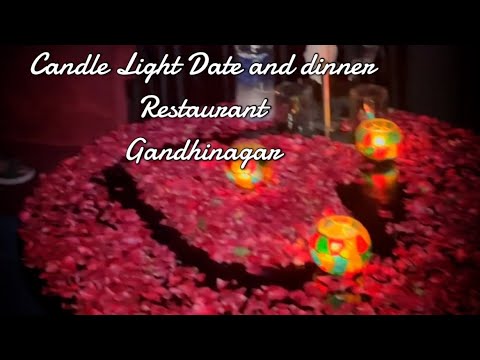
| Venue | Category | Location | Approx Couple Cost | Contact | Why Choose | Tip |
|---|---|---|---|---|---|---|
| The Leela Gandhinagar – Romantic Gazebo Dinner | Luxury Private Dinner | Sector 14 | Published from ₹30,000 + taxes | 7••••••••0 / 7••••••••9 | Private gazebo beside infinity pool with personalised décor | Advance booking essential; official hotel price can change |
| CANDLE LIGHT DATE N DINNER | Dedicated Romantic Dining | Sargasan | Normal meal around ₹1,000 for two; special setups vary | 7••••••••9 | Private/candlelit setting focused on couples | Confirm decoration package separately; current listing shows parking and private dining |
| 7 Wonders Hotel Candlelit Dinner | Private Dinner Package | Kudasan | Published ₹5,000 per couple | 9••••••••7 | Package includes private dining, decoration, cake and meal on current offer | Advance reservation mandatory |
| Roast and Toast | Café | Sargasan | ₹800–₹1,500 for two | 8••••••••4 | Relaxed date and coffee evening | Better for informal dating than private celebrations |

🧖 Spa, Wellness & Ayurvedic Couple Experiences

| Spa / Wellness Centre | Type | Location | Couple Budget* | Contact | Ideal For | Important Note |
|---|---|---|---|---|---|---|
| J Wellness Circle at Taj Gandhinagar | Luxury Spa + Ayurveda | Limbodra | ₹8,000–₹30,000+ per couple | Via Taj | Honeymoon spa day / anniversary | Official spa offers couple suites and a 120-minute romantic Abhisarana experience |
| Lotus Luxurious Spa | Gandhinagar | Day Spa | Kudasan | ₹3,000–₹10,000+ | 8••••••••2 | Couple relaxation | Confirm treatment menu and whether couple room is available |
| The Spa – Gandhinagar | Day Spa | Kudasan | ₹3,000–₹10,000+ | 9••••••••1 | Post-wedding relaxation | Verify therapist preference and treatment duration before paying |
Except where specifically cited from an official provider, budgets are indicative.
🧗 Adventure & Fun Activities for Couples

| Activity | Place | Best Season | Approx Couple Budget | Romance / Fun Factor | Safety Tip |
|---|---|---|---|---|---|
| Water rides | Swapna Srushti Water Park | Mar–Jun | ₹1,500–₹3,500+ | Playful honeymoon/weekend day | Follow ride and swim rules |
| Adventure activities | Adventure park | Oct–Mar | ₹500–₹2,000 | Active date | Confirm currently operational activities |
| Waterpark + meal outing | The Hill Waterfall | Restaurant, Banquet & Water Park | Summer | ₹1,000–₹3,000+ | Casual couple outing | It is an artificial recreational attraction, not a natural waterfall |
| Cycling | Gandhinagar green avenues | Nov–Feb morning | ₹300–₹1,200 | Healthy low-cost date | Use helmets and safe roads |
| Heritage walk | Adalaj | Winter morning | ₹300–₹1,500 | Cultural romance | Wear comfortable footwear |
| Resort wellness | Taj Gandhinagar | Year-round | Premium | Slow honeymoon experience | Reserve spa treatments ahead |
🙏 Religious Blessing Places After Marriage

| Place | Faith / Category | Location | Best Time | Approx Expense | Why Couples Visit | Etiquette |
|---|---|---|---|---|---|---|
| BAPS Shri Swaminarayan Akshardham, Gandhinagar | Hindu / Swaminarayan | Sector 20 | Morning/evening | ₹100–₹500+ | Prayer and spiritual beginning after marriage | Respect strict security and photography rules |
| Shree Panchdev Temple | Hindu Temple | Sector 22 | Morning/evening | ₹50–₹300 | Local blessing visit | Dress respectfully |
| Swaminarayan Temple Gandhinagar (Hanumanji Mandir) HK Shastri | Hindu Temple | Sector 23 | Morning/evening | ₹50–₹300 | Peaceful devotional visit | Avoid photography during worship without permission |
| Mahudi Jain Temple | Jain Pilgrimage | Mahudi | Morning | ₹200–₹1,000 including travel | Important Jain devotional excursion | Follow food and temple-specific rules |
| St. Xavier’s Church | Catholic Church | Sector 8 | Service/open hours | ₹0–₹200 | Christian prayer and thanksgiving | Wedding blessings need prior clergy arrangement |
| Green City Bible Church (GCBC) | Christian Church | Sargasan | Service times | ₹0–₹200 | Prayer/community | Contact church before arranging any formal ceremony |
| Methodist Church, Gandhinagar | Christian Church | Sector 23 | Sunday/service hours | ₹0–₹200 | Religious blessing | Church marriage requirements differ by denomination |
🚘 Wedding Cars, Honeymoon Cars & Couple Transport

| Provider / Option | Service | Location | Contact | Approx Budget | Best For | Tip |
|---|---|---|---|---|---|---|
| Wedding cars Gandhinagar | Wedding Car Rental | Sector 24 | 9••••••••9 | Quote-based; ₹5,000–₹35,000+ depending on vehicle/decor is a reasonable market planning band | Bride/groom entry | Inspect actual booked vehicle before paying |
| Rider Story Self Drive Car Rental Service Gandhinagar | Self-Drive Rental | Kudasan | 9••••••••5 | ₹1,500–₹6,000+ per day depending on vehicle | Honeymoon road trips | Verify deposit, kilometres and insurance terms |
| Chauffeur-driven premium vehicle | Ahmedabad–Gandhinagar suppliers | Sedan/SUV/Luxury | Compare multiple vendors | ₹8,000–₹35,000+ | Bridal entry and VIP transport | Get registration, insurance and chauffeur details before booking |
National market examples currently advertise wedding-car packages from about ₹8,000 for an SUV and around ₹35,000 for Mercedes/BMW/Audi class packages, but Gandhinagar availability should always be confirmed locally.


🎭 Entertainment & Celebration Ideas

| Experience | Suitable Stage | Approx Budget | Best For | Planning Tip |
|---|---|---|---|---|
| Live Garba troupe | Sangeet | ₹20,000–₹1 lakh+ | Gujarati wedding identity | Check performer count and sound requirements |
| DJ + LED setup | Sangeet / Reception | ₹20,000–₹1.5 lakh+ | Younger guests | Confirm legal sound cut-off |
| Folk musicians | Welcome / Mehndi | ₹15,000–₹75,000+ | Cultural wedding | Ask for live-performance samples |
| Couple dance choreography | Sangeet | ₹5,000–₹30,000+ | Bride and groom | Start practice weeks ahead |
| Photo booth | Reception | ₹10,000–₹50,000 | Guests of all ages | Match props with wedding theme |
| Live wedding screening | Wedding | ₹20,000–₹1 lakh+ | Large venues | Coordinate directly with photography team |
| Waterpark day | Pre/post-wedding family gathering | ₹1,000–₹2,000+ pp | Young family groups | Avoid immediately before major bridal makeup functions |

✅ Complete Before-Wedding Activities Checklist

- Finalise wedding date and ceremony timings.
- Prepare realistic total wedding budget with 10–15% contingency.
- Confirm venue and written cancellation policy.
- Prepare guest list before selecting catering capacity.
- Book photographer and videographer.
- Confirm pre-wedding location permissions.
- Sign written contract for albums, reels, films and delivery dates.
- Book bridal and groom outfits.
- Complete alteration and final fitting.
- Finalise jewellery and secure storage.
- Book bridal makeup trial.
- Book mehndi artist.
- Finalise wedding planner or family coordination team.
- Approve mandap, floral and stage design.
- Confirm caterer, menu and tasting.
- Ask for Jain, vegan, children’s and allergy-friendly meal options where needed.
- Reserve rooms for outstation guests.
- Arrange airport/railway transfers.
- Book bride and groom vehicles.
- Arrange guest buses or cars.
- Finalise DJ, music and entertainment.
- Verify sound and venue timing restrictions.
- Create rain/heat backup plan for outdoor functions.
- Share emergency/vendor contact sheet with family coordinators.
- Prepare wedding-day payment schedule.
- Pack medicines and emergency essentials.
- Back up invitation, vendor and travel documents digitally.
- Book honeymoon only after checking passport/visa requirements where applicable.
- Purchase appropriate travel insurance for expensive or international trips.
- Keep one wedding day free from unnecessary last-minute shopping.
💑 Complete After-Wedding Activities Checklist

- Complete agreed vendor payments only after reconciling bills.
- Secure jewellery, gifts and important documents.
- Back up wedding photographs received immediately.
- Select album photographs before the vendor deadline.
- Confirm cinematic-film editing preferences.
- Return rented outfits, jewellery or décor on time.
- Complete temple/church blessing visit if desired.
- Rest at least one day before a long honeymoon journey when possible.
- Recheck flights, hotel reservations and transfers.
- Carry marriage certificate/document copies where relevant.
- Pack weather-appropriate honeymoon clothes.
- Inform banks before international travel if necessary.
- Avoid publicly posting live honeymoon location details when privacy matters.
- Arrange a relaxed romantic dinner rather than filling every evening with sightseeing.
- Consider a couple spa day after exhausting wedding ceremonies.
- Save vendor invoices and warranty/booking documents.
- Write down favourite wedding memories while still fresh.
- Send thank-you messages to guests and key helpers.
- Review final wedding expenditure together.
- Begin married life with a trip that suits both personalities rather than following social-media trends.
💡 Final Wedding & Honeymoon Planning Advice

A successful Gandhinagar wedding does not require the most expensive photographer, hotel or decoration. The strongest results usually come from matching the right vendor to the right job: heritage photography at the correct hour, experienced professionals with written deliverables, realistic travel buffers, comfortable guest transport and a honeymoon itinerary with enough time to enjoy being together.

For pre-wedding photography, Adalaj and Gandhinagar’s greener locations offer the strongest local identity, while luxury properties can provide polished indoor alternatives. For a post-wedding staycation, Gandhinagar now has genuinely premium choices: Taj’s resort combines gardens, pool, spa and Ayurveda, while The Leela offers city-centre luxury and an officially advertised private romantic gazebo dinner.

Most importantly, treat all venue fees, vendor prices, hotel rates and online ratings as live information rather than permanent facts. Obtain a current written quotation before paying an advance, verify what is included, and never assume that an attractive social-media photograph represents a legally permitted commercial shoot location.

That approach keeps the wedding beautiful, the honeymoon relaxed and the memories focused on the couple rather than avoidable planning problems.


🌿 I Am Gandhinagar
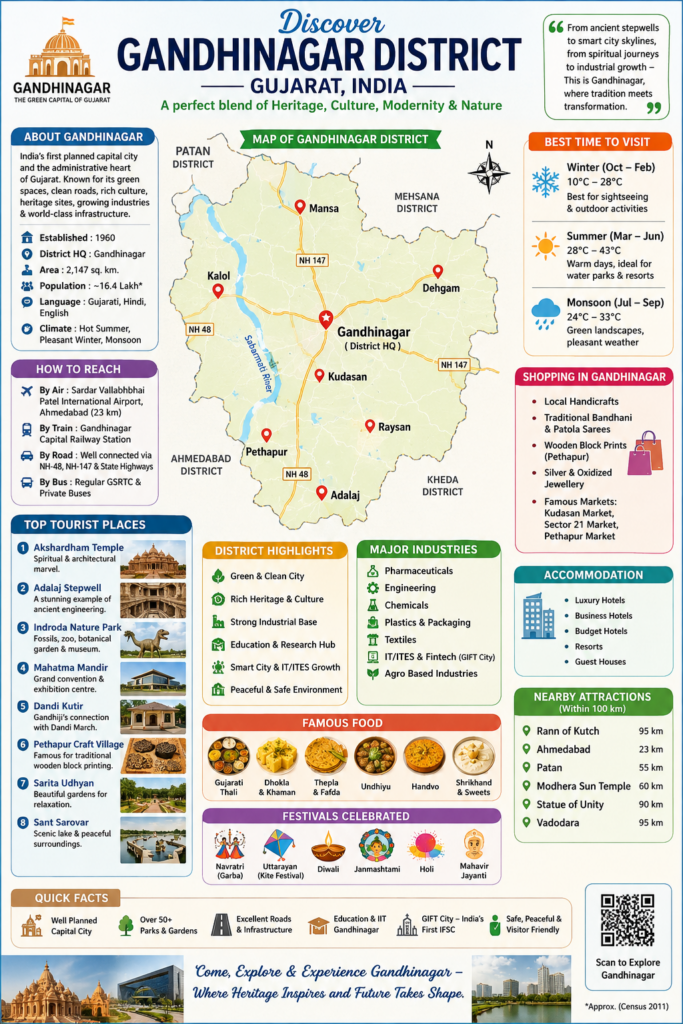
I am Gandhinagar.
People often introduce me with a simple sentence: “Gandhinagar is the capital of Gujarat.”
That is true, but it is not enough.
I am not only government buildings, broad roads and carefully planned sectors. I am also old villages, temple bells, stepwells, farms, industrial estates, quiet gardens, growing business districts and the changing dreams of people who have made their homes on my soil.
My story did not begin when administrative buildings rose from the ground.
Long before I became a capital, people lived here beside fields, wells, village roads and the Sabarmati landscape. Farmers understood my seasons. Artisans shaped wood with patient hands. Traders moved between settlements. Religious traditions connected communities long before modern maps divided my land into sectors and highways.
I carry those older memories even today.
🕰️ My Story Before the Capital Was Built
Before people knew me as a planned city, my region belonged to the wider historical and cultural landscape of north-central Gujarat.
Villages such as Adalaj, Pethapur, Mansa, Dehgam and Kalol developed their own identities over generations.
Among the most beautiful reminders of that older world is Adalaj Ni Vav.
When I look at its carved pillars and descending corridors, I remember a time when a stepwell was not merely a tourist attraction. It was water infrastructure, a social meeting place, an architectural achievement and a refuge from heat.
Its stones tell stories more patiently than any modern building.
Pethapur carries another memory for me.
Its artisans became known for intricately carved wooden blocks used in textile printing. Those blocks connected small workshops here with Gujarat’s much larger textile culture.
The hands that carved them may never have appeared in grand history books, but their craftsmanship travelled far beyond my villages.
🏛️ The Day I Became Gujarat’s Capital
My modern identity changed dramatically after the creation of Gujarat state in 1960.
A new capital was needed.
Planners imagined a city that would be organised, green and functional. Roads were laid out systematically. Residential and administrative sectors were developed. Government institutions moved in.
Gradually, I began to look very different from older Indian cities.
My avenues became wider.
My sectors became numbered.
Trees lined many roads.
Government offices, schools, hospitals and residential colonies gave me a new rhythm.
I was no longer only a rural landscape.
I had become the administrative heart of Gujarat.
Yet I never wanted to become a city made only of files, offices and official vehicles.
Life slowly filled the spaces between them.
Markets appeared. Restaurants opened. Families settled. Students arrived. Institutions grew. Festivals brought colour to my organised streets.
That is when I truly began to feel alive.
🛕 Faith Became Part of My Identity
Religion has always shaped my emotional landscape.
In Gandhinagar city, Akshardham became one of my most recognised landmarks.
I have watched families arrive there from across India—children looking upward at the architecture, senior citizens walking slowly toward prayer, travellers pausing to understand the spiritual traditions represented within the complex.
Elsewhere, Jain pilgrims travel toward Mahudi.
Temples in Gandhinagar, Adalaj and neighbouring settlements continue traditions that existed long before my modern skyline.
Churches quietly serve Christian communities.
My religious identity is not one story.
It is many stories existing beside one another.
During Navratri, I change completely.
The disciplined appearance of my capital city gives way to colour, rhythm and movement.
Garba circles grow larger as the night deepens. Young people arrive wearing embroidered clothes. Older generations watch proudly. Children try to copy complicated steps.
For nine nights, my roads seem to carry music.
Then Uttarayan arrives.
My winter sky fills with kites.
From rooftops, families call to one another, music plays and food is shared. The city looks upward together.
During Diwali, lamps and decorative lights soften the official architecture.
During Janmashtami, Mahavir Jayanti, Holi, Eid, Christmas and other celebrations, different communities add their own emotions to my calendar.
This is the culture travellers understand only after spending time with me.
🍛 I Speak Through Food Too
If you want to know me, do not only visit my monuments.
Sit down and eat.
My food carries the wider character of Gujarat.
A traditional meal may place dal, kadhi, vegetables, rotli, rice, farsan and something sweet before you in one generous experience.
In smaller eateries you may find khaman, dhokla, fafda, thepla, handvo and khandvi.
Around Kudasan, Sargasan, Infocity and the newer neighbourhoods, my food personality has changed with my population.
Cafés now stand beside Gujarati restaurants.
South Indian breakfast competes with Punjabi dinners.
Pizza, sandwiches, healthy bowls and international-style menus serve students and professionals.
Yet traditional food remains close.
Go a little farther toward older towns and rural areas and the flavours become simpler and more local.
Food is one of the easiest ways to watch my past and present sitting at the same table.
🌳 I Have Always Needed Green Spaces
People sometimes arrive expecting a dry administrative capital.
They are surprised by my greener side.
Sarita Udhyan, Puneet Van, tree-lined sectors and the Sabarmati landscape create breathing spaces between offices and roads.
Indroda adds another dimension.
Children may come for dinosaurs and fossils, but they leave having encountered nature, wildlife and environmental learning as well.
In monsoon, I look different.
Dust settles.
Leaves brighten.
Fields beyond my urban sectors become green.
The Sabarmati landscape changes.
Clouds soften the skyline.
This is when photographers begin seeing another version of me.
I am not a hill station.
I do not have beaches.
I do not pretend to have dramatic natural waterfalls where none exist.
My natural beauty is quieter.
You notice it in trees, river landscapes, winter mornings, village fields and open skies.
🏭 Then Industry Changed Me Again
The next major chapter of my life came through industrialisation.
Around Chhatral, Kalol, Santej, Dehgam and other industrial areas, factories began shaping a new economic identity.
Engineering.
Chemicals.
Pharmaceuticals.
Plastics.
Packaging.
Textiles.
Agro-processing.
Electrical and electronic businesses.
MSMEs grew beside larger enterprises.
Truck traffic became part of my working rhythm.
Raw materials arrived.
Finished products left for markets across Gujarat and India.
Warehouses appeared.
Transporters, mechanics, fabricators, drivers, accountants and supervisors found employment.
The industrial economy connected my rural and urban worlds in ways many travellers never see.
A tourist may drive past a factory wall without thinking about what happens behind it.
I know.
Behind that wall could be hundreds of workers, suppliers, transport vehicles and family livelihoods.
💻 Then GIFT City Changed My Horizon
Just when people thought they understood me, another transformation began.
Glass towers rose near my southern edge.
GIFT City changed the visual and economic meaning of Gandhinagar.
Banks, financial institutions, technology firms, fund managers, insurers and international business operations began joining my economy.
My story was no longer only about government and manufacturing.
Now it included finance, fintech, data, global services and corporate professionals.
Young people began arriving with laptops instead of factory tools.
Restaurants and hotels changed.
Housing demand increased.
Corporate transport expanded.
New business ideas followed.
I began connecting two very different worlds.
In Chhatral, trucks move physical cargo.
In GIFT City, financial systems move capital across borders.
Both are now part of me.
That contrast makes my economic identity unusually diverse.
🎓 Education Gave Me Another Voice
Students have also reshaped me.
Institutions around Gandhinagar and the wider Ahmedabad–Gandhinagar region have brought researchers, engineers, entrepreneurs and young professionals into my daily life.
Campuses generate conversations about science, technology, design, entrepreneurship and public policy.
Students visit my museums.
They explore my heritage.
Some eventually build businesses here.
Others leave and carry memories of Gandhinagar into different parts of India and the world.
A capital city becomes stronger when it is not only governed from, but also learned from.
📸 Travellers Slowly Began Seeing Me Differently
For many years, travellers treated me as a short stop from Ahmedabad.
Some still do.
They arrive, visit one major attraction and leave.
I wish they would stay longer.
Because I have more than one face.
Come in the morning and explore Adalaj’s stone architecture.
Spend time with dinosaurs, fossils and greenery at Indroda.
Walk through gardens.
Visit temples.
Explore museums.
Drive toward Pethapur.
Eat where local families eat.
Watch the modern skyline around GIFT City toward evening.
Suddenly, one destination begins feeling like several.
Families find educational attractions.
Couples find heritage and quieter evening experiences.
Solo travellers can explore without rushing.
Senior citizens can build gentle spiritual itineraries.
Students can combine architecture, history, environment and science.
Business travellers can finish meetings and still find culture nearby.
That flexibility is one of my greatest tourism strengths.
💞 I Have Watched Generations Change
I have seen grandparents who once knew my villages before the capital was built bring their grandchildren to modern attractions.
I have seen young couples take photographs beside heritage architecture that existed centuries before them.
I have watched farmers travel into the city for business.
I have watched executives leave office towers and eat ordinary Gujarati food with friends.
I have seen students ride bicycles through morning roads.
I have watched migrant workers arrive seeking opportunity.
Every generation has created another layer of my identity.
Sometimes change has been uncomfortable.
Traffic has increased.
Urban development has consumed open spaces.
Industrialisation has brought environmental responsibilities.
Property values have risen.
Old crafts struggle to compete with mass production.
Economic growth creates pressure as well as opportunity.
I know that progress is not automatically beautiful.
It must be managed.
🌱 What I Hope My Future Will Become
I want to grow without forgetting myself.
I want GIFT City to succeed without making traditional markets irrelevant.
I want factories to expand while controlling pollution.
I want new highways without dangerous roads.
I want modern retail without destroying small family businesses.
I want tourists to photograph Pethapur’s artisans and also buy from them fairly.
I want farmers to earn more from processing and better supply chains.
I want my young people to find meaningful work without always needing to leave.
I want clean public spaces, safer roads, better public transport and responsible tourism.
And I want visitors to understand that I am not merely a place to pass through.
❤️ If You Visit Me, Do Not Rush
If you come to Gandhinagar, give me time.
Come during winter if you want comfortable sightseeing.
Come during monsoon if you want greener landscapes.
If summer brings you here, travel early, rest during the hottest hours and return outdoors in the evening.
Do not judge me only by famous landmarks.
Walk through an ordinary market.
Speak to a shopkeeper.
Eat a local breakfast.
Watch families enjoying a garden.
Visit a village.
Understand an industrial area.
Look at GIFT City’s skyline.
Then look again at the old stones of Adalaj.
That single day will show you how many centuries can coexist within one district.
I am Gandhinagar.
I am ancient wells and modern towers.
I am farmers and financial professionals.
I am temple bells and conference halls.
I am Gujarati thali and modern cafés.
I am industrial trucks and quiet gardens.
I am village craftsmanship and global finance.
I am constantly changing, but I still carry the memory of the land I was before anyone called me a capital.
Come and meet me slowly.
Do not simply ask, “What are the best places to visit in Gandhinagar?”
Ask instead:
“What stories does Gandhinagar want to tell me?”
Stay long enough, and I will answer.

🗺️ Where Is Gandhinagar District? Gujarat’s Green Capital Between Heritage and the Future
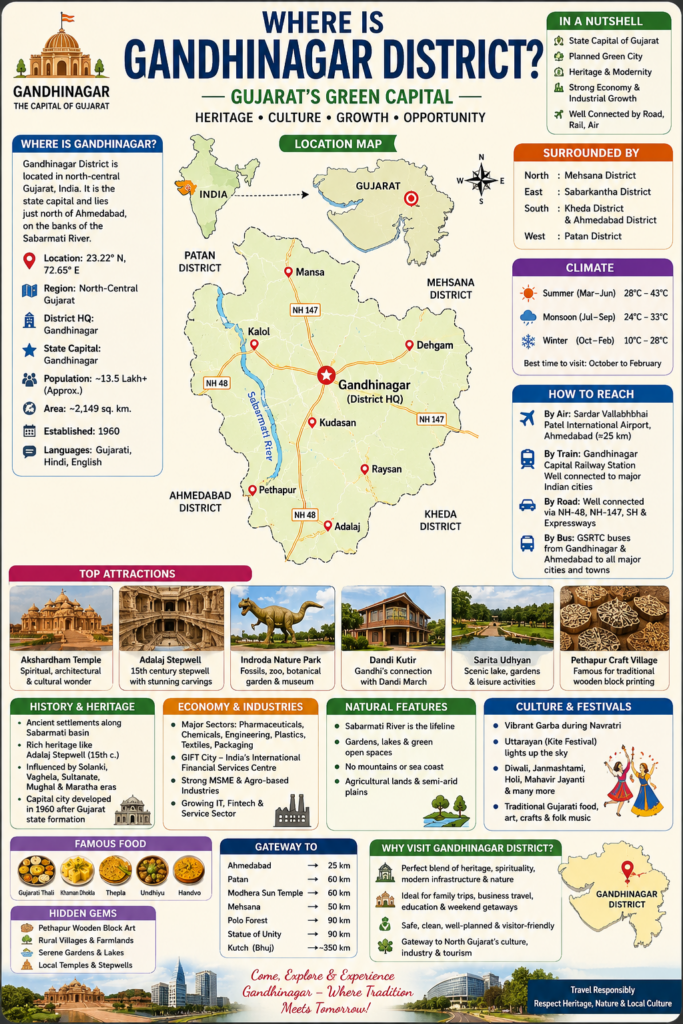
Gandhinagar District lies in north-central Gujarat in western India, with Gandhinagar city serving as both the district headquarters and the capital of Gujarat. It forms part of the economically powerful Ahmedabad–Gandhinagar urban region and sits along the Sabarmati River system, immediately north of Ahmedabad.
For a first-time traveller, the simplest way to understand its location is this: reach Ahmedabad, travel north toward Gujarat’s capital, and within a short journey the crowded metropolitan landscape begins opening into Gandhinagar’s broader roads, government precincts, gardens, institutional campuses and newer commercial districts.
Yet the district is much more than Gujarat’s administrative capital. Its geography stretches beyond the planned city into Adalaj, Kalol, Mansa, Dehgam, Pethapur and numerous agricultural and industrial settlements. Heritage stepwells, temples, villages, farms, manufacturing clusters and the futuristic skyline of GIFT City all belong to this wider regional story.
📍 Gandhinagar District Location at a Glance
| Geographic Fact | Practical Information |
|---|---|
| State | Gujarat |
| Country | India |
| Region | North-central Gujarat |
| District Headquarters | Gandhinagar |
| State Capital | Gandhinagar |
| Approx. coordinates of Gandhinagar city | 23.22° N, 72.65° E |
| Major river | Sabarmati |
| Important urban centres | Gandhinagar, Kalol, Dehgam, Mansa |
| Important nearby city | Ahmedabad |
| Ahmedabad city centre | Roughly 25–30 km, depending on starting point and route |
| Nearest major airport | Sardar Vallabhbhai Patel International Airport, Ahmedabad |
| Important railway access | Gandhinagar Capital Railway Station; Ahmedabad Junction is a major regional rail hub |
| Major modern business district | GIFT City |
| Major industrial areas | Kalol, Chhatral and other GIDC/private industrial belts |
| Landscape | Predominantly plains, urban greenery and agricultural countryside |
| Natural hill station | None within Gandhinagar District |
| Sea coast / beach | None; the district is inland |
| Best general sightseeing season | October to February |
🧭 Gandhinagar on the Map of Gujarat
Look at Gujarat’s map and Gandhinagar occupies a strategically valuable position around the state’s political and economic core.
Ahmedabad lies immediately to its south and southwest. Mehsana is toward the north and northwest, while Sabarkantha lies toward the northeast/east; Kheda and Ahmedabad-region geography influence the southern approaches.
This location gives Gandhinagar an advantage that many administrative capitals do not enjoy: it stands beside one of India’s largest commercial cities.
Ahmedabad supplies a massive metropolitan consumer market, airport connectivity, universities, hospitals, trade networks and manufacturing capacity. Gandhinagar contributes government administration, institutions, organised urban development, GIFT City and its own industrial and agricultural economy.
Together, they increasingly function as an interconnected economic region.
For travellers, this means Ahmedabad and Gandhinagar can easily be combined in the same itinerary rather than treated as completely separate trips.
🌍 What Does Gandhinagar’s Landscape Look Like?
Do not arrive expecting Himalayan slopes, coastal cliffs or dense Western Ghats forests.
Gandhinagar’s beauty is subtler.
The district is predominantly a plain landscape, shaped by settlements, farmland, roads, the Sabarmati system and decades of urban development.
Gandhinagar city is particularly associated with planned sectors, broad avenues and extensive tree cover. Drive away from the administrative centre and the scenery gradually changes into villages, agricultural fields, industrial development and traditional townscapes.
This transition is worth observing.
One moment you can be beside a government complex; later you may pass farmland; continue toward another corridor and factories, warehouses and trucks begin appearing.
Then the glass skyline of GIFT City presents an entirely different Gandhinagar.
That diversity makes a road journey through the district surprisingly revealing.
🌊 Sabarmati River, Water Landscapes and Green Spaces
The Sabarmati River is the district’s most important riverine geographic feature.
Its presence influenced settlement and agriculture long before Gandhinagar became a modern capital.
Today, travellers encounter the river landscape around recreational areas such as Sarita Udhyan and Sant Sarovar, while smaller water bodies, canals and seasonal drainage systems form part of the wider landscape.
Water has another historical significance here.
At Adalaj Ni Vav, architecture demonstrates how communities of semi-arid western India historically approached water conservation. Descending through the stepwell is therefore not merely a sightseeing experience—it is an encounter with an ingenious social and environmental response to climate.
Gandhinagar does not possess major natural waterfalls comparable with India’s mountain or high-rainfall regions. Online visitors should therefore distinguish between genuine natural features and recreational attractions using names such as “waterfall.”
⛰️ Are There Mountains, Hill Stations or Dense Forests in Gandhinagar?
No major mountain range or recognised natural hill station lies within Gandhinagar District.
That is important for accurate travel planning.
Travellers searching for trekking mountains should consider Gandhinagar primarily as a heritage, cultural, spiritual, educational, urban-nature and business destination, then combine it with hill or forest destinations elsewhere in Gujarat if desired.
Its green attractions are instead represented by gardens, urban forests, river landscapes and places such as Indroda Nature Park.
Indroda is especially interesting for families and students because its tourism value combines environmental education, natural history and recreation.
☀️ Climate and Best Time to Understand Gandhinagar
Gandhinagar has a hot semi-arid to tropical seasonal climate typical of inland Gujarat, with hot summers, southwest-monsoon rainfall and comparatively pleasant winters.
| Season | General Conditions | Travel Experience | Recommended Approach |
|---|---|---|---|
| Winter: Oct–Feb | Pleasant to cool, especially mornings/nights | Best overall sightseeing period | Heritage walks, gardens, temples, photography |
| Summer: Mar–Jun | Hot; peak afternoons can become severe | Outdoor sightseeing becomes tiring | Explore early morning/evening; use air-conditioned indoor attractions midday |
| Monsoon: Jun/Jul–Sep | Rain, humidity and greener surroundings | Attractive landscapes but variable outdoor conditions | Carry rain protection and check road/weather conditions |
| Post-monsoon | Greener countryside | Excellent for photography | Good period for road trips and outdoor locations |
October through February is generally the easiest period for first-time leisure visitors.
🏺 Before Gandhinagar Became Gandhinagar
The modern capital is young.
The land is not.
Gandhinagar’s wider region belongs to Gujarat’s much older historical landscape, shaped over centuries by settlements, trade routes, agriculture, religious traditions and changing political powers.
The clearest surviving example for many visitors is Adalaj Stepwell, constructed in the late 15th century.
Its architecture reflects more than engineering.
Look carefully at the carved columns and ornamental details and you begin seeing the cultural interaction that characterised medieval Gujarat.
The popular historical account associates the stepwell with Rudabai, wife of the Vaghela chief Rana Veer Singh, and with Sultan Mahmud Begada’s period. Some details surrounding Rudabai have accumulated legend through repeated retelling, so responsible travel writing should distinguish inscription-supported history from later romantic narratives.
That distinction actually makes Adalaj more interesting, not less.
History tells us what evidence supports.
Folklore tells us what generations wanted to remember.
👑 Kingdoms, Dynasties and the Wider Historical Landscape
The Gandhinagar region cannot accurately be described as the seat of one continuous ancient kingdom corresponding to today’s district boundaries.
Modern administrative boundaries are much newer.
Instead, its historical landscape should be understood within the succession of powers that influenced north and central Gujarat—including early regional kingdoms, the Chaulukya/Solanki era, Vaghela power, the Gujarat Sultanate, Mughal influence, Maratha expansion and eventually British paramountcy over different parts of Gujarat.
Nearby Patan, the celebrated capital of the Chaulukyas, is particularly useful for understanding the wider medieval history of this region.
The Gujarat Sultanate later transformed political power and architecture across the region. Mahmud Begada’s era is especially relevant when discussing Adalaj.
During later centuries, Mughal and Maratha political influence reshaped Gujarat.
Under British colonial rule, the wider territory was governed through a mixture of directly administered areas and princely-state arrangements.
Gandhinagar city itself, however, was not a British-built colonial capital.
Its defining transformation came after Indian independence.
🇮🇳 How Gandhinagar Became Gujarat’s Capital
When the bilingual Bombay State was divided in 1960, Gujarat became a separate state.
Ahmedabad initially served as the state capital.
A purpose-built capital was subsequently developed north of Ahmedabad and named Gandhinagar in honour of Mahatma Gandhi.
This explains why the city feels different from Ahmedabad.
Ahmedabad grew organically through centuries of trade, neighbourhoods, mills and migration.
Gandhinagar was planned.
Its sectors, road hierarchy, administrative precincts and greenery reflect that planning philosophy.
The development of the new capital became one of the most important post-independence urban-planning projects in Gujarat.
🛕 Mythology, Faith and Spiritual Geography
Gandhinagar’s spiritual importance comes more from living religious traditions and pilgrimage centres than from one universally accepted ancient mythological narrative covering the entire district.
The most internationally recognisable modern religious landmark is BAPS Swaminarayan Akshardham in Gandhinagar.
Its architecture, exhibitions, landscaped surroundings and spiritual atmosphere have made it one of the city’s defining visitor attractions.
Mahudi is another important pilgrimage destination, especially within Jain tradition, associated with Ghantakarna Mahavir.
Across villages and towns, smaller Hindu and Jain temples preserve local devotional traditions.
Christian churches and other religious communities add further layers to the district’s cultural landscape.
Travellers should be cautious with internet claims connecting every old structure to the Mahabharata, Ramayana or miraculous events. Unless reliable historical or religious evidence exists, such stories are better described as local tradition or folklore rather than established history.
🪨 Archaeology and Heritage – Where the Stones Speak
For architecture lovers, Adalaj is indispensable.
But heritage exploration need not end there.
Pethapur provides a different kind of cultural heritage through its traditional wooden block-carving craft, historically connected with textile printing.
This is living heritage rather than monumental heritage.
A carved block may fit in your hand, yet it represents generations of knowledge involving wood selection, drawing, carving and textile design.
For travellers interested in disappearing crafts, conversations with genuine artisans can become more memorable than another hurried monument photograph.
🎭 How Gandhinagar’s Culture Evolved
Gandhinagar’s culture is an intriguing combination of traditional Gujarati society and a relatively young capital-city population.
Government employees came from different parts of Gujarat.
Educational institutions attracted students.
Industrialisation brought workers.
Technology companies attracted professionals.
GIFT City introduced another international corporate layer.
Consequently, Gandhinagar’s contemporary culture cannot be reduced to one village tradition or urban lifestyle.
During Navratri, however, its Gujarati identity becomes unmistakable.
Garba grounds and residential societies fill with music, embroidered clothing and circular dance.
During Uttarayan, rooftops fill with kite flyers.
Diwali brings lights and family gatherings.
Janmashtami, Mahavir Jayanti, Holi and numerous community celebrations add to the annual calendar.
🍛 What Does Gandhinagar Taste Like?
Start simply.
Try khaman, dhokla, fafda, jalebi, thepla, handvo or khandvi.
Then sit down for a Gujarati thali when you are hungry enough to appreciate its variety.
A traditional thali may bring rotli, dal, kadhi, seasonal vegetables, farsan, rice, pickles and sweets together.
Winter offers another reason to explore Gujarati cuisine because seasonal dishes become particularly appealing.
Modern Gandhinagar has also developed a wider restaurant culture around Kudasan, Sargasan, Infocity and GIFT City, where Gujarati food shares the neighbourhood with Punjabi, South Indian, café, fast-food and contemporary dining.
That culinary shift reflects the city’s changing population.
🏭 Gandhinagar as an Industrial District
Visitors who remain only in the government sectors miss an important part of Gandhinagar’s identity.
Industrial corridors around Kalol, Chhatral and neighbouring manufacturing areas contribute substantially to the district’s economy.
Manufacturing activities include engineering, chemicals, pharmaceuticals and related industries, plastics, packaging, agro-linked enterprises and numerous MSMEs.
These clusters create an ecosystem around:
raw materials → manufacturing → packaging → warehousing → road freight → distribution.
For a business traveller, understanding this industrial geography is as important as visiting the administrative centre.
🌐 GIFT City – Gandhinagar’s New Global Identity
Then there is Gujarat International Finance Tec-City—GIFT City.
Its towers provide perhaps the sharpest visual contrast in the district.
Spend the morning looking at centuries-old carvings in Adalaj.
By evening, stand near the modern skyline of GIFT City.
The transition feels extraordinary.
GIFT City hosts India’s International Financial Services Centre ecosystem and has become a major centre for international banking, financial services, insurance, capital markets, fund management, fintech and related professional services.
For Gandhinagar, its importance extends beyond office towers.
It stimulates demand for housing, hotels, restaurants, transportation, technology services, corporate events, professional services and supporting businesses.
This is why Gandhinagar increasingly matters to business travellers as well as tourists.
🚚 Why Gandhinagar Matters for Transport and Logistics
Geography gives Gandhinagar a valuable logistics position.
It sits beside Ahmedabad and connects efficiently toward industrial and trading centres of north Gujarat while remaining linked to Gujarat’s larger highway system.
Industrial areas generate inbound raw materials and outbound finished goods.
Agricultural areas create seasonal commodity movement.
GIFT City and government institutions generate higher-value corporate and service logistics.
Urban expansion creates demand for construction materials, retail distribution, e-commerce and household movement.
This makes Gandhinagar part of a much larger Ahmedabad–Gandhinagar economic and transport corridor.
🚗 Road Connectivity
Road is usually the easiest way to explore the district.
Gandhinagar connects conveniently with Ahmedabad, Kalol, Mehsana and other parts of Gujarat through national/state highways and major urban corridors.
For tourists, taxis, private cars, buses and app-based mobility can handle most urban itineraries.
For heritage and rural exploration, a private vehicle can be more practical because attractions may be spread across different directions.
Always check live road conditions rather than relying on an old route map, particularly during monsoon or major public events.
🚆 Rail Connectivity
Gandhinagar Capital Railway Station provides direct rail access and has been substantially redeveloped.
Ahmedabad Junction remains an important alternative because its much larger rail network provides extensive connections across India.
A traveller may therefore find that the best train depends on the itinerary rather than simply choosing the geographically nearest station.
✈️ Air Connectivity
The main airport serving Gandhinagar is Sardar Vallabhbhai Patel International Airport in Ahmedabad.
Depending on the destination within Gandhinagar and traffic conditions, road transfer is relatively convenient.
This airport access is one of Gandhinagar’s major advantages for business events, weddings, conferences and short leisure trips.
A traveller can land in Ahmedabad and begin exploring Gandhinagar without losing an entire day to onward transportation.
🚢 What About Water Transport?
Gandhinagar is landlocked.
It has no seaport and no regular passenger sea connection.
The Sabarmati is geographically and culturally important, but it should not be presented as a commercial passenger-waterway substitute for road or rail travel.
Industrial cargo requiring port access must move overland toward Gujarat’s seaports according to the shipment’s origin, destination, commodity and shipping line requirements.
🧳 Why Should Tourists Visit Gandhinagar?
Because it provides contrasts without demanding enormous travel distances.
| Traveller Interest | Recommended Experience |
|---|---|
| Heritage | Adalaj Ni Vav |
| Spirituality | Akshardham, Mahudi circuit |
| Family tourism | Indroda Nature Park |
| History | Dandi Kutir |
| Architecture | Adalaj + modern Gandhinagar |
| Nature | Indroda, Sarita Udhyan, river landscapes |
| Craft | Pethapur |
| Modern India | GIFT City |
| Business travel | GIFT City + industrial corridors |
| Photography | Adalaj, greenery, modern skyline |
| Food | Sector markets, Kudasan, Sargasan |
| Students | Museums, nature education, institutions |
| Senior travellers | Temples, gardens and relaxed sightseeing |
💎 Hidden Gems Beyond the Headline Attractions
Pethapur deserves more attention than it usually receives.
Instead of arriving merely for a photograph, seek out the story of wooden block carving.
Explore Gandhinagar’s quieter gardens in the early morning.
Drive through the countryside after the monsoon when agricultural landscapes become greener.
Observe how older villages meet expanding suburbs around the Ahmedabad–Gandhinagar corridor.
For photographers, these transitions often tell a more original story than repeating the same famous monument image.
The hidden attraction of Gandhinagar is sometimes not a single “unknown place.”
It is the contrast between different landscapes.
🚪 Gandhinagar as a Gateway
Gandhinagar is exceptionally useful as a base for exploring central and north Gujarat.
🗺️ Popular Extensions from Gandhinagar
| Destination | Why Combine It |
|---|---|
| Ahmedabad | UNESCO-listed historic-city experiences, museums, food and Sabarmati heritage |
| Adalaj | Stepwell and architecture |
| Modhera | Celebrated Sun Temple |
| Patan | Rani ki Vav and Patola tradition |
| Mehsana region | North Gujarat heritage and business travel |
| Polo Forest | Forest and archaeological landscapes |
| Vadnagar | Historic town and archaeological interest |
| Little Rann/Kutch direction | Longer road-trip extension |
| Statue of Unity / Ekta Nagar | Multi-day Gujarat itinerary extension |
Not every destination in this table lies within Gandhinagar District; they are regional extensions that can be incorporated into a longer itinerary.
🗓️ How Many Days Are Enough for Gandhinagar?
For only the headline attractions, one full day can provide a useful introduction.
Two days are much better.
A practical first-time itinerary might use Day 1 for Adalaj, central Gandhinagar, Akshardham and an evening around the newer urban districts, while Day 2 can include Indroda, Dandi Kutir, Pethapur or another interest-specific excursion.
Three days allow slower travel, food exploration and nearby heritage extensions.
Business travellers can often add half-day sightseeing around their meeting schedule.
🎒 Practical Visitor Insights
| Question | Practical Answer |
|---|---|
| Is Gandhinagar worth visiting? | Yes, particularly for heritage, spirituality, family tourism, architecture and modern Gujarat |
| Best season? | October–February |
| How many days? | 1–2 days for most first-time visitors |
| Good for families? | Yes |
| Good for couples? | Yes, especially heritage, dining and relaxed sightseeing |
| Good for solo travel? | Yes, with normal urban precautions |
| Good for seniors? | Generally yes; choose a slower itinerary |
| Is there a beach? | No |
| Is there a hill station? | No |
| Are there natural waterfalls? | Not a defining natural feature of the district |
| Nearest major airport? | Ahmedabad |
| Can Ahmedabad and Gandhinagar be combined? | Absolutely; this is one of the most practical ways to visit |
| Main travel character | Capital city + heritage + spirituality + greenery + business |
❤️ Come and Discover the Gandhinagar Behind the Capital
If you think Gandhinagar is only a collection of government offices, come and look again.
Begin beneath the stone corridors of Adalaj, where generations learned how architecture could turn water into community.
Listen to the quieter stories of Pethapur’s craftsmen.
Walk among trees.
Taste Gujarati food.
Watch families gather during festivals.
Follow the industrial roads toward factories that keep supply chains moving.
Then, as daylight fades, look toward the modern skyline of GIFT City.
Within a surprisingly compact geography, you will have travelled from medieval craftsmanship to post-independence city planning and onward to India’s emerging international financial economy.
That is where Gandhinagar District really is.
Not simply at a point on Gujarat’s map.
It stands between Ahmedabad’s metropolitan energy and north Gujarat’s historic landscape; between farms and financial towers; between stepwells and smart infrastructure; between memories of an older Gujarat and ambitions for the Gujarat still being built.
Come with enough time to see both.
That is when Gandhinagar begins to feel less like a capital you visited—and more like a story you discovered.

🚆 How to Reach Gandhinagar District, Gujarat – Complete Transport & Accommodation Guide
Gandhinagar is one of Gujarat’s easiest state capitals to reach because it sits immediately beside Ahmedabad and is now connected by air, long-distance rail, Ahmedabad–Gandhinagar Metro, GSRTC buses, private coaches, highways, taxis, auto-rickshaws and rental vehicles.
For an outstation traveller visiting for the first time, the easiest choices are usually:
By air: Fly to Sardar Vallabhbhai Patel International Airport in Ahmedabad and continue to Gandhinagar by taxi or cab.
By train: Choose Gandhinagar Capital Railway Station when a convenient direct train is available. Otherwise, Ahmedabad Junction provides a much larger long-distance train network.
By metro: Ahmedabad Metro Phase II now reaches Gandhinagar all the way to Mahatma Mandir, with stations serving GIFT City, Infocity, Akshardham, Sector 16 and Sector 24. GMRC states that the full Phase-II corridor to Mahatma Mandir was commissioned in January 2026.
By road: Gandhinagar is convenient from Ahmedabad, Mehsana, Himmatnagar, Vadodara, Udaipur and other western Indian cities through the wider Gujarat highway network.
📊 Gandhinagar Transport Modes Compared
| Transport Mode | Main Arrival Point | Suitable For | Approx Travel Cost | Typical Local Travel Time | Online Booking | Last-Mile Connectivity | Main Advantage |
|---|---|---|---|---|---|---|---|
| Flight | Ahmedabad International Airport | Long-distance/international travellers | Airfare varies + ₹500–₹1,500+ road transfer | Around 30–60 min to Gandhinagar depending on traffic/destination | Airline websites/apps, travel portals | Taxi, app cab, rental car | Fastest for distant travellers |
| Long-distance train | Gandhinagar Capital | Families, seniors, budget travellers | Route/class dependent | Immediate access to central Gandhinagar | IRCTC | Metro, taxi, auto | Central arrival |
| Train via Ahmedabad | Ahmedabad Junction | Travellers without a direct Gandhinagar train | Route/class dependent + onward transfer | Roughly 45–90 min onward depending on mode | IRCTC | Metro/taxi/bus | Much wider train selection |
| Metro | Mahatma Mandir and other Gandhinagar stations | Ahmedabad visitors, commuters, budget travellers | About ₹5–₹40 across current network depending on journey | Route-dependent | GMRC app / station QR ticket | Auto, bus, taxi, walking | Cheap and predictable |
| GSRTC bus | Gandhinagar bus facilities / route-specific stops | Budget travellers | Approx ₹30–₹500+ depending on route/service | Route-dependent | GSRTC e-booking | Auto, city transport, taxi | Strong Gujarat-wide network |
| Private bus | Highway/authorised boarding points | Overnight intercity travellers | ₹300–₹2,000+ | Depends on origin | Operator/aggregator apps | Auto/cab | Useful for overnight journeys |
| Taxi/App Cab | Door-to-door | Families, luggage, couples, business travellers | ₹15–₹30+ per km broadly, dynamic pricing applies | Direct | App/phone | Door-to-door | Most convenient |
| Auto-rickshaw | Local city travel | Short-distance budget travel | Meter/negotiated/app-based where available | 5–30 min commonly | Sometimes app-based | Door-to-door | Easy short trips |
| Rental Car | Airport/city rental | Family sightseeing, multi-stop touring | ₹2,000–₹6,000+ per day | Flexible | Rental platform/operator | Full flexibility | Best for district exploration |
| Self-drive Car | Ahmedabad/Gandhinagar | Couples, friends, road trips | ₹1,500–₹5,000+ per day + fuel | Flexible | Self-drive apps/operators | Full flexibility | Independence |
| Bike/Bike Taxi | Local, if currently available | Solo light-luggage travel | Low–moderate | Fast for short trips | App if operating | Door-to-door | Economical |
| Waterway | Not applicable | — | — | — | — | — | Gandhinagar is inland |
Costs are approximate planning ranges rather than regulated tariffs. Dynamic fares, tolls, parking, festival congestion and vehicle category can change actual spending.
✈️ How to Reach Gandhinagar by Air
🛫 Nearest Airport to Gandhinagar
The practical airport for Gandhinagar District is Sardar Vallabhbhai Patel International Airport in Ahmedabad.
Gujarat Tourism consistently identifies Ahmedabad’s international airport as the air gateway for Gandhinagar attractions. Its Gandhinagar trip-planning information places Ahmedabad roughly 30 km from central Gandhinagar and lists Ahmedabad airport as the relevant international air connection.
Depending on whether you are travelling to central Gandhinagar, Kudasan, GIFT City, Adalaj, Sargasan or Kalol, your actual airport transfer distance and time will differ.
🚕 Airport to Gandhinagar Options
| Transfer Option | Approx Time | Approx Cost | Best For | Important Tip |
|---|---|---|---|---|
| Prepaid/airport taxi | 30–60 min | ₹700–₹1,500+ | Families, seniors, international visitors | Confirm final destination before starting |
| App-based cab | 30–60 min | ₹500–₹1,200+ | Most travellers | Surge pricing can change fare |
| Private hotel transfer | 30–60 min | ₹800–₹2,500+ | Luxury/business guests | Pre-book for late arrivals |
| Rental/self-drive vehicle | 30–60 min | Rental dependent | Road-trip travellers | Check deposit, fuel and toll rules |
| Road + Metro combination | Longer | Low–moderate | Budget travellers | Airport itself is not yet directly connected by the operational metro |
🚇 Is There a Direct Metro from Ahmedabad Airport to Gandhinagar?
Not yet as of August 2026.
GMRC has announced Ahmedabad Metro Phase 2A, a 6.032-km extension with five stations designed to provide direct connectivity to Sardar Vallabhbhai Patel International Airport and integrate with Ahmedabad–Gandhinagar transport hubs. It is a future extension rather than part of the currently operational airport journey.
This is an important distinction because outdated or speculative travel guides may imply the airport metro is already operating.
For now, use road transport between the airport and Gandhinagar or connect to the operational metro at a suitable point if that genuinely simplifies your journey.
🚆 How to Reach Gandhinagar by Train
🚉 Gandhinagar Capital Railway Station
Gandhinagar Capital Railway Station is the most convenient rail arrival point for many visitors staying around central Gandhinagar.
Indian Railways’ published train information includes services originating or terminating at Gandhinagar Capital, confirming that it forms part of the national rail network.
The station has an especially useful modern transport connection: GMRC reports that Mahatma Mandir Metro Station is connected directly with Gandhinagar Capital Railway Station by a 335-metre foot overbridge equipped with travellators. The same interchange also provides convenient access to Mahatma Mandir, Dandi Kutir and nearby central-city facilities.
That makes rail + metro one of the best combinations for travellers without a private vehicle.
🚉 Ahmedabad Junction as an Alternative
Do not reject a train merely because it does not terminate at Gandhinagar.
Ahmedabad Junction generally offers a much broader selection of long-distance trains.
A traveller arriving at Ahmedabad can continue toward Gandhinagar by metro, taxi, bus or a combination of these.
For many passengers coming from Delhi, Mumbai, Rajasthan, Madhya Pradesh or southern India, comparing both Gandhinagar Capital and Ahmedabad Junction can produce a better schedule.
🎟️ Online Train Booking
Use IRCTC’s official website or app for reserved Indian Railways tickets.
For first-time travellers:
Book early for festivals and winter weekends.
Use the exact station code/name shown by IRCTC.
Check whether your train arrives at Gandhinagar Capital or Ahmedabad.
Do not assume Ahmedabad and Gandhinagar stations are interchangeable.
Confirm live platform information close to departure.
🚇 Ahmedabad–Gandhinagar Metro – A Major 2026 Travel Upgrade
Gandhinagar’s public transport changed significantly with the completion of Ahmedabad Metro Phase II.
GMRC currently reports 22 Phase-II stations across 28.25 km, and the entire corridor to Mahatma Mandir is operational.
Important Gandhinagar stations include:
| Metro Station | Useful For |
|---|---|
| GNLU | Gujarat National Law University area and interchange |
| PDEU | University/institutional area |
| GIFT City | Financial/business district |
| Raysan | Residential/institutional zone |
| Randesan | Residential area |
| Dholakuva Circle | Local connectivity |
| Infocity | Offices, hotels, restaurants |
| Sector 1 | Gandhinagar sectors |
| Akshardham | Akshardham area |
| Juna Sachivalaya | Administrative district |
| Sector 16 | Central-sector access |
| Sector 24 | Local residential/commercial area |
| Mahatma Mandir | Convention centre, railway interchange, Dandi Kutir |
GMRC’s current operational documentation identifies these stations across the Gandhinagar Phase-II network.
💰 Metro Fare and Ticketing
The Gandhinagar corridor currently operates within a low-cost metro fare framework, with the published Gandhinagar extension information indicating fares ranging approximately from ₹5 to ₹40 depending on journey length.
GMRC accepts:
QR paper tickets
Mobile QR tickets
NCMC cards
Other permitted fare media depending on corridor
Cash, UPI and cards at station ticket windows
Official GMRC mobile-app QR ticket purchases.
GMRC specifically confirms that official mobile QR tickets can be bought with UPI, debit/credit cards or net banking.
♿ Metro Accessibility
This is one of Gandhinagar’s strongest public-transport advantages for seniors and differently abled travellers.
GMRC states that Phase-II stations are universally accessible and incorporate pedestrian access, organised pick-up/drop-off areas, bus bays, bicycle/two-wheeler parking and designated auto-rickshaw spaces.
The current station-access listing also records wheelchair-accessible lifts and ramps at Gandhinagar stations including GIFT City, Akshardham, Sector 16, Sector 24 and Mahatma Mandir.
For travellers with reduced mobility, metro can therefore be preferable to repeatedly entering and exiting autos.
🚌 How to Reach Gandhinagar by GSRTC Bus
GSRTC provides Gandhinagar with state-level road connectivity from Gujarat cities and towns.
Buses are especially useful for travellers arriving from places such as:
Ahmedabad
Mehsana
Himmatnagar
Patan
Vadodara
Rajkot
Bhavnagar
other Gujarat towns depending on current schedules.
Gujarat Tourism notes regular state-transport access between Ahmedabad and Gandhinagar.
🎟️ GSRTC Online Ticket Booking
GSRTC supports e-booking and mobile-booking systems.
Its official current-booking documentation also allows eligible last-minute bookings after the trip sheet has been generated, with electronic/SMS-based ticketing under specified conditions.
For outstation visitors, the most reliable procedure is:
Check the official GSRTC portal/app.
Enter the exact boarding city and Gandhinagar destination.
Compare Express, Gurjarnagari, sleeper or other service types where available.
Check the boarding point carefully.
Reach the stop before departure.
Keep your ticket/SMS and identity document ready.
Bus schedules can change, so a 2026 blog should avoid promising that one specific service operates permanently.
🚍 Private Buses and Overnight Coaches
Private buses can be useful from larger western Indian cities where direct rail timings are inconvenient.
Search platforms such as RedBus, AbhiBus and individual operator websites can show currently operating services.
Before booking, check:
Exact Gandhinagar boarding/drop location
Whether the bus actually enters Gandhinagar or stops on the Ahmedabad highway
Sleeper versus seater configuration
Air-conditioning
Luggage allowance
Cancellation rules
Recent operator reviews
Arrival time.
A cheap ticket is not useful if the bus leaves you at an isolated highway point at 3 AM.
For a first-time traveller, choose a well-lit recognised drop point and pre-arrange onward transport.
🚍 Public Transport Within Gandhinagar District
🚇 Metro
Metro is now the backbone for travel along the Ahmedabad–Gandhinagar corridor and major Gandhinagar stations.
It is particularly useful for:
GIFT City
Infocity
Akshardham vicinity
central sectors
Mahatma Mandir
railway interchange.
🚌 Buses
GSRTC and local bus services provide another affordable layer of connectivity.
Their usefulness varies by route and destination.
Bus travel works better for established urban corridors than for trying to visit multiple rural attractions in one day.
🛺 Auto-Rickshaws
Autos remain convenient for:
station-to-hotel transfers
short metro-to-attraction journeys
sector-to-sector movement
markets
restaurants.
Ask for the fare before starting when the journey is not meter-based.
For first-time travellers carrying luggage, a cab can be more comfortable.
🚕 App-Based Cabs in Gandhinagar
App-based cab services are commonly used in the Ahmedabad–Gandhinagar urban region.
Availability can vary according to:
time of day
weather
festival demand
GIFT City office hours
distance from central Gandhinagar.
For airport transfers and early-morning trains, pre-booking or scheduling where supported is sensible.
Approximate short city rides may start in the low hundreds of rupees, while airport or Ahmedabad transfers can cost substantially more.
Never treat app estimates as fixed fares because surge pricing and traffic affect them.
🛵 Bike Taxis
Bike-taxi availability and applicable state rules can change.
If a recognised platform currently offers lawful bike-taxi service in your pickup area, it may suit a solo traveller carrying only a small backpack.
It is not ideal for:
large luggage
children
senior citizens
monsoon rain
formal business travel
airport baggage.
Check the app locally on the day of travel rather than publishing bike-taxi availability as guaranteed.
🚗 Rental Cars and Self-Drive Vehicles
A private or rental vehicle becomes particularly valuable when exploring beyond central Gandhinagar.
Use one if your itinerary includes combinations such as:
Adalaj
Pethapur
Mahudi
Kalol
Mansa
Dehgam
industrial visits
rural tourism
nearby Ahmedabad attractions.
💰 Typical Planning Budget
| Vehicle Type | Approx Day Cost | Best For |
|---|---|---|
| Small self-drive hatchback | ₹1,500–₹2,500+ | Solo/couple |
| Sedan | ₹2,000–₹3,500+ | Couples/small family |
| SUV | ₹3,000–₹6,000+ | Family/group |
| Chauffeur sedan | ₹2,500–₹4,500+ | Senior/business travellers |
| Tempo Traveller | ₹5,000–₹10,000+ | Groups |
Fuel, driver allowance, tolls, parking and kilometre limits may be extra.
Read the agreement rather than comparing only headline prices.
🚘 Road Connectivity to Gandhinagar
Gandhinagar’s location beside Ahmedabad gives road travellers multiple approach corridors.
Approximate planning times under ordinary conditions are:
| Origin | Typical Road Time | Best Mode |
|---|---|---|
| Ahmedabad | 40–75 min | Metro, cab, bus, car |
| Ahmedabad Airport | 30–60 min | Cab/car |
| Mehsana | 1–1.5 hrs | Car/bus |
| Himmatnagar | Around 1.5–2 hrs | Car/bus |
| Vadodara | Around 2–3 hrs | Train/car/bus |
| Udaipur | Around 4–5 hrs | Car/bus/train |
| Mumbai | Long-distance journey | Train/flight/overnight bus |
These are approximate and can change significantly with traffic, road work and exact origin/destination.
🅿️ Paid Parking in Gandhinagar
Parking conditions differ considerably by attraction.
Large institutional, commercial, metro and hotel properties are more likely to have organised parking than small heritage or market areas.
GMRC specifically reports bicycle and two-wheeler parking provisions at Phase-II stations, together with drop-off bays and multimodal facilities.
Before driving to:
Akshardham
Adalaj Stepwell
Mahatma Mandir
GIFT City
large events
busy festival venues,
check current parking arrangements.
During exhibitions or Navratri, normal parking plans can change.
Never park on an approach road merely because other cars are doing so.
⚡ EV Charging in Gandhinagar
Gandhinagar’s modern residential and commercial growth means EV charging is increasingly available through:
fuel stations
commercial complexes
hotels
GIFT City/office developments
private charging networks.
But charger status is dynamic.
Drivers should check a live charging-network app or vehicle navigation system immediately before travelling because chargers can be occupied, offline or restricted to property guests.
For a long-distance EV trip, plan at least one backup charging point around the Ahmedabad–Gandhinagar corridor.
♿ Senior Citizen & Differently Abled Travel Guide
Gandhinagar is comparatively manageable because major modern infrastructure is planned with accessibility in mind.
The metro is particularly strong: GMRC says Phase-II stations provide universal accessibility, and current entrance records show lifts with wheelchair ramps across Gandhinagar stations.
| Traveller Need | Best Option |
|---|---|
| Wheelchair traveller | Metro + accessible cab |
| Senior with luggage | Direct cab from airport/station |
| Senior sightseeing | Chauffeur-driven car |
| Visually impaired passenger | Seek station assistance; use accessible metro infrastructure |
| Family with young children | Cab/car + metro for suitable corridors |
| Traveller avoiding stairs | Confirm lifts at rail/metro station |
| Long-distance arrival at night | Pre-arranged hotel/cab transfer |
At heritage monuments such as stepwells, historic architecture itself can limit accessibility even when the entrance area is reachable.
🌊 Can You Reach Gandhinagar by Water?
No.
Gandhinagar District is landlocked and has no passenger seaport or scheduled waterway service.
The Sabarmati River is geographically important, but it does not provide practical intercity passenger transportation to Gandhinagar.
Travellers arriving by cruise ship or commercial sea route elsewhere in Gujarat must continue overland by road or rail.
📲 Online Ticket Booking for Gandhinagar Travel
| Travel Need | Recommended Booking Method |
|---|---|
| Flight | Airline website/app or major OTA |
| Indian Railways | IRCTC |
| Ahmedabad Metro | Official GMRC app / station ticketing |
| GSRTC Bus | Official GSRTC e-booking/app |
| Private Bus | Operator website or recognised bus aggregator |
| Cab | Recognised ride-hailing app |
| Rental Car | Reputable rental operator/platform |
| Hotel | Hotel direct site or established booking portal |
| Attractions | Official attraction/tourism portal where online ticketing exists |
GMRC’s official rules confirm that metro tickets can be purchased at stations through cash/UPI/card and that digital QR tickets are available through its mobile app.
🛏️ Where to Stay in Gandhinagar – Budget, Mid-Range & Luxury
Hotel rates below are approximate normal planning ranges and may rise sharply during Vibrant Gujarat events, exhibitions, weddings, government programmes, cricket events and holiday weekends.
💵 Budget Hotels
| Hotel / Area | Useful For | Approx Night Range | Relative Location | Amenities to Expect | Booking Tip |
|---|---|---|---|---|---|
| Hotel Empyrean | Vavol / railway-side access | ₹1,200–₹2,500+ | Vavol | AC rooms, basic business stay | Good for travellers prioritising price |
| HOTEL THE AVANTA – GANDHINAGAR | Kudasan, restaurants, metro-side urban area | ₹1,200–₹3,000+ | Kudasan | Modern rooms, nearby dining | Compare weekday rates |
| Hotel Shrimad Villa gandhinagar | Sargasan | ₹1,300–₹3,000+ | Near Sargasan commercial area | AC rooms, food access | Good base for Ahmedabad–Gandhinagar corridor |
| Hotel Crystal N | Central Gandhinagar | ₹1,200–₹2,500+ | Sector 11 | Basic accommodation | Verify current reviews and room type |
🏨 Mid-Range Hotels
| Hotel | Useful For | Approx Night Range | Nearby Area | Typical Amenities | Booking Tip |
|---|---|---|---|---|---|
| The Fern Residency Gandhinagar, Series by Marriott | Family/business stays | ₹4,000–₹8,000+ | Sargasan | Restaurant, business facilities, modern rooms | Strong location for road travellers |
| Hotel Pride Elite | Sargasan commercial district | ₹3,000–₹7,000+ | Sargasan | Modern rooms, mall/commercial access | Check packages including breakfast |
| Crayon hotels | Central administrative/business visit | ₹2,500–₹5,000+ | Sector 11 | City accommodation | Useful for government-office trips |
| Grand Mercure Ahmedabad GIFT City | GIFT City business travel | ₹4,000–₹9,000+ | GIFT City | Pool/business facilities/dining | Excellent for GIFT meetings |
⭐ Luxury Accommodation
| Property | Best For | Approx Night Range | Nearby Attractions / Business Area | Key Advantages | Booking Tip |
|---|---|---|---|---|---|
| Gift City Club, a member of Radisson Individuals | Luxury business stay, couples | ₹6,000–₹15,000+ | GIFT City | Premium rooms, dining, club facilities | Useful for corporate travel and staycations |
| The Leela Gandhinagar | Luxury leisure/business | ₹8,000–₹25,000+ | Gandhinagar Capital Station, Mahatma Mandir | Premium hotel integrated into central transport/business district | Excellent for rail arrivals and conventions |
| Taj Gandhinagar Resort & Spa | Wellness/resort stay | ₹10,000–₹30,000+ | Outskirts/Mahudi-side corridor | Resort atmosphere, spa, pool | Better for relaxation than daily city commuting |
The Gandhinagar Capital–Mahatma Mandir interchange is unusually convenient for hotel and conference travellers because GMRC’s 335-metre connecting footbridge links the metro and railway station, with Mahatma Mandir and nearby central facilities accessible from the same multimodal zone.
🏨 Best Area to Stay According to Your Trip
| Traveller | Best Area |
|---|---|
| First-time sightseeing traveller | Central Gandhinagar / Sector 11–16 |
| Akshardham-focused visitor | Central Gandhinagar / metro corridor |
| Railway traveller | Mahatma Mandir/Gandhinagar Capital area |
| GIFT City business traveller | GIFT City / Raysan / Randesan |
| Budget traveller | Vavol / Kudasan / Sector 11 |
| Café and restaurant lover | Kudasan–Sargasan |
| Family with private car | Sargasan/Kudasan |
| Airport-focused short stay | Southern Gandhinagar / Ahmedabad–Gandhinagar corridor |
| Luxury traveller | GIFT City or premium central Gandhinagar |
| Resort/wellness traveller | Outer Gandhinagar/Mahudi-side properties |
🎒 First-Time Outstation Traveller Strategy
If you have never visited Gandhinagar, avoid making transport complicated.
For a flight arrival, take a direct cab to your hotel unless you are travelling extremely light and already understand the metro interchange.
For a train arriving at Gandhinagar Capital, use the connected Mahatma Mandir Metro Station whenever your hotel or attraction lies near the metro corridor.
For a train arriving at Ahmedabad, metro can be the best low-cost option when your destination lies near GIFT City, Infocity, Akshardham or central Gandhinagar.
For a family visiting Adalaj, Akshardham, Indroda and Pethapur in one day, a hired car is usually more efficient than repeatedly changing public transport.
For a solo budget traveller, metro + auto is now one of the best Gandhinagar combinations.
For senior citizens, a direct cab and centrally located hotel can be worth the additional cost.
⚠️ Transport Mistakes First-Time Visitors Should Avoid
Do not confuse Ahmedabad Airport with a Gandhinagar airport—the Ahmedabad international airport is the practical passenger airport for Gandhinagar.
Do not assume every Ahmedabad-bound train stops at Gandhinagar Capital.
Do not assume airport metro connectivity is already complete; the direct airport extension is a newer development project, not part of today’s normal airport transfer.
Do not book a private overnight bus without examining its exact drop point.
Do not depend on a late-night auto being available at an isolated attraction.
Do not drive into GIFT City or government-sensitive zones assuming every parking area is public.
Do not rely on a charging-station listing without checking live status.
And do not calculate an itinerary using map distance alone—Ahmedabad–Gandhinagar traffic can change considerably during office peaks and major events.
🌟 Final Answer – What Is the Best Way to Reach Gandhinagar?
For most long-distance travellers, the easiest route is:
Flight → Ahmedabad Airport → taxi/cab → Gandhinagar.
For rail travellers:
Direct train → Gandhinagar Capital → Mahatma Mandir Metro/auto/cab.
If no suitable Gandhinagar train exists:
Train → Ahmedabad → Metro or cab → Gandhinagar.
For visitors already in Ahmedabad, Ahmedabad Metro Phase II has become one of the most practical and economical ways to reach Gandhinagar, with the completed corridor extending through GIFT City and major Gandhinagar sectors to Mahatma Mandir.
That connectivity has changed Gandhinagar tourism considerably. A visitor can now move between Ahmedabad and Gujarat’s capital without depending entirely on a private vehicle, while travellers needing rural attractions, industrial estates or several widely separated destinations can still use hired cars.
Book the long-distance part of your journey first, choose accommodation according to the places you actually intend to visit, and then decide whether metro + auto or a private car makes more sense for your local itinerary.
For a first trip, simplicity wins: arrive comfortably, stay near your main sightseeing or business zone, and leave enough time to discover Gandhinagar instead of spending the journey constantly changing vehicles.
🌟 What Is Gandhinagar District Famous For?
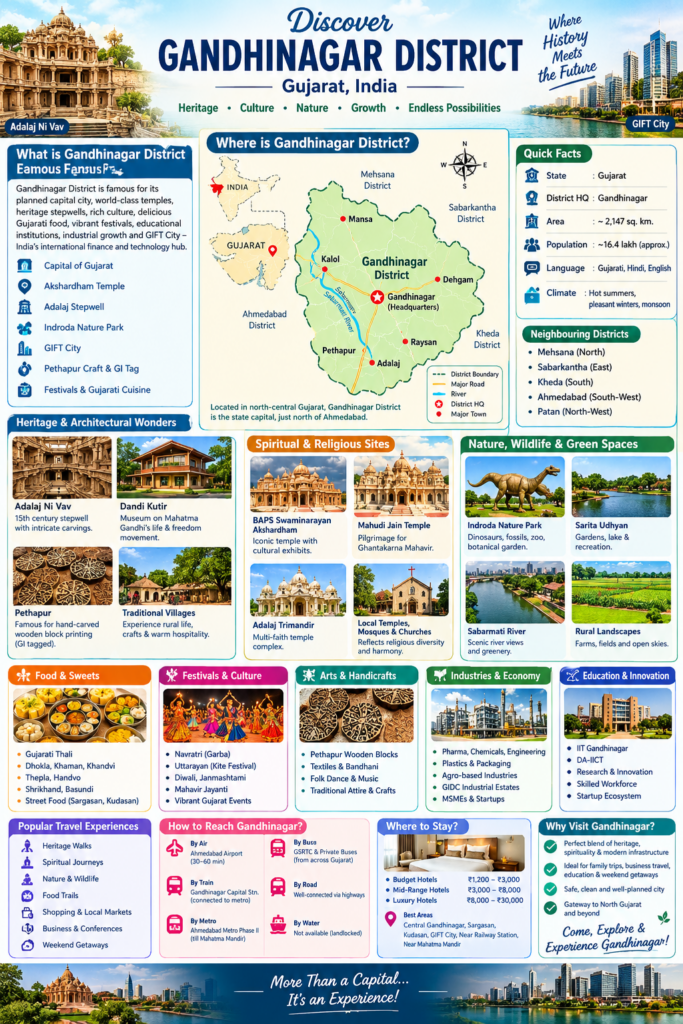
Gandhinagar District is famous for being the capital region of Gujarat, Akshardham Temple, Adalaj Stepwell, Indroda Dinosaur and Fossil Park, Dandi Kutir, Pethapur Printing Blocks, Mahudi Jain pilgrimage, planned greenery, educational institutions, GIDC manufacturing clusters and the rapidly expanding GIFT City financial and technology hub. Gujarat Tourism officially presents Gandhinagar through heritage, museums, religious tourism and flora-fauna attractions, while GIFT City has added an international finance-and-technology identity to the district.
🗺️ Complete Gandhinagar District Famous-For Chart
| Category | Famous Attraction / Thing | Why It Is Famous | Historical / Cultural Significance | Best Time to Experience | Interesting Facts | Travel Tip |
|---|---|---|---|---|---|---|
| State Identity | Gandhinagar – Capital of Gujarat | Administrative and political capital of Gujarat | Developed as a planned capital after creation of Gujarat state | Oct–Feb | The modern city is known for sector planning, broad roads and greenery | Spend time beyond the government district to understand the real city |
| Spiritual Landmark | BAPS Swaminarayan Akshardham | Monumental temple architecture, gardens and cultural experiences | Important modern Swaminarayan religious complex | Oct–Mar; late afternoon/evening | Gujarat Tourism treats Akshardham as Gandhinagar’s featured experience. | Check current security, electronics and photography rules |
| Heritage | Adalaj Ni Vav | Intricate five-storey stepwell architecture | Important example of medieval Gujarat’s water architecture and cultural interaction | Oct–Feb morning | Stepwells once served practical, social and ritual purposes in semi-arid Gujarat | Visit early for cooler weather and cleaner architectural photographs |
| Wildlife & Natural History | Indroda Dinosaur and Fossil Park | Dinosaurs, fossils, zoo, botanical garden and wilderness | Major environmental-education attraction | Nov–Feb | Gujarat Tourism describes a roughly 400-hectare complex on both banks of the Sabarmati with zoo, botanical garden, interpretation facilities and wildlife. | Allocate several hours and wear comfortable shoes |
| Museum | Dandi Kutir | Life and teachings of Mahatma Gandhi presented using multimedia | Connects Gandhinagar tourism with India’s freedom movement | Oct–Mar | Gujarat Tourism highlights audiovisual, 3-D and 360-degree interpretation; the museum is closed Mondays in its current listing. | Verify opening hours before making a special trip |
| Jain Pilgrimage | Mahudi Jain Temple | Pilgrimage associated with Ghantakarna Mahavir | Important Jain devotional destination | Oct–Mar | Included among Gandhinagar’s principal religious attractions by Gujarat Tourism. | Respect temple-specific food and worship rules |
| Multi-Faith Spirituality | Adalaj Trimandir | Distinctive multi-faith temple concept | Combines Jain and Hindu devotional traditions within one complex | Oct–Mar | One of the district’s prominent religious-tourism stops | Morning or evening is more comfortable |
| Handicraft | Pethapur Printing Blocks | Fine hand-carved wooden blocks for textile printing | Generations of Pethapur craftsmen supplied printing blocks to textile centres | Year-round | Pethapur Printing Blocks are a registered Geographical Indication, GI Application 585, registered in 2018 and valid to August 2027. | Buy directly from genuine craftspeople when possible |
| Artisan Heritage | Pethapur block makers | Exceptional carving skill | Links Gandhinagar with Gujarat’s historic textile-printing economy | Oct–Feb | Gujarat Tourism’s craft publication calls Pethapur a leading national centre for hand-carved textile-printing blocks and records nationally awarded craftsmen. | Ask permission before entering workshops or photographing artisans |
| Agriculture | Okra-based products | Gandhinagar’s officially identified food-processing ODOP | Reflects the district’s agricultural and food-processing potential | Seasonal | Ministry of Food Processing Industries lists okra-based products as Gandhinagar’s ODOP. | Agricultural travellers should arrange farm visits instead of entering private fields |
| Finance | GIFT City | India’s international finance and technology ecosystem | Represents Gandhinagar’s transformation from administrative capital to global business centre | Year-round | GIFT City reports 1,000+ operational entities, 20,000+ jobs and over US$100 billion in banking assets as of Sep 2025. | Business buildings may have controlled access |
| SEZ / IFSC | GIFT IFSC | Banking, funds, insurance, fintech, leasing and capital markets | India’s first International Financial Services Centre | Year-round | GIFT City includes a Multi-Services SEZ and international financial-services ecosystem. | Excellent for business tourism and architecture-oriented visits |
| Startups | Fintech and technology ecosystem | Growing demand from GIFT City and academic institutions | Part of the district’s new knowledge economy | Year-round | Finance, fintech, global in-house centres and IT are official GIFT target sectors. | Entrepreneurs should attend professional events rather than visit as casual tourists only |
| Industries | Engineering, pharma, chemicals, plastics and packaging | Strong industrial activity around Chhatral, Kalol and neighbouring estates | Traditional manufacturing balances the newer service economy | Year-round | Industrial estates generate significant B2B and freight activity | Factory visits usually require appointments |
| MSMEs | Chhatral–Kalol–Santej industrial ecosystem | Dense supplier and manufacturing network | Important source of regional employment | Year-round | MSMEs support fabrication, packaging, maintenance, freight and industrial services | Travel during working hours if doing business research |
| Logistics | Ahmedabad–Gandhinagar–North Gujarat corridor | Strategic road position near Ahmedabad and industrial belts | Connects manufacturing, agriculture, retail and corporate activity | Year-round | Gandhinagar handles both conventional industrial freight and high-value corporate logistics | Check truck-access rules before industrial movements |
| Education | IIT Gandhinagar and higher-education ecosystem | Engineering, research and innovation | Strengthens the district’s knowledge economy | Academic calendar | Gandhinagar has developed into an important education and research centre | Campus access can depend on events and permissions |
| Education / Technology | DA-IICT and technology institutions | Information and communication technology education | Contributes skilled professionals and startup culture | Academic calendar | A key part of the Ahmedabad–Gandhinagar technology corridor | Attend public lectures/festivals where permitted |
| Convention Tourism | Mahatma Mandir | Conferences, exhibitions and major institutional events | Strengthens Gandhinagar’s national business-event role | Event-dependent | One of Gujarat’s most prominent convention destinations | Hotel demand rises during large events |
| Freedom Movement | Mahatma Gandhi legacy through Dandi Kutir | Museum-based interpretation of Gandhi’s life and freedom struggle | Gives the capital a strong Gandhi-circuit identity | Oct–Mar | Gandhinagar is named after Mahatma Gandhi, though Gandhi was not a native of the district | Do not describe him as a Gandhinagar-born freedom fighter |
| Famous People | Mahatma Gandhi as namesake and historical inspiration | The city carries his name and Dandi Kutir interprets his life | Symbolic association rather than birthplace connection | Year-round | Gandhi was born in Porbandar, so the link is commemorative, not biographical origin | Keep this distinction clear in SEO content |
| Artists / Craftspeople | Pethapur master block carvers | Fine wood-block craftsmanship | Preserves a declining specialised artisan tradition | Year-round | Gujarat Tourism records Maneklal Gajjar as a National Award recipient for wooden blocks and documents several Prajapati artisan families. | Purchasing directly supports living craft traditions |
| Literature | Gujarati language and wider literary culture | Gujarati is central to local life and cultural expression | Gandhinagar hosts state cultural and educational institutions | Year-round | The district is more strongly identified with institutions than with one universally recognised district-specific literary school | Explore book fairs and university events when scheduled |
| Sports Personalities | No single sportsperson uniquely defines Gandhinagar tourism | Sports infrastructure and institutions matter more than celebrity association | Growing urban sporting culture | Winter/evenings | Avoid attaching unrelated Gujarat sports stars to the district for SEO | Cover verified local athletes only when reliable biographical evidence exists |
| Language | Gujarati | Primary regional language and identity | Carries folk traditions, food vocabulary and community life | Year-round | Hindi and English are also widely understood in urban and business settings | Learning a few Gujarati greetings improves local interaction |
| Folk Dance | Garba & Dandiya | Gujarat’s iconic Navratri dance culture | Devotional celebration centred on Shakti | Sep–Oct | Gandhinagar comes alive with society, club and organised Garba events | Comfortable footwear matters more than elaborate fashion |
| Festival | Navratri | Nine nights of Garba, music and colourful clothing | One of Gujarat’s defining cultural celebrations | Sep–Oct | Among the best times for cultural photography | Book popular event entries early |
| Festival | Uttarayan | Kite flying, rooftop gatherings and festive food | Major Gujarati seasonal tradition | 14 January | Winter skies fill with kites | Watch for sharp kite strings when walking or riding |
| Festival | Diwali & Gujarati New Year | Lamps, family gatherings, shopping and sweets | Major religious and commercial festival period | Oct–Nov | Businesses may observe different holiday schedules | Reserve hotels and transport early |
| Local Food | Gujarati Thali | Broad introduction to regional flavours | Reflects Gujarat’s vegetarian food culture | Year-round | Typically combines dal, kadhi, vegetables, breads, rice, farsan and sweets | Arrive hungry; servings can be generous |
| Snacks | Khaman, dhokla, khandvi, handvo, thepla | Everyday Gujarati favourites | Strong connection with local breakfast and snack culture | Year-round | Available from humble snack shops to premium restaurants | Busy local shops often offer fresher turnover |
| Sweets | Shrikhand, basundi, jalebi and Gujarati mithai | Festival and family-meal favourites | Food traditions connected with celebrations | Year-round | Sweet preferences vary seasonally and by community | Buy perishables close to consumption time |
| Street Food | Sargasan, Kudasan and sector-market food | Evening snacks, cafés and casual dining | Shows Gandhinagar’s transition from planned capital to young metropolitan city | Evenings | Modern food clusters coexist with traditional Gujarati eateries | Choose busy, hygienic vendors |
| Shopping | Sector 21 and neighbourhood sector markets | Value shopping and local daily life | Reflect Gandhinagar’s planned-sector urban form | Morning/evening | Better for everyday shopping than luxury souvenirs | Compare prices between small shops |
| Modern Retail | Sargasan–Kudasan corridor | Malls, restaurants, cafés, branded retail | Represents suburban expansion | Evening | Popular with professionals and younger residents | Weekends can be crowded |
| Textiles | Gujarat textiles available in Gandhinagar | Bandhani, Patola and handicraft retail are accessible | Gandhinagar functions as a state-capital retail gateway | Year-round | Not every Patola/Bandhani item sold here is made in Gandhinagar | Ask origin and authenticity before paying premium prices |
| GI Products | Pethapur Printing Blocks | Registered craft GI | Preserves local wood-block carving identity | Year-round | Official GI registry records Pethapur Printing Blocks as registered. | This is the strongest verified Gandhinagar-specific GI reference |
| Emerging Textile GI | Ashavali Sarees of Ridrol | Traditional textile application associated with Gandhinagar-area applicants | Potential future heritage-textile recognition | Year-round | As of the current GI database, Ashavali Sarees of Ridrol are under examination, not registered, so they should not yet be presented as a confirmed GI. | Check current GI status before updating an article |
| Gardens | Sarita Udhyan & urban green spaces | Low-cost recreation and picnics | Reinforces Gandhinagar’s “green capital” image | Nov–Feb | The city is better known for gardens than dramatic natural terrain | Morning visits are most pleasant |
| River Landscape | Sabarmati | Main natural geographic feature through Gandhinagar | Influenced settlement and regional ecology | Post-monsoon–winter | Indroda spreads along both banks of the river. | Stay away from unsafe water edges |
| Eco-Tourism | Indroda wilderness and botanical areas | Wildlife, environmental education and birdlife | Supports conservation awareness | Nov–Feb | Nilgai, langurs, peafowl, reptiles and numerous bird species are described within the park. | Never feed animals |
| Devotional Tourism | Akshardham–Mahudi–Trimandir circuit | Multiple major religious experiences | Hindu, Jain and multi-faith travel circuit | Oct–Mar | Can be covered as a spiritual weekend | Dress modestly |
| Churches | Local Christian churches | Community worship rather than mass tourism | Reflect religious diversity | Christmas / service days | Churches are meaningful community spaces but not major district tourism icons | Attend services respectfully |
| Mosques | Local mosques and Islamic heritage in the wider region | Religious and community significance | Reflect Gujarat’s layered cultural history | Year-round | Gandhinagar is not defined by one nationally famous mosque comparable with Ahmedabad | For monumental Islamic architecture, nearby Ahmedabad offers a stronger circuit |
| Forts | No major signature fort within Gandhinagar District | Not a fort-tourism destination | Historical interest is stronger in stepwells, settlements and nearby regional heritage | — | Avoid inventing a “Gandhinagar Fort” keyword attraction | Consider nearby Gujarat heritage destinations for fort tourism |
| Lakes | Small urban/rural water bodies and recreational landscapes | Picnics and seasonal scenery | Secondary natural attraction | Monsoon–winter | Gandhinagar is not primarily a lake destination | Verify local access before travelling to lesser-known water bodies |
| Waterfalls | No defining natural waterfall | Geography is predominantly plains | — | Monsoon for greener landscapes | Commercial attractions with “waterfall” in their names may be artificial | Do not advertise artificial water features as natural waterfalls |
| Hill Station | None within Gandhinagar District | District is predominantly plains | — | — | Nearest hill-style trips require travel beyond the district | Choose Polo Forest/Taranga or farther destinations for hill experiences |
| Beaches | None | Gandhinagar is landlocked | — | — | No sea coast or seaport exists within the district | Do not use beach keywords deceptively |
| Adventure | Cycling, organised camping and recreational parks | Mild outdoor recreation | Modern leisure rather than extreme-adventure identity | Oct–Feb | Better for easy activity than mountaineering or rafting | Use helmets and recognised operators |
| Hidden Gem | Pethapur | Living craft heritage and older settlement character | Offers an authentic counterpoint to modern Gandhinagar | Oct–Feb | The craft story can be more memorable than conventional souvenir shopping | Meet artisans respectfully |
| Hidden Gem | Rural Gandhinagar | Farms, village roads and seasonal greenery | Reveals the district beyond capital-city imagery | Post-monsoon–winter | Agriculture remains an important economic layer | Never enter fields without permission |
| Unique Experience | Medieval Adalaj + futuristic GIFT City in one day | Extraordinary contrast between heritage and future-facing urbanism | Shows centuries of regional transformation | Oct–Feb | Few itineraries move so quickly from carved stepwell to international financial district | Plan Adalaj in morning and GIFT skyline toward evening |
| Local Businesses | Family-run MSMEs and workshops | Support industrial supply chains and employment | Represent the less-visible foundation of district growth | Working days | Many businesses are B2B rather than tourist-facing | Arrange appointments for industrial visits |
| Exports / Global Business | Financial services, manufacturing and processed products | Connects Gandhinagar to international markets | GIFT IFSC gives the district unusually strong global-service reach | Year-round | GIFT City reports over US$100 billion banking asset size. | Separate financial-services exports from physical-goods exports when writing |
| Visitor Experience | Ahmedabad–Gandhinagar combined trip | Easy access to two very different cities | Combines historic Ahmedabad with Gujarat’s planned capital | Oct–Feb | Gujarat Tourism positions several Gandhinagar attractions within wider central-Gujarat touring circuits. | Stay 1–2 days in Gandhinagar rather than treating it only as a drive-through stop |
✨ Why Gandhinagar Is Special
- It combines old and new unusually well: you can explore the 15th-century atmosphere of Adalaj, traditional Pethapur craftsmanship and then see the skyline of GIFT City on the same trip.
- It is genuinely strong for family tourism: Akshardham, Indroda, Dandi Kutir, gardens and educational institutions give children and students more than simple sightseeing.
- Pethapur is more significant than many travellers realise: its printing blocks are not merely a local souvenir—the craft has registered GI protection.
- Agriculture still matters: Gandhinagar’s official food-processing ODOP is okra-based products, connecting rural farming with processing, packaging and future agribusiness opportunities.
- GIFT City has given the district an international economic identity: the official development now reports more than 1,000 operational entities and 20,000+ jobs.
- Gandhinagar is not a beach, hill-station or waterfall destination. Its genuine natural appeal comes from greenery, the Sabarmati landscape, parks, seasonal countryside and eco-education at Indroda.
- Its strongest cultural season is Navratri, while Uttarayan, Diwali, Janmashtami, Jain observances and other festivals keep the cultural calendar active.
- Its food is distinctly Gujarati but increasingly cosmopolitan: traditional thalis and farsan now share space with cafés and multi-cuisine restaurants around Kudasan, Sargasan, Infocity and GIFT City.
- The district works for many traveller types: families, students, seniors, business visitors, couples and solo travellers can all build different itineraries without travelling huge distances.
- For a first visit, allow at least 1–2 days. Combine heritage, spirituality, food, nature and modern Gandhinagar rather than spending the entire trip at a single landmark.
Gandhinagar is ultimately famous for contrast. Its identity stretches from carved stepwells and artisan workshops to dinosaurs, temple architecture, government institutions, factories and international financial towers. That diversity gives travellers something more interesting than a conventional checklist: a chance to watch Gujarat’s history, culture, economy and future occupy the same district.
🛡️ Gandhinagar District Travel Myths, Tourist Scams, Safety Issues & Practical Solutions

Gandhinagar District is generally straightforward for tourists, families, students and business travellers, but normal urban travel risks still apply. Visitors should be more concerned about routine problems—unverified bookings, digital-payment fraud, transport misunderstandings, heat, traffic, lost belongings and misleading online listings—than dramatic claims that Gandhinagar is full of tourist scams.
There is no reliable basis for labelling the following issues as uniquely or unusually common in Gandhinagar. This chart is a prevention guide for situations a traveller could encounter, especially when visiting an unfamiliar city.
⚠️ Common Travel Problems, Scams & Solutions in Gandhinagar

| Myth / Scam / Problem | Reality | Common Target | Warning Signs | Prevention Tips | Recommended Solution | Emergency Helpline / Authority |
|---|---|---|---|---|---|---|
| “Gandhinagar is completely scam-free” | No destination is risk-free | First-time visitors | Excessive trust in strangers or unverified offers | Use normal urban precautions | Verify important purchases, transport and reservations | Emergency: 112 |
| “Gandhinagar is unsafe for tourists” | Avoid sensational claims; most visits involve normal city precautions | First-time travellers | Viral claims without reliable evidence | Follow routine safety practices | Use recognised transport and populated areas | 112 |
| Taxi overcharging | Fare disputes can occur anywhere | Airport arrivals, foreigners, families | Driver refuses app/meter or changes price | Use app/prepaid taxi or agree fare beforehand | Keep trip/fare evidence and complain through operator if applicable | 112 for threats/emergency |
| Auto-rickshaw fare dispute | Short trips may involve negotiated fares | Railway/metro passengers | No clear fare agreement | Ask fare before boarding where meter/app isn’t used | Pay only the agreed legitimate fare | Police if intimidation occurs |
| Fake app-cab driver | Traveller enters wrong vehicle | Solo travellers, late arrivals | Vehicle/driver does not match app | Match number plate, driver and OTP | Cancel and report mismatch | Cab platform / 112 |
| Driver asks to cancel app ride | Removes some platform protections and records | Tourists | “Cancel it and pay me directly” | Keep legitimate booking within the platform | Decline and order another ride | Platform support |
| Fake tourist guide | Not every person offering guiding is authorised or knowledgeable | Heritage visitors | Aggressive approach, invented history, forced shopping | Prefer recognised guides or official interpretation | Decline politely | Attraction management / police if harassed |
| Fake monument ticket | Counterfeit links or unofficial sellers can imitate booking channels | Online planners | Strange URL, WhatsApp-only payment, huge discount | Buy at official counter/authorised website | Preserve transaction evidence | Police / 1930 for financial cyber fraud |
| “Special VIP entry” scam | Someone may claim to bypass legitimate queues/rules | Pilgrims, families | Cash demanded outside official system | Follow venue’s published admission procedure | Walk away | Venue security |
| Temple donation pressure | Genuine donations should remain voluntary unless an official fee applies | Pilgrims | Persistent cash demand by an unauthorised person | Donate only through official channels | Report harassment to temple management | Venue security / 112 if necessary |
| Fake hotel website | Fraudsters can imitate accommodation listings | Outstation visitors | Only WhatsApp contact, suspicious payment account | Cross-check hotel website, map listing and phone | Contact hotel directly before advance payment | 1930 |
| Non-existent homestay | Attractive photos may not represent a real property | Budget travellers | No verifiable address/reviews | Use reputable platforms and verify location | Dispute payment quickly | Platform / 1930 if fraudulent |
| Booking confirmation not recognised | OTA/vendor communication failure may occur | Families/business visitors | Hotel cannot locate reservation | Carry booking ID and invoice | Contact booking platform before paying twice | Booking platform |
| Unusually cheap luxury hotel | Deep discount may be bait | Deal seekers | Urgent bank/UPI transfer requested | Compare with hotel’s own current pricing | Don’t transfer until verified | 1930 if money lost |
| QR-code payment trick | Scanning/approving a payment request can send money | UPI users | “Scan this QR to receive refund/prize” | Read the payment screen before entering UPI PIN | Contact bank immediately after unauthorised transfer | 1930 |
| UPI refund scam | Receiving money normally does not require entering a UPI PIN | Travellers awaiting refund | Caller requests PIN/OTP | Never disclose OTP/PIN | Contact bank through official channel | 1930 |
| Fake customer-care number | Search results/social posts can contain impersonators | Travellers with booking issues | Remote-access app request or OTP demand | Use official app/site contact details | Disconnect immediately | 1930 |
| ATM card skimming / PIN theft | Standard banking precautions remain useful | Cash users | Loose card slot, stranger offering assistance | Prefer bank ATMs and cover keypad | Block card immediately if compromised | Bank + 1930 if fraud occurs |
| “Police/digital arrest” payment demand | Government cybercrime authorities warn about impersonation fraud | Anyone with smartphone | Threatening video call demanding immediate money | Verify independently; don’t transfer money | Contact actual police directly | 1930 / 112 |
| Pickpocketing | Sensible precautions are appropriate in crowds | Festival/market visitors | Unusual crowding or distraction | Keep phone/wallet secure | Block cards and report theft | 112 / nearest police station |
| Lost smartphone | Loss can expose personal and financial accounts | All travellers | — | Screen lock, backups, device tracking | Block SIM/payment apps; report theft | Police |
| Shopping overcharging | Tourist-facing price differences are possible | Visitors buying handicrafts | No displayed price/bill | Compare shops and request invoice | Don’t buy under pressure | Consumer grievance mechanism where applicable |
| Fake Pethapur handicraft | Machine-made or unrelated goods may be sold as authentic local craft | Souvenir buyers | Seller cannot explain origin/artisan | Buy from credible artisans/retailers | Ask provenance before premium purchase | Consumer authority if misrepresented |
| “Everything sold as Gujarati handicraft is locally made” | Products may originate elsewhere | Souvenir shoppers | Vague manufacturing origin | Ask where and by whom it was made | Prioritise traceable local craft | — |
| Food bill surprise | Taxes/add-ons or menu misunderstanding can create disputes | Restaurant visitors | Menu price unclear | Check menu and charges before ordering | Request itemised bill | Restaurant manager |
| Poor food hygiene | Street food quality varies by vendor | Food explorers | Stale ingredients, poor storage, dirty utensils | Choose busy, clean-looking establishments | Stop eating if food seems unsafe | Medical help if ill |
| Fake “pure veg/Jain” claim | Preparation standards can differ | Strict dietary travellers | Staff cannot explain preparation | Ask explicitly about ingredients/kitchen practices | Choose specialist establishments if strict separation matters | Restaurant management |
| Bottled-water concern | Damaged seals should be avoided | Everyone | Broken/tampered cap | Check seal | Replace bottle | Vendor |
| Fake parking attendant | Unauthorised collection can occur in many cities | Drivers | No receipt/signage/uniform | Look for official parking signs/rates | Ask for receipt | Venue/security/police |
| Vehicle towing/no-parking issue | Government and business areas can have controlled parking | Self-drive visitors | Restricted signs, barricades | Use designated parking | Contact relevant traffic authority | Local traffic police |
| GIFT City access misunderstanding | Some buildings/areas are controlled workplaces, not open tourist attractions | Sightseers | Security barriers | Respect access rules | Enjoy authorised/public-access areas | Property security |
| Government-building photography issue | Sensitive premises may restrict photography | Photographers | Security signs/personnel | Ask before shooting | Delete/stop if legitimately instructed | Site security |
| Drone photography assumption | A scenic location does not automatically permit drone operations | Creators | Restricted airspace/property | Check DGCA and local/property rules | Fly only where legally permitted | Relevant aviation/local authority |
| Akshardham electronics/photography misunderstanding | Religious/security rules may restrict belongings or photography | Tourists | Security notices | Check current official visitor rules before arrival | Use authorised deposit arrangements | Temple security |
| Adalaj commercial-shoot assumption | Tourist entry does not necessarily equal permission for professional production | Couples/creators | Large crew/tripods/drones | Check current site rules | Obtain permission when required | Monument/site authority |
| Heat exhaustion | Gandhinagar summers can be very hot | Children, seniors, outdoor tourists | Headache, dizziness, heavy sweating | Avoid peak afternoon heat, hydrate | Move to shade/cooling and seek medical help if severe | 112 / medical emergency services |
| Dehydration | Long outdoor sightseeing increases risk in hot weather | Walkers, families | Fatigue, thirst | Carry drinking water | Rest and rehydrate | Medical help if serious |
| Monsoon waterlogging | Heavy rain can temporarily affect roads | Drivers | Intense rain, standing water | Check weather/traffic before departure | Delay route rather than entering flooded roads | 112 if stranded/emergency |
| Lightning during monsoon | Open spaces can become hazardous during thunderstorms | Outdoor visitors | Thunder/dark storm clouds | Move indoors | Avoid trees/open ground/water | 112 in emergency |
| Riverbank safety | Sabarmati edges and water bodies require normal caution | Families/photographers | Slippery banks, rising water | Remain in designated visitor areas | Move away during heavy rain | 112 |
| Wildlife interaction at Indroda | Wildlife should never be fed or approached | Families/children | Attempting selfies/feeding | Follow park rules | Inform park staff of problems | Park authority |
| Road accident risk | Traffic is a greater everyday hazard than exotic tourist dangers | Drivers, cyclists, pedestrians | Speeding, wrong-side driving, fatigue | Seat belts, helmets, sober driving | Move to safety and request emergency help | 112 |
| Wrong highway route | Navigation errors happen around growing urban corridors | Self-drive tourists | App route enters unsuitable local road | Review route before departure | Return to major road safely | Traffic police if needed |
| Metro last-service assumption | Metro does not operate 24×7 | Evening visitors | Arriving after last train | Check same-day timetable | Keep cab/auto backup | Metro staff |
| Missed railway connection | Traffic and transfers can take longer than expected | Outstation visitors | Tight itinerary | Keep generous buffer | Contact railway/booking channel | Railway assistance |
| Private bus drops outside city | Some coaches use highway boarding/drop points | Overnight travellers | Vague “Gandhinagar” stop | Check exact map pin before booking | Arrange onward cab | Bus operator |
| EV charger unavailable | Online listings may be stale or charger occupied | EV road-trippers | Offline/full charger | Check live status and keep backup charger | Divert before battery becomes critical | Charging network |
| Senior citizen fatigue | Large sites and hot weather can be tiring | Seniors | Long walks, stairs | Shorter itinerary, morning travel | Use cab and frequent rests | 112 if medical emergency |
| Stepwell accessibility | Historic stairs are inherently difficult for some visitors | Seniors/mobility-impaired travellers | Steep/uneven steps | Assess mobility before descending | Enjoy accessible upper areas if needed | Site staff |
| Women travelling alone at night | Normal urban precautions remain advisable | Solo women | Isolated pickup point, mismatched cab | Share trip details and use verified transport | Move to populated location if uncomfortable | 181 / 112 |
| Harassment/stalking | Should be treated seriously | Women/solo travellers | Persistent following/contact | Move toward security/public area | Seek immediate assistance | 181 Abhayam / 112 |
| Children separated in crowds | Festivals and attractions can become busy | Families | Dense crowd | Give children parent contact details | Inform venue security immediately | 112 if necessary |
| “Local law doesn’t matter to tourists” | Visitors must follow Indian and Gujarat laws | All travellers | Seller/stranger claims prohibited activity is acceptable | Avoid illegal/restricted activity | Follow official instructions | Police |
| Alcohol assumptions | Gujarat has prohibition-related laws and specific permit rules | Domestic/international visitors | Unauthorised seller offers alcohol | Check current legal rules before possessing/consuming alcohol | Use only lawful channels if eligible | Gujarat authorities/police |
| Stranger offers “special party” | Unknown private invitations can create safety/legal risks | Young/solo travellers | Cash demand, unknown location | Avoid unverified gatherings | Leave and use trusted venue | 112 if threatened |
| “Unknown hidden place is always better” | Remote locations may lack transport, lighting or facilities | Adventure travellers | No reliable map/access information | Research before leaving | Visit in daylight with return transport | 112 in emergency |
| Social-media location misinformation | Reels may mislabel artificial attractions or places outside the district | First-time tourists | No official/map verification | Cross-check location before travelling | Rebuild itinerary using verified sources | — |
| Fake natural waterfall claim | Gandhinagar is not known for major natural waterfalls | Monsoon travellers | Edited images/vague location | Verify geographic location | Don’t travel solely from viral reel | — |
| Fake hill-station claim | Gandhinagar District is predominantly plains | Weekend tourists | “Secret hill station in Gandhinagar” without credible location | Check map/topography | Choose genuine regional hill/nature destinations | — |
| Beach/seaport misinformation | Gandhinagar is landlocked | First-time visitors | “Gandhinagar beach” travel promotion | Verify map | Plan Gujarat coast separately | — |
🚨 Verified Emergency & Safety Contacts

For an immediate threat, accident or other emergency, 112 is India’s integrated emergency number and is the most useful number for travellers to remember. Gujarat government material documents the state’s implementation of the 112 emergency-response system.
For women in distress in Gujarat, 181 Abhayam Women Helpline is toll-free and available across the state. The Gujarat Women & Child Development Department says women from other states visiting Gujarat can also use the service, which can provide guidance, counselling and emergency rescue assistance.
For UPI, card, banking, fake booking or other cyber-financial fraud, call 1930 immediately and report the incident through the National Cyber Crime Reporting Portal. The Government of India’s portal specifically identifies 1930 for immediate cyber-financial-fraud reporting.
👩 Women Travellers in Gandhinagar

Women travelling solo should use the same practical habits recommended in any unfamiliar Indian city: choose well-reviewed accommodation, avoid isolated pickup points late at night, confirm the app-cab registration number before entering, share trip details with someone trusted and keep the phone charged.
If a woman feels threatened, followed or harassed, moving toward a busy public place, hotel reception, metro staff, security personnel or police facility is preferable to confronting the person alone. Gujarat’s 181 Abhayam service can provide assistance and rescue support when required.
👴 Senior Citizens & Families

Senior travellers should pay particular attention to summer heat, long walking distances and heritage-site stairs. Adalaj’s architectural experience involves descending into a historic stepwell, so mobility should be considered before attempting the entire route.
Families should keep children close at crowded festivals and attractions and avoid allowing them to approach water edges or wildlife. Carry essential medicines, drinking water and identification/contact information.
💳 The Most Important Digital-Payment Rule
Never reveal your UPI PIN, card PIN, OTP, CVV or banking password to a driver, hotel, guide, “customer-care executive,” police impersonator or anyone claiming to process a refund.
If money has already been transferred fraudulently, speed matters: contact your bank and call 1930 immediately. India’s cybercrime authorities specifically recommend immediate reporting of cyber-financial fraud.
🎒 10 Practical Safety Rules for First-Time Visitors

- Verify your hotel before sending a large advance.
- Match an app cab’s driver and registration number before entering.
- Keep UPI PINs and OTPs completely private.
- Buy attraction tickets only through official or authorised channels.
- Carry water and minimise midday outdoor sightseeing during extreme summer heat.
- Check weather and road conditions during heavy monsoon rain.
- Respect photography, drone and security restrictions at temples, government areas and GIFT City properties.
- Keep valuables secure in markets, festivals, stations and other crowded areas.
- Tell someone where you are going before exploring remote or unfamiliar locations alone.
- Save 112, 181 and 1930 in your phone before beginning the trip.
The best approach is not to travel through Gandhinagar expecting scams around every corner. Stay alert without becoming suspicious of ordinary local people. Verify payments and bookings, respect local rules, use established transport, prepare for Gujarat’s weather and respond quickly if something genuinely goes wrong. That balance produces a safer—and much more enjoyable—Gandhinagar journey.

🛣️ Major National Highways, State Highways & Road Connectivity in Gandhinagar District
Gandhinagar District has strong road connectivity because it sits between Ahmedabad, North Gujarat, the Himmatnagar–Udaipur corridor, GIFT City and major manufacturing belts such as Kalol and Chhatral. For ordinary travellers, the most important roads are NH-147, NH-48 connections around Chiloda, SH-41 toward Kalol–Mehsana, SH-68 through Dehgam, SH-71 toward Mansa, and the wider Ahmedabad urban-ring-road network.
For freight operators, these routes are equally important. Gandhinagar’s factories, government establishments, GIFT City, agricultural markets and residential growth generate movement ranging from passenger cars and buses to LCVs, containers and heavy industrial trucks.
One important safety point should guide this entire section: traffic restrictions, truck no-entry periods, roadworks, diversions, toll tariffs, parking arrangements and temporary closures can change much faster than an evergreen article can be updated. Where no reliable permanent official timing is published, this guide does not invent one. Travellers and commercial drivers should check current traffic-police and navigation information on the day of travel.
🚦 Gandhinagar District Road Connectivity – Quick Answer

| Question | Practical Answer |
|---|---|
| Most important Ahmedabad–Gandhinagar road | NH-147 / Sarkhej–Gandhinagar–Chiloda corridor |
| Important Delhi/Udaipur-side connection | NH-48 through the Chiloda/Himmatnagar direction |
| Important Kalol–Mehsana industrial road | SH-41 |
| Important Dehgam–Naroda corridor | SH-68 |
| Important Mansa connection | SH-71 |
| Major business corridor | SG Highway–Gandhinagar–GIFT City belt |
| Major industrial traffic belt | Adalaj–Kalol–Chhatral–Mehsana corridor |
| Expressway directly inside central Gandhinagar | None functioning as a city-centre expressway |
| Ahmedabad–Vadodara Expressway | Useful regional connection via Ahmedabad, not a Gandhinagar city road |
| Natural ghat/landslide section | No major ghat terrain; district is predominantly plains |
| Main monsoon risk | Waterlogging, low visibility and drainage congestion |
| Emergency number | 112 |
MoRTH’s current infrastructure documentation identifies the Chiloda–Gandhinagar–Sarkhej section of NH-147, approximately km 0 to km 44.042, as a major national-highway corridor in Gujarat.
🗺️ Major National Highways Connecting Gandhinagar District
| Highway | Main Gandhinagar Connection | Important Destinations Connected | Main Use | Road Character | Traveller Advice |
|---|---|---|---|---|---|
| NH-147 | Chiloda–Gandhinagar–Sarkhej | Gandhinagar, Ahmedabad, Sarkhej and onward western Gujarat corridors | Passenger, corporate and commercial traffic | Major divided urban/highway corridor | Expect peak-hour congestion around major junctions |
| NH-48 | Chiloda/Himmatnagar-side connection | Ahmedabad region, Himmatnagar, Udaipur, Rajasthan and Delhi corridor | Long-distance passenger and freight | Major national highway | Maintain lane discipline and extra following distance around heavy vehicles |
| NH-147 onward west/southwest | Through Sarkhej connection | Sanand, Viramgam, Surendranagar direction | Industrial and intercity movement | National-highway corridor beyond Gandhinagar | Useful for western Gujarat road trips |
| Ahmedabad regional NH links | Via Ahmedabad | Vadodara, Mumbai, Rajkot and other directions | Intercity movement | Multiple high-capacity roads | Select route according to final destination, not merely nearest highway |
NH-147 is the modern national-highway identity of much of the familiar Sarkhej–Gandhinagar Highway, with the corridor continuing toward Chiloda.
🚘 Why NH-147 Matters So Much
For leisure travellers, NH-147 connects Ahmedabad-side hotels, Sargasan, Kudasan and Gandhinagar.
For business visitors, it gives access toward government institutions, GIFT City connections and commercial zones.
For logistics companies, it links the state-capital region with Ahmedabad’s much larger industrial and distribution ecosystem.
This road therefore carries very different users at the same time—office commuters, tourists, buses, taxis, delivery vehicles and commercial freight.
The safest strategy is to avoid aggressive lane changing around busy junctions and maintain additional braking distance during rain.
🚚 NH-48 and the Chiloda–Himmatnagar Connection
NH-48 is one of India’s strategically important north–south corridors. Around Gandhinagar, its importance is especially visible toward Chiloda and the Ahmedabad–Himmatnagar–Udaipur direction.
This is the route family travellers may use when heading toward:
Himmatnagar
Idar
Udaipur
Rajasthan
Delhi-side destinations.
It is also a major freight corridor.
Large trucks, buses and private cars share the road, so overtaking should be deliberate rather than impulsive.
NHAI continues to undertake safety-improvement and blackspot-removal projects on NH-48 in Gujarat, demonstrating that even high-standard highways require continuous safety engineering.
🛤️ Important State Highways in Gandhinagar District
📊 State Highway Guide
| State Highway / Corridor | Important Route | Main Areas Served | Economic Importance | Main Travel Risk | Best Use |
|---|---|---|---|---|---|
| SH-41 | Ahmedabad–Adalaj–Kalol–Chhatral–Mehsana | Adalaj, Kalol, Chhatral | Heavy industrial and intercity traffic | Trucks, junction conflicts, peak congestion | Mehsana/industrial travel |
| SH-68 | Naroda–Dehgam–Harsol/Dhansura direction | Dehgam and eastern Gandhinagar | Rural, agricultural and regional movement | Mixed local/highway traffic | Dehgam and eastward travel |
| SH-71 | Gandhinagar–Pethapur–Mansa–Visnagar direction | Pethapur, Mansa | Agriculture, town traffic and regional travel | Two-wheelers, village junctions, local crossings | Mansa/Visnagar direction |
| Gandhinagar–Mahudi corridor | Gandhinagar toward Mahudi | Rural areas and pilgrimage traffic | Pilgrimage and agriculture | Festival congestion | Mahudi visits |
| Gandhinagar–Mansa road network | Capital to northern rural district | Pethapur/Mansa | Farming, markets and local commuting | Agricultural vehicles and village traffic | Rural tourism/business |
Official project records identify SH-68 as the Naroda–Dehgam–Harsol–Dhansura corridor and document road-widening work within Gandhinagar District.
SH-41 is particularly important economically. A current highway-asset report describes the 51.6-km Ahmedabad–Mehsana toll highway as part of SH-41, passing through Kalol and Chhatral and serving dense industrial clusters.
Official Gujarat records also identify SH-71 as part of the Gandhinagar–Mansa regional road network.
🏭 SH-41 – Gandhinagar’s Important Industrial Highway
SH-41 deserves special attention from road travellers because it is not merely another regional highway.
The Ahmedabad–Mehsana corridor passes through or serves Adalaj, Kalol, Chhatral and surrounding industrial areas.
A current operator report states that this four-lane toll corridor carries both passenger and commercial traffic and serves industrial clusters involved in engineering, agro-processing, pharmaceuticals, textiles, ceramics and plastics.
For tourists heading toward Mehsana or north Gujarat, it is convenient.
For freight operators, it is economically critical.
For motorists, that means expecting commercial vehicles.
Avoid remaining unnecessarily in a truck’s blind spot and give turning heavy vehicles considerably more space at industrial junctions.
💰 Toll Plazas Affecting Gandhinagar Road Trips
| Toll / Corridor | Road | Approx Location / Role | Who Is Most Affected | Travel Tip |
|---|---|---|---|---|
| Adalaj Toll Plaza | SH-41 Ahmedabad–Mehsana corridor | Adalaj side of Ahmedabad–Mehsana highway | Mehsana/Kalol-bound vehicles | Keep FASTag funded |
| Chhatral Check Plaza | SH-41 corridor | Industrial Chhatral area | Industrial/commercial traffic | Expect possible slowing near busy periods |
| Mehsana Main Toll | SH-41 farther north | Mehsana side | Long-distance north Gujarat traffic | Check current tariff before commercial trip |
| Nandasan Check Plaza | SH-41 corridor | Farther north | Intercity freight/passenger traffic | Allow extra travel time |
The current Ahmedabad–Mehsana highway operator describes Adalaj and Mehsana as mainline toll plazas and Chhatral and Nandasan as check plazas.
Toll charges change by vehicle class and notification, so static tariff tables become outdated quickly.
Use FASTag and check the current operator/NHAI tariff when planning commercial freight.
🛣️ Expressways Relevant to Gandhinagar Travellers
🚗 Ahmedabad–Vadodara Expressway
The Ahmedabad–Vadodara Expressway is useful to Gandhinagar travellers heading toward Nadiad, Anand or Vadodara, but it should not be described as running through central Gandhinagar District.
The practical route is:
Gandhinagar → Ahmedabad-side connection → Ahmedabad–Vadodara Expressway → Nadiad/Anand/Vadodara.
NHAI’s toll-plaza documentation identifies Ahmedabad, AUDA Ring Road, Nadiad and Anand toll points on the Ahmedabad–Vadodara Expressway system.
🏗️ Future Tharad–Ahmedabad Expressway
NHAI documentation refers to a proposed Tharad–Ahmedabad greenfield expressway under Bharatmala.
It is relevant to the region’s future transport geography but must not be presented to travellers as an already operational route.
That distinction is important for evergreen SEO accuracy.
🏙️ Important Arterial Roads & Urban Corridors
| Road / Corridor | Main Use | Typical Traffic | Main Risk | Traveller Strategy |
|---|---|---|---|---|
| Sarkhej–Gandhinagar Highway | Ahmedabad–Gandhinagar commuting | Cars, buses, cabs, commercial vehicles | Peak congestion | Avoid office rush if flexible |
| Gandhinagar sector roads | Local city movement | Cars, two-wheelers, buses | Fast-moving intersections | Follow signals despite broad roads |
| Koba–GIFT City corridor | GIFT/business travel | Corporate traffic, taxis | Office-hour congestion | Allow buffer before meetings |
| Kudasan–Sargasan corridor | Hotels, restaurants, residential traffic | Cars, two-wheelers | Evening congestion | Use designated parking |
| Infocity corridor | Offices, hotels | Commuter traffic | Office rush | Metro can reduce road dependence |
| Adalaj approaches | Heritage + intercity traffic | Tourist cars, buses, trucks | Junction congestion | Visit stepwell early |
| Kalol–Chhatral industrial belt | Manufacturing and freight | Heavy trucks, employee vehicles | Industrial junction conflicts | Defensive driving essential |
| Pethapur–Mansa corridor | Rural/town travel | Bikes, tractors, buses | Mixed-speed traffic | Avoid high speed through villages |
| Dehgam corridor | Rural/intercity movement | Bikes, buses, commercial vehicles | Village crossings | Slow near settlements |
⏰ No-Entry Roads, Heavy-Vehicle Rules & Truck Restrictions
No permanent district-wide heavy-vehicle no-entry schedule should be published without a current traffic-police order.
Traffic authorities can impose temporary or route-specific restrictions because of:
VIP movement
Navratri
Republic Day or Independence Day functions
Vibrant Gujarat and major conferences
religious processions
road construction
accidents
flooding
major exhibitions
security requirements around government zones.
🚛 Practical Truck-Driver Rule
| Situation | What Commercial Drivers Should Do |
|---|---|
| Entering central Gandhinagar | Check current traffic-police restrictions |
| Delivering near GIFT City | Confirm designated gate/loading window with consignee |
| Mahatma Mandir event | Expect diversions/security checks |
| Akshardham vicinity | Avoid unauthorised stopping/parking |
| Government/Sachivalaya zone | Follow signage and security directions |
| Industrial delivery | Obtain factory gate instructions before arrival |
| Festival day | Check live traffic advisory before departure |
| ODC/heavy haul | Conduct route survey and obtain every required permission |
A navigation app is useful for congestion, but it is not a substitute for police instructions or statutory permits for commercial/heavy haulage.
⚫ Accident-Prone Roads & Blackspot Awareness
Road-safety content should distinguish a documented official blackspot from a road that merely “feels dangerous.”
MoRTH says 13,795 accident-prone blackspots had been identified nationally for rectification by 2024–25, with permanent measures completed at thousands of them.
I did not find a sufficiently current official public list that supports labelling specific Gandhinagar intersections as active 2026 statutory blackspots. Therefore this guide does not fabricate blackspot names.
Instead, travellers should exercise heightened caution at these road types:
| Higher-Risk Road Situation | Why Extra Care Is Needed | Recommended Action |
|---|---|---|
| NH-48 high-speed corridor | Speed differential between cars/trucks | Maintain lane and distance |
| SH-41 industrial belt | Heavy trucks + junction traffic | Avoid sudden overtaking |
| Adalaj junctions | Tourist + commuter + freight mixing | Reduce speed early |
| Kalol approaches | Urban-industrial traffic | Watch two-wheelers/pedestrians |
| Chhatral industrial access | Trucks entering/exiting factories | Expect slow turning vehicles |
| Rural SH-68 | Village crossings | Reduce speed near habitation |
| Mansa/Pethapur roads | Tractors, bikes, buses | Avoid high-speed overtaking |
| Urban roundabouts/circles | Frequent lane changes | Signal early and hold lane |
| Night highway travel | Reduced visibility/fatigue | Stop if sleepy |
| Monsoon highways | Hydroplaning/poor visibility | Lower speed substantially |
🌧️ Flood-Prone & Monsoon Road Awareness
Gandhinagar is not mountainous, so landslides and major ghat-road failures are not typical hazards.
Monsoon risk is different.
The Gujarat Institute of Disaster Management specifically identifies Gandhinagar among cities that have experienced urban-flood incidents caused by intense rainfall, with waterlogging and disruption aggravated by drainage and urban-development issues.
🌊 Monsoon Road Problems
| Problem | Where It Can Occur | Warning Sign | What to Do |
|---|---|---|---|
| Urban waterlogging | Low-lying city roads | Standing water | Use alternate route |
| Underpass flooding | Depressed roadway | Vehicles turning around | Never enter uncertain water depth |
| Poor visibility | NH/SH during heavy rain | Spray and dark clouds | Slow down, lights on |
| Hydroplaning | High-speed highways | Steering feels light | Ease off accelerator; don’t brake violently |
| Drain overflow | Urban/local roads | Fast-moving water | Avoid crossing |
| Mud/debris | Rural roads | Surface contamination | Reduce speed |
| River/dam access risk | Sabarmati/Sant Sarovar areas | Rising water/barriers | Stay outside restricted areas |
National disaster-management guidance warns that roads and embankments can contribute to drainage congestion when culverts and waterways cannot accommodate flows.
The safest monsoon principle is simple: if you cannot judge the depth of floodwater, do not drive through it.
⛰️ Ghat Sections & Landslide Risk
Gandhinagar District itself is primarily plains.
| Hazard | Gandhinagar Reality |
|---|---|
| Mountain ghat roads | Not a defining local feature |
| Hairpin mountain roads | No major district tourism corridor |
| Landslides | Low relevance compared with hill districts |
| Rockfall | Not a routine Gandhinagar road hazard |
| Fog | Occasional winter visibility reduction possible, but not Himalayan-style fog geography |
| Main natural road risk | Heat, heavy rain, waterlogging and visibility |
Travellers heading beyond Gandhinagar toward hillier areas of Rajasthan or northeastern Gujarat should reassess terrain-specific conditions for those destinations separately.
🚧 Congestion Hotspots to Plan Around
The following are traffic-pressure locations, not official accident blackspots.
| Area | Why Congestion Occurs | Common Time | Best Strategy |
|---|---|---|---|
| SG Highway | Commuter/commercial traffic | Morning/evening | Travel outside office peak |
| Sargasan | Residential + restaurant + highway traffic | Evening/weekends | Metro/cab where practical |
| Kudasan | Commercial/residential growth | Evening | Use designated parking |
| Koba | GIFT/institutional traffic | Office hours | Keep meeting buffer |
| GIFT City entrances | Employee peak movement/security | Office shifts | Follow designated gates |
| Adalaj | Highway + local + heritage traffic | Day/weekends | Visit early |
| Kalol | Industrial and town traffic | Working hours | Avoid unnecessary city detours |
| Chhatral | Factory and truck movements | Shift/dispatch periods | Keep longer braking distance |
| Mahatma Mandir | Events/conferences | Event-dependent | Follow event traffic plan |
| Akshardham | Visitor/security movement | Holidays/evenings | Use authorised parking |
🅿️ Parking Awareness
| Location Type | Parking Situation | Advice |
|---|---|---|
| Metro stations | Some provide organised two-wheeler/bicycle and multimodal access | Use marked bays |
| GIFT City | Controlled/property-specific parking | Confirm destination parking before arrival |
| Hotels/malls | Usually organised but capacity varies | Validate paid/free terms |
| Adalaj | Tourist parking availability can vary with crowding | Arrive early |
| Akshardham | Follow designated security-managed parking | Do not park on restricted approaches |
| Sector markets | Limited at busy times | Avoid blocking roads |
| Industrial estates | Factory-specific truck parking | Confirm gate/holding area |
| Mahatma Mandir | Event-specific arrangements | Follow organiser instructions |
Never treat an empty roadside shoulder as legal parking.
⚡ EV Charging for Gandhinagar Road Trips
EV infrastructure is expanding across the Ahmedabad–Gandhinagar urban region, but charger availability is dynamic.
Charging can be found through fuel stations, malls, hotels, commercial developments and charging-network operators.
Official fuel-retail information confirms petrol/service facilities along SH-71, Mansa, Kalol and other Gandhinagar corridors, illustrating the well-developed highway-service network.
For an EV journey:
charge before entering a long rural loop;
check live charger availability through your vehicle or charging-network app;
keep at least one backup charger;
never arrive with only a few kilometres of remaining range;
confirm whether a hotel charger is public or guest-only.
Do not rely on an evergreen blog for live charging status.
🚑 Emergency & Roadside Assistance
| Situation | Authority / Number |
|---|---|
| Police, fire, ambulance or serious road emergency | 112 |
| Highway emergency on an NHAI-managed national highway | 1033 where applicable |
| Cyber/payment fraud | 1930 |
| Women’s emergency assistance in Gujarat | 181 |
| Vehicle breakdown | Insurance/RSA provider |
| Toll/FASTag issue | Toll operator/issuer/NHAI channels |
| Traffic complaint | Gujarat Police / local traffic authority |
NHAI maintains its Regional Office in Gandhinagar for Gujarat’s national-highway administration.
🚨 Crime-Zone Awareness for Road Travellers
It would be irresponsible to label a neighbourhood, highway, village or community a “crime zone” without current police-supported crime data.
I did not find reliable current official evidence supporting a permanent list of “dangerous crime areas” in Gandhinagar District.
A more useful approach is to identify situations that increase vulnerability.
| Situation | Potential Risk | Safer Behaviour |
|---|---|---|
| Isolated highway stop after midnight | Theft, harassment, stranded traveller | Stop at busy fuel stations/hotels |
| Unlit rural road | Accident/security concern | Prefer daylight for unfamiliar routes |
| Unknown private parking | Theft/fake fee | Use recognised parking |
| Highway ATM late at night | Financial/personal safety | Prefer bank/secure-area ATM |
| Unverified roadside assistance | Overcharging/fraud | Contact insurer/RSA |
| Solo traveller with breakdown | Vulnerability | Remain in safe visible location and call assistance |
| Truck driver sleeping roadside | Collision/theft risk | Use recognised truck halt/parking |
| Cash transaction with unknown broker | Fraud | Use traceable payments/invoice |
| Fake traffic/police demand | Extortion risk | Request official identification/process |
| Remote sightseeing shortcut | Stranding/security risk | Stay on established roads |
Gujarat Police provides dedicated road/traffic safety guidance and citizen complaint channels. (Gujarat Police)
The principle is important: avoid stigmatising places; manage situational risk instead.
🚛 Truckers & Logistics Safety Chart
| Freight Issue | Gandhinagar Relevance | Recommended Practice |
|---|---|---|
| Industrial congestion | High around Chhatral/Kalol | Call consignee before arrival |
| Truck parking | Variable | Use authorised yard/holding area |
| City no-entry | May be temporary/route-specific | Check current police notification |
| Over-height cargo | Flyover/utility conflict | Conduct route survey |
| ODC movement | Specialist requirement | Obtain legal permissions/escort as applicable |
| Chemical cargo | Industrial activity present | Follow hazardous-goods regulations |
| Driver fatigue | Long NH routes | Mandatory rest planning |
| Monsoon flooding | Seasonal | Avoid flooded industrial access roads |
| FASTag | Toll corridors | Keep balance sufficient |
| Breakdown | Busy highway risk | Move to shoulder if safely possible, use hazard warning |
| Night dispatch | Common industrial practice | Verify secure destination gate access |
| Loading safety | Factory logistics | Use proper lashing and axle-load compliance |
For heavy haul and ODC movement, online maps are insufficient. Bridge clearances, flyovers, turning radius, electrical lines, road widths, construction zones and traffic restrictions must be physically or professionally surveyed before movement.
🚘 Alternate-Route Planning
| Normal Route Problem | Possible Strategy |
|---|---|
| SG Highway congestion | Use metro for passenger travel when destination is served |
| Central Gandhinagar event closure | Follow police diversion rather than local shortcut |
| Adalaj congestion | Approach outside weekend peak |
| SH-41 incident | Use navigation/police-directed alternative; do not improvise through narrow villages with trucks |
| NH-147 disruption | Consider alternate Ahmedabad urban connections depending destination |
| GIFT City congestion | Use metro where practical |
| Monsoon waterlogging | Avoid submerged road and choose higher/main corridor |
| Ahmedabad-side congestion | Consider journey timing rather than adding a much longer detour |
For heavy commercial vehicles, an alternate route suitable for a car may be completely unsuitable for a truck or trailer.
✅ Gandhinagar Road-Safety Checklist
- Check weather and live traffic before departure.
- Keep FASTag sufficiently funded.
- Wear seat belts in front and rear seats.
- Use helmets on two-wheelers.
- Never drive after alcohol or intoxicant consumption.
- Maintain extra distance behind trucks and buses.
- Avoid a truck’s blind spots.
- Do not overtake near junctions, village entrances or curves.
- Reduce speed before industrial gates.
- Expect tractors and two-wheelers on rural roads.
- Use low beam appropriately at night.
- Do not use hazard lights merely because it is raining; use them according to traffic rules/emergency need.
- Stop driving if sleepy.
- Never enter visibly flooded underpasses or roads.
- Keep emergency numbers accessible.
- Carry drinking water during summer.
- Inspect tyre pressure and tread before long highway trips.
- Keep an EV-charging backup if driving electric.
- Park only in authorised areas.
- Do not rely on a viral social-media shortcut.
- For ODC/project cargo, complete a professional route survey.
🌟 Final Gandhinagar District Road Travel Advisory
Gandhinagar’s road network is one of its economic strengths.
NH-147 provides the crucial Chiloda–Gandhinagar–Sarkhej connection, while NH-48 links the district toward Himmatnagar, Udaipur and India’s major north–south highway system. SH-41 connects the important Adalaj–Kalol–Chhatral–Mehsana industrial corridor, SH-68 strengthens Dehgam’s connection toward Naroda and eastern Gujarat, and SH-71 supports movement toward Pethapur, Mansa and Visnagar.
For ordinary tourists, the roads are generally manageable if you plan around office peaks, large events and monsoon conditions.
For truckers and commercial fleets, the challenges are more specialised: industrial traffic, tolls, restricted urban access, parking, loading windows and safe interaction with fast passenger traffic.
For monsoon travellers, waterlogging—not landslides—is the more realistic weather concern. Gujarat’s disaster-management institute explicitly recognises Gandhinagar’s exposure to urban flooding from intense rainfall and drainage stress.
And for personal security, do not travel with an exaggerated fear of supposed “crime zones.” There is no responsible basis for branding arbitrary Gandhinagar neighbourhoods as dangerous without current police data. Use established roads, populated fuel stations and recognised parking; avoid isolated late-night stops; and call 112 if an actual emergency occurs.
The best Gandhinagar road trip is therefore not the one completed fastest.
It is the one where you choose the correct corridor, understand the vehicle mix, respect temporary traffic restrictions, monitor weather, avoid unnecessary risks and arrive with enough energy left to enjoy the destination.

🧭 Travel Planning, Booking, Safety & Tourist Assistance Guide for Gandhinagar District, Gujarat
Gandhinagar District is an easy destination to organise independently, but first-time visitors often benefit from a reliable local travel agency when a trip involves several moving parts—flights, railway tickets, hotels, visa documentation, honeymoon planning, corporate travel, group tours, pilgrimage packages, airport transfers or an international itinerary.
The safest booking principle is simple: verify the agency’s physical office, obtain a written itinerary and GST invoice where applicable, check cancellation terms before paying, and never transfer a large amount merely because somebody claims a fare will disappear in the next few minutes.
For railway reservations, passports and visas, remember that a travel agent is an intermediary or assistance provider. Indian Railways tickets should ultimately be issued through authorised systems, passports are issued through the Government of India’s passport system, and visas are controlled by the destination country’s government or authorised visa-processing mechanism.
The businesses below have currently discoverable physical Gandhinagar addresses or local business records. Ratings and services can change; contact numbers are intentionally masked for privacy.
✈️ Verified Travel Agencies, Tour Operators & Travel Consultants in Gandhinagar
| Agency Name | Address | Contact | Main Services | Domestic / International | Road | Rail | Air | Cruise | Visa & Passport Assistance | Hotel Booking | Travel Insurance | Google Rating* | Best For | Why Choose | Travel Tip |
|---|---|---|---|---|---|---|---|---|---|---|---|---|---|---|---|
| Yashvi Tours & Travels Pvt Ltd – IATA Approved | Siddhraj Zori, near Sargasan Cross Road, SG Highway, Sargasan | 9••••••••1 | Travel planning and agency services | Domestic + International | ◇ | ◇ | ✓ | ◇ | ◇ | ◇ | ◇ | 4.9/5, 348 reviews | Air travel, international trips, families | Physical Sargasan office and IATA-approved positioning | Ask for airline PNR and fare-rule printout before payment |
| Gravitic Tours | 113, The Sky Court, opposite Shiva Blessings, Sargasan | 7••••••••2 | Tours and holiday planning | Verify current destinations | ◇ | ◇ | ◇ | ◇ | ◇ | ◇ | ◇ | 4.9/5, 115 reviews | Customized holidays | Well-reviewed local physical office | Request a day-by-day itinerary rather than verbal package details |
| YUVA Tours – Adventure & Holidays | Golden Arcade, GIDC Electronic Estate, Sector 25 | 9••••••••3 | Tour operation, adventure and holidays | Verify individual package | ✓ | ◇ | ◇ | ◇ | ◇ | ◇ | ◇ | 4.9/5, 117 reviews | Adventure, youth and group travel | Clearly positioned around adventure/holiday tours | Verify activity insurance and operator credentials for adventure packages |
| Kk travels agency | Sunrise Arcade, Kudasan | 9••••••••7 | Travel-agency services | Confirm | ◇ | ◇ | ◇ | ◇ | ◇ | ◇ | ◇ | 4.9/5, 440 reviews | Local families and general holiday enquiries | Large current review count | Compare final quote with direct airline/hotel price |
| Swarg Holidays | A/3 District Shopping Centre, Sector 21 | 9••••••••0 | Holiday and travel-agency services | Confirm | ◇ | ◇ | ◇ | ◇ | ◇ | ◇ | ◇ | 4.9/5, 103 reviews | Sector-21 residents, family holidays | Central Gandhinagar physical location | Visit the office for complex multi-person bookings |
| Mahakal Travels gandhinagar | travel agency ahemdabad | corporate travel agency | travel provider | Redian Residency area, Sargasan | 8••••••••6 | Travel and corporate travel | Confirm | ✓ | ◇ | ◇ | ◇ | ◇ | ◇ | ◇ | 4.9/5, 28 reviews | Corporate and transport-related travel | Listed as a corporate travel provider; 24-hour business listing | Corporate groups should request one written master invoice |
| Jay Shree Sadhi Tours And Travels | Suryanarayan Society, Sector 25 | 9••••••••2 | Tour operator | Confirm | ✓ | ◇ | ◇ | ◇ | ◇ | ◇ | ◇ | 5.0/5, 75 reviews | Road tours, groups and local planning | Current listing indicates 24-hour availability | Confirm exact vehicle type and permit before road tours |
| Gaton Visa Consultants | Kailash Sagar Complex, Sector 22 | 9••••••••0 | Visa consultancy | International | — | — | — | — | ✓ | — | ◇ | 4.9/5, 89 reviews | Visa-document guidance | Specialist visa-consulting profile | A consultant cannot guarantee visa approval |
| Rider Story Self Drive Car Rental Service Gandhinagar | Shivalay Residency, Gandhinagar–Kudasan Road | 9••••••••5 | Self-drive car rental | Local / Domestic road travel | ✓ | — | — | — | — | — | — | 5.0/5, 58 reviews | Couples, road trips, families | 24-hour listing and dedicated rental category | Photograph vehicle condition before accepting it |
| Driftway Bike Rentals Infocity (Pickup Point) | Dholakuva Metro Station/Infocity area | 7••••••••1 | Motorcycle rental | Local / regional road travel | ✓ | — | — | — | — | — | — | 3.4/5, 5 reviews | Solo/light-luggage travellers | Convenient near metro/Infocity | Check helmet, RC, insurance and fuel policy before departure |
| Rentro – Bike Rental | Sector 13C | 8••••••••1 | Motorcycle rental | Local / regional | ✓ | — | — | — | — | — | — | 5.0/5, 2 reviews | Short independent local travel | Central-city rental option | Small review base means vehicle inspection matters more than rating alone |
🌍 Gandhinagar Agencies with Clearly Published Multi-Service Capabilities
Some Gandhinagar businesses publish sufficiently detailed service information to verify more than their business category.
Happy Journey Overseas describes itself as a Gandhinagar-based visa consultancy and tourism agency supporting visas for destinations including Canada, Australia, the UK, USA, Dubai, Schengen countries and New Zealand, alongside domestic/international holidays, honeymoon trips and corporate/group tours.
JJ Tourism / JJ Immigration lists domestic and international tour packages, corporate travel, honeymoon packages, visa and documentation assistance, insurance, foreign exchange, educational/group travel, flights and hotels from its Infocity-area Gandhinagar office.
Tripsathi, based behind Hotel Siddharth Inn in Vavol, publicly lists holiday packages, hotels, flights, cruises, cabs, visa services and money exchange.
Book Your Way Holidays, Sector 26, is publicly listed as a tour operator, airline-ticket agency, lodging service, currency-exchange service and visa/passport-assistance office; its directory listing gives it 4.9/5 from 50+ reviews.
These detailed listings are especially useful if a traveller needs international flights + visa + hotel + ground transport under one booking relationship.
🛂 Visa, Passport & International-Travel Reality Check
| Service | What a Travel Consultant Can Do | What They Cannot Legitimately Guarantee |
|---|---|---|
| Passport | Help with documentation/form guidance | Issue an Indian passport themselves |
| Tourist visa | Prepare/check application documents | Guarantee approval |
| Schengen visa | Help with forms, appointments and documents | Bypass embassy/consulate rules |
| US/UK/Canada visa | Documentation/interview guidance | Promise an approved visa |
| Travel insurance | Sell/arrange eligible policies | Guarantee every claim is covered |
| Forex | Arrange through authorised channels | Ignore RBI/legal requirements |
| International flight | Book ticket and manage itinerary | Control airline cancellations |
| Cruise | Arrange cruise where offered | Waive immigration/visa rules |
A red flag is any agent saying “100% guaranteed visa”, asking you to falsify financial documents or requesting payment into an unrelated personal account.
💰 Travel Agency Booking Comparison
| Booking Method | Advantages | Disadvantages | Best For |
|---|---|---|---|
| Local physical travel agent | Face-to-face support, group coordination, documentation help | Mark-up may be higher | Families, seniors, complex trips |
| Airline direct | Clear fare ownership and airline support | Multiple airlines require separate bookings | Simple air journeys |
| IRCTC direct | Official railway reservation | Interface can be challenging for new users | Train travellers |
| Hotel direct | Easier special requests | May not be cheapest every date | Couples, families, accessibility needs |
| Major OTA | Easy price comparison | Refund disputes can involve intermediary | Experienced digital travellers |
| Tour operator package | One itinerary and single coordinator | Less flexibility | Honeymoon/group tours |
| Self-planned trip | Maximum control | Requires more research | Solo travellers, frequent travellers |
✅ How to Verify a Travel Agent Before Paying
| Verification | What to Check |
|---|---|
| Physical office | Visit or confirm a genuine mapped commercial address |
| Business identity | GST/business details where applicable |
| Air booking | Ask for airline PNR and verify on airline website |
| Railway ticket | Ensure valid IRCTC/rail booking details |
| Hotel | Contact hotel independently for expensive bookings |
| Visa | Confirm official embassy/VFS/authorised process |
| Payment | Prefer traceable business payment |
| Invoice | Ask for written invoice |
| Cancellation | Get cancellation/refund rules in writing |
| Insurance | Demand policy document and insurer name |
| Package | Insist on hotel names, room category, meals and transfers |
| International trip | Confirm baggage, visa and passport-validity requirements |
🌤️ Essential Gandhinagar Trip-Planning Guide
📅 Best Time to Visit
For most leisure travellers, October to February provides the easiest weather for Adalaj Stepwell, Indroda, temples, gardens, heritage exploration and day trips.
| Season | Conditions | Planning Advice |
|---|---|---|
| October–February | Pleasant/cooler | Best overall |
| March–June | Hot to extremely hot afternoons | Sightsee early and after sunset |
| July–September | Humid, rainy, greener | Carry rain protection and monitor heavy rainfall |
Winter also coincides with some of Gujarat’s liveliest cultural periods, including Uttarayan and the broader festive season.
💵 Practical Daily Travel Budget
| Traveller Style | Approx Daily Spend* | Typical Choices |
|---|---|---|
| Backpacker | ₹800–₹1,800 | Budget stay, metro/bus, local food |
| Budget couple | ₹2,000–₹4,000 | Basic hotel, autos/metro, local restaurants |
| Comfortable traveller | ₹3,000–₹7,000 pp | Mid-range hotel, cabs, restaurants |
| Family | ₹5,000–₹12,000+ total/day | Hotel, car, family dining |
| Luxury couple | ₹12,000–₹35,000+ | Premium hotel/resort, private car, fine dining |
Excluding long-distance airfare and large shopping expenditure.
🎒 Packing Checklist
| Item | Summer | Monsoon | Winter |
|---|---|---|---|
| Comfortable walking shoes | ✓ | Waterproof/grip preferred | ✓ |
| Cotton clothing | Essential | Useful | Daytime |
| Cap/sunglasses | Essential | Optional | Useful |
| Sunscreen | Essential | Useful | Useful |
| Refillable water bottle | Essential | Essential | Essential |
| ORS/electrolytes | Recommended | Useful | Optional |
| Umbrella | Optional | Essential | Optional |
| Rain jacket | — | Recommended | — |
| Mosquito repellent | Useful | Important | Useful |
| Light jacket | — | — | Recommended |
| Medicine supply | All seasons | All seasons | All seasons |
| Power bank | Recommended | Waterproof pouch too | Recommended |
🚇 Public Transport for Tourists
Gandhinagar now benefits from Ahmedabad Metro Phase II connectivity into the capital, including stations serving GIFT City, Infocity, Akshardham and Mahatma Mandir. For local tourism, metro + auto/cab is often the cheapest practical combination.
A private vehicle remains more useful for Adalaj, Mahudi, rural areas and multi-stop district itineraries.
First-time visitors arriving by air generally find a direct cab from Ahmedabad airport simpler than making multiple transfers.
🚨 Essential Emergency & Tourist Assistance Numbers
| Need | Number / Authority | When to Use |
|---|---|---|
| Unified emergency | 112 | Police, fire or urgent emergency |
| Ambulance | 108 | Medical emergency |
| Women Helpline Gujarat | 181 | Woman in distress |
| Women Helpline listed by Gandhinagar District | 1091 | Women’s assistance |
| Child Helpline | 1098 | Child at risk/distress |
| Cyber-financial fraud | 1930 | UPI/card/online fraud |
| Railway assistance | 139 | Railway enquiries/complaints |
| Elderly Helpline | 14567 | Senior-citizen assistance |
| Gujarat PwD support/Jeevan Astha | 1800-233-3330 | Disability-related assistance |
| Gandhinagar Municipal Corporation | 1800-108-1818 | Municipal complaint/service |
| Fire | 101 | Fire emergency |
| Gujarat animal emergency | 1962 | Animal emergency |
The Gandhinagar District administration currently publishes Child Helpline 1098 and Women Helpline 1091, while Gandhinagar Municipal Corporation lists 108 ambulance, 181 women helpline, 101 fire and municipal assistance numbers.
India’s Department of Empowerment of Persons with Disabilities also lists 112, Railway Helpline 139, Elderly Helpline 14567 and Gujarat’s 1800-233-3330 Jeevan Astha support line.
👮 Tourist Police & Complaints
I could not verify a dedicated, continuously staffed Gandhinagar Tourist Police helpline separate from the regular police system. Travellers should therefore use 112 for an urgent police incident and the nearest police station or official Gujarat Police grievance channel for non-emergency matters.
For hotel, travel-agent or commercial disputes, preserve:
payment receipt;
invoice;
WhatsApp/email conversation;
booking confirmation;
agency name/address;
bank transaction reference.
Cyber-financial fraud should be reported immediately through 1930 and the National Cyber Crime Reporting Portal, because quick reporting gives banks and authorities the best opportunity to act.
🏥 Useful 24-Hour Hospitals for Travellers
For an emergency, call 108/112 rather than attempting to diagnose which hospital is best while travelling.
| Hospital | Location | Current Listing | Phone | Traveller Relevance |
|---|---|---|---|---|
| SMVS Swaminarayan Hospital | Ahmedabad–Gandhinagar Road, Randesan | 24 hours; 4.9/5 from 15,835 reviews | 7••••••••4 | Major accessible option near southern/central Gandhinagar |
| Apollo Hospital | Bhat GIDC | 24 hours; 4.6/5 | 7••••••••3 | Useful near Ahmedabad–Gandhinagar corridor |
| Advanced Superspeciality Hospital | Sector 6/D | 24 hours; 4.6/5 | 9••••••••6 | Convenient for central Gandhinagar |
| Sharda Multispecialty Hospital | Kudasan | 24 hours; 4.7/5 | 9••••••••4 | Useful around Kudasan/Sargasan |
Hospital ratings should never determine emergency care; ambulance personnel and clinical need should take priority.
👩 Women Traveller Safety
Gandhinagar can be explored independently, but women travelling alone should use normal city precautions.
| Situation | Recommended Practice |
|---|---|
| Airport arrival at night | Pre-book recognised cab/hotel transfer |
| App cab | Match driver, plate and OTP |
| Hotel | Prefer reviewed properties with staffed reception |
| Evening sightseeing | Use populated, recognised areas |
| Isolated attraction | Avoid after normal visiting hours |
| Harassment/following | Move into a public/security area and call 181/112 |
| Social media | Avoid publishing real-time hotel/room details |
| Ride sharing | Share trip details with trusted person |
🧍 Solo Traveller Safety
Solo travellers gain freedom but have no companion to solve problems.
Carry two methods of payment, keep identification backed up digitally, tell somebody your approximate plan and avoid riding or driving long distances when exhausted.
Do not accept an unknown person’s invitation to an isolated “secret spot” merely because it promises better photography.
👴 Senior Citizen Safety
For seniors, Gandhinagar’s greatest challenges are usually summer heat and excessive walking, not complex navigation.
Choose a centrally located hotel, use cabs for longer sightseeing and schedule no more than two or three major attractions in a day.
Adalaj Ni Vav contains significant stairs, so visitors with knee, balance or mobility issues should decide how far they are comfortable descending.
The national Elderly Helpline is 14567.
♿ Differently Abled Travellers
Gandhinagar’s newer metro and institutional infrastructure is considerably more accessibility-friendly than centuries-old heritage structures.
Before booking:
ask hotel whether an accessible room is truly step-free;
confirm bathroom grab rails;
confirm lift size;
request wheelchair airport/rail assistance early;
use metro lifts where appropriate;
check whether the attraction itself has level access.
For disability-related assistance in Gujarat, the Government of India directory lists the Jeevan Astha Gujarat Police helpline: 1800-233-3330.
👶 Child Safety
Write a parent’s contact number on a card placed inside a child’s pocket during crowded festivals.
Do not allow children to climb monument railings, enter water bodies or feed wildlife.
At Indroda, follow park rules and supervise children around animals and natural areas.
Child Helpline: 1098.
💳 ATM, Cashless Payment & UPI Safety
Gandhinagar is highly compatible with digital payments, especially in hotels, restaurants, malls and urban commercial areas.
The biggest rule is:
You do not enter your UPI PIN to receive money.
| Situation | Warning Sign | Action |
|---|---|---|
| “Scan QR for your refund” | UPI PIN requested | Stop |
| Hotel asks OTP | OTP unrelated to legitimate card flow | Refuse |
| Stranger helps at ATM | Wants card/PIN | Decline |
| Fake customer care | Requests screen-sharing app | Disconnect |
| Agent requests personal-account payment | Business invoice does not match | Verify |
| Unknown payment link | Misspelled/unusual domain | Don’t open |
| Cyber fraud already occurred | Money debited | Call 1930 immediately |
🌧️ Weather & Monsoon Safety
Gandhinagar is a plains destination, so landslide danger is low compared with mountain districts.
Monsoon risks are more likely to involve heavy rain, road waterlogging, low visibility and slippery surfaces.
Gandhinagar Municipal Corporation currently publishes a dedicated monsoon-control contact, reflecting the need for seasonal municipal response.
Never drive into deep standing water when its depth is uncertain.
☀️ Summer Heat Safety
March to June can become extremely uncomfortable during afternoon sightseeing.
Avoid long outdoor programmes between late morning and late afternoon during severe heat.
Carry water, electrolytes and sun protection.
For children, seniors and travellers with existing vulnerabilities, air-conditioned midday breaks can turn a dangerous itinerary into a comfortable one.
🦕 Wildlife & Adventure Safety
Indroda and organised adventure outings should be experienced as managed visitor attractions—not places for risky wildlife selfies or unsupervised climbing.
Do not feed animals.
For adventure sports, ask:
Who operates the activity?
Are helmets/harnesses provided?
Are instructors trained?
Does the package include accident coverage?
What happens if weather forces cancellation?
A low price is not a substitute for safety equipment.
🍽️ Food & Drinking-Water Safety
Gujarati food is one of the pleasures of travelling here, but normal hygiene precautions matter.
Choose establishments with good food turnover, avoid visibly stale food and check the seal on packaged drinking water.
Strict Jain and vegan travellers should explain dietary requirements clearly because “vegetarian” alone does not necessarily mean Jain or vegan.
During summer, be especially cautious with dairy and foods left unrefrigerated for long periods.
🎫 Common Tourist Scams & Prevention Chart
| Possible Scam / Problem | Warning Sign | Prevention | What to Do if It Happens |
|---|---|---|---|
| Fake travel agency | No office/invoice, personal account only | Verify physical address | Preserve proof and report fraud |
| Fake hotel booking | Unrealistically low luxury rate | Call hotel independently | Contact bank/platform |
| Taxi overcharging | Driver avoids agreed/app fare | Use app/prepaid/agree fare | Report through platform |
| Fake guide | Aggressive unsolicited approach | Use recognised guide | Decline |
| Counterfeit ticket | WhatsApp-only seller | Buy official/authorised ticket | Preserve evidence |
| UPI fraud | PIN needed for “refund” | Never share PIN/OTP | 1930 immediately |
| Fake QR donation | Pressure to scan QR | Donate only through recognised channels | Stop payment if possible |
| Shopping misrepresentation | “Rare local antique” with no provenance | Compare and request bill | Use consumer complaint process |
| Pickpocketing | Distraction in dense crowd | Secure phone/wallet | Police + block cards |
| Fake charity donation | Emotional pressure/no identifiable organisation | Verify charity | Decline |
| Visa guarantee | “100% assured approval” | Remember embassy decides | Avoid vendor |
| Fake passport shortcut | Claims government process can be bypassed | Use official Passport Seva process | Report suspicious demand |
There is no evidence that these scams are unusually prevalent in Gandhinagar; they are preventive scenarios applicable to unfamiliar-city travel.
📄 Complaint Procedure After a Travel Booking Problem
If an agency fails to provide an agreed service, do not begin with social-media arguments.
First collect the invoice, itinerary, proof of payment, cancellation terms and written communications.
Ask the company for a written resolution.
For airline, railway, hotel or payment-platform issues, use that provider’s official grievance route.
For suspected criminal fraud or threats, use police.
For cyber-financial fraud, call 1930 immediately.
If you paid by card, also speak with the issuing bank about the applicable dispute process.
🛡️ Why Travel Insurance Can Be Worth Buying
| Benefit | Why It Matters |
|---|---|
| Emergency medical cover | Potentially expensive treatment away from home |
| Trip cancellation | Protects against specified covered disruptions |
| Flight delay | May cover eligible additional costs |
| Baggage loss/delay | Helps with qualifying losses |
| Passport loss | Assistance during international travel |
| Emergency evacuation | Important on adventure/international trips |
| Personal liability | Useful on some policies |
| Adventure cover | Required separately on many policies |
Read exclusions carefully. A basic policy may exclude adventure activities, alcohol-related incidents or pre-existing conditions.
♻️ Responsible & Eco-Friendly Travel
Carry a refillable water bottle.
Avoid disposable plastic where practical.
Do not leave picnic waste in Sarita Udhyan or nature areas.
Never carve names into Adalaj’s historic stone.
Ask before photographing artisans in Pethapur.
Do not enter agricultural fields without permission.
Use metro/public transport when it genuinely fits your route.
Support genuine local crafts and family businesses rather than buying only mass-produced souvenirs.
👍 Advantages & Disadvantages of Visiting Gandhinagar
| Advantages | Limitations |
|---|---|
| Easy Ahmedabad connectivity | Summer can be extremely hot |
| Metro connectivity | Airport is in Ahmedabad, not Gandhinagar |
| Heritage + spirituality + nature | Not a beach destination |
| Good family attractions | No natural hill station |
| Strong business infrastructure | Major attractions are spread across different areas |
| Wide hotel range | Some heritage locations have limited accessibility |
| Relatively simple road network | Major events can create temporary congestion |
| Excellent Ahmedabad combination trip | Monsoon can disrupt outdoor plans |
| Strong vegetarian food availability | Late-night public transport is less comprehensive than daytime |
| GIFT City/business tourism | Many business buildings are not tourist attractions |
✅ Gandhinagar Travel Dos and Don’ts
| Do | Don’t |
|---|---|
| Verify attraction opening hours | Assume every online listing is current |
| Carry water | Underestimate summer heat |
| Keep digital and cash backup | Carry excessive cash |
| Use verified transport | Enter an unmatched app cab |
| Dress respectfully at religious sites | Treat temples as photo studios |
| Check monsoon forecast | Drive blindly into floodwater |
| Ask permission before artisan/farm photos | Walk onto private property |
| Request itemised travel quotations | Pay a large undocumented cash advance |
| Save emergency numbers | Wait hours before reporting cyber fraud |
| Respect local residents | Assume every destination exists for tourists |
⭐ Practical Recommendation for a First-Time Gandhinagar Visitor
For a straightforward 1–2 day Gandhinagar sightseeing trip, most travellers do not need a tour operator. A good hotel, metro/cab combination and a simple itinerary covering Adalaj, Akshardham, Indroda, Dandi Kutir and local food can be arranged independently.
A local travel consultant becomes much more useful when you need a multi-city Gujarat holiday, pilgrimage circuit, family group, international honeymoon, visa assistance, flights for several passengers, corporate/MICE movement, school tour or complex transportation plan.
When selecting one, do not simply choose the agency with the highest rating.
Look for a real office, clearly written inclusions, traceable payment, genuine ticket PNRs, realistic visa advice, cancellation terms and somebody who remains reachable after receiving the money.
Gandhinagar’s district administration maintains an official tourism section covering access, accommodation and places of interest, making government information a useful cross-check when planning the destination itself.
Plan carefully, verify before paying and keep a little flexibility in the itinerary. That is usually enough to turn Gandhinagar from an unfamiliar capital into a remarkably easy destination to explore safely and confidently.
📚 Gandhinagar District Movies, Books, News, Museums, Archives & Trusted Research Resources

For anyone researching Gandhinagar District, Gujarat, the strongest sources are not random travel blogs. Start with the Gandhinagar District Administration, Gujarat Tourism, Census of India, government museums, IIT Gandhinagar’s research repository, official cultural archives and established Gujarati news organisations.

Film-related information requires extra caution. Gandhinagar and Adalaj have appeared as shooting locations, but there is no authoritative single database of every movie, TV serial or web series filmed in Gandhinagar District. Where a production cannot be tied to the district through a credible source, it is better not to claim the connection.
🎬 Movies, Documentaries, TV & Screen Resources Related to Gandhinagar

| Resource Name | Category | Description | Why It Is Important | Best For | Official Website / Source | Travel & Learning Tip |
|---|---|---|---|---|---|---|
| Raees | Hindi Film / Shooting Location | Parts of the film were shot at Adalaj Stepwell, with additional shooting reported near Gandhinagar | Provides a documented connection between a major Hindi film and Gandhinagar District heritage | Tourists, Film Fans, Content Creators | Shooting was reported by DeshGujarat. | Visit Adalaj for its architecture, not merely to recreate film scenes |
| Kon Halaave Limdi Ne Kon Jhulave Pipli – Ek Jhunoon | Gujarati Film | Contemporary reporting said filming was taking place mainly in Gandhinagar | Useful example of Gandhinagar’s role as a Gujarati-film production location | Film Researchers, Gujarati Cinema Fans | Times of India documented the Gandhinagar shoot. | Treat filming details as production history, not a permanent tourist attraction |
| Affraa Tafri | Gujarati Film | Its first schedule included a colonial building in a village in Gandhinagar | Demonstrates use of Gandhinagar’s lesser-known architectural locations | Film Students, Researchers | Reported by Times of India. | Exact private shooting properties may not be open to tourists |
| The Desire | Indo-Chinese Film | Scenes were reported as being filmed at a golf resort in Gandhinagar | An example of international-oriented filmmaking using Gandhinagar-area locations | Film Historians, Content Creators | Contemporary Times of India report. | Verify the present-day access status of any resort before visiting |
| Gujarat Cine Tourism Brochure | Official Film-Tourism Resource | Gujarat Tourism’s film brochure discusses the state’s shooting ecosystem, films, TV productions and Film Shooting Cell | Best official starting point for researching Gujarat as a production destination | Filmmakers, Researchers, Location Scouts | Gujarat Cine Tourism Brochure | Do not assume every film named in the brochure was filmed in Gandhinagar specifically |
| Gujarat Tourism YouTube | Official YouTube Channel | State tourism films, destination videos and cultural storytelling | Useful visual reference before a Gujarat trip | Tourists, Families, Creators | Official Gujarat Tourism channel. | Use it for inspiration, then verify practical details on official destination pages |
| DD Girnar | Government TV / Cultural Channel | Gujarat’s public-service Gujarati television channel covering culture, festivals, public affairs and major events | Strong institutional source for Gujarat cultural programming | Students, Families, Researchers | Prasar Bharati identifies DD Girnar as Gujarat’s regional public-service channel. | Search its archives around Navratri, Vibrant Gujarat and major Gandhinagar events |
| District Administration Media Gallery | Official Photo / Video / Audio Archive | Gandhinagar District’s website maintains photo, video and audio galleries | Direct district-level visual record | Content Creators, Researchers, Tourists | Gandhinagar District Portal | Useful for verifying official events and landmarks |
🎥 Important Screen-Research Warning

There is currently no reliable official Gandhinagar-specific catalogue of OTT web series or television serials. Gujarat Tourism’s cine-tourism material documents numerous productions filmed somewhere in Gujarat, but those titles should not automatically be attributed to Gandhinagar District.

📖 Books, Gazetteers & Historical Research

| Resource Name | Category | Description | Why It Is Important | Best For | Official Website / Source | Travel & Learning Tip |
|---|---|---|---|---|---|---|
| Gazetteers: Gandhinagar District | Historical Gazetteer | Government-produced district gazetteer published in 1980 covering geography, history, society, economy and administration | One of the deepest historical references for the district | Historians, Researchers, Students | Digitised bibliographic record available via Google Books. | Excellent for understanding Gandhinagar before its modern expansion |
| Gujarat State Gazetteers | Government Reference Book | Wider state gazetteer material covering fauna, climate, history, agriculture and institutions | Helps place Gandhinagar within Gujarat’s broader historical context | Researchers, Historians | (Google Books) | Cross-reference older place names because administrative boundaries have changed |
| District Census Handbook – Gandhinagar Part A | Census / Village & Town Directory | Official Census handbook with village, town and infrastructure information | Essential for settlement-level geography and facilities | Students, Researchers, Planners | Census of India Gandhinagar Part A | Best source for historic village/town structure |
| District Census Handbook – Gandhinagar Part B | Census / Population Data | Official Primary Census Abstract and socio-demographic data | Core statistical reference for district demographics | Researchers, Business Analysts, Students | Census of India Gandhinagar Part B | Remember that the latest completed decennial Census remains the underlying reference |
| 1981 Gandhinagar District Census Handbook | Historical Statistical Book | Older village, town, amenities and administrative data | Valuable for studying long-term urbanisation and industrial growth | Historians, Economists | Census of India digital archive. | Compare with 2011 data to see long-term change |
| 1982 District Census Handbook | Historical Book | Earlier Gandhinagar district directory and municipal information | Supports historical comparisons | Students, Researchers | Google Books bibliographic copy. | Particularly useful for historical infrastructure research |
| Gandhinagar District History | Official Government History | District administration account of Gujarat’s formation and Gandhinagar’s establishment | Reliable short reference for the modern capital’s origin | Tourists, Students, Writers | History of Gandhinagar District | Use this before repeating unsourced dates from travel blogs |
| Digital District Repository – Gandhinagar | Government Digital History Archive | Ministry of Culture district-level historical narratives, including material on the 1857 uprising associated with the region | Useful for focused historical research | Historians, Students | Ministry of Culture Digital District Repository. | Cross-reference historical narratives with gazetteers and archival scholarship |
🏛️ Museums, Heritage & Cultural Learning Resources

| Resource Name | Category | Description | Why It Is Important | Best For | Official Website / Source | Travel & Learning Tip |
|---|---|---|---|---|---|---|
| Dandi Kutir | Museum / Gandhi Studies | Multimedia museum interpreting Mahatma Gandhi’s life and ideas | One of Gandhinagar’s most significant historical-learning attractions | Families, Students, Historians | Dandi Kutir – Gujarat Tourism | Current Gujarat Tourism information lists Monday closure; verify again before visiting |
| Indroda Dinosaur and Fossil Park | Natural-History Museum / Park | Fossils, dinosaur interpretation, zoo, botanical garden and environmental education | Major science and natural-history resource | Children, Students, Families, Researchers | Indroda Dinosaur Park | Give yourself several hours if studying both fossils and ecology |
| Adalaj Ni Vav | Heritage / Architectural Resource | Historic stepwell famous for elaborate stonework and water architecture | Essential for medieval architectural and social-history research | Historians, Photographers, Students | Adalaj Ni Vav – Gujarat Tourism | Observe its structure as water infrastructure, not just an Instagram location |
| Akshardham Temple | Religious / Cultural Resource | Major Swaminarayan temple complex combining architecture, exhibitions and devotion | Important for modern religious and cultural tourism | Pilgrims, Families, Researchers | Akshardham – Gujarat Tourism | Check current restrictions on phones, cameras and bags |
| Gandhinagar Culture & Heritage Portal | Government Cultural Resource | Official overview of festivals, dance, clothing, craftsmanship and local cultural identity | Reliable starting point for Gandhinagar culture | Students, Tourists, Writers | Culture & Heritage – Gandhinagar District | Useful for checking Navratri, Uttarayan and Gujarat Foundation Day context |
🏫 Libraries, Digital Archives & Academic Resources

| Resource Name | Category | Description | Why It Is Important | Best For | Official Website / Source | Travel & Learning Tip |
|---|---|---|---|---|---|---|
| IIT Gandhinagar Library | Academic Library | Major research library at IIT Gandhinagar with print, digital and research-support services | Valuable for scholarly work in science, humanities, technology and regional studies | Researchers, Students | IIT Gandhinagar Library | Visitor access is institution-dependent; check rules before travelling |
| IITGN Digital Repository | Institutional Digital Archive | Hosts scholarly books, chapters, papers, conference material and presentations from the IITGN community | Excellent open research discovery tool | Researchers, Academics, Students | IITGN Digital Repository | Search “Gandhinagar,” “Gujarat,” “heritage,” “urban planning” and specific site names |
| Sachivalaya Library | Government Library | Government-sector library supported by the Information Commissionerate/Directorate of Libraries | Important for governance and public-policy reference material | Civil-Service Researchers, Policy Students | Government documentation confirms its RFID-based digital-library infrastructure. | Access rules may differ from an ordinary public library |
| Census of India Digital Library | Government Statistical Archive | District census books and historical census publications | Most authoritative source for historic demographic data | Researchers, Businesses, Students | Census Digital Library – Gandhinagar | Download both Part A and Part B for serious district research |
| Gandhinagar District Documents | Official Digital Documents | District reports, notices and survey documents | Useful for administrative and environmental research | Researchers, Businesses | Gandhinagar District document repository. | Check publication date before using figures in evergreen content |
🌐 Official Tourism, Government & Public Information Platforms

| Resource Name | Category | Description | Why It Is Important | Best For | Official Website / Source | Travel & Learning Tip |
|---|---|---|---|---|---|---|
| Gandhinagar District Administration | Government Portal | Official district information, tourism, departments, notices, public utilities and emergency links | Primary district-level reference | Everyone | Gandhinagar District Official Portal | Check it before publishing changing administrative information |
| District Tourism Section | Official Tourism Resource | Gandhinagar tourism overview, attractions and visitor information | Best district-government tourism starting point | Tourists, Families | Gandhinagar Tourism | Use with Gujarat Tourism for cross-verification |
| Gandhinagar Places of Interest | Official Attraction Directory | Government descriptions of Adalaj, Akshardham, Indroda, Dandi Kutir and other attractions | Helpful for attraction history and context | Tourists, Content Creators | Places of Interest | Strong source for basic heritage facts |
| Gujarat Tourism – Gandhinagar | State Tourism Portal | State tourism overview covering heritage, museums, religious sites and nature | Primary state tourism source | Tourists, Families, Pilgrims | Explore Gandhinagar – Gujarat Tourism | Check individual attraction pages for updated hours |
| Ahmedabad & Gandhinagar Tourism Brochure | Official Travel Guide | State-created regional itinerary/brochure | Excellent for combining the two cities | First-Time Visitors, Tour Planners | Ahmedabad & Gandhinagar Brochure | Especially useful for multi-day regional itinerary planning |
| Incredible India – Gandhinagar | National Tourism Portal | Ministry of Tourism destination page | Adds national-level tourism reference | International Tourists, Families | Gandhinagar – Incredible India | Cross-check distances against your actual hotel/route |
| Gandhinagar Municipal Corporation | Civic Information | Municipal administration, local infrastructure and citizen services | Important for current urban information | Residents, Business Travellers, Researchers | Gandhinagar Municipal Corporation | Useful for civic notices and local service information |
| Gujarat Tourism Registered Guides/Operators | Official Tourism Assistance | Gujarat Tourism attraction pages provide registered tour-operator and guide information | Safer than hiring an unidentified roadside guide | Tourists, Groups, Pilgrims | Gujarat Tourism’s current attraction listings include registered operators/guides. | Reconfirm registration/current availability before booking |
📰 Newspapers, News Channels & Current-Affairs Sources

| Resource Name | Category | Description | Why It Is Important | Best For | Official Website / Source | Travel & Learning Tip |
|---|---|---|---|---|---|---|
| Gujarat Samachar – Gandhinagar | Gujarati Newspaper / Local News | Dedicated Gandhinagar coverage and Gandhinagar e-paper edition | Strong source for local events, civic issues and breaking district news | Residents, Tourists, Researchers | Gandhinagar News – Gujarat Samachar | Useful for checking same-week weather, road and event disruptions |
| Gujarat Samachar English – Gandhinagar | English Local News | English-language Gandhinagar news page | Accessible to non-Gujarati readers | Tourists, Business Travellers | Gandhinagar News in English | Helpful for recent local developments before travel |
| Gujarat Samachar Gandhinagar E-paper | Newspaper Archive | Date-specific Gandhinagar newspaper pages | Useful for historical/local-news snapshots | Historians, Researchers | Current 2026 Gandhinagar edition is available online. | Search by date around major festivals or events |
| DD Girnar | Government News & Culture Channel | Gujarati-language Doordarshan regional channel | Authoritative public-service coverage of major Gujarat events | Families, Researchers | Prasar Bharati documents its regional programming and festival coverage. | Valuable for state-level cultural context |
| DeshGujarat | Digital News / Archive | Gujarat-focused digital news publication | Useful supplementary archive for politics, infrastructure and film-shooting records | Researchers, Journalists | Its archived reporting documents the Raees shoot at Adalaj. | Cross-check sensitive claims with primary government or established news sources |
🗺️ Maps, GIS, Census & Public Data Resources

| Resource Name | Category | Description | Why It Is Important | Best For | Official Website / Source | Travel & Learning Tip |
|---|---|---|---|---|---|---|
| Census District Handbook Maps | Census / Geographic Data | Official town, village and district reference material | Best long-term administrative geography resource | Geographers, Researchers | Census of India Gandhinagar handbook. | Older maps may show boundaries that have since changed |
| District Administration | Administrative Maps / Public Data | Taluka and district administrative information | Useful for confirming Gandhinagar, Mansa, Kalol and Dehgam structure | Tourists, Businesses | Official district site confirms four talukas. | Always distinguish Gandhinagar city from Gandhinagar District |
| ORGI Digital Library | Census Research Platform | Historical and contemporary census publications | Excellent longitudinal research platform | Historians, Demographers | Census digital catalog. | Compare 1981 and 2011 handbooks for urban-growth research |
| District Survey Reports | Geological / Administrative Research | Official district reports including sand and mineral surveys | Useful for environmental, geographic and industrial studies | Researchers, Businesses | Gandhinagar document repository. | Use only the latest applicable report for regulatory decisions |
🎓 Best Resources by User Type

| User | Start With | Then Explore |
|---|---|---|
| First-Time Tourist | Gujarat Tourism + District Tourism Portal | Incredible India + official attraction pages |
| Family | Gujarat Tourism | Indroda + Dandi Kutir official pages |
| Student | Census Handbook + District History | IITGN Repository |
| Historian | Gandhinagar District Gazetteer | Census archives + Digital District Repository |
| Content Creator | District Media Gallery + Gujarat Tourism | Gazetteer and official attraction pages for fact-checking |
| Business Traveller | District Administration + GMC | GIFT/business-specific official sources |
| Pilgrim | Gujarat Tourism religious-site pages | Individual temple official information |
| Photographer | Gujarat Tourism + heritage pages | Cine-tourism brochure |
| Film Researcher | Gujarat Cine Tourism | Credible archived production reporting |
| Geographer | Census District Handbook | District documents and administrative portal |
| Journalist | Official district releases | Gujarat Samachar + DD Girnar |
| Cultural Researcher | District Culture & Heritage | Gazetteer + Gujarat Tourism |
🔍 Five Particularly Valuable Research Sources

For a serious Gandhinagar article, I would prioritise these resources:
- Gandhinagar District Gazetteer for historical depth and older administrative, cultural and economic context.
- Census of India District Census Handbook for villages, towns, demographics, amenities and socio-economic evidence.
- Gandhinagar District Administration for current official local information, attractions, notices and public services.
- Gujarat Tourism for verified visitor attractions, tourism circuits, museums and registered guides/operators.
- IIT Gandhinagar Library and Digital Repository for academic studies and deeper research beyond ordinary tourism pages.


🌍 People Who Raised Gandhinagar’s Name, Government Development Projects & Investment–CSR Opportunities

Gandhinagar District has an unusual development story. Within the same geography stand a post-independence planned capital, medieval heritage, traditional artisan settlements, agricultural villages, major educational institutions, conventional manufacturing estates and GIFT City—India’s first International Financial Services Centre ecosystem.
That diversity creates four very different kinds of opportunities: commercial investment that must generate financial returns; government/PPP infrastructure investment; philanthropy; and Corporate Social Responsibility expenditure legally linked to Schedule VII of the Companies Act. These should never be mixed together simply because all involve money.
As of August 2026, some of Gandhinagar’s largest recent transport milestones are measurable. Ahmedabad Metro Phase II has been fully commissioned to Mahatma Mandir; the Union Cabinet has approved both an airport-connectivity metro extension and a GIFT City–Shahpur extension; GIFT City reports over 1,000 operational entities and more than 20,000 jobs; and GIDC continues to offer an established manufacturing ecosystem across Gandhinagar-area estates.

👥 1. Famous Personalities Connected with Gandhinagar’s Identity and Global Recognition

A factual Gandhinagar personality list should not simply collect famous Gujaratis. The connection should be meaningful and verifiable.
| Name | Field | Gandhinagar Connection | Major Contribution | National / Global Recognition | Legacy | Cultural / Tourism / Economic Impact |
|---|---|---|---|---|---|---|
| H. K. Mewada | Architecture & Urban Planning | Chief architect/planner of modern Gandhinagar | Led planning of Gujarat’s new capital with its sector system, road hierarchy and green-city concept | Recognised as one of the principal planners of India’s major post-independence planned capitals | Gandhinagar’s original urban form | His work fundamentally created the city identity visitors still experience; GMC officially credits Mewada and Prakash Apte with planning the capital. |
| Prakash M. Apte | Architecture & Town Planning | Assistant planner and later senior town planner for Gandhinagar | Worked with Mewada in planning and implementing Gandhinagar in the 1960s | Author of The Building of Gandhinagar: New Capital of Gujarat, India | Important documentary voice on Gandhinagar’s planning philosophy | His documentation preserves the original urban-planning vision for students, architects and heritage researchers. |
| Prof. Sudhir K. Jain | Engineering & Higher Education | Founding Director of IIT Gandhinagar, 2009–2022 | Built IIT Gandhinagar’s academic culture and oversaw development of its permanent campus | Padma Shri; international member of US National Academy of Engineering; former President of International Association for Earthquake Engineering | Helped establish Gandhinagar as a respected higher-education and research destination | Strengthened international academic visibility, research activity, talent development and education tourism. |
| Govindlal Prajapati | Traditional Craft | Pethapur wood-block-making tradition | Helped preserve and transmit hand-carved wooden block-making skills | Gujarat Tourism documents him among Pethapur’s master block-making families | Continuation of a specialised craft tradition | Supports cultural tourism, textile heritage, artisan livelihoods and authentic local shopping. |
| Mukesh Prajapati and Pethapur artisan families | Handicrafts | Pethapur | Maintain intricate hand-carved blocks used for textile printing | Gujarat Tourism describes Pethapur as a major national centre for printing blocks | Living craft heritage rather than museum heritage | Creates potential for workshops, designer collaboration, educational tourism and artisan-led commerce. |
| Mahatma Gandhi | National History / Symbolic Association | Gandhinagar is named after him; Dandi Kutir interprets his life and ideas | Leadership in India’s freedom movement and philosophy of non-violence | Global historical figure | Gives Gujarat’s capital a powerful symbolic identity | Strengthens Gandhi-related educational and museum tourism; he was born in Porbandar, not Gandhinagar, so the connection should be described as commemorative rather than birthplace-based |

🏙️ Why These People Matter More Than a Celebrity List

Mewada and Apte gave Gandhinagar its physical identity.
Pethapur artisans preserve part of its living cultural identity.
Prof. Sudhir Jain helped strengthen its knowledge and research identity.
Gandhi provides its symbolic identity.
And today’s financial, infrastructure and government leadership is building another identity around GIFT City, metro connectivity, technology and international investment.
That is a more credible representation of the people who shaped Gandhinagar than attaching unrelated actors, cricketers or industrialists simply because they were born somewhere in Gujarat.
🏗️ 2. Government Authorities & Development Projects Shaping Gandhinagar’s Future
Government positions change. The following names and project statuses are based on official sources available in August 2026 and should be rechecked before publication updates.
| Department / Authority | Current Role / Leadership | Major Project / Responsibility | Location | Status | Latest Verifiable Update | Official Budget / Funding | Challenges | Expected Completion | Traveller / Business / Community Impact | Official Source |
|---|---|---|---|---|---|---|---|---|---|---|
| Gandhinagar District Administration | Collector & District Magistrate: Shri Ravindra D. Khatale, IAS | District coordination, land administration, disaster management, public services and interdepartmental implementation | Entire district | Ongoing governance | District portal lists him as Collector; page updated 3 Jun 2026 | Departmental/state budget dependent | Urbanisation, rural–urban coordination, land and emergency management | Continuous | Central coordinating authority for investors, citizens and district-level projects | District Administration. |
| Gandhinagar Municipal Corporation | Commissioner: latest incumbency page lists Shri J. S. Prajapati from 18 May 2026 | Roads, sanitation, drainage, gardens, public health, parking and municipal infrastructure | Gandhinagar urban area | Ongoing | GMC’s incumbency register shows current commissioner from May 2026 | Municipal/state/mission funding varies project-wise | Drainage, mobility, waste, rapid expansion | Continuous | Direct influence on tourist cleanliness, roads, neighbourhood services and urban quality | GMC. |
| Gujarat Metro Rail Corporation | GoI–GoG joint venture | Ahmedabad Metro Phase II: Motera–Mahatma Mandir plus GNLU–GIFT City | Ahmedabad–Gandhinagar | Completed / Operational | Final section to Mahatma Mandir inaugurated 11 Jan 2026 | ₹5,384.17 crore; funding includes GoI, GoG, AFD, KfW and subordinate debt | Integration, ridership, last-mile connectivity | Completed | Major improvement for commuters, tourists, students and GIFT employees | GMRC. |
| Government of India + GMRC | Metro expansion | GIFT City–Shahpur extension | GIFT City toward Shahpur | Cabinet Approved | Union Cabinet approval announced Feb 2026 | ₹1,067 crore | Construction interfaces, utilities, traffic and execution | Officially planned over about 4 years | Expands GIFT City’s workforce catchment and public-transit accessibility | PIB. |
| Government of India + GMRC | Metro Phase 2A | Koteshwar Road–Airport connectivity | Ahmedabad airport corridor serving Ahmedabad–Gandhinagar network | Cabinet Approved | Approved 10 Jun 2026; 6.032 km, 5 stations | ₹2,169.04 crore | Underground/elevated construction, airport security, urban interfaces | Project implementation period to follow approved plan | Future direct airport connectivity materially improves Gandhinagar business and tourism access | PIB. |
| Indian Railways / GARUD | Railway redevelopment | Gandhinagar Capital Railway Station redevelopment | Central Gandhinagar | Completed | Railway Land Development Authority records Gandhinagar Capital among completed redevelopment projects | Implemented through GARUD; SPV structure involved Government of Gujarat and railway-side entity | Station-city integration and passenger growth | Completed | High-quality rail gateway and convenient Mahatma Mandir/metro interchange | Indian Railways/RLDA. |
| GIFT City Company Ltd. | Chairman: Uday Kotak; MD & Group CEO: Sanjay Kaul, IAS | GIFT City financial/technology/business-district development | GIFT City | Ongoing multi-phase development | 1,000+ entities operational; 20K+ employment; 29M+ sq ft allotted; banking assets above US$100bn as of Sep 2025 | Public/institutional/private development model; project-specific capital varies | Global competitiveness, talent, mobility, resilience, urban services | Long-term continuing buildout | International business, finance, employment, hotels, real estate and supporting services | GIFT City. |
| Gujarat Industrial Development Corporation | Chairperson Mamta Verma, IAS; VC & MD Praveena D.K., IAS | Industrial-estate development and allocation | Bhat, Dehgam, Gandhinagar Electronics/Engineering, IT SEZ, SEZ, Mansa and wider GIDC ecosystem | Operational / Continued investment | FY2026–27 official allotment rates published; e.g. Bhat ₹18,550/sq m, Dehgam/Mansa ₹1,120, Gandhinagar Electronics/Engineering ₹10,690 | GIDC estate investment and allotment mechanisms | Infrastructure, environmental compliance, land cost, MSME competitiveness | Continuing | Industrial jobs, logistics demand and manufacturing investment | GIDC. |
| Gujarat Tourism / TCGL | Secretary Tourism: Dr Kuldeep Arya; MD & Commissioner: Dr Vipin Garg, IAS on current official contact page | Tourism promotion, visitor infrastructure, policy and attraction development | Gandhinagar and Gujarat-wide | Ongoing | Current contact page updated 18 Jul 2026 | Tourism-policy and project-specific government funding | Heritage upkeep, visitor management, destination competitiveness | Continuous | Tourism investment, destination marketing, jobs and visitor facilities | Gujarat Tourism. |
| Gujarat Fibre Grid Network Ltd. | Government of Gujarat SPV | BharatNet / rural fibre infrastructure | Gujarat-wide with Gandhinagar headquarters and district connectivity | Phase-II operational framework; amended BharatNet implementation procurement ongoing | Phase-III/Amended BharatNet RFP published Jun 2026 | Government/BharatNet institutional funding | Last-mile reliability, rural demand, network maintenance | Tender/project schedule dependent | Enables rural digital services, businesses, education and e-governance | GFGNL. |
| Gujarat Institute of Disaster Management | State disaster-management institution | GIFT City disaster-risk and resilience planning | Raisan/GIFT City | Planning framework established; resilience work continuing | GIDM maintains a dedicated GIFT City DRM framework covering hazard, vulnerability and action planning | Institutional/government programme funding | Climate, urban density, infrastructure interdependence | Continuous resilience programme | Important to insurers, investors, developers and public-safety planners | GIDM. |
🚇 Gandhinagar’s Transport Transformation in One View
| Project | Status in Aug 2026 | Official Cost | Strategic Benefit |
|---|---|---|---|
| Ahmedabad–Gandhinagar Metro Phase II | Operational | ₹5,384.17 crore | Connects Ahmedabad, Gandhinagar, GIFT City and Mahatma Mandir |
| GIFT City–Shahpur Metro Extension | Approved | ₹1,067 crore | Expands GIFT’s urban and education/corporate connectivity |
| Airport Metro Phase 2A | Approved | ₹2,169.04 crore | Future direct airport link to wider Ahmedabad–Gandhinagar system |
| Gandhinagar Capital Station Redevelopment | Completed | Project implemented through GARUD/SPV framework | Modern rail gateway and multimodal connection |
| GIFT City continuing infrastructure buildout | Ongoing | Development-specific | International business growth |
| GIDC estate investment | Continuing | Plot/project-specific | Manufacturing, MSMEs and logistics |
The next major gain for a tourist or business visitor will be network integration rather than simply building more roads: rail + metro + airport + GIFT City + local last-mile transport.
💰 3. Commercial Investment, PPP, Philanthropy and CSR Are Not the Same

Before approaching a company or government authority, classify the project correctly.
| Funding Type | Primary Purpose | Financial Return Expected? | Example in Gandhinagar | Can It Automatically Be Called CSR? |
|---|---|---|---|---|
| Commercial Investment | Profit and asset/value creation | Yes | Hotel, warehouse, food-processing plant, fintech company | No |
| PPP | Public service/infrastructure delivered through contracted public-private structure | Usually contractual return/revenue mechanism | Transit, public facilities or infrastructure only where government formally tenders PPP | No |
| CSR | Statutory social-impact spending under Section 135/Schedule VII | No private commercial return as the objective | Education, health, heritage, environment, livelihood projects where legally eligible | Yes, only when compliant |
| Philanthropy | Voluntary social giving | No | Scholarships, heritage support, community health | May or may not qualify as statutory CSR |
| Government Grant | Public-policy support | No conventional equity return | PMFME, rural development, skill or infrastructure schemes | Not CSR |
| Institutional Finance | Debt/equity for commercially viable project | Yes | Warehouse, manufacturing or renewable-energy project | No |
Companies covered by Section 135 generally have CSR obligations linked to 2% of prescribed average net profits, while Schedule VII defines the eligible thematic universe. Ordinary business expenditure should not simply be reclassified as CSR.
🤝 4. Investor, Corporate Funding & CSR Opportunity Mapping

The opportunities below are opportunity areas—not claims that government has formally invited CSR money or approved every project. A company must obtain written approval from the relevant implementing authority before treating any project as available.
| Project / Development Need | Sector | Location | Investment Potential | Suitable Investor / Corporate | Possible Schedule VII / CSR Theme | CSR Funding Opportunity | PPP / Corporate Partnership | Government / Institutional Funding | Likely Impact | Beneficiaries | Possible Implementing Authority | Fund Use & Management | Governance / Monitoring Requirements | Risk Factors | Investor / CSR Value Proposition | Official Contact / Starting Source |
|---|---|---|---|---|---|---|---|---|---|---|---|---|---|---|---|---|
| Pethapur craft preservation, design training and digital marketing | Heritage / Livelihood | Pethapur | Commercial niche + CSR-compatible social component | Textile companies, designers, e-commerce, banks, foundations | Heritage/art/culture; livelihood; vocational skills | Strong potential for artisan training, tools, documentation and market literacy | Commercial designer collaborations separately | Handicraft/MSME programmes may apply | Artisan incomes, cultural tourism, youth skill retention | Craft families, apprentices | Relevant craft authority/local body/eligible NGO | Separate training grants from commercial purchase contracts | Baseline artisan census, beneficiary list, invoices, output and income tracking | Commercial capture, loss of authenticity | Strong Gujarat heritage story with measurable livelihood outcomes | Gujarat Tourism craft documentation. |
| Okra farmer capacity, post-harvest training and farmer aggregation | Agriculture / Rural Development | Rural Gandhinagar | Strong commercial value-chain potential | Food processors, agri companies, retailers, logistics firms | Rural development, livelihood, education/vocational skill | CSR may support training, farmer capacity, water/soil practices—not a company’s own profit-making processing plant | Contract farming or processing must remain commercial | PMFME/MoFPI/NABARD possibilities subject to eligibility | Reduced wastage, better farm income, jobs | Farmers, FPOs, rural youth | Agriculture/FPO/eligible implementation partner | Farmer-level expenditure records and outcome tracking | Independent procurement, conflict-of-interest controls, measurable yield/income indicators | Crop risk, market volatility | Connects Gandhinagar’s official ODOP—okra—to inclusive rural development | MoFPI ODOP list. |
| Farmer skill centres and sustainable farming training | Rural Development / Education | Mansa, Dehgam and rural areas | Social-impact investment | Agri-input firms, banks, FMCG and foundations | Education, vocational skills, rural development | Clearly recognised thematic fit when structured for community benefit | Corporate knowledge partnership possible | NABARD/agriculture programmes may complement | Skills, farm productivity and resilience | Farmers, agricultural labour | Agriculture agency/FPO/CSR-eligible NGO | Training, demonstration, extension and outcome evaluation | Attendance, pre/post assessment, no product-promotion masquerading as CSR | Corporate marketing conflict | Scalable, measurable rural-impact programme | MCA specifically recognises farmer capacity and agricultural-labour skill development within Schedule VII interpretations. |
| Road-safety awareness and commercial-driver training | Transport Safety | NH/SH/industrial corridors | CSR/social investment rather than road-concession investment | Logistics companies, auto manufacturers, insurers, oil companies | Education, vocational skill, preventive health | Strong potential for driver training and road-user awareness | Corporate technical partners possible | Transport/police programmes may cooperate | Accident prevention, safer freight | Drivers, students, road users | Traffic/transport authority + eligible NGO/training agency | Training centres, simulators, awareness material | Training records, safety KPIs, independent evaluation | Difficult attribution of accident reduction | Directly aligned with logistics-sector social responsibility | MCA expressly recognises road-safety awareness, driver training and accident-victim medical aid under relevant Schedule VII themes. |
| Accessible tourism upgrades | Tourism / Inclusion | Selected attractions and public facilities | Social infrastructure | Hotels, banks, technology firms, disability-focused foundations | Healthcare/support to differently abled; potentially heritage where relevant | Ramps, assistive interpretation and mobility tools may qualify subject to legal review and owner approval | Product/technology partnerships possible | Tourism/public-infrastructure funding may supplement | More inclusive tourism | Seniors, persons with disabilities, families | Gujarat Tourism/site authority | Accessibility audit before capital expenditure | Universal-design standards, ownership of created assets, user testing | Heritage restrictions, poor maintenance | Visible, measurable inclusion | MCA recognises aids/appliances for differently abled persons within eligible CSR interpretation. |
| STEM labs, scholarships and experiential science education | Education | Rural/urban schools, Gandhinagar institutions | High social impact | Technology companies, banks, engineering firms | Education and special education | High CSR suitability | University/corporate knowledge partnerships | Education schemes may co-fund | Student skills and employability | School/college students | Education authority/eligible institution/NGO | Equipment register, teacher training, recurring curriculum | Usage metrics, learning outcomes, third-party verification | Equipment becomes unused without teachers | Strong talent-pipeline and social-impact story | IIT Gandhinagar demonstrates an established science/outreach ecosystem. |
| Skills for fintech, BFSI, cybersecurity and employability | Skill Development | Gandhinagar/GIFT-linked communities | Commercial training market + CSR community programme | Banks, fintech firms, IT companies, GCCs | Employment-enhancing vocational skills | CSR possible for eligible beneficiaries and not solely employees | Corporate curriculum, internships and placements possible | Skill-development schemes may align | Employability and future-ready skills | Youth, women, disadvantaged groups | Skill institutions/eligible NGO | Beneficiary selection, training, certification and placement tracking | Independent placement verification; employee-only programme cannot be counted as CSR | Skills mismatch, training without jobs | Direct connection between local youth and GIFT’s expanding economy | GIFT City currently reports 20K+ employment and multiple finance/technology sectors. |
| Women entrepreneurship and self-help-group enterprise support | Women Empowerment | Rural and urban Gandhinagar | Social enterprise + microenterprise opportunity | Banks, FMCG, retail, logistics, foundations | Gender equality, livelihood and vocational skills | High CSR compatibility when structured for beneficiaries | Procurement partnerships can be separate from CSR | NRLM/state livelihood programmes may align | Female income, enterprise creation | Women and SHGs | Government livelihood mission/eligible NGO | Training, revolving inputs only where legally structured, market access | Beneficiary ownership, procurement transparency, income monitoring | Elite capture, weak markets | Measurable gender and livelihood impact | Schedule VII specifically covers gender equality and women empowerment. |
| Preventive healthcare and community screening | Health | Rural/peri-urban communities | CSR/social impact | Hospitals, pharma, insurers, banks | Healthcare including preventive healthcare | Strong | Healthcare partnerships | Public-health programmes may converge | Earlier diagnosis and awareness | Rural families, seniors, women | Health department/hospital/eligible NGO | Camps linked to referral and follow-up rather than one-off events | Consent, medical protocols, health-data privacy and outcome reporting | One-time camps with no follow-up | Highly measurable community benefit | Healthcare and preventive healthcare are expressly included in Schedule VII. |
| Safe drinking water and sanitation improvement | Water / Public Health | Schools, rural areas and public facilities | Social infrastructure | FMCG, industrial firms, banks, utilities | Sanitation and safe drinking water | High where need is proven | Technology/O&M partnerships possible | Municipal/rural-water schemes can complement | Health and quality-of-life improvement | Students and rural communities | GMC/rural local bodies/public authority/eligible NGO | Capex + defined O&M model | Water-quality testing, asset register, maintenance accountability | Failed O&M | Easy-to-understand and measurable public benefit | Schedule VII explicitly includes sanitation and safe drinking water. |
| Urban biodiversity, tree care and ecological education | Environment | Gandhinagar green spaces/eligible public areas | CSR/environmental partnership | Auto, energy, manufacturing, finance companies | Environmental sustainability, ecological balance, flora/fauna | High, but only with landowner/public-authority approval | Technical partnership possible | Government environment programmes | Shade, biodiversity, environmental education | Residents, visitors, students | GMC/forest/environment authority | Native species, maintenance and survival-linked payment | GIS tagging, survival audit instead of counting saplings planted | Poor survival, monoculture | Highly visible green-city contribution | Schedule VII includes environmental sustainability and protection of flora/fauna. |
| Heritage interpretation and conservation support | Heritage / Tourism | Adalaj/Pethapur/other eligible heritage assets | CSR/philanthropic | Banks, hotels, construction and cultural foundations | Protection of national heritage, art and culture where eligible | Potentially strong but requires owner/statutory permissions | Sponsorship and technology partnership distinct from conservation work | Tourism/heritage grants possible | Better preservation and visitor education | Tourists, students, local communities | Heritage/site authority | Technical conservation plan; no unauthorised alteration | Conservation experts, procurement controls, condition surveys and public disclosure | Damage from inappropriate restoration | High-visibility cultural impact | Must be approved by competent heritage authority; CSR cannot override conservation law |
| Community disaster preparedness and climate resilience | Disaster Risk Reduction | Gandhinagar/GIFT/rural communities | CSR/social-resilience opportunity | Insurers, banks, utilities, infrastructure firms | Depending activity: education, health, environment/rural development | Preparedness training, heat/flood awareness and resilient community systems can be assessed for CSR fit | Corporate technical expertise valuable | GIDM/state programmes may partner | Reduced disaster vulnerability | Residents, institutions, vulnerable groups | GIDM/local authority/eligible NGO | Hazard-specific programme and community drills | Baseline risk assessment, drills, after-action reports | Duplicate government function cannot be dressed as CSR | Strong ESG and resilience alignment | GIDM has established a dedicated GIFT City DRM framework. |
⚖️ CSR Governance: What Companies Must Get Right
CSR funding should never be treated as an informal donation pool.
Current MCA rules require much more disciplined governance. Implementing agencies generally need appropriate legal status and CSR-1 registration, while company Boards must oversee the annual action plan, fund-utilisation modalities and monitoring arrangements. The CFO or responsible financial officer must certify utilisation of CSR funds.
| Governance Requirement | Practical Meaning for a Gandhinagar Project |
|---|---|
| Schedule VII fit | Explain exactly which permitted theme the project serves |
| Need assessment | Establish the problem before proposing the solution |
| Implementing-agency due diligence | Check registration, governance, accounts and relevant CSR-1 requirements |
| Authority permission | Mandatory for work on government land, monuments, parks or public infrastructure |
| Detailed budget | Separate capital cost, programme cost, monitoring and permitted overhead |
| Bank/payment trail | Avoid undocumented cash expenditure |
| Milestones | Release funding against measurable deliverables |
| Procurement | Competitive quotation/tender process where appropriate |
| Asset ownership | Capital assets created from CSR must comply with CSR Rules |
| Monitoring | Track output and outcome indicators |
| CFO certification | Company must satisfy itself that CSR funds were used as approved |
| Board reporting | Projects should form part of the company’s approved CSR framework |
| Public disclosure | Required CSR details must be disclosed as applicable |
| Independent impact assessment | Mandatory for certain large companies/projects meeting prescribed thresholds |
The 2021 CSR Rules allow CSR-created capital assets to be held only by specified eligible entities, beneficiaries or a public authority. They also require an independent impact assessment for companies with average CSR obligations of at least ₹10 crore over the preceding three years where a qualifying completed project had an outlay of ₹1 crore or more.
🚫 What Should Not Be Presented as Gandhinagar CSR

A few distinctions are critical.
A company building its own warehouse in Chhatral is a commercial investment.
A bank opening a profitable GIFT City office is commercial investment.
A hotel constructing rooms for tourists is commercial investment.
A logistics company buying trucks for its normal business is commercial investment.
A real-estate developer constructing saleable apartments is commercial investment.
None becomes CSR merely because the project creates employment.
CSR would instead be something like community driver training, rural skill development, environmental restoration, scholarships, artisan livelihood development or eligible public-health work, provided all legal conditions are met.
Likewise, MCA guidance says projects that benefit only employees and their families do not qualify as CSR.
🏦 Best Commercial Investment Opportunities

Separate from CSR, Gandhinagar offers strong commercial investment opportunities.
| Commercial Opportunity | Main Demand Driver | Potential Investor |
|---|---|---|
| Fintech / RegTech | GIFT IFSC | Technology and financial-services firms |
| Global Capability Centres | GIFT City + talent ecosystem | MNCs |
| Cybersecurity | Banks, government and corporates | IT/security companies |
| Commercial offices | GIFT/urban growth | Institutional real estate |
| Hotels & serviced apartments | Conferences, GIFT, government travel | Hospitality investors |
| Corporate housing | Skilled employee population | Developers |
| Industrial manufacturing | GIDC clusters | Domestic/global manufacturers |
| Warehousing & 3PL | Chhatral–Kalol and wider corridor | Logistics funds/operators |
| Cold chain | Agriculture and food processing | Logistics/agri investors |
| Okra processing | Official ODOP value chain | Food processors |
| Industrial packaging | Manufacturing ecosystem | MSMEs |
| Renewable energy & efficiency services | Industrial/commercial energy demand | Energy-service companies |
| EV fleet and charging | Corporate commuting/logistics | Mobility investors |
| Corporate restaurants/catering | GIFT and office population | Hospitality/F&B |
| Business-event services | Mahatma Mandir and corporate ecosystem | Event/logistics companies |
GIFT City now officially targets banking, finance, IT/ITES, fintech, capital markets, insurance, engineering, automobiles, pharmaceuticals and other service sectors.
🏭 GIDC Investment Reality in 2026–27
For manufacturers, the economic geography within Gandhinagar District matters enormously.
Official GIDC FY2026–27 allotment prices show wide variation:
| Gandhinagar-Area GIDC Estate | FY2026–27 Official Industrial Plot Allotment Price |
|---|---|
| Bhat | ₹18,550/sq m |
| Gandhinagar Electronics | ₹10,690/sq m |
| Gandhinagar Engineering | ₹10,690/sq m |
| Gandhinagar IT SEZ | ₹7,560/sq m |
| Gandhinagar SEZ | ₹5,190/sq m |
| Dehgam | ₹1,120/sq m |
| Mansa | ₹1,120/sq m |
These are GIDC allotment prices—not open-market land valuations, and investment decisions must also consider infrastructure, permitted industrial use, environmental approvals, labour, transport cost and customer proximity.
🌐 GIFT City – The Largest Investor-Attraction Story
GIFT City currently provides Gandhinagar District’s strongest international investment narrative.
Official figures report:
- more than 1,000 operational entities;
- more than 20,000 jobs generated;
- more than 29 million sq ft allotted;
- more than US$100 billion in banking assets as of September 2025.
Its institutional ecosystem identifies global and Indian organisations and targets financial services, technology, fintech, insurance, fund management, capital markets, aircraft/ship leasing and global in-house centres.
For international investors, this is a commercial/regulatory investment proposition, not a CSR programme.
🌱 Best CSR Themes for Gandhinagar District
If a corporate foundation asked where its money could create the most meaningful local social value, a sensible priority framework would be:
| Priority | CSR Theme | Why Gandhinagar Fits |
|---|---|---|
| 1 | Youth skills and employability | GIFT, industrial estates and universities create demand for specialised skills |
| 2 | Rural livelihood/agriculture | Gandhinagar remains partly agricultural; okra is its official ODOP |
| 3 | Women entrepreneurship | Strong opportunity to link SHGs with urban markets |
| 4 | Artisan livelihood | Pethapur block making is distinctive local heritage |
| 5 | Road safety | Significant industrial and commuter traffic |
| 6 | Preventive healthcare | Rural/peri-urban communities benefit from sustained screening/referral |
| 7 | Environment and biodiversity | Fits Gandhinagar’s green-capital identity |
| 8 | Water and sanitation | Important public-health infrastructure |
| 9 | Accessible tourism/public spaces | Improves inclusion for seniors and persons with disabilities |
| 10 | Education/STEM | Presence of universities creates excellent mentor/knowledge partnerships |
| 11 | Disaster preparedness | Heat, flooding and dense smart infrastructure require resilience |
| 12 | Heritage conservation | Strong cultural value when undertaken with statutory permission |
📊 Impact Measurement Framework for CSR & Development Partners
Funding a project is the beginning—not proof of success.
| Sector | Weak Metric | Better Impact Metric |
|---|---|---|
| Tree planting | Number planted | Survival after 12/24/36 months |
| Skill programme | Number trained | Placement/income after 6–12 months |
| Farmer training | Attendance | Yield, wastage or income improvement |
| Women empowerment | SHGs formed | Sustainable enterprise revenue/income |
| Road safety | Posters distributed | Knowledge change + incident indicators |
| Healthcare | People screened | Referral completion and treatment uptake |
| Water | RO units installed | Water quality + uptime + users served |
| Education | Computers donated | Student usage and learning outcomes |
| Heritage | Money spent | Condition improvement + visitor interpretation quality |
| Accessibility | Ramp installed | Independent accessibility audit/user satisfaction |
| Artisan support | Workshops held | Artisan income + apprentices retained |
| Tourism | Promotional impressions | Measurable visitor/local-economic benefit |
🧾 Due-Diligence Checklist Before Funding Any Gandhinagar Project
Before committing investment or CSR money, a company should verify:
- the legal identity of the implementing organisation;
- CSR-1 registration where legally required;
- 12A/80G status where applicable to the implementation route;
- audited financial statements;
- prior-project performance;
- conflict-of-interest declarations;
- actual land ownership;
- written government/site permission;
- environmental and heritage approvals;
- beneficiary selection method;
- procurement procedure;
- bank-account controls;
- GST/TDS compliance where relevant;
- milestone-linked disbursement;
- asset-ownership arrangements;
- grievance mechanism;
- safeguarding policy for women and children;
- outcome indicators;
- audit rights;
- public disclosure;
- exit and maintenance plan.
A beautiful proposal deck is not due diligence.
📞 Where Investors and CSR Teams Should Start
| Requirement | Appropriate Starting Authority |
|---|---|
| District-level project coordination | Gandhinagar Collectorate |
| Municipal urban project | Gandhinagar Municipal Corporation |
| Industrial land / GIDC estate | GIDC |
| GIFT City commercial investment | GIFT City Company Ltd. |
| Metro/transport project | GMRC / relevant government authority |
| Tourism project | Tourism Corporation of Gujarat / Commissioner of Tourism |
| Rural agriculture | District Agriculture agencies / relevant state department |
| Food processing / ODOP | MoFPI/state implementation ecosystem |
| Academic partnership | IIT Gandhinagar / relevant university |
| Disaster resilience | Gujarat Institute of Disaster Management |
| Heritage work | Competent heritage/tourism/site authority |
| CSR legal compliance | Company’s Board/CSR advisers + MCA framework |
Current official contacts include GIFT City’s investment enquiry channels and GIDC’s Gandhinagar head office, while Gujarat Tourism’s current contact page identifies its tourism secretary, commissioner/MD and project teams.
🌟 Why Gandhinagar Can Attract Capital and Social Investment
Gandhinagar’s strongest advantage is not any single mega-project.
It is convergence.
The district has traditional villages and artisans who can benefit from livelihood support.
It has agriculture that can move into higher-value processing and logistics.
It has established manufacturing areas requiring better industrial services and skilled workers.
It has major universities producing research and talent.
It has government institutions capable of coordinating large public programmes.
It now has a fully operational Ahmedabad–Gandhinagar metro connection to Mahatma Mandir, with further approved extensions toward the airport and beyond GIFT City.
And GIFT City gives Gandhinagar something few Indian districts possess: a direct connection with international finance, fintech, global banks, investment funds and multinational professional services.
This creates commercial opportunities in finance, property, hospitality, transport, logistics, technology and skills.
But economic success should also create a social-development opportunity.
A financial institution arriving in GIFT City could support financial literacy or employability training.
A manufacturing company in Chhatral could support driver safety, vocational training or environmental restoration.
A food company could support farmer capacity building while independently developing a commercial okra-processing supply chain.
A hotel group could support heritage interpretation, accessibility or hospitality skills.
A technology company could help schools build STEM capability and digital learning.
That is how credible CSR works: it addresses a genuine public need without disguising corporate capital expenditure as social responsibility.
❤️ From Planned Capital to Investable, Inclusive Future

Gandhinagar was planned by architects such as H. K. Mewada and Prakash Apte as a new capital.
Its craftsmen kept older cultural knowledge alive in Pethapur.
Academic leaders helped institutions such as IIT Gandhinagar achieve national and international recognition.
Manufacturing created employment across its industrial corridors.
And today GIFT City, metro connectivity and new infrastructure are rewriting the district’s global economic identity.
The next chapter should not be measured only in kilometres of metro track, square metres of offices or rupees of industrial investment.
It should also be measured in skilled young people finding jobs, women building enterprises, artisans earning enough to teach the next generation, safer commercial drivers, healthier villages, surviving trees, clean water, accessible tourism and investment that creates durable economic value.
For investors, Gandhinagar offers a compelling commercial proposition.
For companies and foundations, it offers substantial social-impact potential.
For government, the challenge is to connect those resources transparently.
And for every investor or CSR partner, the most important rule remains the same:
verify the need, verify the authority, verify the legal funding route, define measurable outcomes, audit the money and publish the impact.
That is how Gandhinagar can attract capital without confusing investment with charity—and create development that strengthens both its international reputation and the everyday lives of the people who call the district home.
🚛 We and Gandhinagar :The Night We Measured a Road Before the Machine Could Move

At 4:37 in the morning, Gandhinagar was still asleep when I placed my survey wheel on the edge of an industrial road near Chhatral.
The streetlights faded into the darkness behind a row of factories. Somewhere inside one of those sheds stood the reason I had come here—a large industrial process module that looked perfectly comfortable inside the factory but would become a completely different engineering problem the moment it was loaded onto a hydraulic multi-axle trailer.
The machine was not asking me whether the destination was far.
It was asking a harder question:
“Is there enough road for me?”
I have learned through years of heavy-haul route surveys that kilometres rarely decide whether an ODC movement succeeds. A bridge parapet, an overhead cable, a sharp village turn, an unnoticed median, a weak shoulder or ten centimetres of missing vertical clearance can stop a multimillion-rupee cargo movement.
That morning, my proposed journey would examine a route from the Chhatral–Kalol industrial belt toward Gandhinagar and the wider national-highway network.
I was not there to find the shortest road.
I was there to find the road that could carry the load safely.
🛣️ 5:12 AM – Chhatral Gave Me the First Warning
Our team consisted of a route engineer, trailer specialist, electrical-clearance coordinator, safety supervisor and local driver who knew the industrial roads better than any navigation application.
We started at the factory gate.
Before studying highways, I measured the first twenty metres.
Gate width.
Internal turning radius.
Drain position.
Road-edge level.
Compound wall.
Electric pole.
Median.
Space available for the tractor to align with the trailer.
The factory manager looked surprised.
“The highway is wide,” he told me.
I pointed toward the gate.
“The highway doesn’t matter if we cannot get the trailer out of here.”
That became our first engineering challenge.
A normal truck could turn left without thinking. A long hydraulic trailer carrying an oversized module would sweep much farther across the junction. Its rear axle lines would not follow the tractor’s path.
We marked the corner for a detailed swept-path assessment.
No wall was going to be broken because somebody guessed.
Nothing would move until measurements proved it could.
📏 6:05 AM – The Road Started Speaking in Numbers
By sunrise, Chhatral’s industrial traffic had begun waking up.
Workers arrived on motorcycles. Tea stalls opened. Small goods vehicles appeared outside factory gates. Heavy trucks that had travelled overnight began looking for unloading points.
Our survey vehicle moved slowly.
I recorded:
carriageway width;
median openings;
traffic islands;
culverts;
road shoulders;
overhead utilities;
trees;
signboards;
junction geometry;
temporary structures;
possible trailer-holding locations.
Every important obstacle received photographs, coordinates and measurements.
An ODC route survey is partly engineering and partly imagination.
You must stand on an empty road and mentally see something enormous moving through it.
Where will the prime mover be?
Where will the trailer tail swing?
Which axle will approach the shoulder?
Where will traffic wait?
If the combination stops here at midnight, where can it stand without blocking emergency movement?
Those questions cannot be answered from a satellite image alone.
☕ 7:18 AM – A Tea Seller Changed Our Survey
Near a busy industrial junction, we stopped beside a small tea stall.
An elderly man watched us repeatedly measuring the road.
“What are you searching for?” he finally asked.
I showed him a photograph of the proposed cargo.
He laughed.
“You want to bring that through here?”
Then he pointed farther down the road.
“Go and see the turn after the drainage crossing.”
That sentence was worth more than an hour of staring at a digital map.
We drove ahead.
He was right.
The carriageway looked adequate until it reached a junction where the usable turning area narrowed sharply. A concrete edge, roadside structure and opposing traffic movement created a geometry problem that was almost invisible on an ordinary route map.
We measured it from several points.
The local man’s warning had revealed one of the day’s most important constraints.
That is why I never conduct a route survey believing engineering knowledge makes local knowledge unnecessary.
The road belongs to the people who use it every day.
They know where trucks get stuck.
They know where water collects.
They know which junction becomes chaotic after a factory shift.
They know which roadside space disappears when the market opens.
Good survey engineers listen.
🏗️ 9:06 AM – Kalol Changed the Nature of the Journey
Approaching the Kalol industrial area, traffic became more complicated.
This was no longer simply a question of width.
There were motorcycles, buses, local commercial vehicles and heavy freight sharing the corridor.
An ODC convoy changes the behaviour of every road user around it.
That means traffic management becomes an engineering consideration.
We identified locations where pilot vehicles could regulate movement temporarily, subject to approval from the competent authorities.
We also studied possible holding points.
An oversized convoy should never be pushed into a congested section merely because the crew wants to save thirty minutes.
Sometimes the safest engineering decision is to wait.
🌉 10:41 AM – The Structure I Refused to Guess About
Eventually we reached a bridge structure on the proposed corridor.
I stopped the vehicle.
Someone said, “Heavy trucks use it every day.”
That sentence is common during route surveys.
It is also insufficient.
A normal multi-axle truck and a specialised hydraulic trailer carrying concentrated heavy cargo are not automatically comparable.
For a serious movement, bridge suitability can require examination of structural records, axle configuration, axle spacing, load distribution and engineering approval by the competent road/bridge authority.
I photographed the approaches and recorded the structure.
The report would mark it:
Structural verification required before movement.
There is courage in heavy hauling.
But guessing the capacity of a bridge is not courage.
It is negligence.
⚡ 12:26 PM – The Invisible Ceiling
The afternoon sun was harsh when our clearance pole showed another problem.
An overhead utility crossed the proposed path.
People driving underneath it every day barely noticed it.
For us, it was a ceiling.
ODC transportation happens inside an invisible three-dimensional corridor.
Width is only one boundary.
Height is another.
We measured the utility clearance and documented the location.
Any requirement for temporary shutdown, lifting, guarding, modification or other intervention would have to be assessed and executed only by the responsible utility agency with proper permission and safety procedures.
No driver, helper or transporter should improvise around live electrical infrastructure.
The cargo could wait.
Human life could not be replaced.
🌳 2:14 PM – Gandhinagar Looked Wide, But I Stayed Suspicious
When we moved closer toward the planned roads of Gandhinagar, the landscape changed.
Broad avenues.
Organised sectors.
Green verges.
Large junctions.
At first glance, this seemed like an ODC engineer’s dream.
But wide roads create their own illusion.
A divided avenue may still have:
a restrictive median opening;
traffic-light mast arms;
sign gantries;
streetlights;
trees;
pedestrian infrastructure;
turning restrictions;
urban traffic controls.
We stopped at one junction that looked enormous.
The trailer specialist walked through the proposed turning path.
He pointed at the central island.
“The tractor clears. Trailer won’t.”
That was exactly the distinction I had been waiting for.
For an articulated heavy-haul combination, the front and rear do not behave as one vehicle.
We marked the junction for a swept-path simulation and possible alternative alignment.
🚦 4:03 PM – Permissions Became Part of the Road

By late afternoon my notebook was no longer only about physical obstacles.
It contained authorities.
Road-owning agency.
Traffic police.
Local administration.
Utility agencies.
Industrial premises.
Any relevant highway authority.
And additional permissions that could become necessary depending on the final cargo dimensions, gross combination weight and selected route.
For an ODC movement, a road may be physically passable but legally unavailable until the required permissions and conditions are satisfied.
The movement plan would therefore need to coordinate engineering with administration.
Route feasibility.
Vehicle configuration.
Traffic plan.
Movement window.
Pilot vehicles.
Emergency arrangements.
Utility coordination.
Bridge verification.
Weather monitoring.
Communication hierarchy.
The cargo would move only when those pieces became one plan.
🌧️ 5:38 PM – A Dry Culvert Told Me a Monsoon Story
Near a semi-rural stretch, I noticed stains along the concrete edge of a drainage structure.
The weather was dry.
The road looked harmless.
But the marks suggested water had previously risen much higher.
I spoke to two local men nearby.
During intense monsoon rain, they explained, runoff could become significant around the low section.
That information entered the report.
A route surveyed in dry weather is not automatically safe in heavy rain.
For a long hydraulic trailer, a waterlogged shoulder can be especially dangerous. The wheels closest to the edge may impose loads on ground whose bearing condition cannot be judged from the surface.
I photographed the drainage and marked the location for seasonal verification.
The road had just told us what it might become months later.
🌆 7:11 PM – We Reached the National-Highway Connection
The evening traffic was flowing when we finally reached the broader highway network.
Cars accelerated past us.
Trucks moved steadily in the distance.
For the first time that day, the route appeared generous.
But my survey was not finished.
We checked merging geometry.
Shoulder availability.
Entry angle.
Median arrangements.
Nearby structures.
Safe convoy assembly possibilities.
Potential interaction with high-speed traffic.
For an ODC convoy, entering a major highway can be more dangerous than travelling along it.
The convoy is slow.
The highway is not.
That speed difference has to be managed.
🌙 9:32 PM – We Drove the Difficult Sections Again
Most people thought the survey was over.
I asked the team to turn back.
This time, we travelled after dark.
Night changes a road.
A harmless junction becomes poorly illuminated.
A roadside business extends farther toward the carriageway.
Parked trucks consume the shoulder.
Glare hides pedestrians.
Reflective signs become more visible while unmarked obstacles disappear.
And this mattered because the actual ODC movement, if approved, would likely need a carefully controlled low-traffic window.
We revisited the most difficult locations.
At one industrial section, trucks were parked exactly where our daytime survey had assumed the trailer might use additional turning space.
That changed the plan again.
The area would have to be cleared and controlled before convoy arrival.
Another small detail.
Another potential failure prevented before the cargo ever left the factory.
🤝 11:08 PM – Nobody Asked Who Was the Hero
We finally stopped under the lights of a roadside fuel station.
My shoes were covered in dust.
The survey team looked exhausted.
Our cameras were full.
The route sheet was covered with measurements, arrows and warnings.
We had not moved one kilogram of cargo.
Yet perhaps the most important part of the transportation had already happened.
The local driver had identified practical traffic behaviour.
The tea seller had warned us about a hidden turn.
The trailer specialist had recognised off-tracking problems.
The electrical coordinator had documented utility constraints.
The safety supervisor had challenged our stopping locations.
Local residents had explained monsoon behaviour.
And engineering had converted all those observations into decisions.
Heavy hauling is often photographed when the giant cargo finally rolls down the highway.
People see the prime mover.
They see hydraulic trailers.
They see flashing pilot lights.
They see the enormous machine.
They rarely see the people who walked the road before it.
🌌 12:17 AM – I Returned to the Factory Gate
Before going home, I drove back to where the survey had started.
The industrial estate was quiet again.
The same machine was still inside the factory.
Nothing about it had changed.
But my understanding of the road had.
That morning, the route had been a line on a map.
Now it was a living engineering system.
I knew the narrow turn.
I knew the bridge requiring verification.
I knew the overhead utility.
I knew the urban junction where the trailer could off-track.
I knew the monsoon-sensitive drainage point.
I knew where parked trucks could destroy our turning space.
I knew where traffic management might be required.
And I knew which authorities and asset owners would have to become part of the final movement plan.
I placed my hand on the factory gate and looked toward the dark road.
In this profession, people often celebrate the day an enormous machine reaches its destination.
I celebrate something earlier.
The moment when a dangerous unknown becomes a measured risk.
Because an ODC cargo journey does not truly begin when the driver starts the engine.
It begins when someone walks ahead of the machine, measures what everyone else passes without noticing, listens to the people who know the road, and has the courage to write “not safe yet” whenever the evidence demands it.
That night in Gandhinagar, our cargo had travelled nowhere.
But we had already carried it across every difficult metre of the journey—in measurements, calculations, photographs, conversations and decisions.
And sometimes, that is the most important journey a heavy load will ever make.

🌿 Gandhinagar District Travel Guide – Recap, Summary
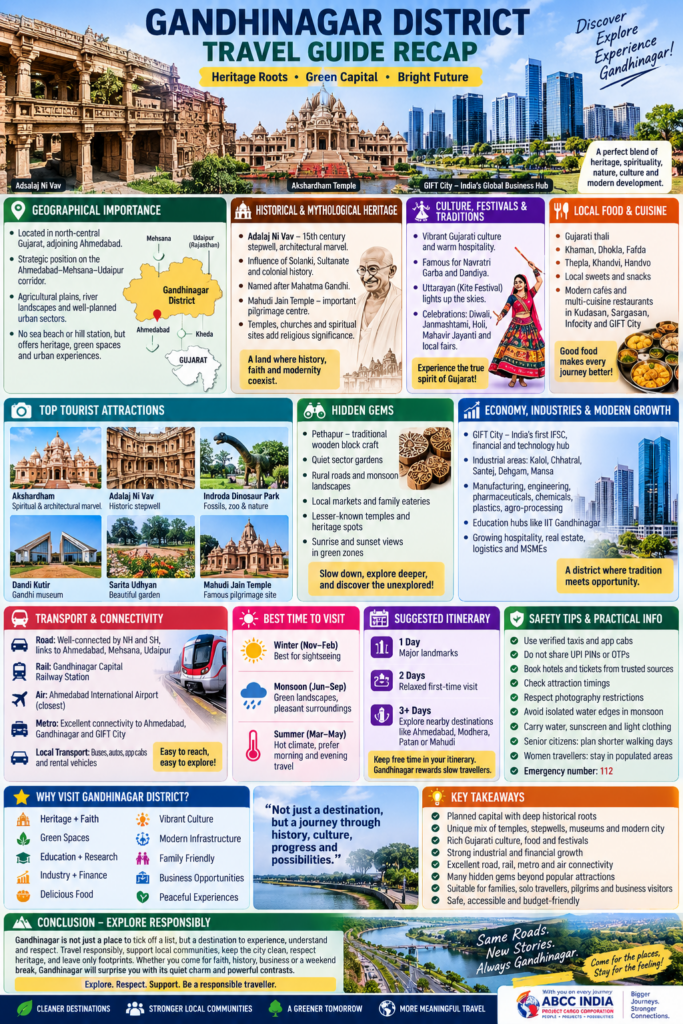
🧭 Powerful Travel Recap
Gandhinagar District is much more than the administrative capital of Gujarat. It is a destination where planned urban design, medieval heritage, spiritual landmarks, green spaces, traditional craftsmanship, modern industry, education, finance, logistics and rural life come together within one compact region.
Geographically, Gandhinagar holds an important position in north-central Gujarat, directly connected with Ahmedabad and the wider North Gujarat corridor. The Sabarmati landscape, agricultural plains, planned sectors and expanding urban belts give the district a varied character. It has no sea beach or natural hill station, but it compensates with heritage architecture, river landscapes, gardens, eco-tourism, cultural circuits and easy road connectivity to nearby destinations.
Historically, Gandhinagar’s land carries stories much older than the modern capital. Adalaj Ni Vav reflects medieval engineering, water conservation and architecture, while Pethapur preserves the heritage of traditional wooden printing blocks. The district’s wider history is linked with Gujarat’s changing dynasties, medieval kingdoms, Sultanate influence, colonial transitions and the development of Gandhinagar as a planned capital after Gujarat became a separate state.
Its mythological and spiritual character is equally important, though responsible travellers should distinguish between documented history and local religious belief. Akshardham, Mahudi Jain Temple, Adalaj Trimandir and other temples and churches add devotional depth to a district often seen only through the lens of government and business.

🎭 Culture, Food and Festivals

Gandhinagar’s cultural identity is unmistakably Gujarati.
Navratri brings Garba and Dandiya to life. Uttarayan fills the sky with kites. Diwali, Janmashtami, Mahavir Jayanti, Holi and local religious celebrations create a strong annual festival calendar.
Food is another major reason to explore slowly.
Gujarati thali, khaman, dhokla, fafda, thepla, khandvi, handvo and local sweets remain essential experiences, while Kudasan, Sargasan, Infocity and GIFT City now offer cafés, multi-cuisine restaurants and modern dining alongside traditional food.
The best food experience is not always at the most expensive restaurant. Travellers should explore local markets and trusted family eateries, while checking hygiene, dietary preferences and current opening hours.
🏛️ Tourism Highlights and Hidden Gems

The district’s major attractions include:
- Akshardham
- Adalaj Ni Vav
- Indroda Dinosaur and Fossil Park
- Dandi Kutir
- Sarita Udhyan
- Puneet Van
- Sant Sarovar
- Mahudi Jain pilgrimage circuit
- Pethapur craft heritage
- GIFT City skyline and business district
Yet Gandhinagar’s real charm often lies between these attractions.
A quiet morning in a sector garden, a rural road after monsoon, a conversation with a Pethapur artisan, a local food stop, a heritage corner that does not appear on every tourist map, or an evening looking at the contrast between old Gandhinagar and GIFT City can become more memorable than a rushed checklist.
This is why the district works especially well for families, couples, solo travellers, students, senior citizens, photographers, pilgrims, corporate visitors and weekend travellers.
🌱 Nature and Seasonal Experiences

Winter is generally the best season for sightseeing because cooler weather makes walking, heritage visits and outdoor photography more comfortable.
Monsoon transforms the district into a greener landscape, particularly around gardens, rural areas and the Sabarmati zone. Summer can be harsh, so outdoor sightseeing is better scheduled in the morning and evening, with museums, temples and indoor attractions used during the hottest hours.
Gandhinagar does not need exaggerated claims about waterfalls or mountains to become attractive. Its natural appeal is more subtle—green roads, river environments, botanical areas, seasonal fields and urban parks.
🏭 Economy, Industry and Modern Growth

Few tourism districts offer such a strong contrast between traditional culture and modern economic development.
Industrial areas around Kalol, Chhatral, Santej, Dehgam and Mansa support manufacturing, engineering, pharmaceuticals, chemicals, plastics, packaging, agro-processing and MSMEs.
Meanwhile, GIFT City has transformed Gandhinagar’s global identity through finance, fintech, banking, insurance, technology and international business services.
This economic diversity creates employment, business travel, logistics demand, hospitality growth and new opportunities for entrepreneurs.
For curious travellers, the district is therefore not only a tourism destination but also a place to understand how Gujarat’s economy is evolving.
🚚 Transport and Logistics Connectivity
Gandhinagar benefits greatly from its proximity to Ahmedabad.
Road connections link it with Ahmedabad, Mehsana, Himmatnagar, Udaipur and wider Gujarat. National and state highways connect industrial and rural areas, while Gandhinagar Capital Railway Station provides rail access.
Ahmedabad’s international airport serves as the main air gateway.
Metro connectivity has further improved movement between Ahmedabad, Gandhinagar, GIFT City and major urban areas.
For local travel, visitors can use metro, buses, autos, app-based cabs, rental vehicles and private cars depending on the route.
Families and senior citizens generally benefit from direct cabs or hired vehicles when covering multiple attractions, while solo travellers and budget visitors can combine metro with autos.
🛡️ Safety and Practical Travel Advice

Gandhinagar is best explored with sensible urban travel precautions.
Use verified taxis and app-based cabs.
Avoid sharing UPI PINs, OTPs or banking details.
Book hotels and tickets through trusted sources.
Check current attraction timings.
Respect photography restrictions around temples, government buildings and sensitive areas.
Avoid isolated water edges during monsoon.
Carry drinking water and sun protection in summer.
Senior citizens should plan shorter walking days.
Women travelling alone should use recognised transport and stay in populated areas at night.
For cyber fraud, banking scams or suspicious digital transactions, immediate reporting is more effective than waiting.
The most important emergency number to remember is 112.
💰 Budget and Trip Planning

A Gandhinagar trip does not need to be expensive.
Budget travellers can rely on metro, local food, public attractions and economical hotels.
Families may spend more on private cars, comfortable accommodation and restaurant dining.
Luxury travellers can choose high-end hotels and resorts around central Gandhinagar and GIFT City.
A practical stay is:
1 day for major landmarks.
2 days for a relaxed first-time visit.
3 days or more if adding Ahmedabad, Modhera, Patan, Mahudi or nearby regional excursions.
The best itinerary should leave free time.
Gandhinagar rewards travellers who slow down.
⭐ Final Summary

Gandhinagar District should not be seen only as Gujarat’s capital.
It is a destination shaped by:
heritage + faith + greenery + education + industry + finance + food + culture + modern infrastructure.
Adalaj represents its historical depth.
Akshardham represents its spiritual identity.
Indroda represents science and nature.
Pethapur represents living craftsmanship.
GIFT City represents its economic future.
Its roads, rail, metro and Ahmedabad airport connectivity make it easy to reach, while its varied attractions make it suitable for short breaks, family trips, business travel and cultural exploration.
The district is not dramatic in the way mountain or coastal destinations are.
Its beauty is found in contrasts.
Old and new.
Village and capital.
Craft and technology.
Temple and finance tower.
Green garden and industrial corridor.
That is what makes Gandhinagar worth discovering.
❤️ The Gandhinagar You Remember May Not Be the One You Planned

There is a moment that often happens during a Gandhinagar trip.
You may begin the journey thinking about famous places.
Then somewhere between a carved stepwell, a quiet road, a Gujarati meal, a craftsman’s workshop or the evening skyline of GIFT City, you stop thinking about sightseeing.
You start noticing the district itself.
That is when Gandhinagar becomes memorable.
Travel here responsibly.
Respect heritage.
Support genuine local businesses.
Do not leave waste behind.
Ask permission before photographing people.
Avoid damaging natural and cultural sites for social-media content.
Drive safely.
Learn something about the place before arriving.
And allow local stories to change your itinerary.
ABCC India Project Cargo Corporation works across India’s transport and heavy-haul logistics sector, including route-survey and project-cargo support. For travellers, however, the larger message is simpler: good journeys—whether carrying people or heavy cargo—begin with understanding the road, respecting the place and planning responsibly.
Come to Gandhinagar for the famous attractions.
Stay long enough to discover what lies between them.
Because the most meaningful travel memories are rarely the places you simply tick off a list.
They are the places that quietly stay with you after you return home.

🌿 Conclusion
Exploring the best places to visit in Gandhinagar District is not simply about moving from one tourist attraction to another. The real experience comes from understanding how remarkably different worlds coexist here—from the intricate stone craftsmanship of Adalaj Ni Vav and the spiritual atmosphere of Akshardham to the green spaces of the planned capital and the modern skyline of GIFT City.
Gandhinagar rewards travellers who explore beyond the obvious. Spend time in its gardens, discover the traditional craftsmanship of Pethapur, taste authentic Gujarati food, visit museums and nature-oriented attractions, and observe how villages, educational institutions, industrial areas and modern business districts collectively shape the region.
Families can enjoy relaxed sightseeing and educational attractions, couples can discover peaceful green spaces and heritage photography locations, students can explore history and science, pilgrims can follow important spiritual circuits, and business travellers can combine professional visits with short cultural excursions. Its proximity to Ahmedabad and connectivity by road, rail and metro also make Gandhinagar practical for weekend getaways and short Gujarat itineraries.
The best journey, however, is not necessarily the one covering the maximum number of attractions. Allow enough time to experience each place properly. Check current opening hours and local conditions before travelling, respect photography restrictions at religious and sensitive locations, use verified transport services, support genuine local businesses and craftspeople, and avoid leaving waste at heritage and natural sites.
Responsible tourism becomes especially meaningful in a district like Gandhinagar. Historic structures need preservation, traditional skills need customers, green spaces need responsible visitors, and local communities deserve respect rather than being treated merely as backgrounds for photographs.

🚛 ABCC India Project Cargo Corporation – Connecting Geography, Industry and Journeys

Alongside this travel perspective, ABCC India Project Cargo Corporation works in the specialised field of road route surveys, goods transportation, logistics planning and project-cargo consulting across India. Its work focuses on understanding geography before movement begins—from industrial connectivity and road-route feasibility to heavy-haul transportation planning and logistics support.

For oversized and project cargo, geographical knowledge becomes particularly important because highways, bridges, turning radii, overhead restrictions, industrial approaches and local road conditions can directly influence transport feasibility and safety. ABCC India’s route-planning experience therefore connects naturally with the broader subject of understanding India’s roads, industrial regions and transport corridors.
For travellers, transport professionals and businesses alike, the lesson is surprisingly similar: know the destination, understand the route, prepare carefully and respect the places through which you travel.
Gandhinagar District deserves exactly that approach.

Come for its celebrated landmarks, but leave enough time for its quieter stories. Meet local people, appreciate its heritage, taste its food, understand its changing economy and explore beyond the standard tourist checklist.
Because the most memorable places to visit in Gandhinagar District are not always those that produce the most photographs—they are the places that help you understand how Gujarat’s history, culture, faith, nature and ambitions for the future continue to share the same landscape.

❓ FAQs

⭐ What are the best places to visit in Gandhinagar District?
The best places to visit in Gandhinagar District include Akshardham, Adalaj Ni Vav, Indroda Dinosaur and Fossil Park, Dandi Kutir, Sarita Udhyan, Puneet Van, Sant Sarovar and Pethapur. The district combines heritage, spirituality, museums, gardens, nature and modern urban experiences.
🚗 What are the best places to visit near Gandhinagar within 100 km?
Within roughly 100 km of Gandhinagar, travellers can plan trips toward Ahmedabad, Modhera, Thol, Nalsarovar and other heritage, nature and devotional destinations, depending on the exact starting point and route. Always verify current road distance before departure.
👨👩👧👦 Which places in Gandhinagar are best for a one-day family picnic?
Families can consider Indroda Nature Park, Sarita Udhyan, Puneet Van, Akshardham and Adalaj Ni Vav. Choose attractions according to children’s ages, weather, walking requirements and current opening hours.
❤️ What are the best places to visit in Gandhinagar for couples?
Couples looking for relaxed sightseeing can explore Adalaj Ni Vav, landscaped gardens, cultural attractions and peaceful green areas. Heritage photography, Gujarati dining and an Ahmedabad–Gandhinagar weekend itinerary can make a good short couple’s trip.
🌿 Are there any hidden or unexplored places in Gandhinagar District?
Yes. Beyond major tourist attractions, travellers can explore Pethapur’s traditional wooden-block craft heritage, quieter sector gardens, rural landscapes and lesser-known cultural and devotional sites. Access and photography rules should always be respected.
🌦️ What is the best time to visit Gandhinagar District?
October to February is generally the most comfortable period for outdoor sightseeing. Monsoon brings greener landscapes, while summer can become very hot, making early-morning, evening and indoor sightseeing more practical.
👨💼 What are the best corporate outing places near Gandhinagar?
Corporate groups can consider resorts, conference properties, golf-oriented venues, nature retreats and activity-based destinations around Gandhinagar and the Ahmedabad–Gandhinagar region. Compare group capacity, meeting facilities, meals, team activities, transport and cancellation policies before booking.
💳 How much does a one-day Gandhinagar sightseeing trip cost?
A one-day trip can range from a relatively inexpensive public-transport outing to a considerably higher-cost private-cab or resort experience. Your actual budget depends on transport, attraction fees, meals, activities, parking and whether you choose a budget, family or premium itinerary.
✈️ How many days are enough to explore Gandhinagar?
One day can cover selected major landmarks, while two days provides a more relaxed Gandhinagar experience. Plan three days or longer when combining Gandhinagar with Ahmedabad or other nearby excursions.
🌟 Is Gandhinagar District worth visiting for tourists?
Yes. Gandhinagar is particularly worthwhile for travellers interested in Gujarati heritage, architecture, spirituality, museums, gardens, family attractions, food and modern development. Its combination of Adalaj’s historic architecture, Akshardham’s spiritual importance and the region’s modern capital-city character creates a distinctive short-break experience.